CHEM-TEXTS – 1979-v13-s282

Page 282

CHEM-TEXTS

Vol. 13, 1979 | Page 3


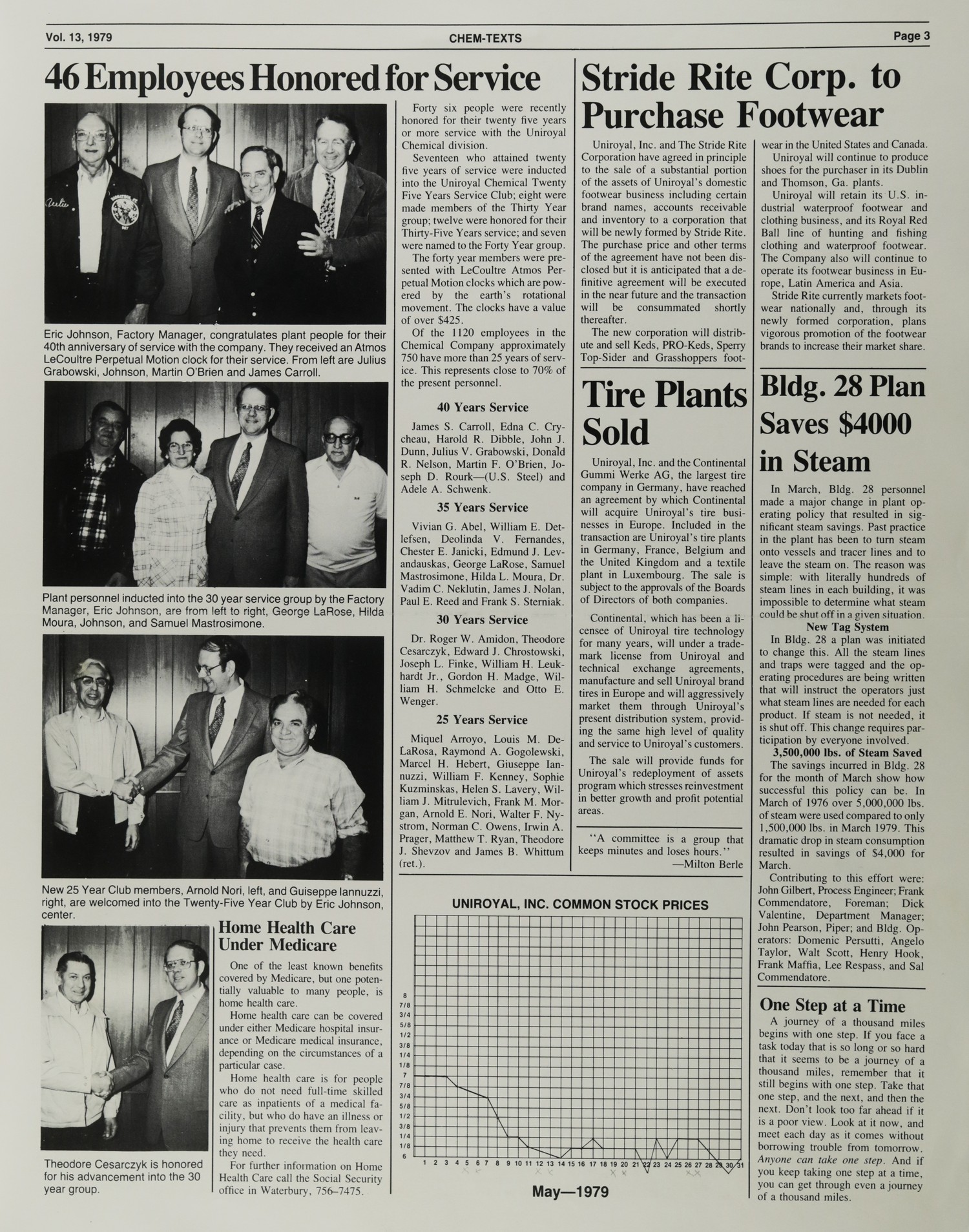
46 Employees Honored for Service

[IMAGE: Group photo]

Eric Johnson, Factory Manager, congratulates plant people for their 40th anniversary of service with the company. They received an Atmos LeCoultre Perpetual Motion clock for their service. From left are Julius Grabowski, Johnson, Martin O’Brien and James Carroll.

[IMAGE: Group photo]

Plant personnel inducted into the 30 year service group by the Factory Manager, Eric Johnson, are from left to right, George LaRose, Hilda Moura, Johnson, and Samuel Mastrosimone.

[IMAGE: Group photo]

New 25 Year Club members, Arnold Nori, left, and Guiseppe Iannuzzi, right, are welcomed into the Twenty-Five Year Club by Eric Johnson, center.

[IMAGE: Individual portrait]

Theodore Cesarczyk is honored for his advancement into the 30 year group.


Forty six people were recently honored for their twenty five years or more service with the Uniroyal Chemical division.

Seventeen who attained twenty five years of service were inducted into the Uniroyal Chemical Twenty Five Year Service Club; eight were made members of the Thirty Year group; twelve were honored for their Thirty-Five Years service; and seven were named to the Forty Year group.

The forty year members were presented with LeCoultre Atmos Perpetual Motion clocks which are powered by the earth’s rotational movement. The clocks have a value of over $425.

Of the 1120 employees in the Chemical Company approximately 750 have more than 25 years of service. This represents close to 70% of the present personnel.

40 Years Service

James S. Carroll, Edna C. Crycheau, Harold R. Dibble, John J. Dunn, Julius V. Grabowski, Donald R. Nelson, Martin F. O’Brien, Joseph D. Rourk—(U.S. Steel) and Adele A. Schwenk.

35 Years Service

Vivian G. Abel, William E. Detlefsen, Deolinda V. Fernandes, Chester E. Janicki, Edmund J. Levandauskas, George LaRose, Samuel Mastrosimone, Hilda L. Moura, Dr. Vadim C. Neklutin, James J. Nolan, Paul E. Reed and Frank S. Sterniak.

30 Years Service

Dr. Roger W. Amidon, Theodore Cesarczyk, Edward J. Chrostowski, Joseph L. Finke, William H. Leukhardt Jr., Gordon H. Madge, William H. Schmelcke and Otto E. Wenger.

25 Years Service

Miquel Arroyo, Louis M. DeLaRosa, Raymond A. Gogolewski, Marcel H. Hebert, Giuseppe Iannuzzi, William F. Kenney, Sophie Kuzminskas, Helen S. Lavery, William J. Mitrulevich, Frank M. Morgan, Arnold E. Nori, Walter F. Nystrom, Norman C. Owens, Irwin A. Prager, Matthew T. Ryan, Theodore J. Shevzov and James B. Whittum (ret.).


Home Health Care Under Medicare

One of the least known benefits covered by Medicare, but one potentially valuable to many people, is home health care.

Home health care can be covered under either Medicare hospital insurance or Medicare medical insurance, depending on the circumstances of a particular case.

Home health care is for people who do not need full-time skilled care as inpatients of a medical facility, but who do have an illness or injury that prevents them from leaving home to receive the health care they need.

For further information on Home Health Care call the Social Security office in Waterbury, 756-7475.


Stride Rite Corp. to Purchase Footwear

Uniroyal, Inc. and The Stride Rite Corporation have agreed in principle to the sale of a substantial portion of the assets of Uniroyal’s domestic footwear business including certain brand names, accounts receivable and inventory to a corporation that will be newly formed by Stride Rite. The purchase price and other terms of the agreement have not been disclosed but it is anticipated that a definitive agreement will be executed in the near future and the transaction will be consummated shortly thereafter.

The new corporation will distribute and sell Keds, PRO-Keds, Sperry Top-Sider and Grasshoppers footwear in the United States and Canada.

Uniroyal will continue to produce shoes for the purchaser in its Dublin and Thomson, Ga. plants.

Uniroyal will retain its U.S. industrial waterproof footwear and clothing business, and its Royal Red Ball line of hunting and fishing clothing and waterproof footwear. The Company also will continue to operate its footwear business in Europe, Latin America and Asia.

Stride Rite currently markets footwear nationally and, through its newly formed corporation, plans vigorous promotion of the footwear brands to increase their market share.


Tire Plants Sold

Uniroyal, Inc. and the Continental Gummi Werke AG, the largest tire company in Germany, have reached an agreement by which Continental will acquire Uniroyal’s tire businesses in Europe. Included in the transaction are Uniroyal’s tire plants in Germany, France, Belgium and the United Kingdom and a textile plant in Luxembourg. The sale is subject to the approvals of the Boards of Directors of both companies.

Continental, which has been a licensee of Uniroyal tire technology for many years, will under a trademark license from Uniroyal and technical exchange agreements, manufacture and sell Uniroyal brand tires in Europe and will aggressively market them through Uniroyal’s present distribution system, providing the same high level of quality and service to Uniroyal’s customers.

The sale will provide funds for Uniroyal’s redeployment of assets program which stresses reinvestment in better growth and profit potential areas.


“A committee is a group that keeps minutes and loses hours.”
—Milton Berle


Bldg. 28 Plan Saves $4000 in Steam

In March, Bldg. 28 personnel made a major change in plant operating policy that resulted in significant steam savings. Past practice in the plant has been to turn steam onto vessels and tracer lines and to leave the steam on. The reason was simple: with literally hundreds of steam lines in each building, it was impossible to determine what steam could be shut off in a given situation.

New Tag System

In Bldg. 28 a plan was initiated to change this. All the steam lines and traps were tagged and the operating procedures are being written that will instruct the operators just what steam lines are needed for each product. If steam is not needed, it is shut off. This change requires participation by everyone involved.

3,500,000 lbs. of Steam Saved

The savings incurred in Bldg. 28 for the month of March show how successful this policy can be. In March of 1976 over 5,000,000 lbs. of steam were used compared to only 1,500,000 lbs. in March 1979. This dramatic drop in steam consumption resulted in savings of $4,000 for March.

Contributing to this effort were: John Gilbert, Process Engineer; Frank Commendatore, Foreman; Dick Valentine, Department Manager; John Pearson, Piper; and Bldg. Operators: Domenic Persutti, Angelo Taylor, Walt Scott, Henry Hook, Frank Maffia, Lee Respass, and Sal Commendatore.


One Step at a Time

A journey of a thousand miles begins with one step. If you face a task today that is so long or so hard that it seems to be a journey of a thousand miles, remember that it still begins with one step. Take that one step, and the next, and then the next. Don’t look too far ahead if it is a poor view. Look at it now, and meet each day as it comes without borrowing trouble from tomorrow. Anyone can take one step. And if you keep taking one step at a time, you can get through even a journey of a thousand miles.


UNIROYAL, INC. COMMON STOCK PRICES

[CHART: Stock price graph showing prices from months 1-31, with price scale showing values from 0 to 8, with markers at 7/8, 3/4, 5/8, 1/2, 3/8, 1/4, 1/8 intervals]

May—1979
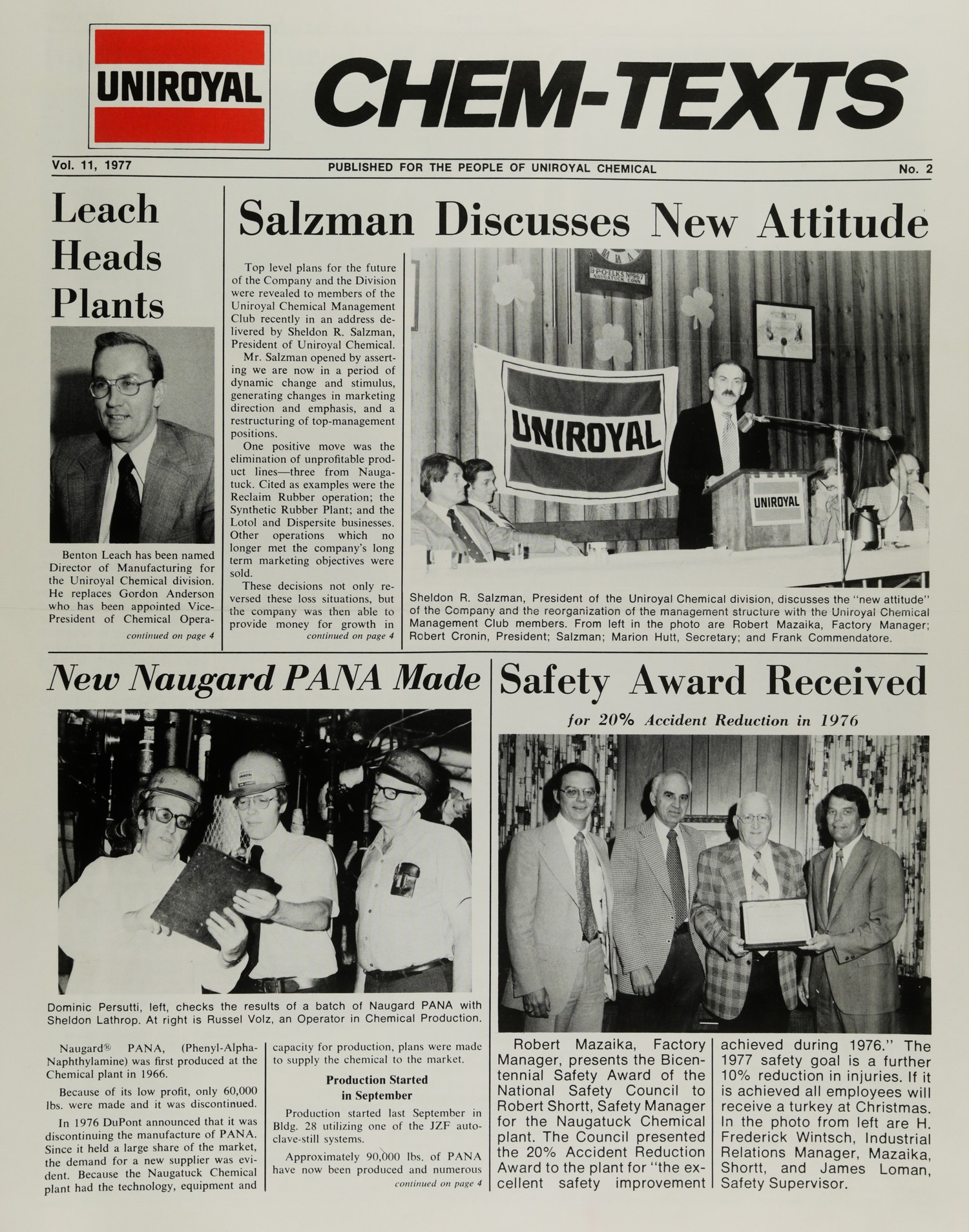
CHEM-TEXTS – 1977 – Page No. 2

Page unknown

UNIROYAL CHEM-TEXTS

Vol. 11, 1977 PUBLISHED FOR THE PEOPLE OF UNIROYAL CHEMICAL No. 2


Leach Heads Plants

[IMAGE: Photo of Benton Leach]

Benton Leach has been named Director of Manufacturing for the Uniroyal Chemical division. He replaces Gordon Anderson who has been appointed Vice-President of Chemical Opera-
continued on page 4


Salzman Discusses New Attitude

Top level plans for the future of the Company and the Division were revealed to members of the Uniroyal Chemical Management Club recently in an address delivered by Sheldon R. Salzman, President of Uniroyal Chemical.

Mr. Salzman opened by asserting we are now in a period of dynamic change and stimulus, generating changes in marketing direction and emphasis, and a restructuring of top-management positions.

One positive move was the elimination of unprofitable product lines—three from Naugatuck. Cited as examples were the Reclaim Rubber operation; the Synthetic Rubber Plant; and the Lotol and Dispersite businesses. Other operations which no longer met the company’s long term marketing objectives were sold.

These decisions not only reversed these loss situations, but the company was then able to provide money for growth in
continued on page 4

[IMAGE: Photo of Sheldon R. Salzman speaking at podium with Uniroyal banner]

Sheldon R. Salzman, President of the Uniroyal Chemical division, discusses the “new attitude” of the Company and the reorganization of the management structure with the Uniroyal Chemical Management Club members. From left in the photo are Robert Mazaika, Factory Manager; Robert Cronin, President; Salzman; Marion Hutt, Secretary; and Frank Commendatore.


New Naugard PANA Made

[IMAGE: Photo of workers checking batch results]

Dominic Persutti, left, checks the results of a batch of Naugard PANA with Sheldon Lathrop. At right is Russel Volz, an Operator in Chemical Production.

Naugard® PANA, (Phenyl-Alpha-Naphthylamine) was first produced at the Chemical plant in 1966.

Because of its low profit, only 60,000 lbs. were made and it was discontinued.

In 1976 DuPont announced that it was discontinuing the manufacture of PANA. Since it held a large share of the market, the demand for a new supplier was evident. Because the Naugatuck Chemical plant had the technology, equipment and capacity for production, plans were made to supply the chemical to the market.

Production Started in September

Production started last September in Bldg. 28 utilizing one of the JZF autoclave-still systems.

Approximately 90,000 lbs. of PANA have now been produced and numerous
continued on page 4


Safety Award Received

for 20% Accident Reduction in 1976

[IMAGE: Photo of safety award presentation]

Robert Mazaika, Factory Manager, presents the Bicentennial Safety Award of the National Safety Council to Robert Shortt, Safety Manager for the Naugatuck Chemical plant. The Council presented the 20% Accident Reduction Award to the plant for “the excellent safety improvement achieved during 1976.” The 1977 safety goal is a further 10% reduction in injuries. If it is achieved all employees will receive a turkey at Christmas. In the photo from left are H. Frederick Wintsch, Industrial Relations Manager, Mazaika, Shortt, and James Loman, Safety Supervisor.

CHEM-TEXTS – Vol. 10 – Page 4

Page 004

CHEM-TEXTS

Vol. 10, 1976 Page 4


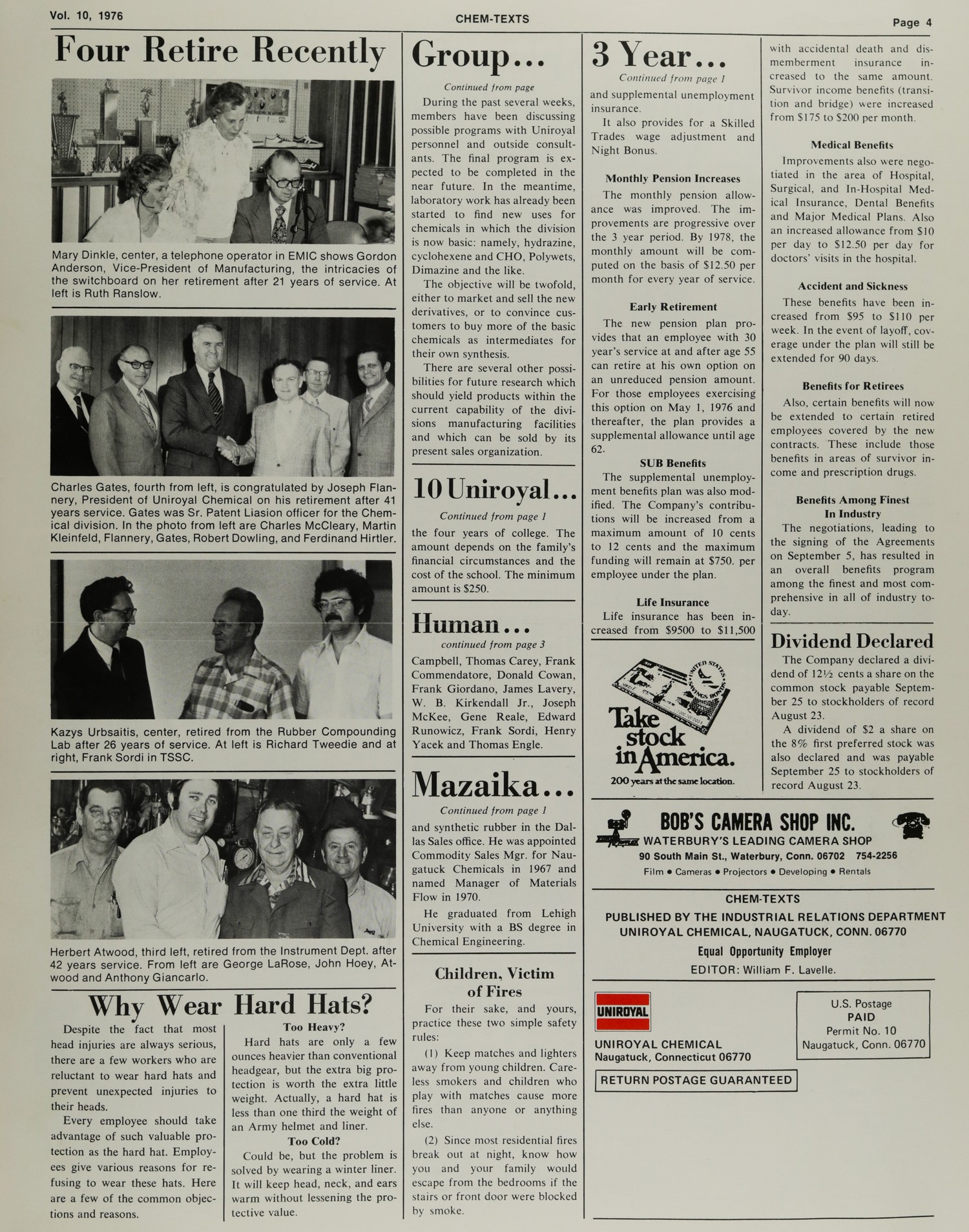
Four Retire Recently

[IMAGE: Photo of four people]

Mary Dinkle, center, a telephone operator in EMIC shows Gordon Anderson, Vice-President of Manufacturing, the intricacies of the switchboard on her retirement after 21 years of service. At left is Ruth Ranslow.


[IMAGE: Group photo of six men]

Charles Gates, fourth from left, is congratulated by Joseph Flannery, President of Uniroyal Chemical on his retirement after 41 years service. Gates was Sr. Patent Liasion officer for the Chemical division. In the photo from left are Charles McCleary, Martin Kleinfeld, Flannery, Gates, Robert Dowling, and Ferdinand Hirtler.


[IMAGE: Photo of three men]

Kazys Urbsaitis, center, retired from the Rubber Compounding Lab after 26 years of service. At left is Richard Tweedie and at right, Frank Sordi in TSSC.


[IMAGE: Photo of four men]

Herbert Atwood, third left, retired from the Instrument Dept. after 42 years service. From left are George LaRose, John Hoey, Atwood and Anthony Giancarlo.


Why Wear Hard Hats?

Despite the fact that most head injuries are always serious, there are a few workers who are reluctant to wear hard hats and prevent unexpected injuries to their heads.

Every employee should take advantage of such valuable protection as the hard hat. Employees give various reasons for refusing to wear these hats. Here are a few of the common objections and reasons.

Too Heavy?

Hard hats are only a few ounces heavier than conventional headgear, but the extra big protection is worth the extra little weight. Actually, a hard hat is less than one third the weight of an Army helmet and liner.

Too Cold?

Could be, but the problem is solved by wearing a winter liner. It will keep head, neck, and ears warm without lessening the protective value.


Group…

Continued from page

During the past several weeks, members have been discussing possible programs with Uniroyal personnel and outside consultants. The final program is expected to be completed in the near future. In the meantime, laboratory work has already been started to find new uses for chemicals in which the division is now basic: namely, hydrazine, cyclohexene and CHO, Polywets, Dimazine and the like.

The objective will be twofold, either to market and sell the new derivatives, or to convince customers to buy more of the basic chemicals as intermediates for their own synthesis.

There are several other possibilities for future research which should yield products within the current capability of the divisions manufacturing facilities and which can be sold by its present sales organization.


10 Uniroyal…

Continued from page 1

the four years of college. The amount depends on the family’s financial circumstances and the cost of the school. The minimum amount is $250.


Human…

continued from page 3

Campbell, Thomas Carey, Frank Commendatore, Donald Cowan, Frank Giordano, James Lavery, W. B. Kirkendall Jr., Joseph McKee, Gene Reale, Edward Runowicz, Frank Sordi, Henry Yacek and Thomas Engle.


Mazaika…

Continued from page 1

and synthetic rubber in the Dallas Sales office. He was appointed Commodity Sales Mgr. for Naugatuck Chemicals in 1967 and named Manager of Materials Flow in 1970.

He graduated from Lehigh University with a BS degree in Chemical Engineering.


Children, Victim of Fires

For their sake, and yours, practice these two simple safety rules:

(1) Keep matches and lighters away from young children. Careless smokers and children who play with matches cause more fires than anyone or anything else.

(2) Since most residential fires break out at night, know how you and your family would escape from the bedrooms if the stairs or front door were blocked by smoke.


3 Year…

Continued from page 1

and supplemental unemployment insurance.

It also provides for a Skilled Trades wage adjustment and Night Bonus.

Monthly Pension Increases

The monthly pension allowance was improved. The improvements are progressive over the 3 year period. By 1978, the monthly amount will be computed on the basis of $12.50 per month for every year of service.

Early Retirement

The new pension plan provides that an employee with 30 year’s service at and after age 55 can retire at his own option on an unreduced pension amount. For those employees exercising this option on May 1, 1976 and thereafter, the plan provides a supplemental allowance until age 62.

SUB Benefits

The supplemental unemployment benefits plan was also modified. The Company’s contributions will be increased from a maximum amount of 10 cents to 12 cents and the maximum funding will remain at $750. per employee under the plan.

Life Insurance

Life insurance has been increased from $9500 to $11,500


[IMAGE: “Take stock in America” advertisement with eagle logo]
200 years at the same location.


with accidental death and dismemberment insurance increased to the same amount. Survivor income benefits (transition and bridge) were increased from $175 to $200 per month.

Medical Benefits

Improvements also were negotiated in the area of Hospital, Surgical, and In-Hospital Medical Insurance, Dental Benefits and Major Medical Plans. Also an increased allowance from $10 per day to $12.50 per day for doctors’ visits in the hospital.

Accident and Sickness

These benefits have been increased from $95 to $110 per week. In the event of layoff, coverage under the plan will still be extended for 90 days.

Benefits for Retirees

Also, certain benefits will now be extended to certain retired employees covered by the new contracts. These include those benefits in areas of survivor income and prescription drugs.

Benefits Among Finest In Industry

The negotiations, leading to the signing of the Agreements on September 5, has resulted in an overall benefits program among the finest and most comprehensive in all of industry today.


Dividend Declared

The Company declared a dividend of 12½ cents a share on the common stock payable September 25 to stockholders of record August 23.

A dividend of $2 a share on the 8% first preferred stock was also declared and was payable September 25 to stockholders of record August 23.


BOB’S CAMERA SHOP INC.

WATERBURY’S LEADING CAMERA SHOP
90 South Main St., Waterbury, Conn. 06702 754-2256
Film ● Cameras ● Projectors ● Developing ● Rentals


CHEM-TEXTS

PUBLISHED BY THE INDUSTRIAL RELATIONS DEPARTMENT
UNIROYAL CHEMICAL, NAUGATUCK, CONN. 06770

Equal Opportunity Employer

EDITOR: William F. Lavelle.


[UNIROYAL LOGO]

UNIROYAL CHEMICAL
Naugatuck, Connecticut 06770

RETURN POSTAGE GUARANTEED

U.S. Postage
PAID
Permit No. 10
Naugatuck, Conn. 06770

CHEM-TEXTS – 1976 – Page 3

Page 003

CHEM-TEXTS

Vol. 10, 1976Page 3


Group Set Up to Explore New Chemicals and Uses

When the Uniroyal Chemical division was reorganized in 1975, Joseph Flannery, President and Dr. Charles McCleary, Director of Research and Development recognized the possibility that long-term research might suffer. They felt that the Research and Development groups in the four profit center areas might concentrate on short-term profits rather than on the long-term R & D projects where the profit is possibly greater, but deferred for several years.

New Chemicals for New Markets

Accordingly, they budgeted for a new Exploratory Research

group whose objective would be to develop profitable, new businesses for the division, hopefully in areas which would not be as sensitive to the automobile and housing business cycles as the present business of polymer and polymer additives.

Dr. Lorin Schoene Named Head

The Exploratory Research group was established under the direction of Dr. D. Lorin Schoene. Initial ground rules were established that will be subject to change as the group develops, but are currently as follows:

The Group will:
a) not compete with existing

Chemical or Corporate R&D groups.

b) complement existing R&D efforts by having any interesting, new chemicals evaluated by the other groups.

c) concentrate on small molecule chemistry with a high science content in development and application, rather than new high polymer research.

d) liaise with the sales and market development groups to insure that the work is in salable areas.

e) become cognizant of manufacturing, toxicity and effluent problems in the areas selected.

f) pass on ideas, internal or external, that fit profit center goals.

Four Join Group

Dr. Howard A. Hageman; Margaret Behlman, Secretary; Gary Farrell, Laboratory Assistant, and Dr. Emanuel Kontos will make up the staff. Other personnel will become part of it once a permanent program has been established.

Continued on page 4


Plant’s TPR Replaces PVC and Neoprene

A new waterstop and expansion joint, available from Sinmast of America, Inc., Elk Grove Village, Ill. and made of Uniroyal Chemical’s TPR® thermoplastic rubber, provides long life and great flexibility even at sub-zero temperatures. The TPR is made in the Dispersions Dept.

“Our use of Uniroyal Chemical’s TPR thermoplastic rubber replaces both PVC and neoprene in these joints,” says Floyd Dimmick, technical director for Sinmast. “The material can be heat welded right at the job site to match any conceivable application requirement.”

The TPR material helps provide resistance to abrasion, ozone, oxygen, alkaline, de-icing chemicals, and most other known chemicals. Hydrostatic pressures are easily withstood. The EPA has approved TPR for use with potable water.


Conserve Energy

Turning out lights saves energy. A 100-watt light bulb burning for 10 hours uses 11,600 BTU’s, which is the energy equivalent of a pound of coal or a half-pint of oil.


Some Tips on Social Security

If you are ready to retire, or are disabled, or were recently widowed and left with a young family, here are some tips that may help save time and trouble when you apply for Social Security benefits.

A telephone call to the Social Security office in your area is a good first step. The office will answer your questions and tell you how to apply and when to do it. Since claims can be taken over the telephone, this may save you a visit to the district office. The Waterbury Social Security office telephone number is 756-7475.

When you apply in person or by telephone have your social security card or a record of your social security number, proof of your age, and your last year’s income tax withholding statement with you.

If your wife also is applying for benefits, she should bring evidence of her age and her social security card or a record of her number if she has one.

Firmness: The admirable quality in us that is pigheadedness in others.

Conference: A meeting where people talk about what they should already be doing.


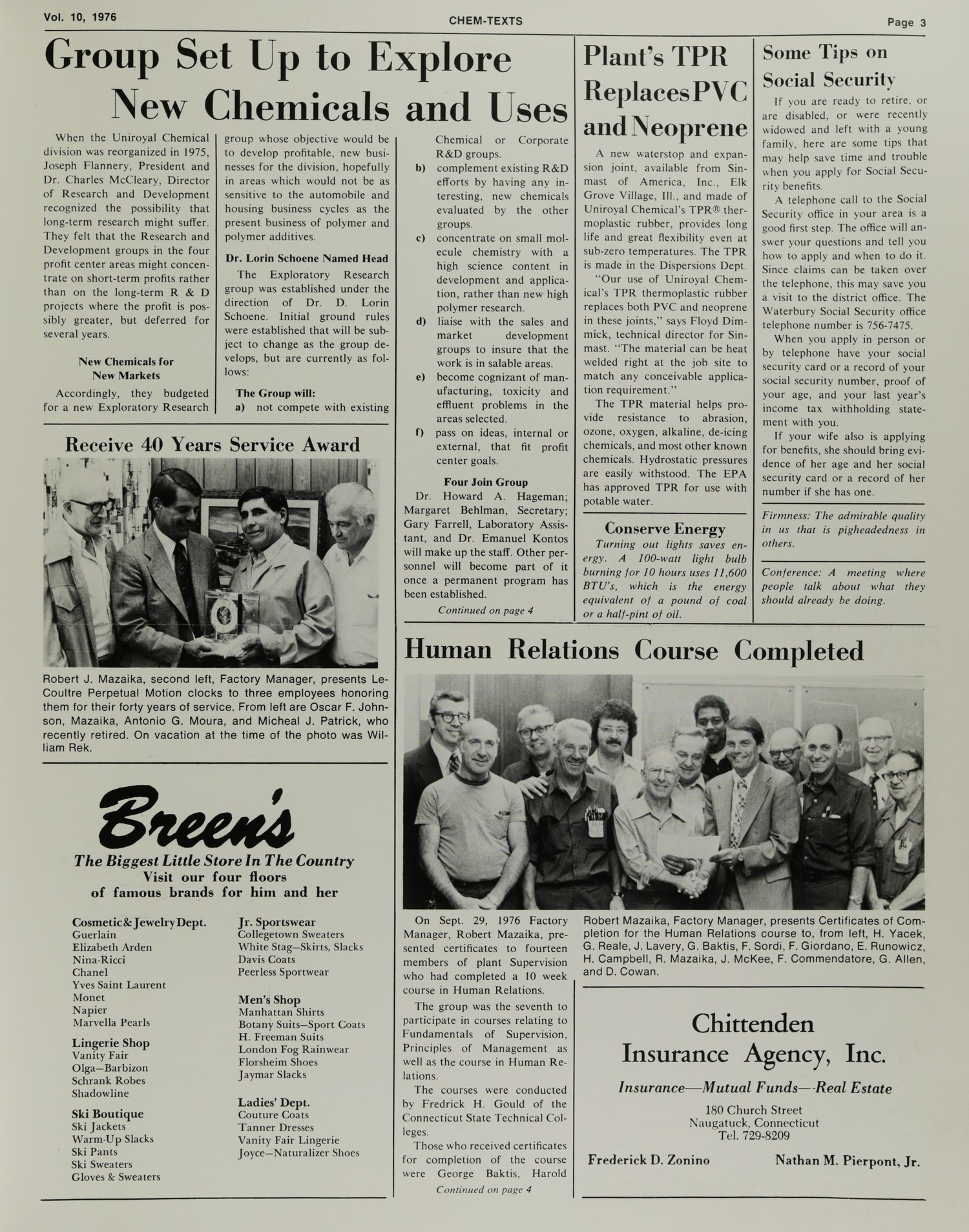
Receive 40 Years Service Award

[PHOTO]

Robert J. Mazaika, second left, Factory Manager, presents LeCoultre Perpetual Motion clocks to three employees honoring them for their forty years of service. From left are Oscar F. Johnson, Mazaika, Antonio G. Moura, and Micheal J. Patrick, who recently retired. On vacation at the time of the photo was William Rek.


Breen’s

The Biggest Little Store In The Country
Visit our four floors of famous brands for him and her

Cosmetic & Jewelry Dept.
Guerlain
Elizabeth Arden
Nina-Ricci
Chanel
Yves Saint Laurent
Monet
Napier
Marvella Pearls

Lingerie Shop
Vanity Fair
Olga—Barbizon
Schrank Robes
Shadowline

Ski Boutique
Ski Jackets
Warm-Up Slacks
Ski Pants
Ski Sweaters
Gloves & Sweaters

Jr. Sportswear
Collegetown Sweaters
White Stag—Skirts, Slacks
Davis Coats
Peerless Sportwear

Men’s Shop
Manhattan Shirts
Botany Suits—Sport Coats
H. Freeman Suits
London Fog Rainwear
Florsheim Shoes
Jaymar Slacks

Ladies’ Dept.
Couture Coats
Tanner Dresses
Vanity Fair Lingerie
Joyce—Naturalizer Shoes


Human Relations Course Completed

[PHOTO]

On Sept. 29, 1976 Factory Manager, Robert Mazaika, presented certificates to fourteen members of plant Supervision who had completed a 10 week course in Human Relations.

The group was the seventh to participate in courses relating to Fundamentals of Supervision, Principles of Management as well as the course in Human Relations.

The courses were conducted by Fredrick H. Gould of the Connecticut State Technical Colleges.

Those who received certificates for completion of the course were George Baktis, Harold

Continued on page 4

Robert Mazaika, Factory Manager, presents Certificates of Completion for the Human Relations course to, from left, H. Yacek, G. Reale, J. Lavery, G. Baktis, F. Sordi, F. Giordano, E. Runowicz, H. Campbell, R. Mazaika, J. McKee, F. Commendatore, G. Allen, and D. Cowan.


Chittenden Insurance Agency, Inc.

Insurance—Mutual Funds—Real Estate

180 Church Street
Naugatuck, Connecticut
Tel. 729-8209

Frederick D. ZoninoNathan M. Pierpont, Jr.

CHEM-TEXTS – Vol. 5 No. 4 – Page 4

Page 004

Page 4 | CHEM-TEXTS | Vol. 5 No. 4


Know Your Products:

Naugatuck® Chemical Antioxidants

by Dr. Bob Brown

(This is the third in a series of articles on the chemicals manufactured in Chemical Production or sold by the Chemical Division.)

If we didn’t have antioxidants and antiozonants, rubber products would fall apart, before we could wear them out.

In fact, most kinds of synthetic rubber can’t even be manufactured without some type of a protective chemical to get them through the drying and storage stages.

Polygard®, for example, is used extensively by the synthetic rubber plants as a stabilizer (antioxidant) during processing and manufacture. It is not only an excellent antioxidant but it does not discolor or stain the rubber, therefore it can be used for white and light colored rubber articles.

If the rubber is to be manufactured into a black or dark colored product (such as tires) the customer may prefer to use BLE® which discolors the rubber, but also carries its protection over into the finished product to a greater extent than Polygard.

New Chemicals Developed For Synthetic Rubbers

The newer types of synthetic rubber required new types of antioxidants to protect them against oxygen and heat degradation.

Antioxidant 451 was especial-

purpose and is used in cis-polybutadiene rubber. Antioxidant 449 was also developed for a new, and different type of synthetic rubber, EPT: Royalene® the crackless rubber, made at the Chemical Division’s Geismar, La. plant.

Chemicals Vary In Color and Protection

In the development of antioxidants there is always the problem that the chemical structure which provides the best protection against oxygen and heat also causes the worst discoloration in the rubber. Generally speaking, all antioxidants cause some degree of discoloration from a very slight yellowing to a very brownish black discoloration. Usually a chemical which discolors only slightly, gives poorer protection.

Antioxidant 431 (VCIU) is such a chemical. It gives the best color but less protection against oxygen and heat.

Naugawhite® Antioxidant 439 and Antioxidant 451 are a little further down the color scale, but are somewhat more effective as antioxidants. These chemicals are used in latex foam, footwear and household products which are usually made from a bright color rubber.

(This series of articles on Rubber Chemicals will be concluded in the next issue of Chem-Texts.)


Plant Safety

(cont’d. from page 1)

and is still in the Intensive Care unit of St. Mary’s Hospital.

Disaster Plan Operates

A few minutes after the explosion members of the Disaster Plan arrived at the plant and assumed their responsibilities during the emergency. One evidence of the Plan’s effectiveness was the swift medical attention provided the injured employee—he was receiving medical care by a team of specialists at St. Mary’s Hospital ten minutes after the accident.

The cause of the explosion is still under investigation.

Other Accidents In Period

Other injuries during the 8 week period were: one employee suffered partial loss of a finger; an employee cut his hand with a knife requiring ten stitches; another employee dropped a valve on his foot and broke a toe; an employee injured his eye when a flying chip struck his eyeball; two employees suffered severe burns from steaming hot water and a steam hose; and another employee broke an ankle when a ladder slipped and he fell off it backwards.

Where Accidents Occurred, July 10 to Sept. 4

Dept. Lost Time Serious Injuries
Chem. Prod 4 1
Reclaim Prod. 3 2
Syn. Prod. 3 1
Materials 0 1
Mechanical 1 4
Res. & Devel. 1 0
TOTAL 12 9

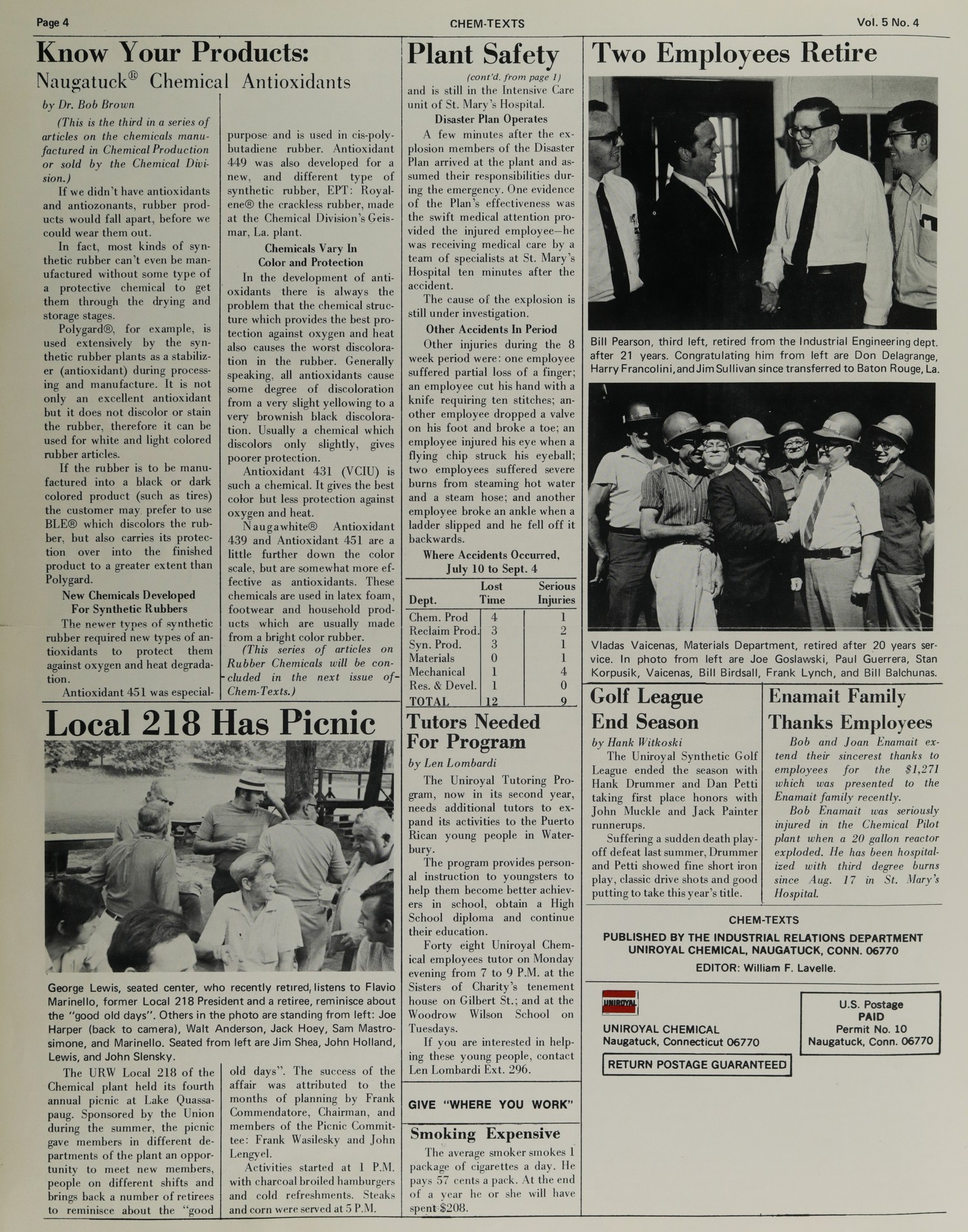
Two Employees Retire

Bill Pearson, third left, retired from the Industrial Engineering dept. after 21 years. Congratulating him from left are Don Delagrange, Harry Francolini, and Jim Sullivan since transferred to Baton Rouge, La.

Vladas Vaicenas, Materials Department, retired after 20 years service. In photo from left are Joe Goslawski, Paul Guerrera, Stan Korpusik, Vaicenas, Bill Birdsall, Frank Lynch, and Bill Balchunas.


Local 218 Has Picnic

George Lewis, seated center, who recently retired, listens to Flavio Marinello, former Local 218 President and a retiree, reminisce about the “good old days”. Others in the photo are standing from left: Joe Harper (back to camera), Walt Anderson, Jack Hoey, Sam Mastrosimone, and Marinello. Seated from left are Jim Shea, John Holland, Lewis, and John Slensky.

The URW Local 218 of the Chemical plant held its fourth annual picnic at Lake Quassapaug. Sponsored by the Union during the summer, the picnic gave members in different departments of the plant an opportunity to meet new members, people on different shifts and brings back a number of retirees to reminisce about the “good old days”. The success of the affair was attributed to the months of planning by Frank Commendatore, Chairman, and members of the Picnic Committee: Frank Wasilesky and John Lengyel.

Activities started at 1 P.M. with charcoal broiled hamburgers and cold refreshments. Steaks and corn were served at 5 P.M.


Tutors Needed For Program

by Len Lombardi

The Uniroyal Tutoring Program, now in its second year, needs additional tutors to expand its activities to the Puerto Rican young people in Waterbury.

The program provides personal instruction to youngsters to help them become better achievers in school, obtain a High School diploma and continue their education.

Forty eight Uniroyal Chemical employees tutor on Monday evening from 7 to 9 P.M. at the Sisters of Charity’s tenement house on Gilbert St.; and at the Woodrow Wilson School on Tuesdays.

If you are interested in helping these young people, contact Len Lombardi Ext. 296.


GIVE “WHERE YOU WORK”


Smoking Expensive

The average smoker smokes 1 package of cigarettes a day. He pays 57 cents a pack. At the end of a year he or she will have spent $208.


Golf League End Season

by Hank Witkoski

The Uniroyal Synthetic Golf League ended the season with Hank Drummer and Dan Petti taking first place honors with John Muckle and Jack Painter runnerups.

Suffering a sudden death playoff defeat last summer, Drummer and Petti showed fine short iron play, classic drive shots and good putting to take this year’s title.


Enamait Family Thanks Employees

Bob and Joan Enamait extend their sincerest thanks to employees for the $1,271 which was presented to the Enamait family recently.

Bob Enamait was seriously injured in the Chemical Pilot plant when a 20 gallon reactor exploded. He has been hospitalized with third degree burns since Aug. 17 in St. Mary’s Hospital.


CHEM-TEXTS

PUBLISHED BY THE INDUSTRIAL RELATIONS DEPARTMENT
UNIROYAL CHEMICAL, NAUGATUCK, CONN. 06770

EDITOR: William F. Lavelle.


UNIROYAL

UNIROYAL CHEMICAL
Naugatuck, Connecticut 06770

RETURN POSTAGE GUARANTEED

U.S. Postage
PAID
Permit No. 10
Naugatuck, Conn. 06770

CHEM-TEXTS – Vol. 5, No. 6 – Page 3

Page 003

Page 3 | CHEM-TEXTS | Vol. 5. No. 6


$21,000 Unit…

(Cont’d. from page 1)

than previously made at the plant.

Mike English was the Process Development Engineer for the process requirements and Rod Ashby was Project Engineer for the design and construction of the unit.

The new facility burns off waste gases completely in a smoke-less flame, and eliminates air pollution and fire hazard.

[IMAGE: Industrial facility/equipment]


United Givers

(Cont’d. from page 1)

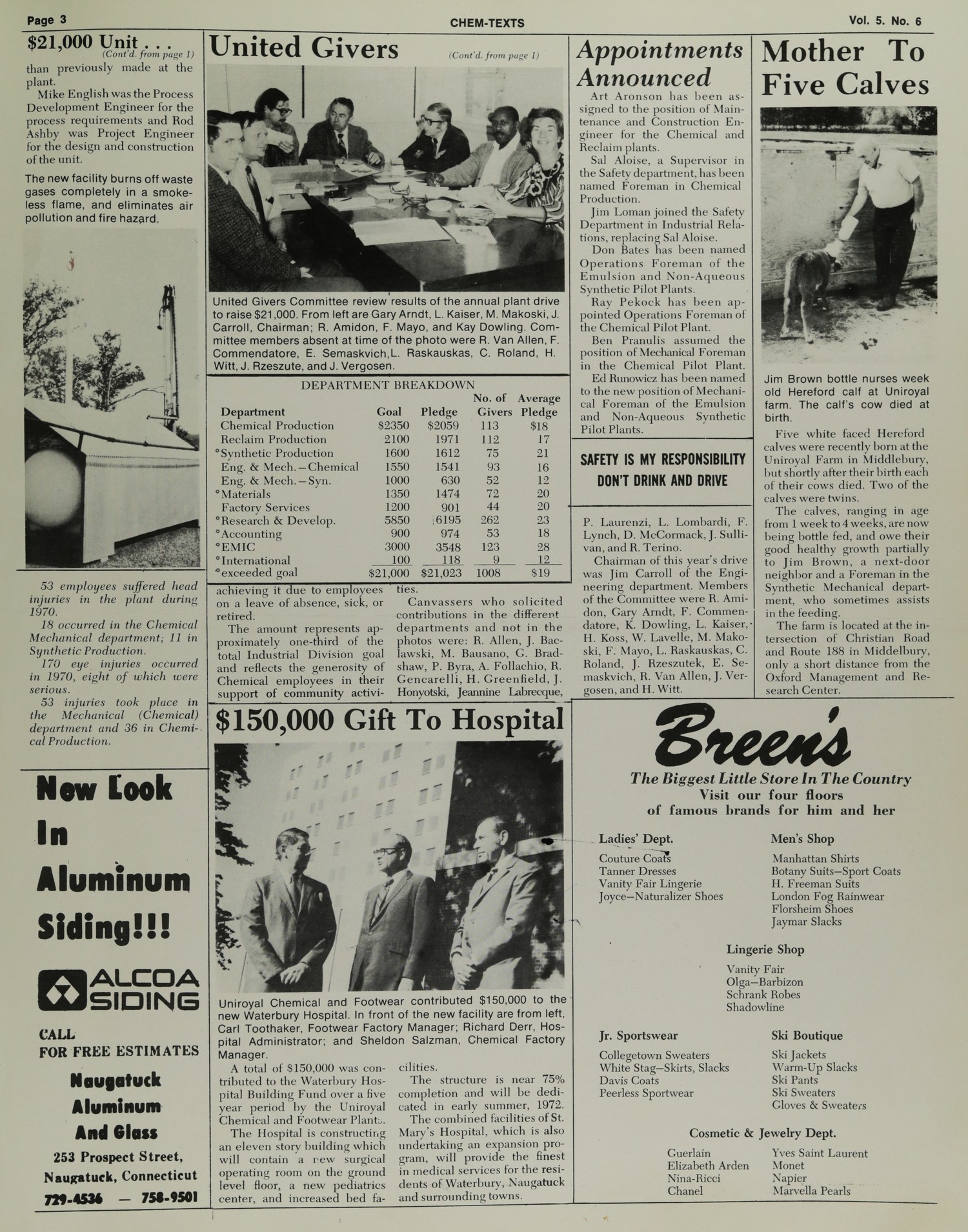
[IMAGE: Group of people at a table reviewing documents]

United Givers Committee review results of the annual plant drive to raise $21,000. From left are Gary Arndt, L. Kaiser, M. Makoski, J. Carroll, Chairman; R. Amidon, F. Mayo, and Kay Dowling. Committee members absent at time of the photo were R. Van Allen, F. Commendatore, E. Semaskvich, L. Raskauskas, C. Roland, H. Witt, J. Rzeszute, and J. Vergosen.

DEPARTMENT BREAKDOWN

Department Goal Pledge No. of Givers Average Pledge
Chemical Production $2350 $2059 113 $18
Reclaim Production 2100 1971 112 17
*Synthetic Production 1600 1612 75 21
Eng. & Mech.—Chemical 1550 1541 93 16
Eng. & Mech.—Syn. 1000 630 52 12
*Materials 1350 1474 72 20
Factory Services 1200 901 44 20
*Research & Develop. 5850 6195 262 23
*Accounting 900 974 53 18
*EMIC 3000 3548 123 28
*International 100 118 9 12
*exceeded goal $21,000 $21,023 1008 $19

53 employees suffered head injuries in the plant during 1970.

18 occurred in the Chemical Mechanical department; 11 in Synthetic Production.

170 eye injuries occurred in 1970, eight of which were serious.

53 injuries took place in the Mechanical (Chemical) department and 36 in Chemical Production.


achieving it due to employees on a leave of absence, sick, or retired.

The amount represents approximately one-third of the total Industrial Division goal and reflects the generosity of Chemical employees in their support of community activities.

Canvassers who solicited contributions in the different departments and not in the photos were: R. Allen, J. Baclawski, M. Bausano, G. Bradshaw, P. Byra, A. Follachio, R. Gencarelli, H. Greenfield, J. Honyotski, Jeannine Labrecque,


Appointments Announced

Art Aronson has been assigned to the position of Maintenance and Construction Engineer for the Chemical and Reclaim plants.

Sal Aloise, a Supervisor in the Safety department, has been named Foreman in Chemical Production.

Jim Loman joined the Safety Department in Industrial Relations, replacing Sal Aloise.

Don Bates has been named Operations Foreman of the Emulsion and Non-Aqueous Synthetic Pilot Plants.

Ray Pekoek has been appointed Operations Foreman of the Chemical Pilot Plant.

Ben Pranulis assumed the position of Mechanical Foreman in the Chemical Pilot Plant.

Ed Hunwicz has been named to the new position of Mechanical Foreman of the Emulsion and Non-Aqueous Synthetic Pilot Plants.


SAFETY IS MY RESPONSIBILITY

DON’T DRINK AND DRIVE

P. Laurenzi, L. Lombardi, F. Lynch, D. McCormack, J. Sullivan, and R. Terino.

Chairman of this year’s drive was Jim Carroll of the Engineering department. Members of the Committee were R. Amidon, Gary Arndt, F. Commendatore, K. Dowling, L. Kaiser, H. Koss, W. Lavelle, M. Makoski, F. Mayo, L. Raskauskas, C. Roland, J. Rzeszutek, E. Semaskvich, R. Van Allen, J. Vergosen, and H. Witt.


Mother To Five Calves

[IMAGE: Man with calf]

Jim Brown bottle nurses week old Hereford calf at Uniroyal farm. The calf’s cow died at birth.

Five white faced Hereford calves were recently born at the Uniroyal Farm in Middlebury, but shortly after their birth each of their cows died. Two of the calves were twins.

The calves, ranging in age from 1 week to 4 weeks, are now being bottle fed, and owe their good healthy growth partially to Jim Brown, a next-door neighbor and a Foreman in the Synthetic Mechanical department, who sometimes assists in the feeding.

The farm is located at the intersection of Christian Road and Route 188 in Middlebury, only a short distance from the Oxford Management and Research Center.


New Look In Aluminum Siding!!!

ALCOA SIDING

CALL FOR FREE ESTIMATES

Naugatuck Aluminum And Glass

253 Prospect Street,
Naugatuck, Connecticut

729-4534 — 758-9501


$150,000 Gift To Hospital

[IMAGE: Three men in front of building under construction]

Uniroyal Chemical and Footwear contributed $150,000 to the new Waterbury Hospital. In front of the new facility are from left, Carl Toothaker, Footwear Factory Manager; Richard Derr, Hospital Administrator; and Sheldon Salzman, Chemical Factory Manager.

A total of $150,000 was contributed to the Waterbury Hospital Building Fund over a five year period by the Uniroyal Chemical and Footwear Plant.

The Hospital is constructing an eleven story building which will contain a new surgical operating room on the ground level floor, a new pediatrics center, and increased bed facilities.

The structure is near 75% completion and will be dedicated in early summer, 1972.

The combined facilities of St. Mary’s Hospital, which is also undertaking an expansion program, will provide the finest in medical services for the residents of Waterbury, Naugatuck and surrounding towns.


Breen’s

The Biggest Little Store In The Country

Visit our four floors of famous brands for him and her

Ladies’ Dept.
– Couture Coats
– Tanner Dresses
– Vanity Fair Lingerie
– Joyce—Naturalizer Shoes

Men’s Shop
– Manhattan Shirts
– Botany Suits—Sport Coats
– H. Freeman Suits
– London Fog Rainwear
– Florsheim Shoes
– Jaymar Slacks

Lingerie Shop
– Vanity Fair
– Olga—Barbizon
– Schrank Robes
– Shadowline

Jr. Sportswear
– Collegetown Sweaters
– White Stag—Skirts, Slacks
– Davis Coats
– Peerless Sportwear

Ski Boutique
– Ski Jackets
– Warm-Up Slacks
– Ski Pants
– Ski Sweaters
– Gloves & Sweaters

Cosmetic & Jewelry Dept.
– Guerlain
– Elizabeth Arden
– Nina-Ricci
– Chanel
– Yves Saint Laurent
– Monet
– Napier
– Marvella Pearls

CHEM-TEXTS – 1971 – Page No. 6

Page unknown

UNIROYAL

Merry Christmas – Happy New Year

CHEM-TEXTS

Vol. 5, 1971 | PUBLISHED FOR THE PEOPLE OF UNIROYAL CHEMICAL | No. 6


Achieve United Givers Goal With $21,023

Making Xmas Happier

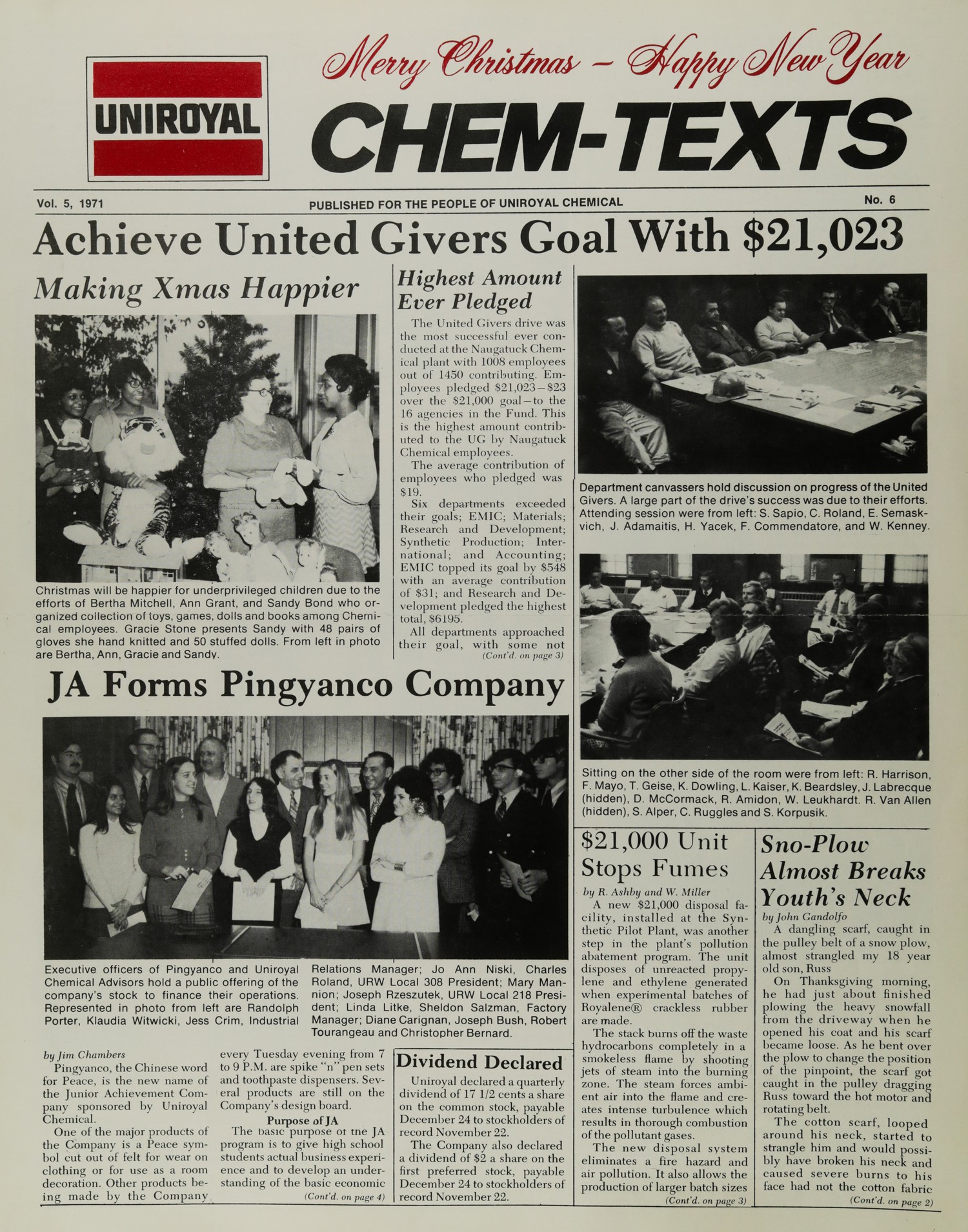
[IMAGE: Group photo of people with toys and dolls]

Christmas will be happier for underprivileged children due to the efforts of Bertha Mitchell, Ann Grant, and Sandy Bond who organized collection of toys, games, dolls and books among Chemical employees. Gracie Stone presents Sandy with 48 pairs of gloves she hand knitted and 50 stuffed dolls. From left in photo are Bertha, Ann, Gracie and Sandy.


Highest Amount Ever Pledged

The United Givers drive was the most successful ever conducted at the Naugatuck Chemical plant with 1008 employees out of 1450 contributing. Employees pledged $21,023—$23 over the $21,000 goal—to the 16 agencies in the Fund. This is the highest amount contributed to the UG by Naugatuck Chemical employees.

The average contribution of employees who pledged was $19.

Six departments exceeded their goals; EMIC; Materials; Research and Development; Synthetic Production; International; and Accounting; EMIC topped its goal by $548 with an average contribution of $31; and Research and Development pledged the highest total, $6195.

All departments approached their goal, with some not
(Cont’d. on page 3)


[IMAGE: Group meeting photo]

Department canvassers hold discussion on progress of the United Givers. A large part of the drive’s success was due to their efforts. Attending session were from left: S. Sapio, C. Roland, E. Semaskvich, J. Adamaitis, H. Yacek, F. Commendatore, and W. Kenney.


JA Forms Pingyanco Company

[IMAGE: Group photo of executive officers]

Executive officers of Pingyanco and Uniroyal Chemical Advisors hold a public offering of the company’s stock to finance their operations. Represented in photo from left are Randolph Porter, Klaudia Witwicki, Jess Crim, Industrial Relations Manager; Jo Ann Niski, Charles Roland, URW Local 308 President; Mary Mannion; Joseph Rzeszutek, URW Local 218 President; Linda Litke, Sheldon Salzman, Factory Manager; Diane Carignan, Joseph Bush, Robert Tourangeau and Christopher Bernard.

by Jim Chambers

Pingyanco, the Chinese word for Peace, is the new name of the Junior Achievement Company sponsored by Uniroyal Chemical.

One of the major products of the Company is a Peace symbol cut out of felt for wear on clothing or for use as a room decoration. Other products being made by the Company every Tuesday evening from 7 to 9 P.M. are spike “n” pen sets and toothpaste dispensers. Several products are still on the Company’s design board.

Purpose of JA

The basic purpose of the JA program is to give high school students actual business experience and to develop an understanding of the basic economic
(Cont’d. on page 4)


[IMAGE: Group meeting photo]

Sitting on the other side of the room were from left: R. Harrison, F. Mayo, T. Geise, K. Dowling, L. Kaiser, K. Beardsley, J. Labrecque (hidden), D. McCormack, R. Amidon, W. Leukhardt. R. Van Allen (hidden), S. Alper, C. Ruggles and S. Korpusik.


Dividend Declared

Uniroyal declared a quarterly dividend of 17 1/2 cents a share on the common stock, payable December 24 to stockholders of record November 22.

The Company also declared a dividend of $2 a share on the first preferred stock, payable December 24 to stockholders of record November 22.


$21,000 Unit Stops Fumes

by R. Ashby and W. Miller

A new $21,000 disposal facility, installed at the Synthetic Pilot Plant, was another step in the plant’s pollution abatement program. The unit disposes of unreacted propylene and ethylene generated when experimental batches of Royalene® crackless rubber are made.

The stack burns off the waste hydrocarbons completely in a smokeless flame by shooting jets of steam into the burning zone. The steam forces ambient air into the flame and creates intense turbulence which results in thorough combustion of the pollutant gases.

The new disposal system eliminates a fire hazard and air pollution. It also allows the production of larger batch sizes
(Cont’d on page 3)


Sno-Plow Almost Breaks Youth’s Neck

by John Gandolfo

A dangling scarf, caught in the pulley belt of a snow plow, almost strangled my 18 year old son, Russ

On Thanksgiving morning, he had just about finished plowing the heavy snowfall from the driveway when he opened his coat and his scarf became loose. As he bent over the plow to change the position of the pinpoint, the scarf got caught in the pulley dragging Russ toward the hot motor and rotating belt.

The cotton scarf, looped around his neck, started to strangle him and would possibly have broken his neck and caused severe burns to his face had not the cotton fabric
(Cont’d. on page 2)

CHEM-TEXTS – unknown-i05-s201

Page 201

CHEM-TEXTS

Page 2 | Vol. 5, No. 5


Thanksgiving And Us…

Thanksgiving Day seems to have lost much of its significance. Originally it was set aside as a special day of prayer. Today, it is looked upon more as a four day weekend and three games of football on TV.

The people who first came to New England lived a life of far greater poverty than some of the people living in Appalachia today. Their Thanksgiving was one of survival.

By their unity of purpose, and their concern for each other, they laid the groundwork for the many benefits we enjoy in our present society.

When you think ot our progress, no other group of people has achieved such high standards of living.

We at the Chemical Plant, in particular, have much to be thankful for. With unemployment as high as 12-20% in some towns, we have been able to maintain a steady level of employment. We have some of the finest wages and benefits in industry. All of us have great concern for the safety, health, and welfare of each other and a positive attitude toward the improvement of the environment.

I think you will agree with me that these are important things in our lives.

If each one of us does his full share, we will continue to reap the rewards of our efforts and assure, even increase, the many good things we now enjoy for ourselves and our families.

[Signature: Paul Lyons]


Eleven Receive MS Degrees

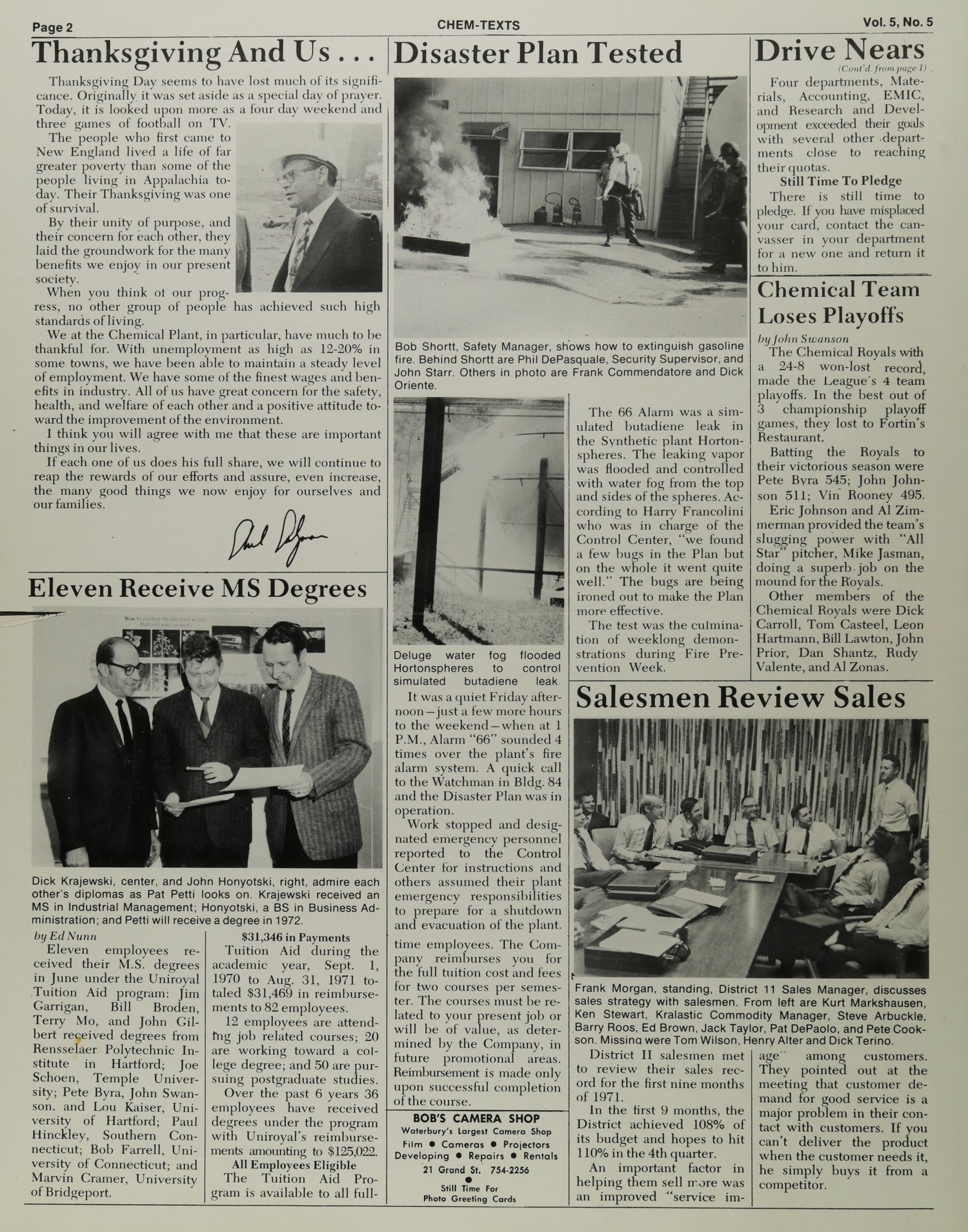
Dick Krajewski, center, and John Honyotski, right, admire each other’s diplomas as Pat Petti looks on. Krajewski received an MS in Industrial Management; Honyotski, a BS in Business Administration; and Petti will receive a degree in 1972.

by Ed Nunn

Eleven employees received their M.S. degrees in June under the Uniroyal Tuition Aid program: Jim Garrigan, Bill Broden, Terry Mo, and John Gilbert received degrees from Rensselaer Polytechnic Institute in Hartford; Joe Schoen, Temple University; Pete Byra, John Swanson, and Lou Kaiser, University of Hartford; Paul Hinckley, Southern Connecticut; Bob Farrell, University of Connecticut; and Marvin Cramer, University of Bridgeport.

$31,346 in Payments

Tuition Aid during the academic year, Sept. 1, 1970 to Aug. 31, 1971 totaled $31,469 in reimbursements to 82 employees.

12 employees are attending job related courses; 20 are working toward a college degree; and 50 are pursuing postgraduate studies.

Over the past 6 years 36 employees have received degrees under the program with Uniroyal’s reimbursements amounting to $125,022.

All Employees Eligible

The Tuition Aid Program is available to all full-time employees. The Company reimburses you for the full tuition cost and fees for two courses per semester. The courses must be related to your present job or will be of value, as determined by the Company, in future promotional areas. Reimbursement is made only upon successful completion of the course.


BOB’S CAMERA SHOP
Waterbury’s Largest Camera Shop
Film ● Cameras ● Projectors
Developing ● Repairs ● Rentals
21 Grand St. 754-2256

Still Time For
Photo Greeting Cards


Disaster Plan Tested

Bob Shortt, Safety Manager, shows how to extinguish gasoline fire. Behind Shortt are Phil DePasquale, Security Supervisor, and John Starr. Others in photo are Frank Commendatore and Dick Oriente.

Deluge water fog flooded Hortonspheres to control simulated butadiene leak

The 66 Alarm was a simulated butadiene leak in the Synthetic plant Hortonspheres. The leaking vapor was flooded and controlled with water fog from the top and sides of the spheres. According to Harry Francolini who was in charge of the Control Center, “we found a few bugs in the Plan but on the whole it went quite well.” The bugs are being ironed out to make the Plan more effective.

The test was the culmination of weeklong demonstrations during Fire Prevention Week.

It was a quiet Friday afternoon—just a few more hours to the weekend—when at 1 P.M., Alarm “66” sounded 4 times over the plant’s fire alarm system. A quick call to the Watchman in Bldg. 84 and the Disaster Plan was in operation.

Work stopped and designated emergency personnel reported to the Control Center for instructions and others assumed their plant emergency responsibilities to prepare for a shutdown and evacuation of the plant.


Drive Nears

(Cont’d. from page 1)

Four departments, Materials, Accounting, EMIC, and Research and Development exceeded their goals with several other departments close to reaching their quotas.

Still Time To Pledge

There is still time to pledge. If you have misplaced your card, contact the canvasser in your department or call any one and return it to him.


Chemical Team Loses Playoffs

by John Swanson

The Chemical Royals with a 24-8 won-lost record, made the League’s 4 team playoffs. In the best out of 3 championship playoff games, they lost to Fortin’s Restaurant.

Batting the Royals to their victorious season were Pete Byra 545; John Johnson 511; Vin Rooney 495.

Eric Johnson and Al Zimmerman provided the team’s slugging power with “All Star” pitcher, Mike Jasman, doing a superb job on the mound for the Royals.

Other members of the Chemical Royals were Dick Carroll, Tom Casteel, Leon Hartmann, Bill Lawton, John Prior, Dan Shantz, Rudy Valente, and Al Zonas.


Salesmen Review Sales

Frank Morgan, standing, District 11 Sales Manager, discusses sales strategy with salesmen. From left are Kurt Markshausen, Ken Stewart, Kralastic Commodity Manager, Steve Arbuckle, Barry Roos, Ed Brown, Jack Taylor, Pat DePaolo, and Pete Cookson. Missing were Tom Wilson, Henry Alter and Dick Terino.

District 11 salesmen met to review their sales record for the first nine months of 1971.

In the first 9 months, the District achieved 108% of its budget and hopes to hit 110% in the 4th quarter.

An important factor in helping them sell more was an improved “service image” among customers. They pointed out at the meeting that customer demand for good service is a major problem in their contact with customers. If you can’t deliver the product when the customer needs it, he simply buys it from a competitor.

CHEM-TEXTS – Vol. 4 No. 6 – Page 3

Page 003

Vol. 4, No. 6 CHEM-TEXTS Page 3

Employees’ Opinions Polled On Chem-Texts | Unions To Hold Picnics

A poll of 200 employees selected on a random basis from all plant and divisional departments and retired employees revealed that 96% of the employees read CHEM-TEXTS always or often, and that 76% of their families read it. The survey also showed the plant newspaper as a reliable form of communication and indicated employees have a vital concern for news and information on plant activities and operations.

70 employees completed the questionnaire for a 35% return, an exceptionally high response.

70% signed the questionnaire which was voluntary.

Answers to the “open-end” questions have been condensed because of space limitations.

1.) Do you read Chem-Tests?
86% always, 10% often, 3% seldom

2.) Does your family read Chem-Texts?
76% yes, 7% no

3.) What kind of news do you find most informative?
76% preferred news about plant activities: plant products; use of products in the market; new facilities; plant improvement; personnel changes; and economic situations.

60% wanted news about employees; benefits; idea awards; safety; job security; and retirements.

60% indicated a desire for news about Uniroyal, Inc.; other plants; corporate sales; profits; new products and markets.

4.) How did you like the recent article on the Oxford complex?
The majority commented “excellent”, “informative”, “indicative of Uniroyal’s progress”, “knew very little about it until article”.

5.) Do you think the paper uses enough photographs?
80% yes, 18% no


6.) What did you think of the article on pollution?
“Wonderful that something is being done;” “informative on serious national problem;” “good to keep us informed on pollution control efforts;” “shows company is concerned and makes employees concerned;” “all must be aware of their role in pollution control.”

7.) Some time back we did an article on packaging – do you think this type of information is helpful to employees?
Most employees replied yes; pointing out that they as customers always shop for a neat package.

8.) Do you think the paper gives you reliable information on plant operations and activities?
Comments were essentially, yes; and implied, “haven’t gotten any bum steers yet.”

9.) What do you think of the News Bulletins issued weekly?
In general the News Bulletins were considered informative and helpful; but several employees did not see them; a few felt they were fair, should expand coverage and include more news on safety and production.

10.) What suggestions do you have to improve CHEM-TEXTS?
The majority of employees had no recommendations to improve the paper.

Some remarks suggested: do more articles on departments; more about employees’ participation in community; letters to the editor; classified ads; questions and answers from employees.

The survey was the first conducted in the Company on plant newspapers, and employees who participated are thanked for their time in making it a more effective means of communication.


by Charlie Roland

Plans are underway for URW Local 308’s third annual picnic to be held on Sunday, August 9, from 11 A.M. to 6 P.M. at Schildgen’s Grove in Union City. The Grove is located on East Waterbury Road.

Chairman of the event is Art Calder, with Ben Tomaszeski, Nunzio Pastore and John Sullivan assisting in arrangements.

by Frank Commendatore

Local 218 will hold its annual picnic at Schildgen’s Grove on Saturday, August 15. A menu of roast beef, hamburgers, clams, clam broth will be served all day, with steaks served from 2 – 5 P.M. along with hot and cold beverages.

Chairman for the picnic is Frank Commendatore with Tom Ward and Mario Mucci, assistant chairman.


You Get A Chance To Talk To Two Bosses In New Plan

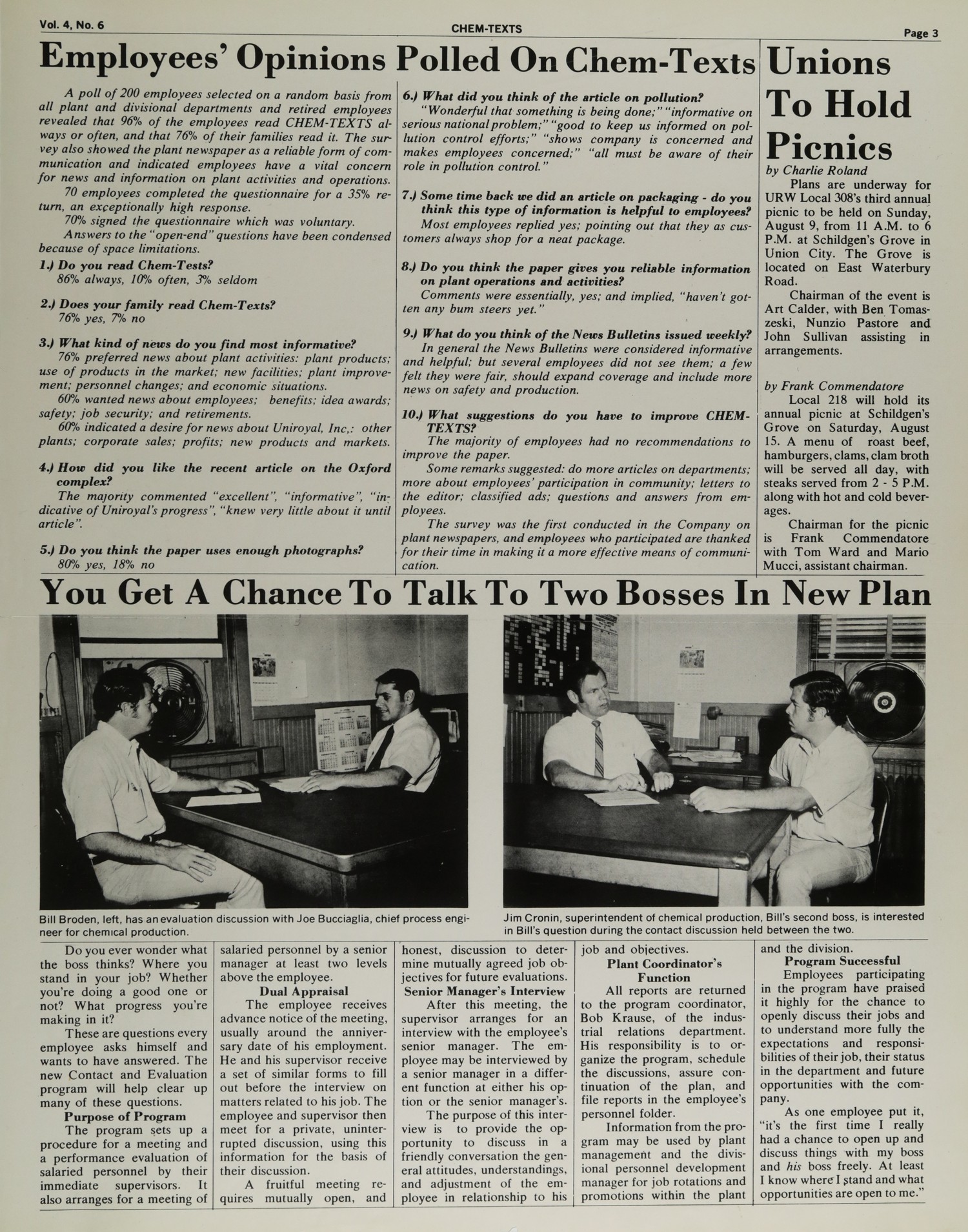
[PHOTO: Two men in discussion at what appears to be an industrial setting]

Bill Broden, left, has an evaluation discussion with Joe Bucciaglia, chief process engineer for chemical production.

[PHOTO: Three men in discussion in an office setting]

Jim Cronin, superintendent of chemical production, Bill’s second boss, is interested in Bill’s question during the contact discussion held between the two.


Do you ever wonder what the boss thinks? Where you stand in your job? Whether you’re doing a good one or not? What progress you’re making in it?

These are questions every employee asks himself and wants to have answered. The new Contact and Evaluation program will help clear up many of these questions.

Purpose of Program

The program sets up a procedure for a meeting and a performance evaluation of salaried personnel by their immediate supervisors. It also arranges for a meeting of salaried personnel by a senior manager at least two levels above the employee.

Dual Appraisal

The employee receives advance notice of the meeting, usually around the anniversary date of his employment. He and his supervisor receive a set of similar forms to fill out before the interview on matters related to his job. The employee and supervisor then meet for a private, uninterrupted discussion, using this information for the basis of their discussion.

A fruitful meeting requires mutually open, and honest, discussion to determine mutually agreed job objectives for future evaluations.

Senior Manager’s Interview

After this meeting, the supervisor arranges for an interview with the employee’s senior manager. The employee may be interviewed by a senior manager in a different function at either his option or the senior manager’s.

The purpose of this interview is to provide the opportunity to discuss in a friendly conversation the general attitudes, understandings, and adjustment of the employee in relationship to his job and objectives.

Plant Coordinator’s Function

All reports are returned to the program coordinator, Bob Krause, of the industrial relations department. His responsibility is to organize the program, schedule the discussions, assure continuation of the plan, and file reports in the employee’s personnel folder.

Information from the program may be used by plant management and the divisional personnel development manager for job rotations and promotions within the plant and the division.

Program Successful

Employees participating in the program have praised it highly for the chance to openly discuss their jobs and to understand more fully the expectations and responsibilities of their job, their status in the department and future opportunities with the company.

As one employee put it, “it’s the first time I really had a chance to open up and discuss things with my boss and his boss freely. At least I know where I stand and what opportunities are open to me.”

CHEM-TEXTS – Vol. 3 No. 6 – Page 3

Page 003

CHEM-TEXTS

Vol. 3 No. 8 | Page 3


Synthetic’s “A” Crew Hits 9 Batches Daily

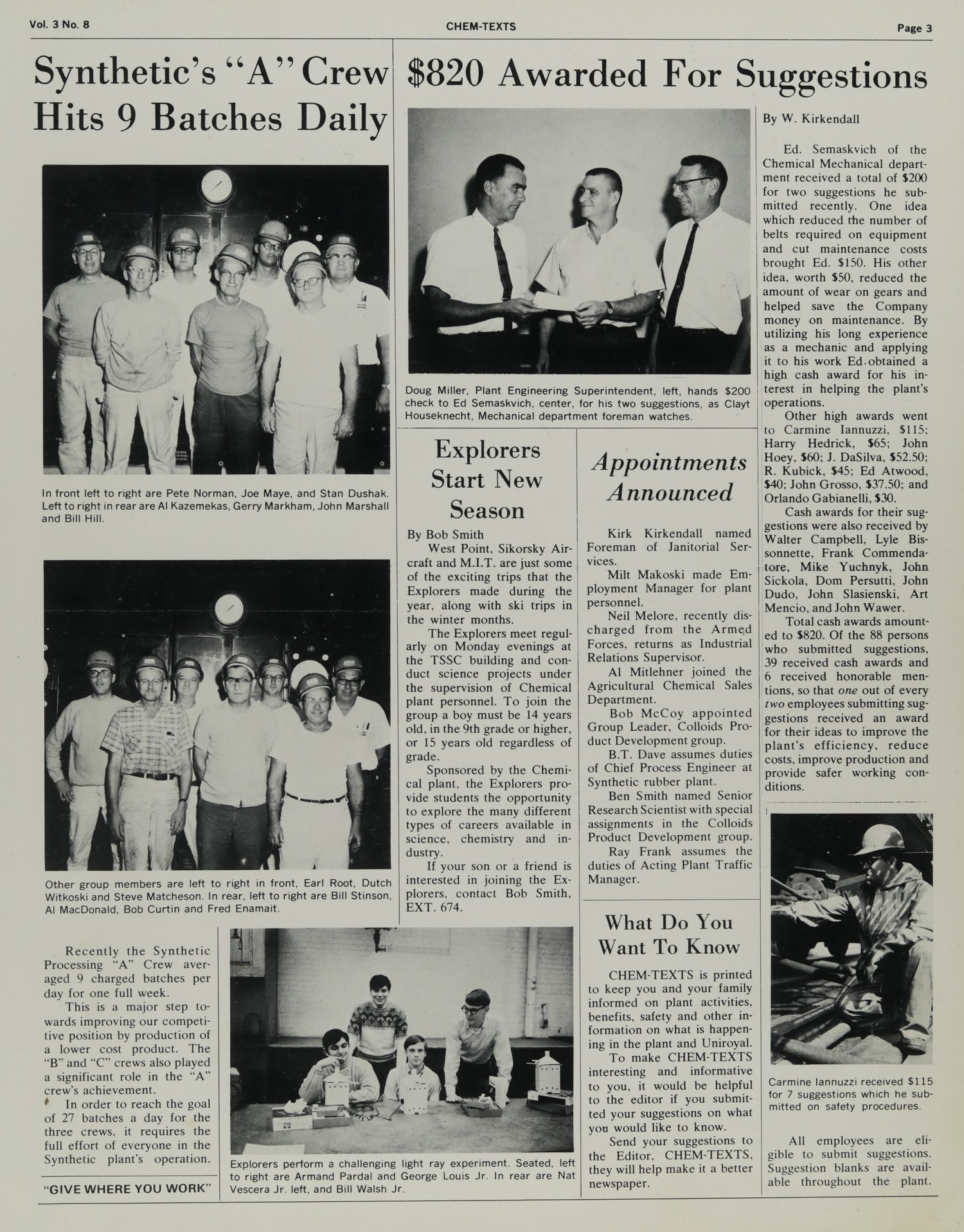
[IMAGE: Group photo of workers in hard hats]

In front left to right are Pete Norman, Joe Maye, and Stan Dushak. Left to right in rear are Al Kazemekas, Gerry Markham, John Marshall and Bill Hill.

[IMAGE: Second group photo of workers]

Other group members are left to right in front, Earl Root, Dutch Witkoski and Steve Matcheson. In rear, left to right are Bill Stinson, Al MacDonald, Bob Curtin and Fred Enamait.

Recently the Synthetic Processing “A” Crew averaged 9 charged batches per day for one full week.

This is a major step towards improving our competitive position by production of a lower cost product. The “B” and “C” crews also played a significant role in the “A” crew’s achievement.

In order to reach the goal of 27 batches a day for the three crews, it requires the full effort of everyone in the Synthetic plant’s operation.

“GIVE WHERE YOU WORK”


$820 Awarded For Suggestions

By W. Kirkendall

[IMAGE: Three men, one handing check to another]

Doug Miller, Plant Engineering Superintendent, left, hands $200 check to Ed Semaskvich, center, for his two suggestions, as Clayt Houseknecht, Mechanical department foreman watches.

Ed. Semaskvich of the Chemical Mechanical department received a total of $200 for two suggestions he submitted recently. One idea which reduced the number of belts required on equipment and cut maintenance costs brought Ed. $150. His other idea, worth $50, reduced the amount of wear on gears and helped save the Company money on maintenance. By utilizing his long experience as a mechanic and applying it to his work Ed obtained a high cash award for his interest in helping the plant’s operations.

Other high awards went to Carmine Iannuzzi, $115; Harry Hedrick, $65; John Hoey, $60; J. DaSilva, $52.50; R. Kubick, $45; Ed Atwood, $40; John Grosso, $37.50; and Orlando Gabianelli, $30.

Cash awards for their suggestions were also received by Walter Campbell, Lyle Bissonnette, Frank Commendatore, Mike Yuchnyk, John Sickola, Dom Persutti, John Dudo, John Slasienski, Art Mencio, and John Wawer.

Total cash awards amounted to $820. Of the 88 persons who submitted suggestions, 39 received cash awards and 6 received honorable mentions, so that one out of every two employees submitting suggestions received an award for their ideas to improve the plant’s efficiency, reduce costs, improve production and provide safer working conditions.

[IMAGE: Man working]

Carmine Iannuzzi received $115 for 7 suggestions which he submitted on safety procedures.

All employees are eligible to submit suggestions. Suggestion blanks are available throughout the plant.


Explorers Start New Season

By Bob Smith

West Point, Sikorsky Aircraft and M.I.T. are just some of the exciting trips that the Explorers made during the year, along with ski trips in the winter months.

The Explorers meet regularly on Monday evenings at the TSSC building and conduct science projects under the supervision of Chemical plant personnel. To join the group a boy must be 14 years old, in the 9th grade or higher, or 15 years old regardless of grade.

Sponsored by the Chemical plant, the Explorers provide students the opportunity to explore the many different types of careers available in science, chemistry and industry.

If your son or a friend is interested in joining the Explorers, contact Bob Smith, EXT. 674.

[IMAGE: Group of young people at table with experiment]

Explorers perform a challenging light ray experiment. Seated, left to right are Armand Pardal and George Louis Jr. In rear are Nat Vescera Jr. left, and Bill Walsh Jr.


Appointments Announced

Kirk Kirkendall named Foreman of Janitorial Services.

Milt Makoski made Employment Manager for plant personnel.

Neil Melore, recently discharged from the Armed Forces, returns as Industrial Relations Supervisor.

Al Mitlehner joined the Agricultural Chemical Sales Department.

Bob McCoy appointed Group Leader, Colloids Product Development group.

B.T. Dave assumes duties of Chief Process Engineer at Synthetic rubber plant.

Ben Smith named Senior Research Scientist with special assignments in the Colloids Product Development group.

Ray Frank assumes the duties of Acting Plant Traffic Manager.


What Do You Want To Know

CHEM-TEXTS is printed to keep you and your family informed on plant activities, benefits, safety and other information on what is happening in the plant and Uniroyal.

To make CHEM-TEXTS interesting and informative to you, it would be helpful to the editor if you submitted your suggestions on what you would like to know.

Send your suggestions to the Editor, CHEM-TEXTS, they will help make it a better newspaper.

CHEM-TEXTS – Vol. 3 No. 10 – Page 3

Page 003

CHEM-TEXTS

Vol. 3 No. 10 | Page 3


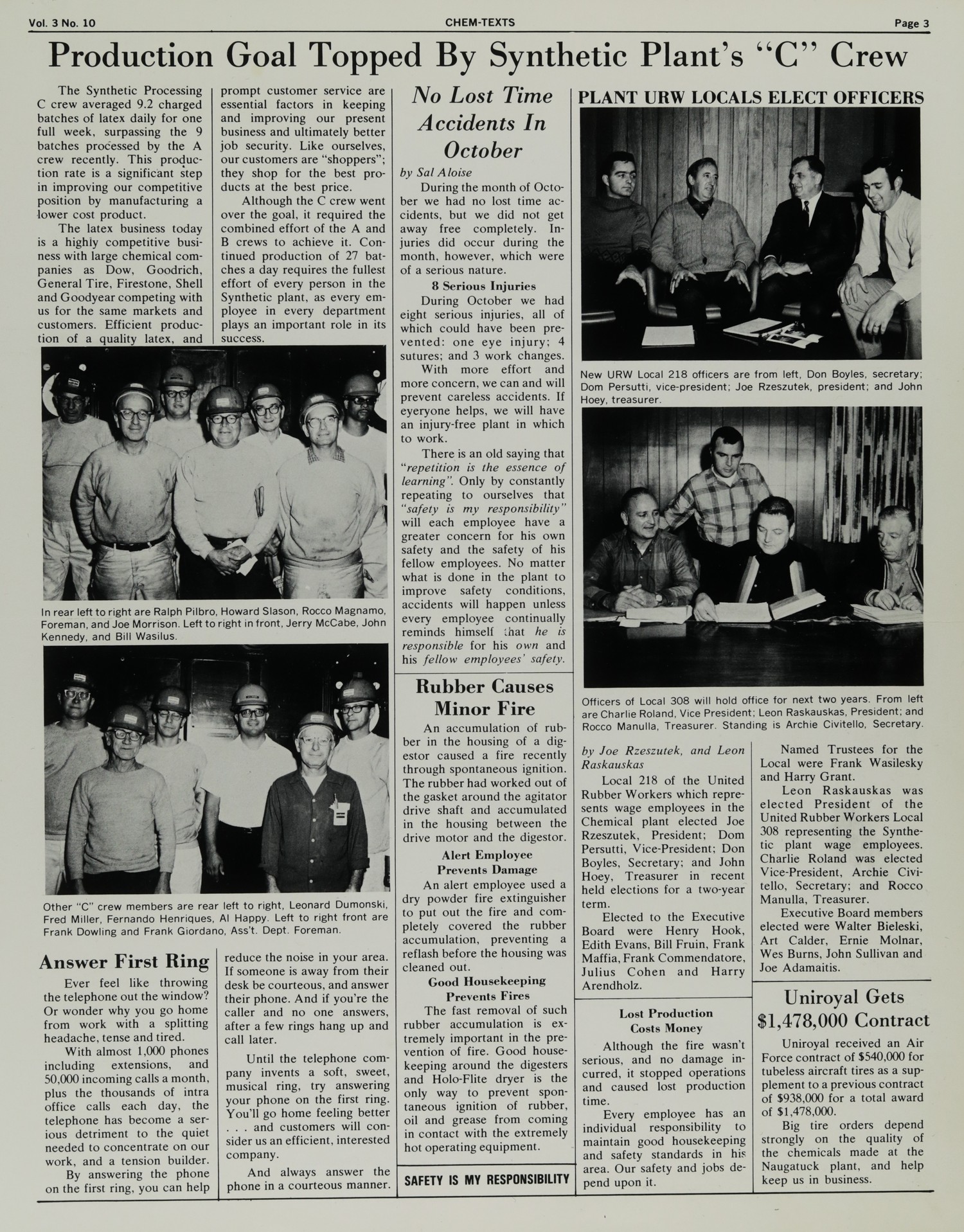
Production Goal Topped By Synthetic Plant’s “C” Crew

The Synthetic Processing C crew averaged 9.2 charged batches of latex daily for one full week, surpassing the 9 batches processed by the A crew recently. This production rate is a significant step in improving our competitive position by manufacturing a lower cost product.

The latex business today is a highly competitive business with large chemical companies as Dow, Goodrich, General Tire, Firestone, Shell and Goodyear competing with us for the same markets and customers. Efficient production of a quality latex, and prompt customer service are essential factors in keeping and improving our present business and ultimately better job security. Like ourselves, our customers are “shoppers”; they shop for the best products at the best price.

Although the C crew went over the goal, it required the combined effort of the A and B crews to achieve it. Continued production of 27 batches a day requires the fullest effort of every person in the Synthetic plant, as every employee in every department plays an important role in its success.


[PHOTO CAPTION:]
In rear left to right are Ralph Pilbro, Howard Slason, Rocco Magnamo, Foreman, and Joe Morrison. Left to right in front, Jerry McCabe, John Kennedy, and Bill Wasilus.


[PHOTO CAPTION:]
Other “C” crew members are rear left to right, Leonard Dumonski, Fred Miller, Fernando Henriques, Al Happy. Left to right front are Frank Dowling and Frank Giordano, Ass’t. Dept. Foreman.


Answer First Ring

Ever feel like throwing the telephone out the window? Or wonder why you go home from work with a splitting headache, tense and tired.

With almost 1,000 phones including extensions, and 50,000 incoming calls a month, plus the thousands of intra office calls each day, the telephone has become a serious detriment to the quiet needed to concentrate on our work, and a tension builder.

By answering the phone on the first ring, you can help reduce the noise in your area. If someone is away from their desk be courteous, and answer their phone. And if you’re the caller and no one answers, after a few rings hang up and call later.

Until the telephone company invents a soft, sweet, musical ring, try answering your phone on the first ring. You’ll go home feeling better . . . and customers will consider us an efficient, interested company.

And always answer the phone in a courteous manner.


No Lost Time Accidents In October

by Sal Aloise

During the month of October we had no lost time accidents, but we did not get away free completely. Injuries did occur during the month, however, which were of a serious nature.

8 Serious Injuries

During October we had eight serious injuries, all of which could have been prevented: one eye injury; 4 sutures; and 3 work changes.

With more effort and more concern, we can and will prevent careless accidents. If everyone helps, we will have an injury-free plant in which to work.

There is an old saying that “repetition is the essence of learning”. Only by constantly repeating to ourselves that “safety is my responsibility” will each employee have a greater concern for his own safety and the safety of his fellow employees. No matter what is done in the plant to improve safety conditions, accidents will happen unless every employee continually reminds himself that he is responsible for his own and his fellow employees’ safety.


Rubber Causes Minor Fire

An accumulation of rubber in the housing of a digestor caused a fire recently through spontaneous ignition. The rubber had worked out of the gasket around the agitator drive shaft and accumulated in the housing between the drive motor and the digestor.

Alert Employee Prevents Damage

An alert employee used a dry powder fire extinguisher to put out the fire and completely covered the rubber accumulation, preventing a reflash before the housing was cleaned out.

Good Housekeeping Prevents Fires

The fast removal of such rubber accumulation is extremely important in the prevention of fire. Good housekeeping around the digesters and Holo-Flite dryer is the only way to prevent spontaneous ignition of rubber, oil and grease from coming in contact with the extremely hot operating equipment.


SAFETY IS MY RESPONSIBILITY


PLANT URW LOCALS ELECT OFFICERS

[PHOTO CAPTION:]
New URW Local 218 officers are from left, Don Boyles, secretary; Dom Persutti, vice-president; Joe Rzeszutek, president; and John Hoey, treasurer.


[PHOTO CAPTION:]
Officers of Local 308 will hold office for next two years. From left are Charlie Roland, Vice President; Leon Raskauskas, President; and Rocco Manulla, Treasurer. Standing is Archie Civitello, Secretary.


by Joe Rzeszutek, and Leon Raskauskas

Local 218 of the United Rubber Workers which represents wage employees in the Chemical plant elected Joe Rzeszutek, President; Dom Persutti, Vice-President; Don Boyles, Secretary; and John Hoey, Treasurer in recent held elections for a two-year term.

Elected to the Executive Board were Henry Hook, Edith Evans, Bill Fruin, Frank Maffia, Frank Commendatore, Julius Cohen and Harry Arendholz.

Lost Production Costs Money

Although the fire wasn’t serious, and no damage incurred, it stopped operations and caused lost production time.

Every employee has an individual responsibility to maintain good housekeeping and safety standards in his area. Our safety and jobs depend upon it.

Named Trustees for the Local were Frank Wasilesky and Harry Grant.

Leon Raskauskas was elected President of the United Rubber Workers Local 308 representing the Synthetic plant wage employees. Charlie Roland was elected Vice-President, Archie Civitello, Secretary; and Rocco Manulla, Treasurer.

Executive Board members elected were Walter Bieleski, Art Calder, Ernie Molnar, Wes Burns, John Sullivan and Joe Adamaitis.


Uniroyal Gets $1,478,000 Contract

Uniroyal received an Air Force contract of $540,000 for tubeless aircraft tires as a supplement to a previous contract of $938,000 for a total award of $1,478,000.

Big tire orders depend strongly on the quality of the chemicals made at the Naugatuck plant, and help keep us in business.

CHEM-TEXTS – Vol. 2 No. 5 – Page 4

Page 004

Page 4 | CHEM TEXTS | Vol. 2 No. 5


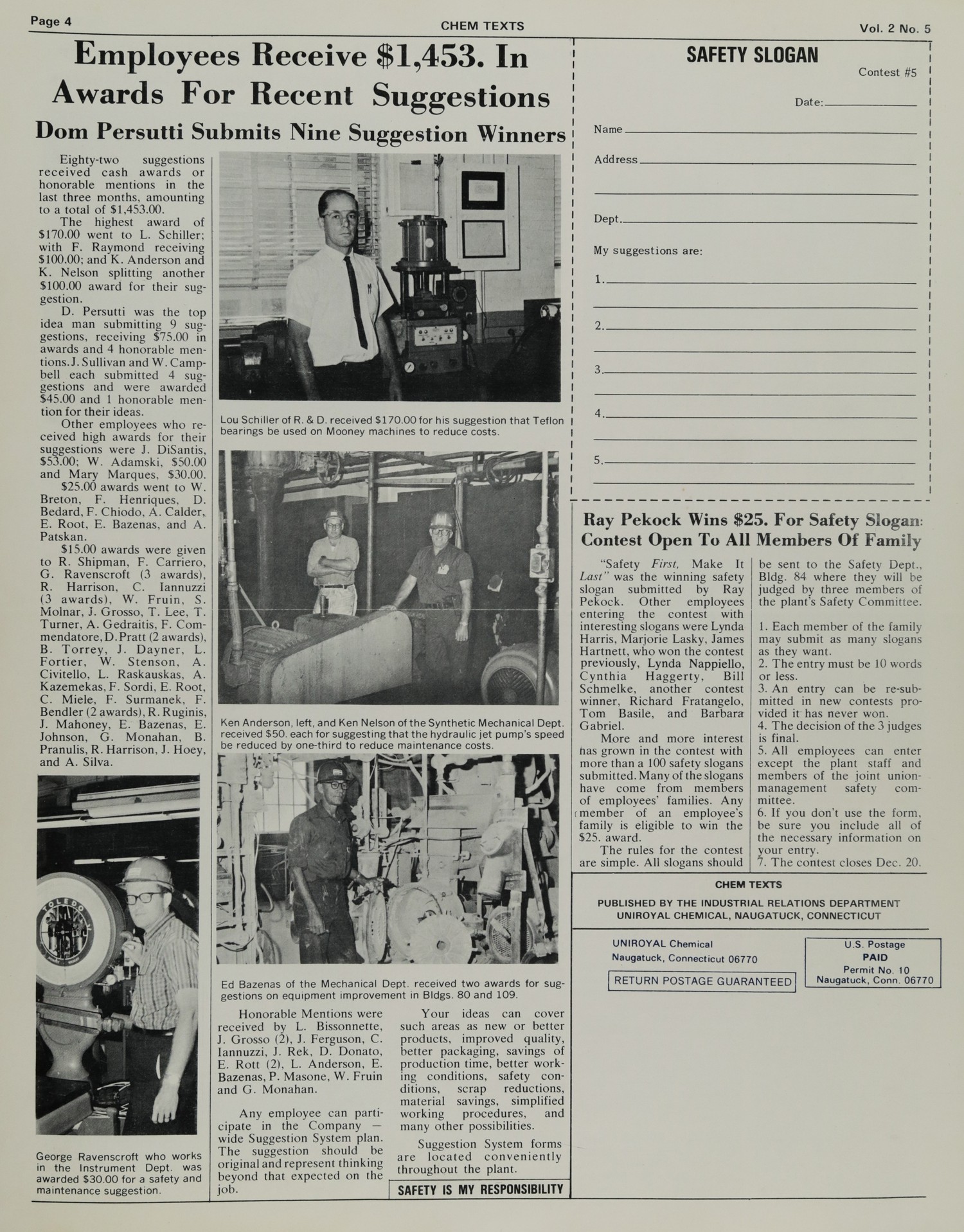
Employees Receive $1,453. In Awards For Recent Suggestions

Dom Persutti Submits Nine Suggestion Winners

Eighty-two suggestions received cash awards or honorable mentions in the last three months, amounting to a total of $1,453.00.

The highest award of $170.00 went to L. Schiller; with F. Raymond receiving $100.00; and K. Anderson and K. Nelson splitting another $100.00 award for their suggestion.

D. Persutti was the top idea man submitting 9 suggestions, receiving $75.00 in awards and 4 honorable mentions. J. Sullivan and W. Campbell each submitted 4 suggestions and were awarded $45.00 and 1 honorable mention for their ideas.

Other employees who received high awards for their suggestions were J. DiSantis, $53.00; W. Adamski, $50.00 and Mary Marques, $30.00.

$25.00 awards went to W. Breton, F. Henriques, D. Bedard, F. Chiodo, A. Calder, E. Root, E. Bazenas, and A. Patskan.

$15.00 awards were given to R. Shipman, F. Carriero, G. Ravenscroft (3 awards), R. Harrison, C. Iannuzzi (3 awards), W. Fruin, S. Molnar, J. Grosso, T. Lee, T. Turner, A. Gedraitis, F. Commendatore, D. Pratt (2 awards), B. Torrey, J. Dayner, L. Fortier, W. Stenson, A. Civitello, L. Raskauskas, A. Kazemekas, F. Sordi, E. Root, C. Miele, F. Surmanck, F. Bendler (2 awards), R. Ruginis, J. Mahoney, E. Bazenas, E. Johnson, G. Monahan, B. Pranulis, R. Harrison, J. Hoey, and A. Silva.


[PHOTO CAPTION]
Lou Schiller of R. & D. received $170.00 for his suggestion that Teflon bearings be used on Mooney machines to reduce costs.


[PHOTO CAPTION]
Ken Anderson, left, and Ken Nelson of the Synthetic Mechanical Dept. received $50. each for suggesting that the hydraulic jet pump’s speed be reduced by one-third to reduce maintenance costs.


[PHOTO CAPTION]
George Ravenscroft who works in the Instrument Dept. was awarded $30.00 for a safety and maintenance suggestion.


[PHOTO CAPTION]
Ed Bazenas of the Mechanical Dept. received two awards for suggestions on equipment improvement in Bldgs. 80 and 109.


Honorable Mentions were received by L. Bissonnette, J. Grosso (2), J. Ferguson, C. Iannuzzi, J. Rek, D. Donato, E. Rott (2), L. Anderson, E. Bazenas, P. Masone, W. Fruin and G. Monahan.

Any employee can participate in the Company — wide Suggestion System plan. The suggestion should be original and represent thinking beyond that expected on the job.

Your ideas can cover such areas as new or better products, improved quality, better packaging, savings of production time, better working conditions, safety conditions, scrap reductions, material savings, simplified working procedures, and many other possibilities.

Suggestion System forms are located conveniently throughout the plant.

SAFETY IS MY RESPONSIBILITY


SAFETY SLOGAN

Contest #5

Date:___

Name ___________

Address _________


Dept.____________

My suggestions are:

1._________


2._________


3._________


4._________


5._________


Ray Pekock Wins $25. For Safety Slogan: Contest Open To All Members Of Family

“Safety First, Make It Last” was the winning safety slogan submitted by Ray Pekock. Other employees entering the contest with interesting slogans were Lynda Harris, Marjorie Lasky, James Hartnett, who won the contest previously, Lynda Nappiello, Cynthia Haggerty, Bill Schmelke, another contest winner, Richard Fratangelo, Tom Basile, and Barbara Gabriel.

More and more interest has grown in the contest with more than a 100 safety slogans submitted. Many of the slogans have come from members of employees’ families. Any member of an employee’s family is eligible to win the $25. award.

The rules for the contest are simple. All slogans should be sent to the Safety Dept., Bldg. 84 where they will be judged by three members of the plant’s Safety Committee.

  1. Each member of the family may submit as many slogans as they want.
  2. The entry must be 10 words or less.
  3. An entry can be re-submitted in new contests provided it has never won.
  4. The decision of the 3 judges is final.
  5. All employees can enter except the plant staff and members of the joint union-management safety committee.
  6. If you don’t use the form, be sure you include all of the necessary information on your entry.
  7. The contest closes Dec. 20.

CHEM TEXTS

PUBLISHED BY THE INDUSTRIAL RELATIONS DEPARTMENT
UNIROYAL CHEMICAL, NAUGATUCK, CONNECTICUT

UNIROYAL Chemical
Naugatuck, Connecticut 06770

RETURN POSTAGE GUARANTEED

U.S. Postage
PAID
Permit No. 10
Naugatuck, Conn. 06770

CHEM-TEXTS – Page 2

Page 237

CHEM-TEXTS

Page 2


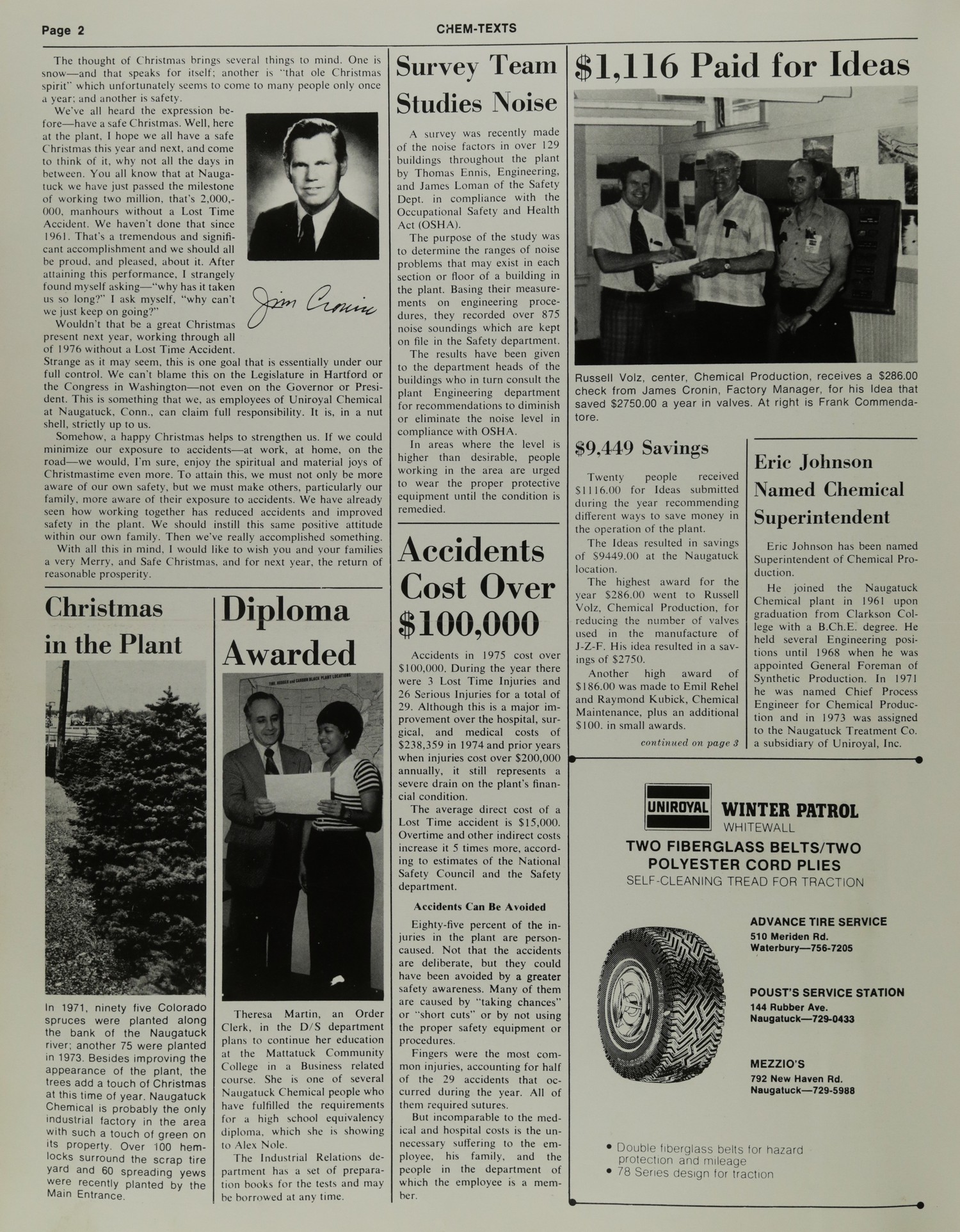
The thought of Christmas brings several things to mind. One is snow—and that speaks for itself; another is “that ole Christmas spirit” which unfortunately seems to come to many people only once a year; and another is safety.

We’ve all heard the expression before—have a safe Christmas. Well, here at the plant, I hope we all have a safe Christmas this year and next, and come to think of it, why not all the days in between. You all know that at Naugatuck we have just passed the milestone of working two million, that’s 2,000,000, manhours without a Lost Time Accident. We haven’t done that since 1961. That’s a tremendous and significant accomplishment and we should all be proud, and pleased, about it. After attaining this performance, I strangely found myself asking—”why has it taken us so long?” I ask myself, “why can’t we just keep on going?”

Jim Cronin [signature]

Wouldn’t that be a great Christmas present next year, working through all of 1976 without a Lost Time Accident. Strange as it may seem, this is one goal that is essentially under our full control. We can’t blame this on the Legislature in Hartford or the Congress in Washington—not even on the Governor or President. This is something that we, as employees of Uniroyal Chemical at Naugatuck, Conn., can claim full responsibility. It is, in a nut shell, strictly up to us.

Somehow, a happy Christmas helps to strengthen us. If we could minimize our exposure to accidents—at work, at home, on the road—we would, I’m sure, enjoy the spiritual and material joys of Christmastime even more. To attain this, we must not only be more aware of our own safety, but we must make others, particularly our family, more aware of their exposure to accidents. We have already seen how working together has reduced accidents and improved safety in the plant. We should instill this same positive attitude within our own family. Then we’ve really accomplished something.

With all this in mind, I would like to wish you and your families a very Merry, and Safe Christmas, and for next year, the return of reasonable prosperity.


Christmas in the Plant

[IMAGE: Photo of trees/spruces near a building]

In 1971, ninety five Colorado spruces were planted along the bank of the Naugatuck river; another 75 were planted in 1973. Besides improving the appearance of the plant, the trees add a touch of Christmas at this time of year. Naugatuck Chemical is probably the only industrial factory in the area with such a touch of green on its property. Over 100 hemlocks surround the scrap tire yard and 60 spreading yews were recently planted by the Main Entrance.


Diploma Awarded

[IMAGE: Photo of woman and man looking at documents]

Theresa Martin, an Order Clerk, in the D/S department plans to continue her education at the Mattatuck Community College in a Business related course. She is one of several Naugatuck Chemical people who have fulfilled the requirements for a high school equivalency diploma, which she is showing to Alex Nole.

The Industrial Relations department has a set of preparation books for the tests and may be borrowed at any time.


Survey Team Studies Noise

A survey was recently made of the noise factors in over 129 buildings throughout the plant by Thomas Ennis, Engineering, and James Loman of the Safety Dept. in compliance with the Occupational Safety and Health Act (OSHA).

The purpose of the study was to determine the range of noise problems that may exist in each section or floor of a building in the plant. Basing their measurements on engineering procedures, they recorded over 875 noise soundings which are kept on file in the Safety department.

The results have been given to the department heads of the buildings who in turn consult the plant Engineering department for recommendations to diminish or eliminate the noise level in compliance with OSHA.

In areas where the level is higher than desirable, people working in the area are urged to wear the proper protective equipment until the condition is remedied.


Accidents Cost Over $100,000

Accidents in 1975 cost over $100,000. During the year there were 3 Lost Time Injuries and 26 Serious Injuries for a total of 29. Although this is a major improvement over the hospital, surgical, and medical costs of $238,359 in 1974 and prior years when injuries cost over $200,000 annually, it still represents a severe drain on the plant’s financial condition.

The average direct cost of a Lost Time accident is $15,000. Overtime and other indirect costs increase it 5 times more, according to estimates of the National Safety Council and the Safety department.

Accidents Can Be Avoided

Eighty-five percent of the injuries in the plant are person-caused. Not that the accidents are deliberate, but they could have been avoided by a greater safety awareness. Many of them are caused by “taking chances” or “short cuts” or by not using the proper safety equipment or procedures.

Fingers were the most common injuries, accounting for half of the 29 accidents that occurred during the year. All of them required sutures.

But incomparable to the medical and hospital costs is the unnecessary suffering to the employee, his family, and the people in the department of which the employee is a member.


$1,116 Paid for Ideas

[IMAGE: Photo of three men, one receiving a check]

Russell Volz, center, Chemical Production, receives a $286.00 check from James Cronin, Factory Manager, for his Idea that saved $2750.00 a year in valves. At right is Frank Commendatore.


$9,449 Savings

Twenty people received $1116.00 for Ideas submitted during the year recommending different ways to save money in the operation of the plant.

The Ideas resulted in savings of $9449.00 at the Naugatuck location.

The highest award for the year $286.00 went to Russell Volz, Chemical Production, for reducing the number of valves used in the manufacture of J-Z-F. His idea resulted in a savings of $2750.

Another high award of $186.00 was made to Emil Rehel and Raymond Kubick, Chemical Maintenance, plus an additional $100. in small awards.

continued on page 3


Eric Johnson Named Chemical Superintendent

Eric Johnson has been named Superintendent of Chemical Production.

He joined the Naugatuck Chemical plant in 1961 upon graduation from Clarkson College with a B.Ch.E. degree. He held several Engineering positions until 1968 when he was appointed General Foreman of Synthetic Production. In 1971 he was named Chief Process Engineer for Chemical Production and in 1973 was assigned to the Naugatuck Treatment Co. a subsidiary of Uniroyal, Inc.


[ADVERTISEMENT]

UNIROYAL WINTER PATROL
WHITEWALL

TWO FIBERGLASS BELTS/TWO POLYESTER CORD PLIES
SELF-CLEANING TREAD FOR TRACTION

[IMAGE: Tire illustration]

ADVANCE TIRE SERVICE
510 Meriden Rd.
Waterbury—756-7205

POUST’S SERVICE STATION
144 Rubber Ave.
Naugatuck—729-0433

MEZZIO’S
792 New Haven Rd.
Naugatuck—729-5988

• Double fiberglass belts for hazard protection and mileage
• 78 Series design for traction