CHEM-TEXTS – 1980 – Page NO. 1

Page unknown

UNIROYAL CHEM-TEXTS

Vol. 14, 1980 | PUBLISHED FOR THE PEOPLE OF UNIROYAL CHEMICAL | NO. 1


Plant Receives Award

[IMAGE: Photo of two people shaking hands during award presentation]

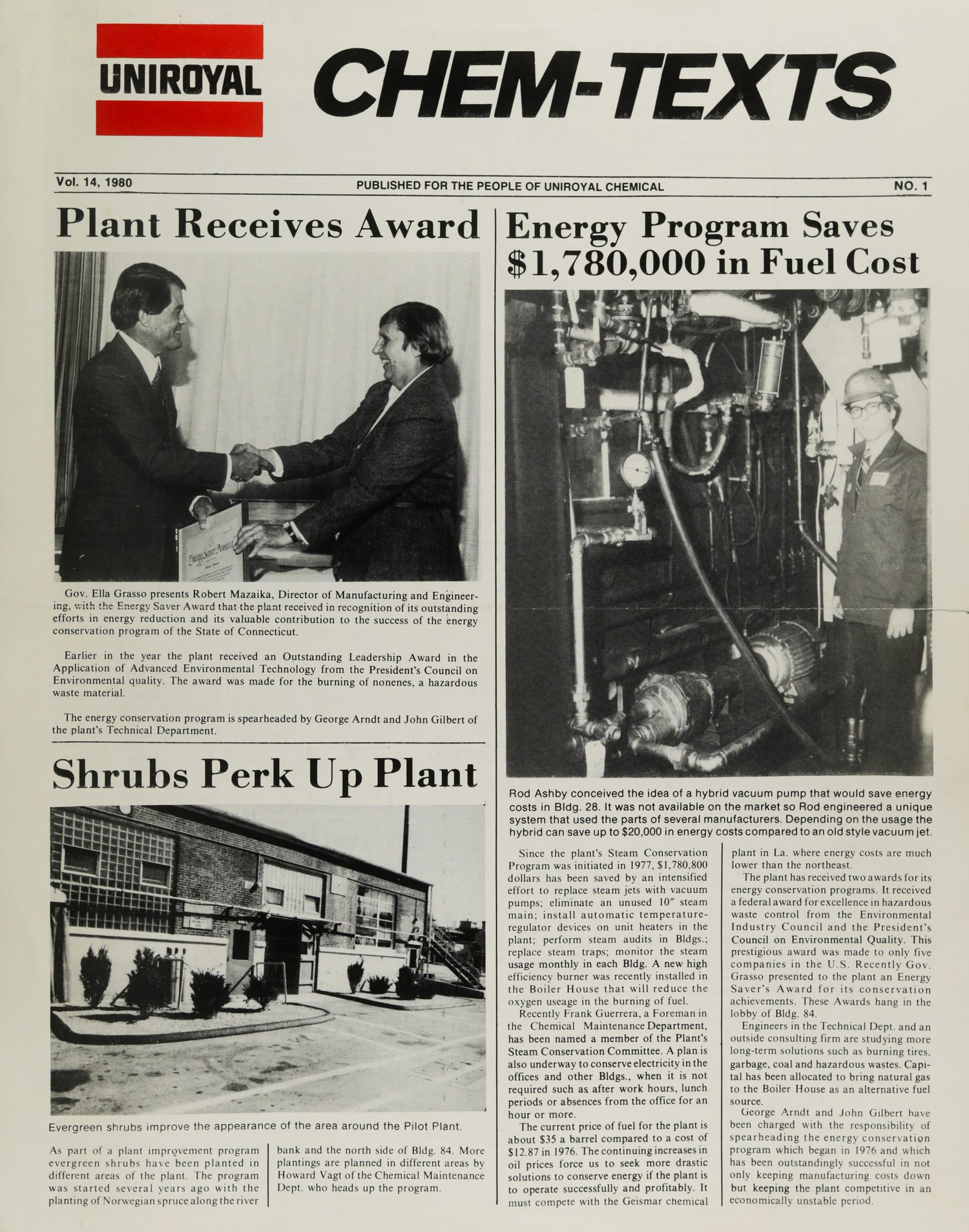
Gov. Ella Grasso presents Robert Mazaika, Director of Manufacturing and Engineering, with the Energy Saver Award that the plant received in recognition of its outstanding efforts in energy reduction and its valuable contribution to the success of the energy conservation program of the State of Connecticut.

Earlier in the year the plant received an Outstanding Leadership Award in the Application of Advanced Environmental Technology from the President’s Council on Environmental quality. The award was made for the burning of nonenes, a hazardous waste material.

The energy conservation program is spearheaded by George Arndt and John Gilbert of the plant’s Technical Department.


Shrubs Perk Up Plant

[IMAGE: Photo of building exterior with evergreen shrubs]

Evergreen shrubs improve the appearance of the area around the Pilot Plant.

As part of a plant improvement program evergreen shrubs have been planted in different areas of the plant. The program was started several years ago with the planting of Norwegian spruce along the river bank and the north side of Bldg. 84. More plantings are planned in different areas by Howard Vagt of the Chemical Maintenance Dept. who heads up the program.


Energy Program Saves $1,780,000 in Fuel Cost

[IMAGE: Photo of man next to industrial equipment/machinery]

Rod Ashby conceived the idea of a hybrid vacuum pump that would save energy costs in Bldg. 28. It was not available on the market so Rod engineered a unique system that used the parts of several manufacturers. Depending on the usage the hybrid can save up to $20,000 in energy costs compared to an old style vacuum jet.

Since the plant’s Steam Conservation Program was initiated in 1977, $1,780,800 dollars has been saved by an intensified effort to replace steam jets with vacuum pumps; eliminate an unused 10″ steam main; install automatic temperature-regulator devices on unit heaters in the plant; perform steam audits in Bldgs.; replace steam traps; monitor the steam usage monthly in each Bldg. A new high efficiency burner was recently installed in the Boiler House that will reduce the oxygen useage in the burning of fuel.

Recently Frank Guerrera, a Foreman in the Chemical Maintenance Department, has been named a member of the Plant’s Steam Conservation Committee. A plan is also underway to conserve electricity in the offices and other Bldgs., when it is not required such as after work hours, lunch periods or absences from the office for an hour or more.

The current price of fuel for the plant is about $35 a barrel compared to a cost of $12.87 in 1976. The continuing increases in oil prices force us to seek more drastic solutions to conserve energy if the plant is to operate successfully and profitably. It must compete with the Geismar chemical plant in La. where energy costs are much lower than the northeast.

The plant has received two awards for its energy conservation programs. It received a federal award for excellence in hazardous waste control from the Environmental Industry Council and the President’s Council on Environmental Quality. This prestigious award was made to only five companies in the U.S. Recently Gov. Grasso presented to the plant an Energy Saver’s Award for its conservation achievements. These Awards hang in the lobby of Bldg. 84.

Engineers in the Technical Dept. and an outside consulting firm are studying more long-term solutions such as burning tires, garbage, coal and hazardous wastes. Capital has been allocated to bring natural gas to the Boiler House as an alternative fuel source.

George Arndt and John Gilbert have been charged with the responsibility of spearheading the energy conservation program which began in 1976 and which has been outstandingly successful in not only keeping manufacturing costs down but keeping the plant competitive in an economically unstable period.
CHEM-TEXTS – 1979 – Page 4

Page 004

CHEM-TEXTS

Page 4 | Vol. 13, 1979


Recent Retirements

[PHOTO: Group photo of retirees]

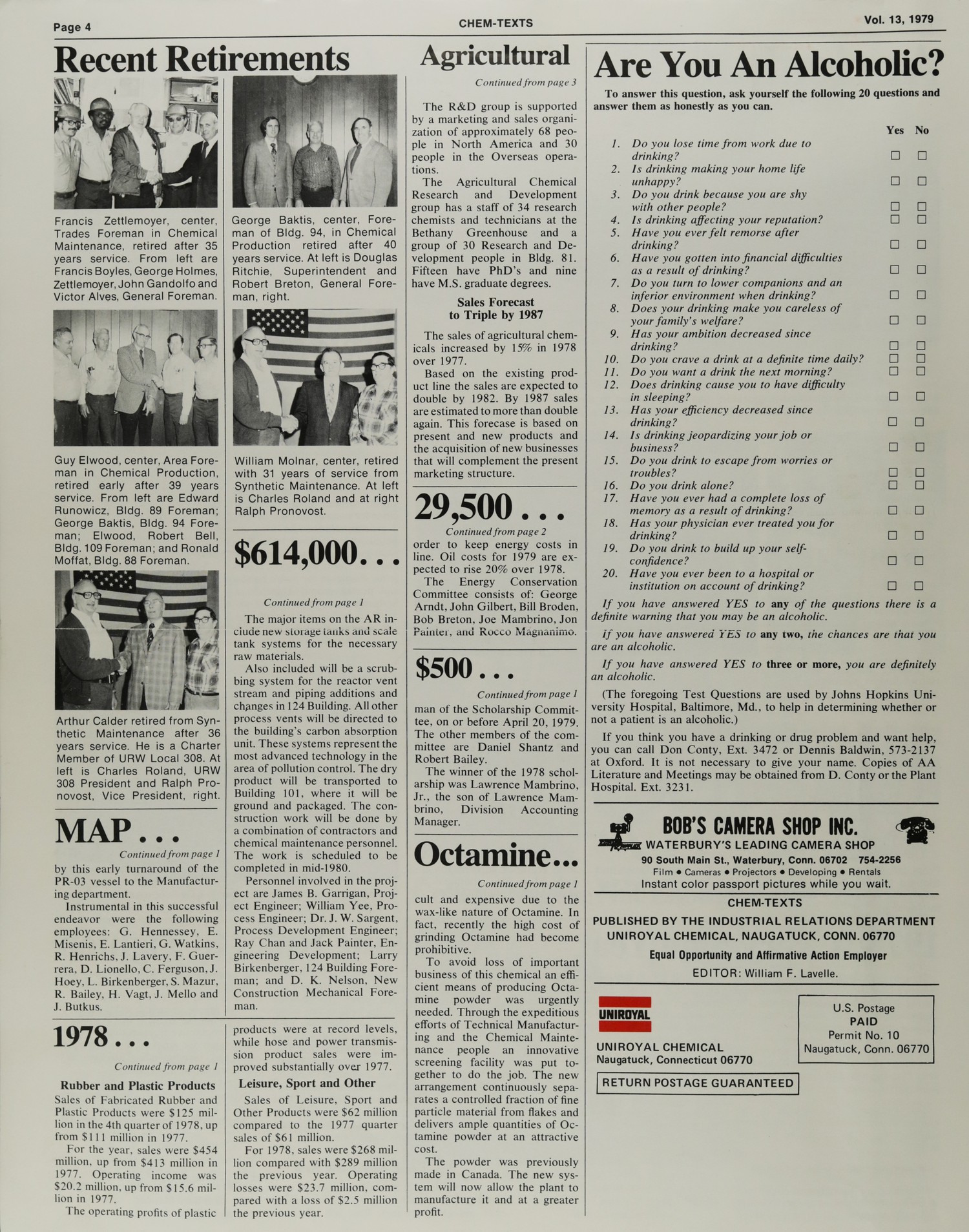
Francis Zettlemoyer, center, Trades Foreman in Chemical Maintenance, retired after 35 years service. From left are Francis Boyles, George Holmes, Zettlemoyer, John Gandolfo and Victor Alves, General Foreman.

[PHOTO: Group photo of retirees]

Guy Elwood, center, Area Foreman in Chemical Production, retired early after 39 years service. From left are Edward Runowicz, Bldg. 89 Foreman; George Baktis, Bldg. 94 Foreman; Elwood, Robert Bell, Bldg. 109 Foreman; and Ronald Moffat, Bldg. 88 Foreman.

[PHOTO: Group photo]

Arthur Calder retired from Synthetic Maintenance after 36 years service. He is a Charter Member of URW Local 308. At left is Charles Roland, URW 308 President and Ralph Pronovost, Vice President, right.


George Baktis, center, Foreman of Bldg. 94, in Chemical Production retired after 40 years service. At left is Douglas Ritchie, Superintendent and Robert Breton, General Foreman, right.

[PHOTO: Group photo]

William Molnar, center, retired with 31 years of service from Synthetic Maintenance. At left is Charles Roland and at right Ralph Pronovost.


MAP…

Continued from page 1

by this early turnaround of the PR-03 vessel to the Manufacturing department.

Instrumental in this successful endeavor were the following employees: G. Hennessey, E. Misenis, E. Lantieri, G. Watkins, R. Henrichs, J. Lavery, F. Guerrera, D. Lionello, C. Ferguson, J. Hoey, L. Birkenberger, S. Mazur, R. Bailey, H. Vagt, J. Mello and J. Butkus.


1978…

Continued from page 1

Rubber and Plastic Products
Sales of Fabricated Rubber and Plastic Products were $125 million in the 4th quarter of 1978, up from $111 million in 1977.

For the year, sales were $454 million, up from $413 million in 1977. Operating income was $20.2 million, up from $15.6 million in 1977.

The operating profits of plastic products were at record levels, while hose and power transmission product sales were improved substantially over 1977.

Leisure, Sport and Other
Sales of Leisure, Sport and Other Products were $62 million compared to the 1977 quarter sales of $61 million.

For 1978, sales were $268 million compared with $289 million the previous year. Operating losses were $23.7 million, compared with a loss of $2.5 million the previous year.


Agricultural

Continued from page 3

The R&D group is supported by a marketing and sales organization of approximately 68 people in North America and 30 people in the Overseas operations.

The Agricultural Chemical Research and Development group has a staff of 34 research chemists and technicians at the Bethany Greenhouse and a group of 30 Research and Development people in Bldg. 81. Fifteen have PhD’s and nine have M.S. graduate degrees.

Sales Forecast to Triple by 1987

The sales of agricultural chemicals increased by 15% in 1978 over 1977.

Based on the existing product line the sales are expected to double by 1982. By 1987 sales are estimated to more than double again. This forecase is based on present and new products and the acquisition of new businesses that will complement the present marketing structure.


29,500…

Continued from page 2

$614,000…

Continued from page 1

The major items on the AR include new storage tanks and scale tank systems for the necessary raw materials.

Also included will be a scrubbing system for the reactor vent stream and piping additions and changes in 124 Building. All other process vents will be directed to the building’s carbon absorption unit. These systems represent the most advanced technology in the area of pollution control. The dry product will be transported to Building 101, where it will be ground and packaged. The construction work will be done by a combination of contractors and chemical maintenance personnel. The work is scheduled to be completed in mid-1980.

Personnel involved in the project are James B. Garrigan, Project Engineer; William Yee, Process Engineer; Dr. J. W. Sargent, Process Development Engineer; Ray Chan and Jack Painter, Engineering Development; Larry Birkenberger, 124 Building Foreman; and D. K. Nelson, New Construction Mechanical Foreman.

order to keep energy costs in line. Oil costs for 1979 are expected to rise 20% over 1978. The Energy Conservation Committee consists of: George Arndt, John Gilbert, Bill Broden, Bob Breton, Joe Mambrino, Jon Painter, and Rocco Magnanimo.


$500…

Continued from page 1

man of the Scholarship Committee, on or before April 20, 1979. The other members of the committee are Daniel Shantz and Robert Bailey.

The winner of the 1978 scholarship was Lawrence Mambrino, Jr., the son of Lawrence Mambrino, Division Accounting Manager.


Octamine…

Continued from page 1

cult and expensive due to the wax-like nature of Octamine. In fact, recently the high cost of grinding Octamine had become prohibitive.

To avoid loss of important business of this chemical an efficient means of producing Octamine powder was urgently needed. Through the expeditious efforts of Technical Manufacturing and the Chemical Maintenance people an innovative screening facility was put together to do the job. The new arrangement continuously separates a controlled fraction of fine particle material from flakes and delivers ample quantities of Octamine powder at an attractive cost.

The powder was previously made in Canada. The new system will now allow the plant to manufacture it and at a greater profit.


Are You An Alcoholic?

To answer this question, ask yourself the following 20 questions and answer them as honestly as you can.

Yes No
1. Do you lose time from work due to drinking?
2. Is drinking making your home life unhappy?
3. Do you drink because you are shy with other people?
4. Is drinking affecting your reputation?
5. Have you ever felt remorse after drinking?
6. Have you gotten into financial difficulties as a result of drinking?
7. Do you turn to lower companions and an inferior environment when drinking?
8. Does your drinking make you careless of your family’s welfare?
9. Has your ambition decreased since drinking?
10. Do you crave a drink at a definite time daily?
11. Do you want a drink the next morning?
12. Does drinking cause you to have difficulty in sleeping?
13. Has your efficiency decreased since drinking?
14. Is drinking jeopardizing your job or business?
15. Do you drink to escape from worries or troubles?
16. Do you drink alone?
17. Have you ever had a complete loss of memory as a result of drinking?
18. Has your physician ever treated you for drinking?
19. Do you drink to build up your self-confidence?
20. Have you ever been to a hospital or institution on account of drinking?

If you have answered YES to any of the questions there is a definite warning that you may be an alcoholic.

if you have answered YES to any two, the chances are that you are an alcoholic.

If you have answered YES to three or more, you are definitely an alcoholic.

(The foregoing Test Questions are used by Johns Hopkins University Hospital, Baltimore, Md., to help in determining whether or not a patient is an alcoholic.)

If you think you have a drinking or drug problem and want help, you can call Don Conty, Ext. 3472 or Dennis Baldwin, 573-2137 at Oxford. It is not necessary to give your name. Copies of AA Literature and Meetings may be obtained from D. Conty or the Plant Hospital. Ext. 3231.


BOB’S CAMERA SHOP INC.

WATERBURY’S LEADING CAMERA SHOP
90 South Main St., Waterbury, Conn. 06702 754-2256
Film • Cameras • Projectors • Developing • Rentals
Instant color passport pictures while you wait.


CHEM-TEXTS
PUBLISHED BY THE INDUSTRIAL RELATIONS DEPARTMENT
UNIROYAL CHEMICAL, NAUGATUCK, CONN. 06770
Equal Opportunity and Affirmative Action Employer
EDITOR: William F. Lavelle.


[MAILING LABEL AREA]

UNIROYAL | U.S. Postage PAID Permit No. 10 Naugatuck, Conn. 06770

UNIROYAL CHEMICAL
Naugatuck, Connecticut 06770

RETURN POSTAGE GUARANTEED

CHEM-TEXTS – 1978-v12-s261

Page 261

Page 2 CHEM-TEXTS Volume 12, 1978


EDITORIAL

A large portion of this edition of CHEM-TEXTS is devoted to things that are happening here at the plant as a result of making it a “better place to be”. My staff and myself have dedicated ourselves to that objective in 1978.

In addition to some of the physical changes that are occurring, there are many changes being made in the way we manage our business. After reviewing how we were managing and deciding that it was not the way we would like it, we started to change. More of our people are becoming involved with running our business, and we intend that each of our buildings will be run as a separate business. Each of our service departments will be run as a separate business and will be measured in this way. The people running these businesses have been and will be given the authority necessary to make decisions and expenditures as required.

All of our people running the small business units will have both the authority and responsibility for the success of these businesses. I believe that this will make the Naugatuck Plant the most successful in the Chemical Division.

One of our other objectives for 1978 is to make the Naugatuck Plant “The Flagship” of the division. Certainly making it a better place to be and managing our business better will go a long way toward achieving that goal. But to reach it, we also have to strive to make the plant, inside and out, the best of any plant in the division—the cleanest, neatest and best maintained.

By dedicating ourselves to these objectives everyday, I am sure that they will be achieved in 1978.

[Signature: R.J. Meyst]


Named To IR Dept.

[PHOTO: Black and white photograph of J. Robert Douglas]

J. Robert Douglas has been named Manager of Industrial Relations for the Naugatuck Chemical location. In his new position he will be responsible for the Labor and Employee Relations at the Naugatuck Chemical facility which employs over 1100 people.

Prior to his new appointment Douglas held the position of Industrial Relations Manager at the Painesville, Ohio, plant.

He joined Uniroyal Chemical in 1967 as an Industrial Relations Representative at the Joliet Ammunitions plant.

[PHOTO: Black and white photograph of Donald J. Conty]

Donald J. Conty has been appointed Manager of Labor Relations for the Naugatuck Chemical plant.

Conty had been Manager of Industrial Relations for the Uniroyal Industrial Products’ Division plant in Port Clinton, Ohio.

He joined the Industrial Products division of Uniroyal at the Passaic plant in 1956 as a Safety Supervisor. He was later named Manager of Safety and Plant Protection. In 1972 he was promoted to Employee Relations Manager for the Port Clinton, Ohio plant.


Equality Policy Affirmed

The Uniroyal Chemical plant has a firm commitment to offer equal opportunity to all employees. It is the policy of the plant’s management to support and implement this commitment continually.

This policy requires that all recruiting, hiring, transfers, promotions, compensation, benefits, and company-sponsored training, education and tuition assistance, as well as social, recreational and health programs and lay-off and recall practices are followed and carried out without regard to race, color, creed, religion, sex, national origin, or handicap of any individual person.

J. Robert Douglas, the Industrial Relations Manager for the Naugatuck plant is the Compliance officer and has the responsibility for implementing this policy; monitoring the Uniroyal Chemical Affirmative Action Compliance Program; and reporting to management the program’s progress.

The responsibility for the improvement of the program and the positive results of it rests with each Manager, Foreman, and Supervisor as an integral part of their job.


Profits And Sales Improve In 1977

For 1977 the Company’s net income was $34.8 million, or $1.13 a share, compared with $20.1 million or $.57 a share in 1976.

Sales for 1977 were $2.6 billion compared with $2.3 billion in 1976.

Strong annual gains were made in U.S. tire sales. Sales and net income from chemicals exceeded all forecasts in 1977.

4th Quarter

In the 4th Quarter, the Company had a foreign exchange loss of $2.5 million, reducing earnings to $57,000, or a loss of four cents a share. This compares with the abnormally high income of $20 million, or $.71 a share after a $.5 million foreign exchange loss in the 4th quarter of 1976.

The 4th Quarter net income was also attributed to declines in sales of footwear, and losses incurred as footwear production was discontinued at the Naugatuck plant.

Tire 4th Quarter Sales Off

Sales in the Tire and Related Products group were $371 million in the fourth quarter of 1977, compared with $380 million in the last quarter of 1976. The relative decline was due to abnormally high orders in 1976.

Chemical, Rubber and Plastic Materials Improve in Quarter

Chemical, Rubber and Plastic Materials sales increased to $83 million in 1977 from the $79 million in the 4th quarter of 1976. The Chemical Division and specialty chemical sales continued to show improvement in this period, as did the pricing of natural rubber.


Scholarship Offered

The Uniroyal Chemical Management Club is again offering a $500 scholarship award. Fifty dollars of the scholarship comes from the Larry Monroe Fund.

The scholarship is available to a graduating high school student who plans a college education. To qualify, one of the student’s parents must have worked for Uniroyal Chemical at Naugatuck or Bethany for two years or more

(continued on page 4)


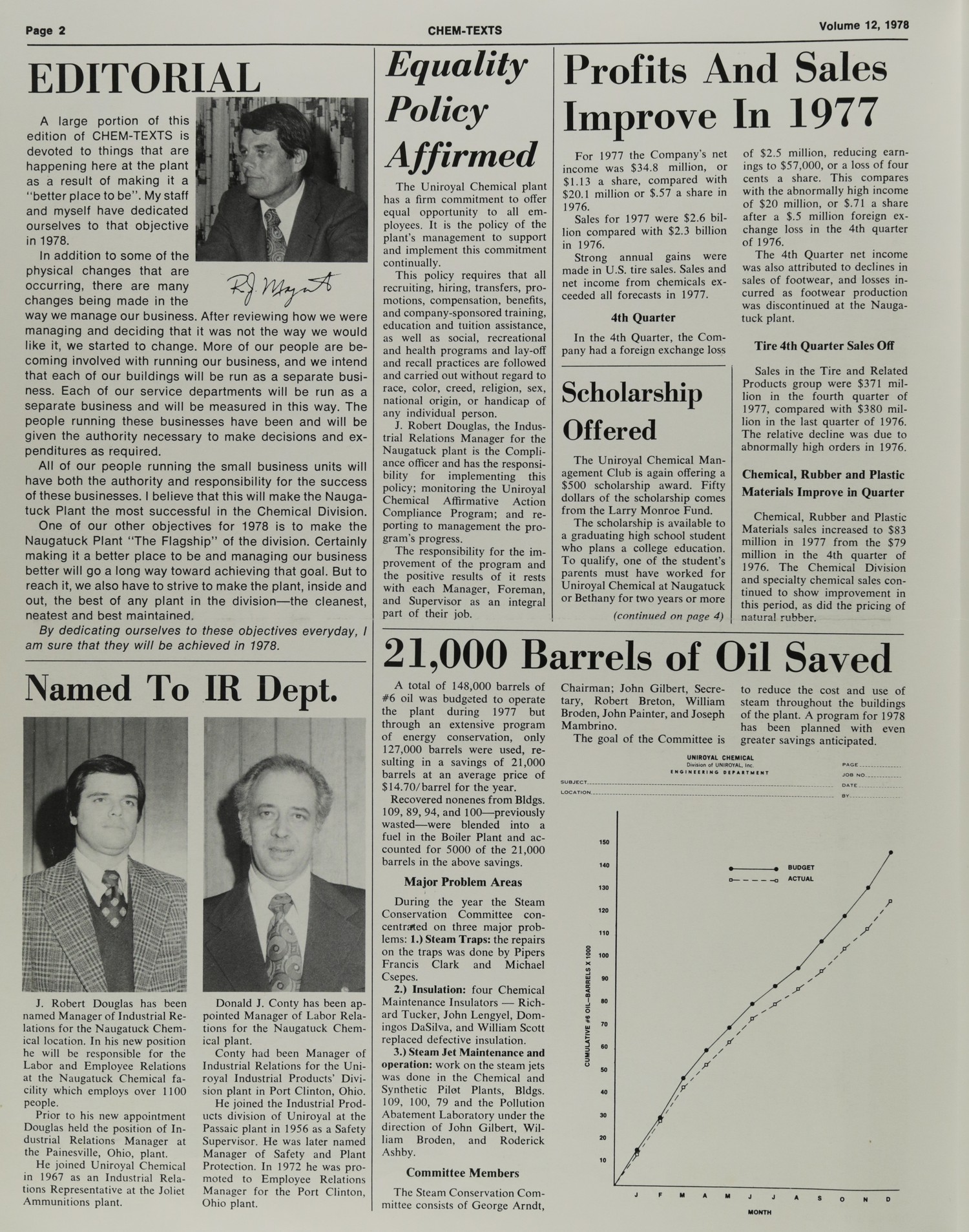
21,000 Barrels of Oil Saved

A total of 148,000 barrels of #6 oil was budgeted to operate the plant during 1977 but through an extensive program of energy conservation, only 127,000 barrels were used, resulting in a savings of 21,000 barrels at an average price of $14.70/barrel for the year.

Recovered nonenes from Bldgs. 109, 89, 94, and 100—previously wasted—were blended into a fuel in the Boiler Plant and accounted for 5000 of the 21,000 barrels in the above savings.

Major Problem Areas

During the year the Steam Conservation Committee concentrated on three major problems: 1.) Steam Traps: the repairs on the traps was done by Pipers Francis Clark and Michael Csepes.

2.) Insulation: four Chemical Maintenance Insulators — Richard Tucker, John Lengyel, Domingos DaSilva, and William Scott replaced defective insulation.

3.) Steam Jet Maintenance and operation: work on the steam jets was done in the Chemical and Synthetic Pilot Plants, Bldgs. 109, 100, 79 and the Pollution Abatement Laboratory under the direction of John Gilbert, William Broden, and Roderick Ashby.

Committee Members

The Steam Conservation Committee consists of George Arndt,

Chairman; John Gilbert, Secretary, Robert Breton, William Broden, John Painter, and Joseph Mambrino.

The goal of the Committee is to reduce the cost and use of steam throughout the buildings of the plant. A program for 1978 has been planned with even greater savings anticipated.

[FORM HEADER:]
UNIROYAL CHEMICAL
Division of UNIROYAL Inc.
ENGINEERING DEPARTMENT

SUBJECT___
LOCATION__

PAGE_
JOB NO._
DATE_
BY_

[GRAPH: Line graph showing cumulative #6 oil barrels x 1000 from months J through D, with two lines labeled “BUDGET” (solid) and “ACTUAL” (dashed), ranging from approximately 10 to 150 on the y-axis]

CHEM-TEXTS – 1978-v12-s263

Page 263

Page 4 | CHEM-TEXTS | Volume 12, 1978


Omite, “Growers Friend”

[IMAGE: Photo of three men]

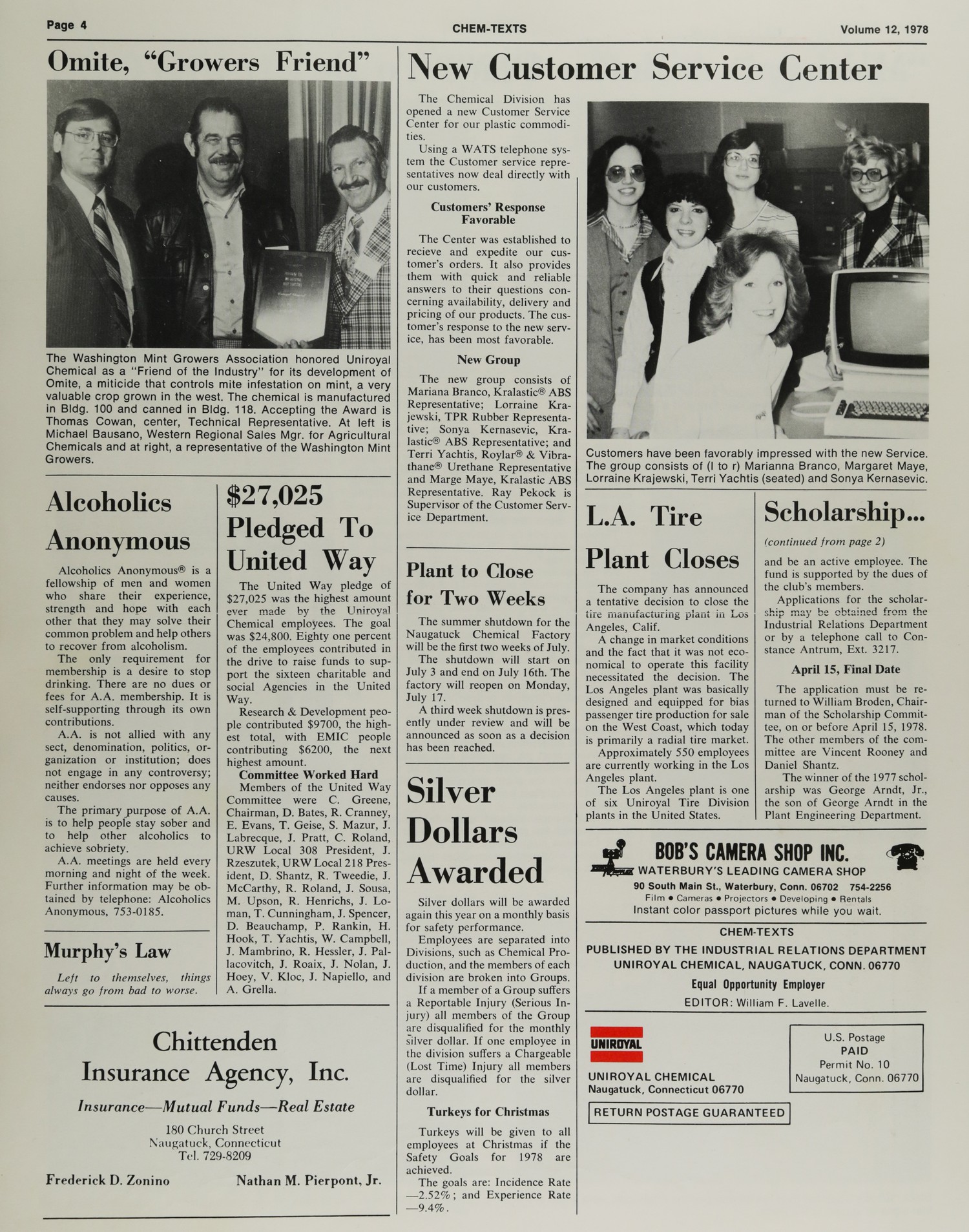
The Washington Mint Growers Association honored Uniroyal Chemical as a “Friend of the Industry” for its development of Omite, a miticide that controls mite infestation on mint, a very valuable crop grown in the west. The chemical is manufactured in Bldg. 100 and canned in Bldg. 118. Accepting the Award is Thomas Cowan, center, Technical Representative. At left is Michael Bausano, Western Regional Sales Mgr. for Agricultural Chemicals and at right, a representative of the Washington Mint Growers.


Alcoholics Anonymous

Alcoholics Anonymous® is a fellowship of men and women who share their experience, strength and hope with each other that they may solve their common problem and help others to recover from alcoholism.

The only requirement for membership is a desire to stop drinking. There are no dues or fees for A.A. membership. It is self-supporting through its own contributions.

A.A. is not allied with any sect, denomination, politics, organization or institution; does not engage in any controversy; neither endorses nor opposes any causes.

The primary purpose of A.A. is to help people stay sober and to help other alcoholics to achieve sobriety.

A.A. meetings are held every morning and night of the week. Further information may be obtained by telephone: Alcoholics Anonymous, 753-0185.


Murphy’s Law

Left to themselves, things always go from bad to worse.


$27,025 Pledged To United Way

The United Way pledge of $27,025 was the highest amount ever made by the Uniroyal Chemical employees. The goal was $24,800. Eighty one percent of the employees contributed in the drive to raise funds to support the sixteen charitable and social Agencies in the United Way.

Research & Development people contributed $9700, the highest total, with EMIC people contributing $6200, the next highest amount.

Committee Worked Hard

Members of the United Way Committee were C. Greene, Chairman, D. Bates, R. Cranney, E. Evans, T. Geise, S. Mazur, J. Labrecque, J. Pratt, C. Roland, URW Local 308 President, J. Rzeszutek, URW Local 218 President, D. Shantz, R. Tweedie, J. McCarthy, R. Roland, J. Sousa, M. Upson, R. Henrichs, J. Loman, T. Cunningham, J. Spencer, D. Beauchamp, P. Rankin, H. Hook, T. Yachtis, W. Campbell, J. Mambrino, R. Hessler, J. Paliacovitch, J. Roaix, J. Nolan, J. Hoey, V. Kloc, J. Napiello, and A. Grella.


New Customer Service Center

The Chemical Division has opened a new Customer Service Center for our plastic commodities.

Using a WATS telephone system the Customer service representatives now deal directly with our customers.

Customers’ Response Favorable

The Center was established to recieve and expedite our customer’s orders. It also provides them with quick and reliable answers to their questions concerning availability, delivery and pricing of our products. The customer’s response to the new service, has been most favorable.

New Group

The new group consists of Mariana Branco, Kralastic® ABS Representative; Lorraine Krajewski, TPR Rubber Representative; Sonya Kernasevic, Kralastic® ABS Representative; and Terri Yachtis, Roylar® & Vibrathane® Urethane Representative and Marge Maye, Kralastic ABS Representative. Ray Pekoek is Supervisor of the Customer Service Department.

[IMAGE: Photo of five women]

Customers have been favorably impressed with the new Service. The group consists of (l to r) Marianna Branco, Margaret Maye, Lorraine Krajewski, Terri Yachtis (seated) and Sonya Kernasevic.


Plant to Close for Two Weeks

The summer shutdown for the Naugatuck Chemical Factory will be the first two weeks of July.

The shutdown will start on July 3 and end on July 16th. The factory will reopen on Monday, July 17.

A third week shutdown is presently under review and will be announced as soon as a decision has been reached.


L.A. Tire Plant Closes

The company has announced a tentative decision to close the tire manufacturing plant in Los Angeles, Calif.

A change in market conditions and the fact that it was not economical to operate this facility necessitated the decision. The Los Angeles plant was basically designed and equipped for bias passenger tire production for sale on the West Coast, which today is primarily a radial tire market.

Approximately 550 employees are currently working in the Los Angeles plant.

The Los Angeles plant is one of six Uniroyal Tire Division plants in the United States.


Silver Dollars Awarded

Silver dollars will be awarded again this year on a monthly basis for safety performance.

Employees are separated into Divisions, such as Chemical Production, and the members of each division are broken into Groups.

If a member of a Group suffers a Reportable Injury (Serious Injury) all members of the Group are disqualified for the monthly silver dollar. If one employee in the division suffers a Chargeable (Lost Time) Injury all members are disqualified for the silver dollar.

Turkeys for Christmas

Turkeys will be given to all employees at Christmas if the Safety Goals for 1978 are achieved.

The goals are: Incidence Rate —2.52%; and Experience Rate —9.4%.


Scholarship…

(continued from page 2)

and be an active employee. The fund is supported by the dues of the club’s members.

Applications for the scholarship may be obtained from the Industrial Relations Department or by a telephone call to Constance Antrum, Ext. 3217.

April 15, Final Date

The application must be returned to William Broden, Chairman of the Scholarship Committee, on or before April 15, 1978. The other members of the committee are Vincent Rooney and Daniel Shantz.

The winner of the 1977 scholarship was George Arndt, Jr., the son of George Arndt in the Plant Engineering Department.


BOB’S CAMERA SHOP INC.

[IMAGE: Camera icon]
WATERBURY’S LEADING CAMERA SHOP
90 South Main St., Waterbury, Conn. 06702 754-2256
Film ● Cameras ● Projectors ● Developing ● Rentals
Instant color passport pictures while you wait.


Chittenden Insurance Agency, Inc.

Insurance—Mutual Funds—Real Estate

180 Church Street
Naugatuck, Connecticut
Tel. 729-8209

Frederick D. Zonino | Nathan M. Pierpont, Jr.


CHEM-TEXTS

PUBLISHED BY THE INDUSTRIAL RELATIONS DEPARTMENT
UNIROYAL CHEMICAL, NAUGATUCK, CONN. 06770

Equal Opportunity Employer

EDITOR: William F. Lavelle.


[UNIROYAL LOGO]

UNIROYAL CHEMICAL
Naugatuck, Connecticut 06770

U.S. Postage
PAID
Permit No. 10
Naugatuck, Conn. 06770

RETURN POSTAGE GUARANTEED

CHEM-TEXTS – 1974 – Page 5

Page 005

CHEM-TEXTS

Vol. 8, 1974 | Page 5


Power Plant Personnel Praised

Fred Taff, Vice President of Engineering for Uniroyal, Inc. recently visited the power plant operations and commended the Boiler House staff for its excellent performance in efficiency as compared to other Uniroyal plants.

These excerpts from his letter summarize his impressions of the tour.

“I think the Plant Engineering group including George Arndt and the operating force in the Boiler plant headed up by Bill Maguire, together with the people who are responsible for maintenance of that operation, should be complimented for the fine performance they are turning in.

The high efficiencies are not accidental; they are the result of hard work, careful planning, attention to detail and a very high Esprit De Corps. The housekeeping was outstanding and I can honestly say I did not detect a single steam leak during the entire walking tour of the Boiler plant from the top to the bottom floor.”

The people who work in the power plant and are responsible for this report are: A. Verrier, A. Gualtieri, F. Warchol, I. Fonseca, J. Mambrino, W. Ireland, W. Hancock, M. Ciarlo, R. Boulanger, J. Litherland and G. Troy.


50 MPH AND 68°


Iron Post Stops Trucks

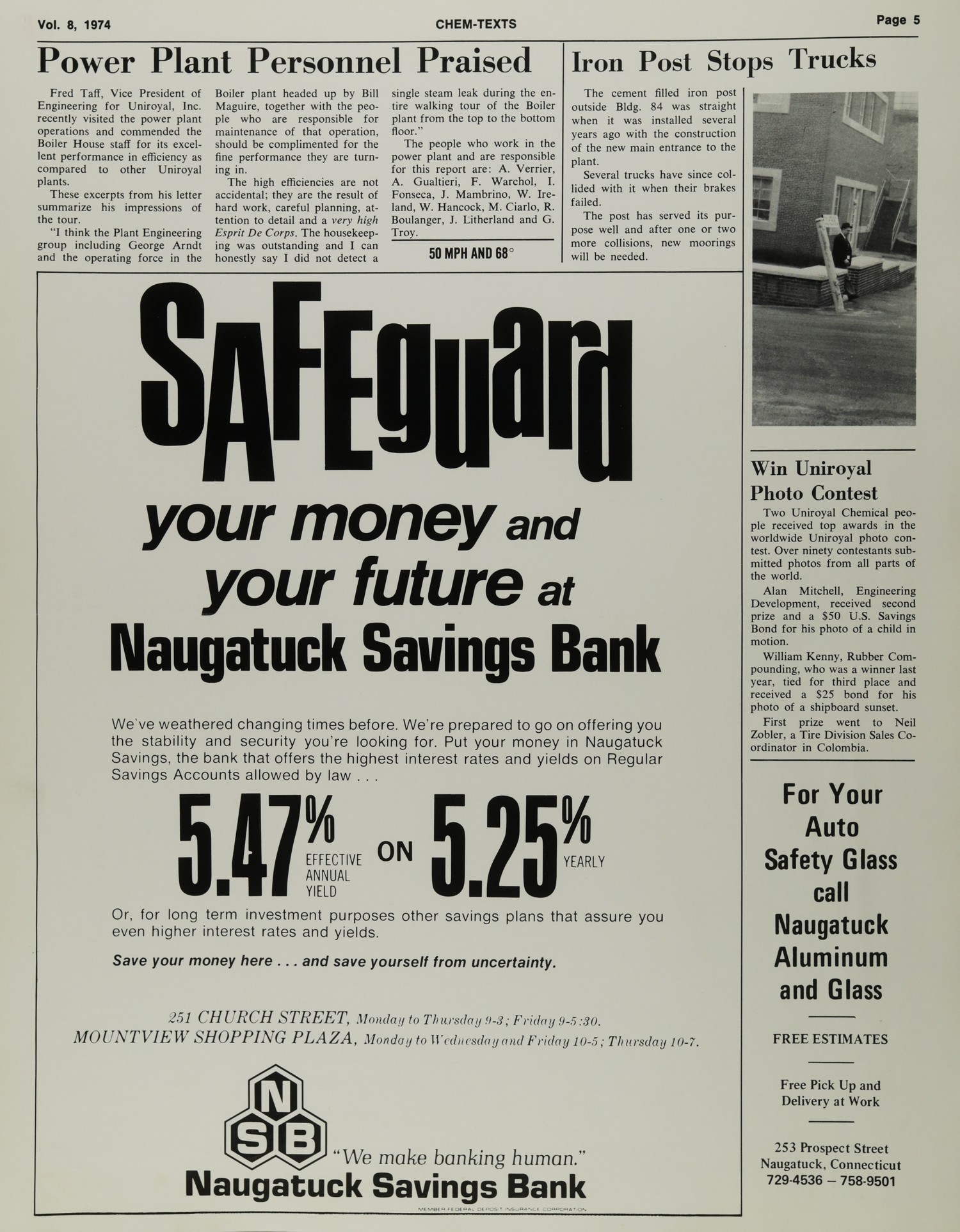
The cement filled iron post outside Bldg. 84 was straight when it was installed several years ago with the construction of the new main entrance to the plant.

Several trucks have since collided with it when their brakes failed.

The post has served its purpose well and after one or two more collisions, new moorings will be needed.


Win Uniroyal Photo Contest

Two Uniroyal Chemical people received top awards in the worldwide Uniroyal photo contest. Over ninety contestants submitted photos from all parts of the world.

Alan Mitchell, Engineering Development, received second prize and a $50 U.S. Savings Bond for his photo of a child in motion.

William Kenny, Rubber Compounding, who was a winner last year, tied for third place and received a $25 bond for his photo of a shipboard sunset.

First prize went to Neil Zobler, a Tire Division Sales Coordinator in Colombia.


SAFEguard

your money and your future at Naugatuck Savings Bank

We’ve weathered changing times before. We’re prepared to go on offering you the stability and security you’re looking for. Put your money in Naugatuck Savings, the bank that offers the highest interest rates and yields on Regular Savings Accounts allowed by law . . .

5.47% EFFECTIVE ANNUAL YIELD ON 5.25% YEARLY

Or, for long term investment purposes other savings plans that assure you even higher interest rates and yields.

Save your money here . . . and save yourself from uncertainty.

251 CHURCH STREET, Monday to Thursday 9-3; Friday 9-5:30.
MOUNTVIEW SHOPPING PLAZA, Monday to Wednesday and Friday 10-5; Thursday 10-7.

NSB
“We make banking human.”
Naugatuck Savings Bank

MEMBER FEDERAL DEPOSIT INSURANCE CORPORATION


For Your Auto Safety Glass call Naugatuck Aluminum and Glass


FREE ESTIMATES

Free Pick Up and Delivery at Work


253 Prospect Street
Naugatuck, Connecticut
729-4536 — 758-9501

Accident Frequency Reduced 54% 1500 Turkevs Awarded to Employees

Page 2 | CHEM-TEXTS | Vol. 7, 1973


The end of the year is upon us, and traditionally it is an ideal time to review the past year and take a peek at the next.

Obviously, it is impossible to review all of the little steps of progress we have made this year. Therefore, I would like to offer a general review of our plant and business in 1973.

The epitome of working together, I think, is this year’s outstanding safety performance over last year’s. Without the complete involvement of all “Chemical people”, we would not have been as successful.

We still have a long way to go, particularly in the number of days lost due to accidents. But this year’s performance has built the base from which we can launch the effort needed to overcome this next difficult hurdle.

In the business line, Chemical Production came through a torturous year with encouraging vigor. The year started great, only to slow down at mid year when uncertain business conditions caused customers to hedge on their purchases.

Then when sales started to pick up, we were staggered by the continuing energy-related raw material shortages.

Heading into the new year, we face the confusing problem of having the sales, but perhaps not the raw materials. In addition, these materials are skyrocketing in cost. Survival next year can be defined as having the flexibility to make the most of a difficult situation.

We all know the problems facing our Reclaim plant. But if this year’s performance and attitude are any indication of our strength and perseverance, we are going to give that business a real run for the money in 1974. Turning an old giant like that around, enough to make it competitive, is a formidable task. Time is a problem and 1974 is our year to show them what we’re made of.

It is unfortunate that we have become non-competitive in the Synthetic latex business. We must quickly recover from this shutdown and adjust ourselves to solving today’s problems.

Attitude and cooperation did it with our Safety performance. The same approach must be used in improving the competitive and economic position of our plant. A healthy business means secure jobs—for one and all.

Despite the lack of Christmas lights this year, I would like to extend to all of you, and your families, my best wishes for the Christmas holiday. It is a comforting time of the year, but also a time to remind ourselves how fortunate we really are.

Jim Crim


Accident Frequency Reduced 54%

1500 Turkeys Awarded to Employees

[IMAGE: Photo showing three people examining documents]

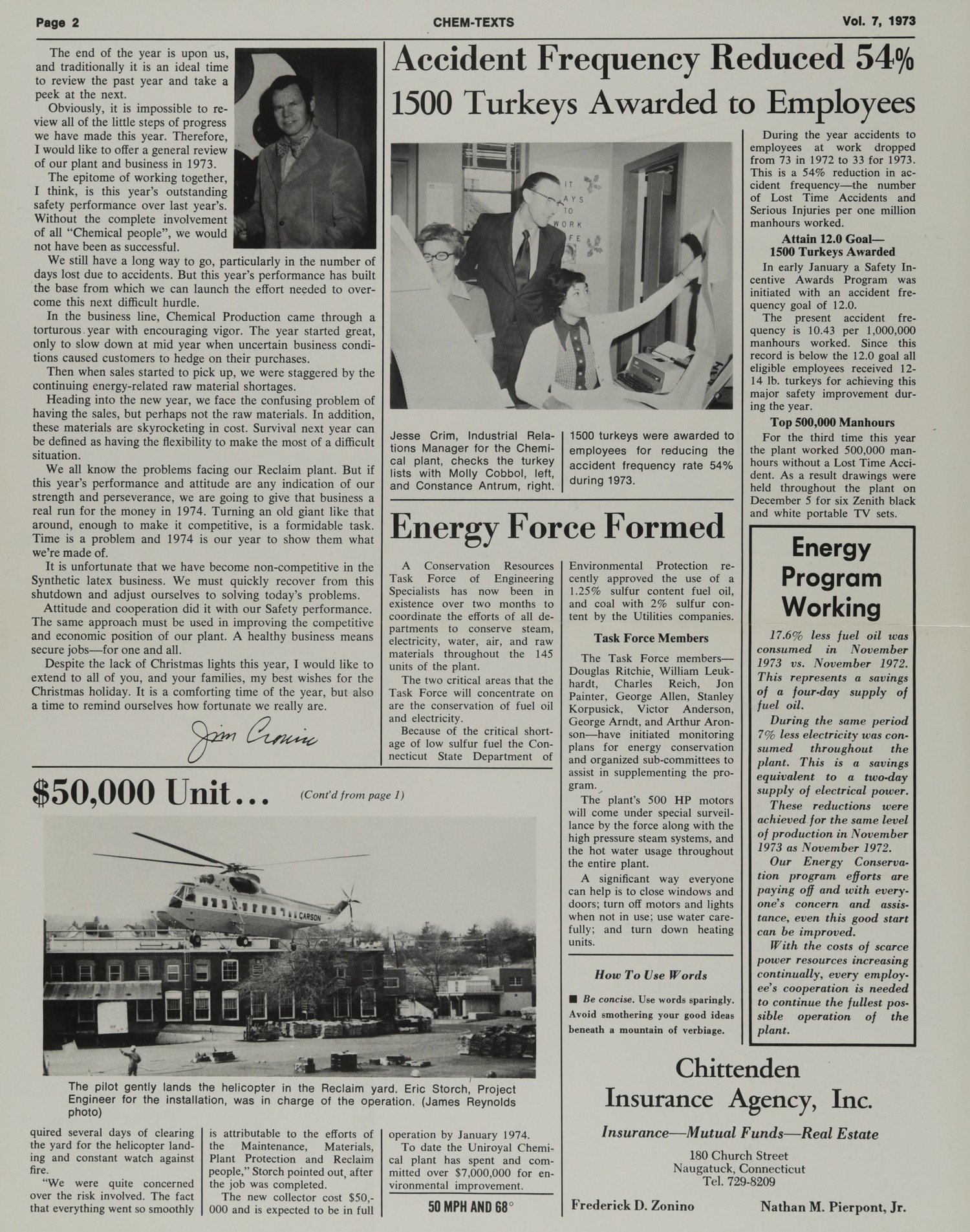
Jesse Crim, Industrial Relations Manager for the Chemical plant, checks the turkey lists with Molly Cobbol, left, and Constance Antrum, right.

1500 turkeys were awarded to employees for reducing the accident frequency rate 54% during 1973.

During the year accidents to employees at work dropped from 73 in 1972 to 33 for 1973. This is a 54% reduction in accident frequency—the number of Lost Time Accidents and Serious Injuries per one million manhours worked.

Attain 12.0 Goal—1500 Turkeys Awarded

In early January a Safety Incentive Awards Program was initiated with an accident frequency goal of 12.0.

The present accident frequency is 10.43 per 1,000,000 manhours worked. Since this record is below the 12.0 goal all eligible employees received 12-14 lb. turkeys for achieving this major safety improvement during the year.

Top 500,000 Manhours

For the third time this year the plant worked 500,000 manhours without a Lost Time Accident. As a result drawings were held throughout the plant on December 5 for six Zenith black and white portable TV sets.


Energy Force Formed

A Conservation Resources Task Force of Engineering Specialists has now been in existence over two months to coordinate the efforts of all departments to conserve steam, electricity, water, air, and raw materials throughout the 145 units of the plant.

The two critical areas that the Task Force will concentrate on are the conservation of fuel oil and electricity.

Because of the critical shortage of low sulfur fuel the Connecticut State Department of Environmental Protection recently approved the use of a 1.25% sulfur content fuel oil, and coal with 2% sulfur content by the Utilities companies.

Task Force Members

The Task Force members—Douglas Ritchie, William Leukhardt, Charles Reich, Jon Painter, George Allen, Stanley Korpusick, Victor Anderson, George Arndt, and Arthur Aronson—have initiated monitoring plans for energy conservation and organized sub-committees to assist in supplementing the program.

The plant’s 500 HP motors will come under special surveillance by the force along with the high pressure steam systems, and the hot water usage throughout the entire plant.

A significant way everyone can help is to close windows and doors; turn off motors and lights when not in use; use water carefully; and turn down heating units.


How To Use Words

Be concise. Use words sparingly. Avoid smothering your good ideas beneath a mountain of verbiage.


Energy Program Working

17.6% less fuel oil was consumed in November 1973 vs. November 1972. This represents a savings of a four-day supply of fuel oil.

During the same period 7% less electricity was consumed throughout the plant. This is a savings equivalent to a two-day supply of electrical power.

These reductions were achieved for the same level of production in November 1973 as November 1972.

Our Energy Conservation program efforts are paying off and with everyone’s concern and assistance, even this good start can be improved.

With the costs of scarce power resources increasing continually, every employee’s cooperation is needed to continue the fullest possible operation of the plant.


$50,000 Unit… (Cont’d from page 1)

[IMAGE: Photo of helicopter landing in yard with buildings in background, marked “CARSON”]

The pilot gently lands the helicopter in the Reclaim yard. Eric Storch, Project Engineer for the installation, was in charge of the operation. (James Reynolds photo)

quired several days of clearing the yard for the helicopter landing and constant watch against fire.

“We were quite concerned over the risk involved. The fact that everything went so smoothly is attributable to the efforts of the Maintenance, Materials, Plant Protection and Reclaim people,” Storch pointed out after the job was completed.

The new collector cost $50,000 and is expected to be in operation by January 1974.

To date the Uniroyal Chemical plant has spent and committed over $7,000,000 for environmental improvement.

50 MPH AND 68°


Chittenden Insurance Agency, Inc.

Insurance—Mutual Funds—Real Estate

180 Church Street
Naugatuck, Connecticut
Tel. 729-8209

Frederick D. Zonino | Nathan M. Pierpont, Jr.

CHEM-TEXTS – Vol. 5 No. 4 – Page 3

Page 003

CHEM-TEXTS

Vol. 5 No. 4 | Page 3


New Research Laboratory Studies Pollution Causes

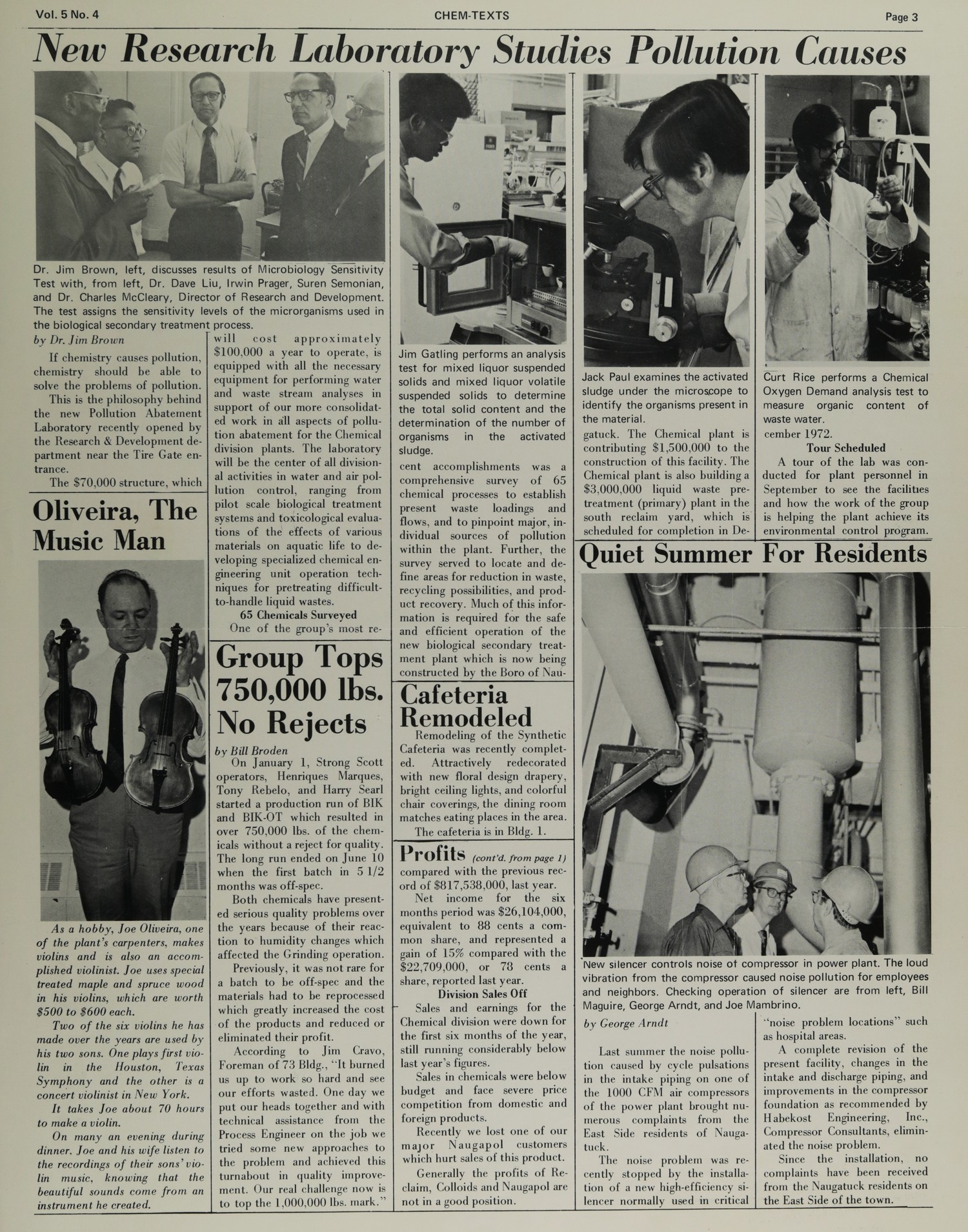
Dr. Jim Brown, left, discusses results of Microbiology Sensitivity Test with, from left, Dr. Dave Liu, Irwin Prager, Suren Semonian, and Dr. Charles McCleary, Director of Research and Development. The test assigns the sensitivity levels of the microrganisms used in the biological secondary treatment process.

by Dr. Jim Brown

If chemistry causes pollution, chemistry should be able to solve the problems of pollution.

This is the philosophy behind the new Pollution Abatement Laboratory recently opened by the Research & Development department near the Tire Gate entrance.

The $70,000 structure, which


Oliveira, The Music Man

As a hobby, Joe Oliveira, one of the plant’s carpenters, makes violins and is also an accomplished violinist. Joe uses special treated maple and spruce wood in his violins, which are worth $500 to $600 each.

Two of the six violins he has made over the years are used by his two sons. One plays first violin in the Houston, Texas Symphony and the other is a concert violinist in New York.

It takes Joe about 70 hours to make a violin.

On many an evening during dinner, Joe and his wife listen to the recordings of their sons’ violin music, knowing that the beautiful sounds come from an instrument he created.


will cost approximately $100,000 a year to operate, is equipped with all the necessary equipment for performing water and waste stream analyses in support of our more consolidated work in all aspects of pollution abatement for the Chemical division plants. The laboratory will be the center of all divisional activities in water and air pollution control, ranging from pilot scale biological treatment systems and toxicological evaluations of the effects of various materials on aquatic life to developing specialized chemical engineering unit operation techniques for pretreating difficult-to-handle liquid wastes.

65 Chemicals Surveyed

One of the group’s most re-


Group Tops 750,000 lbs. No Rejects

by Bill Broden

On January 1, Strong Scott operators, Henriques Marques, Tony Rebelo, and Harry Searl started a production run of BIK and BIK-OT which resulted in over 750,000 lbs. of the chemicals without a reject for quality. The long run ended on June 10 when the first batch in 5 1/2 months was off-spec.

Both chemicals have presented serious quality problems over the years because of their reaction to humidity changes which affected the Grinding operation.

Previously, it was not rare for a batch to be off-spec and the materials had to be reprocessed which greatly increased the cost of the products and reduced or eliminated their profit.

According to Jim Cravo, Foreman of 73 Bldg., “It burned us up to work so hard and see our efforts wasted. One day we put our heads together and with technical assistance from the Process Engineer on the job we tried some new approaches to the problem and achieved this turnaround in quality improvement. Our real challenge now is to top the 1,000,000 lbs. mark.”


Jim Gatling performs an analysis test for mixed liquor suspended solids and mixed liquor volatile suspended solids to determine the total solid content and the determination of the number of organisms in the activated sludge.

cent accomplishments was a comprehensive survey of 65 chemical processes to establish present waste loadings and flows, and to pinpoint major, individual sources of pollution within the plant. Further, the survey served to locate and define areas for reduction in waste, recycling possibilities, and product recovery. Much of this information is required for the safe and efficient operation of the new biological secondary treatment plant which is now being constructed by the Boro of Nau-


Cafeteria Remodeled

Remodeling of the Synthetic Cafeteria was recently completed. Attractively redecorated with new floral design drapery, bright ceiling lights, and colorful chair coverings, the dining room matches eating places in the area.

The cafeteria is in Bldg. 1.


Profits (cont’d. from page 1)

compared with the previous record of $817,538,000, last year.

Net income for the six months period was $26,104,000, equivalent to 88 cents a common share, and represented a gain of 15% compared with the $22,709,000, or 78 cents a share, reported last year.

Division Sales Off

Sales and earnings for the Chemical division were down for the first six months of the year, still running considerably below last year’s figures.

Sales in chemicals were below budget and face severe price competition from domestic and foreign products.

Recently we lost one of our major Naugapol customers which hurt sales of this product.

Generally the profits of Reclaim, Colloids and Naugapol are not in a good position.


Jack Paul examines the activated sludge under the microscope to identify the organisms present in the material.

gatuck. The Chemical plant is contributing $1,500,000 to the construction of this facility. The Chemical plant is also building a $3,000,000 liquid waste pretreatment (primary) plant in the south reclaim yard, which is scheduled for completion in De-


Curt Rice performs a Chemical Oxygen Demand analysis test to measure organic content of waste water.

cember 1972.

Tour Scheduled

A tour of the lab was conducted for plant personnel in September to see the facilities and how the work of the group is helping the plant achieve its environmental control program.


Quiet Summer For Residents

New silencer controls noise of compressor in power plant. The loud vibration from the compressor caused noise pollution for employees and neighbors. Checking operation of silencer are from left, Bill Maguire, George Arndt, and Joe Mambrino.

by George Arndt

Last summer the noise pollution caused by cycle pulsations in the intake piping on one of the 1000 CFM air compressors of the power plant brought numerous complaints from the East Side residents of Naugatuck.

The noise problem was recently stopped by the installation of a new high-efficiency silencer normally used in critical

“noise problem locations” such as hospital areas.

A complete revision of the present facility, changes in the intake and discharge piping, and improvements in the compressor foundation as recommended by Habekost Engineering, Inc., Compressor Consultants, eliminated the noise problem.

Since the installation, no complaints have been received from the Naugatuck residents on the East Side of the town.

CHEM-TEXTS – Vol. 4 No. 3 – Page 3

Page 003

CHEM-TEXTS

Vol. 4 No. 3 Page 3


Supervisory Skills Training Program Started For Foremen

[LEFT PHOTO CAPTION:]
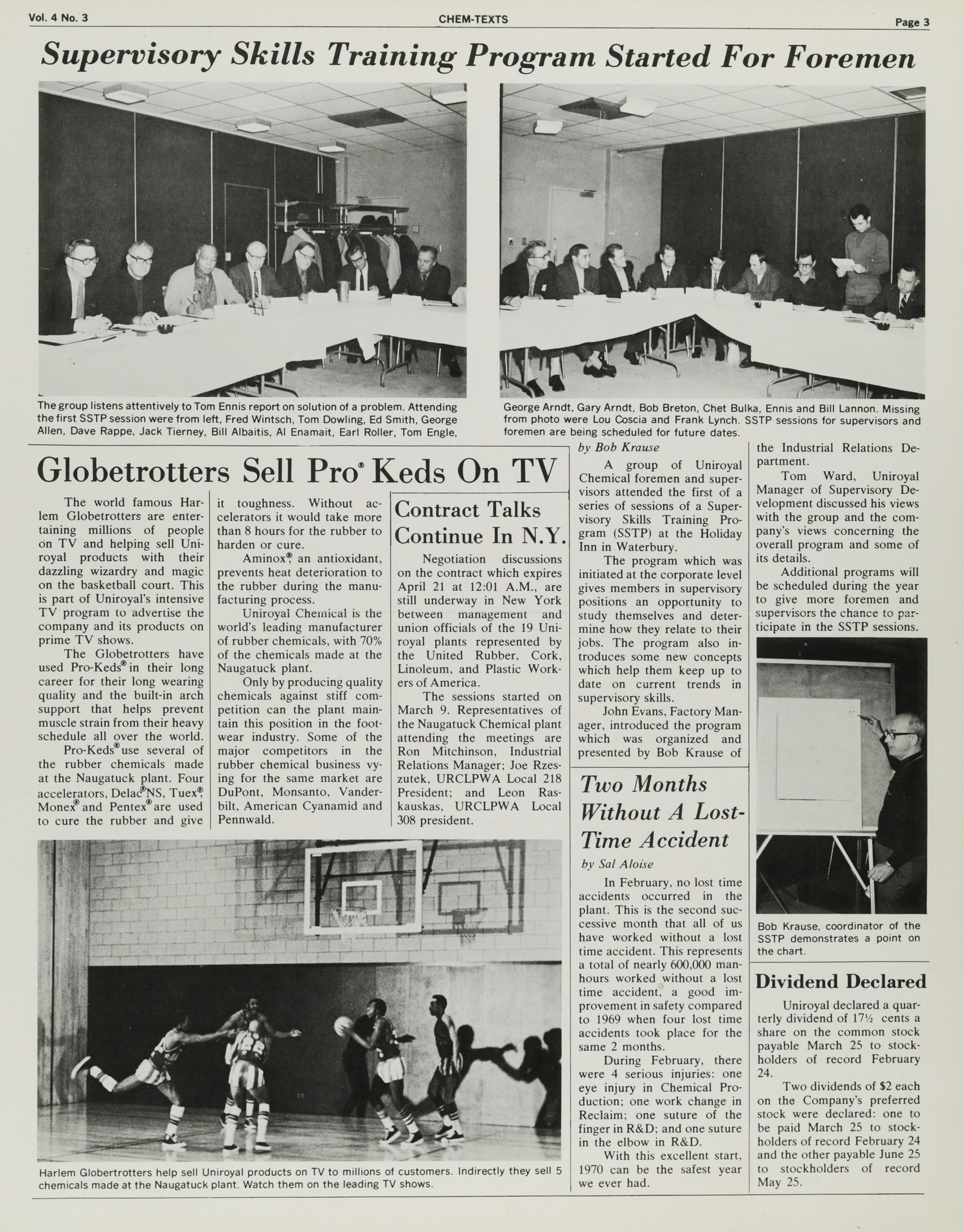
The group listens attentively to Tom Ennis report on solution of a problem. Attending the first SSTP session were from left, Fred Wintsch, Tom Dowling, Ed Smith, George Allen, Dave Rappe, Jack Tierney, Bill Albaitis, Al Enamait, Earl Roller, Tom Engle,

[RIGHT PHOTO CAPTION:]
George Arndt, Gary Arndt, Bob Breton, Chet Bulka, Ennis and Bill Lannon. Missing from photo were Lou Coscia and Frank Lynch. SSTP sessions for supervisors and foremen are being scheduled for future dates.


Globetrotters Sell Pro* Keds On TV

The world famous Harlem Globetrotters are entertaining millions of people on TV and helping sell Uniroyal products with their dazzling wizardry and magic on the basketball court. This is part of Uniroyal’s intensive TV program to advertise the company and its products on prime TV shows.

The Globetrotters have used Pro-Keds® in their long career for their long wearing quality and the built-in arch support that helps prevent muscle strain from their heavy schedule all over the world.

Pro-Keds® use several of the rubber chemicals made at the Naugatuck plant. Four accelerators, Delac®NS, Tuex®, Monex® and Pentex® are used to cure the rubber and give it toughness. Without accelerators it would take more than 8 hours for the rubber to harden or cure.

Aminox®, an antioxidant, prevents heat deterioration to the rubber during the manufacturing process.

Uniroyal Chemical is the world’s leading manufacturer of rubber chemicals, with 70% of the chemicals made at the Naugatuck plant.

Only by producing quality chemicals against stiff competition can the plant maintain this position in the footwear industry. Some of the major competitors in the rubber chemical business vying for the same market are DuPont, Monsanto, Vanderbilt, American Cyanamid and Pennwald.


Contract Talks Continue In N.Y.

Negotiation discussions on the contract which expires April 21 at 12:01 A.M., are still underway in New York between management and union officials of the 19 Uniroyal plants represented by the United Rubber, Cork, Linoleum, and Plastic Workers of America.

The sessions started on March 9. Representatives of the Naugatuck Chemical plant attending the meetings are Ron Mitchinson, Industrial Relations Manager; Joe Rzeszutek, URCLPWA Local 218 President; and Leon Raskauskas, URCLPWA Local 308 president.


by Bob Krause

A group of Uniroyal Chemical foremen and supervisors attended the first of a series of sessions of a Supervisory Skills Training Program (SSTP) at the Holiday Inn in Waterbury.

The program which was initiated at the corporate level gives members in supervisory positions an opportunity to study themselves and determine how they relate to their jobs. The program also introduces some new concepts which help them keep up to date on current trends in supervisory skills.

John Evans, Factory Manager, introduced the program which was organized and presented by Bob Krause of the Industrial Relations Department.

Tom Ward, Uniroyal Manager of Supervisory Development discussed his views with the group and the company’s views concerning the overall program and some of its details.

Additional programs will be scheduled during the year to give more foremen and supervisors the chance to participate in the SSTP sessions.


[BOTTOM LEFT PHOTO CAPTION:]
Harlem Globertrotters help sell Uniroyal products on TV to millions of customers. Indirectly they sell 5 chemicals made at the Naugatuck plant. Watch them on the leading TV shows.


Two Months Without A Lost-Time Accident

by Sal Aloise

In February, no lost time accidents occurred in the plant. This is the second successive month that all of us have worked without a lost time accident. This represents a total of nearly 600,000 manhours worked without a lost time accident, a good improvement in safety compared to 1969 when four lost time accidents took place for the same 2 months.

During February, there were 4 serious injuries: one eye injury in Chemical Production; one work change in Reclaim; one suture of the finger in R&D; and one suture in the elbow in R&D.

With this excellent start, 1970 can be the safest year we ever had.


[RIGHT PHOTO CAPTION:]
Bob Krause, coordinator of the SSTP demonstrates a point on the chart.


Dividend Declared

Uniroyal declared a quarterly dividend of 17½ cents a share on the common stock payable March 25 to stockholders of record February 24.

Two dividends of $2 each on the Company’s preferred stock were declared: one to be paid March 25 to stockholders of record February 24 and the other payable June 25 to stockholders of record May 25.

CHEM-TEXTS – Vol. 2 No. 4 – Page 2

Page 002

CHEM TEXTS

Page 2 | Vol. 2 No. 4


FROM THE FACTORY MANAGER

Dear Fellow Employee:

Within the next several weeks we will each be contacted by one of our friends to make our annual pledge to the United Givers of Naugatuck and Beacon Falls.

Experience has proven that this once-a-year campaign is the most efficient way of providing funds for sixteen volunteer agencies that serve the people of our area. I am, however, concerned that the convenience of this method of giving may tend to lessen our generosity as givers. May I suggest that we each use the following guidelines in making out our pledges?

1) Review carefully the agencies presented on our pledge card and the details of their needs and services as described in the United Givers folder.

2) Consider the services that we, our family, our friends and neighbors receive from these agencies. Note that many of the agencies serve an area broader than the campaign towns. Some are even national.

3) Use the Work Sheet on this page of CHEM-TEXTS to work out our pledge on the payroll deduction plan. This method makes it convenient to give our share on a year-around basis.

4) PLEDGE! Before filling in our card – ask ourselves one question – “Have I given until it feels good?

[Signature]

John D. Evans


HOW MUCH SHOULD YOU GIVE TO THE UNITED GIVERS DRIVE

A few years ago, somebody knocked on your door almost once a week for a contribution to a worthy cause. You probably contributed $30 to $50 to these organizations.

Through the United Givers Fund your continued generous support of most of these organizations can now be done on a once-a-year basis through the Company’s payroll deduction plan.

To determine your contribution for 1969, this work sheet, listing the 16 participating agencies, will help you decide the amount of your gift.

Agency Gift amt. if contacted separately
American Red Cross $_____
Child Guidance Clinic $_____
Children’s Center $_____
Conn. Trails Council,
Girl Scouts of America $_____
Catholic Family Serv. $_____

Family Serv. Assoc. $__
Mattatuck Council,
Boy Scouts of America $
____

Naugatuck Jr.
Athletic Leagues $__
Salvation Army $
_
United Cerebral Palsy $

U.S.O. $

Waterbury Assoc. for
Retarded Children $

Y.M.C.A. – Naugatuck $

Total Amount $
___

By dividing the number of payroll deductions into your total amount, you obtain the amount you should pledge. For salary employees, payroll deductions will be made monthly; and for wage employees, deductions will be weekly.

The Naugatuck plant always contributed generously in the past to these worthwhile agencies. Because of their increased services and expenses they depend more on us for 1969.


New Assignments Made in Plant

Fred Wintsch has been appointed Labor Relations Manager for the Naugatuck plant. He will be responsible for employee relations, reporting to Ron Mitchinson, Industrial Relations Manager.

[PHOTO]

Sam Gillette, formerly General Foreman at the Synthetic rubber plant, moved to the Chemical production as General Foreman reporting to Jim Cronin, Superintendent.

[PHOTO]

Eric Johnson, named General Foreman of the Synthetic rubber plant, will supervise production of synthetic latexes. He reports to Ben Leach, plant Superintendent.


[PHOTO]

The new 300,000 gallon oil storage tank and steel dike dwarfs members of the Engineering department as they inspect the 29 ft. high structure, south of the boiler plant.


[PHOTO]

Plant personnel involved in the boiler plant conversion project are left to right: Vic Anderson, Paul DeAngelis, Bill Maguire, Joe Mambrino, Frank Gaizutis and George Arndt, shown checking fuel oil connections.


Special Winter Tire Sale

A special two month winter tire sale for active and retired employees will run from October 1 to November 30, 1968.

The sale is on winter patrol snow tires only and offers considerable savings below existing employee prices.

Lists of the special low prices can be obtained from the Industrial Relation’s Department or Employee Salesroom Managers.


August Injuries Continue High

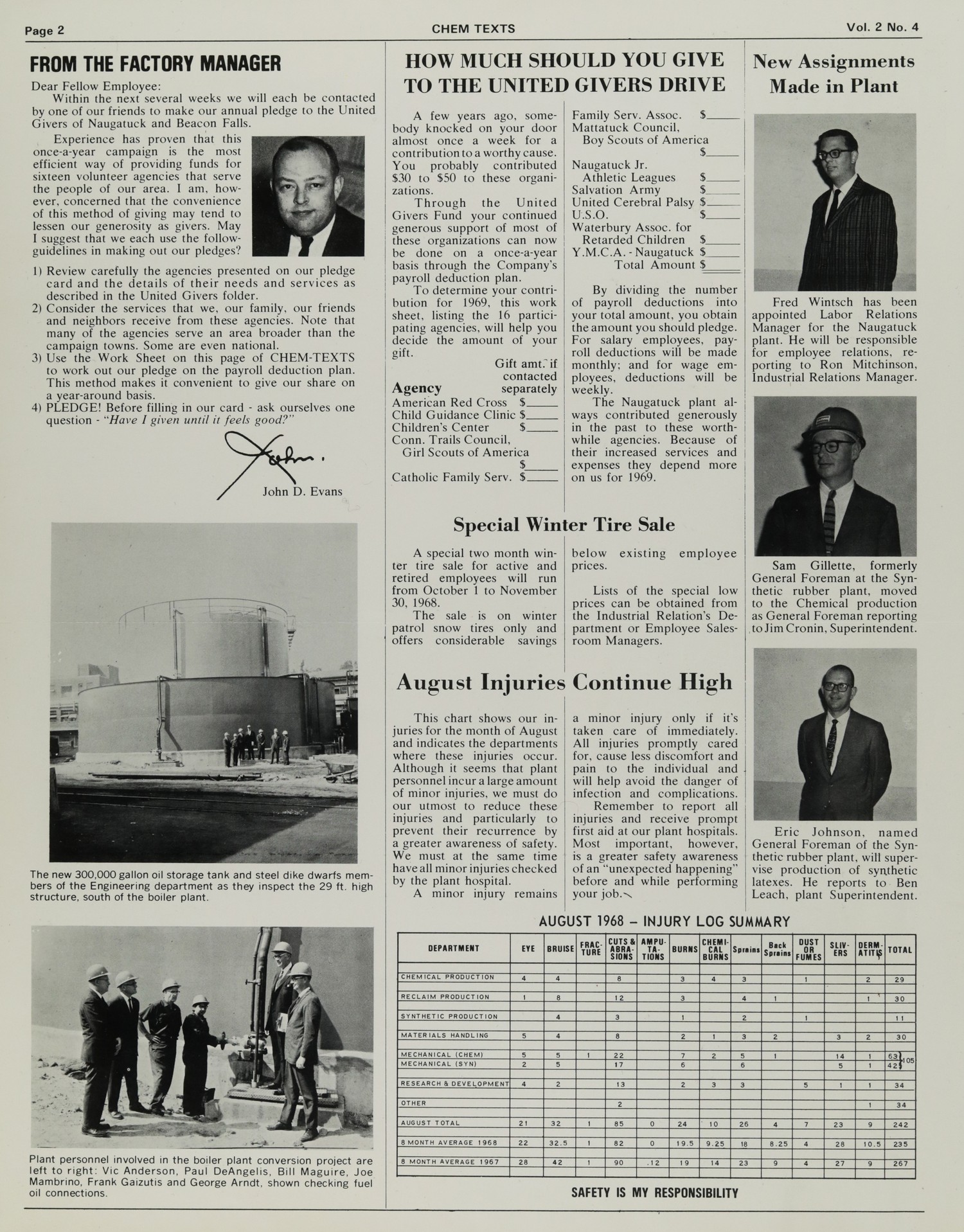
This chart shows our injuries for the month of August and indicates the departments where these injuries occur. Although it seems that plant personnel incur a large amount of minor injuries, we must do our utmost to reduce these injuries and particularly to prevent their recurrence by a greater awareness of safety. We must at the same time have all minor injuries checked by the plant hospital.

A minor injury remains a minor injury only if it’s taken care of immediately. All injuries promptly cared for, cause less discomfort and pain to the individual and will help avoid the danger of infection and complications.

Remember to report all injuries and receive prompt first aid at our plant hospitals. Most important, however, is a greater safety awareness of an “unexpected happening” before and while performing your job.


AUGUST 1968 – INJURY LOG SUMMARY

DEPARTMENT EYE BRUISE FRACTURE CUTS & ABRASIONS AMPUTATIONS BURNS CHEMICAL BURNS Sprains Back Sprains DUST OR FUMES SLIVERS DERMATITIS TOTAL
CHEMICAL PRODUCTION 4 4 8 3 4 3 1 2 29
RECLAIM PRODUCTION 1 8 12 3 4 1 1 30
SYNTHETIC PRODUCTION 4 3 1 2 1 11
MATERIALS HANDLING 5 4 8 2 1 3 2 3 2 30
MECHANICAL (CHEM) 5 5 1 22 7 2 5 1 14 1 63
MECHANICAL (SYN) 2 5 17 6 6 5 1 42
RESEARCH & DEVELOPMENT 4 2 13 2 3 3 5 1 1 34
OTHER 2 1 34
AUGUST TOTAL 21 32 1 85 0 24 10 26 4 7 23 9 242
8 MONTH AVERAGE 1968 22 32.5 1 82 0 19.5 9.25 18 8.25 4 28 10.5 235
8 MONTH AVERAGE 1967 28 42 1 90 12 19 14 23 9 4 27 9 267

SAFETY IS MY RESPONSIBILITY