CHEM-TEXTS – Vol. 3 No. 3 – Page 3

Page 003

CHEM-TEXTS

Vol. 3 No. 3 | Page 3


KNOW YOUR BENEFITS: by Marion Hutt

Uniroyal’s Paid Vacation Benefits Comparable To Best In Industry

The entire vacation policy for wage employees is too lengthy to reproduce here but the following are some of the most frequently asked questions:

Q. How much vacation am I entitled to receive?

A. Employees will receive vacations based on their seniority with the Company on Dec. 31 of the prior calendar year, as follows:

1 year. . . . . . . . . . . . . 2 weeks
5 years. . . . . . . . . . . . 3 weeks
15 years . . . . . . . . . . . 4 weeks
22 years . . . . . . . . . . . 5 weeks
30 years or more . . . . 6 weeks

Q. How much vacation pay do I receive?

A. Those entitled to a vacation of:
2 weeks . . . . . . 4% of earnings
3 weeks . . . . . . 6% of earnings

(continued on page 4)


UNIROYAL, INC. FIRST QUARTER SALES AND NET INCOME SET RECORD HIGH

Uniroyal, Inc., set new records in sales and net income for the first quarter of 1969, George R. Vila, chairman and president, reported at the annual meeting of stockholders.

Sales for the quarter were $368.8 million, an increase of 9.3 percent compared with $337.4 million for the same period last year and the highest for any first quarter in Uniroyal’s history.

Net income was $12.5 million, another record for a first quarter. This compares with $12.1 million during the first quarter of 1968.

First quarter earnings were equivalent to 44 cents a share of common stock compared with 43 cents a share last year.

The new record in earnings was achieved despite inflationary trends in the economy and high start-up expenses for an unusually large number of new plants coming on stream worldwide, Mr. Vila said.

During the next five years, Uniroyal has programmed capital expenditures of more than $600 million. During 1969, expenditures will be $150 million compared to more than $100 million in 1968. Heavier capital expenditures, Mr. Vila said, are necessary to keep pace with expanding economies around the world as well as to gain maximum benefits from new products from Uniroyal’s research and development laboratories.


Naugatuck Leader . . .

(continued from page 1)

competitive companies for the quality and service. Major competitors in the rubber chemical market are well known large chemical companies like Monsanto, du Pont, R.T. Vanderbilt and American Cyanamid.

Our rubber chemical business started more than fifty years ago as a producer of sulfuric acid for the brass industry in the Waterbury area. Today, Uniroyal Chemical supplies 25% of the total rubber chemicals used in the rubber and plastics industry. Practically every automobile tire manufactured, contains one of Uniroyal’s chemicals. In the past ten years, sales have doubled and, depending on the rubber and plastic industries’ growth, sales are expected to continue at this growth rate.

Interestingly, our rubber chemical technology was the base from which our present agricultural chemical business developed with the introduction of Spergon and Thiram seed protectants. Agricultural chemicals like MH-30,® Alar,® Aramite,® Omite,® Alanap® and Dyanap® have become an important part in the Division’s growth.

Today our list of rubber chemical customers include such companies as Goodyear, Firestone, General Tire, Armstrong Tire, Cooper Tire, Dunlop and many other large companies, all important to our rubber chemical business. With good quality products, properly marked, clean packages, and good customer service, they’ll continue to do business with us. Each of us in our own way, by doing our jobs in the best possible way, makes certain that we keep our valued customers.


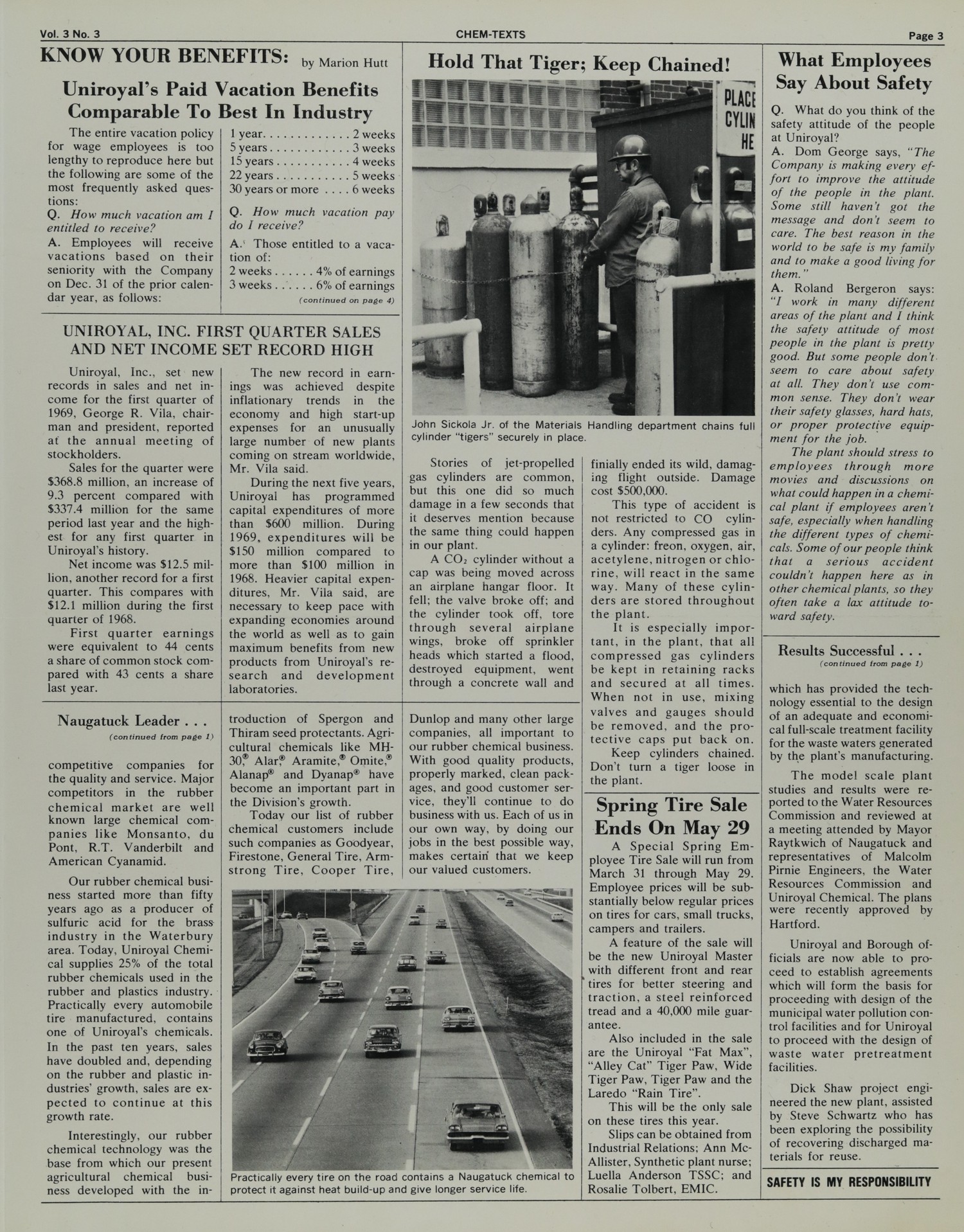
Hold That Tiger; Keep Chained!

PLACE CYLIN HE

[IMAGE: John Sickola Jr. of the Materials Handling department chains full cylinder “tigers” securely in place.]

Stories of jet-propelled gas cylinders are common, but this one did so much damage in a few seconds that it deserves mention because the same thing could happen in our plant.

A CO₂ cylinder without a cap was being moved across an airplane hangar floor. It fell; the valve broke off; and the cylinder took off, tore through several airplane wings, broke off sprinkler heads which started a flood, destroyed equipment, went through a concrete wall and finally ended its wild, damaging flight outside. Damage cost $500,000.

This type of accident is not restricted to CO cylinders. Any compressed gas in a cylinder: freon, oxygen, air, acetylene, nitrogen or chlorine, will react in the same way. Many of these cylinders are stored throughout the plant.

It is especially important, in the plant, that all compressed gas cylinders be kept in retaining racks and secured at all times. When not in use, mixing valves and gauges should be removed, and the protective caps put back on. Keep cylinders chained. Don’t turn a tiger loose in the plant.


Spring Tire Sale Ends On May 29

A Special Spring Employee Tire Sale will run from March 31 through May 29. Employee prices will be substantially below regular prices on tires for cars, small trucks, campers and trailers.

A feature of the sale will be the new Uniroyal Master with different front and rear tires for better steering and traction, a steel reinforced tread and a 40,000 mile guarantee.

Also included in the sale are the Uniroyal “Fat Max”, “Alley Cat” Tiger Paw, Wide Tiger Paw, Tiger Paw and the Laredo “Rain Tire”.

This will be the only sale on these tires this year.

Slips can be obtained from Industrial Relations: Ann McAllister, Synthetic plant nurse: Luella Anderson TSSC; and Rosalie Tolbert, EMIC.


[IMAGE: Practically every tire on the road contains a Naugatuck chemical to protect it against heat build-up and give longer service life.]


What Employees Say About Safety

Q. What do you think of the safety attitude of the people at Uniroyal?

A. Dom George says, “The Company is making every effort to improve the attitude of the people in the plant. Some still haven’t got the message and don’t seem to care. The best reason in the world to be safe is my family and to make a good living for them.”

A. Roland Bergeron says: “I work in many different areas of the plant and I think the safety attitude of most people in the plant is pretty good. But some people don’t seem to care about safety at all. They don’t use common sense. They don’t wear their safety glasses, hard hats, or proper protective equipment for the job.

The plant should stress to employees through more movies and discussions on what could happen in a chemical plant if employees aren’t safe, especially when handling the different types of chemicals. Some of our people think that a serious accident couldn’t happen here as in other chemical plants, so they often take a lax attitude toward safety.


Results Successful . . .

(continued from page 1)

which has provided the technology essential to the design of an adequate and economical full-scale treatment facility for the waste waters generated by the plant’s manufacturing.

The model scale plant studies and results were reported to the Water Resources Commission and reviewed at a meeting attended by Mayor Raytkwich of Naugatuck and representatives of Malcolm Pirnie Engineers, the Water Resources Commission and Uniroyal Chemical. The plans were recently approved by Hartford.

Uniroyal and Borough officials are now able to proceed to establish agreements which will form the basis for proceeding with design of the municipal water pollution control facilities and for Uniroyal to proceed with the design of waste water pretreatment facilities.

Dick Shaw project engineered the new plant, assisted by Steve Schwartz who has been exploring the possibility of recovering discharged materials for reuse.


SAFETY IS MY RESPONSIBILITY
CHEM-TEXTS – Vol. 2, No. 1 – Page 1

Page 001

UNIROYAL CHEM-TEXTS

Vol. 2 PUBLISHED FOR THE PEOPLE OF UNIROYAL CHEMICAL No. 3


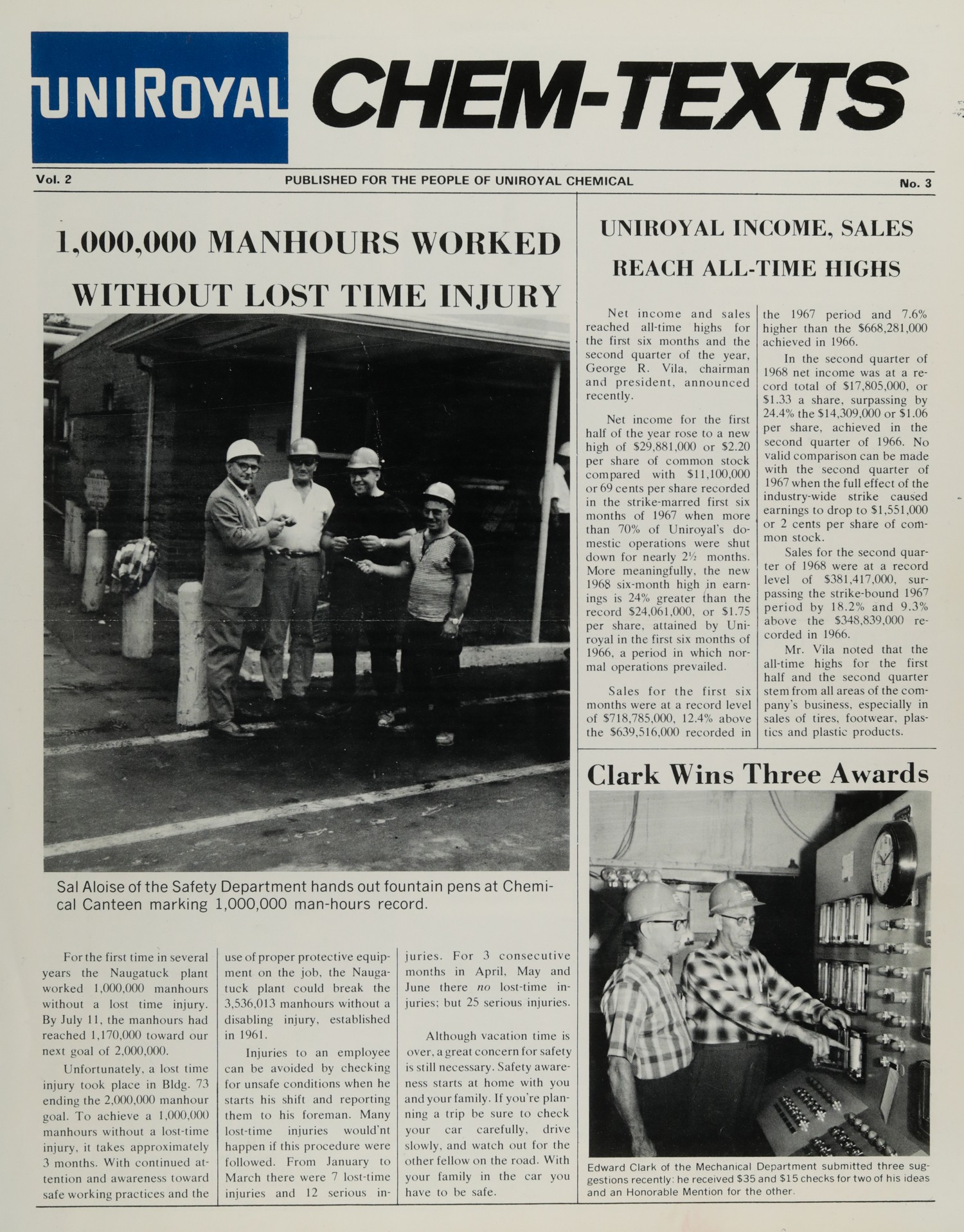
1,000,000 MANHOURS WORKED WITHOUT LOST TIME INJURY

[IMAGE: Black and white photograph showing workers at Chemical Canteen]

Sal Aloise of the Safety Department hands out fountain pens at Chemical Canteen marking 1,000,000 man-hours record.

For the first time in several years the Naugatuck plant worked 1,000,000 manhours without a lost time injury. By July 11, the manhours had reached 1,170,000 toward our next goal of 2,000,000.

Unfortunately, a lost time injury took place in Bldg. 73 ending the 2,000,000 manhour goal. To achieve a 1,000,000 manhours without a lost-time injury, it takes approximately 3 months. With continued attention and awareness toward safe working practices and the use of proper protective equipment on the job, the Naugatuck plant could break the 3,536,013 manhours without a disabling injury, established in 1961.

Injuries to an employee can be avoided by checking for unsafe conditions when he starts his shift and reporting them to his foreman. Many lost-time injuries would’nt happen if this procedure were followed. From January to March there were 7 lost-time injuries and 12 serious injuries. For 3 consecutive months in April, May and June there were no lost-time injuries; but 25 serious injuries.

Although vacation time is over, a great concern for safety is still necessary. Safety awareness starts at home with you and your family. If you’re planning a trip be sure to check your car carefully, drive slowly, and watch out for the other fellow on the road. With your family in the car you have to be safe.


UNIROYAL INCOME, SALES REACH ALL-TIME HIGHS

Net income and sales reached all-time highs for the first six months and the second quarter of the year, George R. Vila, chairman and president, announced recently.

Net income for the first half of the year rose to a new high of $29,881,000 or $2.20 per share of common stock compared with $11,100,000 or 69 cents per share recorded in the strike-marred first six months of 1967 when more than 70% of Uniroyal’s domestic operations were shut down for nearly 2½ months. More meaningfully, the new 1968 six-month high in earnings is 24% greater than the record $24,061,000, or $1.75 per share, attained by Uniroyal in the first six months of 1966, a period in which normal operations prevailed.

Sales for the first six months were at a record level of $718,785,000, 12.4% above the $639,516,000 recorded in the 1967 period and 7.6% higher than the $668,281,000 achieved in 1966.

In the second quarter of 1968 net income was at a record total of $17,805,000, or $1.33 a share, surpassing by 24.4% the $14,309,000 or $1.06 per share, achieved in the second quarter of 1966. No valid comparison can be made with the second quarter of 1967 when the full effect of the industry-wide strike caused earnings to drop to $1,551,000 or 2 cents per share of common stock.

Sales for the second quarter of 1968 were at a record level of $381,417,000, surpassing the strike-bound 1967 period by 18.2% and 9.3% above the $348,839,000 recorded in 1966.

Mr. Vila noted that the all-time highs for the first half and the second quarter stem from all areas of the company’s business, especially in sales of tires, footwear, plastics and plastic products.


Clark Wins Three Awards

[IMAGE: Black and white photograph showing Edward Clark at mechanical equipment]

Edward Clark of the Mechanical Department submitted three suggestions recently: he received $35 and $15 checks for two of his ideas and an Honorable Mention for the other.

CHEM-TEXTS – Vol. 2 No. 2 – Page 2

Page 002

Page 2 CHEM TEXTS Vol. 2 No. 2

FROM THE FACTORY MANAGER

Dear Fellow Employees:

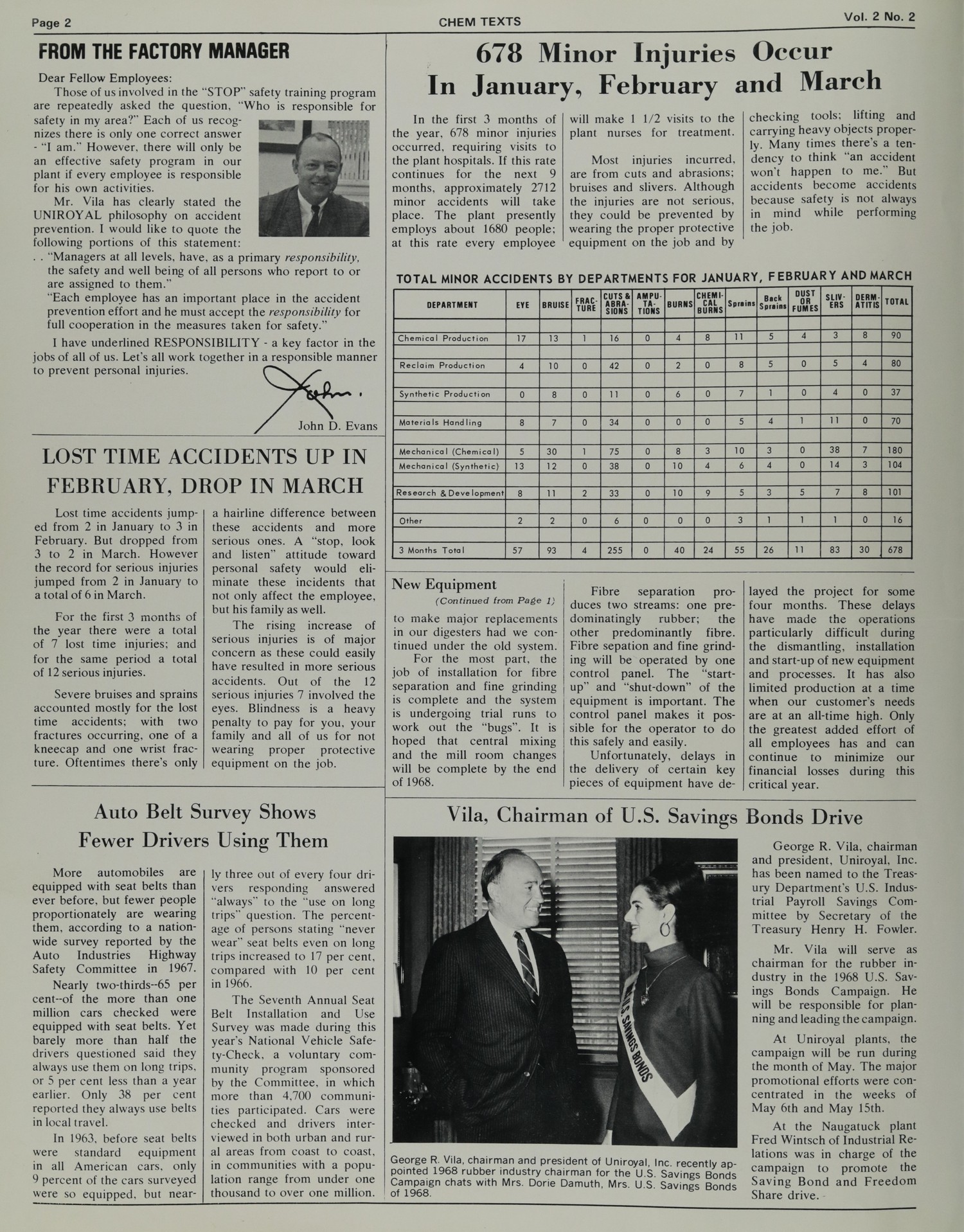
Those of us involved in the “STOP” safety training program are repeatedly asked the question, “Who is responsible for safety in my area?” Each of us recognizes there is only one correct answer – “I am.” However, there will only be an effective safety program in our plant if every employee is responsible for his own activities.

Mr. Vila has clearly stated the UNIROYAL philosophy on accident prevention. I would like to quote the following portions of this statement:

. . “Managers at all levels, have, as a primary responsibility, the safety and well being of all persons who report to or are assigned to them.”

“Each employee has an important place in the accident prevention effort and he must accept the responsibility for full cooperation in the measures taken for safety.”

I have underlined RESPONSIBILITY – a key factor in the jobs of all of us. Let’s all work together in a responsible manner to prevent personal injuries.

[Signature]

John D. Evans


LOST TIME ACCIDENTS UP IN FEBRUARY, DROP IN MARCH

Lost time accidents jumped from 2 in January to 3 in February. But dropped from 3 to 2 in March. However the record for serious injuries jumped from 2 in January to a total of 6 in March.

For the first 3 months of the year there were a total of 7 lost time injuries; and for the same period a total of 12 serious injuries.

Severe bruises and sprains accounted mostly for the lost time accidents; with two fractures occurring, one of a kneecap and one wrist fracture. Oftentimes there’s only a hairline difference between these accidents and more serious ones. A “stop, look and listen” attitude toward personal safety would eliminate these incidents that not only affect the employee, but his family as well.

The rising increase of serious injuries is of major concern as these could easily have resulted in more serious accidents. Out of the 12 serious injuries 7 involved the eyes. Blindness is a heavy penalty to pay for you, your family and all of us for not wearing proper protective equipment on the job.


678 Minor Injuries Occur In January, February and March

In the first 3 months of the year, 678 minor injuries occurred, requiring visits to the plant hospitals. If this rate continues for the next 9 months, approximately 2712 minor accidents will take place. The plant presently employs about 1680 people; at this rate every employee will make 1 1/2 visits to the plant nurses for treatment.

Most injuries incurred, are from cuts and abrasions; bruises and slivers. Although the injuries are not serious, they could be prevented by wearing the proper protective equipment on the job and by checking tools; lifting and carrying heavy objects properly. Many times there’s a tendency to think “an accident won’t happen to me.” But accidents become accidents because safety is not always in mind while performing the job.

TOTAL MINOR ACCIDENTS BY DEPARTMENTS FOR JANUARY, FEBRUARY AND MARCH

DEPARTMENT EYE BRUISE FRAC-TURE CUTS & ABRA-SIONS AMPU-TA-TIONS BURNS CHEMI-CAL BURNS Sprains Back Sprains DUST OR FUMES SLIV-ERS DERM-ATITIS TOTAL
Chemical Production 17 13 1 16 0 4 8 11 5 4 3 8 90
Reclaim Production 4 10 0 42 0 2 0 8 5 0 5 4 80
Synthetic Production 0 8 0 11 0 6 0 7 1 0 4 0 37
Materials Handling 8 7 0 34 0 0 0 5 4 1 11 0 70
Mechanical (Chemical) 5 30 1 75 0 8 3 10 3 0 38 7 180
Mechanical (Synthetic) 13 12 0 38 0 10 4 6 4 0 14 3 104
Research & Development 8 11 2 33 0 10 9 5 3 5 7 8 101
Other 2 2 0 6 0 0 0 3 1 1 1 0 16
3 Months Total 57 93 4 255 0 40 24 55 26 11 83 30 678

New Equipment

(Continued from Page 1)

to make major replacements in our digesters had we continued under the old system.

For the most part, the job of installation for fibre separation and fine grinding is complete and the system is undergoing trial runs to work out the “bugs”. It is hoped that central mixing and the mill room changes will be complete by the end of 1968.

Fibre separation produces two streams: one predominatingly rubber; the other predominantly fibre. Fibre sepation and fine grinding will be operated by one control panel. The “start-up” and “shut-down” of the equipment is important. The control panel makes it possible for the operator to do this safely and easily.

Unfortunately, delays in the delivery of certain key pieces of equipment have delayed the project for some four months. These delays have made the operations particularly difficult during the dismantling, installation and start-up of new equipment and processes. It has also limited production at a time when our customer’s needs are at an all-time high. Only the greatest added effort of all employees has and can continue to minimize our financial losses during this critical year.


Auto Belt Survey Shows Fewer Drivers Using Them

More automobiles are equipped with seat belts than ever before, but fewer people proportionately are wearing them, according to a nationwide survey reported by the Auto Industries Highway Safety Committee in 1967.

Nearly two-thirds–65 per cent–of the more than one million cars checked were equipped with seat belts. Yet barely more than half the drivers questioned said they always use them on long trips, or 5 per cent less than a year earlier. Only 38 per cent reported they always use belts in local travel.

In 1963, before seat belts were standard equipment in all American cars, only 9 percent of the cars surveyed were so equipped, but nearly three out of every four drivers responding answered “always” to the “use on long trips” question. The percentage of persons stating “never wear” seat belts even on long trips increased to 17 per cent, compared with 10 per cent in 1966.

The Seventh Annual Seat Belt Installation and Use Survey was made during this year’s National Vehicle Safety-Check, a voluntary community program sponsored by the Committee, in which more than 4,700 communities participated. Cars were checked and drivers interviewed in both urban and rural areas from coast to coast, in communities with a population range from under one thousand to over one million.


Vila, Chairman of U.S. Savings Bonds Drive

[PHOTO: George R. Vila, chairman and president of Uniroyal, Inc. recently appointed 1968 rubber industry chairman for the U.S. Savings Bonds Campaign chats with Mrs. Dorie Damuth, Mrs. U.S. Savings Bonds of 1968.]

George R. Vila, chairman and president, Uniroyal, Inc. has been named to the Treasury Department’s U.S. Industrial Payroll Savings Committee by Secretary of the Treasury Henry H. Fowler.

Mr. Vila will serve as chairman for the rubber industry in the 1968 U.S. Savings Bonds Campaign. He will be responsible for planning and leading the campaign.

At Uniroyal plants, the campaign will be run during the month of May. The major promotional efforts were concentrated in the weeks of May 6th and May 15th.

At the Naugatuck plant Fred Wintsch of Industrial Relations was in charge of the campaign to promote the Saving Bond and Freedom Share drive.

CHEM-TEXTS – Vol. 2 No. 3 – Page 3

Page 003

CHEM-TEXTS

Page 3 | Vol. 2 No. 3


HOUSEKEEPING IMPRESSES G. VILA ON PLANT VISIT

In 1936 George R. Vila joined Uniroyal Chemical, worked in the labs for a short time and became a salesman for rubber chemicals. 32 years later he returned to the Naugatuck plant where he started his career, as chairman, president, and chief executive officer of Uniroyal, Inc. for a full day visit of the plant facilities.

After a quick tour of the EMIC and TSSC buildings, Mr. Vila led F. Hopkins, G. Anderson, J. Evans, J. Cronin, B. Leach, H. Scullin and R. Van Allen on a “jogging” trip through the plant that ended late in the day.

The housekeeping, cleanliness of the plant and the buildings impressed Mr. Vila considerably. Since his last visit to the plant, he “was startled at some of the changes that have taken place — new machinery, new methods, and new products.”

As he stated in Uniroyal World, “I was also impressed by the fact that many things have’nt changed, particularly those concerning the human beings who do the work in our factories . . . Whether executive, manager, salesman, scientist or production worker, we are striving for the same things, sharing the same difficulties, and enjoying the same advantages”.

With housekeeping in tip top shape through the efforts of the Materials Dept. and every employee, the challenge is to keep it this way . . . even improve it. Everyone prefers to work in a clean plant; they not only enjoy the better working conditions, but safety is improved and injuries avoided.


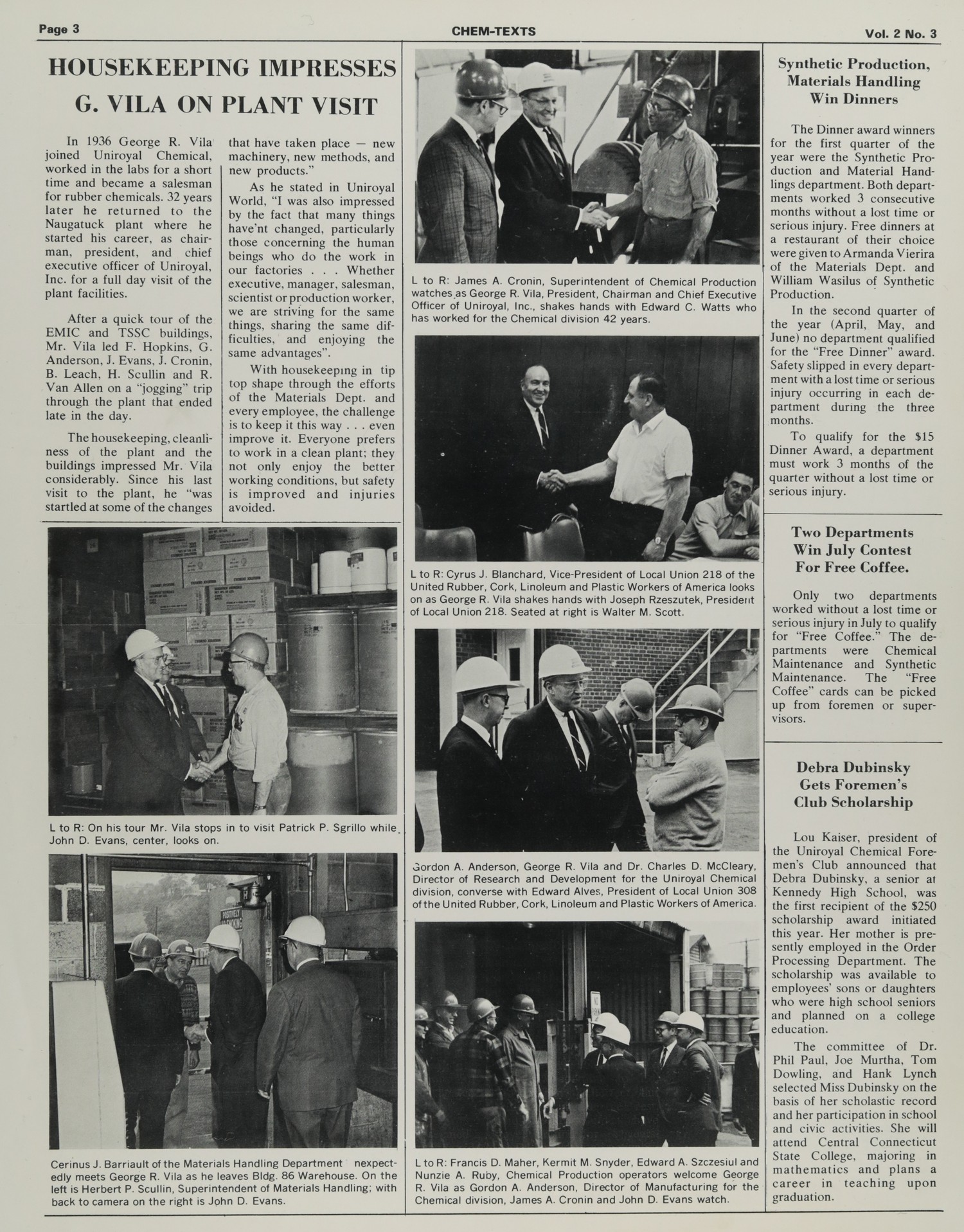
L to R: James A. Cronin, Superintendent of Chemical Production watches as George R. Vila, President, Chairman and Chief Executive Officer of Uniroyal, Inc., shakes hands with Edward C. Watts who has worked for the Chemical division 42 years.


L to R: On his tour Mr. Vila stops in to visit Patrick P. Sgrillo while John D. Evans, center, looks on.


Cerinus J. Barriault of the Materials Handling Department unexpectedly meets George R. Vila as he leaves Bldg. 86 Warehouse. On the left is Herbert P. Scullin, Superintendent of Materials Handling; with back to camera on the right is John D. Evans.


L to R: Cyrus J. Blanchard, Vice-President of Local Union 218 of the United Rubber, Cork, Linoleum and Plastic Workers of America looks on as George R. Vila shakes hands with Joseph Rzeszutek, President of Local Union 218. Seated at right is Walter M. Scott.


Gordon A. Anderson, George R. Vila and Dr. Charles D. McCleary, Director of Research and Development for the Uniroyal Chemical division, converse with Edward Alves, President of Local Union 308 of the United Rubber, Cork, Linoleum and Plastic Workers of America.


L to R: Francis D. Maher, Kermit M. Snyder, Edward A. Szczesiul and Nunzie A. Ruby, Chemical Production operators welcome George R. Vila as Gordon A. Anderson, Director of Manufacturing for the Chemical division, James A. Cronin and John D. Evans watch.


Synthetic Production, Materials Handling Win Dinners

The Dinner award winners for the first quarter of the year were the Synthetic Production and Material Handlings department. Both departments worked 3 consecutive months without a lost time or serious injury. Free dinners at a restaurant of their choice were given to Armanda Vierira of the Materials Dept. and William Wasilus of Synthetic Production.

In the second quarter of the year (April, May, and June) no department qualified for the “Free Dinner” award. Safety slipped in every department with a lost time or serious injury occurring in each department during the three months.

To qualify for the $15 Dinner Award, a department must work 3 months of the quarter without a lost time or serious injury.


Two Departments Win July Contest For Free Coffee.

Only two departments worked without a lost time or serious injury in July to qualify for “Free Coffee.” The departments were Chemical Maintenance and Synthetic Maintenance. The “Free Coffee” cards can be picked up from foremen or supervisors.


Debra Dubinsky Gets Foremen’s Club Scholarship

Lou Kaiser, president of the Uniroyal Chemical Foremen’s Club announced that Debra Dubinsky, a senior at Kennedy High School, was the first recipient of the $250 scholarship award initiated this year. Her mother is presently employed in the Order Processing Department. The scholarship was available to employees’ sons or daughters who were high school seniors and planned on a college education.

The committee of Dr. Phil Paul, Joe Murtha, Tom Dowling, and Hank Lynch selected Miss Dubinsky on the basis of her scholastic record and her participation in school and civic activities. She will attend Central Connecticut State College, majoring in mathematics and plans a career in teaching upon graduation.

CHEM-TEXTS – Vol. 2 No. 5 – Page 2

Page 002

Page 2 CHEM TEXTS Vol. 2 No. 5


FROM THE FACTORY MANAGER

Dear Fellow Employee:

Technological advances, especially those over the past twenty to thirty years, have rapidly outpaced our ability to understand each other. While new communication devices, such as television and the computer have expanded our ability to send messages faster, little has been done to make sure that these messages are received, for a message is communicated only when it is understood and the intended purpose of the message is accomplished. Man’s inability to complete this communication cycle is largely responsible for the many problems that face society today.

The recent company-wide survey conducted by Opinion Research, in which many of our people took part, has confirmed that we in UNIROYAL are no different in this respect. To accomplish our purposes of growth and job security for all we must — send, receive and thereby reach understanding of our common objectives. While our efforts may be aided by CHEM-TEXTS, letters and other tools, success can only be achieved if we each, as individuals, regardless of our jobs, learn to talk to each other. We must-always remember that communication is a three-way street — UP, DOWN and SIDE-WAYS. While we each may momentarily have different points of view, fair interchange of these points of view will always clarify the larger purpose.

Sincerely,

John D. Evans


Moniz’s Hard Hat Prevents Injury

[IMAGE: Photo of Joe Moniz showing hard hat to Sal Aloise]

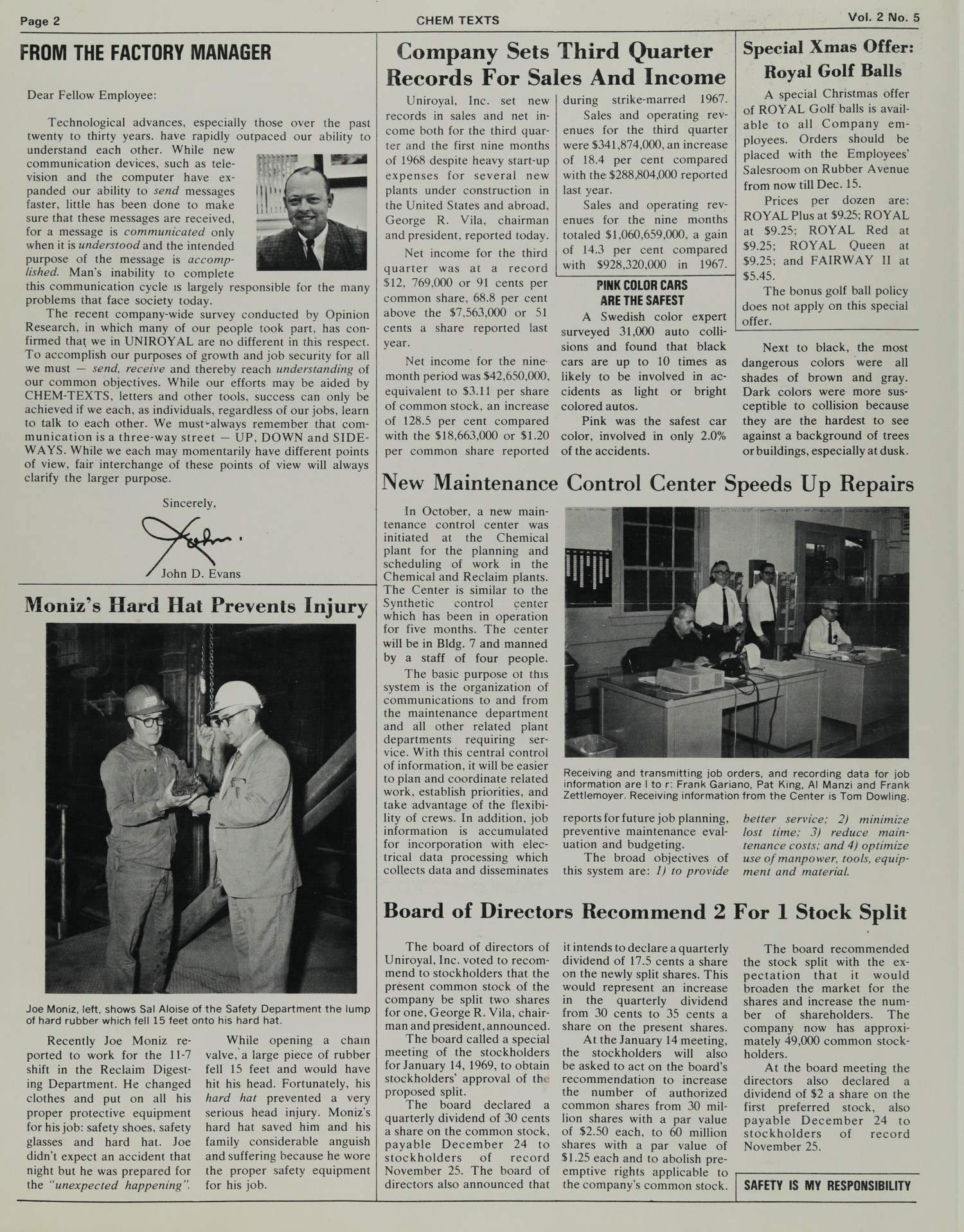
Joe Moniz, left, shows Sal Aloise of the Safety Department the lump of hard rubber which fell 15 feet onto his hard hat.

Recently Joe Moniz reported to work for the 11-7 shift in the Reclaim Digesting Department. He changed clothes and put on all his proper protective equipment for his job: safety shoes, safety glasses and hard hat. Joe didn’t expect an accident that night but he was prepared for the “unexpected happening”.

While opening a chain valve, a large piece of rubber fell 15 feet and would have hit his head. Fortunately, his hard hat prevented a very serious head injury. Moniz’s hard hat saved him and his family considerable anguish and suffering because he wore the proper safety equipment for his job.


Company Sets Third Quarter Records For Sales And Income

Uniroyal, Inc. set new records in sales and net income both for the third quarter and the first nine months of 1968 despite heavy start-up expenses for several new plants under construction in the United States and abroad, George R. Vila, chairman and president, reported today.

Net income for the third quarter was at a record $12, 769,000 or 91 cents per common share, 68.8 per cent above the $7,563,000 or 51 cents a share reported last year.

Net income for the nine-month period was $42,650,000, equivalent to $3.11 per share of common stock, an increase of 128.5 per cent compared with the $18,663,000 or $1.20 per common share reported during strike-marred 1967.

Sales and operating revenues for the third quarter were $341,874,000, an increase of 18.4 per cent compared with the $288,804,000 reported last year.

Sales and operating revenues for the nine months totaled $1,060,659,000, a gain of 14.3 per cent compared with $928,320,000 in 1967.


PINK COLOR CARS ARE THE SAFEST

A Swedish color expert surveyed 31,000 auto collisions and found that black cars are up to 10 times as likely to be involved in accidents as light or bright colored autos.

Pink was the safest car color, involved in only 2.0% of the accidents.


Special Xmas Offer: Royal Golf Balls

A special Christmas offer of ROYAL Golf balls is available to all Company employees. Orders should be placed with the Employees’ Salesroom on Rubber Avenue from now till Dec. 15.

Prices per dozen are: ROYAL Plus at $9.25; ROYAL at $9.25; ROYAL Red at $9.25; ROYAL Queen at $9.25; and FAIRWAY II at $5.45.

The bonus golf ball policy does not apply on this special offer.

Next to black, the most dangerous colors were all shades of brown and gray. Dark colors were more susceptible to collision because they are the hardest to see against a background of trees or buildings, especially at dusk.


New Maintenance Control Center Speeds Up Repairs

In October, a new maintenance control center was initiated at the Chemical plant for the planning and scheduling of work in the Chemical and Reclaim plants. The Center is similar to the Synthetic control center which has been in operation for five months. The center will be in Bldg. 7 and manned by a staff of four people.

The basic purpose of this system is the organization of communications to and from the maintenance department and all other related plant departments requiring service. With this central control of information, it will be easier to plan and coordinate related work, establish priorities, and take advantage of the flexibility of crews. In addition, job information is accumulated for incorporation with electrical data processing which collects data and disseminates

[IMAGE: Photo of four men at control center]

Receiving and transmitting job orders, and recording data for job information are l to r: Frank Gariano, Pat King, Al Manzi and Frank Zettlemoyer. Receiving information from the Center is Tom Dowling.

reports for future job planning, preventive maintenance evaluation and budgeting.

The broad objectives of this system are: 1) to provide

better service; 2) minimize lost time; 3) reduce maintenance costs; and 4) optimize use of manpower, tools, equipment and material.


Board of Directors Recommend 2 For 1 Stock Split

The board of directors of Uniroyal, Inc. voted to recommend to stockholders that the present common stock of the company be split two shares for one, George R. Vila, chairman and president, announced.

The board called a special meeting of the stockholders for January 14, 1969, to obtain stockholders’ approval of the proposed split.

The board declared a quarterly dividend of 30 cents a share on the common stock, payable December 24 to stockholders of record November 25. The board of directors also announced that

it intends to declare a quarterly dividend of 17.5 cents a share on the newly split shares. This would represent an increase in the quarterly dividend from 30 cents to 35 cents a share on the present shares.

At the January 14 meeting, the stockholders will also be asked to act on the board’s recommendation to increase the number of authorized common shares from 30 million shares with a par value of $2.50 each, to 60 million shares with a par value of $1.25 each and to abolish preemptive rights applicable to the company’s common stock.

The board recommended the stock split with the expectation that it would broaden the market for the shares and increase the number of shareholders. The company now has approximately 49,000 common stockholders.

At the board meeting the directors also declared a dividend of $2 a share on the first preferred stock, also payable December 24 to stockholders of record November 25.


SAFETY IS MY RESPONSIBILITY
UniRoyal Net Profits Down 2.1 Per Cent

UniRoyal Net Profits Down 2.1 Per Cent

4-20-67 [handwritten]

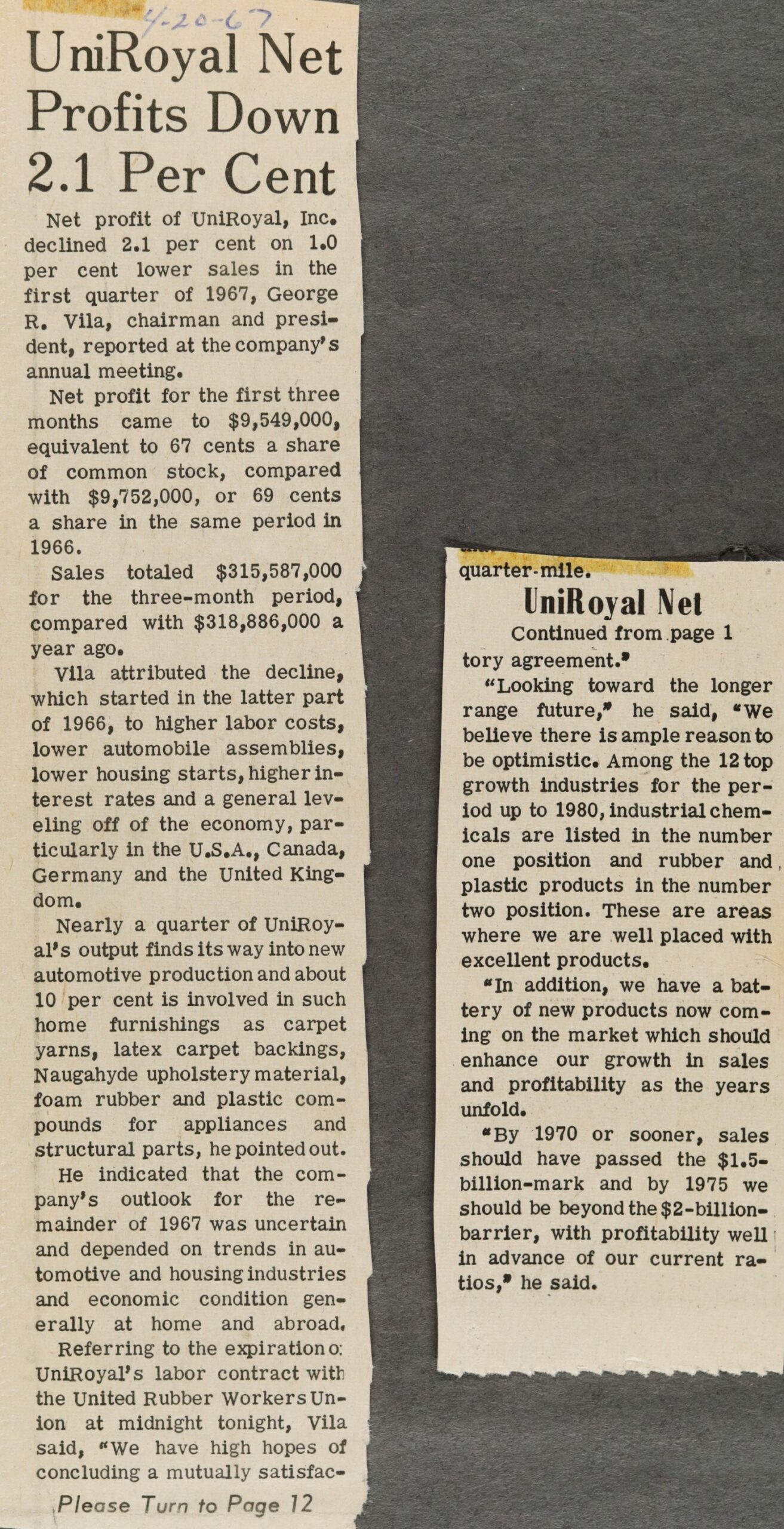
Net profit of UniRoyal, Inc. declined 2.1 per cent on 1.0 per cent lower sales in the first quarter of 1967, George R. Vila, chairman and president, reported at the company’s annual meeting.

Net profit for the first three months came to $9,549,000, equivalent to 67 cents a share of common stock, compared with $9,752,000, or 69 cents a share in the same period in 1966.

Sales totaled $315,587,000 for the three-month period, compared with $318,886,000 a year ago.

Vila attributed the decline, which started in the latter part of 1966, to higher labor costs, lower automobile assemblies, lower housing starts, higher interest rates and a general leveling off of the economy, particularly in the U.S.A., Canada, Germany and the United Kingdom.

Nearly a quarter of UniRoyal’s output finds its way into new automotive production and about 10 per cent is involved in such home furnishings as carpet yarns, latex carpet backings, Naugahyde upholstery material, foam rubber and plastic compounds for appliances and structural parts, he pointed out.

He indicated that the company’s outlook for the remainder of 1967 was uncertain and depended on trends in automotive and housing industries and economic condition generally at home and abroad.

Referring to the expiration of UniRoyal’s labor contract with the United Rubber Workers Union at midnight tonight, Vila said, “We have high hopes of concluding a mutually satisfac-

Please Turn to Page 12


quarter-mile.

UniRoyal Net

Continued from page 1

tory agreement.”

“Looking toward the longer range future,” he said, “We believe there is ample reason to be optimistic. Among the 12 top growth industries for the period up to 1980, industrial chemicals are listed in the number one position and rubber and plastic products in the number two position. These are areas where we are well placed with excellent products.

“In addition, we have a battery of new products now coming on the market which should enhance our growth in sales and profitability as the years unfold.

“By 1970 or sooner, sales should have passed the $1.5-billion-mark and by 1975 we should be beyond the $2-billion-barrier, with profitability well in advance of our current ratios,” he said.

CHEM-TEXTS – Vol. 1, No. 1 – Page 1

Page 001

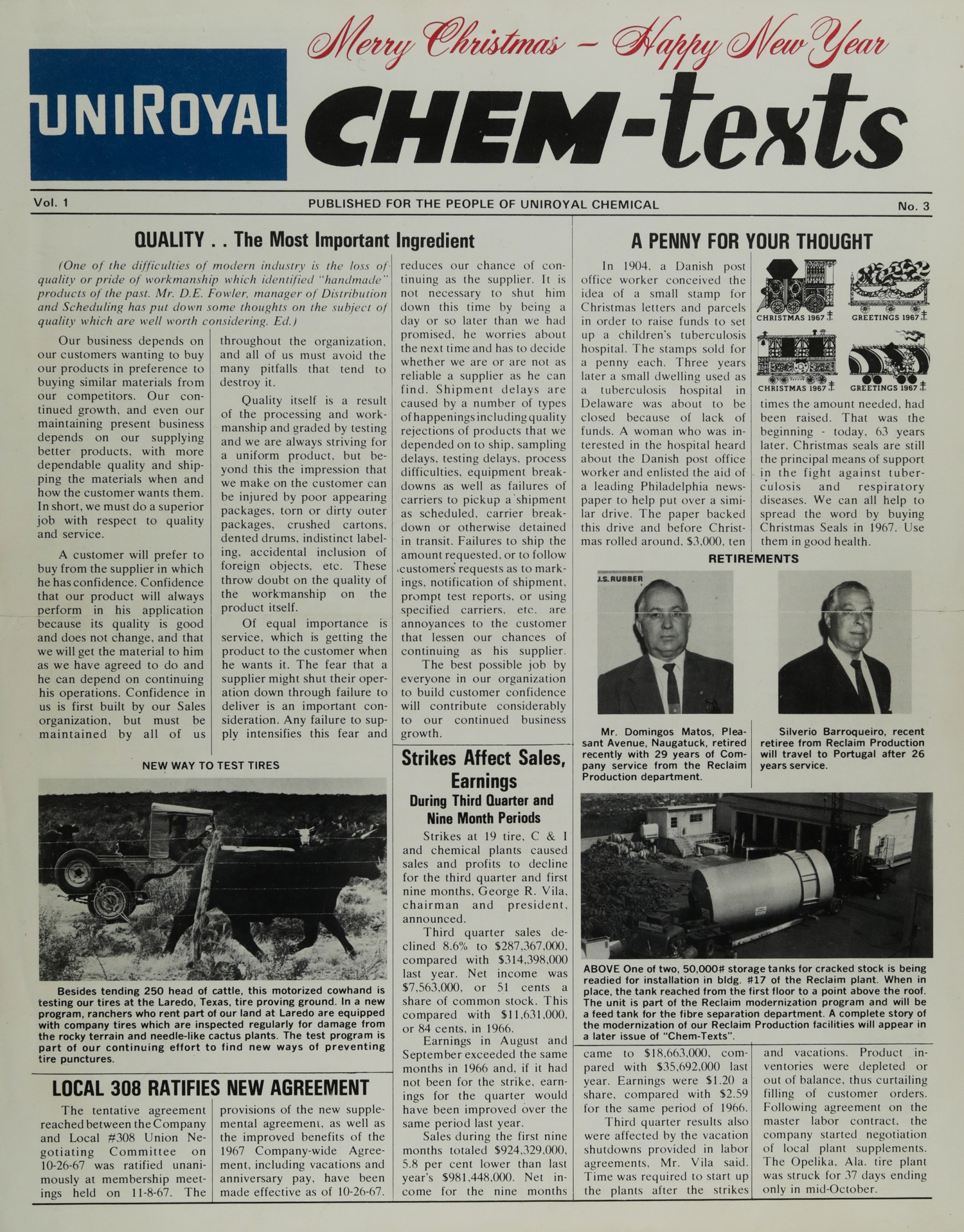
Merry Christmas – Happy New Year

UNIROYAL CHEM-texts

Vol. 1 PUBLISHED FOR THE PEOPLE OF UNIROYAL CHEMICAL No. 3


QUALITY . . The Most Important Ingredient

(One of the difficulties of modern industry is the loss of quality or pride of workmanship which identified “handmade” products of the past. Mr. D.E. Fowler, manager of Distribution and Scheduling has put down some thoughts on the subject of quality which are well worth considering. Ed.)

Our business depends on our customers wanting to buy our products in preference to buying similar materials from our competitors. Our continued growth, and even our maintaining present business depends on our supplying better products, with more dependable quality and shipping the materials when and how the customer wants them. In short, we must do a superior job with respect to quality and service.

A customer will prefer to buy from the supplier in which he has confidence. Confidence that our product will always perform in his application because its quality is good and does not change, and that we will get the material to him as we have agreed to do and he can depend on continuing his operations. Confidence in us is first built by our Sales organization, but must be maintained by all of us

throughout the organization, and all of us must avoid the many pitfalls that tend to destroy it.

Quality itself is a result of the processing and workmanship and graded by testing and we are always striving for a uniform product, but beyond this the impression that we make on the customer can be injured by poor appearing packages, torn or dirty outer packages, crushed cartons, dented drums, indistinct labeling, accidental inclusion of foreign objects, etc. These throw doubt on the quality of the workmanship on the product itself.

Of equal importance is service, which is getting the product to the customer when he wants it. The fear that a supplier might shut their operation down through failure to deliver is an important consideration. Any failure to supply intensifies this fear and

reduces our chance of continuing as the supplier. It is not necessary to shut him down this time by being a day or so later than we had promised, he worries about the next time and has to decide whether we are or are not as reliable a supplier as he can find. Shipment delays are caused by a number of types of happenings including quality rejections of products that we depended on to ship, sampling delays, testing delays, process difficulties, equipment breakdowns as well as failures of carriers to pickup a shipment as scheduled, carrier breakdown or otherwise detained in transit. Failures to ship the amount requested, or to follow customers requests as to markings, notification of shipment, prompt test reports, or using specified carriers, etc. are annoyances to the customer that lessen our chances of continuing as his supplier.

The best possible job by everyone in our organization to build customer confidence will contribute considerably to our continued business growth.


NEW WAY TO TEST TIRES

[IMAGE: Motorized vehicle with cattle in field]

Besides tending 250 head of cattle, this motorized cowhand is testing our tires at the Laredo, Texas, tire proving ground. In a new program, ranchers who rent part of our land at Laredo are equipped with company tires which are inspected regularly for damage from the rocky terrain and needle-like cactus plants. The test program is part of our continuing effort to find new ways of preventing tire punctures.


LOCAL 308 RATIFIES NEW AGREEMENT

The tentative agreement reached between the Company and Local #308 Union Negotiating Committee on 10-26-67 was ratified unanimously at membership meetings held on 11-8-67. The

provisions of the new supplemental agreement, as well as the improved benefits of the 1967 Company-wide Agreement, including vacations and anniversary pay, have been made effective as of 10-26-67.


Strikes Affect Sales, Earnings During Third Quarter and Nine Month Periods

Strikes at 19 tire, C & I and chemical plants caused sales and profits to decline for the third quarter and first nine months, George R. Vila, chairman and president, announced.

Third quarter sales declined 8.6% to $287,367,000, compared with $314,398,000 last year. Net income was $7,563,000, or 51 cents a share of common stock. This compared with $11,631,000, or 84 cents, in 1966.

Earnings in August and September exceeded the same months in 1966 and, if it had not been for the strike, earnings for the quarter would have been improved over the same period last year.

Sales during the first nine months totaled $924,329,000, 5.8 per cent lower than last year’s $981,448,000. Net income for the nine months

came to $18,663,000, compared with $35,692,000 last year. Earnings were $1.20 a share, compared with $2.59 for the same period of 1966.

Third quarter results also were affected by the vacation shutdowns provided in labor agreements, Mr. Vila said. Time was required to start up the plants after the strikes

and vacations. Product inventories were depleted or out of balance, thus curtailing filling of customer orders. Following agreement on the master labor contract, the company started negotiation of local plant supplements. The Opelika, Ala. tire plant was struck for 37 days ending only in mid-October.


A PENNY FOR YOUR THOUGHT

In 1904, a Danish post office worker conceived the idea of a small stamp for Christmas letters and parcels in order to raise funds to set up a children’s tuberculosis hospital. The stamps sold for a penny each. Three years later a small dwelling used as a tuberculosis hospital in Delaware was about to be closed because of lack of funds. A woman who was interested in the hospital heard about the Danish post office worker and enlisted the aid of a leading Philadelphia newspaper to help put over a similar drive. The paper backed this drive and before Christmas rolled around, $3,000, ten

times the amount needed, had been raised. That was the beginning – today, 63 years later, Christmas seals are still the principal means of support in the fight against tuberculosis and respiratory diseases. We can all help to spread the word by buying Christmas Seals in 1967. Use them in good health.

[IMAGES: Christmas 1967 seals and Greetings 1967 stamps shown]


RETIREMENTS

U.S. RUBBER

[IMAGE: Photo of Mr. Domingos Matos]

Mr. Domingos Matos, Pleasant Avenue, Naugatuck, retired recently with 29 years of Company service from the Reclaim Production department.

[IMAGE: Photo of Silverio Barroqueiro]

Silverio Barroqueiro, recent retiree from Reclaim Production will travel to Portugal after 26 years service.


[IMAGE: Large industrial storage tank being lifted]

ABOVE: One of two, 50,000# storage tanks for cracked stock is being readied for installation in bldg. #17 of the Reclaim plant. When in place, the tank reached from the first floor to a point above the roof. The unit is part of the Reclaim modernization program and will be a feed tank for the fibre separation department. A complete story of the modernization of our Reclaim Production facilities will appear in a later issue of “Chem-Texts”.

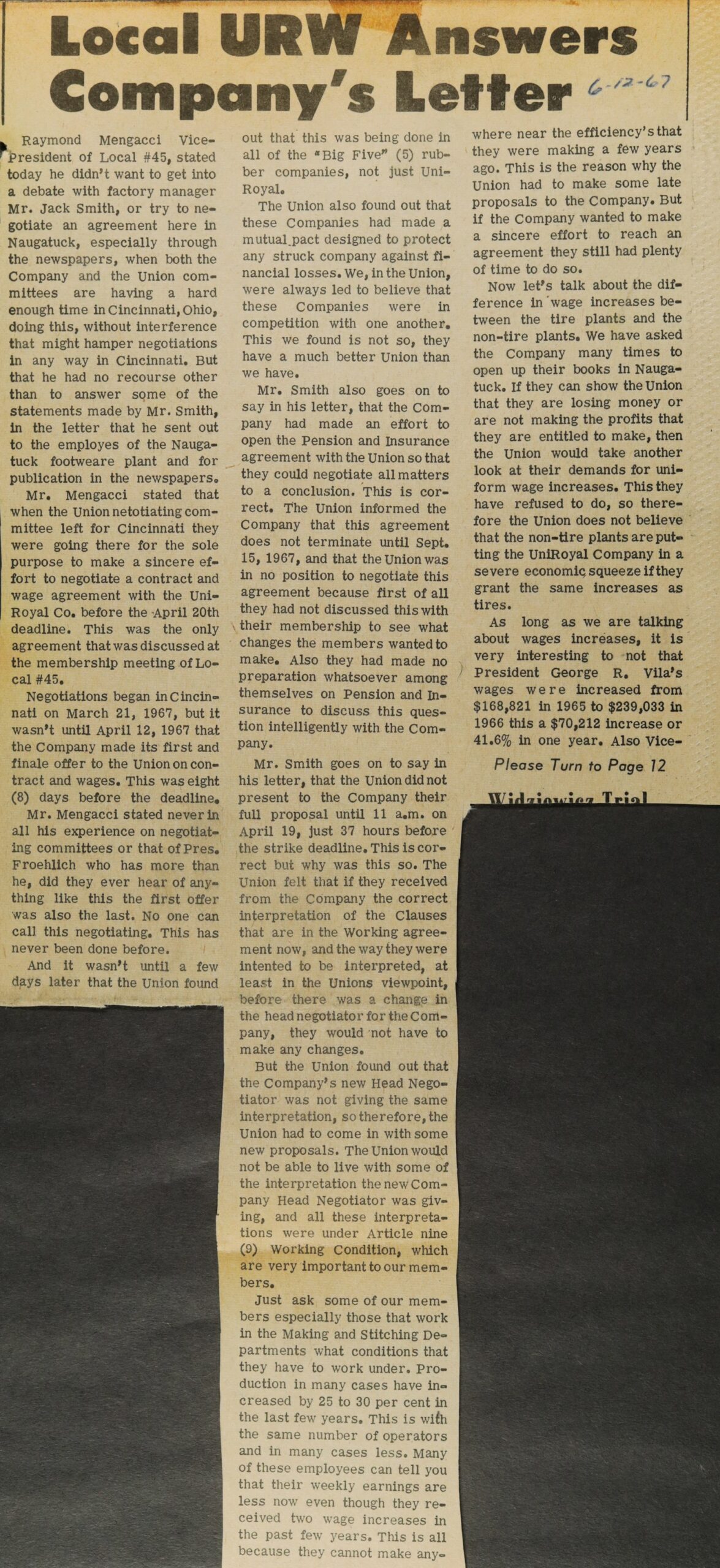
Local URW Answers Company’s Letter

Local URW Answers Company’s Letter

6-12-67

Raymond Mengacci Vice-President of Local #45, stated today he didn’t want to get into a debate with factory manager Mr. Jack Smith, or try to negotiate an agreement here in Naugatuck, especially through the newspapers, when both the Company and the Union committees are having a hard enough time in Cincinnati, Ohio, doing this, without interference that might hamper negotiations in any way in Cincinnati. But that he had no recourse other than to answer some of the statements made by Mr. Smith, in the letter that he sent out to the employes of the Naugatuck footwear plant and for publication in the newspapers.

Mr. Mengacci stated that when the Union netotiating committee left for Cincinnati they were going there for the sole purpose to make a sincere effort to negotiate a contract and wage agreement with the Uni-Royal Co. before the April 20th deadline. This was the only agreement that was discussed at the membership meeting of Local #45.

Negotiations began in Cincinnati on March 21, 1967, but it wasn’t until April 12, 1967 that the Company made its first and finale offer to the Union on contract and wages. This was eight (8) days before the deadline.

Mr. Mengacci stated never in all his experience on negotiating committees or that of Pres. Froehlich who has more than he, did they ever hear of anything like this the first offer was also the last. No one can call this negotiating. This has never been done before.

And it wasn’t until a few days later that the Union found out that this was being done in all of the “Big Five” (5) rubber companies, not just Uni-Royal.

The Union also found out that these Companies had made a mutual pact designed to protect any struck company against financial losses. We, in the Union, were always led to believe that these Companies were in competition with one another. This we found is not so, they have a much better Union than we have.

Mr. Smith also goes on to say in his letter, that the Company had made an effort to open the Pension and Insurance agreement with the Union so that they could negotiate all matters to a conclusion. This is correct. The Union informed the Company that this agreement does not terminate until Sept. 15, 1967, and that the Union was in no position to negotiate this agreement because first of all they had not discussed this with their membership to see what changes the members wanted to make. Also they had made no preparation whatsoever among themselves on Pension and Insurance to discuss this question intelligently with the Company.

Mr. Smith goes on to say in his letter, that the Union did not present to the Company their full proposal until 11 a.m. on April 19, just 37 hours before the strike deadline. This is correct but why was this so. The Union felt that if they received from the Company the correct interpretation of the Clauses that are in the Working agreement now, and the way they were intented to be interpreted, at least in the Unions viewpoint, before there was a change in the head negotiator for the Company, they would not have to make any changes.

But the Union found out that the Company’s new Head Negotiator was not giving the same interpretation, so therefore, the Union had to come in with some new proposals. The Union would not be able to live with some of the interpretation the new Company Head Negotiator was giving, and all these interpretations were under Article nine (9) Working Condition, which are very important to our members.

Just ask some of our members especially those that work in the Making and Stitching Departments what conditions that they have to work under. Production in many cases have increased by 25 to 30 per cent in the last few years. This is with the same number of operators and in many cases less. Many of these employees can tell you that their weekly earnings are less now even though they received two wage increases in the past few years. This is all because they cannot make any-

where near the efficiency’s that they were making a few years ago. This is the reason why the Union had to make some late proposals to the Company. But if the Company wanted to make a sincere effort to reach an agreement they still had plenty of time to do so.

Now let’s talk about the difference in wage increases between the tire plants and the non-tire plants. We have asked the Company many times to open up their books in Naugatuck. If they can show the Union that they are losing money or are not making the profits that they are entitled to make, then the Union would take another look at their demands for uniform wage increases. This they have refused to do, so therefore the Union does not believe that the non-tire plants are putting the UniRoyal Company in a severe economic squeeze if they grant the same increases as tires.

As long as we are talking about wages increases, it is very interesting to not that President George R. Vila‘s wages were increased from $168,821 in 1965 to $239,033 in 1966 this a $70,212 increase or 41.6% in one year. Also Vice-

Please Turn to Page 12


Widzionjez Trial

US Rubber Proxy Statement – Page 7

Page 007

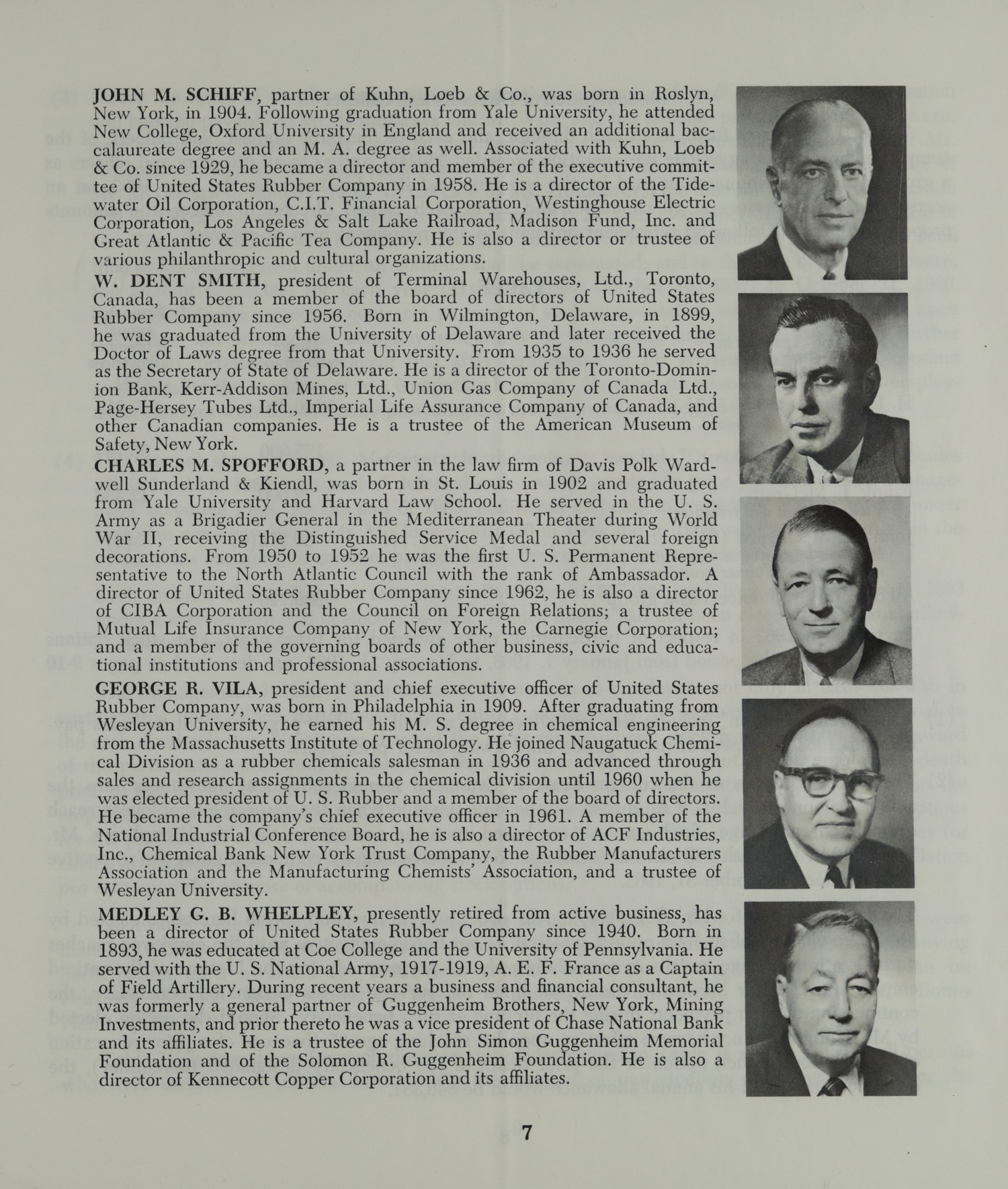
JOHN M. SCHIFF, partner of Kuhn, Loeb & Co., was born in Roslyn, New York, in 1904. Following graduation from Yale University, he attended New College, Oxford University in England and received an additional bac-
calaurcatc degree and an M.A. degree as well. Associated with Kuhn, Loeb
& Co. since 1929, he became a director and member of the executive commit-
tee of United States Rubber Company in 1958. He is a director of the Tide-
water Oil Corporation, C.I.T. Financial Corporation, Westinghouse Electric
Corporation, Los Angeles & Salt Lake Railroad, Madison Fund, Inc. and
Great Atlantic & Pacific Tea Company. He is also a director or trustee of
various philanthropic and cultural organizations.
W. DENT SMITH, president of Terminal Warehouses, Ltd., Toronto,
Canada, has been a member of the board of directors of United States
Rubber Company since 1956. Born in Wilmington, Delaware, in 1899,
he was graduated from the University of Delaware and later received the
Doctor of Laws degree from that University. From 1935 to 1936 he served
as the Secretary of State of Delaware. He is a director of the Toronto-Domin-
ion Bank, Kerr-Addison Mines, Ltd., Union Gas Company of Canada Ltd.,
Page-Hersey Tubes Ltd., Imperial Life Assurance Company of Canada, and
other Canadian companies. He is a trustee of the American Museum of
Safety, New York.
CHARLES M. SPOFFORD, a partner in the law firm of Davis Polk Ward-
well Sunderland & Kiendl, was born in St. Louis in 1902 and graduated
from Yale University and Harvard Law School. He served in the U. S.
Army as a Brigadier General in the Mediterranean Theater during World
War II, receiving the Distinguished Service Medal and several foreign
decorations. From 1950 to 1952 he was the first U. S Permanent Repre-
sentative to the North Atlantic Council with the rank of Ambassador. A
director of United States Rubber Company since 1962, he is also a director
of CIBÄ Corporation and the Council on Foreign Relations; a trustee of
Mutual Life Insurance Company of New York, the Carnegie Corporation;
and a member of the governing boards of other business, civic and educa-
tional institutions and professional associations.
GEORGE R. VILA, president and chief executive officer of United States
Rubber Company, was born in Philadelphia in 1909. After graduating from
Wesleyan University, he earned his M. S. degree in chemical engineering
from the Massachusetts Institute of Technology. He joined Naugatuck Chemi-
cal Division as a rubber chemicals salesman in 1936 and advanced through
sales and research assignments in the chemical division until 1960 when he
was elected president of U. S. Rubber and a member of the board of directors.
He became the company’s chief executive officer in 1961. A member of the
National Industrial Conference Board, he is also a director of ACF Industries,
Inc., Chemical Bank New York Trust Company, the Rubber Manufacturers
Association and the Manufacturing Chemists Association, and a trustee of
Wesleyan University.
MEDLEY G. B. WHELPLEY, presently retired from active business, has
been a director of United States Rubber Company since 1940. Born in
1893, he was educated at Coe College and the University of Pennsylvania. He
served with the U. S. National Army, 1917-1919, A. E. F. France as a Captain
of Field Artillery. During recent years a business and financial consultant, he
was formerly a general partner of Guggenheim Brothers, New York, Mining
Investments, and prior thereto he was a vice president of Chase National Bank
and its affiliates. He is a trustee of the John Simon Guggenheim Memorial
Foundation and of the Solomon R. Guggenheim Foundation. He is also a
director of Kennecott Copper Corporation and its affiliates.

US Rubber Proxy Statement – Page 8

Page 008

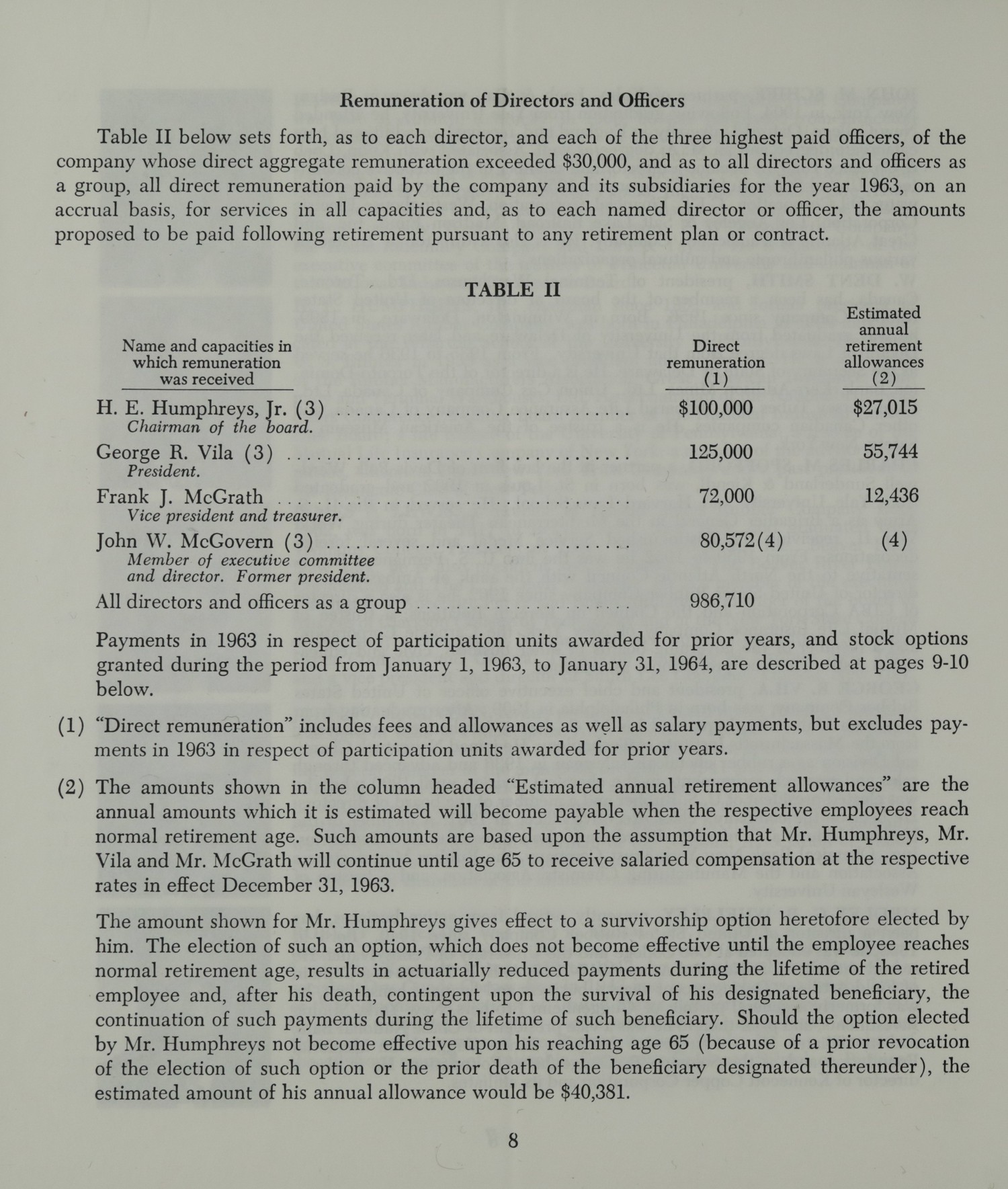
Remuneration of Directors and Officers

Table II below sets forth, as to each director, and each of the three highest paid officers, of the company whose direct aggregate remuneration exceeded $30,000, and as to all directors and officers as a group, all direct remuneration paid by the company and its subsidiaries for the year 1963, on an accrual basis, for services in all capacities and, as to each named director or officer, the amounts proposed to be paid following retirement pursuant to any retirement plan or contract.

TABLE II
Estimated
Name and capacities in Direct annual
which remuneration remuneration retirement
was received (1) allowances (2)
H. E. Humphreys, Jr. (3) $100,000 $27,015
Chairman of the board.
George R. Vila (3) 125,000 55,744
President.
Frank J. McGrath 72,000 12,436
Vice president and treasurer.
John W. McGovern (3) 80,572(4) (4)
Member of executive committee
and director. Former president.
All directors and officers as a group 986,710

Payments in 1963 in respect of participation units awarded for prior years, and stock options granted during the period from January 1, 1963, to January 31, 1964, are described at pages 9-10 below.

(1) “Direct remuneration” includes fees and allowances as well as salary payments, but excludes payments in 1963 in respect of participation units awarded for prior years.

(2) The amounts shown in the column headed “Estimated annual retirement allowances” are the annual amounts which it is estimated will become payable when the respective employees reach normal retirement age. Such amounts are based upon the assumption that Mr. Humphreys, Mr. Vila and Mr. McGrath will continue until age 65 to receive salaries compensation at the respective rates in effect December 31, 1963.

The amount shown for Mr. Humphreys gives effect to a survivorship option heretofore elected by him. The election of such an option, which does not become effective until the employee reaches normal retirement age, results in actuarially reduced payments during the lifetime of the retired employee and, after his death, contingent upon the survival of his designated beneficiary, the continuation of such payments during the lifetime of such beneficiary. Should the option elected by Mr. Humphreys not become effective upon his reaching age 65 (because of a prior revocation of the election of such option or the prior death of the beneficiary designated thereunder), the estimated amount of his annual allowance would be $40,331.

US Rubber Proxy Statement – Page 10

Page 010

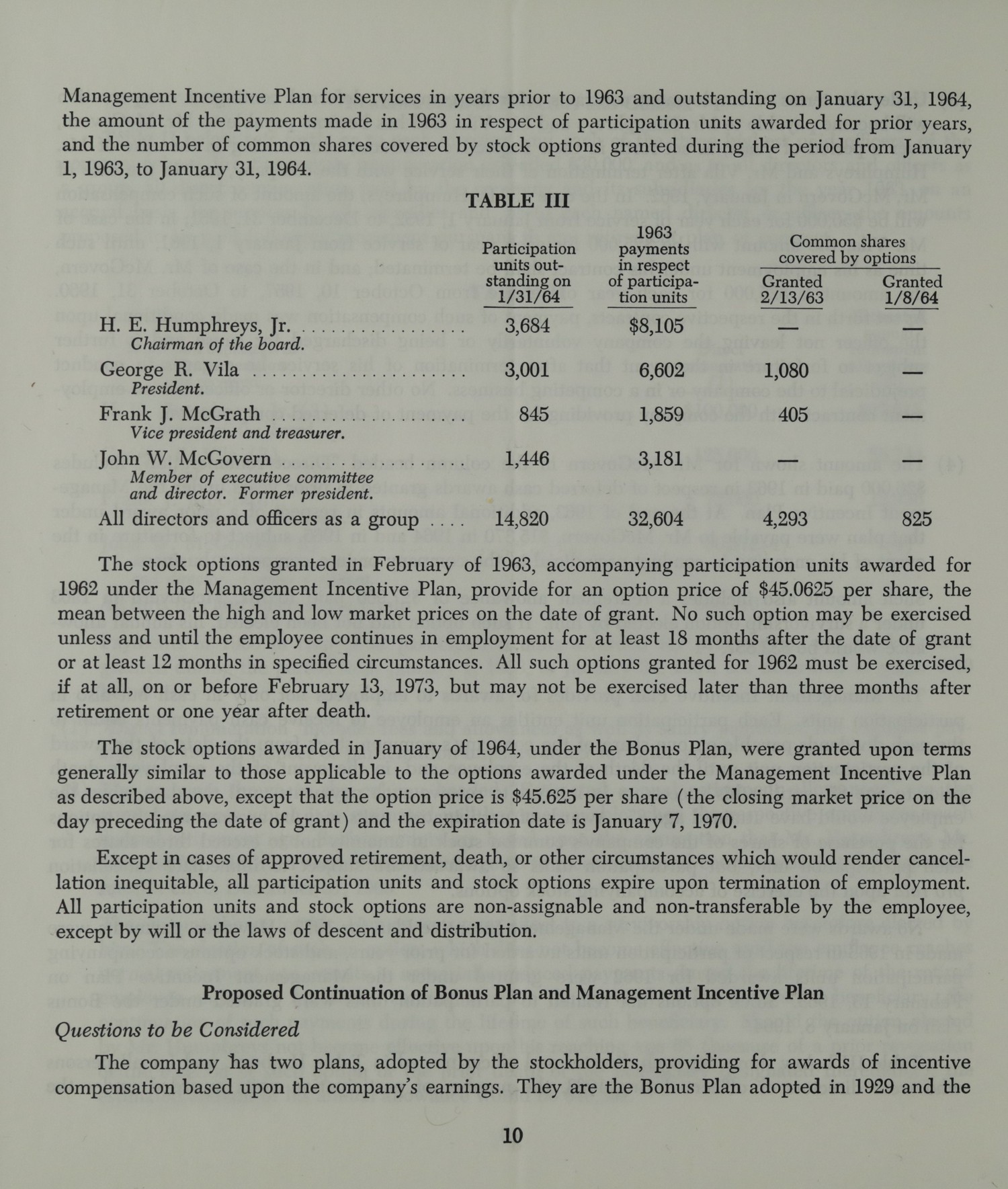
Management Incentive Plan for services in years prior to 1963 and outstanding on January 31, 1964, the amount of the payments made in 1963 in respect of participation units awarded for prior years, and the number of common shares covered by stock options granted during the period from January 1, 1963, to January 31, 1964.

TABLE III

Participation 1963 Common shares
units out- payments covered by options
standing on in respect Granted Granted
1/31/64 of participa- 2/13/63 1/8/64
tion units

H. E. Humphreys, Jr. . . . . . . . . . . . . . . . 3,684 $8,105 – –
Chairman of the board.
George R. Vila . . . . . . . . . . . . . . . . . . . . 3,001 6,602 1,080 –
President.
Frank J. McGrath . . . . . . . . . . . . . . . . . 845 1,859 405 –
Vice president and treasurer.
John W. McGovern . . . . . . . . . . . . . . . . 1,446 3,181 – –
Member of executive committee
and director. Former president.
All directors and officers as a group . . . 14,820 32,604 4,293 825

The stock options granted in February of 1963, accompanying participation units awarded for 1962 under the Management Incentive Plan, provide for an option price of $45.0625 per share, the mean between the high and low market prices on the date of grant. No such option may be exercised unless and until the employee continues in employment for at least 18 months after the date of grant or at least 12 months in specified circumstances. All such options granted for 1962 must be exercised, if at all, on or before February 13, 1973, but may not be exercised later than three months after retirement or one year after death.

The stock options awarded in January of 1964, under the Bonus Plan, were granted upon terms generally similar to those applicable to the options awarded under the Management Incentive Plan as described above, except that the option price is $45.625 per share (the closing market price on the day preceding the date of grant) and the expiration date is January 7, 1970.

Except in cases of approved retirement, death, or other circumstances which would render cancellation inequitable, all participation units and stock options expire upon termination of employment. All participation units and stock options are non-assignable and non-transferable by the employee, except by will or the laws of descent and distribution.

Proposed Continuation of Bonus Plan and Management Incentive Plan

Questions to be Considered

The company has two plans, adopted by the stockholders, providing for awards of incentive compensation based upon the company’s earnings. They are the Bonus Plan adopted in 1929 and the 10

US Rubber Proxy Statement – Page 14

Page 014

in the range of approximately 35-70 persons. It is also contemplated that such participants will, as in the past, be persons holding key positions. Such persons, it is anticipated, will include Mr. George R. Vila, president, and Mr. Frank J. McGrath, vice president and treasurer, and about ten other officers of the company.

Amounts Distributed Under the Plans January 1, 1959, to January 31, 1964
No Class B bonuses were awarded under the Bonus Plan for 1963. Class A bonuses, which are granted for conspicuous service without regard to the company’s earnings, were awarded in 1963 to several employees, none of whom was a director or officer, in the aggregate amount of $108,522. No stock options were granted under the Bonus Plan during 1963.

The only amounts distributed under the Management Incentive Plan for 1963 (except for install-ments paid on account of deferred cash awards previously granted) were the payments, aggregating $55,169, made in respect of participation units awarded for prior years. Information with respect to such payments made in 1963 to directors and officers is set forth in Table III above.

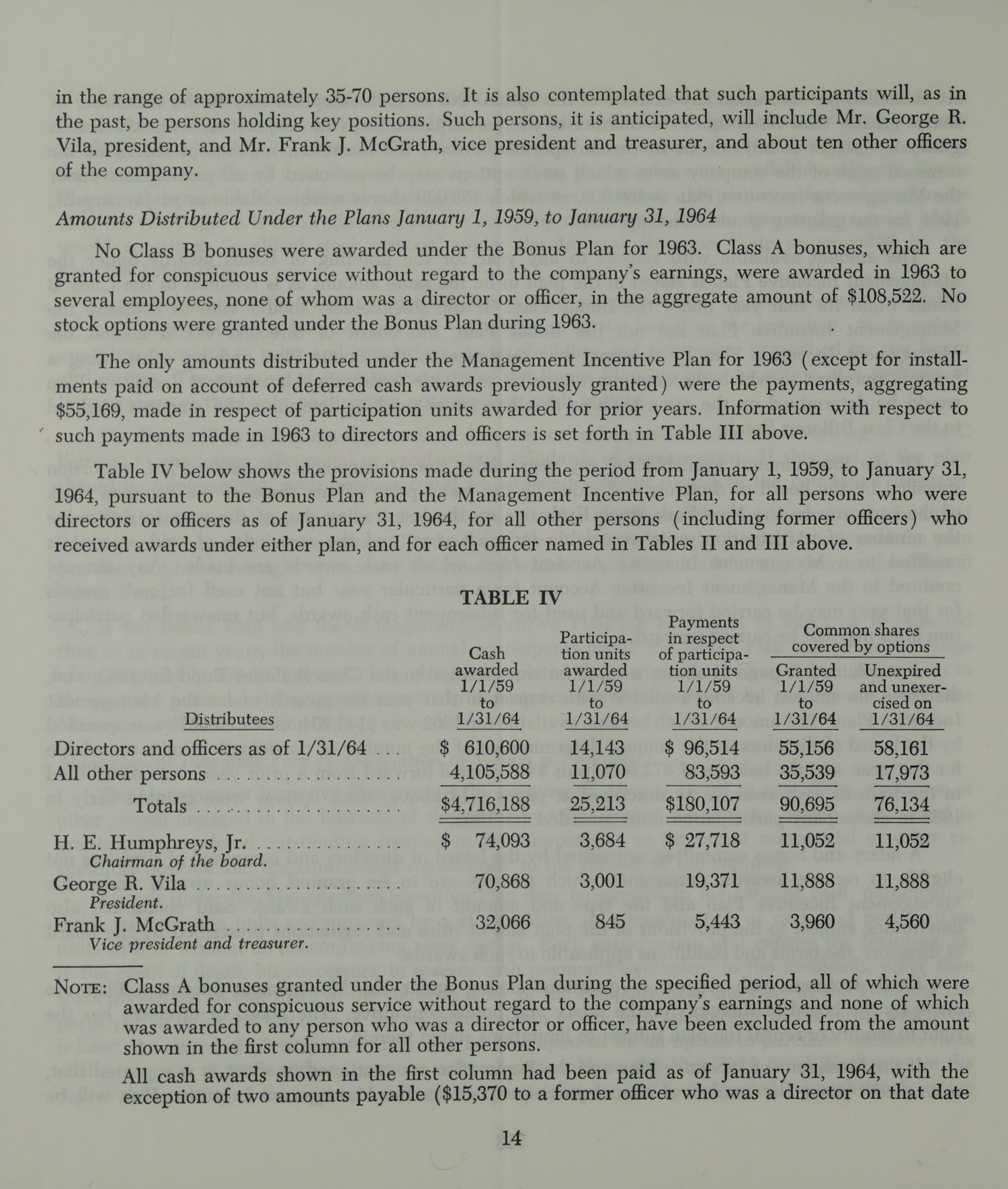
Table IV below shows the provisions made during the period from January 1, 1959, to January 31, 1964, pursuant to the Bonus Plan and the Management Incentive Plan, for all persons who were directors or officers as of January 31, 1964, for all other persons (including former officers) who received awards under either plan, and for each officer named in Tables II and III above.

TABLE IV
Cash Participa- Payments Common shares
awarded tion units in respect covered by options
Distributees 1/1/59 awarded of participa- Granted Unexpired
to 1/1/59 to tion units 1/1/59 and unexer-
1/31/64 1/31/64 1/1/59 to cised on
1/31/64 1/31/64
Directors and officers as of 1/31/64 … $ 610,600 14,143 $ 96,514 55,156 58,161
All other persons ………………….. 4,105,588 11,070 83,593 35,539 17,973
$4,716,188 25,213 $180,107 90,695 76,134

H. E. Humphreys, Jr. ………………. $ 74,093 3,684 $ 27,718 11,052 11,052
Chairman of the Board.
George R. Vila ……………………. 70,868 3,001 19,371 11,888 11,888
President.
Frank J. McGrath ………………….. 32,066 845 5,443 3,960 4,560
Vice president and treasurer.

NOTE: Class A bonuses granted under the Bonus Plan during the specified period, all of which were awarded for conspicuous service without regard to the company’s earnings and none of which was awarded to any person who was a director or officer, have been excluded from the amount shown in the first column for all other persons.

All cash awards shown in the first column had been paid as of January 31, 1964, with the exception of two amounts payable ($15,370 to a former officer who was a director on that date.

US Rubber Proxy Statement – Page 16

Page 016

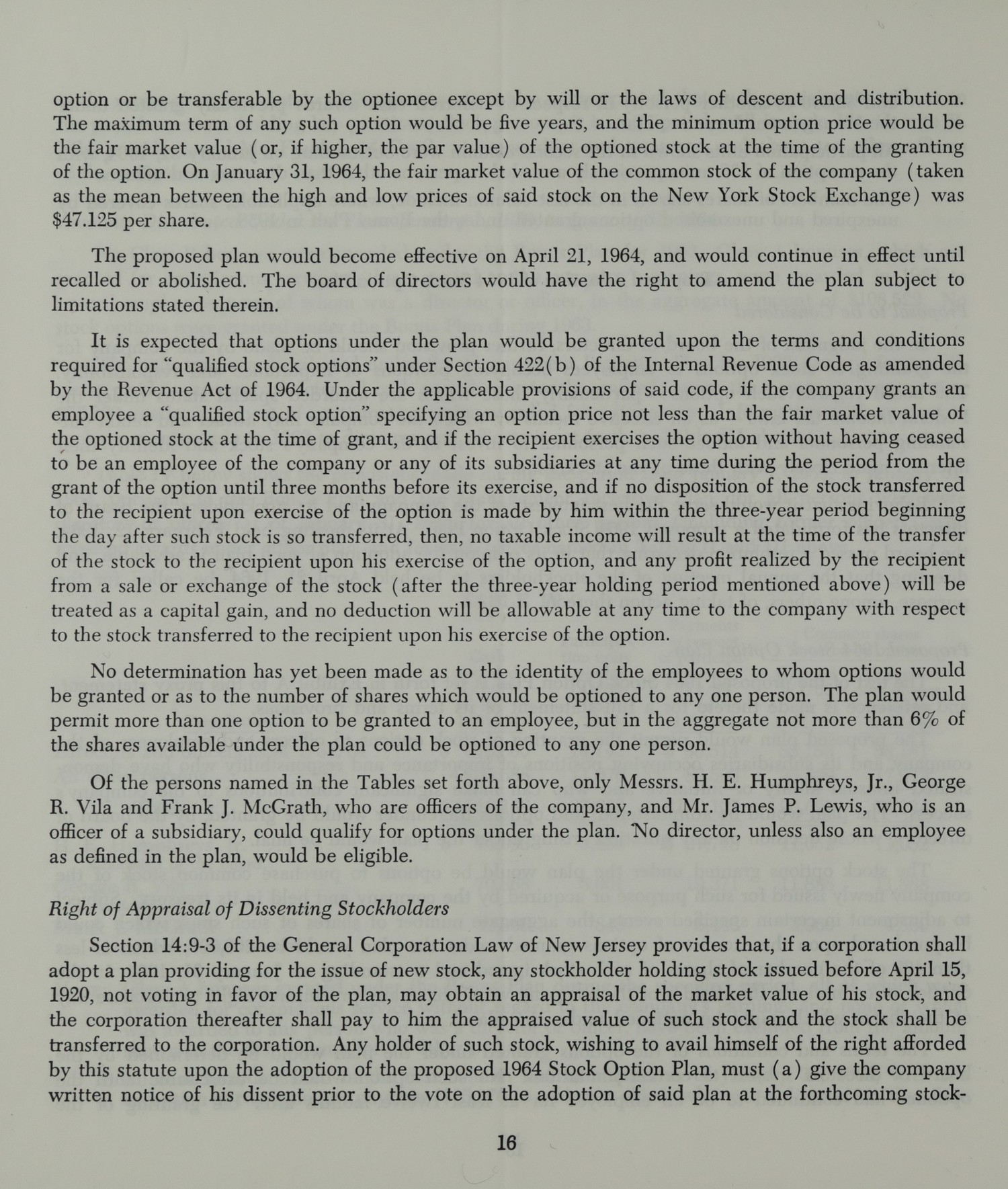
option or be transferable by the optionee except by will or the laws of descent and distribution.
The maximum term of any such option would be five years, and the minimum option price would be the fair market value (or, if higher, the par value) of the optioned stock at the time of the granting of the option. On January 31, 1964, the fair market value of the common stock of the company (taken as the mean between the high and low prices of said stock on the New York Stock Exchange) was $47.125 per share.

The proposed plan would become effective on April 21, 1964, and would continue in effect until recalled or abolished. The board of directors would have the right to amend the plan subject to limitations stated therein.

It is expected that options under the plan would be granted upon the terms and conditions required for “qualified stock options” under Section 422(b) of the Internal Revenue Code as amended by the Revenue Act of 1964. Under the applicable provisions of said code, if the company grants an employee a “qualified stock option” specifying an option price not less than the fair market value of the optioned stock at the time of grant, and if the recipient exercises the option without having ceased to be an employee of the company or any of its subsidiaries at any time during the period from the grant of the option until three months before its exercise, and if no disposition of the stock transferred to the recipient upon exercise of the option is made by him within the three-year period beginning the day after such stock is so transferred, then, no taxable income will result at the time of the transfer of the stock to the recipient upon his exercise of the option, and any profit realized by the recipient from a sale or exchange of the stock (after the three-year holding period mentioned above) will be treated as a capital gain, and no deduction will be allowable at any time to the company with respect to the stock transferred to the recipient upon his exercise of the option.

No determination has yet been made as to the identity of the employees to whom options would be granted or as to the number of shares which would be optioned to any one person. The plan would permit more than one option to be granted to an employee, but in the aggregate not more than 6% of the shares available under the plan could be optioned to any one person.

Of the persons named in the Tables set forth above, only Messrs. H. E. Humphreys, Jr., George R. Vila and Frank J. McGrath, who are officers of the company, and Mr. James E. Lewis, who is an officer of a subsidiary, could qualify for options under the plan. No director, unless also an employee as defined in the plan, would be eligible.

Right of Appraisal of Dissenting Stockholders
Section 14:9-3 of the General Corporation Law of New Jersey provides that, if a corporation shall adopt a plan providing for the issue of new stock, any stockholder holding stock issued before April 15, 1920, not voting in favor of the plan, may obtain an appraisal of the market value of his stock, and the corporation thereafter shall pay to him the appraised value of such stock and the stock shall be transferred to the corporation. Any holder of such stock, wishing to avail himself of the right afforded by this statute upon the adoption of the proposed 1964 Stock Option Plan, must (a) give the company written notice of his dissent prior to the vote on the adoption of said plan at the forthcoming stock-

US Rubber Proxy Statement – Page 4

Page 004

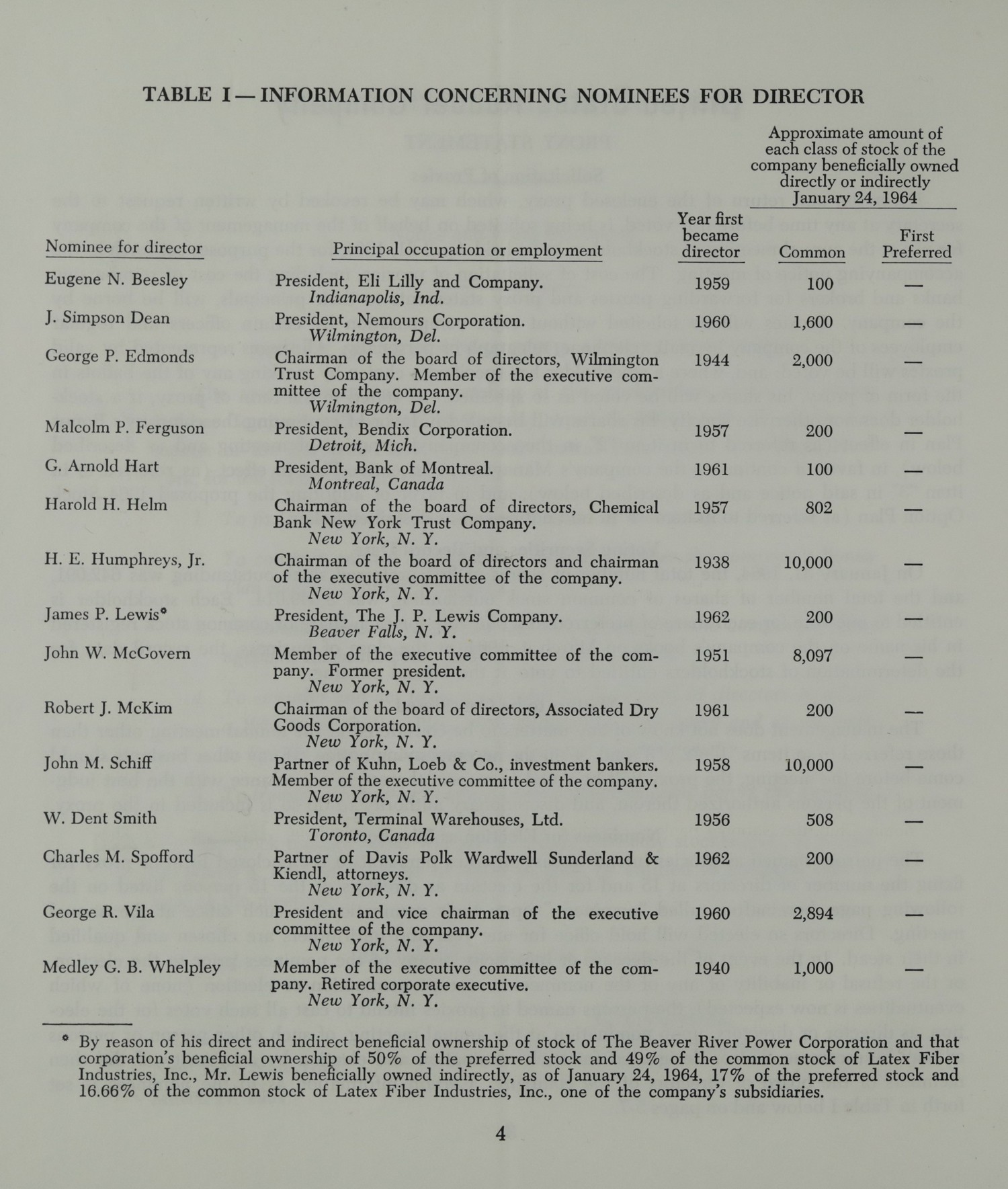
TABLE I — INFORMATION CONCERNING NOMINEES FOR DIRECTOR

Approximate amount of
each class of stock of the
company beneficially owned
directly or indirectly
January 24, 1964

Nominee for director Principal occupation or employment Year first Common First
became Preferred
director
Eugene N. Beesley President, Eli Lilly and Company, 1959 100 —
Indianapolis, Ind.
J. Simpson Dean President, Nemours Corporation. 1960 1,600 —
Wilmington, Del.
George P. Edmonds Chairman of the board of directors, Wilmington 1944 2,000 —
Trust Company. Member of the executive com-
mittee of the company.
Wilmington, Del.
Malcolm P. Ferguson President, Bendix Corporation. 1957 200 —
Detroit, Mich.
G. Arnold Hart President, Bank of Montreal. 1961 100 —
Montreal, Canada
Harold H. Helm Chairman of the board of directors, Chemical 1957 802 —
Bank New York Trust Company.
New York, N. Y.
H. E. Humphreys, Jr. Chairman of the board of directors and chairman 1938 10,000 —
of the executive committee of the company.
New York, N. Y.
James P. Lewis* President, The J. P. Lewis Company, 1962 200 —
Beaver Falls, N. Y.
John W. McGovern Member of the executive committee of the com- 1951 8,097 —
pany. Former president.
New York, N. Y.
Robert J. McKim Chairman of the board of directors, Associated Dry 1961 200 —
Goods Corporation.
New York, N. Y.
John M. Schiff Partner of Kuhn, Loeb & Co., investment bankers. 1958 10,000 —
Member of the executive committee of the company.
New York, N. Y.
W. Dent Smith President, Terminal Warehouses, Ltd. 1956 508 —
Toronto, Canada
Charles M. Spofford Partner of Davis Polk Wardwell Sunderland & 1962 200 —
Kiendl, attorneys.
New York, N. Y.
George R. Vila President and vice chairman of the executive 1960 2,894 —
committee of the company.
New York, N. Y.
Medley G. B. Whelpley Member of the executive committee of the com- 1940 1,000 —
pany. Retired corporate executive.
New York, N. Y.

  • By reason of his direct and indirect beneficial ownership of stock of The Beaver River Power Corporation and that corporation’s beneficial ownership of 50% of the preferred stock and 49% of the common stock of Latex Fiber Industries, Inc., Mr. Lewis beneficially owned indirectly, as of January 24, 1964, 17% of the preferred stock and 16.66% of the common stock of Latex Fiber Industries, Inc., one of the company’s subsidiaries.

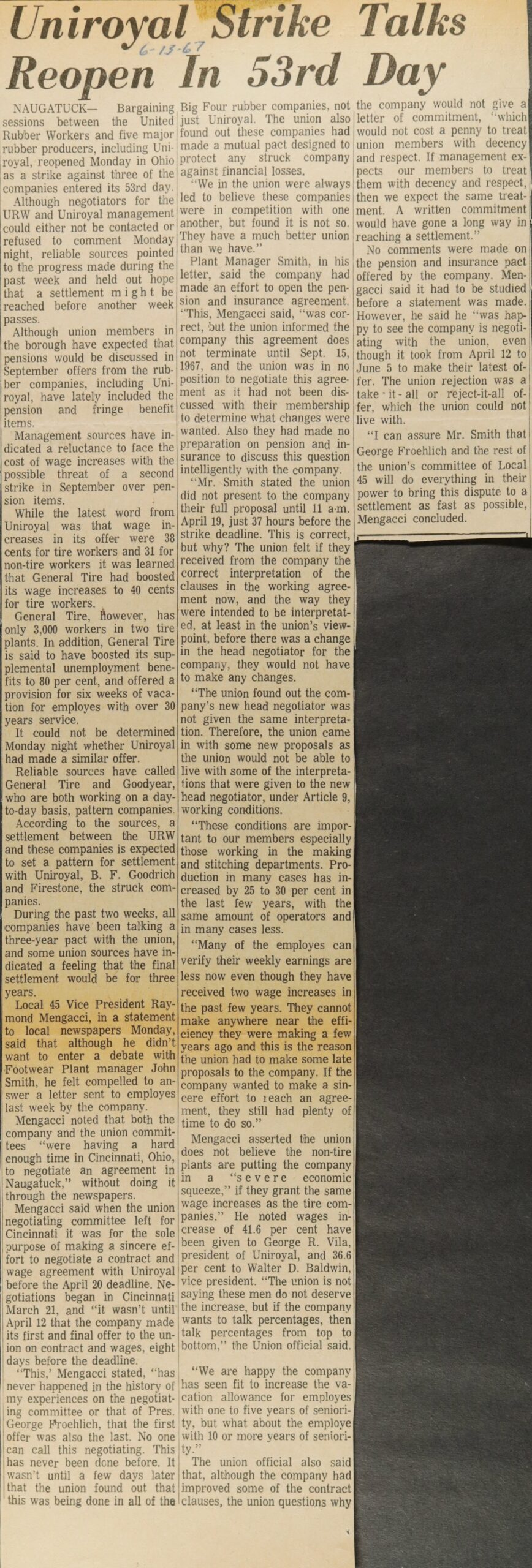
Uniroyal Strike Talks Reopen In 53rd Day

Uniroyal Strike Talks Reopen In 53rd Day

6-13-67

NAUGATUCK— Bargaining sessions between the United Rubber Workers and five major rubber producers, including Uniroyal, reopened Monday in Ohio as a strike against three of the companies entered its 53rd day.

Although negotiators for the URW and Uniroyal management could either not be contacted or refused to comment Monday night, reliable sources pointed to the progress made during the past week and held out hope that a settlement might be reached before another week passes.

Although union members in the borough have expected that pensions would be discussed in September offers from the rubber companies, including Uniroyal, have lately included the pension and fringe benefit items.

Management sources have indicated a reluctance to face the cost of wage increases with the possible threat of a second strike in September over pension items.

While the latest word from Uniroyal was that wage increases in its offer were 38 cents for tire workers and 31 for non-tire workers it was learned that General Tire had boosted its wage increases to 40 cents for tire workers.

General Tire, however, has only 3,000 workers in two tire plants. In addition, General Tire is said to have boosted its supplemental unemployment benefits to 80 per cent, and offered a provision for six weeks of vacation for employes with over 30 years service.

It could not be determined Monday night whether Uniroyal had made a similar offer.

Reliable sources have called General Tire and Goodyear, who are both working on a day-to-day basis, pattern companies.

According to the sources, a settlement between the URW and these companies is expected to set a pattern for settlement with Uniroyal, B. F. Goodrich and Firestone, the struck companies.

During the past two weeks, all companies have been talking a three-year pact with the union, and some union sources have indicated a feeling that the final settlement would be for three years.

Local 45 Vice President Raymond Mengacci, in a statement to local newspapers Monday, said that although he didn’t want to enter a debate with Footwear Plant manager John Smith, he felt compelled to answer a letter sent to employes last week by the company.

Mengacci noted that both the company and the union committees “were having a hard enough time in Cincinnati, Ohio, to negotiate an agreement in Naugatuck,” without doing it through the newspapers.

Mengacci said when the union negotiating committee left for Cincinnati it was for the sole purpose of making a sincere effort to negotiate a contract and wage agreement with Uniroyal before the April 20 deadline. Negotiations began in Cincinnati March 21, and “it wasn’t until April 12 that the company made its first and final offer to the union on contract and wages, eight days before the deadline.

“This,” Mengacci stated, “has never happened in the history of my experiences on the negotiating committee or that of Pres. George Froehlich, that the first offer was also the last. No one can call this negotiating. This has never been done before. It wasn’t until a few days later that the union found out that this was being done in all of the Big Four rubber companies, not just Uniroyal. The union also found out these companies had made a mutual pact designed to protect any struck company against financial losses.

“We in the union were always led to believe these companies were in competition with one another, but found it is not so. They have a much better union than we have.”

Plant Manager Smith, in his letter, said the company had made an effort to open the pension and insurance agreement. “This, Mengacci said, “was correct, but the union informed the company this agreement does not terminate until Sept. 15, 1967, and the union was in no position to negotiate this agreement as it had not been discussed with their membership to determine what changes were wanted. Also they had made no preparation on pension and insurance to discuss this question intelligently with the company.

“Mr. Smith stated the union did not present to the company their full proposal until 11 a.m. April 19, just 37 hours before the strike deadline. This is correct, but why? The union felt if they received from the company the correct interpretation of the clauses in the working agreement now, and the way they were intended to be interpreted, at least in the union’s viewpoint, before there was a change in the head negotiator for the company, they would not have to make any changes.

“The union found out the company’s new head negotiator was not given the same interpretation. Therefore, the union came in with some new proposals as the union would not be able to live with some of the interpretations that were given to the new head negotiator, under Article 9, working conditions.

“These conditions are important to our members especially those working in the making and stitching departments. Production in many cases has increased by 25 to 30 per cent in the last few years, with the same amount of operators and in many cases less.

“Many of the employes can verify their weekly earnings are less now even though they have received two wage increases in the past few years. They cannot make anywhere near the efficiency they were making a few years ago and this is the reason the union had to make some late proposals to the company. If the company wanted to make a sincere effort to reach an agreement, they still had plenty of time to do so.”

Mengacci asserted the union does not believe the non-tire plants are putting the company in a “severe economic squeeze,” if they grant the same wage increases as the tire companies.” He noted wages increase of 41.6 per cent have been given to George R. Vila, president of Uniroyal, and 36.6 per cent to Walter D. Baldwin, vice president. “The union is not saying these men do not deserve the increase, but if the company wants to talk percentages, then talk percentages from top to bottom,” the Union official said.

“We are happy the company has seen fit to increase the vacation allowance for employes with one to five years of seniority, but what about the employe with 10 or more years of seniority.”

The union official also said that, although the company had improved some of the contract clauses, the union questions why the company would not give a letter of commitment, “which would not cost a penny to treat union members with decency and respect. If management expects our members to treat them with decency and respect, then we expect the same treatment. A written commitment would have gone a long way in reaching a settlement.”

No comments were made on the pension and insurance pact offered by the company. Mengacci said it had to be studied before a statement was made. However, he said he “was happy to see the company is negotiating with the union, even though it took from April 12 to June 5 to make their latest offer. The union rejection was a take-it-all or reject-it-all offer, which the union could not live with.

“I can assure Mr. Smith that George Froehlich and the rest of the union’s committee of Local 45 will do everything in their power to bring this dispute to a settlement as fast as possible,” Mengacci concluded.

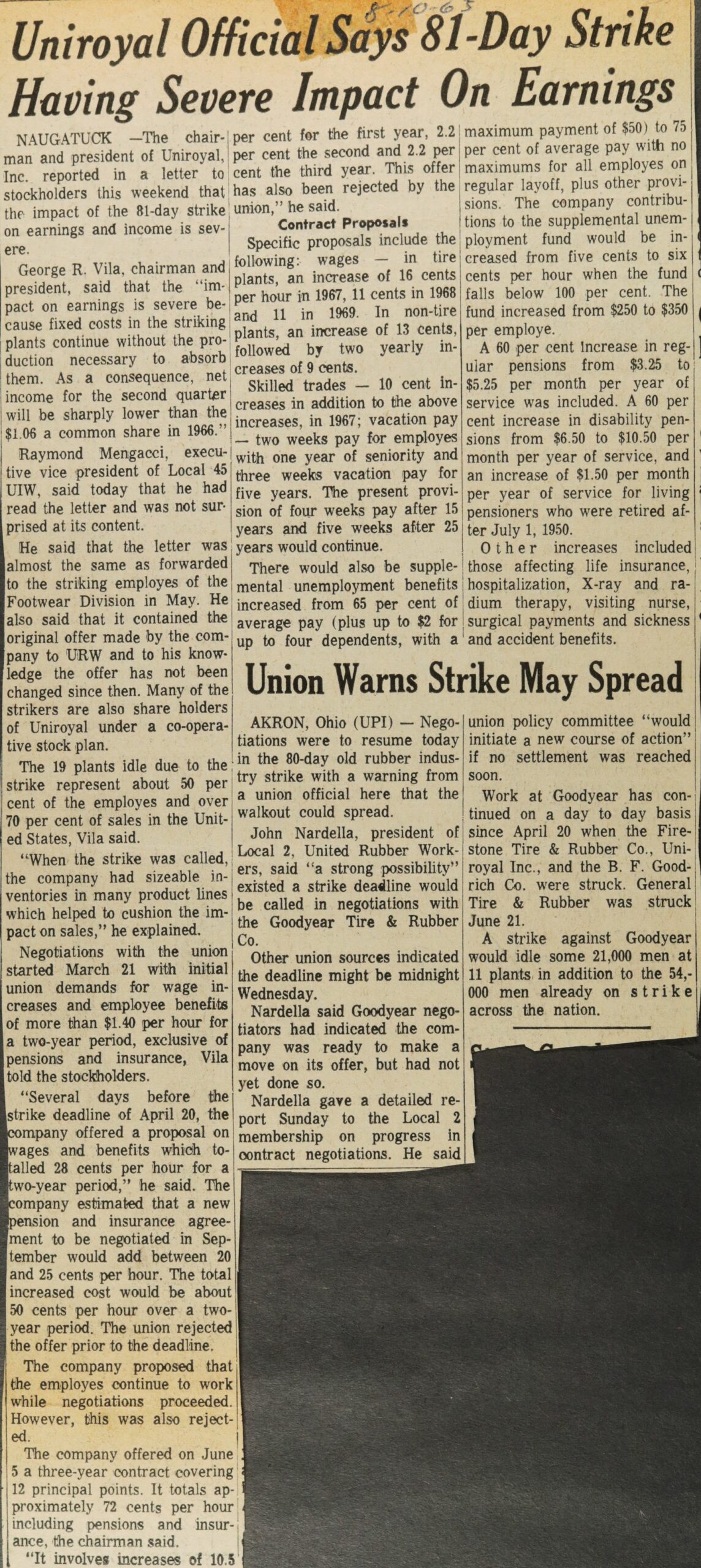
Uniroyal Official Says 81-Day Strike Having Severe Impact On Earnings

Uniroyal Official Says 81-Day Strike Having Severe Impact On Earnings

8-10-63 [handwritten]

NAUGATUCK —The chairman and president of Uniroyal, Inc. reported in a letter to stockholders this weekend that the impact of the 81-day strike on earnings and income is severe.

George R. Vila, chairman and president, said that the “impact on earnings is severe because fixed costs in the striking plants continue without the production necessary to absorb them. As a consequence, net income for the second quarter will be sharply lower than the $1.06 a common share in 1966.”

Raymond Mengacci, executive vice president of Local 45 UIW, said today that he had read the letter and was not surprised at its content.

He said that the letter was almost the same as forwarded to the striking employes of the Footwear Division in May. He also said that it contained the original offer made by the company to URW and to his knowledge the offer has not been changed since then. Many of the strikers are also share holders of Uniroyal under a co-operative stock plan.

The 19 plants idle due to the strike represent about 50 per cent of the employes and over 70 per cent of sales in the United States, Vila said.

“When the strike was called, the company had sizeable inventories in many product lines which helped to cushion the impact on sales,” he explained.

Negotiations with the union started March 21 with initial union demands for wage increases and employee benefits of more than $1.40 per hour for a two-year period, exclusive of pensions and insurance, Vila told the stockholders.

“Several days before the strike deadline of April 20, the company offered a proposal on wages and benefits which totalled 28 cents per hour for a two-year period,” he said. The company estimated that a new pension and insurance agreement to be negotiated in September would add between 20 and 25 cents per hour. The total increased cost would be about 50 cents per hour over a two-year period. The union rejected the offer prior to the deadline.

The company proposed that the employes continue to work while negotiations proceeded. However, this was also rejected.

The company offered on June 5 a three-year contract covering 12 principal points. It totals approximately 72 cents per hour including pensions and insurance, the chairman said.

“It involves increases of 10.5 per cent for the first year, 2.2 per cent the second and 2.2 per cent the third year. This offer has also been rejected by the union,” he said.

Contract Proposals

Specific proposals include the following: wages — in tire plants, an increase of 16 cents per hour in 1967, 11 cents in 1968 and 11 in 1969. In non-tire plants, an increase of 13 cents, followed by two yearly increases of 9 cents.

Skilled trades — 10 cent increases in addition to the above increases, in 1967; vacation pay — two weeks pay for employes with one year of seniority and three weeks vacation pay for five years. The present provision of four weeks pay after 15 years and five weeks after 25 years would continue.

There would also be supplemental unemployment benefits increased from 65 per cent of average pay (plus up to $2 for up to four dependents, with a maximum payment of $50) to 75 per cent of average pay with no maximums for all employes on regular layoff, plus other provisions. The company contributions to the supplemental unemployment fund would be increased from five cents to six cents per hour when the fund falls below 100 per cent. The fund increased from $250 to $350 per employe.

A 60 per cent increase in regular pensions from $3.25 to $5.25 per month per year of service was included. A 60 per cent increase in disability pensions from $6.50 to $10.50 per month per year of service, and an increase of $1.50 per month per year of service for living pensioners who were retired after July 1, 1950.

Other increases included those affecting life insurance, hospitalization, X-ray and radium therapy, visiting nurse, surgical payments and sickness and accident benefits.


Union Warns Strike May Spread

AKRON, Ohio (UPI) — Negotiations were to resume today in the 80-day old rubber industry strike with a warning from a union official here that the walkout could spread.

John Nardella, president of Local 2, United Rubber Workers, said “a strong possibility” existed a strike deadline would be called in negotiations with the Goodyear Tire & Rubber Co.

Other union sources indicated the deadline might be midnight Wednesday.

Nardella said Goodyear negotiators had indicated the company was ready to make a move on its offer, but had not yet done so.

Nardella gave a detailed report Sunday to the Local 2 membership on progress in contract negotiations. He said union policy committee “would initiate a new course of action” if no settlement was reached soon.

Work at Goodyear has continued on a day to day basis since April 20 when the Firestone Tire & Rubber Co., Uniroyal Inc., and the B. F. Goodrich Co. were struck. General Tire & Rubber was struck June 21.

A strike against Goodyear would idle some 21,000 men at 11 plants in addition to the 54,000 men already on strike across the nation.

US Rubber Annual Report – 72nd Annual Report – Page 25

Page 025

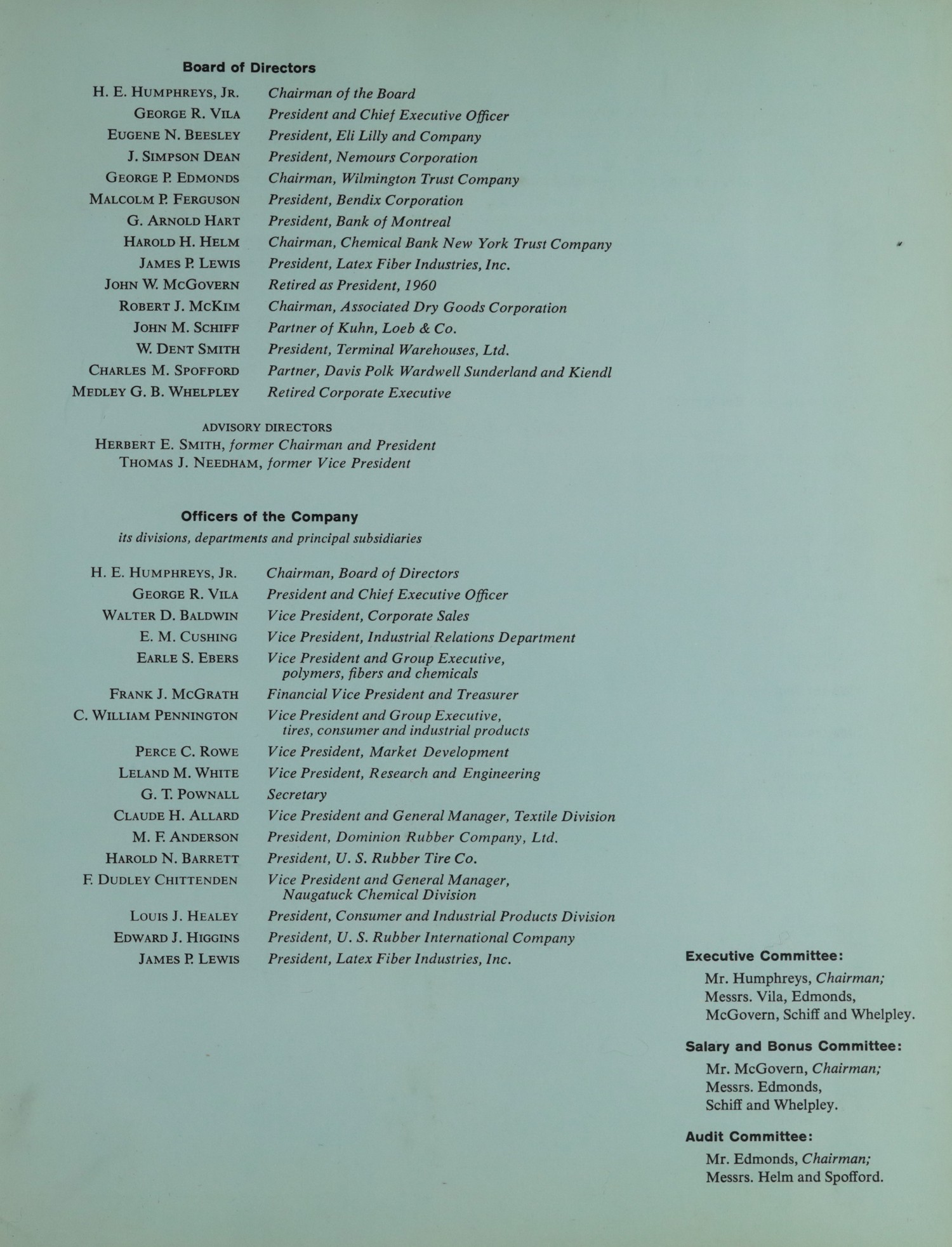
Board of Directors
H. E. Humphreys, Jr. Chairman of the Board
George R. Vila President and Chief Executive Officer
Eugene N. Beesley President, Eli Lilly and Company
J. Simpson Dean President, Nemours Corporation
George P. Edmonds Chairman, Wilmington Trust Company
Malcolm P. Ferguson President, Bendix Corporation
G. Arnold Hart President, Bank of Montreal
Harold H. Helm Chairman, Chemical Bank New York Trust Company
James P. Lewis President, Latex Fiber Industries, Inc.
John W. McGovern Retired as President, 1960
Robert J. McKim Chairman, Associated Dry Goods Corporation
John M. Schiff Partner of Kuhn, Loeb & Co.
W. Dent Smith President, Terminal Warehouses, Ltd.
Charles M. Spofford Partner, Davis Polk Wardwell Sunderland and Kiendl
Medley G. B. Whelpley Retired Corporate Executive

ADVISORY DIRECTORS
Herbert E. Smith, former Chairman and President
Thomas J. Needham, former Vice President

Officers of the Company
its divisions, departments and principal subsidiaries

H. E. Humphreys, Jr. Chairman, Board of Directors
George R. Vila President and Chief Executive Officer
Walter D. Baldwin Vice President, Corporate Sales
E. M. Cushing Vice President, Industrial Relations Department
Earle S. Ebers Vice President and Group Executive, polymers, fibers and chemicals
Frank J. McGrath Financial Vice President and Treasurer
C. William Pennington Vice President and Group Executive, tires, consumer and industrial products
Perce C. Rowe Vice President, Market Development
Leland M. White Vice President, Research and Engineering
G. T. Pownall Secretary
Claude H. Allard Vice President and General Manager, Textile Division
M. F. Anderson President, Dominion Rubber Company, Ltd.
Harold N. Barrett President, U. S. Rubber Tire Co.
F. Dudley Chittenden Vice President and General Manager, Naugatuck Chemical Division
Louis J. Healey President, Consumer and Industrial Products Division
Edward J. Higgins President, U. S. Rubber International Company
James P. Lewis President, Latex Fiber Industries, Inc.

Executive Committee:
Mr. Humphreys, Chairman;
Messrs. Vila, Edmonds,
McGovern, Schiff and Whelpley.

Salary and Bonus Committee:
Mr. McGovern, Chairman;
Messrs. Edmonds,
Schiff and Whelpley.

Audit Committee:
Mr. Edmonds, Chairman;
Messrs. Helm and Spofford.