CHEM-TEXTS – 1973 – Page 3

Page 003

Vol. 7, 1973 CHEM-TEXTS Page 3


A B.S. 20 Years Later

[IMAGE: Two men standing together, one appears to be congratulating the other, with a framed picture on the wall behind them]

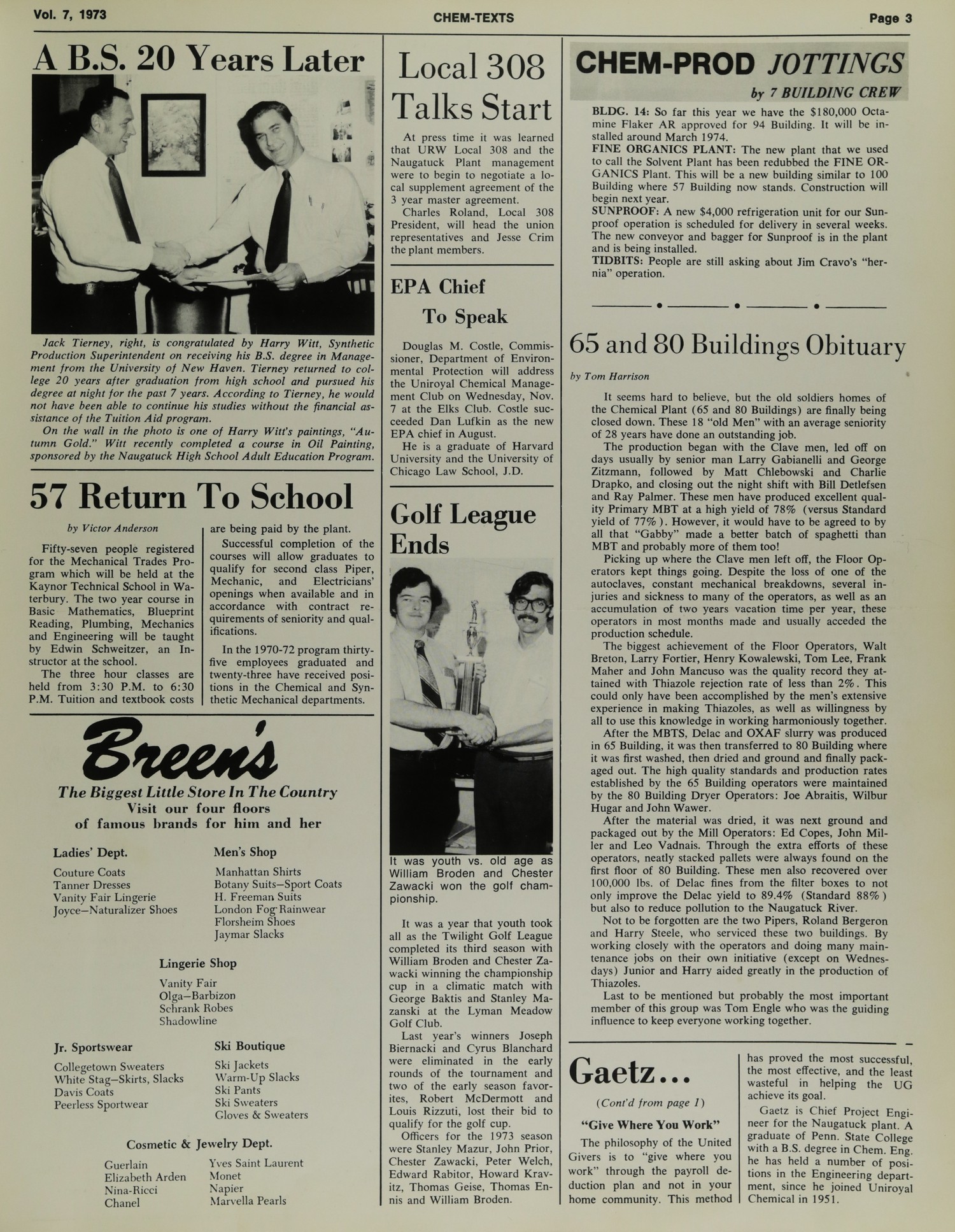
Jack Tierney, right, is congratulated by Harry Witt, Synthetic Production Superintendent on receiving his B.S. degree in Management from the University of New Haven. Tierney returned to college 20 years after graduation from high school and pursued his degree at night for the past 7 years. According to Tierney, he would not have been able to continue his studies without the financial assistance of the Tuition Aid program.

On the wall in the photo is one of Harry Witt’s paintings, “Autumn Gold.” Witt recently completed a course in Oil Painting, sponsored by the Naugatuck High School Adult Education Program.


57 Return To School

by Victor Anderson

Fifty-seven people registered for the Mechanical Trades Program which will be held at the Kaynor Technical School in Waterbury. The two year course in Basic Mathematics, Blueprint Reading, Plumbing, Mechanics and Engineering will be taught by Edwin Schweitzer, an Instructor at the school.

The three hour classes are held from 3:30 P.M. to 6:30 P.M. Tuition and textbook costs are being paid by the plant.

Successful completion of the courses will allow graduates to qualify for second class Piper, Mechanic, and Electricians’ openings when available and in accordance with contract requirements of seniority and qualifications.

In the 1970-72 program thirty-five employees graduated and twenty-three have received positions in the Chemical and Synthetic Mechanical departments.


Local 308 Talks Start

At press time it was learned that URW Local 308 and the Naugatuck Plant management were to begin to negotiate a local supplement agreement of the 3 year master agreement.

Charles Roland, Local 308 President, will head the union representatives and Jesse Crim the plant members.


EPA Chief To Speak

Douglas M. Costle, Commissioner, Department of Environmental Protection will address the Uniroyal Chemical Management Club on Wednesday, Nov. 7 at the Elks Club. Costle succeeded Dan Lufkin as the new EPA chief in August.

He is a graduate of Harvard University and the University of Chicago Law School, J.D.


Golf League Ends

It was youth vs. old age as William Broden and Chester Zawacki won the golf championship.

It was a year that youth took all as the Twilight Golf League completed its third season with William Broden and Chester Zawacki winning the championship cup in a climatic match with George Baktis and Stanley Mazanski at the Lyman Meadow Golf Club.

Last year’s winners Joseph Biernacki and Cyrus Blanchard were eliminated in the early rounds of the tournament and two of the early season favorites, Robert McDermott and Louis Rizzuti, lost their bid to qualify for the golf cup.

Officers for the 1973 season were Stanley Mazur, John Prior, Chester Zawacki, Peter Welch, Edward Rabitor, Howard Kravitz, Thomas Geise, Thomas Ennis and William Broden.


Breen’s

The Biggest Little Store In The Country

Visit our four floors of famous brands for him and her

Ladies’ Dept. Men’s Shop
Couture Coats Manhattan Shirts
Tanner Dresses Botany Suits—Sport Coats
Vanity Fair Lingerie H. Freeman Suits
Joyce—Naturalizer Shoes London Fog Rainwear
Florsheim Shoes
Jaymar Slacks

Lingerie Shop

Vanity Fair
Olga—Barbizon
Schrank Robes
Shadowline

Jr. Sportswear Ski Boutique
Collegetown Sweaters Ski Jackets
White Stag—Skirts, Slacks Warm-Up Slacks
Davis Coats Ski Pants
Peerless Sportwear Ski Sweaters
Gloves & Sweaters

Cosmetic & Jewelry Dept.

Guerlain Yves Saint Laurent
Elizabeth Arden Monet
Nina-Ricci Napier
Chanel Marvella Pearls

CHEM-PROD JOTTINGS

by 7 BUILDING CREW

BLDG. 14: So far this year we have the $180,000 Octamine Flaker AR approved for 94 Building. It will be installed around March 1974.

FINE ORGANICS PLANT: The new plant that we used to call the Solvent Plant has been redubbed the FINE ORGANICS Plant. This will be a new building similar to 100 Building where 57 Building now stands. Construction will begin next year.

SUNPROOF: A new $4,000 refrigeration unit for our Sunproof operation is scheduled for delivery in several weeks. The new conveyor and bagger for Sunproof is in the plant and is being installed.

TIDBITS: People are still asking about Jim Cravo’s “hernia” operation.


65 and 80 Buildings Obituary

by Tom Harrison

It seems hard to believe, but the old soldiers homes of the Chemical Plant (65 and 80 Buildings) are finally being closed down. These 18 “old Men” with an average seniority of 28 years have done an outstanding job.

The production began with the Clave men, led off on days usually by senior man Larry Gabianelli and George Zitzmann, followed by Matt Chlebowski and Charlie Drapko, and closing out the night shift with Bill Detlefsen and Ray Palmer. These men have produced excellent quality Primary MBT at a high yield of 78% (versus Standard yield of 77%). However, it would have to be agreed to by all that “Gabby” made a better batch of spaghetti than MBT and probably more of them too!

Picking up where the Clave men left off, the Floor Operators kept things going. Despite the loss of one of the autoclaves, constant mechanical breakdowns, several injuries and sickness to many of the operators, as well as an accumulation of two years vacation time per year, these operators in most months made and usually acceded the production schedule.

The biggest achievement of the Floor Operators, Walt Breton, Larry Fortier, Henry Kowalewski, Tom Lee, Frank Maher and John Mancuso was the quality record they attained with Thiazole rejection rate of less than 2%. This could only have been accomplished by the men’s extensive experience in making Thiazoles, as well as willingness by all to use this knowledge in working harmoniously together.

After the MBTS, Delac and OXAF slurry was produced in 65 Building, it was then transferred to 80 Building where it was first washed, then dried and ground and finally packaged out. The high quality standards and production rates established by the 65 Building operators were maintained by the 80 Building Dryer Operators: Joe Abraitis, Wilbur Hugar and John Wawer.

After the material was dried, it was next ground and packaged out by the Mill Operators: Ed Copes, John Miller and Leo Vadnais. Through the extra efforts of these operators, neatly stacked pallets were always found on the first floor of 80 Building. These men also recovered over 100,000 lbs. of Delac fines from the filter boxes to not only improve the Delac yield to 89.4% (Standard 88%) but also to reduce pollution to the Naugatuck River.

Not to be forgotten are the two Pipers, Roland Bergeron and Harry Steele, who serviced these two buildings. By working closely with the operators and doing many maintenance jobs on their own initiative (except on Wednesdays) Junior and Harry aided greatly in the production of Thiazoles.

Last to be mentioned but probably the most important member of this group was Tom Engle who was the guiding influence to keep everyone working together.


Gaetz…

(Cont’d from page 1)

“Give Where You Work”

The philosophy of the United Givers is to “give where you work” through the payroll deduction plan and not in your home community. This method has proved the most successful, the most effective, and the least wasteful in helping the UG achieve its goal.

Gaetz is Chief Project Engineer for the Naugatuck plant. A graduate of Penn. State College with a B.S. degree in Chem. Eng. he has held a number of positions in the Engineering department, since he joined Uniroyal Chemical in 1951.
CHEM-TEXTS – Vol. 5, No. 2 – Page 4

Page 004

Page 4 | CHEM-TEXTS | Vol. 5. No. 2


Know Your Products: Rubber Chemical Accelerators

by Dr. Bob Brown

Uniroyal Chemical manufactures 91 different types of chemicals for rubber, latex and plastic products. 69 of these chemicals are manufactured and sold by the Naugatuck plant; the others are made at the Geismar plant in Louisiana.

Virtually every tire on the road today contains one of the chemicals made by the Chemical Division to protect them against oxygen, ozone, heat, fatigue and sunlight. Without these chemicals the rubber would deteriorate rapidly.

Coincidentally, it was one of our rubber chemicals that established us in the agricultural chemical business when it was discovered that the chemical had fungicidal properties. Twenty-five years later, the Division ranks as a major manufacturer of herbicides; growth regulants, miticides and fungicides.

The chemicals that we make at Naugatuck for the rubber industry do a wide variety of jobs; but two are by far the most important. These are: 1) Accelerators for vulcanization and 2) Antioxidants and Antiozonants for protection against aging. A third group—Others—include Blowing Agents for rubber and latex sponge; Bonding rubber to fabric; and Retarding vulcanization during processing.

Accelerators

Ever since 1844 when Charles Goodyear, in his small plant in Naugatuck, found that heating rubber with sulfur (vulcanization) causes it to change from an almost useless, gummy solid to a strong, resilient material with hundreds of uses, rubber product manufacturers have been looking for ways to do this job faster and better.

Chemicals which speed up this vulcanization reaction are called accelerators.

Delayed Action Accelerators

MBT and its derivatives (MBTS, OXAF, DELAC®-S) are the work horses of the rubber industry. They are used in almost all tires, footwear, wire and cable and in many other products where strength and long life are needed but where there is also a lot of milling and shaping of the rubber before it is finally made into a product.


[IMAGE: Black and white photograph showing workers]

AC-5 PRILLS

LAC-5 PRILLS

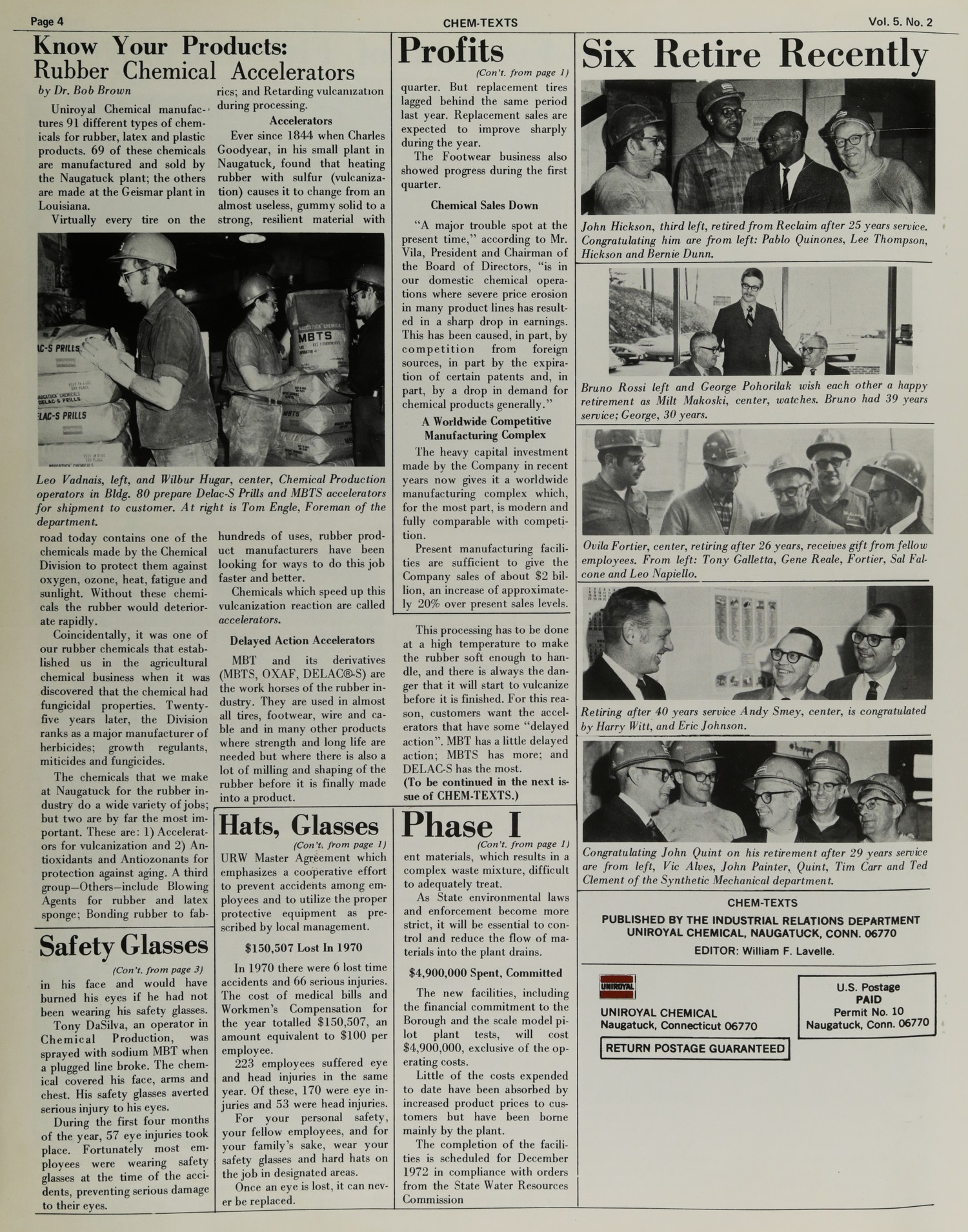
Leo Vadnais, left, and Wilbur Hugar, center, Chemical Production operators in Bldg. 80 prepare Delac-S Prills and MBTS accelerators for shipment to customer. At right is Tom Engle, Foreman of the department.


Safety Glasses

(Con’t. from page 3)

in his face and would have burned his eyes if he had not been wearing his safety glasses.

Tony DaSilva, an operator in Chemical Production, was sprayed with sodium MBT when a plugged line broke. The chemical covered his face, arms and chest. His safety glasses averted serious injury to his eyes.

During the first four months of the year, 57 eye injuries took place. Fortunately most employees were wearing safety glasses at the time of the accidents, preventing serious damage to their eyes.


Hats, Glasses

(Con’t. from page 1)

URW Master Agreement which emphasizes a cooperative effort to prevent accidents among employees and to utilize the proper protective equipment as prescribed by local management.

$150,507 Lost In 1970

In 1970 there were 6 lost time accidents and 66 serious injuries. The cost of medical bills and Workmen’s Compensation for the year totalled $150,507, an amount equivalent to $100 per employee.

223 employees suffered eye and head injuries in the same year. Of these, 170 were eye injuries and 53 were head injuries.

For your personal safety, your fellow employees, and for your family’s sake, wear your safety glasses and hard hats on the job in designated areas.

Once an eye is lost, it can never be replaced.


Profits

(Con’t. from page 1)

quarter. But replacement tires lagged behind the same period last year. Replacement sales are expected to improve sharply during the year.

The Footwear business also showed progress during the first quarter.

Chemical Sales Down

“A major trouble spot at the present time,” according to Mr. Vila, President and Chairman of the Board of Directors, “is in our domestic chemical operations where severe price erosion in many product lines has resulted in a sharp drop in earnings. This has been caused, in part, by competition from foreign sources, in part by the expiration of certain patents and, in part, by a drop in demand for chemical products generally.”

A Worldwide Competitive Manufacturing Complex

The heavy capital investment made by the Company in recent years now gives it a worldwide manufacturing complex which, for the most part, is modern and fully comparable with competition.

Present manufacturing facilities are sufficient to give the Company sales of about $2 billion, an increase of approximately 20% over present sales levels.

This processing has to be done at a high temperature to make the rubber soft enough to handle, and there is always the danger that it will start to vulcanize before it is finished. For this reason, customers want the accelerators that have some “delayed action”. MBT has a little delayed action; MBTS has more; and DELAC-S has the most.

(To be continued in the next issue of CHEM-TEXTS.)


Phase I

(Con’t. from page 1)

ent materials, which results in a complex waste mixture, difficult to adequately treat.

As State environmental laws and enforcement become more strict, it will be essential to control and reduce the flow of materials into the plant drains.

$4,900,000 Spent, Committed

The new facilities, including the financial commitment to the Borough and the scale model pilot plant tests, will cost $4,900,000, exclusive of the operating costs.

Little of the costs expended to date have been absorbed by increased product prices to customers but have been borne mainly by the plant.

The completion of the facilities is scheduled for December 1972 in compliance with orders from the State Water Resources Commission


Six Retire Recently

[IMAGE: Photograph of three men]

John Hickson, third left, retired from Reclaim after 25 years service. Congratulating him are from left: Pablo Quinones, Lee Thompson, Hickson and Bernie Dunn.


[IMAGE: Photograph of two men]

Bruno Rossi left and George Pohorilak wish each other a happy retirement as Milt Makoski, center, watches. Bruno had 39 years service; George, 30 years.


[IMAGE: Photograph of group of men]

Ovila Fortier, center, retiring after 26 years, receives gift from fellow employees. From left: Tony Galletta, Gene Reale, Fortier, Sal Falcone and Leo Napiello.


[IMAGE: Photograph of three men]

Retiring after 40 years service Andy Smey, center, is congratulated by Harry Witt, and Eric Johnson.


[IMAGE: Photograph of group of men]

Congratulating John Quint on his retirement after 29 years service are from left, Vic Alves, John Painter, Quint, Tim Carr and Ted Clement of the Synthetic Mechanical department.


CHEM-TEXTS

PUBLISHED BY THE INDUSTRIAL RELATIONS DEPARTMENT

UNIROYAL CHEMICAL, NAUGATUCK, CONN. 06770

EDITOR: William F. Lavelle.


[LOGO: UNIROYAL]

UNIROYAL CHEMICAL
Naugatuck, Connecticut 06770

RETURN POSTAGE GUARANTEED

U.S. Postage
PAID
Permit No. 10
Naugatuck, Conn. 06770

CHEM-TEXTS – Vol. 5, No. 4 – Page 2

Page 002

Page 2 | CHEM-TEXTS | Vol. 5, No. 4


FROM THE FACTORY MANAGER

DEAR FELLOW EMPLOYEE:

Once again the United Givers of Naugatuck-Beacon Falls is starting its Fall drive to raise funds for the oncoming year.

As you know, these funds supply finances to a great many very worthwhile activities carried out in Naugatuck, Waterbury and surrounding towns in which we live.

Each year the Factory has contributed collectively a substantial sum of money to help these worthwhile activities.

This year the drive will be conducted with Jim Carroll as Chairman. Jim has formed his Committee and his canvassers will be approaching you shortly for your contribution.

Uniroyal Chemical people have always shown a splendid generosity in their pledges to support the work of these Agencies. Last year, more than two thirds of the Chemical people contributed $20,066, for an average contribution of $20.

Our goal is $21,000. We can achieve this if we give “where you work” and pledge through the payroll deduction plan.

If each person would contribute a minimum one hour’s pay per month, we will readily raise the necessary money to help continue these activities which in some way benefit virtually every employee or some member of his family.

[Signature]


3 Women Officers Named

[IMAGE: Photo of three women]

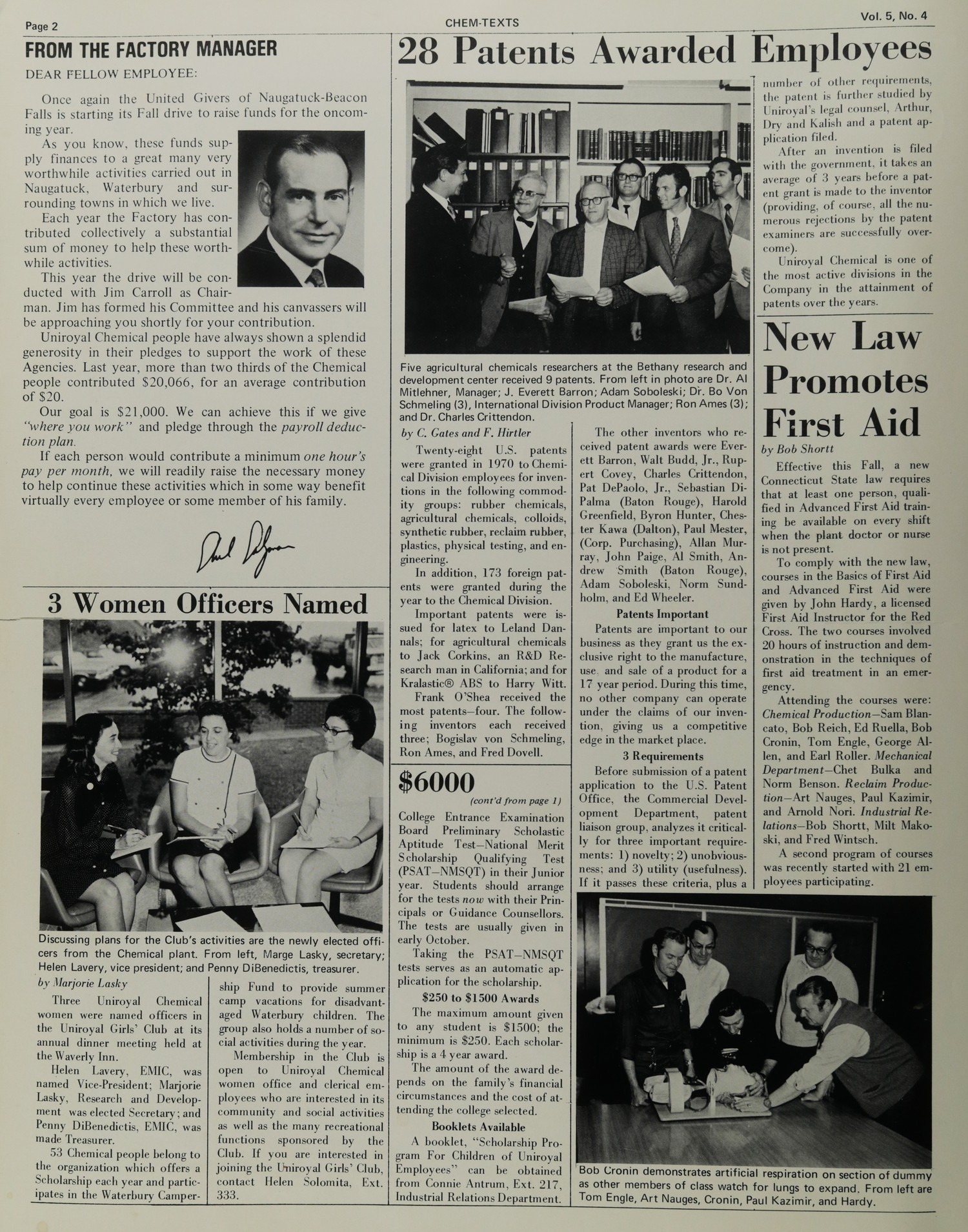
Discussing plans for the Club’s activities are the newly elected officers from the Chemical plant. From left, Marge Lasky, secretary; Helen Lavery, vice president; and Penny DiBenedictis, treasurer.

by Marjorie Lasky

Three Uniroyal Chemical women were named officers in the Uniroyal Girls’ Club at its annual dinner meeting held at the Waverly Inn.

Helen Lavery, EMIC, was named Vice-President; Marjorie Lasky, Research and Development was elected Secretary; and Penny DiBenedictis, EMIC, was made Treasurer.

53 Chemical people belong to the organization which offers a Scholarship each year and participates in the Waterbury Campership Fund to provide summer camp vacations for disadvantaged Waterbury children. The group also holds a number of social activities during the year.

Membership in the Club is open to Uniroyal Chemical women office and clerical employees who are interested in its community and social activities as well as the many recreational functions sponsored by the Club. If you are interested in joining the Uniroyal Girls’ Club, contact Helen Solomita, Ext. 333.


28 Patents Awarded Employees

[IMAGE: Group photo of five men in front of bookshelves]

Five agricultural chemicals researchers at the Bethany research and development center received 9 patents. From left in photo are Dr. Al Mittlehner, Manager; J. Everett Barron; Adam Soboleski; Dr. Bo Von Schmeling (3), International Division Product Manager; Ron Ames (3); and Dr. Charles Crittendon.

by C. Gates and F. Hirtler

Twenty-eight U.S. patents were granted in 1970 to Chemical Division employees for inventions in the following commodity groups: rubber chemicals, agricultural chemicals, colloids, synthetic rubber, reclaim rubber, plastics, physical testing, and engineering.

In addition, 173 foreign patents were granted during the year to the Chemical Division.

Important patents were issued for latex to Leland Dannals; for agricultural chemicals to Jack Corkins, an R&D Research man in California; and for Kralastic® ABS to Harry Witt.

Frank O’Shea received the most patents—four. The following inventors each received three; Bogislav von Schmeling, Ron Ames, and Fred Dovell.


$6000

(cont’d from page 1)

College Entrance Examination Board Preliminary Scholastic Aptitude Test—National Merit Scholarship Qualifying Test (PSAT—NMSQT) in their Junior year. Students should arrange for the tests now with their Principals or Guidance Counsellors. The tests are usually given in early October.

Taking the PSAT—NMSQT tests serves as an automatic application for the scholarship.

$250 to $1500 Awards

The maximum amount given to any student is $1500; the minimum is $250. Each scholarship is a 4 year award.

The amount of the award depends on the family’s financial circumstances and the cost of attending the college selected.

Booklets Available

A booklet, “Scholarship Program For Children of Uniroyal Employees” can be obtained from Connie Antrum, Ext. 217, Industrial Relations Department.


The other inventors who received patent awards were Everett Barron, Walt Budd, Jr., Rupert Covey, Charles Crittendon, Pat DePaolo, Jr., Sebastian Di-Palma (Baton Rouge), Harold Greenfield, Byron Hunter, Chester Kawa (Dalton), Paul Mester, (Corp. Purchasing), Allan Murray, John Paige, Al Smith, Andrew Smith (Baton Rouge), Adam Soboleski, Norm Sundholm, and Ed Wheeler.

Patents Important

Patents are important to our business as they grant us the exclusive right to the manufacture, use and sale of a product for a 17 year period. During this time, no other company can operate under the claims of our invention, giving us a competitive edge in the market place.

3 Requirements

Before submission of a patent application to the U.S. Patent Office, the Commercial Development Department, patent liaison group, analyzes it critically for three important requirements: 1) novelty; 2) unobviousness; and 3) utility (usefulness). If it passes these criteria, plus a

number of other requirements, the patent is further studied by Uniroyal’s legal counsel, Arthur, Dry and Kalish and a patent application filed.

After an invention is filed with the government, it takes an average of 3 years before a patent grant is made to the inventor (providing, of course, all the numerous rejections by the patent examiners are successfully overcome).

Uniroyal Chemical is one of the most active divisions in the Company in the attainment of patents over the years.


New Law Promotes First Aid

by Bob Shortt

Effective this Fall, a new Connecticut State law requires that at least one person, qualified in Advanced First Aid training be available on every shift when the plant doctor or nurse is not present.

To comply with the new law, courses in the Basics of First Aid and Advanced First Aid were given by John Hardy, a licensed First Aid Instructor for the Red Cross. The two courses involved 20 hours of instruction and demonstration in the techniques of first aid treatment in an emergency.

Attending the courses were: Chemical Production—Sam Blancato, Bob Reich, Ed Ruella, Bob Cronin, Tom Engle, George Allen, and Earl Roller. Mechanical Department—Chet Bulka and Norm Benson. Reclaim Production—Art Nauges, Paul Kazimir, and Arnold Nori. Industrial RelationsBob Shortt, Milt Makoski, and Fred Wintsch.

A second program of courses was recently started with 21 employees participating.

[IMAGE: Photo of First Aid training demonstration]

Bob Cronin demonstrates artificial respiration on section of dummy as other members of class watch for lungs to expand. From left are Tom Engle, Art Nauges, Cronin, Paul Kazimir, and Hardy.

CHEM-TEXTS – Vol. 5, No. 6 – Page 3

Page 003

Page 3 | CHEM-TEXTS | Vol. 5. No. 6


$21,000 Unit…

(Cont’d. from page 1)

than previously made at the plant.

Mike English was the Process Development Engineer for the process requirements and Rod Ashby was Project Engineer for the design and construction of the unit.

The new facility burns off waste gases completely in a smoke-less flame, and eliminates air pollution and fire hazard.

[IMAGE: Industrial facility/equipment]


United Givers

(Cont’d. from page 1)

[IMAGE: Group of people at a table reviewing documents]

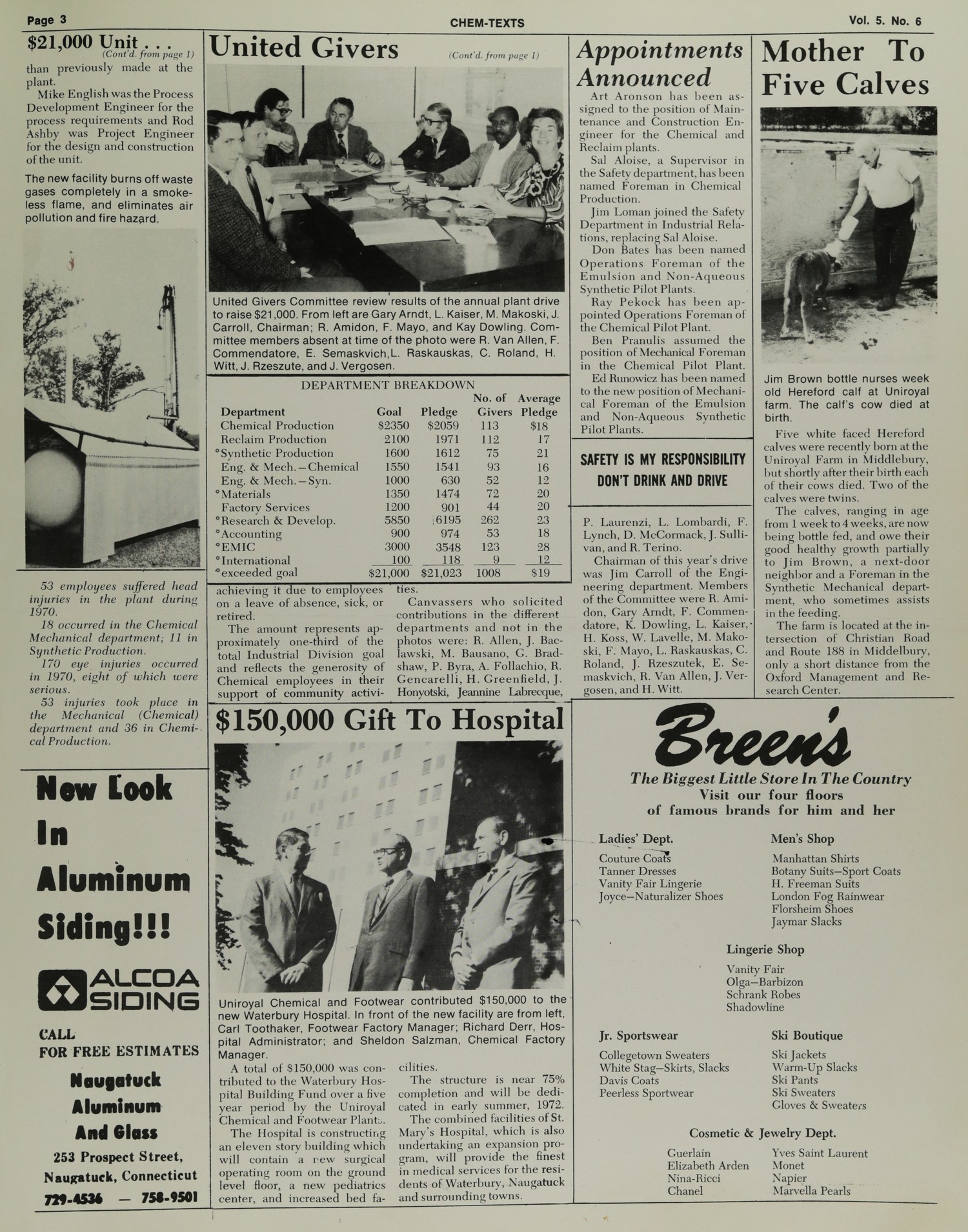
United Givers Committee review results of the annual plant drive to raise $21,000. From left are Gary Arndt, L. Kaiser, M. Makoski, J. Carroll, Chairman; R. Amidon, F. Mayo, and Kay Dowling. Committee members absent at time of the photo were R. Van Allen, F. Commendatore, E. Semaskvich, L. Raskauskas, C. Roland, H. Witt, J. Rzeszute, and J. Vergosen.

DEPARTMENT BREAKDOWN

Department Goal Pledge No. of Givers Average Pledge
Chemical Production $2350 $2059 113 $18
Reclaim Production 2100 1971 112 17
*Synthetic Production 1600 1612 75 21
Eng. & Mech.—Chemical 1550 1541 93 16
Eng. & Mech.—Syn. 1000 630 52 12
*Materials 1350 1474 72 20
Factory Services 1200 901 44 20
*Research & Develop. 5850 6195 262 23
*Accounting 900 974 53 18
*EMIC 3000 3548 123 28
*International 100 118 9 12
*exceeded goal $21,000 $21,023 1008 $19

53 employees suffered head injuries in the plant during 1970.

18 occurred in the Chemical Mechanical department; 11 in Synthetic Production.

170 eye injuries occurred in 1970, eight of which were serious.

53 injuries took place in the Mechanical (Chemical) department and 36 in Chemical Production.


achieving it due to employees on a leave of absence, sick, or retired.

The amount represents approximately one-third of the total Industrial Division goal and reflects the generosity of Chemical employees in their support of community activities.

Canvassers who solicited contributions in the different departments and not in the photos were: R. Allen, J. Baclawski, M. Bausano, G. Bradshaw, P. Byra, A. Follachio, R. Gencarelli, H. Greenfield, J. Honyotski, Jeannine Labrecque,


Appointments Announced

Art Aronson has been assigned to the position of Maintenance and Construction Engineer for the Chemical and Reclaim plants.

Sal Aloise, a Supervisor in the Safety department, has been named Foreman in Chemical Production.

Jim Loman joined the Safety Department in Industrial Relations, replacing Sal Aloise.

Don Bates has been named Operations Foreman of the Emulsion and Non-Aqueous Synthetic Pilot Plants.

Ray Pekoek has been appointed Operations Foreman of the Chemical Pilot Plant.

Ben Pranulis assumed the position of Mechanical Foreman in the Chemical Pilot Plant.

Ed Hunwicz has been named to the new position of Mechanical Foreman of the Emulsion and Non-Aqueous Synthetic Pilot Plants.


SAFETY IS MY RESPONSIBILITY

DON’T DRINK AND DRIVE

P. Laurenzi, L. Lombardi, F. Lynch, D. McCormack, J. Sullivan, and R. Terino.

Chairman of this year’s drive was Jim Carroll of the Engineering department. Members of the Committee were R. Amidon, Gary Arndt, F. Commendatore, K. Dowling, L. Kaiser, H. Koss, W. Lavelle, M. Makoski, F. Mayo, L. Raskauskas, C. Roland, J. Rzeszutek, E. Semaskvich, R. Van Allen, J. Vergosen, and H. Witt.


Mother To Five Calves

[IMAGE: Man with calf]

Jim Brown bottle nurses week old Hereford calf at Uniroyal farm. The calf’s cow died at birth.

Five white faced Hereford calves were recently born at the Uniroyal Farm in Middlebury, but shortly after their birth each of their cows died. Two of the calves were twins.

The calves, ranging in age from 1 week to 4 weeks, are now being bottle fed, and owe their good healthy growth partially to Jim Brown, a next-door neighbor and a Foreman in the Synthetic Mechanical department, who sometimes assists in the feeding.

The farm is located at the intersection of Christian Road and Route 188 in Middlebury, only a short distance from the Oxford Management and Research Center.


New Look In Aluminum Siding!!!

ALCOA SIDING

CALL FOR FREE ESTIMATES

Naugatuck Aluminum And Glass

253 Prospect Street,
Naugatuck, Connecticut

729-4534 — 758-9501


$150,000 Gift To Hospital

[IMAGE: Three men in front of building under construction]

Uniroyal Chemical and Footwear contributed $150,000 to the new Waterbury Hospital. In front of the new facility are from left, Carl Toothaker, Footwear Factory Manager; Richard Derr, Hospital Administrator; and Sheldon Salzman, Chemical Factory Manager.

A total of $150,000 was contributed to the Waterbury Hospital Building Fund over a five year period by the Uniroyal Chemical and Footwear Plant.

The Hospital is constructing an eleven story building which will contain a new surgical operating room on the ground level floor, a new pediatrics center, and increased bed facilities.

The structure is near 75% completion and will be dedicated in early summer, 1972.

The combined facilities of St. Mary’s Hospital, which is also undertaking an expansion program, will provide the finest in medical services for the residents of Waterbury, Naugatuck and surrounding towns.


Breen’s

The Biggest Little Store In The Country

Visit our four floors of famous brands for him and her

Ladies’ Dept.
– Couture Coats
– Tanner Dresses
– Vanity Fair Lingerie
– Joyce—Naturalizer Shoes

Men’s Shop
– Manhattan Shirts
– Botany Suits—Sport Coats
– H. Freeman Suits
– London Fog Rainwear
– Florsheim Shoes
– Jaymar Slacks

Lingerie Shop
– Vanity Fair
– Olga—Barbizon
– Schrank Robes
– Shadowline

Jr. Sportswear
– Collegetown Sweaters
– White Stag—Skirts, Slacks
– Davis Coats
– Peerless Sportwear

Ski Boutique
– Ski Jackets
– Warm-Up Slacks
– Ski Pants
– Ski Sweaters
– Gloves & Sweaters

Cosmetic & Jewelry Dept.
– Guerlain
– Elizabeth Arden
– Nina-Ricci
– Chanel
– Yves Saint Laurent
– Monet
– Napier
– Marvella Pearls

CHEM-TEXTS – Vol. 4 No. 1 – Page 2

Page 002

CHEM-TEXTS

Page 2 | Vol. 4, No. 1


FROM THE FACTORY MANAGER

DEAR FELLOW EMPLOYEE:

During most of the 1960’s, in fact until about mid-1969, our plant has operated in what Jim Cronin has called an “oversold” position. In other words, we were operating all out to produce every pound we could, to meet our customers’ requirements.

In 1969 the situation changed to what can be called an “undersold” position, which means we can produce more than the customer needs. This fairly abrupt change from what had become an established way of operating has affected the way all of us do our jobs. Basically, under these conditions all of us have to make better decisions faster in order to be responsive to the customers’ needs at the moment.

Considering the general decline in business activity in the markets we serve, the high cost of money, the “undersold” capacity of domestic competition and increasing foreign competition, I expect that these conditions will continue well into 1970. Therefore, it becomes even more important that we be as flexible to change as possible. Under these circumstances what we did yesterday isn’t important. What is important, is what we do right now to meet a new opportunity.

All of us have expressed individual pride in the flexibility of our plant – men and machinery alike – to do the job, whatever the requirements. Now if we really have this flexibility, and I believe we do, it seems to me that the economic climate of 1970 plays right into our hands.

I’m confident we can and will meet these demands regardless of how difficult they may be.

Sincerely,

John

John D. Evans


Jaroy Inc. Enjoys Brisk Sales

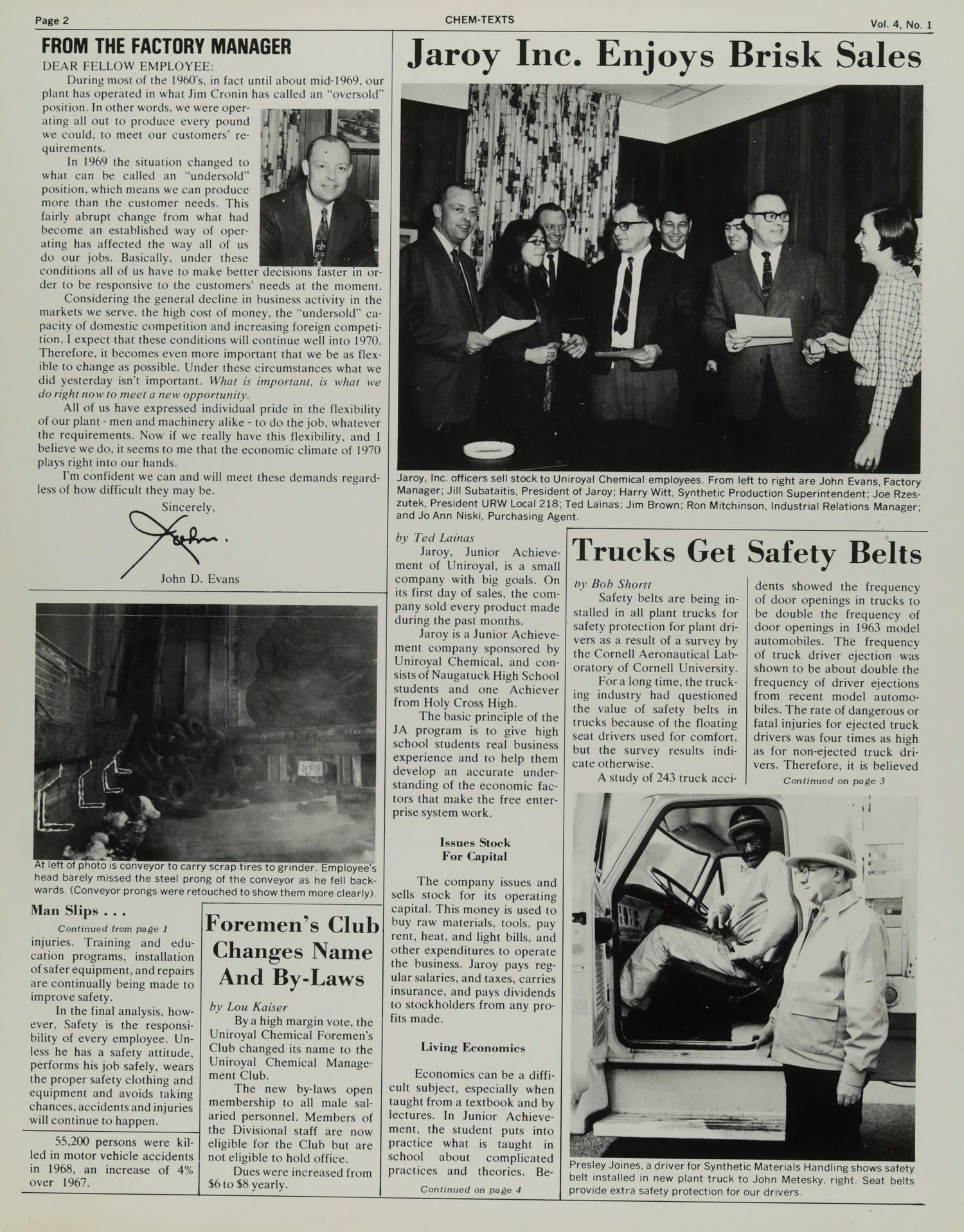
Jaroy, Inc. officers sell stock to Uniroyal Chemical employees. From left to right are John Evans, Factory Manager; Jill Subataitis, President of Jaroy; Harry Witt, Synthetic Production Superintendent; Joe Rzeszutek, President URW Local 218; Ted Lainas; Jim Brown; Ron Mitchinson, Industrial Relations Manager; and Jo Ann Niski, Purchasing Agent.

by Ted Lainas

Jaroy, Junior Achievement of Uniroyal, is a small company with big goals. On its first day of sales, the company sold every product made during the past months.

Jaroy is a Junior Achievement company sponsored by Uniroyal Chemical, and consists of Naugatuck High School students and one Achiever from Holy Cross High.

The basic principle of the JA program is to give high school students real business experience and to help them develop an accurate understanding of the economic factors that make the free enterprise system work.

Issues Stock For Capital

The company issues and sells stock for its operating capital. This money is used to buy raw materials, tools, pay rent, heat, and light bills, and other expenditures to operate the business. Jaroy pays regular salaries, and taxes, carries insurance, and pays dividends to stockholders from any profits made.

Living Economics

Economics can be a difficult subject, especially when taught from a textbook and by lectures. In Junior Achievement, the student puts into practice what is taught in school about complicated practices and theories. Be-

Continued on page 4


Trucks Get Safety Belts

by Bob Shortt

Safety belts are being installed in all plant trucks for safety protection for plant drivers as a result of a survey by the Cornell Aeronautical Laboratory of Cornell University.

For a long time, the trucking industry had questioned the value of safety belts in trucks because of the floating seat drivers used for comfort, but the survey results indicate otherwise.

A study of 243 truck accidents showed the frequency of door openings in trucks to be double the frequency of door openings in 1963 model automobiles. The frequency of truck driver ejection was shown to be about double the frequency of driver ejections from recent model automobiles. The rate of dangerous or fatal injuries for ejected truck drivers was four times as high as for non-ejected truck drivers. Therefore, it is believed

Continued on page 3

Presley Joines, a driver for Synthetic Materials Handling shows safety belt installed in new plant truck to John Metesky, right. Seat belts provide extra safety protection for our drivers.


At left of photo is conveyor to carry scrap tires to grinder. Employee’s head barely missed the steel prong of the conveyor as he fell backwards. (Conveyor prongs were retouched to show them more clearly).


Man Slips . . .

Continued from page 1

injuries. Training and education programs, installation of safer equipment, and repairs are continually being made to improve safety.

In the final analysis, however, Safety is the responsibility of every employee. Unless he has a safety attitude, performs his job safely, wears the proper safety clothing and equipment and avoids taking chances, accidents and injuries will continue to happen.

55,200 persons were killed in motor vehicle accidents in 1968, an increase of 4% over 1967.


Foremen’s Club Changes Name And By-Laws

by Lou Kaiser

By a high margin vote, the Uniroyal Chemical Foremen’s Club changed its name to the Uniroyal Chemical Management Club.

The new by-laws open membership to all male salaried personnel. Members of the Divisional staff are now eligible for the Club but are not eligible to hold office.

Dues were increased from $6 to $8 yearly.

CHEM-TEXTS – Vol. 4 No. 3 – Page 2

Page 002

CHEM-TEXTS

Page 2 | Vol. 4 No. 3


FROM THE FACTORY MANAGER

DEAR FELLOW EMPLOYEE:

Spring is officially here and every now and then the sunshine gives promise that it will be really here before long. Along with spring comes the housecleaning bug that bites our wives and turns our houses upside down while the cleaning is done and the furniture is moved. When it’s all done, the house really looks great, doesn’t it?

Let’s all catch the bug this spring and pitch in together to clean up the plant this month. In a large operation like ours, spread over many acres, winter takes its toll of housekeeping and when the snow is gone our winter carelessness becomes only too obvious.

I’m counting on everybody to do his part in cleaning up his work area. Remember, good housekeeping goes hand in hand with efficient work, quality performance, safe operation and makes for a much more pleasant place to work.

Best regards.

Sincerely,

John

John D. Evans


Chemical Club Elects Officers

[IMAGE: Group photo of officers at meeting]

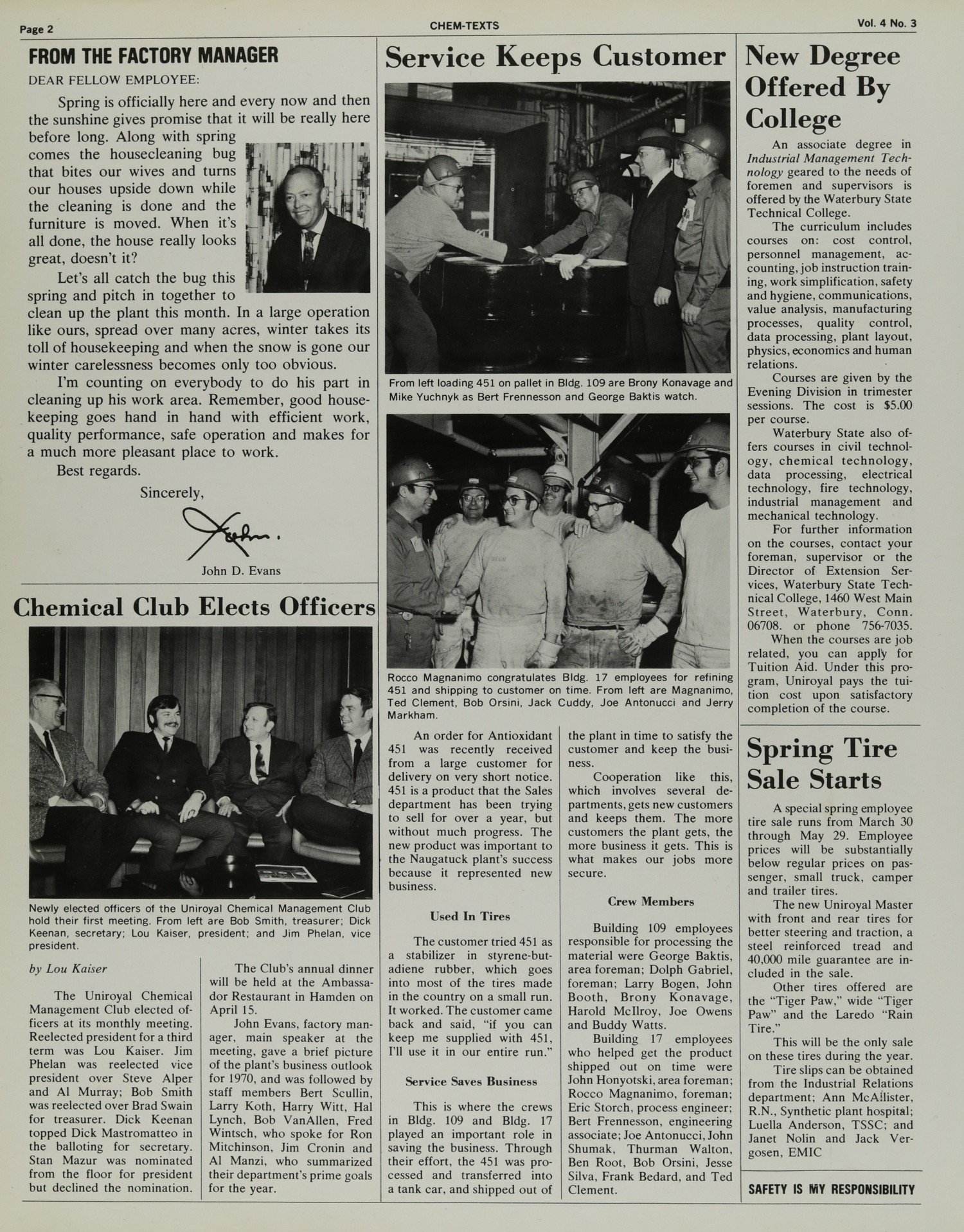
Newly elected officers of the Uniroyal Chemical Management Club hold their first meeting. From left are Bob Smith, treasurer; Dick Keenan, secretary; Lou Kaiser, president; and Jim Phelan, vice president.

by Lou Kaiser

The Uniroyal Chemical Management Club elected officers at its monthly meeting. Reelected president for a third term was Lou Kaiser. Jim Phelan was reelected vice president over Steve Alper and Al Murray. Bob Smith was reelected over Brad Swain for treasurer. Dick Keenan topped Dick Mastromatteo in the balloting for secretary. Stan Mazur was nominated from the floor for president but declined the nomination.

The Club’s annual dinner will be held at the Ambassador Restaurant in Hamden on April 15.

John Evans, factory manager, main speaker at the meeting, gave a brief picture of the plant’s business outlook for 1970, and was followed by staff members Bert Scullin, Larry Koth, Harry Witt, Hal Lynch, Bob VanAllen, Fred Wintsch, who spoke for Ron Mitchinson, Jim Cronin and Al Manzi, who summarized their department’s prime goals for the year.


Service Keeps Customer

[IMAGE: Workers loading materials on pallet]

From left loading 451 on pallet in Bldg. 109 are Brony Konavage and Mike Yuchnyk as Bert Frennesson and George Baktis watch.

[IMAGE: Group of workers being congratulated]

Rocco Magnanimo congratulates Bldg. 17 employees for refining 451 and shipping to customer on time. From left are Magnanimo, Ted Clement, Bob Orsini, Jack Cuddy, Joe Antonucci and Jerry Markham.

An order for Antioxidant 451 was recently received from a large customer for delivery on very short notice. 451 is a product that the Sales department has been trying to sell for over a year, but without much progress. The new product was important to the Naugatuck plant’s success because it represented new business.

Used In Tires

The customer tried 451 as a stabilizer in styrene-butadiene rubber, which goes into most of the tires made in the country on a small run. It worked. The customer came back and said, “if you can keep me supplied with 451, I’ll use it in our entire run.”

Service Saves Business

This is where the crews in Bldg. 109 and Bldg. 17 played an important role in saving the business. Through their effort, the 451 was processed and transferred into a tank car, and shipped out of the plant in time to satisfy the customer and keep the business.

Cooperation like this, which involves several departments, gets new customers and keeps them. The more customers the plant gets, the more business it gets. This is what makes our jobs more secure.

Crew Members

Building 109 employees responsible for processing the material were George Baktis, area foreman; Dolph Gabriel, foreman; Larry Bogen, John Booth, Brony Konavage, Harold McIlroy, Joe Owens and Buddy Watts.

Building 17 employees who helped get the product shipped out on time were John Honyotski, area foreman; Rocco Magnanimo, foreman; Eric Storch, process engineer; Bert Frennesson, engineering associate; Joe Antonucci, John Shumak, Thurman Walton, Ben Root, Bob Orsini, Jesse Silva, Frank Bedard, and Ted Clement.


New Degree Offered By College

An associate degree in Industrial Management Technology geared to the needs of foremen and supervisors is offered by the Waterbury State Technical College.

The curriculum includes courses on: cost control, personnel management, accounting, job instruction training, work simplification, safety and hygiene, communications, value analysis, manufacturing processes, quality control, data processing, plant layout, physics, economics and human relations.

Courses are given by the Evening Division in trimester sessions. The cost is $5.00 per course.

Waterbury State also offers courses in civil technology, chemical technology, data processing, electrical technology, fire technology, industrial management and mechanical technology.

For further information on the courses, contact your foreman, supervisor or the Director of Extension Services, Waterbury State Technical College, 1460 West Main Street, Waterbury, Conn. 06708. or phone 756-7035.

When the courses are job related, you can apply for Tuition Aid. Under this program, Uniroyal pays the tuition cost upon satisfactory completion of the course.


Spring Tire Sale Starts

A special spring employee tire sale runs from March 30 through May 29. Employee prices will be substantially below regular prices on passenger, small truck, camper and trailer tires.

The new Uniroyal Master with front and rear tires for better steering and traction, a steel reinforced tread and 40,000 mile guarantee are included in the sale.

Other tires offered are the “Tiger Paw,” wide “Tiger Paw” and the Laredo “Rain Tire.”

This will be the only sale on these tires during the year.

Tire slips can be obtained from the Industrial Relations department; Ann McAllister, R.N., Synthetic plant hospital; Luella Anderson, TSSC; and Janet Nolin and Jack Vergosen, EMIC

SAFETY IS MY RESPONSIBILITY

CHEM-TEXTS – Vol. 2 No. 5 – Page 3

Page 003

CHEM TEXTS

Page 3 | Vol. 2 No. 5


Harry Witt Heads Synthetic Production

Harry Witt has been named Synthetic Production Superintendent, effective Dec. 1. Ben Leach becomes Manager of Colloidal products in the Research and Development Dept.


How You Can Obtain A Pair Of Safety Prescription Glasses

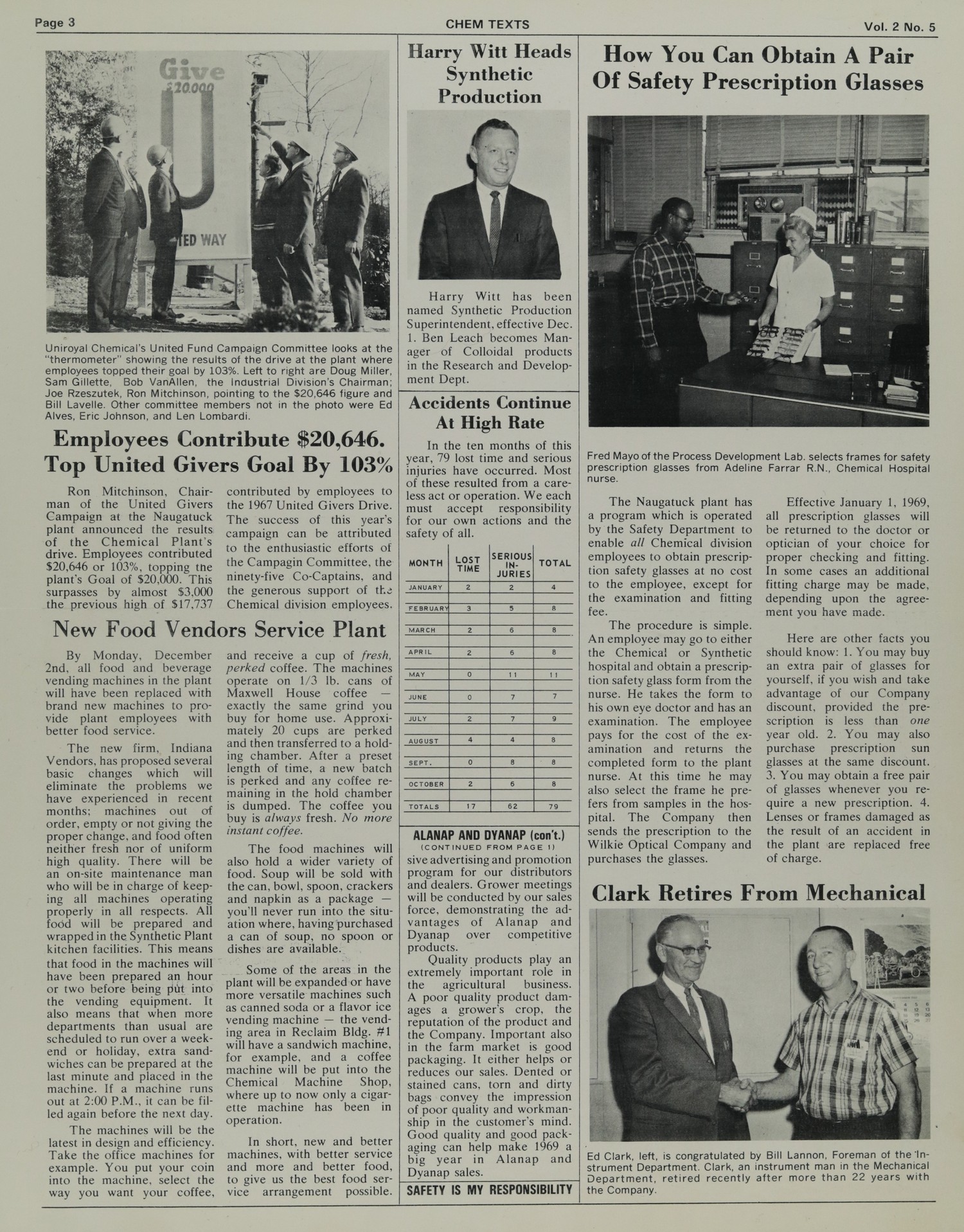
Fred Mayo of the Process Development Lab. selects frames for safety prescription glasses from Adeline Farrar R.N., Chemical Hospital nurse.

The Naugatuck plant has a program which is operated by the Safety Department to enable all Chemical division employees to obtain prescription safety glasses at no cost to the employee, except for the examination and fitting fee.

The procedure is simple. An employee may go to either the Chemical or Synthetic hospital and obtain a prescription safety glass form from the nurse. He takes the form to his own eye doctor and has an examination. The employee pays for the cost of the examination and returns the completed form to the plant nurse. At this time he may also select the frame he prefers from samples in the hospital. The Company then sends the prescription to the Wilkie Optical Company and purchases the glasses.

Effective January 1, 1969, all prescription glasses will be returned to the doctor or optician of your choice for proper checking and fitting. In some cases an additional fitting charge may be made, depending upon the agreement you have made.

Here are other facts you should know: 1. You may buy an extra pair of glasses for yourself, if you wish and take advantage of our Company discount, provided the prescription is less than one year old. 2. You may also purchase prescription sun glasses at the same discount. 3. You may obtain a free pair of glasses whenever you require a new prescription. 4. Lenses or frames damaged as the result of an accident in the plant are replaced free of charge.


[PHOTO CAPTION:]
Uniroyal Chemical’s United Fund Campaign Committee looks at the “thermometer” showing the results of the drive at the plant where employees topped their goal by 103%. Left to right are Doug Miller, Sam Gillette, Bob VanAllen, the Industrial Division’s Chairman; Joe Kresziutek, Ron Mitchinson, pointing to the $20,646 figure and Bill Lavelle. Other committee members not in the photo were Ed Alves, Eric Johnson, and Len Lombardi.


Employees Contribute $20,646. Top United Givers Goal By 103%

Ron Mitchinson, Chairman of the United Givers Campaign at the Naugatuck plant announced the results of the Chemical Plant’s drive. Employees contributed $20,646 or 103%, topping the plant’s Goal of $20,000. This surpasses by almost $3,000 the previous high of $17,737 contributed by employees to the 1967 United Givers Drive. The success of this year’s campaign can be attributed to the enthusiastic efforts of the Campagin Committee, the ninety-five Co-Captains, and the generous support of the Chemical division employees.


Accidents Continue At High Rate

In the ten months of this year, 79 lost time and serious injuries have occurred. Most of these resulted from a careless act or operation. We each must accept responsibility for our own actions and the safety of all.

MONTH LOST TIME SERIOUS IN-JURIES TOTAL
JANUARY 2 2 4
FEBRUARY 3 5 8
MARCH 2 6 8
APRIL 2 6 8
MAY 0 11 11
JUNE 0 7 7
JULY 2 7 9
AUGUST 4 4 8
SEPT. 0 8 8
OCTOBER 2 6 8
TOTALS 17 62 79

New Food Vendors Service Plant

By Monday, December 2nd, all food and beverage vending machines in the plant will have been replaced with brand new machines to provide plant employees with better food service.

The new firm, Indiana Vendors, has proposed several basic changes which will eliminate the problems we have experienced in recent months; machines out of order, empty or not giving the proper change, and food often neither fresh nor of uniform high quality. There will be an on-site maintenance man who will be in charge of keeping all machines operating properly in all respects. All food will be prepared and wrapped in the Synthetic Plant kitchen facilities. This means that food in the machines will have been prepared an hour or two before being put into the vending equipment. It also means that when more departments than usual are scheduled to run over a weekend or holiday, extra sandwiches can be prepared at the last minute and placed in the machine. If a machine runs out at 2:00 P.M., it can be filled again before the next day.

The machines will be the latest in design and efficiency. Take the office machines for example. You put your coin into the machine, select the way you want your coffee, and receive a cup of fresh, perked coffee. The machines operate on 1/3 lb. cans of Maxwell House coffee — exactly the same grind you buy for home use. Approximately 20 cups are perked and then transferred to a holding chamber. After a preset length of time, a new batch is perked and any coffee remaining in the hold chamber is dumped. The coffee you buy is always fresh. No more instant coffee.

The food machines will also hold a wider variety of food. Soup will be sold with the can, bowl, spoon, crackers and napkin as a package — you’ll never run into the situation where, having purchased a can of soup, no spoon or dishes are available.

Some of the areas in the plant will be expanded or have more versatile machines such as canned soda or a flavor ice vending machine — the vending area in Reclaim Bldg. #1 will have a sandwich machine, for example, and a coffee machine will be put into the Chemical Machine Shop, where up to now only a cigarette machine has been in operation.

In short, new and better machines, with better service and more and better food, to give us the best food service arrangement possible.


ALANAP AND DYANAP (con’t.)

(CONTINUED FROM PAGE 1)

sive advertising and promotion program for our distributors and dealers. Grower meetings will be conducted by our sales force, demonstrating the advantages of Alanap and Dyanap over competitive products.

Quality products play an extremely important role in the agricultural business. A poor quality product damages a grower’s crop, the reputation of the product and the Company. Important also in the farm market is good packaging. It either helps or reduces our sales. Dented or stained cans, torn and dirty bags convey the impression of poor quality and workmanship in the customer’s mind. Good quality and good packaging can help make 1969 a big year in Alanap and Dyanap sales.

SAFETY IS MY RESPONSIBILITY


Clark Retires From Mechanical

Ed Clark, left, is congratulated by Bill Lannon, Foreman of the Instrument Department. Clark, an instrument man in the Mechanical Department, retired recently after more than 22 years with the Company.