UniRoyal Summoned To Show Cause Hearing Tuesday

Union Seeks Injunction

6-23-67

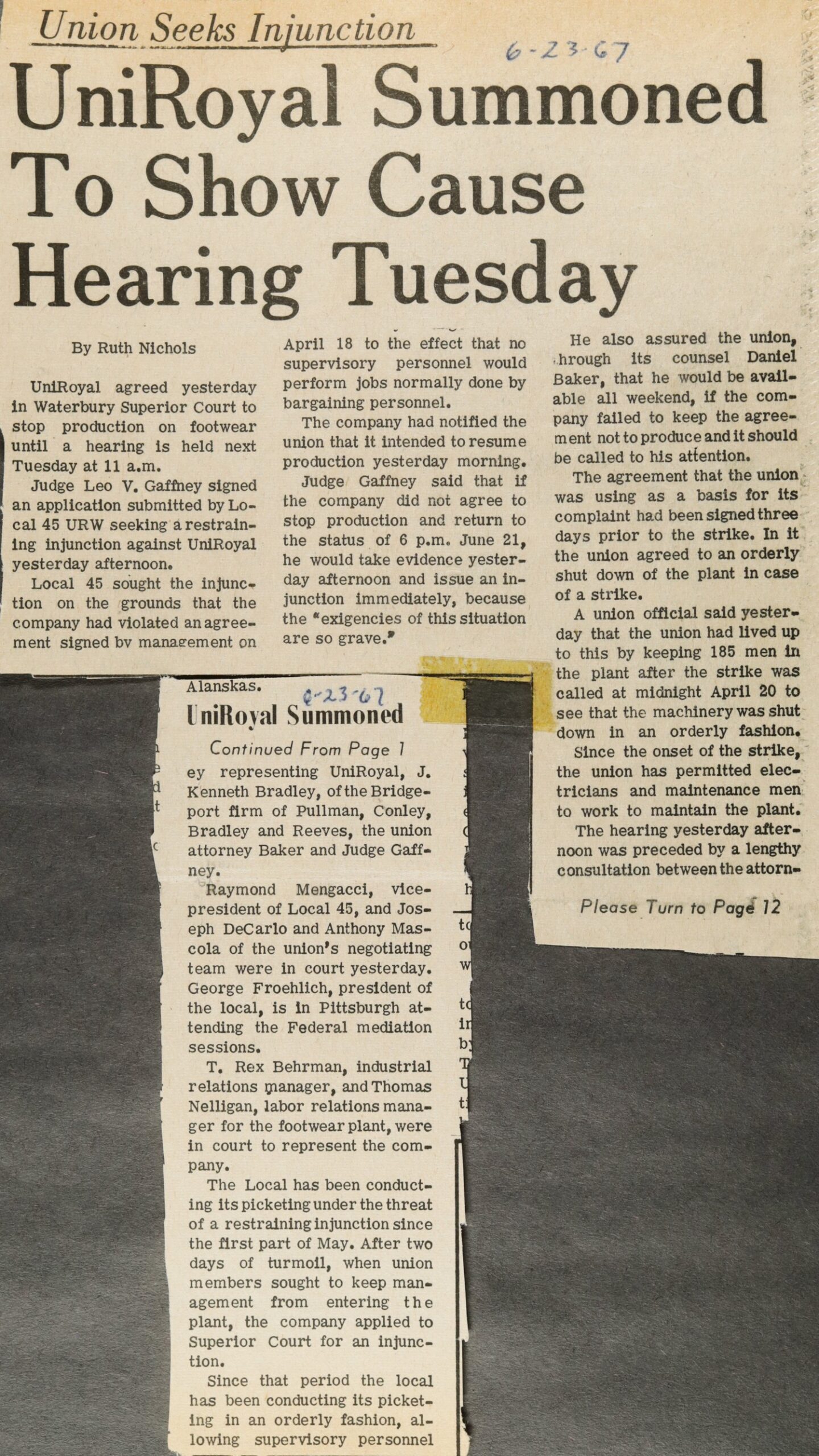
UniRoyal Summoned To Show Cause Hearing Tuesday

By Ruth Nichols

UniRoyal agreed yesterday in Waterbury Superior Court to stop production on footwear until a hearing is held next Tuesday at 11 a.m.

Judge Leo V. Gaffney signed an application submitted by Local 45 URW seeking a restraining injunction against UniRoyal yesterday afternoon.

Local 45 sought the injunction on the grounds that the company had violated an agreement signed by management on April 18 to the effect that no supervisory personnel would perform jobs normally done by bargaining personnel.

The company had notified the union that it intended to resume production yesterday morning.

Judge Gaffney said that if the company did not agree to stop production and return to the status of 6 p.m. June 21, he would take evidence yesterday afternoon and issue an injunction immediately, because the “exigencies of this situation are so grave.”

He also assured the union, through its counsel Daniel Baker, that he would be available all weekend, if the company failed to keep the agreement not to produce and it should be called to his attention.

The agreement that the union was using as a basis for its complaint had been signed three days prior to the strike. In it the union agreed to an orderly shut down of the plant in case of a strike.

A union official said yesterday that the union had lived up to this by keeping 185 men in the plant after the strike was called at midnight April 20 to see that the machinery was shut down in an orderly fashion.

Since the onset of the strike, the union has permitted electricians and maintenance men to work to maintain the plant.

The hearing yesterday afternoon was preceded by a lengthy consultation between the attorn-

Please Turn to Page 12


Alanskas. 6-23-67

UniRoyal Summoned

Continued From Page 1

ey representing UniRoyal, J. Kenneth Bradley, of the Bridgeport firm of Pullman, Conley, Bradley and Reeves, the union attorney Baker and Judge Gaffney.

Raymond Mengacci, vice-president of Local 45, and Joseph DeCarlo and Anthony Mascola of the union’s negotiating team were in court yesterday. George Froehlich, president of the local, is in Pittsburgh attending the Federal mediation sessions.

T. Rex Behrman, industrial relations manager, and Thomas Nelligan, labor relations manager for the footwear plant, were in court to represent the company.

The Local has been conducting its picketing under the threat of a restraining injunction since the first part of May. After two days of turmoil, when union members sought to keep management from entering the plant, the company applied to Superior Court for an injunction.

Since that period the local has been conducting its picketing in an orderly fashion, allowing supervisory personnel

Judge Delays Ruling

Judge Delays Ruling

In Uniroyal Case

Judge Delays Ruling

6-29-67 (handwritten)

A decision on whether Uniroyal, Inc. should be restrained by court order from resuming production at its strikebound Naugatuck Footwear Plant will not be rendered for at least a week.

Superior Court Judge Leo V. Gaffney said at the close of a hearing Wednesday on a petition by Local 45 of the United Rubber Workers Union for an injunction against the company, that his decision can be expected by the end of next week.

He has given counsel for the company and the union until Wednesday to file legal briefs.

Judge Gaffney said his ruling will follow soon after receipt of the briefs, probably not later than Friday.

He added, however, “The best decision of all would come from Cincinnati” where negotiators have been trying to agree on a new union contract since the strike began April 21.

“I’d like to see that decision first,” he said.

The union asked for the injunction last week when the company began production of samples of its new footwear designs, using non-union supervisory personnel.

At an appearance in court last Thursday when the union’s petition was filed, the company agreed to halt production until after completion of a hearing before Judge Gaffney.

Violation Claimed

Local 45 claims production of the samples constitutes a violation of an agreement signed by the parties April 18.

The agreement, which provides for orderly shutdown and maintenance of the plant while the strike is in progress, states in part that for the duration of the strike, the company will not perform any work normally done by union employes with non-union personnel.

Testimony on the issue was completed Wednesday, with presentation of the company’s case.

Most of the testimony centered on two main points: That the company will suffer “severe damage” if it is not permitted

(Cont’d On Page 2—Uniroyal)


to make samples for use by its salesmen in obtaining orders from retailers; and that the company maintains that the union violated the agreement first and rendered it void when in early May pickets blocked entrance gates and violence erupted between strikers and police.

To company representatives, Judge Gaffney posed the question, “Did you ever write a letter to any union officer to the effect that the agreement was no longer in effect”

In each instance, the answer was, “No.”

At several points along the way he indicated that damage the company might suffer was not at issue in the case. He said the central issue was whether the agreement had been violated.

Whenever counsel for either Uniroyal or Local 45 dwelled too long on what the jurist described as “side issues,” he admonished them to “get back on the track, which is whether or not this contract has been violated.”

Financial Loss

Thomas J. Nelligan, labor relations manager, testified that the company will suffer a “very severe financial loss” forcing a “reduction in production” unless it is permitted to produce samples for its salesmen to “take into the field” in August.

He said the samples to be produced, between 400 and 500 pairs a day, would be for the spring and summer season next year.

Nelligan said the samples are normally made between April and July. He said they go out to the salesmen in August “when the entire industry” sends out its samples for retail orders.

Failure of the company to have samples to show its customers in August will mean “a very large reduction in the amount of production needed for the coming year, and in turn, ess employes,” Nelligan said.

Nelligan contended that the union stood to benefit if the injunction is not granted because production of samples leads to sales and “stable employment and perhaps increased employment.”

Operating under full capacity, the company is able to produce between 120,000 and 130,000 pairs of shoes a day, Nelligan said. He said the company wants to make up about 45,000 samples over a six-to-eight week period.


In response to questions from both union counsel Daniel Baker and Uniroyal counsel J. Kenneth Bradley, Nelligan said it would “not be practical or possible ” to produce the samples at some other Uniroyal plant other than Naugatuck.

Machinery Needed

He said machinery necessary for production is not available at other Uniroyal facilities.

Nelligan also was questioned at some length on meetings he attended May 8 and May 15 with other company officials and union leaders.

He said at a May 15 meeting, Jack Smith, plant manager, told the union “very emphatically” that the shutdown agreement had been broken when the union pickets blocked entrance gates.

He added that Smith also said that although he didn’t believe the agreement was in effect the company would still honor it.

He also admitted that “except for a few isolated instances” the union had complied with the agreement.

Smith denied that he ever said he would honor the agreement even though he felt it had been violated.

He said the union broke the agreement when the company announced in May that it would begin shipments from the plant. He said Raymond Mengacci, Local 45 vice president, warned that there would be nothing shipped from that facility. . ”

Smith testified that on the scheduled day of shipping, violence on the picket line prevented any shipments.

Smith contended that “We don’t have an agreement because the union chose to abrogate it and we consider ourselves to be relieved of any obligations under the agreement.”

Under cross-examination, Baker attempted to establish that the picket line violence resulted when the company allegedly broke a verbal agreement not to have any personnel in the plant after 6 p.m.

He asked both Nelligan and Smith about the alleged agreement and questioned them about “30 or 40 people” who were brought into the plant after 6 p.m. to begin preparations for shipment on the following day.

Donald Hadley, sales manager, claimed that between 50 and 60 per cent of the company’s business comes from sales of new styles.


Says Samples Vital

Responding to Bradley’s questions, he said without samples to show potential customers, damage to the company “conceivably could never be made up.”

It was at this juncture that Judge Gaffney reminded Atty Bradley that “it is the claimant (the union) not the defendant (Uniroyal) who has to show irreparable damage.”

Bradley said he wanted to show the company would suffer substantial harm if it can’t produce the samples.

“Then I would suggest,” the judge quipped, “that perhaps you should bring an injunction to stop the union from bringing this injunction.”

Brief testimony also was taken from Joseph J. Foley, a strike captain and member of the union negotiating committee.

Foley said, “I think there would be a lot of violence” if the court order is not issued, because the union “would have no way” of controlling the strikers.

Mengacci had predicted the same result in testimony Tuesday. He warned of “bloodshed in Naugatuck.”

Bradley questioned why, if union leaders were able to control the pickets after Judge Gaffney had cautioned them against violence in May, they could not control them in the future. He was not permitted to pursue that line of questioning any further.

The hearing concluded with a reaffirmation by the company that it “will not undertake to do anything” in the way of production until after the judge’s finding.

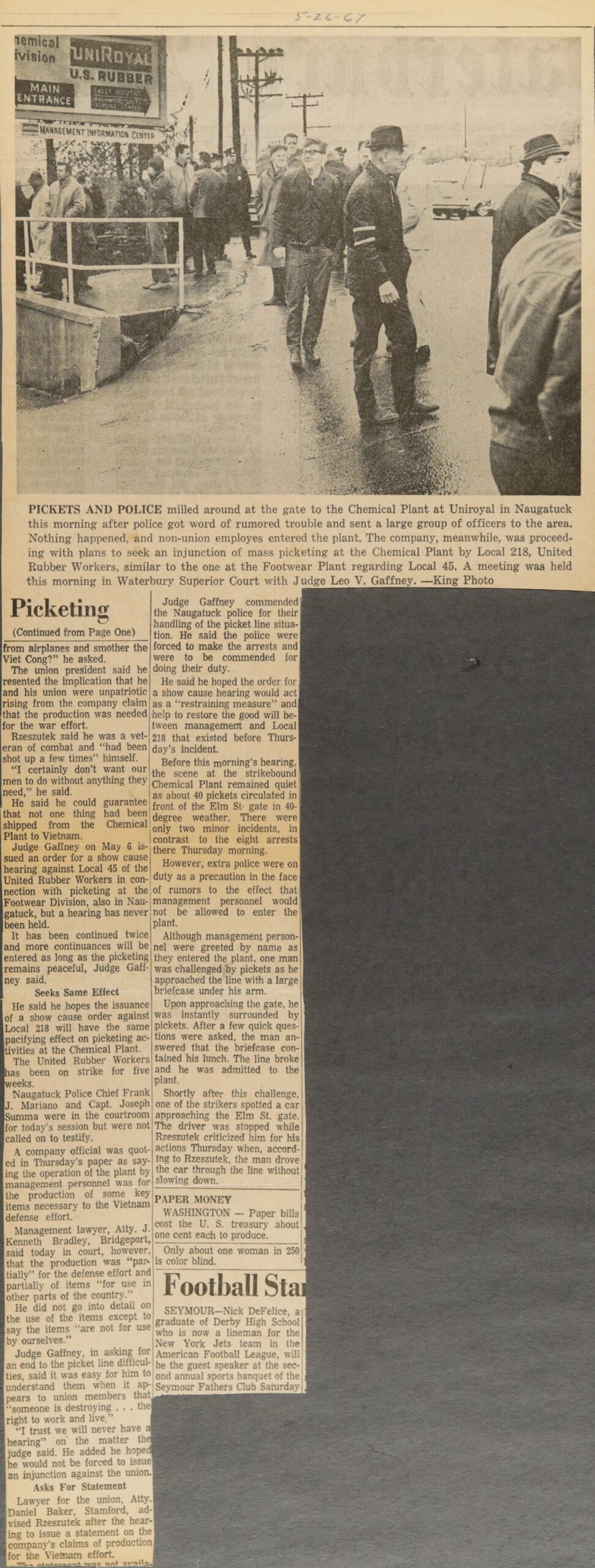
Pickets and Police Milled Around at the Gate to the Chemical Plant at Uniroyal in Naugatuck

5-26-67


[IMAGE: Photograph showing pickets and police at a factory gate]

temical
ivision

UNIROYAL
U.S. RUBBER

MAIN
ENTRANCE

SALES INDUSTRIAL
CHEMICALS COATINGS
ORDNANCE TEXTILES

MANAGEMENT INFORMATION CENTER


PICKETS AND POLICE milled around at the gate to the Chemical Plant at Uniroyal in Naugatuck this morning after police got word of rumored trouble and sent a large group of officers to the area. Nothing happened, and non-union employes entered the plant. The company, meanwhile, was proceeding with plans to seek an injunction of mass picketing at the Chemical Plant by Local 218, United Rubber Workers, similar to the one at the Footwear Plant regarding Local 45. A meeting was held this morning in Waterbury Superior Court with Judge Leo V. Gaffney. —King Photo


Picketing

(Continued from Page One)

from airplanes and smother the Viet Cong?” he asked.

The union president said he resented the implication that he and his union were unpatriotic rising from the company claim that the production was needed for the war effort.

Rzeszutek said he was a veteran of combat and “had been shot up a few times” himself.

“I certainly don’t want our men to do without anything they need,” he said.

He said he could guarantee that not one thing had been shipped from the Chemical Plant to Vietnam.

Judge Gaffney on May 6 issued an order for a show cause hearing against Local 45 of the United Rubber Workers in connection with picketing at the Footwear Division, also in Naugatuck, but a hearing has never been held.

It has been continued twice and more continuances will be entered as long as the picketing remains peaceful, Judge Gaffney said.

Seeks Same Effect

He said he hopes the issuance of a show cause order against Local 218 will have the same pacifying effect on picketing activities at the Chemical Plant.

The United Rubber Workers has been on strike for five weeks.

Naugatuck Police Chief Frank J. Mariano and Capt. Joseph Summa were in the courtroom for today’s session but were not called on to testify.

A company official was quoted in Thursday’s paper as saying the operation of the plant by management personnel was for the production of some key items necessary to the Vietnam defense effort.

Management lawyer, Atty. J. Kenneth Bradley, Bridgeport, said today in court, however, that the production was “partially” for the defense effort and partially of items “for use in other parts of the country.”

He did not go into detail on the use of the items except to say the items “are not for use by ourselves.”

Judge Gaffney, in asking for an end to the picket line difficulties, said it was easy for him to understand them when it appears to union members that “someone is destroying . . . the right to work and live.”

“I trust we will never have a hearing” on the matter the judge said. He added he hoped he would not be forced to issue an injunction against the union.

Asks For Statement

Lawyer for the union, Atty. Daniel Baker, Stamford, advised Rzeszutek after the hearing to issue a statement on the company’s claims of production for the Vietnam effort.


Judge Gaffney commended the Naugatuck police for their handling of the picket line situation. He said the police were forced to make the arrests and were to be commended for doing their duty.

He said he hoped the order for a show cause hearing would act as a “restraining measure” and help to restore the good will between management and Local 218 that existed before Thursday’s incident.

Before this morning’s hearing, the scene at the strikebound Chemical Plant remained quiet as about 40 pickets circulated in front of the Elm St. gate in 40-degree weather. There were only two minor incidents, in contrast to the eight arrests there Thursday morning.

However, extra police were on duty as a precaution in the face of rumors to the effect that management personnel would not be allowed to enter the plant.

Although management personnel were greeted by name as they entered the plant, one man was challenged by pickets as he approached the line with a large briefcase under his arm.

Upon approaching the gate, he was instantly surrounded by pickets. After a few quick questions were asked, the man answered that the briefcase contained his lunch. The line broke and he was admitted to the plant.

Shortly after this challenge, one of the strikers spotted a car approaching the Elm St. gate. The driver was stopped while Rzeszutek criticized him for his actions Thursday when, according to Rzeszutek, the man drove the car through the line without slowing down.


PAPER MONEY

WASHINGTON — Paper bills cost the U. S. treasury about one cent each to produce.

Only about one woman in 250 is color blind.


Football Star

SEYMOUR—Nick DeFelice, a graduate of Derby High School who is now a lineman for the New York Jets team in the American Football League, will be the guest speaker at the second annual sports banquet of the Seymour Fathers Club Saturday.

UniRoyal Cites Need For Sample Shoes

UniRoyal Cites Need For Sample Shoes

By Ruth Nichols

Production at the UniRoyal Footwear plant will be suspended for at least another week to allow time for briefs to be filed and Judge Leo V. Gaffney to come to a decision on whether a restraining injunction should be granted against the firm.

Two days of testimony from both Local 45 and UniRoyal Footwear Division management ended yesterday afternoon in Waterbury Superior Court. Judge Gaffney asked that written briefs be submitted to him by next Wednesday by both attorneys and stated that he will make his decision within a couple of days after reviewing the briefs and transcripts of the court proceedings.

Local 45 ended its testimony yesterday after calling Joseph Foley to the stand. Foley, a 21-year employe of the plant, member of the Union negotiating team and strike captain, was questioned on what might happen if the company was allowed to produce sample shoes.

Foley told the court that there would be violence on the picket line. He also testified that large numbers of supervisory personnel passed through the picket lines daily without incident.

Atty. J. Kenneth Bradley opened UniRoyal’s testimony by calling Thomas Nelligan, Labor Relations Manager, to the stand.

Nelligan told the court that 4,500 footwear plant employes are out on strike while 850 non-bargaining employes are working. All UniRoyal plants in the borough, with the exception of the footwear plant, are producing.

Nelligan cited the need for the sample shoes by August 1st. If the shoes were not ready to show by that date, according to Nelligan, there would be a reduction of production and a need for less employes.

Nelligan, under questioning, stated that if production of samples was allowed there would be no loss to striking employes but their wages. The Judge ruled that this answer should be stricken. Nelligan said he had no way of knowing what the cost to URW members and their families would be overall.

Nelligan said that these sample shoes could not be produced elsewhere. That it would take about 200 people, six weeks to two months to produce the necessary number of sample shoes. He said the bargaining people had been offered, through the union, the work first.

Factory Manager Jack Smith told the court that it was Monday or Tuesday of last week that the decision was made to start production on sample shoes.

Attorney Daniel Baker, URW counsel, questioned Nelligan about production at other UniRoyal plants. He asked if these samples couldn’t be made at one of the other company shoe producing plants that was currently in production.

Nelligan told the court that this was not possible because a different type of shoe was made at these plants.

Baker then opened the question of management starting its inventory using non-bargaining personnel. He also returned to the subject of the “Gray Building.”

How many shoes were produced in the building? Nelligan stated that the first three or four sample shoes were made in the building. The union sought inspection of the “gray building.”

Judge Gaffney asked if a member of the Industrial Relations Department accompanied the union inspection team on its tour.

Smith told the court about the pickets not allowing personnel into the plant in the early days of the strike. He said on the first day of mass picketing he conferred with Naugatuck Police Capt. Joseph Summa and sent management personnel home. He said all this occurred after the union had been notified 24-hours in advance of the company’s intention to ship.

Smith testified that on the May 15th meeting with union representatives, the company made known its intention to start production, first offering the work to bargaining personnel. He told the court he, at that time, told the union he believed there was no longer an agreement; however, it was then believed settlement was imminent and the company did not press for production.

Again on the subject of sample shoes, Smith said that production could not be carried on in the “Keds” line, produced here in the borough, in another company plant without moving equipment in large numbers to another location.

Smith spoke of the work the union had allowed to continue in the “Gray Building.” He said that the union knew that certain materials were produced in the main plant to carry on this work and hadn’t objected.

He said that this was the only footwear plant in the United States to be shut down and declared it was necessary to have sample shoes ready by the August 1st date.

Smith said that if samples were not ready, salesmen would miss sales and this, in turn, would lower sales, lower fill-in sales, and thus reduce production in the Naugatuck Footwear plant.

Smith, again questioned about the agreement and the May 15th meeting, told the Judge that he did not remember coming back into the meeting room after making a telephone call and telling union representative that he would “honor the agreement.”

Baker asked Smith had he given the union 24-hours notice of intent to ship. And had not the company made an oral agreement that no personnel would enter the plant after 6 p.m.

Then Baker asked had not the fact that personnel came into the

Please Turn to Page 12


Beacon Falls

Beacon Hose Co. Firemen To Parade

BEACON FALLS – Captain Walter C. Carlson of Beacon Hose Co. No. 1 has announced that members will attend the Firemen’s Parade in Oxford this evening.

Members are requested to meet at the firehouse at 6:30 in full dress uniforms.

Management lawyer, Atty. J. Kenneth Bradley, said Friday that the production was ”partially” for the defense effort, and partially of items ”for use in other parts of the country.”

Management lawyer, Atty. J.
Kenneth Bradley, said Friday
that the production was “par-
tially” for the defense effort,
and partially of items “for use
in other parts of the country.”

He did not go into detail on
the use of the items except to
say the items “are not for use
by ourselves.”

Naugatuck Police Chief Frank
J. Mariano and Capt. Joseph
Summa were in the courtroom
for Friday’s session but were
not called upon to testify.

In asking for an end to the
picket line difficulties, Judge
Gaffney said it was easy for
him to understand them when it
appears to union members that
“someone is destroying … the
right to work and live.”

“I trust we will never have a
hearing” on the matter, the
judge said. He added that he
hoped he would not be forced to
issue an injunction against the
union.

Judge Gaffney on May 6 is-
sued an order for a show cause
hearing against Local 45 of the
United Rubber Workers in con-
nection with picketing at the
Footwear Division, also in Nau-
gatuck, but a hearing has never
been held.

It has been continued twice
and more continuances will be
entered as long as the picketing
remains peaceful, Judge Gaff-
ney said.

Seeks Same Effect

He said he hopes the issuance
of a show cause order against
Local 218 will have the same
pacifying effect on picketing ac-
tivities at the Chemical Plant.

The United Rubber Workers
has been on strike for five
weeks.

Negotiations in Cincinnati,
Ohio, on the master contract re-
cessed Friday until Wednesday

SATURDAY
MAY 27, 1967

UniRoyal

Continued From Page 1

According to Rzeszutek, the
only items shipped from the
Chemical were “slabs of re-
claim”, slabs of rubber re-
claimed from old tires and
other rubber items.

“What are they going to do
with slabs of reclaim, drop them
from airplanes and smother the
Viet Cong?” he asked.

Rzeszutek, a veteran of com-
bat who “had been shot up a few
times” himself, resented the
implication that he and his union
were unpatriotic. He said he
could guarantee that not one
thing had been shipped from the
Chemical plant to Vietnam.

Management lawyer, Atty. J.
Kenneth Bradley, said Friday
that the production was “par-
tially” for the defense effort,
and partially “for use in other
parts of the country.” The only
additional information he would
give was that the items “are not
for use by ourselves.”

A company official was quot-
ed Thursday as saying the oper-
ation of plant by management
personnel was for the produc-
tion of some key items neces-
sary for the Vietnam defense
effort.

In asking for an end to picket
line difficulties, Gaffney sym-
pathized with the union mem-
bers who felt that “someone is
destroying. . .the right to live
and work.” “I trust we will
never have a hearing”, the judge
said, adding that he hoped he
would not be forced to issue
an injunction against the union.

Judge Gaffney on May 6 issued
a show cause order against
Local 45 of the United Rubber
Workers in connection with
picketing at the Footwear Divi-
sion, but a hearing has never
been held. There have been two
continuances and more are ex-
pected as long as the picketing
remains peaceful.

The judge said he hoped the
issuance of a show cause order
will have the same effect at the
Chemical plant.

The United Rubber Workers
have been on strike for five-
weeks. Negotiations on the mas-
ter contract, being held in Cin-
cinnati, Ohio, recessed Friday
until Wednesday.

Uniroyal

Uniroyal 6-28-61

(Continued from Page One)

Uniroyal counsel J. Kenneth Bradley questioned Mengacci at some length about flare-ups at the gates early in May when pickets attempted to keep office personnel from entering the plant.

71 Arrests

The three days of clashes between pickets and police resulted in arrests of 71 strikers and a warning from Judge Gaffney that he would issue an injunction against the union if the violence didn’t stop.

The judge Tuesday gave some hint as to how he will accept such a defense, when he interrupted Bradley during questioning about a meeting between union officials and John Smith, plant manager.

Mengacci quoted Smith as saying at that meeting that in his opinion, no agreement existed because of the picket line troubles.

Judge Gaffney declared, “I’m not concerned with what some Mr. Smith thought about whether the agreement was null and void—it does not substitute for my judgment.”

At another point, while Bradley cross-examined Mengacci about alleged offers by the company to have union members perform certain jobs at the plant, the judge chided the lawyer to “come to the issue here, whether or not there’s been a violation of this contract.”

Mengacci also claimed that the company had announced at a May 8 meeting that “it needed to get samples out and they (company officials) intended to start production on samples with supervisory help.”

The union official said that after union protests, Smith told Local 45 leaders at a meeting a week later that the company “would honor the agreement” not to go into production and plans to start work on the samples would be dropped.

Mengacci said the company announced at that time that it wanted to produce 400 to 500 pairs of shoes a day.

Joseph DeCarlo, a member of the union negotiating committee, and Walter Beckwith, a picket captain, also voiced the opinion that violence would break out in the picket lines if production is allowed to begin.