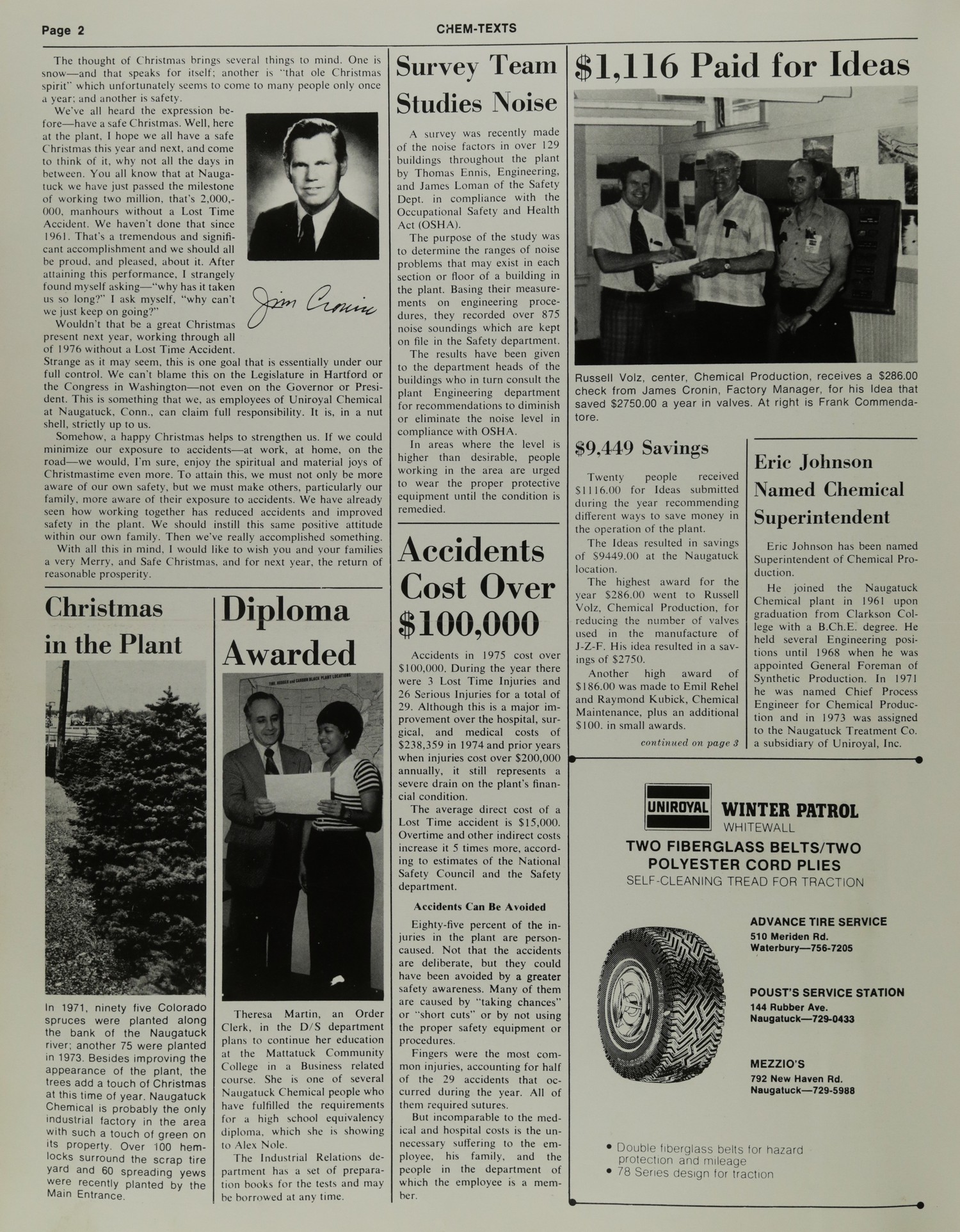
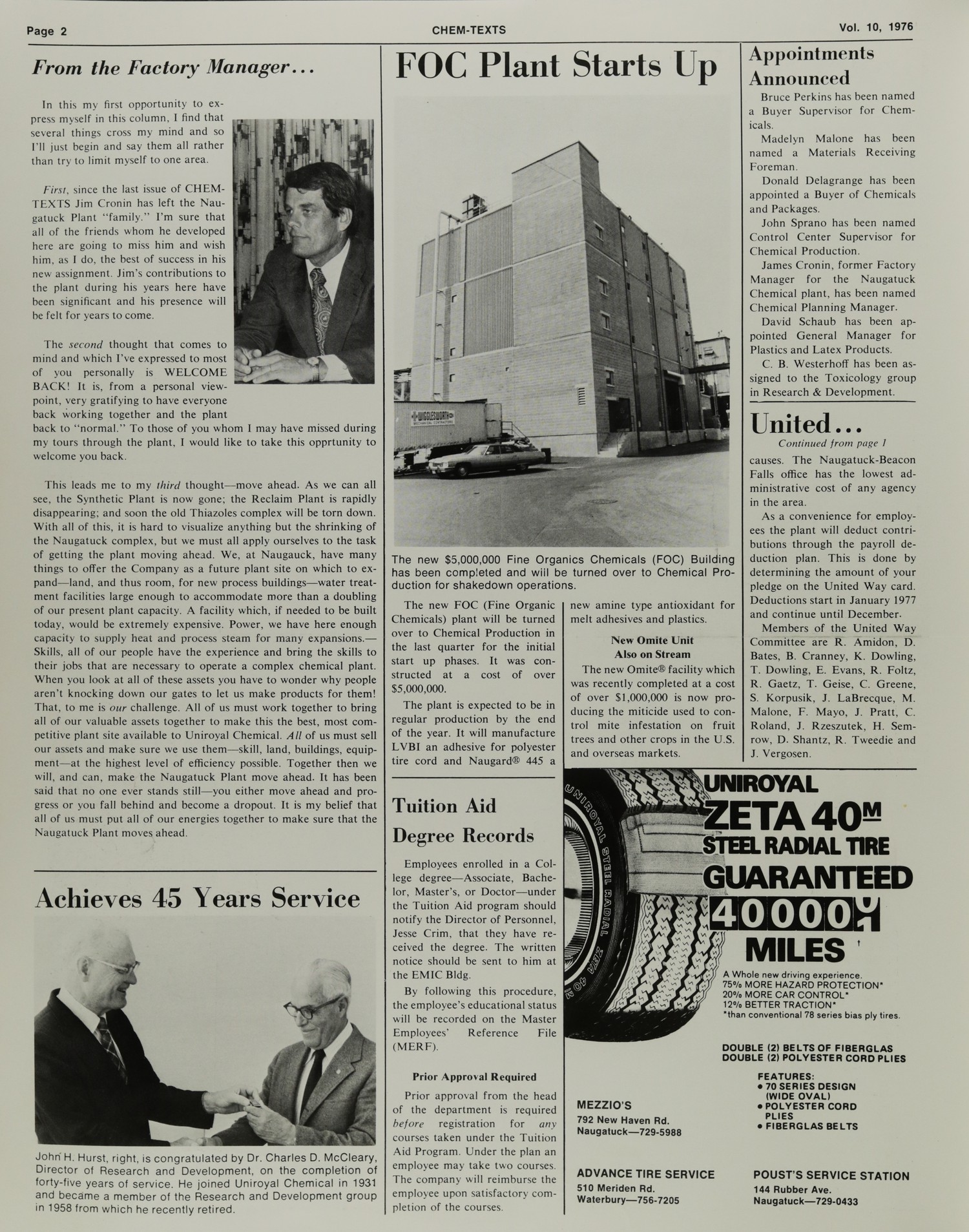
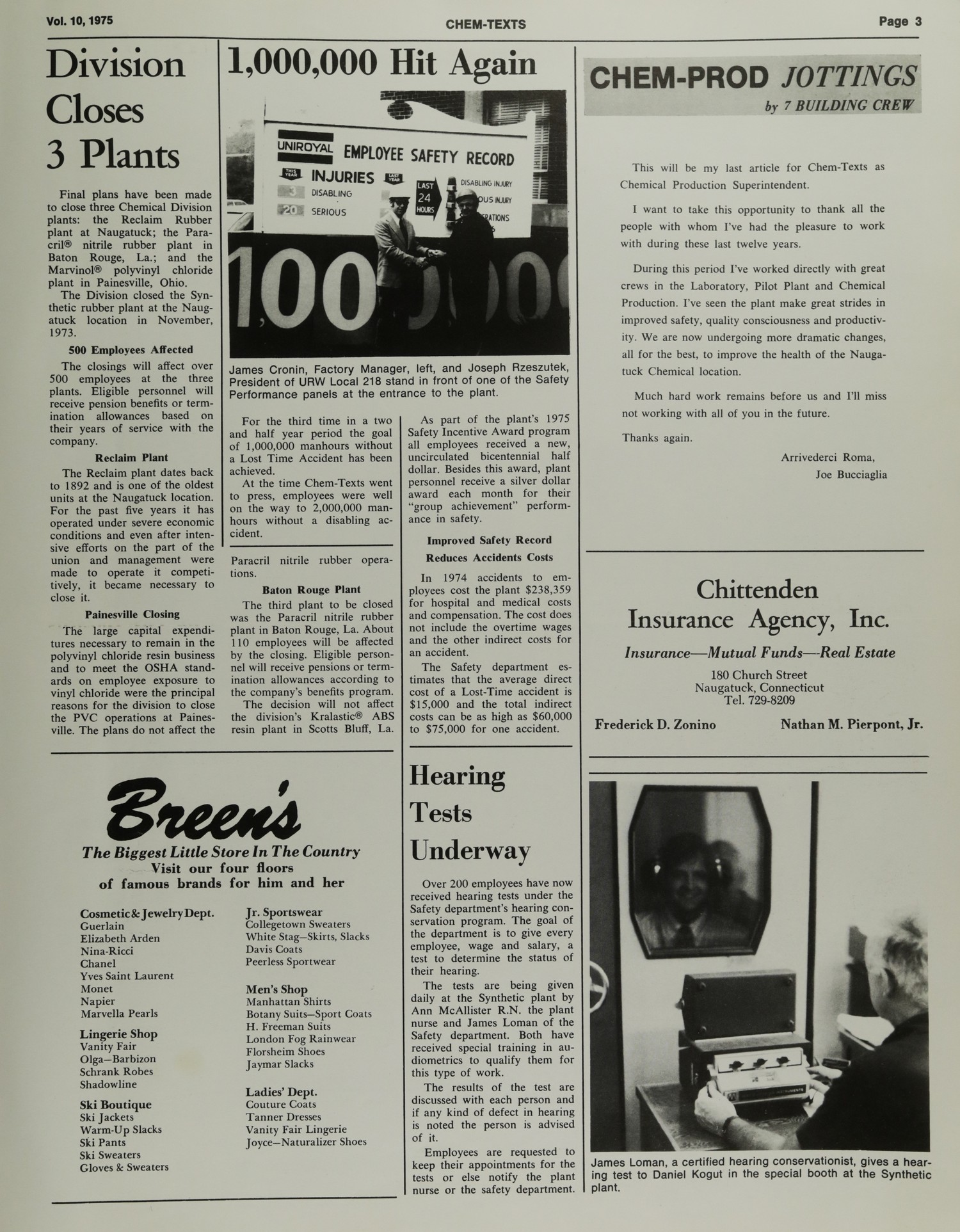
CHEM-TEXTS – 1976 – Page 2

Page 002

CHEM-TEXTS

Page 2 | Vol. 10, 1976


From the Factory Manager…

In this my first opportunity to express myself in this column, I find that several things cross my mind and so I’ll just begin and say them all rather than try to limit myself to one area.

First, since the last issue of CHEM-TEXTS Jim Cronin has left the Naugatuck Plant “family.” I’m sure that all of the friends whom he developed here are going to miss him and wish him, as I do, the best of success in his new assignment. Jim’s contributions to the plant during his years here have been significant and his presence will be felt for years to come.

The second thought that comes to mind and which I’ve expressed to most of you personally is WELCOME BACK! It is, from a personal viewpoint, very gratifying to have everyone back working together and the plant back to “normal.” To those of you whom I may have missed during my tours through the plant, I would like to take this opprtunity to welcome you back.

This leads me to my third thought—move ahead. As we can all see, the Synthetic Plant is now gone; the Reclaim Plant is rapidly disappearing; and soon the old Thiazoles complex will be torn down. With all of this, it is hard to visualize anything but the shrinking of the Naugatuck complex, but we must all apply ourselves to the task of getting the plant moving ahead. We, at Naugauck, have many things to offer the Company as a future plant site on which to expand—land, and thus room, for new process buildings—water treatment facilities large enough to accommodate more than a doubling of our present plant capacity. A facility which, if needed to be built today, would be extremely expensive. Power, we have here enough capacity to supply heat and process steam for many expansions.— Skills, all of our people have the experience and bring the skills to their jobs that are necessary to operate a complex chemical plant. When you look at all of these assets you have to wonder why people aren’t knocking down our gates to let us make products for them! That, to me is our challenge. All of us must work together to bring all of our valuable assets together to make this the best, most competitive plant site available to Uniroyal Chemical. All of us must sell our assets and make sure we use them—skill, land, buildings, equipment—at the highest level of efficiency possible. Together then we will, and can, make the Naugatuck Plant move ahead. It has been said that no one ever stands still—you either move ahead and progress or you fall behind and become a dropout. It is my belief that all of us must put all of our energies together to make sure that the Naugatuck Plant moves ahead.


Achieves 45 Years Service

[IMAGE: Photo of two men, one congratulating the other]

John H. Hurst, right, is congratulated by Dr. Charles D. McCleary, Director of Research and Development, on the completion of forty-five years of service. He joined Uniroyal Chemical in 1931 and became a member of the Research and Development group in 1958 from which he recently retired.


FOC Plant Starts Up

[IMAGE: Photograph of a large industrial building]

The new $5,000,000 Fine Organics Chemicals (FOC) Building has been completed and will be turned over to Chemical Production for shakedown operations.

The new FOC (Fine Organic Chemicals) plant will be turned over to Chemical Production in the last quarter for the initial start up phases. It was constructed at a cost of over $5,000,000.

The plant is expected to be in regular production by the end of the year. It will manufacture LVBI an adhesive for polyester tire cord and Naugard® 445 a new amine type antioxidant for melt adhesives and plastics.

New Omite Unit Also on Stream

The new Omite® facility which was recently completed at a cost of over $1,000,000 is now producing the miticide used to control mite infestation on fruit trees and other crops in the U.S. and overseas markets.


Tuition Aid Degree Records

Employees enrolled in a College degree—Associate, Bachelor, Master’s, or Doctor—under the Tuition Aid program should notify the Director of Personnel, Jesse Crim, that they have received the degree. The written notice should be sent to him at the EMIC Bldg.

By following this procedure, the employee’s educational status will be recorded on the Master Employees’ Reference File (MERF).

Prior Approval Required

Prior approval from the head of the department is required before registration for any courses taken under the Tuition Aid Program. Under the plan an employee may take two courses. The company will reimburse the employee upon satisfactory completion of the courses.


Appointments Announced

Bruce Perkins has been named a Buyer Supervisor for Chemicals.

Madelyn Malone has been named a Materials Receiving Foreman.

Donald Delagrange has been appointed a Buyer of Chemicals and Packages.

John Sprano has been named Control Center Supervisor for Chemical Production.

James Cronin, former Factory Manager for the Naugatuck Chemical plant, has been named Chemical Planning Manager.

David Schaub has been appointed General Manager for Plastics and Latex Products.

C. B. Westerhoff has been assigned to the Toxicology group in Research & Development.


United…

Continued from page 1

causes. The Naugatuck-Beacon Falls office has the lowest administrative cost of any agency in the area.

As a convenience for employees the plant will deduct contributions through the payroll deduction plan. This is done by determining the amount of your pledge on the United Way card. Deductions start in January 1977 and continue until December.

Members of the United Way Committee are R. Amidon, D. Bates, B. Cranney, K. Dowling, T. Dowling, E. Evans, R. Foltz, R. Gaetz, T. Geise, C. Greene, S. Korpusik, J. LaBrecque, M. Malone, F. Mayo, J. Pratt, C. Roland, J. Rzeszutek, H. Semrow, D. Shantz, R. Tweedie and J. Vergosen.


[ADVERTISEMENT]

UNIROYAL

ZETA 40M

STEEL RADIAL TIRE

GUARANTEED

40000

MILES *

A Whole new driving experience.
75% MORE HAZARD PROTECTION
20% MORE CAR CONTROL

12% BETTER TRACTION
than conventional 78 series bias ply tires.

DOUBLE (2) BELTS OF FIBERGLAS
DOUBLE (2) POLYESTER CORD PLIES

FEATURES:
– 70 SERIES DESIGN (WIDE OVAL)
– POLYESTER CORD PLIES
– FIBERGLAS BELTS


MEZZIO’S
792 New Haven Rd.
Naugatuck—729-5988

ADVANCE TIRE SERVICE
510 Meriden Rd.
Waterbury—756-7205

POUST’S SERVICE STATION
144 Rubber Ave.
Naugatuck—729-0433
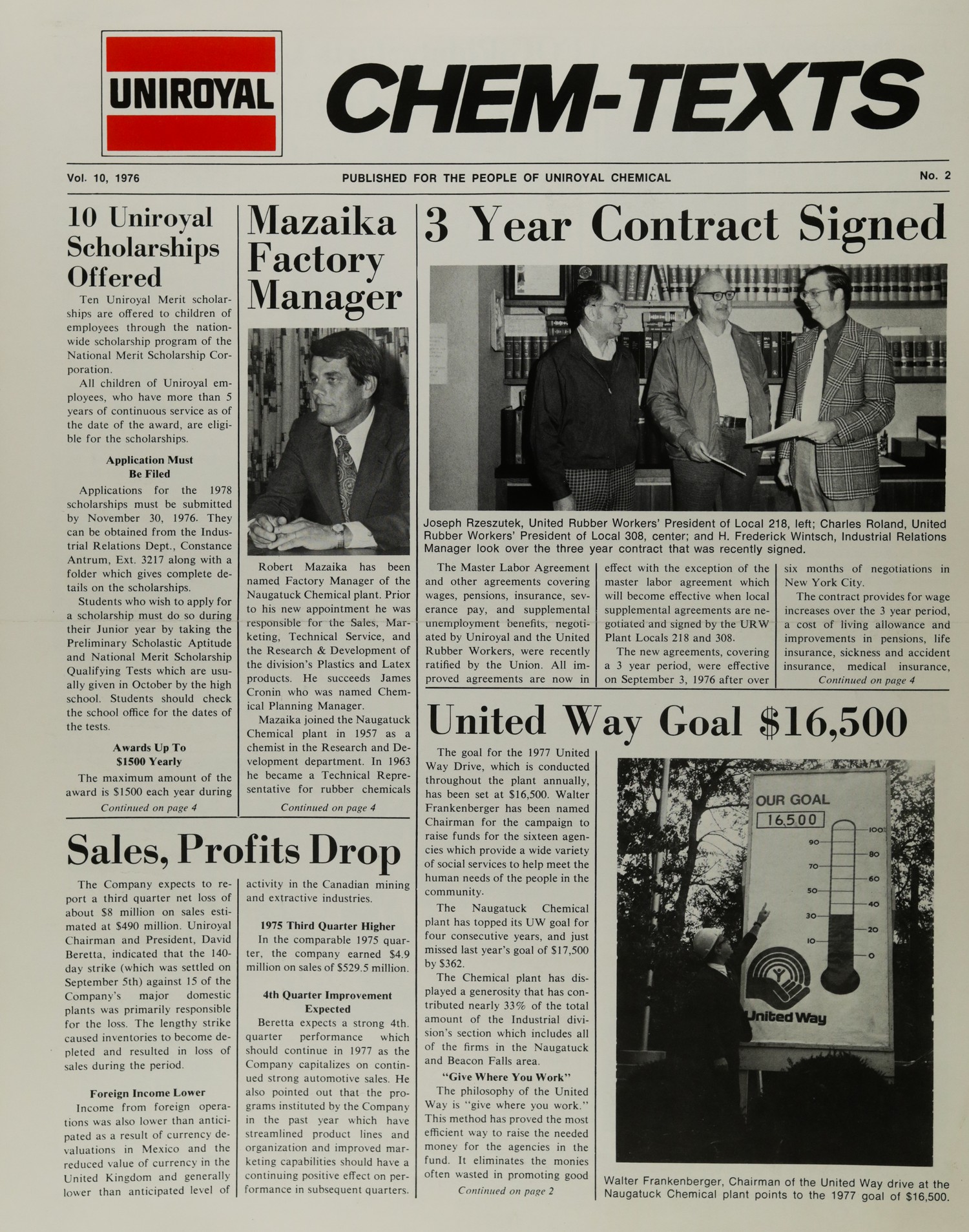
CHEM-TEXTS – 1976-v10-i02-s240

Page 240

UNIROYAL CHEM-TEXTS

Vol. 10, 1976 | PUBLISHED FOR THE PEOPLE OF UNIROYAL CHEMICAL | No. 2


10 Uniroyal Scholarships Offered

Ten Uniroyal Merit scholarships are offered to children of employees through the nationwide scholarship program of the National Merit Scholarship Corporation.

All children of Uniroyal employees, who have more than 5 years of continuous service as of the date of the award, are eligible for the scholarships.

Application Must Be Filed

Applications for the 1978 scholarships must be submitted by November 30, 1976. They can be obtained from the Industrial Relations Dept., Constance Antrum, Ext. 3217 along with a folder which gives complete details on the scholarships.

Students who wish to apply for a scholarship must do so during their Junior year by taking the Preliminary Scholastic Aptitude and National Merit Scholarship Qualifying Tests which are usually given in October by the high school. Students should check the school office for the dates of the tests.

Awards Up To $1500 Yearly

The maximum amount of the award is $1500 each year during
Continued on page 4


Mazaika Factory Manager

[IMAGE: Photo of Robert Mazaika]

Robert Mazaika has been named Factory Manager of the Naugatuck Chemical plant. Prior to his new appointment he was responsible for the Sales, Marketing, Technical Service, and the Research & Development of the division’s Plastics and Latex products. He succeeds James Cronin who was named Chemical Planning Manager.

Mazaika joined the Naugatuck Chemical plant in 1957 as a chemist in the Research and Development department. In 1963 he became a Technical Representative for rubber chemicals
Continued on page 4


3 Year Contract Signed

[IMAGE: Photo of three men looking at documents]

Joseph Rzeszutek, United Rubber Workers’ President of Local 218, left; Charles Roland, United Rubber Workers’ President of Local 308, center; and H. Frederick Wintsch, Industrial Relations Manager look over the three year contract that was recently signed.

The Master Labor Agreement and other agreements covering wages, pensions, insurance, severance pay, and supplemental unemployment benefits, negotiated by Uniroyal and the United Rubber Workers, were recently ratified by the Union. All improved agreements are now in effect with the exception of the master labor agreement which will become effective when local supplemental agreements are negotiated and signed by the URW Plant Locals 218 and 308.

The new agreements, covering a 3 year period, were effective on September 3, 1976 after over six months of negotiations in New York City.

The contract provides for wage increases over the 3 year period, a cost of living allowance and improvements in pensions, life insurance, sickness and accident insurance, medical insurance,
Continued on page 4


Sales, Profits Drop

The Company expects to report a third quarter net loss of about $8 million on sales estimated at $490 million. Uniroyal Chairman and President, David Beretta, indicated that the 140-day strike (which was settled on September 5th) against 15 of the Company’s major domestic plants was primarily responsible for the loss. The lengthy strike caused inventories to become depleted and resulted in loss of sales during the period.

Foreign Income Lower

Income from foreign operations was also lower than anticipated as a result of currency devaluations in Mexico and the reduced value of currency in the United Kingdom and generally lower than anticipated level of activity in the Canadian mining and extractive industries.

1975 Third Quarter Higher

In the comparable 1975 quarter, the company earned $4.9 million on sales of $529.5 million.

4th Quarter Improvement Expected

Beretta expects a strong 4th quarter performance which should continue in 1977 as the Company capitalizes on continued strong automotive sales. He also pointed out that the programs instituted by the Company in the past year which have streamlined product lines and organization and improved marketing capabilities should have a continuing positive effect on performance in subsequent quarters.


United Way Goal $16,500

The goal for the 1977 United Way Drive, which is conducted throughout the plant annually, has been set at $16,500. Walter Frankenberger has been named Chairman for the campaign to raise funds for the sixteen agencies which provide a wide variety of social services to help meet the human needs of the people in the community.

The Naugatuck Chemical plant has topped its UW goal for four consecutive years, and just missed last year’s goal of $17,500 by $362.

The Chemical plant has displayed a generosity that has contributed nearly 33% of the total amount of the Industrial division’s section which includes all of the firms in the Naugatuck and Beacon Falls area.

“Give Where You Work”

The philosophy of the United Way is “give where you work.” This method has proved the most efficient way to raise the needed money for the agencies in the fund. It eliminates the monies often wasted in promoting good
Continued on page 2

[IMAGE: Photo of Walter Frankenberger pointing to United Way goal thermometer showing $16,500 goal]

Walter Frankenberger, Chairman of the United Way drive at the Naugatuck Chemical plant points to the 1977 goal of $16,500.

CHEM-TEXTS – 1975 – Page 3

Page 003

CHEM-TEXTS

Vol. 10, 1975 | Page 3


Division Closes 3 Plants

Final plans have been made to close three Chemical Division plants: the Reclaim Rubber plant at Naugatuck; the Paracril® nitrile rubber plant in Baton Rouge, La.; and the Marvinol® polyvinyl chloride plant in Painesville, Ohio.

The Division closed the Synthetic rubber plant at the Naugatuck location in November, 1973.

500 Employees Affected

The closings will affect over 500 employees at the three plants. Eligible personnel will receive pension benefits or termination allowances based on their years of service with the company.

Reclaim Plant

The Reclaim plant dates back to 1892 and is one of the oldest units at the Naugatuck location. For the past five years it has operated under severe economic conditions and even after intensive efforts on the part of the union and management were made to operate it competitively, it became necessary to close it.

Painesville Closing

The large capital expenditures necessary to remain in the polyvinyl chloride resin business and to meet the OSHA standards on employee exposure to vinyl chloride were the principal reasons for the division to close the PVC operations at Painesville. The plans do not affect the


1,000,000 Hit Again

[IMAGE: UNIROYAL EMPLOYEE SAFETY RECORD sign showing INJURIES – DISABLING and SERIOUS counts, with “LAST 24” and “DISABLING INJURY” / “OUS INJURY” / “ATIONS” visible, with “100” displayed]

James Cronin, Factory Manager, left, and Joseph Rzeszutek, President of URW Local 218 stand in front of one of the Safety Performance panels at the entrance to the plant.

For the third time in a two and half year period the goal of 1,000,000 manhours without a Lost Time Accident has been achieved.

At the time Chem-Texts went to press, employees were well on the way to 2,000,000 manhours without a disabling accident.

Paracril nitrile rubber operations.

Baton Rouge Plant

The third plant to be closed was the Paracril nitrile rubber plant in Baton Rouge, La. About 110 employees will be affected by the closing. Eligible personnel will receive pensions or termination allowances according to the company’s benefits program.

The decision will not affect the division’s Kralastic® ABS resin plant in Scotts Bluff, La.

As part of the plant’s 1975 Safety Incentive Award program all employees received a new, uncirculated bicentennial half dollar. Besides this award, plant personnel receive a silver dollar award each month for their “group achievement” performance in safety.

Improved Safety Record Reduces Accidents Costs

In 1974 accidents to employees cost the plant $238,359 for hospital and medical costs and compensation. The cost does not include the overtime wages and the other indirect costs for an accident.

The Safety department estimates that the average direct cost of a Lost-Time accident is $15,000 and the total indirect costs can be as high as $60,000 to $75,000 for one accident.


CHEM-PROD JOTTINGS

by 7 BUILDING CREW

This will be my last article for Chem-Texts as Chemical Production Superintendent.

I want to take this opportunity to thank all the people with whom I’ve had the pleasure to work with during these last twelve years.

During this period I’ve worked directly with great crews in the Laboratory, Pilot Plant and Chemical Production. I’ve seen the plant make great strides in improved safety, quality consciousness and productivity. We are now undergoing more dramatic changes, all for the best, to improve the health of the Naugatuck Chemical location.

Much hard work remains before us and I’ll miss not working with all of you in the future.

Thanks again.

Arrivederci Roma,
Joe Bucciaglia


Chittenden Insurance Agency, Inc.

Insurance—Mutual Funds—Real Estate

180 Church Street
Naugatuck, Connecticut
Tel. 729-8209

Frederick D. Zonino | Nathan M. Pierpont, Jr.


Breen’s

The Biggest Little Store In The Country
Visit our four floors of famous brands for him and her

Cosmetic & Jewelry Dept.
Guerlain
Elizabeth Arden
Nina-Ricci
Chanel
Yves Saint Laurent
Monet
Napier
Marvella Pearls

Lingerie Shop
Vanity Fair
Olga—Barbizon
Schrank Robes
Shadowline

Ski Boutique
Ski Jackets
Warm-Up Slacks
Ski Pants
Ski Sweaters
Gloves & Sweaters

Jr. Sportswear
Collegetown Sweaters
White Stag—Skirts, Slacks
Davis Coats
Peerless Sportwear

Men’s Shop
Manhattan Shirts
Botany Suits—Sport Coats
H. Freeman Suits
London Fog Rainwear
Florsheim Shoes
Jaymar Slacks

Ladies’ Dept.
Couture Coats
Tanner Dresses
Vanity Fair Lingerie
Joyce—Naturalizer Shoes


Hearing Tests Underway

Over 200 employees have now received hearing tests under the Safety department’s hearing conservation program. The goal of the department is to give every employee, wage and salary, a test to determine the status of their hearing.

The tests are being given daily at the Synthetic plant by Ann McAllister R.N. the plant nurse and James Loman of the Safety department. Both have received special training in audiometrics to qualify them for this type of work.

The results of the test are discussed with each person and if any kind of defect in hearing is noted the person is advised of it.

Employees are requested to keep their appointments for the tests or else notify the plant nurse or the safety department.

[IMAGE: Photo of hearing test being administered]

James Loman, a certified hearing conservationist, gives a hearing test to Daniel Kogut in the special booth at the Synthetic plant.

CHEM-TEXTS – 1975 – Page 2

Page 002

CHEM-TEXTS

Page 2 | Vol. 9, 1975


In my last editorial I ventured into the field of politics. This area is so vital that I felt a few more ideas had to be discussed. The current confusion in Washington and the recent wild legislation session in Hartford are prime examples of the type of disturbing political action confronting us Americans today.

I read in the newspapers all the criticisms by well known columnists and editors lamenting the poor actions and leadership of our elected legislative officials. They ask our officials to change their ways and to recognize the real problems of the people, their jobs, their community problems, their financial problems, etc. etc.

I find this effort misdirected. Appealing to elected politicians hardly ever changes their minds. Their philosophy of life has been long in developing and most are strong-minded people, not easily swayed from their convictions. The way to change the political direction of a legislative body is to change the legislators. Vote out the ones that are undersirable and vote in those who reflect the feeling and mood of the electorate.

Although voting occurs only every two years, people’s thoughts should be on this subject all the time, not just one week before elections. For example, a review of how our representatives voted recently in Hartford should be done now to help form an opinion while the facts are clear.

The makeup of the last two Connecticut Legislatures is another problem that voters must avoid in the future. We now have in Hartford an overwhelming Democratic majority. Two years ago there was an overwhelming Republican majority. This is no way to run a government, for with such a onesided majority, we don’t have a democracy—which is a balance of two or more opinions— we have instead what approaches dictatorial power of the party in the majority. Such a situation can do nothing but harm. A balance is essential to stable and honest government.

No one can rectify a situation like this except we voters. This means less emotional voting and more thinking, both inside and outside the voting machine.

J. A. Cronin

Jim Cronin [signature]

[PHOTO: Headshot of a man in suit]


Steel Work Starts on FOC Bldg.

[PHOTO: Construction site showing steel framework of a building]

The steel structural work on the new $5,000,000 Fine Organic Chemicals plant has been started with the erection of the framework for the three story building. The entire structure was prefabricated in the shop of the Berkshire Bridge and Iron Co. and is expected to be completed around early July.

Project Manager for the FOC facility is James Whittum of the Chemical Division Engineering group. Members of the plant’s Start-up team are Bertil Frennesson, James Garrigan, Victor Anderson, Dr. John Sargent, Eugene Hertel, William Yee, and Norman Boisseau.

The steel structural work of the new Fine Organic Chemicals building progresses on schedule with the construction of the third story.


Chemical Pilot Plant Near Doubles Output

The Chemical Pilot Plant just about doubled its production in 1974 when it increased its CHO capacity from 750,000 lbs. to 1,400,000 lbs. for the year. The increase was achieved more by innovations in the existant equipment than by any major investment in the plant along with the efforts and cooperation of the people who work in the building.

The market demand by fruit growers for Omite, an agricultural miticide, has been high even during the present economic situation. Sales of the product have kept Bldg. 100 operating on 3 shifts, seven days a week and has been one of the bright spots in the plant’s operations when many of the buildings were closed down for short intervals.

The Chemical Pilot Plant is the only supplier of CHO and the increase in capacity was critical to supply the demands of Bldg. 100. CHO is one of the intermediate chemicals used in the manufacture of Omite.

The Sales Department is now trying to find new customers for CHO to expand the market for it. The Pilot Plant has already made and shipped one order.

Without the effort of the Pilot Plant group the Omite sales would have been affected seriously and more layoffs created in Chemical Production.

The Pilot Plant crew during the period was B. Pranulis, H. Detlefsen, C. Owens, J. Cohen (retired), D. Pinto, J. Lydem, M. Hebert, C. Pereira, A. Grella, J. Poudrier, R. Lestage, B. Hubbell, W. Birkenberger, W. Singleton, C. Buck, A. Cilfone, G. Ravenscroft, B. Zukauskas, W. Broden, and D. Shantz.


Company…

continued from page 1

200 People Affected

Approximately 200 people may be affected by the closing. Eligible employees will receive termination allowances or pension benefits in accordance with the Company’s present Benefits plan.

The employees will be eligible for unemployment compensation from the state of Connecticut, plus allowances for each dependent, and Supplemental Unemployment Benefits (SUB) from the company.

The employees will also be covered by the Company’s Hospital, Surgical and Medical benefits, the Drug Plan, Group Life Insurance for a minimum period of three months.

BUY U.S. SAVINGS BONDS


Dates Back to 1892

The Reclaim plant dates back to 1892. It was known as the Rubber Regenerating Company and is the oldest part of the present plant.

The United States Rubber Company (Uniroyal) purchased the Naugatuck Chemical unit in 1911 and the Regenerating Company in 1912. The two made up the Naugatuck Chemical plant until the Synthetic plant was constructed in 1942 to manufacture synthetic rubber. The Synthetic plant closed in March 1974 after incurring severe losses for several years.

Firmness: the admirable quality in us that is pigheadedness in others.


Fuel…

continued from page 1

high price increase in oil imports the plant’s expenses increased by roughly one million dollars in 1974, a 74% increase in operating costs.

Electricity Conserved

Electricity was conserved at a rate of 23.8% in 1974 compared to 1973, a savings of a 96 day’s supply. But rather than showing a significant savings in dollars for power, it cost the plant an extra $205,000 for a 16% reduction in electrical consumption.

Program Still in Force

The effects of the two year program are evident in the statistics. The Task Force is still continuing its efforts to control consumption of fuel oil and electrical power to hold the line on manufacturing costs which cannot be easily recovered by price increases in the plants products.


Club Awards $500 Scholarship

Phyllis Nole, the daughter of Alexander Nole, Manager of Materials Planning in EMIC, received the $500 Uniroyal Chemical Management Club’s scholarship. A senior at Wolcott High School, she was selected by the Committee for her scholastic achievements and involvement in school and community activities.

A member of the National Honor Society, she was selected by the American Field Service to represent the United States in Malaysia in the summer of 1974.

Phyllis plans to attend the School of Nursing at Syracuse University.

The scholarship committee consisted of William Broden, Chairman; James Gatling and Randolph Porter.

Luck: the explanation for the success of people you don’t like.


Lawnmowers Dangerous

[IMAGE: Drawing of a Liberty Bell]

The buzzing of lawnmowers is a familiar sound at this time of year. It’s also a sound of danger.

Almost 60,000 Americans are seriously injured each year by power mowers, either from direct contact with whirling blades or from objects flying out of the discharge chutes.

It’s a good practice to wear your safety glasses and shoes when mowing the lawn.


MEZZIO’S
792 New Haven Rd.
Naugatuck—729-5988

ADVANCE TIRE SERVICE
510 Meriden Rd.
Waterbury—756-7205

POUST’S SERVICE STATION
144 Rubber Ave.
Naugatuck—729-0433

[ADVERTISEMENT]

UNIROYAL

ZETA 40M

STEEL RADIAL TIRE

GUARANTEED

40000

MILES

A Whole new driving experience.
75% MORE HAZARD PROTECTION
20% MORE CAR CONTROL

12% BETTER TRACTION
than conventional 78 series bias ply tires.

DOUBLE (2) BELTS OF FIBERGLAS
DOUBLE (2) POLYESTER CORD PLIES

FEATURES:
– 70 SERIES DESIGN (WIDE OVAL)
– POLYESTER CORD PLIES
– FIBERGLAS BELTS

CHEM-TEXTS – 1975-v09-i03-s228

Page 228

UNIROYAL CHEM-TEXTS

Vol. 9, 1975 | PUBLISHED FOR THE PEOPLE OF UNIROYAL CHEMICAL | No. 3


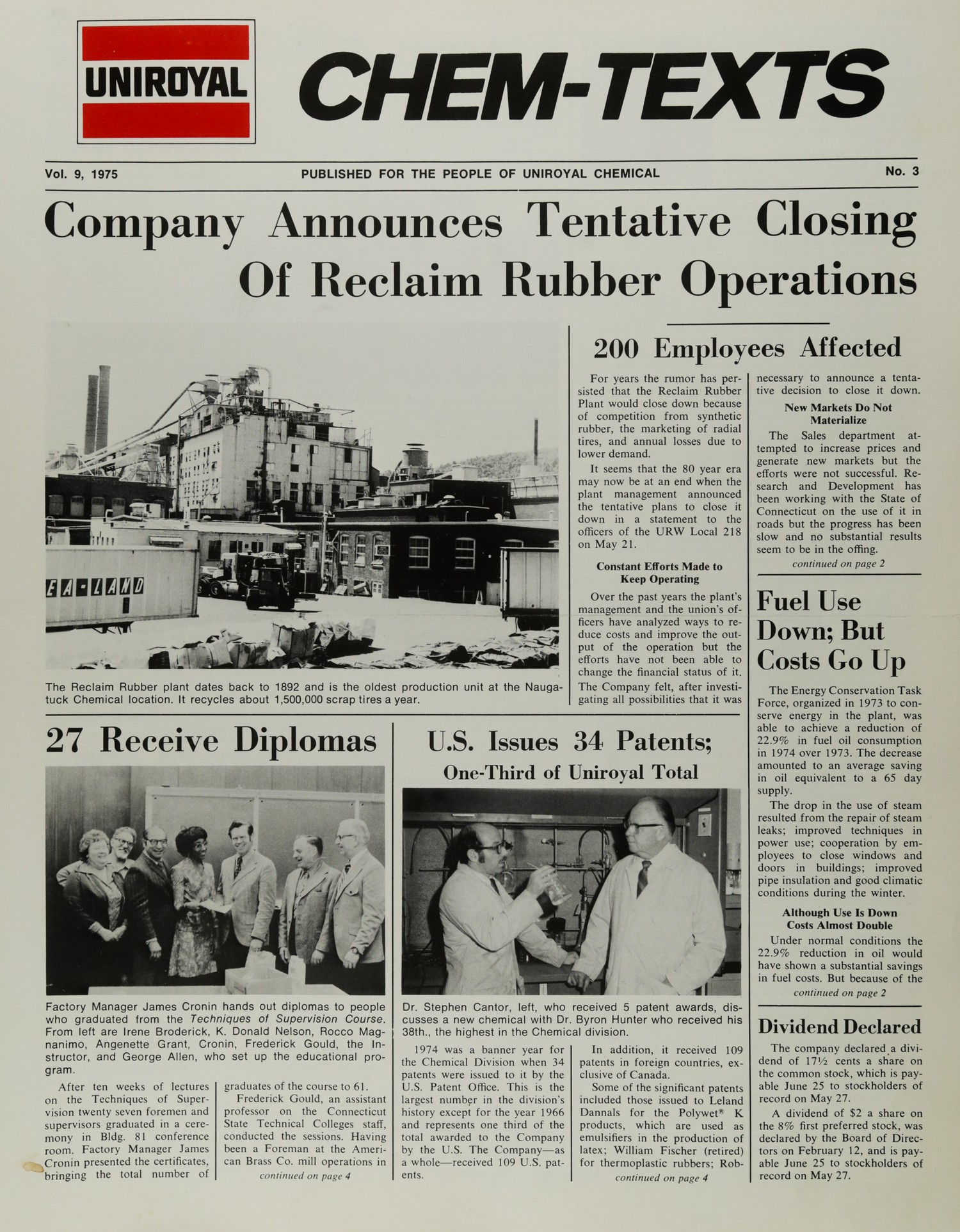
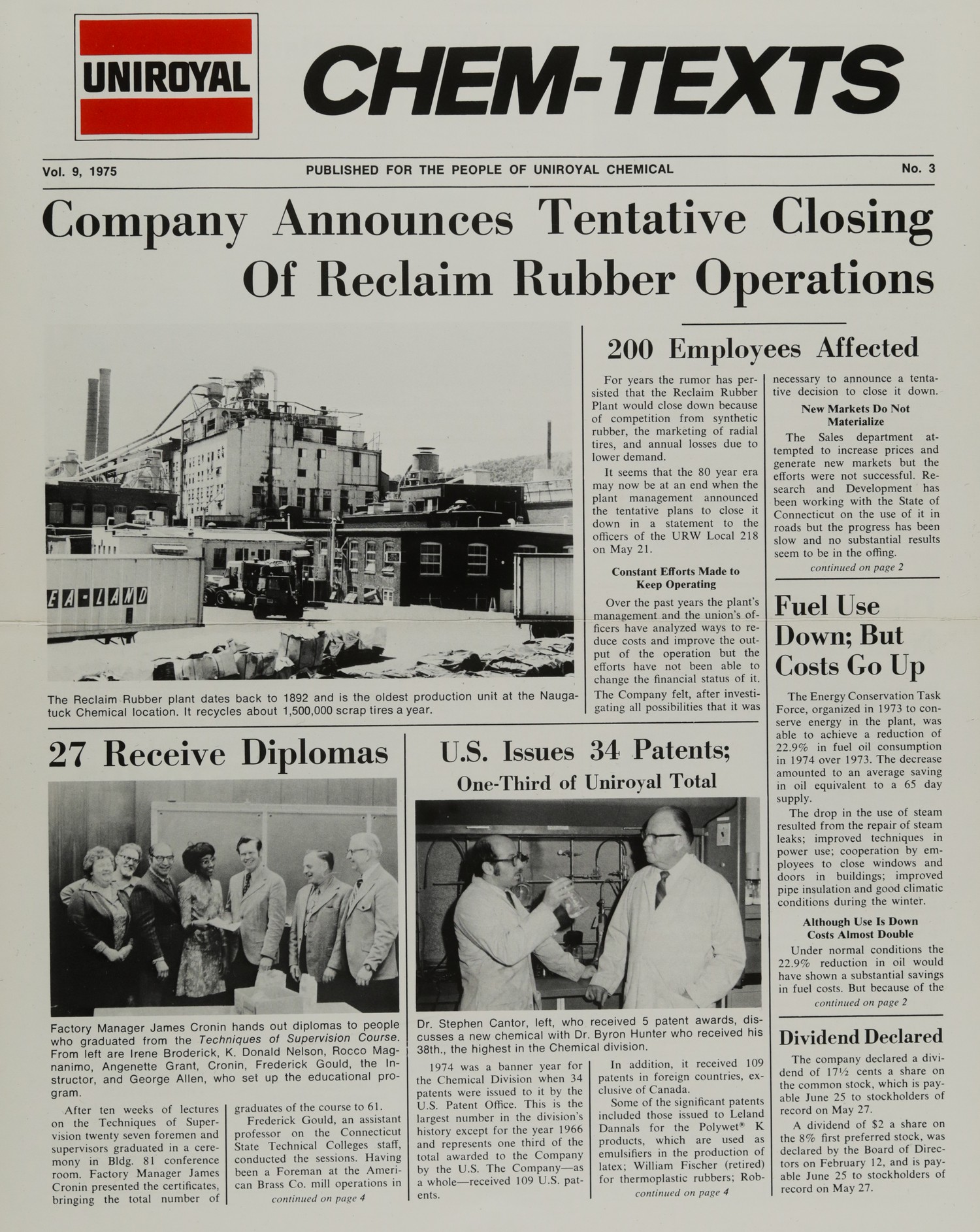
Company Announces Tentative Closing Of Reclaim Rubber Operations

200 Employees Affected

For years the rumor has persisted that the Reclaim Rubber Plant would close down because of competition from synthetic rubber, the marketing of radial tires, and annual losses due to lower demand.

It seems that the 80 year era may now be at an end when the plant management announced the tentative plans to close it down in a statement to the officers of the URW Local 218 on May 21.

Constant Efforts Made to Keep Operating

Over the past years the plant’s management and the union’s officers have analyzed ways to reduce costs and improve the output of the operation but the efforts have not been able to change the financial status of it. The Company felt, after investigating all possibilities that it was necessary to announce a tentative decision to close it down.

New Markets Do Not Materialize

The Sales department attempted to increase prices and generate new markets but the efforts were not successful. Research and Development has been working with the State of Connecticut on the use of it in roads but the progress has been slow and no substantial results seem to be in the offing.

continued on page 2


[IMAGE CAPTION:]
The Reclaim Rubber plant dates back to 1892 and is the oldest production unit at the Naugatuck Chemical location. It recycles about 1,500,000 scrap tires a year.


27 Receive Diplomas

[IMAGE CAPTION:]
Factory Manager James Cronin hands out diplomas to people who graduated from the Techniques of Supervision Course. From left are Irene Broderick, K. Donald Nelson, Rocco Magnanimo, Angenette Grant, Cronin, Frederick Gould, the Instructor, and George Allen, who set up the educational program.

After ten weeks of lectures on the Techniques of Supervision twenty seven foremen and supervisors graduated in a ceremony in Bldg. 81 conference room. Factory Manager James Cronin presented the certificates, bringing the total number of graduates of the course to 61.

Frederick Gould, an assistant professor on the Connecticut State Technical Colleges staff, conducted the sessions. Having been a Foreman at the American Brass Co. mill operations in

continued on page 4


U.S. Issues 34 Patents; One-Third of Uniroyal Total

[IMAGE CAPTION:]
Dr. Stephen Cantor, left, who received 5 patent awards, discusses a new chemical with Dr. Byron Hunter who received his 38th., the highest in the Chemical division.

1974 was a banner year for the Chemical Division when 34 patents were issued to it by the U.S. Patent Office. This is the largest number in the division’s history except for the year 1966 and represents one third of the total awarded to the Company by the U.S. The Company—as a whole—received 109 U.S. patents.

In addition, it received 109 patents in foreign countries, exclusive of Canada.

Some of the significant patents included those issued to Leland Dannals for the Polywet® K products, which are used as emulsifiers in the production of latex; William Fischer (retired) for thermoplastic rubbers; Rob-

continued on page 4


Fuel Use Down; But Costs Go Up

The Energy Conservation Task Force, organized in 1973 to conserve energy in the plant, was able to achieve a reduction of 22.9% in fuel oil consumption in 1974 over 1973. The decrease amounted to an average saving in oil equivalent to a 65 day supply.

The drop in the use of steam resulted from the repair of steam leaks; improved techniques in power use; cooperation by employees to close windows and doors in buildings; improved pipe insulation and good climatic conditions during the winter.

Although Use Is Down Costs Almost Double

Under normal conditions the 22.9% reduction in oil would have shown a substantial savings in fuel costs. But because of the

continued on page 2


Dividend Declared

The company declared a dividend of 17½ cents a share on the common stock, which is payable June 25 to stockholders of record on May 27.

A dividend of $2 a share on the 8% first preferred stock, was declared by the Board of Directors on February 12, and is payable June 25 to stockholders of record on May 27.

CHEM-TEXTS – 1974-v08-i01-s222

Page 222

UNIROYAL CHEM-TEXTS

Vol. 8, 1974 | PUBLISHED FOR THE PEOPLE OF UNIROYAL CHEMICAL | No. 1


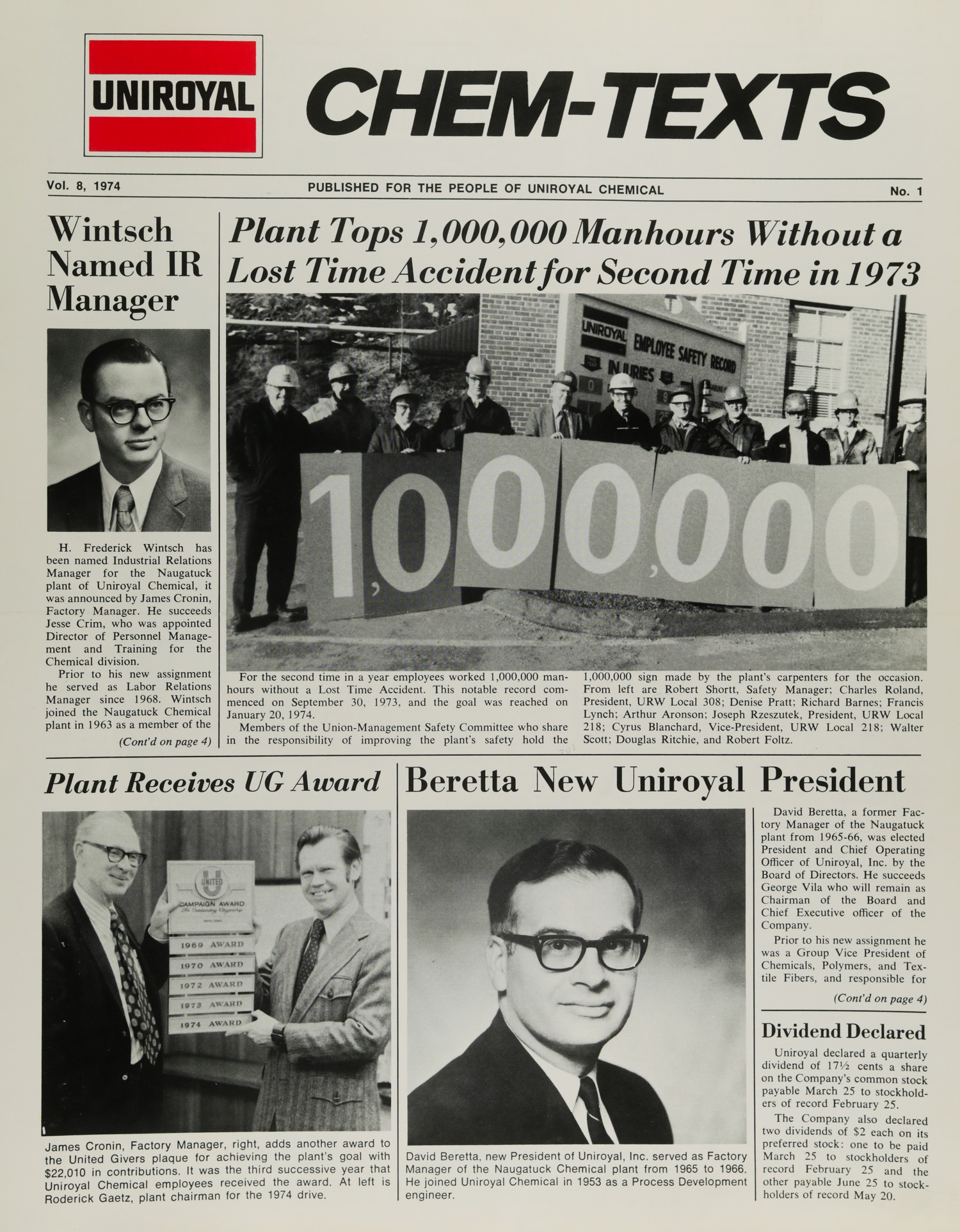
Wintsch Named IR Manager

[PHOTO: Portrait of H. Frederick Wintsch]

H. Frederick Wintsch has been named Industrial Relations Manager for the Naugatuck plant of Uniroyal Chemical, it was announced by James Cronin, Factory Manager. He succeeds Jesse Crim, who was appointed Director of Personnel Management and Training for the Chemical division.

Prior to his new assignment he served as Labor Relations Manager since 1968. Wintsch joined the Naugatuck Chemical plant in 1963 as a member of the

(Cont’d on page 4)


Plant Tops 1,000,000 Manhours Without a Lost Time Accident for Second Time in 1973

[PHOTO: Group of employees standing in front of sign reading “UNIROYAL EMPLOYEE SAFETY RECORD NO INJURIES 1,000,000”]

For the second time in a year employees worked 1,000,000 man-hours without a Lost Time Accident. This notable record commenced on September 30, 1973, and the goal was reached on January 20, 1974.

Members of the Union-Management Safety Committee who share in the responsibility of improving the plant’s safety hold the 1,000,000 sign made by the plant’s carpenters for the occasion. From left are Robert Shortt, Safety Manager; Charles Roland, President, URW Local 308; Denise Pratt; Richard Barnes; Francis Lynch; Arthur Aronson; Joseph Rzeszutek, President, URW Local 218; Cyrus Blanchard, Vice-President, URW Local 218; Walter Scott; Douglas Ritchie, and Robert Foltz.


Plant Receives UG Award

[PHOTO: Two men with United Givers award plaque showing awards from 1969, 1970, 1972, 1973, 1974]

James Cronin, Factory Manager, right, adds another award to the United Givers plaque for achieving the plant’s goal with $22,010 in contributions. It was the third successive year that Uniroyal Chemical employees received the award. At left is Roderick Gaetz, plant chairman for the 1974 drive.


Beretta New Uniroyal President

[PHOTO: Portrait of David Beretta wearing glasses]

David Beretta, a former Factory Manager of the Naugatuck plant from 1965-66, was elected President and Chief Operating Officer of Uniroyal, Inc. by the Board of Directors. He succeeds George Vila who will remain as Chairman of the Board and Chief Executive officer of the Company.

Prior to his new assignment he was a Group Vice President of Chemicals, Polymers, and Textile Fibers, and responsible for

(Cont’d on page 4)

David Beretta, new President of Uniroyal, Inc. served as Factory Manager of the Naugatuck Chemical plant from 1965 to 1966. He joined Uniroyal Chemical in 1953 as a Process Development engineer.


Dividend Declared

Uniroyal declared a quarterly dividend of 17½ cents a share on the Company’s common stock payable March 25 to stockholders of record February 25.

The Company also declared two dividends of $2 each on its preferred stock: one to be paid March 25 to stockholders of record February 25 and the other payable June 25 to stockholders of record May 20.

CHEM-TEXTS – 1974 – Page 2

Page 002

CHEM-TEXTS

Page 2 | Vol. 8, 1974


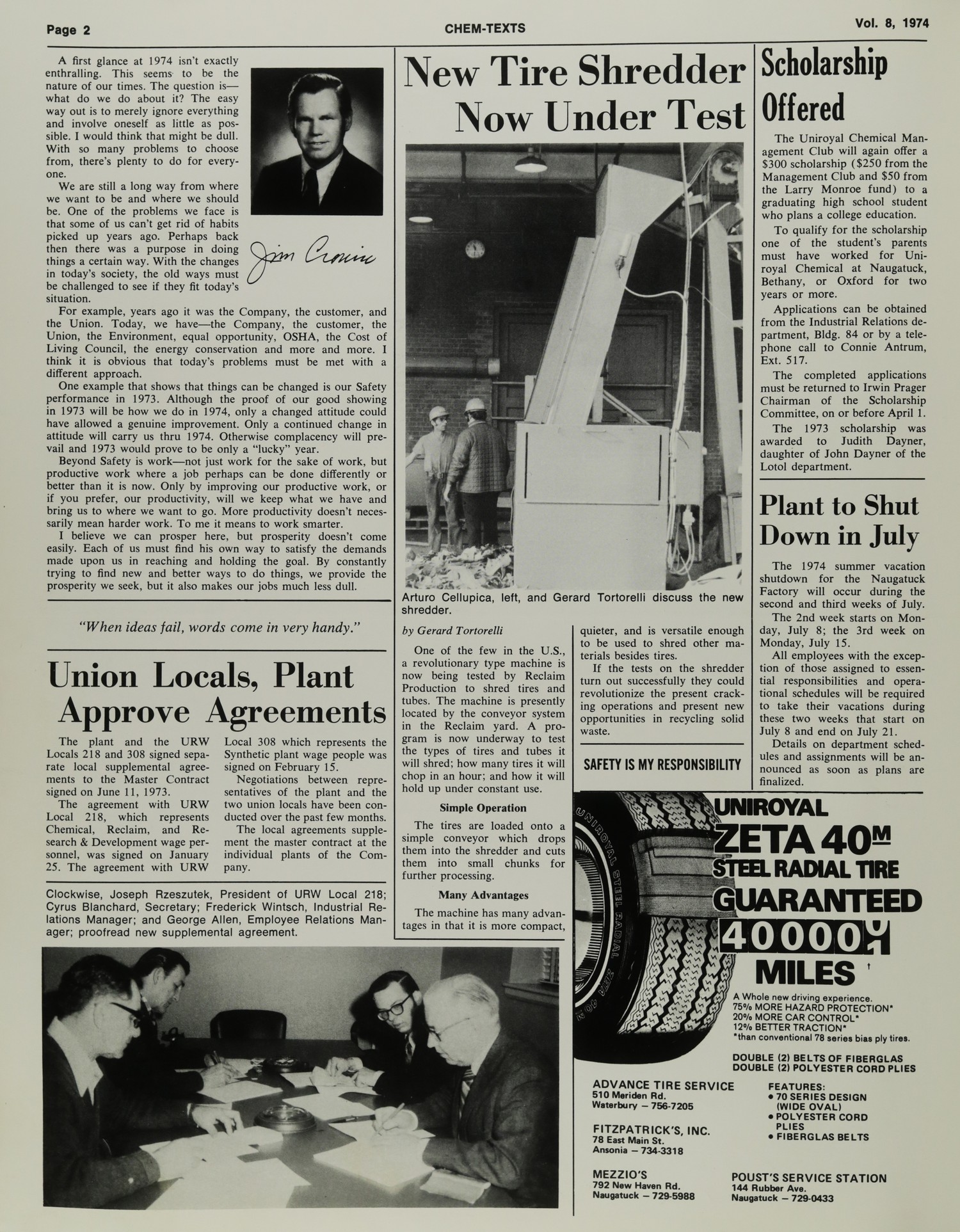
A first glance at 1974 isn’t exactly enthralling. This seems to be the nature of our times. The question is— what do we do about it? The easy way out is to merely ignore everything and involve oneself as little as possible. I would think that might be dull. With so many problems to choose from, there’s plenty to do for everyone.

We are still a long way from where we want to be and where we should be. One of the problems we face is that some of us can’t get rid of habits picked up years ago. Perhaps back then there was a purpose in doing things a certain way. With the changes in today’s society, the old ways must be challenged to see if they fit today’s situation.

For example, years ago it was the Company, and the Union. Today, we have—the Company, the customer, the Union, the Environment, equal opportunity, OSHA, the Cost of Living Council, the energy conservation and more and more. I think it is obvious that today’s problems must be met with a different approach.

One example that shows that things can be changed is our Safety performance in 1973. Although the proof of our good showing in 1973 will be how we do in 1974, only a changed attitude could have allowed a genuine improvement. Only a continued change in attitude will carry us thru 1974. Otherwise complacency will prevail and 1973 would prove to be only a “lucky” year.

Beyond Safety is work—not just work for the sake of work, but productive work where a job perhaps can be done differently or better than it is now. Only by improving our productive work, or if you prefer, our productivity, will we keep what we have and bring us to where we want to go. More productivity doesn’t necessarily mean harder work. To me it means to work smarter.

I believe we can prosper here, but prosperity doesn’t come easily. Each of us must find his own way to satisfy the demands made upon us in reaching and holding the goal. By constantly trying to find new and better ways to do things, we provide the prosperity we seek, but it also makes our jobs much less dull.

Jim Cronin


“When ideas fail, words come in very handy.”


Union Locals, Plant Approve Agreements

The plant and the URW Locals 218 and 308 signed separate local supplemental agreements to the Master Contract signed on June 11, 1973.

The agreement with URW Local 218, which represents Chemical, Reclaim, and Research & Development wage personnel, was signed on January 25. The agreement with URW Local 308 which represents the Synthetic plant wage people was signed on February 15.

Negotiations between representatives of the plant and the two union locals have been conducted over the past few months.

The local agreements supplement the master contract at the individual plants of the Company.

Clockwise, Joseph Rzeszutek, President of URW Local 218; Cyrus Blanchard, Secretary; Frederick Wintsch, Industrial Relations Manager; and George Allen, Employee Relations Manager; proofread new supplemental agreement.


New Tire Shredder Now Under Test

Arturo Cellupica, left, and Gerard Tortorelli discuss the new shredder.

by Gerard Tortorelli

One of the few in the U.S., a revolutionary type machine is now being tested by Reclaim Production to shred tires and tubes. The machine is presently located by the conveyor system in the Reclaim yard. A program is now underway to test the types of tires and tubes it will shred; how many tires it will chop in an hour; and how it will hold up under constant use.

Simple Operation

The tires are loaded onto a simple conveyor which drops them into the shredder and cuts them into small chunks for further processing.

Many Advantages

The machine has many advantages in that it is more compact, quieter, and is versatile enough to be used to shred other materials besides tires.

If the tests on the shredder turn out successfully they could revolutionize the present cracking operations and present new opportunities in recycling solid waste.


SAFETY IS MY RESPONSIBILITY


Scholarship Offered

The Uniroyal Chemical Management Club will again offer a $300 scholarship ($250 from the Management Club and $50 from the Larry Monroe fund) to a graduating high school student who plans a college education.

To qualify for the scholarship one of the student’s parents must have worked for Uniroyal Chemical at Naugatuck, Bethany, or Oxford for two years or more.

Applications can be obtained from the Industrial Relations department, Bldg. 84 or by a telephone call to Connie Antrum, Ext. 517.

The completed applications must be returned to Irwin Prager Chairman of the Scholarship Committee, on or before April 1.

The 1973 scholarship was awarded to Judith Dayner, daughter of John Dayner of the Lotol department.


Plant to Shut Down in July

The 1974 summer vacation shutdown for the Naugatuck Factory will occur during the second and third weeks of July.

The 2nd week starts on Monday, July 8, the 3rd week on Monday, July 15.

All employees with the exception of those assigned to essential responsibilities and operational schedules will be required to take their vacations during these two weeks that start on July 8 and end on July 21.

Details on department schedules and assignments will be announced as soon as plans are finalized.


UNIROYAL ZETA 40M STEEL RADIAL TIRE GUARANTEED 40000 MILES

A Whole new driving experience.
75% MORE HAZARD PROTECTION
20% MORE CAR CONTROL

12% BETTER TRACTION
than conventional 78 series bias ply tires.

DOUBLE (2) BELTS OF FIBERGLAS
DOUBLE (2) POLYESTER CORD PLIES

ADVANCE TIRE SERVICE
510 Meriden Rd.
Waterbury — 756-7205

FITZPATRICK’S, INC.
78 East Main St.
Ansonia — 734-3318

MEZZIO’S
792 New Haven Rd.
Naugatuck — 729-5988

POUST’S SERVICE STATION
144 Rubber Ave.
Naugatuck — 729-0433

FEATURES:
• 70 SERIES DESIGN (WIDE OVAL)
• POLYESTER CORD PLIES
• FIBERGLAS BELTS

Company Announces Tentative Closing Of Reclaim Rubber Operations

UNIROYAL CHEM-TEXTS

Vol. 9, 1975 | PUBLISHED FOR THE PEOPLE OF UNIROYAL CHEMICAL | No. 3


Company Announces Tentative Closing Of Reclaim Rubber Operations

200 Employees Affected

For years the rumor has persisted that the Reclaim Rubber Plant would close down because of competition from synthetic rubber, the marketing of radial tires, and annual losses due to lower demand.

It seems that the 80 year era may now be at an end when the plant management announced the tentative plans to close it down in a statement to the officers of the URW Local 218 on May 21.

Constant Efforts Made to Keep Operating

Over the past years the plant’s management and the union’s officers have analyzed ways to reduce costs and improve the output of the operation but the efforts have not been able to change the financial status of it.

The Company felt, after investigating all possibilities that it was necessary to announce a tentative decision to close it down.

New Markets Do Not Materialize

The Sales department attempted to increase prices and generate new markets but the efforts were not successful. Research and Development has been working with the State of Connecticut on the use of it in roads but the progress has been slow and no substantial results seem to be in the offing.

continued on page 2


[IMAGE CAPTION:]
The Reclaim Rubber plant dates back to 1892 and is the oldest production unit at the Naugatuck Chemical location. It recycles about 1,500,000 scrap tires a year.


27 Receive Diplomas

[IMAGE CAPTION:]
Factory Manager James Cronin hands out diplomas to people who graduated from the Techniques of Supervision Course. From left are Irene Broderick, K. Donald Nelson, Rocco Magnanimo, Angenette Grant, Cronin, Frederick Gould, the Instructor, and George Allen, who set up the educational program.

After ten weeks of lectures on the Techniques of Supervision twenty seven foremen and supervisors graduated in a ceremony in Bldg. 81 conference room. Factory Manager James Cronin presented the certificates, bringing the total number of graduates of the course to 61.

Frederick Gould, an assistant professor on the Connecticut State Technical Colleges staff, conducted the sessions. Having been a Foreman at the American Brass Co. mill operations in

continued on page 4


U.S. Issues 34 Patents; One-Third of Uniroyal Total

[IMAGE CAPTION:]
Dr. Stephen Cantor, left, who received 5 patent awards, discusses a new chemical with Dr. Byron Hunter who received his 38th., the highest in the Chemical division.

1974 was a banner year for the Chemical Division when 34 patents were issued to it by the U.S. Patent Office. This is the largest number in the division’s history except for the year 1966 and represents one third of the total awarded to the Company by the U.S. The Company—as a whole—received 109 U.S. patents.

In addition, it received 109 patents in foreign countries, exclusive of Canada.

Some of the significant patents included those issued to Leland Dannals for the Polywet® K products, which are used as emulsifiers in the production of latex; William Fischer (retired) for thermoplastic rubbers; Rob-

continued on page 4


Fuel Use Down; But Costs Go Up

The Energy Conservation Task Force, organized in 1973 to conserve energy in the plant, was able to achieve a reduction of 22.9% in fuel oil consumption in 1974 over 1973. The decrease amounted to an average saving in oil equivalent to a 65 day supply.

The drop in the use of steam resulted from the repair of steam leaks; improved techniques in power use; cooperation by employees to close windows and doors in buildings; improved pipe insulation and good climatic conditions during the winter.

Although Use Is Down Costs Almost Double

Under normal conditions the 22.9% reduction in oil would have shown a substantial savings in fuel costs. But because of the

continued on page 2


Dividend Declared

The company declared a dividend of 17½ cents a share on the common stock, which is payable June 25 to stockholders of record on May 27.

A dividend of $2 a share on the 8% first preferred stock, was declared by the Board of Directors on February 12, and is payable June 25 to stockholders of record on May 27.

CHEM-TEXTS – 1973-v07-i04-s214

Page 214

UNIROYAL CHEM-TEXTS

Vol. 7, 1973 PUBLISHED FOR THE PEOPLE OF UNIROYAL CHEMICAL No. 4


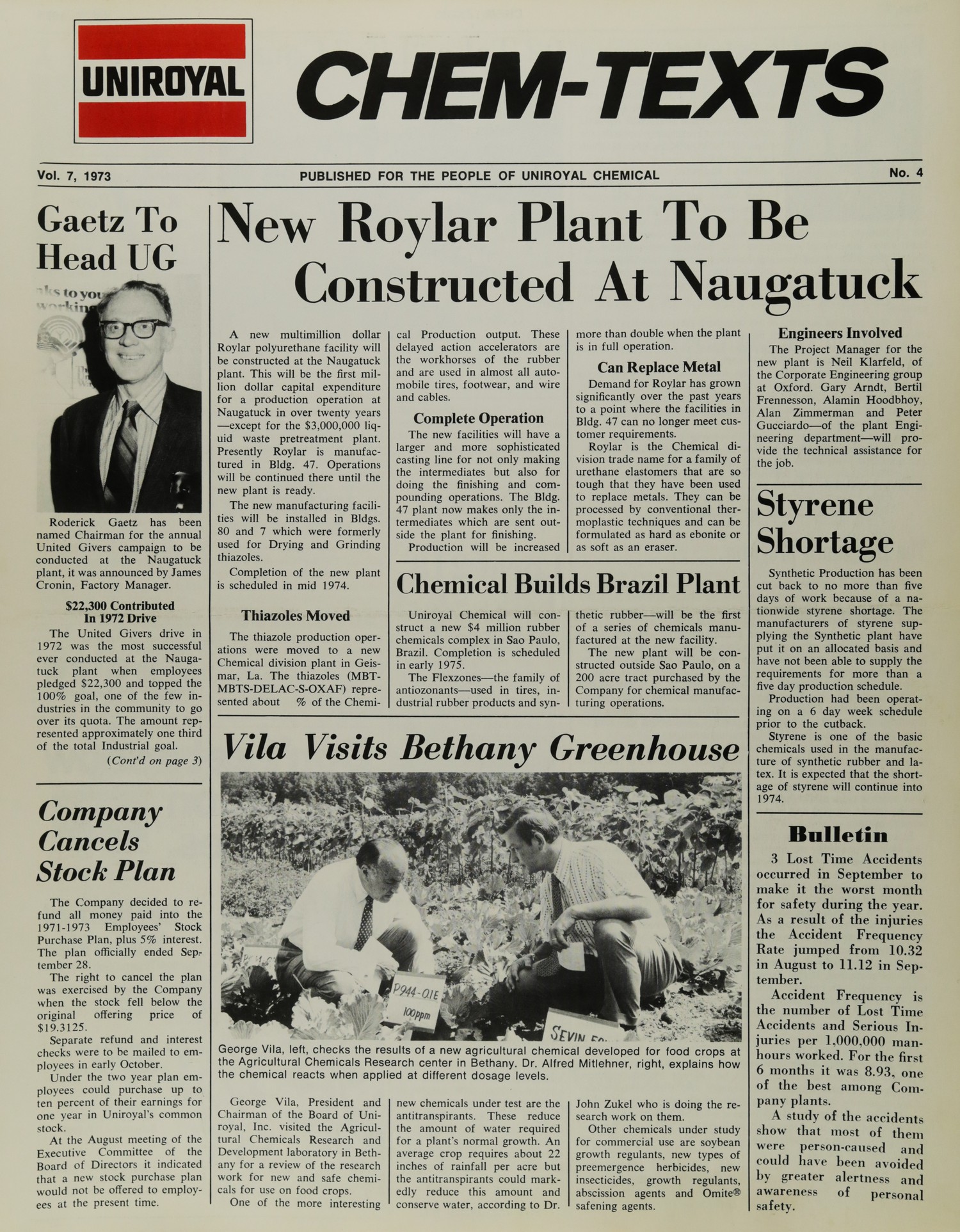
Gaetz To Head UG

[IMAGE: Photo of Roderick Gaetz wearing glasses]

Roderick Gaetz has been named Chairman for the annual United Givers campaign to be conducted at the Naugatuck plant, it was announced by James Cronin, Factory Manager.

$22,300 Contributed In 1972 Drive

The United Givers drive in 1972 was the most successful ever conducted at the Naugatuck plant when employees pledged $22,300 and topped the 100% goal, one of the few industries in the community to go over its quota. The amount represented approximately one third of the total Industrial goal.

(Cont’d on page 3)


Company Cancels Stock Plan

The Company decided to refund all money paid into the 1971-1973 Employees’ Stock Purchase Plan, plus 5% interest. The plan officially ended September 28.

The right to cancel the plan was exercised by the Company when the stock fell below the original offering price of $19.3125.

Separate refund and interest checks were to be mailed to employees in early October.

Under the two year plan employees could purchase up to ten percent of their earnings for one year in Uniroyal’s common stock.

At the August meeting of the Executive Committee of the Board of Directors it indicated that a new stock purchase plan would not be offered to employees at the present time.


New Roylar Plant To Be Constructed At Naugatuck

A new multimillion dollar Roylar polyurethane facility will be constructed at the Naugatuck plant. This will be the first million dollar capital expenditure for a production operation at Naugatuck in over twenty years —except for the $3,000,000 liquid waste pretreatment plant. Presently Roylar is manufactured in Bldg. 47. Operations will be continued there until the new plant is ready.

The new manufacturing facilities will be installed in Bldgs. 80 and 7 which were formerly used for Drying and Grinding thiazoles.

Completion of the new plant is scheduled in mid 1974.

Thiazoles Moved

The thiazole production operations were moved to a new Chemical division plant in Geismar, La. The thiazoles (MBT-MBTS-DELAC-S-OXAF) represented about % of the Chemical Production output. These delayed action accelerators are the workhorses of the rubber and are used in almost all automobile tires, footwear, and wire and cables.

Complete Operation

The new facilities will have a larger and more sophisticated casting line for not only making the intermediates but also for doing the finishing and compounding operations. The Bldg. 47 plant now makes only the intermediates which are sent outside the plant for finishing.

Production will be increased more than double when the plant is in full operation.

Can Replace Metal

Demand for Roylar has grown significantly over the past years to a point where the facilities in Bldg. 47 can no longer meet customer requirements.

Roylar is the Chemical division trade name for a family of urethane elastomers that are so tough that they have been used to replace metals. They can be processed by conventional thermoplastic techniques and can be formulated as hard as ebonite or as soft as an eraser.

Engineers Involved

The Project Manager for the new plant is Neil Klarfeld, of the Corporate Engineering group at Oxford. Gary Arndt, Bertil Frennesson, Alamin Hoodbhoy, Alan Zimmerman and Peter Gucciardo—of the plant Engineering department—will provide the technical assistance for the job.


Chemical Builds Brazil Plant

Uniroyal Chemical will construct a new $4 million rubber chemicals complex in Sao Paulo, Brazil. Completion is scheduled in early 1975.

The Flexzones—the family of antiozonants—used in tires, industrial rubber products and synthetic rubber—will be the first of a series of chemicals manufactured at the new facility.

The new plant will be constructed outside Sao Paulo, on a 200 acre tract purchased by the Company for chemical manufacturing operations.


Styrene Shortage

Synthetic Production has been cut back to no more than five days of work because of a nationwide styrene shortage. The manufacturers of styrene supplying the Synthetic plant have put it on an allocated basis and have not been able to supply the requirements for more than a five day production schedule.

Production had been operating on a 6 day week schedule prior to the cutback.

Styrene is one of the basic chemicals used in the manufacture of synthetic rubber and latex. It is expected that the shortage of styrene will continue into 1974.


Vila Visits Bethany Greenhouse

[IMAGE: Photo showing George Vila and Dr. Alfred Mitlehner examining plants in a greenhouse, with signs visible reading “P944-01E”, “100ppm”, and “SEVIN Ex.”]

George Vila, left, checks the results of a new agricultural chemical developed for food crops at the Agricultural Chemicals Research center in Bethany. Dr. Alfred Mitlehner, right, explains how the chemical reacts when applied at different dosage levels.

George Vila, President and Chairman of the Board of Uniroyal, Inc. visited the Agricultural Chemicals Research and Development laboratory in Bethany for a review of the research work for new and safe chemicals for use on food crops.

One of the more interesting new chemicals under test are the antitranspirants. These reduce the amount of water required for a plant’s normal growth. An average crop requires about 22 inches of rainfall per acre but the antitranspirants could markedly reduce this amount and conserve water, according to Dr. John Zukel who is doing the research work on them.

Other chemicals under study for commercial use are soybean growth regulants, new types of preemergence herbicides, new insecticides, growth regulants, abscission agents and Omite® safening agents.


Bulletin

3 Lost Time Accidents occurred in September to make it the worst month for safety during the year. As a result of the injuries the Accident Frequency Rate jumped from 10.32 in August to 11.12 in September.

Accident Frequency is the number of Lost Time Accidents and Serious Injuries per 1,000,000 man-hours worked. For the first 6 months it was 8.93, one of the best among Company plants.

A study of the accidents show that most of them were person-caused and could have been avoided by greater alertness and awareness of personal safety.

CHEM-TEXTS – 1973 – Page 2

Page 002

CHEM-TEXTS

Page 2 | Vol. 7, 1973


What happened in September?….

[IMAGE: Headshot photo of a man in business attire]

Was it a letdown after the long, hot summer? Was it a relaxation of attitude because of our improved performance over last year? Was it a little anticipation of attaining rewards for goals that have not quite been reached, but were close?

What happened in September? Three lost time accidents in the month —our worst performance this year. Where did we go wrong?

The answer to that question lies not in history, but in the future. What’s done is done, but let us learn from this recent experience and firm up our attitudes on Safety. We must strengthen our resolve to think safe and anticipate the unexpected. And follow rules, procedures, and good common sense to even further levels of accomplishment. We must work closer together, and help each other to solve the accident problem.

The real goal, of course, is not numbers on a board or dollars on a cost report. It is the well being of all our employees. It hurts to have an accident. It hurts in many ways, but the worst hurt of all is that most accidents could have been avoided.

Of course we must not forget that substantial progress has been made this year. We are all proud of this performance. But we have seen in years past a good record take a disastrous turn overnight. A good performance means only that more hard work is needed to keep it that way.

The year is not over yet. I urge all, wage and salary, factory and office, inside and outside, to rebound from our September problems and take on the rest of 1973 in the safest possible manner.

Our 1973 goals are still attainable if we point our eyes and noses in the right direction.


The free lunch program…

The average American is familiar with the expression— “There’s no such things as a free lunch.” Because we are so familiar with the saying, perhaps the full understanding of the thought gets lost and we forget the humbling impact of its true meaning.

Put simply, it means you never get anything for nothing. Even though it may appear that there are free handouts, or that someone has beaten the system, in the long run and when all things are considered, everything has its price.

One of the most flagrant free lunch programs is some of the money Uncle Sam hands out like free lollypops. However, the intelligent home owner, tax payer and average consumer knows, particularly now, that the bill for these goodies comes back to haunt us in the form of higher taxes, and increasing inflation.

The other free lunch program we must be very aware of is our own job situation. Everything our Company provides for us must be paid for by somebody, somewhere. Part of it comes back, when we pay more for the things we have to buy, and part of it comes back when a plant somewhere—anywhere—is shut down because it can no longer support the burden imposed upon it by today’s economic situation.

In order to maintain the comforting benefits provided, the main beneficiaries, namely us, must contribute. Under our product-industrial oriented system, the most reasonable way is to improve productivity. This is by far the best way to generate wealth which subsequently supports our standard of living.

The Company has a commitment to this end by providing the money and management to purchase and properly utilize equipment and facilities. The employees—you and I—have an obligation to properly and fully convert this equipment into products in the most efficient and reasonable manner possible. This is how we pay for our “free lunches.” If wealth is not generated in this way, a deficit is generated. If this deficit is allowed to grow unchecked, it will eventually—to borrow a Russian term—bury our system. Once this occurs, a major adjustment must be made to pay that “due bill” or write it off. In either case the adjustment is painful. The history of man is full of such adjustments and no intelligent man wants to live through such a period. No one wants his children to endure such hardships, either.

We all want reasonable improvements in our standard of living. We also want the improvements to be enjoyed by our children. Therefore, we must balance our benefits and their costs—somewhere, somehow. But we all know where the burden ends up—right on us. If we understand this and know what we are doing, we can better adjust to it and keep our livelihood in a good, healthy balance. We can then honestly say that the “free lunch” has been earned and paid for.

Jim Cronin [signature]


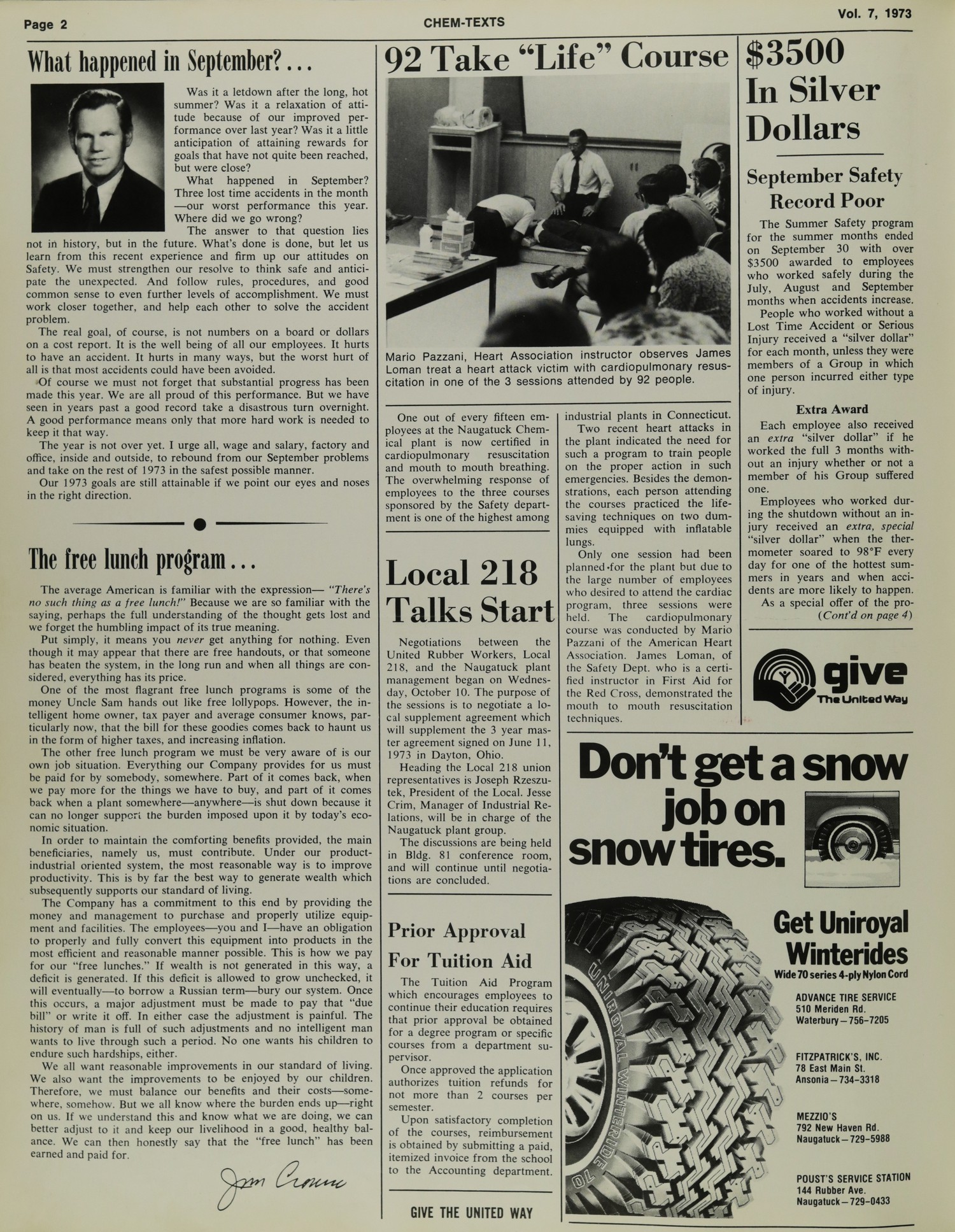
92 Take “Life” Course

[IMAGE: Photo showing people in what appears to be a training session with someone lying down, presumably during CPR training]

Mario Pazzani, Heart Association instructor observes James Loman treat a heart attack victim with cardiopulmonary resuscitation in one of the 3 sessions attended by 92 people.

One out of every fifteen employees at the Naugatuck Chemical plant is now certified in cardiopulmonary resuscitation and mouth to mouth breathing. The overwhelming response of employees to the three courses sponsored by the Safety department is one of the highest among industrial plants in Connecticut.

Two recent heart attacks in the plant indicated the need for such a program to train people on the proper action in such emergencies. Besides the demonstrations, each person attending the courses practiced the life-saving techniques on two dummies equipped with inflatable lungs.

Only one session had been planned for the plant but due to the large number of employees who desired to attend the cardiac program, three sessions were held. The cardiopulmonary course was conducted by Mario Pazzani of the American Heart Association. James Loman, of the Safety Dept. who is a certified instructor in First Aid for the Red Cross, demonstrated the mouth to mouth resuscitation techniques.


Local 218 Talks Start

Negotiations between the United Rubber Workers, Local 218, and the Naugatuck plant management began on Wednesday, October 10. The purpose of the sessions is to negotiate a local supplement agreement which will supplement the 3 year master agreement signed on June 11, 1973 in Dayton, Ohio.

Heading the Local 218 union representatives is Joseph Rzeszutek, President of the Local. Jesse Crim, Manager of Industrial Relations, will be in charge of the Naugatuck plant group.

The discussions are being held in Bldg. 81 conference room, and will continue until negotiations are concluded.


Prior Approval For Tuition Aid

The Tuition Aid Program which encourages employees to continue their education requires that prior approval be obtained for a degree program or specific courses from a department supervisor.

Once approved the application authorizes tuition refunds for not more than 2 courses per semester.

Upon satisfactory completion of the courses, reimbursement is obtained by submitting a paid, itemized invoice from the school to the Accounting department.


GIVE THE UNITED WAY


$3500 In Silver Dollars

September Safety Record Poor

The Summer Safety program for the summer months ended on September 30 with over $3500 awarded to employees who worked safely during the July, August and September months when accidents increase.

People who worked without a Lost Time Accident or Serious Injury received a “silver dollar” for each month, unless they were members of a Group in which one person incurred either type of injury.

Extra Award

Each employee also received an extra “silver dollar” if he worked the full 3 months without an injury whether or not a member of his Group suffered one.

Employees who worked during the shutdown without an injury received an extra, special “silver dollar” when the thermometer soared to 98°F every day for one of the hottest summers in years and when accidents are more likely to happen.

As a special offer of the pro-

(Cont’d on page 4)


[LOGO: “give The United Way” with stylized hand design]


Don’t get a snow job on snow tires.

[IMAGE: Large snow tire]

Get Uniroyal Winterides

Wide 70 series 4-ply Nylon Cord

ADVANCE TIRE SERVICE
510 Meriden Rd.
Waterbury – 756-7205

FITZPATRICK’S, INC.
78 East Main St.
Ansonia – 734-3318

MEZZIO’S
792 New Haven Rd.
Naugatuck – 729-5988

POUST’S SERVICE STATION
144 Rubber Ave.
Naugatuck – 729-0433

CHEM-TEXTS – 1973 – Page 4

Page 004

Page 4 | CHEM-TEXTS | Vol. 7, 1973


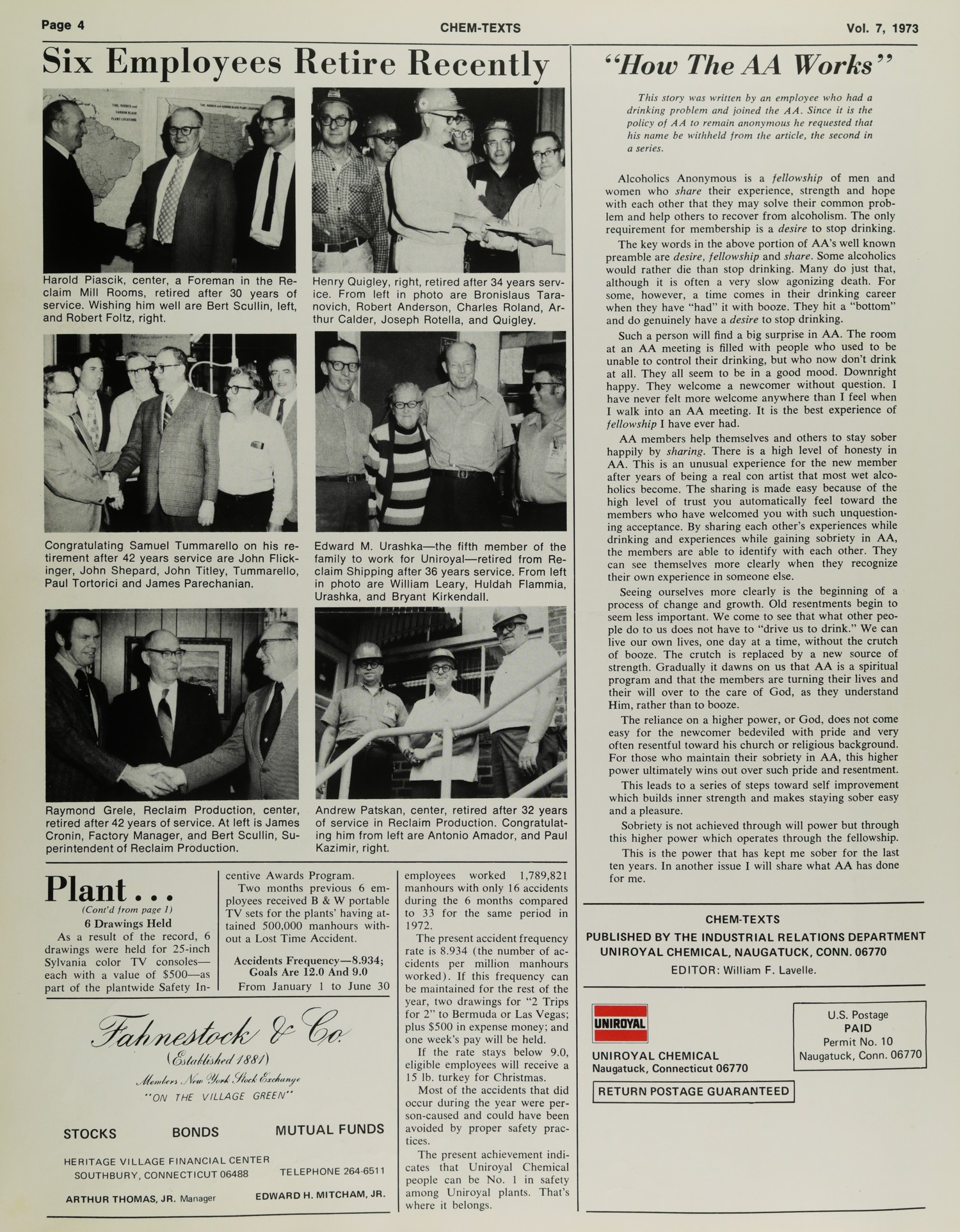
Six Employees Retire Recently

[PHOTO 1]
Harold Piascik, center, a Foreman in the Reclaim Mill Rooms, retired after 30 years of service. Wishing him well are Bert Scullin, left, and Robert Foltz, right.

[PHOTO 2]
Henry Quigley, right, retired after 34 years service. From left in photo are Bronislaus Taranovich, Robert Anderson, Charles Roland, Arthur Calder, Joseph Rotella, and Quigley.

[PHOTO 3]
Congratulating Samuel Tummarello on his retirement after 42 years service are John Flickinger, John Shepard, John Titley, Tummarello, Paul Tortorici and James Parechanian.

[PHOTO 4]
Edward M. Urashka—the fifth member of the family to work for Uniroyal—retired from Reclaim Shipping after 36 years service. From left in photo are William Leary, Huldah Flammia, Urashka, and Bryant Kirkendall.

[PHOTO 5]
Raymond Grele, Reclaim Production, center, retired after 42 years of service. At left is James Cronin, Factory Manager, and Bert Scullin, Superintendent of Reclaim Production.

[PHOTO 6]
Andrew Patskan, center, retired after 32 years of service in Reclaim Production. Congratulating him from left are Antonio Amador, and Paul Kazimir, right.


Plant…

(Cont’d from page 1)

6 Drawings Held

As a result of the record, 6 drawings were held for 25-inch Sylvania color TV consoles—each with a value of $500—as part of the plantwide Safety Incentive Awards Program.

Two months previous 6 employees received B & W portable TV sets for the plants’ having attained 500,000 manhours without a Lost Time Accident.

Accidents Frequency—8.934;
Goals Are 12.0 And 9.0

From January 1 to June 30 employees worked 1,789,821 manhours with only 16 accidents during the 6 months compared to 33 for the same period in 1972.

The present accident frequency rate is 8.934 (the number of accidents per million manhours worked). If this frequency can be maintained for the rest of the year, two drawings for “2 Trips for 2” to Bermuda or Las Vegas; plus $500 in expense money; and one week’s pay will be held.

If the rate stays below 9.0, eligible employees will receive a 15 lb. turkey for Christmas.

Most of the accidents that did occur during the year were person-caused and could have been avoided by proper safety practices.

The present achievement indicates that Uniroyal Chemical people can be No. 1 in safety among Uniroyal plants. That’s where it belongs.


Fahnestock & Co.
(Established 1881)
Members New York Stock Exchange
“ON THE VILLAGE GREEN”

STOCKS | BONDS | MUTUAL FUNDS

HERITAGE VILLAGE FINANCIAL CENTER
SOUTHBURY, CONNECTICUT 06488 | TELEPHONE 264-6511

ARTHUR THOMAS, JR. Manager | EDWARD H. MITCHAM, JR.


“How The AA Works”

This story was written by an employee who had a drinking problem and joined the AA. Since it is the policy of AA to remain anonymous he requested that his name be withheld from the article, the second in a series.

Alcoholics Anonymous is a fellowship of men and women who share their experience, strength and hope with each other that they may solve their common problem and help others to recover from alcoholism. The only requirement for membership is a desire to stop drinking.

The key words in the above portion of AA’s well known preamble are desire, fellowship and share. Some alcoholics would rather die than stop drinking. Many do just that, although it is often a very slow agonizing death. For some, however, a time comes in their drinking career when they have “had” it with booze. They hit a “bottom” and do genuinely have a desire to stop drinking.

Such a person will find a big surprise in AA. The room at an AA meeting is filled with people who used to be unable to control their drinking, but who now don’t drink at all. They all seem to be in a good mood. Downright happy. They welcome a newcomer without question. I have never felt more welcome anywhere than I feel when I walk into an AA meeting. It is the best experience of fellowship I have ever had.

AA members help themselves and others to stay sober happily by sharing. There is a high level of honesty in AA. This is an unusual experience for the new member after years of being a real con artist that most wet alcoholics become. The sharing is made easy because of the high level of trust you automatically feel toward the members who have welcomed you with such unquestioning acceptance. By sharing each other’s experiences while drinking and experiences while gaining sobriety in AA, the members are able to identify with each other. They can see themselves more clearly when they recognize their own experience in someone else.

Seeing ourselves more clearly is the beginning of a process of change and growth. Old resentments begin to seem less important. We come to see that what other people do to us does not have to “drive us to drink.” We can live our own lives, one day at a time, without the crutch of booze. The crutch is replaced by a new source of strength. Gradually it dawns on us that AA is a spiritual program and that the members are turning their lives and their will over to the care of God, as they understand Him, rather than to booze.

The reliance on a higher power, or God, does not come easy for the newcomer bedeviled with pride and very often resentful toward his church or religious background. For those who maintain their sobriety in AA, this higher power ultimately wins out over such pride and resentment.

This leads to a series of steps toward self improvement which builds inner strength and makes staying sober easy and a pleasure.

Sobriety is not achieved through will power but through this higher power which operates through the fellowship.

This is the power that has kept me sober for the last ten years. In another issue I will share what AA has done for me.


CHEM-TEXTS
PUBLISHED BY THE INDUSTRIAL RELATIONS DEPARTMENT
UNIROYAL CHEMICAL, NAUGATUCK, CONN. 06770
EDITOR: William F. Lavelle.

[UNIROYAL LOGO]

UNIROYAL CHEMICAL
Naugatuck, Connecticut 06770

U.S. Postage
PAID
Permit No. 10
Naugatuck, Conn. 06770

RETURN POSTAGE GUARANTEED

CHEM-TEXTS – 1973 – Page 6

Page 006

Page 6 | CHEM-TEXTS | Vol. 7, 1973


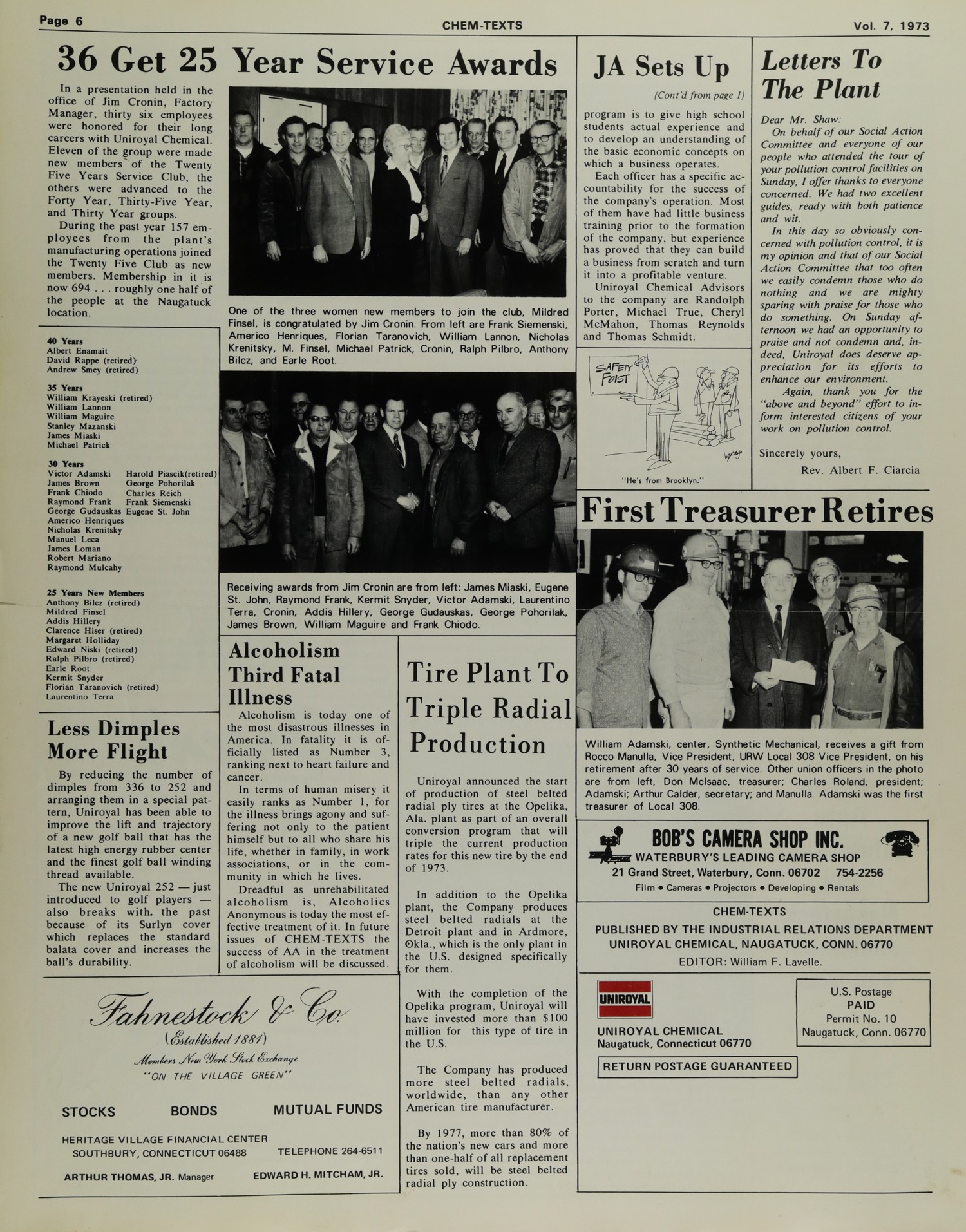
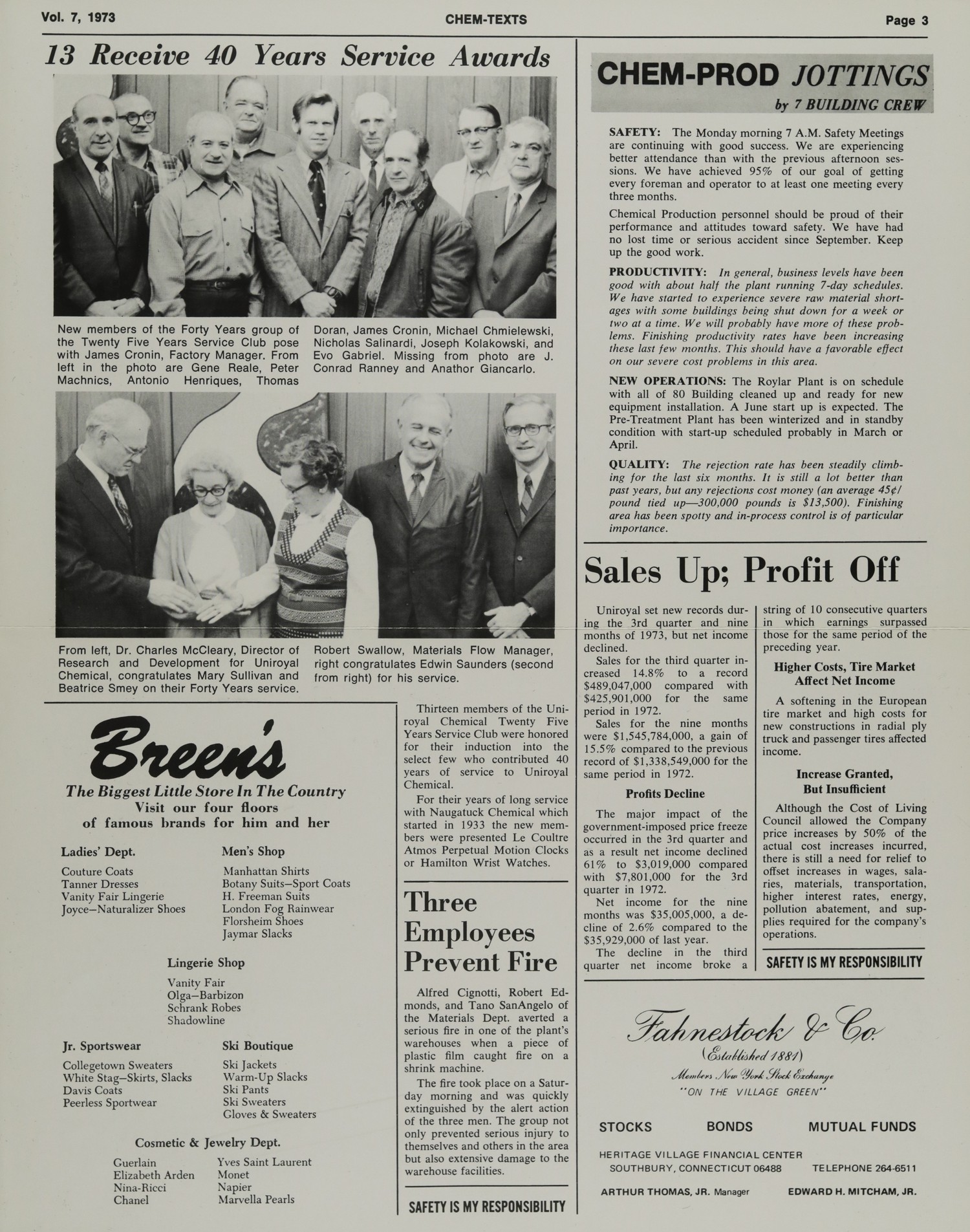
36 Get 25 Year Service Awards

In a presentation held in the office of Jim Cronin, Factory Manager, thirty six employees were honored for their long careers with Uniroyal Chemical. Eleven of the group were made new members of the Twenty Five Years Service Club, the others were advanced to the Forty Year, Thirty-Five Year, and Thirty Year groups.

During the past year 157 employees from the plant’s manufacturing operations joined the Twenty Five Club as new members. Membership in it is now 694 . . . roughly one half of the people at the Naugatuck location.

40 Years
Albert Enamait
David Rappe (retired)
Andrew Smey (retired)

35 Years
William Krayeski (retired)
William Lannon
William Maguire
Stanley Mazanski
James Miaski
Michael Patrick

30 Years
Victor Adamski Harold Piascik(retired)
James Brown George Pohorilak
Frank Chiodo Charles Reich
Raymond Frank Frank Siemenski
George Gudauskas Eugene St. John
Americo Henriques
Nicholas Krenitsky
Manuel Leca
James Loman
Robert Mariano
Raymond Mulcahy

25 Years New Members
Anthony Bilcz (retired)
Mildred Finsel
Addis Hillery
Clarence Hiser (retired)
Margaret Holliday
Edward Niski (retired)
Ralph Pilbro (retired)
Earle Root
Kermit Snyder
Florian Taranovich (retired)
Laurentino Terra


One of the three women new members to join the club, Mildred Finsel, is congratulated by Jim Cronin. From left are Frank Siemenski, Americo Henriques, Florian Taranovich, William Lannon, Nicholas Krenitsky, M. Finsel, Michael Patrick, Cronin, Ralph Pilbro, Anthony Bilcz, and Earle Root.

[PHOTO]

Receiving awards from Jim Cronin are from left: James Miaski, Eugene St. John, Raymond Frank, Kermit Snyder, Victor Adamski, Laurentino Terra, Cronin, Addis Hillery, George Gudauskas, George Pohorilak, James Brown, William Maguire and Frank Chiodo.


Less Dimples More Flight

By reducing the number of dimples from 336 to 252 and arranging them in a special pattern, Uniroyal has been able to improve the lift and trajectory of a new golf ball that has the latest high energy rubber center and the finest golf ball winding thread available.

The new Uniroyal 252 — just introduced to golf players — also breaks with. the past because of its Surlyn cover which replaces the standard balata cover and increases the ball’s durability.


Alcoholism Third Fatal Illness

Alcoholism is today one of the most disastrous illnesses in America. In fatality it is officially listed as Number 3, ranking next to heart failure and cancer.

In terms of human misery it easily ranks as Number 1, for the illness brings agony and suffering not only to the patient himself but to all who share his life, whether in family, in work associations, or in the community in which he lives.

Dreadful as unrehabilitated alcoholism is, Alcoholics Anonymous is today the most effective treatment of it. In future issues of CHEM-TEXTS the success of AA in the treatment of alcoholism will be discussed.


Tire Plant To Triple Radial Production

Uniroyal announced the start of production of steel belted radial ply tires at the Opelika, Ala. plant as part of an overall conversion program that will triple the current production rates for this new tire by the end of 1973.

In addition to the Opelika plant, the Company produces steel belted radials at the Detroit plant and in Ardmore, Okla., which is the only plant in the U.S. designed specifically for them.

With the completion of the Opelika program, Uniroyal will have invested more than $100 million for this type of tire in the U.S.

The Company has produced more steel belted radials, worldwide, than any other American tire manufacturer.

By 1977, more than 80% of the nation’s new cars and more than one-half of all replacement tires sold, will be steel belted radial ply construction.


JA Sets Up

(Cont’d from page 1)

program is to give high school students actual experience and to develop an understanding of the basic economic concepts on which a business operates.

Each officer has a specific accountability for the success of the company’s operation. Most of them have had little business training prior to the formation of the company, but experience has proved that they can build a business from scratch and turn it into a profitable venture.

Uniroyal Chemical Advisors to the company are Randolph Porter, Michael True, Cheryl McMahon, Thomas Reynolds and Thomas Schmidt.

[CARTOON: SAFETY FIRST with cartoon figure]

“He’s from Brooklyn.”


Letters To The Plant

Dear Mr. Shaw:

On behalf of our Social Action Committee and everyone of our people who attended the tour of your pollution control facilities on Sunday, I offer thanks to everyone concerned. We had two excellent guides, ready with both patience and wit.

In this day so obviously concerned with pollution control, it is my opinion and that of our Social Action Committee that too often we easily condemn those who do nothing and we are mighty sparing with praise for those who do something. On Sunday afternoon we had an opportunity to praise and not condemn and, indeed, Uniroyal does deserve appreciation for its efforts to enhance our environment.

Again, thank you for the “above and beyond” effort to inform interested citizens of your work on pollution control.

Sincerely yours,

Rev. Albert F. Ciarcia


First Treasurer Retires

[PHOTO]

William Adamski, center, Synthetic Mechanical, receives a gift from Rocco Manulla, Vice President, URW Local 308 Vice President, on his retirement after 30 years of service. Other union officers in the photo are from left, Don McIsaac, treasurer; Charles Roland, president; Adamski; Arthur Calder, secretary; and Manulla. Adamski was the first treasurer of Local 308.


BOB’S CAMERA SHOP INC.
WATERBURY’S LEADING CAMERA SHOP
21 Grand Street, Waterbury, Conn. 06702 754-2256
Film ● Cameras ● Projectors ● Developing ● Rentals


Fahnestock & Co
(Established 1881)
Members New York Stock Exchange
“ON THE VILLAGE GREEN”

STOCKS BONDS MUTUAL FUNDS

HERITAGE VILLAGE FINANCIAL CENTER
SOUTHBURY, CONNECTICUT 06488 TELEPHONE 264-6511

ARTHUR THOMAS, JR. Manager EDWARD H. MITCHAM, JR.


CHEM-TEXTS
PUBLISHED BY THE INDUSTRIAL RELATIONS DEPARTMENT
UNIROYAL CHEMICAL, NAUGATUCK, CONN. 06770
EDITOR: William F. Lavelle.

[UNIROYAL LOGO]

U.S. Postage
PAID
Permit No. 10
Naugatuck, Conn. 06770

UNIROYAL CHEMICAL
Naugatuck, Connecticut 06770

RETURN POSTAGE GUARANTEED

CHEM-TEXTS – 1973 – Page No. 1

Page unknown

UNIROYAL CHEM-TEXTS

Vol. 7, 1973 PUBLISHED FOR THE PEOPLE OF UNIROYAL CHEMICAL No. 1


Chemical AR Approved

$375,510 was recently approved to expand the production facilities of Aminox and Betanox in Bldg. 79. The two, old-line amine antioxidants are widely used in heavy duty rubber compounds where heat resistance is required.

A growing use for the chemicals in the stabilization of Nylon 6 in tire cord is one of the major reasons for approval of the request to improve production facilities.

Reduces Dust, Fumes; Makes Work Safer

A new continuous belt flaker (known as a Sandvik Belt Flaker) will be installed to eliminate the panning operation. The equipment will greatly reduce the amount of material (Cont’d on page 3)


$5096 Paid For Ideas

by Jerry Tortorelli

$5096 was paid out to employees in 1972 in awards for their ideas on improvements in various phases of the plant’s operations. Their recommendations resulted in savings of $17,699.

During the year 318 Ideas were submitted and processed, of which 118 were approved for cash payments. 79 employees received Letters of Commendation. Participation in the plantwide plan which is open to all employees increased by 130 over 1971.

$360 Highest Single Award

The highest single award for the year, $360, was made to Natale Vescera and William Balchunas, of the Materials department.

$475, the largest total amount, was awarded to the (Cont’d on page 2)


1972 Safety Improves

But Still Short Of Plant Goal For Year

The plant’s safety record showed a reduction during 1972 over 1971 especially in Lost Time Accidents experiencing 11 compared to 20 for the prior year.

In 1972 there were 62 Serious Injuries vs 63 for 1971, a small drop in an area that is portentous of future occurrences.

Although a total of 73 injuries to employees in 12 months — an average of 6 per month — is not a real significant improvement, it is an encouraging sign, since it was one of the better records for the plant since 1966 — except for the year 1970 when it had a total of 72 injuries.

Frequency, Per 1,000,000 Manhours Decreased

For every 1,000,000 manhours worked — approximately 4 months — 21.3 employees incurred an injury compared to 25.3 in 1971. This was a 15% improvement over 1971 but did not come close to the frequency reduction of 12.0 and 9.0 which were set as the goals for the Safety Incentive Award program.

Inattention Major Cause of Accidents

Ironically people were the major cause of accidents with inattention the primary factor underlying them. For example many of the accidents were fractures caused by hammer blows; fingers crushed by drums; burns from hot material; and falls.

Few accidents were the result of defective equipment, mechanical failures, or hazardous work conditions.

Materials Department Had Best Record

Members of the Materials department had the best safety record for 1972 with no Lost Time Accidents. The department had 3 Serious Injuries compared to 8 in 1971, a reduction of over 50% in frequency.

Synthetic Production also worked the entire year without a Lost Time Accident but its Serious Injuries jumped from 7 to 8.

By the nature of its work the Mechanical department is more exposed to hazards than other departments but the Chemical Mechanical group reduced both Lost Time Accidents and Serious Injuries for the year.

Injuries In R&D Increase 100%

Serious Injuries in the Research and Development department increased from 4 in

(Cont’d on page 3)


Quarterly Dividend Declared

The board of directors of Uniroyal, Inc. declared a quarterly dividend of 17-1/2 cents a share on the company’s common stock payable March 24 to stockholders of record February 26.

The directors also declared two dividends of $2 each on the company’s preferred stock, one to be paid March 24 to stockholders of record February 26 and the other payable June 25 to stockholders of record May 21.

In 1972 Uniroyal paid a total dividend of 70 cents on the common stock and a total of $8 dollars on the preferred stock.

The current price of the common stock ranges in the area of 13-5/8 a share.


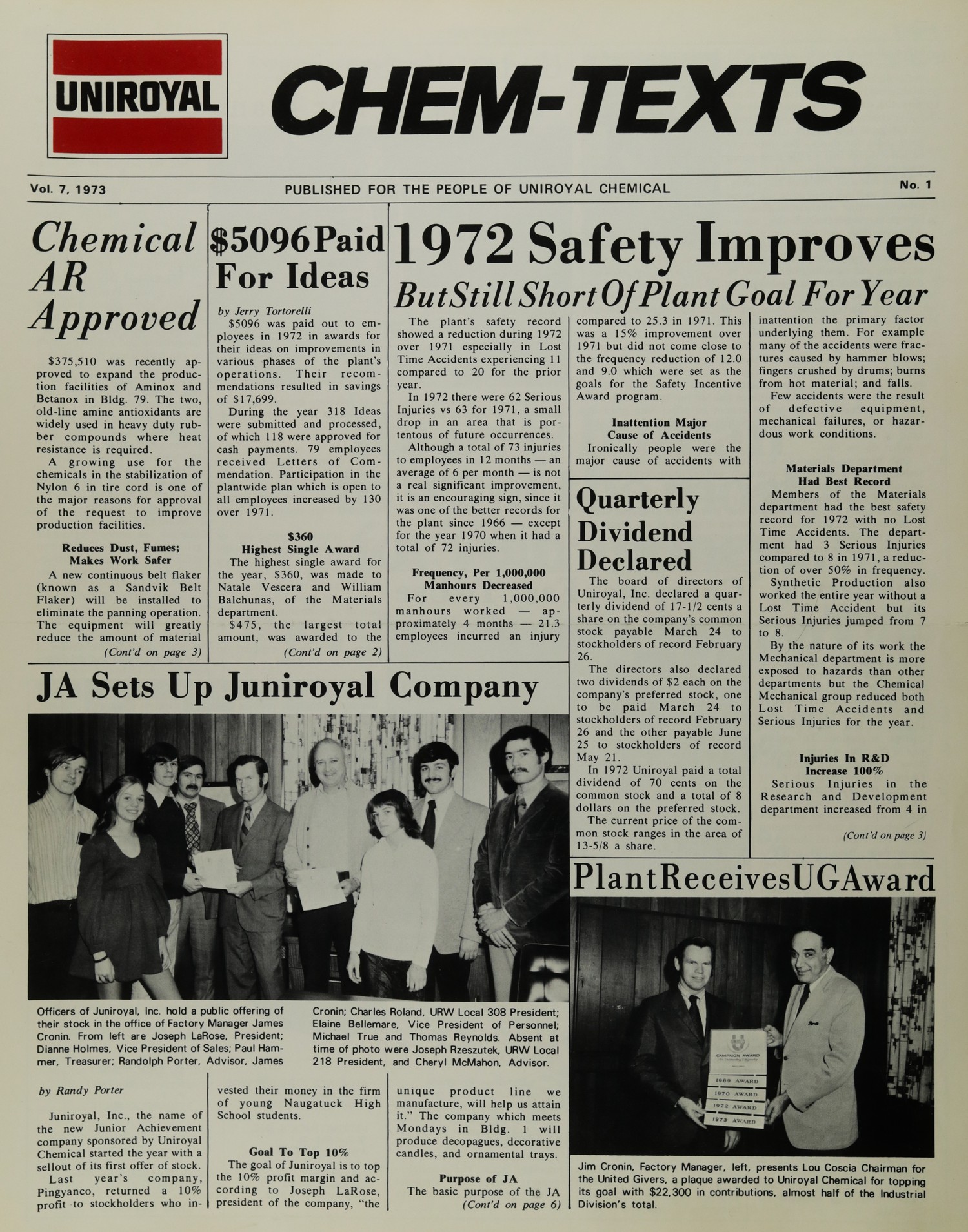
JA Sets Up Juniroyal Company

[PHOTOGRAPH OF GROUP]

Officers of Juniroyal, Inc. hold a public offering of their stock in the office of Factory Manager James Cronin. From left are Joseph LaRose, President; Dianne Holmes, Vice President of Sales; Paul Hammer, Treasurer; Randolph Porter, Advisor, James Cronin; Charles Roland, URW Local 308 President; Elaine Bellemare, Vice President of Personnel; Michael True and Thomas Reynolds. Absent at time of photo were Joseph Rzeszutek, URW Local 218 President, and Cheryl McMahon, Advisor.

by Randy Porter

Juniroyal, Inc., the name of the new Junior Achievement company sponsored by Uniroyal Chemical started the year with a sellout of its first offer of stock.

Last year’s company, Pingyanco, returned a 10% profit to stockholders who invested their money in the firm of young Naugatuck High School students.

Goal To Top 10%

The goal of Juniroyal is to top the 10% profit margin and according to Joseph LaRose, president of the company, “the unique product line we manufacture, will help us attain it.” The company which meets Mondays in Bldg. 1 will produce decoupages, decorative candles, and ornamental trays.

Purpose of JA

The basic purpose of the JA (Cont’d on page 6)


Plant Receives UG Award

[PHOTOGRAPH OF TWO MEN WITH PLAQUE]

Jim Cronin, Factory Manager, left, presents Lou Coscia Chairman for the United Givers, a plaque awarded to Uniroyal Chemical for topping its goal with $22,300 in contributions, almost half of the Industrial Division’s total.

CHEM-TEXTS – 1973 – Page No. 3

Page unknown

UNIROYAL CHEM-TEXTS

Vol. 7, 1973 | PUBLISHED FOR THE PEOPLE OF UNIROYAL CHEMICAL | No. 3


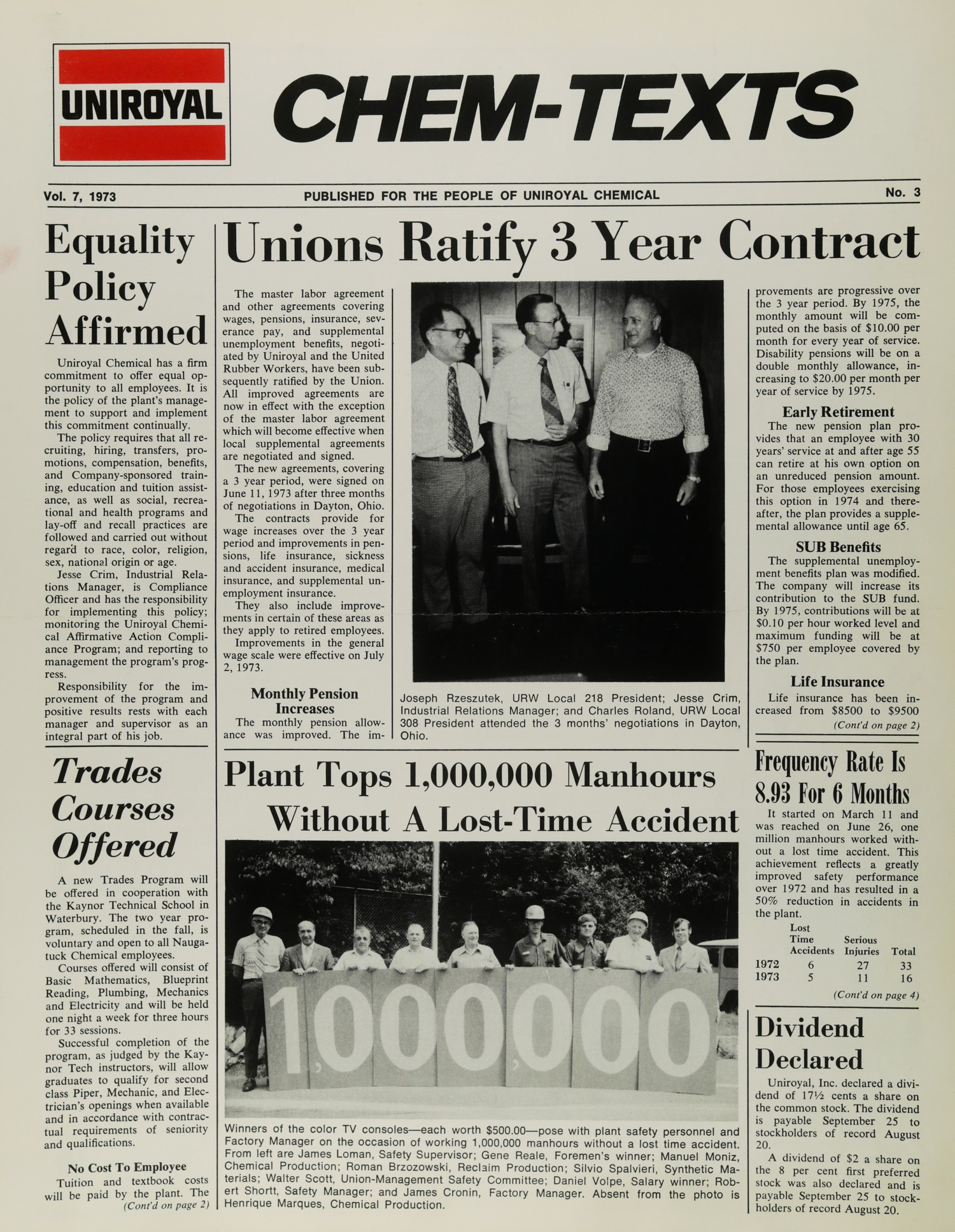
Equality Policy Affirmed

Uniroyal Chemical has a firm commitment to offer equal opportunity to all employees. It is the policy of the plant’s management to support and implement this commitment continually.

The policy requires that all recruiting, hiring, transfers, promotions, compensation, benefits, and Company-sponsored training, education and tuition assistance, as well as social, recreational and health programs and lay-off and recall practices are followed and carried out without regard to race, color, religion, sex, national origin or age.

Jesse Crim, Industrial Relations Manager, is Compliance Officer and has the responsibility for implementing this policy; monitoring the Uniroyal Chemical Affirmative Action Compliance Program; and reporting to management the program’s progress.

Responsibility for the improvement of the program and positive results rests with each manager and supervisor as an integral part of his job.


Trades Courses Offered

A new Trades Program will be offered in cooperation with the Kaynor Technical School in Waterbury. The two year program, scheduled in the fall, is voluntary and open to all Naugatuck Chemical employees.

Courses offered will consist of Basic Mathematics, Blueprint Reading, Plumbing, Mechanics and Electricity and will be held one night a week for three hours for 33 sessions.

Successful completion of the program, as judged by the Kaynor Tech instructors, will allow graduates to qualify for second class Piper, Mechanic, and Electrician’s openings when available and in accordance with contractual requirements of seniority and qualifications.

No Cost To Employee

Tuition and textbook costs will be paid by the plant. The (Cont’d on page 2)


Unions Ratify 3 Year Contract

The master labor agreement and other agreements covering wages, pensions, insurance, severance pay, and supplemental unemployment benefits, negotiated by Uniroyal and the United Rubber Workers, have been subsequently ratified by the Union. All improved agreements are now in effect with the exception of the master labor agreement which will become effective when local supplemental agreements are negotiated and signed.

The new agreements, covering a 3 year period, were signed on June 11, 1973 after three months of negotiations in Dayton, Ohio.

The contracts provide for wage increases over the 3 year period and improvements in pensions, life insurance, sickness and accident insurance, medical insurance, and supplemental unemployment insurance.

They also include improvements in certain of these areas as they apply to retired employees.

Improvements in the general wage scale were effective on July 2, 1973.

Monthly Pension Increases

The monthly pension allowance was improved. The improvements are progressive over the 3 year period. By 1975, the monthly amount will be computed on the basis of $10.00 per month for every year of service. Disability pensions will be on a double monthly allowance, increasing to $20.00 per month per year of service by 1975.

Early Retirement

The new pension plan provides that an employee with 30 years’ service at and after age 55 can retire at his own option on an unreduced pension amount. For those employees exercising this option in 1974 and thereafter, the plan provides a supplemental allowance until age 65.

SUB Benefits

The supplemental unemployment benefits plan was modified. The company will increase its contribution to the SUB fund. By 1975, contributions will be at $0.10 per hour worked level and maximum funding will be at $750 per employee covered by the plan.

Life Insurance

Life insurance has been increased from $8500 to $9500
(Cont’d on page 2)


[PHOTO CAPTION]
Joseph Rzeszutek, URW Local 218 President; Jesse Crim, Industrial Relations Manager; and Charles Roland, URW Local 308 President attended the 3 months’ negotiations in Dayton, Ohio.


Plant Tops 1,000,000 Manhours Without A Lost-Time Accident

[PHOTO CAPTION]
Winners of the color TV consoles—each worth $500.00—pose with plant safety personnel and Factory Manager on the occasion of working 1,000,000 manhours without a lost time accident. From left are James Loman, Safety Supervisor; Gene Reale, Foremen’s winner; Manuel Moniz, Chemical Production; Roman Brzozowski, Reclaim Production; Silvio Spalvieri, Synthetic Materials; Walter Scott, Union-Management Safety Committee; Daniel Volpe, Salary winner; Robert Shortt, Safety Manager; and James Cronin, Factory Manager. Absent from the photo is Henrique Marques, Chemical Production.


Frequency Rate Is 8.93 For 6 Months

It started on March 11 and was reached on June 26, one million manhours worked without a lost time accident. This achievement reflects a greatly improved safety performance over 1972 and has resulted in a 50% reduction in accidents in the plant.

Lost Time Accidents Serious Injuries Total
1972 6 27 33
1973 5 11 16

(Cont’d on page 4)


Dividend Declared

Uniroyal, Inc. declared a dividend of 17½ cents a share on the common stock. The dividend is payable September 25 to stockholders of record August 20.

A dividend of $2 a share on the 8 per cent first preferred stock was also declared and is payable September 25 to stockholders of record August 20.

13 Receive 40 Years Service Awards

Vol. 7, 1973 | CHEM-TEXTS | Page 3


13 Receive 40 Years Service Awards

[PHOTO: Group photo of people]

New members of the Forty Years group of the Twenty Five Years Service Club pose with James Cronin, Factory Manager. From left in the photo are Gene Reale, Peter Machnics, Antonio Henriques, Thomas Doran, James Cronin, Michael Chmielewski, Nicholas Salinardi, Joseph Kolakowski, and Evo Gabriel. Missing from photo are J. Conrad Ranney and Anathor Giancarlo.

[PHOTO: Group photo of people in formal setting]

From left, Dr. Charles McCleary, Director of Research and Development for Uniroyal Chemical, congratulates Mary Sullivan and Beatrice Smey on their Forty Years service.

Robert Swallow, Materials Flow Manager, right congratulates Edwin Saunders (second from right) for his service.


Breen’s

The Biggest Little Store In The Country
Visit our four floors
of famous brands for him and her

Ladies’ Dept.
Couture Coats
Tanner Dresses
Vanity Fair Lingerie
Joyce—Naturalizer Shoes

Men’s Shop
Manhattan Shirts
Botany Suits—Sport Coats
H. Freeman Suits
London Fog Rainwear
Florsheim Shoes
Jaymar Slacks

Lingerie Shop
Vanity Fair
Olga—Barbizon
Schrank Robes
Shadowline

Jr. Sportswear
Collegetown Sweaters
White Stag—Skirts, Slacks
Davis Coats
Peerless Sportswear

Ski Boutique
Ski Jackets
Warm-Up Slacks
Ski Pants
Ski Sweaters
Gloves & Sweaters

Cosmetic & Jewelry Dept.
Guerlain | Yves Saint Laurent
Elizabeth Arden | Monet
Nina-Ricci | Napier
Chanel | Marvella Pearls


CHEM-PROD JOTTINGS

by 7 BUILDING CREW

SAFETY: The Monday morning 7 A.M. Safety Meetings are continuing with good success. We are experiencing better attendance than with the previous afternoon sessions. We have achieved 95% of our goal of getting every foreman and operator to at least one meeting every three months.

Chemical Production personnel should be proud of their performance and attitudes toward safety. We have had no lost time or serious accident since September. Keep up the good work.

PRODUCTIVITY: In general, business levels have been good with about half the plant running 7-day schedules. We have started to experience severe raw material shortages with some buildings being shut down for a week or two at a time. We will probably have more of these problems. Finishing productivity rates have been increasing these last few months. This should have a favorable effect on our severe cost problems in this area.

NEW OPERATIONS: The Roylar Plant is on schedule with all of 80 Building cleaned up and ready for new equipment installation. A June start up is expected. The Pre-Treatment Plant has been winterized and in standby condition with start-up scheduled probably in March or April.

QUALITY: The rejection rate has been steadily climbing for the last six months. It is still a lot better than past years, but any rejections cost money (an average 45¢/ pound tied up—300,000 pounds is $13,500). Finishing area has been spotty and in-process control is of particular importance.


Sales Up; Profit Off

Uniroyal set new records during the 3rd quarter and nine months of 1973, but net income declined.

Sales for the third quarter increased 14.8% to a record $489,047,000 compared with $425,901,000 for the same period in 1972.

Sales for the nine months were $1,545,784,000, a gain of 15.5% compared to the previous record of $1,338,549,000 for the same period in 1972.

Profits Decline

The major impact of the government-imposed price freeze occurred in the 3rd quarter and as a result net income declined 61% to $3,019,000 compared with $7,801,000 for the 3rd quarter in 1972.

Net income for the nine months was $35,005,000, a decline of 2.6% compared to the $35,929,000 of last year.

The decline in the third quarter net income broke a string of 10 consecutive quarters in which earnings surpassed those for the same period of the preceding year.

Higher Costs, Tire Market Affect Net Income

A softening in the European tire market and high costs for new constructions in radial ply truck and passenger tires affected income.

Increase Granted, But Insufficient

Although the Cost of Living Council allowed the Company price increases by 50% of the actual cost increases incurred, there is still a need for relief to offset increases in wages, salaries, materials, transportation, higher interest rates, energy, pollution abatement, and supplies required for the company’s operations.

SAFETY IS MY RESPONSIBILITY


Thirteen members of the Uniroyal Chemical Twenty Five Years Service Club were honored for their induction into the select few who contributed 40 years of service to Uniroyal Chemical.

For their years of long service with Naugatuck Chemical which started in 1933 the new members were presented Le Coultre Atmos Perpetual Motion Clocks or Hamilton Wrist Watches.


Three Employees Prevent Fire

Alfred Cignotti, Robert Edmonds, and Tano SanAngelo of the Materials Dept. averted a serious fire in one of the plant’s warehouses when a piece of plastic film caught fire on a shrink machine.

The fire took place on a Saturday morning and was quickly extinguished by the alert action of the three men. The group not only prevented serious injury to themselves and others in the area but also extensive damage to the warehouse facilities.

SAFETY IS MY RESPONSIBILITY


Fahnestock & Co.
(Established 1881)
Members New York Stock Exchange
“ON THE VILLAGE GREEN”

STOCKS | BONDS | MUTUAL FUNDS

HERITAGE VILLAGE FINANCIAL CENTER
SOUTHBURY, CONNECTICUT 06488 | TELEPHONE 264-6511

ARTHUR THOMAS, JR. Manager | EDWARD H. MITCHAM, JR.

CHEM-TEXTS – Vol. 4 No. 6 – Page 3

Page 003

Vol. 4, No. 6 CHEM-TEXTS Page 3

Employees’ Opinions Polled On Chem-Texts | Unions To Hold Picnics

A poll of 200 employees selected on a random basis from all plant and divisional departments and retired employees revealed that 96% of the employees read CHEM-TEXTS always or often, and that 76% of their families read it. The survey also showed the plant newspaper as a reliable form of communication and indicated employees have a vital concern for news and information on plant activities and operations.

70 employees completed the questionnaire for a 35% return, an exceptionally high response.

70% signed the questionnaire which was voluntary.

Answers to the “open-end” questions have been condensed because of space limitations.

1.) Do you read Chem-Tests?
86% always, 10% often, 3% seldom

2.) Does your family read Chem-Texts?
76% yes, 7% no

3.) What kind of news do you find most informative?
76% preferred news about plant activities: plant products; use of products in the market; new facilities; plant improvement; personnel changes; and economic situations.

60% wanted news about employees; benefits; idea awards; safety; job security; and retirements.

60% indicated a desire for news about Uniroyal, Inc.; other plants; corporate sales; profits; new products and markets.

4.) How did you like the recent article on the Oxford complex?
The majority commented “excellent”, “informative”, “indicative of Uniroyal’s progress”, “knew very little about it until article”.

5.) Do you think the paper uses enough photographs?
80% yes, 18% no


6.) What did you think of the article on pollution?
“Wonderful that something is being done;” “informative on serious national problem;” “good to keep us informed on pollution control efforts;” “shows company is concerned and makes employees concerned;” “all must be aware of their role in pollution control.”

7.) Some time back we did an article on packaging – do you think this type of information is helpful to employees?
Most employees replied yes; pointing out that they as customers always shop for a neat package.

8.) Do you think the paper gives you reliable information on plant operations and activities?
Comments were essentially, yes; and implied, “haven’t gotten any bum steers yet.”

9.) What do you think of the News Bulletins issued weekly?
In general the News Bulletins were considered informative and helpful; but several employees did not see them; a few felt they were fair, should expand coverage and include more news on safety and production.

10.) What suggestions do you have to improve CHEM-TEXTS?
The majority of employees had no recommendations to improve the paper.

Some remarks suggested: do more articles on departments; more about employees’ participation in community; letters to the editor; classified ads; questions and answers from employees.

The survey was the first conducted in the Company on plant newspapers, and employees who participated are thanked for their time in making it a more effective means of communication.


by Charlie Roland

Plans are underway for URW Local 308’s third annual picnic to be held on Sunday, August 9, from 11 A.M. to 6 P.M. at Schildgen’s Grove in Union City. The Grove is located on East Waterbury Road.

Chairman of the event is Art Calder, with Ben Tomaszeski, Nunzio Pastore and John Sullivan assisting in arrangements.

by Frank Commendatore

Local 218 will hold its annual picnic at Schildgen’s Grove on Saturday, August 15. A menu of roast beef, hamburgers, clams, clam broth will be served all day, with steaks served from 2 – 5 P.M. along with hot and cold beverages.

Chairman for the picnic is Frank Commendatore with Tom Ward and Mario Mucci, assistant chairman.


You Get A Chance To Talk To Two Bosses In New Plan

[PHOTO: Two men in discussion at what appears to be an industrial setting]

Bill Broden, left, has an evaluation discussion with Joe Bucciaglia, chief process engineer for chemical production.

[PHOTO: Three men in discussion in an office setting]

Jim Cronin, superintendent of chemical production, Bill’s second boss, is interested in Bill’s question during the contact discussion held between the two.


Do you ever wonder what the boss thinks? Where you stand in your job? Whether you’re doing a good one or not? What progress you’re making in it?

These are questions every employee asks himself and wants to have answered. The new Contact and Evaluation program will help clear up many of these questions.

Purpose of Program

The program sets up a procedure for a meeting and a performance evaluation of salaried personnel by their immediate supervisors. It also arranges for a meeting of salaried personnel by a senior manager at least two levels above the employee.

Dual Appraisal

The employee receives advance notice of the meeting, usually around the anniversary date of his employment. He and his supervisor receive a set of similar forms to fill out before the interview on matters related to his job. The employee and supervisor then meet for a private, uninterrupted discussion, using this information for the basis of their discussion.

A fruitful meeting requires mutually open, and honest, discussion to determine mutually agreed job objectives for future evaluations.

Senior Manager’s Interview

After this meeting, the supervisor arranges for an interview with the employee’s senior manager. The employee may be interviewed by a senior manager in a different function at either his option or the senior manager’s.

The purpose of this interview is to provide the opportunity to discuss in a friendly conversation the general attitudes, understandings, and adjustment of the employee in relationship to his job and objectives.

Plant Coordinator’s Function

All reports are returned to the program coordinator, Bob Krause, of the industrial relations department. His responsibility is to organize the program, schedule the discussions, assure continuation of the plan, and file reports in the employee’s personnel folder.

Information from the program may be used by plant management and the divisional personnel development manager for job rotations and promotions within the plant and the division.

Program Successful

Employees participating in the program have praised it highly for the chance to openly discuss their jobs and to understand more fully the expectations and responsibilities of their job, their status in the department and future opportunities with the company.

As one employee put it, “it’s the first time I really had a chance to open up and discuss things with my boss and his boss freely. At least I know where I stand and what opportunities are open to me.”

CHEM-TEXTS – Vol. 4 No. 3 – Page 2

Page 002

CHEM-TEXTS

Page 2 | Vol. 4 No. 3


FROM THE FACTORY MANAGER

DEAR FELLOW EMPLOYEE:

Spring is officially here and every now and then the sunshine gives promise that it will be really here before long. Along with spring comes the housecleaning bug that bites our wives and turns our houses upside down while the cleaning is done and the furniture is moved. When it’s all done, the house really looks great, doesn’t it?

Let’s all catch the bug this spring and pitch in together to clean up the plant this month. In a large operation like ours, spread over many acres, winter takes its toll of housekeeping and when the snow is gone our winter carelessness becomes only too obvious.

I’m counting on everybody to do his part in cleaning up his work area. Remember, good housekeeping goes hand in hand with efficient work, quality performance, safe operation and makes for a much more pleasant place to work.

Best regards.

Sincerely,

John

John D. Evans


Chemical Club Elects Officers

[IMAGE: Group photo of officers at meeting]

Newly elected officers of the Uniroyal Chemical Management Club hold their first meeting. From left are Bob Smith, treasurer; Dick Keenan, secretary; Lou Kaiser, president; and Jim Phelan, vice president.

by Lou Kaiser

The Uniroyal Chemical Management Club elected officers at its monthly meeting. Reelected president for a third term was Lou Kaiser. Jim Phelan was reelected vice president over Steve Alper and Al Murray. Bob Smith was reelected over Brad Swain for treasurer. Dick Keenan topped Dick Mastromatteo in the balloting for secretary. Stan Mazur was nominated from the floor for president but declined the nomination.

The Club’s annual dinner will be held at the Ambassador Restaurant in Hamden on April 15.

John Evans, factory manager, main speaker at the meeting, gave a brief picture of the plant’s business outlook for 1970, and was followed by staff members Bert Scullin, Larry Koth, Harry Witt, Hal Lynch, Bob VanAllen, Fred Wintsch, who spoke for Ron Mitchinson, Jim Cronin and Al Manzi, who summarized their department’s prime goals for the year.


Service Keeps Customer

[IMAGE: Workers loading materials on pallet]

From left loading 451 on pallet in Bldg. 109 are Brony Konavage and Mike Yuchnyk as Bert Frennesson and George Baktis watch.

[IMAGE: Group of workers being congratulated]

Rocco Magnanimo congratulates Bldg. 17 employees for refining 451 and shipping to customer on time. From left are Magnanimo, Ted Clement, Bob Orsini, Jack Cuddy, Joe Antonucci and Jerry Markham.

An order for Antioxidant 451 was recently received from a large customer for delivery on very short notice. 451 is a product that the Sales department has been trying to sell for over a year, but without much progress. The new product was important to the Naugatuck plant’s success because it represented new business.

Used In Tires

The customer tried 451 as a stabilizer in styrene-butadiene rubber, which goes into most of the tires made in the country on a small run. It worked. The customer came back and said, “if you can keep me supplied with 451, I’ll use it in our entire run.”

Service Saves Business

This is where the crews in Bldg. 109 and Bldg. 17 played an important role in saving the business. Through their effort, the 451 was processed and transferred into a tank car, and shipped out of the plant in time to satisfy the customer and keep the business.

Cooperation like this, which involves several departments, gets new customers and keeps them. The more customers the plant gets, the more business it gets. This is what makes our jobs more secure.

Crew Members

Building 109 employees responsible for processing the material were George Baktis, area foreman; Dolph Gabriel, foreman; Larry Bogen, John Booth, Brony Konavage, Harold McIlroy, Joe Owens and Buddy Watts.

Building 17 employees who helped get the product shipped out on time were John Honyotski, area foreman; Rocco Magnanimo, foreman; Eric Storch, process engineer; Bert Frennesson, engineering associate; Joe Antonucci, John Shumak, Thurman Walton, Ben Root, Bob Orsini, Jesse Silva, Frank Bedard, and Ted Clement.


New Degree Offered By College

An associate degree in Industrial Management Technology geared to the needs of foremen and supervisors is offered by the Waterbury State Technical College.

The curriculum includes courses on: cost control, personnel management, accounting, job instruction training, work simplification, safety and hygiene, communications, value analysis, manufacturing processes, quality control, data processing, plant layout, physics, economics and human relations.

Courses are given by the Evening Division in trimester sessions. The cost is $5.00 per course.

Waterbury State also offers courses in civil technology, chemical technology, data processing, electrical technology, fire technology, industrial management and mechanical technology.

For further information on the courses, contact your foreman, supervisor or the Director of Extension Services, Waterbury State Technical College, 1460 West Main Street, Waterbury, Conn. 06708. or phone 756-7035.

When the courses are job related, you can apply for Tuition Aid. Under this program, Uniroyal pays the tuition cost upon satisfactory completion of the course.


Spring Tire Sale Starts

A special spring employee tire sale runs from March 30 through May 29. Employee prices will be substantially below regular prices on passenger, small truck, camper and trailer tires.

The new Uniroyal Master with front and rear tires for better steering and traction, a steel reinforced tread and 40,000 mile guarantee are included in the sale.

Other tires offered are the “Tiger Paw,” wide “Tiger Paw” and the Laredo “Rain Tire.”

This will be the only sale on these tires during the year.

Tire slips can be obtained from the Industrial Relations department; Ann McAllister, R.N., Synthetic plant hospital; Luella Anderson, TSSC; and Janet Nolin and Jack Vergosen, EMIC

SAFETY IS MY RESPONSIBILITY

CHEM-TEXTS – Vol. 4 No. 1 – Page 2

Page 002

CHEM-TEXTS

Page 2 | Vol. 4, No. 1


FROM THE FACTORY MANAGER

DEAR FELLOW EMPLOYEE:

During most of the 1960’s, in fact until about mid-1969, our plant has operated in what Jim Cronin has called an “oversold” position. In other words, we were operating all out to produce every pound we could, to meet our customers’ requirements.

In 1969 the situation changed to what can be called an “undersold” position, which means we can produce more than the customer needs. This fairly abrupt change from what had become an established way of operating has affected the way all of us do our jobs. Basically, under these conditions all of us have to make better decisions faster in order to be responsive to the customers’ needs at the moment.

Considering the general decline in business activity in the markets we serve, the high cost of money, the “undersold” capacity of domestic competition and increasing foreign competition, I expect that these conditions will continue well into 1970. Therefore, it becomes even more important that we be as flexible to change as possible. Under these circumstances what we did yesterday isn’t important. What is important, is what we do right now to meet a new opportunity.

All of us have expressed individual pride in the flexibility of our plant – men and machinery alike – to do the job, whatever the requirements. Now if we really have this flexibility, and I believe we do, it seems to me that the economic climate of 1970 plays right into our hands.

I’m confident we can and will meet these demands regardless of how difficult they may be.

Sincerely,

John

John D. Evans


Jaroy Inc. Enjoys Brisk Sales

Jaroy, Inc. officers sell stock to Uniroyal Chemical employees. From left to right are John Evans, Factory Manager; Jill Subataitis, President of Jaroy; Harry Witt, Synthetic Production Superintendent; Joe Rzeszutek, President URW Local 218; Ted Lainas; Jim Brown; Ron Mitchinson, Industrial Relations Manager; and Jo Ann Niski, Purchasing Agent.

by Ted Lainas

Jaroy, Junior Achievement of Uniroyal, is a small company with big goals. On its first day of sales, the company sold every product made during the past months.

Jaroy is a Junior Achievement company sponsored by Uniroyal Chemical, and consists of Naugatuck High School students and one Achiever from Holy Cross High.

The basic principle of the JA program is to give high school students real business experience and to help them develop an accurate understanding of the economic factors that make the free enterprise system work.

Issues Stock For Capital

The company issues and sells stock for its operating capital. This money is used to buy raw materials, tools, pay rent, heat, and light bills, and other expenditures to operate the business. Jaroy pays regular salaries, and taxes, carries insurance, and pays dividends to stockholders from any profits made.

Living Economics

Economics can be a difficult subject, especially when taught from a textbook and by lectures. In Junior Achievement, the student puts into practice what is taught in school about complicated practices and theories. Be-

Continued on page 4


Trucks Get Safety Belts

by Bob Shortt

Safety belts are being installed in all plant trucks for safety protection for plant drivers as a result of a survey by the Cornell Aeronautical Laboratory of Cornell University.

For a long time, the trucking industry had questioned the value of safety belts in trucks because of the floating seat drivers used for comfort, but the survey results indicate otherwise.

A study of 243 truck accidents showed the frequency of door openings in trucks to be double the frequency of door openings in 1963 model automobiles. The frequency of truck driver ejection was shown to be about double the frequency of driver ejections from recent model automobiles. The rate of dangerous or fatal injuries for ejected truck drivers was four times as high as for non-ejected truck drivers. Therefore, it is believed

Continued on page 3

Presley Joines, a driver for Synthetic Materials Handling shows safety belt installed in new plant truck to John Metesky, right. Seat belts provide extra safety protection for our drivers.


At left of photo is conveyor to carry scrap tires to grinder. Employee’s head barely missed the steel prong of the conveyor as he fell backwards. (Conveyor prongs were retouched to show them more clearly).


Man Slips . . .

Continued from page 1

injuries. Training and education programs, installation of safer equipment, and repairs are continually being made to improve safety.

In the final analysis, however, Safety is the responsibility of every employee. Unless he has a safety attitude, performs his job safely, wears the proper safety clothing and equipment and avoids taking chances, accidents and injuries will continue to happen.

55,200 persons were killed in motor vehicle accidents in 1968, an increase of 4% over 1967.


Foremen’s Club Changes Name And By-Laws

by Lou Kaiser

By a high margin vote, the Uniroyal Chemical Foremen’s Club changed its name to the Uniroyal Chemical Management Club.

The new by-laws open membership to all male salaried personnel. Members of the Divisional staff are now eligible for the Club but are not eligible to hold office.

Dues were increased from $6 to $8 yearly.

CHEM-TEXTS – Vol. 3 No. 3 – Page 2

Page 002

Page 2 CHEM-TEXTS Vol. 3 No. 3


FROM THE FACTORY MANAGER

DEAR FELLOW EMPLOYEE:

Are you a professional? In sports the professional is one whose proficiency and skill enables him to earn his living through his participation. The professional is characterized by his pride in his efforts. In a similar sense, we are professionals earning our living by supplying our customers with chemicals, reclaim, and polymers. But do we always demonstrate the proficiency and skill required in our jobs? Do we have the pride of workmanship characteristic of the professional?

Remember a professional always gives his best and always tries to win. He puts team goals and team effort ahead of his own personal desires. He believes the whole team wins together and he takes pride in realizing that the true recognition for his effort is in the team winning.

The same thing is true in our plant – we all win when we satisfy our customers’ needs in the most efficient manner possible. Anything less than this – we aren’t professionals!

[Signature]

John D. Evans


Chemical Control Center Reviews Quality, Productivity, and Costs

[IMAGE: Sam Gillette, left, listens as Walt Frankenberger, in charge of the Chemical Control Center, reviews the previous day’s production with Jim Cronin, right, superintendent of chemical production.]

by Walt Frankenberger

The Chemical Control Center (CCC) in Chemical Production was established 18 months ago to increase productivity, improve the quality of our products and to decrease costs. The center was set up by Walt Frankenberger who organized the procedures for operating it.

By weekly and daily review of production pounds, quality, and costs, the Center controls productivity and spots downward trends in the plant which require adjustment. The CCC also reviews on a monthly basis the performance against set standards of every chemical made by the plant during the previous month and year to date. This evaluation is based on raw material usage, yield and productivity expressed in pounds per hour. A report is then given to the responsible foreman and process engineer so that corrective action can be taken, if necessary.

For daily control, a daily batch card is used for reporting the date and number of batches made each day. The cards are turned in daily to the center, logged, and sent to EMIC for further processing.

The number of batches for the major chemical products are plotted on control boards, shown in the photo, where they are compared to a set standard and on which a rolling average is maintained. When the number of batches drop below the standard, the person in any business.


73 Employees Awarded $1455 For Suggestions.

Wojtczak Receives $70. Mayo’s Idea Brings $50.

[IMAGE: Looking at the checks awarded for their suggestions are l. to r. Elmer Anderson, Joe Wojtczak, and Bob Lockwood who received a total of $157. for their ideas.]

by Kirk Kirkendall

Suggestions for improving the plant’s overall operations can provide benefits which go beyond the money received for a suggestion award. Contributing suggestions and ideas involves a person in the successful operation of the plant and brings a personal satisfaction to his job. No matter what you may think of your suggestion, don’t hesitate to send it in. It may turn out to be an important one.

73 employees recently received $1,455. for their suggestions out of the 150 suggestions which were reviewed. The highest single award of $50 went to Fred Mayo. Joe Wojtczak received $70 for several suggestions. John Painter, a consistent winner, got $65; Ed Bazenas $55; Al Urban of Reclaim $50 and Bob Lockwood of Synthetic Production $47.50.

Receiving $40 for their suggestions were Fernando Henriques, R. Fratangelo, Ed Semaskvich and Elmer Anderson. Joe Moniz of Reclaim obtained $35 for his idea on improving the cleaning of Sweco screens; J. Gallucci $30 for a safety suggestion, and $30 to W. Anderson, Fred Engle, J. Lawton, J. Wawer and J. Gandolfo.

$25 awards were received by H. Rich, J. Wawer, J. Matcheson, J. Brown, L. foreman gives a detailed explanation of the causes for the lost production.

Since daily control was initiated, rubber chemical production has consistently improved over production prior to September 1968. The quality of rubber chemicals has also improved through the Center’s operation. By improving production and quality, the Center helps to provide better service to our customers, the most important person in any business.

[IMAGE: Fred Mayo received $50. the highest single award. (Photo by Kirkendall)]

Rinaldi, G. Brezak, L. Dumonski and J. Butkus.

$20 awards went to E. Smith and F. Pikula, and J. Butkus and J. Painter.

Thirty-three employees received or split $15 for their


New Curalon

(con’t from page 1.)

thane elastomers; developed the product, Vibrathane, the tradename for our polyurethane elastomers. Our Research and Development technology in rubber chemicals led to the development of Curalon L whose use should grow at a 20 per cent rate annually.

Polyurethane elastomers cured with Curalon possess high resistance to wear and tear and have excellent shock absorption properties. Because of these properties, they are used for grain chute linings, industrial truck tires, gears, mountings and printing rolls where they outlast rubber 3 to 4 times longer.

Project engineers of the new plant were Neil Klarfeld and Jim Garrigan. Lou Kaiser is the process engineer, responsible for the manufacturing operation.


ideas: Lois Devino, C. Iannuzzi, F. Maher, A. Hanley, Ray Gogolewski, J. Hoey, J. Mahoney, J. Lynch, K. Urbsaitis, N. Tiscione, A. Krampetz, G. Monahan, J. Banno, R. Ruginis, D. Pardal, B. Zukauskas, J. Grosso, E. Johnson, R. O’Neil, E. Root, J. Objinski, A. J. Happy, R. Bell, T. Ciarello, J. Slasienski, J. Lynch, A. Gedraitis, G. Ravenscroft, C. Parks, R. Steward, Laura Soares, V. Kloc – Bob Lockwood, and L. Haas – J. Wawer.

Honorable Mentions, which automatically bring a $15 award for the third suggestion submitted, went to J. Mahoney, F. Dingle, P. Masone, H. F. Carroll, M. Hebert, B. Pranulis, R. Lestage, E. Anderson, J. Wojtczak, F. Henriques, C. Miele, J. Lawton, F. Phelan, J. Butkus (2), J. Painter, K. D. Nelson, R. O’Neil, C. Hiser – D. Cleary, G. Brezak and L. Reeser.

Every suggestion submitted receives serious consideration by the Suggestion Awards Committee. Some suggestions require more time to study than others to evaluate them, which is oftentimes the reason for some delay. Suggestions worthy of consideration are any that increase production, improve quality, eliminate duplication or waste, improve packaging, simplify your work procedure, eliminate paper work, improve customer service, reduce costs, improve production, and better our safety conditions.

Suggestion forms are available around the plant. If unavailable, your Foreman or Supervisor will be glad to obtain them for you.


Save Your Blood For June 12

by Bob Shortt

June 12 has been reserved as Uniroyal Chemical’s day for blood donations. Because of its convenient facilities, the Bloodmobile will be held at St. Michael’s Parish House in Naugatuck. Our quota is 150 pints.

Employees have donated generously since the visits started in 1957 when 190 pints were given. Since then, we have averaged about 170 pints each visit.

Blood is in great demand today. By contributing, you can help be sure that blood is available for you or your family. Let’s try for the 190 pints again.

CHEM-TEXTS – Vol. 2 No. 4 – Page 2

Page 002

CHEM TEXTS

Page 2 | Vol. 2 No. 4


FROM THE FACTORY MANAGER

Dear Fellow Employee:

Within the next several weeks we will each be contacted by one of our friends to make our annual pledge to the United Givers of Naugatuck and Beacon Falls.

Experience has proven that this once-a-year campaign is the most efficient way of providing funds for sixteen volunteer agencies that serve the people of our area. I am, however, concerned that the convenience of this method of giving may tend to lessen our generosity as givers. May I suggest that we each use the following guidelines in making out our pledges?

1) Review carefully the agencies presented on our pledge card and the details of their needs and services as described in the United Givers folder.

2) Consider the services that we, our family, our friends and neighbors receive from these agencies. Note that many of the agencies serve an area broader than the campaign towns. Some are even national.

3) Use the Work Sheet on this page of CHEM-TEXTS to work out our pledge on the payroll deduction plan. This method makes it convenient to give our share on a year-around basis.

4) PLEDGE! Before filling in our card – ask ourselves one question – “Have I given until it feels good?

[Signature]

John D. Evans


HOW MUCH SHOULD YOU GIVE TO THE UNITED GIVERS DRIVE

A few years ago, somebody knocked on your door almost once a week for a contribution to a worthy cause. You probably contributed $30 to $50 to these organizations.

Through the United Givers Fund your continued generous support of most of these organizations can now be done on a once-a-year basis through the Company’s payroll deduction plan.

To determine your contribution for 1969, this work sheet, listing the 16 participating agencies, will help you decide the amount of your gift.

Agency Gift amt. if contacted separately
American Red Cross $_____
Child Guidance Clinic $_____
Children’s Center $_____
Conn. Trails Council,
Girl Scouts of America $_____
Catholic Family Serv. $_____

Family Serv. Assoc. $__
Mattatuck Council,
Boy Scouts of America $
____

Naugatuck Jr.
Athletic Leagues $__
Salvation Army $
_
United Cerebral Palsy $

U.S.O. $

Waterbury Assoc. for
Retarded Children $

Y.M.C.A. – Naugatuck $

Total Amount $
___

By dividing the number of payroll deductions into your total amount, you obtain the amount you should pledge. For salary employees, payroll deductions will be made monthly; and for wage employees, deductions will be weekly.

The Naugatuck plant always contributed generously in the past to these worthwhile agencies. Because of their increased services and expenses they depend more on us for 1969.


New Assignments Made in Plant

Fred Wintsch has been appointed Labor Relations Manager for the Naugatuck plant. He will be responsible for employee relations, reporting to Ron Mitchinson, Industrial Relations Manager.

[PHOTO]

Sam Gillette, formerly General Foreman at the Synthetic rubber plant, moved to the Chemical production as General Foreman reporting to Jim Cronin, Superintendent.

[PHOTO]

Eric Johnson, named General Foreman of the Synthetic rubber plant, will supervise production of synthetic latexes. He reports to Ben Leach, plant Superintendent.


[PHOTO]

The new 300,000 gallon oil storage tank and steel dike dwarfs members of the Engineering department as they inspect the 29 ft. high structure, south of the boiler plant.


[PHOTO]

Plant personnel involved in the boiler plant conversion project are left to right: Vic Anderson, Paul DeAngelis, Bill Maguire, Joe Mambrino, Frank Gaizutis and George Arndt, shown checking fuel oil connections.


Special Winter Tire Sale

A special two month winter tire sale for active and retired employees will run from October 1 to November 30, 1968.

The sale is on winter patrol snow tires only and offers considerable savings below existing employee prices.

Lists of the special low prices can be obtained from the Industrial Relation’s Department or Employee Salesroom Managers.


August Injuries Continue High

This chart shows our injuries for the month of August and indicates the departments where these injuries occur. Although it seems that plant personnel incur a large amount of minor injuries, we must do our utmost to reduce these injuries and particularly to prevent their recurrence by a greater awareness of safety. We must at the same time have all minor injuries checked by the plant hospital.

A minor injury remains a minor injury only if it’s taken care of immediately. All injuries promptly cared for, cause less discomfort and pain to the individual and will help avoid the danger of infection and complications.

Remember to report all injuries and receive prompt first aid at our plant hospitals. Most important, however, is a greater safety awareness of an “unexpected happening” before and while performing your job.


AUGUST 1968 – INJURY LOG SUMMARY

DEPARTMENT EYE BRUISE FRACTURE CUTS & ABRASIONS AMPUTATIONS BURNS CHEMICAL BURNS Sprains Back Sprains DUST OR FUMES SLIVERS DERMATITIS TOTAL
CHEMICAL PRODUCTION 4 4 8 3 4 3 1 2 29
RECLAIM PRODUCTION 1 8 12 3 4 1 1 30
SYNTHETIC PRODUCTION 4 3 1 2 1 11
MATERIALS HANDLING 5 4 8 2 1 3 2 3 2 30
MECHANICAL (CHEM) 5 5 1 22 7 2 5 1 14 1 63
MECHANICAL (SYN) 2 5 17 6 6 5 1 42
RESEARCH & DEVELOPMENT 4 2 13 2 3 3 5 1 1 34
OTHER 2 1 34
AUGUST TOTAL 21 32 1 85 0 24 10 26 4 7 23 9 242
8 MONTH AVERAGE 1968 22 32.5 1 82 0 19.5 9.25 18 8.25 4 28 10.5 235
8 MONTH AVERAGE 1967 28 42 1 90 12 19 14 23 9 4 27 9 267

SAFETY IS MY RESPONSIBILITY

CHEM-TEXTS – Page 2

Page 237

CHEM-TEXTS

Page 2


The thought of Christmas brings several things to mind. One is snow—and that speaks for itself; another is “that ole Christmas spirit” which unfortunately seems to come to many people only once a year; and another is safety.

We’ve all heard the expression before—have a safe Christmas. Well, here at the plant, I hope we all have a safe Christmas this year and next, and come to think of it, why not all the days in between. You all know that at Naugatuck we have just passed the milestone of working two million, that’s 2,000,000, manhours without a Lost Time Accident. We haven’t done that since 1961. That’s a tremendous and significant accomplishment and we should all be proud, and pleased, about it. After attaining this performance, I strangely found myself asking—”why has it taken us so long?” I ask myself, “why can’t we just keep on going?”

Jim Cronin [signature]

Wouldn’t that be a great Christmas present next year, working through all of 1976 without a Lost Time Accident. Strange as it may seem, this is one goal that is essentially under our full control. We can’t blame this on the Legislature in Hartford or the Congress in Washington—not even on the Governor or President. This is something that we, as employees of Uniroyal Chemical at Naugatuck, Conn., can claim full responsibility. It is, in a nut shell, strictly up to us.

Somehow, a happy Christmas helps to strengthen us. If we could minimize our exposure to accidents—at work, at home, on the road—we would, I’m sure, enjoy the spiritual and material joys of Christmastime even more. To attain this, we must not only be more aware of our own safety, but we must make others, particularly our family, more aware of their exposure to accidents. We have already seen how working together has reduced accidents and improved safety in the plant. We should instill this same positive attitude within our own family. Then we’ve really accomplished something.

With all this in mind, I would like to wish you and your families a very Merry, and Safe Christmas, and for next year, the return of reasonable prosperity.


Christmas in the Plant

[IMAGE: Photo of trees/spruces near a building]

In 1971, ninety five Colorado spruces were planted along the bank of the Naugatuck river; another 75 were planted in 1973. Besides improving the appearance of the plant, the trees add a touch of Christmas at this time of year. Naugatuck Chemical is probably the only industrial factory in the area with such a touch of green on its property. Over 100 hemlocks surround the scrap tire yard and 60 spreading yews were recently planted by the Main Entrance.


Diploma Awarded

[IMAGE: Photo of woman and man looking at documents]

Theresa Martin, an Order Clerk, in the D/S department plans to continue her education at the Mattatuck Community College in a Business related course. She is one of several Naugatuck Chemical people who have fulfilled the requirements for a high school equivalency diploma, which she is showing to Alex Nole.

The Industrial Relations department has a set of preparation books for the tests and may be borrowed at any time.


Survey Team Studies Noise

A survey was recently made of the noise factors in over 129 buildings throughout the plant by Thomas Ennis, Engineering, and James Loman of the Safety Dept. in compliance with the Occupational Safety and Health Act (OSHA).

The purpose of the study was to determine the range of noise problems that may exist in each section or floor of a building in the plant. Basing their measurements on engineering procedures, they recorded over 875 noise soundings which are kept on file in the Safety department.

The results have been given to the department heads of the buildings who in turn consult the plant Engineering department for recommendations to diminish or eliminate the noise level in compliance with OSHA.

In areas where the level is higher than desirable, people working in the area are urged to wear the proper protective equipment until the condition is remedied.


Accidents Cost Over $100,000

Accidents in 1975 cost over $100,000. During the year there were 3 Lost Time Injuries and 26 Serious Injuries for a total of 29. Although this is a major improvement over the hospital, surgical, and medical costs of $238,359 in 1974 and prior years when injuries cost over $200,000 annually, it still represents a severe drain on the plant’s financial condition.

The average direct cost of a Lost Time accident is $15,000. Overtime and other indirect costs increase it 5 times more, according to estimates of the National Safety Council and the Safety department.

Accidents Can Be Avoided

Eighty-five percent of the injuries in the plant are person-caused. Not that the accidents are deliberate, but they could have been avoided by a greater safety awareness. Many of them are caused by “taking chances” or “short cuts” or by not using the proper safety equipment or procedures.

Fingers were the most common injuries, accounting for half of the 29 accidents that occurred during the year. All of them required sutures.

But incomparable to the medical and hospital costs is the unnecessary suffering to the employee, his family, and the people in the department of which the employee is a member.


$1,116 Paid for Ideas

[IMAGE: Photo of three men, one receiving a check]

Russell Volz, center, Chemical Production, receives a $286.00 check from James Cronin, Factory Manager, for his Idea that saved $2750.00 a year in valves. At right is Frank Commendatore.


$9,449 Savings

Twenty people received $1116.00 for Ideas submitted during the year recommending different ways to save money in the operation of the plant.

The Ideas resulted in savings of $9449.00 at the Naugatuck location.

The highest award for the year $286.00 went to Russell Volz, Chemical Production, for reducing the number of valves used in the manufacture of J-Z-F. His idea resulted in a savings of $2750.

Another high award of $186.00 was made to Emil Rehel and Raymond Kubick, Chemical Maintenance, plus an additional $100. in small awards.

continued on page 3


Eric Johnson Named Chemical Superintendent

Eric Johnson has been named Superintendent of Chemical Production.

He joined the Naugatuck Chemical plant in 1961 upon graduation from Clarkson College with a B.Ch.E. degree. He held several Engineering positions until 1968 when he was appointed General Foreman of Synthetic Production. In 1971 he was named Chief Process Engineer for Chemical Production and in 1973 was assigned to the Naugatuck Treatment Co. a subsidiary of Uniroyal, Inc.


[ADVERTISEMENT]

UNIROYAL WINTER PATROL
WHITEWALL

TWO FIBERGLASS BELTS/TWO POLYESTER CORD PLIES
SELF-CLEANING TREAD FOR TRACTION

[IMAGE: Tire illustration]

ADVANCE TIRE SERVICE
510 Meriden Rd.
Waterbury—756-7205

POUST’S SERVICE STATION
144 Rubber Ave.
Naugatuck—729-0433
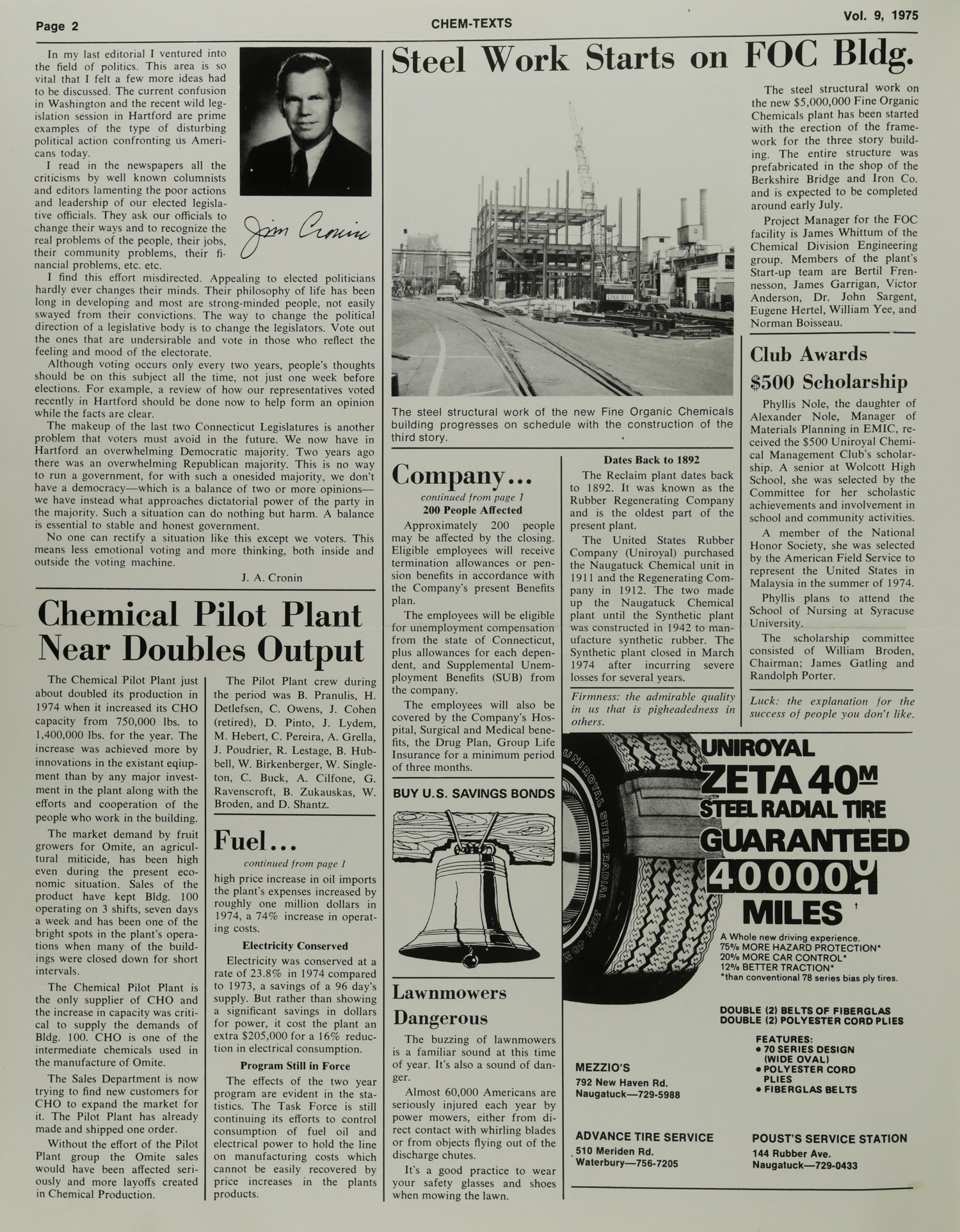
MEZZIO’S
792 New Haven Rd.
Naugatuck—729-5988

• Double fiberglass belts for hazard protection and mileage
• 78 Series design for traction