CHEM-TEXTS – 1976 – Page 2

Page 002

CHEM-TEXTS

Page 2 | Vol. 10, 1976


From the Factory Manager…

In this my first opportunity to express myself in this column, I find that several things cross my mind and so I’ll just begin and say them all rather than try to limit myself to one area.

First, since the last issue of CHEM-TEXTS Jim Cronin has left the Naugatuck Plant “family.” I’m sure that all of the friends whom he developed here are going to miss him and wish him, as I do, the best of success in his new assignment. Jim’s contributions to the plant during his years here have been significant and his presence will be felt for years to come.

The second thought that comes to mind and which I’ve expressed to most of you personally is WELCOME BACK! It is, from a personal viewpoint, very gratifying to have everyone back working together and the plant back to “normal.” To those of you whom I may have missed during my tours through the plant, I would like to take this opprtunity to welcome you back.

This leads me to my third thought—move ahead. As we can all see, the Synthetic Plant is now gone; the Reclaim Plant is rapidly disappearing; and soon the old Thiazoles complex will be torn down. With all of this, it is hard to visualize anything but the shrinking of the Naugatuck complex, but we must all apply ourselves to the task of getting the plant moving ahead. We, at Naugauck, have many things to offer the Company as a future plant site on which to expand—land, and thus room, for new process buildings—water treatment facilities large enough to accommodate more than a doubling of our present plant capacity. A facility which, if needed to be built today, would be extremely expensive. Power, we have here enough capacity to supply heat and process steam for many expansions.— Skills, all of our people have the experience and bring the skills to their jobs that are necessary to operate a complex chemical plant. When you look at all of these assets you have to wonder why people aren’t knocking down our gates to let us make products for them! That, to me is our challenge. All of us must work together to bring all of our valuable assets together to make this the best, most competitive plant site available to Uniroyal Chemical. All of us must sell our assets and make sure we use them—skill, land, buildings, equipment—at the highest level of efficiency possible. Together then we will, and can, make the Naugatuck Plant move ahead. It has been said that no one ever stands still—you either move ahead and progress or you fall behind and become a dropout. It is my belief that all of us must put all of our energies together to make sure that the Naugatuck Plant moves ahead.


Achieves 45 Years Service

[IMAGE: Photo of two men, one congratulating the other]

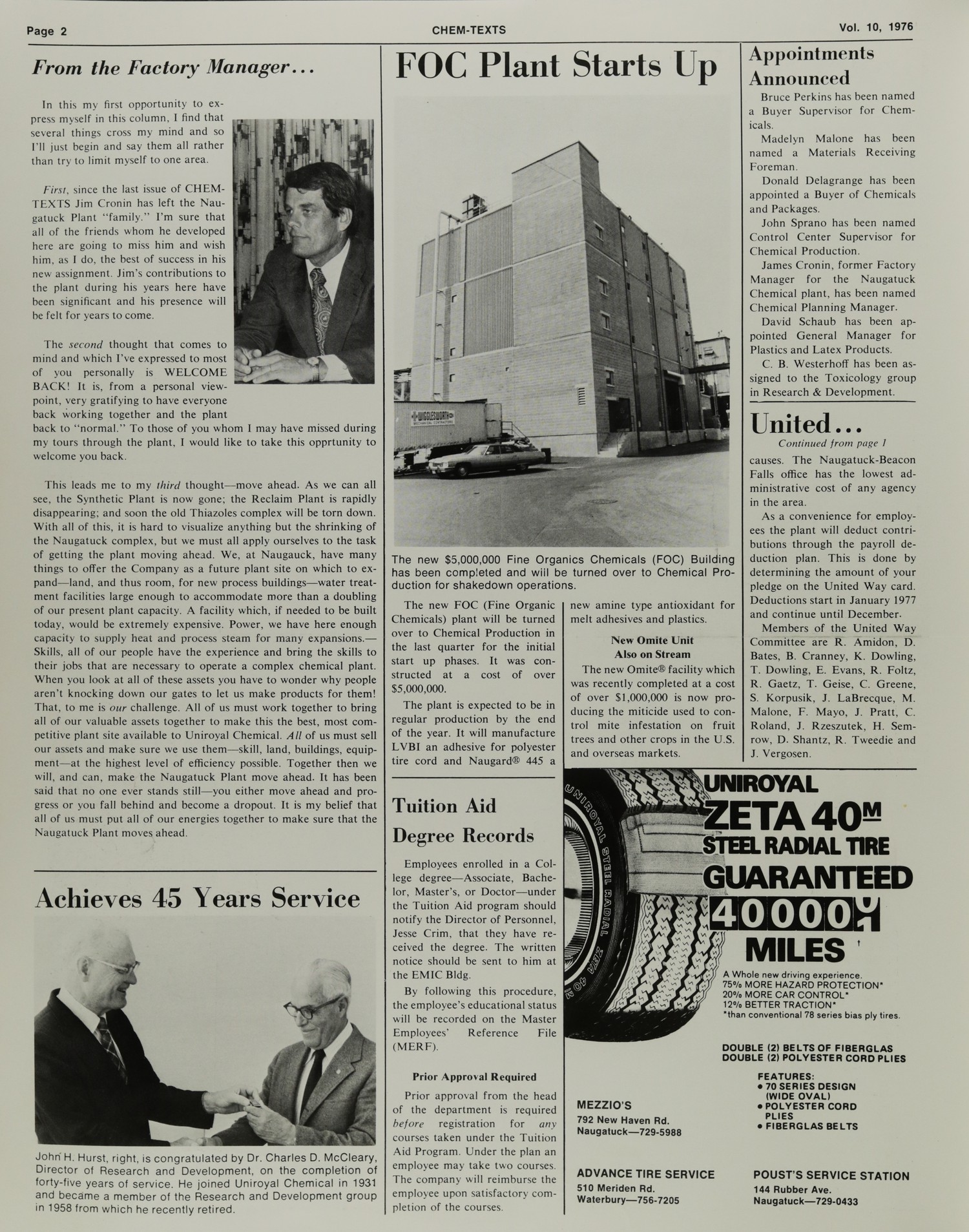
John H. Hurst, right, is congratulated by Dr. Charles D. McCleary, Director of Research and Development, on the completion of forty-five years of service. He joined Uniroyal Chemical in 1931 and became a member of the Research and Development group in 1958 from which he recently retired.


FOC Plant Starts Up

[IMAGE: Photograph of a large industrial building]

The new $5,000,000 Fine Organics Chemicals (FOC) Building has been completed and will be turned over to Chemical Production for shakedown operations.

The new FOC (Fine Organic Chemicals) plant will be turned over to Chemical Production in the last quarter for the initial start up phases. It was constructed at a cost of over $5,000,000.

The plant is expected to be in regular production by the end of the year. It will manufacture LVBI an adhesive for polyester tire cord and Naugard® 445 a new amine type antioxidant for melt adhesives and plastics.

New Omite Unit Also on Stream

The new Omite® facility which was recently completed at a cost of over $1,000,000 is now producing the miticide used to control mite infestation on fruit trees and other crops in the U.S. and overseas markets.


Tuition Aid Degree Records

Employees enrolled in a College degree—Associate, Bachelor, Master’s, or Doctor—under the Tuition Aid program should notify the Director of Personnel, Jesse Crim, that they have received the degree. The written notice should be sent to him at the EMIC Bldg.

By following this procedure, the employee’s educational status will be recorded on the Master Employees’ Reference File (MERF).

Prior Approval Required

Prior approval from the head of the department is required before registration for any courses taken under the Tuition Aid Program. Under the plan an employee may take two courses. The company will reimburse the employee upon satisfactory completion of the courses.


Appointments Announced

Bruce Perkins has been named a Buyer Supervisor for Chemicals.

Madelyn Malone has been named a Materials Receiving Foreman.

Donald Delagrange has been appointed a Buyer of Chemicals and Packages.

John Sprano has been named Control Center Supervisor for Chemical Production.

James Cronin, former Factory Manager for the Naugatuck Chemical plant, has been named Chemical Planning Manager.

David Schaub has been appointed General Manager for Plastics and Latex Products.

C. B. Westerhoff has been assigned to the Toxicology group in Research & Development.


United…

Continued from page 1

causes. The Naugatuck-Beacon Falls office has the lowest administrative cost of any agency in the area.

As a convenience for employees the plant will deduct contributions through the payroll deduction plan. This is done by determining the amount of your pledge on the United Way card. Deductions start in January 1977 and continue until December.

Members of the United Way Committee are R. Amidon, D. Bates, B. Cranney, K. Dowling, T. Dowling, E. Evans, R. Foltz, R. Gaetz, T. Geise, C. Greene, S. Korpusik, J. LaBrecque, M. Malone, F. Mayo, J. Pratt, C. Roland, J. Rzeszutek, H. Semrow, D. Shantz, R. Tweedie and J. Vergosen.


[ADVERTISEMENT]

UNIROYAL

ZETA 40M

STEEL RADIAL TIRE

GUARANTEED

40000

MILES *

A Whole new driving experience.
75% MORE HAZARD PROTECTION
20% MORE CAR CONTROL

12% BETTER TRACTION
than conventional 78 series bias ply tires.

DOUBLE (2) BELTS OF FIBERGLAS
DOUBLE (2) POLYESTER CORD PLIES

FEATURES:
– 70 SERIES DESIGN (WIDE OVAL)
– POLYESTER CORD PLIES
– FIBERGLAS BELTS


MEZZIO’S
792 New Haven Rd.
Naugatuck—729-5988

ADVANCE TIRE SERVICE
510 Meriden Rd.
Waterbury—756-7205

POUST’S SERVICE STATION
144 Rubber Ave.
Naugatuck—729-0433
CHEM-TEXTS – 1974-v08-i01-s222

Page 222

UNIROYAL CHEM-TEXTS

Vol. 8, 1974 | PUBLISHED FOR THE PEOPLE OF UNIROYAL CHEMICAL | No. 1


Wintsch Named IR Manager

[PHOTO: Portrait of H. Frederick Wintsch]

H. Frederick Wintsch has been named Industrial Relations Manager for the Naugatuck plant of Uniroyal Chemical, it was announced by James Cronin, Factory Manager. He succeeds Jesse Crim, who was appointed Director of Personnel Management and Training for the Chemical division.

Prior to his new assignment he served as Labor Relations Manager since 1968. Wintsch joined the Naugatuck Chemical plant in 1963 as a member of the

(Cont’d on page 4)


Plant Tops 1,000,000 Manhours Without a Lost Time Accident for Second Time in 1973

[PHOTO: Group of employees standing in front of sign reading “UNIROYAL EMPLOYEE SAFETY RECORD NO INJURIES 1,000,000”]

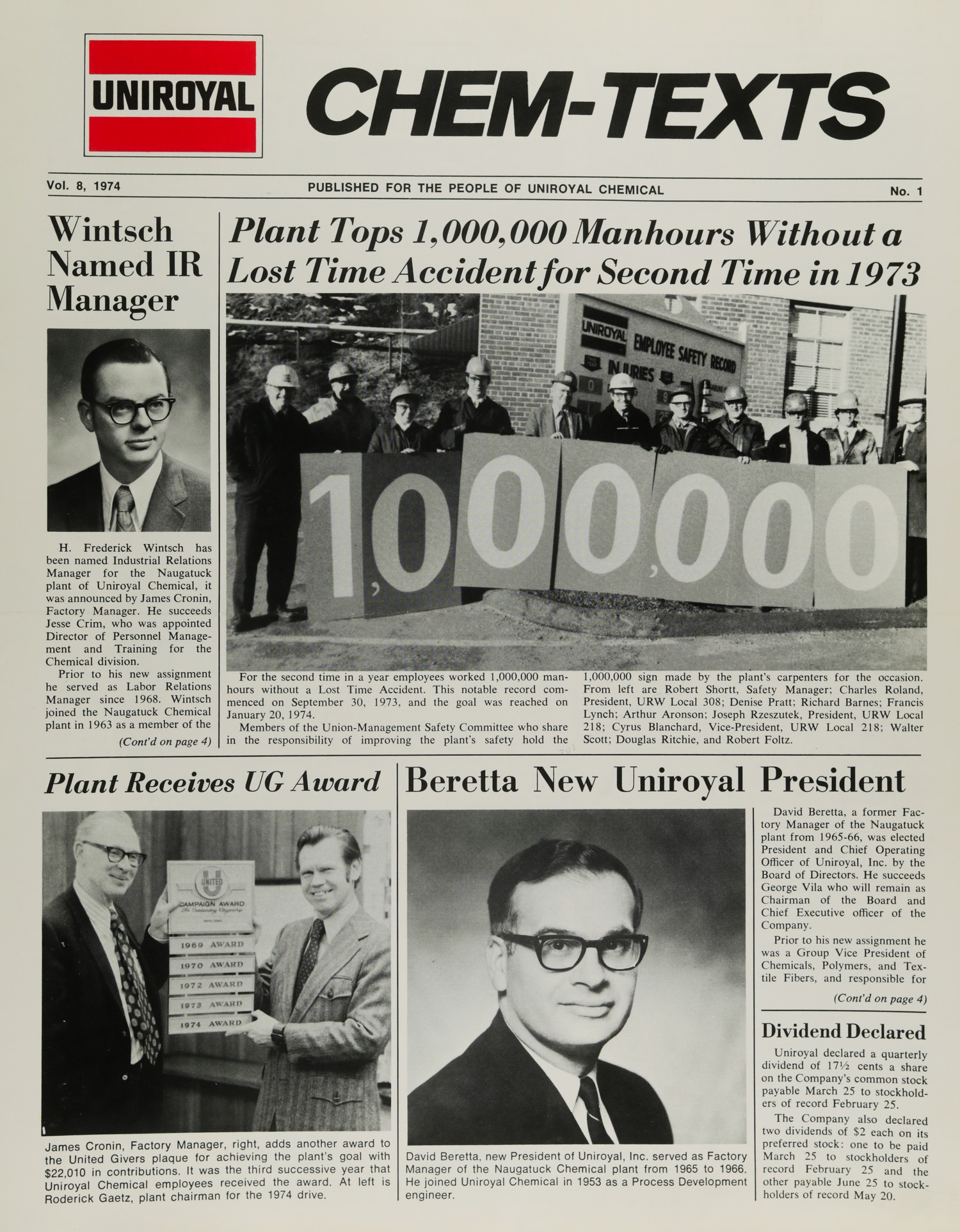
For the second time in a year employees worked 1,000,000 man-hours without a Lost Time Accident. This notable record commenced on September 30, 1973, and the goal was reached on January 20, 1974.

Members of the Union-Management Safety Committee who share in the responsibility of improving the plant’s safety hold the 1,000,000 sign made by the plant’s carpenters for the occasion. From left are Robert Shortt, Safety Manager; Charles Roland, President, URW Local 308; Denise Pratt; Richard Barnes; Francis Lynch; Arthur Aronson; Joseph Rzeszutek, President, URW Local 218; Cyrus Blanchard, Vice-President, URW Local 218; Walter Scott; Douglas Ritchie, and Robert Foltz.


Plant Receives UG Award

[PHOTO: Two men with United Givers award plaque showing awards from 1969, 1970, 1972, 1973, 1974]

James Cronin, Factory Manager, right, adds another award to the United Givers plaque for achieving the plant’s goal with $22,010 in contributions. It was the third successive year that Uniroyal Chemical employees received the award. At left is Roderick Gaetz, plant chairman for the 1974 drive.


Beretta New Uniroyal President

[PHOTO: Portrait of David Beretta wearing glasses]

David Beretta, a former Factory Manager of the Naugatuck plant from 1965-66, was elected President and Chief Operating Officer of Uniroyal, Inc. by the Board of Directors. He succeeds George Vila who will remain as Chairman of the Board and Chief Executive officer of the Company.

Prior to his new assignment he was a Group Vice President of Chemicals, Polymers, and Textile Fibers, and responsible for

(Cont’d on page 4)

David Beretta, new President of Uniroyal, Inc. served as Factory Manager of the Naugatuck Chemical plant from 1965 to 1966. He joined Uniroyal Chemical in 1953 as a Process Development engineer.


Dividend Declared

Uniroyal declared a quarterly dividend of 17½ cents a share on the Company’s common stock payable March 25 to stockholders of record February 25.

The Company also declared two dividends of $2 each on its preferred stock: one to be paid March 25 to stockholders of record February 25 and the other payable June 25 to stockholders of record May 20.

CHEM-TEXTS – 1973 – Page 2

Page 002

CHEM-TEXTS

Page 2 | Vol. 7, 1973


What happened in September?….

[IMAGE: Headshot photo of a man in business attire]

Was it a letdown after the long, hot summer? Was it a relaxation of attitude because of our improved performance over last year? Was it a little anticipation of attaining rewards for goals that have not quite been reached, but were close?

What happened in September? Three lost time accidents in the month —our worst performance this year. Where did we go wrong?

The answer to that question lies not in history, but in the future. What’s done is done, but let us learn from this recent experience and firm up our attitudes on Safety. We must strengthen our resolve to think safe and anticipate the unexpected. And follow rules, procedures, and good common sense to even further levels of accomplishment. We must work closer together, and help each other to solve the accident problem.

The real goal, of course, is not numbers on a board or dollars on a cost report. It is the well being of all our employees. It hurts to have an accident. It hurts in many ways, but the worst hurt of all is that most accidents could have been avoided.

Of course we must not forget that substantial progress has been made this year. We are all proud of this performance. But we have seen in years past a good record take a disastrous turn overnight. A good performance means only that more hard work is needed to keep it that way.

The year is not over yet. I urge all, wage and salary, factory and office, inside and outside, to rebound from our September problems and take on the rest of 1973 in the safest possible manner.

Our 1973 goals are still attainable if we point our eyes and noses in the right direction.


The free lunch program…

The average American is familiar with the expression— “There’s no such things as a free lunch.” Because we are so familiar with the saying, perhaps the full understanding of the thought gets lost and we forget the humbling impact of its true meaning.

Put simply, it means you never get anything for nothing. Even though it may appear that there are free handouts, or that someone has beaten the system, in the long run and when all things are considered, everything has its price.

One of the most flagrant free lunch programs is some of the money Uncle Sam hands out like free lollypops. However, the intelligent home owner, tax payer and average consumer knows, particularly now, that the bill for these goodies comes back to haunt us in the form of higher taxes, and increasing inflation.

The other free lunch program we must be very aware of is our own job situation. Everything our Company provides for us must be paid for by somebody, somewhere. Part of it comes back, when we pay more for the things we have to buy, and part of it comes back when a plant somewhere—anywhere—is shut down because it can no longer support the burden imposed upon it by today’s economic situation.

In order to maintain the comforting benefits provided, the main beneficiaries, namely us, must contribute. Under our product-industrial oriented system, the most reasonable way is to improve productivity. This is by far the best way to generate wealth which subsequently supports our standard of living.

The Company has a commitment to this end by providing the money and management to purchase and properly utilize equipment and facilities. The employees—you and I—have an obligation to properly and fully convert this equipment into products in the most efficient and reasonable manner possible. This is how we pay for our “free lunches.” If wealth is not generated in this way, a deficit is generated. If this deficit is allowed to grow unchecked, it will eventually—to borrow a Russian term—bury our system. Once this occurs, a major adjustment must be made to pay that “due bill” or write it off. In either case the adjustment is painful. The history of man is full of such adjustments and no intelligent man wants to live through such a period. No one wants his children to endure such hardships, either.

We all want reasonable improvements in our standard of living. We also want the improvements to be enjoyed by our children. Therefore, we must balance our benefits and their costs—somewhere, somehow. But we all know where the burden ends up—right on us. If we understand this and know what we are doing, we can better adjust to it and keep our livelihood in a good, healthy balance. We can then honestly say that the “free lunch” has been earned and paid for.

Jim Cronin [signature]


92 Take “Life” Course

[IMAGE: Photo showing people in what appears to be a training session with someone lying down, presumably during CPR training]

Mario Pazzani, Heart Association instructor observes James Loman treat a heart attack victim with cardiopulmonary resuscitation in one of the 3 sessions attended by 92 people.

One out of every fifteen employees at the Naugatuck Chemical plant is now certified in cardiopulmonary resuscitation and mouth to mouth breathing. The overwhelming response of employees to the three courses sponsored by the Safety department is one of the highest among industrial plants in Connecticut.

Two recent heart attacks in the plant indicated the need for such a program to train people on the proper action in such emergencies. Besides the demonstrations, each person attending the courses practiced the life-saving techniques on two dummies equipped with inflatable lungs.

Only one session had been planned for the plant but due to the large number of employees who desired to attend the cardiac program, three sessions were held. The cardiopulmonary course was conducted by Mario Pazzani of the American Heart Association. James Loman, of the Safety Dept. who is a certified instructor in First Aid for the Red Cross, demonstrated the mouth to mouth resuscitation techniques.


Local 218 Talks Start

Negotiations between the United Rubber Workers, Local 218, and the Naugatuck plant management began on Wednesday, October 10. The purpose of the sessions is to negotiate a local supplement agreement which will supplement the 3 year master agreement signed on June 11, 1973 in Dayton, Ohio.

Heading the Local 218 union representatives is Joseph Rzeszutek, President of the Local. Jesse Crim, Manager of Industrial Relations, will be in charge of the Naugatuck plant group.

The discussions are being held in Bldg. 81 conference room, and will continue until negotiations are concluded.


Prior Approval For Tuition Aid

The Tuition Aid Program which encourages employees to continue their education requires that prior approval be obtained for a degree program or specific courses from a department supervisor.

Once approved the application authorizes tuition refunds for not more than 2 courses per semester.

Upon satisfactory completion of the courses, reimbursement is obtained by submitting a paid, itemized invoice from the school to the Accounting department.


GIVE THE UNITED WAY


$3500 In Silver Dollars

September Safety Record Poor

The Summer Safety program for the summer months ended on September 30 with over $3500 awarded to employees who worked safely during the July, August and September months when accidents increase.

People who worked without a Lost Time Accident or Serious Injury received a “silver dollar” for each month, unless they were members of a Group in which one person incurred either type of injury.

Extra Award

Each employee also received an extra “silver dollar” if he worked the full 3 months without an injury whether or not a member of his Group suffered one.

Employees who worked during the shutdown without an injury received an extra, special “silver dollar” when the thermometer soared to 98°F every day for one of the hottest summers in years and when accidents are more likely to happen.

As a special offer of the pro-

(Cont’d on page 4)


[LOGO: “give The United Way” with stylized hand design]


Don’t get a snow job on snow tires.

[IMAGE: Large snow tire]

Get Uniroyal Winterides

Wide 70 series 4-ply Nylon Cord

ADVANCE TIRE SERVICE
510 Meriden Rd.
Waterbury – 756-7205

FITZPATRICK’S, INC.
78 East Main St.
Ansonia – 734-3318

MEZZIO’S
792 New Haven Rd.
Naugatuck – 729-5988

POUST’S SERVICE STATION
144 Rubber Ave.
Naugatuck – 729-0433

CHEM-TEXTS – 1973 – Page 3

Page 003

Vol. 7, 1973 CHEM-TEXTS Page 3


A B.S. 20 Years Later

[IMAGE: Two men standing together, one appears to be congratulating the other, with a framed picture on the wall behind them]

Jack Tierney, right, is congratulated by Harry Witt, Synthetic Production Superintendent on receiving his B.S. degree in Management from the University of New Haven. Tierney returned to college 20 years after graduation from high school and pursued his degree at night for the past 7 years. According to Tierney, he would not have been able to continue his studies without the financial assistance of the Tuition Aid program.

On the wall in the photo is one of Harry Witt’s paintings, “Autumn Gold.” Witt recently completed a course in Oil Painting, sponsored by the Naugatuck High School Adult Education Program.


57 Return To School

by Victor Anderson

Fifty-seven people registered for the Mechanical Trades Program which will be held at the Kaynor Technical School in Waterbury. The two year course in Basic Mathematics, Blueprint Reading, Plumbing, Mechanics and Engineering will be taught by Edwin Schweitzer, an Instructor at the school.

The three hour classes are held from 3:30 P.M. to 6:30 P.M. Tuition and textbook costs are being paid by the plant.

Successful completion of the courses will allow graduates to qualify for second class Piper, Mechanic, and Electricians’ openings when available and in accordance with contract requirements of seniority and qualifications.

In the 1970-72 program thirty-five employees graduated and twenty-three have received positions in the Chemical and Synthetic Mechanical departments.


Local 308 Talks Start

At press time it was learned that URW Local 308 and the Naugatuck Plant management were to begin to negotiate a local supplement agreement of the 3 year master agreement.

Charles Roland, Local 308 President, will head the union representatives and Jesse Crim the plant members.


EPA Chief To Speak

Douglas M. Costle, Commissioner, Department of Environmental Protection will address the Uniroyal Chemical Management Club on Wednesday, Nov. 7 at the Elks Club. Costle succeeded Dan Lufkin as the new EPA chief in August.

He is a graduate of Harvard University and the University of Chicago Law School, J.D.


Golf League Ends

It was youth vs. old age as William Broden and Chester Zawacki won the golf championship.

It was a year that youth took all as the Twilight Golf League completed its third season with William Broden and Chester Zawacki winning the championship cup in a climatic match with George Baktis and Stanley Mazanski at the Lyman Meadow Golf Club.

Last year’s winners Joseph Biernacki and Cyrus Blanchard were eliminated in the early rounds of the tournament and two of the early season favorites, Robert McDermott and Louis Rizzuti, lost their bid to qualify for the golf cup.

Officers for the 1973 season were Stanley Mazur, John Prior, Chester Zawacki, Peter Welch, Edward Rabitor, Howard Kravitz, Thomas Geise, Thomas Ennis and William Broden.


Breen’s

The Biggest Little Store In The Country

Visit our four floors of famous brands for him and her

Ladies’ Dept. Men’s Shop
Couture Coats Manhattan Shirts
Tanner Dresses Botany Suits—Sport Coats
Vanity Fair Lingerie H. Freeman Suits
Joyce—Naturalizer Shoes London Fog Rainwear
Florsheim Shoes
Jaymar Slacks

Lingerie Shop

Vanity Fair
Olga—Barbizon
Schrank Robes
Shadowline

Jr. Sportswear Ski Boutique
Collegetown Sweaters Ski Jackets
White Stag—Skirts, Slacks Warm-Up Slacks
Davis Coats Ski Pants
Peerless Sportwear Ski Sweaters
Gloves & Sweaters

Cosmetic & Jewelry Dept.

Guerlain Yves Saint Laurent
Elizabeth Arden Monet
Nina-Ricci Napier
Chanel Marvella Pearls

CHEM-PROD JOTTINGS

by 7 BUILDING CREW

BLDG. 14: So far this year we have the $180,000 Octamine Flaker AR approved for 94 Building. It will be installed around March 1974.

FINE ORGANICS PLANT: The new plant that we used to call the Solvent Plant has been redubbed the FINE ORGANICS Plant. This will be a new building similar to 100 Building where 57 Building now stands. Construction will begin next year.

SUNPROOF: A new $4,000 refrigeration unit for our Sunproof operation is scheduled for delivery in several weeks. The new conveyor and bagger for Sunproof is in the plant and is being installed.

TIDBITS: People are still asking about Jim Cravo’s “hernia” operation.


65 and 80 Buildings Obituary

by Tom Harrison

It seems hard to believe, but the old soldiers homes of the Chemical Plant (65 and 80 Buildings) are finally being closed down. These 18 “old Men” with an average seniority of 28 years have done an outstanding job.

The production began with the Clave men, led off on days usually by senior man Larry Gabianelli and George Zitzmann, followed by Matt Chlebowski and Charlie Drapko, and closing out the night shift with Bill Detlefsen and Ray Palmer. These men have produced excellent quality Primary MBT at a high yield of 78% (versus Standard yield of 77%). However, it would have to be agreed to by all that “Gabby” made a better batch of spaghetti than MBT and probably more of them too!

Picking up where the Clave men left off, the Floor Operators kept things going. Despite the loss of one of the autoclaves, constant mechanical breakdowns, several injuries and sickness to many of the operators, as well as an accumulation of two years vacation time per year, these operators in most months made and usually acceded the production schedule.

The biggest achievement of the Floor Operators, Walt Breton, Larry Fortier, Henry Kowalewski, Tom Lee, Frank Maher and John Mancuso was the quality record they attained with Thiazole rejection rate of less than 2%. This could only have been accomplished by the men’s extensive experience in making Thiazoles, as well as willingness by all to use this knowledge in working harmoniously together.

After the MBTS, Delac and OXAF slurry was produced in 65 Building, it was then transferred to 80 Building where it was first washed, then dried and ground and finally packaged out. The high quality standards and production rates established by the 65 Building operators were maintained by the 80 Building Dryer Operators: Joe Abraitis, Wilbur Hugar and John Wawer.

After the material was dried, it was next ground and packaged out by the Mill Operators: Ed Copes, John Miller and Leo Vadnais. Through the extra efforts of these operators, neatly stacked pallets were always found on the first floor of 80 Building. These men also recovered over 100,000 lbs. of Delac fines from the filter boxes to not only improve the Delac yield to 89.4% (Standard 88%) but also to reduce pollution to the Naugatuck River.

Not to be forgotten are the two Pipers, Roland Bergeron and Harry Steele, who serviced these two buildings. By working closely with the operators and doing many maintenance jobs on their own initiative (except on Wednesdays) Junior and Harry aided greatly in the production of Thiazoles.

Last to be mentioned but probably the most important member of this group was Tom Engle who was the guiding influence to keep everyone working together.


Gaetz…

(Cont’d from page 1)

“Give Where You Work”

The philosophy of the United Givers is to “give where you work” through the payroll deduction plan and not in your home community. This method has proved the most successful, the most effective, and the least wasteful in helping the UG achieve its goal.

Gaetz is Chief Project Engineer for the Naugatuck plant. A graduate of Penn. State College with a B.S. degree in Chem. Eng. he has held a number of positions in the Engineering department, since he joined Uniroyal Chemical in 1951.

CHEM-TEXTS – 1973 – Page No. 3

Page unknown

UNIROYAL CHEM-TEXTS

Vol. 7, 1973 | PUBLISHED FOR THE PEOPLE OF UNIROYAL CHEMICAL | No. 3


Equality Policy Affirmed

Uniroyal Chemical has a firm commitment to offer equal opportunity to all employees. It is the policy of the plant’s management to support and implement this commitment continually.

The policy requires that all recruiting, hiring, transfers, promotions, compensation, benefits, and Company-sponsored training, education and tuition assistance, as well as social, recreational and health programs and lay-off and recall practices are followed and carried out without regard to race, color, religion, sex, national origin or age.

Jesse Crim, Industrial Relations Manager, is Compliance Officer and has the responsibility for implementing this policy; monitoring the Uniroyal Chemical Affirmative Action Compliance Program; and reporting to management the program’s progress.

Responsibility for the improvement of the program and positive results rests with each manager and supervisor as an integral part of his job.


Trades Courses Offered

A new Trades Program will be offered in cooperation with the Kaynor Technical School in Waterbury. The two year program, scheduled in the fall, is voluntary and open to all Naugatuck Chemical employees.

Courses offered will consist of Basic Mathematics, Blueprint Reading, Plumbing, Mechanics and Electricity and will be held one night a week for three hours for 33 sessions.

Successful completion of the program, as judged by the Kaynor Tech instructors, will allow graduates to qualify for second class Piper, Mechanic, and Electrician’s openings when available and in accordance with contractual requirements of seniority and qualifications.

No Cost To Employee

Tuition and textbook costs will be paid by the plant. The (Cont’d on page 2)


Unions Ratify 3 Year Contract

The master labor agreement and other agreements covering wages, pensions, insurance, severance pay, and supplemental unemployment benefits, negotiated by Uniroyal and the United Rubber Workers, have been subsequently ratified by the Union. All improved agreements are now in effect with the exception of the master labor agreement which will become effective when local supplemental agreements are negotiated and signed.

The new agreements, covering a 3 year period, were signed on June 11, 1973 after three months of negotiations in Dayton, Ohio.

The contracts provide for wage increases over the 3 year period and improvements in pensions, life insurance, sickness and accident insurance, medical insurance, and supplemental unemployment insurance.

They also include improvements in certain of these areas as they apply to retired employees.

Improvements in the general wage scale were effective on July 2, 1973.

Monthly Pension Increases

The monthly pension allowance was improved. The improvements are progressive over the 3 year period. By 1975, the monthly amount will be computed on the basis of $10.00 per month for every year of service. Disability pensions will be on a double monthly allowance, increasing to $20.00 per month per year of service by 1975.

Early Retirement

The new pension plan provides that an employee with 30 years’ service at and after age 55 can retire at his own option on an unreduced pension amount. For those employees exercising this option in 1974 and thereafter, the plan provides a supplemental allowance until age 65.

SUB Benefits

The supplemental unemployment benefits plan was modified. The company will increase its contribution to the SUB fund. By 1975, contributions will be at $0.10 per hour worked level and maximum funding will be at $750 per employee covered by the plan.

Life Insurance

Life insurance has been increased from $8500 to $9500
(Cont’d on page 2)


[PHOTO CAPTION]
Joseph Rzeszutek, URW Local 218 President; Jesse Crim, Industrial Relations Manager; and Charles Roland, URW Local 308 President attended the 3 months’ negotiations in Dayton, Ohio.


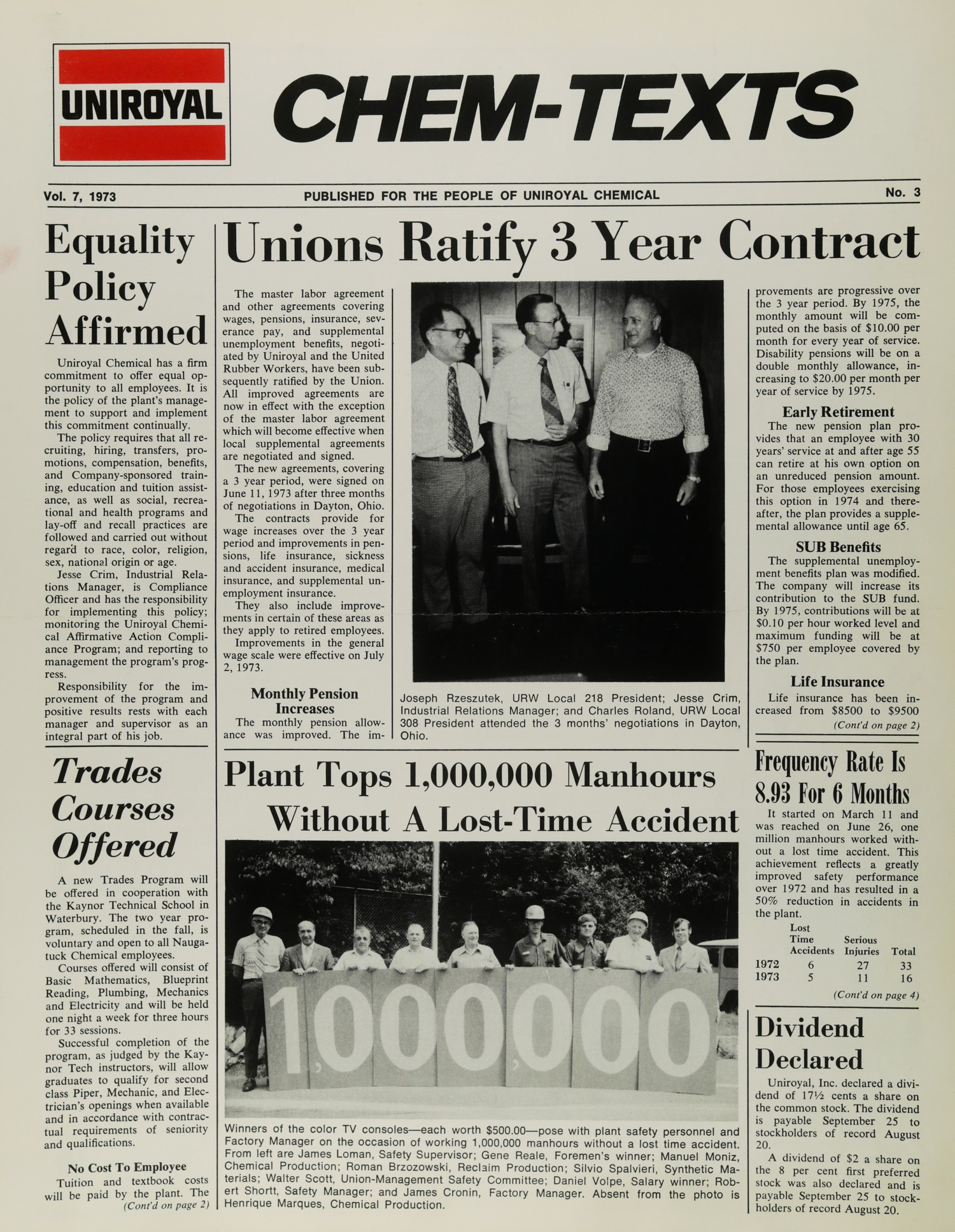
Plant Tops 1,000,000 Manhours Without A Lost-Time Accident

[PHOTO CAPTION]
Winners of the color TV consoles—each worth $500.00—pose with plant safety personnel and Factory Manager on the occasion of working 1,000,000 manhours without a lost time accident. From left are James Loman, Safety Supervisor; Gene Reale, Foremen’s winner; Manuel Moniz, Chemical Production; Roman Brzozowski, Reclaim Production; Silvio Spalvieri, Synthetic Materials; Walter Scott, Union-Management Safety Committee; Daniel Volpe, Salary winner; Robert Shortt, Safety Manager; and James Cronin, Factory Manager. Absent from the photo is Henrique Marques, Chemical Production.


Frequency Rate Is 8.93 For 6 Months

It started on March 11 and was reached on June 26, one million manhours worked without a lost time accident. This achievement reflects a greatly improved safety performance over 1972 and has resulted in a 50% reduction in accidents in the plant.

Lost Time Accidents Serious Injuries Total
1972 6 27 33
1973 5 11 16

(Cont’d on page 4)


Dividend Declared

Uniroyal, Inc. declared a dividend of 17½ cents a share on the common stock. The dividend is payable September 25 to stockholders of record August 20.

A dividend of $2 a share on the 8 per cent first preferred stock was also declared and is payable September 25 to stockholders of record August 20.

Accident Frequency Reduced 54% 1500 Turkevs Awarded to Employees

Page 2 | CHEM-TEXTS | Vol. 7, 1973


The end of the year is upon us, and traditionally it is an ideal time to review the past year and take a peek at the next.

Obviously, it is impossible to review all of the little steps of progress we have made this year. Therefore, I would like to offer a general review of our plant and business in 1973.

The epitome of working together, I think, is this year’s outstanding safety performance over last year’s. Without the complete involvement of all “Chemical people”, we would not have been as successful.

We still have a long way to go, particularly in the number of days lost due to accidents. But this year’s performance has built the base from which we can launch the effort needed to overcome this next difficult hurdle.

In the business line, Chemical Production came through a torturous year with encouraging vigor. The year started great, only to slow down at mid year when uncertain business conditions caused customers to hedge on their purchases.

Then when sales started to pick up, we were staggered by the continuing energy-related raw material shortages.

Heading into the new year, we face the confusing problem of having the sales, but perhaps not the raw materials. In addition, these materials are skyrocketing in cost. Survival next year can be defined as having the flexibility to make the most of a difficult situation.

We all know the problems facing our Reclaim plant. But if this year’s performance and attitude are any indication of our strength and perseverance, we are going to give that business a real run for the money in 1974. Turning an old giant like that around, enough to make it competitive, is a formidable task. Time is a problem and 1974 is our year to show them what we’re made of.

It is unfortunate that we have become non-competitive in the Synthetic latex business. We must quickly recover from this shutdown and adjust ourselves to solving today’s problems.

Attitude and cooperation did it with our Safety performance. The same approach must be used in improving the competitive and economic position of our plant. A healthy business means secure jobs—for one and all.

Despite the lack of Christmas lights this year, I would like to extend to all of you, and your families, my best wishes for the Christmas holiday. It is a comforting time of the year, but also a time to remind ourselves how fortunate we really are.

Jim Crim


Accident Frequency Reduced 54%

1500 Turkeys Awarded to Employees

[IMAGE: Photo showing three people examining documents]

Jesse Crim, Industrial Relations Manager for the Chemical plant, checks the turkey lists with Molly Cobbol, left, and Constance Antrum, right.

1500 turkeys were awarded to employees for reducing the accident frequency rate 54% during 1973.

During the year accidents to employees at work dropped from 73 in 1972 to 33 for 1973. This is a 54% reduction in accident frequency—the number of Lost Time Accidents and Serious Injuries per one million manhours worked.

Attain 12.0 Goal—1500 Turkeys Awarded

In early January a Safety Incentive Awards Program was initiated with an accident frequency goal of 12.0.

The present accident frequency is 10.43 per 1,000,000 manhours worked. Since this record is below the 12.0 goal all eligible employees received 12-14 lb. turkeys for achieving this major safety improvement during the year.

Top 500,000 Manhours

For the third time this year the plant worked 500,000 manhours without a Lost Time Accident. As a result drawings were held throughout the plant on December 5 for six Zenith black and white portable TV sets.


Energy Force Formed

A Conservation Resources Task Force of Engineering Specialists has now been in existence over two months to coordinate the efforts of all departments to conserve steam, electricity, water, air, and raw materials throughout the 145 units of the plant.

The two critical areas that the Task Force will concentrate on are the conservation of fuel oil and electricity.

Because of the critical shortage of low sulfur fuel the Connecticut State Department of Environmental Protection recently approved the use of a 1.25% sulfur content fuel oil, and coal with 2% sulfur content by the Utilities companies.

Task Force Members

The Task Force members—Douglas Ritchie, William Leukhardt, Charles Reich, Jon Painter, George Allen, Stanley Korpusick, Victor Anderson, George Arndt, and Arthur Aronson—have initiated monitoring plans for energy conservation and organized sub-committees to assist in supplementing the program.

The plant’s 500 HP motors will come under special surveillance by the force along with the high pressure steam systems, and the hot water usage throughout the entire plant.

A significant way everyone can help is to close windows and doors; turn off motors and lights when not in use; use water carefully; and turn down heating units.


How To Use Words

Be concise. Use words sparingly. Avoid smothering your good ideas beneath a mountain of verbiage.


Energy Program Working

17.6% less fuel oil was consumed in November 1973 vs. November 1972. This represents a savings of a four-day supply of fuel oil.

During the same period 7% less electricity was consumed throughout the plant. This is a savings equivalent to a two-day supply of electrical power.

These reductions were achieved for the same level of production in November 1973 as November 1972.

Our Energy Conservation program efforts are paying off and with everyone’s concern and assistance, even this good start can be improved.

With the costs of scarce power resources increasing continually, every employee’s cooperation is needed to continue the fullest possible operation of the plant.


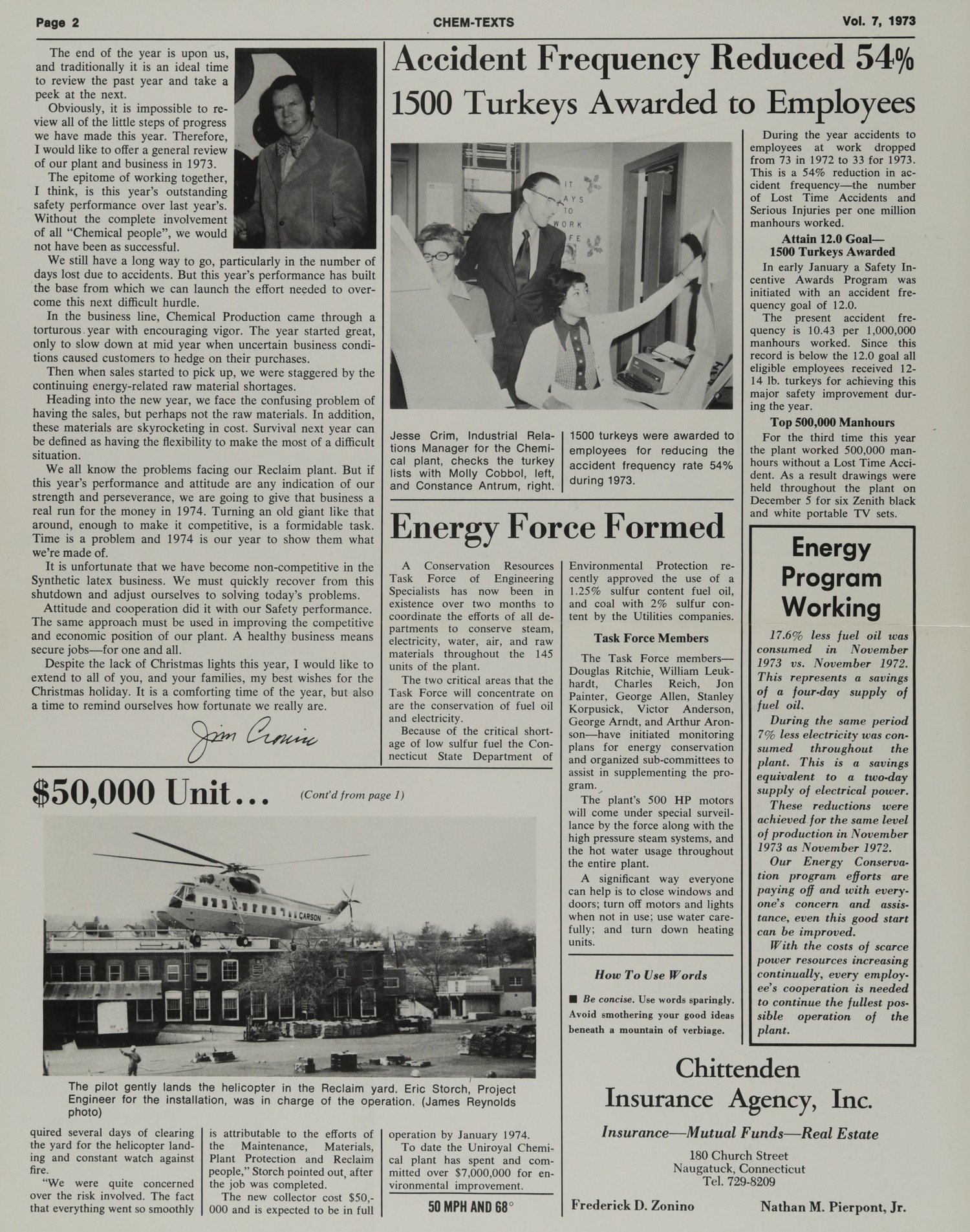
$50,000 Unit… (Cont’d from page 1)

[IMAGE: Photo of helicopter landing in yard with buildings in background, marked “CARSON”]

The pilot gently lands the helicopter in the Reclaim yard. Eric Storch, Project Engineer for the installation, was in charge of the operation. (James Reynolds photo)

quired several days of clearing the yard for the helicopter landing and constant watch against fire.

“We were quite concerned over the risk involved. The fact that everything went so smoothly is attributable to the efforts of the Maintenance, Materials, Plant Protection and Reclaim people,” Storch pointed out after the job was completed.

The new collector cost $50,000 and is expected to be in operation by January 1974.

To date the Uniroyal Chemical plant has spent and committed over $7,000,000 for environmental improvement.

50 MPH AND 68°


Chittenden Insurance Agency, Inc.

Insurance—Mutual Funds—Real Estate

180 Church Street
Naugatuck, Connecticut
Tel. 729-8209

Frederick D. Zonino | Nathan M. Pierpont, Jr.

CHEM-TEXTS – Vol. 5 No. 3 – Page 4

Page 004

Page 4 CHEM-TEXTS Vol. 5 No. 3


Know Your Products: Rubber Chemical Accelerators

by Dr. Bob Brown

(This issue continues the article in Vol. 5, No. 2 on Accelerators made or marketed by the Naugatuck Chemical plant.)

Accelerators are used primarily to speed up, or control the vulcanization process which turns rubber from a useless, gummy substance into a strong resilient and elastic material. Vulcanization, in simple terms, is a chemical reaction between rubber and sulfur, usually brought about by heat.

Faster Accelerators

Where there is less processing or mixing involved, very fast accelerators with little or no delayed action can be used to give more rapid vulcanization. The Zates (Arazate®, Butazate®, Ethazate® and Methazate®) and the Thiurams (Monex®, Pentex®, Tuex®, and Accelerator 108) are used here. They are also used in latex curing where processing is usually not a problem.

Customers use these accelerators for rubber sponge, wire insulation, hot water bottles, conveyor belts, hospital sheeting, and household items and in such latex products as balloons and carpet backing.

The Zates accelerators are non-discoloring and non-staining and can be used in colored rubber products.

Some of the newer synthetic rubbers (Royalene® “the crackless rubber” is an example) are inherently slower in vulcanization than the older types such as natural rubber, neoprene and the Naugapol® and Paracril® synthetic rubbers made at the Naugatuck and Painesville, Ohio plants. Fast accelerators are needed to speed up the vulcanization process for these types of rubber, otherwise it would be economically impossible to make a product at a reasonable selling price to the consumer.

Dr. Bob Brown, author of these articles, is manager of Research and Development for Rubber Chemicals. He received his doctorate degree from Princeton University in Organic Chemistry and holds several patent awards. Dr. Brown heads a staff of 42 people whose sole function is to improve our present chemicals and to develop new ones in order to remain competitive in the market.

GMF and DIBENZO GMF® are used in butyl rubber which also vulcanizes very slowly. A large amount of butyl rubber is used for tire tubes, and high voltage electrical cable.

CPB, DBA Very Active

Sometimes customers want to vulcanize rubber products without heating them at all. Very active accelerators like CPB and DBA accomplish this. In this process the product must be shaped before the accelerator is added. Golf ball covers, for example, are vulcanized by soaking the finished balls in a solution of CPB.

(In the next issue of Chem-Texts, Antioxidants and Antiozonants will be discussed. If you have a son or daughter in school, these articles provide source material for class papers in Chemistry courses.)


33 Employees

(Cont’d. from page 2)

are under further evaluation for higher amounts dependent on the amount of the savings for the plant.

Other employees who received cash awards for Ideas were P. Blasko, F. Maffia, M. Jannetty, D. Stevenson, E. Grickis, R. Guest, B. Robinson, A. Urban, S. Kropcho, J. Harper, J. Gilbert, A. Happy, J. Iosa, H. Garahan, F. Surmanek (2), L. DeLaRosa (2), P. Beardsley, S. Falcone, H. Hernandez, A. Grella, J. Needham, D. Boyd, E. Root, Sr., A. Molnar, D. Pinto and J. Cohen.

Letters of Commendation were presented to C. Smith, L. Fortier, F. Gagne, Carol Calo, J. Gallucci, R. Lockwood, D. Donato, T. Carr, Preciosa Cravo, D. Nelson, A. Nauges, W. Krayeski, W. Tabaka and D. Polzella.

Of the 33 employees awarded cash for Ideas, two were salary employees and the highest number of Ideas were submitted by Mechanical Department personnel.

No Limit to Cash Awards

There is no maximum limit to the amount of a cash award for an Idea. If the value of the Idea exceeds $1,000—this amount is paid under the Plant Idea Plan—it is submitted for further consideration for a higher award to a special management committee. The minimum award for an Idea is $25.

Ideas to Conserve Water Needed

With the construction of the new liquid waste pretreatment plant in progress, ideas to conserve water are needed now as the facilities are designed to treat 3,600,000 gallons a day.


SAFETY IS MY RESPONSIBILITY


Crim Assumes IR Post

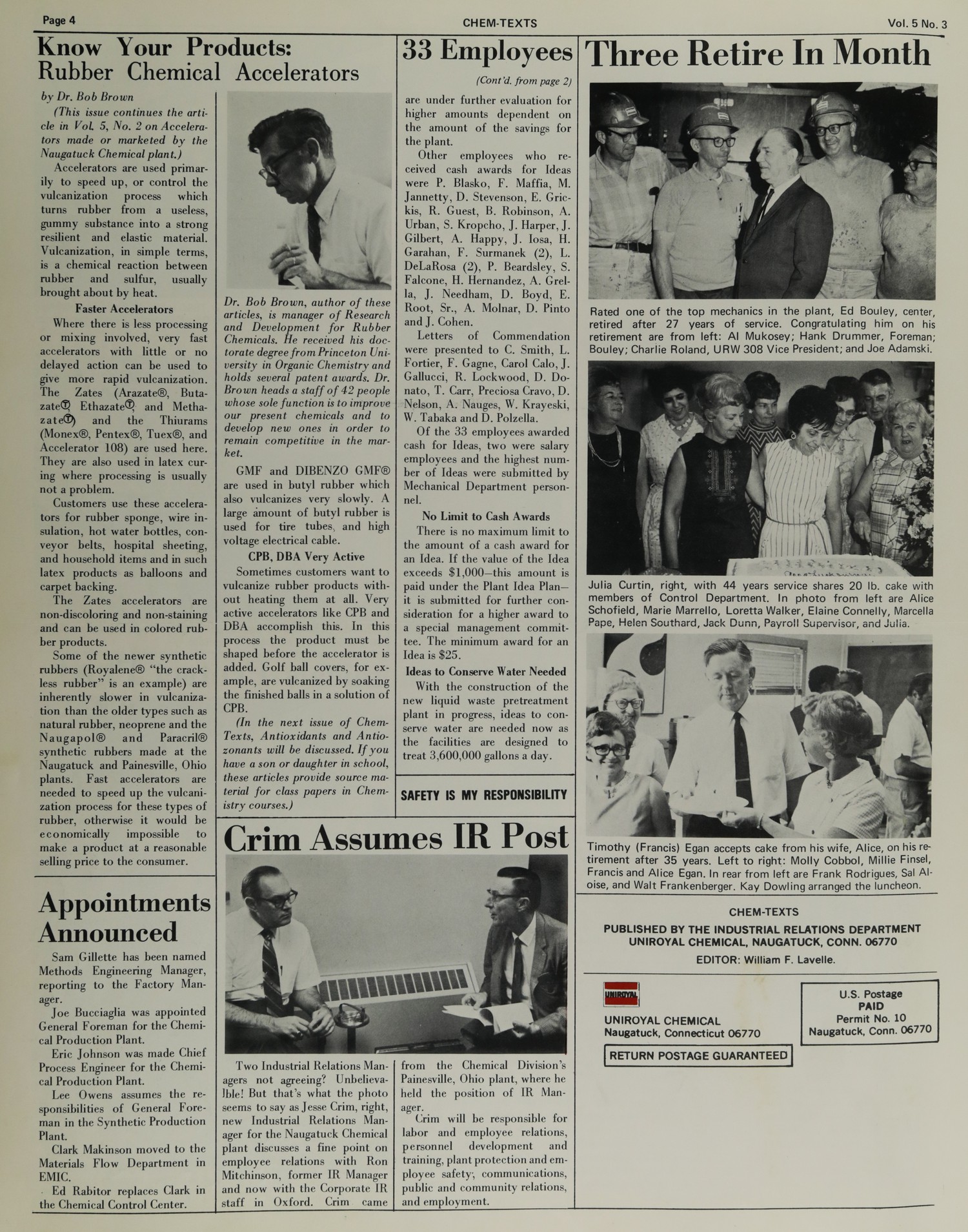
Two Industrial Relations Managers not agreeing? Unbelievable! But that’s what the photo seems to say as Jesse Crim, right, new Industrial Relations Manager for the Naugatuck Chemical plant discusses a fine point on employee relations with Ron Mitchinson, former IR Manager and now with the Corporate IR staff in Oxford. Crim came from the Chemical Division’s Painesville, Ohio plant, where he held the position of IR Manager.

Crim will be responsible for labor and employee relations, personnel development and training, plant protection and employee safety, communications, public and community relations, and employment.


Appointments Announced

Sam Gillette has been named Methods Engineering Manager, reporting to the Factory Manager.

Joe Bucciaglia was appointed General Foreman for the Chemical Production Plant.

Eric Johnson was made Chief Process Engineer for the Chemical Production Plant.

Lee Owens assumes the responsibilities of General Foreman in the Synthetic Production Plant.

Clark Makinson moved to the Materials Flow Department in EMIC.

Ed Rabitor replaces Clark in the Chemical Control Center.


Three Retire In Month

Rated one of the top mechanics in the plant, Ed Bouley, center, retired after 27 years of service. Congratulating him on his retirement are from left: Al Mukosey; Hank Drummer, Foreman; Bouley; Charlie Roland, URW 308 Vice President; and Joe Adamski.


Julia Curtin, right, with 44 years service shares 20 lb. cake with members of Control Department. In photo from left are Alice Schofield, Marie Marrello, Loretta Walker, Elaine Connelly, Marcella Pape, Helen Southard, Jack Dunn, Payroll Supervisor, and Julia.


Timothy (Francis) Egan accepts cake from his wife, Alice, on his retirement after 35 years. Left to right: Molly Cobbol, Millie Finsel, Francis and Alice Egan. In rear from left are Frank Rodrigues, Sal Aloise, and Walt Frankenberger. Kay Dowling arranged the luncheon.


CHEM-TEXTS

PUBLISHED BY THE INDUSTRIAL RELATIONS DEPARTMENT
UNIROYAL CHEMICAL, NAUGATUCK, CONN. 06770

EDITOR: William F. Lavelle.


UNIROYAL CHEMICAL
Naugatuck, Connecticut 06770

RETURN POSTAGE GUARANTEED

U.S. Postage
PAID
Permit No. 10
Naugatuck, Conn. 06770

CHEM-TEXTS – 1971 – Page No. 2

Page unknown

UNIROYAL CHEM-TEXTS

Vol. 5, 1971 | PUBLISHED FOR THE PEOPLE OF UNIROYAL CHEMICAL | No. 2


Crim Named IR Manager

Mitchinson, Melore Receive New Posts

Jesse Crim was named Industrial Relations Manager for the Naugatuck Chemical plant, effective June 1. He succeeds Ron Mitchinson who has accepted a position in the Corporate Industrial Relations Department in Oxford.

Neil Melore was appointed Industrial Relations Manager for the Painesville, Ohio plant.

Crim served as Industrial Relations Manager in Painesville from 1968-1971. He held the same position in the Santa Ana, Calif., and Washington, Ind. plants.

He joined Uniroyal in 1947; is a veteran of World War II; and a graduate of Purdue University.


Hats, Glasses Required

by Bob Shortt

As of May 1, hard hats and safety glasses were required to be worn in designated areas of the plant.

[IMAGE: Photo showing workers wearing safety equipment]

Joining the plant’s safety equipment program of wearing hard hats and safety glasses are two of its more attractive members. From left is Kay Dowling, Chemical Production, and Adeline Farrar, Chemical Plant nurse.

During April, foremen and supervisors discussed the new program with people in their departments. The program is based on a Section of the 1970 Uniroyal-
(Con’t. on page 4)


Profits; Sales Up

Tires; Footwear Improve; Chemical Business Off

Uniroyal, Inc. income increased 10.6% to $10.6 million in the first quarter of 1971 compared with $9.5 million reported for the same period last year.

Sales in the first quarter climbed to a record of $413 million, about an 8% increase over the record $381 million set in 1970.

Uniroyal was the only Company of the “Big Four” rubber companies to report an increase in profits and sales for the first quarter of the year. Goodyear, Firestone, and Goodrich dropped during the quarter.

Tire, Footwear Business Up

Sales of original equipment tires hit an all-time high in the
(Con’t. on page 4)


Phase I Of Liquid Waste Pretreatment Plant Started

Sewerage System Now Being Installed

[IMAGE: Photo showing industrial buildings and sewerage system installation]

A new sanitary sewerage system was installed in the Chemical yard to carry liquid discharges to main sewers of the Chemical plant system.

by Dick Shaw

The construction of Phase I of the new $3,000,000 Liquid Waste Pretreatment Plant is now in progress.

Phase I includes the installation of new sanitary sewers in the Reclaim, Chemical, and Synthetic plant yards. These new sewers will divert the sanitary sewage from the present side streams to the main sewers in order to be ready for transfer into the new pretreatment facilities.

Pretreats For Borough’s Secondary Treatment Plant

The new pretreatment facilities will pretreat the plant’s waste liquids for acceptance into the Borough of Naugatuck’s Secondary Treatment Plant.

Uniroyal Chemical has committed $1,500,000 toward the construction of the Borough’s waste disposal plant, and will pay 60% of the operational costs due to the large volume of the plant’s waste flowing into the Borough’s plant.

50% of Capital Expenditures Allocated to Pollution Control

In 1971, approximately 50% of the plant’s capital expenditures will be spent on pollution control facilities.

A major project currently under study is the elimination of the odors created by the Reclaim operations. By process changes, it is expected that the odors of the Reclaim plant will be controlled.

Waste Control Important

The efficient operation of the waste water treatment facilities depends on everyone’s cooperation in the use of water, prevention of spills, and avoidance of washing chemicals “down the drain.”

The nature of our business requires the use of over 750 differ-
(Con’t. on page 4)

[IMAGE: Photo of Phil DePasquale with concrete tank]

Phil DePasquale shows size of reinforced concrete tank that will be used as a sewage pumping station for one of plant’s buildings.


Medicine Search Started

[IMAGE: Photo showing three scientists studying a molecule model]

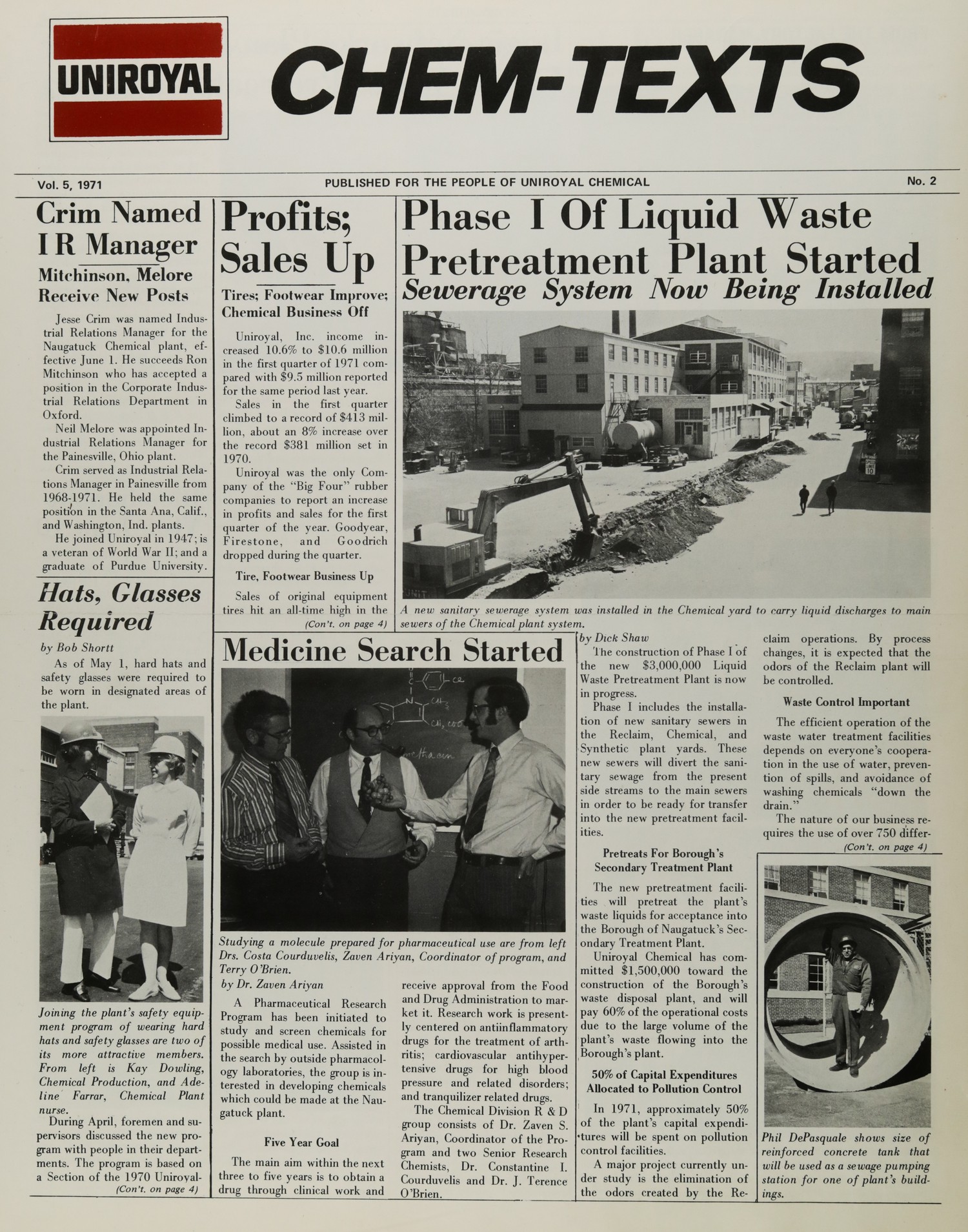
Studying a molecule prepared for pharmaceutical use are from left Drs. Costa Courduvelis, Zaven Ariyan, Coordinator of program, and Terry O’Brien.

by Dr. Zaven Ariyan

A Pharmaceutical Research Program has been initiated to study and screen chemicals for possible medical use. Assisted in the search by outside pharmacology laboratories, the group is interested in developing chemicals which could be made at the Naugatuck plant.

Five Year Goal

The main aim within the next three to five years is to obtain a drug through clinical work and receive approval from the Food and Drug Administration to market it. Research work is presently centered on antiinflammatory drugs for the treatment of arthritis; cardiovascular antihypertensive drugs for high blood pressure and related disorders; and tranquilizer related drugs.

The Chemical Division R & D group consists of Dr. Zaven S. Ariyan, Coordinator of the Program and two Senior Research Chemists, Dr. Constantine I. Courduvelis and Dr. J. Terence O’Brien.