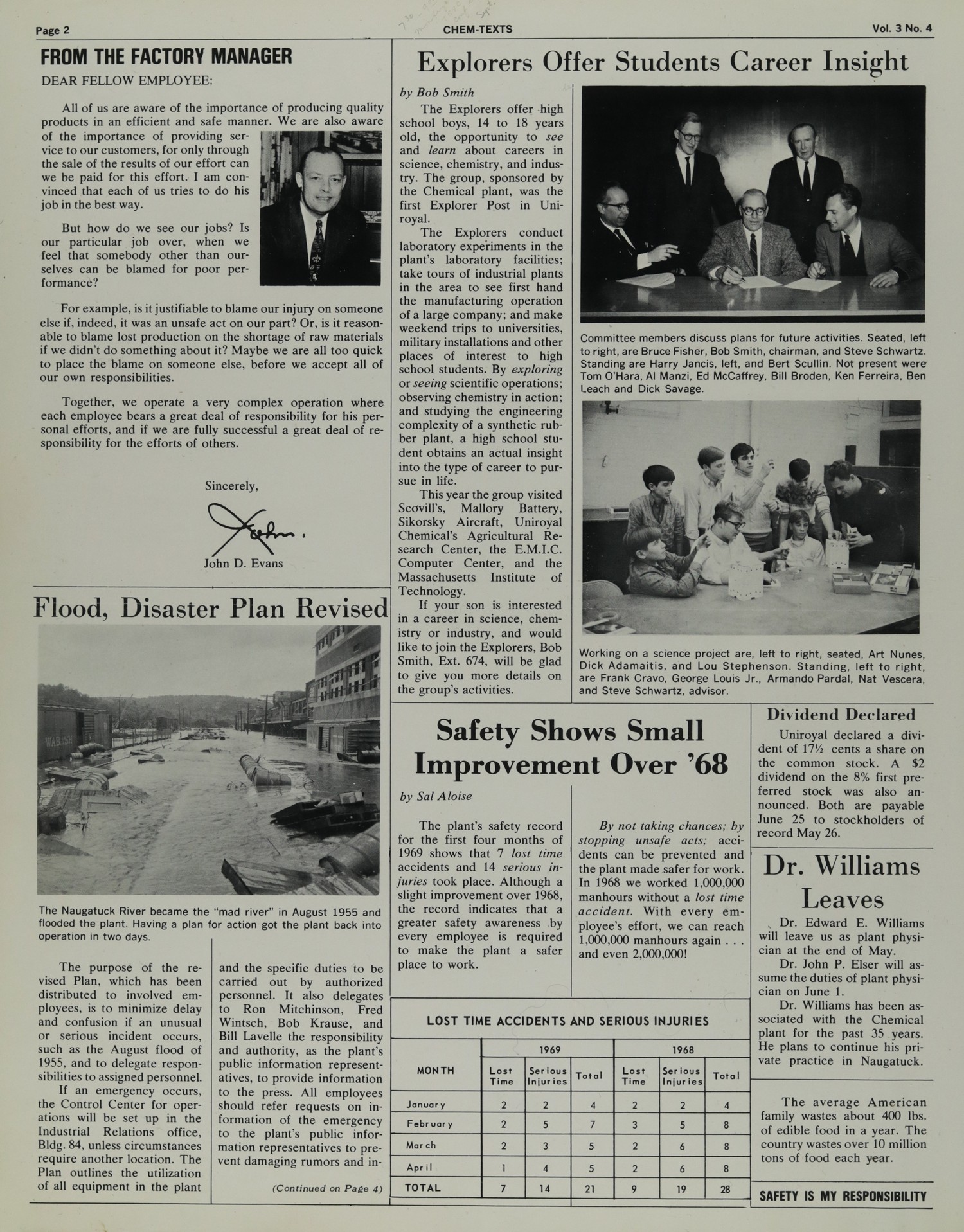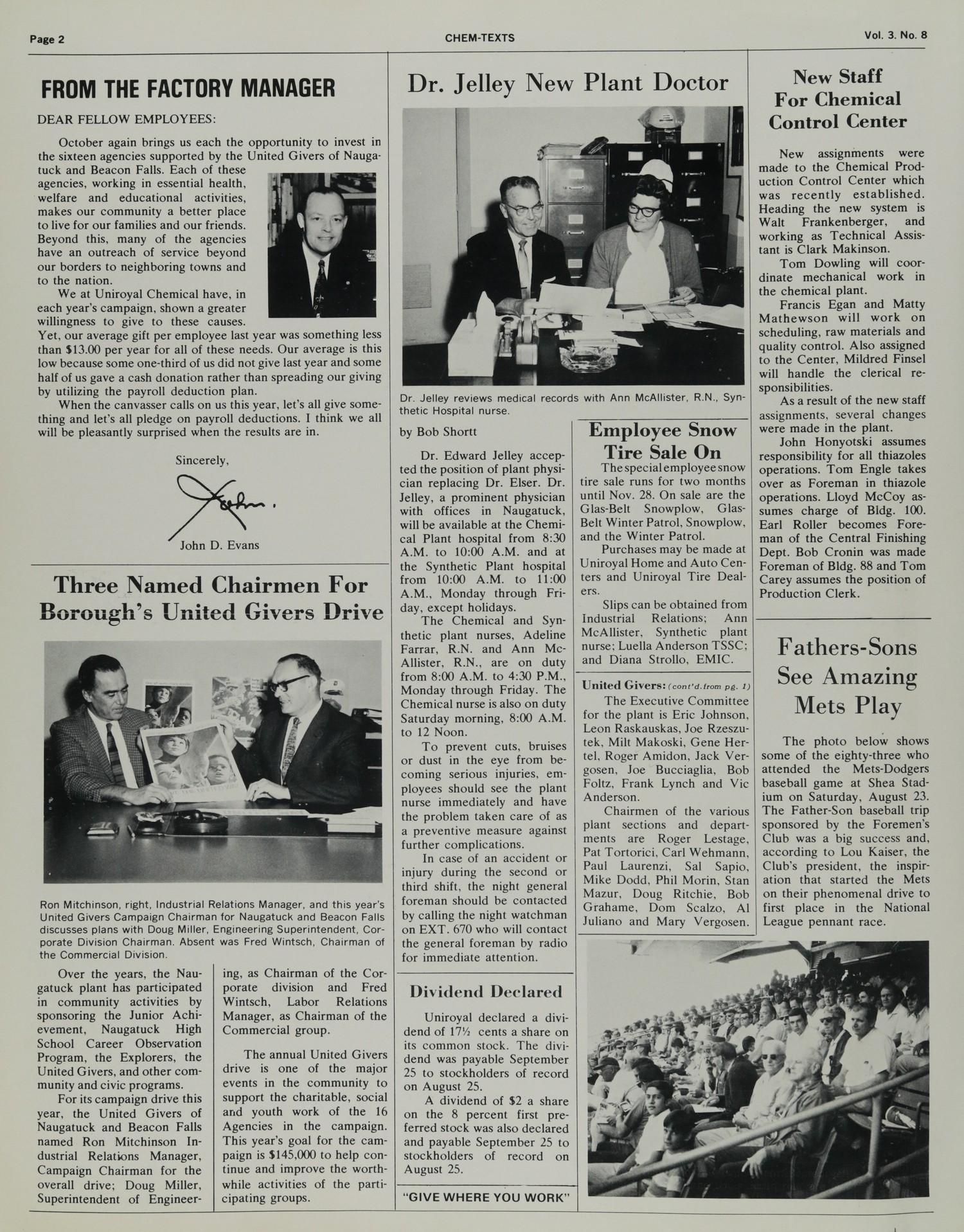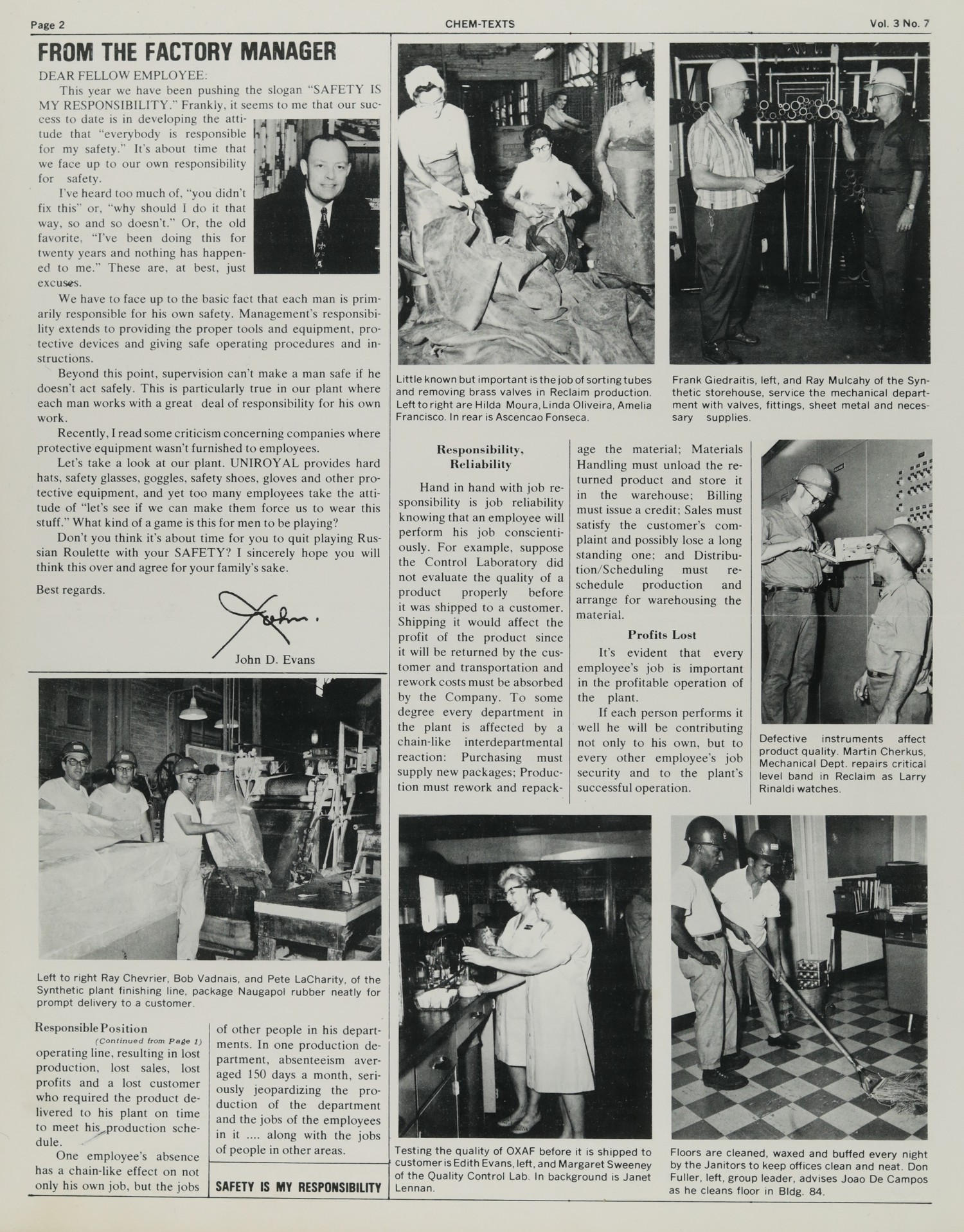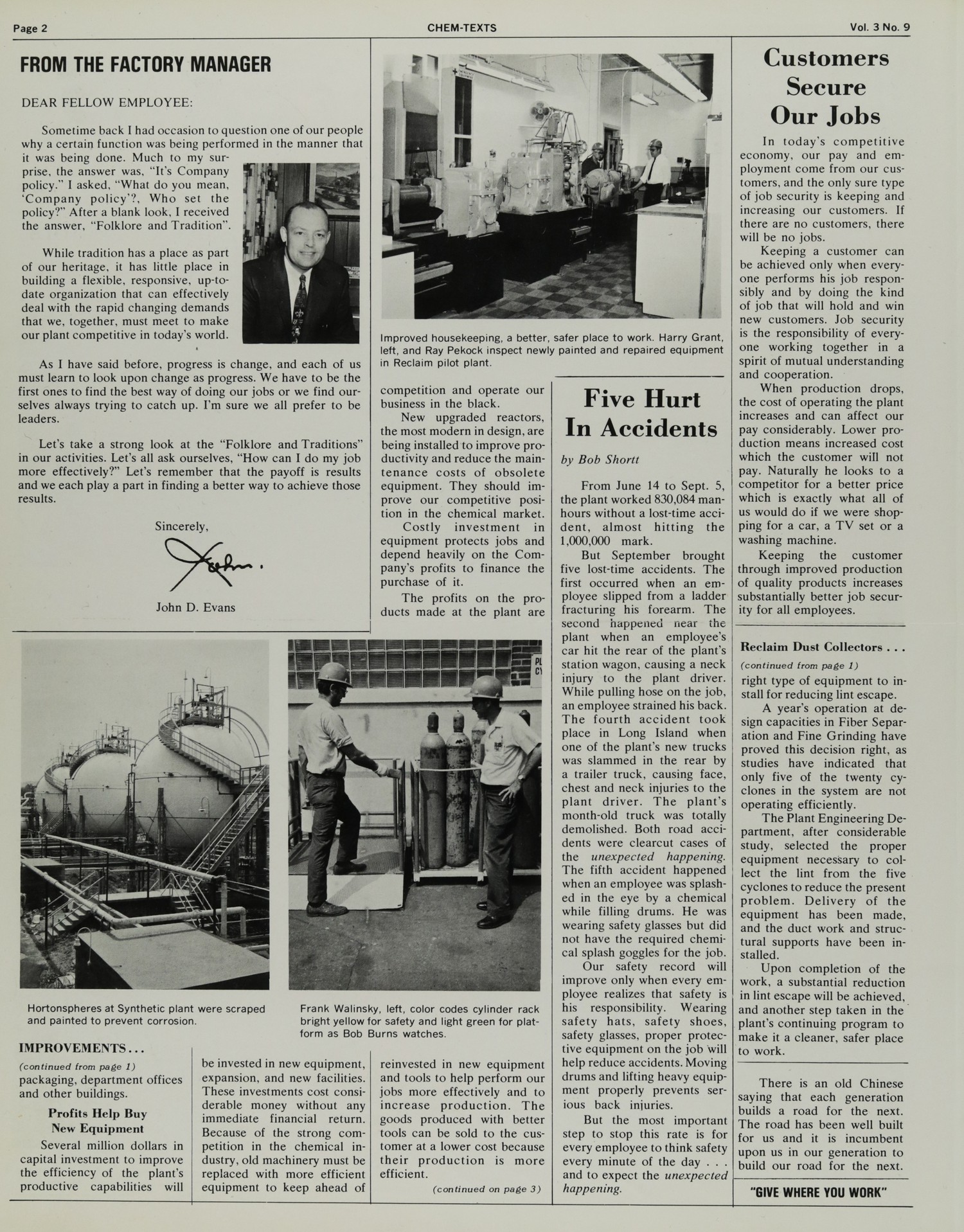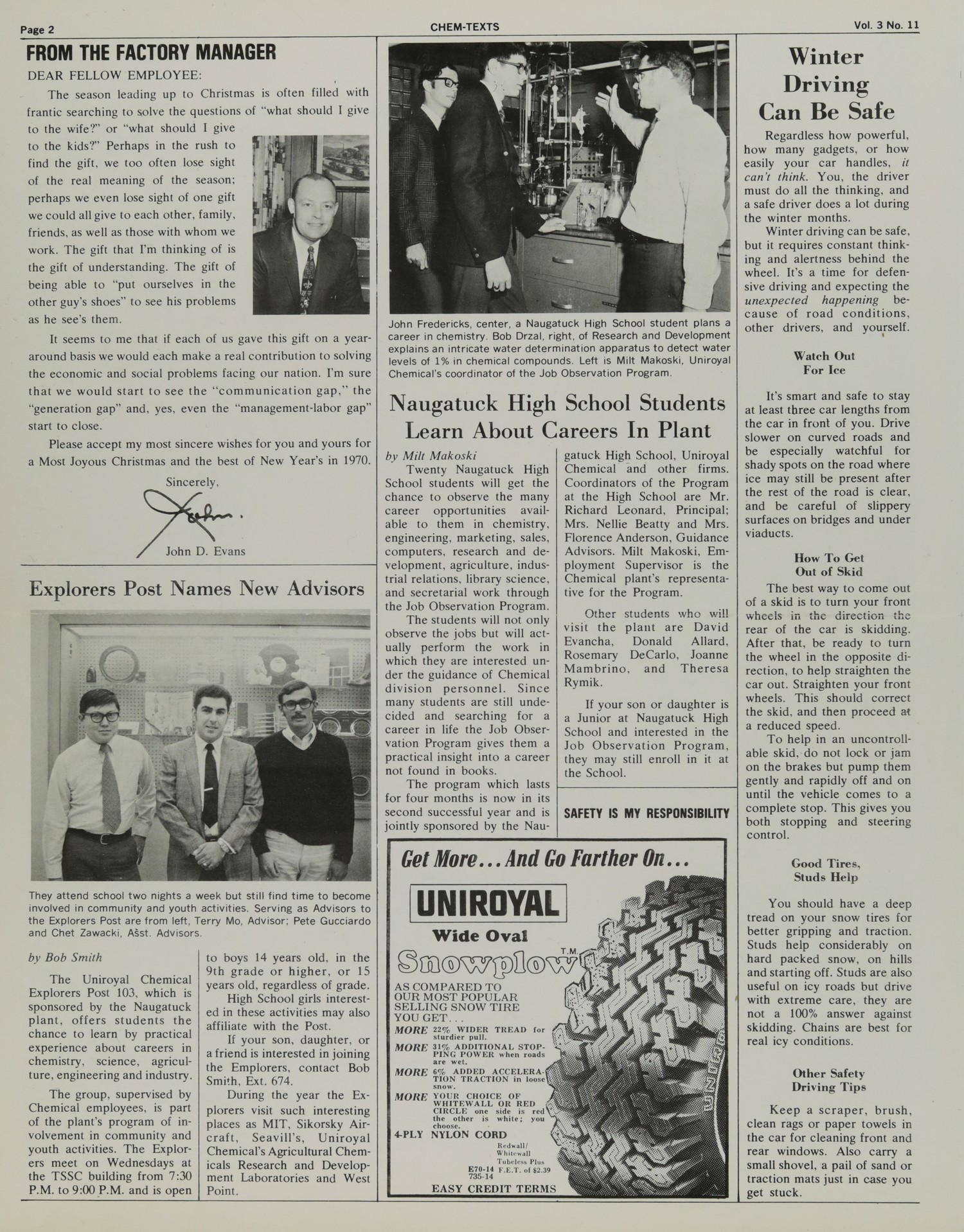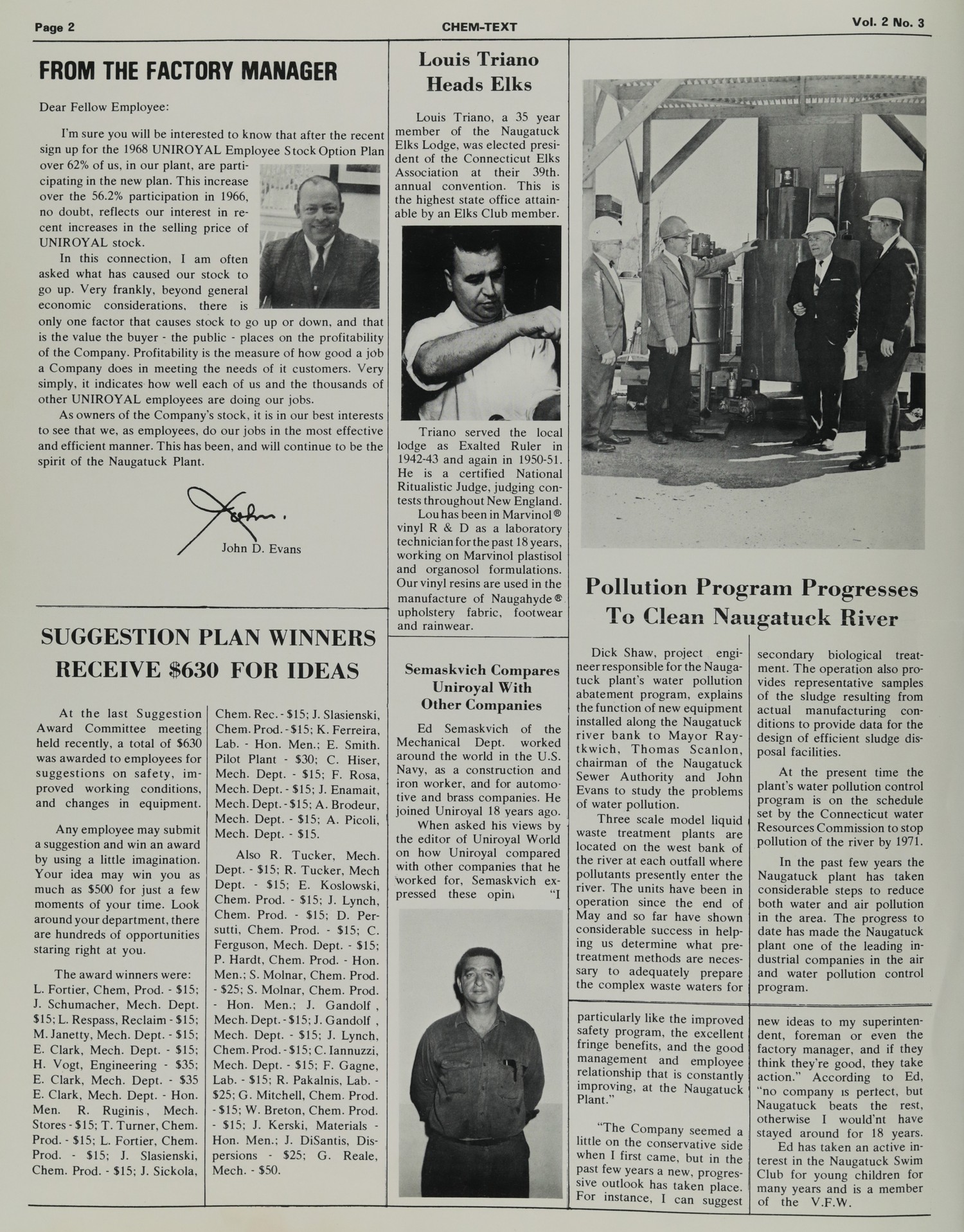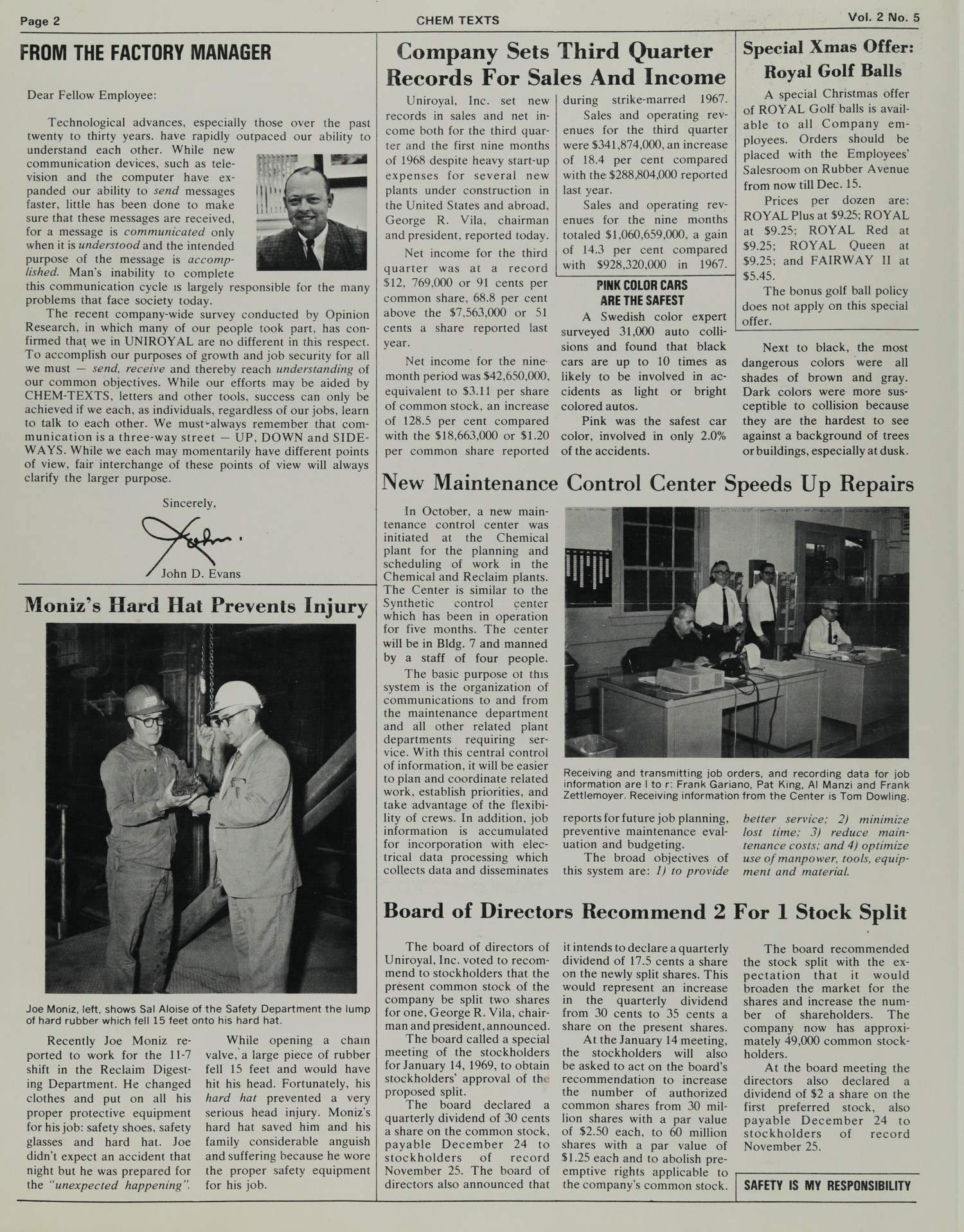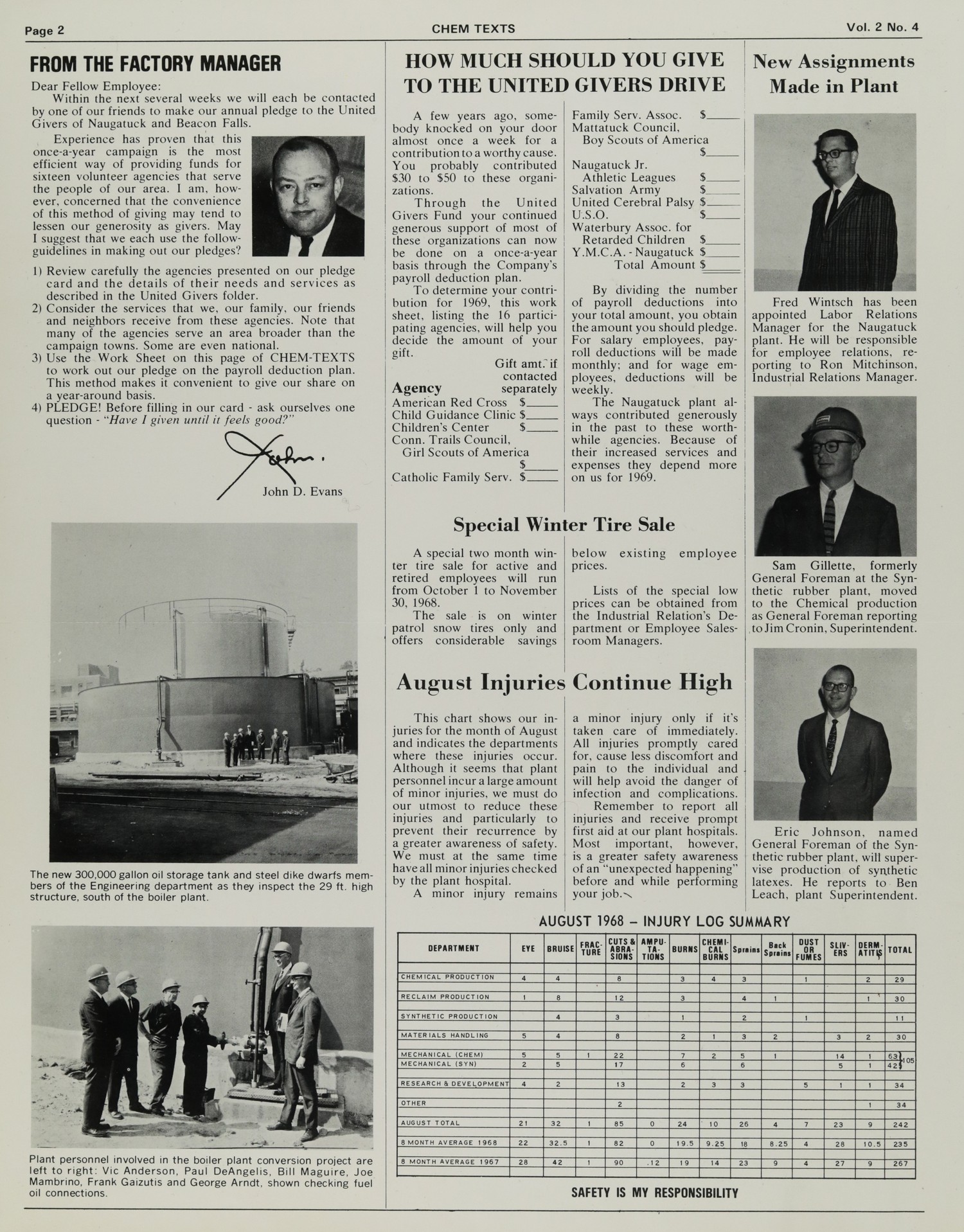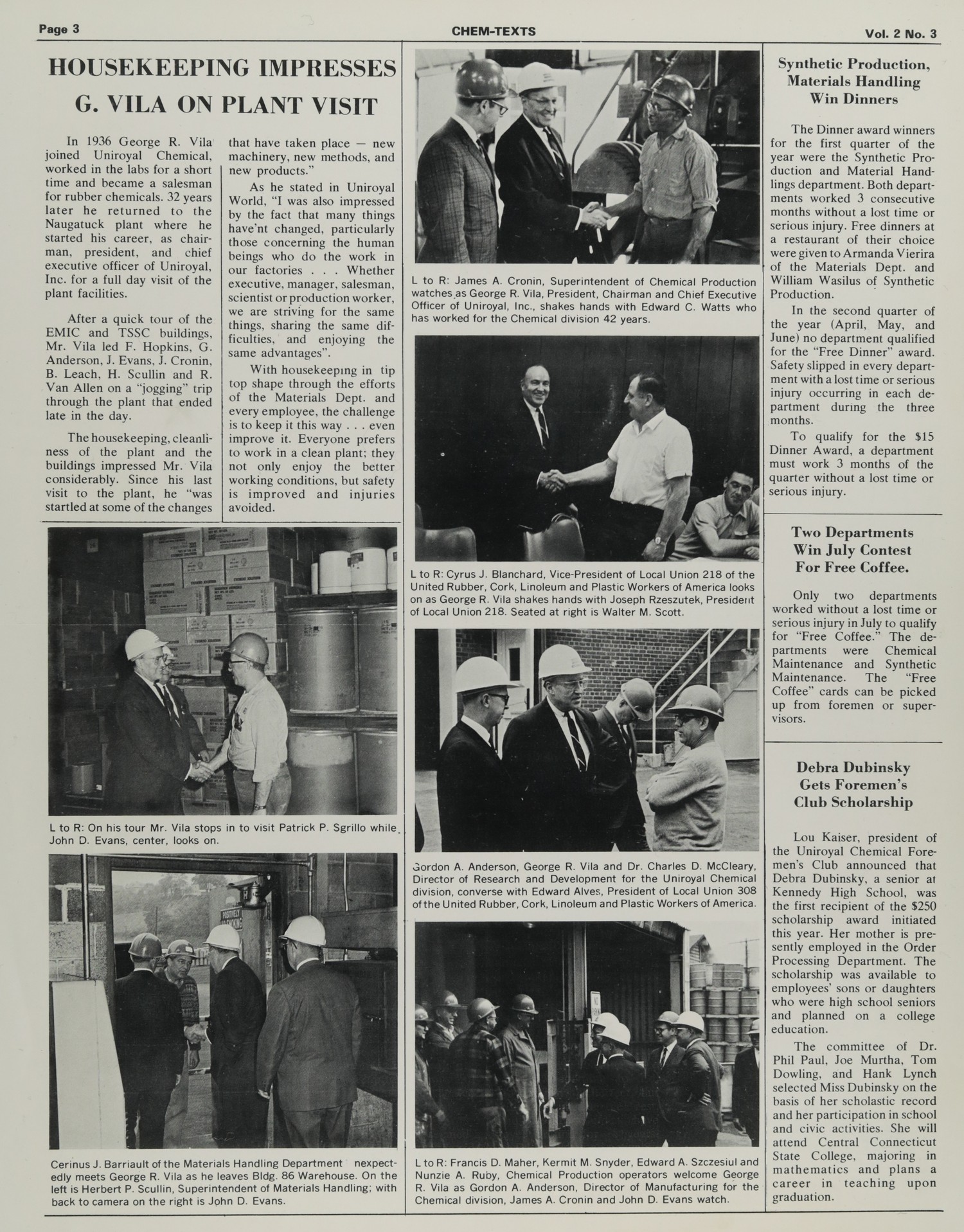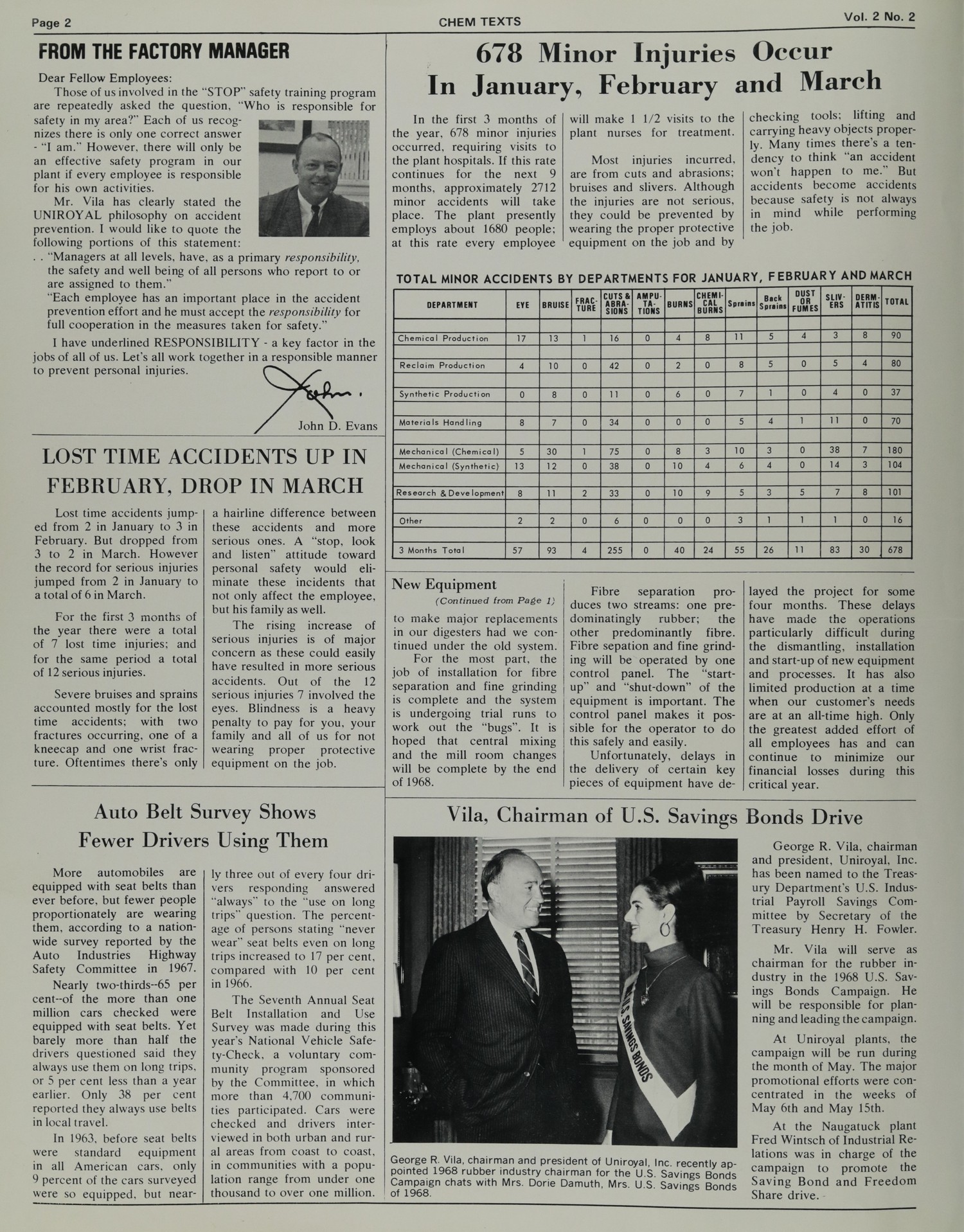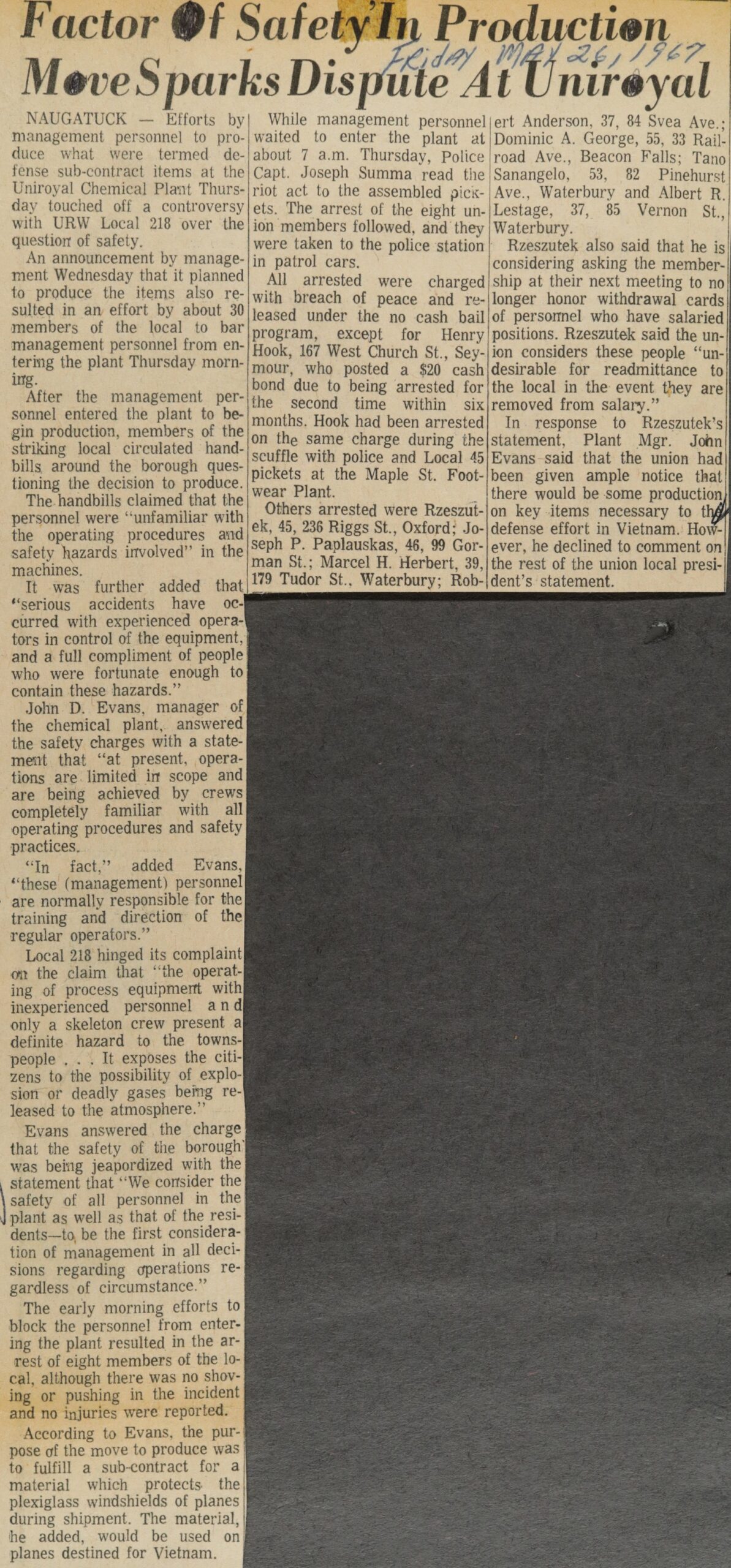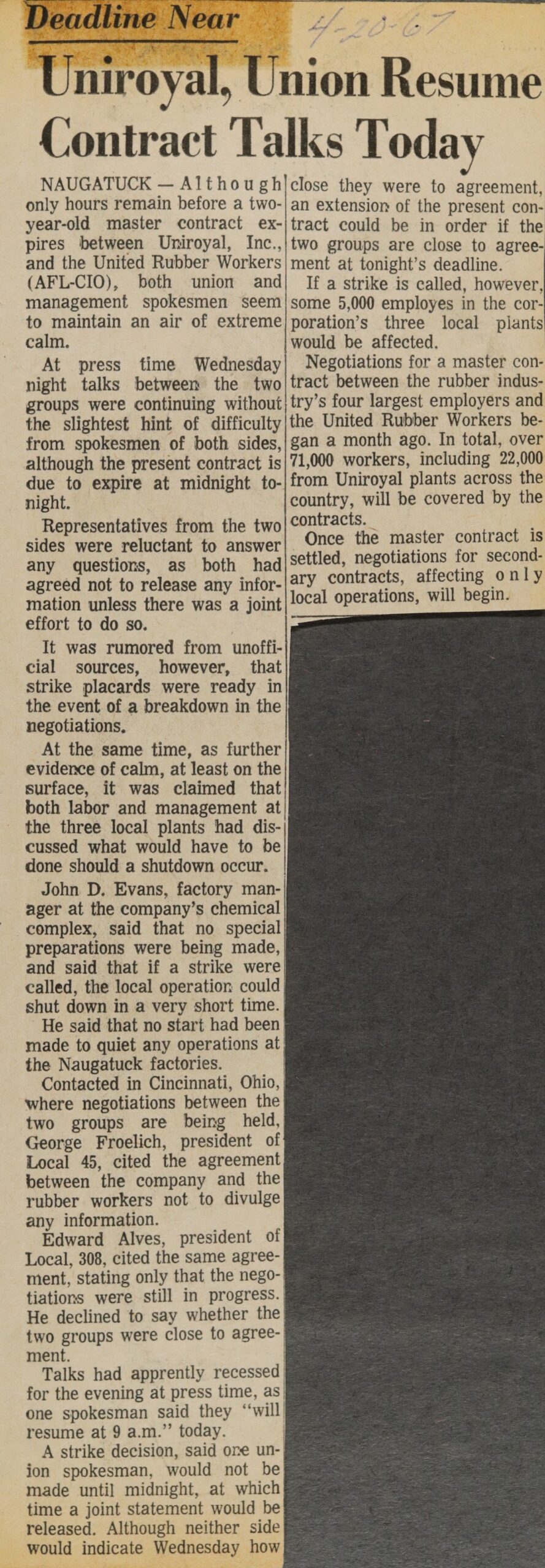
CHEM-TEXTS – Vol. No. 7 – Page 2

Page 002

CHEM-TEXTS

Page 2 | Vol. No. 7


FROM THE FACTORY MANAGER

DEAR FELLOW EMPLOYEE:

The past month or so I have been busy reviewing plans for our 1971 operating budget. If I were to share those costs in detail with you, I’m sure you would be discouraged by the ever-increasing cost of doing business.

Looking beyond the wage and benefit increases granted in the recently completed master contract negotiations, giving consideration to continued merit recognition of salaried personnel and improved salary employee benefits, we face added costs in terms of raw materials, supplies and utilities.

For example, the electric company has asked the Public Utilities Commission to grant a 10% rate hike. The water company has requested the Commission for approval to increase its rates by 25%. Regulations coming into effect in 1971 on the use of low sulfur fuel point to record oil prices for operating our boilers. Increased spending for pollution abatement will add to an already burdened budget.

Realizing that increased costs cannot be merely passed along to the customer, because in reality its the value of the product to the customer that sets its price in the market place, it is apparent that we can’t meet 1971 costs with old-fashioned ideas and methods.

We need new imagination and creativity directed toward greater productivity, higher quality, and, in general, excellence and efficiency in every phase of our work. We need the individual and group dedication to face these challenges as “our jobs”, not as “this is your job, that’s my job”. As I see it, everyone of us is on the first team, there is no “second string”, it’s up to all of us to “really put out” all of the time.

Sincerely,

[Signature]

John D. Evans


JAROY Returns 10% On $1.00

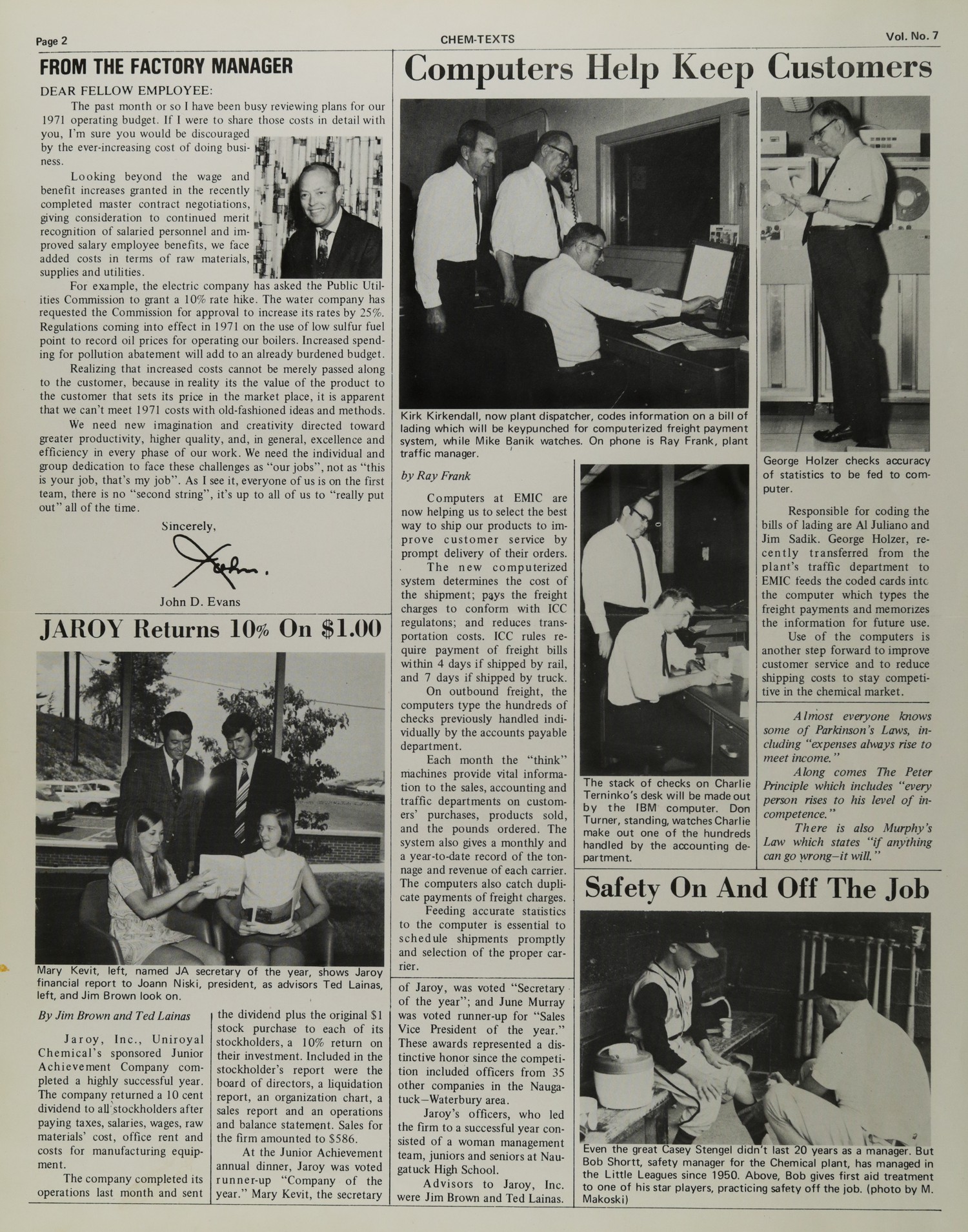
[IMAGE: Photo showing Mary Kevit, left, named JA secretary of the year, shows Jaroy financial report to Joann Niski, president, as advisors Ted Lainas, left, and Jim Brown look on.]

By Jim Brown and Ted Lainas

Jaroy, Inc., Uniroyal Chemical’s sponsored Junior Achievement Company completed a highly successful year. The company returned a 10 cent dividend to all stockholders after paying taxes, salaries, wages, raw materials’ cost, office rent and costs for manufacturing equipment.

The company completed its operations last month and sent the dividend plus the original $1 stock purchase to each of its stockholders, a 10% return on their investment. Included in the stockholder’s report were the board of directors, a liquidation report, an organization chart, a sales report and an operations and balance statement. Sales for the firm amounted to $586.

At the Junior Achievement annual dinner, Jaroy was voted runner-up “Company of the year.” Mary Kevit, the secretary of Jaroy, was voted “Secretary of the year”; and June Murray was voted runner-up for “Sales Vice President of the year.” These awards represented a distinctive honor since the competition included officers from 35 other companies in the Naugatuck–Waterbury area.

Jaroy’s officers, who led the firm to a successful year consisted of a woman management team, juniors and seniors at Naugatuck High School.

Advisors to Jaroy, Inc. were Jim Brown and Ted Lainas.


Computers Help Keep Customers

[IMAGE: Kirk Kirkendall, now plant dispatcher, codes information on a bill of lading which will be keypunched for computerized freight payment system, while Mike Banik watches. On phone is Ray Frank, plant traffic manager.]

by Ray Frank

Computers at EMIC are now helping us to select the best way to ship our products to improve customer service by prompt delivery of their orders.

The new computerized system determines the cost of the shipment; pays the freight charges to conform with ICC regulatons; and reduces transportation costs. ICC rules require payment of freight bills within 4 days if shipped by rail, and 7 days if shipped by truck.

On outbound freight, the computers type the hundreds of checks previously handled individually by the accounts payable department.

Each month the “think” machines provide vital information to the sales, accounting and traffic departments on customers’ purchases, products sold, and the pounds ordered. The system also gives a monthly and a year-to-date record of the tonnage and revenue of each carrier. The computers also catch duplicate payments of freight charges.

Feeding accurate statistics to the computer is essential to schedule shipments promptly and selection of the proper carrier.

[IMAGE: George Holzer checks accuracy of statistics to be fed to computer.]

Responsible for coding the bills of lading are Al Juliano and Jim Sadik. George Holzer, recently transferred from the plant’s traffic department to EMIC feeds the coded cards into the computer which types the freight payments and memorizes the information for future use.

Use of the computers is another step forward to improve customer service and to reduce shipping costs to stay competitive in the chemical market.

[IMAGE: The stack of checks on Charlie Terninko’s desk will be made out by the IBM computer. Don Turner, standing, watches Charlie make out one of the hundreds handled by the accounting department.]

Almost everyone knows some of Parkinson’s Laws, including “expenses always rise to meet income.”

Along comes The Peter Principle which includes “every person rises to his level of incompetence.”

There is also Murphy’s Law which states “if anything can go wrong–it will.”


Safety On And Off The Job

[IMAGE: Even the great Casey Stengel didn’t last 20 years as a manager. But Bob Shortt, safety manager for the Chemical plant, has managed in the Little Leagues since 1950. Above, Bob gives first aid treatment to one of his star players, practicing safety off the job. (photo by M. Makoski)]
CHEM-TEXTS – Vol. 4 No. 5 – Page 2

Page 002

Page 2 | CHEM-TEXT | Vol. 4, No. 5


FROM THE FACTORY MANAGER

Dear Fellow Employees:

Soon many of us will be taking vacations. One of the most common traits we share is the tendency to pack too much into too little time. Too much driving, too much sun, too much activity, too much partying and so on. The results of “too much” are usually too much physical fatigue and too much carelessness. As you know, carelessness leads to accidents and injuries.

Plan your vacation within your limits — drive safely, play safely, and get enough rest and relaxation. Your safety and your families’ safety depends on you and you alone. Your wife and children are counting on you and we are counting on you to come back rested and ready to continue your good work here.

I sincerely wish each and everyone of you and your families a very happy and most pleasant vacation this summer.

Best wishes

[Signature]

John D. Evans


Dinkle Gets Scholarship

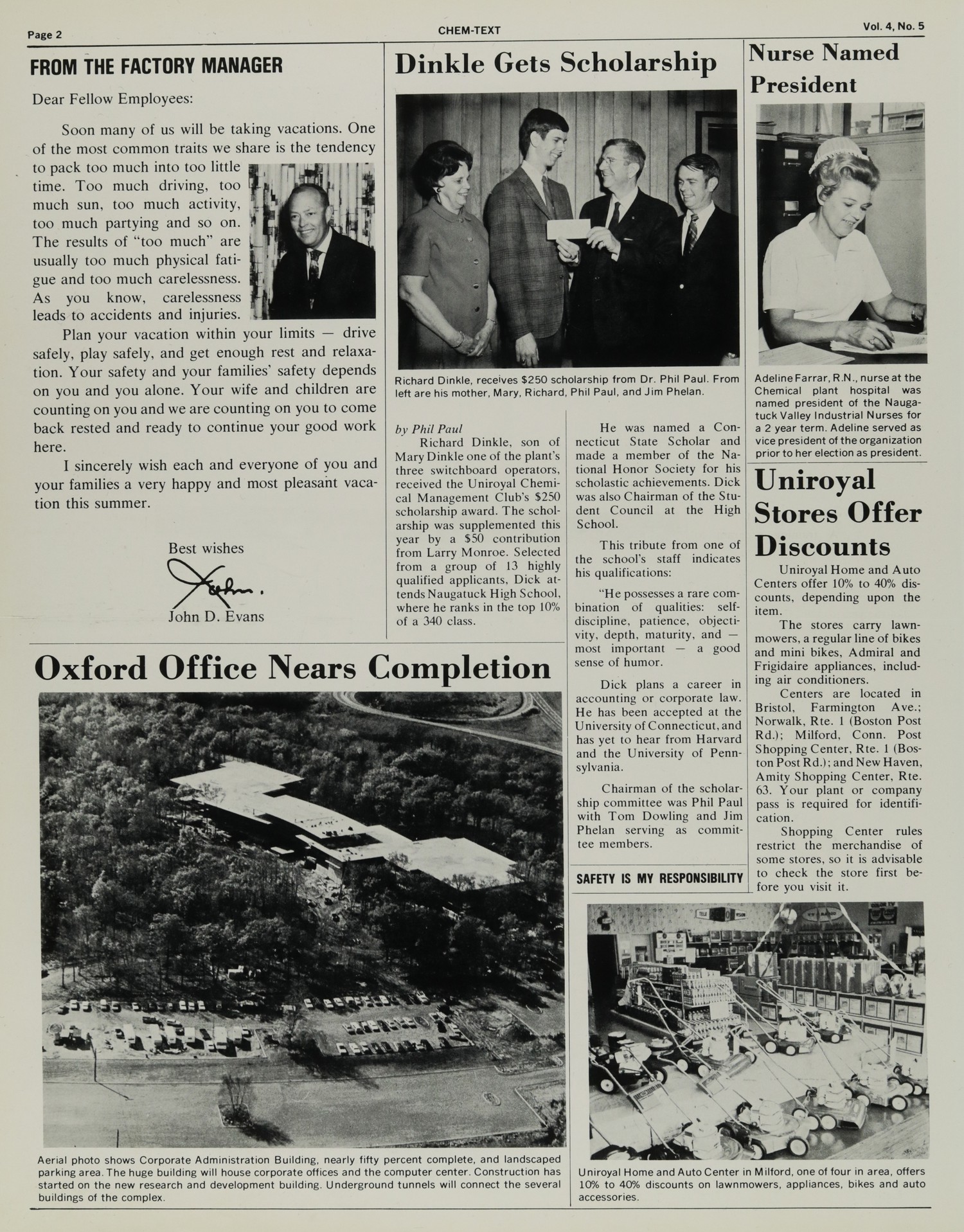
Richard Dinkle, receives $250 scholarship from Dr. Phil Paul. From left are his mother, Mary, Richard, Phil Paul, and Jim Phelan.

by Phil Paul

Richard Dinkle, son of Mary Dinkle one of the plant’s three switchboard operators, received the Uniroyal Chemical Management Club’s $250 scholarship award. The scholarship was supplemented this year by a $50 contribution from Larry Monroe. Selected from a group of 13 highly qualified applicants, Dick attends Naugatuck High School, where he ranks in the top 10% of a 340 class.

He was named a Connecticut State Scholar and made a member of the National Honor Society for his scholastic achievements. Dick was also Chairman of the Student Council at the High School.

This tribute from one of the school’s staff indicates his qualifications:

“He possesses a rare combination of qualities: self-discipline, patience, objectivity, depth, maturity, and — most important — a good sense of humor.

Dick plans a career in accounting or corporate law. He has been accepted at the University of Connecticut, and has yet to hear from Harvard and the University of Pennsylvania.

Chairman of the scholarship committee was Phil Paul with Tom Dowling and Jim Phelan serving as committee members.

SAFETY IS MY RESPONSIBILITY


Nurse Named President

Adeline Farrar, R.N., nurse at the Chemical plant hospital was named president of the Naugatuck Valley Industrial Nurses for a 2 year term. Adeline served as vice president of the organization prior to her election as president.


Uniroyal Stores Offer Discounts

Uniroyal Home and Auto Centers offer 10% to 40% discounts, depending upon the item.

The stores carry lawnmowers, a regular line of bikes and mini bikes, Admiral and Frigidaire appliances, including air conditioners.

Centers are located in Bristol, Farmington Ave.; Norwalk, Rte. 1 (Boston Post Rd.); Milford, Conn. Post Shopping Center, Rte. 1 (Boston Post Rd.); and New Haven, Amity Shopping Center, Rte. 63. Your plant or company pass is required for identification.

Shopping Center rules restrict the merchandise of some stores, so it is advisable to check the store first before you visit it.


Oxford Office Nears Completion

Aerial photo shows Corporate Administration Building, nearly fifty percent complete, and landscaped parking area. The huge building will house corporate offices and the computer center. Construction has started on the new research and development building. Underground tunnels will connect the several buildings of the complex.


Uniroyal Home and Auto Center in Milford, one of four in area, offers 10% to 40% discounts on lawnmowers, appliances, bikes and auto accessories.

CHEM-TEXTS – Vol. 4 No. 3 – Page 2

Page 002

CHEM-TEXTS

Page 2 | Vol. 4 No. 3


FROM THE FACTORY MANAGER

DEAR FELLOW EMPLOYEE:

Spring is officially here and every now and then the sunshine gives promise that it will be really here before long. Along with spring comes the housecleaning bug that bites our wives and turns our houses upside down while the cleaning is done and the furniture is moved. When it’s all done, the house really looks great, doesn’t it?

Let’s all catch the bug this spring and pitch in together to clean up the plant this month. In a large operation like ours, spread over many acres, winter takes its toll of housekeeping and when the snow is gone our winter carelessness becomes only too obvious.

I’m counting on everybody to do his part in cleaning up his work area. Remember, good housekeeping goes hand in hand with efficient work, quality performance, safe operation and makes for a much more pleasant place to work.

Best regards.

Sincerely,

John

John D. Evans


Chemical Club Elects Officers

[IMAGE: Group photo of officers at meeting]

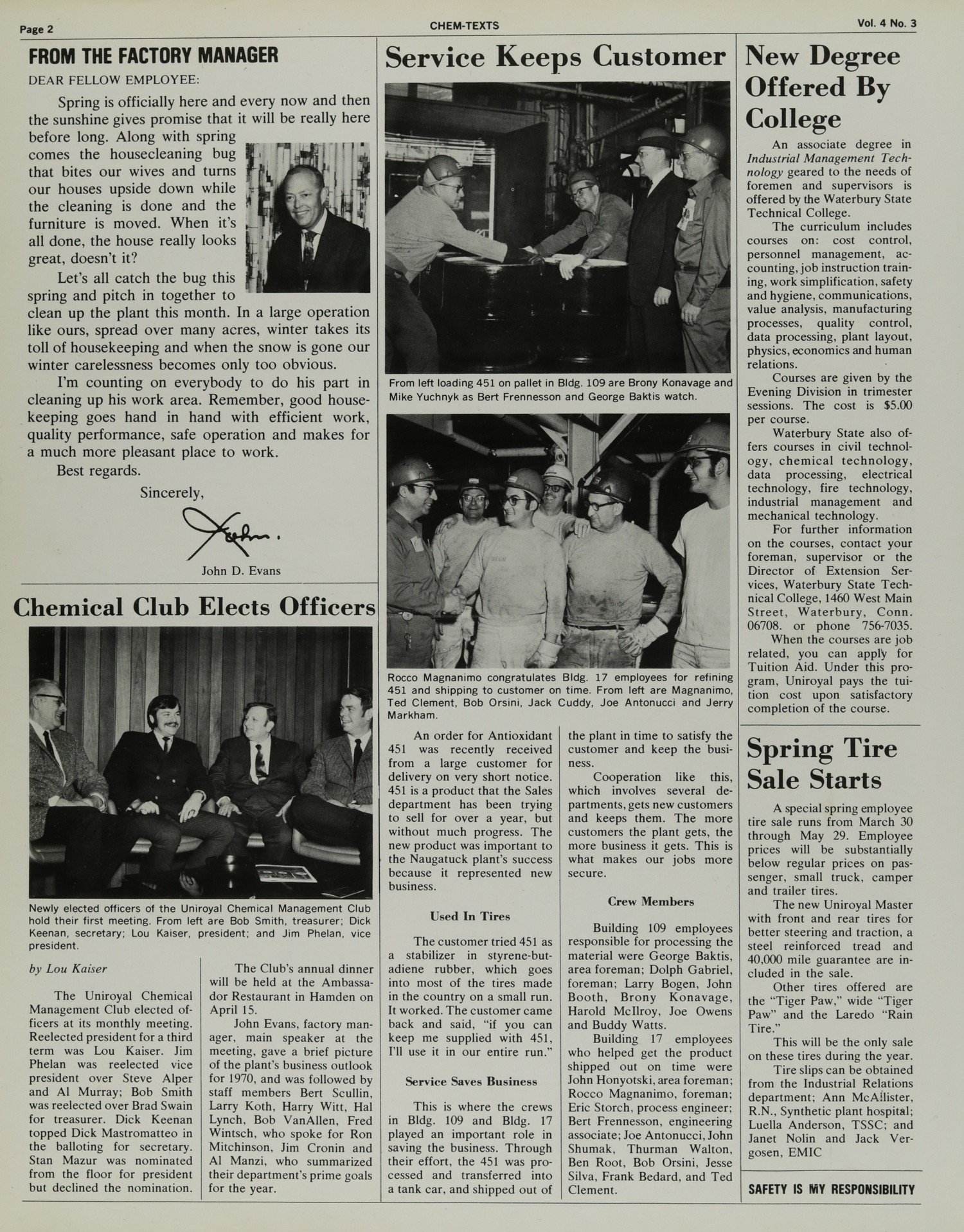
Newly elected officers of the Uniroyal Chemical Management Club hold their first meeting. From left are Bob Smith, treasurer; Dick Keenan, secretary; Lou Kaiser, president; and Jim Phelan, vice president.

by Lou Kaiser

The Uniroyal Chemical Management Club elected officers at its monthly meeting. Reelected president for a third term was Lou Kaiser. Jim Phelan was reelected vice president over Steve Alper and Al Murray. Bob Smith was reelected over Brad Swain for treasurer. Dick Keenan topped Dick Mastromatteo in the balloting for secretary. Stan Mazur was nominated from the floor for president but declined the nomination.

The Club’s annual dinner will be held at the Ambassador Restaurant in Hamden on April 15.

John Evans, factory manager, main speaker at the meeting, gave a brief picture of the plant’s business outlook for 1970, and was followed by staff members Bert Scullin, Larry Koth, Harry Witt, Hal Lynch, Bob VanAllen, Fred Wintsch, who spoke for Ron Mitchinson, Jim Cronin and Al Manzi, who summarized their department’s prime goals for the year.


Service Keeps Customer

[IMAGE: Workers loading materials on pallet]

From left loading 451 on pallet in Bldg. 109 are Brony Konavage and Mike Yuchnyk as Bert Frennesson and George Baktis watch.

[IMAGE: Group of workers being congratulated]

Rocco Magnanimo congratulates Bldg. 17 employees for refining 451 and shipping to customer on time. From left are Magnanimo, Ted Clement, Bob Orsini, Jack Cuddy, Joe Antonucci and Jerry Markham.

An order for Antioxidant 451 was recently received from a large customer for delivery on very short notice. 451 is a product that the Sales department has been trying to sell for over a year, but without much progress. The new product was important to the Naugatuck plant’s success because it represented new business.

Used In Tires

The customer tried 451 as a stabilizer in styrene-butadiene rubber, which goes into most of the tires made in the country on a small run. It worked. The customer came back and said, “if you can keep me supplied with 451, I’ll use it in our entire run.”

Service Saves Business

This is where the crews in Bldg. 109 and Bldg. 17 played an important role in saving the business. Through their effort, the 451 was processed and transferred into a tank car, and shipped out of the plant in time to satisfy the customer and keep the business.

Cooperation like this, which involves several departments, gets new customers and keeps them. The more customers the plant gets, the more business it gets. This is what makes our jobs more secure.

Crew Members

Building 109 employees responsible for processing the material were George Baktis, area foreman; Dolph Gabriel, foreman; Larry Bogen, John Booth, Brony Konavage, Harold McIlroy, Joe Owens and Buddy Watts.

Building 17 employees who helped get the product shipped out on time were John Honyotski, area foreman; Rocco Magnanimo, foreman; Eric Storch, process engineer; Bert Frennesson, engineering associate; Joe Antonucci, John Shumak, Thurman Walton, Ben Root, Bob Orsini, Jesse Silva, Frank Bedard, and Ted Clement.


New Degree Offered By College

An associate degree in Industrial Management Technology geared to the needs of foremen and supervisors is offered by the Waterbury State Technical College.

The curriculum includes courses on: cost control, personnel management, accounting, job instruction training, work simplification, safety and hygiene, communications, value analysis, manufacturing processes, quality control, data processing, plant layout, physics, economics and human relations.

Courses are given by the Evening Division in trimester sessions. The cost is $5.00 per course.

Waterbury State also offers courses in civil technology, chemical technology, data processing, electrical technology, fire technology, industrial management and mechanical technology.

For further information on the courses, contact your foreman, supervisor or the Director of Extension Services, Waterbury State Technical College, 1460 West Main Street, Waterbury, Conn. 06708. or phone 756-7035.

When the courses are job related, you can apply for Tuition Aid. Under this program, Uniroyal pays the tuition cost upon satisfactory completion of the course.


Spring Tire Sale Starts

A special spring employee tire sale runs from March 30 through May 29. Employee prices will be substantially below regular prices on passenger, small truck, camper and trailer tires.

The new Uniroyal Master with front and rear tires for better steering and traction, a steel reinforced tread and 40,000 mile guarantee are included in the sale.

Other tires offered are the “Tiger Paw,” wide “Tiger Paw” and the Laredo “Rain Tire.”

This will be the only sale on these tires during the year.

Tire slips can be obtained from the Industrial Relations department; Ann McAllister, R.N., Synthetic plant hospital; Luella Anderson, TSSC; and Janet Nolin and Jack Vergosen, EMIC

SAFETY IS MY RESPONSIBILITY

CHEM-TEXTS – Vol. 4 No. 2 – Page 2

Page 002

Page 2 CHEM-TEXTS Vol. 4 No. 2

FROM THE FACTORY MANAGER

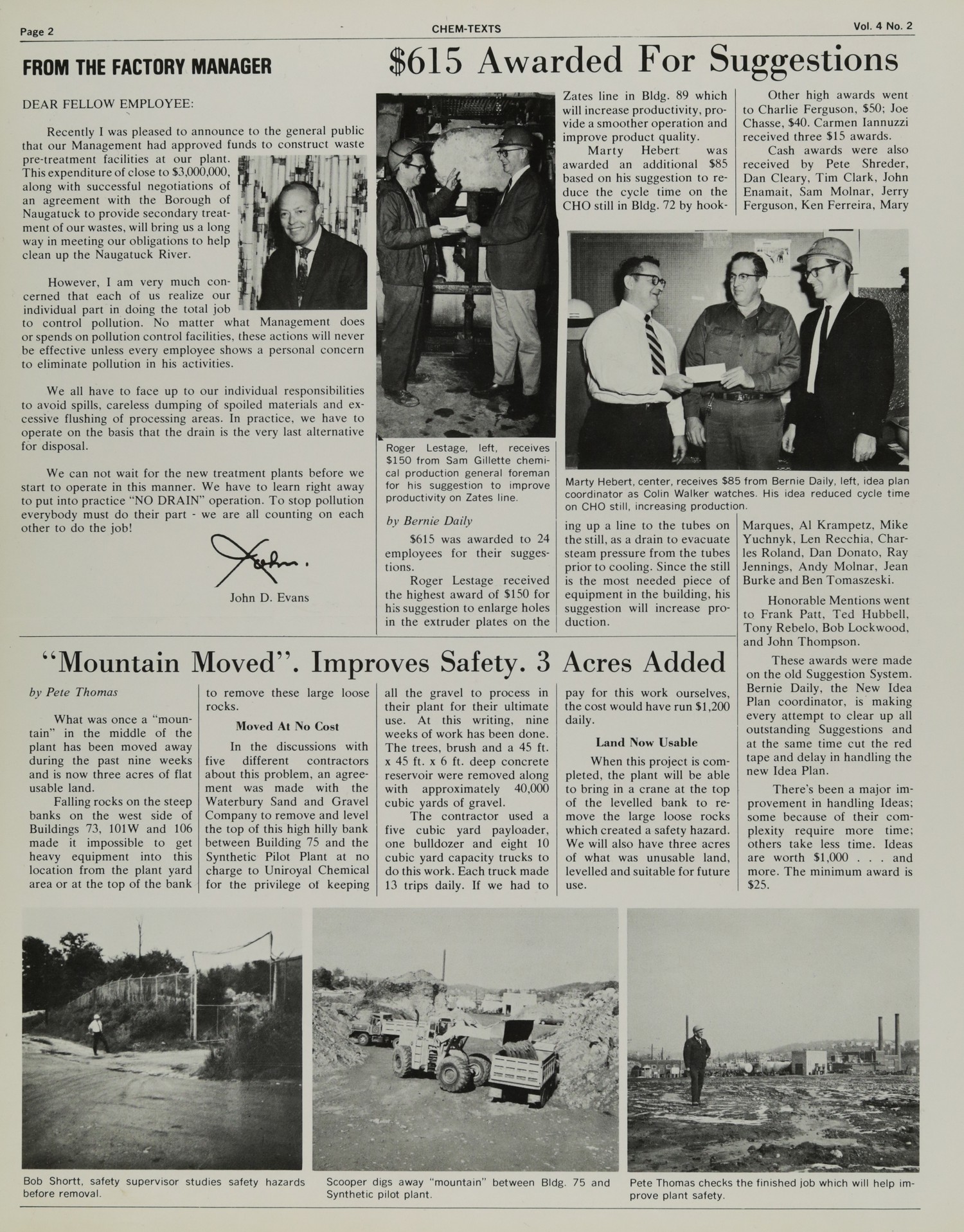
DEAR FELLOW EMPLOYEE:

Recently I was pleased to announce to the general public that our Management had approved funds to construct waste pre-treatment facilities at our plant. This expenditure of close to $3,000,000, along with successful negotiations of an agreement with the Borough of Naugatuck to provide secondary treatment of our wastes, will bring us a long way in meeting our obligations to help clean up the Naugatuck River.

However, I am very much concerned that each of us realize our individual part in doing the total job to control pollution. No matter what Management does or spends on pollution control facilities, these actions will never be effective unless every employee shows a personal concern to eliminate pollution in his activities.

We all have to face up to our individual responsibilities to avoid spills, careless dumping of spoiled materials and excessive flushing of processing areas. In practice, we have to operate on the basis that the drain is the very last alternative for disposal.

We can not wait for the new treatment plants before we start to operate in this manner. We have to learn right away to put into practice “NO DRAIN” operation. To stop pollution everybody must do their part – we are all counting on each other to do the job!

John D. Evans


$615 Awarded For Suggestions

Zates line in Bldg. 89 which will increase productivity, provide a smoother operation and improve product quality.

Marty Hebert was awarded an additional $85 based on his suggestion to reduce the cycle time on the CHO still in Bldg. 72 by hook-

Other high awards went to Charlie Ferguson, $50; Joe Chasse, $40. Carmen Iannuzzi received three $15 awards.

Cash awards were also received by Pete Shreder, Dan Cleary, Tim Clark, John Enamait, Sam Molnar, Jerry Ferguson, Ken Ferreira, Mary

Roger Lestage, left, receives $150 from Sam Gillette chemical production general foreman for his suggestion to improve productivity on Zates line.

Marty Hebert, center, receives $85 from Bernie Daily, left, idea plan coordinator as Colin Walker watches. His idea reduced cycle time on CHO still, increasing production.

by Bernie Daily

$615 was awarded to 24 employees for their suggestions.

Roger Lestage received the highest award of $150 for his suggestion to enlarge holes in the extruder plates on the

ing up a line to the tubes on the still, as a drain to evacuate steam pressure from the tubes prior to cooling. Since the still is the most needed piece of equipment in the building, his suggestion will increase production.

Marques, Al Krampetz, Mike Yuchnyk, Len Recchia, Charles Roland, Dan Donato, Ray Jennings, Andy Molnar, Jean Burke and Ben Tomaszeski.

Honorable Mentions went to Frank Patt, Ted Hubbell, Tony Rebelo, Bob Lockwood, and John Thompson.

These awards were made on the old Suggestion System. Bernie Daily, the New Idea Plan coordinator, is making every attempt to clear up all outstanding Suggestions and at the same time cut the red tape and delay in handling the new Idea Plan.

There’s been a major improvement in handling Ideas; some because of their complexity require more time; others take less time. Ideas are worth $1,000 . . . and more. The minimum award is $25.


“Mountain Moved”. Improves Safety. 3 Acres Added

by Pete Thomas

What was once a “mountain” in the middle of the plant has been moved away during the past nine weeks and is now three acres of flat usable land.

Falling rocks on the steep banks on the west side of Buildings 73, 101W and 106 made it impossible to get heavy equipment into this location from the plant yard area or at the top of the bank to remove these large loose rocks.

Moved At No Cost

In the discussions with five different contractors about this problem, an agreement was made with the Waterbury Sand and Gravel Company to remove and level the top of this high hilly bank between Building 75 and the Synthetic Pilot Plant at no charge to Uniroyal Chemical for the privilege of keeping all the gravel to process in their plant for their ultimate use. At this writing, nine weeks of work has been done. The trees, brush and a 45 ft. x 45 ft. x 6 ft. deep concrete reservoir were removed along with approximately 40,000 cubic yards of gravel.

The contractor used a five cubic yard payloader, one bulldozer and eight 10 cubic yard capacity trucks to do this work. Each truck made 13 trips daily. If we had to pay for this work ourselves, the cost would have run $1,200 daily.

Land Now Usable

When this project is completed, the plant will be able to bring in a crane at the top of the levelled bank to remove the large loose rocks which created a safety hazard. We will also have three acres of what was unusable land, levelled and suitable for future use.


Bob Shortt, safety supervisor studies safety hazards before removal.

Scooper digs away “mountain” between Bldg. 75 and Synthetic pilot plant.

Pete Thomas checks the finished job which will help improve plant safety.

CHEM-TEXTS – Vol. 4 No. 1 – Page 2

Page 002

CHEM-TEXTS

Page 2 | Vol. 4, No. 1


FROM THE FACTORY MANAGER

DEAR FELLOW EMPLOYEE:

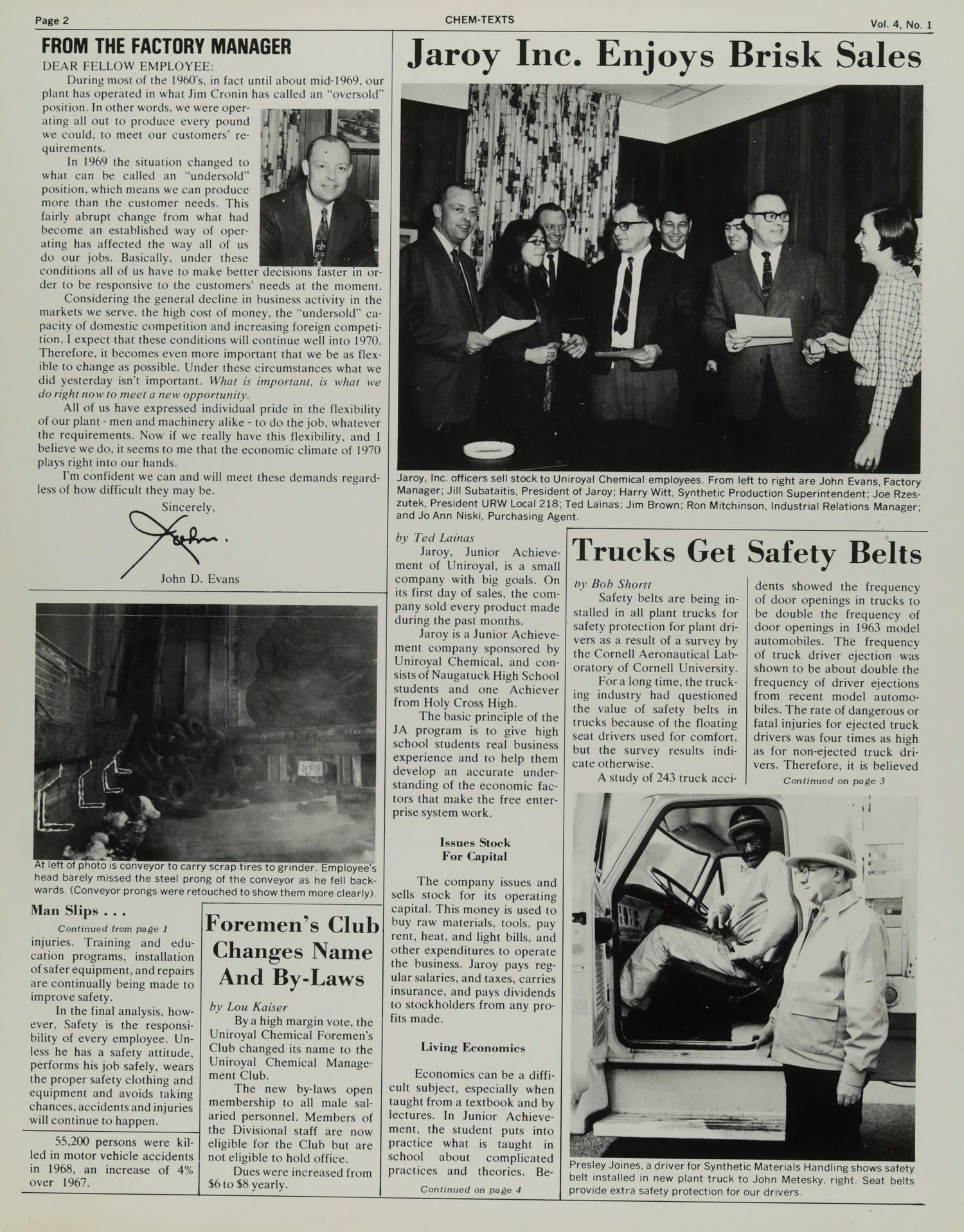
During most of the 1960’s, in fact until about mid-1969, our plant has operated in what Jim Cronin has called an “oversold” position. In other words, we were operating all out to produce every pound we could, to meet our customers’ requirements.

In 1969 the situation changed to what can be called an “undersold” position, which means we can produce more than the customer needs. This fairly abrupt change from what had become an established way of operating has affected the way all of us do our jobs. Basically, under these conditions all of us have to make better decisions faster in order to be responsive to the customers’ needs at the moment.

Considering the general decline in business activity in the markets we serve, the high cost of money, the “undersold” capacity of domestic competition and increasing foreign competition, I expect that these conditions will continue well into 1970. Therefore, it becomes even more important that we be as flexible to change as possible. Under these circumstances what we did yesterday isn’t important. What is important, is what we do right now to meet a new opportunity.

All of us have expressed individual pride in the flexibility of our plant – men and machinery alike – to do the job, whatever the requirements. Now if we really have this flexibility, and I believe we do, it seems to me that the economic climate of 1970 plays right into our hands.

I’m confident we can and will meet these demands regardless of how difficult they may be.

Sincerely,

John

John D. Evans


Jaroy Inc. Enjoys Brisk Sales

Jaroy, Inc. officers sell stock to Uniroyal Chemical employees. From left to right are John Evans, Factory Manager; Jill Subataitis, President of Jaroy; Harry Witt, Synthetic Production Superintendent; Joe Rzeszutek, President URW Local 218; Ted Lainas; Jim Brown; Ron Mitchinson, Industrial Relations Manager; and Jo Ann Niski, Purchasing Agent.

by Ted Lainas

Jaroy, Junior Achievement of Uniroyal, is a small company with big goals. On its first day of sales, the company sold every product made during the past months.

Jaroy is a Junior Achievement company sponsored by Uniroyal Chemical, and consists of Naugatuck High School students and one Achiever from Holy Cross High.

The basic principle of the JA program is to give high school students real business experience and to help them develop an accurate understanding of the economic factors that make the free enterprise system work.

Issues Stock For Capital

The company issues and sells stock for its operating capital. This money is used to buy raw materials, tools, pay rent, heat, and light bills, and other expenditures to operate the business. Jaroy pays regular salaries, and taxes, carries insurance, and pays dividends to stockholders from any profits made.

Living Economics

Economics can be a difficult subject, especially when taught from a textbook and by lectures. In Junior Achievement, the student puts into practice what is taught in school about complicated practices and theories. Be-

Continued on page 4


Trucks Get Safety Belts

by Bob Shortt

Safety belts are being installed in all plant trucks for safety protection for plant drivers as a result of a survey by the Cornell Aeronautical Laboratory of Cornell University.

For a long time, the trucking industry had questioned the value of safety belts in trucks because of the floating seat drivers used for comfort, but the survey results indicate otherwise.

A study of 243 truck accidents showed the frequency of door openings in trucks to be double the frequency of door openings in 1963 model automobiles. The frequency of truck driver ejection was shown to be about double the frequency of driver ejections from recent model automobiles. The rate of dangerous or fatal injuries for ejected truck drivers was four times as high as for non-ejected truck drivers. Therefore, it is believed

Continued on page 3

Presley Joines, a driver for Synthetic Materials Handling shows safety belt installed in new plant truck to John Metesky, right. Seat belts provide extra safety protection for our drivers.


At left of photo is conveyor to carry scrap tires to grinder. Employee’s head barely missed the steel prong of the conveyor as he fell backwards. (Conveyor prongs were retouched to show them more clearly).


Man Slips . . .

Continued from page 1

injuries. Training and education programs, installation of safer equipment, and repairs are continually being made to improve safety.

In the final analysis, however, Safety is the responsibility of every employee. Unless he has a safety attitude, performs his job safely, wears the proper safety clothing and equipment and avoids taking chances, accidents and injuries will continue to happen.

55,200 persons were killed in motor vehicle accidents in 1968, an increase of 4% over 1967.


Foremen’s Club Changes Name And By-Laws

by Lou Kaiser

By a high margin vote, the Uniroyal Chemical Foremen’s Club changed its name to the Uniroyal Chemical Management Club.

The new by-laws open membership to all male salaried personnel. Members of the Divisional staff are now eligible for the Club but are not eligible to hold office.

Dues were increased from $6 to $8 yearly.

CHEM-TEXTS – Vol. 3 No. 2 – Page 1

Page 001

Page 2 | CHEM TEXTS | Vol. 1 No. 2


CHEM TEXTS
PUBLISHED BY THE INDUSTRIAL RELATIONS DEPARTMENT
UNIROYAL CHEMICAL, NAUGATUCK, CONNECTICUT


FROM THE FACTORY MANAGER

Dear Fellow Employees:

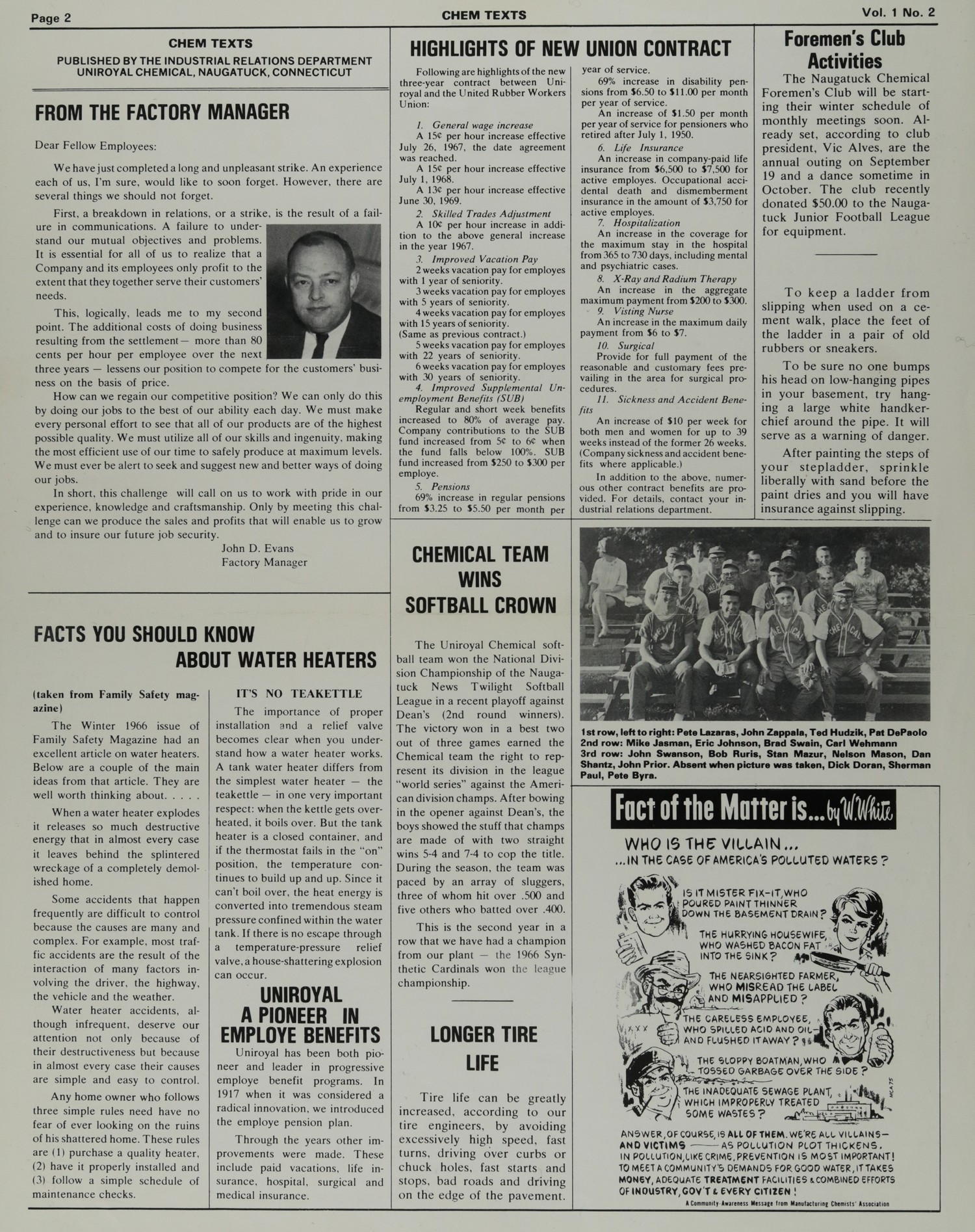
We have just completed a long and unpleasant strike. An experience each of us, I’m sure, would like to soon forget. However, there are several things we should not forget.

First, a breakdown in relations, or a strike, is the result of a failure in communications. A failure to understand our mutual objectives and problems. It is essential for all of us to realize that a Company and its employees only profit to the extent that they together serve their customers’ needs.

This, logically, leads me to my second point. The additional costs of doing business resulting from the settlement — more than 80 cents per hour per employee over the next three years — lessens our position to compete for the customers’ business on the basis of price.

How can we regain our competitive position? We can only do this by doing our jobs to the best of our ability each day. We must make every personal effort to see that all of our products are of the highest possible quality. We must utilize all of our skills and ingenuity, making the most efficient use of our time to safely produce at maximum levels. We must ever be alert to seek and suggest new and better ways of doing our jobs.

In short, this challenge will call on us to work with pride in our experience, knowledge and craftsmanship. Only by meeting this challenge can we produce the sales and profits that will enable us to grow and to insure our future job security.

John D. Evans
Factory Manager


FACTS YOU SHOULD KNOW ABOUT WATER HEATERS

(taken from Family Safety magazine)

The Winter 1966 issue of Family Safety Magazine had an excellent article on water heaters. Below are a couple of the main ideas from that article. They are well worth thinking about. . . . .

When a water heater explodes it releases so much destructive energy that in almost every case it leaves behind the splintered wreckage of a completely demolished home.

Some accidents that happen frequently are difficult to control because the causes are many and complex. For example, most traffic accidents are the result of the interaction of many factors involving the driver, the highway, the vehicle and the weather.

Water heater accidents, although infrequent, deserve our attention not only because of their destructiveness but because in almost every case their causes are simple and easy to control.

Any home owner who follows three simple rules need have no fear of ever looking on the ruins of his shattered home. These rules are (1) purchase a quality heater, (2) have it properly installed and (3) follow a simple schedule of maintenance checks.

IT’S NO TEAKETTLE

The importance of proper installation and a relief valve becomes clear when you understand how a water heater works. A tank water heater differs from the simplest water heater — the teakettle — in one very important respect: when the kettle gets overheated, it boils over. But the tank heater is a closed container, and if the thermostat fails in the “on” position, the temperature continues to build up and up. Since it can’t boil over, the heat energy is converted into tremendous steam pressure confined within the water tank. If there is no escape through a temperature-pressure relief valve, a house-shattering explosion can occur.


UNIROYAL A PIONEER IN EMPLOYE BENEFITS

Uniroyal has been both pioneer and leader in progressive employe benefit programs. In 1917 when it was considered a radical innovation, we introduced the employe pension plan.

Through the years other improvements were made. These include paid vacations, life insurance, hospital, surgical and medical insurance.


HIGHLIGHTS OF NEW UNION CONTRACT

Following are highlights of the new three-year contract between Uniroyal and the United Rubber Workers Union:

1. General wage increase
A 15¢ per hour increase effective July 26, 1967, the date agreement was reached.
A 15¢ per hour increase effective July 1, 1968.
A 13¢ per hour increase effective June 30, 1969.

2. Skilled Trades Adjustment
A 10¢ per hour increase in addition to the above general increase in the year 1967.

3. Improved Vacation Pay
2 weeks vacation pay for employes with 1 year of seniority.
3 weeks vacation pay for employes with 5 years of seniority.
4 weeks vacation pay for employes with 15 years of seniority.
(Same as previous contract.)
5 weeks vacation pay for employes with 22 years of seniority.
6 weeks vacation pay for employes with 30 years of seniority.

4. Improved Supplemental Unemployment Benefits (SUB)
Regular and short week benefits increased to 80% of average pay. Company contributions to the SUB fund increased from 5¢ to 6¢ when the fund falls below 100%. SUB fund increased from $250 to $300 per employee.

5. Pensions
69% increase in regular pensions from $3.25 to $5.50 per month per

year of service.
69% increase in disability pensions from $6.50 to $11.00 per month per year of service.
An increase of $1.50 per month per year of service for pensioners who retired after July 1, 1950.

6. Life Insurance
An increase in company-paid life insurance from $6,500 to $7,500 for active employes. Occupational accidental death and dismemberment insurance in the amount of $3,750 for active employes.

7. Hospitalization
An increase in the coverage for the maximum stay in the hospital from 365 to 730 days, including mental and psychiatric cases.

8. X-Ray and Radium Therapy
An increase in the aggregate maximum payment from $200 to $300.

9. Visiting Nurse
An increase in the maximum daily payment from $6 to $7.

10. Surgical
Provide for full payment of the reasonable and customary fees prevailing in the area for surgical procedures.

11. Sickness and Accident Benefits
An increase of $10 per week for both men and women for up to 39 weeks instead of the former 26 weeks. (Company sickness and accident benefits where applicable.)

In addition to the above, numerous other contract benefits are provided. For details, contact your industrial relations department.


CHEMICAL TEAM WINS SOFTBALL CROWN

The Uniroyal Chemical softball team won the National Division Championship of the Naugatuck News Twilight Softball League in a recent playoff against Dean’s (2nd round winners). The victory won in a best two out of three games earned the Chemical team the right to represent its division in the league “world series” against the American division champs. After bowing in the opener against Dean’s, the boys showed the stuff that champs are made of with two straight wins 5-4 and 7-4 to cop the title. During the season, the team was paced by an array of sluggers, three of whom hit over .500 and five others who batted over .400.

This is the second year in a row that we have had a champion from our plant — the 1966 Synthetic Cardinals won the league championship.

1st row, left to right: Pete Lazaras, John Zappala, Ted Hudzik, Pat DePaolo
2nd row: Mike Jasman, Eric Johnson, Brad Swain, Carl Wohmann
3rd row: John Swanson, Bob Rurin, Stan Mazur, Nelson Mason, Dan Shantz, John Prior. Absent when picture was taken, Dick Doran, Sherman Paul, Pete Byra.


LONGER TIRE LIFE

Tire life can be greatly increased, according to our tire engineers, by avoiding excessively high speed, fast turns, driving over curbs or chuck holes, fast starts and stops, bad roads and driving on the edge of the pavement.


Foremen’s Club Activities

The Naugatuck Chemical Foremen’s Club will be starting their winter schedule of monthly meetings soon. Already set, according to club president, Vic Alves, are the annual outing on September 19 and a dance sometime in October. The club recently donated $50.00 to the Naugatuck Junior Football League for equipment.


To keep a ladder from slipping when used on a cement walk, place the feet of the ladder in a pair of old rubbers or sneakers.

To be sure no one bumps his head on low-hanging pipes in your basement, try hanging a large white handkerchief around the pipe. It will serve as a warning of danger.

After painting the steps of your stepladder, sprinkle liberally with sand before the paint dries and you will have insurance against slipping.


Fact of the Matter is… by W. White

WHO IS THE VILLAIN…
…IN THE CASE OF AMERICA’S POLLUTED WATERS?

IS IT MISTER FIX-IT, WHO POURED PAINT THINNER DOWN THE BASEMENT DRAIN?

THE HURRYING HOUSEWIFE, WHO WASHED BACON FAT INTO THE SINK?

THE NEARSIGHTED FARMER, WHO MISREAD THE LABEL AND MISAPPLIED?

THE CARELESS EMPLOYEE, WHO SPILLED ACID AND OIL— AND FLUSHED IT AWAY?

THE SLOPPY BOATMAN, WHO TOSSED GARBAGE OVER THE SIDE?

THE INADEQUATE SEWAGE PLANT, WHICH IMPROPERLY TREATED SOME WASTES?

ANSWER, OF COURSE, IS ALL OF THEM. WE’RE ALL VILLAINS— AND VICTIMS ——— AS POLLUTION PLOT THICKENS. IN POLLUTION, LIKE CRIME, PREVENTION IS MOST IMPORTANT! TO MEET A COMMUNITY’S DEMANDS FOR GOOD WATER, IT TAKES MONEY, ADEQUATE TREATMENT FACILITIES & COMBINED EFFORTS OF INDUSTRY, GOV’T & EVERY CITIZEN!

A Community Awareness Message from Manufacturing Chemists Association

CHEM-TEXTS – Vol. 3 No. 3 – Page 2

Page 002

Page 2 CHEM-TEXTS Vol. 3 No. 3


FROM THE FACTORY MANAGER

DEAR FELLOW EMPLOYEE:

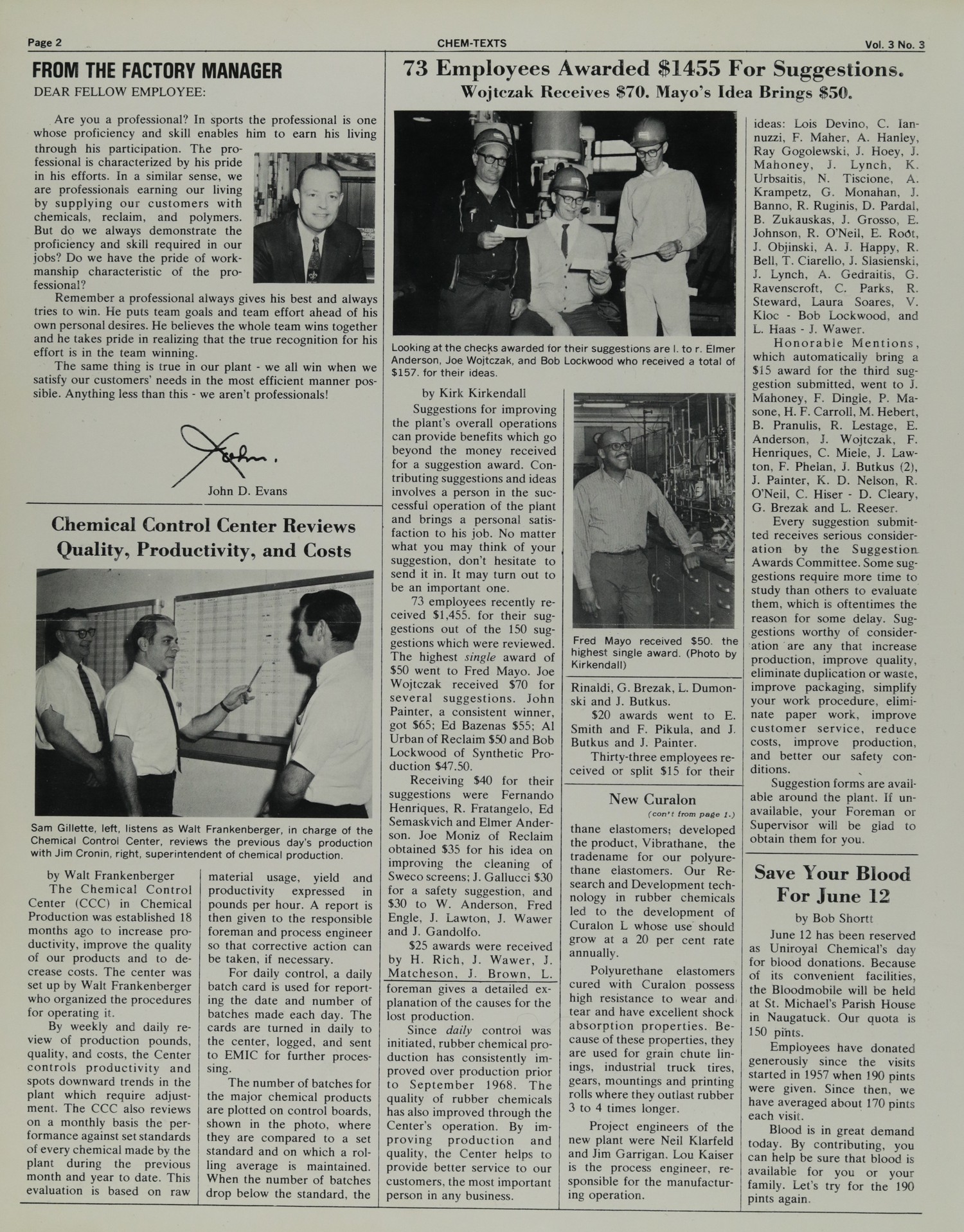
Are you a professional? In sports the professional is one whose proficiency and skill enables him to earn his living through his participation. The professional is characterized by his pride in his efforts. In a similar sense, we are professionals earning our living by supplying our customers with chemicals, reclaim, and polymers. But do we always demonstrate the proficiency and skill required in our jobs? Do we have the pride of workmanship characteristic of the professional?

Remember a professional always gives his best and always tries to win. He puts team goals and team effort ahead of his own personal desires. He believes the whole team wins together and he takes pride in realizing that the true recognition for his effort is in the team winning.

The same thing is true in our plant – we all win when we satisfy our customers’ needs in the most efficient manner possible. Anything less than this – we aren’t professionals!

[Signature]

John D. Evans


Chemical Control Center Reviews Quality, Productivity, and Costs

[IMAGE: Sam Gillette, left, listens as Walt Frankenberger, in charge of the Chemical Control Center, reviews the previous day’s production with Jim Cronin, right, superintendent of chemical production.]

by Walt Frankenberger

The Chemical Control Center (CCC) in Chemical Production was established 18 months ago to increase productivity, improve the quality of our products and to decrease costs. The center was set up by Walt Frankenberger who organized the procedures for operating it.

By weekly and daily review of production pounds, quality, and costs, the Center controls productivity and spots downward trends in the plant which require adjustment. The CCC also reviews on a monthly basis the performance against set standards of every chemical made by the plant during the previous month and year to date. This evaluation is based on raw material usage, yield and productivity expressed in pounds per hour. A report is then given to the responsible foreman and process engineer so that corrective action can be taken, if necessary.

For daily control, a daily batch card is used for reporting the date and number of batches made each day. The cards are turned in daily to the center, logged, and sent to EMIC for further processing.

The number of batches for the major chemical products are plotted on control boards, shown in the photo, where they are compared to a set standard and on which a rolling average is maintained. When the number of batches drop below the standard, the person in any business.


73 Employees Awarded $1455 For Suggestions.

Wojtczak Receives $70. Mayo’s Idea Brings $50.

[IMAGE: Looking at the checks awarded for their suggestions are l. to r. Elmer Anderson, Joe Wojtczak, and Bob Lockwood who received a total of $157. for their ideas.]

by Kirk Kirkendall

Suggestions for improving the plant’s overall operations can provide benefits which go beyond the money received for a suggestion award. Contributing suggestions and ideas involves a person in the successful operation of the plant and brings a personal satisfaction to his job. No matter what you may think of your suggestion, don’t hesitate to send it in. It may turn out to be an important one.

73 employees recently received $1,455. for their suggestions out of the 150 suggestions which were reviewed. The highest single award of $50 went to Fred Mayo. Joe Wojtczak received $70 for several suggestions. John Painter, a consistent winner, got $65; Ed Bazenas $55; Al Urban of Reclaim $50 and Bob Lockwood of Synthetic Production $47.50.

Receiving $40 for their suggestions were Fernando Henriques, R. Fratangelo, Ed Semaskvich and Elmer Anderson. Joe Moniz of Reclaim obtained $35 for his idea on improving the cleaning of Sweco screens; J. Gallucci $30 for a safety suggestion, and $30 to W. Anderson, Fred Engle, J. Lawton, J. Wawer and J. Gandolfo.

$25 awards were received by H. Rich, J. Wawer, J. Matcheson, J. Brown, L. foreman gives a detailed explanation of the causes for the lost production.

Since daily control was initiated, rubber chemical production has consistently improved over production prior to September 1968. The quality of rubber chemicals has also improved through the Center’s operation. By improving production and quality, the Center helps to provide better service to our customers, the most important person in any business.

[IMAGE: Fred Mayo received $50. the highest single award. (Photo by Kirkendall)]

Rinaldi, G. Brezak, L. Dumonski and J. Butkus.

$20 awards went to E. Smith and F. Pikula, and J. Butkus and J. Painter.

Thirty-three employees received or split $15 for their


New Curalon

(con’t from page 1.)

thane elastomers; developed the product, Vibrathane, the tradename for our polyurethane elastomers. Our Research and Development technology in rubber chemicals led to the development of Curalon L whose use should grow at a 20 per cent rate annually.

Polyurethane elastomers cured with Curalon possess high resistance to wear and tear and have excellent shock absorption properties. Because of these properties, they are used for grain chute linings, industrial truck tires, gears, mountings and printing rolls where they outlast rubber 3 to 4 times longer.

Project engineers of the new plant were Neil Klarfeld and Jim Garrigan. Lou Kaiser is the process engineer, responsible for the manufacturing operation.


ideas: Lois Devino, C. Iannuzzi, F. Maher, A. Hanley, Ray Gogolewski, J. Hoey, J. Mahoney, J. Lynch, K. Urbsaitis, N. Tiscione, A. Krampetz, G. Monahan, J. Banno, R. Ruginis, D. Pardal, B. Zukauskas, J. Grosso, E. Johnson, R. O’Neil, E. Root, J. Objinski, A. J. Happy, R. Bell, T. Ciarello, J. Slasienski, J. Lynch, A. Gedraitis, G. Ravenscroft, C. Parks, R. Steward, Laura Soares, V. Kloc – Bob Lockwood, and L. Haas – J. Wawer.

Honorable Mentions, which automatically bring a $15 award for the third suggestion submitted, went to J. Mahoney, F. Dingle, P. Masone, H. F. Carroll, M. Hebert, B. Pranulis, R. Lestage, E. Anderson, J. Wojtczak, F. Henriques, C. Miele, J. Lawton, F. Phelan, J. Butkus (2), J. Painter, K. D. Nelson, R. O’Neil, C. Hiser – D. Cleary, G. Brezak and L. Reeser.

Every suggestion submitted receives serious consideration by the Suggestion Awards Committee. Some suggestions require more time to study than others to evaluate them, which is oftentimes the reason for some delay. Suggestions worthy of consideration are any that increase production, improve quality, eliminate duplication or waste, improve packaging, simplify your work procedure, eliminate paper work, improve customer service, reduce costs, improve production, and better our safety conditions.

Suggestion forms are available around the plant. If unavailable, your Foreman or Supervisor will be glad to obtain them for you.


Save Your Blood For June 12

by Bob Shortt

June 12 has been reserved as Uniroyal Chemical’s day for blood donations. Because of its convenient facilities, the Bloodmobile will be held at St. Michael’s Parish House in Naugatuck. Our quota is 150 pints.

Employees have donated generously since the visits started in 1957 when 190 pints were given. Since then, we have averaged about 170 pints each visit.

Blood is in great demand today. By contributing, you can help be sure that blood is available for you or your family. Let’s try for the 190 pints again.

CHEM-TEXTS – Vol. 3 No. 4 – Page 2

Page 002

CHEM-TEXTS

Page 2 | Vol. 3 No. 4


FROM THE FACTORY MANAGER

DEAR FELLOW EMPLOYEE:

All of us are aware of the importance of producing quality products in an efficient and safe manner. We are also aware of the importance of providing service to our customers, for only through the sale of the results of our effort can we be paid for this effort. I am convinced that each of us tries to do his job in the best way.

But how do we see our jobs? Is our particular job over, when we feel that somebody other than ourselves can be blamed for poor performance?

For example, is it justifiable to blame our injury on someone else if, indeed, it was an unsafe act on our part? Or, is it reasonable to blame lost production on the shortage of raw materials if we didn’t do something about it? Maybe we are all too quick to place the blame on someone else, before we accept all of our own responsibilities.

Together, we operate a very complex operation where each employee bears a great deal of responsibility for his personal efforts, and if we are fully successful a great deal of responsibility for the efforts of others.

Sincerely,

[Signature]

John D. Evans


Flood, Disaster Plan Revised

[IMAGE: Black and white photograph showing flooded area with building]

The Naugatuck River became the “mad river” in August 1955 and flooded the plant. Having a plan for action got the plant back into operation in two days.

The purpose of the revised Plan, which has been distributed to involved employees, is to minimize delay and confusion if an unusual or serious incident occurs, such as the August flood of 1955, and to delegate responsibilities to assigned personnel.

If an emergency occurs, the Control Center for operations will be set up in the Industrial Relations office, Bldg. 84, unless circumstances require another location. The Plan outlines the utilization of all equipment in the plant and the specific duties to be carried out by authorized personnel. It also delegates to Ron Mitchinson, Fred Wintsch, Bob Krause, and Bill Lavelle the responsibility and authority, as the plant’s public information representatives, to provide information to the press. All employees should refer requests on information of the emergency to the plant’s public information representatives to prevent damaging rumors and in-

(Continued on Page 4)


Explorers Offer Students Career Insight

by Bob Smith

The Explorers offer high school boys, 14 to 18 years old, the opportunity to see and learn about careers in science, chemistry, and industry. The group, sponsored by the Chemical plant, was the first Explorer Post in Uniroyal.

The Explorers conduct laboratory experiments in the plant’s laboratory facilities; take tours of industrial plants in the area to see first hand the manufacturing operation of a large company; and make weekend trips to universities, military installations and other places of interest to high school students. By exploring or seeing scientific operations; observing chemistry in action; and studying the engineering complexity of a synthetic rubber plant, a high school student obtains an actual insight into the type of career to pursue in life.

This year the group visited Scovill’s, Mallory Battery, Sikorsky Aircraft, Uniroyal Chemical’s Agricultural Research Center, the E.M.I.C. Computer Center, and the Massachusetts Institute of Technology.

If your son is interested in a career in science, chemistry or industry, and would like to join the Explorers, Bob Smith, Ext. 674, will be glad to give you more details on the group’s activities.

[IMAGE: Group photograph of committee members]

Committee members discuss plans for future activities. Seated, left to right, are Bruce Fisher, Bob Smith, chairman, and Steve Schwartz. Standing are Harry Jancis, left, and Bert Scullin. Not present were Tom O’Hara, Al Manzi, Ed McCaffrey, Bill Broden, Ken Ferreira, Ben Leach and Dick Savage.

[IMAGE: Group working on science project]

Working on a science project are, left to right, seated, Art Nunes, Dick Adamaitis, and Lou Stephenson. Standing, left to right, are Frank Cravo, George Louis Jr., Armando Pardal, Nat Vescera, and Steve Schwartz, advisor.


Safety Shows Small Improvement Over ’68

by Sal Aloise

The plant’s safety record for the first four months of 1969 shows that 7 lost time accidents and 14 serious injuries took place. Although a slight improvement over 1968, the record indicates that a greater safety awareness by every employee is required to make the plant a safer place to work.

By not taking chances; by stopping unsafe acts; accidents can be prevented and the plant made safer for work. In 1968 we worked 1,000,000 manhours without a lost time accident. With every employee’s effort, we can reach 1,000,000 manhours again . . . and even 2,000,000!

LOST TIME ACCIDENTS AND SERIOUS INJURIES

MONTH 1969 Lost Time Serious Injuries Total 1968 Lost Time Serious Injuries Total
January 2 2 4 2 2 4
February 2 5 7 3 5 8
March 2 3 5 2 6 8
April 1 4 5 2 6 8
TOTAL 7 14 21 9 19 28

Dividend Declared

Uniroyal declared a dividend of 17½ cents a share on the common stock. A $2 dividend on the 8% first preferred stock was also announced. Both are payable June 25 to stockholders of record May 26.


Dr. Williams Leaves

Dr. Edward E. Williams will leave us as plant physician at the end of May.

Dr. John P. Elser will assume the duties of plant physician on June 1.

Dr. Williams has been associated with the Chemical plant for the past 35 years. He plans to continue his private practice in Naugatuck.


The average American family wastes about 400 lbs. of edible food in a year. The country wastes over 10 million tons of food each year.


SAFETY IS MY RESPONSIBILITY

CHEM-TEXTS – Vol. 3 No. 6 – Page 2

Page 002

Page 2 | CHEM-TEXTS | Vol. 3, No. 8


FROM THE FACTORY MANAGER

DEAR FELLOW EMPLOYEES:

October again brings us each the opportunity to invest in the sixteen agencies supported by the United Givers of Naugatuck and Beacon Falls. Each of these agencies, working in essential health, welfare and educational activities, makes our community a better place to live for our families and our friends. Beyond this, many of the agencies have an outreach of service beyond our borders to neighboring towns and to the nation.

We at Uniroyal Chemical have, in each year’s campaign, shown a greater willingness to give to these causes. Yet, our average gift per employee last year was something less than $13.00 per year for all of these needs. Our average is this low because some one-third of us did not give last year and some half of us gave a cash donation rather than spreading our giving by utilizing the payroll deduction plan.

When the canvasser calls on us this year, let’s all give something and let’s all pledge on payroll deductions. I think we all will be pleasantly surprised when the results are in.

Sincerely,

[Signature]

John D. Evans


Three Named Chairmen For Borough’s United Givers Drive

[IMAGE: Photo of three men in business attire having a discussion]

Ron Mitchinson, right, Industrial Relations Manager, and this year’s United Givers Campaign Chairman for Naugatuck and Beacon Falls discusses plans with Doug Miller, Engineering Superintendent, Corporate Division Chairman. Absent was Fred Wintsch, Chairman of the Commercial Division.

Over the years, the Naugatuck plant has participated in community activities by sponsoring the Junior Achievement, Naugatuck High School Career Observation Program, the Explorers, the United Givers, and other community and civic programs.

For its campaign drive this year, the United Givers of Naugatuck and Beacon Falls named Ron Mitchinson Industrial Relations Manager, Campaign Chairman for the overall drive; Doug Miller, Superintendent of Engineering, as Chairman of the Corporate division and Fred Wintsch, Labor Relations Manager, as Chairman of the Commercial group.

The annual United Givers drive is one of the major events in the community to support the charitable, social and youth work of the 16 Agencies in the campaign. This year’s goal for the campaign is $145,000 to help continue and improve the worthwhile activities of the participating groups.


Dr. Jelley New Plant Doctor

[IMAGE: Photo of Dr. Jelley reviewing medical records with Ann McAllister]

Dr. Jelley reviews medical records with Ann McAllister, R.N., Synthetic Hospital nurse.

by Bob Shortt

Dr. Edward Jelley accepted the position of plant physician replacing Dr. Elser. Dr. Jelley, a prominent physician with offices in Naugatuck, will be available at the Chemical Plant hospital from 8:30 A.M. to 10:00 A.M. and at the Synthetic Plant hospital from 10:00 A.M. to 11:00 A.M., Monday through Friday, except holidays.

The Chemical and Synthetic plant nurses, Adeline Farrar, R.N. and Ann McAllister, R.N., are on duty from 8:00 A.M. to 4:30 P.M., Monday through Friday. The Chemical nurse is also on duty Saturday morning, 8:00 A.M. to 12 Noon.

To prevent cuts, bruises or dust in the eye from becoming serious injuries, employees should see the plant nurse immediately and have the problem taken care of as a preventive measure against further complications.

In case of an accident or injury during the second or third shift, the night general foreman should be contacted by calling the night watchman on EXT. 670 who will contact the general foreman by radio for immediate attention.


Employee Snow Tire Sale On

The special employee snow tire sale runs for two months until Nov. 28. On sale are the Glas-Belt Snowplow, Glas-Belt Winter Patrol, Snowplow, and the Winter Patrol.

Purchases may be made at Uniroyal Home and Auto Centers and Uniroyal Tire Dealers.

Slips can be obtained from Industrial Relations; Ann McAllister, Synthetic plant nurse; Luella Anderson TSSC; and Diana Strollo, EMIC.


United Givers: (cont’d. from pg. 1)

The Executive Committee for the plant is Eric Johnson, Leon Raskauskas, Joe Rzeszutek, Milt Makoski, Gene Hertel, Roger Amidon, Jack Vergosen, Joe Bucciaglia, Bob Foltz, Frank Lynch and Vic Anderson.

Chairmen of the various plant sections and departments are Roger Lestage, Pat Tortorici, Carl Wehmann, Paul Laurenzi, Sal Sapio, Mike Dodd, Phil Morin, Stan Mazur, Doug Ritchie, Bob Grahame, Dom Scalzo, Al Juliano and Mary Vergosen.


Dividend Declared

Uniroyal declared a dividend of 17½ cents a share on its common stock. The dividend was payable September 25 to stockholders of record on August 25.

A dividend of $2 a share on the 8 percent first preferred stock was also declared and payable September 25 to stockholders of record on August 25.

“GIVE WHERE YOU WORK”


New Staff For Chemical Control Center

New assignments were made to the Chemical Production Control Center which was recently established. Heading the new system is Walt Frankenberger, and working as Technical Assistant is Clark Makinson.

Tom Dowling will coordinate mechanical work in the chemical plant.

Francis Egan and Matty Mathewson will work on scheduling, raw materials and quality control. Also assigned to the Center, Mildred Finsel will handle the clerical responsibilities.

As a result of the new staff assignments, several changes were made in the plant.

John Honyotski assumes responsibility for all thiazoles operations. Tom Engle takes over as Foreman in thiazole operations. Lloyd McCoy assumes charge of Bldg. 100. Earl Roller becomes Foreman of the Central Finishing Dept. Bob Cronin was made Foreman of Bldg. 88 and Tom Carey assumes the position of Production Clerk.


Fathers-Sons See Amazing Mets Play

The photo below shows some of the eighty-three who attended the Mets-Dodgers baseball game at Shea Stadium on Saturday, August 23. The Father-Son baseball trip sponsored by the Foremen’s Club was a big success and, according to Lou Kaiser, the Club’s president, the inspiration that started the Mets on their phenomenal drive to first place in the National League pennant race.

[IMAGE: Photo showing crowd at baseball stadium]

CHEM-TEXTS – Vol. 3 No. 7 – Page 2

Page 002

Page 2 | CHEM-TEXTS | Vol. 3 No. 7


FROM THE FACTORY MANAGER

DEAR FELLOW EMPLOYEE:

This year we have been pushing the slogan “SAFETY IS MY RESPONSIBILITY.” Frankly, it seems to me that our success to date is in developing the attitude that “everybody is responsible for my safety.” It’s about time that we face up to our own responsibility for safety.

I’ve heard too much of, “you didn’t fix this” or, “why should I do it that way, so and so doesn’t.” Or, the old favorite, “I’ve been doing this for twenty years and nothing has happened to me.” These are, at best, just excuses.

We have to face up to the basic fact that each man is primarily responsible for his own safety. Management’s responsibility extends to providing the proper tools and equipment, protective devices and giving safe operating procedures and instructions.

Beyond this point, supervision can’t make a man safe if he doesn’t act safely. This is particularly true in our plant where each man works with a great deal of responsibility for his own work.

Recently, I read some criticism concerning companies where protective equipment wasn’t furnished to employees.

Let’s take a look at our plant. UNIROYAL provides hard hats, safety glasses, goggles, safety shoes, gloves and other protective equipment, and yet too many employees take the attitude of “let’s see if we can make them force us to wear this stuff.” What kind of a game is this for men to be playing?

Don’t you think it’s about time for you to quit playing Russian Roulette with your SAFETY? I sincerely hope you will think this over and agree for your family’s sake.

Best regards,

John

John D. Evans


Little known but important is the job of sorting tubes and removing brass valves in Reclaim production. Left to right are Hilda Moura, Linda Oliveira, Amelia Francisco. In rear is Ascencao Fonseca.


Frank Giedraitis, left, and Ray Mulcahy of the Synthetic storehouse, service the mechanical department with valves, fittings, sheet metal and necessary supplies.


Responsibility, Reliability

Hand in hand with job responsibility is job reliability knowing that an employee will perform his job conscientiously. For example, suppose the Control Laboratory did not evaluate the quality of a product properly before it was shipped to a customer. Shipping it would affect the profit of the product since it will be returned by the customer and transportation and rework costs must be absorbed by the Company. To some degree every department in the plant is affected by a chain-like interdepartmental reaction: Purchasing must supply new packages; Production must rework and repackage the material; Materials Handling must unload the returned product and store it in the warehouse; Billing must issue a credit; Sales must satisfy the customer’s complaint and possibly lose a long standing one; and Distribution/Scheduling must reschedule production and arrange for warehousing the material.

Profits Lost

It’s evident that every employee’s job is important in the profitable operation of the plant.

If each person performs it well he will be contributing not only to his own, but to every other employee’s job security and to the plant’s successful operation.


Defective instruments affect product quality. Martin Cherkus, Mechanical Dept. repairs critical level band in Reclaim as Larry Rinaldi watches.


Left to right Ray Chevrier, Bob Vadnais, and Pete LaCharity, of the Synthetic plant finishing line, package Naugapol rubber neatly for prompt delivery to a customer.


Responsible Position

(Continued from Page 1)

operating line, resulting in lost production, lost sales, lost profits and a lost customer who required the product delivered to his plant on time to meet his production schedule.

One employee’s absence has a chain-like effect on not only his own job, but the jobs of other people in his departments. In one production department, absenteeism averaged 150 days a month, seriously jeopardizing the production of the department and the jobs of the employees in it …. along with the jobs of people in other areas.


SAFETY IS MY RESPONSIBILITY


Testing the quality of OXAF before it is shipped to customer is Edith Evans, left, and Margaret Sweeney of the Quality Control Lab. In background is Janet Lennan.


Floors are cleaned, waxed and buffed every night by the Janitors to keep offices clean and neat. Don Fuller, left, group leader, advises Joao De Campos as he cleans floor in Bldg. 84.

CHEM-TEXTS – Vol. 3 No. 8 – Page 2

Page 002

CHEM-TEXTS

Page 2 | Vol. 3 No. 9


FROM THE FACTORY MANAGER

DEAR FELLOW EMPLOYEE:

Sometime back I had occasion to question one of our people why a certain function was being performed in the manner that it was being done. Much to my surprise, the answer was, “It’s Company policy.” I asked, “What do you mean, ‘Company policy’?, Who set the policy?” After a blank look, I received the answer, “Folklore and Tradition”.

While tradition has a place as part of our heritage, it has little place in building a flexible, responsive, up-to-date organization that can effectively deal with the rapid changing demands that we, together, must meet to make our plant competitive in today’s world.

As I have said before, progress is change, and each of us must learn to look upon change as progress. We have to be the first ones to find the best way of doing our jobs or we find ourselves always trying to catch up. I’m sure we all prefer to be leaders.

Let’s take a strong look at the “Folklore and Traditions” in our activities. Let’s all ask ourselves, “How can I do my job more effectively?” Let’s remember that the payoff is results and we each play a part in finding a better way to achieve those results.

Sincerely,

John

John D. Evans


Improved housekeeping, a better, safer place to work. Harry Grant, left, and Ray Pekoek inspect newly painted and repaired equipment in Reclaim pilot plant.


competition and operate our business in the black.

New upgraded reactors, the most modern in design, are being installed to improve productivity and reduce the maintenance costs of obsolete equipment. They should improve our competitive position in the chemical market.

Costly investment in equipment protects jobs and depend heavily on the Company’s profits to finance the purchase of it.

The profits on the products made at the plant are


Five Hurt In Accidents

by Bob Shortt

From June 14 to Sept. 5, the plant worked 830,084 man-hours without a lost-time accident, almost hitting the 1,000,000 mark.

But September brought five lost-time accidents. The first occurred when an employee slipped from a ladder fracturing his forearm. The second happened near the plant when an employee’s car hit the rear of the plant’s station wagon, causing a neck injury to the plant driver. While pulling hose on the job, an employee strained his back. The fourth accident took place in Long Island when one of the plant’s new trucks was slammed in the rear by a trailer truck, causing face, chest and neck injuries to the plant driver. The plant’s month-old truck was totally demolished. Both road accidents were clearcut cases of the unexpected happening. The fifth accident happened when an employee was splashed in the eye by a chemical while filling drums. He was wearing safety glasses but did not have the required chemical splash goggles for the job.

Our safety record will improve only when every employee realizes that safety is his responsibility. Wearing safety hats, safety shoes, safety glasses, proper protective equipment on the job will help reduce accidents. Moving drums and lifting heavy equipment properly prevents serious back injuries.

But the most important step to stop this rate is for every employee to think safety every minute of the day . . . and to expect the unexpected happening.

(continued on page 3)


Customers Secure Our Jobs

In today’s competitive economy, our pay and employment come from our customers, and the only sure type of job security is keeping and increasing our customers. If there are no customers, there will be no jobs.

Keeping a customer can be achieved only when everyone performs his job responsibly and by doing the kind of job that will hold and win new customers. Job security is the responsibility of everyone working together in a spirit of mutual understanding and cooperation.

When production drops, the cost of operating the plant increases and can affect our pay considerably. Lower production means increased cost which the customer will not pay. Naturally he looks to a competitor for a better price which is exactly what all of us would do if we were shopping for a car, a TV set or a washing machine.

Keeping the customer through improved production of quality products increases substantially better job security for all employees.


Reclaim Dust Collectors . . .

(continued from page 1)

right type of equipment to install for reducing lint escape.

A year’s operation at design capacities in Fiber Separation and Fine Grinding have proved this decision right, as studies have indicated that only five of the twenty cyclones in the system are not operating efficiently.

The Plant Engineering Department, after considerable study, selected the proper equipment necessary to collect the lint from the five cyclones to reduce the present problem. Delivery of the equipment has been made, and the duct work and structural supports have been installed.

Upon completion of the work, a substantial reduction in lint escape will be achieved, and another step taken in the plant’s continuing program to make it a cleaner, safer place to work.


There is an old Chinese saying that each generation builds a road for the next. The road has been well built for us and it is incumbent upon us in our generation to build our road for the next.

“GIVE WHERE YOU WORK”


Hortonspheres at Synthetic plant were scraped and painted to prevent corrosion.

Frank Walinsky, left, color codes cylinder rack bright yellow for safety and light green for platform as Bob Burns watches.


IMPROVEMENTS…

(continued from page 1)

packaging, department offices and other buildings.

Profits Help Buy New Equipment

Several million dollars in capital investment to improve the efficiency of the plant’s productive capabilities will be invested in new equipment, expansion, and new facilities. These investments cost considerable money without any immediate financial return. Because of the strong competition in the chemical industry, old machinery must be replaced with more efficient equipment to keep ahead of reinvested in new equipment and tools to help perform our jobs more effectively and to increase production. The goods produced with better tools can be sold to the customer at a lower cost because their production is more efficient.

CHEM-TEXTS – Vol. 3 No. 11 – Page 2

Page 002

CHEM-TEXTS

Page 2 | Vol. 3 No. 11


FROM THE FACTORY MANAGER

DEAR FELLOW EMPLOYEE:

The season leading up to Christmas is often filled with frantic searching to solve the questions of “what should I give to the wife?” or “what should I give to the kids?” Perhaps in the rush to find the gift, we too often lose sight of the real meaning of the season; perhaps we even lose sight of one gift we could all give to each other, family, friends, as well as those with whom we work. The gift that I’m thinking of is the gift of understanding. The gift of being able to “put ourselves in the other guy’s shoes” to see his problems as he see’s them.

It seems to me that if each of us gave this gift on a year-around basis we would each make a real contribution to solving the economic and social problems facing our nation. I’m sure that we would start to see the “communication gap,” the “generation gap” and, yes, even the “management-labor gap” start to close.

Please accept my most sincere wishes for you and yours for a Most Joyous Christmas and the best of New Year’s in 1970.

Sincerely,

John D. Evans

John D. Evans


Explorers Post Names New Advisors

[IMAGE: Photo of three men]

They attend school two nights a week but still find time to become involved in community and youth activities. Serving as Advisors to the Explorers Post are from left, Terry Mo, Advisor; Pete Gucciardo and Chet Zawacki, Asst. Advisors.

by Bob Smith

The Uniroyal Chemical Explorers Post 103, which is sponsored by the Naugatuck plant, offers students the chance to learn by practical experience about careers in chemistry, science, agriculture, engineering and industry.

The group, supervised by Chemical employees, is part of the plant’s program of involvement in community and youth activities. The Explorers meet on Wednesdays at the TSSC building from 7:30 P.M. to 9:00 P.M. and is open to boys 14 years old, in the 9th grade or higher, or 15 years old, regardless of grade.

High School girls interested in these activities may also affiliate with the Post.

If your son, daughter, or a friend is interested in joining the Emplorers, contact Bob Smith, Ext. 674.

During the year the Explorers visit such interesting places as MIT, Sikorsky Aircraft, Seavill’s, Uniroyal Chemical’s Agricultural Chemicals Research and Development Laboratories and West Point.


[IMAGE: Photo showing people at what appears to be an industrial/laboratory setting]

John Fredericks, center, a Naugatuck High School student plans a career in chemistry. Bob Drzal, right, of Research and Development explains an intricate water determination apparatus to detect water levels of 1% in chemical compounds. Left is Milt Makoski, Uniroyal Chemical’s coordinator of the Job Observation Program.

Naugatuck High School Students Learn About Careers In Plant

by Milt Makoski

Twenty Naugatuck High School students will get the chance to observe the many career opportunities available to them in chemistry, engineering, marketing, sales, computers, research and development, agriculture, industrial relations, library science, and secretarial work through the Job Observation Program.

The students will not only observe the jobs but will actually perform the work in which they are interested under the guidance of Chemical division personnel. Since many students are still undecided and searching for a career in life the Job Observation Program gives them a practical insight into a career not found in books.

The program which lasts for four months is now in its second successful year and is jointly sponsored by the Naugatuck High School, Uniroyal Chemical and other firms. Coordinators of the Program at the High School are Mr. Richard Leonard, Principal; Mrs. Nellie Beatty and Mrs. Florence Anderson, Guidance Advisors. Milt Makoski, Employment Supervisor is the Chemical plant’s representative for the Program.

Other students who will visit the plant are David Evancha, Donald Allard, Rosemary DeCarlo, Joanne Mambrino, and Theresa Rymik.

If your son or daughter is a Junior at Naugatuck High School and interested in the Job Observation Program, they may still enroll in it at the School.


SAFETY IS MY RESPONSIBILITY


Get More… And Go Farther On…

UNIROYAL

Wide Oval

Snowplow™

AS COMPARED TO OUR MOST POPULAR SELLING SNOW TIRE YOU GET

MORE 22% WIDER TREAD for sturdier pull.

MORE 31% ADDITIONAL STOPPING POWER when roads are wet.

MORE 6% ADDED ACCELERATION TRACTION in loose snow.

MORE YOUR CHOICE OF WHITEWALL OR RED CIRCLE one side is red the other is white; you choose.

4-PLY NYLON CORD
Redwall/
Whitewall
Tubeless Plus
E78-14 F.E.T. of $2.39
735-14

EASY CREDIT TERMS


Winter Driving Can Be Safe

Regardless how powerful, how many gadgets, or how easily your car handles, it can’t think. You, the driver must do all the thinking, and a safe driver does a lot during the winter months.

Winter driving can be safe, but it requires constant thinking and alertness behind the wheel. It’s a time for defensive driving and expecting the unexpected happening because of road conditions, other drivers, and yourself.

Watch Out For Ice

It’s smart and safe to stay at least three car lengths from the car in front of you. Drive slower on curved roads and be especially watchful for shady spots on the road where ice may still be present after the rest of the road is clear, and be careful of slippery surfaces on bridges and under viaducts.

How To Get Out of Skid

The best way to come out of a skid is to turn your front wheels in the direction the rear of the car is skidding. After that, be ready to turn the wheel in the opposite direction, to help straighten the car out. Straighten your front wheels. This should correct the skid, and then proceed at a reduced speed.

To help in an uncontrollable skid, do not lock or jam on the brakes but pump them gently and rapidly off and on until the vehicle comes to a complete stop. This gives you both stopping and steering control.

Good Tires, Studs Help

You should have a deep tread on your snow tires for better gripping and traction. Studs help considerably on hard packed snow, on hills and starting off. Studs are also useful on icy roads but drive with extreme care, they are not a 100% answer against skidding. Chains are best for real icy conditions.

Other Safety Driving Tips

Keep a scraper, brush, clean rags or paper towels in the car for cleaning front and rear windows. Also carry a small shovel, a pail of sand or traction mats just in case you get stuck.

CHEM-TEXTS – Vol. 2 No. 3 – Page 2

Page 002

Page 2 | CHEM-TEXT | Vol. 2 No. 3


FROM THE FACTORY MANAGER

Dear Fellow Employee:

I’m sure you will be interested to know that after the recent sign up for the 1968 UNIROYAL Employee Stock Option Plan over 62% of us, in our plant, are participating in the new plan. This increase over the 56.2% participation in 1966, no doubt, reflects our interest in recent increases in the selling price of UNIROYAL stock.

In this connection, I am often asked what has caused our stock to go up. Very frankly, beyond general economic considerations, there is only one factor that causes stock to go up or down, and that is the value the buyer – the public – places on the profitability of the Company. Profitability is the measure of how good a job a Company does in meeting the needs of it customers. Very simply, it indicates how well each of us and the thousands of other UNIROYAL employees are doing our jobs.

As owners of the Company’s stock, it is in our best interests to see that we, as employees, do our jobs in the most effective and efficient manner. This has been, and will continue to be the spirit of the Naugatuck Plant.

[Signature]

John D. Evans


Louis Triano Heads Elks

Louis Triano, a 35 year member of the Naugatuck Elks Lodge, was elected president of the Connecticut Elks Association at their 39th. annual convention. This is the highest state office attainable by an Elks Club member.

Triano served the local lodge as Exalted Ruler in 1942-43 and again in 1950-51. He is a certified National Ritualistic Judge, judging contests throughout New England.

Lou has been in Marvinol® vinyl R & D as a laboratory technician for the past 18 years, working on Marvinol plastisol and organosol formulations. Our vinyl resins are used in the manufacture of Naugahyde® upholstery fabric, footwear and rainwear.


Semaskvich Compares Uniroyal With Other Companies

Ed Semaskvich of the Mechanical Dept. worked around the world in the U.S. Navy, as a construction and iron worker, and for automotive and brass companies. He joined Uniroyal 18 years ago.

When asked his views by the editor of Uniroyal World on how Uniroyal compared with other companies that he worked for, Semaskvich expressed these opini “I

particularly like the improved safety program, the excellent fringe benefits, and the good management and employee relationship that is constantly improving, at the Naugatuck Plant.”

“The Company seemed a little on the conservative side when I first came, but in the past few years a new, progressive outlook has taken place. For instance, I can suggest

new ideas to my superintendent, foreman or even the factory manager, and if they think they’re good, they take action.” According to Ed, “no company is pertect, but Naugatuck beats the rest, otherwise I would’nt have stayed around for 18 years.

Ed has taken an active interest in the Naugatuck Swim Club for young children for many years and is a member of the V.F.W.


SUGGESTION PLAN WINNERS RECEIVE $630 FOR IDEAS

At the last Suggestion Award Committee meeting held recently, a total of $630 was awarded to employees for suggestions on safety, improved working conditions, and changes in equipment.

Any employee may submit a suggestion and win an award by using a little imagination. Your idea may win you as much as $500 for just a few moments of your time. Look around your department, there are hundreds of opportunities staring right at you.

The award winners were:
L. Fortier, Chem, Prod. – $15; J. Schumacher, Mech. Dept. $15; L. Respass, Reclaim – $15; M. Janetty, Mech. Dept. – $15; E. Clark, Mech. Dept. – $15; H. Vogt, Engineering – $35; E. Clark, Mech. Dept. – $35 E. Clark, Mech. Dept. – Hon. Men. R. Ruginis, Mech. Stores – $15; T. Turner, Chem. Prod. – $15; L. Fortier, Chem. Prod. – $15; J. Slasienski, Chem. Prod. – $15; J. Sickola,

Chem. Rec. – $15; J. Slasienski, Chem. Prod. – $15; K. Ferreira, Lab. – Hon. Men.; E. Smith, Pilot Plant – $30; C. Hiser, Mech. Dept. – $15; F. Rosa, Mech. Dept. – $15; J. Enamait, Mech. Dept. – $15; A. Brodeur, Mech. Dept. – $15; A. Picoli, Mech. Dept. – $15.

Also R. Tucker, Mech. Dept. – $15; R. Tucker, Mech Dept. – $15; E. Koslowski, Chem. Prod. – $15; J. Lynch, Chem. Prod. – $15; D. Persutti, Chem. Prod. – $15; C. Ferguson, Mech. Dept. – $15; P. Hardt, Chem. Prod. – Hon. Men.; S. Molnar, Chem. Prod. – $25; S. Molnar, Chem. Prod. – Hon. Men.; J. Gandolf, Mech. Dept. – $15; J. Gandolf, Mech. Dept. – $15; J. Lynch, Chem. Prod. – $15; C. Iannuzzi, Mech. Dept. – $15; F. Gagne, Lab. – $15; R. Pakalnis, Lab. – $25; G. Mitchell, Chem. Prod. – $15; W. Breton, Chem. Prod. – $15; J. Kerski, Materials – Hon. Men.; J. DiSantis, Dispersions – $25; G. Reale, Mech. – $50.


Pollution Program Progresses To Clean Naugatuck River

Dick Shaw, project engineer responsible for the Naugatuck plant’s water pollution abatement program, explains the function of new equipment installed along the Naugatuck river bank to Mayor Raytkwich, Thomas Scanlon, chairman of the Naugatuck Sewer Authority and John Evans to study the problems of water pollution.

Three scale model liquid waste treatment plants are located on the west bank of the river at each outfall where pollutants presently enter the river. The units have been in operation since the end of May and so far have shown considerable success in helping us determine what pretreatment methods are necessary to adequately prepare the complex waste waters for

secondary biological treatment. The operation also provides representative samples of the sludge resulting from actual manufacturing conditions to provide data for the design of efficient sludge disposal facilities.

At the present time the plant’s water pollution control program is on the schedule set by the Connecticut Water Resources Commission to stop pollution of the river by 1971.

In the past few years the Naugatuck plant has taken considerable steps to reduce both water and air pollution in the area. The progress to date has made the Naugatuck plant one of the leading industrial companies in the air and water pollution control program.

CHEM-TEXTS – Vol. 2 No. 5 – Page 2

Page 002

Page 2 CHEM TEXTS Vol. 2 No. 5


FROM THE FACTORY MANAGER

Dear Fellow Employee:

Technological advances, especially those over the past twenty to thirty years, have rapidly outpaced our ability to understand each other. While new communication devices, such as television and the computer have expanded our ability to send messages faster, little has been done to make sure that these messages are received, for a message is communicated only when it is understood and the intended purpose of the message is accomplished. Man’s inability to complete this communication cycle is largely responsible for the many problems that face society today.

The recent company-wide survey conducted by Opinion Research, in which many of our people took part, has confirmed that we in UNIROYAL are no different in this respect. To accomplish our purposes of growth and job security for all we must — send, receive and thereby reach understanding of our common objectives. While our efforts may be aided by CHEM-TEXTS, letters and other tools, success can only be achieved if we each, as individuals, regardless of our jobs, learn to talk to each other. We must-always remember that communication is a three-way street — UP, DOWN and SIDE-WAYS. While we each may momentarily have different points of view, fair interchange of these points of view will always clarify the larger purpose.

Sincerely,

John D. Evans


Moniz’s Hard Hat Prevents Injury

[IMAGE: Photo of Joe Moniz showing hard hat to Sal Aloise]

Joe Moniz, left, shows Sal Aloise of the Safety Department the lump of hard rubber which fell 15 feet onto his hard hat.

Recently Joe Moniz reported to work for the 11-7 shift in the Reclaim Digesting Department. He changed clothes and put on all his proper protective equipment for his job: safety shoes, safety glasses and hard hat. Joe didn’t expect an accident that night but he was prepared for the “unexpected happening”.

While opening a chain valve, a large piece of rubber fell 15 feet and would have hit his head. Fortunately, his hard hat prevented a very serious head injury. Moniz’s hard hat saved him and his family considerable anguish and suffering because he wore the proper safety equipment for his job.


Company Sets Third Quarter Records For Sales And Income

Uniroyal, Inc. set new records in sales and net income both for the third quarter and the first nine months of 1968 despite heavy start-up expenses for several new plants under construction in the United States and abroad, George R. Vila, chairman and president, reported today.

Net income for the third quarter was at a record $12, 769,000 or 91 cents per common share, 68.8 per cent above the $7,563,000 or 51 cents a share reported last year.

Net income for the nine-month period was $42,650,000, equivalent to $3.11 per share of common stock, an increase of 128.5 per cent compared with the $18,663,000 or $1.20 per common share reported during strike-marred 1967.

Sales and operating revenues for the third quarter were $341,874,000, an increase of 18.4 per cent compared with the $288,804,000 reported last year.

Sales and operating revenues for the nine months totaled $1,060,659,000, a gain of 14.3 per cent compared with $928,320,000 in 1967.


PINK COLOR CARS ARE THE SAFEST

A Swedish color expert surveyed 31,000 auto collisions and found that black cars are up to 10 times as likely to be involved in accidents as light or bright colored autos.

Pink was the safest car color, involved in only 2.0% of the accidents.


Special Xmas Offer: Royal Golf Balls

A special Christmas offer of ROYAL Golf balls is available to all Company employees. Orders should be placed with the Employees’ Salesroom on Rubber Avenue from now till Dec. 15.

Prices per dozen are: ROYAL Plus at $9.25; ROYAL at $9.25; ROYAL Red at $9.25; ROYAL Queen at $9.25; and FAIRWAY II at $5.45.

The bonus golf ball policy does not apply on this special offer.

Next to black, the most dangerous colors were all shades of brown and gray. Dark colors were more susceptible to collision because they are the hardest to see against a background of trees or buildings, especially at dusk.


New Maintenance Control Center Speeds Up Repairs

In October, a new maintenance control center was initiated at the Chemical plant for the planning and scheduling of work in the Chemical and Reclaim plants. The Center is similar to the Synthetic control center which has been in operation for five months. The center will be in Bldg. 7 and manned by a staff of four people.

The basic purpose of this system is the organization of communications to and from the maintenance department and all other related plant departments requiring service. With this central control of information, it will be easier to plan and coordinate related work, establish priorities, and take advantage of the flexibility of crews. In addition, job information is accumulated for incorporation with electrical data processing which collects data and disseminates

[IMAGE: Photo of four men at control center]

Receiving and transmitting job orders, and recording data for job information are l to r: Frank Gariano, Pat King, Al Manzi and Frank Zettlemoyer. Receiving information from the Center is Tom Dowling.

reports for future job planning, preventive maintenance evaluation and budgeting.

The broad objectives of this system are: 1) to provide

better service; 2) minimize lost time; 3) reduce maintenance costs; and 4) optimize use of manpower, tools, equipment and material.


Board of Directors Recommend 2 For 1 Stock Split

The board of directors of Uniroyal, Inc. voted to recommend to stockholders that the present common stock of the company be split two shares for one, George R. Vila, chairman and president, announced.

The board called a special meeting of the stockholders for January 14, 1969, to obtain stockholders’ approval of the proposed split.

The board declared a quarterly dividend of 30 cents a share on the common stock, payable December 24 to stockholders of record November 25. The board of directors also announced that

it intends to declare a quarterly dividend of 17.5 cents a share on the newly split shares. This would represent an increase in the quarterly dividend from 30 cents to 35 cents a share on the present shares.

At the January 14 meeting, the stockholders will also be asked to act on the board’s recommendation to increase the number of authorized common shares from 30 million shares with a par value of $2.50 each, to 60 million shares with a par value of $1.25 each and to abolish preemptive rights applicable to the company’s common stock.

The board recommended the stock split with the expectation that it would broaden the market for the shares and increase the number of shareholders. The company now has approximately 49,000 common stockholders.

At the board meeting the directors also declared a dividend of $2 a share on the first preferred stock, also payable December 24 to stockholders of record November 25.


SAFETY IS MY RESPONSIBILITY

CHEM-TEXTS – Vol. 2 No. 4 – Page 2

Page 002

CHEM TEXTS

Page 2 | Vol. 2 No. 4


FROM THE FACTORY MANAGER

Dear Fellow Employee:

Within the next several weeks we will each be contacted by one of our friends to make our annual pledge to the United Givers of Naugatuck and Beacon Falls.

Experience has proven that this once-a-year campaign is the most efficient way of providing funds for sixteen volunteer agencies that serve the people of our area. I am, however, concerned that the convenience of this method of giving may tend to lessen our generosity as givers. May I suggest that we each use the following guidelines in making out our pledges?

1) Review carefully the agencies presented on our pledge card and the details of their needs and services as described in the United Givers folder.

2) Consider the services that we, our family, our friends and neighbors receive from these agencies. Note that many of the agencies serve an area broader than the campaign towns. Some are even national.

3) Use the Work Sheet on this page of CHEM-TEXTS to work out our pledge on the payroll deduction plan. This method makes it convenient to give our share on a year-around basis.

4) PLEDGE! Before filling in our card – ask ourselves one question – “Have I given until it feels good?

[Signature]

John D. Evans


HOW MUCH SHOULD YOU GIVE TO THE UNITED GIVERS DRIVE

A few years ago, somebody knocked on your door almost once a week for a contribution to a worthy cause. You probably contributed $30 to $50 to these organizations.

Through the United Givers Fund your continued generous support of most of these organizations can now be done on a once-a-year basis through the Company’s payroll deduction plan.

To determine your contribution for 1969, this work sheet, listing the 16 participating agencies, will help you decide the amount of your gift.

Agency Gift amt. if contacted separately
American Red Cross $_____
Child Guidance Clinic $_____
Children’s Center $_____
Conn. Trails Council,
Girl Scouts of America $_____
Catholic Family Serv. $_____

Family Serv. Assoc. $__
Mattatuck Council,
Boy Scouts of America $
____

Naugatuck Jr.
Athletic Leagues $__
Salvation Army $
_
United Cerebral Palsy $

U.S.O. $

Waterbury Assoc. for
Retarded Children $

Y.M.C.A. – Naugatuck $

Total Amount $
___

By dividing the number of payroll deductions into your total amount, you obtain the amount you should pledge. For salary employees, payroll deductions will be made monthly; and for wage employees, deductions will be weekly.

The Naugatuck plant always contributed generously in the past to these worthwhile agencies. Because of their increased services and expenses they depend more on us for 1969.


New Assignments Made in Plant

Fred Wintsch has been appointed Labor Relations Manager for the Naugatuck plant. He will be responsible for employee relations, reporting to Ron Mitchinson, Industrial Relations Manager.

[PHOTO]

Sam Gillette, formerly General Foreman at the Synthetic rubber plant, moved to the Chemical production as General Foreman reporting to Jim Cronin, Superintendent.

[PHOTO]

Eric Johnson, named General Foreman of the Synthetic rubber plant, will supervise production of synthetic latexes. He reports to Ben Leach, plant Superintendent.


[PHOTO]

The new 300,000 gallon oil storage tank and steel dike dwarfs members of the Engineering department as they inspect the 29 ft. high structure, south of the boiler plant.


[PHOTO]

Plant personnel involved in the boiler plant conversion project are left to right: Vic Anderson, Paul DeAngelis, Bill Maguire, Joe Mambrino, Frank Gaizutis and George Arndt, shown checking fuel oil connections.


Special Winter Tire Sale

A special two month winter tire sale for active and retired employees will run from October 1 to November 30, 1968.

The sale is on winter patrol snow tires only and offers considerable savings below existing employee prices.

Lists of the special low prices can be obtained from the Industrial Relation’s Department or Employee Salesroom Managers.


August Injuries Continue High

This chart shows our injuries for the month of August and indicates the departments where these injuries occur. Although it seems that plant personnel incur a large amount of minor injuries, we must do our utmost to reduce these injuries and particularly to prevent their recurrence by a greater awareness of safety. We must at the same time have all minor injuries checked by the plant hospital.

A minor injury remains a minor injury only if it’s taken care of immediately. All injuries promptly cared for, cause less discomfort and pain to the individual and will help avoid the danger of infection and complications.

Remember to report all injuries and receive prompt first aid at our plant hospitals. Most important, however, is a greater safety awareness of an “unexpected happening” before and while performing your job.


AUGUST 1968 – INJURY LOG SUMMARY

DEPARTMENT EYE BRUISE FRACTURE CUTS & ABRASIONS AMPUTATIONS BURNS CHEMICAL BURNS Sprains Back Sprains DUST OR FUMES SLIVERS DERMATITIS TOTAL
CHEMICAL PRODUCTION 4 4 8 3 4 3 1 2 29
RECLAIM PRODUCTION 1 8 12 3 4 1 1 30
SYNTHETIC PRODUCTION 4 3 1 2 1 11
MATERIALS HANDLING 5 4 8 2 1 3 2 3 2 30
MECHANICAL (CHEM) 5 5 1 22 7 2 5 1 14 1 63
MECHANICAL (SYN) 2 5 17 6 6 5 1 42
RESEARCH & DEVELOPMENT 4 2 13 2 3 3 5 1 1 34
OTHER 2 1 34
AUGUST TOTAL 21 32 1 85 0 24 10 26 4 7 23 9 242
8 MONTH AVERAGE 1968 22 32.5 1 82 0 19.5 9.25 18 8.25 4 28 10.5 235
8 MONTH AVERAGE 1967 28 42 1 90 12 19 14 23 9 4 27 9 267

SAFETY IS MY RESPONSIBILITY

CHEM-TEXTS – Vol. 2 No. 3 – Page 3

Page 003

CHEM-TEXTS

Page 3 | Vol. 2 No. 3


HOUSEKEEPING IMPRESSES G. VILA ON PLANT VISIT

In 1936 George R. Vila joined Uniroyal Chemical, worked in the labs for a short time and became a salesman for rubber chemicals. 32 years later he returned to the Naugatuck plant where he started his career, as chairman, president, and chief executive officer of Uniroyal, Inc. for a full day visit of the plant facilities.

After a quick tour of the EMIC and TSSC buildings, Mr. Vila led F. Hopkins, G. Anderson, J. Evans, J. Cronin, B. Leach, H. Scullin and R. Van Allen on a “jogging” trip through the plant that ended late in the day.

The housekeeping, cleanliness of the plant and the buildings impressed Mr. Vila considerably. Since his last visit to the plant, he “was startled at some of the changes that have taken place — new machinery, new methods, and new products.”

As he stated in Uniroyal World, “I was also impressed by the fact that many things have’nt changed, particularly those concerning the human beings who do the work in our factories . . . Whether executive, manager, salesman, scientist or production worker, we are striving for the same things, sharing the same difficulties, and enjoying the same advantages”.

With housekeeping in tip top shape through the efforts of the Materials Dept. and every employee, the challenge is to keep it this way . . . even improve it. Everyone prefers to work in a clean plant; they not only enjoy the better working conditions, but safety is improved and injuries avoided.


L to R: James A. Cronin, Superintendent of Chemical Production watches as George R. Vila, President, Chairman and Chief Executive Officer of Uniroyal, Inc., shakes hands with Edward C. Watts who has worked for the Chemical division 42 years.


L to R: On his tour Mr. Vila stops in to visit Patrick P. Sgrillo while John D. Evans, center, looks on.


Cerinus J. Barriault of the Materials Handling Department unexpectedly meets George R. Vila as he leaves Bldg. 86 Warehouse. On the left is Herbert P. Scullin, Superintendent of Materials Handling; with back to camera on the right is John D. Evans.


L to R: Cyrus J. Blanchard, Vice-President of Local Union 218 of the United Rubber, Cork, Linoleum and Plastic Workers of America looks on as George R. Vila shakes hands with Joseph Rzeszutek, President of Local Union 218. Seated at right is Walter M. Scott.


Gordon A. Anderson, George R. Vila and Dr. Charles D. McCleary, Director of Research and Development for the Uniroyal Chemical division, converse with Edward Alves, President of Local Union 308 of the United Rubber, Cork, Linoleum and Plastic Workers of America.


L to R: Francis D. Maher, Kermit M. Snyder, Edward A. Szczesiul and Nunzie A. Ruby, Chemical Production operators welcome George R. Vila as Gordon A. Anderson, Director of Manufacturing for the Chemical division, James A. Cronin and John D. Evans watch.


Synthetic Production, Materials Handling Win Dinners

The Dinner award winners for the first quarter of the year were the Synthetic Production and Material Handlings department. Both departments worked 3 consecutive months without a lost time or serious injury. Free dinners at a restaurant of their choice were given to Armanda Vierira of the Materials Dept. and William Wasilus of Synthetic Production.

In the second quarter of the year (April, May, and June) no department qualified for the “Free Dinner” award. Safety slipped in every department with a lost time or serious injury occurring in each department during the three months.

To qualify for the $15 Dinner Award, a department must work 3 months of the quarter without a lost time or serious injury.


Two Departments Win July Contest For Free Coffee.

Only two departments worked without a lost time or serious injury in July to qualify for “Free Coffee.” The departments were Chemical Maintenance and Synthetic Maintenance. The “Free Coffee” cards can be picked up from foremen or supervisors.


Debra Dubinsky Gets Foremen’s Club Scholarship

Lou Kaiser, president of the Uniroyal Chemical Foremen’s Club announced that Debra Dubinsky, a senior at Kennedy High School, was the first recipient of the $250 scholarship award initiated this year. Her mother is presently employed in the Order Processing Department. The scholarship was available to employees’ sons or daughters who were high school seniors and planned on a college education.

The committee of Dr. Phil Paul, Joe Murtha, Tom Dowling, and Hank Lynch selected Miss Dubinsky on the basis of her scholastic record and her participation in school and civic activities. She will attend Central Connecticut State College, majoring in mathematics and plans a career in teaching upon graduation.

CHEM-TEXTS – Vol. 2 No. 2 – Page 2

Page 002

Page 2 CHEM TEXTS Vol. 2 No. 2

FROM THE FACTORY MANAGER

Dear Fellow Employees:

Those of us involved in the “STOP” safety training program are repeatedly asked the question, “Who is responsible for safety in my area?” Each of us recognizes there is only one correct answer – “I am.” However, there will only be an effective safety program in our plant if every employee is responsible for his own activities.

Mr. Vila has clearly stated the UNIROYAL philosophy on accident prevention. I would like to quote the following portions of this statement:

. . “Managers at all levels, have, as a primary responsibility, the safety and well being of all persons who report to or are assigned to them.”

“Each employee has an important place in the accident prevention effort and he must accept the responsibility for full cooperation in the measures taken for safety.”

I have underlined RESPONSIBILITY – a key factor in the jobs of all of us. Let’s all work together in a responsible manner to prevent personal injuries.

[Signature]

John D. Evans


LOST TIME ACCIDENTS UP IN FEBRUARY, DROP IN MARCH

Lost time accidents jumped from 2 in January to 3 in February. But dropped from 3 to 2 in March. However the record for serious injuries jumped from 2 in January to a total of 6 in March.

For the first 3 months of the year there were a total of 7 lost time injuries; and for the same period a total of 12 serious injuries.

Severe bruises and sprains accounted mostly for the lost time accidents; with two fractures occurring, one of a kneecap and one wrist fracture. Oftentimes there’s only a hairline difference between these accidents and more serious ones. A “stop, look and listen” attitude toward personal safety would eliminate these incidents that not only affect the employee, but his family as well.

The rising increase of serious injuries is of major concern as these could easily have resulted in more serious accidents. Out of the 12 serious injuries 7 involved the eyes. Blindness is a heavy penalty to pay for you, your family and all of us for not wearing proper protective equipment on the job.


678 Minor Injuries Occur In January, February and March

In the first 3 months of the year, 678 minor injuries occurred, requiring visits to the plant hospitals. If this rate continues for the next 9 months, approximately 2712 minor accidents will take place. The plant presently employs about 1680 people; at this rate every employee will make 1 1/2 visits to the plant nurses for treatment.

Most injuries incurred, are from cuts and abrasions; bruises and slivers. Although the injuries are not serious, they could be prevented by wearing the proper protective equipment on the job and by checking tools; lifting and carrying heavy objects properly. Many times there’s a tendency to think “an accident won’t happen to me.” But accidents become accidents because safety is not always in mind while performing the job.

TOTAL MINOR ACCIDENTS BY DEPARTMENTS FOR JANUARY, FEBRUARY AND MARCH

DEPARTMENT EYE BRUISE FRAC-TURE CUTS & ABRA-SIONS AMPU-TA-TIONS BURNS CHEMI-CAL BURNS Sprains Back Sprains DUST OR FUMES SLIV-ERS DERM-ATITIS TOTAL
Chemical Production 17 13 1 16 0 4 8 11 5 4 3 8 90
Reclaim Production 4 10 0 42 0 2 0 8 5 0 5 4 80
Synthetic Production 0 8 0 11 0 6 0 7 1 0 4 0 37
Materials Handling 8 7 0 34 0 0 0 5 4 1 11 0 70
Mechanical (Chemical) 5 30 1 75 0 8 3 10 3 0 38 7 180
Mechanical (Synthetic) 13 12 0 38 0 10 4 6 4 0 14 3 104
Research & Development 8 11 2 33 0 10 9 5 3 5 7 8 101
Other 2 2 0 6 0 0 0 3 1 1 1 0 16
3 Months Total 57 93 4 255 0 40 24 55 26 11 83 30 678

New Equipment

(Continued from Page 1)

to make major replacements in our digesters had we continued under the old system.

For the most part, the job of installation for fibre separation and fine grinding is complete and the system is undergoing trial runs to work out the “bugs”. It is hoped that central mixing and the mill room changes will be complete by the end of 1968.

Fibre separation produces two streams: one predominatingly rubber; the other predominantly fibre. Fibre sepation and fine grinding will be operated by one control panel. The “start-up” and “shut-down” of the equipment is important. The control panel makes it possible for the operator to do this safely and easily.

Unfortunately, delays in the delivery of certain key pieces of equipment have delayed the project for some four months. These delays have made the operations particularly difficult during the dismantling, installation and start-up of new equipment and processes. It has also limited production at a time when our customer’s needs are at an all-time high. Only the greatest added effort of all employees has and can continue to minimize our financial losses during this critical year.


Auto Belt Survey Shows Fewer Drivers Using Them

More automobiles are equipped with seat belts than ever before, but fewer people proportionately are wearing them, according to a nationwide survey reported by the Auto Industries Highway Safety Committee in 1967.

Nearly two-thirds–65 per cent–of the more than one million cars checked were equipped with seat belts. Yet barely more than half the drivers questioned said they always use them on long trips, or 5 per cent less than a year earlier. Only 38 per cent reported they always use belts in local travel.

In 1963, before seat belts were standard equipment in all American cars, only 9 percent of the cars surveyed were so equipped, but nearly three out of every four drivers responding answered “always” to the “use on long trips” question. The percentage of persons stating “never wear” seat belts even on long trips increased to 17 per cent, compared with 10 per cent in 1966.

The Seventh Annual Seat Belt Installation and Use Survey was made during this year’s National Vehicle Safety-Check, a voluntary community program sponsored by the Committee, in which more than 4,700 communities participated. Cars were checked and drivers interviewed in both urban and rural areas from coast to coast, in communities with a population range from under one thousand to over one million.


Vila, Chairman of U.S. Savings Bonds Drive

[PHOTO: George R. Vila, chairman and president of Uniroyal, Inc. recently appointed 1968 rubber industry chairman for the U.S. Savings Bonds Campaign chats with Mrs. Dorie Damuth, Mrs. U.S. Savings Bonds of 1968.]

George R. Vila, chairman and president, Uniroyal, Inc. has been named to the Treasury Department’s U.S. Industrial Payroll Savings Committee by Secretary of the Treasury Henry H. Fowler.

Mr. Vila will serve as chairman for the rubber industry in the 1968 U.S. Savings Bonds Campaign. He will be responsible for planning and leading the campaign.

At Uniroyal plants, the campaign will be run during the month of May. The major promotional efforts were concentrated in the weeks of May 6th and May 15th.

At the Naugatuck plant Fred Wintsch of Industrial Relations was in charge of the campaign to promote the Saving Bond and Freedom Share drive.

Factor of Safety In Production Move Sparks Dispute At Uniroyal

Factor Of Safety In Production Move Sparks Dispute At Uniroyal

Friday MAY 26, 1967

NAUGATUCK — Efforts by management personnel to produce what were termed defense sub-contract items at the Uniroyal Chemical Plant Thursday touched off a controversy with URW Local 218 over the question of safety.

An announcement by management Wednesday that it planned to produce the items also resulted in an effort by about 30 members of the local to bar management personnel from entering the plant Thursday morning.

After the management personnel entered the plant to begin production, members of the striking local circulated handbills around the borough questioning the decision to produce.

The handbills claimed that the personnel were “unfamiliar with the operating procedures and safety hazards involved” in the machines.

It was further added that “serious accidents have occurred with experienced operators in control of the equipment, and a full compliment of people who were fortunate enough to contain these hazards.”

John D. Evans, manager of the chemical plant, answered the safety charges with a statement that “at present, operations are limited in scope and are being achieved by crews completely familiar with all operating procedures and safety practices.

“In fact,” added Evans, “these (management) personnel are normally responsible for the training and direction of the regular operators.”

Local 218 hinged its complaint on the claim that “the operating of process equipment with inexperienced personnel and only a skeleton crew present a definite hazard to the townspeople . . . It exposes the citizens to the possibility of explosion or deadly gases being released to the atmosphere.”

Evans answered the charge that the safety of the borough was being jeapordized with the statement that “We consider the safety of all personnel in the plant as well as that of the residents—to be the first consideration of management in all decisions regarding operations regardless of circumstance.”

The early morning efforts to block the personnel from entering the plant resulted in the arrest of eight members of the local, although there was no shoving or pushing in the incident and no injuries were reported.

According to Evans, the purpose of the move to produce was to fulfill a sub-contract for a material which protects the plexiglass windshields of planes during shipment. The material, he added, would be used on planes destined for Vietnam.

While management personnel waited to enter the plant at about 7 a.m. Thursday, Police Capt. Joseph Summa read the riot act to the assembled pickets. The arrest of the eight union members followed, and they were taken to the police station in patrol cars.

All arrested were charged with breach of peace and released under the no cash bail program, except for Henry Hook, 167 West Church St., Seymour, who posted a $20 cash bond due to being arrested for the second time within six months. Hook had been arrested on the same charge during the scuffle with police and Local 45 pickets at the Maple St. Footwear Plant.

Others arrested were Rzeszutek, 45, 236 Riggs St., Oxford; Joseph P. Paplauskas, 46, 99 Gorman St.; Marcel H. Herbert, 39, 179 Tudor St., Waterbury; Robert Anderson, 37, 84 Svea Ave.; Dominic A. George, 55, 33 Railroad Ave., Beacon Falls; Tano Sanangelo, 53, 82 Pinehurst Ave., Waterbury and Albert R. Lestage, 37, 85 Vernon St., Waterbury.

Rzeszutek also said that he is considering asking the membership at their next meeting to no longer honor withdrawal cards of personnel who have salaried positions. Rzeszutek said the union considers these people “undesirable for readmittance to the local in the event they are removed from salary.”

In response to Rzeszutek’s statement, Plant Mgr. John Evans said that the union had been given ample notice that there would be some production on key items necessary to the defense effort in Vietnam. However, he declined to comment on the rest of the union local president’s statement.

Uniroyal, Union Resume Contract Talks Today

Deadline Near

4-20-67 [handwritten]

Uniroyal, Union Resume Contract Talks Today

NAUGATUCK — Although only hours remain before a two-year-old master contract expires between Uniroyal, Inc., and the United Rubber Workers (AFL-CIO), both union and management spokesmen seem to maintain an air of extreme calm.

At press time Wednesday night talks between the two groups were continuing without the slightest hint of difficulty from spokesmen of both sides, although the present contract is due to expire at midnight tonight.

Representatives from the two sides were reluctant to answer any questions, as both had agreed not to release any information unless there was a joint effort to do so.

It was rumored from unofficial sources, however, that strike placards were ready in the event of a breakdown in the negotiations.

At the same time, as further evidence of calm, at least on the surface, it was claimed that both labor and management at the three local plants had discussed what would have to be done should a shutdown occur.

John D. Evans, factory manager at the company’s chemical complex, said that no special preparations were being made, and said that if a strike were called, the local operation could shut down in a very short time.

He said that no start had been made to quiet any operations at the Naugatuck factories.

Contacted in Cincinnati, Ohio, where negotiations between the two groups are being held, George Froelich, president of Local 45, cited the agreement between the company and the rubber workers not to divulge any information.

Edward Alves, president of Local, 308, cited the same agreement, stating only that the negotiations were still in progress. He declined to say whether the two groups were close to agreement.

Talks had apprently recessed for the evening at press time, as one spokesman said they “will resume at 9 a.m.” today.

A strike decision, said one union spokesman, would not be made until midnight, at which time a joint statement would be released. Although neither side would indicate Wednesday how

close they were to agreement, an extension of the present contract could be in order if the two groups are close to agreement at tonight’s deadline.

If a strike is called, however, some 5,000 employes in the corporation’s three local plants would be affected.

Negotiations for a master contract between the rubber industry’s four largest employers and the United Rubber Workers began a month ago. In total, over 71,000 workers, including 22,000 from Uniroyal plants across the country, will be covered by the contracts.

Once the master contract is settled, negotiations for secondary contracts, affecting only local operations, will begin.

Uniroyal, Union Still Negotiating As Midnight Strike Deadline Nears

4-20-67

Uniroyal, Union Still Negotiating As Midnight Strike Deadline Nears

NAUGATUCK—Both management and union spokesmen are maintaining an air of calmness although only hours remain before the two-year-old master contract expires between Uniroyal, Inc. and the United Rubber Workers (AFL-CIO) at midnight tonight.

Talks betwen the two groups are continuing today without the slightest hint of difficulty, it was reported by spokesmen from both sides.

Current contract talks do not involve wages, with increases negotiated a year ago. Talks at present relate to fringe benefits and working conditions.

Representatives from the two sides were reluctant to answer any questions, as both had agreed not to release any information unless there was a joint effort to do so.

It was rumored from unofficial sources, however, that strike placards were ready in the event of a breakdown in the negotiations.

At the same time, as further evidence of calm, at least on the surface, it was claimed that both labor and management at the three local plants had discussed what would have to be done should a shutdown occur.

John D. Evans, factory manager at the company’s chemical complex, said that no special preparations were being made, and said that if a strike were called, the local operation could shut down in a very short time.

He said that no start had been made to quiet any operations at the Naugatuck factories.

Contacted in Cincinnati, Ohio, where negotiations between the two groups are being held, George Froelich, president of Local 45, cited the agreement between the company and the rubber workers not to divulge any information.

Edward Alves, president of Local, 308, cited the same agreement, stating only that the negotiations were still in progress. He declined to say whether the two groups were close to agreement.

A strike decision, said one union spokesman, would not be made until midnight, at which time a joint statement would be released. Although neither side would indicate Wednesday how close they were to agreement, an extension of the present contract could be in order if the two groups are close to agreement at tonight’s deadline.

If a strike is called, however, some 5,000 employes in the corporation’s three local plants would be affected.

Negotiations for a master contract between the rubber industry’s four largest employers and the United Rubber Workers began a month ago. In total, over 71,000 workers, including 22,000 from Uniroyal plants across the country, will be covered by the contracts.

Once the master contract is settled, negotiations for secondary contracts, affecting only local operations, will begin.