CHEM-TEXTS – 1978 – Page 4

Page 004

Page 4 CHEM-TEXTS Volume 12, 1978

Recent Employee Retirements

Due to space limitation in the last issue the column on retirees was deferred until this issue.


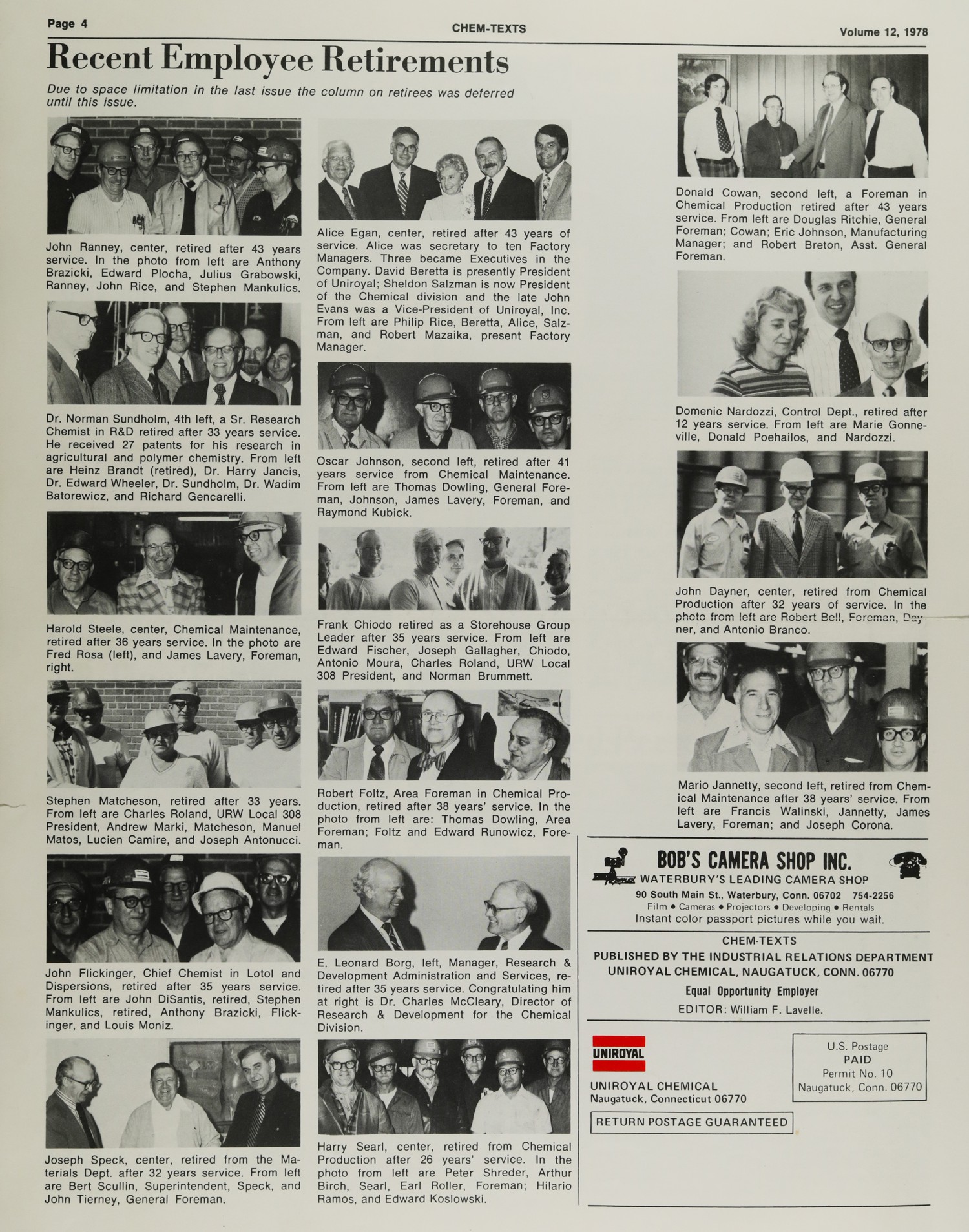
John Ranney, center, retired after 43 years service. In the photo from left are Anthony Brazicki, Edward Plocha, Julius Grabowski, Ranney, John Rice, and Stephen Mankulics.


Alice Egan, center, retired after 43 years of service. Alice was secretary to ten Factory Managers. Three became Executives in the Company. David Beretta is presently President of Uniroyal; Sheldon Salzman is now President of the Chemical division and the late John Evans was a Vice-President of Uniroyal, Inc. From left are Philip Rice, Beretta, Alice, Salzman, and Robert Mazaika, present Factory Manager.


Donald Cowan, second left, a Foreman in Chemical Production retired after 43 years service. From left are Douglas Ritchie, General Foreman; Cowan; Eric Johnson, Manufacturing Manager; and Robert Breton, Asst. General Foreman.


Dr. Norman Sundholm, 4th left, a Sr. Research Chemist in R&D retired after 33 years service. He received 27 patents for his research in agricultural and polymer chemistry. From left are Heinz Brandt (retired), Dr. Harry Jancis, Dr. Edward Wheeler, Dr. Sundholm, Dr. Wadim Batorewicz, and Richard Gencarelli.


Oscar Johnson, second left, retired after 41 years service from Chemical Maintenance. From left are Thomas Dowling, General Foreman, Johnson, James Lavery, Foreman, and Raymond Kubick.


Domenic Nardozzi, Control Dept., retired after 12 years service. From left are Marie Gonneville, Donald Poehailos, and Nardozzi.


Harold Steele, center, Chemical Maintenance, retired after 36 years service. In the photo are Fred Rosa (left), and James Lavery, Foreman, right.


Frank Chiodo retired as a Storehouse Group Leader after 35 years service. From left are Edward Fischer, Joseph Gallagher, Chiodo, Antonio Moura, Charles Roland, URW Local 308 President, and Norman Brummett.


John Dayner, center, retired from Chemical Production after 32 years of service. In the photo from left are Robert Bell, Foreman, Dayner, and Antonio Branco.


Stephen Matcheson, retired after 33 years. From left are Charles Roland, URW Local 308 President, Andrew Marki, Matcheson, Manuel Matos, Lucien Camire, and Joseph Antonucci.


Robert Foltz, Area Foreman in Chemical Production, retired after 38 years’ service. In the photo from left are: Thomas Dowling, Area Foreman; Foltz and Edward Runowicz, Foreman.


Mario Jannetty, second left, retired from Chemical Maintenance after 38 years’ service. From left are Francis Walinski, Jannetty, James Lavery, Foreman; and Joseph Corona.


John Flickinger, Chief Chemist in Lotol and Dispersions, retired after 35 years service. From left are John DiSantis, retired, Stephen Mankulics, retired, Anthony Brazicki, Flickinger, and Louis Moniz.


E. Leonard Borg, left, Manager, Research & Development Administration and Services, retired after 35 years service. Congratulating him at right is Dr. Charles McCleary, Director of Research & Development for the Chemical Division.


BOB’S CAMERA SHOP INC.
WATERBURY’S LEADING CAMERA SHOP
90 South Main St., Waterbury, Conn. 06702 754-2256
Film ● Cameras ● Projectors ● Developing ● Rentals
Instant color passport pictures while you wait.


Joseph Speck, center, retired from the Materials Dept. after 32 years service. From left are Bert Scullin, Superintendent, Speck, and John Tierney, General Foreman.


Harry Searl, center, retired from Chemical Production after 26 years’ service. In the photo from left are Peter Shreder, Arthur Birch, Searl, Earl Roller, Foreman; Hilario Ramos, and Edward Koslowski.


CHEM-TEXTS
PUBLISHED BY THE INDUSTRIAL RELATIONS DEPARTMENT
UNIROYAL CHEMICAL, NAUGATUCK, CONN. 06770
Equal Opportunity Employer
EDITOR: William F. Lavelle.


UNIROYAL

UNIROYAL CHEMICAL
Naugatuck, Connecticut 06770

RETURN POSTAGE GUARANTEED

U.S. Postage
PAID
Permit No. 10
Naugatuck, Conn. 06770
CHEM-TEXTS – 1974 – Page 3

Page 003

CHEM-TEXTS

Vol. 8, 1974 | Page 3


’73 Sales Set Record; Profits Up Slightly

Sales in 1973 set a new record and net income was slightly higher than the previous year.

Sales exceeded 2 billion dollars ($2,082,691,000) an increase of 15.8% over 1972 and the highest in Uniroyal’s history. Profit was $47,094,000, a 1% increase over 1972. Earnings a share of common stock were $1.58 in 1973, compared with $1.55 in 1972.

4th Quarter Sales and Profits Up

In the 4th quarter of 1973, sales were $537 million, for an increase of 16.6% over the same period in 1972.

Profit in the quarter was $12.1 million, compared with $10.7 million the previous year.

Profit in 1973 was affected chiefly by the price freeze on tires and delays by the Cost of Living Council in granting price relief to cover sharp cost increases in raw materials and

other areas. These factors cost Uniroyal about $10 million in Profit and prevented setting a new profit record in line with sales increases.

Many Lines Improve

The Company’s business improved in many lines in 1973. Among them were radial tires, footwear, Naugahyde, TPR Thermoplastic rubber and rubber chemicals.

New records were set by the Fiber and Textile division and by USCO Services and Computeristics.


Club Sponsors Campership

The Uniroyal Girls Club is sponsoring a 2-3 week Campership summer vacation for a handicapped child with all expenses paid.

Transportation must be supplied by the child’s parents or guardians.

If you know a handicapped child who would be interested, contact Rose Juliano, Ext. 565.


1974 Business Outlook For Naugatuck Chemicals

by John Evans, Sales Manager, Rubber Chemicals

The business outlook for Naugatuck® Chemicals, the trade name for the rubber and industrial chemicals manufactured in Chemical Production and other plants, is especially good at this time. The commodity is in a period where sales are largely controlled by either the capacity to make a product or the ability to obtain the necessary raw materials. Many of our products are on allocation for these reasons.

Worldwide Marketer of Chemicals

1973 was an interesting year as Uniroyal Chemical has moved closer to being a global marketer

of chemicals. Increasing costs, raw materials shortages and emphasis on pollution controls offshore, coupled with the devaluation of the American dollar relative to foreign currencies, has substantially increased the export business.

Waste Affects Business

While it might be reasoned that if business is so good we


Social Security Increased In 1974

On January 1 the maximum annual base for the Social Security tax was increased from $10,800 to $13,200 under a new law passed by the U.S. Congress.

The percent of the social security tax remains at 5.85 but the maximum tax to be paid in 1974 has been increased from $631 to $772.

A person who earns $10,800 or less per year will pay the same amount as in 1973.

An employee who earns more than $10,800 will pay a tax on the amount up to $13,200.

Under the Social Security law the individual’s tax amount is matched by an equal amount from the Company.


AA Meeting Places

Alcoholics Anonymous is a fellowship of men and women who share their experience, strength and hope with each other so that they may solve their common problem and help others to recover from alcoholism.

The only requirement for membership is a desire to stop drinking. There are no dues or fees for AA membership.

The AA holds regular meetings in every town and city in Connecticut. Some of these are open meetings to which everyone is welcome; and some are closed to which only alcoholics may go.

It also sponsors Al-Anon Family Group meetings for the relatives and friends of alcoholics to offer friendship, comfort and hope to the families of alcoholics.

For the teen-age children, relatives, and friends of alcoholics, Alateen group meetings are held, mostly in the larger cities.

The following is a list of the towns in this area which hold AA meetings. The time, place, address, and telephone numbers of these meetings can be obtained by calling the Industrial Relations Department, Ext. 624.

TOWNS: Ansonia, Beacon Falls, Bethany, Bethlehem, Bristol, Cheshire, Derby, Hamden, Meriden, Middlebury, Naugatuck, New Haven, Newtown, North Haven, Oakville, Orange, Plymouth, Prospect, Seymour, Shelton, Southbury, Southington, Thomaston, Wallingford, Waterbury, Watertown, West Haven, Wolcott, and Woodbury.


Breen’s

The Biggest Little Store In The Country

Visit our four floors of famous brands for him and her

Ladies’ Dept.
Couture Coats
Tanner Dresses
Vanity Fair Lingerie
Joyce—Naturalizer Shoes

Men’s Shop
Manhattan Shirts
Botany Suits—Sport Coats
H. Freeman Suits
London Fog Rainwear
Florsheim Shoes
Jaymar Slacks

Lingerie Shop
Vanity Fair
Olga—Barbizon
Schrank Robes
Shadowline

Jr. Sportswear
Collegetown Sweaters
White Stag—Skirts, Slacks
Davis Coats
Peerless Sportwear

Ski Boutique
Ski Jackets
Warm-Up Slacks
Ski Pants
Ski Sweaters
Gloves & Sweaters

Cosmetic & Jewelry Dept.
Guerlain — Yves Saint Laurent
Elizabeth Arden — Monet
Nina-Ricci — Napier
Chanel — Marvella Pearls


[PHOTO CAPTION:]
John Evans, Marketing Manager for Naugatuck Chemicals and Industrial Chemicals, and former Factory Manager, points to Naugatuck on map of world. Rubber chemicals manufactured here are now shipped to a global market.


can afford to let up a little in our efforts, this would be a serious error in reasoning. With raw material and energy shortages and increasing costs, it is essential that we increase our efficiency, yields, and minimize off-specification production. Every pound of raw material must be efficiently converted to a saleable finished product. Waste must be eliminated.

The unreliability of raw material supplies, along with varying customer needs, will undoubtedly upset production schedules. We must accept these changes as an everyday procedure during this hectic period. Flexibility is the key to success.

his customers the best will be a long way up on competition when the situation eases up.

It is very important that when we make commitments to supply a customer a certain quantity on a certain date that he gets this material. I’m sure you realize from your own experience the frustration of promises not kept.

These are exciting times. They demand the utmost in ingenuity and planning and total follow through by everybody to get products produced and sold. From my close associations with the people of the Naugatuck plant, I am confident that we can meet these challenges.

Must Keep Our Word

Another factor to remember is that the shortages won’t last forever. The supplier that treats


’74

Take stock in America.


Chittenden Insurance Agency, Inc.

Insurance—Mutual Funds—Real Estate

180 Church Street
Naugatuck, Connecticut
Tel. 729-8209

Frederick D. Zonino | Nathan M. Pierpont, Jr.

CHEM-TEXTS – Vol. 4 No. 1 – Page 2

Page 002

CHEM-TEXTS

Page 2 | Vol. 4, No. 1


FROM THE FACTORY MANAGER

DEAR FELLOW EMPLOYEE:

During most of the 1960’s, in fact until about mid-1969, our plant has operated in what Jim Cronin has called an “oversold” position. In other words, we were operating all out to produce every pound we could, to meet our customers’ requirements.

In 1969 the situation changed to what can be called an “undersold” position, which means we can produce more than the customer needs. This fairly abrupt change from what had become an established way of operating has affected the way all of us do our jobs. Basically, under these conditions all of us have to make better decisions faster in order to be responsive to the customers’ needs at the moment.

Considering the general decline in business activity in the markets we serve, the high cost of money, the “undersold” capacity of domestic competition and increasing foreign competition, I expect that these conditions will continue well into 1970. Therefore, it becomes even more important that we be as flexible to change as possible. Under these circumstances what we did yesterday isn’t important. What is important, is what we do right now to meet a new opportunity.

All of us have expressed individual pride in the flexibility of our plant – men and machinery alike – to do the job, whatever the requirements. Now if we really have this flexibility, and I believe we do, it seems to me that the economic climate of 1970 plays right into our hands.

I’m confident we can and will meet these demands regardless of how difficult they may be.

Sincerely,

John

John D. Evans


Jaroy Inc. Enjoys Brisk Sales

Jaroy, Inc. officers sell stock to Uniroyal Chemical employees. From left to right are John Evans, Factory Manager; Jill Subataitis, President of Jaroy; Harry Witt, Synthetic Production Superintendent; Joe Rzeszutek, President URW Local 218; Ted Lainas; Jim Brown; Ron Mitchinson, Industrial Relations Manager; and Jo Ann Niski, Purchasing Agent.

by Ted Lainas

Jaroy, Junior Achievement of Uniroyal, is a small company with big goals. On its first day of sales, the company sold every product made during the past months.

Jaroy is a Junior Achievement company sponsored by Uniroyal Chemical, and consists of Naugatuck High School students and one Achiever from Holy Cross High.

The basic principle of the JA program is to give high school students real business experience and to help them develop an accurate understanding of the economic factors that make the free enterprise system work.

Issues Stock For Capital

The company issues and sells stock for its operating capital. This money is used to buy raw materials, tools, pay rent, heat, and light bills, and other expenditures to operate the business. Jaroy pays regular salaries, and taxes, carries insurance, and pays dividends to stockholders from any profits made.

Living Economics

Economics can be a difficult subject, especially when taught from a textbook and by lectures. In Junior Achievement, the student puts into practice what is taught in school about complicated practices and theories. Be-

Continued on page 4


Trucks Get Safety Belts

by Bob Shortt

Safety belts are being installed in all plant trucks for safety protection for plant drivers as a result of a survey by the Cornell Aeronautical Laboratory of Cornell University.

For a long time, the trucking industry had questioned the value of safety belts in trucks because of the floating seat drivers used for comfort, but the survey results indicate otherwise.

A study of 243 truck accidents showed the frequency of door openings in trucks to be double the frequency of door openings in 1963 model automobiles. The frequency of truck driver ejection was shown to be about double the frequency of driver ejections from recent model automobiles. The rate of dangerous or fatal injuries for ejected truck drivers was four times as high as for non-ejected truck drivers. Therefore, it is believed

Continued on page 3

Presley Joines, a driver for Synthetic Materials Handling shows safety belt installed in new plant truck to John Metesky, right. Seat belts provide extra safety protection for our drivers.


At left of photo is conveyor to carry scrap tires to grinder. Employee’s head barely missed the steel prong of the conveyor as he fell backwards. (Conveyor prongs were retouched to show them more clearly).


Man Slips . . .

Continued from page 1

injuries. Training and education programs, installation of safer equipment, and repairs are continually being made to improve safety.

In the final analysis, however, Safety is the responsibility of every employee. Unless he has a safety attitude, performs his job safely, wears the proper safety clothing and equipment and avoids taking chances, accidents and injuries will continue to happen.

55,200 persons were killed in motor vehicle accidents in 1968, an increase of 4% over 1967.


Foremen’s Club Changes Name And By-Laws

by Lou Kaiser

By a high margin vote, the Uniroyal Chemical Foremen’s Club changed its name to the Uniroyal Chemical Management Club.

The new by-laws open membership to all male salaried personnel. Members of the Divisional staff are now eligible for the Club but are not eligible to hold office.

Dues were increased from $6 to $8 yearly.

CHEM-TEXTS – Vol. 4 No. 3 – Page 3

Page 003

CHEM-TEXTS

Vol. 4 No. 3 Page 3


Supervisory Skills Training Program Started For Foremen

[LEFT PHOTO CAPTION:]
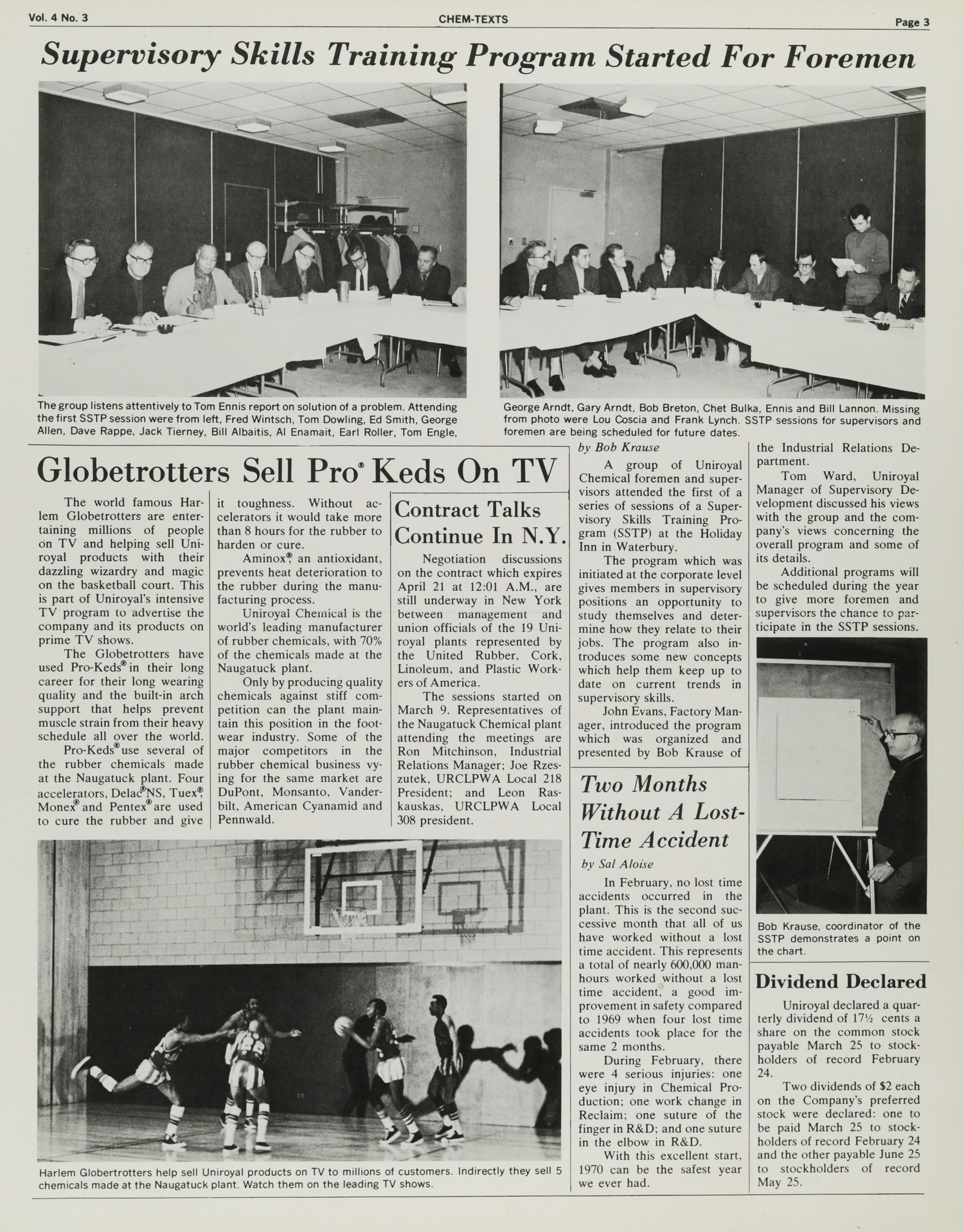
The group listens attentively to Tom Ennis report on solution of a problem. Attending the first SSTP session were from left, Fred Wintsch, Tom Dowling, Ed Smith, George Allen, Dave Rappe, Jack Tierney, Bill Albaitis, Al Enamait, Earl Roller, Tom Engle,

[RIGHT PHOTO CAPTION:]
George Arndt, Gary Arndt, Bob Breton, Chet Bulka, Ennis and Bill Lannon. Missing from photo were Lou Coscia and Frank Lynch. SSTP sessions for supervisors and foremen are being scheduled for future dates.


Globetrotters Sell Pro* Keds On TV

The world famous Harlem Globetrotters are entertaining millions of people on TV and helping sell Uniroyal products with their dazzling wizardry and magic on the basketball court. This is part of Uniroyal’s intensive TV program to advertise the company and its products on prime TV shows.

The Globetrotters have used Pro-Keds® in their long career for their long wearing quality and the built-in arch support that helps prevent muscle strain from their heavy schedule all over the world.

Pro-Keds® use several of the rubber chemicals made at the Naugatuck plant. Four accelerators, Delac®NS, Tuex®, Monex® and Pentex® are used to cure the rubber and give it toughness. Without accelerators it would take more than 8 hours for the rubber to harden or cure.

Aminox®, an antioxidant, prevents heat deterioration to the rubber during the manufacturing process.

Uniroyal Chemical is the world’s leading manufacturer of rubber chemicals, with 70% of the chemicals made at the Naugatuck plant.

Only by producing quality chemicals against stiff competition can the plant maintain this position in the footwear industry. Some of the major competitors in the rubber chemical business vying for the same market are DuPont, Monsanto, Vanderbilt, American Cyanamid and Pennwald.


Contract Talks Continue In N.Y.

Negotiation discussions on the contract which expires April 21 at 12:01 A.M., are still underway in New York between management and union officials of the 19 Uniroyal plants represented by the United Rubber, Cork, Linoleum, and Plastic Workers of America.

The sessions started on March 9. Representatives of the Naugatuck Chemical plant attending the meetings are Ron Mitchinson, Industrial Relations Manager; Joe Rzeszutek, URCLPWA Local 218 President; and Leon Raskauskas, URCLPWA Local 308 president.


by Bob Krause

A group of Uniroyal Chemical foremen and supervisors attended the first of a series of sessions of a Supervisory Skills Training Program (SSTP) at the Holiday Inn in Waterbury.

The program which was initiated at the corporate level gives members in supervisory positions an opportunity to study themselves and determine how they relate to their jobs. The program also introduces some new concepts which help them keep up to date on current trends in supervisory skills.

John Evans, Factory Manager, introduced the program which was organized and presented by Bob Krause of the Industrial Relations Department.

Tom Ward, Uniroyal Manager of Supervisory Development discussed his views with the group and the company’s views concerning the overall program and some of its details.

Additional programs will be scheduled during the year to give more foremen and supervisors the chance to participate in the SSTP sessions.


[BOTTOM LEFT PHOTO CAPTION:]
Harlem Globertrotters help sell Uniroyal products on TV to millions of customers. Indirectly they sell 5 chemicals made at the Naugatuck plant. Watch them on the leading TV shows.


Two Months Without A Lost-Time Accident

by Sal Aloise

In February, no lost time accidents occurred in the plant. This is the second successive month that all of us have worked without a lost time accident. This represents a total of nearly 600,000 manhours worked without a lost time accident, a good improvement in safety compared to 1969 when four lost time accidents took place for the same 2 months.

During February, there were 4 serious injuries: one eye injury in Chemical Production; one work change in Reclaim; one suture of the finger in R&D; and one suture in the elbow in R&D.

With this excellent start, 1970 can be the safest year we ever had.


[RIGHT PHOTO CAPTION:]
Bob Krause, coordinator of the SSTP demonstrates a point on the chart.


Dividend Declared

Uniroyal declared a quarterly dividend of 17½ cents a share on the common stock payable March 25 to stockholders of record February 24.

Two dividends of $2 each on the Company’s preferred stock were declared: one to be paid March 25 to stockholders of record February 24 and the other payable June 25 to stockholders of record May 25.

CHEM-TEXTS – Vol. 3 No. 11 – Page 4

Page 004

Page 4 | CHEM-TEXT | Vol. 3 No. 11

$21,000 Contributed to United Givers

[PHOTO: Image showing people near a vehicle, including children on crutches and adults]

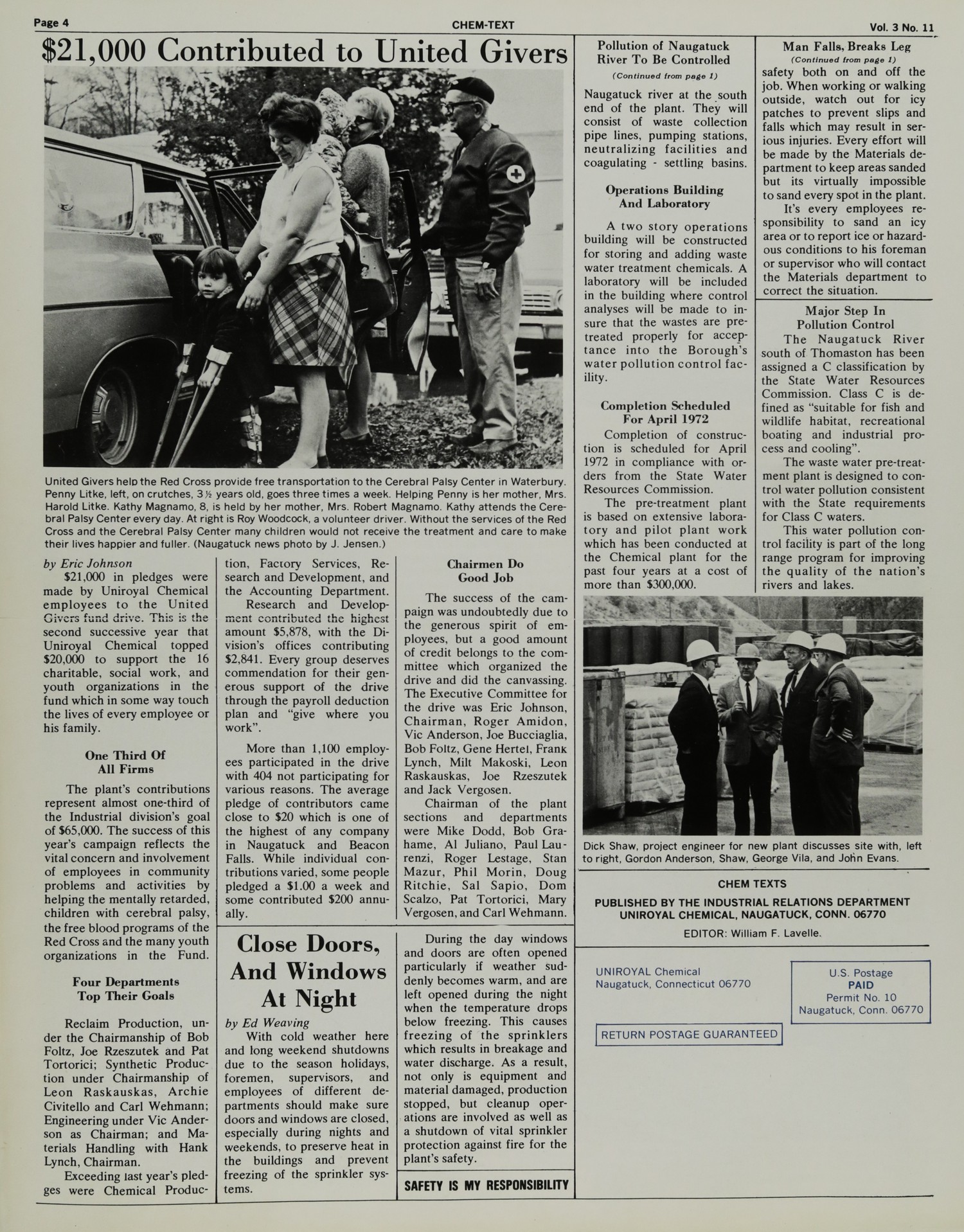
United Givers help the Red Cross provide free transportation to the Cerebral Palsy Center in Waterbury. Penny Litke, left, on crutches, 3 ½ years old, goes three times a week. Helping Penny is her mother, Mrs. Harold Litke. Kathy Magnamo, 8, is held by her mother, Mrs. Robert Magnamo. Kathy attends the Cerebral Palsy Center every day. At right is Roy Woodcock, a volunteer driver. Without the services of the Red Cross and the Cerebral Palsy Center many children would not receive the treatment and care to make their lives happier and fuller. (Naugatuck news photo by J. Jensen.)


by Eric Johnson

$21,000 in pledges were made by Uniroyal Chemical employees to the United Givers fund drive. This is the second successive year that Uniroyal Chemical topped $20,000 to support the 16 charitable, social work, and youth organizations in the fund which in some way touch the lives of every employee or his family.

One Third Of All Firms

The plant’s contributions represent almost one-third of the Industrial division’s goal of $65,000. The success of this year’s campaign reflects the vital concern and involvement of employees in community problems and activities by helping the mentally retarded, children with cerebral palsy, the free blood programs of the Red Cross and the many youth organizations in the Fund.

Four Departments Top Their Goals

Reclaim Production, under the Chairmanship of Bob Foltz, Joe Rzeszutek and Pat Tortorici; Synthetic Production under Chairmanship of Leon Raskauskas, Archie Civitello and Carl Wehmann; Engineering under Vic Anderson as Chairman; and Materials Handling with Hank Lynch, Chairman.

Exceeding last year’s pledges were Chemical Production, Factory Services, Research and Development, and the Accounting Department.

Research and Development contributed the highest amount $5,878, with the Division’s offices contributing $2,841. Every group deserves commendation for their generous support of the drive through the payroll deduction plan and “give where you work”.

More than 1,100 employees participated in the drive with 404 not participating for various reasons. The average pledge of contributors came close to $20 which is one of the highest of any company in Naugatuck and Beacon Falls. While individual contributions varied, some people pledged a $1.00 a week and some contributed $200 annually.


Close Doors, And Windows At Night

by Ed Weaving

With cold weather here and long weekend shutdowns due to the season holidays, foremen, supervisors, and employees of different departments should make sure doors and windows are closed, especially during nights and weekends, to preserve heat in the buildings and prevent freezing of the sprinkler systems.


Chairmen Do Good Job

The success of the campaign was undoubtedly due to the generous spirit of employees, but a good amount of credit belongs to the committee which organized the drive and did the canvassing. The Executive Committee for the drive was Eric Johnson, Chairman, Roger Amidon, Vic Anderson, Joe Bucciaglia, Bob Foltz, Gene Hertel, Frank Lynch, Milt Makoski, Leon Raskauskas, Joe Rzeszutek and Jack Vergosen.

Chairman of the plant sections and departments were Mike Dodd, Bob Grahame, Al Juliano, Paul Laurenzi, Roger Lestage, Stan Mazur, Phil Morin, Doug Ritchie, Sal Sapio, Dom Scalzo, Pat Tortorici, Mary Vergosen, and Carl Wehmann.

During the day windows and doors are often opened particularly if weather suddenly becomes warm, and are left opened during the night when the temperature drops below freezing. This causes freezing of the sprinklers which results in breakage and water discharge. As a result, not only is equipment and material damaged, production stopped, but cleanup operations are involved as well as a shutdown of vital sprinkler protection against fire for the plant’s safety.

SAFETY IS MY RESPONSIBILITY


Pollution of Naugatuck River To Be Controlled

(Continued from page 1)

Naugatuck river at the south end of the plant. They will consist of waste collection pipe lines, pumping stations, neutralizing facilities and coagulating – settling basins.

Operations Building And Laboratory

A two story operations building will be constructed for storing and adding waste water treatment chemicals. A laboratory will be included in the building where control analyses will be made to insure that the wastes are pretreated properly for acceptance into the Borough’s water pollution control facility.

Completion Scheduled For April 1972

Completion of construction is scheduled for April 1972 in compliance with orders from the State Water Resources Commission.

The pre-treatment plant is based on extensive laboratory and pilot plant work which has been conducted at the Chemical plant for the past four years at a cost of more than $300,000.


Man Falls, Breaks Leg

(Continued from page 1)

safety both on and off the job. When working or walking outside, watch out for icy patches to prevent slips and falls which may result in serious injuries. Every effort will be made by the Materials department to keep areas sanded but its virtually impossible to sand every spot in the plant.

It’s every employees responsibility to sand an icy area or to report ice or hazardous conditions to his foreman or supervisor who will contact the Materials department to correct the situation.

Major Step In Pollution Control

The Naugatuck River south of Thomaston has been assigned a C classification by the State Water Resources Commission. Class C is defined as “suitable for fish and wildlife habitat, recreational boating and industrial process and cooling”.

The waste water pre-treatment plant is designed to control water pollution consistent with the State requirements for Class C waters.

This water pollution control facility is part of the long range program for improving the quality of the nation’s rivers and lakes.


[PHOTO: Four men in hard hats examining documents outdoors]

Dick Shaw, project engineer for new plant discusses site with, left to right, Gordon Anderson, Shaw, George Vila, and John Evans.


CHEM TEXTS

PUBLISHED BY THE INDUSTRIAL RELATIONS DEPARTMENT
UNIROYAL CHEMICAL, NAUGATUCK, CONN. 06770

EDITOR: William F. Lavelle.


UNIROYAL Chemical
Naugatuck, Connecticut 06770

U.S. Postage
PAID
Permit No. 10
Naugatuck, Conn. 06770
RETURN POSTAGE GUARANTEED

Local 218 Protests Uniroyal Statement

Local 218 Protests Uniroyal Statement

Local 218 Protests Uniroyal Statement

5-28-67 [handwritten date in top right corner]

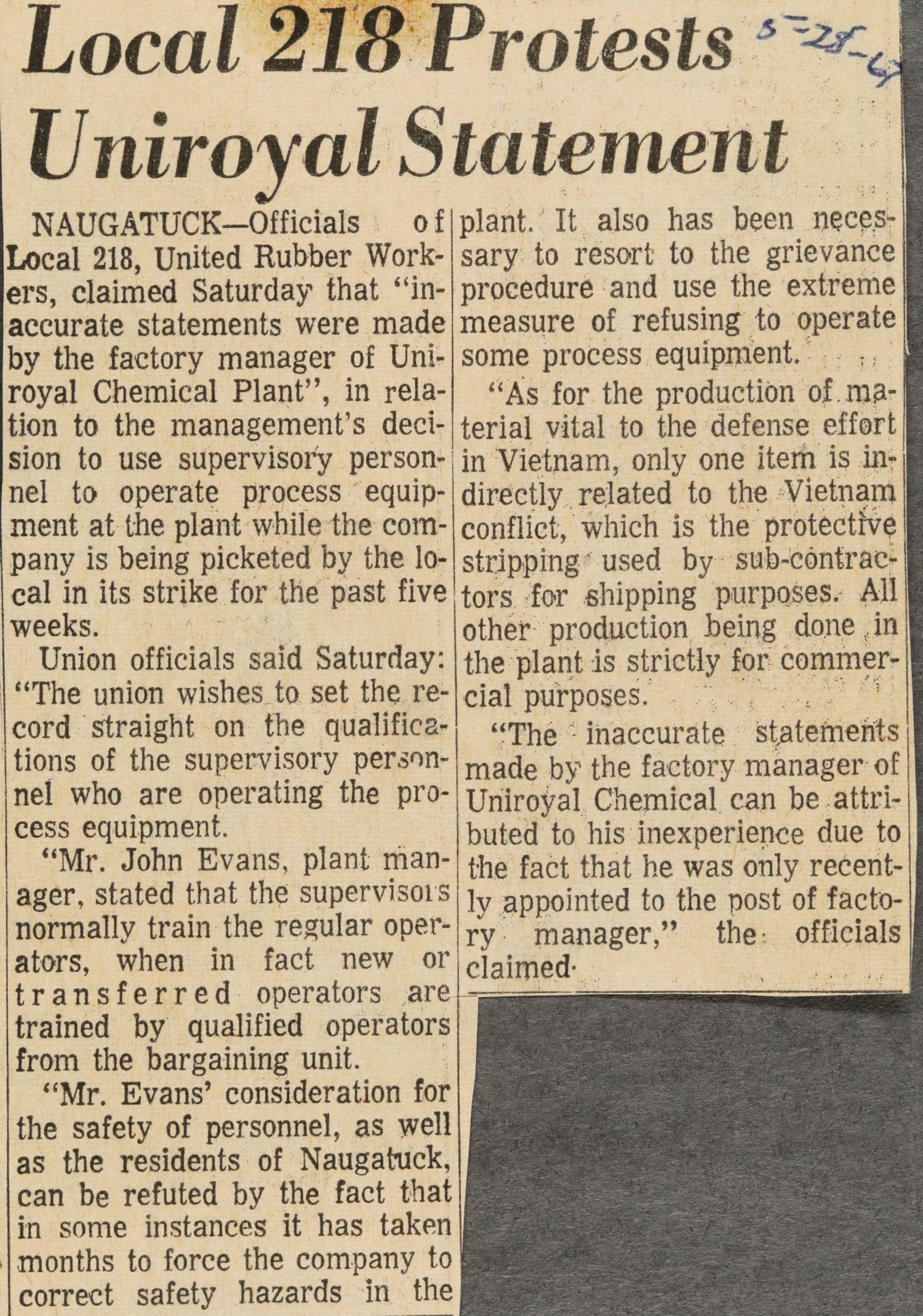
NAUGATUCK—Officials of Local 218, United Rubber Workers, claimed Saturday that “inaccurate statements were made by the factory manager of Uniroyal Chemical Plant”, in relation to the management’s decision to use supervisory personnel to operate process equipment at the plant while the company is being picketed by the local in its strike for the past five weeks.

Union officials said Saturday: “The union wishes to set the record straight on the qualifications of the supervisory personnel who are operating the process equipment.

“Mr. John Evans, plant manager, stated that the supervisors normally train the regular operators, when in fact new or transferred operators are trained by qualified operators from the bargaining unit.

“Mr. Evans’ consideration for the safety of personnel, as well as the residents of Naugatuck, can be refuted by the fact that in some instances it has taken months to force the company to correct safety hazards in the plant. It also has been necessary to resort to the grievance procedure and use the extreme measure of refusing to operate some process equipment.

“As for the production of material vital to the defense effort in Vietnam, only one item is indirectly related to the Vietnam conflict, which is the protective stripping used by sub-contractors for shipping purposes. All other production being done in the plant is strictly for commercial purposes.

“The inaccurate statements made by the factory manager of Uniroyal Chemical can be attributed to his inexperience due to the fact that he was only recently appointed to the post of factory manager,” the officials claimed.

CHEM-TEXTS – Vol. 2, No. 5 – Page 1

Page 001

UNIROYAL

CHEM-TEXTS

Vol. 2 PUBLISHED FOR THE PEOPLE OF UNIROYAL CHEMICAL No. 5


New Chemical Holds Apples On Trees; Makes Them Firmer, Redder In Color

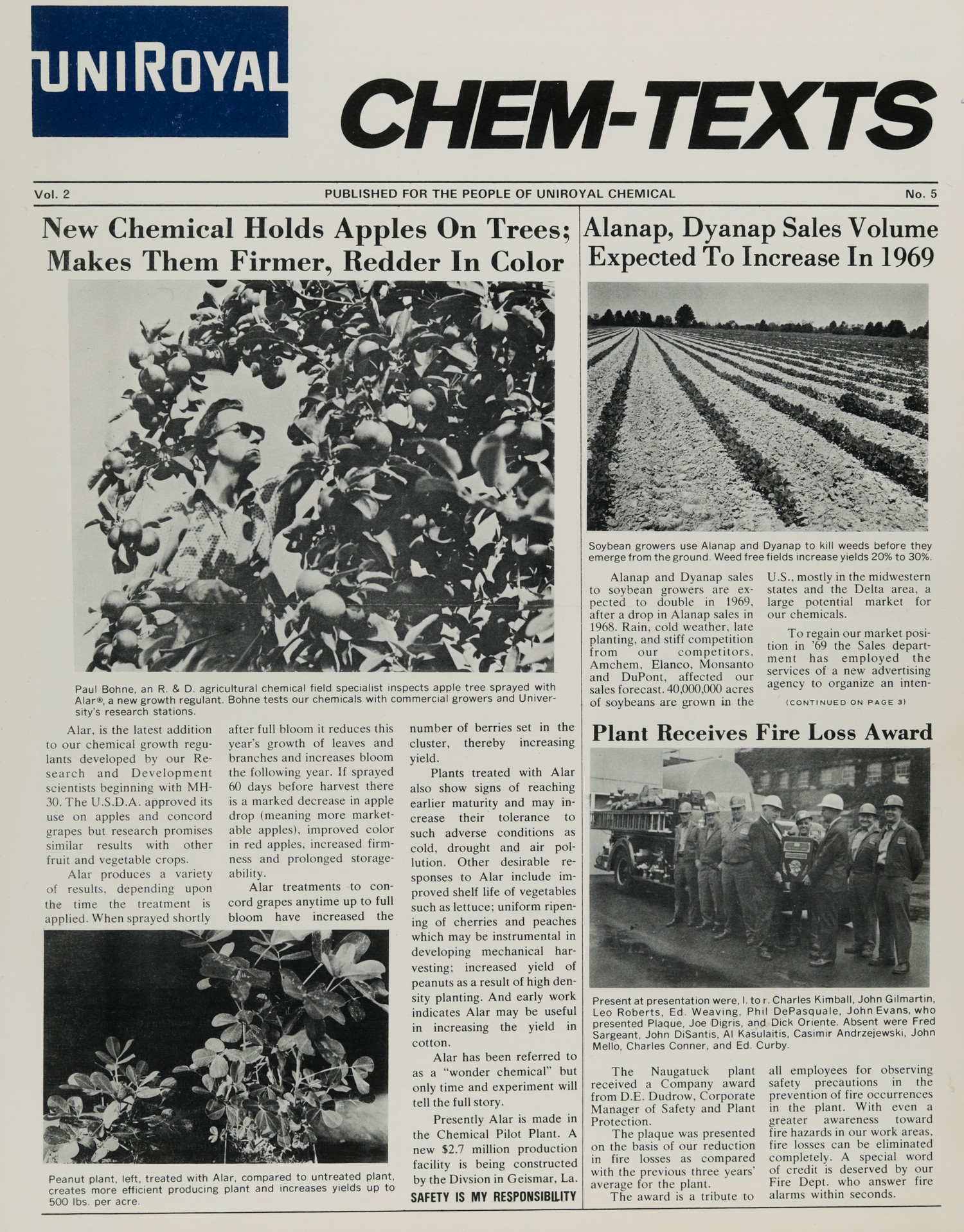
[IMAGE: Paul Bohne, an R. & D. agricultural chemical field specialist inspects apple tree sprayed with Alar®, a new growth regulant. Bohne tests our chemicals with commercial growers and University’s research stations.]

Alar, is the latest addition to our chemical growth regulants developed by our Research and Development scientists beginning with MH-30. The U.S.D.A. approved its use on apples and concord grapes but research promises similar results with other fruit and vegetable crops.

Alar produces a variety of results, depending upon the time the treatment is applied. When sprayed shortly after full bloom it reduces this year’s growth of leaves and branches and increases bloom the following year. If sprayed 60 days before harvest there is a marked decrease in apple drop (meaning more marketable apples), improved color in red apples, increased firmness and prolonged storageability.

Alar treatments to concord grapes anytime up to full bloom have increased the number of berries set in the cluster, thereby increasing yield.

Plants treated with Alar also show signs of reaching earlier maturity and may increase their tolerance to such adverse conditions as cold, drought and air pollution. Other desirable responses to Alar include improved shelf life of vegetables such as lettuce; uniform ripening of cherries and peaches which may be instrumental in developing mechanical harvesting; increased yield of peanuts as a result of high density planting. And early work indicates Alar may be useful in increasing the yield in cotton.

Alar has been referred to as a “wonder chemical” but only time and experiment will tell the full story.

Presently Alar is made in the Chemical Pilot Plant. A new $2.7 million production facility is being constructed by the Divsion in Geismar, La.

SAFETY IS MY RESPONSIBILITY

[IMAGE: Peanut plant, left, treated with Alar, compared to untreated plant, creates more efficient producing plant and increases yields up to 500 lbs. per acre.]


Alanap, Dyanap Sales Volume Expected To Increase In 1969

[IMAGE: Soybean growers use Alanap and Dyanap to kill weeds before they emerge from the ground. Weed free fields increase yields 20% to 30%.]

Alanap and Dyanap sales to soybean growers are expected to double in 1969, after a drop in Alanap sales in 1968. Rain, cold weather, late planting, and stiff competition from our competitors, Amchem, Elanco, Monsanto and DuPont, affected our sales forecast. 40,000,000 acres of soybeans are grown in the U.S., mostly in the midwestern states and the Delta area, a large potential market for our chemicals.

To regain our market position in ’69 the Sales department has employed the services of a new advertising agency to organize an inten-

(CONTINUED ON PAGE 3)


Plant Receives Fire Loss Award

[IMAGE: Present at presentation were, l. to r. Charles Kimball, John Gilmartin, Leo Roberts, Ed. Weaving, Phil DePasquale, John Evans, who presented Plaque, Joe Digris, and Dick Oriente. Absent were Fred Sargeant, John DiSantis, Al Kaslutas, Casimir Andrzejewski, John Mello, Charles Conner, and Ed. Curby.]

The Naugatuck plant received a Company award from D.E. Dudrow, Corporate Manager of Safety and Plant Protection.

The plaque was presented on the basis of our reduction in fire losses as compared with the previous three years’ average for the plant.

The award is a tribute to all employees for observing safety precautions in the prevention of fire occurrences in the plant. With even a greater awareness toward fire hazards in our work areas, fire losses can be eliminated completely. A special word of credit is deserved by our Fire Dept. who answer fire alarms within seconds.

CHEM-TEXTS – Vol. 2 No. 6 – Page 3

Page 003

CHEM-TEXTS

Vol. 2 No. 6 Page 3


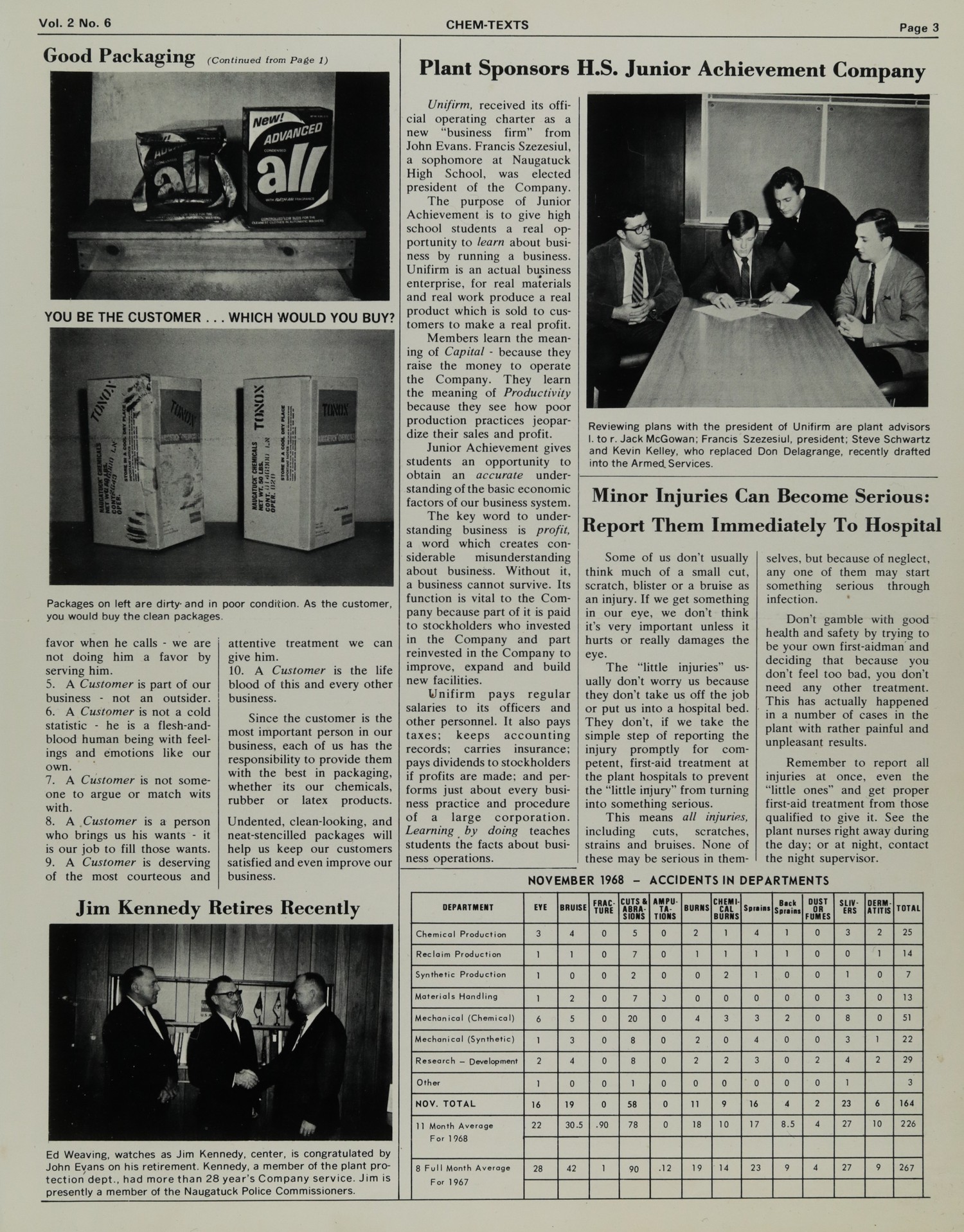
Good Packaging (Continued from Page 1)

[IMAGE: Box of “New! ADVANCED all” detergent]

[IMAGE: Packages of “THNX” products stacked]

YOU BE THE CUSTOMER . . . WHICH WOULD YOU BUY?

Packages on left are dirty and in poor condition. As the customer, you would buy the clean packages.

favor when he calls – we are not doing him a favor by serving him.

  1. A Customer is part of our business – not an outsider.
  2. A Customer is not a cold statistic – he is a flesh-and-blood human being with feelings and emotions like our own.
  3. A Customer is not someone to argue or match wits with.
  4. A Customer is a person who brings us his wants – it is our job to fill those wants.
  5. A Customer is deserving of the most courteous and attentive treatment we can give him.
  6. A Customer is the life blood of this and every other business.

Since the customer is the most important person in our business, each of us has the responsibility to provide them with the best in packaging, whether its our chemicals, rubber or latex products. Undented, clean-looking, and neat-stencilled packages will help us keep our customers satisfied and even improve our business.


Jim Kennedy Retires Recently

[IMAGE: Three men in suits, one shaking hands with another]

Ed Weaving, watches as Jim Kennedy, center, is congratulated by John Evans on his retirement. Kennedy, a member of the plant protection dept., had more than 28 year’s Company service. Jim is presently a member of the Naugatuck Police Commissioners.


Plant Sponsors H.S. Junior Achievement Company

Unifirm, received its official operating charter as a new “business firm” from John Evans. Francis Szezesiul, a sophomore at Naugatuck High School, was elected president of the Company.

The purpose of Junior Achievement is to give high school students a real opportunity to learn about business by running a business. Unifirm is an actual business enterprise, for real materials and real work produce a real product which is sold to customers to make a real profit.

Members learn the meaning of Capital – because they raise the money to operate the Company. They learn the meaning of Productivity because they see how poor production practices jeopardize their sales and profit.

Junior Achievement gives students an opportunity to obtain an accurate understanding of the basic economic factors of our business system.

The key word to understanding business is profit, a word which creates considerable misunderstanding about business. Without it, a business cannot survive. Its function is vital to the Company because part of it is paid to stockholders who invested in the Company and part reinvested in the Company to improve, expand and build new facilities.

Unifirm pays regular salaries to its officers and other personnel. It also pays taxes; keeps accounting records; carries insurance; pays dividends to stockholders if profits are made; and performs just about every business practice and procedure of a large corporation. Learning by doing teaches students the facts about business operations.

[IMAGE: Group of men reviewing documents at a table]

Reviewing plans with the president of Unifirm are plant advisors l. to r. Jack McGowan; Francis Szezesiul, president; Steve Schwartz and Kevin Kelley, who replaced Don Delagrange, recently drafted into the Armed Services.


Minor Injuries Can Become Serious: Report Them Immediately To Hospital

Some of us don’t usually think much of a small cut, scratch, blister or a bruise as an injury. If we get something in our eye, we don’t think it’s very important unless it hurts or really damages the eye.

The “little injuries” usually don’t worry us because they don’t take us off the job or put us into a hospital bed. They don’t, if we take the simple step of reporting the injury promptly for competent, first-aid treatment at the plant hospitals to prevent the “little injury” from turning into something serious.

This means all injuries, including cuts, scratches, strains and bruises. None of these may be serious in themselves, but because of neglect, any one of them may start something serious through infection.

Don’t gamble with good health and safety by trying to be your own first-aidman and deciding that because you don’t feel too bad, you don’t need any other treatment. This has actually happened in a number of cases in the plant with rather painful and unpleasant results.

Remember to report all injuries at once, even the “little ones” and get proper first-aid treatment from those qualified to give it. See the plant nurses right away during the day; or at night, contact the night supervisor.


NOVEMBER 1968 — ACCIDENTS IN DEPARTMENTS

DEPARTMENT EYE BRUISE FRAC-TURE CUTS & ABRA-SIONS AMPU-TA-TIONS BURNS CHEMI-CAL BURNS Sprains Back Sprains DUST OR FUMES SLIV-ERS DERM-ATITIS TOTAL
Chemical Production 3 4 0 5 0 2 1 4 1 0 3 2 25
Reclaim Production 1 1 0 7 0 1 1 1 1 0 0 1 14
Synthetic Production 1 0 0 2 0 0 2 1 0 0 1 0 7
Materials Handling 1 2 0 7 0 0 0 0 0 0 3 0 13
Mechanical (Chemical) 6 5 0 20 0 4 3 3 2 0 8 0 51
Mechanical (Synthetic) 1 3 0 8 0 2 0 4 0 0 3 1 22
Research — Development 2 4 0 8 0 2 2 3 0 2 4 2 29
Other 1 0 0 1 0 0 0 0 0 0 1 3
NOV. TOTAL 16 19 0 58 0 11 9 16 4 2 23 6 164
11 Month Average For 1968 22 30.5 .90 78 0 18 10 17 8.5 4 27 10 226
8 Full Month Average For 1967 28 42 1 90 .12 19 14 23 9 4 27 9 267

CHEM-TEXTS – Vol. 2 No. 3 – Page 2

Page 002

Page 2 | CHEM-TEXT | Vol. 2 No. 3


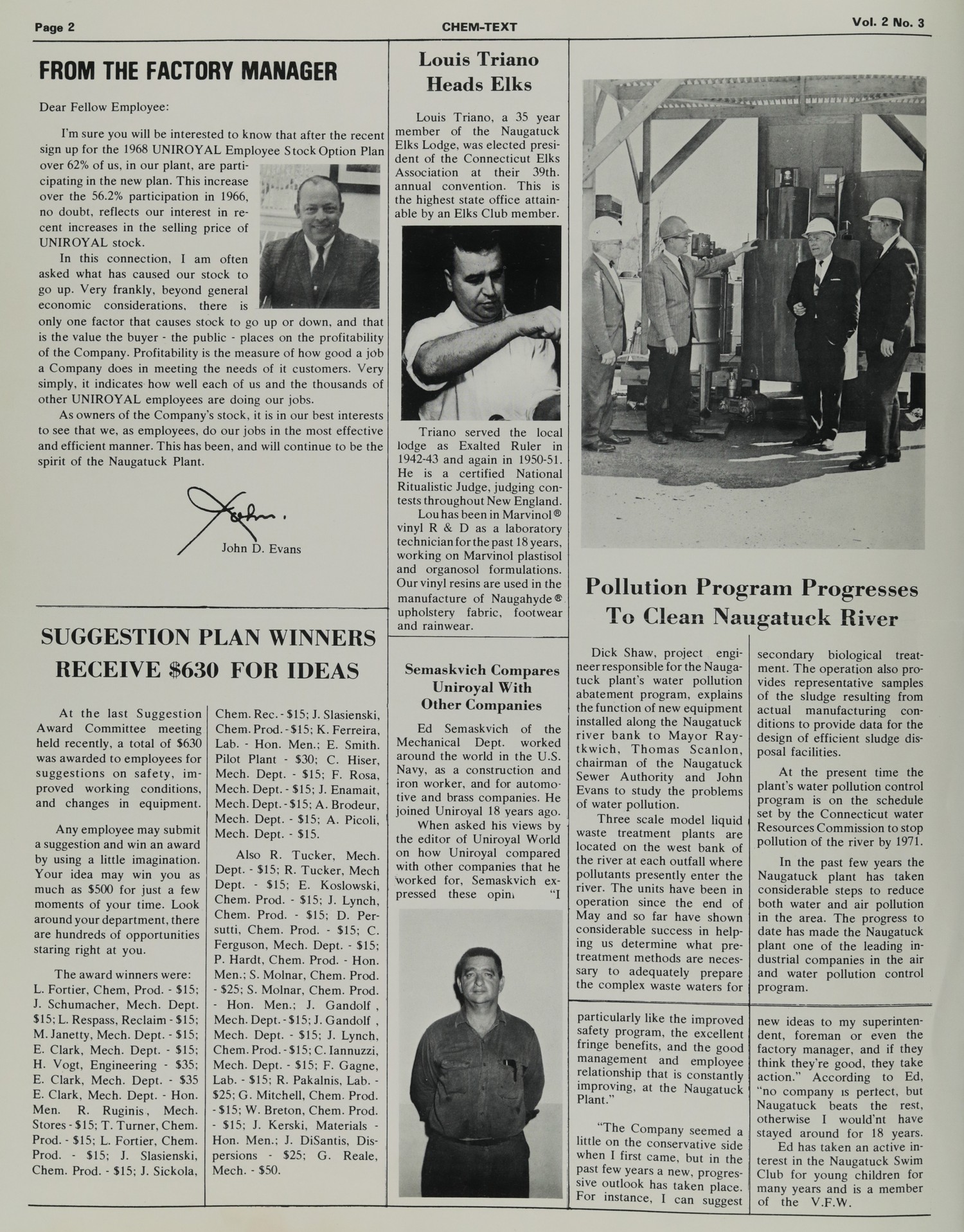
FROM THE FACTORY MANAGER

Dear Fellow Employee:

I’m sure you will be interested to know that after the recent sign up for the 1968 UNIROYAL Employee Stock Option Plan over 62% of us, in our plant, are participating in the new plan. This increase over the 56.2% participation in 1966, no doubt, reflects our interest in recent increases in the selling price of UNIROYAL stock.

In this connection, I am often asked what has caused our stock to go up. Very frankly, beyond general economic considerations, there is only one factor that causes stock to go up or down, and that is the value the buyer – the public – places on the profitability of the Company. Profitability is the measure of how good a job a Company does in meeting the needs of it customers. Very simply, it indicates how well each of us and the thousands of other UNIROYAL employees are doing our jobs.

As owners of the Company’s stock, it is in our best interests to see that we, as employees, do our jobs in the most effective and efficient manner. This has been, and will continue to be the spirit of the Naugatuck Plant.

[Signature]

John D. Evans


Louis Triano Heads Elks

Louis Triano, a 35 year member of the Naugatuck Elks Lodge, was elected president of the Connecticut Elks Association at their 39th. annual convention. This is the highest state office attainable by an Elks Club member.

Triano served the local lodge as Exalted Ruler in 1942-43 and again in 1950-51. He is a certified National Ritualistic Judge, judging contests throughout New England.

Lou has been in Marvinol® vinyl R & D as a laboratory technician for the past 18 years, working on Marvinol plastisol and organosol formulations. Our vinyl resins are used in the manufacture of Naugahyde® upholstery fabric, footwear and rainwear.


Semaskvich Compares Uniroyal With Other Companies

Ed Semaskvich of the Mechanical Dept. worked around the world in the U.S. Navy, as a construction and iron worker, and for automotive and brass companies. He joined Uniroyal 18 years ago.

When asked his views by the editor of Uniroyal World on how Uniroyal compared with other companies that he worked for, Semaskvich expressed these opini “I

particularly like the improved safety program, the excellent fringe benefits, and the good management and employee relationship that is constantly improving, at the Naugatuck Plant.”

“The Company seemed a little on the conservative side when I first came, but in the past few years a new, progressive outlook has taken place. For instance, I can suggest

new ideas to my superintendent, foreman or even the factory manager, and if they think they’re good, they take action.” According to Ed, “no company is pertect, but Naugatuck beats the rest, otherwise I would’nt have stayed around for 18 years.

Ed has taken an active interest in the Naugatuck Swim Club for young children for many years and is a member of the V.F.W.


SUGGESTION PLAN WINNERS RECEIVE $630 FOR IDEAS

At the last Suggestion Award Committee meeting held recently, a total of $630 was awarded to employees for suggestions on safety, improved working conditions, and changes in equipment.

Any employee may submit a suggestion and win an award by using a little imagination. Your idea may win you as much as $500 for just a few moments of your time. Look around your department, there are hundreds of opportunities staring right at you.

The award winners were:
L. Fortier, Chem, Prod. – $15; J. Schumacher, Mech. Dept. $15; L. Respass, Reclaim – $15; M. Janetty, Mech. Dept. – $15; E. Clark, Mech. Dept. – $15; H. Vogt, Engineering – $35; E. Clark, Mech. Dept. – $35 E. Clark, Mech. Dept. – Hon. Men. R. Ruginis, Mech. Stores – $15; T. Turner, Chem. Prod. – $15; L. Fortier, Chem. Prod. – $15; J. Slasienski, Chem. Prod. – $15; J. Sickola,

Chem. Rec. – $15; J. Slasienski, Chem. Prod. – $15; K. Ferreira, Lab. – Hon. Men.; E. Smith, Pilot Plant – $30; C. Hiser, Mech. Dept. – $15; F. Rosa, Mech. Dept. – $15; J. Enamait, Mech. Dept. – $15; A. Brodeur, Mech. Dept. – $15; A. Picoli, Mech. Dept. – $15.

Also R. Tucker, Mech. Dept. – $15; R. Tucker, Mech Dept. – $15; E. Koslowski, Chem. Prod. – $15; J. Lynch, Chem. Prod. – $15; D. Persutti, Chem. Prod. – $15; C. Ferguson, Mech. Dept. – $15; P. Hardt, Chem. Prod. – Hon. Men.; S. Molnar, Chem. Prod. – $25; S. Molnar, Chem. Prod. – Hon. Men.; J. Gandolf, Mech. Dept. – $15; J. Gandolf, Mech. Dept. – $15; J. Lynch, Chem. Prod. – $15; C. Iannuzzi, Mech. Dept. – $15; F. Gagne, Lab. – $15; R. Pakalnis, Lab. – $25; G. Mitchell, Chem. Prod. – $15; W. Breton, Chem. Prod. – $15; J. Kerski, Materials – Hon. Men.; J. DiSantis, Dispersions – $25; G. Reale, Mech. – $50.


Pollution Program Progresses To Clean Naugatuck River

Dick Shaw, project engineer responsible for the Naugatuck plant’s water pollution abatement program, explains the function of new equipment installed along the Naugatuck river bank to Mayor Raytkwich, Thomas Scanlon, chairman of the Naugatuck Sewer Authority and John Evans to study the problems of water pollution.

Three scale model liquid waste treatment plants are located on the west bank of the river at each outfall where pollutants presently enter the river. The units have been in operation since the end of May and so far have shown considerable success in helping us determine what pretreatment methods are necessary to adequately prepare the complex waste waters for

secondary biological treatment. The operation also provides representative samples of the sludge resulting from actual manufacturing conditions to provide data for the design of efficient sludge disposal facilities.

At the present time the plant’s water pollution control program is on the schedule set by the Connecticut Water Resources Commission to stop pollution of the river by 1971.

In the past few years the Naugatuck plant has taken considerable steps to reduce both water and air pollution in the area. The progress to date has made the Naugatuck plant one of the leading industrial companies in the air and water pollution control program.

Strike Negotiations

be kept.

6-1-67

Strike Negotiations

Continued From Page 1

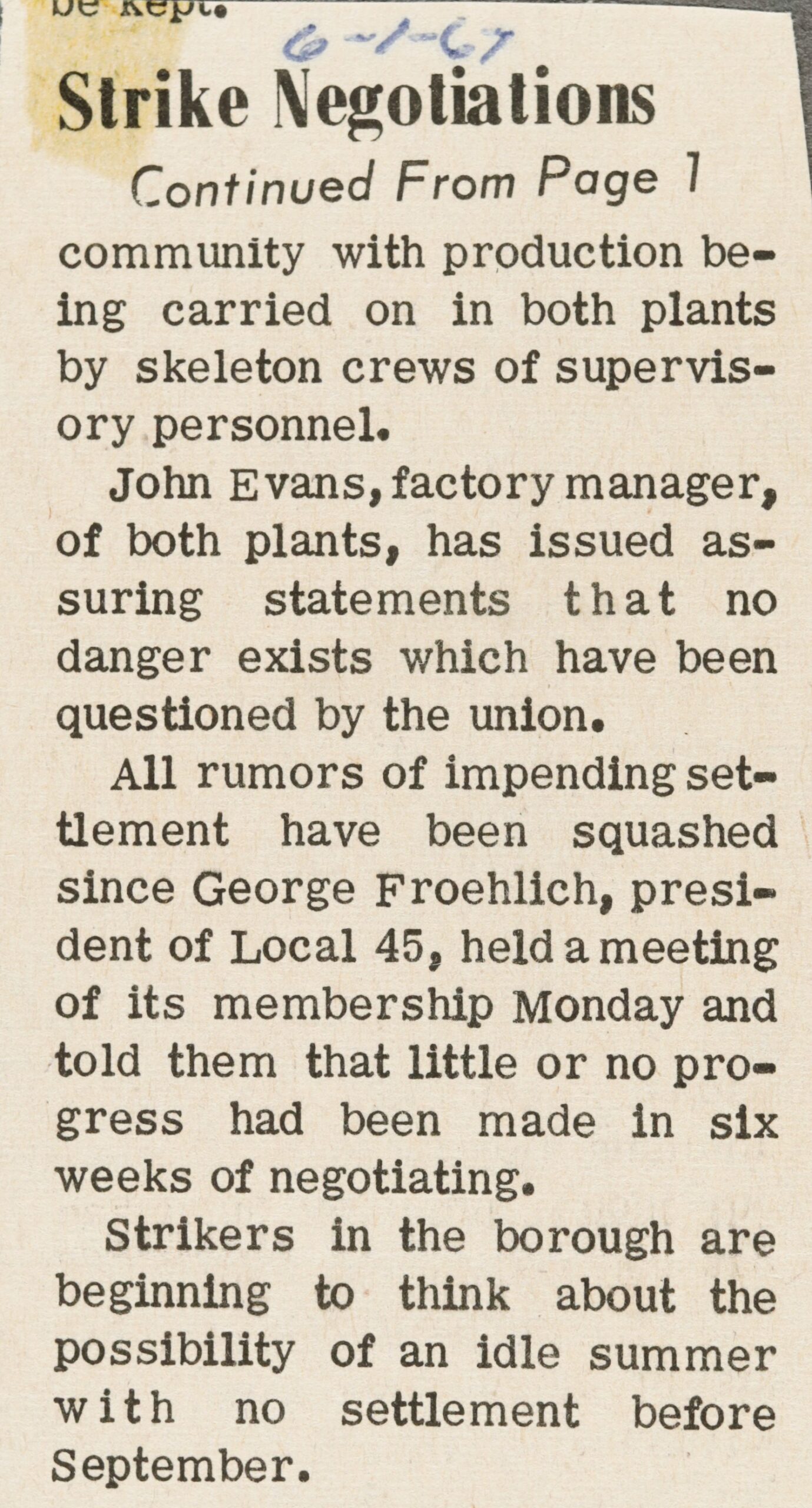
community with production being carried on in both plants by skeleton crews of supervisory personnel.

John Evans, factory manager, of both plants, has issued assuring statements that no danger exists which have been questioned by the union.

All rumors of impending settlement have been squashed since George Froehlich, president of Local 45, held a meeting of its membership Monday and told them that little or no progress had been made in six weeks of negotiating.

Strikers in the borough are beginning to think about the possibility of an idle summer with no settlement before September.

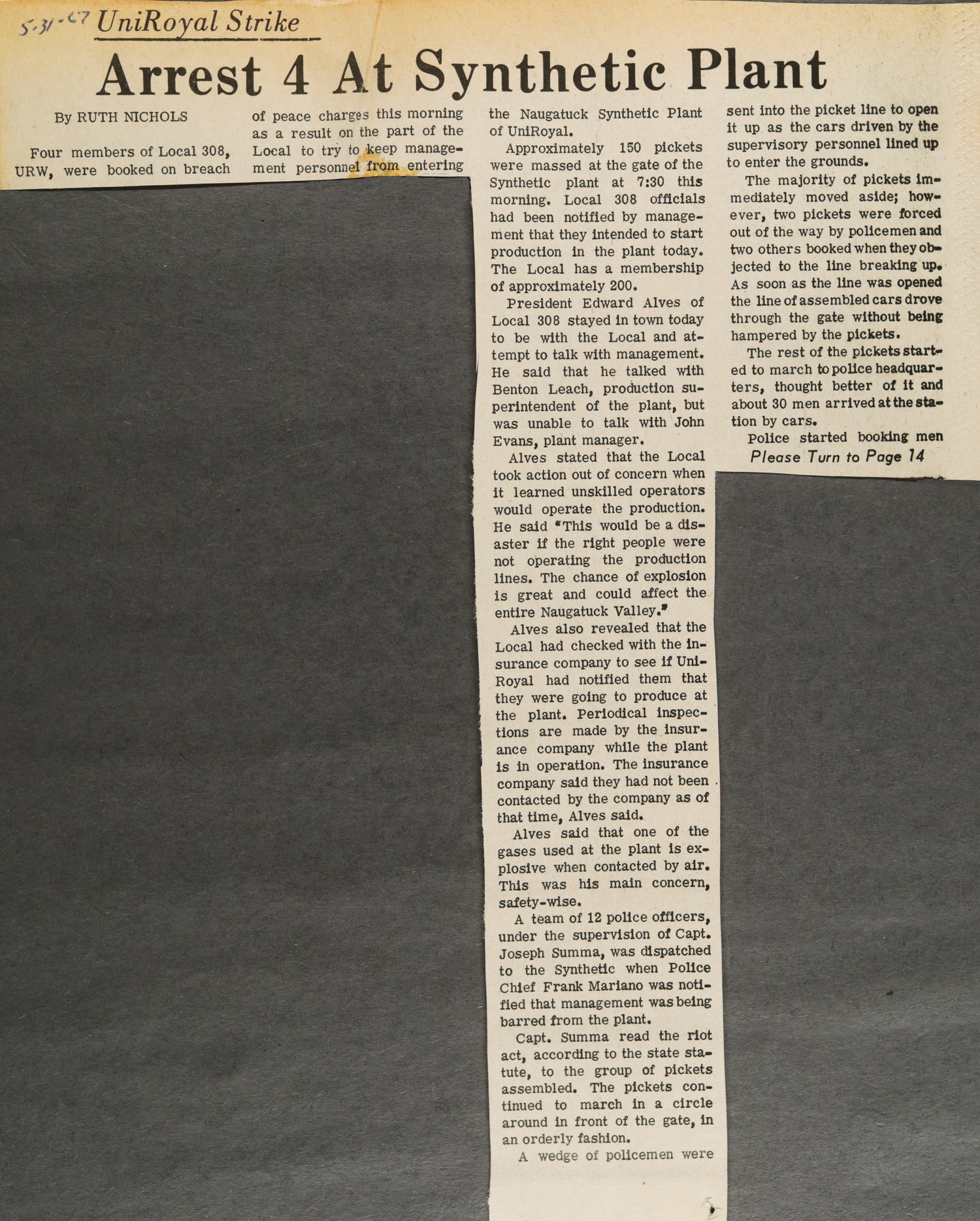
Arrest 4 At Synthetic Plant

Arrest 4 At Synthetic Plant

5-31-67 UniRoyal Strike

Arrest 4 At Synthetic Plant

By RUTH NICHOLS

Four members of Local 308, URW, were booked on breach of peace charges this morning as a result on the part of the Local to try to keep management personnel from entering the Naugatuck Synthetic Plant of UniRoyal.

Approximately 150 pickets were massed at the gate of the Synthetic plant at 7:30 this morning. Local 308 officials had been notified by management that they intended to start production in the plant today. The Local has a membership of approximately 200.

President Edward Alves of Local 308 stayed in town today to be with the Local and attempt to talk with management. He said that he talked with Benton Leach, production superintendent of the plant, but was unable to talk with John Evans, plant manager.

Alves stated that the Local took action out of concern when it learned unskilled operators would operate the production. He said “This would be a disaster if the right people were not operating the production lines. The chance of explosion is great and could affect the entire Naugatuck Valley.”

Alves also revealed that the Local had checked with the insurance company to see if UniRoyal had notified them that they were going to produce at the plant. Periodical inspections are made by the insurance company while the plant is in operation. The insurance company said they had not been contacted by the company as of that time, Alves said.

Alves said that one of the gases used at the plant is explosive when contacted by air. This was his main concern, safety-wise.

A team of 12 police officers, under the supervision of Capt. Joseph Summa, was dispatched to the Synthetic when Police Chief Frank Mariano was notified that management was being barred from the plant.

Capt. Summa read the riot act, according to the state statute, to the group of pickets assembled. The pickets continued to march in a circle around in front of the gate, in an orderly fashion.

A wedge of policemen were sent into the picket line to open it up as the cars driven by the supervisory personnel lined up to enter the grounds.

The majority of pickets immediately moved aside; however, two pickets were forced out of the way by policemen and two others booked when they objected to the line breaking up. As soon as the line was opened the line of assembled cars drove through the gate without being hampered by the pickets.

The rest of the pickets started to march to police headquarters, thought better of it and about 30 men arrived at the station by cars.

Police started booking men

Please Turn to Page 14

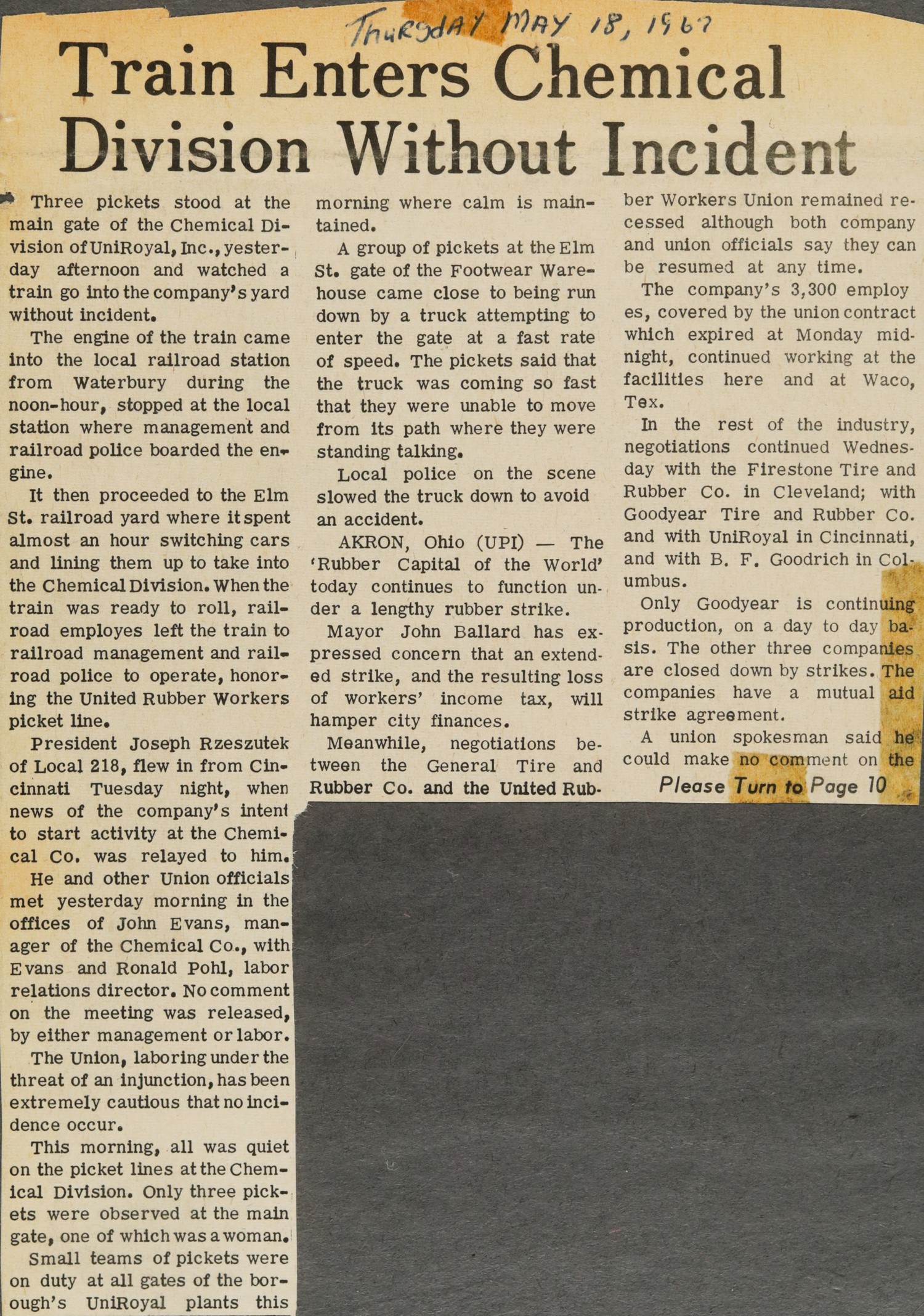
Train Enters Chemical Division Without Incident

Train Enters Chemical Division Without Incident

Thursday MAY 18, 1967

Train Enters Chemical Division Without Incident

Three pickets stood at the main gate of the Chemical Division of UniRoyal, Inc., yesterday afternoon and watched a train go into the company’s yard without incident.

The engine of the train came into the local railroad station from Waterbury during the noon-hour, stopped at the local station where management and railroad police boarded the engine.

It then proceeded to the Elm St. railroad yard where it spent almost an hour switching cars and lining them up to take into the Chemical Division. When the train was ready to roll, railroad employes left the train to railroad management and railroad police to operate, honoring the United Rubber Workers picket line.

President Joseph Rzeszutek of Local 218, flew in from Cincinnati Tuesday night, when news of the company’s intent to start activity at the Chemical Co. was relayed to him.

He and other Union officials met yesterday morning in the offices of John Evans, manager of the Chemical Co., with Evans and Ronald Pohl, labor relations director. No comment on the meeting was released, by either management or labor.

The Union, laboring under the threat of an injunction, has been extremely cautious that no incidence occur.

This morning, all was quiet on the picket lines at the Chemical Division. Only three pickets were observed at the main gate, one of which was a woman.

Small teams of pickets were on duty at all gates of the borough’s UniRoyal plants this morning where calm is maintained.

A group of pickets at the Elm St. gate of the Footwear Warehouse came close to being run down by a truck attempting to enter the gate at a fast rate of speed. The pickets said that the truck was coming so fast that they were unable to move from its path where they were standing talking.

Local police on the scene slowed the truck down to avoid an accident.

AKRON, Ohio (UPI) — The ‘Rubber Capital of the World’ today continues to function under a lengthy rubber strike.

Mayor John Ballard has expressed concern that an extended strike, and the resulting loss of workers’ income tax, will hamper city finances.

Meanwhile, negotiations between the General Tire and Rubber Co. and the United Rubber Workers Union remained recessed although both company and union officials say they can be resumed at any time.

The company’s 3,300 employes, covered by the union contract which expired at Monday midnight, continued working at the facilities here and at Waco, Tex.

In the rest of the industry, negotiations continued Wednesday with the Firestone Tire and Rubber Co. in Cleveland; with Goodyear Tire and Rubber Co. and with UniRoyal in Cincinnati, and with B. F. Goodrich in Columbus.

Only Goodyear is continuing production, on a day to day basis. The other three companies are closed down by strikes. The companies have a mutual aid strike agreement.

A union spokesman said he could make no comment on the

Please Turn to Page 10

Uniroyal Picket Lines Still Quiet

Uniroyal Picket Lines Still Quiet

Thursday MAY 18, 1967

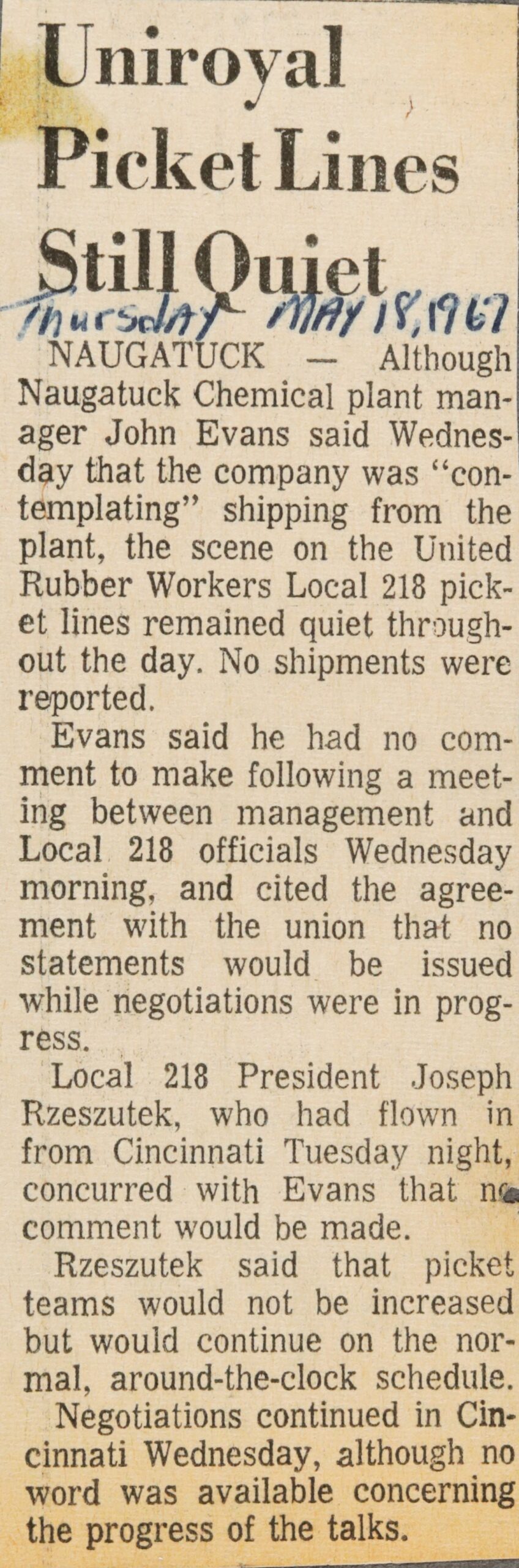
NAUGATUCK — Although Naugatuck Chemical plant manager John Evans said Wednesday that the company was “contemplating” shipping from the plant, the scene on the United Rubber Workers Local 218 picket lines remained quiet throughout the day. No shipments were reported.

Evans said he had no comment to make following a meeting between management and Local 218 officials Wednesday morning, and cited the agreement with the union that no statements would be issued while negotiations were in progress.

Local 218 President Joseph Rzeszutek, who had flown in from Cincinnati Tuesday night, concurred with Evans that no comment would be made.

Rzeszutek said that picket teams would not be increased but would continue on the normal, around-the-clock schedule.

Negotiations continued in Cincinnati Wednesday, although no word was available concerning the progress of the talks.

Picket Lines Stay Quiet At Uniroyal

Picket Lines Stay Quiet At Uniroyal

Thurs MAY 18, 1967 [handwritten notation]

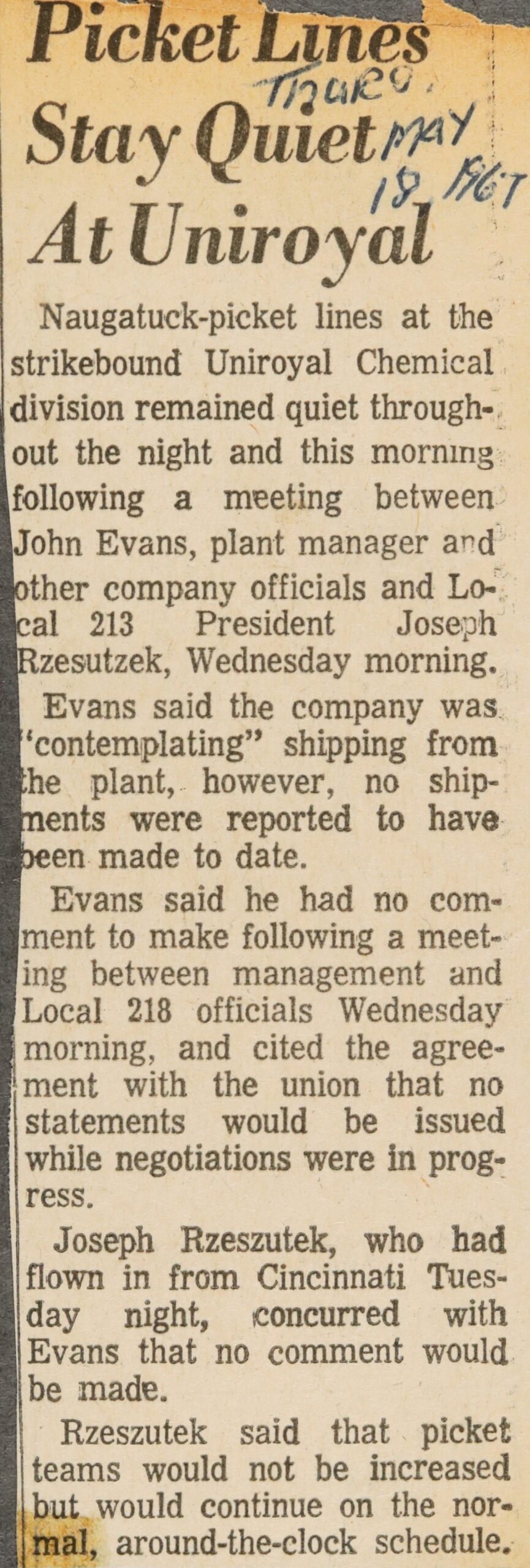
Naugatuck-picket lines at the strikebound Uniroyal Chemical division remained quiet throughout the night and this morning following a meeting between John Evans, plant manager and other company officials and Local 213 President Joseph Rzesutzek, Wednesday morning.

Evans said the company was “contemplating” shipping from the plant, however, no shipments were reported to have been made to date.

Evans said he had no comment to make following a meeting between management and Local 218 officials Wednesday morning, and cited the agreement with the union that no statements would be issued while negotiations were in progress.

Joseph Rzeszutek, who had flown in from Cincinnati Tuesday night, concurred with Evans that no comment would be made.

Rzeszutek said that picket teams would not be increased but would continue on the normal, around-the-clock schedule.

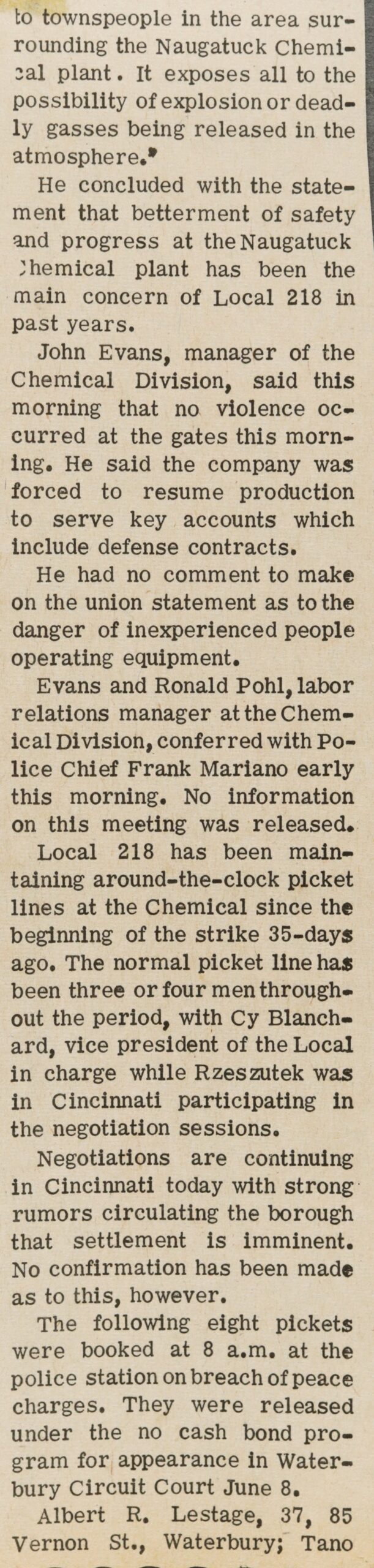
to townspeople in the area sur- rounding the Naugatuck Chemi- cal plant. It exposes all to the possibility of explosion or dead- ly gases being released in the atmosphere.

to townspeople in the area surrounding the Naugatuck Chemical plant. It exposes all to the possibility of explosion or deadly gasses being released in the atmosphere.”

He concluded with the statement that betterment of safety and progress at the Naugatuck Chemical plant has been the main concern of Local 218 in past years.

John Evans, manager of the Chemical Division, said this morning that no violence occurred at the gates this morning. He said the company was forced to resume production to serve key accounts which include defense contracts.

He had no comment to make on the union statement as to the danger of inexperienced people operating equipment.

Evans and Ronald Pohl, labor relations manager at the Chemical Division, conferred with Police Chief Frank Mariano early this morning. No information on this meeting was released.

Local 218 has been maintaining around-the-clock picket lines at the Chemical since the beginning of the strike 35-days ago. The normal picket line has been three or four men throughout the period, with Cy Blanchard, vice president of the Local in charge while Rzeszutek was in Cincinnati participating in the negotiation sessions.

Negotiations are continuing in Cincinnati today with strong rumors circulating the borough that settlement is imminent. No confirmation has been made as to this, however.

The following eight pickets were booked at 8 a.m. at the police station on breach of peace charges. They were released under the no cash bond program for appearance in Waterbury Circuit Court June 8.

Albert R. Lestage, 37, 85 Vernon St., Waterbury; Tano

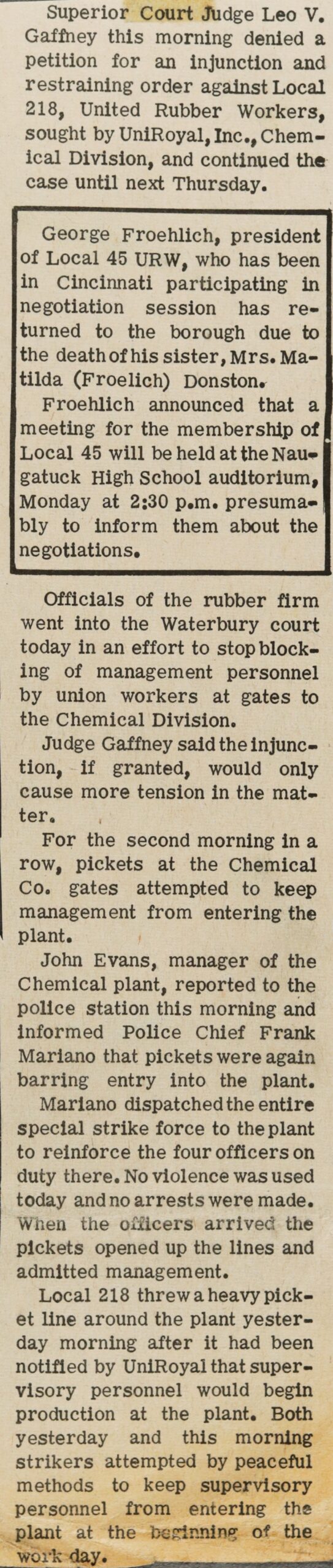
Superior Court Judge Leo V. Gaffney this morning denied a petition for an injunction and restraining order against Local 218, United Rubber Workers, sought by UniRoyal, Inc., Chemical Division, and continued the case until next Thursday.

Superior Court Judge Leo V.
Gaffney this morning denied a
petition for an injunction and
restraining order against Local
218, United Rubber Workers,
sought by UniRoyal, Inc., Chem-
ical Division, and continued the
case until next Thursday.

George Froehlich, president
of Local 45 URW, who has been
in Cincinnati participating in
negotiation session has re-
turned to the borough due to
the death of his sister, Mrs. Ma-
tilda (Froelich) Donston.

Froehlich announced that a
meeting for the membership of
Local 45 will be held at the Nau-
gatuck High School auditorium,
Monday at 2:30 p.m. presuma-
bly to inform them about the
negotiations.

Officials of the rubber firm
went into the Waterbury court
today in an effort to stop block-
ing of management personnel
by union workers at gates to
the Chemical Division.

Judge Gaffney said the injunc-
tion, if granted, would only
cause more tension in the mat-
ter.

For the second morning in a
row, pickets at the Chemical
Co. gates attempted to keep
management from entering the
plant.

John Evans, manager of the
Chemical plant, reported to the
police station this morning and
informed Police Chief Frank
Mariano that pickets were again
barring entry into the plant.

Mariano dispatched the entire
special strike force to the plant
to reinforce the four officers on
duty there. No violence was used
today and no arrests were made.
When the officers arrived the
pickets opened up the lines and
admitted management.

Local 218 threw a heavy pick-
et line around the plant yester-
day morning after it had been
notified by UniRoyal that super-
visory personnel would begin
production at the plant. Both
yesterday and this morning
strikers attempted by peaceful
methods to keep supervisory
personnel from entering the
plant at the beginning of the
work day.

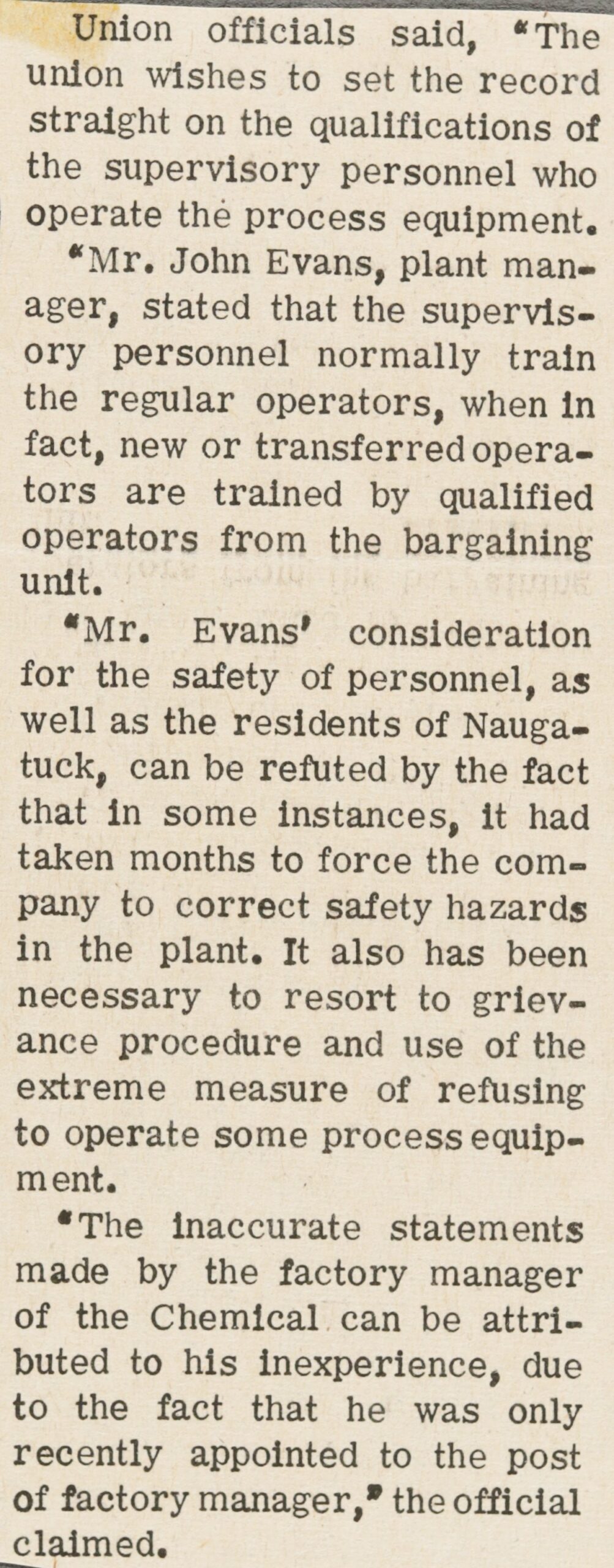
Union officials said, “The union wishes to set the record straight on the qualifications of the supervisory personnel who operate the process equipment.”

Union officials said, “The union wishes to set the record straight on the qualifications of the supervisory personnel who operate the process equipment.

“Mr. John Evans, plant manager, stated that the supervisory personnel normally train the regular operators, when in fact, new or transferred operators are trained by qualified operators from the bargaining unit.

“Mr. Evans’ consideration for the safety of personnel, as well as the residents of Naugatuck, can be refuted by the fact that in some instances, it had taken months to force the company to correct safety hazards in the plant. It also has been necessary to resort to grievance procedure and use of the extreme measure of refusing to operate some process equipment.

“The inaccurate statements made by the factory manager of the Chemical can be attributed to his inexperience, due to the fact that he was only recently appointed to the post of factory manager,” the official claimed.

Untitled Clipping

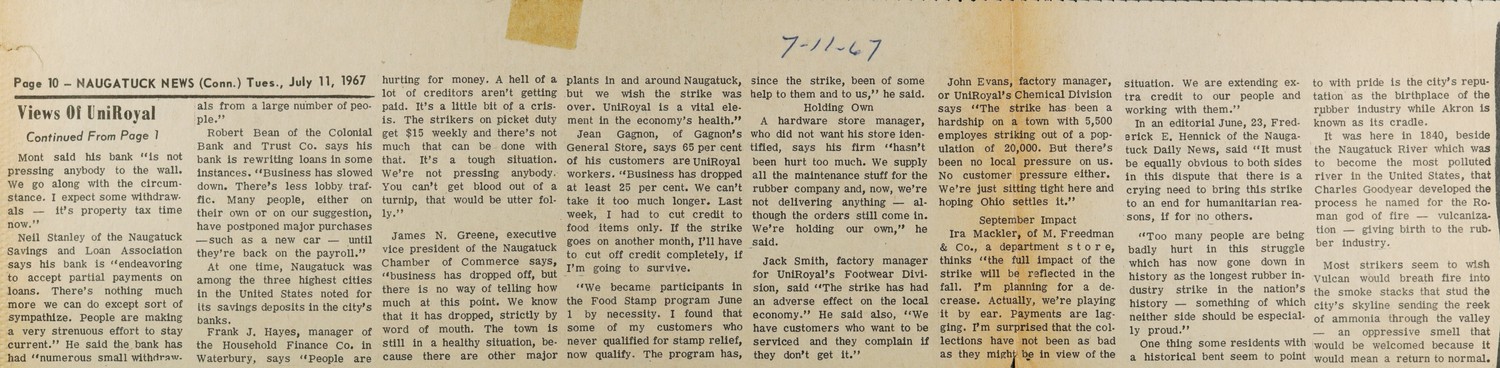
7-11-67

Page 10 – NAUGATUCK NEWS (Conn.) Tues., July 11, 1967


Views Of UniRoyal

Continued From Page 1

Mont said his bank “is not pressing anybody to the wall. We go along with the circumstance. I expect some withdrawals — it’s property tax time now.”

Neil Stanley of the Naugatuck Savings and Loan Association says his bank is “endeavoring to accept partial payments on loans. There’s nothing much more we can do except sort of sympathize. People are making a very strenuous effort to stay current.” He said the bank has had “numerous small withdrawals from a large number of people.”

At one time, Naugatuck was among the three highest cities in the United States noted for its savings deposits in the city’s banks.

Frank J. Hayes, manager of the Household Finance Co. in Waterbury, says “People are hurting for money. A hell of a lot of creditors aren’t getting paid. It’s a little bit of a crisis. The strikers on picket duty get $15 weekly and there’s not much that can be done with that. It’s a tough situation. We’re not pressing anybody. You can’t get blood out of a turnip, that would be utter folly.”

James N. Greene, executive vice president of the Naugatuck Chamber of Commerce says, “business has dropped off, but there is no way of telling how much at this point. We know that it has dropped, strictly by word of mouth. The town is still in a healthy situation, because there are other major plants in and around Naugatuck, but we wish the strike was over. UniRoyal is a vital element in the economy’s health.”

Jean Gagnon, of Gagnon’s General Store, says 65 per cent of his customers are UniRoyal workers. “Business has dropped at least 25 per cent. We can’t take it too much longer. Last week, I had to cut credit to food items only. If the strike goes on another month, I’ll have to cut off credit completely, if I’m going to survive.

“We became participants in the Food Stamp program June 1 by necessity. I found that some of my customers who never qualified for stamp relief, now qualify. The program has, since the strike, been of some help to them and to us,” he said.

Holding Own

A hardware store manager, who did not want his store identified, says his firm “hasn’t been hurt too much. We supply all the maintenance stuff for the rubber company and, now, we’re not delivering anything — although the orders still come in. We’re holding our own,” he said.

Jack Smith, factory manager for UniRoyal’s Footwear Division, said “The strike has had an adverse effect on the local economy.” He said also, “We have customers who want to be serviced and they complain if they don’t get it.”

John Evans, factory manager, or UniRoyal’s Chemical Division says “The strike has been a hardship on a town with 5,500 employes striking out of a population of 20,000. But there’s been no local pressure either. We’re just sitting tight here and hoping Ohio settles it.”

September Impact

Ira Mackler, of M. Freedman & Co., a department store, thinks “the full impact of the strike will be reflected in the fall. I’m planning for a decrease. Actually, we’re playing it by ear. Payments are lagging. I’m surprised that the collections have not been as bad as they might be in view of the situation. We are extending extra credit to our people and working with them.”

In an editorial June 23, Frederick E. Hennick of the Naugatuck Daily News, said “It must be equally obvious to both sides in this dispute that there is a crying need to bring this strike to an end for humanitarian reasons, if for no others.

“Too many people are being badly hurt in this struggle which has now gone down in history as the longest rubber industry strike in the nation’s history — something of which neither side should be especially proud.”

One thing some residents with a historical bent seem to point to with pride is the city’s reputation as the birthplace of the rubber industry while Akron is known as its cradle.

It was here in 1840, beside the Naugatuck River which was to become the most polluted river in the United States, that Charles Goodyear developed the process he named for the Roman god of fire — vulcanization — giving birth to the rubber industry.

Most strikers seem to wish Vulcan would breath fire into the smoke stacks that stud the city’s skyline sending the reek of ammonia through the valley — an oppressive smell that would be welcomed because it would mean a return to normal.