CHEM-TEXTS – 1980 – Page NO. 1

Page unknown

UNIROYAL CHEM-TEXTS

Vol. 14, 1980 | PUBLISHED FOR THE PEOPLE OF UNIROYAL CHEMICAL | NO. 1


Plant Receives Award

[IMAGE: Photo of two people shaking hands during award presentation]

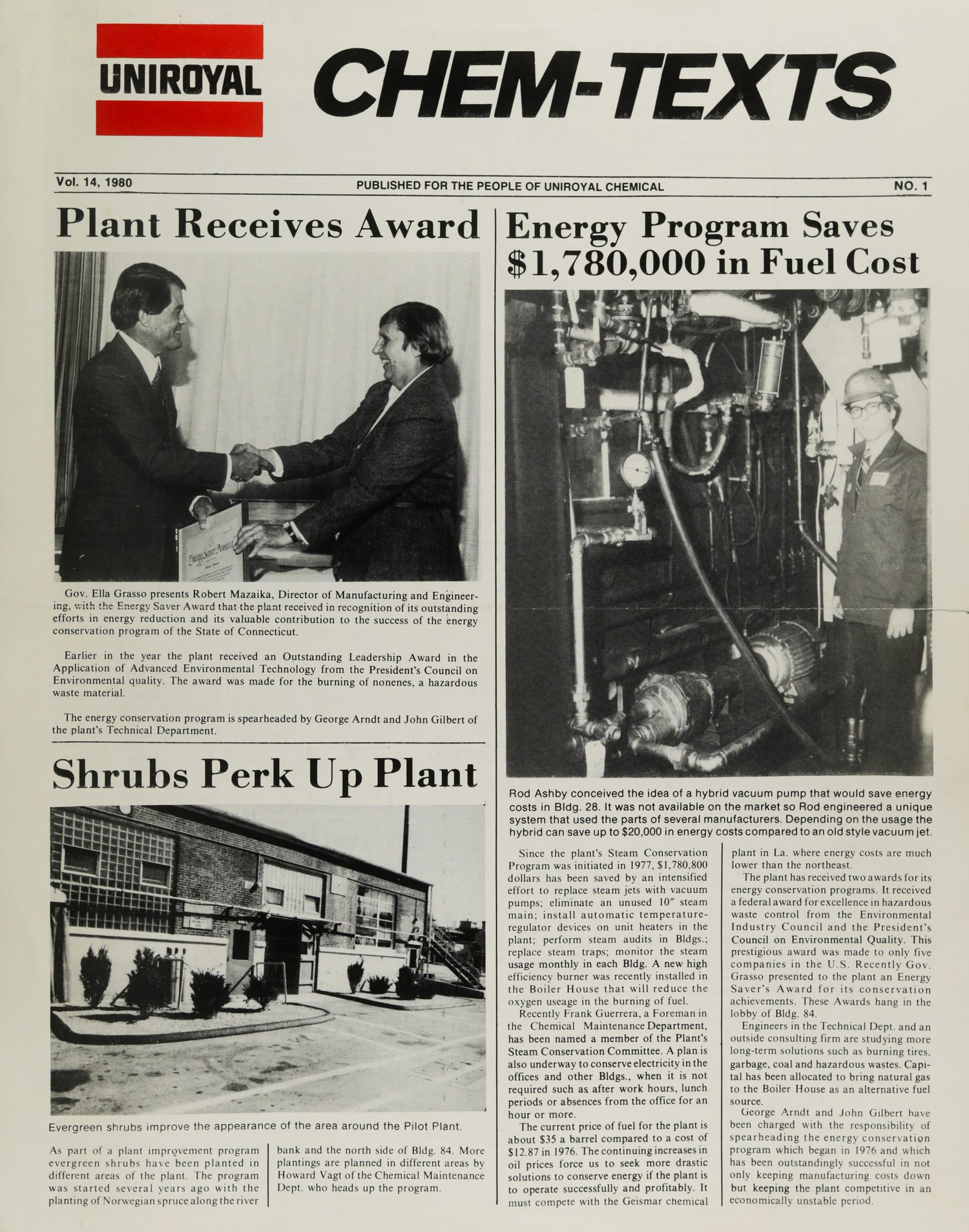
Gov. Ella Grasso presents Robert Mazaika, Director of Manufacturing and Engineering, with the Energy Saver Award that the plant received in recognition of its outstanding efforts in energy reduction and its valuable contribution to the success of the energy conservation program of the State of Connecticut.

Earlier in the year the plant received an Outstanding Leadership Award in the Application of Advanced Environmental Technology from the President’s Council on Environmental quality. The award was made for the burning of nonenes, a hazardous waste material.

The energy conservation program is spearheaded by George Arndt and John Gilbert of the plant’s Technical Department.


Shrubs Perk Up Plant

[IMAGE: Photo of building exterior with evergreen shrubs]

Evergreen shrubs improve the appearance of the area around the Pilot Plant.

As part of a plant improvement program evergreen shrubs have been planted in different areas of the plant. The program was started several years ago with the planting of Norwegian spruce along the river bank and the north side of Bldg. 84. More plantings are planned in different areas by Howard Vagt of the Chemical Maintenance Dept. who heads up the program.


Energy Program Saves $1,780,000 in Fuel Cost

[IMAGE: Photo of man next to industrial equipment/machinery]

Rod Ashby conceived the idea of a hybrid vacuum pump that would save energy costs in Bldg. 28. It was not available on the market so Rod engineered a unique system that used the parts of several manufacturers. Depending on the usage the hybrid can save up to $20,000 in energy costs compared to an old style vacuum jet.

Since the plant’s Steam Conservation Program was initiated in 1977, $1,780,800 dollars has been saved by an intensified effort to replace steam jets with vacuum pumps; eliminate an unused 10″ steam main; install automatic temperature-regulator devices on unit heaters in the plant; perform steam audits in Bldgs.; replace steam traps; monitor the steam usage monthly in each Bldg. A new high efficiency burner was recently installed in the Boiler House that will reduce the oxygen useage in the burning of fuel.

Recently Frank Guerrera, a Foreman in the Chemical Maintenance Department, has been named a member of the Plant’s Steam Conservation Committee. A plan is also underway to conserve electricity in the offices and other Bldgs., when it is not required such as after work hours, lunch periods or absences from the office for an hour or more.

The current price of fuel for the plant is about $35 a barrel compared to a cost of $12.87 in 1976. The continuing increases in oil prices force us to seek more drastic solutions to conserve energy if the plant is to operate successfully and profitably. It must compete with the Geismar chemical plant in La. where energy costs are much lower than the northeast.

The plant has received two awards for its energy conservation programs. It received a federal award for excellence in hazardous waste control from the Environmental Industry Council and the President’s Council on Environmental Quality. This prestigious award was made to only five companies in the U.S. Recently Gov. Grasso presented to the plant an Energy Saver’s Award for its conservation achievements. These Awards hang in the lobby of Bldg. 84.

Engineers in the Technical Dept. and an outside consulting firm are studying more long-term solutions such as burning tires, garbage, coal and hazardous wastes. Capital has been allocated to bring natural gas to the Boiler House as an alternative fuel source.

George Arndt and John Gilbert have been charged with the responsibility of spearheading the energy conservation program which began in 1976 and which has been outstandingly successful in not only keeping manufacturing costs down but keeping the plant competitive in an economically unstable period.
CHEM-TEXTS – 1979-v13-s282

Page 282

CHEM-TEXTS

Vol. 13, 1979 | Page 3


46 Employees Honored for Service

[IMAGE: Group photo]

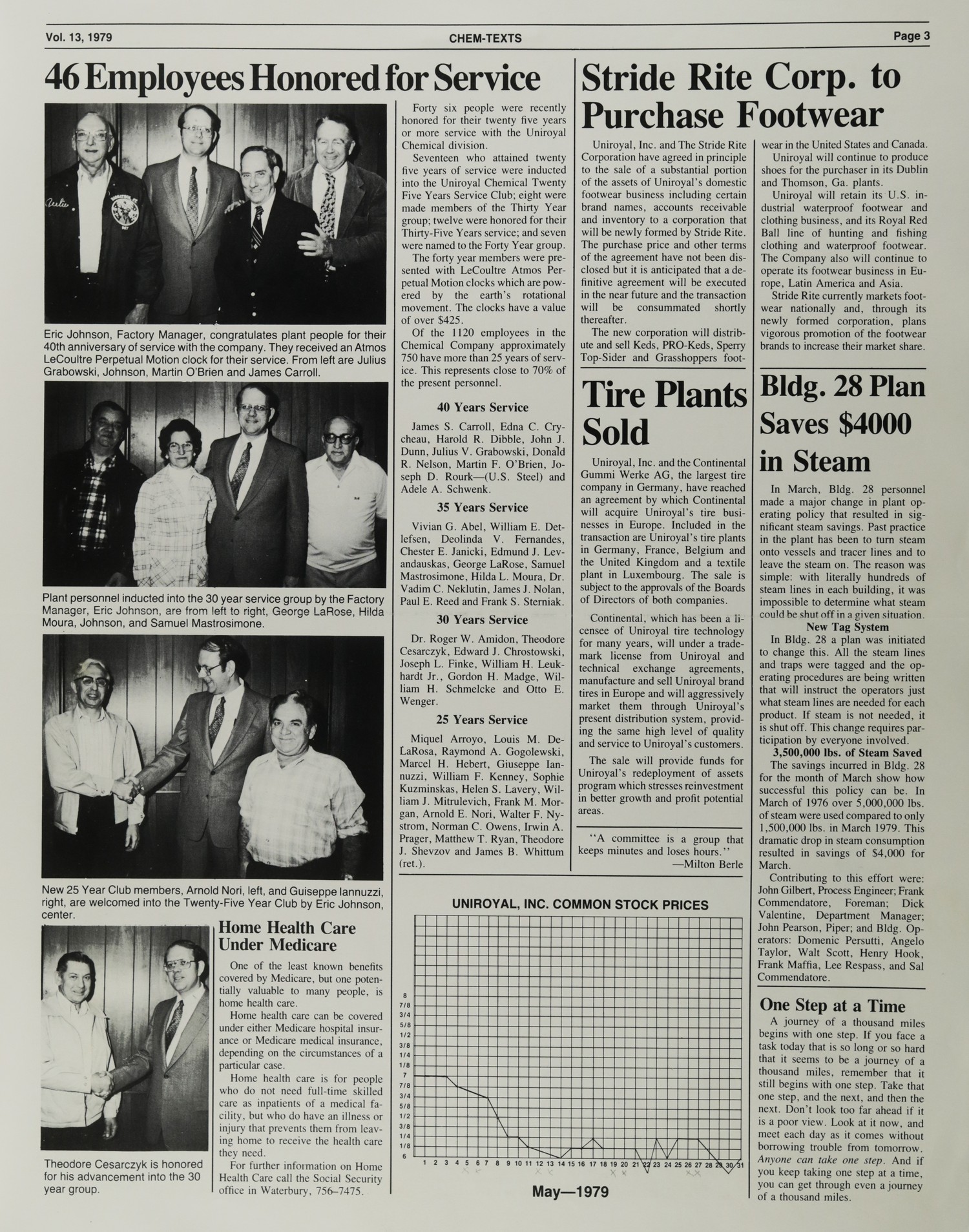
Eric Johnson, Factory Manager, congratulates plant people for their 40th anniversary of service with the company. They received an Atmos LeCoultre Perpetual Motion clock for their service. From left are Julius Grabowski, Johnson, Martin O’Brien and James Carroll.

[IMAGE: Group photo]

Plant personnel inducted into the 30 year service group by the Factory Manager, Eric Johnson, are from left to right, George LaRose, Hilda Moura, Johnson, and Samuel Mastrosimone.

[IMAGE: Group photo]

New 25 Year Club members, Arnold Nori, left, and Guiseppe Iannuzzi, right, are welcomed into the Twenty-Five Year Club by Eric Johnson, center.

[IMAGE: Individual portrait]

Theodore Cesarczyk is honored for his advancement into the 30 year group.


Forty six people were recently honored for their twenty five years or more service with the Uniroyal Chemical division.

Seventeen who attained twenty five years of service were inducted into the Uniroyal Chemical Twenty Five Year Service Club; eight were made members of the Thirty Year group; twelve were honored for their Thirty-Five Years service; and seven were named to the Forty Year group.

The forty year members were presented with LeCoultre Atmos Perpetual Motion clocks which are powered by the earth’s rotational movement. The clocks have a value of over $425.

Of the 1120 employees in the Chemical Company approximately 750 have more than 25 years of service. This represents close to 70% of the present personnel.

40 Years Service

James S. Carroll, Edna C. Crycheau, Harold R. Dibble, John J. Dunn, Julius V. Grabowski, Donald R. Nelson, Martin F. O’Brien, Joseph D. Rourk—(U.S. Steel) and Adele A. Schwenk.

35 Years Service

Vivian G. Abel, William E. Detlefsen, Deolinda V. Fernandes, Chester E. Janicki, Edmund J. Levandauskas, George LaRose, Samuel Mastrosimone, Hilda L. Moura, Dr. Vadim C. Neklutin, James J. Nolan, Paul E. Reed and Frank S. Sterniak.

30 Years Service

Dr. Roger W. Amidon, Theodore Cesarczyk, Edward J. Chrostowski, Joseph L. Finke, William H. Leukhardt Jr., Gordon H. Madge, William H. Schmelcke and Otto E. Wenger.

25 Years Service

Miquel Arroyo, Louis M. DeLaRosa, Raymond A. Gogolewski, Marcel H. Hebert, Giuseppe Iannuzzi, William F. Kenney, Sophie Kuzminskas, Helen S. Lavery, William J. Mitrulevich, Frank M. Morgan, Arnold E. Nori, Walter F. Nystrom, Norman C. Owens, Irwin A. Prager, Matthew T. Ryan, Theodore J. Shevzov and James B. Whittum (ret.).


Home Health Care Under Medicare

One of the least known benefits covered by Medicare, but one potentially valuable to many people, is home health care.

Home health care can be covered under either Medicare hospital insurance or Medicare medical insurance, depending on the circumstances of a particular case.

Home health care is for people who do not need full-time skilled care as inpatients of a medical facility, but who do have an illness or injury that prevents them from leaving home to receive the health care they need.

For further information on Home Health Care call the Social Security office in Waterbury, 756-7475.


Stride Rite Corp. to Purchase Footwear

Uniroyal, Inc. and The Stride Rite Corporation have agreed in principle to the sale of a substantial portion of the assets of Uniroyal’s domestic footwear business including certain brand names, accounts receivable and inventory to a corporation that will be newly formed by Stride Rite. The purchase price and other terms of the agreement have not been disclosed but it is anticipated that a definitive agreement will be executed in the near future and the transaction will be consummated shortly thereafter.

The new corporation will distribute and sell Keds, PRO-Keds, Sperry Top-Sider and Grasshoppers footwear in the United States and Canada.

Uniroyal will continue to produce shoes for the purchaser in its Dublin and Thomson, Ga. plants.

Uniroyal will retain its U.S. industrial waterproof footwear and clothing business, and its Royal Red Ball line of hunting and fishing clothing and waterproof footwear. The Company also will continue to operate its footwear business in Europe, Latin America and Asia.

Stride Rite currently markets footwear nationally and, through its newly formed corporation, plans vigorous promotion of the footwear brands to increase their market share.


Tire Plants Sold

Uniroyal, Inc. and the Continental Gummi Werke AG, the largest tire company in Germany, have reached an agreement by which Continental will acquire Uniroyal’s tire businesses in Europe. Included in the transaction are Uniroyal’s tire plants in Germany, France, Belgium and the United Kingdom and a textile plant in Luxembourg. The sale is subject to the approvals of the Boards of Directors of both companies.

Continental, which has been a licensee of Uniroyal tire technology for many years, will under a trademark license from Uniroyal and technical exchange agreements, manufacture and sell Uniroyal brand tires in Europe and will aggressively market them through Uniroyal’s present distribution system, providing the same high level of quality and service to Uniroyal’s customers.

The sale will provide funds for Uniroyal’s redeployment of assets program which stresses reinvestment in better growth and profit potential areas.


“A committee is a group that keeps minutes and loses hours.”
—Milton Berle


Bldg. 28 Plan Saves $4000 in Steam

In March, Bldg. 28 personnel made a major change in plant operating policy that resulted in significant steam savings. Past practice in the plant has been to turn steam onto vessels and tracer lines and to leave the steam on. The reason was simple: with literally hundreds of steam lines in each building, it was impossible to determine what steam could be shut off in a given situation.

New Tag System

In Bldg. 28 a plan was initiated to change this. All the steam lines and traps were tagged and the operating procedures are being written that will instruct the operators just what steam lines are needed for each product. If steam is not needed, it is shut off. This change requires participation by everyone involved.

3,500,000 lbs. of Steam Saved

The savings incurred in Bldg. 28 for the month of March show how successful this policy can be. In March of 1976 over 5,000,000 lbs. of steam were used compared to only 1,500,000 lbs. in March 1979. This dramatic drop in steam consumption resulted in savings of $4,000 for March.

Contributing to this effort were: John Gilbert, Process Engineer; Frank Commendatore, Foreman; Dick Valentine, Department Manager; John Pearson, Piper; and Bldg. Operators: Domenic Persutti, Angelo Taylor, Walt Scott, Henry Hook, Frank Maffia, Lee Respass, and Sal Commendatore.


One Step at a Time

A journey of a thousand miles begins with one step. If you face a task today that is so long or so hard that it seems to be a journey of a thousand miles, remember that it still begins with one step. Take that one step, and the next, and then the next. Don’t look too far ahead if it is a poor view. Look at it now, and meet each day as it comes without borrowing trouble from tomorrow. Anyone can take one step. And if you keep taking one step at a time, you can get through even a journey of a thousand miles.


UNIROYAL, INC. COMMON STOCK PRICES

[CHART: Stock price graph showing prices from months 1-31, with price scale showing values from 0 to 8, with markers at 7/8, 3/4, 5/8, 1/2, 3/8, 1/4, 1/8 intervals]

May—1979

CHEM-TEXTS – 1979-v13-s285

Page 285

CHEM-TEXTS

Page 2 | Vol. 13, 1979


1978 was a Good Year . . .

You and I know our Company is starting to generate an upward momentum as illustrated by the outstanding performance of the Naugatuck Plant and the Chemical Company in 1978. The Chemical Company profits exceeded all expectations last year and our Plant’s gross operating profit increased 58%.

This outstanding achievement is the result of your efforts whether you are in Manufacturing, Research and Development, Accounting, D&S, the Service Departments, or Marketing.

Our plant’s goal is to have a 30% plant operating profit that would result in a 9% return on sales. This year our objective is to increase the return on sales from 3 to 4.5%.

How do we expect to achieve our profitability objective? The answer to this question is reflected in the achievements of last year.

In the Maintenance Department an outstanding job was performed in reducing equipment downtime from 8.9 to 7.5%. Their 1979 goal is 6% and January was an excellent start with downtime averaging 4.5%.

Manufacturing set productivity records in the production of Rubber Chemicals, Agricultural Chemicals, and Thermoplastics. Omite, LVBI, Tonox, and TPR productivities increased between 20 and 30% while PANA and Naugard 445 improved by 66%. Also a reduction in Roylar changeovers was achieved through better coordination and communications. In addition, Comite, Octamine P, Celogen RA, and Polygard I were successfully produced in the Plant. All these achievements resulted in increasing our plant’s profit by 1.6 million dollars.

Our Industrial Relations Department was reorganized and is more effective in serving our needs. Safety Goals were far exceeded with 1.2 incidence rate and Workmen’s Compensation costs were reduced by $165,000. A new performance appraisal system was initiated and a training session held to help managers conduct performance appraisals with their people.

A Controllers Department was established to perform financial reporting, budgeting, forecasting, and economic analysis; to expedite approvals of Appropriation Requests; and to identify areas of profit improvement.

The Technical Department now includes all engineering functions: process, project, environmental, and industrial engineering. 2.3 million dollars of profit improvement was realized through developing a team effort with the plant, R & D, and marketing. This year a similar amount is expected through Project Enterprise, the name of our 1979 Profit Improvement Program. Over $300,000 was saved through the work of the Plant’s Energy Committee. Other contributions by the Technical Department included the productivity records set in Rubber Chemicals and Omite as well as the successful production of Comite, Octamine P, Celogen RA, and Polygard I.

In the Material Flow Department transportation credits exceeded budget by $13,000. An additional $532,000 was saved through improved transportation of our finished goods. Shipping and receiving increased productivity by 7% and improved the services on export shipments. The Purchasing Department and Control Center reduced our inventory levels thereby increasing our return on assets. Purchasing savings and cost avoidance programs exceeded expectations by $400,000 dollars.

A major objective is to improve the utilization of our plant by introducing new products in our existing facilities or attracting new manufacturing facilities because our resources are underutilized. For example, we are using only 50% of our steam generation and waste water treatment capacities while Rubber Chemicals is budgeted to operate only between 60-65% of capacity this year. If Rubber Chemical production operated at 90% of capacity, our plant’s operating profit would increase to approximately 27%. On some recent data it appears that a 10% selling price increase would have the same impact as a 30% cost reduction.

1978 was a year of change and accomplishment. We have the reputation of managing our business. Naugatuck seeks change. We are determined to overcome our geographical raw material disadvantage through PROFESSIONAL EXCELLENCE in every assignment and job that is performed.

In 1979 Naugatuck will be a Better Place To Be and soon the Best Place To Be.

Eric Johnson

Eric Johnson
Factory Manager


29,500 Bbls. of Fuel Oil Saved by Energy Program

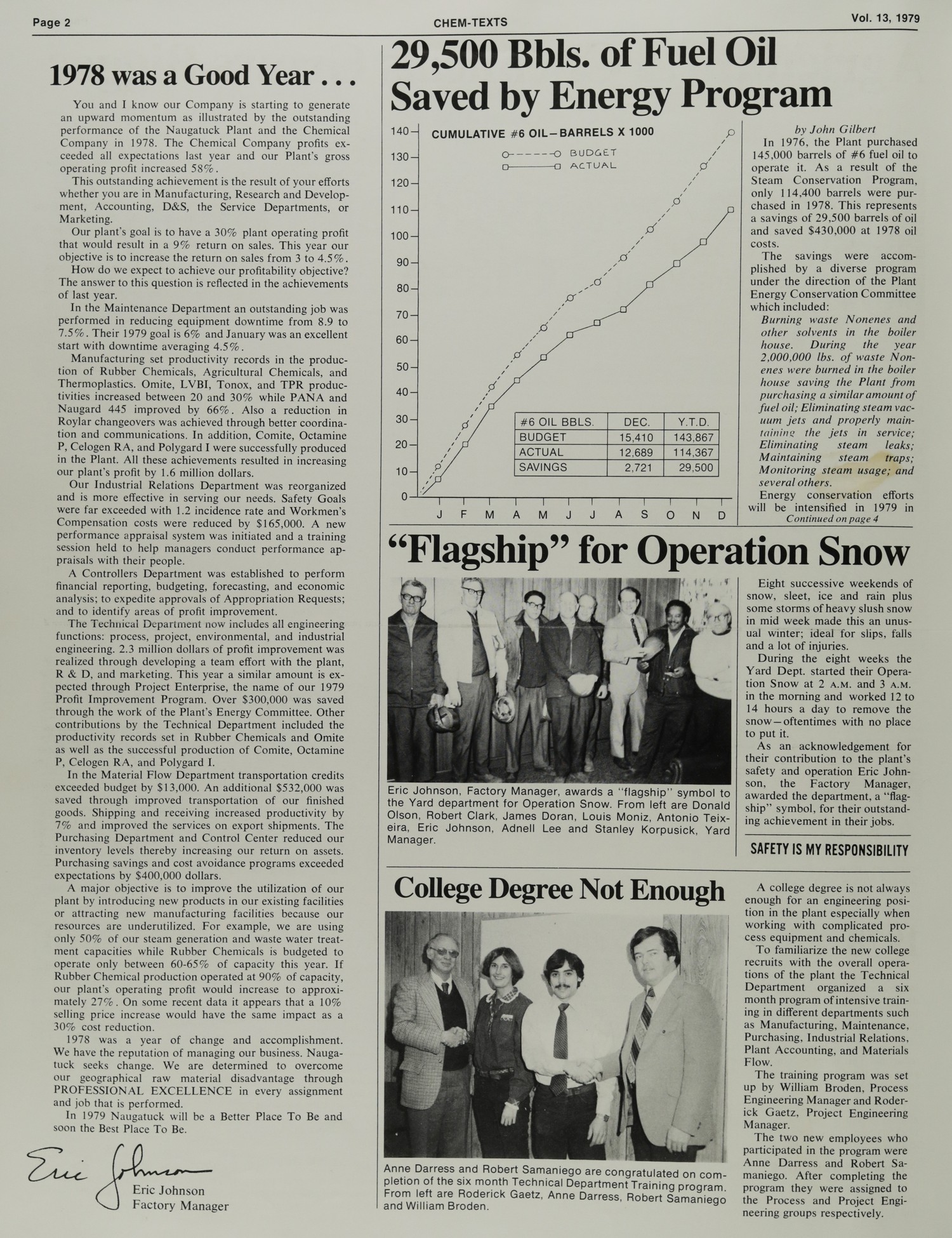
CUMULATIVE #6 OIL—BARRELS X 1000

[CHART showing declining oil usage from January through December, with lines for BUDGET and ACTUAL usage, ranging from approximately 140 to 0]

#6 OIL BBLS. DEC. Y.T.D.
BUDGET 15,410 143,867
ACTUAL 12,689 114,367
SAVINGS 2,721 29,500

by John Gilbert

In 1976, the Plant purchased 145,000 barrels of #6 fuel oil to operate it. As a result of the Steam Conservation Program, only 114,400 barrels were purchased in 1978. This represents a savings of 29,500 barrels of oil and saved $430,000 at 1978 oil costs.

The savings were accomplished by a diverse program under the direction of the Plant Energy Conservation Committee which included:

Burning waste Nonenes and other solvents in the boiler house. During the year 2,000,000 lbs. of waste Nonenes were burned in the boiler house saving the Plant from purchasing a similar amount of fuel oil; Eliminating steam vacuum jets and properly maintaining the jets in service; Eliminating steam leaks; Maintaining steam traps; Monitoring steam usage; and several others.

Energy conservation efforts will be intensified in 1979 in Continued on page 4


“Flagship” for Operation Snow

[PHOTOGRAPH of seven men in business attire standing together]

Eric Johnson, Factory Manager, awards a “flagship” symbol to the Yard department for Operation Snow. From left are Donald Olson, Robert Clark, James Doran, Louis Moniz, Antonio Teixeira, Eric Johnson, Adnell Lee and Stanley Korpusick, Yard Manager.

Eight successive weekends of snow, sleet, ice and rain plus some storms of heavy slush snow in mid week made this an unusual winter; ideal for slips, falls and a lot of injuries.

During the eight weeks the Yard Dept. started their Operation Snow at 2 A.M. and 3 A.M. in the morning and worked 12 to 14 hours a day to remove the snow—oftentimes with no place to put it.

As an acknowledgement for their contribution to the plant’s safety and operation Eric Johnson, the Factory Manager, awarded the department, a “flagship” symbol, for their outstanding achievement in their jobs.


SAFETY IS MY RESPONSIBILITY


College Degree Not Enough

[PHOTOGRAPH of four people, three men and one woman, standing together]

Anne Darress and Robert Samaniego are congratulated on completion of the six month Technical Department Training program. From left are Roderick Gaetz, Anne Darress, Robert Samaniego and William Broden.

A college degree is not always enough for an engineering position in the plant especially when working with complicated process equipment and chemicals.

To familiarize the new college recruits with the overall operations of the plant the Technical Department organized a six month program of intensive training in different departments such as Manufacturing, Maintenance, Purchasing, Industrial Relations, Plant Accounting, and Materials Flow.

The training program was set up by William Broden, Process Engineering Manager and Roderick Gaetz, Project Engineering Manager.

The two new employees who participated in the program were Anne Darress and Robert Samaniego. After completing the program they were assigned to the Process and Project Engineering groups respectively.

CHEM-TEXTS – 1979 – Page 4

Page 004

CHEM-TEXTS

Page 4 | Vol. 13, 1979


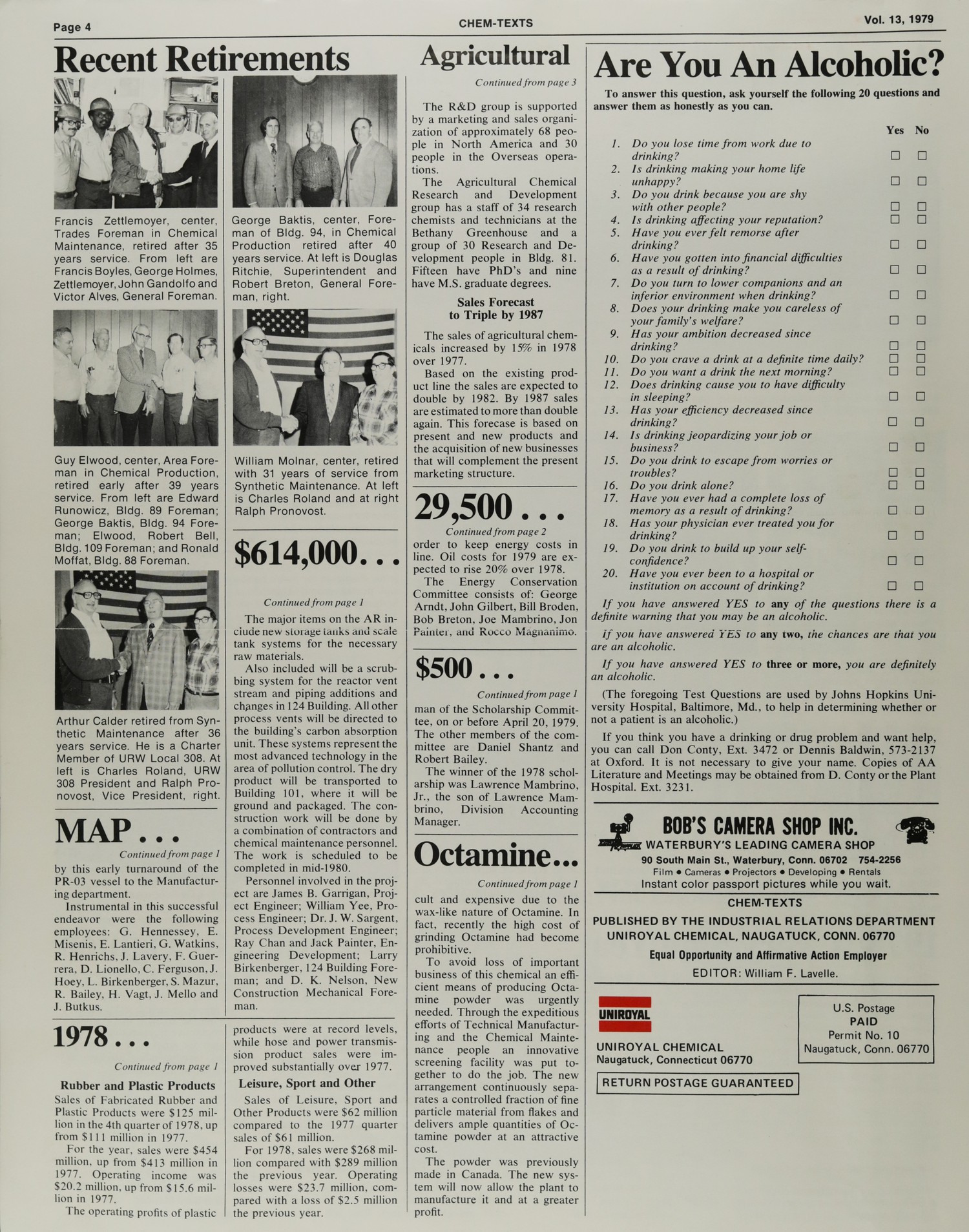
Recent Retirements

[PHOTO: Group photo of retirees]

Francis Zettlemoyer, center, Trades Foreman in Chemical Maintenance, retired after 35 years service. From left are Francis Boyles, George Holmes, Zettlemoyer, John Gandolfo and Victor Alves, General Foreman.

[PHOTO: Group photo of retirees]

Guy Elwood, center, Area Foreman in Chemical Production, retired early after 39 years service. From left are Edward Runowicz, Bldg. 89 Foreman; George Baktis, Bldg. 94 Foreman; Elwood, Robert Bell, Bldg. 109 Foreman; and Ronald Moffat, Bldg. 88 Foreman.

[PHOTO: Group photo]

Arthur Calder retired from Synthetic Maintenance after 36 years service. He is a Charter Member of URW Local 308. At left is Charles Roland, URW 308 President and Ralph Pronovost, Vice President, right.


George Baktis, center, Foreman of Bldg. 94, in Chemical Production retired after 40 years service. At left is Douglas Ritchie, Superintendent and Robert Breton, General Foreman, right.

[PHOTO: Group photo]

William Molnar, center, retired with 31 years of service from Synthetic Maintenance. At left is Charles Roland and at right Ralph Pronovost.


MAP…

Continued from page 1

by this early turnaround of the PR-03 vessel to the Manufacturing department.

Instrumental in this successful endeavor were the following employees: G. Hennessey, E. Misenis, E. Lantieri, G. Watkins, R. Henrichs, J. Lavery, F. Guerrera, D. Lionello, C. Ferguson, J. Hoey, L. Birkenberger, S. Mazur, R. Bailey, H. Vagt, J. Mello and J. Butkus.


1978…

Continued from page 1

Rubber and Plastic Products
Sales of Fabricated Rubber and Plastic Products were $125 million in the 4th quarter of 1978, up from $111 million in 1977.

For the year, sales were $454 million, up from $413 million in 1977. Operating income was $20.2 million, up from $15.6 million in 1977.

The operating profits of plastic products were at record levels, while hose and power transmission product sales were improved substantially over 1977.

Leisure, Sport and Other
Sales of Leisure, Sport and Other Products were $62 million compared to the 1977 quarter sales of $61 million.

For 1978, sales were $268 million compared with $289 million the previous year. Operating losses were $23.7 million, compared with a loss of $2.5 million the previous year.


Agricultural

Continued from page 3

The R&D group is supported by a marketing and sales organization of approximately 68 people in North America and 30 people in the Overseas operations.

The Agricultural Chemical Research and Development group has a staff of 34 research chemists and technicians at the Bethany Greenhouse and a group of 30 Research and Development people in Bldg. 81. Fifteen have PhD’s and nine have M.S. graduate degrees.

Sales Forecast to Triple by 1987

The sales of agricultural chemicals increased by 15% in 1978 over 1977.

Based on the existing product line the sales are expected to double by 1982. By 1987 sales are estimated to more than double again. This forecase is based on present and new products and the acquisition of new businesses that will complement the present marketing structure.


29,500…

Continued from page 2

$614,000…

Continued from page 1

The major items on the AR include new storage tanks and scale tank systems for the necessary raw materials.

Also included will be a scrubbing system for the reactor vent stream and piping additions and changes in 124 Building. All other process vents will be directed to the building’s carbon absorption unit. These systems represent the most advanced technology in the area of pollution control. The dry product will be transported to Building 101, where it will be ground and packaged. The construction work will be done by a combination of contractors and chemical maintenance personnel. The work is scheduled to be completed in mid-1980.

Personnel involved in the project are James B. Garrigan, Project Engineer; William Yee, Process Engineer; Dr. J. W. Sargent, Process Development Engineer; Ray Chan and Jack Painter, Engineering Development; Larry Birkenberger, 124 Building Foreman; and D. K. Nelson, New Construction Mechanical Foreman.

order to keep energy costs in line. Oil costs for 1979 are expected to rise 20% over 1978. The Energy Conservation Committee consists of: George Arndt, John Gilbert, Bill Broden, Bob Breton, Joe Mambrino, Jon Painter, and Rocco Magnanimo.


$500…

Continued from page 1

man of the Scholarship Committee, on or before April 20, 1979. The other members of the committee are Daniel Shantz and Robert Bailey.

The winner of the 1978 scholarship was Lawrence Mambrino, Jr., the son of Lawrence Mambrino, Division Accounting Manager.


Octamine…

Continued from page 1

cult and expensive due to the wax-like nature of Octamine. In fact, recently the high cost of grinding Octamine had become prohibitive.

To avoid loss of important business of this chemical an efficient means of producing Octamine powder was urgently needed. Through the expeditious efforts of Technical Manufacturing and the Chemical Maintenance people an innovative screening facility was put together to do the job. The new arrangement continuously separates a controlled fraction of fine particle material from flakes and delivers ample quantities of Octamine powder at an attractive cost.

The powder was previously made in Canada. The new system will now allow the plant to manufacture it and at a greater profit.


Are You An Alcoholic?

To answer this question, ask yourself the following 20 questions and answer them as honestly as you can.

Yes No
1. Do you lose time from work due to drinking?
2. Is drinking making your home life unhappy?
3. Do you drink because you are shy with other people?
4. Is drinking affecting your reputation?
5. Have you ever felt remorse after drinking?
6. Have you gotten into financial difficulties as a result of drinking?
7. Do you turn to lower companions and an inferior environment when drinking?
8. Does your drinking make you careless of your family’s welfare?
9. Has your ambition decreased since drinking?
10. Do you crave a drink at a definite time daily?
11. Do you want a drink the next morning?
12. Does drinking cause you to have difficulty in sleeping?
13. Has your efficiency decreased since drinking?
14. Is drinking jeopardizing your job or business?
15. Do you drink to escape from worries or troubles?
16. Do you drink alone?
17. Have you ever had a complete loss of memory as a result of drinking?
18. Has your physician ever treated you for drinking?
19. Do you drink to build up your self-confidence?
20. Have you ever been to a hospital or institution on account of drinking?

If you have answered YES to any of the questions there is a definite warning that you may be an alcoholic.

if you have answered YES to any two, the chances are that you are an alcoholic.

If you have answered YES to three or more, you are definitely an alcoholic.

(The foregoing Test Questions are used by Johns Hopkins University Hospital, Baltimore, Md., to help in determining whether or not a patient is an alcoholic.)

If you think you have a drinking or drug problem and want help, you can call Don Conty, Ext. 3472 or Dennis Baldwin, 573-2137 at Oxford. It is not necessary to give your name. Copies of AA Literature and Meetings may be obtained from D. Conty or the Plant Hospital. Ext. 3231.


BOB’S CAMERA SHOP INC.

WATERBURY’S LEADING CAMERA SHOP
90 South Main St., Waterbury, Conn. 06702 754-2256
Film • Cameras • Projectors • Developing • Rentals
Instant color passport pictures while you wait.


CHEM-TEXTS
PUBLISHED BY THE INDUSTRIAL RELATIONS DEPARTMENT
UNIROYAL CHEMICAL, NAUGATUCK, CONN. 06770
Equal Opportunity and Affirmative Action Employer
EDITOR: William F. Lavelle.


[MAILING LABEL AREA]

UNIROYAL | U.S. Postage PAID Permit No. 10 Naugatuck, Conn. 06770

UNIROYAL CHEMICAL
Naugatuck, Connecticut 06770

RETURN POSTAGE GUARANTEED

CHEM-TEXTS – 1978-v12-s261

Page 261

Page 2 CHEM-TEXTS Volume 12, 1978


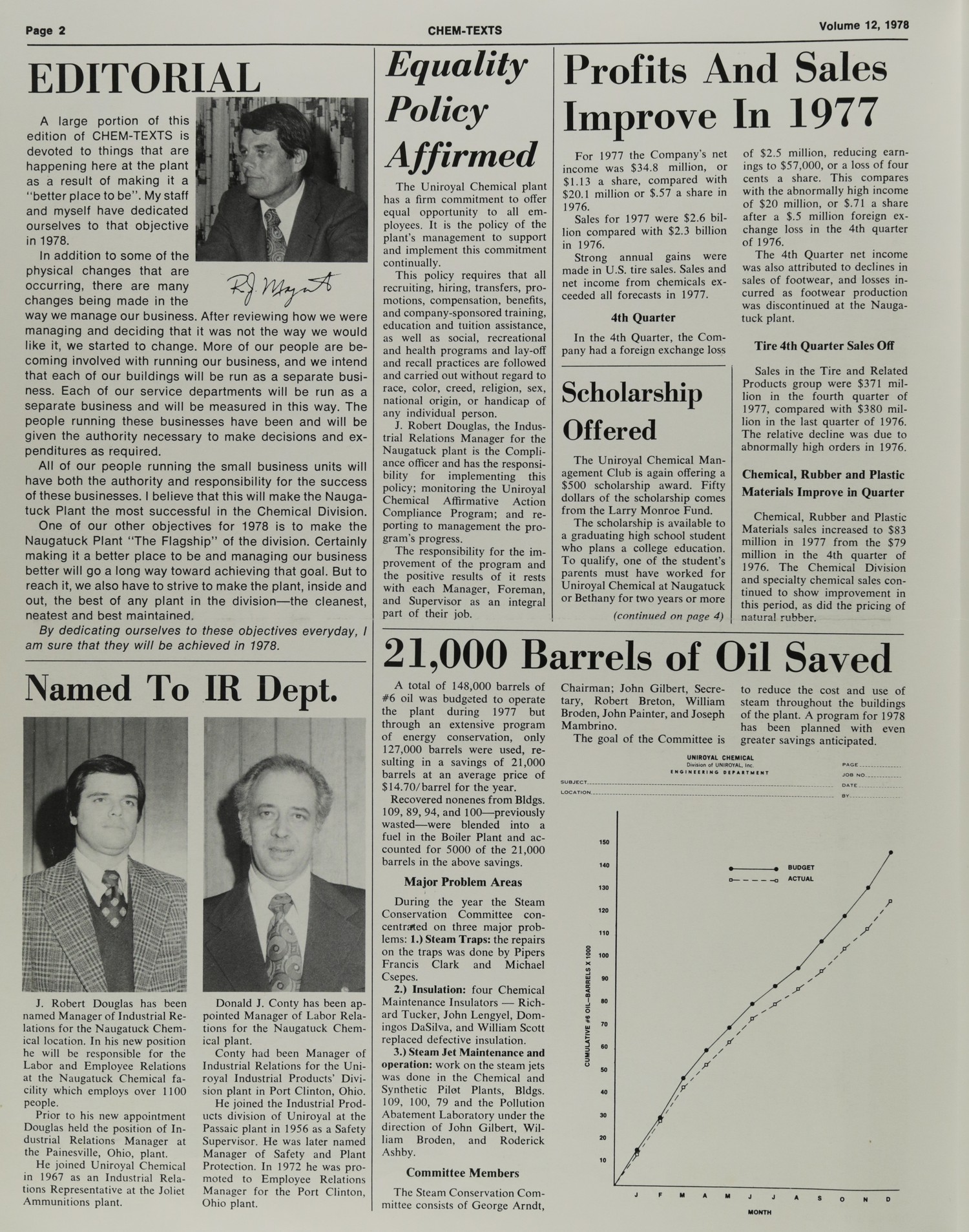
EDITORIAL

A large portion of this edition of CHEM-TEXTS is devoted to things that are happening here at the plant as a result of making it a “better place to be”. My staff and myself have dedicated ourselves to that objective in 1978.

In addition to some of the physical changes that are occurring, there are many changes being made in the way we manage our business. After reviewing how we were managing and deciding that it was not the way we would like it, we started to change. More of our people are becoming involved with running our business, and we intend that each of our buildings will be run as a separate business. Each of our service departments will be run as a separate business and will be measured in this way. The people running these businesses have been and will be given the authority necessary to make decisions and expenditures as required.

All of our people running the small business units will have both the authority and responsibility for the success of these businesses. I believe that this will make the Naugatuck Plant the most successful in the Chemical Division.

One of our other objectives for 1978 is to make the Naugatuck Plant “The Flagship” of the division. Certainly making it a better place to be and managing our business better will go a long way toward achieving that goal. But to reach it, we also have to strive to make the plant, inside and out, the best of any plant in the division—the cleanest, neatest and best maintained.

By dedicating ourselves to these objectives everyday, I am sure that they will be achieved in 1978.

[Signature: R.J. Meyst]


Named To IR Dept.

[PHOTO: Black and white photograph of J. Robert Douglas]

J. Robert Douglas has been named Manager of Industrial Relations for the Naugatuck Chemical location. In his new position he will be responsible for the Labor and Employee Relations at the Naugatuck Chemical facility which employs over 1100 people.

Prior to his new appointment Douglas held the position of Industrial Relations Manager at the Painesville, Ohio, plant.

He joined Uniroyal Chemical in 1967 as an Industrial Relations Representative at the Joliet Ammunitions plant.

[PHOTO: Black and white photograph of Donald J. Conty]

Donald J. Conty has been appointed Manager of Labor Relations for the Naugatuck Chemical plant.

Conty had been Manager of Industrial Relations for the Uniroyal Industrial Products’ Division plant in Port Clinton, Ohio.

He joined the Industrial Products division of Uniroyal at the Passaic plant in 1956 as a Safety Supervisor. He was later named Manager of Safety and Plant Protection. In 1972 he was promoted to Employee Relations Manager for the Port Clinton, Ohio plant.


Equality Policy Affirmed

The Uniroyal Chemical plant has a firm commitment to offer equal opportunity to all employees. It is the policy of the plant’s management to support and implement this commitment continually.

This policy requires that all recruiting, hiring, transfers, promotions, compensation, benefits, and company-sponsored training, education and tuition assistance, as well as social, recreational and health programs and lay-off and recall practices are followed and carried out without regard to race, color, creed, religion, sex, national origin, or handicap of any individual person.

J. Robert Douglas, the Industrial Relations Manager for the Naugatuck plant is the Compliance officer and has the responsibility for implementing this policy; monitoring the Uniroyal Chemical Affirmative Action Compliance Program; and reporting to management the program’s progress.

The responsibility for the improvement of the program and the positive results of it rests with each Manager, Foreman, and Supervisor as an integral part of their job.


Profits And Sales Improve In 1977

For 1977 the Company’s net income was $34.8 million, or $1.13 a share, compared with $20.1 million or $.57 a share in 1976.

Sales for 1977 were $2.6 billion compared with $2.3 billion in 1976.

Strong annual gains were made in U.S. tire sales. Sales and net income from chemicals exceeded all forecasts in 1977.

4th Quarter

In the 4th Quarter, the Company had a foreign exchange loss of $2.5 million, reducing earnings to $57,000, or a loss of four cents a share. This compares with the abnormally high income of $20 million, or $.71 a share after a $.5 million foreign exchange loss in the 4th quarter of 1976.

The 4th Quarter net income was also attributed to declines in sales of footwear, and losses incurred as footwear production was discontinued at the Naugatuck plant.

Tire 4th Quarter Sales Off

Sales in the Tire and Related Products group were $371 million in the fourth quarter of 1977, compared with $380 million in the last quarter of 1976. The relative decline was due to abnormally high orders in 1976.

Chemical, Rubber and Plastic Materials Improve in Quarter

Chemical, Rubber and Plastic Materials sales increased to $83 million in 1977 from the $79 million in the 4th quarter of 1976. The Chemical Division and specialty chemical sales continued to show improvement in this period, as did the pricing of natural rubber.


Scholarship Offered

The Uniroyal Chemical Management Club is again offering a $500 scholarship award. Fifty dollars of the scholarship comes from the Larry Monroe Fund.

The scholarship is available to a graduating high school student who plans a college education. To qualify, one of the student’s parents must have worked for Uniroyal Chemical at Naugatuck or Bethany for two years or more

(continued on page 4)


21,000 Barrels of Oil Saved

A total of 148,000 barrels of #6 oil was budgeted to operate the plant during 1977 but through an extensive program of energy conservation, only 127,000 barrels were used, resulting in a savings of 21,000 barrels at an average price of $14.70/barrel for the year.

Recovered nonenes from Bldgs. 109, 89, 94, and 100—previously wasted—were blended into a fuel in the Boiler Plant and accounted for 5000 of the 21,000 barrels in the above savings.

Major Problem Areas

During the year the Steam Conservation Committee concentrated on three major problems: 1.) Steam Traps: the repairs on the traps was done by Pipers Francis Clark and Michael Csepes.

2.) Insulation: four Chemical Maintenance Insulators — Richard Tucker, John Lengyel, Domingos DaSilva, and William Scott replaced defective insulation.

3.) Steam Jet Maintenance and operation: work on the steam jets was done in the Chemical and Synthetic Pilot Plants, Bldgs. 109, 100, 79 and the Pollution Abatement Laboratory under the direction of John Gilbert, William Broden, and Roderick Ashby.

Committee Members

The Steam Conservation Committee consists of George Arndt,

Chairman; John Gilbert, Secretary, Robert Breton, William Broden, John Painter, and Joseph Mambrino.

The goal of the Committee is to reduce the cost and use of steam throughout the buildings of the plant. A program for 1978 has been planned with even greater savings anticipated.

[FORM HEADER:]
UNIROYAL CHEMICAL
Division of UNIROYAL Inc.
ENGINEERING DEPARTMENT

SUBJECT___
LOCATION__

PAGE_
JOB NO._
DATE_
BY_

[GRAPH: Line graph showing cumulative #6 oil barrels x 1000 from months J through D, with two lines labeled “BUDGET” (solid) and “ACTUAL” (dashed), ranging from approximately 10 to 150 on the y-axis]

CHEM-TEXTS – 1977-v11-s250

Page 250

Vol. 11, 1977 CHEM-TEXTS Page 3


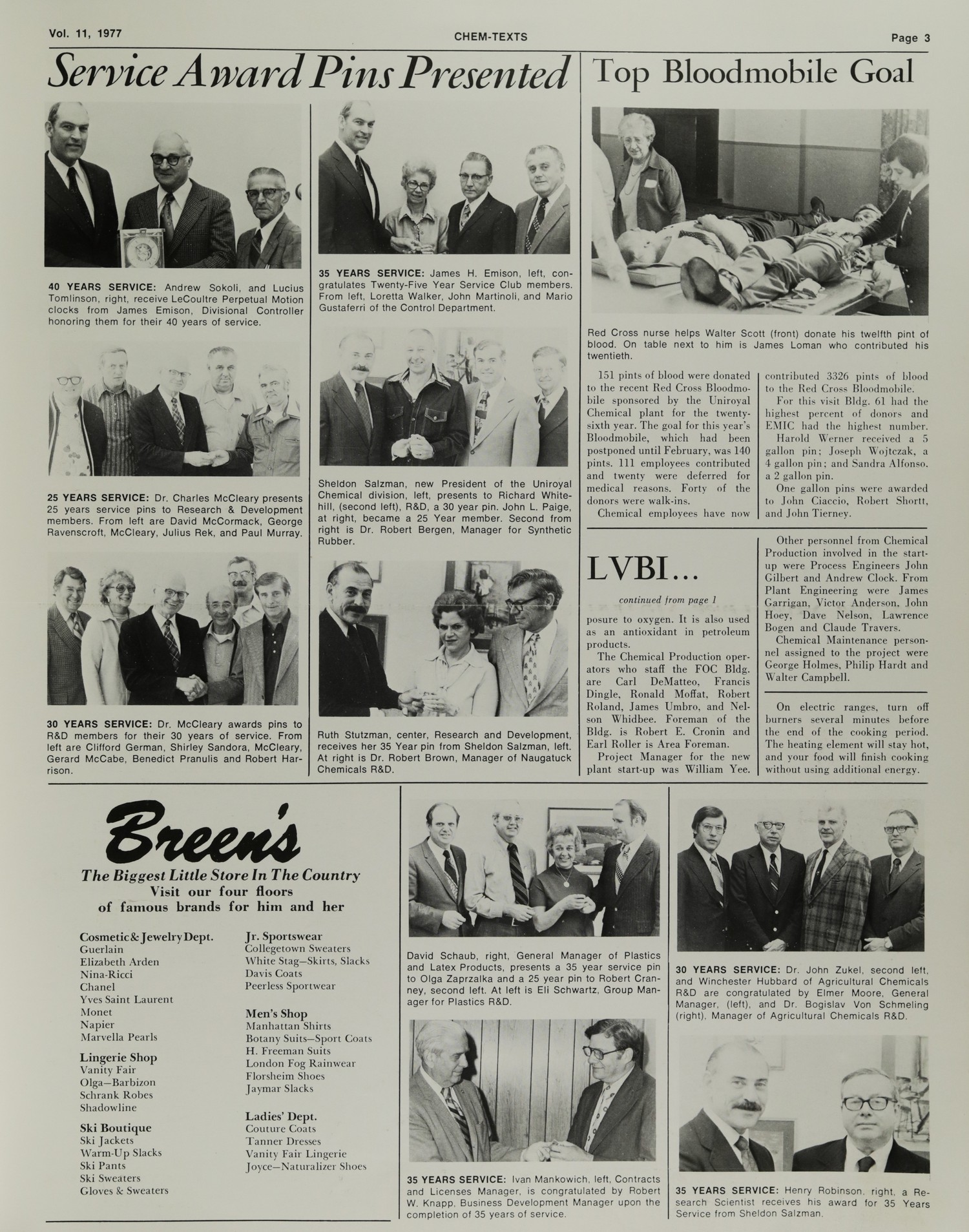
Service Award Pins Presented

40 YEARS SERVICE: Andrew Sokoli, and Lucius Tomlinson, right, receive LeCoultre Perpetual Motion clocks from James Emison, Divisional Controller honoring them for their 40 years of service.


25 YEARS SERVICE: Dr. Charles McCleary presents 25 years service pins to Research & Development members. From left are David McCormack, George Ravenscroft, McCleary, Julius Rek, and Paul Murray.


30 YEARS SERVICE: Dr. McCleary awards pins to R&D members for their 30 years of service. From left are Clifford German, Shirley Sandora, McCleary, Gerard McCabe, Benedict Pranulis and Robert Harrison.


35 YEARS SERVICE: James H. Emison, left, congratulates Twenty-Five Year Service Club members. From left, Loretta Walker, John Martinoli, and Mario Gustaferri of the Control Department.


Sheldon Salzman, new President of the Uniroyal Chemical division, left, presents to Richard Whitehill, (second left), R&D, a 30 year pin. John L. Paige, at right, became a 25 Year member. Second from right is Dr. Robert Bergen, Manager for Synthetic Rubber.


Ruth Stutzman, center, Research and Development, receives her 35 Year pin from Sheldon Salzman, left. At right is Dr. Robert Brown, Manager of Naugatuck Chemicals R&D.


Top Bloodmobile Goal

Red Cross nurse helps Walter Scott (front) donate his twelfth pint of blood. On table next to him is James Loman who contributed his twentieth.

151 pints of blood were donated to the recent Red Cross Bloodmobile sponsored by the Uniroyal Chemical plant for the twenty-sixth year. The goal for this year’s Bloodmobile, which had been postponed until February, was 140 pints. 111 employees contributed and twenty were deferred for medical reasons. Forty of the donors were walk-ins.

Chemical employees have now contributed 3326 pints of blood to the Red Cross Bloodmobile.

For this visit Bldg. 61 had the highest percent of donors and EMIC had the highest number.

Harold Werner received a 5 gallon pin; Joseph Wojtczak, a 4 gallon pin; and Sandra Alfonso, a 2 gallon pin.

One gallon pins were awarded to John Ciaccio, Robert Shortt, and John Tierney.


LVBI…

continued from page 1

posure to oxygen. It is also used as an antioxidant in petroleum products.

The Chemical Production operators who staff the FOC Bldg. are Carl DeMatteo, Francis Dingle, Ronald Moffat, Robert Roland, James Umbro, and Nelson Whidbee. Foreman of the Bldg. is Robert E. Cronin and Earl Roller is Area Foreman.

Project Manager for the new plant start-up was William Yee.

Other personnel from Chemical Production involved in the start-up were Process Engineers John Gilbert and Andrew Clock. From Plant Engineering were James Garrigan, Victor Anderson, John Hoey, Dave Nelson, Lawrence Bogen and Claude Travers.

Chemical Maintenance personnel assigned to the project were George Holmes, Philip Hardt and Walter Campbell.


On electric ranges, turn off burners several minutes before the end of the cooking period. The heating element will stay hot, and your food will finish cooking without using additional energy.


Breen’s

The Biggest Little Store In The Country

Visit our four floors of famous brands for him and her

Cosmetic & Jewelry Dept.
Guerlain
Elizabeth Arden
Nina-Ricci
Chanel
Yves Saint Laurent
Monet
Napier
Marvella Pearls

Lingerie Shop
Vanity Fair
Olga—Barbizon
Schrank Robes
Shadowline

Ski Boutique
Ski Jackets
Warm-Up Slacks
Ski Pants
Ski Sweaters
Gloves & Sweaters

Jr. Sportswear
Collegetown Sweaters
White Stag—Skirts, Slacks
Davis Coats
Peerless Sportwear

Men’s Shop
Manhattan Shirts
Botany Suits—Sport Coats
H. Freeman Suits
London Fog Rainwear
Florsheim Shoes
Jaymar Slacks

Ladies’ Dept.
Couture Coats
Tanner Dresses
Vanity Fair Lingerie
Joyce—Naturalizer Shoes


David Schaub, right, General Manager of Plastics and Latex Products, presents a 35 year service pin to Olga Zaprzalka and a 25 year pin to Robert Cranney, second left. At left is Eli Schwartz, Group Manager for Plastics R&D.


30 YEARS SERVICE: Dr. John Zukei, second left, and Winchester Hubbard of Agricultural Chemicals R&D are congratulated by Elmer Moore, General Manager, (left), and Dr. Bogislav Von Schmeling (right), Manager of Agricultural Chemicals R&D.


35 YEARS SERVICE: Ivan Mankowich, left, Contracts and Licenses Manager, is congratulated by Robert W. Knapp, Business Development Manager upon the completion of 35 years of service.


35 YEARS SERVICE: Henry Robinson, right, a Research Scientist receives his award for 35 Years Service from Sheldon Salzman.

CHEM-TEXTS – Vol. 5 No. 3 – Page 4

Page 004

Page 4 CHEM-TEXTS Vol. 5 No. 3


Know Your Products: Rubber Chemical Accelerators

by Dr. Bob Brown

(This issue continues the article in Vol. 5, No. 2 on Accelerators made or marketed by the Naugatuck Chemical plant.)

Accelerators are used primarily to speed up, or control the vulcanization process which turns rubber from a useless, gummy substance into a strong resilient and elastic material. Vulcanization, in simple terms, is a chemical reaction between rubber and sulfur, usually brought about by heat.

Faster Accelerators

Where there is less processing or mixing involved, very fast accelerators with little or no delayed action can be used to give more rapid vulcanization. The Zates (Arazate®, Butazate®, Ethazate® and Methazate®) and the Thiurams (Monex®, Pentex®, Tuex®, and Accelerator 108) are used here. They are also used in latex curing where processing is usually not a problem.

Customers use these accelerators for rubber sponge, wire insulation, hot water bottles, conveyor belts, hospital sheeting, and household items and in such latex products as balloons and carpet backing.

The Zates accelerators are non-discoloring and non-staining and can be used in colored rubber products.

Some of the newer synthetic rubbers (Royalene® “the crackless rubber” is an example) are inherently slower in vulcanization than the older types such as natural rubber, neoprene and the Naugapol® and Paracril® synthetic rubbers made at the Naugatuck and Painesville, Ohio plants. Fast accelerators are needed to speed up the vulcanization process for these types of rubber, otherwise it would be economically impossible to make a product at a reasonable selling price to the consumer.

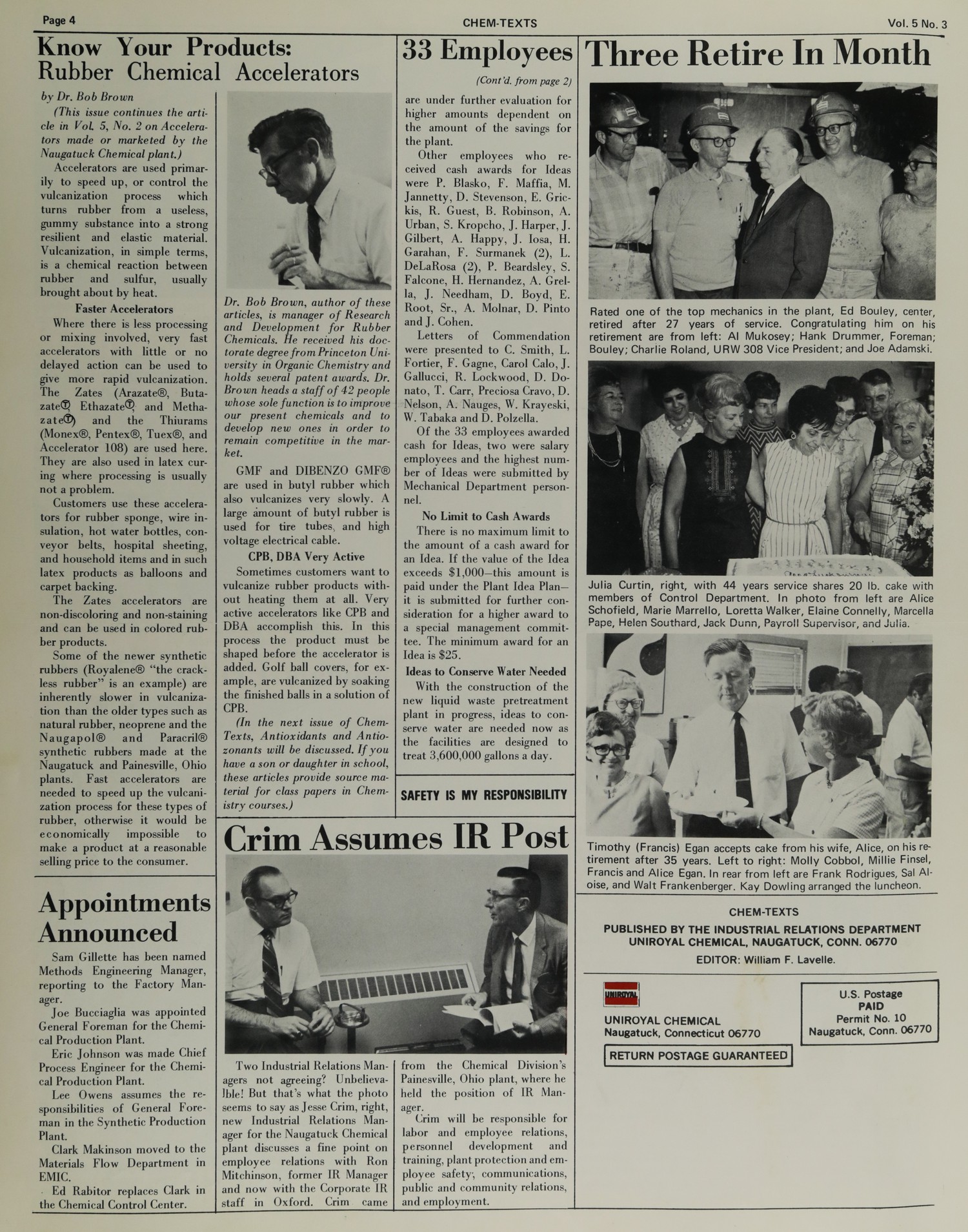
Dr. Bob Brown, author of these articles, is manager of Research and Development for Rubber Chemicals. He received his doctorate degree from Princeton University in Organic Chemistry and holds several patent awards. Dr. Brown heads a staff of 42 people whose sole function is to improve our present chemicals and to develop new ones in order to remain competitive in the market.

GMF and DIBENZO GMF® are used in butyl rubber which also vulcanizes very slowly. A large amount of butyl rubber is used for tire tubes, and high voltage electrical cable.

CPB, DBA Very Active

Sometimes customers want to vulcanize rubber products without heating them at all. Very active accelerators like CPB and DBA accomplish this. In this process the product must be shaped before the accelerator is added. Golf ball covers, for example, are vulcanized by soaking the finished balls in a solution of CPB.

(In the next issue of Chem-Texts, Antioxidants and Antiozonants will be discussed. If you have a son or daughter in school, these articles provide source material for class papers in Chemistry courses.)


33 Employees

(Cont’d. from page 2)

are under further evaluation for higher amounts dependent on the amount of the savings for the plant.

Other employees who received cash awards for Ideas were P. Blasko, F. Maffia, M. Jannetty, D. Stevenson, E. Grickis, R. Guest, B. Robinson, A. Urban, S. Kropcho, J. Harper, J. Gilbert, A. Happy, J. Iosa, H. Garahan, F. Surmanek (2), L. DeLaRosa (2), P. Beardsley, S. Falcone, H. Hernandez, A. Grella, J. Needham, D. Boyd, E. Root, Sr., A. Molnar, D. Pinto and J. Cohen.

Letters of Commendation were presented to C. Smith, L. Fortier, F. Gagne, Carol Calo, J. Gallucci, R. Lockwood, D. Donato, T. Carr, Preciosa Cravo, D. Nelson, A. Nauges, W. Krayeski, W. Tabaka and D. Polzella.

Of the 33 employees awarded cash for Ideas, two were salary employees and the highest number of Ideas were submitted by Mechanical Department personnel.

No Limit to Cash Awards

There is no maximum limit to the amount of a cash award for an Idea. If the value of the Idea exceeds $1,000—this amount is paid under the Plant Idea Plan—it is submitted for further consideration for a higher award to a special management committee. The minimum award for an Idea is $25.

Ideas to Conserve Water Needed

With the construction of the new liquid waste pretreatment plant in progress, ideas to conserve water are needed now as the facilities are designed to treat 3,600,000 gallons a day.


SAFETY IS MY RESPONSIBILITY


Crim Assumes IR Post

Two Industrial Relations Managers not agreeing? Unbelievable! But that’s what the photo seems to say as Jesse Crim, right, new Industrial Relations Manager for the Naugatuck Chemical plant discusses a fine point on employee relations with Ron Mitchinson, former IR Manager and now with the Corporate IR staff in Oxford. Crim came from the Chemical Division’s Painesville, Ohio plant, where he held the position of IR Manager.

Crim will be responsible for labor and employee relations, personnel development and training, plant protection and employee safety, communications, public and community relations, and employment.


Appointments Announced

Sam Gillette has been named Methods Engineering Manager, reporting to the Factory Manager.

Joe Bucciaglia was appointed General Foreman for the Chemical Production Plant.

Eric Johnson was made Chief Process Engineer for the Chemical Production Plant.

Lee Owens assumes the responsibilities of General Foreman in the Synthetic Production Plant.

Clark Makinson moved to the Materials Flow Department in EMIC.

Ed Rabitor replaces Clark in the Chemical Control Center.


Three Retire In Month

Rated one of the top mechanics in the plant, Ed Bouley, center, retired after 27 years of service. Congratulating him on his retirement are from left: Al Mukosey; Hank Drummer, Foreman; Bouley; Charlie Roland, URW 308 Vice President; and Joe Adamski.


Julia Curtin, right, with 44 years service shares 20 lb. cake with members of Control Department. In photo from left are Alice Schofield, Marie Marrello, Loretta Walker, Elaine Connelly, Marcella Pape, Helen Southard, Jack Dunn, Payroll Supervisor, and Julia.


Timothy (Francis) Egan accepts cake from his wife, Alice, on his retirement after 35 years. Left to right: Molly Cobbol, Millie Finsel, Francis and Alice Egan. In rear from left are Frank Rodrigues, Sal Aloise, and Walt Frankenberger. Kay Dowling arranged the luncheon.


CHEM-TEXTS

PUBLISHED BY THE INDUSTRIAL RELATIONS DEPARTMENT
UNIROYAL CHEMICAL, NAUGATUCK, CONN. 06770

EDITOR: William F. Lavelle.


UNIROYAL CHEMICAL
Naugatuck, Connecticut 06770

RETURN POSTAGE GUARANTEED

U.S. Postage
PAID
Permit No. 10
Naugatuck, Conn. 06770

CHEM-TEXTS – unknown-i05-s201

Page 201

CHEM-TEXTS

Page 2 | Vol. 5, No. 5


Thanksgiving And Us…

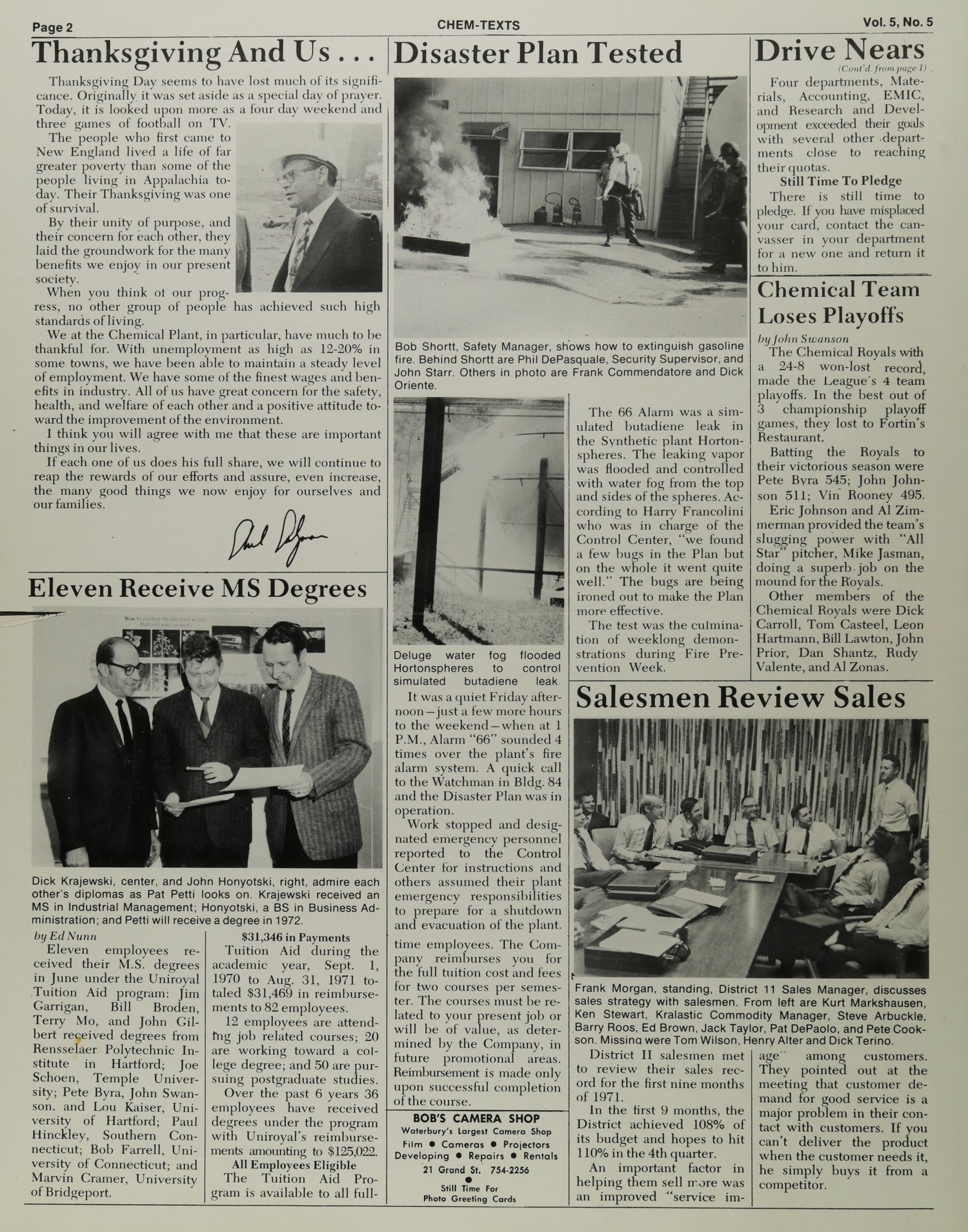
Thanksgiving Day seems to have lost much of its significance. Originally it was set aside as a special day of prayer. Today, it is looked upon more as a four day weekend and three games of football on TV.

The people who first came to New England lived a life of far greater poverty than some of the people living in Appalachia today. Their Thanksgiving was one of survival.

By their unity of purpose, and their concern for each other, they laid the groundwork for the many benefits we enjoy in our present society.

When you think ot our progress, no other group of people has achieved such high standards of living.

We at the Chemical Plant, in particular, have much to be thankful for. With unemployment as high as 12-20% in some towns, we have been able to maintain a steady level of employment. We have some of the finest wages and benefits in industry. All of us have great concern for the safety, health, and welfare of each other and a positive attitude toward the improvement of the environment.

I think you will agree with me that these are important things in our lives.

If each one of us does his full share, we will continue to reap the rewards of our efforts and assure, even increase, the many good things we now enjoy for ourselves and our families.

[Signature: Paul Lyons]


Eleven Receive MS Degrees

Dick Krajewski, center, and John Honyotski, right, admire each other’s diplomas as Pat Petti looks on. Krajewski received an MS in Industrial Management; Honyotski, a BS in Business Administration; and Petti will receive a degree in 1972.

by Ed Nunn

Eleven employees received their M.S. degrees in June under the Uniroyal Tuition Aid program: Jim Garrigan, Bill Broden, Terry Mo, and John Gilbert received degrees from Rensselaer Polytechnic Institute in Hartford; Joe Schoen, Temple University; Pete Byra, John Swanson, and Lou Kaiser, University of Hartford; Paul Hinckley, Southern Connecticut; Bob Farrell, University of Connecticut; and Marvin Cramer, University of Bridgeport.

$31,346 in Payments

Tuition Aid during the academic year, Sept. 1, 1970 to Aug. 31, 1971 totaled $31,469 in reimbursements to 82 employees.

12 employees are attending job related courses; 20 are working toward a college degree; and 50 are pursuing postgraduate studies.

Over the past 6 years 36 employees have received degrees under the program with Uniroyal’s reimbursements amounting to $125,022.

All Employees Eligible

The Tuition Aid Program is available to all full-time employees. The Company reimburses you for the full tuition cost and fees for two courses per semester. The courses must be related to your present job or will be of value, as determined by the Company, in future promotional areas. Reimbursement is made only upon successful completion of the course.


BOB’S CAMERA SHOP
Waterbury’s Largest Camera Shop
Film ● Cameras ● Projectors
Developing ● Repairs ● Rentals
21 Grand St. 754-2256

Still Time For
Photo Greeting Cards


Disaster Plan Tested

Bob Shortt, Safety Manager, shows how to extinguish gasoline fire. Behind Shortt are Phil DePasquale, Security Supervisor, and John Starr. Others in photo are Frank Commendatore and Dick Oriente.

Deluge water fog flooded Hortonspheres to control simulated butadiene leak

The 66 Alarm was a simulated butadiene leak in the Synthetic plant Hortonspheres. The leaking vapor was flooded and controlled with water fog from the top and sides of the spheres. According to Harry Francolini who was in charge of the Control Center, “we found a few bugs in the Plan but on the whole it went quite well.” The bugs are being ironed out to make the Plan more effective.

The test was the culmination of weeklong demonstrations during Fire Prevention Week.

It was a quiet Friday afternoon—just a few more hours to the weekend—when at 1 P.M., Alarm “66” sounded 4 times over the plant’s fire alarm system. A quick call to the Watchman in Bldg. 84 and the Disaster Plan was in operation.

Work stopped and designated emergency personnel reported to the Control Center for instructions and others assumed their plant emergency responsibilities to prepare for a shutdown and evacuation of the plant.


Drive Nears

(Cont’d. from page 1)

Four departments, Materials, Accounting, EMIC, and Research and Development exceeded their goals with several other departments close to reaching their quotas.

Still Time To Pledge

There is still time to pledge. If you have misplaced your card, contact the canvasser in your department or call any one and return it to him.


Chemical Team Loses Playoffs

by John Swanson

The Chemical Royals with a 24-8 won-lost record, made the League’s 4 team playoffs. In the best out of 3 championship playoff games, they lost to Fortin’s Restaurant.

Batting the Royals to their victorious season were Pete Byra 545; John Johnson 511; Vin Rooney 495.

Eric Johnson and Al Zimmerman provided the team’s slugging power with “All Star” pitcher, Mike Jasman, doing a superb job on the mound for the Royals.

Other members of the Chemical Royals were Dick Carroll, Tom Casteel, Leon Hartmann, Bill Lawton, John Prior, Dan Shantz, Rudy Valente, and Al Zonas.


Salesmen Review Sales

Frank Morgan, standing, District 11 Sales Manager, discusses sales strategy with salesmen. From left are Kurt Markshausen, Ken Stewart, Kralastic Commodity Manager, Steve Arbuckle, Barry Roos, Ed Brown, Jack Taylor, Pat DePaolo, and Pete Cookson. Missing were Tom Wilson, Henry Alter and Dick Terino.

District 11 salesmen met to review their sales record for the first nine months of 1971.

In the first 9 months, the District achieved 108% of its budget and hopes to hit 110% in the 4th quarter.

An important factor in helping them sell more was an improved “service image” among customers. They pointed out at the meeting that customer demand for good service is a major problem in their contact with customers. If you can’t deliver the product when the customer needs it, he simply buys it from a competitor.