CHEM-TEXTS – 1979 – Page 4

Page 004

CHEM-TEXTS

Page 4 | Vol. 13, 1979


Recent Retirements

[PHOTO: Group photo of retirees]

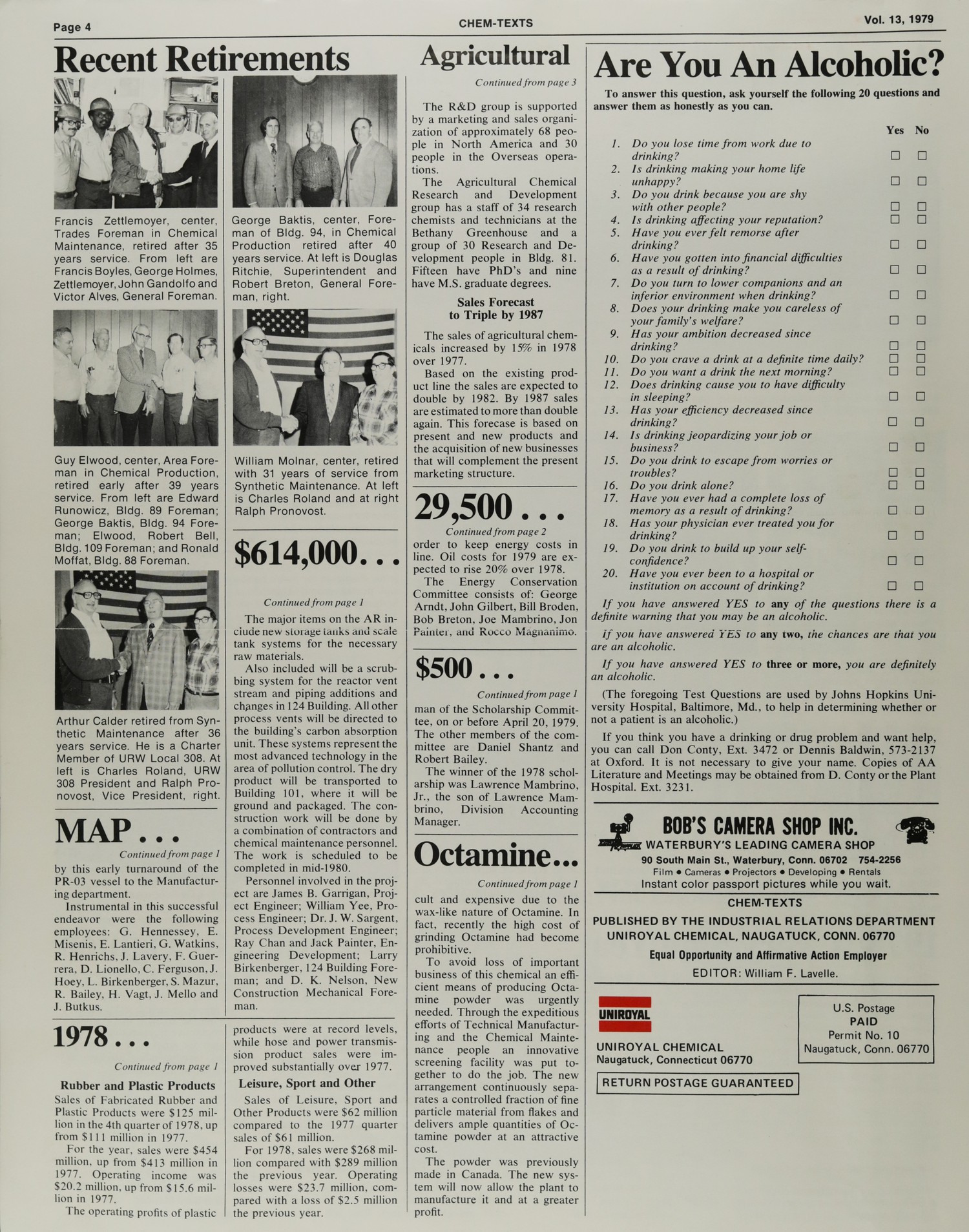
Francis Zettlemoyer, center, Trades Foreman in Chemical Maintenance, retired after 35 years service. From left are Francis Boyles, George Holmes, Zettlemoyer, John Gandolfo and Victor Alves, General Foreman.

[PHOTO: Group photo of retirees]

Guy Elwood, center, Area Foreman in Chemical Production, retired early after 39 years service. From left are Edward Runowicz, Bldg. 89 Foreman; George Baktis, Bldg. 94 Foreman; Elwood, Robert Bell, Bldg. 109 Foreman; and Ronald Moffat, Bldg. 88 Foreman.

[PHOTO: Group photo]

Arthur Calder retired from Synthetic Maintenance after 36 years service. He is a Charter Member of URW Local 308. At left is Charles Roland, URW 308 President and Ralph Pronovost, Vice President, right.


George Baktis, center, Foreman of Bldg. 94, in Chemical Production retired after 40 years service. At left is Douglas Ritchie, Superintendent and Robert Breton, General Foreman, right.

[PHOTO: Group photo]

William Molnar, center, retired with 31 years of service from Synthetic Maintenance. At left is Charles Roland and at right Ralph Pronovost.


MAP…

Continued from page 1

by this early turnaround of the PR-03 vessel to the Manufacturing department.

Instrumental in this successful endeavor were the following employees: G. Hennessey, E. Misenis, E. Lantieri, G. Watkins, R. Henrichs, J. Lavery, F. Guerrera, D. Lionello, C. Ferguson, J. Hoey, L. Birkenberger, S. Mazur, R. Bailey, H. Vagt, J. Mello and J. Butkus.


1978…

Continued from page 1

Rubber and Plastic Products
Sales of Fabricated Rubber and Plastic Products were $125 million in the 4th quarter of 1978, up from $111 million in 1977.

For the year, sales were $454 million, up from $413 million in 1977. Operating income was $20.2 million, up from $15.6 million in 1977.

The operating profits of plastic products were at record levels, while hose and power transmission product sales were improved substantially over 1977.

Leisure, Sport and Other
Sales of Leisure, Sport and Other Products were $62 million compared to the 1977 quarter sales of $61 million.

For 1978, sales were $268 million compared with $289 million the previous year. Operating losses were $23.7 million, compared with a loss of $2.5 million the previous year.


Agricultural

Continued from page 3

The R&D group is supported by a marketing and sales organization of approximately 68 people in North America and 30 people in the Overseas operations.

The Agricultural Chemical Research and Development group has a staff of 34 research chemists and technicians at the Bethany Greenhouse and a group of 30 Research and Development people in Bldg. 81. Fifteen have PhD’s and nine have M.S. graduate degrees.

Sales Forecast to Triple by 1987

The sales of agricultural chemicals increased by 15% in 1978 over 1977.

Based on the existing product line the sales are expected to double by 1982. By 1987 sales are estimated to more than double again. This forecase is based on present and new products and the acquisition of new businesses that will complement the present marketing structure.


29,500…

Continued from page 2

$614,000…

Continued from page 1

The major items on the AR include new storage tanks and scale tank systems for the necessary raw materials.

Also included will be a scrubbing system for the reactor vent stream and piping additions and changes in 124 Building. All other process vents will be directed to the building’s carbon absorption unit. These systems represent the most advanced technology in the area of pollution control. The dry product will be transported to Building 101, where it will be ground and packaged. The construction work will be done by a combination of contractors and chemical maintenance personnel. The work is scheduled to be completed in mid-1980.

Personnel involved in the project are James B. Garrigan, Project Engineer; William Yee, Process Engineer; Dr. J. W. Sargent, Process Development Engineer; Ray Chan and Jack Painter, Engineering Development; Larry Birkenberger, 124 Building Foreman; and D. K. Nelson, New Construction Mechanical Foreman.

order to keep energy costs in line. Oil costs for 1979 are expected to rise 20% over 1978. The Energy Conservation Committee consists of: George Arndt, John Gilbert, Bill Broden, Bob Breton, Joe Mambrino, Jon Painter, and Rocco Magnanimo.


$500…

Continued from page 1

man of the Scholarship Committee, on or before April 20, 1979. The other members of the committee are Daniel Shantz and Robert Bailey.

The winner of the 1978 scholarship was Lawrence Mambrino, Jr., the son of Lawrence Mambrino, Division Accounting Manager.


Octamine…

Continued from page 1

cult and expensive due to the wax-like nature of Octamine. In fact, recently the high cost of grinding Octamine had become prohibitive.

To avoid loss of important business of this chemical an efficient means of producing Octamine powder was urgently needed. Through the expeditious efforts of Technical Manufacturing and the Chemical Maintenance people an innovative screening facility was put together to do the job. The new arrangement continuously separates a controlled fraction of fine particle material from flakes and delivers ample quantities of Octamine powder at an attractive cost.

The powder was previously made in Canada. The new system will now allow the plant to manufacture it and at a greater profit.


Are You An Alcoholic?

To answer this question, ask yourself the following 20 questions and answer them as honestly as you can.

Yes No
1. Do you lose time from work due to drinking?
2. Is drinking making your home life unhappy?
3. Do you drink because you are shy with other people?
4. Is drinking affecting your reputation?
5. Have you ever felt remorse after drinking?
6. Have you gotten into financial difficulties as a result of drinking?
7. Do you turn to lower companions and an inferior environment when drinking?
8. Does your drinking make you careless of your family’s welfare?
9. Has your ambition decreased since drinking?
10. Do you crave a drink at a definite time daily?
11. Do you want a drink the next morning?
12. Does drinking cause you to have difficulty in sleeping?
13. Has your efficiency decreased since drinking?
14. Is drinking jeopardizing your job or business?
15. Do you drink to escape from worries or troubles?
16. Do you drink alone?
17. Have you ever had a complete loss of memory as a result of drinking?
18. Has your physician ever treated you for drinking?
19. Do you drink to build up your self-confidence?
20. Have you ever been to a hospital or institution on account of drinking?

If you have answered YES to any of the questions there is a definite warning that you may be an alcoholic.

if you have answered YES to any two, the chances are that you are an alcoholic.

If you have answered YES to three or more, you are definitely an alcoholic.

(The foregoing Test Questions are used by Johns Hopkins University Hospital, Baltimore, Md., to help in determining whether or not a patient is an alcoholic.)

If you think you have a drinking or drug problem and want help, you can call Don Conty, Ext. 3472 or Dennis Baldwin, 573-2137 at Oxford. It is not necessary to give your name. Copies of AA Literature and Meetings may be obtained from D. Conty or the Plant Hospital. Ext. 3231.


BOB’S CAMERA SHOP INC.

WATERBURY’S LEADING CAMERA SHOP
90 South Main St., Waterbury, Conn. 06702 754-2256
Film • Cameras • Projectors • Developing • Rentals
Instant color passport pictures while you wait.


CHEM-TEXTS
PUBLISHED BY THE INDUSTRIAL RELATIONS DEPARTMENT
UNIROYAL CHEMICAL, NAUGATUCK, CONN. 06770
Equal Opportunity and Affirmative Action Employer
EDITOR: William F. Lavelle.


[MAILING LABEL AREA]

UNIROYAL | U.S. Postage PAID Permit No. 10 Naugatuck, Conn. 06770

UNIROYAL CHEMICAL
Naugatuck, Connecticut 06770

RETURN POSTAGE GUARANTEED
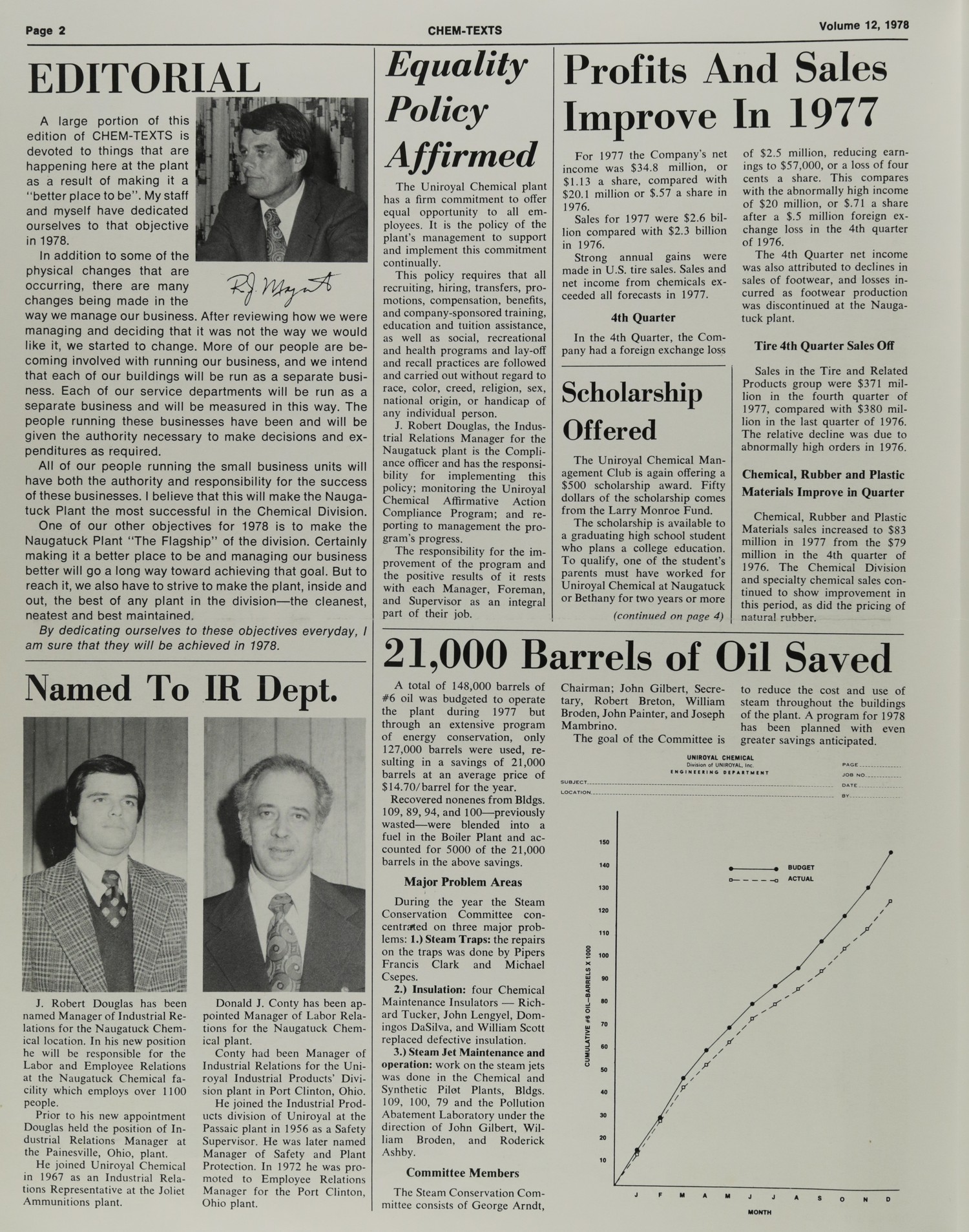
CHEM-TEXTS – 1978-v12-s261

Page 261

Page 2 CHEM-TEXTS Volume 12, 1978


EDITORIAL

A large portion of this edition of CHEM-TEXTS is devoted to things that are happening here at the plant as a result of making it a “better place to be”. My staff and myself have dedicated ourselves to that objective in 1978.

In addition to some of the physical changes that are occurring, there are many changes being made in the way we manage our business. After reviewing how we were managing and deciding that it was not the way we would like it, we started to change. More of our people are becoming involved with running our business, and we intend that each of our buildings will be run as a separate business. Each of our service departments will be run as a separate business and will be measured in this way. The people running these businesses have been and will be given the authority necessary to make decisions and expenditures as required.

All of our people running the small business units will have both the authority and responsibility for the success of these businesses. I believe that this will make the Naugatuck Plant the most successful in the Chemical Division.

One of our other objectives for 1978 is to make the Naugatuck Plant “The Flagship” of the division. Certainly making it a better place to be and managing our business better will go a long way toward achieving that goal. But to reach it, we also have to strive to make the plant, inside and out, the best of any plant in the division—the cleanest, neatest and best maintained.

By dedicating ourselves to these objectives everyday, I am sure that they will be achieved in 1978.

[Signature: R.J. Meyst]


Named To IR Dept.

[PHOTO: Black and white photograph of J. Robert Douglas]

J. Robert Douglas has been named Manager of Industrial Relations for the Naugatuck Chemical location. In his new position he will be responsible for the Labor and Employee Relations at the Naugatuck Chemical facility which employs over 1100 people.

Prior to his new appointment Douglas held the position of Industrial Relations Manager at the Painesville, Ohio, plant.

He joined Uniroyal Chemical in 1967 as an Industrial Relations Representative at the Joliet Ammunitions plant.

[PHOTO: Black and white photograph of Donald J. Conty]

Donald J. Conty has been appointed Manager of Labor Relations for the Naugatuck Chemical plant.

Conty had been Manager of Industrial Relations for the Uniroyal Industrial Products’ Division plant in Port Clinton, Ohio.

He joined the Industrial Products division of Uniroyal at the Passaic plant in 1956 as a Safety Supervisor. He was later named Manager of Safety and Plant Protection. In 1972 he was promoted to Employee Relations Manager for the Port Clinton, Ohio plant.


Equality Policy Affirmed

The Uniroyal Chemical plant has a firm commitment to offer equal opportunity to all employees. It is the policy of the plant’s management to support and implement this commitment continually.

This policy requires that all recruiting, hiring, transfers, promotions, compensation, benefits, and company-sponsored training, education and tuition assistance, as well as social, recreational and health programs and lay-off and recall practices are followed and carried out without regard to race, color, creed, religion, sex, national origin, or handicap of any individual person.

J. Robert Douglas, the Industrial Relations Manager for the Naugatuck plant is the Compliance officer and has the responsibility for implementing this policy; monitoring the Uniroyal Chemical Affirmative Action Compliance Program; and reporting to management the program’s progress.

The responsibility for the improvement of the program and the positive results of it rests with each Manager, Foreman, and Supervisor as an integral part of their job.


Profits And Sales Improve In 1977

For 1977 the Company’s net income was $34.8 million, or $1.13 a share, compared with $20.1 million or $.57 a share in 1976.

Sales for 1977 were $2.6 billion compared with $2.3 billion in 1976.

Strong annual gains were made in U.S. tire sales. Sales and net income from chemicals exceeded all forecasts in 1977.

4th Quarter

In the 4th Quarter, the Company had a foreign exchange loss of $2.5 million, reducing earnings to $57,000, or a loss of four cents a share. This compares with the abnormally high income of $20 million, or $.71 a share after a $.5 million foreign exchange loss in the 4th quarter of 1976.

The 4th Quarter net income was also attributed to declines in sales of footwear, and losses incurred as footwear production was discontinued at the Naugatuck plant.

Tire 4th Quarter Sales Off

Sales in the Tire and Related Products group were $371 million in the fourth quarter of 1977, compared with $380 million in the last quarter of 1976. The relative decline was due to abnormally high orders in 1976.

Chemical, Rubber and Plastic Materials Improve in Quarter

Chemical, Rubber and Plastic Materials sales increased to $83 million in 1977 from the $79 million in the 4th quarter of 1976. The Chemical Division and specialty chemical sales continued to show improvement in this period, as did the pricing of natural rubber.


Scholarship Offered

The Uniroyal Chemical Management Club is again offering a $500 scholarship award. Fifty dollars of the scholarship comes from the Larry Monroe Fund.

The scholarship is available to a graduating high school student who plans a college education. To qualify, one of the student’s parents must have worked for Uniroyal Chemical at Naugatuck or Bethany for two years or more

(continued on page 4)


21,000 Barrels of Oil Saved

A total of 148,000 barrels of #6 oil was budgeted to operate the plant during 1977 but through an extensive program of energy conservation, only 127,000 barrels were used, resulting in a savings of 21,000 barrels at an average price of $14.70/barrel for the year.

Recovered nonenes from Bldgs. 109, 89, 94, and 100—previously wasted—were blended into a fuel in the Boiler Plant and accounted for 5000 of the 21,000 barrels in the above savings.

Major Problem Areas

During the year the Steam Conservation Committee concentrated on three major problems: 1.) Steam Traps: the repairs on the traps was done by Pipers Francis Clark and Michael Csepes.

2.) Insulation: four Chemical Maintenance Insulators — Richard Tucker, John Lengyel, Domingos DaSilva, and William Scott replaced defective insulation.

3.) Steam Jet Maintenance and operation: work on the steam jets was done in the Chemical and Synthetic Pilot Plants, Bldgs. 109, 100, 79 and the Pollution Abatement Laboratory under the direction of John Gilbert, William Broden, and Roderick Ashby.

Committee Members

The Steam Conservation Committee consists of George Arndt,

Chairman; John Gilbert, Secretary, Robert Breton, William Broden, John Painter, and Joseph Mambrino.

The goal of the Committee is to reduce the cost and use of steam throughout the buildings of the plant. A program for 1978 has been planned with even greater savings anticipated.

[FORM HEADER:]
UNIROYAL CHEMICAL
Division of UNIROYAL Inc.
ENGINEERING DEPARTMENT

SUBJECT___
LOCATION__

PAGE_
JOB NO._
DATE_
BY_

[GRAPH: Line graph showing cumulative #6 oil barrels x 1000 from months J through D, with two lines labeled “BUDGET” (solid) and “ACTUAL” (dashed), ranging from approximately 10 to 150 on the y-axis]

CHEM-TEXTS – 1978-v12-s270

Page 270

CHEM-TEXTS

Volume 12, 1978 | Page 3


R&D Honors People at Dinner

Dr. Charles McCleary honored members of the Research & Development department at a dinner held at Fortin’s Restaurant. Thirty three members of the department were presented award pins for their service with the division. Twelve new members were inducted into the Twenty-Five Years Service Club at the dinner.

25 Years Service: Seated (L-R): Anna Pakalnis, Mary Farr, Edith Evans, Corrine Guerrera, and Jeannine Labrecque. Standing (L-R) J. Harry Donald, S. M. DiPalma, Frank Semplenski, Eliot Easterbrook, Edward Balanda, Stanley Dibble, Jr., Paul Laurenzi, and Dr. Charles D. McCleary, Director, R & D. Missing from the photo, Fred Frueh.

30 Years Service: From left to right are Joseph Harper, John Gibran, Frederick Mayo, George Diamont, John Painter, and Donald Bates. Not present were Jean Burke, Lawrence Dominiczak, Robert Dowling, Harry Grant and Nicholas Tiscione.

35 Years Service: Seated: (L-R) Harold Royle, Carl Miele, and Theresa Shilinskas. Standing: from left are Carl Bawn, Robert Barnhart, Harold Werner and Cornelius Westerhoff. Not present was Woodrow White.


Safety Seminar on Respirators

A MSA toxicologist demonstrates the type of respirator for potentially hazardous materials. 80 employees attended the two seminars held in TSSC and in Bldg. 18.

The Safety Department recently conducted a seminar on respiratory protection in the Laboratories and other areas where people may be exposed to fumes and contaminants. A forty-five minute slide and tape presentation was given and a demonstration of the safe use of the respirator was given by a Toxicologist of the MSA Corporation.

The slides showed the nature of respiratory hazards and their effect on the human system and how the respiratory tract can be affected by (1) oxygen deficient air and (2) air laden with contaminants.

The seminar also stressed the different types of protective respiratory devices and the responsibility of supervisors to be familiar with them and to insure their use by members of their departments.


EEO Seminars Held

Boomerang, a program in Equal Employment Opportunity, was recently presented to 52 Management and Supervisory personnel at the Naugatuck Chemical Plant.

The program deals with the Executive Orders on Affirmative Action and the major federal laws that prohibit discrimination on the basis of race, color, religion, sex, and national origin.

The full day program also included the EEO laws on Age Discrimination; the Rehabilitation Act; and the Vietnam Veterans Readjustment Act.

Effective January 1, 1979 the Age Discrimination Act will include people up to 70 years of age. The Rehabilitation and Veterans Readjustment Acts require that Vietnam-era veterans and disabled and handicapped persons be afforded equal employment opportunity by government contractors and that Affirmative Action be taken to ensure that equal employment opportunities are provided for them.

Responsibility for Compliance

The sessions impressed the participants with the importance of compliance with the EEO laws and the responsibility of supervisors and managers to implement affirmative action in their departments. Violations of EEO laws are usually the result of insufficient knowledge of them. The Company will be held accountable and this could very possibly result in high legal costs.


Bowling Team Win 1st Place

The Uniroyal Chemical team received the first place trophy in the Industrial Bowling League. It was the first time in fifteen years that the Chemical team won first place. In the photo from left are Leonard Recchia, Howard Slason, Edward Fisher, Robert Enamait, Lynn Mace, Francis Sordi and Daniel Shantz.

It took fifteen years but perseverance won out and the Uniroyal Chemical team finally won 1st place in the Naugatuck Industrial Bowling league.

The 10 pin league consists of companies in the Naugatuck Valley and includes Risdon, Sylvania, Peter Paul and several other companies that have taken the title over the past years.

Some of the top bowlers for the Chemical team were Lynn Mace, Francis Sordi, and Leonard Recchia who had an average in the mid 170’s. The team looks forward to another successful year in 1979.


United…

continued from page 2

Give Where You Work

The philosophy of the United Way is “give where you work.” This method has proved to be the most efficient way to raise the needed money for the agencies in the United Way. It eliminates the administrative costs often spent on the promotion of good causes.

Committee Members

Members of the committee are W. Frankenberger, J. Napiello, R. Roland, D. Persutti, R. Cronin, W. Campbell, R. Henrichs, W. Mariano, J. Hoey, S. Mazur, J. Rzeszutek, J. Wojtczak, T. Yachtis, T. Cunningham, W. Broden, C. Roland, C. Hilton, E. Evans, D. Beauchamp, Linda Henne, J. Pratt, A. Grella, J. Labrecque, R. Tweedie, R. Lak, R. Cranney, J. Ball, D. O’Donnell, P. Morin, L. Smith and M. Upson.

CHEM-TEXTS – Vol. 7 – Page 2

Page 002

CHEM-TEXTS

Page 2 | Vol. 7, 1973


For all of us over 40, we can recall the days when people would save every piece of string and tin foil they could find. You might say that those were the days of true conservation.

I am not suggesting that we go back to the good old days — life is too good today for that — but there may be some things that we did then which bear reconsideration.

In the midst of affluence and plenty, it seems as if we are losing our sense of conservation where resources and energy are concerned. Today, all indications show that unless we face up to the problem of diminishing resources and energy, through a program of recycling and conservation, we will be confronted with serious shortages in the very near future.

Jim Crane [Signature]

Here at the Naugatuck plant, we are facing our own resources crisis. Just citing one example of many, let us look at the cost of fuel oil for our steam generating boiler plant.

In January alone, the price of fuel rose three different times. There is every expectation that these price increases will continue because of already existing shortages. Over the past two years, the cost of fuel has more than doubled, adding over a half million dollars to our expense-expenditures that do not increase production or productivity, and which cannot be offset with price increases of our products. The marketplace just will not bear that kind of traffic.

What do we do?

One thing we all can do here in the plant, is to take the old-fashioned string and tin foil approach, and try to conserve as much of our resources and energy as we possibly can.

There’s a very simple reason why we must succeed in solving this problem. The very security of our jobs, in the long run, hangs in the balance. That balance is the conservation of our resources and energy, the protection of the environment, and the security of our jobs. Unfortunately, the first two must be satisfied first, for only then can we consider the possibility of enjoying job security.


Hydraulic Staging Purchased For Plant

[IMAGE: Jack McCarthy demonstrates the ease of operating the new hydraulic staging as he inspects equipment in a chemical production building.]

by Jan Baclawski

The scissor type platform, seen in buildings of the plant recently, belongs to the Chemical Mechanical department.

With the push of a button, the new, automatic, hydraulic staging will lift a thousand pounds of men and equipment to a height of 17 feet in a few minutes.

It replaces the old pipe staging that took over six manhours to assemble and disassemble and oftentimes wobbled when installed at a job site.

The portable staging can be used practically anywhere in the plant and set up in a few minutes. It is safer, more efficient and versatile than pipe staging for high places and is part of a continuing program by the Mechanical department to improve work methods and the safety of people exposed to hazardous situations.


Scholarship Offered

by Kevin Kelley

The Uniroyal Chemical Management Club will again offer a $300 scholarship ($250 from the Management Club and $50 from the Larry Monroe fund) to a graduating high school student who plans a college education. To qualify one of the student’s parents must have worked for Uniroyal Chemical at Naugatuck or Bethany for two years or more. The scholarship fund is supported by the dues of members.

Applications can be obtained from the Industrial Relations department, Bldg. 84 or by a telephone call to Connie Antrum, Ext. 517.

The completed applications must be returned to Irwin Prager, Chairman of the Scholarship Committee, on or before April 1.

The winner of last year’s scholarship was Maria Galante, daughter of Mike Galante, a research chemist in Reclaim Production.


Appointments Announced

Garrett Sullivan has been named Marketing Manager of chemicals and synthetic rubber.

Henry Smith has been appointed District Sales Manager for the Northeast area.

Robert Swallow has been assigned to the position of Materials Flow Manager.

Robert Mazaika has been named Marketing Manager for Colloids.


Computer Easy To Use

[IMAGE: Dan O’Donnell and Alan Mitchell, rear, check the output as Vin Ricci and Sandra Bond prepare the input for a agricultural chemicals research project.]

by Vin Ricci

Although it is not generally known, the Research and Development department maintains a Math and Computer Services group and a small IBM “1130” computer both located in Bldg. 11 adjoining the Synthetic Plant Fire House.

The group provides mathematical and computer services in the areas of production, sales, research and development, accounting, or relevant areas where statistical computations are involved. The services can be broadly divided into two basic categories: commercial and scientific.

Eight commodity groups are now using the IBM 1130 for sales forecasting, predicting polymer processability, development of management information systems, and statistical analysis.

Develops Programs

An information reporting program was recently completed by the group for the Synthetic Plant. The report monitors month-to-date and year-to-date production of the Synthetic on a monthly basis. The computer-generated report also compares actual production runs and the

(Cont’d on page 3)


$5096…

(Cont’d from page 1)

Idea Team of John Butkus and John Painter of the Synthetic Mechanical department, for the several improvements they suggested during the year.

Not far behind in the total amount awards was Carmine Iannuzzi, who received $445 for the suggestions he proposed.

$225, the highest single amount awarded to one individual, went to Archie Civitello of the Synthetic Quality Control Lab.

Mechanical Department, Most Prolific

Most ideas come from the Mechanical departments, both Chemical and Synthetic, where imagination and creativity seem to run high. Over the year they received not only the highest single cash awards but more than $2000 or half of the total for the year.

The Plan is completely dominated by the wage personnel with only about five salary people participating in it.

Anyone can submit an Idea which will pay a minimum of $25, with no limit on the amount of the award.

Some radicals seek needed changes or voice legitimate grievances. Others, with no clear goal, are bent on disruption and destruction, using tactics that infringe on the legitimate rights of their neighbors.

The decision to support or oppose a radical position requires careful examination of the ends intended and the means chosen.


[ADVERTISEMENT]

TIRES UNIROYAL | TIRES UNIROYAL | TIRES UNIROYAL

UNIROYAL ZETA 40M STEEL RADIAL TIRE GUARANTEED 40000 MILES

A Whole new driving experience.
75% MORE HAZARD PROTECTION
20% MORE CAR CONTROL

12% BETTER TRACTION
than conventional 78 series bias ply tires.

DOUBLE (2) BELTS OF FIBERGLAS
DOUBLE (2) POLYESTER CORD PLIES

FEATURES:
– 70 SERIES DESIGN (WIDE OVAL)
– POLYESTER CORD PLIES
– FIBERGLAS BELTS

ADVANCE TIRE SERVICE
510 Meriden Rd.
Waterbury — 756-7205

FITZPATRICK’S, INC.
78 East Main St.
Ansonia — 734-3318

MEZZIO’S
792 New Haven Rd.
Naugatuck — 729-5988

POUST’S SERVICE STATION
144 Rubber Ave.
Naugatuck — 729-0433

CHEM-TEXTS – Vol. 5, No. 2 – Page 4

Page 004

Page 4 | CHEM-TEXTS | Vol. 5. No. 2


Know Your Products: Rubber Chemical Accelerators

by Dr. Bob Brown

Uniroyal Chemical manufactures 91 different types of chemicals for rubber, latex and plastic products. 69 of these chemicals are manufactured and sold by the Naugatuck plant; the others are made at the Geismar plant in Louisiana.

Virtually every tire on the road today contains one of the chemicals made by the Chemical Division to protect them against oxygen, ozone, heat, fatigue and sunlight. Without these chemicals the rubber would deteriorate rapidly.

Coincidentally, it was one of our rubber chemicals that established us in the agricultural chemical business when it was discovered that the chemical had fungicidal properties. Twenty-five years later, the Division ranks as a major manufacturer of herbicides; growth regulants, miticides and fungicides.

The chemicals that we make at Naugatuck for the rubber industry do a wide variety of jobs; but two are by far the most important. These are: 1) Accelerators for vulcanization and 2) Antioxidants and Antiozonants for protection against aging. A third group—Others—include Blowing Agents for rubber and latex sponge; Bonding rubber to fabric; and Retarding vulcanization during processing.

Accelerators

Ever since 1844 when Charles Goodyear, in his small plant in Naugatuck, found that heating rubber with sulfur (vulcanization) causes it to change from an almost useless, gummy solid to a strong, resilient material with hundreds of uses, rubber product manufacturers have been looking for ways to do this job faster and better.

Chemicals which speed up this vulcanization reaction are called accelerators.

Delayed Action Accelerators

MBT and its derivatives (MBTS, OXAF, DELAC®-S) are the work horses of the rubber industry. They are used in almost all tires, footwear, wire and cable and in many other products where strength and long life are needed but where there is also a lot of milling and shaping of the rubber before it is finally made into a product.


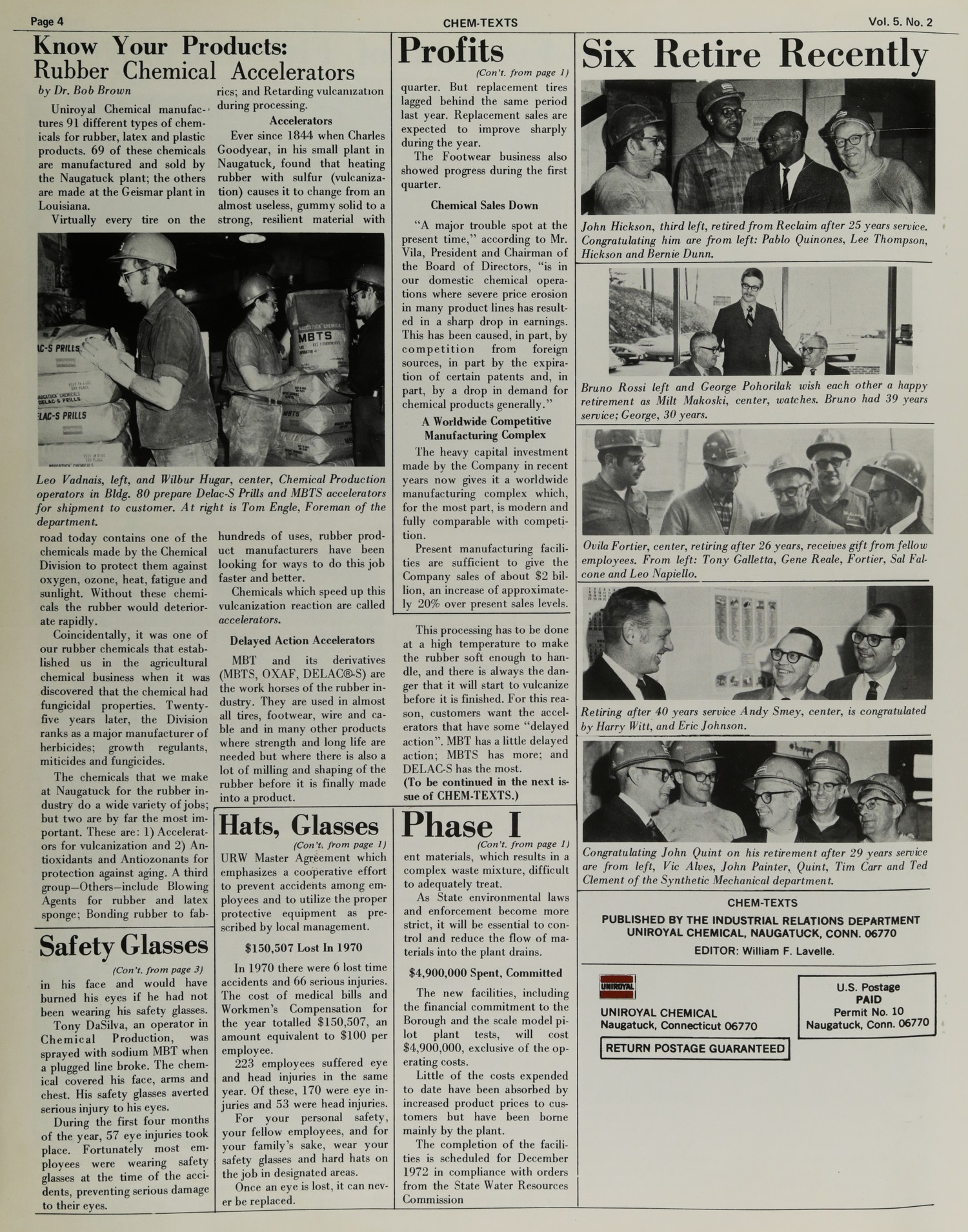
[IMAGE: Black and white photograph showing workers]

AC-5 PRILLS

LAC-5 PRILLS

Leo Vadnais, left, and Wilbur Hugar, center, Chemical Production operators in Bldg. 80 prepare Delac-S Prills and MBTS accelerators for shipment to customer. At right is Tom Engle, Foreman of the department.


Safety Glasses

(Con’t. from page 3)

in his face and would have burned his eyes if he had not been wearing his safety glasses.

Tony DaSilva, an operator in Chemical Production, was sprayed with sodium MBT when a plugged line broke. The chemical covered his face, arms and chest. His safety glasses averted serious injury to his eyes.

During the first four months of the year, 57 eye injuries took place. Fortunately most employees were wearing safety glasses at the time of the accidents, preventing serious damage to their eyes.


Hats, Glasses

(Con’t. from page 1)

URW Master Agreement which emphasizes a cooperative effort to prevent accidents among employees and to utilize the proper protective equipment as prescribed by local management.

$150,507 Lost In 1970

In 1970 there were 6 lost time accidents and 66 serious injuries. The cost of medical bills and Workmen’s Compensation for the year totalled $150,507, an amount equivalent to $100 per employee.

223 employees suffered eye and head injuries in the same year. Of these, 170 were eye injuries and 53 were head injuries.

For your personal safety, your fellow employees, and for your family’s sake, wear your safety glasses and hard hats on the job in designated areas.

Once an eye is lost, it can never be replaced.


Profits

(Con’t. from page 1)

quarter. But replacement tires lagged behind the same period last year. Replacement sales are expected to improve sharply during the year.

The Footwear business also showed progress during the first quarter.

Chemical Sales Down

“A major trouble spot at the present time,” according to Mr. Vila, President and Chairman of the Board of Directors, “is in our domestic chemical operations where severe price erosion in many product lines has resulted in a sharp drop in earnings. This has been caused, in part, by competition from foreign sources, in part by the expiration of certain patents and, in part, by a drop in demand for chemical products generally.”

A Worldwide Competitive Manufacturing Complex

The heavy capital investment made by the Company in recent years now gives it a worldwide manufacturing complex which, for the most part, is modern and fully comparable with competition.

Present manufacturing facilities are sufficient to give the Company sales of about $2 billion, an increase of approximately 20% over present sales levels.

This processing has to be done at a high temperature to make the rubber soft enough to handle, and there is always the danger that it will start to vulcanize before it is finished. For this reason, customers want the accelerators that have some “delayed action”. MBT has a little delayed action; MBTS has more; and DELAC-S has the most.

(To be continued in the next issue of CHEM-TEXTS.)


Phase I

(Con’t. from page 1)

ent materials, which results in a complex waste mixture, difficult to adequately treat.

As State environmental laws and enforcement become more strict, it will be essential to control and reduce the flow of materials into the plant drains.

$4,900,000 Spent, Committed

The new facilities, including the financial commitment to the Borough and the scale model pilot plant tests, will cost $4,900,000, exclusive of the operating costs.

Little of the costs expended to date have been absorbed by increased product prices to customers but have been borne mainly by the plant.

The completion of the facilities is scheduled for December 1972 in compliance with orders from the State Water Resources Commission


Six Retire Recently

[IMAGE: Photograph of three men]

John Hickson, third left, retired from Reclaim after 25 years service. Congratulating him are from left: Pablo Quinones, Lee Thompson, Hickson and Bernie Dunn.


[IMAGE: Photograph of two men]

Bruno Rossi left and George Pohorilak wish each other a happy retirement as Milt Makoski, center, watches. Bruno had 39 years service; George, 30 years.


[IMAGE: Photograph of group of men]

Ovila Fortier, center, retiring after 26 years, receives gift from fellow employees. From left: Tony Galletta, Gene Reale, Fortier, Sal Falcone and Leo Napiello.


[IMAGE: Photograph of three men]

Retiring after 40 years service Andy Smey, center, is congratulated by Harry Witt, and Eric Johnson.


[IMAGE: Photograph of group of men]

Congratulating John Quint on his retirement after 29 years service are from left, Vic Alves, John Painter, Quint, Tim Carr and Ted Clement of the Synthetic Mechanical department.


CHEM-TEXTS

PUBLISHED BY THE INDUSTRIAL RELATIONS DEPARTMENT

UNIROYAL CHEMICAL, NAUGATUCK, CONN. 06770

EDITOR: William F. Lavelle.


[LOGO: UNIROYAL]

UNIROYAL CHEMICAL
Naugatuck, Connecticut 06770

RETURN POSTAGE GUARANTEED
U.S. Postage
PAID
Permit No. 10
Naugatuck, Conn. 06770

CHEM-TEXTS – Vol. 5 No. 4 – Page 4

Page 004

Page 4 | CHEM-TEXTS | Vol. 5 No. 4


Know Your Products:

Naugatuck® Chemical Antioxidants

by Dr. Bob Brown

(This is the third in a series of articles on the chemicals manufactured in Chemical Production or sold by the Chemical Division.)

If we didn’t have antioxidants and antiozonants, rubber products would fall apart, before we could wear them out.

In fact, most kinds of synthetic rubber can’t even be manufactured without some type of a protective chemical to get them through the drying and storage stages.

Polygard®, for example, is used extensively by the synthetic rubber plants as a stabilizer (antioxidant) during processing and manufacture. It is not only an excellent antioxidant but it does not discolor or stain the rubber, therefore it can be used for white and light colored rubber articles.

If the rubber is to be manufactured into a black or dark colored product (such as tires) the customer may prefer to use BLE® which discolors the rubber, but also carries its protection over into the finished product to a greater extent than Polygard.

New Chemicals Developed For Synthetic Rubbers

The newer types of synthetic rubber required new types of antioxidants to protect them against oxygen and heat degradation.

Antioxidant 451 was especial-

purpose and is used in cis-polybutadiene rubber. Antioxidant 449 was also developed for a new, and different type of synthetic rubber, EPT: Royalene® the crackless rubber, made at the Chemical Division’s Geismar, La. plant.

Chemicals Vary In Color and Protection

In the development of antioxidants there is always the problem that the chemical structure which provides the best protection against oxygen and heat also causes the worst discoloration in the rubber. Generally speaking, all antioxidants cause some degree of discoloration from a very slight yellowing to a very brownish black discoloration. Usually a chemical which discolors only slightly, gives poorer protection.

Antioxidant 431 (VCIU) is such a chemical. It gives the best color but less protection against oxygen and heat.

Naugawhite® Antioxidant 439 and Antioxidant 451 are a little further down the color scale, but are somewhat more effective as antioxidants. These chemicals are used in latex foam, footwear and household products which are usually made from a bright color rubber.

(This series of articles on Rubber Chemicals will be concluded in the next issue of Chem-Texts.)


Plant Safety

(cont’d. from page 1)

and is still in the Intensive Care unit of St. Mary’s Hospital.

Disaster Plan Operates

A few minutes after the explosion members of the Disaster Plan arrived at the plant and assumed their responsibilities during the emergency. One evidence of the Plan’s effectiveness was the swift medical attention provided the injured employee—he was receiving medical care by a team of specialists at St. Mary’s Hospital ten minutes after the accident.

The cause of the explosion is still under investigation.

Other Accidents In Period

Other injuries during the 8 week period were: one employee suffered partial loss of a finger; an employee cut his hand with a knife requiring ten stitches; another employee dropped a valve on his foot and broke a toe; an employee injured his eye when a flying chip struck his eyeball; two employees suffered severe burns from steaming hot water and a steam hose; and another employee broke an ankle when a ladder slipped and he fell off it backwards.

Where Accidents Occurred, July 10 to Sept. 4

Dept. Lost Time Serious Injuries
Chem. Prod 4 1
Reclaim Prod. 3 2
Syn. Prod. 3 1
Materials 0 1
Mechanical 1 4
Res. & Devel. 1 0
TOTAL 12 9

Two Employees Retire

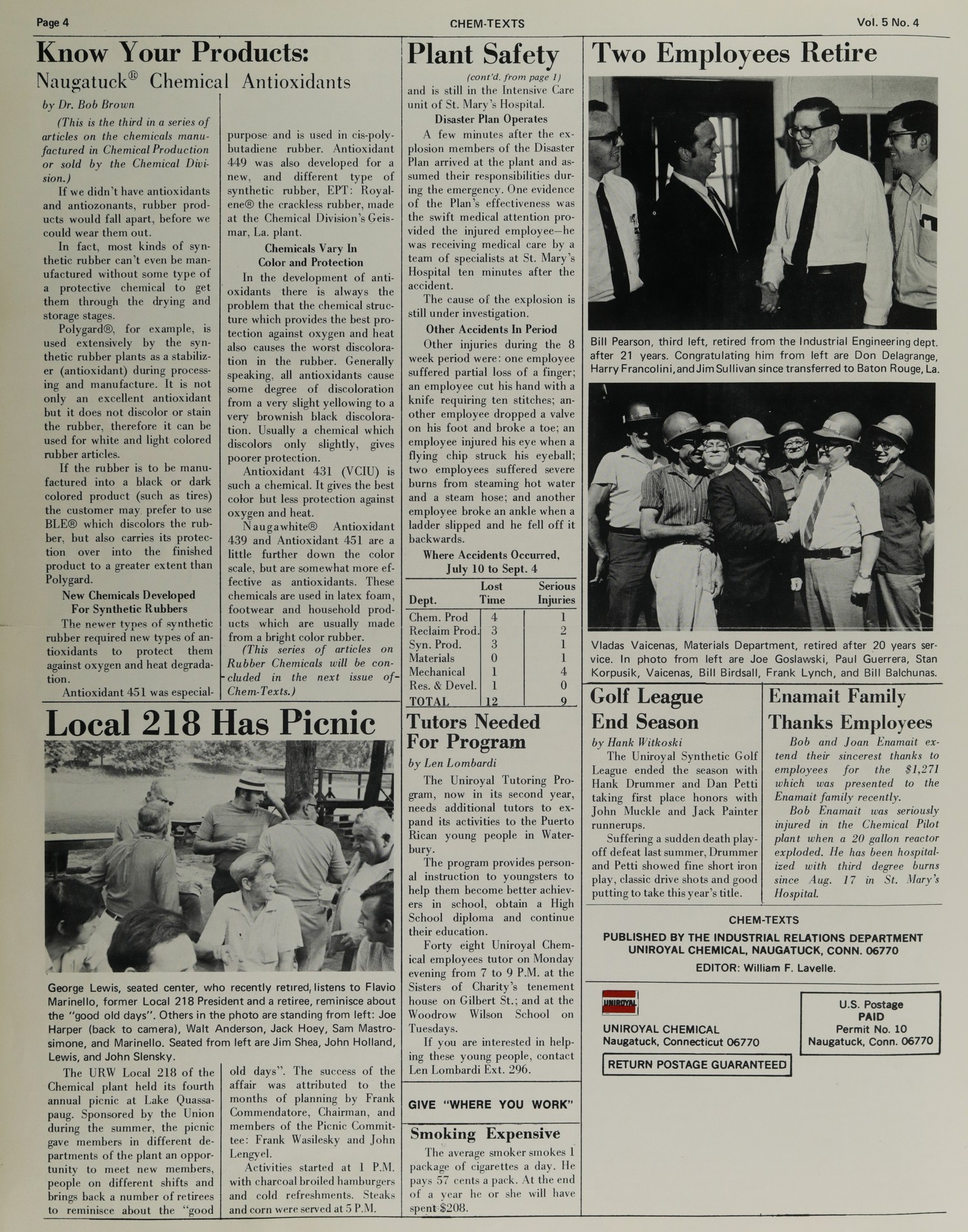
Bill Pearson, third left, retired from the Industrial Engineering dept. after 21 years. Congratulating him from left are Don Delagrange, Harry Francolini, and Jim Sullivan since transferred to Baton Rouge, La.

Vladas Vaicenas, Materials Department, retired after 20 years service. In photo from left are Joe Goslawski, Paul Guerrera, Stan Korpusik, Vaicenas, Bill Birdsall, Frank Lynch, and Bill Balchunas.


Local 218 Has Picnic

George Lewis, seated center, who recently retired, listens to Flavio Marinello, former Local 218 President and a retiree, reminisce about the “good old days”. Others in the photo are standing from left: Joe Harper (back to camera), Walt Anderson, Jack Hoey, Sam Mastrosimone, and Marinello. Seated from left are Jim Shea, John Holland, Lewis, and John Slensky.

The URW Local 218 of the Chemical plant held its fourth annual picnic at Lake Quassapaug. Sponsored by the Union during the summer, the picnic gave members in different departments of the plant an opportunity to meet new members, people on different shifts and brings back a number of retirees to reminisce about the “good old days”. The success of the affair was attributed to the months of planning by Frank Commendatore, Chairman, and members of the Picnic Committee: Frank Wasilesky and John Lengyel.

Activities started at 1 P.M. with charcoal broiled hamburgers and cold refreshments. Steaks and corn were served at 5 P.M.


Tutors Needed For Program

by Len Lombardi

The Uniroyal Tutoring Program, now in its second year, needs additional tutors to expand its activities to the Puerto Rican young people in Waterbury.

The program provides personal instruction to youngsters to help them become better achievers in school, obtain a High School diploma and continue their education.

Forty eight Uniroyal Chemical employees tutor on Monday evening from 7 to 9 P.M. at the Sisters of Charity’s tenement house on Gilbert St.; and at the Woodrow Wilson School on Tuesdays.

If you are interested in helping these young people, contact Len Lombardi Ext. 296.


GIVE “WHERE YOU WORK”


Smoking Expensive

The average smoker smokes 1 package of cigarettes a day. He pays 57 cents a pack. At the end of a year he or she will have spent $208.


Golf League End Season

by Hank Witkoski

The Uniroyal Synthetic Golf League ended the season with Hank Drummer and Dan Petti taking first place honors with John Muckle and Jack Painter runnerups.

Suffering a sudden death playoff defeat last summer, Drummer and Petti showed fine short iron play, classic drive shots and good putting to take this year’s title.


Enamait Family Thanks Employees

Bob and Joan Enamait extend their sincerest thanks to employees for the $1,271 which was presented to the Enamait family recently.

Bob Enamait was seriously injured in the Chemical Pilot plant when a 20 gallon reactor exploded. He has been hospitalized with third degree burns since Aug. 17 in St. Mary’s Hospital.


CHEM-TEXTS

PUBLISHED BY THE INDUSTRIAL RELATIONS DEPARTMENT
UNIROYAL CHEMICAL, NAUGATUCK, CONN. 06770

EDITOR: William F. Lavelle.


UNIROYAL

UNIROYAL CHEMICAL
Naugatuck, Connecticut 06770

RETURN POSTAGE GUARANTEED
U.S. Postage
PAID
Permit No. 10
Naugatuck, Conn. 06770

CHEM-TEXTS – Vol. 3 No. 3 – Page 2

Page 002

Page 2 CHEM-TEXTS Vol. 3 No. 3


FROM THE FACTORY MANAGER

DEAR FELLOW EMPLOYEE:

Are you a professional? In sports the professional is one whose proficiency and skill enables him to earn his living through his participation. The professional is characterized by his pride in his efforts. In a similar sense, we are professionals earning our living by supplying our customers with chemicals, reclaim, and polymers. But do we always demonstrate the proficiency and skill required in our jobs? Do we have the pride of workmanship characteristic of the professional?

Remember a professional always gives his best and always tries to win. He puts team goals and team effort ahead of his own personal desires. He believes the whole team wins together and he takes pride in realizing that the true recognition for his effort is in the team winning.

The same thing is true in our plant – we all win when we satisfy our customers’ needs in the most efficient manner possible. Anything less than this – we aren’t professionals!

[Signature]

John D. Evans


Chemical Control Center Reviews Quality, Productivity, and Costs

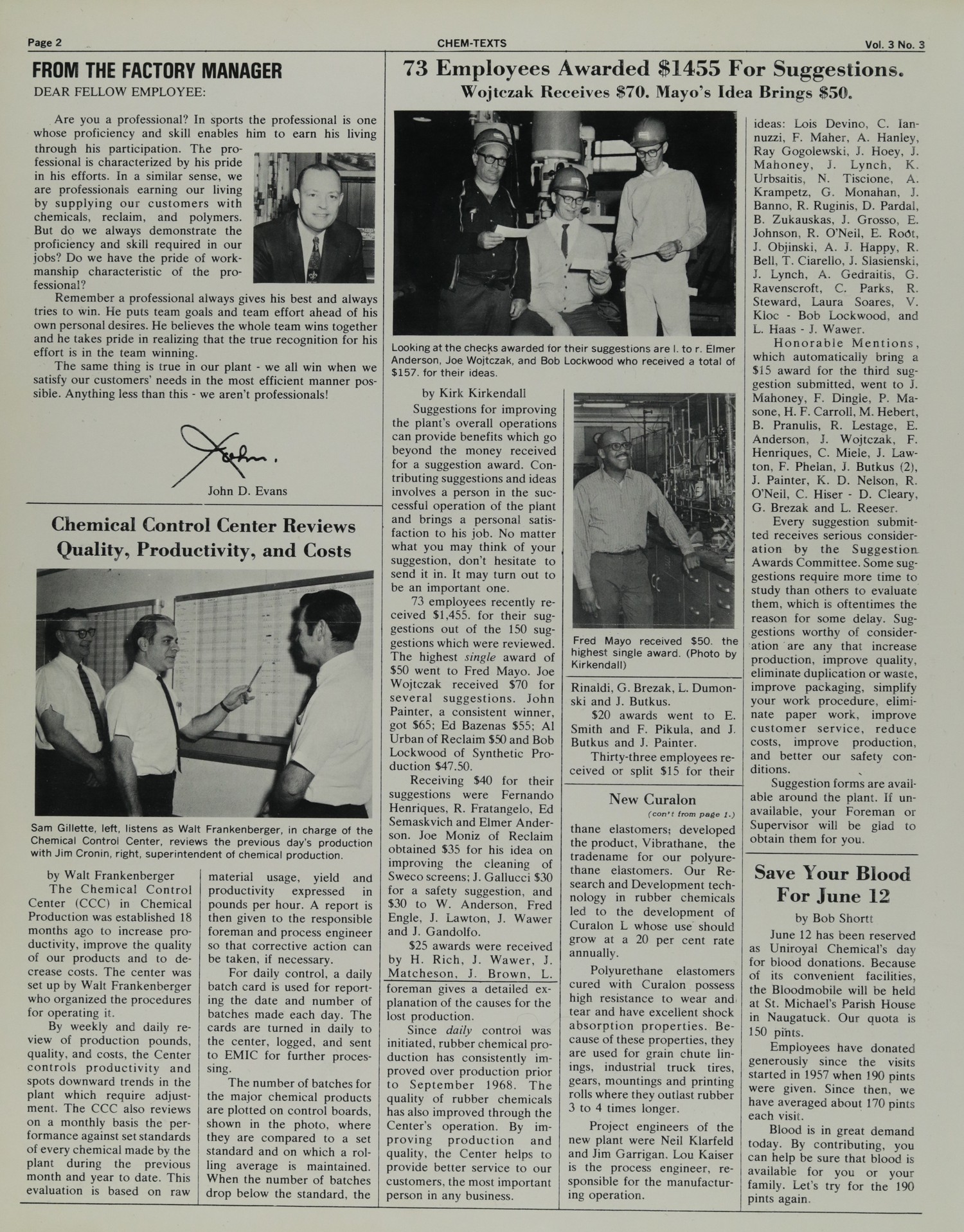
[IMAGE: Sam Gillette, left, listens as Walt Frankenberger, in charge of the Chemical Control Center, reviews the previous day’s production with Jim Cronin, right, superintendent of chemical production.]

by Walt Frankenberger

The Chemical Control Center (CCC) in Chemical Production was established 18 months ago to increase productivity, improve the quality of our products and to decrease costs. The center was set up by Walt Frankenberger who organized the procedures for operating it.

By weekly and daily review of production pounds, quality, and costs, the Center controls productivity and spots downward trends in the plant which require adjustment. The CCC also reviews on a monthly basis the performance against set standards of every chemical made by the plant during the previous month and year to date. This evaluation is based on raw material usage, yield and productivity expressed in pounds per hour. A report is then given to the responsible foreman and process engineer so that corrective action can be taken, if necessary.

For daily control, a daily batch card is used for reporting the date and number of batches made each day. The cards are turned in daily to the center, logged, and sent to EMIC for further processing.

The number of batches for the major chemical products are plotted on control boards, shown in the photo, where they are compared to a set standard and on which a rolling average is maintained. When the number of batches drop below the standard, the person in any business.


73 Employees Awarded $1455 For Suggestions.

Wojtczak Receives $70. Mayo’s Idea Brings $50.

[IMAGE: Looking at the checks awarded for their suggestions are l. to r. Elmer Anderson, Joe Wojtczak, and Bob Lockwood who received a total of $157. for their ideas.]

by Kirk Kirkendall

Suggestions for improving the plant’s overall operations can provide benefits which go beyond the money received for a suggestion award. Contributing suggestions and ideas involves a person in the successful operation of the plant and brings a personal satisfaction to his job. No matter what you may think of your suggestion, don’t hesitate to send it in. It may turn out to be an important one.

73 employees recently received $1,455. for their suggestions out of the 150 suggestions which were reviewed. The highest single award of $50 went to Fred Mayo. Joe Wojtczak received $70 for several suggestions. John Painter, a consistent winner, got $65; Ed Bazenas $55; Al Urban of Reclaim $50 and Bob Lockwood of Synthetic Production $47.50.

Receiving $40 for their suggestions were Fernando Henriques, R. Fratangelo, Ed Semaskvich and Elmer Anderson. Joe Moniz of Reclaim obtained $35 for his idea on improving the cleaning of Sweco screens; J. Gallucci $30 for a safety suggestion, and $30 to W. Anderson, Fred Engle, J. Lawton, J. Wawer and J. Gandolfo.

$25 awards were received by H. Rich, J. Wawer, J. Matcheson, J. Brown, L. foreman gives a detailed explanation of the causes for the lost production.

Since daily control was initiated, rubber chemical production has consistently improved over production prior to September 1968. The quality of rubber chemicals has also improved through the Center’s operation. By improving production and quality, the Center helps to provide better service to our customers, the most important person in any business.

[IMAGE: Fred Mayo received $50. the highest single award. (Photo by Kirkendall)]

Rinaldi, G. Brezak, L. Dumonski and J. Butkus.

$20 awards went to E. Smith and F. Pikula, and J. Butkus and J. Painter.

Thirty-three employees received or split $15 for their


New Curalon

(con’t from page 1.)

thane elastomers; developed the product, Vibrathane, the tradename for our polyurethane elastomers. Our Research and Development technology in rubber chemicals led to the development of Curalon L whose use should grow at a 20 per cent rate annually.

Polyurethane elastomers cured with Curalon possess high resistance to wear and tear and have excellent shock absorption properties. Because of these properties, they are used for grain chute linings, industrial truck tires, gears, mountings and printing rolls where they outlast rubber 3 to 4 times longer.

Project engineers of the new plant were Neil Klarfeld and Jim Garrigan. Lou Kaiser is the process engineer, responsible for the manufacturing operation.


ideas: Lois Devino, C. Iannuzzi, F. Maher, A. Hanley, Ray Gogolewski, J. Hoey, J. Mahoney, J. Lynch, K. Urbsaitis, N. Tiscione, A. Krampetz, G. Monahan, J. Banno, R. Ruginis, D. Pardal, B. Zukauskas, J. Grosso, E. Johnson, R. O’Neil, E. Root, J. Objinski, A. J. Happy, R. Bell, T. Ciarello, J. Slasienski, J. Lynch, A. Gedraitis, G. Ravenscroft, C. Parks, R. Steward, Laura Soares, V. Kloc – Bob Lockwood, and L. Haas – J. Wawer.

Honorable Mentions, which automatically bring a $15 award for the third suggestion submitted, went to J. Mahoney, F. Dingle, P. Masone, H. F. Carroll, M. Hebert, B. Pranulis, R. Lestage, E. Anderson, J. Wojtczak, F. Henriques, C. Miele, J. Lawton, F. Phelan, J. Butkus (2), J. Painter, K. D. Nelson, R. O’Neil, C. Hiser – D. Cleary, G. Brezak and L. Reeser.

Every suggestion submitted receives serious consideration by the Suggestion Awards Committee. Some suggestions require more time to study than others to evaluate them, which is oftentimes the reason for some delay. Suggestions worthy of consideration are any that increase production, improve quality, eliminate duplication or waste, improve packaging, simplify your work procedure, eliminate paper work, improve customer service, reduce costs, improve production, and better our safety conditions.

Suggestion forms are available around the plant. If unavailable, your Foreman or Supervisor will be glad to obtain them for you.


Save Your Blood For June 12

by Bob Shortt

June 12 has been reserved as Uniroyal Chemical’s day for blood donations. Because of its convenient facilities, the Bloodmobile will be held at St. Michael’s Parish House in Naugatuck. Our quota is 150 pints.

Employees have donated generously since the visits started in 1957 when 190 pints were given. Since then, we have averaged about 170 pints each visit.

Blood is in great demand today. By contributing, you can help be sure that blood is available for you or your family. Let’s try for the 190 pints again.