Strike 4 Weeks Old; No Signs Of Settlement

Strike 4 Weeks Old; No Signs Of Settlement

5-12-67 [handwritten]

No news is available as to how the negotiations between the United Rubber Workers Union and the “Big Five” Rubber Companies is progressing in Cincinnati.

The strike, now in its fourth week, is beginning to affect the economy of the borough as the striking workers have faced their second payless payday.

Strong rumors circulated the borough yesterday that B.F. Goodrich Rubber Co., one of the “Big Five” was close to a settlement with the union on the master contract. The consensus of opinion is that if one of the companies involved in the negotiations settles, the others will follow suit.

However, on the other hand, rumors are to the effect that the strike will be a long drawn-out process. Which rumor is right is anyone’s guess, since no statements have been issued from either side.

A rumor was circulating the borough this morning that members of management and non-union UniRoyal personnel would begin making shoes in the Footwear Division Monday.

John Smith, factory manager, said this morning he would not confirm the story.

Picketing at the UniRoyal gates in the borough remained quiet. Small teams of pickets have been maintained in spite of the rain for the past few days.

Local officials of the union, operating with the threat of an injunction over their heads, have been careful to maintain all conditions of picketing imposed upon them. They have been checking all points of picketing periodically, to insure tempers are kept in hand by the now “edgy” strikers.

Local URW Answers Company’s Letter

Local URW Answers Company’s Letter

6-12-67

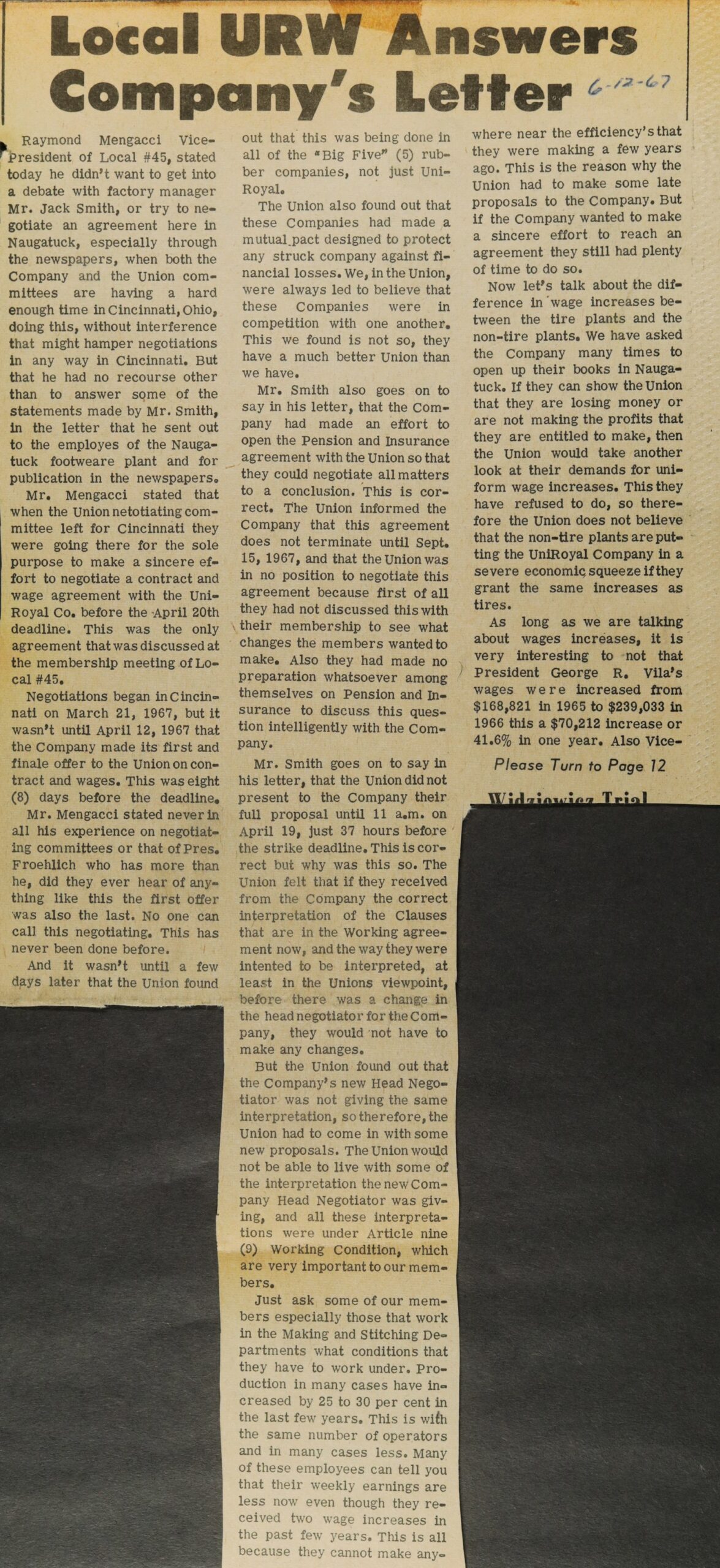
Raymond Mengacci Vice-President of Local #45, stated today he didn’t want to get into a debate with factory manager Mr. Jack Smith, or try to negotiate an agreement here in Naugatuck, especially through the newspapers, when both the Company and the Union committees are having a hard enough time in Cincinnati, Ohio, doing this, without interference that might hamper negotiations in any way in Cincinnati. But that he had no recourse other than to answer some of the statements made by Mr. Smith, in the letter that he sent out to the employes of the Naugatuck footwear plant and for publication in the newspapers.

Mr. Mengacci stated that when the Union netotiating committee left for Cincinnati they were going there for the sole purpose to make a sincere effort to negotiate a contract and wage agreement with the Uni-Royal Co. before the April 20th deadline. This was the only agreement that was discussed at the membership meeting of Local #45.

Negotiations began in Cincinnati on March 21, 1967, but it wasn’t until April 12, 1967 that the Company made its first and finale offer to the Union on contract and wages. This was eight (8) days before the deadline.

Mr. Mengacci stated never in all his experience on negotiating committees or that of Pres. Froehlich who has more than he, did they ever hear of anything like this the first offer was also the last. No one can call this negotiating. This has never been done before.

And it wasn’t until a few days later that the Union found out that this was being done in all of the “Big Five” (5) rubber companies, not just Uni-Royal.

The Union also found out that these Companies had made a mutual pact designed to protect any struck company against financial losses. We, in the Union, were always led to believe that these Companies were in competition with one another. This we found is not so, they have a much better Union than we have.

Mr. Smith also goes on to say in his letter, that the Company had made an effort to open the Pension and Insurance agreement with the Union so that they could negotiate all matters to a conclusion. This is correct. The Union informed the Company that this agreement does not terminate until Sept. 15, 1967, and that the Union was in no position to negotiate this agreement because first of all they had not discussed this with their membership to see what changes the members wanted to make. Also they had made no preparation whatsoever among themselves on Pension and Insurance to discuss this question intelligently with the Company.

Mr. Smith goes on to say in his letter, that the Union did not present to the Company their full proposal until 11 a.m. on April 19, just 37 hours before the strike deadline. This is correct but why was this so. The Union felt that if they received from the Company the correct interpretation of the Clauses that are in the Working agreement now, and the way they were intented to be interpreted, at least in the Unions viewpoint, before there was a change in the head negotiator for the Company, they would not have to make any changes.

But the Union found out that the Company’s new Head Negotiator was not giving the same interpretation, so therefore, the Union had to come in with some new proposals. The Union would not be able to live with some of the interpretation the new Company Head Negotiator was giving, and all these interpretations were under Article nine (9) Working Condition, which are very important to our members.

Just ask some of our members especially those that work in the Making and Stitching Departments what conditions that they have to work under. Production in many cases have increased by 25 to 30 per cent in the last few years. This is with the same number of operators and in many cases less. Many of these employees can tell you that their weekly earnings are less now even though they received two wage increases in the past few years. This is all because they cannot make any-

where near the efficiency’s that they were making a few years ago. This is the reason why the Union had to make some late proposals to the Company. But if the Company wanted to make a sincere effort to reach an agreement they still had plenty of time to do so.

Now let’s talk about the difference in wage increases between the tire plants and the non-tire plants. We have asked the Company many times to open up their books in Naugatuck. If they can show the Union that they are losing money or are not making the profits that they are entitled to make, then the Union would take another look at their demands for uniform wage increases. This they have refused to do, so therefore the Union does not believe that the non-tire plants are putting the UniRoyal Company in a severe economic squeeze if they grant the same increases as tires.

As long as we are talking about wages increases, it is very interesting to not that President George R. Vila‘s wages were increased from $168,821 in 1965 to $239,033 in 1966 this a $70,212 increase or 41.6% in one year. Also Vice-

Please Turn to Page 12


Widzionjez Trial

Judge Warns Union On “Interference, Violence” Here

Judge Warns Union On “Interference, Violence” Here

5-6-67 [handwritten]

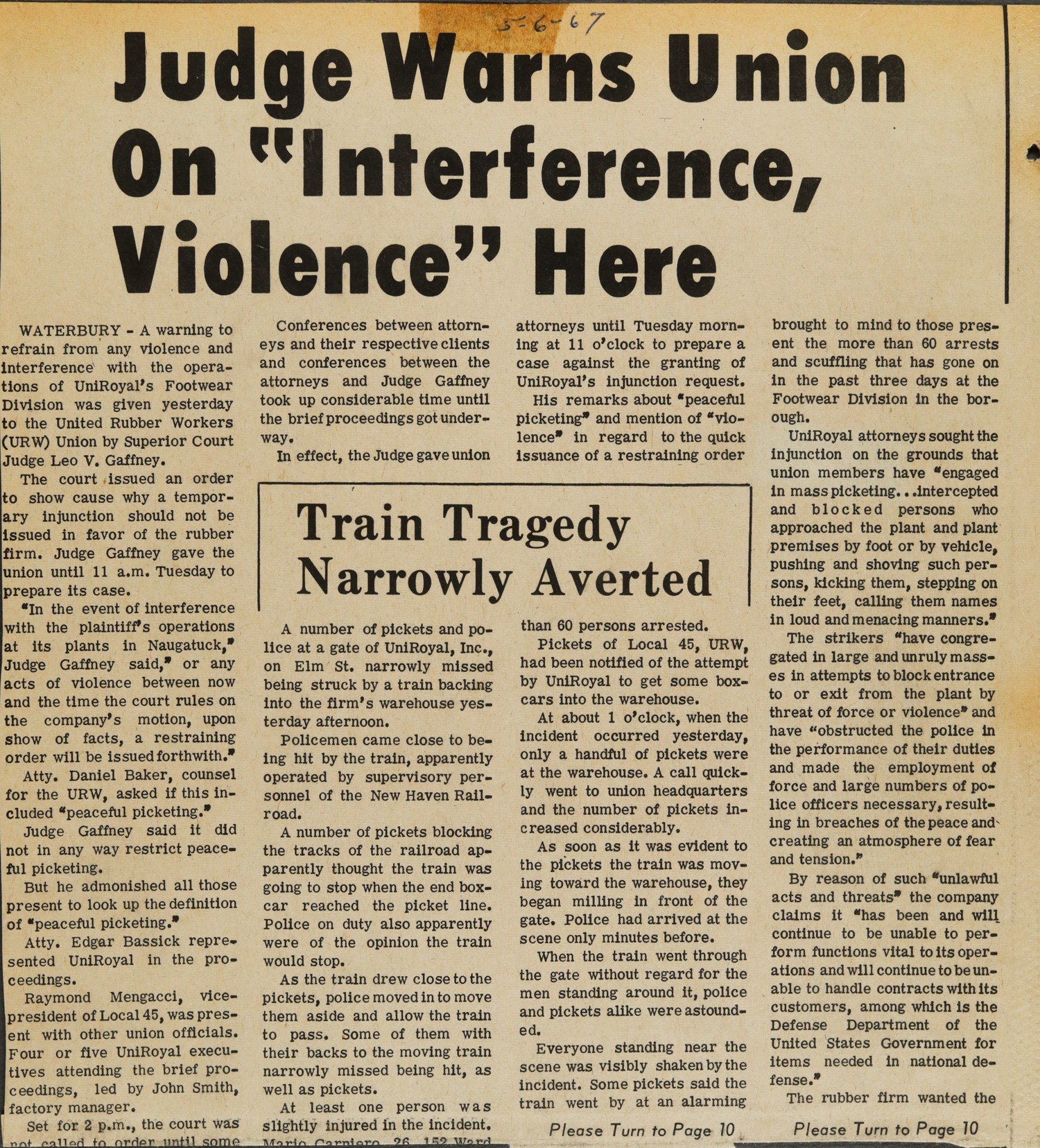
WATERBURY – A warning to refrain from any violence and interference with the operations of UniRoyal’s Footwear Division was given yesterday to the United Rubber Workers (URW) Union by Superior Court Judge Leo V. Gaffney.

The court issued an order to show cause why a temporary injunction should not be issued in favor of the rubber firm. Judge Gaffney gave the union until 11 a.m. Tuesday to prepare its case.

“In the event of interference with the plaintiff’s operations at its plants in Naugatuck,” Judge Gaffney said,” or any acts of violence between now and the time the court rules on the company’s motion, upon show of facts, a restraining order will be issued forthwith.”

Atty. Daniel Baker, counsel for the URW, asked if this included “peaceful picketing.”

Judge Gaffney said it did not in any way restrict peaceful picketing.

But he admonished all those present to look up the definition of “peaceful picketing.”

Atty. Edgar Bassick represented UniRoyal in the proceedings.

Raymond Mengacci, vice-president of Local 45, was present with other union officials. Four or five UniRoyal executives attending the brief proceedings, led by John Smith, factory manager.

Set for 2 p.m., the court was not called to order until some

Conferences between attorneys and their respective clients and conferences between the attorneys and Judge Gaffney took up considerable time until the brief proceedings got underway.

In effect, the Judge gave union attorneys until Tuesday morning at 11 o’clock to prepare a case against the granting of UniRoyal’s injunction request.

His remarks about “peaceful picketing” and mention of “violence” in regard to the quick issuance of a restraining order

brought to mind to those present the more than 60 arrests and scuffling that has gone on in the past three days at the Footwear Division in the borough.

UniRoyal attorneys sought the injunction on the grounds that union members have “engaged in mass picketing…intercepted and blocked persons who approached the plant and plant premises by foot or by vehicle, pushing and shoving such persons, kicking them, stepping on their feet, calling them names in loud and menacing manners.”

The strikers “have congregated in large and unruly masses in attempts to block entrance to or exit from the plant by threat of force or violence” and have “obstructed the police in the performance of their duties and made the employment of force and large numbers of police officers necessary, resulting in breaches of the peace and creating an atmosphere of fear and tension.”

By reason of such “unlawful acts and threats” the company claims it “has been and will continue to be unable to perform functions vital to its operations and will continue to be unable to handle contracts with its customers, among which is the Defense Department of the United States Government for items needed in national defense.”

The rubber firm wanted the


Train Tragedy Narrowly Averted

A number of pickets and police at a gate of UniRoyal, Inc., on Elm St. narrowly missed being struck by a train backing into the firm’s warehouse yesterday afternoon.

Policemen came close to being hit by the train, apparently operated by supervisory personnel of the New Haven Railroad.

A number of pickets blocking the tracks of the railroad apparently thought the train was going to stop when the end boxcar reached the picket line. Police on duty also apparently were of the opinion the train would stop.

As the train drew close to the pickets, police moved in to move them aside and allow the train to pass. Some of them with their backs to the moving train narrowly missed being hit, as well as pickets.

At least one person was slightly injured in the incident.

than 60 persons arrested.

Pickets of Local 45, URW, had been notified of the attempt by UniRoyal to get some boxcars into the warehouse.

At about 1 o’clock, when the incident occurred yesterday, only a handful of pickets were at the warehouse. A call quickly went to union headquarters and the number of pickets increased considerably.

As soon as it was evident to the pickets the train was moving toward the warehouse, they began milling in front of the gate. Police had arrived at the scene only minutes before.

When the train went through the gate without regard for the men standing around it, police and pickets alike were astounded.

Everyone standing near the scene was visibly shaken by the incident. Some pickets said the train went by at an alarming

Please Turn to Page 10

Please Turn to Page 10

John Smith, was hustled into the Central Office Building by local police who pushed their way through a group of about 20 women pickets.

John Smith, was hustled into
the Central Office Building by
local police who pushed their
way through a group of about
20 women pickets.

Once safely inside, the women
resumed their circling in front
of the door.

At one point, they chanted,
“Talk it over, Blue-Coats, talk
it over” at a group of about 15
policemen standing a few feet
away.

Judge Delays Ruling

Judge Delays Ruling

In Uniroyal Case

Judge Delays Ruling

6-29-67 (handwritten)

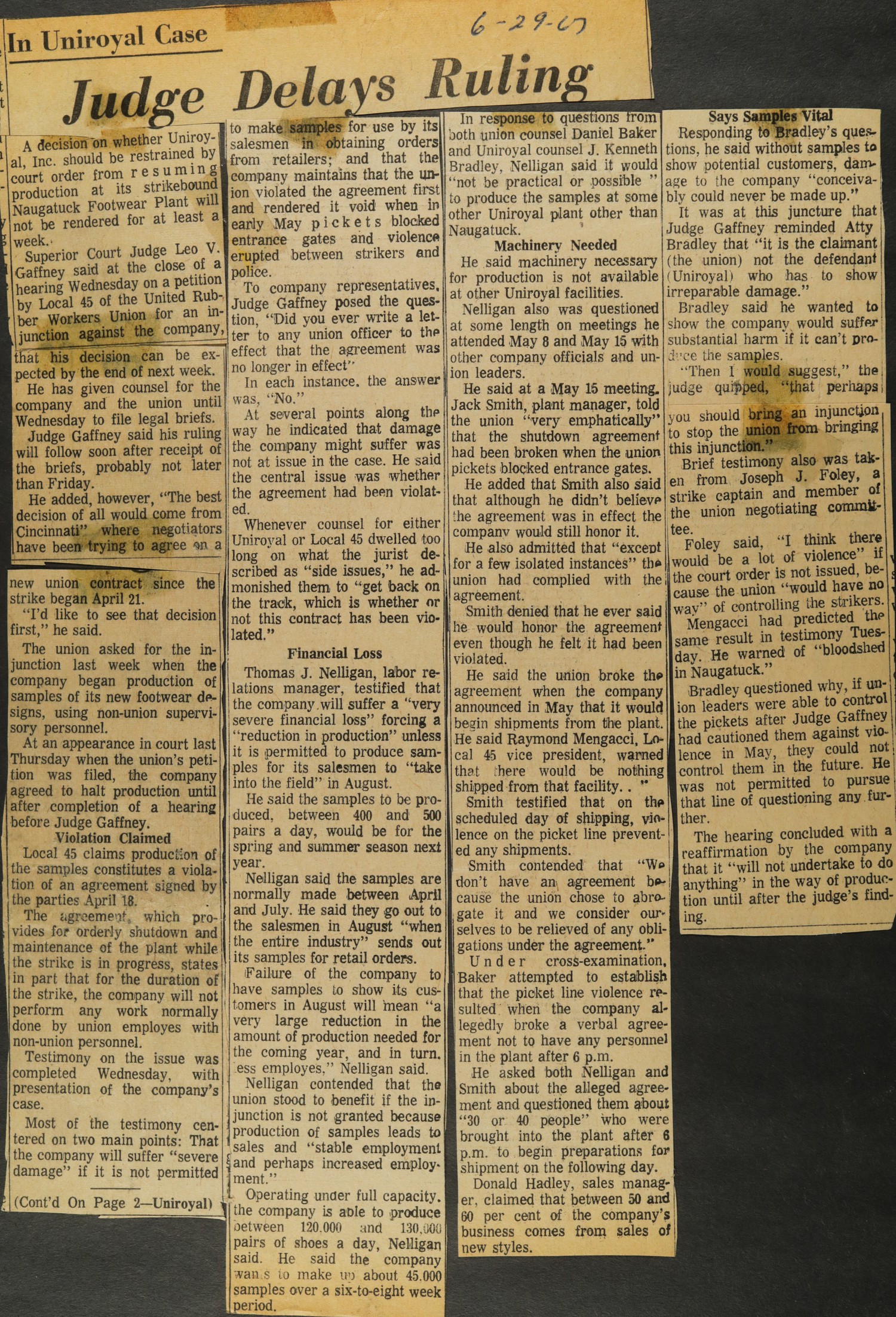
A decision on whether Uniroyal, Inc. should be restrained by court order from resuming production at its strikebound Naugatuck Footwear Plant will not be rendered for at least a week.

Superior Court Judge Leo V. Gaffney said at the close of a hearing Wednesday on a petition by Local 45 of the United Rubber Workers Union for an injunction against the company, that his decision can be expected by the end of next week.

He has given counsel for the company and the union until Wednesday to file legal briefs.

Judge Gaffney said his ruling will follow soon after receipt of the briefs, probably not later than Friday.

He added, however, “The best decision of all would come from Cincinnati” where negotiators have been trying to agree on a new union contract since the strike began April 21.

“I’d like to see that decision first,” he said.

The union asked for the injunction last week when the company began production of samples of its new footwear designs, using non-union supervisory personnel.

At an appearance in court last Thursday when the union’s petition was filed, the company agreed to halt production until after completion of a hearing before Judge Gaffney.

Violation Claimed

Local 45 claims production of the samples constitutes a violation of an agreement signed by the parties April 18.

The agreement, which provides for orderly shutdown and maintenance of the plant while the strike is in progress, states in part that for the duration of the strike, the company will not perform any work normally done by union employes with non-union personnel.

Testimony on the issue was completed Wednesday, with presentation of the company’s case.

Most of the testimony centered on two main points: That the company will suffer “severe damage” if it is not permitted

(Cont’d On Page 2—Uniroyal)


to make samples for use by its salesmen in obtaining orders from retailers; and that the company maintains that the union violated the agreement first and rendered it void when in early May pickets blocked entrance gates and violence erupted between strikers and police.

To company representatives, Judge Gaffney posed the question, “Did you ever write a letter to any union officer to the effect that the agreement was no longer in effect”

In each instance, the answer was, “No.”

At several points along the way he indicated that damage the company might suffer was not at issue in the case. He said the central issue was whether the agreement had been violated.

Whenever counsel for either Uniroyal or Local 45 dwelled too long on what the jurist described as “side issues,” he admonished them to “get back on the track, which is whether or not this contract has been violated.”

Financial Loss

Thomas J. Nelligan, labor relations manager, testified that the company will suffer a “very severe financial loss” forcing a “reduction in production” unless it is permitted to produce samples for its salesmen to “take into the field” in August.

He said the samples to be produced, between 400 and 500 pairs a day, would be for the spring and summer season next year.

Nelligan said the samples are normally made between April and July. He said they go out to the salesmen in August “when the entire industry” sends out its samples for retail orders.

Failure of the company to have samples to show its customers in August will mean “a very large reduction in the amount of production needed for the coming year, and in turn, ess employes,” Nelligan said.

Nelligan contended that the union stood to benefit if the injunction is not granted because production of samples leads to sales and “stable employment and perhaps increased employment.”

Operating under full capacity, the company is able to produce between 120,000 and 130,000 pairs of shoes a day, Nelligan said. He said the company wants to make up about 45,000 samples over a six-to-eight week period.


In response to questions from both union counsel Daniel Baker and Uniroyal counsel J. Kenneth Bradley, Nelligan said it would “not be practical or possible ” to produce the samples at some other Uniroyal plant other than Naugatuck.

Machinery Needed

He said machinery necessary for production is not available at other Uniroyal facilities.

Nelligan also was questioned at some length on meetings he attended May 8 and May 15 with other company officials and union leaders.

He said at a May 15 meeting, Jack Smith, plant manager, told the union “very emphatically” that the shutdown agreement had been broken when the union pickets blocked entrance gates.

He added that Smith also said that although he didn’t believe the agreement was in effect the company would still honor it.

He also admitted that “except for a few isolated instances” the union had complied with the agreement.

Smith denied that he ever said he would honor the agreement even though he felt it had been violated.

He said the union broke the agreement when the company announced in May that it would begin shipments from the plant. He said Raymond Mengacci, Local 45 vice president, warned that there would be nothing shipped from that facility. . ”

Smith testified that on the scheduled day of shipping, violence on the picket line prevented any shipments.

Smith contended that “We don’t have an agreement because the union chose to abrogate it and we consider ourselves to be relieved of any obligations under the agreement.”

Under cross-examination, Baker attempted to establish that the picket line violence resulted when the company allegedly broke a verbal agreement not to have any personnel in the plant after 6 p.m.

He asked both Nelligan and Smith about the alleged agreement and questioned them about “30 or 40 people” who were brought into the plant after 6 p.m. to begin preparations for shipment on the following day.

Donald Hadley, sales manager, claimed that between 50 and 60 per cent of the company’s business comes from sales of new styles.


Says Samples Vital

Responding to Bradley’s questions, he said without samples to show potential customers, damage to the company “conceivably could never be made up.”

It was at this juncture that Judge Gaffney reminded Atty Bradley that “it is the claimant (the union) not the defendant (Uniroyal) who has to show irreparable damage.”

Bradley said he wanted to show the company would suffer substantial harm if it can’t produce the samples.

“Then I would suggest,” the judge quipped, “that perhaps you should bring an injunction to stop the union from bringing this injunction.”

Brief testimony also was taken from Joseph J. Foley, a strike captain and member of the union negotiating committee.

Foley said, “I think there would be a lot of violence” if the court order is not issued, because the union “would have no way” of controlling the strikers.

Mengacci had predicted the same result in testimony Tuesday. He warned of “bloodshed in Naugatuck.”

Bradley questioned why, if union leaders were able to control the pickets after Judge Gaffney had cautioned them against violence in May, they could not control them in the future. He was not permitted to pursue that line of questioning any further.

The hearing concluded with a reaffirmation by the company that it “will not undertake to do anything” in the way of production until after the judge’s finding.

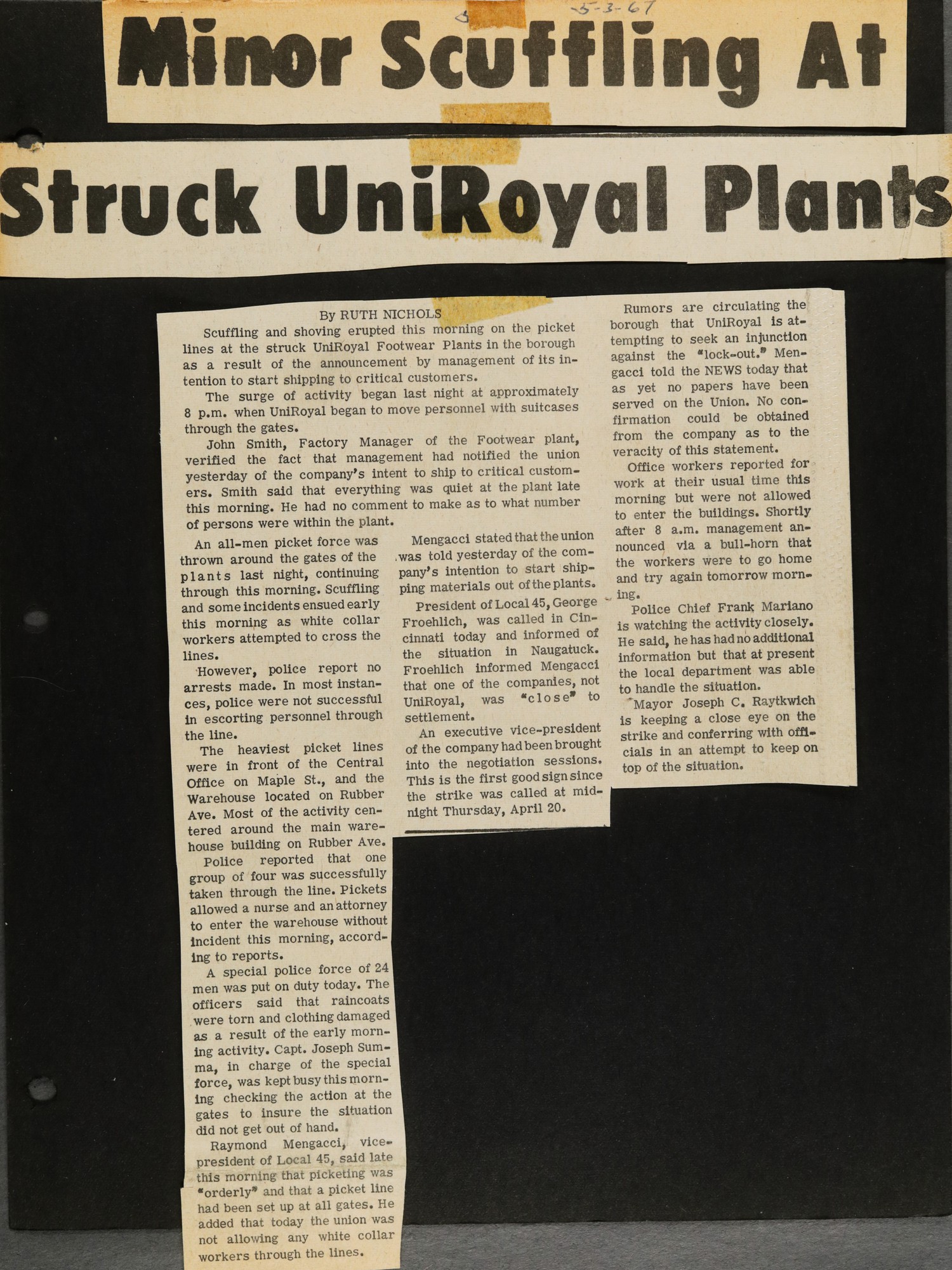
Minor Scuffling At Struck UniRoyal Plants

Minor Scuffling At Struck UniRoyal Plants

5-3-67 [handwritten date in top right]

By RUTH NICHOLS

Scuffling and shoving erupted this morning on the picket lines at the struck UniRoyal Footwear Plants in the borough as a result of the announcement by management of its intention to start shipping to critical customers.

The surge of activity began last night at approximately 8 p.m. when UniRoyal began to move personnel with suitcases through the gates.

John Smith, Factory Manager of the Footwear plant, verified the fact that management had notified the union yesterday of the company’s intent to ship to critical customers. Smith said that everything was quiet at the plant late this morning. He had no comment to make as to what number of persons were within the plant.

An all-men picket force was thrown around the gates of the plants last night, continuing through this morning. Scuffling and some incidents ensued early this morning as white collar workers attempted to cross the lines.

However, police report no arrests made. In most instances, police were not successful in escorting personnel through the line.

The heaviest picket lines were in front of the Central Office on Maple St., and the Warehouse located on Rubber Ave. Most of the activity centered around the main warehouse building on Rubber Ave.

Police reported that one group of four was successfully taken through the line. Pickets allowed a nurse and an attorney to enter the warehouse without incident this morning, according to reports.

A special police force of 24 men was put on duty today. The officers said that raincoats were torn and clothing damaged as a result of the early morning activity. Capt. Joseph Summa, in charge of the special force, was kept busy this morning checking the action at the gates to insure the situation did not get out of hand.

Raymond Mengacci, vice-president of Local 45, said late this morning that picketing was “orderly” and that a picket line had been set up at all gates. He added that today the union was not allowing any white collar workers through the lines.

Mengacci stated that the union was told yesterday of the company’s intention to start shipping materials out of the plants.

President of Local 45, George Froehlich, was called in Cincinnati today and informed of the situation in Naugatuck. Froehlich informed Mengacci that one of the companies, not UniRoyal, was “close” to settlement.

An executive vice-president of the company had been brought into the negotiation sessions. This is the first good sign since the strike was called at midnight Thursday, April 20.

Rumors are circulating the borough that UniRoyal is attempting to seek an injunction against the “lock-out.” Mengacci told the NEWS today that as yet no papers have been served on the Union. No confirmation could be obtained from the company as to the veracity of this statement.

Office workers reported for work at their usual time this morning but were not allowed to enter the buildings. Shortly after 8 a.m. management announced via a bull-horn that the workers were to go home and try again tomorrow morning.

Police Chief Frank Mariano is watching the activity closely. He said, he has had no additional information but that at present the local department was able to handle the situation.

Mayor Joseph C. Raytkwich is keeping a close eye on the strike and conferring with officials in an attempt to keep on top of the situation.

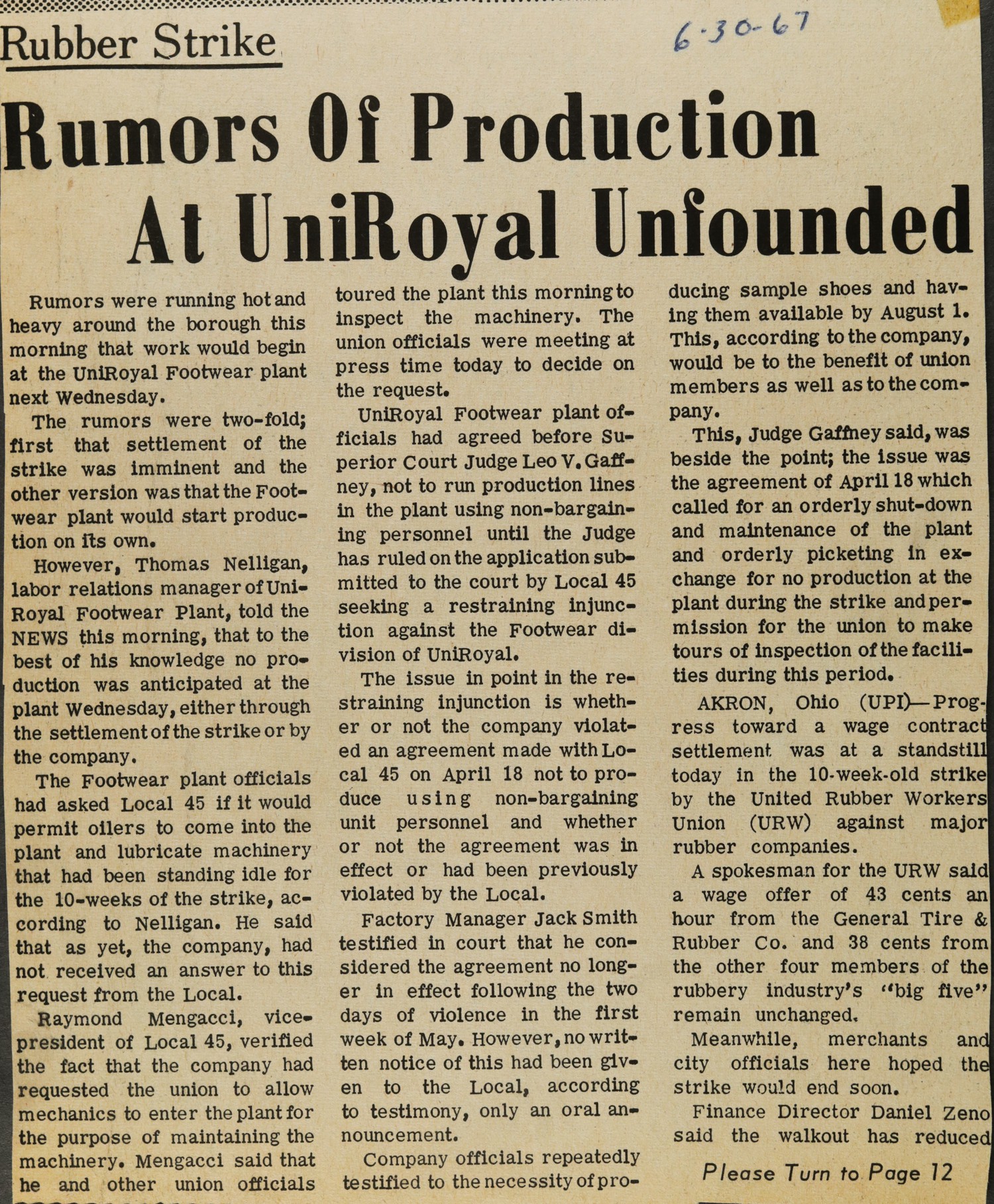
Rumors Of Production At UniRoyal Unfounded

Rumors Of Production At UniRoyal Unfounded

Rubber Strike

6-30-67

Rumors Of Production At UniRoyal Unfounded

Rumors were running hot and heavy around the borough this morning that work would begin at the UniRoyal Footwear plant next Wednesday.

The rumors were two-fold; first that settlement of the strike was imminent and the other version was that the Footwear plant would start production on its own.

However, Thomas Nelligan, labor relations manager of UniRoyal Footwear Plant, told the NEWS this morning, that to the best of his knowledge no production was anticipated at the plant Wednesday, either through the settlement of the strike or by the company.

The Footwear plant officials had asked Local 45 if it would permit oilers to come into the plant and lubricate machinery that had been standing idle for the 10-weeks of the strike, according to Nelligan. He said that as yet, the company, had not received an answer to this request from the Local.

Raymond Mengacci, vice-president of Local 45, verified the fact that the company had requested the union to allow mechanics to enter the plant for the purpose of maintaining the machinery. Mengacci said that he and other union officials toured the plant this morning to inspect the machinery. The union officials were meeting at press time today to decide on the request.

UniRoyal Footwear plant officials had agreed before Superior Court Judge Leo V. Gaffney, not to run production lines in the plant using non-bargaining personnel until the Judge has ruled on the application submitted to the court by Local 45 seeking a restraining injunction against the Footwear division of UniRoyal.

The issue in point in the restraining injunction is whether or not the company violated an agreement made with Local 45 on April 18 not to produce using non-bargaining unit personnel and whether or not the agreement was in effect or had been previously violated by the Local.

Factory Manager Jack Smith testified in court that he considered the agreement no longer in effect following the two days of violence in the first week of May. However, no written notice of this had been given to the Local, according to testimony, only an oral announcement.

Company officials repeatedly testified to the necessity of producing sample shoes and having them available by August 1. This, according to the company, would be to the benefit of union members as well as to the company.

This, Judge Gaffney said, was beside the point; the issue was the agreement of April 18 which called for an orderly shut-down and maintenance of the plant and orderly picketing in exchange for no production at the plant during the strike and permission for the union to make tours of inspection of the facilities during this period.

AKRON, Ohio (UPI)—Progress toward a wage contract settlement was at a standstill today in the 10-week-old strike by the United Rubber Workers Union (URW) against major rubber companies.

A spokesman for the URW said a wage offer of 43 cents an hour from the General Tire & Rubber Co. and 38 cents from the other four members of the rubbery industry’s “big five” remain unchanged.

Meanwhile, merchants and city officials here hoped the strike would end soon.

Finance Director Daniel Zeno said the walkout has reduced

Please Turn to Page 12

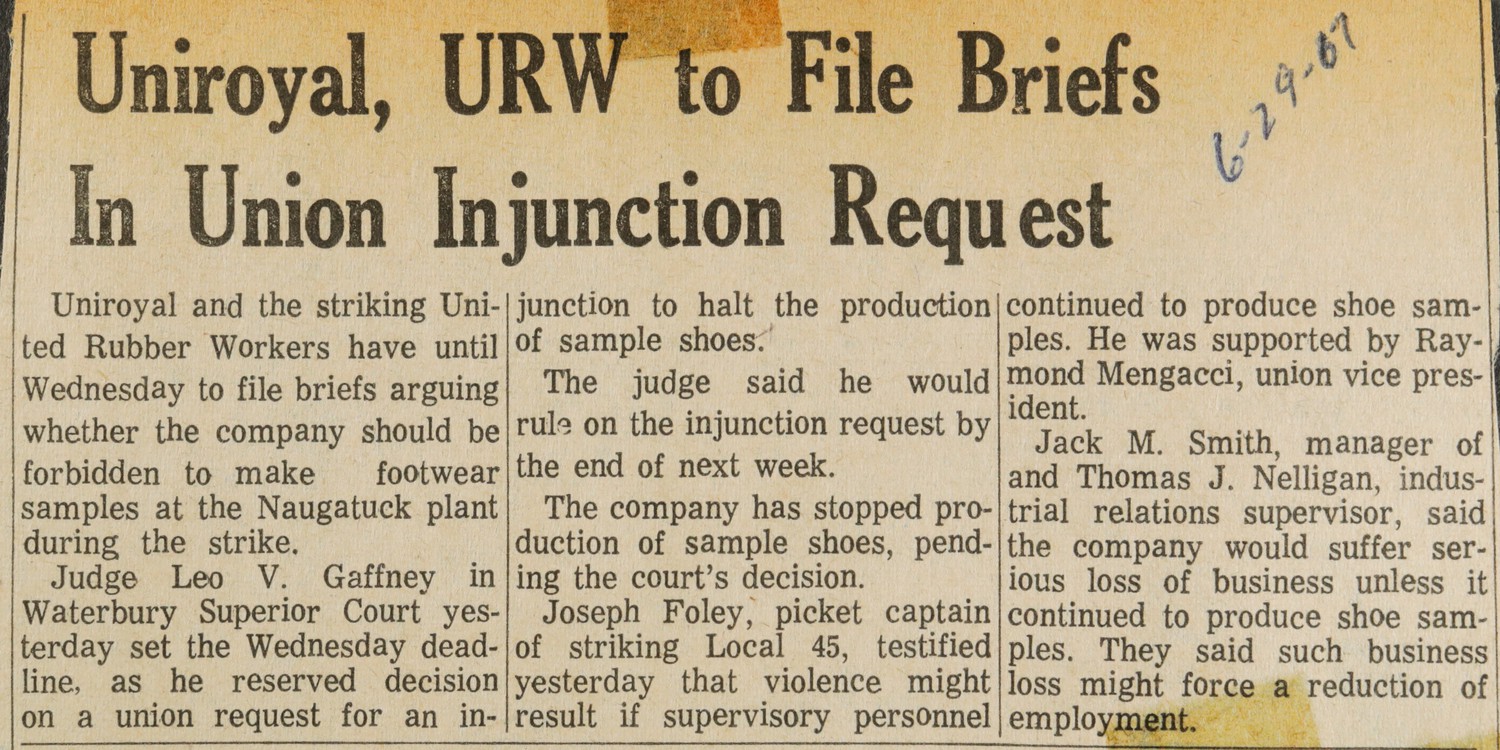
Uniroyal, URW to File Briefs In Union Injunction Request

Uniroyal, URW to File Briefs In Union Injunction Request

Uniroyal, URW to File Briefs In Union Injunction Request

6-2-67 [handwritten date in top right corner]

Uniroyal and the striking United Rubber Workers have until Wednesday to file briefs arguing whether the company should be forbidden to make footwear samples at the Naugatuck plant during the strike.

Judge Leo V. Gaffney in Waterbury Superior Court yesterday set the Wednesday deadline, as he reserved decision on a union request for an injunction to halt the production of sample shoes.

The judge said he would rule on the injunction request by the end of next week.

The company has stopped production of sample shoes, pending the court’s decision.

Joseph Foley, picket captain of striking Local 45, testified yesterday that violence might result if supervisory personnel continued to produce shoe samples. He was supported by Raymond Mengacci, union vice president.

Jack M. Smith, manager of and Thomas J. Nelligan, industrial relations supervisor, said the company would suffer serious loss of business unless it continued to produce shoe samples. They said such business loss might force a reduction of employment.

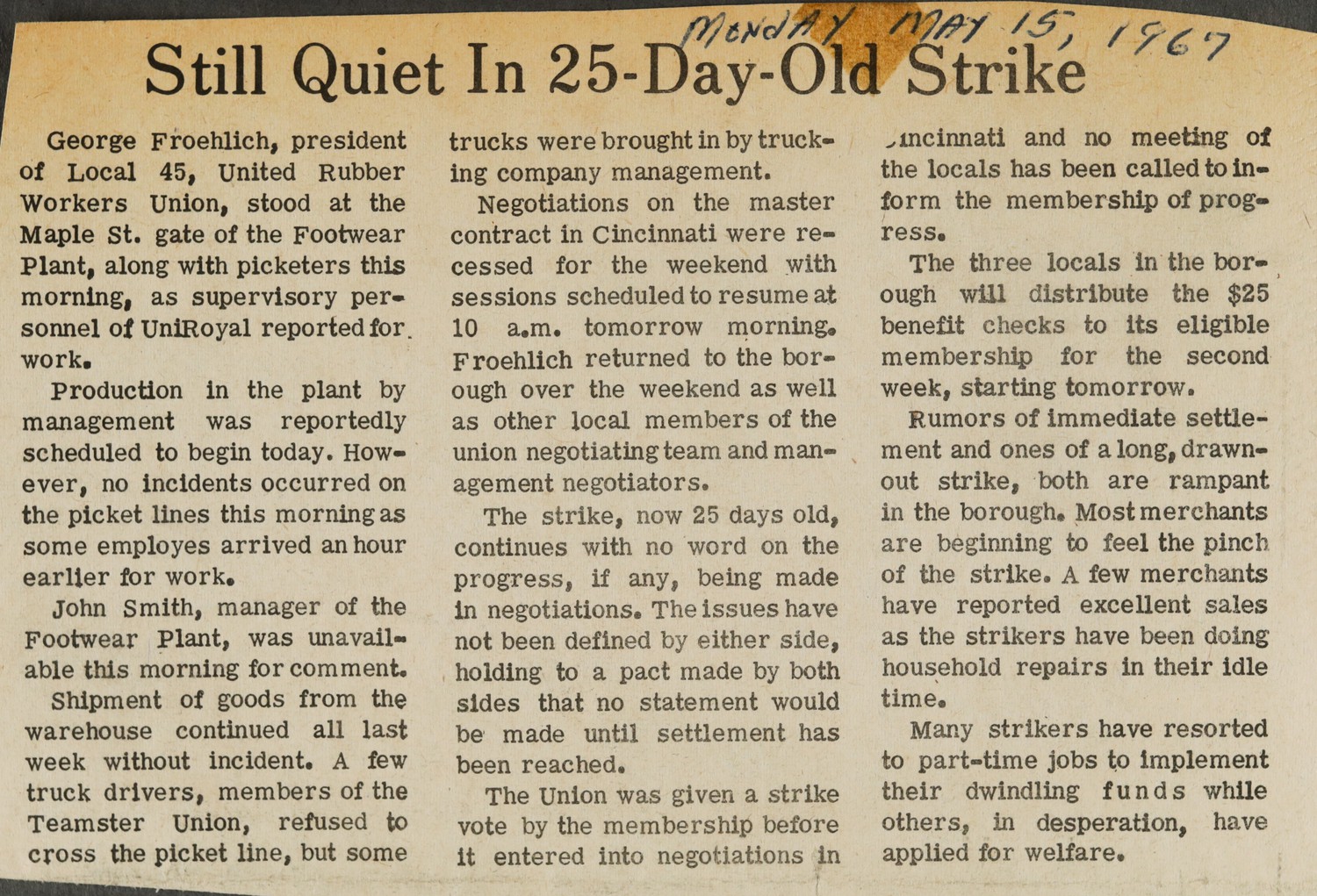
Still Quiet In 25-Day-Old Strike

Still Quiet In 25-Day-Old Strike

Monday May 15, 1967

Still Quiet In 25-Day-Old Strike

George Froehlich, president of Local 45, United Rubber Workers Union, stood at the Maple St. gate of the Footwear Plant, along with picketers this morning, as supervisory personnel of UniRoyal reported for work.

Production in the plant by management was reportedly scheduled to begin today. However, no incidents occurred on the picket lines this morning as some employes arrived an hour earlier for work.

John Smith, manager of the Footwear Plant, was unavailable this morning for comment.

Shipment of goods from the warehouse continued all last week without incident. A few truck drivers, members of the Teamster Union, refused to cross the picket line, but some trucks were brought in by trucking company management.

Negotiations on the master contract in Cincinnati were recessed for the weekend with sessions scheduled to resume at 10 a.m. tomorrow morning. Froehlich returned to the borough over the weekend as well as other local members of the union negotiating team and management negotiators.

The strike, now 25 days old, continues with no word on the progress, if any, being made in negotiations. The issues have not been defined by either side, holding to a pact made by both sides that no statement would be made until settlement has been reached.

The Union was given a strike vote by the membership before it entered into negotiations in Cincinnati and no meeting of the locals has been called to inform the membership of progress.

The three locals in the borough will distribute the $25 benefit checks to its eligible membership for the second week, starting tomorrow.

Rumors of immediate settlement and ones of a long, drawn-out strike, both are rampant in the borough. Most merchants are beginning to feel the pinch of the strike. A few merchants have reported excellent sales as the strikers have been doing household repairs in their idle time.

Many strikers have resorted to part-time jobs to implement their dwindling funds while others, in desperation, have applied for welfare.

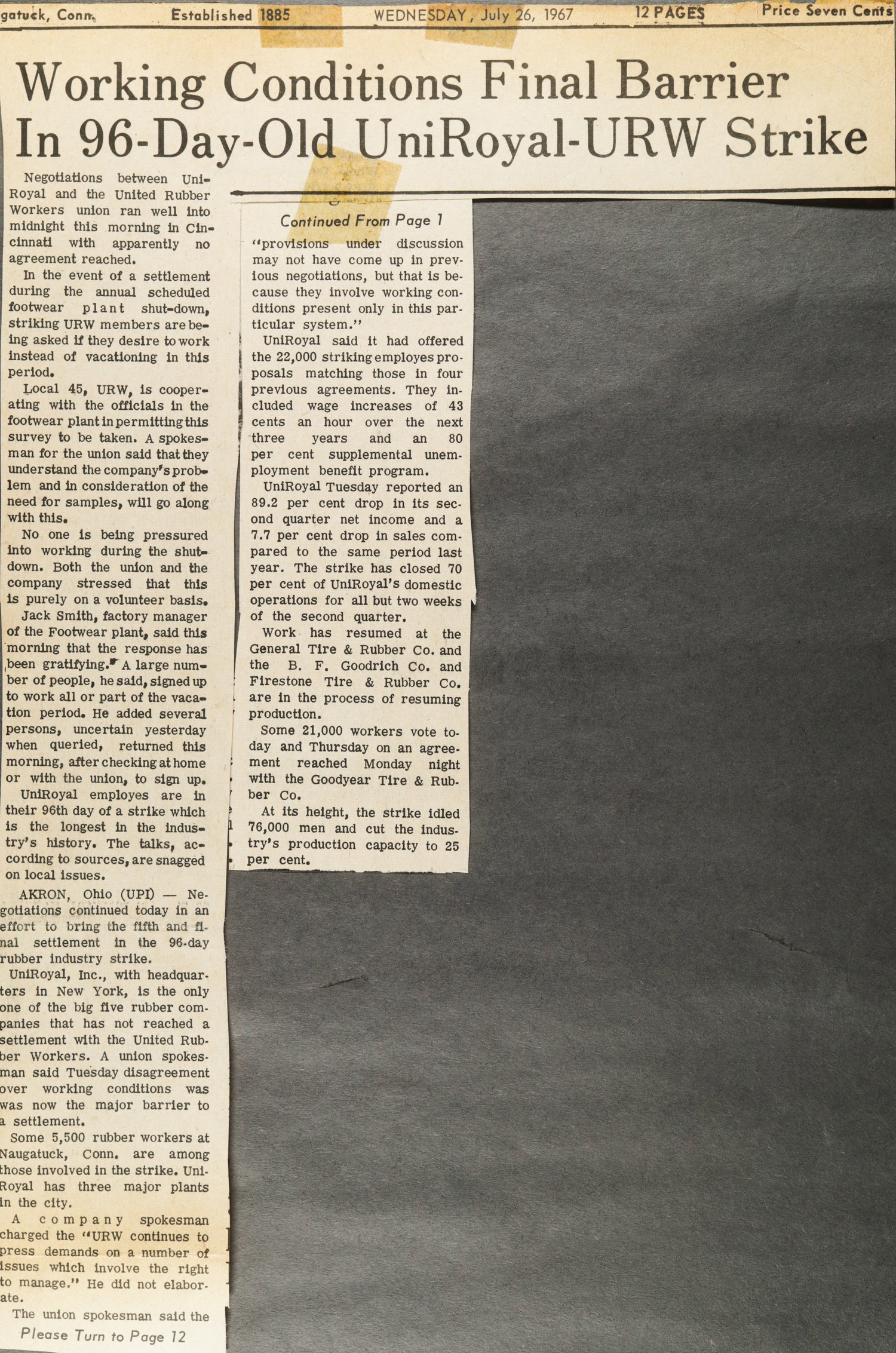
Working Conditions Final Barrier In 96-Day-Old UniRoyal-URW Strike

Working Conditions Final Barrier In 96-Day-Old UniRoyal-URW Strike

gatuck, Conn. Established 1885 WEDNESDAY, July 26, 1967 12 PAGES Price Seven Cents


Working Conditions Final Barrier In 96-Day-Old UniRoyal-URW Strike

Negotiations between UniRoyal and the United Rubber Workers union ran well into midnight this morning in Cincinnati with apparently no agreement reached.

In the event of a settlement during the annual scheduled footwear plant shut-down, striking URW members are being asked if they desire to work instead of vacationing in this period.

Local 45, URW, is cooperating with the officials in the footwear plant in permitting this survey to be taken. A spokesman for the union said that they understand the company’s problem and in consideration of the need for samples, will go along with this.

No one is being pressured into working during the shutdown. Both the union and the company stressed that this is purely on a volunteer basis.

Jack Smith, factory manager of the Footwear plant, said this morning that the response has been gratifying. A large number of people, he said, signed up to work all or part of the vacation period. He added several persons, uncertain yesterday when queried, returned this morning, after checking at home or with the union, to sign up.

UniRoyal employes are in their 96th day of a strike which is the longest in the industry’s history. The talks, according to sources, are snagged on local issues.

AKRON, Ohio (UPI) — Negotiations continued today in an effort to bring the fifth and final settlement in the 96-day rubber industry strike.

UniRoyal, Inc., with headquarters in New York, is the only one of the big five rubber companies that has not reached a settlement with the United Rubber Workers. A union spokesman said Tuesday disagreement over working conditions was was now the major barrier to a settlement.

Some 5,500 rubber workers at Naugatuck, Conn. are among those involved in the strike. UniRoyal has three major plants in the city.

A company spokesman charged the “URW continues to press demands on a number of issues which involve the right to manage.” He did not elaborate.

The union spokesman said the

Please Turn to Page 12


Continued From Page 1

“provisions under discussion may not have come up in previous negotiations, but that is because they involve working conditions present only in this particular system.”

UniRoyal said it had offered the 22,000 striking employes proposals matching those in four previous agreements. They included wage increases of 43 cents an hour over the next three years and an 80 per cent supplemental unemployment benefit program.

UniRoyal Tuesday reported an 89.2 per cent drop in its second quarter net income and a 7.7 per cent drop in sales compared to the same period last year. The strike has closed 70 per cent of UniRoyal’s domestic operations for all but two weeks of the second quarter.

Work has resumed at the General Tire & Rubber Co. and the B. F. Goodrich Co. and Firestone Tire & Rubber Co. are in the process of resuming production.

Some 21,000 workers vote today and Thursday on an agreement reached Monday night with the Goodyear Tire & Rubber Co.

At its height, the strike idled 76,000 men and cut the industry’s production capacity to 25 per cent.

Ratification Vote On Proposed Pact Set Saturday

Ratification Vote On Proposed Pact Set Saturday

Naugatuck, Conn.

Established 1885
THURSDAY, JULY 27, 1967
10 PAGES
Price Seven Cents


Ratification Vote On Proposed Pact Set Saturday

Local 45 To Vote In H.S., 2:30 P.M.

By RUTH NICHOLS

At 8:45 last night the telephone call that has been awaited for three months came through from Cincinnati announcing the end of the UniRoyal—URW strike.

George Froehlich, president of Local 45, notified the local headquarters in Naugatuck that a tentative agreement had been reached, ending the record-breaking 97-day-old strike.

Negotiating sessions began at 10 a.m. yesterday and were conducted continuously through the day until an agreement was reached.

Membership of all three borough Locals began celebrating on receipt of the news. The around-the-clock pickets at the UniRoyal Chemical and Synthetic plants were called off the line and some tore up their picket signs in jubilation.

Warehouse employes at the footwear plant were called into work this morning with other workers being called back to their jobs as they are needed, a company spokesman said this morning.


Working on a list of names garnered earlier this week, the company will begin manning departments which are incidental to the starting up of production lines.

According to the company spokesman, there are many auxiliary departments which must be started first before actual production can begin.

A production line involving sample footwear for UniRoyal, Inc. salesman will be given “top priority,” the spokesman said.

Employes of the warehouse on Elm St. may report for work just as soon as possible, a Footwear Division management spokesman said today.

The firm asked employes Tuesday and yesterday if they would be available for work at any time during their vacations, should the strike end. The company had the opportunity to poll the workers as it handed out more than $2 million in vacation checks to the striking workers.

A spokesman said today the response was very good. About 1,000 employes signed up and indicated they would be available. More workers are signing up today, also, the spokesman said. The official said that about 25 per cent of those employes eligible signed up to work at some time during the vacation shutdown.

The official pointed out that any employe who has not worked at the firm long enough to earn a vacation may also sign up for work during the shutdown. They should report to the firm’s employment office.

Vice-president of Local 45, Raymond Mengacci, said this morning, “I want to thank all the members of Local 45 for

Please Turn to Page 10


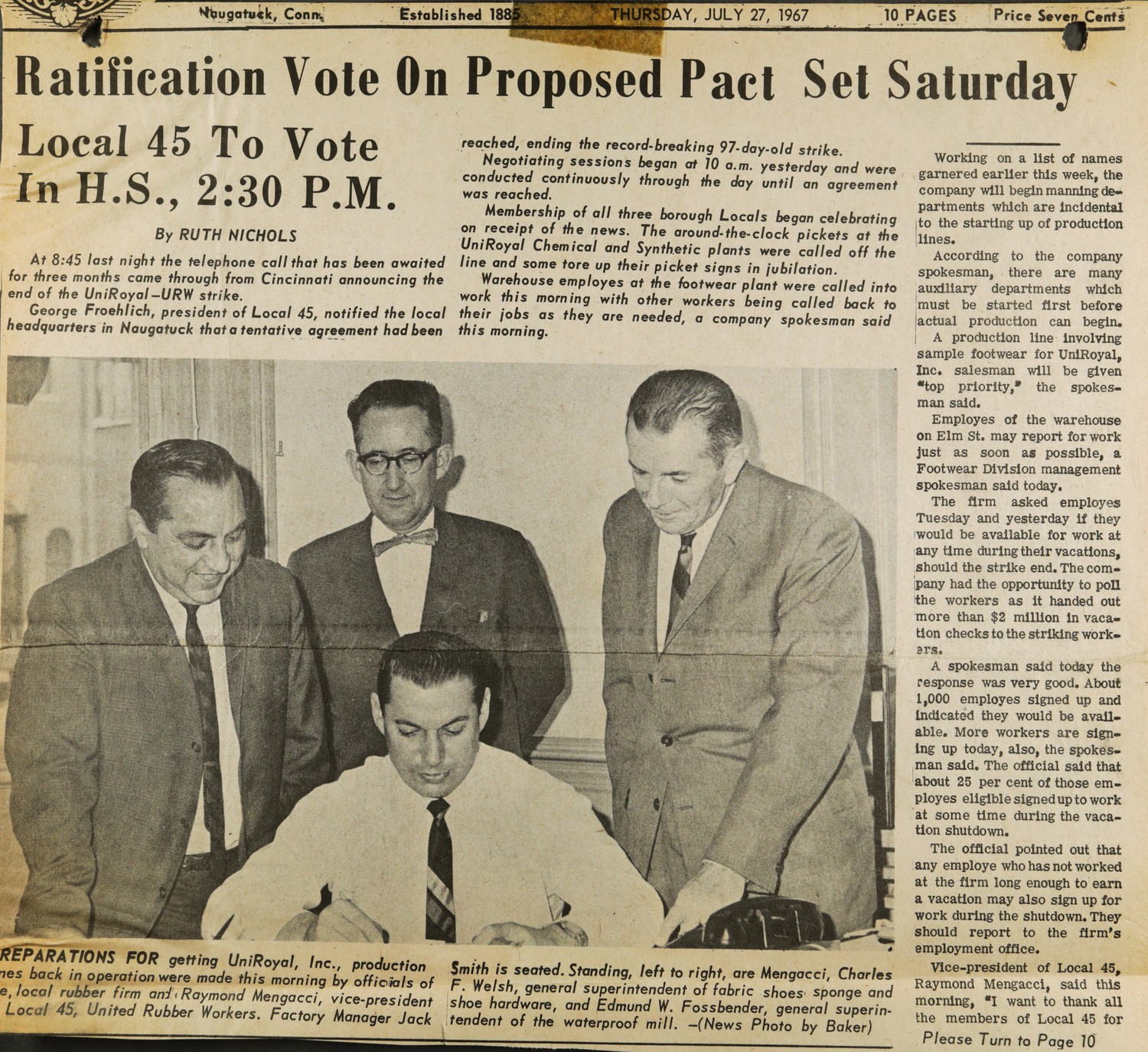
PHOTO CAPTION:

REPARATIONS FOR getting UniRoyal, Inc., production lines back in operation were made this morning by officials of the local rubber firm and Raymond Mengacci, vice-president Local 45, United Rubber Workers. Factory Manager Jack Smith is seated. Standing, left to right, are Mengacci, Charles F. Welsh, general superintendent of fabric shoes sponge and shoe hardware, and Edmund W. Fossbender, general superintendent of the waterproof mill. —(News Photo by Baker)

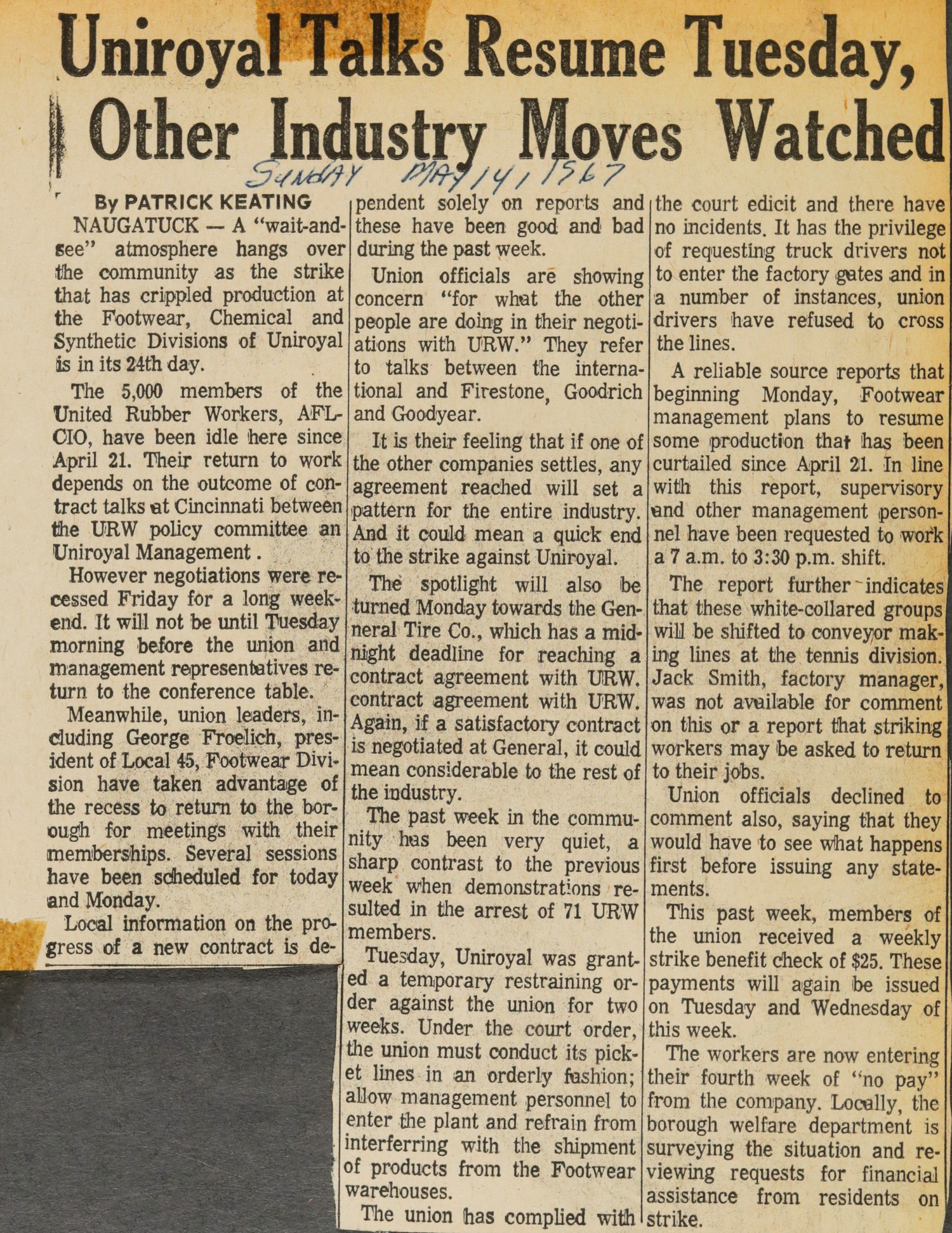
Uniroyal Talks Resume Tuesday, Other Industry Moves Watched

Uniroyal Talks Resume Tuesday, Other Industry Moves Watched

Uniroyal Talks Resume Tuesday, Other Industry Moves Watched

Sunday May 14, 1967

By PATRICK KEATING

NAUGATUCK — A “wait-and-see” atmosphere hangs over the community as the strike that has crippled production at the Footwear, Chemical and Synthetic Divisions of Uniroyal is in its 24th day.

The 5,000 members of the United Rubber Workers, AFL-CIO, have been idle here since April 21. Their return to work depends on the outcome of contract talks at Cincinnati between the URW policy committee an Uniroyal Management .

However negotiations were recessed Friday for a long weekend. It will not be until Tuesday morning before the union and management representatives return to the conference table.

Meanwhile, union leaders, including George Froelich, president of Local 45, Footwear Division have taken advantage of the recess to return to the borough for meetings with their memberships. Several sessions have been scheduled for today and Monday.

Local information on the progress of a new contract is dependent solely on reports and these have been good and bad during the past week.

Union officials are showing concern “for what the other people are doing in their negotiations with URW.” They refer to talks between the international and Firestone, Goodrich and Goodyear.

It is their feeling that if one of the other companies settles, any agreement reached will set a pattern for the entire industry. And it could mean a quick end to the strike against Uniroyal.

The spotlight will also be turned Monday towards the General Tire Co., which has a midnight deadline for reaching a contract agreement with URW. Again, if a satisfactory contract is negotiated at General, it could mean considerable to the rest of the industry.

The past week in the community has been very quiet, a sharp contrast to the previous week when demonstrations resulted in the arrest of 71 URW members.

Tuesday, Uniroyal was granted a temporary restraining order against the union for two weeks. Under the court order, the union must conduct its picket lines in an orderly fashion; allow management personnel to enter the plant and refrain from interferring with the shipment of products from the Footwear warehouses.

The union has complied with the court edict and there have no incidents. It has the privilege of requesting truck drivers not to enter the factory gates and in a number of instances, union drivers have refused to cross the lines.

A reliable source reports that beginning Monday, Footwear management plans to resume some production that has been curtailed since April 21. In line with this report, supervisory and other management personnel have been requested to work a 7 a.m. to 3:30 p.m. shift.

The report further indicates that these white-collared groups will be shifted to conveyor making lines at the tennis division. Jack Smith, factory manager, was not available for comment on this or a report that striking workers may be asked to return to their jobs.

Union officials declined to comment also, saying that they would have to see what happens first before issuing any statements.

This past week, members of the union received a weekly strike benefit check of $25. These payments will again be issued on Tuesday and Wednesday of this week.

The workers are now entering their fourth week of “no pay” from the company. Locally, the borough welfare department is surveying the situation and reviewing requests for financial assistance from residents on strike.

Untitled Clipping

7-11-67

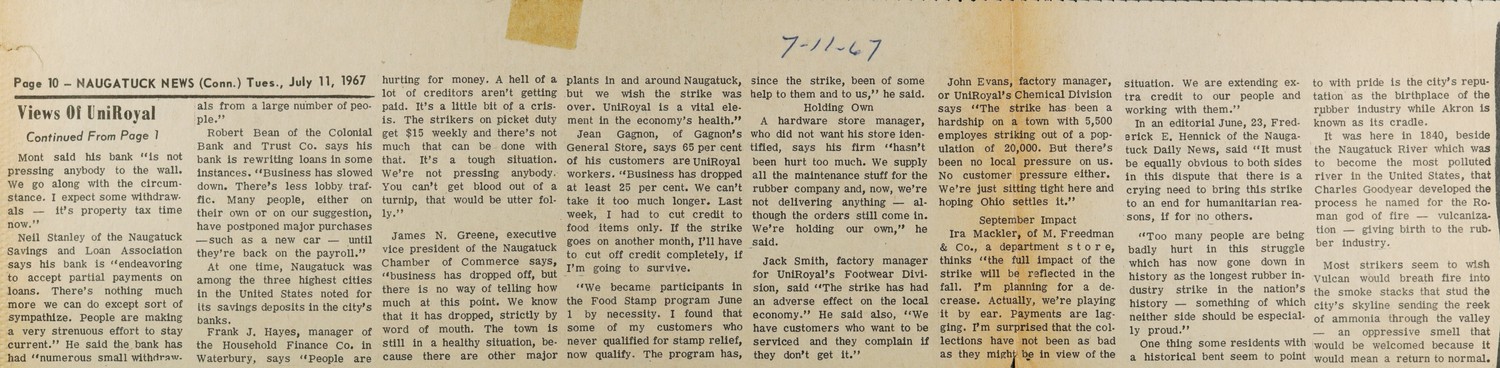
Page 10 – NAUGATUCK NEWS (Conn.) Tues., July 11, 1967


Views Of UniRoyal

Continued From Page 1

Mont said his bank “is not pressing anybody to the wall. We go along with the circumstance. I expect some withdrawals — it’s property tax time now.”

Neil Stanley of the Naugatuck Savings and Loan Association says his bank is “endeavoring to accept partial payments on loans. There’s nothing much more we can do except sort of sympathize. People are making a very strenuous effort to stay current.” He said the bank has had “numerous small withdrawals from a large number of people.”

At one time, Naugatuck was among the three highest cities in the United States noted for its savings deposits in the city’s banks.

Frank J. Hayes, manager of the Household Finance Co. in Waterbury, says “People are hurting for money. A hell of a lot of creditors aren’t getting paid. It’s a little bit of a crisis. The strikers on picket duty get $15 weekly and there’s not much that can be done with that. It’s a tough situation. We’re not pressing anybody. You can’t get blood out of a turnip, that would be utter folly.”

James N. Greene, executive vice president of the Naugatuck Chamber of Commerce says, “business has dropped off, but there is no way of telling how much at this point. We know that it has dropped, strictly by word of mouth. The town is still in a healthy situation, because there are other major plants in and around Naugatuck, but we wish the strike was over. UniRoyal is a vital element in the economy’s health.”

Jean Gagnon, of Gagnon’s General Store, says 65 per cent of his customers are UniRoyal workers. “Business has dropped at least 25 per cent. We can’t take it too much longer. Last week, I had to cut credit to food items only. If the strike goes on another month, I’ll have to cut off credit completely, if I’m going to survive.

“We became participants in the Food Stamp program June 1 by necessity. I found that some of my customers who never qualified for stamp relief, now qualify. The program has, since the strike, been of some help to them and to us,” he said.

Holding Own

A hardware store manager, who did not want his store identified, says his firm “hasn’t been hurt too much. We supply all the maintenance stuff for the rubber company and, now, we’re not delivering anything — although the orders still come in. We’re holding our own,” he said.

Jack Smith, factory manager for UniRoyal’s Footwear Division, said “The strike has had an adverse effect on the local economy.” He said also, “We have customers who want to be serviced and they complain if they don’t get it.”

John Evans, factory manager, or UniRoyal’s Chemical Division says “The strike has been a hardship on a town with 5,500 employes striking out of a population of 20,000. But there’s been no local pressure either. We’re just sitting tight here and hoping Ohio settles it.”

September Impact

Ira Mackler, of M. Freedman & Co., a department store, thinks “the full impact of the strike will be reflected in the fall. I’m planning for a decrease. Actually, we’re playing it by ear. Payments are lagging. I’m surprised that the collections have not been as bad as they might be in view of the situation. We are extending extra credit to our people and working with them.”

In an editorial June 23, Frederick E. Hennick of the Naugatuck Daily News, said “It must be equally obvious to both sides in this dispute that there is a crying need to bring this strike to an end for humanitarian reasons, if for no others.

“Too many people are being badly hurt in this struggle which has now gone down in history as the longest rubber industry strike in the nation’s history — something of which neither side should be especially proud.”

One thing some residents with a historical bent seem to point to with pride is the city’s reputation as the birthplace of the rubber industry while Akron is known as its cradle.

It was here in 1840, beside the Naugatuck River which was to become the most polluted river in the United States, that Charles Goodyear developed the process he named for the Roman god of fire — vulcanization — giving birth to the rubber industry.

Most strikers seem to wish Vulcan would breath fire into the smoke stacks that stud the city’s skyline sending the reek of ammonia through the valley — an oppressive smell that would be welcomed because it would mean a return to normal.

Rubber Firms Offer Rejected By Union

Rubber Firms Offer Rejected By Union

6-10-67 (handwritten)

NAUGATUCK—United Rubber Workers negotiators Friday rejected a new three-year contract proposal offered by the five major rubber producers, including Uniroyal.

This is apparently the second time during the week that the union has rejected company proposals.

URW Pres. Peter Bommarito termed Friday’s offer “inadequate” and said the union would continue its strike against Uniroyal, B. F. Goodrich and Firestone.

A statement appearing in a local newspaper Friday, attributed to Bommarito, said that the union was prepared to strike another 30 days.

While many of the striking United Rubber Workers in the borough expressed dismay about the possibility that they would have to continue the strike that much longer, Local 45 officials expressed reservations about whether Bommarito had said this.

One official, contacted Friday night, said that an attempt to check out the statement brought no results and it could not be determined whether Bommarito had made the remark.

A letter sent to Footwear Plant workers Thursday by Factory Manager John Smith stated that the union had rejected a three-year proposal Tuesday. Upon rejecting the proposal, said Smith, the union presented a counter proposal.

Management then apparently made a second proposal which, according to press services, was rejected during Friday’s session.

Talks between the URW and the rubber companies recessed until Monday.

In his letter to Footwear employes, Smith stated that the three-year proposal by the company offered wage increases, additional pay for skilled workers, liberalized vacation pay, supplemental unemployment benefits up to 75 per cent of average pay, a 60 per cent increase in regular pensions, an increase in company-paid life insurance, an increase in the coverage for the maximum stay in the hospital from 365 to 730 days, an increase in sickness and accident benefits and other items.

Wage increases in the tire plants, said Smith, amounted to 38 cents over three years, and in non-tire plants they amounted to 31 cents. The management also offered two weeks vacation pay for employes with one year of seniority and three weeks for employes with five years.

Miscellaneous contract clauses, he added, included “up to 40 hours pay depending on the size of the plant for union time study men.”

Regular pensions were increase a 60 per cent from $3.25 to $5.25 per month per year of service, said Smith.

These increases, said Smith “total about 70 cents per hour over a three-year period. This is approximately a five per cent yearly increase in wages and benefits for employes over the entire three years,” added the manager.

A Uniroyal spokesman said Friday the UFW’s demands would cost “at least $1.40 an hour.”

The union estimated that General Tire and Rubber Co.’s offer, which includes wage increases averaging 40 cents an hour over three years, will cost the company 63 or 64 cents an hour.

The companies Friday valued their offers at more than 70 cents an hour.

UniRoyal Cites Need For Sample Shoes

UniRoyal Cites Need For Sample Shoes

By Ruth Nichols

Production at the UniRoyal Footwear plant will be suspended for at least another week to allow time for briefs to be filed and Judge Leo V. Gaffney to come to a decision on whether a restraining injunction should be granted against the firm.

Two days of testimony from both Local 45 and UniRoyal Footwear Division management ended yesterday afternoon in Waterbury Superior Court. Judge Gaffney asked that written briefs be submitted to him by next Wednesday by both attorneys and stated that he will make his decision within a couple of days after reviewing the briefs and transcripts of the court proceedings.

Local 45 ended its testimony yesterday after calling Joseph Foley to the stand. Foley, a 21-year employe of the plant, member of the Union negotiating team and strike captain, was questioned on what might happen if the company was allowed to produce sample shoes.

Foley told the court that there would be violence on the picket line. He also testified that large numbers of supervisory personnel passed through the picket lines daily without incident.

Atty. J. Kenneth Bradley opened UniRoyal’s testimony by calling Thomas Nelligan, Labor Relations Manager, to the stand.

Nelligan told the court that 4,500 footwear plant employes are out on strike while 850 non-bargaining employes are working. All UniRoyal plants in the borough, with the exception of the footwear plant, are producing.

Nelligan cited the need for the sample shoes by August 1st. If the shoes were not ready to show by that date, according to Nelligan, there would be a reduction of production and a need for less employes.

Nelligan, under questioning, stated that if production of samples was allowed there would be no loss to striking employes but their wages. The Judge ruled that this answer should be stricken. Nelligan said he had no way of knowing what the cost to URW members and their families would be overall.

Nelligan said that these sample shoes could not be produced elsewhere. That it would take about 200 people, six weeks to two months to produce the necessary number of sample shoes. He said the bargaining people had been offered, through the union, the work first.

Factory Manager Jack Smith told the court that it was Monday or Tuesday of last week that the decision was made to start production on sample shoes.

Attorney Daniel Baker, URW counsel, questioned Nelligan about production at other UniRoyal plants. He asked if these samples couldn’t be made at one of the other company shoe producing plants that was currently in production.

Nelligan told the court that this was not possible because a different type of shoe was made at these plants.

Baker then opened the question of management starting its inventory using non-bargaining personnel. He also returned to the subject of the “Gray Building.”

How many shoes were produced in the building? Nelligan stated that the first three or four sample shoes were made in the building. The union sought inspection of the “gray building.”

Judge Gaffney asked if a member of the Industrial Relations Department accompanied the union inspection team on its tour.

Smith told the court about the pickets not allowing personnel into the plant in the early days of the strike. He said on the first day of mass picketing he conferred with Naugatuck Police Capt. Joseph Summa and sent management personnel home. He said all this occurred after the union had been notified 24-hours in advance of the company’s intention to ship.

Smith testified that on the May 15th meeting with union representatives, the company made known its intention to start production, first offering the work to bargaining personnel. He told the court he, at that time, told the union he believed there was no longer an agreement; however, it was then believed settlement was imminent and the company did not press for production.

Again on the subject of sample shoes, Smith said that production could not be carried on in the “Keds” line, produced here in the borough, in another company plant without moving equipment in large numbers to another location.

Smith spoke of the work the union had allowed to continue in the “Gray Building.” He said that the union knew that certain materials were produced in the main plant to carry on this work and hadn’t objected.

He said that this was the only footwear plant in the United States to be shut down and declared it was necessary to have sample shoes ready by the August 1st date.

Smith said that if samples were not ready, salesmen would miss sales and this, in turn, would lower sales, lower fill-in sales, and thus reduce production in the Naugatuck Footwear plant.

Smith, again questioned about the agreement and the May 15th meeting, told the Judge that he did not remember coming back into the meeting room after making a telephone call and telling union representative that he would “honor the agreement.”

Baker asked Smith had he given the union 24-hours notice of intent to ship. And had not the company made an oral agreement that no personnel would enter the plant after 6 p.m.

Then Baker asked had not the fact that personnel came into the

Please Turn to Page 12


Beacon Falls

Beacon Hose Co. Firemen To Parade

BEACON FALLS – Captain Walter C. Carlson of Beacon Hose Co. No. 1 has announced that members will attend the Firemen’s Parade in Oxford this evening.

Members are requested to meet at the firehouse at 6:30 in full dress uniforms.

Uniroyal Strike Talks Reopen In 53rd Day

Uniroyal Strike Talks Reopen In 53rd Day

6-13-67

NAUGATUCK— Bargaining sessions between the United Rubber Workers and five major rubber producers, including Uniroyal, reopened Monday in Ohio as a strike against three of the companies entered its 53rd day.

Although negotiators for the URW and Uniroyal management could either not be contacted or refused to comment Monday night, reliable sources pointed to the progress made during the past week and held out hope that a settlement might be reached before another week passes.

Although union members in the borough have expected that pensions would be discussed in September offers from the rubber companies, including Uniroyal, have lately included the pension and fringe benefit items.

Management sources have indicated a reluctance to face the cost of wage increases with the possible threat of a second strike in September over pension items.

While the latest word from Uniroyal was that wage increases in its offer were 38 cents for tire workers and 31 for non-tire workers it was learned that General Tire had boosted its wage increases to 40 cents for tire workers.

General Tire, however, has only 3,000 workers in two tire plants. In addition, General Tire is said to have boosted its supplemental unemployment benefits to 80 per cent, and offered a provision for six weeks of vacation for employes with over 30 years service.

It could not be determined Monday night whether Uniroyal had made a similar offer.

Reliable sources have called General Tire and Goodyear, who are both working on a day-to-day basis, pattern companies.

According to the sources, a settlement between the URW and these companies is expected to set a pattern for settlement with Uniroyal, B. F. Goodrich and Firestone, the struck companies.

During the past two weeks, all companies have been talking a three-year pact with the union, and some union sources have indicated a feeling that the final settlement would be for three years.

Local 45 Vice President Raymond Mengacci, in a statement to local newspapers Monday, said that although he didn’t want to enter a debate with Footwear Plant manager John Smith, he felt compelled to answer a letter sent to employes last week by the company.

Mengacci noted that both the company and the union committees “were having a hard enough time in Cincinnati, Ohio, to negotiate an agreement in Naugatuck,” without doing it through the newspapers.

Mengacci said when the union negotiating committee left for Cincinnati it was for the sole purpose of making a sincere effort to negotiate a contract and wage agreement with Uniroyal before the April 20 deadline. Negotiations began in Cincinnati March 21, and “it wasn’t until April 12 that the company made its first and final offer to the union on contract and wages, eight days before the deadline.

“This,” Mengacci stated, “has never happened in the history of my experiences on the negotiating committee or that of Pres. George Froehlich, that the first offer was also the last. No one can call this negotiating. This has never been done before. It wasn’t until a few days later that the union found out that this was being done in all of the Big Four rubber companies, not just Uniroyal. The union also found out these companies had made a mutual pact designed to protect any struck company against financial losses.

“We in the union were always led to believe these companies were in competition with one another, but found it is not so. They have a much better union than we have.”

Plant Manager Smith, in his letter, said the company had made an effort to open the pension and insurance agreement. “This, Mengacci said, “was correct, but the union informed the company this agreement does not terminate until Sept. 15, 1967, and the union was in no position to negotiate this agreement as it had not been discussed with their membership to determine what changes were wanted. Also they had made no preparation on pension and insurance to discuss this question intelligently with the company.

“Mr. Smith stated the union did not present to the company their full proposal until 11 a.m. April 19, just 37 hours before the strike deadline. This is correct, but why? The union felt if they received from the company the correct interpretation of the clauses in the working agreement now, and the way they were intended to be interpreted, at least in the union’s viewpoint, before there was a change in the head negotiator for the company, they would not have to make any changes.

“The union found out the company’s new head negotiator was not given the same interpretation. Therefore, the union came in with some new proposals as the union would not be able to live with some of the interpretations that were given to the new head negotiator, under Article 9, working conditions.

“These conditions are important to our members especially those working in the making and stitching departments. Production in many cases has increased by 25 to 30 per cent in the last few years, with the same amount of operators and in many cases less.

“Many of the employes can verify their weekly earnings are less now even though they have received two wage increases in the past few years. They cannot make anywhere near the efficiency they were making a few years ago and this is the reason the union had to make some late proposals to the company. If the company wanted to make a sincere effort to reach an agreement, they still had plenty of time to do so.”

Mengacci asserted the union does not believe the non-tire plants are putting the company in a “severe economic squeeze,” if they grant the same wage increases as the tire companies.” He noted wages increase of 41.6 per cent have been given to George R. Vila, president of Uniroyal, and 36.6 per cent to Walter D. Baldwin, vice president. “The union is not saying these men do not deserve the increase, but if the company wants to talk percentages, then talk percentages from top to bottom,” the Union official said.

“We are happy the company has seen fit to increase the vacation allowance for employes with one to five years of seniority, but what about the employe with 10 or more years of seniority.”

The union official also said that, although the company had improved some of the contract clauses, the union questions why the company would not give a letter of commitment, “which would not cost a penny to treat union members with decency and respect. If management expects our members to treat them with decency and respect, then we expect the same treatment. A written commitment would have gone a long way in reaching a settlement.”

No comments were made on the pension and insurance pact offered by the company. Mengacci said it had to be studied before a statement was made. However, he said he “was happy to see the company is negotiating with the union, even though it took from April 12 to June 5 to make their latest offer. The union rejection was a take-it-all or reject-it-all offer, which the union could not live with.

“I can assure Mr. Smith that George Froehlich and the rest of the union’s committee of Local 45 will do everything in their power to bring this dispute to a settlement as fast as possible,” Mengacci concluded.

The above increases in wages and benefits togal about 70¢ per hour over a three year period.

The above increases in wages
and benefits togal about 70¢
per hour over a three year
period. This is approximately
a 5% yearly increase in wages
and benefits for employees over
the entire three years. It is the
equivalent of the settlement ne-
gotiated in other industries
which have been referred to
by the Union as necessary to
resolve these negotiations. It
was the most substantial and
costly offer ever made by this
Company to the Union.

This proposal was rejected
by the Union late in the after-
noon of June 6. The Union, in
rejecting the above Company of-
fer, made a counter proposal
which excluded any considera-
tion of pensions and insurances
and held to a number of costly
demands which were made be-
fore the strike started.

Sincerely,
Jack M. Smith
Factory Manager

The release of the letter,
and articles read in the paper
were the only announcements
of the proposals the union mem-
bership received. No meetings
were called to allow the general
membership to express their
pleasure or displeasure of the
company’s offer.

Local 45 has held only one
membership meeting, since the
members authorized the nego-
tiators to call a strike. Presi-
dent George Froehlich, then
complained that the company
was not bargaining and only
throwing “bits of silver” on the
table. He said that the union

was seeking decent treatment
for the employes and also com-
plained of the differential be-
tween tire workers and non-
tire workers.

Tire workers now average
about $3.69 an hour while other
rubber industry production
workers average $2.68 an hour.

The three-year contract is
also said to be a stumbling
block in settlement.

Vice-president of Local 45,
Raymond Mengacci, told the
NEWS this morning, that he was
aware of the letter, but had not
as yet had time to read and
digest its contents. He said
that he will be prepared to
comment on it after he has
had time to study it.

Uniroyal

Uniroyal 6-28-61

(Continued from Page One)

Uniroyal counsel J. Kenneth Bradley questioned Mengacci at some length about flare-ups at the gates early in May when pickets attempted to keep office personnel from entering the plant.

71 Arrests

The three days of clashes between pickets and police resulted in arrests of 71 strikers and a warning from Judge Gaffney that he would issue an injunction against the union if the violence didn’t stop.

The judge Tuesday gave some hint as to how he will accept such a defense, when he interrupted Bradley during questioning about a meeting between union officials and John Smith, plant manager.

Mengacci quoted Smith as saying at that meeting that in his opinion, no agreement existed because of the picket line troubles.

Judge Gaffney declared, “I’m not concerned with what some Mr. Smith thought about whether the agreement was null and void—it does not substitute for my judgment.”

At another point, while Bradley cross-examined Mengacci about alleged offers by the company to have union members perform certain jobs at the plant, the judge chided the lawyer to “come to the issue here, whether or not there’s been a violation of this contract.”

Mengacci also claimed that the company had announced at a May 8 meeting that “it needed to get samples out and they (company officials) intended to start production on samples with supervisory help.”

The union official said that after union protests, Smith told Local 45 leaders at a meeting a week later that the company “would honor the agreement” not to go into production and plans to start work on the samples would be dropped.

Mengacci said the company announced at that time that it wanted to produce 400 to 500 pairs of shoes a day.

Joseph DeCarlo, a member of the union negotiating committee, and Walter Beckwith, a picket captain, also voiced the opinion that violence would break out in the picket lines if production is allowed to begin.