The Flagship – Page 3

Page 003

The Flagship • Winter 1998 • 3


Retirements…

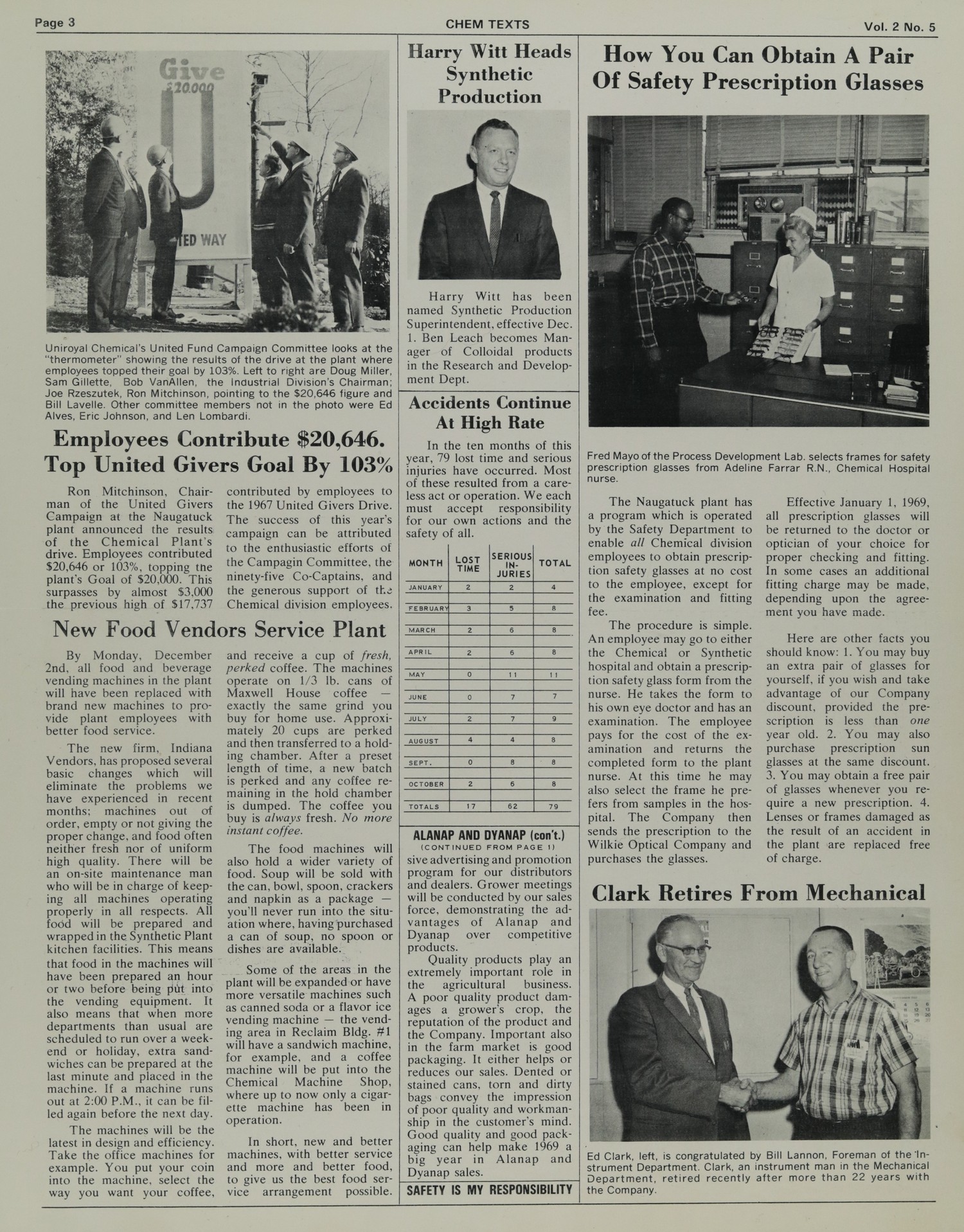
[PHOTO: Man in glasses and suit standing in office with computer monitor visible]

Korean War Army Veteran Marcel Hebert retired on 10/11/97 after 43 years with Uniroyal Chemical. Marty started out as a general laborer in the Pilot Plant in 1954, moving quickly into chemical operations. In 1981, Marty transferred to Parcel Post and then to the Warehouse. In December, 1992, he became our Watchman at the Gatehouse and worked directly with Plant Protection and Human Resources in the daily plant entry operations.


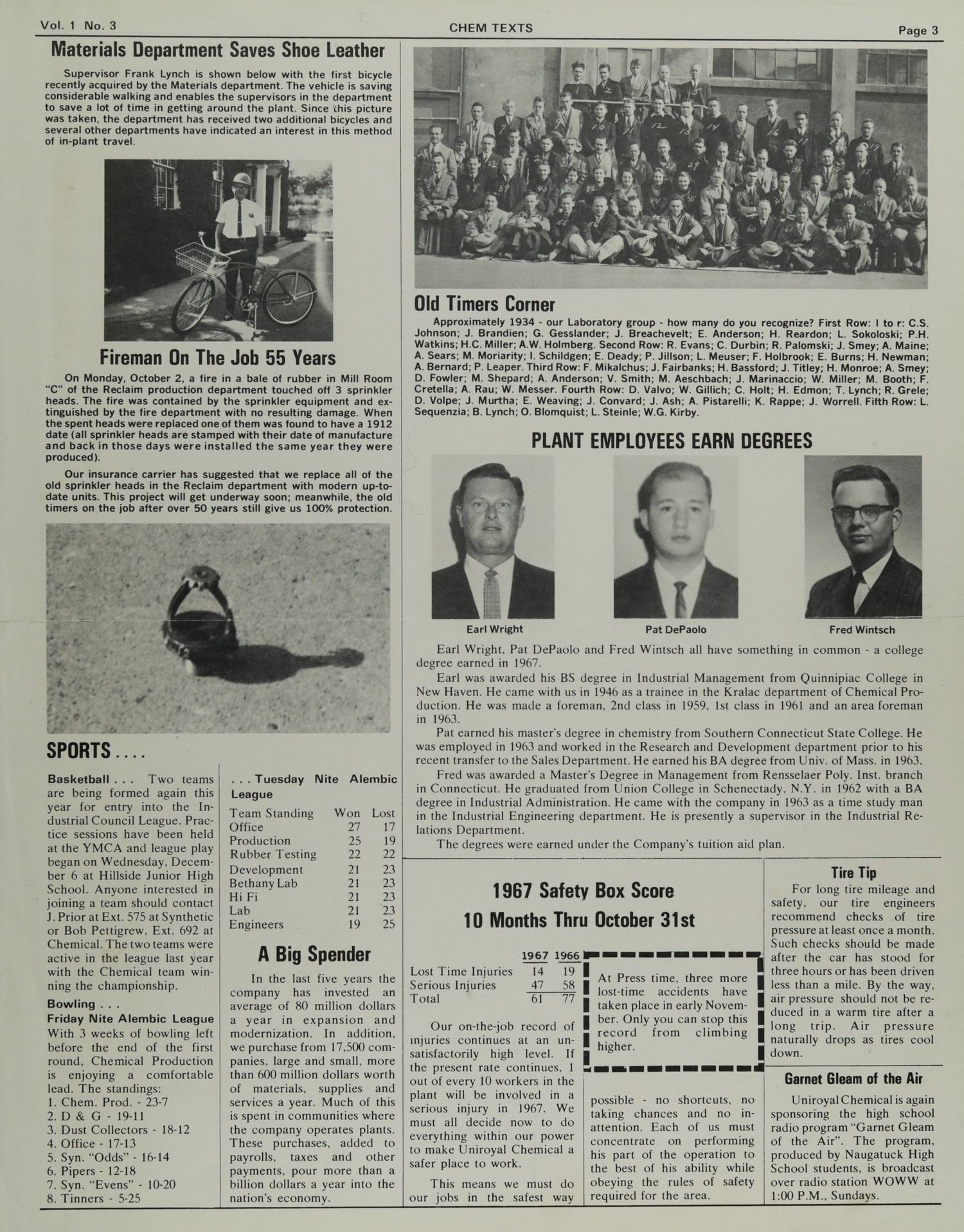
[PHOTO: Woman with glasses and dark hair]

Ascencao Fonesca retired on 5/24/97. Ascencao started with Uniroyal in May, 1969 as a Tube Sorter. In November of the same year, she transferred to the Custodial Department where she has worked hard at keeping things neat and clean for 28 years!


RETIREES (PHOTOS NOT AVAILABLE)

Donald E. Hall, a Chemical Operator, retired 1/11/98 with 25 years of service with Uniroyal Chemical. Don started with the Company in August of 1973, working in various production buildings throughout his career. Don is an Army Veteran and also has experience in sheetmetal, warehousing, and as a meat butcher.

Army Veteran Victory P. Kloc retired on 10/1/97 with 38 years of service. He started as a Finishing Operator in the Synthetic Plant in May, 1959. Throughout his years with Uniroyal Chemical, Vic worked as a Utility Operator, a Hydraulic Cleaner and has worked in several production buildings as a Chemical Operator. He also has skills in carpentry, and trade certificates in electrical, plumbing, and mechanical.


Fishing Trip

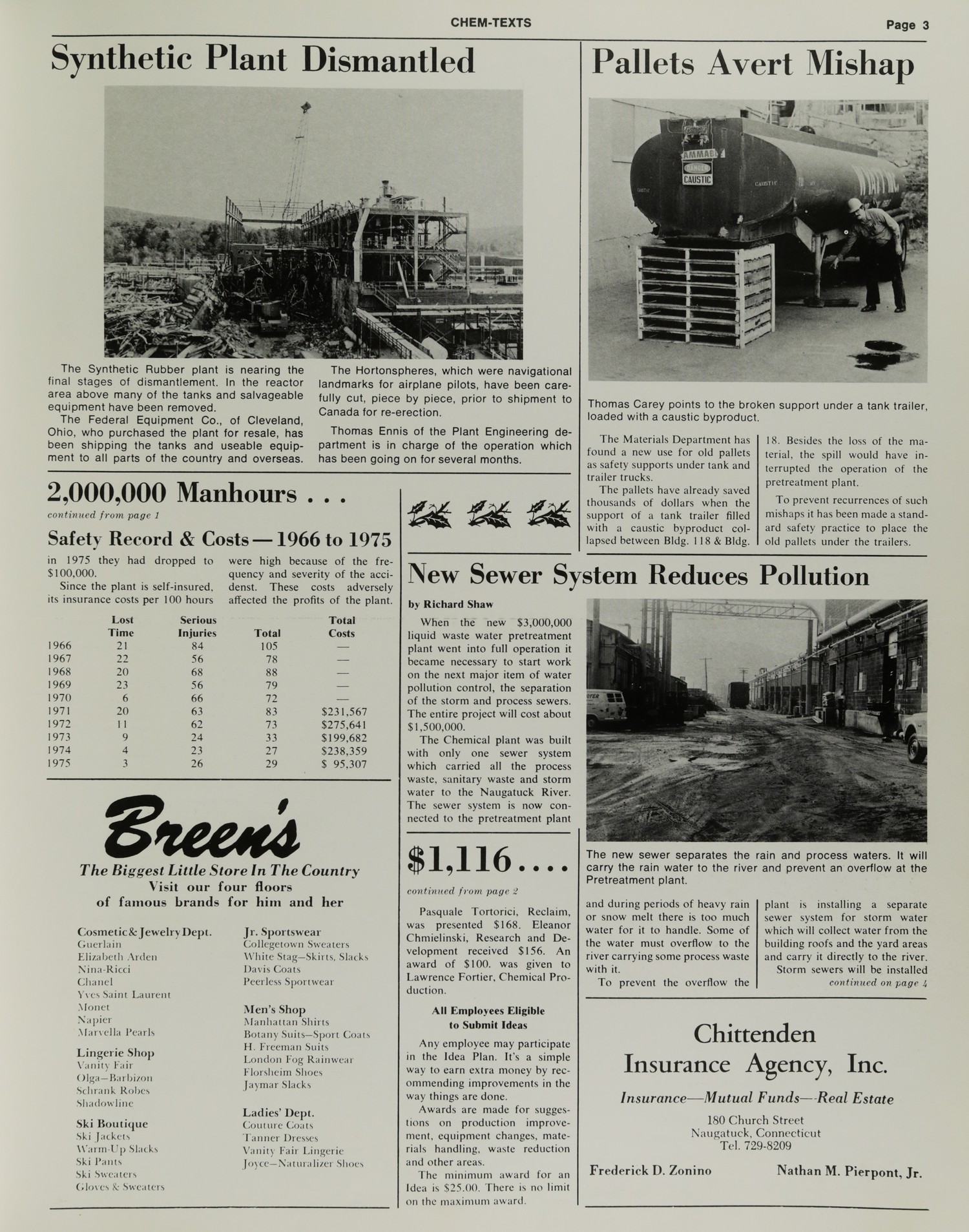
[PHOTO: Three people on a boat with fishing catch]

Plenty of fish and fun were both accomplished when we held a deep-sea fishing trip last October. Everybody should be out of cod cakes by now, so maybe we should start thinking of doing it again. It was a great day of fishing.

UNIROYAL CHEMICAL


Mystery Photo

[PHOTO: Young man in work setting with elderly woman visible]

Can anyone identify this dapper young man in the front of photo?
Can someone tell us what he’s doing?
Respond to the Training Center, you may win a prize!

The Flagship – Issue 6 – Page 1

Page 001

SAVE PHOTO ON PAGES 4+5

[NAUGATUCK logo]

The FLAGSHIP

Issue 6 Quarterly News Winter 1998


N A U G A T U C K

C H E M I C A L


From The Factory Manager…

“BST” BEHAVIORAL SCIENCE TECHNOLOGY

As most of you are aware, the Plant has retained the services of a consulting firm that specializes in improving safety performance. The technique that they have developed and plan to implement at our facility is based on a study of the behaviors that are associated with accidents and methods to change these behaviors. I have personally observed the results of their efforts at other chemical plants, and the improvement in safety performance was impressive and dramatic. I am very optimistic and confident that BST will be successful here in Naugatuck.

I am also aware that some of us view this as “just another safety program” or the “flavor of the month.” While it is true that we have had many programs over the years, I believe that all of them have contributed something positive to our safety performance. However, the fact remains that we have a long way to go. Quite frankly, we can call this approach anything we want as long as we successfully and dramatically improve our safety performance.

I ask all of you to do whatever you can to make this effort successful.

Jack Prior,
Factory Manager

[UNIROYAL CHEMICAL logo]


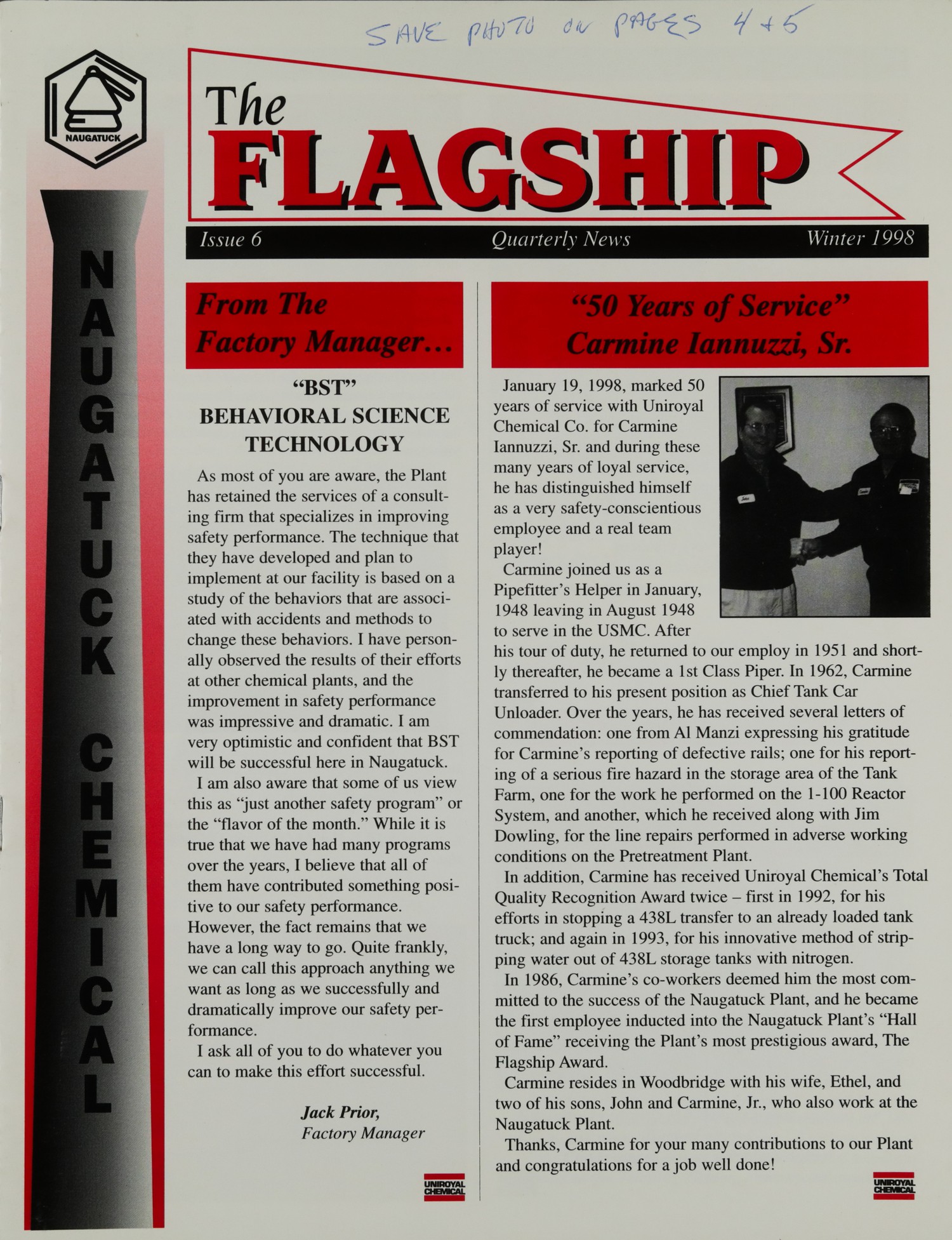
“50 Years of Service” Carmine Iannuzzi, Sr.

January 19, 1998, marked 50 years of service with Uniroyal Chemical Co. for Carmine Iannuzzi, Sr. and during these many years of loyal service, he has distinguished himself as a very safety-conscientious employee and a real team player!

Carmine joined us as a Pipefitter’s Helper in January, 1948 leaving in August 1948 to serve in the USMC. After his tour of duty, he returned to our employ in 1951 and shortly thereafter, he became a 1st Class Piper. In 1962, Carmine transferred to his present position as Chief Tank Car Unloader. Over the years, he has received several letters of commendation: one from Al Manzi expressing his gratitude for Carmine’s reporting of defective rails; one for his reporting of a serious fire hazard in the storage area of the Tank Farm, one for the work he performed on the 1-100 Reactor System, and another, which he received along with Jim Dowling, for the line repairs performed in adverse working conditions on the Pretreatment Plant.

In addition, Carmine has received Uniroyal Chemical’s Total Quality Recognition Award twice – first in 1992, for his efforts in stopping a 438L transfer to an already loaded tank truck; and again in 1993, for his innovative method of stripping water out of 438L storage tanks with nitrogen.

In 1986, Carmine’s co-workers deemed him the most committed to the success of the Naugatuck Plant, and he became the first employee inducted into the Naugatuck Plant’s “Hall of Fame” receiving the Plant’s most prestigious award, The Flagship Award.

Carmine resides in Woodbridge with his wife, Ethel, and two of his sons, John and Carmine, Jr., who also work at the Naugatuck Plant.

Thanks, Carmine for your many contributions to our Plant and congratulations for a job well done!

[UNIROYAL CHEMICAL logo]

ChemWorld – Page 5

Page 005

ChemWorld | 5 | January 1991


Uniroyal Chemical Names Annual Quality Award Winners and Career Achievement Recipient

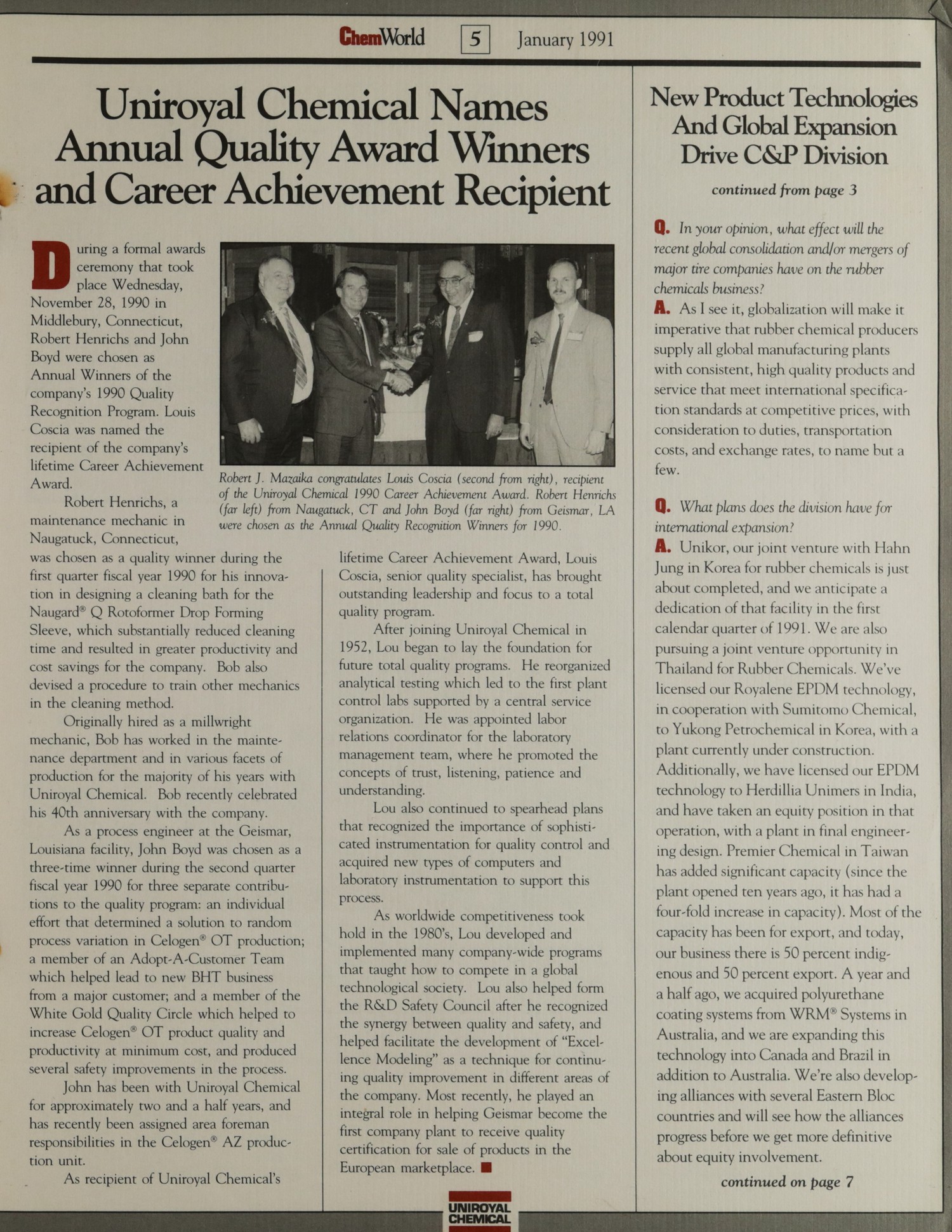
During a formal awards ceremony that took place Wednesday, November 28, 1990 in Middlebury, Connecticut, Robert Henrichs and John Boyd were chosen as Annual Winners of the company’s 1990 Quality Recognition Program. Louis Coscia was named the recipient of the company’s lifetime Career Achievement Award.

Robert Henrichs, a maintenance mechanic in Naugatuck, Connecticut, was chosen as a quality winner during the first quarter fiscal year 1990 for his innovation in designing a cleaning bath for the Naugard® Q Rotoformer Drop Forming Sleeve, which substantially reduced cleaning time and resulted in greater productivity and cost savings for the company. Bob also devised a procedure to train other mechanics in the cleaning method.

Originally hired as a millwright mechanic, Bob has worked in the maintenance department and in various facets of production for the majority of his years with Uniroyal Chemical. Bob recently celebrated his 40th anniversary with the company.

As a process engineer at the Geismar, Louisiana facility, John Boyd was chosen as a three-time winner during the second quarter fiscal year 1990 for three separate contributions to the quality program: an individual effort that determined a solution to random process variation in Celogen® OT production; a member of an Adopt-A-Customer Team which helped lead to new BHT business from a major customer; and a member of the White Gold Quality Circle which helped to increase Celogen® OT product quality and productivity at minimum cost, and produced several safety improvements in the process.

John has been with Uniroyal Chemical for approximately two and a half years, and has recently been assigned area foreman responsibilities in the Celogen® AZ production unit.

As recipient of Uniroyal Chemical’s

Robert J. Mazaika congratulates Louis Coscia (second from right), recipient of the Uniroyal Chemical 1990 Career Achievement Award. Robert Henrichs (far left) from Naugatuck, CT and John Boyd (far right) from Geismar, LA were chosen as the Annual Quality Recognition Winners for 1990.

lifetime Career Achievement Award, Louis Coscia, senior quality specialist, has brought outstanding leadership and focus to a total quality program.

After joining Uniroyal Chemical in 1952, Lou began to lay the foundation for future total quality programs. He reorganized analytical testing which led to the first plant control labs supported by a central service organization. He was appointed labor relations coordinator for the laboratory management team, where he promoted the concepts of trust, listening, patience and understanding.

Lou also continued to spearhead plans that recognized the importance of sophisticated instrumentation for quality control and acquired new types of computers and laboratory instrumentation to support this process.

As worldwide competitiveness took hold in the 1980’s, Lou developed and implemented many company-wide programs that taught how to compete in a global technological society. Lou also helped form the R&D Safety Council after he recognized the synergy between quality and safety, and helped facilitate the development of “Excellence Modeling” as a technique for continuing quality improvement in different areas of the company. Most recently, he played an integral role in helping Geismar become the first company plant to receive quality certification for sale of products in the European marketplace. ■


New Product Technologies And Global Expansion Drive C&P Division

continued from page 3

Q. In your opinion, what effect will the recent global consolidation and/or mergers of major tire companies have on the rubber chemicals business?

A. As I see it, globalization will make it imperative that rubber chemical producers supply all global manufacturing plants with consistent, high quality products and service that meet international specification standards at competitive prices, with consideration to duties, transportation costs, and exchange rates, to name but a few.

Q. What plans does the division have for international expansion?

A. Unikor, our joint venture with Hahn Jung in Korea for rubber chemicals is just about completed, and we anticipate a dedication of that facility in the first calendar quarter of 1991. We are also pursuing a joint venture opportunity in Thailand for Rubber Chemicals. We’ve licensed our Royalene EPDM technology, in cooperation with Sumitomo Chemical, to Yukong Petrochemical in Korea, with a plant currently under construction. Additionally, we have licensed our EPDM technology to Herdillia Unimers in India, and have taken an equity position in that operation, with a plant in final engineering design. Premier Chemical in Taiwan has added significant capacity (since the plant opened ten years ago, it has had a four-fold increase in capacity). Most of the capacity has been for export, and today, our business there is 50 percent indigenous and 50 percent export. A year and a half ago, we acquired polyurethane coating systems from WRM® Systems in Australia, and we are expanding this technology into Canada and Brazil in addition to Australia. We’re also developing alliances with several Eastern Bloc countries and will see how the alliances progress before we get more definitive about equity involvement.

continued on page 7


UNIROYAL CHEMICAL

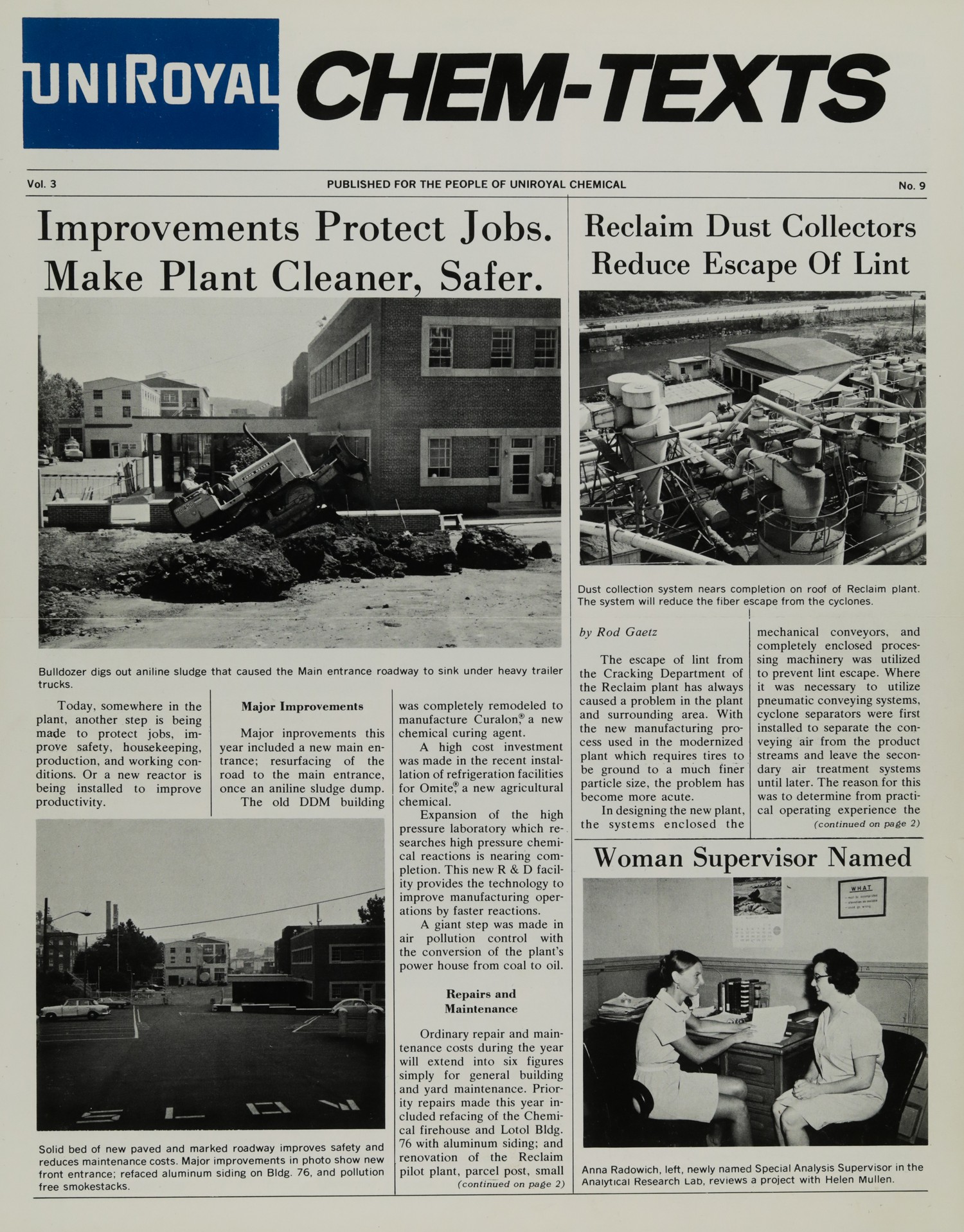
CHEM-TEXTS – 1980 – Page NO. 1

Page unknown

UNIROYAL CHEM-TEXTS

Vol. 14, 1980 | PUBLISHED FOR THE PEOPLE OF UNIROYAL CHEMICAL | NO. 1


Plant Receives Award

[IMAGE: Photo of two people shaking hands during award presentation]

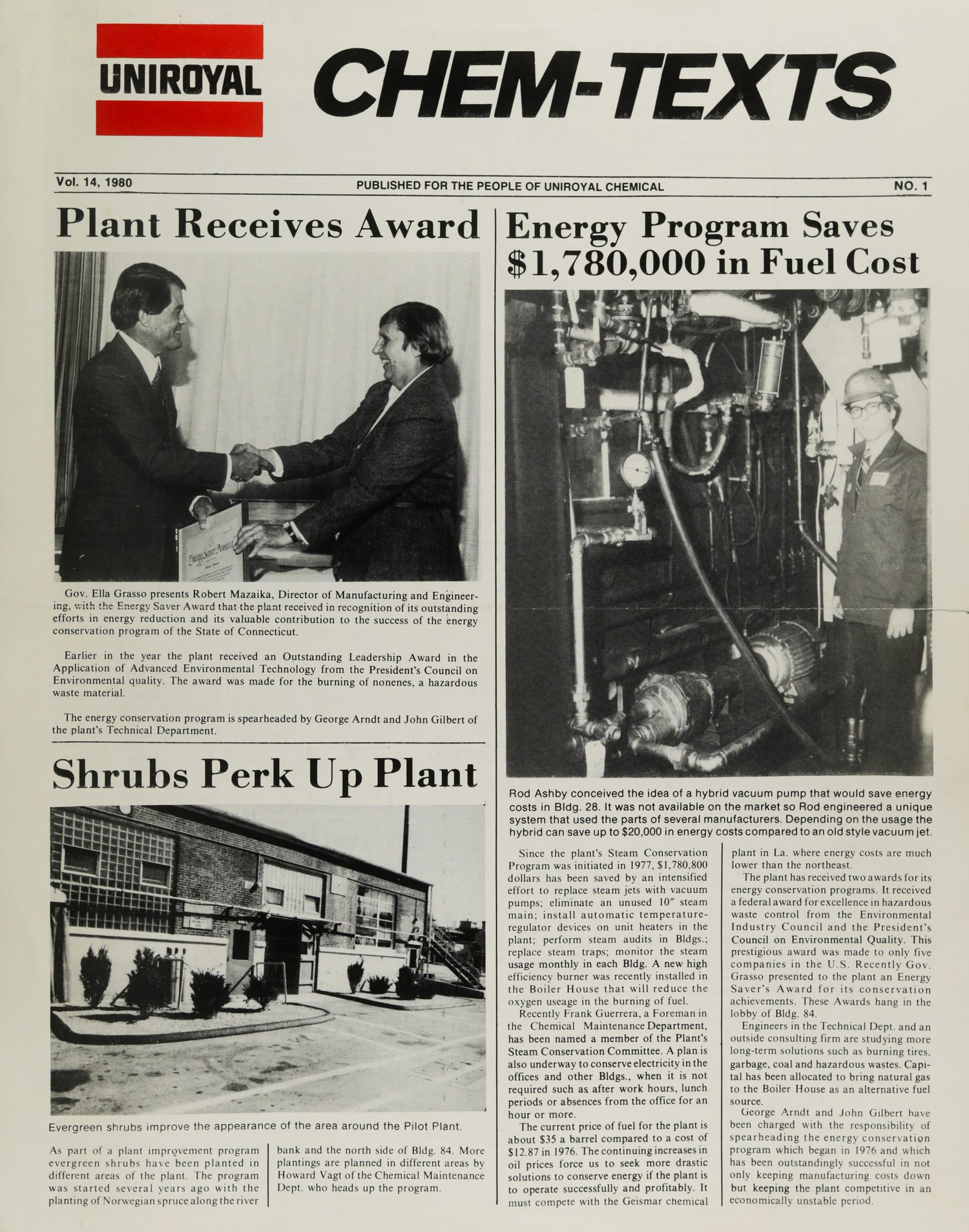
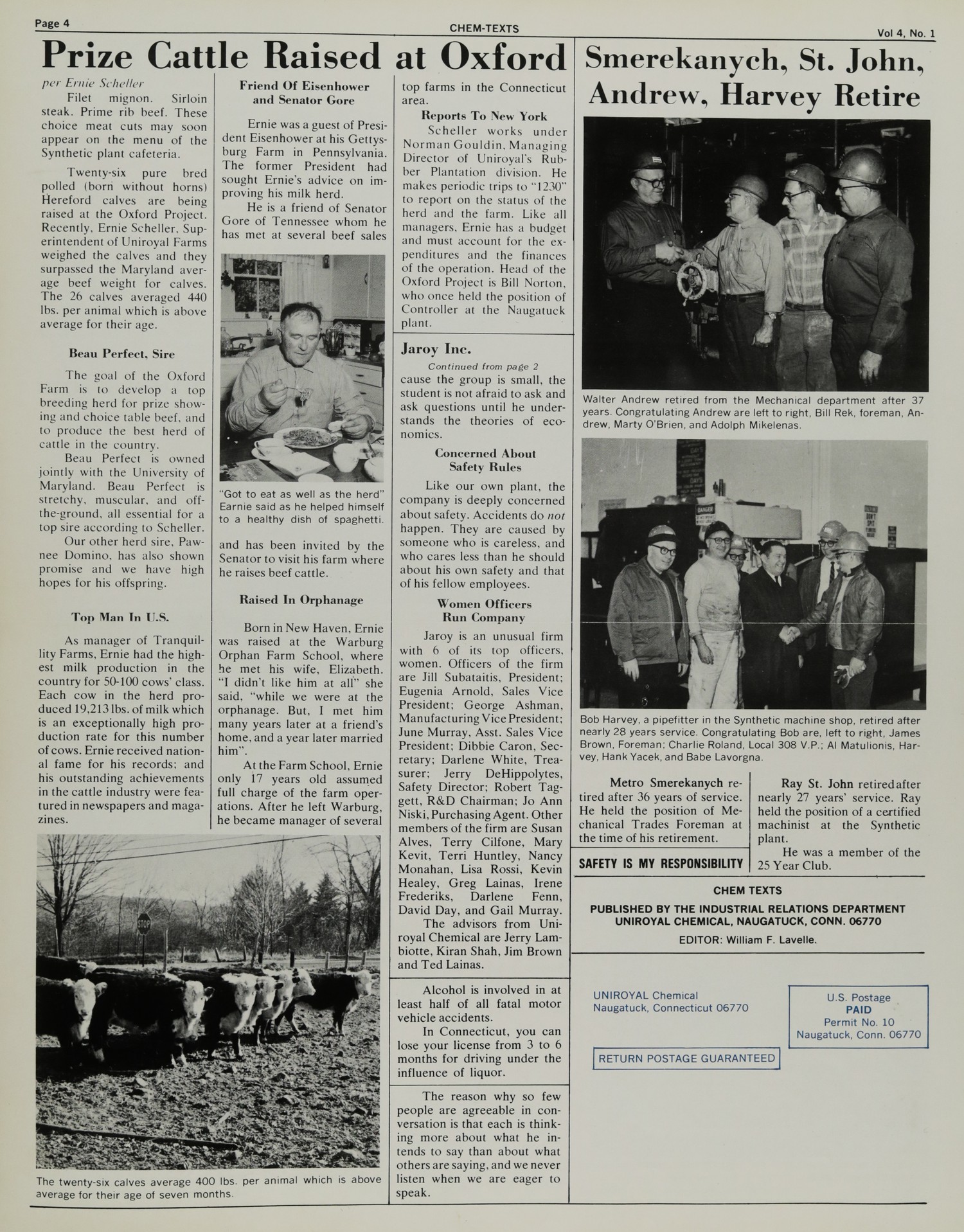
Gov. Ella Grasso presents Robert Mazaika, Director of Manufacturing and Engineering, with the Energy Saver Award that the plant received in recognition of its outstanding efforts in energy reduction and its valuable contribution to the success of the energy conservation program of the State of Connecticut.

Earlier in the year the plant received an Outstanding Leadership Award in the Application of Advanced Environmental Technology from the President’s Council on Environmental quality. The award was made for the burning of nonenes, a hazardous waste material.

The energy conservation program is spearheaded by George Arndt and John Gilbert of the plant’s Technical Department.


Shrubs Perk Up Plant

[IMAGE: Photo of building exterior with evergreen shrubs]

Evergreen shrubs improve the appearance of the area around the Pilot Plant.

As part of a plant improvement program evergreen shrubs have been planted in different areas of the plant. The program was started several years ago with the planting of Norwegian spruce along the river bank and the north side of Bldg. 84. More plantings are planned in different areas by Howard Vagt of the Chemical Maintenance Dept. who heads up the program.


Energy Program Saves $1,780,000 in Fuel Cost

[IMAGE: Photo of man next to industrial equipment/machinery]

Rod Ashby conceived the idea of a hybrid vacuum pump that would save energy costs in Bldg. 28. It was not available on the market so Rod engineered a unique system that used the parts of several manufacturers. Depending on the usage the hybrid can save up to $20,000 in energy costs compared to an old style vacuum jet.

Since the plant’s Steam Conservation Program was initiated in 1977, $1,780,800 dollars has been saved by an intensified effort to replace steam jets with vacuum pumps; eliminate an unused 10″ steam main; install automatic temperature-regulator devices on unit heaters in the plant; perform steam audits in Bldgs.; replace steam traps; monitor the steam usage monthly in each Bldg. A new high efficiency burner was recently installed in the Boiler House that will reduce the oxygen useage in the burning of fuel.

Recently Frank Guerrera, a Foreman in the Chemical Maintenance Department, has been named a member of the Plant’s Steam Conservation Committee. A plan is also underway to conserve electricity in the offices and other Bldgs., when it is not required such as after work hours, lunch periods or absences from the office for an hour or more.

The current price of fuel for the plant is about $35 a barrel compared to a cost of $12.87 in 1976. The continuing increases in oil prices force us to seek more drastic solutions to conserve energy if the plant is to operate successfully and profitably. It must compete with the Geismar chemical plant in La. where energy costs are much lower than the northeast.

The plant has received two awards for its energy conservation programs. It received a federal award for excellence in hazardous waste control from the Environmental Industry Council and the President’s Council on Environmental Quality. This prestigious award was made to only five companies in the U.S. Recently Gov. Grasso presented to the plant an Energy Saver’s Award for its conservation achievements. These Awards hang in the lobby of Bldg. 84.

Engineers in the Technical Dept. and an outside consulting firm are studying more long-term solutions such as burning tires, garbage, coal and hazardous wastes. Capital has been allocated to bring natural gas to the Boiler House as an alternative fuel source.

George Arndt and John Gilbert have been charged with the responsibility of spearheading the energy conservation program which began in 1976 and which has been outstandingly successful in not only keeping manufacturing costs down but keeping the plant competitive in an economically unstable period.

CHEM-TEXTS – 1979 – Page 4

Page 004

CHEM-TEXTS

Page 4 | Vol. 13, 1979


Recent Retirements

[PHOTO: Group photo of retirees]

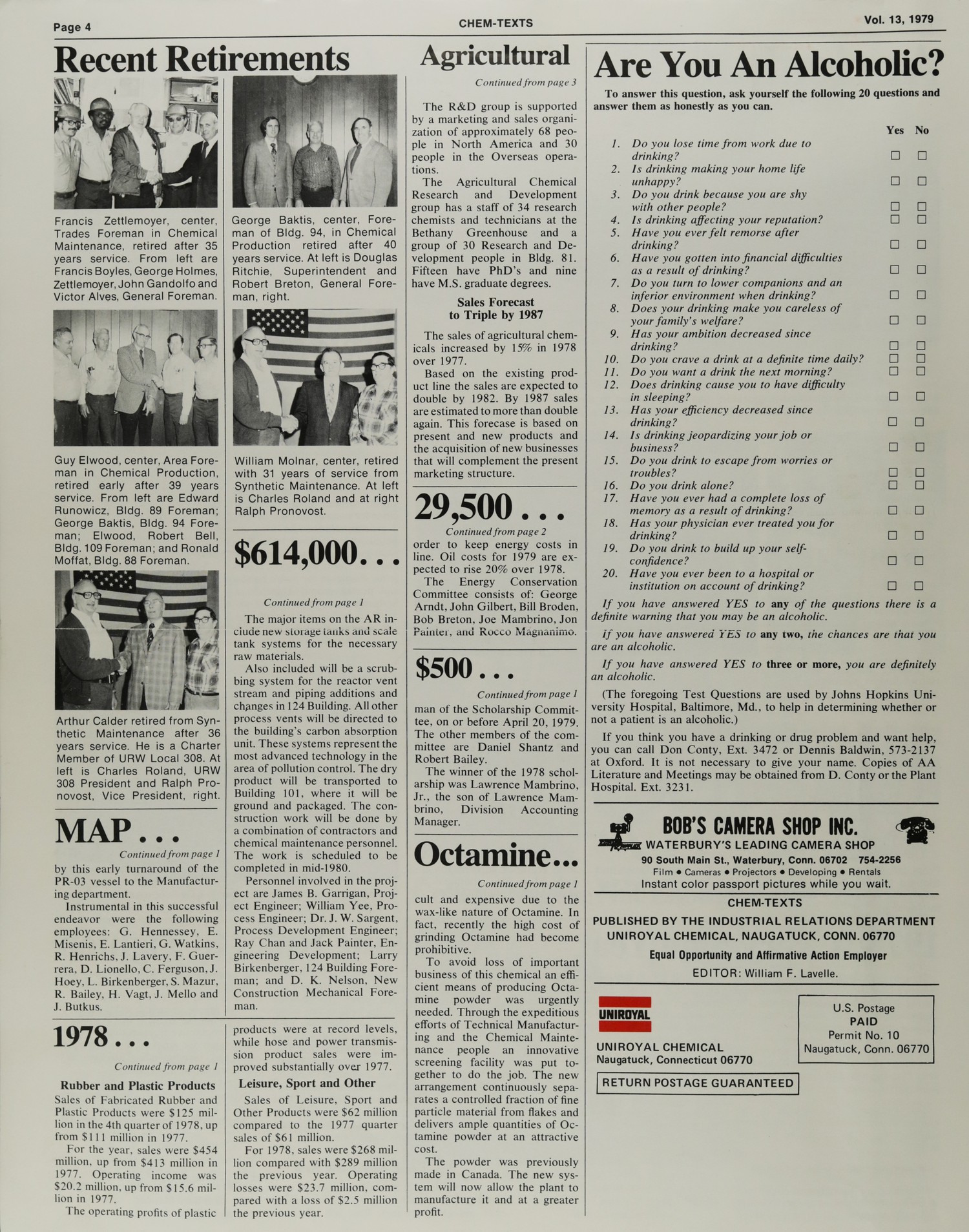
Francis Zettlemoyer, center, Trades Foreman in Chemical Maintenance, retired after 35 years service. From left are Francis Boyles, George Holmes, Zettlemoyer, John Gandolfo and Victor Alves, General Foreman.

[PHOTO: Group photo of retirees]

Guy Elwood, center, Area Foreman in Chemical Production, retired early after 39 years service. From left are Edward Runowicz, Bldg. 89 Foreman; George Baktis, Bldg. 94 Foreman; Elwood, Robert Bell, Bldg. 109 Foreman; and Ronald Moffat, Bldg. 88 Foreman.

[PHOTO: Group photo]

Arthur Calder retired from Synthetic Maintenance after 36 years service. He is a Charter Member of URW Local 308. At left is Charles Roland, URW 308 President and Ralph Pronovost, Vice President, right.


George Baktis, center, Foreman of Bldg. 94, in Chemical Production retired after 40 years service. At left is Douglas Ritchie, Superintendent and Robert Breton, General Foreman, right.

[PHOTO: Group photo]

William Molnar, center, retired with 31 years of service from Synthetic Maintenance. At left is Charles Roland and at right Ralph Pronovost.


MAP…

Continued from page 1

by this early turnaround of the PR-03 vessel to the Manufacturing department.

Instrumental in this successful endeavor were the following employees: G. Hennessey, E. Misenis, E. Lantieri, G. Watkins, R. Henrichs, J. Lavery, F. Guerrera, D. Lionello, C. Ferguson, J. Hoey, L. Birkenberger, S. Mazur, R. Bailey, H. Vagt, J. Mello and J. Butkus.


1978…

Continued from page 1

Rubber and Plastic Products
Sales of Fabricated Rubber and Plastic Products were $125 million in the 4th quarter of 1978, up from $111 million in 1977.

For the year, sales were $454 million, up from $413 million in 1977. Operating income was $20.2 million, up from $15.6 million in 1977.

The operating profits of plastic products were at record levels, while hose and power transmission product sales were improved substantially over 1977.

Leisure, Sport and Other
Sales of Leisure, Sport and Other Products were $62 million compared to the 1977 quarter sales of $61 million.

For 1978, sales were $268 million compared with $289 million the previous year. Operating losses were $23.7 million, compared with a loss of $2.5 million the previous year.


Agricultural

Continued from page 3

The R&D group is supported by a marketing and sales organization of approximately 68 people in North America and 30 people in the Overseas operations.

The Agricultural Chemical Research and Development group has a staff of 34 research chemists and technicians at the Bethany Greenhouse and a group of 30 Research and Development people in Bldg. 81. Fifteen have PhD’s and nine have M.S. graduate degrees.

Sales Forecast to Triple by 1987

The sales of agricultural chemicals increased by 15% in 1978 over 1977.

Based on the existing product line the sales are expected to double by 1982. By 1987 sales are estimated to more than double again. This forecase is based on present and new products and the acquisition of new businesses that will complement the present marketing structure.


29,500…

Continued from page 2

$614,000…

Continued from page 1

The major items on the AR include new storage tanks and scale tank systems for the necessary raw materials.

Also included will be a scrubbing system for the reactor vent stream and piping additions and changes in 124 Building. All other process vents will be directed to the building’s carbon absorption unit. These systems represent the most advanced technology in the area of pollution control. The dry product will be transported to Building 101, where it will be ground and packaged. The construction work will be done by a combination of contractors and chemical maintenance personnel. The work is scheduled to be completed in mid-1980.

Personnel involved in the project are James B. Garrigan, Project Engineer; William Yee, Process Engineer; Dr. J. W. Sargent, Process Development Engineer; Ray Chan and Jack Painter, Engineering Development; Larry Birkenberger, 124 Building Foreman; and D. K. Nelson, New Construction Mechanical Foreman.

order to keep energy costs in line. Oil costs for 1979 are expected to rise 20% over 1978. The Energy Conservation Committee consists of: George Arndt, John Gilbert, Bill Broden, Bob Breton, Joe Mambrino, Jon Painter, and Rocco Magnanimo.


$500…

Continued from page 1

man of the Scholarship Committee, on or before April 20, 1979. The other members of the committee are Daniel Shantz and Robert Bailey.

The winner of the 1978 scholarship was Lawrence Mambrino, Jr., the son of Lawrence Mambrino, Division Accounting Manager.


Octamine…

Continued from page 1

cult and expensive due to the wax-like nature of Octamine. In fact, recently the high cost of grinding Octamine had become prohibitive.

To avoid loss of important business of this chemical an efficient means of producing Octamine powder was urgently needed. Through the expeditious efforts of Technical Manufacturing and the Chemical Maintenance people an innovative screening facility was put together to do the job. The new arrangement continuously separates a controlled fraction of fine particle material from flakes and delivers ample quantities of Octamine powder at an attractive cost.

The powder was previously made in Canada. The new system will now allow the plant to manufacture it and at a greater profit.


Are You An Alcoholic?

To answer this question, ask yourself the following 20 questions and answer them as honestly as you can.

Yes No
1. Do you lose time from work due to drinking?
2. Is drinking making your home life unhappy?
3. Do you drink because you are shy with other people?
4. Is drinking affecting your reputation?
5. Have you ever felt remorse after drinking?
6. Have you gotten into financial difficulties as a result of drinking?
7. Do you turn to lower companions and an inferior environment when drinking?
8. Does your drinking make you careless of your family’s welfare?
9. Has your ambition decreased since drinking?
10. Do you crave a drink at a definite time daily?
11. Do you want a drink the next morning?
12. Does drinking cause you to have difficulty in sleeping?
13. Has your efficiency decreased since drinking?
14. Is drinking jeopardizing your job or business?
15. Do you drink to escape from worries or troubles?
16. Do you drink alone?
17. Have you ever had a complete loss of memory as a result of drinking?
18. Has your physician ever treated you for drinking?
19. Do you drink to build up your self-confidence?
20. Have you ever been to a hospital or institution on account of drinking?

If you have answered YES to any of the questions there is a definite warning that you may be an alcoholic.

if you have answered YES to any two, the chances are that you are an alcoholic.

If you have answered YES to three or more, you are definitely an alcoholic.

(The foregoing Test Questions are used by Johns Hopkins University Hospital, Baltimore, Md., to help in determining whether or not a patient is an alcoholic.)

If you think you have a drinking or drug problem and want help, you can call Don Conty, Ext. 3472 or Dennis Baldwin, 573-2137 at Oxford. It is not necessary to give your name. Copies of AA Literature and Meetings may be obtained from D. Conty or the Plant Hospital. Ext. 3231.


BOB’S CAMERA SHOP INC.

WATERBURY’S LEADING CAMERA SHOP
90 South Main St., Waterbury, Conn. 06702 754-2256
Film • Cameras • Projectors • Developing • Rentals
Instant color passport pictures while you wait.


CHEM-TEXTS
PUBLISHED BY THE INDUSTRIAL RELATIONS DEPARTMENT
UNIROYAL CHEMICAL, NAUGATUCK, CONN. 06770
Equal Opportunity and Affirmative Action Employer
EDITOR: William F. Lavelle.


[MAILING LABEL AREA]

UNIROYAL | U.S. Postage PAID Permit No. 10 Naugatuck, Conn. 06770

UNIROYAL CHEMICAL
Naugatuck, Connecticut 06770

RETURN POSTAGE GUARANTEED

CHEM-TEXTS – Vol. 13 – Page 4

Page 004

Page 4 | CHEM-TEXTS | Vol. 13 1979


Tugboat . .

continued from page 2

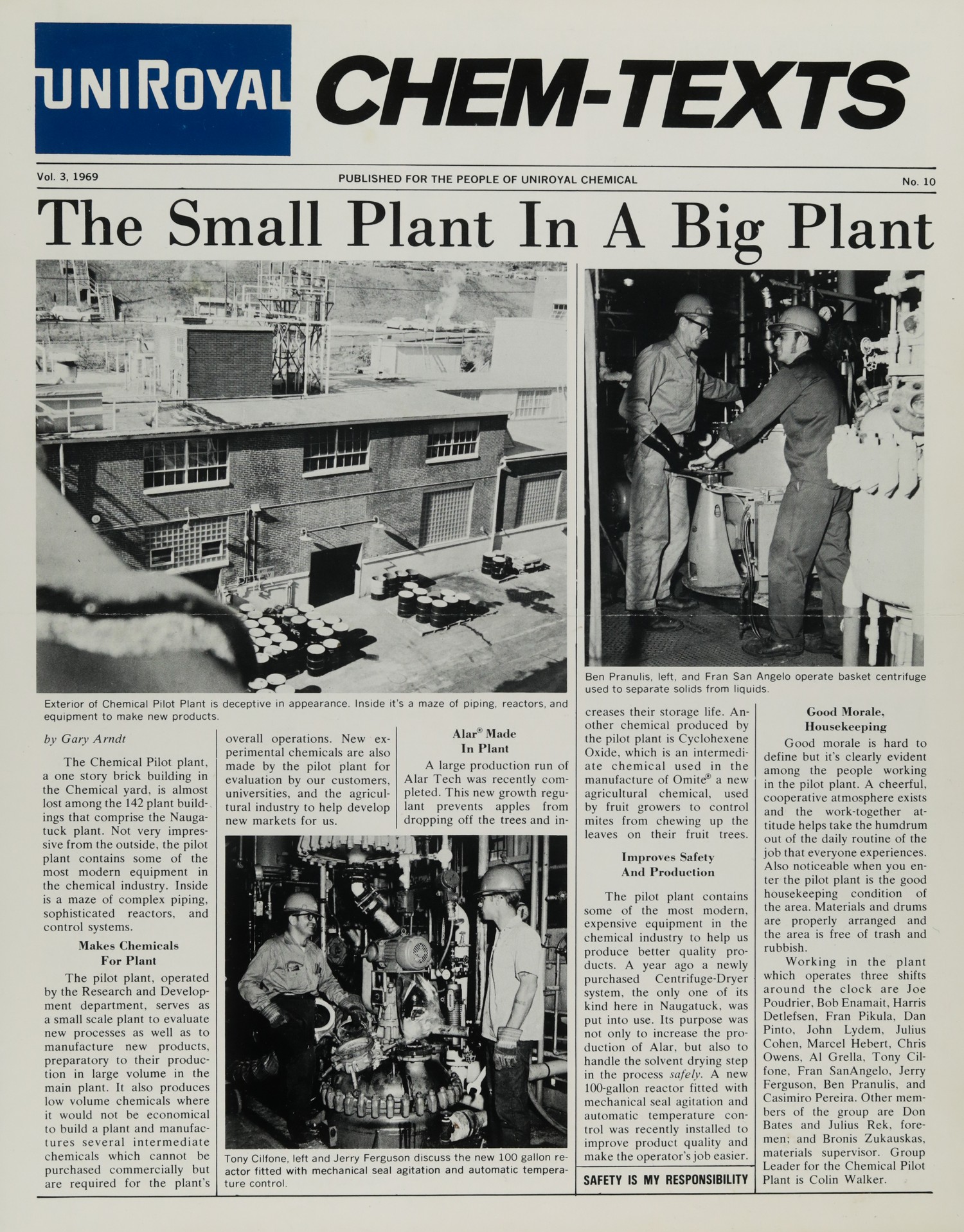
help set up in the Naugatuck plant include LVBI wet cake and Naugard 445, which are produced in the FOC plant. The Manufacture of A.O. 495 in 73 Bldg. as well as the improvement of MONEX naugatizing in 88 Bldg., involved the Chemical Process Development. ZHMA, produced in 73 Bldg. was also developed in the Chemical Process Development laboratory.

Developed Process for New Plant Products

Chemical Process Development’s involvement however does not stop there. Some products which will enter the plant in the near future include Naugacel SD-1, with an already approved AR of $614,000, and Naugard MT-ZMT. With its development nearly complete it is now awaiting capital estimates. Processes for both of these products were developed in

the Chemical Process Development Laboratory and Chemical Pilot Plant. Of course along with these existing products is Chemical Process Development’s continuous involvement in developing processes for more efficient Blowing Agent production as well as process development of other rubber chemicals, petroleum antioxidants, and plastics additives.

Group With Experience

Involvement in Geismar products is also a concern for Chemical Process Development with its contributions in the area of Thiazoles, Flexzone and Blowing Agents.

The Chemical Process Development group consists of chemists and engineers with degrees from PH.Ds to Bachelors and experience ranging from 2 years to 26 years. The members include Gary L. Arndt, Steven R. Brusso, J. Harry Donald, James D. Ferency, Robert J. Franko, James L. Pratt, Stanley E. Salva, Russell F. Sant’Angelo, and Dr. John W. Sargent.


Professionalism

continued from page 1


[IMAGE: Building with ductwork and scaffolding]

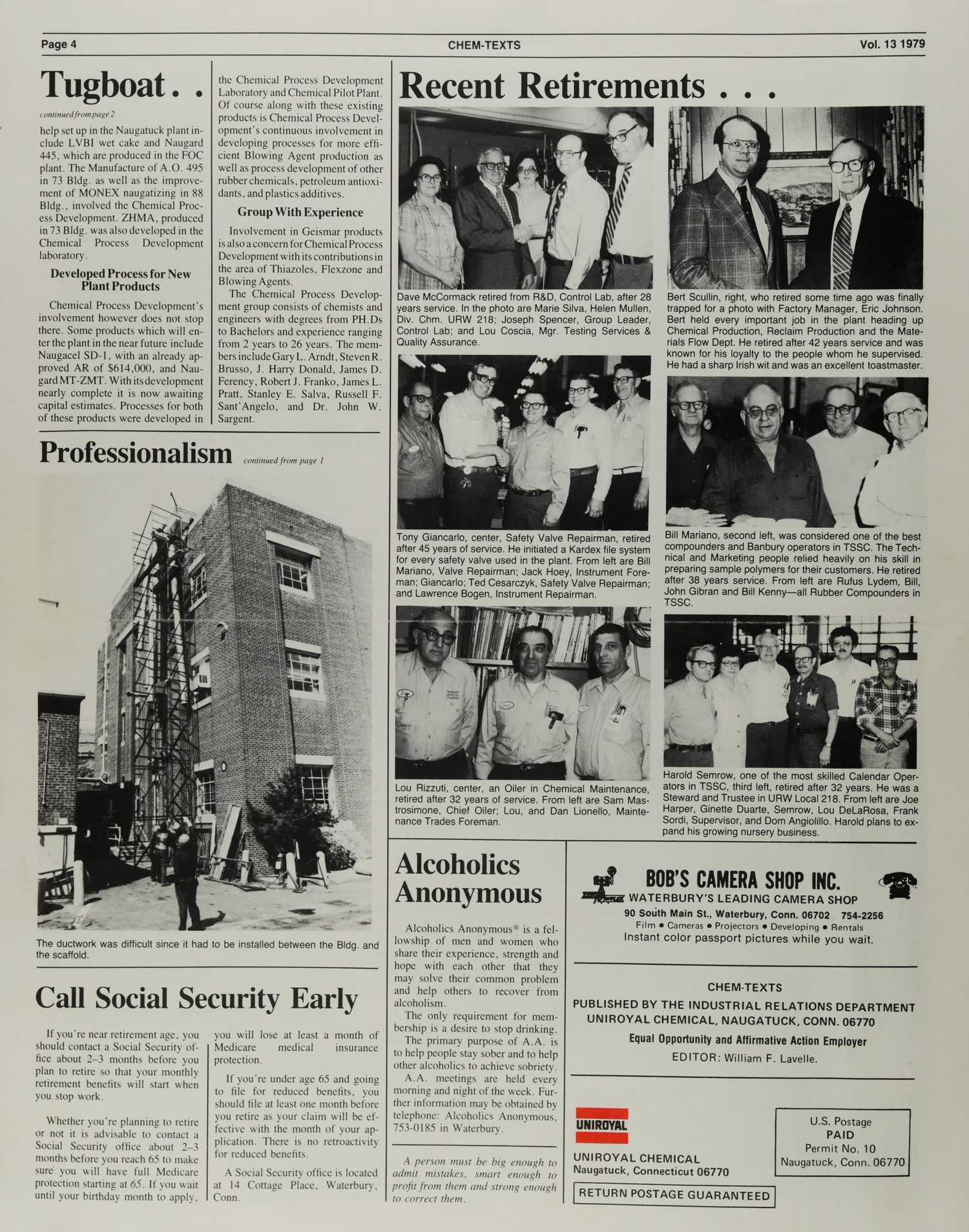
The ductwork was difficult since it had to be installed between the Bldg. and the scaffold.


Call Social Security Early

If you’re near retirement age, you should contact a Social Security office about 2-3 months before you plan to retire so that your monthly retirement benefits will start when you stop work.

Whether you’re planning to retire or not it is advisable to contact a Social Security office about 2-3 months before you reach 65 to make sure you will have full Medicare protection starting at 65. If you wait until your birthday month to apply, you will lose at least a month of Medicare medical insurance protection.

If you’re under age 65 and going to file for reduced benefits, you should file at least one month before you retire as your claim will be effective with the month of your application. There is no retroactivity for reduced benefits.

A Social Security office is located at 14 Cottage Place, Waterbury, Conn.


Recent Retirements . . .

[IMAGE: Group photo]

Dave McCormack retired from R&D, Control Lab, after 28 years service. In the photo are Marie Silva, Helen Mullen, Div. Chrn. URW 218; Joseph Spencer, Group Leader, Control Lab; and Lou Coscia, Mgr. Testing Services & Quality Assurance.

[IMAGE: Group photo]

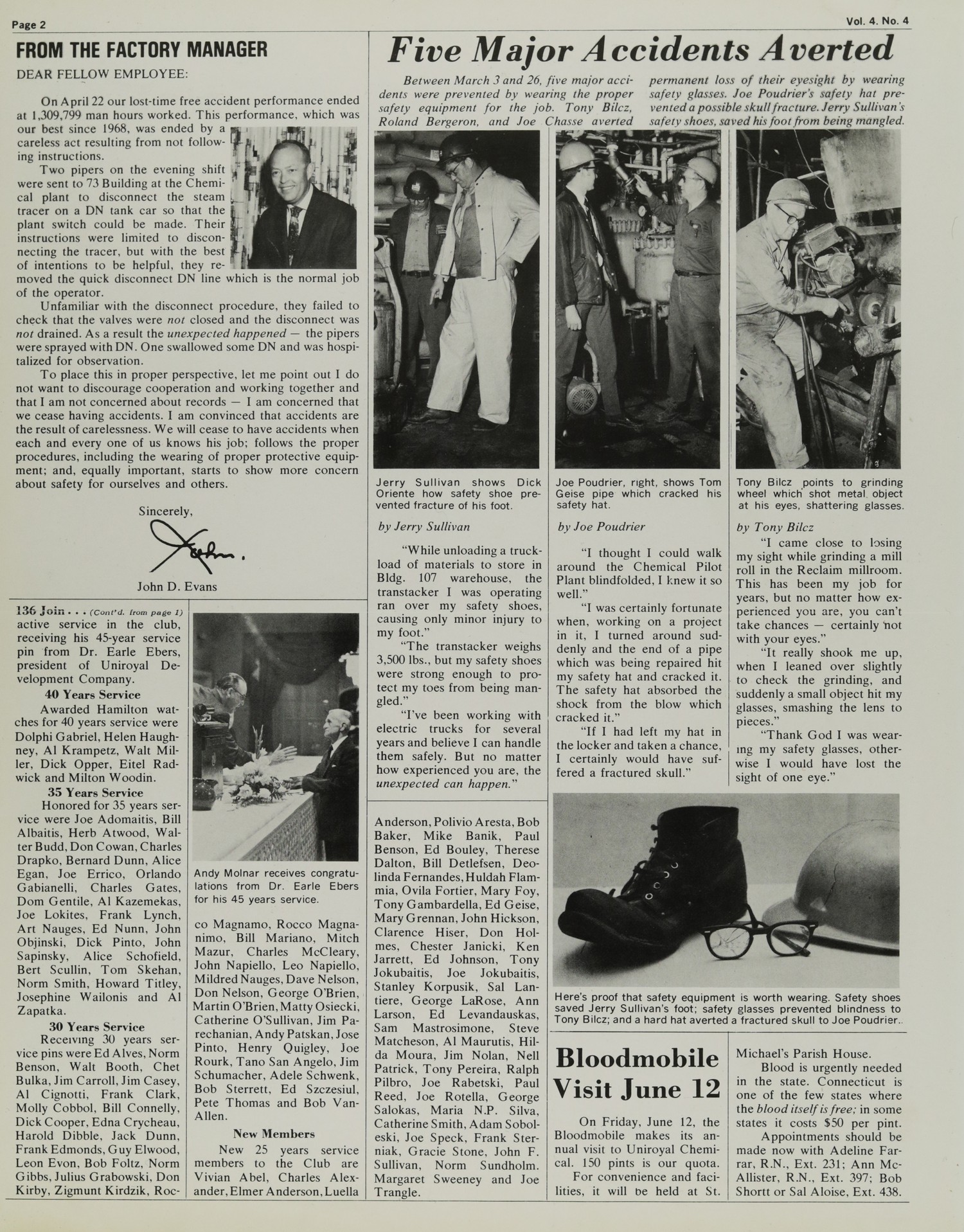
Bert Scullin, right, who retired some time ago was finally trapped for a photo with Factory Manager, Eric Johnson. Bert held every important job in the plant heading up Chemical Production, Reclaim Production and the Materials Flow Dept. He retired after 42 years service and was known for his loyalty to the people whom he supervised. He had a sharp Irish wit and was an excellent toastmaster.

[IMAGE: Group photo]

Tony Giancarlo, center, Safety Valve Repairman, retired after 45 years of service. He initiated a Kardex file system for every safety valve used in the plant. From left are Bill Mariano, Valve Repairman; Jack Hoey, Instrument Foreman; Giancarlo; Ted Cesarczyk, Safety Valve Repairman; and Lawrence Bogen, Instrument Repairman.

[IMAGE: Group photo]

Bill Mariano, second left, was considered one of the best compounders and Banbury operators in TSSC. The Technical and Marketing people relied heavily on his skill in preparing sample polymers for their customers. He retired after 38 years service. From left are Rufus Lydem, Bill, John Gibran and Bill Kenny—all Rubber Compounders in TSSC.

[IMAGE: Group photo]

Lou Rizzuti, center, an Oiler in Chemical Maintenance, retired after 32 years of service. From left are Sam Mastrosimone, Chief Oiler; Lou; and Dan Lionello, Maintenance Trades Foreman.

[IMAGE: Group photo]

Harold Semrow, one of the most skilled Calendar Operators in TSSC, third left, retired after 32 years. He was a Steward and Trustee in URW Local 218. From left are Joe Harper, Ginette Duarte, Semrow, Lou DeLaRosa, Frank Sordi, Supervisor, and Dom Angiolillo. Harold plans to expand his growing nursery business.


Alcoholics Anonymous

Alcoholics Anonymous® is a fellowship of men and women who share their experience, strength and hope with each other that they may solve their common problem and help others to recover from alcoholism.

The only requirement for membership is a desire to stop drinking.

The primary purpose of A.A. is to help people stay sober and to help other alcoholics to achieve sobriety.

A.A. meetings are held every morning and night of the week. Further information may be obtained by telephone: Alcoholics Anonymous, 753-0185 in Waterbury.

A person must be big enough to admit mistakes, smart enough to profit from them and strong enough to correct them.


BOB’S CAMERA SHOP INC.

WATERBURY’S LEADING CAMERA SHOP

90 South Main St., Waterbury, Conn. 06702 754-2256

Film • Cameras • Projectors • Developing • Rentals

Instant color passport pictures while you wait.


CHEM-TEXTS

PUBLISHED BY THE INDUSTRIAL RELATIONS DEPARTMENT
UNIROYAL CHEMICAL, NAUGATUCK, CONN. 06770

Equal Opportunity and Affirmative Action Employer

EDITOR: William F. Lavelle.


UNIROYAL

U.S. Postage
PAID
Permit No. 10
Naugatuck, Conn. 06770

UNIROYAL CHEMICAL
Naugatuck, Connecticut 06770

RETURN POSTAGE GUARANTEED

CHEM-TEXTS – 1978-v12-s262

Page 262

Volume 12, 1978

CHEM-TEXTS

Page 3


“Making It A Better Place To Be”

(continued from page 1)


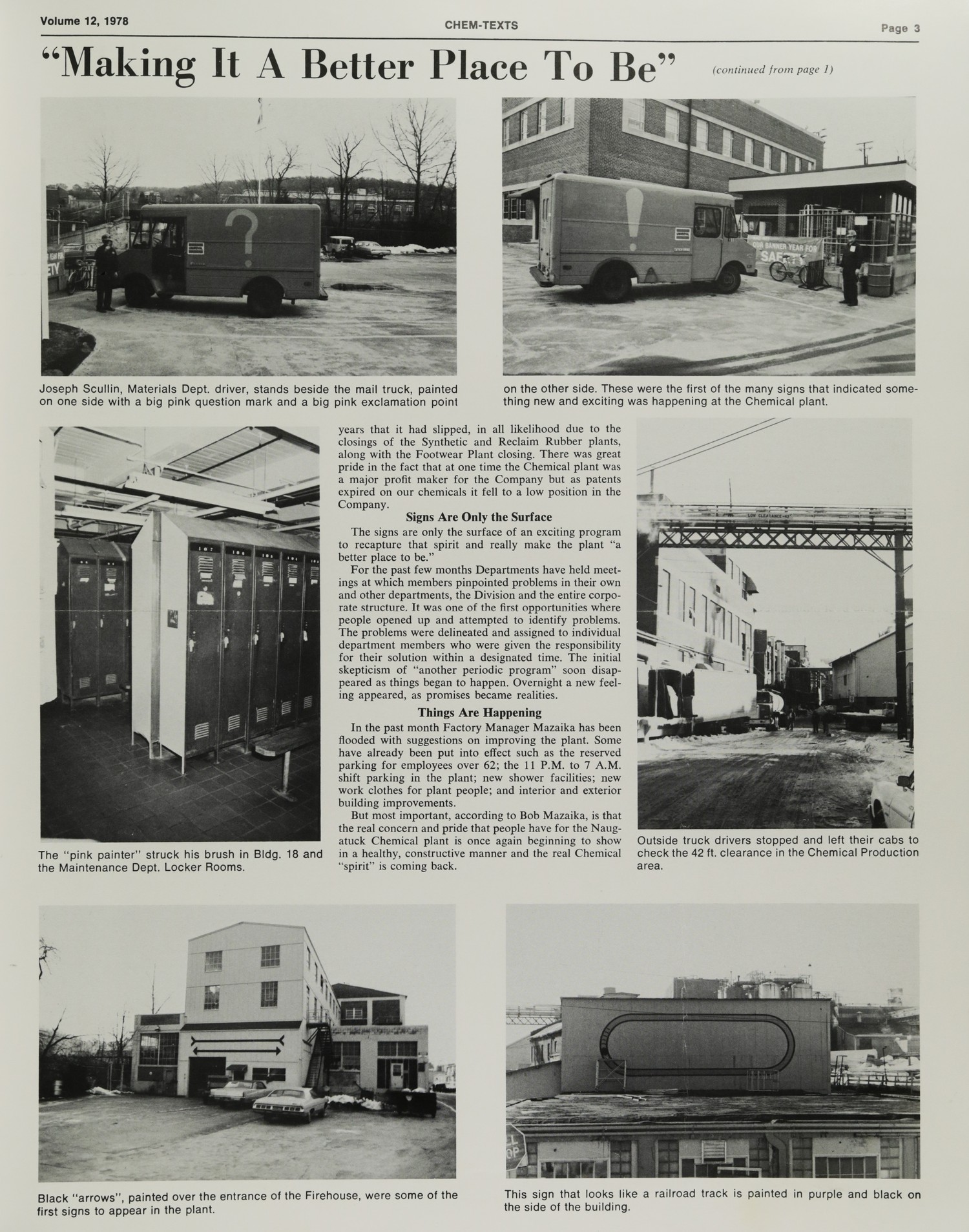
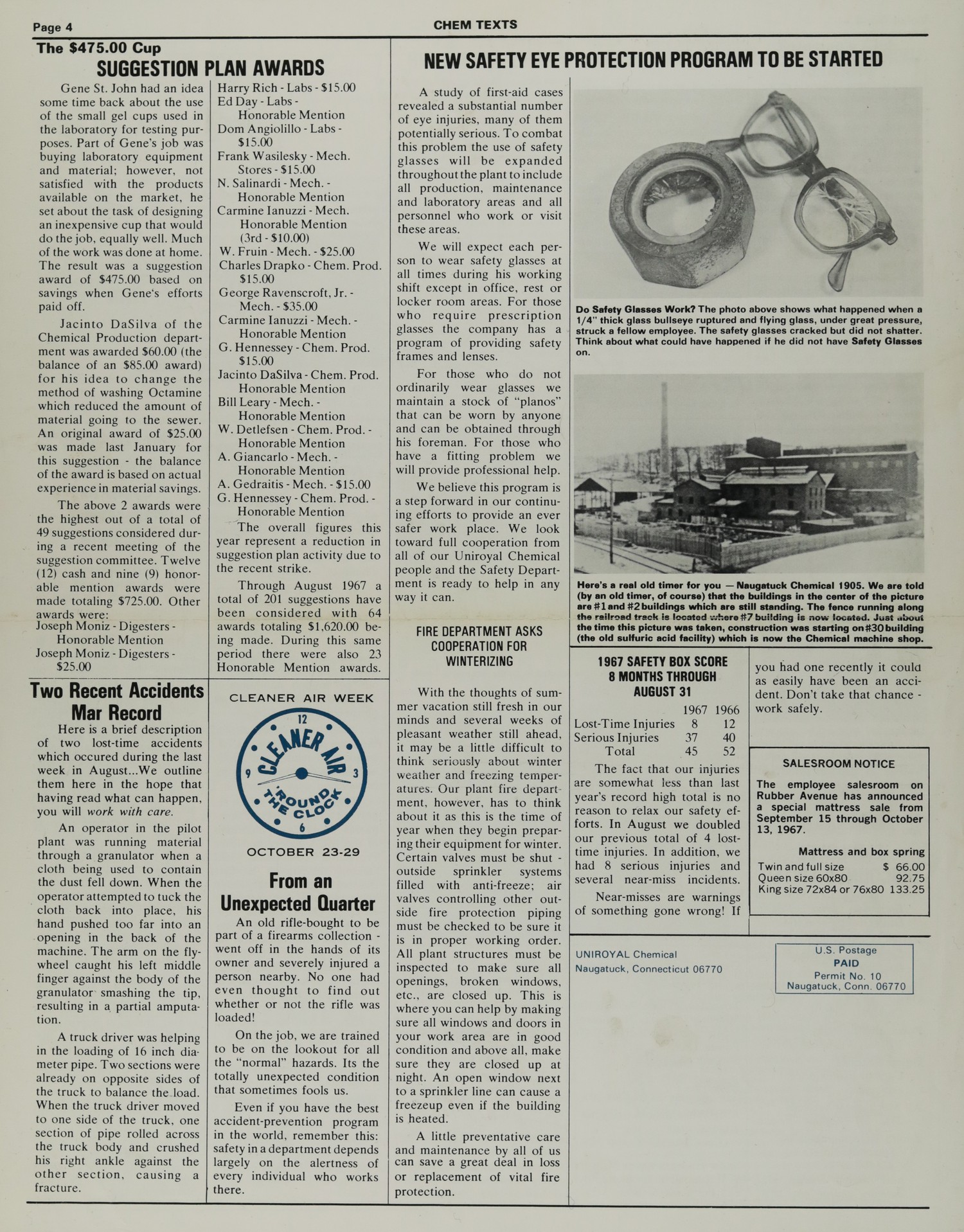
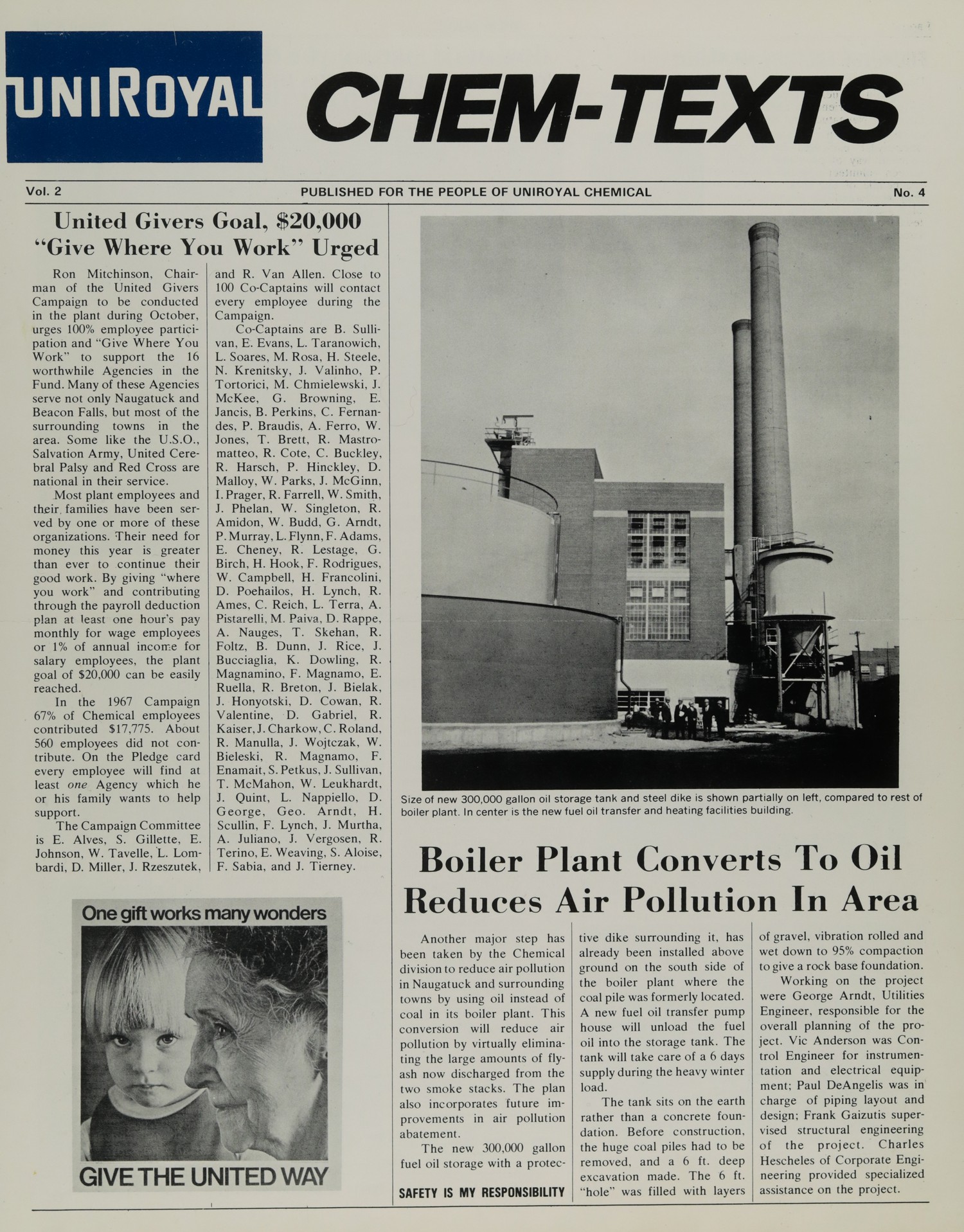
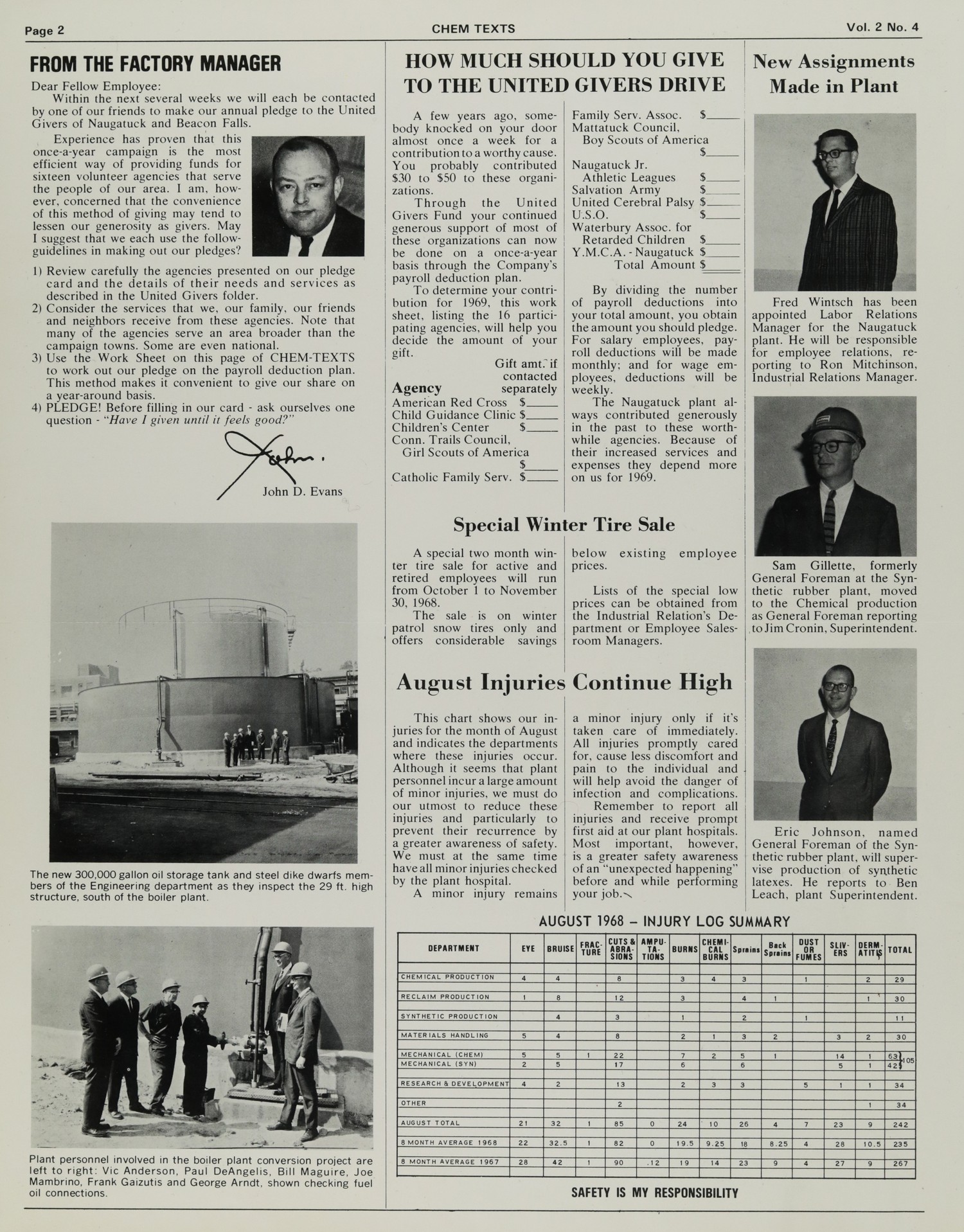
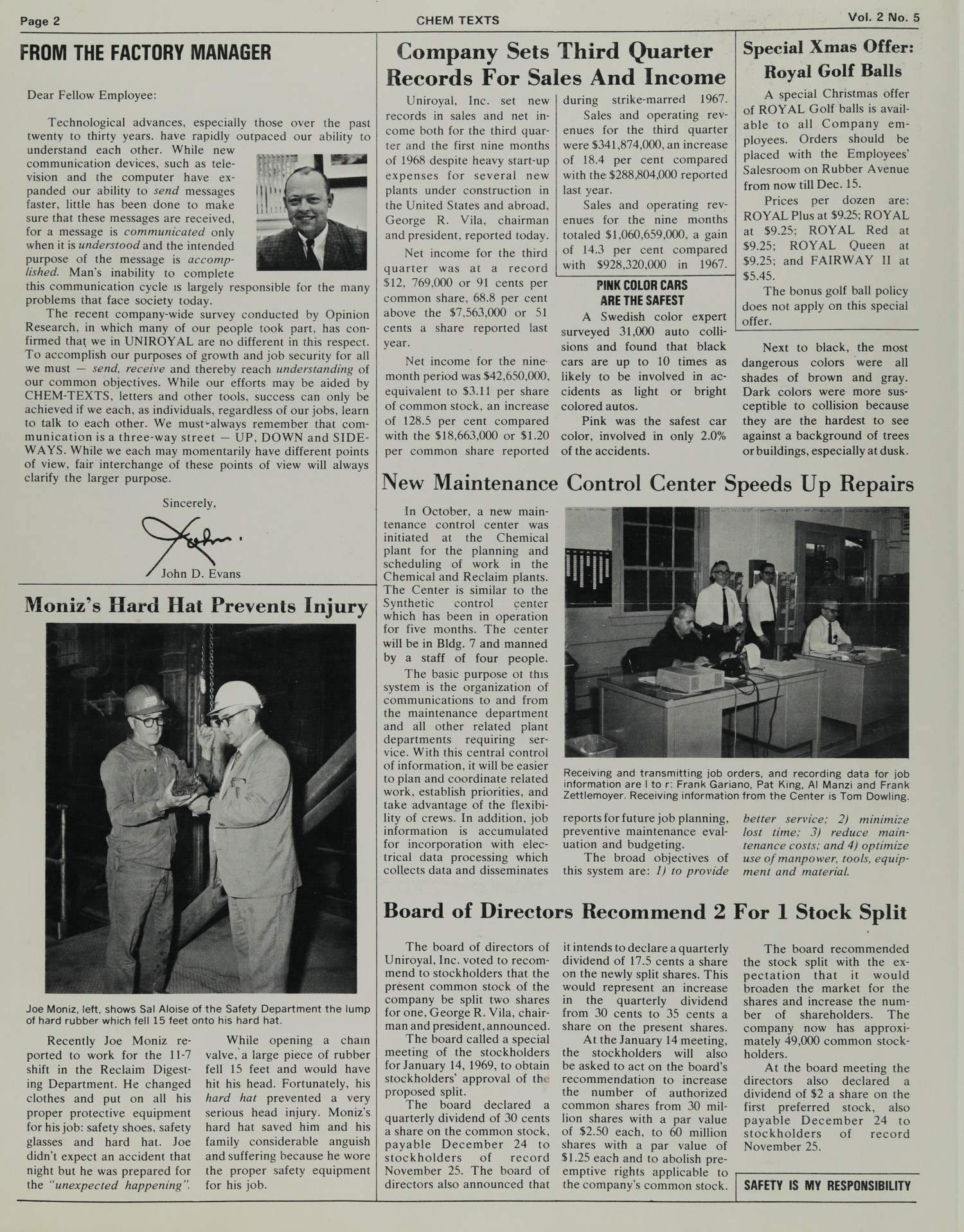
Joseph Scullin, Materials Dept. driver, stands beside the mail truck, painted on one side with a big pink question mark and a big pink exclamation point on the other side. These were the first of the many signs that indicated something new and exciting was happening at the Chemical plant.


years that it had slipped, in all likelihood due to the closings of the Synthetic and Reclaim Rubber plants, along with the Footwear Plant closing. There was great pride in the fact that at one time the Chemical plant was a major profit maker for the Company but as patents expired on our chemicals it fell to a low position in the Company.

Signs Are Only the Surface

The signs are only the surface of an exciting program to recapture that spirit and really make the plant “a better place to be.”

For the past few months Departments have held meetings at which members pinpointed problems in their own and other departments, the Division and the entire corporate structure. It was one of the first opportunities where people opened up and attempted to identify problems. The problems were delineated and assigned to individual department members who were given the responsibility for their solution within a designated time. The initial skepticism of “another periodic program” soon disappeared as things began to happen. Overnight a new feeling appeared, as promises became realities.

Things Are Happening

In the past month Factory Manager Mazaika has been flooded with suggestions on improving the plant. Some have already been put into effect such as the reserved parking for employees over 62; the 11 P.M. to 7 A.M. shift parking in the plant; new shower facilities; new work clothes for plant people; and interior and exterior building improvements.

But most important, according to Bob Mazaika, is that the real concern and pride that people have for the Naugatuck Chemical plant is once again beginning to show in a healthy, constructive manner and the real Chemical “spirit” is coming back.


The “pink painter” struck his brush in Bldg. 18 and the Maintenance Dept. Locker Rooms.


Outside truck drivers stopped and left their cabs to check the 42 ft. clearance in the Chemical Production area.


Black “arrows”, painted over the entrance of the Firehouse, were some of the first signs to appear in the plant.


This sign that looks like a railroad track is painted in purple and black on the side of the building.

CHEM-TEXTS – 1977 – Page 2

Page 002

Page 2 CHEM-TEXTS Vol. 11, 1977

Reward for Working Safe…

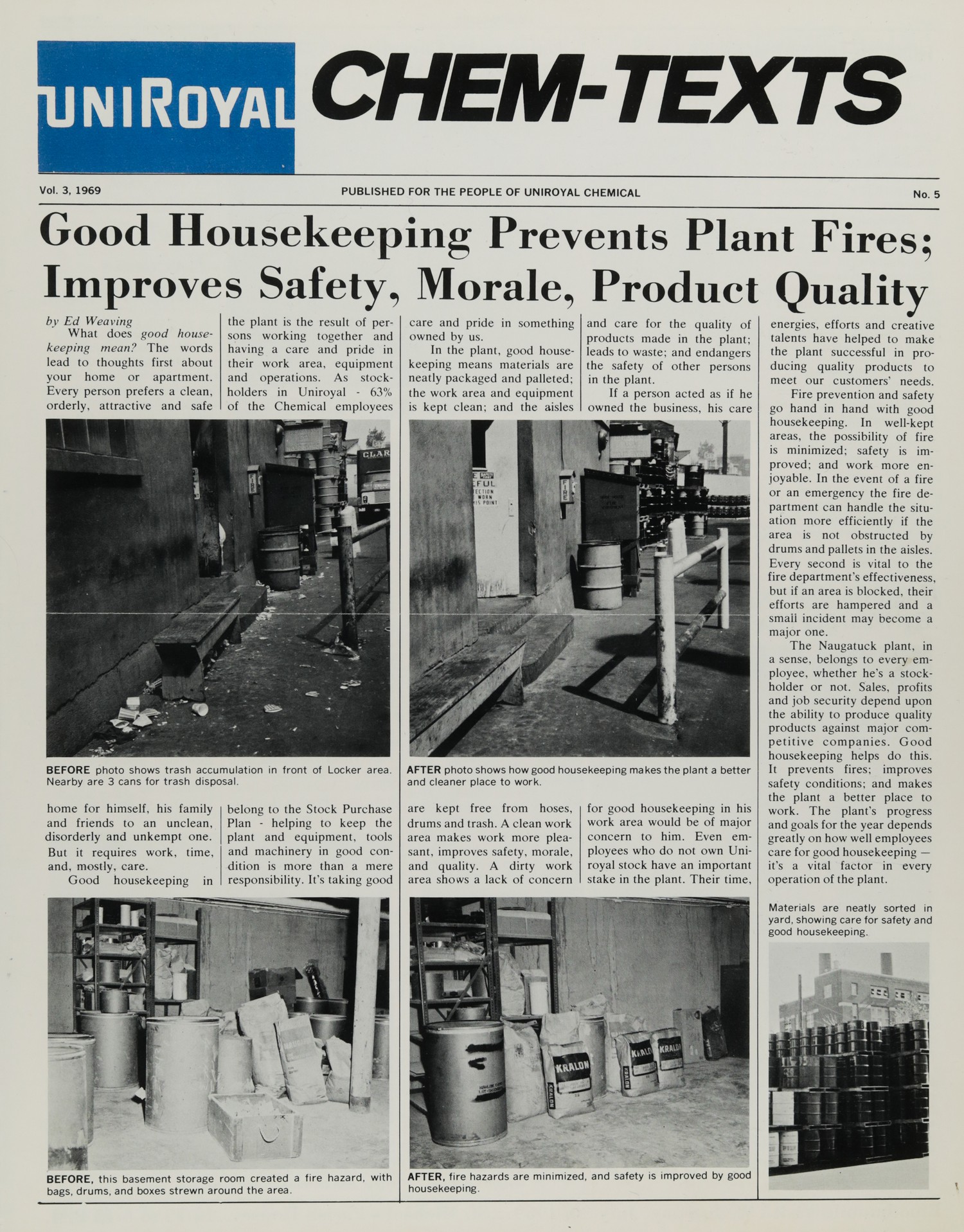
For the past few weeks our bulletin boards have had notices explaining our 1977 Safety Goals and announcing a Safety Contest that will be operating during 1977. The Safety Contest is being run really to help you remember to work safely!

Why are we willing to reward you for working safely? In almost every instance, after an accident has occurred, an investigation finds that it was caused by inattention. All of us have to remember, every day, that we are working in conditions that can be extremely dangerous. The Company can, and does invest millions of dollars to assure the safety of its employees, but all of it goes to waste, if during the working day, we’re careless. Little things like wearing hard hats, safety glasses or taking the extra time to get a face shield, or gloves when necessary, making sure that the lines are empty before breaking into them and checking that all electrical equipment is “locked out” properly. Some of these things will cause you to walk a few extra steps and perhaps “waste” some time, but if it prevents an accident it is well worth it!

It is a time-worn but true phrase—”ONLY YOU CAN PREVENT ACCIDENTS.”

During 1977 let us all make sure that we concentrate on safety every hour of the day and also be a good neighbor—if you see someone working next to you unsafely, remind them so that they can be there again tomorrow.

If we all do these little things I am sure we’ll reach our 1977 goal and you can have your Christmas dinner on us!

Rj. Maynit [handwritten signature]


Waste Saves Over $16,000

[IMAGE: A crane loads a scrap reactor into a trailer truck]

A crane loads a scrap reactor into a trailer truck. The scrap metal program has not only improved housekeeping but has netted $16,000 in savings.

by Peter Thomas

A scrap metal salvage program was started in early 1975 with the Schiavone Company, to buy and salvage the scrap throughout the plant. Schiavone furnished the truck size boxes for the small and loose metal pieces for their pick up at different spots in the yards and the larger items were placed in a pile which were loaded by a magnetic crane into their trucks.

Seventy five 55 gallon drums were placed in the buildings throughout the plant for small pieces. When filled, they were taken to a collection point.

At the present time it costs more than $16.00 per short ton to dispose of the scrap.

To date over 1,000,000 lbs. of scrap has been sold and over $16,000 received by selling it to scrap dealers.

Save Gasoline

Use gasoline of the proper octane rating. Using too low an octane rating for your car will produce a “ping” which, if sustained, will damage the engine. Using too high an octane rating wastes money and will not produce more power or improve fuel economy.

SAFETY IS MY RESPONSIBILITY


Reclaim Plant Dismantled

[IMAGE: Industrial building being demolished]

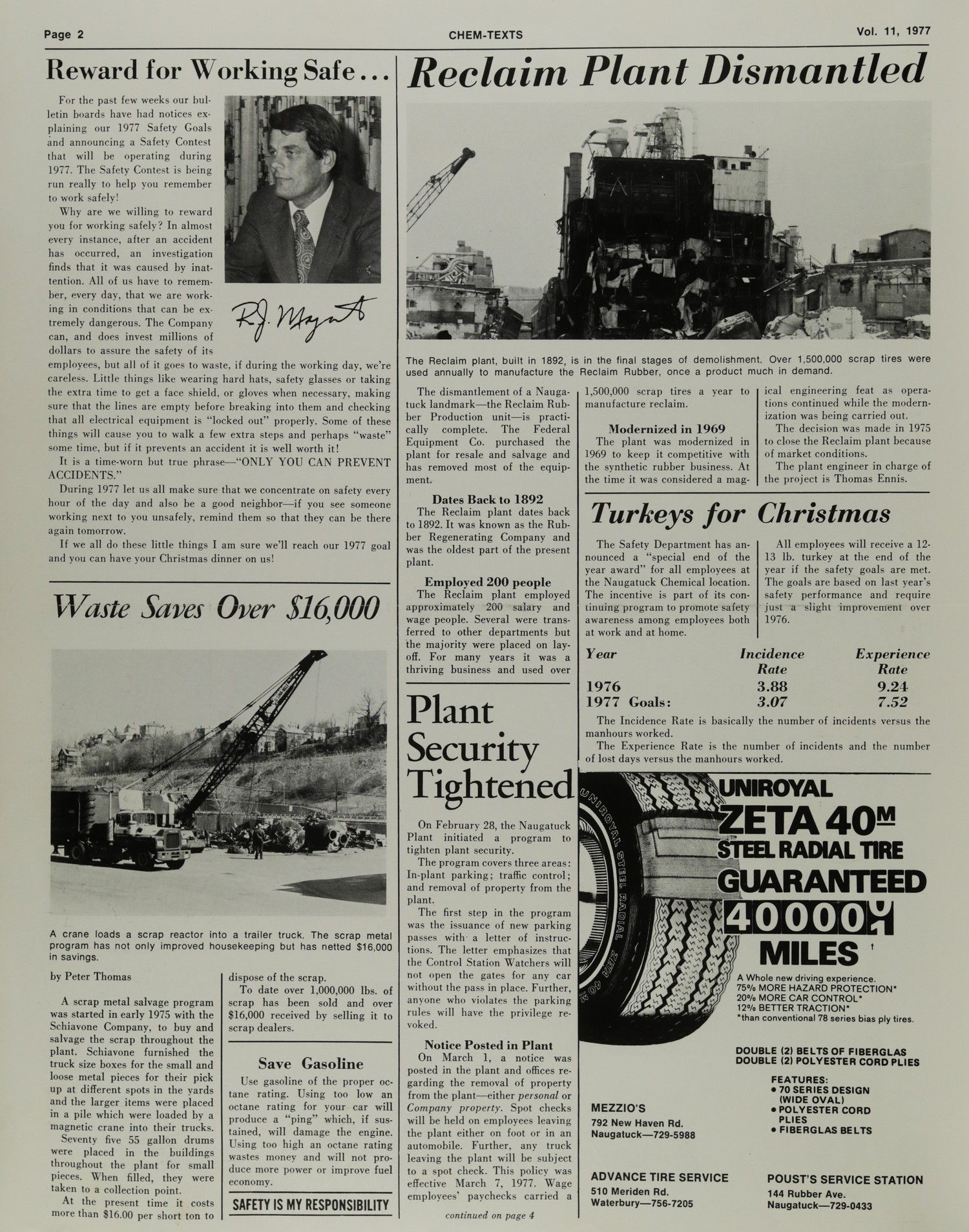
The Reclaim plant, built in 1892, is in the final stages of demolishment. Over 1,500,000 scrap tires were used annually to manufacture the Reclaim Rubber, once a product much in demand.

The dismantlement of a Naugatuck landmark—the Reclaim Rubber Production unit—is practically complete. The Federal Equipment Co. purchased the plant for resale and salvage and has removed most of the equipment.

Dates Back to 1892

The Reclaim plant dates back to 1892. It was known as the Rubber Regenerating Company and was the oldest part of the present plant.

Employed 200 people

The Reclaim plant employed approximately 200 salary and wage people. Several were transferred to other departments but the majority were placed on layoff. For many years it was a thriving business and used over

1,500,000 scrap tires a year to manufacture reclaim.

Modernized in 1969

The plant was modernized in 1969 to keep it competitive with the synthetic rubber business. At the time it was considered a mag-

ical engineering feat as operations continued while the modernization was being carried out.

The decision was made in 1975 to close the Reclaim plant because of market conditions.

The plant engineer in charge of the project is Thomas Ennis.


Turkeys for Christmas

The Safety Department has announced a “special end of the year award” for all employees at the Naugatuck Chemical location. The incentive is part of its continuing program to promote safety awareness among employees both at work and at home.

All employees will receive a 12-13 lb. turkey at the end of the year if the safety goals are met. The goals are based on last year’s safety performance and require just a slight improvement over 1976.

Year Incidence Rate Experience Rate
1976 3.88 9.24
1977 Goals: 3.07 7.52

The Incidence Rate is basically the number of incidents versus the manhours worked.

The Experience Rate is the number of incidents and the number of lost days versus the manhours worked.


Plant Security Tightened

On February 28, the Naugatuck Plant initiated a program to tighten plant security.

The program covers three areas: In-plant parking; traffic control; and removal of property from the plant.

The first step in the program was the issuance of new parking passes with a letter of instructions. The letter emphasizes that the Control Station Watchers will not open the gates for any car without the pass in place. Further, anyone who violates the parking rules will have the privilege revoked.

Notice Posted in Plant

On March 1, a notice was posted in the plant and offices regarding the removal of property from the plant—either personal or Company property. Spot checks will be held on employees leaving the plant either on foot or in an automobile. Further, any truck leaving the plant will be subject to a spot check. This policy was effective March 7, 1977. Wage employees’ paychecks carried a

continued on page 4


[IMAGE: Uniroyal tire advertisement]

UNIROYAL

ZETA 40M

STEEL RADIAL TIRE

GUARANTEED

40000 MILES †

A Whole new driving experience.
75% MORE HAZARD PROTECTION
20% MORE CAR CONTROL

12% BETTER TRACTION
than conventional 78 series bias ply tires.

DOUBLE (2) BELTS OF FIBERGLAS
DOUBLE (2) POLYESTER CORD PLIES

FEATURES:
– 70 SERIES DESIGN (WIDE OVAL)
– POLYESTER CORD PLIES
– FIBERGLAS BELTS


MEZZO’S
792 New Haven Rd.
Naugatuck—729-5988

ADVANCE TIRE SERVICE
510 Meriden Rd.
Waterbury—756-7205

POUST’S SERVICE STATION
144 Rubber Ave.
Naugatuck—729-0433

CHEM-TEXTS – 1977-v11-s258

Page 258

CHEM-TEXTS

Vol. 11, 1977 | Page 3


World Meets in EMIC

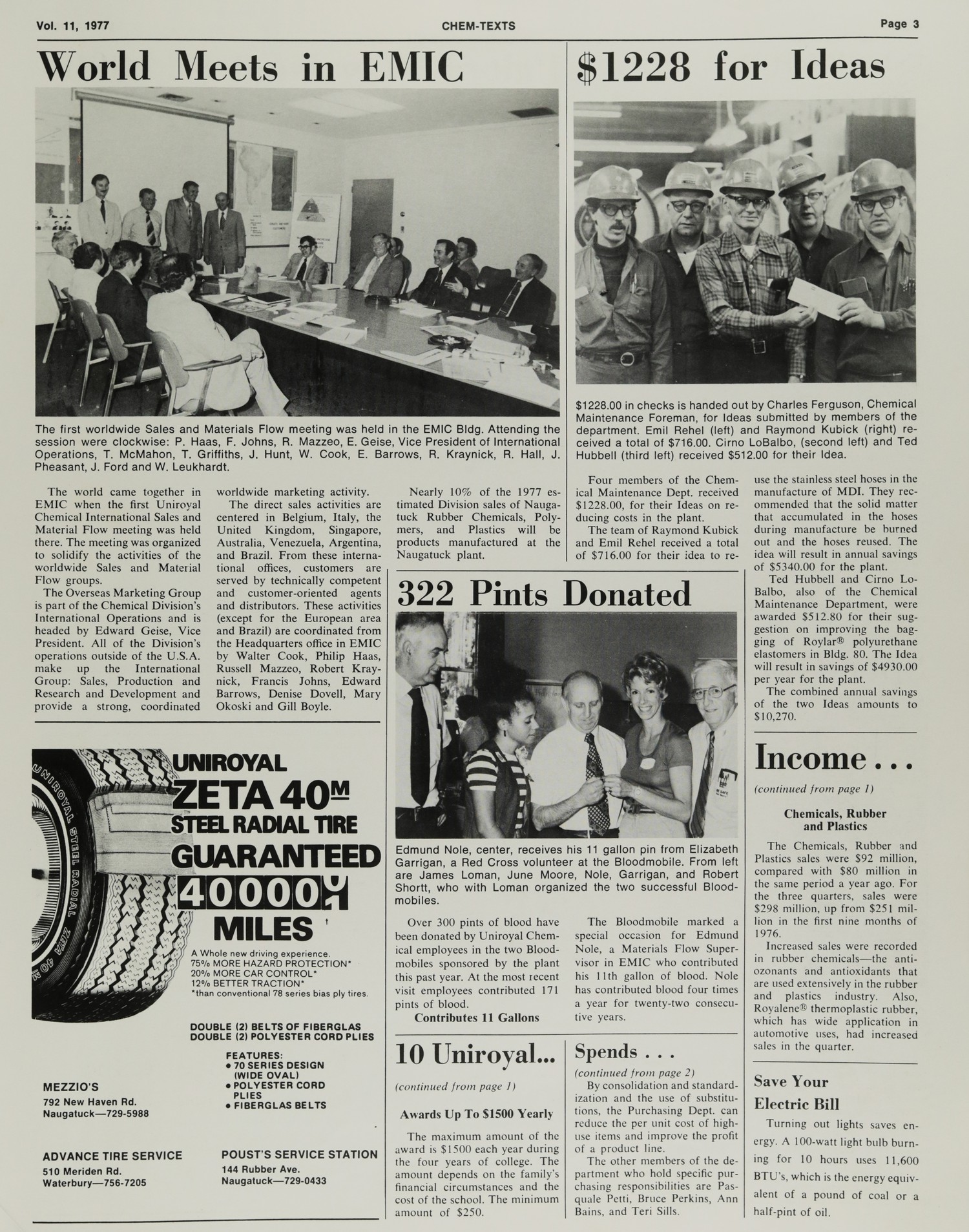
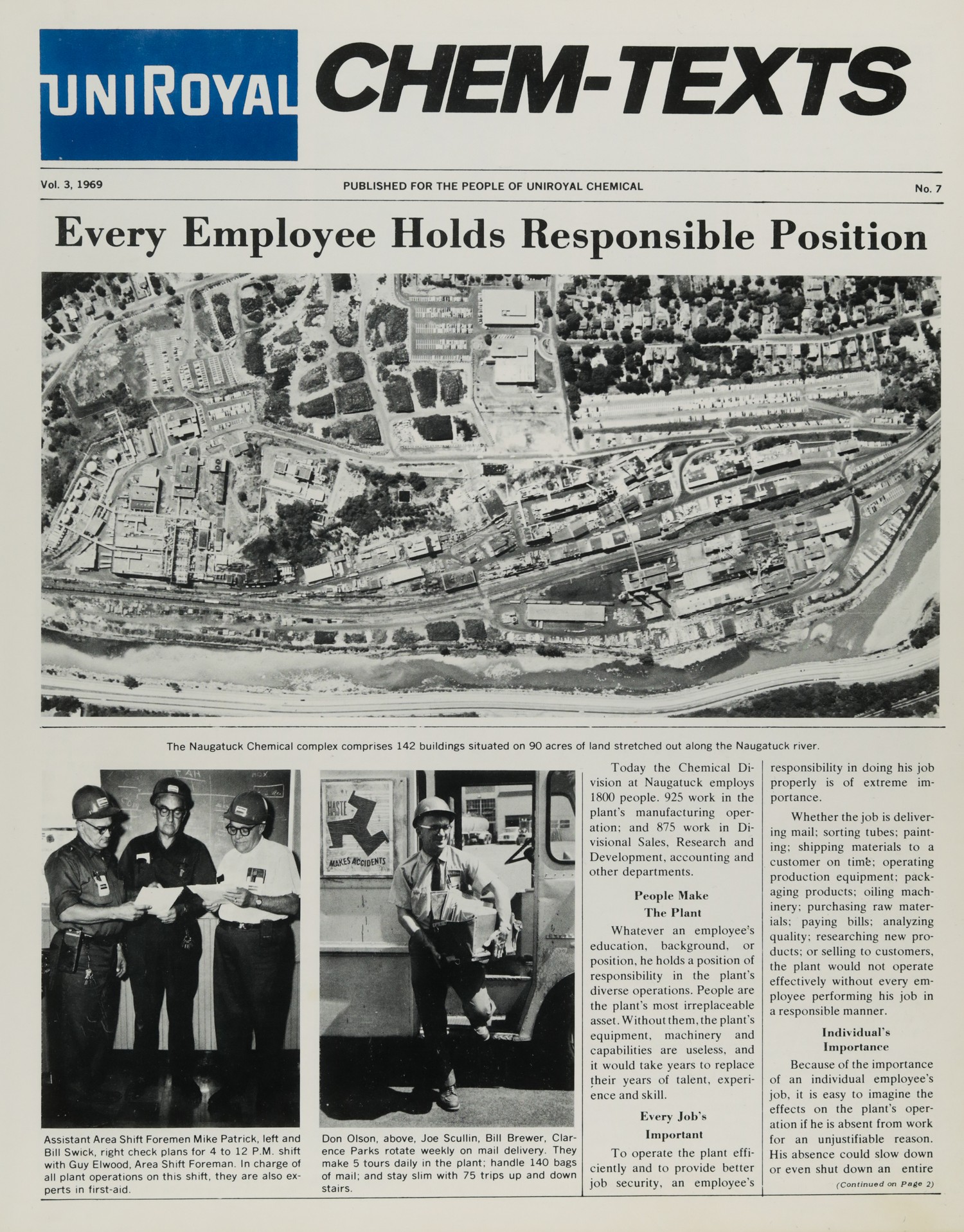
The first worldwide Sales and Materials Flow meeting was held in the EMIC Bldg. Attending the session were clockwise: P. Haas, F. Johns, R. Mazzeo, E. Geise, Vice President of International Operations, T. McMahon, T. Griffiths, J. Hunt, W. Cook, E. Barrows, R. Kraynick, R. Hall, J. Pheasant, J. Ford and W. Leukhardt.

The world came together in EMIC when the first Uniroyal Chemical International Sales and Material Flow meeting was held there. The meeting was organized to solidify the activities of the worldwide Sales and Material Flow groups.

The Overseas Marketing Group is part of the Chemical Division’s International Operations and is headed by Edward Geise, Vice President. All of the Division’s operations outside of the U.S.A. make up the International Group: Sales, Production and Research and Development and provide a strong, coordinated worldwide marketing activity.

The direct sales activities are centered in Belgium, Italy, the United Kingdom, Singapore, Australia, Venezuela, Argentina, and Brazil. From these international offices, customers are served by technically competent and customer-oriented agents and distributors. These activities (except for the European area and Brazil) are coordinated from the Headquarters office in EMIC by Walter Cook, Philip Haas, Russell Mazzeo, Robert Kraynick, Francis Johns, Edward Barrows, Denise Dovell, Mary Okoski and Gill Boyle.

Nearly 10% of the 1977 estimated Division sales of Naugatuck Rubber Chemicals, Polymers, and Plastics will be products manufactured at the Naugatuck plant.


$1228 for Ideas

$1228.00 in checks is handed out by Charles Ferguson, Chemical Maintenance Foreman, for Ideas submitted by members of the department. Emil Rehel (left) and Raymond Kubick (right) received a total of $716.00. Cirno LoBalbo, (second left) and Ted Hubbell (third left) received $512.00 for their Idea.

Four members of the Chemical Maintenance Dept. received $1228.00, for their Ideas on reducing costs in the plant.

The team of Raymond Kubick and Emil Rehel received a total of $716.00 for their idea to reuse the stainless steel hoses in the manufacture of MDI. They recommended that the solid matter that accumulated in the hoses during manufacture be burned out and the hoses reused. The idea will result in annual savings of $5340.00 for the plant.

Ted Hubbell and Cirno LoBalbo, also of the Chemical Maintenance Department, were awarded $512.80 for their suggestion on improving the bagging of Roylar® polyurethane elastomers in Bldg. 80. The Idea will result in savings of $4930.00 per year for the plant.

The combined annual savings of the two Ideas amounts to $10,270.


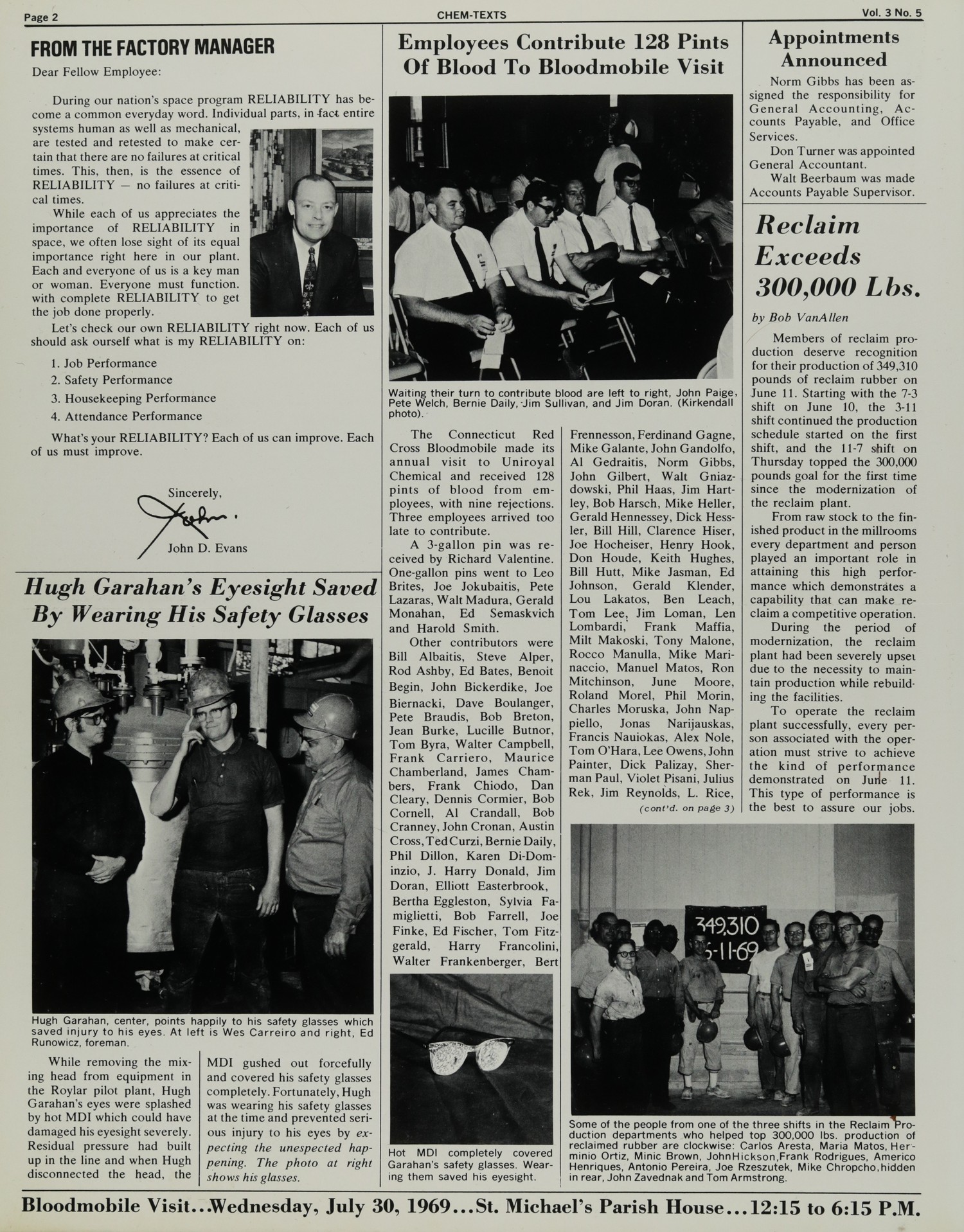
322 Pints Donated

Edmund Nole, center, receives his 11 gallon pin from Elizabeth Garrigan, a Red Cross volunteer at the Bloodmobile. From left are James Loman, June Moore, Nole, Garrigan, and Robert Shortt, who with Loman organized the two successful Bloodmobiles.

Over 300 pints of blood have been donated by Uniroyal Chemical employees in the two Bloodmobiles sponsored by the plant this past year. At the most recent visit employees contributed 171 pints of blood.

Contributes 11 Gallons

The Bloodmobile marked a special occasion for Edmund Nole, a Materials Flow Supervisor in EMIC who contributed his 11th gallon of blood. Nole has contributed blood four times a year for twenty-two consecutive years.


Income…

(continued from page 1)

Chemicals, Rubber and Plastics

The Chemicals, Rubber and Plastics sales were $92 million, compared with $80 million in the same period a year ago. For the three quarters, sales were $298 million, up from $251 million in the first nine months of 1976.

Increased sales were recorded in rubber chemicals—the antiozonants and antioxidants that are used extensively in the rubber and plastics industry. Also, Royalene® thermoplastic rubber, which has wide application in automotive uses, had increased sales in the quarter.


10 Uniroyal…

(continued from page 1)

Awards Up To $1500 Yearly

The maximum amount of the award is $1500 each year during the four years of college. The amount depends on the family’s financial circumstances and the cost of the school. The minimum amount of $250.


Spends…

(continued from page 2)

By consolidation and standardization and the use of substitutions, the Purchasing Dept. can reduce the per unit cost of highuse items and improve the profit of a product line.

The other members of the department who hold specific purchasing responsibilities are Pasquale Petti, Bruce Perkins, Ann Bains, and Teri Sills.


Save Your Electric Bill

Turning out lights saves energy. A 100-watt light bulb burning for 10 hours uses 11,600 BTU’s, which is the energy equivalent of a pound of coal or a half-pint of oil.


[ADVERTISEMENT]

UNIROYAL ZETA 40M STEEL RADIAL TIRE

GUARANTEED 40000 MILES

A Whole new driving experience.
75% MORE HAZARD PROTECTION
20% MORE CAR CONTROL

12% BETTER TRACTION
than conventional 78 series bias ply tires.

DOUBLE (2) BELTS OF FIBERGLAS
DOUBLE (2) POLYESTER CORD PLIES

FEATURES:
– 70 SERIES DESIGN (WIDE OVAL)
– POLYESTER CORD PLIES
– FIBERGLAS BELTS

MEZZIO’S
792 New Haven Rd.
Naugatuck—729-5988

ADVANCE TIRE SERVICE
510 Meriden Rd.
Waterbury—756-7205

POUST’S SERVICE STATION
144 Rubber Ave.
Naugatuck—729-0433

CHEM-TEXTS – 1974 – Page 5

Page 005

CHEM-TEXTS

Vol. 8, 1974 | Page 5


Power Plant Personnel Praised

Fred Taff, Vice President of Engineering for Uniroyal, Inc. recently visited the power plant operations and commended the Boiler House staff for its excellent performance in efficiency as compared to other Uniroyal plants.

These excerpts from his letter summarize his impressions of the tour.

“I think the Plant Engineering group including George Arndt and the operating force in the Boiler plant headed up by Bill Maguire, together with the people who are responsible for maintenance of that operation, should be complimented for the fine performance they are turning in.

The high efficiencies are not accidental; they are the result of hard work, careful planning, attention to detail and a very high Esprit De Corps. The housekeeping was outstanding and I can honestly say I did not detect a single steam leak during the entire walking tour of the Boiler plant from the top to the bottom floor.”

The people who work in the power plant and are responsible for this report are: A. Verrier, A. Gualtieri, F. Warchol, I. Fonseca, J. Mambrino, W. Ireland, W. Hancock, M. Ciarlo, R. Boulanger, J. Litherland and G. Troy.


50 MPH AND 68°


Iron Post Stops Trucks

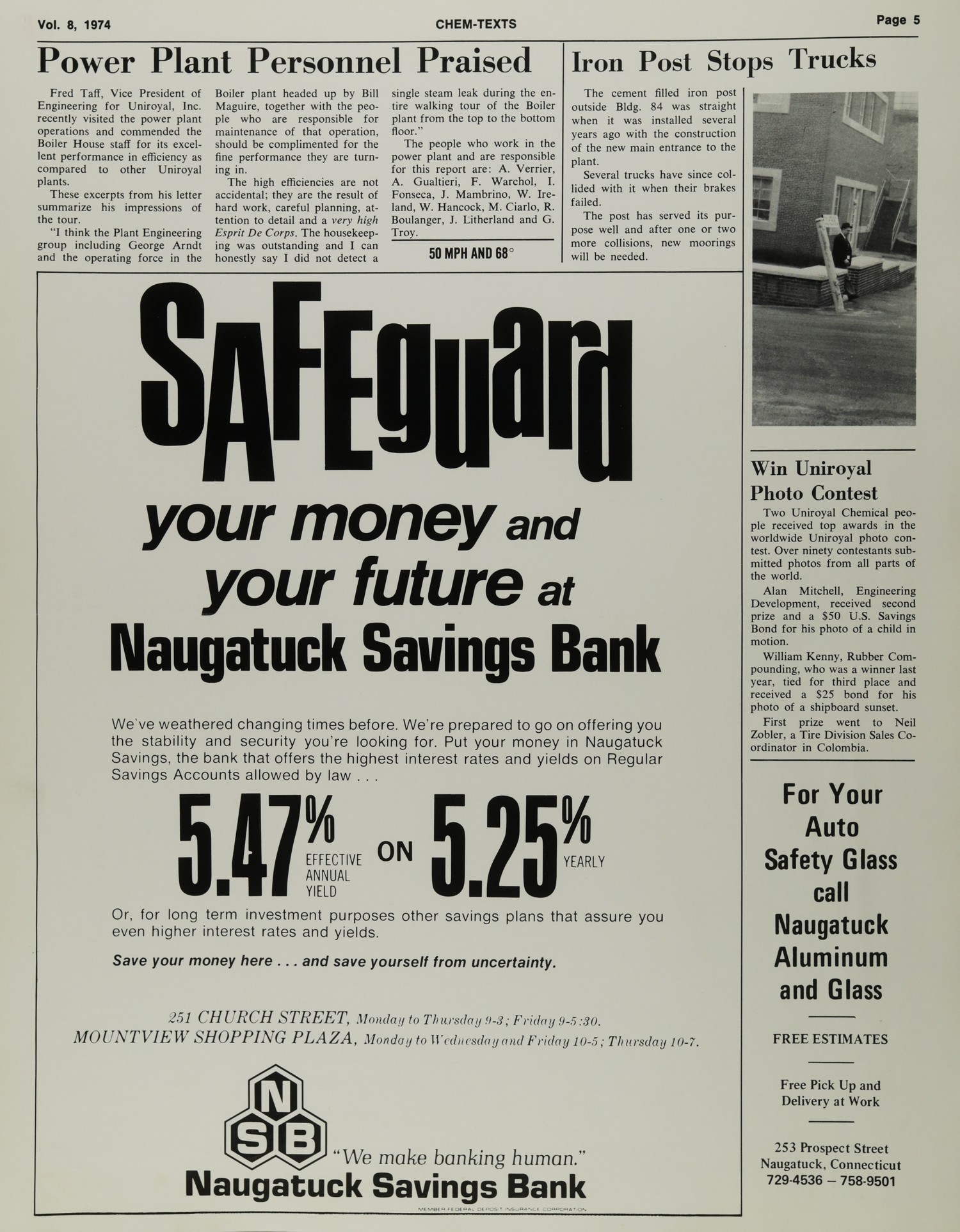
The cement filled iron post outside Bldg. 84 was straight when it was installed several years ago with the construction of the new main entrance to the plant.

Several trucks have since collided with it when their brakes failed.

The post has served its purpose well and after one or two more collisions, new moorings will be needed.


Win Uniroyal Photo Contest

Two Uniroyal Chemical people received top awards in the worldwide Uniroyal photo contest. Over ninety contestants submitted photos from all parts of the world.

Alan Mitchell, Engineering Development, received second prize and a $50 U.S. Savings Bond for his photo of a child in motion.

William Kenny, Rubber Compounding, who was a winner last year, tied for third place and received a $25 bond for his photo of a shipboard sunset.

First prize went to Neil Zobler, a Tire Division Sales Coordinator in Colombia.


SAFEguard

your money and your future at Naugatuck Savings Bank

We’ve weathered changing times before. We’re prepared to go on offering you the stability and security you’re looking for. Put your money in Naugatuck Savings, the bank that offers the highest interest rates and yields on Regular Savings Accounts allowed by law . . .

5.47% EFFECTIVE ANNUAL YIELD ON 5.25% YEARLY

Or, for long term investment purposes other savings plans that assure you even higher interest rates and yields.

Save your money here . . . and save yourself from uncertainty.

251 CHURCH STREET, Monday to Thursday 9-3; Friday 9-5:30.
MOUNTVIEW SHOPPING PLAZA, Monday to Wednesday and Friday 10-5; Thursday 10-7.

NSB
“We make banking human.”
Naugatuck Savings Bank

MEMBER FEDERAL DEPOSIT INSURANCE CORPORATION


For Your Auto Safety Glass call Naugatuck Aluminum and Glass


FREE ESTIMATES

Free Pick Up and Delivery at Work


253 Prospect Street
Naugatuck, Connecticut
729-4536 — 758-9501

Accident Frequency Reduced 54% 1500 Turkevs Awarded to Employees

Page 2 | CHEM-TEXTS | Vol. 7, 1973


The end of the year is upon us, and traditionally it is an ideal time to review the past year and take a peek at the next.

Obviously, it is impossible to review all of the little steps of progress we have made this year. Therefore, I would like to offer a general review of our plant and business in 1973.

The epitome of working together, I think, is this year’s outstanding safety performance over last year’s. Without the complete involvement of all “Chemical people”, we would not have been as successful.

We still have a long way to go, particularly in the number of days lost due to accidents. But this year’s performance has built the base from which we can launch the effort needed to overcome this next difficult hurdle.

In the business line, Chemical Production came through a torturous year with encouraging vigor. The year started great, only to slow down at mid year when uncertain business conditions caused customers to hedge on their purchases.

Then when sales started to pick up, we were staggered by the continuing energy-related raw material shortages.

Heading into the new year, we face the confusing problem of having the sales, but perhaps not the raw materials. In addition, these materials are skyrocketing in cost. Survival next year can be defined as having the flexibility to make the most of a difficult situation.

We all know the problems facing our Reclaim plant. But if this year’s performance and attitude are any indication of our strength and perseverance, we are going to give that business a real run for the money in 1974. Turning an old giant like that around, enough to make it competitive, is a formidable task. Time is a problem and 1974 is our year to show them what we’re made of.

It is unfortunate that we have become non-competitive in the Synthetic latex business. We must quickly recover from this shutdown and adjust ourselves to solving today’s problems.

Attitude and cooperation did it with our Safety performance. The same approach must be used in improving the competitive and economic position of our plant. A healthy business means secure jobs—for one and all.

Despite the lack of Christmas lights this year, I would like to extend to all of you, and your families, my best wishes for the Christmas holiday. It is a comforting time of the year, but also a time to remind ourselves how fortunate we really are.

Jim Crim


Accident Frequency Reduced 54%

1500 Turkeys Awarded to Employees

[IMAGE: Photo showing three people examining documents]

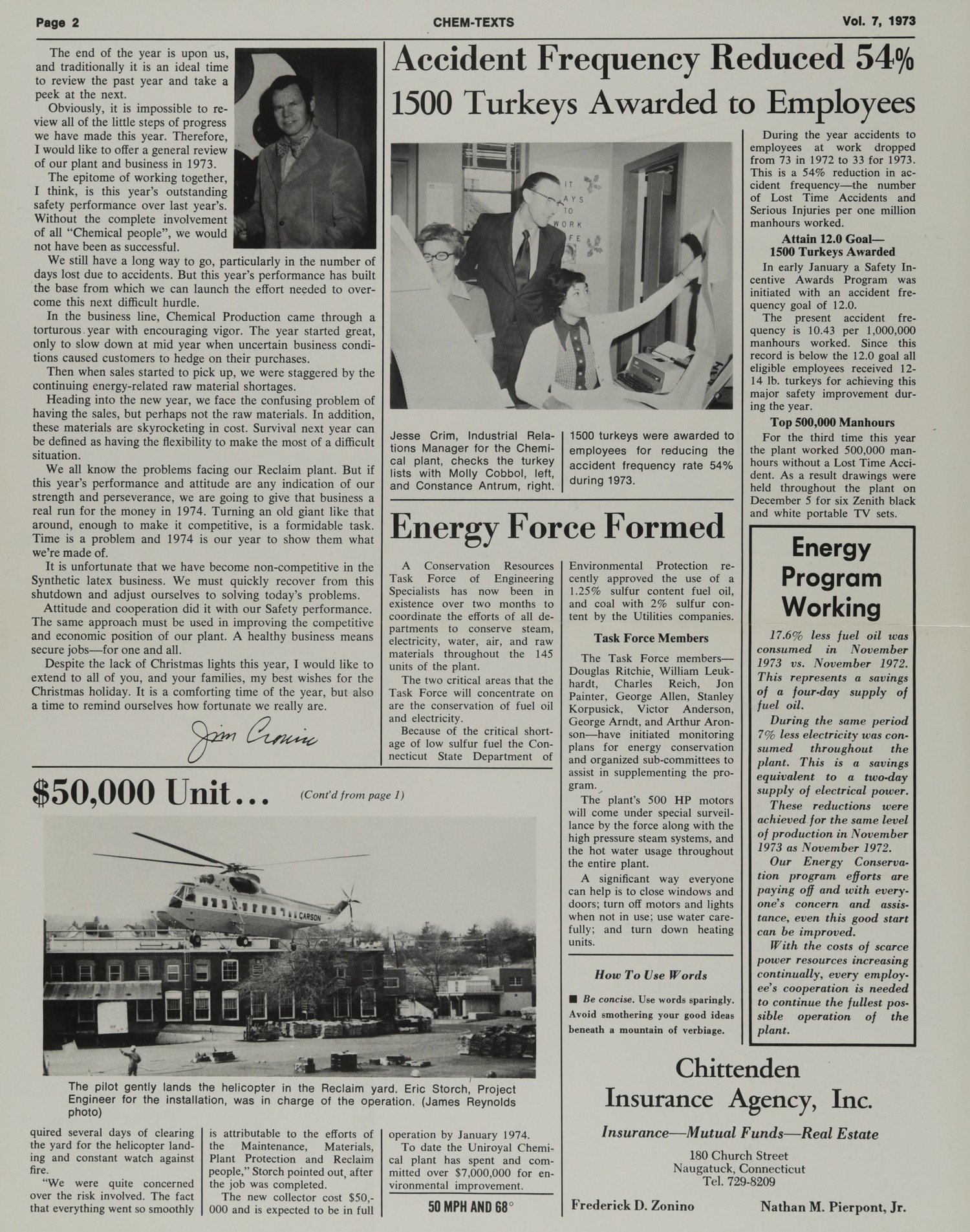
Jesse Crim, Industrial Relations Manager for the Chemical plant, checks the turkey lists with Molly Cobbol, left, and Constance Antrum, right.

1500 turkeys were awarded to employees for reducing the accident frequency rate 54% during 1973.

During the year accidents to employees at work dropped from 73 in 1972 to 33 for 1973. This is a 54% reduction in accident frequency—the number of Lost Time Accidents and Serious Injuries per one million manhours worked.

Attain 12.0 Goal—1500 Turkeys Awarded

In early January a Safety Incentive Awards Program was initiated with an accident frequency goal of 12.0.

The present accident frequency is 10.43 per 1,000,000 manhours worked. Since this record is below the 12.0 goal all eligible employees received 12-14 lb. turkeys for achieving this major safety improvement during the year.

Top 500,000 Manhours

For the third time this year the plant worked 500,000 manhours without a Lost Time Accident. As a result drawings were held throughout the plant on December 5 for six Zenith black and white portable TV sets.


Energy Force Formed

A Conservation Resources Task Force of Engineering Specialists has now been in existence over two months to coordinate the efforts of all departments to conserve steam, electricity, water, air, and raw materials throughout the 145 units of the plant.

The two critical areas that the Task Force will concentrate on are the conservation of fuel oil and electricity.

Because of the critical shortage of low sulfur fuel the Connecticut State Department of Environmental Protection recently approved the use of a 1.25% sulfur content fuel oil, and coal with 2% sulfur content by the Utilities companies.

Task Force Members

The Task Force members—Douglas Ritchie, William Leukhardt, Charles Reich, Jon Painter, George Allen, Stanley Korpusick, Victor Anderson, George Arndt, and Arthur Aronson—have initiated monitoring plans for energy conservation and organized sub-committees to assist in supplementing the program.

The plant’s 500 HP motors will come under special surveillance by the force along with the high pressure steam systems, and the hot water usage throughout the entire plant.

A significant way everyone can help is to close windows and doors; turn off motors and lights when not in use; use water carefully; and turn down heating units.


How To Use Words

Be concise. Use words sparingly. Avoid smothering your good ideas beneath a mountain of verbiage.


Energy Program Working

17.6% less fuel oil was consumed in November 1973 vs. November 1972. This represents a savings of a four-day supply of fuel oil.

During the same period 7% less electricity was consumed throughout the plant. This is a savings equivalent to a two-day supply of electrical power.

These reductions were achieved for the same level of production in November 1973 as November 1972.

Our Energy Conservation program efforts are paying off and with everyone’s concern and assistance, even this good start can be improved.

With the costs of scarce power resources increasing continually, every employee’s cooperation is needed to continue the fullest possible operation of the plant.


$50,000 Unit… (Cont’d from page 1)

[IMAGE: Photo of helicopter landing in yard with buildings in background, marked “CARSON”]

The pilot gently lands the helicopter in the Reclaim yard. Eric Storch, Project Engineer for the installation, was in charge of the operation. (James Reynolds photo)

quired several days of clearing the yard for the helicopter landing and constant watch against fire.

“We were quite concerned over the risk involved. The fact that everything went so smoothly is attributable to the efforts of the Maintenance, Materials, Plant Protection and Reclaim people,” Storch pointed out after the job was completed.

The new collector cost $50,000 and is expected to be in operation by January 1974.

To date the Uniroyal Chemical plant has spent and committed over $7,000,000 for environmental improvement.

50 MPH AND 68°


Chittenden Insurance Agency, Inc.

Insurance—Mutual Funds—Real Estate

180 Church Street
Naugatuck, Connecticut
Tel. 729-8209

Frederick D. Zonino | Nathan M. Pierpont, Jr.

CHEM-TEXTS – 1973-v07-s210

Page 210

Vol. 7, 1973 CHEM-TEXTS Page 3

1972 Safety…

(Cont’d from Page 1)

1971 to 8 in 1972, an increase of 100%.

Accidents to Chemical Production employees rose from 8 to 11.

Over 670 Items Corrected, Repaired or Replaced

To keep the plant in safe condition the Mechanical department has assigned priority to safety jobs and has organized a special section to oversee them.

The Chemical and Synthetic Mechanical departments have corrected, repaired or replaced over 670 items which did not conform to the strict standards of the Occupational Safety and Health Act.


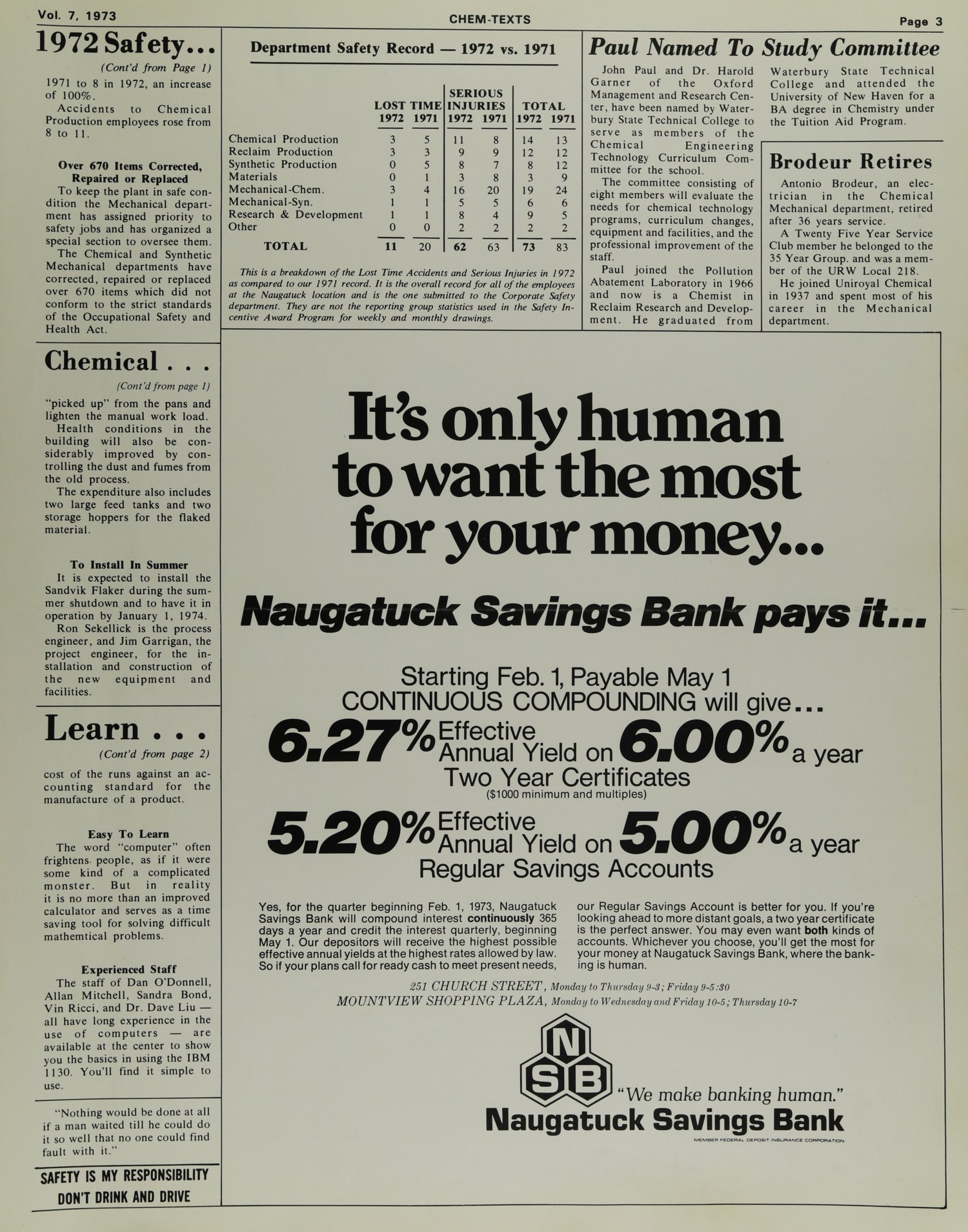
Department Safety Record — 1972 vs. 1971

| | LOST TIME | SERIOUS INJURIES | TOTAL |
| | 1972 | 1971 | 1972 | 1971 | 1972 | 1971 |
|————————–|——|——|——|——|——|——|
| Chemical Production | 3 | 5 | 11 | 8 | 14 | 13 |
| Reclaim Production | 3 | 3 | 9 | 9 | 12 | 12 |
| Synthetic Production | 0 | 5 | 8 | 7 | 8 | 12 |
| Materials | 0 | 1 | 3 | 8 | 3 | 9 |
| Mechanical-Chem. | 3 | 4 | 16 | 20 | 19 | 24 |
| Mechanical-Syn. | 1 | 1 | 5 | 5 | 6 | 6 |
| Research & Development | 1 | 1 | 8 | 4 | 9 | 5 |
| Other | 0 | 0 | 2 | 2 | 2 | 2 |
| TOTAL | 11 | 20 | 62 | 63 | 73 | 83 |

This is a breakdown of the Lost Time Accidents and Serious Injuries in 1972 as compared to our 1971 record. It is the overall record for all of the employees at the Naugatuck location and is the one submitted to the Corporate Safety department. They are not the reporting group statistics used in the Safety Incentive Award Program for weekly and monthly drawings.


Paul Named To Study Committee

John Paul and Dr. Harold Garner of the Oxford Management and Research Center, have been named by Waterbury State Technical College to serve as members of the Chemical Engineering Technology Curriculum Committee for the school.

The committee consisting of eight members will evaluate the needs for chemical technology programs, curriculum changes, equipment and facilities, and the professional improvement of the staff.

Paul joined the Pollution Abatement Laboratory in 1966 and now is a Chemist in Reclaim Research and Development. He graduated from Waterbury State Technical College and attended the University of New Haven for a BA degree in Chemistry under the Tuition Aid Program.


Brodeur Retires

Antonio Brodeur, an electrician in the Chemical Mechanical department, retired after 36 years service.

A Twenty Five Year Service Club member he belonged to the 35 Year Group, and was a member of the URW Local 218.

He joined Uniroyal Chemical in 1937 and spent most of his career in the Mechanical department.


Chemical . . .

(Cont’d from page 1)

“picked up” from the pans and lighten the manual work load.

Health conditions in the building will also be considerably improved by controlling the dust and fumes from the old process.

The expenditure also includes two large feed tanks and two storage hoppers for the flaked material.

To Install In Summer

It is expected to install the Sandvik Flaker during the summer shutdown and to have it in operation by January 1, 1974.

Ron Sekellick is the process engineer, and Jim Garrigan, the project engineer, for the installation and construction of the new equipment and facilities.


Learn . . .

(Cont’d from page 2)

cost of the runs against an accounting standard for the manufacture of a product.

Easy To Learn

The word “computer” often frightens people, as if it were some kind of a complicated monster. But in reality it is no more than an improved calculator and serves as a time saving tool for solving difficult mathematical problems.

Experienced Staff

The staff of Dan O’Donnell, Allan Mitchell, Sandra Bond, Vin Ricci, and Dr. Dave Liu — all have long experience in the use of computers — are available at the center to show you the basics in using the IBM 1130. You’ll find it simple to use.

“Nothing would be done at all if a man waited till he could do it so well that no one could find fault with it.”


SAFETY IS MY RESPONSIBILITY

DON’T DRINK AND DRIVE


It’s only human to want the most for your money…

Naugatuck Savings Bank pays it…

Starting Feb. 1, Payable May 1
CONTINUOUS COMPOUNDING will give…

6.27% Effective Annual Yield on 6.00% a year

Two Year Certificates
($1000 minimum and multiples)

5.20% Effective Annual Yield on 5.00% a year

Regular Savings Accounts

Yes, for the quarter beginning Feb. 1, 1973, Naugatuck Savings Bank will compound interest continuously 365 days a year and credit the interest quarterly, beginning May 1. Our depositors will receive the highest possible effective annual yields at the highest rates allowed by law. So if your plans call for ready cash to meet present needs,

our Regular Savings Account is better for you. If you’re looking ahead to more distant goals, a two year certificate is the perfect answer. You may even want both kinds of accounts. Whichever you choose, you’ll get the most for your money at Naugatuck Savings Bank, where the banking is human.

251 CHURCH STREET, Monday to Thursday 9-3; Friday 9-5:30
MOUNTVIEW SHOPPING PLAZA, Monday to Wednesday and Friday 10-5; Thursday 10-7

[NSB Logo]

“We make banking human.”

Naugatuck Savings Bank

MEMBER FEDERAL DEPOSIT INSURANCE CORPORATION

CHEM-TEXTS – 1971-v05-i06-s205

Page 205

Page 2 | CHEM-TEXTS | Vol. 5, No. 6


“PEACE ON EARTH TO MEN OF GOOD WILL..”

We pray for Peace but half the world’s people are at war or involved in civil strife. While each side is sure of their cause, the result is still pain and suffering, grief and anguish.

None of us can singly alter the events that are occurring. We can, of course, politically try to express ourselves, but so often the political choice is not one of peace or war, but is more closely related to personalities or domestic problems.

What we can do individually is act as “men of good will” by our charitable deeds and by our daily activities.

We can also pray, and in this period of holy days perhaps all of us can reflect on the suffering around us and stop briefly and pray for peace.


ANYWHERE, ANYTIME, ANYBODY

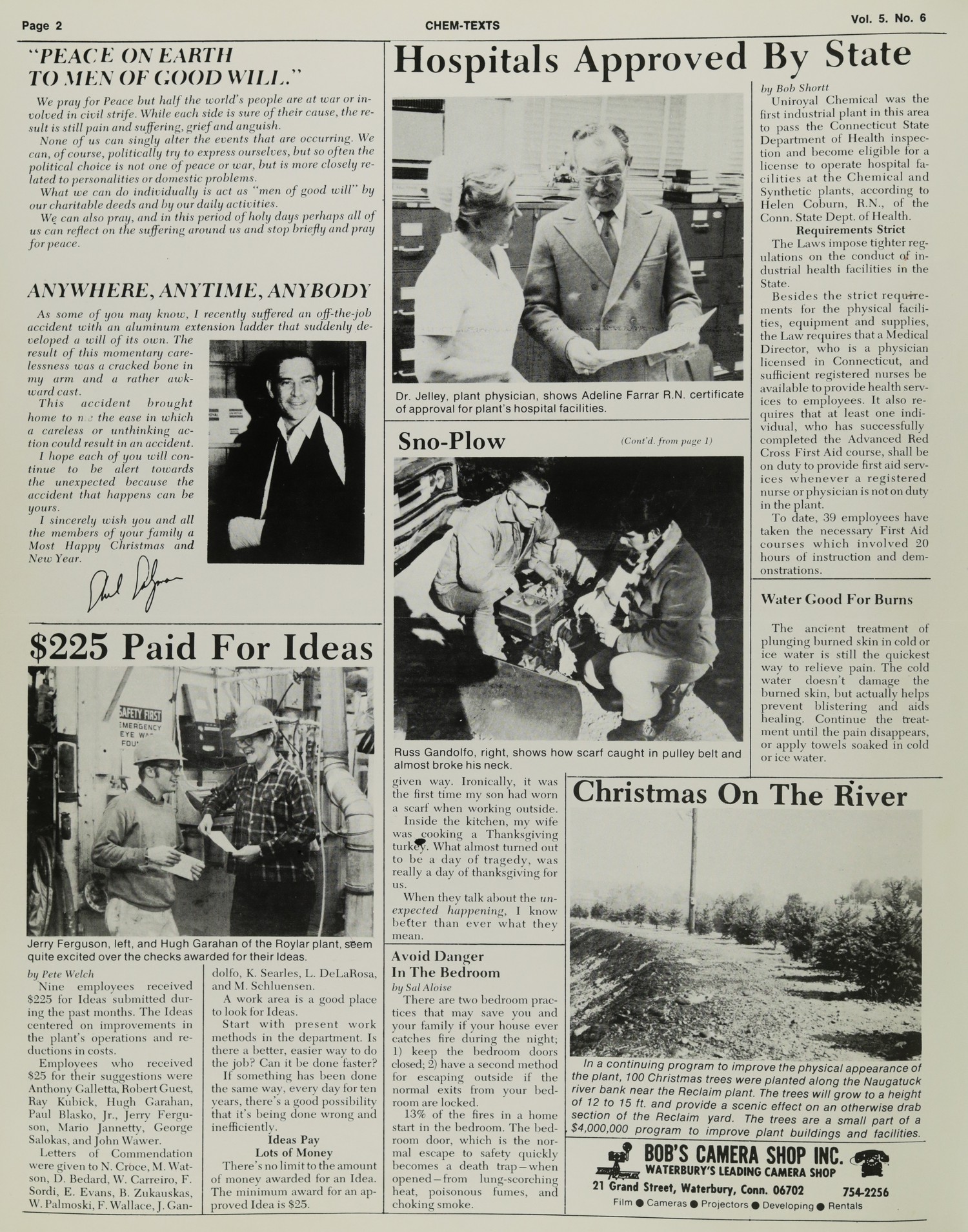
As some of you may know, I recently suffered an off-the-job accident with an aluminum extension ladder that suddenly developed a will of its own. The result of this momentary carelessness was a cracked bone in my arm and a rather awkward cast.

This accident brought home to me the ease in which a careless or unthinking action could result in an accident.

I hope each of you will continue to be alert towards the unexpected because the accident that happens can be yours.

I sincerely wish you and all the members of your family a Most Happy Christmas and New Year.

[Signature]


$225 Paid For Ideas

[IMAGE: Photo showing two men, with “SAFETY FIRST EMERGENCY EYE WASH FOU…” sign visible]

Jerry Ferguson, left, and Hugh Garahan of the Roylar plant, seem quite excited over the checks awarded for their Ideas.

by Pete Welch

Nine employees received $225 for Ideas submitted during the past months. The Ideas centered on improvements in the plant’s operations and reductions in costs.

Employees who received $25 for their suggestions were Anthony Galletta, Robert Guest, Ray Kubick, Hugh Garahan, Paul Blasko, Jr., Jerry Ferguson, Mario Jannetty, George Salokas, and John Wawer.

Letters of Commendation were given to N. Croce, M. Watson, D. Bedard, W. Carreiro, F. Sordi, E. Evans, B. Zukauskas, W. Palmoski, F. Wallace, J. Gandolfo, K. Searles, L. DeLaRosa, and M. Schluensen.

A work area is a good place to look for Ideas.

Start with present work methods in the department. Is there a better, easier way to do the job? Can it be done faster?

If something has been done the same way, every day for ten years, there’s a good possibility that it’s being done wrong and inefficiently.

Ideas Pay Lots of Money

There’s no limit to the amount of money awarded for an Idea. The minimum award for an approved Idea is $25.


Hospitals Approved By State

[IMAGE: Photo showing Dr. Jelley and Adeline Farrar]

Dr. Jelley, plant physician, shows Adeline Farrar R.N. certificate of approval for plant’s hospital facilities.

by Bob Shortt

Uniroyal Chemical was the first industrial plant in this area to pass the Connecticut State Department of Health inspection and become eligible for a license to operate hospital facilities at the Chemical and Synthetic plants, according to Helen Coburn, R.N., of the Conn. State Dept. of Health.

Requirements Strict

The Laws impose tighter regulations upon the conduct of industrial health facilities in the State.

Besides the strict requirements for the physical facilities, equipment and supplies, the Law requires that a Medical Director, who is a physician licensed in Connecticut, and sufficient registered nurses be available to provide health services to employees. It also requires that at least one individual, who has successfully completed the Advanced Red Cross First Aid course, shall be on duty to provide first aid services whenever a registered nurse or physician is not on duty in the plant.

To date, 39 employees have taken the necessary First Aid courses which involved 20 hours of instruction and demonstrations.


Water Good For Burns

The ancient treatment of plunging burned skin in cold or ice water is still the quickest way to relieve pain. The cold water doesn’t damage the burned skin, but actually helps prevent blistering and aids healing. Continue the treatment until the pain disappears, or apply towels soaked in cold or ice water.


Sno-Plow

(Cont’d. from page 1)

[IMAGE: Photo showing Russ Gandolfo demonstrating scarf caught in pulley belt]

Russ Gandolfo, right, shows how scarf caught in pulley belt and almost broke his neck.

given way. Ironically, it was the first time my son had worn a scarf when working outside.

Inside the kitchen, my wife was cooking a Thanksgiving turkey. What almost turned out to be a day of tragedy, was really a day of thanksgiving for us.

When they talk about the unexpected happening, I know better than ever what they mean.


Avoid Danger In The Bedroom

by Sal Aloise

There are two bedroom practices that may save you and your family if your house ever catches fire during the night; 1) keep the bedroom doors closed, 2) have a second method for escaping outside if the normal exits from your bedroom are locked.

13% of the fires in a home start in the bedroom. The bedroom door, which is the normal escape to safety quickly becomes a death trap—when opened—from lung-scorching heat, poisonous fumes, and choking smoke.


Christmas On The River

In a continuing program to improve the physical appearance of the plant, 100 Christmas trees were planted along the Naugatuck river bank near the Reclaim plant. The trees will grow to a height of 12 to 15 ft. and provide a scenic effect on an otherwise drab section of the Reclaim yard. The trees are a small part of a $4,000,000 program to improve plant buildings and facilities.


BOB’S CAMERA SHOP INC. [Logo]
WATERBURY’S LEADING CAMERA SHOP
21 Grand Street, Waterbury, Conn. 06702 | 754-2256
Film ● Cameras ● Projectors ● Developing ● Rentals

CHEM-TEXTS – Vol. 5 No. 4 – Page 3

Page 003

CHEM-TEXTS

Vol. 5 No. 4 | Page 3


New Research Laboratory Studies Pollution Causes

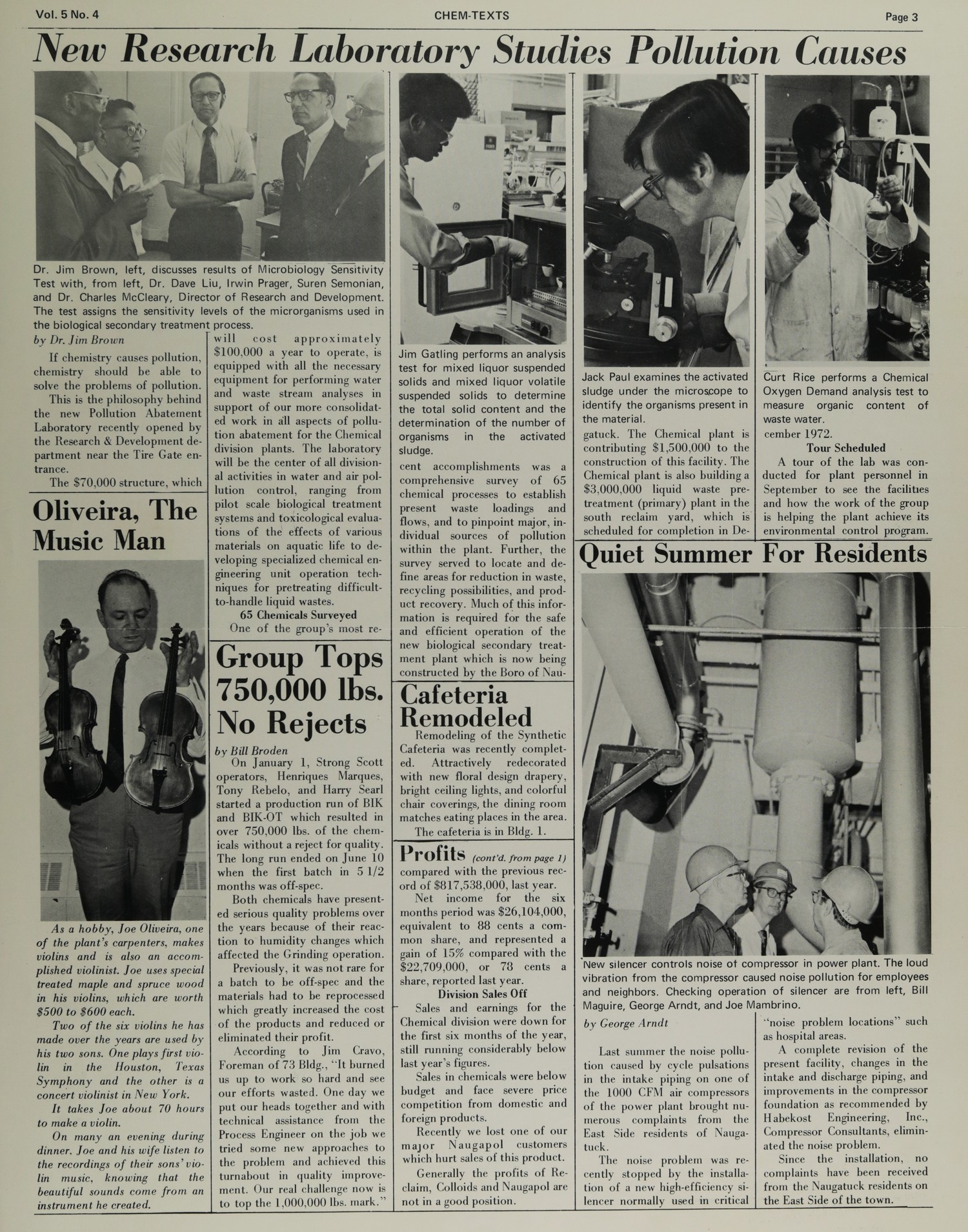
Dr. Jim Brown, left, discusses results of Microbiology Sensitivity Test with, from left, Dr. Dave Liu, Irwin Prager, Suren Semonian, and Dr. Charles McCleary, Director of Research and Development. The test assigns the sensitivity levels of the microrganisms used in the biological secondary treatment process.

by Dr. Jim Brown

If chemistry causes pollution, chemistry should be able to solve the problems of pollution.

This is the philosophy behind the new Pollution Abatement Laboratory recently opened by the Research & Development department near the Tire Gate entrance.

The $70,000 structure, which


Oliveira, The Music Man

As a hobby, Joe Oliveira, one of the plant’s carpenters, makes violins and is also an accomplished violinist. Joe uses special treated maple and spruce wood in his violins, which are worth $500 to $600 each.

Two of the six violins he has made over the years are used by his two sons. One plays first violin in the Houston, Texas Symphony and the other is a concert violinist in New York.

It takes Joe about 70 hours to make a violin.

On many an evening during dinner, Joe and his wife listen to the recordings of their sons’ violin music, knowing that the beautiful sounds come from an instrument he created.


will cost approximately $100,000 a year to operate, is equipped with all the necessary equipment for performing water and waste stream analyses in support of our more consolidated work in all aspects of pollution abatement for the Chemical division plants. The laboratory will be the center of all divisional activities in water and air pollution control, ranging from pilot scale biological treatment systems and toxicological evaluations of the effects of various materials on aquatic life to developing specialized chemical engineering unit operation techniques for pretreating difficult-to-handle liquid wastes.

65 Chemicals Surveyed

One of the group’s most re-


Group Tops 750,000 lbs. No Rejects

by Bill Broden

On January 1, Strong Scott operators, Henriques Marques, Tony Rebelo, and Harry Searl started a production run of BIK and BIK-OT which resulted in over 750,000 lbs. of the chemicals without a reject for quality. The long run ended on June 10 when the first batch in 5 1/2 months was off-spec.

Both chemicals have presented serious quality problems over the years because of their reaction to humidity changes which affected the Grinding operation.

Previously, it was not rare for a batch to be off-spec and the materials had to be reprocessed which greatly increased the cost of the products and reduced or eliminated their profit.

According to Jim Cravo, Foreman of 73 Bldg., “It burned us up to work so hard and see our efforts wasted. One day we put our heads together and with technical assistance from the Process Engineer on the job we tried some new approaches to the problem and achieved this turnaround in quality improvement. Our real challenge now is to top the 1,000,000 lbs. mark.”


Jim Gatling performs an analysis test for mixed liquor suspended solids and mixed liquor volatile suspended solids to determine the total solid content and the determination of the number of organisms in the activated sludge.

cent accomplishments was a comprehensive survey of 65 chemical processes to establish present waste loadings and flows, and to pinpoint major, individual sources of pollution within the plant. Further, the survey served to locate and define areas for reduction in waste, recycling possibilities, and product recovery. Much of this information is required for the safe and efficient operation of the new biological secondary treatment plant which is now being constructed by the Boro of Nau-


Cafeteria Remodeled

Remodeling of the Synthetic Cafeteria was recently completed. Attractively redecorated with new floral design drapery, bright ceiling lights, and colorful chair coverings, the dining room matches eating places in the area.

The cafeteria is in Bldg. 1.


Profits (cont’d. from page 1)

compared with the previous record of $817,538,000, last year.

Net income for the six months period was $26,104,000, equivalent to 88 cents a common share, and represented a gain of 15% compared with the $22,709,000, or 78 cents a share, reported last year.

Division Sales Off

Sales and earnings for the Chemical division were down for the first six months of the year, still running considerably below last year’s figures.

Sales in chemicals were below budget and face severe price competition from domestic and foreign products.

Recently we lost one of our major Naugapol customers which hurt sales of this product.

Generally the profits of Reclaim, Colloids and Naugapol are not in a good position.


Jack Paul examines the activated sludge under the microscope to identify the organisms present in the material.

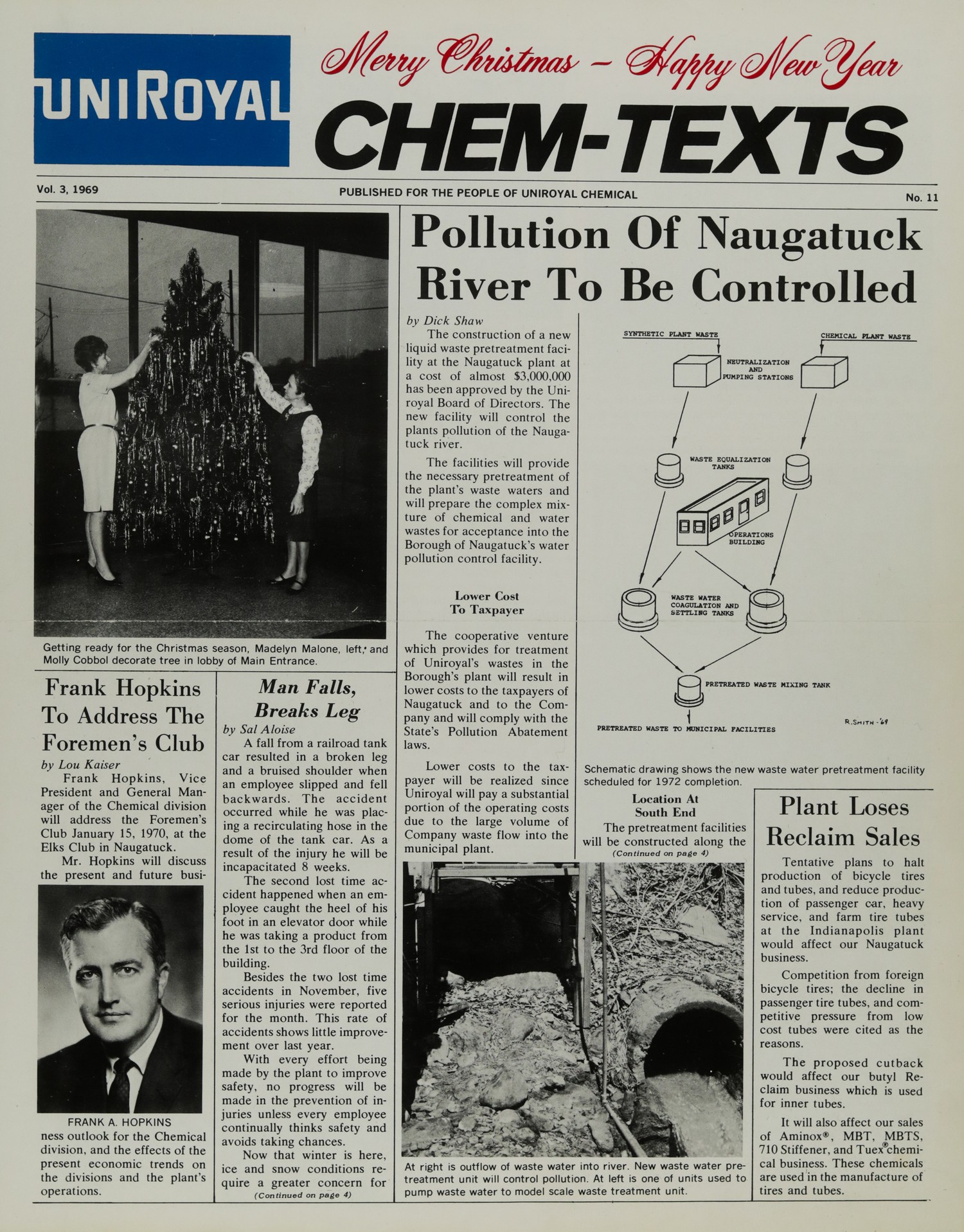
gatuck. The Chemical plant is contributing $1,500,000 to the construction of this facility. The Chemical plant is also building a $3,000,000 liquid waste pretreatment (primary) plant in the south reclaim yard, which is scheduled for completion in De-


Curt Rice performs a Chemical Oxygen Demand analysis test to measure organic content of waste water.

cember 1972.

Tour Scheduled

A tour of the lab was conducted for plant personnel in September to see the facilities and how the work of the group is helping the plant achieve its environmental control program.


Quiet Summer For Residents

New silencer controls noise of compressor in power plant. The loud vibration from the compressor caused noise pollution for employees and neighbors. Checking operation of silencer are from left, Bill Maguire, George Arndt, and Joe Mambrino.

by George Arndt

Last summer the noise pollution caused by cycle pulsations in the intake piping on one of the 1000 CFM air compressors of the power plant brought numerous complaints from the East Side residents of Naugatuck.

The noise problem was recently stopped by the installation of a new high-efficiency silencer normally used in critical

“noise problem locations” such as hospital areas.

A complete revision of the present facility, changes in the intake and discharge piping, and improvements in the compressor foundation as recommended by Habekost Engineering, Inc., Compressor Consultants, eliminated the noise problem.

Since the installation, no complaints have been received from the Naugatuck residents on the East Side of the town.

CHEM-TEXTS – Vol. 4 No. 8 – Page 2

Page 002

CHEM-TEXTS

Page 2 | Vol. 4 No. 8


FROM THE FACTORY MANAGER

DEAR FELLOW EMPLOYEE:

I’m certain that the vast majority of us know and appreciate the fact that UNIROYAL CHEMICAL is a good place to work. Sure, we all have our gripes and inconveniences but when we really think about it we’ve got it pretty good. As only one example, the other day I was looking at the average earnings for all manufacturing workers in Connecticut and noted that the straight time rate averages $3.31 per hour as compared to $4.00 per hour in our plant. When the effect of premium rates for overtime is considered, the State average is $3.43 per hour and our average is $4.39 per hour.

Beyond pay and the importance of our superior benefit plans, there is the question of what kind of place is it to work? I believe you will agree with me that a very important factor is the “atmosphere” or “climate.” Like productivity, safety, good housekeeping and quality, each of us must bear a responsibility for “climate.” We do this every day by our attitudes, our cooperation and our ability to communicate with each other. To fully face this responsibility each of us must listen, as well as talk. Each of us must recognize that others have problems, as well as ourselves.

Concern for the customer, concern for the fellow employee and yes, concern for the job produces results.

Best regards,

John D. Evans

John D. Evans


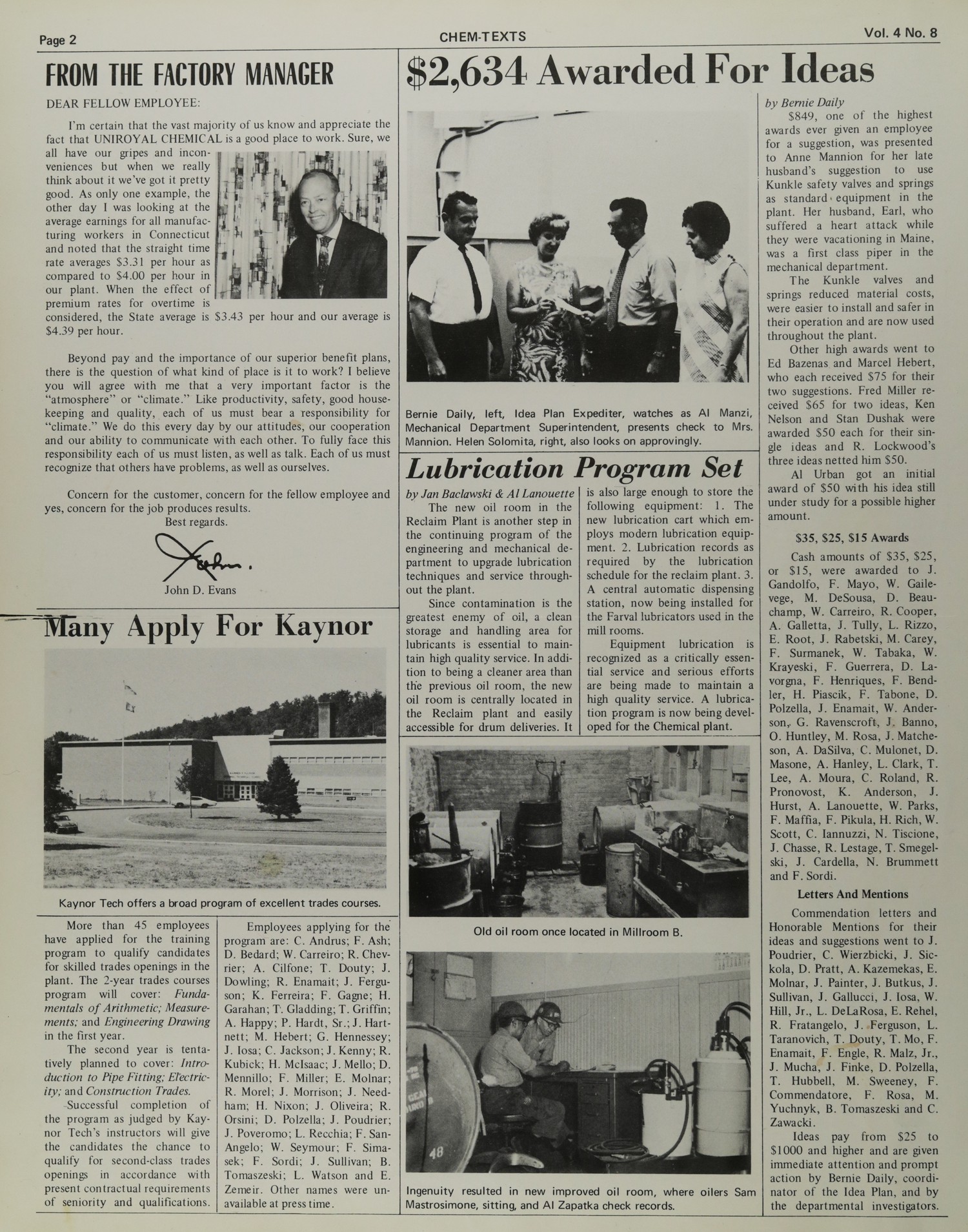
Many Apply For Kaynor

[IMAGE: Aerial photograph of industrial/educational facility with parking lot]

Kaynor Tech offers a broad program of excellent trades courses.

More than 45 employees have applied for the training program to qualify candidates for skilled trades openings in the plant. The 2-year trades courses program will cover: Fundamentals of Arithmetic; Measurements; and Engineering Drawing in the first year.

The second year is tentatively planned to cover: Introduction to Pipe Fitting; Electricity; and Construction Trades.

Successful completion of the program as judged by Kaynor Tech’s instructors will give the candidates the chance to qualify for second-class trades openings in accordance with present contractual requirements of seniority and qualifications.

Employees applying for the program are: C. Andrus; F. Ash; D. Bedard; W. Carreiro; R. Chevrier; A. Cifone; T. Douty; J. Dowling; R. Enamait; J. Ferguson; K. Ferreira; F. Gagne; H. Garahan; T. Gladding; T. Griffin; A. Happy; P. Hardt, Sr.; J. Hartnett; M. Hebert; G. Hennessey; J. Iosa; C. Jackson; J. Kenny; R. Kubicki; H. McIsaac; J. Mello; D. Memillo; F. Miller; E. Molnar; R. Morel; J. Morrison; J. Needham, H. Nixon; J. Oliveira; R. Orsini; D. Polzella; J. Poudrier; J. Poveromo; L. Recchia; F. San Angelo; W. Seymour; F. Simasek; F. Sordi; J. Sullivan; B. Tomaszeski; L. Watson and E. Zemeir. Other names were unavailable at press time.


$2,634 Awarded For Ideas

by Bernie Daily

$849, one of the highest awards ever given an employee for a suggestion, was presented to Anne Mannion for her late husband’s suggestion to use Kunkle safety valves and springs as standard equipment in the plant. Her husband, Earl, who suffered a heart attack while they were vacationing in Maine, was a first class piper in the mechanical department.

The Kunkle valves and springs reduced material costs, were easier to install and safer in their operation and are now used throughout the plant.

Other high awards went to Ed Bazenas and Marcel Hebert, who each received $75 for their two suggestions. Fred Miller received $65 for two ideas, Ken Nelson and Stan Dushak were awarded $50 each for their single ideas and R. Lockwood’s three ideas netted him $50.

Al Urban got an initial award of $50 with his idea still under study for a possible higher amount.

$35, $25, $15 Awards

Cash amounts of $35, $25, or $15, were awarded to J. Gandolfo, F. Mayo, W. Gailevege, M. DeSousa, D. Beauchamp, W. Carreiro, R. Cooper, A. Galletta, J. Tully, L. Rizzo, E. Root, J. Rabetski, M. Carey, F. Surmanek, W. Tabaka, W. Krayeski, F. Guerrera, D. Lavorgna, F. Henriques, F. Bendler, H. Piascik, F. Tabone, D. Polzella, J. Enamait, W. Anderson, G. Ravenscroft, J. Banno, O. Huntley, M. Rosa, J. Matcheson, A. DaSilva, C. Mulonet, D. Masone, A. Hanley, L. Clark, T. Lee, A. Moura, C. Roland, R. Pronovost, K. Anderson, J. Hurst, A. Lanouette, W. Parks, F. Maffia, F. Pikula, H. Rich, W. Scott, C. Iannuzzi, N. Tiscione, J. Chasse, R. Lestage, T. Smegelski, J. Cardella, N. Brummett and F. Sordi.

Letters And Mentions

Commendation letters and Honorable Mentions for their ideas and suggestions went to J. Poudrier, C. Wierzbicki, J. Sickola, D. Pratt, A. Kazemekas, E. Molnar, J. Painter, J. Butkus, J. Sullivan, J. Gallucci, J. Iosa, W. Hill, Jr., L. DeLaRosa, E. Rehel, R. Fratangelo, J. Ferguson, L. Taranovich, T. Douty, T. Mo, F. Enamait, F. Engle, R. Malz, Jr., J. Mucha, J. Finke, D. Polzella, T. Hubbell, M. Sweeney, F. Commendatore, F. Rosa, M. Yuchnyk, B. Tomaszeski and C. Zawacki.

Ideas pay from $25 to $1000 and higher and are given immediate attention and prompt action by Bernie Daily, coordinator of the Idea Plan, and by the departmental investigators.

[IMAGE: Three people in office setting]

Bernie Daily, left, Idea Plan Expediter, watches as Al Manzi, Mechanical Department Superintendent, presents check to Mrs. Mannion. Helen Solomita, right, also looks on approvingly.


Lubrication Program Set

by Jan Baclawski & Al Lanouette

The new oil room in the Reclaim Plant is another step in the continuing program of the engineering and mechanical department to upgrade lubrication techniques and service throughout the plant.

Since contamination is the greatest enemy of oil, a clean storage and handling area for lubricants is essential to maintain high quality service. In addition to being a cleaner area than the previous oil room, the new oil room is centrally located in the Reclaim plant and easily accessible for drum deliveries. It is also large enough to store the following equipment: 1. The new lubrication cart which employs modern lubrication equipment. 2. Lubrication records as required by the lubrication schedule for the reclaim plant. 3. A central automatic dispensing station, now being installed for the Farval lubricators used in the mill rooms.

Equipment lubrication is recognized as a critically essential service and serious efforts are being made to maintain a high quality service. A lubrication program is now being developed for the Chemical plant.

[IMAGE: Old oil room equipment]

Old oil room once located in Millroom B.

[IMAGE: Two men working in new oil room]

Ingenuity resulted in new improved oil room, where oilers Sam Mastrosimone, sitting, and Al Zapatka check records.

CHEM-TEXTS – Vol. 4 No. 6 – Page 2

Page 002

CHEM-TEXTS

Page 2 | Vol. 4, No. 6


FROM THE FACTORY MANAGER

DEAR FELLOW EMPLOYEE:

This issue of CHEM-TEXTS announces plans for offering office personnel the opportunity to advance to higher positions at the new Oxford offices. Also discussed, are details on how our new performance review program at the plant works. Last month, CHEM-TEXTS announced plans for the mechanical trades training program to be held at Kaynor Tech. starting in the fall. Applications for this program will soon be available to those interested in preparing themselves for these skills.

Each of these programs, as well as many others such as the tuition aid plan, is part of UNIROYAL’S continuing desire to provide all employees every chance to continue to grow in knowledge and skills and to make the most of their talents and abilities.

UNIROYAL recognizes that its future is dependent on the future of its employees. To build a future together, we must not only do our present job in the best possible way, but we must use our own initiative to improve our job skills. It has been said that “opportunity knocks but once.” I, frankly, doubt this — I think “Opportunity is always waiting just outside the door.

It’s always waiting for the man who takes the first step to open the door himself.

Best regards,

John D. Evans

John D. Evans


New Drink At Canteen

[IMAGE CAPTION:]
Iced tea and hot coffee is the gourmet’s new drink served at the Canteen. From left, Helen Grabowski credits Helen Burns who credits Helen Pieksza.

The Chemical plant canteen offers a new drink during coffee breaks, a unique concoction of hot coffee and iced tea, a gourmet’s delight.

The origin of the drink is cloaked in mystery. When one of the Helens in the canteen left a large container of iced tea by the coffee urn, another of the three Helens inadvertently poured the iced tea into the hot coffee urn. The third Helen served the new drink to several employees, who sipped the new beverage with relish.

No one took credit for the exotic discovery, claiming that such rare discoveries are not the result of one individual but the combined efforts of the group. It’s the culinary philosophy of the Chemical canteen that makes it such an exciting and enjoyable place to eat.


Red Cross Blood Drive Successful

[IMAGE CAPTION:]
Gallon givers are awarded pins by Red Cross nurse Annette Pariseault R.N. From left are Karen Di Dominzio, Lucille Butnor, Hank DeVries, Fred Wintsch, Annette, Delia Scheithe, Hal Smith, John Gilbert, and unidentified donor. From right, unidentified donor, Al Smith, Len Borg, Walt Campbell, hidden, Milt Makoski and Don Powell hidden. Employees gave generously to the recent Bloodmobile.

Uniroyal Chemical and EMIC employees generously supported the annual Connecticut Red Cross Bloodmobile visit sponsored by the plant. The Connecticut Red Cross has helped hundreds of employees and their families over the years, with one of the best blood programs in the country, the blood itself being free. There is a charge for the Bloodmobile’s expenses and the hospitals’ administrative services. In some states a pint of blood costs $50-$60 plus the additional charges for services.

Gallon Pins Awarded

Gerry Hennessey received a four gallon pin for his thirty second contribution to this worthwhile cause.

Jim Reynolds and Allen Crapo each received a three gallon pin and Joe Finke received a two gallon pin.

One gallon pins were given to Charles Anderson, Roland Morel, Joe Sauvageau and Fred Wintsch.

Donors

Contributing blood — many for the fifth or more time were K. Allen, J. Chapman, Catherine O’Sullivan, L. Owens, L. Koth, W. Gniazdowski, L. Coburn, Ann McAllister, R. Cranney, R. Palizay, B. Pierce, A. Tobias, L. Lombardi, C. Bulka, M. Galante, F. Emmerich, P. Dillon, E. Phillips, M. Chamberland, J. Paige, R. Cornell, R. Mastromatteo, Angenette Grant, M. Sutton, R. Stark, H. Nixon, T. Fitzgerald, E. Nole, D. Williamson, P. Braudis, B. Fisher, Jr., F. Carriero, P. Welch, R. Breton, R. Palmer, K. Hughes, R. Harsch, F. Leary, J. McCarthy, Karen DiDominzio, H. Smith, Lucille Butnor, P. Norton, E. Runowicz, J. Vergosen, J. Hochheiser, M. Makoski, H. Francolini, B. Begin, P. Haas, D. Powell, W. Beerbaum, S. Semonian, A. Smith, J. Chambers, H. DeVries, R. LaClair, L. Borg, F. Mayo, D. Boulanger, F. Sterniak, E. Newell, M. Matos, H. Garahan, S. Molnar, G. Morrisey, W. Campbell, J. Pym, T. Curzi, F. Gagne, J. Loman, F. Tabone, D. Poehailos, K. Searles, L. Brites, R. Hessler, G. Monahan, Marjorie Lasky, T. Basile, W. Stephenson, M. Gransky, W. Scott, E. Bates, J. Slasienski, J. Shea, W. Hudima, H. Hook, R. Tucker, Katherine Dowling, A. Galletta, C. Hiser, H. Mannion. L. Triano, A. Crandall, P. King, E. Root, W. Fruin, V. Alves. F. Sordi, R. Clark, T. Byra, F. Phelan, A. Nole, M. Yuchnyk, R.

Continued on page 4

[IMAGE CAPTION:]
Gerry Hennessy receives 4 gallon pin from Sam Gillette for his 32nd. contribution of blood as Matt Mathewson watches.


$35,261 Lost In Five Fires

During 1969 the plant had 20 reportable fires. Five of these fires resulted in estimated losses of $35,261. This high amount represents only the damage caused to the equipment and buildings.

Several of the fires shut down production lines resulting even in higher losses and increased manufacturing costs. The fires also increased the insurance costs to the plant as rates are based on the damage caused by fire.

Chemical Production had 4 fires with no loss. Reclaim Production had 10 fires; 7 with no loss and 3 with an estimated loss of $30,335. Synthetic Production suffered 4 fires; 3 with no loss and one which cost $4,626. Research and Development had 2 fires; one with an estimated loss of $300 in the Chemical pilot plant.

In 1968 the plant was awarded a plaque for its excellent fire prevention record; but 1969 brought several fires, many attributable to poor housekeeping and safety practices.

Fires can be prevented only if everyone shows his fullest concern for good housekeeping and safety practices in his work area. Fires increase the cost of our products, hurt our pocketbooks and affect job security.

SAFETY IS MY RESPONSIBILITY

CHEM-TEXTS – Vol. 4, 1970, No. 5 – Page 1

Page 001

UNIROYAL CHEM-TEXTS

Vol. 4, 1970 | PUBLISHED FOR THE PEOPLE OF UNIROYAL CHEMICAL | No. 5


$5,200,000 Spent Or Committed To Improve Air, Water Quality


Trades Courses Offered

by Al Manzi

A training program to qualify candidates for skilled trades openings has been developed in cooperation with Kaynor Technical School in Waterbury. This special program is voluntary and can help improve your job opportunities in the future. The program is open to all employees of Uniroyal Chemical at Naugatuck.

Courses Available

A two-year program has been planned following the normal school year — one night per week — 3 hours per night. The first year will have three 33 hour courses: Fundamentals of Arithmetic; Measurements; and Engineering Drawing.

The second year is tentatively planned for three 33 hour courses covering: Introduction to Pipe Fitting; Electricity; and Construction Trades. Successful completion of this program as judged by Kaynor Tech will allow candidates to qualify for second-class trades openings when available and in accordance with present contractual requirements of seniority and qualifications.

No Cost to Employee

There will be no cost to participants—Uniroyal will pay for tuition and textbooks as necessary. The company will cooperate as much as possible in arranging for participation of people on OFF shifts.

At the present time, training is directed to filling piper, electrician and millwright/mechanic job openings.

In the near future, questionnaires will be distributed to learn of potential candidates and their major interest of trades. The following list shows the potential openings through normal turnover at the Chemical and Synthetic plants during the next seven years.

Chemical Plant
Millwright/Mechanics ….11
Pipers ……………….9
Electricians ………….3

Synthetic Plant
Millwright/Mechanics …..7
Pipers ……………….8
Electricians ………….0

The questionnaires are now being printed and for the present, please wait until questionnaires will become available shortly. The questionnaires will list the people to contact if more information is required.


[IMAGE CAPTION: Conversion of the power plant from coal to oil firing eliminated the discharge of two and one half tons of flyash daily. White plumes in photo are often mistaken as pollutants; in many cases the plumes are steam.]


Since 1958, 35 air and water environmental improvement systems, devices and facilities have been or are being installed, resulting in improved environmental quality. They range in cost from $9,000 to near $3,000,000. These installations have and will contribute significantly to cleaner air and a cleaner Naugatuck River.

Water Pollution Control

The $3,000,000 approved liquid waste pretreatment plant, scheduled for completion in 1972, will control the discharge of chemicals and liquid waste into the Naugatuck River. An agreement was signed on May 15 with the Borough of Naugatuck for secondary treatment of our wastes.

Fiber separators in the Reclaim plant, a major factor in reducing water pollution, collect and bale the fiber removed from discarded solid waste tires. The $750,000 sys-

(continued on page 4)


1968 Stock Plan Ends July 31

The 1968 stock purchase plan which started August 1, 1968 ends on July 31, 1970. According to the plan, an employee may purchase the stock or withdraw from the plan on or before July 31. Uniroyal also reserves the right to terminate the plan, as stated in the original offer.

If a participant withdraws, he receives the amount contributed to the plan plus 5% interest on the money.

Information affecting the 1968 stock plan will be published in Chem-Texts and the News Bulletins posted on bulletin boards throughout the plant when announced by the Corporate group in charge of the plan.


[IMAGE CAPTION: Inspecting bales of fiber that were formerly discharged into the river are from left, Frank Silva, John Reardon, Don Bell and George Gudauskas. About 34,000 lbs. are removed every other day.]


Bloodmobile Successful

Uniroyal Chemical and EMIC employees generously supported the annual Red Cross blood drive sponsored by the plant.

Details on the successful visit will be published in the next CHEM-TEXTS.

SAFETY IS MY RESPONSIBILITY

CHEM-TEXTS – Vol. 4 No. 4 – Page 4

Page 004

Page 4 | CHEM-TEXTS | Vol 4, No. 1


Prize Cattle Raised at Oxford

per Ernie Scheller

Filet mignon. Sirloin steak. Prime rib beef. These choice meat cuts may soon appear on the menu of the Synthetic plant cafeteria.

Twenty-six pure bred polled (born without horns) Hereford calves are being raised at the Oxford Project. Recently, Ernie Scheller, Superintendent of Uniroyal Farms weighed the calves and they surpassed the Maryland average beef weight for calves. The 26 calves averaged 440 lbs. per animal which is above average for their age.

Beau Perfect, Sire

The goal of the Oxford Farm is to develop a top breeding herd for prize showing and choice table beef, and to produce the best herd of cattle in the country.

Beau Perfect is owned jointly with the University of Maryland. Beau Perfect is stretchy, muscular, and off-the-ground, all essential for a top sire according to Scheller.

Our other herd sire, Pawnee Domino, has also shown promise and we have high hopes for his offspring.

Top Man In U.S.

As manager of Tranquility Farms, Ernie had the highest milk production in the country for 50-100 cows’ class. Each cow in the herd produced 19,213 lbs. of milk which is an exceptionally high production rate for this number of cows. Ernie received national fame for his records; and his outstanding achievements in the cattle industry were featured in newspapers and magazines.


Friend Of Eisenhower and Senator Gore

Ernie was a guest of President Eisenhower at his Gettysburg Farm in Pennsylvania. The former President had sought Ernie’s advice on improving his milk herd.

He is a friend of Senator Gore of Tennessee whom he has met at several beef sales

“Got to eat as well as the herd” Earnie said as he helped himself to a healthy dish of spaghetti.

and has been invited by the Senator to visit his farm where he raises beef cattle.

Raised In Orphanage

Born in New Haven, Ernie was raised at the Warburg Orphan Farm School, where he met his wife, Elizabeth. “I didn’t like him at all” she said, “while we were at the orphanage. But, I met him many years later at a friend’s home, and a year later married him”.

At the Farm School, Ernie only 17 years old assumed full charge of the farm operations. After he left Warburg, he became manager of several


top farms in the Connecticut area.

Reports To New York

Scheller works under Norman Gouldin, Managing Director of Uniroyal’s Rubber Plantation division. He makes periodic trips to “1230” to report on the status of the herd and the farm. Like all managers, Ernie has a budget and must account for the expenditures and the finances of the operation. Head of the Oxford Project is Bill Norton, who once held the position of Controller at the Naugatuck plant.


Jaroy Inc.

Continued from page 2

cause the group is small, the student is not afraid to ask and ask questions until he understands the theories of economics.

Concerned About Safety Rules

Like our own plant, the company is deeply concerned about safety. Accidents do not happen. They are caused by someone who is careless, and who cares less than he should about his own safety and that of his fellow employees.

Women Officers Run Company

Jaroy is an unusual firm with 6 of its top officers, women. Officers of the firm are Jill Subataitis, President; Eugenia Arnold, Sales Vice President; George Ashman, Manufacturing Vice President; June Murray, Asst. Sales Vice President; Dibbie Caron, Secretary; Darlene White, Treasurer; Jerry DeHippolytes, Safety Director; Robert Taggett, R&D Chairman; Jo Ann Niski, Purchasing Agent. Other members of the firm are Susan Alves, Terry Cilfone, Mary Kevit, Terri Huntley, Nancy Monahan, Lisa Rossi, Kevin Healey, Greg Lainas, Irene Frederiks, Darlene Fenn, David Day, and Gail Murray.

The advisors from Uniroyal Chemical are Jerry Lambiotte, Kiran Shah, Jim Brown and Ted Lainas.

Alcohol is involved in at least half of all fatal motor vehicle accidents.

In Connecticut, you can lose your license from 3 to 6 months for driving under the influence of liquor.

The reason why so few people are agreeable in conversation is that each is thinking more about what he intends to say than about what others are saying, and we never listen when we are eager to speak.


[IMAGE CAPTION:]
The twenty-six calves average 400 lbs. per animal which is above average for their age of seven months.


Smerekanych, St. John, Andrew, Harvey Retire

[PHOTO CAPTION:]
Walter Andrew retired from the Mechanical department after 37 years. Congratulating Andrew are left to right, Bill Rek, foreman, Andrew, Marty O’Brien, and Adolph Mikelenas.

[PHOTO CAPTION:]
Bob Harvey, a pipefitter in the Synthetic machine shop, retired after nearly 28 years service. Congratulating Bob are, left to right, James Brown, Foreman; Charlie Roland, Local 308 V.P.; Al Matulionis, Harvey, Hank Yacek, and Babe Lavorgna.

Metro Smerekanych retired after 36 years of service. He held the position of Mechanical Trades Foreman at the time of his retirement.

Ray St. John retired after nearly 27 years’ service. Ray held the position of a certified machinist at the Synthetic plant.

He was a member of the 25 Year Club.


SAFETY IS MY RESPONSIBILITY


CHEM TEXTS

PUBLISHED BY THE INDUSTRIAL RELATIONS DEPARTMENT
UNIROYAL CHEMICAL, NAUGATUCK, CONN. 06770

EDITOR: William F. Lavelle.


UNIROYAL Chemical
Naugatuck, Connecticut 06770

U.S. Postage
PAID
Permit No. 10
Naugatuck, Conn. 06770

RETURN POSTAGE GUARANTEED

CHEM-TEXTS – Vol. 4 No. 4 – Page 2

Page 002

Page 2

Vol. 4. No. 4

FROM THE FACTORY MANAGER

DEAR FELLOW EMPLOYEE:

On April 22 our lost-time free accident performance ended at 1,309,799 man hours worked. This performance, which was our best since 1968, was ended by a careless act resulting from not following instructions.

Two pipers on the evening shift were sent to 73 Building at the Chemical plant to disconnect the steam tracer on a DN tank car so that the plant switch could be made. Their instructions were limited to disconnecting the tracer, but with the best of intentions to be helpful, they removed the quick disconnect DN line which is the normal job of the operator.

Unfamiliar with the disconnect procedure, they failed to check that the valves were not closed and the disconnect was not drained. As a result the unexpected happened — the pipers were sprayed with DN. One swallowed some DN and was hospitalized for observation.

To place this in proper perspective, let me point out I do not want to discourage cooperation and working together and that I am not concerned about records — I am concerned that we cease having accidents. I am convinced that accidents are the result of carelessness. We will cease to have accidents when each and every one of us knows his job; follows the proper procedures, including the wearing of proper protective equipment; and, equally important, starts to show more concern about safety for ourselves and others.

Sincerely,

John

John D. Evans


136 Join . . . (Cont’d. from page 1)

active service in the club, receiving his 45-year service pin from Dr. Earle Ebers, president of Uniroyal Development Company.

40 Years Service

Awarded Hamilton watches for 40 years service were Dolphi Gabriel, Helen Haughney, Al Krampetz, Walt Miller, Dick Opper, Eitel Radwick and Milton Woodin.

35 Years Service

Honored for 35 years service were Joe Adomaitis, Bill Albaitis, Herb Atwood, Walter Budd, Don Cowan, Charles Drapko, Bernard Dunn, Alice Egan, Joe Errico, Orlando Gabianelli, Charles Gates, Dom Gentile, Al Kazemekas, Joe Lokites, Frank Lynch, Art Nauges, Ed Nunn, John Objinski, Dick Pinto, John Sapinsky, Alice Schofield, Bert Scullin, Tom Skehan, Norm Smith, Howard Titley, Josephine Wailonis and Al Zapatka.

30 Years Service

Receiving 30 years service pins were Ed Alves, Norm Benson, Walt Booth, Chet Bulka, Jim Carroll, Jim Casey, Al Cignotti, Frank Clark, Molly Cobbol, Bill Connelly, Dick Cooper, Edna Crycheau, Harold Dibble, Jack Dunn, Frank Edmonds, Guy Elwood, Leon Evon, Bob Foltz, Norm Gibbs, Julius Grabowski, Don Kirby, Zigmunt Kirdzik, Roc-

[PHOTO CAPTION: Andy Molnar receives congratulations from Dr. Earle Ebers for his 45 years service.]

co Magnamo, Rocco Magnanimo, Bill Mariano, Mitch Mazur, Charles McCleary, John Napiello, Leo Napiello, Mildred Nauges, Dave Nelson, Don Nelson, George O’Brien, Martin O’Brien, Matty Osiecki, Catherine O’Sullivan, Jim Parechanian, Andy Patskan, Jose Pinto, Henry Quigley, Joe Rourk, Tano San Angelo, Jim Schumacher, Adele Schwenk, Bob Sterrett, Ed Szczesiul, Pete Thomas and Bob VanAllen.

New Members

New 25 years service members to the Club are Vivian Abel, Charles Alexander, Elmer Anderson, Luella


Five Major Accidents Averted

Between March 3 and 26, five major accidents were prevented by wearing the proper safety equipment for the job. Tony Bilcz, Roland Bergeron, and Joe Chasse averted

permanent loss of their eyesight by wearing safety glasses. Joe Poudrier’s safety hat prevented a possible skull fracture. Jerry Sullivan’s safety shoes, saved his foot from being mangled.

[PHOTO CAPTION: Jerry Sullivan shows Dick Oriente how safety shoe prevented fracture of his foot.]

[PHOTO CAPTION: Joe Poudrier, right, shows Tom Geise pipe which cracked his safety hat.]

[PHOTO CAPTION: Tony Bilcz points to grinding wheel which shot metal object at his eyes, shattering glasses.]

by Jerry Sullivan

“While unloading a truckload of materials to store in Bldg. 107 warehouse, the transtacker I was operating ran over my safety shoes, causing only minor injury to my foot.”

“The transtacker weighs 3,500 lbs., but my safety shoes were strong enough to protect my toes from being mangled.”

“I’ve been working with electric trucks for several years and believe I can handle them safely. But no matter how experienced you are, the unexpected can happen.

by Joe Poudrier

“I thought I could walk around the Chemical Pilot Plant blindfolded, I knew it so well.”

“I was certainly fortunate when, working on a project in it, I turned around suddenly and the end of a pipe which was being repaired hit my safety hat and cracked it. The safety hat absorbed the shock from the blow which cracked it.”

“If I had left my hat in the locker and taken a chance, I certainly would have suffered a fractured skull.”

by Tony Bilcz

“I came close to losing my sight while grinding a mill roll in the Reclaim millroom. This has been my job for years, but no matter how experienced you are, you can’t take chances — certainly not with your eyes.”

“It really shook me up, when I leaned over slightly to check the grinding, and suddenly a small object hit my glasses, smashing the lens to pieces.”

“Thank God I was wearing my safety glasses, otherwise I would have lost the sight of one eye.”


Anderson, Polivio Aresta, Bob Baker, Mike Banik, Paul Benson, Ed Bouley, Therese Dalton, Bill Detlefsen, Deolinda Fernandes, Huldah Flammia, Ovila Fortier, Mary Foy, Tony Gambardella, Ed Geise, Mary Grennan, John Hickson, Clarence Hiser, Don Holmes, Chester Janicki, Ken Jarrett, Ed Johnson, Tony Jokubaitis, Joe Jokubaitis, Stanley Korpusik, Sal Lantiere, George LaRose, Ann Larson, Ed Levandauskas, Sam Mastrosimone, Steve Matcheson, Al Maurutis, Hilda Moura, Jim Nolan, Nell Patrick, Tony Pereira, Ralph Pilbro, Joe Rabetski, Paul Reed, Joe Rotella, George Salokas, Maria N.P. Silva, Catherine Smith, Adam Soboleski, Joe Speck, Frank Sterniak, Gracie Stone, John F. Sullivan, Norm Sundholm, Margaret Sweeney and Joe Trangle.


[PHOTO CAPTION: Here’s proof that safety equipment is worth wearing. Safety shoes saved Jerry Sullivan’s foot; safety glasses prevented blindness to Tony Bilcz; and a hard hat averted a fractured skull to Joe Poudrier.]


Bloodmobile Visit June 12

On Friday, June 12, the Bloodmobile makes its annual visit to Uniroyal Chemical. 150 pints is our quota.

For convenience and facilities, it will be held at St. Michael’s Parish House.

Blood is urgently needed in the state. Connecticut is one of the few states where the blood itself is free; in some states it costs $50 per pint.

Appointments should be made now with Adeline Farrar, R.N., Ext. 231; Ann McAllister, R.N., Ext. 397; Bob Shortt or Sal Aloise, Ext. 438.

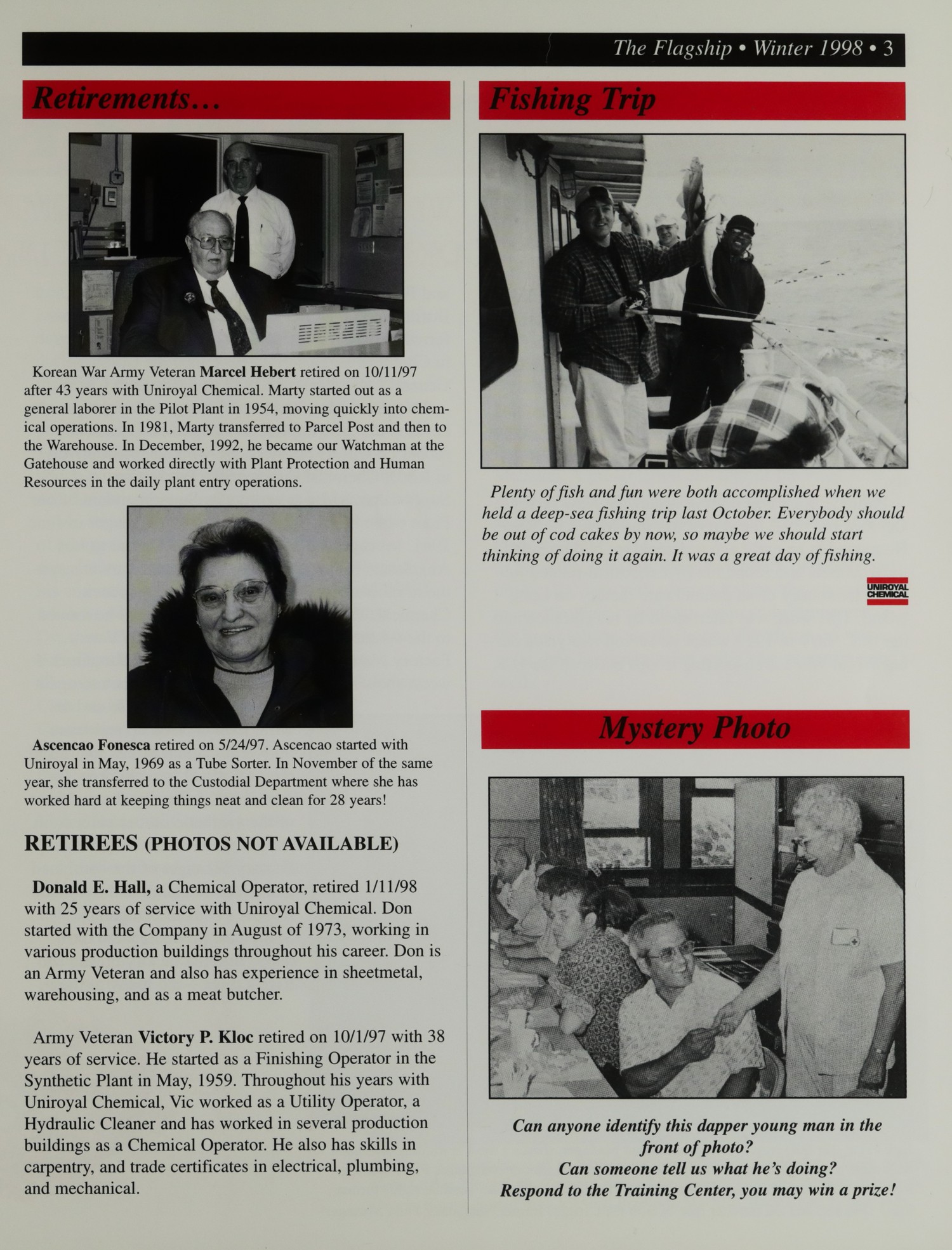
CHEM-TEXTS – Vol. 3, 1969, No. 11 – Page 1

Page 001

UNIROYAL

Merry Christmas – Happy New Year

CHEM-TEXTS

Vol. 3, 1969 PUBLISHED FOR THE PEOPLE OF UNIROYAL CHEMICAL No. 11


[IMAGE: Two people decorating a Christmas tree]

Getting ready for the Christmas season, Madelyn Malone, left; and Molly Cobbol decorate tree in lobby of Main Entrance.


Frank Hopkins To Address The Foremen’s Club

by Lou Kaiser

Frank Hopkins, Vice President and General Manager of the Chemical division will address the Foremen’s Club January 15, 1970, at the Elks Club in Naugatuck.

Mr. Hopkins will discuss the present and future busi-

[IMAGE: Portrait photo of Frank A. Hopkins]

FRANK A. HOPKINS

ness outlook for the Chemical division, and the effects of the present economic trends on the divisions and the plant’s operations.


Man Falls, Breaks Leg

by Sal Aloise

A fall from a railroad tank car resulted in a broken leg and a bruised shoulder when an employee slipped and fell backwards. The accident occurred while he was placing a recirculating hose in the dome of the tank car. As a result of the injury he will be incapacitated 8 weeks.

The second lost time accident happened when an employee caught the heel of his foot in an elevator door while he was taking a product from the 1st to the 3rd floor of the building.

Besides the two lost time accidents in November, five serious injuries were reported for the month. This rate of accidents shows little improvement over last year.

With every effort being made by the plant to improve safety, no progress will be made in the prevention of injuries unless every employee continually thinks safety and avoids taking chances.

Now that winter is here, ice and snow conditions require a greater concern for

(Continued on page 4)


Pollution Of Naugatuck River To Be Controlled

by Dick Shaw

The construction of a new liquid waste pretreatment facility at the Naugatuck plant at a cost of almost $3,000,000 has been approved by the Uniroyal Board of Directors. The new facility will control the plants pollution of the Naugatuck river.

The facilities will provide the necessary pretreatment of the plant’s waste waters and will prepare the complex mixture of chemical and water wastes for acceptance into the Borough of Naugatuck’s water pollution control facility.

Lower Cost To Taxpayer

The cooperative venture which provides for treatment of Uniroyal’s wastes in the Borough’s plant will result in lower costs to the taxpayers of Naugatuck and to the Company and will comply with the State’s Pollution Abatement laws.

Lower costs to the taxpayer will be realized since Uniroyal will pay a substantial portion of the operating costs due to the large volume of Company waste flow into the municipal plant.


[DIAGRAM: Schematic showing waste water treatment process flow, including:
– SYNTHETIC PLANT WASTE
– CHEMICAL PLANT WASTE
– NEUTRALIZATION AND PUMPING STATIONS
– WASTE EQUALIZATION TANKS
– OPERATIONS BUILDING
– WASTE WATER COAGULATION AND SETTLING TANKS
– PRETREATED WASTE MIXING TANK
– PRETREATED WASTE TO MUNICIPAL FACILITIES]

R.Smith-69

Schematic drawing shows the new waste water pretreatment facility scheduled for 1972 completion.

Location At South End

The pretreatment facilities will be constructed along the

(Continued on page 4)


[IMAGE: Industrial equipment/construction site]

At right is outflow of waste water into river. New waste water pretreatment unit will control pollution. At left is one of units used to pump waste water to model scale waste treatment unit.


Plant Loses Reclaim Sales

Tentative plans to halt production of bicycle tires and tubes, and reduce production of passenger car, heavy service, and farm tire tubes at the Indianapolis plant would affect our Naugatuck business.

Competition from foreign bicycle tires; the decline in passenger tire tubes, and competitive pressure from low cost tubes were cited as the reasons.

The proposed cutback would affect our butyl Reclaim business which is used for inner tubes.

It will also affect our sales of Aminox®, MBT, MBTS, 710 Stiffener, and Tuex chemical business. These chemicals are used in the manufacture of tires and tubes.

CHEM-TEXTS – Vol. 3, 1969, No. 10 – Page 1

Page 001

UNIROYAL CHEM-TEXTS

Vol. 3, 1969 PUBLISHED FOR THE PEOPLE OF UNIROYAL CHEMICAL No. 10


The Small Plant In A Big Plant


Exterior of Chemical Pilot Plant is deceptive in appearance. Inside it’s a maze of piping, reactors, and equipment to make new products.


by Gary Arndt

The Chemical Pilot plant, a one story brick building in the Chemical yard, is almost lost among the 142 plant buildings that comprise the Naugatuck plant. Not very impressive from the outside, the pilot plant contains some of the most modern equipment in the chemical industry. Inside is a maze of complex piping, sophisticated reactors, and control systems.

Makes Chemicals For Plant

The pilot plant, operated by the Research and Development department, serves as a small scale plant to evaluate new processes as well as to manufacture new products, preparatory to their production in large volume in the main plant. It also produces low volume chemicals where it would not be economical to build a plant and manufactures several intermediate chemicals which cannot be purchased commercially but are required for the plant’s overall operations. New experimental chemicals are also made by the pilot plant for evaluation by our customers, universities, and the agricultural industry to help develop new markets for us.


Alar® Made In Plant

A large production run of Alar Tech was recently completed. This new growth regulant prevents apples from dropping off the trees and in-


Tony Cilfone, left and Jerry Ferguson discuss the new 100 gallon reactor fitted with mechanical seal agitation and automatic temperature control.


Ben Pranulis, left, and Fran San Angelo operate basket centrifuge used to separate solids from liquids.


creases their storage life. Another chemical produced by the pilot plant is Cyclohexene Oxide, which is an intermediate chemical used in the manufacture of Omite® a new agricultural chemical, used by fruit growers to control mites from chewing up the leaves on their fruit trees.

Improves Safety And Production

The pilot plant contains some of the most modern, expensive equipment in the chemical industry to help us produce better quality products. A year ago a newly purchased Centrifuge-Dryer system, the only one of its kind here in Naugatuck, was put into use. Its purpose was not only to increase the production of Alar, but also to handle the solvent drying step in the process safely. A new 100-gallon reactor fitted with mechanical seal agitation and automatic temperature control was recently installed to improve product quality and make the operator’s job easier.

SAFETY IS MY RESPONSIBILITY


Good Morale, Housekeeping

Good morale is hard to define but it’s clearly evident among the people working in the pilot plant. A cheerful, cooperative atmosphere exists and the work-together attitude helps take the humdrum out of the daily routine of the job that everyone experiences. Also noticeable when you enter the pilot plant is the good housekeeping condition of the area. Materials and drums are properly arranged and the area is free of trash and rubbish.

Working in the plant which operates three shifts around the clock are Joe Poudrier, Bob Enamait, Harris Detlefsen, Fran Pikula, Dan Pinto, John Lydem, Julius Cohen, Marcel Hebert, Chris Owens, Al Grella, Tony Cilfone, Fran SanAngelo, Jerry Ferguson, Ben Pranulis, and Casimiro Pereira. Other members of the group are Don Bates and Julius Rek, foremen; and Bronis Zukauskas, materials supervisor. Group Leader for the Chemical Pilot Plant is Colin Walker.

CHEM-TEXTS – Vol. 3, No. 8 – Page 1

Page 001

UNIROYAL CHEM-TEXTS

Vol. 3 PUBLISHED FOR THE PEOPLE OF UNIROYAL CHEMICAL No. 9


Improvements Protect Jobs. Make Plant Cleaner, Safer.

[IMAGE: Black and white photo of industrial building with bulldozer in foreground]

Bulldozer digs out aniline sludge that caused the Main entrance roadway to sink under heavy trailer trucks.

Today, somewhere in the plant, another step is being made to protect jobs, improve safety, housekeeping, production, and working conditions. Or a new reactor is being installed to improve productivity.

Major Improvements

Major improvements this year included a new main entrance; resurfacing of the road to the main entrance, once an aniline sludge dump. The old DDM building was completely remodeled to manufacture Curalon® a new chemical curing agent.

A high cost investment was made in the recent installation of refrigeration facilities for Omite® a new agricultural chemical.

Expansion of the high pressure laboratory which researches high pressure chemical reactions is nearing completion. This new R & D facility provides the technology to improve manufacturing operations by faster reactions.

A giant step was made in air pollution control with the conversion of the plant’s power house from coal to oil.

Repairs and Maintenance

Ordinary repair and maintenance costs during the year will extend into six figures simply for general building and yard maintenance. Priority repairs made this year included refacing of the Chemical firehouse and Lotol Bldg. 76 with aluminum siding; and renovation of the Reclaim pilot plant, parcel post, small (continued on page 2)

[IMAGE: Black and white photo of paved roadway with buildings]

Solid bed of new paved and marked roadway improves safety and reduces maintenance costs. Major improvements in photo show new front entrance; refaced aluminum siding on Bldg. 76, and pollution free smokestacks.


Reclaim Dust Collectors Reduce Escape Of Lint

[IMAGE: Black and white photo of industrial dust collection system on roof]

Dust collection system nears completion on roof of Reclaim plant. The system will reduce the fiber escape from the cyclones.

by Rod Gaetz

The escape of lint from the Cracking Department of the Reclaim plant has always caused a problem in the plant and surrounding area. With the new manufacturing process used in the modernized plant which requires tires to be ground to a much finer particle size, the problem has become more acute.

In designing the new plant, the systems enclosed the mechanical conveyors, and completely enclosed processing machinery was utilized to prevent lint escape. Where it was necessary to utilize pneumatic conveying systems, cyclone separators were first installed to separate the conveying air from the product streams and leave the secondary air treatment systems until later. The reason for this was to determine from practical operating experience the (continued on page 2)


Woman Supervisor Named

[IMAGE: Black and white photo of two women at desk reviewing documents]

Anna Radowich, left, newly named Special Analysis Supervisor in the Analytical Research Lab, reviews a project with Helen Mullen.

CHEM-TEXTS – Vol. 3, 1969, No. 7 – Page 1

Page 001

UNIROYAL CHEM-TEXTS

Vol. 3, 1969 PUBLISHED FOR THE PEOPLE OF UNIROYAL CHEMICAL No. 7


Every Employee Holds Responsible Position

[AERIAL PHOTOGRAPH OF INDUSTRIAL COMPLEX]

The Naugatuck Chemical complex comprises 142 buildings situated on 90 acres of land stretched out along the Naugatuck river.


[PHOTOGRAPH: Three men in work uniforms reviewing documents]

Assistant Area Shift Foremen Mike Patrick, left and Bill Swick, right check plans for 4 to 12 P.M. shift with Guy Elwood, Area Shift Foreman. In charge of all plant operations on this shift, they are also experts in first-aid.


[PHOTOGRAPH: Men with mail cart, safety sign visible reading “HASTE MAKES ACCIDENTS”]

Don Olson, above, Joe Scullin, Bill Brewer, Clarence Parks rotate weekly on mail delivery. They make 5 tours daily in the plant; handle 140 bags of mail; and stay slim with 75 trips up and down stairs.


Today the Chemical Division at Naugatuck employs 1800 people. 925 work in the plant’s manufacturing operation; and 875 work in Divisional Sales, Research and Development, accounting and other departments.

People Make The Plant

Whatever an employee’s education, background, or position, he holds a position of responsibility in the plant’s diverse operations. People are the plant’s most irreplaceable asset. Without them, the plant’s equipment, machinery and capabilities are useless, and it would take years to replace their years of talent, experience and skill.

Every Job’s Important

To operate the plant efficiently and to provide better job security, an employee’s responsibility in doing his job properly is of extreme importance.

Whether the job is delivering mail; sorting tubes; painting; shipping materials to a customer on time; operating production equipment; packaging products; oiling machinery; purchasing raw materials; paying bills; analyzing quality; researching new products; or selling to customers, the plant would not operate effectively without every employee performing his job in a responsible manner.

Individual’s Importance

Because of the importance of an individual employee’s job, it is easy to imagine the effects on the plant’s operation if he is absent from work for an unjustifiable reason. His absence could slow down or even shut down an entire

(Continued on Page 2)

CHEM-TEXTS – Vol. 3 No. 5 – Page 2

Page 002

CHEM-TEXTS

Page 2 | Vol. 3 No. 5


FROM THE FACTORY MANAGER

Dear Fellow Employee:

During our nation’s space program RELIABILITY has become a common everyday word. Individual parts, in-fact entire systems human as well as mechanical, are tested and retested to make certain that there are no failures at critical times. This, then, is the essence of RELIABILITY — no failures at critical times.

While each of us appreciates the importance of RELIABILITY in space, we often lose sight of its equal importance right here in our plant. Each and everyone of us is a key man or woman. Everyone must function, with complete RELIABILITY to get the job done properly.

Let’s check our own RELIABILITY right now. Each of us should ask ourself what is my RELIABILITY on:

  1. Job Performance
  2. Safety Performance
  3. Housekeeping Performance
  4. Attendance Performance

What’s your RELIABILITY? Each of us can improve. Each of us must improve.

Sincerely,

John D. Evans


Hugh Garahan’s Eyesight Saved By Wearing His Safety Glasses

Hugh Garahan, center, points happily to his safety glasses which saved injury to his eyes. At left is Wes Carreiro and right, Ed Runowicz, foreman.

While removing the mixing head from equipment in the Roylar pilot plant, Hugh Garahan’s eyes were splashed by hot MDI which could have damaged his eyesight severely. Residual pressure had built up in the line and when Hugh disconnected the head, the MDI gushed out forcefully and covered his safety glasses completely. Fortunately, Hugh was wearing his safety glasses at the time and prevented serious injury to his eyes by expecting the unexpected happening. The photo at right shows his glasses.

Hot MDI completely covered Garahan’s safety glasses. Wearing them saved his eyesight.


Employees Contribute 128 Pints Of Blood To Bloodmobile Visit

Waiting their turn to contribute blood are left to right, John Paige, Pete Welch, Bernie Daily, Jim Sullivan, and Jim Doran. (Kirkendall photo).

The Connecticut Red Cross Bloodmobile made its annual visit to Uniroyal Chemical and received 128 pints of blood from employees, with nine rejections. Three employees arrived too late to contribute.

A 3-gallon pin was received by Richard Valentine. One-gallon pins went to Leo Brites, Joe Jokubaitis, Pete Lazaras, Walt Madura, Gerald Monahan, Ed Semaskwich and Harold Smith.

Other contributors were Bill Albaitis, Steve Alper, Rod Ashby, Ed Bates, Benoit Begin, John Bickerdike, Joe Biernacki, Dave Boulanger, Pete Braudis, Bob Breton, Jean Burke, Lucille Butnor, Tom Byra, Walter Campbell, Frank Carriero, Maurice Chamberland, James Chambers, Frank Chiodo, Dan Cleary, Dennis Cormier, Bob Cornell, Al Crandall, Bob Cranney, John Cronan, Austin Cross, Ted Curzi, Bernie Daily, Phil Dillon, Karen Di-Dominzio, J. Harry Donald, Jim Doran, Elliott Easterbrook, Bertha Eggleston, Sylvia Famiglietti, Bob Farrell, Joe Finke, Ed Fischer, Tom Fitzgerald, Harry Francolini, Walter Frankenberger, Bert Frennesson, Ferdinand Gagne, Mike Galante, John Gandolfo, Al Gedraitis, Norm Gibbs, John Gilbert, Walt Gnizdowski, Phil Haas, Jim Hartley, Bob Harsch, Mike Heller, Gerald Hennessey, Dick Hessler, Bill Hill, Clarence Hiser, Joe Hocheiser, Henry Hook, Don Houde, Keith Hughes, Bill Hutt, Mike Jasman, Ed Johnson, Gerald Klender, Lou Lakatos, Ben Leach, Tom Lee, Jim Loman, Len Lombardi, Frank Maffia, Milt Makoski, Tony Malone, Rocco Manulla, Mike Marinaccio, Manuel Matos, Ron Mitchinson, June Moore, Roland Morel, Phil Morin, Charles Moruska, John Nappiello, Jonas Narijauskas, Francis Nauiokas, Alex Nole, Tom O’Hara, Lee Owens, John Painter, Dick Palizay, Sherman Paul, Violet Pisani, Julius Rek, Jim Reynolds, L. Rice,

(cont’d. on page 3)


Appointments Announced

Norm Gibbs has been assigned the responsibility for General Accounting, Accounts Payable, and Office Services.

Don Turner was appointed General Accountant.

Walt Beerbaum was made Accounts Payable Supervisor.


Reclaim Exceeds 300,000 Lbs.

by Bob VanAllen

Members of reclaim production deserve recognition for their production of 349,310 pounds of reclaim rubber on June 11. Starting with the 7-3 shift on June 10, the 3-11 shift continued the production schedule started on the first shift, and the 11-7 shift on Thursday topped the 300,000 pounds goal for the first time since the modernization of the reclaim plant.

From raw stock to the finished product in the millrooms every department and person played an important role in attaining this high performance which demonstrates a capability that can make reclaim a competitive operation.

During the period of modernization, the reclaim plant had been severely upset due to the necessity to maintain production while rebuilding the facilities.

To operate the reclaim plant successfully, every person associated with the operation must strive to achieve the kind of performance demonstrated on June 11. This type of performance is the best to assure our jobs.

349,310
6-11-69

Some of the people of the three shifts in the Reclaim Production departments who helped top 300,000 lbs. production of reclaimed rubber are clockwise: Carlos Aresta, Maria Matos, Herminio Ortiz, Minic Brown, JohnHickson,Frank Rodrigues, Americo Henriques, Antonio Pereira, Joe Rzeszutek, Mike Chropcho,hidden in rear, John Zavednak and Tom Armstrong.


Bloodmobile Visit…Wednesday, July 30, 1969…St. Michael’s Parish House…12:15 to 6:15 P.M.

CHEM-TEXTS – Vol. 3, 1969, No. 5 – Page 1

Page 001

UNIROYAL CHEM-TEXTS

Vol. 3, 1969 | PUBLISHED FOR THE PEOPLE OF UNIROYAL CHEMICAL | No. 5


Good Housekeeping Prevents Plant Fires; Improves Safety, Morale, Product Quality

by Ed Weaving

What does good housekeeping mean? The words lead to thoughts first about your home or apartment. Every person prefers a clean, orderly, attractive and safe

the plant is the result of persons working together and having a care and pride in their work area, equipment and operations. As stockholders in Uniroyal – 63% of the Chemical employees

care and pride in something owned by us.

In the plant, good housekeeping means materials are neatly packaged and palleted; the work area and equipment is kept clean; and the aisles

and care for the quality of products made in the plant; leads to waste; and endangers the safety of other persons in the plant.

If a person acted as if he owned the business, his care

energies, efforts and creative talents have helped to make the plant successful in producing quality products to meet our customers’ needs.

Fire prevention and safety go hand in hand with good housekeeping. In well-kept areas, the possibility of fire is minimized; safety is improved; and work more enjoyable. In the event of a fire or an emergency the fire department can handle the situation more efficiently if the area is not obstructed by drums and pallets in the aisles. Every second is vital to the fire department’s effectiveness, but if an area is blocked, their efforts are hampered and a small incident may become a major one.

The Naugatuck plant, in a sense, belongs to every employee, whether he’s a stockholder or not. Sales, profits and job security depend upon the ability to produce quality products against major competitive companies. Good housekeeping helps do this. It prevents fires; improves safety conditions; and makes the plant a better place to work. The plant’s progress and goals for the year depends greatly on how well employees care for good housekeeping — it’s a vital factor in every operation of the plant.


BEFORE photo shows trash accumulation in front of Locker area. Nearby are 3 cans for trash disposal.

AFTER photo shows how good housekeeping makes the plant a better and cleaner place to work.


home for himself, his family and friends to an unclean, disorderly and unkempt one. But it requires work, time, and, mostly, care.

Good housekeeping in

belong to the Stock Purchase Plan – helping to keep the plant and equipment, tools and machinery in good condition is more than a mere responsibility. It’s taking good

are kept free from hoses, drums and trash. A clean work area makes work more pleasant, improves safety, morale, and quality. A dirty work area shows a lack of concern

for good housekeeping in his work area would be of major concern to him. Even employees who do not own Uniroyal stock have an important stake in the plant. Their time,


BEFORE, this basement storage room created a fire hazard, with bags, drums, and boxes strewn around the area.

AFTER, fire hazards are minimized, and safety is improved by good housekeeping.


Materials are neatly sorted in yard, showing care for safety and good housekeeping.

CHEM-TEXTS – Vol. 3 No. 2 – Page 2

Page 002

CHEM TEXTS

Page 4

The $475.00 Cup

SUGGESTION PLAN AWARDS

Gene St. John had an idea some time back about the use of the small gel cups used in the laboratory for testing purposes. Part of Gene’s job was buying laboratory equipment and material; however, not satisfied with the products available on the market, he set about the task of designing an inexpensive cup that would do the job, equally well. Much of the work was done at home. The result was a suggestion award of $475.00 based on savings when Gene’s efforts paid off.

Jacinto DaSilva of the Chemical Production department was awarded $60.00 (the balance of an $85.00 award) for his idea to change the method of washing Octamine which reduced the amount of material going to the sewer. An original award of $25.00 was made last January for this suggestion – the balance of the award is based on actual experience in material savings.

The above 2 awards were the highest out of a total of 49 suggestions considered during a recent meeting of the suggestion committee. Twelve (12) cash and nine (9) Honorable mention awards were made totaling $725.00. Other awards were:

Joseph Moniz – Digesters –
Honorable Mention

Joseph Moniz – Digesters –
$25.00


Harry Rich – Labs – $15.00
Ed Day – Labs –
Honorable Mention
Dom Angiolillo – Labs –
$15.00
Frank Wasilesky – Mech.
Stores – $15.00
N. Salinardi – Mech. –
Honorable Mention
Carmine Ianuzzi – Mech.
Honorable Mention
(3rd – $10.00)
W. Frum – Mech. – $25.00
Charles Drapko – Chem. Prod.
$15.00
George Ravenscroft, Jr. –
Mech. – $35.00
Carmine Ianuzzi – Mech. –
Honorable Mention
G. Hennessey – Chem. Prod.
$15.00
Jacinto DaSilva – Chem. Prod.
Honorable Mention
Bill Leary – Mech. –
Honorable Mention
W. Detlefsen – Chem. Prod. –
Honorable Mention
A. Giancarlo – Mech. –
Honorable Mention
A. Gedraitis – Mech. – $15.00
G. Hennessey – Chem. Prod. –
Honorable Mention

The overall figures this year represent a reduction in suggestion plan activity due to the recent strike.

Through August 1967 a total of 201 suggestions have been considered with 64 awards totaling $1,620.00 being made. During this same period there were also 23 Honorable Mention awards.


NEW SAFETY EYE PROTECTION PROGRAM TO BE STARTED

A study of first-aid cases revealed a substantial number of eye injuries, many of them potentially serious. To combat this problem the use of safety glasses will be expanded throughout the plant to include all production, maintenance and laboratory areas and all personnel who work or visit these areas.

We will expect each person to wear safety glasses at all times during his working shift except in office, rest or locker room areas. For those who require prescription glasses the company has a program of providing safety frames and lenses.

For those who do not ordinarily wear glasses we maintain a stock of “planos” that can be worn by anyone and can be obtained through his foreman. For those who have a fitting problem we will provide professional help.

We believe this program is a step forward in our continuing efforts to provide an ever safer work place. We look toward full cooperation from all of our Uniroyal Chemical people and the Safety Department is ready to help in any way it can.


Do Safety Glasses Work? The photo above shows what happened when a 1/4″ thick glass bullseye ruptured and flying glass, under great pressure, struck a fellow employee. The safety glasses cracked but did not shatter. Think about what could have happened if he did not have Safety Glasses on.


Here’s a real old timer for you — Naugatuck Chemical 1905. We are told (by an old timer, of course) that the buildings in the center of the picture are #1 and #2 buildings which are still standing. The fence running along the railroad track is located where #7 building is now located. Just about the time this picture was taken, construction was starting on #30 building (the old sulfuric acid facility) which is now the Chemical machine shop.


Two Recent Accidents Mar Record

Here is a brief description of two lost-time accidents which occured during the last week in August…We outline them here in the hope that having read what can happen, you will work with care.

An operator in the pilot plant was running material through a granulator when a cloth being used to contain the dust fell down. When the operator attempted to tuck the cloth back into place, his hand pushed too far into an opening in the back of the machine. The arm on the flywheel caught his left middle finger against the body of the granulator smashing the tip, resulting in a partial amputation.

A truck driver was helping in the loading of 16 inch diameter pipe. Two sections were already on opposite sides of the truck to balance the load. When the truck driver moved to one side of the truck, one section of pipe rolled across the truck body and crushed his right ankle against the other section, causing a fracture.


CLEANER AIR WEEK

[IMAGE: Logo showing “CLEANER” with numbers 12, 9, 3, 6 around it and text “ROUND THE CLOCK”]

OCTOBER 23-29


From an Unexpected Quarter

An old rifle-bought to be part of a firearms collection – went off in the hands of its owner and severely injured a person nearby. No one had even thought to find out whether or not the rifle was loaded!

On the job, we are trained to be on the lookout for all the “normal” hazards. Its the totally unexpected condition that sometimes fools us.

Even if you have the best accident-prevention program in the world, remember this: safety in a department depends largely on the alertness of every individual who works there.


FIRE DEPARTMENT ASKS COOPERATION FOR WINTERIZING

With the thoughts of summer vacation still fresh in our minds and several weeks of pleasant weather still ahead, it may be a little difficult to think seriously about winter weather and freezing temperatures. Our plant fire department, however, has to think about it as this is the time of year when they begin preparing their equipment for winter. Certain valves must be shut – outside sprinkler systems filled with anti-freeze; air valves controlling other outside fire protection piping must be checked to be sure it is in proper working order. All plant structures must be inspected to make sure all openings, broken windows, etc., are closed up. This is where you can help by making sure all windows and doors in your work area are in good condition and above all, make sure they are closed up at night. An open window next to a sprinkler line can cause a freezeup even if the building is heated.

A little preventative care and maintenance by all of us can save a great deal in loss or replacement of vital fire protection.


1967 SAFETY BOX SCORE 8 MONTHS THROUGH AUGUST 31

1967 1966
Lost-Time Injuries 8 12
Serious Injuries 37 40
Total 45 52

The fact that our injuries are somewhat less than last year’s record high total is no reason to relax our safety efforts. In August we doubled our previous total of 4 lost-time injuries. In addition, we had 8 serious injuries and several near-miss incidents.

Near-misses are warnings of something gone wrong! If you had one recently it could as easily have been an accident. Don’t take that chance – work safely.


SALESROOM NOTICE

The employee salesroom on Rubber Avenue has announced a special mattress sale from September 15 through October 13, 1967.

Mattress and box spring

Twin and full size — $ 66.00
Queen size 60×80 — 92.75
King size 72×84 or 76×80 — 133.25


UNIROYAL Chemical
Naugatuck, Connecticut 06770

U.S. Postage
PAID
Permit No. 10
Naugatuck, Conn. 06770

CHEM-TEXTS – Vol. 2, No. 4 – Page 1

Page 001

UNIROYAL CHEM-TEXTS

Vol. 2 PUBLISHED FOR THE PEOPLE OF UNIROYAL CHEMICAL No. 4


United Givers Goal, $20,000 “Give Where You Work” Urged

Ron Mitchinson, Chairman of the United Givers Campaign to be conducted in the plant during October, urges 100% employee participation and “Give Where You Work” to support the 16 worthwhile Agencies in the Fund. Many of these Agencies serve not only Naugatuck and Beacon Falls, but most of the surrounding towns in the area. Some like the U.S.O., Salvation Army, United Cerebral Palsy and Red Cross are national in their service.

Most plant employees and their families have been served by one or more of these organizations. Their need for money this year is greater than ever to continue their good work. By giving “where you work” and contributing through the payroll deduction plan at least one hour’s pay monthly for wage employees or 1% of annual income for salary employees, the plant goal of $20,000 can be easily reached.

In the 1967 Campaign 67% of Chemical employees contributed $17,775. About 560 employees did not contribute. On the Pledge card every employee will find at least one Agency which he or his family wants to help support.

The Campaign Committee is E. Alves, S. Gillette, E. Johnson, W. Tavelle, L. Lombardi, D. Miller, J. Rzeszutek, and R. Van Allen. Close to 100 Co-Captains will contact every employee during the Campaign.

Co-Captains are B. Sullivan, E. Evans, L. Taranowich, L. Soares, M. Rosa, H. Steele, N. Krenitsky, J. Valinho, P. Tortorici, M. Chmielewski, J. McKee, G. Browning, E. Jancis, B. Perkins, C. Fernandes, P. Braudis, A. Ferro, W. Jones, T. Brett, R. Mastromatteo, R. Cote, C. Buckley, R. Harsch, P. Hinckley, D. Malloy, W. Parks, J. McGinn, I. Prager, R. Farrell, W. Smith, J. Phelan, W. Singleton, R. Amidon, W. Budd, G. Arndt, P. Murray, L. Flynn, F. Adams, E. Cheney, R. Lestage, G. Birch, H. Hook, F. Rodrigues, W. Campbell, H. Francolini, D. Poehailos, H. Lynch, R. Ames, C. Reich, L. Terra, A. Pistarelli, M. Paiva, D. Rappe, A. Nauges, T. Skehan, R. Foltz, B. Dunn, J. Rice, J. Bucciaglia, K. Dowling, R. Magnamino, F. Magnamo, E. Ruella, R. Breton, J. Bielak, J. Honyotski, D. Cowan, R. Valentine, D. Gabriel, R. Kaiser, J. Charkow, C. Roland, R. Manulla, J. Wojtczak, W. Bieleski, R. Magnamo, F. Enamait, S. Perkus, J. Sullivan, T. McMahon, W. Leukhardt, J. Quint, L. Nappiello, D. George, Geo. Arndt, H. Scullin, F. Lynch, J. Murtha, A. Juliano, J. Vergosen, R. Terino, E. Weaving, S. Aloise, F. Sabia, and J. Tierney.


One gift works many wonders

[IMAGE: Young child’s face]

GIVE THE UNITED WAY


[IMAGE: Industrial facility with storage tank and buildings]

Size of new 300,000 gallon oil storage tank and steel dike is shown partially on left, compared to rest of boiler plant. In center is the new fuel oil transfer and heating facilities building.


Boiler Plant Converts To Oil Reduces Air Pollution In Area

Another major step has been taken by the Chemical division to reduce air pollution in Naugatuck and surrounding towns by using oil instead of coal in its boiler plant. This conversion will reduce air pollution by virtually eliminating the large amounts of fly-ash now discharged from the two smoke stacks. The plan also incorporates future improvements in air pollution abatement.

The new 300,000 gallon fuel oil storage with a protective dike surrounding it, has already been installed above ground on the south side of the boiler plant where the coal pile was formerly located. A new fuel oil transfer pump house will unload the fuel oil into the storage tank. The tank will take care of a 6 days supply during the heavy winter load.

The tank sits on the earth rather than a concrete foundation. Before construction, the huge coal piles had to be removed, and a 6 ft. deep excavation made. The 6 ft. “hole” was filled with layers of gravel, vibration rolled and wet down to 95% compaction to give a rock base foundation.

Working on the project were George Arndt, Utilities Engineer, responsible for the overall planning of the project. Vic Anderson was Control Engineer for instrumentation and electrical equipment; Paul DeAngelis was in charge of piping layout and design; Frank Gaizutis supervised structural engineering of the project. Charles Hescheles of Corporate Engineering provided specialized assistance on the project.


SAFETY IS MY RESPONSIBILITY

CHEM-TEXTS – Vol. 2 No. 4 – Page 2

Page 002

CHEM TEXTS

Page 2 | Vol. 2 No. 4


FROM THE FACTORY MANAGER

Dear Fellow Employee:

Within the next several weeks we will each be contacted by one of our friends to make our annual pledge to the United Givers of Naugatuck and Beacon Falls.

Experience has proven that this once-a-year campaign is the most efficient way of providing funds for sixteen volunteer agencies that serve the people of our area. I am, however, concerned that the convenience of this method of giving may tend to lessen our generosity as givers. May I suggest that we each use the following guidelines in making out our pledges?

1) Review carefully the agencies presented on our pledge card and the details of their needs and services as described in the United Givers folder.

2) Consider the services that we, our family, our friends and neighbors receive from these agencies. Note that many of the agencies serve an area broader than the campaign towns. Some are even national.

3) Use the Work Sheet on this page of CHEM-TEXTS to work out our pledge on the payroll deduction plan. This method makes it convenient to give our share on a year-around basis.

4) PLEDGE! Before filling in our card – ask ourselves one question – “Have I given until it feels good?

[Signature]

John D. Evans


HOW MUCH SHOULD YOU GIVE TO THE UNITED GIVERS DRIVE

A few years ago, somebody knocked on your door almost once a week for a contribution to a worthy cause. You probably contributed $30 to $50 to these organizations.

Through the United Givers Fund your continued generous support of most of these organizations can now be done on a once-a-year basis through the Company’s payroll deduction plan.

To determine your contribution for 1969, this work sheet, listing the 16 participating agencies, will help you decide the amount of your gift.

Agency Gift amt. if contacted separately
American Red Cross $_____
Child Guidance Clinic $_____
Children’s Center $_____
Conn. Trails Council,
Girl Scouts of America $_____
Catholic Family Serv. $_____

Family Serv. Assoc. $__
Mattatuck Council,
Boy Scouts of America $
____

Naugatuck Jr.
Athletic Leagues $__
Salvation Army $
_
United Cerebral Palsy $

U.S.O. $

Waterbury Assoc. for
Retarded Children $

Y.M.C.A. – Naugatuck $

Total Amount $
___

By dividing the number of payroll deductions into your total amount, you obtain the amount you should pledge. For salary employees, payroll deductions will be made monthly; and for wage employees, deductions will be weekly.

The Naugatuck plant always contributed generously in the past to these worthwhile agencies. Because of their increased services and expenses they depend more on us for 1969.


New Assignments Made in Plant

Fred Wintsch has been appointed Labor Relations Manager for the Naugatuck plant. He will be responsible for employee relations, reporting to Ron Mitchinson, Industrial Relations Manager.

[PHOTO]

Sam Gillette, formerly General Foreman at the Synthetic rubber plant, moved to the Chemical production as General Foreman reporting to Jim Cronin, Superintendent.

[PHOTO]

Eric Johnson, named General Foreman of the Synthetic rubber plant, will supervise production of synthetic latexes. He reports to Ben Leach, plant Superintendent.


[PHOTO]

The new 300,000 gallon oil storage tank and steel dike dwarfs members of the Engineering department as they inspect the 29 ft. high structure, south of the boiler plant.


[PHOTO]

Plant personnel involved in the boiler plant conversion project are left to right: Vic Anderson, Paul DeAngelis, Bill Maguire, Joe Mambrino, Frank Gaizutis and George Arndt, shown checking fuel oil connections.


Special Winter Tire Sale

A special two month winter tire sale for active and retired employees will run from October 1 to November 30, 1968.

The sale is on winter patrol snow tires only and offers considerable savings below existing employee prices.

Lists of the special low prices can be obtained from the Industrial Relation’s Department or Employee Salesroom Managers.


August Injuries Continue High

This chart shows our injuries for the month of August and indicates the departments where these injuries occur. Although it seems that plant personnel incur a large amount of minor injuries, we must do our utmost to reduce these injuries and particularly to prevent their recurrence by a greater awareness of safety. We must at the same time have all minor injuries checked by the plant hospital.

A minor injury remains a minor injury only if it’s taken care of immediately. All injuries promptly cared for, cause less discomfort and pain to the individual and will help avoid the danger of infection and complications.

Remember to report all injuries and receive prompt first aid at our plant hospitals. Most important, however, is a greater safety awareness of an “unexpected happening” before and while performing your job.


AUGUST 1968 – INJURY LOG SUMMARY

DEPARTMENT EYE BRUISE FRACTURE CUTS & ABRASIONS AMPUTATIONS BURNS CHEMICAL BURNS Sprains Back Sprains DUST OR FUMES SLIVERS DERMATITIS TOTAL
CHEMICAL PRODUCTION 4 4 8 3 4 3 1 2 29
RECLAIM PRODUCTION 1 8 12 3 4 1 1 30
SYNTHETIC PRODUCTION 4 3 1 2 1 11
MATERIALS HANDLING 5 4 8 2 1 3 2 3 2 30
MECHANICAL (CHEM) 5 5 1 22 7 2 5 1 14 1 63
MECHANICAL (SYN) 2 5 17 6 6 5 1 42
RESEARCH & DEVELOPMENT 4 2 13 2 3 3 5 1 1 34
OTHER 2 1 34
AUGUST TOTAL 21 32 1 85 0 24 10 26 4 7 23 9 242
8 MONTH AVERAGE 1968 22 32.5 1 82 0 19.5 9.25 18 8.25 4 28 10.5 235
8 MONTH AVERAGE 1967 28 42 1 90 12 19 14 23 9 4 27 9 267

SAFETY IS MY RESPONSIBILITY

CHEM-TEXTS – Vol. 2 No. 5 – Page 2

Page 002

Page 2 CHEM TEXTS Vol. 2 No. 5


FROM THE FACTORY MANAGER

Dear Fellow Employee:

Technological advances, especially those over the past twenty to thirty years, have rapidly outpaced our ability to understand each other. While new communication devices, such as television and the computer have expanded our ability to send messages faster, little has been done to make sure that these messages are received, for a message is communicated only when it is understood and the intended purpose of the message is accomplished. Man’s inability to complete this communication cycle is largely responsible for the many problems that face society today.

The recent company-wide survey conducted by Opinion Research, in which many of our people took part, has confirmed that we in UNIROYAL are no different in this respect. To accomplish our purposes of growth and job security for all we must — send, receive and thereby reach understanding of our common objectives. While our efforts may be aided by CHEM-TEXTS, letters and other tools, success can only be achieved if we each, as individuals, regardless of our jobs, learn to talk to each other. We must-always remember that communication is a three-way street — UP, DOWN and SIDE-WAYS. While we each may momentarily have different points of view, fair interchange of these points of view will always clarify the larger purpose.

Sincerely,

John D. Evans


Moniz’s Hard Hat Prevents Injury

[IMAGE: Photo of Joe Moniz showing hard hat to Sal Aloise]

Joe Moniz, left, shows Sal Aloise of the Safety Department the lump of hard rubber which fell 15 feet onto his hard hat.

Recently Joe Moniz reported to work for the 11-7 shift in the Reclaim Digesting Department. He changed clothes and put on all his proper protective equipment for his job: safety shoes, safety glasses and hard hat. Joe didn’t expect an accident that night but he was prepared for the “unexpected happening”.

While opening a chain valve, a large piece of rubber fell 15 feet and would have hit his head. Fortunately, his hard hat prevented a very serious head injury. Moniz’s hard hat saved him and his family considerable anguish and suffering because he wore the proper safety equipment for his job.


Company Sets Third Quarter Records For Sales And Income

Uniroyal, Inc. set new records in sales and net income both for the third quarter and the first nine months of 1968 despite heavy start-up expenses for several new plants under construction in the United States and abroad, George R. Vila, chairman and president, reported today.

Net income for the third quarter was at a record $12, 769,000 or 91 cents per common share, 68.8 per cent above the $7,563,000 or 51 cents a share reported last year.

Net income for the nine-month period was $42,650,000, equivalent to $3.11 per share of common stock, an increase of 128.5 per cent compared with the $18,663,000 or $1.20 per common share reported during strike-marred 1967.

Sales and operating revenues for the third quarter were $341,874,000, an increase of 18.4 per cent compared with the $288,804,000 reported last year.

Sales and operating revenues for the nine months totaled $1,060,659,000, a gain of 14.3 per cent compared with $928,320,000 in 1967.


PINK COLOR CARS ARE THE SAFEST

A Swedish color expert surveyed 31,000 auto collisions and found that black cars are up to 10 times as likely to be involved in accidents as light or bright colored autos.

Pink was the safest car color, involved in only 2.0% of the accidents.


Special Xmas Offer: Royal Golf Balls

A special Christmas offer of ROYAL Golf balls is available to all Company employees. Orders should be placed with the Employees’ Salesroom on Rubber Avenue from now till Dec. 15.

Prices per dozen are: ROYAL Plus at $9.25; ROYAL at $9.25; ROYAL Red at $9.25; ROYAL Queen at $9.25; and FAIRWAY II at $5.45.

The bonus golf ball policy does not apply on this special offer.

Next to black, the most dangerous colors were all shades of brown and gray. Dark colors were more susceptible to collision because they are the hardest to see against a background of trees or buildings, especially at dusk.


New Maintenance Control Center Speeds Up Repairs

In October, a new maintenance control center was initiated at the Chemical plant for the planning and scheduling of work in the Chemical and Reclaim plants. The Center is similar to the Synthetic control center which has been in operation for five months. The center will be in Bldg. 7 and manned by a staff of four people.

The basic purpose of this system is the organization of communications to and from the maintenance department and all other related plant departments requiring service. With this central control of information, it will be easier to plan and coordinate related work, establish priorities, and take advantage of the flexibility of crews. In addition, job information is accumulated for incorporation with electrical data processing which collects data and disseminates

[IMAGE: Photo of four men at control center]

Receiving and transmitting job orders, and recording data for job information are l to r: Frank Gariano, Pat King, Al Manzi and Frank Zettlemoyer. Receiving information from the Center is Tom Dowling.

reports for future job planning, preventive maintenance evaluation and budgeting.

The broad objectives of this system are: 1) to provide

better service; 2) minimize lost time; 3) reduce maintenance costs; and 4) optimize use of manpower, tools, equipment and material.


Board of Directors Recommend 2 For 1 Stock Split

The board of directors of Uniroyal, Inc. voted to recommend to stockholders that the present common stock of the company be split two shares for one, George R. Vila, chairman and president, announced.

The board called a special meeting of the stockholders for January 14, 1969, to obtain stockholders’ approval of the proposed split.

The board declared a quarterly dividend of 30 cents a share on the common stock, payable December 24 to stockholders of record November 25. The board of directors also announced that

it intends to declare a quarterly dividend of 17.5 cents a share on the newly split shares. This would represent an increase in the quarterly dividend from 30 cents to 35 cents a share on the present shares.

At the January 14 meeting, the stockholders will also be asked to act on the board’s recommendation to increase the number of authorized common shares from 30 million shares with a par value of $2.50 each, to 60 million shares with a par value of $1.25 each and to abolish preemptive rights applicable to the company’s common stock.

The board recommended the stock split with the expectation that it would broaden the market for the shares and increase the number of shareholders. The company now has approximately 49,000 common stockholders.

At the board meeting the directors also declared a dividend of $2 a share on the first preferred stock, also payable December 24 to stockholders of record November 25.


SAFETY IS MY RESPONSIBILITY

CHEM-TEXTS – Vol. 2 No. 5 – Page 3

Page 003

CHEM TEXTS

Page 3 | Vol. 2 No. 5


Harry Witt Heads Synthetic Production

Harry Witt has been named Synthetic Production Superintendent, effective Dec. 1. Ben Leach becomes Manager of Colloidal products in the Research and Development Dept.


How You Can Obtain A Pair Of Safety Prescription Glasses

Fred Mayo of the Process Development Lab. selects frames for safety prescription glasses from Adeline Farrar R.N., Chemical Hospital nurse.

The Naugatuck plant has a program which is operated by the Safety Department to enable all Chemical division employees to obtain prescription safety glasses at no cost to the employee, except for the examination and fitting fee.

The procedure is simple. An employee may go to either the Chemical or Synthetic hospital and obtain a prescription safety glass form from the nurse. He takes the form to his own eye doctor and has an examination. The employee pays for the cost of the examination and returns the completed form to the plant nurse. At this time he may also select the frame he prefers from samples in the hospital. The Company then sends the prescription to the Wilkie Optical Company and purchases the glasses.

Effective January 1, 1969, all prescription glasses will be returned to the doctor or optician of your choice for proper checking and fitting. In some cases an additional fitting charge may be made, depending upon the agreement you have made.

Here are other facts you should know: 1. You may buy an extra pair of glasses for yourself, if you wish and take advantage of our Company discount, provided the prescription is less than one year old. 2. You may also purchase prescription sun glasses at the same discount. 3. You may obtain a free pair of glasses whenever you require a new prescription. 4. Lenses or frames damaged as the result of an accident in the plant are replaced free of charge.


[PHOTO CAPTION:]
Uniroyal Chemical’s United Fund Campaign Committee looks at the “thermometer” showing the results of the drive at the plant where employees topped their goal by 103%. Left to right are Doug Miller, Sam Gillette, Bob VanAllen, the Industrial Division’s Chairman; Joe Kresziutek, Ron Mitchinson, pointing to the $20,646 figure and Bill Lavelle. Other committee members not in the photo were Ed Alves, Eric Johnson, and Len Lombardi.


Employees Contribute $20,646. Top United Givers Goal By 103%

Ron Mitchinson, Chairman of the United Givers Campaign at the Naugatuck plant announced the results of the Chemical Plant’s drive. Employees contributed $20,646 or 103%, topping the plant’s Goal of $20,000. This surpasses by almost $3,000 the previous high of $17,737 contributed by employees to the 1967 United Givers Drive. The success of this year’s campaign can be attributed to the enthusiastic efforts of the Campagin Committee, the ninety-five Co-Captains, and the generous support of the Chemical division employees.


Accidents Continue At High Rate

In the ten months of this year, 79 lost time and serious injuries have occurred. Most of these resulted from a careless act or operation. We each must accept responsibility for our own actions and the safety of all.

MONTH LOST TIME SERIOUS IN-JURIES TOTAL
JANUARY 2 2 4
FEBRUARY 3 5 8
MARCH 2 6 8
APRIL 2 6 8
MAY 0 11 11
JUNE 0 7 7
JULY 2 7 9
AUGUST 4 4 8
SEPT. 0 8 8
OCTOBER 2 6 8
TOTALS 17 62 79

New Food Vendors Service Plant

By Monday, December 2nd, all food and beverage vending machines in the plant will have been replaced with brand new machines to provide plant employees with better food service.

The new firm, Indiana Vendors, has proposed several basic changes which will eliminate the problems we have experienced in recent months; machines out of order, empty or not giving the proper change, and food often neither fresh nor of uniform high quality. There will be an on-site maintenance man who will be in charge of keeping all machines operating properly in all respects. All food will be prepared and wrapped in the Synthetic Plant kitchen facilities. This means that food in the machines will have been prepared an hour or two before being put into the vending equipment. It also means that when more departments than usual are scheduled to run over a weekend or holiday, extra sandwiches can be prepared at the last minute and placed in the machine. If a machine runs out at 2:00 P.M., it can be filled again before the next day.

The machines will be the latest in design and efficiency. Take the office machines for example. You put your coin into the machine, select the way you want your coffee, and receive a cup of fresh, perked coffee. The machines operate on 1/3 lb. cans of Maxwell House coffee — exactly the same grind you buy for home use. Approximately 20 cups are perked and then transferred to a holding chamber. After a preset length of time, a new batch is perked and any coffee remaining in the hold chamber is dumped. The coffee you buy is always fresh. No more instant coffee.

The food machines will also hold a wider variety of food. Soup will be sold with the can, bowl, spoon, crackers and napkin as a package — you’ll never run into the situation where, having purchased a can of soup, no spoon or dishes are available.

Some of the areas in the plant will be expanded or have more versatile machines such as canned soda or a flavor ice vending machine — the vending area in Reclaim Bldg. #1 will have a sandwich machine, for example, and a coffee machine will be put into the Chemical Machine Shop, where up to now only a cigarette machine has been in operation.

In short, new and better machines, with better service and more and better food, to give us the best food service arrangement possible.


ALANAP AND DYANAP (con’t.)

(CONTINUED FROM PAGE 1)

sive advertising and promotion program for our distributors and dealers. Grower meetings will be conducted by our sales force, demonstrating the advantages of Alanap and Dyanap over competitive products.

Quality products play an extremely important role in the agricultural business. A poor quality product damages a grower’s crop, the reputation of the product and the Company. Important also in the farm market is good packaging. It either helps or reduces our sales. Dented or stained cans, torn and dirty bags convey the impression of poor quality and workmanship in the customer’s mind. Good quality and good packaging can help make 1969 a big year in Alanap and Dyanap sales.

SAFETY IS MY RESPONSIBILITY


Clark Retires From Mechanical

Ed Clark, left, is congratulated by Bill Lannon, Foreman of the Instrument Department. Clark, an instrument man in the Mechanical Department, retired recently after more than 22 years with the Company.

CHEM-TEXTS – Vol. 1 No. 3 – Page 3

Page 003

CHEM TEXTS

Vol. 1 No. 3 | Page 3


Materials Department Saves Shoe Leather

Supervisor Frank Lynch is shown below with the first bicycle recently acquired by the Materials department. The vehicle is saving considerable walking and enables the supervisors in the department to save a lot of time in getting around the plant. Since this picture was taken, the department has received two additional bicycles and several other departments have indicated an interest in this method of in-plant travel.


Fireman On The Job 55 Years

On Monday, October 2, a fire in a bale of rubber in Mill Room “C” of the Reclaim production department touched off 3 sprinkler heads. The fire was contained by the sprinkler equipment and extinguished by the fire department with no resulting damage. When the spent heads were replaced one of them was found to have a 1912 date (all sprinkler heads are stamped with their date of manufacture and back in those days were installed the same year they were produced).

Our insurance carrier has suggested that we replace all of the old sprinkler heads in the Reclaim department with modern up-to-date units. This project will get underway soon; meanwhile, the old timers on the job after over 50 years still give us 100% protection.


Old Timers Corner

Approximately 1934 – our Laboratory group – how many do you recognize? First Row: l to r: C.S. Johnson; J. Brandien; G. Gesslander; J. Breachevelt; E. Anderson; H. Reardon; L. Sokoloski; P.H. Watkins; H.C. Miller; A.W. Holmberg. Second Row: R. Evans; C. Durbin; R. Palomski; J. Smey; A. Maine; A. Sears; M. Moriarity; I. Schildgen; E. Deady; P. Jillson; L. Meuser; F. Holbrook; E. Burns; H. Newman; A. Bernard; P. Leaper. Third Row: F. Mikalchus; J. Fairbanks; H. Bassford; J. Titley; H. Monroe; A. Smey; D. Fowler; M. Shepard; A. Anderson; V. Smith; M. Aeschbach; J. Marnuccio; W. Miller; M. Booth; F. Cretella; A. Rau; W. Messer. Fourth Row: D. Valvo; W. Gillich; C. Holt; H. Edmon; T. Lynch; R. Grele; D. Volpe; J. Murtha; E. Weaving; J. Convard; J. Ash; A. Pistarelli; K. Rappe; J. Worrell. Fifth Row: L. Sequenzia; B. Lynch; O. Blomquist; L. Steinle; W.G. Kirby.


PLANT EMPLOYEES EARN DEGREES

Earl Wright | Pat DePaolo | Fred Wintsch

Earl Wright, Pat DePaolo and Fred Wintsch all have something in common – a college degree earned in 1967.

Earl was awarded his BS degree in Industrial Management from Quinnipiac College in New Haven. He came with us in 1946 as a trainee in the Kralac department of Chemical Production. He was made a foreman, 2nd class in 1959, 1st class in 1961 and an area foreman in 1963.

Pat earned his master’s degree in chemistry from Southern Connecticut State College. He was employed in 1963 and worked in the Research and Development department prior to his recent transfer to the Sales Department. He earned his BA degree from Univ. of Mass. in 1963.

Fred was awarded a Master’s Degree in Management from Rensselaer Poly. Inst. branch in Connecticut. He graduated from Union College in Schenectady, N.Y. in 1962 with a BA degree in Industrial Administration. He came with the company in 1963 as a time study man in the Industrial Engineering department. He is presently a supervisor in the Industrial Relations Department.

The degrees were earned under the Company’s tuition aid plan.


SPORTS….

Basketball… Two teams are being formed again this year for entry into the Industrial Council League. Practice sessions have been held at the YMCA and league play began on Wednesday, December 6 at Hillside Junior High School. Anyone interested in joining a team should contact J. Prior at Ext. 575 at Synthetic or Bob Pettigrew, Ext. 692 at Chemical. The two teams were active in the league last year with the Chemical team winning the championship.

Bowling…
Friday Nite Alembic League
With 3 weeks of bowling left before the end of the first round, Chemical Production is enjoying a comfortable lead. The standings:
1. Chem. Prod. – 23-7
2. D & G – 19-11
3. Dust Collectors – 18-12
4. Office – 17-13
5. Syn. “Odds” – 16-14
6. Pipers – 12-18
7. Syn. “Evens” – 10-20
8. Tinners – 5-25

…Tuesday Nite Alembic League

Team Standing Won Lost
Office 27 17
Production 25 19
Rubber Testing 22 22
Development 21 23
Bethany Lab 21 23
Hi Fi 21 23
Lab 21 23
Engineers 19 25

A Big Spender

In the last five years the company has invested an average of 80 million dollars a year in expansion and modernization. In addition, we purchase from 17,500 companies, large and small, more than 600 million dollars worth of materials, supplies and services a year. Much of this is spent in communities where the company operates plants. These purchases, added to payrolls, taxes and other payments, pour more than a billion dollars a year into the nation’s economy.


1967 Safety Box Score

10 Months Thru October 31st

1967 1966
Lost Time Injuries 14 19
Serious Injuries 47 58
Total 61 77

Our on-the-job record of injuries continues at an unsatisfactorily high level. If the present rate continues, 1 out of every 10 workers in the plant will be involved in a serious injury in 1967. We must all decide now to do everything within our power to make Uniroyal Chemical a safer place to work.

This means we must do our jobs in the safest way possible – no shortcuts, no taking chances and no inattention. Each of us must concentrate on performing his part of the operation to the best of his ability while obeying the rules of safety required for the area.

At Press time, three more lost-time accidents have taken place in early November. Only you can stop this record from climbing higher.


Tire Tip

For long tire mileage and safety, our tire engineers recommend checks of tire pressure at least once a month. Such checks should be made after the car has stood for three hours or has been driven less than a mile. By the way, air pressure should not be reduced in a warm tire after a long trip. Air pressure naturally drops as tires cool down.


Garnet Gleam of the Air

Uniroyal Chemical is again sponsoring the high school radio program “Garnet Gleam of the Air”. The program, produced by Naugatuck High School students, is broadcast over radio station WOWW at 1:00 P.M., Sundays.

CHEM-TEXTS – unknown-s238

Page 238

CHEM-TEXTS

Page 3


Synthetic Plant Dismantled

The Synthetic Rubber plant is nearing the final stages of dismantlement. In the reactor area above many of the tanks and salvageable equipment have been removed.

The Federal Equipment Co., of Cleveland, Ohio, who purchased the plant for resale, has been shipping the tanks and useable equipment to all parts of the country and overseas.

The Hortonspheres, which were navigational landmarks for airplane pilots, have been carefully cut, piece by piece, prior to shipment to Canada for re-erection.

Thomas Ennis of the Plant Engineering department is in charge of the operation which has been going on for several months.


Pallets Avert Mishap

Thomas Carey points to the broken support under a tank trailer, loaded with a caustic byproduct.

The Materials Department has found a new use for old pallets as safety supports under tank and trailer trucks.

The pallets have already saved thousands of dollars when the support of a tank trailer filled with a caustic byproduct collapsed between Bldg. 118 & Bldg. 18. Besides the loss of the material, the spill would have interrupted the operation of the pretreatment plant.

To prevent recurrences of such mishaps it has been made a standard safety practice to place the old pallets under the trailers.


2,000,000 Manhours . . .

continued from page 1

Safety Record & Costs — 1966 to 1975

in 1975 they had dropped to $100,000.

Since the plant is self-insured, its insurance costs per 100 hours were high because of the frequency and severity of the accident. These costs adversely affected the profits of the plant.

Lost Time Serious Injuries Total Total Costs
1966 21 84 105
1967 22 56 78
1968 20 68 88
1969 23 56 79
1970 6 66 72
1971 20 63 83 $231,567
1972 11 62 73 $275,641
1973 9 24 33 $199,682
1974 4 23 27 $238,359
1975 3 26 29 $ 95,307

New Sewer System Reduces Pollution

by Richard Shaw

When the new $3,000,000 liquid waste water pretreatment plant went into full operation it became necessary to start work on the next major item of water pollution control, the separation of the storm and process sewers. The entire project will cost about $1,500,000.

The Chemical plant was built with only one sewer system which carried all the process waste, sanitary waste and storm water to the Naugatuck River. The sewer system is now connected to the pretreatment plant

$1,116….

continued from page 2

Pasquale Tortorici, Reclaim, was presented $168. Eleanor Chmielinski, Research and Development received $156. An award of $100. was given to Lawrence Fortier, Chemical Production.

All Employees Eligible to Submit Ideas

Any employee may participate in the Idea Plan. It’s a simple way to earn extra money by recommending improvements in the way things are done.

Awards are made for suggestions on production improvement, equipment changes, materials handling, waste reduction and other areas.

The minimum award for an Idea is $25.00. There is no limit on the maximum award.

The new sewer separates the rain and process waters. It will carry the rain water to the river and prevent an overflow at the Pretreatment plant.

and during periods of heavy rain or snow melt there is too much water for it to handle. Some of the water must overflow to the river carrying some process waste with it.

To prevent the overflow the plant is installing a separate sewer system for storm water which will collect water from the building roofs and the yard areas and carry it directly to the river.

Storm sewers will be installed continued on page 4


Breen’s

The Biggest Little Store In The Country
Visit our four floors
of famous brands for him and her.

Cosmetic & Jewelry Dept.
Guerlain
Elizabeth Arden
Nina-Ricci
Chanel
Yves Saint Laurent
Monet
Napier
Marvella Pearls

Lingerie Shop
Vanity Fair
Olga—Barbizon
Schrank Robes
Shadowline

Ski Boutique
Ski Jackets
Warm-Up Slacks
Ski Pants
Ski Sweaters
Gloves & Sweaters

Jr. Sportswear
Collegetown Sweaters
White Stag—Skirts, Slacks
Davis Coats
Peerless Sportwear

Men’s Shop
Manhattan Shirts
Botany Suits—Sport Coats
H. Freeman Suits
London Fog Rainwear
Florsheim Shoes
Jaymar Slacks

Ladies’ Dept.
Couture Coats
Tanner Dresses
Vanity Fair Lingerie
Joyce—Naturalizer Shoes


Chittenden Insurance Agency, Inc.

Insurance—Mutual Funds—Real Estate

180 Church Street
Naugatuck, Connecticut
Tel. 729-8209

Frederick D. Zonino Nathan M. Pierpont, Jr.