CHEM-TEXTS – Vol. 3 No. 4 – Page 3

Page 003

CHEM-TEXTS

Vol. 3 No. 4 Page 3


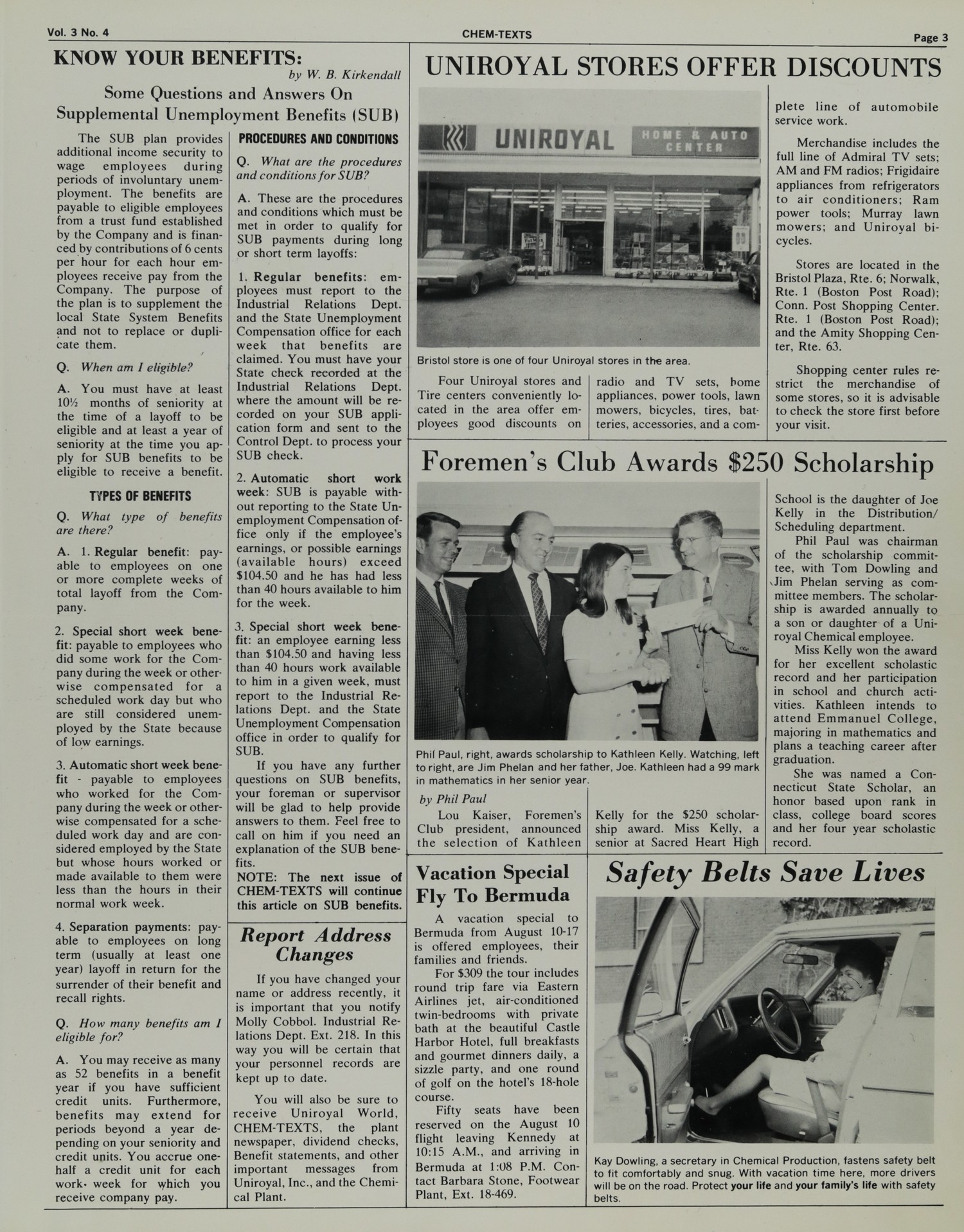
KNOW YOUR BENEFITS:

by W. B. Kirkendall

Some Questions and Answers On Supplemental Unemployment Benefits (SUB)

The SUB plan provides additional income security to wage employees during periods of involuntary unemployment. The benefits are payable to eligible employees from a trust fund established by the Company and is financed by contributions of 6 cents per hour for each hour employees receive pay from the Company. The purpose of the plan is to supplement the local State System Benefits and not to replace or duplicate them.

Q. When am I eligible?

A. You must have at least 10½ months of seniority at the time of a layoff to be eligible and at least a year of seniority at the time you apply for SUB benefits to be eligible to receive a benefit.

TYPES OF BENEFITS

Q. What type of benefits are there?

A. 1. Regular benefit: payable to employees on one or more complete weeks of total layoff from the Company.

  1. Special short week benefit: payable to employees who did some work for the Company during the week or otherwise compensated for a scheduled work day but who are still considered unemployed by the State because of low earnings.
  2. Automatic short week benefit – payable to employees who worked for the Company during the week or otherwise compensated for a scheduled work day and are considered employed by the State but whose hours worked or made available to them were less than the hours in their normal work week.
  3. Separation payments: payable to employees on long term (usually at least one year) layoff in return for the surrender of their benefit and recall rights.

Q. How many benefits am I eligible for?

A. You may receive as many as 52 benefits in a benefit year if you have sufficient credit units. Furthermore, benefits may extend for periods beyond a year depending on your seniority and credit units. You accrue one-half a credit unit for each work- week for which you receive company pay.


PROCEDURES AND CONDITIONS

Q. What are the procedures and conditions for SUB?

A. These are the procedures and conditions which must be met in order to qualify for SUB payments during long or short term layoffs:

  1. Regular benefits: employees must report to the Industrial Relations Dept. and the State Unemployment Compensation office for each week that benefits are claimed. You must have your State check recorded at the Industrial Relations Dept. where the amount will be recorded on your SUB application form and sent to the Control Dept. to process your SUB check.
  2. Automatic short work week: SUB is payable without reporting to the State Unemployment Compensation office only if the employee’s earnings, or possible earnings (available hours) exceed $104.50 and he has had less than 40 hours available to him for the week.
  3. Special short week benefit: an employee earning less than $104.50 and having less than 40 hours work available to him in a given week, must report to the Industrial Relations Dept. and the State Unemployment Compensation office in order to qualify for SUB.

If you have any further questions on SUB benefits, your foreman or supervisor will be glad to help provide answers to them. Feel free to call on him if you need an explanation of the SUB benefits.

NOTE: The next issue of CHEM-TEXTS will continue this article on SUB benefits.


Report Address Changes

If you have changed your name or address recently, it is important that you notify Molly Cobbol. Industrial Relations Dept. Ext. 218. In this way you will be certain that your personnel records are kept up to date.

You will also be sure to receive Uniroyal World, CHEM-TEXTS, the plant newspaper, dividend checks, Benefit statements, and other important messages from Uniroyal, Inc., and the Chemical Plant.


UNIROYAL STORES OFFER DISCOUNTS

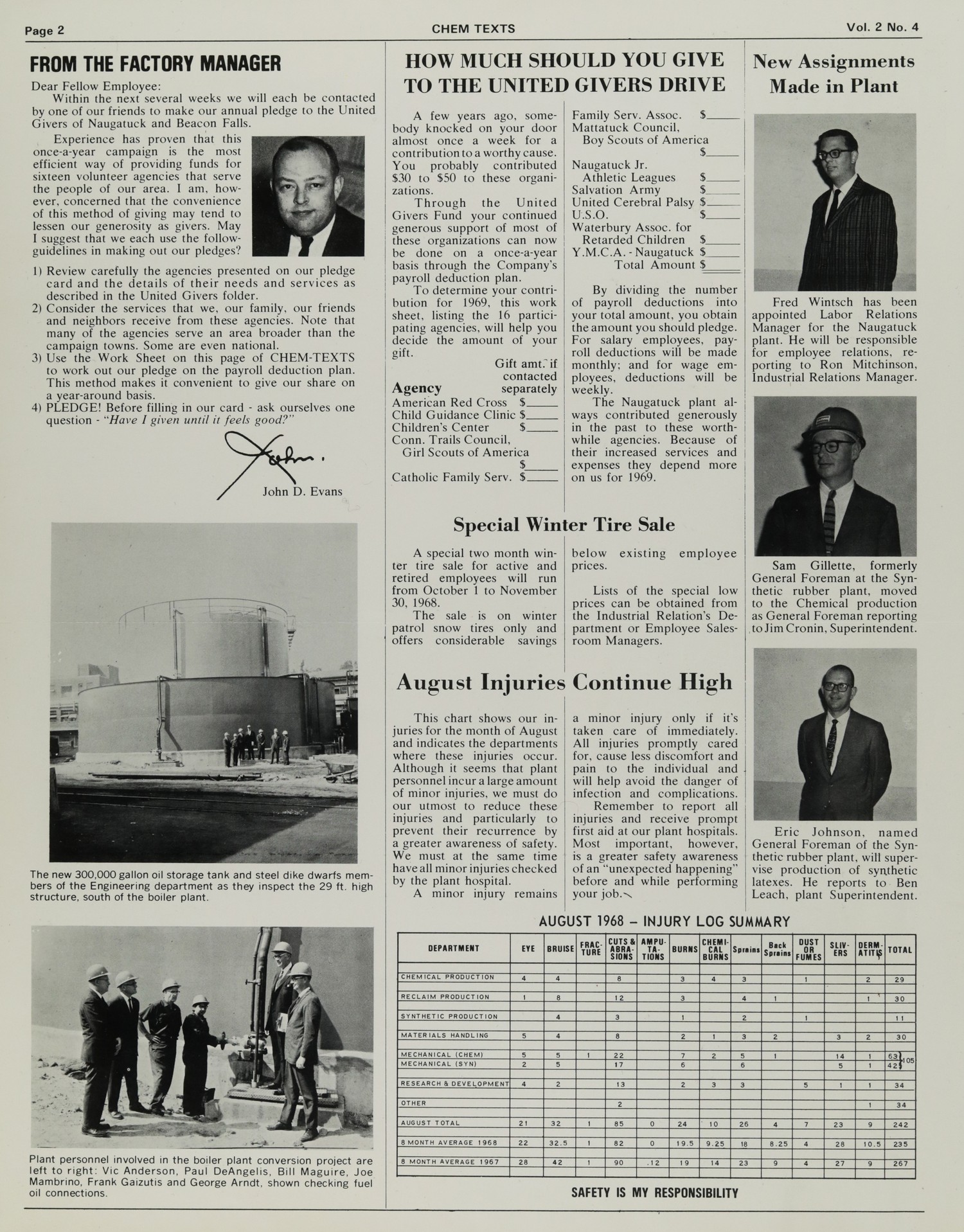
[IMAGE: Storefront showing “UNIROYAL HOME & AUTO CENTER”]

Bristol store is one of four Uniroyal stores in the area.

Four Uniroyal stores and Tire centers conveniently located in the area offer employees good discounts on radio and TV sets, home appliances, power tools, lawn mowers, bicycles, tires, batteries, accessories, and a complete line of automobile service work.

Merchandise includes the full line of Admiral TV sets; AM and FM radios; Frigidaire appliances from refrigerators to air conditioners; Ram power tools; Murray lawn mowers; and Uniroyal bicycles.

Stores are located in the Bristol Plaza, Rte. 6; Norwalk, Rte. 1 (Boston Post Road); Conn. Post Shopping Center. Rte. 1 (Boston Post Road); and the Amity Shopping Center, Rte. 63.

Shopping center rules restrict the merchandise of some stores, so it is advisable to check the store first before your visit.


Foremen’s Club Awards $250 Scholarship

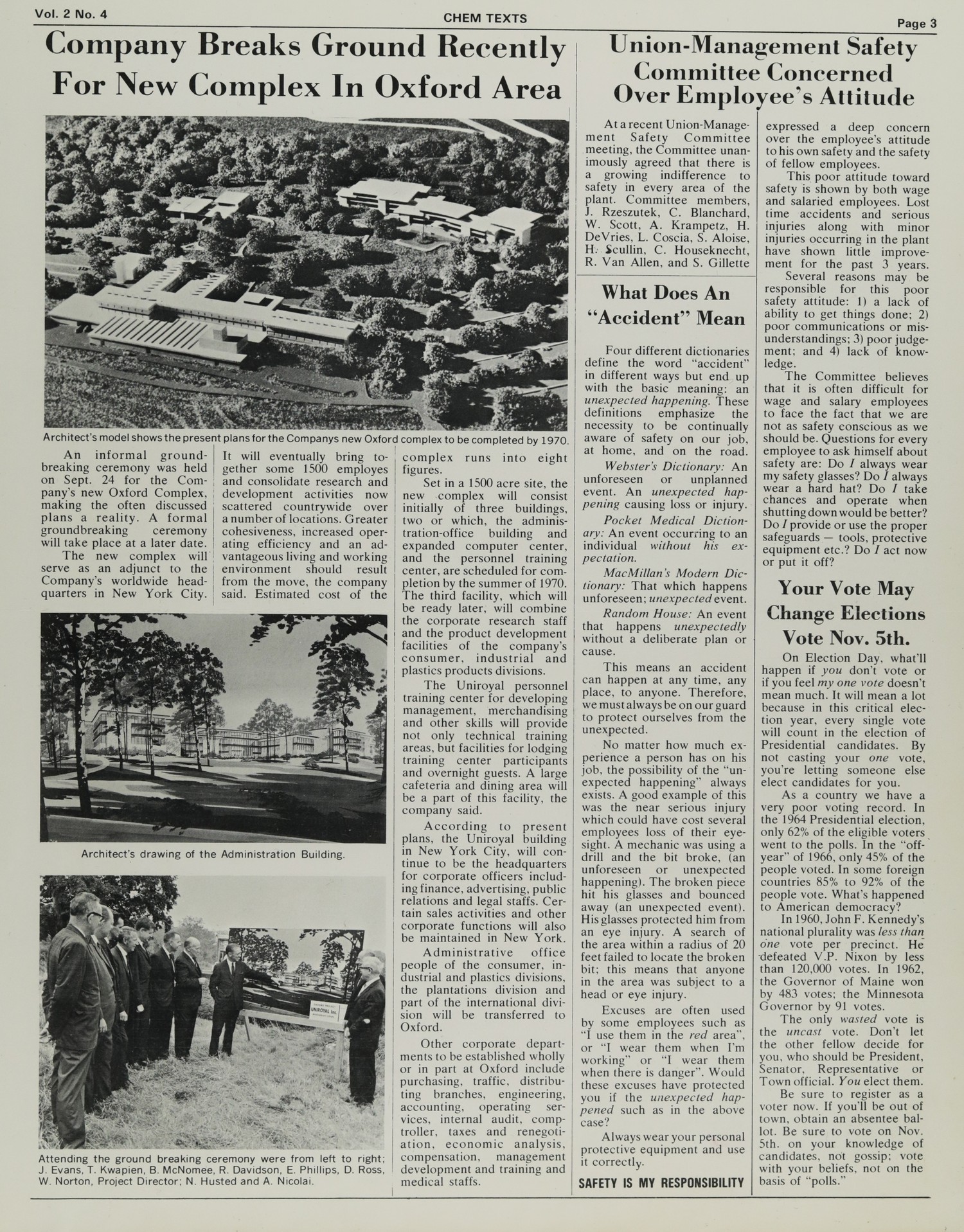
[IMAGE: Photo showing Phil Paul, right, awards scholarship to Kathleen Kelly. Watching, left to right, are Jim Phelan and her father, Joe. Kathleen had a 99 mark in mathematics in her senior year.]

by Phil Paul

Lou Kaiser, Foremen’s Club president, announced the selection of Kathleen Kelly for the $250 scholarship award. Miss Kelly, a senior at Sacred Heart High School is the daughter of Joe Kelly in the Distribution/Scheduling department.

Phil Paul was chairman of the scholarship committee, with Tom Dowling and Jim Phelan serving as committee members. The scholarship is awarded annually to a son or daughter of a Uniroyal Chemical employee.

Miss Kelly won the award for her excellent scholastic record and her participation in school and church activities. Kathleen intends to attend Emmanuel College, majoring in mathematics and plans a teaching career after graduation.

She was named a Connecticut State Scholar, an honor based upon rank in class, college board scores and her four year scholastic record.


Vacation Special Fly To Bermuda

A vacation special to Bermuda from August 10-17 is offered employees, their families and friends.

For $309 the tour includes round trip fare via Eastern Airlines jet, air-conditioned twin-bedrooms with private bath at the beautiful Castle Harbor Hotel, full breakfasts and gourmet dinners daily, a sizzle party, and one round of golf on the hotel’s 18-hole course.

Fifty seats have been reserved on the August 10 flight leaving Kennedy at 10:15 A.M., and arriving in Bermuda at 1:08 P.M. Contact Barbara Stone, Footwear Plant, Ext. 18-469.


Safety Belts Save Lives

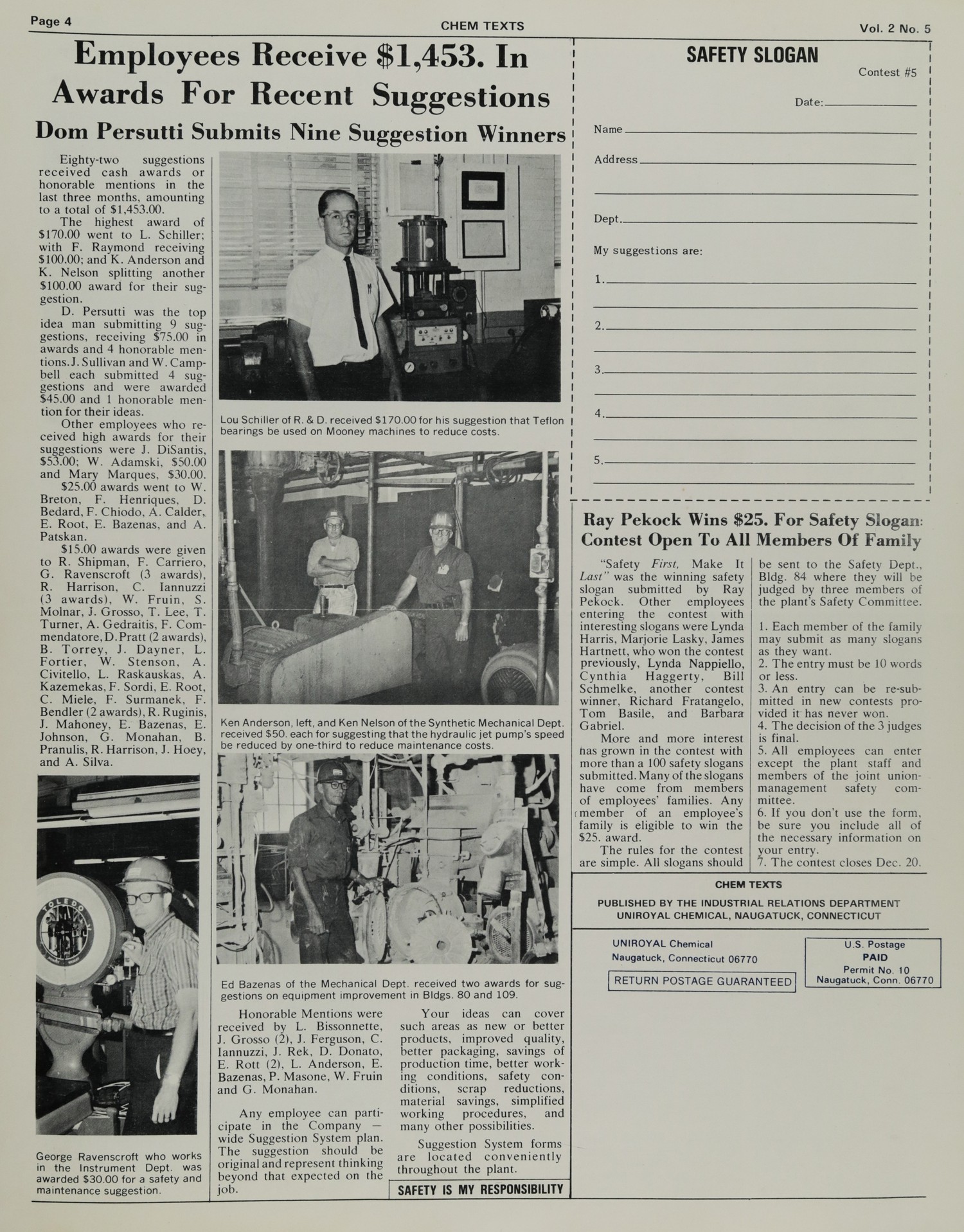
[IMAGE: Photo of Kay Dowling fastening a safety belt in a car]

Kay Dowling, a secretary in Chemical Production, fastens safety belt to fit comfortably and snug. With vacation time here, more drivers will be on the road. Protect your life and your family’s life with safety belts.
CHEM-TEXTS – Vol. 3 No. 5 – Page 3

Page 003

Vol. 3 No. 5 CHEM-TEXTS Page 3


KNOW YOUR BENEFITS: by W. Kirkendall

Some Questions and Answers on Supplemental Unemployment Benefits (SUB)

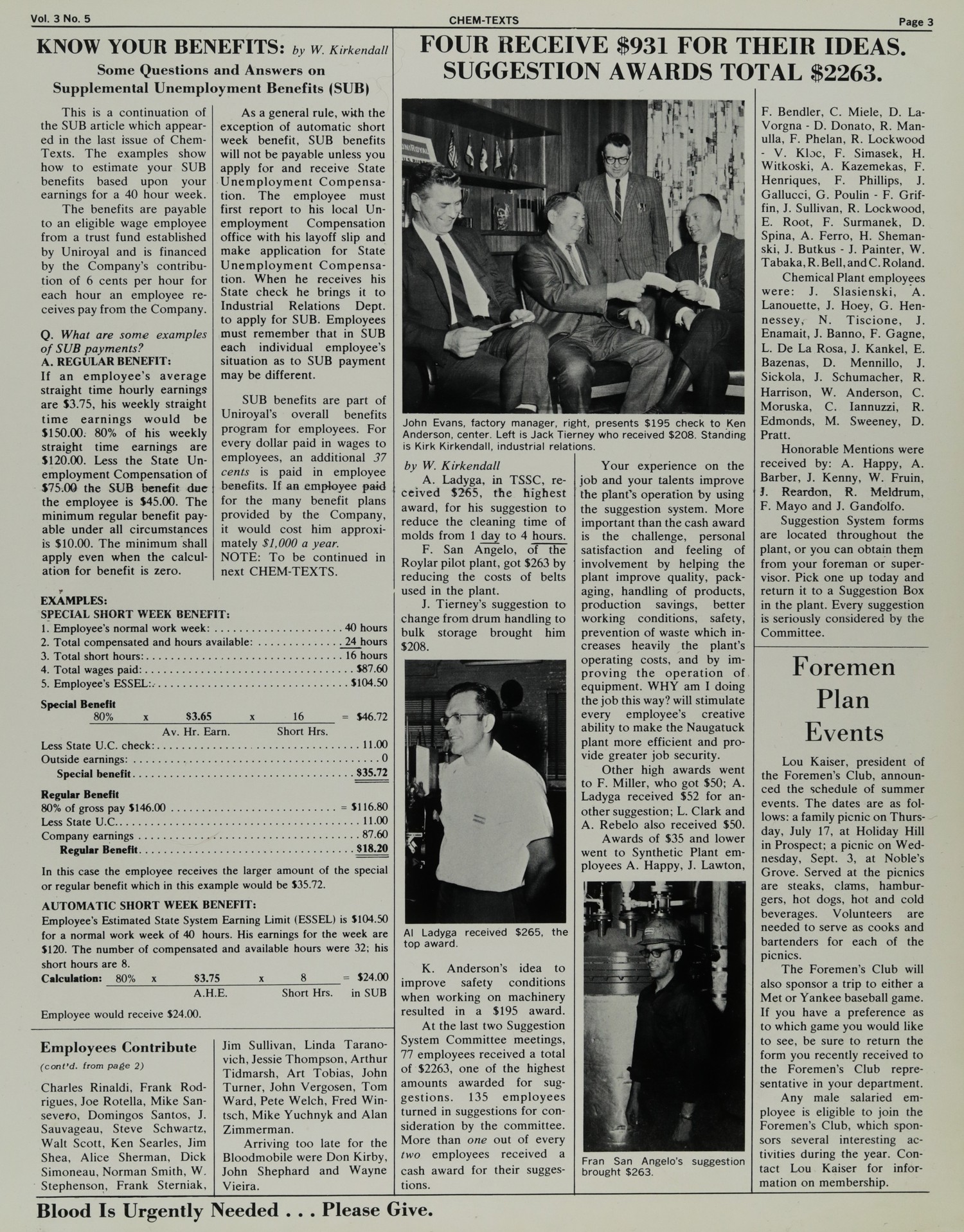
This is a continuation of the SUB article which appeared in the last issue of Chem-Texts. The examples show how to estimate your SUB benefits based upon your earnings for a 40 hour week.

The benefits are payable to an eligible wage employee from a trust fund established by Uniroyal and is financed by the Company’s contribution of 6 cents per hour for each hour an employee receives pay from the Company.

Q. What are some examples of SUB payments?

A. REGULAR BENEFIT:
If an employee’s average straight time hourly earnings are $3.75, his weekly straight time earnings would be $150.00. 80% of his weekly straight time earnings are $120.00. Less the State Unemployment Compensation of $75.00 the SUB benefit due the employee is $45.00. The minimum regular benefit payable under all circumstances is $10.00. The minimum shall apply even when the calculation for benefit is zero.

EXAMPLES:
SPECIAL SHORT WEEK BENEFIT:
1. Employee’s normal work week:……………………40 hours
2. Total compensated and hours available:………….24 hours
3. Total short hours:…………………………16 hours
4. Total wages paid:………………………….$87.60
5. Employee’s ESSEL:…………………………$104.50

Special Benefit
80% x $3.65 x 16 = $46.72
Av. Hr. Earn. Short Hrs.
Less State U.C. check:…………………………11.00
Outside earnings:……………………………..0
Special benefit……………………………..$35.72

Regular Benefit
80% of gross pay $146.00……………………..= $116.80
Less State U.C………………………………11.00
Company earnings…………………………….87.60
Regular Benefit…………………………….$18.20

In this case the employee receives the larger amount of the special or regular benefit which in this example would be $35.72.

AUTOMATIC SHORT WEEK BENEFIT:
Employee’s Estimated State System Earning Limit (ESSEL) is $104.50 for a normal work week of 40 hours. His earnings for the week are $120. The number of compensated and available hours were 32; his short hours are 8.

Calculation: 80% x $3.75 x 8 = $24.00
A.H.E. Short Hrs. in SUB

Employee would receive $24.00.


As a general rule, with the exception of automatic short week benefit, SUB benefits will not be payable unless you apply for and receive State Unemployment Compensation. The employee must first report to his local Unemployment Compensation office with his layoff slip and make application for State Unemployment Compensation. When he receives his State check he brings it to Industrial Relations Dept. to apply for SUB. Employees must remember that in SUB each individual employee’s situation as to SUB payment may be different.

SUB benefits are part of Uniroyal’s overall benefits program for employees. For every dollar paid in wages to employees, an additional 37 cents is paid in employee benefits. If an employee paid for the many benefit plans provided by the Company, it would cost him approximately $1,000 a year.
NOTE: To be continued in next CHEM-TEXTS.


FOUR RECEIVE $931 FOR THEIR IDEAS. SUGGESTION AWARDS TOTAL $2263.

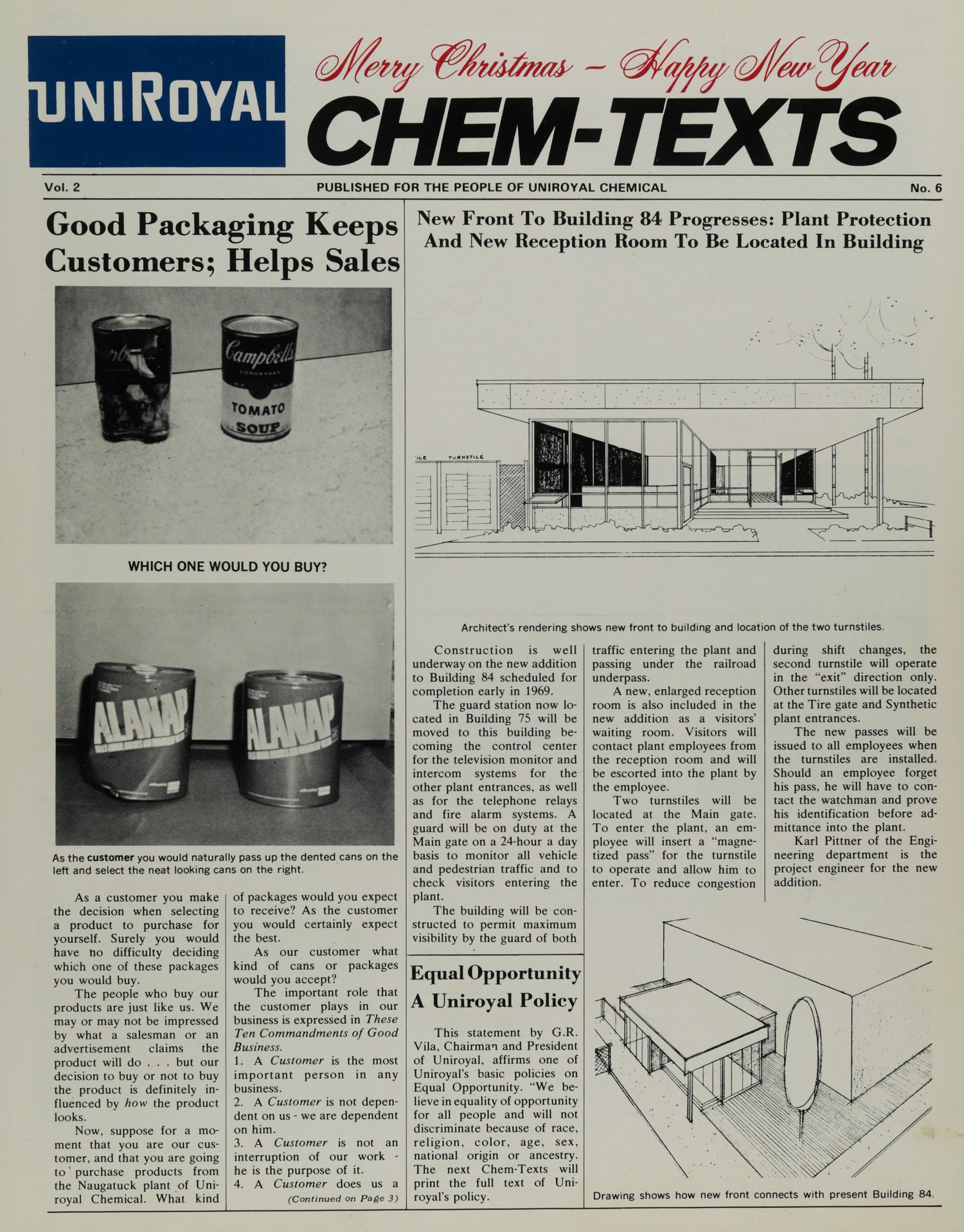
[PHOTO: John Evans, factory manager, right, presents $195 check to Ken Anderson, center. Left is Jack Tierney who received $208. Standing is Kirk Kirkendall, industrial relations.]

by W. Kirkendall

A. Ladyga, in TSSC, received $265, the highest award, for his suggestion to reduce the cleaning time of molds from 1 day to 4 hours.

F. San Angelo, of the Roylar pilot plant, got $263 by reducing the costs of belts used in the plant.

J. Tierney’s suggestion to change from drum handling to bulk storage brought him $208.

[PHOTO: Al Ladyga received $265, the top award.]

K. Anderson’s idea to improve safety conditions when working on machinery resulted in a $195 award.

At the last two Suggestion System Committee meetings, 77 employees received a total of $2263, one of the highest amounts awarded for suggestions. 135 employees turned in suggestions for consideration by the committee. More than one out of every two employees received a cash award for their suggestions.

[PHOTO: Fran San Angelo’s suggestion brought $263.]

Your experience on the job and your talents improve the plant’s operation by using the suggestion system. More important than the cash award is the challenge, personal satisfaction and feeling of involvement by helping the plant improve quality, packaging, handling of products, production savings, better working conditions, safety, prevention of waste which increases heavily the plant’s operating costs, and by improving the operation of equipment. WHY am I doing the job this way? will stimulate every employee’s creative ability to make the Naugatuck plant more efficient and provide greater job security.

Other high awards went to F. Miller, who got $50; A. Ladyga received $52 for another suggestion; L. Clark and A. Rebelo also received $50.

Awards of $35 and lower went to Synthetic Plant employees A. Happy, J. Lawton, F. Bendler, C. Miele, D. LaVorgna – D. Donato, R. Manulla, F. Phelan, R. Lockwood – V. Kloc, F. Simasek, H. Witkoski, A. Kazemekas, F. Henriques, F. Phillips, J. Gallucci, G. Poulin – F. Griffin, J. Sullivan, R. Lockwood, E. Root, F. Surmanek, D. Spina, A. Ferro, H. Shemanski, J. Butkus – J. Painter, W. Tabaka, R. Bell, and C. Roland.

Chemical Plant employees were: J. Slasienski, A. Lanouette, J. Hoey, G. Hennessey, N. Tiscione, J. Enamait, J. Banno, F. Gagne, L. De La Rosa, J. Kankel, E. Bazenas, D. Mennillo, J. Sickola, J. Schumacher, R. Harrison, W. Anderson, C. Moruska, C. Iannuzzi, R. Edmonds, M. Sweeney, D. Pratt.

Honorable Mentions were received by: A. Happy, A. Barber, J. Kenny, W. Fruin, J. Reardon, R. Meldrum, F. Mayo and J. Gandolfo.

Suggestion System forms are located throughout the plant, or you can obtain them from your foreman or supervisor. Pick one up today and return it to a Suggestion Box in the plant. Every suggestion is seriously considered by the Committee.


Foremen Plan Events

Lou Kaiser, president of the Foremen’s Club, announced the schedule of summer events. The dates are as follows: a family picnic on Thursday, July 17, at Holiday Hill in Prospect; a picnic on Wednesday, Sept. 3, at Noble’s Grove. Served at the picnics are steaks, clams, hamburgers, hot dogs, hot and cold beverages. Volunteers are needed to serve as cooks and bartenders for each of the picnics.

The Foremen’s Club will also sponsor a trip to either a Met or Yankee baseball game. If you have a preference as to which game you would like to see, be sure to return the form you recently received to the Foremen’s Club representative in your department.

Any male salaried employee is eligible to join the Foremen’s Club, which sponsors several interesting activities during the year. Contact Lou Kaiser for information on membership.


Employees Contribute

(cont’d. from page 2)

Charles Rinaldi, Frank Rodrigues, Joe Rotella, Mike Sansevero, Domingos Santos, J. Sauvageau, Steve Schwartz, Walt Scott, Ken Searles, Jim Shea, Alice Sherman, Dick Simoneau, Norman Smith, W. Stephenson, Frank Sterniak,

Jim Sullivan, Linda Taranovich, Jessie Thompson, Arthur Tidmarsh, Art Tobias, John Turner, John Vergosen, Tom Ward, Pete Welch, Fred Wintsch, Mike Yuchnyk and Alan Zimmerman.

Arriving too late for the Bloodmobile were Don Kirby, John Shephard and Wayne Vieira.


Blood Is Urgently Needed . . . Please Give.

CHEM-TEXTS – Vol. 3, 1969, No. 6 – Page 1

Page 001

UNIROYAL CHEM-TEXTS

Vol. 3, 1969 PUBLISHED FOR THE PEOPLE OF UNIROYAL CHEMICAL No. 8


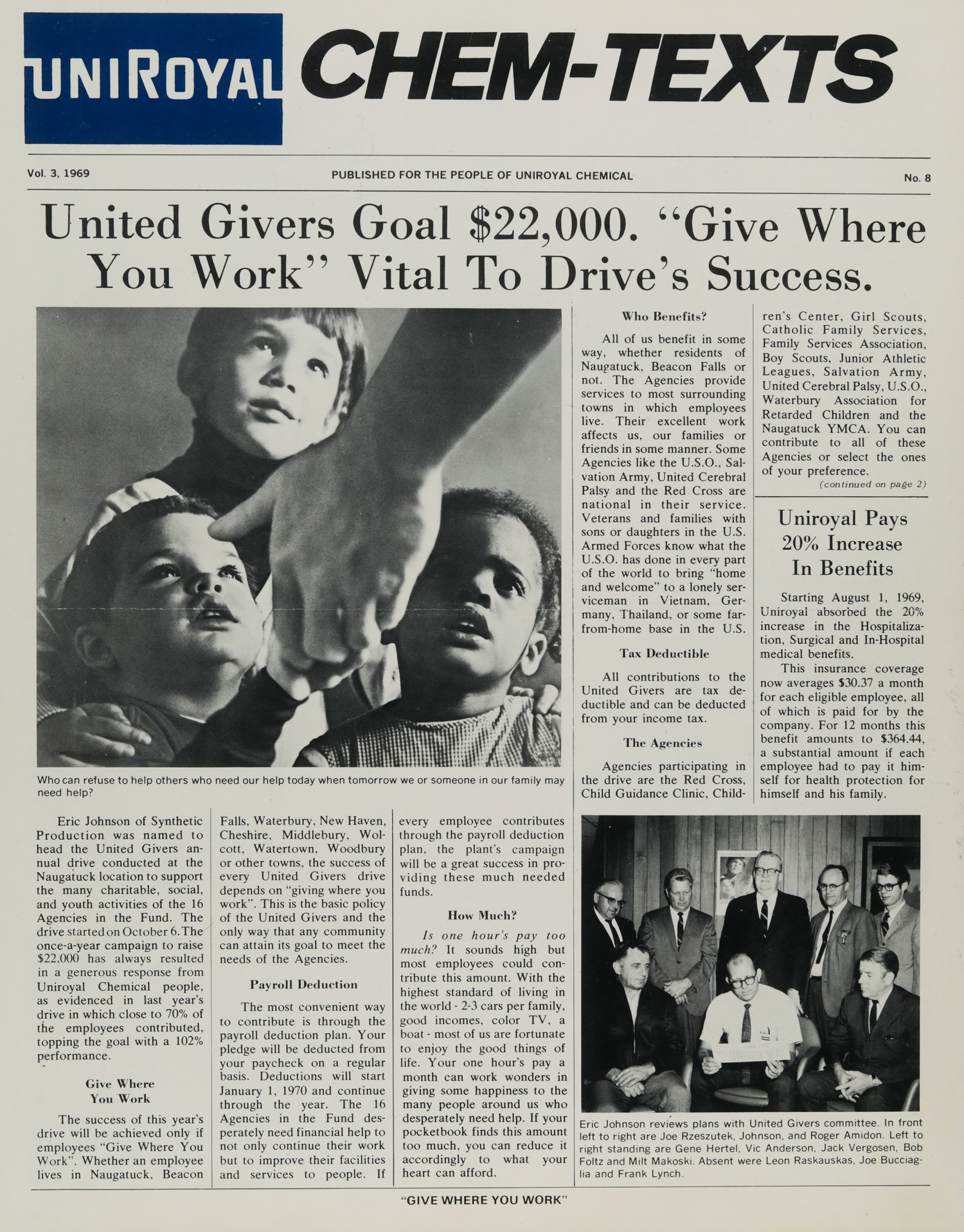
United Givers Goal $22,000. “Give Where You Work” Vital To Drive’s Success.

[IMAGE: Black and white photograph showing faces of children and adults looking upward]

Who can refuse to help others who need our help today when tomorrow we or someone in our family may need help?


Eric Johnson of Synthetic Production was named to head the United Givers annual drive conducted at the Naugatuck location to support the many charitable, social, and youth activities of the 16 Agencies in the Fund. The drive started on October 6. The once-a-year campaign to raise $22,000 has always resulted in a generous response from Uniroyal Chemical people, as evidenced in last year’s drive in which close to 70% of the employees contributed, topping the goal with a 102% performance.

Give Where You Work

The success of this year’s drive will be achieved only if employees “Give Where You Work”. Whether an employee lives in Naugatuck, Beacon Falls, Waterbury, New Haven, Cheshire, Middlebury, Wolcott, Watertown, Woodbury or other towns, the success of every United Givers drive depends on “giving where you work”. This is the basic policy of the United Givers and the only way that any community can attain its goal to meet the needs of the Agencies.

Payroll Deduction

The most convenient way to contribute is through the payroll deduction plan. Your pledge will be deducted from your paycheck on a regular basis. Deductions will start January 1, 1970 and continue through the year. The 16 Agencies in the Fund desperately need financial help to not only continue their work but to improve their facilities and services to people. If every employee contributes through the payroll deduction plan, the plant’s campaign will be a great success in providing these much needed funds.

How Much?

Is one hour’s pay too much? It sounds high but most employees could contribute this amount. With the highest standard of living in the world – 2-3 cars per family, good incomes, color TV, a boat – most of us are fortunate to enjoy the good things of life. Your one hour’s pay a month can work wonders in giving some happiness to the many people around us who desperately need help. If your pocketbook finds this amount too much, you can reduce it accordingly to what your heart can afford.

Who Benefits?

All of us benefit in some way, whether residents of Naugatuck, Beacon Falls or not. The Agencies provide services to most surrounding towns in which employees live. Their excellent work affects us, our families or friends in some manner. Some Agencies like the U.S.O., Salvation Army, United Cerebral Palsy and the Red Cross are national in their service. Veterans and families with sons or daughters in the U.S. Armed Forces know what the U.S.O. has done in every part of the world to bring “home and welcome” to a lonely serviceman in Vietnam, Germany, Thailand, or some far-from-home base in the U.S.

Tax Deductible

All contributions to the United Givers are tax deductible and can be deducted from your income tax.

The Agencies

Agencies participating in the drive are the Red Cross, Child Guidance Clinic, Children’s Center, Girl Scouts, Catholic Family Services, Family Services Association, Boy Scouts, Junior Athletic Leagues, Salvation Army, United Cerebral Palsy, U.S.O., Waterbury Association for Retarded Children and the Naugatuck YMCA. You can contribute to all of these Agencies or select the ones of your preference.

(continued on page 2)


Uniroyal Pays 20% Increase In Benefits

Starting August 1, 1969, Uniroyal absorbed the 20% increase in the Hospitalization, Surgical and In-Hospital medical benefits.

This insurance coverage now averages $30.37 a month for each eligible employee, all of which is paid for by the company. For 12 months this benefit amounts to $364.44, a substantial amount if each employee had to pay it himself for health protection for himself and his family.


[IMAGE: Group photograph of men in business attire reviewing documents]

Eric Johnson reviews plans with United Givers committee. In front left to right are Joe Rzeszutek, Johnson, and Roger Amidon. Left to right standing are Gene Hertel, Vic Anderson, Jack Vergosen, Bob Foltz and Milt Makoski. Absent were Leon Raskauskas, Joe Bucciaglia and Frank Lynch.


“GIVE WHERE YOU WORK”

CHEM-TEXTS – Vol. 3 No. 6 – Page 2

Page 002

Page 2 | CHEM-TEXTS | Vol. 3, No. 8


FROM THE FACTORY MANAGER

DEAR FELLOW EMPLOYEES:

October again brings us each the opportunity to invest in the sixteen agencies supported by the United Givers of Naugatuck and Beacon Falls. Each of these agencies, working in essential health, welfare and educational activities, makes our community a better place to live for our families and our friends. Beyond this, many of the agencies have an outreach of service beyond our borders to neighboring towns and to the nation.

We at Uniroyal Chemical have, in each year’s campaign, shown a greater willingness to give to these causes. Yet, our average gift per employee last year was something less than $13.00 per year for all of these needs. Our average is this low because some one-third of us did not give last year and some half of us gave a cash donation rather than spreading our giving by utilizing the payroll deduction plan.

When the canvasser calls on us this year, let’s all give something and let’s all pledge on payroll deductions. I think we all will be pleasantly surprised when the results are in.

Sincerely,

[Signature]

John D. Evans


Three Named Chairmen For Borough’s United Givers Drive

[IMAGE: Photo of three men in business attire having a discussion]

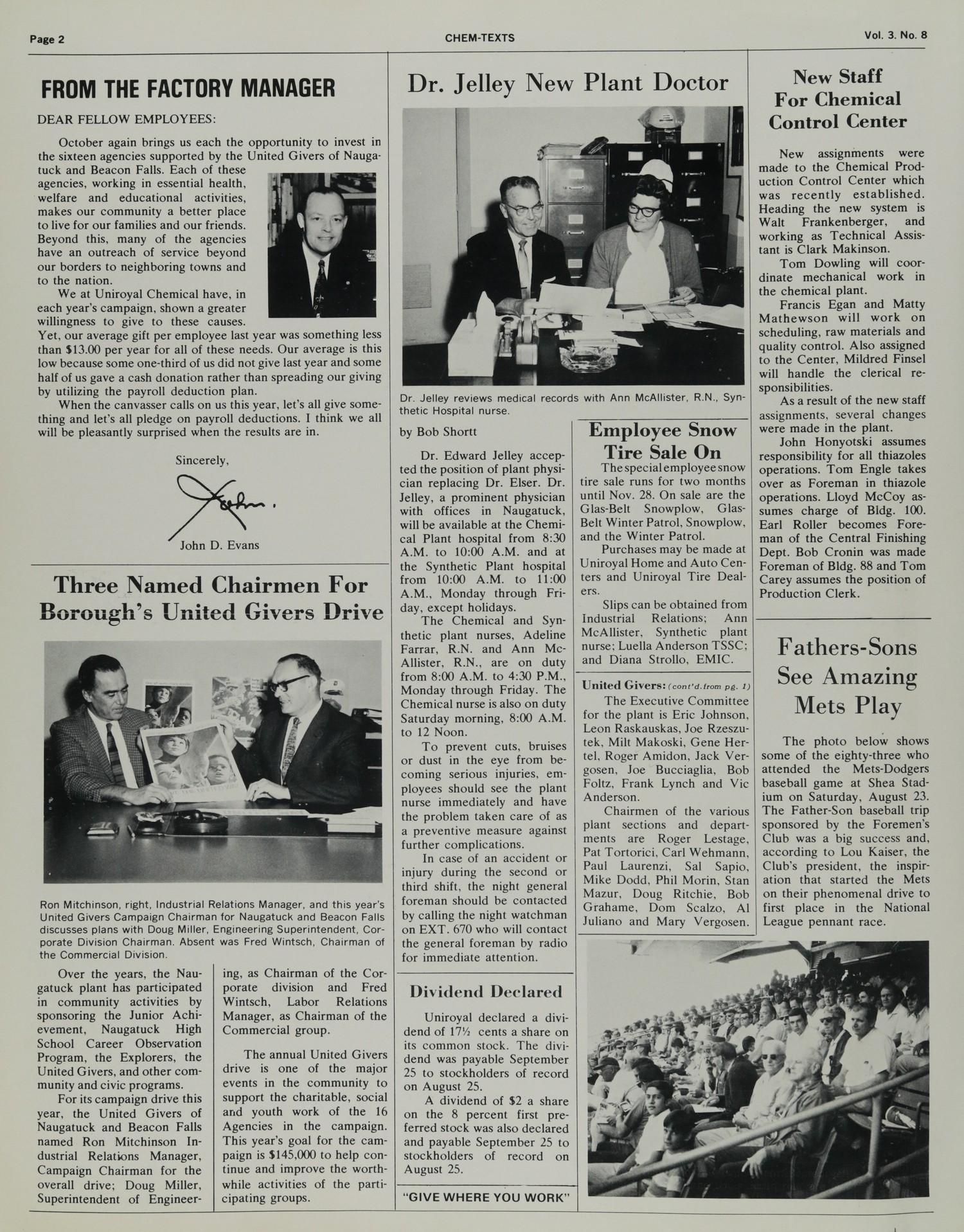
Ron Mitchinson, right, Industrial Relations Manager, and this year’s United Givers Campaign Chairman for Naugatuck and Beacon Falls discusses plans with Doug Miller, Engineering Superintendent, Corporate Division Chairman. Absent was Fred Wintsch, Chairman of the Commercial Division.

Over the years, the Naugatuck plant has participated in community activities by sponsoring the Junior Achievement, Naugatuck High School Career Observation Program, the Explorers, the United Givers, and other community and civic programs.

For its campaign drive this year, the United Givers of Naugatuck and Beacon Falls named Ron Mitchinson Industrial Relations Manager, Campaign Chairman for the overall drive; Doug Miller, Superintendent of Engineering, as Chairman of the Corporate division and Fred Wintsch, Labor Relations Manager, as Chairman of the Commercial group.

The annual United Givers drive is one of the major events in the community to support the charitable, social and youth work of the 16 Agencies in the campaign. This year’s goal for the campaign is $145,000 to help continue and improve the worthwhile activities of the participating groups.


Dr. Jelley New Plant Doctor

[IMAGE: Photo of Dr. Jelley reviewing medical records with Ann McAllister]

Dr. Jelley reviews medical records with Ann McAllister, R.N., Synthetic Hospital nurse.

by Bob Shortt

Dr. Edward Jelley accepted the position of plant physician replacing Dr. Elser. Dr. Jelley, a prominent physician with offices in Naugatuck, will be available at the Chemical Plant hospital from 8:30 A.M. to 10:00 A.M. and at the Synthetic Plant hospital from 10:00 A.M. to 11:00 A.M., Monday through Friday, except holidays.

The Chemical and Synthetic plant nurses, Adeline Farrar, R.N. and Ann McAllister, R.N., are on duty from 8:00 A.M. to 4:30 P.M., Monday through Friday. The Chemical nurse is also on duty Saturday morning, 8:00 A.M. to 12 Noon.

To prevent cuts, bruises or dust in the eye from becoming serious injuries, employees should see the plant nurse immediately and have the problem taken care of as a preventive measure against further complications.

In case of an accident or injury during the second or third shift, the night general foreman should be contacted by calling the night watchman on EXT. 670 who will contact the general foreman by radio for immediate attention.


Employee Snow Tire Sale On

The special employee snow tire sale runs for two months until Nov. 28. On sale are the Glas-Belt Snowplow, Glas-Belt Winter Patrol, Snowplow, and the Winter Patrol.

Purchases may be made at Uniroyal Home and Auto Centers and Uniroyal Tire Dealers.

Slips can be obtained from Industrial Relations; Ann McAllister, Synthetic plant nurse; Luella Anderson TSSC; and Diana Strollo, EMIC.


United Givers: (cont’d. from pg. 1)

The Executive Committee for the plant is Eric Johnson, Leon Raskauskas, Joe Rzeszutek, Milt Makoski, Gene Hertel, Roger Amidon, Jack Vergosen, Joe Bucciaglia, Bob Foltz, Frank Lynch and Vic Anderson.

Chairmen of the various plant sections and departments are Roger Lestage, Pat Tortorici, Carl Wehmann, Paul Laurenzi, Sal Sapio, Mike Dodd, Phil Morin, Stan Mazur, Doug Ritchie, Bob Grahame, Dom Scalzo, Al Juliano and Mary Vergosen.


Dividend Declared

Uniroyal declared a dividend of 17½ cents a share on its common stock. The dividend was payable September 25 to stockholders of record on August 25.

A dividend of $2 a share on the 8 percent first preferred stock was also declared and payable September 25 to stockholders of record on August 25.

“GIVE WHERE YOU WORK”


New Staff For Chemical Control Center

New assignments were made to the Chemical Production Control Center which was recently established. Heading the new system is Walt Frankenberger, and working as Technical Assistant is Clark Makinson.

Tom Dowling will coordinate mechanical work in the chemical plant.

Francis Egan and Matty Mathewson will work on scheduling, raw materials and quality control. Also assigned to the Center, Mildred Finsel will handle the clerical responsibilities.

As a result of the new staff assignments, several changes were made in the plant.

John Honyotski assumes responsibility for all thiazoles operations. Tom Engle takes over as Foreman in thiazole operations. Lloyd McCoy assumes charge of Bldg. 100. Earl Roller becomes Foreman of the Central Finishing Dept. Bob Cronin was made Foreman of Bldg. 88 and Tom Carey assumes the position of Production Clerk.


Fathers-Sons See Amazing Mets Play

The photo below shows some of the eighty-three who attended the Mets-Dodgers baseball game at Shea Stadium on Saturday, August 23. The Father-Son baseball trip sponsored by the Foremen’s Club was a big success and, according to Lou Kaiser, the Club’s president, the inspiration that started the Mets on their phenomenal drive to first place in the National League pennant race.

[IMAGE: Photo showing crowd at baseball stadium]

CHEM-TEXTS – Vol. 3 No. 6 – Page 3

Page 003

CHEM-TEXTS

Vol. 3 No. 8 | Page 3


Synthetic’s “A” Crew Hits 9 Batches Daily

[IMAGE: Group photo of workers in hard hats]

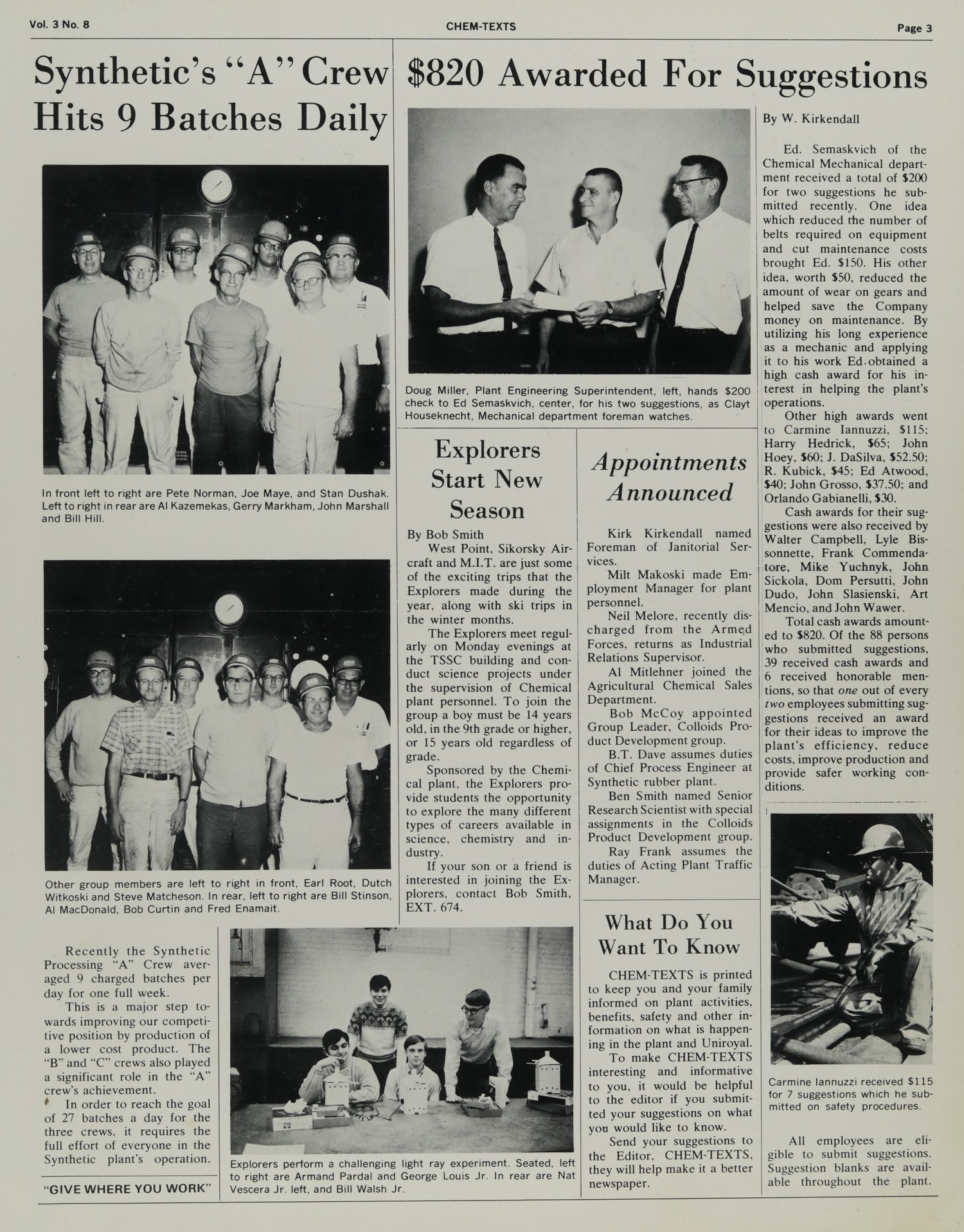
In front left to right are Pete Norman, Joe Maye, and Stan Dushak. Left to right in rear are Al Kazemekas, Gerry Markham, John Marshall and Bill Hill.

[IMAGE: Second group photo of workers]

Other group members are left to right in front, Earl Root, Dutch Witkoski and Steve Matcheson. In rear, left to right are Bill Stinson, Al MacDonald, Bob Curtin and Fred Enamait.

Recently the Synthetic Processing “A” Crew averaged 9 charged batches per day for one full week.

This is a major step towards improving our competitive position by production of a lower cost product. The “B” and “C” crews also played a significant role in the “A” crew’s achievement.

In order to reach the goal of 27 batches a day for the three crews, it requires the full effort of everyone in the Synthetic plant’s operation.

“GIVE WHERE YOU WORK”


$820 Awarded For Suggestions

By W. Kirkendall

[IMAGE: Three men, one handing check to another]

Doug Miller, Plant Engineering Superintendent, left, hands $200 check to Ed Semaskvich, center, for his two suggestions, as Clayt Houseknecht, Mechanical department foreman watches.

Ed. Semaskvich of the Chemical Mechanical department received a total of $200 for two suggestions he submitted recently. One idea which reduced the number of belts required on equipment and cut maintenance costs brought Ed. $150. His other idea, worth $50, reduced the amount of wear on gears and helped save the Company money on maintenance. By utilizing his long experience as a mechanic and applying it to his work Ed obtained a high cash award for his interest in helping the plant’s operations.

Other high awards went to Carmine Iannuzzi, $115; Harry Hedrick, $65; John Hoey, $60; J. DaSilva, $52.50; R. Kubick, $45; Ed Atwood, $40; John Grosso, $37.50; and Orlando Gabianelli, $30.

Cash awards for their suggestions were also received by Walter Campbell, Lyle Bissonnette, Frank Commendatore, Mike Yuchnyk, John Sickola, Dom Persutti, John Dudo, John Slasienski, Art Mencio, and John Wawer.

Total cash awards amounted to $820. Of the 88 persons who submitted suggestions, 39 received cash awards and 6 received honorable mentions, so that one out of every two employees submitting suggestions received an award for their ideas to improve the plant’s efficiency, reduce costs, improve production and provide safer working conditions.

[IMAGE: Man working]

Carmine Iannuzzi received $115 for 7 suggestions which he submitted on safety procedures.

All employees are eligible to submit suggestions. Suggestion blanks are available throughout the plant.


Explorers Start New Season

By Bob Smith

West Point, Sikorsky Aircraft and M.I.T. are just some of the exciting trips that the Explorers made during the year, along with ski trips in the winter months.

The Explorers meet regularly on Monday evenings at the TSSC building and conduct science projects under the supervision of Chemical plant personnel. To join the group a boy must be 14 years old, in the 9th grade or higher, or 15 years old regardless of grade.

Sponsored by the Chemical plant, the Explorers provide students the opportunity to explore the many different types of careers available in science, chemistry and industry.

If your son or a friend is interested in joining the Explorers, contact Bob Smith, EXT. 674.

[IMAGE: Group of young people at table with experiment]

Explorers perform a challenging light ray experiment. Seated, left to right are Armand Pardal and George Louis Jr. In rear are Nat Vescera Jr. left, and Bill Walsh Jr.


Appointments Announced

Kirk Kirkendall named Foreman of Janitorial Services.

Milt Makoski made Employment Manager for plant personnel.

Neil Melore, recently discharged from the Armed Forces, returns as Industrial Relations Supervisor.

Al Mitlehner joined the Agricultural Chemical Sales Department.

Bob McCoy appointed Group Leader, Colloids Product Development group.

B.T. Dave assumes duties of Chief Process Engineer at Synthetic rubber plant.

Ben Smith named Senior Research Scientist with special assignments in the Colloids Product Development group.

Ray Frank assumes the duties of Acting Plant Traffic Manager.


What Do You Want To Know

CHEM-TEXTS is printed to keep you and your family informed on plant activities, benefits, safety and other information on what is happening in the plant and Uniroyal.

To make CHEM-TEXTS interesting and informative to you, it would be helpful to the editor if you submitted your suggestions on what you would like to know.

Send your suggestions to the Editor, CHEM-TEXTS, they will help make it a better newspaper.

CHEM-TEXTS – Vol. 3 No. 6 – Page 4

Page 004

Page 4 CHEM-TEXTS

New “Idea Plan” Offers $1000 Cash Awards

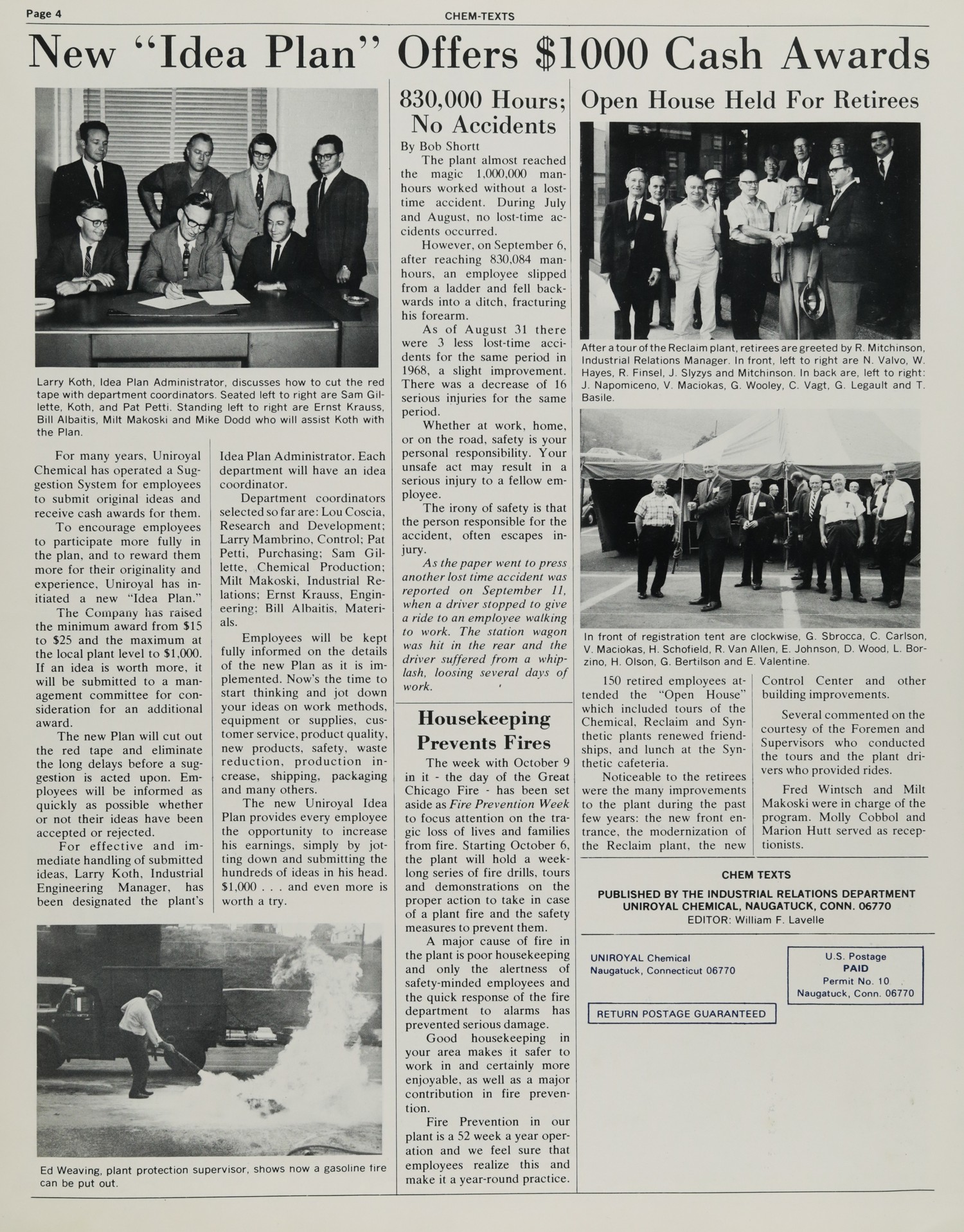
Larry Koth, Idea Plan Administrator, discusses how to cut the red tape with department coordinators. Seated left to right are Sam Gillette, Koth, and Pat Petti. Standing left to right are Ernst Krauss, Bill Albaitis, Milt Makoski and Mike Dodd who will assist Koth with the Plan.

For many years, Uniroyal Chemical has operated a Suggestion System for employees to submit original ideas and receive cash awards for them.

To encourage employees to participate more fully in the plan, and to reward them more for their originality and experience, Uniroyal has initiated a new “Idea Plan.”

The Company has raised the minimum award from $15 to $25 and the maximum at the local plant level to $1,000. If an idea is worth more, it will be submitted to a management committee for consideration for an additional award.

The new Plan will cut out the red tape and eliminate the long delays before a suggestion is acted upon. Employees will be informed as quickly as possible whether or not their ideas have been accepted or rejected.

For effective and immediate handling of submitted ideas, Larry Koth, Industrial Engineering Manager, has been designated the plant’s Idea Plan Administrator. Each department will have an idea coordinator.

Department coordinators selected so far are: Lou Coscia, Research and Development; Larry Mambrino, Control; Pat Petti, Purchasing; Sam Gillette, Chemical Production; Milt Makoski, Industrial Relations; Ernst Krauss, Engineering; Bill Albaitis, Materials.

Employees will be kept fully informed on the details of the new Plan as it is implemented. Now’s the time to start thinking and jot down your ideas on work methods, equipment or supplies, customer service, product quality, new products, safety, waste reduction, production increase, shipping, packaging and many others.

The new Uniroyal Idea Plan provides every employee the opportunity to increase his earnings, simply by jotting down and submitting the hundreds of ideas in his head. $1,000 . . . and even more is worth a try.


Ed Weaving, plant protection supervisor, shows now a gasoline fire can be put out.


830,000 Hours; No Accidents

By Bob Shortt

The plant almost reached the magic 1,000,000 manhours worked without a losttime accident. During July and August, no lost-time accidents occurred.

However, on September 6, after reaching 830,084 manhours, an employee slipped from a ladder and fell backwards into a ditch, fracturing his forearm.

As of August 31 there were 3 less lost-time accidents for the same period in 1968, a slight improvement. There was a decrease of 16 serious injuries for the same period.

Whether at work, home, or on the road, safety is your personal responsibility. Your unsafe act may result in a serious injury to a fellow employee.

The irony of safety is that the person responsible for the accident, often escapes injury.

As the paper went to press another lost time accident was reported on September 11, when a driver stopped to give a ride to an employee walking to work. The station wagon was hit in the rear and the driver suffered from a whiplash, loosing several days of work.


Housekeeping Prevents Fires

The week with October 9 in it – the day of the Great Chicago Fire – has been set aside as Fire Prevention Week to focus attention on the tragic loss of lives and families from fire. Starting October 6, the plant will hold a weeklong series of fire drills, tours and demonstrations on the proper action to take in case of a plant fire and the safety measures to prevent them.

A major cause of fire in the plant is poor housekeeping and only the alertness of safety-minded employees and the quick response of the fire department to alarms has prevented serious damage.

Good housekeeping in your area makes it safer to work in and certainly more enjoyable, as well as a major contribution in fire prevention.

Fire Prevention in our plant is a 52 week a year operation and we feel sure that employees realize this and make it a year-round practice.


Open House Held For Retirees

After a tour of the Reclaim plant, retirees are greeted by R. Mitchinson, Industrial Relations Manager. In front, left to right are N. Valvo, W. Hayes, R. Finsel, J. Slyzys and Mitchinson. In back are, left to right: J. Napomiceno, V. Maciokas, G. Wooley, C. Vagt, G. Legault and T. Basile.

In front of registration tent are clockwise, G. Sbrocca, C. Carlson, V. Maciokas, H. Schofield, R. Van Allen, E. Johnson, D. Wood, L. Borzino, H. Olson, G. Bertilson and E. Valentine.

150 retired employees attended the “Open House” which included tours of the Chemical, Reclaim and Synthetic plants renewed friendships, and lunch at the Synthetic cafeteria.

Noticeable to the retirees were the many improvements to the plant during the past few years: the new front entrance, the modernization of the Reclaim plant, the new Control Center and other building improvements.

Several commented on the courtesy of the Foremen and Supervisors who conducted the tours and the plant drivers who provided rides.

Fred Wintsch and Milt Makoski were in charge of the program. Molly Cobbol and Marion Hutt served as receptionists.


CHEM TEXTS

PUBLISHED BY THE INDUSTRIAL RELATIONS DEPARTMENT
UNIROYAL CHEMICAL, NAUGATUCK, CONN. 06770
EDITOR: William F. Lavelle

UNIROYAL Chemical
Naugatuck, Connecticut 06770

U.S. Postage
PAID
Permit No. 10
Naugatuck, Conn. 06770

RETURN POSTAGE GUARANTEED

CHEM-TEXTS – Vol. 3, 1969, No. 7 – Page 1

Page 001

UNIROYAL CHEM-TEXTS

Vol. 3, 1969 PUBLISHED FOR THE PEOPLE OF UNIROYAL CHEMICAL No. 7


Every Employee Holds Responsible Position

[AERIAL PHOTOGRAPH OF INDUSTRIAL COMPLEX]

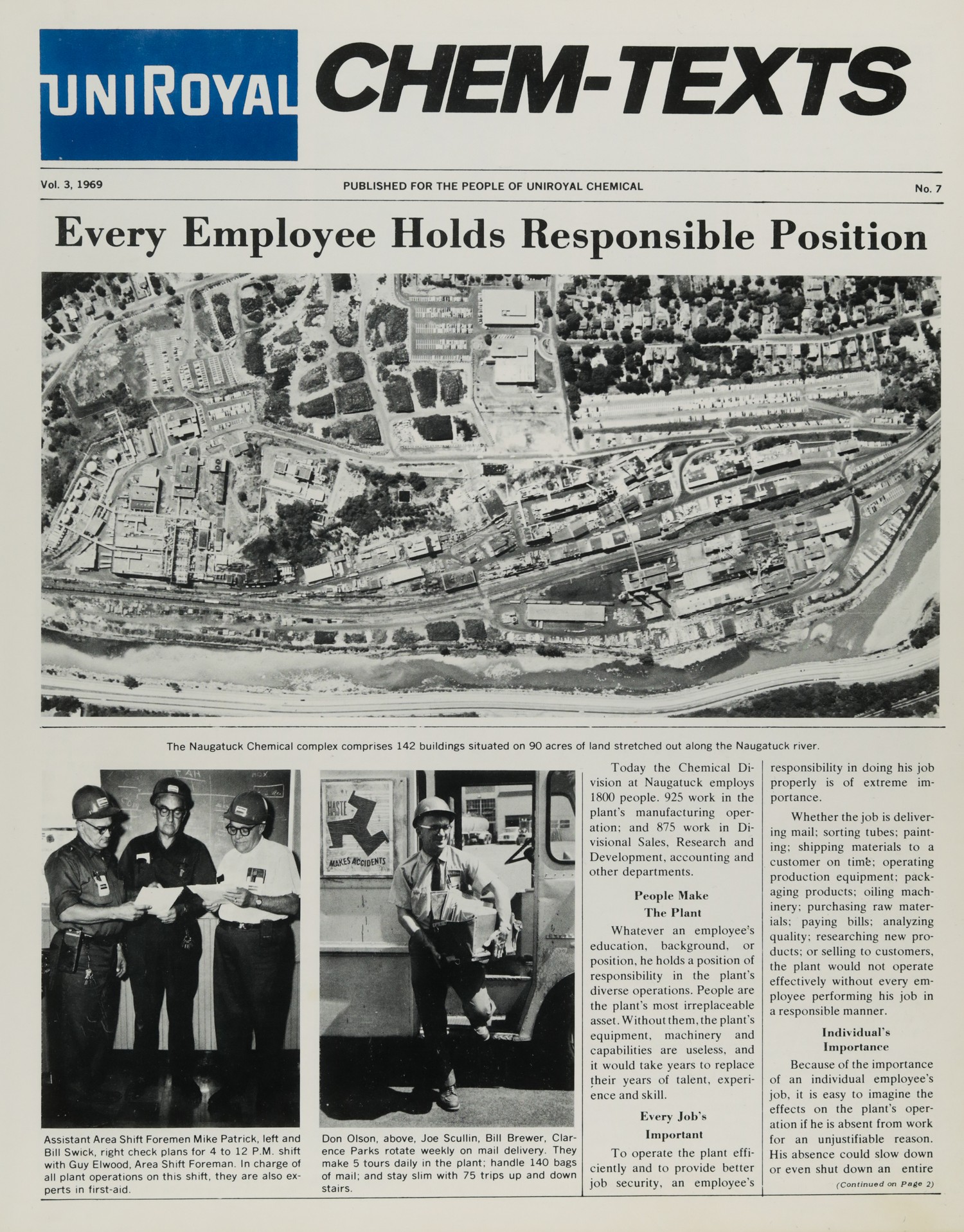
The Naugatuck Chemical complex comprises 142 buildings situated on 90 acres of land stretched out along the Naugatuck river.


[PHOTOGRAPH: Three men in work uniforms reviewing documents]

Assistant Area Shift Foremen Mike Patrick, left and Bill Swick, right check plans for 4 to 12 P.M. shift with Guy Elwood, Area Shift Foreman. In charge of all plant operations on this shift, they are also experts in first-aid.


[PHOTOGRAPH: Men with mail cart, safety sign visible reading “HASTE MAKES ACCIDENTS”]

Don Olson, above, Joe Scullin, Bill Brewer, Clarence Parks rotate weekly on mail delivery. They make 5 tours daily in the plant; handle 140 bags of mail; and stay slim with 75 trips up and down stairs.


Today the Chemical Division at Naugatuck employs 1800 people. 925 work in the plant’s manufacturing operation; and 875 work in Divisional Sales, Research and Development, accounting and other departments.

People Make The Plant

Whatever an employee’s education, background, or position, he holds a position of responsibility in the plant’s diverse operations. People are the plant’s most irreplaceable asset. Without them, the plant’s equipment, machinery and capabilities are useless, and it would take years to replace their years of talent, experience and skill.

Every Job’s Important

To operate the plant efficiently and to provide better job security, an employee’s responsibility in doing his job properly is of extreme importance.

Whether the job is delivering mail; sorting tubes; painting; shipping materials to a customer on time; operating production equipment; packaging products; oiling machinery; purchasing raw materials; paying bills; analyzing quality; researching new products; or selling to customers, the plant would not operate effectively without every employee performing his job in a responsible manner.

Individual’s Importance

Because of the importance of an individual employee’s job, it is easy to imagine the effects on the plant’s operation if he is absent from work for an unjustifiable reason. His absence could slow down or even shut down an entire

(Continued on Page 2)

CHEM-TEXTS – Vol. 3 No. 7 – Page 2

Page 002

Page 2 | CHEM-TEXTS | Vol. 3 No. 7


FROM THE FACTORY MANAGER

DEAR FELLOW EMPLOYEE:

This year we have been pushing the slogan “SAFETY IS MY RESPONSIBILITY.” Frankly, it seems to me that our success to date is in developing the attitude that “everybody is responsible for my safety.” It’s about time that we face up to our own responsibility for safety.

I’ve heard too much of, “you didn’t fix this” or, “why should I do it that way, so and so doesn’t.” Or, the old favorite, “I’ve been doing this for twenty years and nothing has happened to me.” These are, at best, just excuses.

We have to face up to the basic fact that each man is primarily responsible for his own safety. Management’s responsibility extends to providing the proper tools and equipment, protective devices and giving safe operating procedures and instructions.

Beyond this point, supervision can’t make a man safe if he doesn’t act safely. This is particularly true in our plant where each man works with a great deal of responsibility for his own work.

Recently, I read some criticism concerning companies where protective equipment wasn’t furnished to employees.

Let’s take a look at our plant. UNIROYAL provides hard hats, safety glasses, goggles, safety shoes, gloves and other protective equipment, and yet too many employees take the attitude of “let’s see if we can make them force us to wear this stuff.” What kind of a game is this for men to be playing?

Don’t you think it’s about time for you to quit playing Russian Roulette with your SAFETY? I sincerely hope you will think this over and agree for your family’s sake.

Best regards,

John

John D. Evans


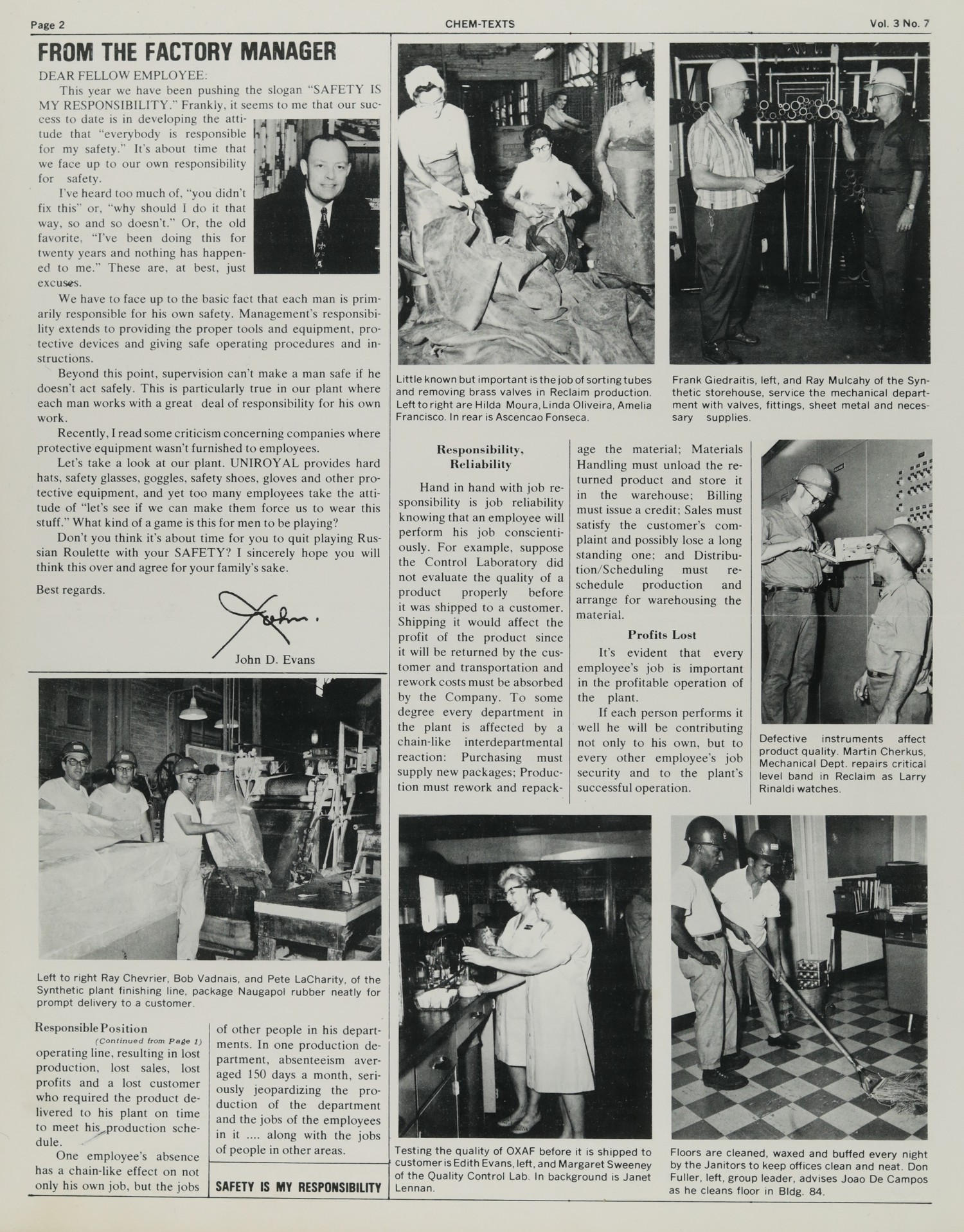
Little known but important is the job of sorting tubes and removing brass valves in Reclaim production. Left to right are Hilda Moura, Linda Oliveira, Amelia Francisco. In rear is Ascencao Fonseca.


Frank Giedraitis, left, and Ray Mulcahy of the Synthetic storehouse, service the mechanical department with valves, fittings, sheet metal and necessary supplies.


Responsibility, Reliability

Hand in hand with job responsibility is job reliability knowing that an employee will perform his job conscientiously. For example, suppose the Control Laboratory did not evaluate the quality of a product properly before it was shipped to a customer. Shipping it would affect the profit of the product since it will be returned by the customer and transportation and rework costs must be absorbed by the Company. To some degree every department in the plant is affected by a chain-like interdepartmental reaction: Purchasing must supply new packages; Production must rework and repackage the material; Materials Handling must unload the returned product and store it in the warehouse; Billing must issue a credit; Sales must satisfy the customer’s complaint and possibly lose a long standing one; and Distribution/Scheduling must reschedule production and arrange for warehousing the material.

Profits Lost

It’s evident that every employee’s job is important in the profitable operation of the plant.

If each person performs it well he will be contributing not only to his own, but to every other employee’s job security and to the plant’s successful operation.


Defective instruments affect product quality. Martin Cherkus, Mechanical Dept. repairs critical level band in Reclaim as Larry Rinaldi watches.


Left to right Ray Chevrier, Bob Vadnais, and Pete LaCharity, of the Synthetic plant finishing line, package Naugapol rubber neatly for prompt delivery to a customer.


Responsible Position

(Continued from Page 1)

operating line, resulting in lost production, lost sales, lost profits and a lost customer who required the product delivered to his plant on time to meet his production schedule.

One employee’s absence has a chain-like effect on not only his own job, but the jobs of other people in his departments. In one production department, absenteeism averaged 150 days a month, seriously jeopardizing the production of the department and the jobs of the employees in it …. along with the jobs of people in other areas.


SAFETY IS MY RESPONSIBILITY


Testing the quality of OXAF before it is shipped to customer is Edith Evans, left, and Margaret Sweeney of the Quality Control Lab. In background is Janet Lennan.


Floors are cleaned, waxed and buffed every night by the Janitors to keep offices clean and neat. Don Fuller, left, group leader, advises Joao De Campos as he cleans floor in Bldg. 84.

CHEM-TEXTS – Vol. 3 No. 8 – Page 2

Page 002

CHEM-TEXTS

Page 2 | Vol. 3 No. 9


FROM THE FACTORY MANAGER

DEAR FELLOW EMPLOYEE:

Sometime back I had occasion to question one of our people why a certain function was being performed in the manner that it was being done. Much to my surprise, the answer was, “It’s Company policy.” I asked, “What do you mean, ‘Company policy’?, Who set the policy?” After a blank look, I received the answer, “Folklore and Tradition”.

While tradition has a place as part of our heritage, it has little place in building a flexible, responsive, up-to-date organization that can effectively deal with the rapid changing demands that we, together, must meet to make our plant competitive in today’s world.

As I have said before, progress is change, and each of us must learn to look upon change as progress. We have to be the first ones to find the best way of doing our jobs or we find ourselves always trying to catch up. I’m sure we all prefer to be leaders.

Let’s take a strong look at the “Folklore and Traditions” in our activities. Let’s all ask ourselves, “How can I do my job more effectively?” Let’s remember that the payoff is results and we each play a part in finding a better way to achieve those results.
Sincerely,

John

John D. Evans


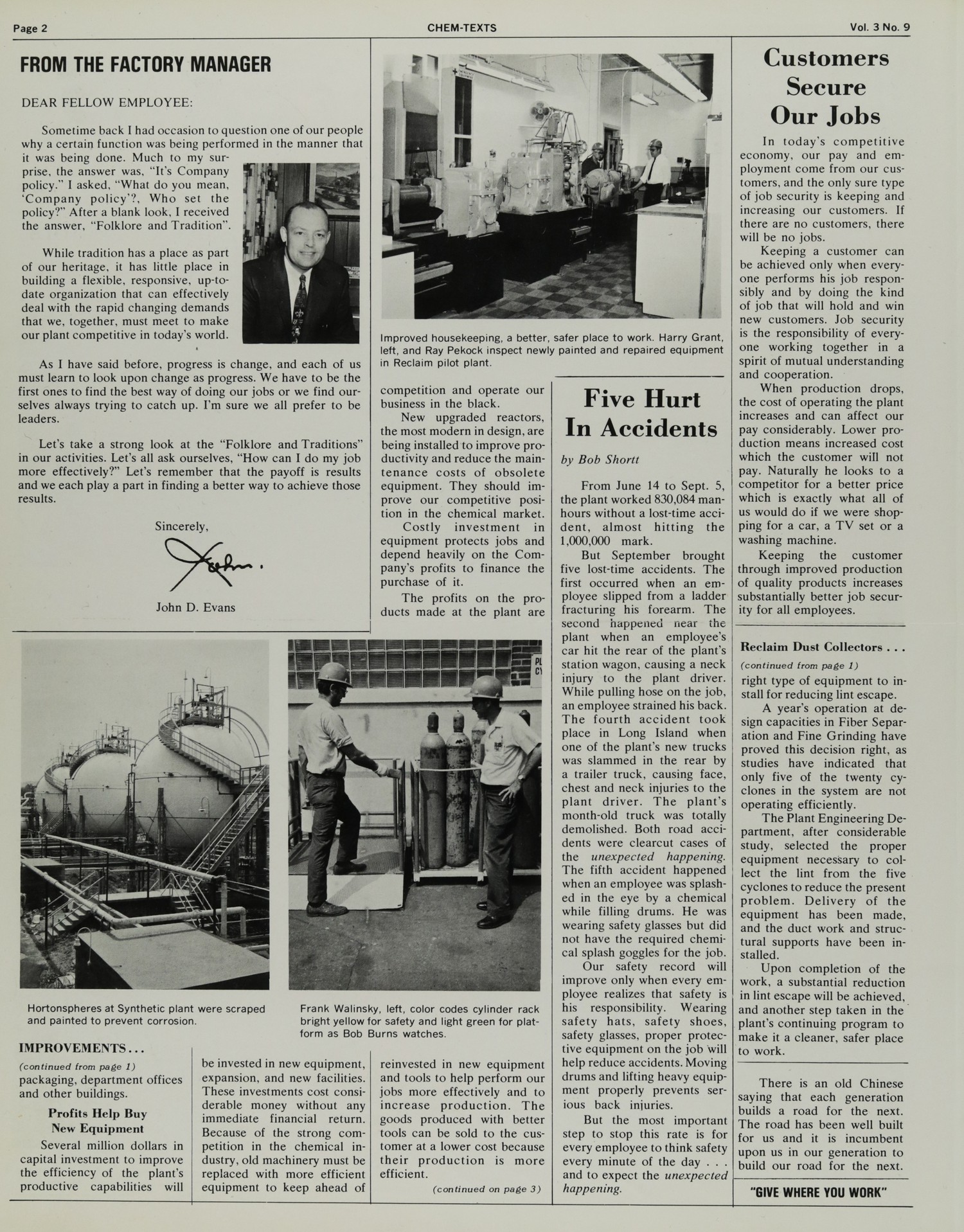
Improved housekeeping, a better, safer place to work. Harry Grant, left, and Ray Pekoek inspect newly painted and repaired equipment in Reclaim pilot plant.


competition and operate our business in the black.

New upgraded reactors, the most modern in design, are being installed to improve productivity and reduce the maintenance costs of obsolete equipment. They should improve our competitive position in the chemical market.

Costly investment in equipment protects jobs and depend heavily on the Company’s profits to finance the purchase of it.

The profits on the products made at the plant are


Five Hurt In Accidents

by Bob Shortt

From June 14 to Sept. 5, the plant worked 830,084 man-hours without a lost-time accident, almost hitting the 1,000,000 mark.

But September brought five lost-time accidents. The first occurred when an employee slipped from a ladder fracturing his forearm. The second happened near the plant when an employee’s car hit the rear of the plant’s station wagon, causing a neck injury to the plant driver. While pulling hose on the job, an employee strained his back. The fourth accident took place in Long Island when one of the plant’s new trucks was slammed in the rear by a trailer truck, causing face, chest and neck injuries to the plant driver. The plant’s month-old truck was totally demolished. Both road accidents were clearcut cases of the unexpected happening. The fifth accident happened when an employee was splashed in the eye by a chemical while filling drums. He was wearing safety glasses but did not have the required chemical splash goggles for the job.
Our safety record will improve only when every employee realizes that safety is his responsibility. Wearing safety hats, safety shoes, safety glasses, proper protective equipment on the job will help reduce accidents. Moving drums and lifting heavy equipment properly prevents serious back injuries.

But the most important step to stop this rate is for every employee to think safety every minute of the day . . . and to expect the unexpected happening.

(continued on page 3)


Customers Secure Our Jobs

In today’s competitive economy, our pay and employment come from our customers, and the only sure type of job security is keeping and increasing our customers. If there are no customers, there will be no jobs.

Keeping a customer can be achieved only when everyone performs his job responsibly and by doing the kind of job that will hold and win new customers. Job security is the responsibility of everyone working together in a spirit of mutual understanding and cooperation.

When production drops, the cost of operating the plant increases and can affect our pay considerably. Lower production means increased cost which the customer will not pay. Naturally he looks to a competitor for a better price which is exactly what all of us would do if we were shopping for a car, a TV set or a washing machine.

Keeping the customer through improved production of quality products increases substantially better job security for all employees.


Reclaim Dust Collectors . . .

(continued from page 1)

right type of equipment to install for reducing lint escape.

A year’s operation at design capacities in Fiber Separation and Fine Grinding have proved this decision right, as studies have indicated that only five of the twenty cyclones in the system are not operating efficiently.

The Plant Engineering Department, after considerable study, selected the proper equipment necessary to collect the lint from the five cyclones to reduce the present problem. Delivery of the equipment has been made, and the duct work and structural supports have been installed.

Upon completion of the work, a substantial reduction in lint escape will be achieved, and another step taken in the plant’s continuing program to make it a cleaner, safer place to work.


There is an old Chinese saying that each generation builds a road for the next. The road has been well built for us and it is incumbent upon us in our generation to build our road for the next.

“GIVE WHERE YOU WORK”


Hortonspheres at Synthetic plant were scraped and painted to prevent corrosion.

Frank Walinsky, left, color codes cylinder rack bright yellow for safety and light green for platform as Bob Burns watches.


IMPROVEMENTS…

(continued from page 1)

packaging, department offices and other buildings.

Profits Help Buy New Equipment

Several million dollars in capital investment to improve the efficiency of the plant’s productive capabilities will be invested in new equipment, expansion, and new facilities. These investments cost considerable money without any immediate financial return. Because of the strong competition in the chemical industry, old machinery must be replaced with more efficient equipment to keep ahead of reinvested in new equipment and tools to help perform our jobs more effectively and to increase production. The goods produced with better tools can be sold to the customer at a lower cost because their production is more efficient.

CHEM-TEXTS – Vol. 3 No. 8 – Page 3

Page 003

CHEM-TEXTS

Vol. 3 No. 9 Page 3


Everybody’s Giving To United Givers

by Eric Johnson

The United Givers drive is receiving generous response from all employees. Pledges received to date amount to $14,300, which is 65% of the plant’s $22,000 goal. Campaign chairmen feel confident that the drive will exceed the $22,000.

“Give Where You Work” through the convenient payroll deduction plan has received greater support this year from all employees. Every pledge, even if only 25 cents a week, which surely every employee can afford, will help us reach our $22,000 goal. A mentally retarded child, a child with cerebral palsy, or a lonely G.I. in Vietnam will be helped by your pledge. In our hearts none of us can refuse to help these friends and neighbors.

Employees living in Waterbury, Cheshire, New Haven and other cities benefit from the Agencies in the Fund as much as, if not more than, the residents of Naugatuck and Beacon Falls. The U.S.O., Salvation Army and Red Cross are national in scope; the others serve most of the communities in which employees live.

The key word in this year’s campaign is Charity . . . the spirit of giving to help others less fortunate than ourselves. If you didn’t make a pledge, you can still pledge that 25 cents a week by obtaining another pledge card from your department head.

“GIVE WHERE YOU WORK”


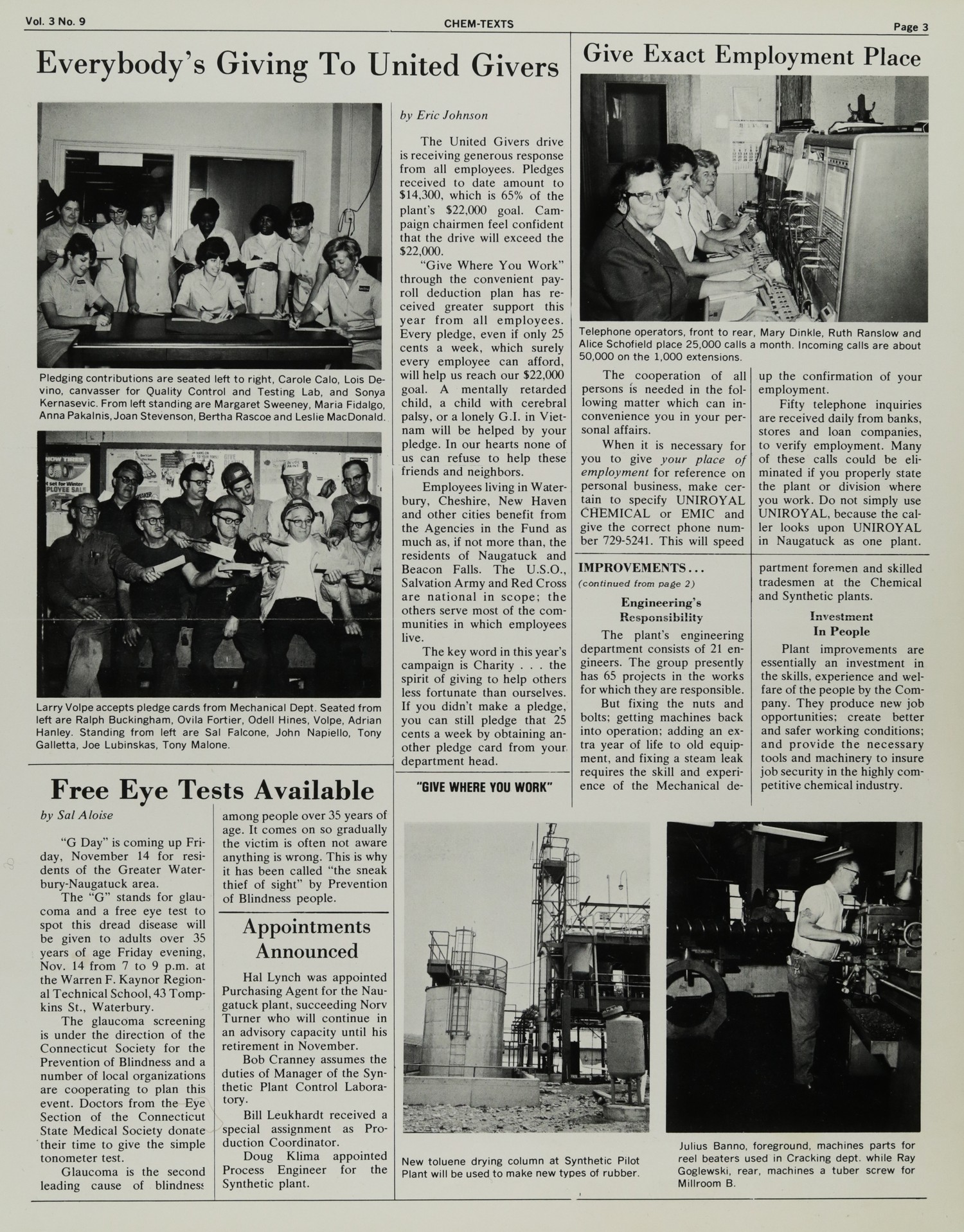
Pledging contributions are seated left to right, Carole Calo, Lois Devino, canvasser for Quality Control and Testing Lab, and Sonya Kernasevic. From left standing are Margaret Sweeney, Maria Fidalgo, Anna Pakalnis, Joan Stevenson, Bertha Rascoe and Leslie MacDonald.


Larry Volpe accepts pledge cards from Mechanical Dept. Seated from left are Ralph Buckingham, Ovila Fortier, Odell Hines, Volpe, Adrian Hanley. Standing from left are Sal Falcone, John Napiello, Tony Galletta, Joe Lubinskas, Tony Malone.


Give Exact Employment Place

Telephone operators, front to rear, Mary Dinkle, Ruth Ranslow and Alice Schofield place 25,000 calls a month. Incoming calls are about 50,000 on the 1,000 extensions.

The cooperation of all persons is needed in the following matter which can inconvenience you in your personal affairs.

When it is necessary for you to give your place of employment for reference on personal business, make certain to specify UNIROYAL CHEMICAL or EMIC and give the correct phone number 729-5241. This will speed up the confirmation of your employment.

Fifty telephone inquiries are received daily from banks, stores and loan companies, to verify employment. Many of these calls could be eliminated if you properly state the plant or division where you work. Do not simply use UNIROYAL, because the caller looks upon UNIROYAL in Naugatuck as one plant.


IMPROVEMENTS…

(continued from page 2)

Engineering’s Responsibility

The plant’s engineering department consists of 21 engineers. The group presently has 65 projects in the works for which they are responsible.

But fixing the nuts and bolts; getting machines back into operation; adding an extra year of life to old equipment, and fixing a steam leak requires the skill and experience of the Mechanical department foremen and skilled tradesmen at the Chemical and Synthetic plants.

Investment In People

Plant improvements are essentially an investment in the skills, experience and welfare of the people by the Company. They produce new job opportunities; create better and safer working conditions; and provide the necessary tools and machinery to insure job security in the highly competitive chemical industry.


Free Eye Tests Available

by Sal Aloise

“G Day” is coming up Friday, November 14 for residents of the Greater Waterbury-Naugatuck area.

The “G” stands for glaucoma and a free eye test to spot this dread disease will be given to adults over 35 years of age Friday evening, Nov. 14 from 7 to 9 p.m. at the Warren F. Kaynor Regional Technical School, 43 Tompkins St., Waterbury.

The glaucoma screening is under the direction of the Connecticut Society for the Prevention of Blindness and a number of local organizations are cooperating to plan this event. Doctors from the Eye Section of the Connecticut State Medical Society donate their time to give the simple tonometer test.

Glaucoma is the second leading cause of blindness among people over 35 years of age. It comes on so gradually the victim is often not aware anything is wrong. This is why it has been called “the sneak thief of sight” by Prevention of Blindness people.


Appointments Announced

Hal Lynch was appointed Purchasing Agent for the Naugatuck plant, succeeding Norv Turner who will continue in an advisory capacity until his retirement in November.

Bob Cranney assumes the duties of Manager of the Synthetic Plant Control Laboratory.

Bill Leukhardt received a special assignment as Production Coordinator.

Doug Klima appointed Process Engineer for the Synthetic plant.


New toluene drying column at Synthetic Pilot Plant will be used to make new types of rubber.


Julius Banno, foreground, machines parts for reel beaters used in Cracking dept. while Ray Goglewski, rear, machines a tuber screw for Millroom B.

CHEM-TEXTS – Vol. 3 No. 10 – Page 2

Page 002

CHEM-TEXTS

Page 2 | Vol. 3 No. 10


FROM THE FACTORY MANAGER

DEAR FELLOW EMPLOYEES:

Have you ever thought about what you are doing to make tomorrow better than today, either for yourself or for others? It seems to me that much of what we will be or will do tomorrow is largely dependent on what we learn today.

No longer can one enjoy for a lifetime the benefits of a formal education. It has often been said that an engineer’s technical knowledge is half obsolete ten years after he graduates. This is true to varying degrees for all of us. Education and learning has become an ongoing lifetime experience.

It is rather strange to realize that while the need for self-improvement and individual growth has never been more clearly recognized, television and other diverse entertainment tempt us into becoming well entertained vegetables. How well will these vegetables grow in tomorrow’s climate of change?

As we pause at this time of the year to give thanks to God for the blessings of the past and present, let’s each take time to plan for our future. For example let’s consider:

  1. What can I do to extend or broaden my knowledge through formal education or by my own reading?
  2. What can I do to prepare myself for a bigger job?
  3. What can I do to better understand our political and economic system?
  4. What can I do to involve myself in the life of my church and my community?
  5. What can I do to better understand who I am, and where am I going?

Sincerely,

[signature]

John D. Evans


Packages Under Study

by Al Manzi

Although we may produce the highest quality products, these products will not be purchased by customers unless the package is delivered in an excellent condition and with a neat, clean appearance. Our agriculture chemical business relies heavily on neat packages displayed in a dealer’s store to help sell the product.

Container failures result in high costs of damages, repackaging and lost customers. We initiated a program of testing with our container suppliers to evaluate and specify the best linings for these chemicals. An area of Building 47 has been caged off for use as a container evaluation laboratory. Samples of containers furnished by suppliers will undergo long range testing with all of our agricultural chemicals. In addition, we will be doing random testing of containers as supplied to inspect the manufacturer’s quality.

The responsibility of clean, properly palleted and stencilled packages still lies with the production groups, materials department, and shipping. When packages are handled by several departments before shipping to a customer, everyone is responsible for the appearance of the package. No matter how well a package is constructed, if it arrives at a customer’s plant torn or dented, he will return it. As a result our production costs increase, the profit on the product is lost, and most important, perhaps we lose a big customer.

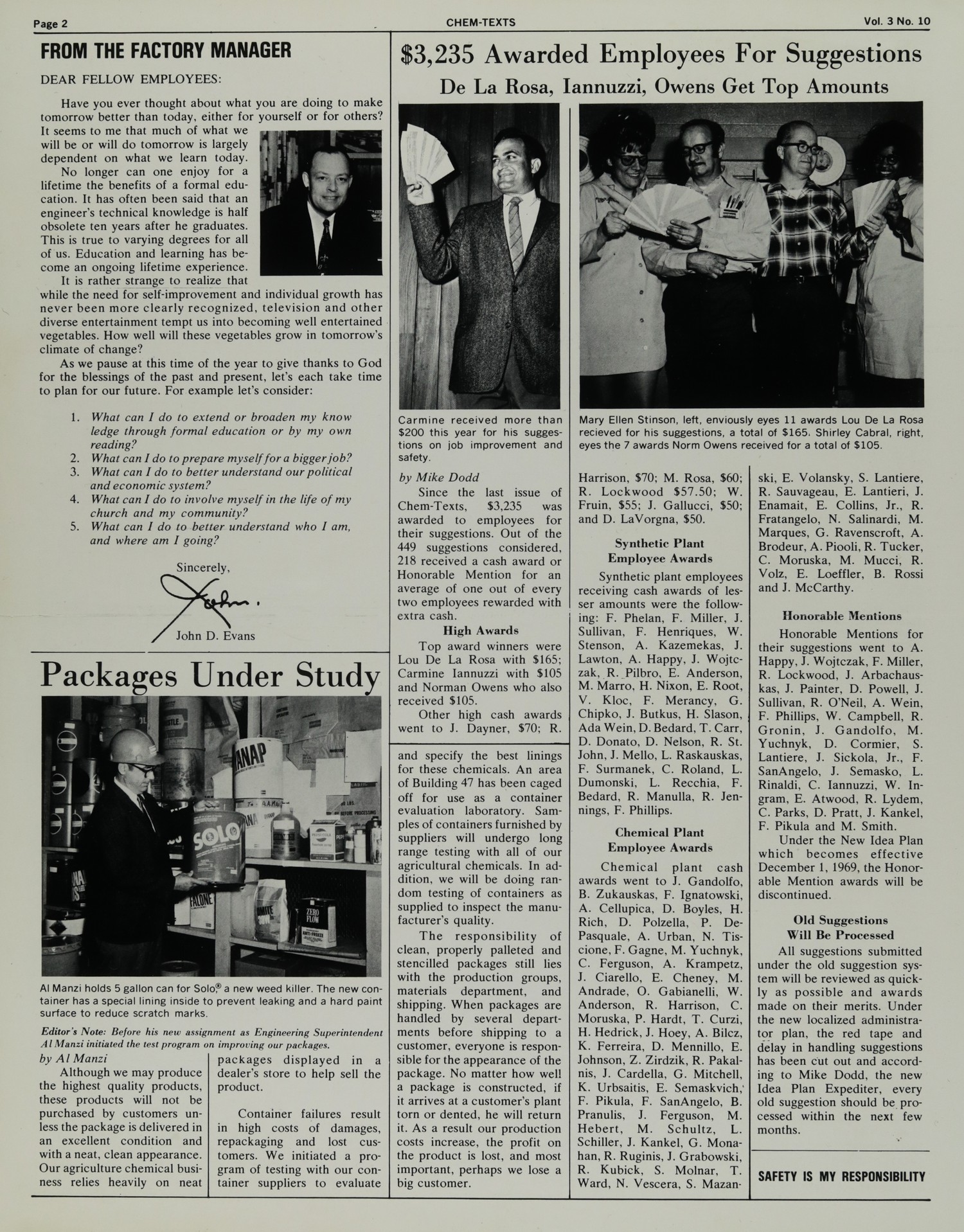
Al Manzi holds 5 gallon can for Solo® a new weed killer. The new container has a special lining inside to prevent leaking and a hard paint surface to reduce scratch marks.

Editor’s Note: Before his new assignment as Engineering Superintendent Al Manzi initiated the test program on improving our packages.


$3,235 Awarded Employees For Suggestions

De La Rosa, Iannuzzi, Owens Get Top Amounts

Carmine received more than $200 this year for his suggestions on job improvement and safety.

by Mike Dodd

Since the last issue of Chem-Texts, $3,235 was awarded to employees for their suggestions. Out of the 449 suggestions considered, 218 received a cash award or Honorable Mention for an average of one out of every two employees rewarded with extra cash.

High Awards

Top award winners were Lou De La Rosa with $165; Carmine Iannuzzi with $105 and Norman Owens who also received $105.

Other high cash awards went to J. Dayner, $70; R. Harrison, $70; M. Rosa, $60; R. Lockwood $57.50; W. Fruin, $55; J. Gallucci, $50; and D. LaVorgna, $50.

Synthetic Plant Employee Awards

Synthetic plant employees receiving cash awards of lesser amounts were the following: F. Phelan, F. Miller, J. Sullivan, F. Henriques, W. Stenson, A. Kazemekas, J. Lawton, A. Happy, J. Wojtczak, R. Pilbro, E. Anderson, M. Marro, H. Nixon, E. Root, V. Kloc, F. Merancy, G. Chipko, J. Butkus, H. Slason, Ada Wein, D. Bedard, T. Carr, D. Donato, D. Nelson, R. St. John, J. Mello, L. Raskauskas, F. Surmanek, C. Roland, L. Dumonski, L. Recchia, F. Bedard, R. Manulla, R. Jennings, F. Phillips.

Chemical Plant Employee Awards

Chemical plant cash awards went to J. Gandolfo, B. Zukauskas, F. Ignatowski, A. Cellupica, D. Boyles, H. Rich, D. Polzella, P. DePasquale, A. Urban, N. Tiscione, F. Gagne, M. Yuchnyk, C. Ferguson, A. Krampetz, J. Ciarello, E. Cheney, M. Andrade, O. Gabianelli, W. Anderson, R. Harrison, C. Moruska, P. Hardt, T. Curzi, H. Hedrick, J. Hoey, A. Bilcz, K. Ferreira, D. Mennillo, E. Johnson, Z. Zirdzik, R. Pakalnis, J. Cardella, G. Mitchell, K. Urbsaitis, E. Semaskvich, F. Pikula, F. SanAngelo, B. Pranulis, J. Ferguson, M. Hebert, M. Schultz, L. Schiller, J. Kankel, G. Monahan, R. Ruginis, J. Grabowski, R. Kubick, S. Molnar, T. Ward, N. Vescera, S. Mazan-

Mary Ellen Stinson, left, enviously eyes 11 awards Lou De La Rosa recieved for his suggestions, a total of $165. Shirley Cabral, right, eyes the 7 awards Norm Owens received for a total of $105.

ski, E. Volansky, S. Lantiere, R. Sauvageau, E. Lantieri, J. Enamait, E. Collins, Jr., R. Fratangelo, N. Salinardi, M. Marques, G. Ravenscroft, A. Brodeur, A. Piooli, R. Tucker, C. Moruska, M. Mucci, R. Volz, E. Loeffler, B. Rossi and J. McCarthy.

Honorable Mentions

Honorable Mentions for their suggestions went to A. Happy, J. Wojtczak, F. Miller, R. Lockwood, J. Arbachauskas, J. Painter, D. Powell, J. Sullivan, R. O’Neil, A. Wein, F. Phillips, W. Campbell, R. Gronin, J. Gandolfo, M. Yuchnyk, D. Cormier, S. Lantiere, J. Sickola, Jr., F. SanAngelo, J. Semasko, L. Rinaldi, C. Iannuzzi, W. Ingram, E. Atwood, R. Lydem, C. Parks, D. Pratt, J. Kankel, F. Pikula and M. Smith.

Under the New Idea Plan which becomes effective December 1, 1969, the Honorable Mention awards will be discontinued.

Old Suggestions Will Be Processed

All suggestions submitted under the old suggestion system will be reviewed as quickly as possible and awards made on their merits. Under the new localized administrator plan, the red tape and delay in handling suggestions has been cut out and according to Mike Dodd, the new Idea Plan Expediter, every old suggestion should be processed within the next few months.


SAFETY IS MY RESPONSIBILITY

CHEM-TEXTS – Vol. 3 No. 11 – Page 3

Page 003

CHEM-TEXTS

Vol. 3 No. 11 | Page 3


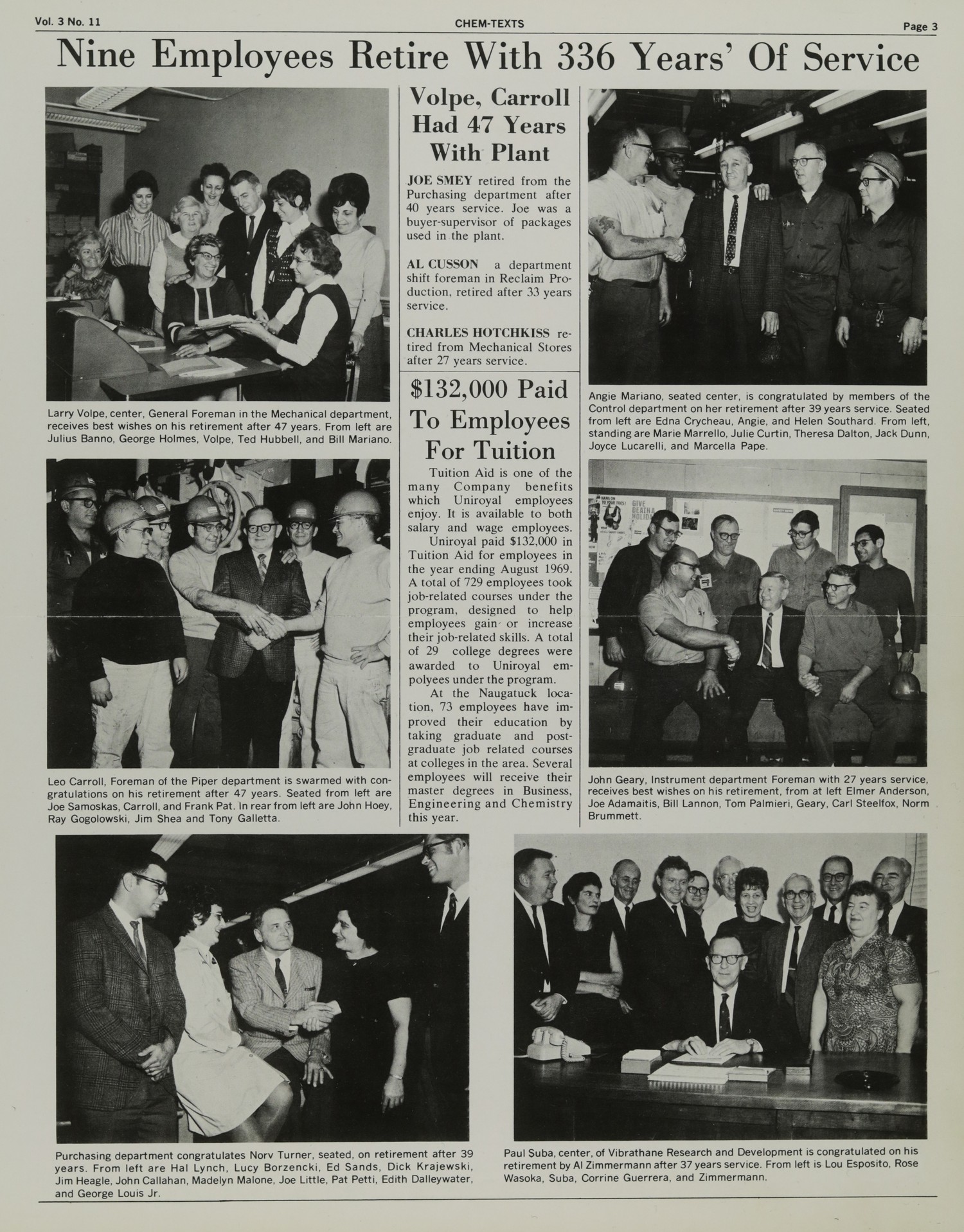
Nine Employees Retire With 336 Years’ Of Service


Volpe, Carroll Had 47 Years With Plant

JOE SMEY retired from the Purchasing department after 40 years service. Joe was a buyer-supervisor of packages used in the plant.

AL CUSSON a department shift foreman in Reclaim Production, retired after 33 years service.

CHARLES HOTCHKISS retired from Mechanical Stores after 27 years service.


$132,000 Paid To Employees For Tuition

Tuition Aid is one of the many Company benefits which Uniroyal employees enjoy. It is available to both salary and wage employees.

Uniroyal paid $132,000 in Tuition Aid for employees in the year ending August 1969. A total of 729 employees took job-related courses under the program, designed to help employees gain or increase their job-related skills. A total of 29 college degrees were awarded to Uniroyal employees under the program.

At the Naugatuck location, 73 employees have improved their education by taking graduate and post-graduate job related courses at colleges in the area. Several employees will receive their master degrees in Business, Engineering and Chemistry this year.


[Photo Caption – Top Left]
Larry Volpe, center, General Foreman in the Mechanical department, receives best wishes on his retirement after 47 years. From left are Julius Banno, George Holmes, Volpe, Ted Hubbell, and Bill Mariano.


[Photo Caption – Top Right]
Angie Mariano, seated center, is congratulated by members of the Control department on her retirement after 39 years service. Seated from left are Edna Crycheau, Angie, and Helen Southard. From left, standing are Marie Marrello, Julie Curtin, Theresa Dalton, Jack Dunn, Joyce Lucarelli, and Marcella Pape.


[Photo Caption – Middle Left]
Leo Carroll, Foreman of the Piper department is swarmed with congratulations on his retirement after 47 years. Seated from left are Joe Samoskas, Carroll, and Frank Pat. In rear from left are John Hoey, Ray Gogolowski, Jim Shea and Tony Galletta.


[Photo Caption – Middle Right]
John Geary, Instrument department Foreman with 27 years service, receives best wishes on his retirement, from at left Elmer Anderson, Joe Adamaitis, Bill Lannon, Tom Palmieri, Geary, Carl Steelfox, Norm Brummett.


[Photo Caption – Bottom Left]
Purchasing department congratulates Norv Turner, seated, on retirement after 39 years. From left are Hal Lynch, Lucy Borzencki, Ed Sands, Dick Krajewski, Jim Heagle, John Callahan, Madelyn Malone, Joe Little, Pat Petti, Edith Dalleywater, and George Louis Jr.


[Photo Caption – Bottom Right]
Paul Suba, center, of Vibrathane Research and Development is congratulated on his retirement by Al Zimmermann after 37 years service. From left is Lou Esposito, Rose Wasoka, Suba, Corrine Guerrera, and Zimmermann.

URW Suggests 3-Year Pact, Reports Claim

URW Suggests 3-Year Pact, Reports Claim

6-14-67 [handwritten date]

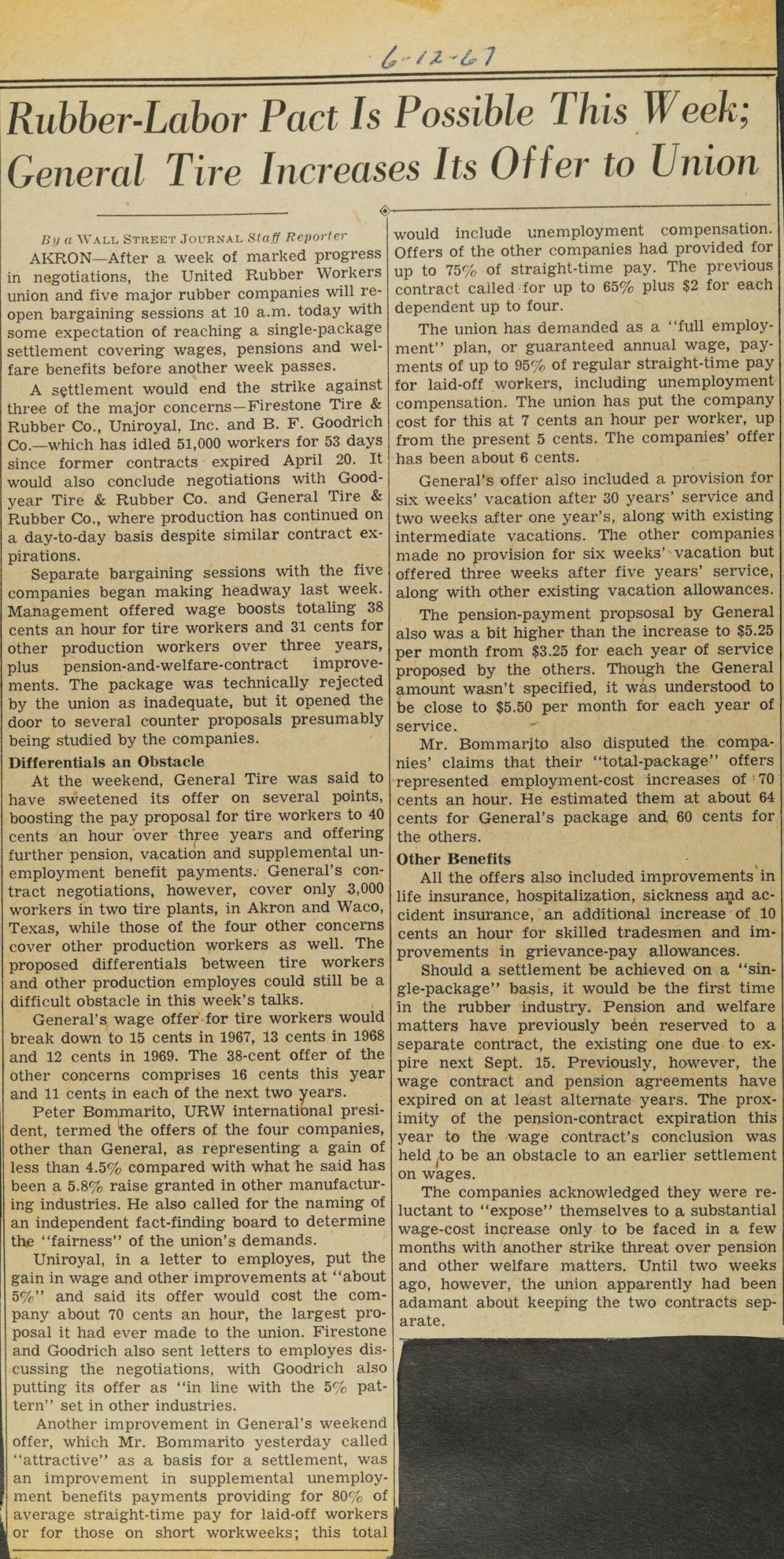
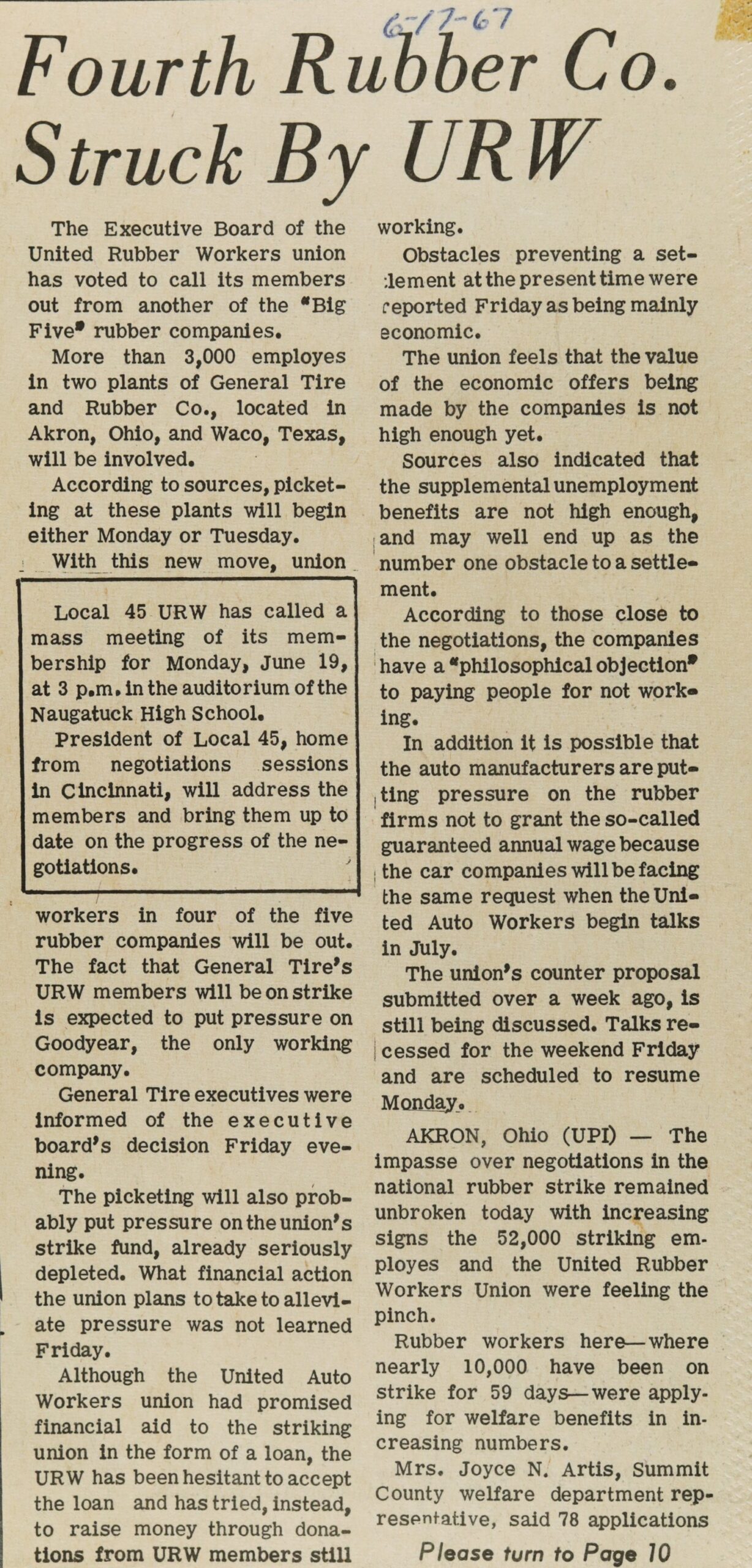
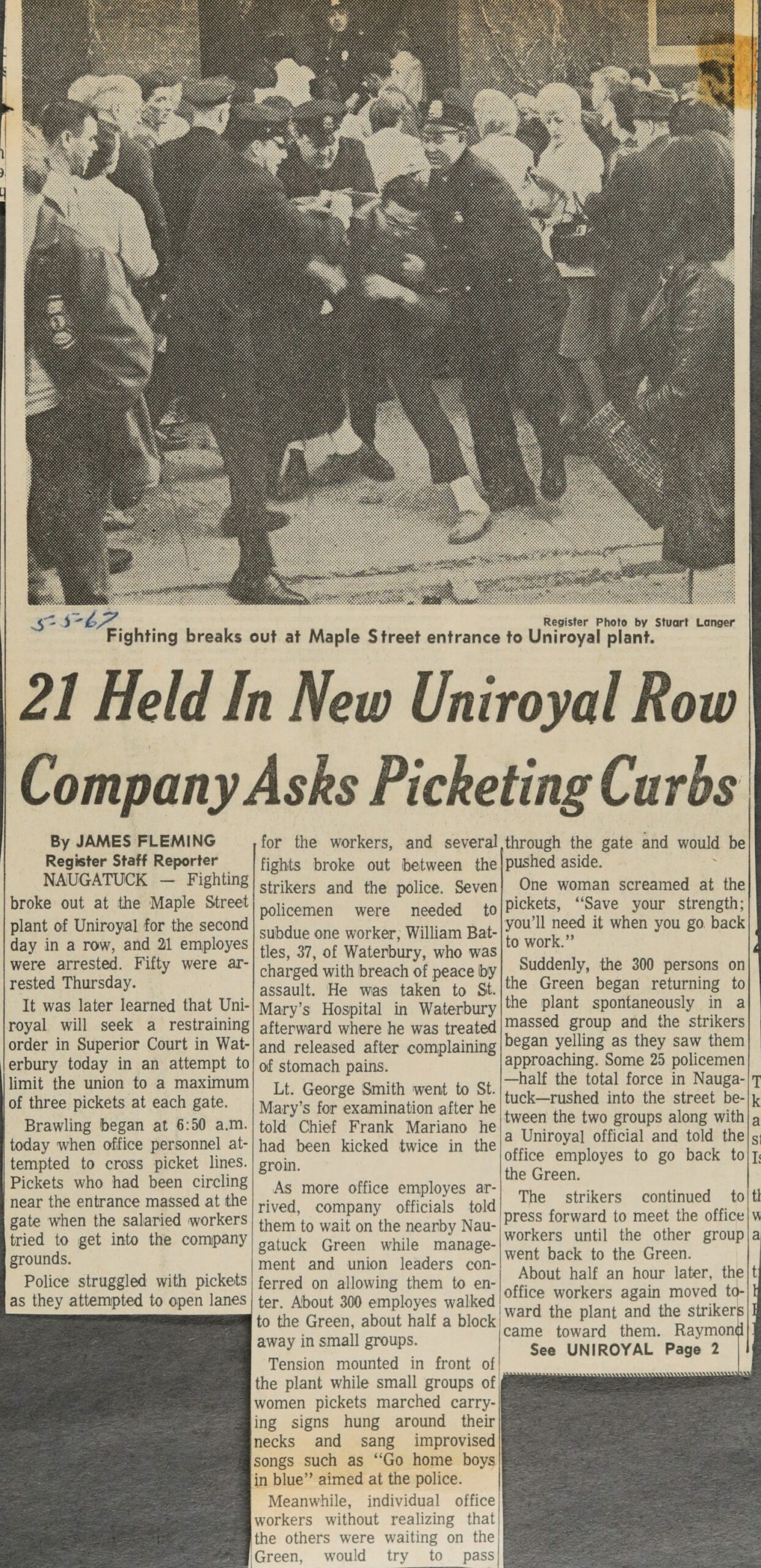
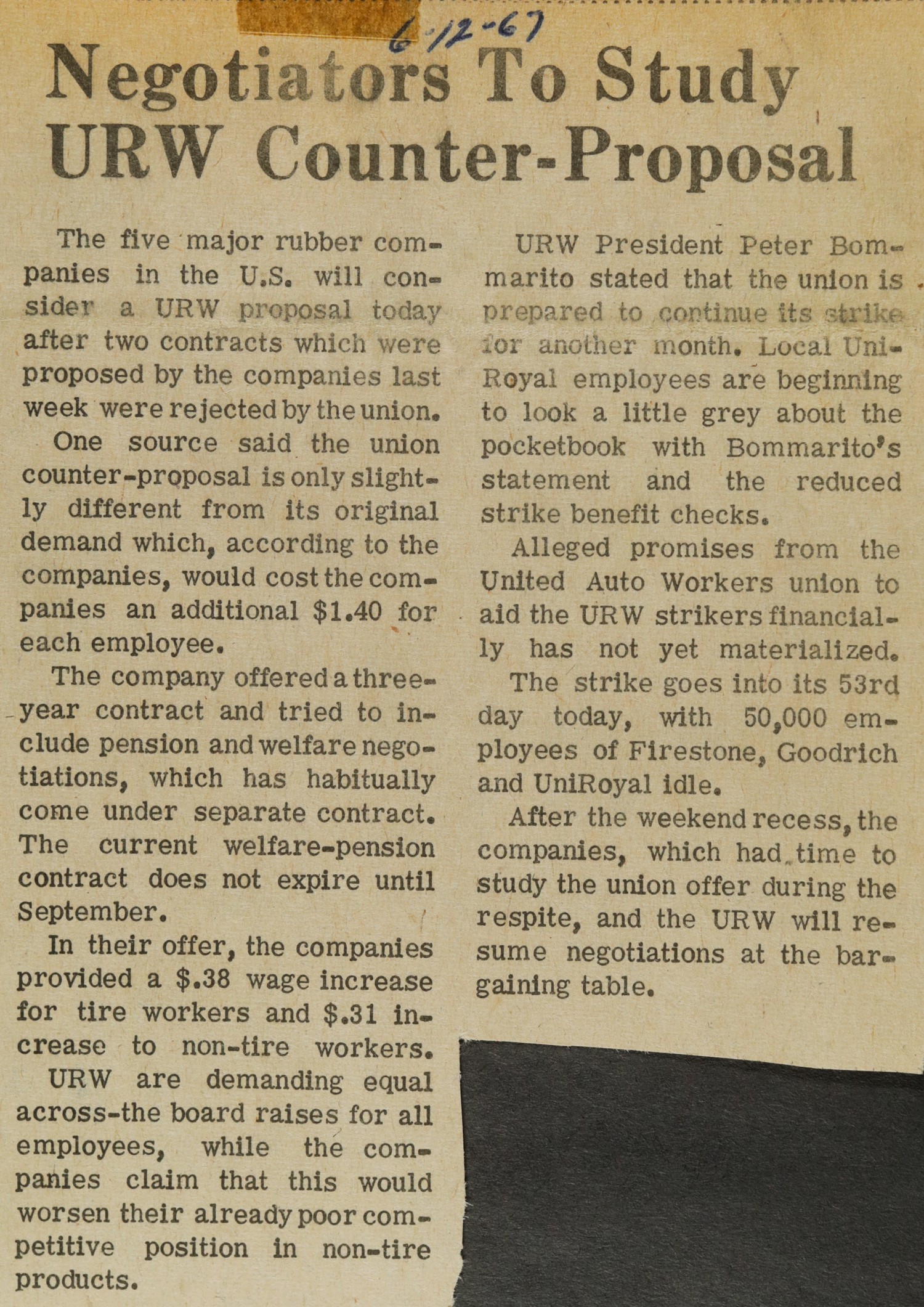
NAUGATUCK—A URW counter proposal being discussed by Uniroyal and four other major rubber producers calls for a three-year agreement and includes pensions and fringe benefits, it was learned Tuesday.

The United Rubber Workers submitted the counter proposal after rejecting an industry-wide offer Friday.

The three-year counter proposal represents a turnabout in the union stand in the negotiations.

During a mass meeting of the Local 45 membership, held May 29, Pres. George Froehlich reportedly told those in attendance that the union would settle for neither a three-year pact nor an agreement which included pensions and fringe benefits.

According to sources, however, the union has come to the conclusion that the three-year pact was necessary, primarily because it seemed the only way to force the companies into offering higher wage benefits.

When the companies made their original offers, the wage terms and supplemental unemployment benefits were considered inadequate by union negotiators.

Management claimed, however, that none of the items in the contract offers could be raised until they had some idea of what the union was seeking in pension and fringe benefits.

The first hint of significant progress came about two weeks ago, according to sources, when all five companies were scheduled to sit at one table and discuss a pact. The meeting failed, however, due to the union negotiators from Goodrich, the sources claimed.

Election Problems

Despite the problems with the contract itself, sources have indicated that another obstacle in the negotiations is the forthcoming union elections on the local level.

Some of the union negotiators, who are seeking reelection, have been adamant in their demands in order to satisfy the rank and file membership. Uniroyal union representatives, however, were not indicated as being among this group.

The union plan submitted Friday calls for a straight five per cent increase, sources revealed.

Among the items called for in the counter proposal are an increase in pensions to $5.50 per man per year, and supplemental unemployment benefits up to 80 per cent.

Management reportedly had last offered an increase in pensions to $5.25, and supplemental unemployment benefits up to 75 per cent.

Union negotiators claimed that their proposed five per cent general increase would cost the company 73 cents, but management has claimed that it would cost $1.40.

UAW Aid

Although the union has been promised aid from the United Auto Workers Union, sources said that the aid was in the form of a loan.

UAW negotiators have to date chosen to reduce strike benefit checks to $15 from $25 weekly, and try to raise money among URW members still working at General Tire, Goodyear and other smaller rubber firms.

One week’s collection, it was said, brought only $6,000 in donations from rubber workers not on strike.

Not only are there problems within the union, but management is suffering some within the ranks of the five companies, it was reported.

Firestone has been claimed to be the dominant figure in the negotiations, but a Goodyear victory at the Indianapolis Speedway on Memorial Day has resulted in signs of a change in management leadership, according to sources.

Uniroyal Talks Depend On Other Firms, Claim

6-15-67

Uniroyal Talks Depend On Other Firms, Claim

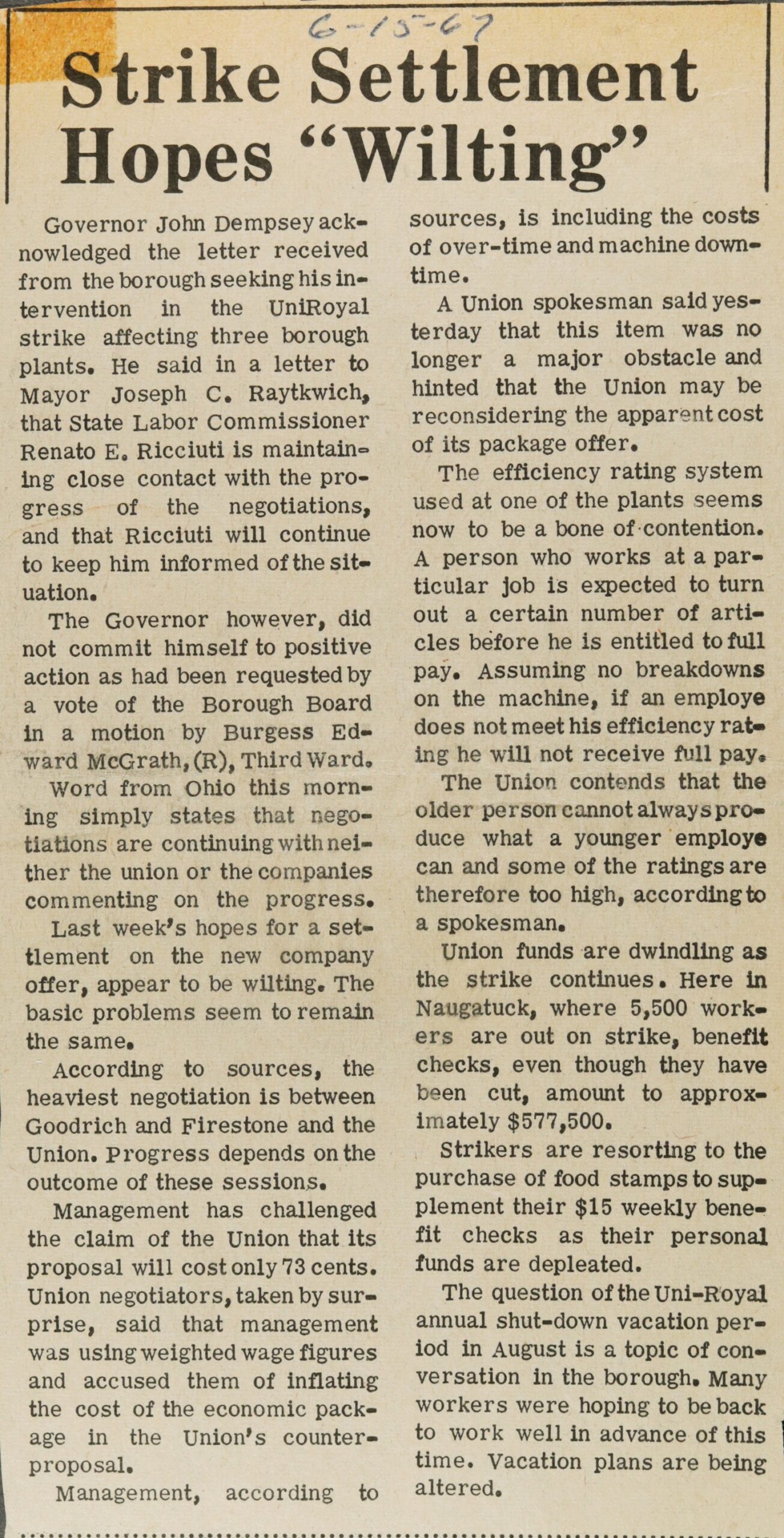
NAUGATUCK—Talks between Uniroyal and United Rubber Workers negotiators continue in Cincinnati today, but informed sources said progress would depend on talks between the union and some of the other rubber firms, notably B. F. Goodrich and Firestone.

It is with these two companies, said one source, that the heaviest negotiating is taking place.

A source close to the negotiations said although on the surface some of the labor-management negotiators from other companies seem to say little to each other “a lot is going on underneath.”

Union negotiators were reportedly surprised during recent talks when management challenged a claim that the union’s counter-proposal would cost only 73 cents.

In a surprise move during recent talks, management presented what is referred to as a “roll up” to challenge a claim that the union’s economic package would cost only 73 cents.

In use, sources say, the “roll up” shows that although a raise apparently amounts to, say, 16 cents, the raise may be more like 17 or 18 cents due to the overtime and machine down time.

Union negotiators were reportedly caught off guard by the term, and claimed that management was using a weighted wage figure, and accused them of inflating the cost of the economic package.

Union spokesmen contacted Wednesday night said that this item was no longer a major obstacle and hinted that the union may be reconsidering the apparent cost of the package.

Some of the larger obstacles, it was said, are non-economic.

One such obstacle is referred to as the “bogie.” A golfing term, it has been applied to the efficiency rating used in at least one company’s plants.

A person who works at a particular job, according to plant employes, is expected to turn out a certain number of articles before he is entitled to full pay.

Assuming no breakdowns on the machine, if an employe does not meet his efficiency rating, he will not receive full pay.

These ratings are reportedly established by time and motion study men.

It is the union’s contention, say sources, that older people in the plant cannot always produce what a younger employe can produce, and some of the ratings are therefore to high, causing the union to want them eliminated.

It has been learned that the union’s counter proposal includes pensions and fringe benefits, which have come under a separate contract in the past.

Although some of the union negotiators are far from happy about discussing these items in a master contract, the union has reportedly found it necessary to do so in order to obtain the goals sought in the master contract.

As yet, however, the rank and file union members have not had the opportunity to express their wishes, at least to local negotiators, concerning pensions.

While the International URW funds are running low, efforts are in progress to obtain donations from URW workers who are not on strike. The efforts have been reportedly unsuccessful. During one week of canvassing, only $6,000 in donations were obtained.

Progress Signs Seen In Talks

Progress Signs Seen In Talks

Friday MAY 19, 1967 [handwritten]

NAUGATUCK Negotiations between the United Rubber Workers and Uniroyal, Inc. are scheduled to continue today in Cincinnati, with informed sources indicating Thursday that signs of progress are being made.

As the strike entered its fifth week, rumors swept the borough to the effect that Firestone had either settled or was very close to settlement. The rumors remained unconfirmed, however, as sources claimed that Firestone did not meet with the union Thursday. They, too, however, are scheduled to meet today.

The signs of progress in the Uniroyal talks were indicated when informed sources said that the number of issues being discussed had dropped from approximately 50 to about 20. What any of the issues are, however, remains unknown.

In addition, sources said, management had offered a guaranteed annual wage amounting to 75 per cent base wage in case of layoffs. The union is reportedly seeking over 90 per cent.

Details of the 75 per cent clause could not be obtained.

The scene in the borough remained quiet again Thursday, and many pickets seemed more cheerful as the rumors of Firestone’s progress ran around town.

In Waterville, a trucker approaching the URW picket line at a Uniroyal warehouse there chose to honor the picket and the truck was taken into the warehouse without incident by a white collar employe.

Local 218 Protests Uniroyal Statement

Local 218 Protests Uniroyal Statement

Local 218 Protests Uniroyal Statement

5-28-67 [handwritten date in top right corner]

NAUGATUCK—Officials of Local 218, United Rubber Workers, claimed Saturday that “inaccurate statements were made by the factory manager of Uniroyal Chemical Plant”, in relation to the management’s decision to use supervisory personnel to operate process equipment at the plant while the company is being picketed by the local in its strike for the past five weeks.

Union officials said Saturday: “The union wishes to set the record straight on the qualifications of the supervisory personnel who are operating the process equipment.

“Mr. John Evans, plant manager, stated that the supervisors normally train the regular operators, when in fact new or transferred operators are trained by qualified operators from the bargaining unit.

“Mr. Evans’ consideration for the safety of personnel, as well as the residents of Naugatuck, can be refuted by the fact that in some instances it has taken months to force the company to correct safety hazards in the plant. It also has been necessary to resort to the grievance procedure and use the extreme measure of refusing to operate some process equipment.

“As for the production of material vital to the defense effort in Vietnam, only one item is indirectly related to the Vietnam conflict, which is the protective stripping used by sub-contractors for shipping purposes. All other production being done in the plant is strictly for commercial purposes.

“The inaccurate statements made by the factory manager of Uniroyal Chemical can be attributed to his inexperience due to the fact that he was only recently appointed to the post of factory manager,” the officials claimed.

UniRoyal – URW Show Cause Hearing Thurs.

UniRoyal – URW
Show Cause Saturday
Hearing Thurs. MAY 27, 1967

Superior Court Judge Leo V.
Gaffney continued the hearing
for an injunction sought by the
Chemical Division of UniRoyal
against the United Rubber
Workers Friday.

The continuance followed an
early morning session of peace-
ful picketing by Local 218 at
the Elm Street entrance to the
plant. No personnel were denied
entry.

In its court appearance
Thursday, the local must show
cause why an injunction should
not be issued against “illegal
picketing activities.” Eight
pickets were arrested at the
same gate Thursday morning.

At that time, pickets were
attempting to prevent manage-
ment personnel from entering
the plant to produce items said
to be necessary to the Viet-
nam war effort.

Judge Gaffney said he knew
“There was a spark of patrio-
tism” in everyone and added
that he hoped this would lead to
a lessening of tensions at the
Chemical plant.

Union President Joseph
Rzeszutek firmly denied that
any of the items produced
Thursday were going to Viet-
nam. He was one of the eight
arrested.

No witnesses were called in
the case. Judge Gaffney met with
union and management lawyers
in chambers and then issued
the order in open court.

Please Turn to Page 10

Mass Picketing At Synthetic Plant Leads To Arrest Of Four Persons

Mass Picketing At Synthetic Plant Leads To Arrest Of Four Persons

Mass Picketing At Synthetic Plant Leads To Arrest Of Four Persons

5-31-67 [handwritten notation]

NAUGATUCK—Mass picketing by members of Local 308 at Uniroyal’s Synthetic Plant, this morning, led to the arrest of four pickets, after an attempt was made to prevent management personnel from entering the plant.

Two of the pickets had to be forcibly ejected by police, following the reading of the riot act from the state statutes by Capt. Joseph Summa, when they refused to step aside for the plant’s personnel. All personnel entered the plant, after a wedge had been formed by about a dozen police breaking the picket line.

The four arrested were brought to police headquarters, for booking in the patrol cars. However, about 30 of the pickets also arrived at the station asking to be arrested in sympathy with those already arrested.

Arrested on charges of breach of peace were John A. Painter, 38, Morris Rd., Prospect; Paul Laurenzi, 41, 30 Serry Rd., Wolcott; Jesse J. Silva, 23, 143 Cherry St. and Anthony Gambardella, 54, 53 Brichwood Rd., Seymour. Court appearances were set for June 8.

Edward Alves, president of the local, said this morning that management had informed the union that production would begin at the plant today, which had resulted in the mass picketing.

Questioned Decision

Alves questioned the decision of the management, criticizing its actions in attempting production with “unskilled personnel.” The union president further asserted that because of the “danger of work involved at the plant, a disaster could occur, not only endangering the lives and property of those in close proximity to the plant, but to also those in the neighborhood.”

Alves said the union has contacted the insurance company on whether they had been informed of the production work by the unskilled personnel and reported the insurance company had not been notified to date. He said periodic inspections are conducted at the plant due to the nature of work involved.

Third Plant Involved

The mass picketing at the Synthetic Plant, makes the third plan of the Uniroyal company to be involved since the three plants were struck 41 days ago.

Both Locals 218 of the Chemical and 308 of Synthetic Plants have maintained around-the-clock picketing since the beginning of the strike.

It could not be determined today if management will seek an injunction against the Synthetic Local.

UniRoyal Struck As Talks In Ohio Come To Stop

UniRoyal Struck As Talks In Ohio Come To Stop

4-21-67 [handwritten notation]


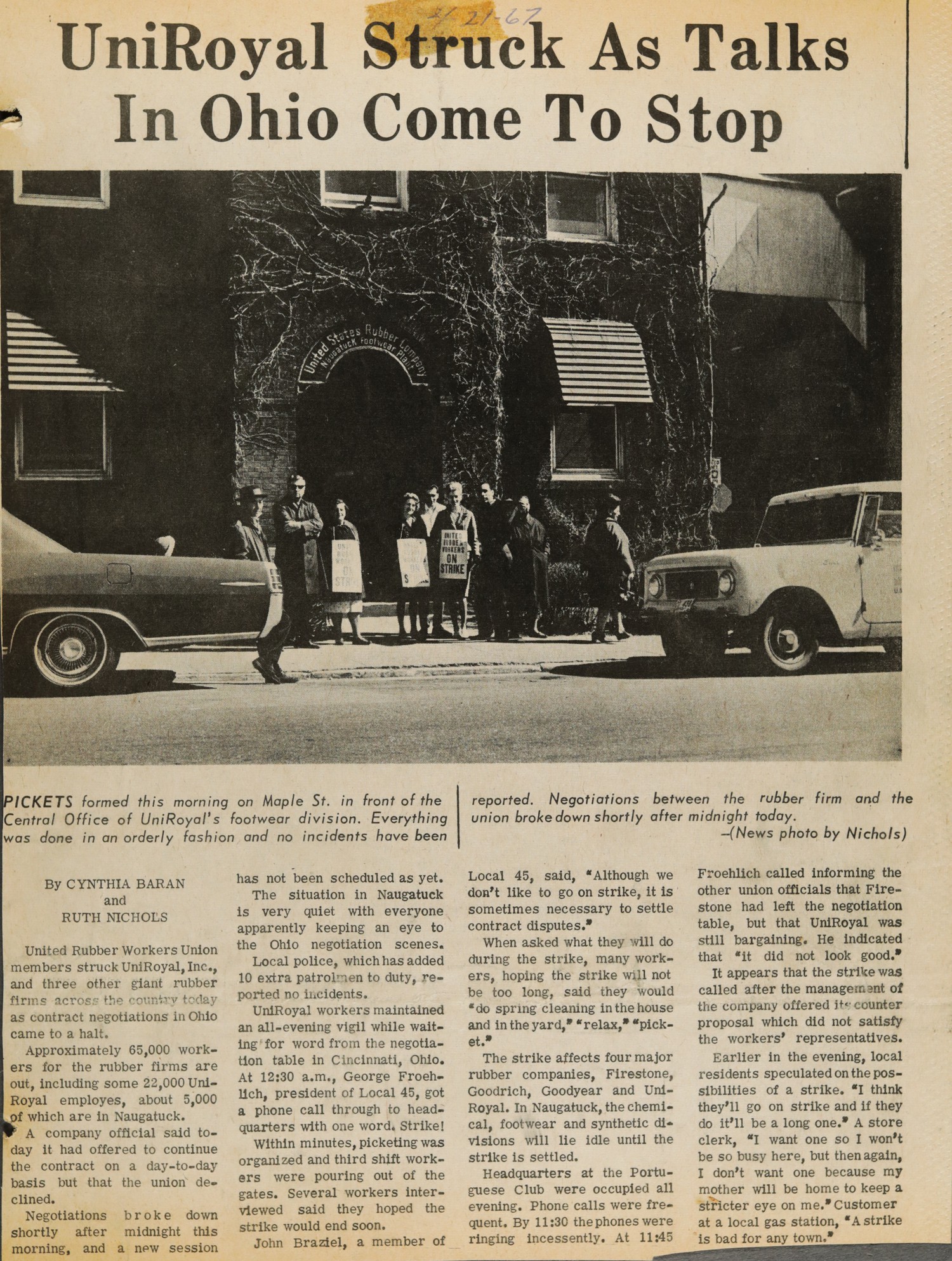
PICKETS formed this morning on Maple St. in front of the Central Office of UniRoyal’s footwear division. Everything was done in an orderly fashion and no incidents have been reported. Negotiations between the rubber firm and the union broke down shortly after midnight today.

—(News photo by Nichols)


By CYNTHIA BARAN
and
RUTH NICHOLS

United Rubber Workers Union members struck UniRoyal, Inc., and three other giant rubber firms across the country today as contract negotiations in Ohio came to a halt.

Approximately 65,000 workers for the rubber firms are out, including some 22,000 UniRoyal employes, about 5,000 of which are in Naugatuck.

A company official said today it had offered to continue the contract on a day-to-day basis but that the union declined.

Negotiations broke down shortly after midnight this morning, and a new session has not been scheduled as yet.

The situation in Naugatuck is very quiet with everyone apparently keeping an eye to the Ohio negotiation scenes.

Local police, which has added 10 extra patrolmen to duty, reported no incidents.

UniRoyal workers maintained an all-evening vigil while waiting for word from the negotiation table in Cincinnati, Ohio. At 12:30 a.m., George Froehlich, president of Local 45, got a phone call through to headquarters with one word: Strike!

Within minutes, picketing was organized and third shift workers were pouring out of the gates. Several workers interviewed said they hoped the strike would end soon.

John Braziel, a member of Local 45, said, “Although we don’t like to go on strike, it is sometimes necessary to settle contract disputes.”

When asked what they will do during the strike, many workers, hoping the strike will not be too long, said they would “do spring cleaning in the house and in the yard,” “relax,” “picket.”

The strike affects four major rubber companies, Firestone, Goodrich, Goodyear and UniRoyal. In Naugatuck, the chemical, footwear and synthetic divisions will lie idle until the strike is settled.

Headquarters at the Portuguese Club were occupied all evening. Phone calls were frequent. By 11:30 the phones were ringing incessantly. At 11:45 Froehlich called informing the other union officials that Firestone had left the negotiation table, but that UniRoyal was still bargaining. He indicated that “it did not look good.”

It appears that the strike was called after the management of the company offered its counter proposal which did not satisfy the workers’ representatives.

Earlier in the evening, local residents speculated on the possibilities of a strike. “I think they’ll go on strike and if they do it’ll be a long one.” A store clerk, “I want one so I won’t be so busy here, but then again, I don’t want one because my mother will be home to keep a stricter eye on me.” Customer at a local gas station, “A strike is bad for any town.”

2 Union Vice-Presidents Included In Arrests; All Charged Breach/Peace

2 Union Vice-Presidents Included In Arrests; All Charged Breach/Peace

Sep 67 [handwritten notation in top right]

By Ruth Nichols

Forty-three UniRoyal strikers were arrested this morning including Raymond Mengacci, vice-president of Local 45 and Cy Blanchard, vice-president of Local 218, as police attempted to restore order to the picket lines on Maple St.

In the midst of the scuffle, which began early this morning, one man, Nunzio Finateri, about 51, was taken to St. Mary’s Hospital with a possible heart attack.

Both policemen and pickets received minor injuries as management attempted to cross the lines to enter the UniRoyal buildings.

Maple Street was closed to traffic about 7:30 this morning for an hour, until order was restored. By 8 a.m. all office workers were allowed through the line without incident.

Several groups of women gathered together on Church St. and waited for their male supervisor before attempting to enter the offices.

The first group of strikers arrested were brought forcibly to police headquarters; later however, the mood changed and the arrested strikers came in on their own to be booked. All strikers were charged with breach of peace and bond set at $150.


It was noted however, that although Local 45 is 80 per cent women, only men were booked this morning. Three police officers were at the desk, one in the file room and one in the detective’s room, booking the men as fast as possible to clear out the station.

When the bookings first began, the main room of headquarters was so full that those arrested were lined down the hallway.

Capt. Joseph Summa, in charge of the special force on strike duty, ordered a crowd dispersed outside the station where a retired employe of UniRoyal was attempting to incite pickets and stop the white collar workers from entering the buildings.

No personnel were entering the buildings through the warehouse, but rather coming through the Maple St. gate and then crossing over into the warehouse area.

Both policemen and strikers were bruised in the melee. Some women were on the outer edge of the picket line with others in the center.


women on the outside left the line and the women in the center had to wait their opportunity to leave.

Officer Jerry Sirica was the officer in charge of the policemen on duty at the Maple St. gates under the supervision of Capt. Summa.

Policemen received twisted arms, kicks in the shins, feet stepped on, and in one case, a hand bitten as they struggled with the pickets.

The pickets were ordered to keep moving in an orderly fashion once the scuffling was over until calm was insured.

Rumors are strong that a restraining injunction will be served upon the URW Unions before the day is out, but no confirmation has been received.

A report of police brutality was threatened following an incident last night when attorneys were trying to leave the plant and the picketers were not going to permit them through.

To add to the general confusion this morning, crowds of people were going home from St. Francis Church, adding to the already heavy traffic flow.


than 24 hours that UniRoyal would attempt to move some materials out of the warehouse on Rubber Ave. early this morning.

By noon today, however, no activity was attempted in this direction. Orderly picketing was going on by a large group of strikers on Elm St., next to the warehouse.

Union leaders were dividing their times between the Maple St. gates, the Rubber Ave. warehouse and another warehouse in Beacon Falls. Some picketers were picked up from the Rubber ave. facility and driven to Beacon Falls to add to those already there.

Rumors about the activity in the two towns ran rampant this morning. Word that more than 100 people had been arrested was heard being passed from picket to picket.

ONLY MOMENTS BEFORE he was arrested by Naugatuck police this morning, Cy (Doc) Blanchard, center, held the attention of striking members of Local 45, United Rubber Workers, at the central office entrance of the Uniroyal Footwear plant. Blanchard, vice-president of Local 218, URW, at the firm’s striking Chemical Division, was among union officials and members arrested today.—King Photo.

5-4-67

ONLY MOMENTS BEFORE he was arrested by Naugatuck police this morning, Cy (Doc) Blanchard, center, held the attention of striking members of Local 45, United Rubber Workers, at the central office entrance of the Uniroyal Footwear plant. Blanchard, vice-president of Local 218, URW, at the firm’s striking Chemical Division, was among union officials and members arrested today.—King Photo.

DOZEN POLICEMEN stand in a cluster at a Maple St. gate of Naugatuck’s Uniroyal footwear plant today moments before moving into crowds of striking United Rubber Workers to make arrests for breach of the peace. Those arrested were escorted to nearby Police Headquarters for booking.—King Photo.

Uniroyal Quiet After Flareup

Uniroyal Quiet After Flareup

5-5-67

NAUGATUCK — After a Thursday morning flareup between police and pickets at the Uniroyal Footwear Division plant, in which 50 people were arrested on charges of breach of peace, the scene became quiet for the remainder of the day, even to the point that pickets permitted a postal shipment to leave the main warehouse.

Negotiations between top management and labor representatives continued during the day in Cincinnati without settlement, and at the end of the day, the rumored injunction being sought by management had not been received.

Police Chief Frank J. Mariano said Thursday night that he attributed the calm which prevailed after the clash to the “excellent cooperation” among those arrested, particularly to two high ranking local officials.

Chief Mariano said that he felt that the police force, under the leadership of Capt. Joseph Summa, had done “an excellent job” quieting things down, but that the job might have been more difficult ha d Local 45 Vice President Raymond Mengacci and Local 218 Vice President Cyrus Blanchard not cooperated as they did.

The actions of Mengacci and Blanchard, said Chief Mariano, “averted possible rougher incidents.” When the two vice presidents were arrested, he added, the peaceful attitude which they exhibited set the tone for the remaining pickets, who went quietly to the police headquarters.

At about 5 p.m., according to Local 45 Secretary Rita Ruggiero, a postal shipment was permitted by pickets to leave the main warehouse. Rumors that a shipment would be made by helicopter remained rumors, and no such shipment was made.

The scuffle in the early hours of Thursday morning brought out the entire police force, some of whom had had only a few hours rest before the call to return to duty.

In addition to the regular force, supernumerary policemen were called out to force their way through the 100-man picket line at the Maple St. gate, and provide a passage way for office and supervisory personnel. The office personnel eventually made their way in.

The first group, arrested about 6:45, had to be physically forced to the police station, across the street from the trouble spot. Only after Police Capt. Joseph Summa read the riot act in the state statutes over a bullhorn to the unruly crowd did the commotions begin to settle.

Women in the picket line and in the group trying to get into the plant began to cry as the tension mounted, and the evidence of possible physical violence rose. Police blocked off Maple St. to all traffic during the height of the scuffle.

Although police did not use clubs or other devices to restrain the picketers, several minor injuries were reported. One striker, Nunzio Finateri, 52, Union City Rd., was taken to St. Mary’s Hospital, Waterbury, where he was X-rayed, treated the scuffle, and complained of pains in his chest.

Several policemen and picketers were bruised in the clash, although there were no reports of medical treatment other than Finateri’s

At 7:45 a.m., when workers for the 8 o’clock shift began to arrive, a second outbreak flared up, but was quickly squelched by police.

Those arrested during the second outbreak did not resist being taken to the police station, as the first group had.

As to what would happen Friday, when office workers and supervisory personnel are to return to work again, Mengacci said, “We haven’t got the slightest idea. We have been conferring with our attorneys, and we expect to play it by ear as we go along. We have heard that we will be served with an injunction, but have not received any word to date.”

LOOKING SULLEN as management and office workers file into the Maple St. gate of UniRoyal Raymond Memorial, vice-president of Local 45, URW, checks each person to be certain all are UniRoyal employees. Some who didn’t have UniRoyal badges shown prominently were asked to display them.

LOOKING SULLEN as management and office workers file into the Maple St. gate of Uni-Royal, Raymond Mengacci, vice-president of Local 45, URW, checks each person to be certain all are UniRoyal employes. Some who didn’t have UniRoyal badges showing prominently were asked to display them. —(News photo by Jensen)


[Handwritten note on right margin:]
8-5-67

Court Restrains Uniroyal Pickets

Court Restrains Uniroyal Pickets

5-6-67 [handwritten]

By PATRICK KEATING
Register Staff Reporter

NAUGATUCK — Management of the Footwear Division, Uniroyal, was granted an injunction against Local 45, United Rubber Workers, Friday afternoon at Waterbury Superior Court which will restrict the overall picketing by the union of the plant, effective immediately.

See PHOTO Page 25

The injunction, which had been sought by Uniroyal, will limit the manner of picketing and also restrain the union from stopping management personnel, company trucks, and independent carriers from entering and leaving the Footwear premises.

Management had requested the court action to curb in the future any near-rioting that was prevalent Thursday and Friday as pickets clashed with management personnel and police.

Seventy-one union members were arrested for a breach of peace and several hospitalized during the two-day outbreak.

Local 45 had challenged the entry of office help and supervisors, and also sought to prevent the company from shipping merchandise to its customers.

Friday afternoon, the company was able to have the New Haven Railroad switch five freight cars into its central warehouse. These cars are being loaded by male supervisory help and will be shipped as early as possible.

Pickets were unsuccessful in their efforts to prevent the freight cars from entering the warehouse on its spur line. The switching engine was manned by railroad officials as the regular crew, members of the Brotherhood, recognized the strikers by refusing to cross the picket line.

Two of the pickets were injured slightly by contact with the moving freight train which forced the strikers to jump to

See UNIROYAL Page 2

Five Hurt When Train Won’t Stop

Five Hurt When Train Won’t Stop

5-7-68 [handwritten]

NAUGATUCK—An attempt to push five railroad freight cars into a Uniroyal warehouse on Elm St. Friday afternoon resulted in injuries to at least five men as police officers tried to move picketing United Rubber Workers out of the way of the constantly moving train.

According to reports from some of those involved in the incident, a locomotive and five cars approached the gate leading to the warehouse at about 1 p.m.

Policemen at the scene said they expected the train would stop to allow them time to clear the track and gate of circulating pickets. They added that the train did not stop, but continued toward the warehouse at an estimated 10 mph. They had reportedly received a call claiming that the train would not stop.

Pickets held their position in front of the gate while police, some of whom were unaware that the train was still coming, trid to haul the pickets out of the path of the train.

Both police and pickets suffered injuries as the cars continued into the gate. Men from both sides were occasionally shoved against the moving cars.

Two pickets, Robert Sequenzia, 440 South Main St., and Mario Carniero, 18 Bridge St., were taken to St. Mary’s Hospital where they were treated and released.

One patrolman, Ronald Pruchnicki, received bruises and was treated at the hospital, returning to work for the 11 p.m. to 7 a.m. shift.

Police Lt. Richard Payne received a groin injury, but was not taken to the hospital.

Strike Scene Quiet Following Judge’s Warning To URW Union

Strike Scene Quiet Following Judge’s Warning To URW Union

5-6-67 [handwritten notation in top right]

NAUGATUCK—Picketing at all three Uniroyal plants here was quiet today, following two days of scuffles by police and striking members of the United Rubber Workers union. Small clusters of pickets, mostly women, were on duty early today at the footwear plant where near-violence erupted both Thursday and Friday mornings.

It is not known if today’s peaceful picketing is the result of normal weekend inactivity at the plant or the result of a stern warning issued to strikers Friday by Superior Court Judge Leo V. Gaffney.

The judge warned the union to refrain from violence and any interference with operations of the Uniroyal plant, pending Tuesday’s court hearing on an injunction petition to halt mass picketing during the strike.

The rubberworkers struck the nationwide chain of Uniroyal plants two weeks ago. In the two days of clashes between union members and police, 64 strikers were arrested on breach of peace charges. The clashes occurred as police attempted to aid management personnel enter the Central Office of the footwear plant on Maple St. and were the basis for the firm’s action is seeking a court injunction to end mass picketing.

Only hours after the injunction hearing, a group consisting of Mayor Joseph C. Raytkwich, Chief of Police Frank J. Mariano, Police Commissioners Henry Marlor and William Simmons and representatives of the union gathered in the mayor’s office.

Following the session, which lasted almost two hours, during which loud voices could be heard from behind the closed doors, no statements were issued and no comments were made.

Local 45 representatives said that they would leave the question of a statement to the discretion of Mayor Raytkwich, whose only comment was that the group had held “a round robin discussion.”

At about 1 p.m., only an hour before the hearing in Waterbury, police became involved in an incident with pickets who were trying to stop the passage of five railroad cars into a warehouse on Elm St. Several pickets and police were injured in the incident, and three were taken to St. Mary’s Hospital for treatment.

When the session during which pickets were warned against mass picketing had ended, an injunction hearing was set for 11 a.m. Tuesday.

During the injunction hearing, the union must show cause why an order restraining it from engaging in mass picketing should not be issued.

In the meantime the strikers have been cautioned against any incidents which would interfere with the company’s business, and against any type of violence.

“In the event there is any interference with the operations of this plaintiff’s (Uniroyal’s) business or any violence of any sort or nature between now and such time as the court rules on the conjunction application,” Judge Gaffney said, “then upon a showing of the facts, a temporary restraining order will be issued forthwith.”

In its petition for the injunction, Uniroyal claims union members have “engaged in mass picketing . . . intercepted and blocked persons who approached the plant and plant premises by foot and by vehicle, pushing and shoving such persons, kicking them, stepping on their feet, calling them names in loud and menacing manner…”

The strikers “have congregated in large and unruly masses,” the action says, in attempts to block entrance to or exit from the plant “by threat of force or violence” and have “obstructed the police in the performance of their duties and made the employment of force and large numbers of police officers necessary, resulting in breaches of the peace and creating an atmosphere of fear and tension…”

By reason of such “unlawful acts and threats,” the company claims, it “has been and will continue to be unable to perform functions vital to its operations . . . and will continue to be unable to handle contracts with its customers, among which is the Defense Department of the United States Government for items needed in national defense…”

The company wants the court to issue an order restraining the pickets from engaging in mass picketing, from blocking entrances and exits to and from the plant and “from in any way injuring, damaging or destroying its plant, machines, equipment or stock of materials on hand.”

No property damage was reported throughout the three days of mass picketing, and the object of pickets was to prevent white collar employes from entering the plant.

Despite pleadings and warnings from officials of Local 45, pushing, shoving and subsequent arrests punctuated the early hours of Thursday and Friday. Forty-three pickets were arrested after clashes with police Thursday, and another 21 were arrested Friday.

Union officials charged that the early morning incident Friday was deliberately provoked by the company, which had been taking pictures at the scene to bolster efforts to get the court injunction against mass picketing.

Quietness Reigns In Strike Here

Quietness Reigns In Strike Here

The three Locals of the United Rubber Workers in the borough maintained their teams of picketers at the gates of the struck UniRoyal plants today.

Picketing is being conducted in a quite orderly fashion with no incidents reported. White collar workers of UniRoyal continue to pass in and out of the gates across the lines, maintaining their regular work schedules.

Trucks have been permitted in and out of the Elm St. gate to the Warehouse. Some Teamster Union truck drivers, however, have refused to cross the lines. It has been noted that several of the trucks coming to the warehouse are driven by officials of the trucking concerns doing business with UniRoyal.


Surprise Move

CHATTANOOGA, Tenn., (UPI) – Teamsters boss James


[Handwritten text at top right of image:]
BAR LIBRARY
SUPERIOR COURT STENOGRAPHER
LADIES ROOM


PRINCIPALS in yesterday’s action in Superior Court in Waterbury talked over the situation in the lobby of the County Courthouse after Judge Leo V. Gaffney continued for two weeks the UniRoyal petition for an injunction and restraining order against the United Rubber Workers Union. Left to right are Atty. Dwight Fanton, UniRoyal Counsel; Raymond Mengacci, vice-president of Local 45, URW; and Atty. Daniel Baker, counsel for the union.

-(News photo by Jensen)

CHEM-TEXTS – Vol. 2, No. 1 – Page 1

Page 001

UNIROYAL CHEM-TEXTS

Vol. 2 PUBLISHED FOR THE PEOPLE OF UNIROYAL CHEMICAL No. 3


1,000,000 MANHOURS WORKED WITHOUT LOST TIME INJURY

[IMAGE: Black and white photograph showing workers at Chemical Canteen]

Sal Aloise of the Safety Department hands out fountain pens at Chemical Canteen marking 1,000,000 man-hours record.

For the first time in several years the Naugatuck plant worked 1,000,000 manhours without a lost time injury. By July 11, the manhours had reached 1,170,000 toward our next goal of 2,000,000.

Unfortunately, a lost time injury took place in Bldg. 73 ending the 2,000,000 manhour goal. To achieve a 1,000,000 manhours without a lost-time injury, it takes approximately 3 months. With continued attention and awareness toward safe working practices and the use of proper protective equipment on the job, the Naugatuck plant could break the 3,536,013 manhours without a disabling injury, established in 1961.

Injuries to an employee can be avoided by checking for unsafe conditions when he starts his shift and reporting them to his foreman. Many lost-time injuries would’nt happen if this procedure were followed. From January to March there were 7 lost-time injuries and 12 serious injuries. For 3 consecutive months in April, May and June there were no lost-time injuries; but 25 serious injuries.

Although vacation time is over, a great concern for safety is still necessary. Safety awareness starts at home with you and your family. If you’re planning a trip be sure to check your car carefully, drive slowly, and watch out for the other fellow on the road. With your family in the car you have to be safe.


UNIROYAL INCOME, SALES REACH ALL-TIME HIGHS

Net income and sales reached all-time highs for the first six months and the second quarter of the year, George R. Vila, chairman and president, announced recently.

Net income for the first half of the year rose to a new high of $29,881,000 or $2.20 per share of common stock compared with $11,100,000 or 69 cents per share recorded in the strike-marred first six months of 1967 when more than 70% of Uniroyal’s domestic operations were shut down for nearly 2½ months. More meaningfully, the new 1968 six-month high in earnings is 24% greater than the record $24,061,000, or $1.75 per share, attained by Uniroyal in the first six months of 1966, a period in which normal operations prevailed.

Sales for the first six months were at a record level of $718,785,000, 12.4% above the $639,516,000 recorded in the 1967 period and 7.6% higher than the $668,281,000 achieved in 1966.

In the second quarter of 1968 net income was at a record total of $17,805,000, or $1.33 a share, surpassing by 24.4% the $14,309,000 or $1.06 per share, achieved in the second quarter of 1966. No valid comparison can be made with the second quarter of 1967 when the full effect of the industry-wide strike caused earnings to drop to $1,551,000 or 2 cents per share of common stock.

Sales for the second quarter of 1968 were at a record level of $381,417,000, surpassing the strike-bound 1967 period by 18.2% and 9.3% above the $348,839,000 recorded in 1966.

Mr. Vila noted that the all-time highs for the first half and the second quarter stem from all areas of the company’s business, especially in sales of tires, footwear, plastics and plastic products.


Clark Wins Three Awards

[IMAGE: Black and white photograph showing Edward Clark at mechanical equipment]

Edward Clark of the Mechanical Department submitted three suggestions recently: he received $35 and $15 checks for two of his ideas and an Honorable Mention for the other.

CHEM-TEXTS – Vol. 2 No. 3 – Page 2

Page 002

Page 2 | CHEM-TEXT | Vol. 2 No. 3


FROM THE FACTORY MANAGER

Dear Fellow Employee:

I’m sure you will be interested to know that after the recent sign up for the 1968 UNIROYAL Employee Stock Option Plan over 62% of us, in our plant, are participating in the new plan. This increase over the 56.2% participation in 1966, no doubt, reflects our interest in recent increases in the selling price of UNIROYAL stock.

In this connection, I am often asked what has caused our stock to go up. Very frankly, beyond general economic considerations, there is only one factor that causes stock to go up or down, and that is the value the buyer – the public – places on the profitability of the Company. Profitability is the measure of how good a job a Company does in meeting the needs of it customers. Very simply, it indicates how well each of us and the thousands of other UNIROYAL employees are doing our jobs.

As owners of the Company’s stock, it is in our best interests to see that we, as employees, do our jobs in the most effective and efficient manner. This has been, and will continue to be the spirit of the Naugatuck Plant.

[Signature]

John D. Evans


Louis Triano Heads Elks

Louis Triano, a 35 year member of the Naugatuck Elks Lodge, was elected president of the Connecticut Elks Association at their 39th. annual convention. This is the highest state office attainable by an Elks Club member.

Triano served the local lodge as Exalted Ruler in 1942-43 and again in 1950-51. He is a certified National Ritualistic Judge, judging contests throughout New England.

Lou has been in Marvinol® vinyl R & D as a laboratory technician for the past 18 years, working on Marvinol plastisol and organosol formulations. Our vinyl resins are used in the manufacture of Naugahyde® upholstery fabric, footwear and rainwear.


Semaskvich Compares Uniroyal With Other Companies

Ed Semaskvich of the Mechanical Dept. worked around the world in the U.S. Navy, as a construction and iron worker, and for automotive and brass companies. He joined Uniroyal 18 years ago.

When asked his views by the editor of Uniroyal World on how Uniroyal compared with other companies that he worked for, Semaskvich expressed these opini “I

particularly like the improved safety program, the excellent fringe benefits, and the good management and employee relationship that is constantly improving, at the Naugatuck Plant.”

“The Company seemed a little on the conservative side when I first came, but in the past few years a new, progressive outlook has taken place. For instance, I can suggest

new ideas to my superintendent, foreman or even the factory manager, and if they think they’re good, they take action.” According to Ed, “no company is pertect, but Naugatuck beats the rest, otherwise I would’nt have stayed around for 18 years.

Ed has taken an active interest in the Naugatuck Swim Club for young children for many years and is a member of the V.F.W.


SUGGESTION PLAN WINNERS RECEIVE $630 FOR IDEAS

At the last Suggestion Award Committee meeting held recently, a total of $630 was awarded to employees for suggestions on safety, improved working conditions, and changes in equipment.

Any employee may submit a suggestion and win an award by using a little imagination. Your idea may win you as much as $500 for just a few moments of your time. Look around your department, there are hundreds of opportunities staring right at you.

The award winners were:
L. Fortier, Chem, Prod. – $15; J. Schumacher, Mech. Dept. $15; L. Respass, Reclaim – $15; M. Janetty, Mech. Dept. – $15; E. Clark, Mech. Dept. – $15; H. Vogt, Engineering – $35; E. Clark, Mech. Dept. – $35 E. Clark, Mech. Dept. – Hon. Men. R. Ruginis, Mech. Stores – $15; T. Turner, Chem. Prod. – $15; L. Fortier, Chem. Prod. – $15; J. Slasienski, Chem. Prod. – $15; J. Sickola,

Chem. Rec. – $15; J. Slasienski, Chem. Prod. – $15; K. Ferreira, Lab. – Hon. Men.; E. Smith, Pilot Plant – $30; C. Hiser, Mech. Dept. – $15; F. Rosa, Mech. Dept. – $15; J. Enamait, Mech. Dept. – $15; A. Brodeur, Mech. Dept. – $15; A. Picoli, Mech. Dept. – $15.

Also R. Tucker, Mech. Dept. – $15; R. Tucker, Mech Dept. – $15; E. Koslowski, Chem. Prod. – $15; J. Lynch, Chem. Prod. – $15; D. Persutti, Chem. Prod. – $15; C. Ferguson, Mech. Dept. – $15; P. Hardt, Chem. Prod. – Hon. Men.; S. Molnar, Chem. Prod. – $25; S. Molnar, Chem. Prod. – Hon. Men.; J. Gandolf, Mech. Dept. – $15; J. Gandolf, Mech. Dept. – $15; J. Lynch, Chem. Prod. – $15; C. Iannuzzi, Mech. Dept. – $15; F. Gagne, Lab. – $15; R. Pakalnis, Lab. – $25; G. Mitchell, Chem. Prod. – $15; W. Breton, Chem. Prod. – $15; J. Kerski, Materials – Hon. Men.; J. DiSantis, Dispersions – $25; G. Reale, Mech. – $50.


Pollution Program Progresses To Clean Naugatuck River

Dick Shaw, project engineer responsible for the Naugatuck plant’s water pollution abatement program, explains the function of new equipment installed along the Naugatuck river bank to Mayor Raytkwich, Thomas Scanlon, chairman of the Naugatuck Sewer Authority and John Evans to study the problems of water pollution.

Three scale model liquid waste treatment plants are located on the west bank of the river at each outfall where pollutants presently enter the river. The units have been in operation since the end of May and so far have shown considerable success in helping us determine what pretreatment methods are necessary to adequately prepare the complex waste waters for

secondary biological treatment. The operation also provides representative samples of the sludge resulting from actual manufacturing conditions to provide data for the design of efficient sludge disposal facilities.

At the present time the plant’s water pollution control program is on the schedule set by the Connecticut Water Resources Commission to stop pollution of the river by 1971.

In the past few years the Naugatuck plant has taken considerable steps to reduce both water and air pollution in the area. The progress to date has made the Naugatuck plant one of the leading industrial companies in the air and water pollution control program.

CHEM-TEXTS – Vol. 2 No. 3 – Page 3

Page 003

CHEM-TEXTS

Page 3 | Vol. 2 No. 3


HOUSEKEEPING IMPRESSES G. VILA ON PLANT VISIT

In 1936 George R. Vila joined Uniroyal Chemical, worked in the labs for a short time and became a salesman for rubber chemicals. 32 years later he returned to the Naugatuck plant where he started his career, as chairman, president, and chief executive officer of Uniroyal, Inc. for a full day visit of the plant facilities.

After a quick tour of the EMIC and TSSC buildings, Mr. Vila led F. Hopkins, G. Anderson, J. Evans, J. Cronin, B. Leach, H. Scullin and R. Van Allen on a “jogging” trip through the plant that ended late in the day.

The housekeeping, cleanliness of the plant and the buildings impressed Mr. Vila considerably. Since his last visit to the plant, he “was startled at some of the changes that have taken place — new machinery, new methods, and new products.”

As he stated in Uniroyal World, “I was also impressed by the fact that many things have’nt changed, particularly those concerning the human beings who do the work in our factories . . . Whether executive, manager, salesman, scientist or production worker, we are striving for the same things, sharing the same difficulties, and enjoying the same advantages”.

With housekeeping in tip top shape through the efforts of the Materials Dept. and every employee, the challenge is to keep it this way . . . even improve it. Everyone prefers to work in a clean plant; they not only enjoy the better working conditions, but safety is improved and injuries avoided.


L to R: James A. Cronin, Superintendent of Chemical Production watches as George R. Vila, President, Chairman and Chief Executive Officer of Uniroyal, Inc., shakes hands with Edward C. Watts who has worked for the Chemical division 42 years.


L to R: On his tour Mr. Vila stops in to visit Patrick P. Sgrillo while John D. Evans, center, looks on.


Cerinus J. Barriault of the Materials Handling Department unexpectedly meets George R. Vila as he leaves Bldg. 86 Warehouse. On the left is Herbert P. Scullin, Superintendent of Materials Handling; with back to camera on the right is John D. Evans.


L to R: Cyrus J. Blanchard, Vice-President of Local Union 218 of the United Rubber, Cork, Linoleum and Plastic Workers of America looks on as George R. Vila shakes hands with Joseph Rzeszutek, President of Local Union 218. Seated at right is Walter M. Scott.


Gordon A. Anderson, George R. Vila and Dr. Charles D. McCleary, Director of Research and Development for the Uniroyal Chemical division, converse with Edward Alves, President of Local Union 308 of the United Rubber, Cork, Linoleum and Plastic Workers of America.


L to R: Francis D. Maher, Kermit M. Snyder, Edward A. Szczesiul and Nunzie A. Ruby, Chemical Production operators welcome George R. Vila as Gordon A. Anderson, Director of Manufacturing for the Chemical division, James A. Cronin and John D. Evans watch.


Synthetic Production, Materials Handling Win Dinners

The Dinner award winners for the first quarter of the year were the Synthetic Production and Material Handlings department. Both departments worked 3 consecutive months without a lost time or serious injury. Free dinners at a restaurant of their choice were given to Armanda Vierira of the Materials Dept. and William Wasilus of Synthetic Production.

In the second quarter of the year (April, May, and June) no department qualified for the “Free Dinner” award. Safety slipped in every department with a lost time or serious injury occurring in each department during the three months.

To qualify for the $15 Dinner Award, a department must work 3 months of the quarter without a lost time or serious injury.


Two Departments Win July Contest For Free Coffee.

Only two departments worked without a lost time or serious injury in July to qualify for “Free Coffee.” The departments were Chemical Maintenance and Synthetic Maintenance. The “Free Coffee” cards can be picked up from foremen or supervisors.


Debra Dubinsky Gets Foremen’s Club Scholarship

Lou Kaiser, president of the Uniroyal Chemical Foremen’s Club announced that Debra Dubinsky, a senior at Kennedy High School, was the first recipient of the $250 scholarship award initiated this year. Her mother is presently employed in the Order Processing Department. The scholarship was available to employees’ sons or daughters who were high school seniors and planned on a college education.

The committee of Dr. Phil Paul, Joe Murtha, Tom Dowling, and Hank Lynch selected Miss Dubinsky on the basis of her scholastic record and her participation in school and civic activities. She will attend Central Connecticut State College, majoring in mathematics and plans a career in teaching upon graduation.

CHEM-TEXTS – Vol. 2 No. 3 – Page 4

Page 004

Page 4 | CHEM-TEXTS | Vol. 2 No. 3


DEPARTMENTS TO SCHEDULE SAFETY MEETINGS FOR GROUPS

During the third and fourth quarters of the year each department will hold scheduled meetings on different topics of safety. The meetings are conducted by the foremen with the members of their departments. Discussions center on the problems of safety in the departments, personal protective equipment on the job, housekeeping, eye protection, and ways to improve our safety record and prevent the occurrence of serious and lost time injuries.

At the present this is the schedule, topics and places where the meetings are being held.

RECLAIM PRODUCTION: The 3rd. quarter safety meeting discussed Personal Protective Equipment and were held in each department, except for Millrooms A and C which were held in the Foremen’s Room. A. Enamait met twice on July 15 with the Raw Stock and Tube Sorting group. A. Pistarelli and Cracking met 8/5 and will meet again on 9/9. F. Polonis and Digesting on 8/6, 8/13 and 8/20. W. Booth and Devulcanizing on 8/5, 8/12 and 8/19. D. Rappe met with Millroom A on 8/17, 8/14 and 8/21. H. Piasick and Millroom C will meet 9/3, 9/10 and 9/17. M. Mazur and Dispersions on 9/4.

Procedures and Orderlines will be the topic for 4th. quarter Safety meetings. A. Enamait, Raw Stock and Tube Sorting, will hold 2 meetings on 11/12. A. Pistarelli, Cracking, on 10/7, 11/4, and 12/2. F. Polonis, Digesting, on 11/5, 11/12, and 11/19. W. Booth, Devulcanizing, on 10/7, 10/14, 10/21. D. Rappe, Millroom A. on 10/9, 10/16, 10/23. H. Piasick, Millroom C on 11/16, 11/18, and 11/20. M. Mazur, Dispersions, on 11/27.

PURCHASING: A. Carriero will discuss Housekeeping on Sept. 16 at 9 A.M. with the Mechanical Stores group in the Chemical Mechanical Storeroom. The 4th quarter meeting will center on Personal Protective Equipment and Proper Use of Equipment and is scheduled for Nov. 11, 9 A.M. in the Chemical Mechanical Storeroom.

ENGINEERING: An organized program featuring films and slides on Safety is now being worked out for monthly departmental meetings during the 3rd. and 4th. quarters. A schedule of the foremen, departments, topics, dates, time and place is now being prepared.

SYNTHETIC PRODUCTION: During Sept. each member of the Production Department will attend a scheduled meeting on Eye Protection. Meetings will be held at 3 P.M. in the Synthetic Cafeteria. Specific dates will be determined shortly.

In November, Personal Protective Equipment, (Other than eye and head) will be the Safety topic. Meetings will be scheduled for all members of the Production department in the Synthetic cafeteria at 3 P.M.

MATERIALS HANDLING: Department meetings on Safety are now being arranged for the 3rd. and 4th. quarters for all members of the group. When topics have been selected, members will be notified of the date, time, place and foremen in charge of the meeting.

CHEMICAL PRODUCTION: Safety meetings in Chemical Production have been held for the past 3 months on a regular weekly basis under G. Allen with members of chemical production buildings. Topics have focused on the particular safety problems in each building.


SAFETY SLOGAN

Contest #3

Date:____

Name____

Address____

Dept.____

My suggestions are:

1.____

2.____

3.____

4.____

5.____


Seven Retire From Chemical

[IMAGE: Photo of Anne Mastes with ROYAL RUBBER logo]
Anne Mastes retired recently after 40 years service, mostly as an analyst in control testing. Her future plans include extensive travel and volunteer hospital and civic work.

[IMAGE: Photo of Wellie Begin with ROYAL RUBBER logo]
Wellie Begin, who worked more than 17 years for the Company, retired from the Mechanical Department of the synthetic plant.

[IMAGE: Photo of John Walsh with ROYAL RUBBER logo]
John Walsh, after 22 years of service, retired. He worked in the research and development department of the synthetic rubber pilot plant during most of his career with the Company.

[IMAGE: Photo of Luward Lewonski]
Luward Lewonski who spent most of his career at Naugatuck in the materials department retired after 35 years of service with the Company.

[IMAGE: Photo of Albert Watts]
Albert Watts, of the Chemical Production Department retired after spending 17 years of service with the division. Al hasn’t made any definite plans yet, but looks forward to taking it easy for awhile.

[IMAGE: Photo of George Kuhn]
George Kuhn with more than 25 years of service with the Chemical division retired from the synthetic plant where he worked in the janitor’s department. He plans to move to Greer, South Carolina.

[IMAGE: Photo of Harold Asplund]
Harold Asplund retired from the Plant Protection department after 21 years service with the Company. Future plans include trips to Maine.


Plant Security To Be Improved

In about 6 weeks, a new procedure for entering the plant will become effective. Turnstiles, like those in the New York subways will be installed at the Main, Tire and Synthetic gates. The gates will be locked at all times, but will be opened with a “magnetic key.” This new system will allow only authorized personnel to enter the plant.

Recently all employees signed new employee passes which were collected. The passes will be plastic laminated and redistributed to employees when completed. The passes contain the “magnetic key” required to unlock the turnstiles to enter the plant.

Should an employee forget his pass, he will have to contact the watchman and prove his identification. If he can’t identify himself satisfactorily, he will have to contact his foreman or supervisor to enter the plant.


KOPP AND SCHMELCKE WIN $25 IN SAFETY SLOGAN CONTEST

Betty Kopp and Bill Schmelcke of the Physical Testing Lab. put their heads together and came up with the winning Safety Slogan “Don’t Fight Safety — Join It.” in the latest Safety Slogan Contest. Judges of the Contest were Lou Coscia, Hank De Vries and Al Krampetz.

All employees and members of their families can enter the Contest. The rules are simple; just write a slogan of 10 words or less. You or a member of your family may be the next winner of $25. All entries for Contest 3 must be sent to Hank De Vries, Safety Director, Bldg. 84. by Sept. 30

Other people who submitted slogans were Oscar Anderson, a retired employee; Frank Tussier in Analytical Research; Denise Pratt, who submitted 5 slogans; Caruso Fernandez in Agricultural Chemical Research, another five slogan contestant; Lisa Toman; Marjorie Tasky in the Reclaim Dept.; and John Mello. Synthetic Plant Protection, with five entries.


CHEM TEXTS
PUBLISHED BY THE INDUSTRIAL RELATIONS DEPARTMENT
UNIROYAL CHEMICAL, NAUGATUCK, CONNECTICUT

UNIROYAL Chemical
Naugatuck, Connecticut 06770

U.S. Postage
PAID
Permit No. 10
Naugatuck, Conn. 06770

RETURN POSTAGE GUARANTEED

CHEM-TEXTS – Vol. 2 No. 4 – Page 2

Page 002

CHEM TEXTS

Page 2 | Vol. 2 No. 4


FROM THE FACTORY MANAGER

Dear Fellow Employee:

Within the next several weeks we will each be contacted by one of our friends to make our annual pledge to the United Givers of Naugatuck and Beacon Falls.

Experience has proven that this once-a-year campaign is the most efficient way of providing funds for sixteen volunteer agencies that serve the people of our area. I am, however, concerned that the convenience of this method of giving may tend to lessen our generosity as givers. May I suggest that we each use the following guidelines in making out our pledges?

1) Review carefully the agencies presented on our pledge card and the details of their needs and services as described in the United Givers folder.

2) Consider the services that we, our family, our friends and neighbors receive from these agencies. Note that many of the agencies serve an area broader than the campaign towns. Some are even national.

3) Use the Work Sheet on this page of CHEM-TEXTS to work out our pledge on the payroll deduction plan. This method makes it convenient to give our share on a year-around basis.

4) PLEDGE! Before filling in our card – ask ourselves one question – “Have I given until it feels good?

[Signature]

John D. Evans


HOW MUCH SHOULD YOU GIVE TO THE UNITED GIVERS DRIVE

A few years ago, somebody knocked on your door almost once a week for a contribution to a worthy cause. You probably contributed $30 to $50 to these organizations.

Through the United Givers Fund your continued generous support of most of these organizations can now be done on a once-a-year basis through the Company’s payroll deduction plan.

To determine your contribution for 1969, this work sheet, listing the 16 participating agencies, will help you decide the amount of your gift.

Agency Gift amt. if contacted separately
American Red Cross $_____
Child Guidance Clinic $_____
Children’s Center $_____
Conn. Trails Council,
Girl Scouts of America $_____
Catholic Family Serv. $_____

Family Serv. Assoc. $__
Mattatuck Council,
Boy Scouts of America $
____

Naugatuck Jr.
Athletic Leagues $__
Salvation Army $
_
United Cerebral Palsy $

U.S.O. $

Waterbury Assoc. for
Retarded Children $

Y.M.C.A. – Naugatuck $

Total Amount $
___

By dividing the number of payroll deductions into your total amount, you obtain the amount you should pledge. For salary employees, payroll deductions will be made monthly; and for wage employees, deductions will be weekly.

The Naugatuck plant always contributed generously in the past to these worthwhile agencies. Because of their increased services and expenses they depend more on us for 1969.


New Assignments Made in Plant

Fred Wintsch has been appointed Labor Relations Manager for the Naugatuck plant. He will be responsible for employee relations, reporting to Ron Mitchinson, Industrial Relations Manager.

[PHOTO]

Sam Gillette, formerly General Foreman at the Synthetic rubber plant, moved to the Chemical production as General Foreman reporting to Jim Cronin, Superintendent.

[PHOTO]

Eric Johnson, named General Foreman of the Synthetic rubber plant, will supervise production of synthetic latexes. He reports to Ben Leach, plant Superintendent.


[PHOTO]

The new 300,000 gallon oil storage tank and steel dike dwarfs members of the Engineering department as they inspect the 29 ft. high structure, south of the boiler plant.


[PHOTO]

Plant personnel involved in the boiler plant conversion project are left to right: Vic Anderson, Paul DeAngelis, Bill Maguire, Joe Mambrino, Frank Gaizutis and George Arndt, shown checking fuel oil connections.


Special Winter Tire Sale

A special two month winter tire sale for active and retired employees will run from October 1 to November 30, 1968.

The sale is on winter patrol snow tires only and offers considerable savings below existing employee prices.

Lists of the special low prices can be obtained from the Industrial Relation’s Department or Employee Salesroom Managers.


August Injuries Continue High

This chart shows our injuries for the month of August and indicates the departments where these injuries occur. Although it seems that plant personnel incur a large amount of minor injuries, we must do our utmost to reduce these injuries and particularly to prevent their recurrence by a greater awareness of safety. We must at the same time have all minor injuries checked by the plant hospital.

A minor injury remains a minor injury only if it’s taken care of immediately. All injuries promptly cared for, cause less discomfort and pain to the individual and will help avoid the danger of infection and complications.

Remember to report all injuries and receive prompt first aid at our plant hospitals. Most important, however, is a greater safety awareness of an “unexpected happening” before and while performing your job.


AUGUST 1968 – INJURY LOG SUMMARY

DEPARTMENT EYE BRUISE FRACTURE CUTS & ABRASIONS AMPUTATIONS BURNS CHEMICAL BURNS Sprains Back Sprains DUST OR FUMES SLIVERS DERMATITIS TOTAL
CHEMICAL PRODUCTION 4 4 8 3 4 3 1 2 29
RECLAIM PRODUCTION 1 8 12 3 4 1 1 30
SYNTHETIC PRODUCTION 4 3 1 2 1 11
MATERIALS HANDLING 5 4 8 2 1 3 2 3 2 30
MECHANICAL (CHEM) 5 5 1 22 7 2 5 1 14 1 63
MECHANICAL (SYN) 2 5 17 6 6 5 1 42
RESEARCH & DEVELOPMENT 4 2 13 2 3 3 5 1 1 34
OTHER 2 1 34
AUGUST TOTAL 21 32 1 85 0 24 10 26 4 7 23 9 242
8 MONTH AVERAGE 1968 22 32.5 1 82 0 19.5 9.25 18 8.25 4 28 10.5 235
8 MONTH AVERAGE 1967 28 42 1 90 12 19 14 23 9 4 27 9 267

SAFETY IS MY RESPONSIBILITY

CHEM-TEXTS – Vol. 2 No. 4 – Page 3

Page 003

CHEM TEXTS

Vol. 2 No. 4Page 3


Company Breaks Ground Recently For New Complex In Oxford Area

[IMAGE: Aerial view of architectural model]

Architect’s model shows the present plans for the Companys new Oxford complex to be completed by 1970.

An informal ground-breaking ceremony was held on Sept. 24 for the Company’s new Oxford Complex, making the often discussed plans a reality. A formal groundbreaking ceremony will take place at a later date.

The new complex will serve as an adjunct to the Company’s worldwide headquarters in New York City.

It will eventually bring together some 1500 employes and consolidate research and development activities now scattered countrywide over a number of locations. Greater cohesiveness, increased operating efficiency and an advantageous living and working environment should result from the move, the company said. Estimated cost of the complex runs into eight figures.

Set in a 1500 acre site, the new complex will consist initially of three buildings, two or which, the administration-office building and expanded computer center, and the personnel training center, are scheduled for completion by the summer of 1970. The third facility, which will be ready later, will combine the corporate research staff and the product development facilities of the company’s consumer, industrial and plastics products divisions.

The Uniroyal personnel training center for developing management, merchandising and other skills will provide not only technical training areas, but facilities for lodging training center participants and overnight guests. A large cafeteria and dining area will be a part of this facility, the company said.

According to present plans, the Uniroyal building in New York City, will continue to be the headquarters for corporate officers including finance, advertising, public relations and legal staffs. Certain sales activities and other corporate functions will also be maintained in New York.

Administrative office people of the consumer, industrial and plastics divisions, the plantations division and part of the international division will be transferred to Oxford.

Other corporate departments to be established wholly or in part at Oxford include purchasing, traffic, distributing branches, engineering, accounting, operating services, internal audit, comptroller, taxes and renegotiation, economic analysis, compensation, management development and training and medical staffs.

[IMAGE: Architect’s drawing of building]

Architect’s drawing of the Administration Building.

[IMAGE: Group photo of people at ceremony]

Attending the ground breaking ceremony were from left to right: J. Evans, T. Kwapien, B. McNomee, R. Davidson, E. Phillips, D. Ross, W. Norton, Project Director; N. Husted and A. Nicolai.


Union-Management Safety Committee Concerned Over Employee’s Attitude

At a recent Union-Management Safety Committee meeting, the Committee unanimously agreed that there is a growing indifference to safety in every area of the plant. Committee members, J. Rzeszutek, C. Blanchard, W. Scott, A. Krampetz, H. DeVries, L. Coscia, S. Aloise, H. Scullin, C. Houseknecht, R. Van Allen, and S. Gillette expressed a deep concern over the employee’s attitude to his own safety and the safety of fellow employees.

This poor attitude toward safety is shown by both wage and salaried employees. Lost time accidents and serious injuries along with minor injuries occurring in the plant have shown little improvement for the past 3 years.

Several reasons may be responsible for this poor safety attitude: 1) a lack of ability to get things done; 2) poor communications or misunderstandings; 3) poor judgement; and 4) lack of knowledge.

The Committee believes that it is often difficult for wage and salary employees to face the fact that we are not as safety conscious as we should be. Questions for every employee to ask himself about safety are: Do I always wear my safety glasses? Do I always wear a hard hat? Do I take chances and operate when shutting down would be better? Do I provide or use the proper safeguards — tools, protective equipment etc.? Do I act now or put it off?


What Does An “Accident” Mean

Four different dictionaries define the word “accident” in different ways but end up with the basic meaning; an unexpected happening. These definitions emphasize the necessity to be continually aware of safety on our job, at home, and on the road.

Webster’s Dictionary: An unforeseen or unplanned event. An unexpected happening causing loss or injury.

Pocket Medical Dictionary: An event occurring to an individual without his expectation.

MacMillan’s Modern Dictionary: That which happens unforeseen; unexpected event.

Random House: An event that happens unexpectedly without a deliberate plan or cause.

This means an accident can happen at any time, any place, to anyone. Therefore, we must always be on our guard to protect ourselves from the unexpected.

No matter how much experience a person has on his job, the possibility of the “unexpected happening” always exists. A good example of this was the near serious injury which could have cost several employees loss of their eyesight. A mechanic was using a drill and the bit broke, (an unforeseen or unexpected happening). The broken piece hit his glasses and bounced away (an unexpected event). His glasses protected him from an eye injury. A search of the area within a radius of 20 feet failed to locate the broken bit; this means that anyone in the area was subject to a head or eye injury.

Excuses are often used by some employees such as “I use them in the red area”, or “I wear them when I’m working” or “I wear them when there is danger”. Would these excuses have protected you if the unexpected happened such as in the above case?

Always wear your personal protective equipment and use it correctly.

SAFETY IS MY RESPONSIBILITY


Your Vote May Change Elections Vote Nov. 5th.

On Election Day, what’ll happen if you don’t vote or if you feel my one vote doesn’t mean much. It will mean a lot because in this critical election year, every single vote will count in the election of Presidential candidates. By not casting your one vote, you’re letting someone else elect candidates for you.

As a country we have a very poor voting record. In the 1964 Presidential election, only 62% of the eligible voters went to the polls. In the “off-year” of 1966, only 45% of the people voted. In some foreign countries 85% to 92% of the people vote. What’s happened to American democracy?

In 1960, John F. Kennedy’s national plurality was less than one vote per precinct. He defeated V.P. Nixon by less than 120,000 votes. In 1962, the Governor of Maine won by 483 votes; the Minnesota Governor by 91 votes.

The only wasted vote is the uncast vote. Don’t let the other fellow decide for you, who should be President, Senator, Representative or Town official. You elect them.

Be sure to register as a voter now. If you’ll be out of town, obtain an absentee ballot. Be sure to vote on Nov. 5th. on your knowledge of candidates, not gossip; vote with your beliefs, not on the basis of “polls.”

CHEM-TEXTS – Vol. 2 No. 5 – Page 4

Page 004

Page 4 | CHEM TEXTS | Vol. 2 No. 5


Employees Receive $1,453. In Awards For Recent Suggestions

Dom Persutti Submits Nine Suggestion Winners

Eighty-two suggestions received cash awards or honorable mentions in the last three months, amounting to a total of $1,453.00.

The highest award of $170.00 went to L. Schiller; with F. Raymond receiving $100.00; and K. Anderson and K. Nelson splitting another $100.00 award for their suggestion.

D. Persutti was the top idea man submitting 9 suggestions, receiving $75.00 in awards and 4 honorable mentions. J. Sullivan and W. Campbell each submitted 4 suggestions and were awarded $45.00 and 1 honorable mention for their ideas.

Other employees who received high awards for their suggestions were J. DiSantis, $53.00; W. Adamski, $50.00 and Mary Marques, $30.00.

$25.00 awards went to W. Breton, F. Henriques, D. Bedard, F. Chiodo, A. Calder, E. Root, E. Bazenas, and A. Patskan.

$15.00 awards were given to R. Shipman, F. Carriero, G. Ravenscroft (3 awards), R. Harrison, C. Iannuzzi (3 awards), W. Fruin, S. Molnar, J. Grosso, T. Lee, T. Turner, A. Gedraitis, F. Commendatore, D. Pratt (2 awards), B. Torrey, J. Dayner, L. Fortier, W. Stenson, A. Civitello, L. Raskauskas, A. Kazemekas, F. Sordi, E. Root, C. Miele, F. Surmanck, F. Bendler (2 awards), R. Ruginis, J. Mahoney, E. Bazenas, E. Johnson, G. Monahan, B. Pranulis, R. Harrison, J. Hoey, and A. Silva.


[PHOTO CAPTION]
Lou Schiller of R. & D. received $170.00 for his suggestion that Teflon bearings be used on Mooney machines to reduce costs.


[PHOTO CAPTION]
Ken Anderson, left, and Ken Nelson of the Synthetic Mechanical Dept. received $50. each for suggesting that the hydraulic jet pump’s speed be reduced by one-third to reduce maintenance costs.


[PHOTO CAPTION]
George Ravenscroft who works in the Instrument Dept. was awarded $30.00 for a safety and maintenance suggestion.


[PHOTO CAPTION]
Ed Bazenas of the Mechanical Dept. received two awards for suggestions on equipment improvement in Bldgs. 80 and 109.


Honorable Mentions were received by L. Bissonnette, J. Grosso (2), J. Ferguson, C. Iannuzzi, J. Rek, D. Donato, E. Rott (2), L. Anderson, E. Bazenas, P. Masone, W. Fruin and G. Monahan.

Any employee can participate in the Company — wide Suggestion System plan. The suggestion should be original and represent thinking beyond that expected on the job.

Your ideas can cover such areas as new or better products, improved quality, better packaging, savings of production time, better working conditions, safety conditions, scrap reductions, material savings, simplified working procedures, and many other possibilities.

Suggestion System forms are located conveniently throughout the plant.

SAFETY IS MY RESPONSIBILITY


SAFETY SLOGAN

Contest #5

Date:___

Name ___________

Address _________


Dept.____________

My suggestions are:

1._________


2._________


3._________


4._________


5._________


Ray Pekock Wins $25. For Safety Slogan: Contest Open To All Members Of Family

“Safety First, Make It Last” was the winning safety slogan submitted by Ray Pekock. Other employees entering the contest with interesting slogans were Lynda Harris, Marjorie Lasky, James Hartnett, who won the contest previously, Lynda Nappiello, Cynthia Haggerty, Bill Schmelke, another contest winner, Richard Fratangelo, Tom Basile, and Barbara Gabriel.

More and more interest has grown in the contest with more than a 100 safety slogans submitted. Many of the slogans have come from members of employees’ families. Any member of an employee’s family is eligible to win the $25. award.

The rules for the contest are simple. All slogans should be sent to the Safety Dept., Bldg. 84 where they will be judged by three members of the plant’s Safety Committee.

  1. Each member of the family may submit as many slogans as they want.
  2. The entry must be 10 words or less.
  3. An entry can be re-submitted in new contests provided it has never won.
  4. The decision of the 3 judges is final.
  5. All employees can enter except the plant staff and members of the joint union-management safety committee.
  6. If you don’t use the form, be sure you include all of the necessary information on your entry.
  7. The contest closes Dec. 20.

CHEM TEXTS

PUBLISHED BY THE INDUSTRIAL RELATIONS DEPARTMENT
UNIROYAL CHEMICAL, NAUGATUCK, CONNECTICUT

UNIROYAL Chemical
Naugatuck, Connecticut 06770

RETURN POSTAGE GUARANTEED

U.S. Postage
PAID
Permit No. 10
Naugatuck, Conn. 06770

CHEM-TEXTS – Vol. 2, No. 6 – Page 1

Page 001

UNIROYAL

Merry Christmas – Happy New Year

CHEM-TEXTS

Vol. 2 PUBLISHED FOR THE PEOPLE OF UNIROYAL CHEMICAL No. 6


Good Packaging Keeps Customers; Helps Sales

[IMAGE: Two Campbell’s Tomato Soup cans – one dented, one in perfect condition]

WHICH ONE WOULD YOU BUY?

[IMAGE: Two damaged/dented cans]

As the customer you would naturally pass up the dented cans on the left and select the neat looking cans on the right.

As a customer you make the decision when selecting a product to purchase for yourself. Surely you would have no difficulty deciding which one of these packages you would buy.

The people who buy our products are just like us. We may or may not be impressed by what a salesman or an advertisement claims the product will do . . . but our decision to buy or not to buy the product is definitely influenced by how the product looks.

Now, suppose for a moment that you are our customer, and that you are going to purchase products from the Naugatuck plant of Uniroyal Chemical. What kind

of packages would you expect to receive? As the customer you would certainly expect the best.

As our customer what kind of cans or packages would you accept?

The important role that the customer plays in our business is expressed in These Ten Commandments of Good Business.

  1. A Customer is the most important person in any business.
  2. A Customer is not dependent on us – we are dependent on him.
  3. A Customer is not an interruption of our work – he is the purpose of it.
  4. A Customer does us a

(Continued on Page 3)


New Front To Building 84 Progresses: Plant Protection And New Reception Room To Be Located In Building

[IMAGE: Architect’s rendering showing new front to building and location of the two turnstiles]

Architect’s rendering shows new front to building and location of the two turnstiles.

Construction is well underway on the new addition to Building 84 scheduled for completion early in 1969.

The guard station now located in Building 75 will be moved to this building becoming the control center for the television monitor and intercom systems for the other plant entrances, as well as for the telephone relays and fire alarm systems. A guard will be on duty at the Main gate on a 24-hour a day basis to monitor all vehicle and pedestrian traffic and to check visitors entering the plant.

The building will be constructed to permit maximum visibility by the guard of both

traffic entering the plant and passing under the railroad underpass.

A new, enlarged reception room is also included in the new addition as a visitors’ waiting room. Visitors will contact plant employees from the reception room and will be escorted into the plant by the employee.

Two turnstiles will be located at the Main gate. To enter the plant, an employee will insert a “magnetized pass” for the turnstile to operate and allow him to enter. To reduce congestion

during shift changes, the second turnstile will operate in the “exit” direction only. Other turnstiles will be located at the Tire gate and Synthetic plant entrances.

The new passes will be issued to all employees when the turnstiles are installed. Should an employee forget his pass, he will have to contact the watchman and prove his identification before admittance into the plant.

Karl Pittner of the Engineering department is the project engineer for the new addition.


Equal Opportunity A Uniroyal Policy

This statement by G.R. Vila, Chairman and President of Uniroyal, affirms one of Uniroyal’s basic policies on Equal Opportunity. “We believe in equality of opportunity for all people and will not discriminate because of race, religion, color, age, sex, national origin or ancestry. The next Chem-Texts will print the full text of Uniroyal’s policy.

[IMAGE: Drawing shows how new front connects with present Building 84]

Drawing shows how new front connects with present Building 84.

CHEM-TEXTS – Vol. 2 No. 6 – Page 2

Page 002

CHEM-TEXTS

Page 2 | Vol. 2 No. 6


FROM THE FACTORY MANAGER

Dear Fellow Employee:

Again the joys of the holiday season are upon us renewing the eternal promise of peace and goodwill among all men. A constant promise to a changing world — a world that must change if it is to fulfill that promise.

As we pause to reflect upon our accomplishments of the past year, let us face the challenges of the new year with resolution. A resolve that we will each strive for creative change with the goal of better understanding one another as well as our common purpose.

Please accept my most sincere wishes for you and your family; a Most Joyous Christmas and the Best of Health and Happiness throughout the New Year.

John D. Evans


Uniroyal Will Match Your Donation To A College

Today more than ever, colleges and universities need money to build more classrooms, libraries, laboratories and other facilities along with improving and increasing their teaching staffs.

As the demands for a college education continues to grow colleges and universities will need greater help than ever before to not only improve but expand their facilities to meet these demands. This help will have to come from companies, foundations and individual donations, or else many deserving students will be turned away for lack of space.

To encourage our donations for education Uniroyal will match our contribution of more than $25.00 to a college or university. This program applies to active employees on regular, full-time jobs or on authorized leave of absence from such job after they have completed a year of service. The maximum total which the Company will match is $1,000 a year per employee.

Uniroyal will match only gifts made directly to the school or to an agency of the school, such as an alumni fund, which turns over all donations to the school. The college or university must grant degrees and be accredited or actively seeking such accreditation.

Application forms for the “Employee Matching Gift” program may be obtained from the Industrial Relations. department.

The matching of contributions will be made only after the Uniroyal “Employee Matching Gift” application forms have been filled out by the employee; approved and signed by the financial officer of the educational institution and returned to the Uniroyal Foundation.


25 YEAR CLUB HOLDS ANNUAL DINNER: MONAHAN RECEIVES 50 YEAR SERVICE AWARD

[PHOTO: Group photo of men in suits]

New members who received their 25 Year Service Awards.

The Uniroyal Chemical 25 Year Club held its 19th Annual Dinner in November at the Waverly Inn. The Club is an association of Chemical division employees who have been regularly credited with 25 or more years of service with the Company.

Eligibility for membership and for service awards is recognized at the annual dinner for employees who expect to achieve such eligibility during the calendar year. Total membership in the Club at present is 534.

Committee members for this year’s program were Bert Scullin, president, Everett Anderson, Tom Dowling, Pat King, Joe Little, Larry Monroe, Alice Schofield and Ed Weaving.

Special recognition went to J. Monahan who received a 50 year service award.

Advanced to the 45 Year group were L. Carroll, L. Monroe, C. Swanson, and L. Volpe.

40 Year awards went to J. Bickerdike, D. Fowler, S. Gesseck, F. Janus, M. Karbowicz, P. King, F. Magnamo and G. Siequist.

35 Year awards were received by E. Anderson, W. Birdsall, M. Chmielewski, T. Doran, E. Gabriel, A. Giancarlo, A. Henriques, J. Kolakowski, E. Lewonski, P. Machnics, F. Marinello, M. Perkins, J.C. Ranney, G. Reale, N. Salinardi, E. Saunders, W. Scranton, M. Smerekanych, B. Smey, P. Suba, M. Sullivan and E. Valentine.

Receiving 30 Year awards were G. Baktis, A. Brazicki, I. Fonseca, M. Heller, M. Jannetty, P. Paul, J. Rek, S. Slawski, and E. Svendsen.

New members with 25 Years service were F. Adams, R. Barnhart, C. Bawn, R. Bell, L. Borzencki, L. Bruce, A. Christensen, H. Crabtree, J. Cravo, R. Crotty, G. Dennis, H. Drummer, I. Engle, W. Fairclough, E. Fischer, B. Fisher Jr., F. Haase, W. Hill Jr., W. Hilton, J. Kawecki, G. Kuhn, M. Marrello, J. Maye, P. McPhail, C. Miele, J. Napp, C. Nelson, L. Nicely, R. Noury, A. Olson, J. Pereira, F. Rinaldi, H. Royle, R. Santarsiere, M. Sgrillo, T. Shilinskas, W. Swick, L. Triano, W. Wasulis, W.W. White, M. Wilson and F. Zettlemoyer.


2 Lost Time; 3 Serious Injuries Occur During Month Of November

In November, 2 lost time injuries occurred in Chemical Production. An operator lost control of a full 55 gal. drum while taking it off a pallet. He suffered severe bruises and abrasions of the lower leg, resulting in 5 lost-time days.

The second injury involved an operator who suffered 2nd. degree burns to his right foot, and is expected to be out for one month.

By developing an attitude of safety, being constantly aware of the unexpected happening, and wearing the proper protective equipment for the job, accidents can be eliminated. A few months ago we worked 1,000,000 manhours without a lost time injury. There’s no reason we can’t reach that mark again.


How To Take Care Of An Expensive Camera

Let’s say you own an expensive stereo movie camera. Let’s say it’s really a rare model, capable of taking action shots in 3D and color under conditions of available light.

Would you ever think of dropping it on the sidewalk? Would you tap its’ twin lenses with a hammer? Throw acid on the lenses? Throw pieces of metal at them? Of course not . . . rather you’d take excellent care of such equipment.

If, however, the camera became damaged beyond repair, the loss wouldn’t be tragic and final. You would probably purchase a new camera to replace it.

But you couldn’t buy a replacement for “your personal camera” — the one you carry around with you all day long. Yes, your eyes are “your personal, stereo camera, and no one has perfected substitute eyes that can see and take their place.

The transparent cornea shielding each of your eyes is only a tiny fraction of an inch in thickness. Thus, additional protection is imperative in the presence of danger.

If you’re doing work that presents even a minor hazard to your eyes, find out from your foreman or supervisor what protection you need. Then . . . get it and wear it.

Protecting your eyes is a full time job, no matter in what activity you’re engaged. Don’t risk permanent damage to your priceless personal camera.

It’s the one camera that can’t be replaced.


Keep all medicines, including such common drugs as asprin, in a locked or inaccessible cabinet. Always turn the light on when giving or taking medicine.


Never put a poisonous or toxic substance in a container designed to contain food, such as milk bottles, soft drink bottles, or cereal boxes.

21 Held In New Uniroyal Row Company Asks Picketing Curbs

5-5-67

Register Photo by Stuart Langer

Fighting breaks out at Maple Street entrance to Uniroyal plant.

21 Held In New Uniroyal Row Company Asks Picketing Curbs

By JAMES FLEMING
Register Staff Reporter

NAUGATUCK — Fighting broke out at the Maple Street plant of Uniroyal for the second day in a row, and 21 employes were arrested. Fifty were arrested Thursday.

It was later learned that Uniroyal will seek a restraining order in Superior Court in Waterbury today in an attempt to limit the union to a maximum of three pickets at each gate.

Brawling began at 6:50 a.m. today when office personnel attempted to cross picket lines. Pickets who had been circling near the entrance massed at the gate when the salaried workers tried to get into the company grounds.

Police struggled with pickets as they attempted to open lanes for the workers, and several fights broke out between the strikers and the police. Seven policemen were needed to subdue one worker, William Battles, 37, of Waterbury, who was charged with breach of peace by assault. He was taken to St. Mary’s Hospital in Waterbury afterward where he was treated and released after complaining of stomach pains.

Lt. George Smith went to St. Mary’s for examination after he told Chief Frank Mariano he had been kicked twice in the groin.

As more office employes arrived, company officials told them to wait on the nearby Naugatuck Green while management and union leaders conferred on allowing them to enter. About 300 employes walked to the Green, about half a block away in small groups.

Tension mounted in front of the plant while small groups of women pickets marched carrying signs hung around their necks and sang improvised songs such as “Go home boys in blue” aimed at the police.

Meanwhile, individual office workers without realizing that the others were waiting on the Green, would try to pass through the gate and would be pushed aside.

One woman screamed at the pickets, “Save your strength; you’ll need it when you go back to work.”

Suddenly, the 300 persons on the Green began returning to the plant spontaneously in a massed group and the strikers began yelling as they saw them approaching. Some 25 policemen —half the total force in Naugatuck—rushed into the street between the two groups along with a Uniroyal official and told the office employes to go back to the Green.

The strikers continued to press forward to meet the office workers until the other group went back to the Green.

About half an hour later, the office workers again moved toward the plant and the strikers came toward them. Raymond

See UNIROYAL Page 2

CHEM-TEXTS – Vol. 1, No. 2 – Page 1

Page 001

UNIROYAL CHEM-TEXTS

Vol. 2 PUBLISHED FOR THE PEOPLE OF UNIROYAL CHEMICAL No. 2.


New Equipment for Reclaim Plant Will Keep Us in Reclaim Rubber Business

Our present reclaimed rubber plant dates back to 1895, after fire destroyed the original plant in 1893. For 75 years, we have played an important role in the rubber industry by supplying high quality stocks.

Several years ago, with combining higher production costs and increased shipping expenses, profitability reached a critical point for us in the reclaimed rubber business. Faced with keen competition, reduced prices and low-cost SBR rubber as an alternate, our business was placed in a difficult position. A decision had to be made either to discontinue the business or make major capital investments to modernize the facilities.

After detailed study of the present operation and various improvements and considering the skills of our people, it was decided that a modernization of the facilities would be practical and increase our ability to successfully compete in the market place. An appropriation request for these plans was drawn up and approved.

The “new” plant, efficiently and effectively operated, will help protect the job security of 100 employees while the alternate of going out of the business would have eliminated 150 employees, many with long seniority. Changes in the millrooms, reduced from 3 to 1, will affect the jobs of about 50 employees.

A project team was formed to work on the problem. The team settled on 5 major changes which would offer the best return on investment at this time: 1. fibre separation; 2. fine grinding; 3. central mix in the mill room; 4. revision in the mill room; 5. Zenith and dryer revisions.

The team in charge of the project working closely with the New York engineering group were R. Gaetz, Engineering Dept., Ted Lainas, Reclaim Development; C. Reich, Production and F. Wintsch, Industrial Engineering. Since his transfer to Industrial Relations, Wintsch has been replaced by B. Daily.

This team was charged with the responsibility of making the project go; by developing the flow sheets and recommending the type of equipment. All the details of engineering is being handled by approximately 12 members of the New York corporate engineering staff.

The job to be done consists of removing the fibre from old tires to prepare them for the fine grinding operation. By doing a better job of removing the fibre in the early steps and also by finer grinding, the digester cycle will be shortened, and chemical costs reduced. Also, fine grinding prior to digesting, allows us to make one pass through the mill rooms instead of 4 passes under the old system. The fine grinding, fibre separation and central mixing will be new departments and will require new skills. Engineering also estimates that we would have

(Continued on Page 2)


U.S. BOND DRIVE AIMS FOR 50% PARTICIPATION

John D. Evans, Factory Manager, named Fred Wintsch chairman of the 1968 U.S. Savings Bonds and Freedom Shares Drive at the Naugatuck plant. The drive was sponsored for two weeks from May 6 to May 17.

Last year’s campaign at the Naugatuck plant added 72 new savers to the payroll deduction plan; 88 employees increased their participation; and 152 purchased the new Freedom Shares. Approximately 40% of the Chemical employees are enrolled in the purchase of U.S. Savings Bonds and Freedom Shares.

The goal for the 1968 drive according to Wintsch was to attain 50% participation by Chemical plant employees. A committee of 71 canvassers had been organized in different sections of the plant. Members of the committee were the following: Warren Singleton, E. G. Broderick, Mary Sullivan, J. Flickinger, Harold Smith, L. Anderson, S.E. Salva, R.W. Stutzman, L. P. Ferrigno, T.J. Shilinskas, Harold Campbell, O. Zaprazalka, R.M. Bioski, M.A. Lasky, D. Johnson, E. J. Greene, F.X. O’Shea, R. Rosenbaum, C.C. Smith, A. Budd, I.A. Prager, P.J. Lazaras, W.R. Smith, V.R. Lardi, A.J. Loman, J.F. Zappala, M.E. Kuryn, G.M. Stone, R. Juliano, D. Pagnoni, C. Terniko, L. Scheithe, M. Dodd, T. Dowling, J. Homyetski, F. Magnamo, L. McCoy, G. Baktis, W. Frankerberg, A. Enamait, A. Pistarelli, E. Polonis, W. Booth, D. Rappe, T. Skehan, H. Piascik, R.R. Foltz, M. Mazur, S. Petkis, R. Magnamo, T. McMahon, L. Opdyke, L. Evan, J. Casey, J. Tierney, S. Korpusik, C. Bulka, W. Lannon, D. Nelson, J. Murtha, K. Pittner, R. Burns, J. Quint, V. Alves, J. Carroll, R. Terino, J. Vergosen, P. Norton, R. Krajewski, A. Nole and A. Juliano.

George Murdock of the Treasury Department addressed the group on the advantages of payroll deductions as an important part of an employee’s savings program. 70% of Savings Bonds purchasers do not redeem them until after age 65. In this way, the tax liability on E. Bond interest could be greatly reduced and even eliminated entirely under some circumstances.


[IMAGE: Black and white photograph showing industrial equipment on a rooftop]

New cyclones have already been installed on roof of reclaim plant.


Foremen’s Club Elects Officers

The Naugatuck Chemical Foremen’s Club elected Lou Kaiser president of the Club at its monthly meeting at the Elks’ Club. Other officers named were Joe Bucciaglia, Vice-President; Jan Baclawski, Secretary and Joe Murtha, reelected as Treasurer. They succeed Vic Alves, Earl Wright and Eric Johnson who served as the Club’s officers the past year.

The Club held its annual banquet on May 16; and will hold a dinner dance in October; outdoor summer picnics and a summer picnic for the family.

A membership drive is being organized to increase the Club’s members. Any salaried, male employee of the Naugatuck plant can join the Club which sponsored a $250 scholarship fund this year.

Still in the idea stage, Kaiser hopes to organize discussion meetings between representatives of various departments to interchange ideas and to become better acquainted with and understand the problems of different departments. By open table discussion, production, engineering, R & D, materials handling, maintenance and other departments can get to know each other’s problems and to coordinate and integrate their activities more effectively.

Negotiators To Study URW Counter-Proposal

Negotiators To Study URW Counter-Proposal

6/12-67

Negotiators To Study URW Counter-Proposal

The five major rubber companies in the U.S. will consider a URW proposal today after two contracts which were proposed by the companies last week were rejected by the union.

One source said the union counter-proposal is only slightly different from its original demand which, according to the companies, would cost the companies an additional $1.40 for each employee.

The company offered a three-year contract and tried to include pension and welfare negotiations, which has habitually come under separate contract. The current welfare-pension contract does not expire until September.

In their offer, the companies provided a $.38 wage increase for tire workers and $.31 increase to non-tire workers.

URW are demanding equal across-the board raises for all employees, while the companies claim that this would worsen their already poor competitive position in non-tire products.

URW President Peter Bommarito stated that the union is prepared to continue its strike for another month. Local UniRoyal employees are beginning to look a little grey about the pocketbook with Bommarito’s statement and the reduced strike benefit checks.

Alleged promises from the United Auto Workers union to aid the URW strikers financially has not yet materialized.

The strike goes into its 53rd day today, with 50,000 employees of Firestone, Goodrich and UniRoyal idle.

After the weekend recess, the companies, which had time to study the union offer during the respite, and the URW will resume negotiations at the bargaining table.

Local URW Answers Company’s Letter

Local URW Answers Company’s Letter

6-12-67

Raymond Mengacci Vice-President of Local #45, stated today he didn’t want to get into a debate with factory manager Mr. Jack Smith, or try to negotiate an agreement here in Naugatuck, especially through the newspapers, when both the Company and the Union committees are having a hard enough time in Cincinnati, Ohio, doing this, without interference that might hamper negotiations in any way in Cincinnati. But that he had no recourse other than to answer some of the statements made by Mr. Smith, in the letter that he sent out to the employes of the Naugatuck footwear plant and for publication in the newspapers.

Mr. Mengacci stated that when the Union netotiating committee left for Cincinnati they were going there for the sole purpose to make a sincere effort to negotiate a contract and wage agreement with the Uni-Royal Co. before the April 20th deadline. This was the only agreement that was discussed at the membership meeting of Local #45.

Negotiations began in Cincinnati on March 21, 1967, but it wasn’t until April 12, 1967 that the Company made its first and finale offer to the Union on contract and wages. This was eight (8) days before the deadline.

Mr. Mengacci stated never in all his experience on negotiating committees or that of Pres. Froehlich who has more than he, did they ever hear of anything like this the first offer was also the last. No one can call this negotiating. This has never been done before.

And it wasn’t until a few days later that the Union found out that this was being done in all of the “Big Five” (5) rubber companies, not just Uni-Royal.

The Union also found out that these Companies had made a mutual pact designed to protect any struck company against financial losses. We, in the Union, were always led to believe that these Companies were in competition with one another. This we found is not so, they have a much better Union than we have.

Mr. Smith also goes on to say in his letter, that the Company had made an effort to open the Pension and Insurance agreement with the Union so that they could negotiate all matters to a conclusion. This is correct. The Union informed the Company that this agreement does not terminate until Sept. 15, 1967, and that the Union was in no position to negotiate this agreement because first of all they had not discussed this with their membership to see what changes the members wanted to make. Also they had made no preparation whatsoever among themselves on Pension and Insurance to discuss this question intelligently with the Company.

Mr. Smith goes on to say in his letter, that the Union did not present to the Company their full proposal until 11 a.m. on April 19, just 37 hours before the strike deadline. This is correct but why was this so. The Union felt that if they received from the Company the correct interpretation of the Clauses that are in the Working agreement now, and the way they were intented to be interpreted, at least in the Unions viewpoint, before there was a change in the head negotiator for the Company, they would not have to make any changes.

But the Union found out that the Company’s new Head Negotiator was not giving the same interpretation, so therefore, the Union had to come in with some new proposals. The Union would not be able to live with some of the interpretation the new Company Head Negotiator was giving, and all these interpretations were under Article nine (9) Working Condition, which are very important to our members.

Just ask some of our members especially those that work in the Making and Stitching Departments what conditions that they have to work under. Production in many cases have increased by 25 to 30 per cent in the last few years. This is with the same number of operators and in many cases less. Many of these employees can tell you that their weekly earnings are less now even though they received two wage increases in the past few years. This is all because they cannot make any-

where near the efficiency’s that they were making a few years ago. This is the reason why the Union had to make some late proposals to the Company. But if the Company wanted to make a sincere effort to reach an agreement they still had plenty of time to do so.

Now let’s talk about the difference in wage increases between the tire plants and the non-tire plants. We have asked the Company many times to open up their books in Naugatuck. If they can show the Union that they are losing money or are not making the profits that they are entitled to make, then the Union would take another look at their demands for uniform wage increases. This they have refused to do, so therefore the Union does not believe that the non-tire plants are putting the UniRoyal Company in a severe economic squeeze if they grant the same increases as tires.

As long as we are talking about wages increases, it is very interesting to not that President George R. Vila‘s wages were increased from $168,821 in 1965 to $239,033 in 1966 this a $70,212 increase or 41.6% in one year. Also Vice-

Please Turn to Page 12


Widzionjez Trial

Local URW

Local URW 6-12-67

Continued From Page 1

President Walter D. Baldwin’s
wages were increased from
$83,025 in 1965 to $113,395 in
1966 an increase of $30,370 or
36.6% in one year.

The union is not saying that
these men do not deserve this
increase they probably deserve
more for the job that they are
doing, but if the Company wants
to talk percentages, then let’s
talk percentages from top to
bottom.

We are happy that the Com-
pany has seen fit to increase
the vacation allowance for em-
ployes that have one to five
years of seniority. What about
the employe with ten or more
years of seniority. The Com-
pany has not seen fit to do any-
thing for these employes. Why?

Miscellaneous Contract
Clauses – We admit that the
Company has improved some of
these clauses and also given the
Union some clarifying letter of
commitment. Yet can Mr. Smith
tell the Union why is it that
when the Union asked the Com-
pany to give them a letter of
commitment, which would not
cost the Company one penny,
and that they treat our mem-
bers that work for UniRoyal
Inc. with decency and respect,
the Company refused. If mem-
bers of management expect our
members to treat them with de-
cency and respect, then we ex-
pect the same from manage-
ment. A written commitment
that this would be done would
go a long way in reaching a
settlement.

I would also like Mr. Smith
to explain to his employes that
belong to our Union, why is it
that when the Union ask the
UniRoyal Company to grant our
people seven (7) paid sick days
a year, the Company said that
this was too costly, yet every
person that works for manage-
ment gets ten (10) paid sick
days a year. The only thing
our members get if they take
10 days off in one year is an
unfavorable notation on their
personal cards. This is very
hard to digest.

The Company has not seen fit
to do anything for our hourly
rated employe and also a night
shift bonus, even though we have
one of the lowest night shift
bonuses in the area.

I do not want to elaborate on
the Pension & Insurance part

Rubber-Labor Pact Is Possible This Week; General Tire Increases Its Offer to Union

6-12-67

Rubber-Labor Pact Is Possible This Week; General Tire Increases Its Offer to Union

By a WALL STREET JOURNAL Staff Reporter

AKRON—After a week of marked progress in negotiations, the United Rubber Workers union and five major rubber companies will reopen bargaining sessions at 10 a.m. today with some expectation of reaching a single-package settlement covering wages, pensions and welfare benefits before another week passes.

A settlement would end the strike against three of the major concerns—Firestone Tire & Rubber Co., Uniroyal, Inc. and B. F. Goodrich Co.—which has idled 51,000 workers for 53 days since former contracts expired April 20. It would also conclude negotiations with Goodyear Tire & Rubber Co. and General Tire & Rubber Co., where production has continued on a day-to-day basis despite similar contract expirations.

Separate bargaining sessions with the five companies began making headway last week. Management offered wage boosts totaling 38 cents an hour for tire workers and 31 cents for other production workers over three years, plus pension-and-welfare-contract improvements. The package was technically rejected by the union as inadequate, but it opened the door to several counter proposals presumably being studied by the companies.

Differentials an Obstacle

At the weekend, General Tire was said to have sweetened its offer on several points, boosting the pay proposal for tire workers to 40 cents an hour over three years and offering further pension, vacation and supplemental unemployment benefit payments. General’s contract negotiations, however, cover only 3,000 workers in two tire plants, in Akron and Waco, Texas, while those of the four other concerns cover other production workers as well. The proposed differentials between tire workers and other production employes could still be a difficult obstacle in this week’s talks.

General’s wage offer for tire workers would break down to 15 cents in 1967, 13 cents in 1968 and 12 cents in 1969. The 38-cent offer of the other concerns comprises 16 cents this year and 11 cents in each of the next two years.

Peter Bommarito, URW international president, termed the offers of the four companies, other than General, as representing a gain of less than 4.5% compared with what he said has been a 5.8% raise granted in other manufacturing industries. He also called for the naming of an independent fact-finding board to determine the “fairness” of the union’s demands.

Uniroyal, in a letter to employes, put the gain in wage and other improvements at “about 5%” and said its offer would cost the company about 70 cents an hour, the largest proposal it had ever made to the union. Firestone and Goodrich also sent letters to employes discussing the negotiations, with Goodrich also putting its offer as “in line with the 5% pattern” set in other industries.

Another improvement in General’s weekend offer, which Mr. Bommarito yesterday called “attractive” as a basis for a settlement, was an improvement in supplemental unemployment benefits payments providing for 80% of average straight-time pay for laid-off workers or for those on short workweeks; this total would include unemployment compensation. Offers of the other companies had provided for up to 75% of straight-time pay. The previous contract called for up to 65% plus $2 for each dependent up to four.

The union has demanded as a “full employment” plan, or guaranteed annual wage, payments of up to 95% of regular straight-time pay for laid-off workers, including unemployment compensation. The union has put the company cost for this at 7 cents an hour per worker, up from the present 5 cents. The companies’ offer has been about 6 cents.

General’s offer also included a provision for six weeks’ vacation after 30 years’ service and two weeks after one year’s, along with existing intermediate vacations. The other companies made no provision for six weeks’ vacation but offered three weeks after five years’ service, along with other existing vacation allowances.

The pension-payment propsosal by General also was a bit higher than the increase to $5.25 per month from $3.25 for each year of service proposed by the others. Though the General amount wasn’t specified, it was understood to be close to $5.50 per month for each year of service.

Mr. Bommarito also disputed the companies’ claims that their “total-package” offers represented employment-cost increases of 70 cents an hour. He estimated them at about 64 cents for General’s package and 60 cents for the others.

Other Benefits

All the offers also included improvements in life insurance, hospitalization, sickness and accident insurance, an additional increase of 10 cents an hour for skilled tradesmen and improvements in grievance-pay allowances.

Should a settlement be achieved on a “single-package” basis, it would be the first time in the rubber industry. Pension and welfare matters have previously been reserved to a separate contract, the existing one due to expire next Sept. 15. Previously, however, the wage contract and pension agreements have expired on at least alternate years. The proximity of the pension-contract expiration this year to the wage contract’s conclusion was held to be an obstacle to an earlier settlement on wages.

The companies acknowledged they were reluctant to “expose” themselves to a substantial wage-cost increase only to be faced in a few months with another strike threat over pension and other welfare matters. Until two weeks ago, however, the union apparently had been adamant about keeping the two contracts separate.

Strike Settlement Hopes “Wilting”

Strike Settlement Hopes “Wilting”

6-15-67

Governor John Dempsey acknowledged the letter received from the borough seeking his intervention in the UniRoyal strike affecting three borough plants. He said in a letter to Mayor Joseph C. Raytkwich, that State Labor Commissioner Renato E. Ricciuti is maintaining close contact with the progress of the negotiations, and that Ricciuti will continue to keep him informed of the situation.

The Governor however, did not commit himself to positive action as had been requested by a vote of the Borough Board in a motion by Burgess Edward McGrath, (R), Third Ward.

Word from Ohio this morning simply states that negotiations are continuing with neither the union or the companies commenting on the progress.

Last week’s hopes for a settlement on the new company offer, appear to be wilting. The basic problems seem to remain the same.

According to sources, the heaviest negotiation is between Goodrich and Firestone and the Union. Progress depends on the outcome of these sessions.

Management has challenged the claim of the Union that its proposal will cost only 73 cents. Union negotiators, taken by surprise, said that management was using weighted wage figures and accused them of inflating the cost of the economic package in the Union’s counterproposal.

Management, according to sources, is including the costs of over-time and machine downtime.

A Union spokesman said yesterday that this item was no longer a major obstacle and hinted that the Union may be reconsidering the apparent cost of its package offer.

The efficiency rating system used at one of the plants seems now to be a bone of contention. A person who works at a particular job is expected to turn out a certain number of articles before he is entitled to full pay. Assuming no breakdowns on the machine, if an employe does not meet his efficiency rating he will not receive full pay.

The Union contends that the older person cannot always produce what a younger employe can and some of the ratings are therefore too high, according to a spokesman.

Union funds are dwindling as the strike continues. Here in Naugatuck, where 5,500 workers are out on strike, benefit checks, even though they have been cut, amount to approximately $577,500.

Strikers are resorting to the purchase of food stamps to supplement their $15 weekly benefit checks as their personal funds are depleated.

The question of the Uni-Royal annual shut-down vacation period in August is a topic of conversation in the borough. Many workers were hoping to be back to work well in advance of this time. Vacation plans are being altered.

URW To Expand Strike

General Tire Added

6-17-67

URW To Expand Strike

AKRON, Ohio—Another rubber company was added to the three already on strike Friday when the executive board of the United Rubber Workers Union voted to send out General Tire and Rubber Co. workers.

More than 3,000 employes in two plants, Akron and Waco, Texas, will be directly affected by the walkout.

Top sources indicated that the picketing would begin sometime during the coming week, possibly Monday or Tuesday.

This is the only major change in the picture, and Uniroyal negotiations were reported as making no progress Friday.

The fact that General Tire’s URW members will be on strike is expected to put pressure on Goodyear, the only company of the so called “big five” not on strike.

General Tire executives were informed of the executive board’s decision Friday evening.

The picketing will also porbably put pressure on the union’s strike fund, already seriously depleted. What financial action the union plans to take to alleviate pressure was not learned Friday.

Although the United Auto Workers union had promised financial aid to the striking union in the form of a loan, the URW has been hesitant to accept the loan and has tried, instead, to raise money through donations from URW members still working.

These efforts have been reportedly unsuccessful, and the original strike fund of $6.5 million has been drained at a rate of $1.25 million a week.

Unfair labor practice charges filed by International Union Pres. Peter Bommarito are presently being investigated by the National Labor Relations Board.

Bommarito charged that the strike pact agreed upon by the companies involved in the negotiations was hindering progress.

The pact reportedly states that companies affected by a strike will be given financial aid by those which are not struck.

Obstacles preventing a settlement at the present time were reported Friday as being mainly economic.

The union feels that the value of the economic offers being made by the companies is not high enough yet.

Sources also indicated that the supplemental unemployment benefits are not high enough, and may well end up as the number one obstacle to a settlement.

According to those close to the negotiations, the companies have a “philosophical objection” to paying people for not working.

In addition it is possible that the auto manufacturers are putting pressure on the rubber firms not to grant the so-called guaranteed annual wage because the car companies will be facing the same request when the United Auto Workers begin talks in July.

The union’s counter proposal, submitted over a week ago, is still being discussed. Talks recessed for the weekend Friday and are scheduled to resume Monday.

Fourth Rubber Co. Struck By URW

Fourth Rubber Co. Struck By URW

6-17-67

The Executive Board of the United Rubber Workers union has voted to call its members out from another of the “Big Five” rubber companies.

More than 3,000 employes in two plants of General Tire and Rubber Co., located in Akron, Ohio, and Waco, Texas, will be involved.

According to sources, picketing at these plants will begin either Monday or Tuesday.

With this new move, union


Local 45 URW has called a mass meeting of its membership for Monday, June 19, at 3 p.m. in the auditorium of the Naugatuck High School.

President of Local 45, home from negotiations sessions in Cincinnati, will address the members and bring them up to date on the progress of the negotiations.


workers in four of the five rubber companies will be out. The fact that General Tire’s URW members will be on strike is expected to put pressure on Goodyear, the only working company.

General Tire executives were informed of the executive board’s decision Friday evening.

The picketing will also probably put pressure on the union’s strike fund, already seriously depleted. What financial action the union plans to take to alleviate pressure was not learned Friday.

Although the United Auto Workers union had promised financial aid to the striking union in the form of a loan, the URW has been hesitant to accept the loan and has tried, instead, to raise money through donations from URW members still

working.

Obstacles preventing a settlement at the present time were reported Friday as being mainly economic.

The union feels that the value of the economic offers being made by the companies is not high enough yet.

Sources also indicated that the supplemental unemployment benefits are not high enough, and may well end up as the number one obstacle to a settlement.

According to those close to the negotiations, the companies have a “philosophical objection” to paying people for not working.

In addition it is possible that the auto manufacturers are putting pressure on the rubber firms not to grant the so-called guaranteed annual wage because the car companies will be facing the same request when the United Auto Workers begin talks in July.

The union’s counter proposal submitted over a week ago, is still being discussed. Talks recessed for the weekend Friday and are scheduled to resume Monday.

AKRON, Ohio (UPI) — The impasse over negotiations in the national rubber strike remained unbroken today with increasing signs the 52,000 striking employes and the United Rubber Workers Union were feeling the pinch.

Rubber workers here—where nearly 10,000 have been on strike for 59 days—were applying for welfare benefits in increasing numbers.

Mrs. Joyce N. Artis, Summit County welfare department representative, said 78 applications

Please turn to Page 10

Federal Mediation Begins Tomorrow In Rubber Strike

Federal Mediation Begins Tomorrow In Rubber Strike

6-21-67 [handwritten]

AKRON, Ohio (UPI) — Federal mediators will meet Thursday in Pittsburgh with negotiators for the five major rubber companies and the United Rubber Workers Union in an effort to break the nine-week strike in the rubber industry.

William Simkin, director of the Federal Mediation and Conciliation Service, made the announcement Tuesday in Washington. Simkin said he would join the other federal mediators who have been trying to end the strike against Firestone, Uni-Royal and B.F. Goodrich.

Nearly 52,000 workers have been idled in factories across the country by the strike, already the longest in industry history.

A spokesman for the United Rubber Workers said Tuesday that no progress had been made in negotiations during the day. Nearly 3,000 more URW members, at the General Tire and Rubber Co. facilities here and in Waco, Tex., are expected to walk out at midnight tonight.

URW President Peter Bommarito said the locals at the two plants voted to strike over the weekend when negotiations failed Friday to reach an accord on pensions.

The strike against Goodrich, Firestone, and UniRoyal began April 20 when wage working conditions contracts expired. The Goodyear Tire & Rubber Co. contract expired the same day, but production had continued on a day to day basis, as it did in the General Tire plants after their contract expired May 15.

In Naugatuck, Conn. the strike has crippled production at three UniRoyal plants.

Simkin said in telegrams to the union and the five companies that “Both sides have a public responsibility to exert every effort to reach an agreement.” He said the strike was hurting the companies, the workers, and the communities involved.


Federal Mediation 6-21-67 [handwritten]

Continued From Page 1

gotiators.

This meeting could go on for weeks, according to a union spokesman. He added that union officials are tightening their jaws and preparing to hold out for their demands.


At the heart of the dispute were union demands for substantial wage increases and supplementary unemployment benefits that would bring pay for workers laid off to 95 per cent of their regular straight time pay.

The companies have broadened negotiations to include discussions of pensions and welfare benefits. All five companies have made offers of a three-year contract that would wrap up wages, welfare, pensions and working conditions in one settlement.

Wage contracts and pension contracts have been traditionally negotiated separately in the rubber industry, the two-year wage contracts expiring in the spring and three-year pension contracts ending in the fall.

The union strike benefit fund, at $6.5 million when the strike began, is exhausted, and strike benefits have been reduced from $25 to $15.

Tire inventories of the three struck companies have been substantially reduced, but there is no indication of shortages of passenger tires yet. Original equipment supplies are believed sufficient to the end of the model year. The five companies have a mutual strike assistance pact. The URW has been trying to have this pact declared an unfair labor practice.

Local 45, URW, announced this morning that its President George Froehlich had been selected as one of a three-man team to attend the mediation sessions in Pittsburgh. Froehlich, they said, received the largest number of votes to represent the union in talks concerning UniRoyal.

The chief UniRoyal management negotiator will be Eugene Worchester and the chief UniRoyal union negotiator will be Herbert Dawson. It is not known who the third man on the UniRoyal negotiating team will be.

The feeling among union people, according to a union spokesman, is that government included settlements generally go in favor of management.

This represents the second attempt to get all of the “Big Five” companies and union to sit down at the same table and talk. The first effort was thwarted by Goodrich union ne-

Union Seeking Restraining Order Against UniRoyal

Union Seeking Restraining Order Against UniRoyal

To Stop Production

6-22-67

Union Seeking Restraining Order Against UniRoyal

Federal Mediation In Rubber Strike Begins Today

PITTSBURGH (UPI) — In an effort to end the longest strike in rubber industry history, the federal government summoned negotiators for the nation’s top five producers and the United Rubber Workers (URW) to Pittsburgh today for a joint bargaining session.

Employes of UniRoyal, Inc., B. F. Goodrich and Firestone Tire & Rubber Co. walked out 63 days ago when their old contract expired.

The URW struck General Tire & Rubber Co. plants in Akron, Ohio, and Waco, Tex., last midnight to bring to 54,000 the number of workers on strike across the nation.

Operations at Goodyear tire plants continued on a day-to-day basis.

Firestone and General negotiators had been meeting in Cleveland, Goodyear and UniRoyal in Cincinnati, and Goodrich in Columbus, Ohio, until William E. Simkin, chief of the Federal Mediation and Conciliation Service, asked all five groups to meet here.

The first session was scheduled to get underway at 4 p.m. in the Penn Sheraton Hotel.

The issues blocking a settlement included wage hikes, supplemental unemployment benefits, wage differentials between tire and “non-tire” employes and the length of the contract.

All the companies except General offered the URW wage hikes of 38 cents an hour for tire employes and 31 cents for “non-tire” employes offered a 40-cent an hour hike and supplemental unemployment benefits totaling 80 per cent of the workers’ wage.

Supplemental Benefits

The union had sought supplemental benefits of 95 per cent. The companies claimed the union demand amounted to a “guaranteed annual wage.”

URW President Peter Bommarito also asked that the “non-tire” workers receive the same wage hikes as other employes.

Tire employes averaged $3.68 cents an hour under the old contract and other workers, $2.69.

For the first time, the URW and the companies bargained about wages and pension and welfare benefits at the same time. In the past, the URW has signed a two-year wage agreement and a three-year welfare proposal. The current welfare agreement does not expire until September.

The companies claim their offer of wages and fringe benefits will cost them 70 cents per each man hour. Bommarito put the cost at only 60 cents an hour.

The lengthy strike, which on Sunday passed the 58-day record set against Firestone in 1959, has drained the URW treasury. Strike benefits ware cut from $25 to $15 a week last week.

Bommarito was understood to have turned down a loan offer from the United Auto Workers

Please turn to Page 10


Officials of Local 45, United Rubber Workers, will seek to restrain UniRoyal, Inc., from starting up production lines in the borough for the purpose of making sample items, Vice-President Raymond Mengacci reported today.

Union officials appeared in Superior Court in Waterbury yesterday before Judge Leo Gaffney with complaints that non-bargaining unit personnel (non-union employes) were working on assembly lines in the firm in violation of a written agreement between the union and management, Mengacci


Israel Willing Internationalize Jerusalem Parts

By BRUCE W. MUNN
United Press International

UNITED NATIONS (UPI)— Latin American diplomats said Israeli Foreign Minister Abba S. Eban told them today Israel is willing to internationalize the holy places in Jerusalem.

The statement, made to a private meeting of the Latin American countries, was the first indication of Israel’s willingness to relinquish authority over any part of the Old City of Jerusalem it seized from Jordan.

The report came just before the General Assembly went into its fourth day of debate on the crisis. French Foreign Minister Maurice Couve de Murville was expected to expand on President Charles de Gaulle’s charge Wednesday that Israel started the war and that the war was an outgrowth of U.S. intervention in Vietnam.

Smaller nations were attempting to arrange a compromise between the U.S. and Soviet proposals on the Middle East but diplomatic sources said they had made little progress.


said.

The agreement, made April 18, two days before the 62-day-old strike began, states that in return for an orderly shutdown of the plant in the event of a strike by the union, management would not start any production lines or do any work by non-bargaining unit employes which would normally be done by union personnel.

An attempt to reach high-level management officers of the local plant were unsuccessful this morning. The NEWS was told they were “in conference.”

According to Mengacci, when union and management people met with Judge Gaffney yesterday in his chambers in Superior Court, the judge asked a company lawyer if the firm intended to break the agreement made between Mengacci and Thomas Nelligan, labor relations manager of the rubber company.

Mengacci said the company lawyer indicated the firm intended to “produce samples.”

Judge Gaffney reportedly said, “There will be bloodshed in Naugatuck if you violate this agreement,” Mengacci told the NEWS.

According to the vice-president of the local 5,500-member

Please turn to Page 10

Conciliator, Uniroyal Groups To Meet Today

Conciliator, Uniroyal Groups To Meet Today

Conciliator, Uniroyal Groups To Meet Today

6-22-67

NAUGATUCK — Representatives of both management and the United Rubber Workers are gathering their numbers for top level talks today in Pittsburgh, Pa., with William Simkin, director of the Federal Mediation and Conciliation Service.

Leading the team of union negotiators from Uniroyal will be Herbert Dawson. Local 45 President George Froehlich will be the only one from the borough operations to be at the table in Pittsburgh.

Uniroyal management team will be led by their top negotiator Eugene Worchester, who has chosen three men from the New York office to accompany him at the table.

Formal talks in Ohio among management and union negotiators will be suspended while the Pittsburgh gathering is in session.

There was no progress reported in the Ohio talks on the eve of the conference, and URW employes at the General Tire plants in Akron, Ohio and Waco, Texas walked off the job to picket Wednesday at midnight. night.

What the exact nature of the talks in Pittsburgh would be could not be learned, but sources indicated that Simkin would probably act as moderator while union and management representatives talked at one table.

Once Simkin finds the real sources of trouble, some of which are said to be personality conflicts, he will probably make recommendations which will enable each side to move toward settlement.

Although management made no commitments on how much it was prpared to give, high union officials have been reported as saying they were not prepared to be forced to give up some of their important demands.

It has been a feeling among union people that government induced agreements often favor management.

In response to questions about the meeting, Simkin told the press that this would be more than exploratory, and that he is hoping that a settlement would result.

How long the meeting will last is anyone’s guess, but observers feel that it will be at least a few days before positive action results.

On the local level, Local 45 Vice President Raymond Mengacci told reporters Wednesday that over $100,000 has already been contributed to date toward the depleted strike benefit fund by union people still working.

The vice president cited a contribution of $10,000 weekly by a Goodyear local in Akron.

An Open Letter

Editorial…. 6-23-67

An Open Letter

To Messrs. Peter Bommarito and George Vila and all others concerned:

As representatives of the union and management, respectively, in the current stalemate involving the rubber industry in the United States, you are the logical ones to whom any missive such as this must be addressed.

It may be that there are others whose attention should be called to what we have to say and which we feel must be said. That we shall leave to your individual judgment.

As this is written, 62 days have passed since some 5,500 employes of UniRoyal in the Naugatuck area laid aside their tools and turned to the picket lines instead. At first, the strike was perhaps regarded by many a something of a lark, a change of pace, a vacation of sorts. We will be willing to gamble there is no one today who regards the strike in any such light. No one.

Today there are all sorts of rumors rampant — that the strike will last at least until after the July 4th holiday; that it will last at least another month; that it will last until after Labor Day.

There are as many reasons for these rumors as there are rumors — perhaps more. And this is inevitable in a situation such as presently exists in Naugatuck — for men’s tempers are on edge and their reason highly susceptible to extraneous and not always logical influences.

It must be obvious to all right now, except those who will not see, that the strike has passed the point of no return, so to speak. No one is going to “win” this strike now. It has gone far beyond that.

The losses in wages and salaries to Naugatuck area people right now cannot possibly be recouped for years, if then, and even if the most favorable terms are granted in the final agreement.

Equally, UniRoyal has jeopardized its image with thousands of customers and lost millions of dollars worth of business to competing companies which have not been strike-bound.

It must be equally obvious to both sides in this dispute that there is a crying need to bring this strike to an end, for humanitarian reasons if for no other. Too many people are being badly hurt in this struggle which has now gone down in history as the longest rubber industry strike in the nation’s history, something of which neither side should be especially proud.

It seems to us that reasonable men of good intentions should be able to reach agreement on such issues as the length of the contract, pension and insurance clauses and working conditions. It should not have taken this long, and there can no longer be any justification for continuing the battle along present lines.

It is hard for the objective viewer of this increasingly difficult situation to believe that there is no room for compromise, no possibility of a meeting of minds.

We believe you gentlemen, more than any other individuals, are in a position to remedy this situation through a willingness to seek an answer rather than adopting an unrelenting stance.

We urge that you do just that, if you share any slight concern for the thousands who presently stand by uncomfortably awaiting a decision that will put them back to work.

UniRoyal Summoned To Show Cause Hearing Tuesday

Union Seeks Injunction

6-23-67

UniRoyal Summoned To Show Cause Hearing Tuesday

By Ruth Nichols

UniRoyal agreed yesterday in Waterbury Superior Court to stop production on footwear until a hearing is held next Tuesday at 11 a.m.

Judge Leo V. Gaffney signed an application submitted by Local 45 URW seeking a restraining injunction against UniRoyal yesterday afternoon.

Local 45 sought the injunction on the grounds that the company had violated an agreement signed by management on April 18 to the effect that no supervisory personnel would perform jobs normally done by bargaining personnel.

The company had notified the union that it intended to resume production yesterday morning.

Judge Gaffney said that if the company did not agree to stop production and return to the status of 6 p.m. June 21, he would take evidence yesterday afternoon and issue an injunction immediately, because the “exigencies of this situation are so grave.”

He also assured the union, through its counsel Daniel Baker, that he would be available all weekend, if the company failed to keep the agreement not to produce and it should be called to his attention.

The agreement that the union was using as a basis for its complaint had been signed three days prior to the strike. In it the union agreed to an orderly shut down of the plant in case of a strike.

A union official said yesterday that the union had lived up to this by keeping 185 men in the plant after the strike was called at midnight April 20 to see that the machinery was shut down in an orderly fashion.

Since the onset of the strike, the union has permitted electricians and maintenance men to work to maintain the plant.

The hearing yesterday afternoon was preceded by a lengthy consultation between the attorn-

Please Turn to Page 12


Alanskas. 6-23-67

UniRoyal Summoned

Continued From Page 1

ey representing UniRoyal, J. Kenneth Bradley, of the Bridgeport firm of Pullman, Conley, Bradley and Reeves, the union attorney Baker and Judge Gaffney.

Raymond Mengacci, vice-president of Local 45, and Joseph DeCarlo and Anthony Mascola of the union’s negotiating team were in court yesterday. George Froehlich, president of the local, is in Pittsburgh attending the Federal mediation sessions.

T. Rex Behrman, industrial relations manager, and Thomas Nelligan, labor relations manager for the footwear plant, were in court to represent the company.

The Local has been conducting its picketing under the threat of a restraining injunction since the first part of May. After two days of turmoil, when union members sought to keep management from entering the plant, the company applied to Superior Court for an injunction.

Since that period the local has been conducting its picketing in an orderly fashion, allowing supervisory personnel