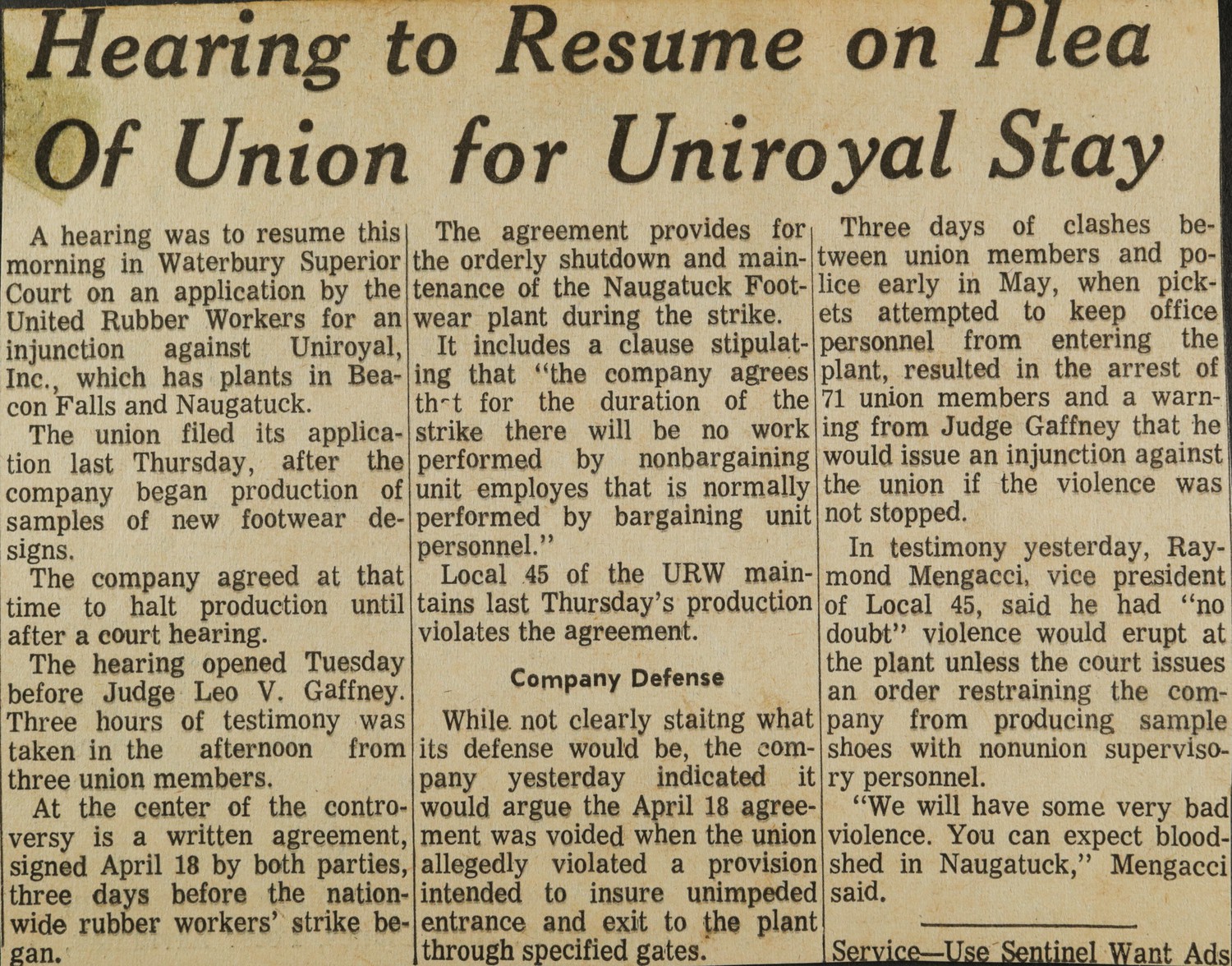
Uniroyal Plea Stayed

5-10-67

Uniroyal Plea Stayed

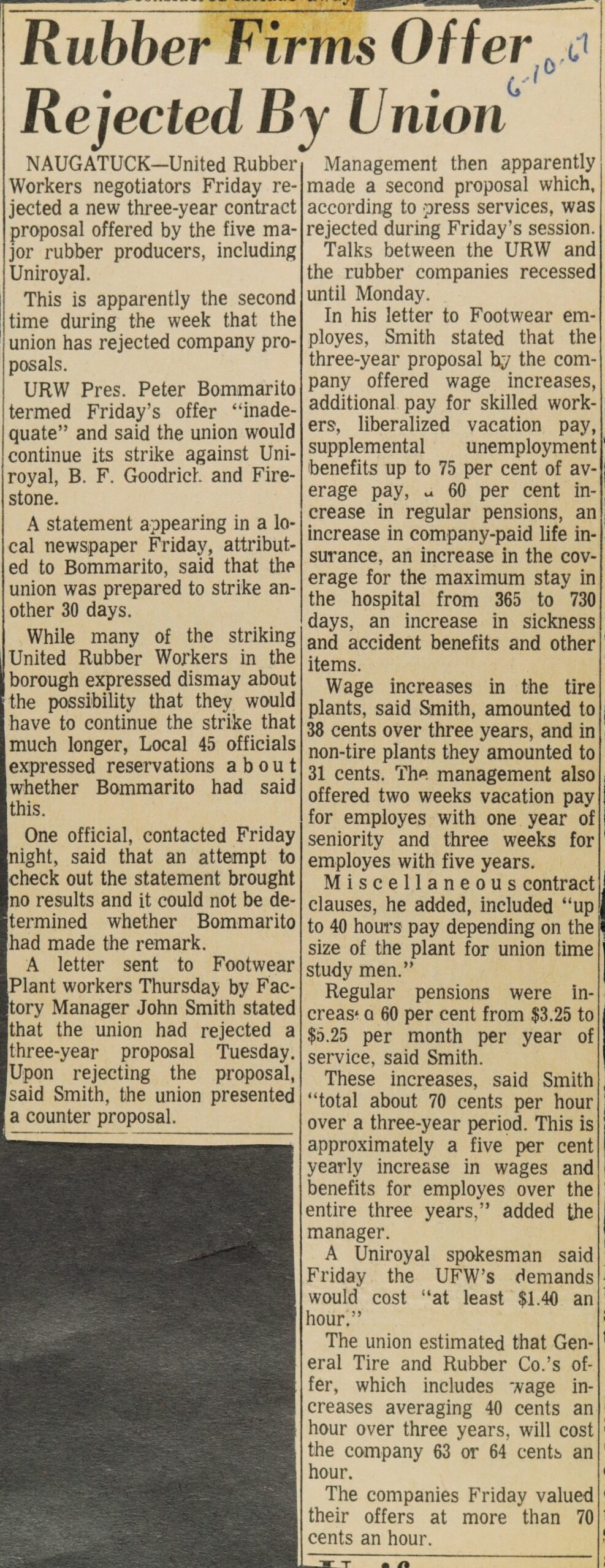
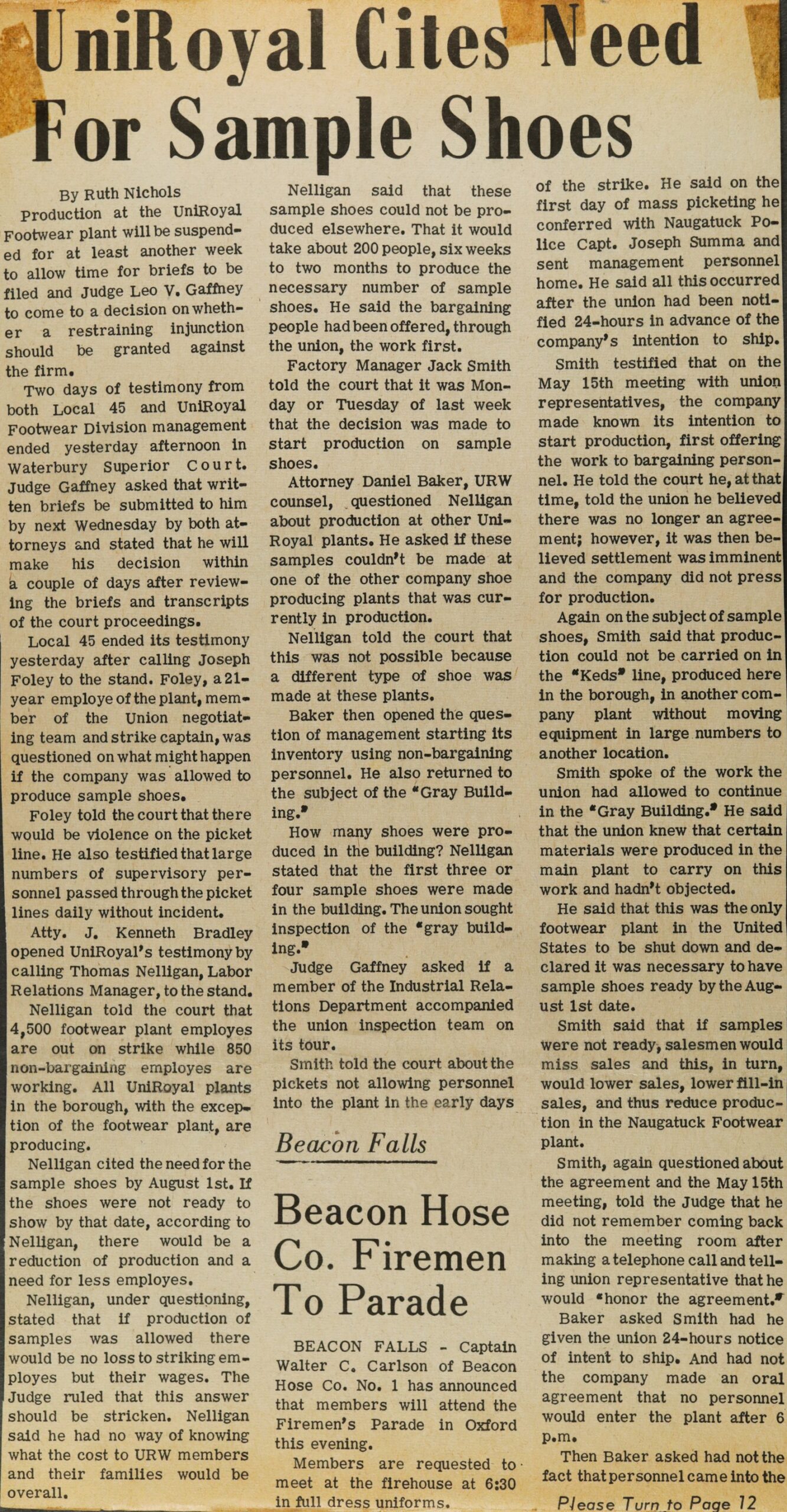
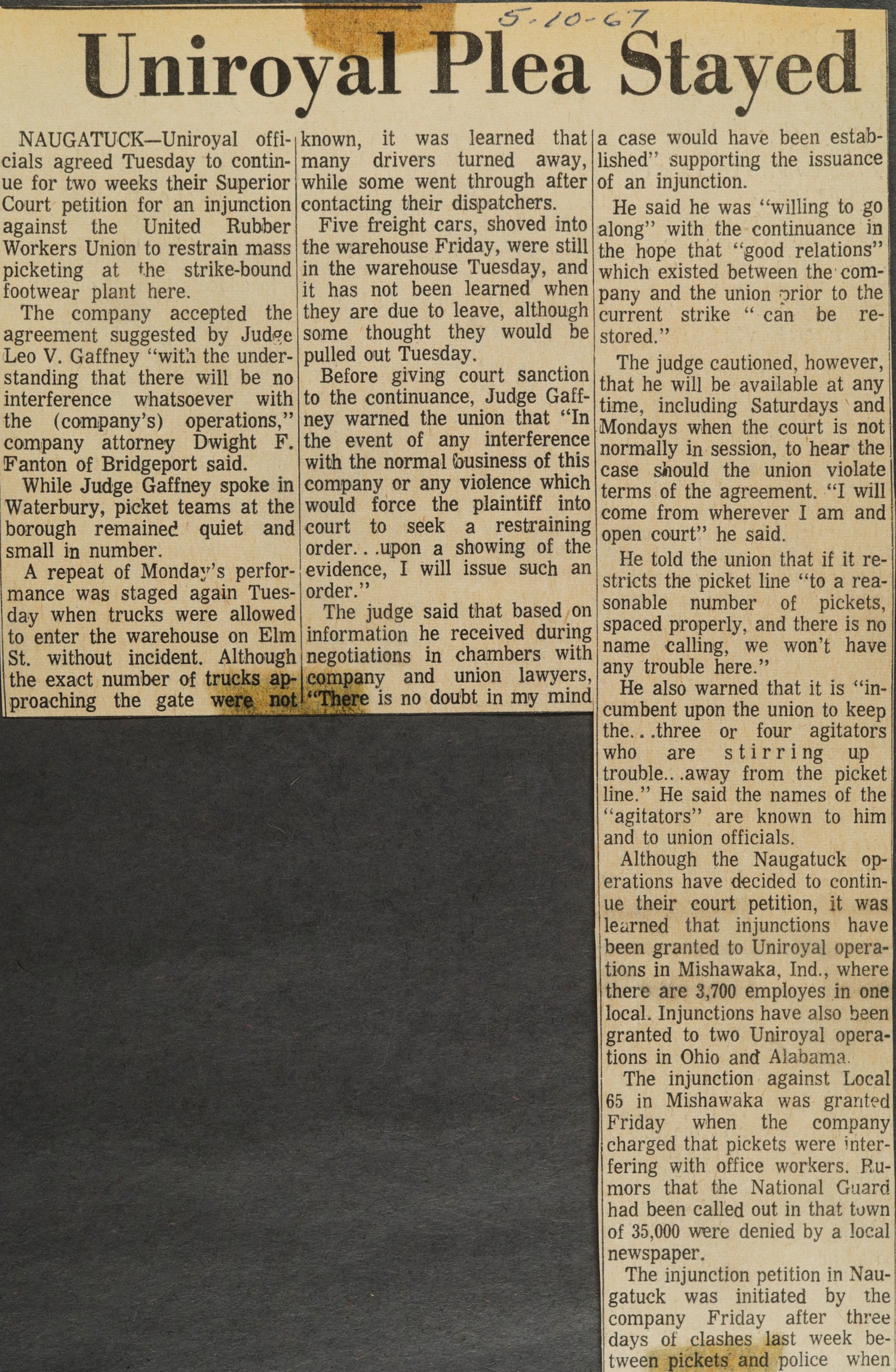
NAUGATUCK—Uniroyal officials agreed Tuesday to continue for two weeks their Superior Court petition for an injunction against the United Rubber Workers Union to restrain mass picketing at the strike-bound footwear plant here.

The company accepted the agreement suggested by Judge Leo V. Gaffney “with the understanding that there will be no interference whatsoever with the (company’s) operations,” company attorney Dwight F. Fanton of Bridgeport said.

While Judge Gaffney spoke in Waterbury, picket teams at the borough remained quiet and small in number.

A repeat of Monday’s performance was staged again Tuesday when trucks were allowed to enter the warehouse on Elm St. without incident. Although the exact number of trucks approaching the gate were not known, it was learned that many drivers turned away, while some went through after contacting their dispatchers.

Five freight cars, shoved into the warehouse Friday, were still in the warehouse Tuesday, and it has not been learned when they are due to leave, although some thought they would be pulled out Tuesday.

Before giving court sanction to the continuance, Judge Gaffney warned the union that “In the event of any interference with the normal business of this company or any violence which would force the plaintiff into court to seek a restraining order…upon a showing of the evidence, I will issue such an order.”

The judge said that based on information he received during negotiations in chambers with company and union lawyers, “There is no doubt in my mind a case would have been established” supporting the issuance of an injunction.

He said he was “willing to go along” with the continuance in the hope that “good relations” which existed between the company and the union prior to the current strike “can be restored.”

The judge cautioned, however, that he will be available at any time, including Saturdays and Mondays when the court is not normally in session, to hear the case should the union violate terms of the agreement. “I will come from wherever I am and open court” he said.

He told the union that if it restricts the picket line “to a reasonable number of pickets, spaced properly, and there is no name calling, we won’t have any trouble here.”

He also warned that it is “incumbent upon the union to keep the…three or four agitators who are stirring up trouble…away from the picket line.” He said the names of the “agitators” are known to him and to union officials.

Although the Naugatuck operations have decided to continue their court petition, it was learned that injunctions have been granted to Uniroyal operations in Mishawaka, Ind., where there are 3,700 employes in one local. Injunctions have also been granted to two Uniroyal operations in Ohio and Alabama.

The injunction against Local 65 in Mishawaka was granted Friday when the company charged that pickets were interfering with office workers. Rumors that the National Guard had been called out in that town of 35,000 were denied by a local newspaper.

The injunction petition in Naugatuck was initiated by the company Friday after three days of clashes last week between pickets and police when

Atty. Daniel Baker of Stamford, counsel for the union, said the union ‘intends fully to comply’ with Judge Gaffney’s instructions. He said local union leaders will do ‘everything in their power’ to maintain a peaceful picket line.

Atty. Daniel Baker of Stamford, counsel for the union, said the union “intends fully to comply” with Judge Gaffney’s instructions. He said local union leaders will do “everything in their power to maintain a peaceful picket line.”

He said they will “make sure there are a reasonable number of pickets . . . and they will avoid any situation . . . which could get out of control.”

Fanton and Baker crossed swords briefly when the company attorney asked Judge Gaffney to address himself directly to International Representative William Fernandes and Vice President Raymond Mengacci concerning picket line activity regarding attempts to restrain passage of delivery trucks in and out of the plant.

Baker said the union has “worked out a good mechanism” with local police for dealing with trucks. He said the company should “recognize the union’s right” to talk to truck drivers and ask them whether they want to cross the picket line.

Union officials explained that strikers have arranged to have police officers on duty at the gates ask the truck drivers whether they wish to cross the lines. In the event that they do, the picket line withdraws, the officials said. Drivers of 11 of 19 trucks which approached the warehouse gate on Elm St. Monday refused to cross the line and turned away.

Judge Gaffney said the union is “entitled to peaceful picketing and to use (its) arts of peaceful persuasion,” but, he added, it “cannot do what has been determined is illegal.”

He said motor and freight shipments are expected at the plant soon and he warned that “any interference with these shipments will bring about a restraining order and the penalties therein.”

The penalties referred to usually include a high bond and the threat of contempt of court for any violations of the restraining order.

“I’m taking a lot on myself by recommending this continuance,” Judge Gaffney said. “The onus will fall on me if this experiment doesn’t work.”

He added, “The court hopes that within two weeks the strike will be over and there will be no need for the court to lay down strict rules.”

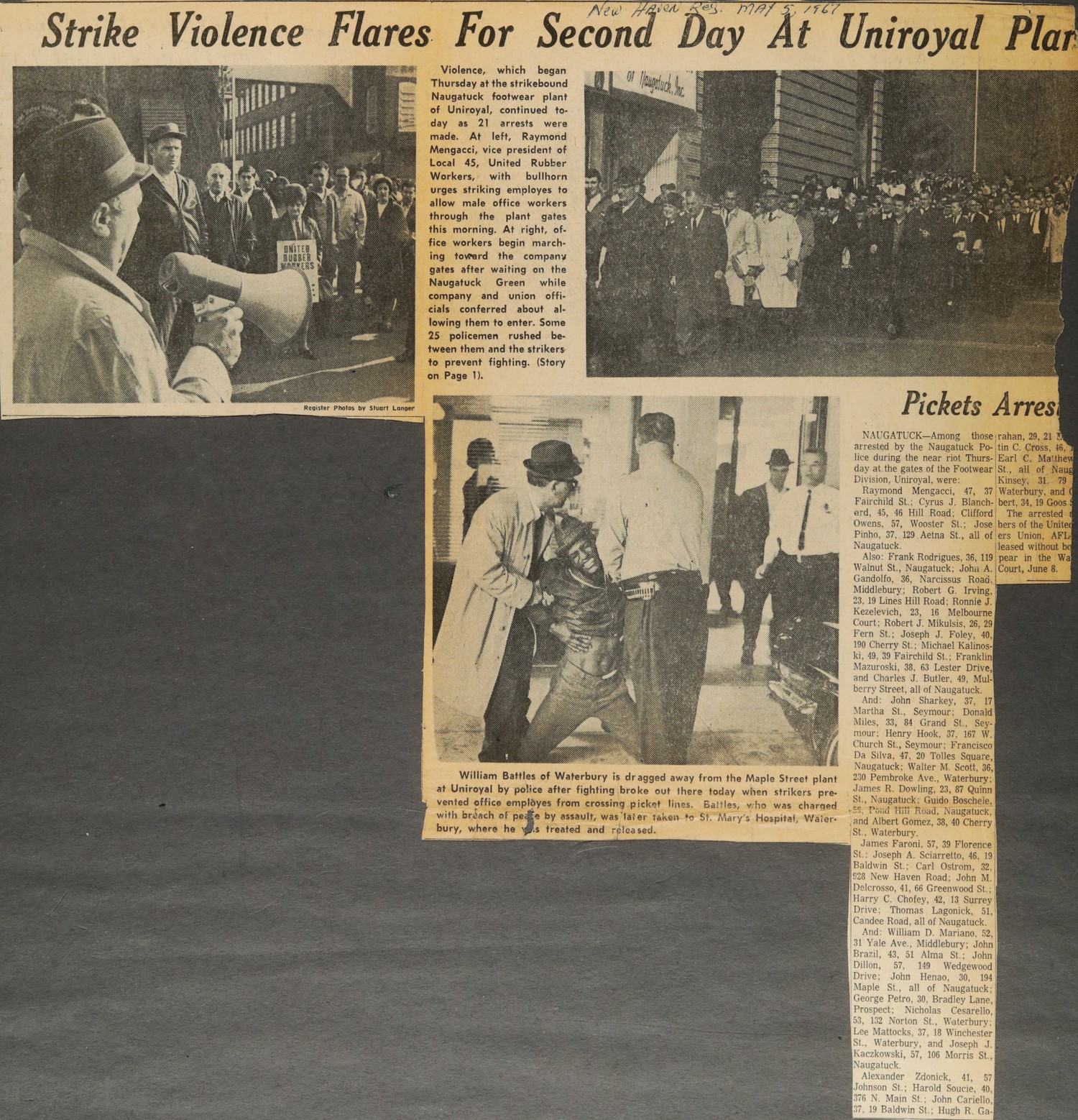
Strike Violence Flares For Second Day At Uniroyal Plant

Strike Violence Flares For Second Day At Uniroyal Plar

New Haven Reg. MAY 3, 1969

Register Photos by Stuart Langer

Violence, which began Thursday at the strikebound Naugatuck footwear plant of Uniroyal, continued today as 21 arrests were made. At left, Raymond Mengacci, vice president of Local 45, United Rubber Workers, with bullhorn urges striking employes to allow male office workers through the plant gates this morning. At right, office workers begin marching toward the company gates after waiting on the Naugatuck Green while company and union officials conferred about allowing them to enter. Some 25 policemen rushed between them and the strikers to prevent fighting. (Story on Page 1).


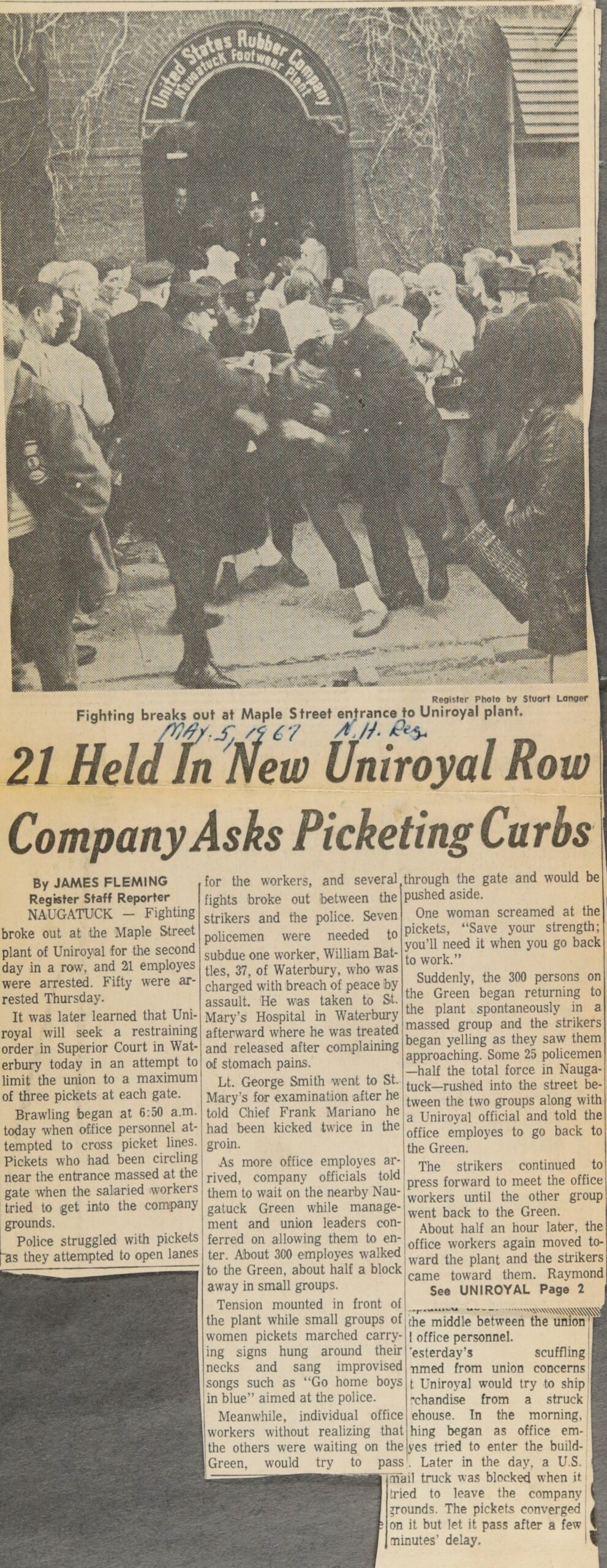
William Battles of Waterbury is dragged away from the Maple Street plant at Uniroyal by police after fighting broke out there today when strikers prevented office employes from crossing picket lines. Battles, who was charged with breach of peace by assault, was later taken to St. Mary’s Hospital, Waterbury, where he was treated and released.


Pickets Arres

NAUGATUCK—Among those arrested by the Naugatuck Police during the near riot Thursday at the gates of the Footwear Division, Uniroyal, were:

Raymond Mengacci, 47, 37 Fairchild St.; Cyrus J. Blanchard, 45, 46 Hill Road, Clifford Owens, 57, Wooster St.; Jose Pinho, 37, 129 Aetna St., all of Naugatuck.

Also: Frank Rodrigues, 36, 119 Walnut St., Naugatuck; John A. Gandolfo, 36, Narcissus Road, Middlebury; Robert G. Irving, 23, 19 Lines Hill Road; Ronald Kezelevich, 23, 16 Melbourne Court; Robert J. Mikulsis, 26, 29 Fern St.; Joseph J. Foley, 40, 190 Cherry St.; Michael Kalinoski, 49, 29 Fairchild St.; Franklin Mazuroski, 38, 63 Lester Drive, and Charles J. Butler, 49, Mulberry Street, all of Naugatuck.

And: John Sharkey, 37, 17 Martha St., Seymour; Donald Miles, 33, 84 Grand St., Seymour; Henry Hook, 37, 167 W. Church St., Seymour; Francisco Da Silva, 47, 20 Tolles Square, Naugatuck; Walter M. Scott, 36, 230 Pembroke Ave., Waterbury; James R. Dowling, 23, 87 Quinn St., Naugatuck; Guido Boschele, 55, Prout Hill Road, Naugatuck, and Albert Gomez, 38, 40 Cherry St., Waterbury.

James Faroni, 57, 39 Florence St.; Joseph A. Sciarretto, 46, 19 Baldwin St.; Carl Ostrom, 32, 628 New Haven Road; John M. Delcrosso, 41, 66 Greenwood St.; Harry C. Chofey, 42, 13 Surrey Drive; Thomas Lagonick, 51, Candee Road, all of Naugatuck.

And: William D. Mariano, 52, 31 Yale Ave., Middlebury; John Brazil, 43, 51 Alma St.; John Dillon, 57, 149 Wedgewood Drive; John Henan, 30, 194 Maple St., all of Naugatuck; George Petro, 30, Bradley Lane, Prospect; Nicholas Cesarello, 53, 122 Norton St., Waterbury; Lee Mattocks, 37, 18 Winchester St., Waterbury, and Joseph J. Kaczkowski, 57, 106 Morris St., Naugatuck.

Alexander Zdonick, 41, 57 Johnson St.; Harold Soucie, 40, 376 N. Main St.; John Cariello, 37, 19 Baldwin St.; Hugh R. Ga-

[Column continues with partial text visible:]
rahan, 29, 21 […]
tin C. Cross, 48,
Earl C. Matthew
St., all of Naug
Kinsey, 31, 79
Waterbury, and […]
bert, 34, 19 Goos […]

The arrested […]
bers of the United
ers Union, AFL.
leased without b[…]
pear in the Wa[…]
Court, June 8.

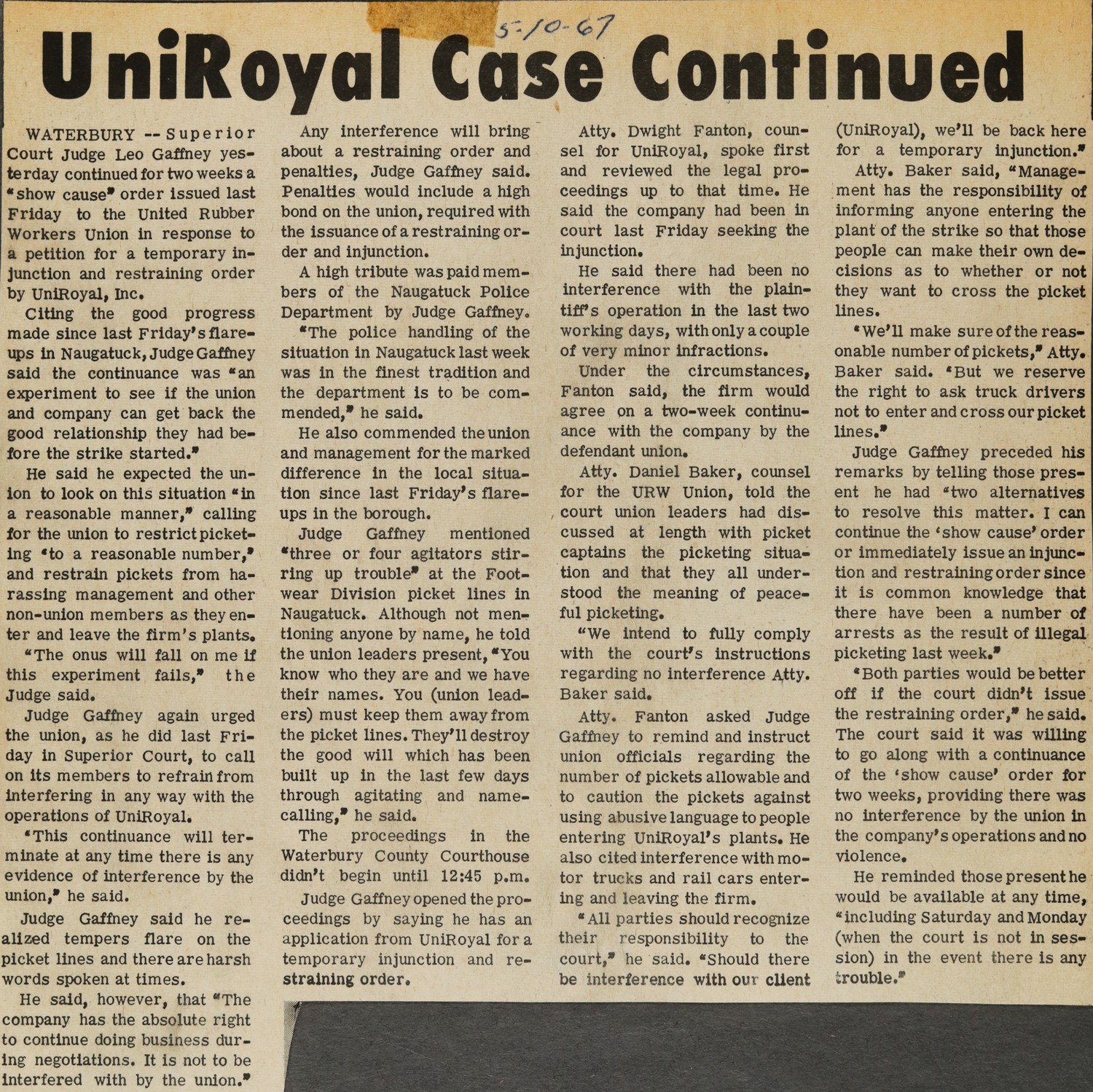
UniRoyal Case Continued

UniRoyal Case Continued

5-10-67 [handwritten]

WATERBURY — Superior Court Judge Leo Gaffney yesterday continued for two weeks a “show cause” order issued last Friday to the United Rubber Workers Union in response to a petition for a temporary injunction and restraining order by UniRoyal, Inc.

Citing the good progress made since last Friday’s flareups in Naugatuck, Judge Gaffney said the continuance was “an experiment to see if the union and company can get back the good relationship they had before the strike started.”

He said he expected the union to look on this situation “in a reasonable manner,” calling for the union to restrict picketing “to a reasonable number,” and restrain pickets from harassing management and other non-union members as they enter and leave the firm’s plants.

“The onus will fall on me if this experiment fails,” the Judge said.

Judge Gaffney again urged the union, as he did last Friday in Superior Court, to call on its members to refrain from interfering in any way with the operations of UniRoyal.

“This continuance will terminate at any time there is any evidence of interference by the union,” he said.

Judge Gaffney said he realized tempers flare on the picket lines and there are harsh words spoken at times.

He said, however, that “The company has the absolute right to continue doing business during negotiations. It is not to be interfered with by the union.”

Any interference will bring about a restraining order and penalties, Judge Gaffney said. Penalties would include a high bond on the union, required with the issuance of a restraining order and injunction.

A high tribute was paid members of the Naugatuck Police Department by Judge Gaffney.

“The police handling of the situation in Naugatuck last week was in the finest tradition and the department is to be commended,” he said.

He also commended the union and management for the marked difference in the local situation since last Friday’s flareups in the borough.

Judge Gaffney mentioned “three or four agitators stirring up trouble” at the Footwear Division picket lines in Naugatuck. Although not mentioning anyone by name, he told the union leaders present, “You know who they are and we have their names. You (union leaders) must keep them away from the picket lines. They’ll destroy the good will which has been built up in the last few days through agitating and namecalling,” he said.

The proceedings in the Waterbury County Courthouse didn’t begin until 12:45 p.m.

Judge Gaffney opened the proceedings by saying he has an application from UniRoyal for a temporary injunction and restraining order.

Atty. Dwight Fanton, counsel for UniRoyal, spoke first and reviewed the legal proceedings up to that time. He said the company had been in court last Friday seeking the injunction.

He said there had been no interference with the plaintiff’s operation in the last two working days, with only a couple of very minor infractions.

Under the circumstances, Fanton said, the firm would agree on a two-week continuance with the company by the defendant union.

Atty. Daniel Baker, counsel for the URW Union, told the court union leaders had discussed at length with picket captains the picketing situation and that they all understood the meaning of peaceful picketing.

“We intend to fully comply with the court’s instructions regarding no interference Atty. Baker said.

Atty. Fanton asked Judge Gaffney to remind and instruct union officials regarding the number of pickets allowable and to caution the pickets against using abusive language to people entering UniRoyal’s plants. He also cited interference with motor trucks and rail cars entering and leaving the firm.

“All parties should recognize their responsibility to the court,” he said. “Should there be interference with our client (UniRoyal), we’ll be back here for a temporary injunction.”

Atty. Baker said, “Management has the responsibility of informing anyone entering the plant of the strike so that those people can make their own decisions as to whether or not they want to cross the picket lines.

“We’ll make sure of the reasonable number of pickets,” Atty. Baker said. “But we reserve the right to ask truck drivers not to enter and cross our picket lines.”

Judge Gaffney preceded his remarks by telling those present he had “two alternatives to resolve this matter. I can continue the ‘show cause’ order or immediately issue an injunction and restraining order since it is common knowledge that there have been a number of arrests as the result of illegal picketing last week.”

“Both parties would be better off if the court didn’t issue the restraining order,” he said. The court said it was willing to go along with a continuance of the ‘show cause’ order for two weeks, providing there was no interference by the union in the company’s operations and no violence.

He reminded those present he would be available at any time, “including Saturday and Monday (when the court is not in session) in the event there is any trouble.”

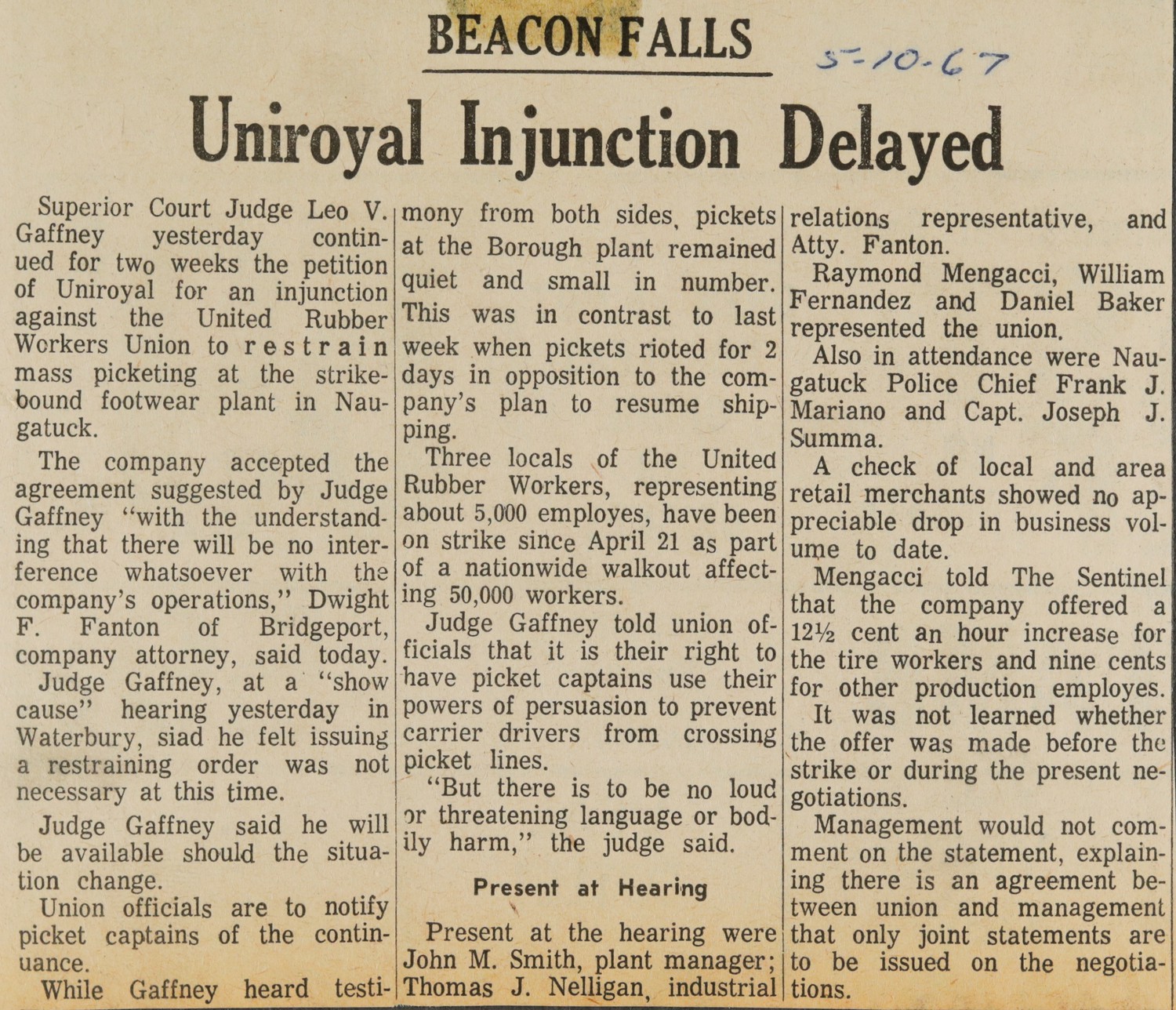
Uniroyal Injunction Delayed

BEACON FALLS

5-10-67

Uniroyal Injunction Delayed

Superior Court Judge Leo V. Gaffney yesterday continued for two weeks the petition of Uniroyal for an injunction against the United Rubber Workers Union to restrain mass picketing at the strike-bound footwear plant in Naugatuck.

The company accepted the agreement suggested by Judge Gaffney “with the understanding that there will be no interference whatsoever with the company’s operations,” Dwight F. Fanton of Bridgeport, company attorney, said today.

Judge Gaffney, at a “show cause” hearing yesterday in Waterbury, siad he felt issuing a restraining order was not necessary at this time.

Judge Gaffney said he will be available should the situation change.

Union officials are to notify picket captains of the continuance.

While Gaffney heard testimony from both sides, pickets at the Borough plant remained quiet and small in number. This was in contrast to last week when pickets rioted for 2 days in opposition to the company’s plan to resume shipping.

Three locals of the United Rubber Workers, representing about 5,000 employes, have been on strike since April 21 as part of a nationwide walkout affecting 50,000 workers.

Judge Gaffney told union officials that it is their right to have picket captains use their powers of persuasion to prevent carrier drivers from crossing picket lines.

“But there is to be no loud or threatening language or bodily harm,” the judge said.

Present at Hearing

Present at the hearing were John M. Smith, plant manager; Thomas J. Nelligan, industrial relations representative, and Atty. Fanton.

Raymond Mengacci, William Fernandez and Daniel Baker represented the union.

Also in attendance were Naugatuck Police Chief Frank J. Mariano and Capt. Joseph J. Summa.

A check of local and area retail merchants showed no appreciable drop in business volume to date.

Mengacci told The Sentinel that the company offered a 12½ cent an hour increase for the tire workers and nine cents for other production employes.

It was not learned whether the offer was made before the strike or during the present negotiations.

Management would not comment on the statement, explaining there is an agreement between union and management that only joint statements are to be issued on the negotiations.

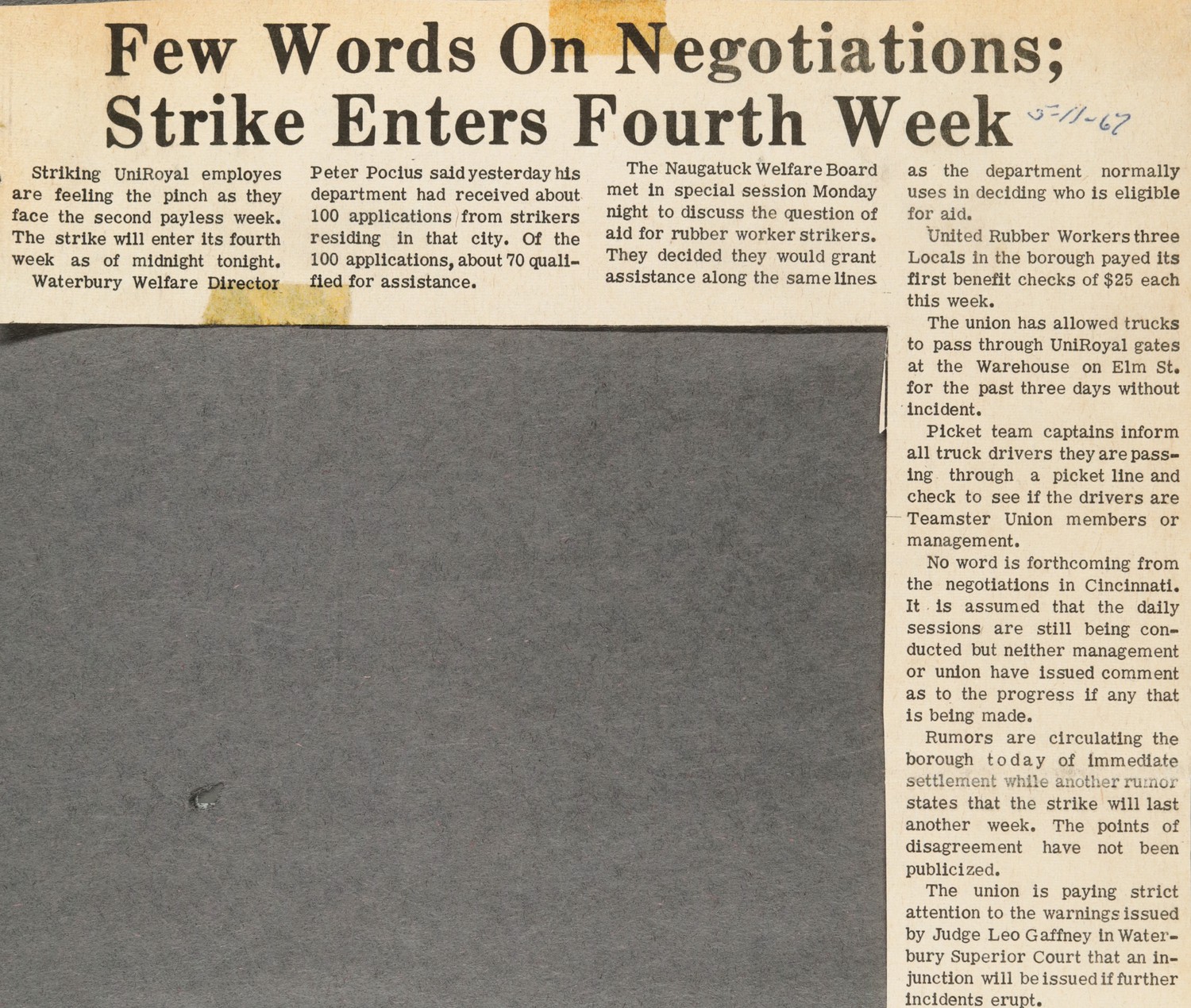
Few Words On Negotiations; Strike Enters Fourth Week

Few Words On Negotiations; Strike Enters Fourth Week

5-11-67

Striking UniRoyal employes are feeling the pinch as they face the second payless week. The strike will enter its fourth week as of midnight tonight.

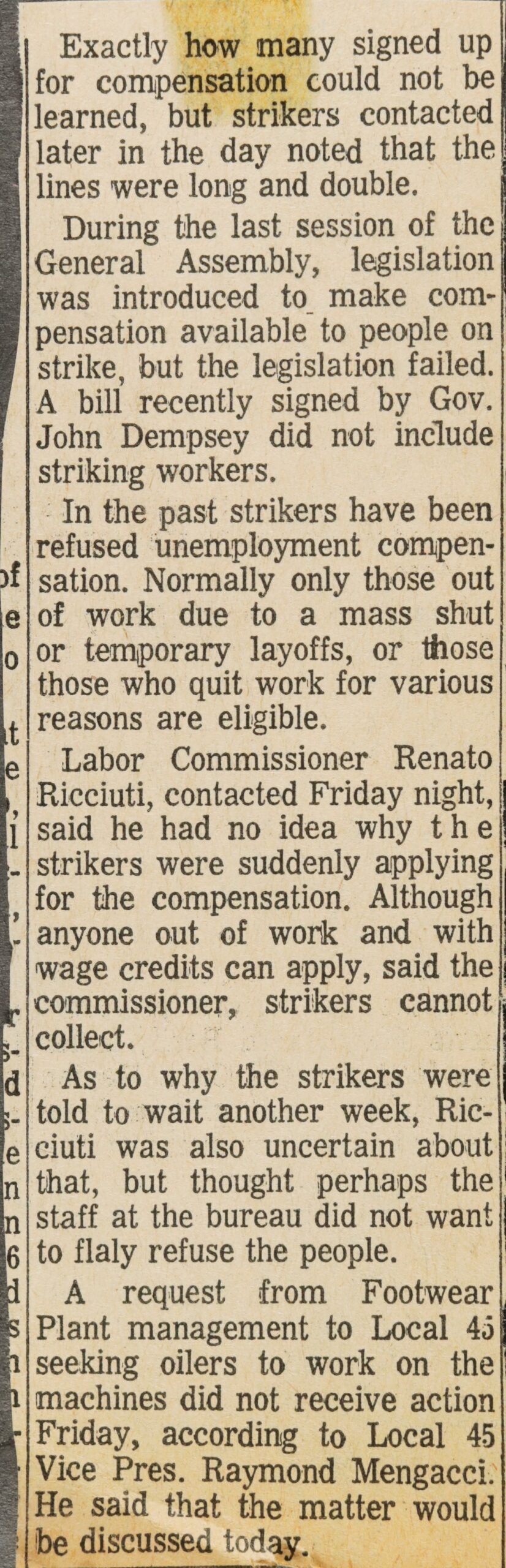
Waterbury Welfare Director Peter Pocius said yesterday his department had received about 100 applications from strikers residing in that city. Of the 100 applications, about 70 qualified for assistance.

The Naugatuck Welfare Board met in special session Monday night to discuss the question of aid for rubber worker strikers. They decided they would grant assistance along the same lines as the department normally uses in deciding who is eligible for aid.

United Rubber Workers three Locals in the borough payed its first benefit checks of $25 each this week.

The union has allowed trucks to pass through UniRoyal gates at the Warehouse on Elm St. for the past three days without incident.

Picket team captains inform all truck drivers they are passing through a picket line and check to see if the drivers are Teamster Union members or management.

No word is forthcoming from the negotiations in Cincinnati. It is assumed that the daily sessions are still being conducted but neither management or union have issued comment as to the progress if any that is being made.

Rumors are circulating the borough today of immediate settlement while another rumor states that the strike will last another week. The points of disagreement have not been publicized.

The union is paying strict attention to the warnings issued by Judge Leo Gaffney in Waterbury Superior Court that an injunction will be issued if further incidents erupt.

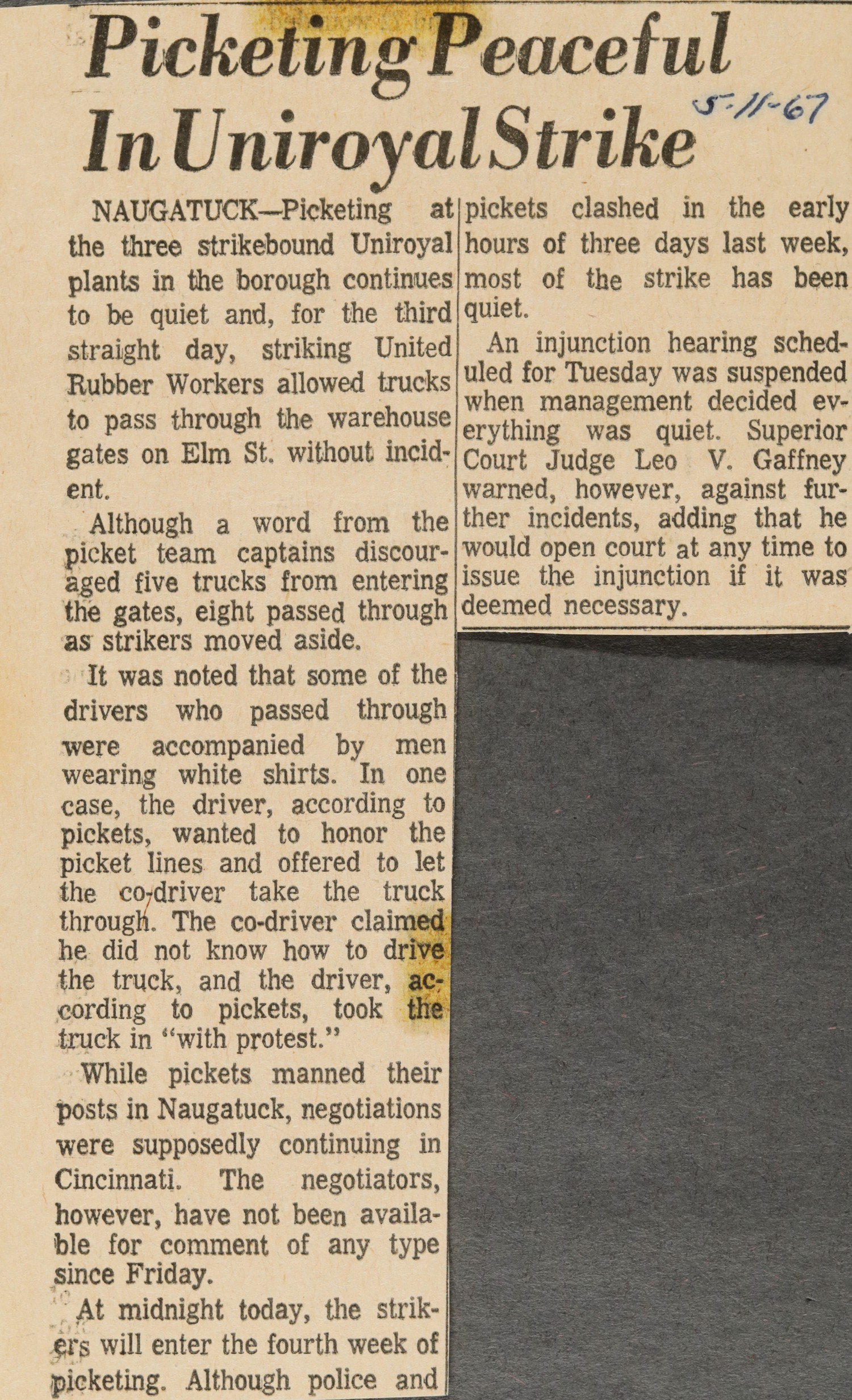
Picketing Peaceful In Uniroyal Strike

Picketing Peaceful In Uniroyal Strike

5-11-67

NAUGATUCK—Picketing at the three strikebound Uniroyal plants in the borough continues to be quiet and, for the third straight day, striking United Rubber Workers allowed trucks to pass through the warehouse gates on Elm St. without incident.

Although a word from the picket team captains discouraged five trucks from entering the gates, eight passed through as strikers moved aside.

It was noted that some of the drivers who passed through were accompanied by men wearing white shirts. In one case, the driver, according to pickets, wanted to honor the picket lines and offered to let the co-driver take the truck through. The co-driver claimed he did not know how to drive the truck, and the driver, according to pickets, took the truck in “with protest.”

While pickets manned their posts in Naugatuck, negotiations were supposedly continuing in Cincinnati. The negotiators, however, have not been available for comment of any type since Friday.

At midnight today, the strikers will enter the fourth week of picketing. Although police and

pickets clashed in the early hours of three days last week, most of the strike has been quiet.

An injunction hearing scheduled for Tuesday was suspended when management decided everything was quiet. Superior Court Judge Leo V. Gaffney warned, however, against further incidents, adding that he would open court at any time to issue the injunction if it was deemed necessary.

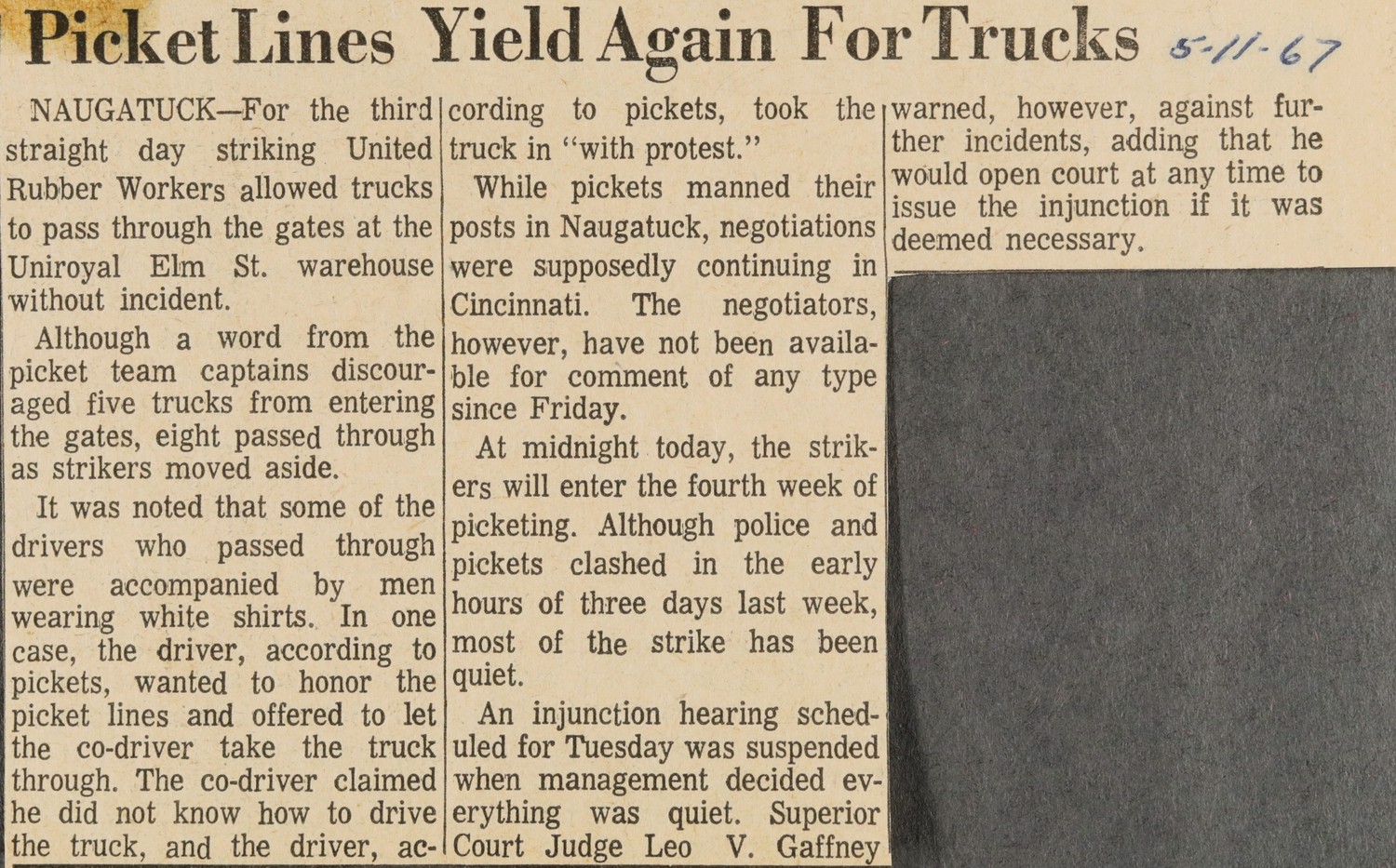
Picket Lines Yield Again For Trucks

Picket Lines Yield Again For Trucks

5-11-67

NAUGATUCK—For the third straight day striking United Rubber Workers allowed trucks to pass through the gates at the Uniroyal Elm St. warehouse without incident.

Although a word from the picket team captains discouraged five trucks from entering the gates, eight passed through as strikers moved aside.

It was noted that some of the drivers who passed through were accompanied by men wearing white shirts. In one case, the driver, according to pickets, wanted to honor the picket lines and offered to let the co-driver take the truck through. The co-driver claimed he did not know how to drive the truck, and the driver, according to pickets, took the truck in “with protest.”

While pickets manned their posts in Naugatuck, negotiations were supposedly continuing in Cincinnati. The negotiators, however, have not been available for comment of any type since Friday.

At midnight today, the strikers will enter the fourth week of picketing. Although police and pickets clashed in the early hours of three days last week, most of the strike has been quiet.

An injunction hearing scheduled for Tuesday was suspended when management decided everything was quiet. Superior Court Judge Leo V. Gaffney warned, however, against further incidents, adding that he would open court at any time to issue the injunction if it was deemed necessary.

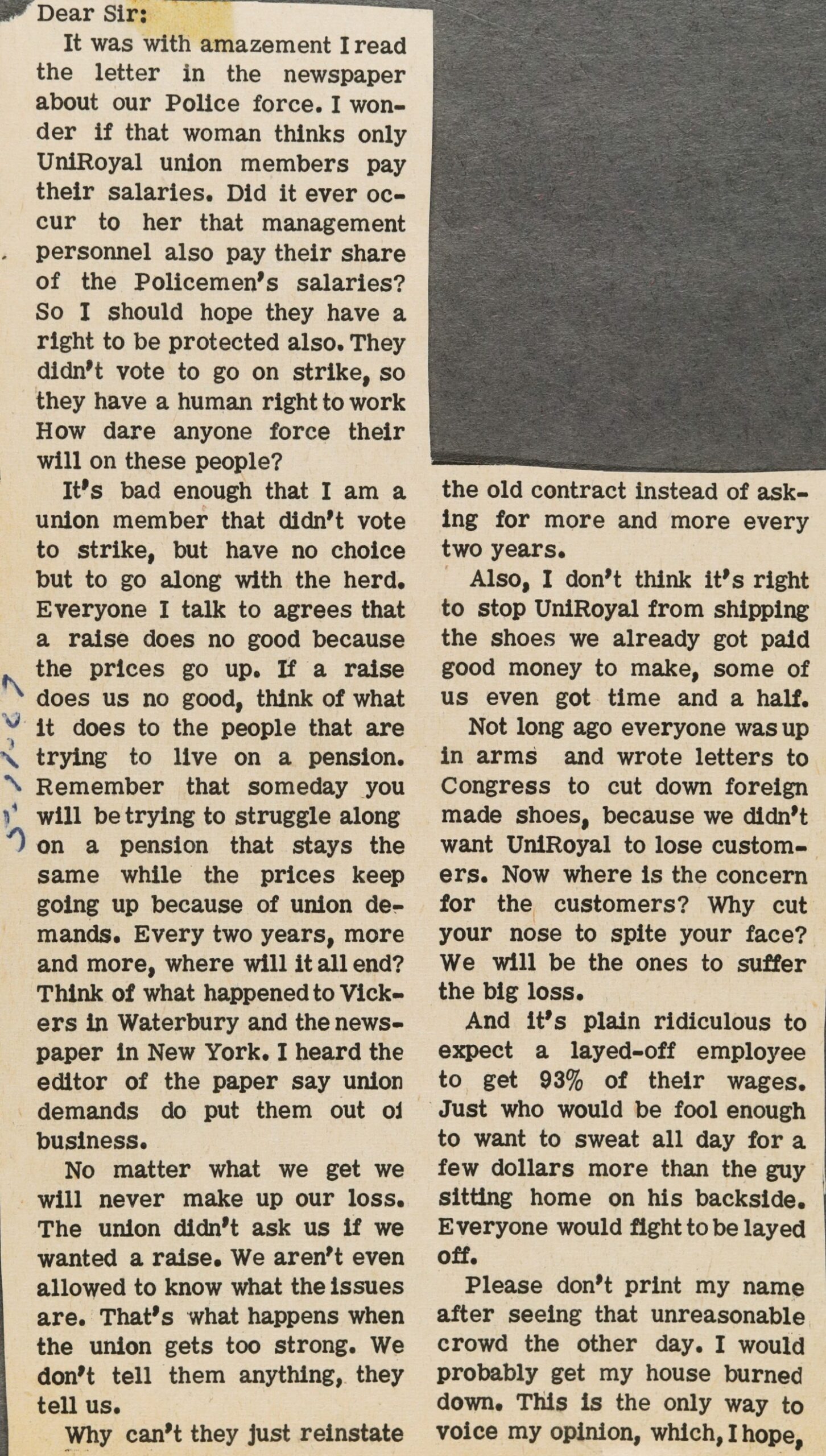
Dear Sir:

Dear Sir:

It was with amazement I read the letter in the newspaper about our Police force. I wonder if that woman thinks only UniRoyal union members pay their salaries. Did it ever occur to her that management personnel also pay their share of the Policemen’s salaries? So I should hope they have a right to be protected also. They didn’t vote to go on strike, so they have a human right to work How dare anyone force their will on these people?

It’s bad enough that I am a union member that didn’t vote to strike, but have no choice but to go along with the herd. Everyone I talk to agrees that a raise does no good because the prices go up. If a raise does us no good, think of what it does to the people that are trying to live on a pension. Remember that someday you will be trying to struggle along on a pension that stays the same while the prices keep going up because of union demands. Every two years, more and more, where will it all end? Think of what happened to Vickers in Waterbury and the newspaper in New York. I heard the editor of the paper say union demands do put them out of business.

No matter what we get we will never make up our loss. The union didn’t ask us if we wanted a raise. We aren’t even allowed to know what the issues are. That’s what happens when the union gets too strong. We don’t tell them anything, they tell us.

Why can’t they just reinstate the old contract instead of asking for more and more every two years.

Also, I don’t think it’s right to stop UniRoyal from shipping the shoes we already got paid good money to make, some of us even got time and a half.

Not long ago everyone was up in arms and wrote letters to Congress to cut down foreign made shoes, because we didn’t want UniRoyal to lose customers. Now where is the concern for the customers? Why cut your nose to spite your face? We will be the ones to suffer the big loss.

And it’s plain ridiculous to expect a layed-off employee to get 93% of their wages. Just who would be fool enough to want to sweat all day for a few dollars more than the guy sitting home on his backside. Everyone would fight to be layed off.

Please don’t print my name after seeing that unreasonable crowd the other day. I would probably get my house burned down. This is the only way to voice my opinion, which, I hope,

[Handwritten marks visible in left margin appearing to be checkmarks or notation marks]

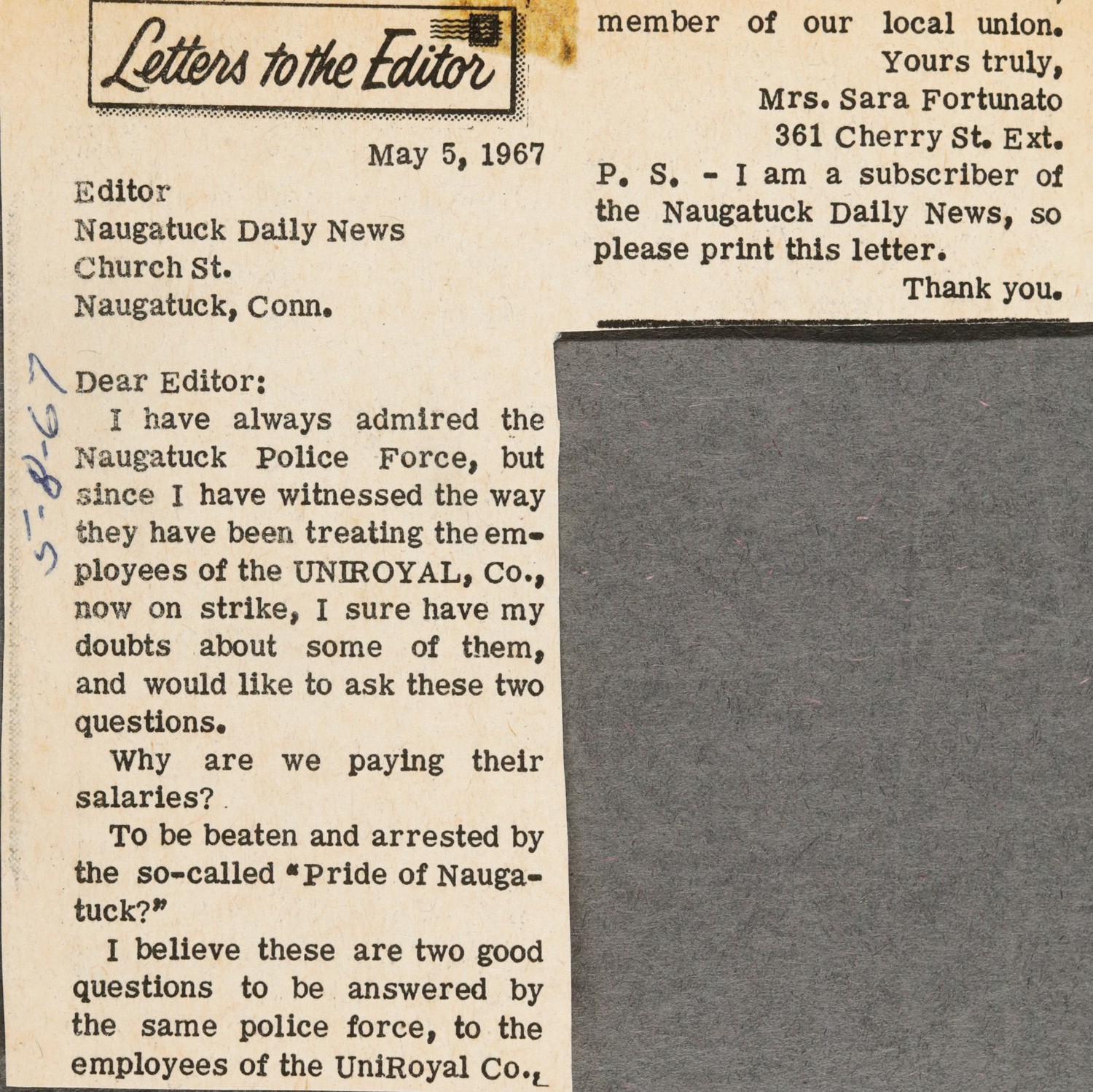
Letters to the Editor

Letters to the Editor

May 5, 1967

Editor
Naugatuck Daily News
Church St.
Naugatuck, Conn.

member of our local union.
Yours truly,
Mrs. Sara Fortunato
361 Cherry St. Ext.

P. S. – I am a subscriber of the Naugatuck Daily News, so please print this letter.

Thank you.


5-8-67 [handwritten notation]

Dear Editor:

I have always admired the Naugatuck Police Force, but since I have witnessed the way they have been treating the employees of the UNIROYAL, Co., now on strike, I sure have my doubts about some of them, and would like to ask these two questions.

Why are we paying their salaries?

To be beaten and arrested by the so-called “Pride of Naugatuck?”

I believe these are two good questions to be answered by the same police force, to the employees of the UniRoyal Co.,

21 Held In New Uniroyal Row Company Asks Picketing Curbs

Register Photo by Stuart Longer

Fighting breaks out at Maple Street entrance to Uniroyal plant.

MAY 5, 1967 N.H. Reg.

21 Held In New Uniroyal Row

Company Asks Picketing Curbs

By JAMES FLEMING
Register Staff Reporter

NAUGATUCK — Fighting broke out at the Maple Street plant of Uniroyal for the second day in a row, and 21 employes were arrested. Fifty were arrested Thursday.

It was later learned that Uniroyal will seek a restraining order in Superior Court in Waterbury today in an attempt to limit the union to a maximum of three pickets at each gate.

Brawling began at 6:50 a.m. today when office personnel attempted to cross picket lines. Pickets who had been circling near the entrance massed at the gate when the salaried workers tried to get into the company grounds.

Police struggled with pickets as they attempted to open lanes for the workers, and several fights broke out between the strikers and the police. Seven policemen were needed to subdue one worker, William Battles, 37, of Waterbury, who was charged with breach of peace by assault. He was taken to St. Mary’s Hospital in Waterbury afterward where he was treated and released after complaining of stomach pains.

Lt. George Smith went to St. Mary’s for examination after he told Chief Frank Mariano he had been kicked twice in the groin.

As more office employes arrived, company officials told them to wait on the nearby Naugatuck Green while management and union leaders conferred on allowing them to enter. About 300 employes walked to the Green, about half a block away in small groups.

Tension mounted in front of the plant while small groups of women pickets marched carrying signs hung around their necks and sang improvised songs such as “Go home boys in blue” aimed at the police.

Meanwhile, individual office workers without realizing that the others were waiting on the Green, would try to pass through the gate and would be pushed aside.

One woman screamed at the pickets, “Save your strength; you’ll need it when you go back to work.”
Suddenly, the 300 persons on the Green began returning to the plant spontaneously in a massed group and the strikers began yelling as they saw them approaching. Some 25 policemen —half the total force in Naugatuck—rushed into the street between the two groups along with a Uniroyal official and told the office employes to go back to the Green.

The strikers continued to press forward to meet the office workers until the other group went back to the Green.

About half an hour later, the office workers again moved toward the plant and the strikers came toward them. Raymond

See UNIROYAL Page 2

the middle between the union l office personnel.

esterday’s scuffling nned from union concerns t Uniroyal would try to ship rchandise from a struck ehouse. In the morning, hing began as office em-yes tried to enter the build-pass. Later in the day, a U.S. mail truck was blocked when it tried to leave the company grounds. The pickets converged on it but let it pass after a few minutes’ delay.
UNIROYAL

UNIROYAL

(Continued from Page 1)

Mengacci, vice president of Local 45, United Rubber Workers, warned strikers that state troopers would be called if the office help were not permitted to enter the plant. He said, “The union had come to an agreement to let male office workers in, but 150 women office workers would have to go home.”

“No, no, we won’t let them in,” was shouted by many of the strikers. Mengacci warned there might be “bloodshed” if it became necessary for the State Police to restrain the workers. One angry worker retorted, “Custer made his last stand; we’ll make it here.”

Mengacci said any violence would be useless, since the company was trying to get an injunction to prevent the pickets from blocking employes who wanted to enter the plant.

Cyrus Blanchard, vice president of Local 308 at the Uniroyal Chemical plant across town also pleaded with the strikers. The male salaried workers began filtering into the plant with little resistance at about 8:30 a.m., although some were bumped as they passed pickets. The women workers had already started home and did not try to come in with the men.

The scene then quieted, although the pickets and other striking employes maintained their vigil outside the gates.
Seventeen of the 21 arrested today were charged with breach of the peace and were released on cash bonds of $150 each, posted by union officials. On Thursday, arrested employes were freed without posting bond.

In contrast to Thursday, when all of those arrested walked over to the police station a block away, today four had to be dragged, although most went quietly. The four were charged with breach of the peace by assault, and their bonds were $200 each.

Mengacci and William Fernandes, a union representative, will appear in Superior Court this afternoon, when the company seeks to obtain a restraining order.

The strike is in now its 15th day. Negotiations are being conducted on a national level in Cincinnati where issues involve a guaranteed annual wage.

To maintain order, Chief Mariano has brought in added policemen on an overtime basis as well as supernumeraries. Many of the policemen involved in the fighting are related to the strikers and one patrolman said, “I have half my family working there.”

A number of the policemen complained about being caught in the middle between the union and office personnel.

Yesterday’s scuffling stemmed from union concerns that Uniroyal would try to ship merchandise from a struck warehouse. In the morning, pushing began as office employes tried to enter the building. Later in the day, a U.S. mail truck was blocked when it tried to leave the company grounds. The pickets converged on it but let it pass after a few minutes’ delay.

Pushing and Shoving

5-4-67

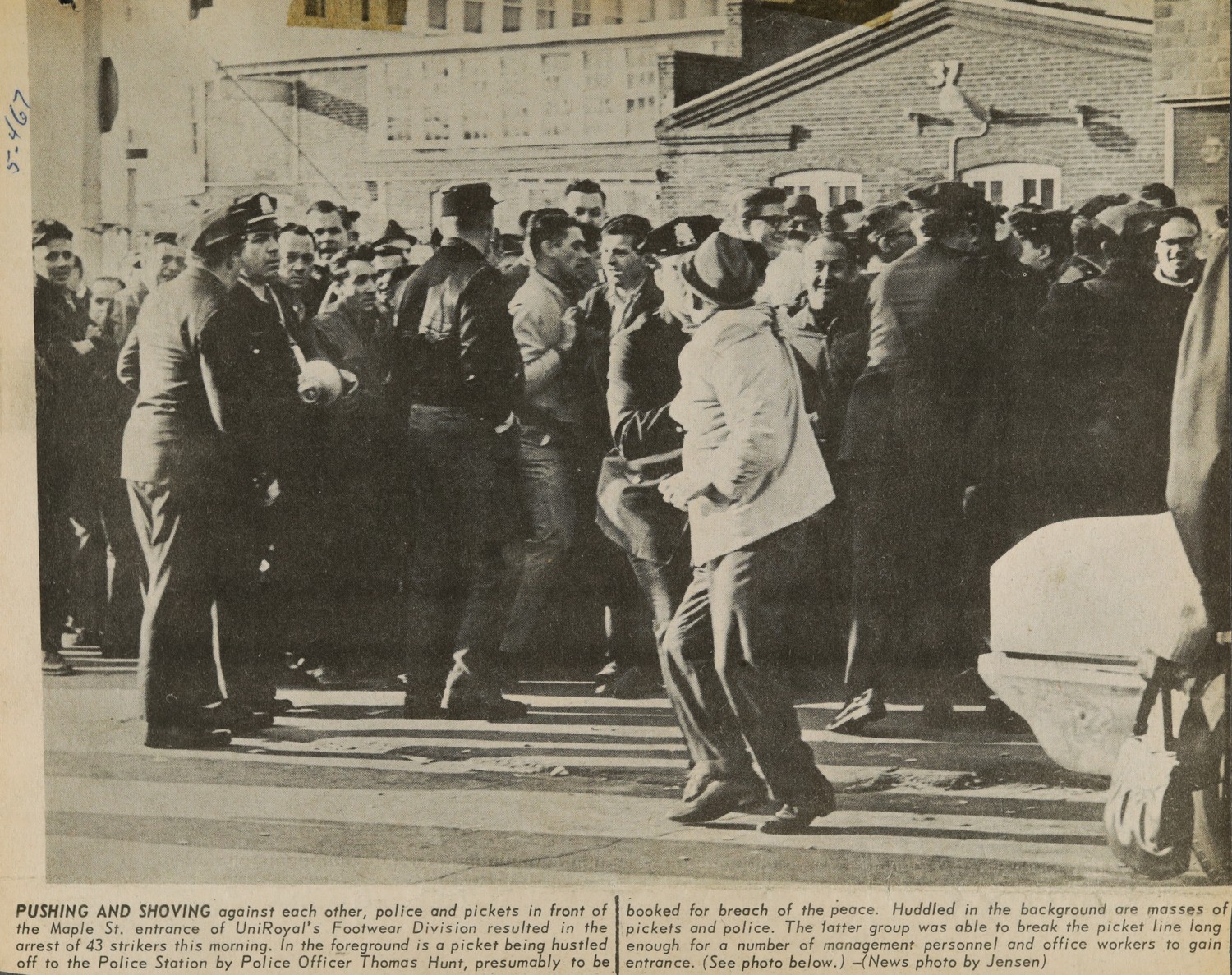
PUSHING AND SHOVING against each other, police and pickets in front of the Maple St. entrance of UniRoyal’s Footwear Division resulted in the arrest of 43 strikers this morning. In the foreground is a picket being hustled off to the Police Station by Police Officer Thomas Hunt, presumably to be booked for breach of the peace. Huddled in the background are masses of pickets and police. The latter group was able to break the picket line long enough for a number of management personnel and office workers to gain entrance. (See photo below.) —(News photo by Jensen)

2 Unionists Help Calm Near-Riot

2 Unionists Help Calm Near-Riot

5-5-67

Naugatuck police arrested 21 men this morning after the second scuffle in two days outside the Maple Street gate of the struck Uniroyal plant.

One man was taken to a hospital.

Officers of the striking United Rubber Workers of America, Local 45, were ordered to appear this afternoon in Superior Court, Waterbury.

They were to respond to an order sought by the company, directing them to show cause why mass picketing should not be prohibited.

The three officers of the Rubber Workers’ union summoned to appear are Raymond Mengacci, vice president of Local 45; Antoinette Zuccarelli, secretary, and Rita Ruggero, treasurer.

Forty – three strikers were arrested yesterday.

Today’s disturbance, like yesterday’s, broke out when pickets tried to prevent office workers and management personnel from entering the plant.

Women pickets shoulder to shoulder were on the north side of Maple Street. Male pickets were on the south side, also in tight formation.

Supervisory personnel milled around on the sidewalk on the south side.

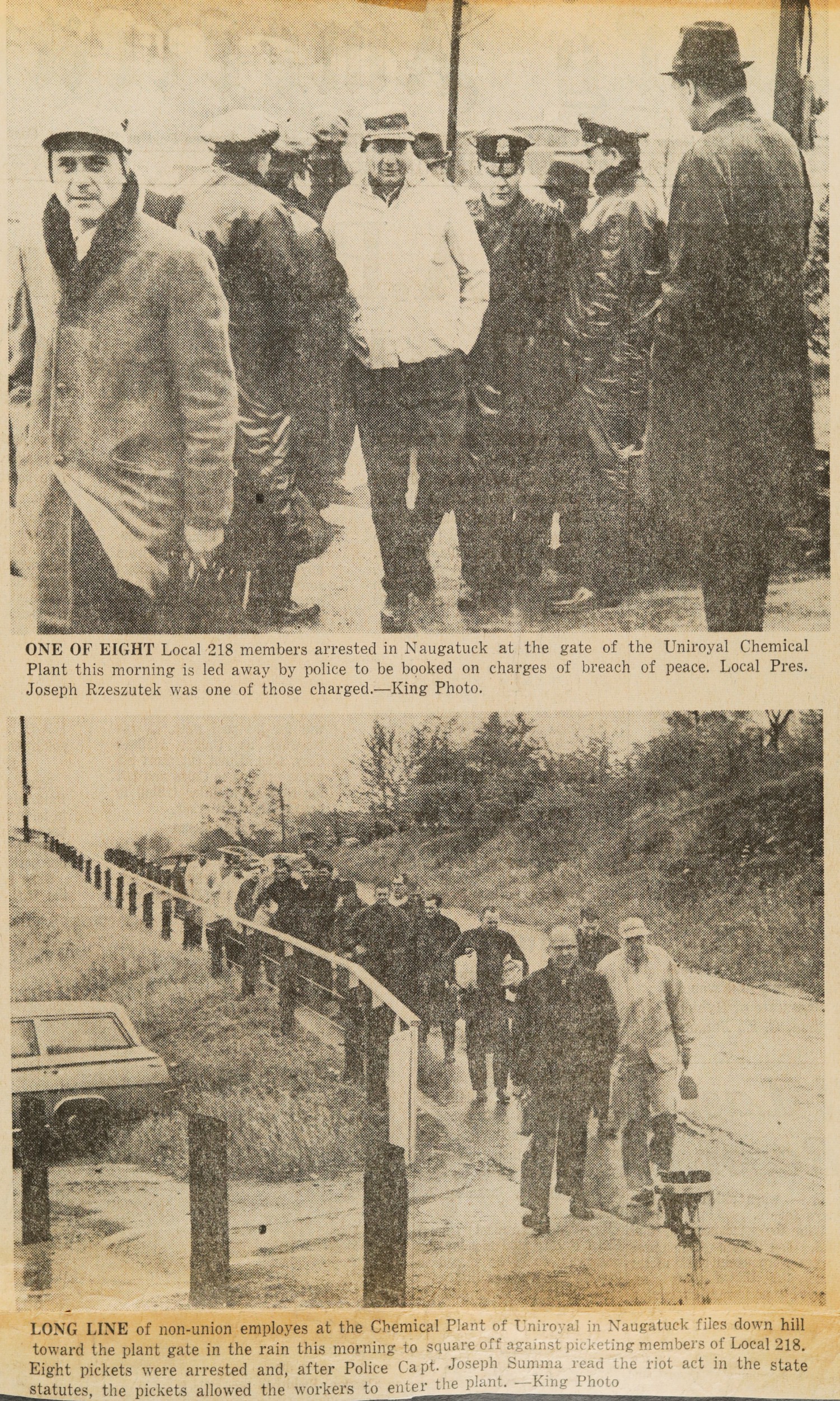
When some of the supervisory employes attempted to enter after Capt. Joseph J. Summa read the “riot act” warning the pickets to disperse, the battling between police and pickets began.

The women pickets were singing. The baiting continued until Police Chief Frank J. Mariano arrived. He called the union and company officials together and they went inside the plant.

When they came out, Summa ordered all the company personnel to leave Maple Street and assemble on the nearby green.

PLEASE TURN TO PAGE 13

Way Cleared For Strike

Way Cleared For Strike

NAUGATUCK—It was reported Wednesday that United Rubber Workers Local 218 armed its negotiators Tuesday with authority to call a strike should contract negotiations with Uniroyal management fail to produce an agreement by the contract expiration date.

Negotiations opened Tuesday in Cincinnati, with the three local Rubber Workers Union represented at the conference. The present contract, signed in June, 1965, expires April 20.

A spokesman said the local, representing workers at the Naugatuck Chemical Division, approved the strike vote by a vote of 490 to 70.


[Handwritten notation in upper right corner appears to read: “3-3” or similar numbers]

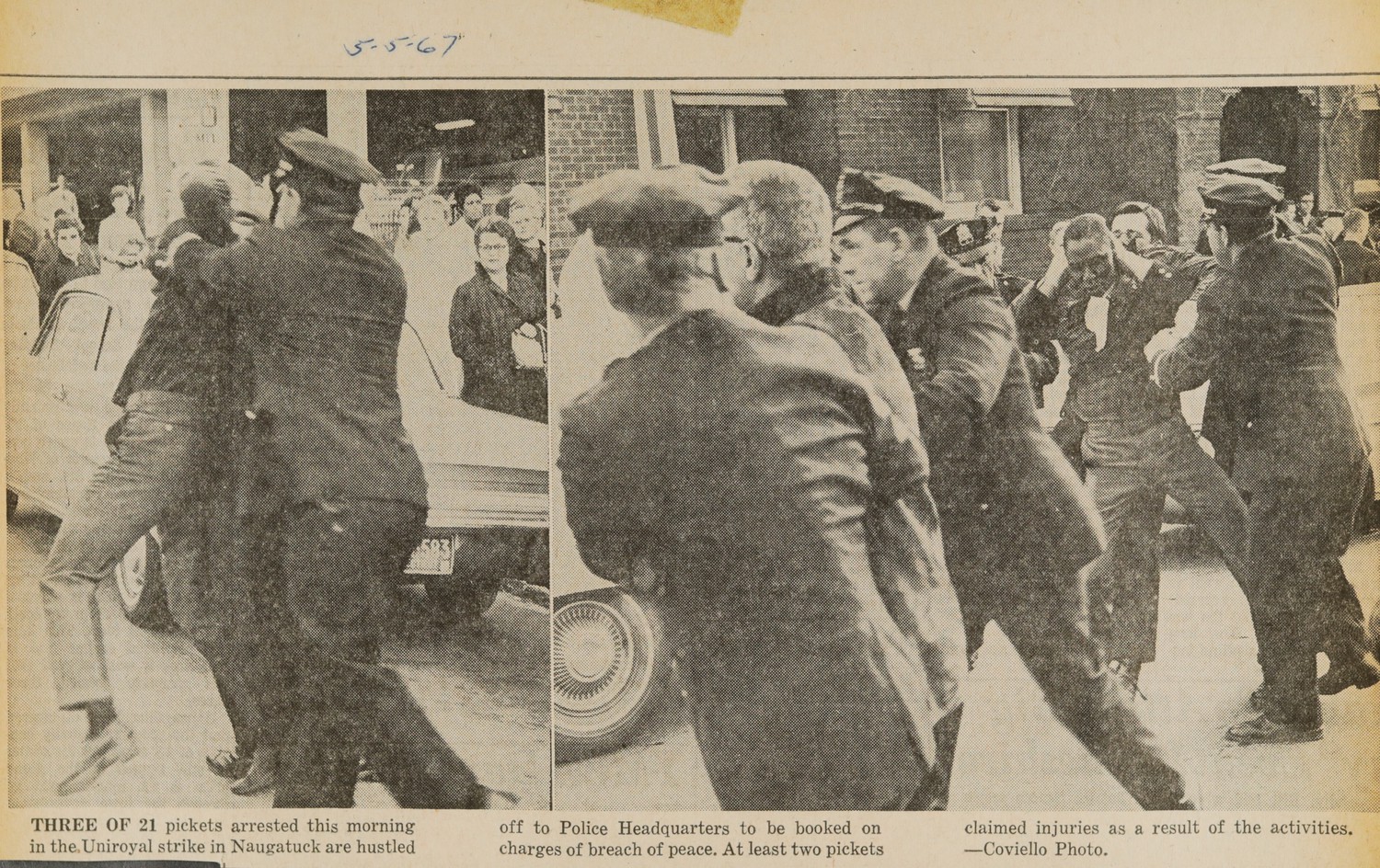
THREE OF 21 PICKETS ARRESTED THIS MORNING IN THE UNIROYAL STRIKE IN NAUGATUCK ARE HUSTLED OFF TO POLICE HEADQUARTERS TO BE BOOKED ON CHARGES OF BREACH OF PEACE. AT LEAST TWO PICKETS CLAIMED INJURIES AS A RESULT OF THE ACTIVITIES.

5-5-67

THREE OF 21 pickets arrested this morning in the Uniroyal strike in Naugatuck are hustled off to Police Headquarters to be booked on charges of breach of peace. At least two pickets claimed injuries as a result of the activities.
—Coviello Photo.

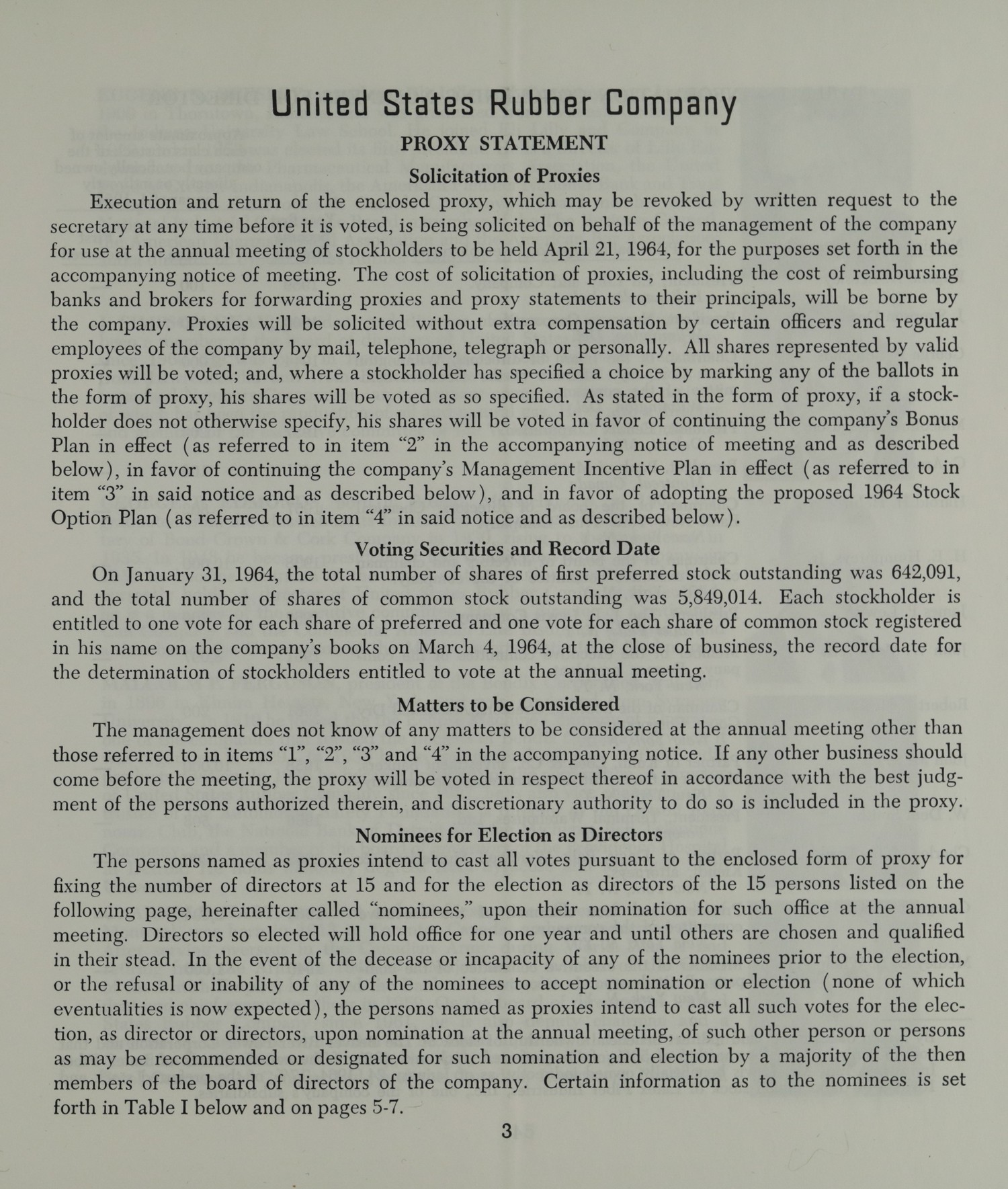
US Rubber Proxy Statement – Page 3

Page 003

United States Rubber Company
PROXY STATEMENT
Solicitation of Proxies
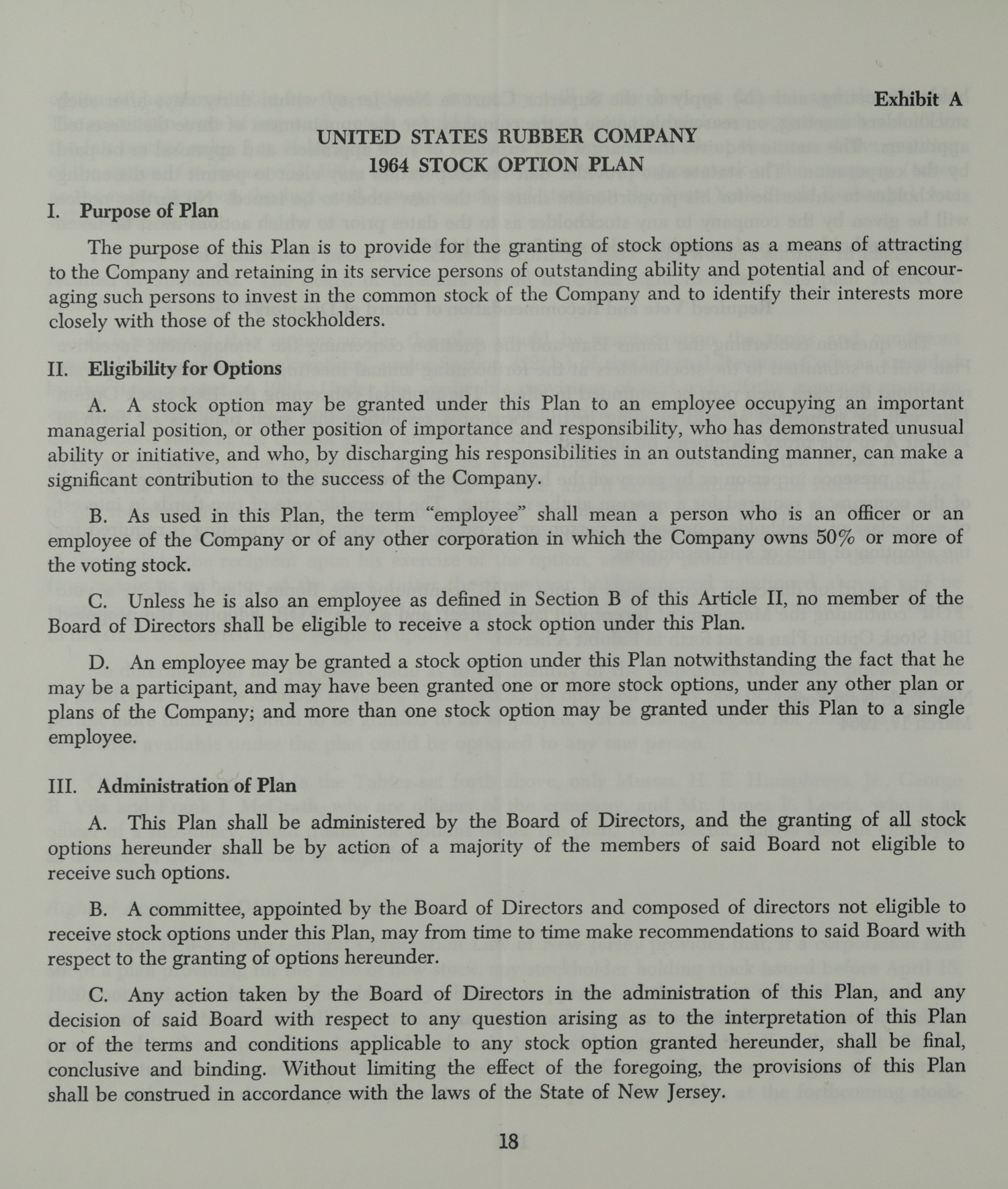
Execution and return of the enclosed proxy, which may be revoked by written request to the secretary at any time before it is voted, is being solicited on behalf of the management of the company for use at the annual meeting of stockholders to be held April 21, 1964, for the purposes set forth in the accompanying notice of meeting. The cost of solicitation of proxies, including the cost of reimbursing banks and brokers for forwarding proxies and proxy statements to their principals, will be borne by the company. Proxies will be solicited without extra compensation by certain officers and regular employees of the company by mail, telephone, telegraph or personally. All shares represented by valid proxies will be voted; and, where a stockholder has specified a choice by marking any of the ballots in the form of proxy, his shares will be voted as so specified. As stated in the form of proxy, if a stockholder does not otherwise specify, his shares will be voted in favor of continuing the company’s Bonus Plan in effect (as referred to in item “2” in the accompanying notice of meeting and as described below), in favor of continuing the company’s Management Incentive Plan in effect (as referred to in item “3” in said notice and as described below), and in favor of adopting the proposed 1964 Stock Option Plan (as referred to in item “4” in said notice and as described below).

Voting Securities and Record Date
On January 31, 1964, the total number of shares of first preferred stock outstanding was 642,091, and the total number of shares of common stock outstanding was 5,549,014. Each stockholder is entitled to one vote for each share of preferred and one vote for each share of common stock registered in his name on the company’s books on March 4, 1964, at the close of business, the record date for the determination of stockholders entitled to vote at the annual meeting.

Matters to be Considered
The management does not know of any matters to be considered at the annual meeting other than those referred to in items “1”, “2”, “3” and “4” in the accompanying notice. If any other business should come before the meeting, the proxy will be voted in respect therein, and discretionary authority to do so is included in the proxy.

Nominees for Election as Directors
The persons named as proxies intend to cast all votes pursuant to the enclosed form of proxy for fixing the number of directors at 15 and for the election as directors of the 15 persons listed on the following page, hereinafter called “nominees,” upon their nomination for such office at the annual meeting. Directors so elected will hold office for one year and until others are chosen and qualified in their stead. In the event of the decease or incapacity of any of the nominees prior to the election, or the refusal or inability of any of the nominees to accept nomination or election (none of which eventualities is now expected), the persons named as proxies intend to cast all such votes for the election, as director or directors, upon nomination at the annual meeting, of such other person or persons as may be recommended or designated for such nomination and election by a majority of the then members of the board of directors of the company. Certain information as to the nominees is set forth in Table I below and on pages 5-7.

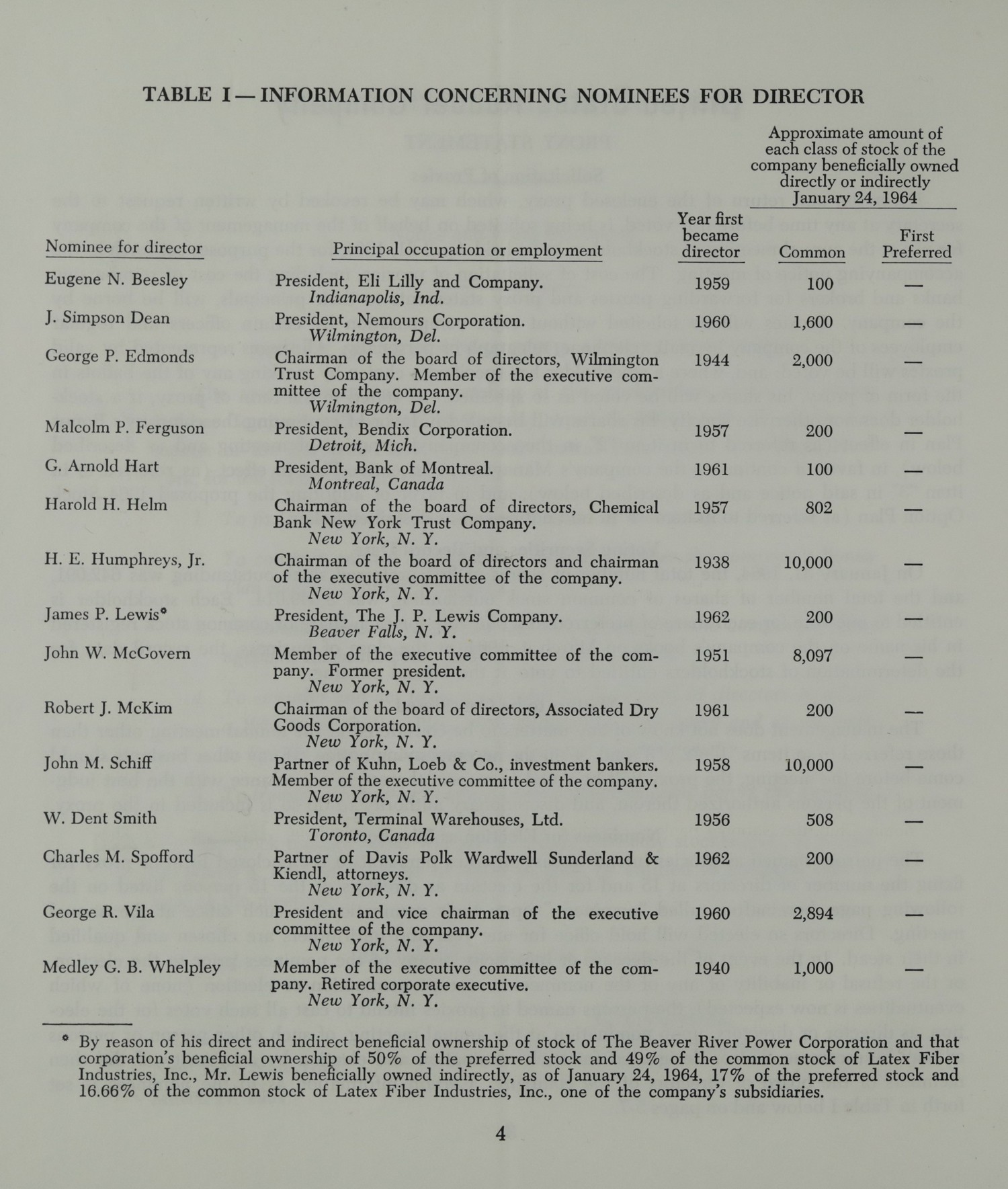
US Rubber Proxy Statement – Page 4

Page 004

TABLE I — INFORMATION CONCERNING NOMINEES FOR DIRECTOR

Approximate amount of
each class of stock of the
company beneficially owned
directly or indirectly
January 24, 1964

Nominee for director Principal occupation or employment Year first Common First
became Preferred
director
Eugene N. Beesley President, Eli Lilly and Company, 1959 100 —
Indianapolis, Ind.
J. Simpson Dean President, Nemours Corporation. 1960 1,600 —
Wilmington, Del.
George P. Edmonds Chairman of the board of directors, Wilmington 1944 2,000 —
Trust Company. Member of the executive com-
mittee of the company.
Wilmington, Del.
Malcolm P. Ferguson President, Bendix Corporation. 1957 200 —
Detroit, Mich.
G. Arnold Hart President, Bank of Montreal. 1961 100 —
Montreal, Canada
Harold H. Helm Chairman of the board of directors, Chemical 1957 802 —
Bank New York Trust Company.
New York, N. Y.
H. E. Humphreys, Jr. Chairman of the board of directors and chairman 1938 10,000 —
of the executive committee of the company.
New York, N. Y.
James P. Lewis* President, The J. P. Lewis Company, 1962 200 —
Beaver Falls, N. Y.
John W. McGovern Member of the executive committee of the com- 1951 8,097 —
pany. Former president.
New York, N. Y.
Robert J. McKim Chairman of the board of directors, Associated Dry 1961 200 —
Goods Corporation.
New York, N. Y.
John M. Schiff Partner of Kuhn, Loeb & Co., investment bankers. 1958 10,000 —
Member of the executive committee of the company.
New York, N. Y.
W. Dent Smith President, Terminal Warehouses, Ltd. 1956 508 —
Toronto, Canada
Charles M. Spofford Partner of Davis Polk Wardwell Sunderland & 1962 200 —
Kiendl, attorneys.
New York, N. Y.
George R. Vila President and vice chairman of the executive 1960 2,894 —
committee of the company.
New York, N. Y.
Medley G. B. Whelpley Member of the executive committee of the com- 1940 1,000 —
pany. Retired corporate executive.
New York, N. Y.

  • By reason of his direct and indirect beneficial ownership of stock of The Beaver River Power Corporation and that corporation’s beneficial ownership of 50% of the preferred stock and 49% of the common stock of Latex Fiber Industries, Inc., Mr. Lewis beneficially owned indirectly, as of January 24, 1964, 17% of the preferred stock and 16.66% of the common stock of Latex Fiber Industries, Inc., one of the company’s subsidiaries.

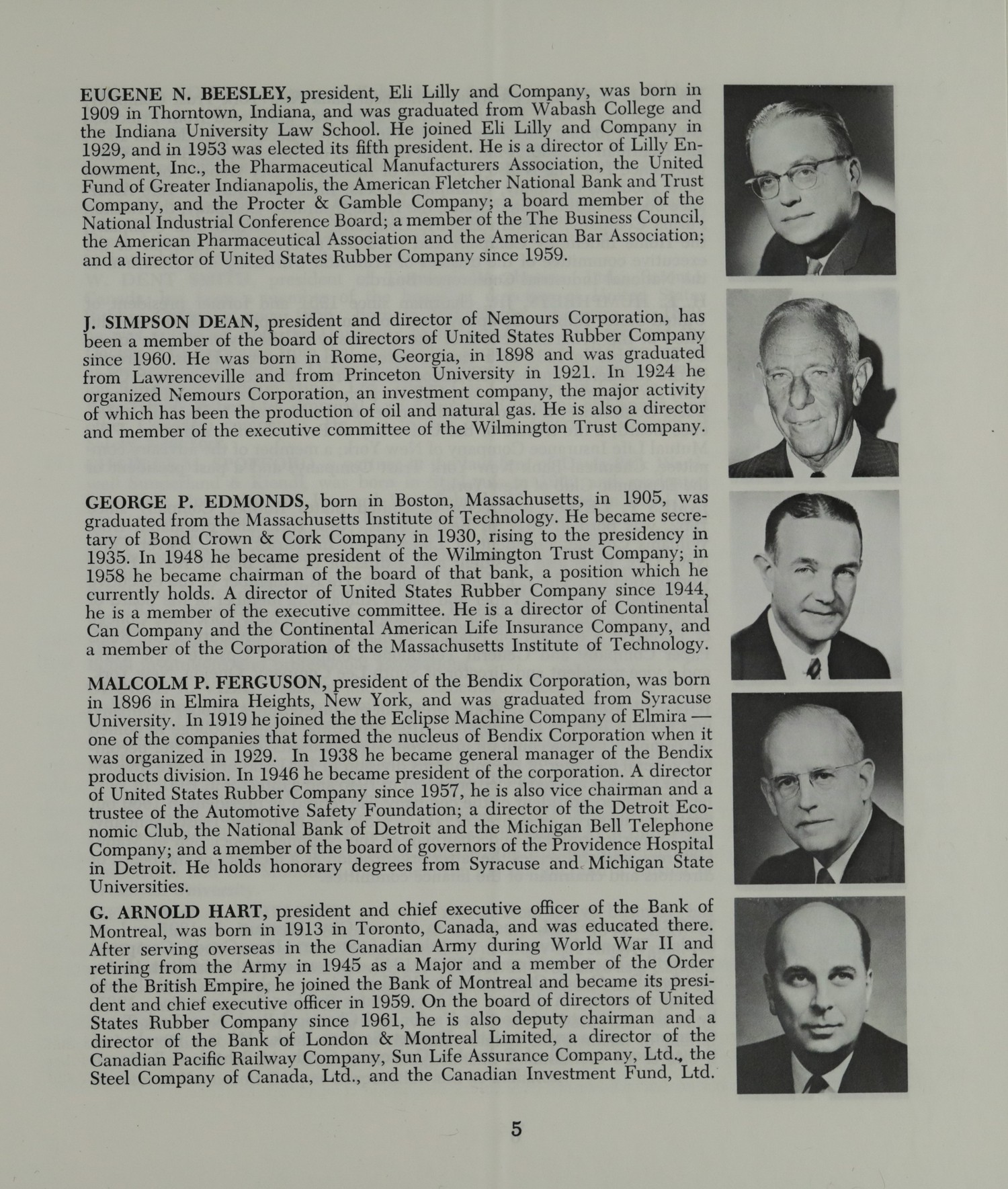
US Rubber Proxy Statement – Page 5

Page 005

EUGENE N. BEESLEY, president, Eli Lilly and Company, was born in 1909 in Thorntown, Indiana, and was graduated from Wabash College and the Indiana University Law School. He joined Eli Lilly and Company in 1929, and in 1953 was elected its fifth president. He is a director of Lilly Endowment, Inc., the Pharmaceutical Manufacturers Association, the United Fund of Greater Indianapolis, the American Fletcher National Bank and Trust Company, and the Procter & Gamble Company; a board member of the National Industrial Conference Board; a member of the Business Council, the American Pharmaceutical Association; and a director of United States Rubber Company since 1959.

J. SIMPSON DEAN, president and director of Nemours Corporation, has been a member of the board of directors of United States Rubber Company since 1960. He was born in Rome, Georgia, in 1898 and was graduated from Lawrenceville and from Princeton University in 1921. In 1924 he organized Nemours Corporation, an investment company, the major activity of which has been the production of oil and natural gas. He is also a director and member of the executive committee of the Wilmington Trust Company.

GEORGE P. EDMONDS, born in Boston, Massachusetts, in 1905, was graduated from the Massachusetts Institute of Technology. He became secretary of Bond Crow & Cork Company in 1930, rising to the presidency in 1935. In 1948 he became president of the Wilmington Trust Company; in 1953 he became chairman of the board of that bank, a position which he currently holds. A director of United States Rubber Company since 1944, he is a member of the executive committee. He is a director of Continental Can Company and the Continental American Life Insurance Company, and a member of the Corporation of the Massachusetts Institute of Technology.

MALCOLM P. FERGUSON, president of the Bendix Corporation, was born in 1896 in Elmira Heights, New York, and was graduated from Syracuse University. In 1919 he joined the Eclipse Machine Company of Elmira — one of the companies that formed the nucleus of Bendix Corporation when it was organized in 1929. In 1938 he became general manager of the Bendix products division. In 1946 he became president of the corporation. A director of United States Rubber Company since 1957, he is also vice chairman and a trustee of the Automotive Safety Foundation; a director of the National Bank of Detroit and the Michigan Bell Telephone Company; and a member of the board of governors of the Providence Hospital in Detroit. He holds honorary degrees from Syracuse and Michigan State Universities.

G. ARNOLD HART, president and chief executive officer of the Bank of Montreal, was born in 1913 in Toronto, Canada, and was educated there. After serving overseas in the Canadian Army during World War II and retiring from the Army in 1945 as a Major and a member of the Order of the British Empire, he joined the Bank of Montreal and became its president and chief executive officer in 1959. On the board of directors of United States Rubber Company since 1961, he is also deputy chairman and a director of the Bank of London & Montreal Limited, a director of the Canadian Pacific Railway Company, Sun Life Assurance Company, Ltd., the Steel Company of Canada, Ltd., and the Canadian Investment Fund, Ltd.

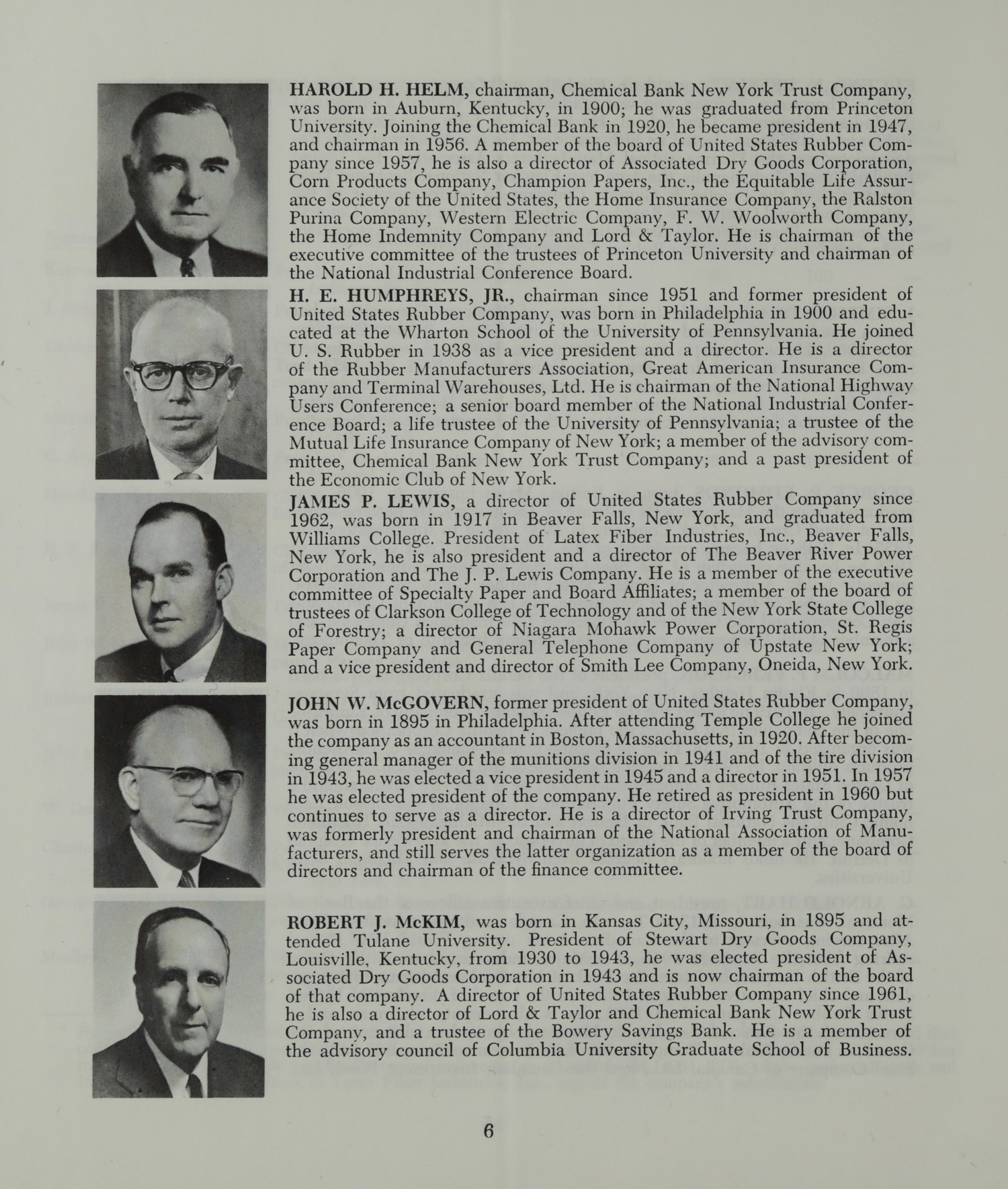
US Rubber Proxy Statement – Page 6

Page 006

HAROLD H. HELM, chairman, Chemical Bank New York Trust Company, was born in Auburn, Kentucky, in 1900; he was graduated from Princeton University. Joining the Chemical Bank in 1920, he became president in 1947, and chairman in 1956. A member of the board of United States Rubber Company since 1957, he is also a director of Associated Dry Goods Corporation, Champion Papers, Inc., the Equitable Life Assurance Society of the United States, the Home Insurance Company, the Ralston Purina Company, Western Electric Company, F. W. Woolworth Company, the Home Indemnity Company and Lord & Taylor. He is chairman of the executive committee of the trustees of Princeton University and chairman of the National Industrial Conference Board.

H. E. HUMPHREYS, JR., chairman since 1951 and former president of United States Rubber Company, was born in Philadelphia in 1900 and educated at the Wharton School of the University of Pennsylvania. He joined U. S. Rubber in 1935 as a vice president and a director. He is a director of the Rubber Manufacturers Association, Great American Insurance Company and Terminal Warehouses, Ltd. He is chairman of the National Highway Users Conference; a senior board member of the National Industrial Conference Board; a life trustee of the University of Pennsylvania; a trustee of the Mutual Life Insurance Company of New York; a member of the advisory committee, Chemical Bank New York Trust Company; and a past president of the Economic Club of New York.

JAMES P. LEWIS, a director of United States Rubber Company since 1962, was born in 1917 in Beaver Falls, New York, and graduated from Williams College. President of Latex Fiber Industries, Inc., Beaver Falls, New York, he is also president and a director of The Beaver River Power Corporation and The J. P. Lewis Company. He is a member of the executive committee of Specialty Paper and Board Affiliates; a member of the board of trustees of Clarkson College of Technology and of Forestry; a director of Niagara Mohawk Power Corporation, St. Regis Paper Company and General Telephone Company of Upstate New York; and a vice president and director of Smith Lee Company, Oneida, New York.

JOHN W. McGOVERN, former president of United States Rubber Company, was born in 1895 in Philadelphia. After attending Temple College he joined the company as an accountant in Boston, Massachusetts, in 1920. After becoming general manager of the munitions division in 1941 and of the tire division in 1943, he was elected a vice president in 1945 and a director in 1951. In 1957 he was elected president of the company. He retired as president in 1960 but continues to serve as a director. He is a director of Irving Trust Company, was formerly president and chairman of the National Association of Manufacturers, and still serves the latter organization as a member of the board of directors and chairman of the finance committee.

ROBERT J. McKIM, was born in Kansas City, Missouri, in 1895 and attended Tulane University. President of Stewart Dry Goods Company, Louisville, Kentucky, from 1930 to 1943, he was elected president of Associated Dry Goods Corporation in 1943 and is now chairman of the board of that company. A director of United States Rubber Company since 1961, he is also a director of Lord & Taylor and Chemical Bank New York Trust Company, and a trustee of the Savings Bank. He is a member of the advisory council of the Columbia University Graduate School of Business.

US Rubber Proxy Statement – Page 7

Page 007

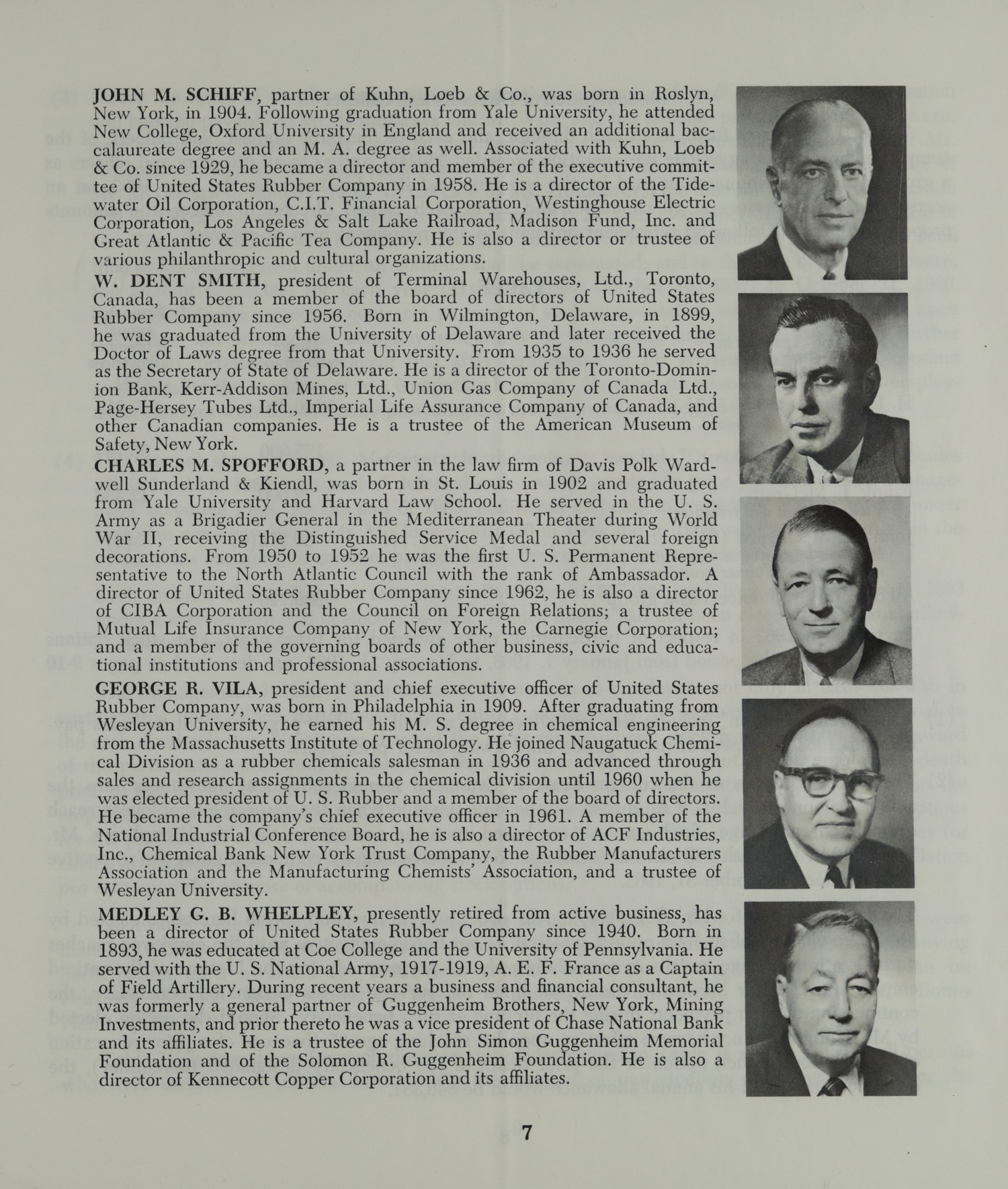
JOHN M. SCHIFF, partner of Kuhn, Loeb & Co., was born in Roslyn, New York, in 1904. Following graduation from Yale University, he attended New College, Oxford University in England and received an additional bac-
calaurcatc degree and an M.A. degree as well. Associated with Kuhn, Loeb
& Co. since 1929, he became a director and member of the executive commit-
tee of United States Rubber Company in 1958. He is a director of the Tide-
water Oil Corporation, C.I.T. Financial Corporation, Westinghouse Electric
Corporation, Los Angeles & Salt Lake Railroad, Madison Fund, Inc. and
Great Atlantic & Pacific Tea Company. He is also a director or trustee of
various philanthropic and cultural organizations.
W. DENT SMITH, president of Terminal Warehouses, Ltd., Toronto,
Canada, has been a member of the board of directors of United States
Rubber Company since 1956. Born in Wilmington, Delaware, in 1899,
he was graduated from the University of Delaware and later received the
Doctor of Laws degree from that University. From 1935 to 1936 he served
as the Secretary of State of Delaware. He is a director of the Toronto-Domin-
ion Bank, Kerr-Addison Mines, Ltd., Union Gas Company of Canada Ltd.,
Page-Hersey Tubes Ltd., Imperial Life Assurance Company of Canada, and
other Canadian companies. He is a trustee of the American Museum of
Safety, New York.
CHARLES M. SPOFFORD, a partner in the law firm of Davis Polk Ward-
well Sunderland & Kiendl, was born in St. Louis in 1902 and graduated
from Yale University and Harvard Law School. He served in the U. S.
Army as a Brigadier General in the Mediterranean Theater during World
War II, receiving the Distinguished Service Medal and several foreign
decorations. From 1950 to 1952 he was the first U. S Permanent Repre-
sentative to the North Atlantic Council with the rank of Ambassador. A
director of United States Rubber Company since 1962, he is also a director
of CIBÄ Corporation and the Council on Foreign Relations; a trustee of
Mutual Life Insurance Company of New York, the Carnegie Corporation;
and a member of the governing boards of other business, civic and educa-
tional institutions and professional associations.
GEORGE R. VILA, president and chief executive officer of United States
Rubber Company, was born in Philadelphia in 1909. After graduating from
Wesleyan University, he earned his M. S. degree in chemical engineering
from the Massachusetts Institute of Technology. He joined Naugatuck Chemi-
cal Division as a rubber chemicals salesman in 1936 and advanced through
sales and research assignments in the chemical division until 1960 when he
was elected president of U. S. Rubber and a member of the board of directors.
He became the company’s chief executive officer in 1961. A member of the
National Industrial Conference Board, he is also a director of ACF Industries,
Inc., Chemical Bank New York Trust Company, the Rubber Manufacturers
Association and the Manufacturing Chemists Association, and a trustee of
Wesleyan University.
MEDLEY G. B. WHELPLEY, presently retired from active business, has
been a director of United States Rubber Company since 1940. Born in
1893, he was educated at Coe College and the University of Pennsylvania. He
served with the U. S. National Army, 1917-1919, A. E. F. France as a Captain
of Field Artillery. During recent years a business and financial consultant, he
was formerly a general partner of Guggenheim Brothers, New York, Mining
Investments, and prior thereto he was a vice president of Chase National Bank
and its affiliates. He is a trustee of the John Simon Guggenheim Memorial
Foundation and of the Solomon R. Guggenheim Foundation. He is also a
director of Kennecott Copper Corporation and its affiliates.

US Rubber Proxy Statement – Page 8

Page 008

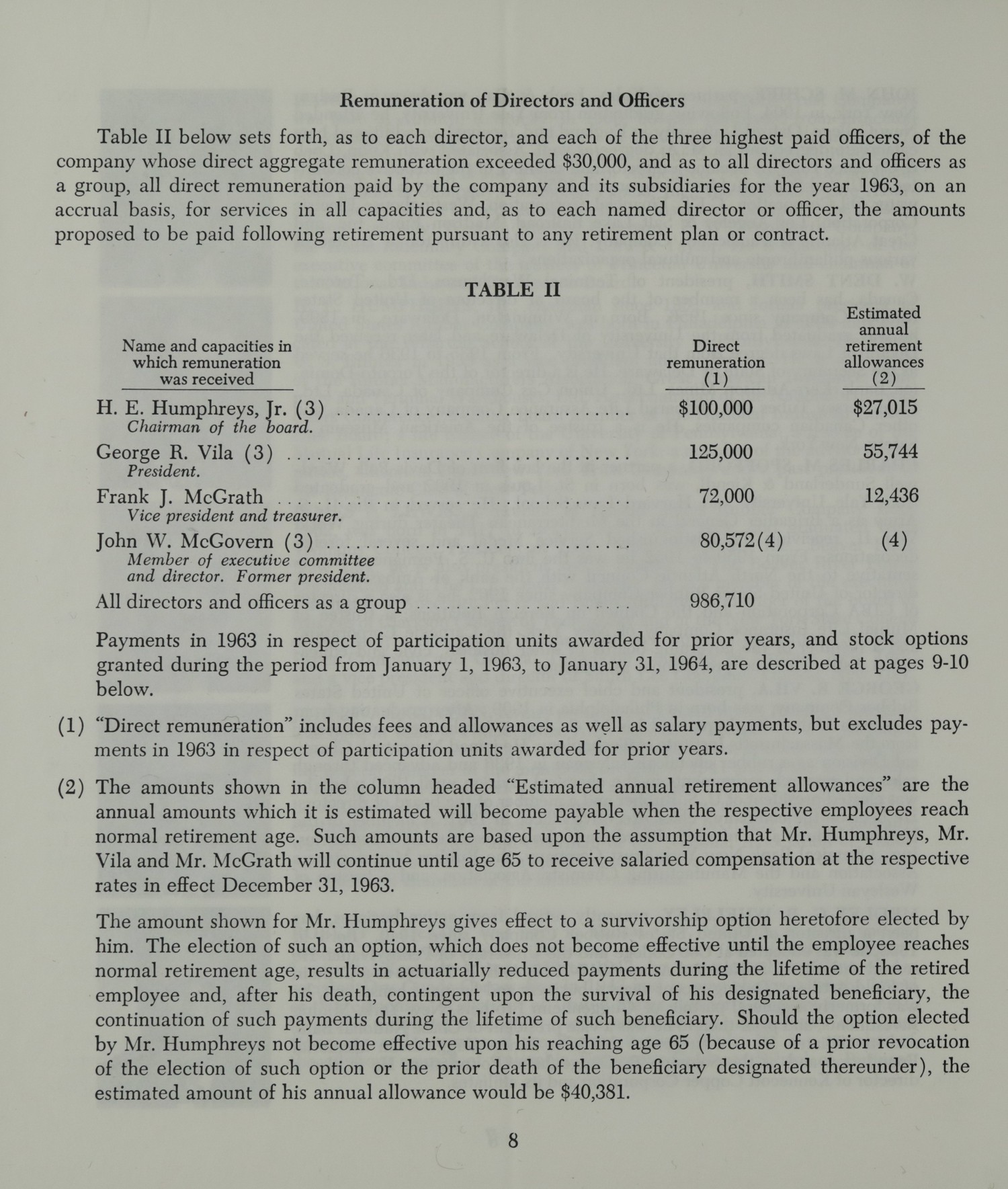
Remuneration of Directors and Officers

Table II below sets forth, as to each director, and each of the three highest paid officers, of the company whose direct aggregate remuneration exceeded $30,000, and as to all directors and officers as a group, all direct remuneration paid by the company and its subsidiaries for the year 1963, on an accrual basis, for services in all capacities and, as to each named director or officer, the amounts proposed to be paid following retirement pursuant to any retirement plan or contract.

TABLE II
Estimated
Name and capacities in Direct annual
which remuneration remuneration retirement
was received (1) allowances (2)
H. E. Humphreys, Jr. (3) $100,000 $27,015
Chairman of the board.
George R. Vila (3) 125,000 55,744
President.
Frank J. McGrath 72,000 12,436
Vice president and treasurer.
John W. McGovern (3) 80,572(4) (4)
Member of executive committee
and director. Former president.
All directors and officers as a group 986,710

Payments in 1963 in respect of participation units awarded for prior years, and stock options granted during the period from January 1, 1963, to January 31, 1964, are described at pages 9-10 below.

(1) “Direct remuneration” includes fees and allowances as well as salary payments, but excludes payments in 1963 in respect of participation units awarded for prior years.

(2) The amounts shown in the column headed “Estimated annual retirement allowances” are the annual amounts which it is estimated will become payable when the respective employees reach normal retirement age. Such amounts are based upon the assumption that Mr. Humphreys, Mr. Vila and Mr. McGrath will continue until age 65 to receive salaries compensation at the respective rates in effect December 31, 1963.

The amount shown for Mr. Humphreys gives effect to a survivorship option heretofore elected by him. The election of such an option, which does not become effective until the employee reaches normal retirement age, results in actuarially reduced payments during the lifetime of the retired employee and, after his death, contingent upon the survival of his designated beneficiary, the continuation of such payments during the lifetime of such beneficiary. Should the option elected by Mr. Humphreys not become effective upon his reaching age 65 (because of a prior revocation of the election of such option or the prior death of the beneficiary designated thereunder), the estimated amount of his annual allowance would be $40,331.

US Rubber Proxy Statement – Page 9

Page 009

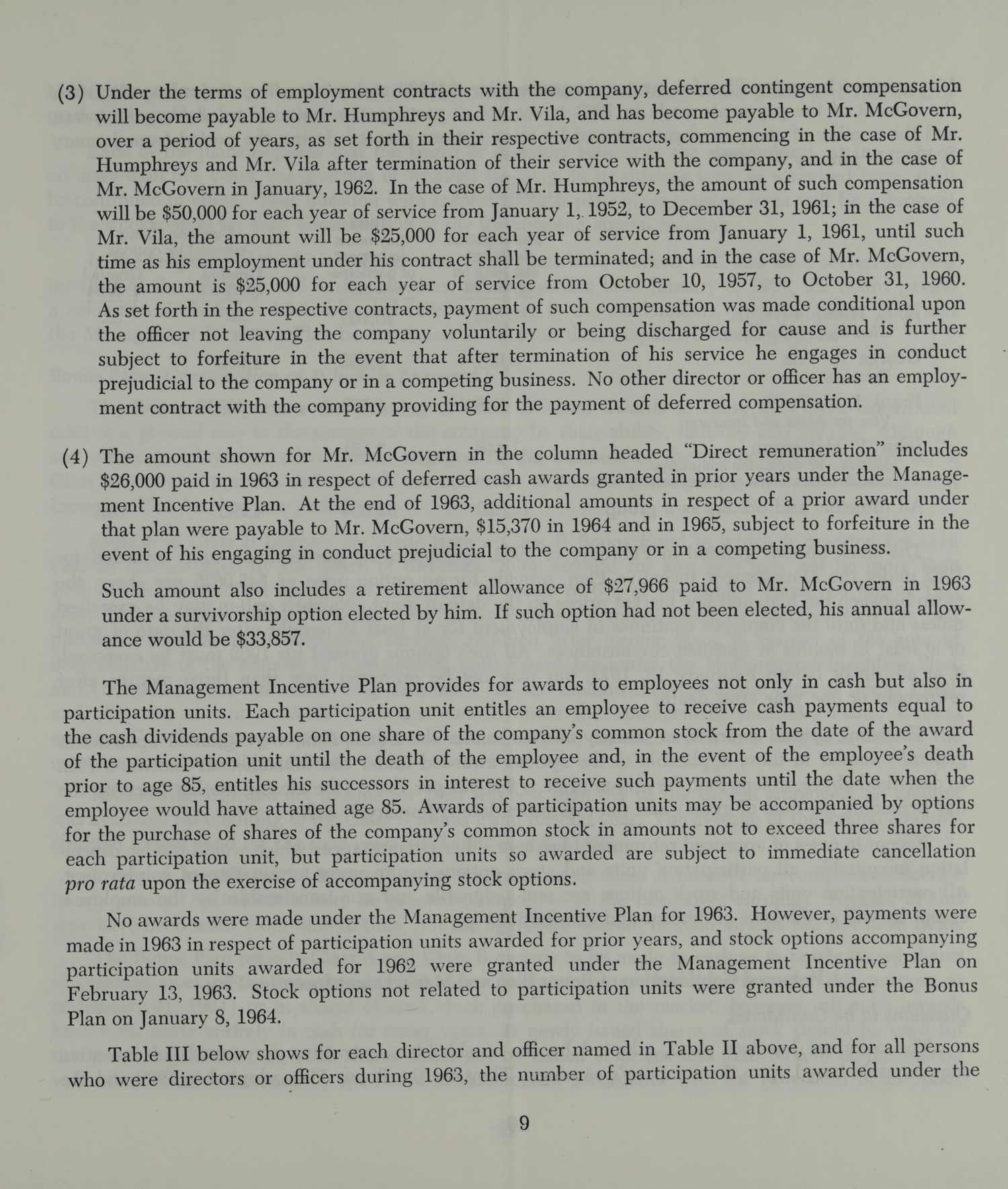
(3) Under the terms of employment contracts with the company, deferred contingent compensation will become payable to Mr. Humphreys and Mr. Vila, and has become payable to Mr. McGovern, over a period of years, as set forth in their respective contracts, commencing in the case of Mr. Humphreys and Mr. Vila after termination of their service with the company, and in the case of Mr. McGovern in January, 1962. In the case of Mr. Humphreys, the amount of such compensation will be $50,000 for each year of service from January 1, 1952, to December 31, 1961; in the case of Mr. Vila, the amount will be $25,000 for each year of service from January 1, 1961, until such time as his employment under his contract shall be terminated; and in the case of Mr. McGovern, the amount is $25,000 for each year of service from October 10, 1957, to October 31, 1960. As set forth in the respective contracts, payment of such compensation was made conditional upon the officer not leaving the company voluntarily or being discharged for cause and is further subject to forfeiture in the event that after termination of his service he engages in conduct prejudicial to the company or in a competing business. No other director or officer has an employment contract with the company providing for the payment of deferred compensation.

(4) The amount shown for Mr. McGovern in the column headed “Direct remuneration” includes $26,000 paid in 1963 in respect of deferred cash awards granted in prior years under the Management Incentive Plan. At the end of 1963, additional amounts in respect of a prior award under that plan were payable to Mr. McGovern, $15,370 in 1964 and in 1965, subject to forfeiture in the event of his engaging in conduct prejudicial to the company or in a competing business.

Such amount also includes a retirement allowance of $27,966 paid to Mr. McGovern in 1963 under a survivorship option elected by him. If such option had not been elected, his annual allowance would be $33,857.

The Management Incentive Plan provides for awards to employees not only in cash but also in participation units. Each participation unit entitles an employee to receive cash payments equal to the cash dividends payable on one share of the company’s common stock from the date of the award of the participation unit until the death of the employee and, in the event of the employee’s death prior to age 65, entitles his successors in interest to receive such payments until the date when the employee would have attained age 65. Awards of participation units may be accompanied by options for the purchase of shares of the company’s common stock in amounts not to exceed three shares for each participation unit, but participation units so awarded are subject to immediate cancellation pro rata upon the exercise of accompanying stock options.

No awards were made under the Management Incentive Plan for 1963. However, payments were made in 1963 in respect of participation units awarded for prior years, and stock options accompanying participation units awarded for 1962 were granted under the Management Incentive Plan on February 13, 1963. Stock options not related to participation units were granted under the Bonus Plan on January 8, 1964.

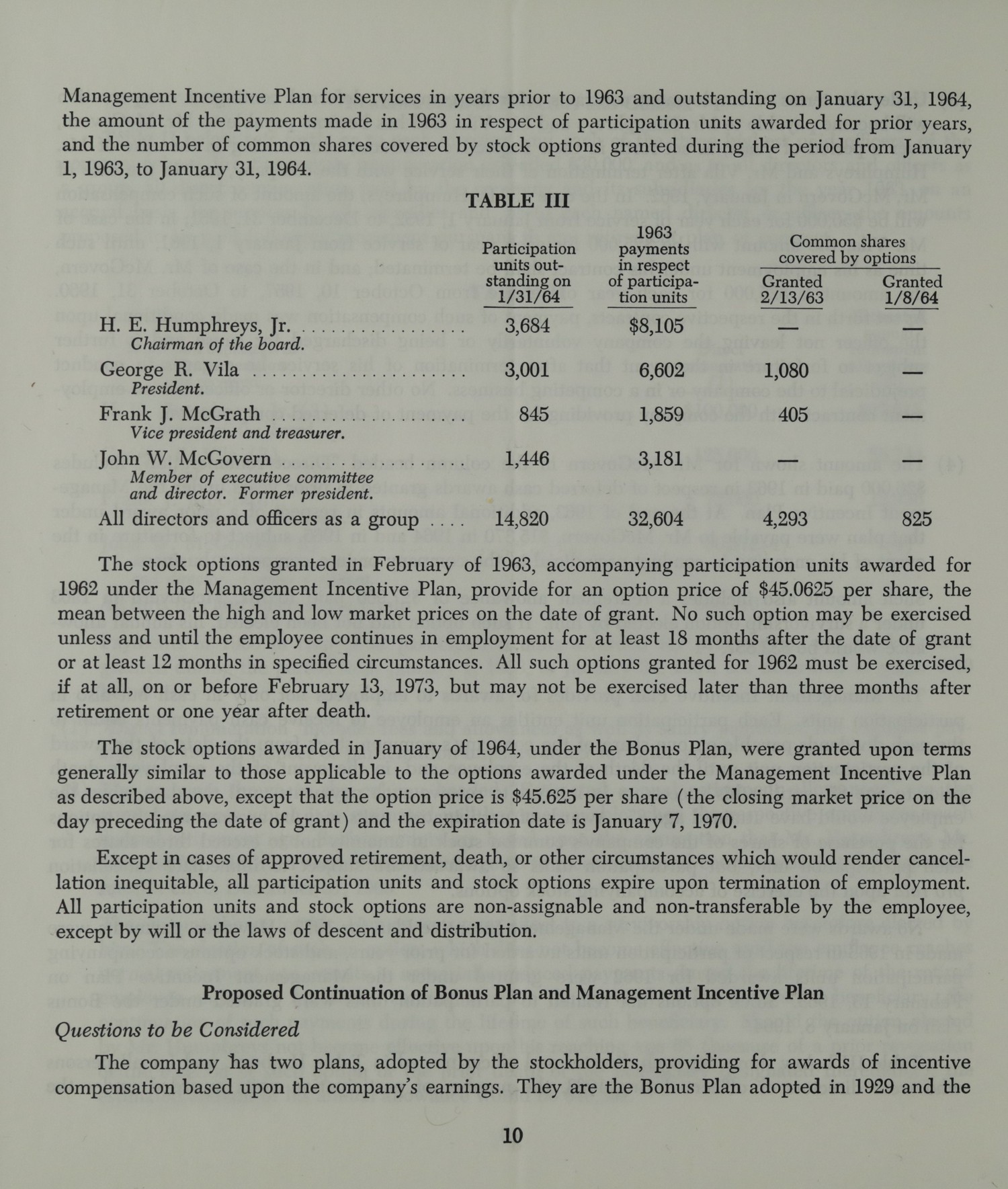
Table III below shows for each director and officer named in Table II above, and for all persons who were directors or officers during 1963, the number of participation units awarded under the Management Incentive Plan.

US Rubber Proxy Statement – Page 10

Page 010

Management Incentive Plan for services in years prior to 1963 and outstanding on January 31, 1964, the amount of the payments made in 1963 in respect of participation units awarded for prior years, and the number of common shares covered by stock options granted during the period from January 1, 1963, to January 31, 1964.

TABLE III

Participation 1963 Common shares
units out- payments covered by options
standing on in respect Granted Granted
1/31/64 of participa- 2/13/63 1/8/64
tion units

H. E. Humphreys, Jr. . . . . . . . . . . . . . . . 3,684 $8,105 – –
Chairman of the board.
George R. Vila . . . . . . . . . . . . . . . . . . . . 3,001 6,602 1,080 –
President.
Frank J. McGrath . . . . . . . . . . . . . . . . . 845 1,859 405 –
Vice president and treasurer.
John W. McGovern . . . . . . . . . . . . . . . . 1,446 3,181 – –
Member of executive committee
and director. Former president.
All directors and officers as a group . . . 14,820 32,604 4,293 825

The stock options granted in February of 1963, accompanying participation units awarded for 1962 under the Management Incentive Plan, provide for an option price of $45.0625 per share, the mean between the high and low market prices on the date of grant. No such option may be exercised unless and until the employee continues in employment for at least 18 months after the date of grant or at least 12 months in specified circumstances. All such options granted for 1962 must be exercised, if at all, on or before February 13, 1973, but may not be exercised later than three months after retirement or one year after death.

The stock options awarded in January of 1964, under the Bonus Plan, were granted upon terms generally similar to those applicable to the options awarded under the Management Incentive Plan as described above, except that the option price is $45.625 per share (the closing market price on the day preceding the date of grant) and the expiration date is January 7, 1970.

Except in cases of approved retirement, death, or other circumstances which would render cancellation inequitable, all participation units and stock options expire upon termination of employment. All participation units and stock options are non-assignable and non-transferable by the employee, except by will or the laws of descent and distribution.

Proposed Continuation of Bonus Plan and Management Incentive Plan

Questions to be Considered

The company has two plans, adopted by the stockholders, providing for awards of incentive compensation based upon the company’s earnings. They are the Bonus Plan adopted in 1929 and the 10

US Rubber Proxy Statement – Page 11

Page 011

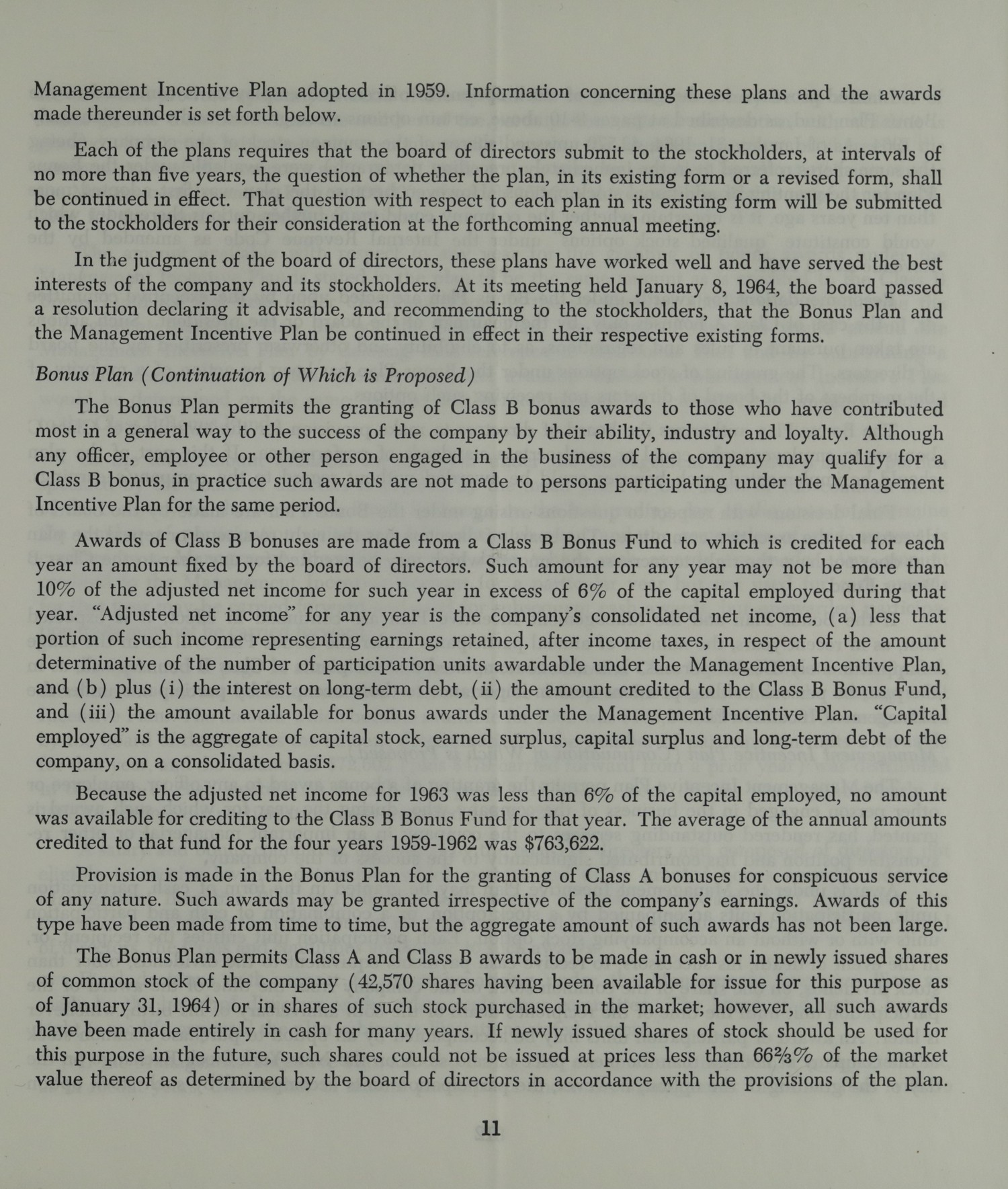
Management Incentive Plan adopted in 1959. Information concerning these plans and the awards made thereunder is set forth below.

Each of the plans requires that the board of directors submit to the stockholders, at intervals of no more than five years, the question of whether the plan, in its existing form or a revised form, shall be continued in effect. That question with respect to each plan in its existing form will be submitted to the stockholders for their consideration at the forthcoming annual meeting.

In the judgment of the board of directors, these plans have worked well and have served the best interests of the company and its stockholders. At its meeting held January 8, 1964, the board passed a resolution declaring it advisable, and recommending to the stockholders, that the Bonus Plan and the Management Incentive Plan be continued in effect in their respective existing forms.

Bonus Plan (Continuation of Which is Proposed)
The Bonus Plan permits the granting of Class B bonus awards to those who have contributed most in a general way to the success of the company by their ability, industry and loyalty. Although any officer, employee or other person engaged in the business of the company may qualify for a Class B bonus, in practice such awards are not made to persons participating under the Management Incentive Plan for the same period.

Awards of Class B bonuses are made from a Class B Bonus Fund to which is credited for each year an amount fixed by the board of directors. Such amount for any year may not be more than 10% of the adjusted net income for such year in excess of 6% of the capital employed during that year. “Adjusted net income” for any year is the company’s consolidated net income, (a) less that portion of such income representing earnings retained, after income taxes, in respect of the amount determinative of the number of participation units awardable under the Management Incentive Plan, and (b) plus (i) the interest on long-term debt, (ii) the amount credited to the Class B Bonus Fund, and (iii) the amount available for bonus awards under the Management Incentive Plan. “Capital employed” is the aggregate of capital stock, earned surplus, capital surplus and long-term debt of the company, on a consolidated basis.

Because the adjusted net income for 1963 was less than 6% of the capital employed, no amount was available for crediting to the Class B Bonus Fund for that year. The average of the annual amounts credited to that fund for the four years 1959-1962 was $763,622.

Provision is made in the Bonus Plan for the granting of Class A bonuses for conspicuous service of any nature. Such awards may be granted irrespective of the company’s earnings. Awards of this type have been made from time to time, but the aggregate amount of such awards has not been large.

The Bonus Plan permits Class A and Class B awards to be made in cash or in newly issued shares of common stock of the company (42,570 shares having been available for issue for this purpose as of January 31, 1964) or in shares of such stock purchased in the market; however, all such awards have been made entirely in cash for many years. If newly issued shares of stock should be used for this purpose in the future, such shares could not be issued at prices less than 66-2/3% of the market value thereof as determined by the board of directors in accordance with the provisions of the plan.

US Rubber Proxy Statement – Page 12

Page 012

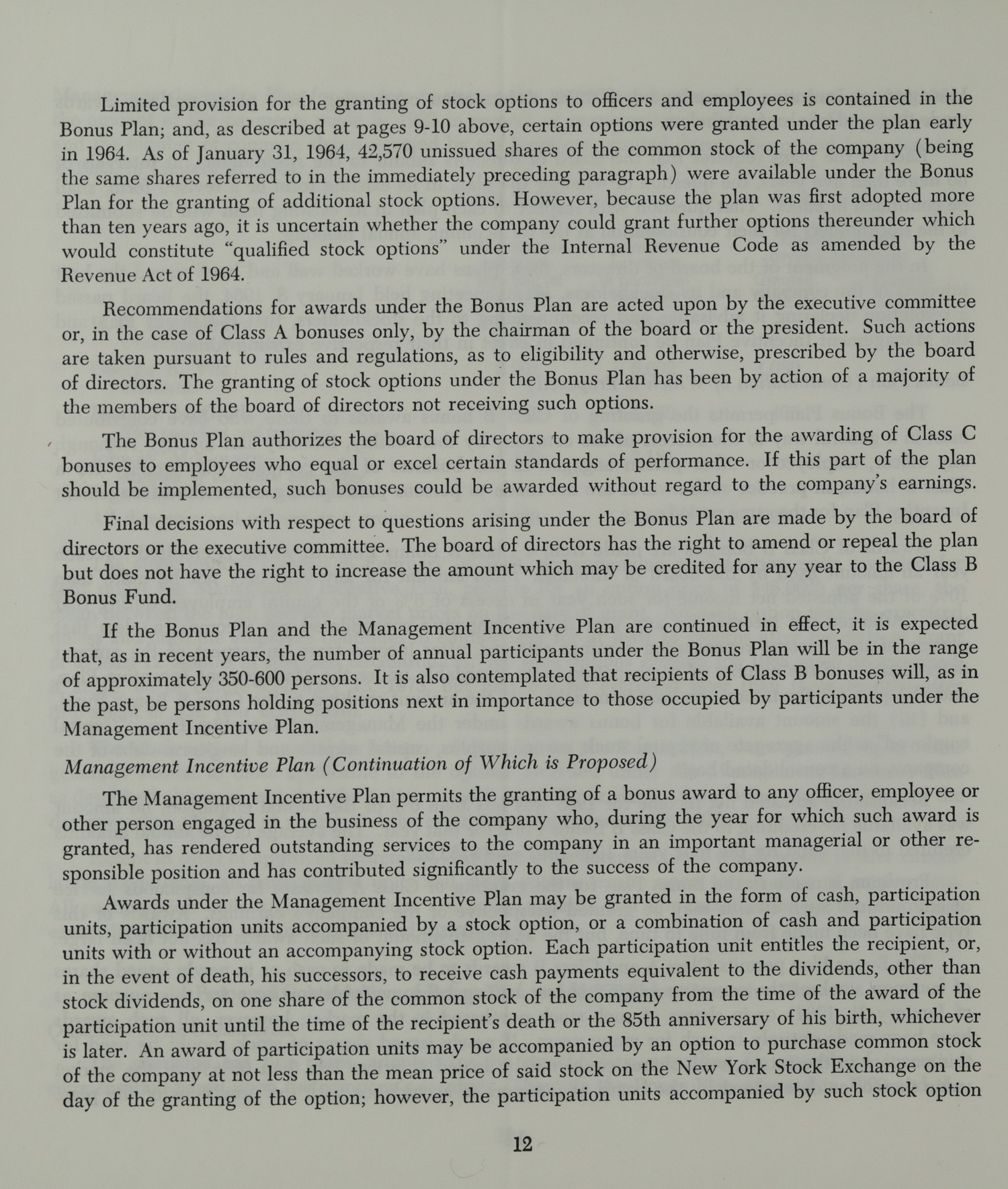
Limited provision for the granting of stock options to officers and employees is contained in the Bonus Plan; and, as described at pages 9-10 above, certain options were granted under the plan early in 1964. As of January 31, 1964, 42,570 unissued shares of the common stock of the company (being the same shares referred to in the immediately preceding paragraph) were available under the Bonus Plan for the granting of additional stock options. However, because the plan was first adopted more than ten years ago, it is uncertain whether the company could grant further options thereunder which would constitute “qualified stock options” under the Internal Revenue Code as amended by the Revenue Act of 1964.

Recommendations for awards under the Bonus Plan are acted upon by the executive committee or, in the case of Class A bonuses only, by the chairman of the board or the president. Such actions are taken pursuant to rules and regulations, as to eligibility and otherwise, prescribed by the board of directors. The granting of stock options under the Bonus Plan has been by action of a majority of the members of the board of directors not receiving such options.

The Bonus Plan authorizes the board of directors to make provision for the awarding of Class C bonuses to employees who equal or excel certain standards of performance. If this part of the plan should be implemented, such bonuses could be awarded without regard to the company’s earnings.

Final decisions with respect to questions arising under the Bonus Plan are made by the board of directors or the executive committee. The board of directors has the right to amend or repeal the plan but does not have the right to increase the amount which may be credited for any year to the Class B Bonus Fund.

If the Bonus Plan and the Management Incentive Plan are continued in effect, it is expected that, as in recent years, the number of annual participants under the Bonus Plan will be in the range of approximately 350-600 persons. It is also contemplated that recipients of Class B bonuses will, as in the past, be persons holding positions next in importance to those occupied by participants under the Management Incentive Plan.

Management Incentive Plan (Continuation of Which is Proposed)
The Management Incentive Plan permits the granting of a bonus award to any officer, employee or other person engaged in the business of the company who, during the year for which such award is granted, has rendered outstanding services to the company in an important managerial or other responsible position and has contributed significantly to the success of the company.

Awards under the Management Incentive Plan may be granted in the form of cash, participation units, participation units accompanied by a stock option, or a combination of cash and participation units with or without an accompanying stock option. Each participation unit entitles the recipient, or, in the event of death, his successors, to receive cash payments equivalent to the dividends, other than stock dividends, on one share of the common stock of the company from the time of the award of the participation unit until the time of the recipient’s death or the 85th anniversary of his birth, whichever is later. An award of participation units may be accompanied by an option to purchase common stock of the company at not less than the mean price of said stock on the New York Stock Exchange on the day of the granting of the option; however, the participation units accompanied by such stock option

US Rubber Proxy Statement – Page 13

Page 013

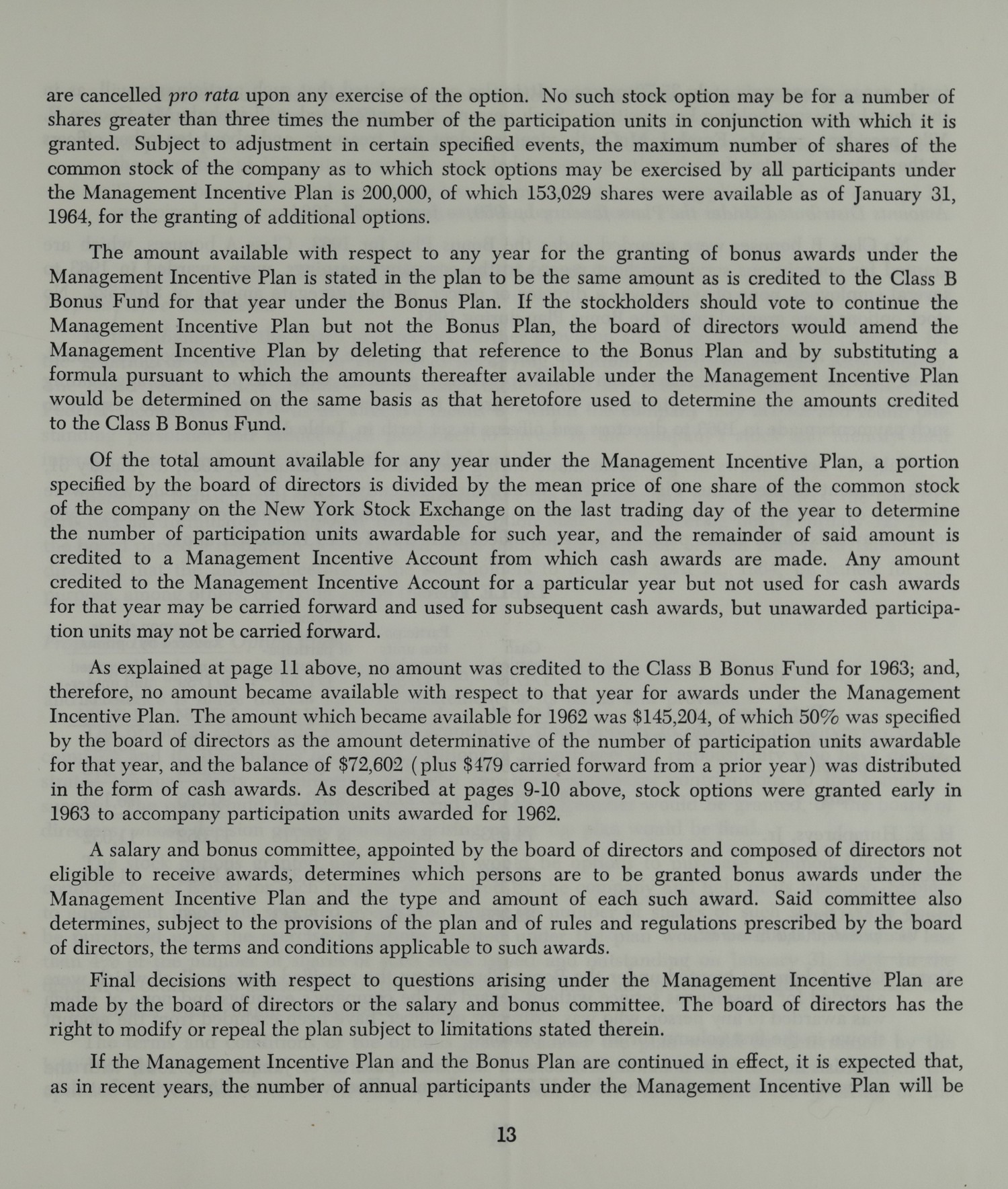
are cancelled pro rata upon any exercise of the option. No such stock option may be for a number of shares greater than three times the number of the participation units in conjunction with which it is granted. Subject to adjustment in certain specified events, the maximum number of shares of the common stock of the company as to which stock options may be exercised by all participants under the Management Incentive Plan is 200,000, of which 153,029 shares were available as of January 31, 1964, for the granting of additional options.

The amount available with respect to any year for the granting of bonus awards under the Management Incentive Plan is stated in the plan to be the same amount as is credited to the Class B Bonus Fund for that year under the Bonus Plan. If the stockholders should vote to continue the Management Incentive Plan but not the Bonus Plan, the board of directors would amend the Management Incentive Plan by deleting that reference to the Bonus Plan and by substituting a formula pursuant to which the amounts thereafter available under the Management Incentive Plan would be determined on the same basis as that heretofore used to determine the amounts credited to the Class B Bonus Fund.

Of the total amount available for any year under the Management Incentive Plan, a portion specified by the board of directors is divided by the mean price of one share of the common stock of the company on the New York Stock Exchange on the last trading day of the year to determine the number of participation units awardable for such year, and the remainder of said amount is credited to a Management Incentive Account from which cash awards are made. Any amount credited to the Management Incentive Account for a particular year but not used for cash awards for that year may be carried forward and used for subsequent cash awards, but unawarded participation units may not be carried forward.

As explained at page 11 above, no amount was credited to the Class B Bonus Fund for 1963, and, therefore, no amount became available with respect to that year for awards under the Management Incentive Plan. The amount which became available for 1962 was $145,204, of which 50% was specified by the board of directors as the amount determinative of the number of participation units awardable for that year, and the balance of $72,602 (plus $479 carried forward from a prior year) was distributed in the form of cash awards. As described at pages 9-10 above, stock options were granted early in 1963 to accompany participation units awarded for 1962.

A salary and bonus committee, appointed by the board of directors and composed of directors not eligible to receive awards, determines which persons are to be granted bonus awards under the Management Incentive Plan and the type and amount of each such award. Said committee also determines, subject to the provisions of the plan and of rules and regulations prescribed by the board of directors, the terms and conditions applicable to such awards.

Final decisions with respect to questions arising under the Management Incentive Plan are made by the board of directors or the salary and bonus committee. The board of directors has the right to modify or repeal the plan subject to limitations stated therein.

If the Management Incentive Plan and the Bonus Plan are continued in effect, it is expected that, as in recent years, the number of annual participants under the Management Incentive Plan will be substantially the same as the number of annual participants under the Bonus Plan.

US Rubber Proxy Statement – Page 14

Page 014

in the range of approximately 35-70 persons. It is also contemplated that such participants will, as in the past, be persons holding key positions. Such persons, it is anticipated, will include Mr. George R. Vila, president, and Mr. Frank J. McGrath, vice president and treasurer, and about ten other officers of the company.

Amounts Distributed Under the Plans January 1, 1959, to January 31, 1964
No Class B bonuses were awarded under the Bonus Plan for 1963. Class A bonuses, which are granted for conspicuous service without regard to the company’s earnings, were awarded in 1963 to several employees, none of whom was a director or officer, in the aggregate amount of $108,522. No stock options were granted under the Bonus Plan during 1963.

The only amounts distributed under the Management Incentive Plan for 1963 (except for install-ments paid on account of deferred cash awards previously granted) were the payments, aggregating $55,169, made in respect of participation units awarded for prior years. Information with respect to such payments made in 1963 to directors and officers is set forth in Table III above.

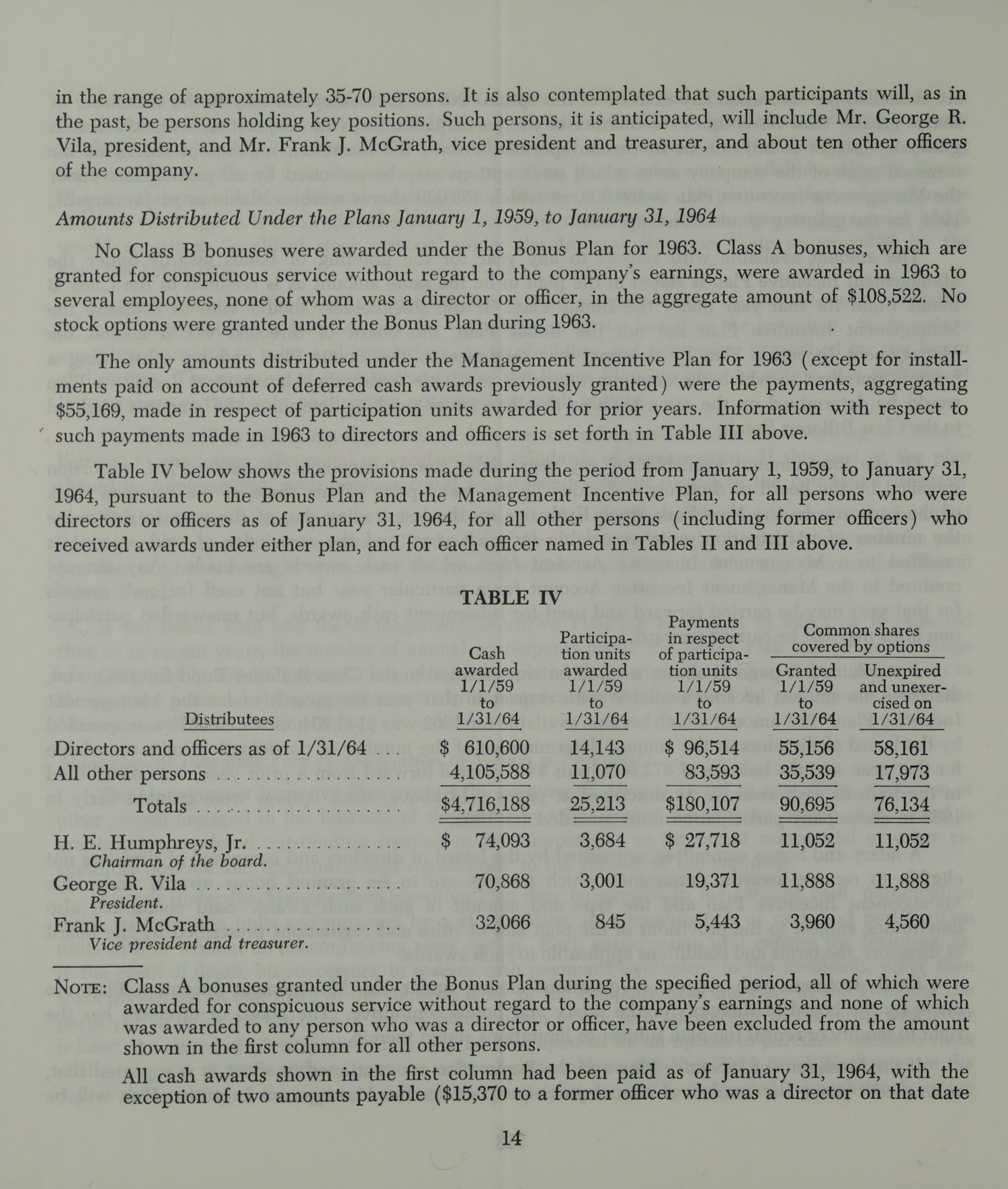
Table IV below shows the provisions made during the period from January 1, 1959, to January 31, 1964, pursuant to the Bonus Plan and the Management Incentive Plan, for all persons who were directors or officers as of January 31, 1964, for all other persons (including former officers) who received awards under either plan, and for each officer named in Tables II and III above.

TABLE IV
Cash Participa- Payments Common shares
awarded tion units in respect covered by options
Distributees 1/1/59 awarded of participa- Granted Unexpired
to 1/1/59 to tion units 1/1/59 and unexer-
1/31/64 1/31/64 1/1/59 to cised on
1/31/64 1/31/64
Directors and officers as of 1/31/64 … $ 610,600 14,143 $ 96,514 55,156 58,161
All other persons ………………….. 4,105,588 11,070 83,593 35,539 17,973
$4,716,188 25,213 $180,107 90,695 76,134

H. E. Humphreys, Jr. ………………. $ 74,093 3,684 $ 27,718 11,052 11,052
Chairman of the Board.
George R. Vila ……………………. 70,868 3,001 19,371 11,888 11,888
President.
Frank J. McGrath ………………….. 32,066 845 5,443 3,960 4,560
Vice president and treasurer.

NOTE: Class A bonuses granted under the Bonus Plan during the specified period, all of which were awarded for conspicuous service without regard to the company’s earnings and none of which was awarded to any person who was a director or officer, have been excluded from the amount shown in the first column for all other persons.

All cash awards shown in the first column had been paid as of January 31, 1964, with the exception of two amounts payable ($15,370 to a former officer who was a director on that date.

US Rubber Proxy Statement – Page 15

Page 015

and $2,690 to another person) in respect of deferred cash awards previously granted under the Management Incentive Plan.

All participation units shown in the second column were outstanding on January 31, 1964, with the exception of 136 units previously awarded to persons other than directors and officers.

The numbers of shares shown in the last column include, where applicable, shares covered by unexpired and unexercised options granted under the Bonus Plan in 1958.

Proposed Adoption of 1964 Stock Option Plan

Proposal to be Considered

In the judgment of the board of directors, further provision should be made by the company for the granting of stock options to employees occupying positions of importance and responsibility. The board regards such options — particularly those which are accorded special status under the Federal income tax laws — as an effective means by which the company may attract and retain outstanding personnel and induce such personnel to invest in the company’s stock and identify their interests more closely with those of the stockholders.

Believing that it would serve the best interests of the company and its stockholders, the board of directors has formulated a proposed 1964 Stock Option Plan. At its meeting held February 12, 1964, the board passed a resolution declaring that in its opinion the adoption of such plan is advisable, and directing that the annual meeting of the stockholders to be held April 21, 1964, be called for the purpose, among others, of taking action thereon.

Proposed 1964 Stock Option Plan

The text of the proposed 1964 Stock Option Plan is set forth in Exhibit A to this proxy statement, and reference is made thereto for a full statement of its terms and provisions.

The proposed plan would permit the granting of stock options to officers and employees of the company and its subsidiaries occupying positions of importance and responsibility who have demonstrated unusual ability or initiative and who can make significant contributions to the company’s success. The plan would be administered, and options thereunder would be granted, by the board of directors, whose decision on any question arising under the plan would be final.

The stock options granted under the plan would be options to purchase common stock of the company newly issued for such purpose or acquired by the company and held in its treasury. Subject to adjustment in certain specified events, the aggregate number of shares of such stock which could be purchased upon the exercise of options granted under the plan would be 200,000, which is less than 4% of the number of shares of such stock issued and outstanding on January 31, 1964. In the opinion of counsel, no stockholder of the company would have any preemptive right to purchase any of the shares which might be optioned under the plan.

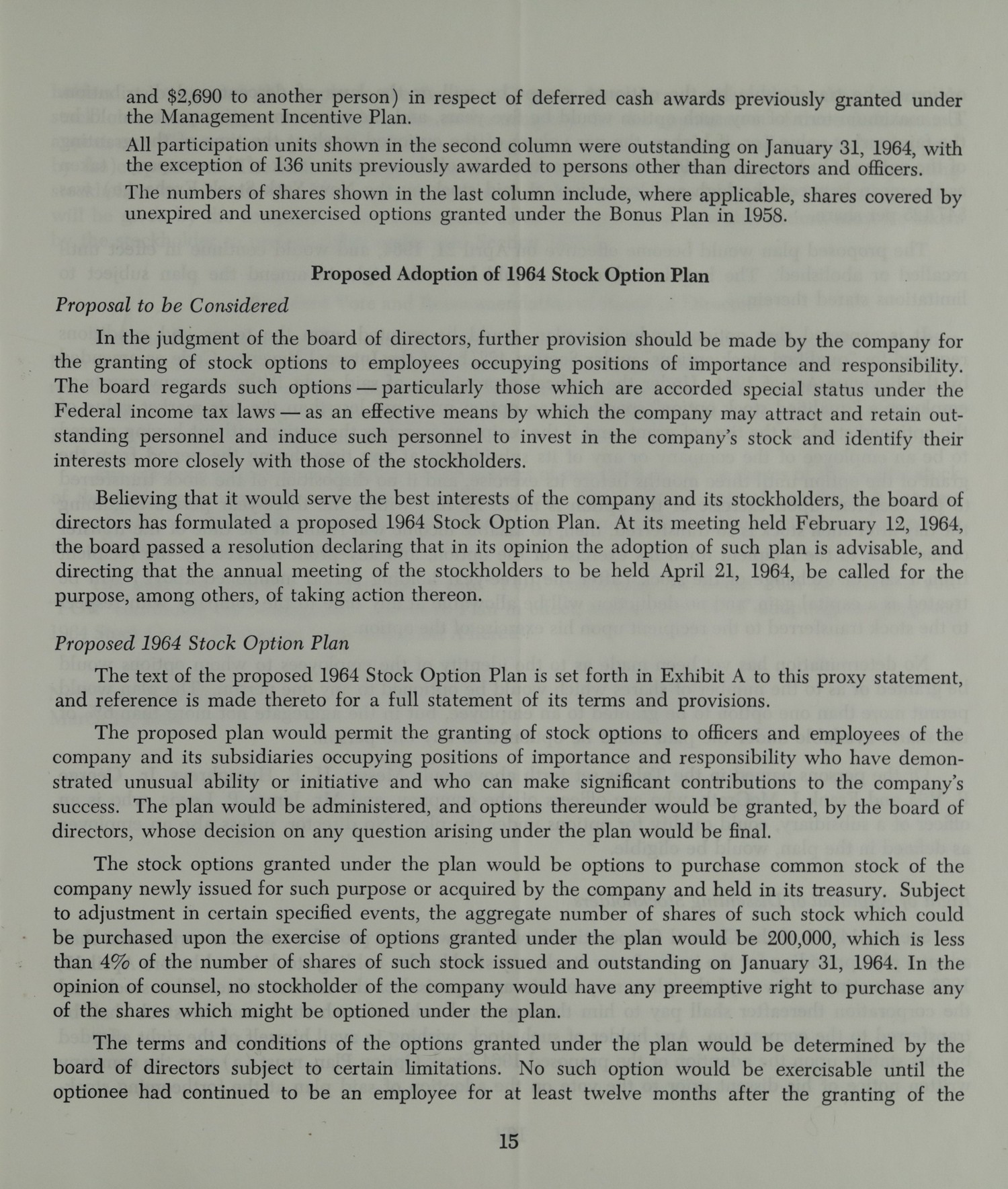
The terms and conditions of the options granted under the plan would be determined by the board of directors subject to certain limitations. No such option would be exercisable until the optionee had continued to be an employee for at least twelve months after the granting of the

US Rubber Proxy Statement – Page 16

Page 016

option or be transferable by the optionee except by will or the laws of descent and distribution.
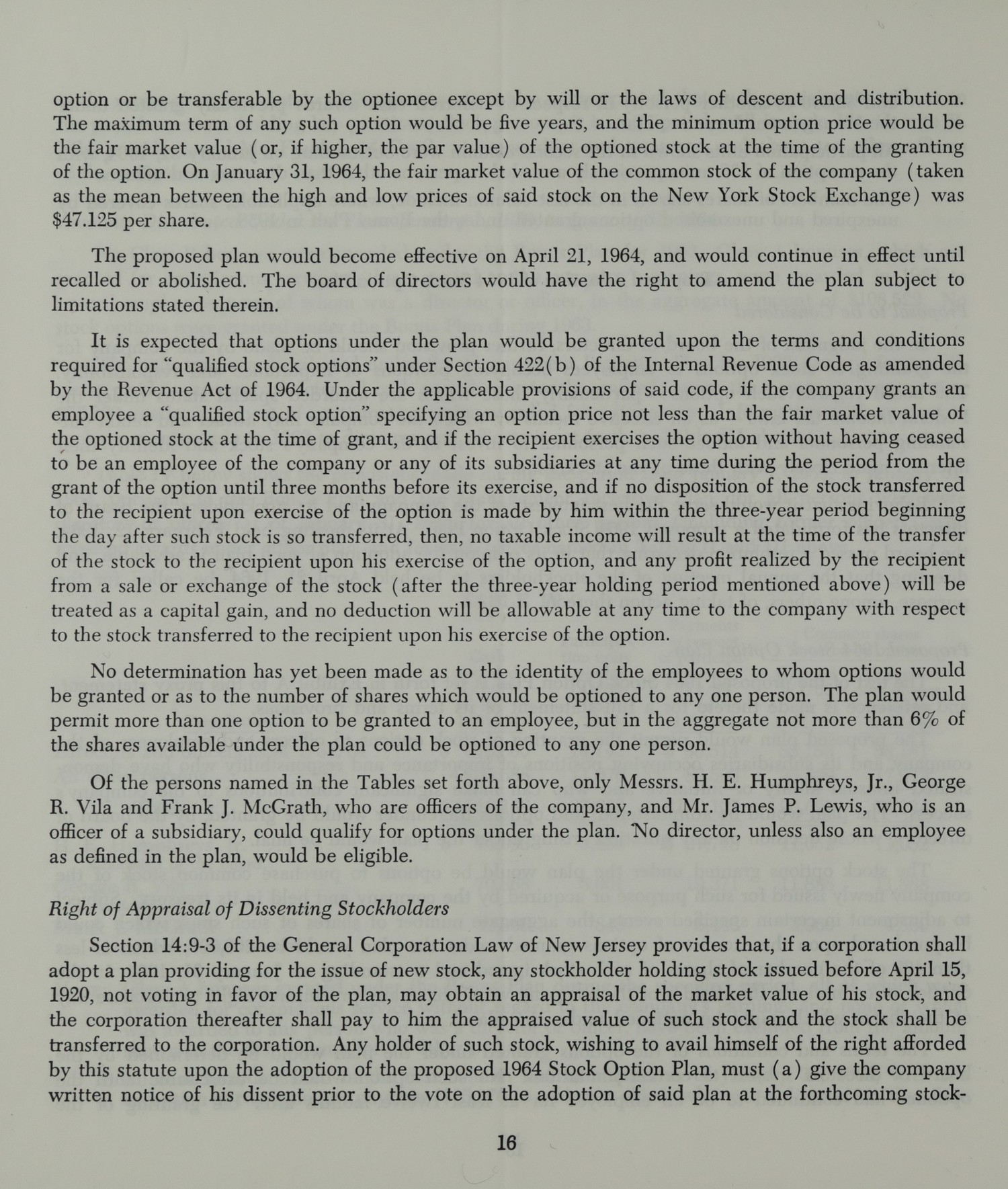
The maximum term of any such option would be five years, and the minimum option price would be the fair market value (or, if higher, the par value) of the optioned stock at the time of the granting of the option. On January 31, 1964, the fair market value of the common stock of the company (taken as the mean between the high and low prices of said stock on the New York Stock Exchange) was $47.125 per share.

The proposed plan would become effective on April 21, 1964, and would continue in effect until recalled or abolished. The board of directors would have the right to amend the plan subject to limitations stated therein.

It is expected that options under the plan would be granted upon the terms and conditions required for “qualified stock options” under Section 422(b) of the Internal Revenue Code as amended by the Revenue Act of 1964. Under the applicable provisions of said code, if the company grants an employee a “qualified stock option” specifying an option price not less than the fair market value of the optioned stock at the time of grant, and if the recipient exercises the option without having ceased to be an employee of the company or any of its subsidiaries at any time during the period from the grant of the option until three months before its exercise, and if no disposition of the stock transferred to the recipient upon exercise of the option is made by him within the three-year period beginning the day after such stock is so transferred, then, no taxable income will result at the time of the transfer of the stock to the recipient upon his exercise of the option, and any profit realized by the recipient from a sale or exchange of the stock (after the three-year holding period mentioned above) will be treated as a capital gain, and no deduction will be allowable at any time to the company with respect to the stock transferred to the recipient upon his exercise of the option.

No determination has yet been made as to the identity of the employees to whom options would be granted or as to the number of shares which would be optioned to any one person. The plan would permit more than one option to be granted to an employee, but in the aggregate not more than 6% of the shares available under the plan could be optioned to any one person.

Of the persons named in the Tables set forth above, only Messrs. H. E. Humphreys, Jr., George R. Vila and Frank J. McGrath, who are officers of the company, and Mr. James E. Lewis, who is an officer of a subsidiary, could qualify for options under the plan. No director, unless also an employee as defined in the plan, would be eligible.

Right of Appraisal of Dissenting Stockholders
Section 14:9-3 of the General Corporation Law of New Jersey provides that, if a corporation shall adopt a plan providing for the issue of new stock, any stockholder holding stock issued before April 15, 1920, not voting in favor of the plan, may obtain an appraisal of the market value of his stock, and the corporation thereafter shall pay to him the appraised value of such stock and the stock shall be transferred to the corporation. Any holder of such stock, wishing to avail himself of the right afforded by this statute upon the adoption of the proposed 1964 Stock Option Plan, must (a) give the company written notice of his dissent prior to the vote on the adoption of said plan at the forthcoming stock-

US Rubber Proxy Statement – Page 17

Page 017

holders’ meeting, and (b) apply to the Superior Court in New Jersey within thirty days after such stockholders’ meeting, on reasonable notice to the company, for the appointment of three disinterested appraisers. The statute requires the charges and expenses of such appraisers and appraisal to be paid by the corporation. The statute also provides that the corporation may elect to permit the dissenting stockholder to subscribe for his proportionate share of the new stock to be issued. No further notice will be given by the company to any stockholder as to the dates prior to which actions must be taken by the stockholder to perfect rights under said Section 14:9-3.

Required Vote and Recommendation of Board of Directors

The question concerning the Bonus Plan and the question concerning the Management Incentive Plan will be submitted to the stockholders at the forthcoming annual meeting in the form of separate resolutions that each such plan be continued in effect. The proposal concerning the 1964 Stock Option Plan will be submitted at said meeting in the form of a resolution that such plan, as set forth in Exhibit A to this proxy statement, be adopted.

The presence in person or by proxy of the holders of one-third of all the shares of the capital stock of the company is required for a quorum at the meeting. The favorable vote of two-thirds in interest of each class of stockholders present in person or by proxy and voting at the meeting is required for the adoption of each of said resolutions.

The board of directors recommends a vote “FOR” continuing the Bonus Plan in effect, a vote “FOR” continuing the Management Incentive Plan in effect, and a vote “FOR” adopting the proposed 1964 Stock Option Plan as set forth in Exhibit A hereto.

New York, New York
March 17, 1964

US Rubber Proxy Statement – Page 19

Page 019

IV. Stock to be Optioned
A. The stock options granted under this Plan shall be options to purchase shares of the common stock of the Company.
B. The stock delivered upon the exercise of any stock option granted under this Plan may be common stock newly issued for such purpose, or common stock acquired by the Company and held in its treasury, or partly such newly issued stock and partly such acquired stock.
C. Subject to the provision for adjustments contained in Article VI hereof, the aggregate number of shares of common stock which may be purchased upon the exercise of stock options granted under this Plan, excluding the number of shares covered by options which shall have expired or otherwise shall have become unexercisable, shall not exceed 200,000.
D. Not more than 6% of the aggregate number of shares of common stock referred to in Section C of this Article IV may be made subject to the stock option or options granted under this Plan to a single employee.

V. Terms and Conditions of Options
A. The terms and conditions applicable to the stock options granted under this Plan, which need not be the same in all cases, shall be determined by the Board of Directors subject to the following limitations:
1. The term of any stock option granted under this Plan shall not exceed five years from the date of its grant.
2. The option price for the common stock covered by any stock option granted under this Plan shall in no case be less than the par value of said stock, as stated in the Company’s Amended Certificate of Organization, or less than the fair market value of said stock at the time of the granting of such option, as determined by the Board of Directors; provided, however, that this limitation shall be subject to the provision for adjustments contained in Article VI hereof. For purposes of determining the fair market value of said common stock at the time of the granting of any such stock option, the Board of Directors may, if it so elects, assume such fair market value to be the mean between the high and low prices of said stock on the New York Stock Exchange on the day of the granting of such option or, if no sale of said stock shall be made on said Exchange on said day, on the next preceding day on which any such sale shall have been made.
3. No stock option granted under this Plan shall (a) be exercisable unless and until the optionee shall have continued to be an employee for a period of not less than twelve months following the date of the grant of such option, (b) be transferable or assignable by the optionee otherwise than by will or the laws of descent and distribution, or (c) be exercisable during the lifetime of the optionee except by him.

B. The Board of Directors may at any time, in the light of then existing laws and regulations, modify the terms and conditions applicable to any stock option theretofore granted under this Plan.

US Rubber Proxy Statement – Page Exhibit A

Page exhibit-a

UNITED STATES RUBBER COMPANY
1964 STOCK OPTION PLAN

I. Purpose of Plan
The purpose of this Plan is to provide for the granting of stock options as a means of attracting to the Company and retaining in its service persons of outstanding ability and potential and of encouraging such persons to invest in the common stock of the Company and to identify their interests more closely with those of the stockholders.

II. Eligibility for Options
A. A stock option may be granted under this Plan to an employee occupying an important managerial position, or other position of importance and responsibility, who has demonstrated unusual ability or initiative, and who, by discharging his responsibilities in an outstanding manner, can make a significant contribution to the success of the Company.
B. As used in this Plan, the term “employee” shall mean a person who is an officer or an employee of the Company or of any other corporation in which the Company owns 50% or more of the voting stock.
C. Unless he is also an employee as defined in Section B of this Article II, no member of the Board of Directors shall be eligible to receive a stock option under this Plan.
D. An employee may be granted a stock option under this Plan notwithstanding the fact that he may be a participant, and may have been granted one or more stock options, under any other plan or plans of the Company; and more than one stock option may be granted under this Plan to a single employee.

III. Administration of Plan
A. This Plan shall be administered by the Board of Directors, and the granting of all stock options hereunder shall be by action of a majority of the members of said Board not eligible to receive such options.
B. A committee, appointed by the Board of Directors and composed of directors not eligible to receive stock options under this Plan, may from time to time make recommendations to said Board with respect to the granting of options hereunder.
C. Any action taken by the Board of Directors in the administration of this Plan, and any decision of said Board with respect to any question arising as to the interpretation of this Plan or of the terms and conditions applicable to any stock option granted hereunder, shall be final, conclusive and binding. Without limiting the effect of the foregoing, the provisions of this Plan shall be construed in accordance with the laws of the State of New Jersey.

Rubber Firms Offer Rejected By Union

Rubber Firms Offer Rejected By Union

6-10-67 (handwritten)

NAUGATUCK—United Rubber Workers negotiators Friday rejected a new three-year contract proposal offered by the five major rubber producers, including Uniroyal.

This is apparently the second time during the week that the union has rejected company proposals.

URW Pres. Peter Bommarito termed Friday’s offer “inadequate” and said the union would continue its strike against Uniroyal, B. F. Goodrich and Firestone.

A statement appearing in a local newspaper Friday, attributed to Bommarito, said that the union was prepared to strike another 30 days.

While many of the striking United Rubber Workers in the borough expressed dismay about the possibility that they would have to continue the strike that much longer, Local 45 officials expressed reservations about whether Bommarito had said this.

One official, contacted Friday night, said that an attempt to check out the statement brought no results and it could not be determined whether Bommarito had made the remark.

A letter sent to Footwear Plant workers Thursday by Factory Manager John Smith stated that the union had rejected a three-year proposal Tuesday. Upon rejecting the proposal, said Smith, the union presented a counter proposal.

Management then apparently made a second proposal which, according to press services, was rejected during Friday’s session.

Talks between the URW and the rubber companies recessed until Monday.

In his letter to Footwear employes, Smith stated that the three-year proposal by the company offered wage increases, additional pay for skilled workers, liberalized vacation pay, supplemental unemployment benefits up to 75 per cent of average pay, a 60 per cent increase in regular pensions, an increase in company-paid life insurance, an increase in the coverage for the maximum stay in the hospital from 365 to 730 days, an increase in sickness and accident benefits and other items.

Wage increases in the tire plants, said Smith, amounted to 38 cents over three years, and in non-tire plants they amounted to 31 cents. The management also offered two weeks vacation pay for employes with one year of seniority and three weeks for employes with five years.

Miscellaneous contract clauses, he added, included “up to 40 hours pay depending on the size of the plant for union time study men.”

Regular pensions were increase a 60 per cent from $3.25 to $5.25 per month per year of service, said Smith.

These increases, said Smith “total about 70 cents per hour over a three-year period. This is approximately a five per cent yearly increase in wages and benefits for employes over the entire three years,” added the manager.

A Uniroyal spokesman said Friday the UFW’s demands would cost “at least $1.40 an hour.”

The union estimated that General Tire and Rubber Co.’s offer, which includes wage increases averaging 40 cents an hour over three years, will cost the company 63 or 64 cents an hour.

The companies Friday valued their offers at more than 70 cents an hour.

The above increases in wages and benefits togal about 70¢ per hour over a three year period.

The above increases in wages
and benefits togal about 70¢
per hour over a three year
period. This is approximately
a 5% yearly increase in wages
and benefits for employees over
the entire three years. It is the
equivalent of the settlement ne-
gotiated in other industries
which have been referred to
by the Union as necessary to
resolve these negotiations. It
was the most substantial and
costly offer ever made by this
Company to the Union.

This proposal was rejected
by the Union late in the after-
noon of June 6. The Union, in
rejecting the above Company of-
fer, made a counter proposal
which excluded any considera-
tion of pensions and insurances
and held to a number of costly
demands which were made be-
fore the strike started.

Sincerely,
Jack M. Smith
Factory Manager

The release of the letter,
and articles read in the paper
were the only announcements
of the proposals the union mem-
bership received. No meetings
were called to allow the general
membership to express their
pleasure or displeasure of the
company’s offer.

Local 45 has held only one
membership meeting, since the
members authorized the nego-
tiators to call a strike. Presi-
dent George Froehlich, then
complained that the company
was not bargaining and only
throwing “bits of silver” on the
table. He said that the union

was seeking decent treatment
for the employes and also com-
plained of the differential be-
tween tire workers and non-
tire workers.

Tire workers now average
about $3.69 an hour while other
rubber industry production
workers average $2.68 an hour.

The three-year contract is
also said to be a stumbling
block in settlement.

Vice-president of Local 45,
Raymond Mengacci, told the
NEWS this morning, that he was
aware of the letter, but had not
as yet had time to read and
digest its contents. He said
that he will be prepared to
comment on it after he has
had time to study it.

Uniroyal Strike Talks Reopen In 53rd Day

Uniroyal Strike Talks Reopen In 53rd Day

6-13-67

NAUGATUCK— Bargaining sessions between the United Rubber Workers and five major rubber producers, including Uniroyal, reopened Monday in Ohio as a strike against three of the companies entered its 53rd day.

Although negotiators for the URW and Uniroyal management could either not be contacted or refused to comment Monday night, reliable sources pointed to the progress made during the past week and held out hope that a settlement might be reached before another week passes.

Although union members in the borough have expected that pensions would be discussed in September offers from the rubber companies, including Uniroyal, have lately included the pension and fringe benefit items.

Management sources have indicated a reluctance to face the cost of wage increases with the possible threat of a second strike in September over pension items.

While the latest word from Uniroyal was that wage increases in its offer were 38 cents for tire workers and 31 for non-tire workers it was learned that General Tire had boosted its wage increases to 40 cents for tire workers.

General Tire, however, has only 3,000 workers in two tire plants. In addition, General Tire is said to have boosted its supplemental unemployment benefits to 80 per cent, and offered a provision for six weeks of vacation for employes with over 30 years service.

It could not be determined Monday night whether Uniroyal had made a similar offer.

Reliable sources have called General Tire and Goodyear, who are both working on a day-to-day basis, pattern companies.

According to the sources, a settlement between the URW and these companies is expected to set a pattern for settlement with Uniroyal, B. F. Goodrich and Firestone, the struck companies.

During the past two weeks, all companies have been talking a three-year pact with the union, and some union sources have indicated a feeling that the final settlement would be for three years.

Local 45 Vice President Raymond Mengacci, in a statement to local newspapers Monday, said that although he didn’t want to enter a debate with Footwear Plant manager John Smith, he felt compelled to answer a letter sent to employes last week by the company.

Mengacci noted that both the company and the union committees “were having a hard enough time in Cincinnati, Ohio, to negotiate an agreement in Naugatuck,” without doing it through the newspapers.

Mengacci said when the union negotiating committee left for Cincinnati it was for the sole purpose of making a sincere effort to negotiate a contract and wage agreement with Uniroyal before the April 20 deadline. Negotiations began in Cincinnati March 21, and “it wasn’t until April 12 that the company made its first and final offer to the union on contract and wages, eight days before the deadline.

“This,” Mengacci stated, “has never happened in the history of my experiences on the negotiating committee or that of Pres. George Froehlich, that the first offer was also the last. No one can call this negotiating. This has never been done before. It wasn’t until a few days later that the union found out that this was being done in all of the Big Four rubber companies, not just Uniroyal. The union also found out these companies had made a mutual pact designed to protect any struck company against financial losses.

“We in the union were always led to believe these companies were in competition with one another, but found it is not so. They have a much better union than we have.”

Plant Manager Smith, in his letter, said the company had made an effort to open the pension and insurance agreement. “This, Mengacci said, “was correct, but the union informed the company this agreement does not terminate until Sept. 15, 1967, and the union was in no position to negotiate this agreement as it had not been discussed with their membership to determine what changes were wanted. Also they had made no preparation on pension and insurance to discuss this question intelligently with the company.

“Mr. Smith stated the union did not present to the company their full proposal until 11 a.m. April 19, just 37 hours before the strike deadline. This is correct, but why? The union felt if they received from the company the correct interpretation of the clauses in the working agreement now, and the way they were intended to be interpreted, at least in the union’s viewpoint, before there was a change in the head negotiator for the company, they would not have to make any changes.

“The union found out the company’s new head negotiator was not given the same interpretation. Therefore, the union came in with some new proposals as the union would not be able to live with some of the interpretations that were given to the new head negotiator, under Article 9, working conditions.

“These conditions are important to our members especially those working in the making and stitching departments. Production in many cases has increased by 25 to 30 per cent in the last few years, with the same amount of operators and in many cases less.

“Many of the employes can verify their weekly earnings are less now even though they have received two wage increases in the past few years. They cannot make anywhere near the efficiency they were making a few years ago and this is the reason the union had to make some late proposals to the company. If the company wanted to make a sincere effort to reach an agreement, they still had plenty of time to do so.”

Mengacci asserted the union does not believe the non-tire plants are putting the company in a “severe economic squeeze,” if they grant the same wage increases as the tire companies.” He noted wages increase of 41.6 per cent have been given to George R. Vila, president of Uniroyal, and 36.6 per cent to Walter D. Baldwin, vice president. “The union is not saying these men do not deserve the increase, but if the company wants to talk percentages, then talk percentages from top to bottom,” the Union official said.

“We are happy the company has seen fit to increase the vacation allowance for employes with one to five years of seniority, but what about the employe with 10 or more years of seniority.”

The union official also said that, although the company had improved some of the contract clauses, the union questions why the company would not give a letter of commitment, “which would not cost a penny to treat union members with decency and respect. If management expects our members to treat them with decency and respect, then we expect the same treatment. A written commitment would have gone a long way in reaching a settlement.”

No comments were made on the pension and insurance pact offered by the company. Mengacci said it had to be studied before a statement was made. However, he said he “was happy to see the company is negotiating with the union, even though it took from April 12 to June 5 to make their latest offer. The union rejection was a take-it-all or reject-it-all offer, which the union could not live with.

“I can assure Mr. Smith that George Froehlich and the rest of the union’s committee of Local 45 will do everything in their power to bring this dispute to a settlement as fast as possible,” Mengacci concluded.

Union Seeking

ucts.

Union Seeking 6-72

Continued From Page 1

Local, the firm’s lawyers attempted to reach higher-up management either in Cincinnati or New York City, but were unsuccessful.

The management personnel then relayed to Judge Gaffney, Mengacci said, that they couldn’t tell the judge what the plant planned to do today.

The judge then informed lawyers for the union they should draw up a restraining order against UniRoyal and he would sign it this morning if there was any evidence the firm violated the agreement.

The judge indicated he would issue an injunction against UniRoyal if there was a violation of the restraining order, Mengacci said.

This situation puts the company and the union on virtually the same ground, if it comes to pass later today.

Mengacci said he thought court action would be held at about 2 p.m. today.

A few weeks ago a restraining order against the Union was issued in Superior Court following some minor clashes in the borough on picket lines and the arrest of about 50 pickets in two or three days of strife.

Uniroyal Strike Talks To Resume

Uniroyal

Strike Talks

To Resume

NAUGATUCK — Talks on a master contract between the United Rubber Workers and Uniroyal are scheduled to resume today. There were no talks between company and union negotiators Monday.

In Detroit, striking Uniroyal workers, discouraged by the lack of progress in the talks, prevented management personnel from entering the plant.

An estimated 1,300 strikers took part in a demonstration which included egg throwing. Police were at the scene, but no arrests were made, although some of the policemen were reportedly hit by the eggs.

Uniroyal management in the borough is scheduled to appear in court today in Waterbury to show cause why an injunction against the Naugatuck plants should not be issued.


Handwritten notation in top right corner: 6-27-67

Hearing to Resume on Plea Of Union for Uniroyal Stay

Hearing to Resume on Plea Of Union for Uniroyal Stay

Hearing to Resume on Plea Of Union for Uniroyal Stay

A hearing was to resume this morning in Waterbury Superior Court on an application by the United Rubber Workers for an injunction against Uniroyal, Inc., which has plants in Beacon Falls and Naugatuck.

The union filed its application last Thursday, after the company began production of samples of new footwear designs.

The company agreed at that time to halt production until after a court hearing.

The hearing opened Tuesday before Judge Leo V. Gaffney. Three hours of testimony was taken in the afternoon from three union members.

At the center of the controversy is a written agreement, signed April 18 by both parties, three days before the nationwide rubber workers’ strike began.

The agreement provides for the orderly shutdown and maintenance of the Naugatuck Footwear plant during the strike.

It includes a clause stipulating that “the company agrees that for the duration of the strike there will be no work performed by nonbargaining unit employes that is normally performed by bargaining unit personnel.”

Local 45 of the URW maintains last Thursday’s production violates the agreement.

Company Defense

While not clearly stating what its defense would be, the company yesterday indicated it would argue the April 18 agreement was voided when the union allegedly violated a provision intended to insure unimpeded entrance and exit to the plant through specified gates.

Three days of clashes between union members and police early in May, when pickets attempted to keep office personnel from entering the plant, resulted in the arrest of 71 union members and a warning from Judge Gaffney that he would issue an injunction against the union if the violence was not stopped.

In testimony yesterday, Raymond Mengacci, vice president of Local 45, said he had “no doubt” violence would erupt at the plant unless the court issues an order restraining the company from producing sample shoes with nonunion supervisory personnel.

“We will have some very bad violence. You can expect bloodshed in Naugatuck,” Mengacci said.


Service—Use Sentinel Want Ads

Uniroyal Cites Loss Potential

Uniroyal Cites Loss Potential

6-28-67 [handwritten]

Uniroyal, Inc. will suffer a very severe financial loss “forcing a reduction in production” at its Naugatuck Footwear plant if it is not permitted to produce samples of its new designs, a company official said today.

Thomas J. Nelligan, labor relations manager, testified at a Superior Court hearing this morning that failure of the company to have samples to show its customers in August will mean a very large drop in the amount of production needed for the coming year and “in turn less employes.”

Nelligan was the first company representative to testify at a hearing to consider United Rubber Workers Union application for an injunction against the company production.

He said samples for next summer’s market would normally have been produced between April and July of this year.

He said salesmen would have been scheduled to take the samples into the field beginning Aug. 1.

Without the samples, he said the company will have no way of proving “to its buyers that its line is better than its competitors.”

At the opening of the session Tuesday before Judge Leo V. Gaffney, a Local 45 official predicted “there would be bloodshed in Naugatuck if the company is permitted to resume production with non-union members.”

The union filed its application for an injunction against Uniroyal last Thursday after the company began production of samples of new footwear designs. The company agreed at that time to halt production until after a court hearing.

April 18 Agreement

At the core of the controversy is a written agreement signed by both parties April 18, three days before the nation-wide rubber workers strike began.

The agreement provides for orderly shutdown and maintenance of the borough Footwear Plant during the strike.

It includes a clause stipulating that “the company agrees that for the duration of any strike there will be no work performed by non-bargaining unit employes that is normally performed by bargaining unit personnel.”

Local 45 claims Thursday’s production violates that agreement.

While not clearly stating what its defense would be, the company Tuesday indicated it will argue that the April 18 agreement was rendered void when the union allegedly violated a provision intended to insure unimpeded entrance and exit to the plant through certain gates.

(Cont’d on Page 2—UNIROYAL)

UniRoyal Cites Need For Sample Shoes

UniRoyal Cites Need For Sample Shoes

By Ruth Nichols

Production at the UniRoyal Footwear plant will be suspended for at least another week to allow time for briefs to be filed and Judge Leo V. Gaffney to come to a decision on whether a restraining injunction should be granted against the firm.

Two days of testimony from both Local 45 and UniRoyal Footwear Division management ended yesterday afternoon in Waterbury Superior Court. Judge Gaffney asked that written briefs be submitted to him by next Wednesday by both attorneys and stated that he will make his decision within a couple of days after reviewing the briefs and transcripts of the court proceedings.

Local 45 ended its testimony yesterday after calling Joseph Foley to the stand. Foley, a 21-year employe of the plant, member of the Union negotiating team and strike captain, was questioned on what might happen if the company was allowed to produce sample shoes.

Foley told the court that there would be violence on the picket line. He also testified that large numbers of supervisory personnel passed through the picket lines daily without incident.

Atty. J. Kenneth Bradley opened UniRoyal’s testimony by calling Thomas Nelligan, Labor Relations Manager, to the stand.

Nelligan told the court that 4,500 footwear plant employes are out on strike while 850 non-bargaining employes are working. All UniRoyal plants in the borough, with the exception of the footwear plant, are producing.

Nelligan cited the need for the sample shoes by August 1st. If the shoes were not ready to show by that date, according to Nelligan, there would be a reduction of production and a need for less employes.

Nelligan, under questioning, stated that if production of samples was allowed there would be no loss to striking employes but their wages. The Judge ruled that this answer should be stricken. Nelligan said he had no way of knowing what the cost to URW members and their families would be overall.

Nelligan said that these sample shoes could not be produced elsewhere. That it would take about 200 people, six weeks to two months to produce the necessary number of sample shoes. He said the bargaining people had been offered, through the union, the work first.

Factory Manager Jack Smith told the court that it was Monday or Tuesday of last week that the decision was made to start production on sample shoes.

Attorney Daniel Baker, URW counsel, questioned Nelligan about production at other UniRoyal plants. He asked if these samples couldn’t be made at one of the other company shoe producing plants that was currently in production.

Nelligan told the court that this was not possible because a different type of shoe was made at these plants.

Baker then opened the question of management starting its inventory using non-bargaining personnel. He also returned to the subject of the “Gray Building.”

How many shoes were produced in the building? Nelligan stated that the first three or four sample shoes were made in the building. The union sought inspection of the “gray building.”

Judge Gaffney asked if a member of the Industrial Relations Department accompanied the union inspection team on its tour.

Smith told the court about the pickets not allowing personnel into the plant in the early days of the strike. He said on the first day of mass picketing he conferred with Naugatuck Police Capt. Joseph Summa and sent management personnel home. He said all this occurred after the union had been notified 24-hours in advance of the company’s intention to ship.

Smith testified that on the May 15th meeting with union representatives, the company made known its intention to start production, first offering the work to bargaining personnel. He told the court he, at that time, told the union he believed there was no longer an agreement; however, it was then believed settlement was imminent and the company did not press for production.

Again on the subject of sample shoes, Smith said that production could not be carried on in the “Keds” line, produced here in the borough, in another company plant without moving equipment in large numbers to another location.

Smith spoke of the work the union had allowed to continue in the “Gray Building.” He said that the union knew that certain materials were produced in the main plant to carry on this work and hadn’t objected.

He said that this was the only footwear plant in the United States to be shut down and declared it was necessary to have sample shoes ready by the August 1st date.

Smith said that if samples were not ready, salesmen would miss sales and this, in turn, would lower sales, lower fill-in sales, and thus reduce production in the Naugatuck Footwear plant.

Smith, again questioned about the agreement and the May 15th meeting, told the Judge that he did not remember coming back into the meeting room after making a telephone call and telling union representative that he would “honor the agreement.”

Baker asked Smith had he given the union 24-hours notice of intent to ship. And had not the company made an oral agreement that no personnel would enter the plant after 6 p.m.

Then Baker asked had not the fact that personnel came into the

Please Turn to Page 12


Beacon Falls

Beacon Hose Co. Firemen To Parade

BEACON FALLS – Captain Walter C. Carlson of Beacon Hose Co. No. 1 has announced that members will attend the Firemen’s Parade in Oxford this evening.

Members are requested to meet at the firehouse at 6:30 in full dress uniforms.

Exactly how many signed up for compensation could not be learned, but strikers contacted later in the day noted that the lines were long and double.

Exactly how many signed up
for compensation could not be
learned, but strikers contacted
later in the day noted that the
lines were long and double.

During the last session of the
General Assembly, legislation
was introduced to make com-
pensation available to people on
strike, but the legislation failed.
A bill recently signed by Gov.
John Dempsey did not include
striking workers.

In the past strikers have been
refused unemployment compen-
sation. Normally only those out
of work due to a mass shut
or temporary layoffs, or those
those who quit work for various
reasons are eligible.

Labor Commissioner Renato
Ricciuti, contacted Friday night,
said he had no idea why the
strikers were suddenly applying
for the compensation. Although
anyone out of work and with
wage credits can apply, said the
commissioner, strikers cannot
collect.

As to why the strikers were
told to wait another week, Ric-
ciuti was also uncertain about
that, but thought perhaps the
staff at the bureau did not want
to flaly refuse the people.

A request from Footwear
Plant management to Local 45
seeking oilers to work on the
machines did not receive action
Friday, according to Local 45
Vice Pres. Raymond Mengacci.
He said that the matter would
be discussed today.

Uniroyal Official Says 81-Day Strike Having Severe Impact On Earnings

Uniroyal Official Says 81-Day Strike Having Severe Impact On Earnings

8-10-63 [handwritten]

NAUGATUCK —The chairman and president of Uniroyal, Inc. reported in a letter to stockholders this weekend that the impact of the 81-day strike on earnings and income is severe.

George R. Vila, chairman and president, said that the “impact on earnings is severe because fixed costs in the striking plants continue without the production necessary to absorb them. As a consequence, net income for the second quarter will be sharply lower than the $1.06 a common share in 1966.”

Raymond Mengacci, executive vice president of Local 45 UIW, said today that he had read the letter and was not surprised at its content.

He said that the letter was almost the same as forwarded to the striking employes of the Footwear Division in May. He also said that it contained the original offer made by the company to URW and to his knowledge the offer has not been changed since then. Many of the strikers are also share holders of Uniroyal under a co-operative stock plan.

The 19 plants idle due to the strike represent about 50 per cent of the employes and over 70 per cent of sales in the United States, Vila said.

“When the strike was called, the company had sizeable inventories in many product lines which helped to cushion the impact on sales,” he explained.

Negotiations with the union started March 21 with initial union demands for wage increases and employee benefits of more than $1.40 per hour for a two-year period, exclusive of pensions and insurance, Vila told the stockholders.

“Several days before the strike deadline of April 20, the company offered a proposal on wages and benefits which totalled 28 cents per hour for a two-year period,” he said. The company estimated that a new pension and insurance agreement to be negotiated in September would add between 20 and 25 cents per hour. The total increased cost would be about 50 cents per hour over a two-year period. The union rejected the offer prior to the deadline.

The company proposed that the employes continue to work while negotiations proceeded. However, this was also rejected.

The company offered on June 5 a three-year contract covering 12 principal points. It totals approximately 72 cents per hour including pensions and insurance, the chairman said.

“It involves increases of 10.5 per cent for the first year, 2.2 per cent the second and 2.2 per cent the third year. This offer has also been rejected by the union,” he said.

Contract Proposals

Specific proposals include the following: wages — in tire plants, an increase of 16 cents per hour in 1967, 11 cents in 1968 and 11 in 1969. In non-tire plants, an increase of 13 cents, followed by two yearly increases of 9 cents.

Skilled trades — 10 cent increases in addition to the above increases, in 1967; vacation pay — two weeks pay for employes with one year of seniority and three weeks vacation pay for five years. The present provision of four weeks pay after 15 years and five weeks after 25 years would continue.

There would also be supplemental unemployment benefits increased from 65 per cent of average pay (plus up to $2 for up to four dependents, with a maximum payment of $50) to 75 per cent of average pay with no maximums for all employes on regular layoff, plus other provisions. The company contributions to the supplemental unemployment fund would be increased from five cents to six cents per hour when the fund falls below 100 per cent. The fund increased from $250 to $350 per employe.

A 60 per cent increase in regular pensions from $3.25 to $5.25 per month per year of service was included. A 60 per cent increase in disability pensions from $6.50 to $10.50 per month per year of service, and an increase of $1.50 per month per year of service for living pensioners who were retired after July 1, 1950.

Other increases included those affecting life insurance, hospitalization, X-ray and radium therapy, visiting nurse, surgical payments and sickness and accident benefits.


Union Warns Strike May Spread

AKRON, Ohio (UPI) — Negotiations were to resume today in the 80-day old rubber industry strike with a warning from a union official here that the walkout could spread.

John Nardella, president of Local 2, United Rubber Workers, said “a strong possibility” existed a strike deadline would be called in negotiations with the Goodyear Tire & Rubber Co.

Other union sources indicated the deadline might be midnight Wednesday.

Nardella said Goodyear negotiators had indicated the company was ready to make a move on its offer, but had not yet done so.

Nardella gave a detailed report Sunday to the Local 2 membership on progress in contract negotiations. He said union policy committee “would initiate a new course of action” if no settlement was reached soon.

Work at Goodyear has continued on a day to day basis since April 20 when the Firestone Tire & Rubber Co., Uniroyal Inc., and the B. F. Goodrich Co. were struck. General Tire & Rubber was struck June 21.

A strike against Goodyear would idle some 21,000 men at 11 plants in addition to the 54,000 men already on strike across the nation.

GAINS REPORTED IN RUBBER TALKS

THE NEW YORK TIMES,
7-11-67

GAINS REPORTED
IN RUBBER TALKS

Chief U.S. Mediator Moves
Back Into Negotiations

By DAVID R. JONES
Special to The New York Times

WASHINGTON, July 10—The
Government’s top labor medi-
ator moved back into the rub-
ber industry, labor negotiations
today, amid reports of prog-
ress in settling the industry’s
81-day-old strike.

William E. Simkin, director
of the Federal Mediation and
Conciliation Service, went to
Columbus, Ohio, to keep an
eye on bargaining there be-
tween the B. F. Goodrich Com-
pany and the striking United
Rubber Workers.

A union official said that
“real progress is being made”
in the talks with Goodrich.
Ward Keener, Goodrich presi-
dent, also said progress was
being made.

Meanwhile, the union set a
strike deadline of 12:01 A.M.
Thursday against the Goodyear
Tire and Rubber Company.
Goodyear, which employs 21,-
000, has been operating on a
day-to-day basis while ne-
gotiating on a new contract
to replace one that expired
April 20.

The union struck Goodrich,
the Firestone Tire and Rub-
ber Company and Uniroyal,
Inc., on that date and shut
down the General Tire and
Rubber Company several weeks
later. About 54,000 workers
have been made idle by the
strike.

Signs of Optimism

The precise reason for Mr.
Simkin’s trip to Columbus was
not disclosed, but there were
signs of some optimism that
a break might be near with
Goodrich. Mr. Simkin called
the union and the five com-
panies together a few weeks
ago in Pittsburgh in a bid for
agreement, but that failed.

Informed sources said Good-
rich and the union had re-
solved most of the important
noneconomic contract items and
were returning to the money
issues. The two sides bargained
throughout the weekend while
other negotiations, carried on
individually with each com-
pany, recessed yesterday.

All the companies except
General were last reported to
have offered the union a wage
increase of 40 cents an hour,
plus a supplemental unemploy-
ment benefit of 75 per cent of
straight-time hourly wages for
those laid off. General offered
43 cents an hour and an 80
per cent layoff benefit.

The union’s tire workers now
average $3.68 an hour, while
nontire workers average $2.69.
A key union demand has been
to raise the layoff benefit from
the present 65 per cent of
wages to between 92.5 and 95
per cent.

The negotiations have been
complicated by the presence of
a new union president, Peter
Bonmarito, who was elected
this year on a militant plat-
form and has been under pres-
sure to achieve big gains.

Untitled Clipping

Negotiators Report:

7-13-67 [handwritten]

Only Economic Issues Block Strike Settlement

AKRON, Ohio (UPI) — With four major rubber companies closed by a record long strike, the United Rubber Workers (URW) prepared to walkout at midnight tonight against the fifth and largest firm, Goodyear Tire & Rubber.

Industry capacity would be cut by 75 per cent with the addition of Goodyear to the list of struck firms.

The flow of tires and other materials to the auto and defense industries would be sharply reduced.

Goodyear’s 21,000 workers would bring to 75,000 the number idled across the country.

The union went on strike against Firestone Tire & Rubber, B. F. Goodrich and Uni-

Royal, Inc., April 20, and employes at two of General Tire & Rubber Co.’s nine plants walked out June 21.

Possible Intervention

A reduction in the flow of defense material raised the possibility the federal government would invoke the Taft-Hartley Act to send workers back for an 80-day cooling off period.

William E. Simkin, chief of the Federal Mediation Service, went to Columbus, Ohio, earlier in the week to assist in negotiations with B. F. Goodrich, the largest supplier of aircraft tires with between 35 and 40 per cent of the nation’s production.

The URW also struck the Schenuit Rubber Co. of Balti-

more last Saturday. Schenuit’s entire production of aircraft tires goes to the federal government and represents 20 per cent of the government’s needs.

The contract at Goodyear expired with the others but work continued at the plants on a day-to-day basis while talks continued.

URW negotiators said Thursday only economic issues blocked a settlement with the five major firms. All other contractural matters were settled last Friday.

Benefit Plan

The union originally asked for a supplemental unemployment benefit plan which would

Please turn to Page 10


Town Hall

The Strike Is Over

The Strike Is Over

Naugatuck

82nd Year, Number 175 | Dedicated To Community Public Service


Editorial

The Strike Is Over

The day that Naugatuck — and the whole Naugatuck Valley for that matter — has been waiting for has arrived.

The United Rubber Workers strike against UniRoyal has been settled, and within a few days the wheels should be turning once again almost as though they never had stopped.

Yet, unfortunately, there are scars left. It will be a long time before some people stop hurting. It is always so in every prolonged strike.

It is for that reason that we have never been able to condone strike action except as an utter last resort in a situation where injustice has made itself readily apparent. And this particular combination of circumstances is seldom to be found in these modern industrial times.

But never mind all of that now. Things are in the process of returning to something called “normal,” and for this the whole community can be happy.

It is perhaps enough at this point to recall that with the exception of some relatively minor incidents in the first few days of the strike, both labor and management showed commendable judgment in their corporate and individual behavior. We have no deep, unhealing scars to fester and poison.

Now it is important that every man and woman get back into the swing of things; that differences be forgotten and that every effort be made to profit by the unfortunate strike experience.

We have had a strike. Now it’s over, let’s forget about it and work together once again. That’s the way bigger and better communities are built.

ONE OF EIGHT Local 218 members arrested in Naugatuck at the gate of the Uniroyal Chemical Plant this morning is led away by police to be booked on charges of breach of peace. Local Pres. Joseph Rzeszutek was one of those charged.

ONE OF EIGHT Local 218 members arrested in Naugatuck at the gate of the Uniroyal Chemical Plant this morning is led away by police to be booked on charges of breach of peace. Local Pres. Joseph Rzeszutek was one of those charged.

ONE OF EIGHT Local 218 members arrested in Naugatuck at the gate of the Uniroyal Chemical Plant this morning is led away by police to be booked on charges of breach of peace. Local Pres. Joseph Rzeszutek was one of those charged.—King Photo.

LONG LINE of non-union employes at the Chemical Plant of Uniroyal in Naugatuck files down hill toward the plant gate in the rain this morning to square off against picketing members of Local 218. Eight pickets were arrested and, after Police Capt. Joseph Summa read the riot act in the state statutes, the pickets allowed the workers to enter the plant. —King Photo

No Violence As Management Crosses Lines

No Violence As Management Crosses Lines

By Ruth Nichols

Police were alerted early this morning when it was noticed that an unusually large number of pickets were massing at the gates of the Chemical Division of UniRoyal, Inc.

An attempt was made by approximately 30 pickets to keep management of the Chemical Division from entering the plant.

A large contingent of policemen, led by Capt. Joseph Summa, was dispatched to the trouble area. Capt. Summa read the riot act to the pickets when they refused to open their ranks to allow management through.

However, there was no violence committed by the pickets in their attempt to seal off the gates.

A group of eight pickets, including Joseph Rzeszutek, president of Local 218, URW, were taken to the police station in patrol cars where they were booked on breach of peace charges at 8 o’clock this morning. No resistance was offered.

Rzeszutek said this morning that the union had been notified that the company intended to resume production yesterday using supervisory personnel.

Rzeszutek issued the following statement on behalf of the Local: “The membership questioned the poor judgment of management’s decision to operate equipment with personnel unfamiliar with operation procedure and safety hazards involved. Serious accidents occur with experienced operators at the control of equipment and with a full compliment of people who were fortunate to contain hazardous situations.”

Rzeszutek continued by saying, “Operating production equipment with inexperienced personnel and only skeleton crews presents definite hazards

to townspeople in the area sur- rounding the Naugatuck Chemi- cal plant. It exposes all to the possibility of explosion or dead- ly gases being released in the atmosphere.

to townspeople in the area surrounding the Naugatuck Chemical plant. It exposes all to the possibility of explosion or deadly gasses being released in the atmosphere.”

He concluded with the statement that betterment of safety and progress at the Naugatuck Chemical plant has been the main concern of Local 218 in past years.

John Evans, manager of the Chemical Division, said this morning that no violence occurred at the gates this morning. He said the company was forced to resume production to serve key accounts which include defense contracts.

He had no comment to make on the union statement as to the danger of inexperienced people operating equipment.

Evans and Ronald Pohl, labor relations manager at the Chemical Division, conferred with Police Chief Frank Mariano early this morning. No information on this meeting was released.

Local 218 has been maintaining around-the-clock picket lines at the Chemical since the beginning of the strike 35-days ago. The normal picket line has been three or four men throughout the period, with Cy Blanchard, vice president of the Local in charge while Rzeszutek was in Cincinnati participating in the negotiation sessions.

Negotiations are continuing in Cincinnati today with strong rumors circulating the borough that settlement is imminent. No confirmation has been made as to this, however.

The following eight pickets were booked at 8 a.m. at the police station on breach of peace charges. They were released under the no cash bond program for appearance in Waterbury Circuit Court June 8.

Albert R. Lestage, 37, 85 Vernon St., Waterbury; Tano

Superior Court Judge Leo V. Gaffney this morning denied a petition for an injunction and restraining order against Local 218, United Rubber Workers, sought by UniRoyal, Inc., Chemical Division, and continued the case until next Thursday.

Superior Court Judge Leo V.
Gaffney this morning denied a
petition for an injunction and
restraining order against Local
218, United Rubber Workers,
sought by UniRoyal, Inc., Chem-
ical Division, and continued the
case until next Thursday.

George Froehlich, president
of Local 45 URW, who has been
in Cincinnati participating in
negotiation session has re-
turned to the borough due to
the death of his sister, Mrs. Ma-
tilda (Froelich) Donston.

Froehlich announced that a
meeting for the membership of
Local 45 will be held at the Nau-
gatuck High School auditorium,
Monday at 2:30 p.m. presuma-
bly to inform them about the
negotiations.

Officials of the rubber firm
went into the Waterbury court
today in an effort to stop block-
ing of management personnel
by union workers at gates to
the Chemical Division.

Judge Gaffney said the injunc-
tion, if granted, would only
cause more tension in the mat-
ter.

For the second morning in a
row, pickets at the Chemical
Co. gates attempted to keep
management from entering the
plant.

John Evans, manager of the
Chemical plant, reported to the
police station this morning and
informed Police Chief Frank
Mariano that pickets were again
barring entry into the plant.

Mariano dispatched the entire
special strike force to the plant
to reinforce the four officers on
duty there. No violence was used
today and no arrests were made.
When the officers arrived the
pickets opened up the lines and
admitted management.

Local 218 threw a heavy pick-
et line around the plant yester-
day morning after it had been
notified by UniRoyal that super-
visory personnel would begin
production at the plant. Both
yesterday and this morning
strikers attempted by peaceful
methods to keep supervisory
personnel from entering the
plant at the beginning of the
work day.