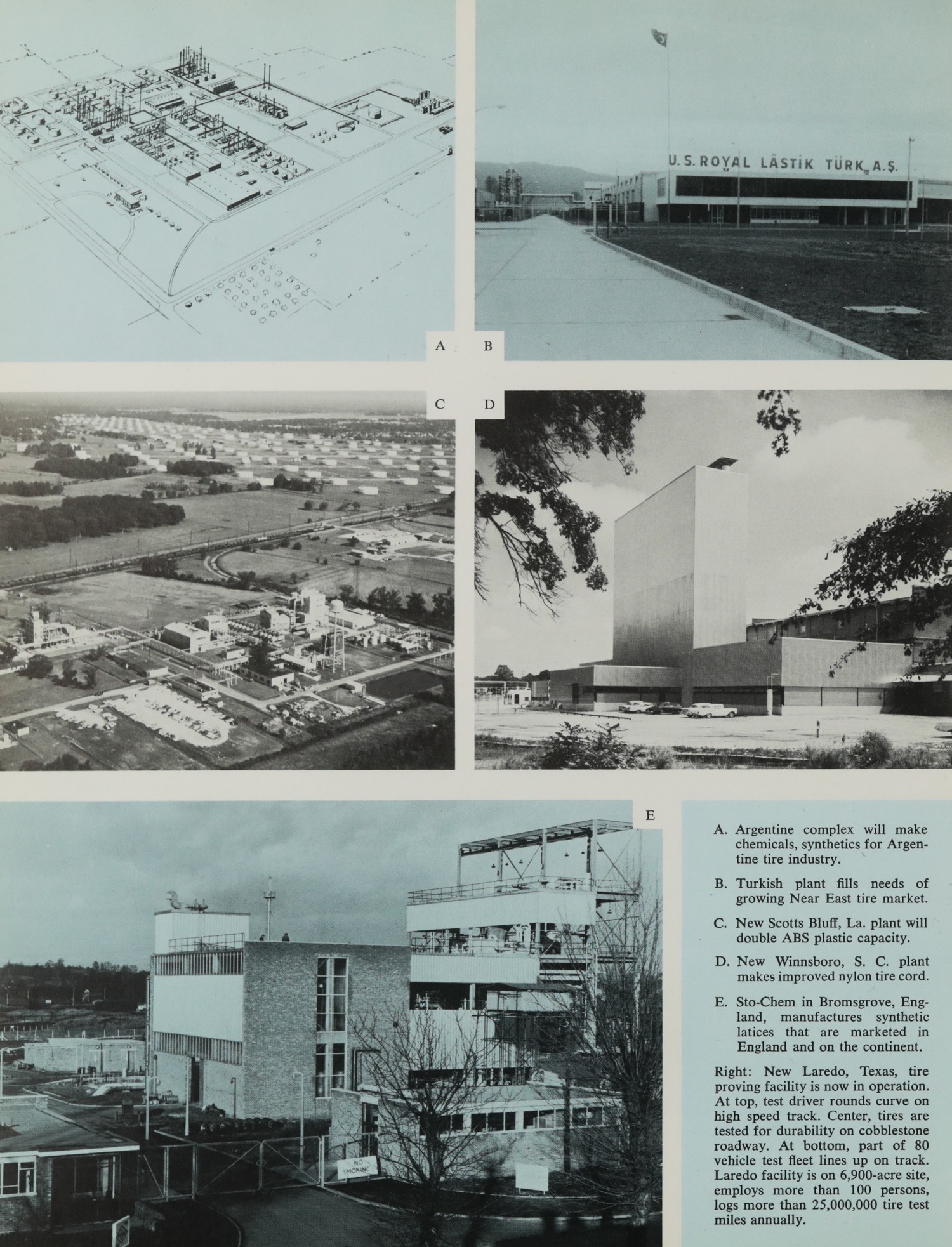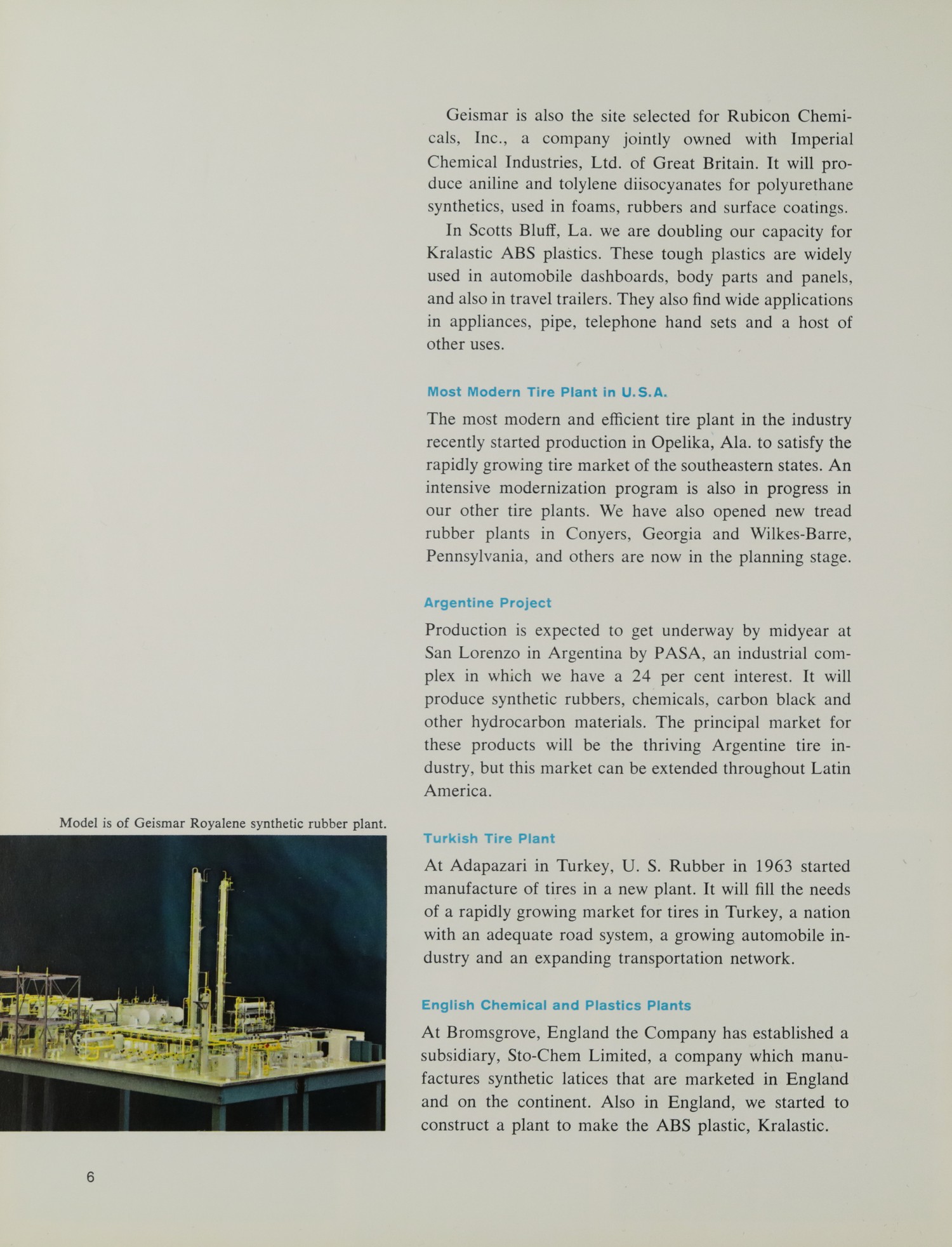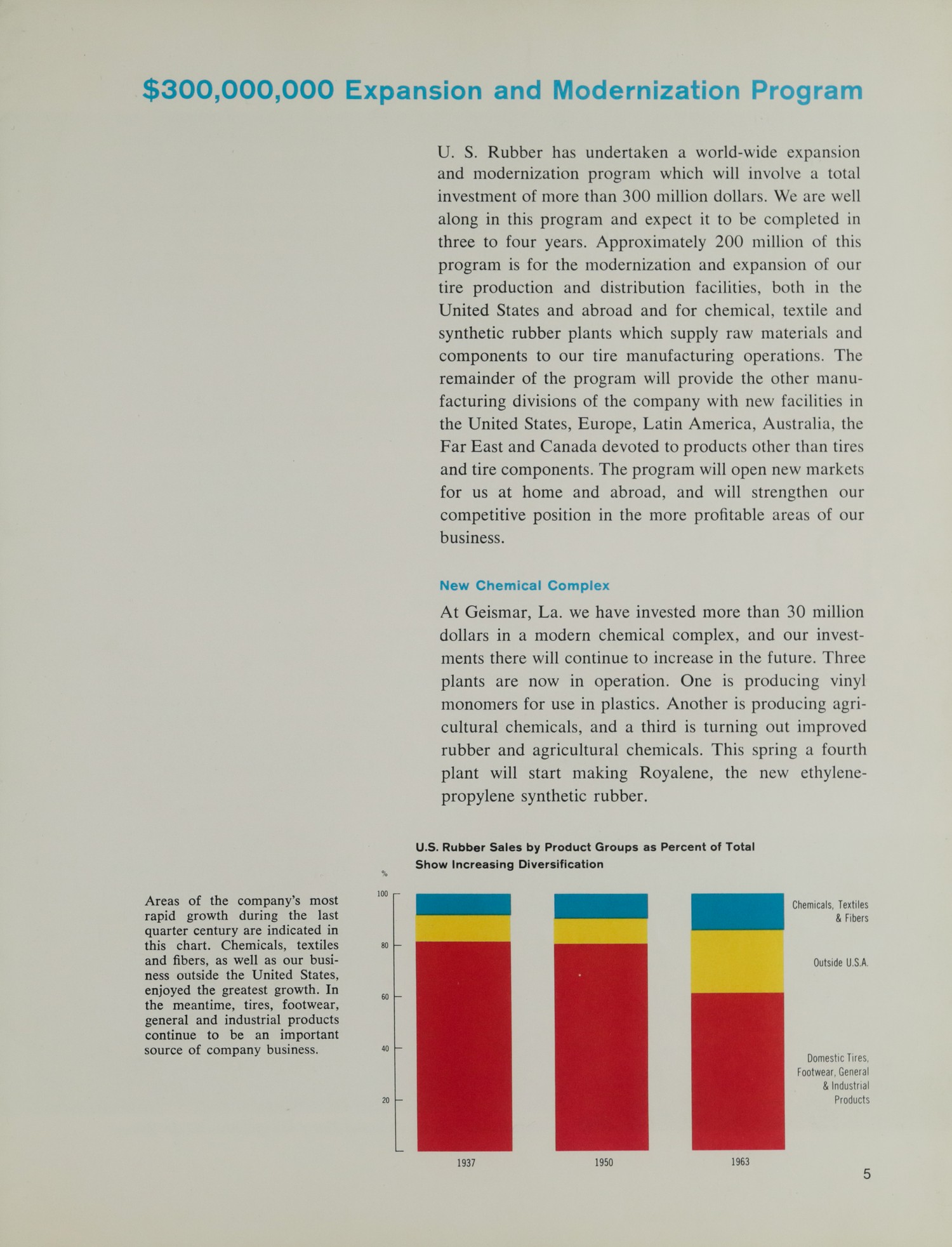
ChemWorld – Page 8

Page 008

CHEMWORLD

WINTER/SPRING 1995


BRIEFS

WACA Recognizes Uniroyal Chemical Associate for Outstanding Service

Roy Parker of Uniroyal Chemical has recently been honored by the Western Agricultural Chemicals Association for outstanding service to the organization and industry.

Parker, product development representative, was named the WACA Outstanding Member for 1994. He was presented with the award at WACA’s 65th Annual Meeting in October, 1994 and is the sixteenth person to receive the award since 1979.

“We’re thrilled to have someone like Roy active in the association,” said Steve Forsberg, WACA executive director. “He took the Legislative Action Program and put his heart and soul into it. It’s one of the most effective grassroots programs in the country. It’s an award well-deserved—Roy is an asset to the entire industry.”

In addition to the Legislative Action Program, Parker has been active on the California State Action Committee and the Government Affairs Committee.

WACA represents manufacturers, formulators, distributors and retailers of pest management products and services in nine Western states. The association’s objective is to promote a positive business climate and industry goodwill. WACA has approximately 200 member companies with 1,000 active participants. ■


CHEMWORLD

is published twice a year by Uniroyal Chemical Company, Inc. for its associates and retirees.

Robert J. Petrausch
Director, Communications

Maureen C. Fama
Manager, Communications Programs

Uniroyal Chemical Company, Inc.
World Headquarters
Benson Road
Middlebury, CT 06749
(203) 573-2000

UNIROYAL CHEMICAL [Logo]


Uniroyal Chemical Corporation Announces Filing of Initial Public Offering

Uniroyal Chemical Corporation, the parent company of Uniroyal Chemical Company, Inc., announced on December 16, 1994 that it has filed with the Securities and Exchange Commission a Registration Statement relating to a proposed $200 million initial public offering of its common stock. Smith Barney Inc., Morgan Stanley & Co. Incorporated, and Wertheim Schroder & Co.

Incorporated will be the representatives of the underwriting syndicate for the offering. The Company intends to use the anticipated proceeds to the Company and up to an additional $40 million to retire indebtedness.

Subject to market conditions and other factors, the Company anticipates that the proposed offering could occur in the first calendar quarter of 1995. There can be no assurance that such favorable

market conditions will exist in the first quarter of 1995.

A Registration Statement relating to the proposed offering of the new common stock has been filed with the Securities and Exchange Commission but has not yet become effective. None of the new common stock may be sold, nor may offers to buy the new common stock be accepted, prior to the time the Registration Statement becomes effective. ■


Logistics Strives for Continuous Customer Satisfaction

(continued from page 2)

warehouse performance helps to ensure that specific goals for on-time shipments, customer pickup turn around time, and inventory accuracy are met.

HAZMAT AND WAREHOUSE OPERATIONS MANAGER
• Henry R. DeVries

■ PACKAGING

The packaging function is responsible for developing quality packages and labels, which must maintain product integrity, and exceed customer, business and Responsible Care® requirements. They must also be disposable, recyclable or source-reduced to ensure regulatory compliance. This includes establishing and maintaining a global package code system for easier tracking and identification purposes.

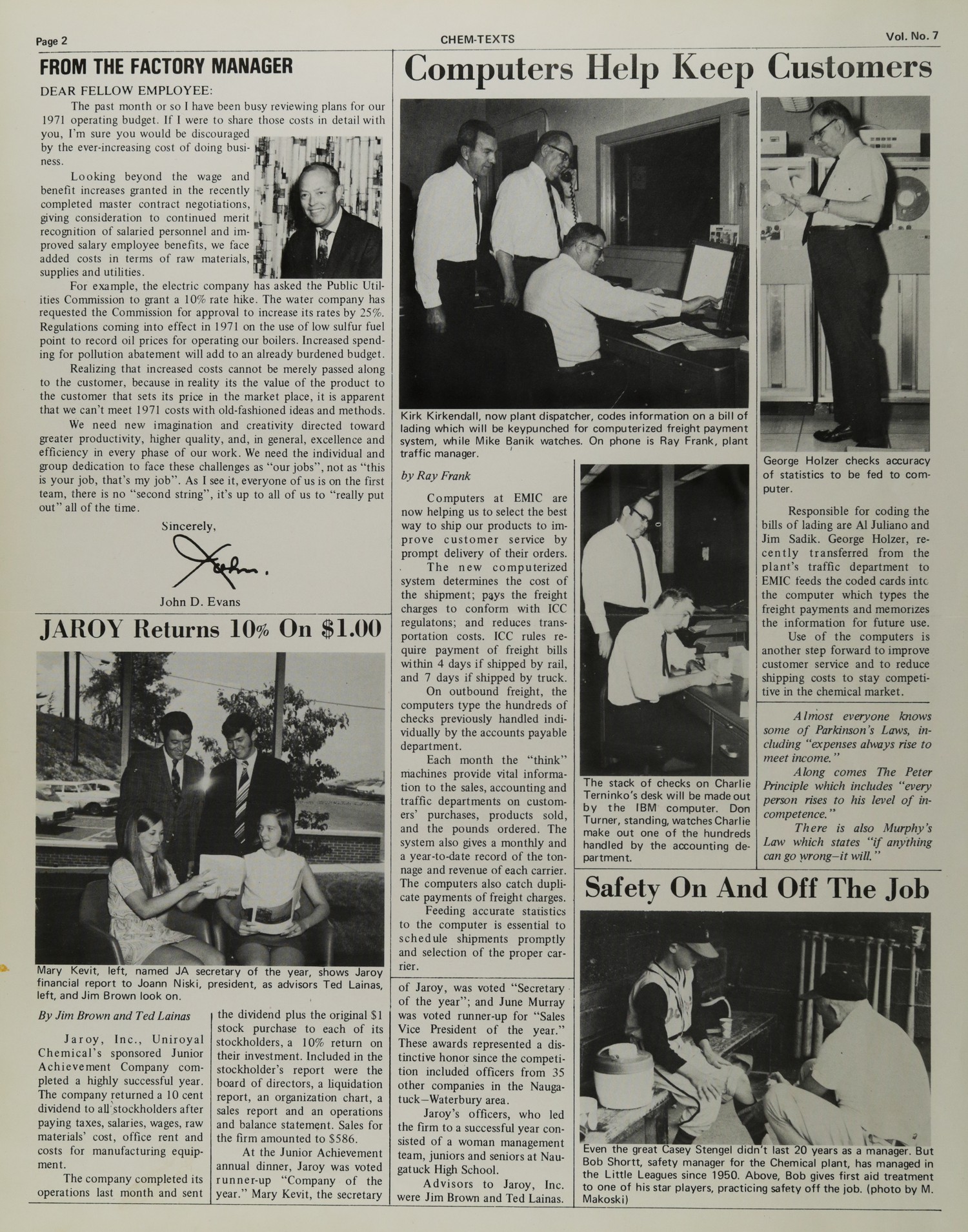
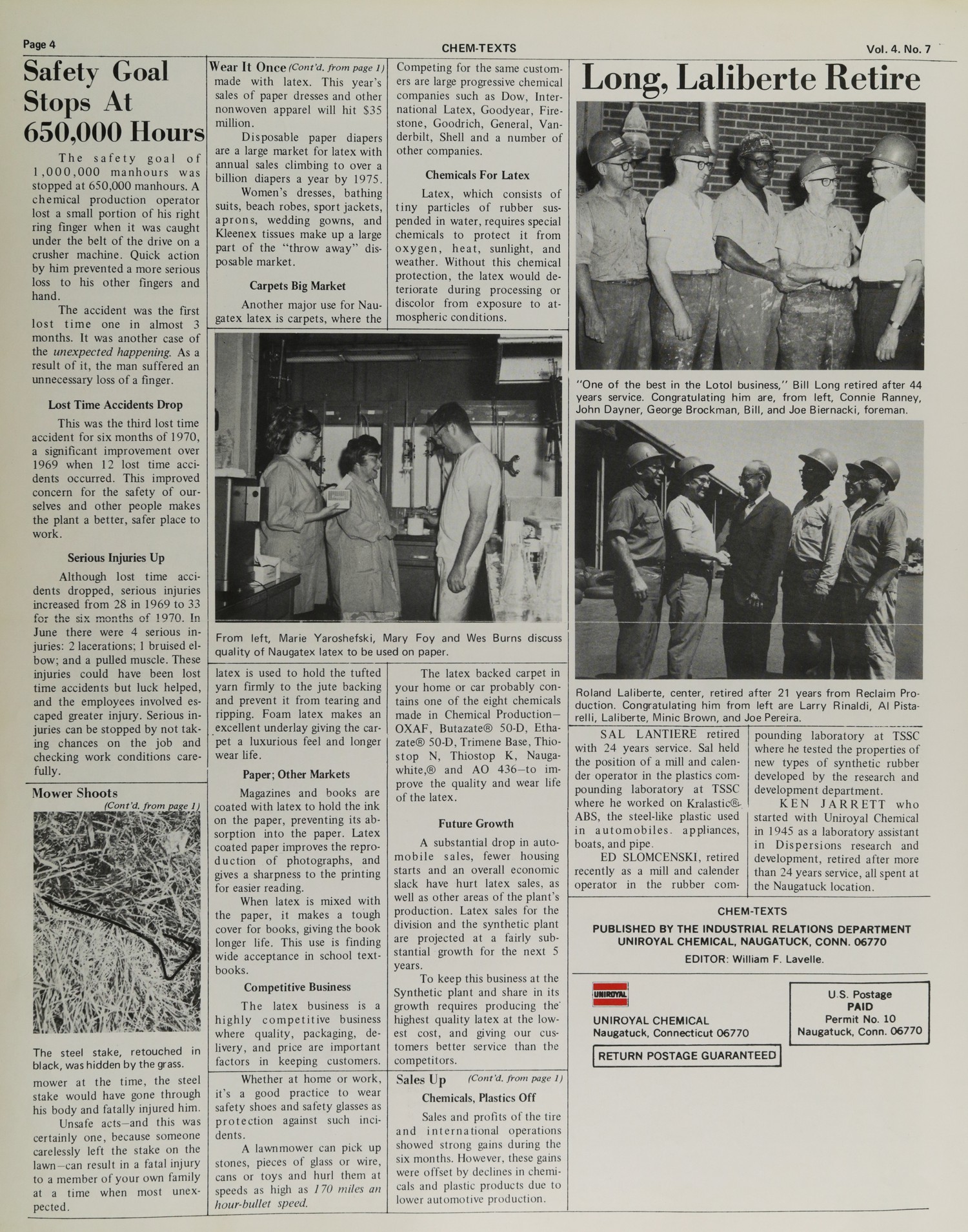
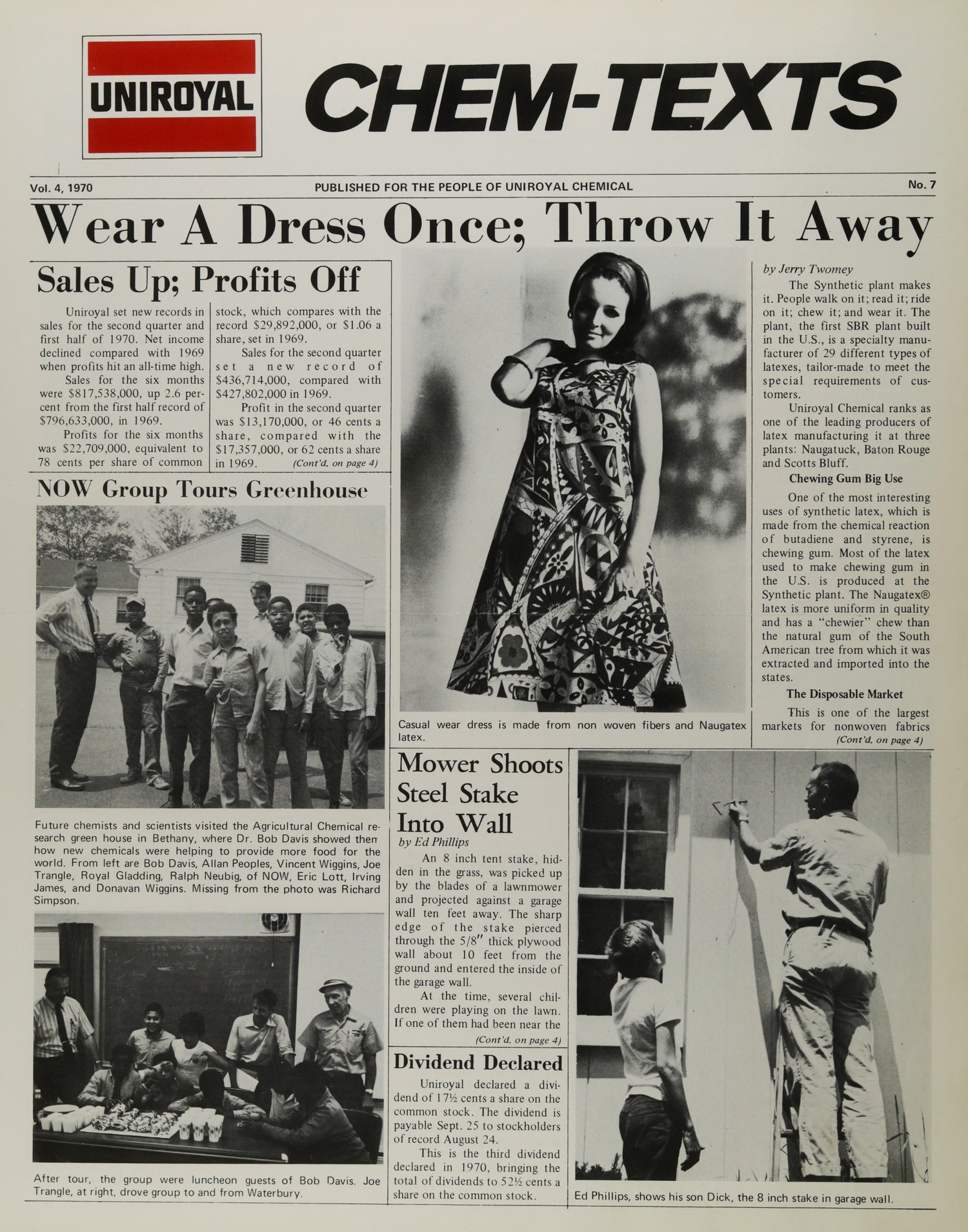
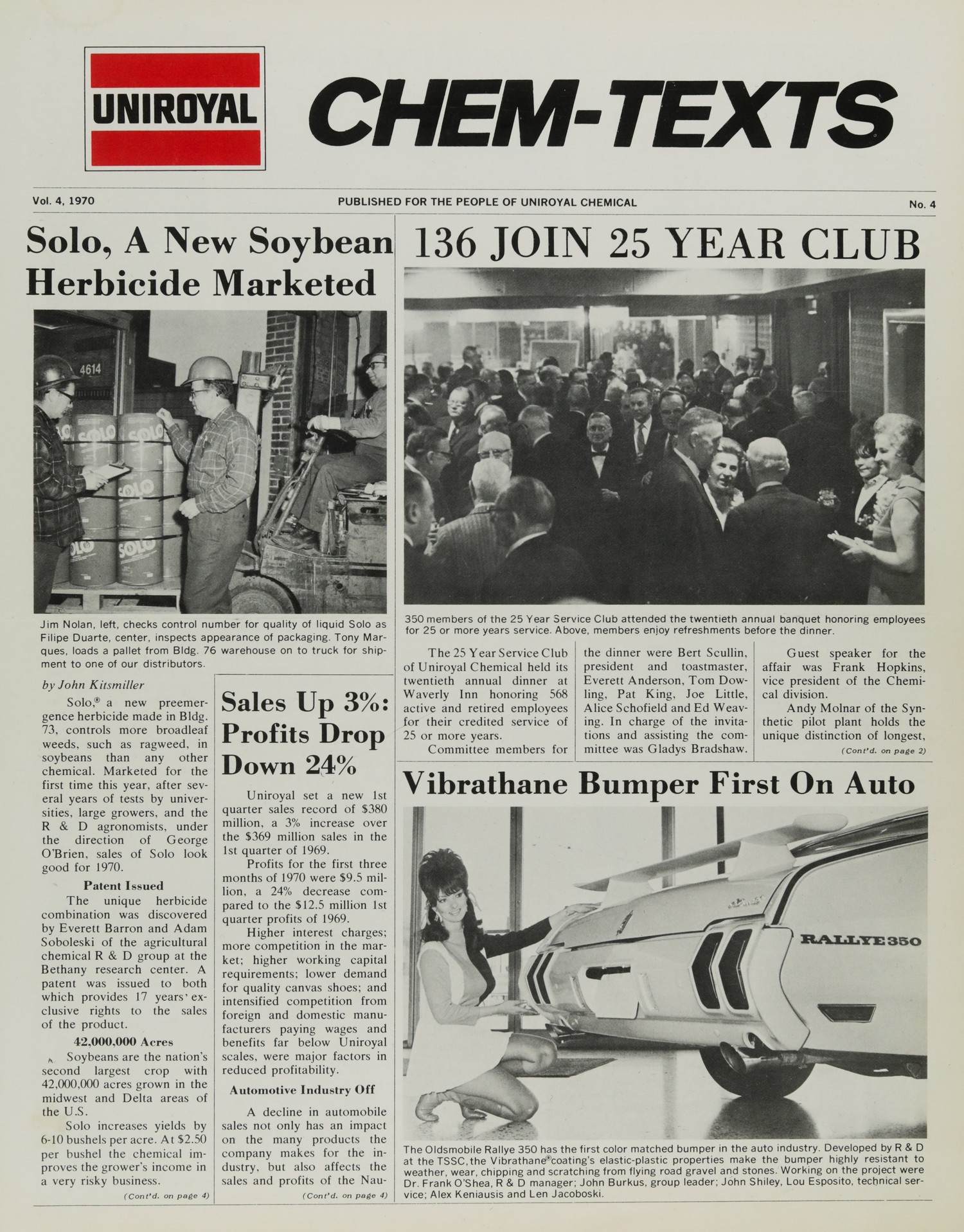
In 1994, primarily through the efforts of the company’s Packaging Excellence team, total package landfill elimination amounted to over 5.1 million pounds, with a cost savings to Uniroyal Chemical of almost $1.3 million. Active programs emphasizing customer partnerships are continually being pursued and improved upon.

PACKAGING PROGRAM MANAGER
• Morris L. Beaver

■ TRANSPORTATION

Transportation’s goal is to maintain an efficient, responsible global trans-

portation system which provides safe, on-time delivery in a way that protects people and the environment while observing all rules and regulations with total commitment to Responsible Care guidelines.

Managing a timely, accurate freight payment system through continuous audit and maximizing duty drawback, duty suspension processes and tariff reductions to help minimize costs are part of this area.

GENERAL TRAFFIC MANAGER
• Ralph E. Buonocore

■ FORECASTING

Forecasting provides reliable demand forecasts to be utilized to ensure proper inventory and support business planning. This includes monitoring the accuracy of the product forecast by business on a monthly basis, as well as providing one total forecast for Uniroyal Chemical on a global basis.

PLANNING SUPERVISOR
• Michael J. Rosa


Within Uniroyal Chemical, the Logistics Department has been a major contributor to the company’s “Committed to Excellence” programs. Logistics associates now chair the Chemicals and Polymers and Specialties Packaging, Domestic On-Time, Export On-Time, and Crop Documentation Excellence Teams, and serve on many other Excellence Committees. Logistics associates are also very involved in “Where Do I Fit In Quality?”, and have been recognized numerous times through the

company’s Total Quality Recognition Program. Department associates have also received seven Total Quality “Gold Coin” awards and five “President’s Awards” for their outstanding efforts.

The Logistics Department continues to meet multiple Uniroyal Chemical corporate goals in its daily actions: “Total Associate Involvement,” “Supplier of Choice,” “Low Cost Producer of Products and Services,” and “Zero Damage to People and the Environment.” The department is heavily involved in developing and implementing the Distribution Code of Management Practices (Bill Mischou, code leader) as part of the Responsible Care program initiated by the Chemical Manufacturers Association (CMA). The company is expected to have this code in place by November 1995.

And what sort of challenges will Logistics face in the future?

According to Mischou, there are three key areas which will expand the complexities associated with handling and distributing products worldwide: an increase in regulatory compliance; environmental issues (protection of people and the environment); and ever-increasing customer expectations.

“The area of customer expectations will present the biggest challenge. Customer needs are constantly changing, and they will be looking for a supplier who is flexible enough to change along with them, but who also can help contribute to their growing success. I’m confident that we’ll do whatever it takes to be that supplier — and do it without skipping a beat,” he concluded. ■
ChemWorld – Page 7

Page 007

CHEMWORLD

WINTER/SPRING 1995


Novaquim Strengthens Uniroyal Chemical’s Expansion Efforts

When Uniroyal Chemical fully acquired Novaquim S.A. de C.V. in Mexico from its former joint venture partner Cydsa in July 1993, it hailed the event as a “milestone in the company’s drive toward globalization” and a sign of its “solid commitment to a worldwide customer base and to specialty rubber chemicals, polymers, and urethane markets in Mexico.” Today, Novaquim is proving itself to be more than just a milestone and symbol of commitment.

Under the leadership of Managing Director Rodolfo Montemayor, Novaquim is a pivotal sales and manufacturing organization which allows Uniroyal Chemical to position itself more strongly to serve Mexico and Latin American markets.

“Since the early 1970s, Novaquim has continued to build an outstanding reputation in Mexico as a producer of superior quality products,” said Montemayor. “Our customers continually put our products to the test, and they demand that our products meet the most stringent quality standards for performance. The feedback we’ve received indicates that we’re achieving the highest levels of satisfaction with our customers. We are very proud of this achievement.”

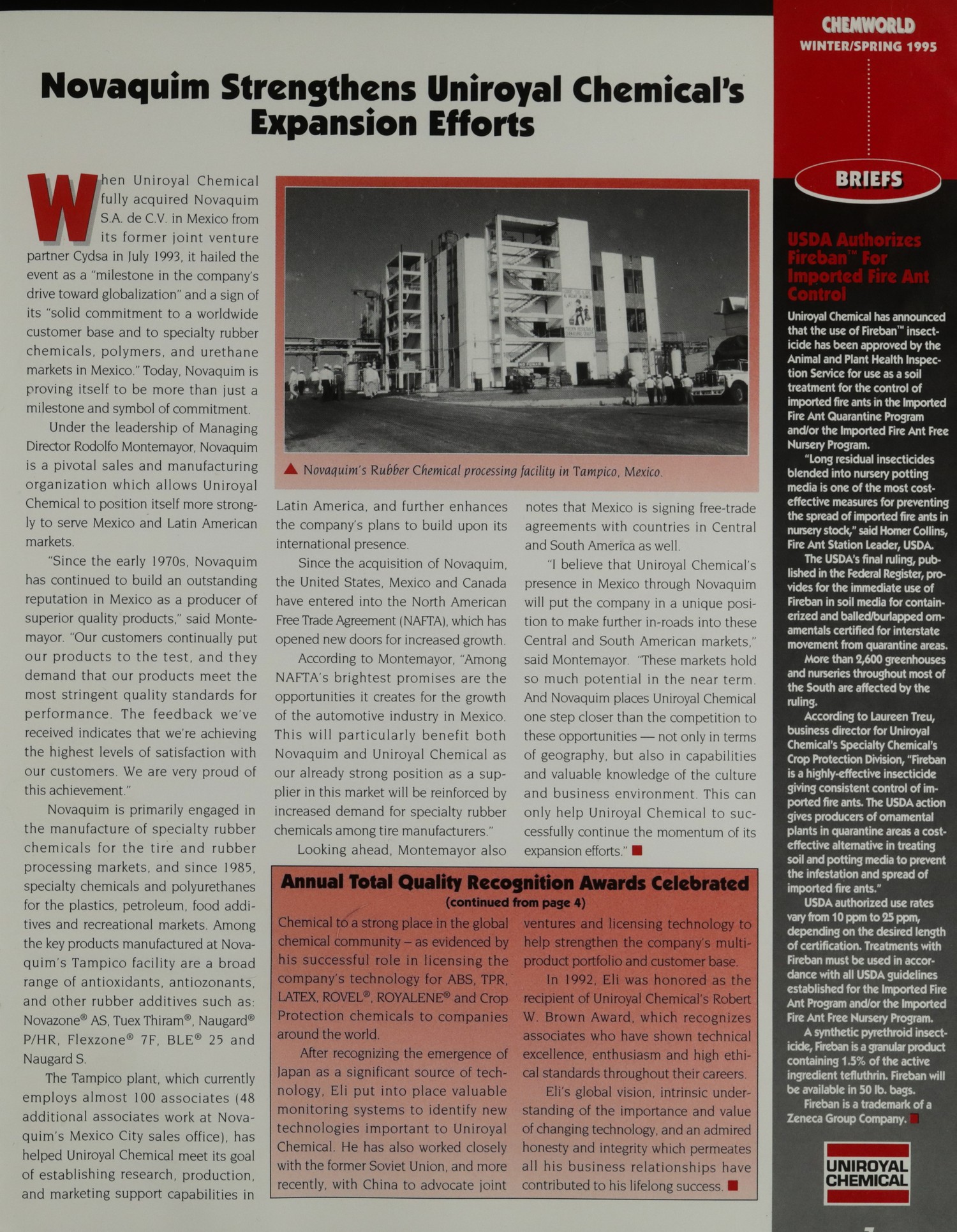
Novaquim is primarily engaged in the manufacture of specialty rubber chemicals for the tire and rubber processing markets, and since 1985, specialty chemicals and polyurethanes for the plastics, petroleum, food additives and recreational markets. Among the key products manufactured at Novaquim’s Tampico facility are a broad range of antioxidants, antiozonants, and other rubber additives such as: Novazone® AS, Tuex Thiram®, Naugard® P/HR, Flexzone® 7F, BLE® 25 and Naugard S.

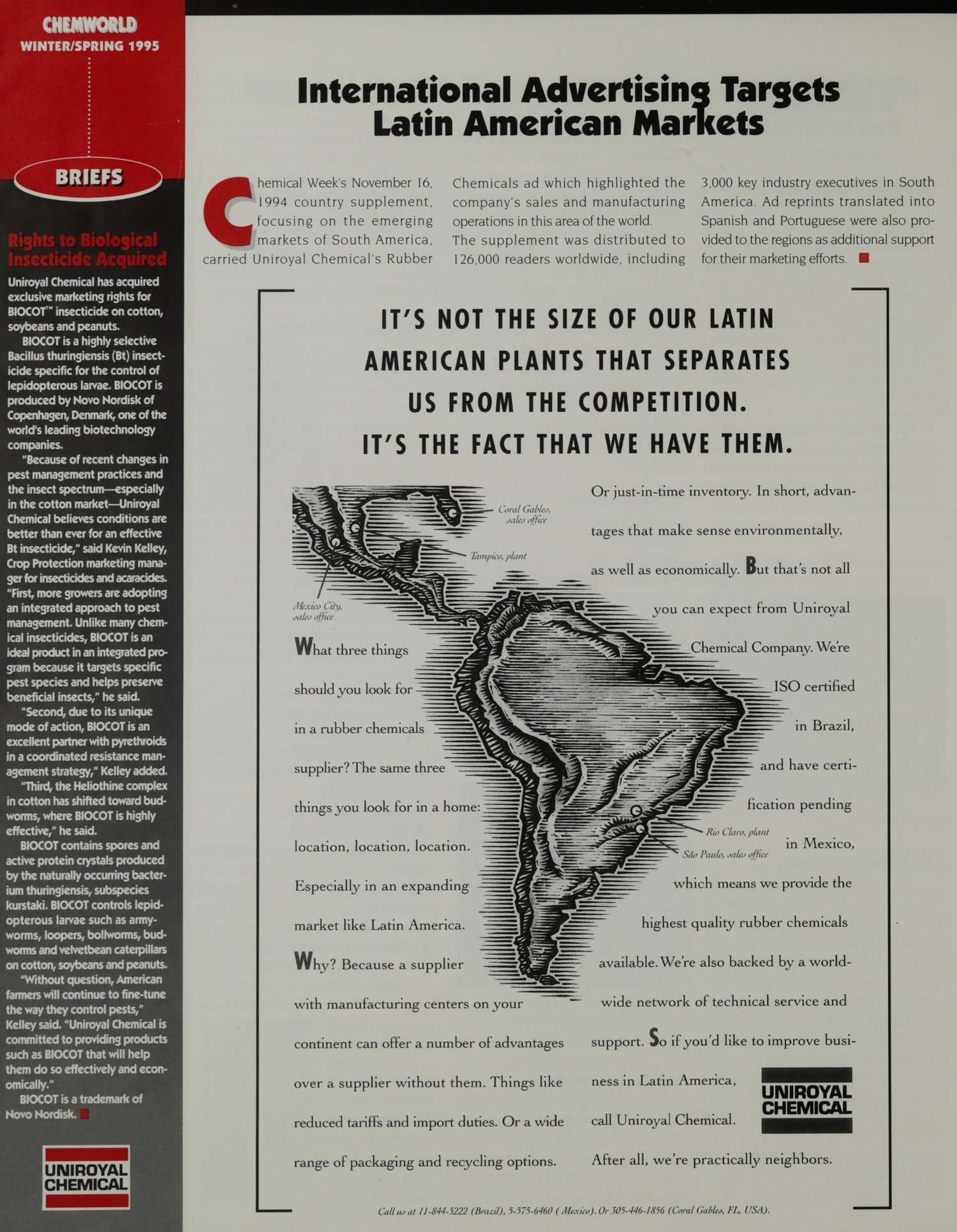
The Tampico plant, which currently employs almost 100 associates (48 additional associates work at Novaquim’s Mexico City sales office), has helped Uniroyal Chemical meet its goal of establishing research, production, and marketing support capabilities in


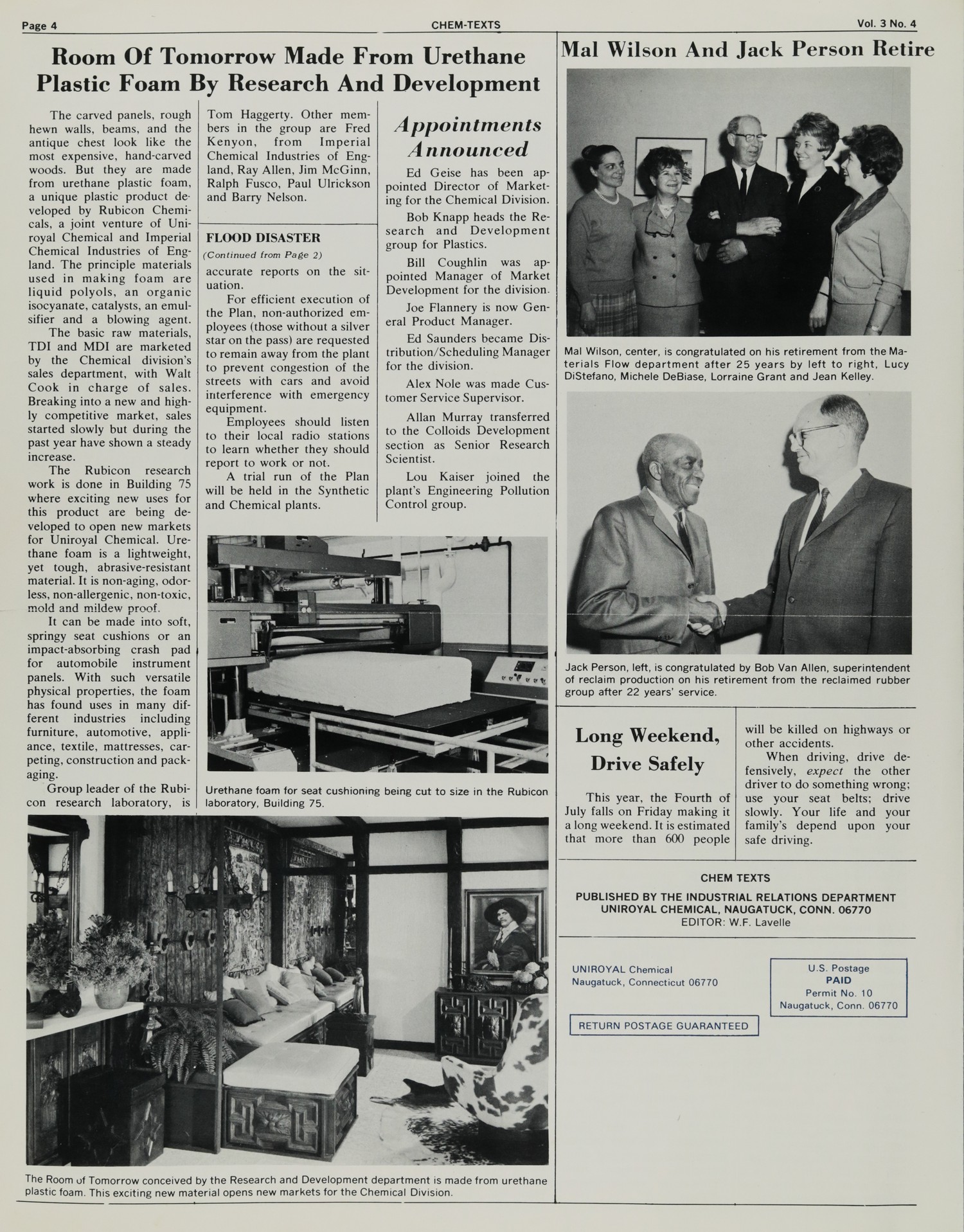
Novaquim’s Rubber Chemical processing facility in Tampico, Mexico.

Latin America, and further enhances the company’s plans to build upon its international presence.

Since the acquisition of Novaquim, the United States, Mexico and Canada have entered into the North American Free Trade Agreement (NAFTA), which has opened new doors for increased growth.

According to Montemayor, “Among NAFTA’s brightest promises are the opportunities it creates for the growth of the automotive industry in Mexico. This will particularly benefit both Novaquim and Uniroyal Chemical as our already strong position as a supplier in this market will be reinforced by increased demand for specialty rubber chemicals among tire manufacturers.”

Looking ahead, Montemayor also

notes that Mexico is signing free-trade agreements with countries in Central and South America as well.

“I believe that Uniroyal Chemical’s presence in Mexico through Novaquim will put the company in a unique position to make further in-roads into these Central and South American markets,” said Montemayor. “These markets hold so much potential in the near term. And Novaquim places Uniroyal Chemical one step closer than the competition to these opportunities — not only in terms of geography, but also in capabilities and valuable knowledge of the culture and business environment. This can only help Uniroyal Chemical to successfully continue the momentum of its expansion efforts.” ■


Annual Total Quality Recognition Awards Celebrated

(continued from page 4)

Chemical to a strong place in the global chemical community – as evidenced by his successful role in licensing the company’s technology for ABS, TPR, LATEX, ROVEL®, ROYALENE® and Crop Protection chemicals to companies around the world.

After recognizing the emergence of Japan as a significant source of technology, Eli put into place valuable monitoring systems to identify new technologies important to Uniroyal Chemical. He has also worked closely with the former Soviet Union, and more recently, with China to advocate joint

ventures and licensing technology to help strengthen the company’s multi-product portfolio and customer base.

In 1992, Eli was honored as the recipient of Uniroyal Chemical’s Robert W. Brown Award, which recognizes associates who have shown technical excellence, enthusiasm and high ethical standards throughout their careers.

Eli’s global vision, intrinsic understanding of the importance and value of changing technology, and an admired honesty and integrity which permeates all his business relationships have contributed to his lifelong success. ■

BRIEFS

USDA Authorizes Fireban™ For Imported Fire Ant Control

Uniroyal Chemical has announced that the use of Fireban™ insecticide has been approved by the Animal and Plant Health Inspection Service for use as a soil treatment for the control of imported fire ants in the Imported Fire Ant Quarantine Program and/or the Imported Fire Ant Free Nursery Program.

“Long residual insecticides blended into nursery potting media is one of the most cost-effective measures for preventing the spread of imported fire ants in nursery stock,” said Homer Collins, Fire Ant Station Leader, USDA.

The USDA’s final ruling, published in the Federal Register, provides for the immediate use of Fireban in soil media for containerized and balled/burlapped ornamentals certified for interstate movement from quarantine areas.

More than 2,600 greenhouses and nurseries throughout most of the South are affected by the ruling.

According to Laureen Treu, business director for Uniroyal Chemical’s Specialty Chemical’s Crop Protection Division, “Fireban is a highly-effective insecticide giving consistent control of imported fire ants. The USDA action gives producers of ornamental plants in quarantine areas a cost-effective alternative in treating soil and potting media to prevent the infestation and spread of imported fire ants.”

USDA authorized use rates vary from 10 ppm to 25 ppm, depending on the desired length of certification. Treatments with Fireban must be used in accordance with all USDA guidelines established for the Imported Fire Ant Program and/or the Imported Fire Ant Free Nursery Program.

A synthetic pyrethroid insecticide, Fireban is a granular product containing 1.5% of the active ingredient tefluthrin. Fireban will be available in 50 lb. bags.

Fireban is a trademark of a Zeneca Group Company. ■

UNIROYAL CHEMICAL

ChemWorld – Page 5

Page 005

CHEMWORLD

WINTER/SPRING 1995


Worldwide Growth Strategy Dictates New Organization

(continued from page 1)

William A. Stephenson, formerly vice president/general manager of the Specialties Division, has been appointed executive vice president of the Asia/Pacific region with responsibility for the worldwide Specialties businesses (Adiprene®/Vibrathane® urethane prepolymers and Specialty Chemicals), Gustafson (a wholly-owned subsidiary for seed treatment chemicals) and Asia/Pacific (including all businesses in that region).

Dr. Edward L. Hagen has been appointed regional vice president for Asia/ Pacific and will report to Mr. Stephenson. The headquarters location will be announced shortly.

“This new global organization structure will help support a firm foundation for shared leadership, constructive interdependence between divisions and regions, and matrixed teamwork at all management levels,” commented Robert J. Mazaika, Uniroyal Chemical’s chairman, president and CEO. “We are looking forward to an even more successful future as we become a stronger player in the global chemical industry.”


PROFESSIONAL PROFILES

Dr. JOSEPH B. EISENBERG

Dr. Joseph B. Eisenberg has been with Uniroyal Chemical for over 30 years, serving as senior group leader, production superintendent for polymers, production superintendent for chemicals, technical superintendent, engineering manager, and general manager of international operations for Chemicals and Polymers. Most recently, he was vice president and general manager of the Chemicals and Polymers Division, responsible for Rubber Chemicals, Royalene® EPDM and Paracril® nitrile rubber.

Dr. Eisenberg received a B.S., M.S. and Ph.D in chemical engineering from Clarkson University in New York, USA.


WALTER K. RUCK

Walter K. Ruck joined Uniroyal Inc. in 1979 as manager of construction in the Chemical Division Engineering Department. He progressed through a number of managerial positions since that time and was transferred to Uniroyal Ltd. in Elmira, Ontario, Canada in 1985, where he served as manager of manufacturing.

Since 1988, he has held the position of managing director/general manager of Uniroyal Chemical Ltd. in Elmira.

Mr. Ruck has a B.S. in engineering from Christian Brothers College in Memphis, Tennessee, USA and attended St. Louis University in St. Louis, Missouri, USA. He has also pursued graduate studies in business management at Xavier University in Cincinnati, Ohio, USA.


ALFRED F. INGULLI

Mr. Ingulli has been with Uniroyal Chemical for 31 years, and has worked in research and development where he was awarded two patents for high temperature themoplastic alloys. He also worked in market development where he was instrumental in establishing two new businesses — Polywet® dispersants and Synton® synthetic lubricants. He has also served as business manager for many of the company’s businesses in the Chemicals and Polymers Division and Specialties Division.

Most recently, he was vice president and general manager of the Crop Protection Division, responsible for fungicides, insecticides, plant growth regulators, herbicides, foliar nutrients, seed treatment and other crop protection specialty products worldwide.

Mr. Ingulli received a B.S. in chemical engineering from Polytechnic Institute and an M.S. in management from Rensselaer Polytechnic Institute, both located in New York, USA. He also completed the Harvard Business School Program of Management Development.


MICHEL J. DUCHESNE

With a background in international and general management, having worked for regional, national and international sales divisions for both Uniroyal Chemical and other Fortune 500 companies, Mr. Duchesne has been general sales manager of the Crop Protection International Division and general sales manager and director of sales of the Crop Protection Division worldwide.

Most recently, he served as managing director of European operations based in Langley, United Kingdom.

A native of France, Mr. Duchesne holds a dual French-American citizenship. He received a B.A. and an M.S. in agronomy from the National Institute of Agronomy at the University of Paris, France.


WILLIAM A. STEPHENSON

A 26-year veteran of Uniroyal Chemical, William Stephenson has worked as a development engineer in research and development, technical sales service representative, manager for Paracril nitrile rubber, and marketing manager and business manager for Royalene EPDM.

Most recently, he was vice president and general manager of the Specialties Division, overseeing two key business units: Adiprene/Vibrathane urethane prepolymers and Specialty Chemicals – a major supplier of plastics additives including antioxidants, foaming agents, epoxy curatives and polymerization inhibitors, as well as lubricant additives and intermediates.

Mr. Stephenson received a B.S. in plastics technology from Lowell Technological Institute in Lowell, Massachusetts, USA, and an M.B.A. in marketing from the University of Hartford, Connecticut, USA.


Dr. EDWARD L. HAGEN

Dr. Edward L. Hagen started his career in 1969 as a research chemist in corporate R&D for Uniroyal Inc., and then joined Uniroyal Chemical in 1974 as a technical sales service group leader for Vibrathane castable urethanes and Roylar® thermoplastic urethanes. He continued his career in the urethanes area as R&D and technical sales service manager, marketing specialist and worldwide business manager through 1991.

Most recently, he held the position of vice president of Corporate Business Development. Dr. Hagen received a B.S. in chemistry from the University of Notre Dame in South Bend, Indiana, USA and a Ph.D in organic chemistry from Yale University in New Haven, Connecticut, USA. ■

BRIEFS

Seed Treatment Operation in United Kingdom Acquired

Uniroyal Chemical has purchased the seed treatment operation of DowElanco in the United Kingdom and Ireland. The transaction was completed on November 3, 1994.

“Uniroyal Chemical already is the global leader in seed treatment products and technology, and this acquisition enables us to bolster a key market,” said Alfred F. Ingulli, executive vice president responsible for the company’s Crop Protection product lines. “DowElanco customers in the United Kingdom can expect a continued strong commitment to seed treatment products, equipment and service.”

The transaction includes the existing DowElanco seed treatment team, development equipment, machinery and spare parts inventory. DowElanco announced last spring that the divestiture would enable it to focus on its core business.

“Uniroyal Chemical’s Crop Protection business continued to grow in 1994, especially in the area of seed treatment,” Ingulli said. “Our personnel, products and expertise make us the dominant leader in seed treatment, both in North America and worldwide.” ■


UNIROYAL CHEMICAL

ChemWorld – Page 4

Page 004

ChemWorld | 4 | January 1991

Recycling Plastics Is Good Business

Problems and opportunities are often opposite sides of the same coin. A current societal problem which represents a significant opportunity for Uniroyal Chemical is the crisis surrounding the scarcity of landfill space in many parts of the country. As a supplier to the plastics industry, Uniroyal Chemical is committed to producing and selling products which will enhance the “environmental friendliness” of customers’ products.

By 1992, 25 percent of the nation’s solid waste should be recycled, according to the Environmental Protection Agency. Unfortunately for the plastics industry, there is a commonly-held misconception that plastics are not recyclable. Another purported shortcoming of plastics is that they are a waste of non-renewable petroleum resources.

Uniroyal Chemical and various industry associations, such as the Society of the Plastics Industry and the Society of Plastics Engineers, are now launching an all-out effort to educate the public as to the true environmental impact of plastics manufacture and use. Statistics are readily available which can demonstrate that plastics are no more hazardous to produce or use than any other material.

The principal thrust of educational efforts has been aimed at the central issue of plastics recyclability. The concept that plastics cannot be recycled has been unchallenged for so long that it has become “gospel” to large numbers of people.

While the technology to recycle most types of plastics is well-known, this new industry is not without its problems. Chief amongst these, and a fact which may account for the view that plastics cannot be recycled, is that plastics are most easily recycled when they are segregated by type prior to processing. Different types of plastics may be incompatible, so that when they are melted together, they do not form a cohesive blend and consequently lack

strength. Often, however, plastics are not segregated.

Uniroyal Chemical currently is developing a line of polymer modifiers to upgrade the properties of recycled resins. Royaltuf®, a modified ethylene propylene elastomer (rubber), is a family of polymer modifiers that is designed to increase toughness or to raise the impact properties of plastics, and to function as a compatibilizer enabling successful blending of otherwise incompatible resins. In many cases, the use of Royaltuf modifiers will allow a plastics producer to make engineer-


PLASTICS (SOLID WASTE) FACTS

Producing paper bags requires more energy and oil (as well as trees) than producing plastic bags. It also produces more pollutants.

Plastics were found to occupy only 18 percent by volume of waste generated in the United States in 1986, compared to paper, which generated 38 percent by volume.

Garbage incineration is actually helped by plastics in the trash because plastics burn hotter, providing improved combustion which can lower emissions.

The manufacture of all plastics uses only about two percent of the crude oil and natural gas consumed annually in the U.S.

Plastics in the average car cut fuel consumption by nearly five percent and contribute to improved safety performance.

Plastic packaging has helped reduce food spoilage in the industrialized world to around two percent. Developing countries have a spoilage rate of between 30 and 50 percent.


ing grades of plastics with properties equivalent to those of virgin resins. Many of these plastic alloys are ideally suited to high-performance applications such as automotive bumpers and body panels.

A second issue surrounding the recycling debate is the question of the thermal stability of the plastic to be recycled. While thermoplastics may be melted and reshaped, the use of excessive thermal energy may lead to degradation of the plastic. It is important that the stabilizers used in a plastic to be recycled are up to the task of withstanding multiple heat histories. Uniroyal Chemical includes

such evaluations in the testing of its existing line of thermal stabilizers (Naugard® antioxidants), as well as in the development of new versions. Additionally, stabilizers may have a tendency to migrate out of the plastics over time, so that stabilizers for plastics to be recycled must have a higher than normal degree of permanence. Here as well, Uniroyal Chemical is in the forefront of product development.

Many applications for recycled plastics are in the area of wood replacement. One characteristic of most plastics is that they are inherently heavier than wood. In order to give these products a more “wood-like” nature, many recyclers are using foaming agents to reduce weight. Given the fact that the recycled plastic feed stream will certainly not be as consistent as a virgin resin feed, the demands for flexibility placed on the foaming agent system will be great. As the only domestic manufacturer of chemical foaming agents (Celogen®, Kempore®, Nitropore®, Opex® and Expandex®), Uniroyal Chemical is devoting considerable attention to this issue as well.

Recycling is here to stay. Uniroyal Chemical is dedicated to supplying materials to the industry which will make the job easier and more profitable. And, as evidence that the company is truly committed, it has initiated its own recycling program within the company, segregating classes of materials and designating recycling coordinators for each department to ensure that waste is recycled.

Also, several technical employees of Uniroyal Chemical Company and other area companies are working with the Society of Plastics Engineers to organize a conference on plastics recycling in New England scheduled for June, 1991. The conference will seek to educate people from local state governments, area industry, and universities on the facts about plastics recycling. ■


UNIROYAL CHEMICAL

ChemWorld – Page 8

Page 008

ChemWorld | 8 | January 1991

ChemWorld Briefs

Paraclor® CPE Enters New Markets

Paraclor® CPE, one of Uniroyal Chemical’s specialty elastomers, is proving to be ideally suited for a number of new applications – both elastomer and plastic. Introduced last year, the elastomer’s versatility is guiding the company into new markets.

One such market is automotive, which takes advantage of the product’s high heat and oil resistance. These characteristics, combined with CPE’s low temperature flexibility and superior outdoor aging properties, make Paraclor CPE a leading candidate for use in injection-molded parts such as air inlet ducts or any under-the-hood hose.

Perhaps the largest slice of the market that Paraclor CPE intends to capture for Uniroyal Chemical is in wire and cable applications, where the product is used as jacketing for flexible cords such as portable power tools as well as for instrumentation, and control and mine cable. The product is easily made flame retardant for such uses, as it meets 60, 90, and 105 degree centigrade UL classifications.

Paraclor CPE also can be used to complement Uniroyal Chemical’s polymer product line, which includes Royalene® EPDM and Paracril® nitrile rubber for traditional markets such as hose, sheeting, gaskets, wire and cable, and roll covers. Used as an impact-modified plastic, Paraclor CPE intends to break through new markets, including wire and cable, with residential and industrial applications.

For example, when two to ten percent of Paraclor CPE is added to vinyl, it serves as an impact modifier for residential applications such as vinyl siding and electrical conduit, lending increased toughness and durability to these applications. The product may be blended with existing vinyl for industrial flat roof coverings to add strength and durability against the elements. Similarly, Paraclor CPE is used as a wire and cable thermoplastic material for jacketing.

Paul Hinckley, business development

manager for the Paraclor CPE line, expects sales of the product to grow rapidly in these market areas; a significant portion of these sales will be attributed to Paraclor CPE’s displacing competing products, due to its superior retention of heat aging properties. “Currently, we find that the opportunities for this product in the U.S. and Canada are abundant,” he said. “We expect to see a tremendous increase in sales volume over the next 12 months.” ■

Dr. Byron A. Hunter Recipient Of The 1990 Thomas Midgley Award

Dr. Byron A. Hunter, a retired research chemist from Uniroyal Chemical Company, has been named the recipient of the 1990 Thomas Midgley Award sponsored by the American Chemical Society (Detroit section), in cooperation with Ethyl Corporation. The Award was presented to Dr. Hunter at a formal awards ceremony held at the Engineering Society of Detroit, Michigan on Tuesday evening, October 30, 1990.

Founded in 1965, the Thomas Midgley Award, named after the late inventor known for his creative, far-seeing research efforts, is presented annually for outstanding research contributions and inventive genius in the chemistry field related to the automotive industry.

One of the most significant contributions of Dr. Hunter’s career is the development of chemical blowing agents for the production of closed-cell rubber foams used in automotive applications. The commercialization of one type foam (benzene sulfonyl hydrazide) (OBSH) serves as the predominant type of blowing agent used to produce dual durometer weatherstrip. Today, this weatherstrip type comprises about 80 percent of total worldwide use of weatherstrip for automotive and truck seal applications.

Dr. Hunter’s efforts have also increased weatherstrip productivity by 20 percent, due to the lower decomposition temperature and more gas release properties of OBSH.

OBSH also produces a soft textured sponge, which is used in new down-sized and lower weight automotive door and truck lids to facilitate acceptable closing efforts.

Most recently, Dr. Hunter was awarded the 1989-90 Outstanding Achievement Award from the Thermoplastics and Foams Division of the Society of Plastic Engineers (SPE), and is recognized as a leading worldwide authority on blowing agent technology in the areas of rubber and plastics compounds, applications and process technology. To date, he has received 67 United States patents in the rubber and plastic additive fields. ■

Uniroyal Chemical Introduces New Lubricant Additive

Uniroyal Chemical Company has introduced a new antioxidant lubricant additive, Naugalube® 680, especially formulated for high performance automotive engine and gear oils.

Naugalube 680 has a high nitrogen content providing advanced performance, lower volatility and improved solubility, which helps meet the most demanding engine specifications.

In the next several months, the company plans to introduce additional high performance lubricant additives, furthering its commitment and responsiveness to the high performance engine oil marketplace.

Current Uniroyal Chemical products that are part of the lubricant additives family include: Naugalube 403, 440, 443, 438, 438L, 445, 500, 690, and Naugard® 529, BHT, PANA and Q. ■


ChemWorld, a publication of Uniroyal Chemical Company worldwide, is distributed to company employees and retirees.

Robert J. Petrausch
Director, Communications

Maureen C. Fama
Marketing Communications Coordinator

Uniroyal Chemical Company
World Headquarters
Middlebury, CT 06749
(203) 573-2000


UNIROYAL CHEMICAL

ChemWorld – Page 3

Page 003

ChemWorld | 3 | January 1991

New Product Technologies And Global Expansion Drive Chemicals And Polymers Division

Walter J. Cook, vice president and general manager of the Chemicals and Polymers (C&P) Division, recently talked about the division’s strengths and future worldwide expansion plans. The following is a summary of this interview:

Q. Despite the slowdown in the U.S. economy and the volatile global economy throughout 1990, the C&P Division turned in a commendable performance. What factors are responsible for this success during a time when many other industrial companies are struggling just to stay in business?

A. The C&P Division indeed turned in a commendable performance. However, I was disappointed that we did not make our budgeted sales and profit in 1990. During the last quarter of 1990, we were severely impacted by sales in the U.S.S.R. We have demonstrated to our many worldwide customers, however, that we are a very competitive, dependable supplier working very hard to provide the best quality products and service backed by a strong technical department, both in research and development and technical service.

Q. The third Royalene® EPDM production unit, known as Poly III, is slated to come on stream in March/April of 1991, making Uniroyal Chemical the largest producer of EPDM in North America. What strategy determined the need for this additional capacity and how will this capital investment affect the company’s MBO financial status?

A. We have become a worldwide leader in the EPDM business, and this expansion is a strong commitment to this fundamental position. In addition to our solid base in several key markets in North America, we have strategic market penetration in Latin America and Europe and support our licensees in Japan, Korea and India. We are very confident in meeting and exceeding our financial projections despite the heavy capital investment we are making in Poly III. This expansion will give us a satisfactory return on the capital deployed and help strengthen our MBO projections.


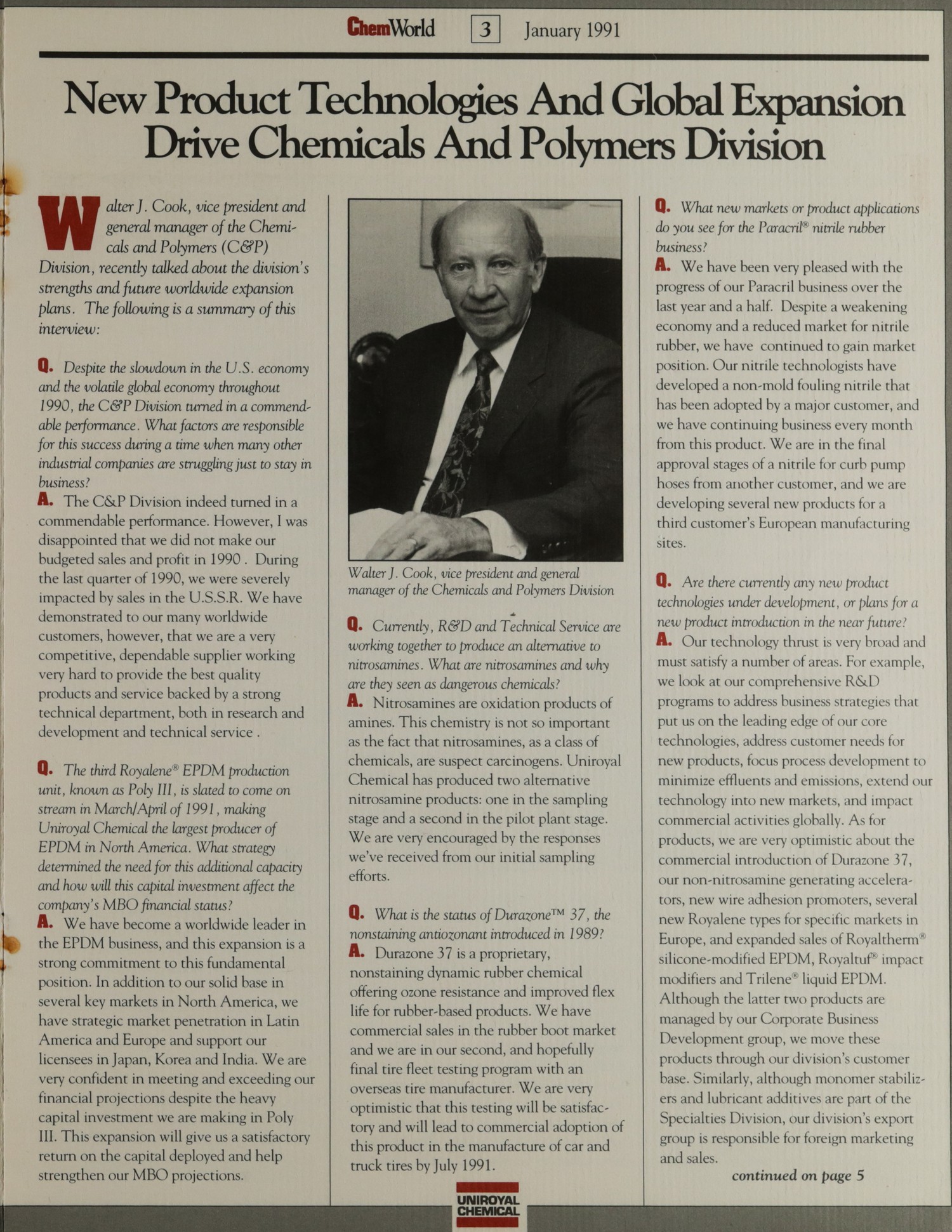
Walter J. Cook, vice president and general manager of the Chemicals and Polymers Division


Q. Currently, R&D and Technical Service are working together to produce an alternative to nitrosamines. What are nitrosamines and why are they seen as dangerous chemicals?

A. Nitrosamines are oxidation products of amines. This chemistry is not so important as the fact that nitrosamines, as a class of chemicals, are suspect carcinogens. Uniroyal Chemical has produced two alternative nitrosamine products: one in the sampling stage and a second in the pilot plant stage. We are very encouraged by the responses we’ve received from our initial sampling efforts.

Q. What is the status of Durazone™ 37, the nonstaining antiozonant introduced in 1989?

A. Durazone 37 is a proprietary, nonstaining dynamic rubber chemical offering ozone resistance and improved flex life for rubber-based products. We have commercial sales in the rubber boot market and we are in our second, and hopefully final tire fleet testing program with an overseas tire manufacturer. We are very optimistic that this testing will be satisfactory and will lead to commercial adoption of this product in the manufacture of car and truck tires by July 1991.


Q. What new markets or product applications do you see for the Paracril® nitrile rubber business?

A. We have been very pleased with the progress of our Paracril business over the last year and a half. Despite a weakening economy and a reduced market for nitrile rubber, we have continued to gain market position. Our nitrile technologists have developed a non-mold fouling nitrile that has been adopted by a major customer, and we have continuing business every month from this product. We are in the final approval stages of a nitrile for curb pump hoses from another customer, and we are developing several new products for a third customer’s European manufacturing sites.

Q. Are there currently any new product technologies under development, or plans for a new product introduction in the near future?

A. Our technology thrust is very broad and must satisfy a number of areas. For example, we look at our comprehensive R&D programs to address business strategies that put us on the leading edge of our core technologies, address customer needs for new products, focus process development to minimize effluents and emissions, extend our technology into new markets, and impact commercial activities globally. As for products, we are very optimistic about the commercial introduction of Durazone 37, our non-nitrosamine generating accelerators, new wire adhesion promoters, several new Royalene types for specific markets in Europe, and expanded sales of Royaltherm® silicone-modified EPDM, Royaltuf® impact modifiers and Trilene® liquid EPDM. Although the latter two products are managed by our Corporate Business Development group, we move these products through our division’s customer base. Similarly, although monomer stabilizers and lubricant additives are part of the Specialties Division, our division’s export group is responsible for foreign marketing and sales.

continued on page 5


UNIROYAL CHEMICAL

ChemWorld – Page 2

Page 002

ChemWorld | 2 | January 1991


Uniroyal Chemical Aids U.S.S.R. Cotton Industry

In the spirit of glasnost, Uniroyal Chemical recently launched an integrated cotton improvement program in the U.S.S.R., symbolizing its commitment to developing business in Soviet Central Asia. The program represents a giant step towards establishing Uniroyal Chemical as a leader in worldwide harvest aid technology.

SIBIR, Inc., USA, a business development/consulting firm which has a joint venture in Soviet Central Asia to advance the cotton industry, approached Uniroyal Chemical to help the Soviet cotton industry develop harvest aids, and ultimately to become more competitive.

“The Soviets grow excellent cotton, but haven’t yet mastered harvesting techniques,” said David Cote, marketing manager for plant growth regulators and herbicides, Crop Protection Division of Uniroyal Chemical. “Our technical teams from the U.S. and Langley, England offices assisted in establishing the research protocols for selecting inputs for their cotton improvement program.” Field testing is now underway to evaluate those inputs. If all goes well, the program could result in multi-million dollar sales of American products, including Harvade® harvest growth regulant.

Uniroyal Chemical technical teams have provided field development assistance to Uzbekistan, a republic of the U.S.S.R., which grows over 4.5 million acres of cotton, and accounts for 65 percent of the country’s cotton industry. Recently, the Soviet team, which includes three delegates from Uzbekistan, toured the top U.S. cotton growing areas in the Mississippi Delta and California (see sidebar).

More than half of Uniroyal Chemical’s agricultural business is outside of the United States. The U.S.S.R. has been a large importer of Vitavax® fungicide for cereal grain production. Uniroyal Chemical is well-positioned to expand this business further to develop agricultural marketplaces worldwide. ■


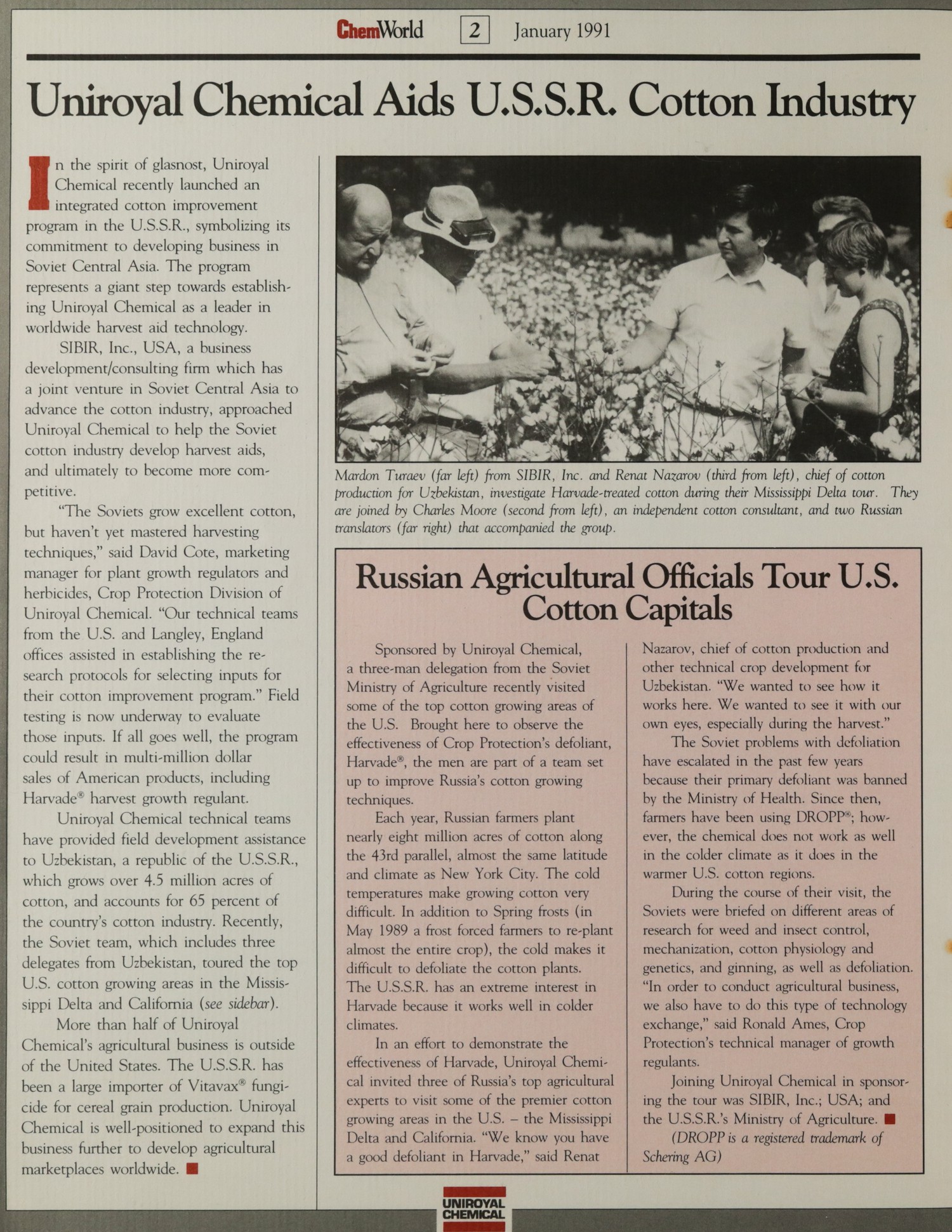
Mardon Turaev (far left) from SIBIR, Inc. and Renat Nazarov (third from left), chief of cotton production for Uzbekistan, investigate Harvade-treated cotton during their Mississippi Delta tour. They are joined by Charles Moore (second from left), an independent cotton consultant, and two Russian translators (far right) that accompanied the group.


Russian Agricultural Officials Tour U.S. Cotton Capitals

Sponsored by Uniroyal Chemical, a three-man delegation from the Soviet Ministry of Agriculture recently visited some of the top cotton growing areas of the U.S. Brought here to observe the effectiveness of Crop Protection’s defoliant, Harvade®, the men are part of a team set up to improve Russia’s cotton growing techniques.

Each year, Russian farmers plant nearly eight million acres of cotton along the 43rd parallel, almost the same latitude and climate as New York City. The cold temperatures make growing cotton very difficult. In addition to Spring frosts (in May 1989 a frost forced farmers to re-plant almost the entire crop), the cold makes it difficult to defoliate the cotton plants. The U.S.S.R. has an extreme interest in Harvade because it works well in colder climates.

In an effort to demonstrate the effectiveness of Harvade, Uniroyal Chemical invited three of Russia’s top agricultural experts to visit some of the premier cotton growing areas in the U.S. – the Mississippi Delta and California. “We know you have a good defoliant in Harvade,” said Renat

Nazarov, chief of cotton production and other technical crop development for Uzbekistan. “We wanted to see how it works here. We wanted to see it with our own eyes, especially during the harvest.”

The Soviet problems with defoliation have escalated in the past few years because their primary defoliant was banned by the Ministry of Health. Since then, farmers have been using DROPP®; however, the chemical does not work as well in the colder climate as it does in the warmer U.S. cotton regions.

During the course of their visit, the Soviets were briefed on different areas of research for weed and insect control, mechanization, cotton physiology and genetics, and ginning, as well as defoliation. “In order to conduct agricultural business, we also have to do this type of technology exchange,” said Ronald Ames, Crop Protection’s technical manager of growth regulants.

Joining Uniroyal Chemical in sponsoring the tour was SIBIR, Inc.; USA; and the U.S.S.R.’s Ministry of Agriculture. ■

(DROPP is a registered trademark of Schering AG)


UNIROYAL CHEMICAL

ChemWorld – Page 7

Page 007

ChemWorld | 7 | January 1990


Technical Publishers Honored At Uniroyal Chemical’s Author Recognition Program

Forty-five Uniroyal Chemical Company employees were recognized in October 1989 at the Authors Recognition Program, which acknowledges staff members who have published in a professional journal or have presented a technical paper before a major scientific organization.

Established in 1983 and held every two years, the Authors Recognition Program helps to promote the reputation of Uniroyal Chemical Company and its technical staff as industry innovators and contributors to the scientific community. To date, over 95 Uniroyal Chemical employees have been recognized for their accomplishments in this area.

The Authors Recognition Committee is comprised of: Dr. Emmanuel G. Kontos, manager of elastomers technology; Robert C. LaClair, specialty chemicals technical sales service manager; and Allen R. Blem, registration specialist.

Distinguished Authors

Chemicals and Polymers

| Allen, R.D. (2) | Paolino, P.R. |
| Barnhart, R.R. | Peterson, H.A. |
| Cesare, F.C. (3) | Perrella, A.V. |
| Davies, T.J. | Sheridan, D.F., Jr. (2) |
| Farber, M. | Synnott, D.J. (2) |
| Hong, S.W. (2) | Tomlinson, R.W. |
| Jablonowski, T.L. (3) | Tredinnick, D.W. |
| Mazzeo, R.A. (2) | Tweedie, R.W. |

Crop Protection

| Bell, A.R. | Lai, H.K. |
| Blem, A.R. | Mishra, A. |
| Borth, D.M. | Moore, E.L. |
| Brouwer, W.G. | Moore, R.C. |
| Burger, R.N. | Parkins, M.D. |
| Cole, L.P. | Polakoff, B.M. |
| Covey, R.A. | Relyea, D.I. (3) |
| Dekeyser, M.A. (2) | Rockwell, J. |
| Kelley, K.L. | Shadbolt, C.A. |
| Kulka, M. | von Schmeling, B. |

Specialties

| Abruscato, G.J. | Rosenberg, R.O. |
| Chucta, T.M. | Singh, A. |
| Horng, P.L. | Stott, P.E. |
| McKinstry, P.H. | Zawacki, C.A. |
| Ricci, V. | |

( ) signifies multiple presentations


[PHOTOGRAPH]

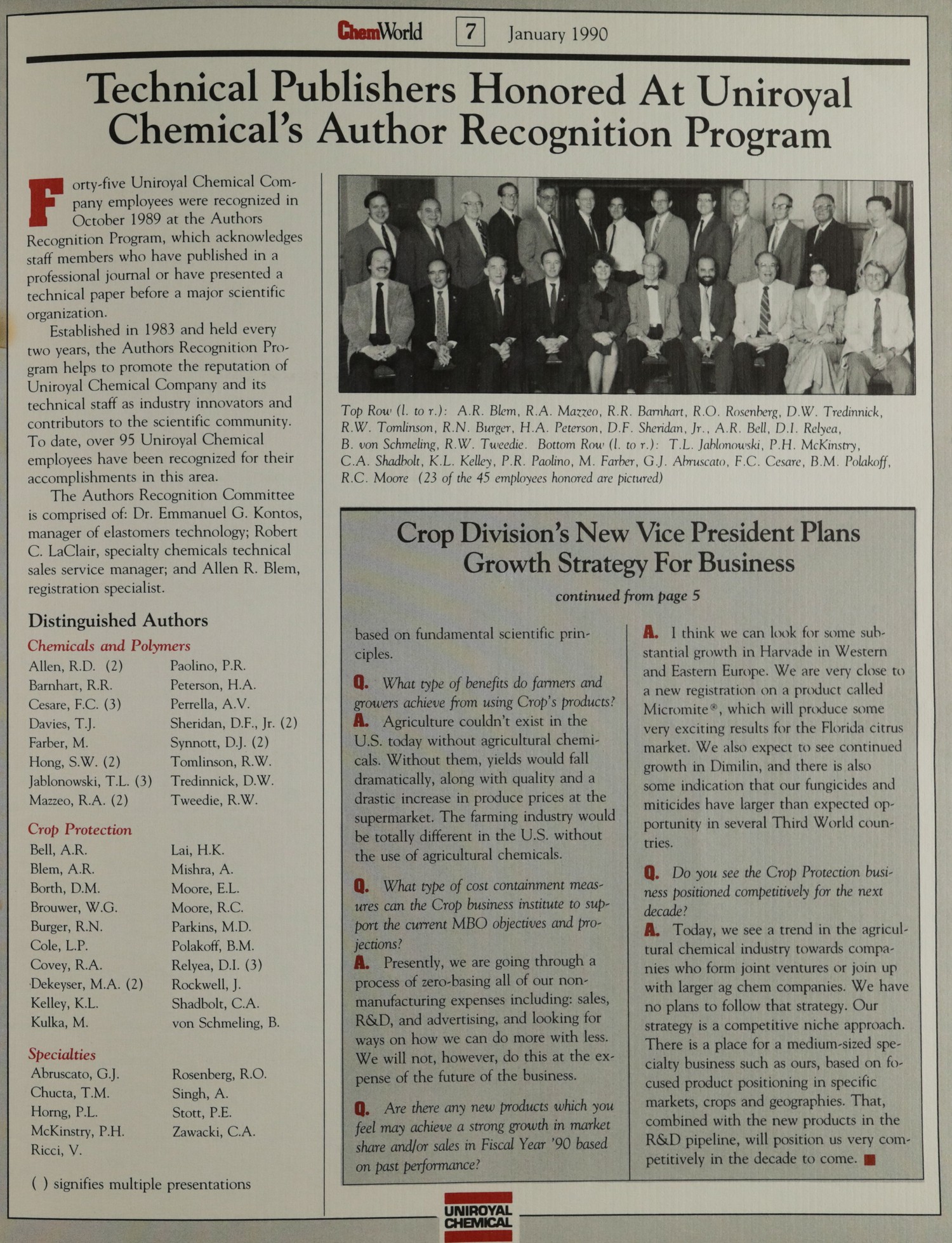
Top Row (l. to r.): A.R. Blem, R.A. Mazzeo, R.R. Barnhart, R.O. Rosenberg, D.W. Tredinnick, R.W. Tomlinson, R.N. Burger, H.A. Peterson, D.F. Sheridan, Jr., A.R. Bell, D.I. Relyea, B. von Schmeling, R.W. Tweedie. Bottom Row (l. to r.): T.L. Jablonowski, P.H. McKinstry, C.A. Shadbolt, K.L. Kelley, P.R. Paolino, M. Farber, G.J. Abruscato, F.C. Cesare, B.M. Polakoff, R.C. Moore (23 of the 45 employees honored are pictured)


Crop Division’s New Vice President Plans Growth Strategy For Business

continued from page 5

based on fundamental scientific principles.

Q. What type of benefits do farmers and growers achieve from using Crop’s products?

A. Agriculture couldn’t exist in the U.S. today without agricultural chemicals. Without them, yields would fall dramatically, along with quality and a drastic increase in produce prices at the supermarket. The farming industry would be totally different in the U.S. without the use of agricultural chemicals.

Q. What type of cost containment measures can the Crop business institute to support the current MBO objectives and projections?

A. Presently, we are going through a process of zero-basing all of our non-manufacturing expenses including: sales, R&D, and advertising, and looking for ways on how we can do more with less. We will not, however, do this at the expense of the future of the business.

Q. Are there any new products which you feel may achieve a strong growth in market share and/or sales in Fiscal Year ’90 based on past performance?

A. I think we can look for some substantial growth in Harvade in Western and Eastern Europe. We are very close to a new registration on a product called Micromite®, which will produce some very exciting results for the Florida citrus market. We also expect to see continued growth in Dimilin, and there is also some indication that our fungicides and miticides have larger than expected opportunity in several Third World countries.

Q. Do you see the Crop Protection business positioned competitively for the next decade?

A. Today, we see a trend in the agricultural chemical industry towards companies who form joint ventures or join up with larger ag chem companies. We have no plans to follow that strategy. Our strategy is a competitive niche approach. There is a place for a medium-sized specialty business such as ours, based on focused product positioning in specific markets, crops and geographies. That, combined with the new products in the R&D pipeline, will position us very competitively in the decade to come. ■


UNIROYAL CHEMICAL

ChemWorld – Page 1

Page 001

ChemWorld

Published by Uniroyal Chemical Co. for its Employees and Retirees January 1990


Contents

’89 Quality Symposium . . . . . . . . 2
Uniroyal of Canada Awarded . . . 3
Preparing For Future Markets . . 4
Ingulli Plans Growth Strategy . . . 5
Simon Receives Career Award . . 6
ChemWorld Briefs . . . . . . . . . . . 8


New Chapter Unfolds Following Management Buyout

On Monday, October 30, 1989, Uniroyal Chemical Company completed the management buyout of the company from Avery, Inc. for a price of $800 million, which signifies the beginning of a new era for the company.

“This purchase has put Uniroyal Chemical’s future directly where it belongs: into the hands of those who know its business best — Uniroyal Chemical’s current management,” stated Uniroyal Chemical president and chief executive officer Robert J. Mazaika. “We believe this strengthens the company’s management position and will reinforce our reputation as an energetic, progressive and growing company with long-term vision toward the future.”

The new owners, an experienced management team with a high level of commitment to the company’s future financial success, intend to broaden its technical base and penetrate new growth markets that will enhance Uniroyal Chemical’s strategic position worldwide.

Over the past three years, the company has increased sales by 48 percent, maintained a high profit margin, and expanded its markets, both domestically and internationally.

“We intend to extend Uniroyal Chemical’s solid record of aggressive growth and build on our past sales successes,” said Mazaika. “We will be looking for more opportunities for joint ventures and licensing agreements.”

Today, Uniroyal Chemical holds leading marketing positions in many of its markets


TODAY, THE EMPLOYEES OF UNIROYAL CHEMICAL HAVE REASON TO CELEBRATE.

[IMAGE: Group photo of employees]

Announcing the Management Buyout of Uniroyal Chemical

UNIROYAL CHEMICAL’S MANAGEMENT ANNOUNCES A BUYOUT THAT’S NOT THE LEAST BIT HOSTILE.

[IMAGE: Corporate advertisement with Uniroyal Chemical logo]

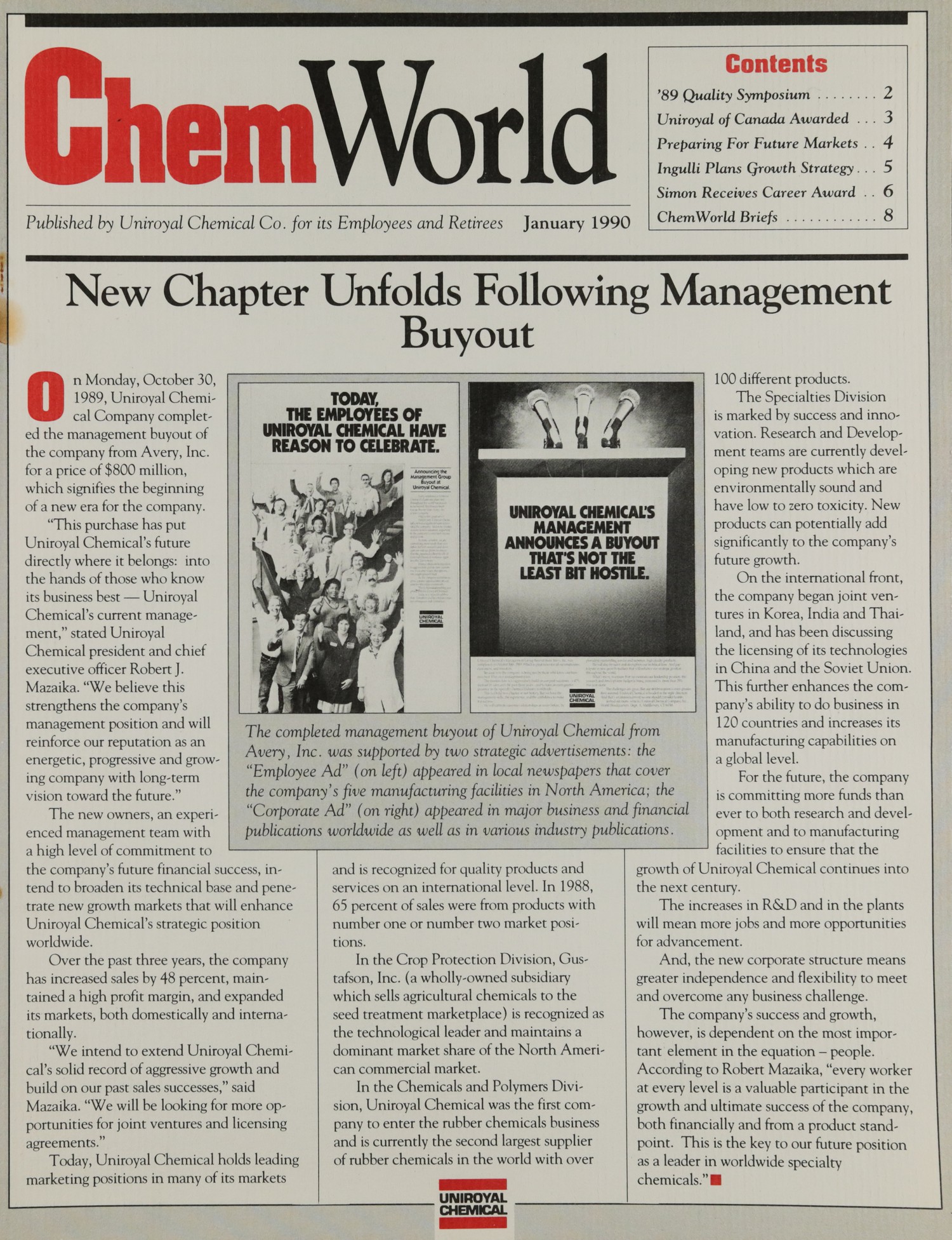
The completed management buyout of Uniroyal Chemical from Avery, Inc. was supported by two strategic advertisements: the “Employee Ad” (on left) appeared in local newspapers that cover the company’s five manufacturing facilities in North America; the “Corporate Ad” (on right) appeared in major business and financial publications worldwide as well as in various industry publications.


and is recognized for quality products and services on an international level. In 1988, 65 percent of sales were from products with number one or number two market positions.

In the Crop Protection Division, Gustafson, Inc. (a wholly-owned subsidiary which sells agricultural chemicals to the seed treatment marketplace) is recognized as the technological leader and maintains a dominant market share of the North American commercial market.

In the Chemicals and Polymers Division, Uniroyal Chemical was the first company to enter the rubber chemicals business and is currently the second largest supplier of rubber chemicals in the world with over

100 different products.

The Specialties Division is marked by success and innovation. Research and Development teams are currently developing new products which are environmentally sound and have low to zero toxicity. New products can potentially add significantly to the company’s future growth.

On the international front, the company began joint ventures in Korea, India and Thailand, and has been discussing the licensing of its technologies in China and the Soviet Union. This further enhances the company’s ability to do business in 120 countries and increases its manufacturing capabilities on a global level.

For the future, the company is committing more funds than ever to both research and development and to manufacturing facilities to ensure that the growth of Uniroyal Chemical continues into the next century.

The increases in R&D and in the plants will mean more jobs and more opportunities for advancement.

And, the new corporate structure means greater independence and flexibility to meet and overcome any business challenge.

The company’s success and growth, however, is dependent on the most important element in the equation – people. According to Robert Mazaika, “every worker at every level is a valuable participant in the growth and ultimate success of the company, both financially and from a product standpoint. This is the key to our future position as a leader in worldwide specialty chemicals.” ■


UNIROYAL CHEMICAL

ChemWorld – Page 3

Page 003

ChemWorld | 3 | January 1990


Uniroyal Chemical Of Canada Wins Canadian Government National Quality Award

In November 1989, Uniroyal Chemical Ltd. of Elmira, Ontario, Canada won the national silver award for quality excellence. This award represents one of Canada’s top honors, which rate the quality of a company’s products and services.

The award was presented to Uniroyal Chemical’s general manager Wally Ruck by Harvie Andres, Federal Minister for Industry, Science and Technology, representing the Canada Awards for Business Excellence Program.

“It was a rigorous and tough review by professionals who had no association with the company,” said Ruck. “That’s what makes the Canada Award for Business Excellence so significant. It’s based on a totally independent study and analysis of our operations and procedures.”

More than 80 companies throughout Canada entered the quality competition but only 15 companies were chosen to participate in extensive, independent reviews to select the winners.

According to Robert J. Mazaika, president and CEO of Uniroyal Chemical Company, “Winning the Canada Award for Business Excellence is a tribute to the hard work and dedication shown by Uniroyal Chemical employees in Elmira and throughout Canada. Our challenge now is to continue to improve on the quality of our products and services both in the U.S. and internationally, as we position ourselves as a worldwide specialty chemical leader with outstanding product quality and technical service excellence.”

Other Uniroyal Chemical individuals joining Mr. Mazaika at the recent Awards Ceremony in Ottawa were: Walter Cook, vice president and general manager of Chemicals and Polymers (international); Ken Jessop, quality assurance manager; Richard Hooper, production manager; David Ash, manufacturing manager; Gary Schaefer, local union president; Vladimir Veres and Sudarshan Shinh, production workers; and Mr. Ruck.

Uniroyal Chemical Ltd. of Elmira manufactures rubber chemicals for the tire and non-tire industry; agricultural chemicals primarily for seed treatment; castable urethane prepolymers used in products that include conveyor belts and roller skate wheels; and specialty chemicals used in synthetic lubricants. ■


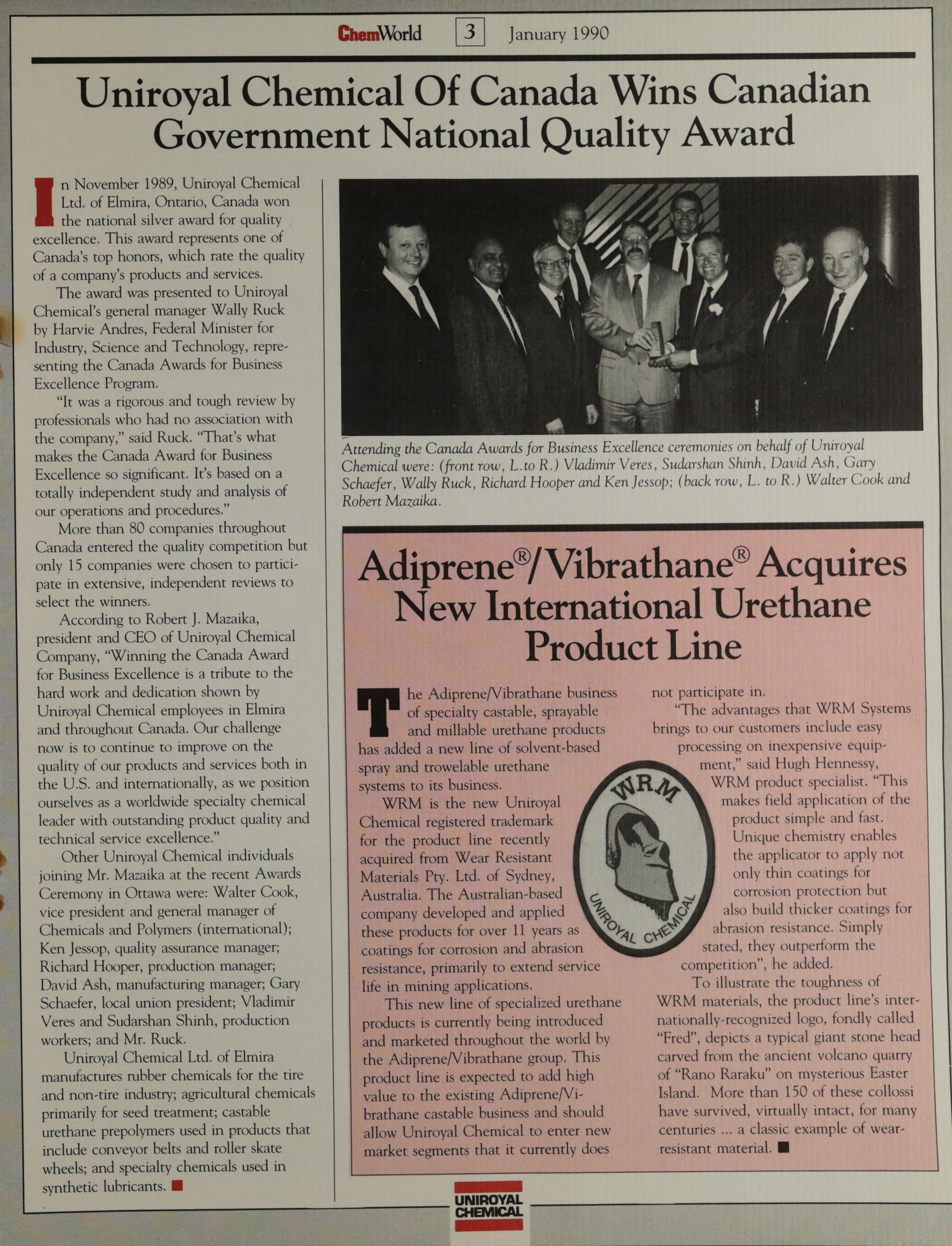
Attending the Canada Awards for Business Excellence ceremonies on behalf of Uniroyal Chemical were: (front row, L. to R.) Vladimir Veres, Sudarshan Shinh, David Ash, Gary Schaefer, Wally Ruck, Richard Hooper and Ken Jessop; (back row, L. to R.) Walter Cook and Robert Mazaika.


Adiprene®/Vibrathane® Acquires New International Urethane Product Line

The Adiprene/Vibrathane business of specialty castable, sprayable and millable urethane products has added a new line of solvent-based spray and trowelable urethane systems to its business.

WRM is the new Uniroyal Chemical registered trademark for the product line recently acquired from Wear Resistant Materials Pty. Ltd. of Sydney, Australia. The Australian-based company developed and applied these products for over 11 years as coatings for corrosion and abrasion resistance, primarily to extend service life in mining applications.

This new line of specialized urethane products is currently being introduced and marketed throughout the world by the Adiprene/Vibrathane group. This product line is expected to add high value to the existing Adiprene/Vibrathane castable business and should allow Uniroyal Chemical to enter new market segments that it currently does not participate in.

“The advantages that WRM Systems brings to our customers include easy processing on inexpensive equipment,” said Hugh Hennessy, WRM product specialist. “This makes field application of the product simple and fast. Unique chemistry enables the applicator to apply not only thin coatings for corrosion protection but also build thicker coatings for abrasion resistance. Simply stated, they outperform the competition”, he added.

To illustrate the toughness of WRM materials, the product line’s internationally-recognized logo, fondly called “Fred”, depicts a typical giant stone head carved from the ancient volcano quarry of “Rano Raraku” on mysterious Easter Island. More than 150 of these collossi have survived, virtually intact, for many centuries … a classic example of wear-resistant material. ■


UNIROYAL CHEMICAL

ChemWorld – Page 4

Page 004

ChemWorld | 4 | January 1990


Uniroyal Chemical Prepares For Future Market Demands

Uniroyal Chemical Company is preparing for continued competition in the European market by seeking “International” recognition of its Quality System.

The company is seeking accreditation based upon a Quality System Standard prepared by the International Standards Organization (ISO); specifically, ISO 9000.

In order to receive the accreditation, Uniroyal Chemical will undergo a detailed


The company’s capability to perform against the ISO’s quality standards will determine whether it will receive accreditation. This, in turn, will facilitate Uniroyal Chemical’s continued business growth in the European markets.


examination of each department’s Quality System. Sales order entry, customer service procedures, operation and control of the manufacturing processes, laboratory testing, product packaging and shipping are among the many areas which will be evaluated against the International Standards. The company’s capability to perform against these quality standards will determine whether it will receive accreditation. This, in turn, will facilitate Uniroyal Chemical’s continued business growth in the European markets.

Several of Uniroyal Chemical’s manufacturing sites are presently involved in assessing their quality systems against the ISO 9000 standards, with Geismar, LA and Latina, Italy seeking accreditation in 1990. ■


Two Annual Winners Selected From Uniroyal Chemical’s Quality Recognition Program

In November 1989, two Annual Quality Recognition Award winners were formally recognized for their accomplishments in a ceremony in Baton Rouge, LA.

Peter Hare, a technician based in Elmira, Canada, was recognized for his outstanding achievements of streamlining and improving a ten-year-old Naugard® production process. The results were increased productivity, improved quality, decreased labor and less down-time.

The production team of Ken Van Zandt, David Craig and Randy Simon, located in Geismar, LA, used their initiative and creativity to identify a major potential source of gel contamination to the Royalene® EPDM process – a problem that had existed since production began over twenty-five years ago.

The Uniroyal Chemical Quality Recognition Program began its second successful year on October 1, 1989. ■

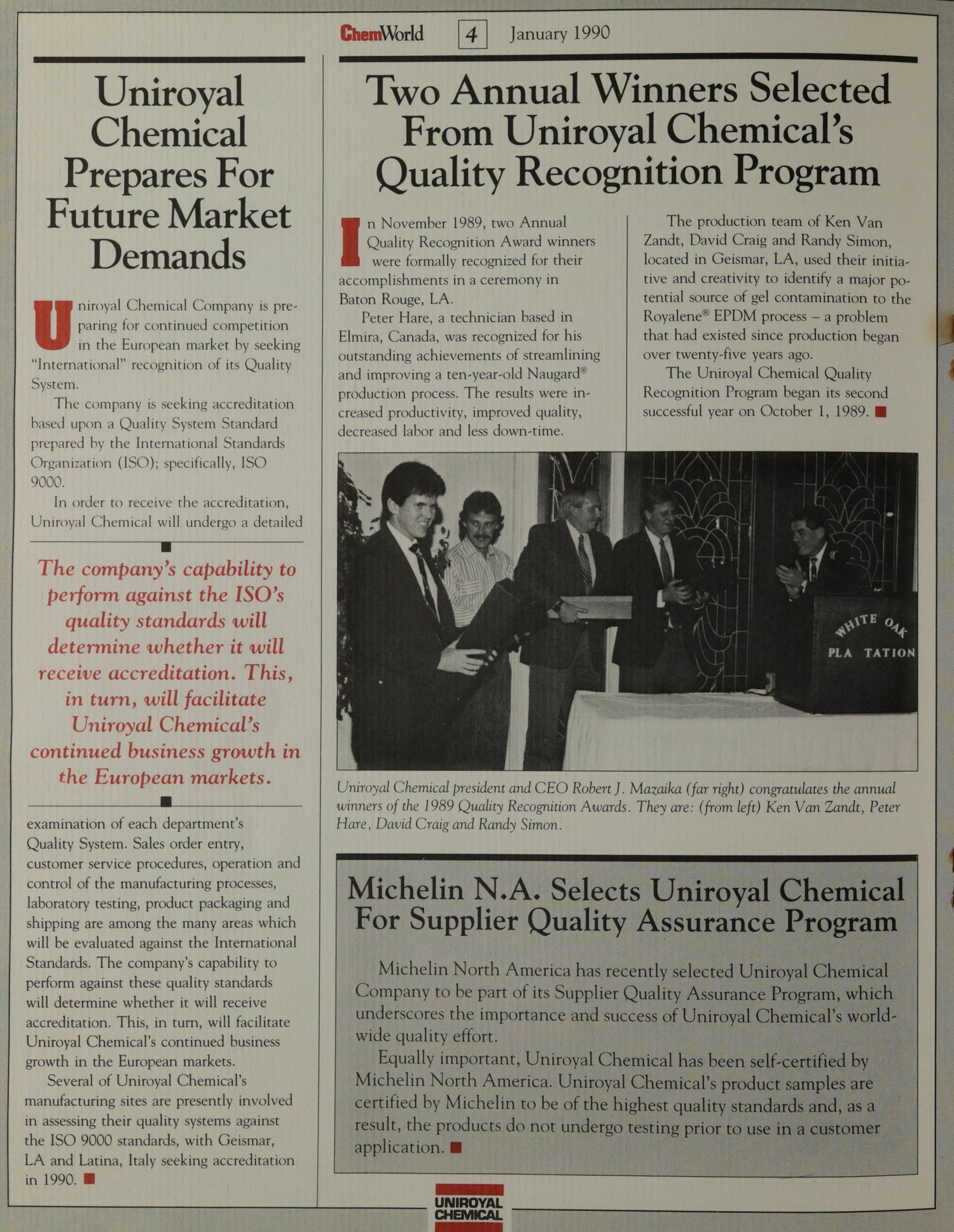
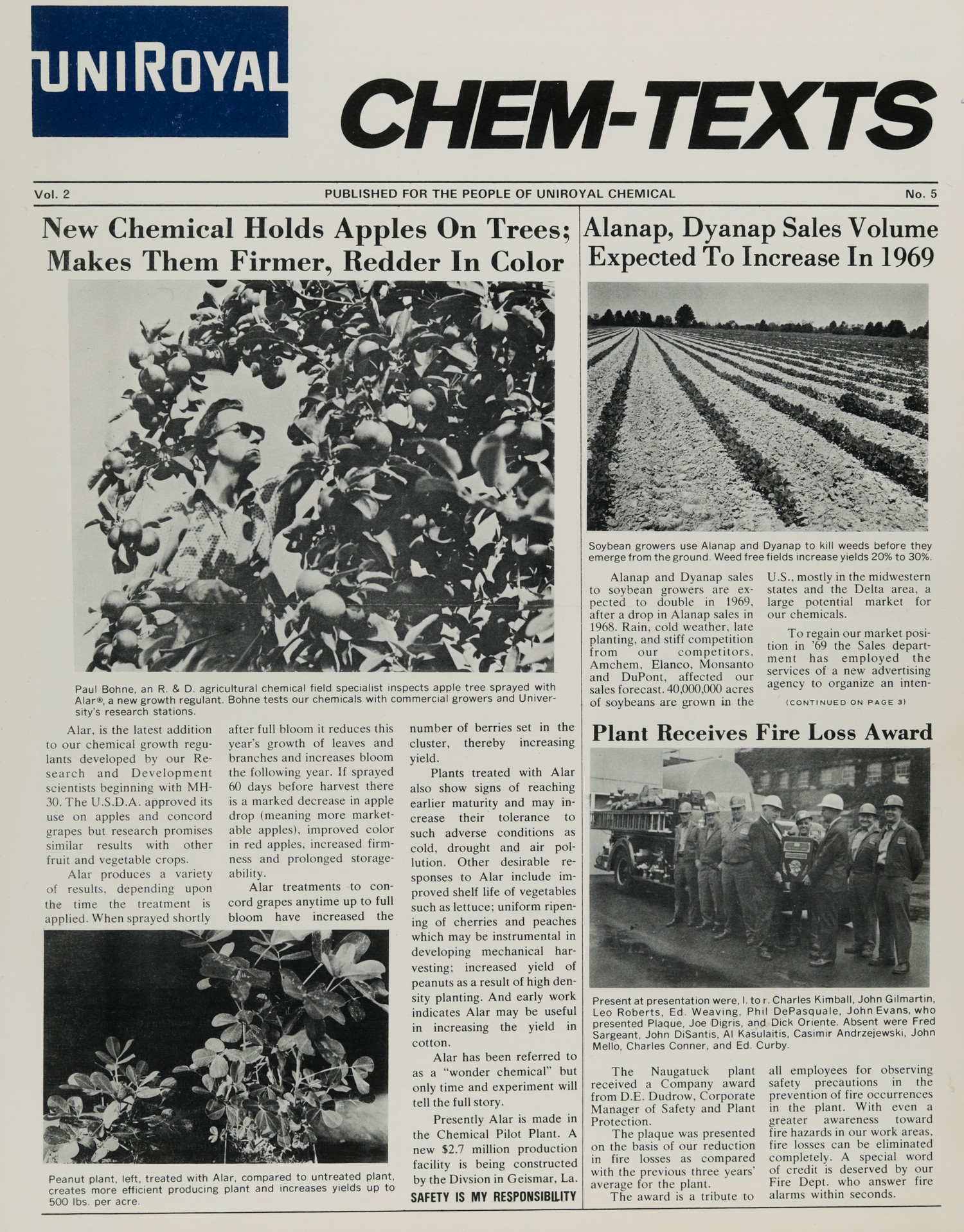
Uniroyal Chemical president and CEO Robert J. Mazaika (far right) congratulates the annual winners of the 1989 Quality Recognition Awards. They are: (from left) Ken Van Zandt, Peter Hare, David Craig and Randy Simon.


Michelin N.A. Selects Uniroyal Chemical For Supplier Quality Assurance Program

Michelin North America has recently selected Uniroyal Chemical Company to be part of its Supplier Quality Assurance Program, which underscores the importance and success of Uniroyal Chemical’s worldwide quality effort.

Equally important, Uniroyal Chemical has been self-certified by Michelin North America. Uniroyal Chemical’s product samples are certified by Michelin to be of the highest quality standards and, as a result, the products do not undergo testing prior to use in a customer application. ■


UNIROYAL CHEMICAL

ChemWorld – Page 5

Page 005

ChemWorld | 5 | January 1990


Crop Division’s New Vice President Plans Growth Strategy For Business

Newly-appointed Vice President and General Manager of Uniroyal Chemical’s Crop Protection division, Alfred F. Ingulli, discussed with CHEMWORLD future strategies and areas of potential growth for the company’s crop protection business. The following is a summary of this conversation:

Q. What new plans or strategies do you intend to pursue for the Crop Protection business?

A. My objective for the Crop Protection business is to have its earnings as a percent of sales equal to 17%, which is the company average for return on sales. We plan to accomplish this through a combination of volume growth of existing and new products, aggressive pricing in the marketplace, and a prudent management of costs.

Q. Crop Protection turned in a fine performance on an international level in Fiscal Year 1989. Do you anticipate continued growth internationally?

A. I believe we have done a good job positioning our products where they belong. From a pricing and end-use standpoint, I feel there is still plenty of untapped opportunity, particularly in developing countries like China, Poland and the USSR, to duplicate what we’ve done in the U.S. In particular, I see opportunities for Omite® and Vitavax®, the seed treatment area in general, and for Harvade® specifically in Europe.

Q. Are there currently any new product technologies under development, or plans for a new product introduction in the near future?

A. We have a number of exciting new products in market development or in the R&D pipeline. Harvade and Dimilin® are two examples of new products that are in the introductory stage with sales taking off and growing substantially. We also have two exciting herbicides in the R&D pipeline, with plans to begin selling one this year in the off-shore market. We anticipate a very bright future for both of these products when we fully commercialize them.

Q. Given the fact that the overall agricultural chemical industry is currently under a great deal of fire from environmentalists, do


[PHOTO: Black and white portrait photograph of a man in glasses wearing a suit]

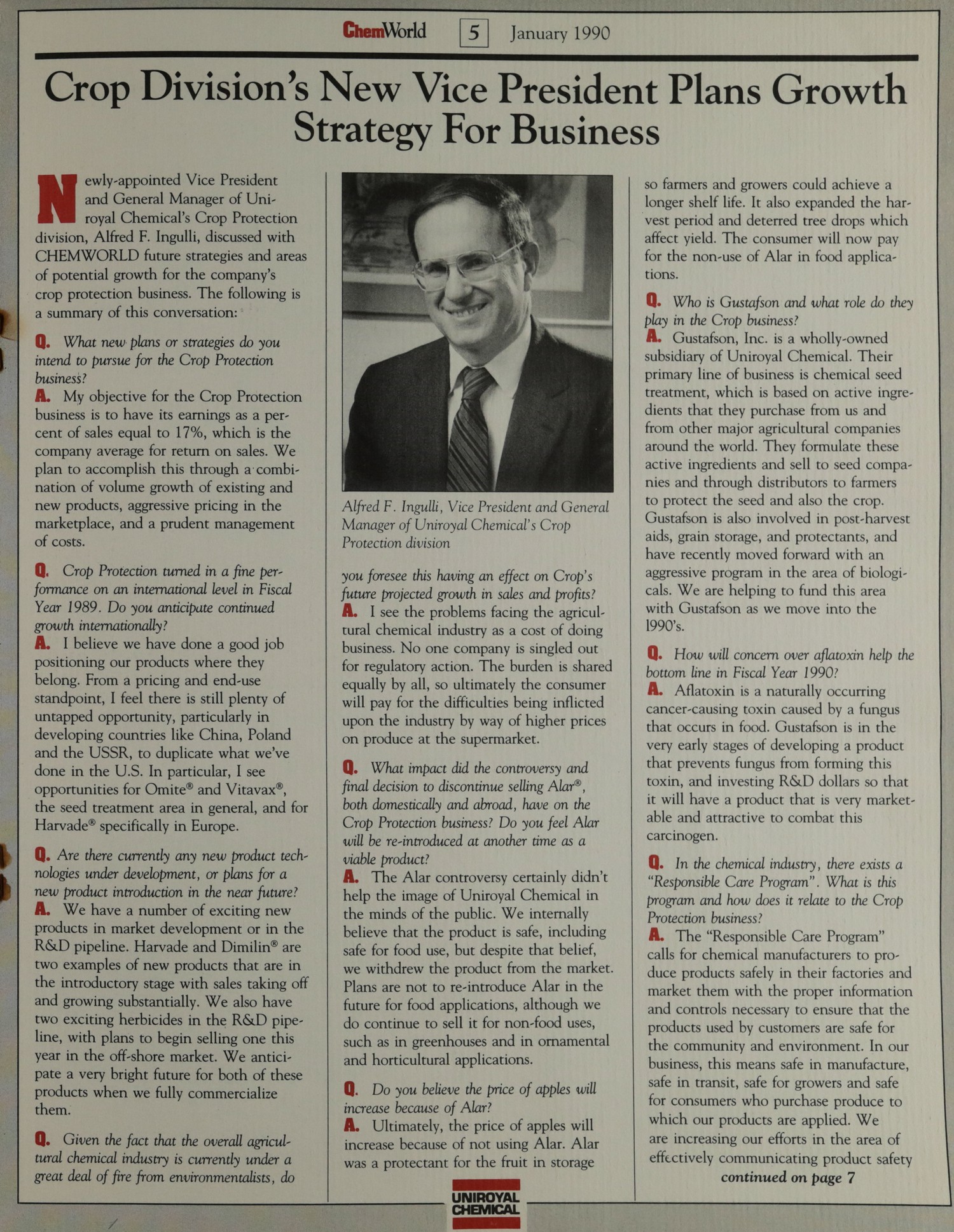
Alfred F. Ingulli, Vice President and General Manager of Uniroyal Chemical’s Crop Protection division


you foresee this having an effect on Crop’s future projected growth in sales and profits?

A. I see the problems facing the agricultural chemical industry as a cost of doing business. No one company is singled out for regulatory action. The burden is shared equally by all, so ultimately the consumer will pay for the difficulties being inflicted upon the industry by way of higher prices on produce at the supermarket.

Q. What impact did the controversy and final decision to discontinue selling Alar®, both domestically and abroad, have on the Crop Protection business? Do you feel Alar will be re-introduced at another time as a viable product?

A. The Alar controversy certainly didn’t help the image of Uniroyal Chemical in the minds of the public. We internally believe that the product is safe, including safe for food use, but despite that belief, we withdrew the product from the market. Plans are not to re-introduce Alar in the future for food applications, although we do continue to sell it for non-food uses, such as in greenhouses and in ornamental and horticultural applications.

Q. Do you believe the price of apples will increase because of Alar?

A. Ultimately, the price of apples will increase because of not using Alar. Alar was a protectant for the fruit in storage

so farmers and growers could achieve a longer shelf life. It also expanded the harvest period and deterred tree drops which affect yield. The consumer will now pay for the non-use of Alar in food applications.

Q. Who is Gustafson and what role do they play in the Crop business?

A. Gustafson, Inc. is a wholly-owned subsidiary of Uniroyal Chemical. Their primary line of business is chemical seed treatment, which is based on active ingredients that they purchase from us and from other major agricultural companies around the world. They formulate these active ingredients and sell to seed companies and through distributors to farmers to protect the seed and also the crop. Gustafson is also involved in post-harvest aids, grain storage, and protectants, and have recently moved forward with an aggressive program in the area of biologicals. We are helping to fund this area with Gustafson as we move into the 1990’s.

Q. How will concern over aflatoxin help the bottom line in Fiscal Year 1990?

A. Aflatoxin is a naturally occurring cancer-causing toxin caused by a fungus that occurs in food. Gustafson is in the very early stages of developing a product that prevents fungus from forming this toxin, and investing R&D dollars so that it will have a product that is very marketable and attractive to combat this carcinogen.

Q. In the chemical industry, there exists a “Responsible Care Program”. What is this program and how does it relate to the Crop Protection business?

A. The “Responsible Care Program” calls for chemical manufacturers to produce products safely in their factories and market them with the proper information and controls necessary to ensure that the products used by customers are safe for the community and environment. In our business, this means safe in manufacture, safe in transit, safe for growers and safe for consumers who purchase produce to which our products are applied. We are increasing our efforts in the area of effectively communicating product safety

continued on page 7


UNIROYAL CHEMICAL

ChemWorld – Page 6

Page 006

ChemWorld | 6 | January 1990


Rubber Chemicals Introduces New Nonstaining Antiozonant

In October 1989, Uniroyal Chemical’s Rubber Chemicals Division announced that it developed a new rubber chemical which represents a milestone in leading edge technology for the rubber industry.

Durazone™ 37 is unique because it offers excellent nonstaining static and dynamic ozone resistance, improved flex life and serves as an excellent antioxidant for natural and synthetic rubber. This outstanding resistance to ozone without staining has never before been attainable with an antiozonant.

According to Dr. Joseph B. Eisenberg, Uniroyal Chemical’s former Rubber Chemicals business manager, “Durazone™ 37 represents a major break-

through for the rubber chemicals industry. As a nonstaining antiozonant, its key benefits will permit our customers and the rub-

ber industry to achieve a higher level of product quality, and solve a significant problem at the same time. We are confident that Durazone™ 37 will not only provide the tire industry with a technological advantage, but will also prove successful in other market (rubber) applications as well.”

The primary application of Durazone™ 37 is in tire sidewalls and is also recommended for use in almost any rubber product where nonstaining static and dynamic ozone and aging protection are required. It is especially effective in natural rubber, and in blends of NR with olefin-based rubbers such as Uniroyal Chemical’s line of Royalene® EPDM polymers, and Trilene® liquid EPDM polymers. ■


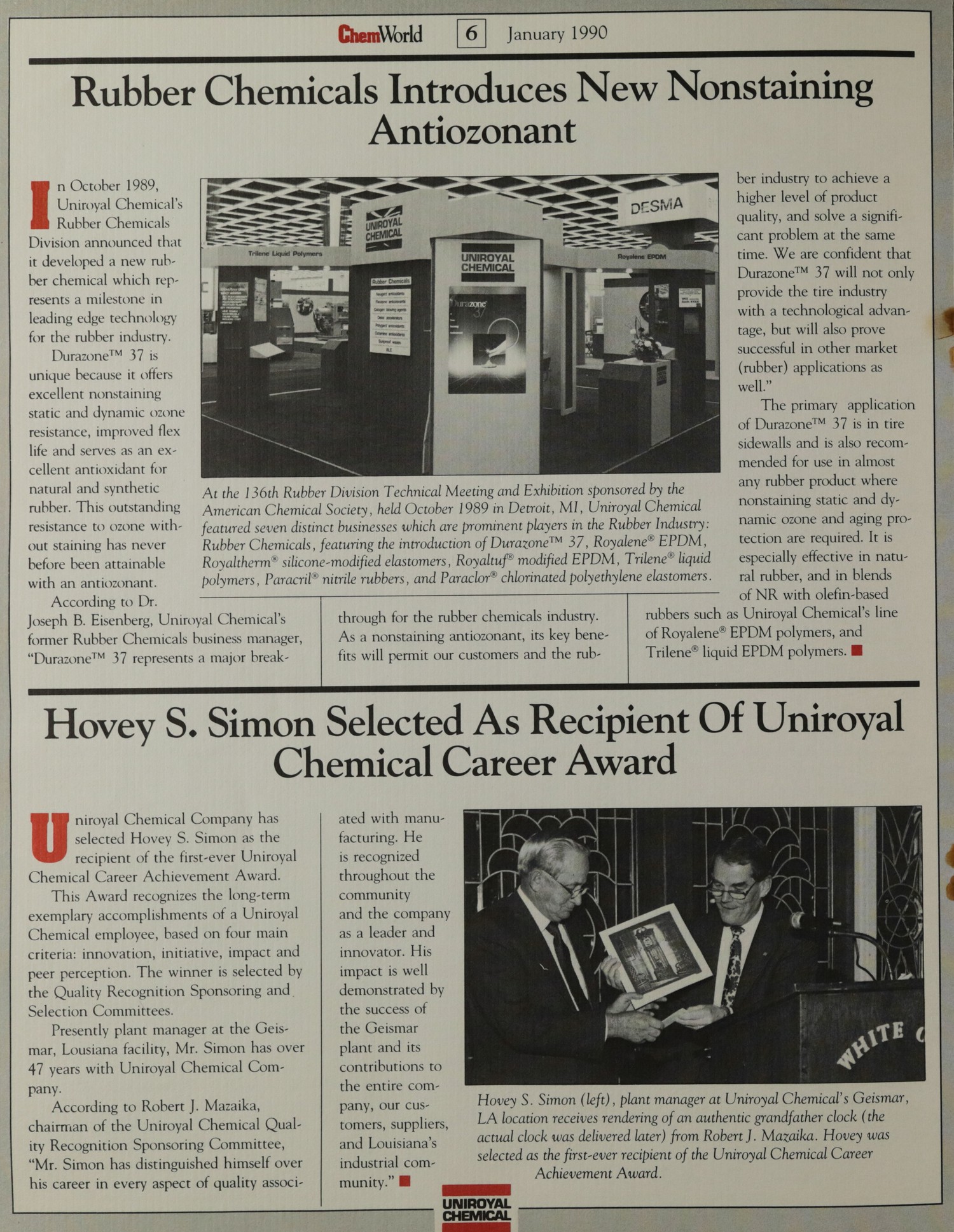
At the 136th Rubber Division Technical Meeting and Exhibition sponsored by the American Chemical Society, held October 1989 in Detroit, MI, Uniroyal Chemical featured seven distinct businesses which are prominent players in the Rubber Industry: Rubber Chemicals, featuring the introduction of Durazone™ 37, Royalene® EPDM, Royaltherm® silicone-modified elastomers, Royaltuf® modified EPDM, Trilene® liquid polymers, Paracril® nitrile rubbers, and Paraclor® chlorinated polyethylene elastomers.


Hovey S. Simon Selected As Recipient Of Uniroyal Chemical Career Award

Uniroyal Chemical Company has selected Hovey S. Simon as the recipient of the first-ever Uniroyal Chemical Career Achievement Award.

This Award recognizes the long-term exemplary accomplishments of a Uniroyal Chemical employee, based on four main criteria: innovation, initiative, impact and peer perception. The winner is selected by the Quality Recognition Sponsoring and Selection Committees.

Presently plant manager at the Geismar, Lousiana facility, Mr. Simon has over 47 years with Uniroyal Chemical Company.

According to Robert J. Mazaika, chairman of the Uniroyal Chemical Quality Recognition Sponsoring Committee, “Mr. Simon has distinguished himself over his career in every aspect of quality associ-

ated with manufacturing. He is recognized throughout the community and the company as a leader and innovator. His impact is well demonstrated by the success of the Geismar plant and its contributions to the entire company, our customers, suppliers, and Louisiana’s industrial community.” ■


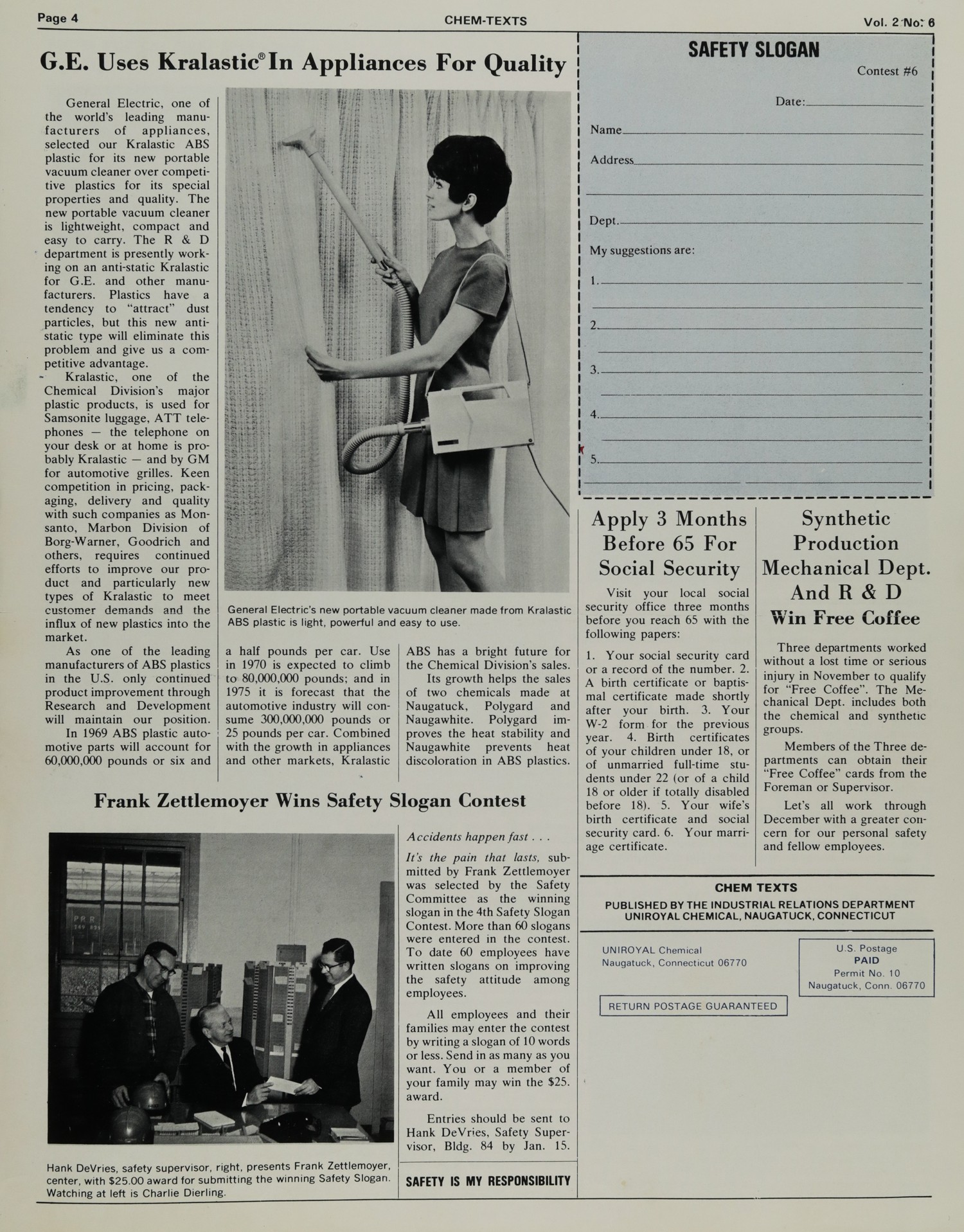
Hovey S. Simon (left), plant manager at Uniroyal Chemical’s Geismar, LA location receives rendering of an authentic grandfather clock (the actual clock was delivered later) from Robert J. Mazaika. Hovey was selected as the first-ever recipient of the Uniroyal Chemical Career Achievement Award.


UNIROYAL CHEMICAL

CHEM-TEXTS – 1977-v11-s255

Page 255

Page 4

CHEM-TEXTS

Vol. 11, 1977


Salzman…

continued from page 1

other areas. For instance in 1976, when the nation’s economy hit a low point, the corporation was able to provide $87 million dollars for capital investments, a substantial portion of which were allocated to the Chemical Division. Indeed, just here in Naugatuck, a refurbished TPR® Banbury was installed, the Fine Organics Chemicals plant was constructed and the Omite® operation was expanded.

Company’s Potential

An in-depth study by an outside professional survey team was made of employees’ attitudes and the company’s position and reputation in the commercial world.

The report revealed that Uniroyal has a reputation as a solid company, but was not as strong competitively as other comparably sized organizations. Furthermore, although sales had doubled over a ten year period, profits had dropped from 3.4% of sales to a low of 1.1%. Whereas technology, production, quality products and dedicated and talented people came out as strong assets, a conservative and cautious attitude pervaded throughout, often hindering the fullest use of these excellent capabilities. Obviously, some changes had to be made.


111 Employees…

continued from page 3

location have 25 or more years of service—more than 50% of the personnel population at this location.

New 25 Year Members

Peter Backes, Elizabeth Banik, Cerinus Barriault, Vincent Bartelmo, Joseph Begin, David Benson, Edward Brown, Jr., Francis Carriero, Theophile Clement, Louis Coscia, Daniel Davis, Katherine Dowling, Jacinto Fernandez, Gerald Gureqian, Clayton Houseknecht, Marion Hutt, Willie Ingram, Weldon Ireland, Eileen Kassheimer, Charles Moruska, Soren Nordstrom, Antonio Nunes, Michael Santone, Suren Semonian, Alexander Shaw III, Antonio Silva, Bernard Smith, Angelo Soares, Frank Sohleski, Henry Witkoski, Michael Yuchnyk.


Structural Changes

Innovative management organizational changes, designed to improve decision making and increase efficiency, were recently implemented resulting in more delegation of authority. In addition, fresh approaches to market planning were instituted.

One facet of the new organizational changes was the promotion of two former Chemical Division presidents to the newly created posts of Executive Vice President in early March.

Andrew J. McNeill now has responsibility for Engineered Products. This includes the Consumer, Industrial and Plastics divisions and Marketing Services.

Joseph P. Flannery heads up Materials Function, embracing the Chemical Division, Plantations, Textiles, Planning and Corporate Research and Development.

Management Skills

Because a company is only as strong as its leadership, programs to strengthen management skills have also been implemented. For instance, managers will have longer tenure in their positions, providing more opportunities to learn and make more positive contributions.

Their performance reviews will be more meaningful to their particular assignment and more opportunities for additional job-related education will be provided. The company will also rely on more aggressive recruiting from the outside to fill


30 Years Service

Joseph Anderson, Kenneth Anderson, Robert Anderson, Edwin Barrows, Jr., Robert Brown, Francis Cadwell, Edward Copes, Jr., William Creddo, Jesse Crim, Elizabeth Czalowski, Aurelio DePinho, Harris Detlefsen, Albert Gedraitis, Margaret Gibbs, Anthony Gaultieri, Addis Hillery, Margaret Holliday, Henry Hook, Wilbur Hugar, William Hutt, James Johnson, Edward Koslowski, Eugene Lantieri, Rufus Lydem, Lawrence Mambrino, Ralph Meldrum, Thomas Mullen, Joseph Owens, Joseph Rzeszutek, Louis Schiller, Frederick Simasek, Dr. Allen Smith, Otto Steinen, Angelo Taylor, Antonio Teixeira, Laurentino Terra, Jesse Thompson, John Tierney, Homer Walton, Frank Warchol, John Wawer, John Zavednak, Bronis Zukauskas.

35 Years Service

George Allen, E. Leonard Borg, Eleanor Broderick, Arthur Calder, Frank Chiodo, Matthew Chlebowski, Allen Crepeau, Leland Dannals, Domingos DaSilva, Michele DeBiase, John Dillon, Lucy DiStefano, John Flickinger, Dale


opened positions when special skills are required.

Optimistic Outlook

Mr. Salzman closed his remarks on an optimistic note, stating that the corporation is now concentrating more effort into the Chemical, Rubber and Plastics markets where it feels greater growth and profit potential exists. These areas, of course, are basic to the Chemical Division, and we will surely benefit from this new marketing emphasis.


Wins $500 Scholarship

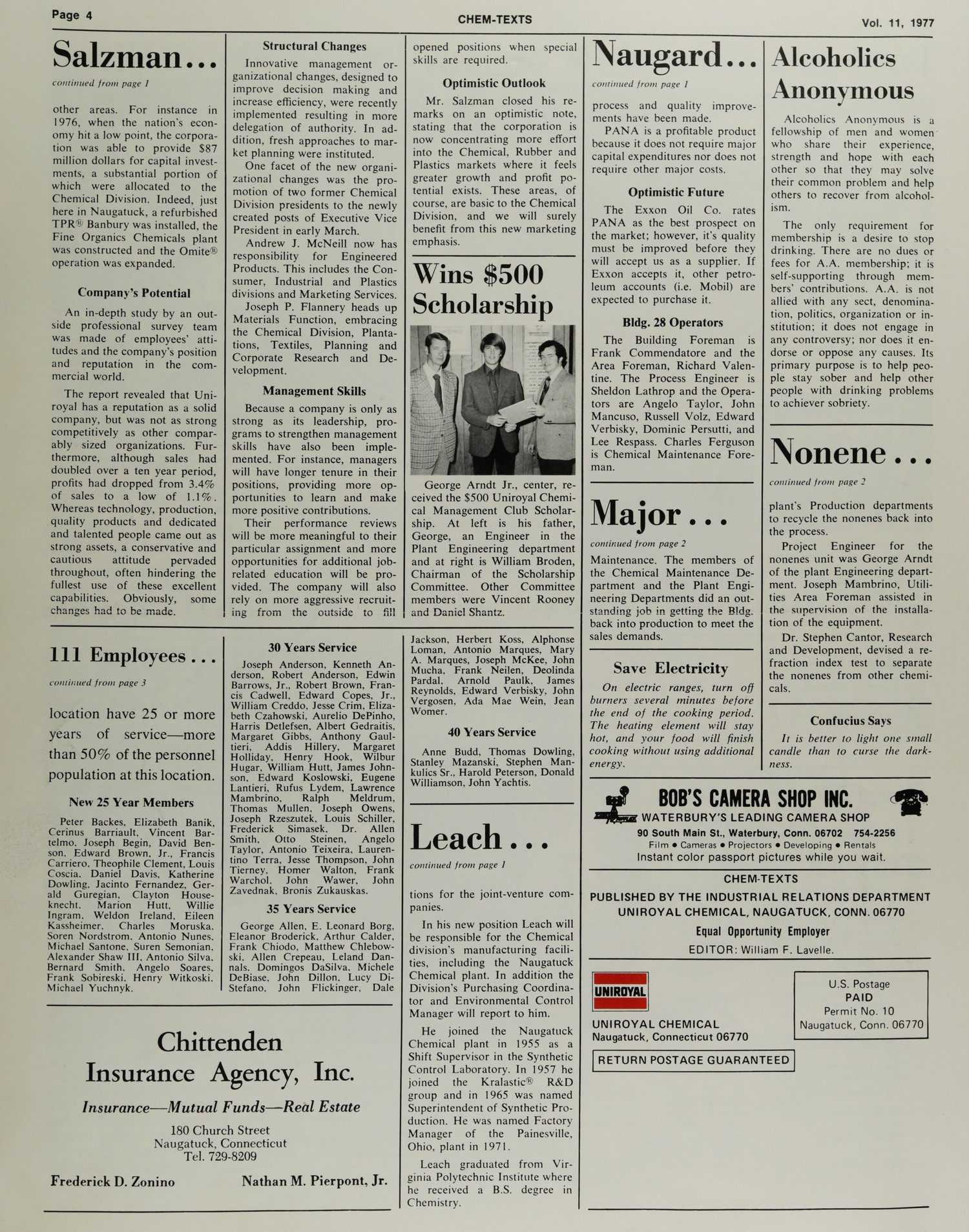
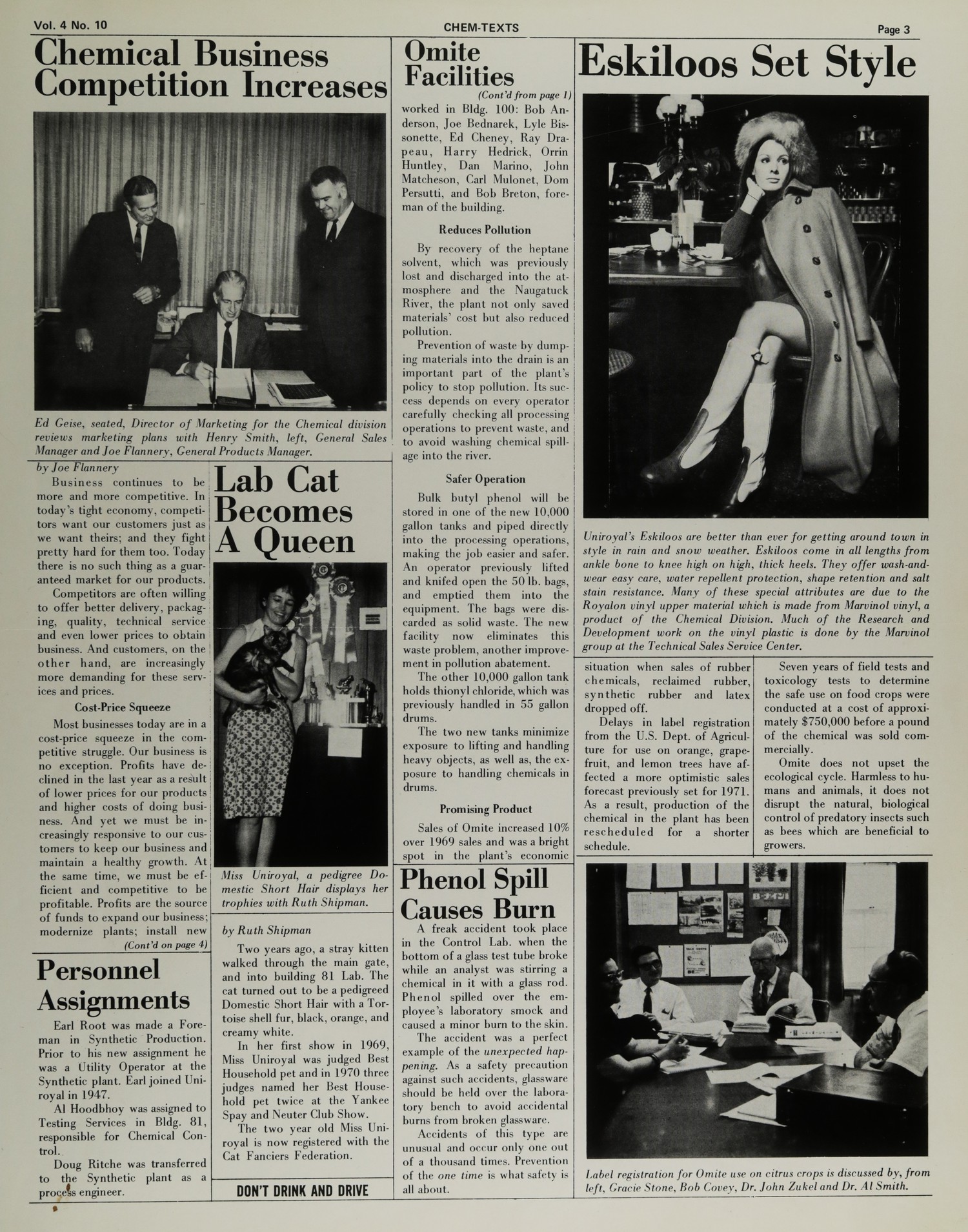
George Arndt Jr., center, received the $500 Uniroyal Chemical Management Club Scholarship. At left is his father, George, an Engineer in the Plant Engineering department and at right is William Broden, Chairman of the Scholarship Committee. Other Committee members were Vincent Rooney and Daniel Shantz.

Jackson, Herbert Koss, Alphonse Loman, Antonio Marques, Mary A. Marques, Joseph McKee, John Mucha, Frank Neilen, Deolinda Pardal, Arnold Paulk, James Reynolds, Edward Verbisky, John Vergosen, Ada Mae Wein, Jean Womer.

40 Years Service

Anne Budd, Thomas Dowling, Stanley Mazanski, Stephen Mankulics Sr., Harold Peterson, Donald Williamson, John Yachtis.


Leach…

continued from page 1

tions for the joint-venture companies.

In his new position Leach will be responsible for the Chemical division’s manufacturing facilities, including the Naugatuck Chemical plant. In addition the Division’s Purchasing Coordinator and Environmental Control Manager will report to him.

He joined the Naugatuck Chemical plant in 1955 as a Shift Supervisor in the Synthetic Control Laboratory. In 1957 he joined the Kralastic® R&D group and in 1965 was named Superintendent of Synthetic Production. He was named Factory Manager of the Painesville, Ohio, plant in 1971.

Leach graduated from Virginia Polytechnic Institute where he received a B.S. degree in Chemistry.


Naugard…

continued from page 1

process and quality improvements have been made.

PANA is a profitable product because it does not require major capital expenditures nor does not require other major costs.

Optimistic Future

The Exxon Oil Co. rates PANA as the best prospect on the market; however, it’s quality must be improved before they will accept us as a supplier. If Exxon accepts it, other petroleum accounts (i.e. Mobil) are expected to purchase it.

Bldg. 28 Operators

The Building Foreman is Frank Commendatore and the Area Foreman, Richard Valentine. The Process Engineer is Sheldon Lathrop and the Operators are Angelo Taylor, John Mancuso, Russell Volz, Edward Verbisky, Dominic Persutti, and Lee Respass. Charles Ferguson is Chemical Maintenance Foreman.


Major…

continued from page 2

Maintenance. The members of the Chemical Maintenance Department and the Plant Engineering Departments did an outstanding job in getting the Bldg. back into production to meet the sales demands.


Save Electricity

On electric ranges, turn off burners several minutes before the end of the cooking period. The heating element will stay hot, and your food will finish cooking without using additional energy.


Alcoholics Anonymous

Alcoholics Anonymous is a fellowship of men and women who share their experience, strength and hope with each other so that they may solve their common problem and help others to recover from alcoholism.

The only requirement for membership is a desire to stop drinking. There are no dues or fees for A.A. membership; it is self-supporting through members’ contributions. A.A. is not allied with any sect, denomination, politics, organization or institution; it does not engage in any controversy; nor does it endorse or oppose any causes. Its primary purpose is to help people stay sober and help other people with drinking problems to achiever sobriety.


Nonene…

continued from page 2

plant’s Production departments to recycle the nonenes back into the process.

Project Engineer for the nonenes unit was George Arndt of the plant Engineering department. Joseph Mambrino, Utilities Area Foreman assisted in the supervision of the installation of the equipment.

Dr. Stephen Cantor, Research and Development, devised a refraction index test to separate the nonenes from other chemicals.


Confucius Says

It is better to light one small candle than to curse the darkness.


BOB’S CAMERA SHOP INC.

WATERBURY’S LEADING CAMERA SHOP

90 South Main St., Waterbury, Conn. 06702 754-2256

• Cameras • Projectors • Developing • Rentals

Instant color passport pictures while you wait.


CHEM-TEXTS

PUBLISHED BY THE INDUSTRIAL RELATIONS DEPARTMENT

UNIROYAL CHEMICAL, NAUGATUCK, CONN. 06770

Equal Opportunity Employer

EDITOR: William F. Lavelle.


UNIROYAL

UNIROYAL CHEMICAL
Naugatuck, Connecticut 06770

U.S. Postage
PAID
Permit No. 10
Naugatuck, Conn. 06770

RETURN POSTAGE GUARANTEED


Chittenden Insurance Agency, Inc.

Insurance—Mutual Funds—Real Estate

180 Church Street
Naugatuck, Connecticut
Tel. 729-8209

Frederick D. Zonino Nathan M. Pierpont, Jr.

CHEM-TEXTS – 1977-v11-i03-s256

Page 256

UNIROYAL CHEM-TEXTS

Vol. 11, 1977 | PUBLISHED FOR THE PEOPLE OF UNIROYAL CHEMICAL | No. 3


10 Uniroyal Scholarships Offered

Ten Uniroyal Merit scholarships are offered to children of employees through the nationwide scholarship program of the National Merit Scholarship Corporation.

All children of Uniroyal employees, who have more than 5 years of continuous service as of the date of the award, are eligible for the scholarships.

Application Must Be Filed for Scholarships

Applications for the 1979 scholarships must be submitted by November 30, 1977. They can be obtained from the Industrial Relations Dept. along with a folder which gives complete details on the scholarships. Call Constance Antrum, Ext. 3217.

Students who wish to apply for a scholarship must do so during their Junior year by taking the Preliminary Scholastic Aptitude and National Merit Scholarship Qualifying Tests which are usually given in October by the high school. Students should check the school office for the dates of the tests.

(continued on page 3)


Footwear Operations To Close

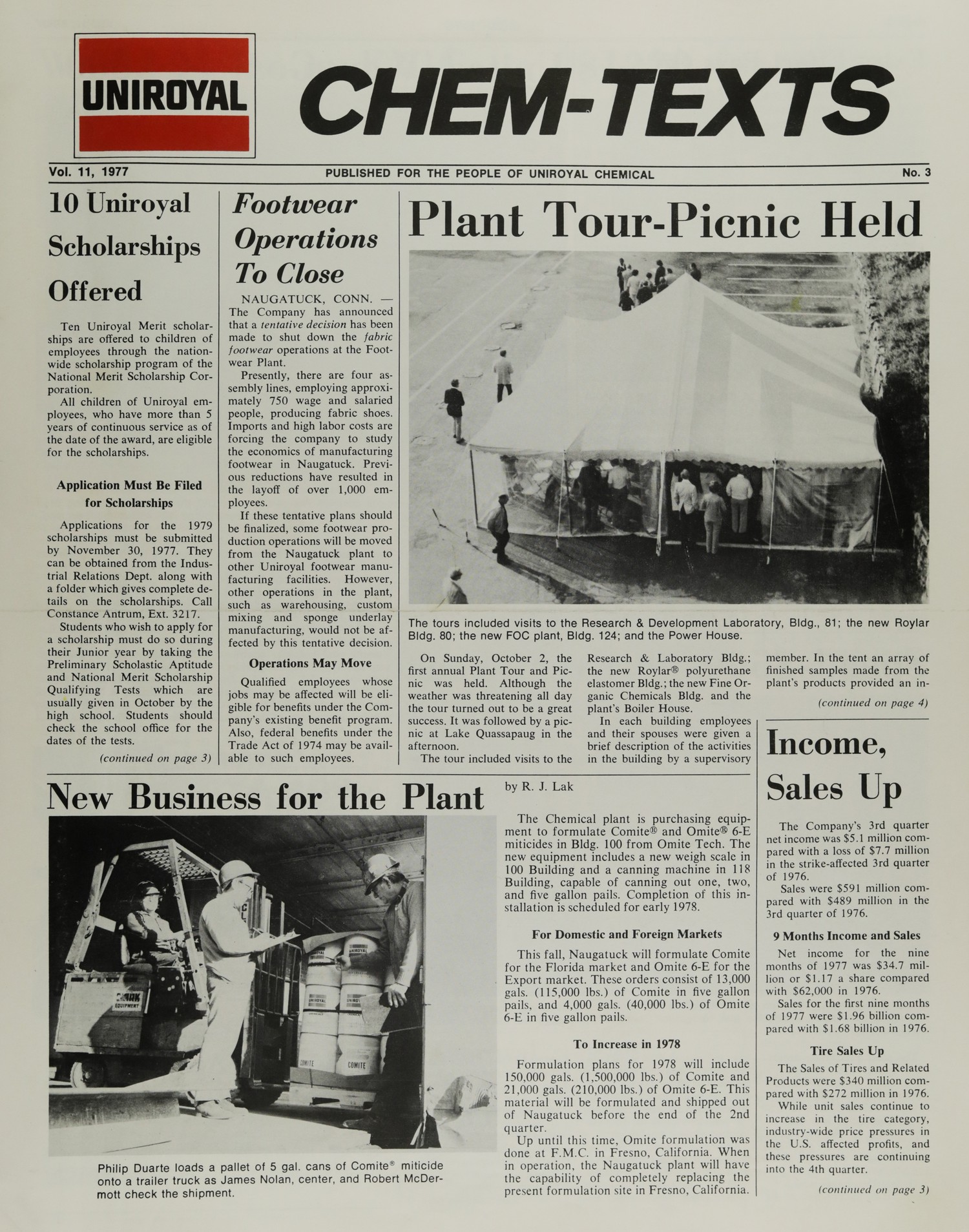
NAUGATUCK, CONN. — The Company has announced that a tentative decision has been made to shut down the fabric footwear operations at the Footwear Plant.

Presently, there are four assembly lines, employing approximately 750 wage and salaried people, producing fabric shoes. Imports and high labor costs are forcing the company to study the economics of manufacturing footwear in Naugatuck. Previous reductions have resulted in the layoff of over 1,000 employees.

If these tentative plans should be finalized, some footwear production operations will be moved from the Naugatuck plant to other Uniroyal footwear manufacturing facilities. However, other operations in the plant, such as warehousing, custom mixing and sponge underlay manufacturing, would not be affected by this tentative decision.

Operations May Move

Qualified employees whose jobs may be affected will be eligible for benefits under the Company’s existing benefit program. Also, federal benefits under the Trade Act of 1974 may be available to such employees.


Plant Tour-Picnic Held

[IMAGE: Shows people standing near tents at an outdoor event]

The tours included visits to the Research & Development Laboratory, Bldg., 81; the new Roylar Bldg. 80; the new FOC plant, Bldg. 124; and the Power House.

On Sunday, October 2, the first annual Plant Tour and Picnic was held. Although the weather was threatening all day the tour turned out to be a great success. It was followed by a picnic at Lake Quassapaug in the afternoon.

The tour included visits to the Research & Laboratory Bldg.; the new Roylar® polyurethane elastomer Bldg.; the new Fine Organic Chemicals Bldg. and the plant’s Boiler House.

In each building employees and their spouses were given a brief description of the activities in the building by a supervisory member. In the tent an array of finished samples made from the plant’s products provided an in-

(continued on page 4)


New Business for the Plant

by R. J. Lak

[IMAGE: Shows Philip Duarte loading a pallet of Comite miticide cans onto a trailer truck with James Nolan and Robert McDermott]

Philip Duarte loads a pallet of 5 gal. cans of Comite® miticide onto a trailer truck as James Nolan, center, and Robert McDermott check the shipment.

The Chemical plant is purchasing equipment to formulate Comite® and Omite® 6-E miticides in Bldg. 100 from Omite Tech. The new equipment includes a new weigh scale in 100 Building and a canning machine in 118 Building, capable of canning out one, two, and five gallon pails. Completion of this installation is scheduled for early 1978.

For Domestic and Foreign Markets

This fall, Naugatuck will formulate Comite for the Florida market and Omite 6-E for the Export market. These orders consist of 13,000 gals. (115,000 lbs.) of Comite in five gallon pails, and 4,000 gals. (40,000 lbs.) of Omite 6-E in five gallon pails.

To Increase in 1978

Formulation plans for 1978 will include 150,000 gals. (1,500,000 lbs.) of Comite and 21,000 gals. (210,000 lbs.) of Omite 6-E. This material will be formulated and shipped out of Naugatuck before the end of the 2nd quarter.

Up until this time, Omite formulation was done at F.M.C. in Fresno, California. When in operation, the Naugatuck plant will have the capability of completely replacing the present formulation site in Fresno, California.


Income, Sales Up

The Company’s 3rd quarter net income was $5.1 million compared with a loss of $7.7 million in the strike-affected 3rd quarter of 1976.

Sales were $591 million compared with $489 million in the 3rd quarter of 1976.

9 Months Income and Sales

Net income for the nine months of 1977 was $34.7 million or $1.17 a share compared with $62,000 in 1976.

Sales for the first nine months of 1977 were $1.96 billion compared with $1.68 billion in 1976.

Tire Sales Up

The Sales of Tires and Related Products were $340 million compared with $272 million in 1976.

While unit sales continue to increase in the tire category, industry-wide price pressures in the U.S. affected profits, and these pressures are continuing into the 4th quarter.

(continued on page 3)

CHEM-TEXTS – 1975-v09-i06-s236

Page 236

UNIROYAL

Merry Christmas – Happy New Year

CHEM-TEXTS

Vol. 9, 1975 | PUBLISHED FOR THE PEOPLE OF UNIROYAL CHEMICAL | No. 6


2,000,000 Manhours Achieved Without A Lost Time Accident

[IMAGE: Group photo of men holding a sign displaying “2000000”]

The Factory Manager’s Staff Safety Committee holds the 2,000,000 manhours sign at the monthly safety meeting. From left are R. Shortt, Safety Manager; A. Aronson, Engineering Superintendent; E. Johnson, Chemical Production Superintendent; F. Wintsch, Industrial Relations Manager; J. Honytski, Materials Superintendent; H. Scullin, Reclaim Superintendent; J. Cronin, Factory Manager; S. Semonian, Manager, Engineering Development; L. Borg, Manager, Research Administration and Services; and R. VanAllen, Purchasing Agent.

Best Safety Performance Since 1961

On Friday, November 21, the two million manhour goal without a lost time accident was achieved. This is the best safety performance at the Naugatuck location since 1961 when the 3,000,000 manhour mark was reached. The record started on July 17 and took longer to achieve because of vacations and layoffs.

The record was almost marred at the last minute when a flaker in Bldg. 17 fell and narrowly missed hitting an employee. The injury would have been a lost time accident and a most serious one.

Group Safety Important

Although safety is a personal responsibility, much of this year’s performance is attributable to the group safety program, people working together with a concern for each other.

Drop in Injuries

The new attitude of working safe has created a “good feeling” about working in the plant. It has helped cut down the number of injuries from a high of 105 in 1966 to 29 in 1975.

In 1971 the hospital and medical costs amounted to $231,567;

continued on page 3


Fish Return to River

[IMAGE: River scene showing water and shoreline]

A marked environmental improvement is evident in the waters of the Naugatuck River.

The grass is greener; the river is cleaner; and fish have been seen in the Naugatuck River, according to reliable sources. A marked environmental improvement is evident in the quality and color of the water and the banks of the river along Route 8 north and south.

Much of this is attributable to the plant’s environmental program, particularly the liquid waste pretreatment plant in the south yard.

Over $7,000,000 has been spent or committed for pollution abatement, with another $1,500,000 for the new sewer system.


Agricultural Chemicals Markets Grow Overseas

As a result of an active research program in the 1960’s by the Naugatuck Chemical and Guelph, Ontario, Research & Development groups, new and unique chemicals were discovered for agriculture.

They are now known around the world as OMITE®, ALAR®, VITAVAX®, PLANTVAX®, DYANAP® and ROYAL MH-30®.

Sent Overseas for Testing

At the time of their field trials for use in the USA and Canada, the chemicals were also sent overseas to Universities, Experiment Stations, and foreign companies involved in the testing of agricultural chemicals.

A great amount of interest developed in them and in the fall of 1970 the Chemical division created an Overseas Agricultural Chemicals Marketing Organization with headquarters at the EMIC Building, with Dr. Bogislav Von Schmeling as Marketing Manager.

Regional Offices Set Up

Field development and sales offices for the overseas markets were regionalized and are now headed by Marketing Managers with offices in London, U.K., Singapore, and Sao Paulo, Brazil.

[IMAGE: Man pointing at world map]

Dr. Bogislav Von Schmeling, Overseas Marketing Manager, points to growing international markets for agricultural chemicals. Omite from Bldg. 100 is exported to South America.

The Chemicals are now sold in 50 foreign countries through 76 local distributors; with the most important markets in France, Iran, Italy, Brazil, and Argentina, in order of sales dollars.

Grain Markets

The Vitavax® and Plantvax® systemic fungicides amount to 60% of the overseas sales. Both products are used on cereal grain crops to prevent and cure dis-

continued on page 4

CHEM-TEXTS – 1974 – Page 3

Page 003

CHEM-TEXTS

Vol. 8, 1974 | Page 3


’73 Sales Set Record; Profits Up Slightly

Sales in 1973 set a new record and net income was slightly higher than the previous year.

Sales exceeded 2 billion dollars ($2,082,691,000) an increase of 15.8% over 1972 and the highest in Uniroyal’s history. Profit was $47,094,000, a 1% increase over 1972. Earnings a share of common stock were $1.58 in 1973, compared with $1.55 in 1972.

4th Quarter Sales and Profits Up

In the 4th quarter of 1973, sales were $537 million, for an increase of 16.6% over the same period in 1972.

Profit in the quarter was $12.1 million, compared with $10.7 million the previous year.

Profit in 1973 was affected chiefly by the price freeze on tires and delays by the Cost of Living Council in granting price relief to cover sharp cost increases in raw materials and

other areas. These factors cost Uniroyal about $10 million in Profit and prevented setting a new profit record in line with sales increases.

Many Lines Improve

The Company’s business improved in many lines in 1973. Among them were radial tires, footwear, Naugahyde, TPR Thermoplastic rubber and rubber chemicals.

New records were set by the Fiber and Textile division and by USCO Services and Computeristics.


Club Sponsors Campership

The Uniroyal Girls Club is sponsoring a 2-3 week Campership summer vacation for a handicapped child with all expenses paid.

Transportation must be supplied by the child’s parents or guardians.

If you know a handicapped child who would be interested, contact Rose Juliano, Ext. 565.


1974 Business Outlook For Naugatuck Chemicals

by John Evans, Sales Manager, Rubber Chemicals

The business outlook for Naugatuck® Chemicals, the trade name for the rubber and industrial chemicals manufactured in Chemical Production and other plants, is especially good at this time. The commodity is in a period where sales are largely controlled by either the capacity to make a product or the ability to obtain the necessary raw materials. Many of our products are on allocation for these reasons.

Worldwide Marketer of Chemicals

1973 was an interesting year as Uniroyal Chemical has moved closer to being a global marketer

of chemicals. Increasing costs, raw materials shortages and emphasis on pollution controls offshore, coupled with the devaluation of the American dollar relative to foreign currencies, has substantially increased the export business.

Waste Affects Business

While it might be reasoned that if business is so good we


Social Security Increased In 1974

On January 1 the maximum annual base for the Social Security tax was increased from $10,800 to $13,200 under a new law passed by the U.S. Congress.

The percent of the social security tax remains at 5.85 but the maximum tax to be paid in 1974 has been increased from $631 to $772.

A person who earns $10,800 or less per year will pay the same amount as in 1973.

An employee who earns more than $10,800 will pay a tax on the amount up to $13,200.

Under the Social Security law the individual’s tax amount is matched by an equal amount from the Company.


AA Meeting Places

Alcoholics Anonymous is a fellowship of men and women who share their experience, strength and hope with each other so that they may solve their common problem and help others to recover from alcoholism.

The only requirement for membership is a desire to stop drinking. There are no dues or fees for AA membership.

The AA holds regular meetings in every town and city in Connecticut. Some of these are open meetings to which everyone is welcome; and some are closed to which only alcoholics may go.

It also sponsors Al-Anon Family Group meetings for the relatives and friends of alcoholics to offer friendship, comfort and hope to the families of alcoholics.

For the teen-age children, relatives, and friends of alcoholics, Alateen group meetings are held, mostly in the larger cities.

The following is a list of the towns in this area which hold AA meetings. The time, place, address, and telephone numbers of these meetings can be obtained by calling the Industrial Relations Department, Ext. 624.

TOWNS: Ansonia, Beacon Falls, Bethany, Bethlehem, Bristol, Cheshire, Derby, Hamden, Meriden, Middlebury, Naugatuck, New Haven, Newtown, North Haven, Oakville, Orange, Plymouth, Prospect, Seymour, Shelton, Southbury, Southington, Thomaston, Wallingford, Waterbury, Watertown, West Haven, Wolcott, and Woodbury.


Breen’s

The Biggest Little Store In The Country

Visit our four floors of famous brands for him and her

Ladies’ Dept.
Couture Coats
Tanner Dresses
Vanity Fair Lingerie
Joyce—Naturalizer Shoes

Men’s Shop
Manhattan Shirts
Botany Suits—Sport Coats
H. Freeman Suits
London Fog Rainwear
Florsheim Shoes
Jaymar Slacks

Lingerie Shop
Vanity Fair
Olga—Barbizon
Schrank Robes
Shadowline

Jr. Sportswear
Collegetown Sweaters
White Stag—Skirts, Slacks
Davis Coats
Peerless Sportwear

Ski Boutique
Ski Jackets
Warm-Up Slacks
Ski Pants
Ski Sweaters
Gloves & Sweaters

Cosmetic & Jewelry Dept.
Guerlain — Yves Saint Laurent
Elizabeth Arden — Monet
Nina-Ricci — Napier
Chanel — Marvella Pearls


[PHOTO CAPTION:]
John Evans, Marketing Manager for Naugatuck Chemicals and Industrial Chemicals, and former Factory Manager, points to Naugatuck on map of world. Rubber chemicals manufactured here are now shipped to a global market.


can afford to let up a little in our efforts, this would be a serious error in reasoning. With raw material and energy shortages and increasing costs, it is essential that we increase our efficiency, yields, and minimize off-specification production. Every pound of raw material must be efficiently converted to a saleable finished product. Waste must be eliminated.

The unreliability of raw material supplies, along with varying customer needs, will undoubtedly upset production schedules. We must accept these changes as an everyday procedure during this hectic period. Flexibility is the key to success.

his customers the best will be a long way up on competition when the situation eases up.

It is very important that when we make commitments to supply a customer a certain quantity on a certain date that he gets this material. I’m sure you realize from your own experience the frustration of promises not kept.

These are exciting times. They demand the utmost in ingenuity and planning and total follow through by everybody to get products produced and sold. From my close associations with the people of the Naugatuck plant, I am confident that we can meet these challenges.

Must Keep Our Word

Another factor to remember is that the shortages won’t last forever. The supplier that treats


’74

Take stock in America.


Chittenden Insurance Agency, Inc.

Insurance—Mutual Funds—Real Estate

180 Church Street
Naugatuck, Connecticut
Tel. 729-8209

Frederick D. Zonino | Nathan M. Pierpont, Jr.

Company Announces Tentative Closing Of Reclaim Rubber Operations

UNIROYAL CHEM-TEXTS

Vol. 9, 1975 | PUBLISHED FOR THE PEOPLE OF UNIROYAL CHEMICAL | No. 3


Company Announces Tentative Closing Of Reclaim Rubber Operations

200 Employees Affected

For years the rumor has persisted that the Reclaim Rubber Plant would close down because of competition from synthetic rubber, the marketing of radial tires, and annual losses due to lower demand.

It seems that the 80 year era may now be at an end when the plant management announced the tentative plans to close it down in a statement to the officers of the URW Local 218 on May 21.

Constant Efforts Made to Keep Operating

Over the past years the plant’s management and the union’s officers have analyzed ways to reduce costs and improve the output of the operation but the efforts have not been able to change the financial status of it.

The Company felt, after investigating all possibilities that it was necessary to announce a tentative decision to close it down.

New Markets Do Not Materialize

The Sales department attempted to increase prices and generate new markets but the efforts were not successful. Research and Development has been working with the State of Connecticut on the use of it in roads but the progress has been slow and no substantial results seem to be in the offing.

continued on page 2


[IMAGE CAPTION:]
The Reclaim Rubber plant dates back to 1892 and is the oldest production unit at the Naugatuck Chemical location. It recycles about 1,500,000 scrap tires a year.


27 Receive Diplomas

[IMAGE CAPTION:]
Factory Manager James Cronin hands out diplomas to people who graduated from the Techniques of Supervision Course. From left are Irene Broderick, K. Donald Nelson, Rocco Magnanimo, Angenette Grant, Cronin, Frederick Gould, the Instructor, and George Allen, who set up the educational program.

After ten weeks of lectures on the Techniques of Supervision twenty seven foremen and supervisors graduated in a ceremony in Bldg. 81 conference room. Factory Manager James Cronin presented the certificates, bringing the total number of graduates of the course to 61.

Frederick Gould, an assistant professor on the Connecticut State Technical Colleges staff, conducted the sessions. Having been a Foreman at the American Brass Co. mill operations in

continued on page 4


U.S. Issues 34 Patents; One-Third of Uniroyal Total

[IMAGE CAPTION:]
Dr. Stephen Cantor, left, who received 5 patent awards, discusses a new chemical with Dr. Byron Hunter who received his 38th., the highest in the Chemical division.

1974 was a banner year for the Chemical Division when 34 patents were issued to it by the U.S. Patent Office. This is the largest number in the division’s history except for the year 1966 and represents one third of the total awarded to the Company by the U.S. The Company—as a whole—received 109 U.S. patents.

In addition, it received 109 patents in foreign countries, exclusive of Canada.

Some of the significant patents included those issued to Leland Dannals for the Polywet® K products, which are used as emulsifiers in the production of latex; William Fischer (retired) for thermoplastic rubbers; Rob-

continued on page 4


Fuel Use Down; But Costs Go Up

The Energy Conservation Task Force, organized in 1973 to conserve energy in the plant, was able to achieve a reduction of 22.9% in fuel oil consumption in 1974 over 1973. The decrease amounted to an average saving in oil equivalent to a 65 day supply.

The drop in the use of steam resulted from the repair of steam leaks; improved techniques in power use; cooperation by employees to close windows and doors in buildings; improved pipe insulation and good climatic conditions during the winter.

Although Use Is Down Costs Almost Double

Under normal conditions the 22.9% reduction in oil would have shown a substantial savings in fuel costs. But because of the

continued on page 2


Dividend Declared

The company declared a dividend of 17½ cents a share on the common stock, which is payable June 25 to stockholders of record on May 27.

A dividend of $2 a share on the 8% first preferred stock, was declared by the Board of Directors on February 12, and is payable June 25 to stockholders of record on May 27.

CHEM-TEXTS – Vol. No. 7 – Page 2

Page 002

CHEM-TEXTS

Page 2 | Vol. No. 7


FROM THE FACTORY MANAGER

DEAR FELLOW EMPLOYEE:

The past month or so I have been busy reviewing plans for our 1971 operating budget. If I were to share those costs in detail with you, I’m sure you would be discouraged by the ever-increasing cost of doing business.

Looking beyond the wage and benefit increases granted in the recently completed master contract negotiations, giving consideration to continued merit recognition of salaried personnel and improved salary employee benefits, we face added costs in terms of raw materials, supplies and utilities.

For example, the electric company has asked the Public Utilities Commission to grant a 10% rate hike. The water company has requested the Commission for approval to increase its rates by 25%. Regulations coming into effect in 1971 on the use of low sulfur fuel point to record oil prices for operating our boilers. Increased spending for pollution abatement will add to an already burdened budget.

Realizing that increased costs cannot be merely passed along to the customer, because in reality its the value of the product to the customer that sets its price in the market place, it is apparent that we can’t meet 1971 costs with old-fashioned ideas and methods.

We need new imagination and creativity directed toward greater productivity, higher quality, and, in general, excellence and efficiency in every phase of our work. We need the individual and group dedication to face these challenges as “our jobs”, not as “this is your job, that’s my job”. As I see it, everyone of us is on the first team, there is no “second string”, it’s up to all of us to “really put out” all of the time.

Sincerely,

[Signature]

John D. Evans


JAROY Returns 10% On $1.00

[IMAGE: Photo showing Mary Kevit, left, named JA secretary of the year, shows Jaroy financial report to Joann Niski, president, as advisors Ted Lainas, left, and Jim Brown look on.]

By Jim Brown and Ted Lainas

Jaroy, Inc., Uniroyal Chemical’s sponsored Junior Achievement Company completed a highly successful year. The company returned a 10 cent dividend to all stockholders after paying taxes, salaries, wages, raw materials’ cost, office rent and costs for manufacturing equipment.

The company completed its operations last month and sent the dividend plus the original $1 stock purchase to each of its stockholders, a 10% return on their investment. Included in the stockholder’s report were the board of directors, a liquidation report, an organization chart, a sales report and an operations and balance statement. Sales for the firm amounted to $586.

At the Junior Achievement annual dinner, Jaroy was voted runner-up “Company of the year.” Mary Kevit, the secretary of Jaroy, was voted “Secretary of the year”; and June Murray was voted runner-up for “Sales Vice President of the year.” These awards represented a distinctive honor since the competition included officers from 35 other companies in the Naugatuck–Waterbury area.

Jaroy’s officers, who led the firm to a successful year consisted of a woman management team, juniors and seniors at Naugatuck High School.

Advisors to Jaroy, Inc. were Jim Brown and Ted Lainas.


Computers Help Keep Customers

[IMAGE: Kirk Kirkendall, now plant dispatcher, codes information on a bill of lading which will be keypunched for computerized freight payment system, while Mike Banik watches. On phone is Ray Frank, plant traffic manager.]

by Ray Frank

Computers at EMIC are now helping us to select the best way to ship our products to improve customer service by prompt delivery of their orders.

The new computerized system determines the cost of the shipment; pays the freight charges to conform with ICC regulatons; and reduces transportation costs. ICC rules require payment of freight bills within 4 days if shipped by rail, and 7 days if shipped by truck.

On outbound freight, the computers type the hundreds of checks previously handled individually by the accounts payable department.

Each month the “think” machines provide vital information to the sales, accounting and traffic departments on customers’ purchases, products sold, and the pounds ordered. The system also gives a monthly and a year-to-date record of the tonnage and revenue of each carrier. The computers also catch duplicate payments of freight charges.

Feeding accurate statistics to the computer is essential to schedule shipments promptly and selection of the proper carrier.

[IMAGE: George Holzer checks accuracy of statistics to be fed to computer.]

Responsible for coding the bills of lading are Al Juliano and Jim Sadik. George Holzer, recently transferred from the plant’s traffic department to EMIC feeds the coded cards into the computer which types the freight payments and memorizes the information for future use.

Use of the computers is another step forward to improve customer service and to reduce shipping costs to stay competitive in the chemical market.

[IMAGE: The stack of checks on Charlie Terninko’s desk will be made out by the IBM computer. Don Turner, standing, watches Charlie make out one of the hundreds handled by the accounting department.]

Almost everyone knows some of Parkinson’s Laws, including “expenses always rise to meet income.”

Along comes The Peter Principle which includes “every person rises to his level of incompetence.”

There is also Murphy’s Law which states “if anything can go wrong–it will.”


Safety On And Off The Job

[IMAGE: Even the great Casey Stengel didn’t last 20 years as a manager. But Bob Shortt, safety manager for the Chemical plant, has managed in the Little Leagues since 1950. Above, Bob gives first aid treatment to one of his star players, practicing safety off the job. (photo by M. Makoski)]

CHEM-TEXTS – Vol. 4 No. 7 – Page 4

Page 004

Page 4 — CHEM-TEXTS — Vol. 4. No. 7


Safety Goal Stops At 650,000 Hours

The safety goal of 1,000,000 manhours was stopped at 650,000 manhours. A chemical production operator lost a small portion of his right ring finger when it was caught under the belt on the drive on a crusher machine. Quick action by him prevented a more serious loss to his other fingers and hand.

The accident was the first lost time one in almost 3 months. It was another case of the unexpected happening. As a result of it, the man suffered an unnecessary loss of a finger.

Lost Time Accidents Drop

This was the third lost time accident for six months of 1970, a significant improvement over 1969 when 12 lost time accidents occurred. This improved concern for the safety of ourselves and other people makes the plant a better, safer place to work.

Serious Injuries Up

Although lost time accidents dropped, serious injuries increased from 28 in 1969 to 33 for the six months of 1970. In June there were 4 serious injuries: 2 lacerations; 1 bruised elbow; and a pulled muscle. These injuries could have been lost time accidents but luck helped, and the employees involved escaped greater injury. Serious injuries can be stopped by not taking chances on the job and checking work conditions carefully.

Mower Shoots

(Cont’d. from page 1)

The steel stake, retouched in black, was hidden by the grass.

mower at the time, the steel stake would have gone through his body and fatally injured him.

Unsafe acts—and this was certainly one, because someone carelessly left the stake on the lawn—can result in a fatal injury to a member of your own family at a time when most unexpected.


Wear It Once (Cont’d. from page 1) made with latex. This year’s sales of paper dresses and other nonwoven apparel will hit $35 million.

Disposable paper diapers are a large market for latex with annual sales climbing to over a billion diapers a year by 1975.

Women’s dresses, bathing suits, beach robes, sport jackets, aprons, wedding gowns, and Kleenex tissues make up a large part of the “throw away” disposable market.

Carpets Big Market

Another major use for Naugatex latex is carpets, where the latex is used to hold the tufted yarn firmly to the jute backing and prevent it from tearing and ripping. Foam latex makes an excellent underlay giving the carpet a luxurious feel and longer wear life.

Paper; Other Markets

Magazines and books are coated with latex to hold the ink on the paper, preventing its absorption into the paper. Latex coated paper improves the reproduction of photographs, and gives a sharpness to the printing for easier reading.

When latex is mixed with the paper, it makes a tough cover for books, giving the book longer life. This use is finding wide acceptance in school textbooks.

Competitive Business

The latex business is a highly competitive business where quality, packaging, delivery, and price are important factors in keeping customers.

Whether at home or work, it’s a good practice to wear safety shoes and safety glasses as protection against such incidents.

A lawnmower can pick up stones, pieces of glass or wire, cans or toys and hurl them at speeds as high as 170 miles an hour-bullet speed.


Competing for the same customers are large progressive chemical companies such as Dow, International Latex, Goodyear, Firestone, Goodrich, General, Vanderbilt, Shell and a number of other companies.

Chemicals For Latex

Latex, which consists of tiny particles of rubber suspended in water, requires special chemicals to protect it from oxygen, heat, sunlight, and weather. Without this chemical protection, the latex would deteriorate during processing or discolor from exposure to atmospheric conditions.


[IMAGE CAPTION:]
From left, Marie Yaroshefski, Mary Foy and Wes Burns discuss quality of Naugatex latex to be used on paper.


The latex backed carpet in your home or car probably contains one of the eight chemicals made in Chemical Production— OXAF, Butazate® 50-D, Ethazate® 50-D, Trimene Base, Thiostop N, Thiotop K, Naugawhite,® and AO 436—to improve the quality and wear life of the latex.

Future Growth

A substantial drop in automobile sales, fewer housing starts and an overall economic slack have hurt latex sales, as well as other areas of the plant’s production. Latex sales for the division and the synthetic plant are projected at a fairly substantial growth for the next 5 years.

To keep this business at the Synthetic plant and share in its growth requires producing the highest quality latex at the lowest cost, and giving our customers better service than the competitors.

Sales Up (Cont’d. from page 1)

Chemicals, Plastics Off

Sales and profits of the tire and international operations showed strong gains during the six months. However, these gains were offset by declines in chemicals and plastic products due to lower automotive production.


Long, Laliberte Retire

[IMAGE CAPTION:]
“One of the best in the Lotol business,” Bill Long retired after 44 years service. Congratulating him are, from left, Connie Ranney, John Dayner, George Brockman, Bill, and Joe Biernacki, foreman.


[IMAGE CAPTION:]
Roland Laliberte, center, retired after 21 years from Reclaim Production. Congratulating him from left are Larry Rinaldi, Al Pistarelli, Laliberte, Minic Brown, and Joe Pereira.


SAL LANTIERE retired with 24 years service. Sal held the position of a mill and calender operator in the plastics compounding laboratory at TSSC where he worked on Kralastic® ABS, the steel-like plastic used in automobiles, appliances, boats, and pipe.

ED SLOMCENSKI, retired recently as a mill and calender operator in the rubber compounding laboratory at TSSC where he tested the properties of new types of synthetic rubber developed by the research and development department.

KEN JARRETT who started with Uniroyal Chemical in 1945 as a laboratory assistant in Dispersions research and development, retired after more than 24 years service, all spent at the Naugatuck location.


CHEM-TEXTS

PUBLISHED BY THE INDUSTRIAL RELATIONS DEPARTMENT
UNIROYAL CHEMICAL, NAUGATUCK, CONN. 06770
EDITOR: William F. Lavelle.


UNIROYAL U.S. Postage
UNIROYAL CHEMICAL PAID
Naugatuck, Connecticut 06770 Permit No. 10
Naugatuck, Conn. 06770
RETURN POSTAGE GUARANTEED

CHEM-TEXTS – Vol. 4, 1970, No. 7 – Page 1

Page 001

UNIROYAL CHEM-TEXTS

Vol. 4, 1970 | PUBLISHED FOR THE PEOPLE OF UNIROYAL CHEMICAL | No. 7


Wear A Dress Once; Throw It Away


Sales Up; Profits Off

Uniroyal set new records in sales for the second quarter and first half of 1970. Net income declined compared with 1969 when profits hit an all-time high.

Sales for the six months were $817,538,000, up 2.6 percent from the first half record of $796,633,000, in 1969.

Profits for the six months was $22,709,000, equivalent to 78 cents per share of common stock, which compares with the record $29,892,000, or $1.06 a share, set in 1969.

Sales for the second quarter set a new record of $436,714,000, compared with $427,802,000 in 1969.

Profit in the second quarter was $13,170,000, or 46 cents a share, compared with the $17,357,000, or 62 cents a share in 1969. (Cont’d. on page 4)


NOW Group Tours Greenhouse

[IMAGE: Group of men standing outside a building]

Future chemists and scientists visited the Agricultural Chemical research green house in Bethany, where Dr. Bob Davis showed then how new chemicals were helping to provide more food for the world. From left are Bob Davis, Allan Peoples, Vincent Wiggins, Joe Trangle, Royal Gladding, Ralph Neubig, of NOW, Eric Lott, Irving James, and Donavan Wiggins. Missing from the photo was Richard Simpson.

[IMAGE: Group seated at tables for lunch]

After tour, the group were luncheon guests of Bob Davis. Joe Trangle, at right, drove group to and from Waterbury.


[IMAGE: Woman in patterned casual dress]

Casual wear dress is made from non woven fibers and Naugatex latex.


by Jerry Twomey

The Synthetic plant makes it. People walk on it; read it; ride on it; chew it; and wear it. The plant, the first SBR plant built in the U.S., is a specialty manufacturer of 29 different types of latexes, tailor-made to meet the special requirements of customers.

Uniroyal Chemical ranks as one of the leading producers of latex manufacturing it at three plants: Naugatuck, Baton Rouge and Scotts Bluff.

Chewing Gum Big Use

One of the most interesting uses of synthetic latex, which is made from the chemical reaction of butadiene and styrene, is chewing gum. Most of the latex used to make chewing gum in the U.S. is produced at the Synthetic plant. The Naugatex® latex is more uniform in quality and has a “chewier” chew than the natural gum of the South American tree from which it was extracted and imported into the states.

The Disposable Market

This is one of the largest markets for nonwoven fabrics (Cont’d. on page 4)


Mower Shoots Steel Stake Into Wall

by Ed Phillips

An 8 inch tent stake, hidden in the grass, was picked up by the blades of a lawnmower and projected against a garage wall ten feet away. The sharp edge of the stake pierced through the 5/8″ thick plywood wall about 10 feet from the ground and entered the inside of the garage wall.

At the time, several children were playing on the lawn. If one of them had been near the (Cont’d. on page 4)


Dividend Declared

Uniroyal declared a dividend of 17½ cents a share on the common stock. The dividend is payable Sept. 25 to stockholders of record August 24.

This is the third dividend declared in 1970, bringing the total of dividends to 52½ cents a share on the common stock.


[IMAGE: Man and boy looking at stake in garage wall]

Ed Phillips, shows his son Dick, the 8 inch stake in garage wall.

CHEM-TEXTS – Vol. 4, 1970, No. 4 – Page 1

Page 001

UNIROYAL CHEM-TEXTS

Vol. 4, 1970 | PUBLISHED FOR THE PEOPLE OF UNIROYAL CHEMICAL | No. 4


Solo, A New Soybean Herbicide Marketed

[IMAGE: Photo showing workers with pallets marked “4614” and “SOLO”]

Jim Nolan, left, checks control number for quality of liquid Solo as Filipe Duarte, center, inspects appearance of packaging. Tony Marques, loads a pallet from Bldg. 76 warehouse on to truck for shipment to one of our distributors.

by John Kitsmiller

Solo,® a new preemergence herbicide made in Bldg. 73, controls more broadleaf weeds, such as ragweed, in soybeans than any other chemical. Marketed for the first time this year, after several years of tests by universities, large growers, and the R & D agronomists, under the direction of George O’Brien, sales of Solo look good for 1970.

Patent Issued

The unique herbicide combination was discovered by Everett Barron and Adam Soboleski of the agricultural chemical R & D group at the Bethany research center. A patent was issued to both which provides 17 years’ exclusive rights to the sales of the product.

42,000,000 Acres

Soybeans are the nation’s second largest crop with 42,000,000 acres grown in the midwest and Delta areas of the U.S.

Solo increases yields by 6-10 bushels per acre. At $2.50 per bushel the chemical improves the grower’s income in a very risky business.

(Cont’d. on page 4)


Sales Up 3%: Profits Drop Down 24%

Uniroyal set a new 1st quarter sales record of $380 million, a 3% increase over the $369 million sales in the 1st quarter of 1969.

Profits for the first three months of 1970 were $9.5 million, a 24% decrease compared to the $12.5 million 1st quarter profits of 1969.

Higher interest charges; more competition in the market; higher working capital requirements; lower demand for quality canvas shoes; and intensified competition from foreign and domestic manufacturers paying wages and benefits far below Uniroyal scales, were major factors in reduced profitability.

Automotive Industry Off

A decline in automobile sales not only has an impact on the many products the company makes for the industry, but also affects the sales and profits of the Nau-

(Cont’d. on page 4)


136 JOIN 25 YEAR CLUB

[IMAGE: Photo of crowd at banquet/dinner event]

350 members of the 25 Year Service Club attended the twentieth annual banquet honoring employees for 25 or more years service. Above, members enjoy refreshments before the dinner.

The 25 Year Service Club of Uniroyal Chemical held its twentieth annual dinner at Waverly Inn honoring 568 active and retired employees for their credited service of 25 or more years.

Committee members for the dinner were Bert Scullin, president and toastmaster, Everett Anderson, Tom Dowling, Pat King, Joe Little, Alice Schofield and Ed Weaving. In charge of the invitations and assisting the committee was Gladys Bradshaw.

Guest speaker for the affair was Frank Hopkins, vice president of the Chemical division.

Andy Molnar of the Synthetic pilot plant holds the unique distinction of longest,

(Cont’d. on page 2)


Vibrathane Bumper First On Auto

[IMAGE: Photo of woman in short dress posing next to Oldsmobile Rallye 350 car with visible “RALLYE 350” text]

The Oldsmobile Rallye 350 has the first color matched bumper in the auto industry. Developed by R & D at the TSSC, the Vibrathane®coating’s elastic-plastic properties make the bumper highly resistant to weather, wear, chipping and scratching from flying road gravel and stones. Working on the project were Dr. Frank O’Shea, R & D manager; John Burkus, group leader; John Shiley, Lou Esposito, technical service; Alex Keniausis and Len Jacoboski.

CHEM-TEXTS – Vol. 4 No. 10 – Page 10

Page 010

CHEM-TEXTS

Vol. 4 No. 10 Page 3


Chemical Business Competition Increases

[IMAGE: Three men in business attire reviewing documents]

Ed Geise, seated, Director of Marketing for the Chemical division reviews marketing plans with Henry Smith, left, General Sales Manager and Joe Flannery, General Products Manager.

by Joe Flannery

Business continues to be more and more competitive. In today’s tight economy, competitors want our customers just as we want theirs; and they fight pretty hard for them too. Today there is no such thing as a guaranteed market for our products.

Competitors are often willing to offer better delivery, packaging, quality, technical service and even lower prices to obtain business. And customers, on the other hand, are increasingly more demanding for these services and prices.

Cost-Price Squeeze

Most businesses today are in a cost-price squeeze in the competitive struggle. Our business is no exception. Profits have declined in the last year as a result of lower prices for our products and higher costs of doing business. And yet we must be increasingly responsive to our customers to keep our business and maintain a healthy growth. At the same time, we must be efficient and competitive to be profitable. Profits are the source of funds to expand our business; modernize plants; install new

(Cont’d on page 4)


Personnel Assignments

Earl Root was made a Foreman in Synthetic Production. Prior to his new assignment he was a Utility Operator at the Synthetic plant. Earl joined Uniroyal in 1947.

Al Hoodbhoy was assigned to Testing Services in Bldg. 81, responsible for Chemical Control.

Doug Ritche was transferred to the Synthetic plant as a process engineer.


Lab Cat Becomes A Queen

[IMAGE: Woman holding a cat and displaying trophies]

Miss Uniroyal, a pedigree Domestic Short Hair displays her trophies with Ruth Shipman.

by Ruth Shipman

Two years ago, a stray kitten walked through the main gate, and into building 81 Lab. The cat turned out to be a pedigreed Domestic Short Hair with a Tortoise shell fur, black, orange, and creamy white.

In her first show in 1969, Miss Uniroyal was judged Best Household pet and in 1970 three judges named her Best Household pet twice at the Yankee Spay and Neuter Club Show.

The two year old Miss Uniroyal is now registered with the Cat Fanciers Federation.


DON’T DRINK AND DRIVE


Omite Facilities

(Cont’d from page 1)

worked in Bldg. 100: Bob Anderson, Joe Bednarek, Lyle Bissonette, Ed Cheney, Ray Drapeau, Harry Hedrick, Orrin Huntley, Dan Marino, John Matcheson, Carl Mulonet, Dom Persutti, and Bob Breton, foreman of the building.

Reduces Pollution

By recovery of the heptane solvent, which was previously lost and discharged into the atmosphere and the Naugatuck River, the plant not only saved materials’ cost but also reduced pollution.

Prevention of waste by dumping materials into the drain is an important part of the plant’s policy to stop pollution. Its success depends on every operator carefully checking all processing operations to prevent waste, and to avoid washing chemical spillage into the river.

Safer Operation

Bulk butyl phenol will be stored in one of the new 10,000 gallon tanks and piped directly into the processing operations, making the job easier and safer. An operator previously lifted and knifed open the 50 lb. bags, and emptied them into the equipment. The bags were discarded as solid waste. The new facility now eliminates this waste problem, another improvement in pollution abatement.

The other 10,000 gallon tank holds thionyl chloride, which was previously handled in 55 gallon drums.

The two new tanks minimize exposure to lifting and handling heavy objects, as well as, the exposure to handling chemicals in drums.

Promising Product

Sales of Omite increased 10% over 1969 sales and was a bright spot in the plant’s economic


Eskiloos Set Style

[IMAGE: Woman in boots posing outdoors]

Uniroyal’s Eskiloos are better than ever for getting around town in style in rain and snow weather. Eskiloos come in all lengths from ankle bone to knee high on high, thick heels. They offer wash-and-wear easy care, water repellent protection, shape retention and salt stain resistance. Many of these special attributes are due to the Royalon vinyl upper material which is made from Marvinol vinyl, a product of the Chemical Division. Much of the Research and Development work on the vinyl plastic is done by the Marvinol group at the Technical Sales Service Center.

situation when sales of rubber chemicals, reclaimed rubber, synthetic rubber and latex dropped off.

Delays in label registration from the U.S. Dept. of Agriculture for use on orange, grapefruit, and lemon trees have affected a more optimistic sales forecast previously set for 1971. As a result, production of the chemical in the plant has been rescheduled for a shorter schedule.

Seven years of field tests and toxicology tests to determine the safe use on food crops were conducted at a cost of approximately $750,000 before a pound of the chemical was sold commercially.

Omite does not upset the ecological cycle. Harmless to humans and animals, it does not disrupt the natural, biological control of predatory insects such as bees which are beneficial to growers.


Phenol Spill Causes Burn

A freak accident took place in the Control Lab. when the bottom of a glass test tube broke while an analyst was stirring a chemical in it with a glass rod. Phenol spilled over the employee’s laboratory smock and caused a minor burn to the skin.

The accident was a perfect example of the unexpected happening. As a safety precaution against such accidents, glassware should be held over the laboratory bench to avoid accidental burns from broken glassware.

Accidents of this type are unusual and occur only one out of a thousand times. Prevention of the one time is what safety is all about.


[IMAGE: Four people in discussion around a table]

Label registration for Omite use on citrus crops is discussed by, from left, Gracie Stone, Bob Covey, Dr. John Zukel and Dr. Al Smith.

CHEM-TEXTS – Vol. 3 No. 4 – Page 4

Page 004

CHEM-TEXTS

Page 4 | Vol. 3 No. 4


Room Of Tomorrow Made From Urethane Plastic Foam By Research And Development

The carved panels, rough hewn walls, beams, and the antique chest look like the most expensive, hand-carved woods. But they are made from urethane plastic foam, a unique plastic product developed by Rubicon Chemicals, a joint venture of Uniroyal Chemical and Imperial Chemical Industries of England. The principle materials used in making foam are liquid polyols, an organic isocyanate, catalysts, an emulsifier and a blowing agent.

The basic raw materials, TDI and MDI are marketed by the Chemical division’s sales department, with Walt Cook in charge of sales. Breaking into a new and highly competitive market, sales started slowly but during the past year have shown a steady increase.

The Rubicon research work is done in Building 75 where exciting new uses for this product are being developed to open new markets for Uniroyal Chemical. Urethane foam is a lightweight, yet tough, abrasive-resistant material. It is non-aging, odorless, non-allergenic, non-toxic, mold and mildew proof.

It can be made into soft, springy seat cushions or an impact-absorbing crash pad for automobile instrument panels. With such versatile physical properties, the foam has found uses in many different industries including furniture, automotive, appliance, textile, mattresses, carpeting, construction and packaging.

Group leader of the Rubicon research laboratory, is Tom Haggerty. Other members in the group are Fred Kenyon, from Imperial Chemical Industries of England, Ray Allen, Jim McGinn, Ralph Fusco, Paul Ulrickson and Barry Nelson.


FLOOD DISASTER

(Continued from Page 2)

accurate reports on the situation.

For efficient execution of the Plan, non-authorized employees (those without a silver star on the pass) are requested to remain away from the plant to prevent congestion of the streets with cars and avoid interference with emergency equipment.

Employees should listen to their local radio stations to learn whether they should report to work or not.

A trial run of the Plan will be held in the Synthetic and Chemical plants.


Appointments Announced

Ed Geise has been appointed Director of Marketing for the Chemical Division.

Bob Knapp heads the Research and Development group for Plastics.

Bill Coughlin was appointed Manager of Market Development for the division.

Joe Flannery is now General Product Manager.

Ed Saunders became Distribution/Scheduling Manager for the division.

Alex Nole was made Customer Service Supervisor.

Allan Murray transferred to the Colloids Development section as Senior Research Scientist.

Lou Kaiser joined the plant’s Engineering Pollution Control group.


[IMAGE CAPTION]: Urethane foam for seat cushioning being cut to size in the Rubicon laboratory, Building 75.


[IMAGE CAPTION]: The Room of Tomorrow conceived by the Research and Development department is made from urethane plastic foam. This exciting new material opens new markets for the Chemical Division.


Mal Wilson And Jack Person Retire

[IMAGE CAPTION]: Mal Wilson, center, is congratulated on his retirement from the Materials Flow department after 25 years by left to right, Lucy DiStefano, Michele DeBiase, Lorraine Grant and Jean Kelley.

[IMAGE CAPTION]: Jack Person, left, is congratulated by Bob Van Allen, superintendent of reclaim production on his retirement from the reclaimed rubber group after 22 years’ service.


Long Weekend, Drive Safely

This year, the Fourth of July falls on Friday making it a long weekend. It is estimated that more than 600 people will be killed on highways or other accidents.

When driving, drive defensively, expect the other driver to do something wrong; use your seat belts; drive slowly. Your life and your family’s depend upon your safe driving.


CHEM TEXTS

PUBLISHED BY THE INDUSTRIAL RELATIONS DEPARTMENT
UNIROYAL CHEMICAL, NAUGATUCK, CONN. 06770
EDITOR: W.F. Lavelle


UNIROYAL Chemical
Naugatuck, Connecticut 06770

U.S. Postage
PAID
Permit No. 10
Naugatuck, Conn. 06770

RETURN POSTAGE GUARANTEED

CHEM-TEXTS – Vol. 2, No. 5 – Page 1

Page 001

UNIROYAL

CHEM-TEXTS

Vol. 2 PUBLISHED FOR THE PEOPLE OF UNIROYAL CHEMICAL No. 5


New Chemical Holds Apples On Trees; Makes Them Firmer, Redder In Color

[IMAGE: Paul Bohne, an R. & D. agricultural chemical field specialist inspects apple tree sprayed with Alar®, a new growth regulant. Bohne tests our chemicals with commercial growers and University’s research stations.]

Alar, is the latest addition to our chemical growth regulants developed by our Research and Development scientists beginning with MH-30. The U.S.D.A. approved its use on apples and concord grapes but research promises similar results with other fruit and vegetable crops.

Alar produces a variety of results, depending upon the time the treatment is applied. When sprayed shortly after full bloom it reduces this year’s growth of leaves and branches and increases bloom the following year. If sprayed 60 days before harvest there is a marked decrease in apple drop (meaning more marketable apples), improved color in red apples, increased firmness and prolonged storageability.

Alar treatments to concord grapes anytime up to full bloom have increased the number of berries set in the cluster, thereby increasing yield.

Plants treated with Alar also show signs of reaching earlier maturity and may increase their tolerance to such adverse conditions as cold, drought and air pollution. Other desirable responses to Alar include improved shelf life of vegetables such as lettuce; uniform ripening of cherries and peaches which may be instrumental in developing mechanical harvesting; increased yield of peanuts as a result of high density planting. And early work indicates Alar may be useful in increasing the yield in cotton.

Alar has been referred to as a “wonder chemical” but only time and experiment will tell the full story.

Presently Alar is made in the Chemical Pilot Plant. A new $2.7 million production facility is being constructed by the Divsion in Geismar, La.

SAFETY IS MY RESPONSIBILITY

[IMAGE: Peanut plant, left, treated with Alar, compared to untreated plant, creates more efficient producing plant and increases yields up to 500 lbs. per acre.]


Alanap, Dyanap Sales Volume Expected To Increase In 1969

[IMAGE: Soybean growers use Alanap and Dyanap to kill weeds before they emerge from the ground. Weed free fields increase yields 20% to 30%.]

Alanap and Dyanap sales to soybean growers are expected to double in 1969, after a drop in Alanap sales in 1968. Rain, cold weather, late planting, and stiff competition from our competitors, Amchem, Elanco, Monsanto and DuPont, affected our sales forecast. 40,000,000 acres of soybeans are grown in the U.S., mostly in the midwestern states and the Delta area, a large potential market for our chemicals.

To regain our market position in ’69 the Sales department has employed the services of a new advertising agency to organize an inten-

(CONTINUED ON PAGE 3)


Plant Receives Fire Loss Award

[IMAGE: Present at presentation were, l. to r. Charles Kimball, John Gilmartin, Leo Roberts, Ed. Weaving, Phil DePasquale, John Evans, who presented Plaque, Joe Digris, and Dick Oriente. Absent were Fred Sargeant, John DiSantis, Al Kaslutas, Casimir Andrzejewski, John Mello, Charles Conner, and Ed. Curby.]

The Naugatuck plant received a Company award from D.E. Dudrow, Corporate Manager of Safety and Plant Protection.

The plaque was presented on the basis of our reduction in fire losses as compared with the previous three years’ average for the plant.

The award is a tribute to all employees for observing safety precautions in the prevention of fire occurrences in the plant. With even a greater awareness toward fire hazards in our work areas, fire losses can be eliminated completely. A special word of credit is deserved by our Fire Dept. who answer fire alarms within seconds.

CHEM-TEXTS – Vol. 2 No. 6 – Page 4

Page 004

Page 4 | CHEM-TEXTS | Vol. 2 No. 6


G.E. Uses Kralastic® In Appliances For Quality

General Electric, one of the world’s leading manufacturers of appliances, selected our Kralastic ABS plastic for its new portable vacuum cleaner over competitive plastics for its special properties and quality. The new portable vacuum cleaner is lightweight, compact and easy to carry. The R & D department is presently working on an anti-static Kralastic for G.E. and other manufacturers. Plastics have a tendency to “attract” dust particles, but this new anti-static type will eliminate this problem and give us a competitive advantage.

Kralastic, one of the Chemical Division’s major plastic products, is used for Samsonite luggage, ATT telephones — the telephone on your desk or at home is probably Kralastic — and by GM for automotive grilles. Keen competition in pricing, packaging, delivery and quality with such companies as Monsanto, Marbon Division of Borg-Warner, Goodrich and others, requires continued efforts to improve our product and particularly new types of Kralastic to meet customer demands and the influx of new plastics into the market.

As one of the leading manufacturers of ABS plastics in the U.S. only continued product improvement through Research and Development will maintain our position.

In 1969 ABS plastic automotive parts will account for 60,000,000 pounds or six and a half pounds per car. Use in 1970 is expected to climb to 80,000,000 pounds; and in 1975 it is forecast that the automotive industry will consume 300,000,000 pounds or 25 pounds per car. Combined with the growth in appliances and other markets, Kralastic ABS has a bright future for the Chemical Division’s sales.

Its growth helps the sales of two chemicals made at Naugatuck, Polygard and Naugawhite. Polygard improves the heat stability and Naugawhite prevents heat discoloration in ABS plastics.

[IMAGE CAPTION: General Electric’s new portable vacuum cleaner made from Kralastic ABS plastic is light, powerful and easy to use.]


SAFETY SLOGAN

Contest #6

Date:______

Name______

Address______


Dept.______

My suggestions are:

1.______

2.______

3.______

4.______

5.______


Apply 3 Months Before 65 For Social Security

Visit your local social security office three months before you reach 65 with the following papers:

  1. Your social security card or a record of the number. 2. A birth certificate or baptismal certificate made shortly after your birth. 3. Your W-2 form for the previous year. 4. Birth certificates of your children under 18, or of unmarried full-time students under 22 (or of a child 18 or older if totally disabled before 18). 5. Your wife’s birth certificate and social security card. 6. Your marriage certificate.

Synthetic Production Mechanical Dept. And R & D Win Free Coffee

Three departments worked without a lost time or serious injury in November to qualify for “Free Coffee”. The Mechanical Dept. includes both the chemical and synthetic groups.

Members of the Three departments can obtain their “Free Coffee” cards from the Foreman or Supervisor.

Let’s all work through December with a greater concern for our personal safety and fellow employees.


Frank Zettlemoyer Wins Safety Slogan Contest

[IMAGE CAPTION: Hank DeVries, safety supervisor, right, presents Frank Zettlemoyer, center, with $25.00 award for submitting the winning Safety Slogan. Watching at left is Charlie Dierling.]

Accidents happen fast . . .

It’s the pain that lasts, submitted by Frank Zettlemoyer was selected by the Safety Committee as the winning slogan in the 4th Safety Slogan Contest. More than 60 slogans were entered in the contest. To date 60 employees have written slogans on improving the safety attitude among employees.

All employees and their families may enter the contest by writing a slogan of 10 words or less. Send in as many as you want. You or a member of your family may win the $25. award.

Entries should be sent to Hank DeVries, Safety Supervisor, Bldg. 84 by Jan. 15.

SAFETY IS MY RESPONSIBILITY


CHEM TEXTS

PUBLISHED BY THE INDUSTRIAL RELATIONS DEPARTMENT
UNIROYAL CHEMICAL, NAUGATUCK, CONNECTICUT

UNIROYAL Chemical
Naugatuck, Connecticut 06770

U.S. Postage
PAID
Permit No. 10
Naugatuck, Conn. 06770

RETURN POSTAGE GUARANTEED

UniRoyal Net Profits Down 2.1 Per Cent

UniRoyal Net Profits Down 2.1 Per Cent

4-20-67 [handwritten]

Net profit of UniRoyal, Inc. declined 2.1 per cent on 1.0 per cent lower sales in the first quarter of 1967, George R. Vila, chairman and president, reported at the company’s annual meeting.

Net profit for the first three months came to $9,549,000, equivalent to 67 cents a share of common stock, compared with $9,752,000, or 69 cents a share in the same period in 1966.

Sales totaled $315,587,000 for the three-month period, compared with $318,886,000 a year ago.

Vila attributed the decline, which started in the latter part of 1966, to higher labor costs, lower automobile assemblies, lower housing starts, higher interest rates and a general leveling off of the economy, particularly in the U.S.A., Canada, Germany and the United Kingdom.

Nearly a quarter of UniRoyal’s output finds its way into new automotive production and about 10 per cent is involved in such home furnishings as carpet yarns, latex carpet backings, Naugahyde upholstery material, foam rubber and plastic compounds for appliances and structural parts, he pointed out.

He indicated that the company’s outlook for the remainder of 1967 was uncertain and depended on trends in automotive and housing industries and economic condition generally at home and abroad.

Referring to the expiration of UniRoyal’s labor contract with the United Rubber Workers Union at midnight tonight, Vila said, “We have high hopes of concluding a mutually satisfac-

Please Turn to Page 12


quarter-mile.

UniRoyal Net

Continued from page 1

tory agreement.”

“Looking toward the longer range future,” he said, “We believe there is ample reason to be optimistic. Among the 12 top growth industries for the period up to 1980, industrial chemicals are listed in the number one position and rubber and plastic products in the number two position. These are areas where we are well placed with excellent products.

“In addition, we have a battery of new products now coming on the market which should enhance our growth in sales and profitability as the years unfold.

“By 1970 or sooner, sales should have passed the $1.5-billion-mark and by 1975 we should be beyond the $2-billion-barrier, with profitability well in advance of our current ratios,” he said.

Some Merchants Report Sales Off 20 Per cent

Some Merchants Report Sales Off 20 Per cent

Some Merchants Report Sales Off 20 Per cent

Continued from Page 1

C. Mennillo, operator of a package store on Main Street said. “Business was off about 20 per cent in June (as compared to the same month the previous year) and it will be off about 30 per cent this month.”

Similar reports were made Similar reports were made by many other business men on Main Street.

Harold Muroff, manager of the Center Food Market, said there has been a definite drop in business from his customers but he said, that his overall business was about the same.

Mike Krenesky, operator of the Wilcox Fountain Store, was another merchant who said the effects of the strike were being felt. He said, however, that a lot of transient trade has helped to take up the slack.

US Rubber Annual Report – 72nd Annual Report – Page 15

Page 015

United States Rubber Company and Subsidiary Companies

During 1963, the book value of the net assets of our Indonesian plantations was restated to reflect the lower foreign exchange value of the Indonesian rupiah. Such restatement had no effect on 1963 consolidated net income, since the decrease in net assets of $4,077,000 was charged to the Reserve for Foreign Activities, created from prior years’ earnings of the Indonesian plantations.

Net Income and Dividends
Net income of United States Rubber Company and subsidiaries was $22,105,000 for the year 1963, equivalent to $2.90 a common share. This compares with 1962 earnings of $25,694,000, or $3.50 a common share.
As previously indicated, earnings for the year 1963 were adversely affected by the loss of sales and abnormal absorption of maintenance and other costs during the periods certain of our manufacturing facilities were shut down because of strikes.
Preferred stockholders received regular quarterly dividends of $2.00 a share, for a total of $8.00 for the year.
Quarterly dividends of 55 cents a share, or a total of $2.20 for the year, were paid on the common shares in 1963. The same amount was paid in 1962.

Investments
Investments at December 31, 1963 amounted to $21,782,000, comprising $16,677,000 in affiliated companies, in which we own 50 per cent or less of outstanding shares, and $5,105,000 of miscellaneous investments, principally notes receivable from customers due after one year.
During 1963, we made additional investments of $4,400,000 in foreign affiliated companies for the manufacture of tires, plastics and chemicals for the Japanese, Australian and South American markets. Our equity in the net assets of affiliated companies (owned 50 per cent or less) was $25,550,000 at December 31, 1963, compared to $21,620,000 at the close of the preceding year.

Long Term Debt
Long term debt at December 31, 1963 was $157,276,000, comprising $139,436,000 for the parent company and $17,840,000 for foreign and domestic subsidiaries.
Long term debt increased by $6,346,000 during the year, comprising additional foreign borrowings of $11,625,000, less a decrease of $5,279,000 in parent company debt.
During 1963, we purchased and delivered to the Trustee for retirement $2,779,000 face value of our 25% debentures due in 1976. These purchases, together with $3,785,000 debentures held by the Trustees at January 1, 1963, satisfy 1963, 1964 and 1965 sinking fund requirements in full and leave $564,000 as an advance payment against the $2,000,000 due May 1, 1966.
At December 31, 1962, the Trustee held $168,000 of our 25% debentures due in 1967; and we purchased $2,334,000 in 1963. $2,500,000 was required to satisfy our April 1, 1963 sinking fund requirement, leaving $2,000 held by the Trustee.

Property, Plant and Equipment
At December 31, 1963, gross property was $616,458,000 of which $462,087,000 was in the United States; $65,869,000 in Canada, Central and South America; and $88,502,000 in other offshore locations.
The net book value at the close of the year was $218,861,000.
In 1963, a total of $65,491,000 was expended on property, plant and equipment. This total comprised direct expenditures of $44,648,000 for additions and improvements to properties owned by United States Rubber Company and subsidiaries; $12,862,000 towards construction of a new $21 million tire plant being financed with Industrial Revenue Bonds issued by the City of Opelika, Alabama and $7,981,000 expended as our share of capital requirements to increase the manufacturing facilities of domestic and foreign affiliated companies.
The total of all these expenditures is encompassed in the Capital Expansion Program of $300 million commented on pages 5 through 13 of this report.
For 1963, depreciation and obsolescence charged to parent and subsidiary companies’ operations aggregated $27,217,000, compared with $27,657,000 in 1962.

(Additional financial comments are offered on pages 19 and 20 of this report.)

US Rubber Annual Report – 1963-72nd-annual-report-s033

Page 033

United States
General Offices: 1230 Avenue of the Americas, New York, N. Y. 10020 Research Center: Wayne, New Jersey

EXISTING PLANTS
ALABAMA: Opelika
CALIFORNIA: Los Angeles
Santa Ana
CONNECTICUT: Bethany
Naugatuck
Sandy Hook
Waterbury
GEORGIA: Conyers
Dalton
Hogansville
Thomson
ILLINOIS: Chicago
INDIANA: Indianapolis
Mishawaka
Warsaw
Washington
LOUISIANA: Baton Rouge
Geismar
Scotts Bluff
MARYLAND: Baltimore
MASSACHUSETTS: Chicopee Falls
Medford

MICHIGAN: Detroit
NEW JERSEY: Passaic
Wayne
NEW YORK: Beaver Falls
NORTH CAROLINA: Gastonia
Raeford
Waxhaw
OHIO: Painesville
PENNSYLVANIA: Philadelphia
Wykes-Barre
RHODE ISLAND: Providence
Woonsocket
SOUTH CAROLINA: Winnsboro
TENNESSEE: Shelbyville
TEXAS: Laredo
Port Neches
VIRGINIA: Scottsville
WISCONSIN: Eau Claire
Stoughton

MAJOR EXPANSIONS
PAINESVILLE, OHIO
Synthetic rubber chloride
GEISMAR, LA.
Acetylene & vinyl monomers
Agricultural chemicals
Rubber chemicals
Royalene synthetic rubber
Aniline and
tolylene diisocyanates
THOMSON, GA.
Footwear
OPELIKA, ALA.
Tires
SCOTT’S BLUFF, LA.
Kratolitic resins
WARSAW, IND.
Expanded Royalite plastic parts
WINNSBORO, S.C.
Nylon tire cord
Polypropylene fiber
Textile sales and development
headquarters
NAUGATUCK, CONN.
Management information and
data processing center
LAREDO, TEX.
Tire test track
WILKES-BARRE, PA.
Tread rubber
Aircraft tire recapping
CONYERS, GA.
Tread rubber
Aircraft tire recapping
GASTONIA, N.C.
Vyrene fiber plant

Come To The Fair!
ON OUR COVER is an artist’s sketch of the giant tire which
United States Rubber Company will operate at the New York
World’s Fair, opening in April. The tire is 80 feet high and
will have a capacity of 96 passengers in 24 barrel-shaped
gondolas. The gondolas will move around the circumference
of the tire, affording a high and clear view of the Fair grounds
for sightseers and camera enthusiasts.

Outside U.S.A.
EXISTING PLANTS
The Company owns or is affiliated or
associated with manufacturing units in
these locations abroad:
ARGENTINA INDIA
AUSTRALIA INDONESIA
BELGIUM ITALY
BRAZIL JAPAN
COLOMBIA MALAYSIA
ENGLAND MEXICO
FRANCE PUERTO RICO

SCOTLAND
SOUTH AFRICA
SPAIN
SWEDEN
TURKEY
VENEZUELA
WALES
WEST GERMANY

Canada
ALBERTA: Edmonton
ONTARIO: Elmira
Guelph
Kitchener
QUEBEC: Montreal
St. Jerome

MAJOR EXPANSIONS
ARGENTINA
Chemicals
Synthetics
Carbon black
Other hydrocarbon materials
TURKEY
Tires
ENGLAND
Synthetic latices
Plastics
Royalite plastics
Golf balls
CANADA
Chemicals
Reclaimed rubber
Tire cord

ITALY
Coated fabrics
Chemicals
SPAIN
Footwear
BELGIUM
Tires
JAPAN
Synthetic rubber and plastics
Tires
AUSTRALIA
Tires
Consumer & industrial products

US Rubber Annual Report – 72nd Annual Report – Page Letter

Page letter

United States Rubber Company
Rockefeller Center
1230 AVENUE OF THE AMERICAS • NEW YORK 20, N.Y.

OFFICE OF THE
CHAIRMAN OF THE BOARD

March 17, 1964

To the Stockholders of
UNITED STATES RUBBER COMPANY:

The annual meeting of stockholders of United States Rubber Company will be held on Tuesday, April 21, 1964, at 10:30 a.m., in the Starlight Roof of the Waldorf-Astoria Hotel, 106 Central Park South, New York, New York. At this meeting stockholders will be asked to elect a board of directors for the coming year, to decide whether the company’s Bonus Plan and its Management Incentive Plan shall each be continued in effect, to consider and act upon the adoption of a proposed 1964 Stock Option Plan, and to transact such other business as may properly come before the meeting.

Under the provisions of the company’s Bonus Plan and its Management Incentive Plan, the board of directors is required to submit to the stockholders, at intervals of no more than five years, the question of whether each of those plans shall be continued in effect. The board of directors has passed a resolution declaring it advisable, and recommending to the stockholders, that both plans be continued in effect in their respective existing forms.

A proposed 1964 Stock Option Plan, described in the accompanying proxy statement, has been formulated by the board of directors for consideration by the stockholders. The board of directors has passed a resolution declaring the adoption of such plan advisable and directing that the forthcoming annual meeting be called for the purpose, among others, of taking action thereon.

The board of directors has fixed March 4, 1964, at the close of business, as the record date for the determination of stockholders entitled to vote at the meeting.

Your vote is important. Please sign and return the accompanying proxy in the enclosed addressed envelope. If you attend the meeting and wish to vote in person, you may withdraw your proxy. If you are planning to attend the meeting, it will be greatly appreciated if you will notify Mr. G. T. Pownall, Secretary, so that we may send you an attendance card.

Sincerely yours,

H. E. HUMPHREYS, JR.
Chairman of the Board of Directors

US Rubber Annual Report – 72nd Annual Report – Page Contents

Page contents

Contents
page 2 Financial Briefs
3 Letter to Stockholders
5 Expansion Program
14 Financial Review
16 Balance Sheet
18 Income and Retained Earnings
19 Financial Notes
21 Accountants’ Opinion
22 Twenty-year Summary
24 Products
25 Directors and Officers

72nd Annual Report . . . Year Ended December 31, 1963

United States Rubber Company
1230 AVENUE OF THE AMERICAS, NEW YORK, N.Y. 10020

General Attorneys . . . . . ARTHUR, DRY, KALISH,
TAYLOR & WOOD
General Counsel . . . . . . MYRON KALISH
Associate General Counsel . . NELSON P. TAYLOR
Auditors . . . . . . . . . . HASKINS & SELLS

Trustee-Registrar
(25% Debentures – Both Issues)
MANUFACTURERS HANOVER TRUST COMPANY
40 WALL STREET, NEW YORK, N.Y. 10015

Transfer and Dividend Paying Agent
(Common and Preferred Stocks)
BANKERS TRUST COMPANY
16 WALL STREET, NEW YORK, N.Y. 10015

Registrar (Common and Preferred Stocks)
Paying Agent (25% Debentures – Both Issues)
CHEMICAL BANK NEW YORK TRUST COMPANY
20 PINE STREET, NEW YORK, N.Y. 10015

Annual Meeting of Stockholders
10:30 A.M., Tuesday, April 21, 1964
Theater of the Barbizon-Plaza Hotel
106 Central Park South
New York City

US Rubber Annual Report – 72nd Annual Report – Page 25

Page 025

Board of Directors
H. E. Humphreys, Jr. Chairman of the Board
George R. Vila President and Chief Executive Officer
Eugene N. Beesley President, Eli Lilly and Company
J. Simpson Dean President, Nemours Corporation
George P. Edmonds Chairman, Wilmington Trust Company
Malcolm P. Ferguson President, Bendix Corporation
G. Arnold Hart President, Bank of Montreal
Harold H. Helm Chairman, Chemical Bank New York Trust Company
James P. Lewis President, Latex Fiber Industries, Inc.
John W. McGovern Retired as President, 1960
Robert J. McKim Chairman, Associated Dry Goods Corporation
John M. Schiff Partner of Kuhn, Loeb & Co.
W. Dent Smith President, Terminal Warehouses, Ltd.
Charles M. Spofford Partner, Davis Polk Wardwell Sunderland and Kiendl
Medley G. B. Whelpley Retired Corporate Executive

ADVISORY DIRECTORS
Herbert E. Smith, former Chairman and President
Thomas J. Needham, former Vice President

Officers of the Company
its divisions, departments and principal subsidiaries

H. E. Humphreys, Jr. Chairman, Board of Directors
George R. Vila President and Chief Executive Officer
Walter D. Baldwin Vice President, Corporate Sales
E. M. Cushing Vice President, Industrial Relations Department
Earle S. Ebers Vice President and Group Executive, polymers, fibers and chemicals
Frank J. McGrath Financial Vice President and Treasurer
C. William Pennington Vice President and Group Executive, tires, consumer and industrial products
Perce C. Rowe Vice President, Market Development
Leland M. White Vice President, Research and Engineering
G. T. Pownall Secretary
Claude H. Allard Vice President and General Manager, Textile Division
M. F. Anderson President, Dominion Rubber Company, Ltd.
Harold N. Barrett President, U. S. Rubber Tire Co.
F. Dudley Chittenden Vice President and General Manager, Naugatuck Chemical Division
Louis J. Healey President, Consumer and Industrial Products Division
Edward J. Higgins President, U. S. Rubber International Company
James P. Lewis President, Latex Fiber Industries, Inc.

Executive Committee:
Mr. Humphreys, Chairman;
Messrs. Vila, Edmonds,
McGovern, Schiff and Whelpley.

Salary and Bonus Committee:
Mr. McGovern, Chairman;
Messrs. Edmonds,
Schiff and Whelpley.

Audit Committee:
Mr. Edmonds, Chairman;
Messrs. Helm and Spofford.

US Rubber Annual Report – 72nd Annual Report – Page 24

Page 024

Quality Products For You

Every time you recommend a U. S. Rubber product to others, and every time you buy a U. S. Rubber product, you improve the sales and profit of your Company.

U. S. Rubber makes and markets a great many quality consumer products. Some of them are listed on this page. Remember them . . . you can be assured they are products of quality.

Tires
U. S. Royal
Fisk
Gillette

Casual Shoes
Keds
Kedettes

Golf Balls and Equipment
Royal
True Blue

Waterproof Footwear
Eskilos
Gaytes
Pak-a-Way
Rainpals

Elastic Yarns
Vyrtene spandex
Lastex

Bathing Caps
Aqua Originals
Aqua Fashions
Aerland
Wondercap
Watertites

Winter Jackets and Coats
Warmster

Mattresses
Koylon Foam Rubber

Cushioning
Koylon Foam Rubber

Raincoats
Rain-Shine-Raynster
Industrial Raynster

Luggage
Royalite
Naugahyde

Fabrics and Yarns
U. S. Royal

Carpet
Royal Vinyl Carpet

Carpet Cushioning
Rug Underlay

Upholstery Materials
Naugahyde

Wall Covering
Naugahyde

“Buy U.S.—Boost U.S.”

Outriger Slipon Kedettes

U. S. Royal Master tire

“Rosalie” and “Topsy” swim caps

Dunbar chair in Encore Naugahyde

Showcase luggage made of Royalite

Royal Vinyl Carpet comes in many colors

For information about Company products, write to:
Product Information Center
United States Rubber Company
1230 Avenue of the Americas
New York, N.Y. 10020
or telephone:
Circle 7-5060
Area Code 212

US Rubber Annual Report – 72nd Annual Report – Page 22

Page 022

Twenty-Year Summary
(Dollars in thousands except amounts per share)

SALES AND INCOME FINANCIAL

Year Net Per Cent Paid in Property, Plant &
Ended Sales Net of Sales Dividends Equipment
Dec. 31 Amount Common Retained Net Gross Provision for
1963 $ 980,230 $22,105 2.3 $17,991 $ 4,114 $306,064 $44,648 $27,217
1962 1,006,793 25,694 2.6 18,060 7,634 314,047 39,200 27,657
1961 940,399 27,096 2.9 17,860 9,236 311,495 39,795 25,711
1960 966,833 30,737 3.2 17,838 12,899 318,281 27,064 24,246
1959 , 976,766 35,580 3.6 16,956 18,624 312,222 25,311 24,409
1958 870,616 22,671 2.6 16,669 6,002 295,744 39,603 24,706
1957 873,583 29,695 3.4 16,343 13,352 282,032 36,115 22,743
1956 901,260 31,870 3.5 16,025 15,845 285,788 36,042 21,831
1955 925,539 33,559 3.6 15,812 17,747 259,757 35,282 19,627
1954 781,574 27,959 3.6 15,812 12,147 232,447 31,689 17,649
1953 838,451 32,732 3.9 15,812 16,920 231,256 26,033 16,016
1952 850,152 28,170 3.3 15,793 12,377 206,236 26,262 14,364
1951 837,222 30,366 3.6 15,775 14,591 177,030 21,022 13,999
1950 695,756 24,658 3.5 14,013 10,645 167,911 15,230 13,402
1949 517,440 15,100 2.9 10,492 4,608 167,939 16,185 13,328
1948 572,025 20,142 3.5 12,252 7,890 172,062 18,358 13,750
1947 580,968 21,753 3.7 12,250 9,503 170,152 27,566 11,580
1946 494,753 23,208 4.7 12,244 10,964 118,484 24,647 8,022
1945 471,506 13,025 2.8 8,727 4,298 110,071 26,644 37,477
1944 443,077 15,833 3.6 8,727 7,106 93,733 25,384 9,724

† Includes provision for renegotiation.
$ A stock dividend of 2% also paid.

US Rubber Annual Report – 72nd Annual Report – Page 4

Page 004

One of the largest and most dramatic expansions has been at Geismar, La. This is a complete chemical complex for the manufacture of vinyl monomers, agricultural and Rydene synthetic rubber.

A. Agricultural chemicals are made in Geismar plant.
B. Rubber chemical plant at Geismar is now operating.

US Rubber Annual Report – 72nd Annual Report – Page 13

Page 013

Synthetic and Marvinol Expansion

In Painesville, Ohio, construction has started on a new facility for the manufacture of synthetic rubber. Initially, the plant will produce Paracril, our oil resistant synthetic, but eventually we expect to make other types of synthetic rubber there. At Painesville, we are also expanding our facilities to manufacture Marvinol polyvinyl chloride resins.

First Investment in Australia

U. S. Royal tires will be manufactured in Australia. The Company has purchased an interest in S. A. Rubber Holdings Limited, and to supplement these facilities a new tire plant will soon be built on a 100-acre site in Adelaide. This investment will also give us a potential base in Australia for the manufacture of an entire line of consumer and industrial rubber and plastic products.

Footwear in Spain

For the first time, we have made an investment in Spain. We have acquired a controlling interest in Samper, S.A., a well known Spanish shoe manufacturing company located in Elche. It produces rubber, leather and fabric footwear both for the Spanish domestic markets and for export.

Footwear Plant in Southeast

In Thomson, Ga. production of Keds footwear will soon start in a new plant. This new footwear plant permits us to serve the rapidly expanding footwear market in the southeastern states.

Expanded Royalite Plant

We are equipping a plant in Warsaw, Ind. to meet the rapidly growing demand for Expanded Royalite, our thermoplastic laminate that has been successfully used in the fabrication of travel trailers, engine covers, automotive hoods and fenders.

US Rubber Annual Report – 72nd Annual Report – Page 12

Page 012

A. New Belgian tire plant will serve the Benelux market.
B. Synthetic rubber will be made in new Painesville, Ohio plant.
C. Australian investment will include new tire factory.
D. Reclaimed rubber plant in Montreal will meet Canadian market needs.
E. Spanish footwear plant is our first investment in Spain.

US Rubber Annual Report – 72nd Annual Report – Page 11

Page 011

tory control, traffic and accounting, and is expected to
provide important savings in costs.

New Technical Center
A technical sales service center is now operating at
Naugatuck, Conn. There, in a new and modern building
more than 100 scientists, engineers and technicians provide technical services to customers who use our chemical, rubber and plastic products.

Tire Plant in Common Market
In Liége, Belgium we are constructing a new plant which
will be the most efficient tire producing unit in Europe
and will replace an obsolete tire plant we now have in
Liége. It will place us in a favorable position to compete
in the Common Market. We also operate tire plants in
Aachen, West Germany; Clairôix, France; and in Edinburgh, Scotland.

A. New Canadian plant in Edmonton,
Alberta, produces chemicals.
B. Italian plastics plant now manufactures coated fabric line.
C. Italian plant makes rubber chemicals
for the Common Market.
D. U. S. Rubber has made investment in
Japanese tire factory.
E. Information center at Naugatuck is
first of several such centers to be built
in United States. Electronic equipment
quickly processes information here to
increase efficiency and reduce costs.
F. New technical service center is in full
operation at Naugatuck, Conn. Here
100 scientists, engineers and technicians serve Naugatuck’s customers.

US Rubber Annual Report – 72nd Annual Report – Page 10

Page 010

largest and most diversified rubber company, our tire,
footwear and chemical business continues to expand.

Two Plants in Italy
At Turin in Italy we have a 50 per cent interest in Naugatuck-Rumianica, a producer of rubber and agricultural
chemicals, and other products that are sold throughout
the Common Market. In Milan, U. S. Rubber has acquired a majority interest in Rub-Co-Plast, a company
that will produce our line of coated fabrics and Royalite
products.

Information Center to Cut Costs
First of a series of management information and data
processing centers is nearing completion at Naugatuck,
Conn. The center’s modern electronic data processing
equipment will help speed such management functions as
purchasing, sales forecasting, production planning, inven-

A
B
C
D

US Rubber Annual Report – 72nd Annual Report – Page 9

Page 009

Tire Testing Facility
At Laredo, Texas, we are now operating the most modern tire proving ground in the industry. On its four-lane, five-mile circular track, tires can be tested at speeds up to 140 miles an hour, and eventually at 200 miles an hour. Other courses and tracks at Laredo are designed for testing and evaluating farm and off-the-road tires, tire cords and carcasses, and skid resistance characteristics. A two-mile course constructed of gravel has been built for determining how well tires can withstand chipping and cutting, and how treads can be designed that will not pick up stones in the grooves. There is an additional two-mile unpaved road for off-highway testing.

Improved Textiles
At Winnsboro, S. C. a new unit is now in operation that produces an improved nylon cord for tires by a hot-stretch process, and construction is now underway on a new plant to produce our newly-developed piece-dyeable polypropylene fiber for use in carpets, upholstery and other consumer products. In Gastonia, N.C., we are now operating a new plant producing Yvrone, our new stretchable spandex fiber. In Winnsboro, we are also building a new research and sales headquarters for our Textile and fibers division.

Chemicals and Tires in Japan
U.S. Rubber has formed a joint company with Sumitomo Chemical Company, Ltd. to turn out synthetic plastic and rubber polymers. Also in Japan, we have made a substantial investment in a tire plant to provide a production base for our tires in the Far East.

Three Canadian Projects
In western Canada we have completed a new plant to produce a variety of chemicals. In Montreal, we are erecting a reclaimed rubber plant which will have an annual capacity of 25 million pounds, enough to meet the needs of the Canadian market for this product. In Ontario, we will build a plant to supply nylon and rayon tire cord for our Canadian tire plant. In Canada, where we are the leading manufacturer of tires, we continue to expand and modernize our facilities.

US Rubber Annual Report – 72nd Annual Report – Page 8

Page 008

A. Argentine complex will make chemicals, synthetics for Argentine tire industry.
B. Turkish plant fills needs of growing Near East tire market.
C. New Scotts Bluff, La. plant will double ABS plastic capacity.
D. New Winnsboro, S. C. plant makes improved nylon tire cord.
E. Sto-Chem in Bromsgrove, England, manufactures synthetic latices that are marketed in England and on the continent.
Right: New Laredo, Texas, tire proving facility is now in operation. At top, test driver rounds curve on high speed track. Center, tires are tested for durability on cobblestone roadway. At bottom, part of 80 vehicle test fleet lines up on track. Laredo facility is on 6,900-acre site, employs more than 100 persons, logs more than 25,000,000 tire test miles annually.
U.S. ROYAL LASTIK TURK A.S.

US Rubber Annual Report – 72nd Annual Report – Page 6

Page 006

Geismar is also the site selected for Rubicon Chemicals, Inc., a company jointly owned with Imperial Chemical Industries, Ltd. of Great Britain. It will produce aniline and tolylene diisocyanates for polyurethane synthetics, used in foams, rubbers and surface coatings.

In Scotts Bluff, La. we are doubling our capacity for Kralastic ABS plastics. These tough plastics are widely used in automobile dashboards, body parts and panels, and also in travel trailers. They also find wide applications in appliances, pipe, telephone hand sets and a host of other uses.

Most Modern Tire Plant in U.S.A.
The most modern and efficient tire plant in the industry recently started production in Opelika, Ala. to satisfy the rapidly growing tire market of the southeastern states. An intensive modernization program is also in progress in our other tire plants. We have also opened new tread rubber plants in Conyers, Georgia and Wilkes-Barre, Pennsylvania, and others are now in the planning stage.

Argentine Project
Production is expected to get underway by midyear at San Lorenzo in Argentina by PASA, an industrial complex in which we have a 24 per cent interest. It will produce synthetic rubbers, chemicals, carbon black and other hydrocarbon materials. The principal market for these products will be the thriving Argentine tire industry, but this market can be extended throughout Latin America.

Model is of Geismar Royalene synthetic rubber plant.

Turkish Tire Plant
At Adapazari in Turkey, U. S. Rubber in 1963 started manufacture of tires in a new plant. It will fill the needs of a rapidly growing market for tires in Turkey, a nation with an adequate road system, a growing automobile industry and an expanding transportation network.

English Chemical and Plastics Plants
At Bromsgrove, England the Company has established a subsidiary, Sto-Chem Limited, a company which manufactures synthetic latices that are marketed in England and on the continent. Also in England, we started to construct a plant to make the ABS plastic, Kralastic.

US Rubber Annual Report – 72nd Annual Report – Page 5

Page 005

$300,000,000 Expansion and Modernization Program

U. S. Rubber has undertaken a world-wide expansion and modernization program which will involve a total investment of more than 300 million dollars. We are well along in this program and expect it to be completed in three to four years. Approximately 200 million of this program is for the modernization and expansion of our tire production and distribution facilities, both in the United States and abroad and for chemical, textile and synthetic rubber plants which supply raw materials and components to our tire manufacturing operations. The remainder of the program will provide the other manufacturing divisions of the company with new facilities in the United States, Europe, Latin America, Australia, the Far East and Canada devoted to products other than tires and tire components. The program will open new markets for us at home and abroad, and will strengthen our competitive position in the more profitable areas of our business.

New Chemical Complex

At Geismar, La. we have invested more than 30 million dollars in a modern chemical complex, and our investments there will continue to increase in the future. Three plants are now in operation. One is producing vinyl monomers for use in plastics. Another is producing agricultural chemicals, and a third is turning out improved rubber and agricultural chemicals. This spring a fourth plant will start making Royalene, the new ethylene-propylene synthetic rubber.

U.S. Rubber Sales by Product Groups as Percent of Total Show Increasing Diversification

Areas of the company’s most rapid growth during the last quarter century are indicated in this chart. Chemicals, textiles and fibers, as well as our business outside the United States, enjoyed the greatest growth. In the meantime, tires, footwear, general and industrial products continue to be an important source of company business.