CHEM-TEXTS – Vol. 5, No. 1 – Page 2

Page 002

CHEM-TEXTS

Page 2 | Vol. 5, No. 1


FROM THE FACTORY MANAGER

DEAR FELLOW EMPLOYEE:

I’m sure that each of us with a home and family is well aware of how increasingly difficult it is to maintain the standard of living to which we are accustomed, in light of higher overall costs of products and services.

Each month we are faced with regular bills for rent or mortgage, food, fuel, telephone, electricity, gasoline, as well as emergency ones for the doctor, dentist, or automobile repairs. As these costs rise, we do our best to control them by avoiding wasteful use of electricity and water and, in general, by the careful spending of our dollars.

We, at the plant, are faced with similar problems. This year our fuel bill will increase over $600,000; our water bill will increase $35,000; and the cost of electricity will increase $83,000.

We will also have a bill, similar to an emergency one for the doctor, of approximately $3,000,000 for the waste water pretreatment plant.

It will take the fullest cooperation of all employees in order to control and reduce these costs. We must strive to operate in a more efficient manner; prevent accidents and serious injuries; obtain more and higher quality production; avoid waste and off-specification material; and to make suggestions to improve the plant’s overall efficiency.

If each of us uses our time, knowledge, skills and ideas to our fullest capabilities, I’m sure that we will be able to maintain and improve the position of our plant in terms of employment and income.

[Signature: Paul Lyson]


NOW Students Tour Lab.

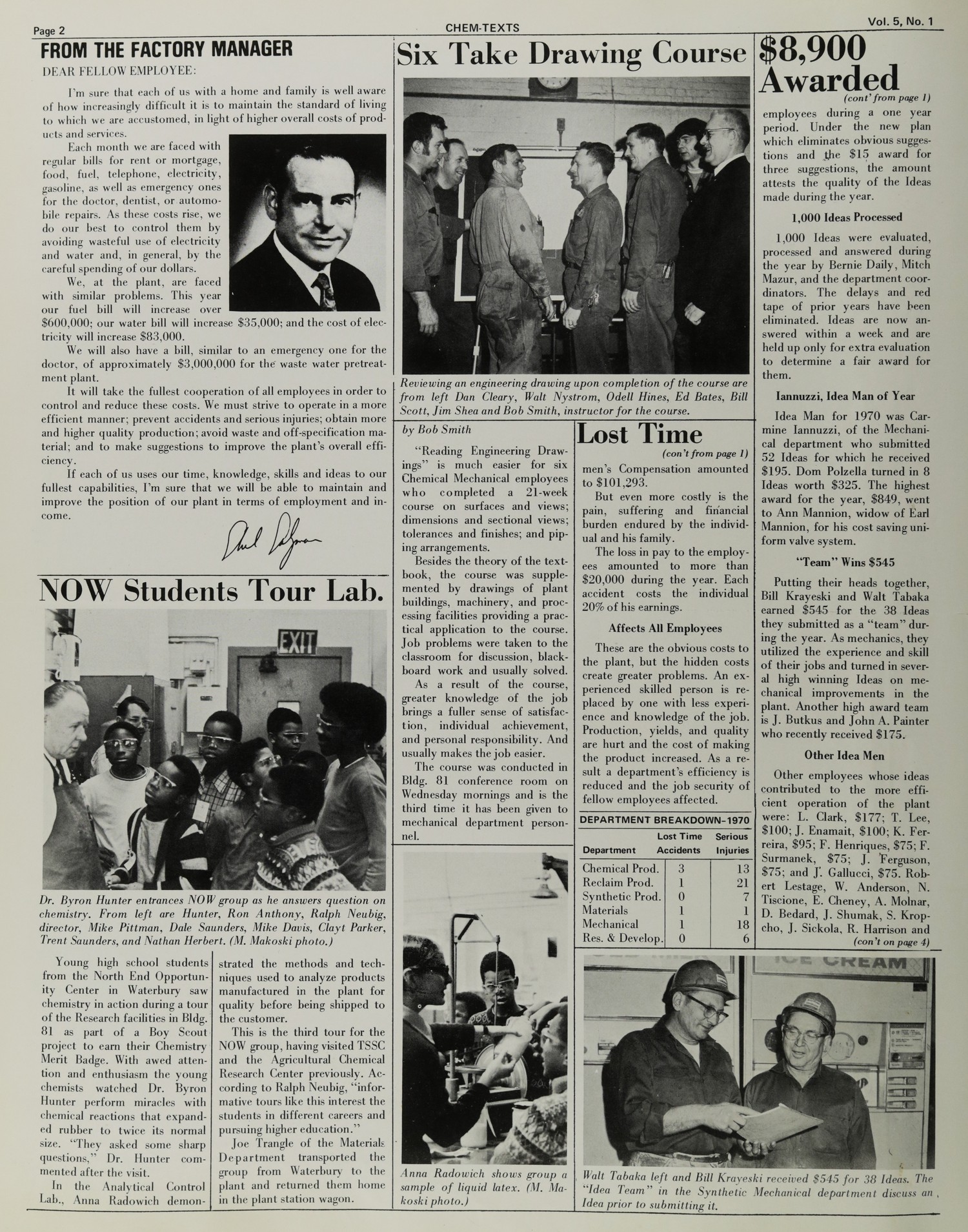
Dr. Byron Hunter entrances NOW group as he answers question on chemistry. From left are Hunter, Ron Anthony, Ralph Neubig, director, Mike Pittman, Dale Saunders, Mike Davis, Clayt Parker, Trent Saunders, and Nathan Herbert. (M. Makoski photo.)

Young high school students from the North End Opportunity Center in Waterbury saw chemistry in action during a tour of the Research facilities in Bldg. 81 as part of a Boy Scout project to earn their Chemistry Merit Badge. With awed attention and enthusiasm the young chemists watched Dr. Byron Hunter perform miracles with chemical reactions that expanded rubber to twice its normal size. “They asked some sharp questions,” Dr. Hunter commented after the visit.

In the Analytical Control Lab., Anna Radowich demonstrated the methods and techniques used to analyze products manufactured in the plant for quality before being shipped to the customer.

This is the third tour for the NOW group, having visited TSSC and the Agricultural Chemical Research Center previously. According to Ralph Neubig, “informative tours like this interest the students in different careers and pursuing higher education.”

Joe Trangle of the Materials Department transported the group from Waterbury to the plant and returned them home in the plant station wagon.


Six Take Drawing Course

Reviewing an engineering drawing upon completion of the course are from left Dan Cleary, Walt Nystrom, Odell Hines, Ed Bates, Bill Scott, Jim Shea and Bob Smith, instructor for the course.

by Bob Smith

“Reading Engineering Drawings” is much easier for six Chemical Mechanical employees who completed a 21-week course on surfaces and views; dimensions and sectional views; tolerances and finishes; and piping arrangements.

Besides the theory of the textbook, the course was supplemented by drawings of plant buildings, machinery, and processing facilities providing a practical application to the course. Job problems were taken to the classroom for discussion, blackboard work and usually solved.

As a result of the course, greater knowledge of the job brings a fuller sense of satisfaction, individual achievement, and personal responsibility. And usually makes the job easier.

The course was conducted in Bldg. 81 conference room on Wednesday mornings and is the third time it has been given to mechanical department personnel.


$8,900 Awarded

(cont’ from page 1)

employees during a one year period. Under the new plan which eliminates obvious suggestions and the $15 award for three suggestions, the amount attests the quality of the Ideas made during the year.

1,000 Ideas Processed

1,000 Ideas were evaluated, processed and answered during the year by Bernie Daily, Mitch Mazur, and the department coordinators. The delays and red tape of prior years have been eliminated. Ideas are now answered within a week and are held up only for extra evaluation to determine a fair award for them.

Iannuzzi, Idea Man of Year

Idea Man for 1970 was Carmine Iannuzzi, of the Mechanical department who submitted 52 Ideas for which he received $195. Dom Polzella turned in 8 Ideas worth $325. The highest award for the year, $849, went to Ann Mannion, widow of Earl Mannion, for his cost saving uniform valve system.

“Team” Wins $545

Putting their heads together, Bill Krayeski and Walt Tabaka earned $545 for the 38 Ideas they submitted as a “team” during the year. As mechanics, they utilized the experience and skill of their jobs and turned in several high winning Ideas on mechanical improvements in the plant. Another high award team is J. Butkus and John A. Painter who recently received $175.

Other Idea Men

Other employees whose ideas contributed to the more efficient operation of the plant were: L. Clark, $177; T. Lee, $100; J. Enamait, $100; K. Ferreira, $95; F. Henriques, $75; F. Surmanek, $75; J. Ferguson, $75; and J. Gallucci, $75. Robert Lestage, W. Anderson, N. Tiscione, E. Cheney, A. Molnar, D. Bedard, J. Shumak, S. Kropcho, J. Sickola, R. Harrison and (con’t on page 4)


Lost Time

(con’t from page 1)

men’s Compensation amounted to $101,293.

But even more costly is the pain, suffering and financial burden endured by the individual and his family.

The loss in pay to the employees amounted to more than $20,000 during the year. Each accident costs the individual 20% of his earnings.

Affects All Employees

These are the obvious costs to the plant, but the hidden costs create greater problems. An experienced skilled person is replaced by one with less experience and knowledge of the job. Production, yields, and quality are hurt and the cost of making the product increased. As a result a department’s efficiency is reduced and the job security of fellow employees affected.

DEPARTMENT BREAKDOWN—1970

Department Lost Time Accidents Serious Injuries
Chemical Prod. 3 13
Reclaim Prod. 1 21
Synthetic Prod. 0 7
Materials 1 1
Mechanical 1 18
Res. & Develop. 0 6

Anna Radowich shows group a sample of liquid latex. (M. Makoski photo.)

Walt Tabaka left and Bill Krayeski received $545 for 38 Ideas. The “Idea Team” in the Synthetic Mechanical department discuss an Idea prior to submitting it.
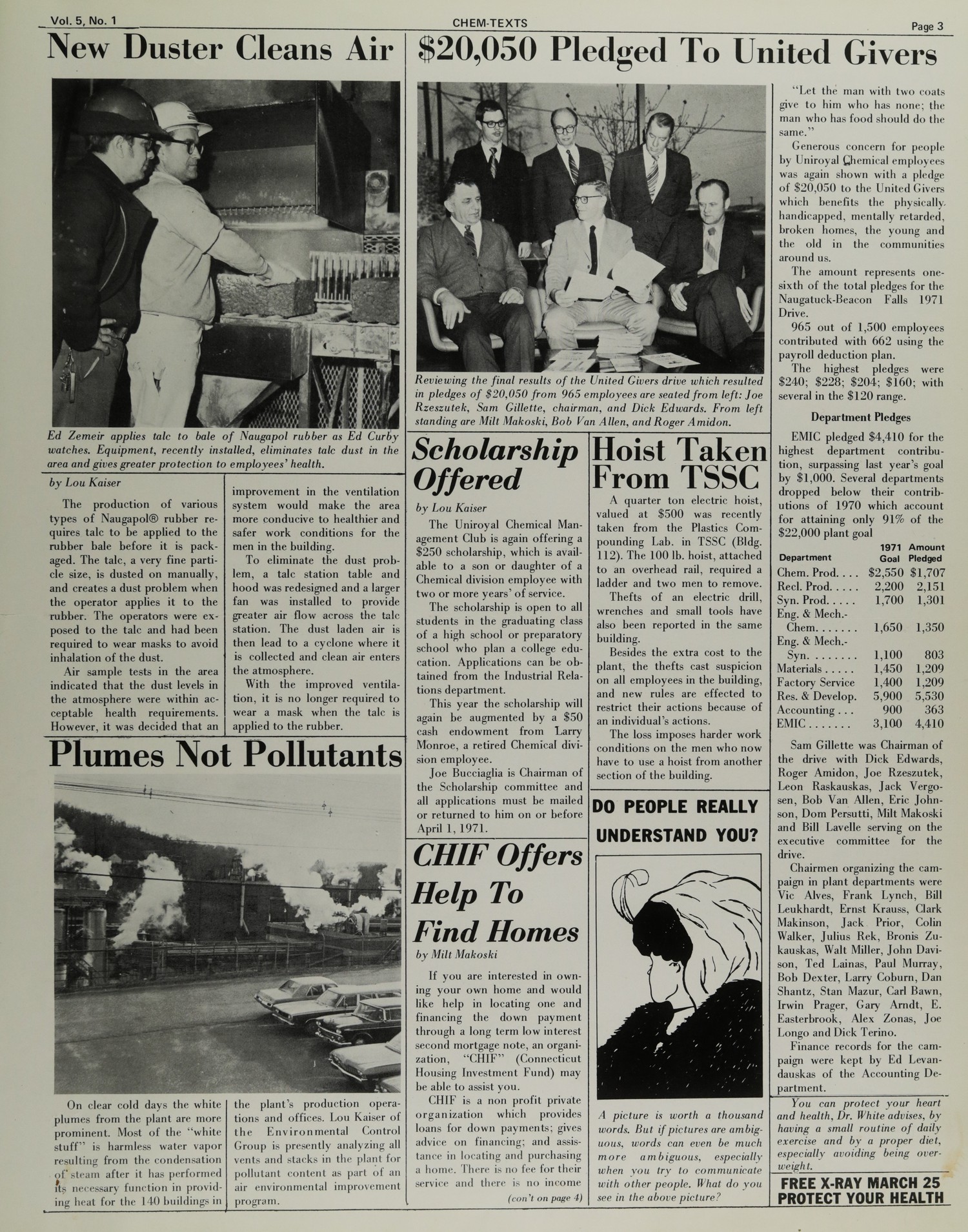
CHEM-TEXTS – Vol. 5, No. 1 – Page 3

Page 003

CHEM-TEXTS

Vol. 5, No. 1 | Page 3


New Duster Cleans Air

Ed Zemeir applies talc to bale of Naugapol rubber as Ed Curby watches. Equipment, recently installed, eliminates talc dust in the area and gives greater protection to employees’ health.

by Lou Kaiser

The production of various types of Naugapol® rubber requires talc to be applied to the rubber bale before it is packaged. The talc, a very fine particle size, is dusted on manually, and creates a dust problem when the operator applies it to the rubber. The operators were exposed to the talc and had been required to wear masks to avoid inhalation of the dust.

Air sample tests in the area indicated that the dust levels in the atmosphere were within acceptable health requirements. However, it was decided that an improvement in the ventilation system would make the area more conducive to healthier and safer work conditions for the men in the building.

To eliminate the dust problem, a talc station table and hood was redesigned and a larger fan was installed to provide greater air flow across the talc station. The dust laden air is then lead to a cyclone where it is collected and clean air enters the atmosphere.

With the improved ventilation, it is no longer required to wear a mask when the talc is applied to the rubber.


Plumes Not Pollutants

On clear cold days the white plumes from the plant are more prominent. Most of the “white stuff” is harmless water vapor resulting from the condensation of steam after it has performed its necessary function in providing heat for the 140 buildings in the plant’s production operations and offices. Lou Kaiser of the Environmental Control Group is presently analyzing all vents and stacks in the plant for pollutant content as part of an air environmental improvement program.


$20,050 Pledged To United Givers

Reviewing the final results of the United Givers drive which resulted in pledges of $20,050 from 965 employees are seated from left: Joe Rzeszutek, Sam Gillette, chairman, and Dick Edwards. From left standing are Milt Makoski, Bob Van Allen, and Roger Amidon.

“Let the man with two coats give to him who has none; the man who has food should do the same.”

Generous concern for people by Uniroyal Chemical employees was again shown with a pledge of $20,050 to the United Givers which benefits the physically handicapped, mentally retarded, broken homes, the young and the old in the communities around us.

The amount represents one-sixth of the total pledges for the Naugatuck-Beacon Falls 1971 Drive.

965 out of 1,500 employees contributed with 662 using the payroll deduction plan.

The highest pledges were $240; $228; $204; $160; with several in the $120 range.

Department Pledges

EMIC pledged $4,410 for the highest department contribution, surpassing last year’s goal by $1,000. Several departments dropped below their contributions of 1970 which account for attaining only 91% of the $22,000 plant goal

Department 1971 Goal Amount Pledged
Chem. Prod…. $2,550 $1,707
Recl. Prod….. 2,200 2,151
Syn. Prod…… 1,700 1,301
Eng. & Mech.- Chem……. 1,650 1,350
Eng. & Mech.- Syn……. 1,100 803
Materials….. 1,450 1,209
Factory Service 1,400 1,209
Res. & Develop. 5,900 5,530
Accounting… 900 363
EMIC…….. 3,100 4,410

Sam Gillette was Chairman of the drive with Dick Edwards, Roger Amidon, Joe Rzeszutek, Leon Raskauskas, Jack Vergosen, Bob Van Allen, Eric Johnson, Dom Persutti, Milt Makoski and Bill Lavelle serving on the executive committee for the drive.

Chairmen organizing the campaign in plant departments were Vic Alves, Frank Lynch, Bill Leukhardt, Ernst Krauss, Clark Makinson, Jack Prior, Colin Walker, Julius Rek, Bronis Zukauskas, Walt Miller, John Davison, Ted Lainas, Paul Murray, Bob Dexter, Larry Coburn, Dan Shantz, Stan Mazur, Carl Bawn, Irwin Prager, Gary Arndt, E. Easterbrook, Alex Zonas, Joe Longo and Dick Terino.

Finance records for the campaign were kept by Ed Levandauskas of the Accounting Department.


Scholarship Offered

by Lou Kaiser

The Uniroyal Chemical Management Club is again offering a $250 scholarship, which is available to a son or daughter of a Chemical division employee with two or more years’ of service.

The scholarship is open to all students in the graduating class of a high school or preparatory school who plan a college education. Applications can be obtained from the Industrial Relations department.

This year the scholarship will again be augmented by a $50 cash endowment from Larry Monroe, a retired Chemical division employee.

Joe Bucciaglia is Chairman of the Scholarship committee and all applications must be mailed or returned to him on or before April 1, 1971.


Hoist Taken From TSSC

A quarter ton electric hoist, valued at $500 was recently taken from the Plastics Compounding Lab. in TSSC (Bldg. 112). The 100 lb. hoist, attached to an overhead rail, required a ladder and two men to remove.

Thefts of an electric drill, wrenches and small tools have also been reported in the same building.

Besides the extra cost to the plant, the thefts cast suspicion on all employees in the building, and new rules are effected to restrict their actions because of an individual’s actions.

The loss imposes harder work conditions on the men who now have to use a hoist from another section of the building.


CHIF Offers Help To Find Homes

by Milt Makoski

If you are interested in owning your own home and would like help in locating one and financing the down payment through a long term low interest second mortgage note, an organization, “CHIF” (Connecticut Housing Investment Fund) may be able to assist you.

CHIF is a non profit private organization which provides loans for down payments; gives advice on financing; and assistance in locating and purchasing a home. There is no fee for their service and there is no income

(con’t on page 4)


DO PEOPLE REALLY UNDERSTAND YOU?

A picture is worth a thousand words. But if pictures are ambiguous, words can even be much more ambiguous, especially when you try to communicate with other people. What do you see in the above picture?


You can protect your heart and health, Dr. White advises, by having a small routine of daily exercise and by a proper diet, especially avoiding being overweight.

FREE X-RAY MARCH 25
PROTECT YOUR HEALTH

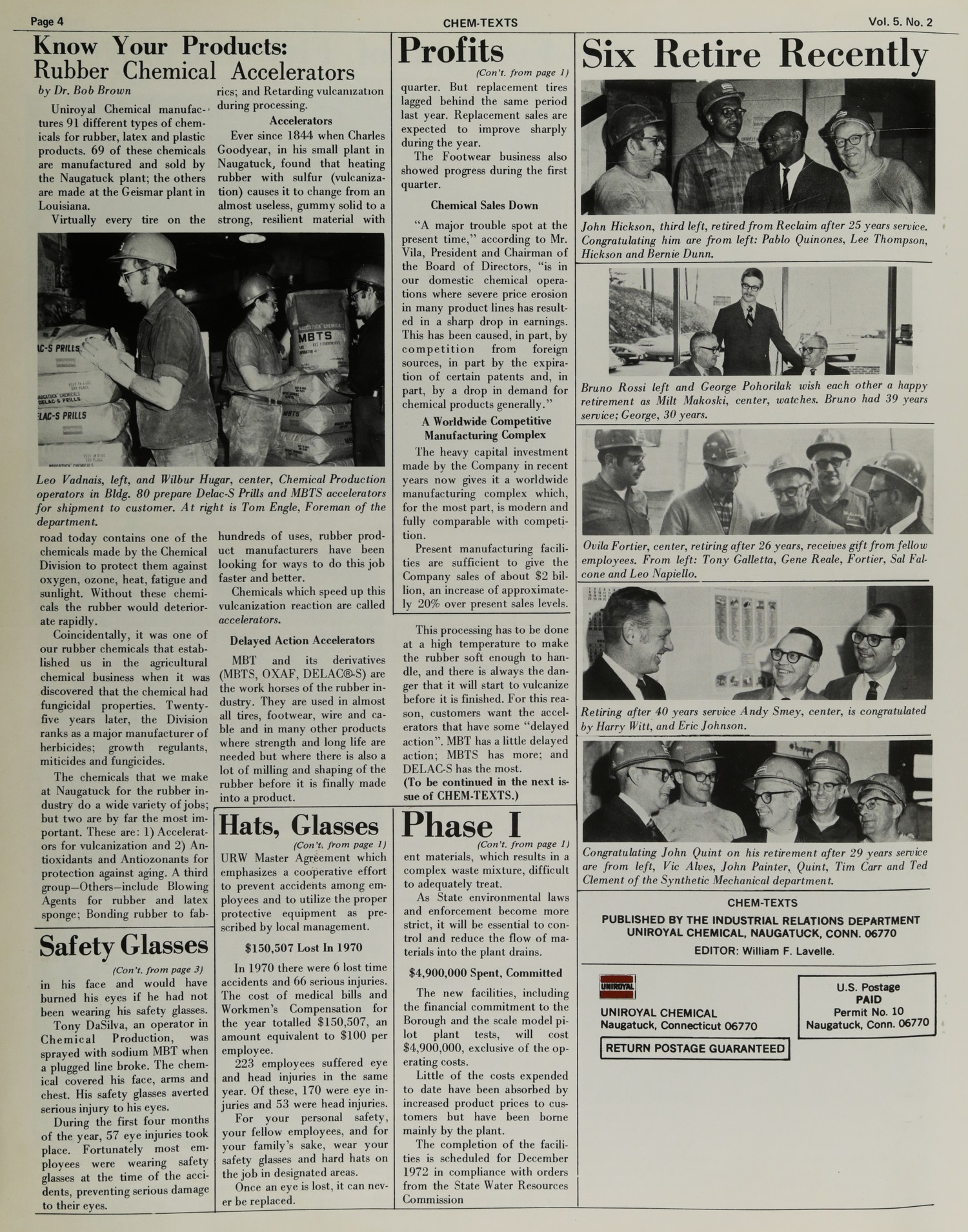
CHEM-TEXTS – Vol. 5, No. 2 – Page 4

Page 004

Page 4 | CHEM-TEXTS | Vol. 5. No. 2


Know Your Products: Rubber Chemical Accelerators

by Dr. Bob Brown

Uniroyal Chemical manufactures 91 different types of chemicals for rubber, latex and plastic products. 69 of these chemicals are manufactured and sold by the Naugatuck plant; the others are made at the Geismar plant in Louisiana.

Virtually every tire on the road today contains one of the chemicals made by the Chemical Division to protect them against oxygen, ozone, heat, fatigue and sunlight. Without these chemicals the rubber would deteriorate rapidly.

Coincidentally, it was one of our rubber chemicals that established us in the agricultural chemical business when it was discovered that the chemical had fungicidal properties. Twenty-five years later, the Division ranks as a major manufacturer of herbicides; growth regulants, miticides and fungicides.

The chemicals that we make at Naugatuck for the rubber industry do a wide variety of jobs; but two are by far the most important. These are: 1) Accelerators for vulcanization and 2) Antioxidants and Antiozonants for protection against aging. A third group—Others—include Blowing Agents for rubber and latex sponge; Bonding rubber to fabric; and Retarding vulcanization during processing.

Accelerators

Ever since 1844 when Charles Goodyear, in his small plant in Naugatuck, found that heating rubber with sulfur (vulcanization) causes it to change from an almost useless, gummy solid to a strong, resilient material with hundreds of uses, rubber product manufacturers have been looking for ways to do this job faster and better.

Chemicals which speed up this vulcanization reaction are called accelerators.

Delayed Action Accelerators

MBT and its derivatives (MBTS, OXAF, DELAC®-S) are the work horses of the rubber industry. They are used in almost all tires, footwear, wire and cable and in many other products where strength and long life are needed but where there is also a lot of milling and shaping of the rubber before it is finally made into a product.


[IMAGE: Black and white photograph showing workers]

AC-5 PRILLS

LAC-5 PRILLS

Leo Vadnais, left, and Wilbur Hugar, center, Chemical Production operators in Bldg. 80 prepare Delac-S Prills and MBTS accelerators for shipment to customer. At right is Tom Engle, Foreman of the department.


Safety Glasses

(Con’t. from page 3)

in his face and would have burned his eyes if he had not been wearing his safety glasses.

Tony DaSilva, an operator in Chemical Production, was sprayed with sodium MBT when a plugged line broke. The chemical covered his face, arms and chest. His safety glasses averted serious injury to his eyes.

During the first four months of the year, 57 eye injuries took place. Fortunately most employees were wearing safety glasses at the time of the accidents, preventing serious damage to their eyes.


Hats, Glasses

(Con’t. from page 1)

URW Master Agreement which emphasizes a cooperative effort to prevent accidents among employees and to utilize the proper protective equipment as prescribed by local management.

$150,507 Lost In 1970

In 1970 there were 6 lost time accidents and 66 serious injuries. The cost of medical bills and Workmen’s Compensation for the year totalled $150,507, an amount equivalent to $100 per employee.

223 employees suffered eye and head injuries in the same year. Of these, 170 were eye injuries and 53 were head injuries.

For your personal safety, your fellow employees, and for your family’s sake, wear your safety glasses and hard hats on the job in designated areas.

Once an eye is lost, it can never be replaced.


Profits

(Con’t. from page 1)

quarter. But replacement tires lagged behind the same period last year. Replacement sales are expected to improve sharply during the year.

The Footwear business also showed progress during the first quarter.

Chemical Sales Down

“A major trouble spot at the present time,” according to Mr. Vila, President and Chairman of the Board of Directors, “is in our domestic chemical operations where severe price erosion in many product lines has resulted in a sharp drop in earnings. This has been caused, in part, by competition from foreign sources, in part by the expiration of certain patents and, in part, by a drop in demand for chemical products generally.”

A Worldwide Competitive Manufacturing Complex

The heavy capital investment made by the Company in recent years now gives it a worldwide manufacturing complex which, for the most part, is modern and fully comparable with competition.

Present manufacturing facilities are sufficient to give the Company sales of about $2 billion, an increase of approximately 20% over present sales levels.

This processing has to be done at a high temperature to make the rubber soft enough to handle, and there is always the danger that it will start to vulcanize before it is finished. For this reason, customers want the accelerators that have some “delayed action”. MBT has a little delayed action; MBTS has more; and DELAC-S has the most.

(To be continued in the next issue of CHEM-TEXTS.)


Phase I

(Con’t. from page 1)

ent materials, which results in a complex waste mixture, difficult to adequately treat.

As State environmental laws and enforcement become more strict, it will be essential to control and reduce the flow of materials into the plant drains.

$4,900,000 Spent, Committed

The new facilities, including the financial commitment to the Borough and the scale model pilot plant tests, will cost $4,900,000, exclusive of the operating costs.

Little of the costs expended to date have been absorbed by increased product prices to customers but have been borne mainly by the plant.

The completion of the facilities is scheduled for December 1972 in compliance with orders from the State Water Resources Commission


Six Retire Recently

[IMAGE: Photograph of three men]

John Hickson, third left, retired from Reclaim after 25 years service. Congratulating him are from left: Pablo Quinones, Lee Thompson, Hickson and Bernie Dunn.


[IMAGE: Photograph of two men]

Bruno Rossi left and George Pohorilak wish each other a happy retirement as Milt Makoski, center, watches. Bruno had 39 years service; George, 30 years.


[IMAGE: Photograph of group of men]

Ovila Fortier, center, retiring after 26 years, receives gift from fellow employees. From left: Tony Galletta, Gene Reale, Fortier, Sal Falcone and Leo Napiello.


[IMAGE: Photograph of three men]

Retiring after 40 years service Andy Smey, center, is congratulated by Harry Witt, and Eric Johnson.


[IMAGE: Photograph of group of men]

Congratulating John Quint on his retirement after 29 years service are from left, Vic Alves, John Painter, Quint, Tim Carr and Ted Clement of the Synthetic Mechanical department.


CHEM-TEXTS

PUBLISHED BY THE INDUSTRIAL RELATIONS DEPARTMENT

UNIROYAL CHEMICAL, NAUGATUCK, CONN. 06770

EDITOR: William F. Lavelle.


[LOGO: UNIROYAL]

UNIROYAL CHEMICAL
Naugatuck, Connecticut 06770

RETURN POSTAGE GUARANTEED

U.S. Postage
PAID
Permit No. 10
Naugatuck, Conn. 06770

CHEM-TEXTS – Vol. 5 No. 3 – Page 2

Page 002

CHEM-TEXTS

Page 2 | Vol. 5 No. 3


FROM THE FACTORY MANAGER

DEAR FELLOW EMPLOYEE:

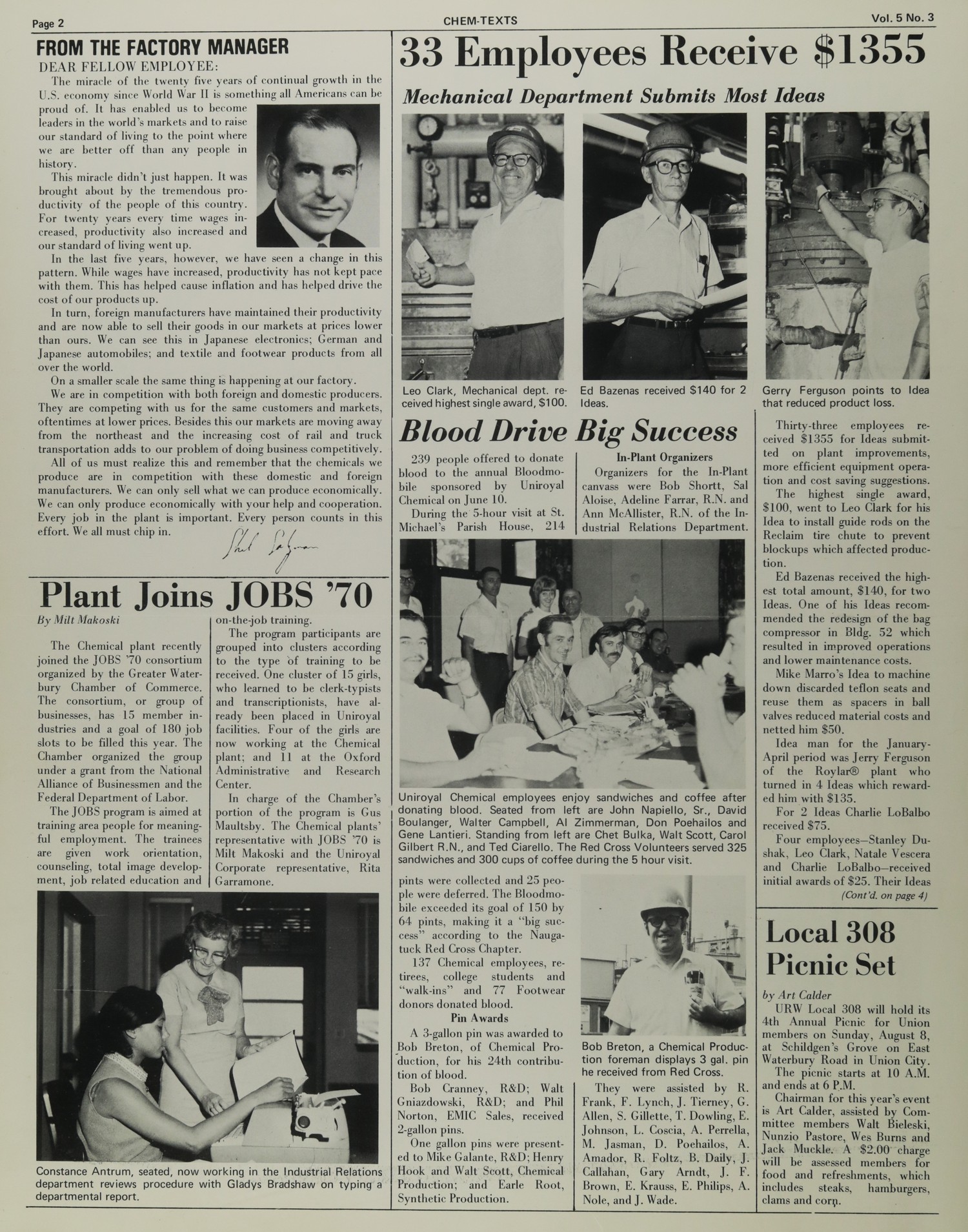
The miracle of the twenty five years of continual growth in the U.S. economy since World War II is something all Americans can be proud of. It has enabled us to become leaders in the world’s markets and to raise our standard of living to the point where we are better off than any people in history.

This miracle didn’t just happen. It was brought about by the tremendous productivity of the people of this country. For twenty years every time wages increased, productivity also increased and our standard of living went up.

In the last five years, however, we have seen a change in this pattern. While wages have increased, productivity has not kept pace with them. This has helped cause inflation and has helped drive the cost of our products up.

In turn, foreign manufacturers have maintained their productivity and are now able to sell their goods in our markets at prices lower than ours. We can see this in Japanese electronics; German and Japanese automobiles; and textile and footwear products from all over the world.

On a smaller scale the same thing is happening at our factory. We are in competition with both foreign and domestic producers. They are competing with us for the same customers and markets, oftentimes at lower prices. Besides this our markets are moving away from the northeast and the increasing cost of rail and truck transportation adds to our problem of doing business competitively.

All of us must realize this and remember that the chemicals we produce are in competition with these domestic and foreign manufacturers. We can only sell what we can produce economically. We can only produce economically with your help and cooperation. Every job in the plant is important. Every person counts in this effort. We all must chip in.

Phil LaJoie


33 Employees Receive $1355

Mechanical Department Submits Most Ideas

Leo Clark, Mechanical dept. received highest single award, $100.

Ed Bazenas received $140 for 2 Ideas.

Gerry Ferguson points to Idea that reduced product loss.

Thirty-three employees received $1355 for Ideas submitted on plant improvements, more efficient equipment operation and cost saving suggestions.

The highest single award, $100, went to Leo Clark for his Idea to install guide rods on the Reclaim tire chute to prevent blockups which affected production.

Ed Bazenas received the highest total amount, $140, for two Ideas. One of his Ideas recommended the redesign of the bag compressor in Bldg. 52 which resulted in improved operations and lower maintenance costs.

Mike Marro’s Idea to machine down discarded teflon seats and reuse them as spacers in ball valves reduced material costs and netted him $50.

Idea man for the January-April period was Jerry Ferguson of the Roylar® plant who turned in 4 Ideas which rewarded him with $135.

For 2 Ideas Charlie LoBalbo received $75.

Four employees—Stanley Dushak, Leo Clark, Natale Vescera and Charlie LoBalbo—received initial awards of $25. Their Ideas
(Cont’d. on page 4)


Blood Drive Big Success

239 people offered to donate blood to the annual Bloodmobile sponsored by Uniroyal Chemical on June 10.

During the 5-hour visit at St. Michael’s Parish House, 214 pints were collected and 25 people were deferred. The Bloodmobile exceeded its goal of 150 by 64 pints, making it a “big success” according to the Naugatuck Red Cross Chapter.

137 Chemical employees, retirees, college students and “walk-ins” and 77 Footwear donors donated blood.

Pin Awards

A 3-gallon pin was awarded to Bob Breton, of Chemical Production, for his 24th contribution of blood.

Bob Cranney, R&D; Walt Gniazdowski, R&D; and Phil Norton, EMIC Sales, received 2-gallon pins.

One gallon pins were presented to Mike Galante, R&D; Henry Hook and Walt Scott, Chemical Production; and Earle Root, Synthetic Production.

In-Plant Organizers

Organizers for the In-Plant canvass were Bob Shortt, Sal Aloise, Adeline Farrar, R.N. and Ann McAllister, R.N. of the Industrial Relations Department.

Uniroyal Chemical employees enjoy sandwiches and coffee after donating blood. Seated from left are John Napiello, Sr., David Boulanger, Walter Campbell, Al Zimmerman, Don Poehailos and Gene Lantieri. Standing from left are Chet Bulka, Walt Scott, Carol Gilbert R.N., and Ted Ciarello. The Red Cross Volunteers served 325 sandwiches and 300 cups of coffee during the 5 hour visit.

Bob Breton, a Chemical Production foreman displays 3 gal. pin he received from Red Cross.

They were assisted by R. Frank, F. Lynch, J. Tierney, G. Allen, S. Gillette, T. Dowling, E. Johnson, L. Coscia, A. Perrella, M. Jasman, D. Poehailos, A. Amador, R. Foltz, B. Daily, J. Callahan, Gary Arndt, J. F. Brown, E. Krauss, E. Philips, A. Nole, and J. Wade.


Plant Joins JOBS ’70

By Milt Makoski

The Chemical plant recently joined the JOBS ’70 consortium organized by the Greater Waterbury Chamber of Commerce. The consortium, or group of businesses, has 15 member industries and a goal of 180 job slots to be filled this year. The Chamber organized the group under a grant from the National Alliance of Businessmen and the Federal Department of Labor.

The JOBS program is aimed at training area people for meaningful employment. The trainees are given work orientation, counseling, total image development, job related education and on-the-job training.

The program participants are grouped into clusters according to the type of training to be received. One cluster of 15 girls, who learned to be clerk-typists and transcriptionists, have already been placed in Uniroyal facilities. Four of the girls are now working at the Chemical plant; and 11 at the Oxford Administrative and Research Center.

In charge of the Chamber’s portion of the program is Gus Maultsby. The Chemical plants’ representative with JOBS ’70 is Milt Makoski and the Uniroyal Corporate representative, Rita Garramone.

Constance Antrum, seated, now working in the Industrial Relations department reviews procedure with Gladys Bradshaw on typing a departmental report.


Local 308 Picnic Set

by Art Calder

URW Local 308 will hold its 4th Annual Picnic for Union members on Sunday, August 8, at Schildgen’s Grove on East Waterbury Road in Union City. The picnic starts at 10 A.M. and ends at 6 P.M.

Chairman for this year’s event is Art Calder, assisted by Committee members Walt Bieleski, Nunzio Pastore, Wes Burns and Jack Muckle. A $2.00 charge will be assessed members for food and refreshments, which includes steaks, hamburgers, clams and corp.

CHEM-TEXTS – Vol. 5, No. 4 – Page 2

Page 002

Page 2 | CHEM-TEXTS | Vol. 5, No. 4


FROM THE FACTORY MANAGER

DEAR FELLOW EMPLOYEE:

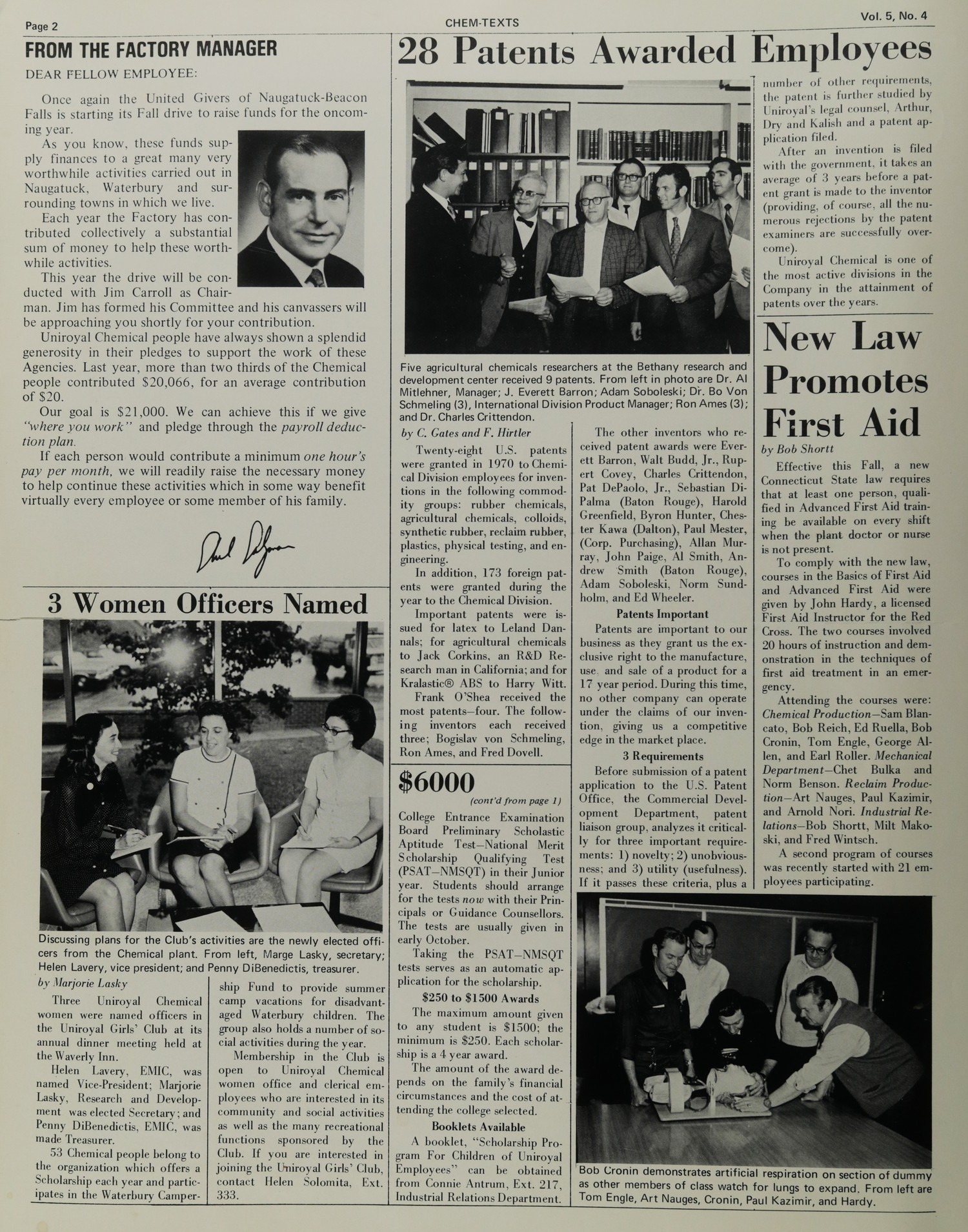
Once again the United Givers of Naugatuck-Beacon Falls is starting its Fall drive to raise funds for the oncoming year.

As you know, these funds supply finances to a great many very worthwhile activities carried out in Naugatuck, Waterbury and surrounding towns in which we live.

Each year the Factory has contributed collectively a substantial sum of money to help these worthwhile activities.

This year the drive will be conducted with Jim Carroll as Chairman. Jim has formed his Committee and his canvassers will be approaching you shortly for your contribution.

Uniroyal Chemical people have always shown a splendid generosity in their pledges to support the work of these Agencies. Last year, more than two thirds of the Chemical people contributed $20,066, for an average contribution of $20.

Our goal is $21,000. We can achieve this if we give “where you work” and pledge through the payroll deduction plan.

If each person would contribute a minimum one hour’s pay per month, we will readily raise the necessary money to help continue these activities which in some way benefit virtually every employee or some member of his family.

[Signature]


3 Women Officers Named

[IMAGE: Photo of three women]

Discussing plans for the Club’s activities are the newly elected officers from the Chemical plant. From left, Marge Lasky, secretary; Helen Lavery, vice president; and Penny DiBenedictis, treasurer.

by Marjorie Lasky

Three Uniroyal Chemical women were named officers in the Uniroyal Girls’ Club at its annual dinner meeting held at the Waverly Inn.

Helen Lavery, EMIC, was named Vice-President; Marjorie Lasky, Research and Development was elected Secretary; and Penny DiBenedictis, EMIC, was made Treasurer.

53 Chemical people belong to the organization which offers a Scholarship each year and participates in the Waterbury Campership Fund to provide summer camp vacations for disadvantaged Waterbury children. The group also holds a number of social activities during the year.

Membership in the Club is open to Uniroyal Chemical women office and clerical employees who are interested in its community and social activities as well as the many recreational functions sponsored by the Club. If you are interested in joining the Uniroyal Girls’ Club, contact Helen Solomita, Ext. 333.


28 Patents Awarded Employees

[IMAGE: Group photo of five men in front of bookshelves]

Five agricultural chemicals researchers at the Bethany research and development center received 9 patents. From left in photo are Dr. Al Mittlehner, Manager; J. Everett Barron; Adam Soboleski; Dr. Bo Von Schmeling (3), International Division Product Manager; Ron Ames (3); and Dr. Charles Crittendon.

by C. Gates and F. Hirtler

Twenty-eight U.S. patents were granted in 1970 to Chemical Division employees for inventions in the following commodity groups: rubber chemicals, agricultural chemicals, colloids, synthetic rubber, reclaim rubber, plastics, physical testing, and engineering.

In addition, 173 foreign patents were granted during the year to the Chemical Division.

Important patents were issued for latex to Leland Dannals; for agricultural chemicals to Jack Corkins, an R&D Research man in California; and for Kralastic® ABS to Harry Witt.

Frank O’Shea received the most patents—four. The following inventors each received three; Bogislav von Schmeling, Ron Ames, and Fred Dovell.


$6000

(cont’d from page 1)

College Entrance Examination Board Preliminary Scholastic Aptitude Test—National Merit Scholarship Qualifying Test (PSAT—NMSQT) in their Junior year. Students should arrange for the tests now with their Principals or Guidance Counsellors. The tests are usually given in early October.

Taking the PSAT—NMSQT tests serves as an automatic application for the scholarship.

$250 to $1500 Awards

The maximum amount given to any student is $1500; the minimum is $250. Each scholarship is a 4 year award.

The amount of the award depends on the family’s financial circumstances and the cost of attending the college selected.

Booklets Available

A booklet, “Scholarship Program For Children of Uniroyal Employees” can be obtained from Connie Antrum, Ext. 217, Industrial Relations Department.


The other inventors who received patent awards were Everett Barron, Walt Budd, Jr., Rupert Covey, Charles Crittendon, Pat DePaolo, Jr., Sebastian Di-Palma (Baton Rouge), Harold Greenfield, Byron Hunter, Chester Kawa (Dalton), Paul Mester, (Corp. Purchasing), Allan Murray, John Paige, Al Smith, Andrew Smith (Baton Rouge), Adam Soboleski, Norm Sundholm, and Ed Wheeler.

Patents Important

Patents are important to our business as they grant us the exclusive right to the manufacture, use and sale of a product for a 17 year period. During this time, no other company can operate under the claims of our invention, giving us a competitive edge in the market place.

3 Requirements

Before submission of a patent application to the U.S. Patent Office, the Commercial Development Department, patent liaison group, analyzes it critically for three important requirements: 1) novelty; 2) unobviousness; and 3) utility (usefulness). If it passes these criteria, plus a

number of other requirements, the patent is further studied by Uniroyal’s legal counsel, Arthur, Dry and Kalish and a patent application filed.

After an invention is filed with the government, it takes an average of 3 years before a patent grant is made to the inventor (providing, of course, all the numerous rejections by the patent examiners are successfully overcome).

Uniroyal Chemical is one of the most active divisions in the Company in the attainment of patents over the years.


New Law Promotes First Aid

by Bob Shortt

Effective this Fall, a new Connecticut State law requires that at least one person, qualified in Advanced First Aid training be available on every shift when the plant doctor or nurse is not present.

To comply with the new law, courses in the Basics of First Aid and Advanced First Aid were given by John Hardy, a licensed First Aid Instructor for the Red Cross. The two courses involved 20 hours of instruction and demonstration in the techniques of first aid treatment in an emergency.

Attending the courses were: Chemical Production—Sam Blancato, Bob Reich, Ed Ruella, Bob Cronin, Tom Engle, George Allen, and Earl Roller. Mechanical Department—Chet Bulka and Norm Benson. Reclaim Production—Art Nauges, Paul Kazimir, and Arnold Nori. Industrial RelationsBob Shortt, Milt Makoski, and Fred Wintsch.

A second program of courses was recently started with 21 employees participating.

[IMAGE: Photo of First Aid training demonstration]

Bob Cronin demonstrates artificial respiration on section of dummy as other members of class watch for lungs to expand. From left are Tom Engle, Art Nauges, Cronin, Paul Kazimir, and Hardy.

CHEM-TEXTS – Vol. 5, No. 6 – Page 3

Page 003

Page 3 | CHEM-TEXTS | Vol. 5. No. 6


$21,000 Unit…

(Cont’d. from page 1)

than previously made at the plant.

Mike English was the Process Development Engineer for the process requirements and Rod Ashby was Project Engineer for the design and construction of the unit.

The new facility burns off waste gases completely in a smoke-less flame, and eliminates air pollution and fire hazard.

[IMAGE: Industrial facility/equipment]


United Givers

(Cont’d. from page 1)

[IMAGE: Group of people at a table reviewing documents]

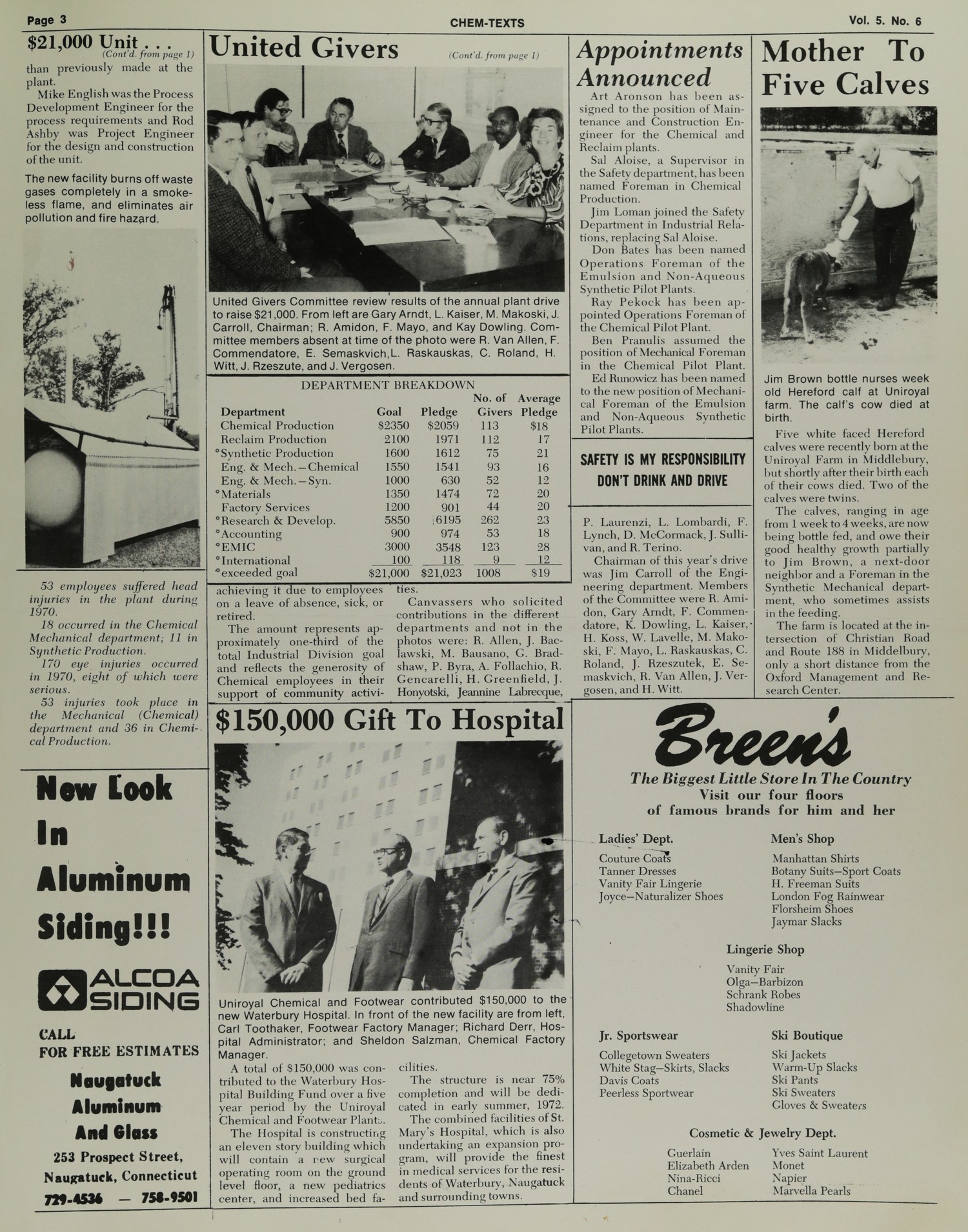
United Givers Committee review results of the annual plant drive to raise $21,000. From left are Gary Arndt, L. Kaiser, M. Makoski, J. Carroll, Chairman; R. Amidon, F. Mayo, and Kay Dowling. Committee members absent at time of the photo were R. Van Allen, F. Commendatore, E. Semaskvich, L. Raskauskas, C. Roland, H. Witt, J. Rzeszute, and J. Vergosen.

DEPARTMENT BREAKDOWN

Department Goal Pledge No. of Givers Average Pledge
Chemical Production $2350 $2059 113 $18
Reclaim Production 2100 1971 112 17
*Synthetic Production 1600 1612 75 21
Eng. & Mech.—Chemical 1550 1541 93 16
Eng. & Mech.—Syn. 1000 630 52 12
*Materials 1350 1474 72 20
Factory Services 1200 901 44 20
*Research & Develop. 5850 6195 262 23
*Accounting 900 974 53 18
*EMIC 3000 3548 123 28
*International 100 118 9 12
*exceeded goal $21,000 $21,023 1008 $19

53 employees suffered head injuries in the plant during 1970.

18 occurred in the Chemical Mechanical department; 11 in Synthetic Production.

170 eye injuries occurred in 1970, eight of which were serious.

53 injuries took place in the Mechanical (Chemical) department and 36 in Chemical Production.


achieving it due to employees on a leave of absence, sick, or retired.

The amount represents approximately one-third of the total Industrial Division goal and reflects the generosity of Chemical employees in their support of community activities.

Canvassers who solicited contributions in the different departments and not in the photos were: R. Allen, J. Baclawski, M. Bausano, G. Bradshaw, P. Byra, A. Follachio, R. Gencarelli, H. Greenfield, J. Honyotski, Jeannine Labrecque,


Appointments Announced

Art Aronson has been assigned to the position of Maintenance and Construction Engineer for the Chemical and Reclaim plants.

Sal Aloise, a Supervisor in the Safety department, has been named Foreman in Chemical Production.

Jim Loman joined the Safety Department in Industrial Relations, replacing Sal Aloise.

Don Bates has been named Operations Foreman of the Emulsion and Non-Aqueous Synthetic Pilot Plants.

Ray Pekoek has been appointed Operations Foreman of the Chemical Pilot Plant.

Ben Pranulis assumed the position of Mechanical Foreman in the Chemical Pilot Plant.

Ed Hunwicz has been named to the new position of Mechanical Foreman of the Emulsion and Non-Aqueous Synthetic Pilot Plants.


SAFETY IS MY RESPONSIBILITY

DON’T DRINK AND DRIVE

P. Laurenzi, L. Lombardi, F. Lynch, D. McCormack, J. Sullivan, and R. Terino.

Chairman of this year’s drive was Jim Carroll of the Engineering department. Members of the Committee were R. Amidon, Gary Arndt, F. Commendatore, K. Dowling, L. Kaiser, H. Koss, W. Lavelle, M. Makoski, F. Mayo, L. Raskauskas, C. Roland, J. Rzeszutek, E. Semaskvich, R. Van Allen, J. Vergosen, and H. Witt.


Mother To Five Calves

[IMAGE: Man with calf]

Jim Brown bottle nurses week old Hereford calf at Uniroyal farm. The calf’s cow died at birth.

Five white faced Hereford calves were recently born at the Uniroyal Farm in Middlebury, but shortly after their birth each of their cows died. Two of the calves were twins.

The calves, ranging in age from 1 week to 4 weeks, are now being bottle fed, and owe their good healthy growth partially to Jim Brown, a next-door neighbor and a Foreman in the Synthetic Mechanical department, who sometimes assists in the feeding.

The farm is located at the intersection of Christian Road and Route 188 in Middlebury, only a short distance from the Oxford Management and Research Center.


New Look In Aluminum Siding!!!

ALCOA SIDING

CALL FOR FREE ESTIMATES

Naugatuck Aluminum And Glass

253 Prospect Street,
Naugatuck, Connecticut

729-4534 — 758-9501


$150,000 Gift To Hospital

[IMAGE: Three men in front of building under construction]

Uniroyal Chemical and Footwear contributed $150,000 to the new Waterbury Hospital. In front of the new facility are from left, Carl Toothaker, Footwear Factory Manager; Richard Derr, Hospital Administrator; and Sheldon Salzman, Chemical Factory Manager.

A total of $150,000 was contributed to the Waterbury Hospital Building Fund over a five year period by the Uniroyal Chemical and Footwear Plant.

The Hospital is constructing an eleven story building which will contain a new surgical operating room on the ground level floor, a new pediatrics center, and increased bed facilities.

The structure is near 75% completion and will be dedicated in early summer, 1972.

The combined facilities of St. Mary’s Hospital, which is also undertaking an expansion program, will provide the finest in medical services for the residents of Waterbury, Naugatuck and surrounding towns.


Breen’s

The Biggest Little Store In The Country

Visit our four floors of famous brands for him and her

Ladies’ Dept.
– Couture Coats
– Tanner Dresses
– Vanity Fair Lingerie
– Joyce—Naturalizer Shoes

Men’s Shop
– Manhattan Shirts
– Botany Suits—Sport Coats
– H. Freeman Suits
– London Fog Rainwear
– Florsheim Shoes
– Jaymar Slacks

Lingerie Shop
– Vanity Fair
– Olga—Barbizon
– Schrank Robes
– Shadowline

Jr. Sportswear
– Collegetown Sweaters
– White Stag—Skirts, Slacks
– Davis Coats
– Peerless Sportwear

Ski Boutique
– Ski Jackets
– Warm-Up Slacks
– Ski Pants
– Ski Sweaters
– Gloves & Sweaters

Cosmetic & Jewelry Dept.
– Guerlain
– Elizabeth Arden
– Nina-Ricci
– Chanel
– Yves Saint Laurent
– Monet
– Napier
– Marvella Pearls

CHEM-TEXTS – Vol. No. 7 – Page 2

Page 002

CHEM-TEXTS

Page 2 | Vol. No. 7


FROM THE FACTORY MANAGER

DEAR FELLOW EMPLOYEE:

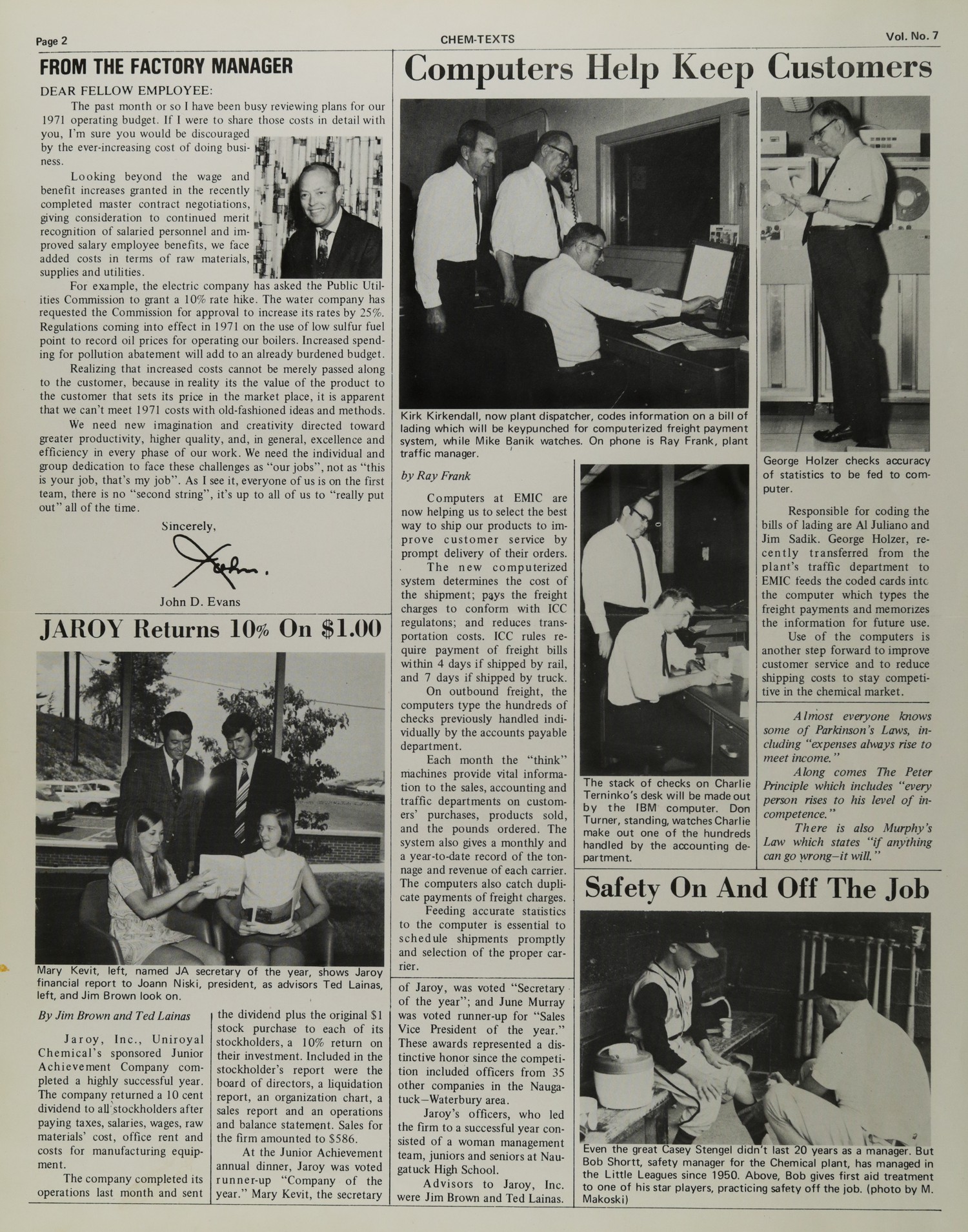
The past month or so I have been busy reviewing plans for our 1971 operating budget. If I were to share those costs in detail with you, I’m sure you would be discouraged by the ever-increasing cost of doing business.

Looking beyond the wage and benefit increases granted in the recently completed master contract negotiations, giving consideration to continued merit recognition of salaried personnel and improved salary employee benefits, we face added costs in terms of raw materials, supplies and utilities.

For example, the electric company has asked the Public Utilities Commission to grant a 10% rate hike. The water company has requested the Commission for approval to increase its rates by 25%. Regulations coming into effect in 1971 on the use of low sulfur fuel point to record oil prices for operating our boilers. Increased spending for pollution abatement will add to an already burdened budget.

Realizing that increased costs cannot be merely passed along to the customer, because in reality its the value of the product to the customer that sets its price in the market place, it is apparent that we can’t meet 1971 costs with old-fashioned ideas and methods.

We need new imagination and creativity directed toward greater productivity, higher quality, and, in general, excellence and efficiency in every phase of our work. We need the individual and group dedication to face these challenges as “our jobs”, not as “this is your job, that’s my job”. As I see it, everyone of us is on the first team, there is no “second string”, it’s up to all of us to “really put out” all of the time.

Sincerely,

[Signature]

John D. Evans


JAROY Returns 10% On $1.00

[IMAGE: Photo showing Mary Kevit, left, named JA secretary of the year, shows Jaroy financial report to Joann Niski, president, as advisors Ted Lainas, left, and Jim Brown look on.]

By Jim Brown and Ted Lainas

Jaroy, Inc., Uniroyal Chemical’s sponsored Junior Achievement Company completed a highly successful year. The company returned a 10 cent dividend to all stockholders after paying taxes, salaries, wages, raw materials’ cost, office rent and costs for manufacturing equipment.

The company completed its operations last month and sent the dividend plus the original $1 stock purchase to each of its stockholders, a 10% return on their investment. Included in the stockholder’s report were the board of directors, a liquidation report, an organization chart, a sales report and an operations and balance statement. Sales for the firm amounted to $586.

At the Junior Achievement annual dinner, Jaroy was voted runner-up “Company of the year.” Mary Kevit, the secretary of Jaroy, was voted “Secretary of the year”; and June Murray was voted runner-up for “Sales Vice President of the year.” These awards represented a distinctive honor since the competition included officers from 35 other companies in the Naugatuck–Waterbury area.

Jaroy’s officers, who led the firm to a successful year consisted of a woman management team, juniors and seniors at Naugatuck High School.

Advisors to Jaroy, Inc. were Jim Brown and Ted Lainas.


Computers Help Keep Customers

[IMAGE: Kirk Kirkendall, now plant dispatcher, codes information on a bill of lading which will be keypunched for computerized freight payment system, while Mike Banik watches. On phone is Ray Frank, plant traffic manager.]

by Ray Frank

Computers at EMIC are now helping us to select the best way to ship our products to improve customer service by prompt delivery of their orders.

The new computerized system determines the cost of the shipment; pays the freight charges to conform with ICC regulatons; and reduces transportation costs. ICC rules require payment of freight bills within 4 days if shipped by rail, and 7 days if shipped by truck.

On outbound freight, the computers type the hundreds of checks previously handled individually by the accounts payable department.

Each month the “think” machines provide vital information to the sales, accounting and traffic departments on customers’ purchases, products sold, and the pounds ordered. The system also gives a monthly and a year-to-date record of the tonnage and revenue of each carrier. The computers also catch duplicate payments of freight charges.

Feeding accurate statistics to the computer is essential to schedule shipments promptly and selection of the proper carrier.

[IMAGE: George Holzer checks accuracy of statistics to be fed to computer.]

Responsible for coding the bills of lading are Al Juliano and Jim Sadik. George Holzer, recently transferred from the plant’s traffic department to EMIC feeds the coded cards into the computer which types the freight payments and memorizes the information for future use.

Use of the computers is another step forward to improve customer service and to reduce shipping costs to stay competitive in the chemical market.

[IMAGE: The stack of checks on Charlie Terninko’s desk will be made out by the IBM computer. Don Turner, standing, watches Charlie make out one of the hundreds handled by the accounting department.]

Almost everyone knows some of Parkinson’s Laws, including “expenses always rise to meet income.”

Along comes The Peter Principle which includes “every person rises to his level of incompetence.”

There is also Murphy’s Law which states “if anything can go wrong–it will.”


Safety On And Off The Job

[IMAGE: Even the great Casey Stengel didn’t last 20 years as a manager. But Bob Shortt, safety manager for the Chemical plant, has managed in the Little Leagues since 1950. Above, Bob gives first aid treatment to one of his star players, practicing safety off the job. (photo by M. Makoski)]

CHEM-TEXTS – Vol. 4 No. 8 – Page 3

Page 003

CHEM-TEXTS

Vol. 4 No. 8 | Page 3


Know Your Benefits:

Some Questions And Answers On Uniroyal’s Matching Gift Program

by Milt Makoski

To provide and insure a college education for our own children and the many children who can’t afford one, Uniroyal, Inc., has set up the Matching Gift Program.

Today colleges need help more than ever before since tuition charges cover only a part of the cost of an education. These colleges need help from companies, foundations, and individuals whether college graduates or not.

Q. What is the matching gift program?
A. It is a program Uniroyal offers to all employees whereby the Company will contribute to institutions of higher education, amounts equal to contributions made by employees.

Q. What employees are eligible?
A. All active employees on regular full time jobs or on an authorized leave of absence with at least one year of service.

Q. What educational institutions are eligible?
A. All colleges and universities which grant degrees and which have been accredited by a recognized agency or are actively seeking such an accreditation are eligible.

A. Uniroyal will match one gift a year to an institution.

Q. What amounts will Uniroyal match?
A. The minimum amount is $25. The maximum gift for each employee is $1,000 per year.

Q. Must gifts be made in cash (check)?
A. Gifts may be made by check or in securities. In the case of securities, Uniroyal will match in cash, based upon the market price of the securities on the date they are received by the institution.

Q. How should an employee apply for the matching gift to an educational institution?
A. The employee obtains an ap-


[IMAGE: Black and white photograph showing a group of people seated around a table in what appears to be a meeting or workshop setting]

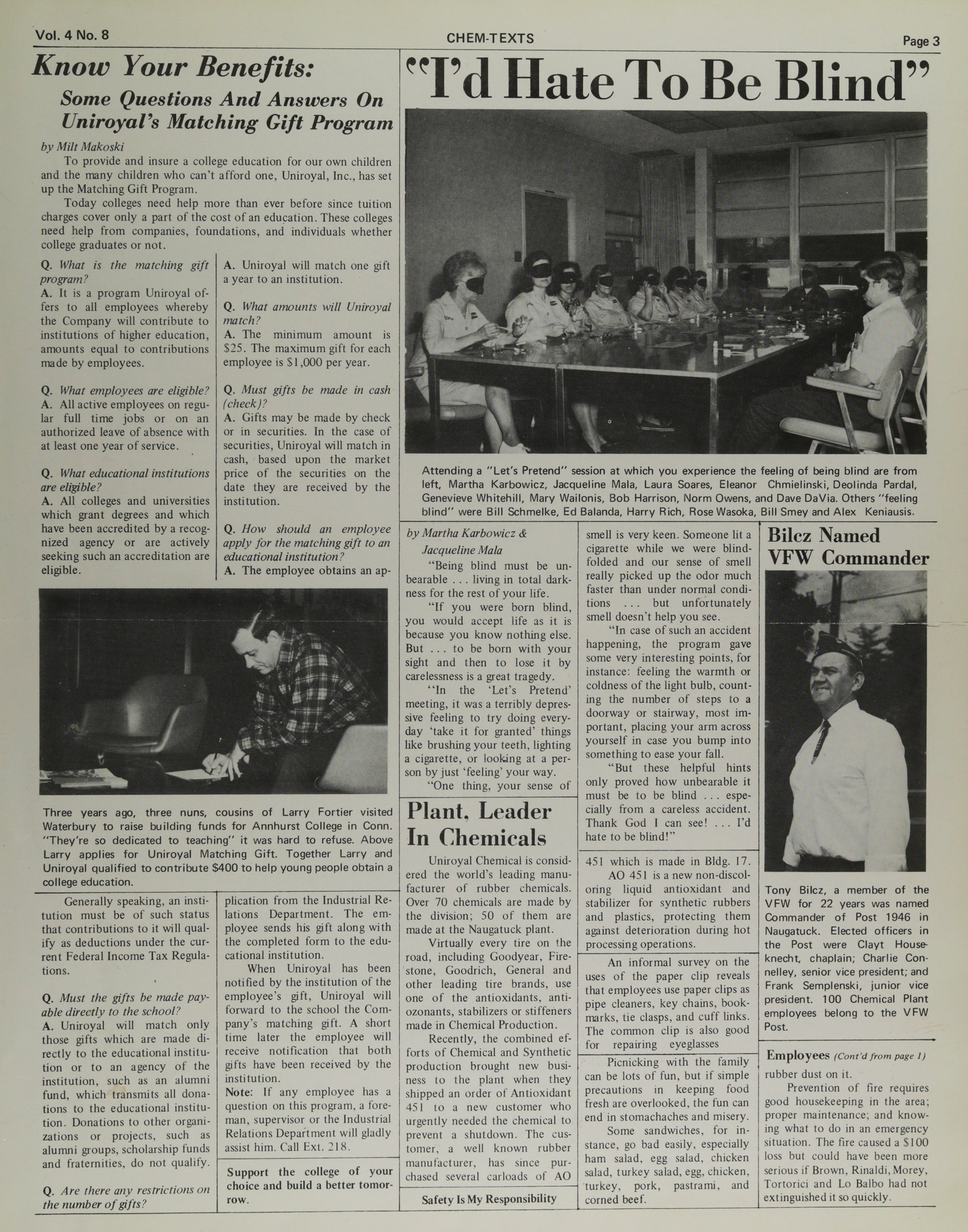
Caption: Attending a “Let’s Pretend” session at which you experience the feeling of being blind are from left, Martha Karbowicz, Jacqueline Mala, Laura Soares, Eleanor Chmielinski, Deolinda Pardal, Genevieve Whitehill, Mary Wailonis, Bob Harrison, Norm Owens, and Dave DaVia. Others “feeling blind” were Bill Schmelke, Ed Balanda, Harry Rich, Rose Wasoka, Bill Smey and Alex Keniausis.


“I’d Hate To Be Blind”

by Martha Karbowicz & Jacqueline Mala

“Being blind must be unbearable . . . living in total darkness for the rest of your life.

“If you were born blind, you would accept life as it is because you know nothing else. But . . . to be born with your sight and then to lose it by carelessness is a great tragedy.

“In the ‘Let’s Pretend’ meeting, it was a terribly depressive feeling to try doing everyday ‘take it for granted’ things like brushing your teeth, lighting a cigarette, or looking at a person by just ‘feeling’ your way.

“One thing, your sense of smell is very keen. Someone lit a cigarette while we were blindfolded and our sense of smell really picked up the odor much faster than under normal conditions . . . but unfortunately smell doesn’t help you see.

“In case of such an accident happening, the program gave some very interesting points, for instance: feeling the warmth or coldness of the light bulb, counting the number of steps to a doorway or stairway, most important, placing your arm across yourself in case you bump into something to ease your fall.

“But these helpful hints only proved how unbearable it must be to be blind . . . especially from a careless accident. Thank God I can see! . . . I’d hate to be blind!”


[IMAGE: Black and white photograph showing three nuns standing with two men]

Three years ago, three nuns, cousins of Larry Fortier visited Waterbury to raise building funds for Annhurst College in Conn. “They’re so dedicated to teaching” it was hard to refuse. Above Larry applies for Uniroyal Matching Gift. Together Larry and Uniroyal qualified to contribute $400 to help young people obtain a college education.


Generally speaking, an institution must be of such status that contributions to it will qualify as deductions under the current Federal Income Tax Regulations.

Q. Must the gifts be made payable directly to the school?
A. Uniroyal will match only those gifts which are made directly to the educational institution or to an agency of the institution, such as an alumni fund, which transmits all donations to the educational institution. Donations to other organizations or projects, such as alumni groups, scholarship funds and fraternities, do not qualify.

Q. Are there any restrictions on the number of gifts?

plication from the Industrial Relations Department. The employee sends his gift along with the completed form to the educational institution.

When Uniroyal has been notified by the institution of the employee’s gift, Uniroyal will forward to the school the Company’s matching gift. A short time later the employee will receive notification that both gifts have been received by the institution.

Note: If any employee has a question on this program, a foreman, supervisor or the Industrial Relations Department will gladly assist him. Call Ext. 218.

Support the college of your choice and build a better tomorrow.


Plant Leader In Chemicals

Uniroyal Chemical is considered the world’s leading manufacturer of rubber chemicals. Over 70 chemicals are made by the division; 50 of them are made at the Naugatuck plant.

Virtually every tire on the road, including Goodyear, Firestone, Goodrich, General and other leading tire brands, use one of the antioxidants, antiozonants, stabilizers or stiffeners made in Chemical Production.

Recently, the combined efforts of Chemical and Synthetic production brought new business to the plant when they shipped an order of Antioxidant 451 to a new customer who urgently needed the chemical to prevent a shutdown. The customer, a well known rubber manufacturer, has since purchased several carloads of AO

Safety Is My Responsibility

451 which is made in Bldg. 17.

AO 451 is a new non-discoloring liquid antioxidant and stabilizer for synthetic rubbers and plastics, protecting them against deterioration during hot processing operations.

An informal survey on the uses of the paper clip reveals that employees use paper clips as pipe cleaners, key chains, bookmarks, tie clasps, and cuff links. The common clip is also good for repairing eyeglasses

Picnicking with the family can be lots of fun, but if simple precautions in keeping food fresh are overlooked, the fun can end in stomachaches and misery.

Some sandwiches, for instance, go bad easily, especially ham salad, egg salad, chicken salad, turkey salad, egg, chicken, turkey, pork, pastrami, and corned beef.


Bilez Named VFW Commander

[IMAGE: Black and white photograph of a man in VFW uniform]

Tony Bilez, a member of the VFW for 22 years was named Commander of Post 1946 in Naugatuck. Elected officers in the Post were Clayt Houseknecht, chaplain; Charlie Connelley, senior vice president; and Frank Semplenski, junior vice president. 100 Chemical Plant employees belong to the VFW Post.


Employees (Cont’d from page 1)

rubber dust on it.

Prevention of fire requires good housekeeping in the area; proper maintenance; and knowing what to do in an emergency situation. The fire caused a $100 loss but could have been more serious if Brown, Rinaldi, Morey, Tortorici and Lo Balbo had not extinguished it so quickly.

CHEM-TEXTS – Vol. 3, 1969, No. 6 – Page 1

Page 001

UNIROYAL CHEM-TEXTS

Vol. 3, 1969 PUBLISHED FOR THE PEOPLE OF UNIROYAL CHEMICAL No. 8


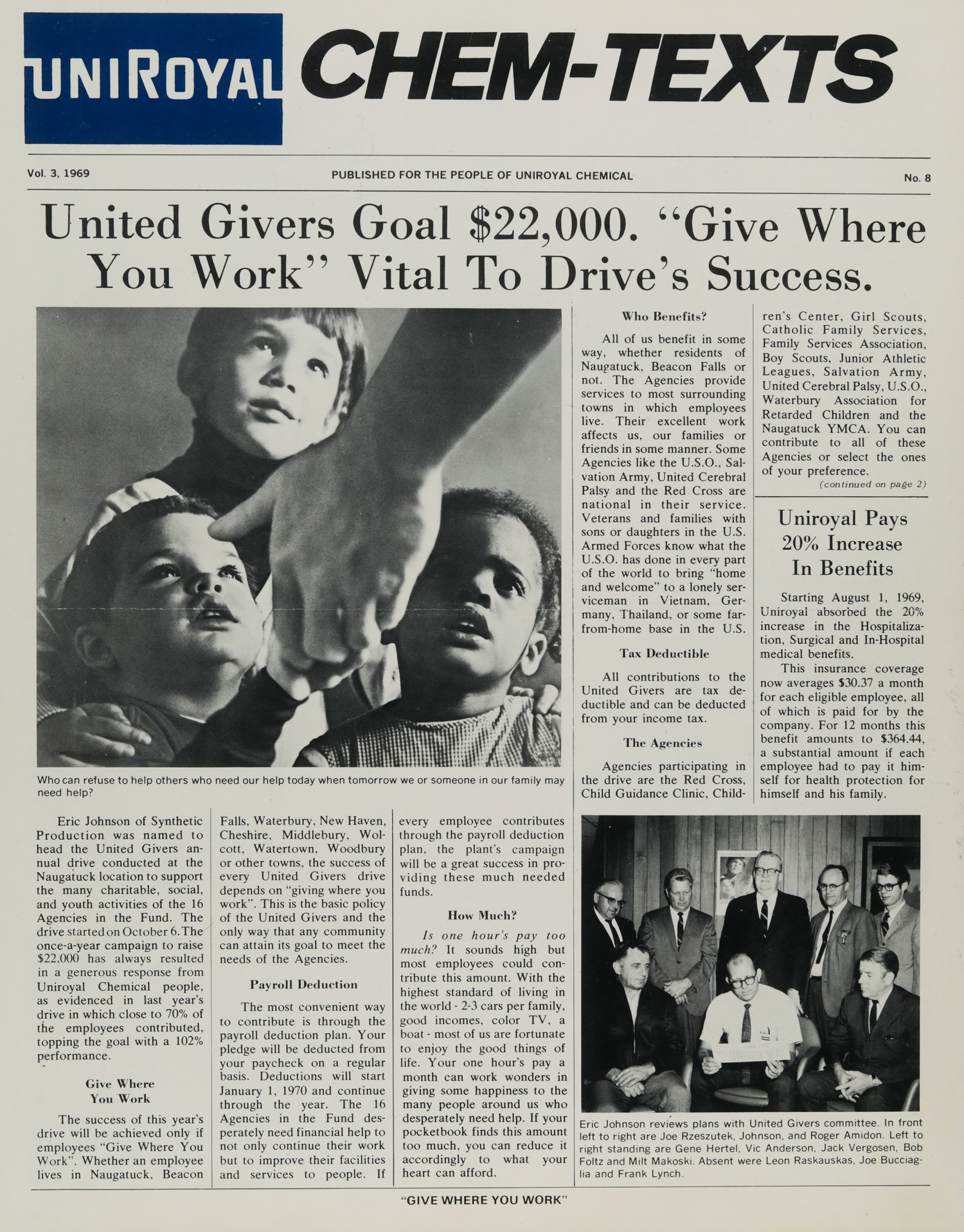
United Givers Goal $22,000. “Give Where You Work” Vital To Drive’s Success.

[IMAGE: Black and white photograph showing faces of children and adults looking upward]

Who can refuse to help others who need our help today when tomorrow we or someone in our family may need help?


Eric Johnson of Synthetic Production was named to head the United Givers annual drive conducted at the Naugatuck location to support the many charitable, social, and youth activities of the 16 Agencies in the Fund. The drive started on October 6. The once-a-year campaign to raise $22,000 has always resulted in a generous response from Uniroyal Chemical people, as evidenced in last year’s drive in which close to 70% of the employees contributed, topping the goal with a 102% performance.

Give Where You Work

The success of this year’s drive will be achieved only if employees “Give Where You Work”. Whether an employee lives in Naugatuck, Beacon Falls, Waterbury, New Haven, Cheshire, Middlebury, Wolcott, Watertown, Woodbury or other towns, the success of every United Givers drive depends on “giving where you work”. This is the basic policy of the United Givers and the only way that any community can attain its goal to meet the needs of the Agencies.

Payroll Deduction

The most convenient way to contribute is through the payroll deduction plan. Your pledge will be deducted from your paycheck on a regular basis. Deductions will start January 1, 1970 and continue through the year. The 16 Agencies in the Fund desperately need financial help to not only continue their work but to improve their facilities and services to people. If every employee contributes through the payroll deduction plan, the plant’s campaign will be a great success in providing these much needed funds.

How Much?

Is one hour’s pay too much? It sounds high but most employees could contribute this amount. With the highest standard of living in the world – 2-3 cars per family, good incomes, color TV, a boat – most of us are fortunate to enjoy the good things of life. Your one hour’s pay a month can work wonders in giving some happiness to the many people around us who desperately need help. If your pocketbook finds this amount too much, you can reduce it accordingly to what your heart can afford.

Who Benefits?

All of us benefit in some way, whether residents of Naugatuck, Beacon Falls or not. The Agencies provide services to most surrounding towns in which employees live. Their excellent work affects us, our families or friends in some manner. Some Agencies like the U.S.O., Salvation Army, United Cerebral Palsy and the Red Cross are national in their service. Veterans and families with sons or daughters in the U.S. Armed Forces know what the U.S.O. has done in every part of the world to bring “home and welcome” to a lonely serviceman in Vietnam, Germany, Thailand, or some far-from-home base in the U.S.

Tax Deductible

All contributions to the United Givers are tax deductible and can be deducted from your income tax.

The Agencies

Agencies participating in the drive are the Red Cross, Child Guidance Clinic, Children’s Center, Girl Scouts, Catholic Family Services, Family Services Association, Boy Scouts, Junior Athletic Leagues, Salvation Army, United Cerebral Palsy, U.S.O., Waterbury Association for Retarded Children and the Naugatuck YMCA. You can contribute to all of these Agencies or select the ones of your preference.

(continued on page 2)


Uniroyal Pays 20% Increase In Benefits

Starting August 1, 1969, Uniroyal absorbed the 20% increase in the Hospitalization, Surgical and In-Hospital medical benefits.

This insurance coverage now averages $30.37 a month for each eligible employee, all of which is paid for by the company. For 12 months this benefit amounts to $364.44, a substantial amount if each employee had to pay it himself for health protection for himself and his family.


[IMAGE: Group photograph of men in business attire reviewing documents]

Eric Johnson reviews plans with United Givers committee. In front left to right are Joe Rzeszutek, Johnson, and Roger Amidon. Left to right standing are Gene Hertel, Vic Anderson, Jack Vergosen, Bob Foltz and Milt Makoski. Absent were Leon Raskauskas, Joe Bucciaglia and Frank Lynch.


“GIVE WHERE YOU WORK”

CHEM-TEXTS – Vol. 3 No. 6 – Page 2

Page 002

Page 2 | CHEM-TEXTS | Vol. 3, No. 8


FROM THE FACTORY MANAGER

DEAR FELLOW EMPLOYEES:

October again brings us each the opportunity to invest in the sixteen agencies supported by the United Givers of Naugatuck and Beacon Falls. Each of these agencies, working in essential health, welfare and educational activities, makes our community a better place to live for our families and our friends. Beyond this, many of the agencies have an outreach of service beyond our borders to neighboring towns and to the nation.

We at Uniroyal Chemical have, in each year’s campaign, shown a greater willingness to give to these causes. Yet, our average gift per employee last year was something less than $13.00 per year for all of these needs. Our average is this low because some one-third of us did not give last year and some half of us gave a cash donation rather than spreading our giving by utilizing the payroll deduction plan.

When the canvasser calls on us this year, let’s all give something and let’s all pledge on payroll deductions. I think we all will be pleasantly surprised when the results are in.

Sincerely,

[Signature]

John D. Evans


Three Named Chairmen For Borough’s United Givers Drive

[IMAGE: Photo of three men in business attire having a discussion]

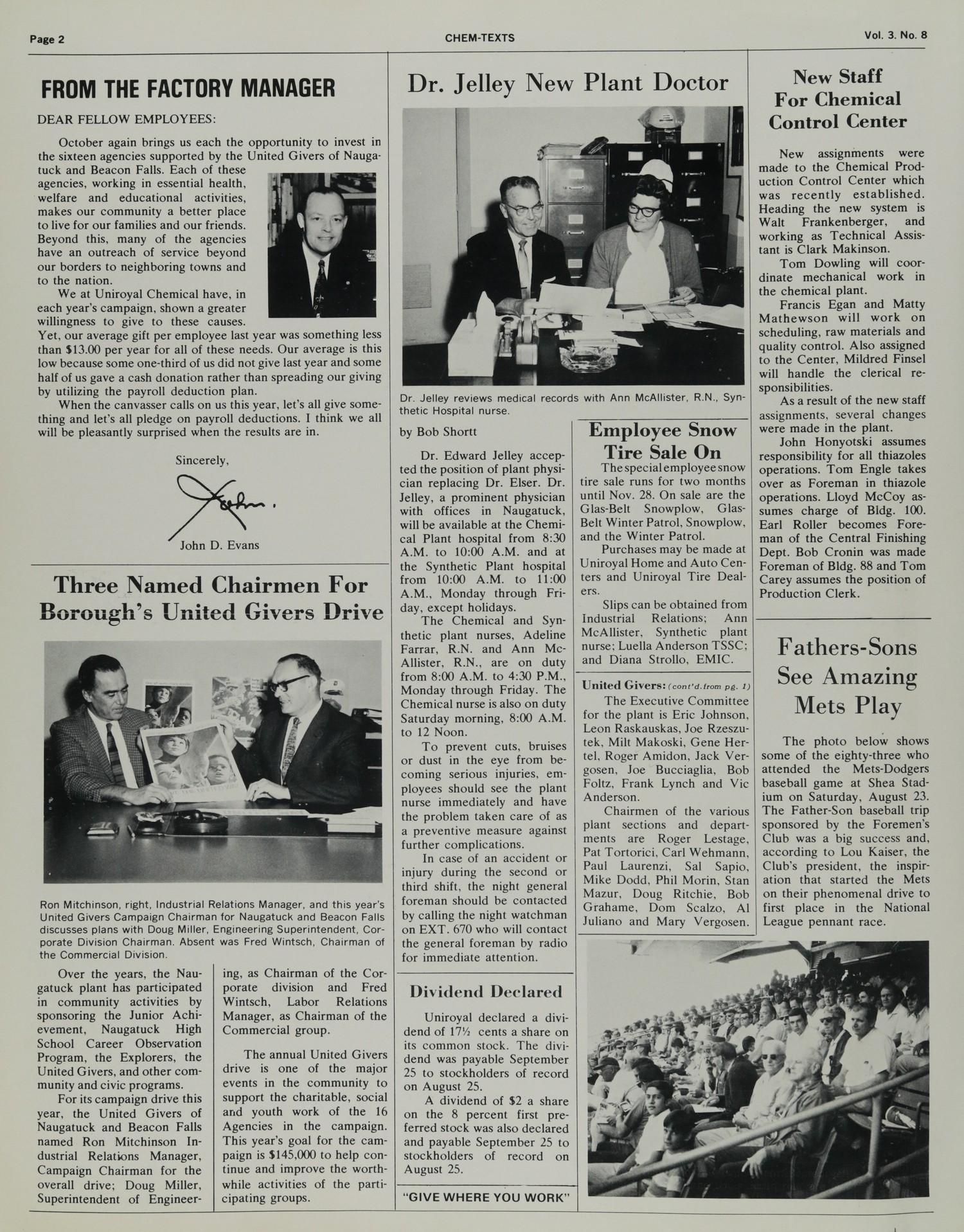
Ron Mitchinson, right, Industrial Relations Manager, and this year’s United Givers Campaign Chairman for Naugatuck and Beacon Falls discusses plans with Doug Miller, Engineering Superintendent, Corporate Division Chairman. Absent was Fred Wintsch, Chairman of the Commercial Division.

Over the years, the Naugatuck plant has participated in community activities by sponsoring the Junior Achievement, Naugatuck High School Career Observation Program, the Explorers, the United Givers, and other community and civic programs.

For its campaign drive this year, the United Givers of Naugatuck and Beacon Falls named Ron Mitchinson Industrial Relations Manager, Campaign Chairman for the overall drive; Doug Miller, Superintendent of Engineering, as Chairman of the Corporate division and Fred Wintsch, Labor Relations Manager, as Chairman of the Commercial group.

The annual United Givers drive is one of the major events in the community to support the charitable, social and youth work of the 16 Agencies in the campaign. This year’s goal for the campaign is $145,000 to help continue and improve the worthwhile activities of the participating groups.


Dr. Jelley New Plant Doctor

[IMAGE: Photo of Dr. Jelley reviewing medical records with Ann McAllister]

Dr. Jelley reviews medical records with Ann McAllister, R.N., Synthetic Hospital nurse.

by Bob Shortt

Dr. Edward Jelley accepted the position of plant physician replacing Dr. Elser. Dr. Jelley, a prominent physician with offices in Naugatuck, will be available at the Chemical Plant hospital from 8:30 A.M. to 10:00 A.M. and at the Synthetic Plant hospital from 10:00 A.M. to 11:00 A.M., Monday through Friday, except holidays.

The Chemical and Synthetic plant nurses, Adeline Farrar, R.N. and Ann McAllister, R.N., are on duty from 8:00 A.M. to 4:30 P.M., Monday through Friday. The Chemical nurse is also on duty Saturday morning, 8:00 A.M. to 12 Noon.

To prevent cuts, bruises or dust in the eye from becoming serious injuries, employees should see the plant nurse immediately and have the problem taken care of as a preventive measure against further complications.

In case of an accident or injury during the second or third shift, the night general foreman should be contacted by calling the night watchman on EXT. 670 who will contact the general foreman by radio for immediate attention.


Employee Snow Tire Sale On

The special employee snow tire sale runs for two months until Nov. 28. On sale are the Glas-Belt Snowplow, Glas-Belt Winter Patrol, Snowplow, and the Winter Patrol.

Purchases may be made at Uniroyal Home and Auto Centers and Uniroyal Tire Dealers.

Slips can be obtained from Industrial Relations; Ann McAllister, Synthetic plant nurse; Luella Anderson TSSC; and Diana Strollo, EMIC.


United Givers: (cont’d. from pg. 1)

The Executive Committee for the plant is Eric Johnson, Leon Raskauskas, Joe Rzeszutek, Milt Makoski, Gene Hertel, Roger Amidon, Jack Vergosen, Joe Bucciaglia, Bob Foltz, Frank Lynch and Vic Anderson.

Chairmen of the various plant sections and departments are Roger Lestage, Pat Tortorici, Carl Wehmann, Paul Laurenzi, Sal Sapio, Mike Dodd, Phil Morin, Stan Mazur, Doug Ritchie, Bob Grahame, Dom Scalzo, Al Juliano and Mary Vergosen.


Dividend Declared

Uniroyal declared a dividend of 17½ cents a share on its common stock. The dividend was payable September 25 to stockholders of record on August 25.

A dividend of $2 a share on the 8 percent first preferred stock was also declared and payable September 25 to stockholders of record on August 25.

“GIVE WHERE YOU WORK”


New Staff For Chemical Control Center

New assignments were made to the Chemical Production Control Center which was recently established. Heading the new system is Walt Frankenberger, and working as Technical Assistant is Clark Makinson.

Tom Dowling will coordinate mechanical work in the chemical plant.

Francis Egan and Matty Mathewson will work on scheduling, raw materials and quality control. Also assigned to the Center, Mildred Finsel will handle the clerical responsibilities.

As a result of the new staff assignments, several changes were made in the plant.

John Honyotski assumes responsibility for all thiazoles operations. Tom Engle takes over as Foreman in thiazole operations. Lloyd McCoy assumes charge of Bldg. 100. Earl Roller becomes Foreman of the Central Finishing Dept. Bob Cronin was made Foreman of Bldg. 88 and Tom Carey assumes the position of Production Clerk.


Fathers-Sons See Amazing Mets Play

The photo below shows some of the eighty-three who attended the Mets-Dodgers baseball game at Shea Stadium on Saturday, August 23. The Father-Son baseball trip sponsored by the Foremen’s Club was a big success and, according to Lou Kaiser, the Club’s president, the inspiration that started the Mets on their phenomenal drive to first place in the National League pennant race.

[IMAGE: Photo showing crowd at baseball stadium]

CHEM-TEXTS – Vol. 3 No. 6 – Page 3

Page 003

CHEM-TEXTS

Vol. 3 No. 8 | Page 3


Synthetic’s “A” Crew Hits 9 Batches Daily

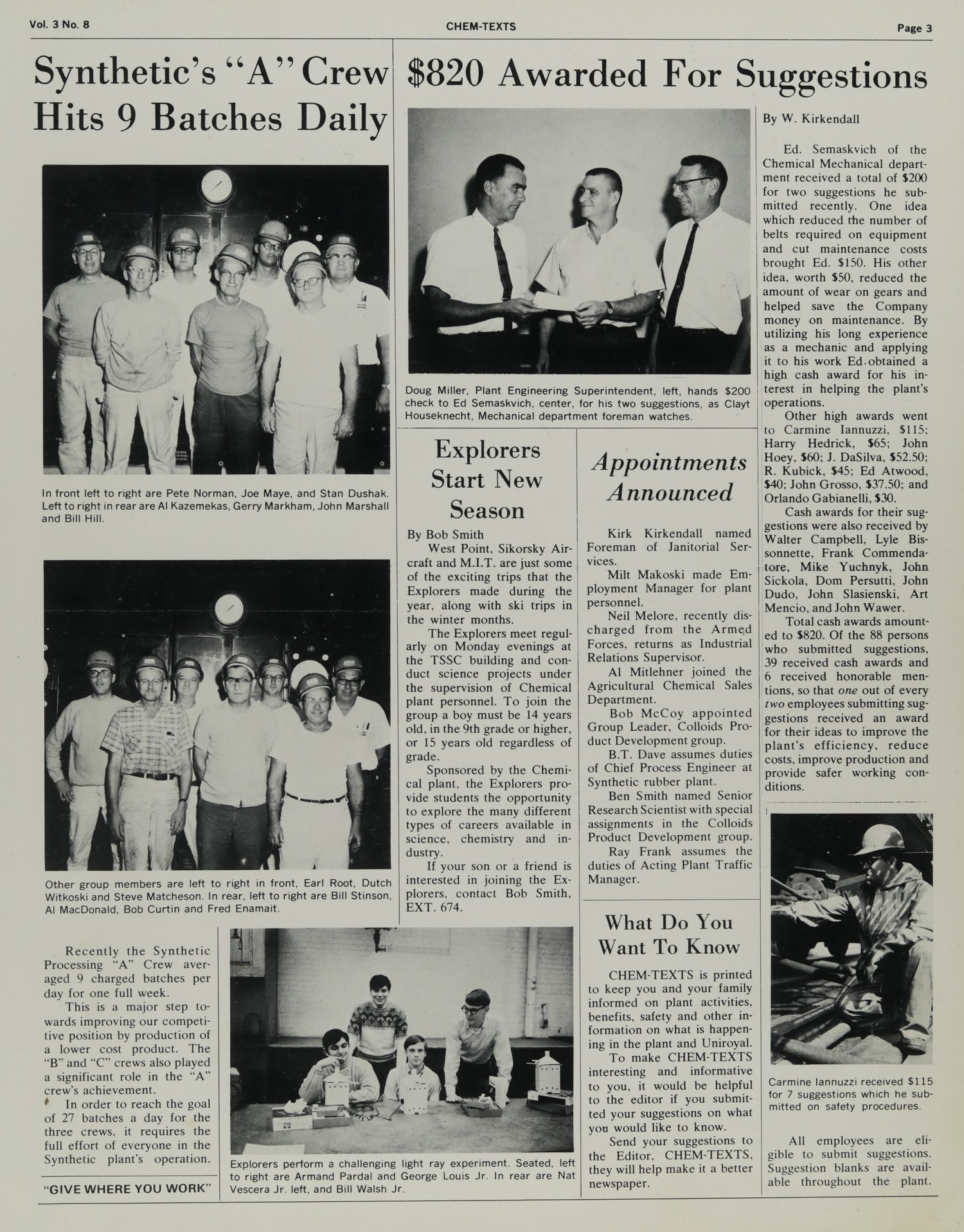
[IMAGE: Group photo of workers in hard hats]

In front left to right are Pete Norman, Joe Maye, and Stan Dushak. Left to right in rear are Al Kazemekas, Gerry Markham, John Marshall and Bill Hill.

[IMAGE: Second group photo of workers]

Other group members are left to right in front, Earl Root, Dutch Witkoski and Steve Matcheson. In rear, left to right are Bill Stinson, Al MacDonald, Bob Curtin and Fred Enamait.

Recently the Synthetic Processing “A” Crew averaged 9 charged batches per day for one full week.

This is a major step towards improving our competitive position by production of a lower cost product. The “B” and “C” crews also played a significant role in the “A” crew’s achievement.

In order to reach the goal of 27 batches a day for the three crews, it requires the full effort of everyone in the Synthetic plant’s operation.

“GIVE WHERE YOU WORK”


$820 Awarded For Suggestions

By W. Kirkendall

[IMAGE: Three men, one handing check to another]

Doug Miller, Plant Engineering Superintendent, left, hands $200 check to Ed Semaskvich, center, for his two suggestions, as Clayt Houseknecht, Mechanical department foreman watches.

Ed. Semaskvich of the Chemical Mechanical department received a total of $200 for two suggestions he submitted recently. One idea which reduced the number of belts required on equipment and cut maintenance costs brought Ed. $150. His other idea, worth $50, reduced the amount of wear on gears and helped save the Company money on maintenance. By utilizing his long experience as a mechanic and applying it to his work Ed obtained a high cash award for his interest in helping the plant’s operations.

Other high awards went to Carmine Iannuzzi, $115; Harry Hedrick, $65; John Hoey, $60; J. DaSilva, $52.50; R. Kubick, $45; Ed Atwood, $40; John Grosso, $37.50; and Orlando Gabianelli, $30.

Cash awards for their suggestions were also received by Walter Campbell, Lyle Bissonnette, Frank Commendatore, Mike Yuchnyk, John Sickola, Dom Persutti, John Dudo, John Slasienski, Art Mencio, and John Wawer.

Total cash awards amounted to $820. Of the 88 persons who submitted suggestions, 39 received cash awards and 6 received honorable mentions, so that one out of every two employees submitting suggestions received an award for their ideas to improve the plant’s efficiency, reduce costs, improve production and provide safer working conditions.

[IMAGE: Man working]

Carmine Iannuzzi received $115 for 7 suggestions which he submitted on safety procedures.

All employees are eligible to submit suggestions. Suggestion blanks are available throughout the plant.


Explorers Start New Season

By Bob Smith

West Point, Sikorsky Aircraft and M.I.T. are just some of the exciting trips that the Explorers made during the year, along with ski trips in the winter months.

The Explorers meet regularly on Monday evenings at the TSSC building and conduct science projects under the supervision of Chemical plant personnel. To join the group a boy must be 14 years old, in the 9th grade or higher, or 15 years old regardless of grade.

Sponsored by the Chemical plant, the Explorers provide students the opportunity to explore the many different types of careers available in science, chemistry and industry.

If your son or a friend is interested in joining the Explorers, contact Bob Smith, EXT. 674.

[IMAGE: Group of young people at table with experiment]

Explorers perform a challenging light ray experiment. Seated, left to right are Armand Pardal and George Louis Jr. In rear are Nat Vescera Jr. left, and Bill Walsh Jr.


Appointments Announced

Kirk Kirkendall named Foreman of Janitorial Services.

Milt Makoski made Employment Manager for plant personnel.

Neil Melore, recently discharged from the Armed Forces, returns as Industrial Relations Supervisor.

Al Mitlehner joined the Agricultural Chemical Sales Department.

Bob McCoy appointed Group Leader, Colloids Product Development group.

B.T. Dave assumes duties of Chief Process Engineer at Synthetic rubber plant.

Ben Smith named Senior Research Scientist with special assignments in the Colloids Product Development group.

Ray Frank assumes the duties of Acting Plant Traffic Manager.


What Do You Want To Know

CHEM-TEXTS is printed to keep you and your family informed on plant activities, benefits, safety and other information on what is happening in the plant and Uniroyal.

To make CHEM-TEXTS interesting and informative to you, it would be helpful to the editor if you submitted your suggestions on what you would like to know.

Send your suggestions to the Editor, CHEM-TEXTS, they will help make it a better newspaper.

CHEM-TEXTS – Vol. 3 No. 6 – Page 4

Page 004

Page 4 CHEM-TEXTS

New “Idea Plan” Offers $1000 Cash Awards

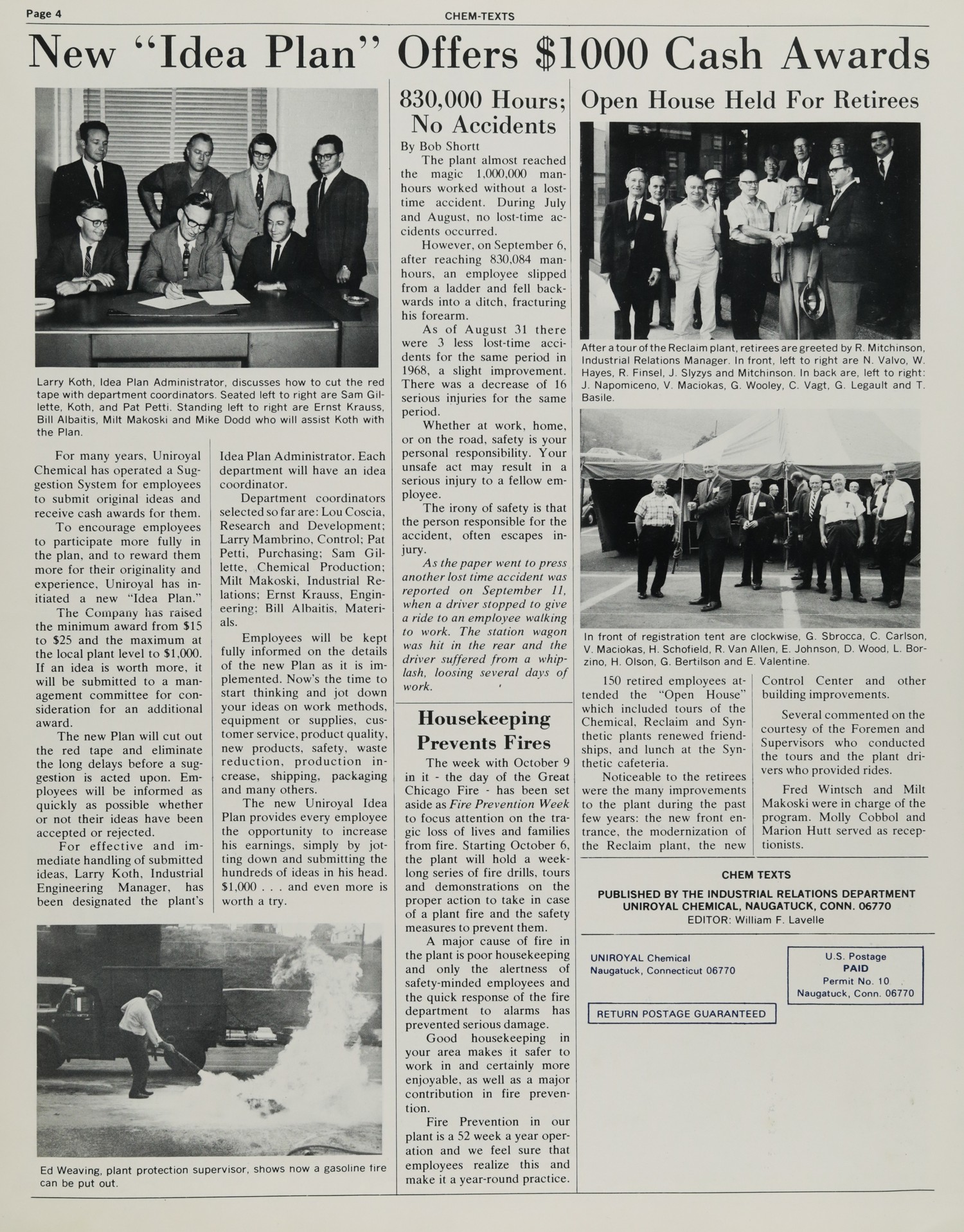
Larry Koth, Idea Plan Administrator, discusses how to cut the red tape with department coordinators. Seated left to right are Sam Gillette, Koth, and Pat Petti. Standing left to right are Ernst Krauss, Bill Albaitis, Milt Makoski and Mike Dodd who will assist Koth with the Plan.

For many years, Uniroyal Chemical has operated a Suggestion System for employees to submit original ideas and receive cash awards for them.

To encourage employees to participate more fully in the plan, and to reward them more for their originality and experience, Uniroyal has initiated a new “Idea Plan.”

The Company has raised the minimum award from $15 to $25 and the maximum at the local plant level to $1,000. If an idea is worth more, it will be submitted to a management committee for consideration for an additional award.

The new Plan will cut out the red tape and eliminate the long delays before a suggestion is acted upon. Employees will be informed as quickly as possible whether or not their ideas have been accepted or rejected.

For effective and immediate handling of submitted ideas, Larry Koth, Industrial Engineering Manager, has been designated the plant’s Idea Plan Administrator. Each department will have an idea coordinator.

Department coordinators selected so far are: Lou Coscia, Research and Development; Larry Mambrino, Control; Pat Petti, Purchasing; Sam Gillette, Chemical Production; Milt Makoski, Industrial Relations; Ernst Krauss, Engineering; Bill Albaitis, Materials.

Employees will be kept fully informed on the details of the new Plan as it is implemented. Now’s the time to start thinking and jot down your ideas on work methods, equipment or supplies, customer service, product quality, new products, safety, waste reduction, production increase, shipping, packaging and many others.

The new Uniroyal Idea Plan provides every employee the opportunity to increase his earnings, simply by jotting down and submitting the hundreds of ideas in his head. $1,000 . . . and even more is worth a try.


Ed Weaving, plant protection supervisor, shows now a gasoline fire can be put out.


830,000 Hours; No Accidents

By Bob Shortt

The plant almost reached the magic 1,000,000 manhours worked without a losttime accident. During July and August, no lost-time accidents occurred.

However, on September 6, after reaching 830,084 manhours, an employee slipped from a ladder and fell backwards into a ditch, fracturing his forearm.

As of August 31 there were 3 less lost-time accidents for the same period in 1968, a slight improvement. There was a decrease of 16 serious injuries for the same period.

Whether at work, home, or on the road, safety is your personal responsibility. Your unsafe act may result in a serious injury to a fellow employee.

The irony of safety is that the person responsible for the accident, often escapes injury.

As the paper went to press another lost time accident was reported on September 11, when a driver stopped to give a ride to an employee walking to work. The station wagon was hit in the rear and the driver suffered from a whiplash, loosing several days of work.


Housekeeping Prevents Fires

The week with October 9 in it – the day of the Great Chicago Fire – has been set aside as Fire Prevention Week to focus attention on the tragic loss of lives and families from fire. Starting October 6, the plant will hold a weeklong series of fire drills, tours and demonstrations on the proper action to take in case of a plant fire and the safety measures to prevent them.

A major cause of fire in the plant is poor housekeeping and only the alertness of safety-minded employees and the quick response of the fire department to alarms has prevented serious damage.

Good housekeeping in your area makes it safer to work in and certainly more enjoyable, as well as a major contribution in fire prevention.

Fire Prevention in our plant is a 52 week a year operation and we feel sure that employees realize this and make it a year-round practice.


Open House Held For Retirees

After a tour of the Reclaim plant, retirees are greeted by R. Mitchinson, Industrial Relations Manager. In front, left to right are N. Valvo, W. Hayes, R. Finsel, J. Slyzys and Mitchinson. In back are, left to right: J. Napomiceno, V. Maciokas, G. Wooley, C. Vagt, G. Legault and T. Basile.

In front of registration tent are clockwise, G. Sbrocca, C. Carlson, V. Maciokas, H. Schofield, R. Van Allen, E. Johnson, D. Wood, L. Borzino, H. Olson, G. Bertilson and E. Valentine.

150 retired employees attended the “Open House” which included tours of the Chemical, Reclaim and Synthetic plants renewed friendships, and lunch at the Synthetic cafeteria.

Noticeable to the retirees were the many improvements to the plant during the past few years: the new front entrance, the modernization of the Reclaim plant, the new Control Center and other building improvements.

Several commented on the courtesy of the Foremen and Supervisors who conducted the tours and the plant drivers who provided rides.

Fred Wintsch and Milt Makoski were in charge of the program. Molly Cobbol and Marion Hutt served as receptionists.


CHEM TEXTS

PUBLISHED BY THE INDUSTRIAL RELATIONS DEPARTMENT
UNIROYAL CHEMICAL, NAUGATUCK, CONN. 06770
EDITOR: William F. Lavelle

UNIROYAL Chemical
Naugatuck, Connecticut 06770

U.S. Postage
PAID
Permit No. 10
Naugatuck, Conn. 06770

RETURN POSTAGE GUARANTEED

CHEM-TEXTS – Vol. 3 No. 11 – Page 2

Page 002

CHEM-TEXTS

Page 2 | Vol. 3 No. 11


FROM THE FACTORY MANAGER

DEAR FELLOW EMPLOYEE:

The season leading up to Christmas is often filled with frantic searching to solve the questions of “what should I give to the wife?” or “what should I give to the kids?” Perhaps in the rush to find the gift, we too often lose sight of the real meaning of the season; perhaps we even lose sight of one gift we could all give to each other, family, friends, as well as those with whom we work. The gift that I’m thinking of is the gift of understanding. The gift of being able to “put ourselves in the other guy’s shoes” to see his problems as he see’s them.

It seems to me that if each of us gave this gift on a year-around basis we would each make a real contribution to solving the economic and social problems facing our nation. I’m sure that we would start to see the “communication gap,” the “generation gap” and, yes, even the “management-labor gap” start to close.

Please accept my most sincere wishes for you and yours for a Most Joyous Christmas and the best of New Year’s in 1970.

Sincerely,

John D. Evans

John D. Evans


Explorers Post Names New Advisors

[IMAGE: Photo of three men]

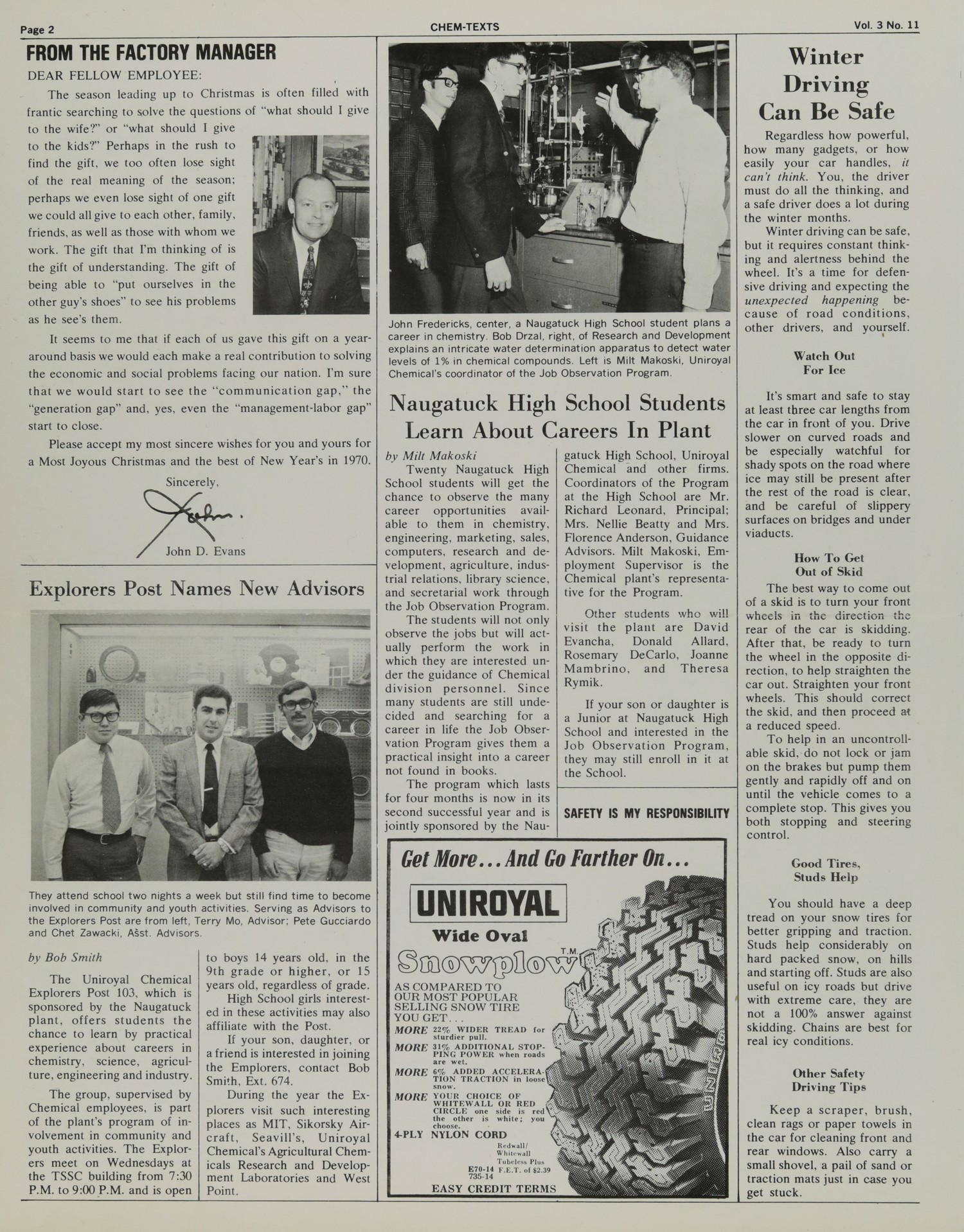
They attend school two nights a week but still find time to become involved in community and youth activities. Serving as Advisors to the Explorers Post are from left, Terry Mo, Advisor; Pete Gucciardo and Chet Zawacki, Asst. Advisors.

by Bob Smith

The Uniroyal Chemical Explorers Post 103, which is sponsored by the Naugatuck plant, offers students the chance to learn by practical experience about careers in chemistry, science, agriculture, engineering and industry.

The group, supervised by Chemical employees, is part of the plant’s program of involvement in community and youth activities. The Explorers meet on Wednesdays at the TSSC building from 7:30 P.M. to 9:00 P.M. and is open to boys 14 years old, in the 9th grade or higher, or 15 years old, regardless of grade.

High School girls interested in these activities may also affiliate with the Post.

If your son, daughter, or a friend is interested in joining the Emplorers, contact Bob Smith, Ext. 674.

During the year the Explorers visit such interesting places as MIT, Sikorsky Aircraft, Seavill’s, Uniroyal Chemical’s Agricultural Chemicals Research and Development Laboratories and West Point.


[IMAGE: Photo showing people at what appears to be an industrial/laboratory setting]

John Fredericks, center, a Naugatuck High School student plans a career in chemistry. Bob Drzal, right, of Research and Development explains an intricate water determination apparatus to detect water levels of 1% in chemical compounds. Left is Milt Makoski, Uniroyal Chemical’s coordinator of the Job Observation Program.

Naugatuck High School Students Learn About Careers In Plant

by Milt Makoski

Twenty Naugatuck High School students will get the chance to observe the many career opportunities available to them in chemistry, engineering, marketing, sales, computers, research and development, agriculture, industrial relations, library science, and secretarial work through the Job Observation Program.

The students will not only observe the jobs but will actually perform the work in which they are interested under the guidance of Chemical division personnel. Since many students are still undecided and searching for a career in life the Job Observation Program gives them a practical insight into a career not found in books.

The program which lasts for four months is now in its second successful year and is jointly sponsored by the Naugatuck High School, Uniroyal Chemical and other firms. Coordinators of the Program at the High School are Mr. Richard Leonard, Principal; Mrs. Nellie Beatty and Mrs. Florence Anderson, Guidance Advisors. Milt Makoski, Employment Supervisor is the Chemical plant’s representative for the Program.

Other students who will visit the plant are David Evancha, Donald Allard, Rosemary DeCarlo, Joanne Mambrino, and Theresa Rymik.

If your son or daughter is a Junior at Naugatuck High School and interested in the Job Observation Program, they may still enroll in it at the School.


SAFETY IS MY RESPONSIBILITY


Get More… And Go Farther On…

UNIROYAL

Wide Oval

Snowplow™

AS COMPARED TO OUR MOST POPULAR SELLING SNOW TIRE YOU GET

MORE 22% WIDER TREAD for sturdier pull.

MORE 31% ADDITIONAL STOPPING POWER when roads are wet.

MORE 6% ADDED ACCELERATION TRACTION in loose snow.

MORE YOUR CHOICE OF WHITEWALL OR RED CIRCLE one side is red the other is white; you choose.

4-PLY NYLON CORD
Redwall/
Whitewall
Tubeless Plus
E78-14 F.E.T. of $2.39
735-14

EASY CREDIT TERMS


Winter Driving Can Be Safe

Regardless how powerful, how many gadgets, or how easily your car handles, it can’t think. You, the driver must do all the thinking, and a safe driver does a lot during the winter months.

Winter driving can be safe, but it requires constant thinking and alertness behind the wheel. It’s a time for defensive driving and expecting the unexpected happening because of road conditions, other drivers, and yourself.

Watch Out For Ice

It’s smart and safe to stay at least three car lengths from the car in front of you. Drive slower on curved roads and be especially watchful for shady spots on the road where ice may still be present after the rest of the road is clear, and be careful of slippery surfaces on bridges and under viaducts.

How To Get Out of Skid

The best way to come out of a skid is to turn your front wheels in the direction the rear of the car is skidding. After that, be ready to turn the wheel in the opposite direction, to help straighten the car out. Straighten your front wheels. This should correct the skid, and then proceed at a reduced speed.

To help in an uncontrollable skid, do not lock or jam on the brakes but pump them gently and rapidly off and on until the vehicle comes to a complete stop. This gives you both stopping and steering control.

Good Tires, Studs Help

You should have a deep tread on your snow tires for better gripping and traction. Studs help considerably on hard packed snow, on hills and starting off. Studs are also useful on icy roads but drive with extreme care, they are not a 100% answer against skidding. Chains are best for real icy conditions.

Other Safety Driving Tips

Keep a scraper, brush, clean rags or paper towels in the car for cleaning front and rear windows. Also carry a small shovel, a pail of sand or traction mats just in case you get stuck.

CHEM-TEXTS – Vol. 3 No. 11 – Page 4

Page 004

Page 4 | CHEM-TEXT | Vol. 3 No. 11

$21,000 Contributed to United Givers

[PHOTO: Image showing people near a vehicle, including children on crutches and adults]

United Givers help the Red Cross provide free transportation to the Cerebral Palsy Center in Waterbury. Penny Litke, left, on crutches, 3 ½ years old, goes three times a week. Helping Penny is her mother, Mrs. Harold Litke. Kathy Magnamo, 8, is held by her mother, Mrs. Robert Magnamo. Kathy attends the Cerebral Palsy Center every day. At right is Roy Woodcock, a volunteer driver. Without the services of the Red Cross and the Cerebral Palsy Center many children would not receive the treatment and care to make their lives happier and fuller. (Naugatuck news photo by J. Jensen.)


by Eric Johnson

$21,000 in pledges were made by Uniroyal Chemical employees to the United Givers fund drive. This is the second successive year that Uniroyal Chemical topped $20,000 to support the 16 charitable, social work, and youth organizations in the fund which in some way touch the lives of every employee or his family.

One Third Of All Firms

The plant’s contributions represent almost one-third of the Industrial division’s goal of $65,000. The success of this year’s campaign reflects the vital concern and involvement of employees in community problems and activities by helping the mentally retarded, children with cerebral palsy, the free blood programs of the Red Cross and the many youth organizations in the Fund.

Four Departments Top Their Goals

Reclaim Production, under the Chairmanship of Bob Foltz, Joe Rzeszutek and Pat Tortorici; Synthetic Production under Chairmanship of Leon Raskauskas, Archie Civitello and Carl Wehmann; Engineering under Vic Anderson as Chairman; and Materials Handling with Hank Lynch, Chairman.

Exceeding last year’s pledges were Chemical Production, Factory Services, Research and Development, and the Accounting Department.

Research and Development contributed the highest amount $5,878, with the Division’s offices contributing $2,841. Every group deserves commendation for their generous support of the drive through the payroll deduction plan and “give where you work”.

More than 1,100 employees participated in the drive with 404 not participating for various reasons. The average pledge of contributors came close to $20 which is one of the highest of any company in Naugatuck and Beacon Falls. While individual contributions varied, some people pledged a $1.00 a week and some contributed $200 annually.


Close Doors, And Windows At Night

by Ed Weaving

With cold weather here and long weekend shutdowns due to the season holidays, foremen, supervisors, and employees of different departments should make sure doors and windows are closed, especially during nights and weekends, to preserve heat in the buildings and prevent freezing of the sprinkler systems.


Chairmen Do Good Job

The success of the campaign was undoubtedly due to the generous spirit of employees, but a good amount of credit belongs to the committee which organized the drive and did the canvassing. The Executive Committee for the drive was Eric Johnson, Chairman, Roger Amidon, Vic Anderson, Joe Bucciaglia, Bob Foltz, Gene Hertel, Frank Lynch, Milt Makoski, Leon Raskauskas, Joe Rzeszutek and Jack Vergosen.

Chairman of the plant sections and departments were Mike Dodd, Bob Grahame, Al Juliano, Paul Laurenzi, Roger Lestage, Stan Mazur, Phil Morin, Doug Ritchie, Sal Sapio, Dom Scalzo, Pat Tortorici, Mary Vergosen, and Carl Wehmann.

During the day windows and doors are often opened particularly if weather suddenly becomes warm, and are left opened during the night when the temperature drops below freezing. This causes freezing of the sprinklers which results in breakage and water discharge. As a result, not only is equipment and material damaged, production stopped, but cleanup operations are involved as well as a shutdown of vital sprinkler protection against fire for the plant’s safety.

SAFETY IS MY RESPONSIBILITY


Pollution of Naugatuck River To Be Controlled

(Continued from page 1)

Naugatuck river at the south end of the plant. They will consist of waste collection pipe lines, pumping stations, neutralizing facilities and coagulating – settling basins.

Operations Building And Laboratory

A two story operations building will be constructed for storing and adding waste water treatment chemicals. A laboratory will be included in the building where control analyses will be made to insure that the wastes are pretreated properly for acceptance into the Borough’s water pollution control facility.

Completion Scheduled For April 1972

Completion of construction is scheduled for April 1972 in compliance with orders from the State Water Resources Commission.

The pre-treatment plant is based on extensive laboratory and pilot plant work which has been conducted at the Chemical plant for the past four years at a cost of more than $300,000.


Man Falls, Breaks Leg

(Continued from page 1)

safety both on and off the job. When working or walking outside, watch out for icy patches to prevent slips and falls which may result in serious injuries. Every effort will be made by the Materials department to keep areas sanded but its virtually impossible to sand every spot in the plant.

It’s every employees responsibility to sand an icy area or to report ice or hazardous conditions to his foreman or supervisor who will contact the Materials department to correct the situation.

Major Step In Pollution Control

The Naugatuck River south of Thomaston has been assigned a C classification by the State Water Resources Commission. Class C is defined as “suitable for fish and wildlife habitat, recreational boating and industrial process and cooling”.

The waste water pre-treatment plant is designed to control water pollution consistent with the State requirements for Class C waters.

This water pollution control facility is part of the long range program for improving the quality of the nation’s rivers and lakes.


[PHOTO: Four men in hard hats examining documents outdoors]

Dick Shaw, project engineer for new plant discusses site with, left to right, Gordon Anderson, Shaw, George Vila, and John Evans.


CHEM TEXTS

PUBLISHED BY THE INDUSTRIAL RELATIONS DEPARTMENT
UNIROYAL CHEMICAL, NAUGATUCK, CONN. 06770

EDITOR: William F. Lavelle.


UNIROYAL Chemical
Naugatuck, Connecticut 06770

U.S. Postage
PAID
Permit No. 10
Naugatuck, Conn. 06770

RETURN POSTAGE GUARANTEED