The Flagship – Page 4-5

Page unknown

4 • The Flagship • Winter 1998

The Flagship • Winter 1998 • 5


… THE WAY WE WERE …

UNIROYAL CHEMICAL

WE DEDICATE THIS ISSUE OF THE FLAGSHIP QUARTERLY NEWS TO PHILIP E. RICE, FORMER NAUGATUCK PLANT FACTORY MANAGER ON HIS 100TH YEAR!

UNIROYAL CHEMICAL


On October 16, 1997, Mr. Philip E. Rice, former Factory Manager of the Naugatuck Plant celebrated his 100th birthday at a party with 90 family members and friends at Pomperaug Woods, Southbury, CT. We dedicate this issue of “The Flagship” to Mr. “Naugatuck Chemical” on this memorable occasion and share this profile of Mr. Rice with you as a tribute. We thank him for his contributions to our Plant and to our community.

Philip E. Rice was born in Matawan, New Jersey, October 16, 1897, the son of Mr. and Mrs. J. L. Rice. He moved at an early age to Brooklyn, NY, attended local schools and found his first chemical-related job in the laboratory of an enamelware factory on Long Island. This work was interrupted by his entrance into the U.S. Navy in 1917 where he served two years during World War I, transporting troops between the U.S.

and France. After the war, he entered Carnegie Institute of Technology in Pittsburgh and then transferred to New York University to complete his degree in Chemical Engineering. He joined the Company’s General Laboratories in 1923 as a Research Chemist.

Two years later, he came to Naugatuck to help develop the growing line of Naugatuck Chemical’s rubber chemicals business. He worked consecutively in R&D, Chemical Engineering, Production Supervision, and was serving as Superintendent of our Plant when he was appointed Factory Manager in June 1941. In August of 1945, he was transferred to Los Angeles as Factory Manager of the government’s synthetic rubber plant operated there by Naugatuck Chemical. This facility closed in 1947, and he moved to the synthetic rubber plant at Institute, WV as Factory Manager. In 1948, during one of Naugatuck’s worst snow storms, he returned to Naugatuck to again head up the Factory. He and his wife, Evelyn, took up residence on North Church Street and raised their family of two children. In June 1954, following the purchase of the synthetic rubber plant from the government, he became Factory Manager of the combined Chemical, Reclaim, and Synthetic Rubber Plants of Naugatuck. Many new products were introduced into the factory during Mr. Rice’s reign – too many to men-

tion, but a few major milestones to look back on were: Naugatuck’s very important role in the development and manufacture of synthetic rubber during World War II; The Plant’s 50th anniversary in 1954 – the facility in its prime as a major producer of plastics, agricultural chemicals, latex compounds and synthetic rubber, boasting a payroll of 1,800 employees; The Great Flood of August 1955 which wiped out more than 60% of the Factory – and the incredible job of putting it back together!

Mr. Rice is not only remembered for being one of Naugatuck’s industrialists, but he was also a very active participant in civic affairs. He began his community activities during the years of WWII when he was active in the local Civil Defense Organization. In the years to come, he served as both Director and President of the Naugatuck Chamber of Commerce and the Naugatuck Rotary Club, and as a Director for: The Connecticut State Chamber of Commerce, the Naugatuck Chapter of the Red Cross, the Naugatuck Building and Loan Association, the Naugatuck Valley Industrial Council and the Waterbury Hospital Corporation.

Mr. Rice retired in 1959 and has enjoyed reading, gardening, travel, fishing, and music.

To commemorate the wonderful occasion of his 100th birthday, the Plant surprised Mr. Rice with a pack-

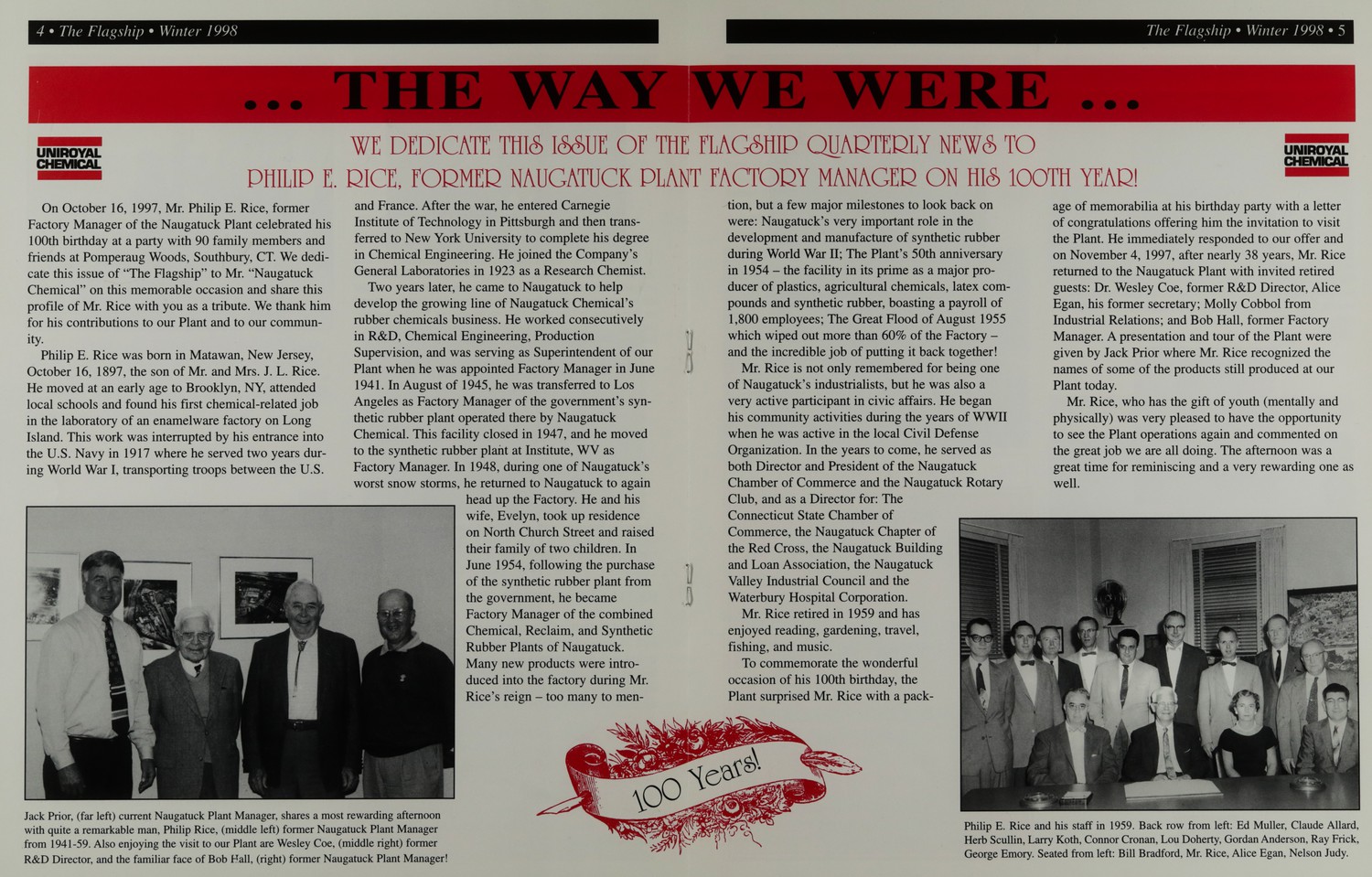
age of memorabilia at his birthday party with a letter of congratulations offering him the invitation to visit the Plant. He immediately responded to our offer and on November 4, 1997, after nearly 38 years, Mr. Rice returned to the Naugatuck Plant with invited retired guests: Dr. Wesley Coe, former R&D Director, Alice Egan, his former secretary; Molly Cobbol from Industrial Relations; and Bob Hall, former Factory Manager. A presentation and tour of the Plant were given by Jack Prior where Mr. Rice recognized the names of some of the products still produced at our Plant today.

Mr. Rice, who has the gift of youth (mentally and physically) was very pleased to have the opportunity to see the Plant operations again and commented on the great job we are all doing. The afternoon was a great time for reminiscing and a very rewarding one as well.


[PHOTO CAPTION – LEFT]
Jack Prior, (far left) current Naugatuck Plant Manager, shares a most rewarding afternoon with quite a remarkable man, Philip Rice, (middle left) former Naugatuck Plant Manager from 1941-59. Also enjoying the visit to our Plant are Wesley Coe, (middle right) former R&D Director, and the familiar face of Bob Hall, (right) former Naugatuck Plant Manager!


[GRAPHIC: “100 Years!” with decorative red lobster illustration]


[PHOTO CAPTION – RIGHT]
Philip E. Rice and his staff in 1959. Back row from left: Ed Muller, Claude Allard, Herb Scullin, Larry Koth, Connor Cronan, Lou Doherty, Gordan Anderson, Ray Frick, George Emory. Seated from left: Bill Bradford, Mr. Rice, Alice Egan, Nelson Judy.
Accident Frequency Reduced 54% 1500 Turkevs Awarded to Employees

Page 2 | CHEM-TEXTS | Vol. 7, 1973


The end of the year is upon us, and traditionally it is an ideal time to review the past year and take a peek at the next.

Obviously, it is impossible to review all of the little steps of progress we have made this year. Therefore, I would like to offer a general review of our plant and business in 1973.

The epitome of working together, I think, is this year’s outstanding safety performance over last year’s. Without the complete involvement of all “Chemical people”, we would not have been as successful.

We still have a long way to go, particularly in the number of days lost due to accidents. But this year’s performance has built the base from which we can launch the effort needed to overcome this next difficult hurdle.

In the business line, Chemical Production came through a torturous year with encouraging vigor. The year started great, only to slow down at mid year when uncertain business conditions caused customers to hedge on their purchases.

Then when sales started to pick up, we were staggered by the continuing energy-related raw material shortages.

Heading into the new year, we face the confusing problem of having the sales, but perhaps not the raw materials. In addition, these materials are skyrocketing in cost. Survival next year can be defined as having the flexibility to make the most of a difficult situation.

We all know the problems facing our Reclaim plant. But if this year’s performance and attitude are any indication of our strength and perseverance, we are going to give that business a real run for the money in 1974. Turning an old giant like that around, enough to make it competitive, is a formidable task. Time is a problem and 1974 is our year to show them what we’re made of.

It is unfortunate that we have become non-competitive in the Synthetic latex business. We must quickly recover from this shutdown and adjust ourselves to solving today’s problems.

Attitude and cooperation did it with our Safety performance. The same approach must be used in improving the competitive and economic position of our plant. A healthy business means secure jobs—for one and all.

Despite the lack of Christmas lights this year, I would like to extend to all of you, and your families, my best wishes for the Christmas holiday. It is a comforting time of the year, but also a time to remind ourselves how fortunate we really are.

Jim Crim


Accident Frequency Reduced 54%

1500 Turkeys Awarded to Employees

[IMAGE: Photo showing three people examining documents]

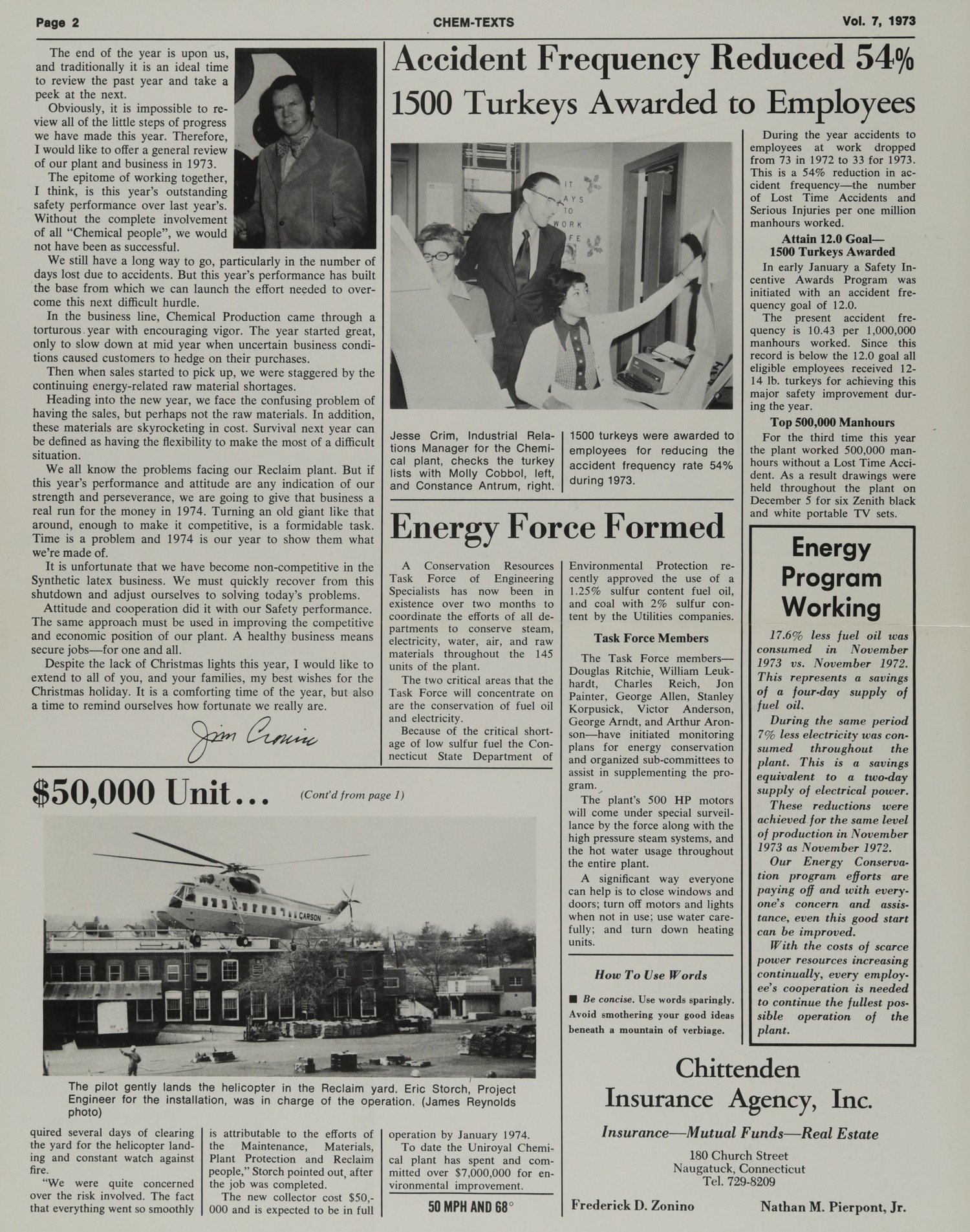
Jesse Crim, Industrial Relations Manager for the Chemical plant, checks the turkey lists with Molly Cobbol, left, and Constance Antrum, right.

1500 turkeys were awarded to employees for reducing the accident frequency rate 54% during 1973.

During the year accidents to employees at work dropped from 73 in 1972 to 33 for 1973. This is a 54% reduction in accident frequency—the number of Lost Time Accidents and Serious Injuries per one million manhours worked.

Attain 12.0 Goal—1500 Turkeys Awarded

In early January a Safety Incentive Awards Program was initiated with an accident frequency goal of 12.0.

The present accident frequency is 10.43 per 1,000,000 manhours worked. Since this record is below the 12.0 goal all eligible employees received 12-14 lb. turkeys for achieving this major safety improvement during the year.

Top 500,000 Manhours

For the third time this year the plant worked 500,000 manhours without a Lost Time Accident. As a result drawings were held throughout the plant on December 5 for six Zenith black and white portable TV sets.


Energy Force Formed

A Conservation Resources Task Force of Engineering Specialists has now been in existence over two months to coordinate the efforts of all departments to conserve steam, electricity, water, air, and raw materials throughout the 145 units of the plant.

The two critical areas that the Task Force will concentrate on are the conservation of fuel oil and electricity.

Because of the critical shortage of low sulfur fuel the Connecticut State Department of Environmental Protection recently approved the use of a 1.25% sulfur content fuel oil, and coal with 2% sulfur content by the Utilities companies.

Task Force Members

The Task Force members—Douglas Ritchie, William Leukhardt, Charles Reich, Jon Painter, George Allen, Stanley Korpusick, Victor Anderson, George Arndt, and Arthur Aronson—have initiated monitoring plans for energy conservation and organized sub-committees to assist in supplementing the program.

The plant’s 500 HP motors will come under special surveillance by the force along with the high pressure steam systems, and the hot water usage throughout the entire plant.

A significant way everyone can help is to close windows and doors; turn off motors and lights when not in use; use water carefully; and turn down heating units.


How To Use Words

Be concise. Use words sparingly. Avoid smothering your good ideas beneath a mountain of verbiage.


Energy Program Working

17.6% less fuel oil was consumed in November 1973 vs. November 1972. This represents a savings of a four-day supply of fuel oil.

During the same period 7% less electricity was consumed throughout the plant. This is a savings equivalent to a two-day supply of electrical power.

These reductions were achieved for the same level of production in November 1973 as November 1972.

Our Energy Conservation program efforts are paying off and with everyone’s concern and assistance, even this good start can be improved.

With the costs of scarce power resources increasing continually, every employee’s cooperation is needed to continue the fullest possible operation of the plant.


$50,000 Unit… (Cont’d from page 1)

[IMAGE: Photo of helicopter landing in yard with buildings in background, marked “CARSON”]

The pilot gently lands the helicopter in the Reclaim yard. Eric Storch, Project Engineer for the installation, was in charge of the operation. (James Reynolds photo)

quired several days of clearing the yard for the helicopter landing and constant watch against fire.

“We were quite concerned over the risk involved. The fact that everything went so smoothly is attributable to the efforts of the Maintenance, Materials, Plant Protection and Reclaim people,” Storch pointed out after the job was completed.

The new collector cost $50,000 and is expected to be in operation by January 1974.

To date the Uniroyal Chemical plant has spent and committed over $7,000,000 for environmental improvement.

50 MPH AND 68°


Chittenden Insurance Agency, Inc.

Insurance—Mutual Funds—Real Estate

180 Church Street
Naugatuck, Connecticut
Tel. 729-8209

Frederick D. Zonino | Nathan M. Pierpont, Jr.

CHEM-TEXTS – Vol. 5 No. 3 – Page 4

Page 004

Page 4 CHEM-TEXTS Vol. 5 No. 3


Know Your Products: Rubber Chemical Accelerators

by Dr. Bob Brown

(This issue continues the article in Vol. 5, No. 2 on Accelerators made or marketed by the Naugatuck Chemical plant.)

Accelerators are used primarily to speed up, or control the vulcanization process which turns rubber from a useless, gummy substance into a strong resilient and elastic material. Vulcanization, in simple terms, is a chemical reaction between rubber and sulfur, usually brought about by heat.

Faster Accelerators

Where there is less processing or mixing involved, very fast accelerators with little or no delayed action can be used to give more rapid vulcanization. The Zates (Arazate®, Butazate®, Ethazate® and Methazate®) and the Thiurams (Monex®, Pentex®, Tuex®, and Accelerator 108) are used here. They are also used in latex curing where processing is usually not a problem.

Customers use these accelerators for rubber sponge, wire insulation, hot water bottles, conveyor belts, hospital sheeting, and household items and in such latex products as balloons and carpet backing.

The Zates accelerators are non-discoloring and non-staining and can be used in colored rubber products.

Some of the newer synthetic rubbers (Royalene® “the crackless rubber” is an example) are inherently slower in vulcanization than the older types such as natural rubber, neoprene and the Naugapol® and Paracril® synthetic rubbers made at the Naugatuck and Painesville, Ohio plants. Fast accelerators are needed to speed up the vulcanization process for these types of rubber, otherwise it would be economically impossible to make a product at a reasonable selling price to the consumer.

Dr. Bob Brown, author of these articles, is manager of Research and Development for Rubber Chemicals. He received his doctorate degree from Princeton University in Organic Chemistry and holds several patent awards. Dr. Brown heads a staff of 42 people whose sole function is to improve our present chemicals and to develop new ones in order to remain competitive in the market.

GMF and DIBENZO GMF® are used in butyl rubber which also vulcanizes very slowly. A large amount of butyl rubber is used for tire tubes, and high voltage electrical cable.

CPB, DBA Very Active

Sometimes customers want to vulcanize rubber products without heating them at all. Very active accelerators like CPB and DBA accomplish this. In this process the product must be shaped before the accelerator is added. Golf ball covers, for example, are vulcanized by soaking the finished balls in a solution of CPB.

(In the next issue of Chem-Texts, Antioxidants and Antiozonants will be discussed. If you have a son or daughter in school, these articles provide source material for class papers in Chemistry courses.)


33 Employees

(Cont’d. from page 2)

are under further evaluation for higher amounts dependent on the amount of the savings for the plant.

Other employees who received cash awards for Ideas were P. Blasko, F. Maffia, M. Jannetty, D. Stevenson, E. Grickis, R. Guest, B. Robinson, A. Urban, S. Kropcho, J. Harper, J. Gilbert, A. Happy, J. Iosa, H. Garahan, F. Surmanek (2), L. DeLaRosa (2), P. Beardsley, S. Falcone, H. Hernandez, A. Grella, J. Needham, D. Boyd, E. Root, Sr., A. Molnar, D. Pinto and J. Cohen.

Letters of Commendation were presented to C. Smith, L. Fortier, F. Gagne, Carol Calo, J. Gallucci, R. Lockwood, D. Donato, T. Carr, Preciosa Cravo, D. Nelson, A. Nauges, W. Krayeski, W. Tabaka and D. Polzella.

Of the 33 employees awarded cash for Ideas, two were salary employees and the highest number of Ideas were submitted by Mechanical Department personnel.

No Limit to Cash Awards

There is no maximum limit to the amount of a cash award for an Idea. If the value of the Idea exceeds $1,000—this amount is paid under the Plant Idea Plan—it is submitted for further consideration for a higher award to a special management committee. The minimum award for an Idea is $25.

Ideas to Conserve Water Needed

With the construction of the new liquid waste pretreatment plant in progress, ideas to conserve water are needed now as the facilities are designed to treat 3,600,000 gallons a day.


SAFETY IS MY RESPONSIBILITY


Crim Assumes IR Post

Two Industrial Relations Managers not agreeing? Unbelievable! But that’s what the photo seems to say as Jesse Crim, right, new Industrial Relations Manager for the Naugatuck Chemical plant discusses a fine point on employee relations with Ron Mitchinson, former IR Manager and now with the Corporate IR staff in Oxford. Crim came from the Chemical Division’s Painesville, Ohio plant, where he held the position of IR Manager.

Crim will be responsible for labor and employee relations, personnel development and training, plant protection and employee safety, communications, public and community relations, and employment.


Appointments Announced

Sam Gillette has been named Methods Engineering Manager, reporting to the Factory Manager.

Joe Bucciaglia was appointed General Foreman for the Chemical Production Plant.

Eric Johnson was made Chief Process Engineer for the Chemical Production Plant.

Lee Owens assumes the responsibilities of General Foreman in the Synthetic Production Plant.

Clark Makinson moved to the Materials Flow Department in EMIC.

Ed Rabitor replaces Clark in the Chemical Control Center.


Three Retire In Month

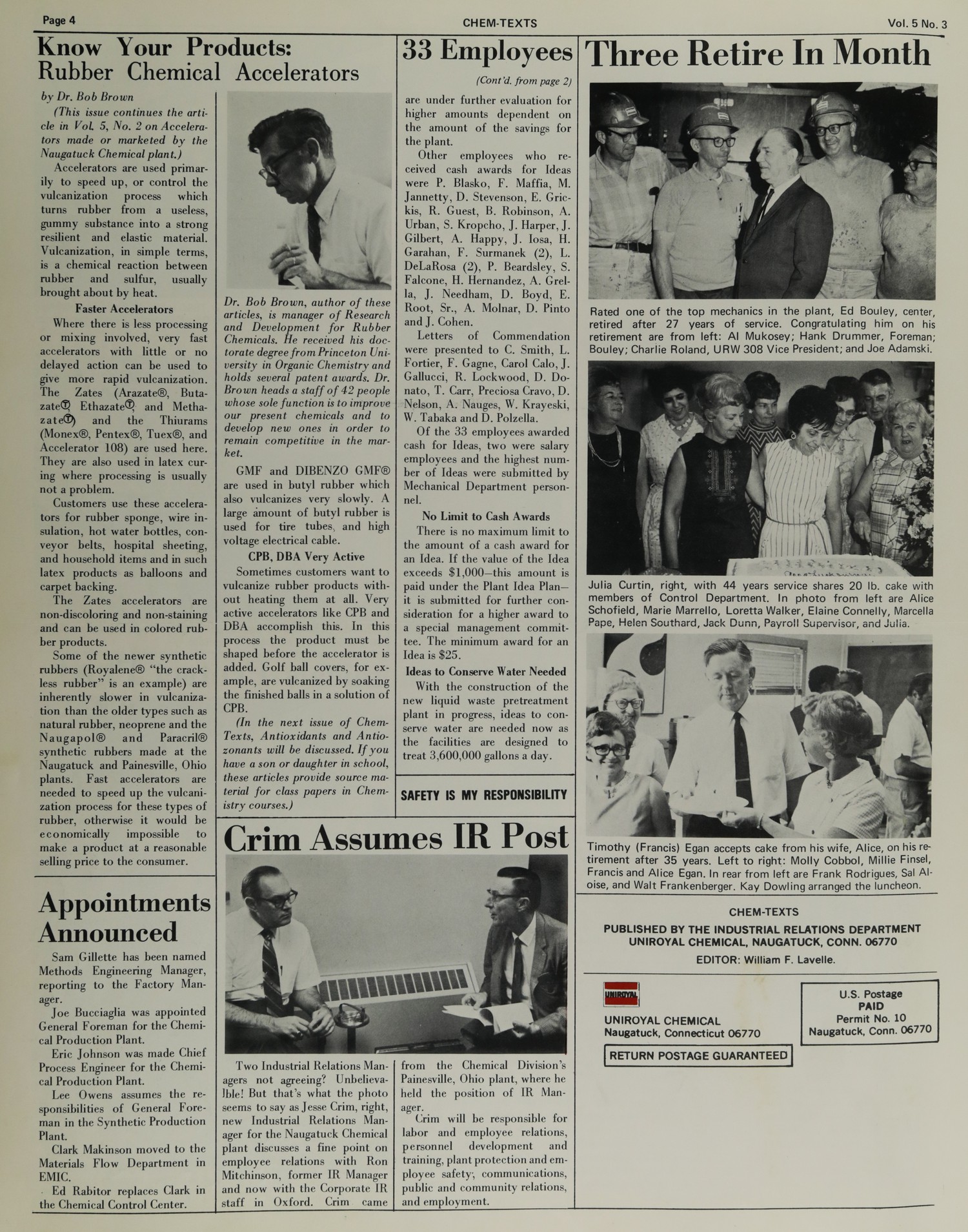
Rated one of the top mechanics in the plant, Ed Bouley, center, retired after 27 years of service. Congratulating him on his retirement are from left: Al Mukosey; Hank Drummer, Foreman; Bouley; Charlie Roland, URW 308 Vice President; and Joe Adamski.


Julia Curtin, right, with 44 years service shares 20 lb. cake with members of Control Department. In photo from left are Alice Schofield, Marie Marrello, Loretta Walker, Elaine Connelly, Marcella Pape, Helen Southard, Jack Dunn, Payroll Supervisor, and Julia.


Timothy (Francis) Egan accepts cake from his wife, Alice, on his retirement after 35 years. Left to right: Molly Cobbol, Millie Finsel, Francis and Alice Egan. In rear from left are Frank Rodrigues, Sal Aloise, and Walt Frankenberger. Kay Dowling arranged the luncheon.


CHEM-TEXTS

PUBLISHED BY THE INDUSTRIAL RELATIONS DEPARTMENT
UNIROYAL CHEMICAL, NAUGATUCK, CONN. 06770

EDITOR: William F. Lavelle.


UNIROYAL CHEMICAL
Naugatuck, Connecticut 06770

RETURN POSTAGE GUARANTEED

U.S. Postage
PAID
Permit No. 10
Naugatuck, Conn. 06770

CHEM-TEXTS – 1971-v05-i03-s191

Page 191

UNIROYAL CHEM-TEXTS

Vol. 5, 1971 | PUBLISHED FOR THE PEOPLE OF UNIROYAL CHEMICAL | No. 3


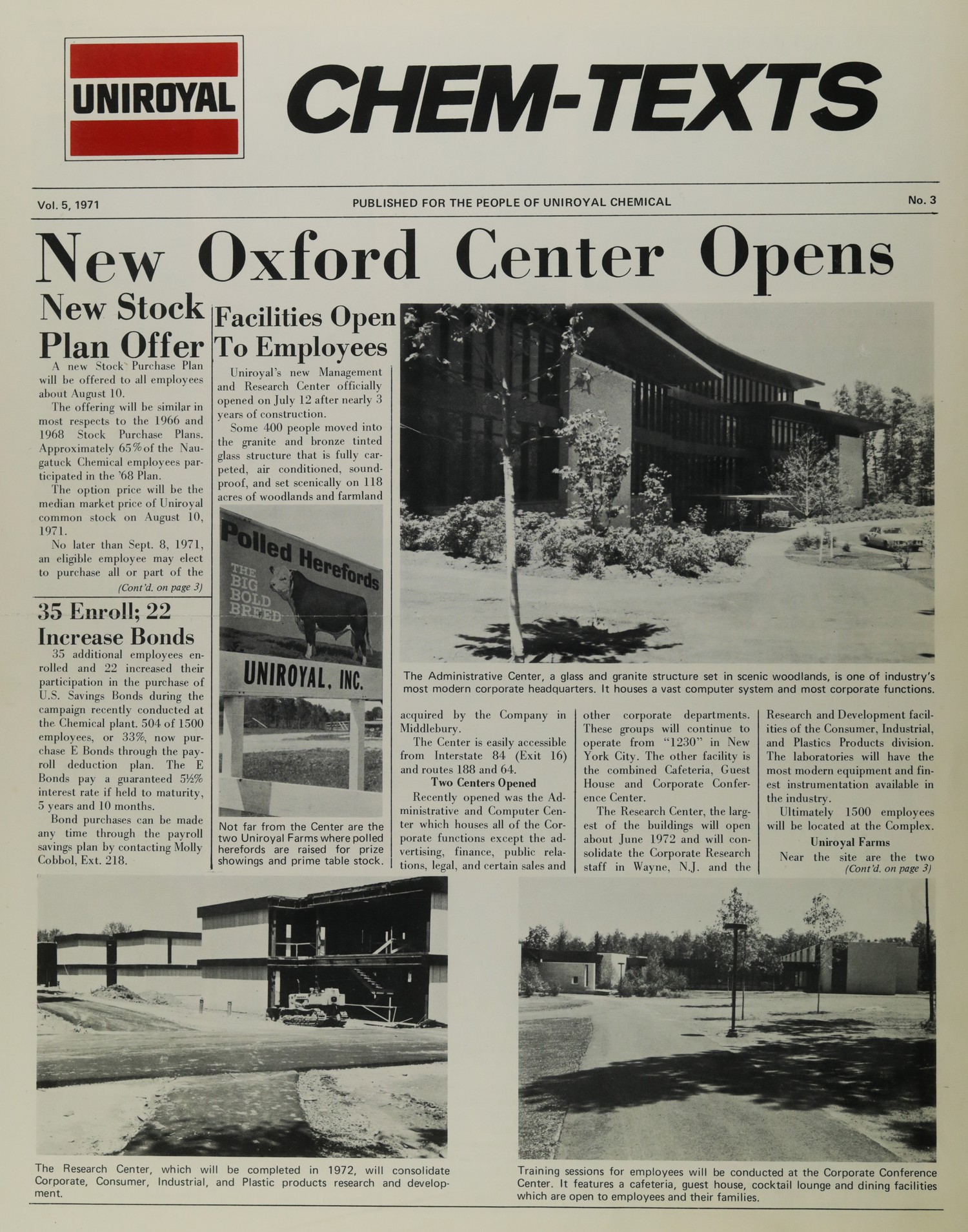
New Oxford Center Opens

New Stock Plan Offer

A new Stock Purchase Plan will be offered to all employees about August 10.

The offering will be similar in most respects to the 1966 and 1968 Stock Purchase Plans. Approximately 65% of the Naugatuck Chemical employees participated in the ’68 Plan.

The option price will be the median market price of Uniroyal common stock on August 10, 1971.

No later than Sept. 8, 1971, an eligible employee may elect to purchase all or part of the (Cont’d. on page 3)

35 Enroll; 22 Increase Bonds

35 additional employees enrolled and 22 increased their participation in the purchase of U.S. Savings Bonds during the campaign recently conducted at the Chemical plant. 504 of 1500 employees, or 33%, now purchase E Bonds through the payroll deduction plan. The E Bonds pay a guaranteed 5½% interest rate if held to maturity, 5 years and 10 months.

Bond purchases can be made any time through the payroll savings plan by contacting Molly Cobbol, Ext. 218.


Facilities Open To Employees

Uniroyal’s new Management and Research Center officially opened on July 12 after nearly 3 years of construction.

Some 400 people moved into the granite and bronze tinted glass structure that is fully carpeted, air conditioned, soundproof, and set scenically on 118 acres of woodlands and farmland


[IMAGE: Sign reading “Polled Herefords THE BIG BOLD BREED” with UNIROYAL, INC. below]

Not far from the Center are the two Uniroyal Farms where polled herefords are raised for prize showings and prime table stock.


[IMAGE: Modern glass and granite building – Administrative Center]

The Administrative Center, a glass and granite structure set in scenic woodlands, is one of industry’s most modern corporate headquarters. It houses a vast computer system and most corporate functions.

acquired by the Company in Middlebury.

The Center is easily accessible from Interstate 84 (Exit 16) and routes 188 and 64.

Two Centers Opened

Recently opened was the Administrative and Computer Center which houses all of the Corporate functions except the advertising, finance, public relations, legal, and certain sales and other corporate departments. These groups will continue to operate from “1230” in New York City. The other facility is the combined Cafeteria, Guest House and Corporate Conference Center.

The Research Center, the largest of the buildings will open about June 1972 and will consolidate the Corporate Research staff in Wayne, N.J. and the

Research and Development facilities of the Consumer, Industrial, and Plastics Products division. The laboratories will have the most modern equipment and finest instrumentation available in the industry.

Ultimately 1500 employees will be located at the Complex.

Uniroyal Farms

Near the site are the two (Cont’d. on page 3)


[IMAGE: Construction site of Research Center]

The Research Center, which will be completed in 1972, will consolidate Corporate, Consumer, Industrial, and Plastic products research and development.

[IMAGE: Corporate Conference Center building]

Training sessions for employees will be conducted at the Corporate Conference Center. It features a cafeteria, guest house, cocktail lounge and dining facilities which are open to employees and their families.

CHEM-TEXTS – Vol. 3 No. 4 – Page 3

Page 003

CHEM-TEXTS

Vol. 3 No. 4 Page 3


KNOW YOUR BENEFITS:

by W. B. Kirkendall

Some Questions and Answers On Supplemental Unemployment Benefits (SUB)

The SUB plan provides additional income security to wage employees during periods of involuntary unemployment. The benefits are payable to eligible employees from a trust fund established by the Company and is financed by contributions of 6 cents per hour for each hour employees receive pay from the Company. The purpose of the plan is to supplement the local State System Benefits and not to replace or duplicate them.

Q. When am I eligible?

A. You must have at least 10½ months of seniority at the time of a layoff to be eligible and at least a year of seniority at the time you apply for SUB benefits to be eligible to receive a benefit.

TYPES OF BENEFITS

Q. What type of benefits are there?

A. 1. Regular benefit: payable to employees on one or more complete weeks of total layoff from the Company.

  1. Special short week benefit: payable to employees who did some work for the Company during the week or otherwise compensated for a scheduled work day but who are still considered unemployed by the State because of low earnings.
  2. Automatic short week benefit – payable to employees who worked for the Company during the week or otherwise compensated for a scheduled work day and are considered employed by the State but whose hours worked or made available to them were less than the hours in their normal work week.
  3. Separation payments: payable to employees on long term (usually at least one year) layoff in return for the surrender of their benefit and recall rights.

Q. How many benefits am I eligible for?

A. You may receive as many as 52 benefits in a benefit year if you have sufficient credit units. Furthermore, benefits may extend for periods beyond a year depending on your seniority and credit units. You accrue one-half a credit unit for each work- week for which you receive company pay.


PROCEDURES AND CONDITIONS

Q. What are the procedures and conditions for SUB?

A. These are the procedures and conditions which must be met in order to qualify for SUB payments during long or short term layoffs:

  1. Regular benefits: employees must report to the Industrial Relations Dept. and the State Unemployment Compensation office for each week that benefits are claimed. You must have your State check recorded at the Industrial Relations Dept. where the amount will be recorded on your SUB application form and sent to the Control Dept. to process your SUB check.
  2. Automatic short work week: SUB is payable without reporting to the State Unemployment Compensation office only if the employee’s earnings, or possible earnings (available hours) exceed $104.50 and he has had less than 40 hours available to him for the week.
  3. Special short week benefit: an employee earning less than $104.50 and having less than 40 hours work available to him in a given week, must report to the Industrial Relations Dept. and the State Unemployment Compensation office in order to qualify for SUB.

If you have any further questions on SUB benefits, your foreman or supervisor will be glad to help provide answers to them. Feel free to call on him if you need an explanation of the SUB benefits.

NOTE: The next issue of CHEM-TEXTS will continue this article on SUB benefits.


Report Address Changes

If you have changed your name or address recently, it is important that you notify Molly Cobbol. Industrial Relations Dept. Ext. 218. In this way you will be certain that your personnel records are kept up to date.

You will also be sure to receive Uniroyal World, CHEM-TEXTS, the plant newspaper, dividend checks, Benefit statements, and other important messages from Uniroyal, Inc., and the Chemical Plant.


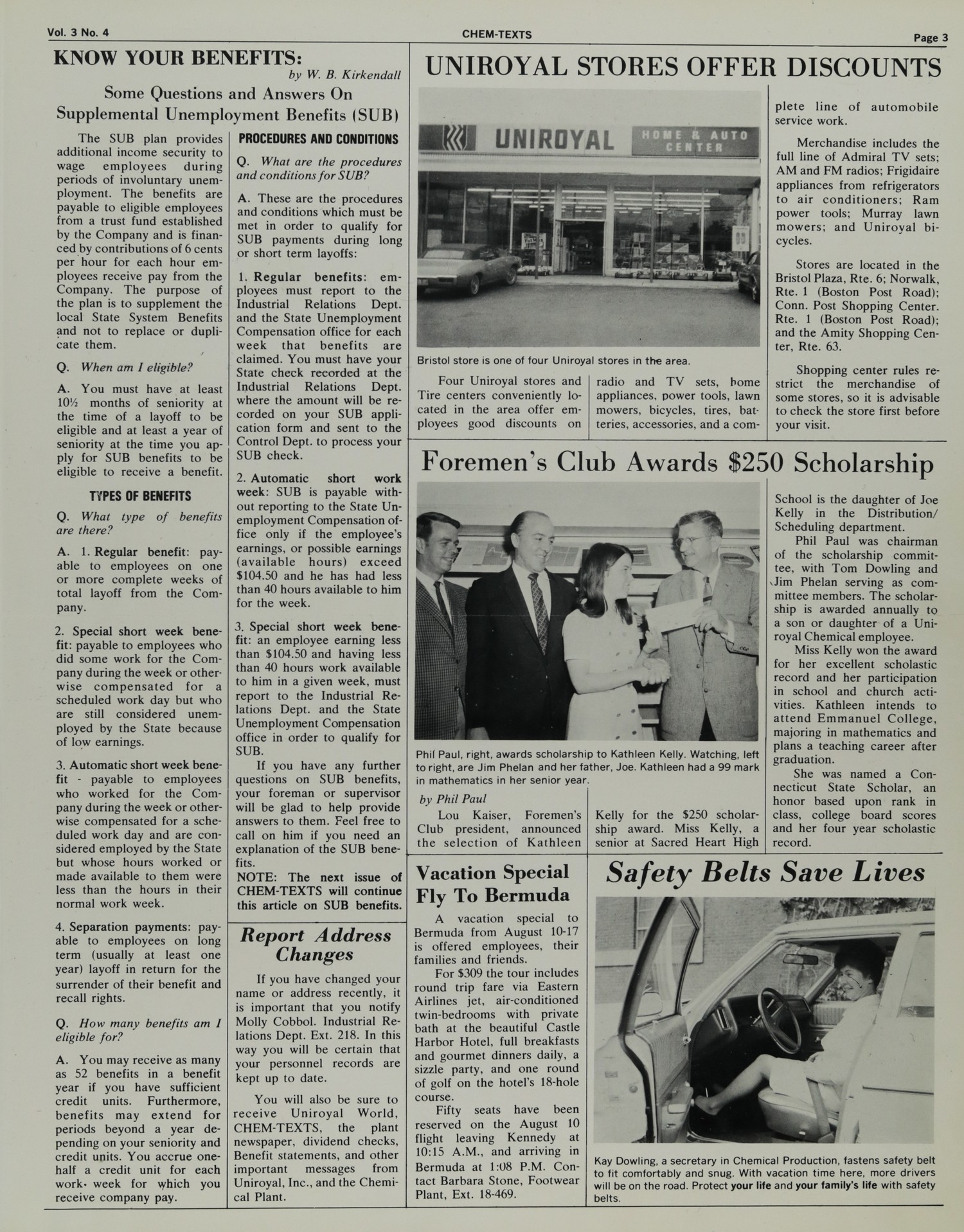
UNIROYAL STORES OFFER DISCOUNTS

[IMAGE: Storefront showing “UNIROYAL HOME & AUTO CENTER”]

Bristol store is one of four Uniroyal stores in the area.

Four Uniroyal stores and Tire centers conveniently located in the area offer employees good discounts on radio and TV sets, home appliances, power tools, lawn mowers, bicycles, tires, batteries, accessories, and a complete line of automobile service work.

Merchandise includes the full line of Admiral TV sets; AM and FM radios; Frigidaire appliances from refrigerators to air conditioners; Ram power tools; Murray lawn mowers; and Uniroyal bicycles.

Stores are located in the Bristol Plaza, Rte. 6; Norwalk, Rte. 1 (Boston Post Road); Conn. Post Shopping Center. Rte. 1 (Boston Post Road); and the Amity Shopping Center, Rte. 63.

Shopping center rules restrict the merchandise of some stores, so it is advisable to check the store first before your visit.


Foremen’s Club Awards $250 Scholarship

[IMAGE: Photo showing Phil Paul, right, awards scholarship to Kathleen Kelly. Watching, left to right, are Jim Phelan and her father, Joe. Kathleen had a 99 mark in mathematics in her senior year.]

by Phil Paul

Lou Kaiser, Foremen’s Club president, announced the selection of Kathleen Kelly for the $250 scholarship award. Miss Kelly, a senior at Sacred Heart High School is the daughter of Joe Kelly in the Distribution/Scheduling department.

Phil Paul was chairman of the scholarship committee, with Tom Dowling and Jim Phelan serving as committee members. The scholarship is awarded annually to a son or daughter of a Uniroyal Chemical employee.

Miss Kelly won the award for her excellent scholastic record and her participation in school and church activities. Kathleen intends to attend Emmanuel College, majoring in mathematics and plans a teaching career after graduation.

She was named a Connecticut State Scholar, an honor based upon rank in class, college board scores and her four year scholastic record.


Vacation Special Fly To Bermuda

A vacation special to Bermuda from August 10-17 is offered employees, their families and friends.

For $309 the tour includes round trip fare via Eastern Airlines jet, air-conditioned twin-bedrooms with private bath at the beautiful Castle Harbor Hotel, full breakfasts and gourmet dinners daily, a sizzle party, and one round of golf on the hotel’s 18-hole course.

Fifty seats have been reserved on the August 10 flight leaving Kennedy at 10:15 A.M., and arriving in Bermuda at 1:08 P.M. Contact Barbara Stone, Footwear Plant, Ext. 18-469.


Safety Belts Save Lives

[IMAGE: Photo of Kay Dowling fastening a safety belt in a car]

Kay Dowling, a secretary in Chemical Production, fastens safety belt to fit comfortably and snug. With vacation time here, more drivers will be on the road. Protect your life and your family’s life with safety belts.

CHEM-TEXTS – Vol. 3 No. 6 – Page 4

Page 004

Page 4 CHEM-TEXTS

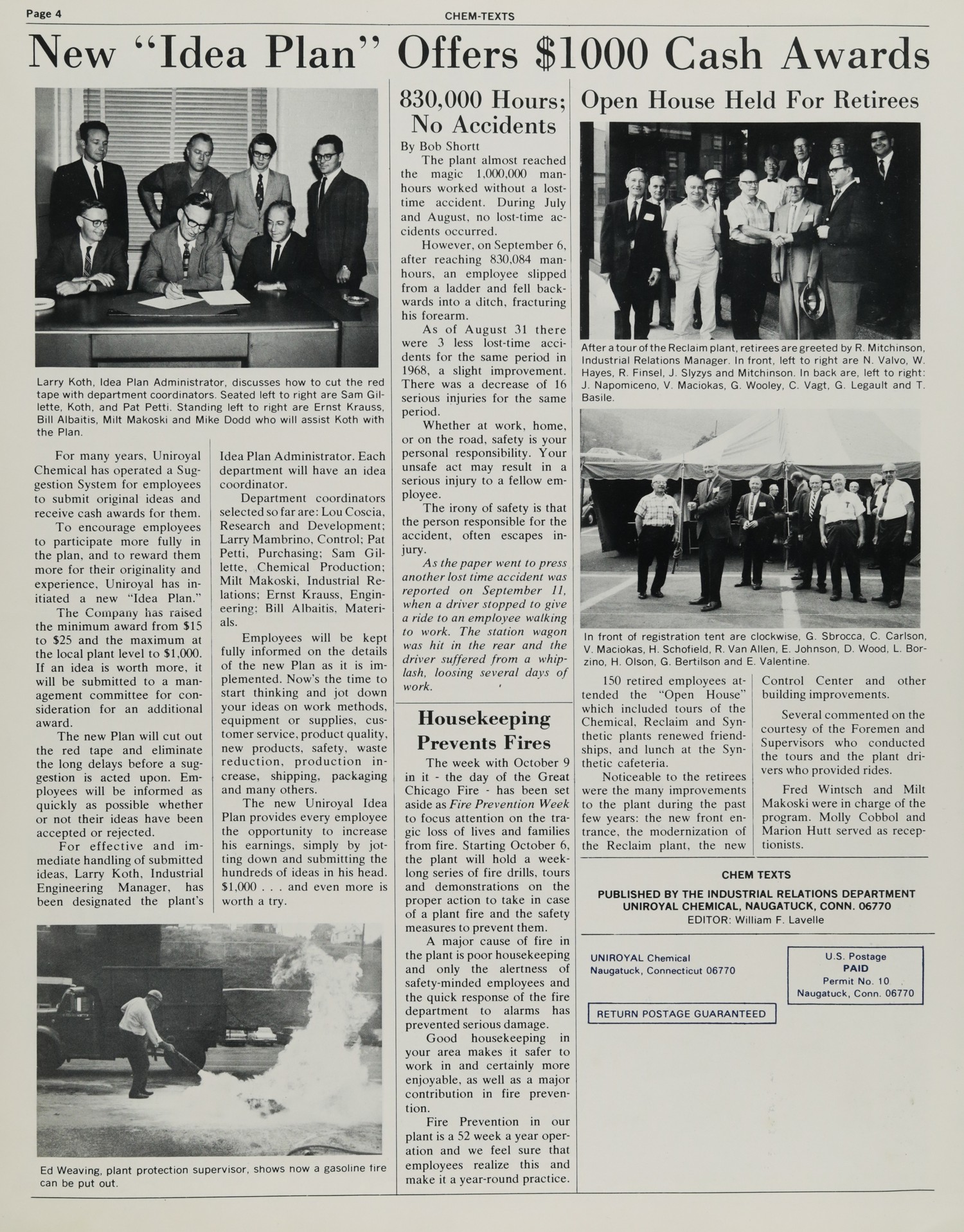
New “Idea Plan” Offers $1000 Cash Awards

Larry Koth, Idea Plan Administrator, discusses how to cut the red tape with department coordinators. Seated left to right are Sam Gillette, Koth, and Pat Petti. Standing left to right are Ernst Krauss, Bill Albaitis, Milt Makoski and Mike Dodd who will assist Koth with the Plan.

For many years, Uniroyal Chemical has operated a Suggestion System for employees to submit original ideas and receive cash awards for them.

To encourage employees to participate more fully in the plan, and to reward them more for their originality and experience, Uniroyal has initiated a new “Idea Plan.”

The Company has raised the minimum award from $15 to $25 and the maximum at the local plant level to $1,000. If an idea is worth more, it will be submitted to a management committee for consideration for an additional award.

The new Plan will cut out the red tape and eliminate the long delays before a suggestion is acted upon. Employees will be informed as quickly as possible whether or not their ideas have been accepted or rejected.

For effective and immediate handling of submitted ideas, Larry Koth, Industrial Engineering Manager, has been designated the plant’s Idea Plan Administrator. Each department will have an idea coordinator.

Department coordinators selected so far are: Lou Coscia, Research and Development; Larry Mambrino, Control; Pat Petti, Purchasing; Sam Gillette, Chemical Production; Milt Makoski, Industrial Relations; Ernst Krauss, Engineering; Bill Albaitis, Materials.

Employees will be kept fully informed on the details of the new Plan as it is implemented. Now’s the time to start thinking and jot down your ideas on work methods, equipment or supplies, customer service, product quality, new products, safety, waste reduction, production increase, shipping, packaging and many others.

The new Uniroyal Idea Plan provides every employee the opportunity to increase his earnings, simply by jotting down and submitting the hundreds of ideas in his head. $1,000 . . . and even more is worth a try.


Ed Weaving, plant protection supervisor, shows now a gasoline fire can be put out.


830,000 Hours; No Accidents

By Bob Shortt

The plant almost reached the magic 1,000,000 manhours worked without a losttime accident. During July and August, no lost-time accidents occurred.

However, on September 6, after reaching 830,084 manhours, an employee slipped from a ladder and fell backwards into a ditch, fracturing his forearm.

As of August 31 there were 3 less lost-time accidents for the same period in 1968, a slight improvement. There was a decrease of 16 serious injuries for the same period.

Whether at work, home, or on the road, safety is your personal responsibility. Your unsafe act may result in a serious injury to a fellow employee.

The irony of safety is that the person responsible for the accident, often escapes injury.

As the paper went to press another lost time accident was reported on September 11, when a driver stopped to give a ride to an employee walking to work. The station wagon was hit in the rear and the driver suffered from a whiplash, loosing several days of work.


Housekeeping Prevents Fires

The week with October 9 in it – the day of the Great Chicago Fire – has been set aside as Fire Prevention Week to focus attention on the tragic loss of lives and families from fire. Starting October 6, the plant will hold a weeklong series of fire drills, tours and demonstrations on the proper action to take in case of a plant fire and the safety measures to prevent them.

A major cause of fire in the plant is poor housekeeping and only the alertness of safety-minded employees and the quick response of the fire department to alarms has prevented serious damage.

Good housekeeping in your area makes it safer to work in and certainly more enjoyable, as well as a major contribution in fire prevention.

Fire Prevention in our plant is a 52 week a year operation and we feel sure that employees realize this and make it a year-round practice.


Open House Held For Retirees

After a tour of the Reclaim plant, retirees are greeted by R. Mitchinson, Industrial Relations Manager. In front, left to right are N. Valvo, W. Hayes, R. Finsel, J. Slyzys and Mitchinson. In back are, left to right: J. Napomiceno, V. Maciokas, G. Wooley, C. Vagt, G. Legault and T. Basile.

In front of registration tent are clockwise, G. Sbrocca, C. Carlson, V. Maciokas, H. Schofield, R. Van Allen, E. Johnson, D. Wood, L. Borzino, H. Olson, G. Bertilson and E. Valentine.

150 retired employees attended the “Open House” which included tours of the Chemical, Reclaim and Synthetic plants renewed friendships, and lunch at the Synthetic cafeteria.

Noticeable to the retirees were the many improvements to the plant during the past few years: the new front entrance, the modernization of the Reclaim plant, the new Control Center and other building improvements.

Several commented on the courtesy of the Foremen and Supervisors who conducted the tours and the plant drivers who provided rides.

Fred Wintsch and Milt Makoski were in charge of the program. Molly Cobbol and Marion Hutt served as receptionists.


CHEM TEXTS

PUBLISHED BY THE INDUSTRIAL RELATIONS DEPARTMENT
UNIROYAL CHEMICAL, NAUGATUCK, CONN. 06770
EDITOR: William F. Lavelle

UNIROYAL Chemical
Naugatuck, Connecticut 06770

U.S. Postage
PAID
Permit No. 10
Naugatuck, Conn. 06770

RETURN POSTAGE GUARANTEED

CHEM-TEXTS – Vol. 3, 1969, No. 11 – Page 1

Page 001

UNIROYAL

Merry Christmas – Happy New Year

CHEM-TEXTS

Vol. 3, 1969 PUBLISHED FOR THE PEOPLE OF UNIROYAL CHEMICAL No. 11


[IMAGE: Two people decorating a Christmas tree]

Getting ready for the Christmas season, Madelyn Malone, left; and Molly Cobbol decorate tree in lobby of Main Entrance.


Frank Hopkins To Address The Foremen’s Club

by Lou Kaiser

Frank Hopkins, Vice President and General Manager of the Chemical division will address the Foremen’s Club January 15, 1970, at the Elks Club in Naugatuck.

Mr. Hopkins will discuss the present and future busi-

[IMAGE: Portrait photo of Frank A. Hopkins]

FRANK A. HOPKINS

ness outlook for the Chemical division, and the effects of the present economic trends on the divisions and the plant’s operations.


Man Falls, Breaks Leg

by Sal Aloise

A fall from a railroad tank car resulted in a broken leg and a bruised shoulder when an employee slipped and fell backwards. The accident occurred while he was placing a recirculating hose in the dome of the tank car. As a result of the injury he will be incapacitated 8 weeks.

The second lost time accident happened when an employee caught the heel of his foot in an elevator door while he was taking a product from the 1st to the 3rd floor of the building.

Besides the two lost time accidents in November, five serious injuries were reported for the month. This rate of accidents shows little improvement over last year.

With every effort being made by the plant to improve safety, no progress will be made in the prevention of injuries unless every employee continually thinks safety and avoids taking chances.

Now that winter is here, ice and snow conditions require a greater concern for

(Continued on page 4)


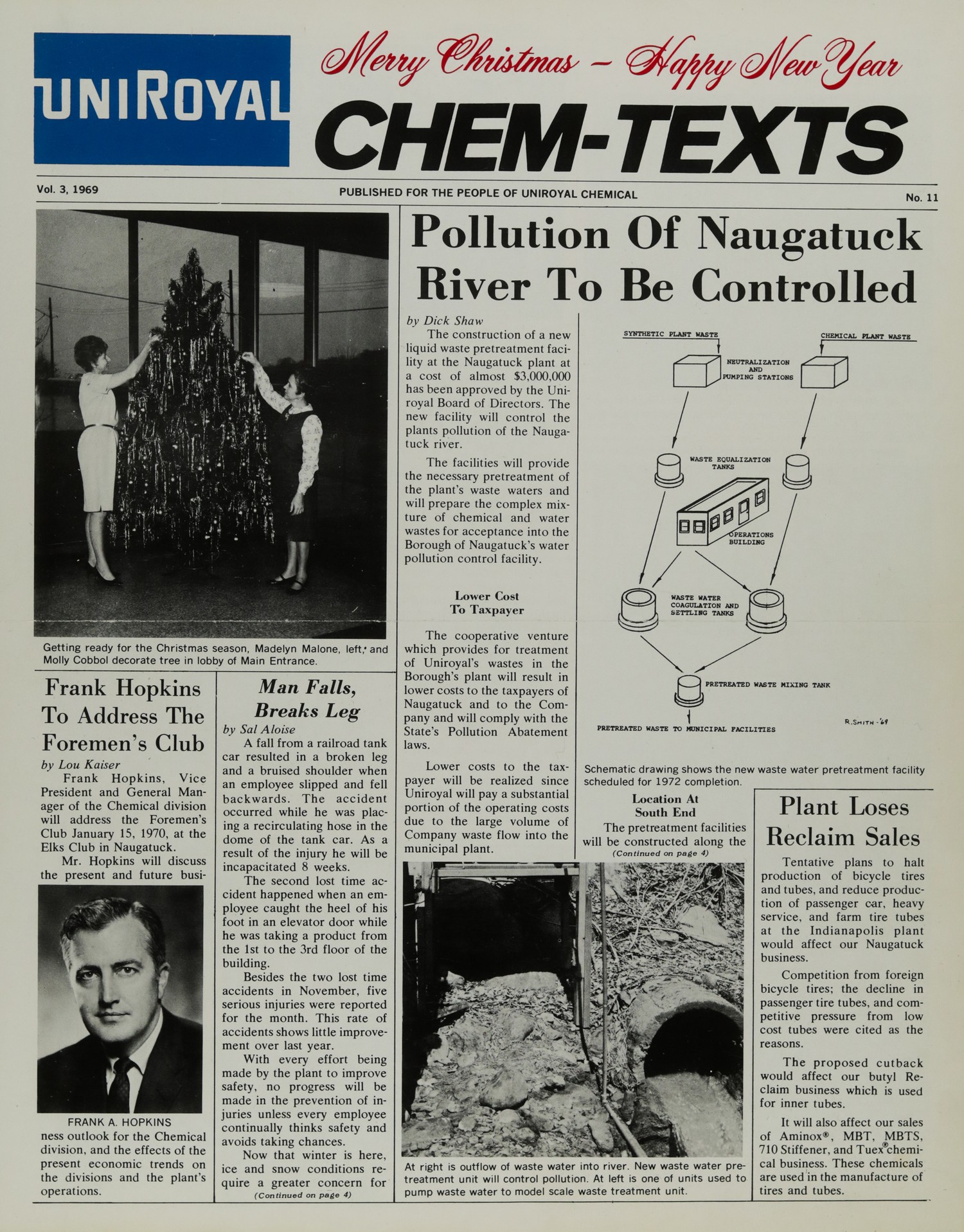
Pollution Of Naugatuck River To Be Controlled

by Dick Shaw

The construction of a new liquid waste pretreatment facility at the Naugatuck plant at a cost of almost $3,000,000 has been approved by the Uniroyal Board of Directors. The new facility will control the plants pollution of the Naugatuck river.

The facilities will provide the necessary pretreatment of the plant’s waste waters and will prepare the complex mixture of chemical and water wastes for acceptance into the Borough of Naugatuck’s water pollution control facility.

Lower Cost To Taxpayer

The cooperative venture which provides for treatment of Uniroyal’s wastes in the Borough’s plant will result in lower costs to the taxpayers of Naugatuck and to the Company and will comply with the State’s Pollution Abatement laws.

Lower costs to the taxpayer will be realized since Uniroyal will pay a substantial portion of the operating costs due to the large volume of Company waste flow into the municipal plant.


[DIAGRAM: Schematic showing waste water treatment process flow, including:
– SYNTHETIC PLANT WASTE
– CHEMICAL PLANT WASTE
– NEUTRALIZATION AND PUMPING STATIONS
– WASTE EQUALIZATION TANKS
– OPERATIONS BUILDING
– WASTE WATER COAGULATION AND SETTLING TANKS
– PRETREATED WASTE MIXING TANK
– PRETREATED WASTE TO MUNICIPAL FACILITIES]

R.Smith-69

Schematic drawing shows the new waste water pretreatment facility scheduled for 1972 completion.

Location At South End

The pretreatment facilities will be constructed along the

(Continued on page 4)


[IMAGE: Industrial equipment/construction site]

At right is outflow of waste water into river. New waste water pretreatment unit will control pollution. At left is one of units used to pump waste water to model scale waste treatment unit.


Plant Loses Reclaim Sales

Tentative plans to halt production of bicycle tires and tubes, and reduce production of passenger car, heavy service, and farm tire tubes at the Indianapolis plant would affect our Naugatuck business.

Competition from foreign bicycle tires; the decline in passenger tire tubes, and competitive pressure from low cost tubes were cited as the reasons.

The proposed cutback would affect our butyl Reclaim business which is used for inner tubes.

It will also affect our sales of Aminox®, MBT, MBTS, 710 Stiffener, and Tuex chemical business. These chemicals are used in the manufacture of tires and tubes.