21 Held In New Uniroyal Row Company Asks Picketing Curbs

Register Photo by Stuart Longer

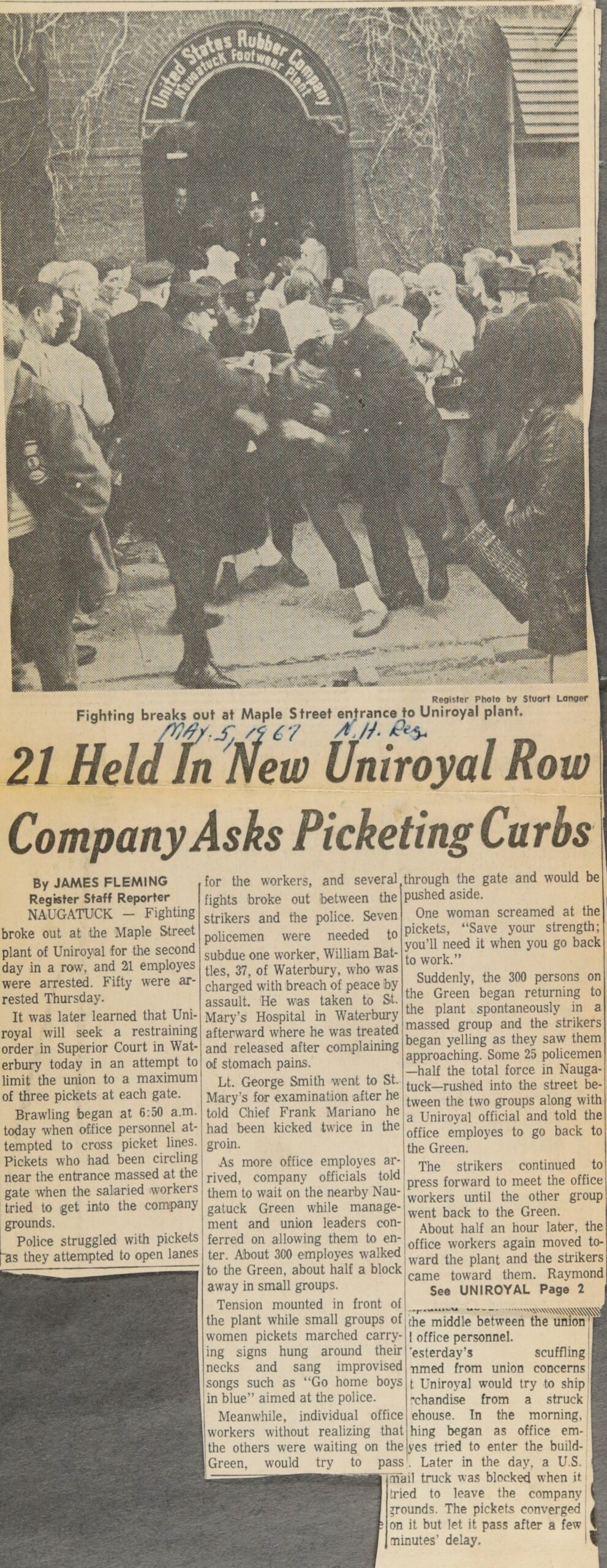
Fighting breaks out at Maple Street entrance to Uniroyal plant.

MAY 5, 1967 N.H. Reg.

21 Held In New Uniroyal Row

Company Asks Picketing Curbs

By JAMES FLEMING
Register Staff Reporter

NAUGATUCK — Fighting broke out at the Maple Street plant of Uniroyal for the second day in a row, and 21 employes were arrested. Fifty were arrested Thursday.

It was later learned that Uniroyal will seek a restraining order in Superior Court in Waterbury today in an attempt to limit the union to a maximum of three pickets at each gate.

Brawling began at 6:50 a.m. today when office personnel attempted to cross picket lines. Pickets who had been circling near the entrance massed at the gate when the salaried workers tried to get into the company grounds.

Police struggled with pickets as they attempted to open lanes for the workers, and several fights broke out between the strikers and the police. Seven policemen were needed to subdue one worker, William Battles, 37, of Waterbury, who was charged with breach of peace by assault. He was taken to St. Mary’s Hospital in Waterbury afterward where he was treated and released after complaining of stomach pains.

Lt. George Smith went to St. Mary’s for examination after he told Chief Frank Mariano he had been kicked twice in the groin.

As more office employes arrived, company officials told them to wait on the nearby Naugatuck Green while management and union leaders conferred on allowing them to enter. About 300 employes walked to the Green, about half a block away in small groups.

Tension mounted in front of the plant while small groups of women pickets marched carrying signs hung around their necks and sang improvised songs such as “Go home boys in blue” aimed at the police.

Meanwhile, individual office workers without realizing that the others were waiting on the Green, would try to pass through the gate and would be pushed aside.

One woman screamed at the pickets, “Save your strength; you’ll need it when you go back to work.”

Suddenly, the 300 persons on the Green began returning to the plant spontaneously in a massed group and the strikers began yelling as they saw them approaching. Some 25 policemen —half the total force in Naugatuck—rushed into the street between the two groups along with a Uniroyal official and told the office employes to go back to the Green.

The strikers continued to press forward to meet the office workers until the other group went back to the Green.

About half an hour later, the office workers again moved toward the plant and the strikers came toward them. Raymond

See UNIROYAL Page 2

the middle between the union l office personnel.

esterday’s scuffling nned from union concerns t Uniroyal would try to ship rchandise from a struck ehouse. In the morning, hing began as office em-yes tried to enter the build-pass. Later in the day, a U.S. mail truck was blocked when it tried to leave the company grounds. The pickets converged on it but let it pass after a few minutes’ delay.
Pushing and Shoving

5-4-67

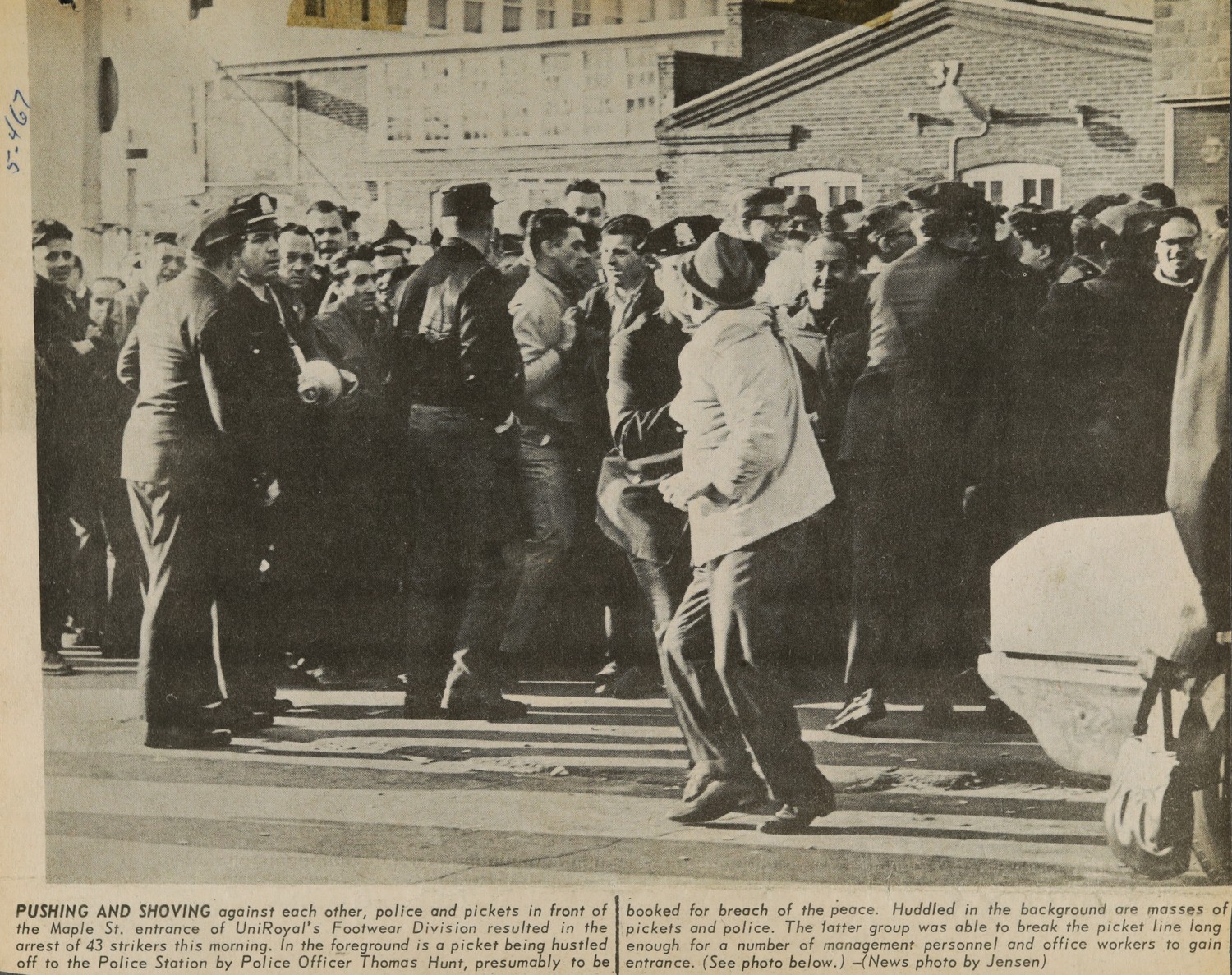
PUSHING AND SHOVING against each other, police and pickets in front of the Maple St. entrance of UniRoyal’s Footwear Division resulted in the arrest of 43 strikers this morning. In the foreground is a picket being hustled off to the Police Station by Police Officer Thomas Hunt, presumably to be booked for breach of the peace. Huddled in the background are masses of pickets and police. The latter group was able to break the picket line long enough for a number of management personnel and office workers to gain entrance. (See photo below.) —(News photo by Jensen)

THREE OF 21 PICKETS ARRESTED THIS MORNING IN THE UNIROYAL STRIKE IN NAUGATUCK ARE HUSTLED OFF TO POLICE HEADQUARTERS TO BE BOOKED ON CHARGES OF BREACH OF PEACE. AT LEAST TWO PICKETS CLAIMED INJURIES AS A RESULT OF THE ACTIVITIES.

5-5-67

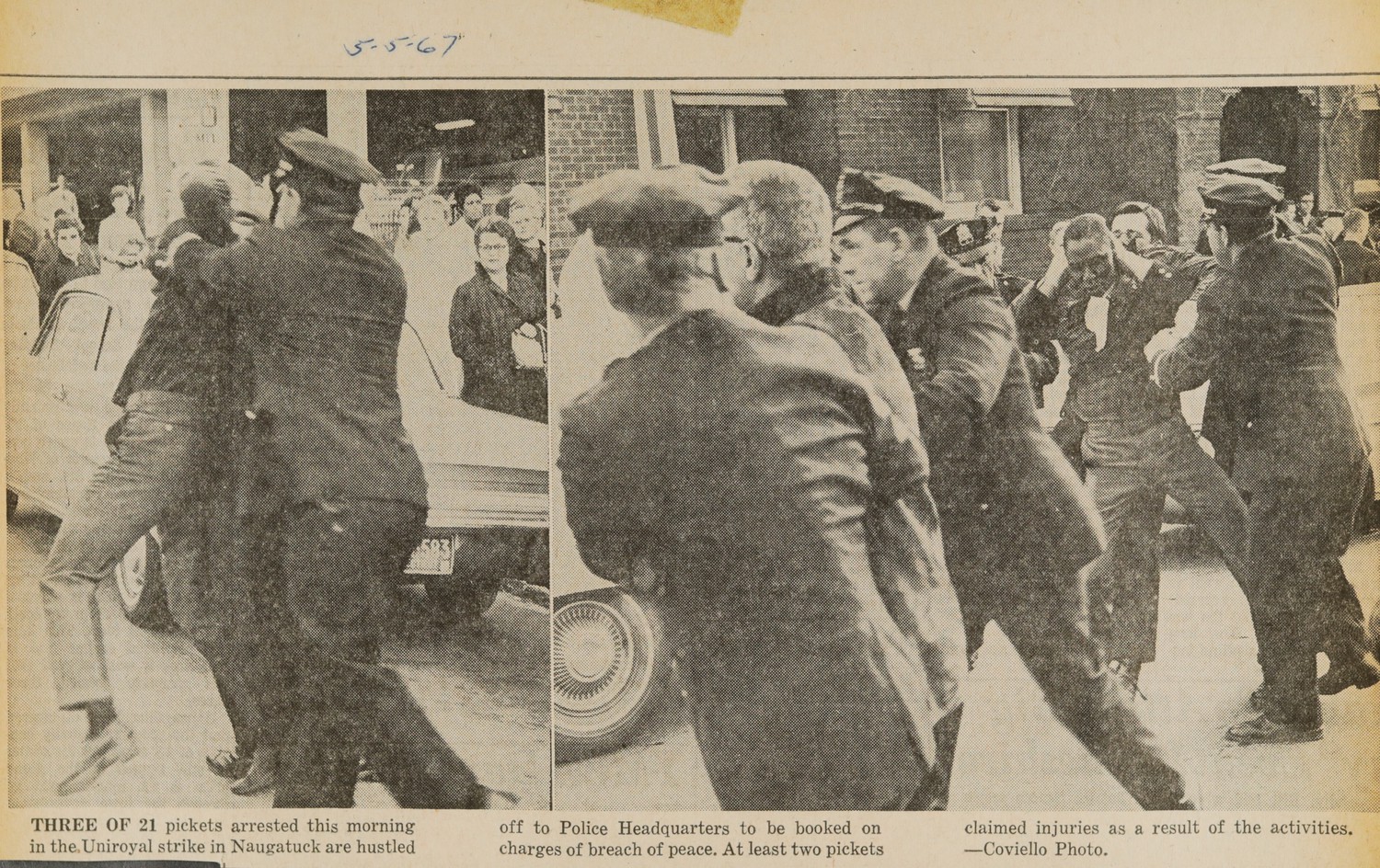
THREE OF 21 pickets arrested this morning in the Uniroyal strike in Naugatuck are hustled off to Police Headquarters to be booked on charges of breach of peace. At least two pickets claimed injuries as a result of the activities.
—Coviello Photo.

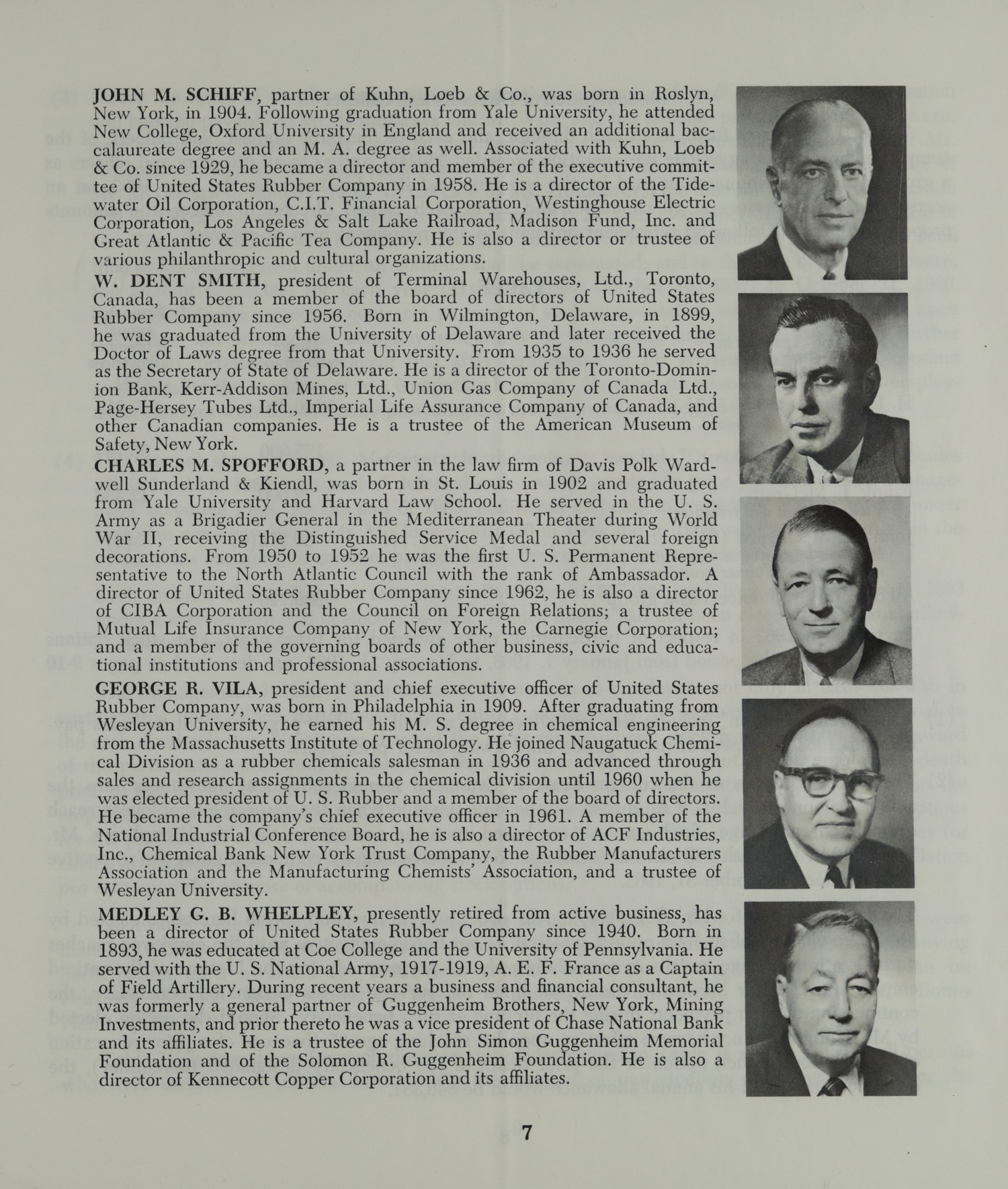
US Rubber Proxy Statement – Page 7

Page 007

JOHN M. SCHIFF, partner of Kuhn, Loeb & Co., was born in Roslyn, New York, in 1904. Following graduation from Yale University, he attended New College, Oxford University in England and received an additional bac-
calaurcatc degree and an M.A. degree as well. Associated with Kuhn, Loeb
& Co. since 1929, he became a director and member of the executive commit-
tee of United States Rubber Company in 1958. He is a director of the Tide-
water Oil Corporation, C.I.T. Financial Corporation, Westinghouse Electric
Corporation, Los Angeles & Salt Lake Railroad, Madison Fund, Inc. and
Great Atlantic & Pacific Tea Company. He is also a director or trustee of
various philanthropic and cultural organizations.
W. DENT SMITH, president of Terminal Warehouses, Ltd., Toronto,
Canada, has been a member of the board of directors of United States
Rubber Company since 1956. Born in Wilmington, Delaware, in 1899,
he was graduated from the University of Delaware and later received the
Doctor of Laws degree from that University. From 1935 to 1936 he served
as the Secretary of State of Delaware. He is a director of the Toronto-Domin-
ion Bank, Kerr-Addison Mines, Ltd., Union Gas Company of Canada Ltd.,
Page-Hersey Tubes Ltd., Imperial Life Assurance Company of Canada, and
other Canadian companies. He is a trustee of the American Museum of
Safety, New York.
CHARLES M. SPOFFORD, a partner in the law firm of Davis Polk Ward-
well Sunderland & Kiendl, was born in St. Louis in 1902 and graduated
from Yale University and Harvard Law School. He served in the U. S.
Army as a Brigadier General in the Mediterranean Theater during World
War II, receiving the Distinguished Service Medal and several foreign
decorations. From 1950 to 1952 he was the first U. S Permanent Repre-
sentative to the North Atlantic Council with the rank of Ambassador. A
director of United States Rubber Company since 1962, he is also a director
of CIBÄ Corporation and the Council on Foreign Relations; a trustee of
Mutual Life Insurance Company of New York, the Carnegie Corporation;
and a member of the governing boards of other business, civic and educa-
tional institutions and professional associations.
GEORGE R. VILA, president and chief executive officer of United States
Rubber Company, was born in Philadelphia in 1909. After graduating from
Wesleyan University, he earned his M. S. degree in chemical engineering
from the Massachusetts Institute of Technology. He joined Naugatuck Chemi-
cal Division as a rubber chemicals salesman in 1936 and advanced through
sales and research assignments in the chemical division until 1960 when he
was elected president of U. S. Rubber and a member of the board of directors.
He became the company’s chief executive officer in 1961. A member of the
National Industrial Conference Board, he is also a director of ACF Industries,
Inc., Chemical Bank New York Trust Company, the Rubber Manufacturers
Association and the Manufacturing Chemists Association, and a trustee of
Wesleyan University.
MEDLEY G. B. WHELPLEY, presently retired from active business, has
been a director of United States Rubber Company since 1940. Born in
1893, he was educated at Coe College and the University of Pennsylvania. He
served with the U. S. National Army, 1917-1919, A. E. F. France as a Captain
of Field Artillery. During recent years a business and financial consultant, he
was formerly a general partner of Guggenheim Brothers, New York, Mining
Investments, and prior thereto he was a vice president of Chase National Bank
and its affiliates. He is a trustee of the John Simon Guggenheim Memorial
Foundation and of the Solomon R. Guggenheim Foundation. He is also a
director of Kennecott Copper Corporation and its affiliates.

Hearing to Resume on Plea Of Union for Uniroyal Stay

Hearing to Resume on Plea Of Union for Uniroyal Stay

Hearing to Resume on Plea Of Union for Uniroyal Stay

A hearing was to resume this morning in Waterbury Superior Court on an application by the United Rubber Workers for an injunction against Uniroyal, Inc., which has plants in Beacon Falls and Naugatuck.

The union filed its application last Thursday, after the company began production of samples of new footwear designs.

The company agreed at that time to halt production until after a court hearing.

The hearing opened Tuesday before Judge Leo V. Gaffney. Three hours of testimony was taken in the afternoon from three union members.

At the center of the controversy is a written agreement, signed April 18 by both parties, three days before the nationwide rubber workers’ strike began.

The agreement provides for the orderly shutdown and maintenance of the Naugatuck Footwear plant during the strike.

It includes a clause stipulating that “the company agrees that for the duration of the strike there will be no work performed by nonbargaining unit employes that is normally performed by bargaining unit personnel.”

Local 45 of the URW maintains last Thursday’s production violates the agreement.

Company Defense

While not clearly stating what its defense would be, the company yesterday indicated it would argue the April 18 agreement was voided when the union allegedly violated a provision intended to insure unimpeded entrance and exit to the plant through specified gates.

Three days of clashes between union members and police early in May, when pickets attempted to keep office personnel from entering the plant, resulted in the arrest of 71 union members and a warning from Judge Gaffney that he would issue an injunction against the union if the violence was not stopped.

In testimony yesterday, Raymond Mengacci, vice president of Local 45, said he had “no doubt” violence would erupt at the plant unless the court issues an order restraining the company from producing sample shoes with nonunion supervisory personnel.

“We will have some very bad violence. You can expect bloodshed in Naugatuck,” Mengacci said.


Service—Use Sentinel Want Ads

Untitled Clipping

7-11-67

Page 10 – NAUGATUCK NEWS (Conn.) Tues., July 11, 1967


Views Of UniRoyal

Continued From Page 1

Mont said his bank “is not pressing anybody to the wall. We go along with the circumstance. I expect some withdrawals — it’s property tax time now.”

Neil Stanley of the Naugatuck Savings and Loan Association says his bank is “endeavoring to accept partial payments on loans. There’s nothing much more we can do except sort of sympathize. People are making a very strenuous effort to stay current.” He said the bank has had “numerous small withdrawals from a large number of people.”

At one time, Naugatuck was among the three highest cities in the United States noted for its savings deposits in the city’s banks.

Frank J. Hayes, manager of the Household Finance Co. in Waterbury, says “People are hurting for money. A hell of a lot of creditors aren’t getting paid. It’s a little bit of a crisis. The strikers on picket duty get $15 weekly and there’s not much that can be done with that. It’s a tough situation. We’re not pressing anybody. You can’t get blood out of a turnip, that would be utter folly.”

James N. Greene, executive vice president of the Naugatuck Chamber of Commerce says, “business has dropped off, but there is no way of telling how much at this point. We know that it has dropped, strictly by word of mouth. The town is still in a healthy situation, because there are other major plants in and around Naugatuck, but we wish the strike was over. UniRoyal is a vital element in the economy’s health.”

Jean Gagnon, of Gagnon’s General Store, says 65 per cent of his customers are UniRoyal workers. “Business has dropped at least 25 per cent. We can’t take it too much longer. Last week, I had to cut credit to food items only. If the strike goes on another month, I’ll have to cut off credit completely, if I’m going to survive.

“We became participants in the Food Stamp program June 1 by necessity. I found that some of my customers who never qualified for stamp relief, now qualify. The program has, since the strike, been of some help to them and to us,” he said.

Holding Own

A hardware store manager, who did not want his store identified, says his firm “hasn’t been hurt too much. We supply all the maintenance stuff for the rubber company and, now, we’re not delivering anything — although the orders still come in. We’re holding our own,” he said.

Jack Smith, factory manager for UniRoyal’s Footwear Division, said “The strike has had an adverse effect on the local economy.” He said also, “We have customers who want to be serviced and they complain if they don’t get it.”

John Evans, factory manager, or UniRoyal’s Chemical Division says “The strike has been a hardship on a town with 5,500 employes striking out of a population of 20,000. But there’s been no local pressure either. We’re just sitting tight here and hoping Ohio settles it.”

September Impact

Ira Mackler, of M. Freedman & Co., a department store, thinks “the full impact of the strike will be reflected in the fall. I’m planning for a decrease. Actually, we’re playing it by ear. Payments are lagging. I’m surprised that the collections have not been as bad as they might be in view of the situation. We are extending extra credit to our people and working with them.”

In an editorial June 23, Frederick E. Hennick of the Naugatuck Daily News, said “It must be equally obvious to both sides in this dispute that there is a crying need to bring this strike to an end for humanitarian reasons, if for no others.

“Too many people are being badly hurt in this struggle which has now gone down in history as the longest rubber industry strike in the nation’s history — something of which neither side should be especially proud.”

One thing some residents with a historical bent seem to point to with pride is the city’s reputation as the birthplace of the rubber industry while Akron is known as its cradle.

It was here in 1840, beside the Naugatuck River which was to become the most polluted river in the United States, that Charles Goodyear developed the process he named for the Roman god of fire — vulcanization — giving birth to the rubber industry.

Most strikers seem to wish Vulcan would breath fire into the smoke stacks that stud the city’s skyline sending the reek of ammonia through the valley — an oppressive smell that would be welcomed because it would mean a return to normal.

Strike Call Voted At Goodyear

Strike Call Voted At Goodyear

7-12-67

AKRON, Ohio (UPI) — The United Rubber Workers (URW) will strike the Goodyear Tire & Rubber Co. Thursday midnight if no contract agreement is reached, a union spokesman said Tuesday.

The URW already is on strike against four other major rubber companies. Three of them have been closed for the past 82 days.

Kenneth Oldham, a member of the union’s Goodyear policy committee of the URW, said about 22,000 union members will walk off their jobs at 11 Goodyear factories from coast to coast if a satisfactory agreement is not reached by Thursday night.

About 51,000 workers have been on strike against Firestone, Goodrich and Uniroyal of Naugatuck, Conn., since April 20, when contracts expired.

Another 3,000 URW members struck two General Tire plants June 15.

The strike is the longest in industry history.

With Goodyear also struck, about 75 per cent of industry capacity will be idled, and the flow of tires and other materials to the defense industry will be sharply cut.

Shortage of defense products, according to some observers, may be sufficient to allow the federal government to invoke the Taft-Hartley Act, and force the rubber workers back to work for an 80-day “cooling-off period.”

Strike Hurt Economy Of Valley

Strike Hurt Economy Of Valley

By RICHARD S. EDINGER

Any 100-day labor strike will cause economic hardship to union members, their families and local merchants, especially in communities the size of Seymour and Beacon Falls.

On Saturday, the union members at Uniroyal, Inc. will vote on ratification of contract agreement made last night in Cincinnati.

The strike will be 100 days old and merchants agree the work stoppage has had some effect on business.

Many families in Beacon Falls and Seymour derive their income from the huge rubber facility four miles north of the center of Beacon Falls in Naugatuck.

There is also a Uniroyal warehouse in Beacon Falls, but few are employed there.

Some relief—temporary as it might be—is being received by employes this week in the form of vacation paychecks.

Some of these checks equal as much as five weeks pay. The total vacation pay distributed is $2-million.

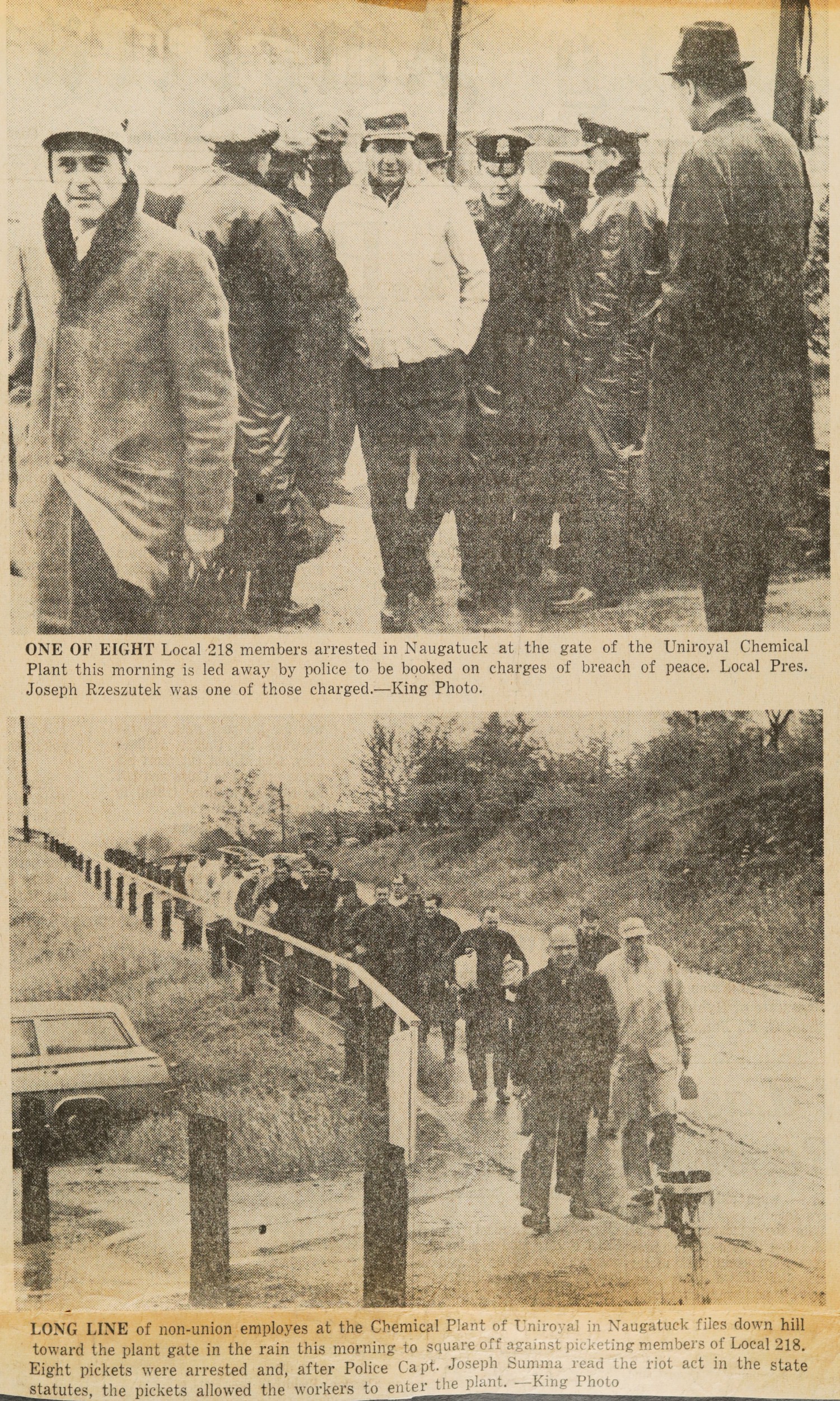
ONE OF EIGHT Local 218 members arrested in Naugatuck at the gate of the Uniroyal Chemical Plant this morning is led away by police to be booked on charges of breach of peace. Local Pres. Joseph Rzeszutek was one of those charged.

ONE OF EIGHT Local 218 members arrested in Naugatuck at the gate of the Uniroyal Chemical Plant this morning is led away by police to be booked on charges of breach of peace. Local Pres. Joseph Rzeszutek was one of those charged.

ONE OF EIGHT Local 218 members arrested in Naugatuck at the gate of the Uniroyal Chemical Plant this morning is led away by police to be booked on charges of breach of peace. Local Pres. Joseph Rzeszutek was one of those charged.—King Photo.

LONG LINE of non-union employes at the Chemical Plant of Uniroyal in Naugatuck files down hill toward the plant gate in the rain this morning to square off against picketing members of Local 218. Eight pickets were arrested and, after Police Capt. Joseph Summa read the riot act in the state statutes, the pickets allowed the workers to enter the plant. —King Photo

Evans, in answer to these charges issued the following statement:

Evans, in answer to these charges issued the following statement:

Evans, in answer to these
charges issued the following
statement: “We consider the
safety of all personnel in the
plant as well as that of the
residents of Naugatuck to be the
first consideration of manage-
ment in all decisions regarding
operations, regardless of cir-
cumstance.”

“At the present time oper-
ations are limited in scope and

US Rubber Annual Report – 72nd Annual Report – Page 11

Page 011

tory control, traffic and accounting, and is expected to
provide important savings in costs.

New Technical Center
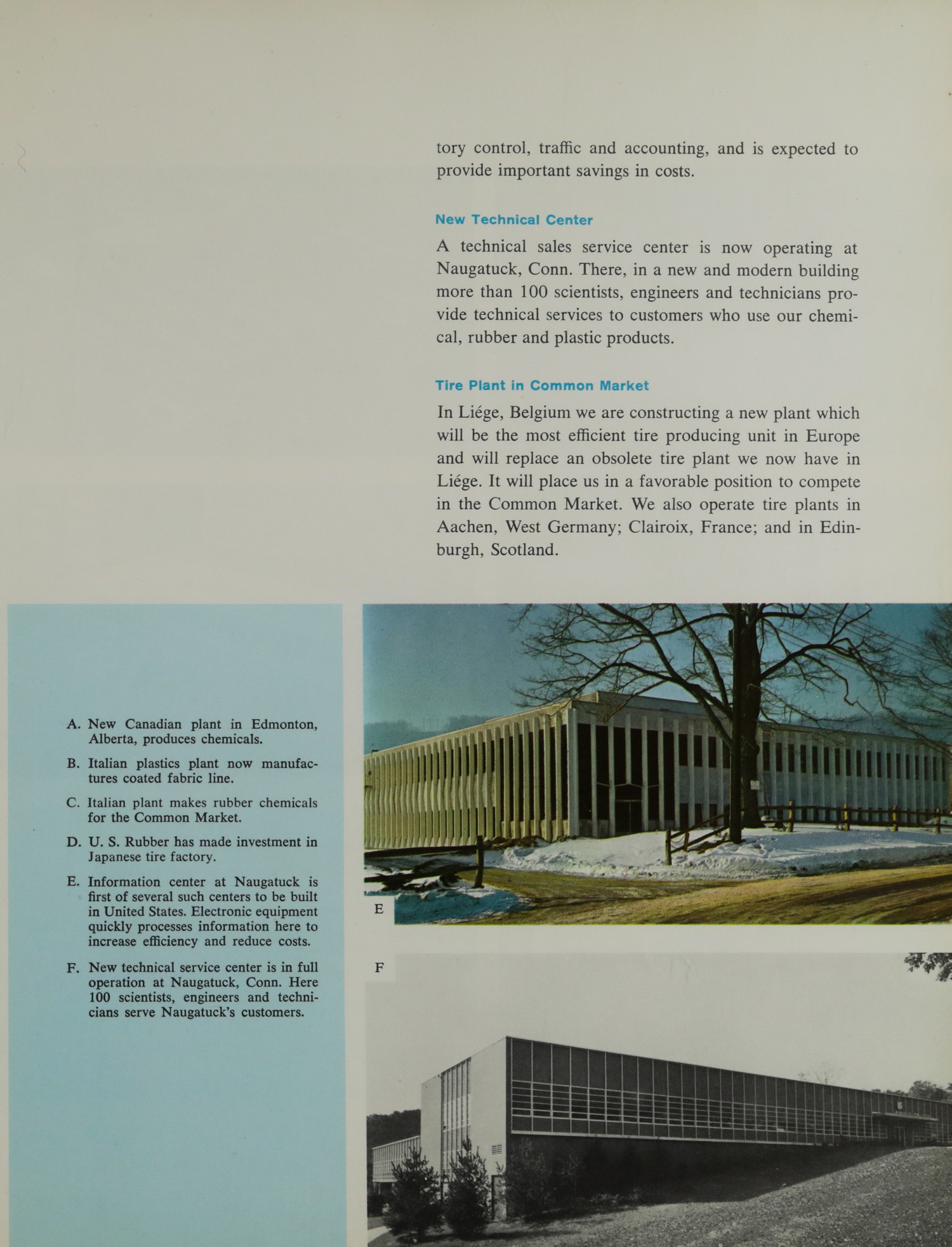
A technical sales service center is now operating at
Naugatuck, Conn. There, in a new and modern building
more than 100 scientists, engineers and technicians provide technical services to customers who use our chemical, rubber and plastic products.

Tire Plant in Common Market
In Liége, Belgium we are constructing a new plant which
will be the most efficient tire producing unit in Europe
and will replace an obsolete tire plant we now have in
Liége. It will place us in a favorable position to compete
in the Common Market. We also operate tire plants in
Aachen, West Germany; Clairôix, France; and in Edinburgh, Scotland.

A. New Canadian plant in Edmonton,
Alberta, produces chemicals.
B. Italian plastics plant now manufactures coated fabric line.
C. Italian plant makes rubber chemicals
for the Common Market.
D. U. S. Rubber has made investment in
Japanese tire factory.
E. Information center at Naugatuck is
first of several such centers to be built
in United States. Electronic equipment
quickly processes information here to
increase efficiency and reduce costs.
F. New technical service center is in full
operation at Naugatuck, Conn. Here
100 scientists, engineers and technicians serve Naugatuck’s customers.