General Tire

(Conn.) Tues., June 13, 1967

General Tire

Continued From Page 1

For the first time, the negotiators, at management’s request, were grappling with wages and all fringe benefits in one package. Traditionally, three-year welfare pension contracts and two-year wage contracts are negotiated separately. The welfare pension contracts do not expire until fall.

Another improvement in General’s weekend offer, which Bommarito called “attractive” as a basis for settlement, was an improvement in supplemental unemployment benefit payments providing for 80 per cent of average straight-time pay for laid-off workers or for those on short work-weeks.

This total would include unemployment compensation. Offers of the other companies provided for 75 per cent of straight pay.

General’s offer includes a provision for six weeks vacation after 30 year’s service and two weeks after one year’s service along with existing intermediate vacations.

It is understood that the General proposal for pensions has been upped close to $5.50 per month for each month of service.

Should a settlement be achieved on a “single package” basis, it would be the first time in the rubber industry. Pensions and welfare matters have previously been reserved to a separate contract, the existing one due to expire next Sept. 15.

Previously however, the wage contract and pension agreements have expired on at least alternate years. The proximity of the pension – contract’s conclusion was held to be an obstacle to an earlier settlement of wages.

The companies acknowledged they were reluctant to expose themselves to a substantial wage-cost increase, only to be faced in a few months with another strike over pensions and other welfare matters. Until two weeks ago, however, the union apparently had been adamant about keeping the two contracts separate.

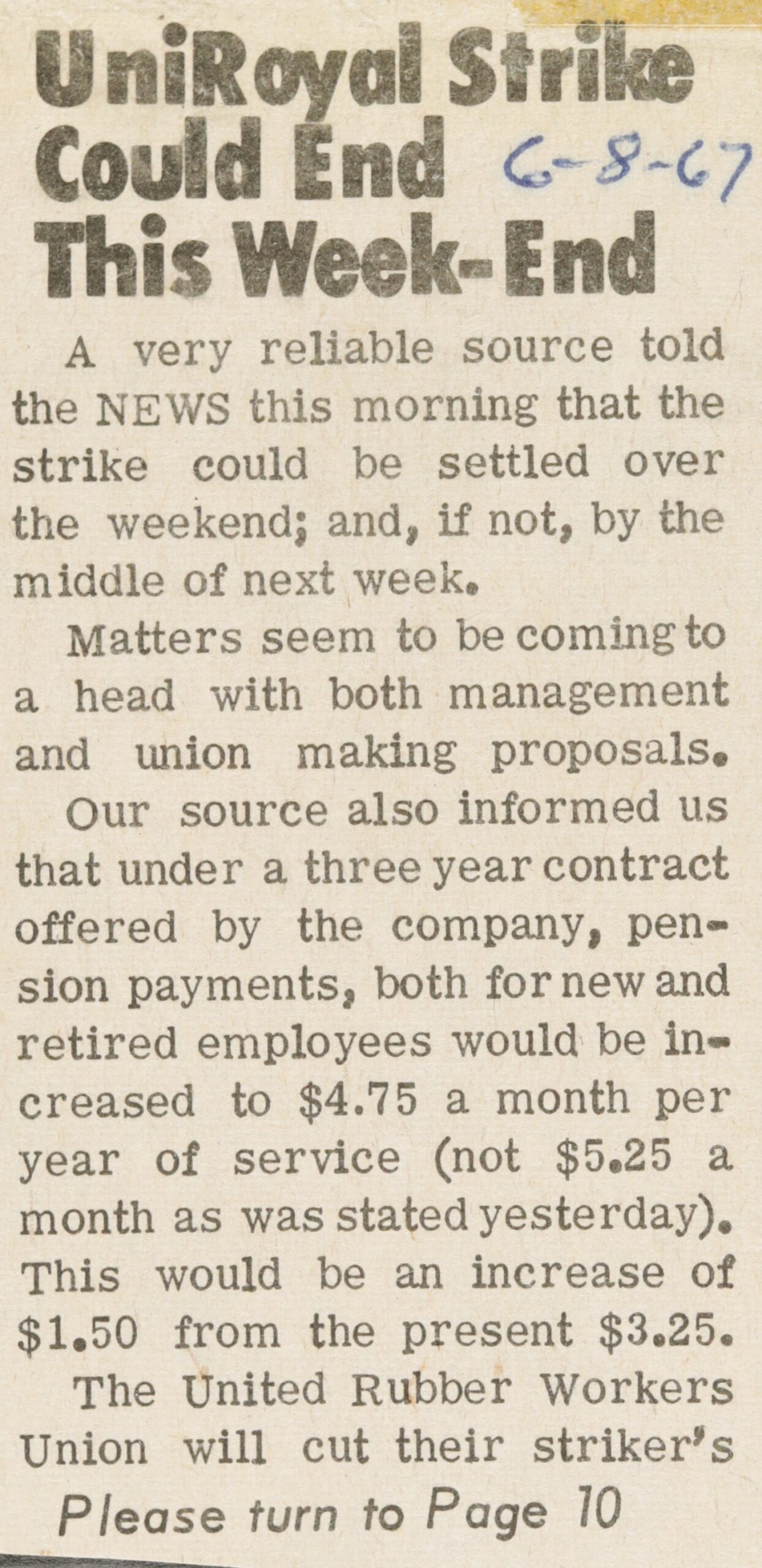
UniRoyal Strike Could End This Week-End

UniRoyal Strike Could End This Week-End

6-8-67 [handwritten]

A very reliable source told the NEWS this morning that the strike could be settled over the weekend; and, if not, by the middle of next week.

Matters seem to be coming to a head with both management and union making proposals.

Our source also informed us that under a three year contract offered by the company, pension payments, both for new and retired employees would be increased to $4.75 a month per year of service (not $5.25 a month as was stated yesterday). This would be an increase of $1.50 from the present $3.25.

The United Rubber Workers Union will cut their striker’s

Please turn to Page 10

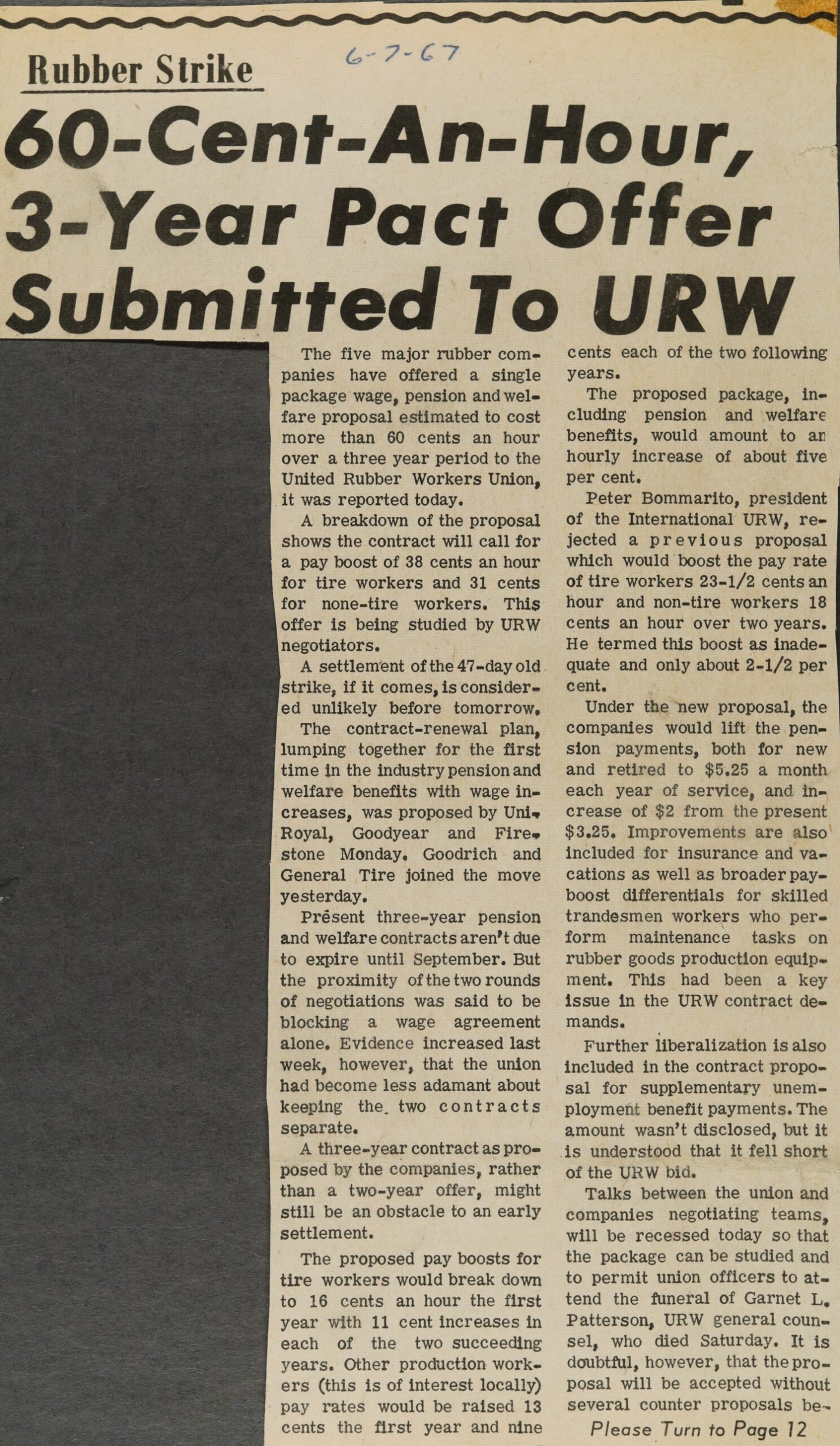
Rubber Strike 60-Cent-An-Hour, 3-Year Pact Offer Submitted To URW

Rubber Strike

6-7-67

60-Cent-An-Hour, 3-Year Pact Offer Submitted To URW

The five major rubber companies have offered a single package wage, pension and welfare proposal estimated to cost more than 60 cents an hour over a three year period to the United Rubber Workers Union, it was reported today.

A breakdown of the proposal shows the contract will call for a pay boost of 38 cents an hour for tire workers and 31 cents for none-tire workers. This offer is being studied by URW negotiators.

A settlement of the 47-day old strike, if it comes, is considered unlikely before tomorrow.

The contract-renewal plan, lumping together for the first time in the industry pension and welfare benefits with wage increases, was proposed by Uni-Royal, Goodyear and Firestone Monday. Goodrich and General Tire joined the move yesterday.

Present three-year pension and welfare contracts aren’t due to expire until September. But the proximity of the two rounds of negotiations was said to be blocking a wage agreement alone. Evidence increased last week, however, that the union had become less adamant about keeping the two contracts separate.

A three-year contract as proposed by the companies, rather than a two-year offer, might still be an obstacle to an early settlement.

The proposed pay boosts for tire workers would break down to 16 cents an hour the first year with 11 cent increases in each of the two succeeding years. Other production workers (this is of interest locally) pay rates would be raised 13 cents the first year and nine

cents each of the two following years.

The proposed package, including pension and welfare benefits, would amount to an hourly increase of about five per cent.

Peter Bommarito, president of the International URW, rejected a previous proposal which would boost the pay rate of tire workers 23-1/2 cents an hour and non-tire workers 18 cents an hour over two years. He termed this boost as inadequate and only about 2-1/2 per cent.

Under the new proposal, the companies would lift the pension payments, both for new and retired to $5.25 a month each year of service, and increase of $2 from the present $3.25. Improvements are also included for insurance and vacations as well as broader pay-boost differentials for skilled trandesmen workers who perform maintenance tasks on rubber goods production equipment. This had been a key issue in the URW contract demands.

Further liberalization is also included in the contract proposal for supplementary unemployment benefit payments. The amount wasn’t disclosed, but it is understood that it fell short of the URW bid.

Talks between the union and companies negotiating teams, will be recessed today so that the package can be studied and to permit union officers to attend the funeral of Garnet L. Patterson, URW general counsel, who died Saturday. It is doubtful, however, that the proposal will be accepted without several counter proposals be-

Please Turn to Page 12

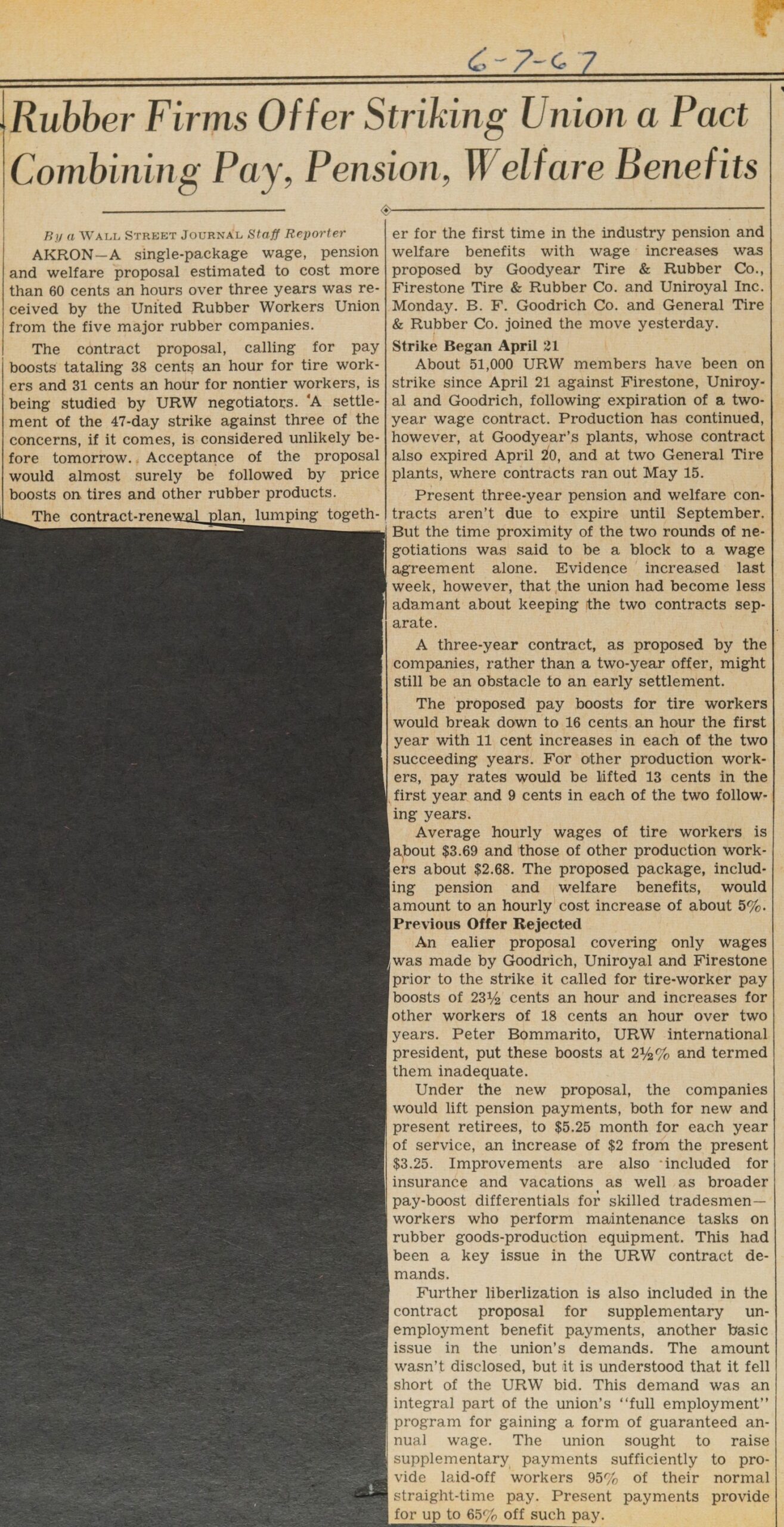
Rubber Firms Offer Striking Union a Pact Combining Pay, Pension, Welfare Benefits

6-7-67

Rubber Firms Offer Striking Union a Pact Combining Pay, Pension, Welfare Benefits

By a WALL STREET JOURNAL Staff Reporter

AKRON—A single-package wage, pension and welfare proposal estimated to cost more than 60 cents an hours over three years was received by the United Rubber Workers Union from the five major rubber companies.

The contract proposal, calling for pay boosts tataling 38 cents an hour for tire workers and 31 cents an hour for nontier workers, is being studied by URW negotiators. A settlement of the 47-day strike against three of the concerns, if it comes, is considered unlikely before tomorrow. Acceptance of the proposal would almost surely be followed by price boosts on tires and other rubber products.

The contract-renewal plan, lumping together for the first time in the industry pension and welfare benefits with wage increases was proposed by Goodyear Tire & Rubber Co., Firestone Tire & Rubber Co. and Uniroyal Inc. Monday. B. F. Goodrich Co. and General Tire & Rubber Co. joined the move yesterday.

Strike Began April 21

About 51,000 URW members have been on strike since April 21 against Firestone, Uniroyal and Goodrich, following expiration of a two-year wage contract. Production has continued, however, at Goodyear’s plants, whose contract also expired April 20, and at two General Tire plants, where contracts ran out May 15.

Present three-year pension and welfare contracts aren’t due to expire until September. But the time proximity of the two rounds of negotiations was said to be a block to a wage agreement alone. Evidence increased last week, however, that the union had become less adamant about keeping the two contracts separate.

A three-year contract, as proposed by the companies, rather than a two-year offer, might still be an obstacle to an early settlement.

The proposed pay boosts for tire workers would break down to 16 cents an hour the first year with 11 cent increases in each of the two succeeding years. For other production workers, pay rates would be lifted 13 cents in the first year and 9 cents in each of the two following years.

Average hourly wages of tire workers is about $3.69 and those of other production workers about $2.68. The proposed package, including pension and welfare benefits, would amount to an hourly cost increase of about 5%.

Previous Offer Rejected

An ealier proposal covering only wages was made by Goodrich, Uniroyal and Firestone prior to the strike it called for tire-worker pay boosts of 23½ cents an hour and increases for other workers of 18 cents an hour over two years. Peter Bommarito, URW international president, put these boosts at 2½% and termed them inadequate.

Under the new proposal, the companies would lift pension payments, both for new and present retirees, to $5.25 month for each year of service, an increase of $2 from the present $3.25. Improvements are also included for insurance and vacations as well as broader pay-boost differentials for skilled tradesmen—workers who perform maintenance tasks on rubber goods-production equipment. This had been a key issue in the URW contract demands.

Further liberlization is also included in the contract proposal for supplementary unemployment benefit payments, another basic issue in the union’s demands. The amount wasn’t disclosed, but it is understood that it fell short of the URW bid. This demand was an integral part of the union’s “full employment” program for gaining a form of guaranteed annual wage. The union sought to raise supplementary payments sufficiently to provide laid-off workers 95% of their normal straight-time pay. Present payments provide for up to 65% off such pay.