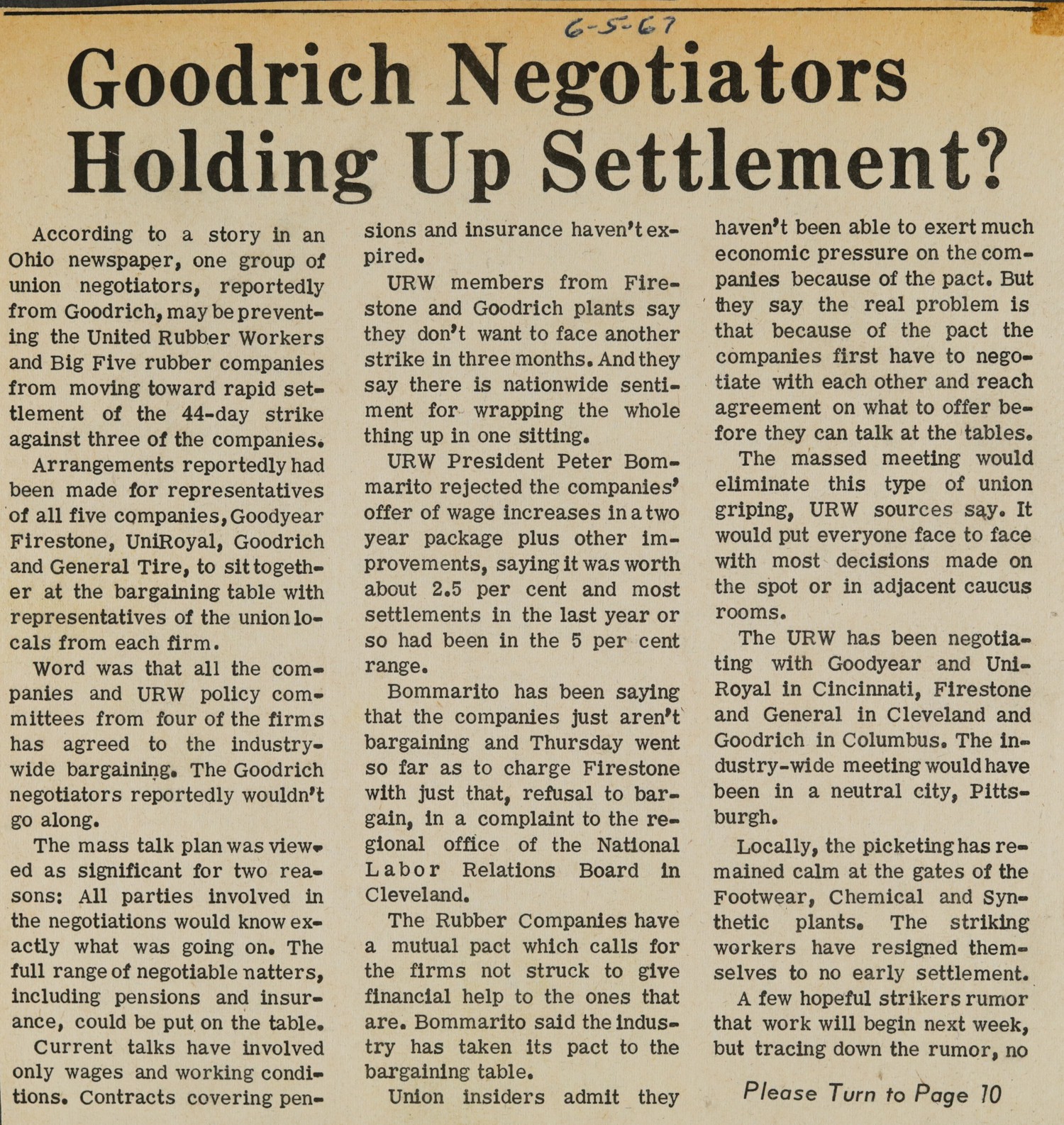
Goodrich Negotiators Holding Up Settlement?

Goodrich Negotiators Holding Up Settlement?

Goodrich Negotiators Holding Up Settlement?

6-5-67 [handwritten]

According to a story in an Ohio newspaper, one group of union negotiators, reportedly from Goodrich, may be preventing the United Rubber Workers and Big Five rubber companies from moving toward rapid settlement of the 44-day strike against three of the companies.

Arrangements reportedly had been made for representatives of all five companies, Goodyear Firestone, UniRoyal, Goodrich and General Tire, to sit together at the bargaining table with representatives of the union locals from each firm.

Word was that all the companies and URW policy committees from four of the firms has agreed to the industrywide bargaining. The Goodrich negotiators reportedly wouldn’t go along.

The mass talk plan was viewed as significant for two reasons: All parties involved in the negotiations would know exactly what was going on. The full range of negotiable natters, including pensions and insurance, could be put on the table.

Current talks have involved only wages and working conditions. Contracts covering pensions and insurance haven’t expired.

URW members from Firestone and Goodrich plants say they don’t want to face another strike in three months. And they say there is nationwide sentiment for wrapping the whole thing up in one sitting.

URW President Peter Bommarito rejected the companies’ offer of wage increases in a two year package plus other improvements, saying it was worth about 2.5 per cent and most settlements in the last year or so had been in the 5 per cent range.

Bommarito has been saying that the companies just aren’t bargaining and Thursday went so far as to charge Firestone with just that, refusal to bargain, in a complaint to the regional office of the National Labor Relations Board in Cleveland.

The Rubber Companies have a mutual pact which calls for the firms not struck to give financial help to the ones that are. Bommarito said the industry has taken its pact to the bargaining table.

Union insiders admit they haven’t been able to exert much economic pressure on the companies because of the pact. But they say the real problem is that because of the pact the companies first have to negotiate with each other and reach agreement on what to offer before they can talk at the tables.

The massed meeting would eliminate this type of union griping, URW sources say. It would put everyone face to face with most decisions made on the spot or in adjacent caucus rooms.

The URW has been negotiating with Goodyear and UniRoyal in Cincinnati, Firestone and General in Cleveland and Goodrich in Columbus. The industry-wide meeting would have been in a neutral city, Pittsburgh.

Locally, the picketing has remained calm at the gates of the Footwear, Chemical and Synthetic plants. The striking workers have resigned themselves to no early settlement.

A few hopeful strikers rumor that work will begin next week, but tracing down the rumor, no

Please Turn to Page 10
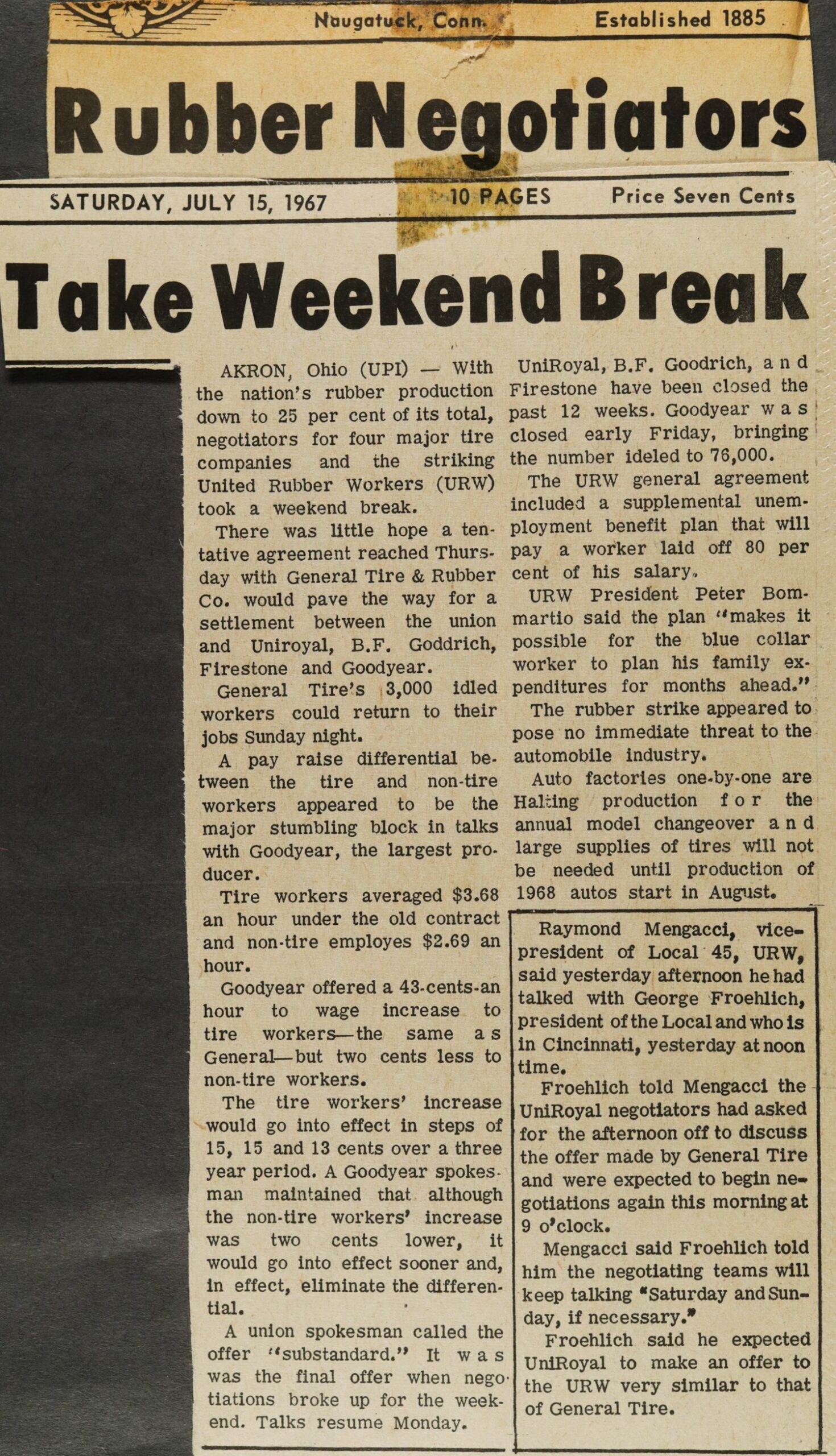
Rubber Negotiators

Naugatuck, Conn.

Established 1885

Rubber Negotiators

SATURDAY, JULY 15, 1967
10 PAGES
Price Seven Cents

Take Weekend Break

AKRON, Ohio (UPI) — With the nation’s rubber production down to 25 per cent of its total, negotiators for four major tire companies and the striking United Rubber Workers (URW) took a weekend break.

There was little hope a tentative agreement reached Thursday with General Tire & Rubber Co. would pave the way for a settlement between the union and Uniroyal, B.F. Goodrich, Firestone and Goodyear.

General Tire’s 3,000 idled workers could return to their jobs Sunday night.

A pay raise differential between the tire and non-tire workers appeared to be the major stumbling block in talks with Goodyear, the largest producer.

Tire workers averaged $3.68 an hour under the old contract and non-tire employes $2.69 an hour.

Goodyear offered a 43-cents-an hour to wage increase to tire workers—the same as General—but two cents less to non-tire workers.

The tire workers’ increase would go into effect in steps of 15, 15 and 13 cents over a three year period. A Goodyear spokesman maintained that although the non-tire workers’ increase was two cents lower, it would go into effect sooner and, in effect, eliminate the differential.

A union spokesman called the offer “substandard.” It was the final offer when negotiations broke up for the weekend. Talks resume Monday.

UniRoyal, B.F. Goodrich, and Firestone have been closed the past 12 weeks. Goodyear was closed early Friday, bringing the number ideled to 76,000.

The URW general agreement included a supplemental unemployment benefit plan that will pay a worker laid off 80 per cent of his salary.

URW President Peter Bommarito said the plan “makes it possible for the blue collar worker to plan his family expenditures for months ahead.”

The rubber strike appeared to pose no immediate threat to the automobile industry.

Auto factories one-by-one are Halting production for the annual model changeover and large supplies of tires will not be needed until production of 1968 autos start in August.


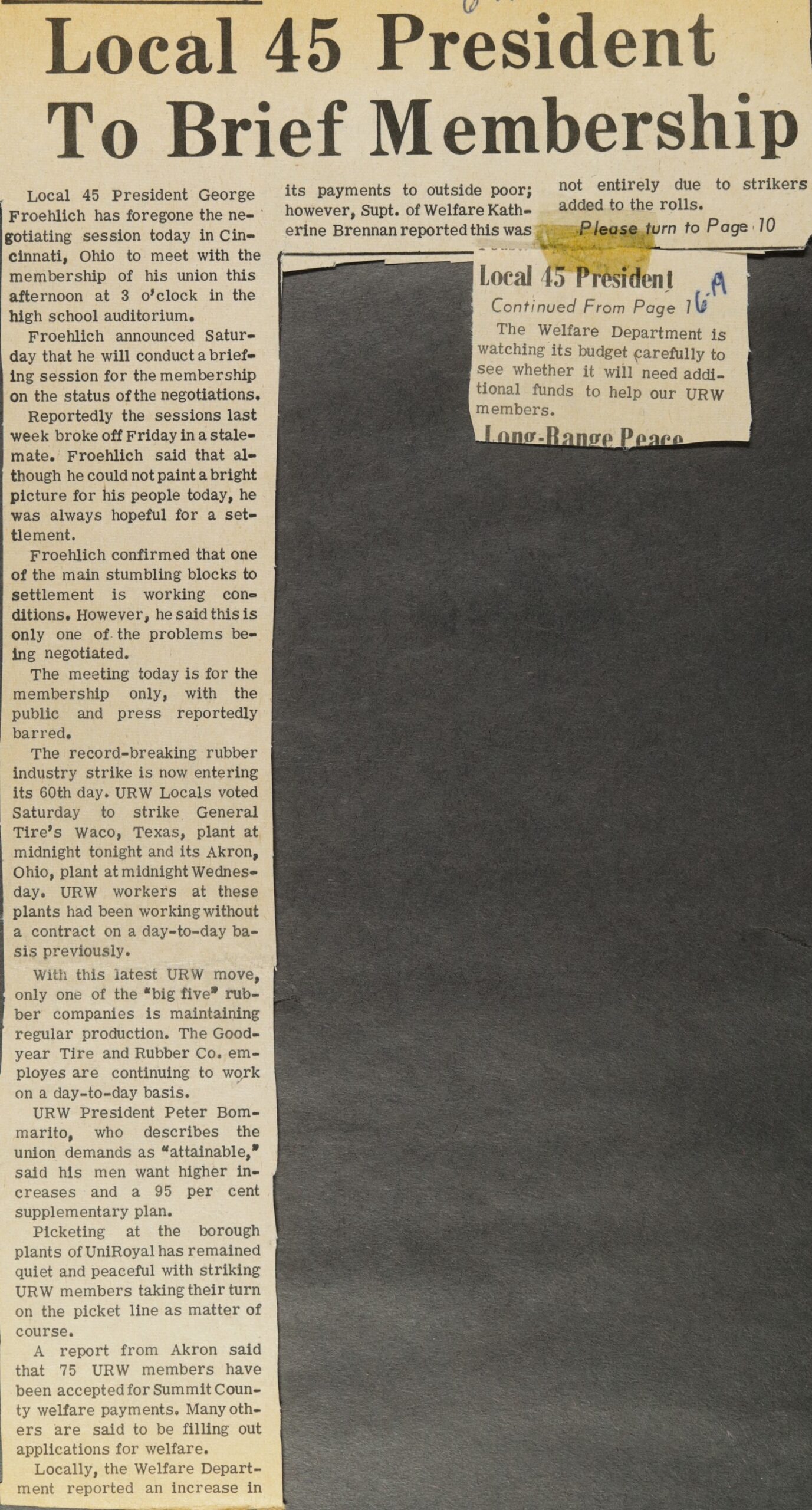
Raymond Mengacci, vice-president of Local 45, URW, said yesterday afternoon he had talked with George Froehlich, president of the Local and who is in Cincinnati, yesterday at noon time.

Froehlich told Mengacci the UniRoyal negotiators had asked for the afternoon off to discuss the offer made by General Tire and were expected to begin negotiations again this morning at 9 o’clock.

Mengacci said Froehlich told him the negotiating teams will keep talking “Saturday and Sunday, if necessary.”

Froehlich said he expected UniRoyal to make an offer to the URW very similar to that of General Tire.

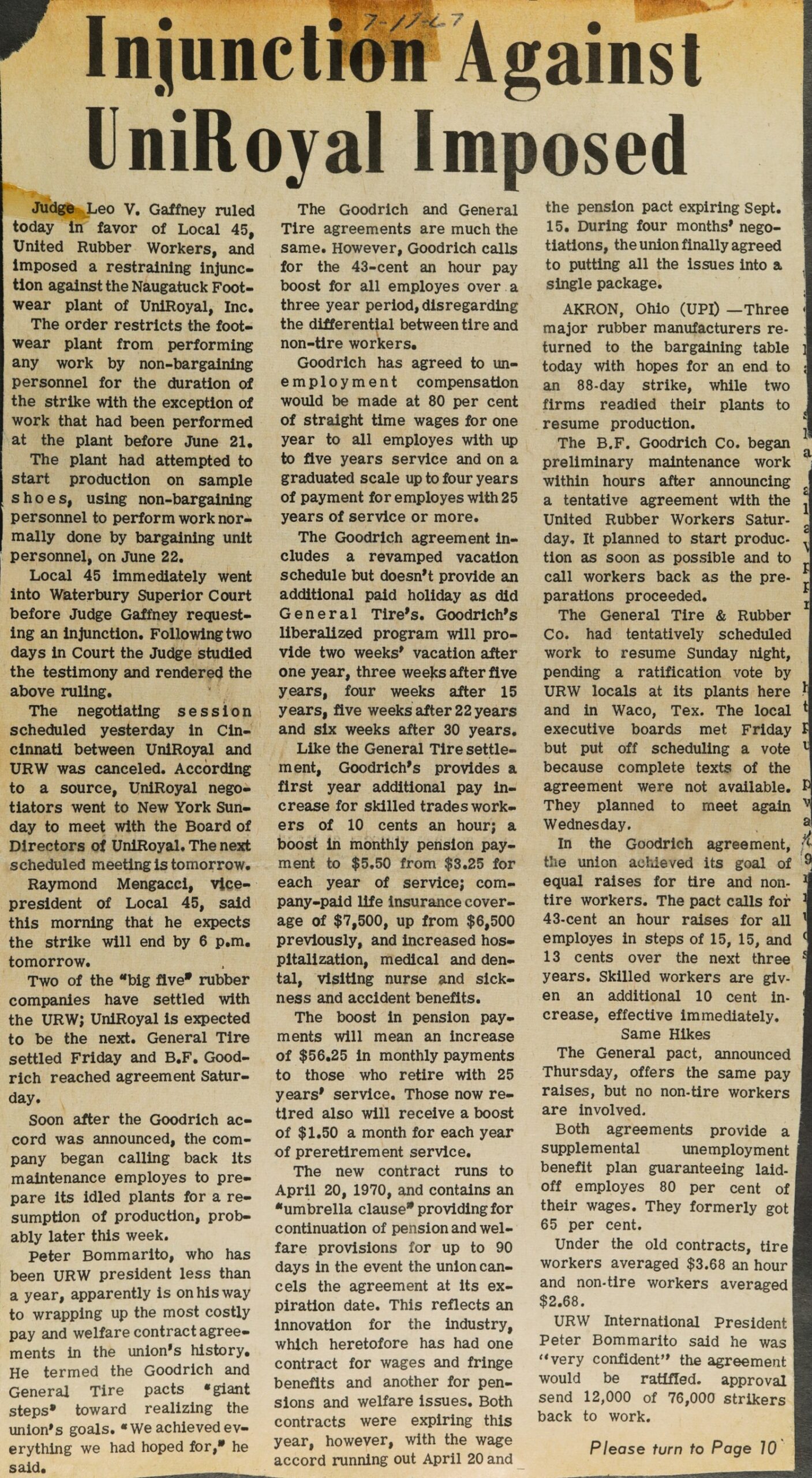
Injunction Against UniRoyal Imposed

Injunction Against UniRoyal Imposed

7-11-67 [handwritten]

Judge Leo V. Gaffney ruled today in favor of Local 45, United Rubber Workers, and imposed a restraining injunction against the Naugatuck Footwear plant of UniRoyal, Inc.

The order restricts the footwear plant from performing any work by non-bargaining personnel for the duration of the strike with the exception of work that had been performed at the plant before June 21.

The plant had attempted to start production on sample shoes, using non-bargaining personnel to perform work normally done by bargaining unit personnel, on June 22.

Local 45 immediately went into Waterbury Superior Court before Judge Gaffney requesting an injunction. Following two days in Court the Judge studied the testimony and rendered the above ruling.

The negotiating session scheduled yesterday in Cincinnati between UniRoyal and URW was canceled. According to a source, UniRoyal negotiators went to New York Sunday to meet with the Board of Directors of UniRoyal. The next scheduled meeting is tomorrow.

Raymond Mengacci, vice-president of Local 45, said this morning that he expects the strike will end by 6 p.m. tomorrow.

Two of the “big five” rubber companies have settled with the URW; UniRoyal is expected to be the next. General Tire settled Friday and B.F. Goodrich reached agreement Saturday.

Soon after the Goodrich accord was announced, the company began calling back its maintenance employes to prepare its idled plants for a resumption of production, probably later this week.

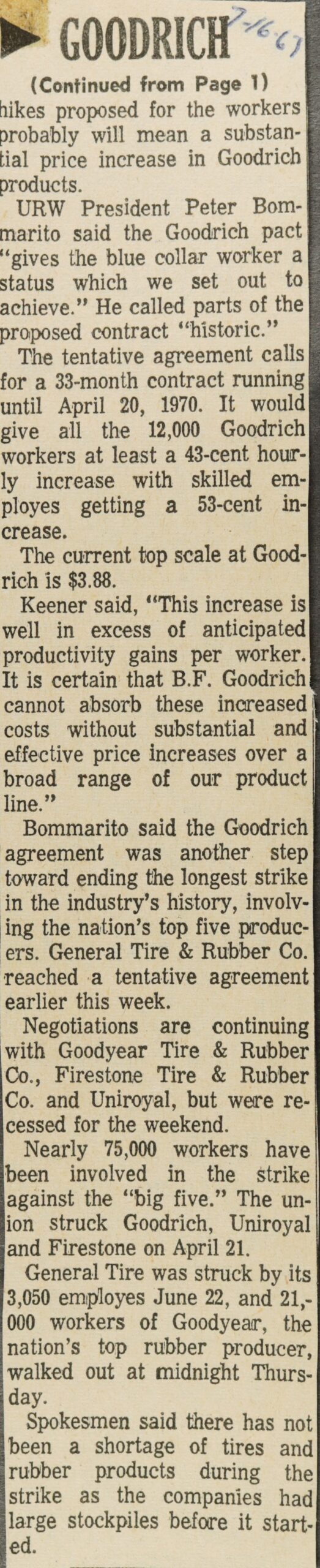
Peter Bommarito, who has been URW president less than a year, apparently is on his way to wrapping up the most costly pay and welfare contract agreements in the union’s history. He termed the Goodrich and General Tire pacts “giant steps” toward realizing the union’s goals. “We achieved everything we had hoped for,” he said.

The Goodrich and General Tire agreements are much the same. However, Goodrich calls for the 43-cent an hour pay boost for all employes over a three year period, disregarding the differential between tire and non-tire workers.

Goodrich has agreed to unemployment compensation would be made at 80 per cent of straight time wages for one year to all employes with up to five years service and on a graduated scale up to four years of payment for employes with 25 years of service or more.

The Goodrich agreement includes a revamped vacation schedule but doesn’t provide an additional paid holiday as did General Tire’s. Goodrich’s liberalized program will provide two weeks’ vacation after one year, three weeks after five years, four weeks after 15 years, five weeks after 22 years and six weeks after 30 years.

Like the General Tire settlement, Goodrich’s provides a first year additional pay increase for skilled trades workers of 10 cents an hour; a boost in monthly pension payment to $5.50 from $3.25 for each year of service; company-paid life insurance coverage of $7,500, up from $6,500 previously, and increased hospitalization, medical and dental, visiting nurse and sickness and accident benefits.

The boost in pension payments will mean an increase of $56.25 in monthly payments to those who retire with 25 years’ service. Those now retired also will receive a boost of $1.50 a month for each year of preretirement service.

The new contract runs to April 20, 1970, and contains an “umbrella clause” providing for continuation of pension and welfare provisions for up to 90 days in the event the union cancels the agreement at its expiration date. This reflects an innovation for the industry, which heretofore has had one contract for wages and fringe benefits and another for pensions and welfare issues. Both contracts were expiring this year, however, with the wage accord running out April 20 and the pension pact expiring Sept. 15. During four months’ negotiations, the union finally agreed to putting all the issues into a single package.

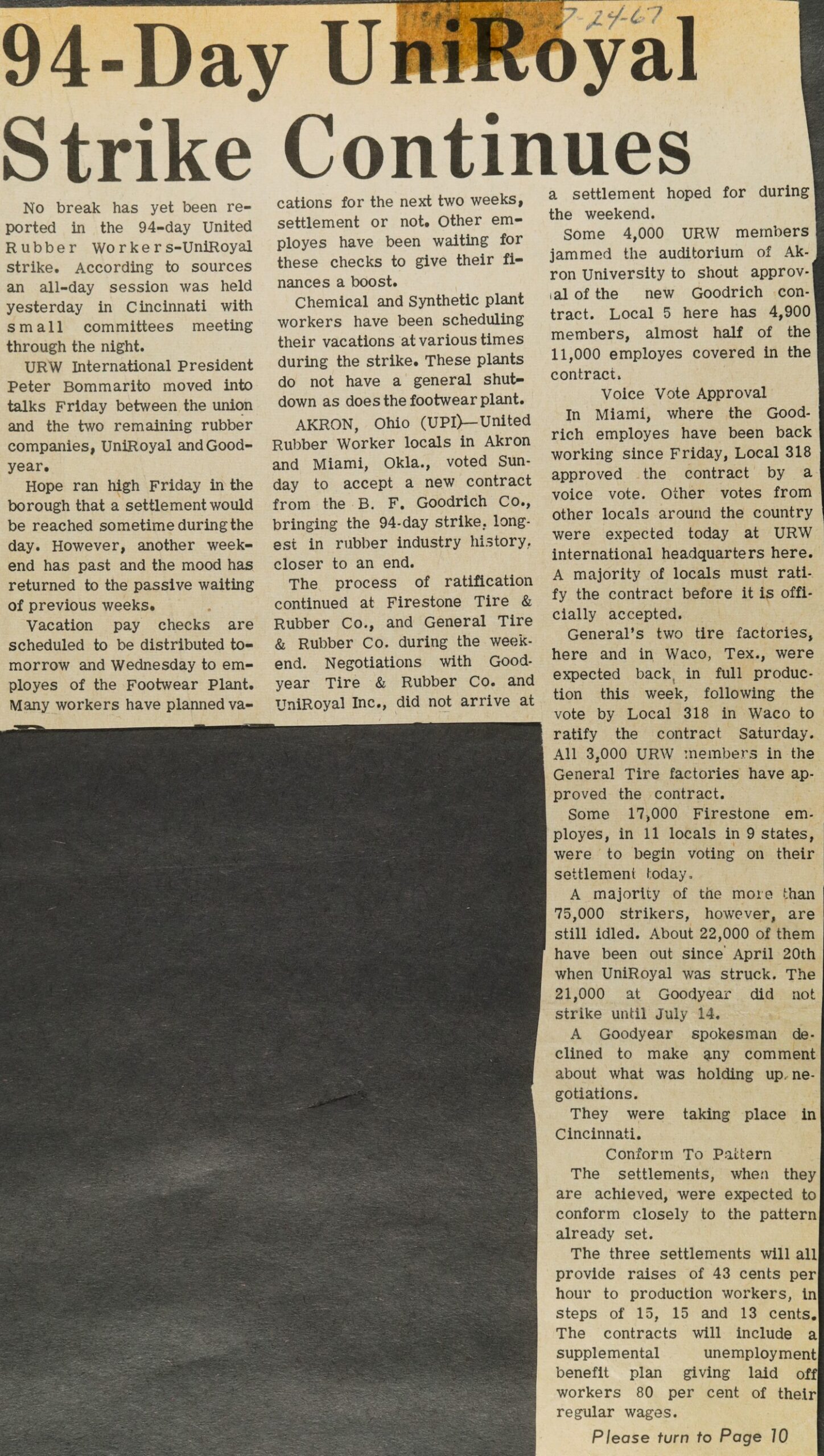
AKRON, Ohio (UPI) —Three major rubber manufacturers returned to the bargaining table today with hopes for an end to an 88-day strike, while two firms readied their plants to resume production.

The B.F. Goodrich Co. began preliminary maintenance work within hours after announcing a tentative agreement with the United Rubber Workers Saturday. It planned to start production as soon as possible and to call workers back as the preparations proceeded.

The General Tire & Rubber Co. had tentatively scheduled work to resume Sunday night, pending a ratification vote by URW locals at its plants here and in Waco, Tex. The local executive boards met Friday but put off scheduling a vote because complete texts of the agreement were not available. They planned to meet again Wednesday.

In the Goodrich agreement, the union achieved its goal of equal raises for tire and non-tire workers. The pact calls for 43-cent an hour raises for all employes in steps of 15, 15, and 13 cents over the next three years. Skilled workers are given an additional 10 cent increase, effective immediately.

Same Hikes

The General pact, announced Thursday, offers the same pay raises, but no non-tire workers are involved.

Both agreements provide a supplemental unemployment benefit plan guaranteeing laid-off employes 80 per cent of their wages. They formerly got 65 per cent.

Under the old contracts, tire workers averaged $3.68 an hour and non-tire workers averaged $2.68.

URW International President Peter Bommarito said he was “very confident” the agreement would be ratified. approval send 12,000 of 76,000 strikers back to work.

Please turn to Page 10

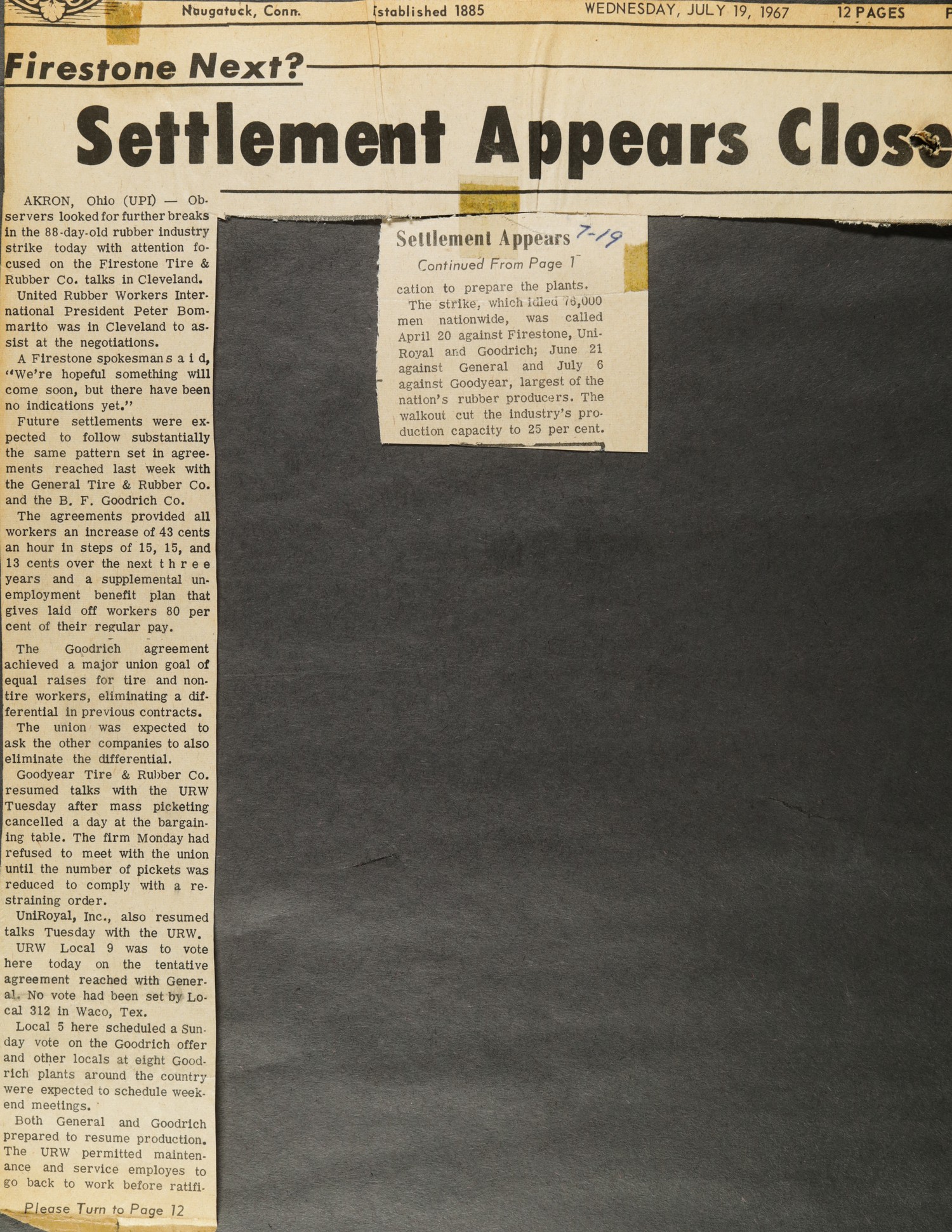
Settlement Appears Close

Settlement Appears Close

Naugatuck, Conn.

Established 1885
WEDNESDAY, JULY 19, 1967
12 PAGES


Firestone Next?—

Settlement Appears Close

AKRON, Ohio (UPI) — Observers looked for further breaks in the 88-day-old rubber industry strike today with attention focused on the Firestone Tire & Rubber Co. talks in Cleveland.

United Rubber Workers International President Peter Bommarito was in Cleveland to assist at the negotiations.

A Firestone spokesman said, “We’re hopeful something will come soon, but there have been no indications yet.”

Future settlements were expected to follow substantially the same pattern set in agreements reached last week with the General Tire & Rubber Co. and the B. F. Goodrich Co.

The agreements provided all workers an increase of 43 cents an hour in steps of 15, 15, and 13 cents over the next three years and a supplemental unemployment benefit plan that gives laid off workers 80 per cent of their regular pay.

The Goodrich agreement achieved a major union goal of equal raises for tire and non-tire workers, eliminating a differential in previous contracts.

The union was expected to ask the other companies to also eliminate the differential.

Goodyear Tire & Rubber Co. resumed talks with the URW Tuesday after mass picketing cancelled a day at the bargaining table. The firm Monday had refused to meet with the union until the number of pickets was reduced to comply with a restraining order.

UniRoyal, Inc., also resumed talks Tuesday with the URW.

URW Local 9 was to vote here today on the tentative agreement reached with General. No vote had been set by Local 312 in Waco, Tex.

Local 5 here scheduled a Sunday vote on the Goodrich offer and other locals at eight Goodrich plants around the country were expected to schedule weekend meetings.

Both General and Goodrich prepared to resume production. The URW permitted maintenance and service employes to go back to work before ratifi-

Please Turn to Page 12


Settlement Appears 7-19

Continued From Page 1

cation to prepare the plants.

The strike, which idled 78,000 men nationwide, was called April 20 against Firestone, UniRoyal and Goodrich; June 21 against General and July 6 against Goodyear, largest of the nation’s rubber producers. The walkout cut the industry’s production capacity to 25 per cent.

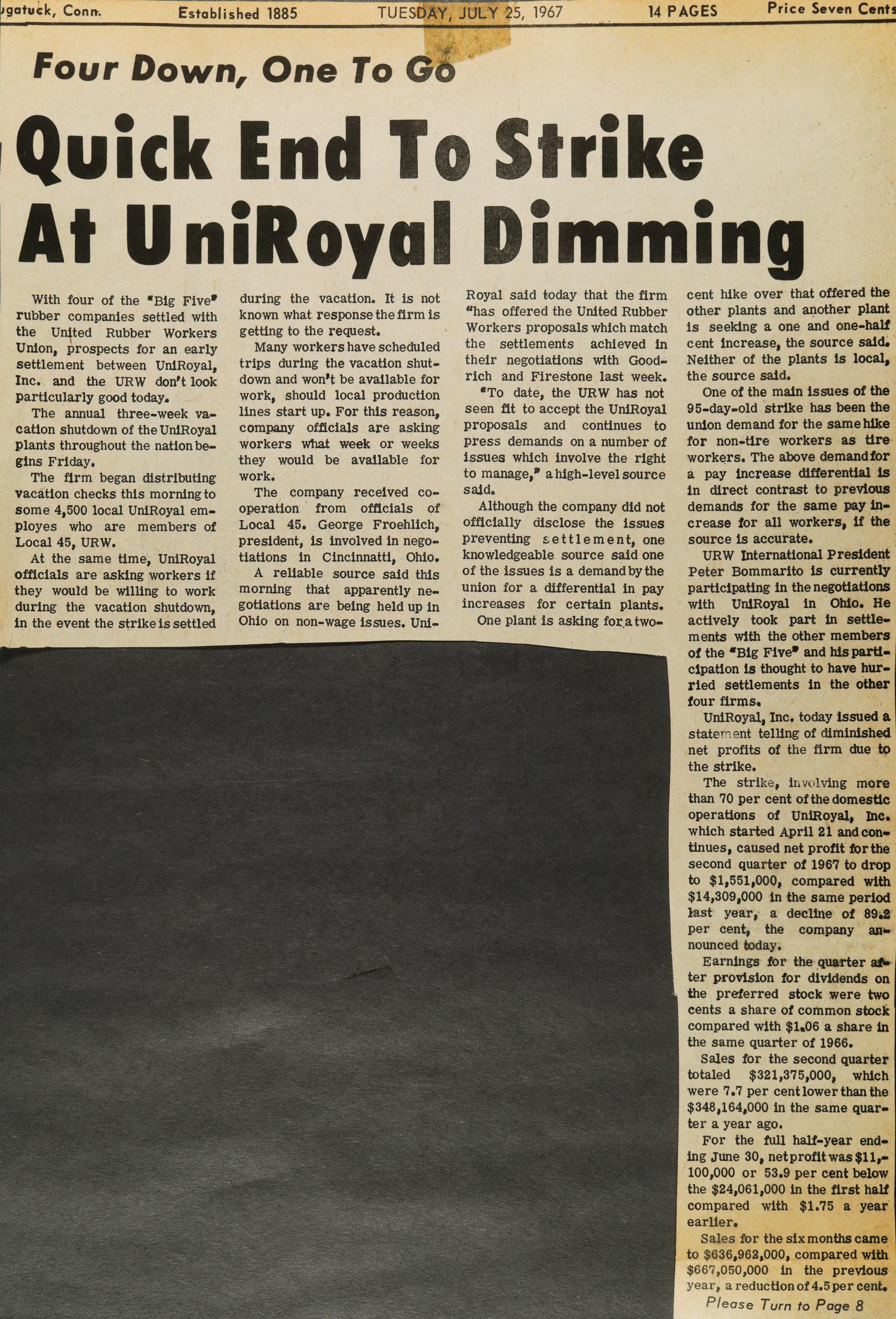
Quick End To Strike At UniRoyal Dimming

Quick End To Strike At UniRoyal Dimming

gatuck, Conn. Established 1885 TUESDAY, JULY 25, 1967 14 PAGES Price Seven Cents

Four Down, One To Go

Quick End To Strike At UniRoyal Dimming

With four of the “Big Five” rubber companies settled with the United Rubber Workers Union, prospects for an early settlement between UniRoyal, Inc. and the URW don’t look particularly good today.

The annual three-week vacation shutdown of the UniRoyal plants throughout the nation begins Friday.

The firm began distributing vacation checks this morning to some 4,500 local UniRoyal employes who are members of Local 45, URW.

At the same time, UniRoyal officials are asking workers if they would be willing to work during the vacation shutdown, in the event the strike is settled during the vacation. It is not known what response the firm is getting to the request.

Many workers have scheduled trips during the vacation shutdown and won’t be available for work, should local production lines start up. For this reason, company officials are asking workers what week or weeks they would be available for work.

The company received cooperation from officials of Local 45. George Froehlich, president, is involved in negotiations in Cincinnati, Ohio.

A reliable source said this morning that apparently negotiations are being held up in Ohio on non-wage issues. UniRoyal said today that the firm “has offered the United Rubber Workers proposals which match the settlements achieved in their negotiations with Goodrich and Firestone last week.

“To date, the URW has not seen fit to accept the UniRoyal proposals and continues to press demands on a number of issues which involve the right to manage,” a high-level source said.

Although the company did not officially disclose the issues preventing settlement, one knowledgeable source said one of the issues is a demand by the union for a differential in pay increases for certain plants.

One plant is asking for a two-cent hike over that offered the other plants and another plant is seeking a one and one-half cent increase, the source said. Neither of the plants is local, the source said.

One of the main issues of the 95-day-old strike has been the union demand for the same hike for non-tire workers as tire workers. The above demand for a pay increase differential is in direct contrast to previous demands for the same pay increase for all workers, if the source is accurate.

URW International President Peter Bommarito is currently participating in the negotiations with UniRoyal in Ohio. He actively took part in settlements with the other members of the “Big Five” and his participation is thought to have hurried settlements in the other four firms.

UniRoyal, Inc. today issued a statement telling of diminished net profits of the firm due to the strike.

The strike, involving more than 70 per cent of the domestic operations of UniRoyal, Inc. which started April 21 and continues, caused net profit for the second quarter of 1967 to drop to $1,551,000, compared with $14,309,000 in the same period last year, a decline of 89.2 per cent, the company announced today.

Earnings for the quarter after provision for dividends on the preferred stock were two cents a share of common stock compared with $1.06 a share in the same quarter of 1966.

Sales for the second quarter totaled $321,375,000, which were 7.7 per cent lower than the $348,164,000 in the same quarter a year ago.

For the full half-year ending June 30, net profit was $11,100,000 or 53.9 per cent below the $24,061,000 in the first half compared with $1.75 a year earlier.

Sales for the six months came to $636,962,000, compared with $667,050,000 in the previous year, a reduction of 4.5 per cent.

Please Turn to Page 8

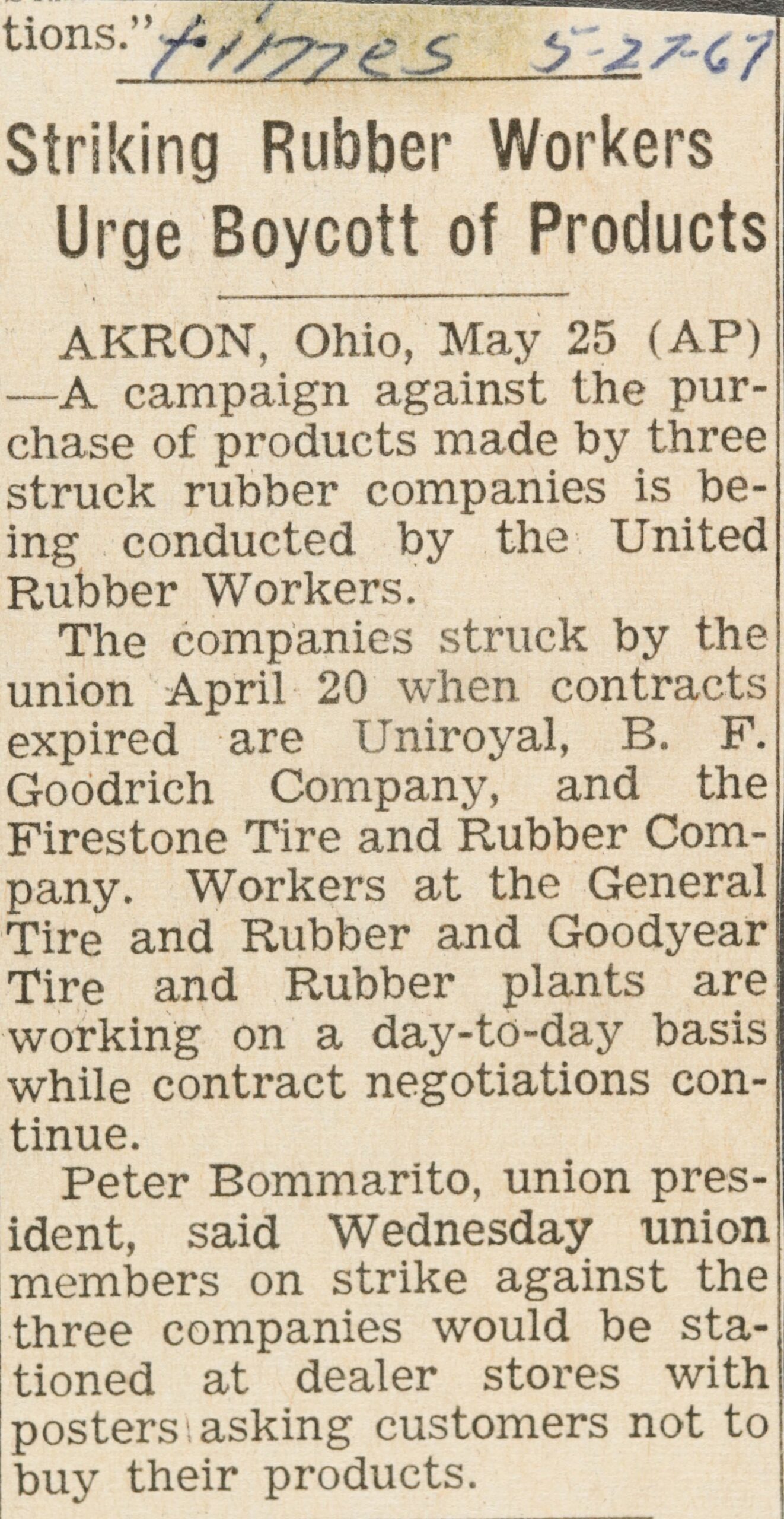
Striking Rubber Workers Urge Boycott of Products

tions.” Times 5-27-67

Striking Rubber Workers
Urge Boycott of Products

AKRON, Ohio, May 25 (AP)
—A campaign against the purchase of products made by three
struck rubber companies is being conducted by the United
Rubber Workers.

The companies struck by the
union April 20 when contracts
expired are Uniroyal, B. F.
Goodrich Company, and the
Firestone Tire and Rubber Company. Workers at the General
Tire and Rubber and Goodyear
Tire and Rubber plants are
working on a day-to-day basis
while contract negotiations continue.

Peter Bommarito, union president, said Wednesday union
members on strike against the
three companies would be stationed at dealer stores with
posters asking customers not to
buy their products.

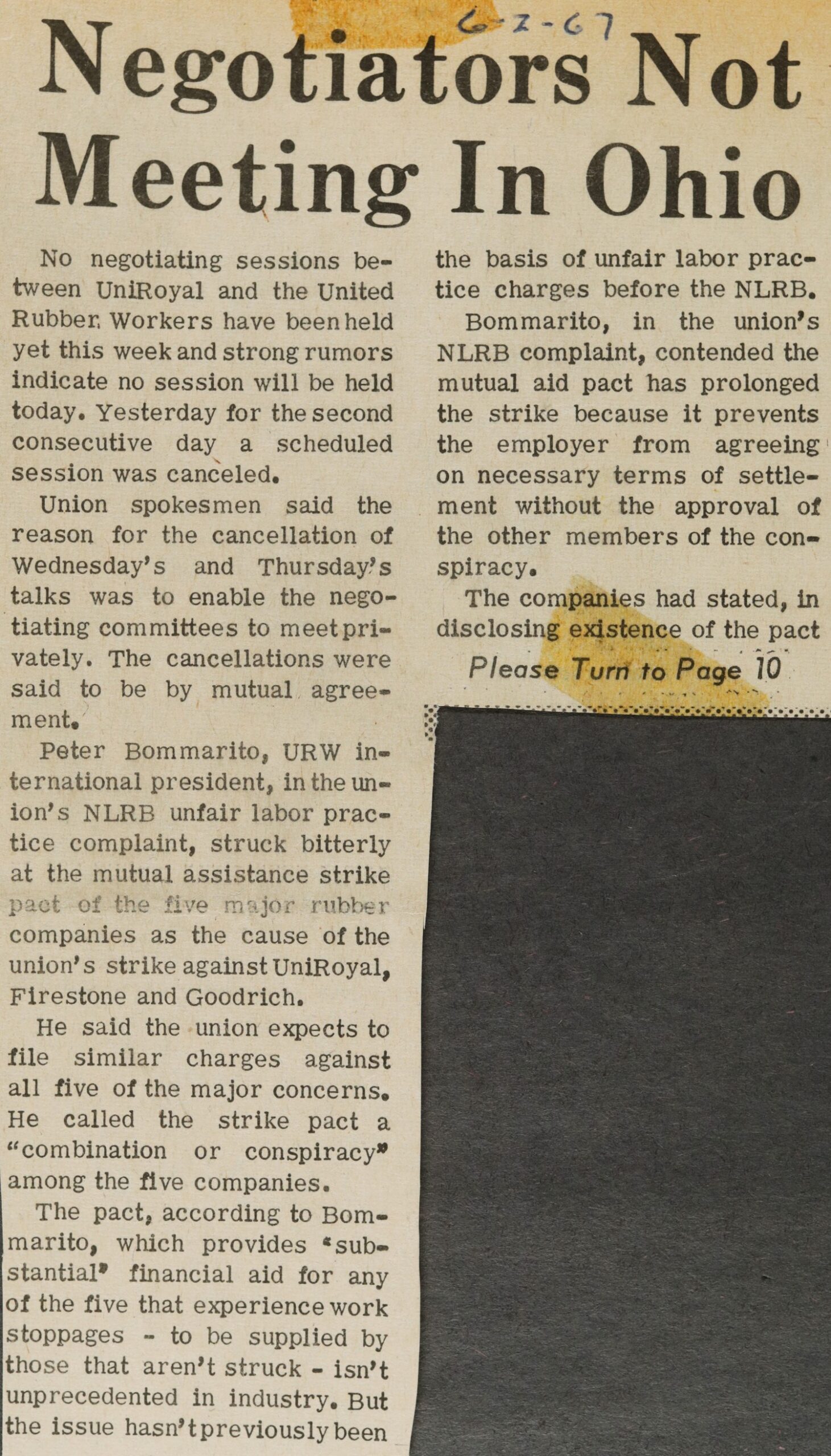
Negotiators Not Meeting In Ohio

Negotiators Not Meeting In Ohio

6-2-67

No negotiating sessions between UniRoyal and the United Rubber Workers have been held yet this week and strong rumors indicate no session will be held today. Yesterday for the second consecutive day a scheduled session was canceled.

Union spokesmen said the reason for the cancellation of Wednesday’s and Thursday’s talks was to enable the negotiating committees to meet privately. The cancellations were said to be by mutual agreement.

Peter Bommarito, URW international president, in the union’s NLRB unfair labor practice complaint, struck bitterly at the mutual assistance strike pact of the five major rubber companies as the cause of the union’s strike against UniRoyal, Firestone and Goodrich.

He said the union expects to file similar charges against all five of the major concerns. He called the strike pact a “combination or conspiracy” among the five companies.

The pact, according to Bommarito, which provides “substantial” financial aid for any of the five that experience work stoppages – to be supplied by those that aren’t struck – isn’t unprecedented in industry. But the issue hasn’t previously been

the basis of unfair labor practice charges before the NLRB.

Bommarito, in the union’s NLRB complaint, contended the mutual aid pact has prolonged the strike because it prevents the employer from agreeing on necessary terms of settlement without the approval of the other members of the conspiracy.

The companies had stated, in disclosing existence of the pact

Please Turn to Page 10
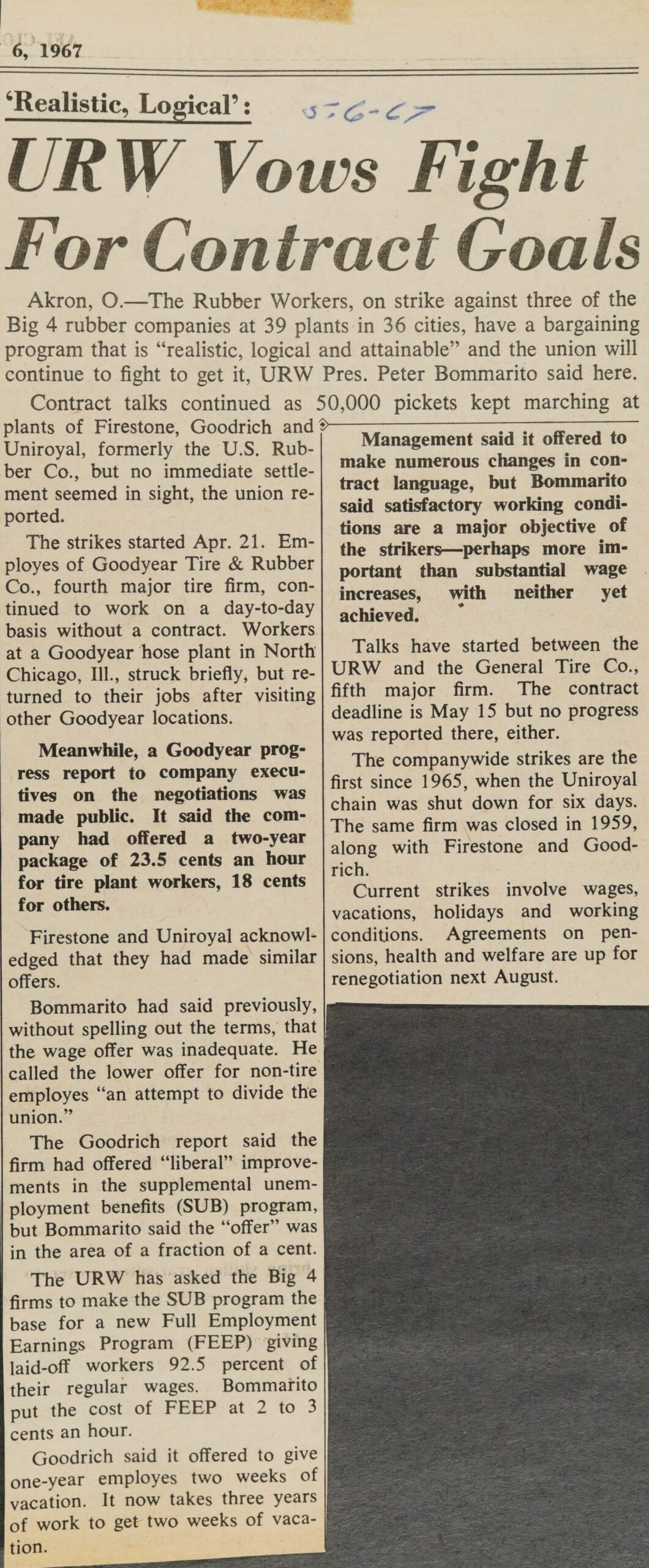
Small Groups Continue Talks

Small Groups Continue Talks

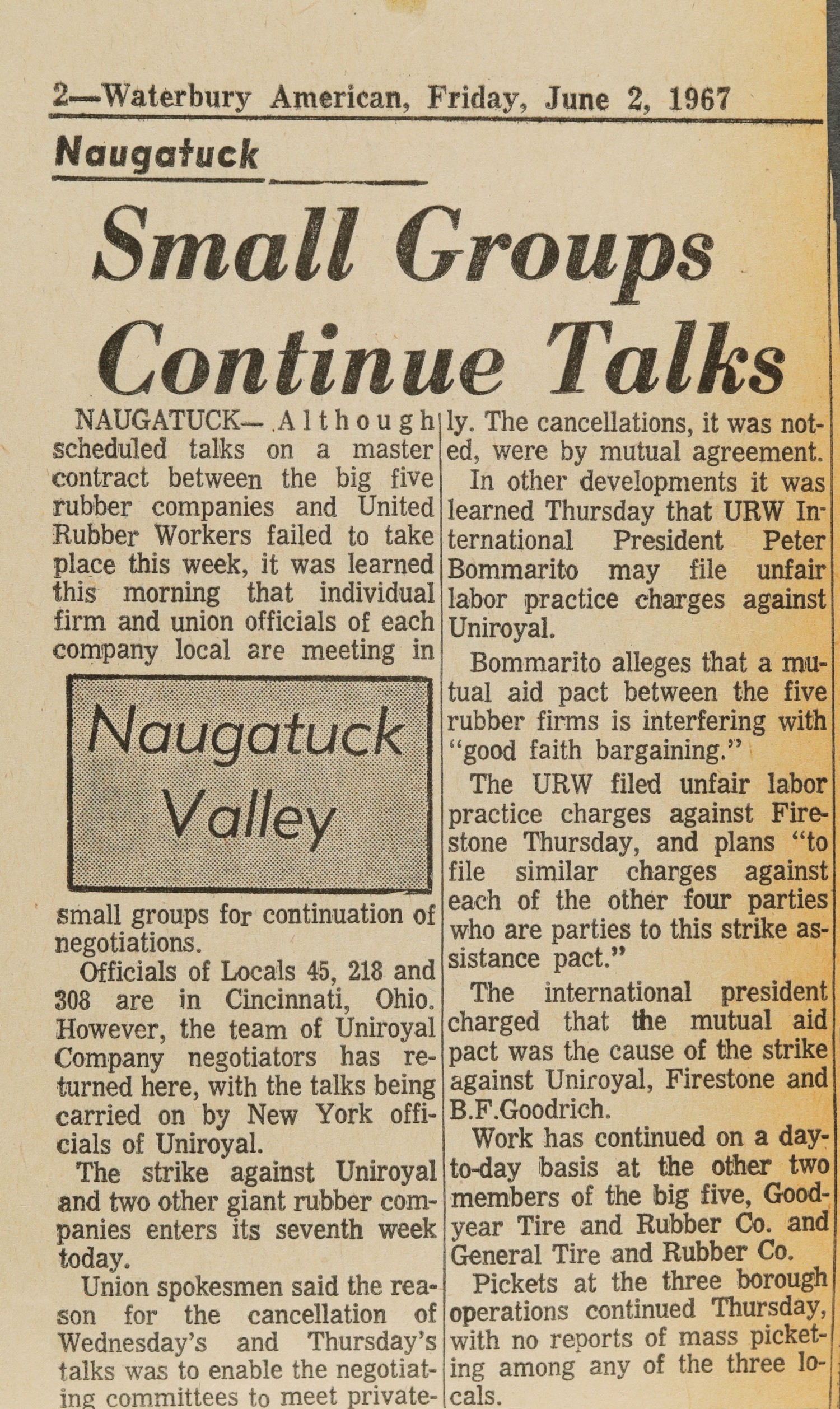
2—Waterbury American, Friday, June 2, 1967

Naugatuck

Small Groups Continue Talks

NAUGATUCK— Although scheduled talks on a master contract between the big five rubber companies and United Rubber Workers failed to take place this week, it was learned this morning that individual firm and union officials of each company local are meeting in


Naugatuck Valley


small groups for continuation of negotiations.

Officials of Locals 45, 218 and 308 are in Cincinnati, Ohio. However, the team of Uniroyal Company negotiators has returned here, with the talks being carried on by New York officials of Uniroyal.

The strike against Uniroyal and two other giant rubber companies enters its seventh week today.

Union spokesmen said the reason for the cancellation of Wednesday’s and Thursday’s talks was to enable the negotiating committees to meet privately. The cancellations, it was noted, were by mutual agreement.

In other developments it was learned Thursday that URW International President Peter Bommarito may file unfair labor practice charges against Uniroyal.

Bommarito alleges that a mutual aid pact between the five rubber firms is interfering with “good faith bargaining.”

The URW filed unfair labor practice charges against Firestone Thursday, and plans “to file similar charges against each of the other four parties who are parties to this strike assistance pact.”

The international president charged that the mutual aid pact was the cause of the strike against Uniroyal, Firestone and B.F.Goodrich.

Work has continued on a day-to-day basis at the other two members of the big five, Goodyear Tire and Rubber Co. and General Tire and Rubber Co.

Pickets at the three borough operations continued Thursday, with no reports of mass picketing among any of the three locals.

Uniroyal Talks Fail To Occur

6-2-67

Uniroyal Talks Fail To Occur

NAUGATUCK — For the second day scheduled talks on a master contract between Uniroyal and the United Rubber Workers failed to take place Thursday. Reliable sources indicated that they would not resume today.

URW sources in Cincinnati said Thursday night that the union had made an offer to management to resume negotiations today, but added that as of that time management had not responded to the offer.

Exactly when the negotiations would resume could not be learned, as management spokesmen could not be reached Thursday night.

As the second day of the sudden break in negotiations drew to a close, the strike against Uniroyal and two other giant rubber companies entered its seventh week.

Union spokesmen said the reason for the cancellation of Wednesday’s and Thursday’s talks was to enable the negotiating committees to meet privately. The cancellations, it was noted, were by mutual agreement.

In other developments it was learned Thursday that URW International President Peter Bommarito may file unfair labor practice charges against Uniroyal.

Bommarito alleges that a mutual aid pact between the five rubber firms is interfering with “good faith bargaining.”

The URW filed unfair labor practice charges against Firestone Thursday, and plans “to file similar charges against each of the other four parties who are parties to this strike assistance pact.”

The international president charged that the mutual aid pact was the cause of the strike against Uniroyal, Firestone and B.F.Goodrich.

Work has continued on a day-by-day basis at the other two members of the big five, Goodyear Tire and Rubber Co. and General Tire and Rubber Co.

Pickets at the three borough operations continued Thursday, with no reports of mass picketing among any of the three locals.

Uniroyal Talks Resume; New Accords Lift Hopes

Monday, July 17, 1967

BEACON FALLS

Uniroyal Talks Resume; New Accords Lift Hopes

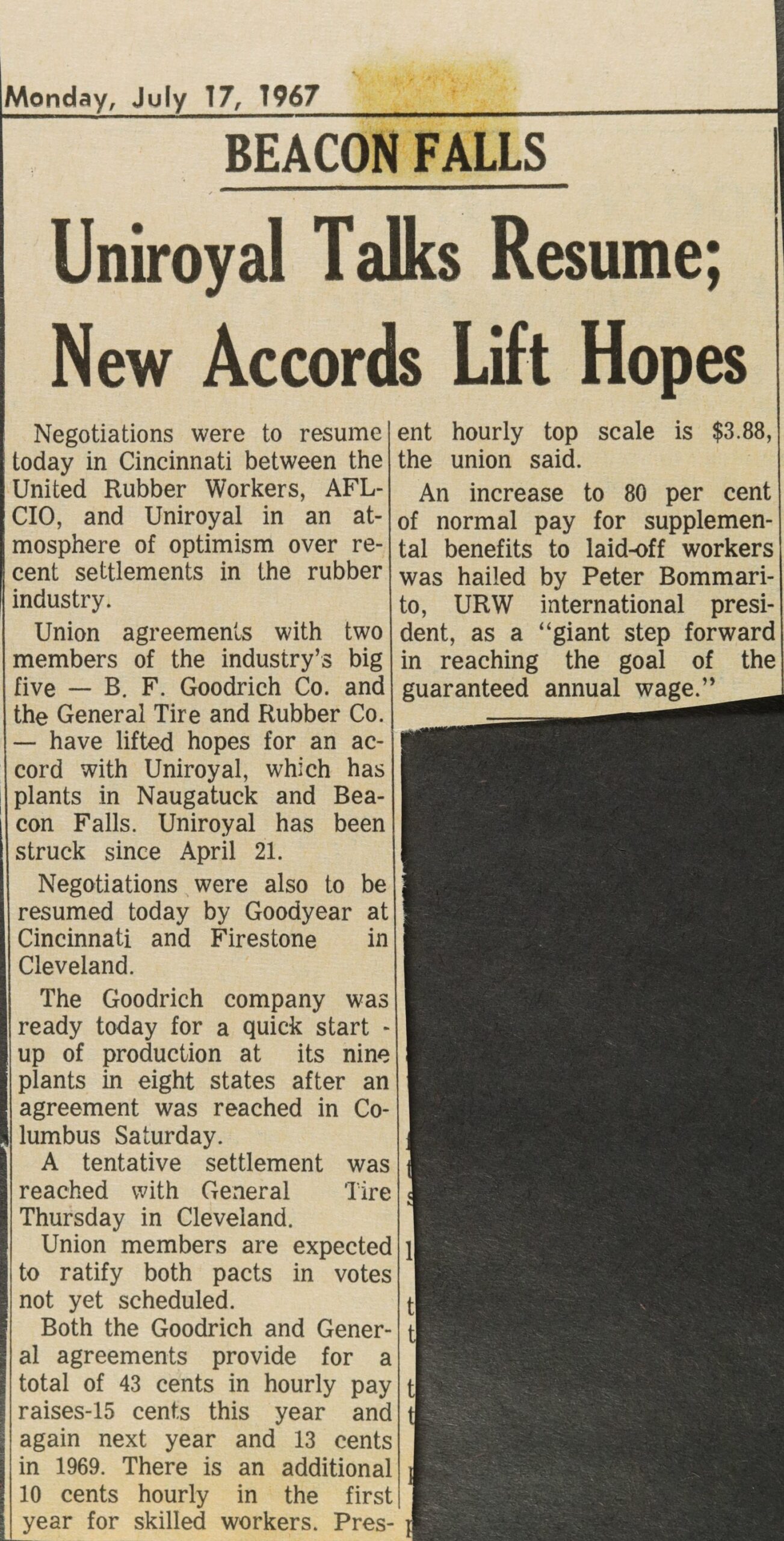
Negotiations were to resume today in Cincinnati between the United Rubber Workers, AFL-CIO, and Uniroyal in an atmosphere of optimism over recent settlements in the rubber industry.

Union agreements with two members of the industry’s big five — B. F. Goodrich Co. and the General Tire and Rubber Co. — have lifted hopes for an accord with Uniroyal, which has plants in Naugatuck and Beacon Falls. Uniroyal has been struck since April 21.

Negotiations were also to be resumed today by Goodyear at Cincinnati and Firestone in Cleveland.

The Goodrich company was ready today for a quick start – up of production at its nine plants in eight states after an agreement was reached in Columbus Saturday.

A tentative settlement was reached with General Tire Thursday in Cleveland.

Union members are expected to ratify both pacts in votes not yet scheduled.

Both the Goodrich and General agreements provide for a total of 43 cents in hourly pay raises-15 cents this year and again next year and 13 cents in 1969. There is an additional 10 cents hourly in the first year for skilled workers. Present hourly top scale is $3.88, the union said.

An increase to 80 per cent of normal pay for supplemental benefits to laid-off workers was hailed by Peter Bommarito, URW international president, as a “giant step forward in reaching the goal of the guaranteed annual wage.”

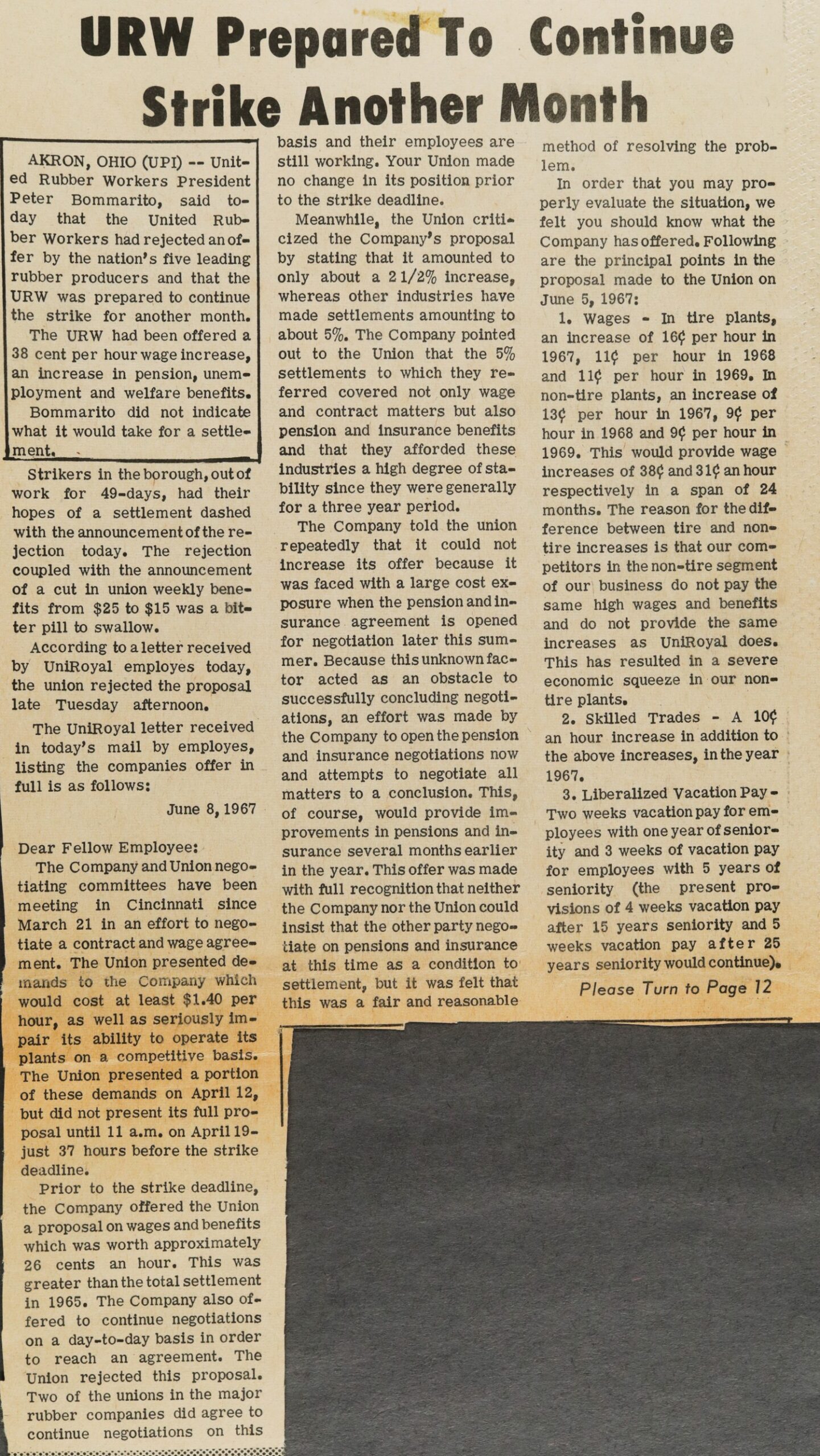
Rubber Strike 60-Cent-An-Hour, 3-Year Pact Offer Submitted To URW

Rubber Strike

6-7-67

60-Cent-An-Hour, 3-Year Pact Offer Submitted To URW

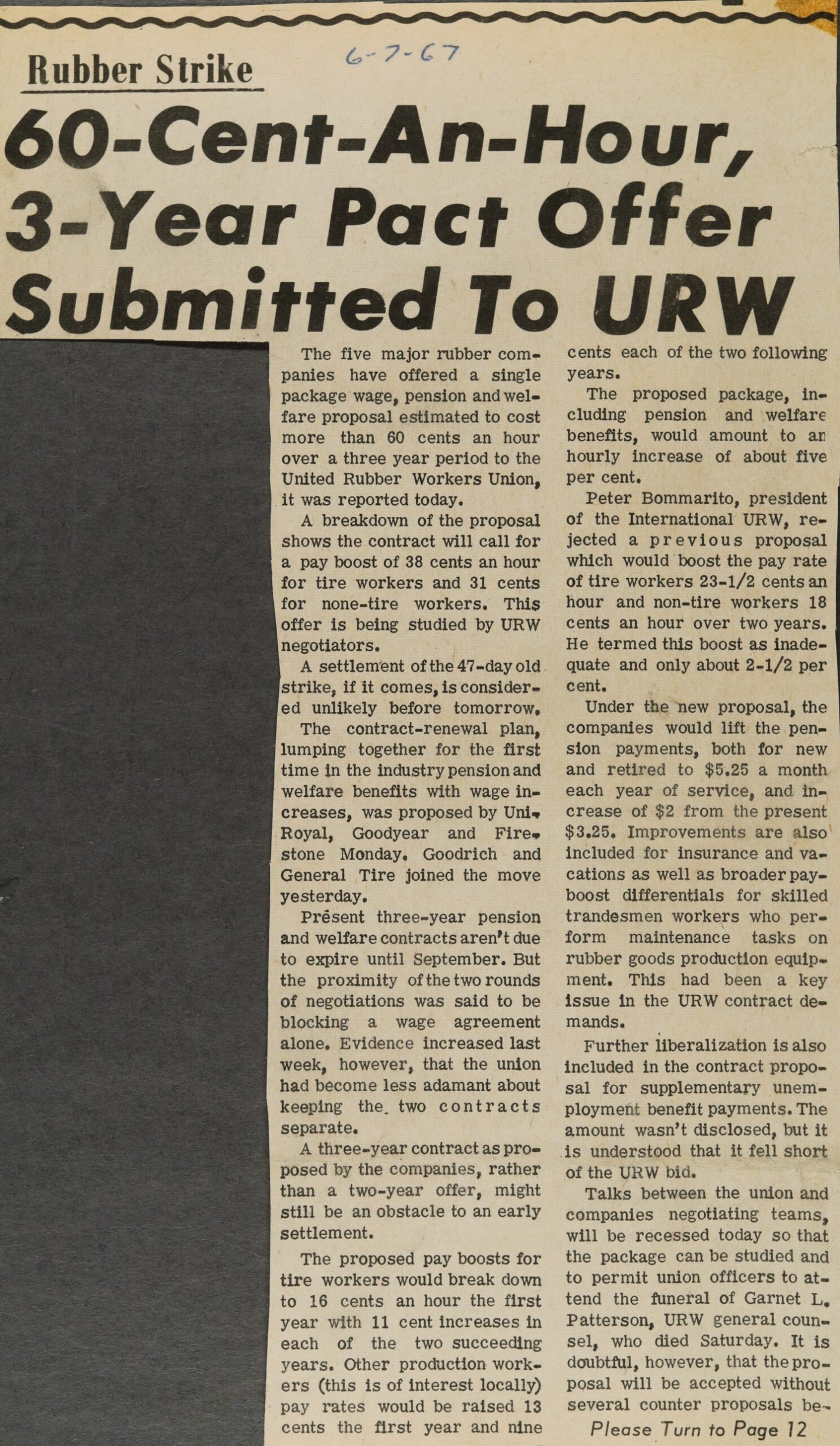
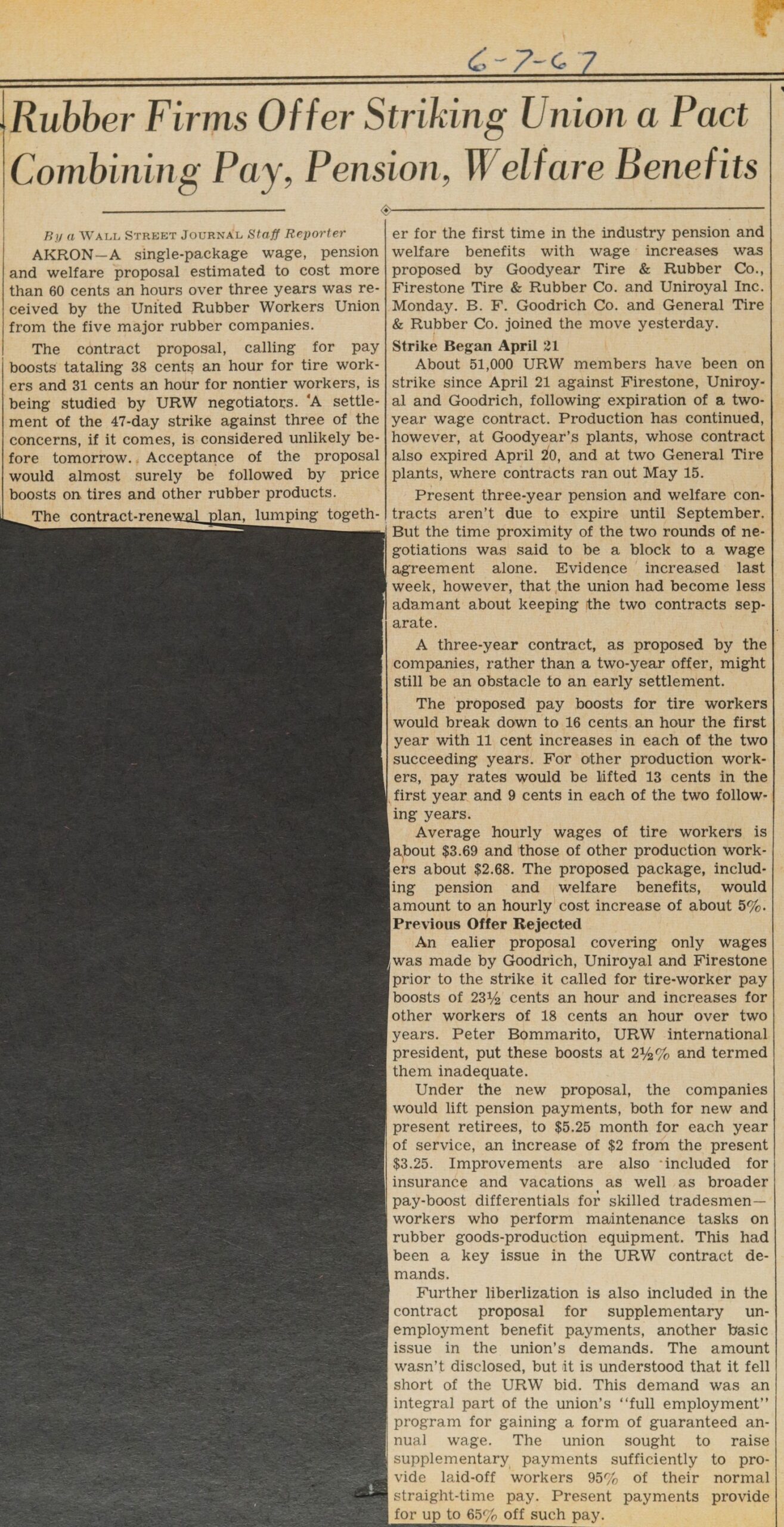
The five major rubber companies have offered a single package wage, pension and welfare proposal estimated to cost more than 60 cents an hour over a three year period to the United Rubber Workers Union, it was reported today.

A breakdown of the proposal shows the contract will call for a pay boost of 38 cents an hour for tire workers and 31 cents for none-tire workers. This offer is being studied by URW negotiators.

A settlement of the 47-day old strike, if it comes, is considered unlikely before tomorrow.

The contract-renewal plan, lumping together for the first time in the industry pension and welfare benefits with wage increases, was proposed by Uni-Royal, Goodyear and Firestone Monday. Goodrich and General Tire joined the move yesterday.

Present three-year pension and welfare contracts aren’t due to expire until September. But the proximity of the two rounds of negotiations was said to be blocking a wage agreement alone. Evidence increased last week, however, that the union had become less adamant about keeping the two contracts separate.

A three-year contract as proposed by the companies, rather than a two-year offer, might still be an obstacle to an early settlement.

The proposed pay boosts for tire workers would break down to 16 cents an hour the first year with 11 cent increases in each of the two succeeding years. Other production workers (this is of interest locally) pay rates would be raised 13 cents the first year and nine

cents each of the two following years.

The proposed package, including pension and welfare benefits, would amount to an hourly increase of about five per cent.

Peter Bommarito, president of the International URW, rejected a previous proposal which would boost the pay rate of tire workers 23-1/2 cents an hour and non-tire workers 18 cents an hour over two years. He termed this boost as inadequate and only about 2-1/2 per cent.

Under the new proposal, the companies would lift the pension payments, both for new and retired to $5.25 a month each year of service, and increase of $2 from the present $3.25. Improvements are also included for insurance and vacations as well as broader pay-boost differentials for skilled trandesmen workers who perform maintenance tasks on rubber goods production equipment. This had been a key issue in the URW contract demands.

Further liberalization is also included in the contract proposal for supplementary unemployment benefit payments. The amount wasn’t disclosed, but it is understood that it fell short of the URW bid.

Talks between the union and companies negotiating teams, will be recessed today so that the package can be studied and to permit union officers to attend the funeral of Garnet L. Patterson, URW general counsel, who died Saturday. It is doubtful, however, that the proposal will be accepted without several counter proposals be-

Please Turn to Page 12

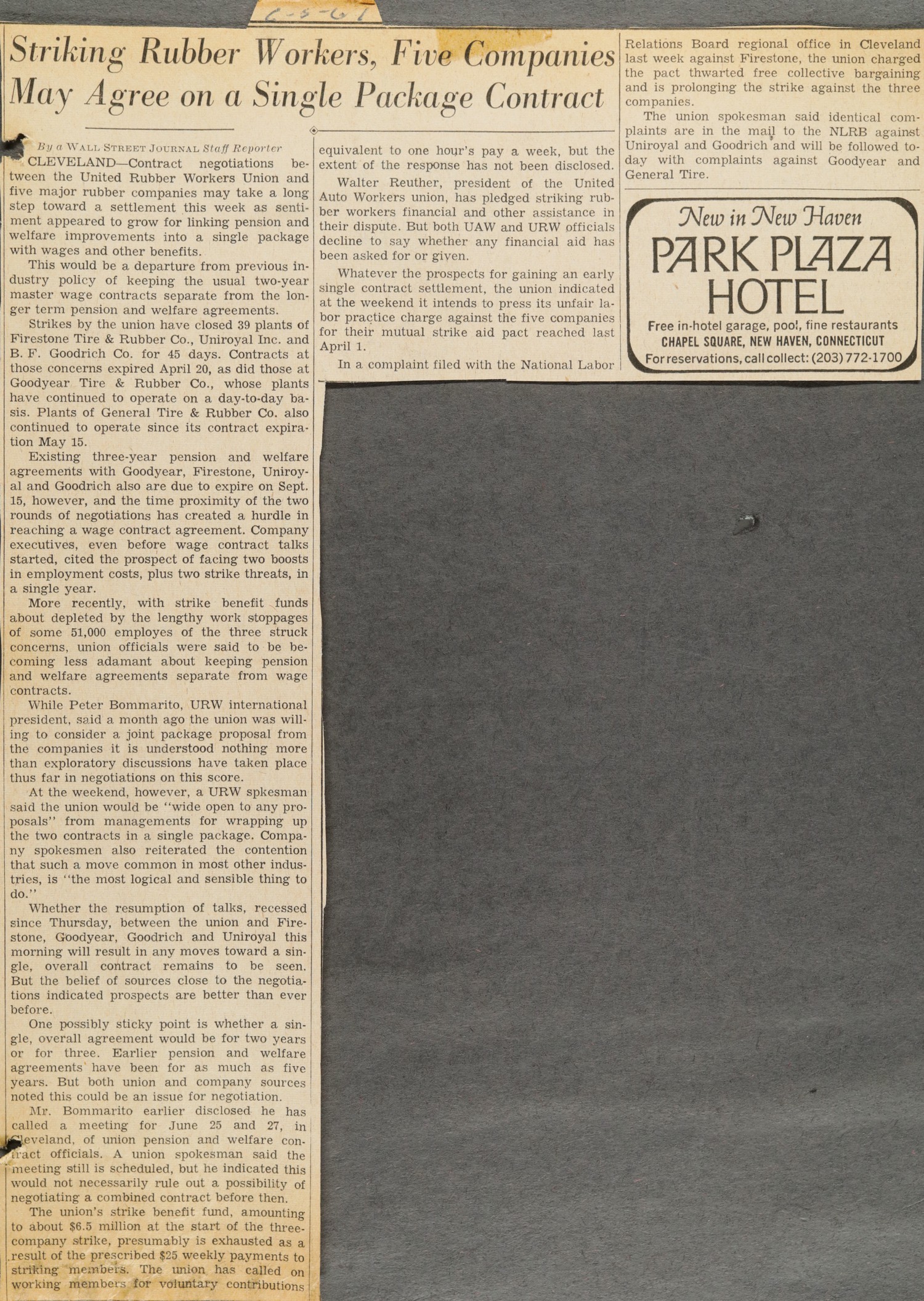
Rubber Firms Offer Striking Union a Pact Combining Pay, Pension, Welfare Benefits

6-7-67

Rubber Firms Offer Striking Union a Pact Combining Pay, Pension, Welfare Benefits

By a WALL STREET JOURNAL Staff Reporter

AKRON—A single-package wage, pension and welfare proposal estimated to cost more than 60 cents an hours over three years was received by the United Rubber Workers Union from the five major rubber companies.

The contract proposal, calling for pay boosts tataling 38 cents an hour for tire workers and 31 cents an hour for nontier workers, is being studied by URW negotiators. A settlement of the 47-day strike against three of the concerns, if it comes, is considered unlikely before tomorrow. Acceptance of the proposal would almost surely be followed by price boosts on tires and other rubber products.

The contract-renewal plan, lumping together for the first time in the industry pension and welfare benefits with wage increases was proposed by Goodyear Tire & Rubber Co., Firestone Tire & Rubber Co. and Uniroyal Inc. Monday. B. F. Goodrich Co. and General Tire & Rubber Co. joined the move yesterday.

Strike Began April 21

About 51,000 URW members have been on strike since April 21 against Firestone, Uniroyal and Goodrich, following expiration of a two-year wage contract. Production has continued, however, at Goodyear’s plants, whose contract also expired April 20, and at two General Tire plants, where contracts ran out May 15.

Present three-year pension and welfare contracts aren’t due to expire until September. But the time proximity of the two rounds of negotiations was said to be a block to a wage agreement alone. Evidence increased last week, however, that the union had become less adamant about keeping the two contracts separate.

A three-year contract, as proposed by the companies, rather than a two-year offer, might still be an obstacle to an early settlement.

The proposed pay boosts for tire workers would break down to 16 cents an hour the first year with 11 cent increases in each of the two succeeding years. For other production workers, pay rates would be lifted 13 cents in the first year and 9 cents in each of the two following years.

Average hourly wages of tire workers is about $3.69 and those of other production workers about $2.68. The proposed package, including pension and welfare benefits, would amount to an hourly cost increase of about 5%.

Previous Offer Rejected

An ealier proposal covering only wages was made by Goodrich, Uniroyal and Firestone prior to the strike it called for tire-worker pay boosts of 23½ cents an hour and increases for other workers of 18 cents an hour over two years. Peter Bommarito, URW international president, put these boosts at 2½% and termed them inadequate.

Under the new proposal, the companies would lift pension payments, both for new and present retirees, to $5.25 month for each year of service, an increase of $2 from the present $3.25. Improvements are also included for insurance and vacations as well as broader pay-boost differentials for skilled tradesmen—workers who perform maintenance tasks on rubber goods-production equipment. This had been a key issue in the URW contract demands.

Further liberlization is also included in the contract proposal for supplementary unemployment benefit payments, another basic issue in the union’s demands. The amount wasn’t disclosed, but it is understood that it fell short of the URW bid. This demand was an integral part of the union’s “full employment” program for gaining a form of guaranteed annual wage. The union sought to raise supplementary payments sufficiently to provide laid-off workers 95% of their normal straight-time pay. Present payments provide for up to 65% off such pay.

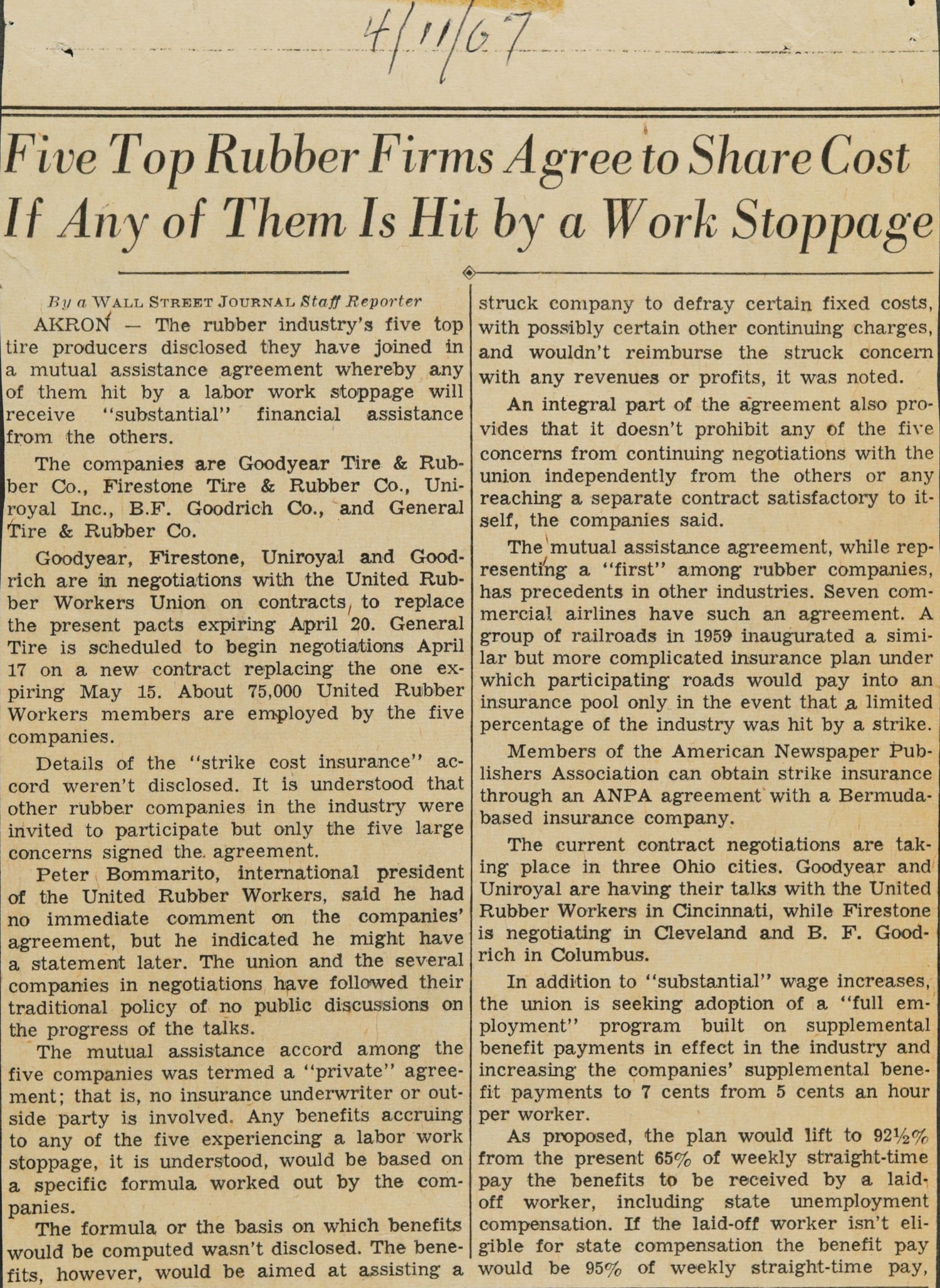
Five Top Rubber Firms Agree to Share Cost If Any of Them Is Hit by a Work Stoppage

4/11/67

Five Top Rubber Firms Agree to Share Cost If Any of Them Is Hit by a Work Stoppage

By a WALL STREET JOURNAL Staff Reporter

AKRON — The rubber industry’s five top tire producers disclosed they have joined in a mutual assistance agreement whereby any of them hit by a labor work stoppage will receive “substantial” financial assistance from the others.

The companies are Goodyear Tire & Rubber Co., Firestone Tire & Rubber Co., Uniroyal Inc., B.F. Goodrich Co., and General Tire & Rubber Co.

Goodyear, Firestone, Uniroyal and Goodrich are in negotiations with the United Rubber Workers Union on contracts to replace the present pacts expiring April 20. General Tire is scheduled to begin negotiations April 17 on a new contract replacing the one expiring May 15. About 75,000 United Rubber Workers members are employed by the five companies.

Details of the “strike cost insurance” accord weren’t disclosed. It is understood that other rubber companies in the industry were invited to participate but only the five large concerns signed the agreement.

Peter Bommarito, international president of the United Rubber Workers, said he had no immediate comment on the companies’ agreement, but he indicated he might have a statement later. The union and the several companies in negotiations have followed their traditional policy of no public discussions on the progress of the talks.

The mutual assistance accord among the five companies was termed a “private” agreement; that is, no insurance underwriter or outside party is involved. Any benefits accruing to any of the five experiencing a labor work stoppage, it is understood, would be based on a specific formula worked out by the companies.

The formula or the basis on which benefits would be computed wasn’t disclosed. The benefits, however, would be aimed at assisting a struck company to defray certain fixed costs, with possibly certain other continuing charges, and wouldn’t reimburse the struck concern with any revenues or profits, it was noted.

An integral part of the agreement also provides that it doesn’t prohibit any of the five concerns from continuing negotiations with the union independently from the others or any reaching a separate contract satisfactory to itself, the companies said.

The mutual assistance agreement, while representing a “first” among rubber companies, has precedents in other industries. Seven commercial airlines have such an agreement. A group of railroads in 1959 inaugurated a similar but more complicated insurance plan under which participating roads would pay into an insurance pool only in the event that a limited percentage of the industry was hit by a strike.

Members of the American Newspaper Publishers Association can obtain strike insurance through an ANPA agreement with a Bermuda-based insurance company.

The current contract negotiations are taking place in three Ohio cities. Goodyear and Uniroyal are having their talks with the United Rubber Workers in Cincinnati, while Firestone is negotiating in Cleveland and B. F. Goodrich in Columbus.

In addition to “substantial” wage increases, the union is seeking adoption of a “full employment” program built on supplemental benefit payments in effect in the industry and increasing the companies’ supplemental benefit payments to 7 cents from 5 cents an hour per worker.

As proposed, the plan would lift to 92½% from the present 65% of weekly straight-time pay the benefits to be received by a laid-off worker, including state unemployment compensation. If the laid-off worker isn’t eligible for state compensation the benefit pay would be 95% of weekly straight-time pay,

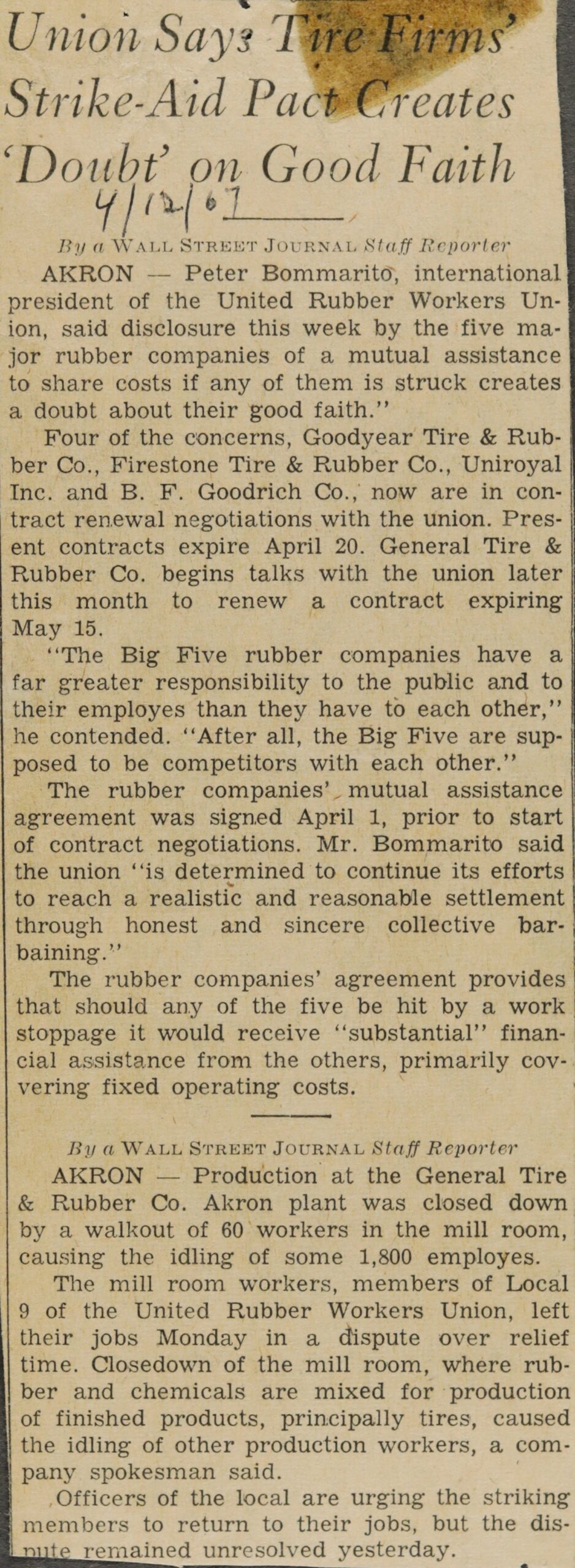
Union Says Tire Firms’ Strike-Aid Pact Creates ‘Doubt’ on Good Faith

Union Says Tire Firms’ Strike-Aid Pact Creates ‘Doubt’ on Good Faith

4/12/67

By a WALL STREET JOURNAL Staff Reporter

AKRON — Peter Bommarito, international president of the United Rubber Workers Union, said disclosure this week by the five major rubber companies of a mutual assistance to share costs if any of them is struck creates a doubt about their good faith.”

Four of the concerns, Goodyear Tire & Rubber Co., Firestone Tire & Rubber Co., Uniroyal Inc. and B. F. Goodrich Co., now are in contract renewal negotiations with the union. Present contracts expire April 20. General Tire & Rubber Co. begins talks with the union later this month to renew a contract expiring May 15.

“The Big Five rubber companies have a far greater responsibility to the public and to their employes than they have to each other,” he contended. “After all, the Big Five are supposed to be competitors with each other.”

The rubber companies’ mutual assistance agreement was signed April 1, prior to start of contract negotiations. Mr. Bommarito said the union “is determined to continue its efforts to reach a realistic and reasonable settlement through honest and sincere collective barbaining.”

The rubber companies’ agreement provides that should any of the five be hit by a work stoppage it would receive “substantial” financial assistance from the others, primarily covering fixed operating costs.


By a WALL STREET JOURNAL Staff Reporter

AKRON — Production at the General Tire & Rubber Co. Akron plant was closed down by a walkout of 60 workers in the mill room, causing the idling of some 1,800 employes.

The mill room workers, members of Local 9 of the United Rubber Workers Union, left their jobs Monday in a dispute over relief time. Closedown of the mill room, where rubber and chemicals are mixed for production of finished products, principally tires, caused the idling of other production workers, a company spokesman said.

Officers of the local are urging the striking members to return to their jobs, but the dispute remained unresolved yesterday.

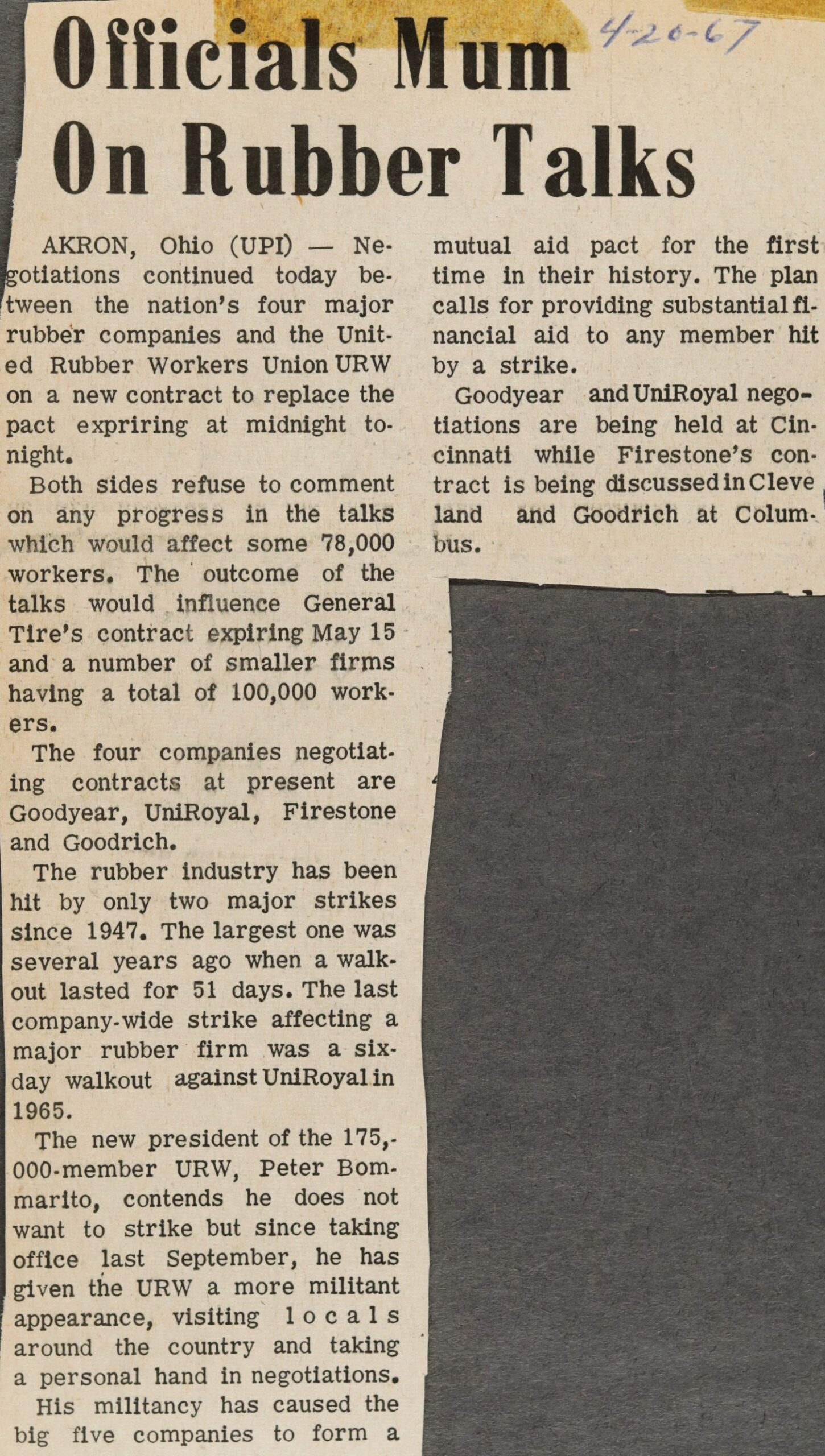
Officials Mum On Rubber Talks

Officials Mum On Rubber Talks

4-20-67 [handwritten]

AKRON, Ohio (UPI) — Negotiations continued today between the nation’s four major rubber companies and the United Rubber Workers Union URW on a new contract to replace the pact expriring at midnight tonight.

Both sides refuse to comment on any progress in the talks which would affect some 78,000 workers. The outcome of the talks would influence General Tire’s contract expiring May 15 and a number of smaller firms having a total of 100,000 workers.

The four companies negotiating contracts at present are Goodyear, UniRoyal, Firestone and Goodrich.

The rubber industry has been hit by only two major strikes since 1947. The largest one was several years ago when a walkout lasted for 51 days. The last company-wide strike affecting a major rubber firm was a six-day walkout against UniRoyal in 1965.

The new president of the 175,000-member URW, Peter Bommarito, contends he does not want to strike but since taking office last September, he has given the URW a more militant appearance, visiting locals around the country and taking a personal hand in negotiations.

His militancy has caused the big five companies to form a mutual aid pact for the first time in their history. The plan calls for providing substantial financial aid to any member hit by a strike.

Goodyear and UniRoyal negotiations are being held at Cincinnati while Firestone’s contract is being discussed in Cleveland and Goodrich at Columbus.

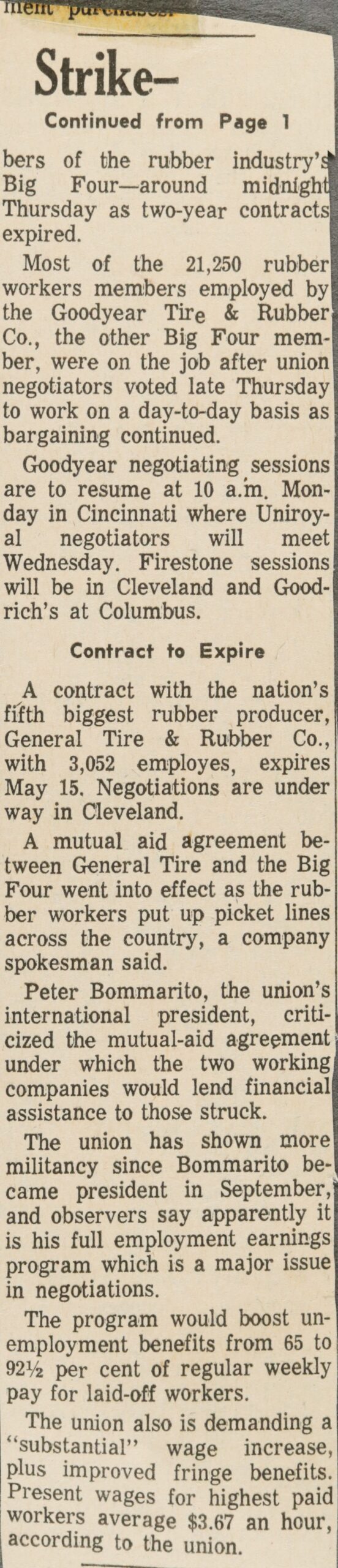
Strike

Strike-

Continued from Page 1

bers of the rubber industry’s Big Four—around midnight Thursday as two-year contracts expired.

Most of the 21,250 rubber workers members employed by the Goodyear Tire & Rubber Co., the other Big Four member, were on the job after union negotiators voted late Thursday to work on a day-to-day basis as bargaining continued.

Goodyear negotiating sessions are to resume at 10 a.m. Monday in Cincinnati where Uniroyal negotiators will meet Wednesday. Firestone sessions will be in Cleveland and Goodrich’s at Columbus.

Contract to Expire

A contract with the nation’s fifth biggest rubber producer, General Tire & Rubber Co., with 3,052 employes, expires May 15. Negotiations are under way in Cleveland.

A mutual aid agreement between General Tire and the Big Four went into effect as the rubber workers put up picket lines across the country, a company spokesman said.

Peter Bommarito, the union’s international president, criticized the mutual-aid agreement under which the two working companies would lend financial assistance to those struck.

The union has shown more militancy since Bommarito became president in September, and observers say apparently it is his full employment earnings program which is a major issue in negotiations.

The program would boost unemployment benefits from 65 to 92½ per cent of regular weekly pay for laid-off workers.

The union also is demanding a “substantial” wage increase, plus improved fringe benefits. Present wages for highest paid workers average $3.67 an hour, according to the union.

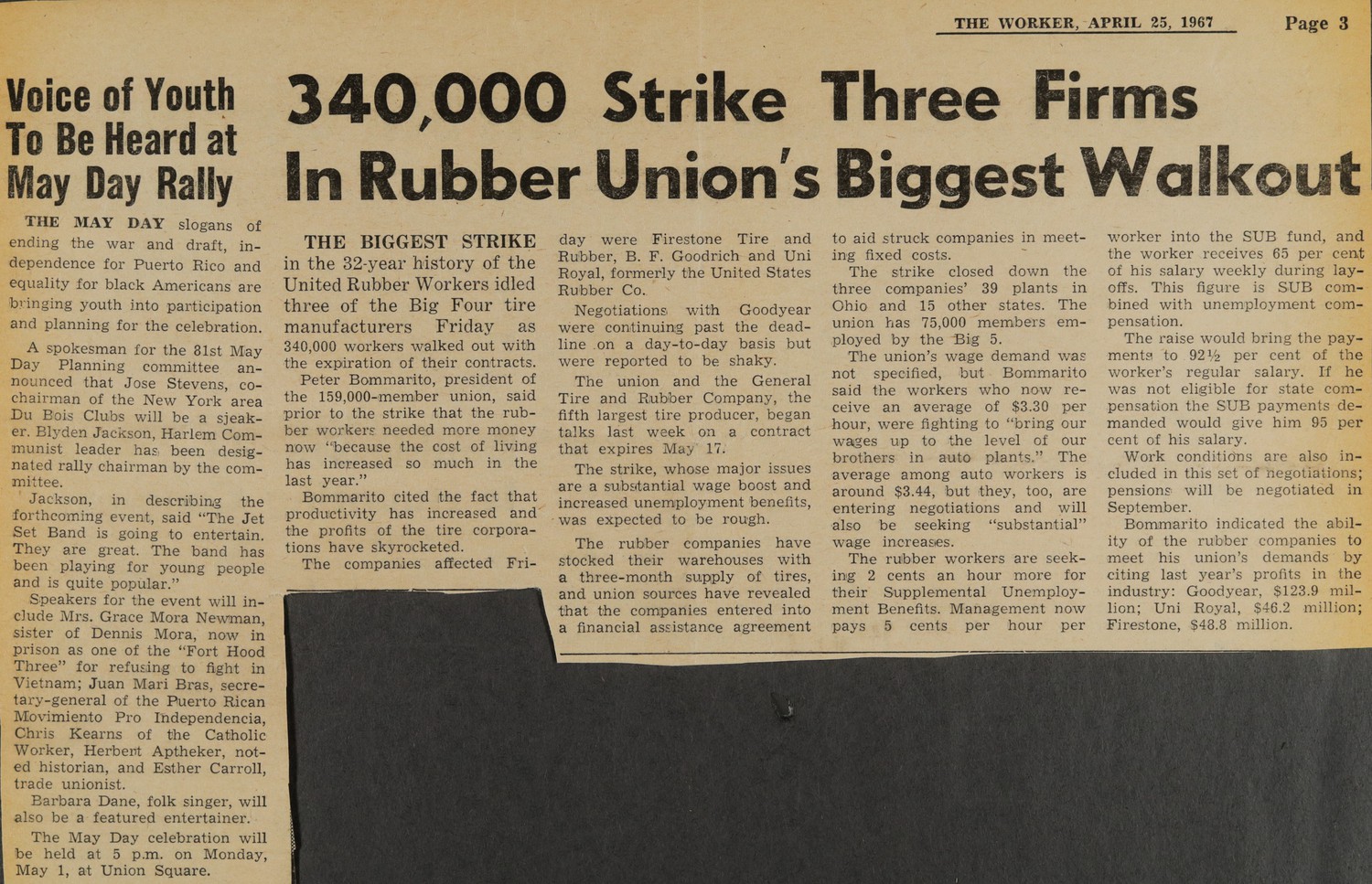
340,000 Strike Three Firms In Rubber Union’s Biggest Walkout

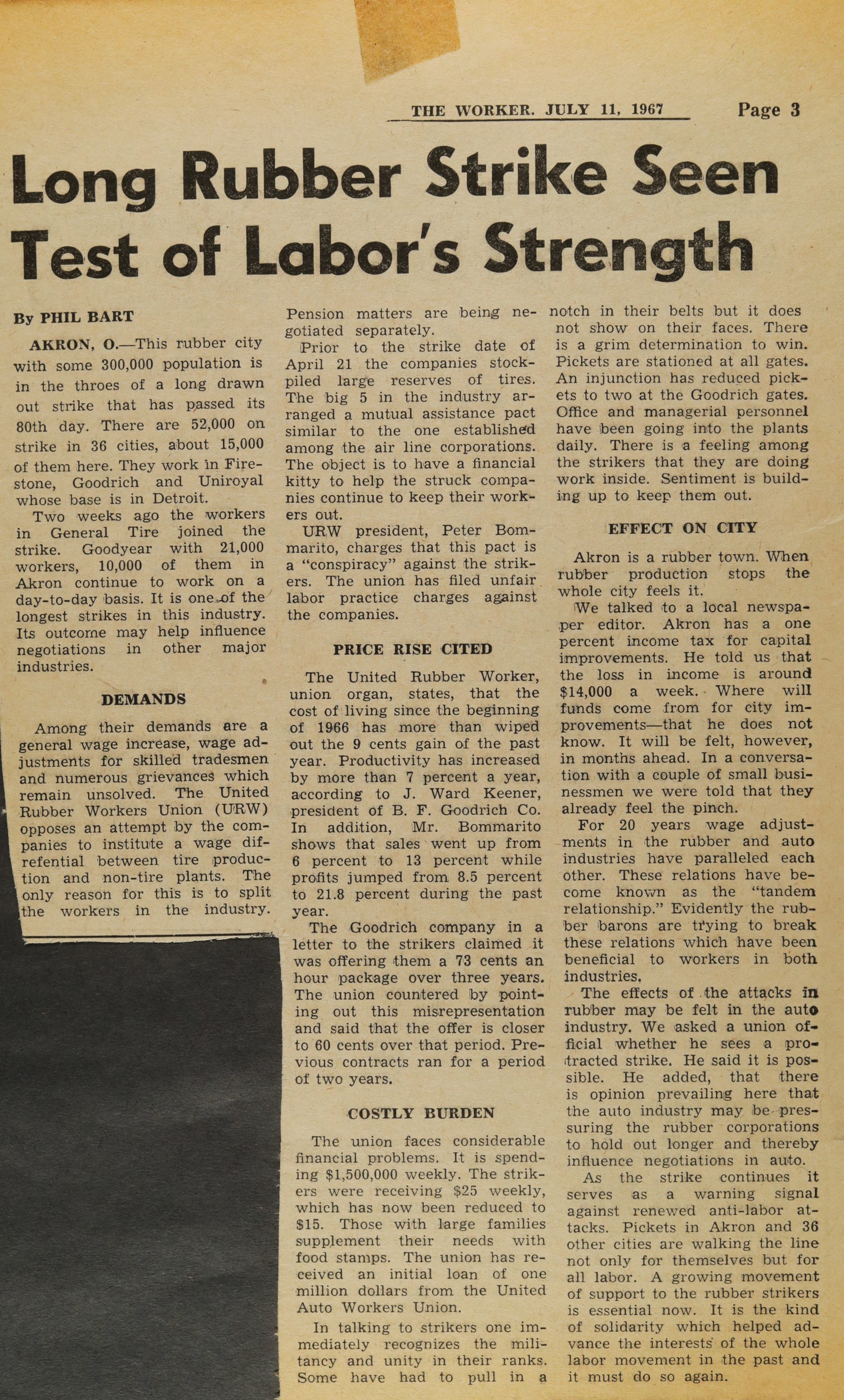
THE WORKER, APRIL 25, 1967 Page 3

Voice of Youth To Be Heard at May Day Rally

THE MAY DAY slogans of ending the war and draft, independence for Puerto Rico and equality for black Americans are bringing youth into participation and planning for the celebration.

A spokesman for the 81st May Day Planning committee announced that Jose Stevens, co-chairman of the New York area Du Bois Clubs will be a speaker. Blyden Jackson, Harlem Communist leader has been designated rally chairman by the committee.

Jackson, in describing the forthcoming event, said “The Jet Set Band is going to entertain. They are great. The band has been playing for young people and is quite popular.”

Speakers for the event will include Mrs. Grace Mora Newman, sister of Dennis Mora, now in prison as one of the “Fort Hood Three” for refusing to fight in Vietnam; Juan Mari Bras, secretary-general of the Puerto Rican Movimiento Pro Independencia, Chris Kearns of the Catholic Worker, Herbert Aptheker, noted historian, and Esther Carroll, trade unionist.

Barbara Dane, folk singer, will also be a featured entertainer.

The May Day celebration will be held at 5 p.m. on Monday, May 1, at Union Square.


340,000 Strike Three Firms In Rubber Union’s Biggest Walkout

THE BIGGEST STRIKE in the 32-year history of the United Rubber Workers idled three of the Big Four tire manufacturers Friday as 340,000 workers walked out with the expiration of their contracts.

Peter Bommarito, president of the 159,000-member union, said prior to the strike that the rubber workers needed more money now “because the cost of living has increased so much in the last year.”

Bommarito cited the fact that productivity has increased and the profits of the tire corporations have skyrocketed.

The companies affected Friday were Firestone Tire and Rubber, B. F. Goodrich and Uni Royal, formerly the United States Rubber Co.

Negotiations with Goodyear were continuing past the deadline on a day-to-day basis but were reported to be shaky.

The union and the General Tire and Rubber Company, the fifth largest tire producer, began talks last week on a contract that expires May 17.

The strike, whose major issues are a substantial wage boost and increased unemployment benefits, was expected to be rough.

The rubber companies have stocked their warehouses with a three-month supply of tires, and union sources have revealed that the companies entered into a financial assistance agreement to aid struck companies in meeting fixed costs.

The strike closed down the three companies’ 39 plants in Ohio and 15 other states. The union has 75,000 members employed by the Big 5.

The union’s wage demand was not specified, but Bommarito said the workers who now receive an average of $3.30 per hour, were fighting to “bring our wages up to the level of our brothers in auto plants.” The average among auto workers is around $3.44, but they, too, are entering negotiations and will also be seeking “substantial” wage increases.

The rubber workers are seeking 2 cents an hour more for their Supplemental Unemployment Benefits. Management now pays 5 cents per hour per worker into the SUB fund, and the worker receives 65 per cent of his salary weekly during layoffs. This figure is SUB combined with unemployment compensation.

The raise would bring the payments to 92½ per cent of the worker’s regular salary. If he was not eligible for state compensation the SUB payments demanded would give him 95 per cent of his salary.

Work conditions are also included in this set of negotiations; pensions will be negotiated in September.

Bommarito indicated the ability of the rubber companies to meet his union’s demands by citing last year’s profits in the industry: Goodyear, $123.9 million; Uni Royal, $46.2 million; Firestone, $48.8 million.

URW Vows Fight For Contract Goals

6, 1967

‘Realistic, Logical’: 5-6-67

URW Vows Fight For Contract Goals

Akron, O.—The Rubber Workers, on strike against three of the Big 4 rubber companies at 39 plants in 36 cities, have a bargaining program that is “realistic, logical and attainable” and the union will continue to fight to get it, URW Pres. Peter Bommarito said here.

Contract talks continued as 50,000 pickets kept marching at plants of Firestone, Goodrich and Uniroyal, formerly the U.S. Rubber Co., but no immediate settlement seemed in sight, the union reported.

The strikes started Apr. 21. Employees of Goodyear Tire & Rubber Co., fourth major tire firm, continued to work on a day-to-day basis without a contract. Workers at a Goodyear hose plant in North Chicago, Ill., struck briefly, but returned to their jobs after visiting other Goodyear locations.

Meanwhile, a Goodyear progress report to company executives on the negotiations was made public. It said the company had offered a two-year package of 23.5 cents an hour for tire plant workers, 18 cents for others.

Firestone and Uniroyal acknowledged that they had made similar offers.

Bommarito had said previously, without spelling out the terms, that the wage offer was inadequate. He called the lower offer for non-tire employes “an attempt to divide the union.”

The Goodrich report said the firm had offered “liberal” improvements in the supplemental unemployment benefits (SUB) program, but Bommarito said the “offer” was in the area of a fraction of a cent.

The URW has asked the Big 4 firms to make the SUB program the base for a new Full Employment Earnings Program (FEEP) giving laid-off workers 92.5 percent of their regular wages. Bommarito put the cost of FEEP at 2 to 3 cents an hour.

Goodrich said it offered to give one-year employes two weeks of vacation. It now takes three years of work to get two weeks of vacation.

Management said it offered to make numerous changes in contract language, but Bommarito said satisfactory working conditions are a major objective of the strikers—perhaps more important than substantial wage increases, with neither yet achieved.

Talks have started between the URW and the General Tire Co., fifth major firm. The contract deadline is May 15 but no progress was reported there, either.

The companywide strikes are the first since 1965, when the Uniroyal chain was shut down for six days. The same firm was closed in 1959, along with Firestone and Goodrich.

Current strikes involve wages, vacations, holidays and working conditions. Agreements on pensions, health and welfare are up for renegotiation next August.

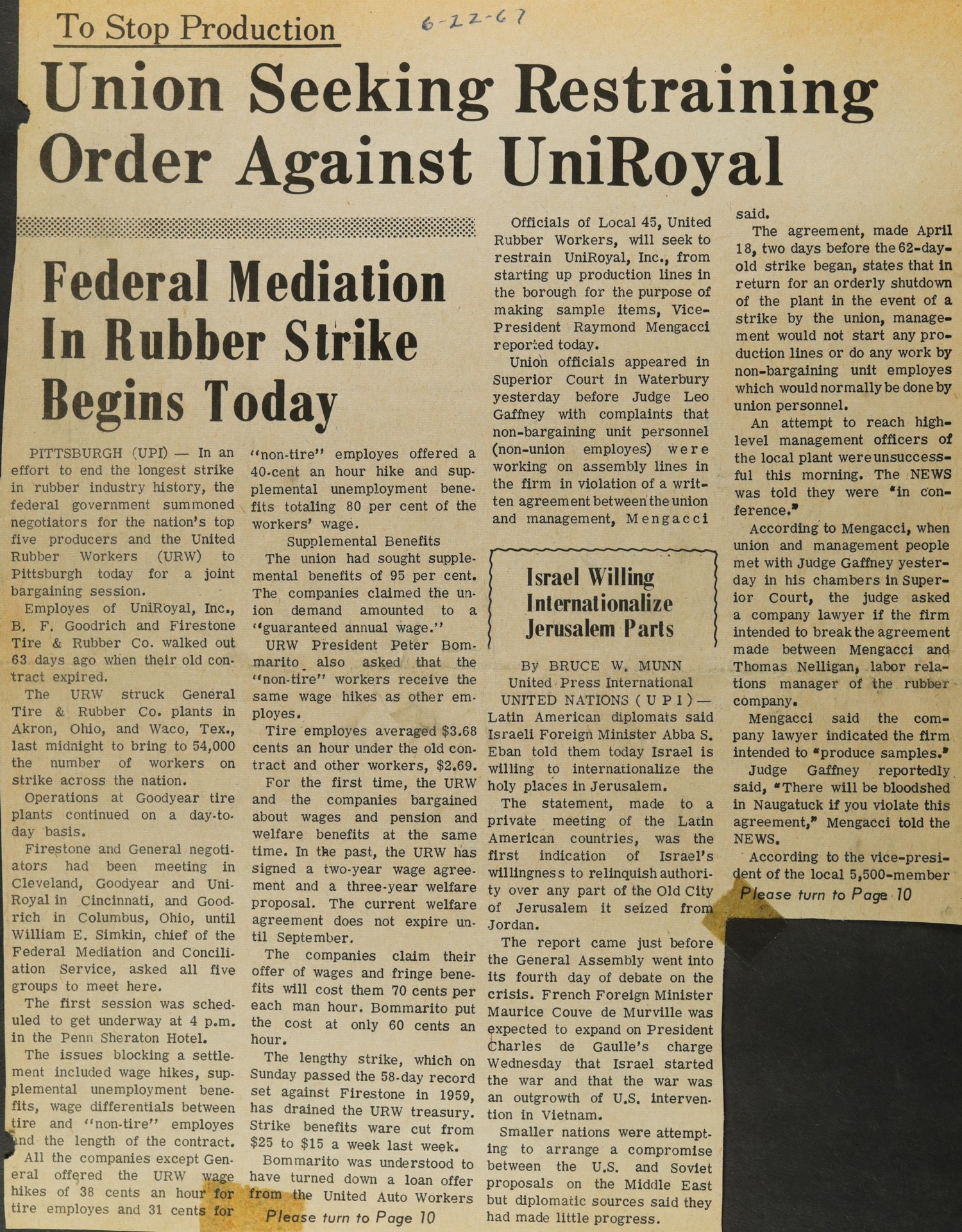
Union Seeking Restraining Order Against UniRoyal

Union Seeking Restraining Order Against UniRoyal

To Stop Production

6-22-67

Union Seeking Restraining Order Against UniRoyal

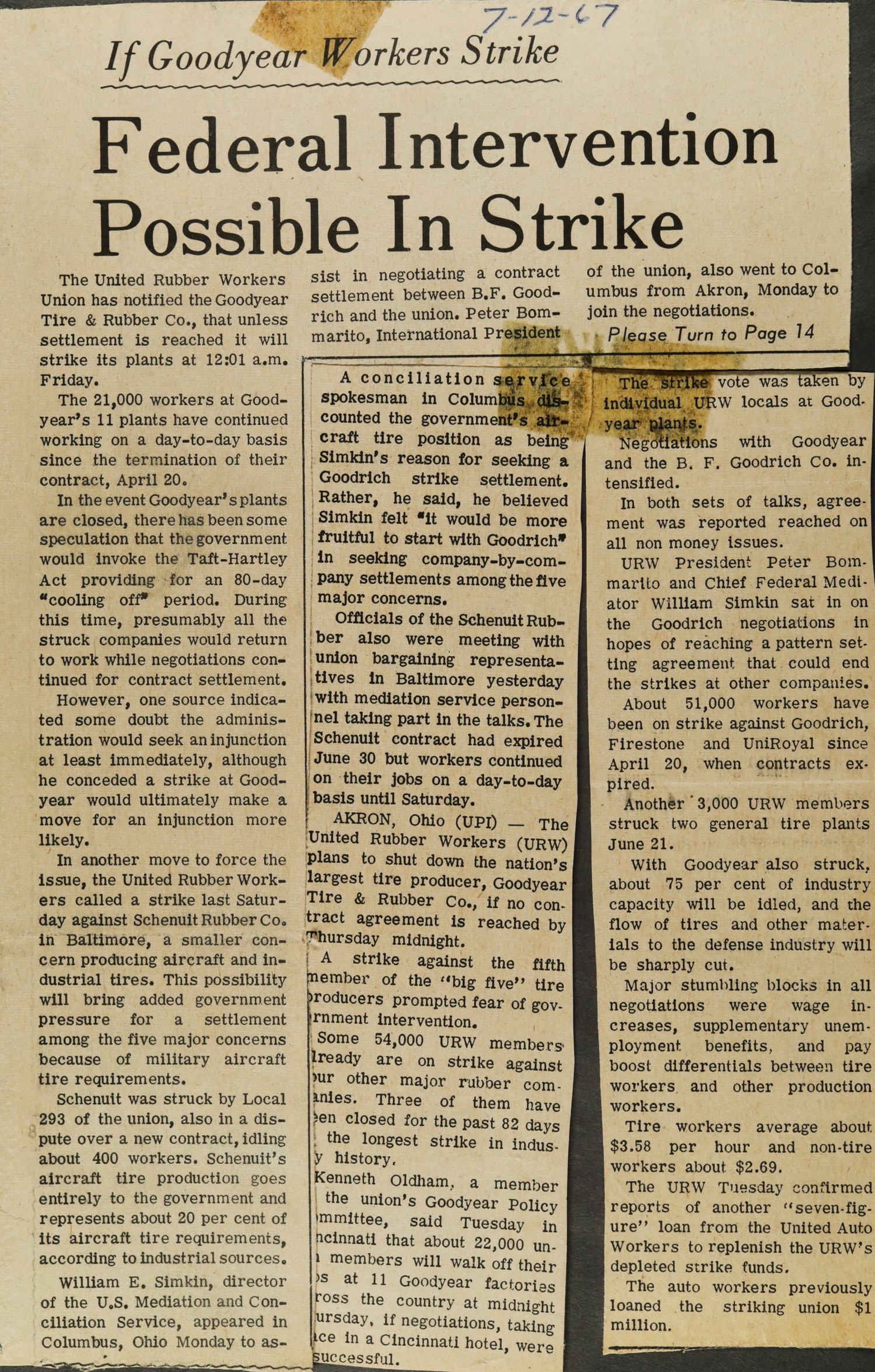
Federal Mediation In Rubber Strike Begins Today

PITTSBURGH (UPI) — In an effort to end the longest strike in rubber industry history, the federal government summoned negotiators for the nation’s top five producers and the United Rubber Workers (URW) to Pittsburgh today for a joint bargaining session.

Employes of UniRoyal, Inc., B. F. Goodrich and Firestone Tire & Rubber Co. walked out 63 days ago when their old contract expired.

The URW struck General Tire & Rubber Co. plants in Akron, Ohio, and Waco, Tex., last midnight to bring to 54,000 the number of workers on strike across the nation.

Operations at Goodyear tire plants continued on a day-to-day basis.

Firestone and General negotiators had been meeting in Cleveland, Goodyear and UniRoyal in Cincinnati, and Goodrich in Columbus, Ohio, until William E. Simkin, chief of the Federal Mediation and Conciliation Service, asked all five groups to meet here.

The first session was scheduled to get underway at 4 p.m. in the Penn Sheraton Hotel.

The issues blocking a settlement included wage hikes, supplemental unemployment benefits, wage differentials between tire and “non-tire” employes and the length of the contract.

All the companies except General offered the URW wage hikes of 38 cents an hour for tire employes and 31 cents for “non-tire” employes offered a 40-cent an hour hike and supplemental unemployment benefits totaling 80 per cent of the workers’ wage.

Supplemental Benefits

The union had sought supplemental benefits of 95 per cent. The companies claimed the union demand amounted to a “guaranteed annual wage.”

URW President Peter Bommarito also asked that the “non-tire” workers receive the same wage hikes as other employes.

Tire employes averaged $3.68 cents an hour under the old contract and other workers, $2.69.

For the first time, the URW and the companies bargained about wages and pension and welfare benefits at the same time. In the past, the URW has signed a two-year wage agreement and a three-year welfare proposal. The current welfare agreement does not expire until September.

The companies claim their offer of wages and fringe benefits will cost them 70 cents per each man hour. Bommarito put the cost at only 60 cents an hour.

The lengthy strike, which on Sunday passed the 58-day record set against Firestone in 1959, has drained the URW treasury. Strike benefits ware cut from $25 to $15 a week last week.

Bommarito was understood to have turned down a loan offer from the United Auto Workers

Please turn to Page 10

Officials of Local 45, United Rubber Workers, will seek to restrain UniRoyal, Inc., from starting up production lines in the borough for the purpose of making sample items, Vice-President Raymond Mengacci reported today.

Union officials appeared in Superior Court in Waterbury yesterday before Judge Leo Gaffney with complaints that non-bargaining unit personnel (non-union employes) were working on assembly lines in the firm in violation of a written agreement between the union and management, Mengacci


Israel Willing Internationalize Jerusalem Parts

By BRUCE W. MUNN
United Press International

UNITED NATIONS (UPI)— Latin American diplomats said Israeli Foreign Minister Abba S. Eban told them today Israel is willing to internationalize the holy places in Jerusalem.

The statement, made to a private meeting of the Latin American countries, was the first indication of Israel’s willingness to relinquish authority over any part of the Old City of Jerusalem it seized from Jordan.

The report came just before the General Assembly went into its fourth day of debate on the crisis. French Foreign Minister Maurice Couve de Murville was expected to expand on President Charles de Gaulle’s charge Wednesday that Israel started the war and that the war was an outgrowth of U.S. intervention in Vietnam.

Smaller nations were attempting to arrange a compromise between the U.S. and Soviet proposals on the Middle East but diplomatic sources said they had made little progress.


said.

The agreement, made April 18, two days before the 62-day-old strike began, states that in return for an orderly shutdown of the plant in the event of a strike by the union, management would not start any production lines or do any work by non-bargaining unit employes which would normally be done by union personnel.

An attempt to reach high-level management officers of the local plant were unsuccessful this morning. The NEWS was told they were “in conference.”

According to Mengacci, when union and management people met with Judge Gaffney yesterday in his chambers in Superior Court, the judge asked a company lawyer if the firm intended to break the agreement made between Mengacci and Thomas Nelligan, labor relations manager of the rubber company.

Mengacci said the company lawyer indicated the firm intended to “produce samples.”

Judge Gaffney reportedly said, “There will be bloodshed in Naugatuck if you violate this agreement,” Mengacci told the NEWS.

According to the vice-president of the local 5,500-member

Please turn to Page 10
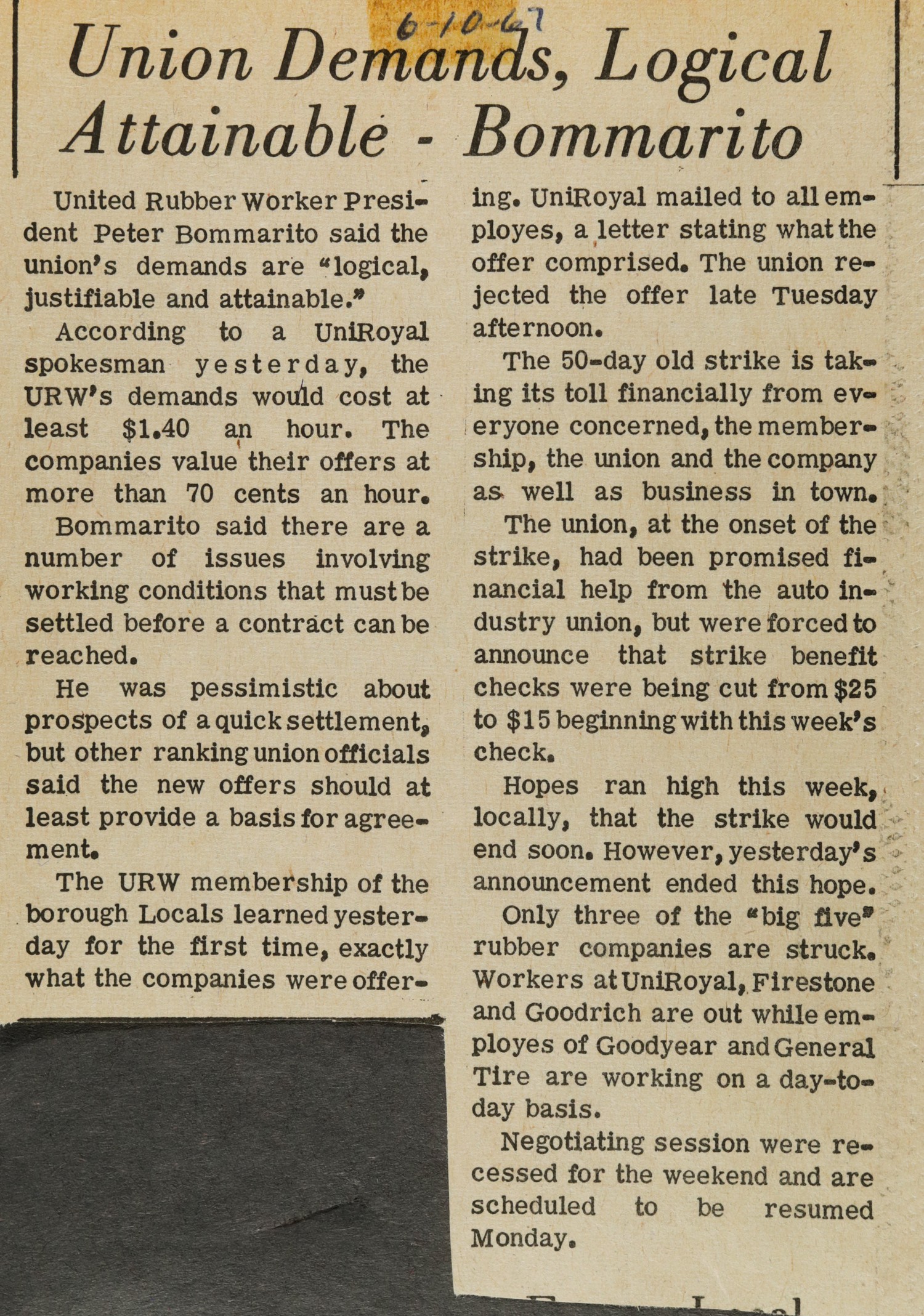
Union Demands, Logical Attainable – Bommarito

Union Demands, Logical Attainable - Bommarito

Union Demands, Logical Attainable – Bommarito

6-10-67 [handwritten notation at top]

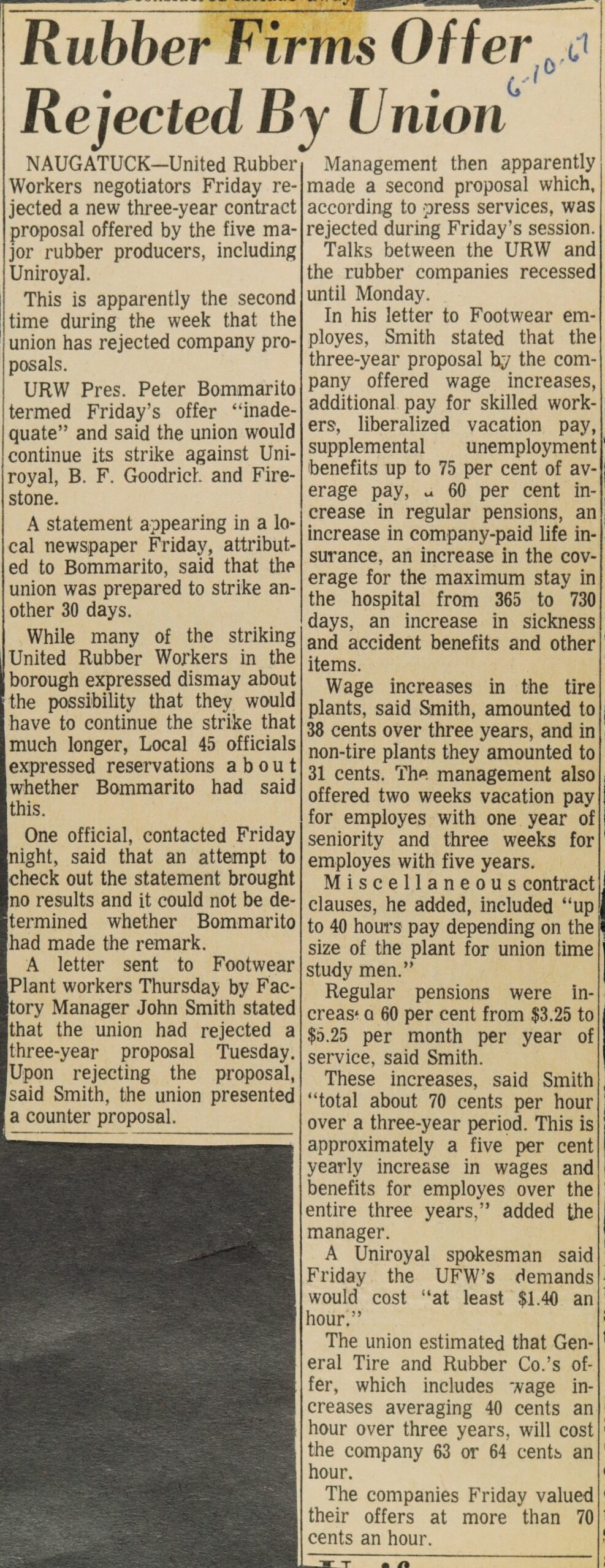
United Rubber Worker President Peter Bommarito said the union’s demands are “logical, justifiable and attainable.”

According to a UniRoyal spokesman yesterday, the URW’s demands would cost at least $1.40 an hour. The companies value their offers at more than 70 cents an hour.

Bommarito said there are a number of issues involving working conditions that must be settled before a contract can be reached.

He was pessimistic about prospects of a quick settlement, but other ranking union officials said the new offers should at least provide a basis for agreement.

The URW membership of the borough Locals learned yesterday for the first time, exactly what the companies were offering. UniRoyal mailed to all employees, a letter stating what the offer comprised. The union rejected the offer late Tuesday afternoon.

The 50-day old strike is taking its toll financially from everyone concerned, the membership, the union and the company as well as business in town.

The union, at the onset of the strike, had been promised financial help from the auto industry union, but were forced to announce that strike benefit checks were being cut from $25 to $15 beginning with this week’s check.

Hopes ran high this week, locally, that the strike would end soon. However, yesterday’s announcement ended this hope.

Only three of the “big five” rubber companies are struck. Workers at UniRoyal, Firestone and Goodrich are out while employes of Goodyear and General Tire are working on a day-to-day basis.

Negotiating session were recessed for the weekend and are scheduled to be resumed Monday.

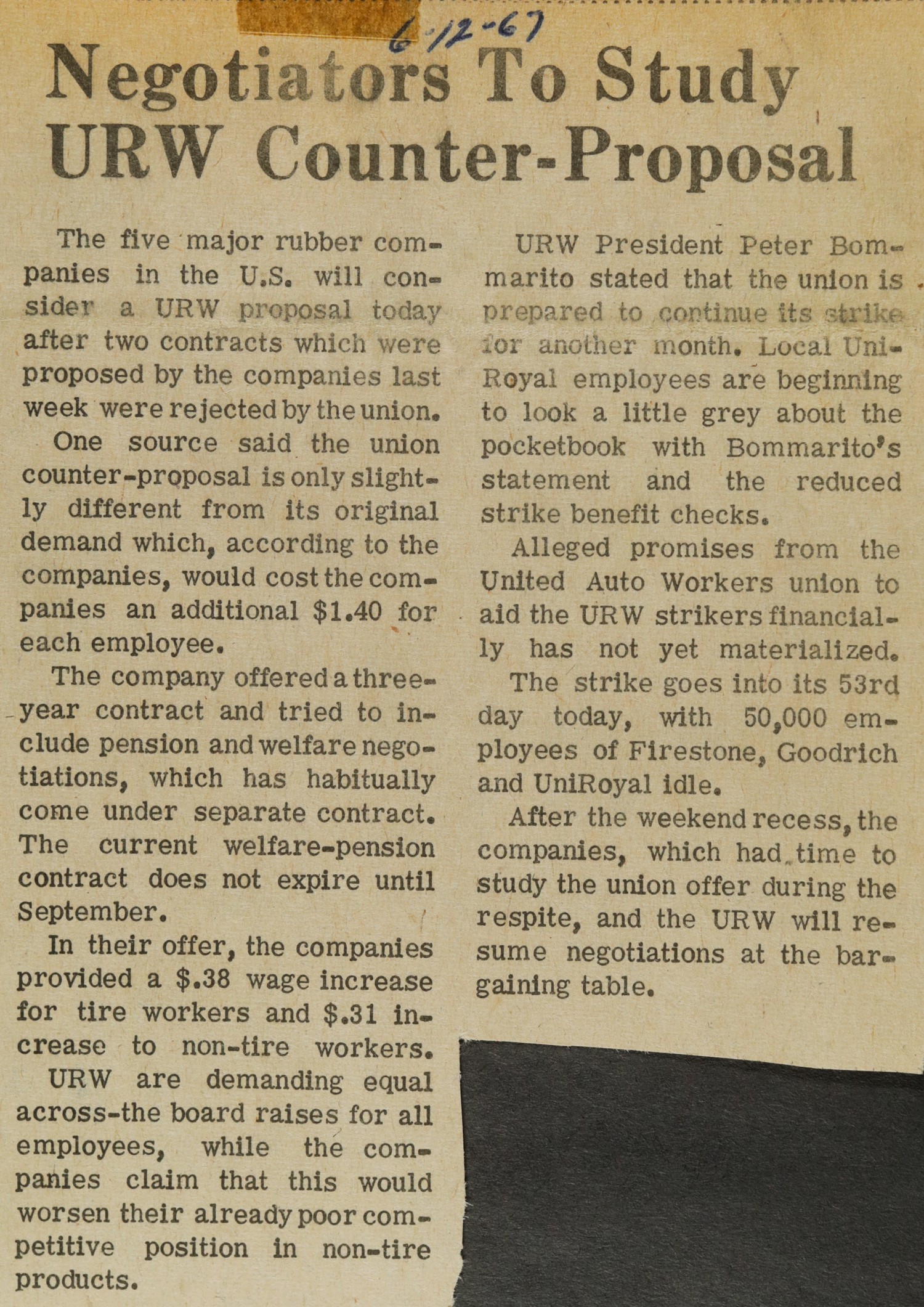
Negotiators To Study URW Counter-Proposal

Negotiators To Study URW Counter-Proposal

6/12-67

Negotiators To Study URW Counter-Proposal

The five major rubber companies in the U.S. will consider a URW proposal today after two contracts which were proposed by the companies last week were rejected by the union.

One source said the union counter-proposal is only slightly different from its original demand which, according to the companies, would cost the companies an additional $1.40 for each employee.

The company offered a three-year contract and tried to include pension and welfare negotiations, which has habitually come under separate contract. The current welfare-pension contract does not expire until September.

In their offer, the companies provided a $.38 wage increase for tire workers and $.31 increase to non-tire workers.

URW are demanding equal across-the board raises for all employees, while the companies claim that this would worsen their already poor competitive position in non-tire products.

URW President Peter Bommarito stated that the union is prepared to continue its strike for another month. Local UniRoyal employees are beginning to look a little grey about the pocketbook with Bommarito’s statement and the reduced strike benefit checks.

Alleged promises from the United Auto Workers union to aid the URW strikers financially has not yet materialized.

The strike goes into its 53rd day today, with 50,000 employees of Firestone, Goodrich and UniRoyal idle.

After the weekend recess, the companies, which had time to study the union offer during the respite, and the URW will resume negotiations at the bargaining table.

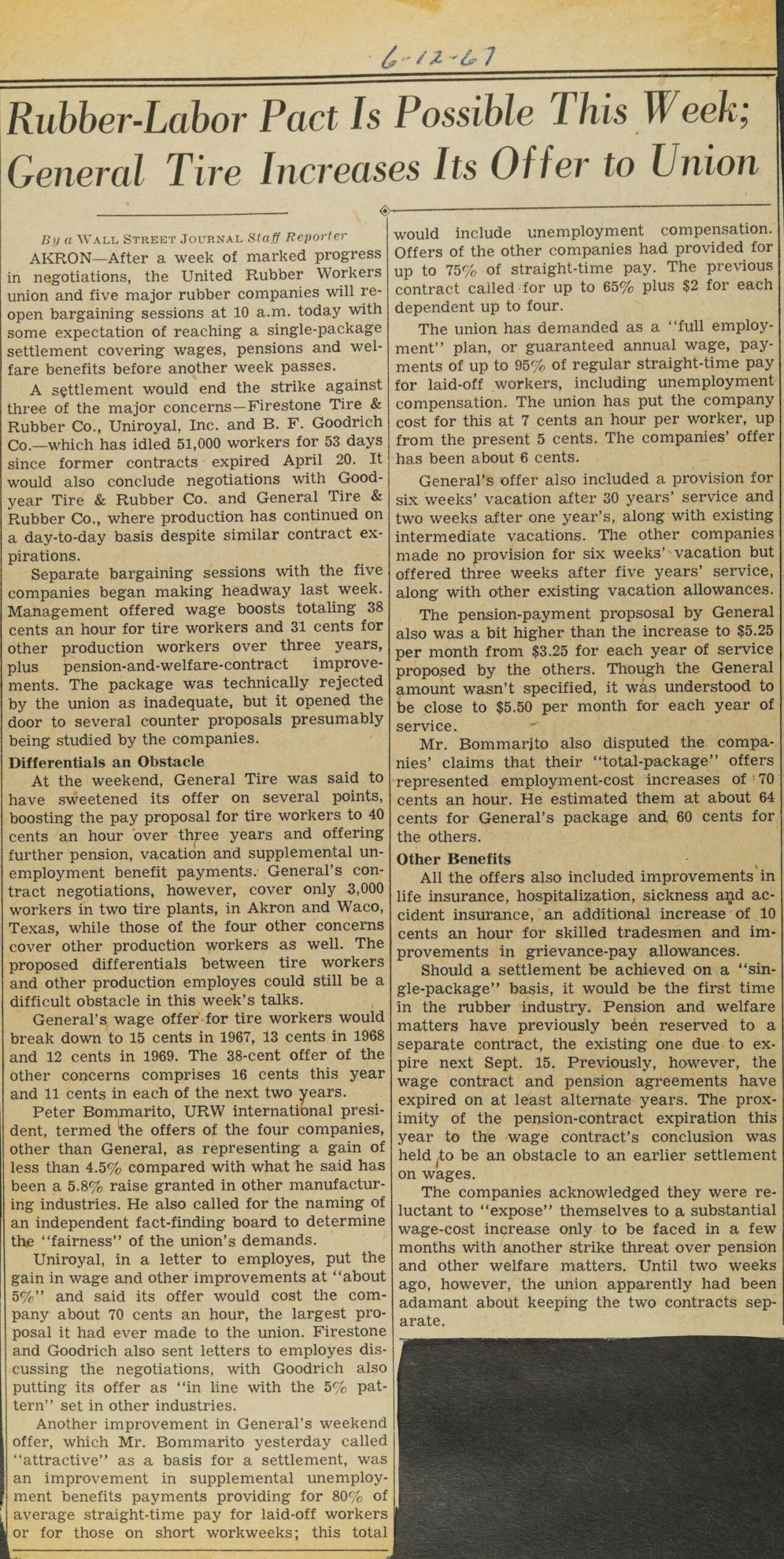
Rubber-Labor Pact Is Possible This Week; General Tire Increases Its Offer to Union

6-12-67

Rubber-Labor Pact Is Possible This Week; General Tire Increases Its Offer to Union

By a WALL STREET JOURNAL Staff Reporter

AKRON—After a week of marked progress in negotiations, the United Rubber Workers union and five major rubber companies will reopen bargaining sessions at 10 a.m. today with some expectation of reaching a single-package settlement covering wages, pensions and welfare benefits before another week passes.

A settlement would end the strike against three of the major concerns—Firestone Tire & Rubber Co., Uniroyal, Inc. and B. F. Goodrich Co.—which has idled 51,000 workers for 53 days since former contracts expired April 20. It would also conclude negotiations with Goodyear Tire & Rubber Co. and General Tire & Rubber Co., where production has continued on a day-to-day basis despite similar contract expirations.

Separate bargaining sessions with the five companies began making headway last week. Management offered wage boosts totaling 38 cents an hour for tire workers and 31 cents for other production workers over three years, plus pension-and-welfare-contract improvements. The package was technically rejected by the union as inadequate, but it opened the door to several counter proposals presumably being studied by the companies.

Differentials an Obstacle

At the weekend, General Tire was said to have sweetened its offer on several points, boosting the pay proposal for tire workers to 40 cents an hour over three years and offering further pension, vacation and supplemental unemployment benefit payments. General’s contract negotiations, however, cover only 3,000 workers in two tire plants, in Akron and Waco, Texas, while those of the four other concerns cover other production workers as well. The proposed differentials between tire workers and other production employes could still be a difficult obstacle in this week’s talks.

General’s wage offer for tire workers would break down to 15 cents in 1967, 13 cents in 1968 and 12 cents in 1969. The 38-cent offer of the other concerns comprises 16 cents this year and 11 cents in each of the next two years.

Peter Bommarito, URW international president, termed the offers of the four companies, other than General, as representing a gain of less than 4.5% compared with what he said has been a 5.8% raise granted in other manufacturing industries. He also called for the naming of an independent fact-finding board to determine the “fairness” of the union’s demands.

Uniroyal, in a letter to employes, put the gain in wage and other improvements at “about 5%” and said its offer would cost the company about 70 cents an hour, the largest proposal it had ever made to the union. Firestone and Goodrich also sent letters to employes discussing the negotiations, with Goodrich also putting its offer as “in line with the 5% pattern” set in other industries.

Another improvement in General’s weekend offer, which Mr. Bommarito yesterday called “attractive” as a basis for a settlement, was an improvement in supplemental unemployment benefits payments providing for 80% of average straight-time pay for laid-off workers or for those on short workweeks; this total would include unemployment compensation. Offers of the other companies had provided for up to 75% of straight-time pay. The previous contract called for up to 65% plus $2 for each dependent up to four.

The union has demanded as a “full employment” plan, or guaranteed annual wage, payments of up to 95% of regular straight-time pay for laid-off workers, including unemployment compensation. The union has put the company cost for this at 7 cents an hour per worker, up from the present 5 cents. The companies’ offer has been about 6 cents.

General’s offer also included a provision for six weeks’ vacation after 30 years’ service and two weeks after one year’s, along with existing intermediate vacations. The other companies made no provision for six weeks’ vacation but offered three weeks after five years’ service, along with other existing vacation allowances.

The pension-payment propsosal by General also was a bit higher than the increase to $5.25 per month from $3.25 for each year of service proposed by the others. Though the General amount wasn’t specified, it was understood to be close to $5.50 per month for each year of service.

Mr. Bommarito also disputed the companies’ claims that their “total-package” offers represented employment-cost increases of 70 cents an hour. He estimated them at about 64 cents for General’s package and 60 cents for the others.

Other Benefits

All the offers also included improvements in life insurance, hospitalization, sickness and accident insurance, an additional increase of 10 cents an hour for skilled tradesmen and improvements in grievance-pay allowances.

Should a settlement be achieved on a “single-package” basis, it would be the first time in the rubber industry. Pension and welfare matters have previously been reserved to a separate contract, the existing one due to expire next Sept. 15. Previously, however, the wage contract and pension agreements have expired on at least alternate years. The proximity of the pension-contract expiration this year to the wage contract’s conclusion was held to be an obstacle to an earlier settlement on wages.

The companies acknowledged they were reluctant to “expose” themselves to a substantial wage-cost increase only to be faced in a few months with another strike threat over pension and other welfare matters. Until two weeks ago, however, the union apparently had been adamant about keeping the two contracts separate.

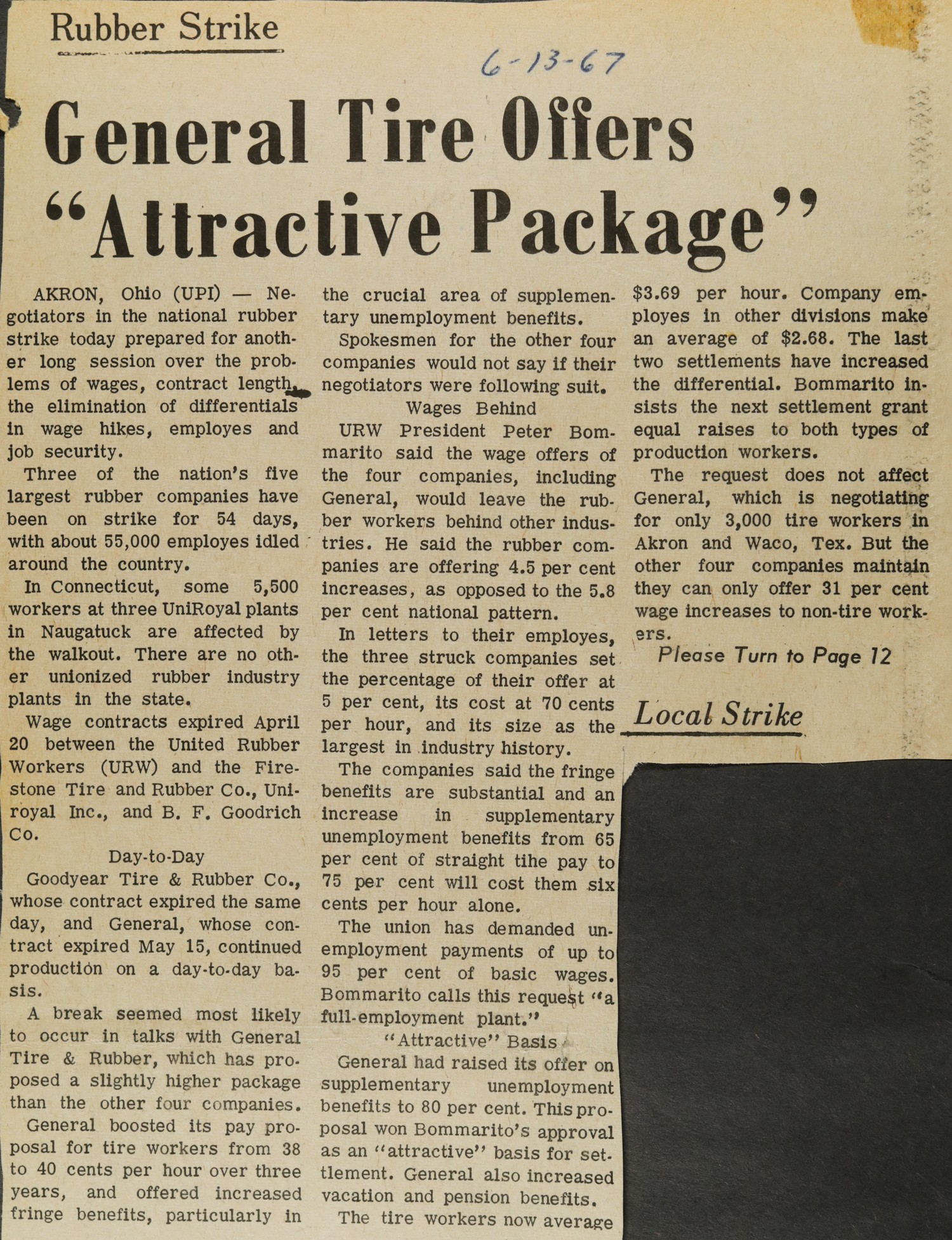
General Tire Offers “Attractive Package”

General Tire Offers "Attractive Package"

Rubber Strike

6-13-67

General Tire Offers “Attractive Package”

AKRON, Ohio (UPI) — Negotiators in the national rubber strike today prepared for another long session over the problems of wages, contract length, the elimination of differentials in wage hikes, employes and job security.

Three of the nation’s five largest rubber companies have been on strike for 54 days, with about 55,000 employes idled around the country.

In Connecticut, some 5,500 workers at three UniRoyal plants in Naugatuck are affected by the walkout. There are no other unionized rubber industry plants in the state.

Wage contracts expired April 20 between the United Rubber Workers (URW) and the Firestone Tire and Rubber Co., Uniroyal Inc., and B. F. Goodrich Co.

Day-to-Day

Goodyear Tire & Rubber Co., whose contract expired the same day, and General, whose contract expired May 15, continued production on a day-to-day basis.

A break seemed most likely to occur in talks with General Tire & Rubber, which has proposed a slightly higher package than the other four companies.

General boosted its pay proposal for tire workers from 38 to 40 cents per hour over three years, and offered increased fringe benefits, particularly in the crucial area of supplementary unemployment benefits.

Spokesmen for the other four companies would not say if their negotiators were following suit.

Wages Behind

URW President Peter Bommarito said the wage offers of the four companies, including General, would leave the rubber workers behind other industries. He said the rubber companies are offering 4.5 per cent increases, as opposed to the 5.8 per cent national pattern.

In letters to their employes, the three struck companies set the percentage of their offer at 5 per cent, its cost at 70 cents per hour, and its size as the largest in industry history.

The companies said the fringe benefits are substantial and an increase in supplementary unemployment benefits from 65 per cent of straight time pay to 75 per cent will cost them six cents per hour alone.

The union has demanded unemployment payments of up to 95 per cent of basic wages. Bommarito calls this request “a full-employment plant.”

“Attractive” Basis

General had raised its offer on supplementary unemployment benefits to 80 per cent. This proposal won Bommarito’s approval as an “attractive” basis for settlement. General also increased vacation and pension benefits.

The tire workers now average $3.69 per hour. Company employes in other divisions make an average of $2.68. The last two settlements have increased the differential. Bommarito insists the next settlement grant equal raises to both types of production workers.

The request does not affect General, which is negotiating for only 3,000 tire workers in Akron and Waco, Tex. But the other four companies maintain they can only offer 31 per cent wage increases to non-tire workers.

Please Turn to Page 12


Local Strike

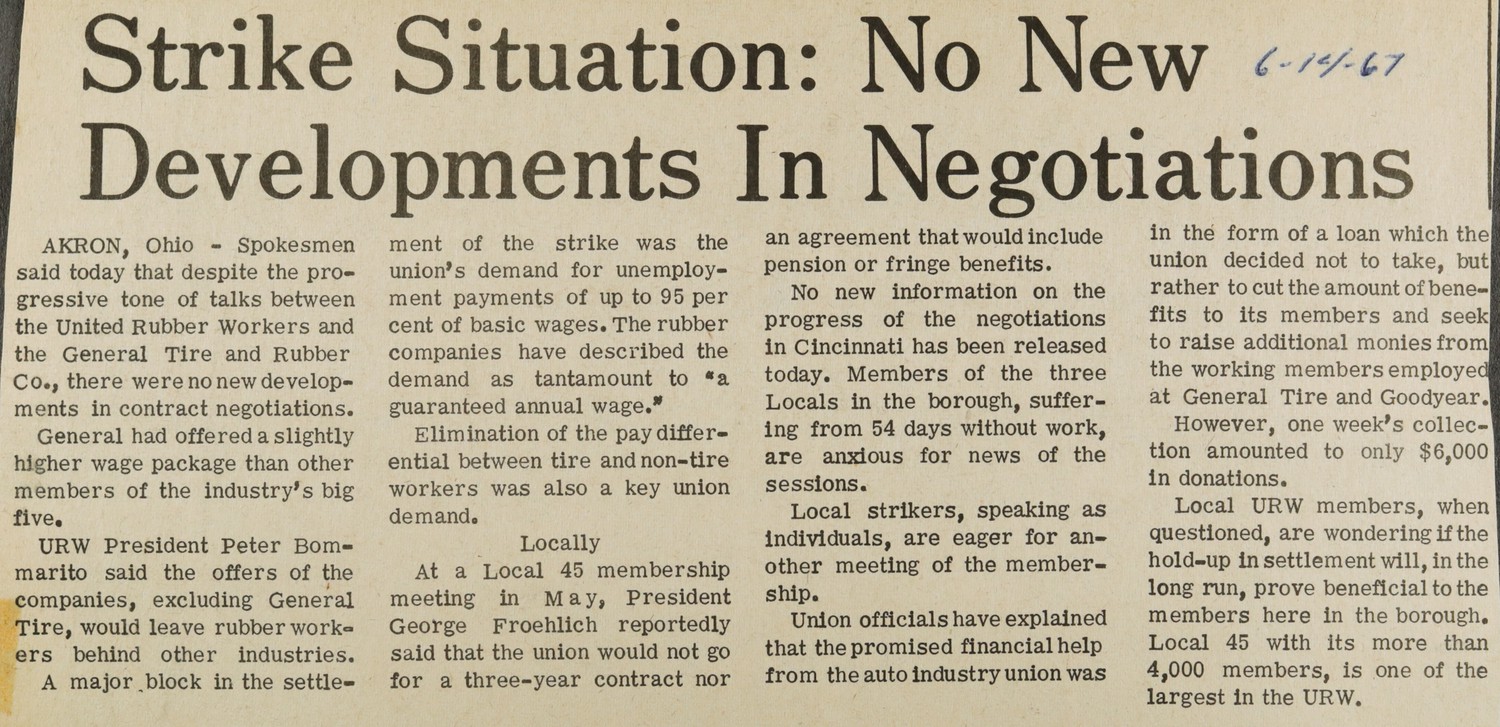
Strike Situation: No New Developments In Negotiations

Strike Situation: No New Developments In Negotiations

Strike Situation: No New Developments In Negotiations

6-14-67

AKRON, Ohio – Spokesmen said today that despite the progressive tone of talks between the United Rubber Workers and the General Tire and Rubber Co., there were no new developments in contract negotiations.

General had offered a slightly higher wage package than other members of the industry’s big five.

URW President Peter Bommarito said the offers of the companies, excluding General Tire, would leave rubber workers behind other industries.

A major block in the settlement of the strike was the union’s demand for unemployment payments of up to 95 per cent of basic wages. The rubber companies have described the demand as tantamount to “a guaranteed annual wage.”

Elimination of the pay differential between tire and non-tire workers was also a key union demand.

Locally

At a Local 45 membership meeting in May, President George Froehlich reportedly said that the union would not go for a three-year contract nor an agreement that would include pension or fringe benefits.

No new information on the progress of the negotiations in Cincinnati has been released today. Members of the three Locals in the borough, suffering from 54 days without work, are anxious for news of the sessions.

Local strikers, speaking as individuals, are eager for another meeting of the membership.

Union officials have explained that the promised financial help from the auto industry union was in the form of a loan which the union decided not to take, but rather to cut the amount of benefits to its members and seek to raise additional monies from the working members employed at General Tire and Goodyear.

However, one week’s collection amounted to only $6,000 in donations.

Local URW members, when questioned, are wondering if the hold-up in settlement will, in the long run, prove beneficial to the members here in the borough. Local 45 with its more than 4,000 members, is one of the largest in the URW.

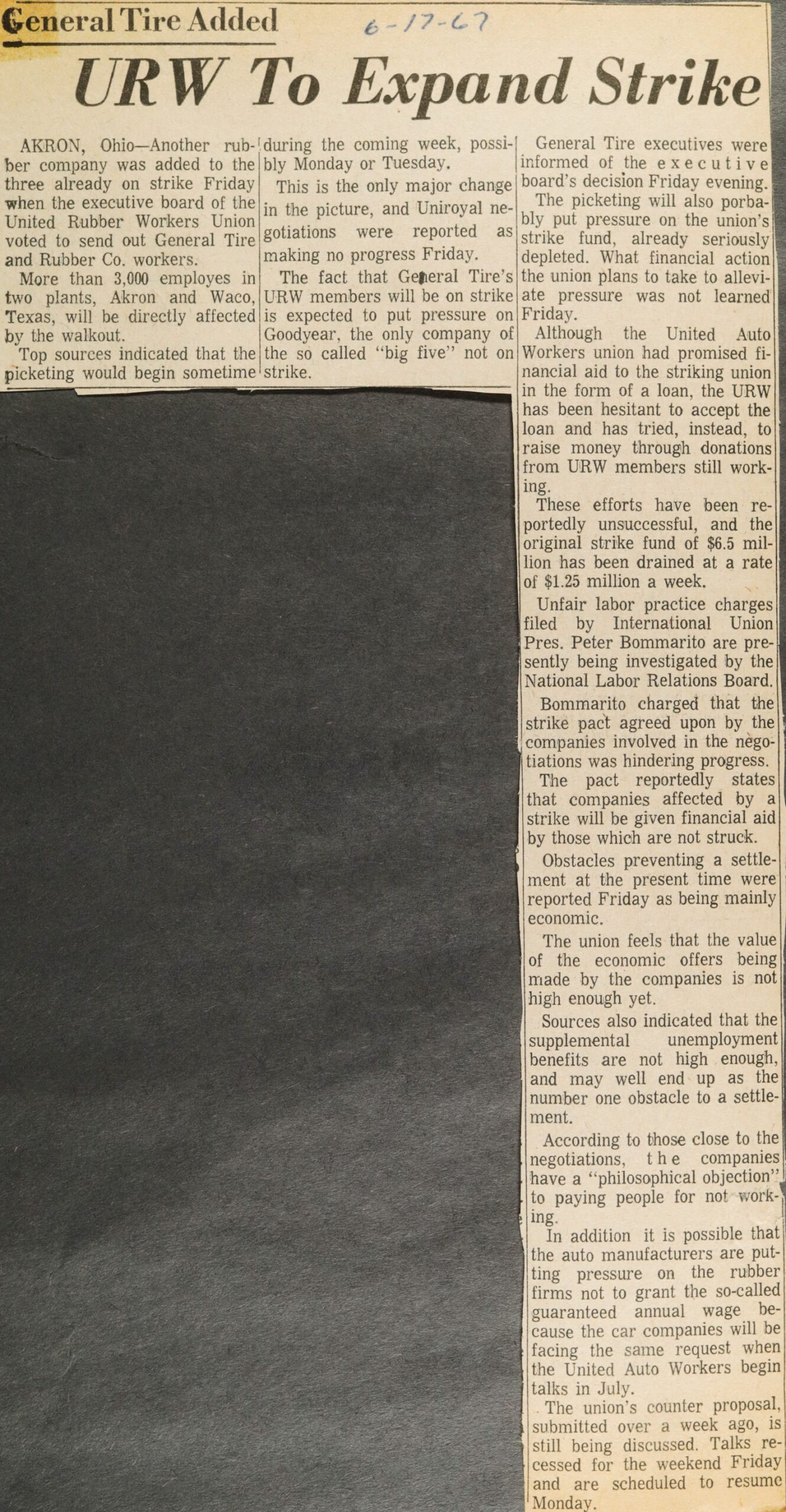
URW To Expand Strike

General Tire Added

6-17-67

URW To Expand Strike

AKRON, Ohio—Another rubber company was added to the three already on strike Friday when the executive board of the United Rubber Workers Union voted to send out General Tire and Rubber Co. workers.

More than 3,000 employes in two plants, Akron and Waco, Texas, will be directly affected by the walkout.

Top sources indicated that the picketing would begin sometime during the coming week, possibly Monday or Tuesday.

This is the only major change in the picture, and Uniroyal negotiations were reported as making no progress Friday.

The fact that General Tire’s URW members will be on strike is expected to put pressure on Goodyear, the only company of the so called “big five” not on strike.

General Tire executives were informed of the executive board’s decision Friday evening.

The picketing will also porbably put pressure on the union’s strike fund, already seriously depleted. What financial action the union plans to take to alleviate pressure was not learned Friday.

Although the United Auto Workers union had promised financial aid to the striking union in the form of a loan, the URW has been hesitant to accept the loan and has tried, instead, to raise money through donations from URW members still working.

These efforts have been reportedly unsuccessful, and the original strike fund of $6.5 million has been drained at a rate of $1.25 million a week.

Unfair labor practice charges filed by International Union Pres. Peter Bommarito are presently being investigated by the National Labor Relations Board.

Bommarito charged that the strike pact agreed upon by the companies involved in the negotiations was hindering progress.

The pact reportedly states that companies affected by a strike will be given financial aid by those which are not struck.

Obstacles preventing a settlement at the present time were reported Friday as being mainly economic.

The union feels that the value of the economic offers being made by the companies is not high enough yet.

Sources also indicated that the supplemental unemployment benefits are not high enough, and may well end up as the number one obstacle to a settlement.

According to those close to the negotiations, the companies have a “philosophical objection” to paying people for not working.

In addition it is possible that the auto manufacturers are putting pressure on the rubber firms not to grant the so-called guaranteed annual wage because the car companies will be facing the same request when the United Auto Workers begin talks in July.

The union’s counter proposal, submitted over a week ago, is still being discussed. Talks recessed for the weekend Friday and are scheduled to resume Monday.

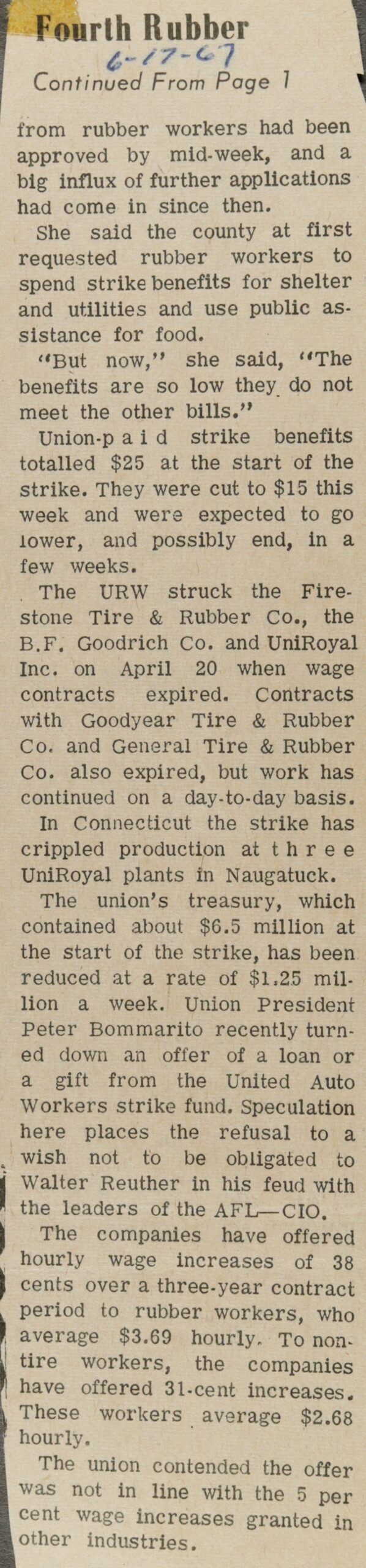
Fourth Rubber

Fourth Rubber

6-17-67

Continued From Page 1

from rubber workers had been approved by mid-week, and a big influx of further applications had come in since then.

She said the county at first requested rubber workers to spend strike benefits for shelter and utilities and use public assistance for food.

“But now,” she said, “The benefits are so low they do not meet the other bills.”

Union-paid strike benefits totalled $25 at the start of the strike. They were cut to $15 this week and were expected to go lower, and possibly end, in a few weeks.

The URW struck the Firestone Tire & Rubber Co., the B.F. Goodrich Co. and UniRoyal Inc. on April 20 when wage contracts expired. Contracts with Goodyear Tire & Rubber Co. and General Tire & Rubber Co. also expired, but work has continued on a day-to-day basis.

In Connecticut the strike has crippled production at three UniRoyal plants in Naugatuck.

The union’s treasury, which contained about $6.5 million at the start of the strike, has been reduced at a rate of $1.25 million a week. Union President Peter Bommarito recently turned down an offer of a loan or a gift from the United Auto Workers strike fund. Speculation here places the refusal to a wish not to be obligated to Walter Reuther in his feud with the leaders of the AFL—CIO.

The companies have offered hourly wage increases of 38 cents over a three-year contract period to rubber workers, who average $3.69 hourly. To non-tire workers, the companies have offered 31-cent increases. These workers average $2.68 hourly.

The union contended the offer was not in line with the 5 per cent wage increases granted in other industries.

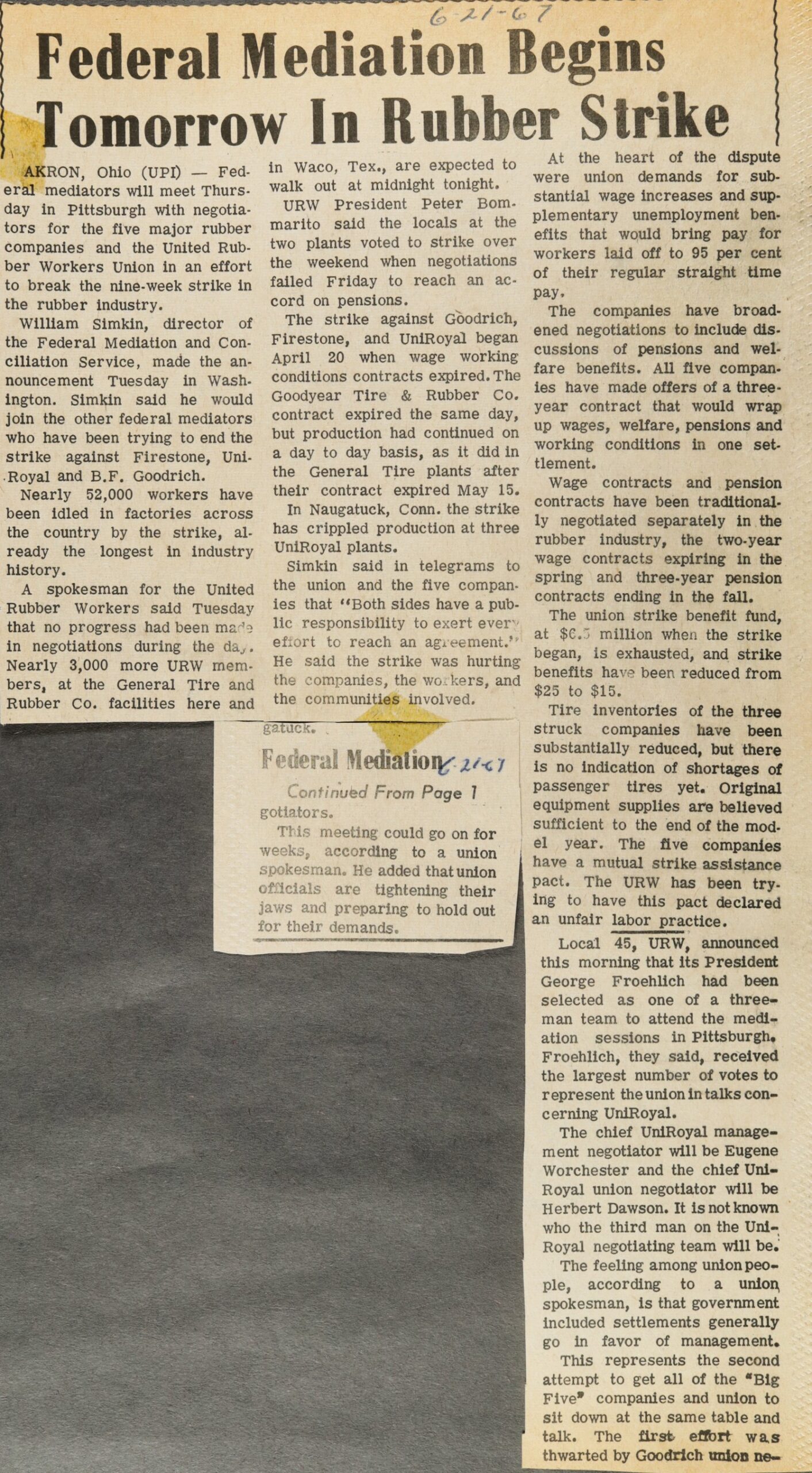
Federal Mediation Begins Tomorrow In Rubber Strike

Federal Mediation Begins Tomorrow In Rubber Strike

6-21-67 [handwritten]

AKRON, Ohio (UPI) — Federal mediators will meet Thursday in Pittsburgh with negotiators for the five major rubber companies and the United Rubber Workers Union in an effort to break the nine-week strike in the rubber industry.

William Simkin, director of the Federal Mediation and Conciliation Service, made the announcement Tuesday in Washington. Simkin said he would join the other federal mediators who have been trying to end the strike against Firestone, Uni-Royal and B.F. Goodrich.

Nearly 52,000 workers have been idled in factories across the country by the strike, already the longest in industry history.

A spokesman for the United Rubber Workers said Tuesday that no progress had been made in negotiations during the day. Nearly 3,000 more URW members, at the General Tire and Rubber Co. facilities here and in Waco, Tex., are expected to walk out at midnight tonight.

URW President Peter Bommarito said the locals at the two plants voted to strike over the weekend when negotiations failed Friday to reach an accord on pensions.

The strike against Goodrich, Firestone, and UniRoyal began April 20 when wage working conditions contracts expired. The Goodyear Tire & Rubber Co. contract expired the same day, but production had continued on a day to day basis, as it did in the General Tire plants after their contract expired May 15.

In Naugatuck, Conn. the strike has crippled production at three UniRoyal plants.

Simkin said in telegrams to the union and the five companies that “Both sides have a public responsibility to exert every effort to reach an agreement.” He said the strike was hurting the companies, the workers, and the communities involved.


Federal Mediation 6-21-67 [handwritten]

Continued From Page 1

gotiators.

This meeting could go on for weeks, according to a union spokesman. He added that union officials are tightening their jaws and preparing to hold out for their demands.


At the heart of the dispute were union demands for substantial wage increases and supplementary unemployment benefits that would bring pay for workers laid off to 95 per cent of their regular straight time pay.

The companies have broadened negotiations to include discussions of pensions and welfare benefits. All five companies have made offers of a three-year contract that would wrap up wages, welfare, pensions and working conditions in one settlement.

Wage contracts and pension contracts have been traditionally negotiated separately in the rubber industry, the two-year wage contracts expiring in the spring and three-year pension contracts ending in the fall.

The union strike benefit fund, at $6.5 million when the strike began, is exhausted, and strike benefits have been reduced from $25 to $15.

Tire inventories of the three struck companies have been substantially reduced, but there is no indication of shortages of passenger tires yet. Original equipment supplies are believed sufficient to the end of the model year. The five companies have a mutual strike assistance pact. The URW has been trying to have this pact declared an unfair labor practice.

Local 45, URW, announced this morning that its President George Froehlich had been selected as one of a three-man team to attend the mediation sessions in Pittsburgh. Froehlich, they said, received the largest number of votes to represent the union in talks concerning UniRoyal.

The chief UniRoyal management negotiator will be Eugene Worchester and the chief UniRoyal union negotiator will be Herbert Dawson. It is not known who the third man on the UniRoyal negotiating team will be.

The feeling among union people, according to a union spokesman, is that government included settlements generally go in favor of management.

This represents the second attempt to get all of the “Big Five” companies and union to sit down at the same table and talk. The first effort was thwarted by Goodrich union ne-

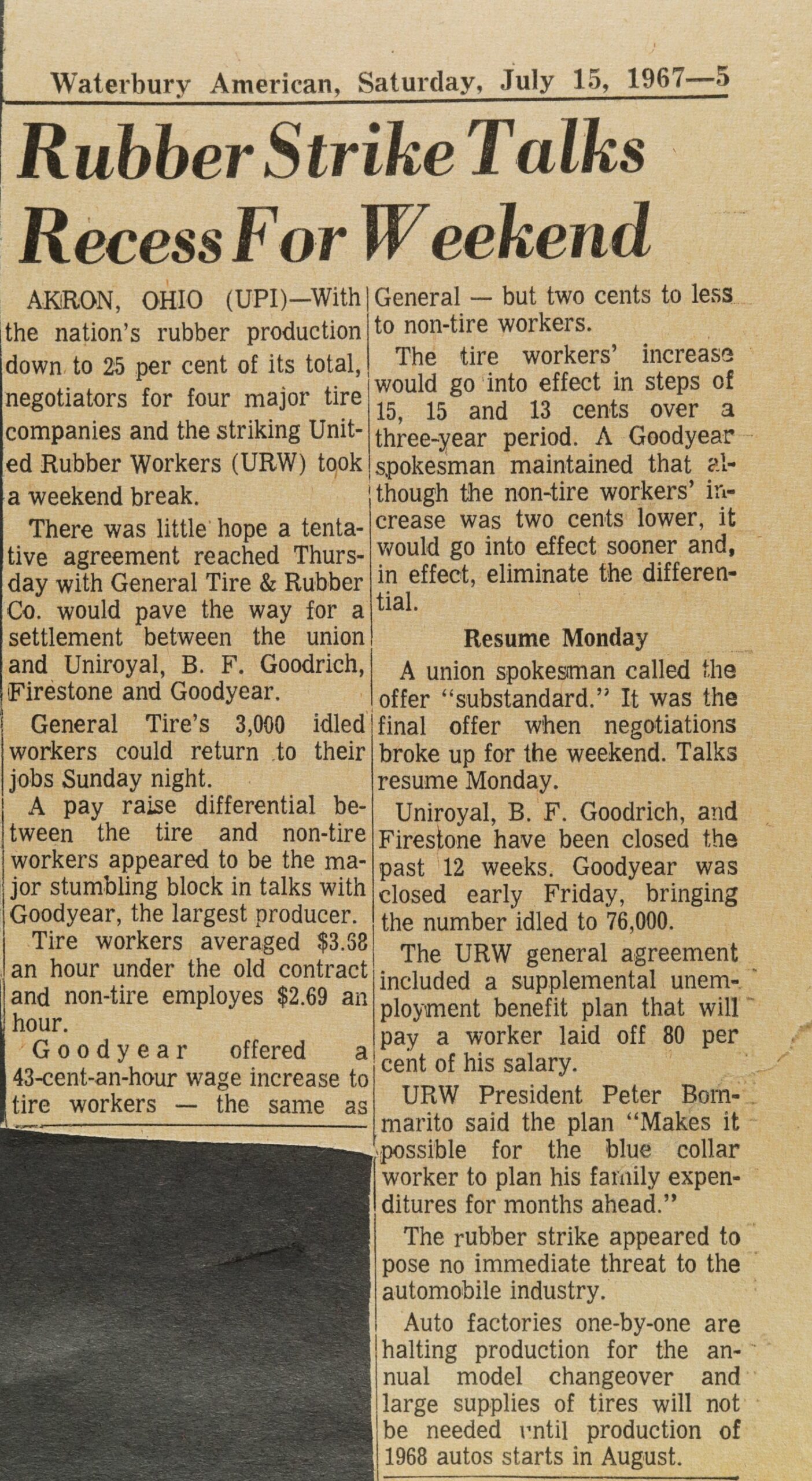
Rubber Strike Talks Recess For Weekend

Waterbury American, Saturday, July 15, 1967—5

Rubber Strike Talks Recess For Weekend

AKRON, OHIO (UPI)—With the nation’s rubber production down to 25 per cent of its total, negotiators for four major tire companies and the striking United Rubber Workers (URW) took a weekend break.

There was little hope a tentative agreement reached Thursday with General Tire & Rubber Co. would pave the way for a settlement between the union and Uniroyal, B. F. Goodrich, Firestone and Goodyear.

General Tire’s 3,000 idled workers could return to their jobs Sunday night.

A pay raise differential between the tire and non-tire workers appeared to be the major stumbling block in talks with Goodyear, the largest producer.

Tire workers averaged $3.58 an hour under the old contract and non-tire employes $2.69 an hour.

Goodyear offered a 43-cent-an-hour wage increase to tire workers — the same as General — but two cents to less to non-tire workers.

The tire workers’ increase would go into effect in steps of 15, 15 and 13 cents over a three-year period. A Goodyear spokesman maintained that although the non-tire workers’ increase was two cents lower, it would go into effect sooner and, in effect, eliminate the differential.

Resume Monday

A union spokesman called the offer “substandard.” It was the final offer when negotiations broke up for the weekend. Talks resume Monday.

Uniroyal, B. F. Goodrich, and Firestone have been closed the past 12 weeks. Goodyear was closed early Friday, bringing the number idled to 76,000.

The URW general agreement included a supplemental unemployment benefit plan that will pay a worker laid off 80 per cent of his salary.

URW President Peter Bommarito said the plan “Makes it possible for the blue collar worker to plan his family expenditures for months ahead.”

The rubber strike appeared to pose no immediate threat to the automobile industry.

Auto factories one-by-one are halting production for the annual model changeover and large supplies of tires will not be needed until production of 1968 autos starts in August.

Federal Officials Enter Talks In Rubber Strike

Federal Officials Enter Talks In Rubber Strike

18—Waterbury Republican, Friday, June 23, 1967

Federal Officials Enter Talks In Rubber Strike

PITTSBURGH, Pa.— Negotiators from five major rubber producers, the United Rubber Workers and federal mediators sat down Thursday to begin talks in one large group Thursday, but a swift end to a 63-day-old strike was not apparent.

Although no one would predict how long the talks in Pittsburgh might last, one could presume they will not end quickly, as progress made on working conditions during separate talks will be subject to renewed discussion on a group level.

Moderating the talks between the United Rubber Workers and the top five rubber producers was director of the Federal Mediation and Counciliation Service, William E. Simkin.

Thursday’s talks, according to sources, were mostly geared to laying the groundwork for further talks, the first of which is slated to begin today at 9 a.m.

This was the first time since 1947 that all five companies and the union talked together at one table. An attempt earlier in this series of negotiations failed when B. F. Goodrich union representatives refused to join a group meeting with the other companies because they did not want to talk a three-year contract.

According to a news source, the five companies, including Uniroyal, met with the union at one table during Thursday’s talks, then adjourned to meet separately.

Although RW officials have stated they would stand by their wage demands, RW President Peter Bommarito has indicated to reliable sources that he may be willing to move on the union’s demand for a supplemental unemployment benefit totaling 95 per cent of the weekly wage.

Bommarito was reportedly pleased to some degree with a recent General Tire offer which granted 80 per cent of the so-called “guaranteed annual wage.”

What displeased the international president of the


Regional Hospital View Cited

HARTFORD (AP) — A regional approach to meet the pressures of future hospital expansion in the face of slim federal support was urged Thursday by Dr. Edwin L. Crosby, executive vice president and director of the American Hospital Association.

Speaking to more than 200 hospital officials at the 49th annual meeting of the Connecticut Hospital Association at the Hartford Club, Dr. Crosby warned that the state’s hospitals cannot remain “voluntary” without freedom from federal control.


160,000-member union was the wage offer from General Tire, which had been upped from the last offer of 40 cents to 43, cents, with raises of 15 cents the first year, 15 the second and 13 the third.

Bommarito reportedly feels this is still too low, and is looking for at least 50 cents.

General Tire’s wage offer, however, is five cents higher than wage offers from the other four companies. An observer said Thursday that if General Tire could raise the wage offer, Bommarito would probably be willing to settle.

All companies are talking three-year contracts with the union, pensions and insurance included. Bommarito said the RW was holding a policy committee meeting in Cleveland Monday to discuss pension plans.

On another angle, spokesmen for the nation’s auto makers said Thursday the strike has created no shortage of tires for new cars. Production of 1967 cars, they said, would be complete without shortages.

One source said Thursday that the only difficulty might be in the area of molded and extruded rubber parts, such as motor mounts and grommets, which the companies do not heavily stock.

The auto industry will shut down in July for the changeover to new models. Spokesmen would make no predictions about what would happen if the rubber strike continues into the model changeover.


Man Held,

An Open Letter

Editorial…. 6-23-67

An Open Letter

To Messrs. Peter Bommarito and George Vila and all others concerned:

As representatives of the union and management, respectively, in the current stalemate involving the rubber industry in the United States, you are the logical ones to whom any missive such as this must be addressed.

It may be that there are others whose attention should be called to what we have to say and which we feel must be said. That we shall leave to your individual judgment.

As this is written, 62 days have passed since some 5,500 employes of UniRoyal in the Naugatuck area laid aside their tools and turned to the picket lines instead. At first, the strike was perhaps regarded by many a something of a lark, a change of pace, a vacation of sorts. We will be willing to gamble there is no one today who regards the strike in any such light. No one.

Today there are all sorts of rumors rampant — that the strike will last at least until after the July 4th holiday; that it will last at least another month; that it will last until after Labor Day.

There are as many reasons for these rumors as there are rumors — perhaps more. And this is inevitable in a situation such as presently exists in Naugatuck — for men’s tempers are on edge and their reason highly susceptible to extraneous and not always logical influences.

It must be obvious to all right now, except those who will not see, that the strike has passed the point of no return, so to speak. No one is going to “win” this strike now. It has gone far beyond that.

The losses in wages and salaries to Naugatuck area people right now cannot possibly be recouped for years, if then, and even if the most favorable terms are granted in the final agreement.

Equally, UniRoyal has jeopardized its image with thousands of customers and lost millions of dollars worth of business to competing companies which have not been strike-bound.

It must be equally obvious to both sides in this dispute that there is a crying need to bring this strike to an end, for humanitarian reasons if for no other. Too many people are being badly hurt in this struggle which has now gone down in history as the longest rubber industry strike in the nation’s history, something of which neither side should be especially proud.

It seems to us that reasonable men of good intentions should be able to reach agreement on such issues as the length of the contract, pension and insurance clauses and working conditions. It should not have taken this long, and there can no longer be any justification for continuing the battle along present lines.

It is hard for the objective viewer of this increasingly difficult situation to believe that there is no room for compromise, no possibility of a meeting of minds.

We believe you gentlemen, more than any other individuals, are in a position to remedy this situation through a willingness to seek an answer rather than adopting an unrelenting stance.

We urge that you do just that, if you share any slight concern for the thousands who presently stand by uncomfortably awaiting a decision that will put them back to work.

Rumors Of Production

6-30-67

Rumors Of Production

Continued From Page 1

the city’s income tax revenues.
The Chamber of Commerce said
retail store sales also dropped
off in May and June and banks
reported a heavy draw on savings.

It also was reported that
many wives of strikers had gone
to work and that strikers themselves were finding jobs.

URW President Peter Bommarito said Thursday that a $1
million check from the United
Auto Workers union to bolster
the URW’s nearly depleted
strike fund would enable the union to “carry out our strike benefit plan indefinitely.”

The union’s strike fund stood
at $6.5 million when the strike
began.

About 50,000 rubber workers
were on strike against Firestone Tire & Rubber Co., B.F.
Goodrich and Uniroyal. The
firms were struck April 20.

Another 4,000 workers were
idled last week when the union
struck two plants of the General Tire & Rubber Co.

Work at the Goodyear Tire &
Rubber Co. continued on a day-
to-day basis.

Peace resumed in Akron
Thursday after mass picketing
incidents the last two days. Local 5 members met with union
officials and Summit County
Prosecutor James Barbuto and
aired a list of grievances that
triggered the picketing. Included was a charge college students were hired to do production work, which was denied.

Rubber Strike Continued From Page 1

Rubber Strike Continued From Page 1

7-5-67

Rubber Strike

Continued From Page 1

the Rubber Workers is interesting aside from his friendship with Peter Bommarito, URW president. The URW begins its new contract negotiations with the auto companies next Monday and Reuther has let it be known that a guaranteed annual wage, a key hurdle in the rubber talks, will be an agreement “must” in the auto bargaining.

Meanwhile, pressure on the companies to resume production is eased by the combination of high tire inventories, an estimated 50 per cent of the industry still at work, auto manufacturers’ switchover to 1968 models coming earlier than usual and the industry’s mutual assistance pact.

Consequently, the companies can be expected to remain firm on the basis of their latest contract offers, which they say rep-

resents additional employment costs in wages, fringe benefits, pensions and insurance of some 70 cents an hour over three years. But URW officials contend the offer, which they claim adds up to about 60 cents an hour, is inadequate.

Locally, the URW Local 45 and the UniRoyal footwear plant is awaiting the decision of Judge Leo V. Gaffney on the request for a restraining injunction to be issued against the Footwear plant. The Judge is expected to make his finding known sometime the latter part of the week.

The Footwear plant seeks to start production on some 45,000 pairs of sample shoes using non-bargaining personnel. The Local is blocking this move, bringing into court an agreement made between plant officials and the Local, April 18.

The Judge must find whether this agreement was in effect at the time the company sought

Negotiations On Strike Settlement Stalemated

Negotiations On Strike Settlement Stalemated

Negotiations On Strike Settlement Stalemated

7-7-67

Negotiation talks continued yesterday in Cincinnati between the United Rubber Workers Union and UniRoyal, Inc. However, sources indicate that negotiations are still stalemated.

Some progress has been noted since the beginning of the sessions, but the wage differential is said to be a barrier against settlement. Also, according to reports, the union’s


The office of the Clerk of Waterbury Superior Court, when contacted by the NEWS this morning, said that a decision from Judge Leo V. Gaffney on the Local 45 suit seeking a restraining injunction against the footwear plant of UniRoyal had not been handed down as yet.

Judge Gaffney had said at the end of the two-day court hearings, that he would reach a decision as soon as possible and hoped for one by today.


insistence of a guaranteed annual income is barring settlement.

According to a statement in a New York financial news-

paper, “Another worry to auto makers is the special interest Walter Reuther is taking in the rubber industry negotiations, where guaranteed annual income is a key unresolved issue. Officials of the United Rubber Workers union have consulted with the UAW on strategy and recently borrowed $1 million from the UAW after their strike fund was depleted.

“There is a strong suspicion in Detroit that Reuther is trying to engineer, by proxy, a breakthrough on guaranteed annual income in the rubber industry and then get an improvement on the rubber pattern from the three auto makers.”

William Simkin, director of the Federal Mediation and Conciliation Service, has issued no recommendation following the three-day talks in Pittsburgh. It appears that the government has bowed out after a brief attempt to mediate.

AKRON, Ohio (UPI) — A statement that the 78-day old strike against the rubber industry could jeopardize future operations of the B. F. Goodrich Co. here brought a sharp retort from the United Rubber Work-

ers Thursday.

URW President Peter Bommarito criticized Goodrich President J. W. Keener for using “the good offices” of Mayor John Ballard to “threaten employes and counter with retaliatory action against the employes” who are exercising their right to strike.

Ballard had offered to assist in mediating the strike and called for round-the-clock bargaining sessions if they were needed to halt the walkout. He got a polite no.

Keener said Goodrich would not shut down its Akron plant, but might be forced to reduce the size of its local operation because of loss of competitive power.

He said the strike had “serious implications for the future of the company’s operations.”

Bommarito said Keener’s statements were “not conducive to a quick or durable settlement” and added the union will accept nothing less “than that to which they are entitled under sound economic logic and social morality.”

Bommarito said the union appreciated Ballard’s offer, but said he could not commit the five URW policy committees to marathon sessions.

“Each policy committee decides its own course of action outside the URW International,” he said.

More than 54,000 rubber workers have been idled by the strike against Firestone Tire & Rubber Co., Goodrich, Uniroyal, Inc., and the General Tire & Rubber Co.

Work at the Goodyear Tire & Rubber Co. has continued on a day to day basis.

The latest General offer, higher than the others, called for

Please turn to Page 10
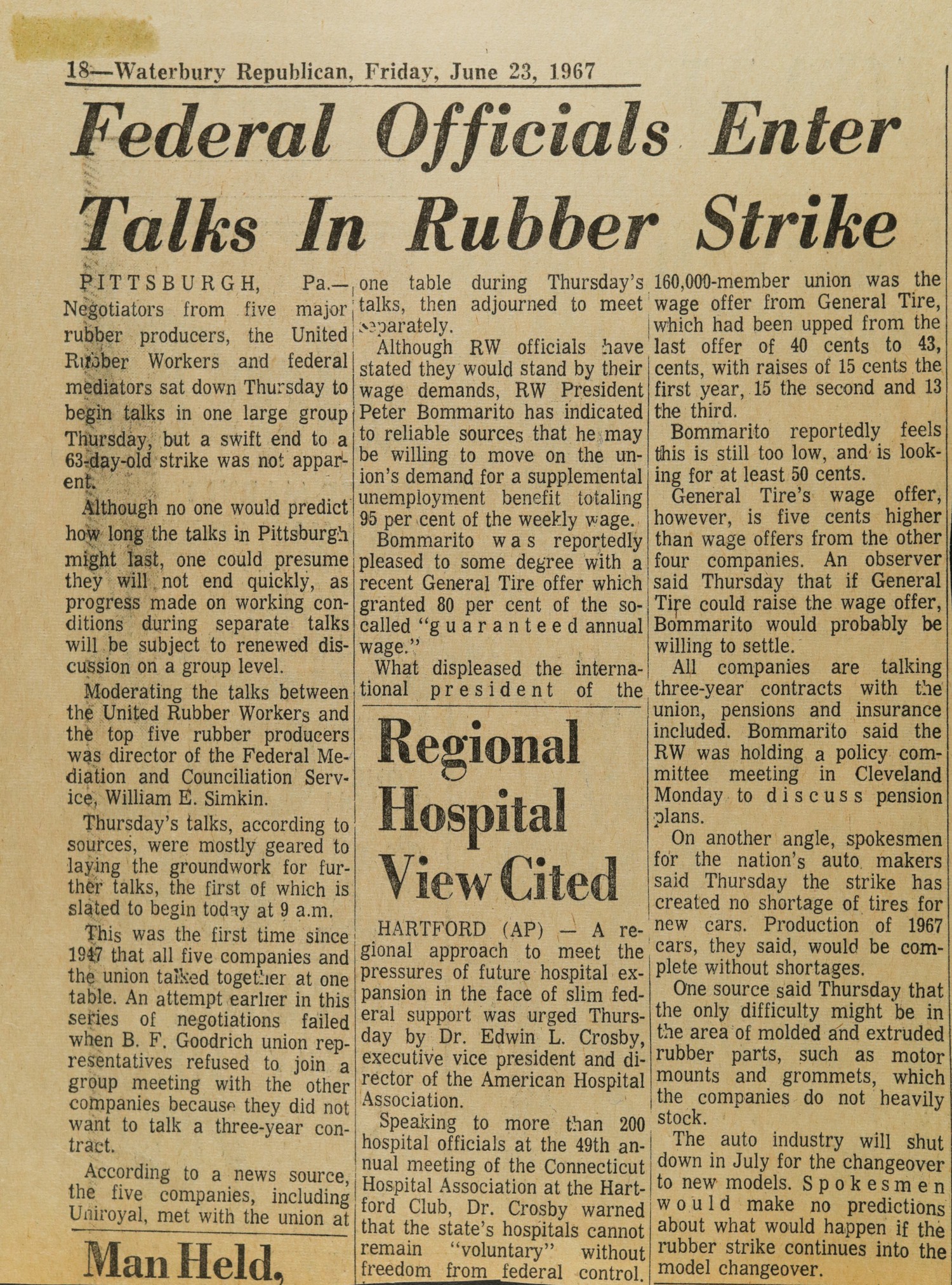

State Refunds $2,885

Long Rubber Strike Seen Test of Labor’s Strength

Long Rubber Strike Seen Test of Labor's Strength

THE WORKER. JULY 11, 1967

Page 3

Long Rubber Strike Seen Test of Labor’s Strength

By PHIL BART

AKRON, O.—This rubber city with some 300,000 population is in the throes of a long drawn out strike that has passed its 80th day. There are 52,000 on strike in 36 cities, about 15,000 of them here. They work in Firestone, Goodrich and Uniroyal whose base is in Detroit.

Two weeks ago the workers in General Tire joined the strike. Goodyear with 21,000 workers, 10,000 of them in Akron continue to work on a day-to-day basis. It is one of the longest strikes in this industry. Its outcome may help influence negotiations in other major industries.

DEMANDS

Among their demands are a general wage increase, wage adjustments for skilled tradesmen and numerous grievances which remain unsolved. The United Rubber Workers Union (URW) opposes an attempt by the companies to institute a wage difrefential between tire production and non-tire plants. The only reason for this is to split the workers in the industry.

Pension matters are being negotiated separately.

Prior to the strike date of April 21 the companies stockpiled large reserves of tires. The big 5 in the industry arranged a mutual assistance pact similar to the one established among the air line corporations. The object is to have a financial kitty to help the struck companies continue to keep their workers out.

URW president, Peter Bommarito, charges that this pact is a “conspiracy” against the strikers. The union has filed unfair labor practice charges against the companies.

PRICE RISE CITED

The United Rubber Worker, union organ, states, that the cost of living since the beginning of 1966 has more than wiped out the 9 cents gain of the past year. Productivity has increased by more than 7 percent a year, according to J. Ward Keener, president of B. F. Goodrich Co. In addition, Mr. Bommarito shows that sales went up from 6 percent to 13 percent while profits jumped from 8.5 percent to 21.8 percent during the past year.

The Goodrich company in a letter to the strikers claimed it was offering them a 73 cents an hour package over three years. The union countered by pointing out this misrepresentation and said that the offer is closer to 60 cents over that period. Previous contracts ran for a period of two years.

COSTLY BURDEN

The union faces considerable financial problems. It is spending $1,500,000 weekly. The strikers were receiving $25 weekly, which has now been reduced to $15. Those with large families supplement their needs with food stamps. The union has received an initial loan of one million dollars from the United Auto Workers Union.

In talking to strikers one immediately recognizes the militancy and unity in their ranks. Some have had to pull in a notch in their belts but it does not show on their faces. There is a grim determination to win. Pickets are stationed at all gates. An injunction has reduced pickets to two at the Goodrich gates. Office and managerial personnel have been going into the plants daily. There is a feeling among the strikers that they are doing work inside. Sentiment is building up to keep them out.

EFFECT ON CITY

Akron is a rubber town. When rubber production stops the whole city feels it.

We talked to a local newspaper editor. Akron has a one percent income tax for capital improvements. He told us that the loss in income is around $14,000 a week. Where will funds come from for city improvements—that he does not know. It will be felt, however, in months ahead. In a conversation with a couple of small businessmen we were told that they already feel the pinch.

For 20 years wage adjustments in the rubber and auto industries have paralleled each other. These relations have become known as the “tandem relationship.” Evidently the rubber barons are trying to break these relations which have been beneficial to workers in both industries.

The effects of the attacks in rubber may be felt in the auto industry. We asked a union official whether he sees a protracted strike. He said it is possible. He added, that there is opinion prevailing here that the auto industry may be pressuring the rubber corporations to hold out longer and thereby influence negotiations in auto.

As the strike continues it serves as a warning signal against renewed anti-labor attacks. Pickets in Akron and 36 other cities are walking the line not only for themselves but for all labor. A growing movement of support to the rubber strikers is essential now. It is the kind of solidarity which helped advance the interests of the whole labor movement in the past and it must do so again.

Federal Intervention Possible In Strike

Federal Intervention Possible In Strike

7-12-67

If Goodyear Workers Strike

Federal Intervention Possible In Strike

The United Rubber Workers Union has notified the Goodyear Tire & Rubber Co., that unless settlement is reached it will strike its plants at 12:01 a.m. Friday.

The 21,000 workers at Goodyear’s 11 plants have continued working on a day-to-day basis since the termination of their contract, April 20.

In the event Goodyear’s plants are closed, there has been some speculation that the government would invoke the Taft-Hartley Act providing for an 80-day “cooling off” period. During this time, presumably all the struck companies would return to work while negotiations continued for contract settlement.

However, one source indicated some doubt the administration would seek an injunction at least immediately, although he conceded a strike at Goodyear would ultimately make a move for an injunction more likely.

In another move to force the issue, the United Rubber Workers called a strike last Saturday against Schenuit Rubber Co. in Baltimore, a smaller concern producing aircraft and industrial tires. This possibility will bring added government pressure for a settlement among the five major concerns because of military aircraft tire requirements.

Schenuit was struck by Local 293 of the union, also in a dispute over a new contract, idling about 400 workers. Schenuit’s aircraft tire production goes entirely to the government and represents about 20 per cent of its aircraft tire requirements, according to industrial sources.

William E. Simkin, director of the U.S. Mediation and Conciliation Service, appeared in Columbus, Ohio Monday to as-

sist in negotiating a contract settlement between B.F. Goodrich and the union. Peter Bommarito, International President

of the union, also went to Columbus from Akron, Monday to join the negotiations.

Please Turn to Page 14


A conciliation service spokesman in Columbus discounted the government’s aircraft tire position as being Simkin’s reason for seeking a Goodrich strike settlement. Rather, he said, he believed Simkin felt “it would be more fruitful to start with Goodrich” in seeking company-by-company settlements among the five major concerns.

Officials of the Schenuit Rubber also were meeting with union bargaining representatives in Baltimore yesterday with mediation service personnel taking part in the talks. The Schenuit contract had expired June 30 but workers continued on their jobs on a day-to-day basis until Saturday.

AKRON, Ohio (UPI) — The United Rubber Workers (URW) plans to shut down the nation’s largest tire producer, Goodyear Tire & Rubber Co., if no contract agreement is reached by Thursday midnight.

A strike against the fifth member of the “big five” tire producers prompted fear of government intervention.

Some 54,000 URW members ready are on strike against our other major rubber companies. Three of them have been closed for the past 82 days the longest strike in industry history.

Kenneth Oldham, a member the union’s Goodyear Policy mmittee, said Tuesday in ncinnati that about 22,000 un members will walk off their ps at 11 Goodyear factories ross the country at midnight ursday, if negotiations, taking ice in a Cincinnati hotel, were successful.


The strike vote was taken by individual URW locals at Goodyear plants.

Negotiations with Goodyear and the B. F. Goodrich Co. intensified.

In both sets of talks, agreement was reported reached on all non money issues.

URW President Peter Bommarito and Chief Federal Mediator William Simkin sat in on the Goodrich negotiations in hopes of reaching a pattern setting agreement that could end the strikes at other companies.

About 51,000 workers have been on strike against Goodrich, Firestone and UniRoyal since April 20, when contracts expired.

Another 3,000 URW members struck two general tire plants June 21.

With Goodyear also struck, about 75 per cent of industry capacity will be idled, and the flow of tires and other materials to the defense industry will be sharply cut.

Major stumbling blocks in all negotiations were wage increases, supplementary unemployment benefits, and pay boost differentials between tire workers and other production workers.

Tire workers average about $3.58 per hour and non-tire workers about $2.69.

The URW Tuesday confirmed reports of another “seven-figure” loan from the United Auto Workers to replenish the URW’s depleted strike funds.

The auto workers previously loaned the striking union $1 million.

Striking Rubber Workers, Five Companies May Agree on a Single Package Contract

Striking Rubber Workers, Five Companies May Agree on a Single Package Contract

Striking Rubber Workers, Five Companies May Agree on a Single Package Contract

By a WALL STREET JOURNAL Staff Reporter

CLEVELAND—Contract negotiations between the United Rubber Workers Union and five major rubber companies may take a long step toward a settlement this week as sentiment appeared to grow for linking pension and welfare improvements into a single package with wages and other benefits.

This would be a departure from previous industry policy of keeping the usual two-year master wage contracts separate from the longer term pension and welfare agreements.

Strikes by the union have closed 39 plants of Firestone Tire & Rubber Co., Uniroyal Inc. and B. F. Goodrich Co. for 45 days. Contracts at those concerns expired April 20, as did those at Goodyear Tire & Rubber Co., whose plants have continued to operate on a day-to-day basis. Plants of General Tire & Rubber Co. also continued to operate since its contract expiration May 15.

Existing three-year pension and welfare agreements with Goodyear, Firestone, Uniroyal and Goodrich also are due to expire on Sept. 15, however, and the time proximity of the two rounds of negotiations has created a hurdle in reaching a wage contract agreement. Company executives, even before wage contract talks started, cited the prospect of facing two boosts in employment costs, plus two strike threats, in a single year.

More recently, with strike benefit funds about depleted by the lengthy work stoppages of some 51,000 employes of the three struck concerns, union officials were said to be becoming less adamant about keeping pension and welfare agreements separate from wage contracts.

While Peter Bommarito, URW international president, said a month ago the union was willing to consider a joint package proposal from the companies it is understood nothing more than exploratory discussions have taken place thus far in negotiations on this score.

At the weekend, however, a URW spkesman said the union would be “wide open to any proposals” from managements for wrapping up the two contracts in a single package. Company spokesmen also reiterated the contention that such a move common in most other industries, is “the most logical and sensible thing to do.”

Whether the resumption of talks, recessed since Thursday, between the union and Firestone, Goodyear, Goodrich and Uniroyal this morning will result in any moves toward a single, overall contract remains to be seen. But the belief of sources close to the negotiations indicated prospects are better than ever before.

One possibly sticky point is whether a single, overall agreement would be for two years or for three. Earlier pension and welfare agreements have been for as much as five years. But both union and company sources noted this could be an issue for negotiation.

Mr. Bommarito earlier disclosed he has called a meeting for June 25 and 27, in Cleveland, of union pension and welfare contract officials. A union spokesman said the meeting still is scheduled, but he indicated this would not necessarily rule out a possibility of negotiating a combined contract before then.

The union’s strike benefit fund, amounting to about $6.5 million at the start of the three-company strike, presumably is exhausted as a result of the prescribed $25 weekly payments to striking members. The union has called on working members for voluntary contributions

equivalent to one hour’s pay a week, but the extent of the response has not been disclosed.

Walter Reuther, president of the United Auto Workers union, has pledged striking rubber workers financial and other assistance in their dispute. But both UAW and URW officials decline to say whether any financial aid has been asked for or given.

Whatever the prospects for gaining an early single contract settlement, the union indicated at the weekend it intends to press its unfair labor practice charge against the five companies for their mutual strike aid pact reached last April 1.

In a complaint filed with the National Labor Relations Board regional office in Cleveland last week against Firestone, the union charged the pact thwarted free collective bargaining and is prolonging the strike against the three companies.

The union spokesman said identical complaints are in the mail to the NLRB against Uniroyal and Goodrich and will be followed today with complaints against Goodyear and General Tire.


[ADVERTISEMENT]

New in New Haven

PARK PLAZA HOTEL

Free in-hotel garage, pool, fine restaurants
CHAPEL SQUARE, NEW HAVEN, CONNECTICUT
For reservations, call collect: (203) 772-1700


Local 45 President To Brief Membership

Local 45 President To Brief Membership

Local 45 President George Froehlich has foregone the negotiating session today in Cincinnati, Ohio to meet with the membership of his union this afternoon at 3 o’clock in the high school auditorium.

Froehlich announced Saturday that he will conduct a briefing session for the membership on the status of the negotiations.

Reportedly the sessions last week broke off Friday in a stalemate. Froehlich said that although he could not paint a bright picture for his people today, he was always hopeful for a settlement.

Froehlich confirmed that one of the main stumbling blocks to settlement is working conditions. However, he said this is only one of the problems being negotiated.

The meeting today is for the membership only, with the public and press reportedly barred.

The record-breaking rubber industry strike is now entering its 60th day. URW Locals voted Saturday to strike General Tire’s Waco, Texas, plant at midnight tonight and its Akron, Ohio, plant at midnight Wednesday. URW workers at these plants had been working without a contract on a day-to-day basis previously.

With this latest URW move, only one of the “big five” rubber companies is maintaining regular production. The Goodyear Tire and Rubber Co. employes are continuing to work on a day-to-day basis.

URW President Peter Bommarito, who describes the union demands as “attainable,” said his men want higher increases and a 95 per cent supplementary plan.

Picketing at the borough plants of UniRoyal has remained quiet and peaceful with striking URW members taking their turn on the picket line as matter of course.

A report from Akron said that 75 URW members have been accepted for Summit County welfare payments. Many others are said to be filling out applications for welfare.

Locally, the Welfare Department reported an increase in

its payments to outside poor; however, Supt. of Welfare Katherine Brennan reported this was

not entirely due to strikers added to the rolls.

Please turn to Page 10
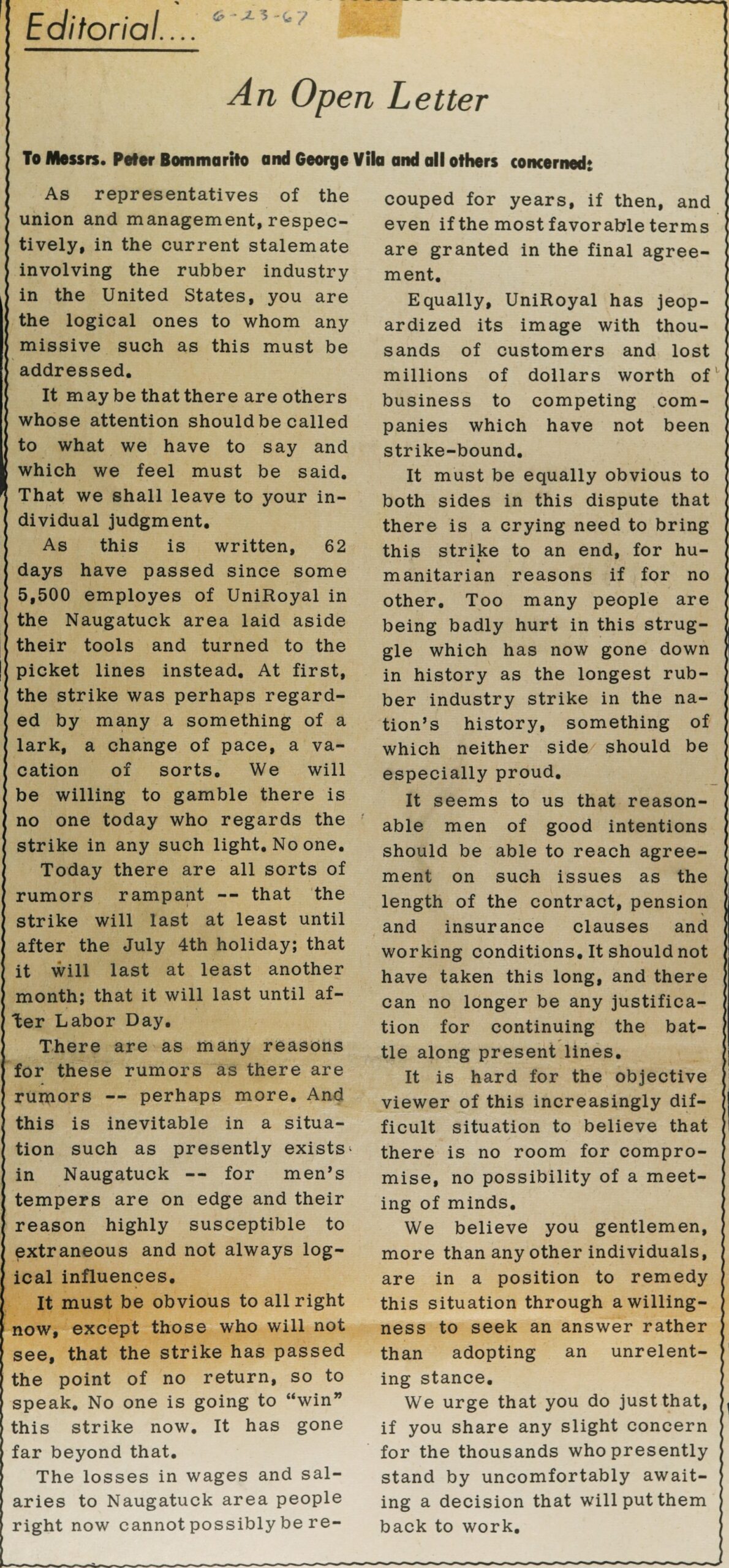

Local 45 President

Continued From Page 1 6-A

The Welfare Department is watching its budget carefully to see whether it will need additional funds to help our URW members.

Long-Range Peace

94-Day UniRoyal Strike Continues

94-Day UniRoyal Strike Continues

7-24-67 [handwritten]

No break has yet been reported in the 94-day United Rubber Workers-UniRoyal strike. According to sources an all-day session was held yesterday in Cincinnati with small committees meeting through the night.

URW International President Peter Bommarito moved into talks Friday between the union and the two remaining rubber companies, UniRoyal and Goodyear.

Hope ran high Friday in the borough that a settlement would be reached sometime during the day. However, another weekend has past and the mood has returned to the passive waiting of previous weeks.

Vacation pay checks are scheduled to be distributed tomorrow and Wednesday to employes of the Footwear Plant. Many workers have planned vacations for the next two weeks, settlement or not. Other employes have been waiting for these checks to give their finances a boost.

Chemical and Synthetic plant workers have been scheduling their vacations at various times during the strike. These plants do not have a general shutdown as does the footwear plant.

AKRON, Ohio (UPI)—United Rubber Worker locals in Akron and Miami, Okla., voted Sunday to accept a new contract from the B. F. Goodrich Co., bringing the 94-day strike, longest in rubber industry history, closer to an end.

The process of ratification continued at Firestone Tire & Rubber Co., and General Tire & Rubber Co. during the weekend. Negotiations with Goodyear Tire & Rubber Co. and UniRoyal Inc., did not arrive at a settlement hoped for during the weekend.

Some 4,000 URW members jammed the auditorium of Akron University to shout approval of the new Goodrich contract. Local 5 here has 4,900 members, almost half of the 11,000 employes covered in the contract.

Voice Vote Approval

In Miami, where the Goodrich employes have been back working since Friday, Local 318 approved the contract by a voice vote. Other votes from other locals around the country were expected today at URW international headquarters here. A majority of locals must ratify the contract before it is officially accepted.

General’s two tire factories, here and in Waco, Tex., were expected back in full production this week, following the vote by Local 318 in Waco to ratify the contract Saturday. All 3,000 URW members in the General Tire factories have approved the contract.

Some 17,000 Firestone employes, in 11 locals in 9 states, were to begin voting on their settlement today.

A majority of the more than 75,000 strikers, however, are still idled. About 22,000 of them have been out since April 20th when UniRoyal was struck. The 21,000 at Goodyear did not strike until July 14.

A Goodyear spokesman declined to make any comment about what was holding up negotiations.

They were taking place in Cincinnati.

Conform To Pattern

The settlements, when they are achieved, were expected to conform closely to the pattern already set.

The three settlements will all provide raises of 43 cents per hour to production workers, in steps of 15, 15 and 13 cents. The contracts will include a supplemental unemployment benefit plan giving laid off workers 80 per cent of their regular wages.

Please turn to Page 10
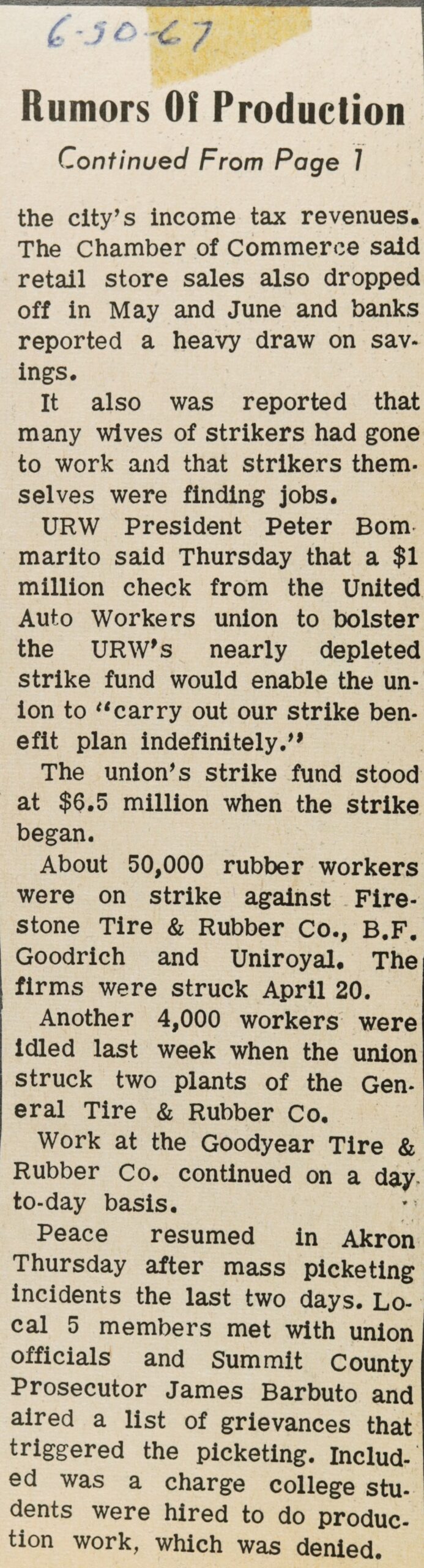
URW Prepared To Continue Strike Another Month

URW Prepared To Continue Strike Another Month

AKRON, OHIO (UPI) — United Rubber Workers President Peter Bommarito, said today that the United Rubber Workers had rejected an offer by the nation’s five leading rubber producers and that the URW was prepared to continue the strike for another month.

The URW had been offered a 38 cent per hour wage increase, an increase in pension, unemployment and welfare benefits.

Bommarito did not indicate what it would take for a settlement.

Strikers in the borough, out of work for 49-days, had their hopes of a settlement dashed with the announcement of the rejection today. The rejection coupled with the announcement of a cut in union weekly benefits from $25 to $15 was a bitter pill to swallow.

According to a letter received by UniRoyal employes today, the union rejected the proposal late Tuesday afternoon.

The UniRoyal letter received in today’s mail by employes, listing the companies offer in full is as follows:

June 8, 1967

Dear Fellow Employee:

The Company and Union negotiating committees have been meeting in Cincinnati since March 21 in an effort to negotiate a contract and wage agreement. The Union presented demands to the Company which would cost at least $1.40 per hour, as well as seriously impair its ability to operate its plants on a competitive basis. The Union presented a portion of these demands on April 12, but did not present its full proposal until 11 a.m. on April 19-just 37 hours before the strike deadline.
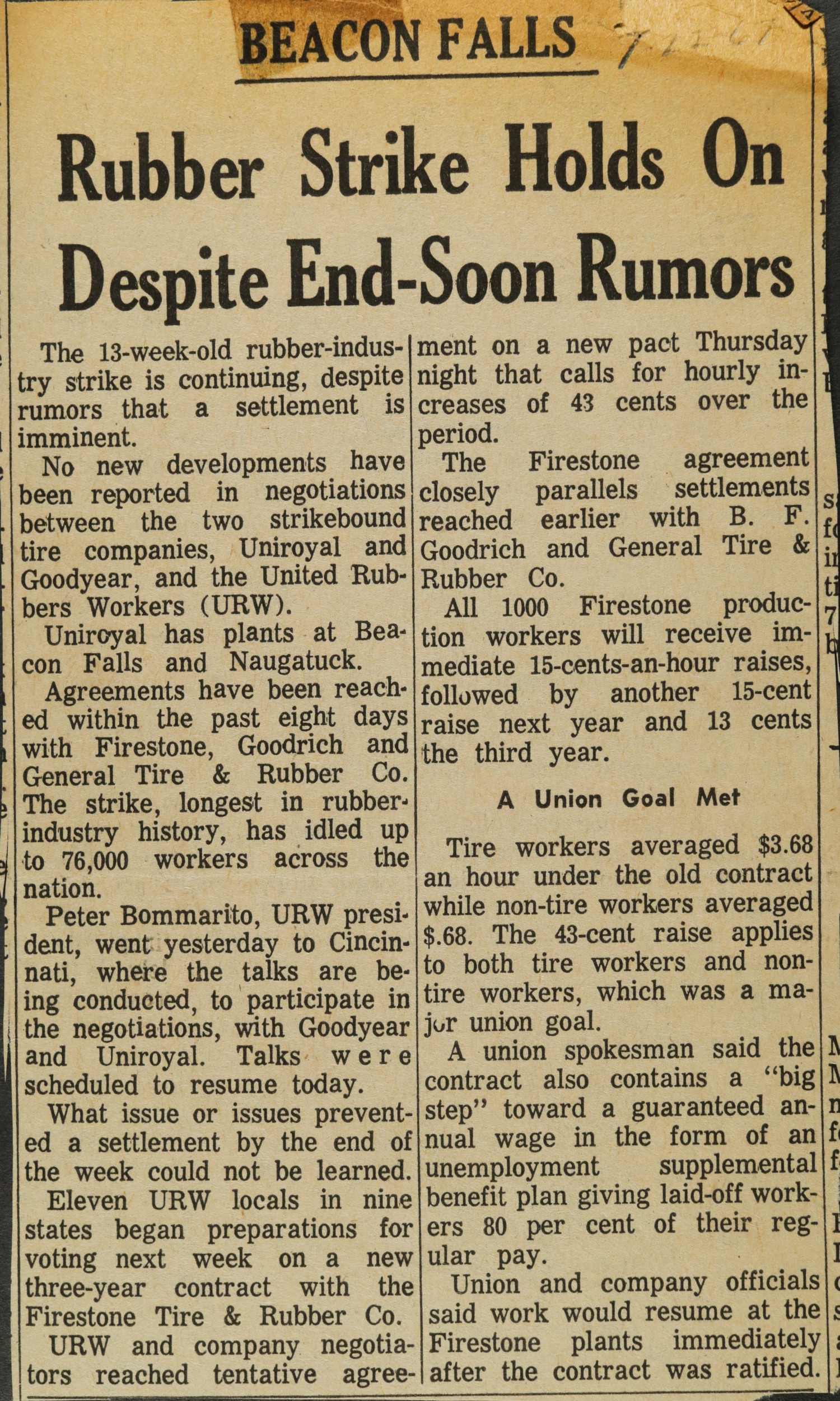
Prior to the strike deadline, the Company offered the Union a proposal on wages and benefits which was worth approximately 26 cents an hour. This was greater than the total settlement in 1965. The Company also offered to continue negotiations on a day-to-day basis in order to reach an agreement. The Union rejected this proposal. Two of the unions in the major rubber companies did agree to continue negotiations on this basis and their employees are still working. Your Union made no change in its position prior to the strike deadline.

Meanwhile, the Union criticized the Company’s proposal by stating that it amounted to only about a 2 1/2% increase, whereas other industries have made settlements amounting to about 5%. The Company pointed out to the Union that the 5% settlements to which they referred covered not only wage and contract matters but also pension and insurance benefits and that they afforded these industries a high degree of stability since they were generally for a three year period.

The Company told the union repeatedly that it could not increase its offer because it was faced with a large cost exposure when the pension and insurance agreement is opened for negotiation later this summer. Because this unknown factor acted as an obstacle to successfully concluding negotiations, an effort was made by the Company to open the pension and insurance negotiations now and attempts to negotiate all matters to a conclusion. This, of course, would provide improvements in pensions and insurance several months earlier in the year. This offer was made with full recognition that neither the Company nor the Union could insist that the other party negotiate on pensions and insurance at this time as a condition to settlement, but it was felt that this was a fair and reasonable method of resolving the problem.

In order that you may properly evaluate the situation, we felt you should know what the Company has offered. Following are the principal points in the proposal made to the Union on June 5, 1967:

  1. Wages – In tire plants, an increase of 16¢ per hour in 1967, 11¢ per hour in 1968 and 11¢ per hour in 1969. In non-tire plants, an increase of 13¢ per hour in 1967, 9¢ per hour in 1968 and 9¢ per hour in 1969. This would provide wage increases of 38¢ and 31¢ an hour respectively in a span of 24 months. The reason for the difference between tire and non-tire increases is that our competitors in the non-tire segment of our business do not pay the same high wages and benefits and do not provide the same increases as UniRoyal does. This has resulted in a severe economic squeeze in our non-tire plants.
  2. Skilled Trades – A 10¢ an hour increase in addition to the above increases, in the year 1967.
  3. Liberalized Vacation Pay – Two weeks vacation pay for employees with one year of seniority and 3 weeks of vacation pay for employees with 5 years of seniority (the present provisions of 4 weeks vacation pay after 15 years seniority and 5 weeks vacation pay after 25 years seniority would continue).

Please Turn to Page 12

Rubber Strike Holds On Despite End-Soon Rumors

Rubber Strike Holds On Despite End-Soon Rumors

BEACON FALLS

7/12/67 [handwritten date in top right corner]

Rubber Strike Holds On Despite End-Soon Rumors

The 13-week-old rubber-industry strike is continuing, despite rumors that a settlement is imminent.

No new developments have been reported in negotiations between the two strikebound tire companies, Uniroyal and Goodyear, and the United Rubbers Workers (URW).

Uniroyal has plants at Beacon Falls and Naugatuck.

Agreements have been reached within the past eight days with Firestone, Goodrich and General Tire & Rubber Co. The strike, longest in rubber-industry history, has idled up to 76,000 workers across the nation.

Peter Bommarito, URW president, went yesterday to Cincinnati, where the talks are being conducted, to participate in the negotiations, with Goodyear and Uniroyal. Talks were scheduled to resume today.

What issue or issues prevented a settlement by the end of the week could not be learned.

Eleven URW locals in nine states began preparations for voting next week on a new three-year contract with the Firestone Tire & Rubber Co.

URW and company negotiators reached tentative agreement on a new pact Thursday night that calls for hourly increases of 43 cents over the period.

The Firestone agreement closely parallels settlements reached earlier with B. F. Goodrich and General Tire & Rubber Co.

All 1000 Firestone production workers will receive immediate 15-cents-an-hour raises, followed by another 15-cent raise next year and 13 cents the third year.

A Union Goal Met

Tire workers averaged $3.68 an hour under the old contract while non-tire workers averaged $.68. The 43-cent raise applies to both tire workers and non-tire workers, which was a major union goal.

A union spokesman said the contract also contains a “big step” toward a guaranteed annual wage in the form of an unemployment supplemental benefit plan giving laid-off workers 80 per cent of their regular pay.

Union and company officials said work would resume at the Firestone plants immediately after the contract was ratified.

Rubber Firms Offer Rejected By Union

Rubber Firms Offer Rejected By Union

6-10-67 (handwritten)

NAUGATUCK—United Rubber Workers negotiators Friday rejected a new three-year contract proposal offered by the five major rubber producers, including Uniroyal.

This is apparently the second time during the week that the union has rejected company proposals.

URW Pres. Peter Bommarito termed Friday’s offer “inadequate” and said the union would continue its strike against Uniroyal, B. F. Goodrich and Firestone.

A statement appearing in a local newspaper Friday, attributed to Bommarito, said that the union was prepared to strike another 30 days.

While many of the striking United Rubber Workers in the borough expressed dismay about the possibility that they would have to continue the strike that much longer, Local 45 officials expressed reservations about whether Bommarito had said this.

One official, contacted Friday night, said that an attempt to check out the statement brought no results and it could not be determined whether Bommarito had made the remark.

A letter sent to Footwear Plant workers Thursday by Factory Manager John Smith stated that the union had rejected a three-year proposal Tuesday. Upon rejecting the proposal, said Smith, the union presented a counter proposal.

Management then apparently made a second proposal which, according to press services, was rejected during Friday’s session.

Talks between the URW and the rubber companies recessed until Monday.

In his letter to Footwear employes, Smith stated that the three-year proposal by the company offered wage increases, additional pay for skilled workers, liberalized vacation pay, supplemental unemployment benefits up to 75 per cent of average pay, a 60 per cent increase in regular pensions, an increase in company-paid life insurance, an increase in the coverage for the maximum stay in the hospital from 365 to 730 days, an increase in sickness and accident benefits and other items.

Wage increases in the tire plants, said Smith, amounted to 38 cents over three years, and in non-tire plants they amounted to 31 cents. The management also offered two weeks vacation pay for employes with one year of seniority and three weeks for employes with five years.

Miscellaneous contract clauses, he added, included “up to 40 hours pay depending on the size of the plant for union time study men.”

Regular pensions were increase a 60 per cent from $3.25 to $5.25 per month per year of service, said Smith.

These increases, said Smith “total about 70 cents per hour over a three-year period. This is approximately a five per cent yearly increase in wages and benefits for employes over the entire three years,” added the manager.

A Uniroyal spokesman said Friday the UFW’s demands would cost “at least $1.40 an hour.”

The union estimated that General Tire and Rubber Co.’s offer, which includes wage increases averaging 40 cents an hour over three years, will cost the company 63 or 64 cents an hour.

The companies Friday valued their offers at more than 70 cents an hour.

GOODRICH

GOODRICH 7-16-67

(Continued from Page 1)
hikes proposed for the workers
probably will mean a substan-
tial price increase in Goodrich
products.

URW President Peter Bom-
marito said the Goodrich pact
“gives the blue collar worker a
status which we set out to
achieve.” He called parts of the
proposed contract “historic.”

The tentative agreement calls
for a 33-month contract running
until April 20, 1970. It would
give all the 12,000 Goodrich
workers at least a 43-cent hour-
ly increase with skilled em-
ployes getting a 53-cent in-
crease.

The current top scale at Good-
rich is $3.88.

Keener said, “This increase is
well in excess of anticipated
productivity gains per worker.
It is certain that B.F. Goodrich
cannot absorb these increased
costs without substantial and
effective price increases over a
broad range of our product
line.”

Bommarito said the Goodrich
agreement was another step
toward ending the longest strike
in the industry’s history, involv-
ing the nation’s top five produc-
ers. General Tire & Rubber Co.
reached a tentative agreement
earlier this week.

Negotiations are continuing
with Goodyear Tire & Rubber
Co., Firestone Tire & Rubber
Co. and Uniroyal, but were re-
cessed for the weekend.

Nearly 75,000 workers have
been involved in the strike
against the “big five.” The un-
ion struck Goodrich, Uniroyal
and Firestone on April 21.

General Tire was struck by its
3,050 employes June 22, and 21,-
000 workers of Goodyear, the
nation’s top rubber producer,
walked out at midnight Thurs-
day.

Spokesmen said there has not
been a shortage of tires and
rubber products during the
strike as the companies had
large stockpiles before it start-
ed.