CHEM-TEXTS – 1976-v10-s245

Page 245

Page 2 | CHEM-TEXTS | Vol. 10, 1976


Looking Back…

Looking Ahead…

The end is near for 1976 and it is a time for looking backwards and reviewing where we’ve been as well as looking ahead anticipating a brand new year—and fresh start.

For the Naugatuck plant, 1976 was a year of excitement, turmoil, sadness and progress. There was, for many, the sadness of seeing the Reclaim plant being torn down. It represented a symbol of Naugatuck Chemical and was where many people gave a better part of their lives. There was also sadness, as we saw many of our friends leave, through retirement, and although we wish them well we will miss them. Certainly the strike, the longest in the history of Uniroyal Chemical, caused more excitement and 1976 will unfortunately be remembered by most of us for this more than anything else.

But progress was evident too, the new F.O.C. building was being completed and we look toward the start-up with excitement and anticipation.

This is also a time in the year when all of us find that the pace slows a little and we find that we remember the pleasant things of our lives and draw our families and friends closer to us.

So I would like to extend to all of you at Naugatuck Chemical my personal and warmest wishes for a Merry Christmas and a Happy New Year.


Plant Doctor Named

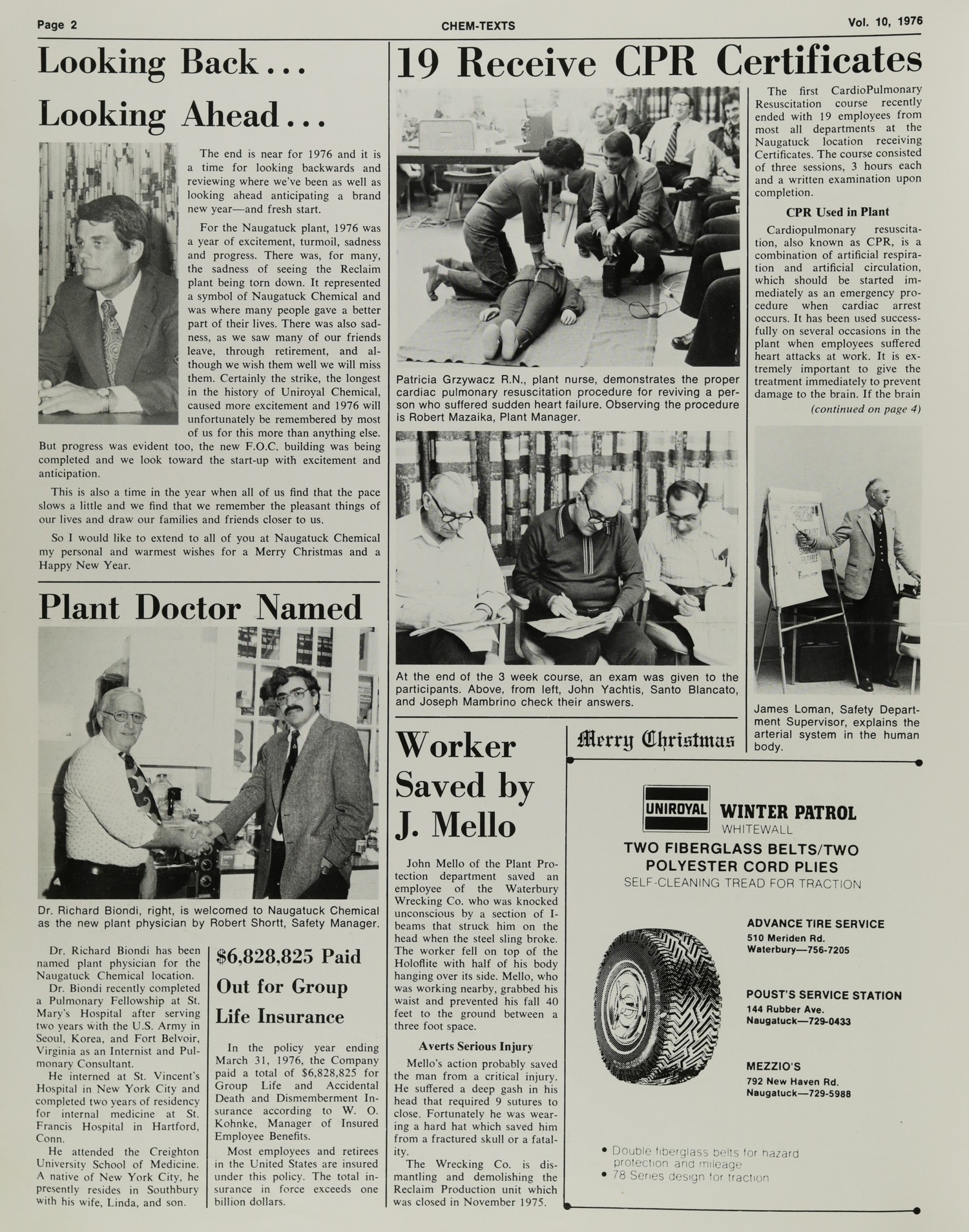
Dr. Richard Biondi, right, is welcomed to Naugatuck Chemical as the new plant physician by Robert Shortt, Safety Manager.

Dr. Richard Biondi has been named plant physician for the Naugatuck Chemical location. Dr. Biondi recently completed a Pulmonary Fellowship at St. Mary’s Hospital after serving two years with the U.S. Army in Seoul, Korea, and Fort Belvoir, Virginia as an Internist and Pulmonary Consultant.

He interned at St. Vincent’s Hospital in New York City and completed two years of residency for internal medicine at St. Francis Hospital in Hartford, Conn.

He attended the Creighton University School of Medicine. A native of New York City, he presently resides in Southbury with his wife, Linda, and son.


$6,828,825 Paid Out for Group Life Insurance

In the policy year ending March 31, 1976, the Company paid a total of $6,828,825 for Group Life and Accidental Death and Dismemberment Insurance according to W. O. Kohnke, Manager of Insured Employee Benefits.

Most employees and retirees in the United States are insured under this policy. The total insurance in force exceeds one billion dollars.


19 Receive CPR Certificates

The first CardioPulmonary Resuscitation course recently ended with 19 employees from most all departments at the Naugatuck location receiving Certificates. The course consisted of three sessions, 3 hours each and a written examination upon completion.

CPR Used in Plant

Cardiopulmonary resuscitation, also known as CPR, is a combination of artificial respiration and artificial circulation, which should be started immediately as an emergency procedure when cardiac arrest occurs. It has been used successfully on several occasions in the plant when employees suffered heart attacks at work. It is extremely important to give the treatment immediately to prevent damage to the brain. If the brain

(continued on page 4)

Patricia Grzywacz R.N., plant nurse, demonstrates the proper cardiac pulmonary resuscitation procedure for reviving a person who suffered sudden heart failure. Observing the procedure is Robert Mazaika, Plant Manager.

At the end of the 3 week course, an exam was given to the participants. Above, from left, John Yachtis, Santo Blancato, and Joseph Mambrino check their answers.

James Loman, Safety Department Supervisor, explains the arterial system in the human body.


Worker Saved by J. Mello

John Mello of the Plant Protection department saved an employee of the Waterbury Wrecking Co. who was knocked unconscious by a section of I-beams that struck him on the head when the steel sling broke. The worker fell on top of the Holoflite with half of his body hanging over its side. Mello, who was working nearby, grabbed his waist and prevented his fall 40 feet to the ground between a three foot space.

Averts Serious Injury

Mello’s action probably saved the man from a critical injury. He suffered a deep gash in his head that required 9 sutures to close. Fortunately he was wearing a hard hat which saved him from a fractured skull or a fatality.

The Wrecking Co. is dismantling and demolishing the Reclaim Production unit which was closed in November 1975.


Merry Christmas


UNIROYAL WINTER PATROL
WHITEWALL

TWO FIBERGLASS BELTS/TWO POLYESTER CORD PLIES
SELF-CLEANING TREAD FOR TRACTION

ADVANCE TIRE SERVICE
510 Meriden Rd.
Waterbury—756-7205

POUST’S SERVICE STATION
144 Rubber Ave.
Naugatuck—729-0433

MEZZIO’S
792 New Haven Rd.
Naugatuck—729-5988

• Double fiberglass belts for hazard protection and mileage
• 78 Series design for traction
CHEM-TEXTS – 1975 – Page 2

Page 002

CHEM-TEXTS

Page 2 | Vol. 9, 1975


In my last editorial I ventured into the field of politics. This area is so vital that I felt a few more ideas had to be discussed. The current confusion in Washington and the recent wild legislation session in Hartford are prime examples of the type of disturbing political action confronting us Americans today.

I read in the newspapers all the criticisms by well known columnists and editors lamenting the poor actions and leadership of our elected legislative officials. They ask our officials to change their ways and to recognize the real problems of the people, their jobs, their community problems, their financial problems, etc. etc.

I find this effort misdirected. Appealing to elected politicians hardly ever changes their minds. Their philosophy of life has been long in developing and most are strong-minded people, not easily swayed from their convictions. The way to change the political direction of a legislative body is to change the legislators. Vote out the ones that are undersirable and vote in those who reflect the feeling and mood of the electorate.

Although voting occurs only every two years, people’s thoughts should be on this subject all the time, not just one week before elections. For example, a review of how our representatives voted recently in Hartford should be done now to help form an opinion while the facts are clear.

The makeup of the last two Connecticut Legislatures is another problem that voters must avoid in the future. We now have in Hartford an overwhelming Democratic majority. Two years ago there was an overwhelming Republican majority. This is no way to run a government, for with such a onesided majority, we don’t have a democracy—which is a balance of two or more opinions— we have instead what approaches dictatorial power of the party in the majority. Such a situation can do nothing but harm. A balance is essential to stable and honest government.

No one can rectify a situation like this except we voters. This means less emotional voting and more thinking, both inside and outside the voting machine.

J. A. Cronin

Jim Cronin [signature]

[PHOTO: Headshot of a man in suit]


Steel Work Starts on FOC Bldg.

[PHOTO: Construction site showing steel framework of a building]

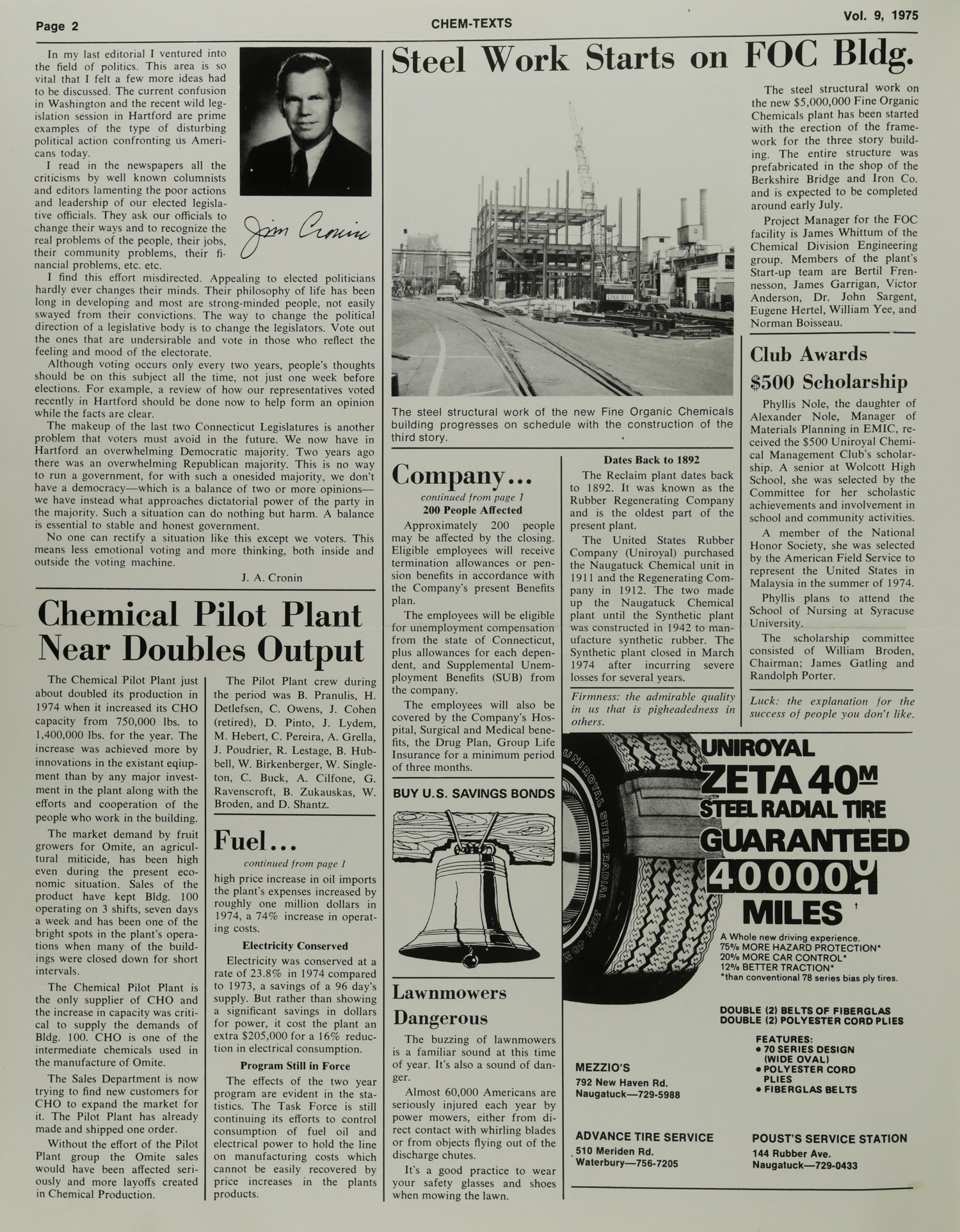
The steel structural work on the new $5,000,000 Fine Organic Chemicals plant has been started with the erection of the framework for the three story building. The entire structure was prefabricated in the shop of the Berkshire Bridge and Iron Co. and is expected to be completed around early July.

Project Manager for the FOC facility is James Whittum of the Chemical Division Engineering group. Members of the plant’s Start-up team are Bertil Frennesson, James Garrigan, Victor Anderson, Dr. John Sargent, Eugene Hertel, William Yee, and Norman Boisseau.

The steel structural work of the new Fine Organic Chemicals building progresses on schedule with the construction of the third story.


Chemical Pilot Plant Near Doubles Output

The Chemical Pilot Plant just about doubled its production in 1974 when it increased its CHO capacity from 750,000 lbs. to 1,400,000 lbs. for the year. The increase was achieved more by innovations in the existant equipment than by any major investment in the plant along with the efforts and cooperation of the people who work in the building.

The market demand by fruit growers for Omite, an agricultural miticide, has been high even during the present economic situation. Sales of the product have kept Bldg. 100 operating on 3 shifts, seven days a week and has been one of the bright spots in the plant’s operations when many of the buildings were closed down for short intervals.

The Chemical Pilot Plant is the only supplier of CHO and the increase in capacity was critical to supply the demands of Bldg. 100. CHO is one of the intermediate chemicals used in the manufacture of Omite.

The Sales Department is now trying to find new customers for CHO to expand the market for it. The Pilot Plant has already made and shipped one order.

Without the effort of the Pilot Plant group the Omite sales would have been affected seriously and more layoffs created in Chemical Production.

The Pilot Plant crew during the period was B. Pranulis, H. Detlefsen, C. Owens, J. Cohen (retired), D. Pinto, J. Lydem, M. Hebert, C. Pereira, A. Grella, J. Poudrier, R. Lestage, B. Hubbell, W. Birkenberger, W. Singleton, C. Buck, A. Cilfone, G. Ravenscroft, B. Zukauskas, W. Broden, and D. Shantz.


Company…

continued from page 1

200 People Affected

Approximately 200 people may be affected by the closing. Eligible employees will receive termination allowances or pension benefits in accordance with the Company’s present Benefits plan.

The employees will be eligible for unemployment compensation from the state of Connecticut, plus allowances for each dependent, and Supplemental Unemployment Benefits (SUB) from the company.

The employees will also be covered by the Company’s Hospital, Surgical and Medical benefits, the Drug Plan, Group Life Insurance for a minimum period of three months.

BUY U.S. SAVINGS BONDS


Dates Back to 1892

The Reclaim plant dates back to 1892. It was known as the Rubber Regenerating Company and is the oldest part of the present plant.

The United States Rubber Company (Uniroyal) purchased the Naugatuck Chemical unit in 1911 and the Regenerating Company in 1912. The two made up the Naugatuck Chemical plant until the Synthetic plant was constructed in 1942 to manufacture synthetic rubber. The Synthetic plant closed in March 1974 after incurring severe losses for several years.

Firmness: the admirable quality in us that is pigheadedness in others.


Fuel…

continued from page 1

high price increase in oil imports the plant’s expenses increased by roughly one million dollars in 1974, a 74% increase in operating costs.

Electricity Conserved

Electricity was conserved at a rate of 23.8% in 1974 compared to 1973, a savings of a 96 day’s supply. But rather than showing a significant savings in dollars for power, it cost the plant an extra $205,000 for a 16% reduction in electrical consumption.

Program Still in Force

The effects of the two year program are evident in the statistics. The Task Force is still continuing its efforts to control consumption of fuel oil and electrical power to hold the line on manufacturing costs which cannot be easily recovered by price increases in the plants products.


Club Awards $500 Scholarship

Phyllis Nole, the daughter of Alexander Nole, Manager of Materials Planning in EMIC, received the $500 Uniroyal Chemical Management Club’s scholarship. A senior at Wolcott High School, she was selected by the Committee for her scholastic achievements and involvement in school and community activities.

A member of the National Honor Society, she was selected by the American Field Service to represent the United States in Malaysia in the summer of 1974.

Phyllis plans to attend the School of Nursing at Syracuse University.

The scholarship committee consisted of William Broden, Chairman; James Gatling and Randolph Porter.

Luck: the explanation for the success of people you don’t like.


Lawnmowers Dangerous

[IMAGE: Drawing of a Liberty Bell]

The buzzing of lawnmowers is a familiar sound at this time of year. It’s also a sound of danger.

Almost 60,000 Americans are seriously injured each year by power mowers, either from direct contact with whirling blades or from objects flying out of the discharge chutes.

It’s a good practice to wear your safety glasses and shoes when mowing the lawn.


MEZZIO’S
792 New Haven Rd.
Naugatuck—729-5988

ADVANCE TIRE SERVICE
510 Meriden Rd.
Waterbury—756-7205

POUST’S SERVICE STATION
144 Rubber Ave.
Naugatuck—729-0433


[ADVERTISEMENT]

UNIROYAL

ZETA 40M

STEEL RADIAL TIRE

GUARANTEED

40000

MILES

A Whole new driving experience.
75% MORE HAZARD PROTECTION
20% MORE CAR CONTROL

12% BETTER TRACTION
than conventional 78 series bias ply tires.

DOUBLE (2) BELTS OF FIBERGLAS
DOUBLE (2) POLYESTER CORD PLIES

FEATURES:
– 70 SERIES DESIGN (WIDE OVAL)
– POLYESTER CORD PLIES
– FIBERGLAS BELTS

CHEM-TEXTS – 1975 – Page 3

Page 003

CHEM-TEXTS

Vol. 10, 1975 | Page 3


Division Closes 3 Plants

Final plans have been made to close three Chemical Division plants: the Reclaim Rubber plant at Naugatuck; the Paracril® nitrile rubber plant in Baton Rouge, La.; and the Marvinol® polyvinyl chloride plant in Painesville, Ohio.

The Division closed the Synthetic rubber plant at the Naugatuck location in November, 1973.

500 Employees Affected

The closings will affect over 500 employees at the three plants. Eligible personnel will receive pension benefits or termination allowances based on their years of service with the company.

Reclaim Plant

The Reclaim plant dates back to 1892 and is one of the oldest units at the Naugatuck location. For the past five years it has operated under severe economic conditions and even after intensive efforts on the part of the union and management were made to operate it competitively, it became necessary to close it.

Painesville Closing

The large capital expenditures necessary to remain in the polyvinyl chloride resin business and to meet the OSHA standards on employee exposure to vinyl chloride were the principal reasons for the division to close the PVC operations at Painesville. The plans do not affect the


1,000,000 Hit Again

[IMAGE: UNIROYAL EMPLOYEE SAFETY RECORD sign showing INJURIES – DISABLING and SERIOUS counts, with “LAST 24” and “DISABLING INJURY” / “OUS INJURY” / “ATIONS” visible, with “100” displayed]

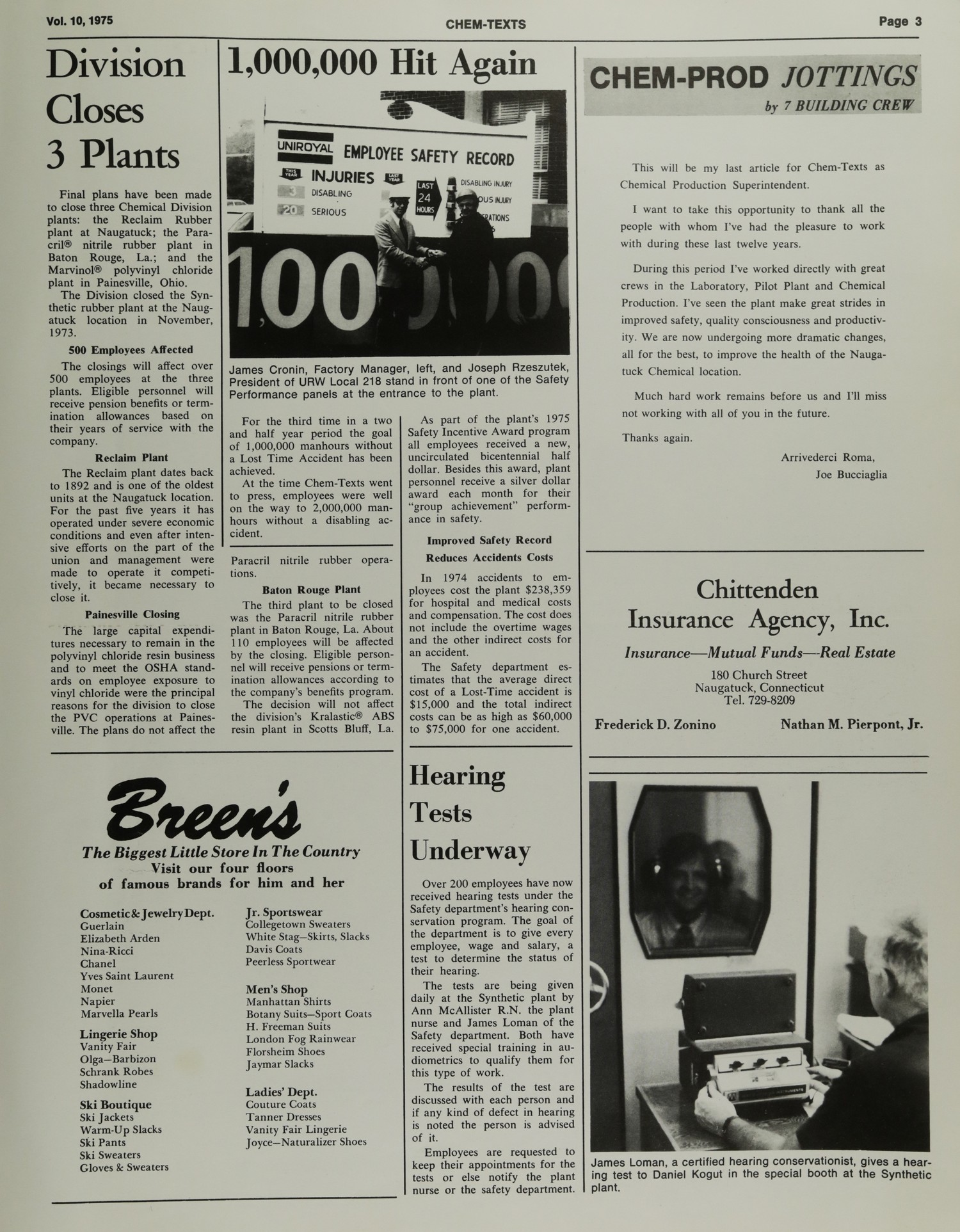
James Cronin, Factory Manager, left, and Joseph Rzeszutek, President of URW Local 218 stand in front of one of the Safety Performance panels at the entrance to the plant.

For the third time in a two and half year period the goal of 1,000,000 manhours without a Lost Time Accident has been achieved.

At the time Chem-Texts went to press, employees were well on the way to 2,000,000 manhours without a disabling accident.

Paracril nitrile rubber operations.

Baton Rouge Plant

The third plant to be closed was the Paracril nitrile rubber plant in Baton Rouge, La. About 110 employees will be affected by the closing. Eligible personnel will receive pensions or termination allowances according to the company’s benefits program.

The decision will not affect the division’s Kralastic® ABS resin plant in Scotts Bluff, La.

As part of the plant’s 1975 Safety Incentive Award program all employees received a new, uncirculated bicentennial half dollar. Besides this award, plant personnel receive a silver dollar award each month for their “group achievement” performance in safety.

Improved Safety Record Reduces Accidents Costs

In 1974 accidents to employees cost the plant $238,359 for hospital and medical costs and compensation. The cost does not include the overtime wages and the other indirect costs for an accident.

The Safety department estimates that the average direct cost of a Lost-Time accident is $15,000 and the total indirect costs can be as high as $60,000 to $75,000 for one accident.


CHEM-PROD JOTTINGS

by 7 BUILDING CREW

This will be my last article for Chem-Texts as Chemical Production Superintendent.

I want to take this opportunity to thank all the people with whom I’ve had the pleasure to work with during these last twelve years.

During this period I’ve worked directly with great crews in the Laboratory, Pilot Plant and Chemical Production. I’ve seen the plant make great strides in improved safety, quality consciousness and productivity. We are now undergoing more dramatic changes, all for the best, to improve the health of the Naugatuck Chemical location.

Much hard work remains before us and I’ll miss not working with all of you in the future.

Thanks again.

Arrivederci Roma,
Joe Bucciaglia


Chittenden Insurance Agency, Inc.

Insurance—Mutual Funds—Real Estate

180 Church Street
Naugatuck, Connecticut
Tel. 729-8209

Frederick D. Zonino | Nathan M. Pierpont, Jr.


Breen’s

The Biggest Little Store In The Country
Visit our four floors of famous brands for him and her

Cosmetic & Jewelry Dept.
Guerlain
Elizabeth Arden
Nina-Ricci
Chanel
Yves Saint Laurent
Monet
Napier
Marvella Pearls

Lingerie Shop
Vanity Fair
Olga—Barbizon
Schrank Robes
Shadowline

Ski Boutique
Ski Jackets
Warm-Up Slacks
Ski Pants
Ski Sweaters
Gloves & Sweaters

Jr. Sportswear
Collegetown Sweaters
White Stag—Skirts, Slacks
Davis Coats
Peerless Sportwear

Men’s Shop
Manhattan Shirts
Botany Suits—Sport Coats
H. Freeman Suits
London Fog Rainwear
Florsheim Shoes
Jaymar Slacks

Ladies’ Dept.
Couture Coats
Tanner Dresses
Vanity Fair Lingerie
Joyce—Naturalizer Shoes


Hearing Tests Underway

Over 200 employees have now received hearing tests under the Safety department’s hearing conservation program. The goal of the department is to give every employee, wage and salary, a test to determine the status of their hearing.

The tests are being given daily at the Synthetic plant by Ann McAllister R.N. the plant nurse and James Loman of the Safety department. Both have received special training in audiometrics to qualify them for this type of work.

The results of the test are discussed with each person and if any kind of defect in hearing is noted the person is advised of it.

Employees are requested to keep their appointments for the tests or else notify the plant nurse or the safety department.

[IMAGE: Photo of hearing test being administered]

James Loman, a certified hearing conservationist, gives a hearing test to Daniel Kogut in the special booth at the Synthetic plant.

Synthetic Rubber Plant To Close

UNIROYAL CHEM-TEXTS

Vol. 7, 1973 | PUBLISHED FOR THE PEOPLE OF UNIROYAL CHEMICAL | No. 5


Synthetic Rubber Plant To Close


Top UG Goal With $22,010

Third Successive Year

Uniroyal Chemical people again topped the United Fund goal. This year’s goal was $21,000. Pledges and contributions amounted to $22,010.

944 employees—or 65% of the people at the Naugatuck location—participated in the annual drive to raise funds for the work of the 16 charitable and social organizations in the Fund.

4 Departments Exceed Goals

Four departments — Reclaim Production, Chemical Engineering and Mechanical, Research & Development and EMIC exceeded their goals with EMIC going over its goal by $1146.

Research and Development

(Cont’d on page 4)


[CENTER IMAGE CAPTION:]
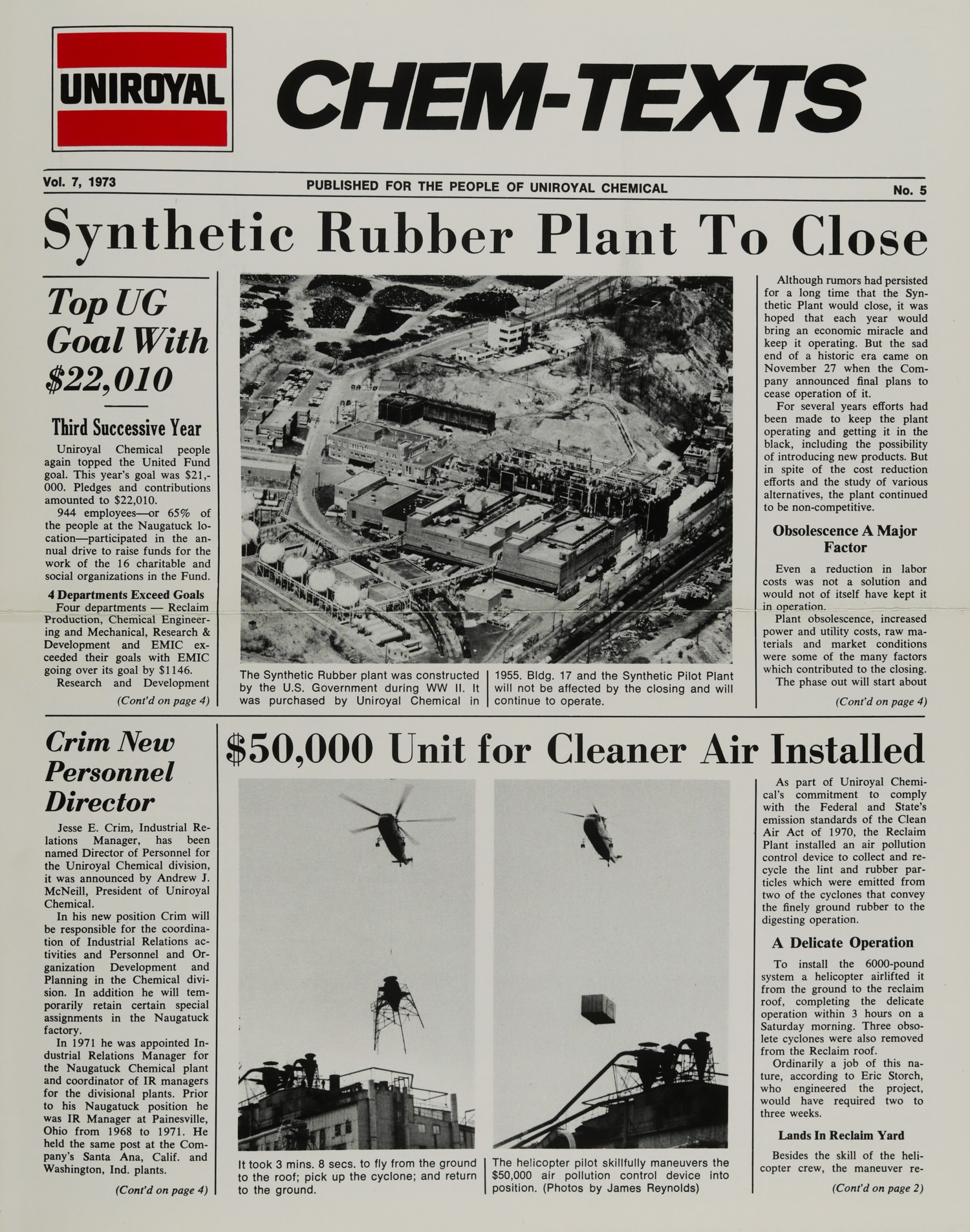
The Synthetic Rubber plant was constructed by the U.S. Government during WW II. It was purchased by Uniroyal Chemical in 1955. Bldg. 17 and the Synthetic Pilot Plant will not be affected by the closing and will continue to operate.


Although rumors had persisted for a long time that the Synthetic Plant would close, it was hoped that each year would bring an economic miracle and keep it operating. But the sad end of a historic era came on November 27 when the Company announced final plans to cease operation of it.

For several years efforts had been made to keep the plant operating and getting it in the black, including the possibility of introducing new products. But in spite of the cost reduction efforts and the study of various alternatives, the plant continued to be non-competitive.

Obsolescence A Major Factor

Even a reduction in labor costs was not a solution and would not of itself have kept it in operation.

Plant obsolescence, increased power and utility costs, raw materials and market conditions were some of the many factors which contributed to the closing.

The phase out will start about

(Cont’d on page 4)


Crim New Personnel Director

Jesse E. Crim, Industrial Relations Manager, has been named Director of Personnel for the Uniroyal Chemical division, it was announced by Andrew J. McNeill, President of Uniroyal Chemical.

In his new position Crim will be responsible for the coordination of Industrial Relations activities and Personnel and Organization Development and Planning in the Chemical division. In addition he will temporarily retain certain special assignments in the Naugatuck factory.

In 1971 he was appointed Industrial Relations Manager for the Naugatuck Chemical plant and coordinator of IR managers for the divisional plants. Prior to his Naugatuck position he was IR Manager at Painesville, Ohio from 1968 to 1971. He held the same post at the Company’s Santa Ana, Calif. and Washington, Ind. plants.

(Cont’d on page 4)


$50,000 Unit for Cleaner Air Installed

[LEFT IMAGE CAPTION:]
It took 3 mins. 8 secs. to fly from the ground to the roof; pick up the cyclone; and return to the ground.

[RIGHT IMAGE CAPTION:]
The helicopter pilot skillfully maneuvers the $50,000 air pollution control device into position. (Photos by James Reynolds)


As part of Uniroyal Chemical’s commitment to comply with the Federal and State’s emission standards of the Clean Air Act of 1970, the Reclaim Plant installed an air pollution control device to collect and recycle the lint and rubber particles which were emitted from two of the cyclones that convey the finely ground rubber to the digesting operation.

A Delicate Operation

To install the 6000-pound system a helicopter airlifted it from the ground to the reclaim roof, completing the delicate operation within 3 hours on a Saturday morning. Three obsolete cyclones were also removed from the Reclaim roof.

Ordinarily a job of this nature, according to Eric Storch, who engineered the project, would have required two to three weeks.

Lands In Reclaim Yard

Besides the skill of the helicopter crew, the maneuver re-

(Cont’d on page 2)