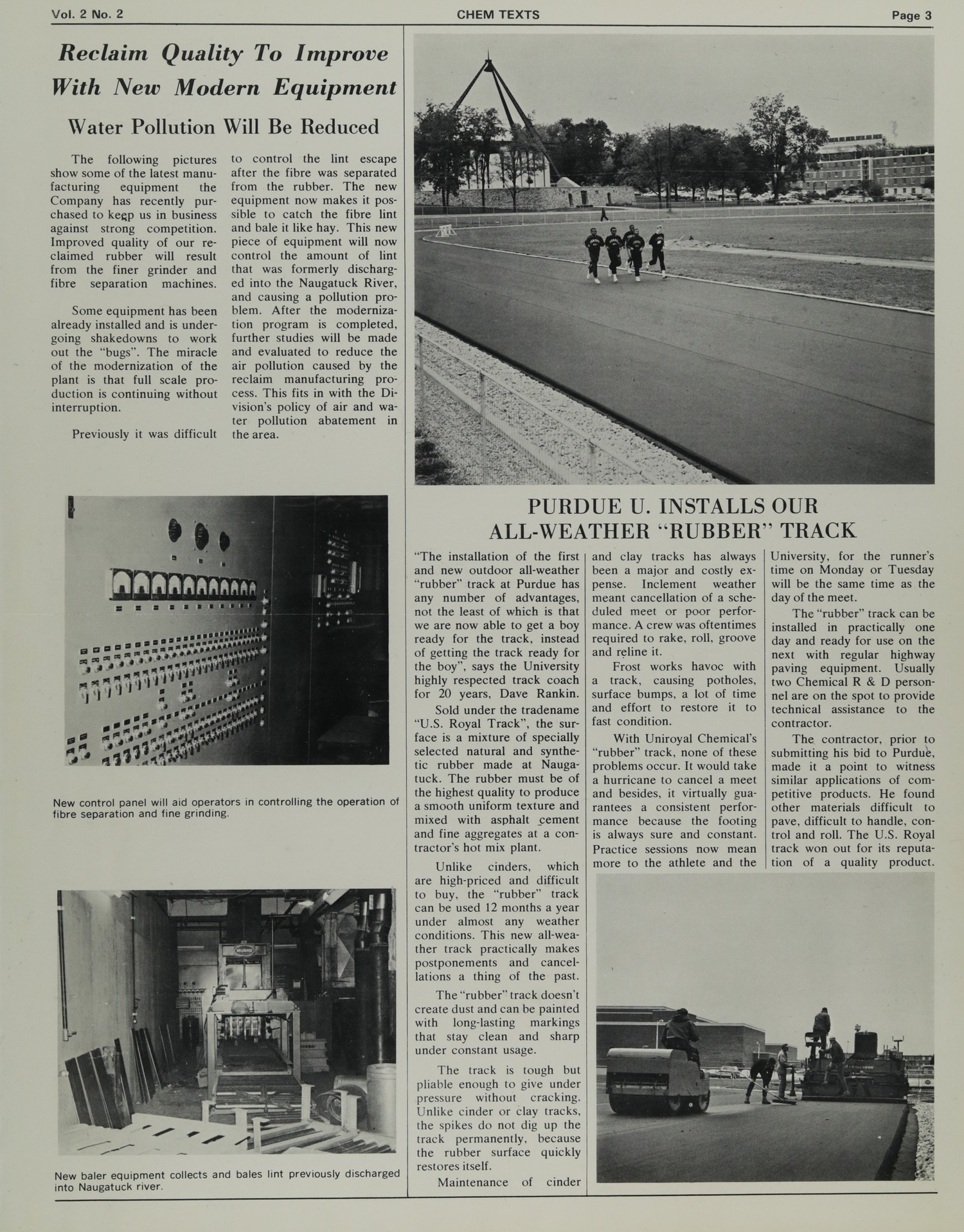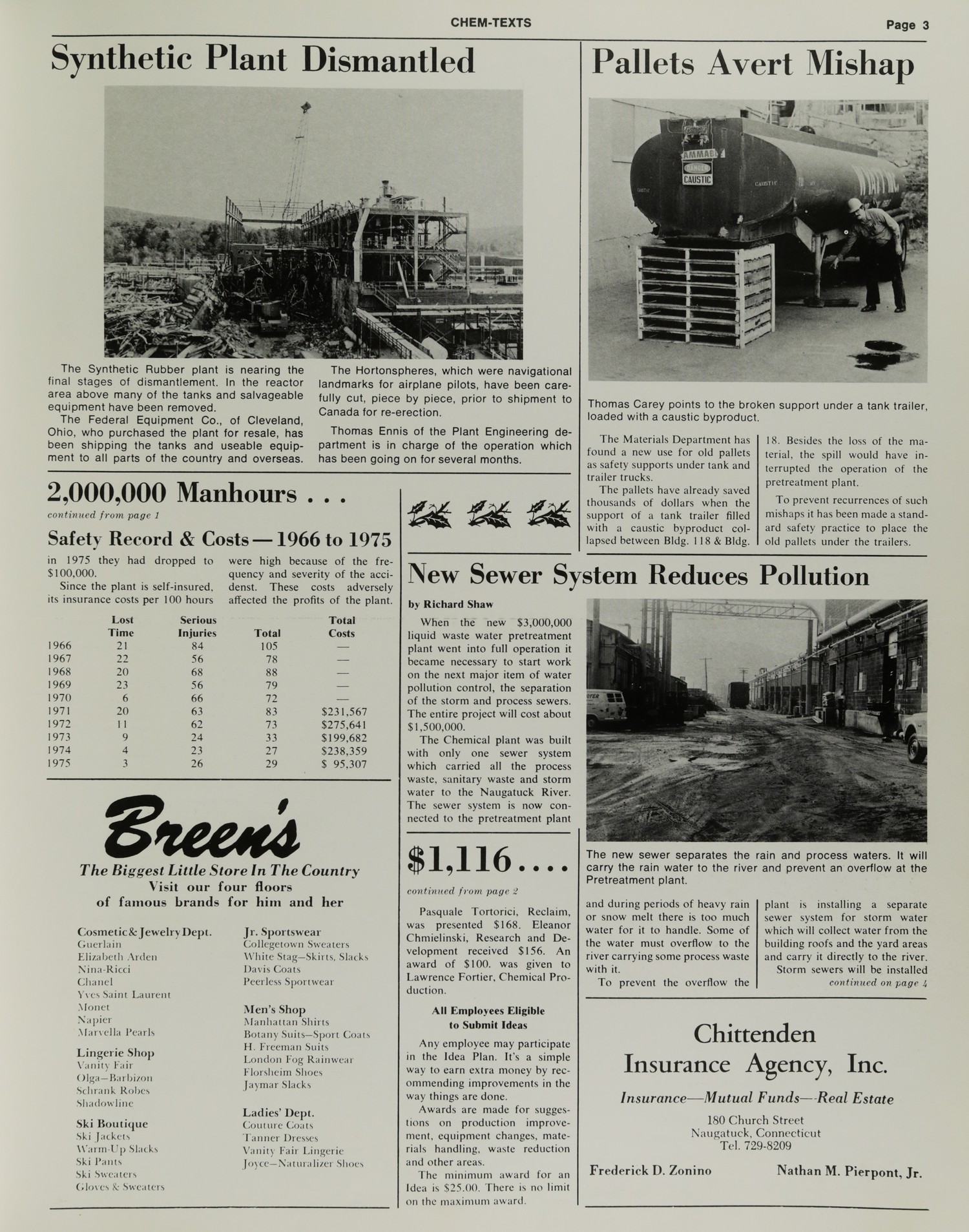
CHEM-TEXTS – 1975-v09-i06-s236

Page 236

UNIROYAL

Merry Christmas – Happy New Year

CHEM-TEXTS

Vol. 9, 1975 | PUBLISHED FOR THE PEOPLE OF UNIROYAL CHEMICAL | No. 6


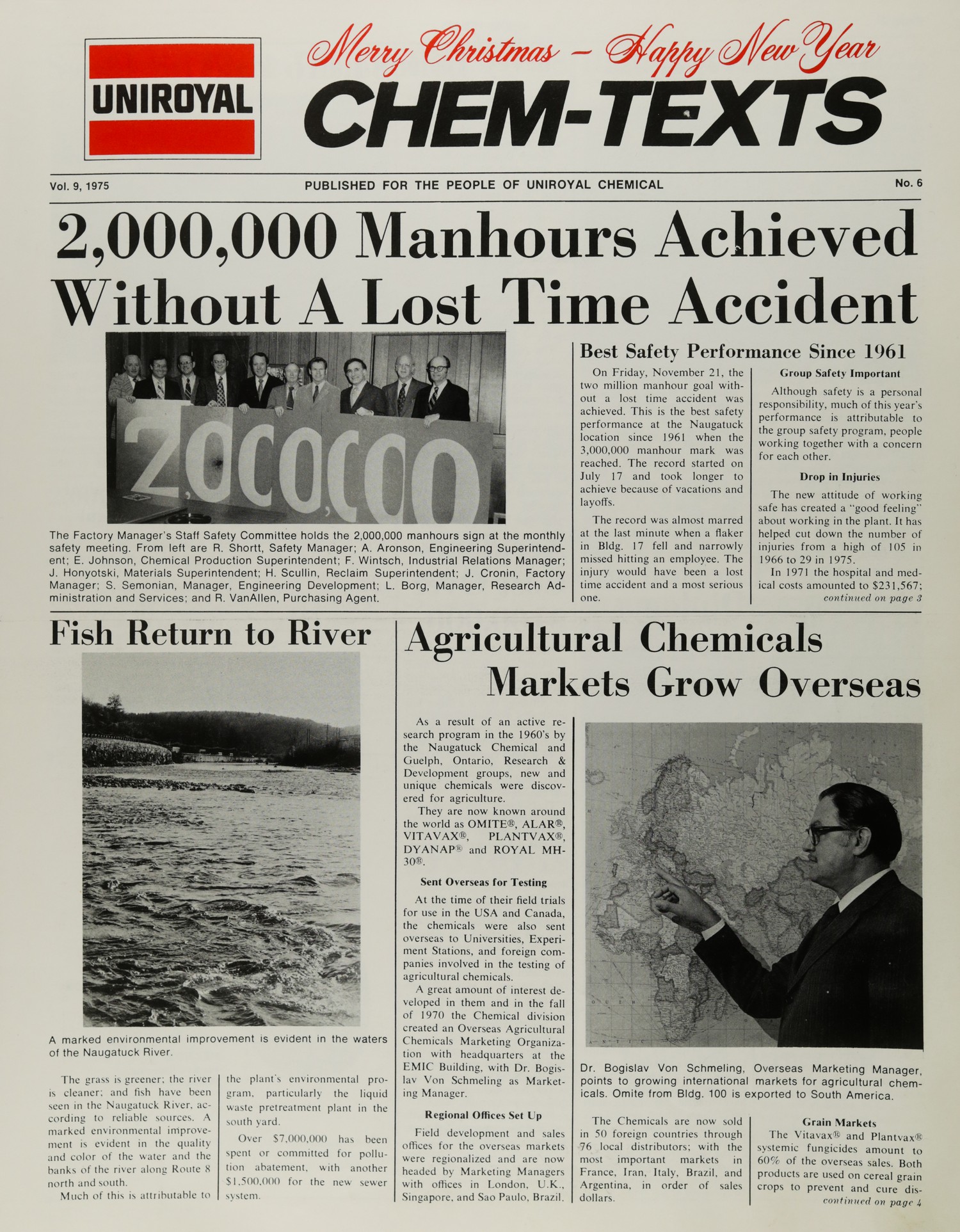
2,000,000 Manhours Achieved Without A Lost Time Accident

[IMAGE: Group photo of men holding a sign displaying “2000000”]

The Factory Manager’s Staff Safety Committee holds the 2,000,000 manhours sign at the monthly safety meeting. From left are R. Shortt, Safety Manager; A. Aronson, Engineering Superintendent; E. Johnson, Chemical Production Superintendent; F. Wintsch, Industrial Relations Manager; J. Honytski, Materials Superintendent; H. Scullin, Reclaim Superintendent; J. Cronin, Factory Manager; S. Semonian, Manager, Engineering Development; L. Borg, Manager, Research Administration and Services; and R. VanAllen, Purchasing Agent.

Best Safety Performance Since 1961

On Friday, November 21, the two million manhour goal without a lost time accident was achieved. This is the best safety performance at the Naugatuck location since 1961 when the 3,000,000 manhour mark was reached. The record started on July 17 and took longer to achieve because of vacations and layoffs.

The record was almost marred at the last minute when a flaker in Bldg. 17 fell and narrowly missed hitting an employee. The injury would have been a lost time accident and a most serious one.

Group Safety Important

Although safety is a personal responsibility, much of this year’s performance is attributable to the group safety program, people working together with a concern for each other.

Drop in Injuries

The new attitude of working safe has created a “good feeling” about working in the plant. It has helped cut down the number of injuries from a high of 105 in 1966 to 29 in 1975.

In 1971 the hospital and medical costs amounted to $231,567;

continued on page 3


Fish Return to River

[IMAGE: River scene showing water and shoreline]

A marked environmental improvement is evident in the waters of the Naugatuck River.

The grass is greener; the river is cleaner; and fish have been seen in the Naugatuck River, according to reliable sources. A marked environmental improvement is evident in the quality and color of the water and the banks of the river along Route 8 north and south.

Much of this is attributable to the plant’s environmental program, particularly the liquid waste pretreatment plant in the south yard.

Over $7,000,000 has been spent or committed for pollution abatement, with another $1,500,000 for the new sewer system.


Agricultural Chemicals Markets Grow Overseas

As a result of an active research program in the 1960’s by the Naugatuck Chemical and Guelph, Ontario, Research & Development groups, new and unique chemicals were discovered for agriculture.

They are now known around the world as OMITE®, ALAR®, VITAVAX®, PLANTVAX®, DYANAP® and ROYAL MH-30®.

Sent Overseas for Testing

At the time of their field trials for use in the USA and Canada, the chemicals were also sent overseas to Universities, Experiment Stations, and foreign companies involved in the testing of agricultural chemicals.

A great amount of interest developed in them and in the fall of 1970 the Chemical division created an Overseas Agricultural Chemicals Marketing Organization with headquarters at the EMIC Building, with Dr. Bogislav Von Schmeling as Marketing Manager.

Regional Offices Set Up

Field development and sales offices for the overseas markets were regionalized and are now headed by Marketing Managers with offices in London, U.K., Singapore, and Sao Paulo, Brazil.

[IMAGE: Man pointing at world map]

Dr. Bogislav Von Schmeling, Overseas Marketing Manager, points to growing international markets for agricultural chemicals. Omite from Bldg. 100 is exported to South America.

The Chemicals are now sold in 50 foreign countries through 76 local distributors; with the most important markets in France, Iran, Italy, Brazil, and Argentina, in order of sales dollars.

Grain Markets

The Vitavax® and Plantvax® systemic fungicides amount to 60% of the overseas sales. Both products are used on cereal grain crops to prevent and cure dis-

continued on page 4
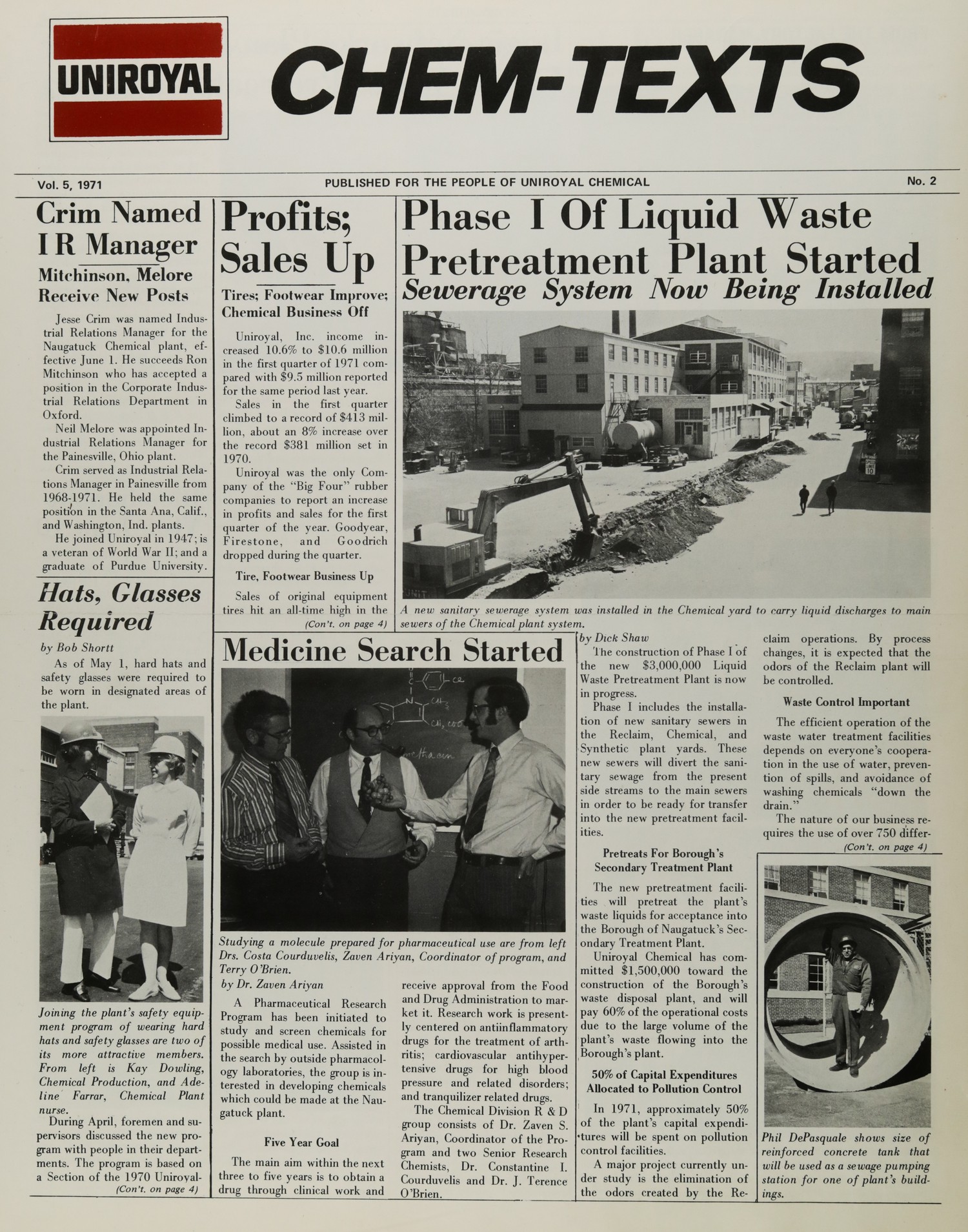
CHEM-TEXTS – 1971 – Page No. 2

Page unknown

UNIROYAL CHEM-TEXTS

Vol. 5, 1971 | PUBLISHED FOR THE PEOPLE OF UNIROYAL CHEMICAL | No. 2


Crim Named IR Manager

Mitchinson, Melore Receive New Posts

Jesse Crim was named Industrial Relations Manager for the Naugatuck Chemical plant, effective June 1. He succeeds Ron Mitchinson who has accepted a position in the Corporate Industrial Relations Department in Oxford.

Neil Melore was appointed Industrial Relations Manager for the Painesville, Ohio plant.

Crim served as Industrial Relations Manager in Painesville from 1968-1971. He held the same position in the Santa Ana, Calif., and Washington, Ind. plants.

He joined Uniroyal in 1947; is a veteran of World War II; and a graduate of Purdue University.


Hats, Glasses Required

by Bob Shortt

As of May 1, hard hats and safety glasses were required to be worn in designated areas of the plant.

[IMAGE: Photo showing workers wearing safety equipment]

Joining the plant’s safety equipment program of wearing hard hats and safety glasses are two of its more attractive members. From left is Kay Dowling, Chemical Production, and Adeline Farrar, Chemical Plant nurse.

During April, foremen and supervisors discussed the new program with people in their departments. The program is based on a Section of the 1970 Uniroyal-
(Con’t. on page 4)


Profits; Sales Up

Tires; Footwear Improve; Chemical Business Off

Uniroyal, Inc. income increased 10.6% to $10.6 million in the first quarter of 1971 compared with $9.5 million reported for the same period last year.

Sales in the first quarter climbed to a record of $413 million, about an 8% increase over the record $381 million set in 1970.

Uniroyal was the only Company of the “Big Four” rubber companies to report an increase in profits and sales for the first quarter of the year. Goodyear, Firestone, and Goodrich dropped during the quarter.

Tire, Footwear Business Up

Sales of original equipment tires hit an all-time high in the
(Con’t. on page 4)


Phase I Of Liquid Waste Pretreatment Plant Started

Sewerage System Now Being Installed

[IMAGE: Photo showing industrial buildings and sewerage system installation]

A new sanitary sewerage system was installed in the Chemical yard to carry liquid discharges to main sewers of the Chemical plant system.

by Dick Shaw

The construction of Phase I of the new $3,000,000 Liquid Waste Pretreatment Plant is now in progress.

Phase I includes the installation of new sanitary sewers in the Reclaim, Chemical, and Synthetic plant yards. These new sewers will divert the sanitary sewage from the present side streams to the main sewers in order to be ready for transfer into the new pretreatment facilities.

Pretreats For Borough’s Secondary Treatment Plant

The new pretreatment facilities will pretreat the plant’s waste liquids for acceptance into the Borough of Naugatuck’s Secondary Treatment Plant.

Uniroyal Chemical has committed $1,500,000 toward the construction of the Borough’s waste disposal plant, and will pay 60% of the operational costs due to the large volume of the plant’s waste flowing into the Borough’s plant.

50% of Capital Expenditures Allocated to Pollution Control

In 1971, approximately 50% of the plant’s capital expenditures will be spent on pollution control facilities.

A major project currently under study is the elimination of the odors created by the Reclaim operations. By process changes, it is expected that the odors of the Reclaim plant will be controlled.

Waste Control Important

The efficient operation of the waste water treatment facilities depends on everyone’s cooperation in the use of water, prevention of spills, and avoidance of washing chemicals “down the drain.”

The nature of our business requires the use of over 750 differ-
(Con’t. on page 4)

[IMAGE: Photo of Phil DePasquale with concrete tank]

Phil DePasquale shows size of reinforced concrete tank that will be used as a sewage pumping station for one of plant’s buildings.


Medicine Search Started

[IMAGE: Photo showing three scientists studying a molecule model]

Studying a molecule prepared for pharmaceutical use are from left Drs. Costa Courduvelis, Zaven Ariyan, Coordinator of program, and Terry O’Brien.

by Dr. Zaven Ariyan

A Pharmaceutical Research Program has been initiated to study and screen chemicals for possible medical use. Assisted in the search by outside pharmacology laboratories, the group is interested in developing chemicals which could be made at the Naugatuck plant.

Five Year Goal

The main aim within the next three to five years is to obtain a drug through clinical work and receive approval from the Food and Drug Administration to market it. Research work is presently centered on antiinflammatory drugs for the treatment of arthritis; cardiovascular antihypertensive drugs for high blood pressure and related disorders; and tranquilizer related drugs.

The Chemical Division R & D group consists of Dr. Zaven S. Ariyan, Coordinator of the Program and two Senior Research Chemists, Dr. Constantine I. Courduvelis and Dr. J. Terence O’Brien.

CHEM-TEXTS – Vol. 5 No. 4 – Page 3

Page 003

CHEM-TEXTS

Vol. 5 No. 4 | Page 3


New Research Laboratory Studies Pollution Causes

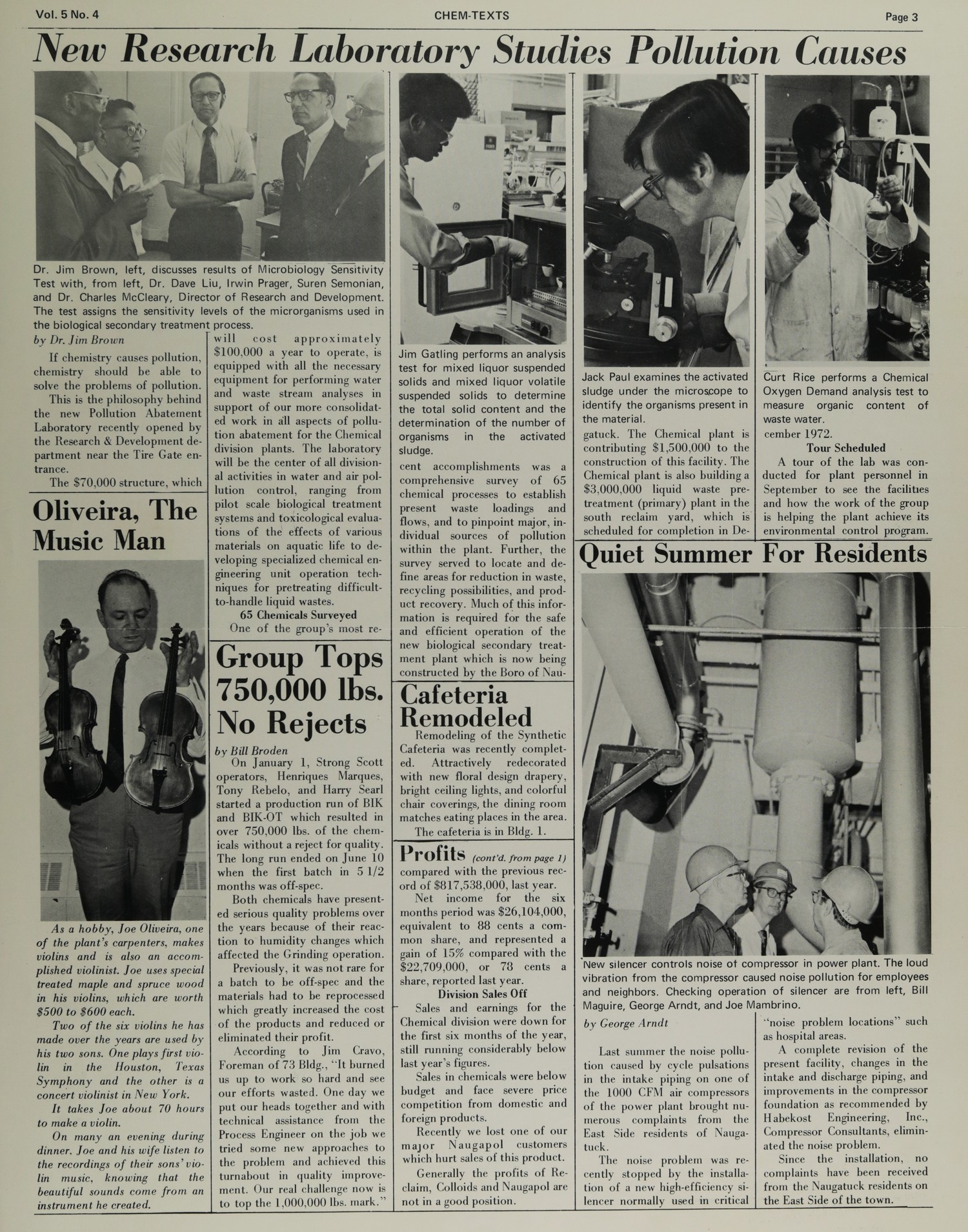
Dr. Jim Brown, left, discusses results of Microbiology Sensitivity Test with, from left, Dr. Dave Liu, Irwin Prager, Suren Semonian, and Dr. Charles McCleary, Director of Research and Development. The test assigns the sensitivity levels of the microrganisms used in the biological secondary treatment process.

by Dr. Jim Brown

If chemistry causes pollution, chemistry should be able to solve the problems of pollution.

This is the philosophy behind the new Pollution Abatement Laboratory recently opened by the Research & Development department near the Tire Gate entrance.

The $70,000 structure, which


Oliveira, The Music Man

As a hobby, Joe Oliveira, one of the plant’s carpenters, makes violins and is also an accomplished violinist. Joe uses special treated maple and spruce wood in his violins, which are worth $500 to $600 each.

Two of the six violins he has made over the years are used by his two sons. One plays first violin in the Houston, Texas Symphony and the other is a concert violinist in New York.

It takes Joe about 70 hours to make a violin.

On many an evening during dinner, Joe and his wife listen to the recordings of their sons’ violin music, knowing that the beautiful sounds come from an instrument he created.


will cost approximately $100,000 a year to operate, is equipped with all the necessary equipment for performing water and waste stream analyses in support of our more consolidated work in all aspects of pollution abatement for the Chemical division plants. The laboratory will be the center of all divisional activities in water and air pollution control, ranging from pilot scale biological treatment systems and toxicological evaluations of the effects of various materials on aquatic life to developing specialized chemical engineering unit operation techniques for pretreating difficult-to-handle liquid wastes.

65 Chemicals Surveyed

One of the group’s most re-


Group Tops 750,000 lbs. No Rejects

by Bill Broden

On January 1, Strong Scott operators, Henriques Marques, Tony Rebelo, and Harry Searl started a production run of BIK and BIK-OT which resulted in over 750,000 lbs. of the chemicals without a reject for quality. The long run ended on June 10 when the first batch in 5 1/2 months was off-spec.

Both chemicals have presented serious quality problems over the years because of their reaction to humidity changes which affected the Grinding operation.

Previously, it was not rare for a batch to be off-spec and the materials had to be reprocessed which greatly increased the cost of the products and reduced or eliminated their profit.

According to Jim Cravo, Foreman of 73 Bldg., “It burned us up to work so hard and see our efforts wasted. One day we put our heads together and with technical assistance from the Process Engineer on the job we tried some new approaches to the problem and achieved this turnaround in quality improvement. Our real challenge now is to top the 1,000,000 lbs. mark.”


Jim Gatling performs an analysis test for mixed liquor suspended solids and mixed liquor volatile suspended solids to determine the total solid content and the determination of the number of organisms in the activated sludge.

cent accomplishments was a comprehensive survey of 65 chemical processes to establish present waste loadings and flows, and to pinpoint major, individual sources of pollution within the plant. Further, the survey served to locate and define areas for reduction in waste, recycling possibilities, and product recovery. Much of this information is required for the safe and efficient operation of the new biological secondary treatment plant which is now being constructed by the Boro of Nau-


Cafeteria Remodeled

Remodeling of the Synthetic Cafeteria was recently completed. Attractively redecorated with new floral design drapery, bright ceiling lights, and colorful chair coverings, the dining room matches eating places in the area.

The cafeteria is in Bldg. 1.


Profits (cont’d. from page 1)

compared with the previous record of $817,538,000, last year.

Net income for the six months period was $26,104,000, equivalent to 88 cents a common share, and represented a gain of 15% compared with the $22,709,000, or 78 cents a share, reported last year.

Division Sales Off

Sales and earnings for the Chemical division were down for the first six months of the year, still running considerably below last year’s figures.

Sales in chemicals were below budget and face severe price competition from domestic and foreign products.

Recently we lost one of our major Naugapol customers which hurt sales of this product.

Generally the profits of Reclaim, Colloids and Naugapol are not in a good position.


Jack Paul examines the activated sludge under the microscope to identify the organisms present in the material.

gatuck. The Chemical plant is contributing $1,500,000 to the construction of this facility. The Chemical plant is also building a $3,000,000 liquid waste pretreatment (primary) plant in the south reclaim yard, which is scheduled for completion in De-


Curt Rice performs a Chemical Oxygen Demand analysis test to measure organic content of waste water.

cember 1972.

Tour Scheduled

A tour of the lab was conducted for plant personnel in September to see the facilities and how the work of the group is helping the plant achieve its environmental control program.


Quiet Summer For Residents

New silencer controls noise of compressor in power plant. The loud vibration from the compressor caused noise pollution for employees and neighbors. Checking operation of silencer are from left, Bill Maguire, George Arndt, and Joe Mambrino.

by George Arndt

Last summer the noise pollution caused by cycle pulsations in the intake piping on one of the 1000 CFM air compressors of the power plant brought numerous complaints from the East Side residents of Naugatuck.

The noise problem was recently stopped by the installation of a new high-efficiency silencer normally used in critical

“noise problem locations” such as hospital areas.

A complete revision of the present facility, changes in the intake and discharge piping, and improvements in the compressor foundation as recommended by Habekost Engineering, Inc., Compressor Consultants, eliminated the noise problem.

Since the installation, no complaints have been received from the Naugatuck residents on the East Side of the town.

CHEM-TEXTS – 1971-v05-i05-s200

Page 200

UNIROYAL CHEM-TEXTS

Vol. 5, 1971 | PUBLISHED FOR THE PEOPLE OF UNIROYAL CHEMICAL | No. 5


Construction Started On New $3,200,000 Pretreatment Plant


Nine Months Sales Up

Net income for the nine months ending October 3, was $33,234,000, equivalent to $1.10 per share of common stock compared with $27,852,000 or 92 cents a share for the comparable period last year, an increase of 19.3%. Earnings were equivalent to $1.04 per common share after adjustment for the potential dilution related to the company’s convertible debentures issued in February 1971.

Sales for the nine months totaled $1,277,000,000, a gain of 8% over the $1,183,-000,000 for the same period in 1970.

Net income of Uniroyal, Inc. for the 3rd quarter totaled $7,130,000, equivalent to 22 cents per common share, a gain of 38.6% compared with $5,143,000, or 14 cents per share, reported for the quarter last year. Sales increased 9% to $400,-000,000 compared with

$366,000,000 for the third quarter of 1970.

Net income for the 3rd quarter and 9 months was adversely affected by the following factors: freeze of price increases; wage increase costs prior to the

(Cont’d. on page 3)


Drive Nears $21,000

by Jim Carroll

The United Givers drive to raise $21,000 for the 16 Agencies in the Fund which provide needed services for families in communities in which most employees live is nearly completed.

Employees have pledged $20,260 to date and only $740 is needed to achieve the plant’s goal of $21,000. The average contribution amounts to $21.40 per employee who donated.

(Cont’d. on page 2)


Unions Elect Officers

[PHOTO: Two images showing union officers]

Joe Rzeszutek, left, was elected President. Cy Blanchard, right, Vice President; and Henry Hook, to the Executive Committee.

by T. Lee and F. Mayo

439 URW Local 218 Union members elected new union officers for a 3 year term.

Joe Rzeszutek was elected President for a seventh

(Cont’d. on page 3)

Charles Roland, right, new 308 President is congratulated by Rocco Manulla, left, Art Calder, right, and Frank Sordi.

by Walt Tabaka

URW Local 308 members elected Charles Roland, President for a three year term. Also voted into office were Rocco Manulla, Vice-Pres-

(Cont’d. on page 3)


by Dick Shaw

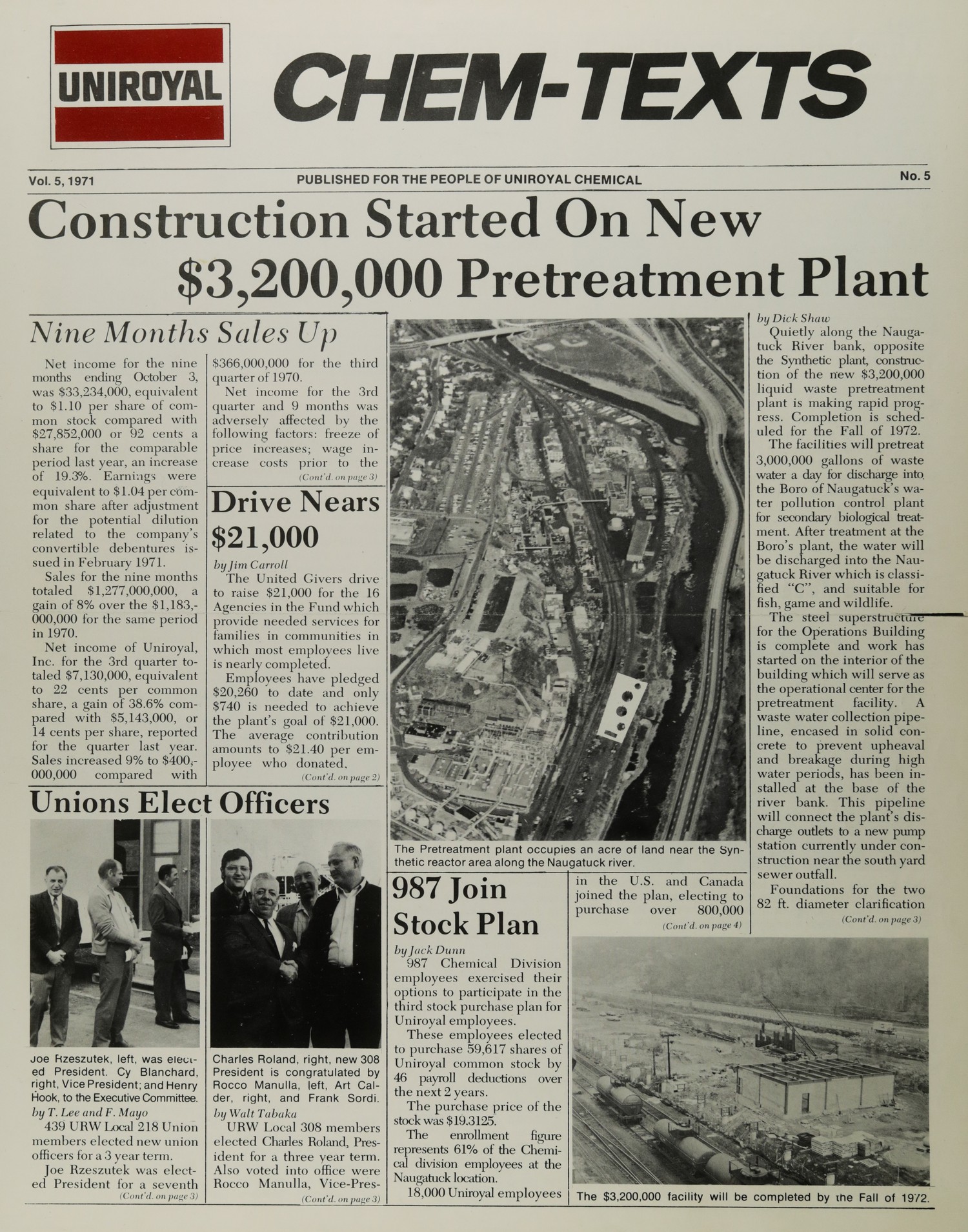
Quietly along the Naugatuck River bank, opposite the Synthetic plant, construction of the new $3,200,000 liquid waste pretreatment plant is making rapid progress. Completion is scheduled for the Fall of 1972.

The facilities will pretreat 3,000,000 gallons of waste water a day for discharge into the Boro of Naugatuck’s water pollution control plant for secondary biological treatment. After treatment at the Boro’s plant, the water will be discharged into the Naugatuck River which is classified “C”, and suitable for fish, game and wildlife.

The steel superstructure for the Operations Building is complete and work has started on the interior of the building which will serve as the operational center for the pretreatment facility. A waste water collection pipeline, encased in solid concrete to prevent upheaval and breakage during high water periods, has been installed at the base of the river bank. This pipeline will connect the plant’s discharge outlets to a new pump station currently under construction near the south yard sewer outfall.

Foundations for the two 82 ft. diameter clarification

(Cont’d. on page 3)


[AERIAL PHOTO: Shows pretreatment plant construction site]

The Pretreatment plant occupies an acre of land near the Synthetic reactor area along the Naugatuck river.


987 Join Stock Plan

by Jack Dunn

987 Chemical Division employees exercised their options to participate in the third stock purchase plan for Uniroyal employees.

These employees elected to purchase 59,617 shares of Uniroyal common stock by 46 payroll deductions over the next 2 years.

The purchase price of the stock was $19.3125.

The enrollment figure represents 61% of the Chemical division employees at the Naugatuck location.

18,000 Uniroyal employees

in the U.S. and Canada joined the plan, electing to purchase over 800,000

(Cont’d. on page 4)


[PHOTO: Construction site view]

The $3,200,000 facility will be completed by the Fall of 1972.

CHEM-TEXTS – Vol. 4 No. 4 – Page 3

Page 003

Vol. 4, No. 4 Page 3

Suggestions, Ideas Bring $2,690 In Awards

Uniroyal’s Policy On Environmental Health

This policy reflects the committment of the Naugatuck Chemical plant to cleaner air and water in the community.

The Chemical plant to date has spent or committed $5,000,000 for pollution control facilities and systems.

Stepped up action is now underway to reduce smells and fumes emitted from the 142 buildings of the plant. Every employee’s help is asked to spot leaks, odors and fumes and report them to his foreman or supervisor.

Good housekeeping, and “No Drain” operations can help reduce many pollution problems created by unconcern to help solve the problem.

  1. UNIROYAL realizes that it has both the obligation and responsibility to join with society in the proper management of wastes, the proper utilization of air and water resources, and the protection of the environment in which we all live.
  2. UNIROYAL believes that progress in pollution control requires the dedication and responsible action of every individual and every segment of society.
  3. UNIROYAL is eliminating or minimizing pollution at all of its existing plant locations through the installation of the most modern and efficient pollution control systems available and through careful monitoring of these systems.
  4. UNIROYAL is incorporating such systems in the design and construction of all of its new plants throughout the world.
  5. UNIROYAL supervises and trains employees in operating methods which minimize pollution at all of its plants.
  6. UNIROYAL is finding new and better ways to prevent or control pollution through a concentrated program of scientific research and development both at its central research laboratories and at 22 other research locations throughout the world.
  7. UNIROYAL supports the efforts of federal, state and municipal governments in developing sound and effective pollution control laws and ordinances.
  8. UNIROYAL cooperates fully with responsible regulatory agencies and welcomes the free exchange of information on pollution control methods with interested industries and communities.
  9. UNIROYAL supports and works actively with conservationists and community organizations for the preservation of the nation’s natural beauties and the protection of her wildlife.
  10. UNIROYAL stands prepared to work actively with every individual and every segment of society in developing a total approach to pollution problems. These problems include, not merely industrial wastes, but the human wastes from sewers, incinerators, home heating, combustion engines, and the haphazard disposal of packages, bottles, trash and other litter that mars our daily lives.

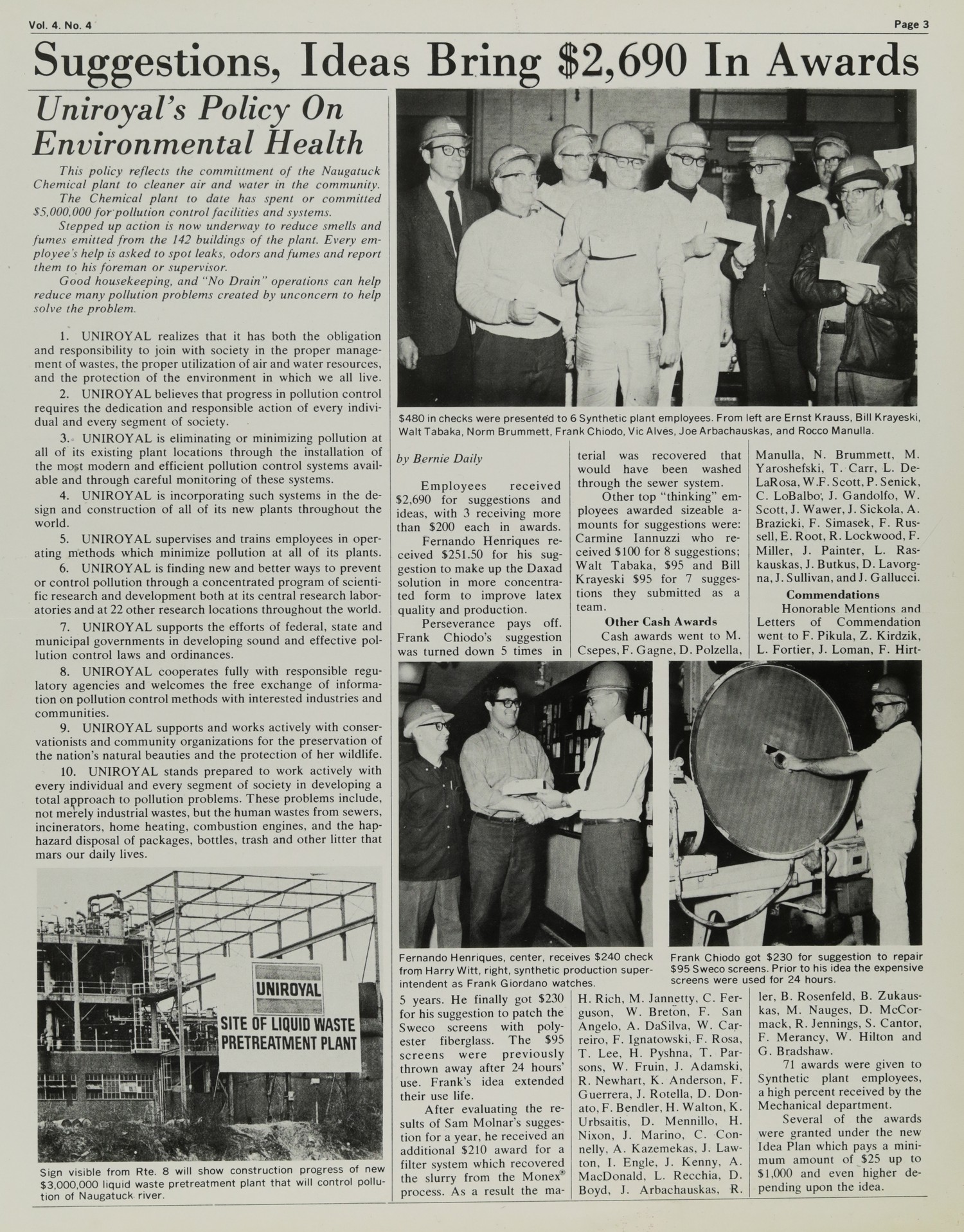
$480 in checks were presented to 6 Synthetic plant employees. From left are Ernst Krauss, Bill Krayeski, Walt Tabaka, Norm Brummett, Frank Chiodo, Vic Alves, Joe Arbachauskas, and Rocco Manulla.


by Bernie Daily

Employees received $2,690 for suggestions and ideas, with 3 receiving more than $200 each in awards.

Fernando Henriques received $251.50 for his suggestion to make up the Daxad solution in more concentrated form to improve latex quality and production.

Perseverance pays off. Frank Chiodo’s suggestion was turned down 5 times in 5 years. He finally got $230 for his suggestion to patch the Sweco screens with polyester fiberglass. The $95 screens were previously thrown away after 24 hours’ use. Frank’s idea extended their use life.

After evaluating the results of Sam Molnar’s suggestion for a year, he received an additional $210 award for a filter system which recovered the slurry from the Monex® process. As a result the material was recovered that would have been washed through the sewer system.

Other top “thinking” employees awarded sizeable amounts for suggestions were: Carmine Iannuzzi who received $100 for 8 suggestions; Walt Tabaka, $95 and Bill Krayeski $95 for 7 suggestions they submitted as a team.

Other Cash Awards

Cash awards went to M. Csepes, F. Gagne, D. Polzella, Manulla, N. Brummett, M. Yaroshefski, T. Carr, L. DeLaRosa, W.F. Scott, P. Senick, C. LoBalbo, J. Gandolfo, W. Scott, J. Wawer, J. Sickola, A. Brazicki, F. Simasek, F. Russell, E. Root, R. Lockwood, F. Miller, J. Painter, L. Raskauskas, J. Butkus, D. Lavorgna, J. Sullivan, and J. Gallucci.

Commendations

Honorable Mentions and Letters of Commendation went to F. Pikula, Z. Kirdzik, L. Fortier, J. Loman, F. Hirt-


Fernando Henriques, center, receives $240 check from Harry Witt, right, synthetic production superintendent as Frank Giordano watches.

Frank Chiodo got $230 for suggestion to repair $95 Sweco screens. Prior to his idea the expensive screens were used for 24 hours.

H. Rich, M. Jannetty, C. Ferguson, W. Breton, F. San Angelo, A. DaSilva, W. Carreiro, F. Ignatowski, F. Rosa, T. Lee, H. Pyshna, T. Parsons, W. Fruin, J. Adamski, R. Newhart, K. Anderson, F. Guerrera, J. Rotella, D. Donato, F. Bendler, H. Walton, K. Urbsaitis, D. Mennillo, H. Nixon, J. Marino, C. Connelly, A. Kazemekas, J. Lawton, I. Engle, J. Kenny, A. MacDonald, L. Recchia, D. Boyd, J. Arbachauskas, R. ler, B. Rosenfeld, B. Zukauskas, M. Nauges, D. McCormack, R. Jennings, S. Cantor, F. Merancy, W. Hilton and G. Bradshaw.

71 awards were given to Synthetic plant employees, a high percent received by the Mechanical department.

Several of the awards were granted under the new Idea Plan which pays a minimum amount of $25 up to $1,000 and even higher depending upon the idea.


Sign visible from Rte. 8 will show construction progress of new $3,000,000 liquid waste pretreatment plant that will control pollution of Naugatuck river.

UNIROYAL

SITE OF LIQUID WASTE PRETREATMENT PLANT

CHEM-TEXTS – Vol. 4, 1970, No. 5 – Page 1

Page 001

UNIROYAL CHEM-TEXTS

Vol. 4, 1970 | PUBLISHED FOR THE PEOPLE OF UNIROYAL CHEMICAL | No. 5


$5,200,000 Spent Or Committed To Improve Air, Water Quality


Trades Courses Offered

by Al Manzi

A training program to qualify candidates for skilled trades openings has been developed in cooperation with Kaynor Technical School in Waterbury. This special program is voluntary and can help improve your job opportunities in the future. The program is open to all employees of Uniroyal Chemical at Naugatuck.

Courses Available

A two-year program has been planned following the normal school year — one night per week — 3 hours per night. The first year will have three 33 hour courses: Fundamentals of Arithmetic; Measurements; and Engineering Drawing.

The second year is tentatively planned for three 33 hour courses covering: Introduction to Pipe Fitting; Electricity; and Construction Trades. Successful completion of this program as judged by Kaynor Tech will allow candidates to qualify for second-class trades openings when available and in accordance with present contractual requirements of seniority and qualifications.

No Cost to Employee

There will be no cost to participants—Uniroyal will pay for tuition and textbooks as necessary. The company will cooperate as much as possible in arranging for participation of people on OFF shifts.

At the present time, training is directed to filling piper, electrician and millwright/mechanic job openings.

In the near future, questionnaires will be distributed to learn of potential candidates and their major interest of trades. The following list shows the potential openings through normal turnover at the Chemical and Synthetic plants during the next seven years.

Chemical Plant
Millwright/Mechanics ….11
Pipers ……………….9
Electricians ………….3

Synthetic Plant
Millwright/Mechanics …..7
Pipers ……………….8
Electricians ………….0

The questionnaires are now being printed and for the present, please wait until questionnaires will become available shortly. The questionnaires will list the people to contact if more information is required.


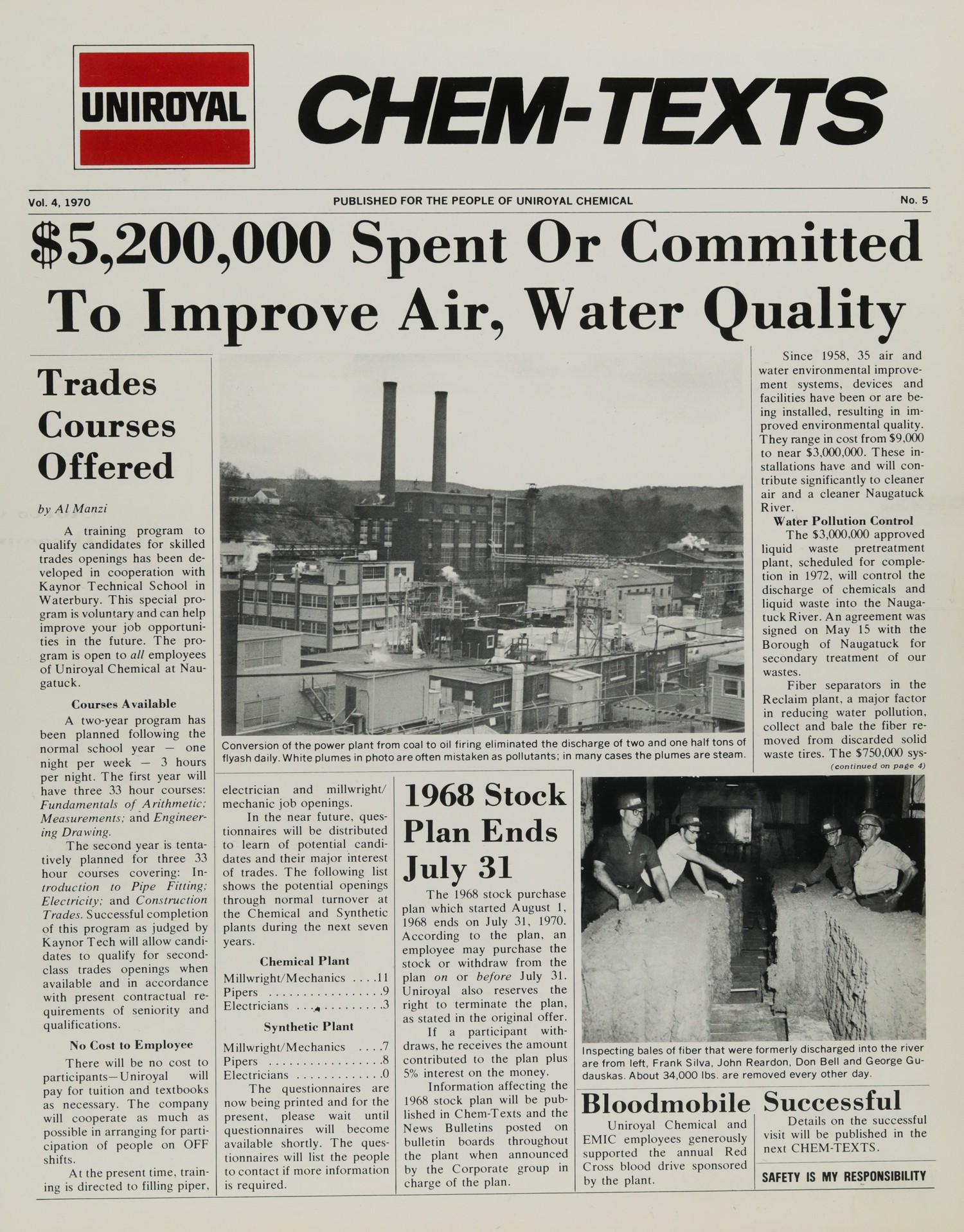
[IMAGE CAPTION: Conversion of the power plant from coal to oil firing eliminated the discharge of two and one half tons of flyash daily. White plumes in photo are often mistaken as pollutants; in many cases the plumes are steam.]


Since 1958, 35 air and water environmental improvement systems, devices and facilities have been or are being installed, resulting in improved environmental quality. They range in cost from $9,000 to near $3,000,000. These installations have and will contribute significantly to cleaner air and a cleaner Naugatuck River.

Water Pollution Control

The $3,000,000 approved liquid waste pretreatment plant, scheduled for completion in 1972, will control the discharge of chemicals and liquid waste into the Naugatuck River. An agreement was signed on May 15 with the Borough of Naugatuck for secondary treatment of our wastes.

Fiber separators in the Reclaim plant, a major factor in reducing water pollution, collect and bale the fiber removed from discarded solid waste tires. The $750,000 sys-

(continued on page 4)


1968 Stock Plan Ends July 31

The 1968 stock purchase plan which started August 1, 1968 ends on July 31, 1970. According to the plan, an employee may purchase the stock or withdraw from the plan on or before July 31. Uniroyal also reserves the right to terminate the plan, as stated in the original offer.

If a participant withdraws, he receives the amount contributed to the plan plus 5% interest on the money.

Information affecting the 1968 stock plan will be published in Chem-Texts and the News Bulletins posted on bulletin boards throughout the plant when announced by the Corporate group in charge of the plan.


[IMAGE CAPTION: Inspecting bales of fiber that were formerly discharged into the river are from left, Frank Silva, John Reardon, Don Bell and George Gudauskas. About 34,000 lbs. are removed every other day.]


Bloodmobile Successful

Uniroyal Chemical and EMIC employees generously supported the annual Red Cross blood drive sponsored by the plant.

Details on the successful visit will be published in the next CHEM-TEXTS.

SAFETY IS MY RESPONSIBILITY

CHEM-TEXTS – Vol. 4 No. 5 – Page 4

Page 004

Page 4 | CHEM-TEXT | Vol. 4, No. 5

$5,200,000 . . .

(continued from page 1)

tem eliminated the discharge of 34,000 lbs. of fiber to the river daily.

Air Pollution Control

A major improvement in cleaner air resulted from the conversion of the boiler house from coal to oil firing. This $500,000 facility stopped the discharge of 2½ tons of flyash into the air each day. The conversion also eliminated the need for cooling cinders which caused pollution of the river.

At a cost of $510,000, cyclones, Holoflite dryers, and a digester blowdown condensing system were installed to reduce pollution of the air from lint and evaporated oil caused by the reclaim plant.

Scrubbers Control Odors

Seven scrubbers are now in operation in plant buildings to “wash” the fumes and odors created by processing operations. Ranging in cost from $2,000 to $70,000, some of the complex systems prevent the discharge of phenolic, mercaptans, formaldehyde and hydrochloric fumes into the atmosphere.

Two new scrubbers are now on order and will be installed when delivered.

Groups Study Problems

Immediate remedial action is being taken by an


Cyclones reduce lint escape into air. Holoflite dryers, at cost of $500,000 eliminated the evaporation of 5,000 lbs. of oils daily in the air.


Environmental Improvement Group under Dick Shaw and Lou Kaiser and a special Research and Development group, headed by Irwin Prager, to reduce pollution by process changes in present manufacturing operations and to coordinate our research resources toward the use of effective control systems in new facilities.

New process equipment will contain pollution control devices and systems, and special monitoring systems installed for proper performance of pollution control equipment.

Every Employee Can Help

Improving the environment is too great a task for it to be the responsibility of any one functional group or department. For the most effective environmental improvement program it requires the active committment of every employee in the plant, laboratories and offices. Even the most advanced equipment will be useless unless it is operated efficiently by the individuals responsible for it.

Program Set Up

Recognizing each persons responsibility, plans are underway for a pollution control program to set up discussion groups and training sessions to help us improve our environmental quality efforts.

Still Have Problems

The Chemical plant still has problems, particularly in the area of fumes and odors. Environmental air improvement is a complex problem that requires a study of each source of pollution from the hundreds of vents on the 142 buildings of the plant.

As part of the plant’s commitment to environmental improvement the problems of fumes and odor are being resolved with action and the financial requirements needed to do the job.


Watts, Lokites Retire

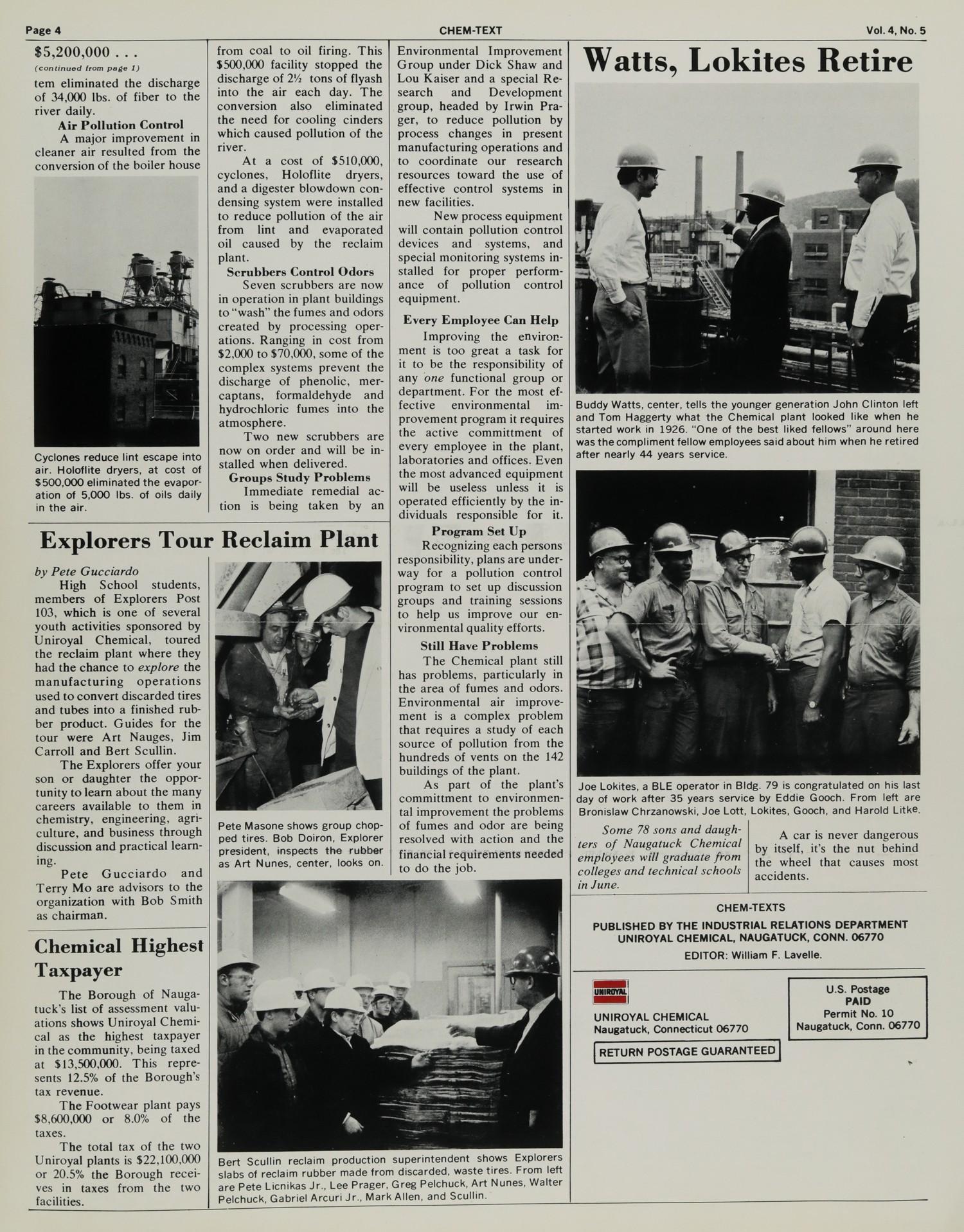
Buddy Watts, center, tells the younger generation John Clinton left and Tom Haggerty what the Chemical plant looked like when he started work in 1926. “One of the best liked fellows” around here was the compliment fellow employees said about him when he retired after nearly 44 years service.

Joe Lokites, a BLE operator in Bldg. 79 is congratulated on his last day of work after 35 years service by Eddie Gooch. From left are Bronislaw Chrzanowski, Joe Lott, Lokites, Gooch, and Harold Litke.

Some 78 sons and daughters of Naugatuck Chemical employees will graduate from colleges and technical schools in June.

A car is never dangerous by itself, it’s the nut behind the wheel that causes most accidents.


Explorers Tour Reclaim Plant

by Pete Gucciardo

High School students, members of Explorers Post 103, which is one of several youth activities sponsored by Uniroyal Chemical, toured the reclaim plant where they had the chance to explore the manufacturing operations used to convert discarded tires and tubes into a finished rubber product. Guides for the tour were Art Nauges, Jim Carroll and Bert Scullin.

The Explorers offer your son or daughter the opportunity to learn about the many careers available to them in chemistry, engineering, agriculture, and business through discussion and practical learning.

Pete Gucciardo and Terry Mo are advisors to the organization with Bob Smith as chairman.


Pete Masone shows group chopped tires. Bob Doiron, Explorer president, inspects the rubber as Art Nunes, center, looks on.


Bert Scullin reclaim production superintendent shows Explorers slabs of reclaim rubber made from discarded, waste tires. From left are Pete Licnikas Jr., Lee Prager, Greg Pelchuck, Art Nunes, Walter Pelchuck, Gabriel Arcuri Jr., Mark Allen, and Scullin.


Chemical Highest Taxpayer

The Borough of Naugatuck’s list of assessment valuations shows Uniroyal Chemical as the highest taxpayer in the community, being taxed at $13,500,000. This represents 12.5% of the Borough’s tax revenue.

The Footwear plant pays $8,600,000 or 8.0% of the taxes.

The total tax of the two Uniroyal plants is $22,100,000 or 20.5% the Borough receives in taxes from the two facilities.


CHEM-TEXTS

PUBLISHED BY THE INDUSTRIAL RELATIONS DEPARTMENT
UNIROYAL CHEMICAL, NAUGATUCK, CONN. 06770

EDITOR: William F. Lavelle.


UNIROYAL

UNIROYAL CHEMICAL
Naugatuck, Connecticut 06770

RETURN POSTAGE GUARANTEED

U.S. Postage
PAID
Permit No. 10
Naugatuck, Conn. 06770

CHEM-TEXTS – Vol. 4 No. 7 – Page 3

Page 003

CHEM-TEXTS

Vol. 4. No. 7 Page 3


KNOW YOUR BENEFITS:

Some Questions And Answers On Uniroyal’s Tuition Aid Program

by Marion Hutt

About seventy-three Uniroyal Chemical employees improved their education and their opportunities for advancement in their jobs by taking job related courses during the 1968-69 academic year with the help of Uniroyal’s Tuition Aid Program. (1969-70 figures were unavailable for this issue)

For those of you who are not familiar with the plan, here is some helpful information on the program which is available to all employees.

Q. What Is It?
A. To encourage self-development and education of all employees, Uniroyal will reimburse you for the full tuition cost and lab fees necessary in any course taken which is related to your current job or will be of value, as determined by the Company, in future promotional areas.

All Employees Eligible

Q. Is the program available to wage and salary personnel?
A. Yes, it is available to all full-time employees.

Q. Do I have to notify the Company of the course I wish to take?

A. Yes, prior approval has to be obtained to qualify.

Q. How many courses can I take?
A. The number of allowed courses per semester cannot exceed two.

Q. Do I take these courses on Uniroyal’s time or my time?
A. Your own time.

Q. I’d like to take a course in mechanical drawing. Am I reimbursed for any instruments I must purchase?
A. No. Books, library fees, instruments and transportation are not reimbursable.

Q. When am I reimbursed?
A. Reimbursement will be made by Uniroyal after satisfactory completion of the course has been documented by the school or institution which administered it.

Q. Is every school or institution offering courses acceptable?

A. Only fully accredited institutions or professionally recognized associations are approved.

Schools In Area

Q. What schools qualify in the area?
A. University of Connecticut (Waterbury Branch), Fairfield University, University of Hartford, University of Bridgeport, Sacred Heart University, Trinity College, Mattatuck Community College, West Connecticut State College, Central Connecticut State College, Southern Connecticut State College, RPI (Hartford Branch), Waterbury State Technical College, Kaynor

Technical, H. C. Wilcox Technical-Vocational School, New Haven College, Quinnipiac College, Post Junior College and other specialized educational institutes.

Q. Do you have any facts about people using this plan?
A. During 67-68, sixty employees were enrolled in degree programs and were reimbursed an average of $275 by Uniroyal. In 69, five employees received M.B.A. degrees. In 1970 about 70 employees attended courses, with several receiving degrees.

Q. Where do I find out the procedure I must follow to qualify?
A. Your foreman or supervisor will be glad to assist you in obtaining and processing the forms for approval. Tuition aid is another of Uniroyal’s programs for the benefit of all employees to assist them in the development of their talents and capabilities.


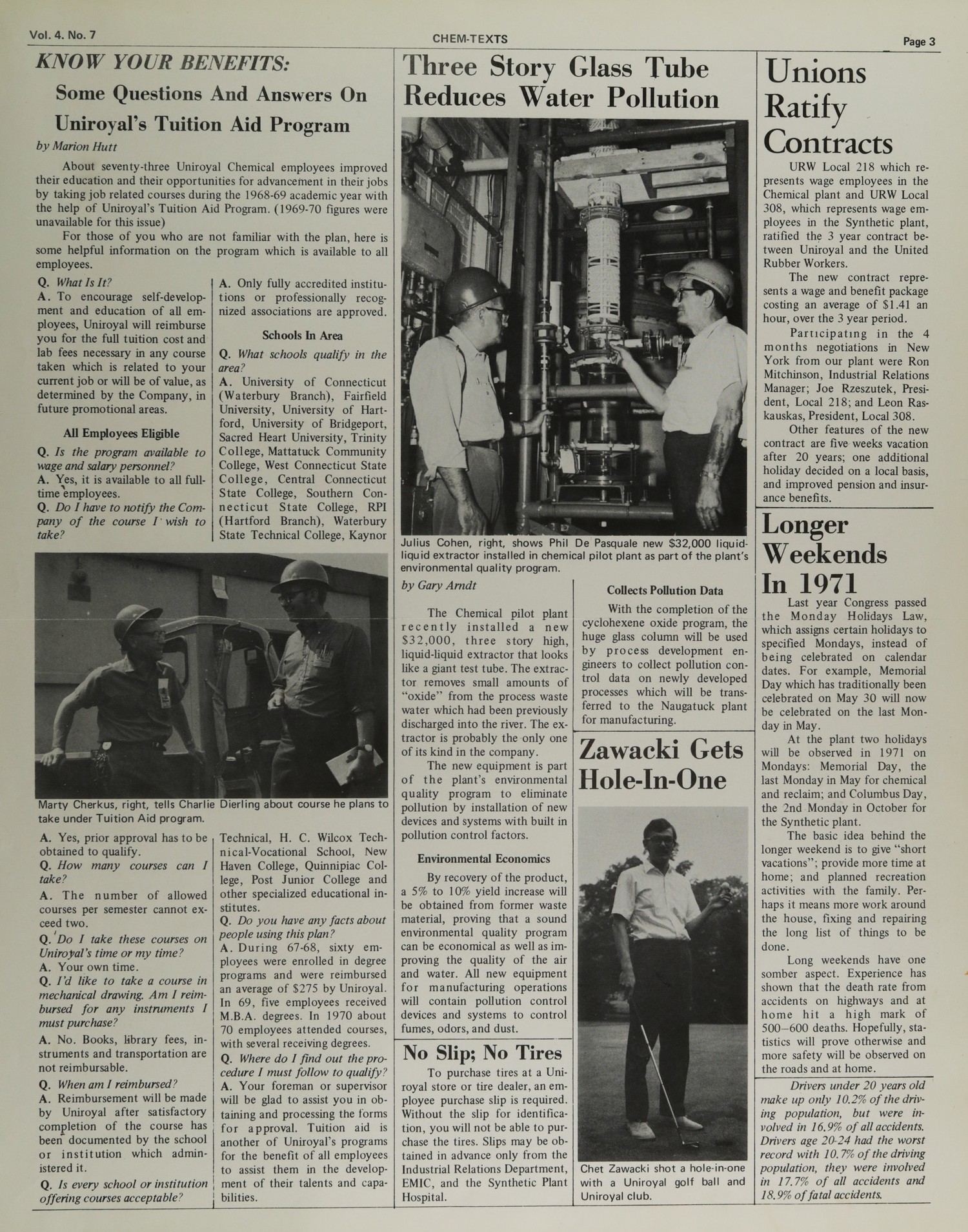
[IMAGE CAPTION: Marty Cherkus, right, tells Charlie Dierling about course he plans to take under Tuition Aid program.]


Three Story Glass Tube Reduces Water Pollution

[IMAGE CAPTION: Julius Cohen, right, shows Phil De Pasquale new $32,000 liquid-liquid extractor installed in chemical pilot plant as part of the plant’s environmental quality program.]

by Gary Arndt

The Chemical pilot plant recently installed a new $32,000, three story high, liquid-liquid extractor that looks like a giant test tube. The extractor removes small amounts of “oxide” from the process waste water which had been previously discharged into the river. The extractor is probably the only one of its kind in the company.

The new equipment is part of the plant’s environmental quality program to eliminate pollution by installation of new devices and systems with built in pollution control factors.

Environmental Economics

By recovery of the product, a 5% to 10% yield increase will be obtained from former waste material, proving that a sound environmental quality program can be economical as well as improving the quality of the air and water. All new equipment for manufacturing operations will contain pollution control devices and systems to control fumes, odors, and dust.

Collects Pollution Data

With the completion of the cyclohexene oxide program, the huge glass column will be used by process development engineers to collect pollution control data on newly developed processes which will be transferred to the Naugatuck plant for manufacturing.


Zawacki Gets Hole-In-One

No Slip; No Tires

To purchase tires at a Uniroyal store or tire dealer, an employee purchase slip is required. Without the slip for identification, you will not be able to purchase the tires. Slips may be obtained in advance only from the Industrial Relations Department, EMIC, and the Synthetic Plant Hospital.

[IMAGE CAPTION: Chet Zawacki shot a hole-in-one with a Uniroyal golf ball and Uniroyal club.]


Unions Ratify Contracts

URW Local 218 which represents wage employees in the Chemical plant and URW Local 308, which represents wage employees in the Synthetic plant, ratified the 3 year contract between Uniroyal and the United Rubber Workers.

The new contract represents a wage and benefit package costing an average of $1.41 an hour, over the 3 year period.

Participating in the 4 months negotiations in New York from our plant were Ron Mitchinson, Industrial Relations Manager; Joe Rzeszutek, President, Local 218; and Leon Raskauskas, President, Local 308.

Other features of the new contract are five weeks vacation after 20 years; one additional holiday decided on a local basis, and improved pension and insurance benefits.


Longer Weekends In 1971

Last year Congress passed the Monday Holidays Law, which assigns certain holidays to specified Mondays, instead of being celebrated on calendar dates. For example, Memorial Day which has traditionally been celebrated on May 30 will now be celebrated on the last Monday in May.

At the plant two holidays will be observed in 1971 on Mondays: Memorial Day, the last Monday in May for chemical and reclaim; and Columbus Day, the 2nd Monday in October for the Synthetic plant.

The basic idea behind the longer weekend is to give “short vacations”; provide more time at home; and planned recreation activities with the family. Perhaps it means more work around the house, fixing and repairing the long list of things to be done.

Long weekends have one somber aspect. Experience has shown that the death rate from accidents on highways and at home hit a high mark of 500–600 deaths. Hopefully, statistics will prove otherwise and more safety will be observed on the roads and at home.

Drivers under 20 years old make up only 10.2% of the driving population, but were involved in 16.9% of all accidents. Drivers age 20-24 had the worst record with 10.7% of the driving population, they were involved in 17.7% of all accidents and 18.9% of fatal accidents.

CHEM-TEXTS – Vol. 4 No. 10 – Page 2

Page 002

Page 2 CHEM-TEXTS Vol. 4 No. 10

FROM THE FACTORY MANAGER | Oxford Office Close to Completion

DEAR FELLOW EMPLOYEE:

Christmas is the season when everyone of us express more than anything during the year, the spirit of giving and concern for our family, friends, and the people we come in contact with each day of our lives. This spirit is particularly reflected by gifts to our families; visits to friends’ homes, and a sharing with others the many joys of the holidays.

In the plant where all of us work so closely together and depend upon each other so completely, this same spirit of giving and concern is vital.

By giving out fullest effort to, and showing the utmost concern for our responsibilities and the people we work with, each of us can individually infuse into the plant a spirit that will really make it a “good place to work.” The plant is not just a mere collection of buildings which house equipment to help us produce products or provide services, it is us, our efforts and our achievements.

Our work takes up more than eight hours of our day, and is a major part of our life. We can make it challenging; we can make it more secure; we can make it safer; we can make it more enjoyable by the same spirit of giving and concern that we display during the Christmas season.

I sincerely hope that you and your family, will enjoy a most happy Christmas and the fullest joy and happiness during the new Year.

Sincerely

Shel Salzman

S. R. Salzman


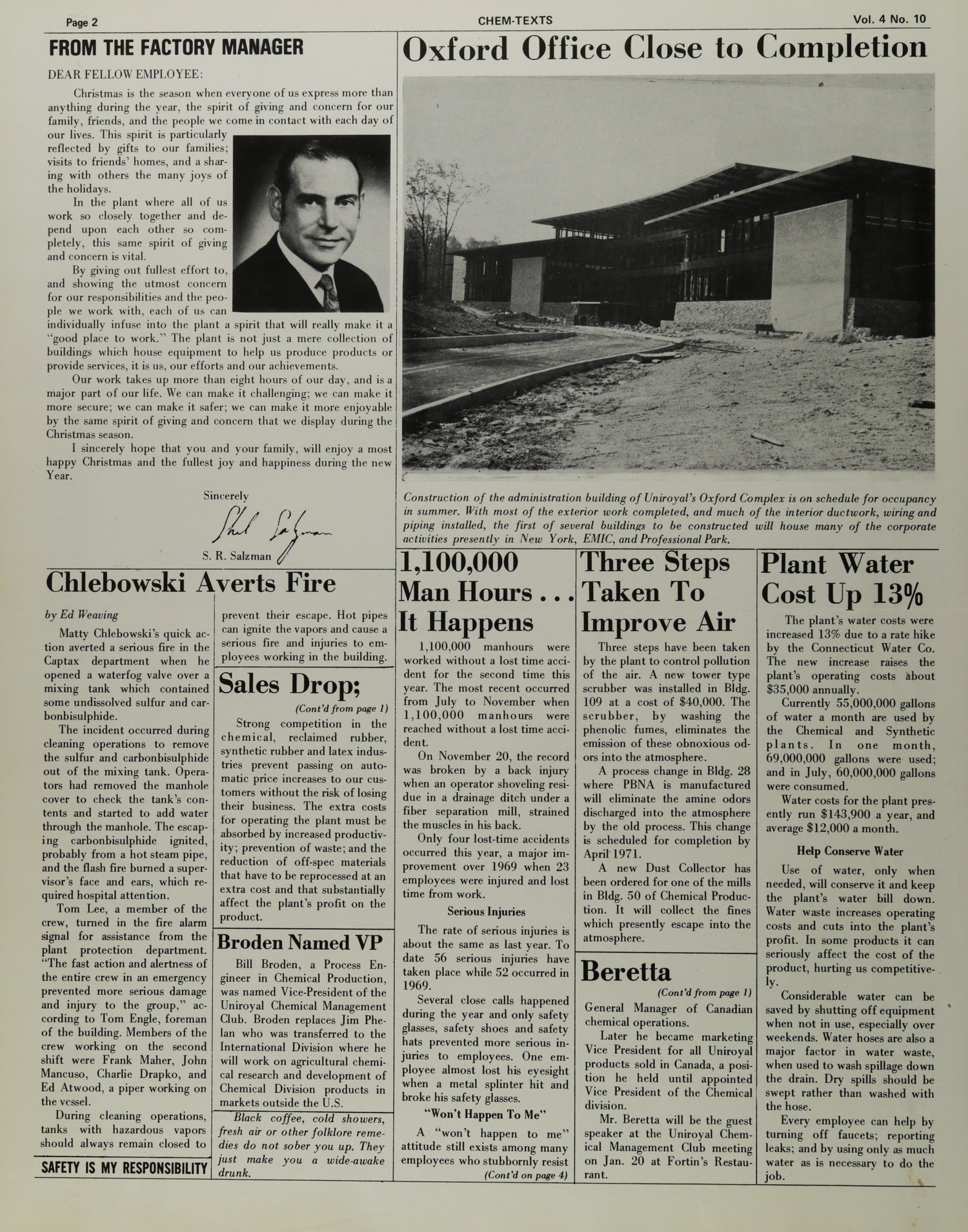
Construction of the administration building of Uniroyal’s Oxford Complex is on schedule for occupancy in summer. With most of the exterior work completed, and much of the interior ductwork, wiring and piping installed, the first of several buildings to be constructed will house many of the corporate activities presently in New York, EMIC, and Professional Park.


Chlebowski Averts Fire

by Ed Weaving

Matty Chlebowski’s quick action averted a serious fire in the Captax department when he opened a waterfog valve over a mixing tank which contained some undissolved sulfur and carbonbisulphide.

The incident occurred during cleaning operations to remove the sulfur and carbonbisulphide out of the mixing tank. Operators had removed the manhole cover to check the tank’s contents and started to add water through the manhole. The escaping carbonbisulphide ignited, probably from a hot steam pipe, and the flash fire burned a supervisor’s face and ears, which required hospital attention.

Tom Lee, a member of the crew, turned in the fire alarm signal for assistance from the plant protection department. “The fast action and alertness of the entire crew in an emergency prevented more serious damage and injury to the group,” according to Tom Engle, foreman of the building. Members of the crew working on the second shift were Frank Maher, John Mancuso, Charlie Drapko, and Ed Atwood, a piper working on the vessel.

During cleaning operations, tanks with hazardous vapors should always remain closed to

SAFETY IS MY RESPONSIBILITY

prevent their escape. Hot pipes can ignite the vapors and cause a serious fire and injuries to employees working in the building.


Sales Drop;

(Cont’d from page 1)

Strong competition in the chemical, reclaimed rubber, synthetic rubber and latex industries prevent passing on automatic price increases to our customers without the risk of losing their business. The extra costs for operating the plant must be absorbed by increased productivity; prevention of waste; and the reduction of off-spec materials that have to be reprocessed at an extra cost and that substantially affect the plant’s profit on the product.


Broden Named VP

Bill Broden, a Process Engineer in Chemical Production, was named Vice-President of the Uniroyal Chemical Management Club. Broden replaces Jim Phelan who was transferred to the International Division where he will work on agricultural chemical research and development of Chemical Division products in markets outside the U.S.

Black coffee, cold showers, fresh air or other folklore remedies do not sober you up. They just make you a wide-awake drunk.


1,100,000 Man Hours… It Happens

1,100,000 manhours were worked without a lost time accident for the second time this year. The most recent occurred from July to November when 1,100,000 manhours were reached without a lost time accident.

On November 20, the record was broken by a back injury when an operator shoveling residue in a drainage ditch under a fiber separation mill, strained the muscles in his back.

Only four lost-time accidents occurred this year, a major improvement over 1969 when 23 employees were injured and lost time from work.

Serious Injuries

The rate of serious injuries is about the same as last year. To date 56 serious injuries have taken place while 52 occurred in 1969.

Several close calls happened during the year and only safety glasses, safety shoes and safety hats prevented more serious injuries to employees. One employee almost lost his eyesight when a metal splinter hit and broke his safety glasses.

“Won’t Happen To Me”

A “won’t happen to me” attitude still exists among many employees who stubbornly resist

(Cont’d on page 4)


Three Steps Taken To Improve Air

Three steps have been taken by the plant to control pollution of the air. A new tower type scrubber was installed in Bldg. 109 at a cost of $40,000. The scrubber, by washing the phenolic fumes, eliminates the emission of these obnoxious odors into the atmosphere.

A process change in Bldg. 28 where PBNA is manufactured will eliminate the amine odors discharged into the atmosphere by the old process. This change is scheduled for completion by April 1971.

A new Dust Collector has been ordered for one of the mills in Bldg. 50 of Chemical Production. It will collect the fines which presently escape into the atmosphere.


Beretta

(Cont’d from page 1)

General Manager of Canadian chemical operations.

Later he became marketing Vice President for all Uniroyal products sold in Canada, a position he held until appointed Vice President of the Chemical division.

Mr. Beretta will be the guest speaker at the Uniroyal Chemical Management Club meeting on Jan. 20 at Fortin’s Restaurant.


Plant Water Cost Up 13%

The plant’s water costs were increased 13% due to a rate hike by the Connecticut Water Co. The new increase raises the plant’s operating costs about $35,000 annually.

Currently 55,000,000 gallons of water a month are used by the Chemical and Synthetic plants. In one month, 69,000,000 gallons were used; and in July, 60,000,000 gallons were consumed.

Water costs for the plant presently run $143,900 a year, and average $12,000 a month.

Help Conserve Water

Use of water, only when needed, will conserve it and keep the plant’s water bill down. Water waste increases operating costs and cuts into the plant’s profit. In some products it can seriously affect the cost of the product, hurting us competitively.

Considerable water can be saved by shutting off equipment when not in use, especially over weekends. Water hoses are also a major factor in water waste, when used to wash spillage down the drain. Dry spills should be swept rather than washed with the hose.

Every employee can help by turning off faucets; reporting leaks; and by using only as much water as is necessary to do the job.

CHEM-TEXTS – Vol. 4 No. 10 – Page 10

Page 010

CHEM-TEXTS

Vol. 4 No. 10 Page 3


Chemical Business Competition Increases

[IMAGE: Three men in business attire reviewing documents]

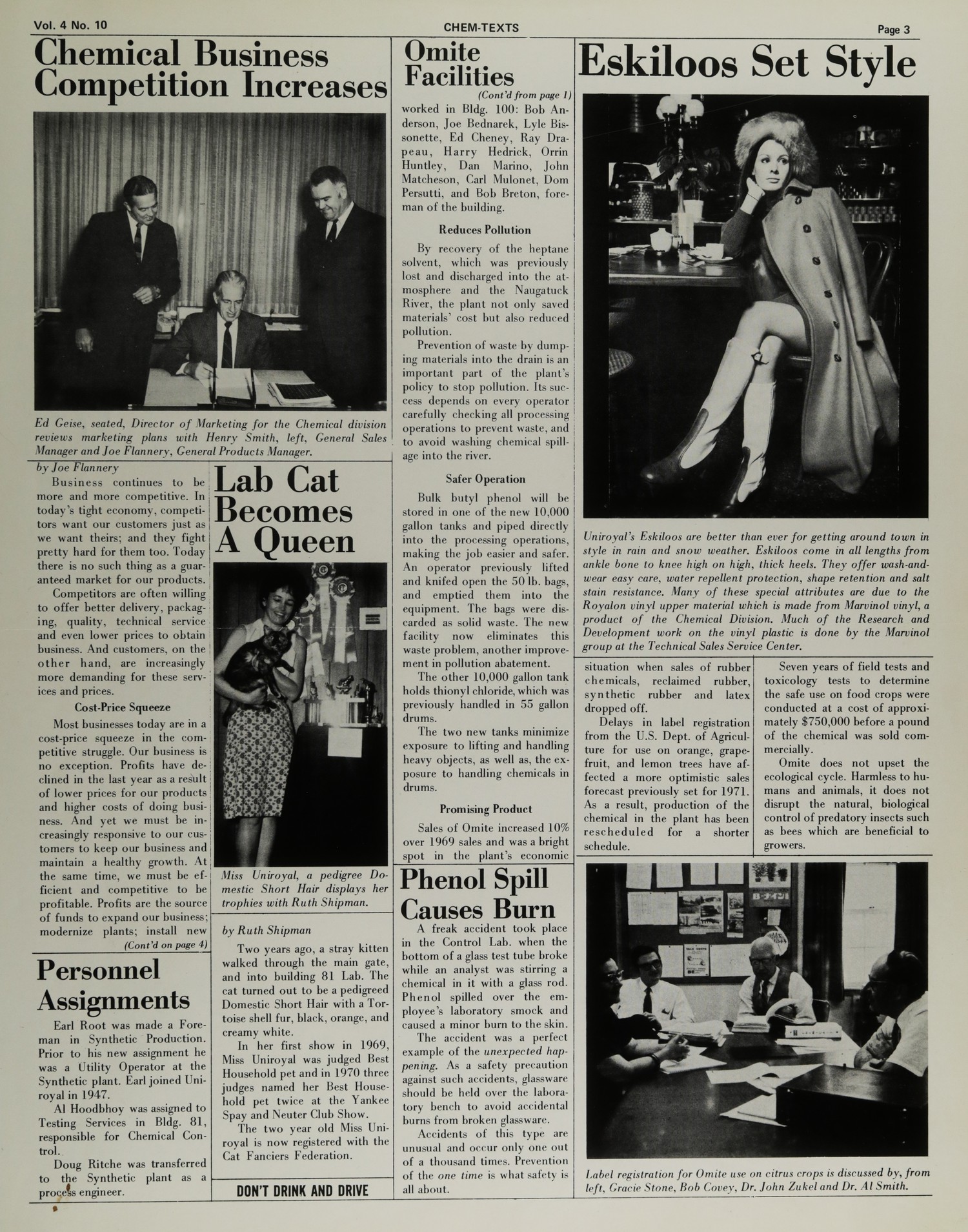
Ed Geise, seated, Director of Marketing for the Chemical division reviews marketing plans with Henry Smith, left, General Sales Manager and Joe Flannery, General Products Manager.

by Joe Flannery

Business continues to be more and more competitive. In today’s tight economy, competitors want our customers just as we want theirs; and they fight pretty hard for them too. Today there is no such thing as a guaranteed market for our products.

Competitors are often willing to offer better delivery, packaging, quality, technical service and even lower prices to obtain business. And customers, on the other hand, are increasingly more demanding for these services and prices.

Cost-Price Squeeze

Most businesses today are in a cost-price squeeze in the competitive struggle. Our business is no exception. Profits have declined in the last year as a result of lower prices for our products and higher costs of doing business. And yet we must be increasingly responsive to our customers to keep our business and maintain a healthy growth. At the same time, we must be efficient and competitive to be profitable. Profits are the source of funds to expand our business; modernize plants; install new

(Cont’d on page 4)


Personnel Assignments

Earl Root was made a Foreman in Synthetic Production. Prior to his new assignment he was a Utility Operator at the Synthetic plant. Earl joined Uniroyal in 1947.

Al Hoodbhoy was assigned to Testing Services in Bldg. 81, responsible for Chemical Control.

Doug Ritche was transferred to the Synthetic plant as a process engineer.


Lab Cat Becomes A Queen

[IMAGE: Woman holding a cat and displaying trophies]

Miss Uniroyal, a pedigree Domestic Short Hair displays her trophies with Ruth Shipman.

by Ruth Shipman

Two years ago, a stray kitten walked through the main gate, and into building 81 Lab. The cat turned out to be a pedigreed Domestic Short Hair with a Tortoise shell fur, black, orange, and creamy white.

In her first show in 1969, Miss Uniroyal was judged Best Household pet and in 1970 three judges named her Best Household pet twice at the Yankee Spay and Neuter Club Show.

The two year old Miss Uniroyal is now registered with the Cat Fanciers Federation.


DON’T DRINK AND DRIVE


Omite Facilities

(Cont’d from page 1)

worked in Bldg. 100: Bob Anderson, Joe Bednarek, Lyle Bissonette, Ed Cheney, Ray Drapeau, Harry Hedrick, Orrin Huntley, Dan Marino, John Matcheson, Carl Mulonet, Dom Persutti, and Bob Breton, foreman of the building.

Reduces Pollution

By recovery of the heptane solvent, which was previously lost and discharged into the atmosphere and the Naugatuck River, the plant not only saved materials’ cost but also reduced pollution.

Prevention of waste by dumping materials into the drain is an important part of the plant’s policy to stop pollution. Its success depends on every operator carefully checking all processing operations to prevent waste, and to avoid washing chemical spillage into the river.

Safer Operation

Bulk butyl phenol will be stored in one of the new 10,000 gallon tanks and piped directly into the processing operations, making the job easier and safer. An operator previously lifted and knifed open the 50 lb. bags, and emptied them into the equipment. The bags were discarded as solid waste. The new facility now eliminates this waste problem, another improvement in pollution abatement.

The other 10,000 gallon tank holds thionyl chloride, which was previously handled in 55 gallon drums.

The two new tanks minimize exposure to lifting and handling heavy objects, as well as, the exposure to handling chemicals in drums.

Promising Product

Sales of Omite increased 10% over 1969 sales and was a bright spot in the plant’s economic


Eskiloos Set Style

[IMAGE: Woman in boots posing outdoors]

Uniroyal’s Eskiloos are better than ever for getting around town in style in rain and snow weather. Eskiloos come in all lengths from ankle bone to knee high on high, thick heels. They offer wash-and-wear easy care, water repellent protection, shape retention and salt stain resistance. Many of these special attributes are due to the Royalon vinyl upper material which is made from Marvinol vinyl, a product of the Chemical Division. Much of the Research and Development work on the vinyl plastic is done by the Marvinol group at the Technical Sales Service Center.

situation when sales of rubber chemicals, reclaimed rubber, synthetic rubber and latex dropped off.

Delays in label registration from the U.S. Dept. of Agriculture for use on orange, grapefruit, and lemon trees have affected a more optimistic sales forecast previously set for 1971. As a result, production of the chemical in the plant has been rescheduled for a shorter schedule.

Seven years of field tests and toxicology tests to determine the safe use on food crops were conducted at a cost of approximately $750,000 before a pound of the chemical was sold commercially.

Omite does not upset the ecological cycle. Harmless to humans and animals, it does not disrupt the natural, biological control of predatory insects such as bees which are beneficial to growers.


Phenol Spill Causes Burn

A freak accident took place in the Control Lab. when the bottom of a glass test tube broke while an analyst was stirring a chemical in it with a glass rod. Phenol spilled over the employee’s laboratory smock and caused a minor burn to the skin.

The accident was a perfect example of the unexpected happening. As a safety precaution against such accidents, glassware should be held over the laboratory bench to avoid accidental burns from broken glassware.

Accidents of this type are unusual and occur only one out of a thousand times. Prevention of the one time is what safety is all about.


[IMAGE: Four people in discussion around a table]

Label registration for Omite use on citrus crops is discussed by, from left, Gracie Stone, Bob Covey, Dr. John Zukel and Dr. Al Smith.

CHEM-TEXTS – Vol. 3, 1969, No. 11 – Page 1

Page 001

UNIROYAL

Merry Christmas – Happy New Year

CHEM-TEXTS

Vol. 3, 1969 PUBLISHED FOR THE PEOPLE OF UNIROYAL CHEMICAL No. 11


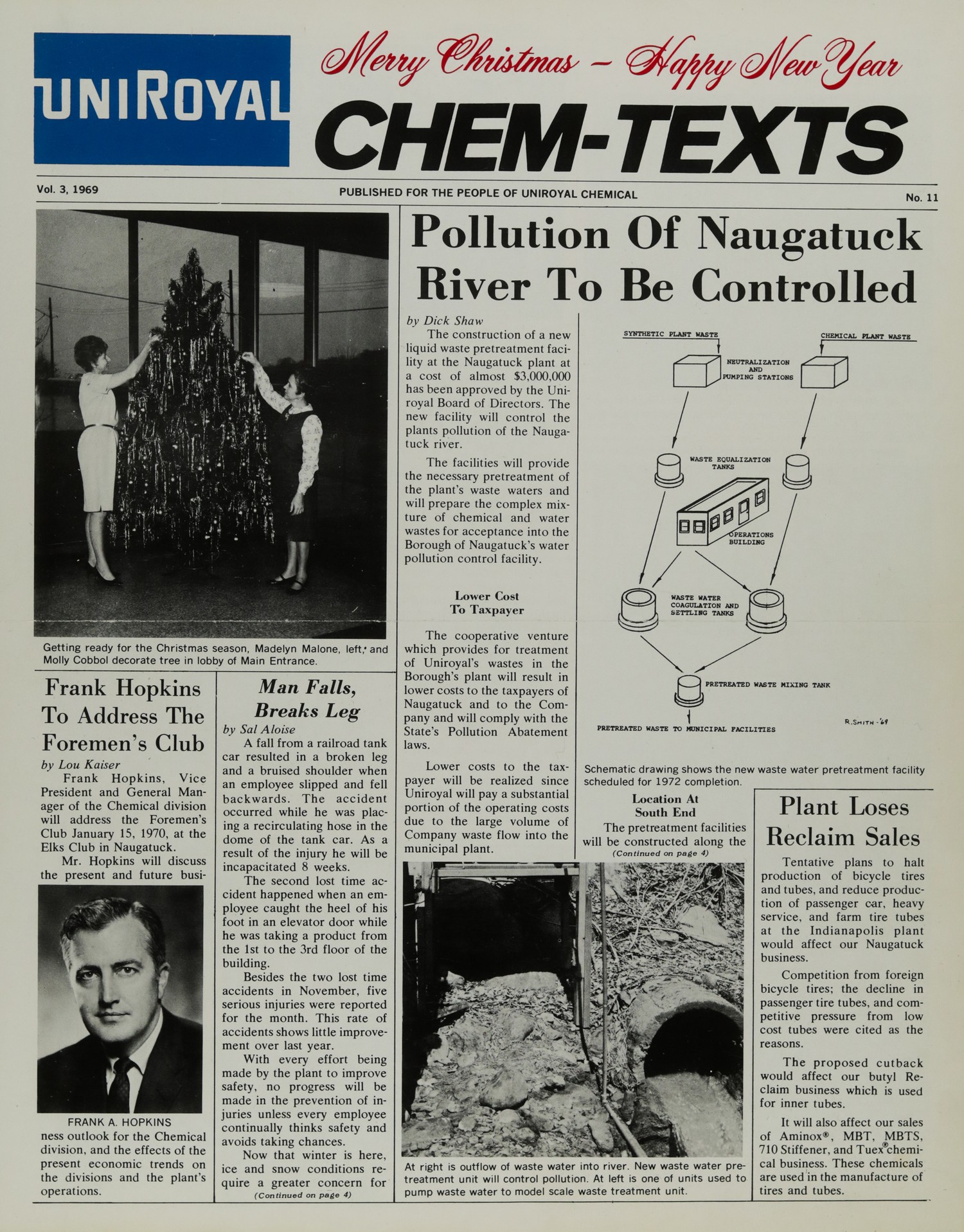
[IMAGE: Two people decorating a Christmas tree]

Getting ready for the Christmas season, Madelyn Malone, left; and Molly Cobbol decorate tree in lobby of Main Entrance.


Frank Hopkins To Address The Foremen’s Club

by Lou Kaiser

Frank Hopkins, Vice President and General Manager of the Chemical division will address the Foremen’s Club January 15, 1970, at the Elks Club in Naugatuck.

Mr. Hopkins will discuss the present and future busi-

[IMAGE: Portrait photo of Frank A. Hopkins]

FRANK A. HOPKINS

ness outlook for the Chemical division, and the effects of the present economic trends on the divisions and the plant’s operations.


Man Falls, Breaks Leg

by Sal Aloise

A fall from a railroad tank car resulted in a broken leg and a bruised shoulder when an employee slipped and fell backwards. The accident occurred while he was placing a recirculating hose in the dome of the tank car. As a result of the injury he will be incapacitated 8 weeks.

The second lost time accident happened when an employee caught the heel of his foot in an elevator door while he was taking a product from the 1st to the 3rd floor of the building.

Besides the two lost time accidents in November, five serious injuries were reported for the month. This rate of accidents shows little improvement over last year.

With every effort being made by the plant to improve safety, no progress will be made in the prevention of injuries unless every employee continually thinks safety and avoids taking chances.

Now that winter is here, ice and snow conditions require a greater concern for

(Continued on page 4)


Pollution Of Naugatuck River To Be Controlled

by Dick Shaw

The construction of a new liquid waste pretreatment facility at the Naugatuck plant at a cost of almost $3,000,000 has been approved by the Uniroyal Board of Directors. The new facility will control the plants pollution of the Naugatuck river.

The facilities will provide the necessary pretreatment of the plant’s waste waters and will prepare the complex mixture of chemical and water wastes for acceptance into the Borough of Naugatuck’s water pollution control facility.

Lower Cost To Taxpayer

The cooperative venture which provides for treatment of Uniroyal’s wastes in the Borough’s plant will result in lower costs to the taxpayers of Naugatuck and to the Company and will comply with the State’s Pollution Abatement laws.

Lower costs to the taxpayer will be realized since Uniroyal will pay a substantial portion of the operating costs due to the large volume of Company waste flow into the municipal plant.


[DIAGRAM: Schematic showing waste water treatment process flow, including:
– SYNTHETIC PLANT WASTE
– CHEMICAL PLANT WASTE
– NEUTRALIZATION AND PUMPING STATIONS
– WASTE EQUALIZATION TANKS
– OPERATIONS BUILDING
– WASTE WATER COAGULATION AND SETTLING TANKS
– PRETREATED WASTE MIXING TANK
– PRETREATED WASTE TO MUNICIPAL FACILITIES]

R.Smith-69

Schematic drawing shows the new waste water pretreatment facility scheduled for 1972 completion.

Location At South End

The pretreatment facilities will be constructed along the

(Continued on page 4)


[IMAGE: Industrial equipment/construction site]

At right is outflow of waste water into river. New waste water pretreatment unit will control pollution. At left is one of units used to pump waste water to model scale waste treatment unit.


Plant Loses Reclaim Sales

Tentative plans to halt production of bicycle tires and tubes, and reduce production of passenger car, heavy service, and farm tire tubes at the Indianapolis plant would affect our Naugatuck business.

Competition from foreign bicycle tires; the decline in passenger tire tubes, and competitive pressure from low cost tubes were cited as the reasons.

The proposed cutback would affect our butyl Reclaim business which is used for inner tubes.

It will also affect our sales of Aminox®, MBT, MBTS, 710 Stiffener, and Tuex chemical business. These chemicals are used in the manufacture of tires and tubes.

CHEM-TEXTS – Vol. 3 No. 11 – Page 4

Page 004

Page 4 | CHEM-TEXT | Vol. 3 No. 11

$21,000 Contributed to United Givers

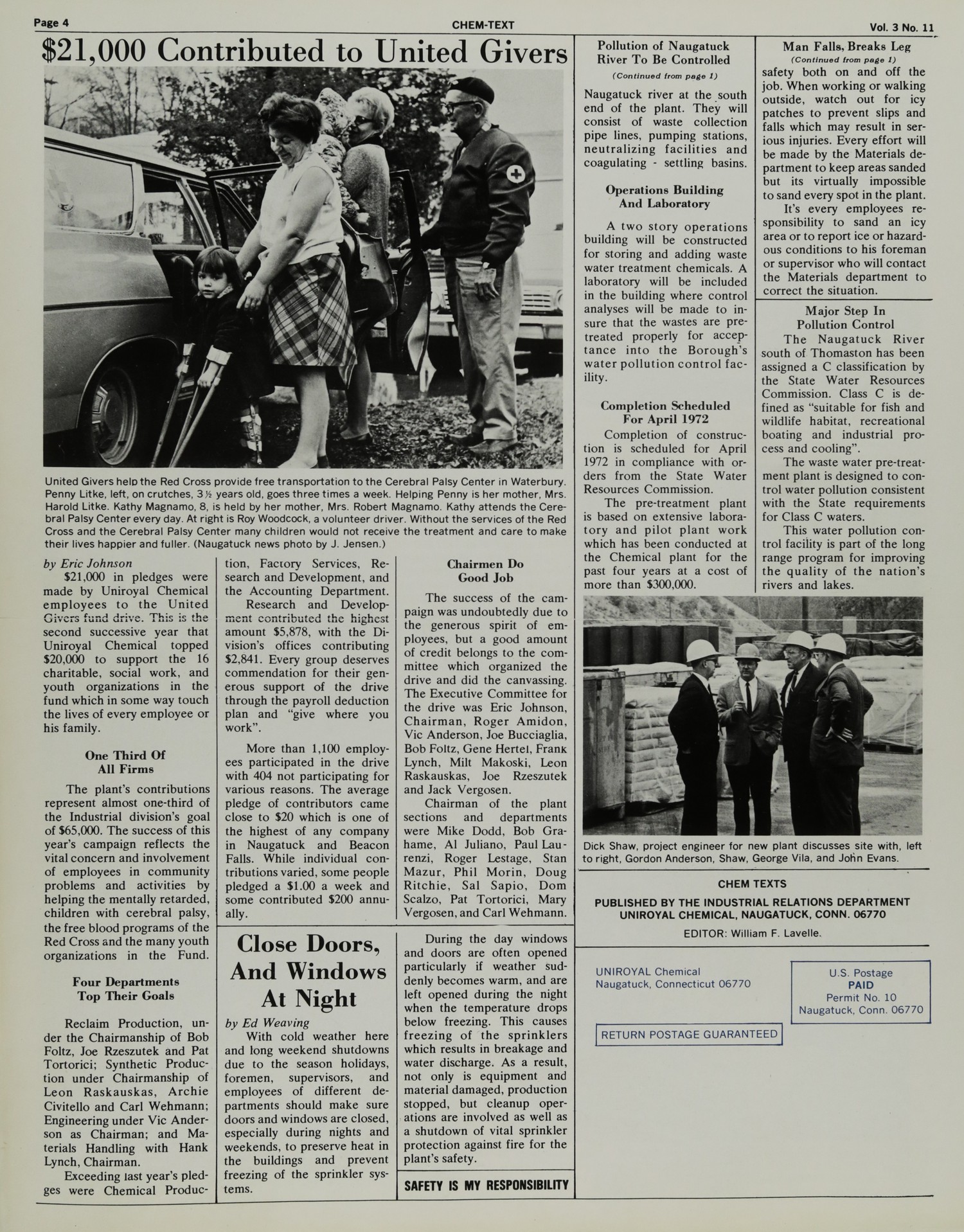
[PHOTO: Image showing people near a vehicle, including children on crutches and adults]

United Givers help the Red Cross provide free transportation to the Cerebral Palsy Center in Waterbury. Penny Litke, left, on crutches, 3 ½ years old, goes three times a week. Helping Penny is her mother, Mrs. Harold Litke. Kathy Magnamo, 8, is held by her mother, Mrs. Robert Magnamo. Kathy attends the Cerebral Palsy Center every day. At right is Roy Woodcock, a volunteer driver. Without the services of the Red Cross and the Cerebral Palsy Center many children would not receive the treatment and care to make their lives happier and fuller. (Naugatuck news photo by J. Jensen.)


by Eric Johnson

$21,000 in pledges were made by Uniroyal Chemical employees to the United Givers fund drive. This is the second successive year that Uniroyal Chemical topped $20,000 to support the 16 charitable, social work, and youth organizations in the fund which in some way touch the lives of every employee or his family.

One Third Of All Firms

The plant’s contributions represent almost one-third of the Industrial division’s goal of $65,000. The success of this year’s campaign reflects the vital concern and involvement of employees in community problems and activities by helping the mentally retarded, children with cerebral palsy, the free blood programs of the Red Cross and the many youth organizations in the Fund.

Four Departments Top Their Goals

Reclaim Production, under the Chairmanship of Bob Foltz, Joe Rzeszutek and Pat Tortorici; Synthetic Production under Chairmanship of Leon Raskauskas, Archie Civitello and Carl Wehmann; Engineering under Vic Anderson as Chairman; and Materials Handling with Hank Lynch, Chairman.

Exceeding last year’s pledges were Chemical Production, Factory Services, Research and Development, and the Accounting Department.

Research and Development contributed the highest amount $5,878, with the Division’s offices contributing $2,841. Every group deserves commendation for their generous support of the drive through the payroll deduction plan and “give where you work”.

More than 1,100 employees participated in the drive with 404 not participating for various reasons. The average pledge of contributors came close to $20 which is one of the highest of any company in Naugatuck and Beacon Falls. While individual contributions varied, some people pledged a $1.00 a week and some contributed $200 annually.


Close Doors, And Windows At Night

by Ed Weaving

With cold weather here and long weekend shutdowns due to the season holidays, foremen, supervisors, and employees of different departments should make sure doors and windows are closed, especially during nights and weekends, to preserve heat in the buildings and prevent freezing of the sprinkler systems.


Chairmen Do Good Job

The success of the campaign was undoubtedly due to the generous spirit of employees, but a good amount of credit belongs to the committee which organized the drive and did the canvassing. The Executive Committee for the drive was Eric Johnson, Chairman, Roger Amidon, Vic Anderson, Joe Bucciaglia, Bob Foltz, Gene Hertel, Frank Lynch, Milt Makoski, Leon Raskauskas, Joe Rzeszutek and Jack Vergosen.

Chairman of the plant sections and departments were Mike Dodd, Bob Grahame, Al Juliano, Paul Laurenzi, Roger Lestage, Stan Mazur, Phil Morin, Doug Ritchie, Sal Sapio, Dom Scalzo, Pat Tortorici, Mary Vergosen, and Carl Wehmann.

During the day windows and doors are often opened particularly if weather suddenly becomes warm, and are left opened during the night when the temperature drops below freezing. This causes freezing of the sprinklers which results in breakage and water discharge. As a result, not only is equipment and material damaged, production stopped, but cleanup operations are involved as well as a shutdown of vital sprinkler protection against fire for the plant’s safety.

SAFETY IS MY RESPONSIBILITY


Pollution of Naugatuck River To Be Controlled

(Continued from page 1)

Naugatuck river at the south end of the plant. They will consist of waste collection pipe lines, pumping stations, neutralizing facilities and coagulating – settling basins.

Operations Building And Laboratory

A two story operations building will be constructed for storing and adding waste water treatment chemicals. A laboratory will be included in the building where control analyses will be made to insure that the wastes are pretreated properly for acceptance into the Borough’s water pollution control facility.

Completion Scheduled For April 1972

Completion of construction is scheduled for April 1972 in compliance with orders from the State Water Resources Commission.

The pre-treatment plant is based on extensive laboratory and pilot plant work which has been conducted at the Chemical plant for the past four years at a cost of more than $300,000.


Man Falls, Breaks Leg

(Continued from page 1)

safety both on and off the job. When working or walking outside, watch out for icy patches to prevent slips and falls which may result in serious injuries. Every effort will be made by the Materials department to keep areas sanded but its virtually impossible to sand every spot in the plant.

It’s every employees responsibility to sand an icy area or to report ice or hazardous conditions to his foreman or supervisor who will contact the Materials department to correct the situation.

Major Step In Pollution Control

The Naugatuck River south of Thomaston has been assigned a C classification by the State Water Resources Commission. Class C is defined as “suitable for fish and wildlife habitat, recreational boating and industrial process and cooling”.

The waste water pre-treatment plant is designed to control water pollution consistent with the State requirements for Class C waters.

This water pollution control facility is part of the long range program for improving the quality of the nation’s rivers and lakes.


[PHOTO: Four men in hard hats examining documents outdoors]

Dick Shaw, project engineer for new plant discusses site with, left to right, Gordon Anderson, Shaw, George Vila, and John Evans.


CHEM TEXTS

PUBLISHED BY THE INDUSTRIAL RELATIONS DEPARTMENT
UNIROYAL CHEMICAL, NAUGATUCK, CONN. 06770

EDITOR: William F. Lavelle.


UNIROYAL Chemical
Naugatuck, Connecticut 06770

U.S. Postage
PAID
Permit No. 10
Naugatuck, Conn. 06770

RETURN POSTAGE GUARANTEED

CHEM-TEXTS – Vol. 2 No. 3 – Page 2

Page 002

Page 2 | CHEM-TEXT | Vol. 2 No. 3


FROM THE FACTORY MANAGER

Dear Fellow Employee:

I’m sure you will be interested to know that after the recent sign up for the 1968 UNIROYAL Employee Stock Option Plan over 62% of us, in our plant, are participating in the new plan. This increase over the 56.2% participation in 1966, no doubt, reflects our interest in recent increases in the selling price of UNIROYAL stock.

In this connection, I am often asked what has caused our stock to go up. Very frankly, beyond general economic considerations, there is only one factor that causes stock to go up or down, and that is the value the buyer – the public – places on the profitability of the Company. Profitability is the measure of how good a job a Company does in meeting the needs of it customers. Very simply, it indicates how well each of us and the thousands of other UNIROYAL employees are doing our jobs.

As owners of the Company’s stock, it is in our best interests to see that we, as employees, do our jobs in the most effective and efficient manner. This has been, and will continue to be the spirit of the Naugatuck Plant.

[Signature]

John D. Evans


Louis Triano Heads Elks

Louis Triano, a 35 year member of the Naugatuck Elks Lodge, was elected president of the Connecticut Elks Association at their 39th. annual convention. This is the highest state office attainable by an Elks Club member.

Triano served the local lodge as Exalted Ruler in 1942-43 and again in 1950-51. He is a certified National Ritualistic Judge, judging contests throughout New England.

Lou has been in Marvinol® vinyl R & D as a laboratory technician for the past 18 years, working on Marvinol plastisol and organosol formulations. Our vinyl resins are used in the manufacture of Naugahyde® upholstery fabric, footwear and rainwear.


Semaskvich Compares Uniroyal With Other Companies

Ed Semaskvich of the Mechanical Dept. worked around the world in the U.S. Navy, as a construction and iron worker, and for automotive and brass companies. He joined Uniroyal 18 years ago.

When asked his views by the editor of Uniroyal World on how Uniroyal compared with other companies that he worked for, Semaskvich expressed these opini “I

particularly like the improved safety program, the excellent fringe benefits, and the good management and employee relationship that is constantly improving, at the Naugatuck Plant.”

“The Company seemed a little on the conservative side when I first came, but in the past few years a new, progressive outlook has taken place. For instance, I can suggest

new ideas to my superintendent, foreman or even the factory manager, and if they think they’re good, they take action.” According to Ed, “no company is pertect, but Naugatuck beats the rest, otherwise I would’nt have stayed around for 18 years.

Ed has taken an active interest in the Naugatuck Swim Club for young children for many years and is a member of the V.F.W.


SUGGESTION PLAN WINNERS RECEIVE $630 FOR IDEAS

At the last Suggestion Award Committee meeting held recently, a total of $630 was awarded to employees for suggestions on safety, improved working conditions, and changes in equipment.

Any employee may submit a suggestion and win an award by using a little imagination. Your idea may win you as much as $500 for just a few moments of your time. Look around your department, there are hundreds of opportunities staring right at you.

The award winners were:
L. Fortier, Chem, Prod. – $15; J. Schumacher, Mech. Dept. $15; L. Respass, Reclaim – $15; M. Janetty, Mech. Dept. – $15; E. Clark, Mech. Dept. – $15; H. Vogt, Engineering – $35; E. Clark, Mech. Dept. – $35 E. Clark, Mech. Dept. – Hon. Men. R. Ruginis, Mech. Stores – $15; T. Turner, Chem. Prod. – $15; L. Fortier, Chem. Prod. – $15; J. Slasienski, Chem. Prod. – $15; J. Sickola,

Chem. Rec. – $15; J. Slasienski, Chem. Prod. – $15; K. Ferreira, Lab. – Hon. Men.; E. Smith, Pilot Plant – $30; C. Hiser, Mech. Dept. – $15; F. Rosa, Mech. Dept. – $15; J. Enamait, Mech. Dept. – $15; A. Brodeur, Mech. Dept. – $15; A. Picoli, Mech. Dept. – $15.

Also R. Tucker, Mech. Dept. – $15; R. Tucker, Mech Dept. – $15; E. Koslowski, Chem. Prod. – $15; J. Lynch, Chem. Prod. – $15; D. Persutti, Chem. Prod. – $15; C. Ferguson, Mech. Dept. – $15; P. Hardt, Chem. Prod. – Hon. Men.; S. Molnar, Chem. Prod. – $25; S. Molnar, Chem. Prod. – Hon. Men.; J. Gandolf, Mech. Dept. – $15; J. Gandolf, Mech. Dept. – $15; J. Lynch, Chem. Prod. – $15; C. Iannuzzi, Mech. Dept. – $15; F. Gagne, Lab. – $15; R. Pakalnis, Lab. – $25; G. Mitchell, Chem. Prod. – $15; W. Breton, Chem. Prod. – $15; J. Kerski, Materials – Hon. Men.; J. DiSantis, Dispersions – $25; G. Reale, Mech. – $50.


Pollution Program Progresses To Clean Naugatuck River

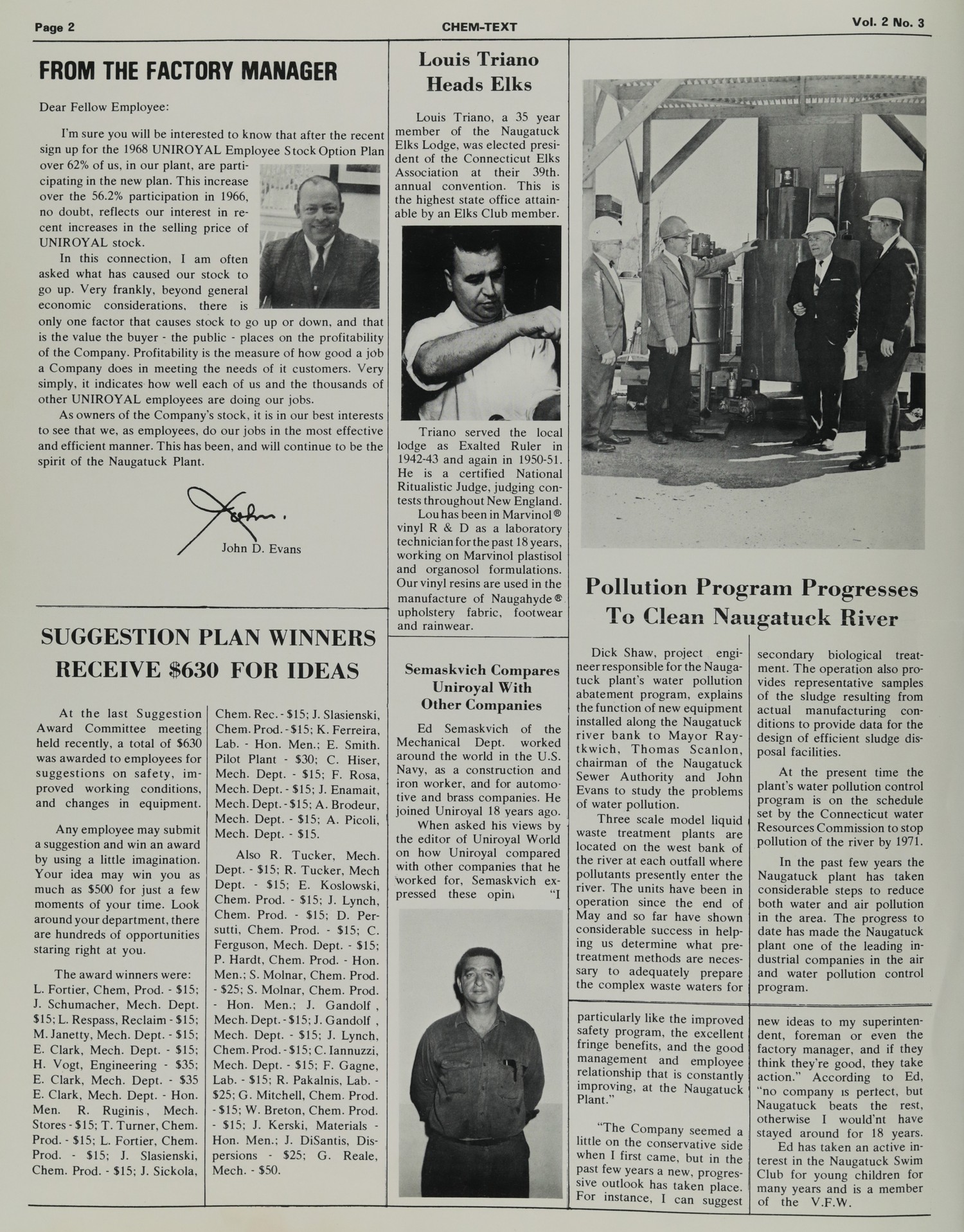
Dick Shaw, project engineer responsible for the Naugatuck plant’s water pollution abatement program, explains the function of new equipment installed along the Naugatuck river bank to Mayor Raytkwich, Thomas Scanlon, chairman of the Naugatuck Sewer Authority and John Evans to study the problems of water pollution.

Three scale model liquid waste treatment plants are located on the west bank of the river at each outfall where pollutants presently enter the river. The units have been in operation since the end of May and so far have shown considerable success in helping us determine what pretreatment methods are necessary to adequately prepare the complex waste waters for

secondary biological treatment. The operation also provides representative samples of the sludge resulting from actual manufacturing conditions to provide data for the design of efficient sludge disposal facilities.

At the present time the plant’s water pollution control program is on the schedule set by the Connecticut Water Resources Commission to stop pollution of the river by 1971.

In the past few years the Naugatuck plant has taken considerable steps to reduce both water and air pollution in the area. The progress to date has made the Naugatuck plant one of the leading industrial companies in the air and water pollution control program.

CHEM-TEXTS – Vol. 2, No. 4 – Page 1

Page 001

UNIROYAL CHEM-TEXTS

Vol. 2 PUBLISHED FOR THE PEOPLE OF UNIROYAL CHEMICAL No. 4


United Givers Goal, $20,000 “Give Where You Work” Urged

Ron Mitchinson, Chairman of the United Givers Campaign to be conducted in the plant during October, urges 100% employee participation and “Give Where You Work” to support the 16 worthwhile Agencies in the Fund. Many of these Agencies serve not only Naugatuck and Beacon Falls, but most of the surrounding towns in the area. Some like the U.S.O., Salvation Army, United Cerebral Palsy and Red Cross are national in their service.

Most plant employees and their families have been served by one or more of these organizations. Their need for money this year is greater than ever to continue their good work. By giving “where you work” and contributing through the payroll deduction plan at least one hour’s pay monthly for wage employees or 1% of annual income for salary employees, the plant goal of $20,000 can be easily reached.

In the 1967 Campaign 67% of Chemical employees contributed $17,775. About 560 employees did not contribute. On the Pledge card every employee will find at least one Agency which he or his family wants to help support.

The Campaign Committee is E. Alves, S. Gillette, E. Johnson, W. Tavelle, L. Lombardi, D. Miller, J. Rzeszutek, and R. Van Allen. Close to 100 Co-Captains will contact every employee during the Campaign.

Co-Captains are B. Sullivan, E. Evans, L. Taranowich, L. Soares, M. Rosa, H. Steele, N. Krenitsky, J. Valinho, P. Tortorici, M. Chmielewski, J. McKee, G. Browning, E. Jancis, B. Perkins, C. Fernandes, P. Braudis, A. Ferro, W. Jones, T. Brett, R. Mastromatteo, R. Cote, C. Buckley, R. Harsch, P. Hinckley, D. Malloy, W. Parks, J. McGinn, I. Prager, R. Farrell, W. Smith, J. Phelan, W. Singleton, R. Amidon, W. Budd, G. Arndt, P. Murray, L. Flynn, F. Adams, E. Cheney, R. Lestage, G. Birch, H. Hook, F. Rodrigues, W. Campbell, H. Francolini, D. Poehailos, H. Lynch, R. Ames, C. Reich, L. Terra, A. Pistarelli, M. Paiva, D. Rappe, A. Nauges, T. Skehan, R. Foltz, B. Dunn, J. Rice, J. Bucciaglia, K. Dowling, R. Magnamino, F. Magnamo, E. Ruella, R. Breton, J. Bielak, J. Honyotski, D. Cowan, R. Valentine, D. Gabriel, R. Kaiser, J. Charkow, C. Roland, R. Manulla, J. Wojtczak, W. Bieleski, R. Magnamo, F. Enamait, S. Perkus, J. Sullivan, T. McMahon, W. Leukhardt, J. Quint, L. Nappiello, D. George, Geo. Arndt, H. Scullin, F. Lynch, J. Murtha, A. Juliano, J. Vergosen, R. Terino, E. Weaving, S. Aloise, F. Sabia, and J. Tierney.


One gift works many wonders

[IMAGE: Young child’s face]

GIVE THE UNITED WAY


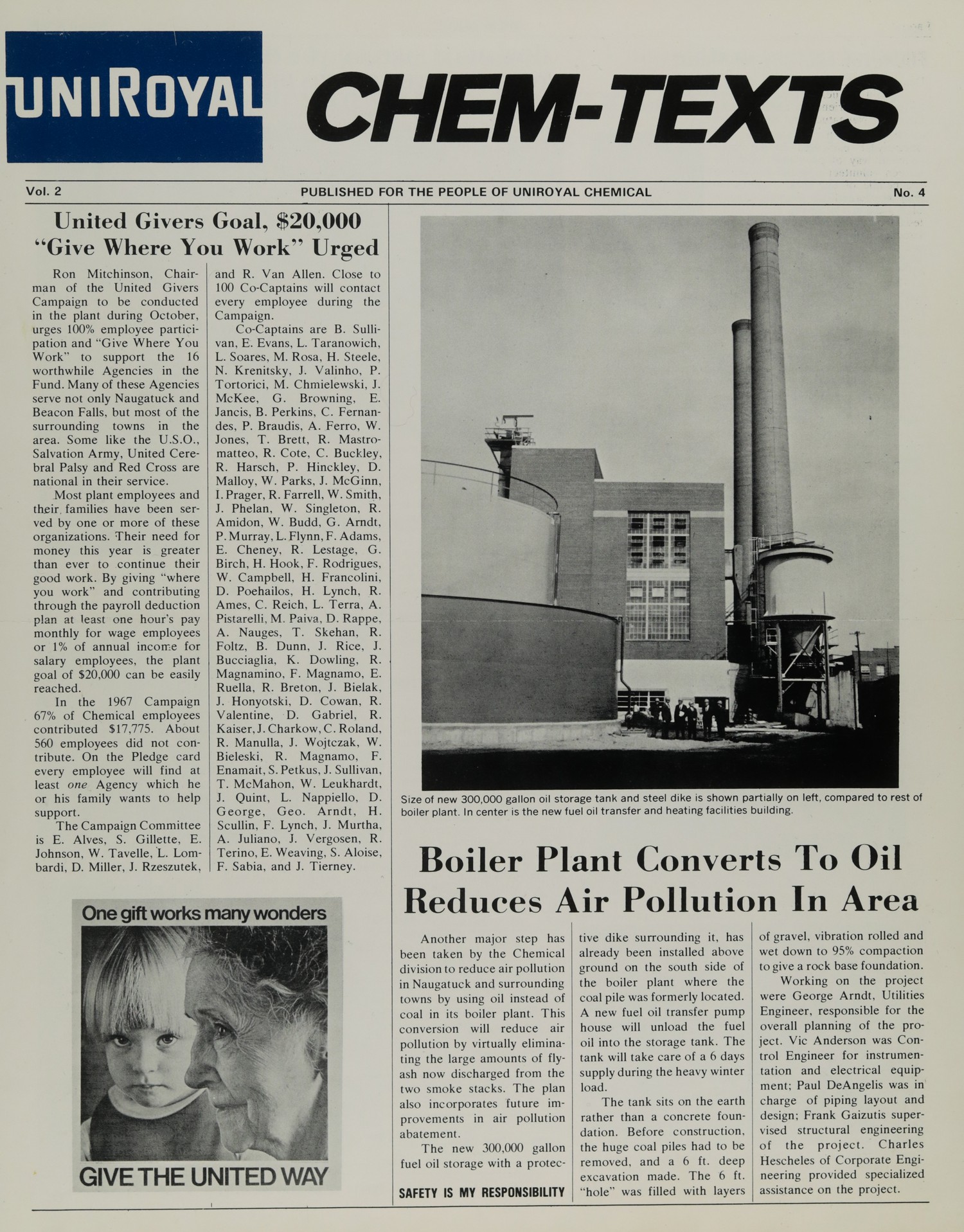
[IMAGE: Industrial facility with storage tank and buildings]

Size of new 300,000 gallon oil storage tank and steel dike is shown partially on left, compared to rest of boiler plant. In center is the new fuel oil transfer and heating facilities building.


Boiler Plant Converts To Oil Reduces Air Pollution In Area

Another major step has been taken by the Chemical division to reduce air pollution in Naugatuck and surrounding towns by using oil instead of coal in its boiler plant. This conversion will reduce air pollution by virtually eliminating the large amounts of fly-ash now discharged from the two smoke stacks. The plan also incorporates future improvements in air pollution abatement.

The new 300,000 gallon fuel oil storage with a protective dike surrounding it, has already been installed above ground on the south side of the boiler plant where the coal pile was formerly located. A new fuel oil transfer pump house will unload the fuel oil into the storage tank. The tank will take care of a 6 days supply during the heavy winter load.

The tank sits on the earth rather than a concrete foundation. Before construction, the huge coal piles had to be removed, and a 6 ft. deep excavation made. The 6 ft. “hole” was filled with layers of gravel, vibration rolled and wet down to 95% compaction to give a rock base foundation.

Working on the project were George Arndt, Utilities Engineer, responsible for the overall planning of the project. Vic Anderson was Control Engineer for instrumentation and electrical equipment; Paul DeAngelis was in charge of piping layout and design; Frank Gaizutis supervised structural engineering of the project. Charles Hescheles of Corporate Engineering provided specialized assistance on the project.


SAFETY IS MY RESPONSIBILITY

CHEM-TEXTS – Vol. 2 No. 2 – Page 3

Page 003

CHEM TEXTS

Vol. 2 No. 2 Page 3


Reclaim Quality To Improve With New Modern Equipment

Water Pollution Will Be Reduced

The following pictures show some of the latest manufacturing equipment the Company has recently purchased to keep us in business against strong competition. Improved quality of our reclaimed rubber will result from the finer grinder and fibre separation machines.

Some equipment has been already installed and is undergoing shakedowns to work out the “bugs”. The miracle of the modernization of the plant is that full scale production is continuing without interruption.

Previously it was difficult to control the lint escape after the fibre was separated from the rubber. The new equipment now makes it possible to catch the fibre lint and bale it like hay. This new piece of equipment will now control the amount of lint that was formerly discharged into the Naugatuck River, and causing a pollution problem. After the modernization program is completed, further studies will be made and evaluated to reduce the air pollution caused by the reclaim manufacturing process. This fits in with the Division’s policy of air and water pollution abatement in the area.


[IMAGE: Industrial building exterior with equipment]


[IMAGE: Control panel with lights and switches]

New control panel will aid operators in controlling the operation of fibre separation and fine grinding.


[IMAGE: Industrial baler equipment]

New baler equipment collects and bales lint previously discharged into Naugatuck river.


PURDUE U. INSTALLS OUR ALL-WEATHER “RUBBER” TRACK

“The installation of the first and new outdoor all-weather “rubber” track at Purdue has any number of advantages, not the least of which is that we are now able to get a boy ready for the track, instead of getting the track ready for the boy”, says the University highly respected track coach for 20 years, Dave Rankin.

Sold under the tradename “U.S. Royal Track”, the surface is a mixture of specially selected natural and synthetic rubber made at Naugatuck. The rubber must be of the highest quality to produce a smooth uniform texture and mixed with asphalt cement and fine aggregates at a contractor’s hot mix plant.

Unlike cinders, which are high-priced and difficult to buy, the “rubber” track can be used 12 months a year under almost any weather conditions. This new all-weather track practically makes postponements and cancellations a thing of the past.

The “rubber” track doesn’t create dust and can be painted with long-lasting markings that stay clean and sharp under constant usage.

The track is tough but pliable enough to give under pressure without cracking. Unlike cinder or clay tracks, the spikes do not dig up the track permanently, because the rubber surface quickly restores itself.

Maintenance of cinder and clay tracks has always been a major and costly expense. Inclement weather meant cancellation of a scheduled meet or poor performance. A crew was oftentimes required to rake, roll, groove and reline it.

Frost works havoc with a track, causing potholes, surface bumps, a lot of time and effort to restore it to fast condition.

With Uniroyal Chemical’s “rubber” track, none of these problems occur. It would take a hurricane to cancel a meet and besides, it virtually guarantees a consistent performance because the footing is always sure and constant. Practice sessions now mean more to the athlete and the University, for the runner’s time on Monday or Tuesday will be the same time as the day of the meet.

The “rubber” track can be installed in practically one day and ready for use on the next with regular highway paving equipment. Usually two Chemical R & D personnel are on the spot to provide technical assistance to the contractor.

The contractor, prior to submitting his bid to Purdue, made it a point to witness similar applications of competitive products. He found other materials difficult to pave, difficult to handle, control and roll. The U.S. Royal track won out for its reputation of a quality product.


[IMAGE: Construction equipment on track]

[IMAGE: Workers installing track surface]

CHEM-TEXTS – unknown-s238

Page 238

CHEM-TEXTS

Page 3


Synthetic Plant Dismantled

The Synthetic Rubber plant is nearing the final stages of dismantlement. In the reactor area above many of the tanks and salvageable equipment have been removed.

The Federal Equipment Co., of Cleveland, Ohio, who purchased the plant for resale, has been shipping the tanks and useable equipment to all parts of the country and overseas.

The Hortonspheres, which were navigational landmarks for airplane pilots, have been carefully cut, piece by piece, prior to shipment to Canada for re-erection.

Thomas Ennis of the Plant Engineering department is in charge of the operation which has been going on for several months.


Pallets Avert Mishap

Thomas Carey points to the broken support under a tank trailer, loaded with a caustic byproduct.

The Materials Department has found a new use for old pallets as safety supports under tank and trailer trucks.

The pallets have already saved thousands of dollars when the support of a tank trailer filled with a caustic byproduct collapsed between Bldg. 118 & Bldg. 18. Besides the loss of the material, the spill would have interrupted the operation of the pretreatment plant.

To prevent recurrences of such mishaps it has been made a standard safety practice to place the old pallets under the trailers.


2,000,000 Manhours . . .

continued from page 1

Safety Record & Costs — 1966 to 1975

in 1975 they had dropped to $100,000.

Since the plant is self-insured, its insurance costs per 100 hours were high because of the frequency and severity of the accident. These costs adversely affected the profits of the plant.

Lost Time Serious Injuries Total Total Costs
1966 21 84 105
1967 22 56 78
1968 20 68 88
1969 23 56 79
1970 6 66 72
1971 20 63 83 $231,567
1972 11 62 73 $275,641
1973 9 24 33 $199,682
1974 4 23 27 $238,359
1975 3 26 29 $ 95,307

New Sewer System Reduces Pollution

by Richard Shaw

When the new $3,000,000 liquid waste water pretreatment plant went into full operation it became necessary to start work on the next major item of water pollution control, the separation of the storm and process sewers. The entire project will cost about $1,500,000.

The Chemical plant was built with only one sewer system which carried all the process waste, sanitary waste and storm water to the Naugatuck River. The sewer system is now connected to the pretreatment plant

$1,116….

continued from page 2

Pasquale Tortorici, Reclaim, was presented $168. Eleanor Chmielinski, Research and Development received $156. An award of $100. was given to Lawrence Fortier, Chemical Production.

All Employees Eligible to Submit Ideas

Any employee may participate in the Idea Plan. It’s a simple way to earn extra money by recommending improvements in the way things are done.

Awards are made for suggestions on production improvement, equipment changes, materials handling, waste reduction and other areas.

The minimum award for an Idea is $25.00. There is no limit on the maximum award.

The new sewer separates the rain and process waters. It will carry the rain water to the river and prevent an overflow at the Pretreatment plant.

and during periods of heavy rain or snow melt there is too much water for it to handle. Some of the water must overflow to the river carrying some process waste with it.

To prevent the overflow the plant is installing a separate sewer system for storm water which will collect water from the building roofs and the yard areas and carry it directly to the river.

Storm sewers will be installed continued on page 4


Breen’s

The Biggest Little Store In The Country
Visit our four floors
of famous brands for him and her.

Cosmetic & Jewelry Dept.
Guerlain
Elizabeth Arden
Nina-Ricci
Chanel
Yves Saint Laurent
Monet
Napier
Marvella Pearls

Lingerie Shop
Vanity Fair
Olga—Barbizon
Schrank Robes
Shadowline

Ski Boutique
Ski Jackets
Warm-Up Slacks
Ski Pants
Ski Sweaters
Gloves & Sweaters

Jr. Sportswear
Collegetown Sweaters
White Stag—Skirts, Slacks
Davis Coats
Peerless Sportwear

Men’s Shop
Manhattan Shirts
Botany Suits—Sport Coats
H. Freeman Suits
London Fog Rainwear
Florsheim Shoes
Jaymar Slacks

Ladies’ Dept.
Couture Coats
Tanner Dresses
Vanity Fair Lingerie
Joyce—Naturalizer Shoes


Chittenden Insurance Agency, Inc.

Insurance—Mutual Funds—Real Estate

180 Church Street
Naugatuck, Connecticut
Tel. 729-8209

Frederick D. Zonino Nathan M. Pierpont, Jr.

All have made identically inadequate wage offers, he said, and are prevented from meeting their collective bargaining obligations by the strike assistance pact

“All have made identically in-
adequate wage offers,” he said,
“and are prevented from meet-
ing their collective bargain-
ing obligations by the strike as-
sistance pact.”

A Firestone spokesman said
the company wouldn’t have any
official comment on the NLRB
complaint by the union.

“We can see no legal basis
for their claims,” he said.
Spokesmen for the four other
rubber companies also declined
comment on the complaint.

The issuance of this com-
plaint and the meeting held
Monday by Local 45 is the first
real information and indication
the striking rubber workers
have received on how the nego-
tiating sessions are progress-
ing.

The strike, now entering its
42nd day, has been a long, drag-
ged out affair filled with rumors
but without any definite releases
as to the proceedings in Ohio.

Both the companies and union
had agreed that neither party
would give out information as
to the negotiations without the
others consent.

Striking Local 45 members
gave their President George
Froehlich a vote of confidence
at the meeting held Monday;
however, Froehlich gave the
members no encouragement as
far as a fast settlement was
concerned.

Picketing at all three local
plants remain quiet as UniRoyal
supervisory personnel carry on
limited production at the
Chemical and Synthetic plants
and shipping is carried out at
the Footwear warehouse.

Mayor Joseph C. Raytkwich
received a complaint from a
Cotton Hollow resident this
morning that a heavy smog
covered the area. The com-
plainant also said that the
air was irritating to the nose
and eyes.

However, the source of the
“smog” was not identified, and
this seems to be the only area
of the borough so effected.