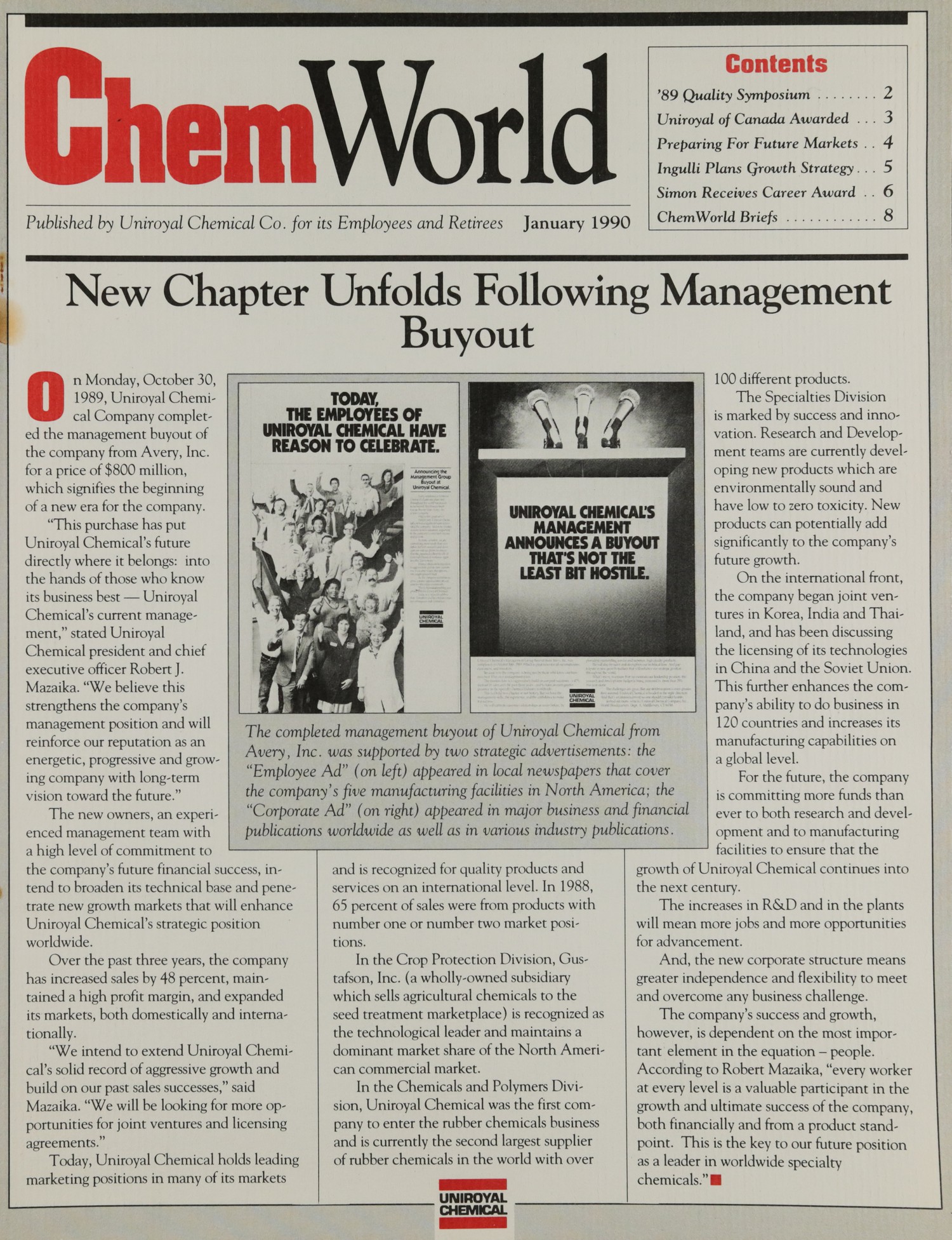
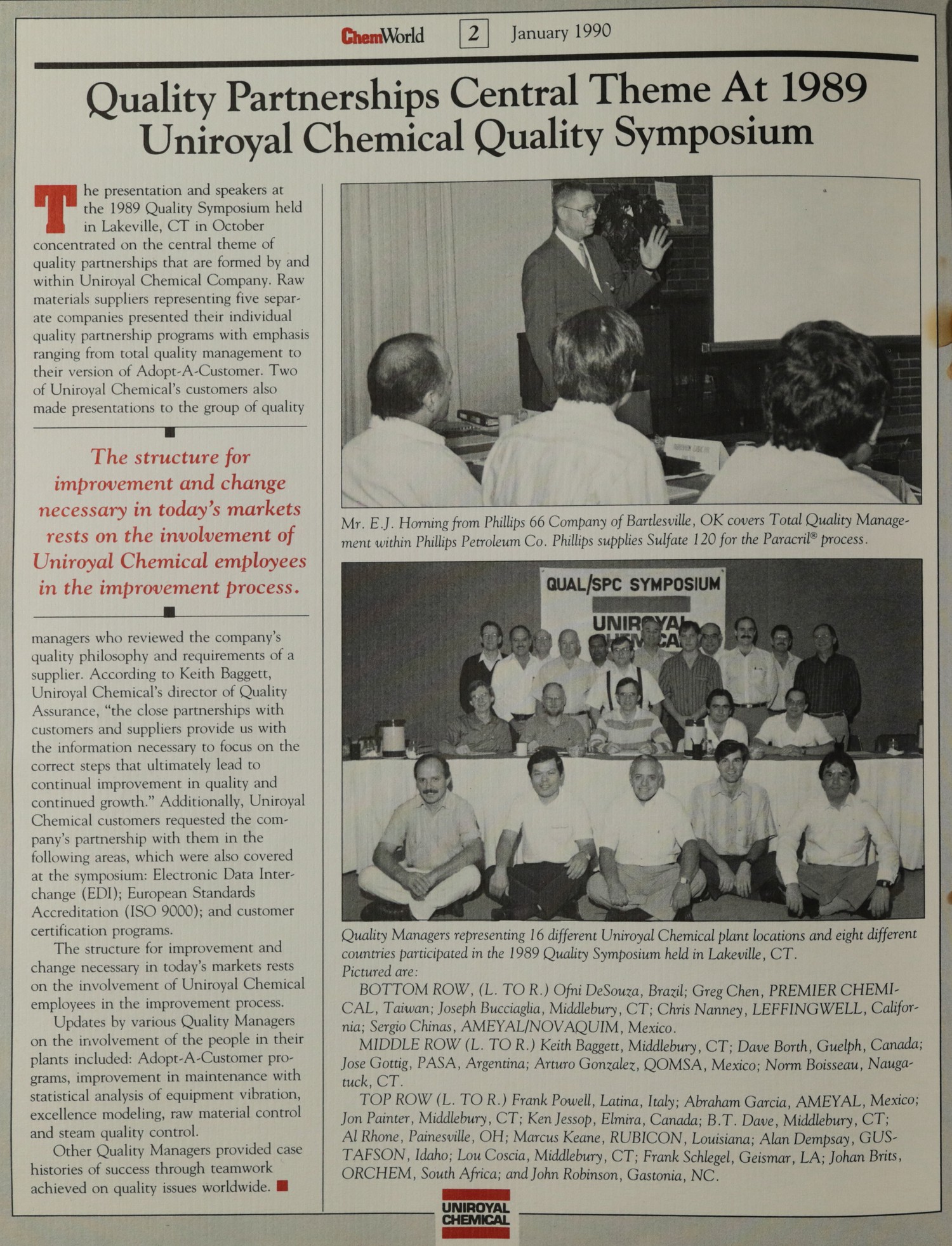
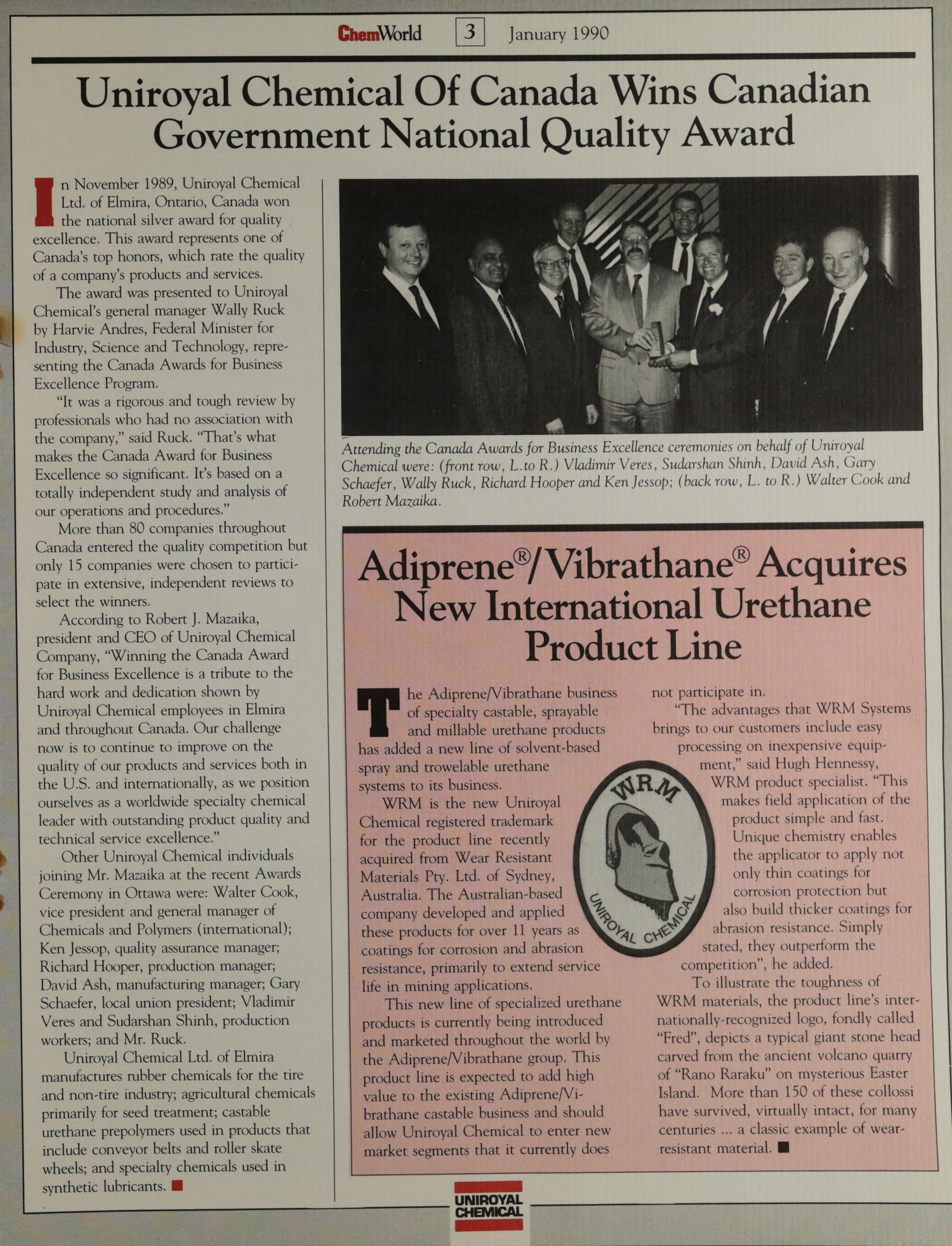
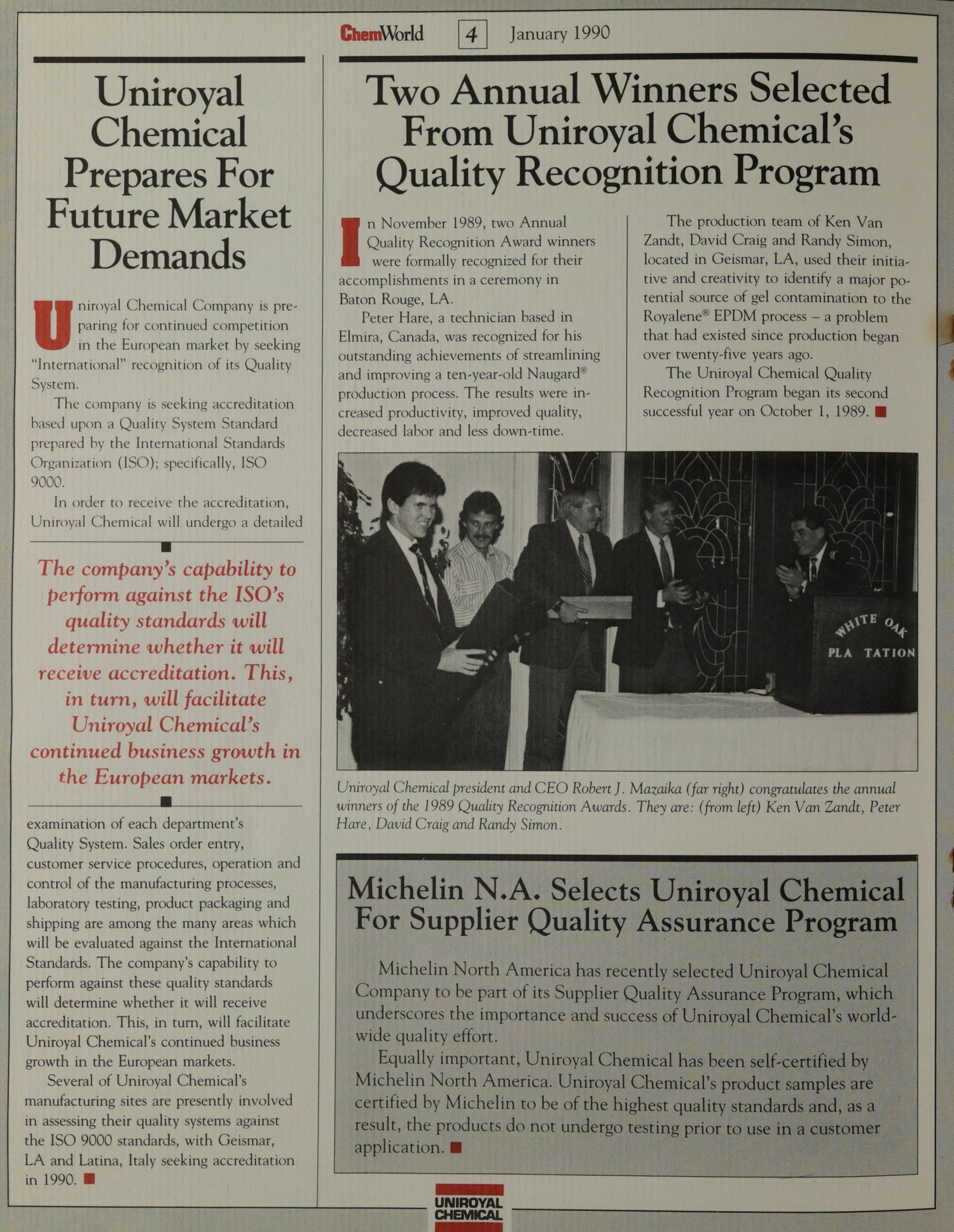
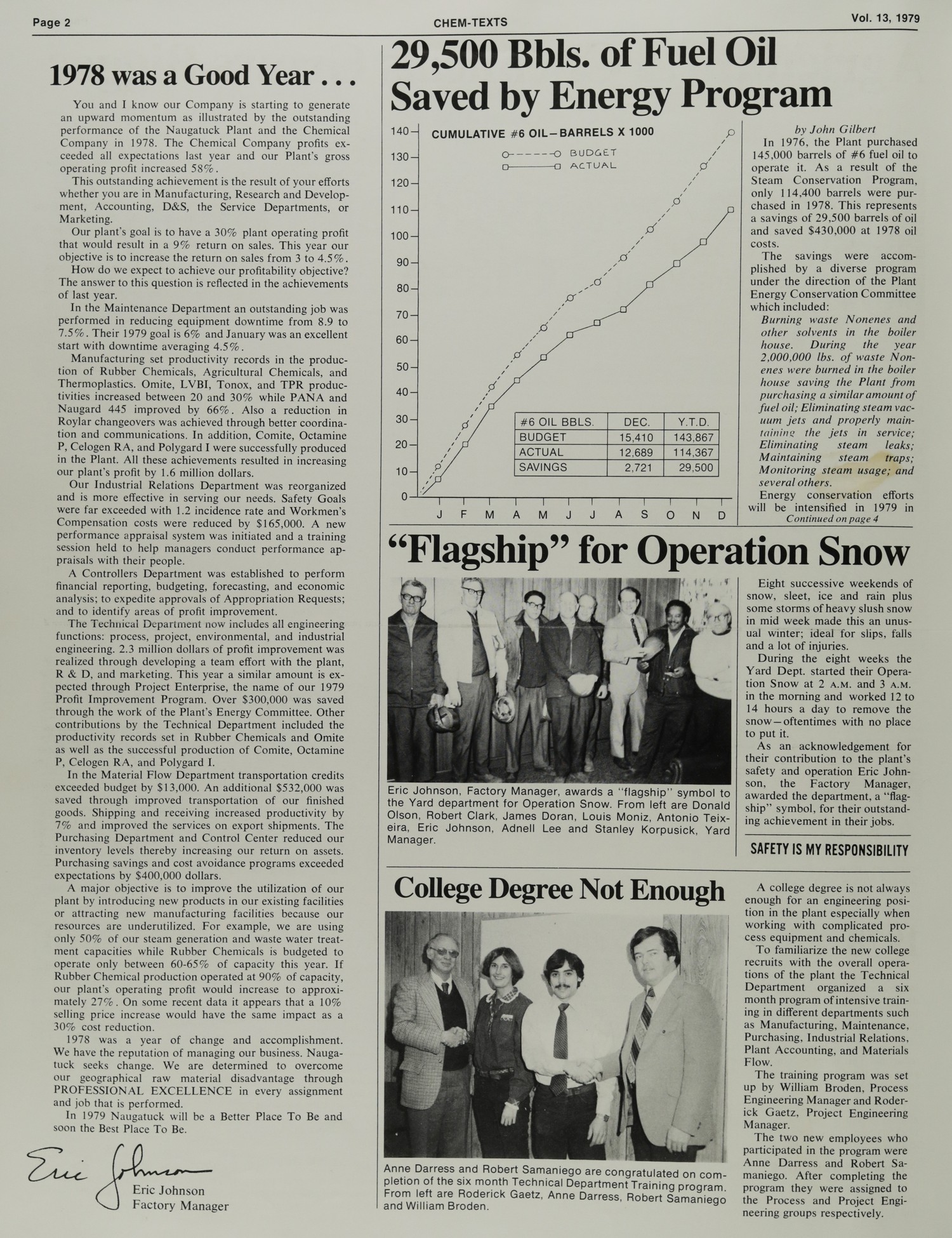
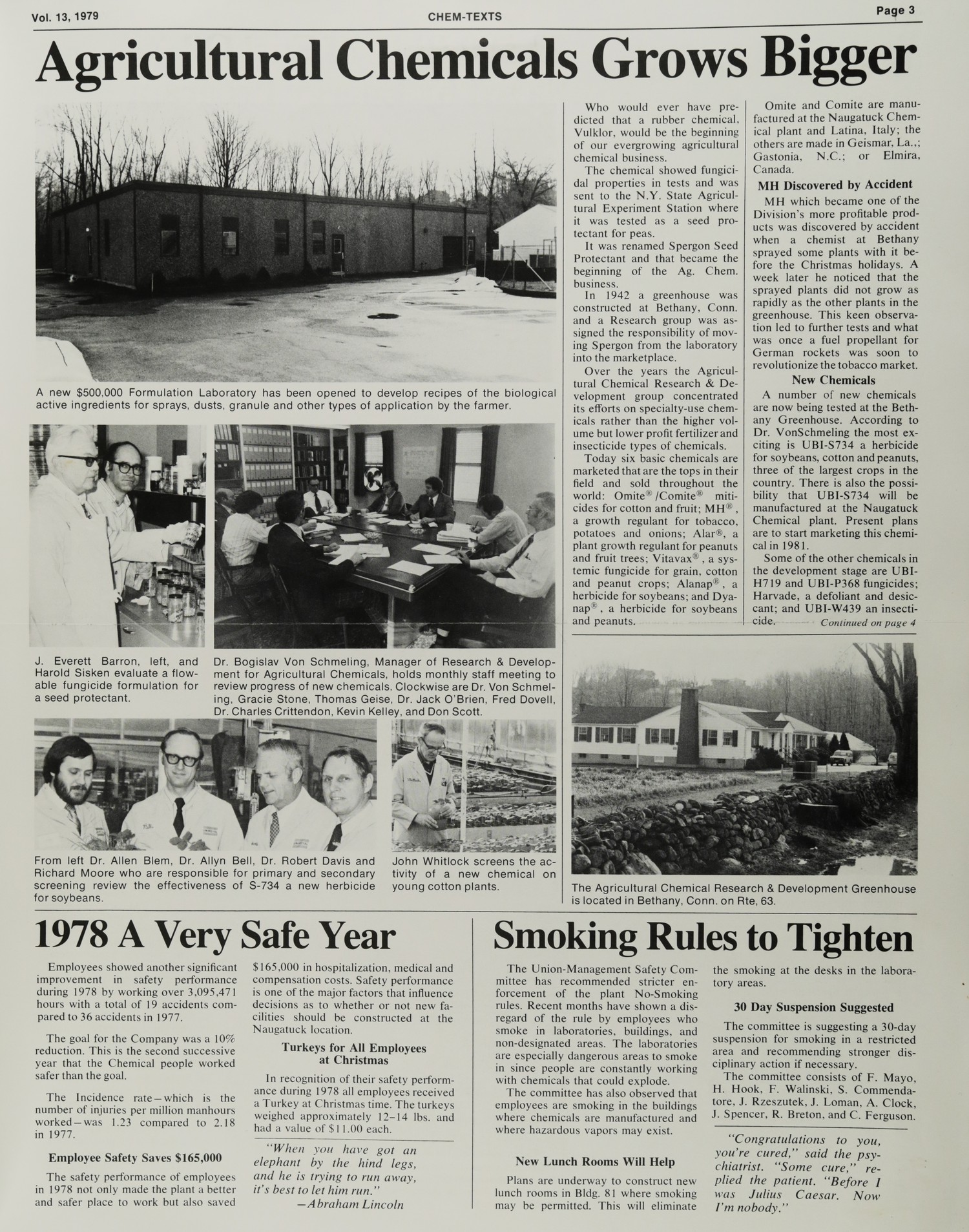
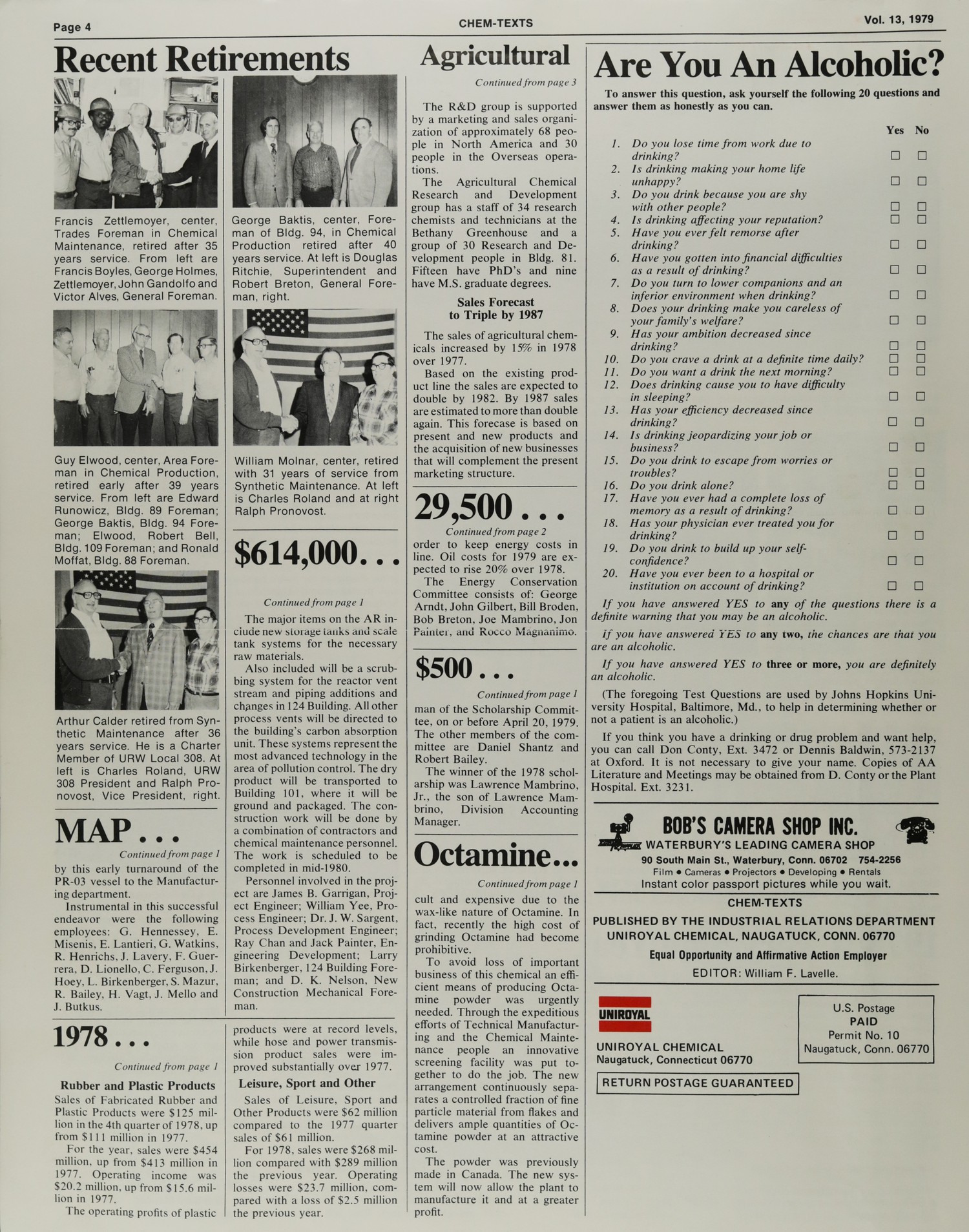
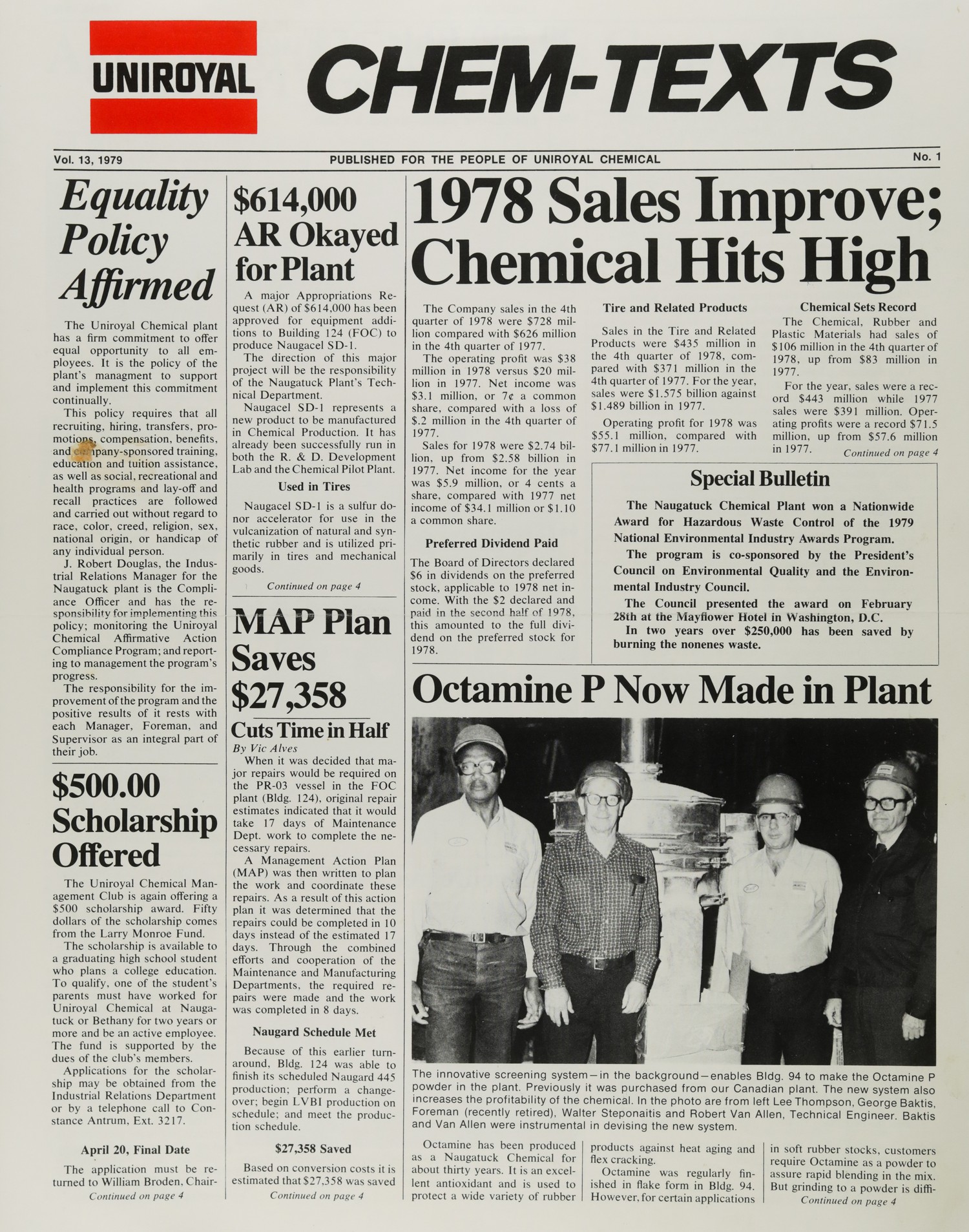
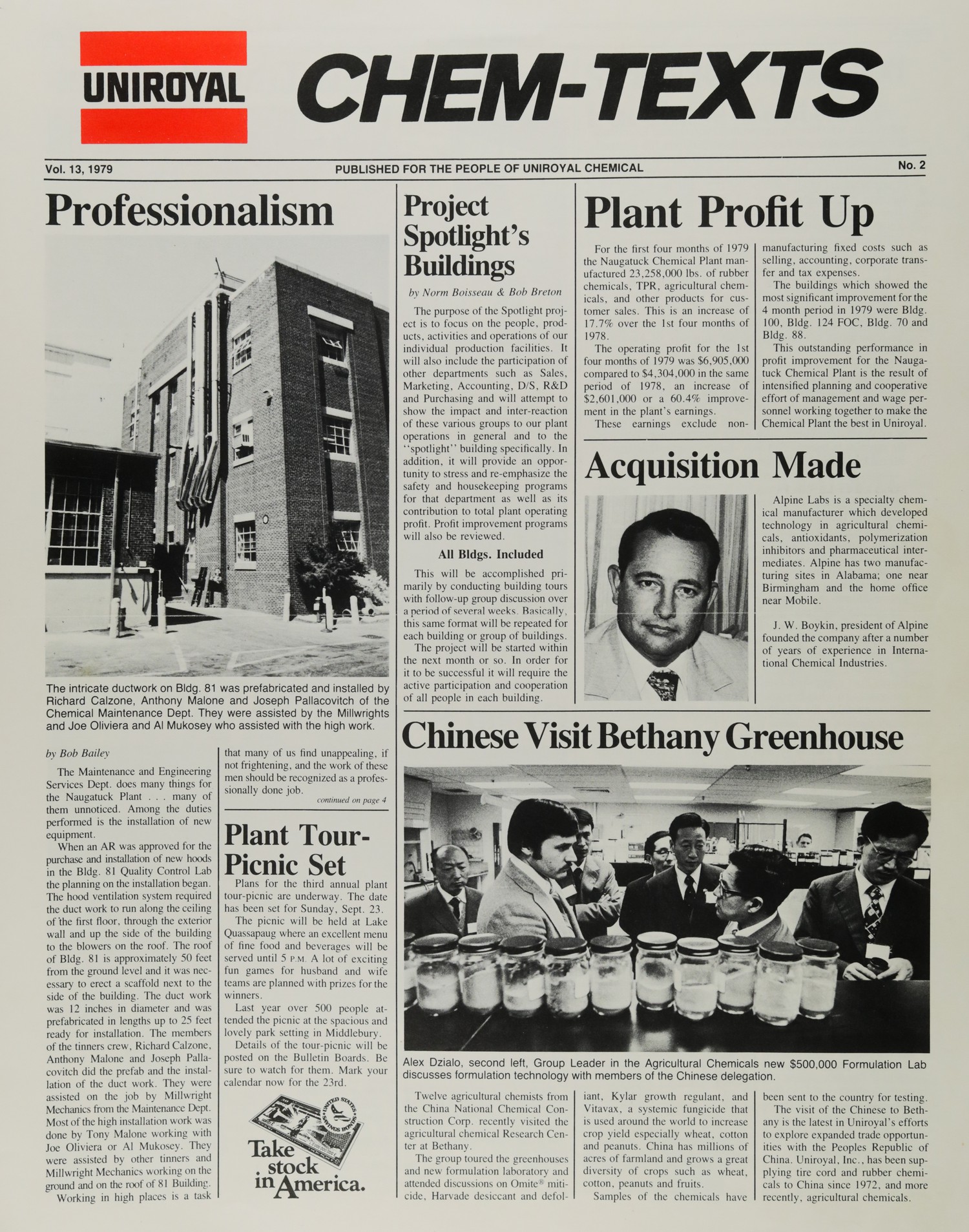
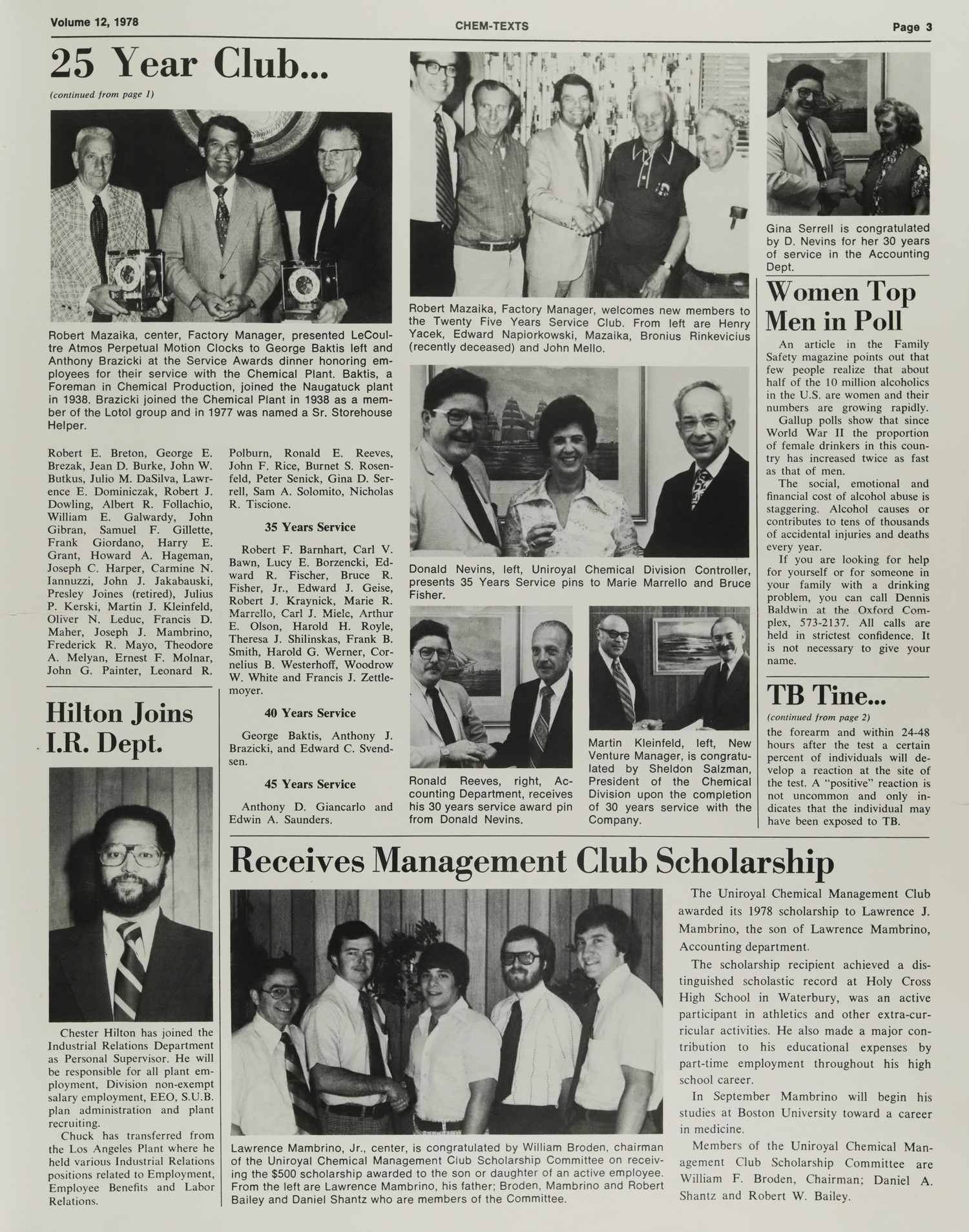
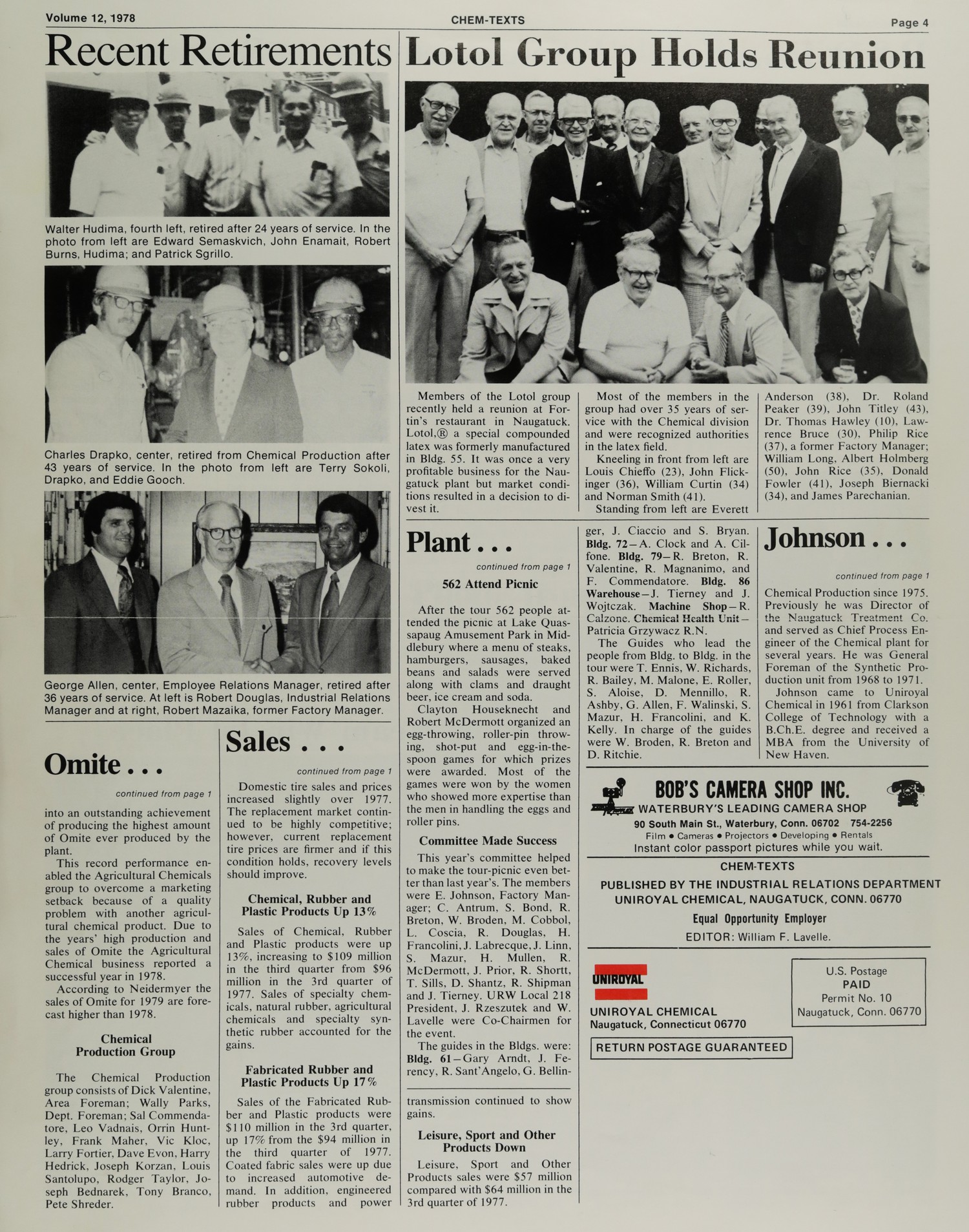
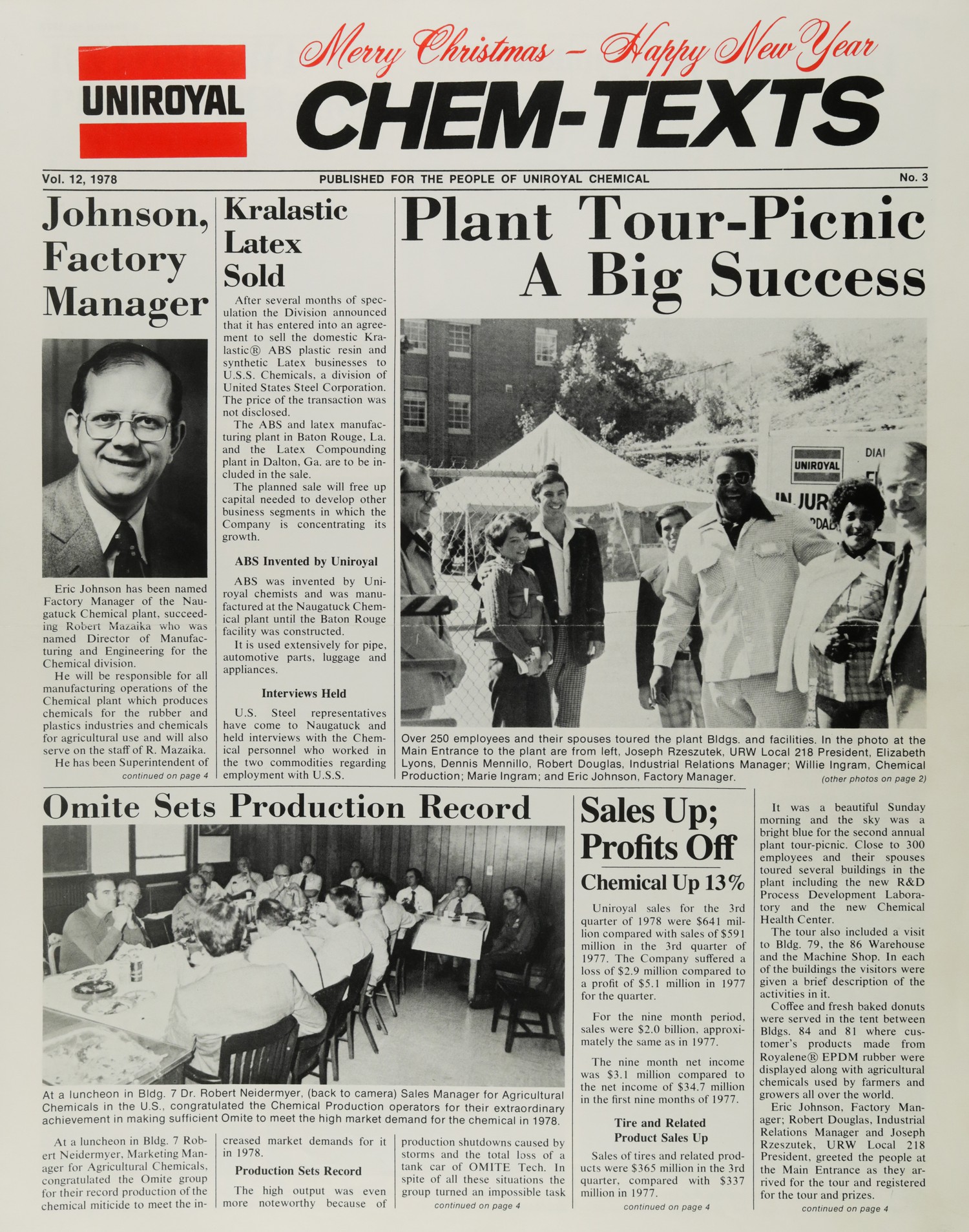
The Flagship – Issue 6 – Page 1

Page 001

SAVE PHOTO ON PAGES 4+5

[NAUGATUCK logo]

The FLAGSHIP

Issue 6 Quarterly News Winter 1998


N A U G A T U C K

C H E M I C A L


From The Factory Manager…

“BST” BEHAVIORAL SCIENCE TECHNOLOGY

As most of you are aware, the Plant has retained the services of a consulting firm that specializes in improving safety performance. The technique that they have developed and plan to implement at our facility is based on a study of the behaviors that are associated with accidents and methods to change these behaviors. I have personally observed the results of their efforts at other chemical plants, and the improvement in safety performance was impressive and dramatic. I am very optimistic and confident that BST will be successful here in Naugatuck.

I am also aware that some of us view this as “just another safety program” or the “flavor of the month.” While it is true that we have had many programs over the years, I believe that all of them have contributed something positive to our safety performance. However, the fact remains that we have a long way to go. Quite frankly, we can call this approach anything we want as long as we successfully and dramatically improve our safety performance.

I ask all of you to do whatever you can to make this effort successful.

Jack Prior,
Factory Manager

[UNIROYAL CHEMICAL logo]


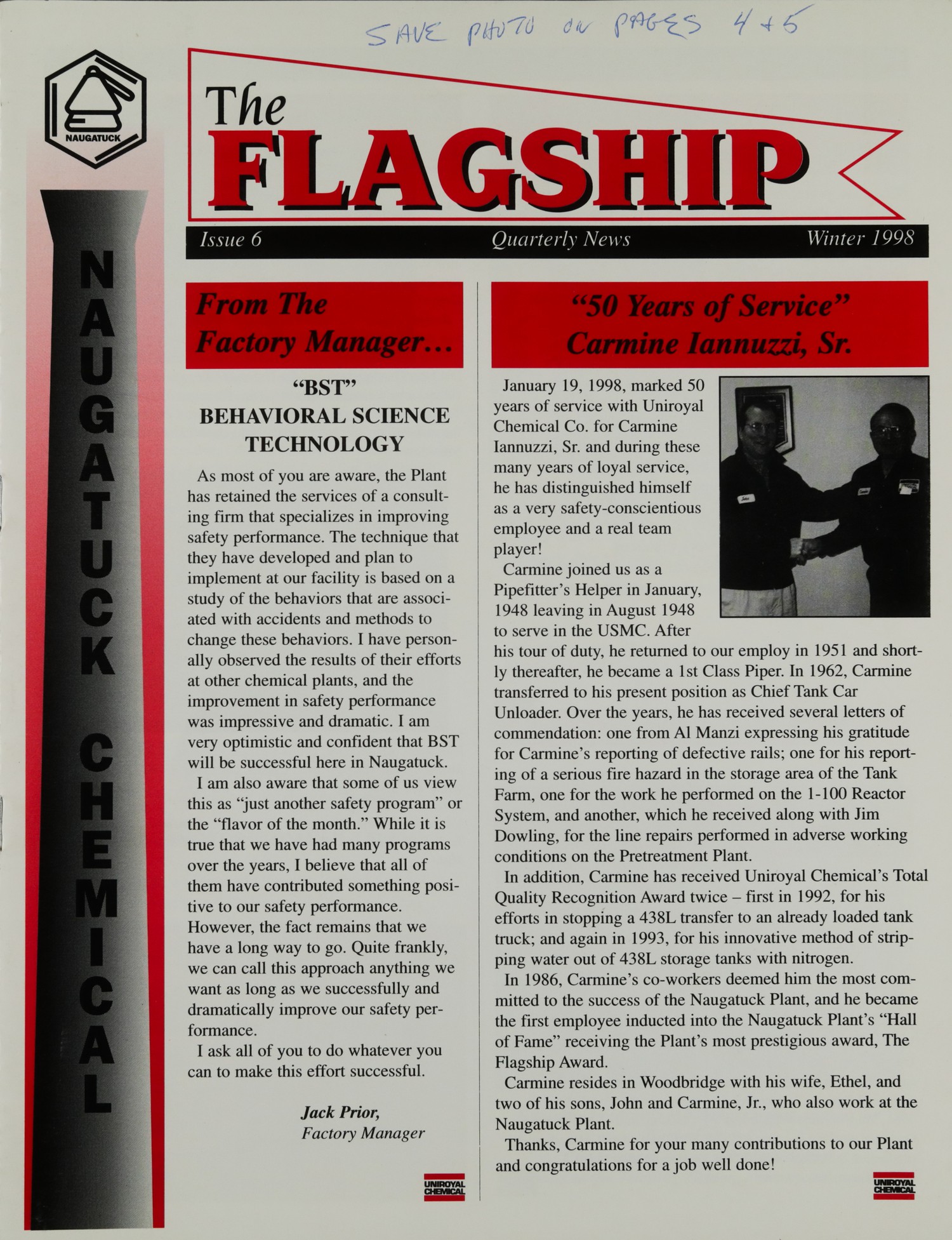
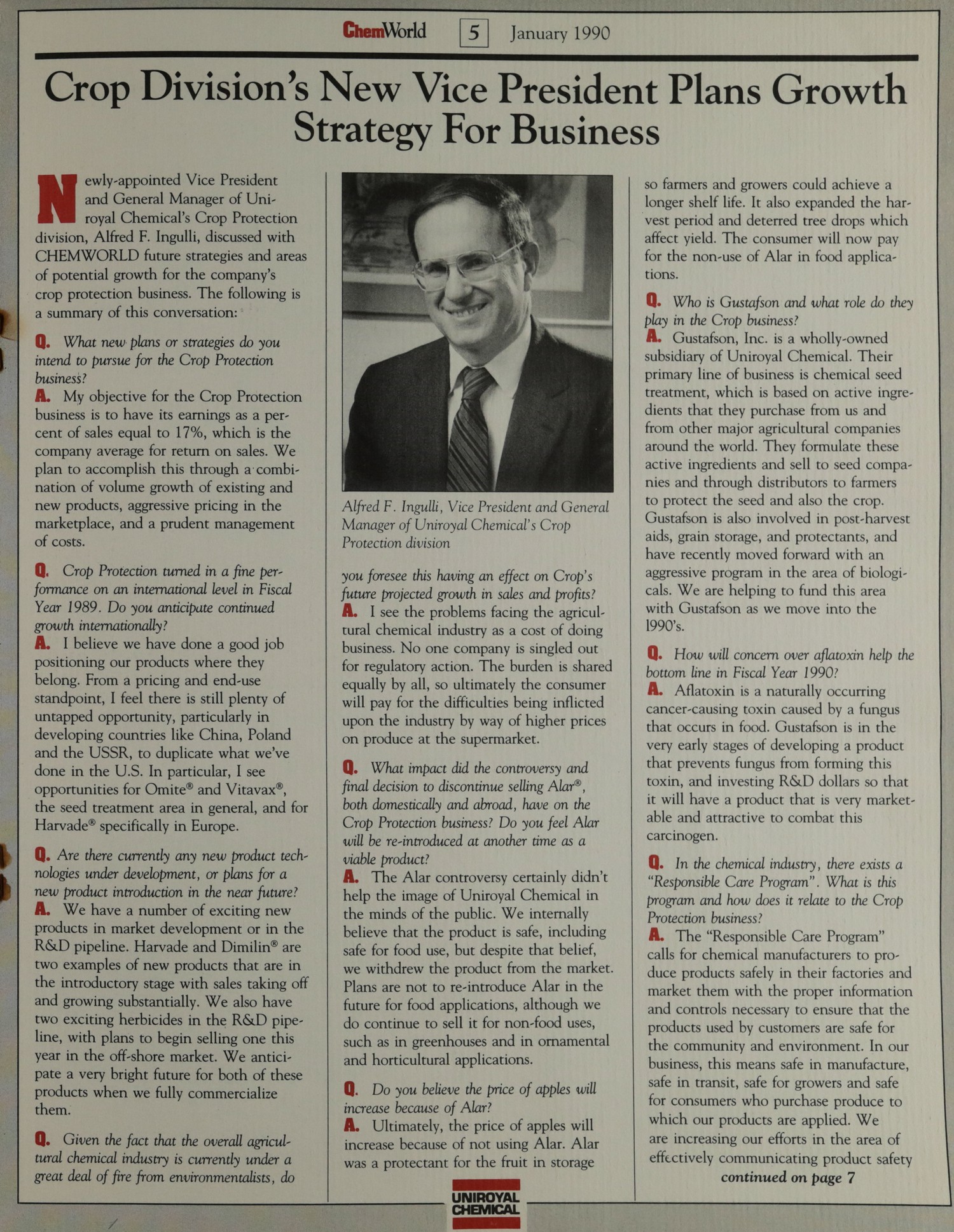
“50 Years of Service” Carmine Iannuzzi, Sr.

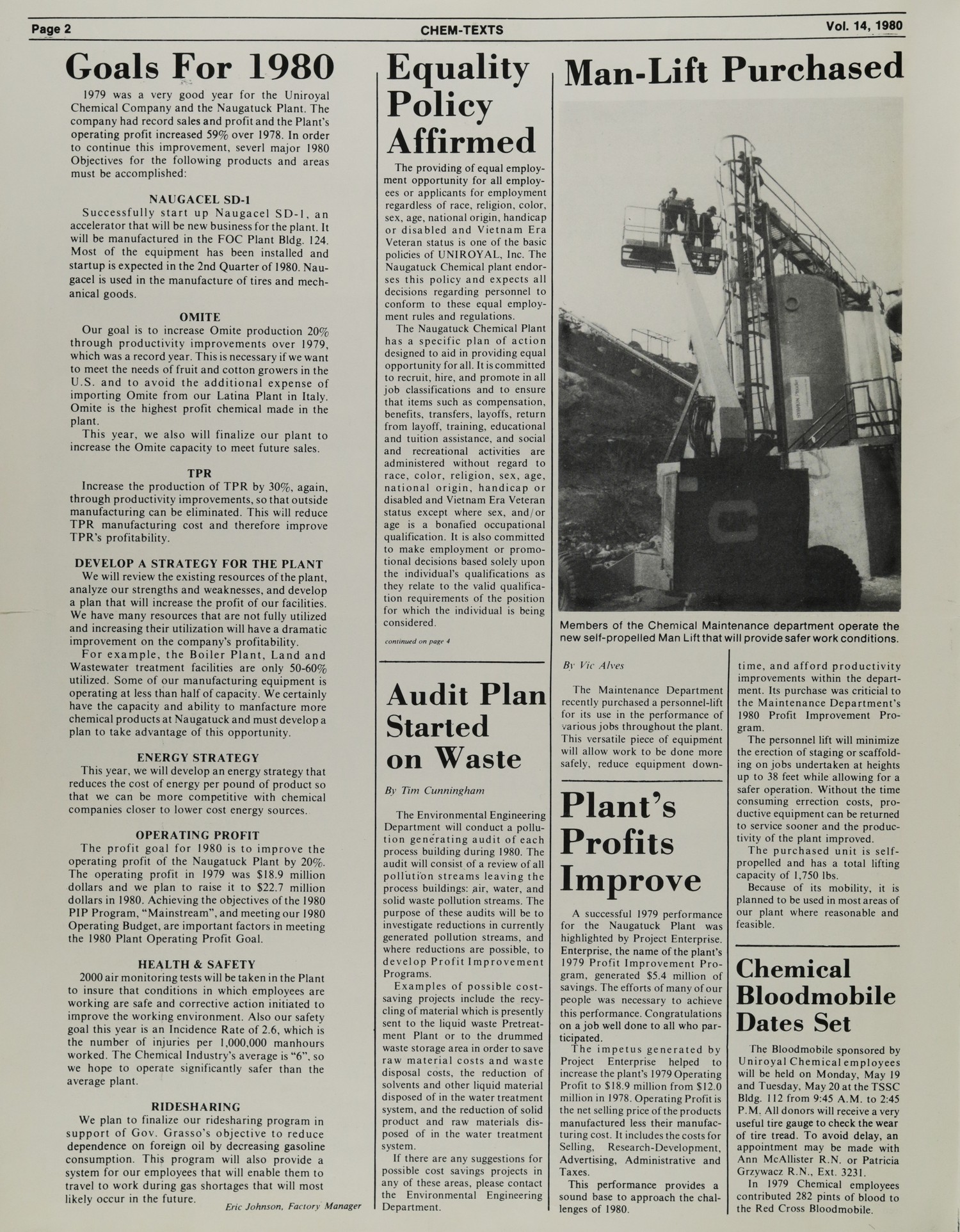
January 19, 1998, marked 50 years of service with Uniroyal Chemical Co. for Carmine Iannuzzi, Sr. and during these many years of loyal service, he has distinguished himself as a very safety-conscientious employee and a real team player!

Carmine joined us as a Pipefitter’s Helper in January, 1948 leaving in August 1948 to serve in the USMC. After his tour of duty, he returned to our employ in 1951 and shortly thereafter, he became a 1st Class Piper. In 1962, Carmine transferred to his present position as Chief Tank Car Unloader. Over the years, he has received several letters of commendation: one from Al Manzi expressing his gratitude for Carmine’s reporting of defective rails; one for his reporting of a serious fire hazard in the storage area of the Tank Farm, one for the work he performed on the 1-100 Reactor System, and another, which he received along with Jim Dowling, for the line repairs performed in adverse working conditions on the Pretreatment Plant.

In addition, Carmine has received Uniroyal Chemical’s Total Quality Recognition Award twice – first in 1992, for his efforts in stopping a 438L transfer to an already loaded tank truck; and again in 1993, for his innovative method of stripping water out of 438L storage tanks with nitrogen.

In 1986, Carmine’s co-workers deemed him the most committed to the success of the Naugatuck Plant, and he became the first employee inducted into the Naugatuck Plant’s “Hall of Fame” receiving the Plant’s most prestigious award, The Flagship Award.

Carmine resides in Woodbridge with his wife, Ethel, and two of his sons, John and Carmine, Jr., who also work at the Naugatuck Plant.

Thanks, Carmine for your many contributions to our Plant and congratulations for a job well done!

[UNIROYAL CHEMICAL logo]

The Flagship – Page 2

Page 002

2 • The Flagship • Winter 1998


Joint Union Management Safety Statement

Over the years, the leadership of USW Local 218 and the Naugatuck Plant have worked hard to develop and maintain one of the most comprehensive safety and health programs within the industry. Some of the elements of our safety steatement include:

• Safety procedures that in many cases exceed OSHA requirements.
• Full personal protection equipment
• Workplace monitoring.
• An active Union-Management Safety Committee.
• Comprehensive safety training.
• Extensive medical surveillance programs.
• Continuous review to identify and correct unsafe conditions.

Every employee of the Naugatuck Plant is required to participate in safety training, attend regularly scheduled safety meetings, obey all safety rules and procedures, and conscientiously follow safe work practices.

Both Local 218 and Management agree that compliance with these stated requirements is a condition of employment.

John J. Prior, Factory Manager
Daniel F. Cleary, USW Local 218

UNIROYAL CHEMICAL


Uniroyal Chemical Company Recognized By Union Carbide

Union Carbide Corporation, Danbury, CT has awarded Uniroyal Chemical Company the “Excellent” status for supplier performance in 1997. Uniroyal Chemical joins a group of only 10 suppliers in this elite supplier category. The 1997 Award adds to a string of consecutive Excellent awards that dates back to 1985, the first year that Union Carbide began their Vendor Improvement Program (VIP).

Record setting shipments of Naugard Super Q were noted as a key contribution to earning the Excellent distinction!

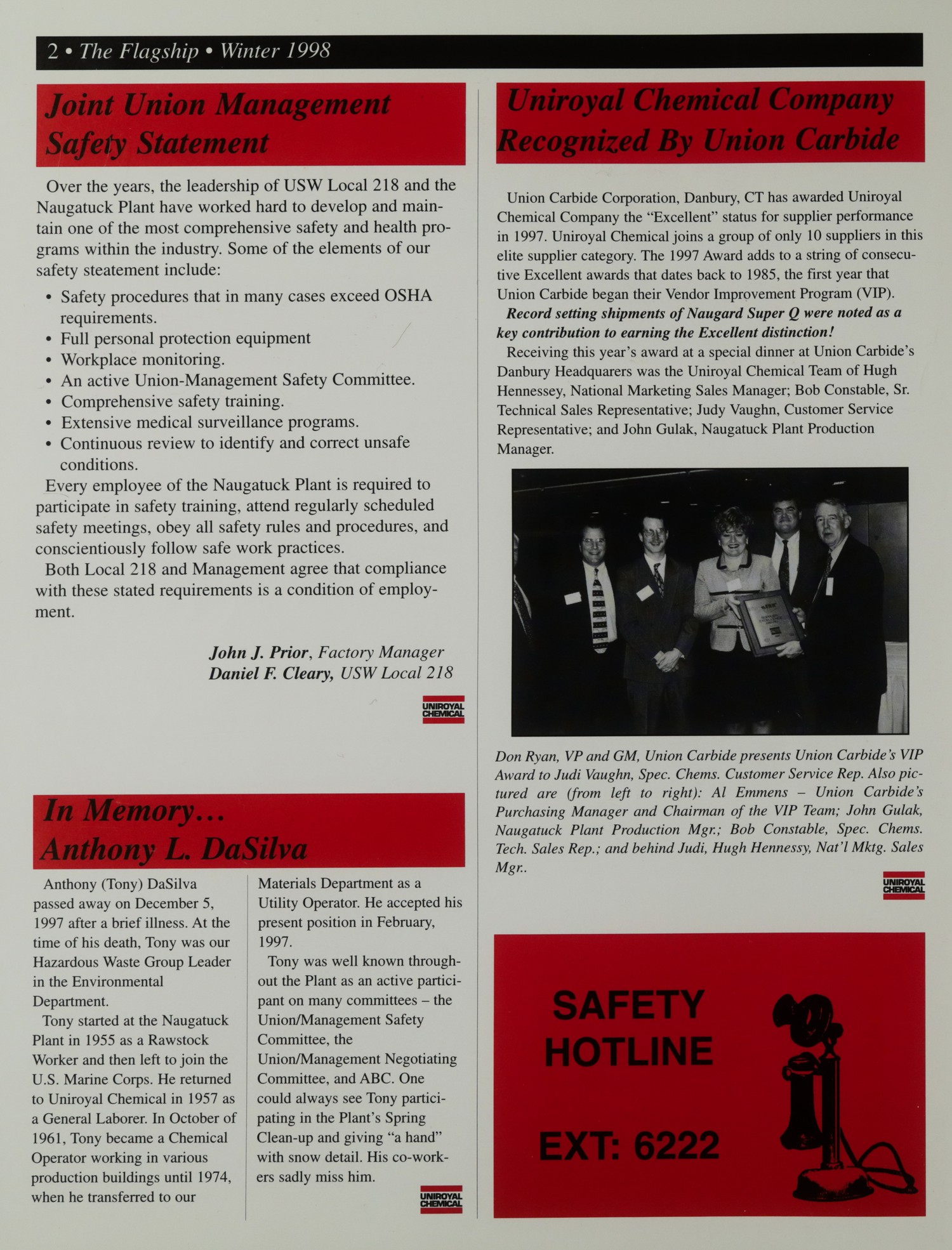
Receiving this year’s award at a special dinner at Union Carbide’s Danbury Headquarers was the Uniroyal Chemical Team of Hugh Hennessey, National Marketing Sales Manager; Bob Constable, Sr. Technical Sales Representative; Judy Vaughn, Customer Service Representative; and John Gulak, Naugatuck Plant Production Manager.

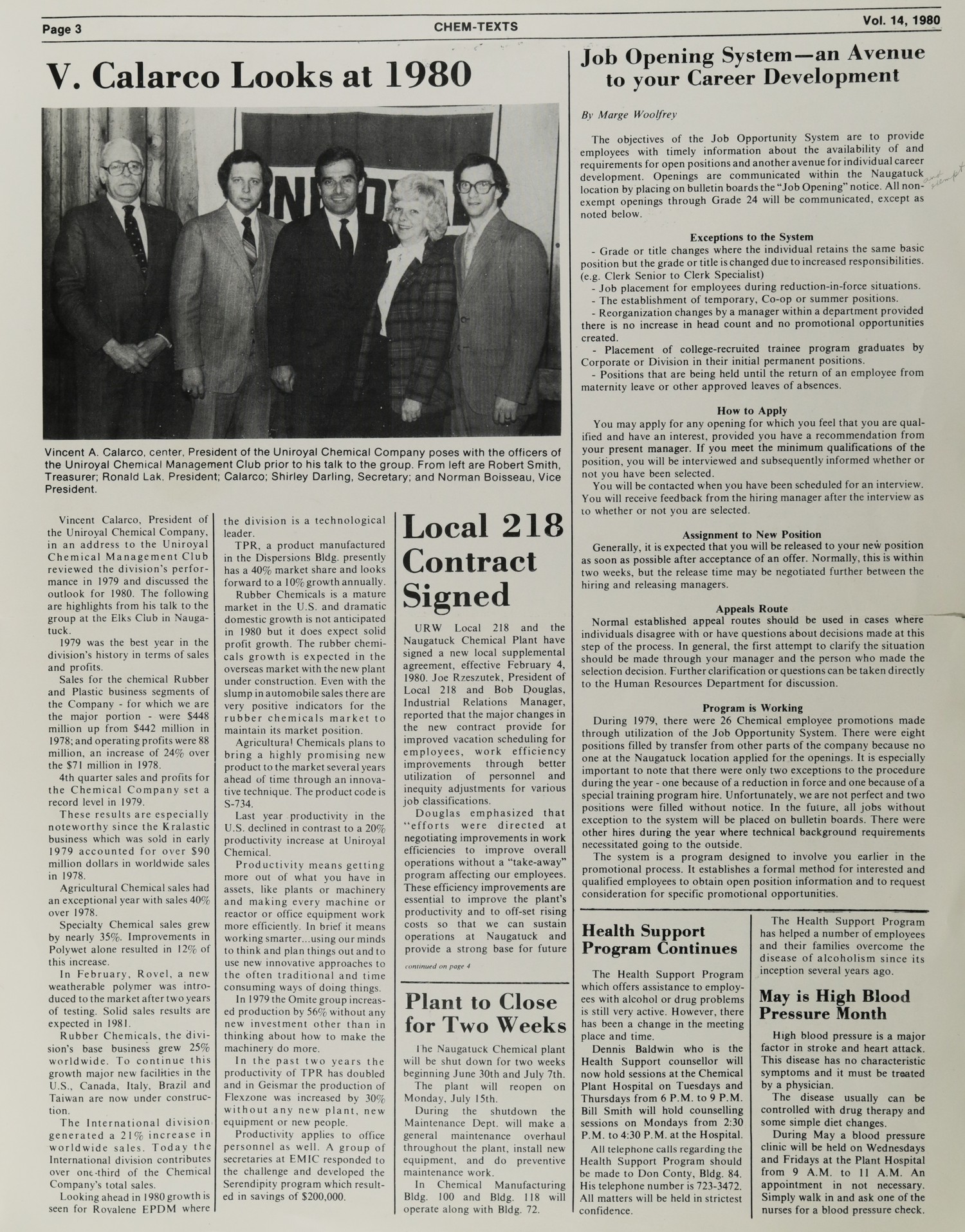
Don Ryan, VP and GM, Union Carbide presents Union Carbide’s VIP Award to Judi Vaughn, Spec. Chems. Customer Service Rep. Also pictured are (from left to right): Al Emmens – Union Carbide’s Purchasing Manager and Chairman of the VIP Team; John Gulak, Naugatuck Plant Production Mgr.; Bob Constable, Spec. Chems. Tech. Sales Rep.; and behind Judi, Hugh Hennessy, Nat’l Mktg. Sales Mgr..

UNIROYAL CHEMICAL


In Memory… Anthony L. DaSilva

Anthony (Tony) DaSilva passed away on December 5, 1997 after a brief illness. At the time of his death, Tony was our Hazardous Waste Group Leader in the Environmental Department.

Tony started at the Naugatuck Plant in 1955 as a Rawstock Worker and then left to join the U.S. Marine Corps. He returned to Uniroyal Chemical in 1957 as a General Laborer. In October of 1961, Tony became a Chemical Operator working in various production buildings until 1974, when he transferred to our

Materials Department as a Utility Operator. He accepted his present position in February, 1997.

Tony was well known throughout the Plant as an active participant on many committees – the Union/Management Safety Committee, the Union/Management Negotiating Committee, and ABC. One could always see Tony participating in the Plant’s Spring Clean-up and giving “a hand” with snow detail. His co-workers sadly miss him.

UNIROYAL CHEMICAL


SAFETY HOTLINE

EXT: 6222

The Flagship – Page 3

Page 003

The Flagship • Winter 1998 • 3


Retirements…

[PHOTO: Man in glasses and suit standing in office with computer monitor visible]

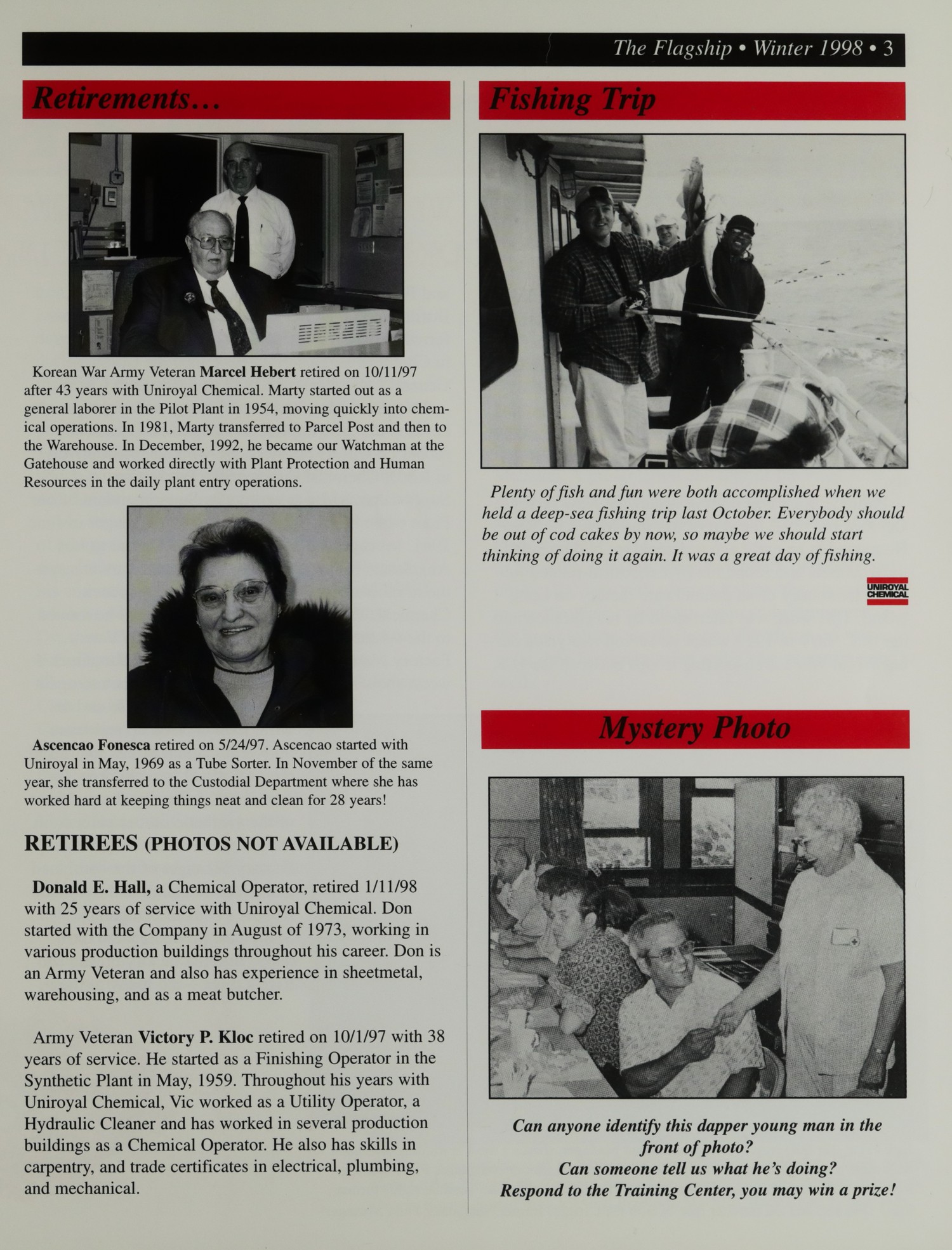
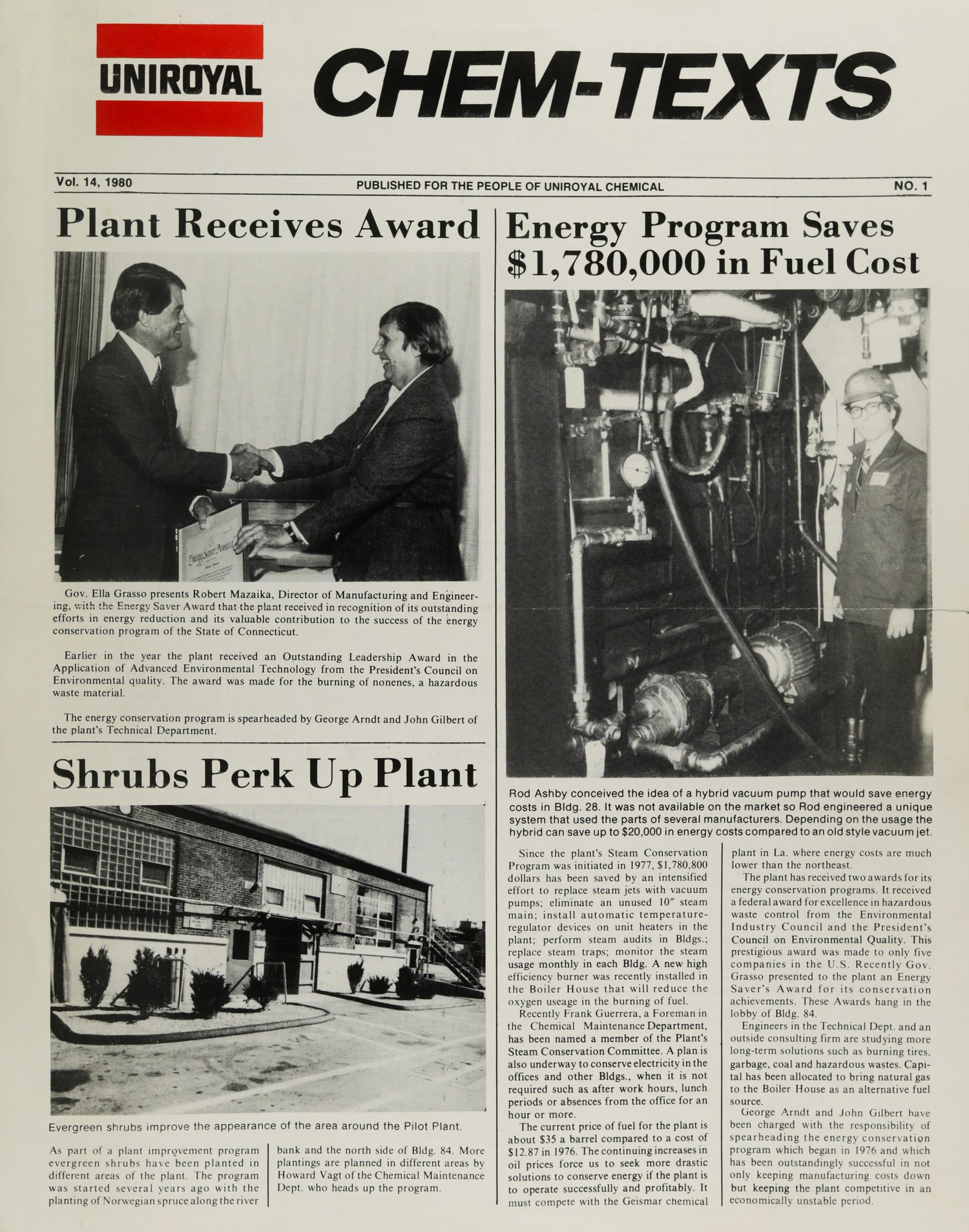
Korean War Army Veteran Marcel Hebert retired on 10/11/97 after 43 years with Uniroyal Chemical. Marty started out as a general laborer in the Pilot Plant in 1954, moving quickly into chemical operations. In 1981, Marty transferred to Parcel Post and then to the Warehouse. In December, 1992, he became our Watchman at the Gatehouse and worked directly with Plant Protection and Human Resources in the daily plant entry operations.


[PHOTO: Woman with glasses and dark hair]

Ascencao Fonesca retired on 5/24/97. Ascencao started with Uniroyal in May, 1969 as a Tube Sorter. In November of the same year, she transferred to the Custodial Department where she has worked hard at keeping things neat and clean for 28 years!


RETIREES (PHOTOS NOT AVAILABLE)

Donald E. Hall, a Chemical Operator, retired 1/11/98 with 25 years of service with Uniroyal Chemical. Don started with the Company in August of 1973, working in various production buildings throughout his career. Don is an Army Veteran and also has experience in sheetmetal, warehousing, and as a meat butcher.

Army Veteran Victory P. Kloc retired on 10/1/97 with 38 years of service. He started as a Finishing Operator in the Synthetic Plant in May, 1959. Throughout his years with Uniroyal Chemical, Vic worked as a Utility Operator, a Hydraulic Cleaner and has worked in several production buildings as a Chemical Operator. He also has skills in carpentry, and trade certificates in electrical, plumbing, and mechanical.


Fishing Trip

[PHOTO: Three people on a boat with fishing catch]

Plenty of fish and fun were both accomplished when we held a deep-sea fishing trip last October. Everybody should be out of cod cakes by now, so maybe we should start thinking of doing it again. It was a great day of fishing.

UNIROYAL CHEMICAL


Mystery Photo

[PHOTO: Young man in work setting with elderly woman visible]

Can anyone identify this dapper young man in the front of photo?
Can someone tell us what he’s doing?
Respond to the Training Center, you may win a prize!

The Flagship – Page 8

Page 008

8 • The Flagship • Winter 1998

Training News

The Chinese have a saying that, “nothing in life worthwhile, comes without instruction.” The past few months have given us ample opportunity to check out this theory. We have been audited by the Department of Transportation, had the phone system changed, been introduced to the wonderful world of SAP, and have even implemented a new Safety Program called BST. We have had our capabilities tested, as in “starting up” after a complete power outage, and we have been applauded for our consistent quality. (See the article concerning “Union Carbide” in this issue). It seems like everything is a test, if that is so; then I would say, “we’ve passed.”

The training center has expanded over these months to include a six-station computer center. The SAP implementation team has used it extensively and many of you have had training on cc: Mail, Windows

95, and the SAP/R3 basic course. The center is there to support the introduction of about 40 computers located throughout the Plant that are networked through Corporate. This is all part of the worldwide corporate networking effort and the reason SAP is being implemented. There is significant instruction going on concerning this effort, but as I mentioned earlier it will be worthwhile. Our lives will be a lot easier as a result.

I mentioned that we received a surprise audit by the Department of Transportation. Congratulations to Pat Jamieson and anyone in the Shipping and Receiving Departments. We answered the mail on this one and responded like the well-trained workforce we are.

There is a lot of effort going on right now by the Employee Involvement Committee. They are overseeing a Progress Improvement Team (PIT) on

Chemical Operation Training. The idea is to formalize and write out the training needs of our chemical operators. The knowledge that our senior operators have must be captured and passed down to our new operators if we are to continue the successes we have enjoyed in the past. Our commitment to quality demands nothing less from us.

This may have nothing to do with training but, speaking of quality, congratulations to Mark Labrecque and Karla Phair. Mark is the new Vice President of Local 218 and Karla is the new Secretary/Treasurer. These two outstanding associates will be a welcome help to Dan Cleary, especially during the implementation of BST. Both of these individuals are also on the BST Training Committee with Dan. Let’s give both of them our continuing support.

Getting back to training, some of the associates in the Physical

Testing Lab are participating in weekly sessions in the center. Our neighbors from112 are taking the Lab Technician Course as a refresher training. Eventually everyone in the lab will finish the eight sessions and hopefully suggest improvement. This is the same type of ongoing improvement process that the PIT team on Chemical Operator Training is doing. As we move forward through the first quarter of 1998, let’s remember to commit ourselves to fulfilling our obligatory training needs. Where the system needs improving, lets improve it, like the PIT Team and the associates in 112. Where the system needs changing, lets change it, as in learning to make the SAP implementation work.

Work Safe; Take care of each other out there.

Peter Haines,
Training Manager


If you wish to receive future mailings of this Newsletter, please respond to:
Mary Damon, Bldg. 84, Uniroyal Chemical Company, Inc., 280 Elm Street, Naugatuck, CT 06770
by April 1, 1998. Please respond by mail only!!


The FLAGSHIP

UNIROYAL CHEMICAL

The Flagship is brought to you by:

Editors: Norma Solberg
Mary Damon
Laurie Zitzmann
Pete Haines

Printed by: Waterbury Printing & Engraving, L.L.C.


Responsible Care®
A Public Commitment

The Flagship – Page 4-5

Page unknown

4 • The Flagship • Winter 1998

The Flagship • Winter 1998 • 5


… THE WAY WE WERE …

UNIROYAL CHEMICAL

WE DEDICATE THIS ISSUE OF THE FLAGSHIP QUARTERLY NEWS TO PHILIP E. RICE, FORMER NAUGATUCK PLANT FACTORY MANAGER ON HIS 100TH YEAR!

UNIROYAL CHEMICAL


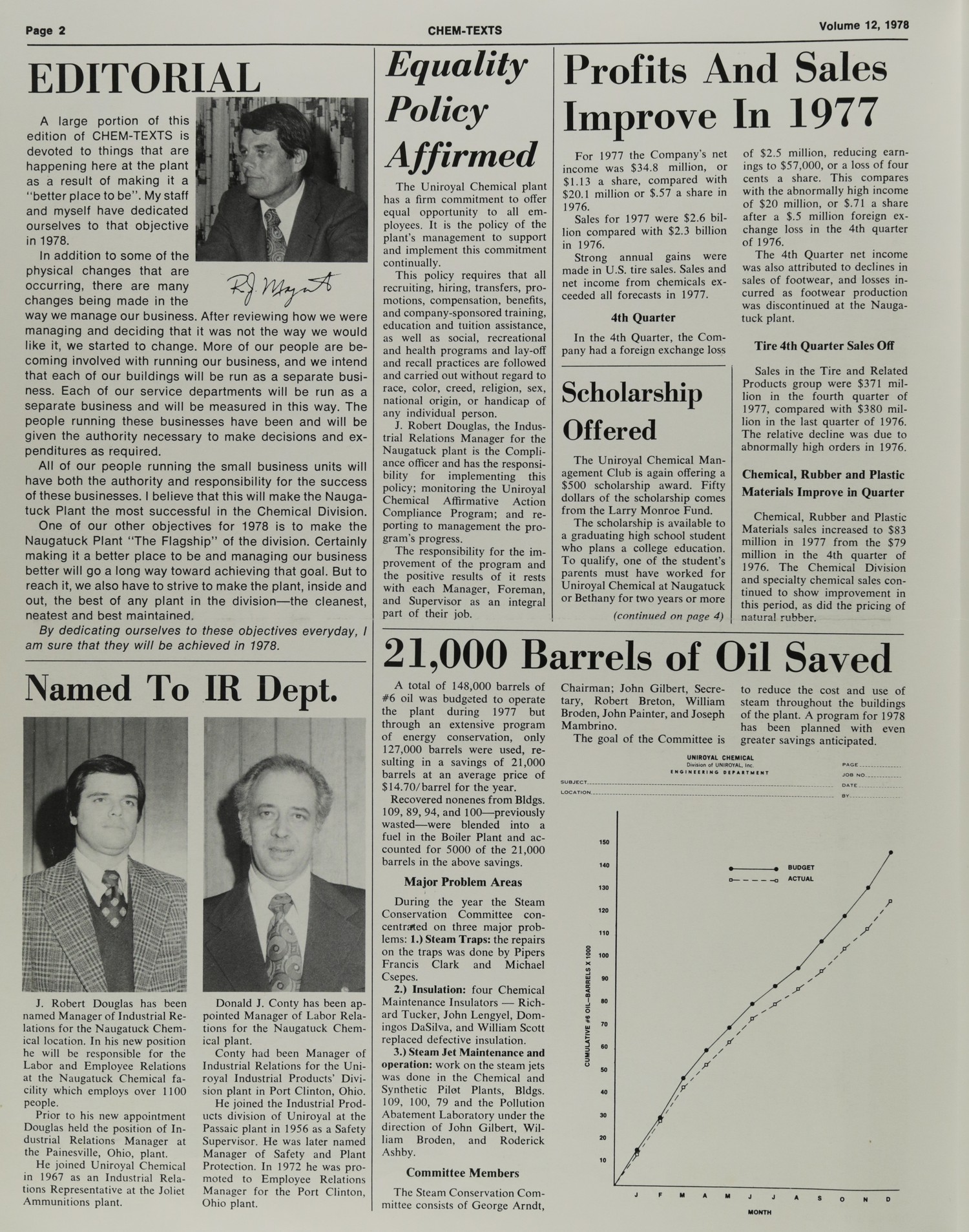
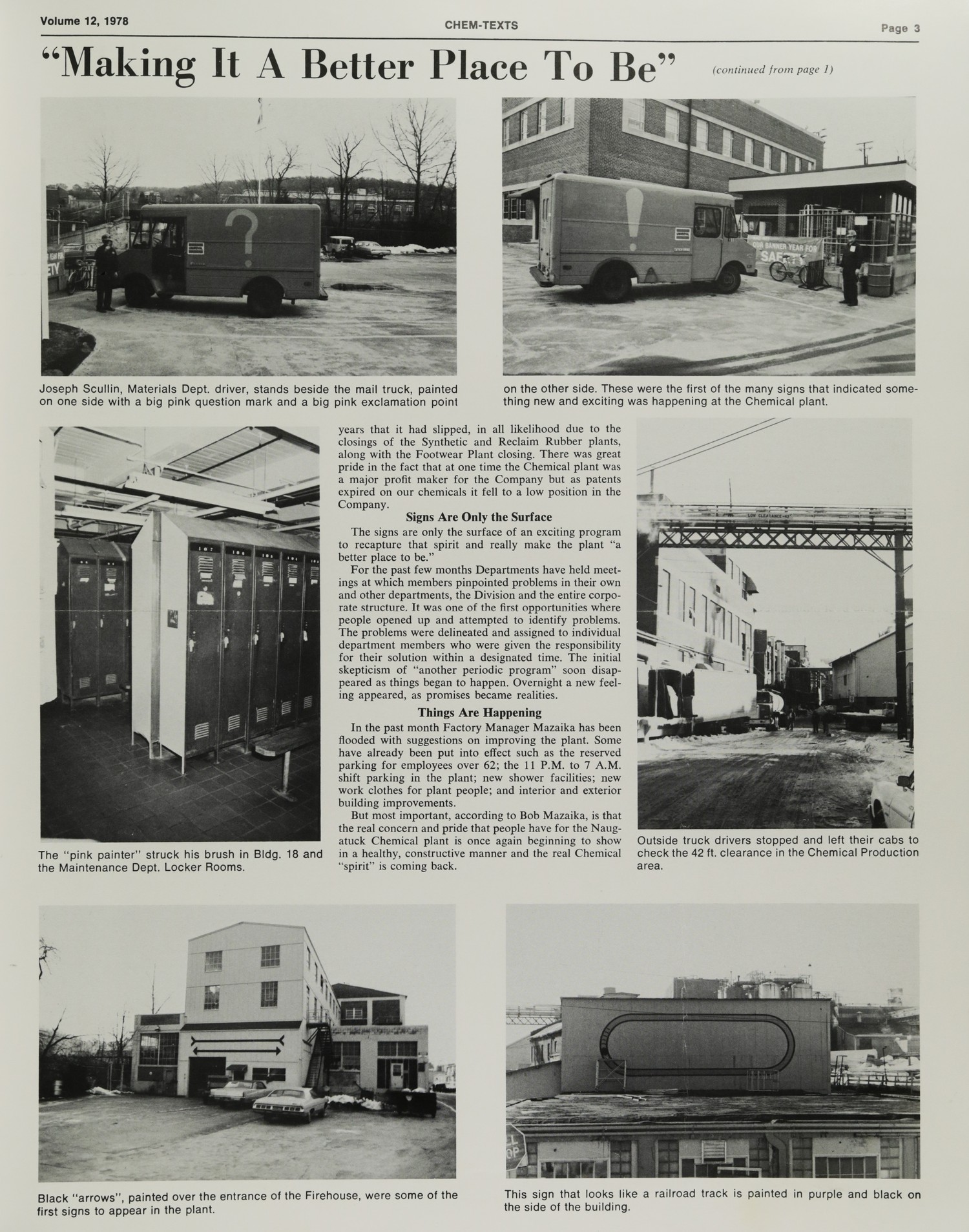
On October 16, 1997, Mr. Philip E. Rice, former Factory Manager of the Naugatuck Plant celebrated his 100th birthday at a party with 90 family members and friends at Pomperaug Woods, Southbury, CT. We dedicate this issue of “The Flagship” to Mr. “Naugatuck Chemical” on this memorable occasion and share this profile of Mr. Rice with you as a tribute. We thank him for his contributions to our Plant and to our community.

Philip E. Rice was born in Matawan, New Jersey, October 16, 1897, the son of Mr. and Mrs. J. L. Rice. He moved at an early age to Brooklyn, NY, attended local schools and found his first chemical-related job in the laboratory of an enamelware factory on Long Island. This work was interrupted by his entrance into the U.S. Navy in 1917 where he served two years during World War I, transporting troops between the U.S.

and France. After the war, he entered Carnegie Institute of Technology in Pittsburgh and then transferred to New York University to complete his degree in Chemical Engineering. He joined the Company’s General Laboratories in 1923 as a Research Chemist.

Two years later, he came to Naugatuck to help develop the growing line of Naugatuck Chemical’s rubber chemicals business. He worked consecutively in R&D, Chemical Engineering, Production Supervision, and was serving as Superintendent of our Plant when he was appointed Factory Manager in June 1941. In August of 1945, he was transferred to Los Angeles as Factory Manager of the government’s synthetic rubber plant operated there by Naugatuck Chemical. This facility closed in 1947, and he moved to the synthetic rubber plant at Institute, WV as Factory Manager. In 1948, during one of Naugatuck’s worst snow storms, he returned to Naugatuck to again head up the Factory. He and his wife, Evelyn, took up residence on North Church Street and raised their family of two children. In June 1954, following the purchase of the synthetic rubber plant from the government, he became Factory Manager of the combined Chemical, Reclaim, and Synthetic Rubber Plants of Naugatuck. Many new products were introduced into the factory during Mr. Rice’s reign – too many to men-

tion, but a few major milestones to look back on were: Naugatuck’s very important role in the development and manufacture of synthetic rubber during World War II; The Plant’s 50th anniversary in 1954 – the facility in its prime as a major producer of plastics, agricultural chemicals, latex compounds and synthetic rubber, boasting a payroll of 1,800 employees; The Great Flood of August 1955 which wiped out more than 60% of the Factory – and the incredible job of putting it back together!

Mr. Rice is not only remembered for being one of Naugatuck’s industrialists, but he was also a very active participant in civic affairs. He began his community activities during the years of WWII when he was active in the local Civil Defense Organization. In the years to come, he served as both Director and President of the Naugatuck Chamber of Commerce and the Naugatuck Rotary Club, and as a Director for: The Connecticut State Chamber of Commerce, the Naugatuck Chapter of the Red Cross, the Naugatuck Building and Loan Association, the Naugatuck Valley Industrial Council and the Waterbury Hospital Corporation.

Mr. Rice retired in 1959 and has enjoyed reading, gardening, travel, fishing, and music.

To commemorate the wonderful occasion of his 100th birthday, the Plant surprised Mr. Rice with a pack-

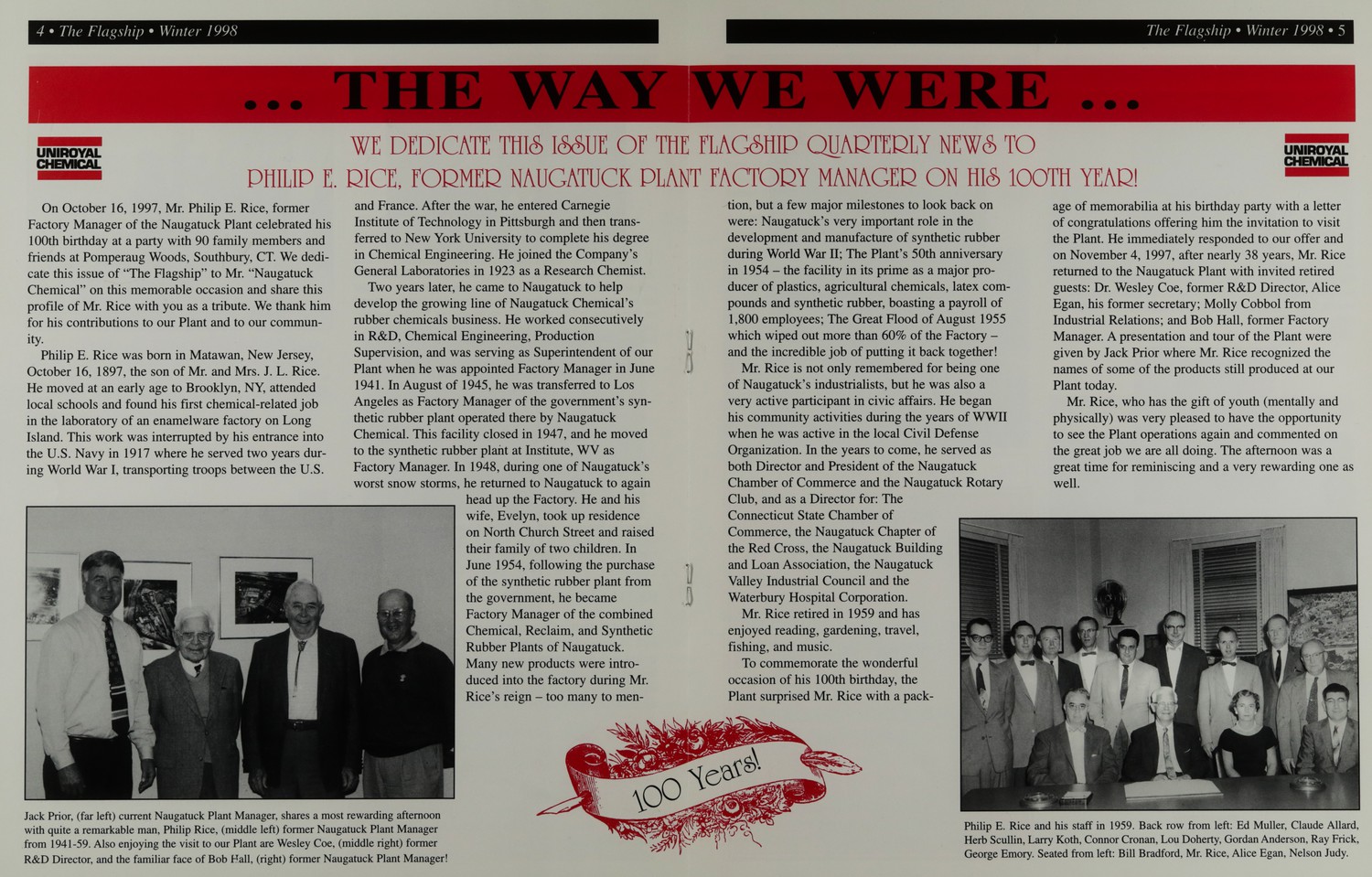
age of memorabilia at his birthday party with a letter of congratulations offering him the invitation to visit the Plant. He immediately responded to our offer and on November 4, 1997, after nearly 38 years, Mr. Rice returned to the Naugatuck Plant with invited retired guests: Dr. Wesley Coe, former R&D Director, Alice Egan, his former secretary; Molly Cobbol from Industrial Relations; and Bob Hall, former Factory Manager. A presentation and tour of the Plant were given by Jack Prior where Mr. Rice recognized the names of some of the products still produced at our Plant today.

Mr. Rice, who has the gift of youth (mentally and physically) was very pleased to have the opportunity to see the Plant operations again and commented on the great job we are all doing. The afternoon was a great time for reminiscing and a very rewarding one as well.


[PHOTO CAPTION – LEFT]
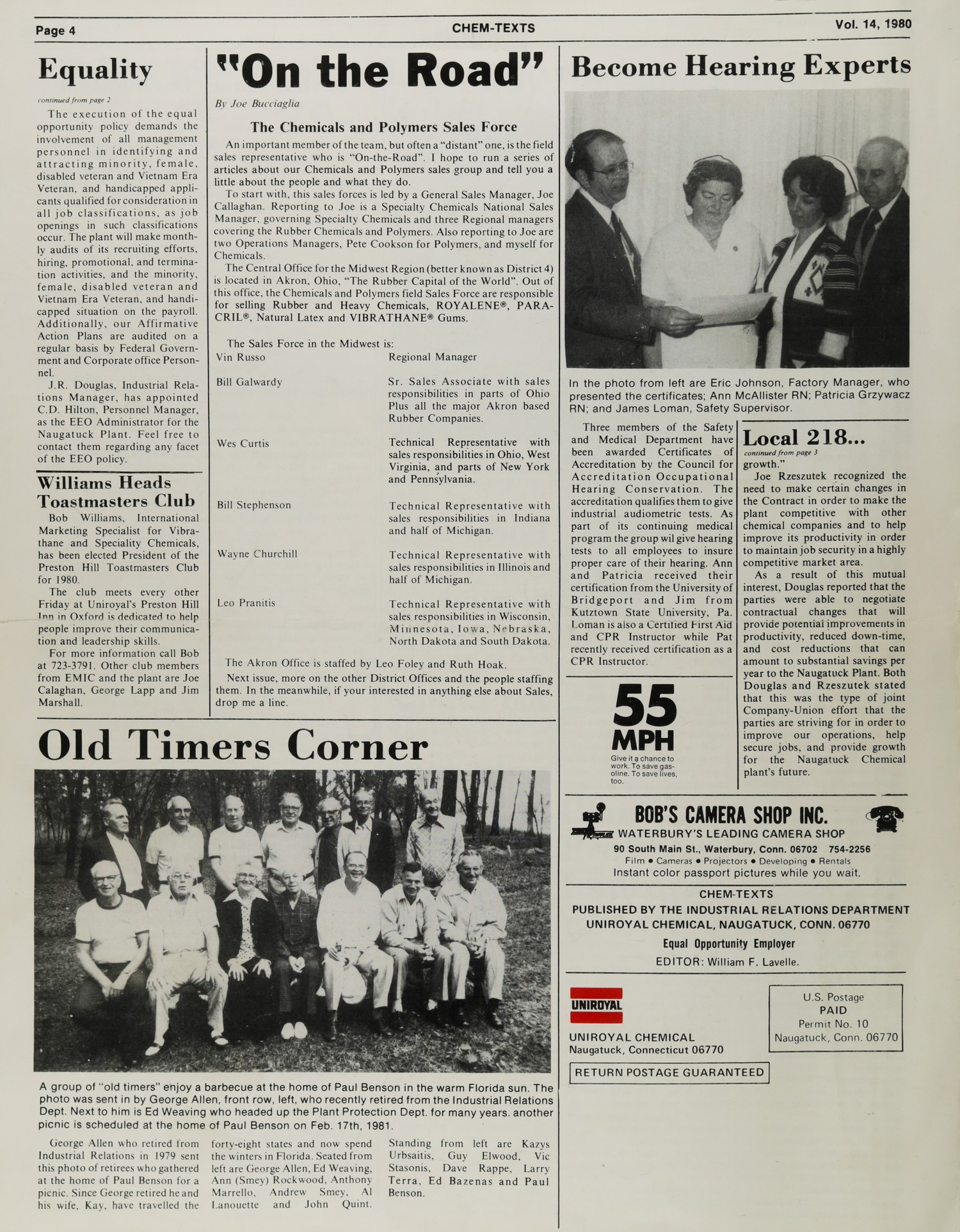
Jack Prior, (far left) current Naugatuck Plant Manager, shares a most rewarding afternoon with quite a remarkable man, Philip Rice, (middle left) former Naugatuck Plant Manager from 1941-59. Also enjoying the visit to our Plant are Wesley Coe, (middle right) former R&D Director, and the familiar face of Bob Hall, (right) former Naugatuck Plant Manager!


[GRAPHIC: “100 Years!” with decorative red lobster illustration]


[PHOTO CAPTION – RIGHT]
Philip E. Rice and his staff in 1959. Back row from left: Ed Muller, Claude Allard, Herb Scullin, Larry Koth, Connor Cronan, Lou Doherty, Gordan Anderson, Ray Frick, George Emory. Seated from left: Bill Bradford, Mr. Rice, Alice Egan, Nelson Judy.

ChemWorld – Page 1

Page 001

CHEMWORLD

WINTER/SPRING 1995

Published by
Uniroyal Chemical Co.
for its Associates
and Retirees


CONTENTS

2
Logistics Strives for
Continuous Customer
Satisfaction

3
Responsible Care®
Implementation
On Track

4
Annual Total Quality
Recognition Awards
Celebrated

6
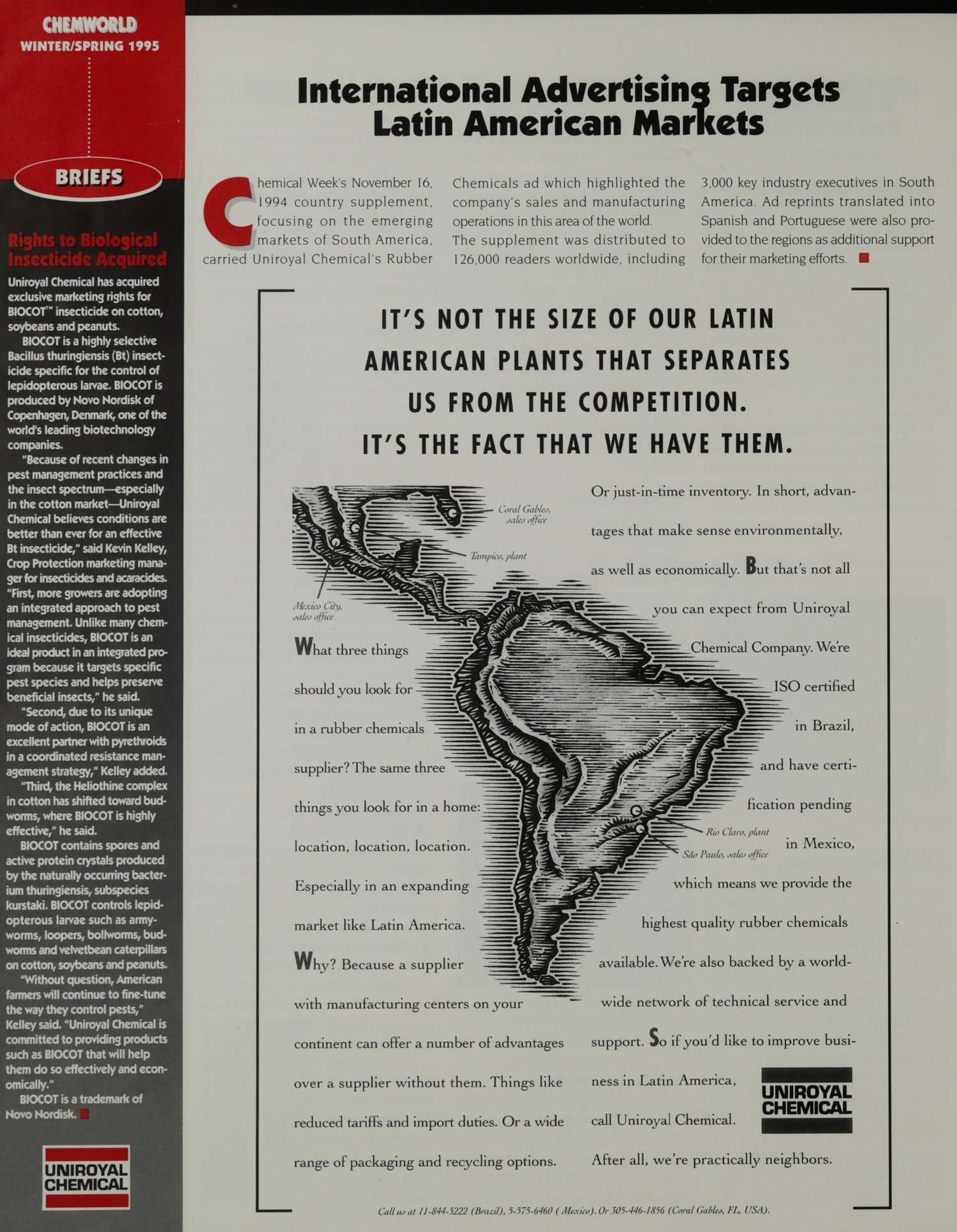
International
Advertising Targets
Latin American Markets

7
Novaquim Strengthens
Expansion Efforts

8
Initial Public Offering
Announced


Worldwide Growth Strategy Dictates New Organization at Uniroyal Chemical

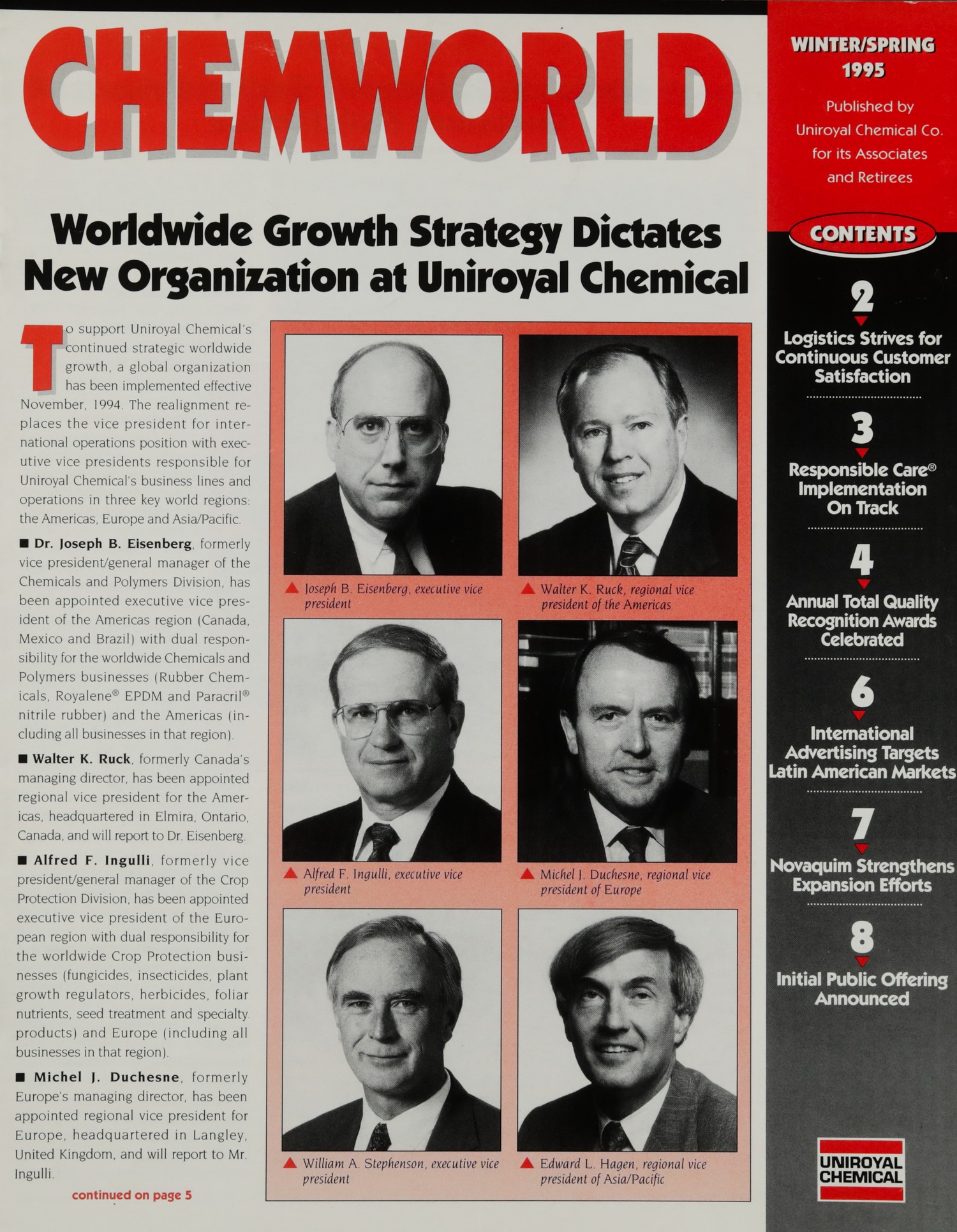
To support Uniroyal Chemical’s continued strategic worldwide growth, a global organization has been implemented effective November, 1994. The realignment replaces the vice president for international operations position with executive vice presidents responsible for Uniroyal Chemical’s business lines and operations in three key world regions: the Americas, Europe and Asia/Pacific.

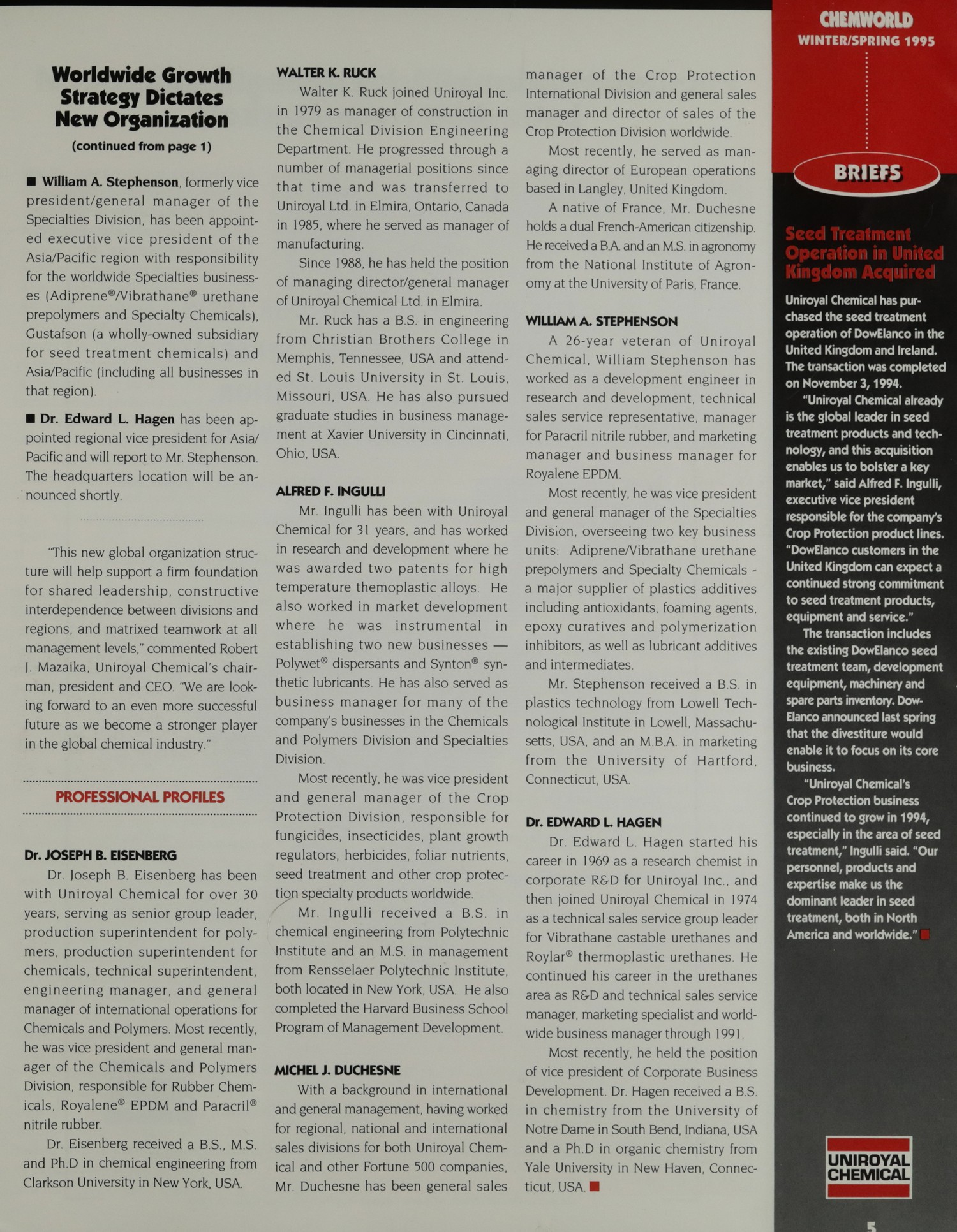
Dr. Joseph B. Eisenberg, formerly vice president/general manager of the Chemicals and Polymers Division, has been appointed executive vice president of the Americas region (Canada, Mexico and Brazil) with dual responsibility for the worldwide Chemicals and Polymers businesses (Rubber Chemicals, Royalene® EPDM and Paracril® nitrile rubber) and the Americas (including all businesses in that region).

Walter K. Ruck, formerly Canada’s managing director, has been appointed regional vice president for the Americas, headquartered in Elmira, Ontario, Canada, and will report to Dr. Eisenberg.

Alfred F. Ingulli, formerly vice president/general manager of the Crop Protection Division, has been appointed executive vice president of the European region with dual responsibility for the worldwide Crop Protection businesses (fungicides, insecticides, plant growth regulators, herbicides, foliar nutrients, seed treatment and specialty products) and Europe (including all businesses in that region).

Michel J. Duchesne, formerly Europe’s managing director, has been appointed regional vice president for Europe, headquartered in Langley, United Kingdom, and will report to Mr. Ingulli.

continued on page 5


Photo Captions:

▲ Joseph B. Eisenberg, executive vice president

▲ Walter K. Ruck, regional vice president of the Americas

▲ Alfred F. Ingulli, executive vice president

▲ Michel J. Duchesne, regional vice president of Europe

▲ William A. Stephenson, executive vice president

▲ Edward L. Hagen, regional vice president of Asia/Pacific


UNIROYAL CHEMICAL

ChemWorld – Page 2

Page 002

CHEMWORLD

WINTER/SPRING 1995


Logistics Strives For Continuous Customer Satisfaction


BRIEFS

Letter Of Intent Signed To Purchase Crop Protection Business Of Solvay Duphar B.V.

Uniroyal Chemical has signed a letter of intent to purchase the worldwide crop protection business of Solvay Duphar B.V., headquartered in The Netherlands. The business, which has annual sales of approximately $60 million, includes all crop protection assets associated with the production and sale of Casoron® herbicide and Dimilin® insecticide. Both of these products are currently sold in selected geographic regions by Uniroyal Chemical under marketing agreements. Uniroyal Chemical plans to continue production at the Ankerweg plant which is located near Amsterdam. Subject to the execution of a definitive acquisition agreement, it is expected that the acquisition will be completed early in 1995. ■


UNIROYAL CHEMICAL


If you ask Uniroyal Chemical’s Director of Logistics worldwide, William T. “Bill” Mischou, what he believes characterizes value-added customer service today and into the 21st century, you’ll hear a firm three-word response: “Reliability, Resilience and Innovation.”

Reliability is providing the right products and service at the right price, delivered as requested by the customer, in the right quantity and package, and without damage. Resilience is the ability to recover when you didn’t do what you were supposed to do right in the first place. Innovation means doing more than just meeting your customers’ basic requests, but also doing more than what the competition does — in essence, doing what’s more than expected and “delighting” the customer.

And these three principles seem to be working. In 1994, the Logistics Department successfully managed to keep inventory levels at a relatively low percent of the company’s total sales on a worldwide basis, while ensuring that Uniroyal Chemical plants around the world received the correct amount of raw materials to manufacture products to meet customers’ needs on a timely basis (on-time service averaged in the mid-90 percent range, with the ultimate goal of 100 percent for all businesses). Ironically, as sales have increased over the last decade, Logistics has been able to more effectively service customers using less inventory each year — a tribute to the management philosophy of efficient worldwide teamwork.

“We are constantly facing a balancing act among customer service, working capital and plant operations,” stated Mischou. “This means providing the best possible service to the customer, while simultaneously keeping working capital costs low through inventory management, but not so low that we jeopardize the efficiency of our plants or lower our on-time delivery

goals. This is, by far, our greatest continuing challenge.”

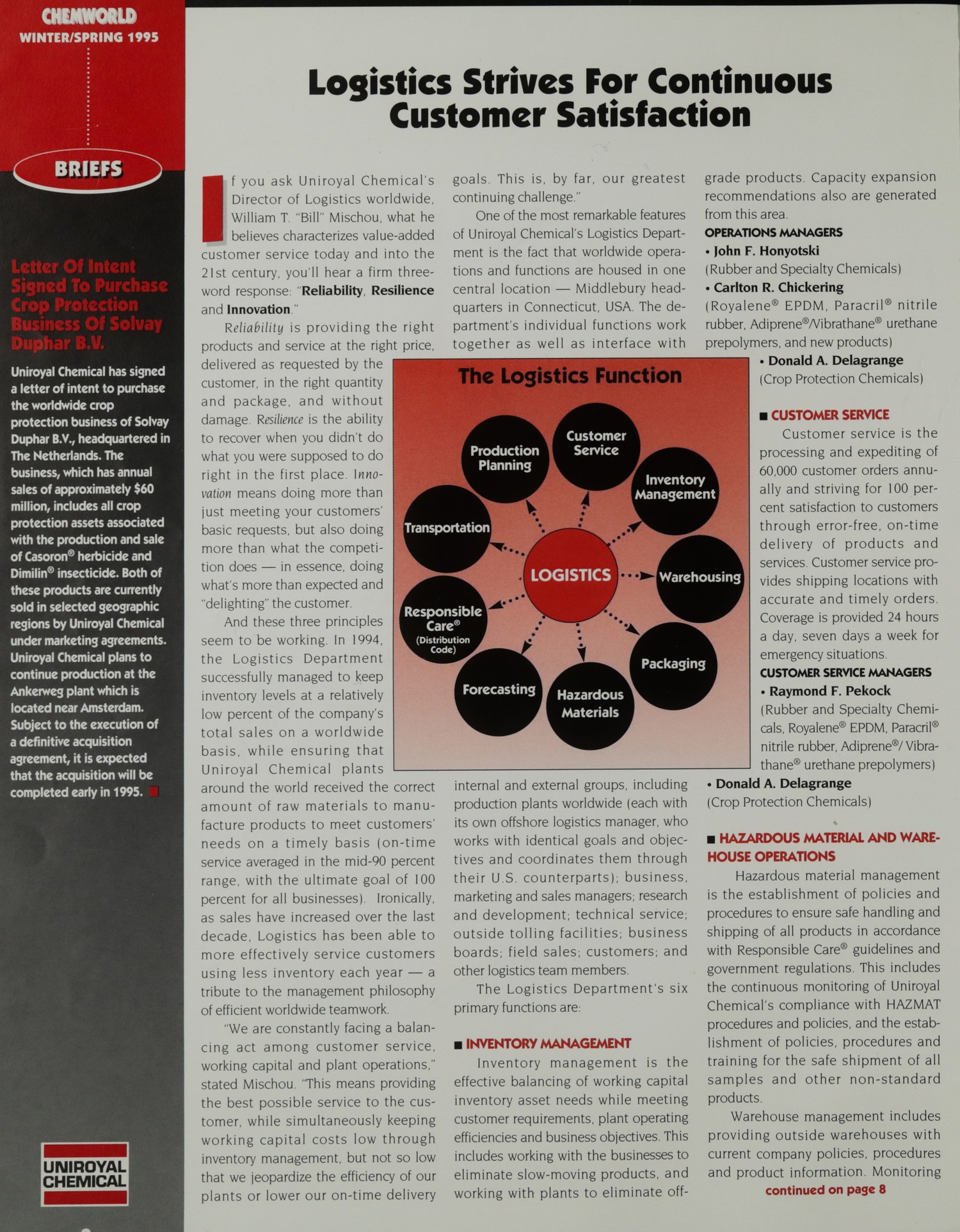
One of the most remarkable features of Uniroyal Chemical’s Logistics Department is the fact that worldwide operations and functions are housed in one central location — Middlebury headquarters in Connecticut, USA. The department’s individual functions work together as well as interface with


The Logistics Function

[DIAGRAM showing interconnected circles around central “LOGISTICS” hub, including:
– Production Planning
– Customer Service
– Inventory Management
– Transportation
– Warehousing
– Responsible Care® (Distribution Code)
– Packaging
– Forecasting
– Hazardous Materials]


internal and external groups, including production plants worldwide (each with its own offshore logistics manager, who works with identical goals and objectives and coordinates them through their U.S. counterparts); business, marketing and sales managers; research and development; technical service; outside tolling facilities; business boards; field sales; customers; and other logistics team members.

The Logistics Department’s six primary functions are:

INVENTORY MANAGEMENT

Inventory management is the effective balancing of working capital inventory asset needs while meeting customer requirements, plant operating efficiencies and business objectives. This includes working with the businesses to eliminate slow-moving products, and working with plants to eliminate off-

grade products. Capacity expansion recommendations also are generated from this area.

OPERATIONS MANAGERS
John F. Honyotski
(Rubber and Specialty Chemicals)
Carlton R. Chickering
(Royalene® EPDM, Paracril® nitrile rubber, Adiprene®/Vibrathane® urethane prepolymers, and new products)
Donald A. Delagrange
(Crop Protection Chemicals)

CUSTOMER SERVICE

Customer service is the processing and expediting of 60,000 customer orders annually and striving for 100 percent satisfaction to customers through error-free, on-time delivery of products and services. Customer service provides shipping locations with accurate and timely orders. Coverage is provided 24 hours a day, seven days a week for emergency situations.

CUSTOMER SERVICE MANAGERS
Raymond F. Pecock
(Rubber and Specialty Chemicals, Royalene® EPDM, Paracril® nitrile rubber, Adiprene®/Vibrathane® urethane prepolymers)
Donald A. Delagrange
(Crop Protection Chemicals)

HAZARDOUS MATERIAL AND WAREHOUSE OPERATIONS

Hazardous material management is the establishment of policies and procedures to ensure safe handling and shipping of all products in accordance with Responsible Care® guidelines and government regulations. This includes the continuous monitoring of Uniroyal Chemical’s compliance with HAZMAT procedures and policies, and the establishment of policies, procedures and training for the safe shipment of all samples and other non-standard products.

Warehouse management includes providing outside warehouses with current company policies, procedures and product information. Monitoring

continued on page 8

ChemWorld – Page 3

Page 003

CHEMWORLD

WINTER/SPRING 1995


Responsible Care® Implementation On Track

As Uniroyal Chemical’s Responsible Care® Coordinator, Joseph V. Bucciaglia is in the process of visiting Uniroyal Chemical locations to help implement the company’s Responsible Care program. In 1995, Bucciaglia’s goal is to oversee worldwide implementation of “Management Practice In Place,” which provides standards against which to measure performance. Management Practice In Place Standards must be developed and documented for each of the Responsible Care® program codes. Standards have been finalized for all of the codes, except Product Stewardship, and Uniroyal Chemical plans to have the Pollution Prevention, Process Safety, Distribution and CAER (Community Awareness/Emergency Response) codes implemented by November 1995. The remaining codes are slated for implementation by April 1997.

The CAER Code relates directly to one of Uniroyal Chemical’s corporate goals “Build Strong Community Partnerships”. One aim of the code is to establish a dialogue between the company and the public. The other codes help to support another Uniroyal Chemical goal, “Zero Damage to People and the Environment.” These codes help to improve performance and ensure that industry operations will work towards improving the health and safety of the public, workers and the environment.

Once each of the seven codes have been implemented, the CMA will conduct a validation of the program. The validation process will require that detailed records of all related programs are kept. Bucciaglia would like to see that documentation compiled in a format similar to what is currently being used for ISO certification. In addition, each reporting site will also be required to complete a self-evaluation of its program.

Uniroyal Chemical was not the first company to begin implementation of a Responsible Care program, but Bucciaglia sees a benefit in not being a front-runner. “We’ve been able to do a better job by avoiding the pitfalls other companies fall into. We’ve definitely taken advantage of other’s experiences – both good and bad.” ■

Contributing Writer: Todd Volpe, Middlebury, CT.


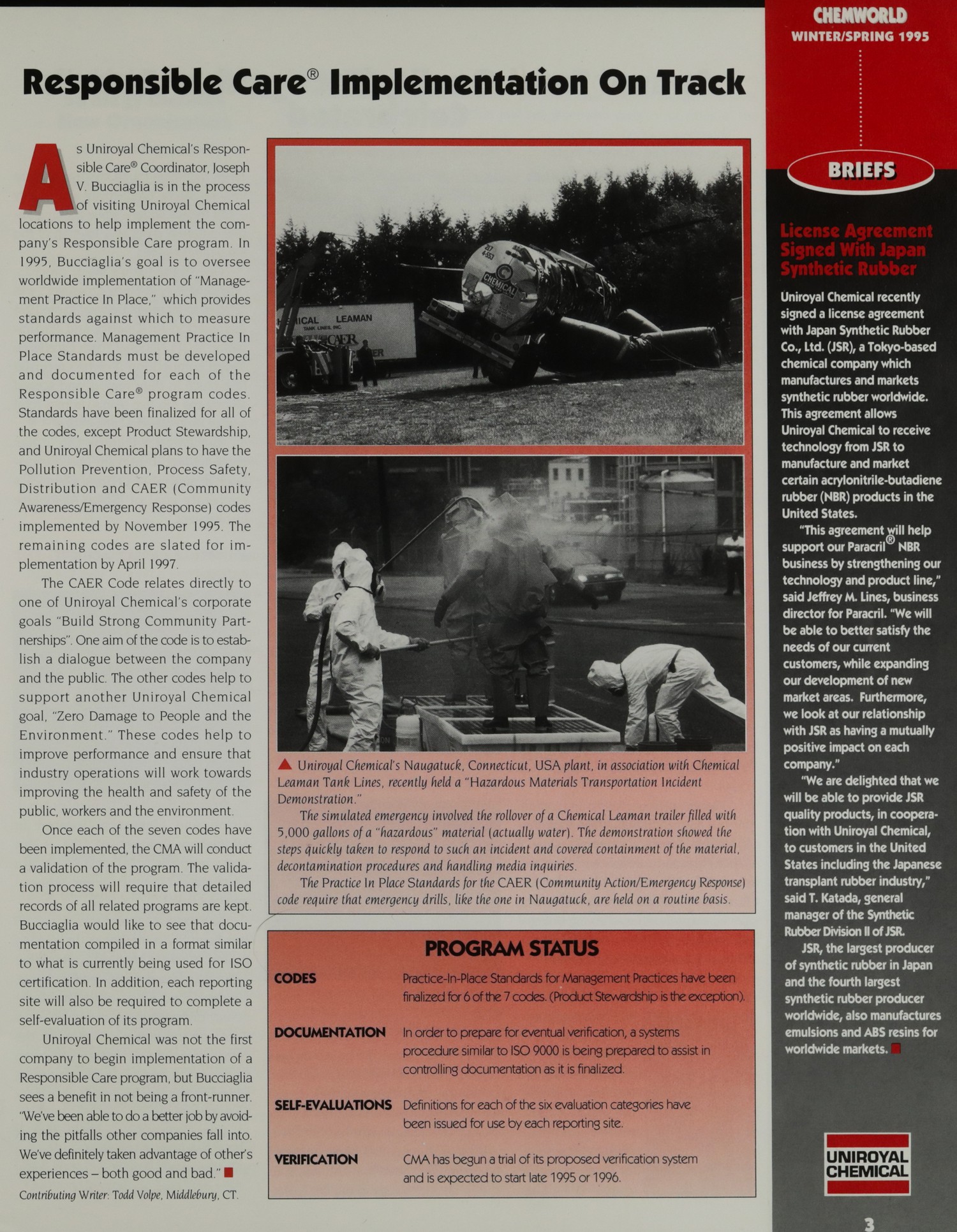
Uniroyal Chemical’s Naugatuck, Connecticut, USA plant, in association with Chemical Leaman Tank Lines, recently held a “Hazardous Materials Transportation Incident Demonstration.”

The simulated emergency involved the rollover of a Chemical Leaman trailer filled with 5,000 gallons of a “hazardous” material (actually water). The demonstration showed the steps quickly taken to respond to such an incident and covered containment of the material, decontamination procedures and handling media inquiries.

The Practice In Place Standards for the CAER (Community Action/Emergency Response) code require that emergency drills, like the one in Naugatuck, are held on a routine basis.


PROGRAM STATUS

CODES Practice-In-Place Standards for Management Practices have been finalized for 6 of the 7 codes. (Product Stewardship is the exception).
DOCUMENTATION In order to prepare for eventual verification, a systems procedure similar to ISO 9000 is being prepared to assist in controlling documentation as it is finalized.
SELF-EVALUATIONS Definitions for each of the six evaluation categories have been issued for use by each reporting site.
VERIFICATION CMA has begun a trial of its proposed verification system and is expected to start late 1995 or 1996.

BRIEFS

License Agreement Signed With Japan Synthetic Rubber

Uniroyal Chemical recently signed a license agreement with Japan Synthetic Rubber Co., Ltd. (JSR), a Tokyo-based chemical company which manufactures and markets synthetic rubber worldwide. This agreement allows Uniroyal Chemical to receive technology from JSR to manufacture and market certain acrylonitrile-butadiene rubber (NBR) products in the United States.

“This agreement will help support our Paracril® NBR business by strengthening our technology and product line,” said Jeffrey M. Lines, business director for Paracril. “We will be able to better satisfy the needs of our current customers, while expanding our development of new market areas. Furthermore, we look at our relationship with JSR as having a mutually positive impact on each company.”

“We are delighted that we will be able to provide JSR quality products, in cooperation with Uniroyal Chemical, to customers in the United States including the Japanese transplant rubber industry,” said T. Katada, general manager of the Synthetic Rubber Division II of JSR.

JSR, the largest producer of synthetic rubber in Japan and the fourth largest synthetic rubber producer worldwide, also manufactures emulsions and ABS resins for worldwide markets. ■


UNIROYAL CHEMICAL


3

ChemWorld – Page 4

Page 004

CHEMWORLD

WINTER/SPRING 1995


Annual Total Quality Recognition Awards Celebrated

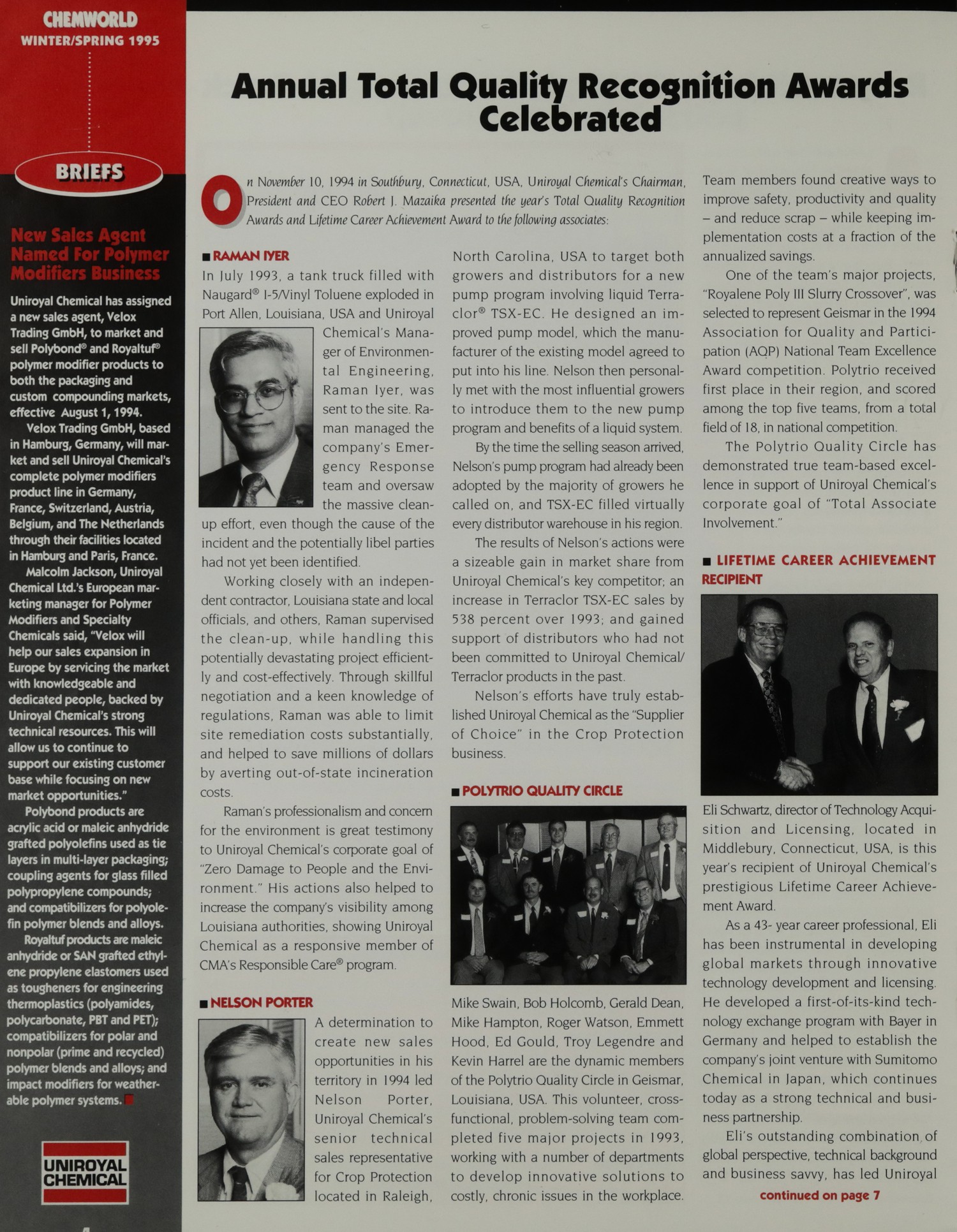
On November 10, 1994 in Southbury, Connecticut, USA, Uniroyal Chemical’s Chairman, President and CEO Robert J. Mazaika presented the year’s Total Quality Recognition Awards and Lifetime Career Achievement Award to the following associates:


BRIEFS

New Sales Agent Named For Polymer Modifiers Business

Uniroyal Chemical has assigned a new sales agent, Velox Trading GmbH, to market and sell Polybond® and Royaltuf® polymer modifier products to both the packaging and custom compounding markets, effective August 1, 1994.

Velox Trading GmbH, based in Hamburg, Germany, will market and sell Uniroyal Chemical’s complete polymer modifiers product line in Germany, France, Switzerland, Austria, Belgium, and The Netherlands through their facilities located in Hamburg and Paris, France.

Malcolm Jackson, Uniroyal Chemical Ltd.’s European marketing manager for Polymer Modifiers and Specialty Chemicals said, “Velox will help our sales expansion in Europe by servicing the market with knowledgeable and dedicated people, backed by Uniroyal Chemical’s strong technical resources. This will allow us to continue to support our existing customer base while focusing on new market opportunities.”

Polybond products are acrylic acid or maleic anhydride grafted polyolefins used as tie layers in multi-layer packaging; coupling agents for glass filled polypropylene compounds; and compatibilizers for polyolefin polymer blends and alloys.

Royaltuf products are maleic anhydride or SAN grafted ethylene propylene elastomers used as tougheners for engineering thermoplastics (polyamides, polycarbonate, PBT and PET); compatibilizers for polar and nonpolar (prime and recycled) polymer blends and alloys; and impact modifiers for weatherable polymer systems. ■


UNIROYAL CHEMICAL


■ RAMAN IYER

In July 1993, a tank truck filled with Naugard® I-5/Vinyl Toluene exploded in Port Allen, Louisiana, USA and Uniroyal Chemical’s Manager of Environmental Engineering, Raman Iyer, was sent to the site. Raman managed the company’s Emergency Response team and oversaw the massive cleanup effort, even though the cause of the incident and the potentially libel parties had not yet been identified.

Working closely with an independent contractor, Louisiana state and local officials, and others, Raman supervised the clean-up, while handling this potentially devastating project efficiently and cost-effectively. Through skillful negotiation and a keen knowledge of regulations, Raman was able to limit site remediation costs substantially, and helped to save millions of dollars by averting out-of-state incineration costs.

Raman’s professionalism and concern for the environment is great testimony to Uniroyal Chemical’s corporate goal of “Zero Damage to People and the Environment.” His actions also helped to increase the company’s visibility among Louisiana authorities, showing Uniroyal Chemical as a responsive member of CMA’s Responsible Care® program.


■ NELSON PORTER

A determination to create new sales opportunities in his territory in 1994 led Nelson Porter, Uniroyal Chemical’s senior technical sales representative for Crop Protection located in Raleigh, North Carolina, USA to target both growers and distributors for a new pump program involving liquid Terraclor® TSX-EC. He designed an improved pump model, which the manufacturer of the existing model agreed to put into his line. Nelson then personally met with the most influential growers to introduce them to the new pump program and benefits of a liquid system.

By the time the selling season arrived, Nelson’s pump program had already been adopted by the majority of growers he called on, and TSX-EC filled virtually every distributor warehouse in his region.

The results of Nelson’s actions were a sizeable gain in market share from Uniroyal Chemical’s key competitor; an increase in Terraclor TSX-EC sales by 538 percent over 1993; and gained support of distributors who had not been committed to Uniroyal Chemical/ Terraclor products in the past.

Nelson’s efforts have truly established Uniroyal Chemical as the “Supplier of Choice” in the Crop Protection business.


■ POLYTRIO QUALITY CIRCLE

Mike Swain, Bob Holcomb, Gerald Dean, Mike Hampton, Roger Watson, Emmett Hood, Ed Gould, Troy Legendre and Kevin Harrel are the dynamic members of the Polytrio Quality Circle in Geismar, Louisiana, USA. This volunteer, cross-functional, problem-solving team completed five major projects in 1993, working with a number of departments to develop innovative solutions to costly, chronic issues in the workplace.

Team members found creative ways to improve safety, productivity and quality – and reduce scrap – while keeping implementation costs at a fraction of the annualized savings.

One of the team’s major projects, “Royalene Poly III Slurry Crossover”, was selected to represent Geismar in the 1994 Association for Quality and Participation (AQP) National Team Excellence Award competition. Polytrio received first place in their region, and scored among the top five teams, from a total field of 18, in national competition.

The Polytrio Quality Circle has demonstrated true team-based excellence in support of Uniroyal Chemical’s corporate goal of “Total Associate Involvement.”


■ LIFETIME CAREER ACHIEVEMENT RECIPIENT

Eli Schwartz, director of Technology Acquisition and Licensing, located in Middlebury, Connecticut, USA, is this year’s recipient of Uniroyal Chemical’s prestigious Lifetime Career Achievement Award.

As a 43- year career professional, Eli has been instrumental in developing global markets through innovative technology development and licensing. He developed a first-of-its-kind technology exchange program with Bayer in Germany and helped to establish the company’s joint venture with Sumitomo Chemical in Japan, which continues today as a strong technical and business partnership.

Eli’s outstanding combination of global perspective, technical background and business savvy, has led Uniroyal

continued on page 7

ChemWorld – Page 5

Page 005

CHEMWORLD

WINTER/SPRING 1995


Worldwide Growth Strategy Dictates New Organization

(continued from page 1)

William A. Stephenson, formerly vice president/general manager of the Specialties Division, has been appointed executive vice president of the Asia/Pacific region with responsibility for the worldwide Specialties businesses (Adiprene®/Vibrathane® urethane prepolymers and Specialty Chemicals), Gustafson (a wholly-owned subsidiary for seed treatment chemicals) and Asia/Pacific (including all businesses in that region).

Dr. Edward L. Hagen has been appointed regional vice president for Asia/ Pacific and will report to Mr. Stephenson. The headquarters location will be announced shortly.

“This new global organization structure will help support a firm foundation for shared leadership, constructive interdependence between divisions and regions, and matrixed teamwork at all management levels,” commented Robert J. Mazaika, Uniroyal Chemical’s chairman, president and CEO. “We are looking forward to an even more successful future as we become a stronger player in the global chemical industry.”


PROFESSIONAL PROFILES

Dr. JOSEPH B. EISENBERG

Dr. Joseph B. Eisenberg has been with Uniroyal Chemical for over 30 years, serving as senior group leader, production superintendent for polymers, production superintendent for chemicals, technical superintendent, engineering manager, and general manager of international operations for Chemicals and Polymers. Most recently, he was vice president and general manager of the Chemicals and Polymers Division, responsible for Rubber Chemicals, Royalene® EPDM and Paracril® nitrile rubber.

Dr. Eisenberg received a B.S., M.S. and Ph.D in chemical engineering from Clarkson University in New York, USA.


WALTER K. RUCK

Walter K. Ruck joined Uniroyal Inc. in 1979 as manager of construction in the Chemical Division Engineering Department. He progressed through a number of managerial positions since that time and was transferred to Uniroyal Ltd. in Elmira, Ontario, Canada in 1985, where he served as manager of manufacturing.

Since 1988, he has held the position of managing director/general manager of Uniroyal Chemical Ltd. in Elmira.

Mr. Ruck has a B.S. in engineering from Christian Brothers College in Memphis, Tennessee, USA and attended St. Louis University in St. Louis, Missouri, USA. He has also pursued graduate studies in business management at Xavier University in Cincinnati, Ohio, USA.


ALFRED F. INGULLI

Mr. Ingulli has been with Uniroyal Chemical for 31 years, and has worked in research and development where he was awarded two patents for high temperature themoplastic alloys. He also worked in market development where he was instrumental in establishing two new businesses — Polywet® dispersants and Synton® synthetic lubricants. He has also served as business manager for many of the company’s businesses in the Chemicals and Polymers Division and Specialties Division.

Most recently, he was vice president and general manager of the Crop Protection Division, responsible for fungicides, insecticides, plant growth regulators, herbicides, foliar nutrients, seed treatment and other crop protection specialty products worldwide.

Mr. Ingulli received a B.S. in chemical engineering from Polytechnic Institute and an M.S. in management from Rensselaer Polytechnic Institute, both located in New York, USA. He also completed the Harvard Business School Program of Management Development.


MICHEL J. DUCHESNE

With a background in international and general management, having worked for regional, national and international sales divisions for both Uniroyal Chemical and other Fortune 500 companies, Mr. Duchesne has been general sales manager of the Crop Protection International Division and general sales manager and director of sales of the Crop Protection Division worldwide.

Most recently, he served as managing director of European operations based in Langley, United Kingdom.

A native of France, Mr. Duchesne holds a dual French-American citizenship. He received a B.A. and an M.S. in agronomy from the National Institute of Agronomy at the University of Paris, France.


WILLIAM A. STEPHENSON

A 26-year veteran of Uniroyal Chemical, William Stephenson has worked as a development engineer in research and development, technical sales service representative, manager for Paracril nitrile rubber, and marketing manager and business manager for Royalene EPDM.

Most recently, he was vice president and general manager of the Specialties Division, overseeing two key business units: Adiprene/Vibrathane urethane prepolymers and Specialty Chemicals – a major supplier of plastics additives including antioxidants, foaming agents, epoxy curatives and polymerization inhibitors, as well as lubricant additives and intermediates.

Mr. Stephenson received a B.S. in plastics technology from Lowell Technological Institute in Lowell, Massachusetts, USA, and an M.B.A. in marketing from the University of Hartford, Connecticut, USA.


Dr. EDWARD L. HAGEN

Dr. Edward L. Hagen started his career in 1969 as a research chemist in corporate R&D for Uniroyal Inc., and then joined Uniroyal Chemical in 1974 as a technical sales service group leader for Vibrathane castable urethanes and Roylar® thermoplastic urethanes. He continued his career in the urethanes area as R&D and technical sales service manager, marketing specialist and worldwide business manager through 1991.

Most recently, he held the position of vice president of Corporate Business Development. Dr. Hagen received a B.S. in chemistry from the University of Notre Dame in South Bend, Indiana, USA and a Ph.D in organic chemistry from Yale University in New Haven, Connecticut, USA. ■


BRIEFS

Seed Treatment Operation in United Kingdom Acquired

Uniroyal Chemical has purchased the seed treatment operation of DowElanco in the United Kingdom and Ireland. The transaction was completed on November 3, 1994.

“Uniroyal Chemical already is the global leader in seed treatment products and technology, and this acquisition enables us to bolster a key market,” said Alfred F. Ingulli, executive vice president responsible for the company’s Crop Protection product lines. “DowElanco customers in the United Kingdom can expect a continued strong commitment to seed treatment products, equipment and service.”

The transaction includes the existing DowElanco seed treatment team, development equipment, machinery and spare parts inventory. DowElanco announced last spring that the divestiture would enable it to focus on its core business.

“Uniroyal Chemical’s Crop Protection business continued to grow in 1994, especially in the area of seed treatment,” Ingulli said. “Our personnel, products and expertise make us the dominant leader in seed treatment, both in North America and worldwide.” ■


UNIROYAL CHEMICAL

ChemWorld – Page 7

Page 007

CHEMWORLD

WINTER/SPRING 1995


Novaquim Strengthens Uniroyal Chemical’s Expansion Efforts

When Uniroyal Chemical fully acquired Novaquim S.A. de C.V. in Mexico from its former joint venture partner Cydsa in July 1993, it hailed the event as a “milestone in the company’s drive toward globalization” and a sign of its “solid commitment to a worldwide customer base and to specialty rubber chemicals, polymers, and urethane markets in Mexico.” Today, Novaquim is proving itself to be more than just a milestone and symbol of commitment.

Under the leadership of Managing Director Rodolfo Montemayor, Novaquim is a pivotal sales and manufacturing organization which allows Uniroyal Chemical to position itself more strongly to serve Mexico and Latin American markets.

“Since the early 1970s, Novaquim has continued to build an outstanding reputation in Mexico as a producer of superior quality products,” said Montemayor. “Our customers continually put our products to the test, and they demand that our products meet the most stringent quality standards for performance. The feedback we’ve received indicates that we’re achieving the highest levels of satisfaction with our customers. We are very proud of this achievement.”

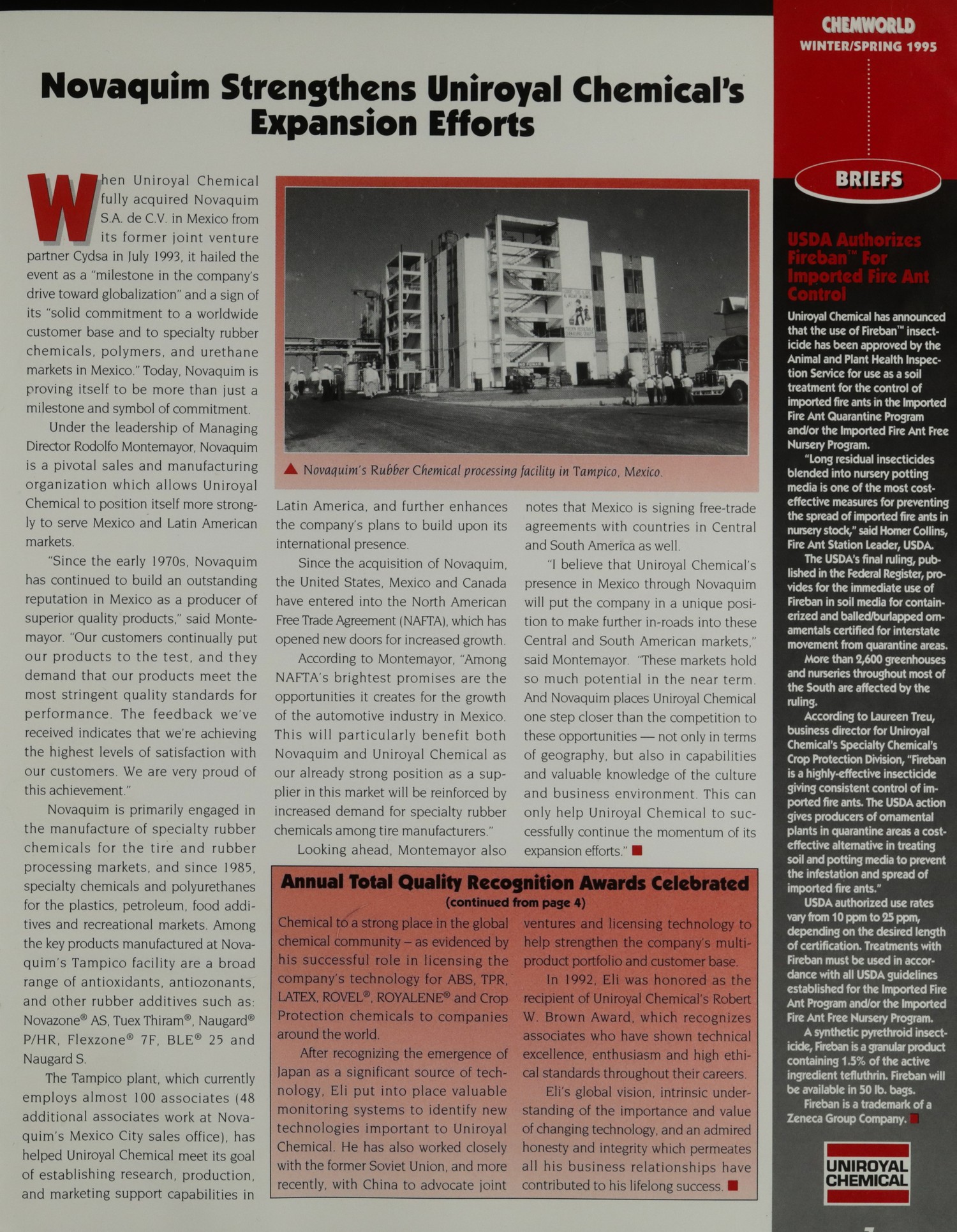
Novaquim is primarily engaged in the manufacture of specialty rubber chemicals for the tire and rubber processing markets, and since 1985, specialty chemicals and polyurethanes for the plastics, petroleum, food additives and recreational markets. Among the key products manufactured at Novaquim’s Tampico facility are a broad range of antioxidants, antiozonants, and other rubber additives such as: Novazone® AS, Tuex Thiram®, Naugard® P/HR, Flexzone® 7F, BLE® 25 and Naugard S.

The Tampico plant, which currently employs almost 100 associates (48 additional associates work at Novaquim’s Mexico City sales office), has helped Uniroyal Chemical meet its goal of establishing research, production, and marketing support capabilities in


Novaquim’s Rubber Chemical processing facility in Tampico, Mexico.

Latin America, and further enhances the company’s plans to build upon its international presence.

Since the acquisition of Novaquim, the United States, Mexico and Canada have entered into the North American Free Trade Agreement (NAFTA), which has opened new doors for increased growth.

According to Montemayor, “Among NAFTA’s brightest promises are the opportunities it creates for the growth of the automotive industry in Mexico. This will particularly benefit both Novaquim and Uniroyal Chemical as our already strong position as a supplier in this market will be reinforced by increased demand for specialty rubber chemicals among tire manufacturers.”

Looking ahead, Montemayor also

notes that Mexico is signing free-trade agreements with countries in Central and South America as well.

“I believe that Uniroyal Chemical’s presence in Mexico through Novaquim will put the company in a unique position to make further in-roads into these Central and South American markets,” said Montemayor. “These markets hold so much potential in the near term. And Novaquim places Uniroyal Chemical one step closer than the competition to these opportunities — not only in terms of geography, but also in capabilities and valuable knowledge of the culture and business environment. This can only help Uniroyal Chemical to successfully continue the momentum of its expansion efforts.” ■


Annual Total Quality Recognition Awards Celebrated

(continued from page 4)

Chemical to a strong place in the global chemical community – as evidenced by his successful role in licensing the company’s technology for ABS, TPR, LATEX, ROVEL®, ROYALENE® and Crop Protection chemicals to companies around the world.

After recognizing the emergence of Japan as a significant source of technology, Eli put into place valuable monitoring systems to identify new technologies important to Uniroyal Chemical. He has also worked closely with the former Soviet Union, and more recently, with China to advocate joint

ventures and licensing technology to help strengthen the company’s multi-product portfolio and customer base.

In 1992, Eli was honored as the recipient of Uniroyal Chemical’s Robert W. Brown Award, which recognizes associates who have shown technical excellence, enthusiasm and high ethical standards throughout their careers.

Eli’s global vision, intrinsic understanding of the importance and value of changing technology, and an admired honesty and integrity which permeates all his business relationships have contributed to his lifelong success. ■


BRIEFS

USDA Authorizes Fireban™ For Imported Fire Ant Control

Uniroyal Chemical has announced that the use of Fireban™ insecticide has been approved by the Animal and Plant Health Inspection Service for use as a soil treatment for the control of imported fire ants in the Imported Fire Ant Quarantine Program and/or the Imported Fire Ant Free Nursery Program.

“Long residual insecticides blended into nursery potting media is one of the most cost-effective measures for preventing the spread of imported fire ants in nursery stock,” said Homer Collins, Fire Ant Station Leader, USDA.

The USDA’s final ruling, published in the Federal Register, provides for the immediate use of Fireban in soil media for containerized and balled/burlapped ornamentals certified for interstate movement from quarantine areas.

More than 2,600 greenhouses and nurseries throughout most of the South are affected by the ruling.

According to Laureen Treu, business director for Uniroyal Chemical’s Specialty Chemical’s Crop Protection Division, “Fireban is a highly-effective insecticide giving consistent control of imported fire ants. The USDA action gives producers of ornamental plants in quarantine areas a cost-effective alternative in treating soil and potting media to prevent the infestation and spread of imported fire ants.”

USDA authorized use rates vary from 10 ppm to 25 ppm, depending on the desired length of certification. Treatments with Fireban must be used in accordance with all USDA guidelines established for the Imported Fire Ant Program and/or the Imported Fire Ant Free Nursery Program.

A synthetic pyrethroid insecticide, Fireban is a granular product containing 1.5% of the active ingredient tefluthrin. Fireban will be available in 50 lb. bags.

Fireban is a trademark of a Zeneca Group Company. ■


UNIROYAL CHEMICAL

ChemWorld – Page 8

Page 008

CHEMWORLD

WINTER/SPRING 1995


BRIEFS

WACA Recognizes Uniroyal Chemical Associate for Outstanding Service

Roy Parker of Uniroyal Chemical has recently been honored by the Western Agricultural Chemicals Association for outstanding service to the organization and industry.

Parker, product development representative, was named the WACA Outstanding Member for 1994. He was presented with the award at WACA’s 65th Annual Meeting in October, 1994 and is the sixteenth person to receive the award since 1979.

“We’re thrilled to have someone like Roy active in the association,” said Steve Forsberg, WACA executive director. “He took the Legislative Action Program and put his heart and soul into it. It’s one of the most effective grassroots programs in the country. It’s an award well-deserved—Roy is an asset to the entire industry.”

In addition to the Legislative Action Program, Parker has been active on the California State Action Committee and the Government Affairs Committee.

WACA represents manufacturers, formulators, distributors and retailers of pest management products and services in nine Western states. The association’s objective is to promote a positive business climate and industry goodwill. WACA has approximately 200 member companies with 1,000 active participants. ■


CHEMWORLD

is published twice a year by Uniroyal Chemical Company, Inc. for its associates and retirees.

Robert J. Petrausch
Director, Communications

Maureen C. Fama
Manager, Communications Programs

Uniroyal Chemical Company, Inc.
World Headquarters
Benson Road
Middlebury, CT 06749
(203) 573-2000

UNIROYAL CHEMICAL [Logo]


Uniroyal Chemical Corporation Announces Filing of Initial Public Offering

Uniroyal Chemical Corporation, the parent company of Uniroyal Chemical Company, Inc., announced on December 16, 1994 that it has filed with the Securities and Exchange Commission a Registration Statement relating to a proposed $200 million initial public offering of its common stock. Smith Barney Inc., Morgan Stanley & Co. Incorporated, and Wertheim Schroder & Co.

Incorporated will be the representatives of the underwriting syndicate for the offering. The Company intends to use the anticipated proceeds to the Company and up to an additional $40 million to retire indebtedness.

Subject to market conditions and other factors, the Company anticipates that the proposed offering could occur in the first calendar quarter of 1995. There can be no assurance that such favorable

market conditions will exist in the first quarter of 1995.

A Registration Statement relating to the proposed offering of the new common stock has been filed with the Securities and Exchange Commission but has not yet become effective. None of the new common stock may be sold, nor may offers to buy the new common stock be accepted, prior to the time the Registration Statement becomes effective. ■


Logistics Strives for Continuous Customer Satisfaction

(continued from page 2)

warehouse performance helps to ensure that specific goals for on-time shipments, customer pickup turn around time, and inventory accuracy are met.

HAZMAT AND WAREHOUSE OPERATIONS MANAGER
• Henry R. DeVries

■ PACKAGING

The packaging function is responsible for developing quality packages and labels, which must maintain product integrity, and exceed customer, business and Responsible Care® requirements. They must also be disposable, recyclable or source-reduced to ensure regulatory compliance. This includes establishing and maintaining a global package code system for easier tracking and identification purposes.

In 1994, primarily through the efforts of the company’s Packaging Excellence team, total package landfill elimination amounted to over 5.1 million pounds, with a cost savings to Uniroyal Chemical of almost $1.3 million. Active programs emphasizing customer partnerships are continually being pursued and improved upon.

PACKAGING PROGRAM MANAGER
• Morris L. Beaver

■ TRANSPORTATION

Transportation’s goal is to maintain an efficient, responsible global trans-

portation system which provides safe, on-time delivery in a way that protects people and the environment while observing all rules and regulations with total commitment to Responsible Care guidelines.

Managing a timely, accurate freight payment system through continuous audit and maximizing duty drawback, duty suspension processes and tariff reductions to help minimize costs are part of this area.

GENERAL TRAFFIC MANAGER
• Ralph E. Buonocore

■ FORECASTING

Forecasting provides reliable demand forecasts to be utilized to ensure proper inventory and support business planning. This includes monitoring the accuracy of the product forecast by business on a monthly basis, as well as providing one total forecast for Uniroyal Chemical on a global basis.

PLANNING SUPERVISOR
• Michael J. Rosa


Within Uniroyal Chemical, the Logistics Department has been a major contributor to the company’s “Committed to Excellence” programs. Logistics associates now chair the Chemicals and Polymers and Specialties Packaging, Domestic On-Time, Export On-Time, and Crop Documentation Excellence Teams, and serve on many other Excellence Committees. Logistics associates are also very involved in “Where Do I Fit In Quality?”, and have been recognized numerous times through the

company’s Total Quality Recognition Program. Department associates have also received seven Total Quality “Gold Coin” awards and five “President’s Awards” for their outstanding efforts.

The Logistics Department continues to meet multiple Uniroyal Chemical corporate goals in its daily actions: “Total Associate Involvement,” “Supplier of Choice,” “Low Cost Producer of Products and Services,” and “Zero Damage to People and the Environment.” The department is heavily involved in developing and implementing the Distribution Code of Management Practices (Bill Mischou, code leader) as part of the Responsible Care program initiated by the Chemical Manufacturers Association (CMA). The company is expected to have this code in place by November 1995.

And what sort of challenges will Logistics face in the future?

According to Mischou, there are three key areas which will expand the complexities associated with handling and distributing products worldwide: an increase in regulatory compliance; environmental issues (protection of people and the environment); and ever-increasing customer expectations.

“The area of customer expectations will present the biggest challenge. Customer needs are constantly changing, and they will be looking for a supplier who is flexible enough to change along with them, but who also can help contribute to their growing success. I’m confident that we’ll do whatever it takes to be that supplier — and do it without skipping a beat,” he concluded. ■

ChemWorld – Page 2

Page 002

ChemWorld | 2 | January 1991


Uniroyal Chemical Aids U.S.S.R. Cotton Industry

In the spirit of glasnost, Uniroyal Chemical recently launched an integrated cotton improvement program in the U.S.S.R., symbolizing its commitment to developing business in Soviet Central Asia. The program represents a giant step towards establishing Uniroyal Chemical as a leader in worldwide harvest aid technology.

SIBIR, Inc., USA, a business development/consulting firm which has a joint venture in Soviet Central Asia to advance the cotton industry, approached Uniroyal Chemical to help the Soviet cotton industry develop harvest aids, and ultimately to become more competitive.

“The Soviets grow excellent cotton, but haven’t yet mastered harvesting techniques,” said David Cote, marketing manager for plant growth regulators and herbicides, Crop Protection Division of Uniroyal Chemical. “Our technical teams from the U.S. and Langley, England offices assisted in establishing the research protocols for selecting inputs for their cotton improvement program.” Field testing is now underway to evaluate those inputs. If all goes well, the program could result in multi-million dollar sales of American products, including Harvade® harvest growth regulant.

Uniroyal Chemical technical teams have provided field development assistance to Uzbekistan, a republic of the U.S.S.R., which grows over 4.5 million acres of cotton, and accounts for 65 percent of the country’s cotton industry. Recently, the Soviet team, which includes three delegates from Uzbekistan, toured the top U.S. cotton growing areas in the Mississippi Delta and California (see sidebar).

More than half of Uniroyal Chemical’s agricultural business is outside of the United States. The U.S.S.R. has been a large importer of Vitavax® fungicide for cereal grain production. Uniroyal Chemical is well-positioned to expand this business further to develop agricultural marketplaces worldwide. ■


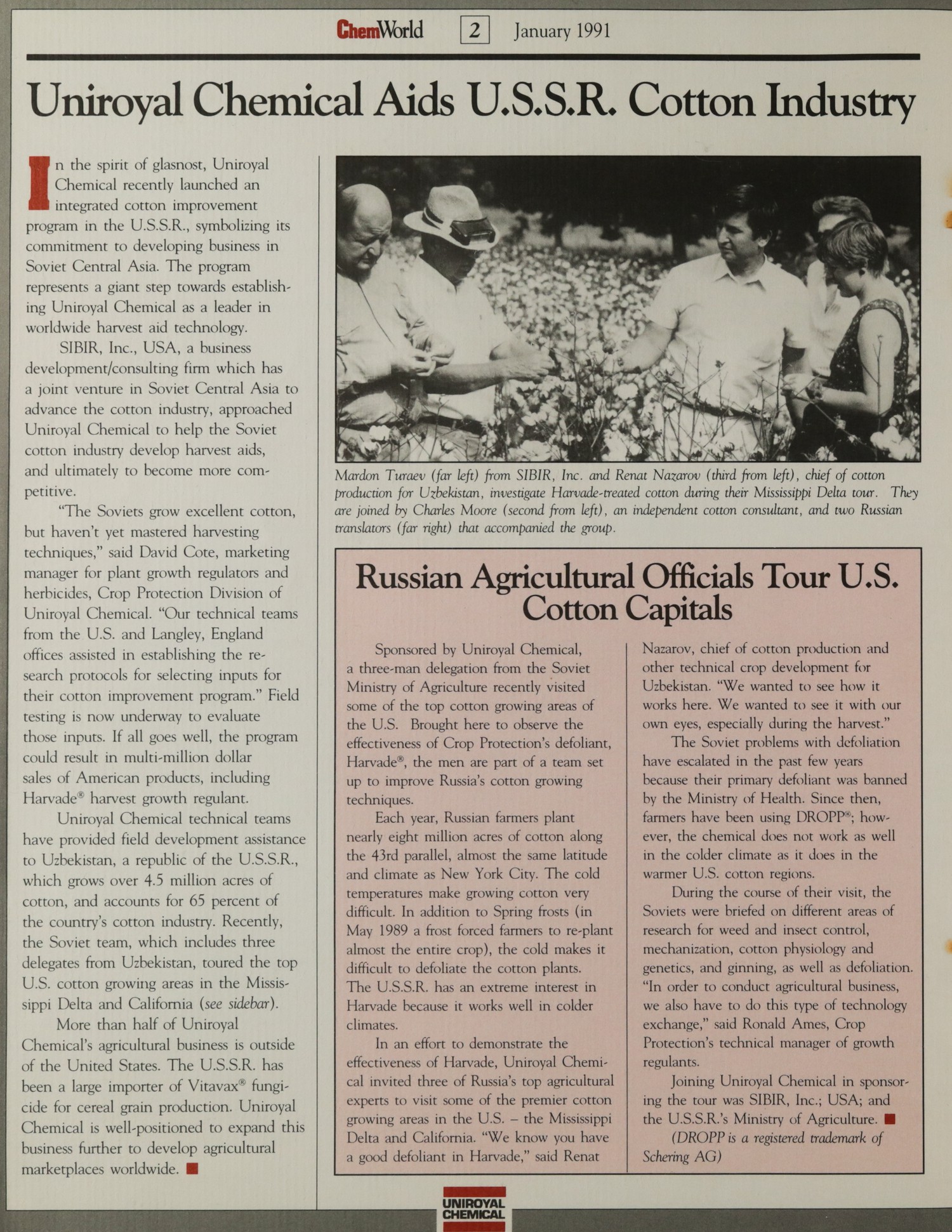
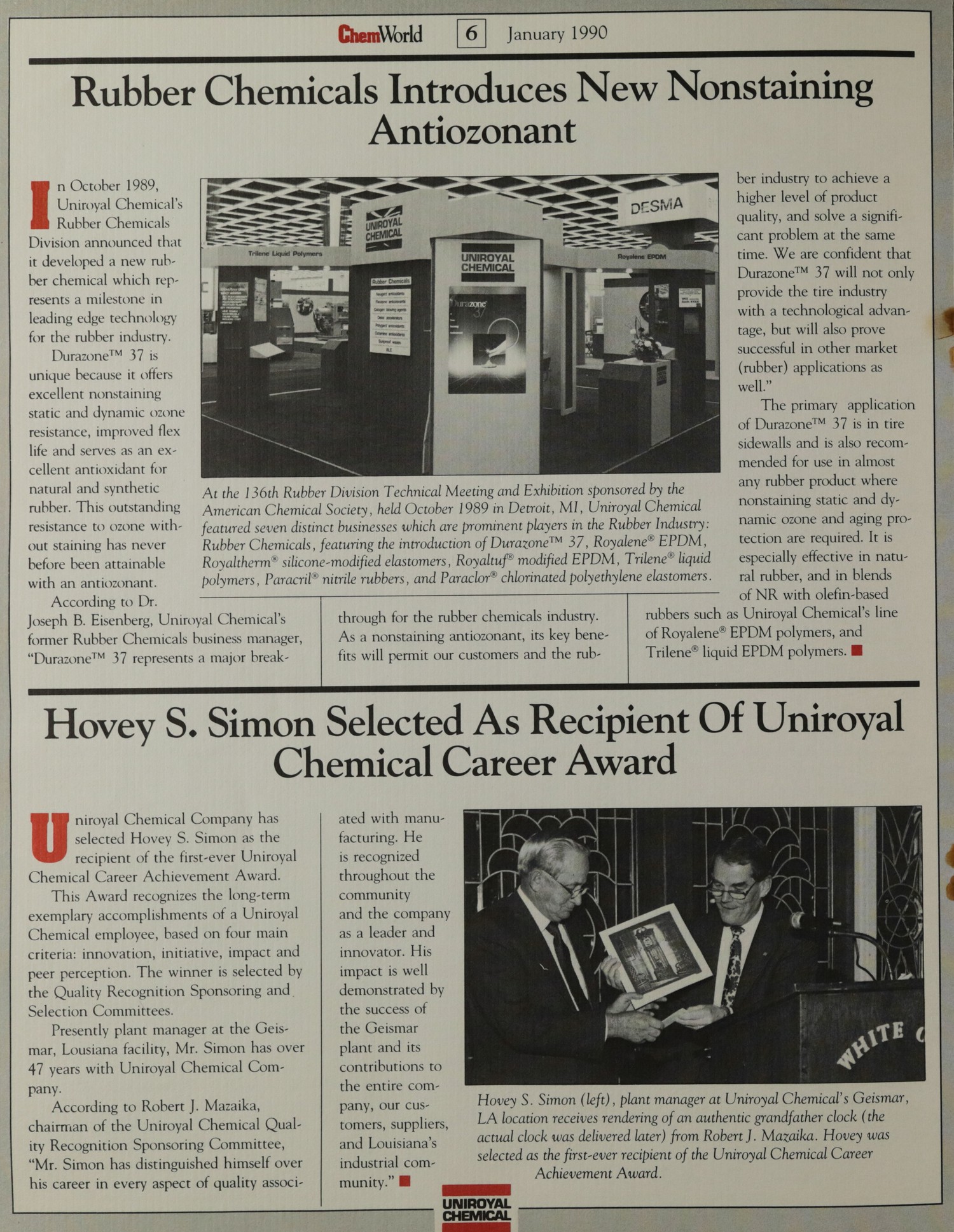
Mardon Turaev (far left) from SIBIR, Inc. and Renat Nazarov (third from left), chief of cotton production for Uzbekistan, investigate Harvade-treated cotton during their Mississippi Delta tour. They are joined by Charles Moore (second from left), an independent cotton consultant, and two Russian translators (far right) that accompanied the group.


Russian Agricultural Officials Tour U.S. Cotton Capitals

Sponsored by Uniroyal Chemical, a three-man delegation from the Soviet Ministry of Agriculture recently visited some of the top cotton growing areas of the U.S. Brought here to observe the effectiveness of Crop Protection’s defoliant, Harvade®, the men are part of a team set up to improve Russia’s cotton growing techniques.

Each year, Russian farmers plant nearly eight million acres of cotton along the 43rd parallel, almost the same latitude and climate as New York City. The cold temperatures make growing cotton very difficult. In addition to Spring frosts (in May 1989 a frost forced farmers to re-plant almost the entire crop), the cold makes it difficult to defoliate the cotton plants. The U.S.S.R. has an extreme interest in Harvade because it works well in colder climates.

In an effort to demonstrate the effectiveness of Harvade, Uniroyal Chemical invited three of Russia’s top agricultural experts to visit some of the premier cotton growing areas in the U.S. – the Mississippi Delta and California. “We know you have a good defoliant in Harvade,” said Renat

Nazarov, chief of cotton production and other technical crop development for Uzbekistan. “We wanted to see how it works here. We wanted to see it with our own eyes, especially during the harvest.”

The Soviet problems with defoliation have escalated in the past few years because their primary defoliant was banned by the Ministry of Health. Since then, farmers have been using DROPP®; however, the chemical does not work as well in the colder climate as it does in the warmer U.S. cotton regions.

During the course of their visit, the Soviets were briefed on different areas of research for weed and insect control, mechanization, cotton physiology and genetics, and ginning, as well as defoliation. “In order to conduct agricultural business, we also have to do this type of technology exchange,” said Ronald Ames, Crop Protection’s technical manager of growth regulants.

Joining Uniroyal Chemical in sponsoring the tour was SIBIR, Inc.; USA; and the U.S.S.R.’s Ministry of Agriculture. ■

(DROPP is a registered trademark of Schering AG)


UNIROYAL CHEMICAL

ChemWorld – Page 3

Page 003

ChemWorld | 3 | January 1991

New Product Technologies And Global Expansion Drive Chemicals And Polymers Division

Walter J. Cook, vice president and general manager of the Chemicals and Polymers (C&P) Division, recently talked about the division’s strengths and future worldwide expansion plans. The following is a summary of this interview:

Q. Despite the slowdown in the U.S. economy and the volatile global economy throughout 1990, the C&P Division turned in a commendable performance. What factors are responsible for this success during a time when many other industrial companies are struggling just to stay in business?

A. The C&P Division indeed turned in a commendable performance. However, I was disappointed that we did not make our budgeted sales and profit in 1990. During the last quarter of 1990, we were severely impacted by sales in the U.S.S.R. We have demonstrated to our many worldwide customers, however, that we are a very competitive, dependable supplier working very hard to provide the best quality products and service backed by a strong technical department, both in research and development and technical service.

Q. The third Royalene® EPDM production unit, known as Poly III, is slated to come on stream in March/April of 1991, making Uniroyal Chemical the largest producer of EPDM in North America. What strategy determined the need for this additional capacity and how will this capital investment affect the company’s MBO financial status?

A. We have become a worldwide leader in the EPDM business, and this expansion is a strong commitment to this fundamental position. In addition to our solid base in several key markets in North America, we have strategic market penetration in Latin America and Europe and support our licensees in Japan, Korea and India. We are very confident in meeting and exceeding our financial projections despite the heavy capital investment we are making in Poly III. This expansion will give us a satisfactory return on the capital deployed and help strengthen our MBO projections.


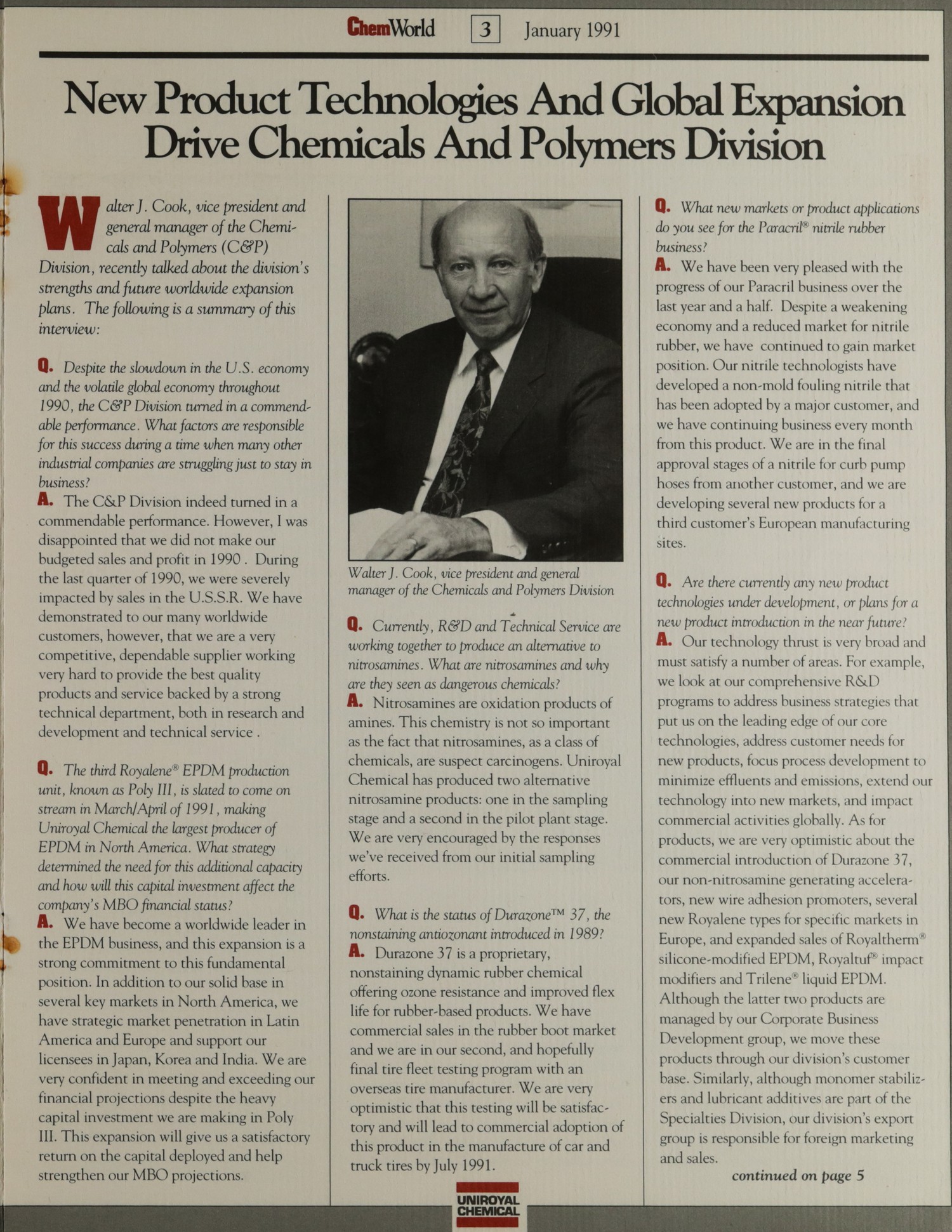
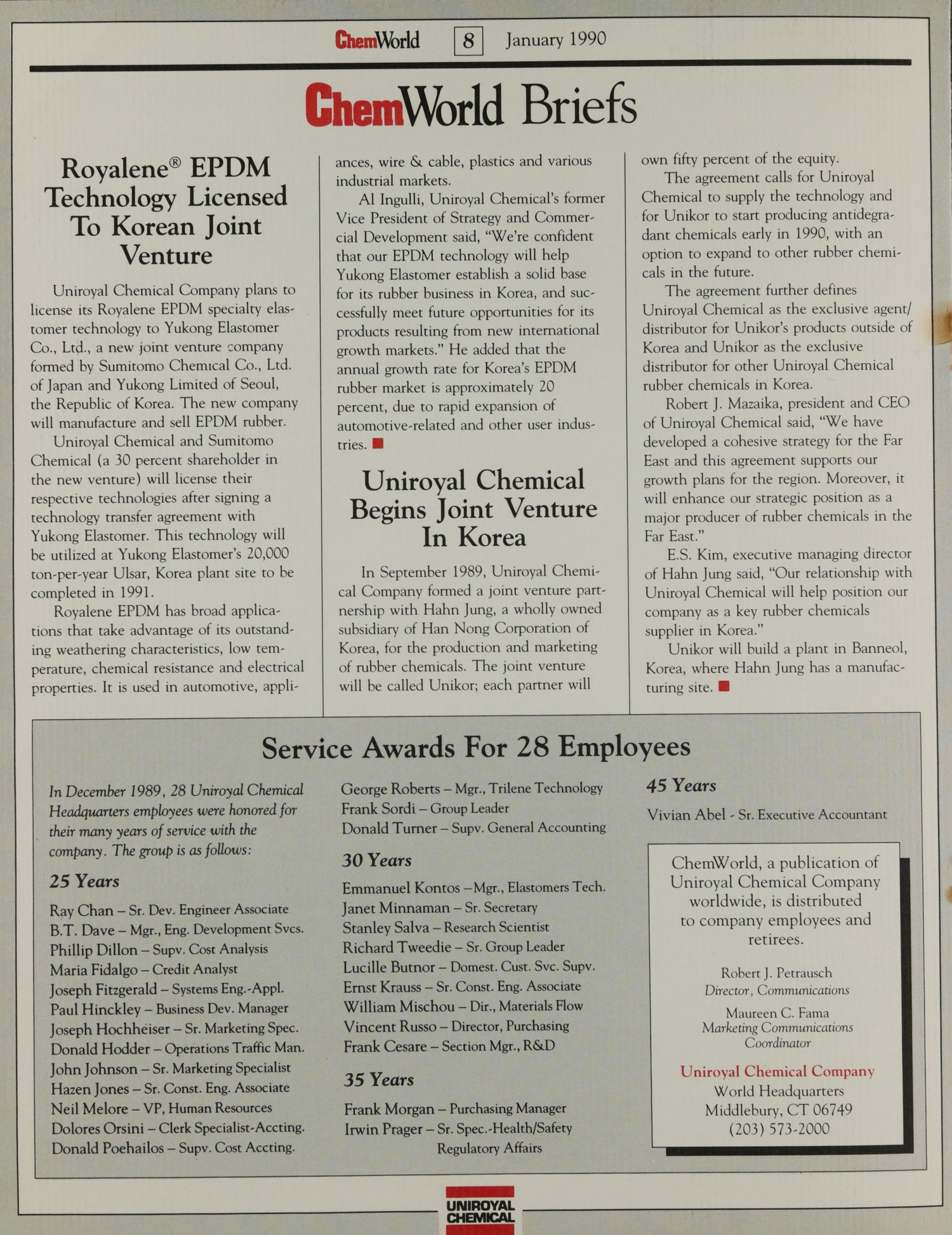
Walter J. Cook, vice president and general manager of the Chemicals and Polymers Division


Q. Currently, R&D and Technical Service are working together to produce an alternative to nitrosamines. What are nitrosamines and why are they seen as dangerous chemicals?

A. Nitrosamines are oxidation products of amines. This chemistry is not so important as the fact that nitrosamines, as a class of chemicals, are suspect carcinogens. Uniroyal Chemical has produced two alternative nitrosamine products: one in the sampling stage and a second in the pilot plant stage. We are very encouraged by the responses we’ve received from our initial sampling efforts.

Q. What is the status of Durazone™ 37, the nonstaining antiozonant introduced in 1989?

A. Durazone 37 is a proprietary, nonstaining dynamic rubber chemical offering ozone resistance and improved flex life for rubber-based products. We have commercial sales in the rubber boot market and we are in our second, and hopefully final tire fleet testing program with an overseas tire manufacturer. We are very optimistic that this testing will be satisfactory and will lead to commercial adoption of this product in the manufacture of car and truck tires by July 1991.


Q. What new markets or product applications do you see for the Paracril® nitrile rubber business?

A. We have been very pleased with the progress of our Paracril business over the last year and a half. Despite a weakening economy and a reduced market for nitrile rubber, we have continued to gain market position. Our nitrile technologists have developed a non-mold fouling nitrile that has been adopted by a major customer, and we have continuing business every month from this product. We are in the final approval stages of a nitrile for curb pump hoses from another customer, and we are developing several new products for a third customer’s European manufacturing sites.

Q. Are there currently any new product technologies under development, or plans for a new product introduction in the near future?

A. Our technology thrust is very broad and must satisfy a number of areas. For example, we look at our comprehensive R&D programs to address business strategies that put us on the leading edge of our core technologies, address customer needs for new products, focus process development to minimize effluents and emissions, extend our technology into new markets, and impact commercial activities globally. As for products, we are very optimistic about the commercial introduction of Durazone 37, our non-nitrosamine generating accelerators, new wire adhesion promoters, several new Royalene types for specific markets in Europe, and expanded sales of Royaltherm® silicone-modified EPDM, Royaltuf® impact modifiers and Trilene® liquid EPDM. Although the latter two products are managed by our Corporate Business Development group, we move these products through our division’s customer base. Similarly, although monomer stabilizers and lubricant additives are part of the Specialties Division, our division’s export group is responsible for foreign marketing and sales.

continued on page 5


UNIROYAL CHEMICAL

ChemWorld – Page 4

Page 004

ChemWorld | 4 | January 1991

Recycling Plastics Is Good Business

Problems and opportunities are often opposite sides of the same coin. A current societal problem which represents a significant opportunity for Uniroyal Chemical is the crisis surrounding the scarcity of landfill space in many parts of the country. As a supplier to the plastics industry, Uniroyal Chemical is committed to producing and selling products which will enhance the “environmental friendliness” of customers’ products.

By 1992, 25 percent of the nation’s solid waste should be recycled, according to the Environmental Protection Agency. Unfortunately for the plastics industry, there is a commonly-held misconception that plastics are not recyclable. Another purported shortcoming of plastics is that they are a waste of non-renewable petroleum resources.

Uniroyal Chemical and various industry associations, such as the Society of the Plastics Industry and the Society of Plastics Engineers, are now launching an all-out effort to educate the public as to the true environmental impact of plastics manufacture and use. Statistics are readily available which can demonstrate that plastics are no more hazardous to produce or use than any other material.

The principal thrust of educational efforts has been aimed at the central issue of plastics recyclability. The concept that plastics cannot be recycled has been unchallenged for so long that it has become “gospel” to large numbers of people.

While the technology to recycle most types of plastics is well-known, this new industry is not without its problems. Chief amongst these, and a fact which may account for the view that plastics cannot be recycled, is that plastics are most easily recycled when they are segregated by type prior to processing. Different types of plastics may be incompatible, so that when they are melted together, they do not form a cohesive blend and consequently lack

strength. Often, however, plastics are not segregated.

Uniroyal Chemical currently is developing a line of polymer modifiers to upgrade the properties of recycled resins. Royaltuf®, a modified ethylene propylene elastomer (rubber), is a family of polymer modifiers that is designed to increase toughness or to raise the impact properties of plastics, and to function as a compatibilizer enabling successful blending of otherwise incompatible resins. In many cases, the use of Royaltuf modifiers will allow a plastics producer to make engineer-


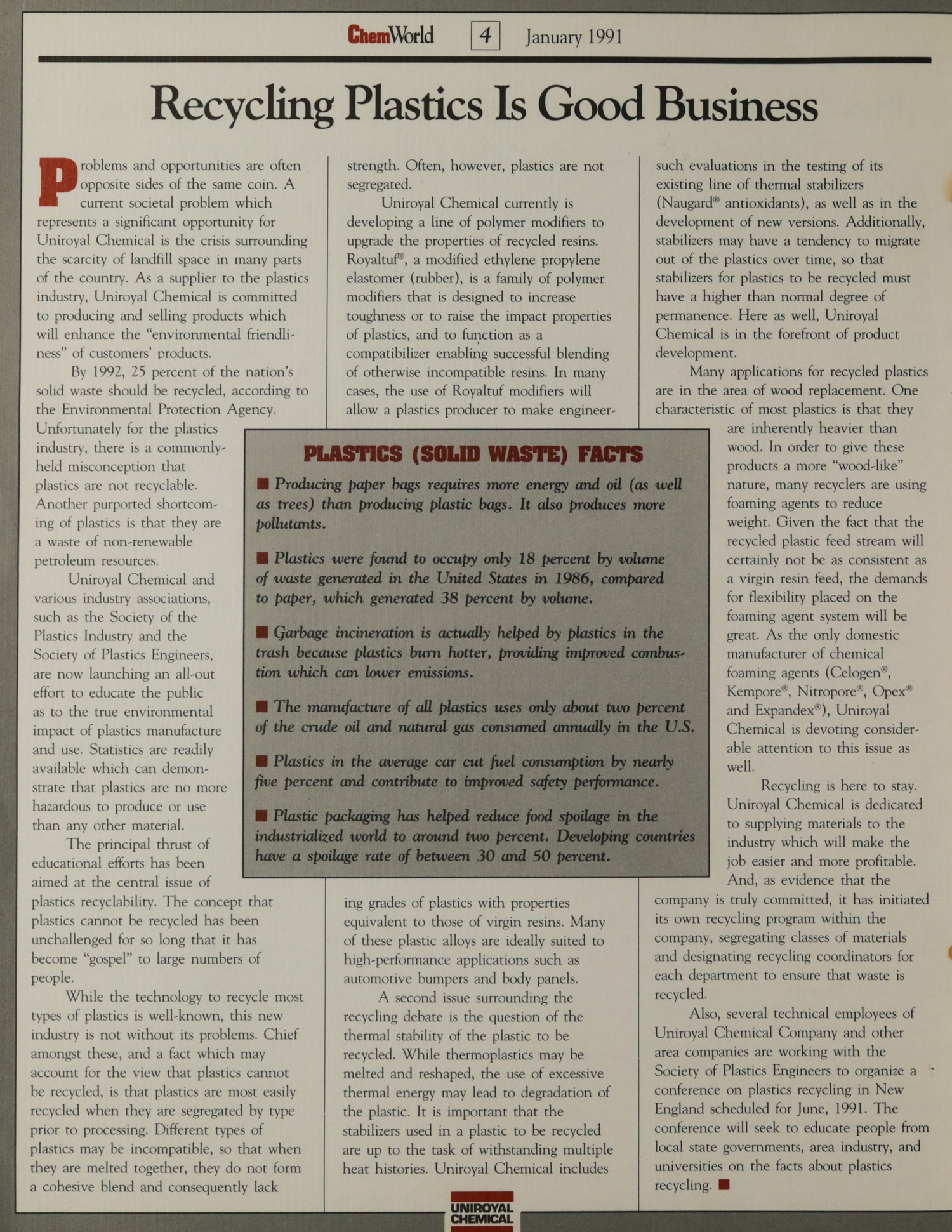
PLASTICS (SOLID WASTE) FACTS

Producing paper bags requires more energy and oil (as well as trees) than producing plastic bags. It also produces more pollutants.

Plastics were found to occupy only 18 percent by volume of waste generated in the United States in 1986, compared to paper, which generated 38 percent by volume.

Garbage incineration is actually helped by plastics in the trash because plastics burn hotter, providing improved combustion which can lower emissions.

The manufacture of all plastics uses only about two percent of the crude oil and natural gas consumed annually in the U.S.

Plastics in the average car cut fuel consumption by nearly five percent and contribute to improved safety performance.

Plastic packaging has helped reduce food spoilage in the industrialized world to around two percent. Developing countries have a spoilage rate of between 30 and 50 percent.


ing grades of plastics with properties equivalent to those of virgin resins. Many of these plastic alloys are ideally suited to high-performance applications such as automotive bumpers and body panels.

A second issue surrounding the recycling debate is the question of the thermal stability of the plastic to be recycled. While thermoplastics may be melted and reshaped, the use of excessive thermal energy may lead to degradation of the plastic. It is important that the stabilizers used in a plastic to be recycled are up to the task of withstanding multiple heat histories. Uniroyal Chemical includes

such evaluations in the testing of its existing line of thermal stabilizers (Naugard® antioxidants), as well as in the development of new versions. Additionally, stabilizers may have a tendency to migrate out of the plastics over time, so that stabilizers for plastics to be recycled must have a higher than normal degree of permanence. Here as well, Uniroyal Chemical is in the forefront of product development.

Many applications for recycled plastics are in the area of wood replacement. One characteristic of most plastics is that they are inherently heavier than wood. In order to give these products a more “wood-like” nature, many recyclers are using foaming agents to reduce weight. Given the fact that the recycled plastic feed stream will certainly not be as consistent as a virgin resin feed, the demands for flexibility placed on the foaming agent system will be great. As the only domestic manufacturer of chemical foaming agents (Celogen®, Kempore®, Nitropore®, Opex® and Expandex®), Uniroyal Chemical is devoting considerable attention to this issue as well.

Recycling is here to stay. Uniroyal Chemical is dedicated to supplying materials to the industry which will make the job easier and more profitable. And, as evidence that the company is truly committed, it has initiated its own recycling program within the company, segregating classes of materials and designating recycling coordinators for each department to ensure that waste is recycled.

Also, several technical employees of Uniroyal Chemical Company and other area companies are working with the Society of Plastics Engineers to organize a conference on plastics recycling in New England scheduled for June, 1991. The conference will seek to educate people from local state governments, area industry, and universities on the facts about plastics recycling. ■


UNIROYAL CHEMICAL

ChemWorld – Page 5

Page 005

ChemWorld | 5 | January 1991


Uniroyal Chemical Names Annual Quality Award Winners and Career Achievement Recipient

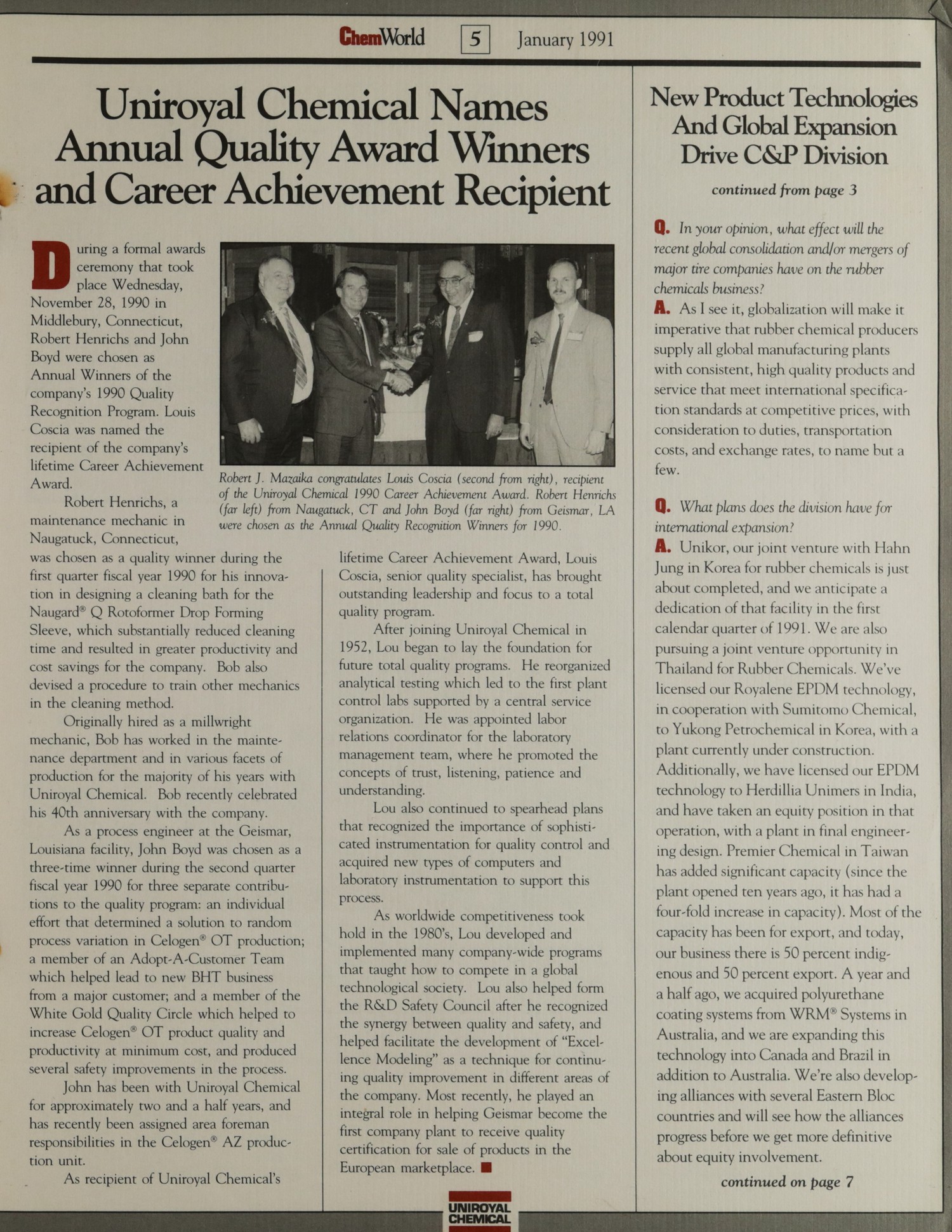
During a formal awards ceremony that took place Wednesday, November 28, 1990 in Middlebury, Connecticut, Robert Henrichs and John Boyd were chosen as Annual Winners of the company’s 1990 Quality Recognition Program. Louis Coscia was named the recipient of the company’s lifetime Career Achievement Award.

Robert Henrichs, a maintenance mechanic in Naugatuck, Connecticut, was chosen as a quality winner during the first quarter fiscal year 1990 for his innovation in designing a cleaning bath for the Naugard® Q Rotoformer Drop Forming Sleeve, which substantially reduced cleaning time and resulted in greater productivity and cost savings for the company. Bob also devised a procedure to train other mechanics in the cleaning method.

Originally hired as a millwright mechanic, Bob has worked in the maintenance department and in various facets of production for the majority of his years with Uniroyal Chemical. Bob recently celebrated his 40th anniversary with the company.

As a process engineer at the Geismar, Louisiana facility, John Boyd was chosen as a three-time winner during the second quarter fiscal year 1990 for three separate contributions to the quality program: an individual effort that determined a solution to random process variation in Celogen® OT production; a member of an Adopt-A-Customer Team which helped lead to new BHT business from a major customer; and a member of the White Gold Quality Circle which helped to increase Celogen® OT product quality and productivity at minimum cost, and produced several safety improvements in the process.

John has been with Uniroyal Chemical for approximately two and a half years, and has recently been assigned area foreman responsibilities in the Celogen® AZ production unit.

As recipient of Uniroyal Chemical’s

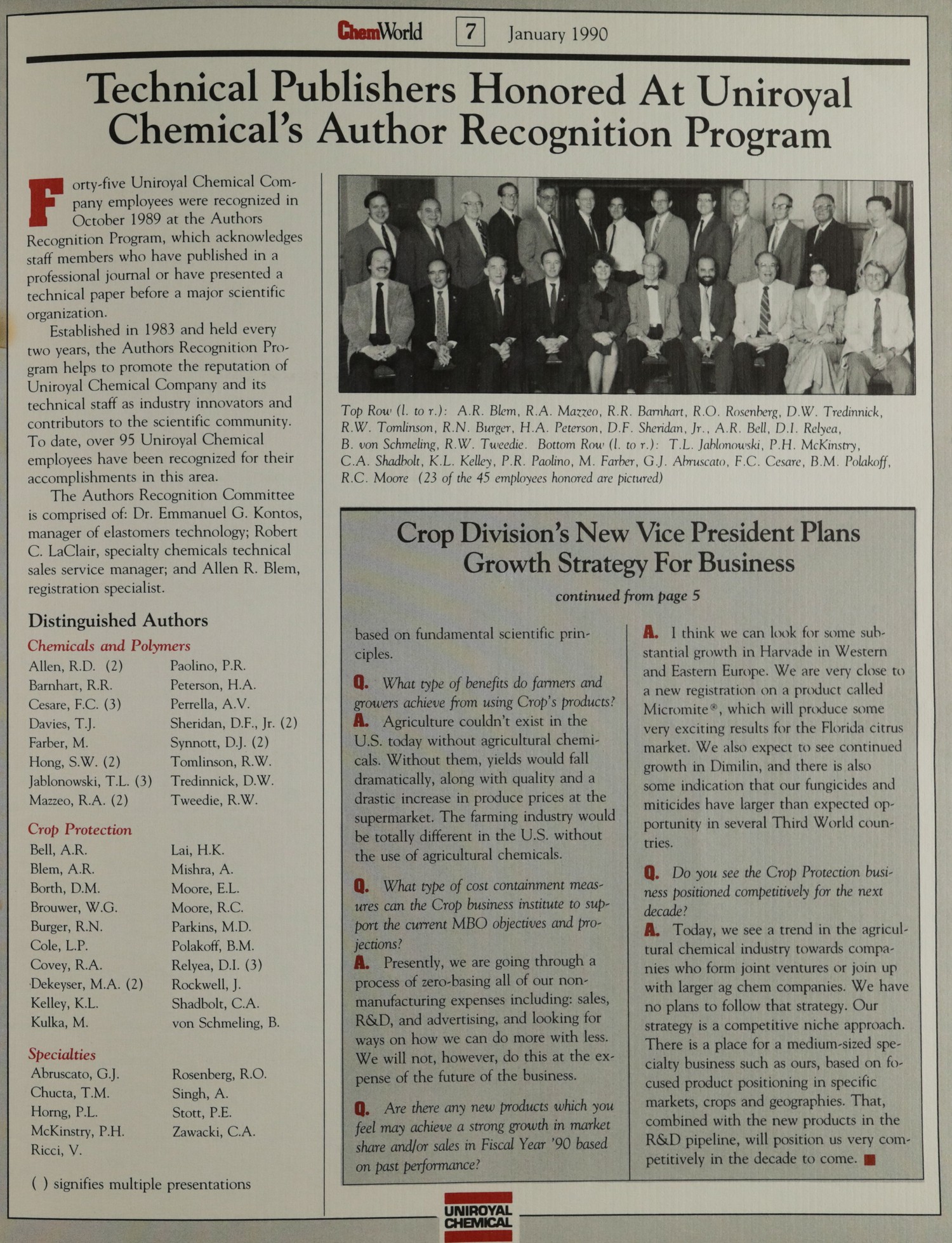
Robert J. Mazaika congratulates Louis Coscia (second from right), recipient of the Uniroyal Chemical 1990 Career Achievement Award. Robert Henrichs (far left) from Naugatuck, CT and John Boyd (far right) from Geismar, LA were chosen as the Annual Quality Recognition Winners for 1990.

lifetime Career Achievement Award, Louis Coscia, senior quality specialist, has brought outstanding leadership and focus to a total quality program.

After joining Uniroyal Chemical in 1952, Lou began to lay the foundation for future total quality programs. He reorganized analytical testing which led to the first plant control labs supported by a central service organization. He was appointed labor relations coordinator for the laboratory management team, where he promoted the concepts of trust, listening, patience and understanding.

Lou also continued to spearhead plans that recognized the importance of sophisticated instrumentation for quality control and acquired new types of computers and laboratory instrumentation to support this process.

As worldwide competitiveness took hold in the 1980’s, Lou developed and implemented many company-wide programs that taught how to compete in a global technological society. Lou also helped form the R&D Safety Council after he recognized the synergy between quality and safety, and helped facilitate the development of “Excellence Modeling” as a technique for continuing quality improvement in different areas of the company. Most recently, he played an integral role in helping Geismar become the first company plant to receive quality certification for sale of products in the European marketplace. ■


New Product Technologies And Global Expansion Drive C&P Division

continued from page 3

Q. In your opinion, what effect will the recent global consolidation and/or mergers of major tire companies have on the rubber chemicals business?

A. As I see it, globalization will make it imperative that rubber chemical producers supply all global manufacturing plants with consistent, high quality products and service that meet international specification standards at competitive prices, with consideration to duties, transportation costs, and exchange rates, to name but a few.

Q. What plans does the division have for international expansion?

A. Unikor, our joint venture with Hahn Jung in Korea for rubber chemicals is just about completed, and we anticipate a dedication of that facility in the first calendar quarter of 1991. We are also pursuing a joint venture opportunity in Thailand for Rubber Chemicals. We’ve licensed our Royalene EPDM technology, in cooperation with Sumitomo Chemical, to Yukong Petrochemical in Korea, with a plant currently under construction. Additionally, we have licensed our EPDM technology to Herdillia Unimers in India, and have taken an equity position in that operation, with a plant in final engineering design. Premier Chemical in Taiwan has added significant capacity (since the plant opened ten years ago, it has had a four-fold increase in capacity). Most of the capacity has been for export, and today, our business there is 50 percent indigenous and 50 percent export. A year and a half ago, we acquired polyurethane coating systems from WRM® Systems in Australia, and we are expanding this technology into Canada and Brazil in addition to Australia. We’re also developing alliances with several Eastern Bloc countries and will see how the alliances progress before we get more definitive about equity involvement.

continued on page 7


UNIROYAL CHEMICAL

ChemWorld – Page 6

Page 006

ChemWorld | 6 | January 1991


Uniroyal Chemical Receives Two Supplier Quality Awards For Its Royalene EPDM Business

Uniroyal Chemical has received the 1989 Annual Supplier Quality Excellence Award from General Tire Company, on behalf of its Royalene® EPDM business.

This prestigious “quality excellence” award is based on a stringent rating system and performance evaluation developed by General Tire Company. Uniroyal Chemical, one of thirteen companies throughout the United States, Canada and Japan to receive this Award, qualified from a field of almost 300 raw material suppliers and distributors throughout the world.

According to William A. Stephenson, Uniroyal Chemical’s former Royalene EPDM business manager, “it is a great honor for us to be selected as a winner of General Tire’s Annual Supplier Quality Excellence Award. Our strong commitment to our customers has helped us work and grow in partnership with General Tire. We look forward to continuing this relationship in the years to come.”

The company’s Royalene EPDM business provides a high performance specialty elastomer used in the manufacture of tires to impart improved weathering and ozone protection.

General Tire is a subsidiary of Continental AG of West Germany, the fourth largest tire manufacturer in the world.

In addition, Uniroyal Chemical also received the 1990 Supplier “Mark of Distinction” Award from Schlegel Tennessee, Inc., on behalf of its Royalene EPDM products which Schlegel uses in automotive sealing applications.

Uniroyal Chemical is the first supplier to receive this award from Schlegel, given for continuous improvement in five critical areas: quality, technology, management, delivery and cost. The results were based on an internal audit conducted by Schlegel at Uniroyal Chemical’s Geismar, Louisiana facility where Royalene EPDM is produced.

Schlegel, headquartered in Detroit, Michigan, manufactures a broad range of products for the automotive industry on a


Darlene Parker, Uniroyal Chemical’s quality assurance supervisor from Geismar, LA accepts the Supplier’s “Commitment to Excellence” plaque from Wilhelm Borgmann, president of General Tire Company (second from right), on behalf of Uniroyal Chemical’s Royalene EPDM business. Joining Ms. Parker and Mr. Borgmann at the recent Awards luncheon at General Tire World Headquarters in Akron, OH is John R. Jones, Uniroyal Chemical senior sales associate (far left) and Joseph T. Callaghan, Uniroyal Chemical’s director of sales for Chemicals and Polymers (far right).


H. Ed Gould (second from left), production area foreman at Uniroyal Chemical’s Royalene EPDM Geismar, LA plant receives Supplier “Mark of Distinction” Award from Richard DuBuyne, purchasing agent for Schlegel Tennessee. Joining the group is Robert J. Mazaika (far left), Uniroyal Chemical chairman, president and chief executive officer, and James O’Connor (far right), vice president of sales and marketing for Schlegel Corporation.


worldwide basis. Its acquisition of Sheller-Globe operations from United Technologies in August 1990 doubled its size, making it one of the largest suppliers of automotive sealing systems in the United States. Schlegel is part of the BTR group, which is headquartered in London, England.

Earlier this year, Uniroyal Chemical Company announced that it will build a new Royalene EPDM production unit at its Geismar site. With the addition of this third unit, Royalene EPDM capacity will increase by about 50 percent, making Uniroyal Chemical the largest producer of EPDM in North America. ■


UNIROYAL CHEMICAL

ChemWorld – Page 7

Page 007

ChemWorld | 7 | January 1991


New Product Technologies And Global Expansion

continued from page 5

Q. New C&P sales are expected in the Soviet Union in 1991. What products and applications will this include?

A. For a number of years, we’ve been considered a preferred supplier to the U.S.S.R. The main product groups that we’ve moved into the U.S.S.R. have been rubber chemicals and urethane prepolymers. We will continue to grow this business in rubber chemicals, mostly used for tire manufacturing; and urethanes, used for solid tires and die-forming pads. The U.S.S.R. has expressed considerable interest in Royalene EPDM for several applications and our commercial and technical people are presently in dialogue with the Russians. The lack of hard currency has produced some constraint, but we are working a number of avenues to secure letters of credit and necessary funds to continue this very important base of business.

Q. Recently, the first worldwide C&P Sales Meeting was held in Lenox, Massachusetts. What was achieved from this meeting?

A. I believe that all 75 participants of this meeting left very much enriched with enhanced sales and technical skills, as well as more in-depth product knowledge. This was a very successful communication exercise, with a significant sharing of issues and opportunities. We have organized a steering committee to review and manage these issues and opportunities through individual assignments. In short, this first meeting has provided us with a new coordination of identified global accounts.

Q. Uniroyal Chemical places tremendous emphasis on partnerships with customers. What is the C&P Division currently doing to enhance its customer relationships and encourage more business from them?

A. The C&P Division interacts with our customer base on a broad front. Our sales and technical representatives are the key, first-line interface with the customer. Secondly, we have organized our customer service department with specific representatives who are in daily contact with customers. Through our Excellence Modeling process, we involve as many people as possible to interact effectively with customers. For example, our Adopt-A-Customer program has been very effective in solving


Quality Recognition Program At Uniroyal Chemical Completes Second Successful Year

In the twenty-four months that Uniroyal Chemical’s Quality Recognition Program has been in existence, it has successfully produced a total of 294 nominations and 110 winners from around the globe. The following individuals and/or teams were chosen as Quality Recognition Winners for fiscal year 1990:

Middlebury, CT
Frank O’Shea
Herm Whitehead
C.P. Yip, Glen Karta, Alex Dzialo,
B.T. Dave, Richard Gencarelli, Ray Chan
Frank Marzella
Thomas Matan

Naugatuck, CT
Robert Henrichs
Richard Guest
Clayton Fernandes, Clarence Parks,
Lou Lakatos

Geismar, LA
John Boyd

Lubrizol Adopt-A-Customer Team:
Chris Jones, Scott Legleu, Cheryl Marquis, John Boyd, James Hayward, Keith Meyer, Perry Babin, Vic Hodges, Barbara Jefferson, Kathie Lambert

White Gold Quality Circle:
John Boyd, James Hayward, Keith Blanchard, Monty McKinley, Emmett Hood, Palmer Goodlow, Ed Rome, Charlie Pope, Ray Mouch, Paula Lanoux, Willie Stewart

Darlene Parker, Kerry Chelette,
Marsha Gautreau
Richard Santa
Frank Schlegel

Gastonia, NC
The Agri-Pros Quality Circle:
Kevin Russell, Charles Puckett, Julious Singleton, Paul Black, Charles Kistler, Fred Lee
Barbara Poole, Sherry Isenhour,
Ronald Lak
Sandra Evans

Elmira, Canada
Ken Jessop
Brad Manion
John Morris, Murray Conrad

Brea, CA
Luis Godinez

Sao Paulo, Brazil
Antonio Bucci

Latina, Italy
Giuseppe Fioravanti

Premier Chemical, Taiwan
Chen Yu-Chuan

numerous product applications. Our customers have a very proactive interface with sales management, myself, Bob Mazaika and the senior management staff who’ve been visiting them around the world. In addition, we continue to have Customer Council meetings. We’ve just completed our second meeting last December and feel it’s an outstanding way to get closer to our customers and strengthen our partnerships.

Q. What do you believe are the major strengths of the C&P Division?

A. First and foremost, our success is attributable to outstanding personnel throughout our organization. I’m very fortunate to have a very competent, skilled and experienced staff that works well as a

team. Our business is technically-driven, supported by exceptional R&D and technical service groups. The C&P worldwide sales organization is comprised of seasoned professionals who have in-depth knowledge of our business as well as our customers’ businesses. Internationally, we have a strong group of national as well as expatriate executives who have a sensitivity to the various country cultures and understand the many complex details of international business. This large organization is backed by powerful supporting staff operations like production, engineering, purchasing, material flow/customer service, finance, human resources, MIS, legal, corporate communications and administrative/secretarial support coordinated through the company’s senior management staff. ■


UNIROYAL CHEMICAL

ChemWorld – Page 8

Page 008

ChemWorld | 8 | January 1991

ChemWorld Briefs

Paraclor® CPE Enters New Markets

Paraclor® CPE, one of Uniroyal Chemical’s specialty elastomers, is proving to be ideally suited for a number of new applications – both elastomer and plastic. Introduced last year, the elastomer’s versatility is guiding the company into new markets.

One such market is automotive, which takes advantage of the product’s high heat and oil resistance. These characteristics, combined with CPE’s low temperature flexibility and superior outdoor aging properties, make Paraclor CPE a leading candidate for use in injection-molded parts such as air inlet ducts or any under-the-hood hose.

Perhaps the largest slice of the market that Paraclor CPE intends to capture for Uniroyal Chemical is in wire and cable applications, where the product is used as jacketing for flexible cords such as portable power tools as well as for instrumentation, and control and mine cable. The product is easily made flame retardant for such uses, as it meets 60, 90, and 105 degree centigrade UL classifications.

Paraclor CPE also can be used to complement Uniroyal Chemical’s polymer product line, which includes Royalene® EPDM and Paracril® nitrile rubber for traditional markets such as hose, sheeting, gaskets, wire and cable, and roll covers. Used as an impact-modified plastic, Paraclor CPE intends to break through new markets, including wire and cable, with residential and industrial applications.

For example, when two to ten percent of Paraclor CPE is added to vinyl, it serves as an impact modifier for residential applications such as vinyl siding and electrical conduit, lending increased toughness and durability to these applications. The product may be blended with existing vinyl for industrial flat roof coverings to add strength and durability against the elements. Similarly, Paraclor CPE is used as a wire and cable thermoplastic material for jacketing.

Paul Hinckley, business development

manager for the Paraclor CPE line, expects sales of the product to grow rapidly in these market areas; a significant portion of these sales will be attributed to Paraclor CPE’s displacing competing products, due to its superior retention of heat aging properties. “Currently, we find that the opportunities for this product in the U.S. and Canada are abundant,” he said. “We expect to see a tremendous increase in sales volume over the next 12 months.” ■

Dr. Byron A. Hunter Recipient Of The 1990 Thomas Midgley Award

Dr. Byron A. Hunter, a retired research chemist from Uniroyal Chemical Company, has been named the recipient of the 1990 Thomas Midgley Award sponsored by the American Chemical Society (Detroit section), in cooperation with Ethyl Corporation. The Award was presented to Dr. Hunter at a formal awards ceremony held at the Engineering Society of Detroit, Michigan on Tuesday evening, October 30, 1990.

Founded in 1965, the Thomas Midgley Award, named after the late inventor known for his creative, far-seeing research efforts, is presented annually for outstanding research contributions and inventive genius in the chemistry field related to the automotive industry.

One of the most significant contributions of Dr. Hunter’s career is the development of chemical blowing agents for the production of closed-cell rubber foams used in automotive applications. The commercialization of one type foam (benzene sulfonyl hydrazide) (OBSH) serves as the predominant type of blowing agent used to produce dual durometer weatherstrip. Today, this weatherstrip type comprises about 80 percent of total worldwide use of weatherstrip for automotive and truck seal applications.

Dr. Hunter’s efforts have also increased weatherstrip productivity by 20 percent, due to the lower decomposition temperature and more gas release properties of OBSH.

OBSH also produces a soft textured sponge, which is used in new down-sized and lower weight automotive door and truck lids to facilitate acceptable closing efforts.

Most recently, Dr. Hunter was awarded the 1989-90 Outstanding Achievement Award from the Thermoplastics and Foams Division of the Society of Plastic Engineers (SPE), and is recognized as a leading worldwide authority on blowing agent technology in the areas of rubber and plastics compounds, applications and process technology. To date, he has received 67 United States patents in the rubber and plastic additive fields. ■

Uniroyal Chemical Introduces New Lubricant Additive

Uniroyal Chemical Company has introduced a new antioxidant lubricant additive, Naugalube® 680, especially formulated for high performance automotive engine and gear oils.

Naugalube 680 has a high nitrogen content providing advanced performance, lower volatility and improved solubility, which helps meet the most demanding engine specifications.

In the next several months, the company plans to introduce additional high performance lubricant additives, furthering its commitment and responsiveness to the high performance engine oil marketplace.

Current Uniroyal Chemical products that are part of the lubricant additives family include: Naugalube 403, 440, 443, 438, 438L, 445, 500, 690, and Naugard® 529, BHT, PANA and Q. ■


ChemWorld, a publication of Uniroyal Chemical Company worldwide, is distributed to company employees and retirees.

Robert J. Petrausch
Director, Communications

Maureen C. Fama
Marketing Communications Coordinator

Uniroyal Chemical Company
World Headquarters
Middlebury, CT 06749
(203) 573-2000


UNIROYAL CHEMICAL

ChemWorld – Page 1

Page 001

ChemWorld

Published by Uniroyal Chemical Co. for its Employees and Retirees January 1990


Contents

’89 Quality Symposium . . . . . . . . 2
Uniroyal of Canada Awarded . . . 3
Preparing For Future Markets . . 4
Ingulli Plans Growth Strategy . . . 5
Simon Receives Career Award . . 6
ChemWorld Briefs . . . . . . . . . . . 8


New Chapter Unfolds Following Management Buyout

On Monday, October 30, 1989, Uniroyal Chemical Company completed the management buyout of the company from Avery, Inc. for a price of $800 million, which signifies the beginning of a new era for the company.

“This purchase has put Uniroyal Chemical’s future directly where it belongs: into the hands of those who know its business best — Uniroyal Chemical’s current management,” stated Uniroyal Chemical president and chief executive officer Robert J. Mazaika. “We believe this strengthens the company’s management position and will reinforce our reputation as an energetic, progressive and growing company with long-term vision toward the future.”

The new owners, an experienced management team with a high level of commitment to the company’s future financial success, intend to broaden its technical base and penetrate new growth markets that will enhance Uniroyal Chemical’s strategic position worldwide.

Over the past three years, the company has increased sales by 48 percent, maintained a high profit margin, and expanded its markets, both domestically and internationally.

“We intend to extend Uniroyal Chemical’s solid record of aggressive growth and build on our past sales successes,” said Mazaika. “We will be looking for more opportunities for joint ventures and licensing agreements.”

Today, Uniroyal Chemical holds leading marketing positions in many of its markets


TODAY, THE EMPLOYEES OF UNIROYAL CHEMICAL HAVE REASON TO CELEBRATE.

[IMAGE: Group photo of employees]

Announcing the Management Buyout of Uniroyal Chemical

UNIROYAL CHEMICAL’S MANAGEMENT ANNOUNCES A BUYOUT THAT’S NOT THE LEAST BIT HOSTILE.

[IMAGE: Corporate advertisement with Uniroyal Chemical logo]

The completed management buyout of Uniroyal Chemical from Avery, Inc. was supported by two strategic advertisements: the “Employee Ad” (on left) appeared in local newspapers that cover the company’s five manufacturing facilities in North America; the “Corporate Ad” (on right) appeared in major business and financial publications worldwide as well as in various industry publications.


and is recognized for quality products and services on an international level. In 1988, 65 percent of sales were from products with number one or number two market positions.

In the Crop Protection Division, Gustafson, Inc. (a wholly-owned subsidiary which sells agricultural chemicals to the seed treatment marketplace) is recognized as the technological leader and maintains a dominant market share of the North American commercial market.

In the Chemicals and Polymers Division, Uniroyal Chemical was the first company to enter the rubber chemicals business and is currently the second largest supplier of rubber chemicals in the world with over

100 different products.

The Specialties Division is marked by success and innovation. Research and Development teams are currently developing new products which are environmentally sound and have low to zero toxicity. New products can potentially add significantly to the company’s future growth.

On the international front, the company began joint ventures in Korea, India and Thailand, and has been discussing the licensing of its technologies in China and the Soviet Union. This further enhances the company’s ability to do business in 120 countries and increases its manufacturing capabilities on a global level.

For the future, the company is committing more funds than ever to both research and development and to manufacturing facilities to ensure that the growth of Uniroyal Chemical continues into the next century.

The increases in R&D and in the plants will mean more jobs and more opportunities for advancement.

And, the new corporate structure means greater independence and flexibility to meet and overcome any business challenge.

The company’s success and growth, however, is dependent on the most important element in the equation – people. According to Robert Mazaika, “every worker at every level is a valuable participant in the growth and ultimate success of the company, both financially and from a product standpoint. This is the key to our future position as a leader in worldwide specialty chemicals.” ■


UNIROYAL CHEMICAL

ChemWorld – Page 2

Page 002

ChemWorld | 2 | January 1990


Quality Partnerships Central Theme At 1989 Uniroyal Chemical Quality Symposium

The presentation and speakers at the 1989 Quality Symposium held in Lakeville, CT in October concentrated on the central theme of quality partnerships that are formed by and within Uniroyal Chemical Company. Raw materials suppliers representing five separate companies presented their individual quality partnership programs with emphasis ranging from total quality management to their version of Adopt-A-Customer. Two of Uniroyal Chemical’s customers also made presentations to the group of quality


The structure for improvement and change necessary in today’s markets rests on the involvement of Uniroyal Chemical employees in the improvement process.


managers who reviewed the company’s quality philosophy and requirements of a supplier. According to Keith Baggett, Uniroyal Chemical’s director of Quality Assurance, “the close partnerships with customers and suppliers provide us with the information necessary to focus on the correct steps that ultimately lead to continual improvement in quality and continued growth.” Additionally, Uniroyal Chemical customers requested the company’s partnership with them in the following areas, which were also covered at the symposium: Electronic Data Interchange (EDI); European Standards Accreditation (ISO 9000); and customer certification programs.

The structure for improvement and change necessary in today’s markets rests on the involvement of Uniroyal Chemical employees in the improvement process.

Updates by various Quality Managers on the involvement of the people in their plants included: Adopt-A-Customer programs, improvement in maintenance with statistical analysis of equipment vibration, excellence modeling, raw material control and steam quality control.

Other Quality Managers provided case histories of success through teamwork achieved on quality issues worldwide. ■


Mr. E.J. Horning from Phillips 66 Company of Bartlesville, OK covers Total Quality Management within Phillips Petroleum Co. Phillips supplies Sulfate 120 for the Paracril® process.


QUAL/SPC SYMPOSIUM

UNIROYAL

Quality Managers representing 16 different Uniroyal Chemical plant locations and eight different countries participated in the 1989 Quality Symposium held in Lakeville, CT.

Pictured are:

BOTTOM ROW, (L. TO R.) Ofni DeSouza, Brazil; Greg Chen, PREMIER CHEMICAL, Taiwan; Joseph Bucciaglia, Middlebury, CT; Chris Nanney, LEFFINGWELL, California; Sergio Chinas, AMEYAL/NOVAQUIM, Mexico.

MIDDLE ROW (L. TO R.) Keith Baggett, Middlebury, CT; Dave Borth, Guelph, Canada; Jose Gottig, PASA, Argentina; Arturo Gonzalez, QOMSA, Mexico; Norm Boisseau, Naugatuck, CT.

TOP ROW (L. TO R.) Frank Powell, Latina, Italy; Abraham Garcia, AMEYAL, Mexico; Jon Painter, Middlebury, CT; Ken Jessop, Elmira, Canada; B.T. Dave, Middlebury, CT; Al Rhone, Painesville, OH; Marcus Keane, RUBICON, Louisiana; Alan Dempsay, GUSTAFSON, Idaho; Lou Coscia, Middlebury, CT; Frank Schlegel, Geismar, LA; Johan Brits, ORCHEM, South Africa; and John Robinson, Gastonia, NC.


UNIROYAL CHEMICAL

ChemWorld – Page 3

Page 003

ChemWorld | 3 | January 1990


Uniroyal Chemical Of Canada Wins Canadian Government National Quality Award

In November 1989, Uniroyal Chemical Ltd. of Elmira, Ontario, Canada won the national silver award for quality excellence. This award represents one of Canada’s top honors, which rate the quality of a company’s products and services.

The award was presented to Uniroyal Chemical’s general manager Wally Ruck by Harvie Andres, Federal Minister for Industry, Science and Technology, representing the Canada Awards for Business Excellence Program.

“It was a rigorous and tough review by professionals who had no association with the company,” said Ruck. “That’s what makes the Canada Award for Business Excellence so significant. It’s based on a totally independent study and analysis of our operations and procedures.”

More than 80 companies throughout Canada entered the quality competition but only 15 companies were chosen to participate in extensive, independent reviews to select the winners.

According to Robert J. Mazaika, president and CEO of Uniroyal Chemical Company, “Winning the Canada Award for Business Excellence is a tribute to the hard work and dedication shown by Uniroyal Chemical employees in Elmira and throughout Canada. Our challenge now is to continue to improve on the quality of our products and services both in the U.S. and internationally, as we position ourselves as a worldwide specialty chemical leader with outstanding product quality and technical service excellence.”

Other Uniroyal Chemical individuals joining Mr. Mazaika at the recent Awards Ceremony in Ottawa were: Walter Cook, vice president and general manager of Chemicals and Polymers (international); Ken Jessop, quality assurance manager; Richard Hooper, production manager; David Ash, manufacturing manager; Gary Schaefer, local union president; Vladimir Veres and Sudarshan Shinh, production workers; and Mr. Ruck.

Uniroyal Chemical Ltd. of Elmira manufactures rubber chemicals for the tire and non-tire industry; agricultural chemicals primarily for seed treatment; castable urethane prepolymers used in products that include conveyor belts and roller skate wheels; and specialty chemicals used in synthetic lubricants. ■


Attending the Canada Awards for Business Excellence ceremonies on behalf of Uniroyal Chemical were: (front row, L. to R.) Vladimir Veres, Sudarshan Shinh, David Ash, Gary Schaefer, Wally Ruck, Richard Hooper and Ken Jessop; (back row, L. to R.) Walter Cook and Robert Mazaika.


Adiprene®/Vibrathane® Acquires New International Urethane Product Line

The Adiprene/Vibrathane business of specialty castable, sprayable and millable urethane products has added a new line of solvent-based spray and trowelable urethane systems to its business.

WRM is the new Uniroyal Chemical registered trademark for the product line recently acquired from Wear Resistant Materials Pty. Ltd. of Sydney, Australia. The Australian-based company developed and applied these products for over 11 years as coatings for corrosion and abrasion resistance, primarily to extend service life in mining applications.

This new line of specialized urethane products is currently being introduced and marketed throughout the world by the Adiprene/Vibrathane group. This product line is expected to add high value to the existing Adiprene/Vibrathane castable business and should allow Uniroyal Chemical to enter new market segments that it currently does not participate in.

“The advantages that WRM Systems brings to our customers include easy processing on inexpensive equipment,” said Hugh Hennessy, WRM product specialist. “This makes field application of the product simple and fast. Unique chemistry enables the applicator to apply not only thin coatings for corrosion protection but also build thicker coatings for abrasion resistance. Simply stated, they outperform the competition”, he added.

To illustrate the toughness of WRM materials, the product line’s internationally-recognized logo, fondly called “Fred”, depicts a typical giant stone head carved from the ancient volcano quarry of “Rano Raraku” on mysterious Easter Island. More than 150 of these collossi have survived, virtually intact, for many centuries … a classic example of wear-resistant material. ■


UNIROYAL CHEMICAL

ChemWorld – Page 4

Page 004

ChemWorld | 4 | January 1990


Uniroyal Chemical Prepares For Future Market Demands

Uniroyal Chemical Company is preparing for continued competition in the European market by seeking “International” recognition of its Quality System.

The company is seeking accreditation based upon a Quality System Standard prepared by the International Standards Organization (ISO); specifically, ISO 9000.

In order to receive the accreditation, Uniroyal Chemical will undergo a detailed


The company’s capability to perform against the ISO’s quality standards will determine whether it will receive accreditation. This, in turn, will facilitate Uniroyal Chemical’s continued business growth in the European markets.


examination of each department’s Quality System. Sales order entry, customer service procedures, operation and control of the manufacturing processes, laboratory testing, product packaging and shipping are among the many areas which will be evaluated against the International Standards. The company’s capability to perform against these quality standards will determine whether it will receive accreditation. This, in turn, will facilitate Uniroyal Chemical’s continued business growth in the European markets.

Several of Uniroyal Chemical’s manufacturing sites are presently involved in assessing their quality systems against the ISO 9000 standards, with Geismar, LA and Latina, Italy seeking accreditation in 1990. ■


Two Annual Winners Selected From Uniroyal Chemical’s Quality Recognition Program

In November 1989, two Annual Quality Recognition Award winners were formally recognized for their accomplishments in a ceremony in Baton Rouge, LA.

Peter Hare, a technician based in Elmira, Canada, was recognized for his outstanding achievements of streamlining and improving a ten-year-old Naugard® production process. The results were increased productivity, improved quality, decreased labor and less down-time.

The production team of Ken Van Zandt, David Craig and Randy Simon, located in Geismar, LA, used their initiative and creativity to identify a major potential source of gel contamination to the Royalene® EPDM process – a problem that had existed since production began over twenty-five years ago.

The Uniroyal Chemical Quality Recognition Program began its second successful year on October 1, 1989. ■

Uniroyal Chemical president and CEO Robert J. Mazaika (far right) congratulates the annual winners of the 1989 Quality Recognition Awards. They are: (from left) Ken Van Zandt, Peter Hare, David Craig and Randy Simon.


Michelin N.A. Selects Uniroyal Chemical For Supplier Quality Assurance Program

Michelin North America has recently selected Uniroyal Chemical Company to be part of its Supplier Quality Assurance Program, which underscores the importance and success of Uniroyal Chemical’s worldwide quality effort.

Equally important, Uniroyal Chemical has been self-certified by Michelin North America. Uniroyal Chemical’s product samples are certified by Michelin to be of the highest quality standards and, as a result, the products do not undergo testing prior to use in a customer application. ■


UNIROYAL CHEMICAL

ChemWorld – Page 5

Page 005

ChemWorld | 5 | January 1990


Crop Division’s New Vice President Plans Growth Strategy For Business

Newly-appointed Vice President and General Manager of Uniroyal Chemical’s Crop Protection division, Alfred F. Ingulli, discussed with CHEMWORLD future strategies and areas of potential growth for the company’s crop protection business. The following is a summary of this conversation:

Q. What new plans or strategies do you intend to pursue for the Crop Protection business?

A. My objective for the Crop Protection business is to have its earnings as a percent of sales equal to 17%, which is the company average for return on sales. We plan to accomplish this through a combination of volume growth of existing and new products, aggressive pricing in the marketplace, and a prudent management of costs.

Q. Crop Protection turned in a fine performance on an international level in Fiscal Year 1989. Do you anticipate continued growth internationally?

A. I believe we have done a good job positioning our products where they belong. From a pricing and end-use standpoint, I feel there is still plenty of untapped opportunity, particularly in developing countries like China, Poland and the USSR, to duplicate what we’ve done in the U.S. In particular, I see opportunities for Omite® and Vitavax®, the seed treatment area in general, and for Harvade® specifically in Europe.

Q. Are there currently any new product technologies under development, or plans for a new product introduction in the near future?

A. We have a number of exciting new products in market development or in the R&D pipeline. Harvade and Dimilin® are two examples of new products that are in the introductory stage with sales taking off and growing substantially. We also have two exciting herbicides in the R&D pipeline, with plans to begin selling one this year in the off-shore market. We anticipate a very bright future for both of these products when we fully commercialize them.

Q. Given the fact that the overall agricultural chemical industry is currently under a great deal of fire from environmentalists, do


[PHOTO: Black and white portrait photograph of a man in glasses wearing a suit]

Alfred F. Ingulli, Vice President and General Manager of Uniroyal Chemical’s Crop Protection division


you foresee this having an effect on Crop’s future projected growth in sales and profits?

A. I see the problems facing the agricultural chemical industry as a cost of doing business. No one company is singled out for regulatory action. The burden is shared equally by all, so ultimately the consumer will pay for the difficulties being inflicted upon the industry by way of higher prices on produce at the supermarket.

Q. What impact did the controversy and final decision to discontinue selling Alar®, both domestically and abroad, have on the Crop Protection business? Do you feel Alar will be re-introduced at another time as a viable product?

A. The Alar controversy certainly didn’t help the image of Uniroyal Chemical in the minds of the public. We internally believe that the product is safe, including safe for food use, but despite that belief, we withdrew the product from the market. Plans are not to re-introduce Alar in the future for food applications, although we do continue to sell it for non-food uses, such as in greenhouses and in ornamental and horticultural applications.

Q. Do you believe the price of apples will increase because of Alar?

A. Ultimately, the price of apples will increase because of not using Alar. Alar was a protectant for the fruit in storage

so farmers and growers could achieve a longer shelf life. It also expanded the harvest period and deterred tree drops which affect yield. The consumer will now pay for the non-use of Alar in food applications.

Q. Who is Gustafson and what role do they play in the Crop business?

A. Gustafson, Inc. is a wholly-owned subsidiary of Uniroyal Chemical. Their primary line of business is chemical seed treatment, which is based on active ingredients that they purchase from us and from other major agricultural companies around the world. They formulate these active ingredients and sell to seed companies and through distributors to farmers to protect the seed and also the crop. Gustafson is also involved in post-harvest aids, grain storage, and protectants, and have recently moved forward with an aggressive program in the area of biologicals. We are helping to fund this area with Gustafson as we move into the 1990’s.

Q. How will concern over aflatoxin help the bottom line in Fiscal Year 1990?

A. Aflatoxin is a naturally occurring cancer-causing toxin caused by a fungus that occurs in food. Gustafson is in the very early stages of developing a product that prevents fungus from forming this toxin, and investing R&D dollars so that it will have a product that is very marketable and attractive to combat this carcinogen.

Q. In the chemical industry, there exists a “Responsible Care Program”. What is this program and how does it relate to the Crop Protection business?

A. The “Responsible Care Program” calls for chemical manufacturers to produce products safely in their factories and market them with the proper information and controls necessary to ensure that the products used by customers are safe for the community and environment. In our business, this means safe in manufacture, safe in transit, safe for growers and safe for consumers who purchase produce to which our products are applied. We are increasing our efforts in the area of effectively communicating product safety

continued on page 7


UNIROYAL CHEMICAL

ChemWorld – Page 6

Page 006

ChemWorld | 6 | January 1990


Rubber Chemicals Introduces New Nonstaining Antiozonant

In October 1989, Uniroyal Chemical’s Rubber Chemicals Division announced that it developed a new rubber chemical which represents a milestone in leading edge technology for the rubber industry.

Durazone™ 37 is unique because it offers excellent nonstaining static and dynamic ozone resistance, improved flex life and serves as an excellent antioxidant for natural and synthetic rubber. This outstanding resistance to ozone without staining has never before been attainable with an antiozonant.

According to Dr. Joseph B. Eisenberg, Uniroyal Chemical’s former Rubber Chemicals business manager, “Durazone™ 37 represents a major break-

through for the rubber chemicals industry. As a nonstaining antiozonant, its key benefits will permit our customers and the rub-

ber industry to achieve a higher level of product quality, and solve a significant problem at the same time. We are confident that Durazone™ 37 will not only provide the tire industry with a technological advantage, but will also prove successful in other market (rubber) applications as well.”

The primary application of Durazone™ 37 is in tire sidewalls and is also recommended for use in almost any rubber product where nonstaining static and dynamic ozone and aging protection are required. It is especially effective in natural rubber, and in blends of NR with olefin-based rubbers such as Uniroyal Chemical’s line of Royalene® EPDM polymers, and Trilene® liquid EPDM polymers. ■


At the 136th Rubber Division Technical Meeting and Exhibition sponsored by the American Chemical Society, held October 1989 in Detroit, MI, Uniroyal Chemical featured seven distinct businesses which are prominent players in the Rubber Industry: Rubber Chemicals, featuring the introduction of Durazone™ 37, Royalene® EPDM, Royaltherm® silicone-modified elastomers, Royaltuf® modified EPDM, Trilene® liquid polymers, Paracril® nitrile rubbers, and Paraclor® chlorinated polyethylene elastomers.


Hovey S. Simon Selected As Recipient Of Uniroyal Chemical Career Award

Uniroyal Chemical Company has selected Hovey S. Simon as the recipient of the first-ever Uniroyal Chemical Career Achievement Award.

This Award recognizes the long-term exemplary accomplishments of a Uniroyal Chemical employee, based on four main criteria: innovation, initiative, impact and peer perception. The winner is selected by the Quality Recognition Sponsoring and Selection Committees.

Presently plant manager at the Geismar, Lousiana facility, Mr. Simon has over 47 years with Uniroyal Chemical Company.

According to Robert J. Mazaika, chairman of the Uniroyal Chemical Quality Recognition Sponsoring Committee, “Mr. Simon has distinguished himself over his career in every aspect of quality associ-

ated with manufacturing. He is recognized throughout the community and the company as a leader and innovator. His impact is well demonstrated by the success of the Geismar plant and its contributions to the entire company, our customers, suppliers, and Louisiana’s industrial community.” ■


Hovey S. Simon (left), plant manager at Uniroyal Chemical’s Geismar, LA location receives rendering of an authentic grandfather clock (the actual clock was delivered later) from Robert J. Mazaika. Hovey was selected as the first-ever recipient of the Uniroyal Chemical Career Achievement Award.


UNIROYAL CHEMICAL

ChemWorld – Page 7

Page 007

ChemWorld | 7 | January 1990


Technical Publishers Honored At Uniroyal Chemical’s Author Recognition Program

Forty-five Uniroyal Chemical Company employees were recognized in October 1989 at the Authors Recognition Program, which acknowledges staff members who have published in a professional journal or have presented a technical paper before a major scientific organization.

Established in 1983 and held every two years, the Authors Recognition Program helps to promote the reputation of Uniroyal Chemical Company and its technical staff as industry innovators and contributors to the scientific community. To date, over 95 Uniroyal Chemical employees have been recognized for their accomplishments in this area.

The Authors Recognition Committee is comprised of: Dr. Emmanuel G. Kontos, manager of elastomers technology; Robert C. LaClair, specialty chemicals technical sales service manager; and Allen R. Blem, registration specialist.

Distinguished Authors

Chemicals and Polymers

| Allen, R.D. (2) | Paolino, P.R. |
| Barnhart, R.R. | Peterson, H.A. |
| Cesare, F.C. (3) | Perrella, A.V. |
| Davies, T.J. | Sheridan, D.F., Jr. (2) |
| Farber, M. | Synnott, D.J. (2) |
| Hong, S.W. (2) | Tomlinson, R.W. |
| Jablonowski, T.L. (3) | Tredinnick, D.W. |
| Mazzeo, R.A. (2) | Tweedie, R.W. |

Crop Protection

| Bell, A.R. | Lai, H.K. |
| Blem, A.R. | Mishra, A. |
| Borth, D.M. | Moore, E.L. |
| Brouwer, W.G. | Moore, R.C. |
| Burger, R.N. | Parkins, M.D. |
| Cole, L.P. | Polakoff, B.M. |
| Covey, R.A. | Relyea, D.I. (3) |
| Dekeyser, M.A. (2) | Rockwell, J. |
| Kelley, K.L. | Shadbolt, C.A. |
| Kulka, M. | von Schmeling, B. |

Specialties

| Abruscato, G.J. | Rosenberg, R.O. |
| Chucta, T.M. | Singh, A. |
| Horng, P.L. | Stott, P.E. |
| McKinstry, P.H. | Zawacki, C.A. |
| Ricci, V. | |

( ) signifies multiple presentations


[PHOTOGRAPH]

Top Row (l. to r.): A.R. Blem, R.A. Mazzeo, R.R. Barnhart, R.O. Rosenberg, D.W. Tredinnick, R.W. Tomlinson, R.N. Burger, H.A. Peterson, D.F. Sheridan, Jr., A.R. Bell, D.I. Relyea, B. von Schmeling, R.W. Tweedie. Bottom Row (l. to r.): T.L. Jablonowski, P.H. McKinstry, C.A. Shadbolt, K.L. Kelley, P.R. Paolino, M. Farber, G.J. Abruscato, F.C. Cesare, B.M. Polakoff, R.C. Moore (23 of the 45 employees honored are pictured)


Crop Division’s New Vice President Plans Growth Strategy For Business

continued from page 5

based on fundamental scientific principles.

Q. What type of benefits do farmers and growers achieve from using Crop’s products?

A. Agriculture couldn’t exist in the U.S. today without agricultural chemicals. Without them, yields would fall dramatically, along with quality and a drastic increase in produce prices at the supermarket. The farming industry would be totally different in the U.S. without the use of agricultural chemicals.

Q. What type of cost containment measures can the Crop business institute to support the current MBO objectives and projections?

A. Presently, we are going through a process of zero-basing all of our non-manufacturing expenses including: sales, R&D, and advertising, and looking for ways on how we can do more with less. We will not, however, do this at the expense of the future of the business.

Q. Are there any new products which you feel may achieve a strong growth in market share and/or sales in Fiscal Year ’90 based on past performance?

A. I think we can look for some substantial growth in Harvade in Western and Eastern Europe. We are very close to a new registration on a product called Micromite®, which will produce some very exciting results for the Florida citrus market. We also expect to see continued growth in Dimilin, and there is also some indication that our fungicides and miticides have larger than expected opportunity in several Third World countries.

Q. Do you see the Crop Protection business positioned competitively for the next decade?

A. Today, we see a trend in the agricultural chemical industry towards companies who form joint ventures or join up with larger ag chem companies. We have no plans to follow that strategy. Our strategy is a competitive niche approach. There is a place for a medium-sized specialty business such as ours, based on focused product positioning in specific markets, crops and geographies. That, combined with the new products in the R&D pipeline, will position us very competitively in the decade to come. ■


UNIROYAL CHEMICAL

ChemWorld – Page 8

Page 008

ChemWorld | 8 | January 1990

ChemWorld Briefs

Royalene® EPDM Technology Licensed To Korean Joint Venture

Uniroyal Chemical Company plans to license its Royalene EPDM specialty elastomer technology to Yukong Elastomer Co., Ltd., a new joint venture company formed by Sumitomo Chemical Co., Ltd. of Japan and Yukong Limited of Seoul, the Republic of Korea. The new company will manufacture and sell EPDM rubber.

Uniroyal Chemical and Sumitomo Chemical (a 30 percent shareholder in the new venture) will license their respective technologies after signing a technology transfer agreement with Yukong Elastomer. This technology will be utilized at Yukong Elastomer’s 20,000 ton-per-year Ulsar, Korea plant site to be completed in 1991.

Royalene EPDM has broad applications that take advantage of its outstanding weathering characteristics, low temperature, chemical resistance and electrical properties. It is used in automotive, appli-

ances, wire & cable, plastics and various industrial markets.

Al Ingulli, Uniroyal Chemical’s former Vice President of Strategy and Commercial Development said, “We’re confident that our EPDM technology will help Yukong Elastomer establish a solid base for its rubber business in Korea, and successfully meet future opportunities for its products resulting from new international growth markets.” He added that the annual growth rate for Korea’s EPDM rubber market is approximately 20 percent, due to rapid expansion of automotive-related and other user industries. ■

Uniroyal Chemical Begins Joint Venture In Korea

In September 1989, Uniroyal Chemical Company formed a joint venture partnership with Hahn Jung, a wholly owned subsidiary of Han Nong Corporation of Korea, for the production and marketing of rubber chemicals. The joint venture will be called Unikor; each partner will

own fifty percent of the equity.

The agreement calls for Uniroyal Chemical to supply the technology and for Unikor to start producing antidegradant chemicals early in 1990, with an option to expand to other rubber chemicals in the future.

The agreement further defines Uniroyal Chemical as the exclusive agent/ distributor for Unikor’s products outside of Korea and Unikor as the exclusive distributor for other Uniroyal Chemical rubber chemicals in Korea.

Robert J. Mazaika, president and CEO of Uniroyal Chemical said, “We have developed a cohesive strategy for the Far East and this agreement supports our growth plans for the region. Moreover, it will enhance our strategic position as a major producer of rubber chemicals in the Far East.”

E.S. Kim, executive managing director of Hahn Jung said, “Our relationship with Uniroyal Chemical will help position our company as a key rubber chemicals supplier in Korea.”

Unikor will build a plant in Banneol, Korea, where Hahn Jung has a manufacturing site. ■


Service Awards For 28 Employees

In December 1989, 28 Uniroyal Chemical Headquarters employees were honored for their many years of service with the company. The group is as follows:

25 Years

Ray Chan – Sr. Dev. Engineer Associate
B.T. Dave – Mgr., Eng. Development Svcs.
Phillip Dillon – Supv. Cost Analysis
Maria Fidalgo – Credit Analyst
Joseph Fitzgerald – Systems Eng.-Appl.
Paul Hinckley – Business Dev. Manager
Joseph Hochheiser – Sr. Marketing Spec.
Donald Hodder – Operations Traffic Man.
John Johnson – Sr. Marketing Specialist
Hazen Jones – Sr. Const. Eng. Associate
Neil Melore – VP, Human Resources
Dolores Orsini – Clerk Specialist-Acctng.
Donald Poehailos – Supv. Cost Acctng.

George Roberts – Mgr., Trilene Technology
Frank Sordi – Group Leader
Donald Turner – Supv. General Accounting

30 Years

Emmanuel Kontos – Mgr., Elastomers Tech.
Janet Minnaman – Sr. Secretary
Stanley Salva – Research Scientist
Richard Tweedie – Sr. Group Leader
Lucille Butnor – Domest. Cust. Svc. Supv.
Ernst Krauss – Sr. Const. Eng. Associate
William Mischou – Dir., Materials Flow
Vincent Russo – Director, Purchasing
Frank Cesare – Section Mgr., R&D

35 Years

Frank Morgan – Purchasing Manager
Irwin Prager – Sr. Spec.-Health/Safety
Regulatory Affairs

45 Years

Vivian Abel – Sr. Executive Accountant


ChemWorld, a publication of Uniroyal Chemical Company worldwide, is distributed to company employees and retirees.

Robert J. Petrausch
Director, Communications

Maureen C. Fama
Marketing Communications Coordinator

Uniroyal Chemical Company
World Headquarters
Middlebury, CT 06749
(203) 573-2000


UNIROYAL CHEMICAL

CHEM-TEXTS – Vol. 14 – Page 4

Page 004

CHEM-TEXTS

Page 4 | Vol. 14, 1980


Equality

continued from page 2

The execution of the equal opportunity policy demands the involvement of all management personnel in identifying and attracting minority, female, disabled veteran and Vietnam Era Veteran, and handicapped applicants qualified for consideration in all job classifications, as job openings in such classifications occur. The plant will make monthly audits of its recruiting efforts, hiring, promotional, and termination activities, and the minority, female, disabled veteran and Vietnam Era Veteran, and handicapped situation on the payroll. Additionally, our Affirmative Action Plans are audited on a regular basis by Federal Government and Corporate office Personnel.

J.R. Douglas, Industrial Relations Manager, has appointed C.D. Hilton, Personnel Manager, as the EEO Administrator for the Naugatuck Plant. Feel free to contact them regarding any facet of the EEO policy.


Williams Heads Toastmasters Club

Bob Williams, International Marketing Specialist for Vibrathane and Speciality Chemicals, has been elected President of the Preston Hill Toastmasters Club for 1980.

The club meets every other Friday at Uniroyal’s Preston Hill Inn in Oxford is dedicated to help people improve their communication and leadership skills.

For more information call Bob at 723-3791. Other club members from EMIC and the plant are Joe Calaghan, George Lapp and Jim Marshall.


“On the Road”

By Joe Bucciaglia

The Chemicals and Polymers Sales Force

An important member of the team, but often a “distant” one, is the field sales representative who is “On-the-Road”. I hope to run a series of articles about our Chemicals and Polymers sales group and tell you a little about the people and what they do.

To start with, this sales force is led by a General Sales Manager, Joe Callaghan. Reporting to Joe is a Specialty Chemicals National Sales Manager, governing Specialty Chemicals and three Regional managers covering the Rubber Chemicals and Polymers. Also reporting to Joe are two Operations Managers, Pete Cookson for Polymers, and myself for Chemicals.

The Central Office for the Midwest Region (better known as District 4) is located in Akron, Ohio, “The Rubber Capital of the World”. Out of this office, the Chemicals and Polymers field Sales Force are responsible for selling Rubber and Heavy Chemicals, ROYALENE®, PARACRIL®, Natural Latex and VIBRATHANE® Gums.

The Sales Force in the Midwest is:

Vin Russo Regional Manager
Bill Galwardy Sr. Sales Associate with sales responsibilities in parts of Ohio Plus all the major Akron based Rubber Companies.
Wes Curtis Technical Representative with sales responsibilities in Ohio, West Virginia, and parts of New York and Pennsylvania.
Bill Stephenson Technical Representative with sales responsibilities in Indiana and half of Michigan.
Wayne Churchill Technical Representative with sales responsibilities in Illinois and half of Michigan.
Leo Pranitis Technical Representative with sales responsibilities in Wisconsin, Minnesota, Iowa, Nebraska, North Dakota and South Dakota.

The Akron Office is staffed by Leo Foley and Ruth Hoak.

Next issue, more on the other District Offices and the people staffing them. In the meanwhile, if your interested in anything else about Sales, drop me a line.


Become Hearing Experts

In the photo from left are Eric Johnson, Factory Manager, who presented the certificates; Ann McAllister RN; Patricia Grzywacz RN; and James Loman, Safety Supervisor.

Three members of the Safety and Medical Department have been awarded Certificates of Accreditation by the Council for Accreditation Occupational Hearing Conservation. The accreditation qualifies them to give industrial audiometric tests. As part of its continuing medical program the group wil give hearing tests to all employees to insure proper care of their hearing. Ann and Patricia received their certification from the University of Bridgeport and Jim from Kutztown State University, Pa. Loman is also a Certified First Aid and CPR Instructor while Pat recently received certification as a CPR Instructor.


55 MPH

Give it a chance to work. To save gasoline. To save lives, too.


Local 218…

continued from page 3

growth.”

Joe Rzeszutek recognized the need to make certain changes in the Contract in order to make the plant competitive with other chemical companies and to help improve its productivity in order to maintain job security in a highly competitive market area.

As a result of this mutual interest, Douglas reported that the parties were able to negotiate contractual changes that will provide potential improvements in productivity, reduced down-time, and cost reductions that can amount to substantial savings per year to the Naugatuck Plant. Both Douglas and Rzeszutek stated that this was the type of joint Company-Union effort that the parties are striving for in order to improve our operations, help secure jobs, and provide growth for the Naugatuck Chemical plant’s future.


Old Timers Corner

A group of “old timers” enjoy a barbecue at the home of Paul Benson in the warm Florida sun. The photo was sent in by George Allen, front row, left, who recently retired from the Industrial Relations Dept. Next to him is Ed Weaving who headed up the Plant Protection Dept. for many years. another picnic is scheduled at the home of Paul Benson on Feb. 17th, 1981.

George Allen who retired from Industrial Relations in 1979 sent this photo of retirees who gathered at the home of Paul Benson for a picnic. Since George retired he and his wife, Kay, have travelled the forty-eight states and now spend the winters in Florida. Seated from left are George Allen, Ed Weaving, Ann (Smey) Rockwood, Anthony Marrello, Andrew Smey, Al Lanouette and John Quint.

Standing from left are Kazys Urbsaitis, Guy Elwood, Vic Stasonis, Dave Rappe, Larry Terra, Ed Bazenas and Paul Benson.


BOB’S CAMERA SHOP INC.

WATERBURY’S LEADING CAMERA SHOP

90 South Main St., Waterbury, Conn. 06702 754-2256

Film • Cameras • Projectors • Developing • Rentals

Instant color passport pictures while you wait.


CHEM-TEXTS

PUBLISHED BY THE INDUSTRIAL RELATIONS DEPARTMENT
UNIROYAL CHEMICAL, NAUGATUCK, CONN. 06770

Equal Opportunity Employer

EDITOR: William F. Lavelle.


UNIROYAL

UNIROYAL CHEMICAL
Naugatuck, Connecticut 06770

U.S. Postage
PAID
Permit No. 10
Naugatuck, Conn. 06770

RETURN POSTAGE GUARANTEED

CHEM-TEXTS – 1980-v14-s289

Page 289

Page 2 CHEM-TEXTS Vol. 14, 1980


Goals For 1980

1979 was a very good year for the Uniroyal Chemical Company and the Naugatuck Plant. The company had record sales and profit and the Plant’s operating profit increased 59% over 1978. In order to continue this improvement, severl major 1980 Objectives for the following products and areas must be accomplished:

NAUGACEL SD-1

Successfully start up Naugacel SD-1, an accelerator that will be new business for the plant. It will be manufactured in the FOC Plant Bldg. 124. Most of the equipment has been installed and startup is expected in the 2nd Quarter of 1980. Naugacel is used in the manufacture of tires and mechanical goods.

OMITE

Our goal is to increase Omite production 20% through productivity improvements over 1979, which was a record year. This is necessary if we want to meet the needs of fruit and cotton growers in the U.S. and to avoid the additional expense of importing Omite from our Latina Plant in Italy. Omite is the highest profit chemical made in the plant.

This year, we also will finalize our plant to increase the Omite capacity to meet future sales.

TPR

Increase the production of TPR by 30%, again, through productivity improvements, so that outside manufacturing can be eliminated. This will reduce TPR manufacturing cost and therefore improve TPR’s profitability.

DEVELOP A STRATEGY FOR THE PLANT

We will review the existing resources of the plant, analyze our strengths and weaknesses, and develop a plan that will increase the profit of our facilities. We have many resources that are not fully utilized and increasing their utilization will have a dramatic improvement on the company’s profitability.

For example, the Boiler Plant, Land and Wastewater treatment facilities are only 50-60% utilized. Some of our manufacturing equipment is operating at less than half of capacity. We certainly have the capacity and ability to manfacture more chemical products at Naugatuck and must develop a plan to take advantage of this opportunity.

ENERGY STRATEGY

This year, we will develop an energy strategy that reduces the cost of energy per pound of product so that we can be more competitive with chemical companies closer to lower cost energy sources.

OPERATING PROFIT

The profit goal for 1980 is to improve the operating profit of the Naugatuck Plant by 20%. The operating profit in 1979 was $18.9 million dollars and we plan to raise it to $22.7 million dollars in 1980. Achieving the objectives of the 1980 PIP Program, “Mainstream”, and meeting our 1980 Operating Budget, are important factors in meeting the 1980 Plant Operating Profit Goal.

HEALTH & SAFETY

2000 air monitoring tests will be taken in the Plant to insure that conditions in which employees are working are safe and corrective action initiated to improve the working environment. Also our safety goal this year is an Incidence Rate of 2.6, which is the number of injuries per 1,000,000 manhours worked. The Chemical Industry’s average is “6”, so we hope to operate significantly safer than the average plant.

RIDESHARING

We plan to finalize our ridesharing program in support of Gov. Grasso’s objective to reduce dependence on foreign oil by decreasing gasoline consumption. This program will also provide a system for our employees that will enable them to travel to work during gas shortages that will most likely occur in the future.

Eric Johnson, Factory Manager


Equality Policy Affirmed

The providing of equal employment opportunity for all employees or applicants for employment regardless of race, religion, color, sex, age, national origin, handicap or disabled and Vietnam Era Veteran status is one of the basic policies of UNIROYAL, Inc. The Naugatuck Chemical plant endorses this policy and expects all decisions regarding personnel to conform to these equal employment rules and regulations.

The Naugatuck Chemical Plant has a specific plan of action designed to aid in providing equal opportunity for all. It is committed to recruit, hire, and promote in all job classifications and to ensure that items such as compensation, benefits, transfers, layoffs, return from layoff, training, educational and tuition assistance, and social and recreational activities are administered without regard to race, color, religion, sex, age, national origin, handicap or disabled and Vietnam Era Veteran status except where sex, and/or age is a bonafied occupational qualification. It is also committed to make employment or promotional decisions based solely upon the individual’s qualifications as they relate to the valid qualification requirements of the position for which the individual is being considered.

continued on page 4


Man-Lift Purchased

[IMAGE: Black and white photograph showing members of the Chemical Maintenance department operating a self-propelled Man Lift]

Members of the Chemical Maintenance department operate the new self-propelled Man Lift that will provide safer work conditions.

By Vic Alves

The Maintenance Department recently purchased a personnel-lift for its use in the performance of various jobs throughout the plant. This versatile piece of equipment will allow work to be done more safely, reduce equipment down-

time, and afford productivity improvements within the department. Its purchase was criticial to the Maintenance Department’s 1980 Profit Improvement Program.

The personnel lift will minimize the erection of staging or scaffolding on jobs undertaken at heights up to 38 feet while allowing for a safer operation. Without the time consuming errection costs, productive equipment can be returned to service sooner and the productivity of the plant improved.

The purchased unit is self-propelled and has a total lifting capacity of 1,750 lbs.

Because of its mobility, it is planned to be used in most areas of our plant where reasonable and feasible.


Audit Plan Started on Waste

By Tim Cunningham

The Environmental Engineering Department will conduct a pollution generating audit of each process building during 1980. The audit will consist of a review of all pollution streams leaving the process buildings: air, water, and solid waste pollution streams. The purpose of these audits will be to investigate reductions in currently generated pollution streams, and where reductions are possible, to develop Profit Improvement Programs.

Examples of possible cost-saving projects include the recycling of material which is presently sent to the liquid waste Pretreatment Plant or to the drummed waste storage area in order to save raw material costs and waste disposal costs, the reduction of solvents and other liquid material disposed of in the water treatment system, and the reduction of solid product and raw materials disposed of in the water treatment system.

If there are any suggestions for possible cost savings projects in any of these areas, please contact the Environmental Engineering Department.


Plant’s Profits Improve

A successful 1979 performance for the Naugatuck Plant was highlighted by Project Enterprise. Enterprise, the name of the plant’s 1979 Profit Improvement Program, generated $5.4 million of savings. The efforts of many of our people was necessary to achieve this performance. Congratulations on a job well done to all who participated.

The impetus generated by Project Enterprise helped to increase the plant’s 1979 Operating Profit to $18.9 million from $12.0 million in 1978. Operating Profit is the net selling price of the products manufactured less their manufacturing cost. It includes the costs for Selling, Research-Development, Advertising, Administrative and Taxes.

This performance provides a sound base to approach the challenges of 1980.


Chemical Bloodmobile Dates Set

The Bloodmobile sponsored by Uniroyal Chemical employees will be held on Monday, May 19 and Tuesday, May 20 at the TSSC Bldg. 112 from 9:45 A.M. to 2:45 P.M. All donors will receive a very useful tire gauge to check the wear of tire tread. To avoid delay, an appointment may be made with Ann McAllister R.N. or Patricia Grzywacz R.N., Ext. 3231.

In 1979 Chemical employees contributed 282 pints of blood to the Red Cross Bloodmobile.

CHEM-TEXTS – 1980-v14-s290

Page 290

CHEM-TEXTS

Page 3 | Vol. 14, 1980


V. Calarco Looks at 1980

[PHOTO CAPTION:]
Vincent A. Calarco, center, President of the Uniroyal Chemical Company poses with the officers of the Uniroyal Chemical Management Club prior to his talk to the group. From left are Robert Smith, Treasurer; Ronald Lak, President; Calarco; Shirley Darling, Secretary; and Norman Boisseau, Vice President.


Vincent Calarco, President of the Uniroyal Chemical Company, in an address to the Uniroyal Chemical Management Club reviewed the division’s performance in 1979 and discussed the outlook for 1980. The following are highlights from his talk to the group at the Elks Club in Naugatuck.

1979 was the best year in the division’s history in terms of sales and profits.

Sales for the chemical Rubber and Plastic business segments of the Company – for which we are the major portion – were $448 million up from $442 million in 1978; and operating profits were 88 million, an increase of 24% over the $71 million in 1978.

4th quarter sales and profits for the Chemical Company set a record level in 1979.

These results are especially noteworthy since the Kralastic business which was sold in early 1979 accounted for over $90 million dollars in worldwide sales in 1978.

Agricultural Chemical sales had an exceptional year with sales 40% over 1978.

Specialty Chemical sales grew by nearly 35%. Improvements in Polywet alone resulted in 12% of this increase.

In February, Rovel, a new weatherable polymer was introduced to the market after two years of testing. Solid sales results are expected in 1981.

Rubber Chemicals, the division’s base business grew 25% worldwide. To continue this growth major new facilities in the U.S., Canada, Italy, Brazil and Taiwan are now under construction.

The International division generated a 21% increase in worldwide sales. Today the International division contributes over one-third of the Chemical Company’s total sales.

Looking ahead in 1980 growth is seen for Rovalene EPDM where the division is a technological leader.

TPR, a product manufactured in the Dispersions Bldg. presently has a 40% market share and looks forward to a 10% growth annually.

Rubber Chemicals is a mature market in the U.S. and dramatic domestic growth is not anticipated in 1980 but it does expect solid profit growth. The rubber chemicals growth is expected in the overseas market with the new plant under construction. Even with the slump in automobile sales there are very positive indicators for the rubber chemicals market to maintain its market position.

Agricultural Chemicals plans to bring a highly promising new product to the market several years ahead of time through an innovative technique. The product code is S-734.

Last year productivity in the U.S. declined in contrast to a 20% productivity increase at Uniroyal Chemical.

Productivity means getting more out of what you have in assets, like plants or machinery and making every machine or reactor or office equipment work more efficiently. In brief it means working smarter…using our minds to think and plan things out and to use new innovative approaches to the often traditional and time consuming ways of doing things.

In 1979 the Omite group increased production by 56% without any new investment other than in thinking about how to make the machinery do more.

In the past two years the productivity of TPR has doubled and in Geismar the production of Flexzone was increased by 30% without any new plant, new equipment or new people.

Productivity applies to office personnel as well. A group of secretaries at EMIC responded to the challenge and developed the Serendipity program which resulted in savings of $200,000.


Job Opening System—an Avenue to your Career Development

By Marge Woolfrey

The objectives of the Job Opportunity System are to provide employees with timely information about the availability of and requirements for open positions and another avenue for individual career development. Openings are communicated within the Naugatuck location by placing on bulletin boards the “Job Opening” notice. All non-exempt openings through Grade 24 will be communicated, except as noted below.

Exceptions to the System

  • Grade or title changes where the individual retains the same basic position but the grade or title is changed due to increased responsibilities. (e.g. Clerk Senior to Clerk Specialist)
  • Job placement for employees during reduction-in-force situations.
  • The establishment of temporary, Co-op or summer positions.
  • Reorganization changes by a manager within a department provided there is no increase in head count and no promotional opportunities created.
  • Placement of college-recruited trainee program graduates by Corporate or Division in their initial permanent positions.
  • Positions that are being held until the return of an employee from maternity leave or other approved leaves of absences.

How to Apply

You may apply for any opening for which you feel that you are qualified and have an interest, provided you have a recommendation from your present manager. If you meet the minimum qualifications of the position, you will be interviewed and subsequently informed whether or not you have been selected.

You will be contacted when you have been scheduled for an interview. You will receive feedback from the hiring manager after the interview as to whether or not you are selected.

Assignment to New Position

Generally, it is expected that you will be released to your new position as soon as possible after acceptance of an offer. Normally, this is within two weeks, but the release time may be negotiated further between the hiring and releasing managers.

Appeals Route

Normal established appeal routes should be used in cases where individuals disagree with or have questions about decisions made at this step of the process. In general, the first attempt to clarify the situation should be made through your manager and the person who made the selection decision. Further clarification or questions can be taken directly to the Human Resources Department for discussion.

Program is Working

During 1979, there were 26 Chemical employee promotions made through utilization of the Job Opportunity System. There were eight positions filled by transfer from other parts of the company because no one at the Naugatuck location applied for the openings. It is especially important to note that there were only two exceptions to the procedure during the year – one because of a reduction in force and one because of a special training program hire. Unfortunately, we are not perfect and two positions were filled without notice. In the future, all jobs without exception to the system will be placed on bulletin boards. There were other hires during the year where technical background requirements necessitated going to the outside.

The system is a program designed to involve you earlier in the promotional process. It establishes a formal method for interested and qualified employees to obtain open position information and to request consideration for specific promotional opportunities.


Local 218 Contract Signed

URW Local 218 and the Naugatuck Chemical Plant have signed a new local supplemental agreement, effective February 4, 1980. Joe Rzeszutek, President of Local 218 and Bob Douglas, Industrial Relations Manager, reported that the major changes in the new contract provide for improved vacation scheduling for employees, work efficiency improvements through better utilization of personnel and inequity adjustments for various job classifications.

Douglas emphasized that “efforts were directed at negotiating improvements in work efficiencies to improve overall operations without a “take-away” program affecting our employees. These efficiency improvements are essential to improve the plant’s productivity and to off-set rising costs so that we can sustain operations at Naugatuck and provide a strong base for future

continued on page 4


Plant to Close for Two Weeks

The Naugatuck Chemical plant will be shut down for two weeks beginning June 30th and July 7th. The plant will reopen on Monday, July 15th.

During the shutdown the Maintenance Dept. will make a general maintenance overhaul throughout the plant, install new equipment, and do preventive maintenance work.

In Chemical Manufacturing Bldg. 100 and Bldg. 118 will operate along with Bldg. 72.


Health Support Program Continues

The Health Support Program which offers assistance to employees with alcohol or drug problems is still very active. However, there has been a change in the meeting place and time.

Dennis Baldwin who is the Health Support counsellor will now hold sessions at the Chemical Plant Hospital on Tuesdays and Thursdays from 6 P.M. to 9 P.M. Bill Smith will hold counselling sessions on Mondays from 2:30 P.M. to 4:30 P.M. at the Hospital.

All telephone calls regarding the Health Support Program should be made to Don Conty, Bldg. 84. His telephone number is 723-3472. All matters will be held in strictest confidence.

The Health Support Program has helped a number of employees and their families overcome the disease of alcoholism since its inception several years ago.


May is High Blood Pressure Month

High blood pressure is a major factor in stroke and heart attack. This disease has no characteristic symptoms and it must be treated by a physician.

The disease usually can be controlled with drug therapy and some simple diet changes.

During May a blood pressure clinic will be held on Wednesdays and Fridays at the Plant Hospital from 9 A.M. to 11 A.M. An appointment in not necessary. Simply walk in and ask one of the nurses for a blood pressure check.

CHEM-TEXTS – 1980 – Page NO. 1

Page unknown

UNIROYAL CHEM-TEXTS

Vol. 14, 1980 | PUBLISHED FOR THE PEOPLE OF UNIROYAL CHEMICAL | NO. 1


Plant Receives Award

[IMAGE: Photo of two people shaking hands during award presentation]

Gov. Ella Grasso presents Robert Mazaika, Director of Manufacturing and Engineering, with the Energy Saver Award that the plant received in recognition of its outstanding efforts in energy reduction and its valuable contribution to the success of the energy conservation program of the State of Connecticut.

Earlier in the year the plant received an Outstanding Leadership Award in the Application of Advanced Environmental Technology from the President’s Council on Environmental quality. The award was made for the burning of nonenes, a hazardous waste material.

The energy conservation program is spearheaded by George Arndt and John Gilbert of the plant’s Technical Department.


Shrubs Perk Up Plant

[IMAGE: Photo of building exterior with evergreen shrubs]

Evergreen shrubs improve the appearance of the area around the Pilot Plant.

As part of a plant improvement program evergreen shrubs have been planted in different areas of the plant. The program was started several years ago with the planting of Norwegian spruce along the river bank and the north side of Bldg. 84. More plantings are planned in different areas by Howard Vagt of the Chemical Maintenance Dept. who heads up the program.


Energy Program Saves $1,780,000 in Fuel Cost

[IMAGE: Photo of man next to industrial equipment/machinery]

Rod Ashby conceived the idea of a hybrid vacuum pump that would save energy costs in Bldg. 28. It was not available on the market so Rod engineered a unique system that used the parts of several manufacturers. Depending on the usage the hybrid can save up to $20,000 in energy costs compared to an old style vacuum jet.

Since the plant’s Steam Conservation Program was initiated in 1977, $1,780,800 dollars has been saved by an intensified effort to replace steam jets with vacuum pumps; eliminate an unused 10″ steam main; install automatic temperature-regulator devices on unit heaters in the plant; perform steam audits in Bldgs.; replace steam traps; monitor the steam usage monthly in each Bldg. A new high efficiency burner was recently installed in the Boiler House that will reduce the oxygen useage in the burning of fuel.

Recently Frank Guerrera, a Foreman in the Chemical Maintenance Department, has been named a member of the Plant’s Steam Conservation Committee. A plan is also underway to conserve electricity in the offices and other Bldgs., when it is not required such as after work hours, lunch periods or absences from the office for an hour or more.

The current price of fuel for the plant is about $35 a barrel compared to a cost of $12.87 in 1976. The continuing increases in oil prices force us to seek more drastic solutions to conserve energy if the plant is to operate successfully and profitably. It must compete with the Geismar chemical plant in La. where energy costs are much lower than the northeast.

The plant has received two awards for its energy conservation programs. It received a federal award for excellence in hazardous waste control from the Environmental Industry Council and the President’s Council on Environmental Quality. This prestigious award was made to only five companies in the U.S. Recently Gov. Grasso presented to the plant an Energy Saver’s Award for its conservation achievements. These Awards hang in the lobby of Bldg. 84.

Engineers in the Technical Dept. and an outside consulting firm are studying more long-term solutions such as burning tires, garbage, coal and hazardous wastes. Capital has been allocated to bring natural gas to the Boiler House as an alternative fuel source.

George Arndt and John Gilbert have been charged with the responsibility of spearheading the energy conservation program which began in 1976 and which has been outstandingly successful in not only keeping manufacturing costs down but keeping the plant competitive in an economically unstable period.

CHEM-TEXTS – 1979-v13-i03-s272

Page 272

UNIROYAL CHEM-TEXTS

Vol. 13, 1979 | PUBLISHED FOR THE PEOPLE OF UNIROYAL CHEMICAL | No. 3


Gov. Grasso Attends the 75th Anniversary of Chemical Plant

Overhead an airplane flew with a banner—Happy 75th Anniversary—Naugatuck Chemical—and the 60 piece Naugatuck High School Band played spirited melodies. Although the sky was overcast and rain threatened, it turned out to be an unforgettable day in the history of the Naugatuck Plant.

Gov. Ella Grasso, David Beretta, Chairman of the Board of Uniroyal, Inc.; Joseph Flannery, President of Uniroyal, Inc.; Vincento Calarco, President of Uniroyal Chemical and Robert Mazaika, Director of Manufacturing for the Chemical Division spoke briefly and congratulated the people of the plant for their excellent performance and their contribution to the Company. Other guests who attended the ceremony were Philip Rice, Factory Manager for 18 years; Mayor Bill Rado of the Borough of Naugatuck; June Mitchell, a representative from the office of Senator Weicker; Sheldon Washington, a representative from the office of Rep. Ratchford; Sen. Lou Cutillo; Rep. Neal Hanlon; and Bob Wooster, President of the Naugatuck Chamber of Commerce.

Factory Manager Eric Johnson welcomed the guests and the Flagship pennant was raised on the flagpole, a symbol of recognition for the people of the Chemical Plant.

continued on page 4


[MAIN PHOTO CAPTION]
Gov. Ella Grasso was the main speaker at the 75th Anniversary of the Naugatuck Chemical plant. In addition to attending the ceremony and cutting the Flagship cake she announced that the Naugatuck Chemical plant is the first Company in Connecticut to initiate a demonstration project in cooperation with the Governor’s Ridesharing Task Force. (Naugatuck Daily News photo—Don Pascale)


[BOTTOM LEFT PHOTO CAPTION]
Gov. Ella Grasso enjoys the Flagship cake offered to her by Eric Johnson, Factory Manager. All employees shared a piece of the Flagship cake commemorating the 75th Anniversary of the Naugatuck Chemical Plant.


[BOTTOM RIGHT PHOTO CAPTION]
A proud day for the people of the Naugatuck Chemical plant was the raising of the Flagship on the Chemical yard flag pole.

CHEM-TEXTS – 1979-v13-i03-s274

Page 274

CHEM-TEXTS—1979

Vol. 13 No. 3

1904 75th Anniversary 1979


An airplane flew over the plant and the Borough of Naugatuck with a banner commemorating the 75th Anniversary.

Eric Johnson talks to the guests who attended the ceremony. From left are Sheldon Washington, who represented Congressman Ratchford, Johnson, June Mitchell from Sen. Weicker’s office, Joseph Flannery, President of Uniroyal; David Beretta, Chairman of the Board; Robert Wooster, President of the Naugatuck Chamber of Commerce; Vincent Calarco, President of Uniroyal Chemical; Gov. Ella Grasso; Mayor William Rado; State Sen. Louis Cutillo; State Rep. Neal Hanlon and Robert Mazaika, Director of Manufacturing.


Eric Johnson, Factory Manager of the Chemical plant welcomes the guests and employees.

June Mitchell reads a congratulatory telegram from Senator Lowell Weicker.


The Naugatuck High School directed by Robert Fillipone, Music Director, provided the music for the ceremony.

Naugatuck Chemical plant people listen to one of the speakers.

CHEM-TEXTS – Vol. 13 – Page 2

Page 002

Page 2 | CHEM-TEXTS | Vol. 13 1979


Professional Excellence

The Parcel Post Department is an example of a group of individuals who have demonstrated Professional Excellence in the performance of their jobs. Jesse DaSilva, Jim Hartnett, Fran Pikula (Group Leader), and Joe Wojtczak (Foreman) have a reputation of expertly preparing and shipping samples of our products to all parts of the U.S. and the world. This function is extremely important in obtaining new business since it is the first impression that our customers receive of our ability to service their needs.

The Group exercises personal responsibility and initiative and demonstrates a positive attitude in “helping others.”

They have a professional expertise in packaging techniques so that the samples arrive safely in all parts of the world.

They display a professional knowledge of Federal regulations regarding the shipping of hazardous materials and the regulations concerning the air shipment of hazardous materials.

Some of the innovations that the members of the Dept. introduced are: Jesse DaSilva instituted the use of cellular styrofoam pellets to be used as a cushion material in packaging samples for rough handling. The pellets, which are salvaged by Mechanical Stores and the Lab, replace the use of a polyethylene bubble film which was purchased to protect the samples in transit. Not only did this suggestion improve our package, but it eliminated the cost of the bubble film.

James Hartnett instituted an inventory system of all materials handled by the Parcel Post Department. This system promptly enables Jim to know if he has approved material needed for the sample shipment.

Jim has also devised with the group a warehousing system for the storage of larger quantities of material that have to be repackaged into smaller units for samples. Both of these systems display the progressiveness of the group by enabling the Parcel Post group to ship material on time and feed back information to the Customer Service group when needed.

Jim also originated a tagging system to enable material to be sent from all points in the plant, including Bethany, to the Parcel Post Department with the necessary information attached to the package to expedite shipment of that package.

Francis Pikula set up a sample book of all necessary Parcel Post paperwork that is needed to go along with any shipment. This has become a learning tool for trainees, and also a guide in the handling of shipments by experienced employees.

Robert Clark, a former Department member, and Francis Pikula, set up a filing system on all orders shipped from the Parcel Post Department. It is arranged alphabetically by customer’s name for expediting and tracking samples.

It is this kind of professionalism and excellence in the performance of our responsibilities that has helped improve our plant’s performance and made it the flagship of the chemical division.

We all appreciate the professional expertise in the Parcel Post Department and offer our thanks.

Eric Johnson
Factory Manager


Tugboat Crew Tows the Fleet

By Russell F. Sant’Angelo

In conjunction with Geismar’s “Showboat” and the plant’s “Flagship” the Rubber and Specialty Chemical Process Development Department in 61 Bldg. has adopted the “Tugboat” as its new symbol to best describe its involvement with both Chemical plants.

A number of major changes in the Chemical Process laboratories have been completed over the past few years and a study of its role in planning and project involvement is now underway with focus on more involvement with Plant projects.

Three Part Involvement

Chemical Process Development’s role in the division’s operations can best be described as a three part involvement. Developing processes for new products from the Research Department is its first and foremost role. Second is the improvement of existing processes to help our products compete in the changing market place. The third area of involvement is to assist both Chemical plants when problems arise in existing processes.

Some of the more recent products that Chemical Process Development
continued on page 4


Tugboat crew pose outside the Process Development Lab where the processes are developed for manufacturing chemicals to be made in the Pilot Plant or Chemical manufacturing units. Sam Molnar, Chemical Maintenance, did the art work on the front of the Bldg.


Steven Brusso checks out the complex tubing used to develop a new process that will improve the production of Celogen blowing agents.


Plant to Close for Two Weeks

The summer shutdown for the Naugatuck Chemical Factory will the the first two weeks of July.

The shutdown will start on July 2 and end on July 16th. The factory will reopen on Monday, July 16.

A third week shutdown is presently under review and will be announced as soon as a decision has been reached.


Project Succeeding

Project Enterprise continued ahead of schedule with year to date savings reaching $1,008,000, against the three month objective of $685,000.

Savings for March were $612,000 or $320,000 over the month’s target.

Two addendum projects were added to Project Enterprises.

These projects recognized savings for manufacturing Omite Tech miticide in excess of the Bldg. 100 budgeted capacity and the production of Flexzone 4L antiozonant in Bldg. 28.


Group Repeats as Patent Winner

All the members of the Chemical Research group with over one year of service received patents for the second successive year. In the group are from left Dr. E. Harry Jancis, Richard A. Gencarelli, Dr. Wadim Batorewicz, Dr. Harold Greenfield, Dr. Edward Wheeler and Frank H. Barrows. Not present at the time of the photo was Russell E. Malz.

For two successive years all of the chemists in the Chemical Research group with more than one year of service received a patent at the recent annual patent dinner held at the Preston Hill Inn.

At this year’s presentation, the award recipients included Franklin H. Barrows, a Senior Technical Assistant in the group.

The Rubber and Specialty Chemicals Research Group, directed by Dr. Edward L. Wheeler, Research Associate, have received patents on a wide variety of inventions. These include Dr. Wheeler and R. A. Gencarelli—antioxidants, Dr. Wadim Batorewicz—flame retardants, Dr. E. Harry Jancis—light stabilizers and acarids, Dr. Bryon A. Hunter and Franklin H. Barrows—blowing agents, Dr. Harold Greenfield and Russell E. Malz Jr.—processes for preparing propellants, intermediates for polyurethanes and fibers with Dr. Robert W. Brown, Section Manager for Rubber Chemicals, co-inventor.

CHEM-TEXTS – Vol. 13 – Page 4

Page 004

Page 4 | CHEM-TEXTS | Vol. 13 1979


Tugboat . .

continued from page 2

help set up in the Naugatuck plant include LVBI wet cake and Naugard 445, which are produced in the FOC plant. The Manufacture of A.O. 495 in 73 Bldg. as well as the improvement of MONEX naugatizing in 88 Bldg., involved the Chemical Process Development. ZHMA, produced in 73 Bldg. was also developed in the Chemical Process Development laboratory.

Developed Process for New Plant Products

Chemical Process Development’s involvement however does not stop there. Some products which will enter the plant in the near future include Naugacel SD-1, with an already approved AR of $614,000, and Naugard MT-ZMT. With its development nearly complete it is now awaiting capital estimates. Processes for both of these products were developed in

the Chemical Process Development Laboratory and Chemical Pilot Plant. Of course along with these existing products is Chemical Process Development’s continuous involvement in developing processes for more efficient Blowing Agent production as well as process development of other rubber chemicals, petroleum antioxidants, and plastics additives.

Group With Experience

Involvement in Geismar products is also a concern for Chemical Process Development with its contributions in the area of Thiazoles, Flexzone and Blowing Agents.

The Chemical Process Development group consists of chemists and engineers with degrees from PH.Ds to Bachelors and experience ranging from 2 years to 26 years. The members include Gary L. Arndt, Steven R. Brusso, J. Harry Donald, James D. Ferency, Robert J. Franko, James L. Pratt, Stanley E. Salva, Russell F. Sant’Angelo, and Dr. John W. Sargent.


Professionalism

continued from page 1


[IMAGE: Building with ductwork and scaffolding]

The ductwork was difficult since it had to be installed between the Bldg. and the scaffold.


Call Social Security Early

If you’re near retirement age, you should contact a Social Security office about 2-3 months before you plan to retire so that your monthly retirement benefits will start when you stop work.

Whether you’re planning to retire or not it is advisable to contact a Social Security office about 2-3 months before you reach 65 to make sure you will have full Medicare protection starting at 65. If you wait until your birthday month to apply, you will lose at least a month of Medicare medical insurance protection.

If you’re under age 65 and going to file for reduced benefits, you should file at least one month before you retire as your claim will be effective with the month of your application. There is no retroactivity for reduced benefits.

A Social Security office is located at 14 Cottage Place, Waterbury, Conn.


Recent Retirements . . .

[IMAGE: Group photo]

Dave McCormack retired from R&D, Control Lab, after 28 years service. In the photo are Marie Silva, Helen Mullen, Div. Chrn. URW 218; Joseph Spencer, Group Leader, Control Lab; and Lou Coscia, Mgr. Testing Services & Quality Assurance.

[IMAGE: Group photo]

Bert Scullin, right, who retired some time ago was finally trapped for a photo with Factory Manager, Eric Johnson. Bert held every important job in the plant heading up Chemical Production, Reclaim Production and the Materials Flow Dept. He retired after 42 years service and was known for his loyalty to the people whom he supervised. He had a sharp Irish wit and was an excellent toastmaster.

[IMAGE: Group photo]

Tony Giancarlo, center, Safety Valve Repairman, retired after 45 years of service. He initiated a Kardex file system for every safety valve used in the plant. From left are Bill Mariano, Valve Repairman; Jack Hoey, Instrument Foreman; Giancarlo; Ted Cesarczyk, Safety Valve Repairman; and Lawrence Bogen, Instrument Repairman.

[IMAGE: Group photo]

Bill Mariano, second left, was considered one of the best compounders and Banbury operators in TSSC. The Technical and Marketing people relied heavily on his skill in preparing sample polymers for their customers. He retired after 38 years service. From left are Rufus Lydem, Bill, John Gibran and Bill Kenny—all Rubber Compounders in TSSC.

[IMAGE: Group photo]

Lou Rizzuti, center, an Oiler in Chemical Maintenance, retired after 32 years of service. From left are Sam Mastrosimone, Chief Oiler; Lou; and Dan Lionello, Maintenance Trades Foreman.

[IMAGE: Group photo]

Harold Semrow, one of the most skilled Calendar Operators in TSSC, third left, retired after 32 years. He was a Steward and Trustee in URW Local 218. From left are Joe Harper, Ginette Duarte, Semrow, Lou DeLaRosa, Frank Sordi, Supervisor, and Dom Angiolillo. Harold plans to expand his growing nursery business.


Alcoholics Anonymous

Alcoholics Anonymous® is a fellowship of men and women who share their experience, strength and hope with each other that they may solve their common problem and help others to recover from alcoholism.

The only requirement for membership is a desire to stop drinking.

The primary purpose of A.A. is to help people stay sober and to help other alcoholics to achieve sobriety.

A.A. meetings are held every morning and night of the week. Further information may be obtained by telephone: Alcoholics Anonymous, 753-0185 in Waterbury.

A person must be big enough to admit mistakes, smart enough to profit from them and strong enough to correct them.


BOB’S CAMERA SHOP INC.

WATERBURY’S LEADING CAMERA SHOP

90 South Main St., Waterbury, Conn. 06702 754-2256

Film • Cameras • Projectors • Developing • Rentals

Instant color passport pictures while you wait.


CHEM-TEXTS

PUBLISHED BY THE INDUSTRIAL RELATIONS DEPARTMENT
UNIROYAL CHEMICAL, NAUGATUCK, CONN. 06770

Equal Opportunity and Affirmative Action Employer

EDITOR: William F. Lavelle.


UNIROYAL

U.S. Postage
PAID
Permit No. 10
Naugatuck, Conn. 06770

UNIROYAL CHEMICAL
Naugatuck, Connecticut 06770

RETURN POSTAGE GUARANTEED

CHEM-TEXTS – Vol. 13 1979 – Page 13

Page 013

Page 4 | CHEM-TEXT | Vol. 13, 1979


![Flood damage photo]

In August of 1955 the Naugatuck River devastated the plant. The flood waters covered the first floor of Bldg. 7.


75 Years…

oped into the company’s first successful agricultural chemical, a seed protectant named Spergon.

The plant now manufactures over 200 different types of chemicals and polymers for the rubber plastics and agricultural markets.

Flagship of Division

In spite of its geographic distance from the source of raw materials it has maintained a competitive edge by the resourcefulness and professionalism of its people.

Today the Chemical plant is recognized as the Flagship of the Division. This is a tribute to the skills and efforts of its people.


10 Uniroyal Scholarships Offered

Ten Uniroyal Merit scholarships will be offered to children of employees through the nationwide scholarship program of the National Merit Scholarship Corporation.

All children of Uniroyal employees, who have more than 5 years of continuous service as of the date of the award, are eligible for the scholarships.

Application Must Be Filed for Scholarships

Applications for the 1981 scholarships must be submitted by November 30, 1979. They can be obtained from the Industrial Relations Dept. along with a folder which gives complete details on the scholarships. Call Constance Antrum, Ext. 3217.

Students who wish to apply for a scholarship must do so during their Junior year by taking the Preliminary Scholastic Aptitude and National Merit Scholarship Qualifying Tests which are usually given in October by the high school. Students should check the school office for the dates of the tests.

Awards Up To $1500 Yearly

The maximum amount of the award is $1500 each year during the four years of college. The amount depends on the family’s financial circumstances and the cost of the school. The minimum amount of $250.


![Historic building photo]

This was the main entrance “lobby” to the plant in 1945.


Omite Tops Goal by 40%

by Norm Boisseau

Because of the cooperation, expertise and diligent efforts of the Bldg. 100 OMITE operators, the plant achieved an exceptionally challenging goal of producing 3.9 million lbs. of OMITE for the 1979 season which ended on 8/1/79.

The diligent efforts of the Technical, Maintenance and Material Flow Depts. as well as the Pilot Plant personnel who manufacture the CHO intermediate also contributed greatly to this record. The whole plant in reality should be recognized for this accomplishment.

This was accomplished by exceeding the 1979 Productivity Standard by OVER 40% on a Y-T-D basis.

The OMITE Operators are Carl Mulonet, Larry Fortier, Joe Bednarek, Vic Kloc, Al Hyde, Dave Evon, Harry Hedrick, Joe Korzan, Orrin Huntley, Jim Reardon, Frank Maher, and Wally Parks, Foreman. Responsible for the drumming and canning of Omite were Tony Branco and Pete Shreder with the help of Sal Commendatore and Eddie Gooch. The building engineer is Bob Lambalot. The Maintenance piper assigned to this building is Dan Donato.

Operators from the Chemical Pilot Plant are Dick Fratangelo, Foreman, Tony Nunes, Harris Detlefsen, Wes Carreiro, Marty Hebert, Cas Pereira, Dan Pinto, John Lydem, Tom Casey, Chris Owens, Wayne Vaughan, Jim Morrison and Jim Pratt, Group Leader.


Gov. Grasso . . .

continued from page 1

After the brief addresses by the guests Gov. Grasso cut the Flagship cake. Coffee and cake was served in a huge 30 ft. x 90 ft. tent which contained displays of agricultural chemicals, plastic additives, and chemical products manufactured in the plant.

The entire event was telecast on Channel 8 TV News and broadcast on WWCO, WATR, and WNVR.

75th Anniversary Committee

Arrangements and plans for the commemorative celebration were made by the 75th Anniversary Committee. The group which spent many long hours in preparation for the event consisted of Bob Breton, Ron Lak, Tony Malone, Manny Matos, Stan Mazur, Charles Roland, URW Local 308 President; Joe Reszutek, URW Local 218 President; Laurie Zitzmann, Terri Yacktis, Lynn Russell and Bill Lavelle.

A People Effort

The success of the 75th Anniversary was a total effort of the people in the plant.

The guests and visitors who attended the Anniversary celebration on Friday and the Plant Tour on Sunday, September 23 had the highest praise for the appearance of the plant and the Buildings. The celebration was an unforgettable day in the history of the Naugatuck Chemical plant. It was evident that “making it the best place to be” was a reality.


BOB’S CAMERA SHOP INC.
WATERBURY’S LEADING CAMERA SHOP
90 South Main St., Waterbury, Conn. 06702 754-2256
Film ● Cameras ● Projectors ● Developing ● Rentals
Instant color passport pictures while you wait.


CHEM-TEXTS

PUBLISHED BY THE INDUSTRIAL RELATIONS DEPARTMENT
UNIROYAL CHEMICAL, NAUGATUCK, CONN. 06770

Equal Opportunity and Affirmative Action Employer

EDITOR: William F. Lavelle.


UNIROYAL

UNIROYAL CHEMICAL
Naugatuck, Connecticut 06770

RETURN POSTAGE GUARANTEED

U.S. Postage
PAID
Permit No. 10
Naugatuck, Conn. 06770

CHEM-TEXTS – 1979-v13-s273

Page 273

CHEM-TEXTS

Page 2 | Vol. 13, 1979


Editorial . . .

As many of you already know, this is our 75th year as a Chemical Plant as well as a Chemical Company. Today we can be proud of the fact that virtually every automobile and truck tire on the road contains one of the rubber chemicals manufactured in our plant. Our Agricultural Chemicals are used throughout the U.S. and the world to protect cotton, fruit, and other valuable food crops against disease and devastating insects. This enables farmers and growers to increase the yields of their land.

We are very grateful to both present and past employees who made this occasion possible through their achievements. We now have an even greater responsibility in performing our jobs. Our dedication and efforts must make our jobs more meaningful, secure, and safe not only for ourselves but also for those who will follow us.

Through the skills, spirit, and professional excellence that you demonstrated in 1979, the foundation has been built for even greater achievements in the future.

I wish to thank each and every one of you for making the celebration of our 75th Anniversary such a memorable and successful day. It was evidence of the good spirit that makes our plant an excellent place to be.

Eric Johnson
Factory Manager


Plant’s Chemical Waste Program Saves $94,000

by Ron Lak

During the 1st and 2nd quarter of 1979, the Synthetic Pilot Plant eliminated two major hazardous waste streams, while at the same time recovering the raw materials. In addition, plans are being finalized to reduce Naugard 445 still bottom waste from FOC.

Altogether the program has resulted in savings of $94,000.

Waste Hexane cement, generated at approximately 20,000 gallons annually, now is reprocessed, saving both the Hexane cost ($13,000), and the disposal costs ($4,000).

The waste “HST”, generated while sampling Polywets, was eliminated by the installation of sample recirculation pumps. These pumps allow the operators to remove only as much product from the batch as needed for testing. This particular waste was corrosive, toxic, and flammable, posing special disposal and handling problems. Approximately 3,500 gallons of this waste was produced annually, costing $5,000 to dispose of properly.

Work is almost completed on the blending of Naugard 445 still bottom waste into BLE. If successful, 100,000 lbs. of Naugard 445 still bottom, representing a disposal cost saving of $5,000, will be eliminated annually. In addition, yield increases in BLE will result in a $55,000 raw material and variable conversion credit.

Another area where steps are being taken to reduce our hazardous waste disposal cost is rejected materials. 25,000 lbs. of rejected RF-75 was resampled and sold to customers for $5,000, eliminating a disposal charge of $3,000. An additional 43,500 lbs. of rejected RF-75 is presently being resampled, awaiting customer approval. If approved, $4,000 in disposal costs could be eliminated.


Give Blood
Oct. 29 and Oct. 30


Gov. Grasso Selects Plant to Initiate Ridesharing Program

Gov. Grasso announced at the 75th Anniversary Celebration that the Naugatuck Chemical plant is the first in Connecticut to initiate a demonstration project in cooperation with the Governor’s Ridesharing Task Force.

The Company will survey the employees to determine the commuting patterns of the employees. Based on results of the survey, a total ridesharing program will be designed to incorporate the use of buses, carpools and van pools. Consideration will also be given to use of the rail line that runs through the Naugatuck Valley.

Shortage a Way of Life

Every effort will be made to encourage the use of public transportation and ridesharing to further the overall state program of energy conservation. It is vital that every possible initiative be taken to promote ridesharing because limited supplies of gasoline are going to be a way of life from now on.

[PHOTO CAPTION:]
Eric Storch, Environmental Manager, for the Naugatuck Chemical plant has been named by Gov. Grasso to serve on the Governor’s Ridesharing Task Force. Storch is also a member of the Commission on Environmental Protection and Economic Development for the State of Connecticut.

Eventually as many as five companies throughout the state will be involved in the demonstration program. She congratulated Eric Storch, Environmental Manager at Uniroyal Chemical, for taking the lead in this project. He is also making valuable contributions as a member of the Governor’s Ridesharing Task Force.

MIT to Monitor Program

A team from the Massachusetts Institute of Technology will monitor the Uniroyal program and others like it in the state. MIT is a consultant to the United States Dept. of Energy, and the lessons its team learns in Connecticut can be applied to the design of similar ridesharing programs throughout the United States.

A ridesharing questionnaire will be sent to employees at the Naugatuck location. This will serve as a basis for the programs that will be coordinated by the Industrial Relations Dept.


Old Products Live On

[PHOTO CAPTION:]
From left Lou Lakatos, John Booth and Ron Moffat, Foreman, stand in front of Precipitator in Bldg. 88 that is used to make the “Zates”. Not present were Stan Salva, Bill Broden, and Mike McCormick.

by Bob Van Allen

It is not by accident that some of the oldest rubber chemicals continue to compete successfully for sales and income for essentially the same applications as originally intended. Of course it usually starts with a good product, born of effective research. However, the life cycles of Naugatuck’s Chemicals hinge very significantly on the well directed efforts of Process Development, Process Engineering and Manufacturing that assure cost effectiveness in the market.

The ultra accelerator called Methazate may illustrate the point. This material was first manufactured in 1926 as YZA. An old set of records indicate that 800 lbs. were sold that year. In 1978 Methazate sales in various forms totaled 500,000 lbs.

In early 1950 Dr. Howard Hageman, then in Process Development, devised the one step method for producing “Zates”. It greatly increased the productivity of Methazate. The chemistry of the new process introduced a small inherent yield loss. This year Stan Salva developed a practical means of correcting the deficiency. Not only has a 2% yield improvement been achieved, but in addition a more complete reaction reduces chlorine demand at the Naugatuck Treatment Company. Bill Broden, Process Engineering Manager, and Ron Moffat, Production Foreman, are enthusiastic over this successful effort of Process Development in that it represents $15,000 in annual savings for manufacturing operations.


Plant’s Profits Continue

The Naugatuck Plant continued its good profit performance through the second quarter and into July. The July Year-to-Date operating profit, which excludes the expenses for selling, accounting, administrative, corporate charges and taxes, totalled $14.2 million dollars as compared to $8.0 million for the comparable 1978 period. This is an increase of 77%. With this, the Naugatuck Plant has already exceeded its 1979 operating profit target.

This accomplishment was made possible by the improved pricing of Naugatuck manufactured products and the plant’s Profit Improvement Programs which have reduced the plant’s operating cost.

A less favorable economic condition during the rest of 1979 will undoubtedly reduce the rate of profit for the remainder of the year and will require our continued good efforts to an even greater degree.


Correction

Two strong members of the Tugboat crew were inadvertently omitted in the “Tugboat” article appearing in the June 1st issue of “CHEM TEXTS”. Not mentioned as part of the Process Development team were the two Experimental Technicians, Fred R. Mayo and Louis J. DeFronzo.

Fred, who has been with Uniroyal Chemical for 31 years, and Louis, who has 15 years of service are key members of the group in providing exceptional Laboratory assistance.

CHEM-TEXTS – 1979-v13-s278

Page 278

Page 3 | CHEM-TEXTS | Vol. 13, 1979

75 Years of Excellence in Manufacturing Chemicals

[AERIAL PHOTOGRAPH OF INDUSTRIAL PLANT]

This recent aerial photo of the Naugatuck Chemical plant shows the growth of the plant in 75 years. At the top is the Borough of Naugatuck’s Treatment plant. Not shown in the photo is the TSSC and EMIC Bldgs. The building at the lower left is the old Rubber Regenerating Company.


From one small building, Bldg. 1, and one simple product—sulfuric acid—the Naugatuck Chemical plant has grown to be one of the world’s leading manufacturers of rubber chemicals. Today, virtually every automobile tire on the road contains one of the chemicals manufactured by the people in the Chemical Manufacturing unit.

The plant is also a major producer of agricultural chemicals and thermoplastic polymers. Omite® miticide is used in every part of the world to control mite damage on cotton, fruit, and other valuable food crops.

In 75 years the plant has grown to over 100 buildings that occupies 69 acres of land along the Naugatuck river. Besides the plant location Naugatuck is also the world headquarters for the Chemical division.

Roots Traced to Goodyear

Uniroyal Chemical traces its roots to Charles Goodyear and his patent for vulcanizing rubber onto cloth for coats, shoes and gloves.

Goodyear, who lived in Naugatuck, founded two companies there, Goodyear India Rubber Glove Co. and Goodyear Metallic Rubber Shoe Co., and issued licenses for his vulcanization method to a number of New England manufacturers, who each produced a single vulcanized product.

A group of the licensees formed a purchasing cooperative in 1892, called the United States Rubber Co., which grew to be the Uniroyal of today.

In 1892, the Rubber Regenerating Co., was formed in Naugatuck to reclaim the scrap rubber from the many footwear and clothing plants in New England.

Naugatuck Chemical Co. Formed

The Rubber Regenerating Co. was buying its sulfuric acid from a plant in New Jersey, until 1904

when a group of Naugatuck investors formed the Naugatuck tube Chemical Co. to produce sulfuric acid for the rubber firm.

The two Naugatuck plants, Rubber Regenerating Co. and Naugatuck Chemical Co. were acquired by United States Rubber company in 1910 and 1913, each operating as a separate division. Later, the two were brought under single management as the Naugatuck Chemical Division of the United States Rubber Co.

Aniline Made

During World War I, aniline, used more and more as an agent to speed the vulcanization process, was in short supply, since most of it was produced overseas. When the German blockade shut off the shipments of aniline, the Naugatuck Chemical Co. began to make its own aniline, the first organic chemical manufactured by the chemical division.

Aniline was the first of many specialized rubber chemicals developed and manufactured at Naugatuck Chemical.

In World War II, the country found itself without its sources of raw rubber. The government and a number of companies, including U.S. Rubber joined forces to develop a synthetic rubber needed for the tires to keep our military moving.

The synthetic rubber industry was founded, with Naugatuck Chemical one of the firms which began to manufacture it, along with plastics and latex.

Agricultural Chemicals Organized

After World War II, Naugatuck Chemical began the production of agricultural chemicals, which today is a major factor in the division. But that new use of chemicals was based on the old, for it was a rubber chemical which was devel-

continued on page 4


[PHOTOGRAPH OF OLD BUILDING]

This is an old photograph of the Rubber Regenerating Co. Bldg. It is presently being renovated for the plant’s Technical Department.

The Rubber Regenerating Co. was founded in 1892 to reclaim the scrap rubber from the many footwear and clothing plants in the New England area.

Charles Goodyear who lived in Naugatuck received a patent for vulcanizing rubber onto cloth for coats, shoes and gloves. He issued a license for the vulcanization process to a number of New England manufacturers.


[PHOTOGRAPH OF INDUSTRIAL BUILDING]

Bldg. 1, the original Naugatuck Chemical plant, was dismantled in 1978. It manufactured sulfuric acid for the Rubber Regenerating Co. On the side of Bldg. 30 is one of the signs painted throughout the plant as part of the Parallel Planning program.

CHEM-TEXTS – 1979-v13-s282

Page 282

CHEM-TEXTS

Vol. 13, 1979 | Page 3


46 Employees Honored for Service

[IMAGE: Group photo]

Eric Johnson, Factory Manager, congratulates plant people for their 40th anniversary of service with the company. They received an Atmos LeCoultre Perpetual Motion clock for their service. From left are Julius Grabowski, Johnson, Martin O’Brien and James Carroll.

[IMAGE: Group photo]

Plant personnel inducted into the 30 year service group by the Factory Manager, Eric Johnson, are from left to right, George LaRose, Hilda Moura, Johnson, and Samuel Mastrosimone.

[IMAGE: Group photo]

New 25 Year Club members, Arnold Nori, left, and Guiseppe Iannuzzi, right, are welcomed into the Twenty-Five Year Club by Eric Johnson, center.

[IMAGE: Individual portrait]

Theodore Cesarczyk is honored for his advancement into the 30 year group.


Forty six people were recently honored for their twenty five years or more service with the Uniroyal Chemical division.

Seventeen who attained twenty five years of service were inducted into the Uniroyal Chemical Twenty Five Year Service Club; eight were made members of the Thirty Year group; twelve were honored for their Thirty-Five Years service; and seven were named to the Forty Year group.

The forty year members were presented with LeCoultre Atmos Perpetual Motion clocks which are powered by the earth’s rotational movement. The clocks have a value of over $425.

Of the 1120 employees in the Chemical Company approximately 750 have more than 25 years of service. This represents close to 70% of the present personnel.

40 Years Service

James S. Carroll, Edna C. Crycheau, Harold R. Dibble, John J. Dunn, Julius V. Grabowski, Donald R. Nelson, Martin F. O’Brien, Joseph D. Rourk—(U.S. Steel) and Adele A. Schwenk.

35 Years Service

Vivian G. Abel, William E. Detlefsen, Deolinda V. Fernandes, Chester E. Janicki, Edmund J. Levandauskas, George LaRose, Samuel Mastrosimone, Hilda L. Moura, Dr. Vadim C. Neklutin, James J. Nolan, Paul E. Reed and Frank S. Sterniak.

30 Years Service

Dr. Roger W. Amidon, Theodore Cesarczyk, Edward J. Chrostowski, Joseph L. Finke, William H. Leukhardt Jr., Gordon H. Madge, William H. Schmelcke and Otto E. Wenger.

25 Years Service

Miquel Arroyo, Louis M. DeLaRosa, Raymond A. Gogolewski, Marcel H. Hebert, Giuseppe Iannuzzi, William F. Kenney, Sophie Kuzminskas, Helen S. Lavery, William J. Mitrulevich, Frank M. Morgan, Arnold E. Nori, Walter F. Nystrom, Norman C. Owens, Irwin A. Prager, Matthew T. Ryan, Theodore J. Shevzov and James B. Whittum (ret.).


Home Health Care Under Medicare

One of the least known benefits covered by Medicare, but one potentially valuable to many people, is home health care.

Home health care can be covered under either Medicare hospital insurance or Medicare medical insurance, depending on the circumstances of a particular case.

Home health care is for people who do not need full-time skilled care as inpatients of a medical facility, but who do have an illness or injury that prevents them from leaving home to receive the health care they need.

For further information on Home Health Care call the Social Security office in Waterbury, 756-7475.


Stride Rite Corp. to Purchase Footwear

Uniroyal, Inc. and The Stride Rite Corporation have agreed in principle to the sale of a substantial portion of the assets of Uniroyal’s domestic footwear business including certain brand names, accounts receivable and inventory to a corporation that will be newly formed by Stride Rite. The purchase price and other terms of the agreement have not been disclosed but it is anticipated that a definitive agreement will be executed in the near future and the transaction will be consummated shortly thereafter.

The new corporation will distribute and sell Keds, PRO-Keds, Sperry Top-Sider and Grasshoppers footwear in the United States and Canada.

Uniroyal will continue to produce shoes for the purchaser in its Dublin and Thomson, Ga. plants.

Uniroyal will retain its U.S. industrial waterproof footwear and clothing business, and its Royal Red Ball line of hunting and fishing clothing and waterproof footwear. The Company also will continue to operate its footwear business in Europe, Latin America and Asia.

Stride Rite currently markets footwear nationally and, through its newly formed corporation, plans vigorous promotion of the footwear brands to increase their market share.


Tire Plants Sold

Uniroyal, Inc. and the Continental Gummi Werke AG, the largest tire company in Germany, have reached an agreement by which Continental will acquire Uniroyal’s tire businesses in Europe. Included in the transaction are Uniroyal’s tire plants in Germany, France, Belgium and the United Kingdom and a textile plant in Luxembourg. The sale is subject to the approvals of the Boards of Directors of both companies.

Continental, which has been a licensee of Uniroyal tire technology for many years, will under a trademark license from Uniroyal and technical exchange agreements, manufacture and sell Uniroyal brand tires in Europe and will aggressively market them through Uniroyal’s present distribution system, providing the same high level of quality and service to Uniroyal’s customers.

The sale will provide funds for Uniroyal’s redeployment of assets program which stresses reinvestment in better growth and profit potential areas.


“A committee is a group that keeps minutes and loses hours.”
—Milton Berle


Bldg. 28 Plan Saves $4000 in Steam

In March, Bldg. 28 personnel made a major change in plant operating policy that resulted in significant steam savings. Past practice in the plant has been to turn steam onto vessels and tracer lines and to leave the steam on. The reason was simple: with literally hundreds of steam lines in each building, it was impossible to determine what steam could be shut off in a given situation.

New Tag System

In Bldg. 28 a plan was initiated to change this. All the steam lines and traps were tagged and the operating procedures are being written that will instruct the operators just what steam lines are needed for each product. If steam is not needed, it is shut off. This change requires participation by everyone involved.

3,500,000 lbs. of Steam Saved

The savings incurred in Bldg. 28 for the month of March show how successful this policy can be. In March of 1976 over 5,000,000 lbs. of steam were used compared to only 1,500,000 lbs. in March 1979. This dramatic drop in steam consumption resulted in savings of $4,000 for March.

Contributing to this effort were: John Gilbert, Process Engineer; Frank Commendatore, Foreman; Dick Valentine, Department Manager; John Pearson, Piper; and Bldg. Operators: Domenic Persutti, Angelo Taylor, Walt Scott, Henry Hook, Frank Maffia, Lee Respass, and Sal Commendatore.


One Step at a Time

A journey of a thousand miles begins with one step. If you face a task today that is so long or so hard that it seems to be a journey of a thousand miles, remember that it still begins with one step. Take that one step, and the next, and then the next. Don’t look too far ahead if it is a poor view. Look at it now, and meet each day as it comes without borrowing trouble from tomorrow. Anyone can take one step. And if you keep taking one step at a time, you can get through even a journey of a thousand miles.


UNIROYAL, INC. COMMON STOCK PRICES

[CHART: Stock price graph showing prices from months 1-31, with price scale showing values from 0 to 8, with markers at 7/8, 3/4, 5/8, 1/2, 3/8, 1/4, 1/8 intervals]

May—1979

CHEM-TEXTS – 1979-v13-s285

Page 285

CHEM-TEXTS

Page 2 | Vol. 13, 1979
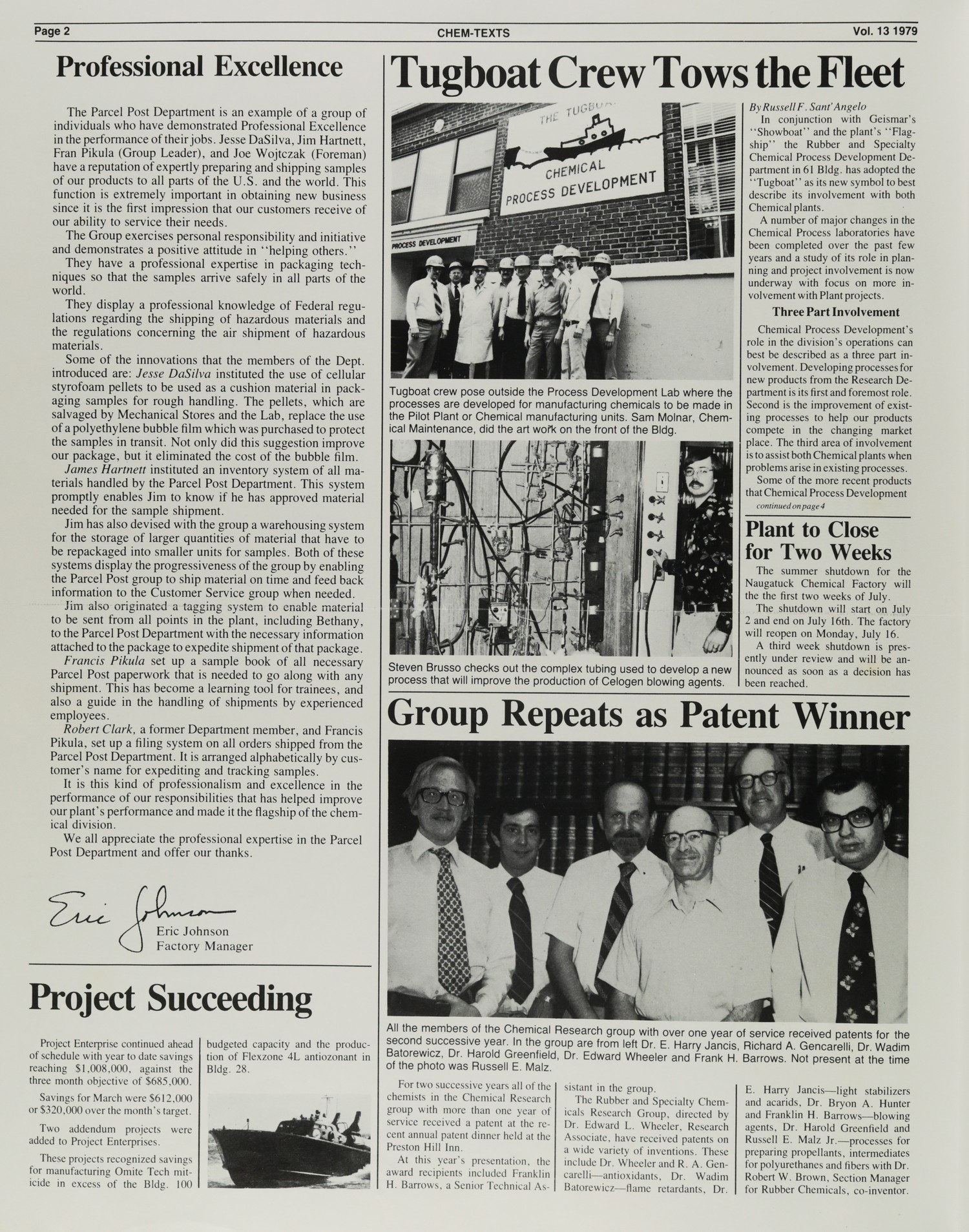

1978 was a Good Year . . .

You and I know our Company is starting to generate an upward momentum as illustrated by the outstanding performance of the Naugatuck Plant and the Chemical Company in 1978. The Chemical Company profits exceeded all expectations last year and our Plant’s gross operating profit increased 58%.

This outstanding achievement is the result of your efforts whether you are in Manufacturing, Research and Development, Accounting, D&S, the Service Departments, or Marketing.

Our plant’s goal is to have a 30% plant operating profit that would result in a 9% return on sales. This year our objective is to increase the return on sales from 3 to 4.5%.

How do we expect to achieve our profitability objective? The answer to this question is reflected in the achievements of last year.

In the Maintenance Department an outstanding job was performed in reducing equipment downtime from 8.9 to 7.5%. Their 1979 goal is 6% and January was an excellent start with downtime averaging 4.5%.
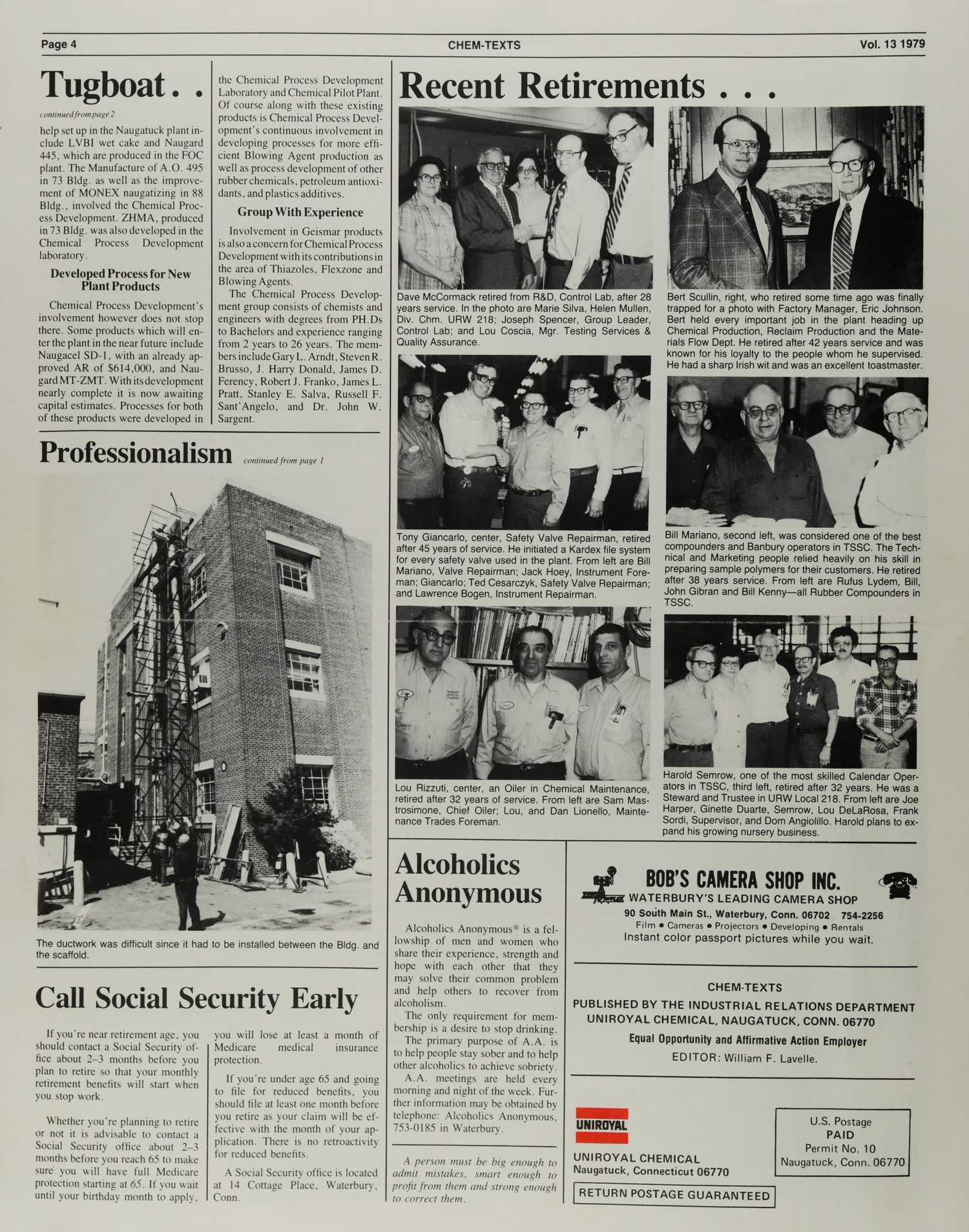
Manufacturing set productivity records in the production of Rubber Chemicals, Agricultural Chemicals, and Thermoplastics. Omite, LVBI, Tonox, and TPR productivities increased between 20 and 30% while PANA and Naugard 445 improved by 66%. Also a reduction in Roylar changeovers was achieved through better coordination and communications. In addition, Comite, Octamine P, Celogen RA, and Polygard I were successfully produced in the Plant. All these achievements resulted in increasing our plant’s profit by 1.6 million dollars.

Our Industrial Relations Department was reorganized and is more effective in serving our needs. Safety Goals were far exceeded with 1.2 incidence rate and Workmen’s Compensation costs were reduced by $165,000. A new performance appraisal system was initiated and a training session held to help managers conduct performance appraisals with their people.

A Controllers Department was established to perform financial reporting, budgeting, forecasting, and economic analysis; to expedite approvals of Appropriation Requests; and to identify areas of profit improvement.

The Technical Department now includes all engineering functions: process, project, environmental, and industrial engineering. 2.3 million dollars of profit improvement was realized through developing a team effort with the plant, R & D, and marketing. This year a similar amount is expected through Project Enterprise, the name of our 1979 Profit Improvement Program. Over $300,000 was saved through the work of the Plant’s Energy Committee. Other contributions by the Technical Department included the productivity records set in Rubber Chemicals and Omite as well as the successful production of Comite, Octamine P, Celogen RA, and Polygard I.
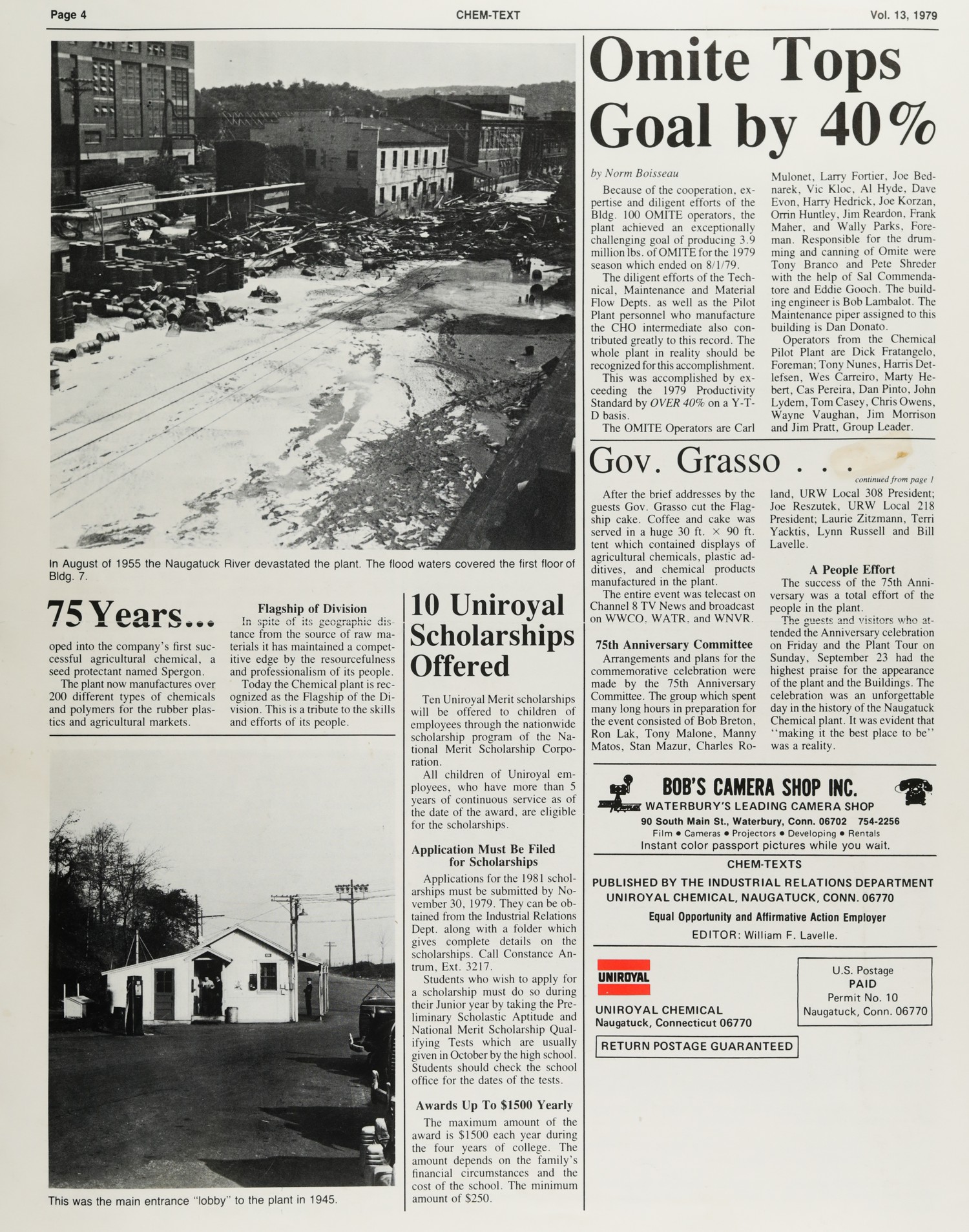
In the Material Flow Department transportation credits exceeded budget by $13,000. An additional $532,000 was saved through improved transportation of our finished goods. Shipping and receiving increased productivity by 7% and improved the services on export shipments. The Purchasing Department and Control Center reduced our inventory levels thereby increasing our return on assets. Purchasing savings and cost avoidance programs exceeded expectations by $400,000 dollars.

A major objective is to improve the utilization of our plant by introducing new products in our existing facilities or attracting new manufacturing facilities because our resources are underutilized. For example, we are using only 50% of our steam generation and waste water treatment capacities while Rubber Chemicals is budgeted to operate only between 60-65% of capacity this year. If Rubber Chemical production operated at 90% of capacity, our plant’s operating profit would increase to approximately 27%. On some recent data it appears that a 10% selling price increase would have the same impact as a 30% cost reduction.

1978 was a year of change and accomplishment. We have the reputation of managing our business. Naugatuck seeks change. We are determined to overcome our geographical raw material disadvantage through PROFESSIONAL EXCELLENCE in every assignment and job that is performed.

In 1979 Naugatuck will be a Better Place To Be and soon the Best Place To Be.
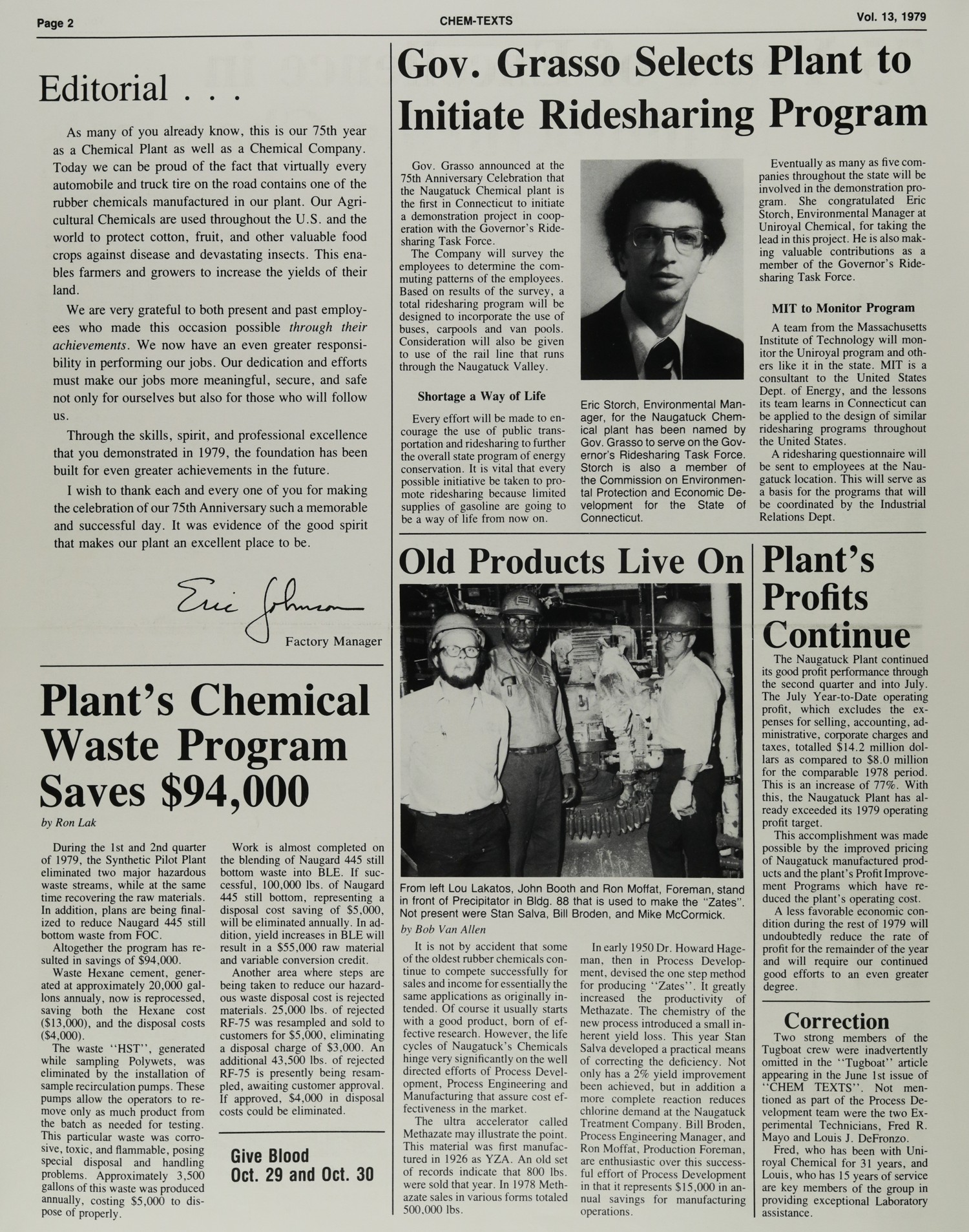
Eric Johnson

Eric Johnson
Factory Manager


29,500 Bbls. of Fuel Oil Saved by Energy Program

CUMULATIVE #6 OIL—BARRELS X 1000

[CHART showing declining oil usage from January through December, with lines for BUDGET and ACTUAL usage, ranging from approximately 140 to 0]

#6 OIL BBLS. DEC. Y.T.D.
BUDGET 15,410 143,867
ACTUAL 12,689 114,367
SAVINGS 2,721 29,500

by John Gilbert

In 1976, the Plant purchased 145,000 barrels of #6 fuel oil to operate it. As a result of the Steam Conservation Program, only 114,400 barrels were purchased in 1978. This represents a savings of 29,500 barrels of oil and saved $430,000 at 1978 oil costs.

The savings were accomplished by a diverse program under the direction of the Plant Energy Conservation Committee which included:

Burning waste Nonenes and other solvents in the boiler house. During the year 2,000,000 lbs. of waste Nonenes were burned in the boiler house saving the Plant from purchasing a similar amount of fuel oil; Eliminating steam vacuum jets and properly maintaining the jets in service; Eliminating steam leaks; Maintaining steam traps; Monitoring steam usage; and several others.

Energy conservation efforts will be intensified in 1979 in Continued on page 4


“Flagship” for Operation Snow

[PHOTOGRAPH of seven men in business attire standing together]

Eric Johnson, Factory Manager, awards a “flagship” symbol to the Yard department for Operation Snow. From left are Donald Olson, Robert Clark, James Doran, Louis Moniz, Antonio Teixeira, Eric Johnson, Adnell Lee and Stanley Korpusick, Yard Manager.

Eight successive weekends of snow, sleet, ice and rain plus some storms of heavy slush snow in mid week made this an unusual winter; ideal for slips, falls and a lot of injuries.

During the eight weeks the Yard Dept. started their Operation Snow at 2 A.M. and 3 A.M. in the morning and worked 12 to 14 hours a day to remove the snow—oftentimes with no place to put it.

As an acknowledgement for their contribution to the plant’s safety and operation Eric Johnson, the Factory Manager, awarded the department, a “flagship” symbol, for their outstanding achievement in their jobs.


SAFETY IS MY RESPONSIBILITY


College Degree Not Enough

[PHOTOGRAPH of four people, three men and one woman, standing together]

Anne Darress and Robert Samaniego are congratulated on completion of the six month Technical Department Training program. From left are Roderick Gaetz, Anne Darress, Robert Samaniego and William Broden.

A college degree is not always enough for an engineering position in the plant especially when working with complicated process equipment and chemicals.

To familiarize the new college recruits with the overall operations of the plant the Technical Department organized a six month program of intensive training in different departments such as Manufacturing, Maintenance, Purchasing, Industrial Relations, Plant Accounting, and Materials Flow.

The training program was set up by William Broden, Process Engineering Manager and Roderick Gaetz, Project Engineering Manager.

The two new employees who participated in the program were Anne Darress and Robert Samaniego. After completing the program they were assigned to the Process and Project Engineering groups respectively.

CHEM-TEXTS – 1979 – Page 3

Page 003

CHEM-TEXTS

Vol. 13, 1979 | Page 3


Agricultural Chemicals Grows Bigger

A new $500,000 Formulation Laboratory has been opened to develop recipes of the biological active ingredients for sprays, dusts, granule and other types of application by the farmer.

J. Everett Barron, left, and Harold Sisken evaluate a flowable fungicide formulation for a seed protectant.

Dr. Bogislav Von Schmeling, Manager of Research & Development for Agricultural Chemicals, holds monthly staff meeting to review progress of new chemicals. Clockwise are Dr. Von Schmeling, Gracie Stone, Thomas Geise, Dr. Jack O’Brien, Fred Dovell, Dr. Charles Crittendon, Kevin Kelley, and Don Scott.

From left Dr. Allen Blem, Dr. Allyn Bell, Dr. Robert Davis and Richard Moore who are responsible for primary and secondary screening review the effectiveness of S-734 a new herbicide for soybeans.

John Whitlock screens the activity of a new chemical on young cotton plants.

The Agricultural Chemical Research & Development Greenhouse is located in Bethany, Conn. on Rte. 63.


Who would ever have predicted that a rubber chemical, Vulklor, would be the beginning of our evergrowing agricultural chemical business.

The chemical showed fungicidal properties in tests and was sent to the N.Y. State Agricultural Experiment Station where it was tested as a seed protectant for peas.

It was renamed Spergon Seed Protectant and that became the beginning of the Ag. Chem. business.

In 1942 a greenhouse was constructed at Bethany, Conn. and a Research group was assigned the responsibility of moving Spergon from the laboratory into the marketplace.

Over the years the Agricultural Chemical Research & Development group concentrated its efforts on specialty-use chemicals rather than the higher volume but lower profit fertilizer and insecticide types of chemicals.

Today six basic chemicals are marketed that are the tops in their field and sold throughout the world: Omite® /Comite® miticides for cotton and fruit; MH®, a growth regulant for tobacco, potatoes and onions; Alar®, a plant growth regulant for peanuts and fruit trees; Vitavax®, a systemic fungicide for grain, cotton and peanut crops; Alanap®, a herbicide for soybeans; and Dyanap®, a herbicide for soybeans and peanuts.

Omite and Comite are manufactured at the Naugatuck Chemical plant and Latina, Italy; the others are made in Geismar, La.,; Gastonia, N.C.; or Elmira, Canada.

MH Discovered by Accident

MH which became one of the Division’s more profitable products was discovered by accident when a chemist at Bethany sprayed some plants with it before the Christmas holidays. A week later he noticed that the sprayed plants did not grow as rapidly as the other plants in the greenhouse. This keen observation led to further tests and what was once a fuel propellant for German rockets was soon to revolutionize the tobacco market.

New Chemicals

A number of new chemicals are now being tested at the Bethany Greenhouse. According to Dr. VonSchmeling the most exciting is UBI-S734 a herbicide for soybeans, cotton and peanuts, three of the largest crops in the country. There is also the possibility that UBI-S734 will be manufactured at the Naugatuck Chemical plant. Present plans are to start marketing this chemical in 1981.

Some of the other chemicals in the development stage are UBI-H719 and UBI-P368 fungicides; Harvade, a defoliant and desiccant; and UBI-W439 an insecticide.

Continued on page 4


1978 A Very Safe Year

Employees showed another significant improvement in safety performance during 1978 by working over 3,095,471 hours with a total of 19 accidents compared to 36 accidents in 1977.

The goal for the Company was a 10% reduction. This is the second successive year that the Chemical people worked safer than the goal.

The Incidence rate—which is the number of injuries per million manhours worked—was 1.23 compared to 2.18 in 1977.

Employee Safety Saves $165,000

The safety performance of employees in 1978 not only made the plant a better and safer place to work but also saved $165,000 in hospitalization, medical and compensation costs. Safety performance is one of the major factors that influence decisions as to whether or not new facilities should be constructed at the Naugatuck location.

Turkeys for All Employees at Christmas

In recognition of their safety performance during 1978 all employees received a Turkey at Christmas time. The turkeys weighed approximately 12-14 lbs. and had a value of $11.00 each.

“When you have got an elephant by the hind legs, and he is trying to run away, it’s best to let him run.”
—Abraham Lincoln


Smoking Rules to Tighten

The Union-Management Safety Committee has recommended stricter enforcement of the plant No-Smoking rules. Recent months have shown a disregard of the rule by employees who smoke in laboratories, buildings, and non-designated areas. The laboratories are especially dangerous areas to smoke in since people are constantly working with chemicals that could explode.

The committee has also observed that employees are smoking in the buildings where chemicals are manufactured and where hazardous vapors may exist.

New Lunch Rooms Will Help

Plans are underway to construct new lunch rooms in Bldg. 81 where smoking may be permitted. This will eliminate the smoking at the desks in the laboratory areas.

30 Day Suspension Suggested

The committee is suggesting a 30-day suspension for smoking in a restricted area and recommending stronger disciplinary action if necessary.

The committee consists of F. Mayo, H. Hook, F. Walinski, S. Commendatore, J. Rzeszutek, J. Loman, A. Clock, J. Spencer, R. Breton, and C. Ferguson.

“Congratulations to you, you’re cured,” said the psychiatrist. “Some cure,” replied the patient. “Before I was Julius Caesar. Now I’m nobody.”

CHEM-TEXTS – 1979 – Page 4

Page 004

CHEM-TEXTS

Page 4 | Vol. 13, 1979


Recent Retirements

[PHOTO: Group photo of retirees]

Francis Zettlemoyer, center, Trades Foreman in Chemical Maintenance, retired after 35 years service. From left are Francis Boyles, George Holmes, Zettlemoyer, John Gandolfo and Victor Alves, General Foreman.

[PHOTO: Group photo of retirees]

Guy Elwood, center, Area Foreman in Chemical Production, retired early after 39 years service. From left are Edward Runowicz, Bldg. 89 Foreman; George Baktis, Bldg. 94 Foreman; Elwood, Robert Bell, Bldg. 109 Foreman; and Ronald Moffat, Bldg. 88 Foreman.

[PHOTO: Group photo]

Arthur Calder retired from Synthetic Maintenance after 36 years service. He is a Charter Member of URW Local 308. At left is Charles Roland, URW 308 President and Ralph Pronovost, Vice President, right.


George Baktis, center, Foreman of Bldg. 94, in Chemical Production retired after 40 years service. At left is Douglas Ritchie, Superintendent and Robert Breton, General Foreman, right.

[PHOTO: Group photo]

William Molnar, center, retired with 31 years of service from Synthetic Maintenance. At left is Charles Roland and at right Ralph Pronovost.


MAP…

Continued from page 1

by this early turnaround of the PR-03 vessel to the Manufacturing department.

Instrumental in this successful endeavor were the following employees: G. Hennessey, E. Misenis, E. Lantieri, G. Watkins, R. Henrichs, J. Lavery, F. Guerrera, D. Lionello, C. Ferguson, J. Hoey, L. Birkenberger, S. Mazur, R. Bailey, H. Vagt, J. Mello and J. Butkus.


1978…

Continued from page 1

Rubber and Plastic Products
Sales of Fabricated Rubber and Plastic Products were $125 million in the 4th quarter of 1978, up from $111 million in 1977.

For the year, sales were $454 million, up from $413 million in 1977. Operating income was $20.2 million, up from $15.6 million in 1977.

The operating profits of plastic products were at record levels, while hose and power transmission product sales were improved substantially over 1977.

Leisure, Sport and Other
Sales of Leisure, Sport and Other Products were $62 million compared to the 1977 quarter sales of $61 million.

For 1978, sales were $268 million compared with $289 million the previous year. Operating losses were $23.7 million, compared with a loss of $2.5 million the previous year.


Agricultural

Continued from page 3

The R&D group is supported by a marketing and sales organization of approximately 68 people in North America and 30 people in the Overseas operations.

The Agricultural Chemical Research and Development group has a staff of 34 research chemists and technicians at the Bethany Greenhouse and a group of 30 Research and Development people in Bldg. 81. Fifteen have PhD’s and nine have M.S. graduate degrees.

Sales Forecast to Triple by 1987

The sales of agricultural chemicals increased by 15% in 1978 over 1977.

Based on the existing product line the sales are expected to double by 1982. By 1987 sales are estimated to more than double again. This forecase is based on present and new products and the acquisition of new businesses that will complement the present marketing structure.


29,500…

Continued from page 2

$614,000…

Continued from page 1

The major items on the AR include new storage tanks and scale tank systems for the necessary raw materials.

Also included will be a scrubbing system for the reactor vent stream and piping additions and changes in 124 Building. All other process vents will be directed to the building’s carbon absorption unit. These systems represent the most advanced technology in the area of pollution control. The dry product will be transported to Building 101, where it will be ground and packaged. The construction work will be done by a combination of contractors and chemical maintenance personnel. The work is scheduled to be completed in mid-1980.

Personnel involved in the project are James B. Garrigan, Project Engineer; William Yee, Process Engineer; Dr. J. W. Sargent, Process Development Engineer; Ray Chan and Jack Painter, Engineering Development; Larry Birkenberger, 124 Building Foreman; and D. K. Nelson, New Construction Mechanical Foreman.

order to keep energy costs in line. Oil costs for 1979 are expected to rise 20% over 1978. The Energy Conservation Committee consists of: George Arndt, John Gilbert, Bill Broden, Bob Breton, Joe Mambrino, Jon Painter, and Rocco Magnanimo.


$500…

Continued from page 1

man of the Scholarship Committee, on or before April 20, 1979. The other members of the committee are Daniel Shantz and Robert Bailey.

The winner of the 1978 scholarship was Lawrence Mambrino, Jr., the son of Lawrence Mambrino, Division Accounting Manager.


Octamine…

Continued from page 1

cult and expensive due to the wax-like nature of Octamine. In fact, recently the high cost of grinding Octamine had become prohibitive.

To avoid loss of important business of this chemical an efficient means of producing Octamine powder was urgently needed. Through the expeditious efforts of Technical Manufacturing and the Chemical Maintenance people an innovative screening facility was put together to do the job. The new arrangement continuously separates a controlled fraction of fine particle material from flakes and delivers ample quantities of Octamine powder at an attractive cost.

The powder was previously made in Canada. The new system will now allow the plant to manufacture it and at a greater profit.


Are You An Alcoholic?

To answer this question, ask yourself the following 20 questions and answer them as honestly as you can.

Yes No
1. Do you lose time from work due to drinking?
2. Is drinking making your home life unhappy?
3. Do you drink because you are shy with other people?
4. Is drinking affecting your reputation?
5. Have you ever felt remorse after drinking?
6. Have you gotten into financial difficulties as a result of drinking?
7. Do you turn to lower companions and an inferior environment when drinking?
8. Does your drinking make you careless of your family’s welfare?
9. Has your ambition decreased since drinking?
10. Do you crave a drink at a definite time daily?
11. Do you want a drink the next morning?
12. Does drinking cause you to have difficulty in sleeping?
13. Has your efficiency decreased since drinking?
14. Is drinking jeopardizing your job or business?
15. Do you drink to escape from worries or troubles?
16. Do you drink alone?
17. Have you ever had a complete loss of memory as a result of drinking?
18. Has your physician ever treated you for drinking?
19. Do you drink to build up your self-confidence?
20. Have you ever been to a hospital or institution on account of drinking?

If you have answered YES to any of the questions there is a definite warning that you may be an alcoholic.

if you have answered YES to any two, the chances are that you are an alcoholic.

If you have answered YES to three or more, you are definitely an alcoholic.

(The foregoing Test Questions are used by Johns Hopkins University Hospital, Baltimore, Md., to help in determining whether or not a patient is an alcoholic.)

If you think you have a drinking or drug problem and want help, you can call Don Conty, Ext. 3472 or Dennis Baldwin, 573-2137 at Oxford. It is not necessary to give your name. Copies of AA Literature and Meetings may be obtained from D. Conty or the Plant Hospital. Ext. 3231.


BOB’S CAMERA SHOP INC.

WATERBURY’S LEADING CAMERA SHOP
90 South Main St., Waterbury, Conn. 06702 754-2256
Film • Cameras • Projectors • Developing • Rentals
Instant color passport pictures while you wait.


CHEM-TEXTS
PUBLISHED BY THE INDUSTRIAL RELATIONS DEPARTMENT
UNIROYAL CHEMICAL, NAUGATUCK, CONN. 06770
Equal Opportunity and Affirmative Action Employer
EDITOR: William F. Lavelle.


[MAILING LABEL AREA]

UNIROYAL | U.S. Postage PAID Permit No. 10 Naugatuck, Conn. 06770

UNIROYAL CHEMICAL
Naugatuck, Connecticut 06770

RETURN POSTAGE GUARANTEED

CHEM-TEXTS – 1979 – Page No. 1

Page unknown

UNIROYAL CHEM-TEXTS

Vol. 13, 1979 | PUBLISHED FOR THE PEOPLE OF UNIROYAL CHEMICAL | No. 1


Equality Policy Affirmed

The Uniroyal Chemical plant has a firm commitment to offer equal opportunity to all employees. It is the policy of the plant’s management to support and implement this commitment continually.

This policy requires that all recruiting, hiring, transfers, promotions, compensation, benefits, and company-sponsored training, education and tuition assistance, as well as social, recreational and health programs and lay-off and recall practices are followed and carried out without regard to race, color, creed, religion, sex, national origin, or handicap of any individual person.

J. Robert Douglas, the Industrial Relations Manager for the Naugatuck plant is the Compliance Officer and has the responsibility for implementing this policy; monitoring the Uniroyal Chemical Affirmative Action Compliance Program; and reporting to management the program’s progress.

The responsibility for the improvement of the program and the positive results of it rests with each Manager, Foreman, and Supervisor as an integral part of their job.


$500.00 Scholarship Offered

The Uniroyal Chemical Management Club is again offering a $500 scholarship award. Fifty dollars of the scholarship comes from the Larry Monroe Fund.

The scholarship is available to a graduating high school student who plans a college education. To qualify, one of the student’s parents must have worked for Uniroyal Chemical at Naugatuck or Bethany for two years or more and be an active employee. The fund is supported by the dues of the club’s members.

Applications for the scholarship may be obtained from the Industrial Relations Department or by a telephone call to Constance Antrum, Ext. 3217.

April 20, Final Date

The application must be returned to William Broden, Chair-
Continued on page 4


$614,000 AR Okayed for Plant

A major Appropriations Request (AR) of $614,000 has been approved for equipment additions to Building 124 (FOC) to produce Naugacel SD-1.

The direction of this major project will be the responsibility of the Naugatuck Plant’s Technical Department.

Naugacel SD-1 represents a new product to be manufactured in Chemical Production. It has already been successfully run in both the R. & D. Development Lab and the Chemical Pilot Plant.

Used in Tires

Naugacel SD-1 is a sulfur donor accelerator for use in the vulcanization of natural and synthetic rubber and is utilized primarily in tires and mechanical goods.

Continued on page 4


MAP Plan Saves $27,358

Cuts Time in Half

By Vic Alves

When it was decided that major repairs would be required on the PR-03 vessel in the FOC plant (Bldg. 124), original repair estimates indicated that it would take 17 days of Maintenance Dept. work to complete the necessary repairs.

A Management Action Plan (MAP) was then written to plan the work and coordinate these repairs. As a result of this action plan it was determined that the repairs could be completed in 10 days instead of the estimated 17 days. Through the combined efforts and cooperation of the Maintenance and Manufacturing Departments, the required repairs were made and the work was completed in 8 days.

Naugard Schedule Met

Because of this earlier turnaround, Bldg. 124 was able to finish its scheduled Naugard 445 production; perform a changeover; begin LVBI production on schedule; and meet the production schedule.

$27,358 Saved

Based on conversion costs it is estimated that $27,358 was saved
Continued on page 4


1978 Sales Improve; Chemical Hits High

The Company sales in the 4th quarter of 1978 were $728 million compared with $626 million in the 4th quarter of 1977.

The operating profit was $38 million in 1978 versus $20 million in 1977. Net income was $3.1 million, or 7¢ a common share, compared with a loss of $2.2 million in the 4th quarter of 1977.

Sales for 1978 were $2.74 billion, up from $2.58 billion in 1977. Net income for the year was $5.9 million, or 4 cents a share, compared with 1977 net income of $34.1 million or $1.10 a common share.

Preferred Dividend Paid

The Board of Directors declared $6 in dividends on the preferred stock, applicable to 1978 net income. With the $2 declared and paid in the second half of 1978, this amounted to the full dividend on the preferred stock for 1978.


Tire and Related Products

Sales in the Tire and Related Products were $435 million in the 4th quarter of 1978, compared with $371 million in the 4th quarter of 1977. For the year, sales were $1.575 billion against $1.489 billion in 1977.

Operating profit for 1978 was $55.1 million, compared with $77.1 million in 1977.


Chemical Sets Record

The Chemical, Rubber and Plastic Materials had sales of $106 million in the 4th quarter of 1978, up from $83 million in 1977.

For the year, sales were a record $443 million while 1977 sales were $391 million. Operating profits were a record $71.5 million, up from $57.6 million in 1977.
Continued on page 4


Special Bulletin

The Naugatuck Chemical Plant won a Nationwide Award for Hazardous Waste Control of the 1979 National Environmental Industry Awards Program.

The program is co-sponsored by the President’s Council on Environmental Quality and the Environmental Industry Council.

The Council presented the award on February 28th at the Mayflower Hotel in Washington, D.C.

In two years over $250,000 has been saved by burning the nonenes waste.


Octamine P Now Made in Plant

The innovative screening system—in the background—enables Bldg. 94 to make the Octamine P powder in the plant. Previously it was purchased from our Canadian plant. The new system also increases the profitability of the chemical. In the photo are from left Lee Thompson, George Baktis, Foreman (recently retired), Walter Steponaitis and Robert Van Allen, Technical Engineer. Baktis and Van Allen were instrumental in devising the new system.


Octamine has been produced as a Naugatuck Chemical for about thirty years. It is an excellent antioxidant and is used to protect a wide variety of rubber products against heat aging and flex cracking.

Octamine was regularly finished in flake form in Bldg. 94. However, for certain applications in soft rubber stocks, customers require Octamine as a powder to assure rapid blending in the mix. But grinding to a powder is diffi-
Continued on page 4

CHEM-TEXTS – 1979 – Page No. 2

Page unknown

UNIROYAL CHEM-TEXTS

Vol. 13, 1979 | PUBLISHED FOR THE PEOPLE OF UNIROYAL CHEMICAL | No. 2


Professionalism

[IMAGE: Black and white photograph of a multi-story building with external ductwork]

The intricate ductwork on Bldg. 81 was prefabricated and installed by Richard Calzone, Anthony Malone and Joseph Pallacovitch of the Chemical Maintenance Dept. They were assisted by the Millwrights and Joe Oliviera and Al Mukosey who assisted with the high work.

by Bob Bailey

The Maintenance and Engineering Services Dept. does many things for the Naugatuck Plant . . . many of them unnoticed. Among the duties performed is the installation of new equipment.

When an AR was approved for the purchase and installation of new hoods in the Bldg. 81 Quality Control Lab the planning on the installation began. The hood ventilation system required the duct work to run along the ceiling of the first floor, through the exterior wall and up the side of the building to the blowers on the roof. The roof of Bldg. 81 is approximately 50 feet from the ground level and it was necessary to erect a scaffold next to the side of the building. The duct work was 12 inches in diameter and was prefabricated in lengths up to 25 feet ready for installation. The members of the tinners crew, Richard Calzone, Anthony Malone and Joseph Pallacovitch did the prefab and the installation of the duct work. They were assisted on the job by Millwright Mechanics from the Maintenance Dept. Most of the high installation work was done by Tony Malone working with Joe Oliviera or Al Mukosey. They were assisted by other tinners and Millwright Mechanics working on the ground and on the roof of 81 Building.

Working in high places is a task that many of us find unappealing, if not frightening, and the work of these men should be recognized as a professionally done job.

continued on page 4


Project Spotlight’s Buildings

by Norm Boisseau & Bob Breton

The purpose of the Spotlight project is to focus on the people, products, activities and operations of our individual production facilities. It will also include the participation of other departments such as Sales, Marketing, Accounting, D/S, R&D and Purchasing and will attempt to show the impact and inter-reaction of these various groups to our plant operations in general and to the “spotlight” building specifically. In addition, it will provide an opportunity to stress and re-emphasize the safety and housekeeping programs for that department as well as its contribution to total plant operating profit. Profit improvement programs will also be reviewed.

All Bldgs. Included

This will be accomplished primarily by conducting building tours with follow-up group discussion over a period of several weeks. Basically, this same format will be repeated for each building or group of buildings.

The project will be started within the next month or so. In order for it to be successful it will require the active participation and cooperation of all people in each building.


Plant Tour-Picnic Set

Plans for the third annual plant tour-picnic are underway. The date has been set for Sunday, Sept. 23.

The picnic will be held at Lake Quassapaug where an excellent menu of fine food and beverages will be served until 5 P.M. A lot of exciting fun games for husband and wife teams are planned with prizes for the winners.

Last year over 500 people attended the picnic at the spacious and lovely park setting in Middlebury.

Details of the tour-picnic will be posted on the Bulletin Boards. Be sure to watch for them. Mark your calendar now for the 23rd.

[IMAGE: Small graphic showing “Take stock in America.”]


Plant Profit Up

For the first four months of 1979 the Naugatuck Chemical Plant manufactured 23,258,000 lbs. of rubber chemicals, TPR, agricultural chemicals, and other products for customer sales. This is an increase of 17.7% over the 1st four months of 1978.

The operating profit for the 1st four months of 1979 was $6,905,000 compared to $4,304,000 in the same period of 1978, an increase of $2,601,000 or a 60.4% improvement in the plant’s earnings.

These earnings exclude non-manufacturing fixed costs such as selling, accounting, corporate transfer and tax expenses.

The buildings which showed the most significant improvement for the 4 month period in 1979 were Bldg. 100, Bldg. 124 FOC, Bldg. 70 and Bldg. 88.

This outstanding performance in profit improvement for the Naugatuck Chemical Plant is the result of intensified planning and cooperative effort of management and wage personnel working together to make the Chemical Plant the best in Uniroyal.


Acquisition Made

[IMAGE: Black and white portrait photograph of a man in business attire]

Alpine Labs is a specialty chemical manufacturer which developed technology in agricultural chemicals, antioxidants, polymerization inhibitors and pharmaceutical intermediates. Alpine has two manufacturing sites in Alabama; one near Birmingham and the home office near Mobile.

J. W. Boykin, president of Alpine founded the company after a number of years of experience in International Chemical Industries.


Chinese Visit Bethany Greenhouse

[IMAGE: Black and white photograph showing several people seated at a table in discussion]

Alex Dzialo, second left, Group Leader in the Agricultural Chemicals new $500,000 Formulation Lab discusses formulation technology with members of the Chinese delegation.

Twelve agricultural chemists from the China National Chemical Construction Corp. recently visited the agricultural chemical Research Center at Bethany.

The group toured the greenhouses and new formulation laboratory and attended discussions on Omite® miticide, Harvade desiccant and defoliant, Kylar growth regulant, and Vitavax, a systemic fungicide that is used around the world to increase crop yield especially wheat, cotton and peanuts. China has millions of acres of farmland and grows a great diversity of crops such as wheat, cotton, peanuts and fruits.

Samples of the chemicals have been sent to the country for testing.

The visit of the Chinese to Bethany is the latest in Uniroyal’s efforts to explore expanded trade opportunities with the Peoples Republic of China. Uniroyal, Inc., has been supplying tire cord and rubber chemicals to China since 1972, and more recently, agricultural chemicals.

CHEM-TEXTS – 12 – Page 3

Page 003

Volume 12, 1978 | CHEM-TEXTS | Page 3


25 Year Club…

(continued from page 1)

Robert Mazaika, center, Factory Manager, presented LeCoultre Atmos Perpetual Motion Clocks to George Baktis left and Anthony Brazicki at the Service Awards dinner honoring employees for their service with the Chemical Plant. Baktis, a Foreman in Chemical Production, joined the Naugatuck plant in 1938. Brazicki joined the Chemical Plant in 1938 as a member of the Lotol group and in 1977 was named a Sr. Storehouse Helper.

Robert E. Breton, George E. Brezak, Jean D. Burke, John W. Butkus, Julio M. DaSilva, Lawrence E. Dominiczak, Robert J. Dowling, Albert R. Follachio, William E. Galwardy, John Gibran, Samuel F. Gillette, Frank Giordano, Harry E. Grant, Howard A. Hageman, Joseph C. Harper, Carmine N. Iannuzzi, John J. Jakabauski, Presley Joines (retired), Julius P. Kerski, Martin J. Kleinfeld, Oliver N. Leduc, Francis D. Maher, Joseph J. Mambrino, Frederick R. Mayo, Theodore A. Melyan, Ernest F. Molnar, John G. Painter, Leonard R.

Polburn, Ronald E. Reeves, John F. Rice, Burnet S. Rosenfeld, Peter Senick, Gina D. Serrell, Sam A. Solomito, Nicholas R. Tiscione.

35 Years Service

Robert F. Barnhart, Carl V. Bawn, Lucy E. Borzencki, Edward R. Fischer, Bruce R. Fisher, Jr., Edward J. Geise, Robert J. Kraynick, Marie R. Marrollo, Carl J. Miele, Arthur E. Olson, Harold H. Royle, Theresa J. Shilinskas, Frank B. Smith, Harold G. Werner, Cornelius B. Westerhoff, Woodrow W. White and Francis J. Zettlemoyer.

40 Years Service

George Baktis, Anthony J. Brazicki, and Edward C. Svendsen.

45 Years Service

Anthony D. Giancarlo and Edwin A. Saunders.


Robert Mazaika, Factory Manager, welcomes new members to the Twenty Five Years Service Club. From left are Henry Yacek, Edward Napiorkowski, Mazaika, Bronius Rinkevicius (recently deceased) and John Mello.


Donald Nevins, left, Uniroyal Chemical Division Controller, presents 35 Years Service pins to Marie Marrello and Bruce Fisher.


Ronald Reeves, right, Accounting Department, receives his 30 years service award pin from Donald Nevins.

Martin Kleinfeld, left, New Venture Manager, is congratulated by Sheldon Salzman, President of the Chemical Division upon the completion of 30 years service with the Company.


Gina Serrell is congratulated by D. Nevins for her 30 years of service in the Accounting Dept.


Women Top Men in Poll

An article in the Family Safety magazine points out that few people realize that about half of the 10 million alcoholics in the U.S. are women and their numbers are growing rapidly.

Gallup polls show that since World War II the proportion of female drinkers in this country has increased twice as fast as that of men.

The social, emotional and financial cost of alcohol abuse is staggering. Alcohol causes or contributes to tens of thousands of accidental injuries and deaths every year.

If you are looking for help for yourself or for someone in your family with a drinking problem, you can call Dennis Baldwin at the Oxford Complex, 573-2137. All calls are held in strictest confidence. It is not necessary to give your name.


TB Tine…

(continued from page 2)

the forearm and within 24-48 hours after the test a certain percent of individuals will develop a reaction at the site of the test. A “positive” reaction is not uncommon and only indicates that the individual may have been exposed to TB.


Hilton Joins I.R. Dept.

Chester Hilton has joined the Industrial Relations Department as Personal Supervisor. He will be responsible for all plant employment, Division non-exempt salary employment, EEO, S.U.B. plan administration and plant recruiting.

Chuck has transferred from the Los Angeles Plant where he held various Industrial Relations positions related to Employment, Employee Benefits and Labor Relations.


Receives Management Club Scholarship

Lawrence Mambrino, Jr., center, is congratulated by William Broden, chairman of the Uniroyal Chemical Management Club Scholarship Committee on receiving the $500 scholarship awarded to the son or daughter of an active employee. From the left are Lawrence Mambrino, his father; Broden, Mambrino and Robert Bailey and Daniel Shantz who are members of the Committee.

The Uniroyal Chemical Management Club awarded its 1978 scholarship to Lawrence J. Mambrino, the son of Lawrence Mambrino, Accounting department.

The scholarship recipient achieved a distinguished scholastic record at Holy Cross High School in Waterbury, was an active participant in athletics and other extra-curricular activities. He also made a major contribution to his educational expenses by part-time employment throughout his high school career.

In September Mambrino will begin his studies at Boston University toward a career in medicine.

Members of the Uniroyal Chemical Management Club Scholarship Committee are William F. Broden, Chairman; Daniel A. Shantz and Robert W. Bailey.

CHEM-TEXTS – 12 – Page 4

Page 004

Volume 12, 1978 | CHEM-TEXTS | Page 4


Recent Retirements | Lotol Group Holds Reunion

[PHOTO]

Walter Hudima, fourth left, retired after 24 years of service. In the photo from left are Edward Semaskvich, John Enamait, Robert Burns, Hudima; and Patrick Sgrillo.


[PHOTO]

Charles Drapko, center, retired from Chemical Production after 43 years of service. In the photo from left are Terry Sokoli, Drapko, and Eddie Gooch.


[PHOTO]

George Allen, center, Employee Relations Manager, retired after 36 years of service. At left is Robert Douglas, Industrial Relations Manager and at right, Robert Mazaika, former Factory Manager.


Omite . . .

continued from page 1

into an outstanding achievement of producing the highest amount of Omite ever produced by the plant.

This record performance enabled the Agricultural Chemicals group to overcome a marketing setback because of a quality problem with another agricultural chemical product. Due to the years’ high production and sales of Omite the Agricultural Chemical business reported a successful year in 1978.

According to Neidermyer the sales of Omite for 1979 are forecast higher than 1978.

Chemical Production Group

The Chemical Production group consists of Dick Valentine, Area Foreman; Wally Parks, Dept. Foreman; Sal Commendatore, Leo Vadnais, Orrin Huntley, Frank Maher, Vic Kloc, Larry Fortier, Dave Evon, Harry Hedrick, Joseph Korzan, Louis Santolupo, Rodger Taylor, Joseph Bednarek, Tony Branco, Pete Shreder.


Sales . . .

continued from page 1

Domestic tire sales and prices increased slightly over 1977. The replacement market continued to be highly competitive; however, current replacement tire prices are firmer and if this condition holds, recovery levels should improve.

Chemical, Rubber and Plastic Products Up 13%

Sales of Chemical, Rubber and Plastic products were up 13%, increasing to $109 million in the third quarter from $96 million in the 3rd quarter of 1977. Sales of specialty chemicals, natural rubber, agricultural chemicals and specialty synthetic rubber accounted for the gains.

Fabricated Rubber and Plastic Products Up 17%

Sales of the Fabricated Rubber and Plastic products were $110 million in the 3rd quarter, up 17% from the $94 million in the third quarter of 1977. Coated fabric sales were up due to increased automotive demand. In addition, engineered rubber products and power


[PHOTO – Group photo of Lotol reunion members]

Members of the Lotol group recently held a reunion at Fortin’s restaurant in Naugatuck. Lotol,® a special compounded latex was formerly manufactured in Bldg. 55. It was once a very profitable business for the Naugatuck plant but market conditions resulted in a decision to divest it.

Most of the members in the group had over 35 years of service with the Chemical division and were recognized authorities in the latex field.

Kneeling in front from left are Louis Chieffo (23), John Flickinger (36), William Curtin (34) and Norman Smith (41).

Standing from left are Everett Anderson (38), Dr. Roland Peaker (39), John Titley (43), Dr. Thomas Hawley (10), Lawrence Bruce (30), Philip Rice (37), a former Factory Manager; William Long, Albert Holmberg (50), John Rice (35), Donald Fowler (41), Joseph Biernacki (34), and James Parechanian.


Plant . . .

continued from page 1

562 Attend Picnic

After the tour 562 people attended the picnic at Lake Quassapaug Amusement Park in Middlebury where a menu of steaks, hamburgers, sausages, baked beans and salads were served along with clams and draught beer, ice cream and soda.

Clayton Houseknecht and Robert McDermott organized an egg-throwing, roller-pin throwing, shot-put and egg-in-the-spoon games for which prizes were awarded. Most of the games were won by the women who showed more expertise than the men in handling the eggs and roller pins.

Committee Made Success

This year’s committee helped to make the tour-picnic even better than last year’s. The members were E. Johnson, Factory Manager; C. Antrum, S. Bond, R. Breton, W. Broden, M. Cobbol, L. Coscia, R. Douglas, H. Francolini, J. Labrecque, J. Linn, S. Mazur, H. Mullen, R. McDermott, J. Prior, R. Shortt, T. Sills, D. Shantz, R. Shipman and J. Tierney. URW Local 218 President, J. Rzeszutek and W. Lavelle were Co-Chairmen for the event.

The guides in the Bldgs. were: Bldg. 61—Gary Arndt, J. Ferency, R. Sant’Angelo, G. Bellin-

ger, J. Ciaccio and S. Bryan. Bldg. 72—A. Clock and A. Cilfone. Bldg. 79—R. Breton, R. Valentine, R. Magnanimo, and F. Commendatore. Bldg. 86 Warehouse—J. Tierney and J. Wojtczak. Machine Shop—R. Calzone. Chemical Health Unit—Patricia Grzywacz R.N.

The Guides who lead the people from Bldg. to Bldg. in the tour were T. Ennis, W. Richards, R. Bailey, M. Malone, E. Roller, S. Aloise, D. Mennillo, R. Ashby, G. Allen, F. Walinski, S. Mazur, H. Francolini, and K. Kelly. In charge of the guides were W. Broden, R. Breton and D. Ritchie.


Johnson . . .

continued from page 1

Chemical Production since 1975. Previously he was Director of the Naugatuck Treatment Co. and served as Chief Process Engineer of the Chemical plant for several years. He was General Foreman of the Synthetic Production unit from 1968 to 1971.

Johnson came to Uniroyal Chemical in 1961 from Clarkson College of Technology with a B.Ch.E. degree and received a MBA from the University of New Haven.


BOB’S CAMERA SHOP INC.

WATERBURY’S LEADING CAMERA SHOP
90 South Main St., Waterbury, Conn. 06702 754-2256
Film ● Cameras ● Projectors ● Developing ● Rentals
Instant color passport pictures while you wait.


transmission continued to show gains.

Leisure, Sport and Other Products Down

Leisure, Sport and Other Products sales were $57 million compared with $64 million in the 3rd quarter of 1977.


CHEM-TEXTS
PUBLISHED BY THE INDUSTRIAL RELATIONS DEPARTMENT
UNIROYAL CHEMICAL, NAUGATUCK, CONN. 06770

Equal Opportunity Employer
EDITOR: William F. Lavelle.


[UNIROYAL LOGO]

UNIROYAL CHEMICAL
Naugatuck, Connecticut 06770

U.S. Postage
PAID
Permit No. 10
Naugatuck, Conn. 06770

RETURN POSTAGE GUARANTEED

CHEM-TEXTS – 1978-v12-i03-s268

Page 268

Merry Christmas – Happy New Year

UNIROYAL CHEM-TEXTS

Vol. 12, 1978 | PUBLISHED FOR THE PEOPLE OF UNIROYAL CHEMICAL | No. 3


Johnson, Factory Manager

Eric Johnson has been named Factory Manager of the Naugatuck Chemical plant, succeeding Robert Mazaika who was named Director of Manufacturing and Engineering for the Chemical division.

He will be responsible for all manufacturing operations of the Chemical plant which produces chemicals for the rubber and plastics industries and chemicals for agricultural use and will also serve on the staff of R. Mazaika. He has been Superintendent of
continued on page 4


Kralastic Latex Sold

After several months of speculation the Division announced that it has entered into an agreement to sell the domestic Kralastic® ABS plastic resin and synthetic Latex businesses to U.S.S. Chemicals, a division of United States Steel Corporation. The price of the transaction was not disclosed.

The ABS and latex manufacturing plant in Baton Rouge, La. and the Latex Compounding plant in Dalton, Ga. are to be included in the sale.

The planned sale will free up capital needed to develop other business segments in which the Company is concentrating its growth.

ABS Invented by Uniroyal

ABS was invented by Uniroyal chemists and was manufactured at the Naugatuck Chemical plant until the Baton Rouge facility was constructed.

It is used extensively for pipe, automotive parts, luggage and appliances.

Interviews Held

U.S. Steel representatives have come to Naugatuck and held interviews with the Chemical personnel who worked in the two commodities regarding employment with U.S.S.


Plant Tour-Picnic A Big Success

Over 250 employees and their spouses toured the plant Bldgs. and facilities. In the photo at the Main Entrance to the plant are from left, Joseph Rzeszutek, URW Local 218 President, Elizabeth Lyons, Dennis Mennillo, Robert Douglas, Industrial Relations Manager; Willie Ingram, Chemical Production; Marie Ingram; and Eric Johnson, Factory Manager. (other photos on page 2)

It was a beautiful Sunday morning and the sky was a bright blue for the second annual plant tour-picnic. Close to 300 employees and their spouses toured several buildings in the plant including the new R&D Process Development Laboratory and the new Chemical Health Center.

The tour also included a visit to Bldg. 79, the 86 Warehouse and the Machine Shop. In each of the buildings the visitors were given a brief description of the activities in it.

Coffee and fresh baked donuts were served in the tent between Bldgs. 84 and 81 where customer’s products made from Royalene® EPDM rubber were displayed along with agricultural chemicals used by farmers and growers all over the world.

Eric Johnson, Factory Manager; Robert Douglas, Industrial Relations Manager and Joseph Rzeszutek, URW Local 218 President, greeted the people at the Main Entrance as they arrived for the tour and registered for the tour and prizes.
continued on page 4


Omite Sets Production Record

At a luncheon in Bldg. 7 Dr. Robert Neidermyer, (back to camera) Sales Manager for Agricultural Chemicals in the U.S., congratulated the Chemical Production operators for their extraordinary achievement in making sufficient Omite to meet the high market demand for the chemical in 1978.

At a luncheon in Bldg. 7 Robert Neidermyer, Marketing Manager for Agricultural Chemicals, congratulated the Omite group for their record production of the chemical miticide to meet the increased market demands for it in 1978.

Production Sets Record

The high output was even more noteworthy because of production shutdowns caused by storms and the total loss of a tank car of OMITE Tech. In spite of all these situations the group turned an impossible task
continued on page 4


Sales Up; Profits Off

Chemical Up 13%

Uniroyal sales for the 3rd quarter of 1978 were $641 million compared with sales of $591 million in the 3rd quarter of 1977. The Company suffered a loss of $2.9 million compared to a profit of $5.1 million in 1977 for the quarter.

For the nine month period, sales were $2.0 billion, approximately the same as in 1977.

The nine month net income was $3.1 million compared to the net income of $34.7 million in the first nine months of 1977.

Tire and Related Product Sales Up

Sales of tires and related products were $365 million in the 3rd quarter, compared with $337 million in 1977.
continued on page 4

CHEM-TEXTS – 1978-v12-s261

Page 261

Page 2 CHEM-TEXTS Volume 12, 1978


EDITORIAL

A large portion of this edition of CHEM-TEXTS is devoted to things that are happening here at the plant as a result of making it a “better place to be”. My staff and myself have dedicated ourselves to that objective in 1978.

In addition to some of the physical changes that are occurring, there are many changes being made in the way we manage our business. After reviewing how we were managing and deciding that it was not the way we would like it, we started to change. More of our people are becoming involved with running our business, and we intend that each of our buildings will be run as a separate business. Each of our service departments will be run as a separate business and will be measured in this way. The people running these businesses have been and will be given the authority necessary to make decisions and expenditures as required.

All of our people running the small business units will have both the authority and responsibility for the success of these businesses. I believe that this will make the Naugatuck Plant the most successful in the Chemical Division.

One of our other objectives for 1978 is to make the Naugatuck Plant “The Flagship” of the division. Certainly making it a better place to be and managing our business better will go a long way toward achieving that goal. But to reach it, we also have to strive to make the plant, inside and out, the best of any plant in the division—the cleanest, neatest and best maintained.

By dedicating ourselves to these objectives everyday, I am sure that they will be achieved in 1978.

[Signature: R.J. Meyst]


Named To IR Dept.

[PHOTO: Black and white photograph of J. Robert Douglas]

J. Robert Douglas has been named Manager of Industrial Relations for the Naugatuck Chemical location. In his new position he will be responsible for the Labor and Employee Relations at the Naugatuck Chemical facility which employs over 1100 people.

Prior to his new appointment Douglas held the position of Industrial Relations Manager at the Painesville, Ohio, plant.

He joined Uniroyal Chemical in 1967 as an Industrial Relations Representative at the Joliet Ammunitions plant.

[PHOTO: Black and white photograph of Donald J. Conty]

Donald J. Conty has been appointed Manager of Labor Relations for the Naugatuck Chemical plant.

Conty had been Manager of Industrial Relations for the Uniroyal Industrial Products’ Division plant in Port Clinton, Ohio.

He joined the Industrial Products division of Uniroyal at the Passaic plant in 1956 as a Safety Supervisor. He was later named Manager of Safety and Plant Protection. In 1972 he was promoted to Employee Relations Manager for the Port Clinton, Ohio plant.


Equality Policy Affirmed

The Uniroyal Chemical plant has a firm commitment to offer equal opportunity to all employees. It is the policy of the plant’s management to support and implement this commitment continually.

This policy requires that all recruiting, hiring, transfers, promotions, compensation, benefits, and company-sponsored training, education and tuition assistance, as well as social, recreational and health programs and lay-off and recall practices are followed and carried out without regard to race, color, creed, religion, sex, national origin, or handicap of any individual person.

J. Robert Douglas, the Industrial Relations Manager for the Naugatuck plant is the Compliance officer and has the responsibility for implementing this policy; monitoring the Uniroyal Chemical Affirmative Action Compliance Program; and reporting to management the program’s progress.

The responsibility for the improvement of the program and the positive results of it rests with each Manager, Foreman, and Supervisor as an integral part of their job.


Profits And Sales Improve In 1977

For 1977 the Company’s net income was $34.8 million, or $1.13 a share, compared with $20.1 million or $.57 a share in 1976.

Sales for 1977 were $2.6 billion compared with $2.3 billion in 1976.

Strong annual gains were made in U.S. tire sales. Sales and net income from chemicals exceeded all forecasts in 1977.

4th Quarter

In the 4th Quarter, the Company had a foreign exchange loss of $2.5 million, reducing earnings to $57,000, or a loss of four cents a share. This compares with the abnormally high income of $20 million, or $.71 a share after a $.5 million foreign exchange loss in the 4th quarter of 1976.

The 4th Quarter net income was also attributed to declines in sales of footwear, and losses incurred as footwear production was discontinued at the Naugatuck plant.

Tire 4th Quarter Sales Off

Sales in the Tire and Related Products group were $371 million in the fourth quarter of 1977, compared with $380 million in the last quarter of 1976. The relative decline was due to abnormally high orders in 1976.

Chemical, Rubber and Plastic Materials Improve in Quarter

Chemical, Rubber and Plastic Materials sales increased to $83 million in 1977 from the $79 million in the 4th quarter of 1976. The Chemical Division and specialty chemical sales continued to show improvement in this period, as did the pricing of natural rubber.


Scholarship Offered

The Uniroyal Chemical Management Club is again offering a $500 scholarship award. Fifty dollars of the scholarship comes from the Larry Monroe Fund.

The scholarship is available to a graduating high school student who plans a college education. To qualify, one of the student’s parents must have worked for Uniroyal Chemical at Naugatuck or Bethany for two years or more

(continued on page 4)


21,000 Barrels of Oil Saved

A total of 148,000 barrels of #6 oil was budgeted to operate the plant during 1977 but through an extensive program of energy conservation, only 127,000 barrels were used, resulting in a savings of 21,000 barrels at an average price of $14.70/barrel for the year.

Recovered nonenes from Bldgs. 109, 89, 94, and 100—previously wasted—were blended into a fuel in the Boiler Plant and accounted for 5000 of the 21,000 barrels in the above savings.

Major Problem Areas

During the year the Steam Conservation Committee concentrated on three major problems: 1.) Steam Traps: the repairs on the traps was done by Pipers Francis Clark and Michael Csepes.

2.) Insulation: four Chemical Maintenance Insulators — Richard Tucker, John Lengyel, Domingos DaSilva, and William Scott replaced defective insulation.

3.) Steam Jet Maintenance and operation: work on the steam jets was done in the Chemical and Synthetic Pilot Plants, Bldgs. 109, 100, 79 and the Pollution Abatement Laboratory under the direction of John Gilbert, William Broden, and Roderick Ashby.

Committee Members

The Steam Conservation Committee consists of George Arndt,

Chairman; John Gilbert, Secretary, Robert Breton, William Broden, John Painter, and Joseph Mambrino.

The goal of the Committee is to reduce the cost and use of steam throughout the buildings of the plant. A program for 1978 has been planned with even greater savings anticipated.

[FORM HEADER:]
UNIROYAL CHEMICAL
Division of UNIROYAL Inc.
ENGINEERING DEPARTMENT

SUBJECT___
LOCATION__

PAGE_
JOB NO._
DATE_
BY_

[GRAPH: Line graph showing cumulative #6 oil barrels x 1000 from months J through D, with two lines labeled “BUDGET” (solid) and “ACTUAL” (dashed), ranging from approximately 10 to 150 on the y-axis]

CHEM-TEXTS – 1978-v12-s262

Page 262

Volume 12, 1978

CHEM-TEXTS

Page 3


“Making It A Better Place To Be”

(continued from page 1)


Joseph Scullin, Materials Dept. driver, stands beside the mail truck, painted on one side with a big pink question mark and a big pink exclamation point on the other side. These were the first of the many signs that indicated something new and exciting was happening at the Chemical plant.


years that it had slipped, in all likelihood due to the closings of the Synthetic and Reclaim Rubber plants, along with the Footwear Plant closing. There was great pride in the fact that at one time the Chemical plant was a major profit maker for the Company but as patents expired on our chemicals it fell to a low position in the Company.

Signs Are Only the Surface

The signs are only the surface of an exciting program to recapture that spirit and really make the plant “a better place to be.”

For the past few months Departments have held meetings at which members pinpointed problems in their own and other departments, the Division and the entire corporate structure. It was one of the first opportunities where people opened up and attempted to identify problems. The problems were delineated and assigned to individual department members who were given the responsibility for their solution within a designated time. The initial skepticism of “another periodic program” soon disappeared as things began to happen. Overnight a new feeling appeared, as promises became realities.

Things Are Happening

In the past month Factory Manager Mazaika has been flooded with suggestions on improving the plant. Some have already been put into effect such as the reserved parking for employees over 62; the 11 P.M. to 7 A.M. shift parking in the plant; new shower facilities; new work clothes for plant people; and interior and exterior building improvements.

But most important, according to Bob Mazaika, is that the real concern and pride that people have for the Naugatuck Chemical plant is once again beginning to show in a healthy, constructive manner and the real Chemical “spirit” is coming back.


The “pink painter” struck his brush in Bldg. 18 and the Maintenance Dept. Locker Rooms.


Outside truck drivers stopped and left their cabs to check the 42 ft. clearance in the Chemical Production area.


Black “arrows”, painted over the entrance of the Firehouse, were some of the first signs to appear in the plant.


This sign that looks like a railroad track is painted in purple and black on the side of the building.