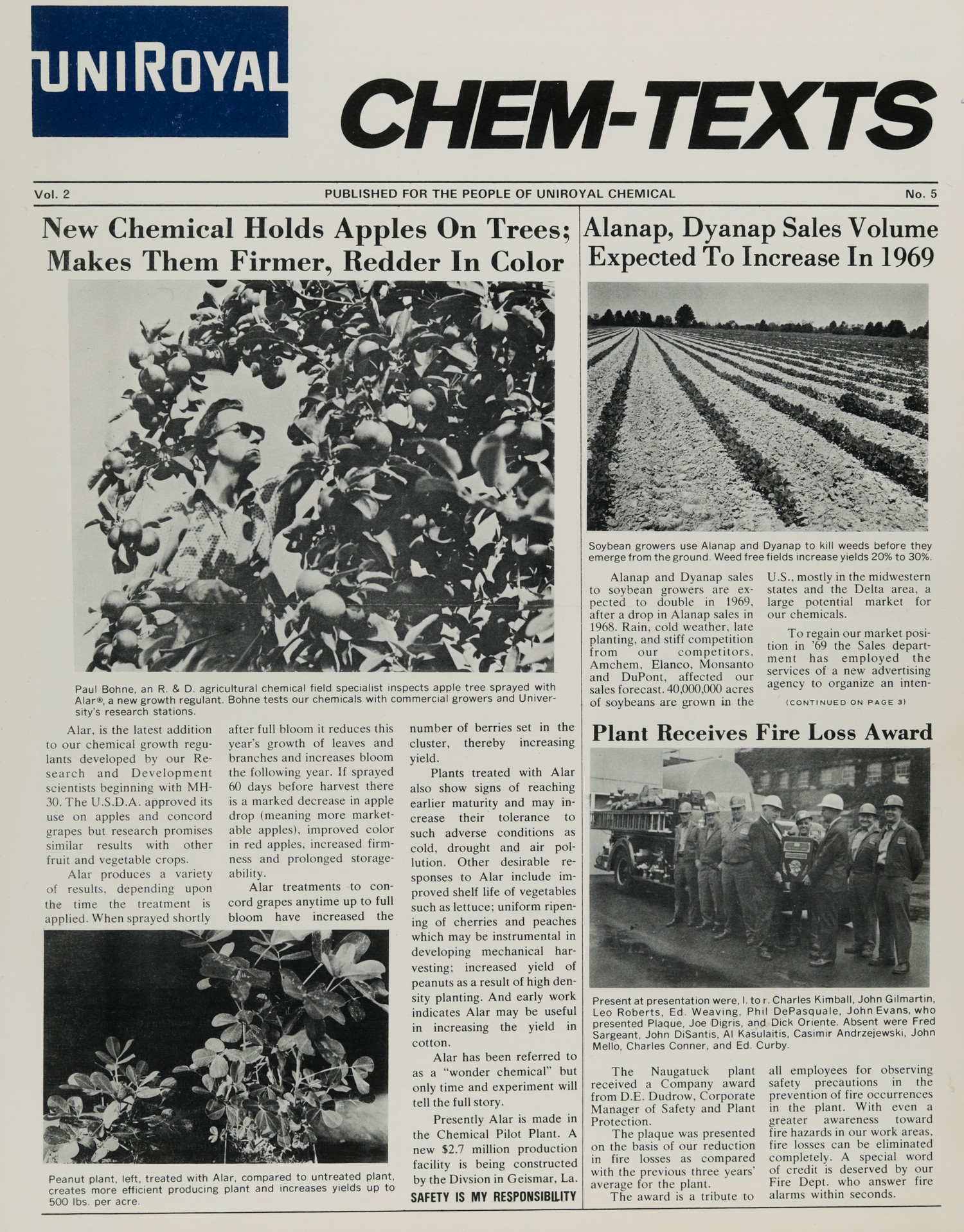
CHEM-TEXTS – Vol. 2, No. 5 – Page 1

Page 001

UNIROYAL

CHEM-TEXTS

Vol. 2 PUBLISHED FOR THE PEOPLE OF UNIROYAL CHEMICAL No. 5


New Chemical Holds Apples On Trees; Makes Them Firmer, Redder In Color

[IMAGE: Paul Bohne, an R. & D. agricultural chemical field specialist inspects apple tree sprayed with Alar®, a new growth regulant. Bohne tests our chemicals with commercial growers and University’s research stations.]

Alar, is the latest addition to our chemical growth regulants developed by our Research and Development scientists beginning with MH-30. The U.S.D.A. approved its use on apples and concord grapes but research promises similar results with other fruit and vegetable crops.

Alar produces a variety of results, depending upon the time the treatment is applied. When sprayed shortly after full bloom it reduces this year’s growth of leaves and branches and increases bloom the following year. If sprayed 60 days before harvest there is a marked decrease in apple drop (meaning more marketable apples), improved color in red apples, increased firmness and prolonged storageability.

Alar treatments to concord grapes anytime up to full bloom have increased the number of berries set in the cluster, thereby increasing yield.

Plants treated with Alar also show signs of reaching earlier maturity and may increase their tolerance to such adverse conditions as cold, drought and air pollution. Other desirable responses to Alar include improved shelf life of vegetables such as lettuce; uniform ripening of cherries and peaches which may be instrumental in developing mechanical harvesting; increased yield of peanuts as a result of high density planting. And early work indicates Alar may be useful in increasing the yield in cotton.

Alar has been referred to as a “wonder chemical” but only time and experiment will tell the full story.

Presently Alar is made in the Chemical Pilot Plant. A new $2.7 million production facility is being constructed by the Divsion in Geismar, La.

SAFETY IS MY RESPONSIBILITY

[IMAGE: Peanut plant, left, treated with Alar, compared to untreated plant, creates more efficient producing plant and increases yields up to 500 lbs. per acre.]


Alanap, Dyanap Sales Volume Expected To Increase In 1969

[IMAGE: Soybean growers use Alanap and Dyanap to kill weeds before they emerge from the ground. Weed free fields increase yields 20% to 30%.]

Alanap and Dyanap sales to soybean growers are expected to double in 1969, after a drop in Alanap sales in 1968. Rain, cold weather, late planting, and stiff competition from our competitors, Amchem, Elanco, Monsanto and DuPont, affected our sales forecast. 40,000,000 acres of soybeans are grown in the U.S., mostly in the midwestern states and the Delta area, a large potential market for our chemicals.

To regain our market position in ’69 the Sales department has employed the services of a new advertising agency to organize an inten-

(CONTINUED ON PAGE 3)


Plant Receives Fire Loss Award

[IMAGE: Present at presentation were, l. to r. Charles Kimball, John Gilmartin, Leo Roberts, Ed. Weaving, Phil DePasquale, John Evans, who presented Plaque, Joe Digris, and Dick Oriente. Absent were Fred Sargeant, John DiSantis, Al Kaslutas, Casimir Andrzejewski, John Mello, Charles Conner, and Ed. Curby.]

The Naugatuck plant received a Company award from D.E. Dudrow, Corporate Manager of Safety and Plant Protection.

The plaque was presented on the basis of our reduction in fire losses as compared with the previous three years’ average for the plant.

The award is a tribute to all employees for observing safety precautions in the prevention of fire occurrences in the plant. With even a greater awareness toward fire hazards in our work areas, fire losses can be eliminated completely. A special word of credit is deserved by our Fire Dept. who answer fire alarms within seconds.
CHEM-TEXTS – Vol. 2 No. 5 – Page 2

Page 002

Page 2 CHEM TEXTS Vol. 2 No. 5


FROM THE FACTORY MANAGER

Dear Fellow Employee:

Technological advances, especially those over the past twenty to thirty years, have rapidly outpaced our ability to understand each other. While new communication devices, such as television and the computer have expanded our ability to send messages faster, little has been done to make sure that these messages are received, for a message is communicated only when it is understood and the intended purpose of the message is accomplished. Man’s inability to complete this communication cycle is largely responsible for the many problems that face society today.

The recent company-wide survey conducted by Opinion Research, in which many of our people took part, has confirmed that we in UNIROYAL are no different in this respect. To accomplish our purposes of growth and job security for all we must — send, receive and thereby reach understanding of our common objectives. While our efforts may be aided by CHEM-TEXTS, letters and other tools, success can only be achieved if we each, as individuals, regardless of our jobs, learn to talk to each other. We must-always remember that communication is a three-way street — UP, DOWN and SIDE-WAYS. While we each may momentarily have different points of view, fair interchange of these points of view will always clarify the larger purpose.

Sincerely,

John D. Evans


Moniz’s Hard Hat Prevents Injury

[IMAGE: Photo of Joe Moniz showing hard hat to Sal Aloise]

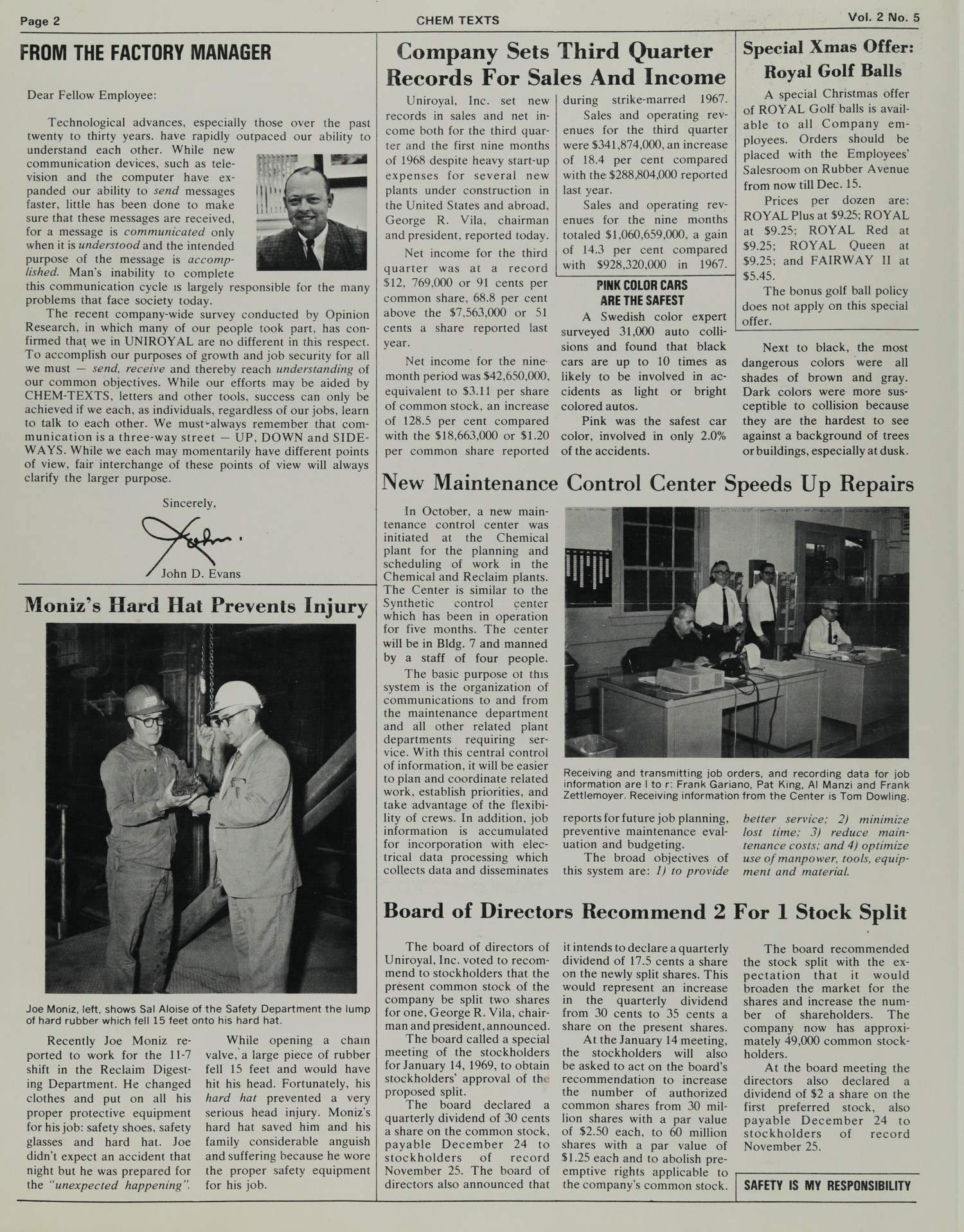
Joe Moniz, left, shows Sal Aloise of the Safety Department the lump of hard rubber which fell 15 feet onto his hard hat.

Recently Joe Moniz reported to work for the 11-7 shift in the Reclaim Digesting Department. He changed clothes and put on all his proper protective equipment for his job: safety shoes, safety glasses and hard hat. Joe didn’t expect an accident that night but he was prepared for the “unexpected happening”.

While opening a chain valve, a large piece of rubber fell 15 feet and would have hit his head. Fortunately, his hard hat prevented a very serious head injury. Moniz’s hard hat saved him and his family considerable anguish and suffering because he wore the proper safety equipment for his job.


Company Sets Third Quarter Records For Sales And Income

Uniroyal, Inc. set new records in sales and net income both for the third quarter and the first nine months of 1968 despite heavy start-up expenses for several new plants under construction in the United States and abroad, George R. Vila, chairman and president, reported today.

Net income for the third quarter was at a record $12, 769,000 or 91 cents per common share, 68.8 per cent above the $7,563,000 or 51 cents a share reported last year.

Net income for the nine-month period was $42,650,000, equivalent to $3.11 per share of common stock, an increase of 128.5 per cent compared with the $18,663,000 or $1.20 per common share reported during strike-marred 1967.

Sales and operating revenues for the third quarter were $341,874,000, an increase of 18.4 per cent compared with the $288,804,000 reported last year.

Sales and operating revenues for the nine months totaled $1,060,659,000, a gain of 14.3 per cent compared with $928,320,000 in 1967.


PINK COLOR CARS ARE THE SAFEST

A Swedish color expert surveyed 31,000 auto collisions and found that black cars are up to 10 times as likely to be involved in accidents as light or bright colored autos.

Pink was the safest car color, involved in only 2.0% of the accidents.


Special Xmas Offer: Royal Golf Balls

A special Christmas offer of ROYAL Golf balls is available to all Company employees. Orders should be placed with the Employees’ Salesroom on Rubber Avenue from now till Dec. 15.

Prices per dozen are: ROYAL Plus at $9.25; ROYAL at $9.25; ROYAL Red at $9.25; ROYAL Queen at $9.25; and FAIRWAY II at $5.45.

The bonus golf ball policy does not apply on this special offer.

Next to black, the most dangerous colors were all shades of brown and gray. Dark colors were more susceptible to collision because they are the hardest to see against a background of trees or buildings, especially at dusk.


New Maintenance Control Center Speeds Up Repairs

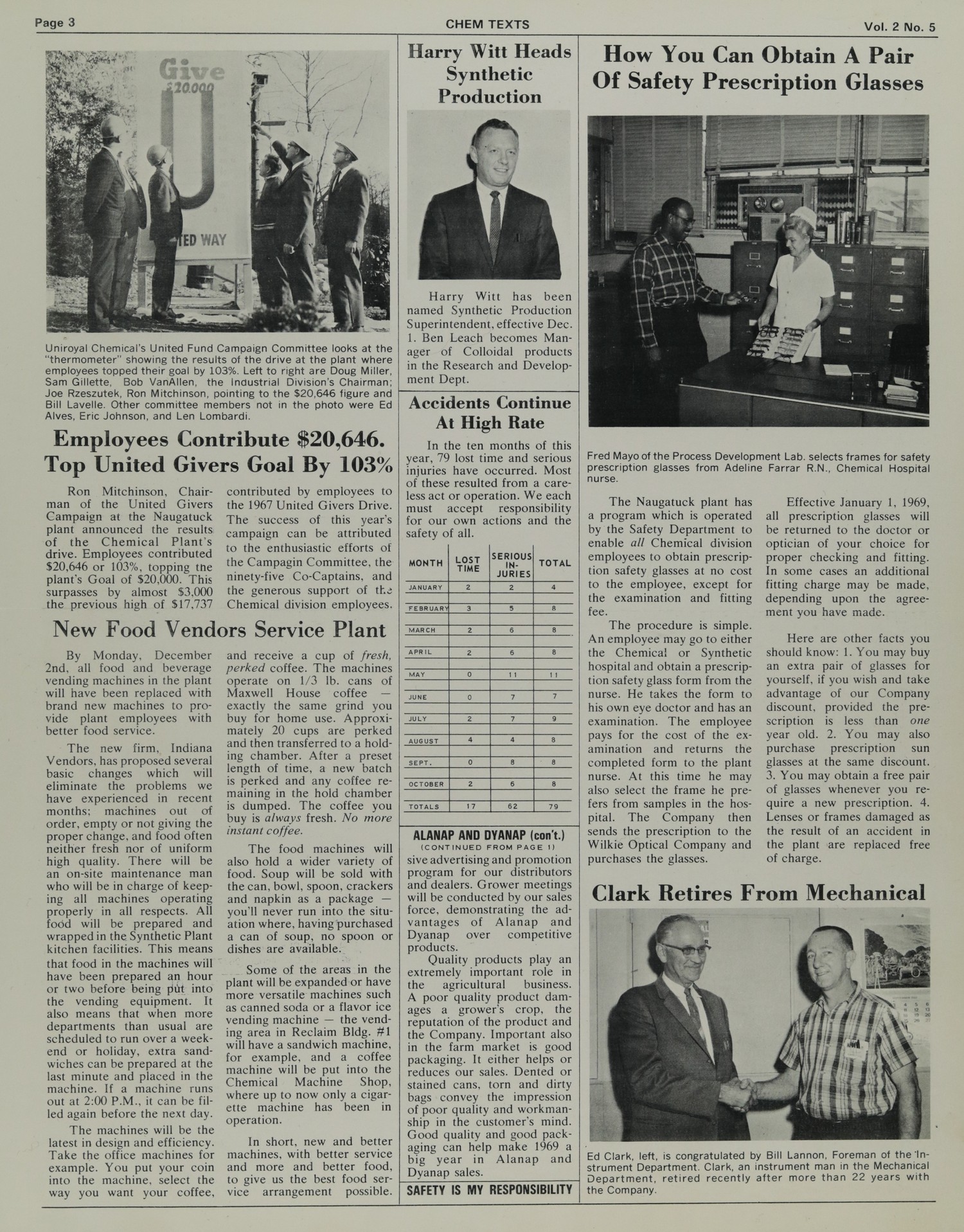
In October, a new maintenance control center was initiated at the Chemical plant for the planning and scheduling of work in the Chemical and Reclaim plants. The Center is similar to the Synthetic control center which has been in operation for five months. The center will be in Bldg. 7 and manned by a staff of four people.

The basic purpose of this system is the organization of communications to and from the maintenance department and all other related plant departments requiring service. With this central control of information, it will be easier to plan and coordinate related work, establish priorities, and take advantage of the flexibility of crews. In addition, job information is accumulated for incorporation with electrical data processing which collects data and disseminates

[IMAGE: Photo of four men at control center]

Receiving and transmitting job orders, and recording data for job information are l to r: Frank Gariano, Pat King, Al Manzi and Frank Zettlemoyer. Receiving information from the Center is Tom Dowling.

reports for future job planning, preventive maintenance evaluation and budgeting.

The broad objectives of this system are: 1) to provide

better service; 2) minimize lost time; 3) reduce maintenance costs; and 4) optimize use of manpower, tools, equipment and material.


Board of Directors Recommend 2 For 1 Stock Split

The board of directors of Uniroyal, Inc. voted to recommend to stockholders that the present common stock of the company be split two shares for one, George R. Vila, chairman and president, announced.

The board called a special meeting of the stockholders for January 14, 1969, to obtain stockholders’ approval of the proposed split.

The board declared a quarterly dividend of 30 cents a share on the common stock, payable December 24 to stockholders of record November 25. The board of directors also announced that

it intends to declare a quarterly dividend of 17.5 cents a share on the newly split shares. This would represent an increase in the quarterly dividend from 30 cents to 35 cents a share on the present shares.

At the January 14 meeting, the stockholders will also be asked to act on the board’s recommendation to increase the number of authorized common shares from 30 million shares with a par value of $2.50 each, to 60 million shares with a par value of $1.25 each and to abolish preemptive rights applicable to the company’s common stock.

The board recommended the stock split with the expectation that it would broaden the market for the shares and increase the number of shareholders. The company now has approximately 49,000 common stockholders.

At the board meeting the directors also declared a dividend of $2 a share on the first preferred stock, also payable December 24 to stockholders of record November 25.


SAFETY IS MY RESPONSIBILITY

CHEM-TEXTS – Vol. 2 No. 5 – Page 3

Page 003

CHEM TEXTS

Page 3 | Vol. 2 No. 5


Harry Witt Heads Synthetic Production

Harry Witt has been named Synthetic Production Superintendent, effective Dec. 1. Ben Leach becomes Manager of Colloidal products in the Research and Development Dept.


How You Can Obtain A Pair Of Safety Prescription Glasses

Fred Mayo of the Process Development Lab. selects frames for safety prescription glasses from Adeline Farrar R.N., Chemical Hospital nurse.

The Naugatuck plant has a program which is operated by the Safety Department to enable all Chemical division employees to obtain prescription safety glasses at no cost to the employee, except for the examination and fitting fee.

The procedure is simple. An employee may go to either the Chemical or Synthetic hospital and obtain a prescription safety glass form from the nurse. He takes the form to his own eye doctor and has an examination. The employee pays for the cost of the examination and returns the completed form to the plant nurse. At this time he may also select the frame he prefers from samples in the hospital. The Company then sends the prescription to the Wilkie Optical Company and purchases the glasses.

Effective January 1, 1969, all prescription glasses will be returned to the doctor or optician of your choice for proper checking and fitting. In some cases an additional fitting charge may be made, depending upon the agreement you have made.

Here are other facts you should know: 1. You may buy an extra pair of glasses for yourself, if you wish and take advantage of our Company discount, provided the prescription is less than one year old. 2. You may also purchase prescription sun glasses at the same discount. 3. You may obtain a free pair of glasses whenever you require a new prescription. 4. Lenses or frames damaged as the result of an accident in the plant are replaced free of charge.


[PHOTO CAPTION:]
Uniroyal Chemical’s United Fund Campaign Committee looks at the “thermometer” showing the results of the drive at the plant where employees topped their goal by 103%. Left to right are Doug Miller, Sam Gillette, Bob VanAllen, the Industrial Division’s Chairman; Joe Kresziutek, Ron Mitchinson, pointing to the $20,646 figure and Bill Lavelle. Other committee members not in the photo were Ed Alves, Eric Johnson, and Len Lombardi.


Employees Contribute $20,646. Top United Givers Goal By 103%

Ron Mitchinson, Chairman of the United Givers Campaign at the Naugatuck plant announced the results of the Chemical Plant’s drive. Employees contributed $20,646 or 103%, topping the plant’s Goal of $20,000. This surpasses by almost $3,000 the previous high of $17,737 contributed by employees to the 1967 United Givers Drive. The success of this year’s campaign can be attributed to the enthusiastic efforts of the Campagin Committee, the ninety-five Co-Captains, and the generous support of the Chemical division employees.


Accidents Continue At High Rate

In the ten months of this year, 79 lost time and serious injuries have occurred. Most of these resulted from a careless act or operation. We each must accept responsibility for our own actions and the safety of all.

MONTH LOST TIME SERIOUS IN-JURIES TOTAL
JANUARY 2 2 4
FEBRUARY 3 5 8
MARCH 2 6 8
APRIL 2 6 8
MAY 0 11 11
JUNE 0 7 7
JULY 2 7 9
AUGUST 4 4 8
SEPT. 0 8 8
OCTOBER 2 6 8
TOTALS 17 62 79

New Food Vendors Service Plant

By Monday, December 2nd, all food and beverage vending machines in the plant will have been replaced with brand new machines to provide plant employees with better food service.

The new firm, Indiana Vendors, has proposed several basic changes which will eliminate the problems we have experienced in recent months; machines out of order, empty or not giving the proper change, and food often neither fresh nor of uniform high quality. There will be an on-site maintenance man who will be in charge of keeping all machines operating properly in all respects. All food will be prepared and wrapped in the Synthetic Plant kitchen facilities. This means that food in the machines will have been prepared an hour or two before being put into the vending equipment. It also means that when more departments than usual are scheduled to run over a weekend or holiday, extra sandwiches can be prepared at the last minute and placed in the machine. If a machine runs out at 2:00 P.M., it can be filled again before the next day.

The machines will be the latest in design and efficiency. Take the office machines for example. You put your coin into the machine, select the way you want your coffee, and receive a cup of fresh, perked coffee. The machines operate on 1/3 lb. cans of Maxwell House coffee — exactly the same grind you buy for home use. Approximately 20 cups are perked and then transferred to a holding chamber. After a preset length of time, a new batch is perked and any coffee remaining in the hold chamber is dumped. The coffee you buy is always fresh. No more instant coffee.

The food machines will also hold a wider variety of food. Soup will be sold with the can, bowl, spoon, crackers and napkin as a package — you’ll never run into the situation where, having purchased a can of soup, no spoon or dishes are available.

Some of the areas in the plant will be expanded or have more versatile machines such as canned soda or a flavor ice vending machine — the vending area in Reclaim Bldg. #1 will have a sandwich machine, for example, and a coffee machine will be put into the Chemical Machine Shop, where up to now only a cigarette machine has been in operation.

In short, new and better machines, with better service and more and better food, to give us the best food service arrangement possible.


ALANAP AND DYANAP (con’t.)

(CONTINUED FROM PAGE 1)

sive advertising and promotion program for our distributors and dealers. Grower meetings will be conducted by our sales force, demonstrating the advantages of Alanap and Dyanap over competitive products.

Quality products play an extremely important role in the agricultural business. A poor quality product damages a grower’s crop, the reputation of the product and the Company. Important also in the farm market is good packaging. It either helps or reduces our sales. Dented or stained cans, torn and dirty bags convey the impression of poor quality and workmanship in the customer’s mind. Good quality and good packaging can help make 1969 a big year in Alanap and Dyanap sales.

SAFETY IS MY RESPONSIBILITY


Clark Retires From Mechanical

Ed Clark, left, is congratulated by Bill Lannon, Foreman of the Instrument Department. Clark, an instrument man in the Mechanical Department, retired recently after more than 22 years with the Company.

CHEM-TEXTS – Vol. 2 No. 6 – Page 2

Page 002

CHEM-TEXTS

Page 2 | Vol. 2 No. 6


FROM THE FACTORY MANAGER

Dear Fellow Employee:

Again the joys of the holiday season are upon us renewing the eternal promise of peace and goodwill among all men. A constant promise to a changing world — a world that must change if it is to fulfill that promise.

As we pause to reflect upon our accomplishments of the past year, let us face the challenges of the new year with resolution. A resolve that we will each strive for creative change with the goal of better understanding one another as well as our common purpose.

Please accept my most sincere wishes for you and your family; a Most Joyous Christmas and the Best of Health and Happiness throughout the New Year.

John D. Evans


Uniroyal Will Match Your Donation To A College

Today more than ever, colleges and universities need money to build more classrooms, libraries, laboratories and other facilities along with improving and increasing their teaching staffs.

As the demands for a college education continues to grow colleges and universities will need greater help than ever before to not only improve but expand their facilities to meet these demands. This help will have to come from companies, foundations and individual donations, or else many deserving students will be turned away for lack of space.
To encourage our donations for education Uniroyal will match our contribution of more than $25.00 to a college or university. This program applies to active employees on regular, full-time jobs or on authorized leave of absence from such job after they have completed a year of service. The maximum total which the Company will match is $1,000 a year per employee.

Uniroyal will match only gifts made directly to the school or to an agency of the school, such as an alumni fund, which turns over all donations to the school. The college or university must grant degrees and be accredited or actively seeking such accreditation.

Application forms for the “Employee Matching Gift” program may be obtained from the Industrial Relations. department.

The matching of contributions will be made only after the Uniroyal “Employee Matching Gift” application forms have been filled out by the employee; approved and signed by the financial officer of the educational institution and returned to the Uniroyal Foundation.


25 YEAR CLUB HOLDS ANNUAL DINNER: MONAHAN RECEIVES 50 YEAR SERVICE AWARD

[PHOTO: Group photo of men in suits]

New members who received their 25 Year Service Awards.
The Uniroyal Chemical 25 Year Club held its 19th Annual Dinner in November at the Waverly Inn. The Club is an association of Chemical division employees who have been regularly credited with 25 or more years of service with the Company.

Eligibility for membership and for service awards is recognized at the annual dinner for employees who expect to achieve such eligibility during the calendar year. Total membership in the Club at present is 534.

Committee members for this year’s program were Bert Scullin, president, Everett Anderson, Tom Dowling, Pat King, Joe Little, Larry Monroe, Alice Schofield and Ed Weaving.

Special recognition went to J. Monahan who received a 50 year service award.

Advanced to the 45 Year group were L. Carroll, L. Monroe, C. Swanson, and L. Volpe.

40 Year awards went to J. Bickerdike, D. Fowler, S. Gesseck, F. Janus, M. Karbowicz, P. King, F. Magnamo and G. Siequist.

35 Year awards were received by E. Anderson, W. Birdsall, M. Chmielewski, T. Doran, E. Gabriel, A. Giancarlo, A. Henriques, J. Kolakowski, E. Lewonski, P. Machnics, F. Marinello, M. Perkins, J.C. Ranney, G. Reale, N. Salinardi, E. Saunders, W. Scranton, M. Smerekanych, B. Smey, P. Suba, M. Sullivan and E. Valentine.

Receiving 30 Year awards were G. Baktis, A. Brazicki, I. Fonseca, M. Heller, M. Jannetty, P. Paul, J. Rek, S. Slawski, and E. Svendsen.

New members with 25 Years service were F. Adams, R. Barnhart, C. Bawn, R. Bell, L. Borzencki, L. Bruce, A. Christensen, H. Crabtree, J. Cravo, R. Crotty, G. Dennis, H. Drummer, I. Engle, W. Fairclough, E. Fischer, B. Fisher Jr., F. Haase, W. Hill Jr., W. Hilton, J. Kawecki, G. Kuhn, M. Marrello, J. Maye, P. McPhail, C. Miele, J. Napp, C. Nelson, L. Nicely, R. Noury, A. Olson, J. Pereira, F. Rinaldi, H. Royle, R. Santarsiere, M. Sgrillo, T. Shilinskas, W. Swick, L. Triano, W. Wasulis, W.W. White, M. Wilson and F. Zettlemoyer.


2 Lost Time; 3 Serious Injuries Occur During Month Of November

In November, 2 lost time injuries occurred in Chemical Production. An operator lost control of a full 55 gal. drum while taking it off a pallet. He suffered severe bruises and abrasions of the lower leg, resulting in 5 lost-time days.
The second injury involved an operator who suffered 2nd. degree burns to his right foot, and is expected to be out for one month.
By developing an attitude of safety, being constantly aware of the unexpected happening, and wearing the proper protective equipment for the job, accidents can be eliminated. A few months ago we worked 1,000,000 manhours without a lost time injury. There’s no reason we can’t reach that mark again.


How To Take Care Of An Expensive Camera

Let’s say you own an expensive stereo movie camera. Let’s say it’s really a rare model, capable of taking action shots in 3D and color under conditions of available light.

Would you ever think of dropping it on the sidewalk? Would you tap its’ twin lenses with a hammer? Throw acid on the lenses? Throw pieces of metal at them? Of course not . . . rather you’d take excellent care of such equipment.

If, however, the camera became damaged beyond repair, the loss wouldn’t be tragic and final. You would probably purchase a new camera to replace it.

But you couldn’t buy a replacement for “your personal camera” — the one you carry around with you all day long. Yes, your eyes are “your personal, stereo camera, and no one has perfected substitute eyes that can see and take their place.

The transparent cornea shielding each of your eyes is only a tiny fraction of an inch in thickness. Thus, additional protection is imperative in the presence of danger.

If you’re doing work that presents even a minor hazard to your eyes, find out from your foreman or supervisor what protection you need. Then . . . get it and wear it.

Protecting your eyes is a full time job, no matter in what activity you’re engaged. Don’t risk permanent damage to your priceless personal camera.

It’s the one camera that can’t be replaced.


Keep all medicines, including such common drugs as asprin, in a locked or inaccessible cabinet. Always turn the light on when giving or taking medicine.


Never put a poisonous or toxic substance in a container designed to contain food, such as milk bottles, soft drink bottles, or cereal boxes.

CHEM-TEXTS – Vol. 2 No. 6 – Page 3

Page 003

CHEM-TEXTS

Vol. 2 No. 6 Page 3


Good Packaging (Continued from Page 1)

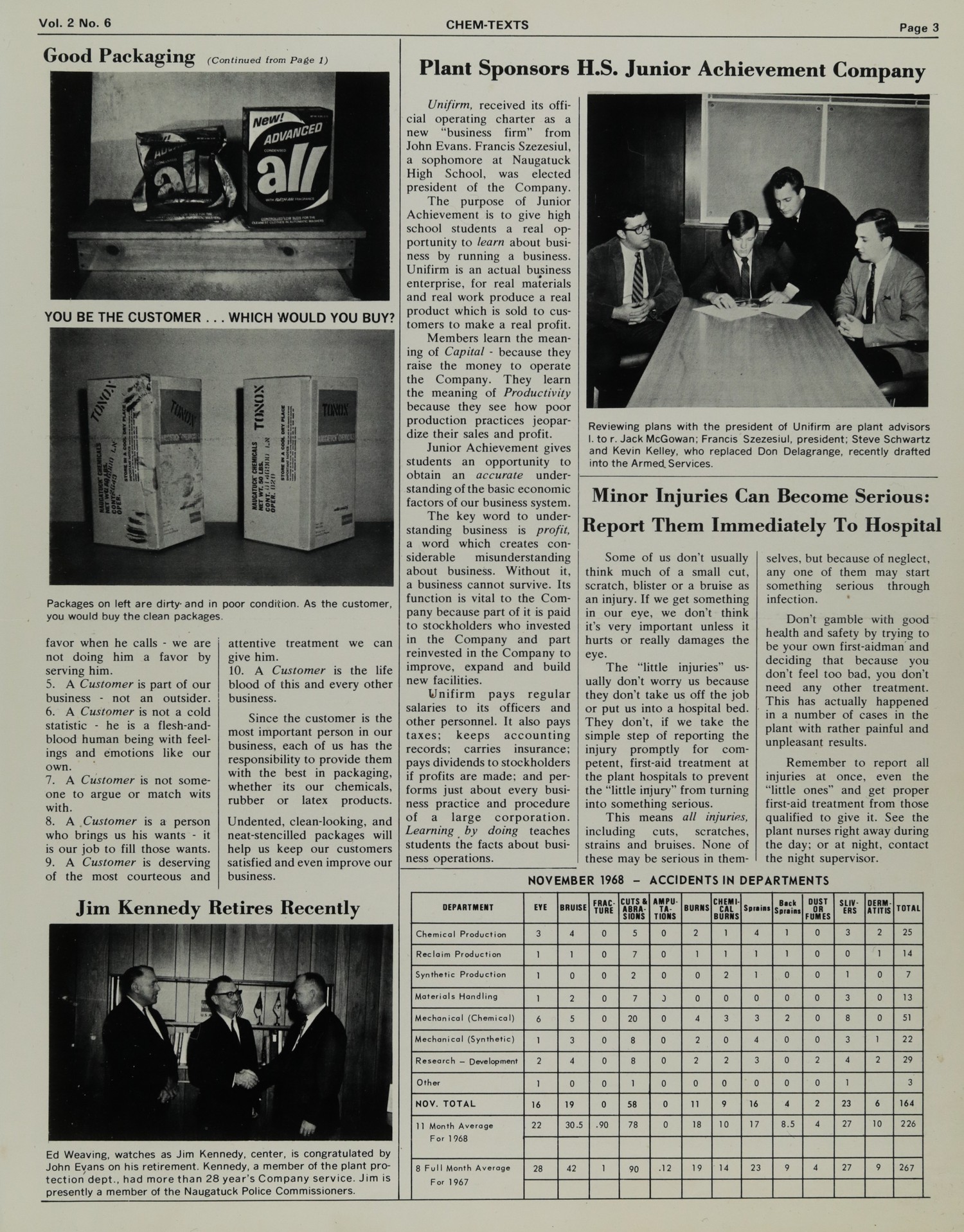
[IMAGE: Box of “New! ADVANCED all” detergent]

[IMAGE: Packages of “THNX” products stacked]

YOU BE THE CUSTOMER . . . WHICH WOULD YOU BUY?

Packages on left are dirty and in poor condition. As the customer, you would buy the clean packages.

favor when he calls – we are not doing him a favor by serving him.

  1. A Customer is part of our business – not an outsider.
  2. A Customer is not a cold statistic – he is a flesh-and-blood human being with feelings and emotions like our own.
  3. A Customer is not someone to argue or match wits with.
  4. A Customer is a person who brings us his wants – it is our job to fill those wants.
  5. A Customer is deserving of the most courteous and attentive treatment we can give him.
  6. A Customer is the life blood of this and every other business.

Since the customer is the most important person in our business, each of us has the responsibility to provide them with the best in packaging, whether its our chemicals, rubber or latex products. Undented, clean-looking, and neat-stencilled packages will help us keep our customers satisfied and even improve our business.


Jim Kennedy Retires Recently

[IMAGE: Three men in suits, one shaking hands with another]

Ed Weaving, watches as Jim Kennedy, center, is congratulated by John Evans on his retirement. Kennedy, a member of the plant protection dept., had more than 28 year’s Company service. Jim is presently a member of the Naugatuck Police Commissioners.


Plant Sponsors H.S. Junior Achievement Company

Unifirm, received its official operating charter as a new “business firm” from John Evans. Francis Szezesiul, a sophomore at Naugatuck High School, was elected president of the Company.

The purpose of Junior Achievement is to give high school students a real opportunity to learn about business by running a business. Unifirm is an actual business enterprise, for real materials and real work produce a real product which is sold to customers to make a real profit.

Members learn the meaning of Capital – because they raise the money to operate the Company. They learn the meaning of Productivity because they see how poor production practices jeopardize their sales and profit.

Junior Achievement gives students an opportunity to obtain an accurate understanding of the basic economic factors of our business system.

The key word to understanding business is profit, a word which creates considerable misunderstanding about business. Without it, a business cannot survive. Its function is vital to the Company because part of it is paid to stockholders who invested in the Company and part reinvested in the Company to improve, expand and build new facilities.

Unifirm pays regular salaries to its officers and other personnel. It also pays taxes; keeps accounting records; carries insurance; pays dividends to stockholders if profits are made; and performs just about every business practice and procedure of a large corporation. Learning by doing teaches students the facts about business operations.

[IMAGE: Group of men reviewing documents at a table]

Reviewing plans with the president of Unifirm are plant advisors l. to r. Jack McGowan; Francis Szezesiul, president; Steve Schwartz and Kevin Kelley, who replaced Don Delagrange, recently drafted into the Armed Services.


Minor Injuries Can Become Serious: Report Them Immediately To Hospital

Some of us don’t usually think much of a small cut, scratch, blister or a bruise as an injury. If we get something in our eye, we don’t think it’s very important unless it hurts or really damages the eye.

The “little injuries” usually don’t worry us because they don’t take us off the job or put us into a hospital bed. They don’t, if we take the simple step of reporting the injury promptly for competent, first-aid treatment at the plant hospitals to prevent the “little injury” from turning into something serious.

This means all injuries, including cuts, scratches, strains and bruises. None of these may be serious in themselves, but because of neglect, any one of them may start something serious through infection.

Don’t gamble with good health and safety by trying to be your own first-aidman and deciding that because you don’t feel too bad, you don’t need any other treatment. This has actually happened in a number of cases in the plant with rather painful and unpleasant results.

Remember to report all injuries at once, even the “little ones” and get proper first-aid treatment from those qualified to give it. See the plant nurses right away during the day; or at night, contact the night supervisor.


NOVEMBER 1968 — ACCIDENTS IN DEPARTMENTS

DEPARTMENT EYE BRUISE FRAC-TURE CUTS & ABRA-SIONS AMPU-TA-TIONS BURNS CHEMI-CAL BURNS Sprains Back Sprains DUST OR FUMES SLIV-ERS DERM-ATITIS TOTAL
Chemical Production 3 4 0 5 0 2 1 4 1 0 3 2 25
Reclaim Production 1 1 0 7 0 1 1 1 1 0 0 1 14
Synthetic Production 1 0 0 2 0 0 2 1 0 0 1 0 7
Materials Handling 1 2 0 7 0 0 0 0 0 0 3 0 13
Mechanical (Chemical) 6 5 0 20 0 4 3 3 2 0 8 0 51
Mechanical (Synthetic) 1 3 0 8 0 2 0 4 0 0 3 1 22
Research — Development 2 4 0 8 0 2 2 3 0 2 4 2 29
Other 1 0 0 1 0 0 0 0 0 0 1 3
NOV. TOTAL 16 19 0 58 0 11 9 16 4 2 23 6 164
11 Month Average For 1968 22 30.5 .90 78 0 18 10 17 8.5 4 27 10 226
8 Full Month Average For 1967 28 42 1 90 .12 19 14 23 9 4 27 9 267

CHEM-TEXTS – Vol. 2 No. 6 – Page 4

Page 004

Page 4 | CHEM-TEXTS | Vol. 2 No. 6


G.E. Uses Kralastic® In Appliances For Quality

General Electric, one of the world’s leading manufacturers of appliances, selected our Kralastic ABS plastic for its new portable vacuum cleaner over competitive plastics for its special properties and quality. The new portable vacuum cleaner is lightweight, compact and easy to carry. The R & D department is presently working on an anti-static Kralastic for G.E. and other manufacturers. Plastics have a tendency to “attract” dust particles, but this new anti-static type will eliminate this problem and give us a competitive advantage.

Kralastic, one of the Chemical Division’s major plastic products, is used for Samsonite luggage, ATT telephones — the telephone on your desk or at home is probably Kralastic — and by GM for automotive grilles. Keen competition in pricing, packaging, delivery and quality with such companies as Monsanto, Marbon Division of Borg-Warner, Goodrich and others, requires continued efforts to improve our product and particularly new types of Kralastic to meet customer demands and the influx of new plastics into the market.

As one of the leading manufacturers of ABS plastics in the U.S. only continued product improvement through Research and Development will maintain our position.

In 1969 ABS plastic automotive parts will account for 60,000,000 pounds or six and a half pounds per car. Use in 1970 is expected to climb to 80,000,000 pounds; and in 1975 it is forecast that the automotive industry will consume 300,000,000 pounds or 25 pounds per car. Combined with the growth in appliances and other markets, Kralastic ABS has a bright future for the Chemical Division’s sales.

Its growth helps the sales of two chemicals made at Naugatuck, Polygard and Naugawhite. Polygard improves the heat stability and Naugawhite prevents heat discoloration in ABS plastics.

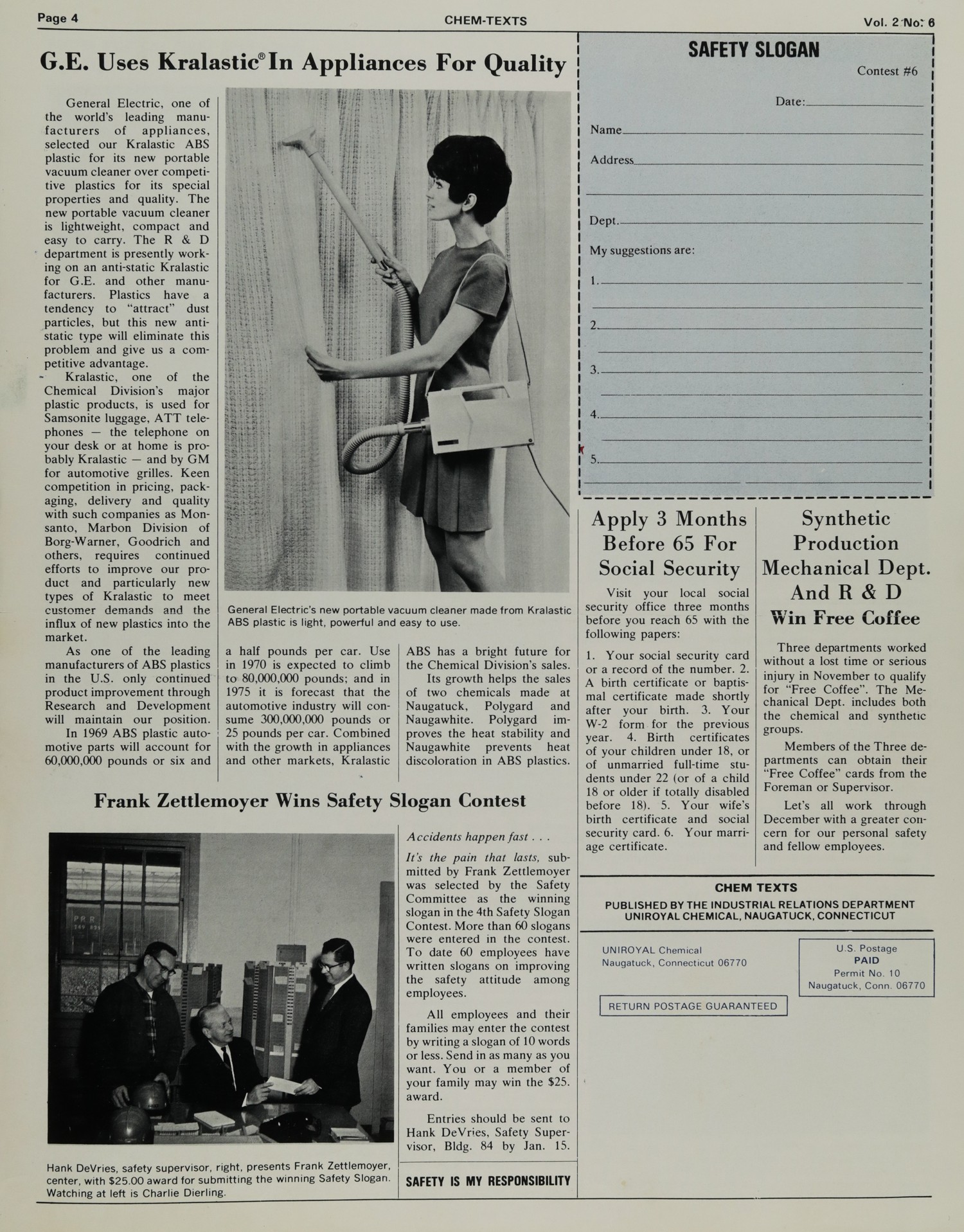
[IMAGE CAPTION: General Electric’s new portable vacuum cleaner made from Kralastic ABS plastic is light, powerful and easy to use.]


SAFETY SLOGAN

Contest #6

Date:______

Name______

Address______


Dept.______

My suggestions are:

1.______

2.______

3.______

4.______

5.______


Apply 3 Months Before 65 For Social Security

Visit your local social security office three months before you reach 65 with the following papers:

  1. Your social security card or a record of the number. 2. A birth certificate or baptismal certificate made shortly after your birth. 3. Your W-2 form for the previous year. 4. Birth certificates of your children under 18, or of unmarried full-time students under 22 (or of a child 18 or older if totally disabled before 18). 5. Your wife’s birth certificate and social security card. 6. Your marriage certificate.

Synthetic Production Mechanical Dept. And R & D Win Free Coffee

Three departments worked without a lost time or serious injury in November to qualify for “Free Coffee”. The Mechanical Dept. includes both the chemical and synthetic groups.

Members of the Three departments can obtain their “Free Coffee” cards from the Foreman or Supervisor.

Let’s all work through December with a greater concern for our personal safety and fellow employees.


Frank Zettlemoyer Wins Safety Slogan Contest

[IMAGE CAPTION: Hank DeVries, safety supervisor, right, presents Frank Zettlemoyer, center, with $25.00 award for submitting the winning Safety Slogan. Watching at left is Charlie Dierling.]

Accidents happen fast . . .

It’s the pain that lasts, submitted by Frank Zettlemoyer was selected by the Safety Committee as the winning slogan in the 4th Safety Slogan Contest. More than 60 slogans were entered in the contest. To date 60 employees have written slogans on improving the safety attitude among employees.

All employees and their families may enter the contest by writing a slogan of 10 words or less. Send in as many as you want. You or a member of your family may win the $25. award.

Entries should be sent to Hank DeVries, Safety Supervisor, Bldg. 84 by Jan. 15.

SAFETY IS MY RESPONSIBILITY


CHEM TEXTS

PUBLISHED BY THE INDUSTRIAL RELATIONS DEPARTMENT
UNIROYAL CHEMICAL, NAUGATUCK, CONNECTICUT

UNIROYAL Chemical
Naugatuck, Connecticut 06770

U.S. Postage
PAID
Permit No. 10
Naugatuck, Conn. 06770

RETURN POSTAGE GUARANTEED

CHEM-TEXTS – Vol. 1, No. 1 – Page 1

Page 001

Merry Christmas – Happy New Year

UNIROYAL CHEM-texts

Vol. 1 PUBLISHED FOR THE PEOPLE OF UNIROYAL CHEMICAL No. 3


QUALITY . . The Most Important Ingredient

(One of the difficulties of modern industry is the loss of quality or pride of workmanship which identified “handmade” products of the past. Mr. D.E. Fowler, manager of Distribution and Scheduling has put down some thoughts on the subject of quality which are well worth considering. Ed.)

Our business depends on our customers wanting to buy our products in preference to buying similar materials from our competitors. Our continued growth, and even our maintaining present business depends on our supplying better products, with more dependable quality and shipping the materials when and how the customer wants them. In short, we must do a superior job with respect to quality and service.

A customer will prefer to buy from the supplier in which he has confidence. Confidence that our product will always perform in his application because its quality is good and does not change, and that we will get the material to him as we have agreed to do and he can depend on continuing his operations. Confidence in us is first built by our Sales organization, but must be maintained by all of us

throughout the organization, and all of us must avoid the many pitfalls that tend to destroy it.

Quality itself is a result of the processing and workmanship and graded by testing and we are always striving for a uniform product, but beyond this the impression that we make on the customer can be injured by poor appearing packages, torn or dirty outer packages, crushed cartons, dented drums, indistinct labeling, accidental inclusion of foreign objects, etc. These throw doubt on the quality of the workmanship on the product itself.

Of equal importance is service, which is getting the product to the customer when he wants it. The fear that a supplier might shut their operation down through failure to deliver is an important consideration. Any failure to supply intensifies this fear and

reduces our chance of continuing as the supplier. It is not necessary to shut him down this time by being a day or so later than we had promised, he worries about the next time and has to decide whether we are or are not as reliable a supplier as he can find. Shipment delays are caused by a number of types of happenings including quality rejections of products that we depended on to ship, sampling delays, testing delays, process difficulties, equipment breakdowns as well as failures of carriers to pickup a shipment as scheduled, carrier breakdown or otherwise detained in transit. Failures to ship the amount requested, or to follow customers requests as to markings, notification of shipment, prompt test reports, or using specified carriers, etc. are annoyances to the customer that lessen our chances of continuing as his supplier.

The best possible job by everyone in our organization to build customer confidence will contribute considerably to our continued business growth.


NEW WAY TO TEST TIRES

[IMAGE: Motorized vehicle with cattle in field]

Besides tending 250 head of cattle, this motorized cowhand is testing our tires at the Laredo, Texas, tire proving ground. In a new program, ranchers who rent part of our land at Laredo are equipped with company tires which are inspected regularly for damage from the rocky terrain and needle-like cactus plants. The test program is part of our continuing effort to find new ways of preventing tire punctures.


LOCAL 308 RATIFIES NEW AGREEMENT

The tentative agreement reached between the Company and Local #308 Union Negotiating Committee on 10-26-67 was ratified unanimously at membership meetings held on 11-8-67. The

provisions of the new supplemental agreement, as well as the improved benefits of the 1967 Company-wide Agreement, including vacations and anniversary pay, have been made effective as of 10-26-67.


Strikes Affect Sales, Earnings During Third Quarter and Nine Month Periods

Strikes at 19 tire, C & I and chemical plants caused sales and profits to decline for the third quarter and first nine months, George R. Vila, chairman and president, announced.

Third quarter sales declined 8.6% to $287,367,000, compared with $314,398,000 last year. Net income was $7,563,000, or 51 cents a share of common stock. This compared with $11,631,000, or 84 cents, in 1966.

Earnings in August and September exceeded the same months in 1966 and, if it had not been for the strike, earnings for the quarter would have been improved over the same period last year.

Sales during the first nine months totaled $924,329,000, 5.8 per cent lower than last year’s $981,448,000. Net income for the nine months

came to $18,663,000, compared with $35,692,000 last year. Earnings were $1.20 a share, compared with $2.59 for the same period of 1966.

Third quarter results also were affected by the vacation shutdowns provided in labor agreements, Mr. Vila said. Time was required to start up the plants after the strikes

and vacations. Product inventories were depleted or out of balance, thus curtailing filling of customer orders. Following agreement on the master labor contract, the company started negotiation of local plant supplements. The Opelika, Ala. tire plant was struck for 37 days ending only in mid-October.


A PENNY FOR YOUR THOUGHT

In 1904, a Danish post office worker conceived the idea of a small stamp for Christmas letters and parcels in order to raise funds to set up a children’s tuberculosis hospital. The stamps sold for a penny each. Three years later a small dwelling used as a tuberculosis hospital in Delaware was about to be closed because of lack of funds. A woman who was interested in the hospital heard about the Danish post office worker and enlisted the aid of a leading Philadelphia newspaper to help put over a similar drive. The paper backed this drive and before Christmas rolled around, $3,000, ten

times the amount needed, had been raised. That was the beginning – today, 63 years later, Christmas seals are still the principal means of support in the fight against tuberculosis and respiratory diseases. We can all help to spread the word by buying Christmas Seals in 1967. Use them in good health.

[IMAGES: Christmas 1967 seals and Greetings 1967 stamps shown]


RETIREMENTS

U.S. RUBBER

[IMAGE: Photo of Mr. Domingos Matos]

Mr. Domingos Matos, Pleasant Avenue, Naugatuck, retired recently with 29 years of Company service from the Reclaim Production department.

[IMAGE: Photo of Silverio Barroqueiro]

Silverio Barroqueiro, recent retiree from Reclaim Production will travel to Portugal after 26 years service.


[IMAGE: Large industrial storage tank being lifted]

ABOVE: One of two, 50,000# storage tanks for cracked stock is being readied for installation in bldg. #17 of the Reclaim plant. When in place, the tank reached from the first floor to a point above the roof. The unit is part of the Reclaim modernization program and will be a feed tank for the fibre separation department. A complete story of the modernization of our Reclaim Production facilities will appear in a later issue of “Chem-Texts”.

CHEM-TEXTS – Vol. 1, No. 2 – Page 1

Page 001

UNIROYAL CHEM-TEXTS

Vol. 2 PUBLISHED FOR THE PEOPLE OF UNIROYAL CHEMICAL No. 2.


New Equipment for Reclaim Plant Will Keep Us in Reclaim Rubber Business

Our present reclaimed rubber plant dates back to 1895, after fire destroyed the original plant in 1893. For 75 years, we have played an important role in the rubber industry by supplying high quality stocks.

Several years ago, with combining higher production costs and increased shipping expenses, profitability reached a critical point for us in the reclaimed rubber business. Faced with keen competition, reduced prices and low-cost SBR rubber as an alternate, our business was placed in a difficult position. A decision had to be made either to discontinue the business or make major capital investments to modernize the facilities.

After detailed study of the present operation and various improvements and considering the skills of our people, it was decided that a modernization of the facilities would be practical and increase our ability to successfully compete in the market place. An appropriation request for these plans was drawn up and approved.

The “new” plant, efficiently and effectively operated, will help protect the job security of 100 employees while the alternate of going out of the business would have eliminated 150 employees, many with long seniority. Changes in the millrooms, reduced from 3 to 1, will affect the jobs of about 50 employees.

A project team was formed to work on the problem. The team settled on 5 major changes which would offer the best return on investment at this time: 1. fibre separation; 2. fine grinding; 3. central mix in the mill room; 4. revision in the mill room; 5. Zenith and dryer revisions.

The team in charge of the project working closely with the New York engineering group were R. Gaetz, Engineering Dept., Ted Lainas, Reclaim Development; C. Reich, Production and F. Wintsch, Industrial Engineering. Since his transfer to Industrial Relations, Wintsch has been replaced by B. Daily.

This team was charged with the responsibility of making the project go; by developing the flow sheets and recommending the type of equipment. All the details of engineering is being handled by approximately 12 members of the New York corporate engineering staff.

The job to be done consists of removing the fibre from old tires to prepare them for the fine grinding operation. By doing a better job of removing the fibre in the early steps and also by finer grinding, the digester cycle will be shortened, and chemical costs reduced. Also, fine grinding prior to digesting, allows us to make one pass through the mill rooms instead of 4 passes under the old system. The fine grinding, fibre separation and central mixing will be new departments and will require new skills. Engineering also estimates that we would have

(Continued on Page 2)


U.S. BOND DRIVE AIMS FOR 50% PARTICIPATION

John D. Evans, Factory Manager, named Fred Wintsch chairman of the 1968 U.S. Savings Bonds and Freedom Shares Drive at the Naugatuck plant. The drive was sponsored for two weeks from May 6 to May 17.

Last year’s campaign at the Naugatuck plant added 72 new savers to the payroll deduction plan; 88 employees increased their participation; and 152 purchased the new Freedom Shares. Approximately 40% of the Chemical employees are enrolled in the purchase of U.S. Savings Bonds and Freedom Shares.

The goal for the 1968 drive according to Wintsch was to attain 50% participation by Chemical plant employees. A committee of 71 canvassers had been organized in different sections of the plant. Members of the committee were the following: Warren Singleton, E. G. Broderick, Mary Sullivan, J. Flickinger, Harold Smith, L. Anderson, S.E. Salva, R.W. Stutzman, L. P. Ferrigno, T.J. Shilinskas, Harold Campbell, O. Zaprazalka, R.M. Bioski, M.A. Lasky, D. Johnson, E. J. Greene, F.X. O’Shea, R. Rosenbaum, C.C. Smith, A. Budd, I.A. Prager, P.J. Lazaras, W.R. Smith, V.R. Lardi, A.J. Loman, J.F. Zappala, M.E. Kuryn, G.M. Stone, R. Juliano, D. Pagnoni, C. Terniko, L. Scheithe, M. Dodd, T. Dowling, J. Homyetski, F. Magnamo, L. McCoy, G. Baktis, W. Frankerberg, A. Enamait, A. Pistarelli, E. Polonis, W. Booth, D. Rappe, T. Skehan, H. Piascik, R.R. Foltz, M. Mazur, S. Petkis, R. Magnamo, T. McMahon, L. Opdyke, L. Evan, J. Casey, J. Tierney, S. Korpusik, C. Bulka, W. Lannon, D. Nelson, J. Murtha, K. Pittner, R. Burns, J. Quint, V. Alves, J. Carroll, R. Terino, J. Vergosen, P. Norton, R. Krajewski, A. Nole and A. Juliano.

George Murdock of the Treasury Department addressed the group on the advantages of payroll deductions as an important part of an employee’s savings program. 70% of Savings Bonds purchasers do not redeem them until after age 65. In this way, the tax liability on E. Bond interest could be greatly reduced and even eliminated entirely under some circumstances.


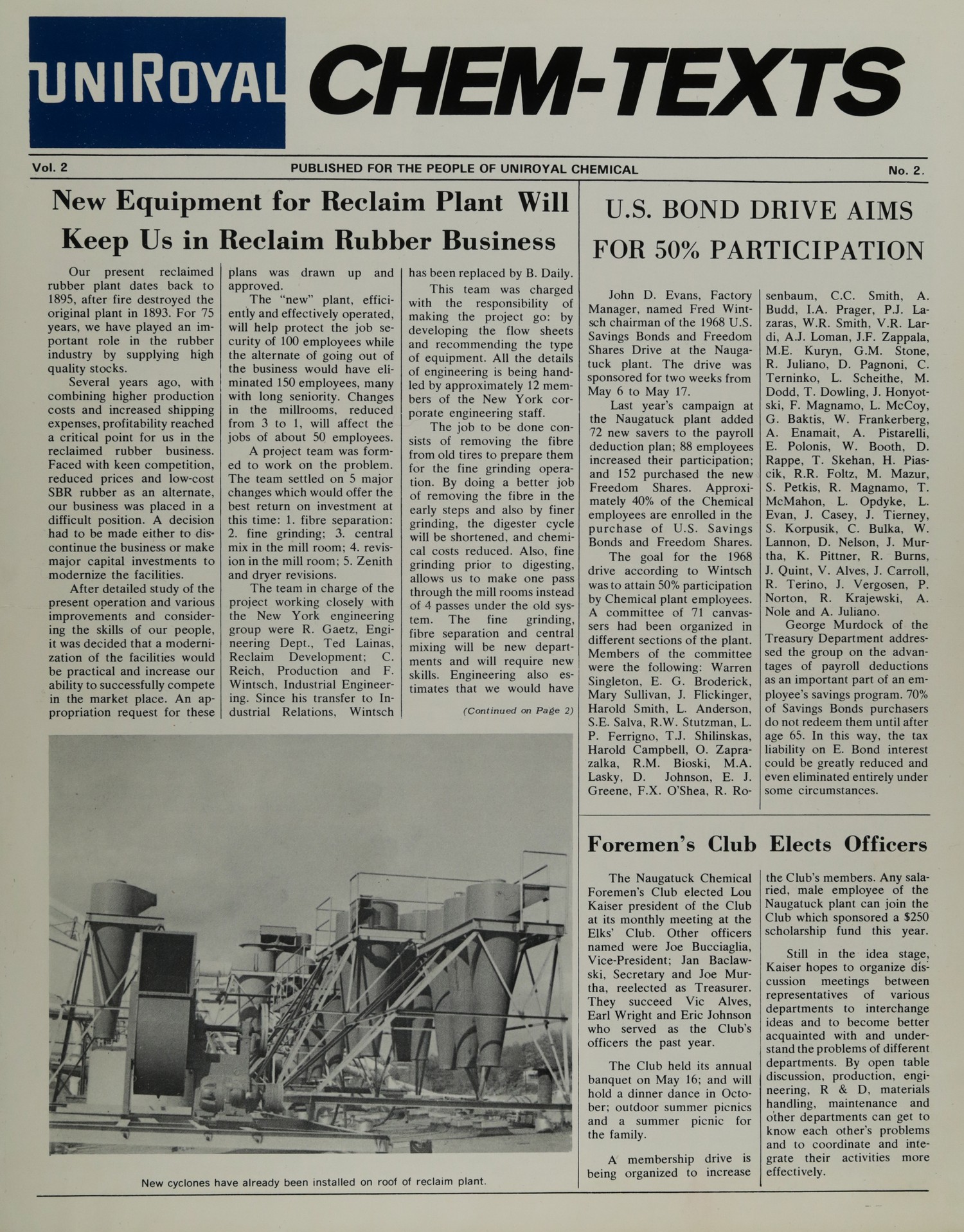
[IMAGE: Black and white photograph showing industrial equipment on a rooftop]

New cyclones have already been installed on roof of reclaim plant.


Foremen’s Club Elects Officers

The Naugatuck Chemical Foremen’s Club elected Lou Kaiser president of the Club at its monthly meeting at the Elks’ Club. Other officers named were Joe Bucciaglia, Vice-President; Jan Baclawski, Secretary and Joe Murtha, reelected as Treasurer. They succeed Vic Alves, Earl Wright and Eric Johnson who served as the Club’s officers the past year.

The Club held its annual banquet on May 16; and will hold a dinner dance in October; outdoor summer picnics and a summer picnic for the family.

A membership drive is being organized to increase the Club’s members. Any salaried, male employee of the Naugatuck plant can join the Club which sponsored a $250 scholarship fund this year.

Still in the idea stage, Kaiser hopes to organize discussion meetings between representatives of various departments to interchange ideas and to become better acquainted with and understand the problems of different departments. By open table discussion, production, engineering, R & D, materials handling, maintenance and other departments can get to know each other’s problems and to coordinate and integrate their activities more effectively.

CHEM-TEXTS – Vol. 1 No. 2 – Page 2

Page 002

CHEM TEXTS

Page 2 | Vol. 1 No. 3


FROM THE FACTORY MANAGER

Dear fellow employee:

When we were children it seemed like an eternity waiting for Christmas to arrive with its many joys. Now, too often, we find Christmas upon us too soon to appreciate its many meanings to all of us. We complain when Christmas decorations start to appear before Thanksgiving that Christmas is becoming too commercial. But possibly in our complex and “perpetually busy” society we need the extra lead time, yes the advertising, to set our minds for the approach of Christmas.

Who, but the most bitter “Scrooge” will for one moment deny the warm glow of fellowship with family and friends that descends upon all of us as the spirit of Christmas comes into our lives. Yet, the very hope and promise of Christmas too frequently comes as a false spring day in February only to be followed by a return to the dreariness of winter. Perhaps we aren’t yet too old not to continue to wish that Christmas could last the year around?

This, then, is my Christmas Wish for you and your family; a wish for all the good things of life and a hope for a New Year with its full measure of health and happiness.

[Signature: John Harwood]


John Lawton Wins Top Suggestion Award

John Lawton of the Synthetic Processing department was awarded $100 during a recent meeting of the award committee at the Synthetic Plant. John’s idea to install additional riser valves on the front lines of certain reactors resulted in productivity savings and elimination of some contamination. During the meeting, a total of 16 awards were made – 9 cash awards totaling $250 and 7 honorable mention. Other winners were: Fred Surmanek and Robert Lockwood, Processing, Honorable Mention; Joe Wojtczak, Processing, Honorable Mention; Charles Harris, Laboratory,

$15.00; Joe Gallucci, Mechanical, $25.00; Fred Surmanek, Processing, $15.00; Charles Harris, Laboratory, Honorable Mention; Frank Phillips, Chem. Mix, Honorable Mention; Leon Raskauskas, Processing, Honorable Mention; Dan Donato, Mechanical, $15.00; Earle Root, Processing, $30.00; Earle Root, Processing, $15.00; Alan Happy, Processing, Honorable Mention; Alan Happy, Processing, Honorable Mention and Frank Phillips, Chem. Mix, $20.00. Note: This does not include Chemical and Reclaim plants. Meetings incomplete at press time.

[Photo caption:] John Lawton, Processing Department, Synthetic Plant, above right is shown receiving a Suggestion Award check for $100 from B.R. Leach, Synthetic Production superintendent, for his recent suggestion. Over the past years, John has received five cash awards for a total of $145 and three Honorable Mentions. Put your imagination to work. In our highly competitive industry, UNIROYAL CHEMICAL needs your ideas. A cash award may be waiting for you.


Did You Know?

… That our society hurls more than 130 million tons of pollutants skyward each year and approximately 2/3 of this waste comes from motor vehicles. The major causes of pollution that make up this total are:

Motor vehicles
85 million tons
Manufacturing
22 million tons
Electric Power Generation
15 million tons
Heating of buildings and homes
8 million tons
Total
130 million tons

… Research has shown that pollution caused by exhaust gases and crank case emission from automobiles may be controlled by what is called Positive Crankcase ventilation. Postive crankcase ventilation draws unburned pollutants out before they enter the exhaust system of the car and reroutes them back into the carbureted fuel intake where they are burned off. As a result of this there is an estimated 30% reduction in pollutants. The entire system was made possible through the use of a hose connection made of Paracril Nitrile rubber which has a high resistance to heat and oil. Positive crackcase ventilation is now standard on all cars being manufactured in the United States. Thus UNIROYAL CHEMICAL through its production of Nitrile rubber at our Painesville, Baton Rouge plants is making a major contribution in the battle against air pollution.

… That we have received our order from the state to install the water abatement facilities in the plant by February 1971. The first step in the timetable for this equipment has been complied with when we submitted our initial engineering report prior to November 30, 1967.


First Aid . . Think Ice

One of the most effective and safe medicinal aids is an ice cube. Ice is safe because it refrigerates, rather than freezes, tissue.

So to relieve pain, think about ice:
1. Before removing a splinter with a sterilized needle, put your finger on an ice cube until it feels numb.
2. If you should burn your fingers, put your hand under a faucet of cold water, then into a bucket of ice and water until the pain is gone. This will prevent blisters. Later, you can use an ointment.
3. To prevent being overcome with heat, hold an ice cube in your fist. A heat stroke victim can be restored to consciousness if ice is rubbed over his arms, legs, and back.
4. To reduce and eliminate bleeding, place ice atop the cut, for it will constrict the blood vessels.
5. To get rid of headache or backache pains, try ice for almost instant relief.


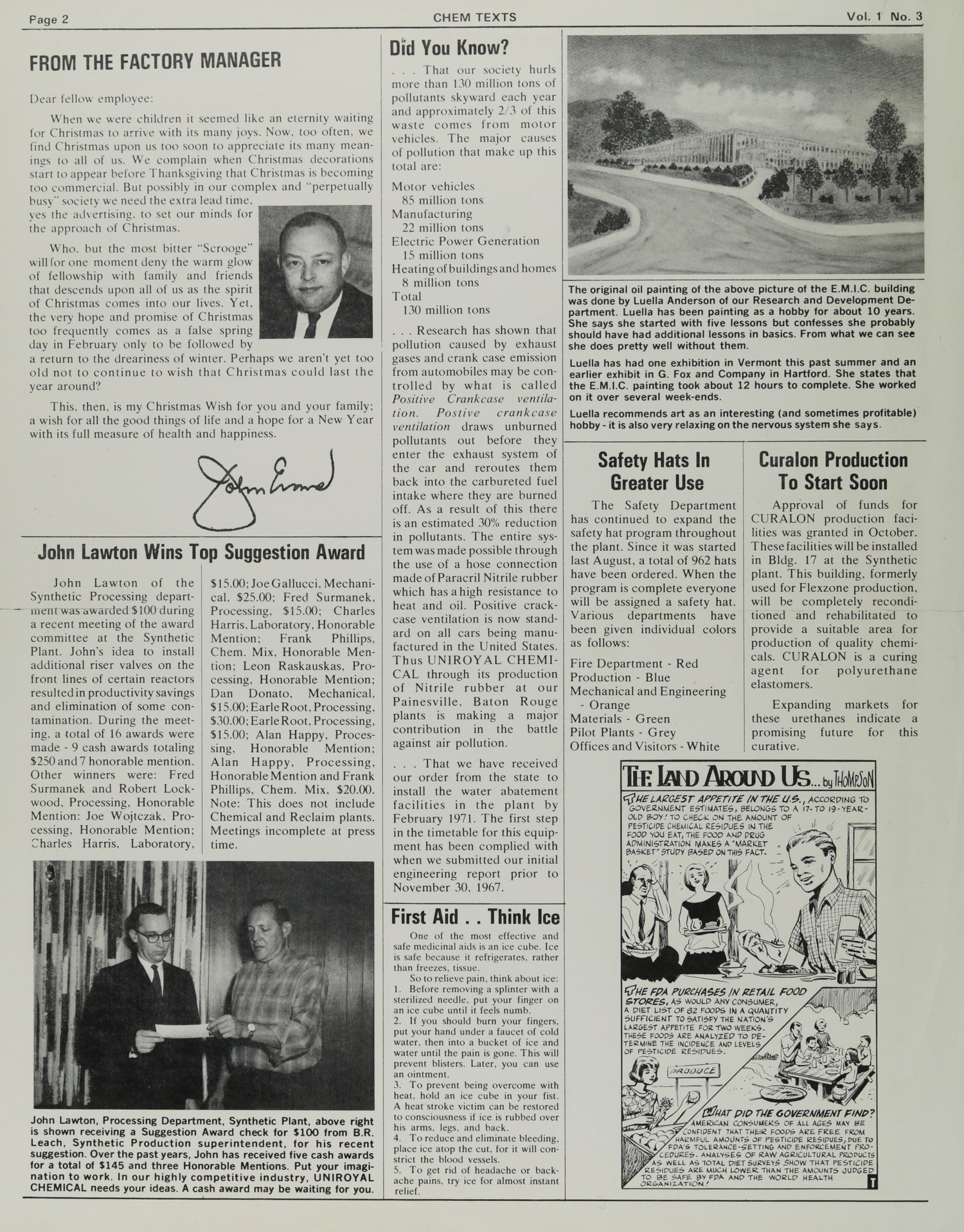
[Photo of E.M.I.C. building with caption:]
The original oil painting of the above picture of the E.M.I.C. building was done by Luella Anderson of our Research and Development Department. Luella has been painting as a hobby for about 10 years. She says she started with five lessons but confesses she probably should have had additional lessons in basics. From what we can see she does pretty well without them.

Luella has had one exhibition in Vermont this past summer and an earlier exhibit in G. Fox and Company in Hartford. She states that the E.M.I.C. painting took about 12 hours to complete. She worked on it over several week-ends.

Luella recommends art as an interesting (and sometimes profitable) hobby – it is also very relaxing on the nervous system she says.


Safety Hats In Greater Use

The Safety Department has continued to expand the safety hat program throughout the plant. Since it was started last August, a total of 962 hats have been ordered. When the program is complete everyone will be assigned a safety hat. Various departments have been given individual colors as follows:

Fire Department – Red
Production – Blue
Mechanical and Engineering – Orange
Materials – Green
Pilot Plants – Grey
Offices and Visitors – White


Curalon Production To Start Soon

Approval of funds for CURALON production facilities was granted in October. These facilities will be installed in Bldg. 17 at the Synthetic plant. This building, formerly used for Flexzone production, will be completely reconditioned and rehabilitated to provide a suitable area for production of quality chemicals. CURALON is a curing agent for polyurethane elastomers.

Expanding markets for these urethanes indicate a promising future for this curative.


THE LAND AROUND US… by ThOMEron

[Comic strip panel 1:]
THE LARGEST APPETITE IN THE U.S., ACCORDING TO GOVERNMENT ESTIMATES, BELONGS TO A 17-TO 19-YEAR-OLD BOY! TO CHECK ON THE AMOUNT OF PESTICIDE CHEMICAL RESIDUES IN THE FOOD YOU EAT, THE FOOD AND DRUG ADMINISTRATION MAKES A “MARKET BASKET” STUDY BASED ON THIS FACT.

[Comic strip panel 2:]
THE FDA PURCHASES IN RETAIL FOOD STORES, AS WOULD ANY CONSUMER, A DIET LIST OF 82 FOODS IN A QUANTITY SUFFICIENT TO SATISFY THE NATION’S LARGEST APPETITE FOR TWO WEEKS. THESE FOODS ARE ANALYZED TO DETERMINE THE INCIDENCE AND LEVELS OF PESTICIDE RESIDUES.

[Image shows produce]

[Comic strip panel 3:]
WHAT DID THE GOVERNMENT FIND?
AMERICAN CONSUMERS OF ALL AGES MAY BE CONFIDENT THAT THEIR FOODS ARE FREE FROM HARMFUL AMOUNTS OF PESTICIDE RESIDUES, DUE TO EPA’S TOLERANCE-SETTING AND ENFORCEMENT PROCEDURES. ANALYSES OF RAW AGRICULTURAL PRODUCTS AS WELL AS TOTAL DIET SURVEYS SHOW THAT PESTICIDE RESIDUES ARE MUCH LOWER THAN THE AMOUNTS JUDGED TO BE SAFE BY EPA AND THE WORLD HEALTH ORGANIZATION.

CHEM-TEXTS – Vol. 1 No. 3 – Page 3

Page 003

CHEM TEXTS

Vol. 1 No. 3 | Page 3


Materials Department Saves Shoe Leather

Supervisor Frank Lynch is shown below with the first bicycle recently acquired by the Materials department. The vehicle is saving considerable walking and enables the supervisors in the department to save a lot of time in getting around the plant. Since this picture was taken, the department has received two additional bicycles and several other departments have indicated an interest in this method of in-plant travel.


Fireman On The Job 55 Years

On Monday, October 2, a fire in a bale of rubber in Mill Room “C” of the Reclaim production department touched off 3 sprinkler heads. The fire was contained by the sprinkler equipment and extinguished by the fire department with no resulting damage. When the spent heads were replaced one of them was found to have a 1912 date (all sprinkler heads are stamped with their date of manufacture and back in those days were installed the same year they were produced).

Our insurance carrier has suggested that we replace all of the old sprinkler heads in the Reclaim department with modern up-to-date units. This project will get underway soon; meanwhile, the old timers on the job after over 50 years still give us 100% protection.


Old Timers Corner

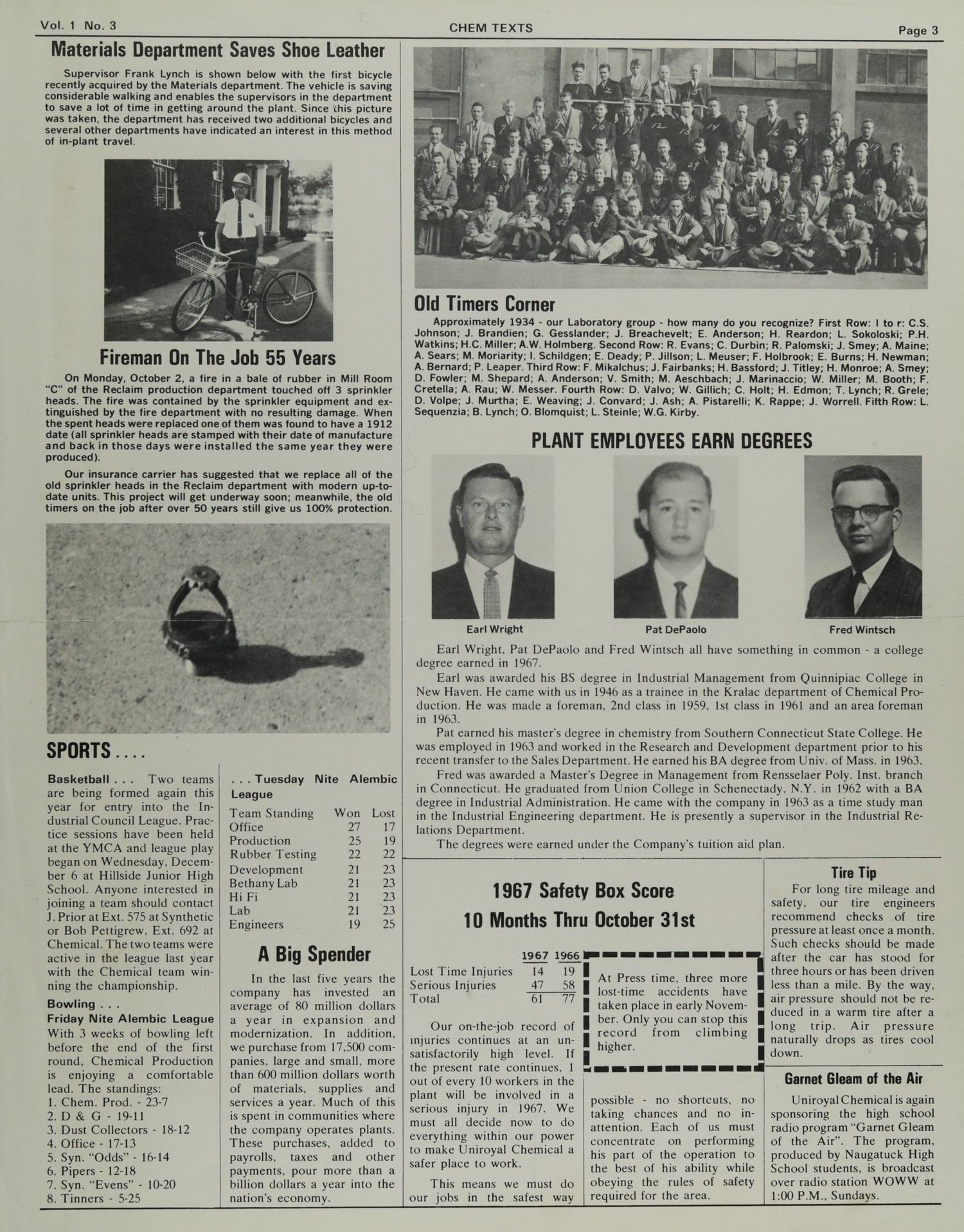
Approximately 1934 – our Laboratory group – how many do you recognize? First Row: l to r: C.S. Johnson; J. Brandien; G. Gesslander; J. Breachevelt; E. Anderson; H. Reardon; L. Sokoloski; P.H. Watkins; H.C. Miller; A.W. Holmberg. Second Row: R. Evans; C. Durbin; R. Palomski; J. Smey; A. Maine; A. Sears; M. Moriarity; I. Schildgen; E. Deady; P. Jillson; L. Meuser; F. Holbrook; E. Burns; H. Newman; A. Bernard; P. Leaper. Third Row: F. Mikalchus; J. Fairbanks; H. Bassford; J. Titley; H. Monroe; A. Smey; D. Fowler; M. Shepard; A. Anderson; V. Smith; M. Aeschbach; J. Marnuccio; W. Miller; M. Booth; F. Cretella; A. Rau; W. Messer. Fourth Row: D. Valvo; W. Gillich; C. Holt; H. Edmon; T. Lynch; R. Grele; D. Volpe; J. Murtha; E. Weaving; J. Convard; J. Ash; A. Pistarelli; K. Rappe; J. Worrell. Fifth Row: L. Sequenzia; B. Lynch; O. Blomquist; L. Steinle; W.G. Kirby.


PLANT EMPLOYEES EARN DEGREES

Earl Wright | Pat DePaolo | Fred Wintsch

Earl Wright, Pat DePaolo and Fred Wintsch all have something in common – a college degree earned in 1967.

Earl was awarded his BS degree in Industrial Management from Quinnipiac College in New Haven. He came with us in 1946 as a trainee in the Kralac department of Chemical Production. He was made a foreman, 2nd class in 1959, 1st class in 1961 and an area foreman in 1963.

Pat earned his master’s degree in chemistry from Southern Connecticut State College. He was employed in 1963 and worked in the Research and Development department prior to his recent transfer to the Sales Department. He earned his BA degree from Univ. of Mass. in 1963.

Fred was awarded a Master’s Degree in Management from Rensselaer Poly. Inst. branch in Connecticut. He graduated from Union College in Schenectady, N.Y. in 1962 with a BA degree in Industrial Administration. He came with the company in 1963 as a time study man in the Industrial Engineering department. He is presently a supervisor in the Industrial Relations Department.

The degrees were earned under the Company’s tuition aid plan.


SPORTS….

Basketball… Two teams are being formed again this year for entry into the Industrial Council League. Practice sessions have been held at the YMCA and league play began on Wednesday, December 6 at Hillside Junior High School. Anyone interested in joining a team should contact J. Prior at Ext. 575 at Synthetic or Bob Pettigrew, Ext. 692 at Chemical. The two teams were active in the league last year with the Chemical team winning the championship.

Bowling…
Friday Nite Alembic League
With 3 weeks of bowling left before the end of the first round, Chemical Production is enjoying a comfortable lead. The standings:
1. Chem. Prod. – 23-7
2. D & G – 19-11
3. Dust Collectors – 18-12
4. Office – 17-13
5. Syn. “Odds” – 16-14
6. Pipers – 12-18
7. Syn. “Evens” – 10-20
8. Tinners – 5-25

…Tuesday Nite Alembic League

Team Standing Won Lost
Office 27 17
Production 25 19
Rubber Testing 22 22
Development 21 23
Bethany Lab 21 23
Hi Fi 21 23
Lab 21 23
Engineers 19 25

A Big Spender

In the last five years the company has invested an average of 80 million dollars a year in expansion and modernization. In addition, we purchase from 17,500 companies, large and small, more than 600 million dollars worth of materials, supplies and services a year. Much of this is spent in communities where the company operates plants. These purchases, added to payrolls, taxes and other payments, pour more than a billion dollars a year into the nation’s economy.


1967 Safety Box Score

10 Months Thru October 31st

1967 1966
Lost Time Injuries 14 19
Serious Injuries 47 58
Total 61 77

Our on-the-job record of injuries continues at an unsatisfactorily high level. If the present rate continues, 1 out of every 10 workers in the plant will be involved in a serious injury in 1967. We must all decide now to do everything within our power to make Uniroyal Chemical a safer place to work.

This means we must do our jobs in the safest way possible – no shortcuts, no taking chances and no inattention. Each of us must concentrate on performing his part of the operation to the best of his ability while obeying the rules of safety required for the area.

At Press time, three more lost-time accidents have taken place in early November. Only you can stop this record from climbing higher.


Tire Tip

For long tire mileage and safety, our tire engineers recommend checks of tire pressure at least once a month. Such checks should be made after the car has stood for three hours or has been driven less than a mile. By the way, air pressure should not be reduced in a warm tire after a long trip. Air pressure naturally drops as tires cool down.


Garnet Gleam of the Air

Uniroyal Chemical is again sponsoring the high school radio program “Garnet Gleam of the Air”. The program, produced by Naugatuck High School students, is broadcast over radio station WOWW at 1:00 P.M., Sundays.

CHEM-TEXTS – Vol. 1 No. 3 – Page 4

Page 004

Page 4

CHEM TEXTS


What Would Some Company-Paid Benefits Cost If You Bought Them Yourself?

Have you ever wondered what some of your company-paid employe benefits would cost if you had to buy them yourself?

If you’re anything like the average wage employe – – a 40-year old married man with two children, 10 years of service and earnings of $550 a month – – the cost would be virtually prohibitive. You would have to pay about one-sixth of your yearly earnings – – $1,128.80, to be exact – – for protection that wouldn’t be nearly as good as the benefits provided free by the company. And we’re talking about only some of the benefits. The cost would be much greater if we included all of the benefits that Uniroyal provides for employes.

Let’s suppose that as an average employe you had to purchase your own pension, life insurance, accidental death and dismemberment insurance, hospital and surgical coverage, and accident and sickness insurance. For these benefits alone, here is what you would have to pay for the best comparable protection.

Pension: $509 a year until retirement. That is the cost of an annuity that would equal your present free pension benefit of almost $200 a month under the new plan. If you had the will power, you could put the same amount into a savings account or buy stocks regularly through a broker.

Life and Accidental Death and Dismemberment Insurance: $102.04 a year. This amount will buy a $7,500 term life insurance policy, $7,500 non-occupational AD & D coverage and $3,750 occupational AD & D. In addition, you would have to submit medical evidence of insur-

ability. The company’s insurance does not require this.

Hospital and Surgical: $407 a year. This is a vital benefit. The company’s plans provide full payment of the usual and customary surgical fees in your area as well as full payment of a semi-private hospital room and other hospital charges for 730 days. The best comparable protection you could buy would provide a schedule of surgical payments – – a certain amount of money for certain kinds of medical services – – and a semi-private room with a limit on daily room and board charges. Obviously, the Uniroyal plan provides much more comprehensive protection for you and your family.

Accident and Sickness Insurance: $110.76 a year. This would provide $70 a week for 39 weeks in the event of disability or illness.

“This is only a partial list of company-paid benefits, those you can purchase yourself,” said N.H. Fletcher, director of pensions, insurance and employe benefits at ‘1230’. “Other important benefits which the company pays for or contributes to include paid vacations, nine paid holidays, supplemental unemployment benefits, Social Security taxes, unemployment compensation, bereavement pay and many others. To really match the company’s benefits program, employes would have to be so wealthy that they could afford to be self-insured.”

The answer to our original question of what some of your benefits would cost if you had to buy them yourself, should be evident by now. They would cost a great deal more than most of us realize and a lot more than most people can afford.


WANT AD SECTION

This section of Chem-Texts will be set aside in each issue as a curtesy to our employees. Ads of 15 words or less about items wanted or to sell or trade will be published on a first come-first serve basis. They will be run in one issue only and should be re-submitted if you wish them published in later issues. Send all information to R.F. Shortt, Industrial Relations department. Remember, your signature must be included on your ad application or it will not be used.

. . . . . . . . . . . . . . . . . . . . . . . . . . . . . . . . . . . . . . . . . . . . . . . . . . . . . . . .

. . . . . . . . . . . . . . . . . . . . . . . . . . . . . . . . . . . . . . . . . . . . . . . . . . . . . . . .

. . . . . . . . . . . . . . . . . . . . . . . . . . . . . . . . . . . . . . . . . . . . . . . . . . . . . . . .

. . . . . . . . . . . . . . . . . . . . . . . . . . . . . . . . . . . . . . . . . . . . . . . . . . . . . . . .

Name . . . . . . . . . . . . . . . . . . . . . . . . . . . . . . . . . . . . . . . . . . . . . . .

Address . . . . . . . . . . . . . . . . . . . . . . . . . . . . . . . . . . . . . . . . . . . . .

Phone . . . . . . . . . . . . . . . . . . . . . . . . . . . . . . . . . . . . . . . . . . . . . .

Signature . . . . . . . . . . . . . . . . . . . . . . . . . . . . . . . . . . . . . . . . . . . .


Uniroyal Plans Promotion Through Major League Baseball

Baseball will sell a lot of our products next year – – and our company will sell a lot of baseball.

Working with major league baseball and The Reader’s Digest, the company will produce a 40-page detachable section about baseball and Uniroyal products that will be published in the May 1968 issue of the Digest. Twenty of the pages will feature by-lined articles about baseball written by noted sports experts, leading feature writers and outstanding baseball personalities. The remaining 20 pages will highlight the company and its major consumer and industrial products, such as Uniroyal Master, Tiger Paw and Rain tires, Keds and Naugahyde.

The Reader’s Digest has a monthly circulation over 17 million, the largest in the world, and a total readership in excess of 50 million.

The insert will form the basis of a promotional program that will last for the entire baseball season, which is the major selling season for many of our products. Several million reprints of the insert will be distributed by the company at ball parks and dealer outlets, affording long-term promotional opportunities for Uniroyal products at the retail level.

According to J.R. McMenamin, director of advertising, the promotion will be “the most exciting program we have ever sponsored. Since baseball has universal appeal, this booklet will make fascinating reading for all members of the family. In it will be articles of great interest not only to the avid fan, but to women who may know nothing about the game, as well as tips for Little Leaguers, teenagers and the kid who never held a bat.”

Baseball Commissioner William D. Eckert noted that the tie between baseball, Uniroyal and The Reader’s Digest is appropriate. Some 70 million spectators have enjoyed major and minor league baseball during the past two years, making baseball America’s favorite sport by far. We are pleased to be associated with such outstanding companies as Uniroyal and The Reader’s Digest, which will carry the fun and excitement of baseball to families throughout the nation.”


DON’T FORGET . . . .

One Gift Works Many Wonders

UNITED

WE GIVE

Naugatuck Chemical United Givers Campaign 1968

Get those contributions or pledge cards in to your area representative or the Industrial Relations department. Let’s make sure we again give a good account of ourselves in this worthwhile cause.


TEST FIRES

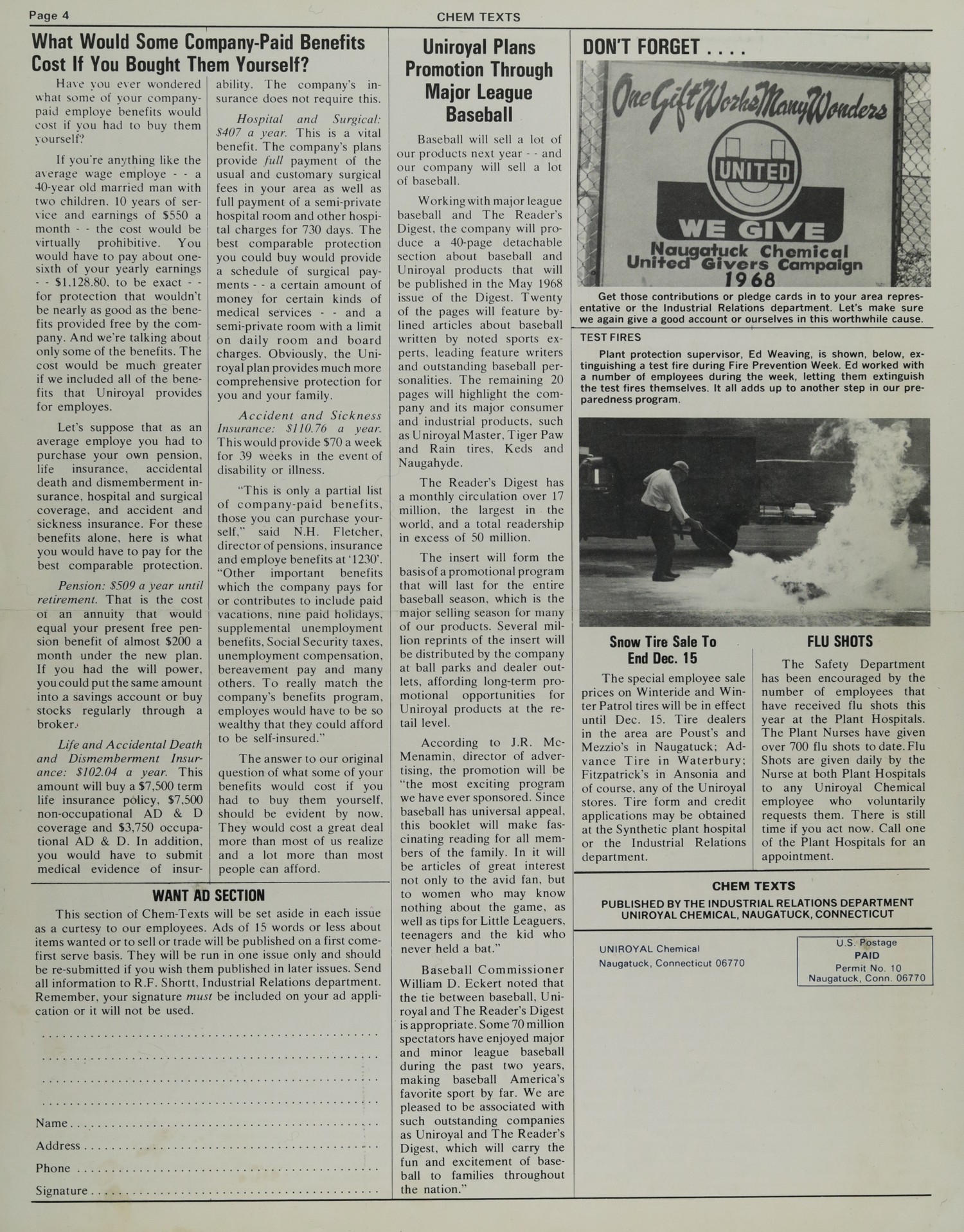
Plant protection supervisor, Ed Weaving, is shown, below, extinguishing a test fire during Fire Prevention Week. Ed worked with a number of employees during the week, letting them extinguish the test fires themselves. It all adds up to another step in our preparedness program.

[PHOTO: Man extinguishing fire]


Snow Tire Sale To End Dec. 15

The special employee sale prices on Winteride and Winter Patrol tires will be in effect until Dec. 15. Tire dealers in the area are Poust’s and Mezzio’s in Naugatuck; Advance Tire in Waterbury; Fitzpatrick’s in Ansonia and of course, any of the Uniroyal stores. Tire form and credit applications may be obtained at the Synthetic plant hospital or the Industrial Relations department.


FLU SHOTS

The Safety Department has been encouraged by the number of employees that have received flu shots this year at the Plant Hospitals. The Plant Nurses have given over 700 flu shots to date. Flu Shots are given daily by the Nurse at both Plant Hospitals to any Uniroyal Chemical employee who voluntarily requests them. There is still time if you act now. Call one of the Plant Hospitals for an appointment.


CHEM TEXTS

PUBLISHED BY THE INDUSTRIAL RELATIONS DEPARTMENT
UNIROYAL CHEMICAL, NAUGATUCK, CONNECTICUT

UNIROYAL Chemical
Naugatuck, Connecticut 06770

U.S. Postage
PAID
Permit No. 10
Naugatuck, Conn. 06770

Local URW Answers Company’s Letter

Local URW Answers Company’s Letter

6-12-67

Raymond Mengacci Vice-President of Local #45, stated today he didn’t want to get into a debate with factory manager Mr. Jack Smith, or try to negotiate an agreement here in Naugatuck, especially through the newspapers, when both the Company and the Union committees are having a hard enough time in Cincinnati, Ohio, doing this, without interference that might hamper negotiations in any way in Cincinnati. But that he had no recourse other than to answer some of the statements made by Mr. Smith, in the letter that he sent out to the employes of the Naugatuck footwear plant and for publication in the newspapers.

Mr. Mengacci stated that when the Union netotiating committee left for Cincinnati they were going there for the sole purpose to make a sincere effort to negotiate a contract and wage agreement with the Uni-Royal Co. before the April 20th deadline. This was the only agreement that was discussed at the membership meeting of Local #45.

Negotiations began in Cincinnati on March 21, 1967, but it wasn’t until April 12, 1967 that the Company made its first and finale offer to the Union on contract and wages. This was eight (8) days before the deadline.

Mr. Mengacci stated never in all his experience on negotiating committees or that of Pres. Froehlich who has more than he, did they ever hear of anything like this the first offer was also the last. No one can call this negotiating. This has never been done before.

And it wasn’t until a few days later that the Union found out that this was being done in all of the “Big Five” (5) rubber companies, not just Uni-Royal.

The Union also found out that these Companies had made a mutual pact designed to protect any struck company against financial losses. We, in the Union, were always led to believe that these Companies were in competition with one another. This we found is not so, they have a much better Union than we have.

Mr. Smith also goes on to say in his letter, that the Company had made an effort to open the Pension and Insurance agreement with the Union so that they could negotiate all matters to a conclusion. This is correct. The Union informed the Company that this agreement does not terminate until Sept. 15, 1967, and that the Union was in no position to negotiate this agreement because first of all they had not discussed this with their membership to see what changes the members wanted to make. Also they had made no preparation whatsoever among themselves on Pension and Insurance to discuss this question intelligently with the Company.

Mr. Smith goes on to say in his letter, that the Union did not present to the Company their full proposal until 11 a.m. on April 19, just 37 hours before the strike deadline. This is correct but why was this so. The Union felt that if they received from the Company the correct interpretation of the Clauses that are in the Working agreement now, and the way they were intented to be interpreted, at least in the Unions viewpoint, before there was a change in the head negotiator for the Company, they would not have to make any changes.

But the Union found out that the Company’s new Head Negotiator was not giving the same interpretation, so therefore, the Union had to come in with some new proposals. The Union would not be able to live with some of the interpretation the new Company Head Negotiator was giving, and all these interpretations were under Article nine (9) Working Condition, which are very important to our members.

Just ask some of our members especially those that work in the Making and Stitching Departments what conditions that they have to work under. Production in many cases have increased by 25 to 30 per cent in the last few years. This is with the same number of operators and in many cases less. Many of these employees can tell you that their weekly earnings are less now even though they received two wage increases in the past few years. This is all because they cannot make any-

where near the efficiency’s that they were making a few years ago. This is the reason why the Union had to make some late proposals to the Company. But if the Company wanted to make a sincere effort to reach an agreement they still had plenty of time to do so.

Now let’s talk about the difference in wage increases between the tire plants and the non-tire plants. We have asked the Company many times to open up their books in Naugatuck. If they can show the Union that they are losing money or are not making the profits that they are entitled to make, then the Union would take another look at their demands for uniform wage increases. This they have refused to do, so therefore the Union does not believe that the non-tire plants are putting the UniRoyal Company in a severe economic squeeze if they grant the same increases as tires.

As long as we are talking about wages increases, it is very interesting to not that President George R. Vila‘s wages were increased from $168,821 in 1965 to $239,033 in 1966 this a $70,212 increase or 41.6% in one year. Also Vice-

Please Turn to Page 12


Widzionjez Trial

Rubber-Labor Pact Is Possible This Week; General Tire Increases Its Offer to Union

6-12-67

Rubber-Labor Pact Is Possible This Week; General Tire Increases Its Offer to Union

By a WALL STREET JOURNAL Staff Reporter

AKRON—After a week of marked progress in negotiations, the United Rubber Workers union and five major rubber companies will reopen bargaining sessions at 10 a.m. today with some expectation of reaching a single-package settlement covering wages, pensions and welfare benefits before another week passes.

A settlement would end the strike against three of the major concerns—Firestone Tire & Rubber Co., Uniroyal, Inc. and B. F. Goodrich Co.—which has idled 51,000 workers for 53 days since former contracts expired April 20. It would also conclude negotiations with Goodyear Tire & Rubber Co. and General Tire & Rubber Co., where production has continued on a day-to-day basis despite similar contract expirations.

Separate bargaining sessions with the five companies began making headway last week. Management offered wage boosts totaling 38 cents an hour for tire workers and 31 cents for other production workers over three years, plus pension-and-welfare-contract improvements. The package was technically rejected by the union as inadequate, but it opened the door to several counter proposals presumably being studied by the companies.

Differentials an Obstacle

At the weekend, General Tire was said to have sweetened its offer on several points, boosting the pay proposal for tire workers to 40 cents an hour over three years and offering further pension, vacation and supplemental unemployment benefit payments. General’s contract negotiations, however, cover only 3,000 workers in two tire plants, in Akron and Waco, Texas, while those of the four other concerns cover other production workers as well. The proposed differentials between tire workers and other production employes could still be a difficult obstacle in this week’s talks.

General’s wage offer for tire workers would break down to 15 cents in 1967, 13 cents in 1968 and 12 cents in 1969. The 38-cent offer of the other concerns comprises 16 cents this year and 11 cents in each of the next two years.

Peter Bommarito, URW international president, termed the offers of the four companies, other than General, as representing a gain of less than 4.5% compared with what he said has been a 5.8% raise granted in other manufacturing industries. He also called for the naming of an independent fact-finding board to determine the “fairness” of the union’s demands.

Uniroyal, in a letter to employes, put the gain in wage and other improvements at “about 5%” and said its offer would cost the company about 70 cents an hour, the largest proposal it had ever made to the union. Firestone and Goodrich also sent letters to employes discussing the negotiations, with Goodrich also putting its offer as “in line with the 5% pattern” set in other industries.

Another improvement in General’s weekend offer, which Mr. Bommarito yesterday called “attractive” as a basis for a settlement, was an improvement in supplemental unemployment benefits payments providing for 80% of average straight-time pay for laid-off workers or for those on short workweeks; this total would include unemployment compensation. Offers of the other companies had provided for up to 75% of straight-time pay. The previous contract called for up to 65% plus $2 for each dependent up to four.

The union has demanded as a “full employment” plan, or guaranteed annual wage, payments of up to 95% of regular straight-time pay for laid-off workers, including unemployment compensation. The union has put the company cost for this at 7 cents an hour per worker, up from the present 5 cents. The companies’ offer has been about 6 cents.

General’s offer also included a provision for six weeks’ vacation after 30 years’ service and two weeks after one year’s, along with existing intermediate vacations. The other companies made no provision for six weeks’ vacation but offered three weeks after five years’ service, along with other existing vacation allowances.

The pension-payment propsosal by General also was a bit higher than the increase to $5.25 per month from $3.25 for each year of service proposed by the others. Though the General amount wasn’t specified, it was understood to be close to $5.50 per month for each year of service.

Mr. Bommarito also disputed the companies’ claims that their “total-package” offers represented employment-cost increases of 70 cents an hour. He estimated them at about 64 cents for General’s package and 60 cents for the others.

Other Benefits

All the offers also included improvements in life insurance, hospitalization, sickness and accident insurance, an additional increase of 10 cents an hour for skilled tradesmen and improvements in grievance-pay allowances.

Should a settlement be achieved on a “single-package” basis, it would be the first time in the rubber industry. Pension and welfare matters have previously been reserved to a separate contract, the existing one due to expire next Sept. 15. Previously, however, the wage contract and pension agreements have expired on at least alternate years. The proximity of the pension-contract expiration this year to the wage contract’s conclusion was held to be an obstacle to an earlier settlement on wages.

The companies acknowledged they were reluctant to “expose” themselves to a substantial wage-cost increase only to be faced in a few months with another strike threat over pension and other welfare matters. Until two weeks ago, however, the union apparently had been adamant about keeping the two contracts separate.

Fourth Rubber

Fourth Rubber

6-17-67

Continued From Page 1

from rubber workers had been approved by mid-week, and a big influx of further applications had come in since then.

She said the county at first requested rubber workers to spend strike benefits for shelter and utilities and use public assistance for food.

“But now,” she said, “The benefits are so low they do not meet the other bills.”

Union-paid strike benefits totalled $25 at the start of the strike. They were cut to $15 this week and were expected to go lower, and possibly end, in a few weeks.

The URW struck the Firestone Tire & Rubber Co., the B.F. Goodrich Co. and UniRoyal Inc. on April 20 when wage contracts expired. Contracts with Goodyear Tire & Rubber Co. and General Tire & Rubber Co. also expired, but work has continued on a day-to-day basis.

In Connecticut the strike has crippled production at three UniRoyal plants in Naugatuck.

The union’s treasury, which contained about $6.5 million at the start of the strike, has been reduced at a rate of $1.25 million a week. Union President Peter Bommarito recently turned down an offer of a loan or a gift from the United Auto Workers strike fund. Speculation here places the refusal to a wish not to be obligated to Walter Reuther in his feud with the leaders of the AFL—CIO.

The companies have offered hourly wage increases of 38 cents over a three-year contract period to rubber workers, who average $3.69 hourly. To non-tire workers, the companies have offered 31-cent increases. These workers average $2.68 hourly.

The union contended the offer was not in line with the 5 per cent wage increases granted in other industries.

“Show Cause” Hearing Scheduled Today

Rubber Strike

6-27-67 (handwritten)

“Show Cause” Hearing Scheduled Today

UniRoyal management and officials of Local 45, United Rubber Workers Union (URW), were scheduled to appear in Superior Court in Waterbury today for a “show cause” hearing instigated by the union last week when it accused the rubber firm of violating a written agreement between the two parties.

Superior Court Judge Leo V. Gaffney called the hearing for today when union officials sought an injunction and restraining order to keep UniRoyal non-bargaining personnel from running production lines.

Union leaders said they had a written agreement with UniRoyal that in return for an “orderly shutdown” of the firm’s footwear division here in the event of a strike, UniRoyal promised not to engage in production in non-bargaining unit personnel.

The union charged last week that production was going on in the concern by management in violation of the agreement.

In court last week, Judge Gaffney said he would not hesitate to issue the injunction and restraining order against UniRoyal if the union could produce evidence that the firm violated the agreement following the court appearance.

It is expected that today’s hearing will be continued, placing the company and the union on similar grounds.

Earlier in the 60-plus-day-old strike, UniRoyal sought an injunction and restraining order against the union, charging mass picketing and violation of the law in keeping management from the plant.

In court appearances at that time, the court continued the matter as long as there was no more violation of the court’s instructions to the union not to hinder management from entering or leaving the UniRoyal plants.


AKRON, Ohio (UPI) — A busload of union members were hauled into court today when they refused to disband in violation of an injunction limiting pickets at the Firestone Tire & Rubber Co. plant.

The injunction against mass picketing was issued Monday by Summit County Judge Frank Harvey. His order limited pickets to two at each gate of the Firestone plant.

About 100 pickets, members of the United Rubber Workers, showed up at the plant this morning. Summit County Prosecutor James Barbuto and Major Alan Morrison, acting for Sheriff James Campbell, also appeared at the plant.

Barbuto read the injunction notice to the pickets and they were ordered to disband. When

Please Turn to Page 12

Judge Delays Ruling

Judge Delays Ruling

In Uniroyal Case

Judge Delays Ruling

6-29-67 (handwritten)

A decision on whether Uniroyal, Inc. should be restrained by court order from resuming production at its strikebound Naugatuck Footwear Plant will not be rendered for at least a week.

Superior Court Judge Leo V. Gaffney said at the close of a hearing Wednesday on a petition by Local 45 of the United Rubber Workers Union for an injunction against the company, that his decision can be expected by the end of next week.

He has given counsel for the company and the union until Wednesday to file legal briefs.

Judge Gaffney said his ruling will follow soon after receipt of the briefs, probably not later than Friday.

He added, however, “The best decision of all would come from Cincinnati” where negotiators have been trying to agree on a new union contract since the strike began April 21.

“I’d like to see that decision first,” he said.

The union asked for the injunction last week when the company began production of samples of its new footwear designs, using non-union supervisory personnel.

At an appearance in court last Thursday when the union’s petition was filed, the company agreed to halt production until after completion of a hearing before Judge Gaffney.

Violation Claimed

Local 45 claims production of the samples constitutes a violation of an agreement signed by the parties April 18.

The agreement, which provides for orderly shutdown and maintenance of the plant while the strike is in progress, states in part that for the duration of the strike, the company will not perform any work normally done by union employes with non-union personnel.

Testimony on the issue was completed Wednesday, with presentation of the company’s case.

Most of the testimony centered on two main points: That the company will suffer “severe damage” if it is not permitted

(Cont’d On Page 2—Uniroyal)


to make samples for use by its salesmen in obtaining orders from retailers; and that the company maintains that the union violated the agreement first and rendered it void when in early May pickets blocked entrance gates and violence erupted between strikers and police.

To company representatives, Judge Gaffney posed the question, “Did you ever write a letter to any union officer to the effect that the agreement was no longer in effect”

In each instance, the answer was, “No.”

At several points along the way he indicated that damage the company might suffer was not at issue in the case. He said the central issue was whether the agreement had been violated.

Whenever counsel for either Uniroyal or Local 45 dwelled too long on what the jurist described as “side issues,” he admonished them to “get back on the track, which is whether or not this contract has been violated.”

Financial Loss

Thomas J. Nelligan, labor relations manager, testified that the company will suffer a “very severe financial loss” forcing a “reduction in production” unless it is permitted to produce samples for its salesmen to “take into the field” in August.

He said the samples to be produced, between 400 and 500 pairs a day, would be for the spring and summer season next year.

Nelligan said the samples are normally made between April and July. He said they go out to the salesmen in August “when the entire industry” sends out its samples for retail orders.

Failure of the company to have samples to show its customers in August will mean “a very large reduction in the amount of production needed for the coming year, and in turn, ess employes,” Nelligan said.

Nelligan contended that the union stood to benefit if the injunction is not granted because production of samples leads to sales and “stable employment and perhaps increased employment.”

Operating under full capacity, the company is able to produce between 120,000 and 130,000 pairs of shoes a day, Nelligan said. He said the company wants to make up about 45,000 samples over a six-to-eight week period.


In response to questions from both union counsel Daniel Baker and Uniroyal counsel J. Kenneth Bradley, Nelligan said it would “not be practical or possible ” to produce the samples at some other Uniroyal plant other than Naugatuck.

Machinery Needed

He said machinery necessary for production is not available at other Uniroyal facilities.

Nelligan also was questioned at some length on meetings he attended May 8 and May 15 with other company officials and union leaders.

He said at a May 15 meeting, Jack Smith, plant manager, told the union “very emphatically” that the shutdown agreement had been broken when the union pickets blocked entrance gates.

He added that Smith also said that although he didn’t believe the agreement was in effect the company would still honor it.

He also admitted that “except for a few isolated instances” the union had complied with the agreement.

Smith denied that he ever said he would honor the agreement even though he felt it had been violated.

He said the union broke the agreement when the company announced in May that it would begin shipments from the plant. He said Raymond Mengacci, Local 45 vice president, warned that there would be nothing shipped from that facility. . ”

Smith testified that on the scheduled day of shipping, violence on the picket line prevented any shipments.

Smith contended that “We don’t have an agreement because the union chose to abrogate it and we consider ourselves to be relieved of any obligations under the agreement.”

Under cross-examination, Baker attempted to establish that the picket line violence resulted when the company allegedly broke a verbal agreement not to have any personnel in the plant after 6 p.m.

He asked both Nelligan and Smith about the alleged agreement and questioned them about “30 or 40 people” who were brought into the plant after 6 p.m. to begin preparations for shipment on the following day.

Donald Hadley, sales manager, claimed that between 50 and 60 per cent of the company’s business comes from sales of new styles.


Says Samples Vital

Responding to Bradley’s questions, he said without samples to show potential customers, damage to the company “conceivably could never be made up.”

It was at this juncture that Judge Gaffney reminded Atty Bradley that “it is the claimant (the union) not the defendant (Uniroyal) who has to show irreparable damage.”

Bradley said he wanted to show the company would suffer substantial harm if it can’t produce the samples.

“Then I would suggest,” the judge quipped, “that perhaps you should bring an injunction to stop the union from bringing this injunction.”

Brief testimony also was taken from Joseph J. Foley, a strike captain and member of the union negotiating committee.

Foley said, “I think there would be a lot of violence” if the court order is not issued, because the union “would have no way” of controlling the strikers.

Mengacci had predicted the same result in testimony Tuesday. He warned of “bloodshed in Naugatuck.”

Bradley questioned why, if union leaders were able to control the pickets after Judge Gaffney had cautioned them against violence in May, they could not control them in the future. He was not permitted to pursue that line of questioning any further.

The hearing concluded with a reaffirmation by the company that it “will not undertake to do anything” in the way of production until after the judge’s finding.

Rumors Of Production At UniRoyal Unfounded

Rumors Of Production At UniRoyal Unfounded

Rubber Strike

6-30-67

Rumors Of Production At UniRoyal Unfounded

Rumors were running hot and heavy around the borough this morning that work would begin at the UniRoyal Footwear plant next Wednesday.

The rumors were two-fold; first that settlement of the strike was imminent and the other version was that the Footwear plant would start production on its own.

However, Thomas Nelligan, labor relations manager of UniRoyal Footwear Plant, told the NEWS this morning, that to the best of his knowledge no production was anticipated at the plant Wednesday, either through the settlement of the strike or by the company.

The Footwear plant officials had asked Local 45 if it would permit oilers to come into the plant and lubricate machinery that had been standing idle for the 10-weeks of the strike, according to Nelligan. He said that as yet, the company, had not received an answer to this request from the Local.

Raymond Mengacci, vice-president of Local 45, verified the fact that the company had requested the union to allow mechanics to enter the plant for the purpose of maintaining the machinery. Mengacci said that he and other union officials toured the plant this morning to inspect the machinery. The union officials were meeting at press time today to decide on the request.

UniRoyal Footwear plant officials had agreed before Superior Court Judge Leo V. Gaffney, not to run production lines in the plant using non-bargaining personnel until the Judge has ruled on the application submitted to the court by Local 45 seeking a restraining injunction against the Footwear division of UniRoyal.

The issue in point in the restraining injunction is whether or not the company violated an agreement made with Local 45 on April 18 not to produce using non-bargaining unit personnel and whether or not the agreement was in effect or had been previously violated by the Local.

Factory Manager Jack Smith testified in court that he considered the agreement no longer in effect following the two days of violence in the first week of May. However, no written notice of this had been given to the Local, according to testimony, only an oral announcement.

Company officials repeatedly testified to the necessity of producing sample shoes and having them available by August 1. This, according to the company, would be to the benefit of union members as well as to the company.

This, Judge Gaffney said, was beside the point; the issue was the agreement of April 18 which called for an orderly shut-down and maintenance of the plant and orderly picketing in exchange for no production at the plant during the strike and permission for the union to make tours of inspection of the facilities during this period.

AKRON, Ohio (UPI)—Progress toward a wage contract settlement was at a standstill today in the 10-week-old strike by the United Rubber Workers Union (URW) against major rubber companies.

A spokesman for the URW said a wage offer of 43 cents an hour from the General Tire & Rubber Co. and 38 cents from the other four members of the rubbery industry’s “big five” remain unchanged.

Meanwhile, merchants and city officials here hoped the strike would end soon.

Finance Director Daniel Zeno said the walkout has reduced

Please Turn to Page 12

Rumors Of Production

6-30-67

Rumors Of Production

Continued From Page 1

the city’s income tax revenues.
The Chamber of Commerce said
retail store sales also dropped
off in May and June and banks
reported a heavy draw on savings.

It also was reported that
many wives of strikers had gone
to work and that strikers themselves were finding jobs.

URW President Peter Bommarito said Thursday that a $1
million check from the United
Auto Workers union to bolster
the URW’s nearly depleted
strike fund would enable the union to “carry out our strike benefit plan indefinitely.”

The union’s strike fund stood
at $6.5 million when the strike
began.

About 50,000 rubber workers
were on strike against Firestone Tire & Rubber Co., B.F.
Goodrich and Uniroyal. The
firms were struck April 20.

Another 4,000 workers were
idled last week when the union
struck two plants of the General Tire & Rubber Co.

Work at the Goodyear Tire &
Rubber Co. continued on a day-
to-day basis.

Peace resumed in Akron
Thursday after mass picketing
incidents the last two days. Local 5 members met with union
officials and Summit County
Prosecutor James Barbuto and
aired a list of grievances that
triggered the picketing. Included was a charge college students were hired to do production work, which was denied.

Uniroyal, URW to File Briefs In Union Injunction Request

Uniroyal, URW to File Briefs In Union Injunction Request

Uniroyal, URW to File Briefs In Union Injunction Request

6-2-67 [handwritten date in top right corner]

Uniroyal and the striking United Rubber Workers have until Wednesday to file briefs arguing whether the company should be forbidden to make footwear samples at the Naugatuck plant during the strike.

Judge Leo V. Gaffney in Waterbury Superior Court yesterday set the Wednesday deadline, as he reserved decision on a union request for an injunction to halt the production of sample shoes.

The judge said he would rule on the injunction request by the end of next week.

The company has stopped production of sample shoes, pending the court’s decision.

Joseph Foley, picket captain of striking Local 45, testified yesterday that violence might result if supervisory personnel continued to produce shoe samples. He was supported by Raymond Mengacci, union vice president.

Jack M. Smith, manager of and Thomas J. Nelligan, industrial relations supervisor, said the company would suffer serious loss of business unless it continued to produce shoe samples. They said such business loss might force a reduction of employment.

Views Of The Naugatuck UniRoyal Strike Are Given In Nationwide Story By United Press International

Views Of The Naugatuck UniRoyal Strike Are Given In Nationwide Story By United Press International

Views Of The Naugatuck UniRoyal Strike Are Given In Nationwide Story By United Press International

7-11-67 [handwritten date in top right]


EDITORS:

The industrial city of Naugatuck is in the steel grip of a 13 week strike involving 5,500 members of the United Rubber Workers Union of America and the area’s chief employer, the UniRoyal plant. The economic crush is reflected in various ways with the situation approaching the crisis stage for some, an occurrence unmatched during the Depression or in 1959 when a strike lasted three weeks. “Hell,” says one man,” that was just pie and ice cream compared to this.” Here is a special report.

By JAMES V. HEALION
UPI Hartford
NAUGATUCK, Conn. (UPI)— Anvil Agastio goes through the motions of wiping a counter top in his sandwich shop across the street from Building 2 with its blue-paneled windows. His shop both is empty and in pin-drop silence he says, “We probably feel the strike more than anybody else.” He glances at the chairs piled atop the tables and says, “We opened up two days after the strike began.”

Nearby is the small department store of William Rosenblatt, which has been in his family for 50 years. It is crammed chock-full of wearing apparel much of which he purchased before the strike began, April 20.

“Even the Depression wasn’t as bad as this. There’s nothing you can do but hope.” Rosenblatt points to the mounds of clothing, the dresses, the shoes. “Business is off 40 per cent,” he says.

“Look, if people aren’t working, they can’t buy. They make payments and you get new business. His shop both ways. I’m not pressing anybody for money. I know they haven’t got it. It’s bad, bad, I’m telling you,” he said.

Behind in Bills

A housewife whose husband is employed at the UniRoyal plant says, “We’re getting pretty far behind in our bills. I’ve got two children, one in college and one in high school. If this thing isn’t settled pretty soon, I’m not sure the one in college is going to be able to go back.”

Even if the negotiators in Akron, Ohio, do reach agreement in the next two weeks, it seems apparent that the plant would not return to normal until almost Labor Day because the annual vacation shutdown begins July 28.

The economic loss due to the strike is reflected in odd ways: short collections in the city’s churches; parking meter revenue is off 40 per cent, and in Sullivan’s tap room, they’re drinking beer instead of whiskey.

One big name in the strike is not connected with the rubber workers union. It is that of Walter Reuther, president of the United Auto Workers, which issued an interest-free loan of $1 million to the strikers.

This is sometimes praised; sometimes criticized.


[PHOTO: Black and white headshot of a man in a suit]

JAMES HEALION


“They say you shouldn’t look a gift horse in the mouth but Walter Reuther knows how to win friends and influence people. It could be that he might just want to take us under his wing,” says one striker.

This theory seems to have an element of possibility in it however remote, since the rubber workers appear more aligned with Reuther’s union than any other union, except their own, because a good portion of UniRoyal’s products are for the automobile industry.

The company itself is feeling the stinging impact of the strike in all its departments especially, however, in its footwear division, which is known as the mother plant. This division produces the “Keds” brand of sneaker, in addition to others.

At this time of year, 250 to 300 salesmen are on the road showing their samples to prospective buyers in the nation’s stores but this is not so this year because of an agreement being contested in the courts which stipulates the samples may not be produced during the strike.

Salesmen Idle

UniRoyal, thus, is the only one of the big rubber companies whose salesmen are not displaying their footwear lines. The effect will probably be felt through the autumn and into the Christmas season, according to one source.

Another source says that when the strike ends, the company expects to recruit about 500 new employes for the ones known to have found other full-time employment since the walkout began in April.

Thomas G. Hogenauer, manager of the State Employment Office in nearby Waterbury, says about 200 rubber workers applied for part-time work since the strike started. Forty found work through the office.

There appears to be no surface hard core animosity borne by any of the parties to the strike. The local, in fact, allowed 25 mechanics and millwrights to go into the plant recently to oil and maintain machines that otherwise might have rusted or fouled.

Shipping Goods

While the plant is not manufacturing, supervisory personnel are shipping merchandise. Seventy-five per cent of the incoming orders are being filled, according to one source.

The spinoff effect of the strike is felt in the stores, the service stations and the supermarkets, where layoffs in the city’s two largest stores have occurred.

Lester Odell, who operates a service station, says,”The strike has slowed everything down.” His business has been out by 50 to 60 per cent, he says, “I wish to God it would be over tomorrow.”

Maryann San Angelo, who operates a beauty parlor, says she has about 75 UniRoyal customers — the plant employes about 1,000 women. “Some have stopped coming in and won’t be back until the strike ends. However, we have taken several on credit — we think we should do that much for them,” she says.

Banks Concede

The lending institutions in the city are making concessions. John G. Moni, a vice president of the Naugatuck Savings Bank, says “there is a reverse psychology in this kind of circumstance. Everybody is not trying to withdraw, they’re trying to save. It’s a disaster, in essence.”

Please turn to Page 10

Wants Fellow Rubber Workers To Help End The Strike

7-13-67

Wants Fellow Rubber Workers To Help End The Strike

To the Editor of The Republican:

The time has come for us rubber workers to get together and let our bargaining negotiators in Cincinnati know that the strike is going on too long with no settlement in sight.

The money we workers lost will never be regained regardless of what the settlement will be. The longer the strike continues, the more we will lose. They talk about a fair and just settlement.

I don’t think it is fair and just for us workers who have to use our life’s savings after working so hard for it, and then go broke and in debt. Whoever is interested in getting back to work please send in a postcard to our Uniroyal


7-13-67

Letters To The Edit

negotiators in Cincinnati and ask them to get going for a quick settlement.

Give them seven days or we will take a vote to go back to work while they are negotiating, until a settlement is reached.

This way we will be earning wages and receive retroactive pay when the strike is over. This is plain common sense. Do it now. Enough time and money have been lost.

In my opinion the company is offering a fair and just settlement. I believe we should go back to work so that we could make sample footwear for the salesman to show to the buyers. This is to our own advantage and insures our jobs for the future.

I appeal to and urge every member to send in a postcard as soon as possible to Uniroyal negotiators in Cincinnati and let them know that we want to vote to go back to work and vote to accept the company offer.

ANTHONY ENSERO
Veteran worker of 31 years’ service
121 Tracy Ave.

Waterbury

Rubber Strike Talks Recess For Weekend

Waterbury American, Saturday, July 15, 1967—5

Rubber Strike Talks Recess For Weekend

AKRON, OHIO (UPI)—With the nation’s rubber production down to 25 per cent of its total, negotiators for four major tire companies and the striking United Rubber Workers (URW) took a weekend break.

There was little hope a tentative agreement reached Thursday with General Tire & Rubber Co. would pave the way for a settlement between the union and Uniroyal, B. F. Goodrich, Firestone and Goodyear.

General Tire’s 3,000 idled workers could return to their jobs Sunday night.

A pay raise differential between the tire and non-tire workers appeared to be the major stumbling block in talks with Goodyear, the largest producer.

Tire workers averaged $3.58 an hour under the old contract and non-tire employes $2.69 an hour.

Goodyear offered a 43-cent-an-hour wage increase to tire workers — the same as General — but two cents to less to non-tire workers.

The tire workers’ increase would go into effect in steps of 15, 15 and 13 cents over a three-year period. A Goodyear spokesman maintained that although the non-tire workers’ increase was two cents lower, it would go into effect sooner and, in effect, eliminate the differential.

Resume Monday

A union spokesman called the offer “substandard.” It was the final offer when negotiations broke up for the weekend. Talks resume Monday.

Uniroyal, B. F. Goodrich, and Firestone have been closed the past 12 weeks. Goodyear was closed early Friday, bringing the number idled to 76,000.

The URW general agreement included a supplemental unemployment benefit plan that will pay a worker laid off 80 per cent of his salary.

URW President Peter Bommarito said the plan “Makes it possible for the blue collar worker to plan his family expenditures for months ahead.”

The rubber strike appeared to pose no immediate threat to the automobile industry.

Auto factories one-by-one are halting production for the annual model changeover and large supplies of tires will not be needed until production of 1968 autos starts in August.

Rubber Negotiators

Naugatuck, Conn.

Established 1885

Rubber Negotiators

SATURDAY, JULY 15, 1967
10 PAGES
Price Seven Cents

Take Weekend Break

AKRON, Ohio (UPI) — With the nation’s rubber production down to 25 per cent of its total, negotiators for four major tire companies and the striking United Rubber Workers (URW) took a weekend break.

There was little hope a tentative agreement reached Thursday with General Tire & Rubber Co. would pave the way for a settlement between the union and Uniroyal, B.F. Goodrich, Firestone and Goodyear.

General Tire’s 3,000 idled workers could return to their jobs Sunday night.

A pay raise differential between the tire and non-tire workers appeared to be the major stumbling block in talks with Goodyear, the largest producer.

Tire workers averaged $3.68 an hour under the old contract and non-tire employes $2.69 an hour.

Goodyear offered a 43-cents-an hour to wage increase to tire workers—the same as General—but two cents less to non-tire workers.

The tire workers’ increase would go into effect in steps of 15, 15 and 13 cents over a three year period. A Goodyear spokesman maintained that although the non-tire workers’ increase was two cents lower, it would go into effect sooner and, in effect, eliminate the differential.

A union spokesman called the offer “substandard.” It was the final offer when negotiations broke up for the weekend. Talks resume Monday.

UniRoyal, B.F. Goodrich, and Firestone have been closed the past 12 weeks. Goodyear was closed early Friday, bringing the number ideled to 76,000.

The URW general agreement included a supplemental unemployment benefit plan that will pay a worker laid off 80 per cent of his salary.

URW President Peter Bommarito said the plan “makes it possible for the blue collar worker to plan his family expenditures for months ahead.”

The rubber strike appeared to pose no immediate threat to the automobile industry.

Auto factories one-by-one are Halting production for the annual model changeover and large supplies of tires will not be needed until production of 1968 autos start in August.


Raymond Mengacci, vice-president of Local 45, URW, said yesterday afternoon he had talked with George Froehlich, president of the Local and who is in Cincinnati, yesterday at noon time.

Froehlich told Mengacci the UniRoyal negotiators had asked for the afternoon off to discuss the offer made by General Tire and were expected to begin negotiations again this morning at 9 o’clock.

Mengacci said Froehlich told him the negotiating teams will keep talking “Saturday and Sunday, if necessary.”

Froehlich said he expected UniRoyal to make an offer to the URW very similar to that of General Tire.

Judge Issues Injunction Prohibiting Uniroyal From Resuming Production

Judge Issues Injunction Prohibiting Uniroyal From Resuming Production

7-17-67

Judge Issues Injunction Prohibiting Uniroyal From Resuming Production

A Superior Court injunction was issued today restraining Uniroyal, Inc., from resuming production at its strike-bound Footwear Plant in Naugatuck.

The order prevents the company from producing samples of its new line of footwear for distribution to potential buyers during the strike.

It enforces an agreement signed by the company and Local 45 of the United Rubber Workes Union April 18, three days before the current strike began. In that agreement the company said it would not perform any work done by bargaining-unit members by non-bargaining units members for the duration of the strike.

Judge Leo V. Gaffney said he was issuing the injunction in an attempt to forestall “acts of violence” by union members should the company be allowed to go into production with non-union help.

“If the company is not restrained from violating (the agreement),” the judge said, “all confidence (in the union) will be lost, its effectiveness as a bargaining unit will be destroyed and its control over its members will be lost, as well as any hope of restraining its members from acts of violence.”

As for the company’s claim that it would lose money through its failure to exhibit new samples to buyers, Judge Gaffney said “compare this with a destroyed bargaining unit which has enjoyed the trust and confidence of its members over a great many years.”

If the order had not been issued, Judge Gaffney said, the result “would necessarily lead to complete disillusionment of the union leadership by its rank and file members and would in-

(Cont’d on Page 8—Uniroyal)


Uniroyal 7-17

(Continued from Page One)

deed in the opinion of the court sound the death knell of its effectiveness.”

“Not to be overlooked is the welfare of the 3,500 members (of the union)on strike for 11 weeks, undergoing economic hardships and deprivations and being faced with a potential loss of their security,” the judge said.

“The injunction was requested by the union in June after the company announced that it intended to produce a total of 40,000 pairs of samples using non-union supervisory personnel. The company claimed that if it was not allowed to make the samples it would suffer “grave financial loss.” The union contended that any production would violate the April 18 agreement.

UniRoyal Won’t Appeal Injunction Decision

UniRoyal Won’t Appeal Injunction Decision

7-18-67 [handwritten]

BULLETIN

UniRoyal officials reported at noon today that the giant rubber firm had decided late this morning that it will not appeal the decision of Superior Court Judge Leo V. Gaffney to impose the injunction against the company.

A company spokesman said this morning that the Footwear Division of UniRoyal will appeal the restraining injunction imposed upon them by a ruling of Judge Leo V. Gaffney in Waterbury Superior Court.

The order issued by the court bars the company from producing sample shoes using non-bargaining personnel for work ordinarily performed by bargaining personnel.

The footwear officials and officers of Local 45 URW had signed an agreement April 18 in which the company agreed not to use supervisory personnel for work usually performed by striking URW members in exchange for an orderly shut-down of the plant and plant maintenance during the strike duration.

Local 45 claimed in Waterbury Superior Court that the company had violated this agreement when it started production on June 22; however, the company claimed during the hearing that the Union had violated the agreement when violence broke out at the gates the first week of May and the company no longer considered the agreement in effect.

Footwear officials testified at the hearing to the necessity for sample shoes to be produced for showing on the market by Aug. 1st if the company expected to compete with other lines. The company contended this was for the striking employes’ benefit as well as the company.

The local footwear plant is the only plant stopped completely from producing. Both the local Chemical and Synthetic plans are on limited production.

Vacation pay checks will be issued to employes of the Footwear plant of UniRoyal next Tuesday. It is expected that the company will issue a schedule later this week for employes to pick-up their checks.

UniRoyal negotiators will sit down at the tables again today in Cincinnatti. It is believed that the company negotiators and United Rubber Workers Union are not far from agreement and settlement may come at anytime.

AKRON, Ohio (UPI) — Talks were expected to resume today between the United Rubber Workers (URW) and the Goodyear Tire & Rubber Co. after mass picketing brought a day’s interruption.

Several hundred pickets who gathered at the Goodyear headquarters here dispersed after an injunction was issued in Summit County Common Pleas Court. It limited pickets to two at each gate.


A Goodyear spokesman said the firm had been assured salaried employes would be allowed to enter the plant today.

In addition to Goodyear, the URW was to continue to meet with Firestone Tire & Rubber Co. and Uniroyal, Inc.

Tentative settlements were reached last week with General Tire & Rubber and B. F. Goodrich, the first breaks in the now 88-day-old strike. The strikes idled 76,000 workers.

Firestone was the only company to meet Monday with the Union. It was reported to have placed the same offer on the bargaining table that produced the two other settlements.


The General and Goodrich agreements call for wage increases of 43 cents an hour over three years and a supplemental unemployment benefit

Please turn to Page 10


7-18-67 [handwritten]

program giving laid-off workers 80 per cent of their regular pay. Tire workers average $3.68 an hour under the old contract.

The URW was allowing maintenance and service workers to go back to work at the two General and nine Goodrich plants to prepare them for resumption of production. No date had yet been set for a ratification vote on the agreements.

A union spokesman indicated workers may return at Goodrich before the agreement is ratified.

“Samples” Made In Japan?

"Samples" Made In Japan?

“Samples” Made In Japan?

7-18-67 [handwritten date]

A court injunction has been issued restraining UniRoyal, Inc. from resuming production of footwear at its strike-bound Naugatuck plant, thus enforcing an agreement between the company and the United Rubber Workers union which was signed before the current strike began.

The court has found for the union in this instance, partially on the ground that failure to restrain the company from resuming production would mean the loss of all confidence in the union . . . “its effectiveness as a bargaining unit will be destroyed and its control over its members will be lost, as well as any hope of restraining its members from acts of violence.”

The company cannot, as a result of the decision, produce samples of its new line of footwear for distribution through salesmen to potential buyers—which raises an interesting question.

If salesman cannot deliver samples, they will have nothing to sell. With nothing to sell, they are not going to be taking any orders. Without any orders, there isn’t going to be much work for the members of the United Rubber Workers when and if they finally get back to their jobs. It strikes us that this, too, might have a detrimental effect on the future of the union. A bargaining unit can be destroyed in more ways than one.

Has anyone on either side of the UniRoyal impasse attempted to reach a compromise on this matter of sample shoes? If the union will not allow the company to use supervisory help to produce the samples, might it not be logical for the URW to suggest that on a seniority basis a certain number of production workers would be allowed back to work to produce the vital samples?

From the company point of view, wouldn’t it be better to produce the samples now under any agreeable arrangement than to have no samples at all?

It would be of mutual benefit to both company and union if some arrangement could be worked out on this matter, without in any way affecting other issues in the current impasse.

Of course, UniRoyal could always go out into the open market and pick up “samples” with that “Made in Japan” label on them. There’s no shortage of those around.

After all, it’s generally accepted that the Japanese are pretty clever at copying American-made products of all kinds. Why not reverse the process?

No Appeal Scheduled By Uniroyal

7-20-67

No Appeal Scheduled By Uniroyal

NAUGATUCK—Uniroyal, Inc., will not attempt to appeal to the State Supreme Court in an effort to overturn an injunction issued against the company Monday, an attorney for the firm said Wednesday.

In accepting the injunction, Uniroyal will not be able to produce sample shoes carried by salesmen.

Atty. Raymond E. Baldwin said Uniroyal officials agreed late Tuesday not to appeal the injunction which was handed down by Superior Court Judge Leo V. Gaffney at the request of Local 45 of the United Rubber Workers Union.

The order restrains the company from using non-union personnel for the production of sample footwear.

Meanwhile, B. F. Goodrich and General Tire prepared to call back 15,000 workers on the basis of tentative agreements reached Saturday.

Some 60,000 workers for Uniroyal, Goodyear and Firestone remain out of work as talks continue in the longest and largest strike in United Rubber Workers history.

Settlement Appears Close

Settlement Appears Close

Naugatuck, Conn.

Established 1885
WEDNESDAY, JULY 19, 1967
12 PAGES


Firestone Next?—

Settlement Appears Close

AKRON, Ohio (UPI) — Observers looked for further breaks in the 88-day-old rubber industry strike today with attention focused on the Firestone Tire & Rubber Co. talks in Cleveland.

United Rubber Workers International President Peter Bommarito was in Cleveland to assist at the negotiations.

A Firestone spokesman said, “We’re hopeful something will come soon, but there have been no indications yet.”

Future settlements were expected to follow substantially the same pattern set in agreements reached last week with the General Tire & Rubber Co. and the B. F. Goodrich Co.

The agreements provided all workers an increase of 43 cents an hour in steps of 15, 15, and 13 cents over the next three years and a supplemental unemployment benefit plan that gives laid off workers 80 per cent of their regular pay.

The Goodrich agreement achieved a major union goal of equal raises for tire and non-tire workers, eliminating a differential in previous contracts.

The union was expected to ask the other companies to also eliminate the differential.

Goodyear Tire & Rubber Co. resumed talks with the URW Tuesday after mass picketing cancelled a day at the bargaining table. The firm Monday had refused to meet with the union until the number of pickets was reduced to comply with a restraining order.

UniRoyal, Inc., also resumed talks Tuesday with the URW.

URW Local 9 was to vote here today on the tentative agreement reached with General. No vote had been set by Local 312 in Waco, Tex.

Local 5 here scheduled a Sunday vote on the Goodrich offer and other locals at eight Goodrich plants around the country were expected to schedule weekend meetings.

Both General and Goodrich prepared to resume production. The URW permitted maintenance and service employes to go back to work before ratifi-

Please Turn to Page 12


Settlement Appears 7-19

Continued From Page 1

cation to prepare the plants.

The strike, which idled 78,000 men nationwide, was called April 20 against Firestone, UniRoyal and Goodrich; June 21 against General and July 6 against Goodyear, largest of the nation’s rubber producers. The walkout cut the industry’s production capacity to 25 per cent.

Ohio Talks Hold Key To Settlement

Ohio Talks Hold Key To Settlement

Rubber Strike

7-20-67

Ohio Talks Hold Key To Settlement

Striking United Rubber Workers employed at the UniRoyal plants in Naugatuck are anxiously waiting news from Cincinnati. With two of the “Big Five” rubber companies settling their differences, local residents are hopeful that a settlement with UniRoyal will come next.

Although negotiators met yesterday jointly following several small group meetings Tuesday that lasted into the night, no immediate news of progress has been released.

Local workers eager for settlement are wondering about the annual footwear plant shut-down scheduled for three-weeks beginning July 28.

If the strike should end this week, the question now is when would the employes start back to work. Some have planned vacations that they feel can not be cancelled even though they have been out on strike for 90-days.

Negotiators were scheduled to meet again this morning at 9 a.m. A few issues are still to be resolved according to sources, and agreements must be stated in terminology acceptable to both the company and the union before settlement is gained.

AKRON, Ohio (UPI) — Signs of optimism were apparent today in the 90-day-old rubber industry strike.

There also were further signs of the walkout’s growing financial toll, as the B. F. Goodrich Co. reported its second quarter net income was down 92.5 per cent.

Goodrich and General Tire & Rubber Co. reached agreement with the United Rubber Workers (URW) last week.

UniRoyal, Inc., of Naugatuck, Conn., Firestone Tire & Rubber and Goodyear Tire & Rubber continued negotiations with the URW.

Among the hopeful signs was approval of the General three-year contract by Local 9 here. Despite a heated feud over the method of voting, the union’s executive board ruled Wednesday that a four-to-one favorable vote — First by a show of hands and then a standing vote — would be upheld.

Production in some departments at the General plant here resumed last midnight. The company said it expected to be going full steam sometime next week. Local 312 in Waco, Tex., will vote on the same agreement Saturday.

Akron Local 5 will vote on the Goodrich agreement Sunday and locals at eight other Goodrich plants also were expected to vote during the weekend.

Industry spokesmen reported growing hopes other settlements would come soon.

Please turn to Page 10


Ohio Talks Hold Key

7-20-67
Continued From Page 1

At UniRoyal one official described it as an “optimistic but cautious” attitude.

Future settlements were expected to follow substantially the same pattern set in the General and Goodrich agreements.

The contracts provide all employes with wage increases of 43 cents over three years and an 80 per cent supplemental unemployment program.

The Goodrich agreement eliminated a pay raise differential between tire and non-tire workers and the URW was expected to ask the other firms to do the same. Non-tire workers were not involved at General.

Goodrich reported its net income fell to $1,007,732 or 11 cents a share from $13,403,086 for the second quarter last year. Sales for the quarter were off 10 per cent.

Goodrich was the first of the “Big Five” firms to release figures showing the nearly full impact of the strike. Goodrich plants have been closed for all but three weeks of the second quarter.

Firestone, UniRoyal and Goodrich were struck April 20, General on June 21, and Goodyear on July 6.

At its peak the strike had idled 76,000 men.

94-Day Uni Royal

behalf of that group.

94-Day UniRoyal

7-24-67

Continued From Page 1

Under the old contract, tire workers averaged $3.68 per hour and non-tire workers $2.68. A pay raise differential between the two was eliminated in both the Goodrich and Firestone pacts. General employs no non-tire workers covered by the URW contract.

The settlements set an industry precedent by wrapping up wages, working conditions, pensions and other benefits in single three-year contracts. Traditionally wages and working conditions have been negotiated every two years, pensions and benefits every three years, in separate contracts with separate expiration dates.

Uniroyal, UAW Still Carrying On Talks In Effort To Reach Accord

Uniroyal, UAW Still Carrying On Talks In Effort To Reach Accord

Uniroyal, UAW Still Carrying On Talks In Effort To Reach Accord

7-24-67 [handwritten]

NAUGATUCK — Despite settlement between the United Rubber Workers and three of the “big five” in the rubber industry, negotiators were still seeking accord this morning between Uniroyal and the URW in Cincinnati, Ohio.

Uniroyal and Goodyear Tire & Rubber Co. remain the only firms who have not yet been able to reach an agreement with the URW. Talks reopened early this morning, according to a Local 45 spokesman here who was in contact with Union officials by telephone in Cincinnati.

More than $2 million in vacation checks will be distributed by the Uniroyal Footwear Plant Tuesday and Wednesday. Bargaining unit employes may pick up their checks at the Water St. gate between 9 a. m. and 4 p. m.

The company Friday said that it would go through with it’s scheduled three-week vacation at the Footwear Plant, which will begin officially next Monday, whether agreement is reached before that date or not.

Locals in Akron and Miami, Okla., voted Sunday to accept a new contract from the B. F. Goodrich Co., bringing the 94-day strike, longest in rubber industry history, closer to an end.

Negotiations with Goodyear and Uniroyal did not arrive at a settlement hoped for during the weekend.

Some 4,000 URW members jammed the auditorium of Akron University to shout approval of the new Goodrich contract. Local 5 in Akron has 4,900 members, almost half of the 11,000 employes covered in the contract.

Voice Vote Approval

In Miami, where the Goodrich employes have been back working since Friday, Local 318 approved the contract by a voice vote. Other votes from other locals arouns the country were expected today at URW international headquarters in Akron. A majority of locals must retify the contract before it is officially accepted.

General’s two tire factories, in Akron and in Waco, Tex., were expected back in full production this week, following the vote by Local 318 in Waco to ratify the contract Saturday. All 3,000 URW members in the General Tire factories have approved the contract.

Some 17,000 Firestone employes, in 11 locals in nine states, were to begin voting on their settlement today.

A majority of the more than 75,000 strikers, however, are still idled. About 22,000 of them have been out since April 20th when Uniroyal was struck. The 21,000 at Goodyear did not strike until July 14.

A Goodyear spokesman declined to make any comment about what was holding up negotiations.

They were also taking place in Cincinnati.

The settlements, when they are acheived, were expected to conform closely to the pattern already set.

The three settlements will all provide raises of 43 cents per hour to production workers, in steps of 15, 15 and 13 cents. The contracts will include a supplemental unemployment benefit plan giving laid off workers 80 per cent of their regular wages.

Under the old contract, tire workers averaged $3.68 per hour and non-tire workers $2.68. A pay raise differential between the two was eliminated in both the Boodrich and Firestone pacts. General employs no non-tire workers covered by the URW contract.

The settlements set an industry precedent by wrapping up wages, working conditions, pensions and other benefits in single three-year contracts. Traditionally wages and working conditions have been negotiated every two years, pensions and benefits every three years, in separate contracts with separate expiration dates.

Quick End To Strike At UniRoyal Dimming

Quick End To Strike At UniRoyal Dimming

gatuck, Conn. Established 1885 TUESDAY, JULY 25, 1967 14 PAGES Price Seven Cents

Four Down, One To Go

Quick End To Strike At UniRoyal Dimming

With four of the “Big Five” rubber companies settled with the United Rubber Workers Union, prospects for an early settlement between UniRoyal, Inc. and the URW don’t look particularly good today.

The annual three-week vacation shutdown of the UniRoyal plants throughout the nation begins Friday.

The firm began distributing vacation checks this morning to some 4,500 local UniRoyal employes who are members of Local 45, URW.

At the same time, UniRoyal officials are asking workers if they would be willing to work during the vacation shutdown, in the event the strike is settled during the vacation. It is not known what response the firm is getting to the request.

Many workers have scheduled trips during the vacation shutdown and won’t be available for work, should local production lines start up. For this reason, company officials are asking workers what week or weeks they would be available for work.

The company received cooperation from officials of Local 45. George Froehlich, president, is involved in negotiations in Cincinnati, Ohio.

A reliable source said this morning that apparently negotiations are being held up in Ohio on non-wage issues. UniRoyal said today that the firm “has offered the United Rubber Workers proposals which match the settlements achieved in their negotiations with Goodrich and Firestone last week.

“To date, the URW has not seen fit to accept the UniRoyal proposals and continues to press demands on a number of issues which involve the right to manage,” a high-level source said.

Although the company did not officially disclose the issues preventing settlement, one knowledgeable source said one of the issues is a demand by the union for a differential in pay increases for certain plants.

One plant is asking for a two-cent hike over that offered the other plants and another plant is seeking a one and one-half cent increase, the source said. Neither of the plants is local, the source said.

One of the main issues of the 95-day-old strike has been the union demand for the same hike for non-tire workers as tire workers. The above demand for a pay increase differential is in direct contrast to previous demands for the same pay increase for all workers, if the source is accurate.

URW International President Peter Bommarito is currently participating in the negotiations with UniRoyal in Ohio. He actively took part in settlements with the other members of the “Big Five” and his participation is thought to have hurried settlements in the other four firms.

UniRoyal, Inc. today issued a statement telling of diminished net profits of the firm due to the strike.

The strike, involving more than 70 per cent of the domestic operations of UniRoyal, Inc. which started April 21 and continues, caused net profit for the second quarter of 1967 to drop to $1,551,000, compared with $14,309,000 in the same period last year, a decline of 89.2 per cent, the company announced today.

Earnings for the quarter after provision for dividends on the preferred stock were two cents a share of common stock compared with $1.06 a share in the same quarter of 1966.

Sales for the second quarter totaled $321,375,000, which were 7.7 per cent lower than the $348,164,000 in the same quarter a year ago.

For the full half-year ending June 30, net profit was $11,100,000 or 53.9 per cent below the $24,061,000 in the first half compared with $1.75 a year earlier.

Sales for the six months came to $636,962,000, compared with $667,050,000 in the previous year, a reduction of 4.5 per cent.

Please Turn to Page 8

Working Conditions Final Barrier In 96-Day-Old UniRoyal-URW Strike

Working Conditions Final Barrier In 96-Day-Old UniRoyal-URW Strike

gatuck, Conn. Established 1885 WEDNESDAY, July 26, 1967 12 PAGES Price Seven Cents


Working Conditions Final Barrier In 96-Day-Old UniRoyal-URW Strike

Negotiations between UniRoyal and the United Rubber Workers union ran well into midnight this morning in Cincinnati with apparently no agreement reached.

In the event of a settlement during the annual scheduled footwear plant shut-down, striking URW members are being asked if they desire to work instead of vacationing in this period.

Local 45, URW, is cooperating with the officials in the footwear plant in permitting this survey to be taken. A spokesman for the union said that they understand the company’s problem and in consideration of the need for samples, will go along with this.

No one is being pressured into working during the shutdown. Both the union and the company stressed that this is purely on a volunteer basis.

Jack Smith, factory manager of the Footwear plant, said this morning that the response has been gratifying. A large number of people, he said, signed up to work all or part of the vacation period. He added several persons, uncertain yesterday when queried, returned this morning, after checking at home or with the union, to sign up.

UniRoyal employes are in their 96th day of a strike which is the longest in the industry’s history. The talks, according to sources, are snagged on local issues.

AKRON, Ohio (UPI) — Negotiations continued today in an effort to bring the fifth and final settlement in the 96-day rubber industry strike.

UniRoyal, Inc., with headquarters in New York, is the only one of the big five rubber companies that has not reached a settlement with the United Rubber Workers. A union spokesman said Tuesday disagreement over working conditions was was now the major barrier to a settlement.

Some 5,500 rubber workers at Naugatuck, Conn. are among those involved in the strike. UniRoyal has three major plants in the city.

A company spokesman charged the “URW continues to press demands on a number of issues which involve the right to manage.” He did not elaborate.

The union spokesman said the

Please Turn to Page 12


Continued From Page 1

“provisions under discussion may not have come up in previous negotiations, but that is because they involve working conditions present only in this particular system.”

UniRoyal said it had offered the 22,000 striking employes proposals matching those in four previous agreements. They included wage increases of 43 cents an hour over the next three years and an 80 per cent supplemental unemployment benefit program.

UniRoyal Tuesday reported an 89.2 per cent drop in its second quarter net income and a 7.7 per cent drop in sales compared to the same period last year. The strike has closed 70 per cent of UniRoyal’s domestic operations for all but two weeks of the second quarter.

Work has resumed at the General Tire & Rubber Co. and the B. F. Goodrich Co. and Firestone Tire & Rubber Co. are in the process of resuming production.

Some 21,000 workers vote today and Thursday on an agreement reached Monday night with the Goodyear Tire & Rubber Co.

At its height, the strike idled 76,000 men and cut the industry’s production capacity to 25 per cent.

Goodyear, Union Agree

Goodyear, Union Agree

Goodyear, Union Agree

7-25-67 [handwritten]

AKRON, Ohio (UPI)— Goodyear Tire & Rubber Co. and the United Rubber Workers Union (URW) reached agreement on a new three-year contract Monday.

Goodyear is the fourth of the “big five” rubber companies to come to terms in the 95-day strike, longest in the industry’s history. Negotiations continued with Uniroyal Inc., which has 5,000 employes at plants in Naugatuck.

Financial terms in the settlement followed those reached in agreements between the union and General Tire & Rubber Co., B. F. Goodrich Co. and the Firestone Tire & Rubber Co.

Ratification votes on the Goodyear accord will be held Thursday.

URW locals in Woodburn, Ind., Miami, Okla., and Akron ratified the Goodrich contract Sunday. Reports on votes at seven other plants had not been received by the union’s international headquarters here.

The general pact was officially ratified Saturday when workers in Waco, Tex., added their vote of approval to earlier balloting by Local 9 in Akron.

Local 7 in Akron was to vote Monday night on the Firestone pact.

The agreements all give production workers hourly wage increases of 43 cents over the next three years. They also provide supplemental unemployment benefit plans giving laid-off workers 80 per cent of their regular pay.

Goodyear and Uniroyal employ the majority of the 76,000 men who were idled when the 94-day-old strike was at its height. Some 22,000 are to strike at Uniroyal and 21,000 at Goodyear.

Both General and Goodrich are in process of resuming production. Firestone hoped to begin preparations for start-up as soon as the contract was ratified.

Under the old contracts, tire workers averaged $3.68 an hour and non-tire workers averaged $2.68. A pay raise differential between the two was eliminated in the Goodrich and Firestone agreements.

Ratification Vote On Proposed Pact Set Saturday

Ratification Vote On Proposed Pact Set Saturday

Naugatuck, Conn.

Established 1885
THURSDAY, JULY 27, 1967
10 PAGES
Price Seven Cents


Ratification Vote On Proposed Pact Set Saturday

Local 45 To Vote In H.S., 2:30 P.M.

By RUTH NICHOLS

At 8:45 last night the telephone call that has been awaited for three months came through from Cincinnati announcing the end of the UniRoyal—URW strike.

George Froehlich, president of Local 45, notified the local headquarters in Naugatuck that a tentative agreement had been reached, ending the record-breaking 97-day-old strike.

Negotiating sessions began at 10 a.m. yesterday and were conducted continuously through the day until an agreement was reached.

Membership of all three borough Locals began celebrating on receipt of the news. The around-the-clock pickets at the UniRoyal Chemical and Synthetic plants were called off the line and some tore up their picket signs in jubilation.

Warehouse employes at the footwear plant were called into work this morning with other workers being called back to their jobs as they are needed, a company spokesman said this morning.


Working on a list of names garnered earlier this week, the company will begin manning departments which are incidental to the starting up of production lines.

According to the company spokesman, there are many auxiliary departments which must be started first before actual production can begin.

A production line involving sample footwear for UniRoyal, Inc. salesman will be given “top priority,” the spokesman said.

Employes of the warehouse on Elm St. may report for work just as soon as possible, a Footwear Division management spokesman said today.

The firm asked employes Tuesday and yesterday if they would be available for work at any time during their vacations, should the strike end. The company had the opportunity to poll the workers as it handed out more than $2 million in vacation checks to the striking workers.

A spokesman said today the response was very good. About 1,000 employes signed up and indicated they would be available. More workers are signing up today, also, the spokesman said. The official said that about 25 per cent of those employes eligible signed up to work at some time during the vacation shutdown.

The official pointed out that any employe who has not worked at the firm long enough to earn a vacation may also sign up for work during the shutdown. They should report to the firm’s employment office.

Vice-president of Local 45, Raymond Mengacci, said this morning, “I want to thank all the members of Local 45 for

Please Turn to Page 10


PHOTO CAPTION:

REPARATIONS FOR getting UniRoyal, Inc., production lines back in operation were made this morning by officials of the local rubber firm and Raymond Mengacci, vice-president Local 45, United Rubber Workers. Factory Manager Jack Smith is seated. Standing, left to right, are Mengacci, Charles F. Welsh, general superintendent of fabric shoes sponge and shoe hardware, and Edmund W. Fossbender, general superintendent of the waterproof mill. —(News Photo by Baker)

Ratification Vote

Ratification Vote

7-27-67

Ratification Vote

Continued From Page 1

their cooperation during this long, hard strike.”

Mengacci, weary from the long weeks in charge of the local’s headquarters in the borough, said that he was extremely happy it’s over and added that he hopes the membership turns out in a goodly number to the ratification meeting Saturday afternoon in the High School auditorium at 2:30.

Mayor Joseph C. Raytkwich, in a statement this morning, said he wished to thank the officials of all the unions for their cooperation without which serious incidents might have occurred. The Mayor is thankful no one was hurt during the long strike period.

Ronald Pohl, industrial relations manager of the Chemical Division of UniRoyal, said that some employes will be called back into work at 3 p.m. today and the company hopes to be back to normal by tomorrow.

Some employes have been called to start work at the Synthetic plant at 3 p.m. today. Local 308 has called a meeting for Monday at 7 p.m. in the Portuguese Club to vote on ratification.

President of Local 45 George Froehlich will remain in Cincinnati working on the agreement. Another session was called for 9 a.m. this morning when the negotiators began work on the wording of the agreement and proof-reading the final copy.

Union officials stated that they would allow the membership to begin work immediately instead of waiting for official notice of ratification. With 19 UniRoyal plants located all over the country, each represented by a local, it will take approximately two weeks for official notification of agreement from the International Union headquarters.

AKRON, Ohio (UPI) — The longest strike in the history of the rubber industry ended Wednesday night when UniRoyal, Inc., became the fifth major producer to reach agreement with the United Rubber Workers (URW).

The strike, which at one time idled 76,000 men throughout the country and raised fears of a shortage of tires for defense and passenger vehicles, lasted 96 days.

The agreements, all within the last two weeks, gave workers the largest wage and fringe benefit package in industry history.

A vote will be taken Saturday by 5,500 URW men in Naugatuck, Conn. where the record walkout halted production at three UniRoyal plants. It was expected that the Naugatuck members would ratify the agreement almost unanimously.

The UniRoyal agreement, stalled by diagreement on working conditions, followed the same lines as earlier agreements with General Tire & Rubber Co., the B. F. Goodrich Co., Firestone Tire & Rubber Co. and Goodyear Tire & Rubber Co.

All production workers are provided wage increases of 43 cents an hour in steps of 15, 15 and 13 cents under the contract that expires April 20, 1970. Skilled workers receive an additional 10 cents per hour immediately. Under the old contract, tire workers averaged $3.68 an hour and non-tire workers $2.68.

The three-year contracts achieved two important union goals: elimination of a pay raise differential between tire and non-tire workers and a supplemental unemployment plan giving laid off workers 80 per cent of their average hourly pay. The plan is considered a major step toward a guaranteed annual wage.

The union also won increases in pensions and insurance payments from the company and other fringe benefits.

The General and Goodrich pacts have already been ratified and production was resumed. Votes on the Firestone and Goodyear are continuing and production is expected to start soon.


URW TREASURERS of two borough Locals go over some final figures this morning at Union headquarters on Rubber Ave. Art Calder, treasurer of Local 308, and Rita Ruggiero of Local 45 compare lists. –(News photo by Baker)


The U.S. Civil Air Patrol was organized as a division of the Office of Civilian Defense on Dec. 1, 1941.

Union, Uniroyal Reach Tentative Settlement

Union, Uniroyal Reach Tentative Settlement

Union, Uniroyal Reach

Tentative Settlement

7-27-67

Ratification Is Expected Over Weekend

AKRON, Ohio (AP) — The longest strike in the history of the rubber industry ended Wednesday when the United Rubber Workers Union and Uniroyal Inc. reached a tentative agreement at Cincinnati on a new three-year contract.

Previous settlements had been reached with other members of the industry’s “Big Five” and the Uniroyal agreement was in line with those settlements.

The agreements provide a wage increase of 43 cents an hour over three years, plus an additional 10 cents an hour for skilled workers the first year. The top hourly rate is now $3.88.

The settlements also call for 80 per cent of normal pay through supplemental benefits for laid off workers, an improved pension plan, increased company – paid life insurance and more vacation time.

Expect Ratification

A Uniroyal spokesman said in New York that the contract covering some 51,670 workers throughout the country will be signed Friday and that ratification votes by union members are expected over the weekend.

Naugatuck URW officials indicated last night they expect the local membership to ratify the three – year contract.

Thomas Nelligan, labor relations director in Naugatuck, said this morning that the 5,500 employes will be advised when they will be wanted back to work. He said it will take about two days to “get things organized and get the plant back into prodduction.”

Nelligan said the plant is presently in the middle of its annual vacation period and that employes would not normally be working at this time.

He said about 1,000 employes have volunteered to come back

PLEASE TURN TO PAGE 12


Uniroyal Strike Settled

7-27-47

Continued from Page 1

to work immediately. Some $2 million in vaacation pay was distributed to employes earlier this week.

URW locals started voting Wednesday on the agreement with Goodyear Tire & Rubber Co. which was reached Monday in Cincinnati.

The URW struck Uniroyal The Firestone Tire & Rubber Co. and the B.F. Goodrich Co. when their contracts ran out at midnight April 20.

Goodyear’s contract also expired at the same time, but the union continued working at the company’s plants on a day-to-day basis until July 13.

The General Tire & Rubber Co., whose contract ran out May 15, was added to the strikebound list June 21.

Other Uniroyal plants are in Philadelphia, Chicago, Detroit, Los Angeles and Santa Ana, Calif.; Chicopee Falls, Mass.; Prividence and Woonsocket, R.I.; Passaic, N. J.; Opelika, Ala.; Eau Clair, Wis.; Washington, Michawaka and Indianapolis, Ind., and Painesville, Ohio.


Decline

The vacation pay is supplementing the $15 a week the union has been paying its members on strike duty.

The union had been paying $25 a week during the first two weeks of the strike, but had to cut down on the payments as the walkout dragged on.

Merchants in Beacon Falls and Seymour said yesterday there had been some decline in business.

Businessmen in Beacon Falls have been feeling the pinch more acutely than those in Seymour.

“The strike has definitely affected business here,” Albert

PLEASE TURN TO PAGE 12


‘Too Long’

In Seymour, father south of the Naugatuck rubber plant, the strike is being felt, but not as strongly as in Beacon Falls.

“Business has dropped off some,” John Gregos, owner and operator of a grocery store at 335 South Main St., said. “The effect has been slight, though, because there are not as many Uniroyal people down here as there are north.”

Peter Klarides, part owner of Klarides’ K Supermarket, 271 Bank St., had a different idea.

“This strike has gone three months too long,” Klarides said. “I would say it has definitely not done us any good.”

Klarides, who manages the sale of appliances in a store that also handles groceries, said the sale of large, luxury items such as appliances, had dropped off because of the strike.

He said he didn’t believe the sale of groceries had been as much hit by the walkout as more expensive items.

“And I don’t think the vacation pay the Uniroyal people are getting this week will help things,” Klarides said, “because that money will be going toward mortgages.”

Production To Start Soon At UniRoyal

Production To Start Soon At UniRoyal

Production To Start Soon At UniRoyal

7-28-67

Two of the three UniRoyal plants in the borough expected to be in production today with many of the departments in full operation.

The Chemical and Synthetic plants, which had been partially in production during the strike, started calling back employes to start working at 3 p.m. yesterday. Ronald Pohl, industrial relations manager of both plants, said that the employes are being notified personally by management.

The Footwear plant called warehouse employes into work immediately and are working out a schedule to start calling others into the factory. The Footwear plant annual shutdown is scheduled to begin today. Many employes have volunteered to work during their vacation period.

The three United Rubber Workers Locals in the borough have scheduled meetings of its membership to explain the new master contract and to take a vote on its ratification.

Cy Blanchard, vice-president of Local 218, Synthetic Division of UniRoyal, announced that a meeting will be held for the membership of the Local Sunday at 7 p.m. in the auditorium of the Nautuck High School. The Local’s president, Joseph Rzesutek, will return from Cincinnati tomorrow.

Local 308, Chemical Division of UniRoyal, will hold its meeting Monday at 7 p.m. at the Portuguese Club, Rubber Ave., according to announcement made by Joseph Arbachauskas, vice-president of the Local.

A special and regular meeting of Local 45, Footwear Division of UniRoyal, has been called for Saturday afternoon at 2:30 p.m. in the auditorium of the Naugatuck High School.

Local 45 requests all members to attend the meeting which has been called for the purpose of hearing a report from the policy committee on the new master contract and to take action on said agreement.

The public relations office of the Footwear Plant released the following announcement concerning the annual shut-down.

The Naugatuck Footwear Plant will observe the annual Plant Vacation Shutdown from today to August 21.

However, plans are in process to set up several production units for those employees who are available and willing to work during the shutdown period on a voluntary basis. Available employees should contact the Industrial Relations Department if they have not already signed up to work and every effort will be made to place them.

Mass shutdown forms will be distributed at the Water Street entrance of the Naugatuck Footwear Plant tomorrow from 9 a.m. to 4 p.m. Employes eligible

Please turn to Page 10

900 Ready To Return To Work Immediately

At Uniroyal 7-28-67

900 Ready To Return To Work Immediately

NAUGATUCK—In lieu of their upcoming three-week vacation, more than 900 employes at the Naugatuck Footwear Plant of Uniroyal, have signed up to go back to work as soon as possible.

Thomas Nelligan, labor relations manager for the Footwear Plant, said he has received hundreds of requests from workers who do not want to take their vacation but instead want to come back to work. The plant is scheduled to be shut down for a three-week vacation period beginning today.

However, Nelligan noted that only a few of the conveyors would be set up, and that only a small portion of the 900 would be called in.

He promised notification by Monday or Tuesday of next week for those who would be called in to work during the vacation period. He noted plans are still incomplete.

Two of the three locals at the company have announced meetings for membership ratification of the new contract.

Joseph Arbachauskas, vice president of Local 308, United Rubber Workers, announced today that a meeting for ratification of the new contract will be held by the membership Monday at 7 p.m. at the Portuguese Club, Rubber Ave.

Ratification by Local 45, Footwear plant, has been tentatively set for 2:30 p.m. Saturday at Naugatuck High School. Vice president Raymond Mengacci said he is awaiting approval of the Board of Education for the use of the school.

As of presstime, there has been no announcement from Local 218 as to when and where the ratification meeting for that local will take place.

Footwear Setting Up Work Units

Footwear Setting Up Work Units

7-29-67 [handwritten]

NAUGATUCK—Although the annual vacation shutdown at Uniroyal began Friday, Footwear Plant officials are setting up several production units for employes available and willing to work during the shutdown.

It was announced Friday that available employes should contact the Industrial Relations Department if they have not already signed up for work and wish to do so.

Mass shutdown forms will be distributed today at the Water St. entrance from 9 a.m. to 4 p.m.

Employes eligible for unemployment compensation during this shutdown should arrange to appear in person to obtain the forms. Identification badges will be required.

Employes who have volunteered and have been notified to report for work during the vacation need not obtain the form.

Applications for supplementary unemployment benefits may be obtained at the same time the shutdown forms are obtained.

Local 308’s Contract Rejection Won’t Affect Uniroyal Production

Local 308's Contract Rejection Won't Affect Uniroyal Production

The Evening Sentinel, Tuesday, August 1, 1967

BEACON FALLS

Local 308’s Contract Rejection Won’t Affect Uniroyal Production

Local 308, United Rubber Workers Synthetic division, rejected the master contract Friday night which was recently agreed upon by the union and Uniroyal, Inc., in Cincinnati.

Less than one-fourth of the 240 members of the local turned out for the vote. The tally was 32 to 26 against ratification.

Of the three Naugatuck locals, this was the only one to reject the contract. Local 45 ratified it Saturday, followed by Local 218 Sunday.

It was understood that Local 308’s action would not affect production at Uniroyal, where union employes returned to their jobs this week after the 14-week strike.

Reason for rejecting it according to President Edward Alves, was that it did not offer time-and-a-half for Saturdays and a night shift bonus.

Alves said that under the present system workers get time-and-a-half after 40 hours. The membership was satisfied will all other aspects of the contract, he said.

Requires Majority

Union sources say that in order for the new contract to become effective it must be ratified by the majority of the Uniroyal URW membership and the majority of the company’s 19 locals.

If the majority of the Uniroyal locals ratify the master contract, Alves said, it will go into effect when the secondary contract is signed.

Although the vote cast by the local will not hold up talks on supplemental contract, Alves said that a date has not been set for the talks. A membership meeting will have to be held first. This has been tentatively set for Aug. 15.

Uniroyal Talks Resume Tuesday, Other Industry Moves Watched

Uniroyal Talks Resume Tuesday, Other Industry Moves Watched

Uniroyal Talks Resume Tuesday, Other Industry Moves Watched

Sunday May 14, 1967

By PATRICK KEATING

NAUGATUCK — A “wait-and-see” atmosphere hangs over the community as the strike that has crippled production at the Footwear, Chemical and Synthetic Divisions of Uniroyal is in its 24th day.

The 5,000 members of the United Rubber Workers, AFL-CIO, have been idle here since April 21. Their return to work depends on the outcome of contract talks at Cincinnati between the URW policy committee an Uniroyal Management .

However negotiations were recessed Friday for a long weekend. It will not be until Tuesday morning before the union and management representatives return to the conference table.

Meanwhile, union leaders, including George Froelich, president of Local 45, Footwear Division have taken advantage of the recess to return to the borough for meetings with their memberships. Several sessions have been scheduled for today and Monday.

Local information on the progress of a new contract is dependent solely on reports and these have been good and bad during the past week.

Union officials are showing concern “for what the other people are doing in their negotiations with URW.” They refer to talks between the international and Firestone, Goodrich and Goodyear.

It is their feeling that if one of the other companies settles, any agreement reached will set a pattern for the entire industry. And it could mean a quick end to the strike against Uniroyal.

The spotlight will also be turned Monday towards the General Tire Co., which has a midnight deadline for reaching a contract agreement with URW. Again, if a satisfactory contract is negotiated at General, it could mean considerable to the rest of the industry.

The past week in the community has been very quiet, a sharp contrast to the previous week when demonstrations resulted in the arrest of 71 URW members.

Tuesday, Uniroyal was granted a temporary restraining order against the union for two weeks. Under the court order, the union must conduct its picket lines in an orderly fashion; allow management personnel to enter the plant and refrain from interferring with the shipment of products from the Footwear warehouses.

The union has complied with the court edict and there have no incidents. It has the privilege of requesting truck drivers not to enter the factory gates and in a number of instances, union drivers have refused to cross the lines.

A reliable source reports that beginning Monday, Footwear management plans to resume some production that has been curtailed since April 21. In line with this report, supervisory and other management personnel have been requested to work a 7 a.m. to 3:30 p.m. shift.

The report further indicates that these white-collared groups will be shifted to conveyor making lines at the tennis division. Jack Smith, factory manager, was not available for comment on this or a report that striking workers may be asked to return to their jobs.

Union officials declined to comment also, saying that they would have to see what happens first before issuing any statements.

This past week, members of the union received a weekly strike benefit check of $25. These payments will again be issued on Tuesday and Wednesday of this week.

The workers are now entering their fourth week of “no pay” from the company. Locally, the borough welfare department is surveying the situation and reviewing requests for financial assistance from residents on strike.

Union And Uniroyal Reach Joint Accord

Union And Uniroyal Reach Joint Accord

Union And Uniroyal Reach Joint Accord

Tuesday MAY 16, 1967 [handwritten]

NAUGATUCK— Pickets at the strikebound Uniroyal Footwear Plant have gone back to their original hours of picketing from 6 a.m. to 6 p.m., following an agreement with management that no effort will be made to move trucks in or out of the plant after 6 p.m., Local 45 union officials said Monday night.

The arrangement does not affect schedules at the chemical and synthetic plants where picketing continues around the clock.

Decision to reduce the picketing schedule at the footwear plant came after a three-hour meeting between the union and company officials Monday morning at which management also assured the union no attempts at footwear production would be made by supervisory personnel.

Local 45 spokesmen said rumors that such an effort would be made starting Monday had become so prevalent the meeting with management was deemed necessary to pin down the matter one way or the other.

Around-the-clock picketing began May 3 when reports reached the union that management intended to resume shipping. Two days of scuffling followed before the strike reached an even keel again.

Contract negotiations aimed at ending the strike are scheduled to resume at 10 a.m. today in Cincinnati, Ohio.


AKRON, Ohio (AP) ))— Negotiators for the United Rubber Workers and the General Tire & Rubber Co. recessed bargaining after the URW contract with the nation’s fifth largest rubber producer expired at midnight.

Another meeting was scheduled today as work continues, a union spokesman said.

Representatives of the company, with headquarters here, met with union negotiators at Cleveland.

General has 3,052 workers in the URW, which has been on strike against three of the country’s big four rubber companies for 26 days.

That strike idled more than 50,000 April 20 at plants of Firestone Tire & Rubber Co., B. F. Goodrich Co. and Uniroyal.

Employes of Goodyear Tire & Rubber Co. have continued to work on a day-to-day basis after the April 20 deadline.

Negotiations have continued with Goodyear and Uniroyal in Cincinnati, Goodrich at Columbus and Firestone in Cleveland.

Neither side has commented on the negotiations.

Firestone has laid off some workers at its tire cord plants in Gastonia, N.C., and Bennettsville, S.C., because of the strike. The textile division plants are not covered by the URW contracts.

Continuance Granted In UniRoyal Case

Continuance Granted In UniRoyal Case

Wed. MAY 24, 1967

A two-week postponement was granted yesterday in a hearing on a UniRoyal Inc. petition seeking an injunction against the United Rubber Workers Union.

Neither parties appeared in Waterbury Superior Court for the hearing. Judge Leo V. Gaffney granted the continuance on the basis of a letter received from the UniRoyal attorneys to the effect that picketing at the local plants was orderly.

This is the second continuance granted. The first hearing was held May 9 and the hearing is now scheduled for June 6.

Small teams of pickets are stationed from 6 a.m. to 6 p.m. at the Footwear plant gates and a minimum number of pickets keep an around the clock vigil at the Chemical Co. gates.

Freight trains containing UniRoyal boxcars and tank cars are moved in and out of the Chemical plant, manned by management of the New Haven Railroad, almost daily now, without incident.

Trucking continues at the Warehouse on Elm St. and management employes continue to report for work every day, pausing at the picket lines to exchange friendly conversation with the strikers.

Factor of Safety In Production Move Sparks Dispute At Uniroyal

Factor Of Safety In Production Move Sparks Dispute At Uniroyal

Friday MAY 26, 1967

NAUGATUCK — Efforts by management personnel to produce what were termed defense sub-contract items at the Uniroyal Chemical Plant Thursday touched off a controversy with URW Local 218 over the question of safety.

An announcement by management Wednesday that it planned to produce the items also resulted in an effort by about 30 members of the local to bar management personnel from entering the plant Thursday morning.

After the management personnel entered the plant to begin production, members of the striking local circulated handbills around the borough questioning the decision to produce.

The handbills claimed that the personnel were “unfamiliar with the operating procedures and safety hazards involved” in the machines.

It was further added that “serious accidents have occurred with experienced operators in control of the equipment, and a full compliment of people who were fortunate enough to contain these hazards.”

John D. Evans, manager of the chemical plant, answered the safety charges with a statement that “at present, operations are limited in scope and are being achieved by crews completely familiar with all operating procedures and safety practices.

“In fact,” added Evans, “these (management) personnel are normally responsible for the training and direction of the regular operators.”

Local 218 hinged its complaint on the claim that “the operating of process equipment with inexperienced personnel and only a skeleton crew present a definite hazard to the townspeople . . . It exposes the citizens to the possibility of explosion or deadly gases being released to the atmosphere.”

Evans answered the charge that the safety of the borough was being jeapordized with the statement that “We consider the safety of all personnel in the plant as well as that of the residents—to be the first consideration of management in all decisions regarding operations regardless of circumstance.”

The early morning efforts to block the personnel from entering the plant resulted in the arrest of eight members of the local, although there was no shoving or pushing in the incident and no injuries were reported.

According to Evans, the purpose of the move to produce was to fulfill a sub-contract for a material which protects the plexiglass windshields of planes during shipment. The material, he added, would be used on planes destined for Vietnam.

While management personnel waited to enter the plant at about 7 a.m. Thursday, Police Capt. Joseph Summa read the riot act to the assembled pickets. The arrest of the eight union members followed, and they were taken to the police station in patrol cars.

All arrested were charged with breach of peace and released under the no cash bail program, except for Henry Hook, 167 West Church St., Seymour, who posted a $20 cash bond due to being arrested for the second time within six months. Hook had been arrested on the same charge during the scuffle with police and Local 45 pickets at the Maple St. Footwear Plant.

Others arrested were Rzeszutek, 45, 236 Riggs St., Oxford; Joseph P. Paplauskas, 46, 99 Gorman St.; Marcel H. Herbert, 39, 179 Tudor St., Waterbury; Robert Anderson, 37, 84 Svea Ave.; Dominic A. George, 55, 33 Railroad Ave., Beacon Falls; Tano Sanangelo, 53, 82 Pinehurst Ave., Waterbury and Albert R. Lestage, 37, 85 Vernon St., Waterbury.

Rzeszutek also said that he is considering asking the membership at their next meeting to no longer honor withdrawal cards of personnel who have salaried positions. Rzeszutek said the union considers these people “undesirable for readmittance to the local in the event they are removed from salary.”

In response to Rzeszutek’s statement, Plant Mgr. John Evans said that the union had been given ample notice that there would be some production on key items necessary to the defense effort in Vietnam. However, he declined to comment on the rest of the union local president’s statement.

Uniroyal Injunction Hearing Continued

SATURDAY MAY 27, 1967

Uniroyal Injunction Hearing Continued

NAUGATUCK An injunction sought by Uniroyal Chemical Friday against the United Rubber Workers was continued by Superior Court Judge Leo V. Gaffney.

The continuance was ordered following an early morning session of peaceful picketing by Local 218 at the Elm St. entrance to the plant. All personnel seeking entry into the plant passed through without incident.

In its court appearance Thursday, the local must show cause why an injunction should not be issued against “illegal picketing activities.”

Although the scene at the gate was quiet Friday morning, eight pickets were arrested Thursday at the same gate.

At that time pickets were attempting to stop management personnel from entering the plant to produce items management said wene needed for the Vietnam war effort.

Judge Gaffney said he knew “there was a spark of patriotism” in everyone and added he hoped this would lead to a lessening of tensions at the Chemical Plant.

Union Pres. Joseph Rzeszutek, one of those arrested Thursday, hotly denied that any of the items produced Thursday were going to Vietnam.

No witnesses were called in the case. Judge Gaffney met with union and management lawyers in chambers and then issued the order in open court.

Reclaim Slabs

Rzeszutek’s comments came after the court proceedings. He claimed only items shipped were “slabs of reclaim,” or slabs of rubber made by a reclaiming process starting with old tires and other rubber items.

“What are they going to do with slabs of reclaim, drop them from airplanes and smother the Viet Cong?” he asked.

The union president said he resented the implication that he and his union were unpatriotic rising from the company claim that the production was needed for the war effort.

Rzeszutek said he was a veteran of combat and “had been shot up a few times” himself.

“I certainly don’t want our men to do without anything they need,” he said.

He said he could guarantee that not one thing had been shipped from the Chemical Plant to Vietnam.

A company official was quoted Thursday as saying the operation of the plant by management personnel was for the production of some key items necessary for the Vietnam defense effort.

Local 45

Local 45

5-28-67

Continued From Page 1

intended to start production in the Footwear plants. Following two mornings in which the pickets sought to keep supervisory personnel outside the plant by mass picketing, UniRoyal attempted to obtain a restraining order from Waterbury Superior Court.

Judge Leo Gaffney postponed the injunction for two two-week periods as long as orderly picketing was conducted at the gates.

The officials of Local 45 have ordered peaceful picketing of its members and have allowed white collar workers to pass through the lines as well as trucks to go in and out of the warehouse gate without incident.

Local 218 became disturbed last week when they were faced with the same situation. UniRoyal again sought an injunction against that local Friday. A “show cause” hearing has been scheduled for Thursday in Waterbury Superior Court by Judge Gaffney.

Offcials of Local 218 claimed that “inaccurate statements were made by the factory manager of the Chemical Co. plant,” in relation to the management’s decision to use supervisory personnel to operate process equipment at the plant.

Arrest 4 At Synthetic Plant

Arrest 4 At Synthetic Plant

5-31-67 UniRoyal Strike

Arrest 4 At Synthetic Plant

By RUTH NICHOLS

Four members of Local 308, URW, were booked on breach of peace charges this morning as a result on the part of the Local to try to keep management personnel from entering the Naugatuck Synthetic Plant of UniRoyal.

Approximately 150 pickets were massed at the gate of the Synthetic plant at 7:30 this morning. Local 308 officials had been notified by management that they intended to start production in the plant today. The Local has a membership of approximately 200.

President Edward Alves of Local 308 stayed in town today to be with the Local and attempt to talk with management. He said that he talked with Benton Leach, production superintendent of the plant, but was unable to talk with John Evans, plant manager.

Alves stated that the Local took action out of concern when it learned unskilled operators would operate the production. He said “This would be a disaster if the right people were not operating the production lines. The chance of explosion is great and could affect the entire Naugatuck Valley.”

Alves also revealed that the Local had checked with the insurance company to see if UniRoyal had notified them that they were going to produce at the plant. Periodical inspections are made by the insurance company while the plant is in operation. The insurance company said they had not been contacted by the company as of that time, Alves said.

Alves said that one of the gases used at the plant is explosive when contacted by air. This was his main concern, safety-wise.

A team of 12 police officers, under the supervision of Capt. Joseph Summa, was dispatched to the Synthetic when Police Chief Frank Mariano was notified that management was being barred from the plant.

Capt. Summa read the riot act, according to the state statute, to the group of pickets assembled. The pickets continued to march in a circle around in front of the gate, in an orderly fashion.

A wedge of policemen were sent into the picket line to open it up as the cars driven by the supervisory personnel lined up to enter the grounds.

The majority of pickets immediately moved aside; however, two pickets were forced out of the way by policemen and two others booked when they objected to the line breaking up. As soon as the line was opened the line of assembled cars drove through the gate without being hampered by the pickets.

The rest of the pickets started to march to police headquarters, thought better of it and about 30 men arrived at the station by cars.

Police started booking men

Please Turn to Page 14

Uniroyal Bargaining Units Fail To Meet

Uniroyal Bargaining Units Fail To Meet

6-1-67

Uniroyal Bargaining Units Fail To Meet

NAUGATUCK — A meeting between representatives of the United Rubber Workers and Uniroyal management did not take place as scheduled Wednesday.

A union spokesman, contacted Wednesday night, said he did not know why it was canceled. Asked who called the meeting off, he answered that he did not know that, either.

However, he added, a meeting has been scheduled for today.

The two groups have been meeting in Cincinnati, where Wednesday’s meeting was to take place.

Addressing 2,000 union members Monday, Local 45 Pres. George Froehlich said that there would be a meeting Wednesday, and left for Cincinnati early Wednesday morning.

On the local scene, mass picketing by members of Local 308, Synthetic Plant, Wednesday morning, led to the arrest of four pickets following an attempt to prevent management personnel from entering the plant.

According to Edward Alves, president of the local, management had informed the union that production would begin at the plant Wednesday. The report led to the mass picketing.

Strike Negotiations Resume Today In Ohio

Strike Negotiations Resume Today In Ohio

Strike Negotiations Resume Today In Ohio

6-1-67 [handwritten]

The negotiating session between UniRoyal and the United Rubber Workers, scheduled for yesterday afternoon at 2 p.m., was canceled. No reason for the cancelation was given.

However, a meeting set for 10 a.m. today was expected to be held in Cincinnati.

The sessions had been recessed last Friday for the long holiday weekend and were scheduled to resume yesterday afternoon.

Picketing is calm at all three UniRoyal plants in the borough this morning. The Synthetic Plant yesterday morning was the scene of mass picketing.

The company announced its decision to resume production on a limited scale within the plant and members of Local 308 massed at the gate in an attempt to keep out supervisory personnel.

The line opened up after policemen forced a wedge with little resistance. Four of the pickets were booked on breach of peace charges while approximately 30 fellow members of Local 308 appeared at police headquarters in sympathy. All was quiet on the line by 8 o’clock yesterday morning.

The Chemical Division of UniRoyal has been in production on a limited scale for a week now as the strike enters its 42nd day.

Production is not being conducted at the Footwear plant, although considerable shipping has been done from its warehouse on Elm St.

Officials of both Local 218 of the Chemical and Local 308 of the Synthetic, have expressed concern as to the safety of the

Please Turn to Page 10