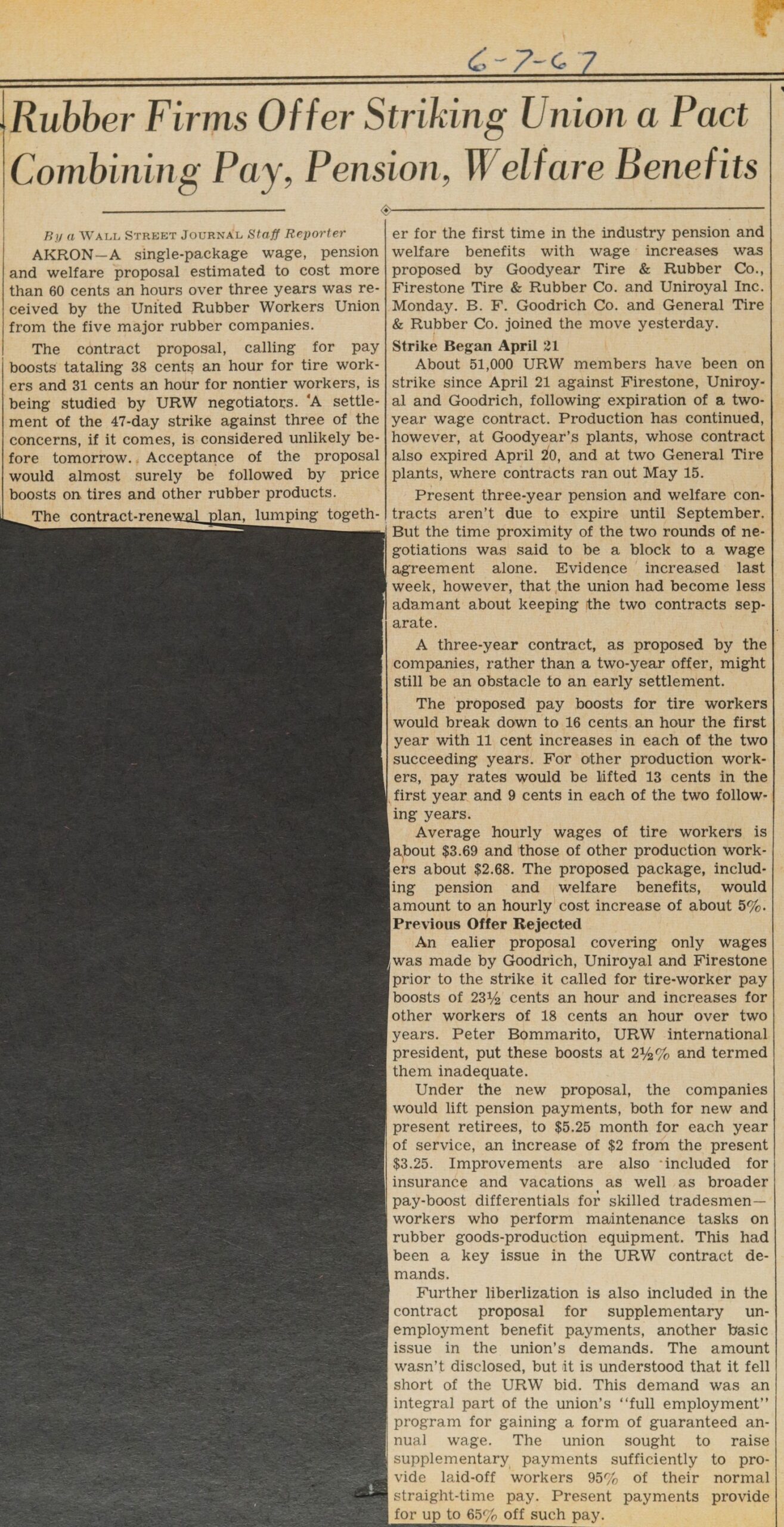
Rubber Firms Offer Striking Union a Pact Combining Pay, Pension, Welfare Benefits

6-7-67

Rubber Firms Offer Striking Union a Pact Combining Pay, Pension, Welfare Benefits

By a WALL STREET JOURNAL Staff Reporter

AKRON—A single-package wage, pension and welfare proposal estimated to cost more than 60 cents an hours over three years was received by the United Rubber Workers Union from the five major rubber companies.

The contract proposal, calling for pay boosts tataling 38 cents an hour for tire workers and 31 cents an hour for nontier workers, is being studied by URW negotiators. A settlement of the 47-day strike against three of the concerns, if it comes, is considered unlikely before tomorrow. Acceptance of the proposal would almost surely be followed by price boosts on tires and other rubber products.

The contract-renewal plan, lumping together for the first time in the industry pension and welfare benefits with wage increases was proposed by Goodyear Tire & Rubber Co., Firestone Tire & Rubber Co. and Uniroyal Inc. Monday. B. F. Goodrich Co. and General Tire & Rubber Co. joined the move yesterday.

Strike Began April 21

About 51,000 URW members have been on strike since April 21 against Firestone, Uniroyal and Goodrich, following expiration of a two-year wage contract. Production has continued, however, at Goodyear’s plants, whose contract also expired April 20, and at two General Tire plants, where contracts ran out May 15.

Present three-year pension and welfare contracts aren’t due to expire until September. But the time proximity of the two rounds of negotiations was said to be a block to a wage agreement alone. Evidence increased last week, however, that the union had become less adamant about keeping the two contracts separate.

A three-year contract, as proposed by the companies, rather than a two-year offer, might still be an obstacle to an early settlement.

The proposed pay boosts for tire workers would break down to 16 cents an hour the first year with 11 cent increases in each of the two succeeding years. For other production workers, pay rates would be lifted 13 cents in the first year and 9 cents in each of the two following years.

Average hourly wages of tire workers is about $3.69 and those of other production workers about $2.68. The proposed package, including pension and welfare benefits, would amount to an hourly cost increase of about 5%.

Previous Offer Rejected

An ealier proposal covering only wages was made by Goodrich, Uniroyal and Firestone prior to the strike it called for tire-worker pay boosts of 23½ cents an hour and increases for other workers of 18 cents an hour over two years. Peter Bommarito, URW international president, put these boosts at 2½% and termed them inadequate.

Under the new proposal, the companies would lift pension payments, both for new and present retirees, to $5.25 month for each year of service, an increase of $2 from the present $3.25. Improvements are also included for insurance and vacations as well as broader pay-boost differentials for skilled tradesmen—workers who perform maintenance tasks on rubber goods-production equipment. This had been a key issue in the URW contract demands.

Further liberlization is also included in the contract proposal for supplementary unemployment benefit payments, another basic issue in the union’s demands. The amount wasn’t disclosed, but it is understood that it fell short of the URW bid. This demand was an integral part of the union’s “full employment” program for gaining a form of guaranteed annual wage. The union sought to raise supplementary payments sufficiently to provide laid-off workers 95% of their normal straight-time pay. Present payments provide for up to 65% off such pay.
Union Says Tire Firms’ Strike-Aid Pact Creates ‘Doubt’ on Good Faith

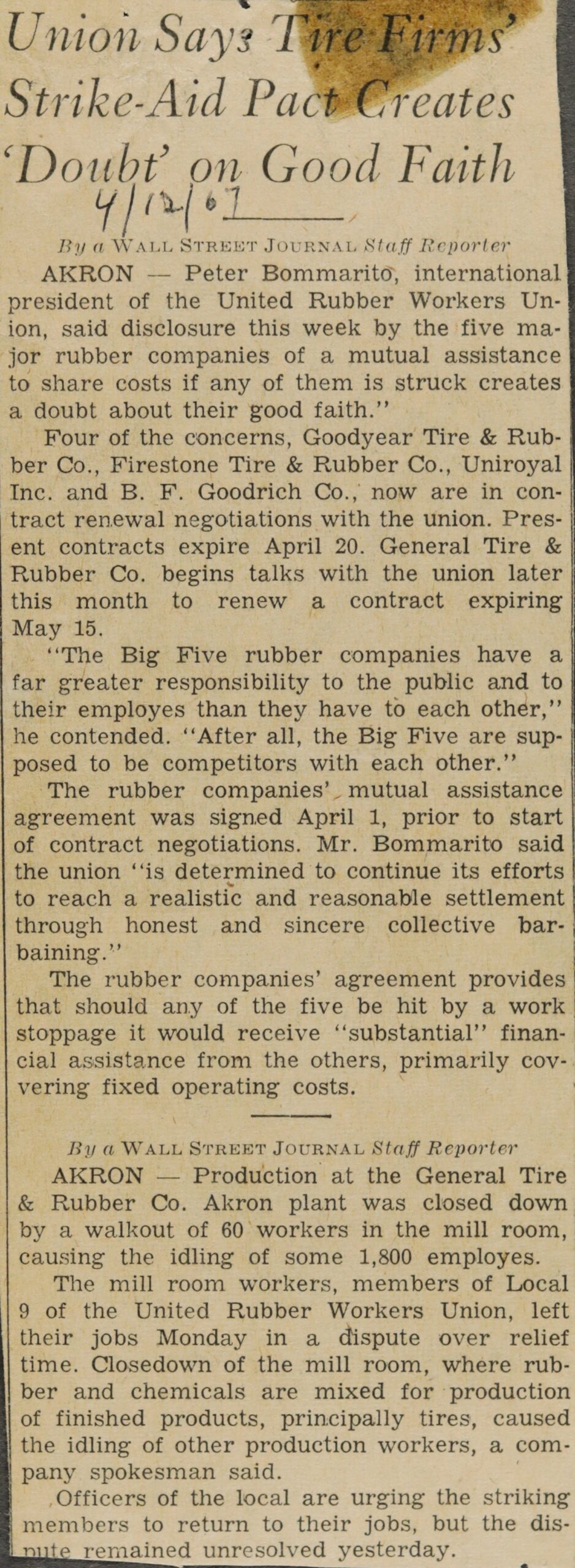
Union Says Tire Firms’ Strike-Aid Pact Creates ‘Doubt’ on Good Faith

4/12/67

By a WALL STREET JOURNAL Staff Reporter

AKRON — Peter Bommarito, international president of the United Rubber Workers Union, said disclosure this week by the five major rubber companies of a mutual assistance to share costs if any of them is struck creates a doubt about their good faith.”

Four of the concerns, Goodyear Tire & Rubber Co., Firestone Tire & Rubber Co., Uniroyal Inc. and B. F. Goodrich Co., now are in contract renewal negotiations with the union. Present contracts expire April 20. General Tire & Rubber Co. begins talks with the union later this month to renew a contract expiring May 15.

“The Big Five rubber companies have a far greater responsibility to the public and to their employes than they have to each other,” he contended. “After all, the Big Five are supposed to be competitors with each other.”

The rubber companies’ mutual assistance agreement was signed April 1, prior to start of contract negotiations. Mr. Bommarito said the union “is determined to continue its efforts to reach a realistic and reasonable settlement through honest and sincere collective barbaining.”

The rubber companies’ agreement provides that should any of the five be hit by a work stoppage it would receive “substantial” financial assistance from the others, primarily covering fixed operating costs.


By a WALL STREET JOURNAL Staff Reporter

AKRON — Production at the General Tire & Rubber Co. Akron plant was closed down by a walkout of 60 workers in the mill room, causing the idling of some 1,800 employes.

The mill room workers, members of Local 9 of the United Rubber Workers Union, left their jobs Monday in a dispute over relief time. Closedown of the mill room, where rubber and chemicals are mixed for production of finished products, principally tires, caused the idling of other production workers, a company spokesman said.

Officers of the local are urging the striking members to return to their jobs, but the dispute remained unresolved yesterday.

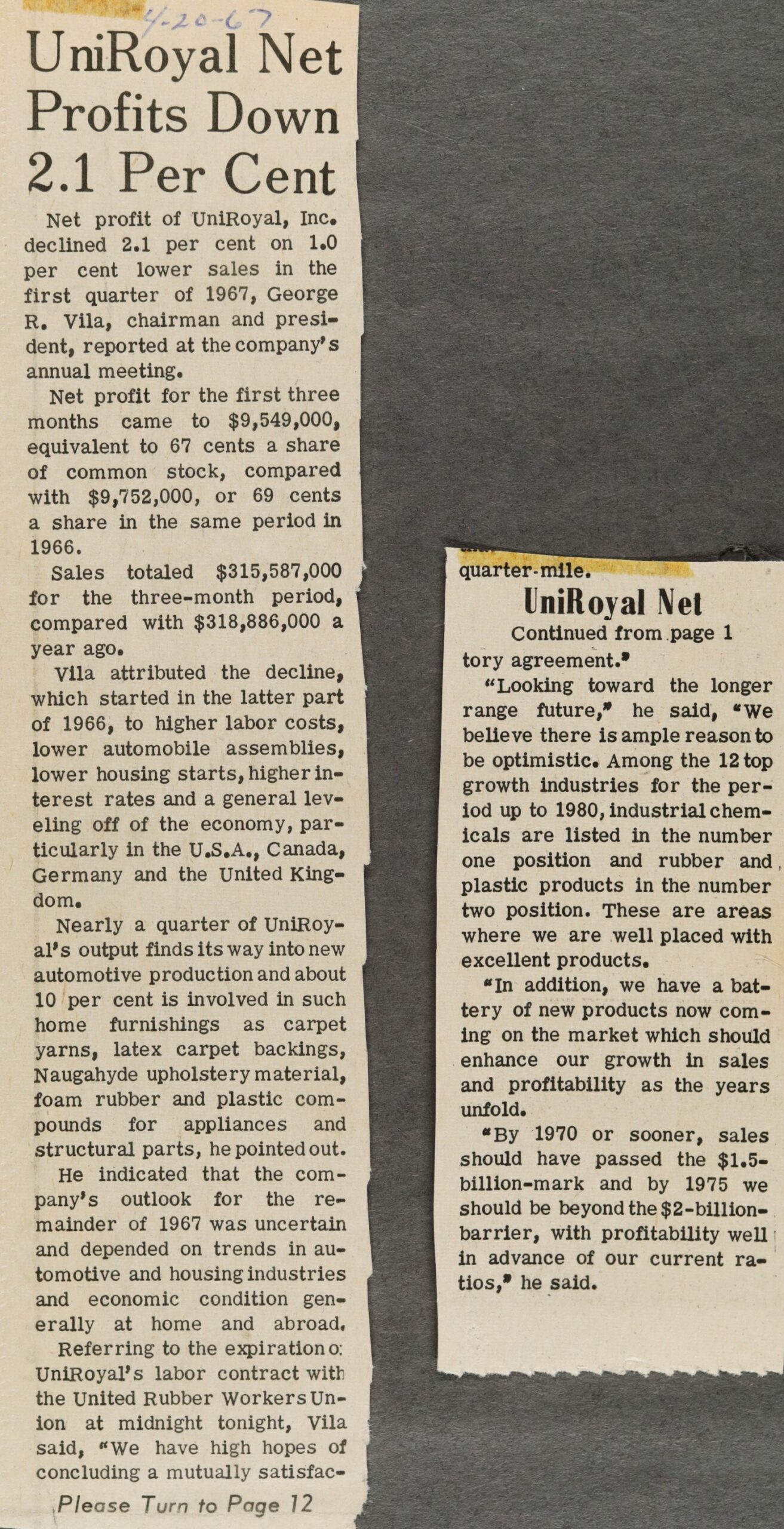
UniRoyal Net Profits Down 2.1 Per Cent

UniRoyal Net Profits Down 2.1 Per Cent

4-20-67 [handwritten]

Net profit of UniRoyal, Inc. declined 2.1 per cent on 1.0 per cent lower sales in the first quarter of 1967, George R. Vila, chairman and president, reported at the company’s annual meeting.

Net profit for the first three months came to $9,549,000, equivalent to 67 cents a share of common stock, compared with $9,752,000, or 69 cents a share in the same period in 1966.

Sales totaled $315,587,000 for the three-month period, compared with $318,886,000 a year ago.

Vila attributed the decline, which started in the latter part of 1966, to higher labor costs, lower automobile assemblies, lower housing starts, higher interest rates and a general leveling off of the economy, particularly in the U.S.A., Canada, Germany and the United Kingdom.

Nearly a quarter of UniRoyal’s output finds its way into new automotive production and about 10 per cent is involved in such home furnishings as carpet yarns, latex carpet backings, Naugahyde upholstery material, foam rubber and plastic compounds for appliances and structural parts, he pointed out.

He indicated that the company’s outlook for the remainder of 1967 was uncertain and depended on trends in automotive and housing industries and economic condition generally at home and abroad.

Referring to the expiration of UniRoyal’s labor contract with the United Rubber Workers Union at midnight tonight, Vila said, “We have high hopes of concluding a mutually satisfac-

Please Turn to Page 12


quarter-mile.

UniRoyal Net

Continued from page 1

tory agreement.”

“Looking toward the longer range future,” he said, “We believe there is ample reason to be optimistic. Among the 12 top growth industries for the period up to 1980, industrial chemicals are listed in the number one position and rubber and plastic products in the number two position. These are areas where we are well placed with excellent products.

“In addition, we have a battery of new products now coming on the market which should enhance our growth in sales and profitability as the years unfold.

“By 1970 or sooner, sales should have passed the $1.5-billion-mark and by 1975 we should be beyond the $2-billion-barrier, with profitability well in advance of our current ratios,” he said.

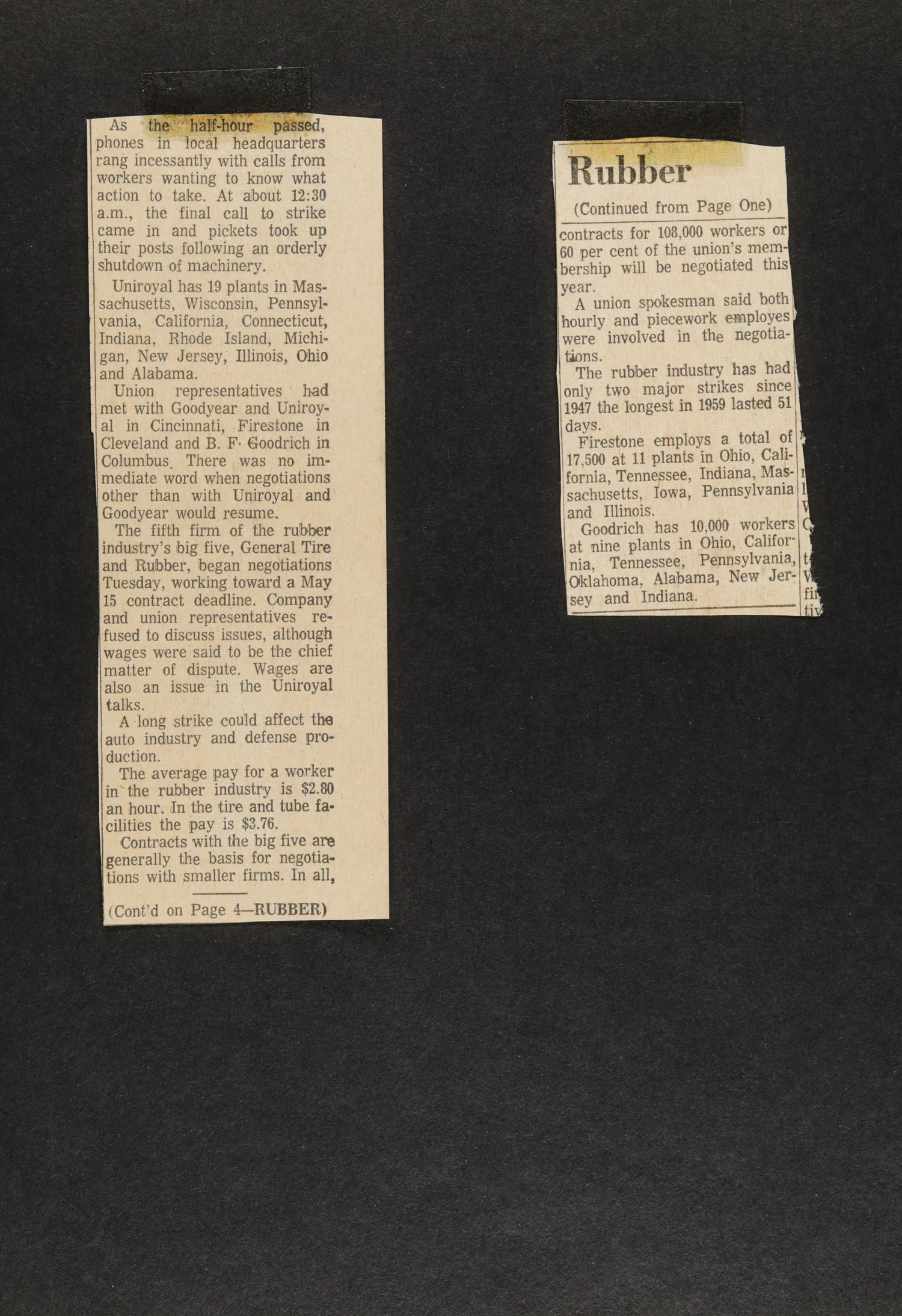
Rubber

Rubber

(Continued from Page One)

contracts for 108,000 workers or 60 per cent of the union’s membership will be negotiated this year.

A union spokesman said both hourly and piecework employes were involved in the negotiations.

The rubber industry has had only two major strikes since 1947 the longest in 1959 lasted 51 days.

Firestone employs a total of 17,500 at 11 plants in Ohio, California, Tennessee, Indiana, Massachusetts, Iowa, Pennsylvania and Illinois.

Goodrich has 10,000 workers at nine plants in Ohio, California, Tennessee, Pennsylvania, Oklahoma, Alabama, New Jersey and Indiana.


As the half-hour passed, phones in local headquarters rang incessantly with calls from workers wanting to know what action to take. At about 12:30 a.m., the final call to strike came in and pickets took up their posts following an orderly shutdown of machinery.

Uniroyal has 19 plants in Massachusetts, Wisconsin, Pennsylvania, California, Connecticut, Indiana, Rhode Island, Michigan, New Jersey, Illinois, Ohio and Alabama.

Union representatives had met with Goodyear and Uniroyal in Cincinnati, Firestone in Cleveland and B. F. Goodrich in Columbus. There was no immediate word when negotiations other than with Uniroyal and Goodyear would resume.

The fifth firm of the rubber industry’s big five, General Tire and Rubber, began negotiations Tuesday, working toward a May 15 contract deadline. Company and union representatives refused to discuss issues, although wages were said to be the chief matter of dispute. Wages are also an issue in the Uniroyal talks.

A long strike could affect the auto industry and defense production.

The average pay for a worker in the rubber industry is $2.80 an hour. In the tire and tube facilities the pay is $3.76.

Contracts with the big five are generally the basis for negotiations with smaller firms. In all,

(Cont’d on Page 4—RUBBER)

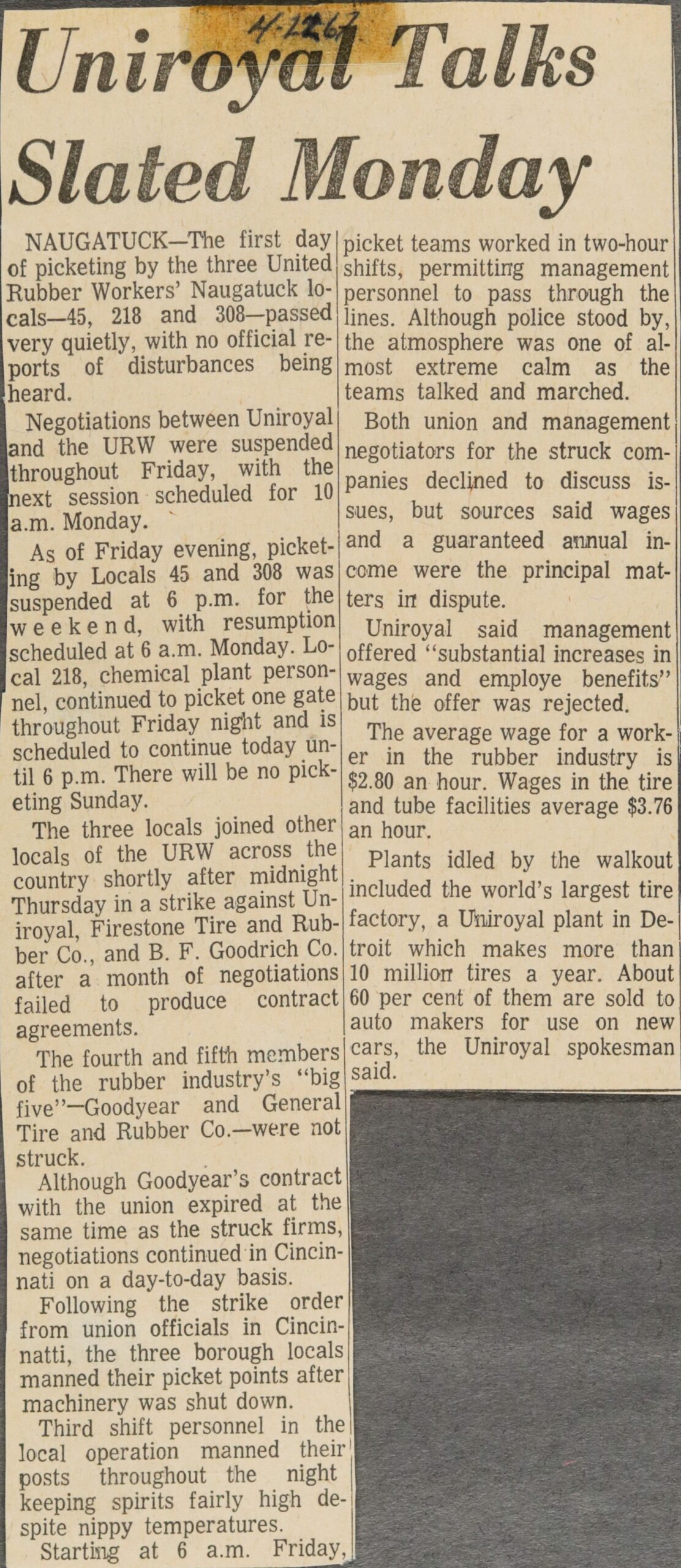
Uniroyal Talks Slated Monday

Uniroyal Talks Slated Monday

4-12-67 [handwritten]

NAUGATUCK—The first day of picketing by the three United Rubber Workers’ Naugatuck locals—45, 218 and 308—passed very quietly, with no official reports of disturbances being heard.

Negotiations between Uniroyal and the URW were suspended throughout Friday, with the next session scheduled for 10 a.m. Monday.

As of Friday evening, picketing by Locals 45 and 308 was suspended at 6 p.m. for the weekend, with resumption scheduled at 6 a.m. Monday. Local 218, chemical plant personnel, continued to picket one gate throughout Friday night and is scheduled to continue today until 6 p.m. There will be no picketing Sunday.

The three locals joined other locals of the URW across the country shortly after midnight Thursday in a strike against Uniroyal, Firestone Tire and Rubber Co., and B. F. Goodrich Co. after a month of negotiations failed to produce contract agreements.

The fourth and fifth members of the rubber industry’s “big five”—Goodyear and General Tire and Rubber Co.—were not struck.

Although Goodyear’s contract with the union expired at the same time as the struck firms, negotiations continued in Cincinnati on a day-to-day basis.

Following the strike order from union officials in Cincinnatti, the three borough locals manned their picket points after machinery was shut down.

Third shift personnel in the local operation manned their posts throughout the night keeping spirits fairly high despite nippy temperatures.

Starting at 6 a.m. Friday, picket teams worked in two-hour shifts, permitting management personnel to pass through the lines. Although police stood by, the atmosphere was one of almost extreme calm as the teams talked and marched.

Both union and management negotiators for the struck companies declined to discuss issues, but sources said wages and a guaranteed annual income were the principal matters in dispute.

Uniroyal said management offered “substantial increases in wages and employe benefits” but the offer was rejected.

The average wage for a worker in the rubber industry is $2.80 an hour. Wages in the tire and tube facilities average $3.76 an hour.

Plants idled by the walkout included the world’s largest tire factory, a Uniroyal plant in Detroit which makes more than 10 million tires a year. About 60 per cent of them are sold to auto makers for use on new cars, the Uniroyal spokesman said.

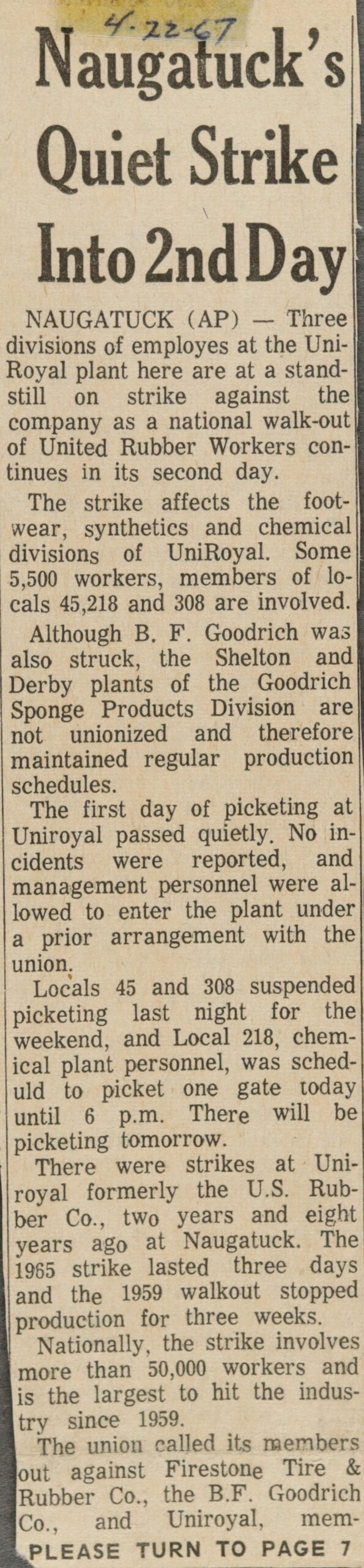
Naugatuck’s Quiet Strike Into 2nd Day

4-22-67

Naugatuck’s Quiet Strike Into 2nd Day

NAUGATUCK (AP) — Three divisions of employes at the UniRoyal plant here are at a standstill on strike against the company as a national walk-out of United Rubber Workers continues in its second day.

The strike affects the footwear, synthetics and chemical divisions of UniRoyal. Some 5,500 workers, members of locals 45, 218 and 308 are involved.

Although B. F. Goodrich was also struck, the Shelton and Derby plants of the Goodrich Sponge Products Division are not unionized and therefore maintained regular production schedules.

The first day of picketing at Uniroyal passed quietly. No incidents were reported, and management personnel were allowed to enter the plant under a prior arrangement with the union.

Locals 45 and 308 suspended picketing last night for the weekend, and Local 218, chemical plant personnel, was scheduled to picket one gate today until 6 p.m. There will be picketing tomorrow.

There were strikes at Uniroyal formerly the U.S. Rubber Co., two years and eight years ago at Naugatuck. The 1965 strike lasted three days and the 1959 walkout stopped production for three weeks.

Nationally, the strike involves more than 50,000 workers and is the largest to hit the industry since 1959.

The union called its members out against Firestone Tire & Rubber Co., the B.F. Goodrich Co., and Uniroyal, mem-

PLEASE TURN TO PAGE 7

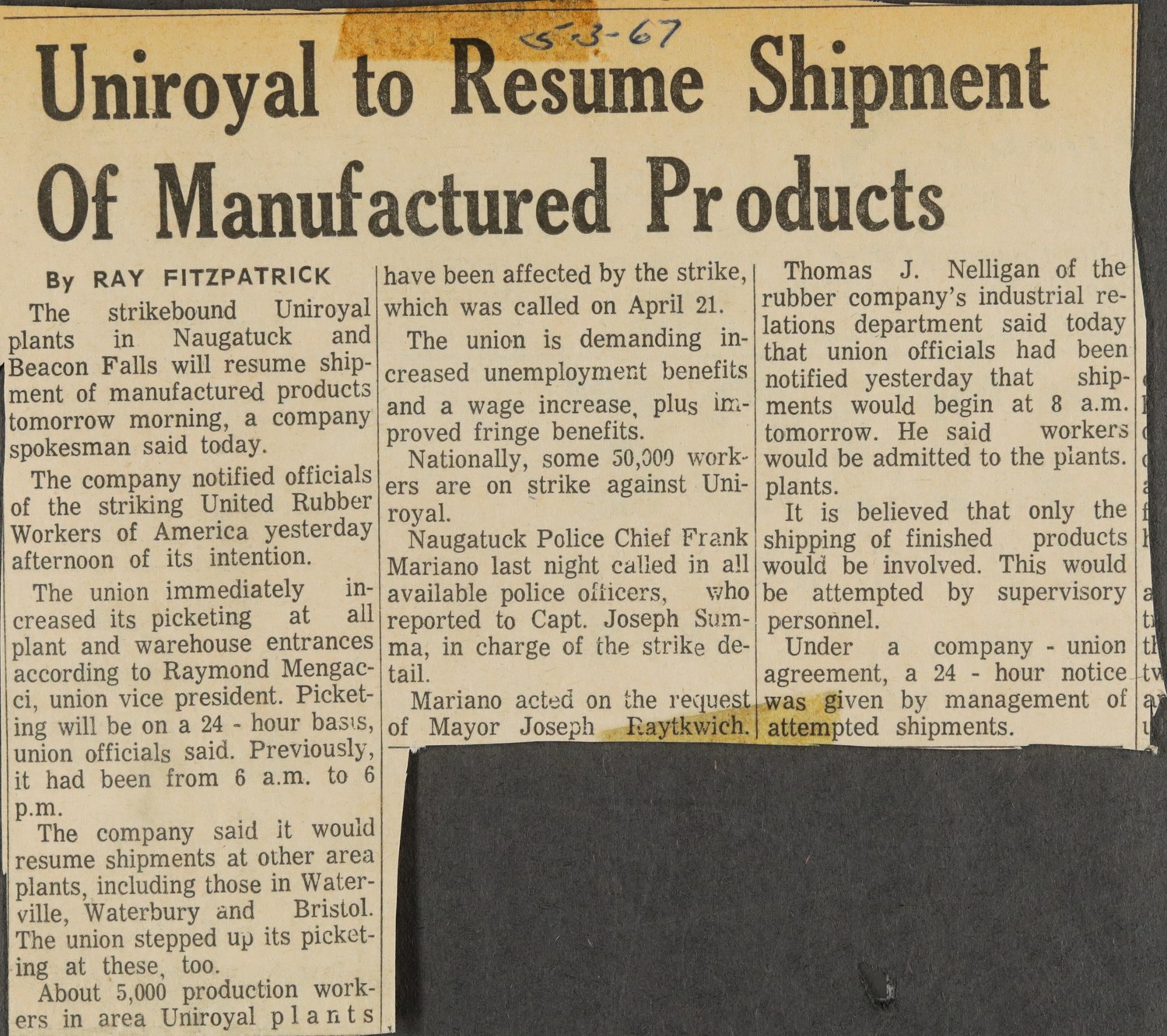
Uniroyal to Resume Shipment Of Manufactured Products

Uniroyal to Resume Shipment Of Manufactured Products

5-3-67 [handwritten]

By RAY FITZPATRICK

The strikebound Uniroyal plants in Naugatuck and Beacon Falls will resume shipment of manufactured products tomorrow morning, a company spokesman said today.

The company notified officials of the striking United Rubber Workers of America yesterday afternoon of its intention.

The union immediately increased its picketing at all plant and warehouse entrances according to Raymond Mengacci, union vice president. Picketing will be on a 24 – hour basis, union officials said. Previously, it had been from 6 a.m. to 6 p.m.

The company said it would resume shipments at other area plants, including those in Waterville, Waterbury and Bristol. The union stepped up its picketing at these, too.

About 5,000 production workers in area Uniroyal plants have been affected by the strike, which was called on April 21.

The union is demanding increased unemployment benefits and a wage increase, plus improved fringe benefits.

Nationally, some 50,000 workers are on strike against Uniroyal.

Naugatuck Police Chief Frank Mariano last night called in all available police officers, who reported to Capt. Joseph Summa, in charge of the strike detail.

Mariano acted on the request of Mayor Joseph Raytkwich.

Thomas J. Nelligan of the rubber company’s industrial relations department said today that union officials had been notified yesterday that shipments would begin at 8 a.m. tomorrow. He said workers would be admitted to the plants.

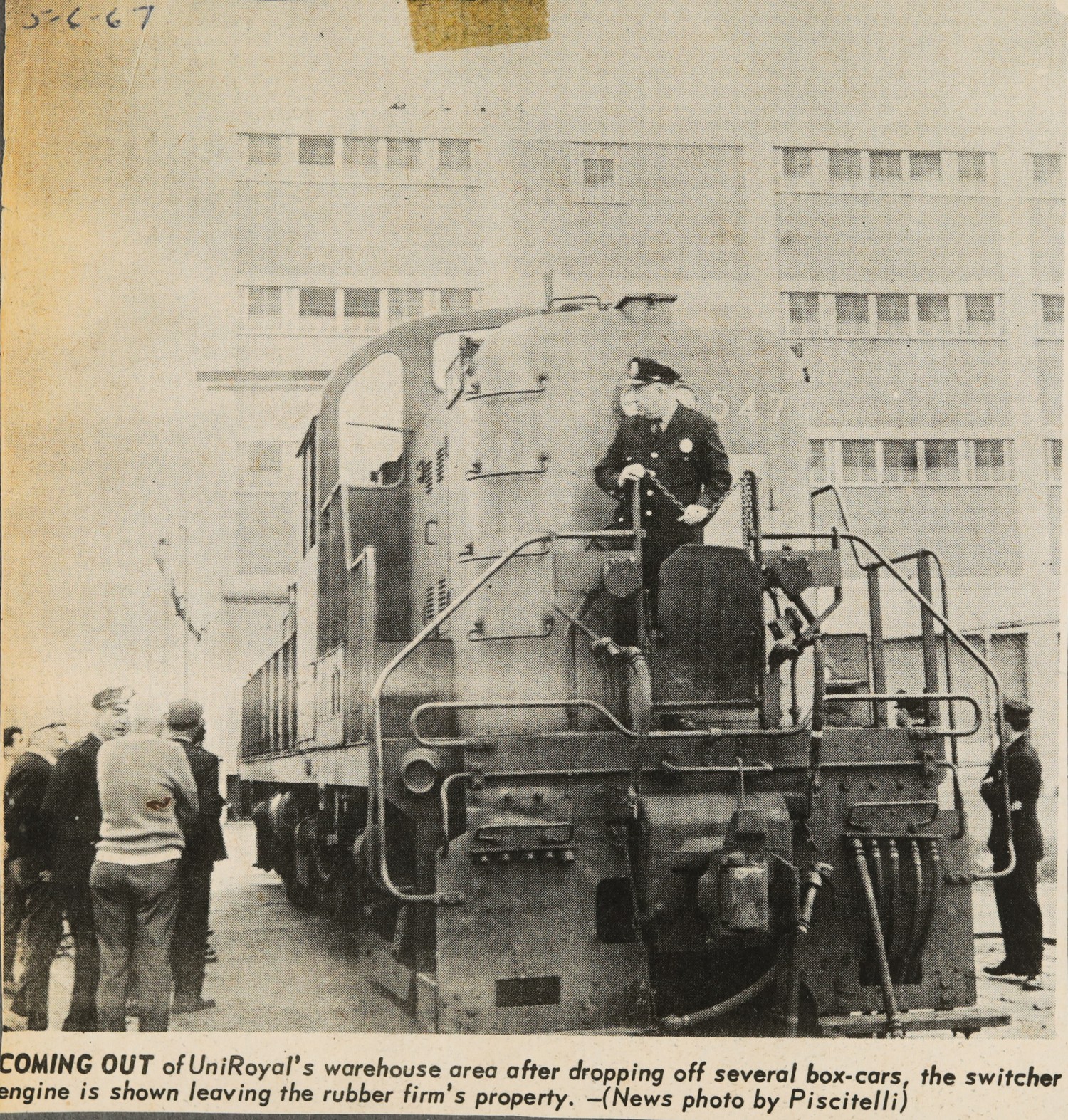
It is believed that only the shipping of finished products would be involved. This would be attempted by supervisory personnel.

Under a company – union agreement, a 24 – hour notice was given by management of attempted shipments.

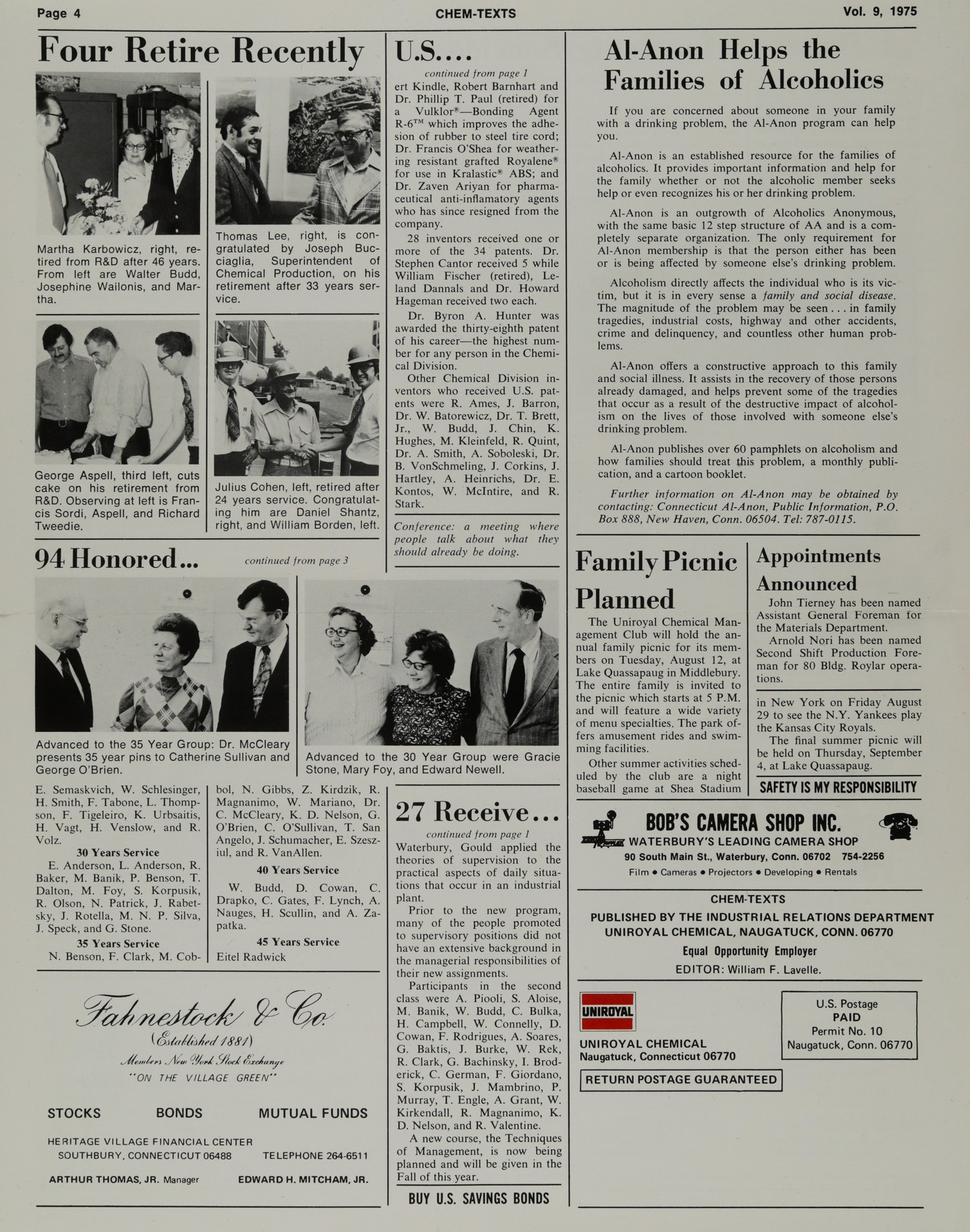
Four Retire Recently

Page 4 CHEM-TEXTS Vol. 9, 1975

Four Retire Recently

[PHOTO]

Martha Karbowicz, right, retired from R&D after 46 years. From left are Walter Budd, Josephine Wailonis, and Martha.

[PHOTO]

George Aspell, third left, cuts cake on his retirement from R&D. Observing at left is Francis Sordi, Aspell, and Richard Tweedie.

[PHOTO]

Thomas Lee, right, is congratulated by Joseph Bucciaglia, Superintendent of Chemical Production, on his retirement after 33 years service.

[PHOTO]

Julius Cohen, left, retired after 24 years service. Congratulating him are Daniel Shantz, right, and William Borden, left.


U.S….

continued from page 1

ert Kindle, Robert Barnhart and Dr. Philip T. Paul (retired) for a Vulklor®—Bonding Agent R-6™ which improves the adhesion of rubber to steel tire cord; Dr. Francis O’Shea for weathering resistant grafted Royalene® for use in Kralastic® ABS; and Dr. Zaven Ariyan for pharmaceutical anti-inflamatory agents who has since resigned from the company.

28 inventors received one or more of the 34 patents. Dr. Stephen Cantor received 5 while William Fischer (retired), Leland Dannals and Dr. Howard Hageman received two each.

Dr. Byron A. Hunter was awarded the thirty-eighth patent of his career—the highest number for any person in the Chemical Division.

Other Chemical Division inventors who received U.S. patents were R. Ames, J. Barron, Dr. W. Batorewicz, Dr. T. Brett, Jr., W. Budd, J. Chin, K. Hughes, M. Kleinfeld, R. Quint, Dr. A. Smith, A. Soboleski, Dr. B. VonSchmeling, J. Corkins, J. Hartley, A. Heinrichs, Dr. E. Kontos, W. McIntire, and R. Stark.

Conference: a meeting where people talk about what they should already be doing.


Al-Anon Helps the Families of Alcoholics

If you are concerned about someone in your family with a drinking problem, the Al-Anon program can help you.

Al-Anon is an established resource for the families of alcoholics. It provides important information and help for the family whether or not the alcoholic member seeks help or even recognizes his or her drinking problem.

Al-Anon is an outgrowth of Alcoholics Anonymous, with the same basic 12 step structure of AA and is a completely separate organization. The only requirement for Al-Anon membership is that the person either has been or is being affected by someone else’s drinking problem.

Alcoholism directly affects the individual who is its victim, but it is in every sense a family and social disease. The magnitude of the problem may be seen . . . in family tragedies, industrial costs, highway and other accidents, crime and delinquency, and countless other human problems.

Al-Anon offers a constructive approach to this family and social illness. It assists in the recovery of those persons already damaged, and helps prevent some of the tragedies that occur as a result of the destructive impact of alcoholism on the lives of those involved with someone else’s drinking problem.

Al-Anon publishes over 60 pamphlets on alcoholism and how families should treat this problem, a monthly publication, and a cartoon booklet.

Further information on Al-Anon may be obtained by contacting: Connecticut Al-Anon, Public Information, P.O. Box 888, New Haven, Conn. 06504. Tel: 787-0115.


94 Honored…

continued from page 3

[PHOTO]

Advanced to the 35 Year Group: Dr. McCleary presents 35 year pins to Catherine Sullivan and George O’Brien.

E. Semaskvich, W. Schlesinger, H. Smith, F. Tabone, L. Thompson, F. Tigeleiro, K. Urbsaitis, H. Vagt, H. Venslow, and R. Volz.

30 Years Service

E. Anderson, L. Anderson, R. Baker, M. Banik, P. Benson, T. Dalton, M. Foy, S. Korpusik, R. Olson, N. Patrick, J. Rabetsky, J. Rotella, M. N. P. Silva, J. Speck, and G. Stone.

35 Years Service

N. Benson, F. Clark, M. Cob-

[PHOTO]

Advanced to the 30 Year Group were Gracie Stone, Mary Foy, and Edward Newell.

bol, N. Gibbs, Z. Kirdzik, R. Magnanimo, W. Mariano, Dr. C. McCleary, K. D. Nelson, G. O’Brien, C. O’Sullivan, T. San Angelo, J. Schumacher, E. Szesziul, and R. VanAllen.

40 Years Service

W. Budd, D. Cowan, C. Drapko, C. Gates, F. Lynch, A. Nauges, H. Scullin, and A. Zapatka.

45 Years Service

Eitel Radwick


Fahnestock & Co.
(Established 1881)

Members New York Stock Exchange
“ON THE VILLAGE GREEN”

| STOCKS | BONDS | MUTUAL FUNDS |

HERITAGE VILLAGE FINANCIAL CENTER
SOUTHBURY, CONNECTICUT 06488 TELEPHONE 264-6511

ARTHUR THOMAS, JR. Manager EDWARD H. MITCHAM, JR.


27 Receive…

continued from page 1

Waterbury, Gould applied the theories of supervision to the practical aspects of daily situations that occur in an industrial plant.

Prior to the new program, many of the people promoted to supervisory positions did not have an extensive background in the managerial responsibilities of their new assignments.

Participants in the second class were A. Piooli, S. Aloise, M. Banik, W. Budd, C. Bulka, H. Campbell, W. Connelly, D. Cowan, F. Rodrigues, A. Soares, G. Baktis, J. Burke, W. Rek, R. Clark, G. Bachinsky, I. Broderick, C. German, F. Giordano, S. Korpusik, J. Mambrino, P. Murray, T. Engle, A. Grant, W. Kirkendall, R. Magnanimo, K. D. Nelson, and R. Valentine.

A new course, the Techniques of Management, is now being planned and will be given in the Fall of this year.

BUY U.S. SAVINGS BONDS


Family Picnic Planned

The Uniroyal Chemical Management Club will hold the annual family picnic for its members on Tuesday, August 12, at Lake Quassapaug in Middlebury. The entire family is invited to the picnic which starts at 5 P.M. and will feature a wide variety of menu specialties. The park offers amusement rides and swimming facilities.

Other summer activities scheduled by the club are a night baseball game at Shea Stadium

continued from page 1


Appointments Announced

John Tierney has been named Assistant General Foreman for the Materials Department.

Arnold Nori has been named Second Shift Production Foreman for 80 Bldg. Roylar operations.

in New York on Friday August 29 to see the N.Y. Yankees play the Kansas City Royals.

The final summer picnic will be held on Thursday, September 4, at Lake Quassapaug.

SAFETY IS MY RESPONSIBILITY [LOGO]


BOB’S CAMERA SHOP INC. [CAMERA ICON]
WATERBURY’S LEADING CAMERA SHOP
90 South Main St., Waterbury, Conn. 06702 754-2256
Film ● Cameras ● Projectors ● Developing ● Rentals


CHEM-TEXTS
PUBLISHED BY THE INDUSTRIAL RELATIONS DEPARTMENT
UNIROYAL CHEMICAL, NAUGATUCK, CONN. 06770

Equal Opportunity Employer

EDITOR: William F. Lavelle.


[UNIROYAL LOGO]

UNIROYAL CHEMICAL
Naugatuck, Connecticut 06770

RETURN POSTAGE GUARANTEED

U.S. Postage
PAID
Permit No. 10
Naugatuck, Conn. 06770

Asked why white collar workers had attempted to enter the plant Tuesday night, Chapman answered that they had been instructed to get out shipments to critical customers.

Asked why white collar workers had attempted to enter the plant Tuesday night, Chapman answered that they had been instructed to get out shipments to critical customers.

He added that management had asked Local 45 for four men to help get the shipments out; the local turned down the request, he said, and some of the supervisory personnel was then sent in to get the shipments out.

A statement concerning the negotiations in Cincinnati, circu-

Dear Sir:

Dear Sir:

It was with amazement I read the letter in the newspaper about our Police force. I wonder if that woman thinks only UniRoyal union members pay their salaries. Did it ever occur to her that management personnel also pay their share of the Policemen’s salaries? So I should hope they have a right to be protected also. They didn’t vote to go on strike, so they have a human right to work How dare anyone force their will on these people?

It’s bad enough that I am a union member that didn’t vote to strike, but have no choice but to go along with the herd. Everyone I talk to agrees that a raise does no good because the prices go up. If a raise does us no good, think of what it does to the people that are trying to live on a pension. Remember that someday you will be trying to struggle along on a pension that stays the same while the prices keep going up because of union demands. Every two years, more and more, where will it all end? Think of what happened to Vickers in Waterbury and the newspaper in New York. I heard the editor of the paper say union demands do put them out of business.

No matter what we get we will never make up our loss. The union didn’t ask us if we wanted a raise. We aren’t even allowed to know what the issues are. That’s what happens when the union gets too strong. We don’t tell them anything, they tell us.

Why can’t they just reinstate the old contract instead of asking for more and more every two years.

Also, I don’t think it’s right to stop UniRoyal from shipping the shoes we already got paid good money to make, some of us even got time and a half.

Not long ago everyone was up in arms and wrote letters to Congress to cut down foreign made shoes, because we didn’t want UniRoyal to lose customers. Now where is the concern for the customers? Why cut your nose to spite your face? We will be the ones to suffer the big loss.

And it’s plain ridiculous to expect a layed-off employee to get 93% of their wages. Just who would be fool enough to want to sweat all day for a few dollars more than the guy sitting home on his backside. Everyone would fight to be layed off.

Please don’t print my name after seeing that unreasonable crowd the other day. I would probably get my house burned down. This is the only way to voice my opinion, which, I hope,

[Handwritten marks visible in left margin appearing to be checkmarks or notation marks]

CHEM-TEXTS – unknown-s238

Page 238

CHEM-TEXTS

Page 3


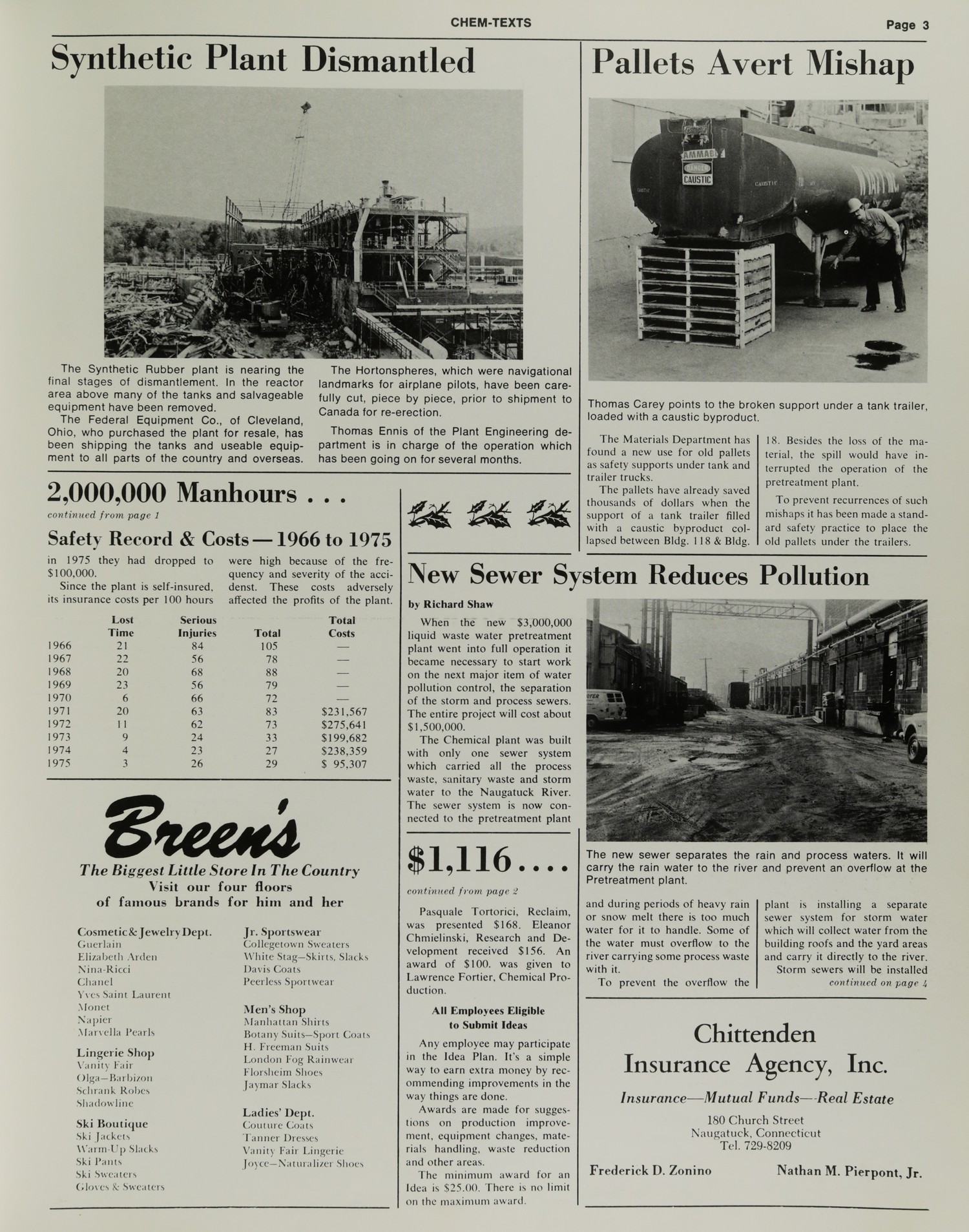
Synthetic Plant Dismantled

The Synthetic Rubber plant is nearing the final stages of dismantlement. In the reactor area above many of the tanks and salvageable equipment have been removed.

The Federal Equipment Co., of Cleveland, Ohio, who purchased the plant for resale, has been shipping the tanks and useable equipment to all parts of the country and overseas.

The Hortonspheres, which were navigational landmarks for airplane pilots, have been carefully cut, piece by piece, prior to shipment to Canada for re-erection.

Thomas Ennis of the Plant Engineering department is in charge of the operation which has been going on for several months.


Pallets Avert Mishap

Thomas Carey points to the broken support under a tank trailer, loaded with a caustic byproduct.

The Materials Department has found a new use for old pallets as safety supports under tank and trailer trucks.

The pallets have already saved thousands of dollars when the support of a tank trailer filled with a caustic byproduct collapsed between Bldg. 118 & Bldg. 18. Besides the loss of the material, the spill would have interrupted the operation of the pretreatment plant.

To prevent recurrences of such mishaps it has been made a standard safety practice to place the old pallets under the trailers.


2,000,000 Manhours . . .

continued from page 1

Safety Record & Costs — 1966 to 1975

in 1975 they had dropped to $100,000.

Since the plant is self-insured, its insurance costs per 100 hours were high because of the frequency and severity of the accident. These costs adversely affected the profits of the plant.

Lost Time Serious Injuries Total Total Costs
1966 21 84 105
1967 22 56 78
1968 20 68 88
1969 23 56 79
1970 6 66 72
1971 20 63 83 $231,567
1972 11 62 73 $275,641
1973 9 24 33 $199,682
1974 4 23 27 $238,359
1975 3 26 29 $ 95,307

New Sewer System Reduces Pollution

by Richard Shaw

When the new $3,000,000 liquid waste water pretreatment plant went into full operation it became necessary to start work on the next major item of water pollution control, the separation of the storm and process sewers. The entire project will cost about $1,500,000.

The Chemical plant was built with only one sewer system which carried all the process waste, sanitary waste and storm water to the Naugatuck River. The sewer system is now connected to the pretreatment plant

$1,116….

continued from page 2

Pasquale Tortorici, Reclaim, was presented $168. Eleanor Chmielinski, Research and Development received $156. An award of $100. was given to Lawrence Fortier, Chemical Production.

All Employees Eligible to Submit Ideas

Any employee may participate in the Idea Plan. It’s a simple way to earn extra money by recommending improvements in the way things are done.

Awards are made for suggestions on production improvement, equipment changes, materials handling, waste reduction and other areas.

The minimum award for an Idea is $25.00. There is no limit on the maximum award.

The new sewer separates the rain and process waters. It will carry the rain water to the river and prevent an overflow at the Pretreatment plant.

and during periods of heavy rain or snow melt there is too much water for it to handle. Some of the water must overflow to the river carrying some process waste with it.

To prevent the overflow the plant is installing a separate sewer system for storm water which will collect water from the building roofs and the yard areas and carry it directly to the river.

Storm sewers will be installed continued on page 4


Breen’s

The Biggest Little Store In The Country
Visit our four floors
of famous brands for him and her.

Cosmetic & Jewelry Dept.
Guerlain
Elizabeth Arden
Nina-Ricci
Chanel
Yves Saint Laurent
Monet
Napier
Marvella Pearls

Lingerie Shop
Vanity Fair
Olga—Barbizon
Schrank Robes
Shadowline

Ski Boutique
Ski Jackets
Warm-Up Slacks
Ski Pants
Ski Sweaters
Gloves & Sweaters

Jr. Sportswear
Collegetown Sweaters
White Stag—Skirts, Slacks
Davis Coats
Peerless Sportwear

Men’s Shop
Manhattan Shirts
Botany Suits—Sport Coats
H. Freeman Suits
London Fog Rainwear
Florsheim Shoes
Jaymar Slacks

Ladies’ Dept.
Couture Coats
Tanner Dresses
Vanity Fair Lingerie
Joyce—Naturalizer Shoes


Chittenden Insurance Agency, Inc.

Insurance—Mutual Funds—Real Estate

180 Church Street
Naugatuck, Connecticut
Tel. 729-8209

Frederick D. Zonino Nathan M. Pierpont, Jr.

US Rubber Proxy Statement – Page 6

Page 006

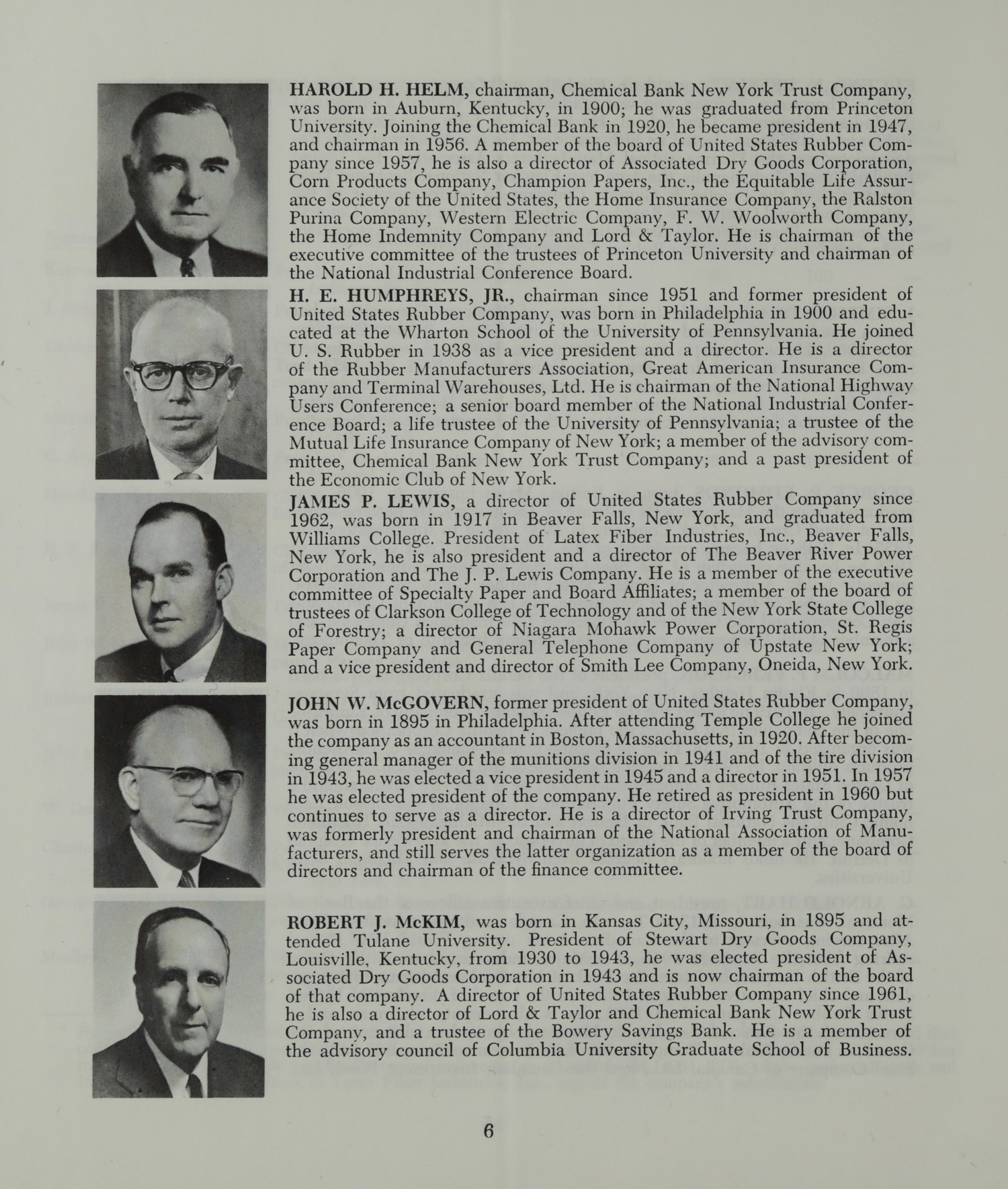
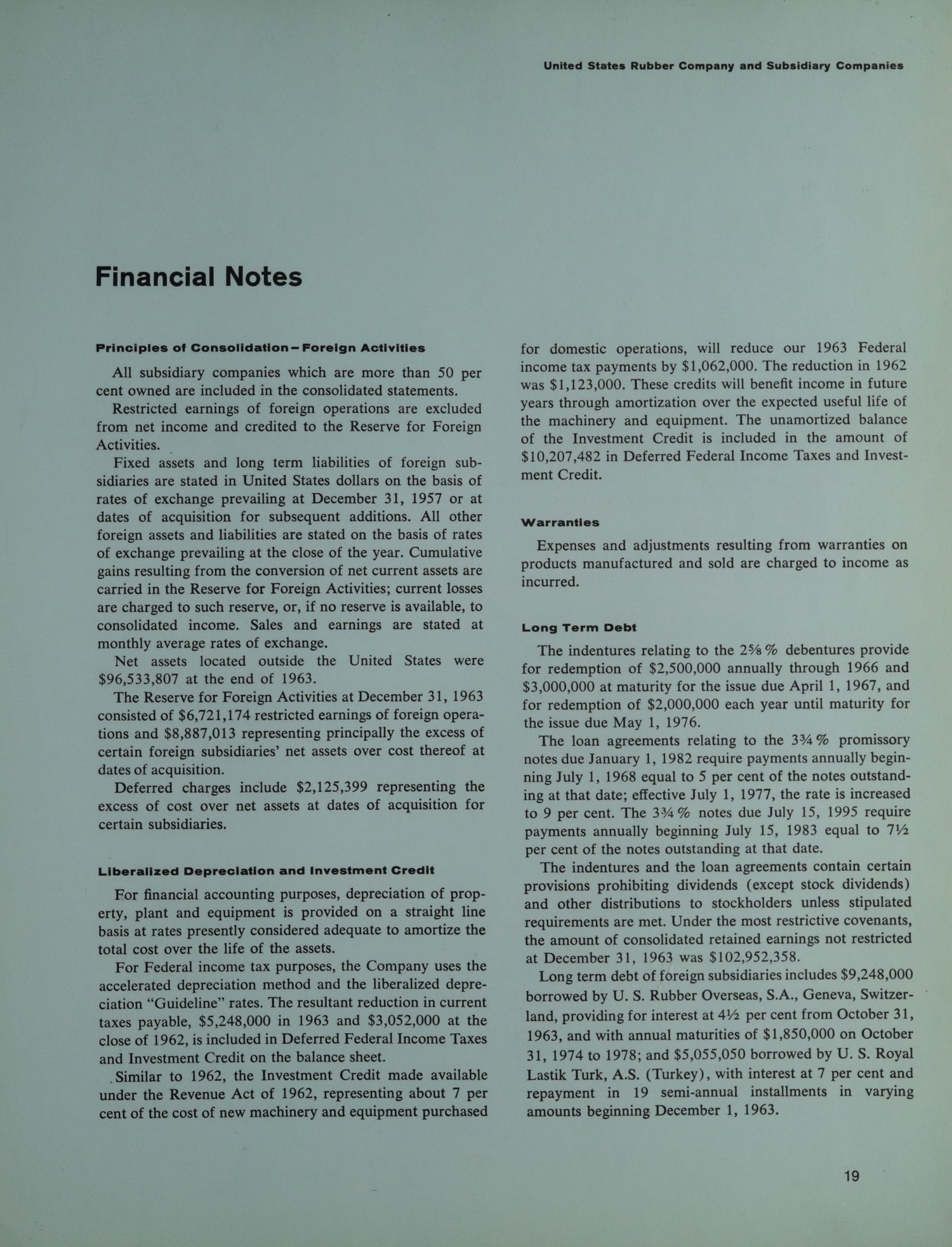
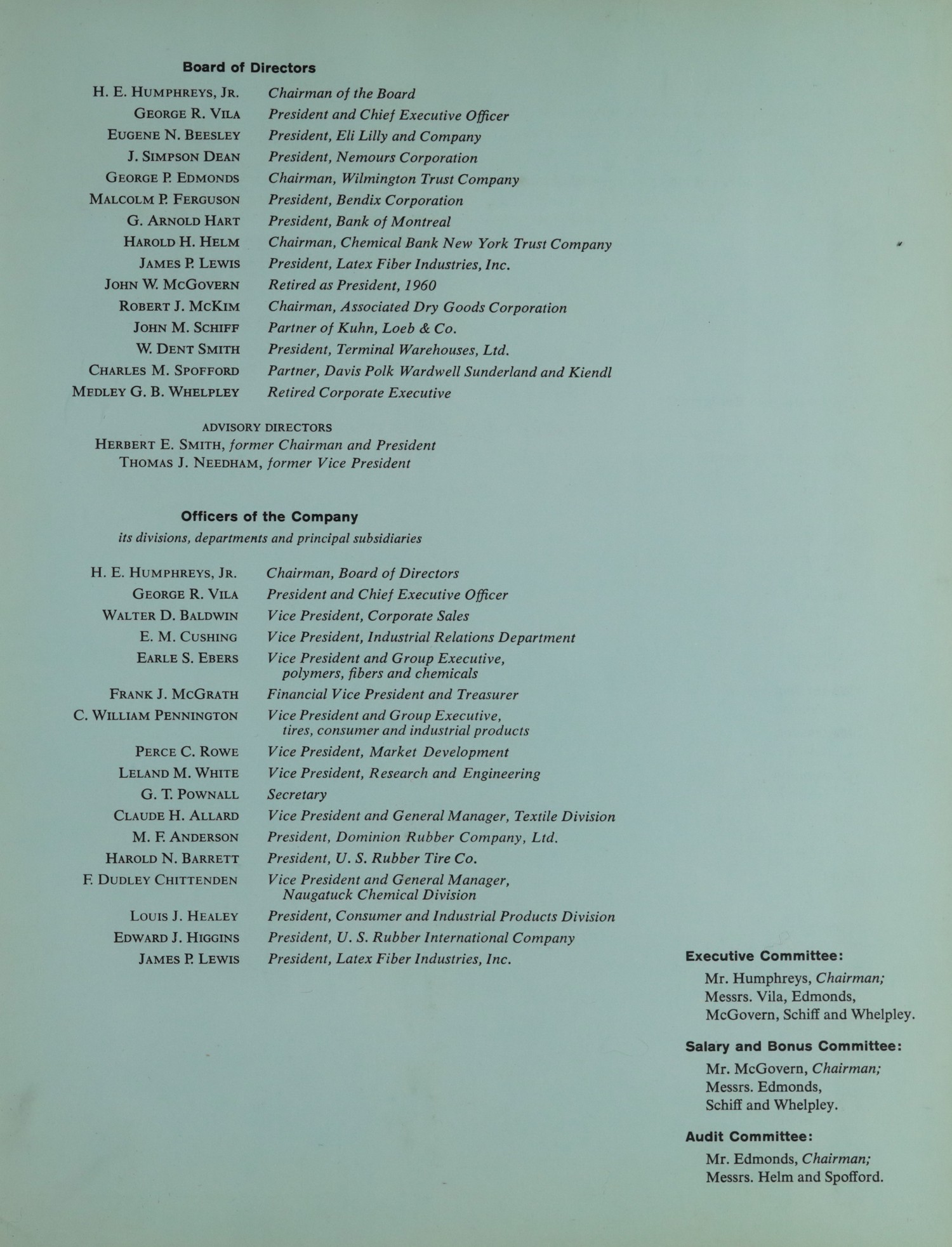
HAROLD H. HELM, chairman, Chemical Bank New York Trust Company, was born in Auburn, Kentucky, in 1900; he was graduated from Princeton University. Joining the Chemical Bank in 1920, he became president in 1947, and chairman in 1956. A member of the board of United States Rubber Company since 1957, he is also a director of Associated Dry Goods Corporation, Champion Papers, Inc., the Equitable Life Assurance Society of the United States, the Home Insurance Company, the Ralston Purina Company, Western Electric Company, F. W. Woolworth Company, the Home Indemnity Company and Lord & Taylor. He is chairman of the executive committee of the trustees of Princeton University and chairman of the National Industrial Conference Board.

H. E. HUMPHREYS, JR., chairman since 1951 and former president of United States Rubber Company, was born in Philadelphia in 1900 and educated at the Wharton School of the University of Pennsylvania. He joined U. S. Rubber in 1935 as a vice president and a director. He is a director of the Rubber Manufacturers Association, Great American Insurance Company and Terminal Warehouses, Ltd. He is chairman of the National Highway Users Conference; a senior board member of the National Industrial Conference Board; a life trustee of the University of Pennsylvania; a trustee of the Mutual Life Insurance Company of New York; a member of the advisory committee, Chemical Bank New York Trust Company; and a past president of the Economic Club of New York.

JAMES P. LEWIS, a director of United States Rubber Company since 1962, was born in 1917 in Beaver Falls, New York, and graduated from Williams College. President of Latex Fiber Industries, Inc., Beaver Falls, New York, he is also president and a director of The Beaver River Power Corporation and The J. P. Lewis Company. He is a member of the executive committee of Specialty Paper and Board Affiliates; a member of the board of trustees of Clarkson College of Technology and of Forestry; a director of Niagara Mohawk Power Corporation, St. Regis Paper Company and General Telephone Company of Upstate New York; and a vice president and director of Smith Lee Company, Oneida, New York.

JOHN W. McGOVERN, former president of United States Rubber Company, was born in 1895 in Philadelphia. After attending Temple College he joined the company as an accountant in Boston, Massachusetts, in 1920. After becoming general manager of the munitions division in 1941 and of the tire division in 1943, he was elected a vice president in 1945 and a director in 1951. In 1957 he was elected president of the company. He retired as president in 1960 but continues to serve as a director. He is a director of Irving Trust Company, was formerly president and chairman of the National Association of Manufacturers, and still serves the latter organization as a member of the board of directors and chairman of the finance committee.

ROBERT J. McKIM, was born in Kansas City, Missouri, in 1895 and attended Tulane University. President of Stewart Dry Goods Company, Louisville, Kentucky, from 1930 to 1943, he was elected president of Associated Dry Goods Corporation in 1943 and is now chairman of the board of that company. A director of United States Rubber Company since 1961, he is also a director of Lord & Taylor and Chemical Bank New York Trust Company, and a trustee of the Savings Bank. He is a member of the advisory council of the Columbia University Graduate School of Business.

US Rubber Proxy Statement – Page 7

Page 007

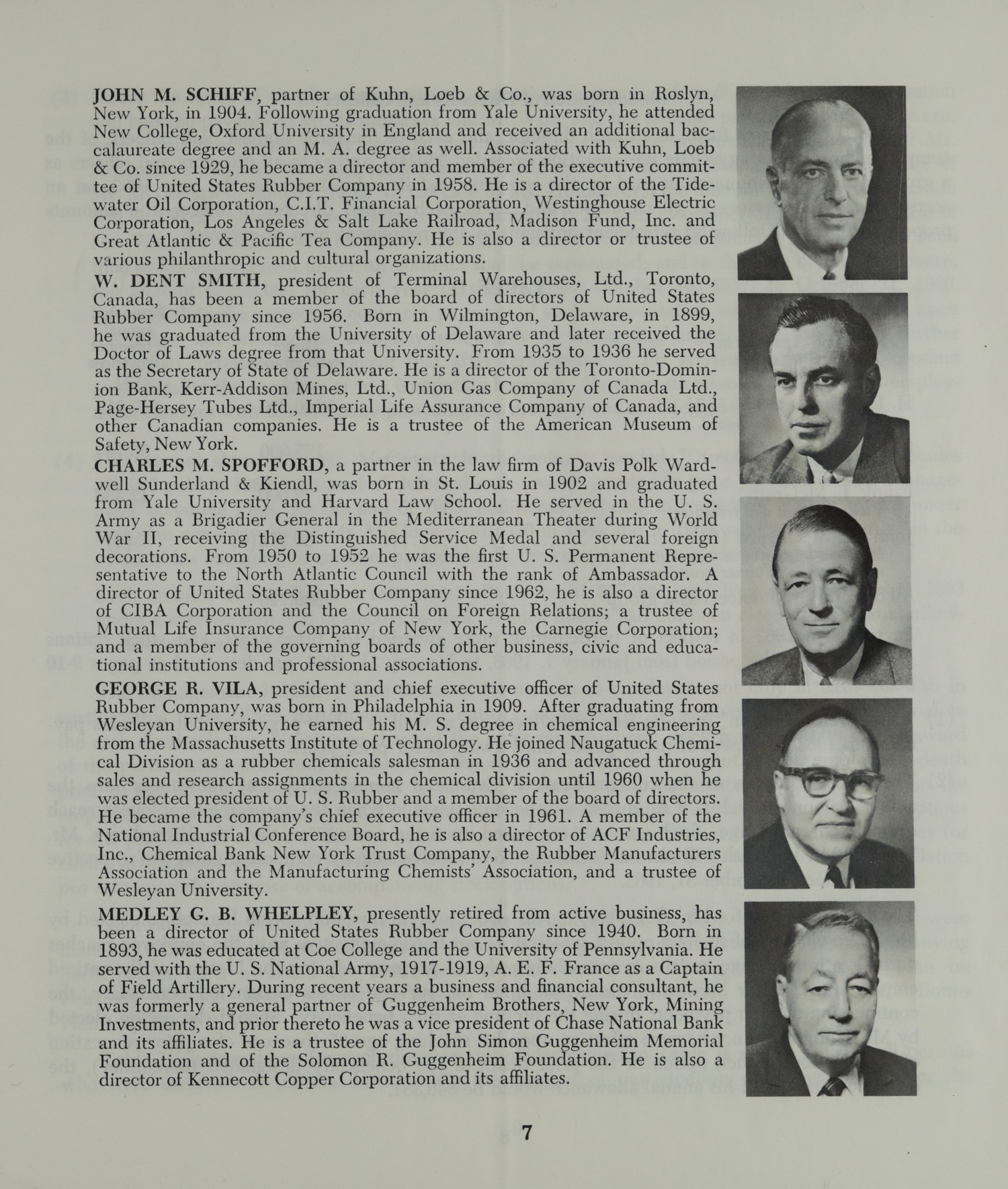
JOHN M. SCHIFF, partner of Kuhn, Loeb & Co., was born in Roslyn, New York, in 1904. Following graduation from Yale University, he attended New College, Oxford University in England and received an additional bac-
calaurcatc degree and an M.A. degree as well. Associated with Kuhn, Loeb
& Co. since 1929, he became a director and member of the executive commit-
tee of United States Rubber Company in 1958. He is a director of the Tide-
water Oil Corporation, C.I.T. Financial Corporation, Westinghouse Electric
Corporation, Los Angeles & Salt Lake Railroad, Madison Fund, Inc. and
Great Atlantic & Pacific Tea Company. He is also a director or trustee of
various philanthropic and cultural organizations.
W. DENT SMITH, president of Terminal Warehouses, Ltd., Toronto,
Canada, has been a member of the board of directors of United States
Rubber Company since 1956. Born in Wilmington, Delaware, in 1899,
he was graduated from the University of Delaware and later received the
Doctor of Laws degree from that University. From 1935 to 1936 he served
as the Secretary of State of Delaware. He is a director of the Toronto-Domin-
ion Bank, Kerr-Addison Mines, Ltd., Union Gas Company of Canada Ltd.,
Page-Hersey Tubes Ltd., Imperial Life Assurance Company of Canada, and
other Canadian companies. He is a trustee of the American Museum of
Safety, New York.
CHARLES M. SPOFFORD, a partner in the law firm of Davis Polk Ward-
well Sunderland & Kiendl, was born in St. Louis in 1902 and graduated
from Yale University and Harvard Law School. He served in the U. S.
Army as a Brigadier General in the Mediterranean Theater during World
War II, receiving the Distinguished Service Medal and several foreign
decorations. From 1950 to 1952 he was the first U. S Permanent Repre-
sentative to the North Atlantic Council with the rank of Ambassador. A
director of United States Rubber Company since 1962, he is also a director
of CIBÄ Corporation and the Council on Foreign Relations; a trustee of
Mutual Life Insurance Company of New York, the Carnegie Corporation;
and a member of the governing boards of other business, civic and educa-
tional institutions and professional associations.
GEORGE R. VILA, president and chief executive officer of United States
Rubber Company, was born in Philadelphia in 1909. After graduating from
Wesleyan University, he earned his M. S. degree in chemical engineering
from the Massachusetts Institute of Technology. He joined Naugatuck Chemi-
cal Division as a rubber chemicals salesman in 1936 and advanced through
sales and research assignments in the chemical division until 1960 when he
was elected president of U. S. Rubber and a member of the board of directors.
He became the company’s chief executive officer in 1961. A member of the
National Industrial Conference Board, he is also a director of ACF Industries,
Inc., Chemical Bank New York Trust Company, the Rubber Manufacturers
Association and the Manufacturing Chemists Association, and a trustee of
Wesleyan University.
MEDLEY G. B. WHELPLEY, presently retired from active business, has
been a director of United States Rubber Company since 1940. Born in
1893, he was educated at Coe College and the University of Pennsylvania. He
served with the U. S. National Army, 1917-1919, A. E. F. France as a Captain
of Field Artillery. During recent years a business and financial consultant, he
was formerly a general partner of Guggenheim Brothers, New York, Mining
Investments, and prior thereto he was a vice president of Chase National Bank
and its affiliates. He is a trustee of the John Simon Guggenheim Memorial
Foundation and of the Solomon R. Guggenheim Foundation. He is also a
director of Kennecott Copper Corporation and its affiliates.

US Rubber Proxy Statement – Page 20

Page 020

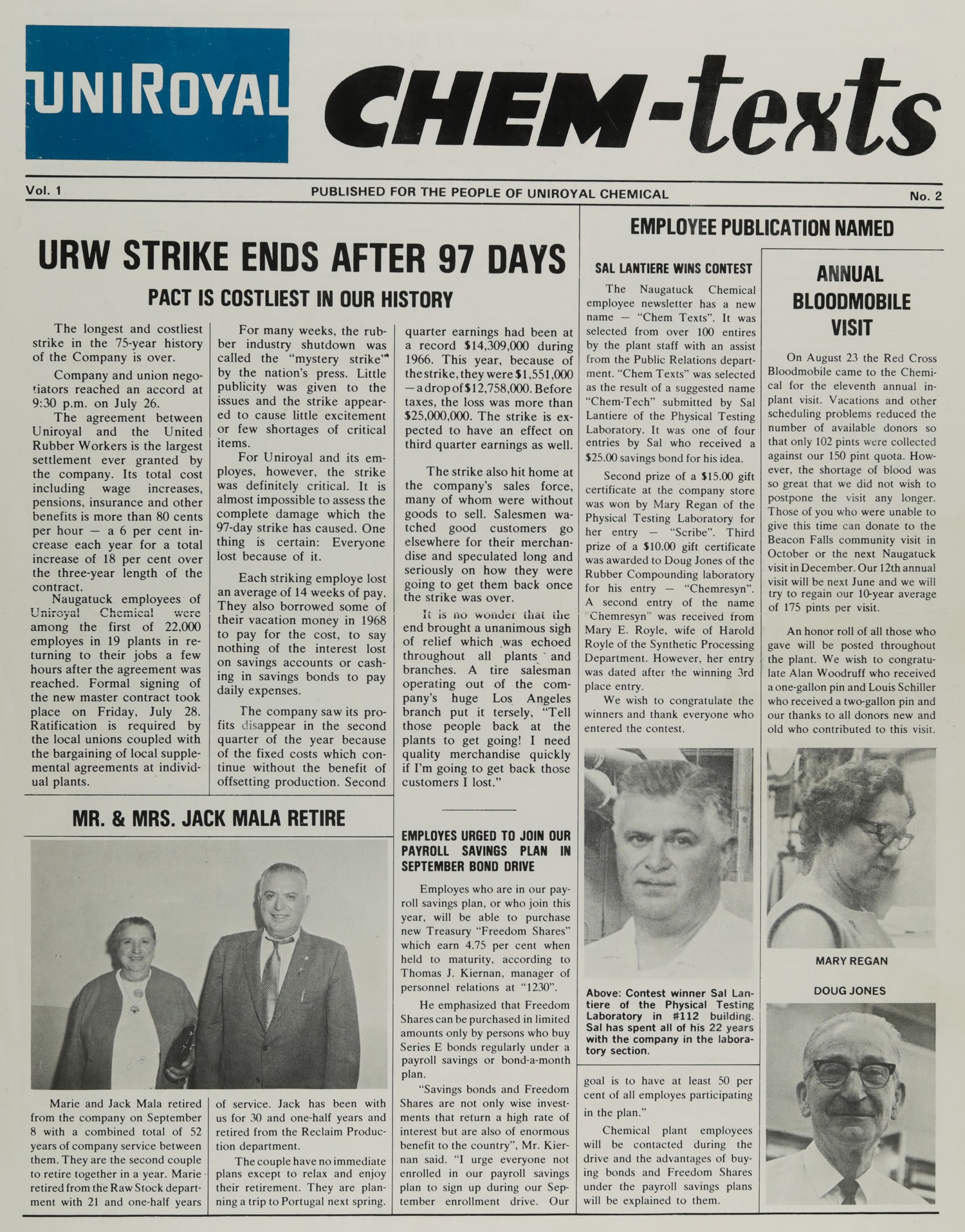
UNIROYAL CHEM-texts
Vol. 1 PUBLISHED FOR THE PEOPLE OF UNIROYAL CHEMICAL No. 2

URW STRIKE ENDS AFTER 97 DAYS
PACT IS COSTLIEST IN OUR HISTORY

The longest and costliest strike in the 75-year history of the Company is over. Company and union negotiators reached an accord at 9:30 p.m. on July 26. The agreement between Uniroyal and the United Rubber Workers is the largest settlement ever reached by the company. Its total cost including wage increases, pensions, insurance and other benefits is more than 50 cents per hour — a 6 per cent increase each year for a total of 18 per cent over the three-year length of the contract.

Eachstriking employee lost an average of 14 weeks of pay. They also borrowed some of their vacation money in 1968 to pay for the cost, to say nothing of the interest lost on savings accounts or cashing in savings bonds to pay daily expenses.
The company saw its profits disappear in the second quarter of the year because of the fixed costs which continue without the benefit of offsetting production. Second quarter earnings had been at a record $14,309,000 during the strike. This year, because of the strike, they were $15,551,000 less or $12,753,000. Before taxes, the loss was more than $25,000,000. The strike also hit home at the company’s sales force, many of whom were without goods to sell. Salesmen were told good customers would never be able to get their merchandise long and specialized long and seriously on how they were going to get their back once the strike was over.

It is no wonder that the end brought a continuous state of relief which was echoed throughout all plant and branch offices. A tire salesman overheard out of the company’s huge Los Angeles branch put it tersely. “Tell those people back at the plants to get going! I need quality merchandise quickly if I’m going to get back those customers I lost.”

EMPLOYEE PUBLICATION NAMED

The Naugatuck Chemical employee newsletter has a new name – “Chem Texts”. It was selected from over 100 entries by the plant staff with an assist from the Public Relations department. “Chem Texts” was selected as the result of a suggestion made by Sal Lantiere of the Physical Testing Laboratory. It was one of four entries by Sal who received a $25.00 savings bond for his idea.

Second prize of a $15.00 gift certificate at the company store was won by Mary Regan of the Physical Testing Laboratory for her entry — “Chemtext”. Third prize of a $10.00 gift certificate was awarded to Doug Jones of the Rubber Compounding laboratory for his entry — “Chemesyn”.

A second group of the name “Chemesyn” was received from Mary Raby, wife of Harold Raby of the Synthetic Processing Department. However, her entry was dated after the winning entry was selected.

We wish to congratulate the winners and thank everyone who entered the contest.

MR. & MRS. JACK MALA RETIRE

Marie and Jack Mala retired from the company on September 8 with a combined total of 52 years of company service between them. They are the second couple to retire together in a year. Marie retired from the Raw Stock department with 21 and one-half years of service. Jack has been with us for 30 and one half years and retired from the Reclaim Production department.

EMPLOYEES URGED TO JOIN OUR PAYROLL SAVINGS PLAN IN SEPTEMBER BOND DRIVE

Employees who are in our payroll savings plan, or who join this year, will be able to purchase new Treasury “Freedom Shares” which earn 4.75 per cent when held to maturity, according to Thomas J. Kiernan, manager of personnel relations at “1230”.
He emphasized that Freedom Shares can be purchased in limited amounts by each plan participant during the “September Bond Drive”.
Savings bonds and Freedom Shares are not only investments that return a high rate of interest but are also of enormous benefit to the country, Mr. Kiernan said. “I urge everyone not enrolled in our payroll savings plan to sign up during our September enrollment drive. Our goal is to have at least 50 per cent of all employees participating in the plan.”
Chemical plant employees will be contacted during the drive and the advantages of buying savings bonds and Freedom Shares under the payroll savings plans will be explained to them.

MARY REGAN
DOUG JONES

Above: Contest winner Sal Lantiere of the Physical Testing Laboratory in #112 building. Sal has spent all of his 22 years with the company in the laboratory section.

ANNUAL BLOODMOBILE VISIT

On August 23 the Red Cross Bloodmobile came to the Chemical plant visit. Vacations and other scheduling problems reduced the number of available donors so we only 122 pints were collected against our 150 pint quota. However, the shortage of donors did not mean we did not wish to postpone the visit any longer. Those of you who were unable to give this time can donate to the Beacon Falls community visit in October or the next June 12 annual visit will give us another chance to regain our ideal 175 pints per visit.

An honor roll of all of those who gave will be posted throughout the plant. We wish to congratulate late Alan Woodruff who received a one-gallon pin and Louis Schuller who received a two-gallon pin and all those new and old who contributed to this visit.

SAL LANTIERE WINS CONTEST

Uniroyal Cites Loss Potential

Uniroyal Cites Loss Potential

6-28-67 [handwritten]

Uniroyal, Inc. will suffer a very severe financial loss “forcing a reduction in production” at its Naugatuck Footwear plant if it is not permitted to produce samples of its new designs, a company official said today.

Thomas J. Nelligan, labor relations manager, testified at a Superior Court hearing this morning that failure of the company to have samples to show its customers in August will mean a very large drop in the amount of production needed for the coming year and “in turn less employes.”

Nelligan was the first company representative to testify at a hearing to consider United Rubber Workers Union application for an injunction against the company production.

He said samples for next summer’s market would normally have been produced between April and July of this year.

He said salesmen would have been scheduled to take the samples into the field beginning Aug. 1.

Without the samples, he said the company will have no way of proving “to its buyers that its line is better than its competitors.”

At the opening of the session Tuesday before Judge Leo V. Gaffney, a Local 45 official predicted “there would be bloodshed in Naugatuck if the company is permitted to resume production with non-union members.”

The union filed its application for an injunction against Uniroyal last Thursday after the company began production of samples of new footwear designs. The company agreed at that time to halt production until after a court hearing.

April 18 Agreement

At the core of the controversy is a written agreement signed by both parties April 18, three days before the nation-wide rubber workers strike began.

The agreement provides for orderly shutdown and maintenance of the borough Footwear Plant during the strike.

It includes a clause stipulating that “the company agrees that for the duration of any strike there will be no work performed by non-bargaining unit employes that is normally performed by bargaining unit personnel.”

Local 45 claims Thursday’s production violates that agreement.

While not clearly stating what its defense would be, the company Tuesday indicated it will argue that the April 18 agreement was rendered void when the union allegedly violated a provision intended to insure unimpeded entrance and exit to the plant through certain gates.

(Cont’d on Page 2—UNIROYAL)

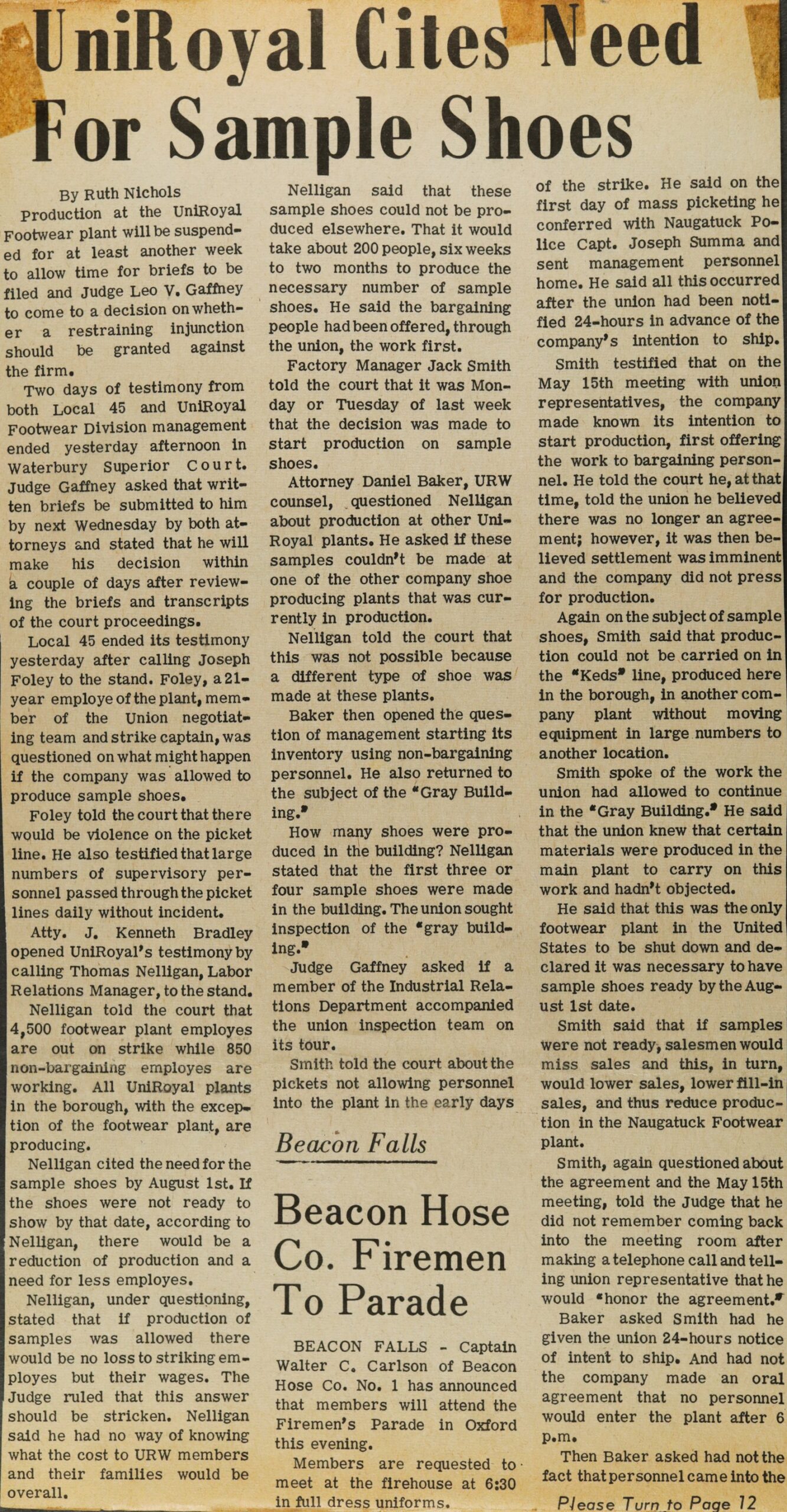
UniRoyal Cites Need For Sample Shoes

UniRoyal Cites Need For Sample Shoes

By Ruth Nichols

Production at the UniRoyal Footwear plant will be suspended for at least another week to allow time for briefs to be filed and Judge Leo V. Gaffney to come to a decision on whether a restraining injunction should be granted against the firm.

Two days of testimony from both Local 45 and UniRoyal Footwear Division management ended yesterday afternoon in Waterbury Superior Court. Judge Gaffney asked that written briefs be submitted to him by next Wednesday by both attorneys and stated that he will make his decision within a couple of days after reviewing the briefs and transcripts of the court proceedings.

Local 45 ended its testimony yesterday after calling Joseph Foley to the stand. Foley, a 21-year employe of the plant, member of the Union negotiating team and strike captain, was questioned on what might happen if the company was allowed to produce sample shoes.

Foley told the court that there would be violence on the picket line. He also testified that large numbers of supervisory personnel passed through the picket lines daily without incident.

Atty. J. Kenneth Bradley opened UniRoyal’s testimony by calling Thomas Nelligan, Labor Relations Manager, to the stand.

Nelligan told the court that 4,500 footwear plant employes are out on strike while 850 non-bargaining employes are working. All UniRoyal plants in the borough, with the exception of the footwear plant, are producing.

Nelligan cited the need for the sample shoes by August 1st. If the shoes were not ready to show by that date, according to Nelligan, there would be a reduction of production and a need for less employes.

Nelligan, under questioning, stated that if production of samples was allowed there would be no loss to striking employes but their wages. The Judge ruled that this answer should be stricken. Nelligan said he had no way of knowing what the cost to URW members and their families would be overall.

Nelligan said that these sample shoes could not be produced elsewhere. That it would take about 200 people, six weeks to two months to produce the necessary number of sample shoes. He said the bargaining people had been offered, through the union, the work first.

Factory Manager Jack Smith told the court that it was Monday or Tuesday of last week that the decision was made to start production on sample shoes.

Attorney Daniel Baker, URW counsel, questioned Nelligan about production at other UniRoyal plants. He asked if these samples couldn’t be made at one of the other company shoe producing plants that was currently in production.

Nelligan told the court that this was not possible because a different type of shoe was made at these plants.

Baker then opened the question of management starting its inventory using non-bargaining personnel. He also returned to the subject of the “Gray Building.”

How many shoes were produced in the building? Nelligan stated that the first three or four sample shoes were made in the building. The union sought inspection of the “gray building.”

Judge Gaffney asked if a member of the Industrial Relations Department accompanied the union inspection team on its tour.

Smith told the court about the pickets not allowing personnel into the plant in the early days of the strike. He said on the first day of mass picketing he conferred with Naugatuck Police Capt. Joseph Summa and sent management personnel home. He said all this occurred after the union had been notified 24-hours in advance of the company’s intention to ship.

Smith testified that on the May 15th meeting with union representatives, the company made known its intention to start production, first offering the work to bargaining personnel. He told the court he, at that time, told the union he believed there was no longer an agreement; however, it was then believed settlement was imminent and the company did not press for production.

Again on the subject of sample shoes, Smith said that production could not be carried on in the “Keds” line, produced here in the borough, in another company plant without moving equipment in large numbers to another location.

Smith spoke of the work the union had allowed to continue in the “Gray Building.” He said that the union knew that certain materials were produced in the main plant to carry on this work and hadn’t objected.

He said that this was the only footwear plant in the United States to be shut down and declared it was necessary to have sample shoes ready by the August 1st date.

Smith said that if samples were not ready, salesmen would miss sales and this, in turn, would lower sales, lower fill-in sales, and thus reduce production in the Naugatuck Footwear plant.

Smith, again questioned about the agreement and the May 15th meeting, told the Judge that he did not remember coming back into the meeting room after making a telephone call and telling union representative that he would “honor the agreement.”

Baker asked Smith had he given the union 24-hours notice of intent to ship. And had not the company made an oral agreement that no personnel would enter the plant after 6 p.m.

Then Baker asked had not the fact that personnel came into the

Please Turn to Page 12


Beacon Falls

Beacon Hose Co. Firemen To Parade

BEACON FALLS – Captain Walter C. Carlson of Beacon Hose Co. No. 1 has announced that members will attend the Firemen’s Parade in Oxford this evening.

Members are requested to meet at the firehouse at 6:30 in full dress uniforms.

Untitled Clipping

7-11-67

Page 10 – NAUGATUCK NEWS (Conn.) Tues., July 11, 1967


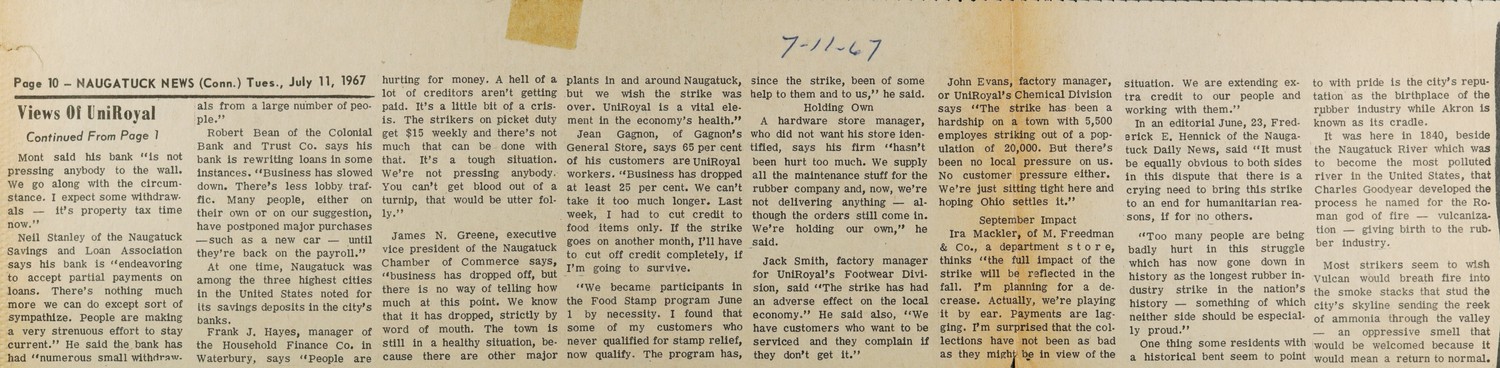
Views Of UniRoyal

Continued From Page 1

Mont said his bank “is not pressing anybody to the wall. We go along with the circumstance. I expect some withdrawals — it’s property tax time now.”

Neil Stanley of the Naugatuck Savings and Loan Association says his bank is “endeavoring to accept partial payments on loans. There’s nothing much more we can do except sort of sympathize. People are making a very strenuous effort to stay current.” He said the bank has had “numerous small withdrawals from a large number of people.”

At one time, Naugatuck was among the three highest cities in the United States noted for its savings deposits in the city’s banks.

Frank J. Hayes, manager of the Household Finance Co. in Waterbury, says “People are hurting for money. A hell of a lot of creditors aren’t getting paid. It’s a little bit of a crisis. The strikers on picket duty get $15 weekly and there’s not much that can be done with that. It’s a tough situation. We’re not pressing anybody. You can’t get blood out of a turnip, that would be utter folly.”

James N. Greene, executive vice president of the Naugatuck Chamber of Commerce says, “business has dropped off, but there is no way of telling how much at this point. We know that it has dropped, strictly by word of mouth. The town is still in a healthy situation, because there are other major plants in and around Naugatuck, but we wish the strike was over. UniRoyal is a vital element in the economy’s health.”

Jean Gagnon, of Gagnon’s General Store, says 65 per cent of his customers are UniRoyal workers. “Business has dropped at least 25 per cent. We can’t take it too much longer. Last week, I had to cut credit to food items only. If the strike goes on another month, I’ll have to cut off credit completely, if I’m going to survive.

“We became participants in the Food Stamp program June 1 by necessity. I found that some of my customers who never qualified for stamp relief, now qualify. The program has, since the strike, been of some help to them and to us,” he said.

Holding Own

A hardware store manager, who did not want his store identified, says his firm “hasn’t been hurt too much. We supply all the maintenance stuff for the rubber company and, now, we’re not delivering anything — although the orders still come in. We’re holding our own,” he said.

Jack Smith, factory manager for UniRoyal’s Footwear Division, said “The strike has had an adverse effect on the local economy.” He said also, “We have customers who want to be serviced and they complain if they don’t get it.”

John Evans, factory manager, or UniRoyal’s Chemical Division says “The strike has been a hardship on a town with 5,500 employes striking out of a population of 20,000. But there’s been no local pressure either. We’re just sitting tight here and hoping Ohio settles it.”

September Impact

Ira Mackler, of M. Freedman & Co., a department store, thinks “the full impact of the strike will be reflected in the fall. I’m planning for a decrease. Actually, we’re playing it by ear. Payments are lagging. I’m surprised that the collections have not been as bad as they might be in view of the situation. We are extending extra credit to our people and working with them.”

In an editorial June 23, Frederick E. Hennick of the Naugatuck Daily News, said “It must be equally obvious to both sides in this dispute that there is a crying need to bring this strike to an end for humanitarian reasons, if for no others.

“Too many people are being badly hurt in this struggle which has now gone down in history as the longest rubber industry strike in the nation’s history — something of which neither side should be especially proud.”

One thing some residents with a historical bent seem to point to with pride is the city’s reputation as the birthplace of the rubber industry while Akron is known as its cradle.

It was here in 1840, beside the Naugatuck River which was to become the most polluted river in the United States, that Charles Goodyear developed the process he named for the Roman god of fire — vulcanization — giving birth to the rubber industry.

Most strikers seem to wish Vulcan would breath fire into the smoke stacks that stud the city’s skyline sending the reek of ammonia through the valley — an oppressive smell that would be welcomed because it would mean a return to normal.

Untitled Clipping

Negotiators Report:

7-13-67 [handwritten]

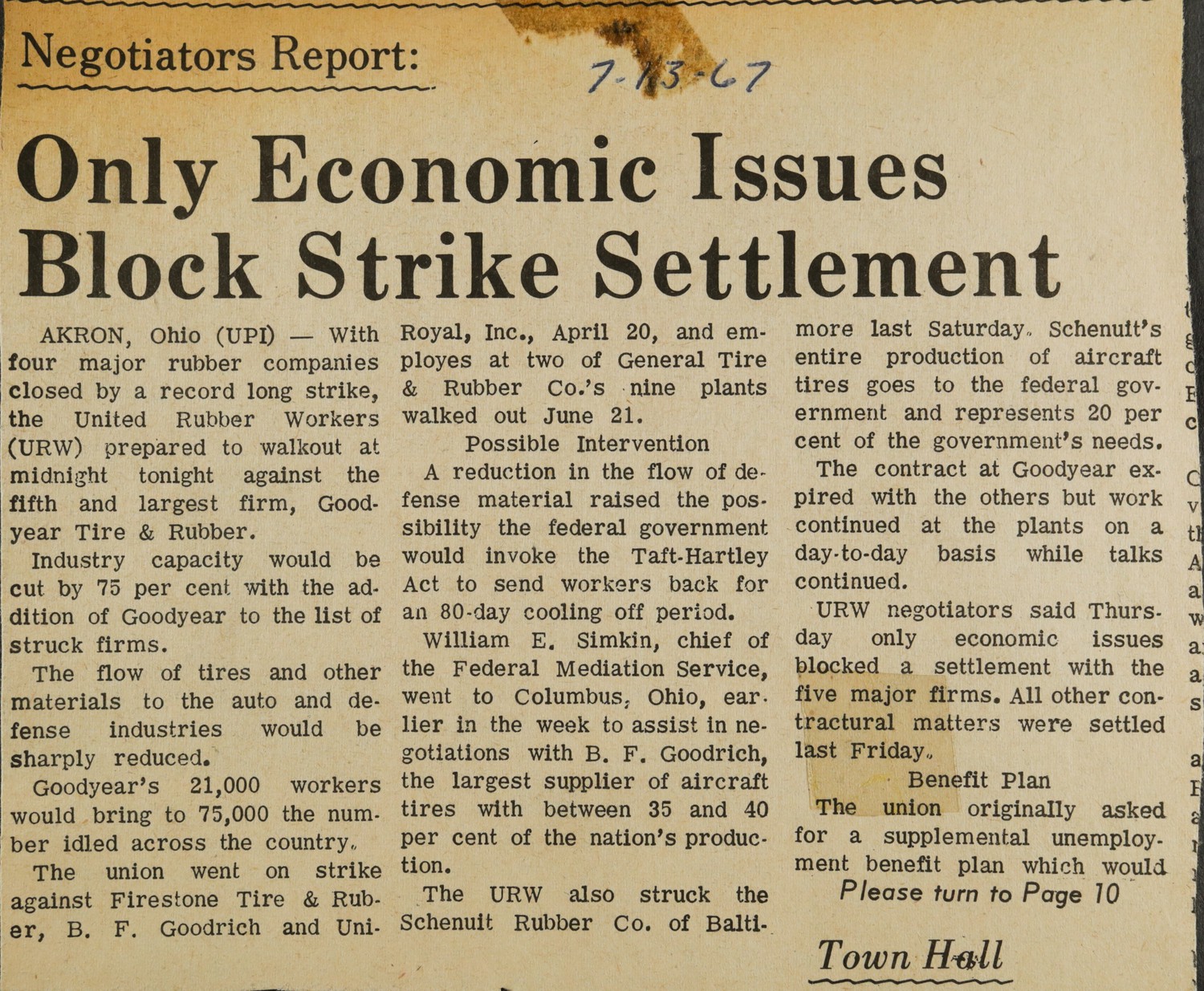
Only Economic Issues Block Strike Settlement

AKRON, Ohio (UPI) — With four major rubber companies closed by a record long strike, the United Rubber Workers (URW) prepared to walkout at midnight tonight against the fifth and largest firm, Goodyear Tire & Rubber.

Industry capacity would be cut by 75 per cent with the addition of Goodyear to the list of struck firms.

The flow of tires and other materials to the auto and defense industries would be sharply reduced.

Goodyear’s 21,000 workers would bring to 75,000 the number idled across the country.

The union went on strike against Firestone Tire & Rubber, B. F. Goodrich and Uni-

Royal, Inc., April 20, and employes at two of General Tire & Rubber Co.’s nine plants walked out June 21.

Possible Intervention

A reduction in the flow of defense material raised the possibility the federal government would invoke the Taft-Hartley Act to send workers back for an 80-day cooling off period.

William E. Simkin, chief of the Federal Mediation Service, went to Columbus, Ohio, earlier in the week to assist in negotiations with B. F. Goodrich, the largest supplier of aircraft tires with between 35 and 40 per cent of the nation’s production.

The URW also struck the Schenuit Rubber Co. of Balti-

more last Saturday. Schenuit’s entire production of aircraft tires goes to the federal government and represents 20 per cent of the government’s needs.

The contract at Goodyear expired with the others but work continued at the plants on a day-to-day basis while talks continued.

URW negotiators said Thursday only economic issues blocked a settlement with the five major firms. All other contractural matters were settled last Friday.

Benefit Plan

The union originally asked for a supplemental unemployment benefit plan which would

Please turn to Page 10


Town Hall

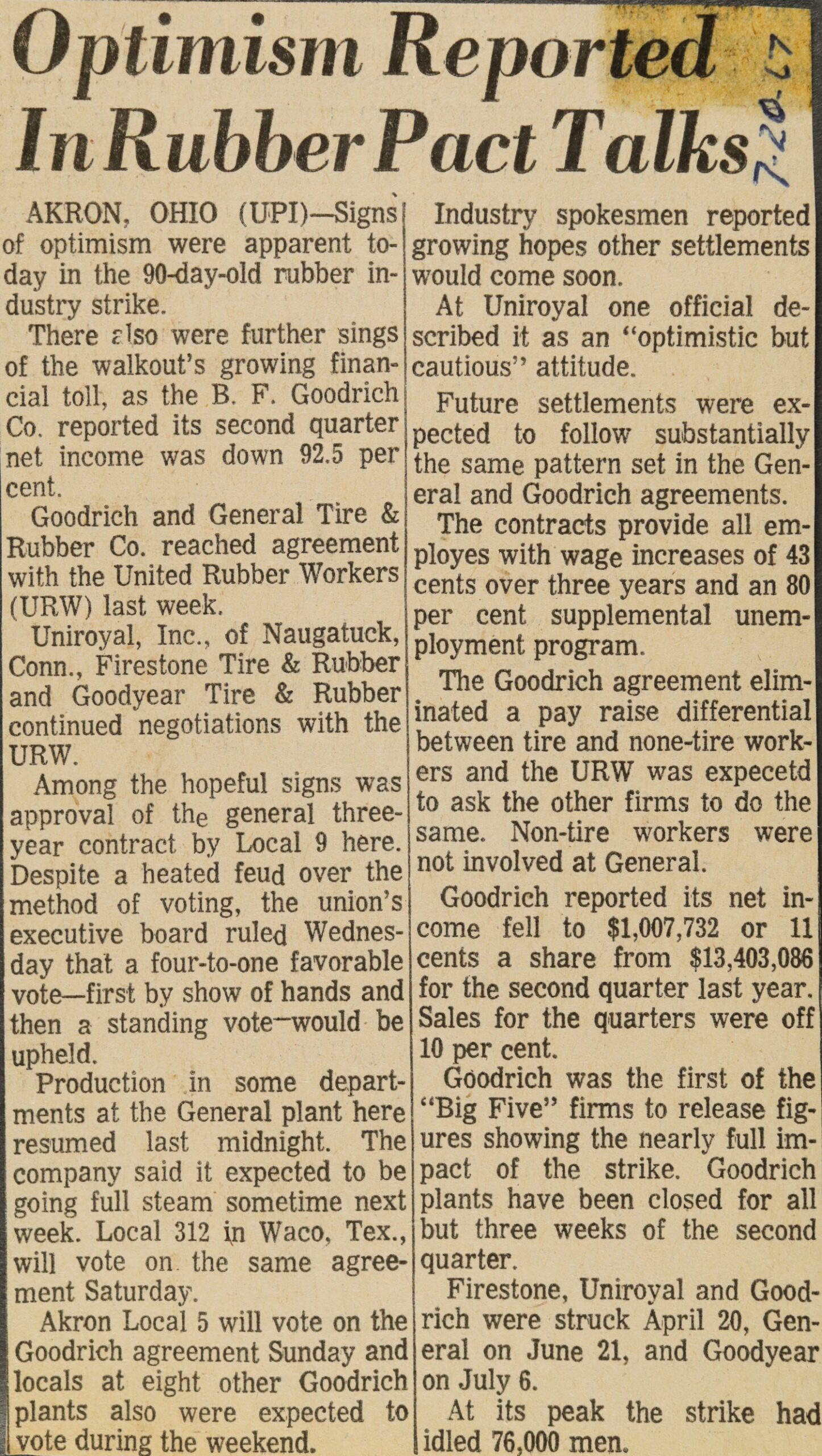
Optimism Reported In Rubber Pact Talks

Optimism Reported In Rubber Pact Talks

7-20-67 [handwritten notation]

AKRON, OHIO (UPI)—Signs of optimism were apparent today in the 90-day-old rubber industry strike.

There also were further sings of the walkout’s growing financial toll, as the B. F. Goodrich Co. reported its second quarter net income was down 92.5 per cent.

Goodrich and General Tire & Rubber Co. reached agreement with the United Rubber Workers (URW) last week.

Uniroyal, Inc., of Naugatuck, Conn., Firestone Tire & Rubber and Goodyear Tire & Rubber continued negotiations with the URW.

Among the hopeful signs was approval of the general three-year contract by Local 9 here. Despite a heated feud over the method of voting, the union’s executive board ruled Wednesday that a four-to-one favorable vote—first by show of hands and then a standing vote—would be upheld.

Production in some departments at the General plant here resumed last midnight. The company said it expected to be going full steam sometime next week. Local 312 in Waco, Tex., will vote on the same agreement Saturday.

Akron Local 5 will vote on the Goodrich agreement Sunday and locals at eight other Goodrich plants also were expected to vote during the weekend.

Industry spokesmen reported growing hopes other settlements would come soon.

At Uniroyal one official described it as an “optimistic but cautious” attitude.

Future settlements were expected to follow substantially the same pattern set in the General and Goodrich agreements.

The contracts provide all employes with wage increases of 43 cents over three years and an 80 per cent supplemental unemployment program.

The Goodrich agreement eliminated a pay raise differential between tire and none-tire workers and the URW was expecetd to ask the other firms to do the same. Non-tire workers were not involved at General.

Goodrich reported its net income fell to $1,007,732 or 11 cents a share from $13,403,086 for the second quarter last year. Sales for the quarters were off 10 per cent.

Goodrich was the first of the “Big Five” firms to release figures showing the nearly full impact of the strike. Goodrich plants have been closed for all but three weeks of the second quarter.

Firestone, Uniroyal and Goodrich were struck April 20, General on June 21, and Goodyear on July 6.

At its peak the strike had idled 76,000 men.

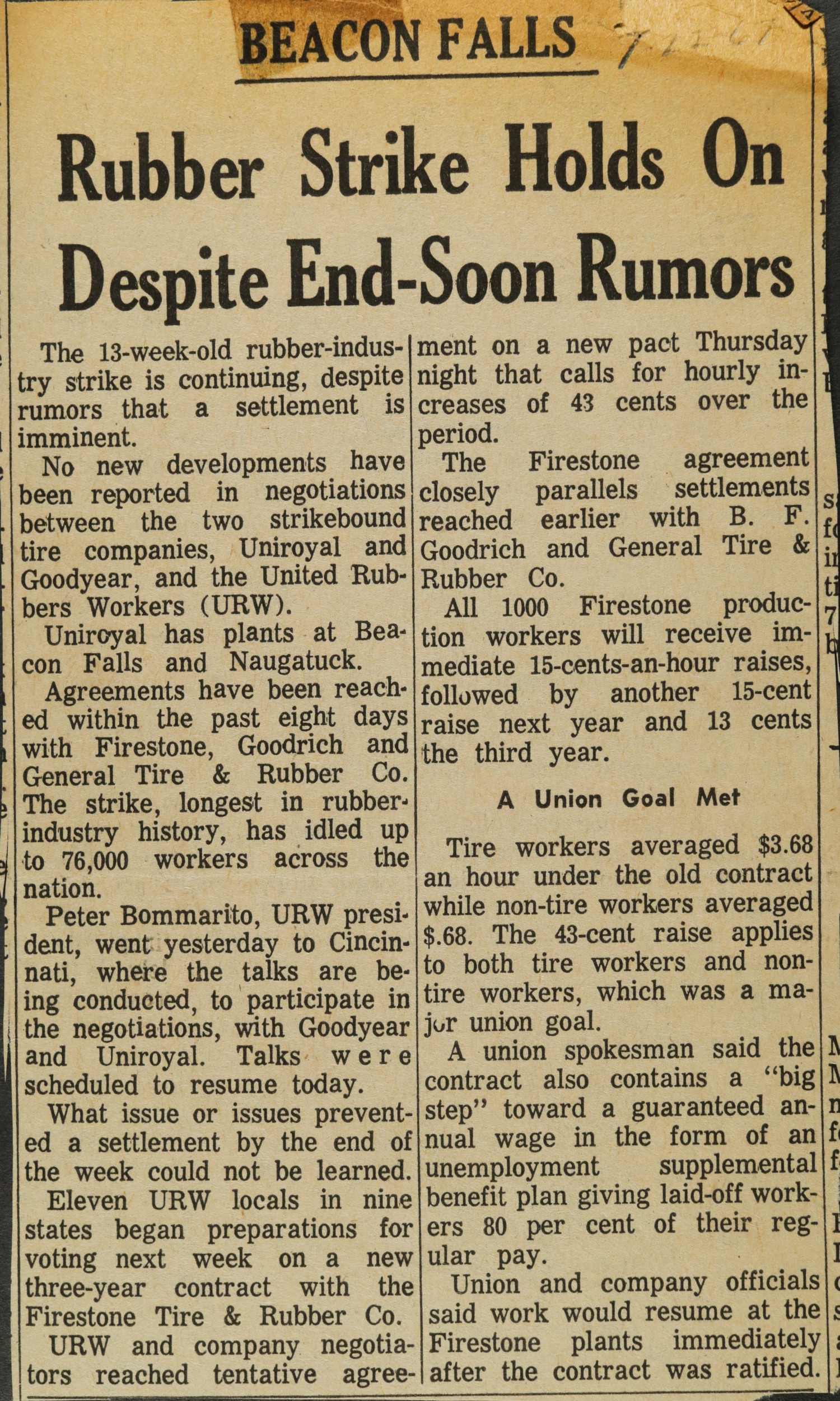
Rubber Strike Holds On Despite End-Soon Rumors

Rubber Strike Holds On Despite End-Soon Rumors

BEACON FALLS

7/12/67 [handwritten date in top right corner]

Rubber Strike Holds On Despite End-Soon Rumors

The 13-week-old rubber-industry strike is continuing, despite rumors that a settlement is imminent.

No new developments have been reported in negotiations between the two strikebound tire companies, Uniroyal and Goodyear, and the United Rubbers Workers (URW).

Uniroyal has plants at Beacon Falls and Naugatuck.

Agreements have been reached within the past eight days with Firestone, Goodrich and General Tire & Rubber Co. The strike, longest in rubber-industry history, has idled up to 76,000 workers across the nation.

Peter Bommarito, URW president, went yesterday to Cincinnati, where the talks are being conducted, to participate in the negotiations, with Goodyear and Uniroyal. Talks were scheduled to resume today.

What issue or issues prevented a settlement by the end of the week could not be learned.

Eleven URW locals in nine states began preparations for voting next week on a new three-year contract with the Firestone Tire & Rubber Co.

URW and company negotiators reached tentative agreement on a new pact Thursday night that calls for hourly increases of 43 cents over the period.

The Firestone agreement closely parallels settlements reached earlier with B. F. Goodrich and General Tire & Rubber Co.

All 1000 Firestone production workers will receive immediate 15-cents-an-hour raises, followed by another 15-cent raise next year and 13 cents the third year.

A Union Goal Met

Tire workers averaged $3.68 an hour under the old contract while non-tire workers averaged $.68. The 43-cent raise applies to both tire workers and non-tire workers, which was a major union goal.

A union spokesman said the contract also contains a “big step” toward a guaranteed annual wage in the form of an unemployment supplemental benefit plan giving laid-off workers 80 per cent of their regular pay.
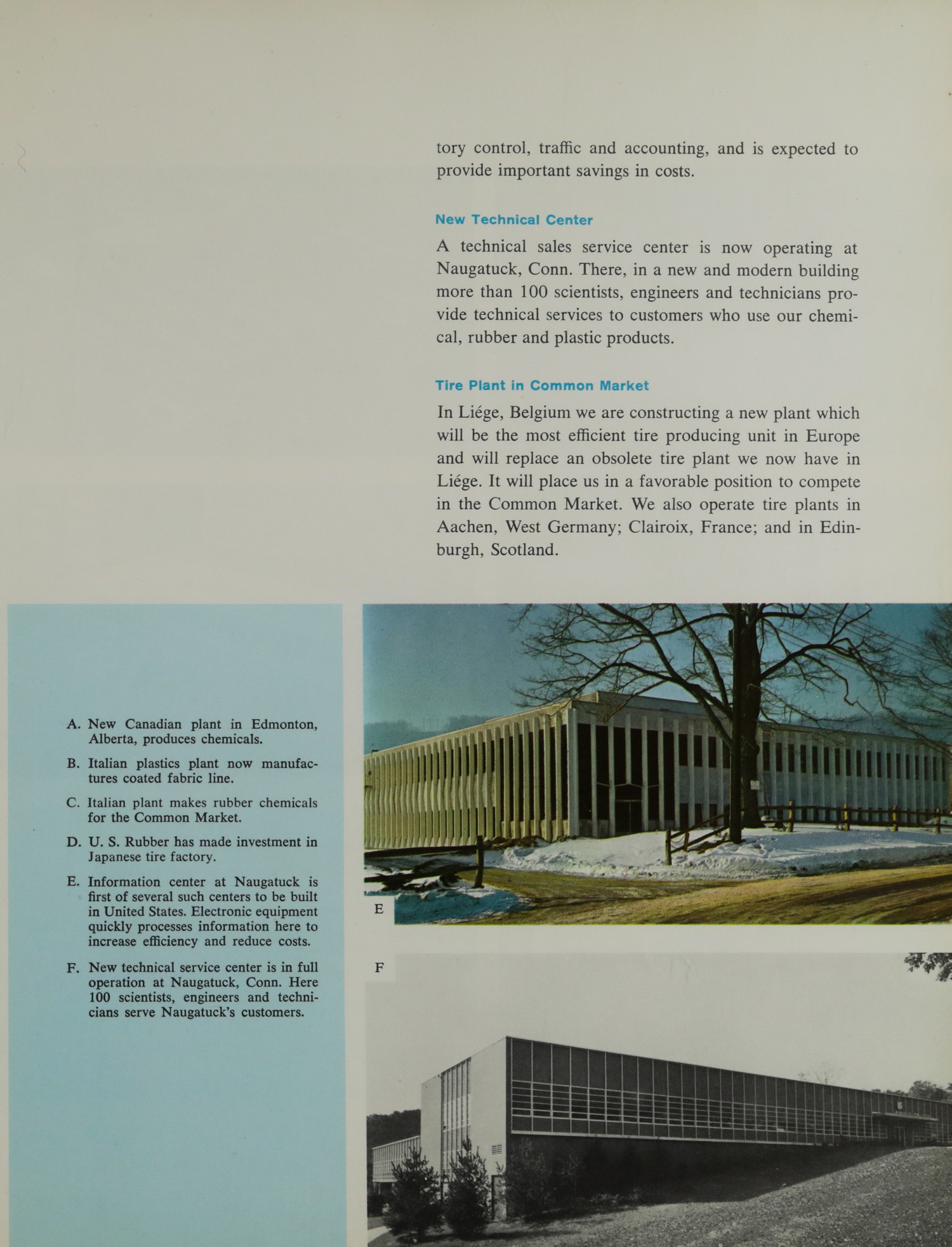
Union and company officials said work would resume at the Firestone plants immediately after the contract was ratified.

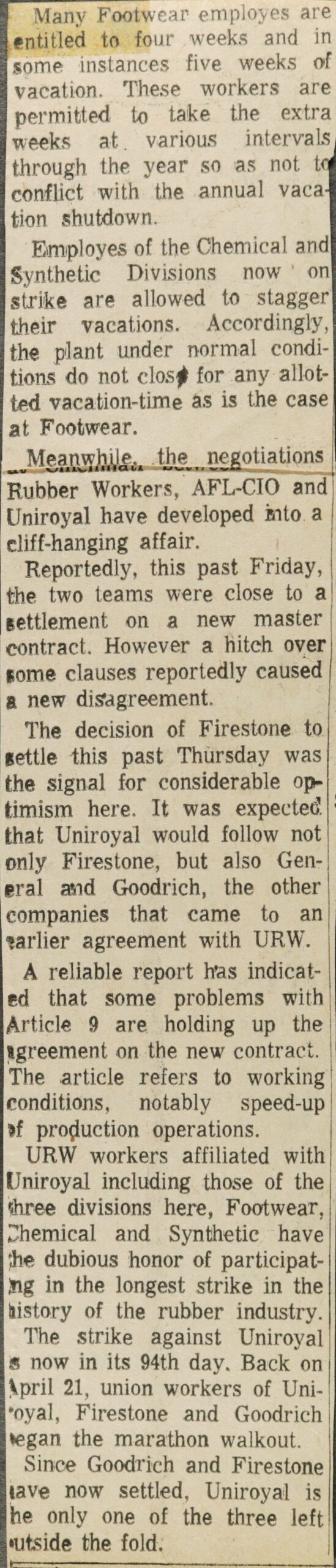
Many Footwear employes are entitled to four weeks and in some instances five weeks of vacation.

Many Footwear employes are
entitled to four weeks and in
some instances five weeks of
vacation. These workers are
permitted to take the extra
weeks at various intervals
through the year so as not to
conflict with the annual vaca-
tion shutdown.

Employes of the Chemical and
Synthetic Divisions now on
strike are allowed to stagger
their vacations. Accordingly,
the plant under normal condi-
tions do not close for any allot-
ted vacation-time as is the case
at Footwear.

Meanwhile, the negotiations

Rubber Workers, AFL-CIO and
Uniroyal have developed into a
cliff-hanging affair.

Reportedly, this past Friday,
the two teams were close to a
settlement on a new master
contract. However a hitch over
some clauses reportedly caused
a new disagreement.

The decision of Firestone to
settle this past Thursday was
the signal for considerable op-
timism here. It was expected
that Uniroyal would follow not
only Firestone, but also Gen-
eral and Goodrich, the other
companies that came to an
earlier agreement with URW.

A reliable report has indicat-
ed that some problems with
Article 9 are holding up the
agreement on the new contract.
The article refers to working
conditions, notably speed-up
of production operations.

URW workers affiliated with
Uniroyal including those of the
three divisions here, Footwear,
Chemical and Synthetic have
the dubious honor of participat-
ing in the longest strike in the
history of the rubber industry.

The strike against Uniroyal
s now in its 94th day. Back on
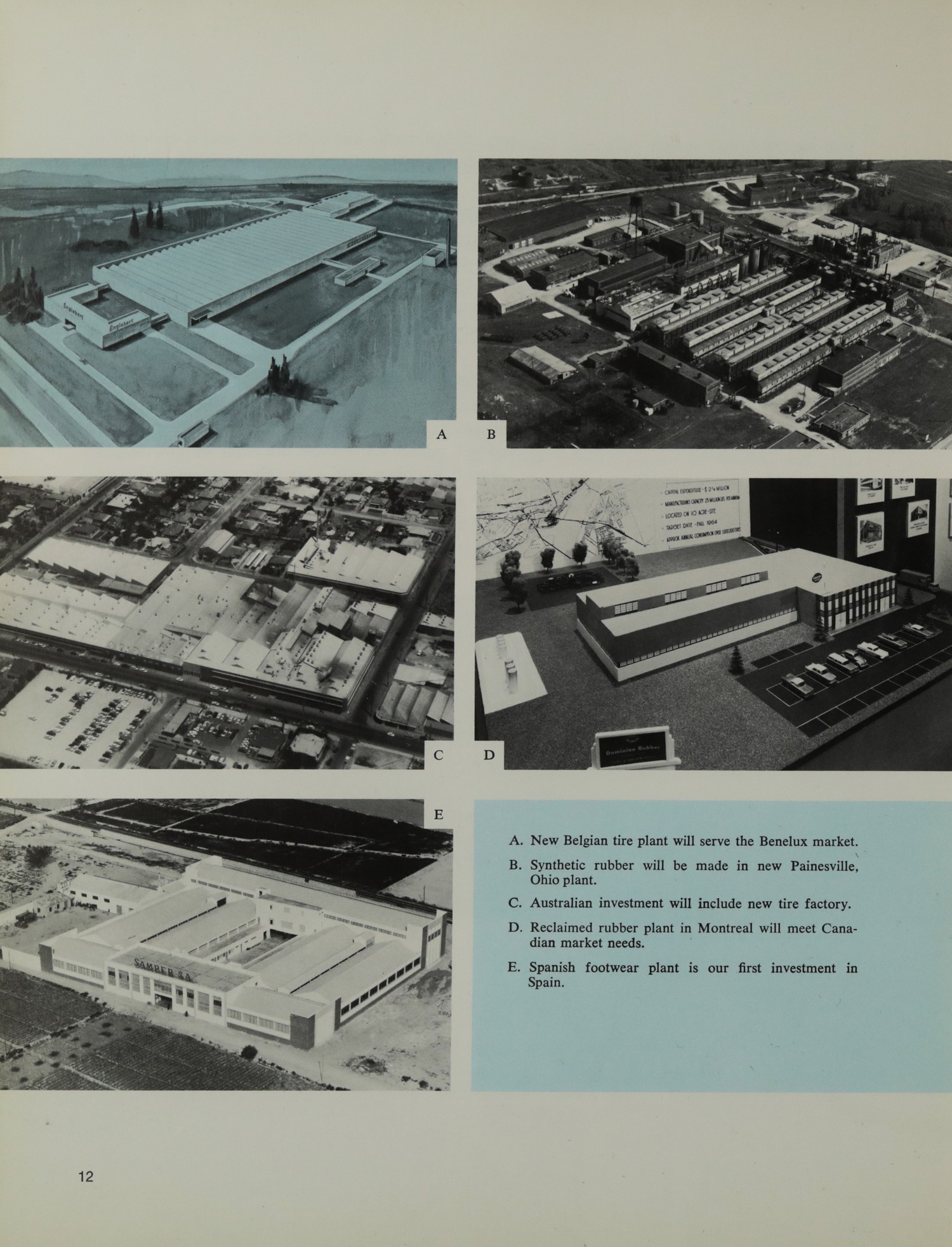
April 21, union workers of Uni-
oyal, Firestone and Goodrich
egan the marathon walkout.

Since Goodrich and Firestone
have now settled, Uniroyal is
he only one of the three left
utside the fold.

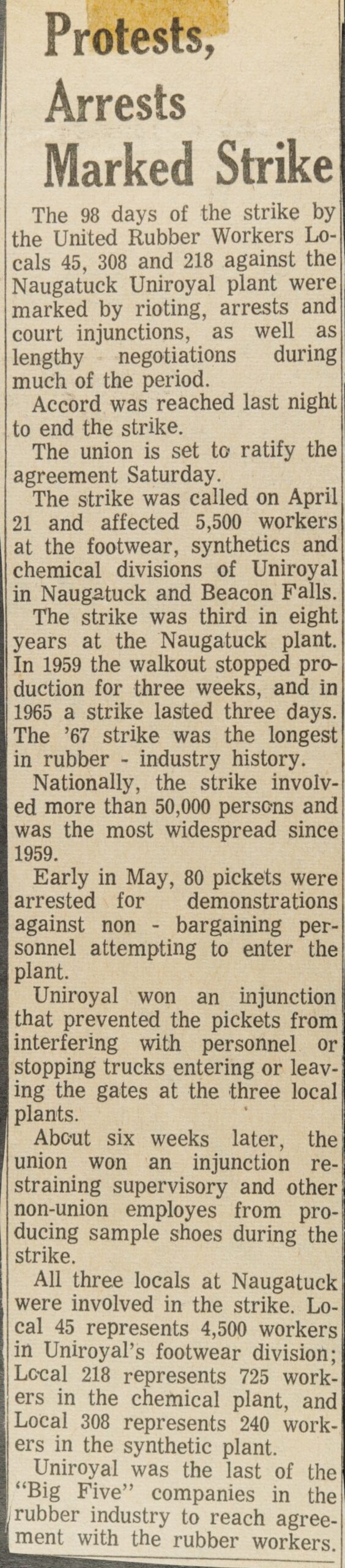
Protests, Arrests Marked Strike

Protests, Arrests Marked Strike

The 98 days of the strike by the United Rubber Workers Locals 45, 308 and 218 against the Naugatuck Uniroyal plant were marked by rioting, arrests and court injunctions, as well as lengthy negotiations during much of the period.

Accord was reached last night to end the strike.

The union is set to ratify the agreement Saturday.
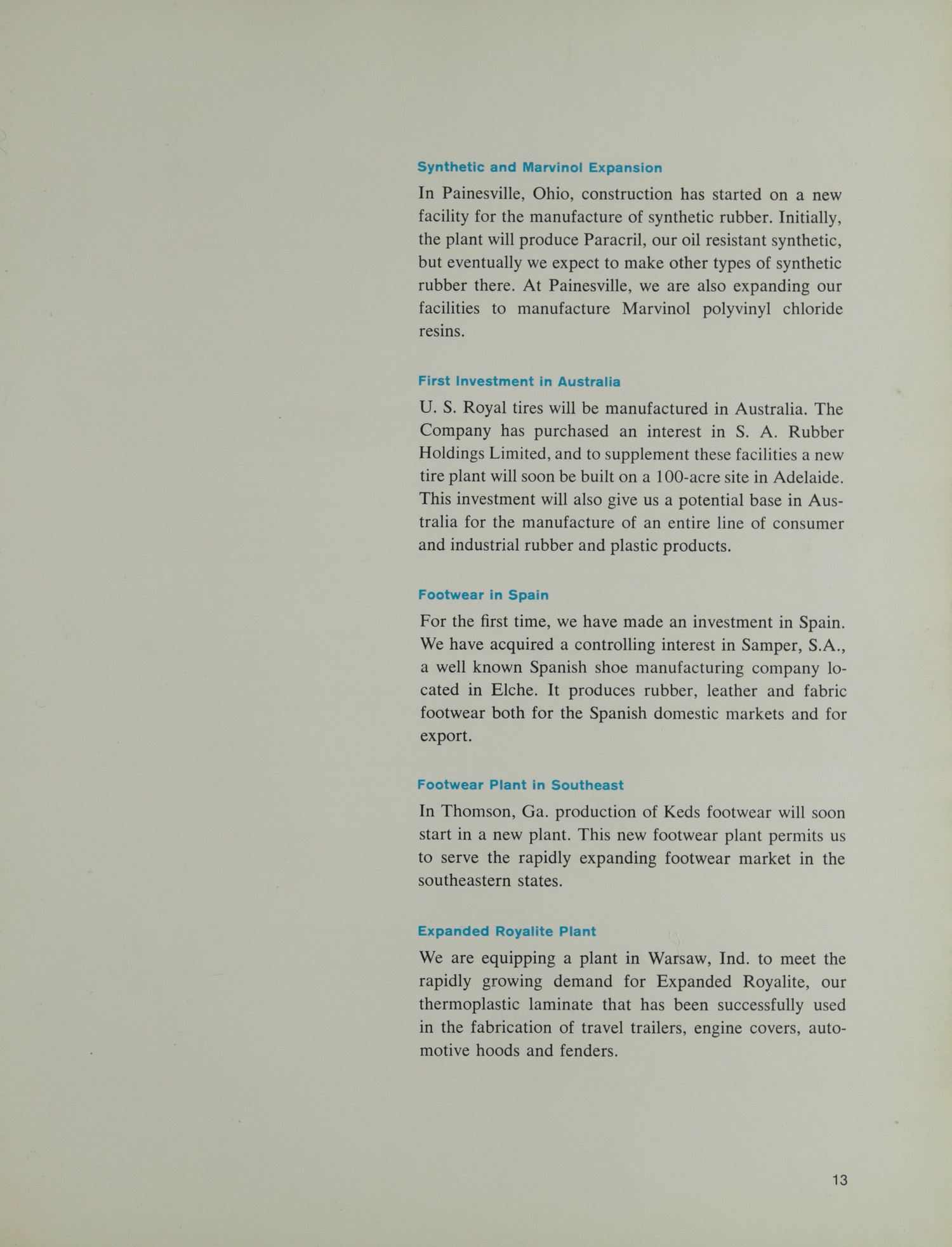
The strike was called on April 21 and affected 5,500 workers at the footwear, synthetics and chemical divisions of Uniroyal in Naugatuck and Beacon Falls.
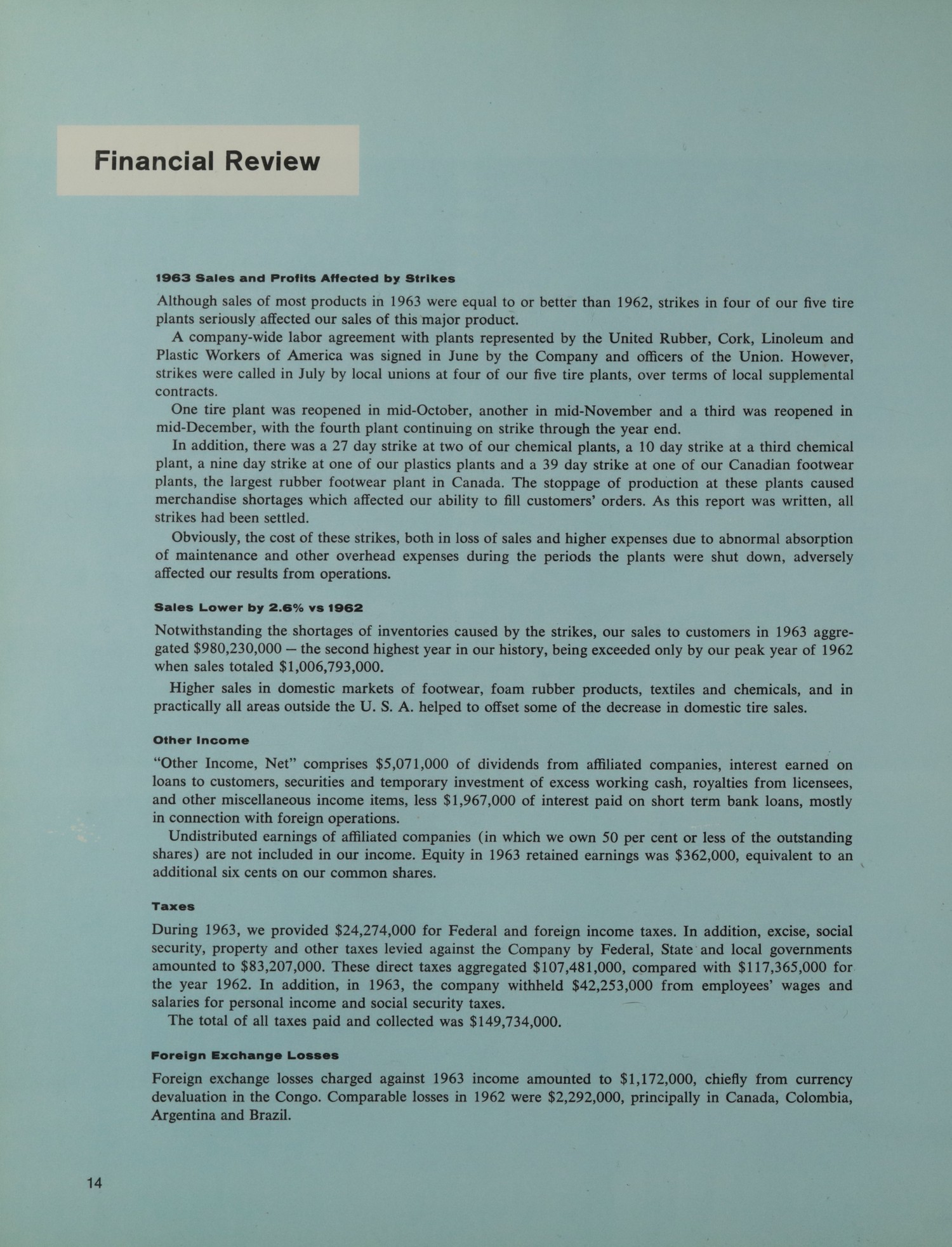
The strike was third in eight years at the Naugatuck plant. In 1959 the walkout stopped production for three weeks, and in 1965 a strike lasted three days. The ’67 strike was the longest in rubber – industry history.

Nationally, the strike involved more than 50,000 persons and was the most widespread since 1959.

Early in May, 80 pickets were arrested for demonstrations against non – bargaining personnel attempting to enter the plant.

Uniroyal won an injunction that prevented the pickets from interfering with personnel or stopping trucks entering or leaving the gates at the three local plants.

About six weeks later, the union won an injunction restraining supervisory and other non-union employes from producing sample shoes during the strike.

All three locals at Naugatuck were involved in the strike. Local 45 represents 4,500 workers in Uniroyal’s footwear division; Local 218 represents 725 workers in the chemical plant, and Local 308 represents 240 workers in the synthetic plant.

Uniroyal was the last of the “Big Five” companies in the rubber industry to reach agreement with the rubber workers.

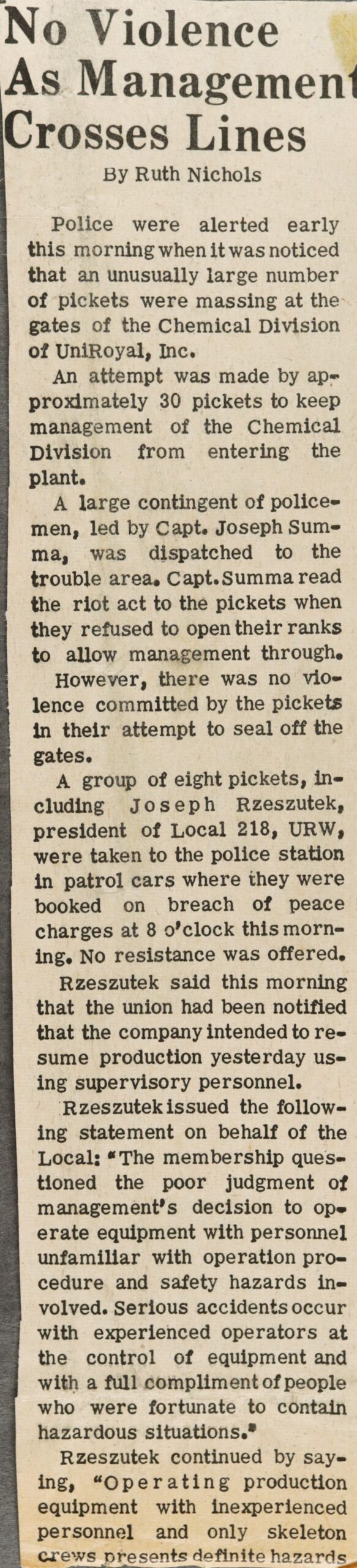
No Violence As Management Crosses Lines

No Violence As Management Crosses Lines

By Ruth Nichols

Police were alerted early this morning when it was noticed that an unusually large number of pickets were massing at the gates of the Chemical Division of UniRoyal, Inc.

An attempt was made by approximately 30 pickets to keep management of the Chemical Division from entering the plant.

A large contingent of policemen, led by Capt. Joseph Summa, was dispatched to the trouble area. Capt. Summa read the riot act to the pickets when they refused to open their ranks to allow management through.

However, there was no violence committed by the pickets in their attempt to seal off the gates.

A group of eight pickets, including Joseph Rzeszutek, president of Local 218, URW, were taken to the police station in patrol cars where they were booked on breach of peace charges at 8 o’clock this morning. No resistance was offered.

Rzeszutek said this morning that the union had been notified that the company intended to resume production yesterday using supervisory personnel.

Rzeszutek issued the following statement on behalf of the Local: “The membership questioned the poor judgment of management’s decision to operate equipment with personnel unfamiliar with operation procedure and safety hazards involved. Serious accidents occur with experienced operators at the control of equipment and with a full compliment of people who were fortunate to contain hazardous situations.”

Rzeszutek continued by saying, “Operating production equipment with inexperienced personnel and only skeleton crews presents definite hazards

Evans said yesterday, that the plant was forced to start production in order to service key accounts which include defense contracts.

Evans said yesterday, that the plant was forced to start production in order to service key accounts which include defense contracts.

Evans said yesterday, that
the plant was forced to start
production in order to service
key accounts which include de-
fense contracts.

An issue was raised yester-
day by Joseph Rzeszutek, pres-
ident of Local 218, as to the
safety of management oper-
ating production especially with
skeleton crews.

The striking Local circulated
handbills to this effect around
the borough yesterday.

SATURDAY
MAY 27, 1967

UniRoyal

Continued From Page 1

According to Rzeszutek, the
only items shipped from the
Chemical were “slabs of re-
claim”, slabs of rubber re-
claimed from old tires and
other rubber items.

“What are they going to do
with slabs of reclaim, drop them
from airplanes and smother the
Viet Cong?” he asked.

Rzeszutek, a veteran of com-
bat who “had been shot up a few
times” himself, resented the
implication that he and his union
were unpatriotic. He said he
could guarantee that not one
thing had been shipped from the
Chemical plant to Vietnam.

Management lawyer, Atty. J.
Kenneth Bradley, said Friday
that the production was “par-
tially” for the defense effort,
and partially “for use in other
parts of the country.” The only
additional information he would
give was that the items “are not
for use by ourselves.”

A company official was quot-
ed Thursday as saying the oper-
ation of plant by management
personnel was for the produc-
tion of some key items neces-
sary for the Vietnam defense
effort.

In asking for an end to picket
line difficulties, Gaffney sym-
pathized with the union mem-
bers who felt that “someone is
destroying. . .the right to live
and work.” “I trust we will
never have a hearing”, the judge
said, adding that he hoped he
would not be forced to issue
an injunction against the union.

Judge Gaffney on May 6 issued
a show cause order against
Local 45 of the United Rubber
Workers in connection with
picketing at the Footwear Divi-
sion, but a hearing has never
been held. There have been two
continuances and more are ex-
pected as long as the picketing
remains peaceful.

The judge said he hoped the
issuance of a show cause order
will have the same effect at the
Chemical plant.

The United Rubber Workers
have been on strike for five-
weeks. Negotiations on the mas-
ter contract, being held in Cin-
cinnati, Ohio, recessed Friday
until Wednesday.

Questioned Decision

Questioned Decision

Alves questioned the decision of the management, criticizing its actions in attempting production with “unskilled personnel.” The union president further asserted that because of the “danger of work involved at the plant, a disaster could occur, not only endangering the lives and property of those in close proximity to the plant, but to also those in the neighborhood.”

Alves said the union has contacted the insurance company on whether they had been informed of the production work by the unskilled personnel and reported the insurance company had not been notified to date. He said periodic inspections are conducted at the plant due to the nature of work involved.

Third Plant Involved

The mass picketing at the Synthetic Plant, makes the third plant of the Uniroyal company to be involved since the three plants were struck 41 days ago.

Both Locals 218 of the Chemical and 308 of Synthetic Plants have maintained around-the-clock picketing since the beginning of the strike.

All have made identically inadequate wage offers, he said, and are prevented from meeting their collective bargaining obligations by the strike assistance pact

“All have made identically in-
adequate wage offers,” he said,
“and are prevented from meet-
ing their collective bargain-
ing obligations by the strike as-
sistance pact.”

A Firestone spokesman said
the company wouldn’t have any
official comment on the NLRB
complaint by the union.

“We can see no legal basis
for their claims,” he said.
Spokesmen for the four other
rubber companies also declined
comment on the complaint.

The issuance of this com-
plaint and the meeting held
Monday by Local 45 is the first
real information and indication
the striking rubber workers
have received on how the nego-
tiating sessions are progress-
ing.

The strike, now entering its
42nd day, has been a long, drag-
ged out affair filled with rumors
but without any definite releases
as to the proceedings in Ohio.

Both the companies and union
had agreed that neither party
would give out information as
to the negotiations without the
others consent.

Striking Local 45 members
gave their President George
Froehlich a vote of confidence
at the meeting held Monday;
however, Froehlich gave the
members no encouragement as
far as a fast settlement was
concerned.

Picketing at all three local
plants remain quiet as UniRoyal
supervisory personnel carry on
limited production at the
Chemical and Synthetic plants
and shipping is carried out at
the Footwear warehouse.

Mayor Joseph C. Raytkwich
received a complaint from a
Cotton Hollow resident this
morning that a heavy smog
covered the area. The com-
plainant also said that the
air was irritating to the nose
and eyes.

However, the source of the
“smog” was not identified, and
this seems to be the only area
of the borough so effected.

US Rubber Annual Report – 72nd Annual Report – Page 2

Page 002

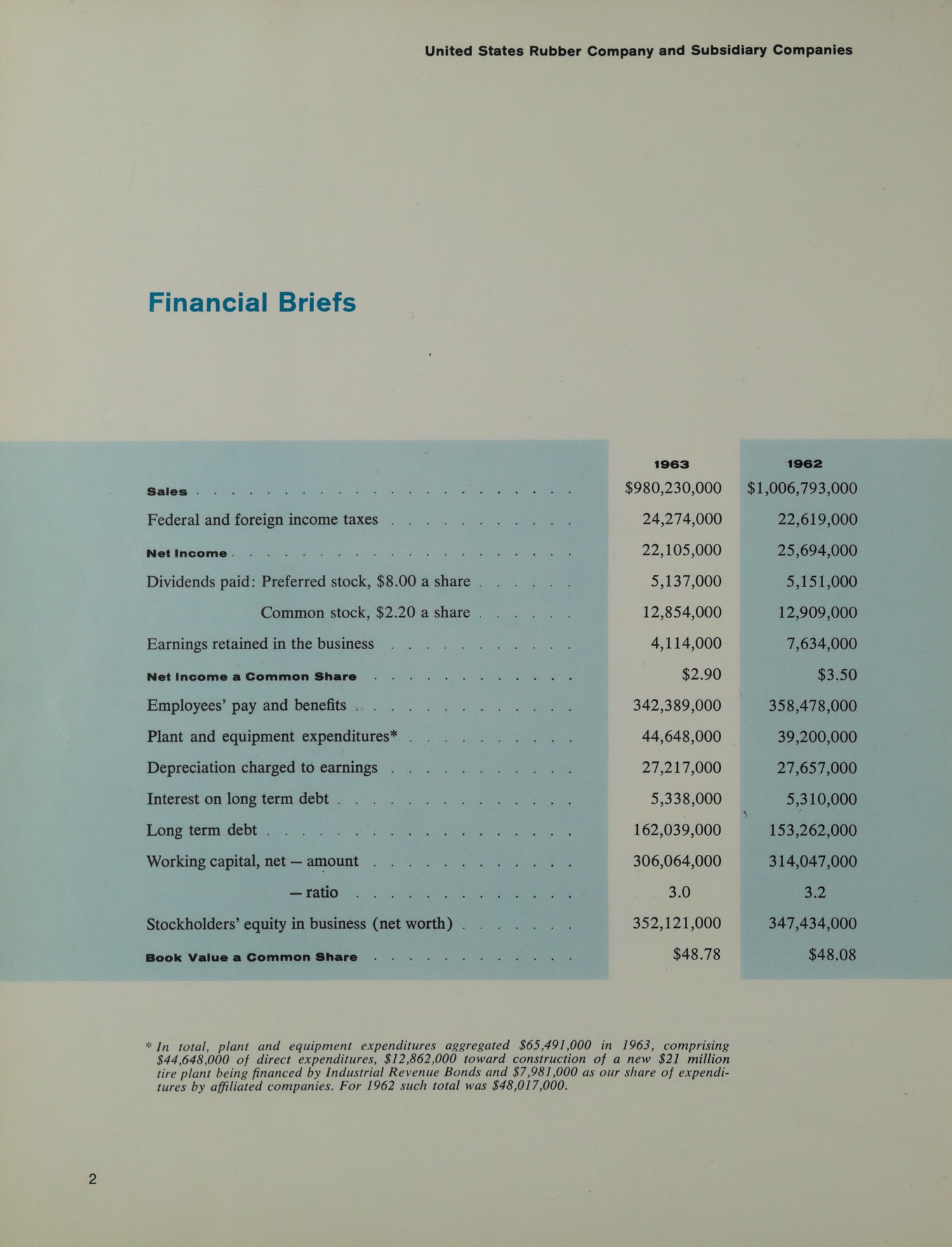
United States Rubber Company and Subsidiary Companies

Financial Briefs

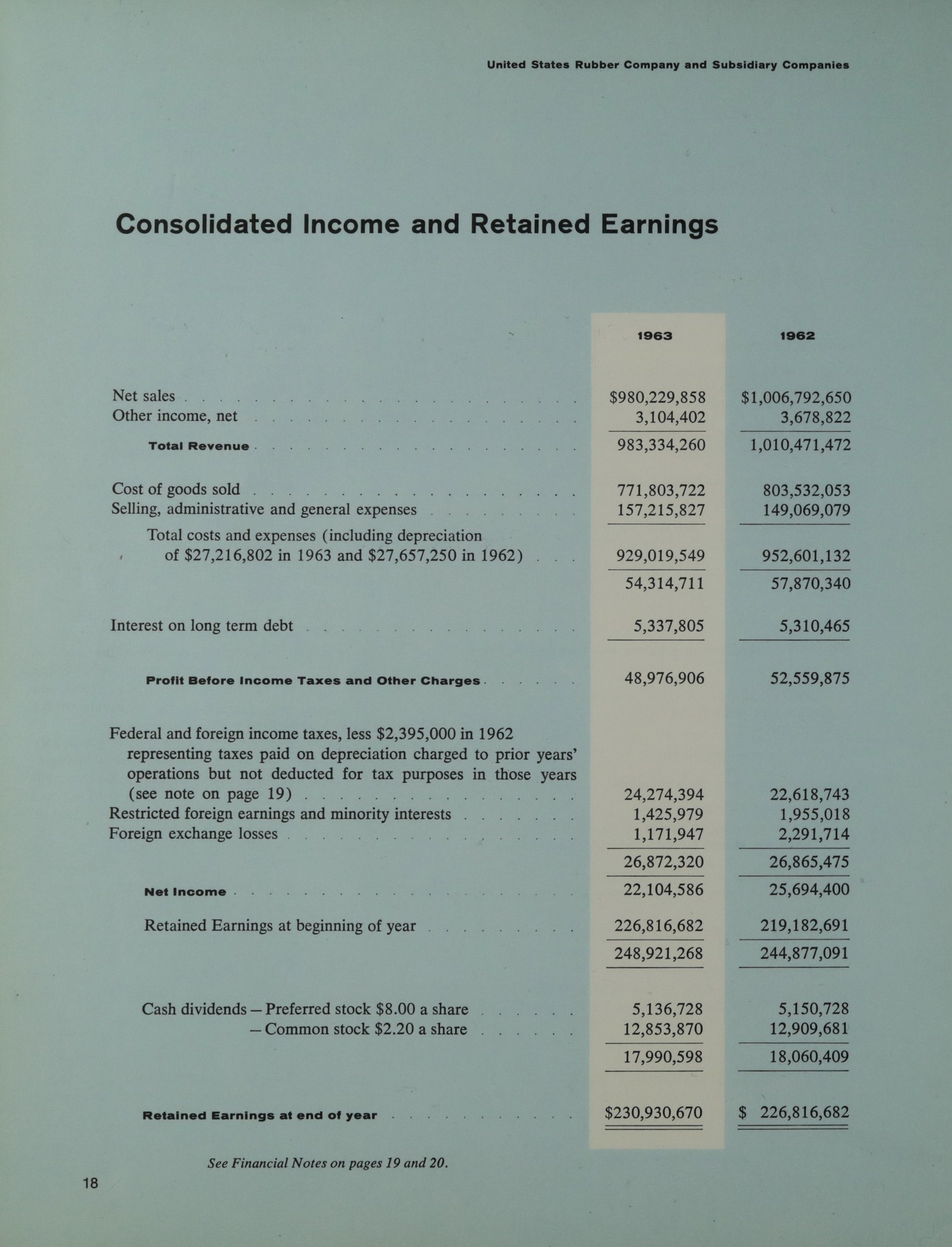
                             1963      1962

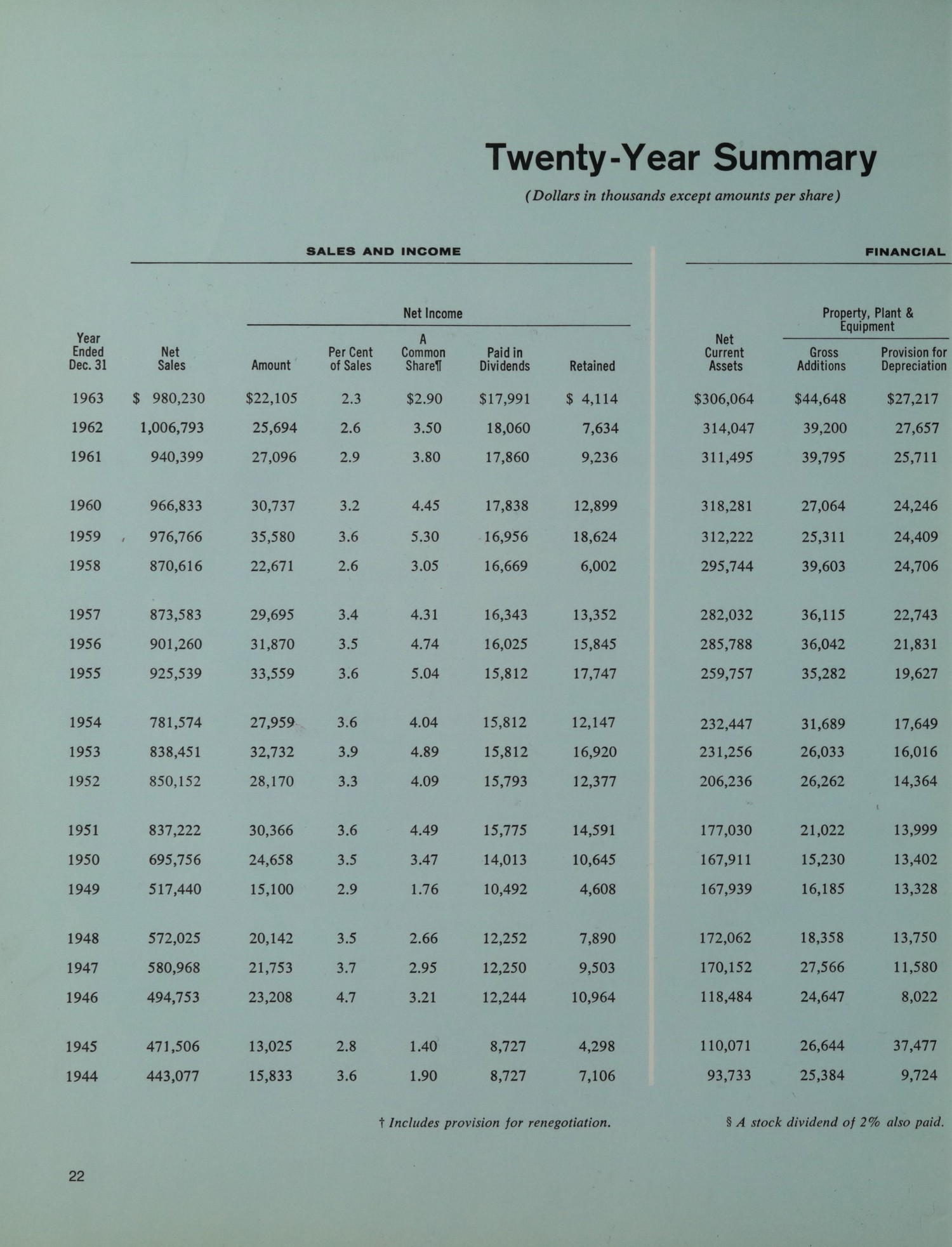
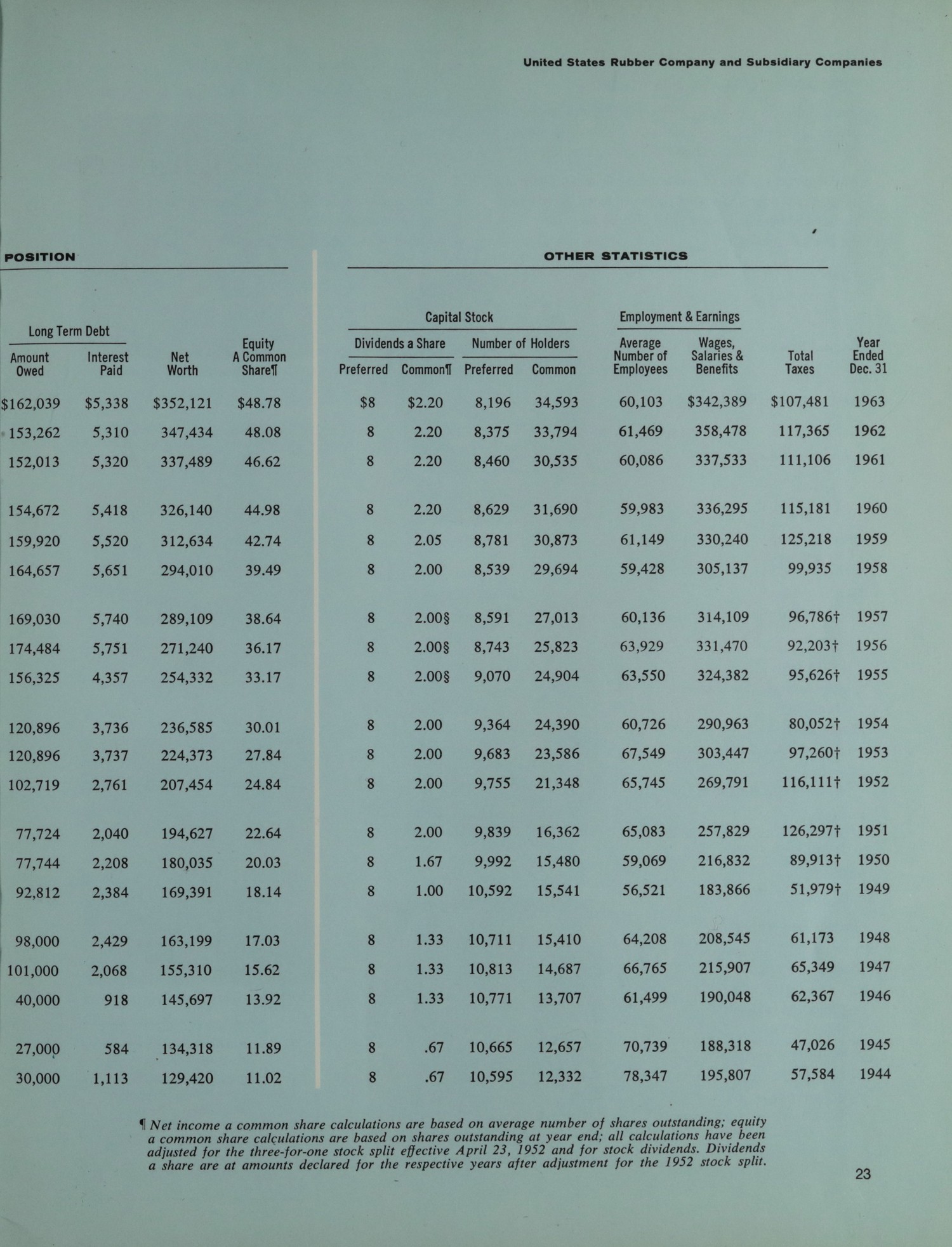
Sales . . . . . . . . . . . . . . . . . . $980,230,000 $1,006,793,000

Federal and foreign income taxes . . . . . . . 24,274,000 22,619,000

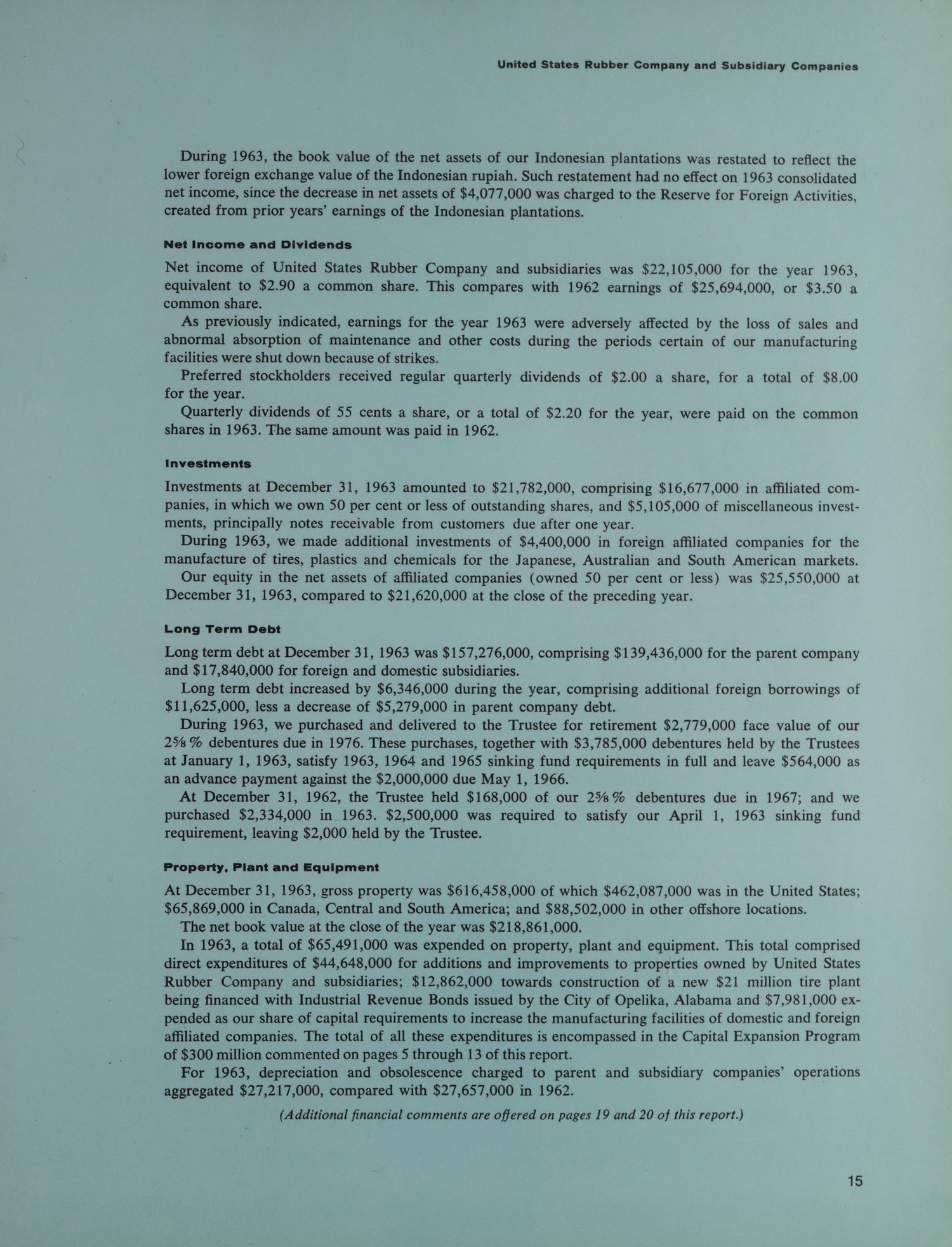
Net Income. . . . . . . . . . . . . . . . . 22,105,000 25,694,000

Dividends paid: Preferred stock, $8.00 a share . 5,137,000 5,151,000
Common stock, $2.20 a share . . 12,854,000 12,909,000

Earnings retained in the business . . . . . . . 4,114,000 7,634,000

Net Income a Common Share . . . . . . . . . . $2.90 $3.50

Employees’ pay and benefits . . . . . . . . . 342,389,000 358,478,000

Plant and equipment expenditures* . . . . . . 44,648,000 39,200,000

Depreciation charged to earnings . . . . . . . 27,217,000 27,657,000

Interest on long term debt . . . . . . . . . . 5,338,000 5,310,000

Long term debt . . . . . . . . . . . . . . . 162,039,000 153,262,000

Working capital, net — amount . . . . . . . . 306,064,000 314,047,000
— ratio . . . . . . . . . . 3.0 3.2

Stockholders’ equity in business (net worth) . . 352,121,000 347,434,000

Book Value a Common Share . . . . . . . . . . $48.78 $48.08

  • In total, plant and equipment expenditures aggregated $65,491,000 in 1963, comprising $44,648,000 of direct expenditures, $12,862,000 toward construction of a new $21 million tire plant being financed by Industrial Revenue Bonds and $7,981,000 as our share of expenditures by affiliated companies. For 1962 such total was $48,017,000.

US Rubber Annual Report – 72nd Annual Report – Page 3

Page 003

February 12, 1964

To the Stockholders of United States Rubber Company:

In the first half of 1963 our profit rose 2.7 per cent, despite 1.4 per cent lower sales. But strikes in nine plants during the second half of the year reduced net income for the year to $22,105,000, or 14 per cent below 1962.

Our 1963 sales of $980,230,000 were second highest in our history, but 2.6 per cent below the record high of $1,006,793,000 set in 1962. Sales increased, however, in many product categories and in several cases set new records.

The strikes, which prevented sales from exceeding the 1962 record, lasted for varying periods of time at three chemical and synthetic rubber plants, a plastic plant, a Canadian footwear plant and four of our five domestic tire plants.

Strike issues varied from place to place but in the longest and costliest strikes at our tire plants the most important issue was the Company’s need to revise loose work practices which had evolved during the war and post-war years and which had prevented the Company from making full use of its expensive manufacturing equipment. New contracts signed at these plants will improve our position and provide long range security in the interest of stockholders and employes alike.

Capital expenditures for new plants and the modernization of existing ones reached a new level of approximately 65 million dollars, compared with 48 million in 1962. These figures include our direct capital expenditures, the expenditure at our new tire plant in Alabama and our share of investment in joint ventures and affiliated companies. Outside the U.S. A., new investments included a plastics plant in Italy, a footwear plant in Spain, a rubber company in Australia and both a tire and chemical venture in Japan.

This new level of capital expenditures strengthens our profit potential for the future. It is a part of a 300-million-dollar long term expansion and modernization program, the largest in the Company’s history, which is described on the following pages.

The Company made new strides in distribution of its products, particularly tires. Many new tire dealers took on the U. S. Royal franchise because of the outstanding quality of our tires and the new merchandising techniques we have developed. We moved strongly into many shopping centers. In areas where we could not obtain suitable independent dealers, we continued to supplement our distribution by opening Company tire centers. We now have a total of 228 Company-owned tire distribution outlets.

In research and development, a number of new products were put into production. In addition, we committed several million dollars for plants to manufacture new products starting in 1964. Among these are Royalene – our new ethylene-propylene rubber – a new dyeable polypropylene fiber, and Expanded Royalite – a new plastic material now coming into use in auto body parts, truck cabs, house trailers, and a host of other products. Gratifying progress was made in the development of a new high speed, super performance tire based on Royalene rubber.

We completed the second full year of use of our CVC bonding agent in tires. This development and other advances allowed us to move into a position of leadership in tire quality and performance. Late in the year, we completed construction of a new tire proving ground on a 6,900-acre tract in Laredo, Texas. This is by far the most advanced of any tire testing facility in the world today and will insure our maintaining product leadership.

By order of the Board of Directors,

[Handwritten signatures]
President
Chairman

US Rubber Annual Report – 72nd Annual Report – Page 4

Page 004

One of the largest and most dramatic expansions has been at Geismar, La. This is a complete chemical complex for the manufacture of vinyl monomers, agricultural and Rydene synthetic rubber.

A. Agricultural chemicals are made in Geismar plant.
B. Rubber chemical plant at Geismar is now operating.

US Rubber Annual Report – 72nd Annual Report – Page 5

Page 005

$300,000,000 Expansion and Modernization Program

U. S. Rubber has undertaken a world-wide expansion and modernization program which will involve a total investment of more than 300 million dollars. We are well along in this program and expect it to be completed in three to four years. Approximately 200 million of this program is for the modernization and expansion of our tire production and distribution facilities, both in the United States and abroad and for chemical, textile and synthetic rubber plants which supply raw materials and components to our tire manufacturing operations. The remainder of the program will provide the other manufacturing divisions of the company with new facilities in the United States, Europe, Latin America, Australia, the Far East and Canada devoted to products other than tires and tire components. The program will open new markets for us at home and abroad, and will strengthen our competitive position in the more profitable areas of our business.

New Chemical Complex

At Geismar, La. we have invested more than 30 million dollars in a modern chemical complex, and our investments there will continue to increase in the future. Three plants are now in operation. One is producing vinyl monomers for use in plastics. Another is producing agricultural chemicals, and a third is turning out improved rubber and agricultural chemicals. This spring a fourth plant will start making Royalene, the new ethylene-propylene synthetic rubber.

U.S. Rubber Sales by Product Groups as Percent of Total Show Increasing Diversification

Areas of the company’s most rapid growth during the last quarter century are indicated in this chart. Chemicals, textiles and fibers, as well as our business outside the United States, enjoyed the greatest growth. In the meantime, tires, footwear, general and industrial products continue to be an important source of company business.

US Rubber Annual Report – 72nd Annual Report – Page 6

Page 006

Geismar is also the site selected for Rubicon Chemicals, Inc., a company jointly owned with Imperial Chemical Industries, Ltd. of Great Britain. It will produce aniline and tolylene diisocyanates for polyurethane synthetics, used in foams, rubbers and surface coatings.

In Scotts Bluff, La. we are doubling our capacity for Kralastic ABS plastics. These tough plastics are widely used in automobile dashboards, body parts and panels, and also in travel trailers. They also find wide applications in appliances, pipe, telephone hand sets and a host of other uses.

Most Modern Tire Plant in U.S.A.
The most modern and efficient tire plant in the industry recently started production in Opelika, Ala. to satisfy the rapidly growing tire market of the southeastern states. An intensive modernization program is also in progress in our other tire plants. We have also opened new tread rubber plants in Conyers, Georgia and Wilkes-Barre, Pennsylvania, and others are now in the planning stage.

Argentine Project
Production is expected to get underway by midyear at San Lorenzo in Argentina by PASA, an industrial complex in which we have a 24 per cent interest. It will produce synthetic rubbers, chemicals, carbon black and other hydrocarbon materials. The principal market for these products will be the thriving Argentine tire industry, but this market can be extended throughout Latin America.

Model is of Geismar Royalene synthetic rubber plant.

Turkish Tire Plant
At Adapazari in Turkey, U. S. Rubber in 1963 started manufacture of tires in a new plant. It will fill the needs of a rapidly growing market for tires in Turkey, a nation with an adequate road system, a growing automobile industry and an expanding transportation network.

English Chemical and Plastics Plants
At Bromsgrove, England the Company has established a subsidiary, Sto-Chem Limited, a company which manufactures synthetic latices that are marketed in England and on the continent. Also in England, we started to construct a plant to make the ABS plastic, Kralastic.

US Rubber Annual Report – 72nd Annual Report – Page 8

Page 008

A. Argentine complex will make chemicals, synthetics for Argentine tire industry.
B. Turkish plant fills needs of growing Near East tire market.
C. New Scotts Bluff, La. plant will double ABS plastic capacity.
D. New Winnsboro, S. C. plant makes improved nylon tire cord.
E. Sto-Chem in Bromsgrove, England, manufactures synthetic latices that are marketed in England and on the continent.
Right: New Laredo, Texas, tire proving facility is now in operation. At top, test driver rounds curve on high speed track. Center, tires are tested for durability on cobblestone roadway. At bottom, part of 80 vehicle test fleet lines up on track. Laredo facility is on 6,900-acre site, employs more than 100 persons, logs more than 25,000,000 tire test miles annually.
U.S. ROYAL LASTIK TURK A.S.

US Rubber Annual Report – 72nd Annual Report – Page 9

Page 009

Tire Testing Facility
At Laredo, Texas, we are now operating the most modern tire proving ground in the industry. On its four-lane, five-mile circular track, tires can be tested at speeds up to 140 miles an hour, and eventually at 200 miles an hour. Other courses and tracks at Laredo are designed for testing and evaluating farm and off-the-road tires, tire cords and carcasses, and skid resistance characteristics. A two-mile course constructed of gravel has been built for determining how well tires can withstand chipping and cutting, and how treads can be designed that will not pick up stones in the grooves. There is an additional two-mile unpaved road for off-highway testing.

Improved Textiles
At Winnsboro, S. C. a new unit is now in operation that produces an improved nylon cord for tires by a hot-stretch process, and construction is now underway on a new plant to produce our newly-developed piece-dyeable polypropylene fiber for use in carpets, upholstery and other consumer products. In Gastonia, N.C., we are now operating a new plant producing Yvrone, our new stretchable spandex fiber. In Winnsboro, we are also building a new research and sales headquarters for our Textile and fibers division.

Chemicals and Tires in Japan
U.S. Rubber has formed a joint company with Sumitomo Chemical Company, Ltd. to turn out synthetic plastic and rubber polymers. Also in Japan, we have made a substantial investment in a tire plant to provide a production base for our tires in the Far East.

Three Canadian Projects
In western Canada we have completed a new plant to produce a variety of chemicals. In Montreal, we are erecting a reclaimed rubber plant which will have an annual capacity of 25 million pounds, enough to meet the needs of the Canadian market for this product. In Ontario, we will build a plant to supply nylon and rayon tire cord for our Canadian tire plant. In Canada, where we are the leading manufacturer of tires, we continue to expand and modernize our facilities.

US Rubber Annual Report – 72nd Annual Report – Page 10

Page 010

largest and most diversified rubber company, our tire,
footwear and chemical business continues to expand.

Two Plants in Italy
At Turin in Italy we have a 50 per cent interest in Naugatuck-Rumianica, a producer of rubber and agricultural
chemicals, and other products that are sold throughout
the Common Market. In Milan, U. S. Rubber has acquired a majority interest in Rub-Co-Plast, a company
that will produce our line of coated fabrics and Royalite
products.

Information Center to Cut Costs
First of a series of management information and data
processing centers is nearing completion at Naugatuck,
Conn. The center’s modern electronic data processing
equipment will help speed such management functions as
purchasing, sales forecasting, production planning, inven-

A
B
C
D

US Rubber Annual Report – 72nd Annual Report – Page 11

Page 011

tory control, traffic and accounting, and is expected to
provide important savings in costs.

New Technical Center
A technical sales service center is now operating at
Naugatuck, Conn. There, in a new and modern building
more than 100 scientists, engineers and technicians provide technical services to customers who use our chemical, rubber and plastic products.

Tire Plant in Common Market
In Liége, Belgium we are constructing a new plant which
will be the most efficient tire producing unit in Europe
and will replace an obsolete tire plant we now have in
Liége. It will place us in a favorable position to compete
in the Common Market. We also operate tire plants in
Aachen, West Germany; Clairôix, France; and in Edinburgh, Scotland.

A. New Canadian plant in Edmonton,
Alberta, produces chemicals.
B. Italian plastics plant now manufactures coated fabric line.
C. Italian plant makes rubber chemicals
for the Common Market.
D. U. S. Rubber has made investment in
Japanese tire factory.
E. Information center at Naugatuck is
first of several such centers to be built
in United States. Electronic equipment
quickly processes information here to
increase efficiency and reduce costs.
F. New technical service center is in full
operation at Naugatuck, Conn. Here
100 scientists, engineers and technicians serve Naugatuck’s customers.

US Rubber Annual Report – 72nd Annual Report – Page 12

Page 012

A. New Belgian tire plant will serve the Benelux market.
B. Synthetic rubber will be made in new Painesville, Ohio plant.
C. Australian investment will include new tire factory.
D. Reclaimed rubber plant in Montreal will meet Canadian market needs.
E. Spanish footwear plant is our first investment in Spain.

US Rubber Annual Report – 72nd Annual Report – Page 13

Page 013

Synthetic and Marvinol Expansion

In Painesville, Ohio, construction has started on a new facility for the manufacture of synthetic rubber. Initially, the plant will produce Paracril, our oil resistant synthetic, but eventually we expect to make other types of synthetic rubber there. At Painesville, we are also expanding our facilities to manufacture Marvinol polyvinyl chloride resins.

First Investment in Australia

U. S. Royal tires will be manufactured in Australia. The Company has purchased an interest in S. A. Rubber Holdings Limited, and to supplement these facilities a new tire plant will soon be built on a 100-acre site in Adelaide. This investment will also give us a potential base in Australia for the manufacture of an entire line of consumer and industrial rubber and plastic products.

Footwear in Spain

For the first time, we have made an investment in Spain. We have acquired a controlling interest in Samper, S.A., a well known Spanish shoe manufacturing company located in Elche. It produces rubber, leather and fabric footwear both for the Spanish domestic markets and for export.

Footwear Plant in Southeast

In Thomson, Ga. production of Keds footwear will soon start in a new plant. This new footwear plant permits us to serve the rapidly expanding footwear market in the southeastern states.

Expanded Royalite Plant

We are equipping a plant in Warsaw, Ind. to meet the rapidly growing demand for Expanded Royalite, our thermoplastic laminate that has been successfully used in the fabrication of travel trailers, engine covers, automotive hoods and fenders.

US Rubber Annual Report – 72nd Annual Report – Page 14

Page 014

Financial Review

1963 Sales and Profits Affected by Strikes
Although sales of most products in 1963 were equal to or better than 1962, strikes in four of our five tire plants seriously affected our sales of this major product.
A company-wide labor agreement with plants represented by the United Rubber, Cork, Linoleum and Plastic Workers of America was signed in June by the Company and officers of the Union. However, strikes were called in July by local unions at four of our five tire plants, over terms of local supplemental contracts.
One tire plant was reopened in mid-October, another in mid-November and a third was reopened in mid-December, with the fourth plant continuing on strike through the year end.
In addition, there was a 27 day strike at two of our chemical plants, a 10 day strike at a third chemical plant, and day strikes at one of our plastic plants and a 39 day strike at one of our Canadian footwear plants, the largest rubber footwear plant in Canada. The stoppage of production at these plants caused merchandise shortages which affected our ability to fill customers’ orders. As this report was written, all strikes had been settled.
Obviously, the cost of these strikes, both in loss of sales and higher expenses due to abnormal absorption of maintenance and other overhead expenses during the periods the plants were shut down, adversely affected our results from operations.

Sales Lower by 2.6% vs 1962
Notwithstanding the shortages of inventories caused by the strikes, our sales to customers in 1963 aggregated $980,230,000 – the second highest year in our history, being exceeded only by our peak year of 1962 when sales totaled $1,006,793,000.
Higher sales in domestic markets of footwear, foam rubber products, textiles and chemicals, and in practically all areas outside the U. S. A. helped to offset some of the decrease in domestic tire sales.

Other Income
“Other Income, Net” comprises $5,071,000 of dividends from affiliated companies, interest earned on loans to customers, securities and temporary investment of excess working cash, royalties from licensees, and other miscellaneous income items, less $1,967,000 of interest paid on short term bank loans, mostly in connection with foreign operations.
Undistributed earnings of affiliated companies (in which we own 50 per cent or less of the outstanding shares) are not included in our income. Equity in 1963 retained earnings was $362,000, equivalent to an additional six cents on our common shares.

Taxes
During 1963, we provided $24,274,000 for Federal and foreign income taxes. In addition, excise, social security, property and other taxes levied against the Company by Federal, State and local governments amounted to $83,207,000. These direct taxes aggregated $107,481,000, compared with $117,365,000 for the year 1962. In addition, in 1963, the company withheld $42,253,000 from employees’ wages and salaries for personal income and social security taxes.
The total of all taxes paid and collected was $149,734,000.

Foreign Exchange Losses
Foreign exchange losses charged against 1963 income amounted to $1,172,000, chiefly from currency devaluation in the Congo. Comparable losses in 1962 were $2,292,000, principally in Canada, Colombia, Argentina and Brazil.

US Rubber Annual Report – 72nd Annual Report – Page 15

Page 015

United States Rubber Company and Subsidiary Companies

During 1963, the book value of the net assets of our Indonesian plantations was restated to reflect the lower foreign exchange value of the Indonesian rupiah. Such restatement had no effect on 1963 consolidated net income, since the decrease in net assets of $4,077,000 was charged to the Reserve for Foreign Activities, created from prior years’ earnings of the Indonesian plantations.

Net Income and Dividends
Net income of United States Rubber Company and subsidiaries was $22,105,000 for the year 1963, equivalent to $2.90 a common share. This compares with 1962 earnings of $25,694,000, or $3.50 a common share.
As previously indicated, earnings for the year 1963 were adversely affected by the loss of sales and abnormal absorption of maintenance and other costs during the periods certain of our manufacturing facilities were shut down because of strikes.
Preferred stockholders received regular quarterly dividends of $2.00 a share, for a total of $8.00 for the year.
Quarterly dividends of 55 cents a share, or a total of $2.20 for the year, were paid on the common shares in 1963. The same amount was paid in 1962.

Investments
Investments at December 31, 1963 amounted to $21,782,000, comprising $16,677,000 in affiliated companies, in which we own 50 per cent or less of outstanding shares, and $5,105,000 of miscellaneous investments, principally notes receivable from customers due after one year.
During 1963, we made additional investments of $4,400,000 in foreign affiliated companies for the manufacture of tires, plastics and chemicals for the Japanese, Australian and South American markets. Our equity in the net assets of affiliated companies (owned 50 per cent or less) was $25,550,000 at December 31, 1963, compared to $21,620,000 at the close of the preceding year.

Long Term Debt
Long term debt at December 31, 1963 was $157,276,000, comprising $139,436,000 for the parent company and $17,840,000 for foreign and domestic subsidiaries.
Long term debt increased by $6,346,000 during the year, comprising additional foreign borrowings of $11,625,000, less a decrease of $5,279,000 in parent company debt.
During 1963, we purchased and delivered to the Trustee for retirement $2,779,000 face value of our 25% debentures due in 1976. These purchases, together with $3,785,000 debentures held by the Trustees at January 1, 1963, satisfy 1963, 1964 and 1965 sinking fund requirements in full and leave $564,000 as an advance payment against the $2,000,000 due May 1, 1966.
At December 31, 1962, the Trustee held $168,000 of our 25% debentures due in 1967; and we purchased $2,334,000 in 1963. $2,500,000 was required to satisfy our April 1, 1963 sinking fund requirement, leaving $2,000 held by the Trustee.

Property, Plant and Equipment
At December 31, 1963, gross property was $616,458,000 of which $462,087,000 was in the United States; $65,869,000 in Canada, Central and South America; and $88,502,000 in other offshore locations.
The net book value at the close of the year was $218,861,000.
In 1963, a total of $65,491,000 was expended on property, plant and equipment. This total comprised direct expenditures of $44,648,000 for additions and improvements to properties owned by United States Rubber Company and subsidiaries; $12,862,000 towards construction of a new $21 million tire plant being financed with Industrial Revenue Bonds issued by the City of Opelika, Alabama and $7,981,000 expended as our share of capital requirements to increase the manufacturing facilities of domestic and foreign affiliated companies.
The total of all these expenditures is encompassed in the Capital Expansion Program of $300 million commented on pages 5 through 13 of this report.
For 1963, depreciation and obsolescence charged to parent and subsidiary companies’ operations aggregated $27,217,000, compared with $27,657,000 in 1962.

(Additional financial comments are offered on pages 19 and 20 of this report.)

US Rubber Annual Report – 72nd Annual Report – Page 16

Page 016

Consolidated Balance Sheet

Assets
December 31
1963 1962

Current Assets
Cash $ 30,527,920 $ 35,085,343
Short term securities 12,159,809 6,585,225
TOTAL CASH AND SHORT TERM SECURITIES 42,687,729 41,670,568

Accounts and notes receivable, less allowance for doubtful
accounts: $4,503,733 for 1963, $3,930,605 for 1962 175,970,335 170,229,672

Inventories, at lower of average cost or market:
Finished goods 151,825,613 159,531,717
Goods in process of manufacture 23,492,269 23,441,831
Raw materials and supplies 67,860,055 60,765,627
TOTAL INVENTORIES 243,177,937 243,739,175
TOTAL CURRENT ASSETS 461,836,001 455,639,415

Investments In Affiliated Companies, etc. 21,781,729 16,934,821

Property, Plant and Equipment
Land and improvements 9,958,770 9,091,628
Plant and equipment 606,499,551 576,718,982
616,458,321 585,810,610
Less accumulated depreciation 397,597,154 381,770,749
NET PROPERTY, PLANT AND EQUIPMENT 218,861,167 204,039,861

Deferred Charges 13,120,272 10,569,978

TOTAL $715,599,169 $687,184,075

See Financial Notes on pages 19 and 20.
16

US Rubber Annual Report – 72nd Annual Report – Page 18

Page 018

United States Rubber Company and Subsidiary Companies

Consolidated Income and Retained Earnings

                                            1963                1962

Net sales $980,229,858 $1,006,792,650
Other income, net 3,104,402 3,678,822
Total Revenue 983,334,260 1,010,471,472

Cost of goods sold 771,803,722 803,532,053
Selling, administrative and general expenses 157,215,827 149,069,079
Total costs and expenses (including depreciation
of $27,216,802 in 1963 and $27,657,250 in 1962)
929,019,549 952,601,132
54,314,711 57,870,340

Interest on long term debt 5,337,805 5,310,465

Profit Before Income Taxes and Other Charges 48,976,906 52,559,875

Federal and foreign income taxes, less $2,395,000 in 1962
representing taxes paid on depreciation charged to prior years’
operations but not deducted for tax purposes in those years
(see note on page 19) 24,274,394 22,618,743
Restricted foreign earnings and minority interests
1,425,979 1,955,018
Foreign exchange losses 1,171,947 2,291,714
26,872,320 26,865,475

Net Income 22,104,586 25,694,400

Retained Earnings at beginning of year 226,816,682 219,182,691
248,921,268 244,877,091

Cash dividends – Preferred stock $8.00 a share 5,136,728 5,150,728
– Common stock $2.20 a share 12,853,870 12,909,681
17,990,598 18,060,409

Retained Earnings at end of year $230,930,670 $ 226,816,682

See Financial Notes on pages 19 and 20.
18

US Rubber Annual Report – 72nd Annual Report – Page 19

Page 019

United States Rubber Company and Subsidiary Companies

Financial Notes

Principles of Consolidation – Foreign Activities
All subsidiary companies which are more than 50 per cent owned are included in the consolidated statements. Restricted earnings of foreign operations are excluded from net income and credited to the Reserve for Foreign Activities.
Fixed assets and long term liabilities of foreign subsidiaries are stated in United States dollars on the basis of rates of exchange prevailing at December 31, 1957 or at dates of acquisition for subsequent additions. All other foreign assets and liabilities are stated on the basis of rates of exchange prevailing at the close of the year. Cumulative gains resulting from the conversion of net current assets are carried in the Reserve for Foreign Activities; current losses are charged to such reserve, or, if no reserve is available, to consolidated income. Sales and earnings are stated at monthly average rates of exchange.
Net assets located outside the United States were $96,533,807 at the end of 1963.
The Reserve for Foreign Activities at December 31, 1963 consisted of $6,721,174 restricted earnings of foreign operations and $8,887,013 representing principally the excess of certain foreign subsidiaries’ net assets over cost thereof at dates of acquisition.
Deferred charges include $2,125,399 representing the excess of cost over net assets at dates of acquisition for certain subsidiaries.

Liberalized Depreciation and Investment Credit
For financial accounting purposes, depreciation of property, plant and equipment is provided on a straight line basis at rates presently considered adequate to amortize the total cost over the life of the assets.
For Federal income tax purposes, the Company uses the accelerated depreciation method and the liberalized depreciation “guideline” rates. The resultant reduction in current taxes payable, $5,248,000 in 1963 and $3,052,000 at the close of 1962, is included in Deferred Federal Income Taxes and Investment Credit on the balance sheet.
Similar to 1962, the Investment Credit made available under the Revenue Act of 1962, representing about 7 per cent of the cost of new machinery and equipment purchased for domestic operations, will reduce our 1963 Federal income tax payments by $1,062,000. The reduction in 1962 was $1,123,000. These credits will benefit income in future years through amortization over the expected useful life of the machinery and equipment. The unamortized balance of the Investment Credit is included in the amount of $10,207,482 in Deferred Federal Income Taxes and Investment Credit.

Warranties
Expenses and adjustments resulting from warranties on products manufactured and sold are charged to income as incurred.

Long Term Debt
The indentures relating to the 2⅝% debentures provide for redemption of $2,500,000 annually through 1966 and $3,000,000 annually for the issue due April 1, 1967, and for redemption of $2,000,000 each year until maturity for the issue due March 1, 1976.
The loan agreements relating to the 3⅜% promissory notes due January 1, 1982 require payments annually beginning July 1, 1968 equal to 5 per cent of the notes outstanding at that date; effective July 1, 1977, the rate is increased to 9 per cent. The 3⅜% notes due July 15, 1995 require payments annually beginning July 15, 1983 equal to 7⅞ per cent of the notes outstanding at that date.
The indentures and the loan agreements contain certain provisions prohibiting dividends (except stock dividends) and other distributions to stockholders unless stipulated requirements are met. Under the most restrictive covenants, the amount of consolidated retained earnings not restricted at December 31, 1963 was $102,952,358.
Long term debt of foreign subsidiaries includes $9,248,000 borrowed by U.S. Rubber Overseas, S.A., Geneva, Switzerland, providing for interest at 4½ per cent from October 31, 1963, and with annual maturities of $1,850,000 on October 31, 1974 to 1978; and $5,055,050 borrowed by U.S. Royal Lastik Turk, A.S. (Turkey), with interest at 7 per cent and repayment in 19 semi-annual installments in varying amounts beginning December 1, 1963.

US Rubber Annual Report – 72nd Annual Report – Page 21

Page 021

United States Rubber Company and Subsidiary Companies

Accountants’ Opinion

HASKINS & SELLS
CERTIFIED PUBLIC ACCOUNTANTS
TWO BROADWAY
NEW YORK 4

February 12, 1964

United States Rubber Company:

We have examined the consolidated balance sheet of United States Rubber Company and its subsidiary companies as of December 31, 1963 and the related statement of consolidated income and retained earnings for the year then ended. Our examination was made in accordance with generally accepted auditing standards, and accordingly included such tests of the accounting records and such other auditing procedures as we considered necessary in the circumstances.

In our opinion, the accompanying consolidated balance sheet and statement of consolidated income and retained earnings present fairly the financial position of the companies at December 31, 1963 and the results of their operations for the year then ended, in conformity with generally accepted accounting principles applied on a basis consistent with that of the preceding year.

Haskins & Sells.

US Rubber Annual Report – 72nd Annual Report – Page 22

Page 022

Twenty-Year Summary
(Dollars in thousands except amounts per share)

SALES AND INCOME FINANCIAL

Year Net Per Cent Paid in Property, Plant &
Ended Sales Net of Sales Dividends Equipment
Dec. 31 Amount Common Retained Net Gross Provision for
1963 $ 980,230 $22,105 2.3 $17,991 $ 4,114 $306,064 $44,648 $27,217
1962 1,006,793 25,694 2.6 18,060 7,634 314,047 39,200 27,657
1961 940,399 27,096 2.9 17,860 9,236 311,495 39,795 25,711
1960 966,833 30,737 3.2 17,838 12,899 318,281 27,064 24,246
1959 , 976,766 35,580 3.6 16,956 18,624 312,222 25,311 24,409
1958 870,616 22,671 2.6 16,669 6,002 295,744 39,603 24,706
1957 873,583 29,695 3.4 16,343 13,352 282,032 36,115 22,743
1956 901,260 31,870 3.5 16,025 15,845 285,788 36,042 21,831
1955 925,539 33,559 3.6 15,812 17,747 259,757 35,282 19,627
1954 781,574 27,959 3.6 15,812 12,147 232,447 31,689 17,649
1953 838,451 32,732 3.9 15,812 16,920 231,256 26,033 16,016
1952 850,152 28,170 3.3 15,793 12,377 206,236 26,262 14,364
1951 837,222 30,366 3.6 15,775 14,591 177,030 21,022 13,999
1950 695,756 24,658 3.5 14,013 10,645 167,911 15,230 13,402
1949 517,440 15,100 2.9 10,492 4,608 167,939 16,185 13,328
1948 572,025 20,142 3.5 12,252 7,890 172,062 18,358 13,750
1947 580,968 21,753 3.7 12,250 9,503 170,152 27,566 11,580
1946 494,753 23,208 4.7 12,244 10,964 118,484 24,647 8,022
1945 471,506 13,025 2.8 8,727 4,298 110,071 26,644 37,477
1944 443,077 15,833 3.6 8,727 7,106 93,733 25,384 9,724

† Includes provision for renegotiation.
$ A stock dividend of 2% also paid.

US Rubber Annual Report – 72nd Annual Report – Page 23

Page 023

United States Rubber Company and Subsidiary Companies

POSITION OTHER STATISTICS

Long Term Debt Capital Stock Employment & Earnings
Amount Interest Net Equity Dividends a Share Number of Holders Average Wages, Total Year
Owed Paid Worth Share* Preferred Common† Preferred Common Number of Employees Benefits Taxes Ended
Employees Dec. 31
$162,039 $5,338 $352,121 $48.78 $8 $2.20 8,196 34,593 60,103 $342,389 $107,481 1963
153,262 5,310 347,434 48.08 8 2.20 8,375 33,794 61,469 358,478 117,365 1962
152,013 5,320 337,489 46.62 8 2.20 8,460 30,535 60,086 337,533 111,106 1961
154,672 5,418 326,140 44.98 8 2.20 8,629 31,690 59,983 336,295 115,181 1960
159,920 5,520 312,634 42.74 8 2.05 8,781 30,873 61,149 330,240 125,218 1959
164,657 5,651 294,010 39.49 8 2.00 8,539 29,694 59,428 305,137 99,935 1958
169,030 5,740 289,109 38.64 8 2.00$ 8,591 27,013 60,136 314,109 96,786† 1957
174,484$ 5,751 271,240 36.17 8 2.00$ 8,743 25,823 63,929 331,470 92,203† 1956
156,325 4,357 254,332 33.17 8 2.00$ 9,070 24,904 63,550 324,382 95,626† 1955
120,896 3,736 236,585 30.01 8 2.00 9,364 24,390 60,726 290,963 80,052† 1954
120,896 3,737 224,373 27.84 8 2.00 9,683 23,586 67,549 303,447 97,260† 1953
102,719 2,761 207,454 24.84 8 2.00 9,755 21,348 65,745 269,791 116,111† 1952
77,724 2,040 194,627 22.64 8 2.00 9,839 16,362 65,083 257,829 126,297† 1951
77,744 2,208 180,035 20.03 8 1.67 9,992 15,480 59,069 216,832 89,913† 1950
92,812 2,384 169,391 18.14 8 1.00 10,592 15,541 56,521 183,866 51,979† 1949
98,000 2,429 163,199 17.03 8 1.33 10,711 15,410 64,208 208,545 61,173 1948
101,000 2,068 155,310 15.62 8 1.33 10,813 14,687 66,765 215,907 65,349 1947
40,000 918 145,697 13.92 8 1.33 10,771 13,707 61,499 190,048 62,367 1946
27,000 584 134,318 11.89 8 .67 10,665 12,657 70,739 188,318 47,026 1945
30,000 1,113 129,420 11.02 8 .67 10,595 12,332 78,347 195,807 57,584 1944

  • Net income a common share calculations are based on average number of shares outstanding; equity
    a common share calculations are based on shares outstanding at year-end; all calculations have been
    adjusted for the three-for-one stock split effective April 23, 1952 and for stock dividends. Dividends
    a share are at amounts declared for the respective years after adjustment for the 1952 stock split.

US Rubber Annual Report – 72nd Annual Report – Page 24

Page 024

Quality Products For You

Every time you recommend a U. S. Rubber product to others, and every time you buy a U. S. Rubber product, you improve the sales and profit of your Company.

U. S. Rubber makes and markets a great many quality consumer products. Some of them are listed on this page. Remember them . . . you can be assured they are products of quality.

Tires
U. S. Royal
Fisk
Gillette

Casual Shoes
Keds
Kedettes

Golf Balls and Equipment
Royal
True Blue

Waterproof Footwear
Eskilos
Gaytes
Pak-a-Way
Rainpals

Elastic Yarns
Vyrtene spandex
Lastex

Bathing Caps
Aqua Originals
Aqua Fashions
Aerland
Wondercap
Watertites

Winter Jackets and Coats
Warmster

Mattresses
Koylon Foam Rubber

Cushioning
Koylon Foam Rubber

Raincoats
Rain-Shine-Raynster
Industrial Raynster

Luggage
Royalite
Naugahyde

Fabrics and Yarns
U. S. Royal

Carpet
Royal Vinyl Carpet

Carpet Cushioning
Rug Underlay

Upholstery Materials
Naugahyde

Wall Covering
Naugahyde

“Buy U.S.—Boost U.S.”

Outriger Slipon Kedettes

U. S. Royal Master tire

“Rosalie” and “Topsy” swim caps

Dunbar chair in Encore Naugahyde

Showcase luggage made of Royalite

Royal Vinyl Carpet comes in many colors

For information about Company products, write to:
Product Information Center
United States Rubber Company
1230 Avenue of the Americas
New York, N.Y. 10020
or telephone:
Circle 7-5060
Area Code 212

US Rubber Annual Report – 72nd Annual Report – Page 25

Page 025

Board of Directors
H. E. Humphreys, Jr. Chairman of the Board
George R. Vila President and Chief Executive Officer
Eugene N. Beesley President, Eli Lilly and Company
J. Simpson Dean President, Nemours Corporation
George P. Edmonds Chairman, Wilmington Trust Company
Malcolm P. Ferguson President, Bendix Corporation
G. Arnold Hart President, Bank of Montreal
Harold H. Helm Chairman, Chemical Bank New York Trust Company
James P. Lewis President, Latex Fiber Industries, Inc.
John W. McGovern Retired as President, 1960
Robert J. McKim Chairman, Associated Dry Goods Corporation
John M. Schiff Partner of Kuhn, Loeb & Co.
W. Dent Smith President, Terminal Warehouses, Ltd.
Charles M. Spofford Partner, Davis Polk Wardwell Sunderland and Kiendl
Medley G. B. Whelpley Retired Corporate Executive

ADVISORY DIRECTORS
Herbert E. Smith, former Chairman and President
Thomas J. Needham, former Vice President

Officers of the Company
its divisions, departments and principal subsidiaries

H. E. Humphreys, Jr. Chairman, Board of Directors
George R. Vila President and Chief Executive Officer
Walter D. Baldwin Vice President, Corporate Sales
E. M. Cushing Vice President, Industrial Relations Department
Earle S. Ebers Vice President and Group Executive, polymers, fibers and chemicals
Frank J. McGrath Financial Vice President and Treasurer
C. William Pennington Vice President and Group Executive, tires, consumer and industrial products
Perce C. Rowe Vice President, Market Development
Leland M. White Vice President, Research and Engineering
G. T. Pownall Secretary
Claude H. Allard Vice President and General Manager, Textile Division
M. F. Anderson President, Dominion Rubber Company, Ltd.
Harold N. Barrett President, U. S. Rubber Tire Co.
F. Dudley Chittenden Vice President and General Manager, Naugatuck Chemical Division
Louis J. Healey President, Consumer and Industrial Products Division
Edward J. Higgins President, U. S. Rubber International Company
James P. Lewis President, Latex Fiber Industries, Inc.

Executive Committee:
Mr. Humphreys, Chairman;
Messrs. Vila, Edmonds,
McGovern, Schiff and Whelpley.

Salary and Bonus Committee:
Mr. McGovern, Chairman;
Messrs. Edmonds,
Schiff and Whelpley.

Audit Committee:
Mr. Edmonds, Chairman;
Messrs. Helm and Spofford.

US Rubber Annual Report – 72nd Annual Report – Page Contents

Page contents

Contents
page 2 Financial Briefs
3 Letter to Stockholders
5 Expansion Program
14 Financial Review
16 Balance Sheet
18 Income and Retained Earnings
19 Financial Notes
21 Accountants’ Opinion
22 Twenty-year Summary
24 Products
25 Directors and Officers

72nd Annual Report . . . Year Ended December 31, 1963

United States Rubber Company
1230 AVENUE OF THE AMERICAS, NEW YORK, N.Y. 10020

General Attorneys . . . . . ARTHUR, DRY, KALISH,
TAYLOR & WOOD
General Counsel . . . . . . MYRON KALISH
Associate General Counsel . . NELSON P. TAYLOR
Auditors . . . . . . . . . . HASKINS & SELLS

Trustee-Registrar
(25% Debentures – Both Issues)
MANUFACTURERS HANOVER TRUST COMPANY
40 WALL STREET, NEW YORK, N.Y. 10015

Transfer and Dividend Paying Agent
(Common and Preferred Stocks)
BANKERS TRUST COMPANY
16 WALL STREET, NEW YORK, N.Y. 10015

Registrar (Common and Preferred Stocks)
Paying Agent (25% Debentures – Both Issues)
CHEMICAL BANK NEW YORK TRUST COMPANY
20 PINE STREET, NEW YORK, N.Y. 10015

Annual Meeting of Stockholders
10:30 A.M., Tuesday, April 21, 1964
Theater of the Barbizon-Plaza Hotel
106 Central Park South
New York City