CHEM-TEXTS
Page 2
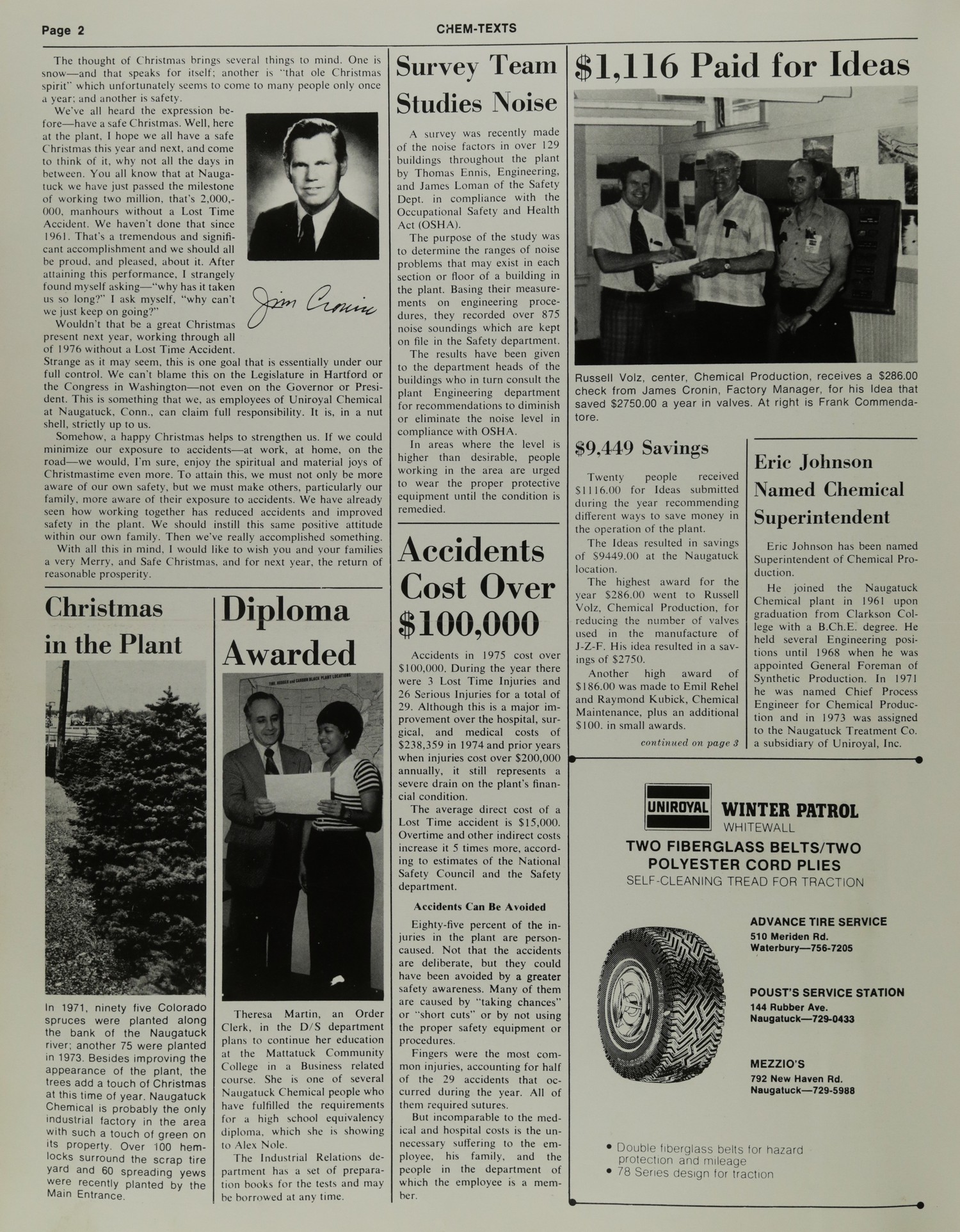
The thought of Christmas brings several things to mind. One is snow—and that speaks for itself; another is “that ole Christmas spirit” which unfortunately seems to come to many people only once a year; and another is safety.
We’ve all heard the expression before—have a safe Christmas. Well, here at the plant, I hope we all have a safe Christmas this year and next, and come to think of it, why not all the days in between. You all know that at Naugatuck we have just passed the milestone of working two million, that’s 2,000,000, manhours without a Lost Time Accident. We haven’t done that since 1961. That’s a tremendous and significant accomplishment and we should all be proud, and pleased, about it. After attaining this performance, I strangely found myself asking—”why has it taken us so long?” I ask myself, “why can’t we just keep on going?”
Jim Cronin [signature]
Wouldn’t that be a great Christmas present next year, working through all of 1976 without a Lost Time Accident. Strange as it may seem, this is one goal that is essentially under our full control. We can’t blame this on the Legislature in Hartford or the Congress in Washington—not even on the Governor or President. This is something that we, as employees of Uniroyal Chemical at Naugatuck, Conn., can claim full responsibility. It is, in a nut shell, strictly up to us.
Somehow, a happy Christmas helps to strengthen us. If we could minimize our exposure to accidents—at work, at home, on the road—we would, I’m sure, enjoy the spiritual and material joys of Christmastime even more. To attain this, we must not only be more aware of our own safety, but we must make others, particularly our family, more aware of their exposure to accidents. We have already seen how working together has reduced accidents and improved safety in the plant. We should instill this same positive attitude within our own family. Then we’ve really accomplished something.
With all this in mind, I would like to wish you and your families a very Merry, and Safe Christmas, and for next year, the return of reasonable prosperity.
Christmas in the Plant
[IMAGE: Photo of trees/spruces near a building]
In 1971, ninety five Colorado spruces were planted along the bank of the Naugatuck river; another 75 were planted in 1973. Besides improving the appearance of the plant, the trees add a touch of Christmas at this time of year. Naugatuck Chemical is probably the only industrial factory in the area with such a touch of green on its property. Over 100 hemlocks surround the scrap tire yard and 60 spreading yews were recently planted by the Main Entrance.
Diploma Awarded
[IMAGE: Photo of woman and man looking at documents]
Theresa Martin, an Order Clerk, in the D/S department plans to continue her education at the Mattatuck Community College in a Business related course. She is one of several Naugatuck Chemical people who have fulfilled the requirements for a high school equivalency diploma, which she is showing to Alex Nole.
The Industrial Relations department has a set of preparation books for the tests and may be borrowed at any time.
Survey Team Studies Noise
A survey was recently made of the noise factors in over 129 buildings throughout the plant by Thomas Ennis, Engineering, and James Loman of the Safety Dept. in compliance with the Occupational Safety and Health Act (OSHA).
The purpose of the study was to determine the range of noise problems that may exist in each section or floor of a building in the plant. Basing their measurements on engineering procedures, they recorded over 875 noise soundings which are kept on file in the Safety department.
The results have been given to the department heads of the buildings who in turn consult the plant Engineering department for recommendations to diminish or eliminate the noise level in compliance with OSHA.
In areas where the level is higher than desirable, people working in the area are urged to wear the proper protective equipment until the condition is remedied.
Accidents Cost Over $100,000
Accidents in 1975 cost over $100,000. During the year there were 3 Lost Time Injuries and 26 Serious Injuries for a total of 29. Although this is a major improvement over the hospital, surgical, and medical costs of $238,359 in 1974 and prior years when injuries cost over $200,000 annually, it still represents a severe drain on the plant’s financial condition.
The average direct cost of a Lost Time accident is $15,000. Overtime and other indirect costs increase it 5 times more, according to estimates of the National Safety Council and the Safety department.
Accidents Can Be Avoided
Eighty-five percent of the injuries in the plant are person-caused. Not that the accidents are deliberate, but they could have been avoided by a greater safety awareness. Many of them are caused by “taking chances” or “short cuts” or by not using the proper safety equipment or procedures.
Fingers were the most common injuries, accounting for half of the 29 accidents that occurred during the year. All of them required sutures.
But incomparable to the medical and hospital costs is the unnecessary suffering to the employee, his family, and the people in the department of which the employee is a member.
$1,116 Paid for Ideas
[IMAGE: Photo of three men, one receiving a check]
Russell Volz, center, Chemical Production, receives a $286.00 check from James Cronin, Factory Manager, for his Idea that saved $2750.00 a year in valves. At right is Frank Commendatore.
$9,449 Savings
Twenty people received $1116.00 for Ideas submitted during the year recommending different ways to save money in the operation of the plant.
The Ideas resulted in savings of $9449.00 at the Naugatuck location.
The highest award for the year $286.00 went to Russell Volz, Chemical Production, for reducing the number of valves used in the manufacture of J-Z-F. His idea resulted in a savings of $2750.
Another high award of $186.00 was made to Emil Rehel and Raymond Kubick, Chemical Maintenance, plus an additional $100. in small awards.
continued on page 3
Eric Johnson Named Chemical Superintendent
Eric Johnson has been named Superintendent of Chemical Production.
He joined the Naugatuck Chemical plant in 1961 upon graduation from Clarkson College with a B.Ch.E. degree. He held several Engineering positions until 1968 when he was appointed General Foreman of Synthetic Production. In 1971 he was named Chief Process Engineer for Chemical Production and in 1973 was assigned to the Naugatuck Treatment Co. a subsidiary of Uniroyal, Inc.
[ADVERTISEMENT]
UNIROYAL WINTER PATROL
WHITEWALL
TWO FIBERGLASS BELTS/TWO POLYESTER CORD PLIES
SELF-CLEANING TREAD FOR TRACTION
[IMAGE: Tire illustration]
ADVANCE TIRE SERVICE
510 Meriden Rd.
Waterbury—756-7205
POUST’S SERVICE STATION
144 Rubber Ave.
Naugatuck—729-0433
MEZZIO’S
792 New Haven Rd.
Naugatuck—729-5988
• Double fiberglass belts for hazard protection and mileage
• 78 Series design for traction