CHEM-TEXTS – 1980-v14-s290

Page 290

CHEM-TEXTS

Page 3 | Vol. 14, 1980


V. Calarco Looks at 1980

[PHOTO CAPTION:]
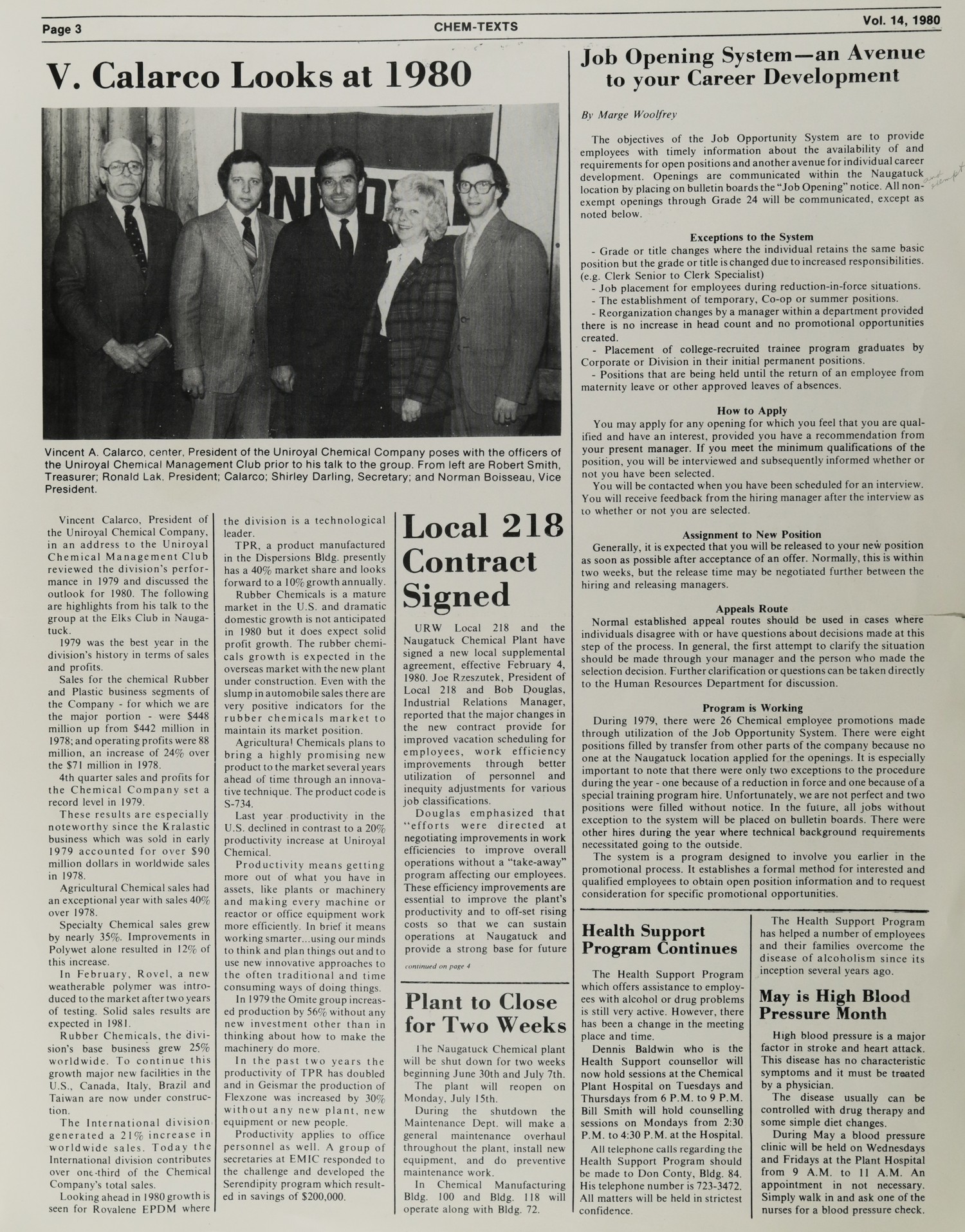
Vincent A. Calarco, center, President of the Uniroyal Chemical Company poses with the officers of the Uniroyal Chemical Management Club prior to his talk to the group. From left are Robert Smith, Treasurer; Ronald Lak, President; Calarco; Shirley Darling, Secretary; and Norman Boisseau, Vice President.


Vincent Calarco, President of the Uniroyal Chemical Company, in an address to the Uniroyal Chemical Management Club reviewed the division’s performance in 1979 and discussed the outlook for 1980. The following are highlights from his talk to the group at the Elks Club in Naugatuck.

1979 was the best year in the division’s history in terms of sales and profits.

Sales for the chemical Rubber and Plastic business segments of the Company – for which we are the major portion – were $448 million up from $442 million in 1978; and operating profits were 88 million, an increase of 24% over the $71 million in 1978.

4th quarter sales and profits for the Chemical Company set a record level in 1979.

These results are especially noteworthy since the Kralastic business which was sold in early 1979 accounted for over $90 million dollars in worldwide sales in 1978.

Agricultural Chemical sales had an exceptional year with sales 40% over 1978.

Specialty Chemical sales grew by nearly 35%. Improvements in Polywet alone resulted in 12% of this increase.

In February, Rovel, a new weatherable polymer was introduced to the market after two years of testing. Solid sales results are expected in 1981.

Rubber Chemicals, the division’s base business grew 25% worldwide. To continue this growth major new facilities in the U.S., Canada, Italy, Brazil and Taiwan are now under construction.

The International division generated a 21% increase in worldwide sales. Today the International division contributes over one-third of the Chemical Company’s total sales.

Looking ahead in 1980 growth is seen for Rovalene EPDM where the division is a technological leader.

TPR, a product manufactured in the Dispersions Bldg. presently has a 40% market share and looks forward to a 10% growth annually.

Rubber Chemicals is a mature market in the U.S. and dramatic domestic growth is not anticipated in 1980 but it does expect solid profit growth. The rubber chemicals growth is expected in the overseas market with the new plant under construction. Even with the slump in automobile sales there are very positive indicators for the rubber chemicals market to maintain its market position.

Agricultural Chemicals plans to bring a highly promising new product to the market several years ahead of time through an innovative technique. The product code is S-734.

Last year productivity in the U.S. declined in contrast to a 20% productivity increase at Uniroyal Chemical.

Productivity means getting more out of what you have in assets, like plants or machinery and making every machine or reactor or office equipment work more efficiently. In brief it means working smarter…using our minds to think and plan things out and to use new innovative approaches to the often traditional and time consuming ways of doing things.

In 1979 the Omite group increased production by 56% without any new investment other than in thinking about how to make the machinery do more.

In the past two years the productivity of TPR has doubled and in Geismar the production of Flexzone was increased by 30% without any new plant, new equipment or new people.

Productivity applies to office personnel as well. A group of secretaries at EMIC responded to the challenge and developed the Serendipity program which resulted in savings of $200,000.


Job Opening System—an Avenue to your Career Development

By Marge Woolfrey

The objectives of the Job Opportunity System are to provide employees with timely information about the availability of and requirements for open positions and another avenue for individual career development. Openings are communicated within the Naugatuck location by placing on bulletin boards the “Job Opening” notice. All non-exempt openings through Grade 24 will be communicated, except as noted below.

Exceptions to the System

  • Grade or title changes where the individual retains the same basic position but the grade or title is changed due to increased responsibilities. (e.g. Clerk Senior to Clerk Specialist)
  • Job placement for employees during reduction-in-force situations.
  • The establishment of temporary, Co-op or summer positions.
  • Reorganization changes by a manager within a department provided there is no increase in head count and no promotional opportunities created.
  • Placement of college-recruited trainee program graduates by Corporate or Division in their initial permanent positions.
  • Positions that are being held until the return of an employee from maternity leave or other approved leaves of absences.

How to Apply

You may apply for any opening for which you feel that you are qualified and have an interest, provided you have a recommendation from your present manager. If you meet the minimum qualifications of the position, you will be interviewed and subsequently informed whether or not you have been selected.

You will be contacted when you have been scheduled for an interview. You will receive feedback from the hiring manager after the interview as to whether or not you are selected.

Assignment to New Position

Generally, it is expected that you will be released to your new position as soon as possible after acceptance of an offer. Normally, this is within two weeks, but the release time may be negotiated further between the hiring and releasing managers.

Appeals Route

Normal established appeal routes should be used in cases where individuals disagree with or have questions about decisions made at this step of the process. In general, the first attempt to clarify the situation should be made through your manager and the person who made the selection decision. Further clarification or questions can be taken directly to the Human Resources Department for discussion.

Program is Working

During 1979, there were 26 Chemical employee promotions made through utilization of the Job Opportunity System. There were eight positions filled by transfer from other parts of the company because no one at the Naugatuck location applied for the openings. It is especially important to note that there were only two exceptions to the procedure during the year – one because of a reduction in force and one because of a special training program hire. Unfortunately, we are not perfect and two positions were filled without notice. In the future, all jobs without exception to the system will be placed on bulletin boards. There were other hires during the year where technical background requirements necessitated going to the outside.

The system is a program designed to involve you earlier in the promotional process. It establishes a formal method for interested and qualified employees to obtain open position information and to request consideration for specific promotional opportunities.


Local 218 Contract Signed

URW Local 218 and the Naugatuck Chemical Plant have signed a new local supplemental agreement, effective February 4, 1980. Joe Rzeszutek, President of Local 218 and Bob Douglas, Industrial Relations Manager, reported that the major changes in the new contract provide for improved vacation scheduling for employees, work efficiency improvements through better utilization of personnel and inequity adjustments for various job classifications.

Douglas emphasized that “efforts were directed at negotiating improvements in work efficiencies to improve overall operations without a “take-away” program affecting our employees. These efficiency improvements are essential to improve the plant’s productivity and to off-set rising costs so that we can sustain operations at Naugatuck and provide a strong base for future

continued on page 4


Plant to Close for Two Weeks

The Naugatuck Chemical plant will be shut down for two weeks beginning June 30th and July 7th. The plant will reopen on Monday, July 15th.

During the shutdown the Maintenance Dept. will make a general maintenance overhaul throughout the plant, install new equipment, and do preventive maintenance work.

In Chemical Manufacturing Bldg. 100 and Bldg. 118 will operate along with Bldg. 72.


Health Support Program Continues

The Health Support Program which offers assistance to employees with alcohol or drug problems is still very active. However, there has been a change in the meeting place and time.

Dennis Baldwin who is the Health Support counsellor will now hold sessions at the Chemical Plant Hospital on Tuesdays and Thursdays from 6 P.M. to 9 P.M. Bill Smith will hold counselling sessions on Mondays from 2:30 P.M. to 4:30 P.M. at the Hospital.

All telephone calls regarding the Health Support Program should be made to Don Conty, Bldg. 84. His telephone number is 723-3472. All matters will be held in strictest confidence.

The Health Support Program has helped a number of employees and their families overcome the disease of alcoholism since its inception several years ago.


May is High Blood Pressure Month

High blood pressure is a major factor in stroke and heart attack. This disease has no characteristic symptoms and it must be treated by a physician.

The disease usually can be controlled with drug therapy and some simple diet changes.

During May a blood pressure clinic will be held on Wednesdays and Fridays at the Plant Hospital from 9 A.M. to 11 A.M. An appointment in not necessary. Simply walk in and ask one of the nurses for a blood pressure check.
CHEM-TEXTS – 1975-v09-i05-s232

Page 232

UNIROYAL CHEM-TEXTS

Vol. 9, 1975 | PUBLISHED FOR THE PEOPLE OF UNIROYAL CHEMICAL | No. 5


Fife and Drum Corps Promote Safety

[IMAGE: Black and white photograph showing a fife and drum corps marching in front of a building with a “SAFETY YOUR KEY TO THE FUTURE” sign]

The Naugatuck Fife and Drum Corps gave a lift to safety in the plant by marching from the Main Entrance to Bldg. 18 Locker Room and playing a brief musical revue.


Slight Income Gain Shown in Third Quarter

The Company’s third quarter net income was $7,137,000, a slight gain over the $7,097,000 for the third quarter of 1974.

Sales for the third quarter were $529,508,000, down 6.6% from $566,899,000 last year.

Despite the decline in sales, improvements in the world-wide tire operations, and lower interest costs attributable to reduced borrowings and interest rates, enabled the Company to maintain a level of profit in the third quarter comparable to last year.

Nine Months Sales and Income

For the first nine months, sales declined 5.9% to $1,624,568,000 from $1,726,682,000 last year.

Net income for the nine months was $21,809,000 or 68 cents per common share, compared with $37,270,000 or $1.27 per common share last year, a decline of 41.5%

Nine months sales and net income reflected the overall economic recession which had its severest effect in the first quarter of 1975 when profits were down 70%.

On a quarter-to-quarter basis, the Company has been able to make steady improvement, largely through cost reduction programs and manufacturing efficiencies.


The Naugatuck Fife and Drum Corps gave a brief musical revue in observance of the plant’s Safety program. The 35 marching members of the Junior Corps, ranging in age from nine to eighteen, marched from the Main Gate of the plant to Bldg. 18 Locker Room and then played a short concert of popular tunes by the Chemical Canteen.

The Corps has won thirteen State Championships—twelve in succession — and nine Northeastern State Championships. It is rated one of the best fife and drum groups in the area.

The surprise and unusual visit of the Corps gave a big boost

[IMAGE: Small photograph showing a group of roofers stopped work to listen to the fife and drum music]

A group of roofers stop work and listen to the fife and drum music.

to the plant’s safety program which this year consists of the monthly “silver dollar” awards for groups in the different divisions of the plant.

In the absence of director Robert Curina, Footwear plant, Charles Kimball, the Plant Protection Department, was in charge of the activity.


Dividend Declared

A 12½ cent dividend on the Uniroyal common stock was declared and is payable December 29 to stockholders of record November 24.


Productivity Vital for Economy

(The following is a speech by David Beretta, Uniroyal President, to the International Institute of Synthetic Rubber Producers in Brazil)

Improved productivity is vital if the industrial world is to grow and prosper in the 21st century.

The time to start productivity improvement is now and the place is with every resource under our individual control.

An Undeveloped Resource

Productivity is our biggest undeveloped resource. Unfortunately, the word has gained a connotation of ‘speed up’ — of driving workers harder or eliminating jobs through automation.

In contrast, it is a concept which expresses the relationship of output — the quantity or value of goods or services produced — versus input, which is the quantity or value of raw materials, energy, labor, capital and other resources required to produce it.

We must begin to conserve and optimize the use of all of the resources we have been charged to manage. As raw materials, manpower and energy costs continue to escalate, as interest rates rise and the availability of capital declines, the need for improved productivity becomes more important….

Cooperation is Needed

… More attention and study must be given to responsible labor-management communications, and to the development of innovative management systems which employ participative plant management, and to more efficient marketing techniques….

Of all the major industrial countries in the world, the United States is the lowest in capital reinvestment and growth in productivity.

(continued on page 4)


Plant’s United Fund Goal $17,500

The goal for the 1976 United Fund drive, which is conducted throughout the plant annually, has been set at $17,500. Daniel Shantz has been named Chairman for the campaign to raise funds for the sixteen agencies which provide a wide variety of social services to help meet the human needs of the people in the community.

Chemical People Generous Contributors

The Naugatuck Chemical plant has topped its UF goal for four consecutive years. Last year it topped the goal with pledges of $20,055.

The Chemical plant has displayed a generosity that has contributed nearly 33% of the total amount of the Industrial division’s section which includes all of the firms in the Naugatuck and Beacon Falls area.

Give Where You Work

The philosophy of the United Way is “give where you work.” This method has proved the most efficient way to raise the needed money for the agencies in the fund. It eliminates the monies often wasted in promoting good causes. The Naugatuck-Beacon Falls office has the lowest administrative cost of any agency in the area.

As a convenience for employees the plant will deduct contributions through the payroll deduction plan. This is done by determining the amount of your pledge on the United Way card. Deductions start in January 1976 and continue until December.

Members of the United Fund Committee are F. Mayo, K. Dowling, R. Foltz, J. Rzeszutek, S. Mazur, H. Semrow, C. Roland, R. Amidon, J. Tierney, R. Gaetz, J. Vergosen, W. Broden, R. Tweedie, T. Geise, S. Bond, R. Cranney, J. Labrecque and D. Bates.

CHEM-TEXTS – Vol. 5 No. 3 – Page 2

Page 002

CHEM-TEXTS

Page 2 | Vol. 5 No. 3


FROM THE FACTORY MANAGER

DEAR FELLOW EMPLOYEE:

The miracle of the twenty five years of continual growth in the U.S. economy since World War II is something all Americans can be proud of. It has enabled us to become leaders in the world’s markets and to raise our standard of living to the point where we are better off than any people in history.

This miracle didn’t just happen. It was brought about by the tremendous productivity of the people of this country. For twenty years every time wages increased, productivity also increased and our standard of living went up.

In the last five years, however, we have seen a change in this pattern. While wages have increased, productivity has not kept pace with them. This has helped cause inflation and has helped drive the cost of our products up.

In turn, foreign manufacturers have maintained their productivity and are now able to sell their goods in our markets at prices lower than ours. We can see this in Japanese electronics; German and Japanese automobiles; and textile and footwear products from all over the world.

On a smaller scale the same thing is happening at our factory. We are in competition with both foreign and domestic producers. They are competing with us for the same customers and markets, oftentimes at lower prices. Besides this our markets are moving away from the northeast and the increasing cost of rail and truck transportation adds to our problem of doing business competitively.

All of us must realize this and remember that the chemicals we produce are in competition with these domestic and foreign manufacturers. We can only sell what we can produce economically. We can only produce economically with your help and cooperation. Every job in the plant is important. Every person counts in this effort. We all must chip in.

Phil LaJoie


33 Employees Receive $1355

Mechanical Department Submits Most Ideas

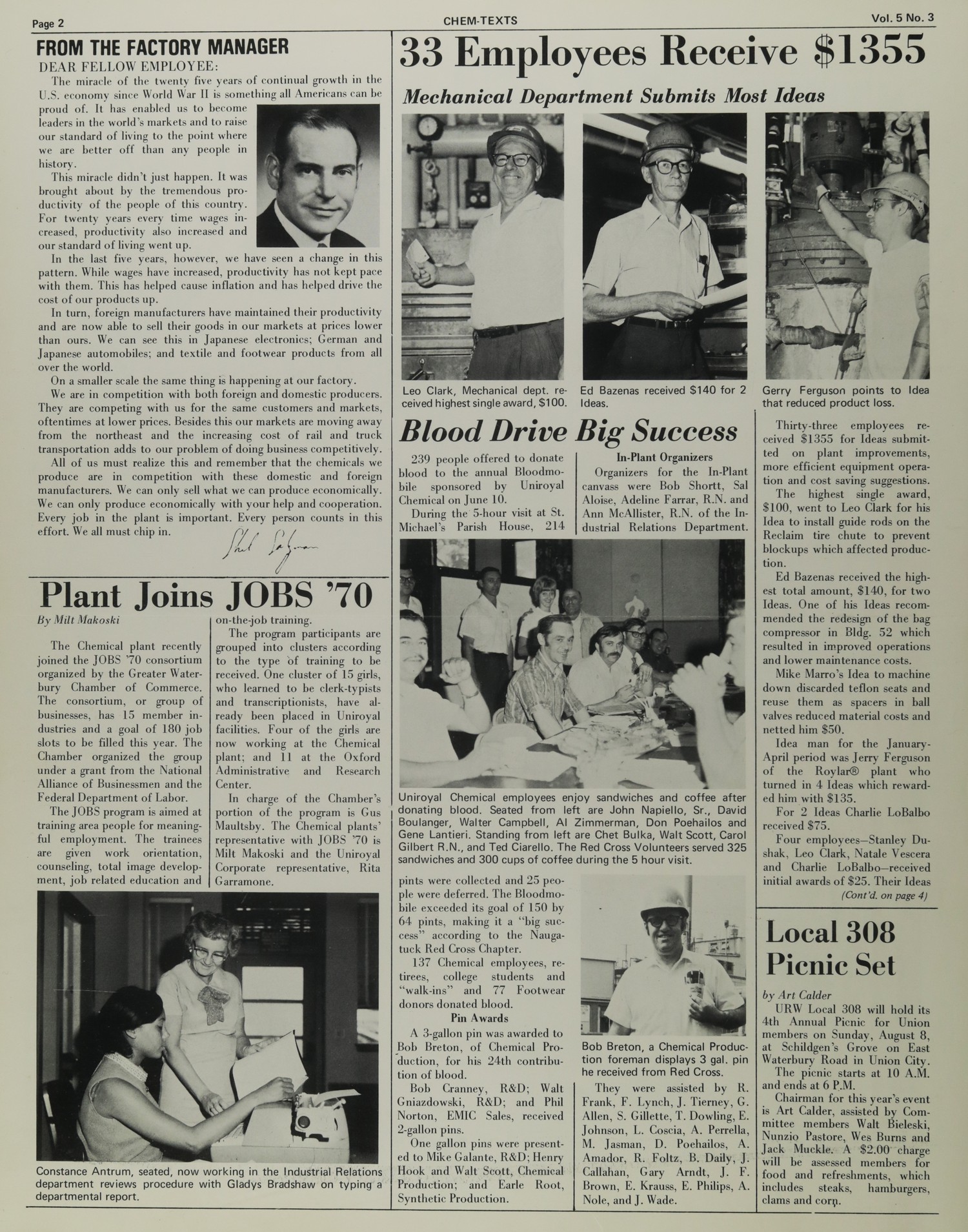
Leo Clark, Mechanical dept. received highest single award, $100.

Ed Bazenas received $140 for 2 Ideas.

Gerry Ferguson points to Idea that reduced product loss.

Thirty-three employees received $1355 for Ideas submitted on plant improvements, more efficient equipment operation and cost saving suggestions.

The highest single award, $100, went to Leo Clark for his Idea to install guide rods on the Reclaim tire chute to prevent blockups which affected production.

Ed Bazenas received the highest total amount, $140, for two Ideas. One of his Ideas recommended the redesign of the bag compressor in Bldg. 52 which resulted in improved operations and lower maintenance costs.

Mike Marro’s Idea to machine down discarded teflon seats and reuse them as spacers in ball valves reduced material costs and netted him $50.

Idea man for the January-April period was Jerry Ferguson of the Roylar® plant who turned in 4 Ideas which rewarded him with $135.

For 2 Ideas Charlie LoBalbo received $75.

Four employees—Stanley Dushak, Leo Clark, Natale Vescera and Charlie LoBalbo—received initial awards of $25. Their Ideas
(Cont’d. on page 4)


Blood Drive Big Success

239 people offered to donate blood to the annual Bloodmobile sponsored by Uniroyal Chemical on June 10.

During the 5-hour visit at St. Michael’s Parish House, 214 pints were collected and 25 people were deferred. The Bloodmobile exceeded its goal of 150 by 64 pints, making it a “big success” according to the Naugatuck Red Cross Chapter.

137 Chemical employees, retirees, college students and “walk-ins” and 77 Footwear donors donated blood.

Pin Awards

A 3-gallon pin was awarded to Bob Breton, of Chemical Production, for his 24th contribution of blood.

Bob Cranney, R&D; Walt Gniazdowski, R&D; and Phil Norton, EMIC Sales, received 2-gallon pins.

One gallon pins were presented to Mike Galante, R&D; Henry Hook and Walt Scott, Chemical Production; and Earle Root, Synthetic Production.

In-Plant Organizers

Organizers for the In-Plant canvass were Bob Shortt, Sal Aloise, Adeline Farrar, R.N. and Ann McAllister, R.N. of the Industrial Relations Department.

Uniroyal Chemical employees enjoy sandwiches and coffee after donating blood. Seated from left are John Napiello, Sr., David Boulanger, Walter Campbell, Al Zimmerman, Don Poehailos and Gene Lantieri. Standing from left are Chet Bulka, Walt Scott, Carol Gilbert R.N., and Ted Ciarello. The Red Cross Volunteers served 325 sandwiches and 300 cups of coffee during the 5 hour visit.

Bob Breton, a Chemical Production foreman displays 3 gal. pin he received from Red Cross.

They were assisted by R. Frank, F. Lynch, J. Tierney, G. Allen, S. Gillette, T. Dowling, E. Johnson, L. Coscia, A. Perrella, M. Jasman, D. Poehailos, A. Amador, R. Foltz, B. Daily, J. Callahan, Gary Arndt, J. F. Brown, E. Krauss, E. Philips, A. Nole, and J. Wade.


Plant Joins JOBS ’70

By Milt Makoski

The Chemical plant recently joined the JOBS ’70 consortium organized by the Greater Waterbury Chamber of Commerce. The consortium, or group of businesses, has 15 member industries and a goal of 180 job slots to be filled this year. The Chamber organized the group under a grant from the National Alliance of Businessmen and the Federal Department of Labor.

The JOBS program is aimed at training area people for meaningful employment. The trainees are given work orientation, counseling, total image development, job related education and on-the-job training.

The program participants are grouped into clusters according to the type of training to be received. One cluster of 15 girls, who learned to be clerk-typists and transcriptionists, have already been placed in Uniroyal facilities. Four of the girls are now working at the Chemical plant; and 11 at the Oxford Administrative and Research Center.

In charge of the Chamber’s portion of the program is Gus Maultsby. The Chemical plants’ representative with JOBS ’70 is Milt Makoski and the Uniroyal Corporate representative, Rita Garramone.

Constance Antrum, seated, now working in the Industrial Relations department reviews procedure with Gladys Bradshaw on typing a departmental report.


Local 308 Picnic Set

by Art Calder

URW Local 308 will hold its 4th Annual Picnic for Union members on Sunday, August 8, at Schildgen’s Grove on East Waterbury Road in Union City. The picnic starts at 10 A.M. and ends at 6 P.M.

Chairman for this year’s event is Art Calder, assisted by Committee members Walt Bieleski, Nunzio Pastore, Wes Burns and Jack Muckle. A $2.00 charge will be assessed members for food and refreshments, which includes steaks, hamburgers, clams and corp.

CHEM-TEXTS – Vol. 3 No. 3 – Page 2

Page 002

Page 2 CHEM-TEXTS Vol. 3 No. 3


FROM THE FACTORY MANAGER

DEAR FELLOW EMPLOYEE:

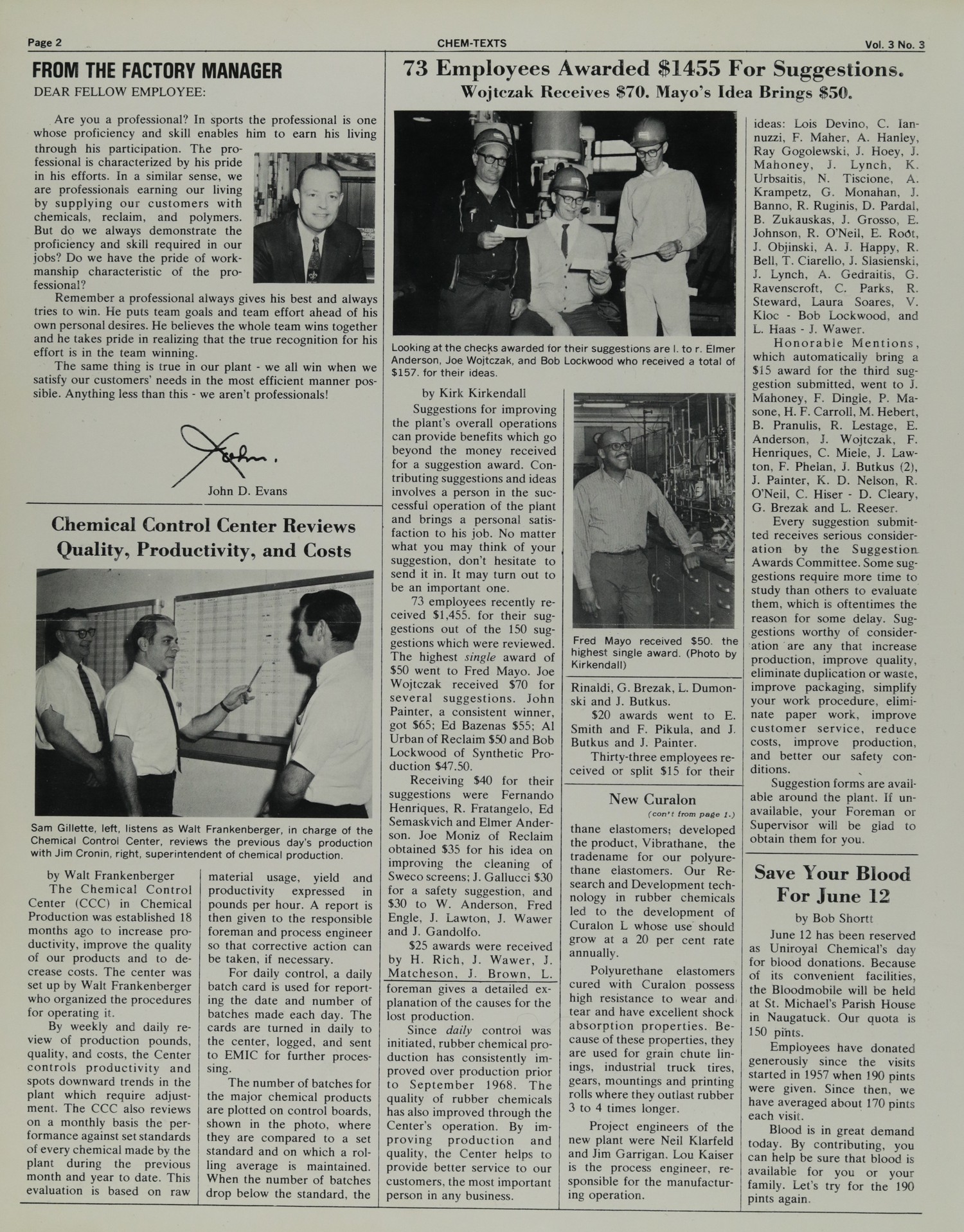
Are you a professional? In sports the professional is one whose proficiency and skill enables him to earn his living through his participation. The professional is characterized by his pride in his efforts. In a similar sense, we are professionals earning our living by supplying our customers with chemicals, reclaim, and polymers. But do we always demonstrate the proficiency and skill required in our jobs? Do we have the pride of workmanship characteristic of the professional?

Remember a professional always gives his best and always tries to win. He puts team goals and team effort ahead of his own personal desires. He believes the whole team wins together and he takes pride in realizing that the true recognition for his effort is in the team winning.

The same thing is true in our plant – we all win when we satisfy our customers’ needs in the most efficient manner possible. Anything less than this – we aren’t professionals!

[Signature]

John D. Evans


Chemical Control Center Reviews Quality, Productivity, and Costs

[IMAGE: Sam Gillette, left, listens as Walt Frankenberger, in charge of the Chemical Control Center, reviews the previous day’s production with Jim Cronin, right, superintendent of chemical production.]

by Walt Frankenberger

The Chemical Control Center (CCC) in Chemical Production was established 18 months ago to increase productivity, improve the quality of our products and to decrease costs. The center was set up by Walt Frankenberger who organized the procedures for operating it.

By weekly and daily review of production pounds, quality, and costs, the Center controls productivity and spots downward trends in the plant which require adjustment. The CCC also reviews on a monthly basis the performance against set standards of every chemical made by the plant during the previous month and year to date. This evaluation is based on raw material usage, yield and productivity expressed in pounds per hour. A report is then given to the responsible foreman and process engineer so that corrective action can be taken, if necessary.

For daily control, a daily batch card is used for reporting the date and number of batches made each day. The cards are turned in daily to the center, logged, and sent to EMIC for further processing.

The number of batches for the major chemical products are plotted on control boards, shown in the photo, where they are compared to a set standard and on which a rolling average is maintained. When the number of batches drop below the standard, the person in any business.


73 Employees Awarded $1455 For Suggestions.

Wojtczak Receives $70. Mayo’s Idea Brings $50.

[IMAGE: Looking at the checks awarded for their suggestions are l. to r. Elmer Anderson, Joe Wojtczak, and Bob Lockwood who received a total of $157. for their ideas.]

by Kirk Kirkendall

Suggestions for improving the plant’s overall operations can provide benefits which go beyond the money received for a suggestion award. Contributing suggestions and ideas involves a person in the successful operation of the plant and brings a personal satisfaction to his job. No matter what you may think of your suggestion, don’t hesitate to send it in. It may turn out to be an important one.

73 employees recently received $1,455. for their suggestions out of the 150 suggestions which were reviewed. The highest single award of $50 went to Fred Mayo. Joe Wojtczak received $70 for several suggestions. John Painter, a consistent winner, got $65; Ed Bazenas $55; Al Urban of Reclaim $50 and Bob Lockwood of Synthetic Production $47.50.

Receiving $40 for their suggestions were Fernando Henriques, R. Fratangelo, Ed Semaskvich and Elmer Anderson. Joe Moniz of Reclaim obtained $35 for his idea on improving the cleaning of Sweco screens; J. Gallucci $30 for a safety suggestion, and $30 to W. Anderson, Fred Engle, J. Lawton, J. Wawer and J. Gandolfo.

$25 awards were received by H. Rich, J. Wawer, J. Matcheson, J. Brown, L. foreman gives a detailed explanation of the causes for the lost production.

Since daily control was initiated, rubber chemical production has consistently improved over production prior to September 1968. The quality of rubber chemicals has also improved through the Center’s operation. By improving production and quality, the Center helps to provide better service to our customers, the most important person in any business.

[IMAGE: Fred Mayo received $50. the highest single award. (Photo by Kirkendall)]

Rinaldi, G. Brezak, L. Dumonski and J. Butkus.

$20 awards went to E. Smith and F. Pikula, and J. Butkus and J. Painter.

Thirty-three employees received or split $15 for their


New Curalon

(con’t from page 1.)

thane elastomers; developed the product, Vibrathane, the tradename for our polyurethane elastomers. Our Research and Development technology in rubber chemicals led to the development of Curalon L whose use should grow at a 20 per cent rate annually.

Polyurethane elastomers cured with Curalon possess high resistance to wear and tear and have excellent shock absorption properties. Because of these properties, they are used for grain chute linings, industrial truck tires, gears, mountings and printing rolls where they outlast rubber 3 to 4 times longer.

Project engineers of the new plant were Neil Klarfeld and Jim Garrigan. Lou Kaiser is the process engineer, responsible for the manufacturing operation.


ideas: Lois Devino, C. Iannuzzi, F. Maher, A. Hanley, Ray Gogolewski, J. Hoey, J. Mahoney, J. Lynch, K. Urbsaitis, N. Tiscione, A. Krampetz, G. Monahan, J. Banno, R. Ruginis, D. Pardal, B. Zukauskas, J. Grosso, E. Johnson, R. O’Neil, E. Root, J. Objinski, A. J. Happy, R. Bell, T. Ciarello, J. Slasienski, J. Lynch, A. Gedraitis, G. Ravenscroft, C. Parks, R. Steward, Laura Soares, V. Kloc – Bob Lockwood, and L. Haas – J. Wawer.

Honorable Mentions, which automatically bring a $15 award for the third suggestion submitted, went to J. Mahoney, F. Dingle, P. Masone, H. F. Carroll, M. Hebert, B. Pranulis, R. Lestage, E. Anderson, J. Wojtczak, F. Henriques, C. Miele, J. Lawton, F. Phelan, J. Butkus (2), J. Painter, K. D. Nelson, R. O’Neil, C. Hiser – D. Cleary, G. Brezak and L. Reeser.

Every suggestion submitted receives serious consideration by the Suggestion Awards Committee. Some suggestions require more time to study than others to evaluate them, which is oftentimes the reason for some delay. Suggestions worthy of consideration are any that increase production, improve quality, eliminate duplication or waste, improve packaging, simplify your work procedure, eliminate paper work, improve customer service, reduce costs, improve production, and better our safety conditions.

Suggestion forms are available around the plant. If unavailable, your Foreman or Supervisor will be glad to obtain them for you.


Save Your Blood For June 12

by Bob Shortt

June 12 has been reserved as Uniroyal Chemical’s day for blood donations. Because of its convenient facilities, the Bloodmobile will be held at St. Michael’s Parish House in Naugatuck. Our quota is 150 pints.

Employees have donated generously since the visits started in 1957 when 190 pints were given. Since then, we have averaged about 170 pints each visit.

Blood is in great demand today. By contributing, you can help be sure that blood is available for you or your family. Let’s try for the 190 pints again.

CHEM-TEXTS – Vol. 3 No. 5 – Page 3

Page 003

Vol. 3 No. 5 CHEM-TEXTS Page 3


KNOW YOUR BENEFITS: by W. Kirkendall

Some Questions and Answers on Supplemental Unemployment Benefits (SUB)

This is a continuation of the SUB article which appeared in the last issue of Chem-Texts. The examples show how to estimate your SUB benefits based upon your earnings for a 40 hour week.

The benefits are payable to an eligible wage employee from a trust fund established by Uniroyal and is financed by the Company’s contribution of 6 cents per hour for each hour an employee receives pay from the Company.

Q. What are some examples of SUB payments?

A. REGULAR BENEFIT:
If an employee’s average straight time hourly earnings are $3.75, his weekly straight time earnings would be $150.00. 80% of his weekly straight time earnings are $120.00. Less the State Unemployment Compensation of $75.00 the SUB benefit due the employee is $45.00. The minimum regular benefit payable under all circumstances is $10.00. The minimum shall apply even when the calculation for benefit is zero.

EXAMPLES:
SPECIAL SHORT WEEK BENEFIT:
1. Employee’s normal work week:……………………40 hours
2. Total compensated and hours available:………….24 hours
3. Total short hours:…………………………16 hours
4. Total wages paid:………………………….$87.60
5. Employee’s ESSEL:…………………………$104.50

Special Benefit
80% x $3.65 x 16 = $46.72
Av. Hr. Earn. Short Hrs.
Less State U.C. check:…………………………11.00
Outside earnings:……………………………..0
Special benefit……………………………..$35.72

Regular Benefit
80% of gross pay $146.00……………………..= $116.80
Less State U.C………………………………11.00
Company earnings…………………………….87.60
Regular Benefit…………………………….$18.20

In this case the employee receives the larger amount of the special or regular benefit which in this example would be $35.72.

AUTOMATIC SHORT WEEK BENEFIT:
Employee’s Estimated State System Earning Limit (ESSEL) is $104.50 for a normal work week of 40 hours. His earnings for the week are $120. The number of compensated and available hours were 32; his short hours are 8.

Calculation: 80% x $3.75 x 8 = $24.00
A.H.E. Short Hrs. in SUB

Employee would receive $24.00.


As a general rule, with the exception of automatic short week benefit, SUB benefits will not be payable unless you apply for and receive State Unemployment Compensation. The employee must first report to his local Unemployment Compensation office with his layoff slip and make application for State Unemployment Compensation. When he receives his State check he brings it to Industrial Relations Dept. to apply for SUB. Employees must remember that in SUB each individual employee’s situation as to SUB payment may be different.

SUB benefits are part of Uniroyal’s overall benefits program for employees. For every dollar paid in wages to employees, an additional 37 cents is paid in employee benefits. If an employee paid for the many benefit plans provided by the Company, it would cost him approximately $1,000 a year.
NOTE: To be continued in next CHEM-TEXTS.


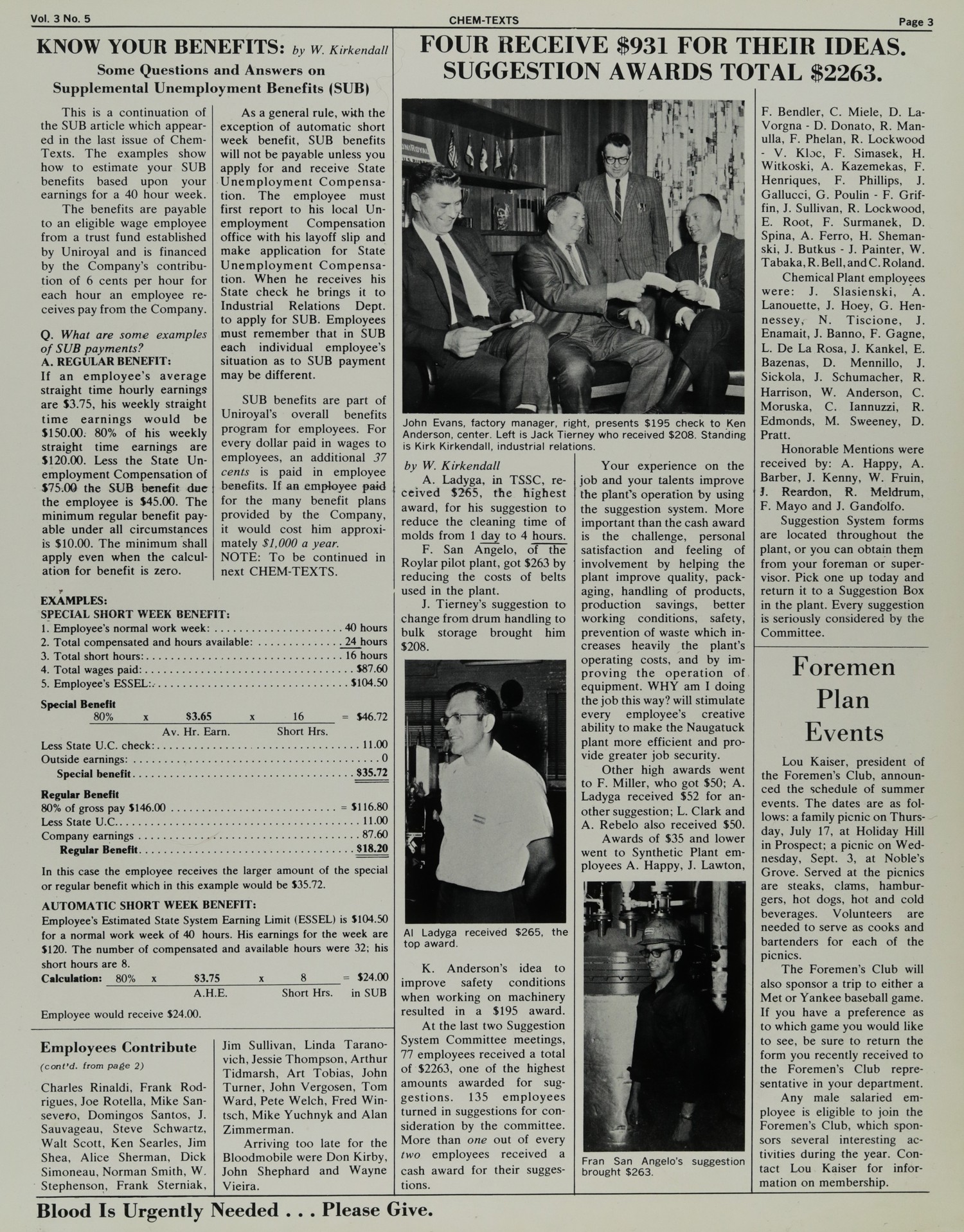
FOUR RECEIVE $931 FOR THEIR IDEAS. SUGGESTION AWARDS TOTAL $2263.

[PHOTO: John Evans, factory manager, right, presents $195 check to Ken Anderson, center. Left is Jack Tierney who received $208. Standing is Kirk Kirkendall, industrial relations.]

by W. Kirkendall

A. Ladyga, in TSSC, received $265, the highest award, for his suggestion to reduce the cleaning time of molds from 1 day to 4 hours.

F. San Angelo, of the Roylar pilot plant, got $263 by reducing the costs of belts used in the plant.

J. Tierney’s suggestion to change from drum handling to bulk storage brought him $208.

[PHOTO: Al Ladyga received $265, the top award.]

K. Anderson’s idea to improve safety conditions when working on machinery resulted in a $195 award.

At the last two Suggestion System Committee meetings, 77 employees received a total of $2263, one of the highest amounts awarded for suggestions. 135 employees turned in suggestions for consideration by the committee. More than one out of every two employees received a cash award for their suggestions.

[PHOTO: Fran San Angelo’s suggestion brought $263.]

Your experience on the job and your talents improve the plant’s operation by using the suggestion system. More important than the cash award is the challenge, personal satisfaction and feeling of involvement by helping the plant improve quality, packaging, handling of products, production savings, better working conditions, safety, prevention of waste which increases heavily the plant’s operating costs, and by improving the operation of equipment. WHY am I doing the job this way? will stimulate every employee’s creative ability to make the Naugatuck plant more efficient and provide greater job security.

Other high awards went to F. Miller, who got $50; A. Ladyga received $52 for another suggestion; L. Clark and A. Rebelo also received $50.

Awards of $35 and lower went to Synthetic Plant employees A. Happy, J. Lawton, F. Bendler, C. Miele, D. LaVorgna – D. Donato, R. Manulla, F. Phelan, R. Lockwood – V. Kloc, F. Simasek, H. Witkoski, A. Kazemekas, F. Henriques, F. Phillips, J. Gallucci, G. Poulin – F. Griffin, J. Sullivan, R. Lockwood, E. Root, F. Surmanek, D. Spina, A. Ferro, H. Shemanski, J. Butkus – J. Painter, W. Tabaka, R. Bell, and C. Roland.

Chemical Plant employees were: J. Slasienski, A. Lanouette, J. Hoey, G. Hennessey, N. Tiscione, J. Enamait, J. Banno, F. Gagne, L. De La Rosa, J. Kankel, E. Bazenas, D. Mennillo, J. Sickola, J. Schumacher, R. Harrison, W. Anderson, C. Moruska, C. Iannuzzi, R. Edmonds, M. Sweeney, D. Pratt.

Honorable Mentions were received by: A. Happy, A. Barber, J. Kenny, W. Fruin, J. Reardon, R. Meldrum, F. Mayo and J. Gandolfo.

Suggestion System forms are located throughout the plant, or you can obtain them from your foreman or supervisor. Pick one up today and return it to a Suggestion Box in the plant. Every suggestion is seriously considered by the Committee.


Foremen Plan Events

Lou Kaiser, president of the Foremen’s Club, announced the schedule of summer events. The dates are as follows: a family picnic on Thursday, July 17, at Holiday Hill in Prospect; a picnic on Wednesday, Sept. 3, at Noble’s Grove. Served at the picnics are steaks, clams, hamburgers, hot dogs, hot and cold beverages. Volunteers are needed to serve as cooks and bartenders for each of the picnics.

The Foremen’s Club will also sponsor a trip to either a Met or Yankee baseball game. If you have a preference as to which game you would like to see, be sure to return the form you recently received to the Foremen’s Club representative in your department.

Any male salaried employee is eligible to join the Foremen’s Club, which sponsors several interesting activities during the year. Contact Lou Kaiser for information on membership.


Employees Contribute

(cont’d. from page 2)

Charles Rinaldi, Frank Rodrigues, Joe Rotella, Mike Sansevero, Domingos Santos, J. Sauvageau, Steve Schwartz, Walt Scott, Ken Searles, Jim Shea, Alice Sherman, Dick Simoneau, Norman Smith, W. Stephenson, Frank Sterniak,

Jim Sullivan, Linda Taranovich, Jessie Thompson, Arthur Tidmarsh, Art Tobias, John Turner, John Vergosen, Tom Ward, Pete Welch, Fred Wintsch, Mike Yuchnyk and Alan Zimmerman.

Arriving too late for the Bloodmobile were Don Kirby, John Shephard and Wayne Vieira.


Blood Is Urgently Needed . . . Please Give.

CHEM-TEXTS – Vol. 3 No. 6 – Page 3

Page 003

CHEM-TEXTS

Vol. 3 No. 8 | Page 3


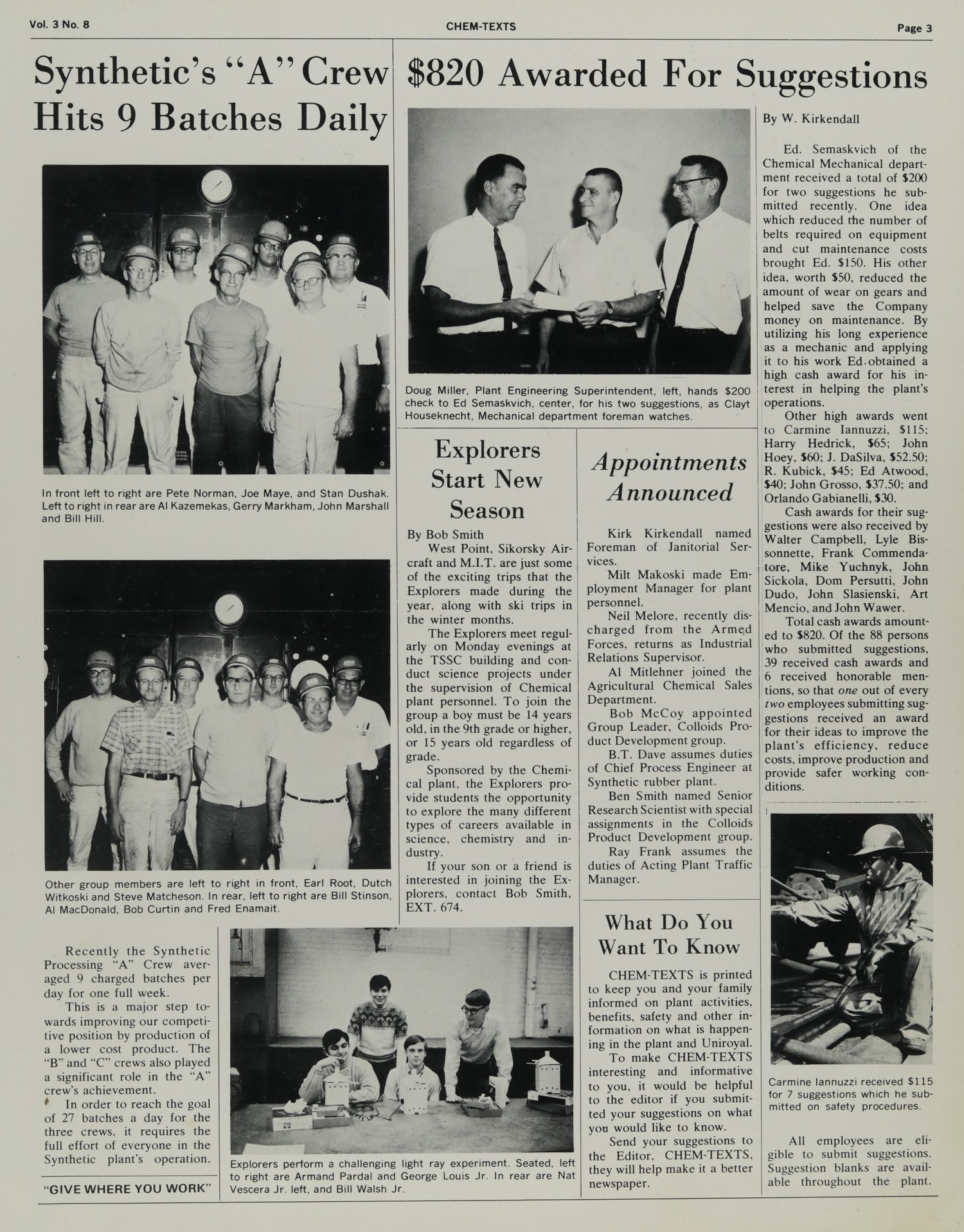
Synthetic’s “A” Crew Hits 9 Batches Daily

[IMAGE: Group photo of workers in hard hats]

In front left to right are Pete Norman, Joe Maye, and Stan Dushak. Left to right in rear are Al Kazemekas, Gerry Markham, John Marshall and Bill Hill.

[IMAGE: Second group photo of workers]

Other group members are left to right in front, Earl Root, Dutch Witkoski and Steve Matcheson. In rear, left to right are Bill Stinson, Al MacDonald, Bob Curtin and Fred Enamait.

Recently the Synthetic Processing “A” Crew averaged 9 charged batches per day for one full week.

This is a major step towards improving our competitive position by production of a lower cost product. The “B” and “C” crews also played a significant role in the “A” crew’s achievement.

In order to reach the goal of 27 batches a day for the three crews, it requires the full effort of everyone in the Synthetic plant’s operation.

“GIVE WHERE YOU WORK”


$820 Awarded For Suggestions

By W. Kirkendall

[IMAGE: Three men, one handing check to another]

Doug Miller, Plant Engineering Superintendent, left, hands $200 check to Ed Semaskvich, center, for his two suggestions, as Clayt Houseknecht, Mechanical department foreman watches.

Ed. Semaskvich of the Chemical Mechanical department received a total of $200 for two suggestions he submitted recently. One idea which reduced the number of belts required on equipment and cut maintenance costs brought Ed. $150. His other idea, worth $50, reduced the amount of wear on gears and helped save the Company money on maintenance. By utilizing his long experience as a mechanic and applying it to his work Ed obtained a high cash award for his interest in helping the plant’s operations.

Other high awards went to Carmine Iannuzzi, $115; Harry Hedrick, $65; John Hoey, $60; J. DaSilva, $52.50; R. Kubick, $45; Ed Atwood, $40; John Grosso, $37.50; and Orlando Gabianelli, $30.

Cash awards for their suggestions were also received by Walter Campbell, Lyle Bissonnette, Frank Commendatore, Mike Yuchnyk, John Sickola, Dom Persutti, John Dudo, John Slasienski, Art Mencio, and John Wawer.

Total cash awards amounted to $820. Of the 88 persons who submitted suggestions, 39 received cash awards and 6 received honorable mentions, so that one out of every two employees submitting suggestions received an award for their ideas to improve the plant’s efficiency, reduce costs, improve production and provide safer working conditions.

[IMAGE: Man working]

Carmine Iannuzzi received $115 for 7 suggestions which he submitted on safety procedures.

All employees are eligible to submit suggestions. Suggestion blanks are available throughout the plant.


Explorers Start New Season

By Bob Smith

West Point, Sikorsky Aircraft and M.I.T. are just some of the exciting trips that the Explorers made during the year, along with ski trips in the winter months.

The Explorers meet regularly on Monday evenings at the TSSC building and conduct science projects under the supervision of Chemical plant personnel. To join the group a boy must be 14 years old, in the 9th grade or higher, or 15 years old regardless of grade.

Sponsored by the Chemical plant, the Explorers provide students the opportunity to explore the many different types of careers available in science, chemistry and industry.

If your son or a friend is interested in joining the Explorers, contact Bob Smith, EXT. 674.

[IMAGE: Group of young people at table with experiment]

Explorers perform a challenging light ray experiment. Seated, left to right are Armand Pardal and George Louis Jr. In rear are Nat Vescera Jr. left, and Bill Walsh Jr.


Appointments Announced

Kirk Kirkendall named Foreman of Janitorial Services.

Milt Makoski made Employment Manager for plant personnel.

Neil Melore, recently discharged from the Armed Forces, returns as Industrial Relations Supervisor.

Al Mitlehner joined the Agricultural Chemical Sales Department.

Bob McCoy appointed Group Leader, Colloids Product Development group.

B.T. Dave assumes duties of Chief Process Engineer at Synthetic rubber plant.

Ben Smith named Senior Research Scientist with special assignments in the Colloids Product Development group.

Ray Frank assumes the duties of Acting Plant Traffic Manager.


What Do You Want To Know

CHEM-TEXTS is printed to keep you and your family informed on plant activities, benefits, safety and other information on what is happening in the plant and Uniroyal.

To make CHEM-TEXTS interesting and informative to you, it would be helpful to the editor if you submitted your suggestions on what you would like to know.

Send your suggestions to the Editor, CHEM-TEXTS, they will help make it a better newspaper.

CHEM-TEXTS – Vol. 2 No. 5 – Page 4

Page 004

Page 4 | CHEM TEXTS | Vol. 2 No. 5


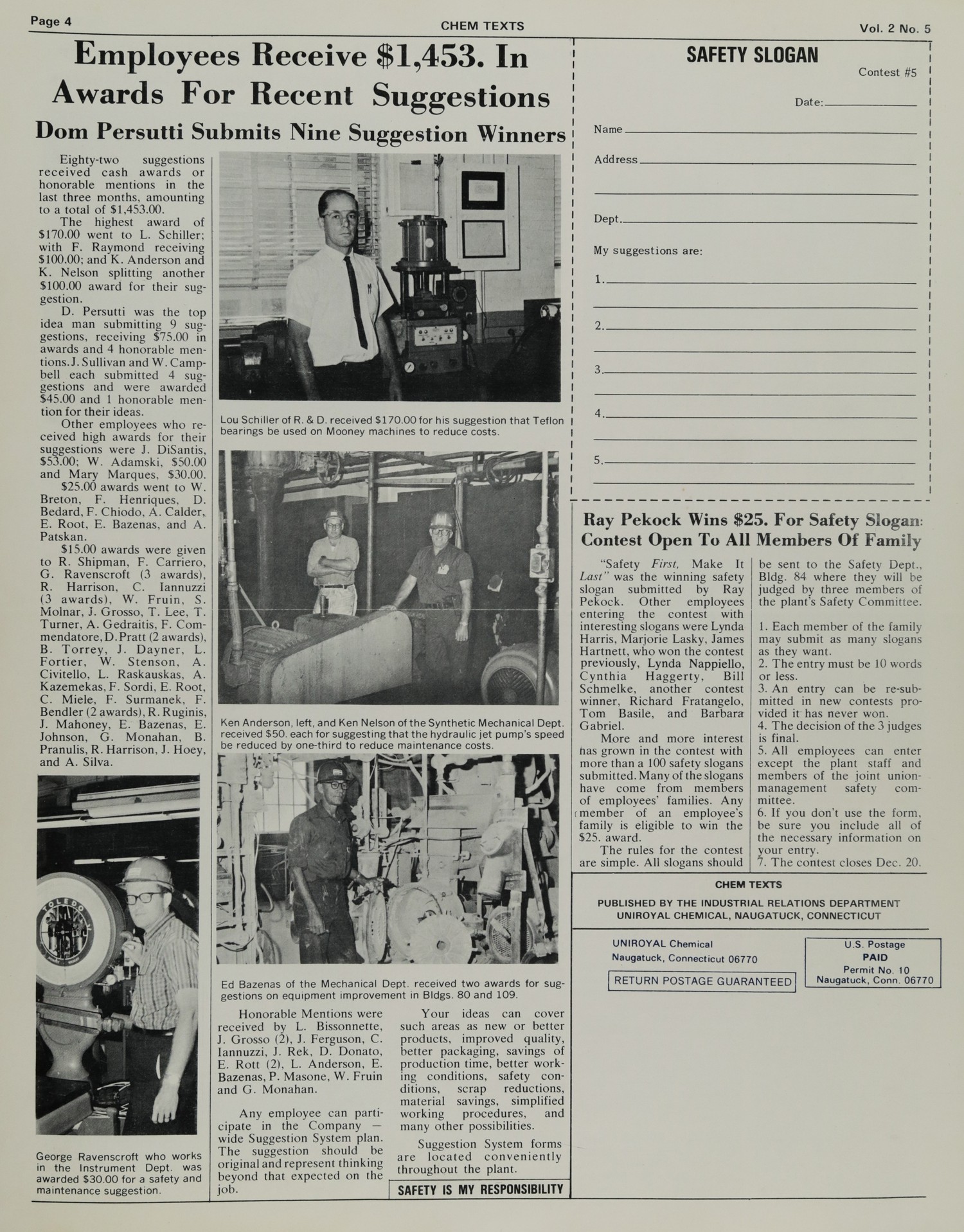
Employees Receive $1,453. In Awards For Recent Suggestions

Dom Persutti Submits Nine Suggestion Winners

Eighty-two suggestions received cash awards or honorable mentions in the last three months, amounting to a total of $1,453.00.

The highest award of $170.00 went to L. Schiller; with F. Raymond receiving $100.00; and K. Anderson and K. Nelson splitting another $100.00 award for their suggestion.

D. Persutti was the top idea man submitting 9 suggestions, receiving $75.00 in awards and 4 honorable mentions. J. Sullivan and W. Campbell each submitted 4 suggestions and were awarded $45.00 and 1 honorable mention for their ideas.

Other employees who received high awards for their suggestions were J. DiSantis, $53.00; W. Adamski, $50.00 and Mary Marques, $30.00.

$25.00 awards went to W. Breton, F. Henriques, D. Bedard, F. Chiodo, A. Calder, E. Root, E. Bazenas, and A. Patskan.

$15.00 awards were given to R. Shipman, F. Carriero, G. Ravenscroft (3 awards), R. Harrison, C. Iannuzzi (3 awards), W. Fruin, S. Molnar, J. Grosso, T. Lee, T. Turner, A. Gedraitis, F. Commendatore, D. Pratt (2 awards), B. Torrey, J. Dayner, L. Fortier, W. Stenson, A. Civitello, L. Raskauskas, A. Kazemekas, F. Sordi, E. Root, C. Miele, F. Surmanck, F. Bendler (2 awards), R. Ruginis, J. Mahoney, E. Bazenas, E. Johnson, G. Monahan, B. Pranulis, R. Harrison, J. Hoey, and A. Silva.


[PHOTO CAPTION]
Lou Schiller of R. & D. received $170.00 for his suggestion that Teflon bearings be used on Mooney machines to reduce costs.


[PHOTO CAPTION]
Ken Anderson, left, and Ken Nelson of the Synthetic Mechanical Dept. received $50. each for suggesting that the hydraulic jet pump’s speed be reduced by one-third to reduce maintenance costs.


[PHOTO CAPTION]
George Ravenscroft who works in the Instrument Dept. was awarded $30.00 for a safety and maintenance suggestion.


[PHOTO CAPTION]
Ed Bazenas of the Mechanical Dept. received two awards for suggestions on equipment improvement in Bldgs. 80 and 109.


Honorable Mentions were received by L. Bissonnette, J. Grosso (2), J. Ferguson, C. Iannuzzi, J. Rek, D. Donato, E. Rott (2), L. Anderson, E. Bazenas, P. Masone, W. Fruin and G. Monahan.

Any employee can participate in the Company — wide Suggestion System plan. The suggestion should be original and represent thinking beyond that expected on the job.

Your ideas can cover such areas as new or better products, improved quality, better packaging, savings of production time, better working conditions, safety conditions, scrap reductions, material savings, simplified working procedures, and many other possibilities.

Suggestion System forms are located conveniently throughout the plant.

SAFETY IS MY RESPONSIBILITY


SAFETY SLOGAN

Contest #5

Date:___

Name ___________

Address _________


Dept.____________

My suggestions are:

1._________


2._________


3._________


4._________


5._________


Ray Pekock Wins $25. For Safety Slogan: Contest Open To All Members Of Family

“Safety First, Make It Last” was the winning safety slogan submitted by Ray Pekock. Other employees entering the contest with interesting slogans were Lynda Harris, Marjorie Lasky, James Hartnett, who won the contest previously, Lynda Nappiello, Cynthia Haggerty, Bill Schmelke, another contest winner, Richard Fratangelo, Tom Basile, and Barbara Gabriel.

More and more interest has grown in the contest with more than a 100 safety slogans submitted. Many of the slogans have come from members of employees’ families. Any member of an employee’s family is eligible to win the $25. award.

The rules for the contest are simple. All slogans should be sent to the Safety Dept., Bldg. 84 where they will be judged by three members of the plant’s Safety Committee.

  1. Each member of the family may submit as many slogans as they want.
  2. The entry must be 10 words or less.
  3. An entry can be re-submitted in new contests provided it has never won.
  4. The decision of the 3 judges is final.
  5. All employees can enter except the plant staff and members of the joint union-management safety committee.
  6. If you don’t use the form, be sure you include all of the necessary information on your entry.
  7. The contest closes Dec. 20.

CHEM TEXTS

PUBLISHED BY THE INDUSTRIAL RELATIONS DEPARTMENT
UNIROYAL CHEMICAL, NAUGATUCK, CONNECTICUT

UNIROYAL Chemical
Naugatuck, Connecticut 06770

RETURN POSTAGE GUARANTEED

U.S. Postage
PAID
Permit No. 10
Naugatuck, Conn. 06770

CHEM-TEXTS – Vol. 1 No. 2 – Page 2

Page 002

CHEM TEXTS

Page 2 | Vol. 1 No. 3


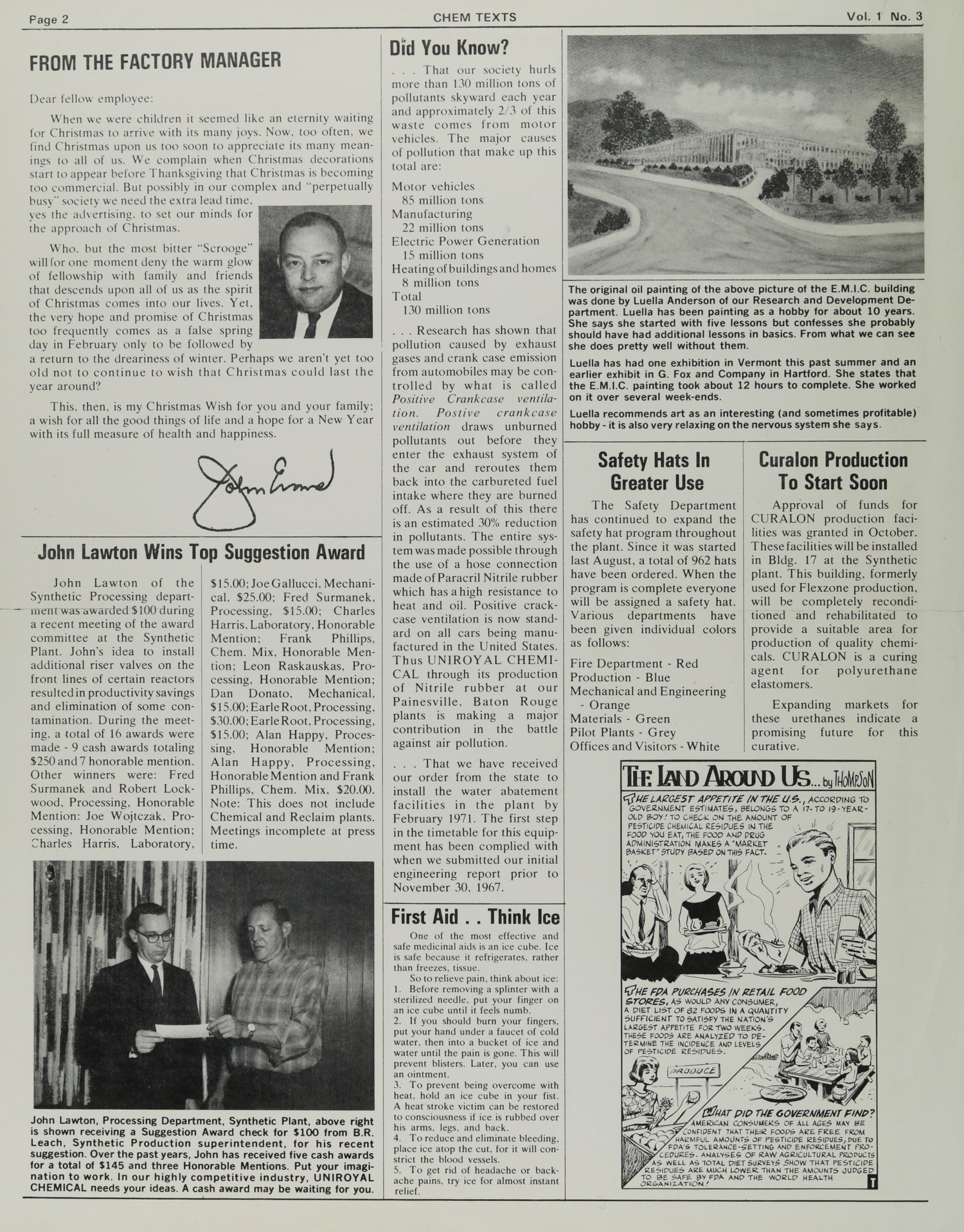
FROM THE FACTORY MANAGER

Dear fellow employee:

When we were children it seemed like an eternity waiting for Christmas to arrive with its many joys. Now, too often, we find Christmas upon us too soon to appreciate its many meanings to all of us. We complain when Christmas decorations start to appear before Thanksgiving that Christmas is becoming too commercial. But possibly in our complex and “perpetually busy” society we need the extra lead time, yes the advertising, to set our minds for the approach of Christmas.

Who, but the most bitter “Scrooge” will for one moment deny the warm glow of fellowship with family and friends that descends upon all of us as the spirit of Christmas comes into our lives. Yet, the very hope and promise of Christmas too frequently comes as a false spring day in February only to be followed by a return to the dreariness of winter. Perhaps we aren’t yet too old not to continue to wish that Christmas could last the year around?

This, then, is my Christmas Wish for you and your family; a wish for all the good things of life and a hope for a New Year with its full measure of health and happiness.

[Signature: John Harwood]


John Lawton Wins Top Suggestion Award

John Lawton of the Synthetic Processing department was awarded $100 during a recent meeting of the award committee at the Synthetic Plant. John’s idea to install additional riser valves on the front lines of certain reactors resulted in productivity savings and elimination of some contamination. During the meeting, a total of 16 awards were made – 9 cash awards totaling $250 and 7 honorable mention. Other winners were: Fred Surmanek and Robert Lockwood, Processing, Honorable Mention; Joe Wojtczak, Processing, Honorable Mention; Charles Harris, Laboratory,

$15.00; Joe Gallucci, Mechanical, $25.00; Fred Surmanek, Processing, $15.00; Charles Harris, Laboratory, Honorable Mention; Frank Phillips, Chem. Mix, Honorable Mention; Leon Raskauskas, Processing, Honorable Mention; Dan Donato, Mechanical, $15.00; Earle Root, Processing, $30.00; Earle Root, Processing, $15.00; Alan Happy, Processing, Honorable Mention; Alan Happy, Processing, Honorable Mention and Frank Phillips, Chem. Mix, $20.00. Note: This does not include Chemical and Reclaim plants. Meetings incomplete at press time.

[Photo caption:] John Lawton, Processing Department, Synthetic Plant, above right is shown receiving a Suggestion Award check for $100 from B.R. Leach, Synthetic Production superintendent, for his recent suggestion. Over the past years, John has received five cash awards for a total of $145 and three Honorable Mentions. Put your imagination to work. In our highly competitive industry, UNIROYAL CHEMICAL needs your ideas. A cash award may be waiting for you.


Did You Know?

… That our society hurls more than 130 million tons of pollutants skyward each year and approximately 2/3 of this waste comes from motor vehicles. The major causes of pollution that make up this total are:

Motor vehicles
85 million tons
Manufacturing
22 million tons
Electric Power Generation
15 million tons
Heating of buildings and homes
8 million tons
Total
130 million tons

… Research has shown that pollution caused by exhaust gases and crank case emission from automobiles may be controlled by what is called Positive Crankcase ventilation. Postive crankcase ventilation draws unburned pollutants out before they enter the exhaust system of the car and reroutes them back into the carbureted fuel intake where they are burned off. As a result of this there is an estimated 30% reduction in pollutants. The entire system was made possible through the use of a hose connection made of Paracril Nitrile rubber which has a high resistance to heat and oil. Positive crackcase ventilation is now standard on all cars being manufactured in the United States. Thus UNIROYAL CHEMICAL through its production of Nitrile rubber at our Painesville, Baton Rouge plants is making a major contribution in the battle against air pollution.

… That we have received our order from the state to install the water abatement facilities in the plant by February 1971. The first step in the timetable for this equipment has been complied with when we submitted our initial engineering report prior to November 30, 1967.


First Aid . . Think Ice

One of the most effective and safe medicinal aids is an ice cube. Ice is safe because it refrigerates, rather than freezes, tissue.

So to relieve pain, think about ice:
1. Before removing a splinter with a sterilized needle, put your finger on an ice cube until it feels numb.
2. If you should burn your fingers, put your hand under a faucet of cold water, then into a bucket of ice and water until the pain is gone. This will prevent blisters. Later, you can use an ointment.
3. To prevent being overcome with heat, hold an ice cube in your fist. A heat stroke victim can be restored to consciousness if ice is rubbed over his arms, legs, and back.
4. To reduce and eliminate bleeding, place ice atop the cut, for it will constrict the blood vessels.
5. To get rid of headache or backache pains, try ice for almost instant relief.


[Photo of E.M.I.C. building with caption:]
The original oil painting of the above picture of the E.M.I.C. building was done by Luella Anderson of our Research and Development Department. Luella has been painting as a hobby for about 10 years. She says she started with five lessons but confesses she probably should have had additional lessons in basics. From what we can see she does pretty well without them.

Luella has had one exhibition in Vermont this past summer and an earlier exhibit in G. Fox and Company in Hartford. She states that the E.M.I.C. painting took about 12 hours to complete. She worked on it over several week-ends.

Luella recommends art as an interesting (and sometimes profitable) hobby – it is also very relaxing on the nervous system she says.


Safety Hats In Greater Use

The Safety Department has continued to expand the safety hat program throughout the plant. Since it was started last August, a total of 962 hats have been ordered. When the program is complete everyone will be assigned a safety hat. Various departments have been given individual colors as follows:

Fire Department – Red
Production – Blue
Mechanical and Engineering – Orange
Materials – Green
Pilot Plants – Grey
Offices and Visitors – White


Curalon Production To Start Soon

Approval of funds for CURALON production facilities was granted in October. These facilities will be installed in Bldg. 17 at the Synthetic plant. This building, formerly used for Flexzone production, will be completely reconditioned and rehabilitated to provide a suitable area for production of quality chemicals. CURALON is a curing agent for polyurethane elastomers.

Expanding markets for these urethanes indicate a promising future for this curative.


THE LAND AROUND US… by ThOMEron

[Comic strip panel 1:]
THE LARGEST APPETITE IN THE U.S., ACCORDING TO GOVERNMENT ESTIMATES, BELONGS TO A 17-TO 19-YEAR-OLD BOY! TO CHECK ON THE AMOUNT OF PESTICIDE CHEMICAL RESIDUES IN THE FOOD YOU EAT, THE FOOD AND DRUG ADMINISTRATION MAKES A “MARKET BASKET” STUDY BASED ON THIS FACT.

[Comic strip panel 2:]
THE FDA PURCHASES IN RETAIL FOOD STORES, AS WOULD ANY CONSUMER, A DIET LIST OF 82 FOODS IN A QUANTITY SUFFICIENT TO SATISFY THE NATION’S LARGEST APPETITE FOR TWO WEEKS. THESE FOODS ARE ANALYZED TO DETERMINE THE INCIDENCE AND LEVELS OF PESTICIDE RESIDUES.

[Image shows produce]

[Comic strip panel 3:]
WHAT DID THE GOVERNMENT FIND?
AMERICAN CONSUMERS OF ALL AGES MAY BE CONFIDENT THAT THEIR FOODS ARE FREE FROM HARMFUL AMOUNTS OF PESTICIDE RESIDUES, DUE TO EPA’S TOLERANCE-SETTING AND ENFORCEMENT PROCEDURES. ANALYSES OF RAW AGRICULTURAL PRODUCTS AS WELL AS TOTAL DIET SURVEYS SHOW THAT PESTICIDE RESIDUES ARE MUCH LOWER THAN THE AMOUNTS JUDGED TO BE SAFE BY EPA AND THE WORLD HEALTH ORGANIZATION.

Long Rubber Strike Seen Test of Labor’s Strength

Long Rubber Strike Seen Test of Labor's Strength

THE WORKER. JULY 11, 1967

Page 3

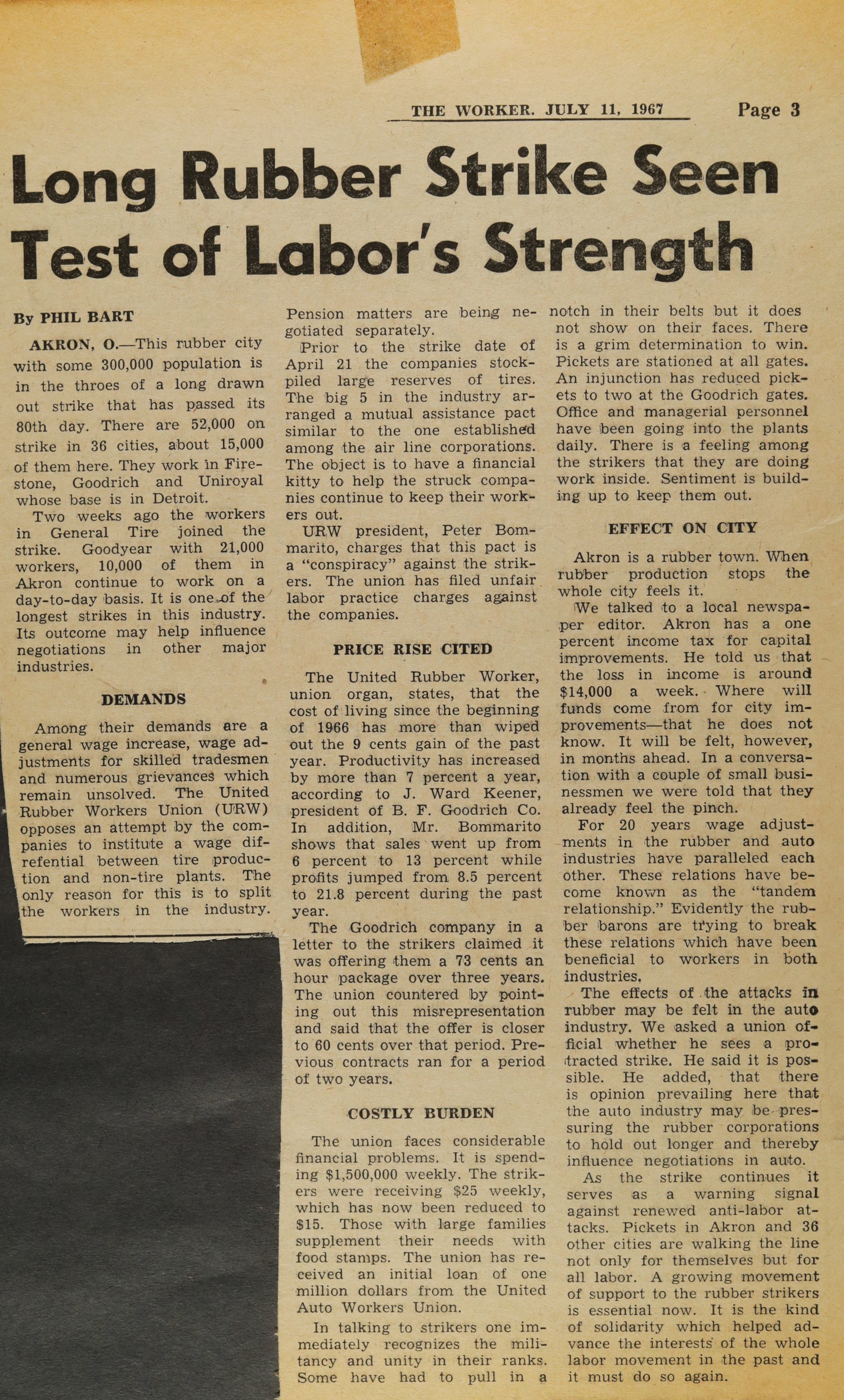
Long Rubber Strike Seen Test of Labor’s Strength

By PHIL BART

AKRON, O.—This rubber city with some 300,000 population is in the throes of a long drawn out strike that has passed its 80th day. There are 52,000 on strike in 36 cities, about 15,000 of them here. They work in Firestone, Goodrich and Uniroyal whose base is in Detroit.

Two weeks ago the workers in General Tire joined the strike. Goodyear with 21,000 workers, 10,000 of them in Akron continue to work on a day-to-day basis. It is one of the longest strikes in this industry. Its outcome may help influence negotiations in other major industries.

DEMANDS

Among their demands are a general wage increase, wage adjustments for skilled tradesmen and numerous grievances which remain unsolved. The United Rubber Workers Union (URW) opposes an attempt by the companies to institute a wage difrefential between tire production and non-tire plants. The only reason for this is to split the workers in the industry.

Pension matters are being negotiated separately.

Prior to the strike date of April 21 the companies stockpiled large reserves of tires. The big 5 in the industry arranged a mutual assistance pact similar to the one established among the air line corporations. The object is to have a financial kitty to help the struck companies continue to keep their workers out.

URW president, Peter Bommarito, charges that this pact is a “conspiracy” against the strikers. The union has filed unfair labor practice charges against the companies.

PRICE RISE CITED

The United Rubber Worker, union organ, states, that the cost of living since the beginning of 1966 has more than wiped out the 9 cents gain of the past year. Productivity has increased by more than 7 percent a year, according to J. Ward Keener, president of B. F. Goodrich Co. In addition, Mr. Bommarito shows that sales went up from 6 percent to 13 percent while profits jumped from 8.5 percent to 21.8 percent during the past year.

The Goodrich company in a letter to the strikers claimed it was offering them a 73 cents an hour package over three years. The union countered by pointing out this misrepresentation and said that the offer is closer to 60 cents over that period. Previous contracts ran for a period of two years.

COSTLY BURDEN

The union faces considerable financial problems. It is spending $1,500,000 weekly. The strikers were receiving $25 weekly, which has now been reduced to $15. Those with large families supplement their needs with food stamps. The union has received an initial loan of one million dollars from the United Auto Workers Union.

In talking to strikers one immediately recognizes the militancy and unity in their ranks. Some have had to pull in a notch in their belts but it does not show on their faces. There is a grim determination to win. Pickets are stationed at all gates. An injunction has reduced pickets to two at the Goodrich gates. Office and managerial personnel have been going into the plants daily. There is a feeling among the strikers that they are doing work inside. Sentiment is building up to keep them out.

EFFECT ON CITY

Akron is a rubber town. When rubber production stops the whole city feels it.

We talked to a local newspaper editor. Akron has a one percent income tax for capital improvements. He told us that the loss in income is around $14,000 a week. Where will funds come from for city improvements—that he does not know. It will be felt, however, in months ahead. In a conversation with a couple of small businessmen we were told that they already feel the pinch.

For 20 years wage adjustments in the rubber and auto industries have paralleled each other. These relations have become known as the “tandem relationship.” Evidently the rubber barons are trying to break these relations which have been beneficial to workers in both industries.

The effects of the attacks in rubber may be felt in the auto industry. We asked a union official whether he sees a protracted strike. He said it is possible. He added, that there is opinion prevailing here that the auto industry may be pressuring the rubber corporations to hold out longer and thereby influence negotiations in auto.

As the strike continues it serves as a warning signal against renewed anti-labor attacks. Pickets in Akron and 36 other cities are walking the line not only for themselves but for all labor. A growing movement of support to the rubber strikers is essential now. It is the kind of solidarity which helped advance the interests of the whole labor movement in the past and it must do so again.

340,000 Strike Three Firms In Rubber Union’s Biggest Walkout

THE WORKER, APRIL 25, 1967 Page 3

Voice of Youth To Be Heard at May Day Rally

THE MAY DAY slogans of ending the war and draft, independence for Puerto Rico and equality for black Americans are bringing youth into participation and planning for the celebration.

A spokesman for the 81st May Day Planning committee announced that Jose Stevens, co-chairman of the New York area Du Bois Clubs will be a speaker. Blyden Jackson, Harlem Communist leader has been designated rally chairman by the committee.

Jackson, in describing the forthcoming event, said “The Jet Set Band is going to entertain. They are great. The band has been playing for young people and is quite popular.”

Speakers for the event will include Mrs. Grace Mora Newman, sister of Dennis Mora, now in prison as one of the “Fort Hood Three” for refusing to fight in Vietnam; Juan Mari Bras, secretary-general of the Puerto Rican Movimiento Pro Independencia, Chris Kearns of the Catholic Worker, Herbert Aptheker, noted historian, and Esther Carroll, trade unionist.

Barbara Dane, folk singer, will also be a featured entertainer.

The May Day celebration will be held at 5 p.m. on Monday, May 1, at Union Square.


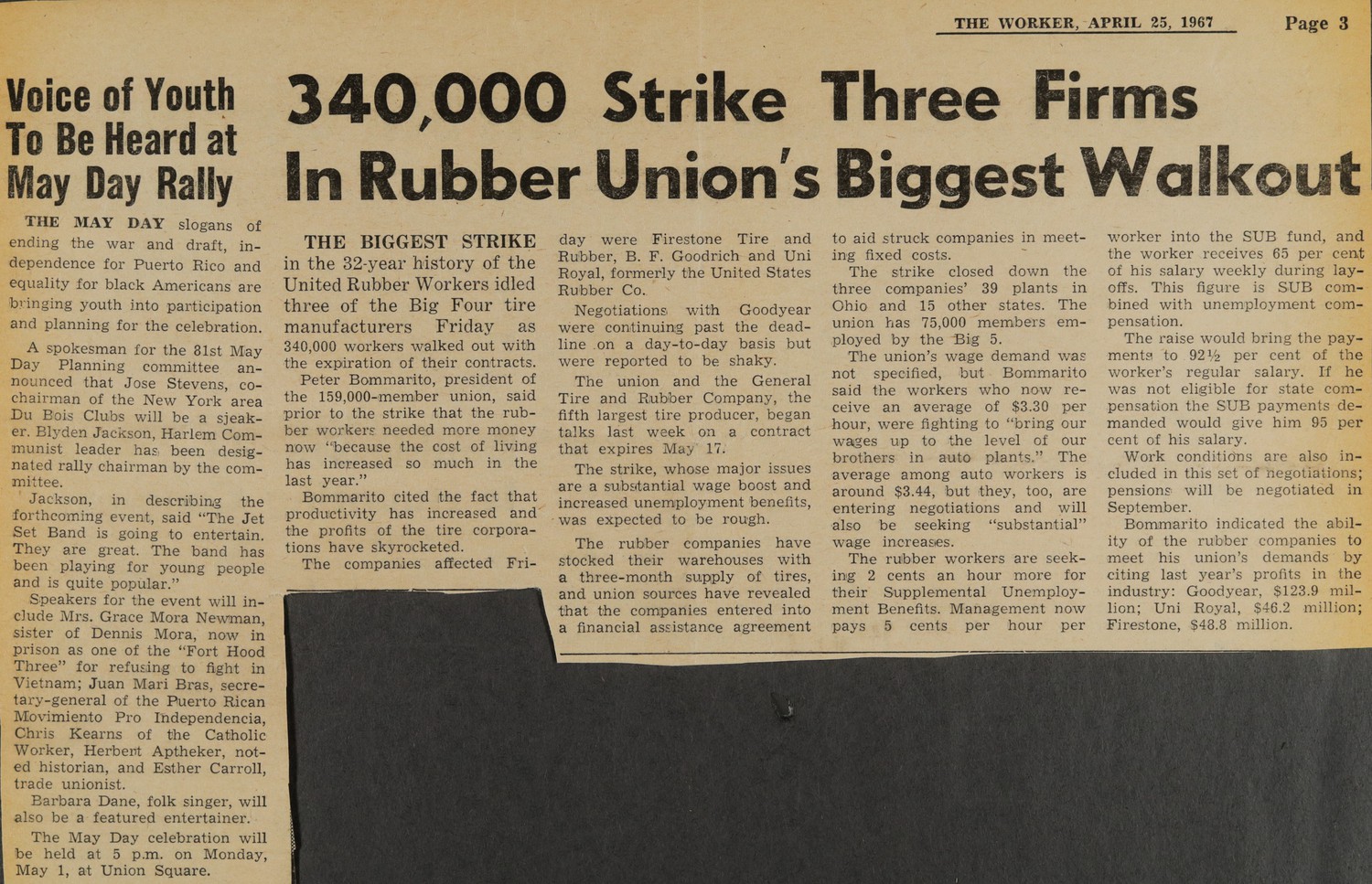
340,000 Strike Three Firms In Rubber Union’s Biggest Walkout

THE BIGGEST STRIKE in the 32-year history of the United Rubber Workers idled three of the Big Four tire manufacturers Friday as 340,000 workers walked out with the expiration of their contracts.

Peter Bommarito, president of the 159,000-member union, said prior to the strike that the rubber workers needed more money now “because the cost of living has increased so much in the last year.”

Bommarito cited the fact that productivity has increased and the profits of the tire corporations have skyrocketed.

The companies affected Friday were Firestone Tire and Rubber, B. F. Goodrich and Uni Royal, formerly the United States Rubber Co.

Negotiations with Goodyear were continuing past the deadline on a day-to-day basis but were reported to be shaky.

The union and the General Tire and Rubber Company, the fifth largest tire producer, began talks last week on a contract that expires May 17.

The strike, whose major issues are a substantial wage boost and increased unemployment benefits, was expected to be rough.

The rubber companies have stocked their warehouses with a three-month supply of tires, and union sources have revealed that the companies entered into a financial assistance agreement to aid struck companies in meeting fixed costs.

The strike closed down the three companies’ 39 plants in Ohio and 15 other states. The union has 75,000 members employed by the Big 5.

The union’s wage demand was not specified, but Bommarito said the workers who now receive an average of $3.30 per hour, were fighting to “bring our wages up to the level of our brothers in auto plants.” The average among auto workers is around $3.44, but they, too, are entering negotiations and will also be seeking “substantial” wage increases.

The rubber workers are seeking 2 cents an hour more for their Supplemental Unemployment Benefits. Management now pays 5 cents per hour per worker into the SUB fund, and the worker receives 65 per cent of his salary weekly during layoffs. This figure is SUB combined with unemployment compensation.

The raise would bring the payments to 92½ per cent of the worker’s regular salary. If he was not eligible for state compensation the SUB payments demanded would give him 95 per cent of his salary.

Work conditions are also included in this set of negotiations; pensions will be negotiated in September.

Bommarito indicated the ability of the rubber companies to meet his union’s demands by citing last year’s profits in the industry: Goodyear, $123.9 million; Uni Royal, $46.2 million; Firestone, $48.8 million.

US Rubber Proxy Statement – Page 15

Page 015

and $2,690 to another person) in respect of deferred cash awards previously granted under the Management Incentive Plan.

All participation units shown in the second column were outstanding on January 31, 1964, with the exception of 136 units previously awarded to persons other than directors and officers.

The numbers of shares shown in the last column include, where applicable, shares covered by unexpired and unexercised options granted under the Bonus Plan in 1958.

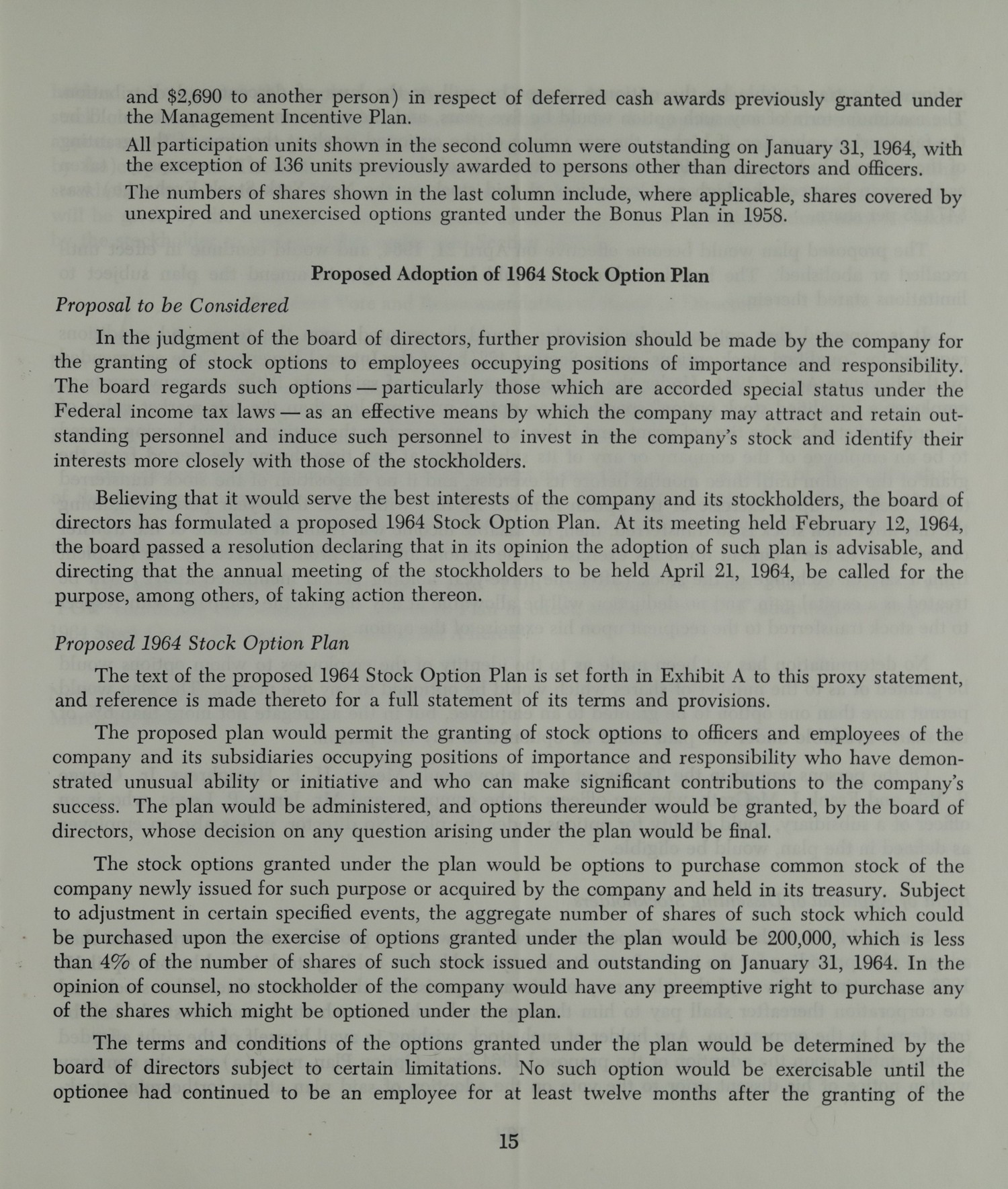
Proposed Adoption of 1964 Stock Option Plan

Proposal to be Considered

In the judgment of the board of directors, further provision should be made by the company for the granting of stock options to employees occupying positions of importance and responsibility. The board regards such options — particularly those which are accorded special status under the Federal income tax laws — as an effective means by which the company may attract and retain outstanding personnel and induce such personnel to invest in the company’s stock and identify their interests more closely with those of the stockholders.

Believing that it would serve the best interests of the company and its stockholders, the board of directors has formulated a proposed 1964 Stock Option Plan. At its meeting held February 12, 1964, the board passed a resolution declaring that in its opinion the adoption of such plan is advisable, and directing that the annual meeting of the stockholders to be held April 21, 1964, be called for the purpose, among others, of taking action thereon.

Proposed 1964 Stock Option Plan

The text of the proposed 1964 Stock Option Plan is set forth in Exhibit A to this proxy statement, and reference is made thereto for a full statement of its terms and provisions.

The proposed plan would permit the granting of stock options to officers and employees of the company and its subsidiaries occupying positions of importance and responsibility who have demonstrated unusual ability or initiative and who can make significant contributions to the company’s success. The plan would be administered, and options thereunder would be granted, by the board of directors, whose decision on any question arising under the plan would be final.

The stock options granted under the plan would be options to purchase common stock of the company newly issued for such purpose or acquired by the company and held in its treasury. Subject to adjustment in certain specified events, the aggregate number of shares of such stock which could be purchased upon the exercise of options granted under the plan would be 200,000, which is less than 4% of the number of shares of such stock issued and outstanding on January 31, 1964. In the opinion of counsel, no stockholder of the company would have any preemptive right to purchase any of the shares which might be optioned under the plan.

The terms and conditions of the options granted under the plan would be determined by the board of directors subject to certain limitations. No such option would be exercisable until the optionee had continued to be an employee for at least twelve months after the granting of the