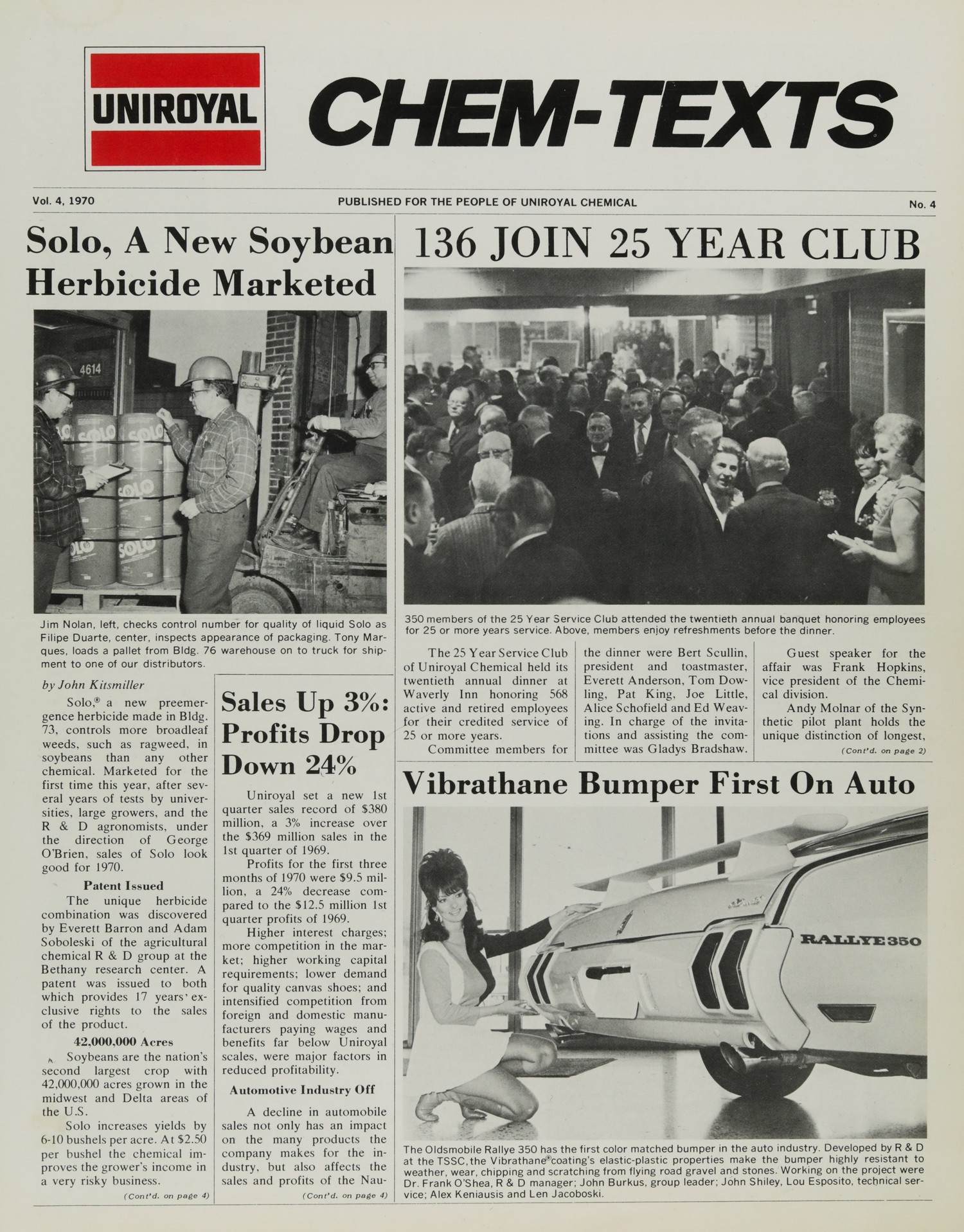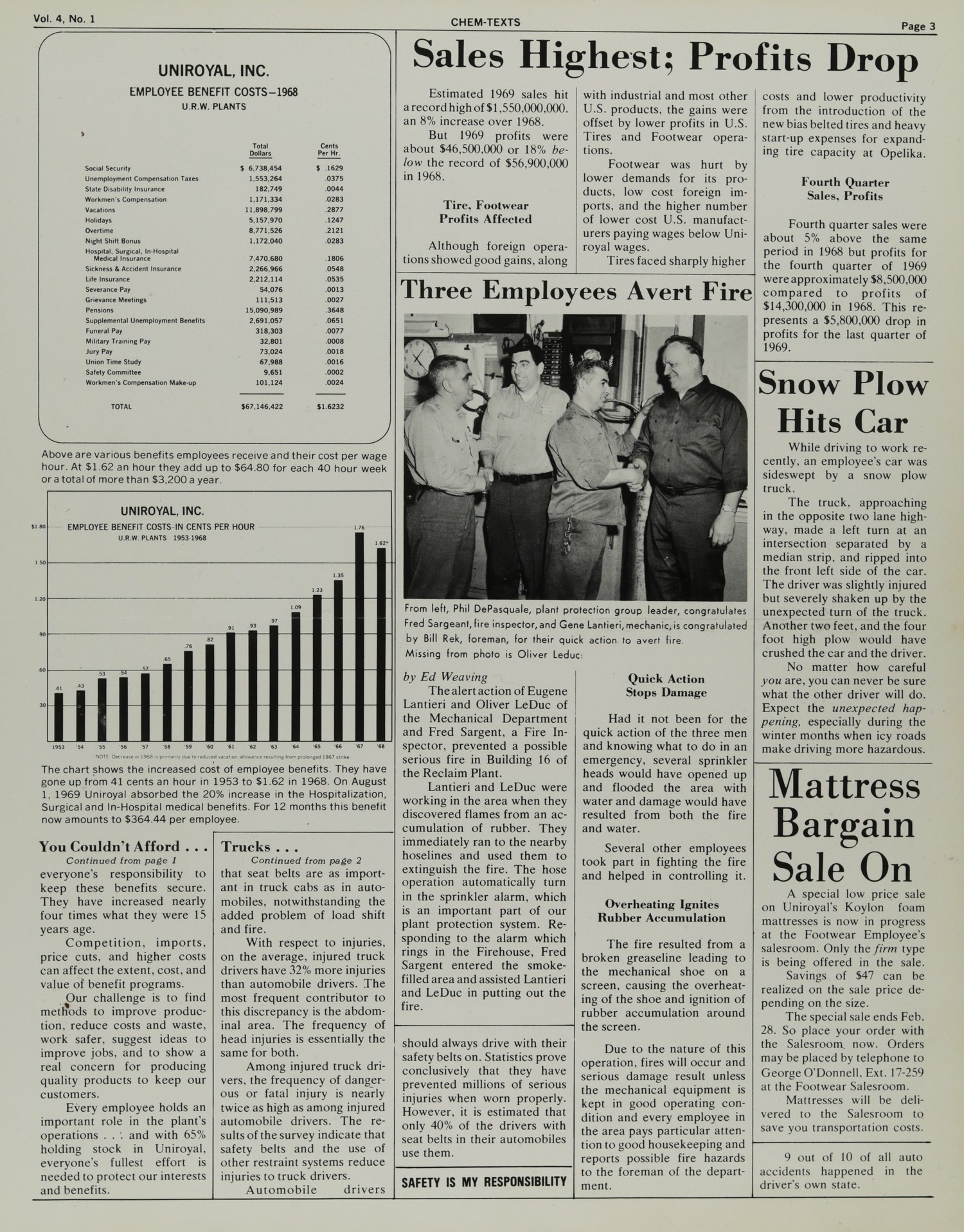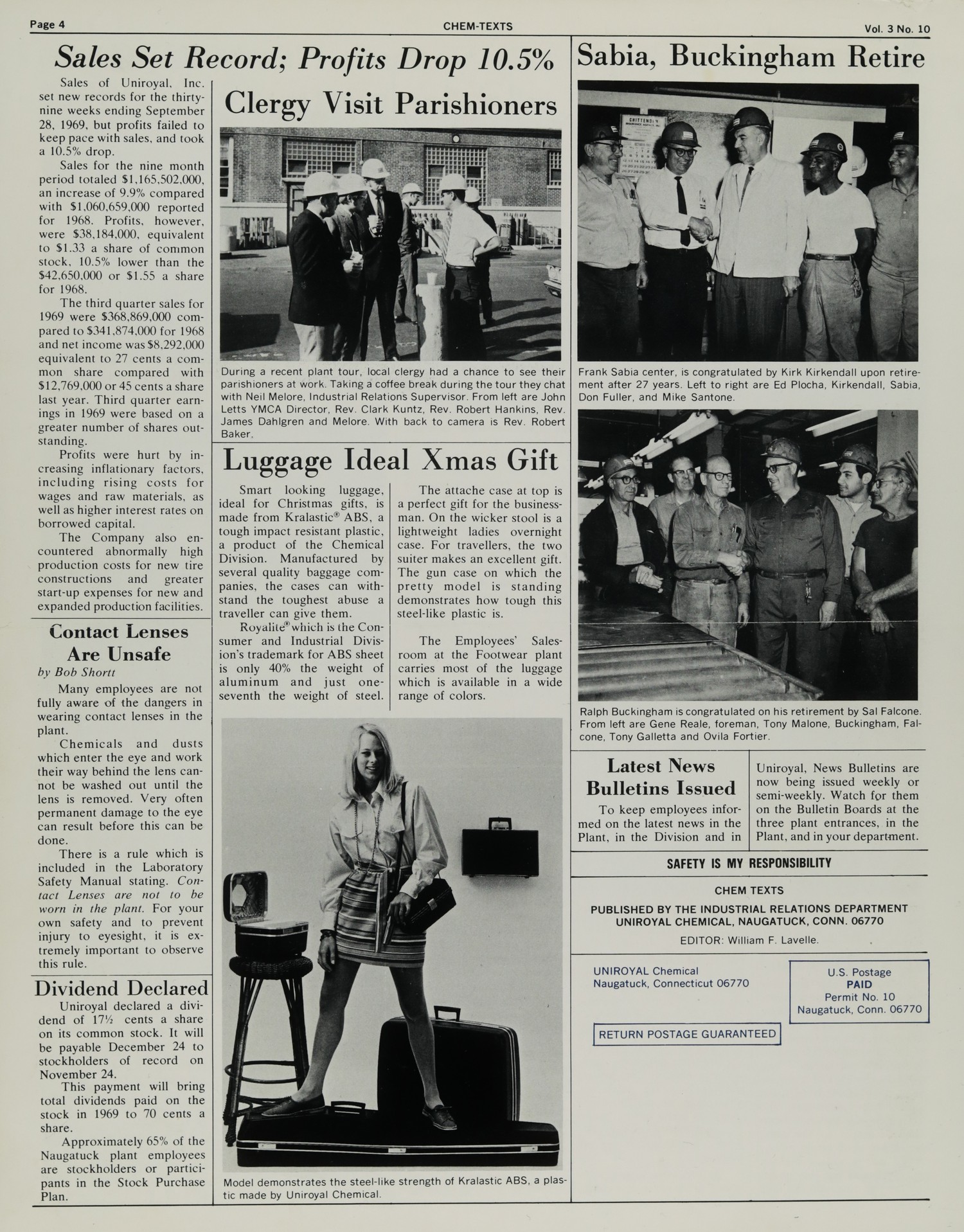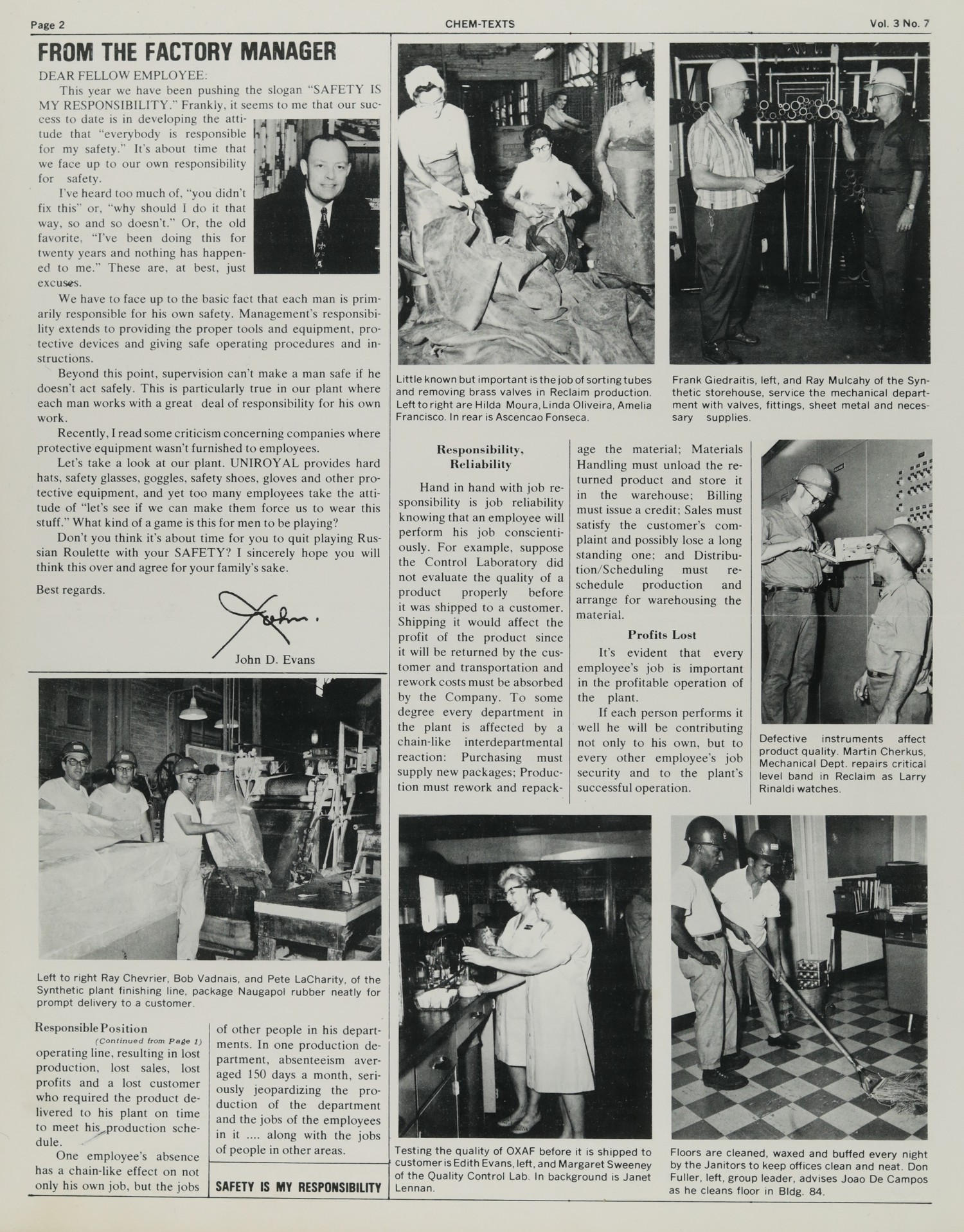
ChemWorld – Page 1

Page 001

ChemWorld

Published by Uniroyal Chemical Co. for its Employees and Retirees January 1990


Contents

’89 Quality Symposium . . . . . . . . 2
Uniroyal of Canada Awarded . . . 3
Preparing For Future Markets . . 4
Ingulli Plans Growth Strategy . . . 5
Simon Receives Career Award . . 6
ChemWorld Briefs . . . . . . . . . . . 8


New Chapter Unfolds Following Management Buyout

On Monday, October 30, 1989, Uniroyal Chemical Company completed the management buyout of the company from Avery, Inc. for a price of $800 million, which signifies the beginning of a new era for the company.

“This purchase has put Uniroyal Chemical’s future directly where it belongs: into the hands of those who know its business best — Uniroyal Chemical’s current management,” stated Uniroyal Chemical president and chief executive officer Robert J. Mazaika. “We believe this strengthens the company’s management position and will reinforce our reputation as an energetic, progressive and growing company with long-term vision toward the future.”

The new owners, an experienced management team with a high level of commitment to the company’s future financial success, intend to broaden its technical base and penetrate new growth markets that will enhance Uniroyal Chemical’s strategic position worldwide.

Over the past three years, the company has increased sales by 48 percent, maintained a high profit margin, and expanded its markets, both domestically and internationally.

“We intend to extend Uniroyal Chemical’s solid record of aggressive growth and build on our past sales successes,” said Mazaika. “We will be looking for more opportunities for joint ventures and licensing agreements.”

Today, Uniroyal Chemical holds leading marketing positions in many of its markets


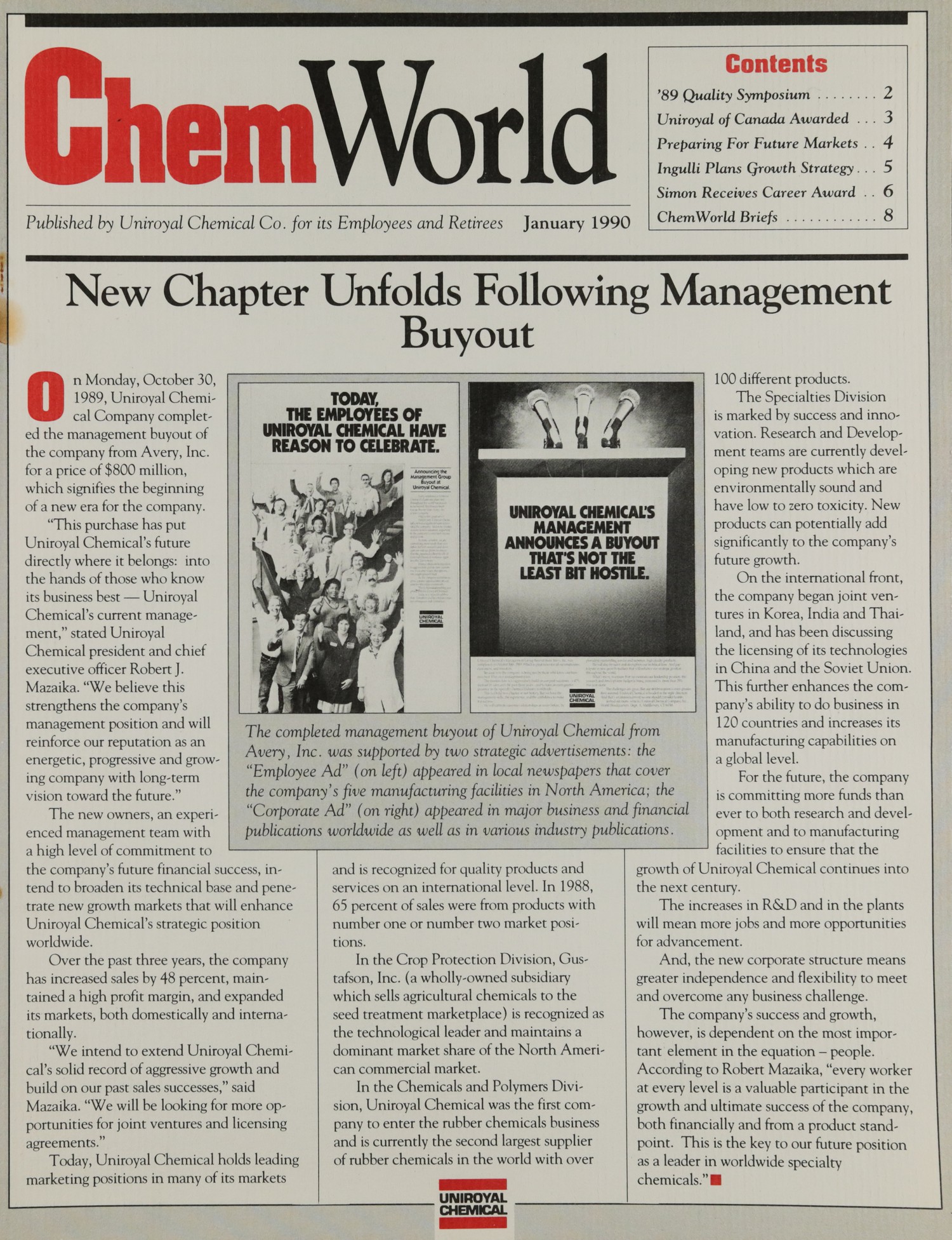
TODAY, THE EMPLOYEES OF UNIROYAL CHEMICAL HAVE REASON TO CELEBRATE.

[IMAGE: Group photo of employees]

Announcing the Management Buyout of Uniroyal Chemical

UNIROYAL CHEMICAL’S MANAGEMENT ANNOUNCES A BUYOUT THAT’S NOT THE LEAST BIT HOSTILE.

[IMAGE: Corporate advertisement with Uniroyal Chemical logo]

The completed management buyout of Uniroyal Chemical from Avery, Inc. was supported by two strategic advertisements: the “Employee Ad” (on left) appeared in local newspapers that cover the company’s five manufacturing facilities in North America; the “Corporate Ad” (on right) appeared in major business and financial publications worldwide as well as in various industry publications.


and is recognized for quality products and services on an international level. In 1988, 65 percent of sales were from products with number one or number two market positions.

In the Crop Protection Division, Gustafson, Inc. (a wholly-owned subsidiary which sells agricultural chemicals to the seed treatment marketplace) is recognized as the technological leader and maintains a dominant market share of the North American commercial market.

In the Chemicals and Polymers Division, Uniroyal Chemical was the first company to enter the rubber chemicals business and is currently the second largest supplier of rubber chemicals in the world with over

100 different products.

The Specialties Division is marked by success and innovation. Research and Development teams are currently developing new products which are environmentally sound and have low to zero toxicity. New products can potentially add significantly to the company’s future growth.

On the international front, the company began joint ventures in Korea, India and Thailand, and has been discussing the licensing of its technologies in China and the Soviet Union. This further enhances the company’s ability to do business in 120 countries and increases its manufacturing capabilities on a global level.

For the future, the company is committing more funds than ever to both research and development and to manufacturing facilities to ensure that the growth of Uniroyal Chemical continues into the next century.

The increases in R&D and in the plants will mean more jobs and more opportunities for advancement.

And, the new corporate structure means greater independence and flexibility to meet and overcome any business challenge.

The company’s success and growth, however, is dependent on the most important element in the equation – people. According to Robert Mazaika, “every worker at every level is a valuable participant in the growth and ultimate success of the company, both financially and from a product standpoint. This is the key to our future position as a leader in worldwide specialty chemicals.” ■


UNIROYAL CHEMICAL
CHEM-TEXTS – 1980-v14-s289

Page 289

Page 2 CHEM-TEXTS Vol. 14, 1980


Goals For 1980

1979 was a very good year for the Uniroyal Chemical Company and the Naugatuck Plant. The company had record sales and profit and the Plant’s operating profit increased 59% over 1978. In order to continue this improvement, severl major 1980 Objectives for the following products and areas must be accomplished:

NAUGACEL SD-1

Successfully start up Naugacel SD-1, an accelerator that will be new business for the plant. It will be manufactured in the FOC Plant Bldg. 124. Most of the equipment has been installed and startup is expected in the 2nd Quarter of 1980. Naugacel is used in the manufacture of tires and mechanical goods.

OMITE

Our goal is to increase Omite production 20% through productivity improvements over 1979, which was a record year. This is necessary if we want to meet the needs of fruit and cotton growers in the U.S. and to avoid the additional expense of importing Omite from our Latina Plant in Italy. Omite is the highest profit chemical made in the plant.

This year, we also will finalize our plant to increase the Omite capacity to meet future sales.

TPR

Increase the production of TPR by 30%, again, through productivity improvements, so that outside manufacturing can be eliminated. This will reduce TPR manufacturing cost and therefore improve TPR’s profitability.

DEVELOP A STRATEGY FOR THE PLANT

We will review the existing resources of the plant, analyze our strengths and weaknesses, and develop a plan that will increase the profit of our facilities. We have many resources that are not fully utilized and increasing their utilization will have a dramatic improvement on the company’s profitability.

For example, the Boiler Plant, Land and Wastewater treatment facilities are only 50-60% utilized. Some of our manufacturing equipment is operating at less than half of capacity. We certainly have the capacity and ability to manfacture more chemical products at Naugatuck and must develop a plan to take advantage of this opportunity.

ENERGY STRATEGY

This year, we will develop an energy strategy that reduces the cost of energy per pound of product so that we can be more competitive with chemical companies closer to lower cost energy sources.

OPERATING PROFIT

The profit goal for 1980 is to improve the operating profit of the Naugatuck Plant by 20%. The operating profit in 1979 was $18.9 million dollars and we plan to raise it to $22.7 million dollars in 1980. Achieving the objectives of the 1980 PIP Program, “Mainstream”, and meeting our 1980 Operating Budget, are important factors in meeting the 1980 Plant Operating Profit Goal.

HEALTH & SAFETY

2000 air monitoring tests will be taken in the Plant to insure that conditions in which employees are working are safe and corrective action initiated to improve the working environment. Also our safety goal this year is an Incidence Rate of 2.6, which is the number of injuries per 1,000,000 manhours worked. The Chemical Industry’s average is “6”, so we hope to operate significantly safer than the average plant.

RIDESHARING

We plan to finalize our ridesharing program in support of Gov. Grasso’s objective to reduce dependence on foreign oil by decreasing gasoline consumption. This program will also provide a system for our employees that will enable them to travel to work during gas shortages that will most likely occur in the future.

Eric Johnson, Factory Manager


Equality Policy Affirmed

The providing of equal employment opportunity for all employees or applicants for employment regardless of race, religion, color, sex, age, national origin, handicap or disabled and Vietnam Era Veteran status is one of the basic policies of UNIROYAL, Inc. The Naugatuck Chemical plant endorses this policy and expects all decisions regarding personnel to conform to these equal employment rules and regulations.

The Naugatuck Chemical Plant has a specific plan of action designed to aid in providing equal opportunity for all. It is committed to recruit, hire, and promote in all job classifications and to ensure that items such as compensation, benefits, transfers, layoffs, return from layoff, training, educational and tuition assistance, and social and recreational activities are administered without regard to race, color, religion, sex, age, national origin, handicap or disabled and Vietnam Era Veteran status except where sex, and/or age is a bonafied occupational qualification. It is also committed to make employment or promotional decisions based solely upon the individual’s qualifications as they relate to the valid qualification requirements of the position for which the individual is being considered.

continued on page 4


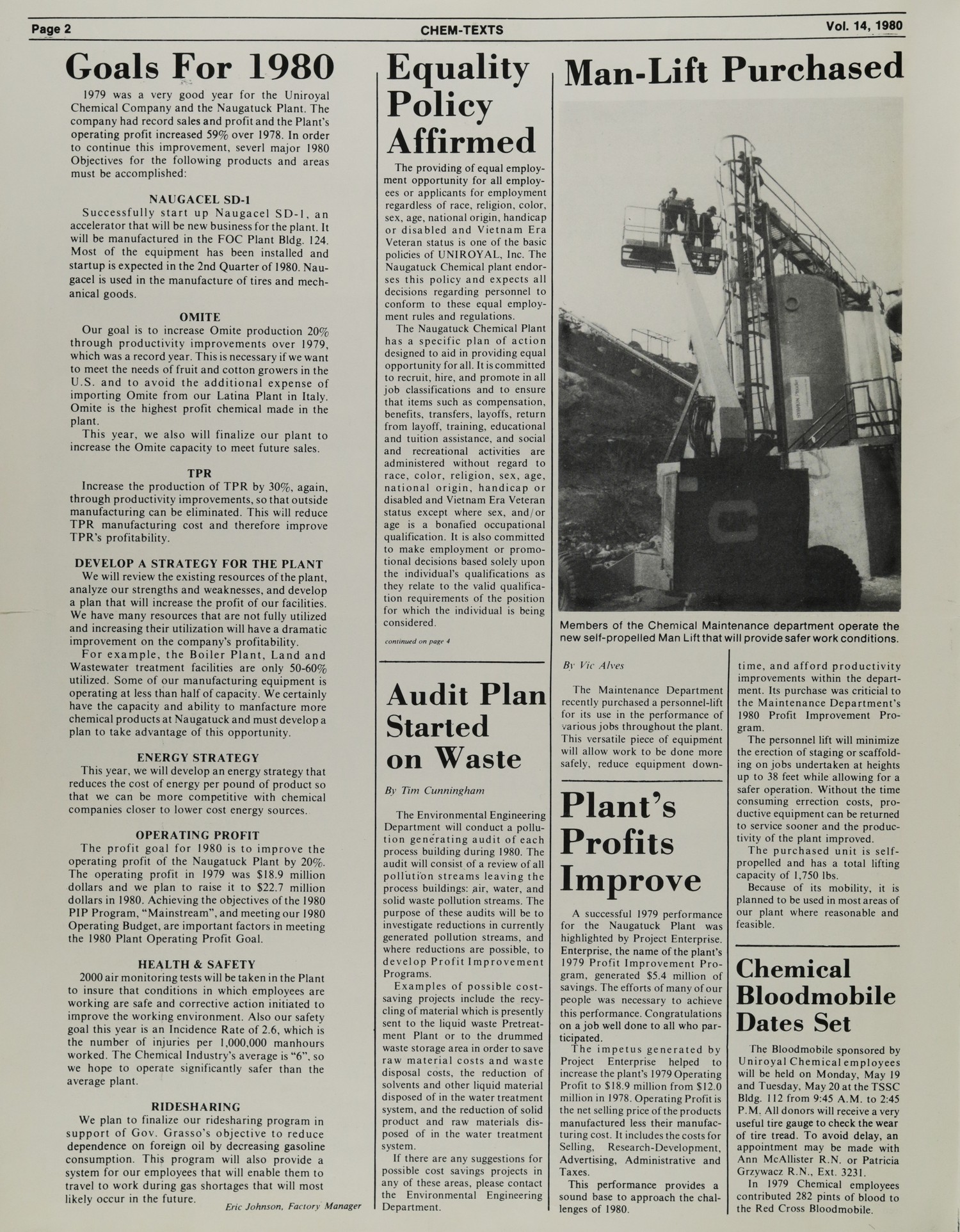
Man-Lift Purchased

[IMAGE: Black and white photograph showing members of the Chemical Maintenance department operating a self-propelled Man Lift]

Members of the Chemical Maintenance department operate the new self-propelled Man Lift that will provide safer work conditions.

By Vic Alves

The Maintenance Department recently purchased a personnel-lift for its use in the performance of various jobs throughout the plant. This versatile piece of equipment will allow work to be done more safely, reduce equipment down-

time, and afford productivity improvements within the department. Its purchase was criticial to the Maintenance Department’s 1980 Profit Improvement Program.

The personnel lift will minimize the erection of staging or scaffolding on jobs undertaken at heights up to 38 feet while allowing for a safer operation. Without the time consuming errection costs, productive equipment can be returned to service sooner and the productivity of the plant improved.

The purchased unit is self-propelled and has a total lifting capacity of 1,750 lbs.

Because of its mobility, it is planned to be used in most areas of our plant where reasonable and feasible.


Audit Plan Started on Waste

By Tim Cunningham

The Environmental Engineering Department will conduct a pollution generating audit of each process building during 1980. The audit will consist of a review of all pollution streams leaving the process buildings: air, water, and solid waste pollution streams. The purpose of these audits will be to investigate reductions in currently generated pollution streams, and where reductions are possible, to develop Profit Improvement Programs.

Examples of possible cost-saving projects include the recycling of material which is presently sent to the liquid waste Pretreatment Plant or to the drummed waste storage area in order to save raw material costs and waste disposal costs, the reduction of solvents and other liquid material disposed of in the water treatment system, and the reduction of solid product and raw materials disposed of in the water treatment system.

If there are any suggestions for possible cost savings projects in any of these areas, please contact the Environmental Engineering Department.


Plant’s Profits Improve

A successful 1979 performance for the Naugatuck Plant was highlighted by Project Enterprise. Enterprise, the name of the plant’s 1979 Profit Improvement Program, generated $5.4 million of savings. The efforts of many of our people was necessary to achieve this performance. Congratulations on a job well done to all who participated.

The impetus generated by Project Enterprise helped to increase the plant’s 1979 Operating Profit to $18.9 million from $12.0 million in 1978. Operating Profit is the net selling price of the products manufactured less their manufacturing cost. It includes the costs for Selling, Research-Development, Advertising, Administrative and Taxes.

This performance provides a sound base to approach the challenges of 1980.


Chemical Bloodmobile Dates Set

The Bloodmobile sponsored by Uniroyal Chemical employees will be held on Monday, May 19 and Tuesday, May 20 at the TSSC Bldg. 112 from 9:45 A.M. to 2:45 P.M. All donors will receive a very useful tire gauge to check the wear of tire tread. To avoid delay, an appointment may be made with Ann McAllister R.N. or Patricia Grzywacz R.N., Ext. 3231.

In 1979 Chemical employees contributed 282 pints of blood to the Red Cross Bloodmobile.

CHEM-TEXTS – 1979 – Page No. 2

Page unknown

UNIROYAL CHEM-TEXTS

Vol. 13, 1979 | PUBLISHED FOR THE PEOPLE OF UNIROYAL CHEMICAL | No. 2

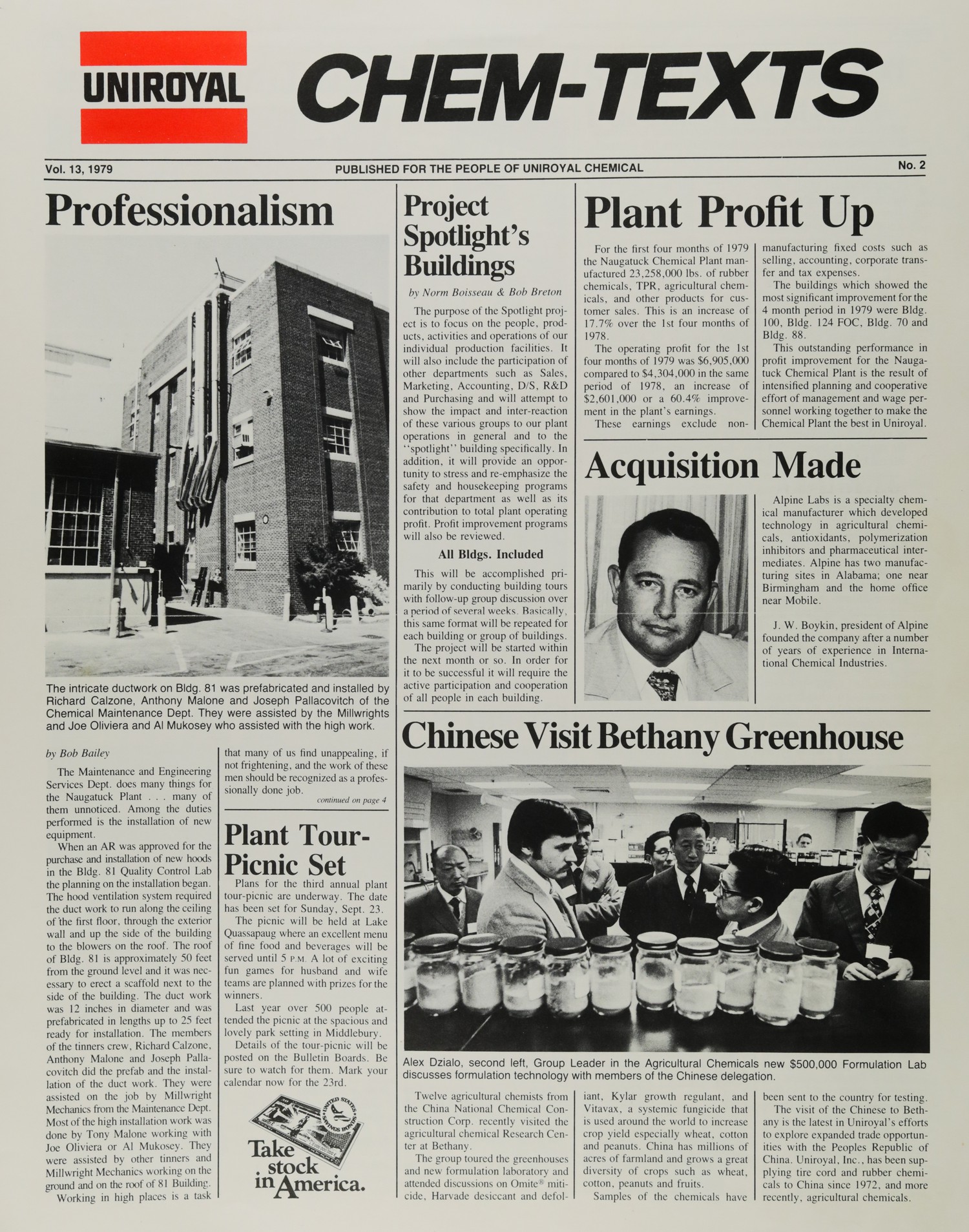
Professionalism

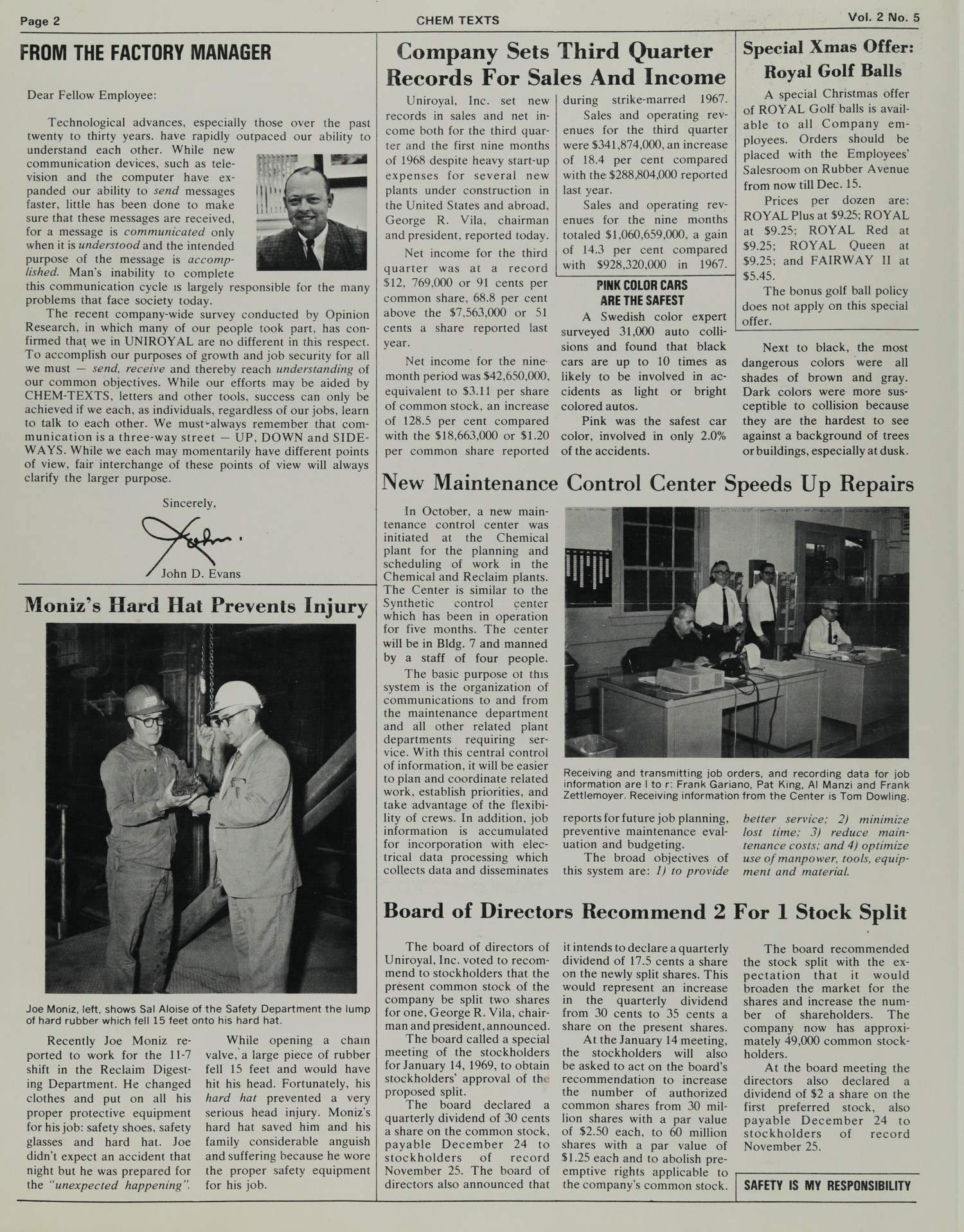
[IMAGE: Black and white photograph of a multi-story building with external ductwork]

The intricate ductwork on Bldg. 81 was prefabricated and installed by Richard Calzone, Anthony Malone and Joseph Pallacovitch of the Chemical Maintenance Dept. They were assisted by the Millwrights and Joe Oliviera and Al Mukosey who assisted with the high work.

by Bob Bailey

The Maintenance and Engineering Services Dept. does many things for the Naugatuck Plant . . . many of them unnoticed. Among the duties performed is the installation of new equipment.

When an AR was approved for the purchase and installation of new hoods in the Bldg. 81 Quality Control Lab the planning on the installation began. The hood ventilation system required the duct work to run along the ceiling of the first floor, through the exterior wall and up the side of the building to the blowers on the roof. The roof of Bldg. 81 is approximately 50 feet from the ground level and it was necessary to erect a scaffold next to the side of the building. The duct work was 12 inches in diameter and was prefabricated in lengths up to 25 feet ready for installation. The members of the tinners crew, Richard Calzone, Anthony Malone and Joseph Pallacovitch did the prefab and the installation of the duct work. They were assisted on the job by Millwright Mechanics from the Maintenance Dept. Most of the high installation work was done by Tony Malone working with Joe Oliviera or Al Mukosey. They were assisted by other tinners and Millwright Mechanics working on the ground and on the roof of 81 Building.

Working in high places is a task that many of us find unappealing, if not frightening, and the work of these men should be recognized as a professionally done job.

continued on page 4


Project Spotlight’s Buildings

by Norm Boisseau & Bob Breton

The purpose of the Spotlight project is to focus on the people, products, activities and operations of our individual production facilities. It will also include the participation of other departments such as Sales, Marketing, Accounting, D/S, R&D and Purchasing and will attempt to show the impact and inter-reaction of these various groups to our plant operations in general and to the “spotlight” building specifically. In addition, it will provide an opportunity to stress and re-emphasize the safety and housekeeping programs for that department as well as its contribution to total plant operating profit. Profit improvement programs will also be reviewed.

All Bldgs. Included

This will be accomplished primarily by conducting building tours with follow-up group discussion over a period of several weeks. Basically, this same format will be repeated for each building or group of buildings.

The project will be started within the next month or so. In order for it to be successful it will require the active participation and cooperation of all people in each building.


Plant Tour-Picnic Set

Plans for the third annual plant tour-picnic are underway. The date has been set for Sunday, Sept. 23.

The picnic will be held at Lake Quassapaug where an excellent menu of fine food and beverages will be served until 5 P.M. A lot of exciting fun games for husband and wife teams are planned with prizes for the winners.

Last year over 500 people attended the picnic at the spacious and lovely park setting in Middlebury.

Details of the tour-picnic will be posted on the Bulletin Boards. Be sure to watch for them. Mark your calendar now for the 23rd.

[IMAGE: Small graphic showing “Take stock in America.”]


Plant Profit Up

For the first four months of 1979 the Naugatuck Chemical Plant manufactured 23,258,000 lbs. of rubber chemicals, TPR, agricultural chemicals, and other products for customer sales. This is an increase of 17.7% over the 1st four months of 1978.

The operating profit for the 1st four months of 1979 was $6,905,000 compared to $4,304,000 in the same period of 1978, an increase of $2,601,000 or a 60.4% improvement in the plant’s earnings.

These earnings exclude non-manufacturing fixed costs such as selling, accounting, corporate transfer and tax expenses.

The buildings which showed the most significant improvement for the 4 month period in 1979 were Bldg. 100, Bldg. 124 FOC, Bldg. 70 and Bldg. 88.

This outstanding performance in profit improvement for the Naugatuck Chemical Plant is the result of intensified planning and cooperative effort of management and wage personnel working together to make the Chemical Plant the best in Uniroyal.


Acquisition Made

[IMAGE: Black and white portrait photograph of a man in business attire]

Alpine Labs is a specialty chemical manufacturer which developed technology in agricultural chemicals, antioxidants, polymerization inhibitors and pharmaceutical intermediates. Alpine has two manufacturing sites in Alabama; one near Birmingham and the home office near Mobile.

J. W. Boykin, president of Alpine founded the company after a number of years of experience in International Chemical Industries.


Chinese Visit Bethany Greenhouse

[IMAGE: Black and white photograph showing several people seated at a table in discussion]

Alex Dzialo, second left, Group Leader in the Agricultural Chemicals new $500,000 Formulation Lab discusses formulation technology with members of the Chinese delegation.

Twelve agricultural chemists from the China National Chemical Construction Corp. recently visited the agricultural chemical Research Center at Bethany.

The group toured the greenhouses and new formulation laboratory and attended discussions on Omite® miticide, Harvade desiccant and defoliant, Kylar growth regulant, and Vitavax, a systemic fungicide that is used around the world to increase crop yield especially wheat, cotton and peanuts. China has millions of acres of farmland and grows a great diversity of crops such as wheat, cotton, peanuts and fruits.

Samples of the chemicals have been sent to the country for testing.

The visit of the Chinese to Bethany is the latest in Uniroyal’s efforts to explore expanded trade opportunities with the Peoples Republic of China. Uniroyal, Inc., has been supplying tire cord and rubber chemicals to China since 1972, and more recently, agricultural chemicals.

CHEM-TEXTS – 1979 – Page No. 1

Page unknown

UNIROYAL CHEM-TEXTS

Vol. 13, 1979 | PUBLISHED FOR THE PEOPLE OF UNIROYAL CHEMICAL | No. 1

Equality Policy Affirmed

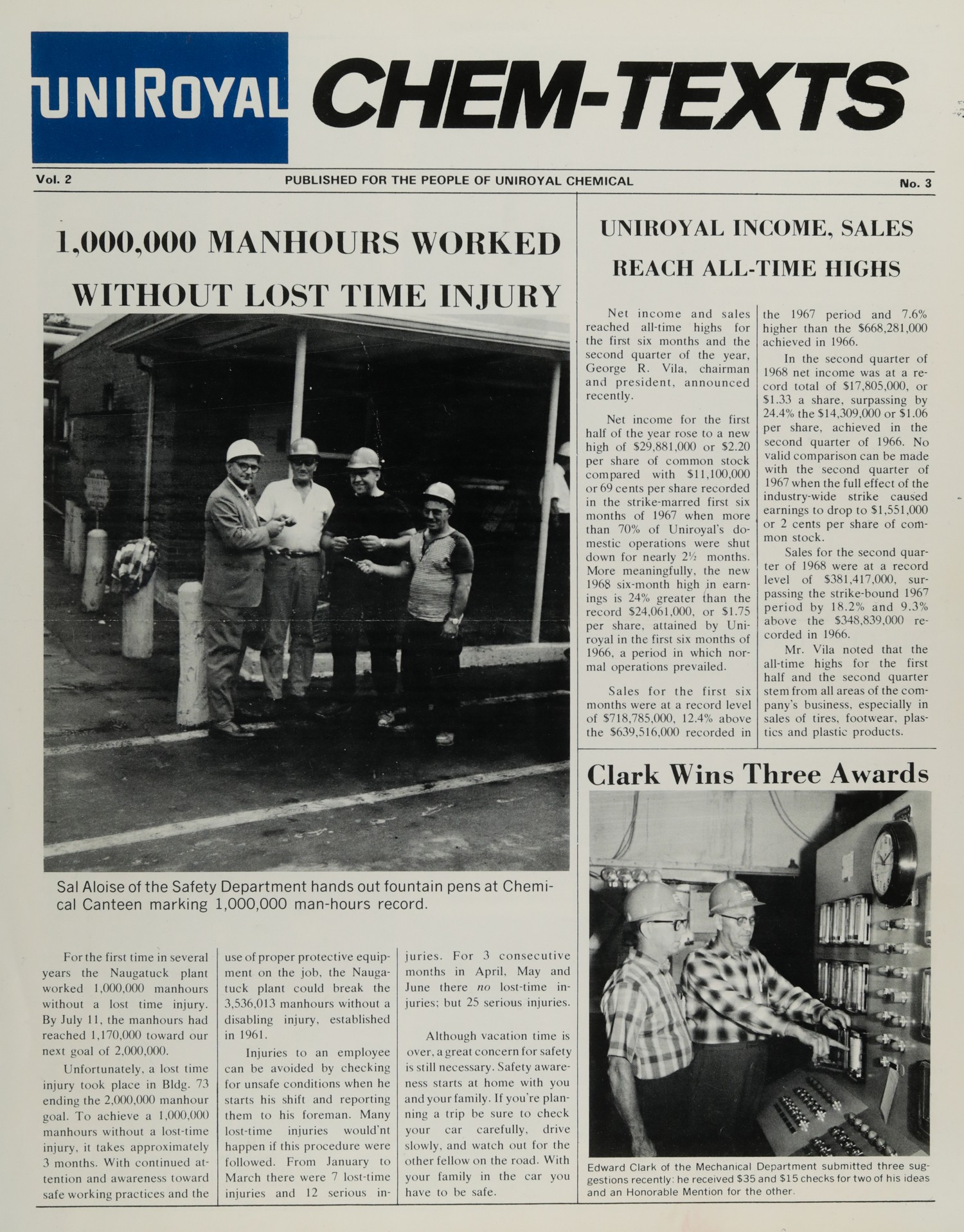
The Uniroyal Chemical plant has a firm commitment to offer equal opportunity to all employees. It is the policy of the plant’s management to support and implement this commitment continually.

This policy requires that all recruiting, hiring, transfers, promotions, compensation, benefits, and company-sponsored training, education and tuition assistance, as well as social, recreational and health programs and lay-off and recall practices are followed and carried out without regard to race, color, creed, religion, sex, national origin, or handicap of any individual person.

J. Robert Douglas, the Industrial Relations Manager for the Naugatuck plant is the Compliance Officer and has the responsibility for implementing this policy; monitoring the Uniroyal Chemical Affirmative Action Compliance Program; and reporting to management the program’s progress.

The responsibility for the improvement of the program and the positive results of it rests with each Manager, Foreman, and Supervisor as an integral part of their job.


$500.00 Scholarship Offered

The Uniroyal Chemical Management Club is again offering a $500 scholarship award. Fifty dollars of the scholarship comes from the Larry Monroe Fund.

The scholarship is available to a graduating high school student who plans a college education. To qualify, one of the student’s parents must have worked for Uniroyal Chemical at Naugatuck or Bethany for two years or more and be an active employee. The fund is supported by the dues of the club’s members.

Applications for the scholarship may be obtained from the Industrial Relations Department or by a telephone call to Constance Antrum, Ext. 3217.

April 20, Final Date

The application must be returned to William Broden, Chair-
Continued on page 4


$614,000 AR Okayed for Plant

A major Appropriations Request (AR) of $614,000 has been approved for equipment additions to Building 124 (FOC) to produce Naugacel SD-1.

The direction of this major project will be the responsibility of the Naugatuck Plant’s Technical Department.

Naugacel SD-1 represents a new product to be manufactured in Chemical Production. It has already been successfully run in both the R. & D. Development Lab and the Chemical Pilot Plant.

Used in Tires

Naugacel SD-1 is a sulfur donor accelerator for use in the vulcanization of natural and synthetic rubber and is utilized primarily in tires and mechanical goods.

Continued on page 4


MAP Plan Saves $27,358

Cuts Time in Half

By Vic Alves

When it was decided that major repairs would be required on the PR-03 vessel in the FOC plant (Bldg. 124), original repair estimates indicated that it would take 17 days of Maintenance Dept. work to complete the necessary repairs.

A Management Action Plan (MAP) was then written to plan the work and coordinate these repairs. As a result of this action plan it was determined that the repairs could be completed in 10 days instead of the estimated 17 days. Through the combined efforts and cooperation of the Maintenance and Manufacturing Departments, the required repairs were made and the work was completed in 8 days.

Naugard Schedule Met

Because of this earlier turnaround, Bldg. 124 was able to finish its scheduled Naugard 445 production; perform a changeover; begin LVBI production on schedule; and meet the production schedule.

$27,358 Saved

Based on conversion costs it is estimated that $27,358 was saved
Continued on page 4


1978 Sales Improve; Chemical Hits High

The Company sales in the 4th quarter of 1978 were $728 million compared with $626 million in the 4th quarter of 1977.

The operating profit was $38 million in 1978 versus $20 million in 1977. Net income was $3.1 million, or 7¢ a common share, compared with a loss of $2.2 million in the 4th quarter of 1977.

Sales for 1978 were $2.74 billion, up from $2.58 billion in 1977. Net income for the year was $5.9 million, or 4 cents a share, compared with 1977 net income of $34.1 million or $1.10 a common share.

Preferred Dividend Paid

The Board of Directors declared $6 in dividends on the preferred stock, applicable to 1978 net income. With the $2 declared and paid in the second half of 1978, this amounted to the full dividend on the preferred stock for 1978.


Tire and Related Products

Sales in the Tire and Related Products were $435 million in the 4th quarter of 1978, compared with $371 million in the 4th quarter of 1977. For the year, sales were $1.575 billion against $1.489 billion in 1977.

Operating profit for 1978 was $55.1 million, compared with $77.1 million in 1977.


Chemical Sets Record

The Chemical, Rubber and Plastic Materials had sales of $106 million in the 4th quarter of 1978, up from $83 million in 1977.

For the year, sales were a record $443 million while 1977 sales were $391 million. Operating profits were a record $71.5 million, up from $57.6 million in 1977.
Continued on page 4


Special Bulletin

The Naugatuck Chemical Plant won a Nationwide Award for Hazardous Waste Control of the 1979 National Environmental Industry Awards Program.

The program is co-sponsored by the President’s Council on Environmental Quality and the Environmental Industry Council.

The Council presented the award on February 28th at the Mayflower Hotel in Washington, D.C.

In two years over $250,000 has been saved by burning the nonenes waste.


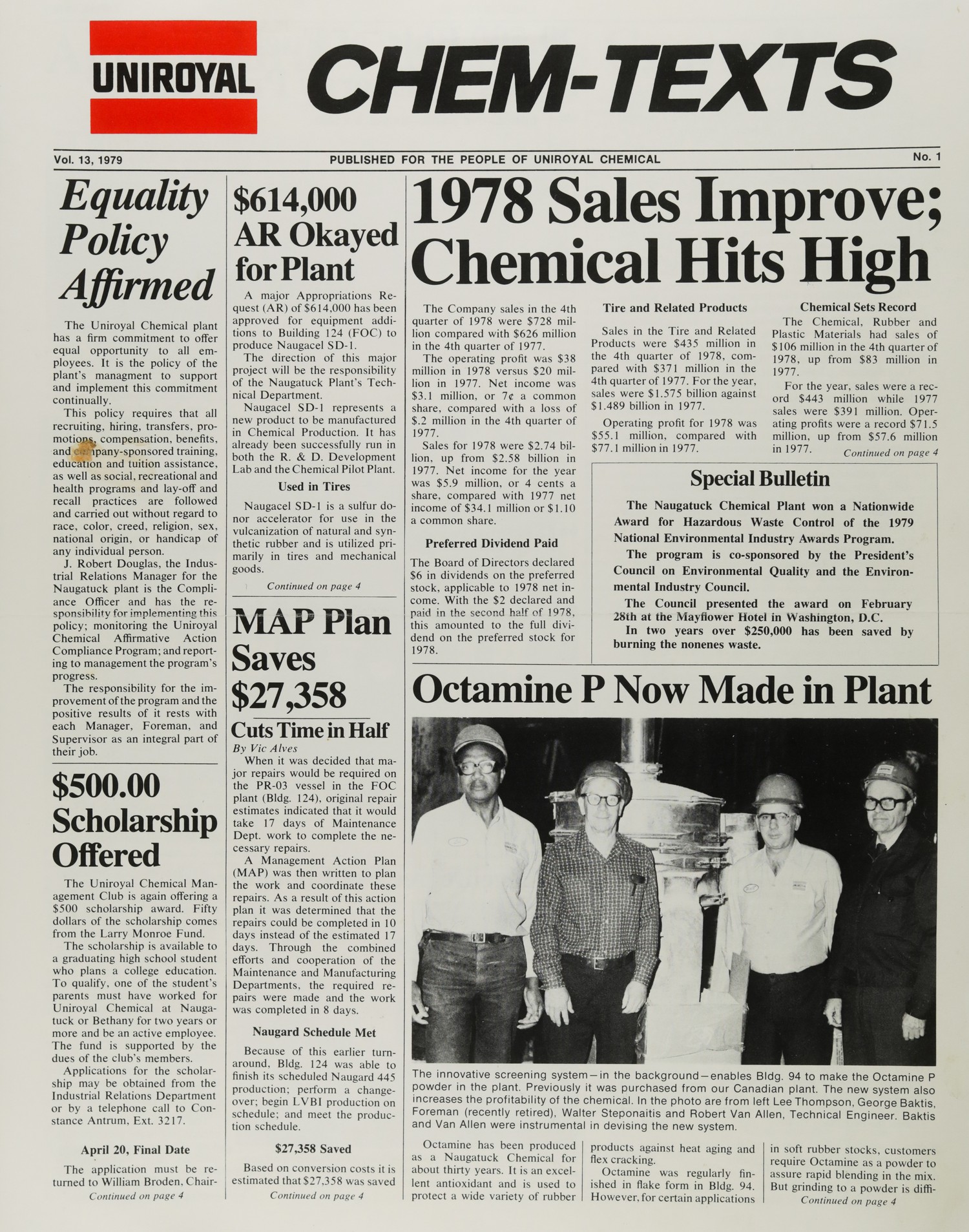
Octamine P Now Made in Plant

The innovative screening system—in the background—enables Bldg. 94 to make the Octamine P powder in the plant. Previously it was purchased from our Canadian plant. The new system also increases the profitability of the chemical. In the photo are from left Lee Thompson, George Baktis, Foreman (recently retired), Walter Steponaitis and Robert Van Allen, Technical Engineer. Baktis and Van Allen were instrumental in devising the new system.


Octamine has been produced as a Naugatuck Chemical for about thirty years. It is an excellent antioxidant and is used to protect a wide variety of rubber products against heat aging and flex cracking.

Octamine was regularly finished in flake form in Bldg. 94. However, for certain applications in soft rubber stocks, customers require Octamine as a powder to assure rapid blending in the mix. But grinding to a powder is diffi-
Continued on page 4

CHEM-TEXTS – 1979-v13-s285

Page 285

CHEM-TEXTS

Page 2 | Vol. 13, 1979


1978 was a Good Year . . .

You and I know our Company is starting to generate an upward momentum as illustrated by the outstanding performance of the Naugatuck Plant and the Chemical Company in 1978. The Chemical Company profits exceeded all expectations last year and our Plant’s gross operating profit increased 58%.

This outstanding achievement is the result of your efforts whether you are in Manufacturing, Research and Development, Accounting, D&S, the Service Departments, or Marketing.

Our plant’s goal is to have a 30% plant operating profit that would result in a 9% return on sales. This year our objective is to increase the return on sales from 3 to 4.5%.

How do we expect to achieve our profitability objective? The answer to this question is reflected in the achievements of last year.

In the Maintenance Department an outstanding job was performed in reducing equipment downtime from 8.9 to 7.5%. Their 1979 goal is 6% and January was an excellent start with downtime averaging 4.5%.

Manufacturing set productivity records in the production of Rubber Chemicals, Agricultural Chemicals, and Thermoplastics. Omite, LVBI, Tonox, and TPR productivities increased between 20 and 30% while PANA and Naugard 445 improved by 66%. Also a reduction in Roylar changeovers was achieved through better coordination and communications. In addition, Comite, Octamine P, Celogen RA, and Polygard I were successfully produced in the Plant. All these achievements resulted in increasing our plant’s profit by 1.6 million dollars.

Our Industrial Relations Department was reorganized and is more effective in serving our needs. Safety Goals were far exceeded with 1.2 incidence rate and Workmen’s Compensation costs were reduced by $165,000. A new performance appraisal system was initiated and a training session held to help managers conduct performance appraisals with their people.

A Controllers Department was established to perform financial reporting, budgeting, forecasting, and economic analysis; to expedite approvals of Appropriation Requests; and to identify areas of profit improvement.

The Technical Department now includes all engineering functions: process, project, environmental, and industrial engineering. 2.3 million dollars of profit improvement was realized through developing a team effort with the plant, R & D, and marketing. This year a similar amount is expected through Project Enterprise, the name of our 1979 Profit Improvement Program. Over $300,000 was saved through the work of the Plant’s Energy Committee. Other contributions by the Technical Department included the productivity records set in Rubber Chemicals and Omite as well as the successful production of Comite, Octamine P, Celogen RA, and Polygard I.

In the Material Flow Department transportation credits exceeded budget by $13,000. An additional $532,000 was saved through improved transportation of our finished goods. Shipping and receiving increased productivity by 7% and improved the services on export shipments. The Purchasing Department and Control Center reduced our inventory levels thereby increasing our return on assets. Purchasing savings and cost avoidance programs exceeded expectations by $400,000 dollars.

A major objective is to improve the utilization of our plant by introducing new products in our existing facilities or attracting new manufacturing facilities because our resources are underutilized. For example, we are using only 50% of our steam generation and waste water treatment capacities while Rubber Chemicals is budgeted to operate only between 60-65% of capacity this year. If Rubber Chemical production operated at 90% of capacity, our plant’s operating profit would increase to approximately 27%. On some recent data it appears that a 10% selling price increase would have the same impact as a 30% cost reduction.

1978 was a year of change and accomplishment. We have the reputation of managing our business. Naugatuck seeks change. We are determined to overcome our geographical raw material disadvantage through PROFESSIONAL EXCELLENCE in every assignment and job that is performed.

In 1979 Naugatuck will be a Better Place To Be and soon the Best Place To Be.

Eric Johnson

Eric Johnson
Factory Manager


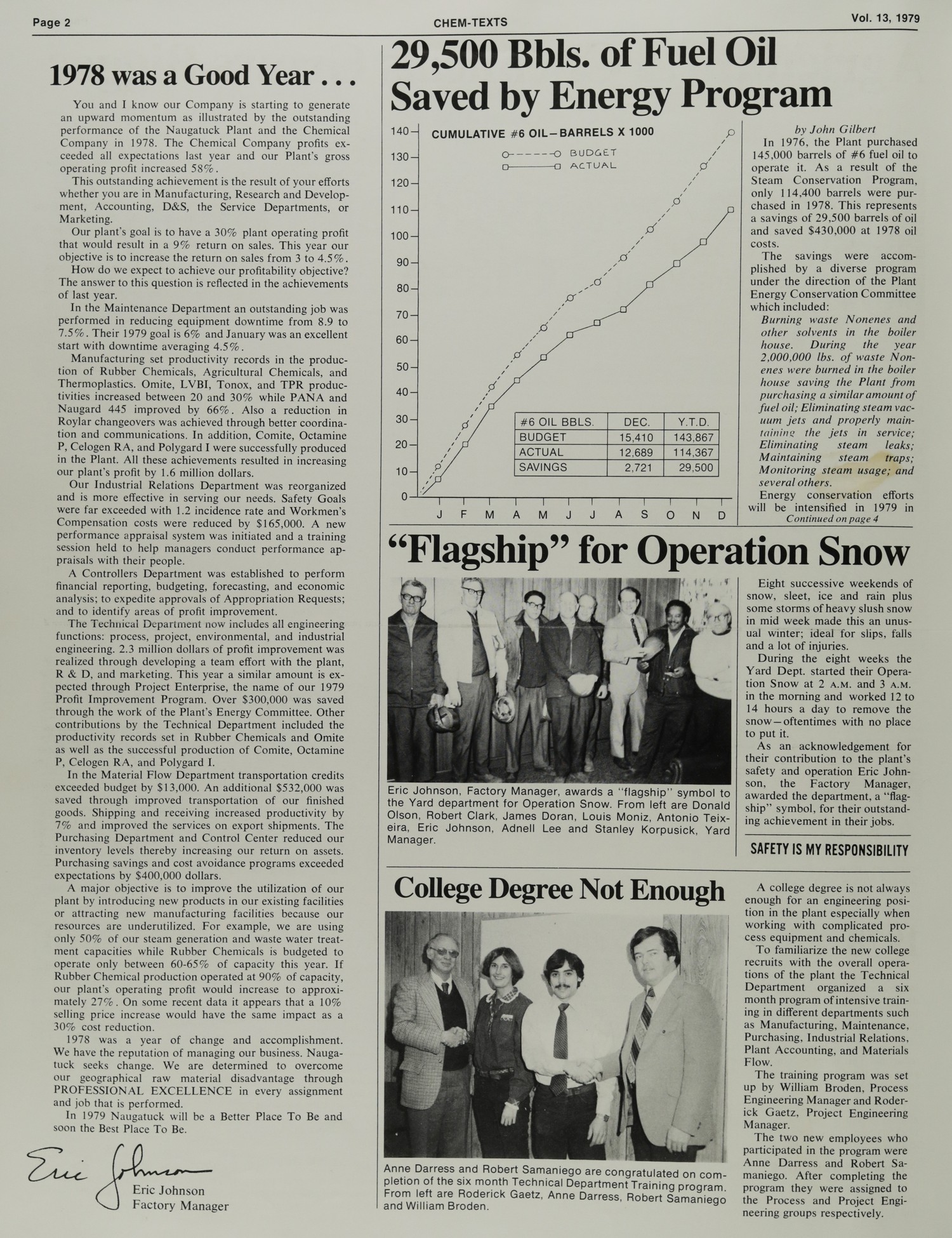
29,500 Bbls. of Fuel Oil Saved by Energy Program

CUMULATIVE #6 OIL—BARRELS X 1000

[CHART showing declining oil usage from January through December, with lines for BUDGET and ACTUAL usage, ranging from approximately 140 to 0]

#6 OIL BBLS. DEC. Y.T.D.
BUDGET 15,410 143,867
ACTUAL 12,689 114,367
SAVINGS 2,721 29,500

by John Gilbert

In 1976, the Plant purchased 145,000 barrels of #6 fuel oil to operate it. As a result of the Steam Conservation Program, only 114,400 barrels were purchased in 1978. This represents a savings of 29,500 barrels of oil and saved $430,000 at 1978 oil costs.

The savings were accomplished by a diverse program under the direction of the Plant Energy Conservation Committee which included:

Burning waste Nonenes and other solvents in the boiler house. During the year 2,000,000 lbs. of waste Nonenes were burned in the boiler house saving the Plant from purchasing a similar amount of fuel oil; Eliminating steam vacuum jets and properly maintaining the jets in service; Eliminating steam leaks; Maintaining steam traps; Monitoring steam usage; and several others.

Energy conservation efforts will be intensified in 1979 in Continued on page 4


“Flagship” for Operation Snow

[PHOTOGRAPH of seven men in business attire standing together]

Eric Johnson, Factory Manager, awards a “flagship” symbol to the Yard department for Operation Snow. From left are Donald Olson, Robert Clark, James Doran, Louis Moniz, Antonio Teixeira, Eric Johnson, Adnell Lee and Stanley Korpusick, Yard Manager.

Eight successive weekends of snow, sleet, ice and rain plus some storms of heavy slush snow in mid week made this an unusual winter; ideal for slips, falls and a lot of injuries.

During the eight weeks the Yard Dept. started their Operation Snow at 2 A.M. and 3 A.M. in the morning and worked 12 to 14 hours a day to remove the snow—oftentimes with no place to put it.

As an acknowledgement for their contribution to the plant’s safety and operation Eric Johnson, the Factory Manager, awarded the department, a “flagship” symbol, for their outstanding achievement in their jobs.


SAFETY IS MY RESPONSIBILITY


College Degree Not Enough

[PHOTOGRAPH of four people, three men and one woman, standing together]

Anne Darress and Robert Samaniego are congratulated on completion of the six month Technical Department Training program. From left are Roderick Gaetz, Anne Darress, Robert Samaniego and William Broden.

A college degree is not always enough for an engineering position in the plant especially when working with complicated process equipment and chemicals.

To familiarize the new college recruits with the overall operations of the plant the Technical Department organized a six month program of intensive training in different departments such as Manufacturing, Maintenance, Purchasing, Industrial Relations, Plant Accounting, and Materials Flow.

The training program was set up by William Broden, Process Engineering Manager and Roderick Gaetz, Project Engineering Manager.

The two new employees who participated in the program were Anne Darress and Robert Samaniego. After completing the program they were assigned to the Process and Project Engineering groups respectively.

CHEM-TEXTS – 1979-v13-s273

Page 273

CHEM-TEXTS

Page 2 | Vol. 13, 1979


Editorial . . .

As many of you already know, this is our 75th year as a Chemical Plant as well as a Chemical Company. Today we can be proud of the fact that virtually every automobile and truck tire on the road contains one of the rubber chemicals manufactured in our plant. Our Agricultural Chemicals are used throughout the U.S. and the world to protect cotton, fruit, and other valuable food crops against disease and devastating insects. This enables farmers and growers to increase the yields of their land.

We are very grateful to both present and past employees who made this occasion possible through their achievements. We now have an even greater responsibility in performing our jobs. Our dedication and efforts must make our jobs more meaningful, secure, and safe not only for ourselves but also for those who will follow us.

Through the skills, spirit, and professional excellence that you demonstrated in 1979, the foundation has been built for even greater achievements in the future.

I wish to thank each and every one of you for making the celebration of our 75th Anniversary such a memorable and successful day. It was evidence of the good spirit that makes our plant an excellent place to be.

Eric Johnson
Factory Manager


Plant’s Chemical Waste Program Saves $94,000

by Ron Lak

During the 1st and 2nd quarter of 1979, the Synthetic Pilot Plant eliminated two major hazardous waste streams, while at the same time recovering the raw materials. In addition, plans are being finalized to reduce Naugard 445 still bottom waste from FOC.

Altogether the program has resulted in savings of $94,000.

Waste Hexane cement, generated at approximately 20,000 gallons annually, now is reprocessed, saving both the Hexane cost ($13,000), and the disposal costs ($4,000).

The waste “HST”, generated while sampling Polywets, was eliminated by the installation of sample recirculation pumps. These pumps allow the operators to remove only as much product from the batch as needed for testing. This particular waste was corrosive, toxic, and flammable, posing special disposal and handling problems. Approximately 3,500 gallons of this waste was produced annually, costing $5,000 to dispose of properly.

Work is almost completed on the blending of Naugard 445 still bottom waste into BLE. If successful, 100,000 lbs. of Naugard 445 still bottom, representing a disposal cost saving of $5,000, will be eliminated annually. In addition, yield increases in BLE will result in a $55,000 raw material and variable conversion credit.

Another area where steps are being taken to reduce our hazardous waste disposal cost is rejected materials. 25,000 lbs. of rejected RF-75 was resampled and sold to customers for $5,000, eliminating a disposal charge of $3,000. An additional 43,500 lbs. of rejected RF-75 is presently being resampled, awaiting customer approval. If approved, $4,000 in disposal costs could be eliminated.


Give Blood
Oct. 29 and Oct. 30


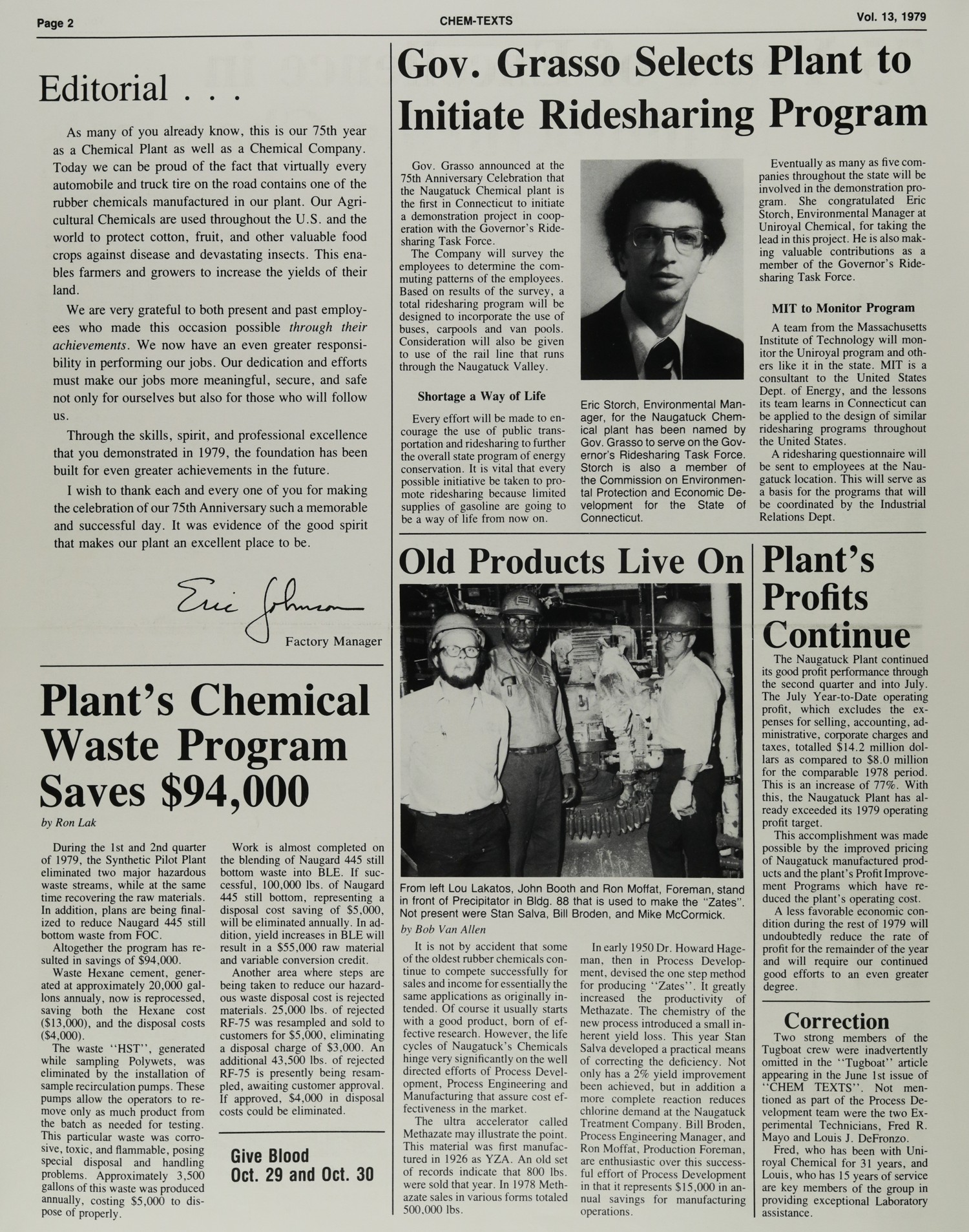
Gov. Grasso Selects Plant to Initiate Ridesharing Program

Gov. Grasso announced at the 75th Anniversary Celebration that the Naugatuck Chemical plant is the first in Connecticut to initiate a demonstration project in cooperation with the Governor’s Ridesharing Task Force.

The Company will survey the employees to determine the commuting patterns of the employees. Based on results of the survey, a total ridesharing program will be designed to incorporate the use of buses, carpools and van pools. Consideration will also be given to use of the rail line that runs through the Naugatuck Valley.

Shortage a Way of Life

Every effort will be made to encourage the use of public transportation and ridesharing to further the overall state program of energy conservation. It is vital that every possible initiative be taken to promote ridesharing because limited supplies of gasoline are going to be a way of life from now on.

[PHOTO CAPTION:]
Eric Storch, Environmental Manager, for the Naugatuck Chemical plant has been named by Gov. Grasso to serve on the Governor’s Ridesharing Task Force. Storch is also a member of the Commission on Environmental Protection and Economic Development for the State of Connecticut.

Eventually as many as five companies throughout the state will be involved in the demonstration program. She congratulated Eric Storch, Environmental Manager at Uniroyal Chemical, for taking the lead in this project. He is also making valuable contributions as a member of the Governor’s Ridesharing Task Force.

MIT to Monitor Program

A team from the Massachusetts Institute of Technology will monitor the Uniroyal program and others like it in the state. MIT is a consultant to the United States Dept. of Energy, and the lessons its team learns in Connecticut can be applied to the design of similar ridesharing programs throughout the United States.

A ridesharing questionnaire will be sent to employees at the Naugatuck location. This will serve as a basis for the programs that will be coordinated by the Industrial Relations Dept.


Old Products Live On

[PHOTO CAPTION:]
From left Lou Lakatos, John Booth and Ron Moffat, Foreman, stand in front of Precipitator in Bldg. 88 that is used to make the “Zates”. Not present were Stan Salva, Bill Broden, and Mike McCormick.

by Bob Van Allen

It is not by accident that some of the oldest rubber chemicals continue to compete successfully for sales and income for essentially the same applications as originally intended. Of course it usually starts with a good product, born of effective research. However, the life cycles of Naugatuck’s Chemicals hinge very significantly on the well directed efforts of Process Development, Process Engineering and Manufacturing that assure cost effectiveness in the market.

The ultra accelerator called Methazate may illustrate the point. This material was first manufactured in 1926 as YZA. An old set of records indicate that 800 lbs. were sold that year. In 1978 Methazate sales in various forms totaled 500,000 lbs.

In early 1950 Dr. Howard Hageman, then in Process Development, devised the one step method for producing “Zates”. It greatly increased the productivity of Methazate. The chemistry of the new process introduced a small inherent yield loss. This year Stan Salva developed a practical means of correcting the deficiency. Not only has a 2% yield improvement been achieved, but in addition a more complete reaction reduces chlorine demand at the Naugatuck Treatment Company. Bill Broden, Process Engineering Manager, and Ron Moffat, Production Foreman, are enthusiastic over this successful effort of Process Development in that it represents $15,000 in annual savings for manufacturing operations.


Plant’s Profits Continue

The Naugatuck Plant continued its good profit performance through the second quarter and into July. The July Year-to-Date operating profit, which excludes the expenses for selling, accounting, administrative, corporate charges and taxes, totalled $14.2 million dollars as compared to $8.0 million for the comparable 1978 period. This is an increase of 77%. With this, the Naugatuck Plant has already exceeded its 1979 operating profit target.

This accomplishment was made possible by the improved pricing of Naugatuck manufactured products and the plant’s Profit Improvement Programs which have reduced the plant’s operating cost.

A less favorable economic condition during the rest of 1979 will undoubtedly reduce the rate of profit for the remainder of the year and will require our continued good efforts to an even greater degree.


Correction

Two strong members of the Tugboat crew were inadvertently omitted in the “Tugboat” article appearing in the June 1st issue of “CHEM TEXTS”. Not mentioned as part of the Process Development team were the two Experimental Technicians, Fred R. Mayo and Louis J. DeFronzo.

Fred, who has been with Uniroyal Chemical for 31 years, and Louis, who has 15 years of service are key members of the group in providing exceptional Laboratory assistance.

CHEM-TEXTS – 1978-v12-s269

Page 269

CHEM-TEXTS

Page 2 | Volume 12, 1978


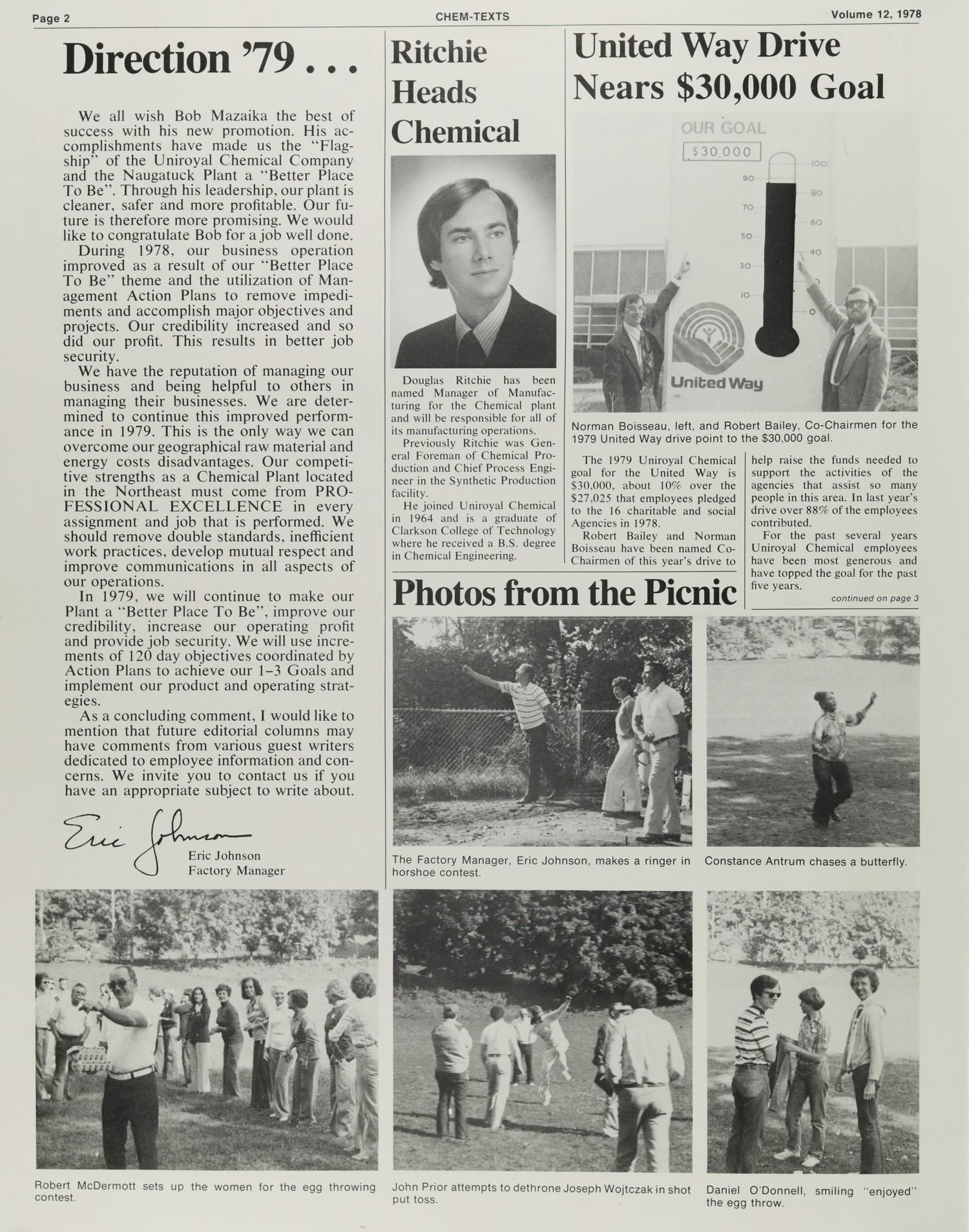
Direction ’79 . . .

We all wish Bob Mazaika the best of success with his new promotion. His accomplishments have made us the “Flagship” of the Uniroyal Chemical Company and the Naugatuck Plant a “Better Place To Be”. Through his leadership, our plant is cleaner, safer and more profitable. Our future is therefore more promising. We would like to congratulate Bob for a job well done.

During 1978, our business operation improved as a result of our “Better Place To Be” theme and the utilization of Management Action Plans to remove impediments and accomplish major objectives and projects. Our credibility increased and so did our profit. This results in better job security.

We have the reputation of managing our business and being helpful to others in managing their businesses. We are determined to continue this improved performance in 1979. This is the only way we can overcome our geographical raw material and energy costs disadvantages. Our competitive strengths as a Chemical Plant located in the Northeast must come from PROFESSIONAL EXCELLENCE in every assignment and job that is performed. We should remove double standards, inefficient work practices, develop mutual respect and improve communications in all aspects of our operations.

In 1979, we will continue to make our Plant a “Better Place To Be”, improve our credibility, increase our operating profit and provide job security. We will use increments of 120 day objectives coordinated by Action Plans to achieve our 1-3 Goals and implement our product and operating strategies.

As a concluding comment, I would like to mention that future editorial columns may have comments from various guest writers dedicated to employee information and concerns. We invite you to contact us if you have an appropriate subject to write about.

Eric Johnson

Eric Johnson
Factory Manager


Ritchie Heads Chemical

Douglas Ritchie has been named Manager of Manufacturing for the Chemical plant and will be responsible for all of its manufacturing operations.

Previously Ritchie was General Foreman of Chemical Production and Chief Process Engineer in the Synthetic Production facility.

He joined Uniroyal Chemical in 1964 and is a graduate of Clarkson College of Technology where he received a B.S. degree in Chemical Engineering.


United Way Drive Nears $30,000 Goal

OUR GOAL
$30,000

[Thermometer chart showing progress toward goal with markers at 10, 20, 30, 40, 50, 60, 70, 80, 90, 100]

United Way

Norman Boisseau, left, and Robert Bailey, Co-Chairmen for the 1979 United Way drive point to the $30,000 goal.

The 1979 Uniroyal Chemical goal for the United Way is $30,000, about 10% over the $27,025 that employees pledged to the 16 charitable and social Agencies in 1978.

Robert Bailey and Norman Boisseau have been named Co-Chairmen of this year’s drive to help raise the funds needed to support the activities of the agencies that assist so many people in this area. In last year’s drive over 88% of the employees contributed.

For the past several years Uniroyal Chemical employees have been most generous and have topped the goal for the past five years.

continued on page 3


Photos from the Picnic

The Factory Manager, Eric Johnson, makes a ringer in horshoe contest.

Constance Antrum chases a butterfly.

Robert McDermott sets up the women for the egg throwing contest.

John Prior attempts to dethrone Joseph Wojtczak in shot put toss.

Daniel O’Donnell, smiling “enjoyed” the egg throw.

CHEM-TEXTS – 1978-v12-s261

Page 261

Page 2 CHEM-TEXTS Volume 12, 1978


EDITORIAL

A large portion of this edition of CHEM-TEXTS is devoted to things that are happening here at the plant as a result of making it a “better place to be”. My staff and myself have dedicated ourselves to that objective in 1978.

In addition to some of the physical changes that are occurring, there are many changes being made in the way we manage our business. After reviewing how we were managing and deciding that it was not the way we would like it, we started to change. More of our people are becoming involved with running our business, and we intend that each of our buildings will be run as a separate business. Each of our service departments will be run as a separate business and will be measured in this way. The people running these businesses have been and will be given the authority necessary to make decisions and expenditures as required.

All of our people running the small business units will have both the authority and responsibility for the success of these businesses. I believe that this will make the Naugatuck Plant the most successful in the Chemical Division.

One of our other objectives for 1978 is to make the Naugatuck Plant “The Flagship” of the division. Certainly making it a better place to be and managing our business better will go a long way toward achieving that goal. But to reach it, we also have to strive to make the plant, inside and out, the best of any plant in the division—the cleanest, neatest and best maintained.

By dedicating ourselves to these objectives everyday, I am sure that they will be achieved in 1978.

[Signature: R.J. Meyst]


Named To IR Dept.

[PHOTO: Black and white photograph of J. Robert Douglas]

J. Robert Douglas has been named Manager of Industrial Relations for the Naugatuck Chemical location. In his new position he will be responsible for the Labor and Employee Relations at the Naugatuck Chemical facility which employs over 1100 people.

Prior to his new appointment Douglas held the position of Industrial Relations Manager at the Painesville, Ohio, plant.

He joined Uniroyal Chemical in 1967 as an Industrial Relations Representative at the Joliet Ammunitions plant.

[PHOTO: Black and white photograph of Donald J. Conty]

Donald J. Conty has been appointed Manager of Labor Relations for the Naugatuck Chemical plant.

Conty had been Manager of Industrial Relations for the Uniroyal Industrial Products’ Division plant in Port Clinton, Ohio.

He joined the Industrial Products division of Uniroyal at the Passaic plant in 1956 as a Safety Supervisor. He was later named Manager of Safety and Plant Protection. In 1972 he was promoted to Employee Relations Manager for the Port Clinton, Ohio plant.


Equality Policy Affirmed

The Uniroyal Chemical plant has a firm commitment to offer equal opportunity to all employees. It is the policy of the plant’s management to support and implement this commitment continually.

This policy requires that all recruiting, hiring, transfers, promotions, compensation, benefits, and company-sponsored training, education and tuition assistance, as well as social, recreational and health programs and lay-off and recall practices are followed and carried out without regard to race, color, creed, religion, sex, national origin, or handicap of any individual person.

J. Robert Douglas, the Industrial Relations Manager for the Naugatuck plant is the Compliance officer and has the responsibility for implementing this policy; monitoring the Uniroyal Chemical Affirmative Action Compliance Program; and reporting to management the program’s progress.

The responsibility for the improvement of the program and the positive results of it rests with each Manager, Foreman, and Supervisor as an integral part of their job.


Profits And Sales Improve In 1977

For 1977 the Company’s net income was $34.8 million, or $1.13 a share, compared with $20.1 million or $.57 a share in 1976.

Sales for 1977 were $2.6 billion compared with $2.3 billion in 1976.

Strong annual gains were made in U.S. tire sales. Sales and net income from chemicals exceeded all forecasts in 1977.

4th Quarter

In the 4th Quarter, the Company had a foreign exchange loss of $2.5 million, reducing earnings to $57,000, or a loss of four cents a share. This compares with the abnormally high income of $20 million, or $.71 a share after a $.5 million foreign exchange loss in the 4th quarter of 1976.

The 4th Quarter net income was also attributed to declines in sales of footwear, and losses incurred as footwear production was discontinued at the Naugatuck plant.

Tire 4th Quarter Sales Off

Sales in the Tire and Related Products group were $371 million in the fourth quarter of 1977, compared with $380 million in the last quarter of 1976. The relative decline was due to abnormally high orders in 1976.

Chemical, Rubber and Plastic Materials Improve in Quarter

Chemical, Rubber and Plastic Materials sales increased to $83 million in 1977 from the $79 million in the 4th quarter of 1976. The Chemical Division and specialty chemical sales continued to show improvement in this period, as did the pricing of natural rubber.


Scholarship Offered

The Uniroyal Chemical Management Club is again offering a $500 scholarship award. Fifty dollars of the scholarship comes from the Larry Monroe Fund.

The scholarship is available to a graduating high school student who plans a college education. To qualify, one of the student’s parents must have worked for Uniroyal Chemical at Naugatuck or Bethany for two years or more

(continued on page 4)


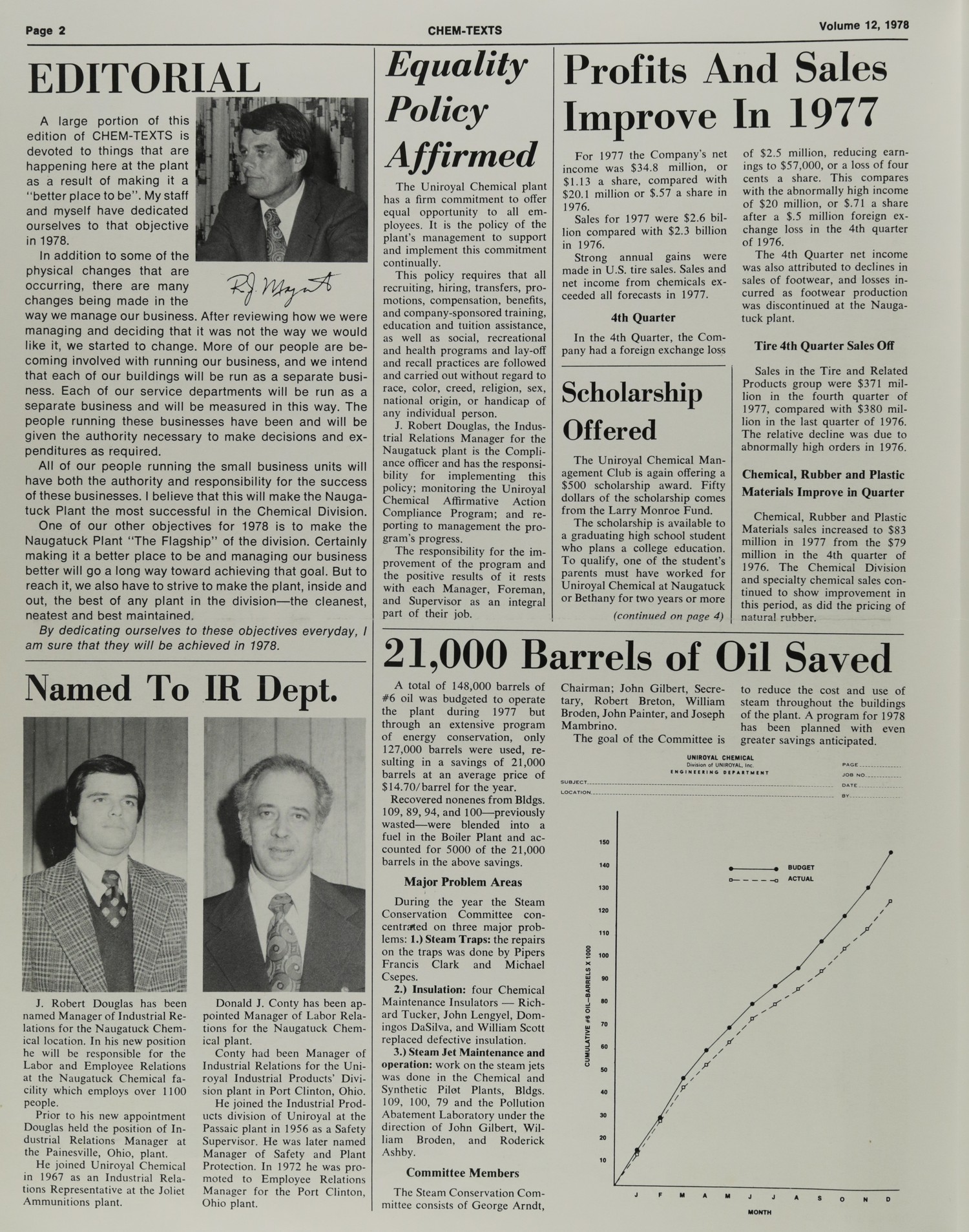
21,000 Barrels of Oil Saved

A total of 148,000 barrels of #6 oil was budgeted to operate the plant during 1977 but through an extensive program of energy conservation, only 127,000 barrels were used, resulting in a savings of 21,000 barrels at an average price of $14.70/barrel for the year.

Recovered nonenes from Bldgs. 109, 89, 94, and 100—previously wasted—were blended into a fuel in the Boiler Plant and accounted for 5000 of the 21,000 barrels in the above savings.

Major Problem Areas

During the year the Steam Conservation Committee concentrated on three major problems: 1.) Steam Traps: the repairs on the traps was done by Pipers Francis Clark and Michael Csepes.

2.) Insulation: four Chemical Maintenance Insulators — Richard Tucker, John Lengyel, Domingos DaSilva, and William Scott replaced defective insulation.

3.) Steam Jet Maintenance and operation: work on the steam jets was done in the Chemical and Synthetic Pilot Plants, Bldgs. 109, 100, 79 and the Pollution Abatement Laboratory under the direction of John Gilbert, William Broden, and Roderick Ashby.

Committee Members

The Steam Conservation Committee consists of George Arndt,

Chairman; John Gilbert, Secretary, Robert Breton, William Broden, John Painter, and Joseph Mambrino.

The goal of the Committee is to reduce the cost and use of steam throughout the buildings of the plant. A program for 1978 has been planned with even greater savings anticipated.

[FORM HEADER:]
UNIROYAL CHEMICAL
Division of UNIROYAL Inc.
ENGINEERING DEPARTMENT

SUBJECT___
LOCATION__

PAGE_
JOB NO._
DATE_
BY_

[GRAPH: Line graph showing cumulative #6 oil barrels x 1000 from months J through D, with two lines labeled “BUDGET” (solid) and “ACTUAL” (dashed), ranging from approximately 10 to 150 on the y-axis]

CHEM-TEXTS – 1977-v11-s255

Page 255

Page 4

CHEM-TEXTS

Vol. 11, 1977


Salzman…

continued from page 1

other areas. For instance in 1976, when the nation’s economy hit a low point, the corporation was able to provide $87 million dollars for capital investments, a substantial portion of which were allocated to the Chemical Division. Indeed, just here in Naugatuck, a refurbished TPR® Banbury was installed, the Fine Organics Chemicals plant was constructed and the Omite® operation was expanded.

Company’s Potential

An in-depth study by an outside professional survey team was made of employees’ attitudes and the company’s position and reputation in the commercial world.

The report revealed that Uniroyal has a reputation as a solid company, but was not as strong competitively as other comparably sized organizations. Furthermore, although sales had doubled over a ten year period, profits had dropped from 3.4% of sales to a low of 1.1%. Whereas technology, production, quality products and dedicated and talented people came out as strong assets, a conservative and cautious attitude pervaded throughout, often hindering the fullest use of these excellent capabilities. Obviously, some changes had to be made.


111 Employees…

continued from page 3

location have 25 or more years of service—more than 50% of the personnel population at this location.

New 25 Year Members

Peter Backes, Elizabeth Banik, Cerinus Barriault, Vincent Bartelmo, Joseph Begin, David Benson, Edward Brown, Jr., Francis Carriero, Theophile Clement, Louis Coscia, Daniel Davis, Katherine Dowling, Jacinto Fernandez, Gerald Gureqian, Clayton Houseknecht, Marion Hutt, Willie Ingram, Weldon Ireland, Eileen Kassheimer, Charles Moruska, Soren Nordstrom, Antonio Nunes, Michael Santone, Suren Semonian, Alexander Shaw III, Antonio Silva, Bernard Smith, Angelo Soares, Frank Sohleski, Henry Witkoski, Michael Yuchnyk.


Structural Changes

Innovative management organizational changes, designed to improve decision making and increase efficiency, were recently implemented resulting in more delegation of authority. In addition, fresh approaches to market planning were instituted.

One facet of the new organizational changes was the promotion of two former Chemical Division presidents to the newly created posts of Executive Vice President in early March.

Andrew J. McNeill now has responsibility for Engineered Products. This includes the Consumer, Industrial and Plastics divisions and Marketing Services.

Joseph P. Flannery heads up Materials Function, embracing the Chemical Division, Plantations, Textiles, Planning and Corporate Research and Development.

Management Skills

Because a company is only as strong as its leadership, programs to strengthen management skills have also been implemented. For instance, managers will have longer tenure in their positions, providing more opportunities to learn and make more positive contributions.

Their performance reviews will be more meaningful to their particular assignment and more opportunities for additional job-related education will be provided. The company will also rely on more aggressive recruiting from the outside to fill


30 Years Service

Joseph Anderson, Kenneth Anderson, Robert Anderson, Edwin Barrows, Jr., Robert Brown, Francis Cadwell, Edward Copes, Jr., William Creddo, Jesse Crim, Elizabeth Czalowski, Aurelio DePinho, Harris Detlefsen, Albert Gedraitis, Margaret Gibbs, Anthony Gaultieri, Addis Hillery, Margaret Holliday, Henry Hook, Wilbur Hugar, William Hutt, James Johnson, Edward Koslowski, Eugene Lantieri, Rufus Lydem, Lawrence Mambrino, Ralph Meldrum, Thomas Mullen, Joseph Owens, Joseph Rzeszutek, Louis Schiller, Frederick Simasek, Dr. Allen Smith, Otto Steinen, Angelo Taylor, Antonio Teixeira, Laurentino Terra, Jesse Thompson, John Tierney, Homer Walton, Frank Warchol, John Wawer, John Zavednak, Bronis Zukauskas.

35 Years Service

George Allen, E. Leonard Borg, Eleanor Broderick, Arthur Calder, Frank Chiodo, Matthew Chlebowski, Allen Crepeau, Leland Dannals, Domingos DaSilva, Michele DeBiase, John Dillon, Lucy DiStefano, John Flickinger, Dale


opened positions when special skills are required.

Optimistic Outlook

Mr. Salzman closed his remarks on an optimistic note, stating that the corporation is now concentrating more effort into the Chemical, Rubber and Plastics markets where it feels greater growth and profit potential exists. These areas, of course, are basic to the Chemical Division, and we will surely benefit from this new marketing emphasis.


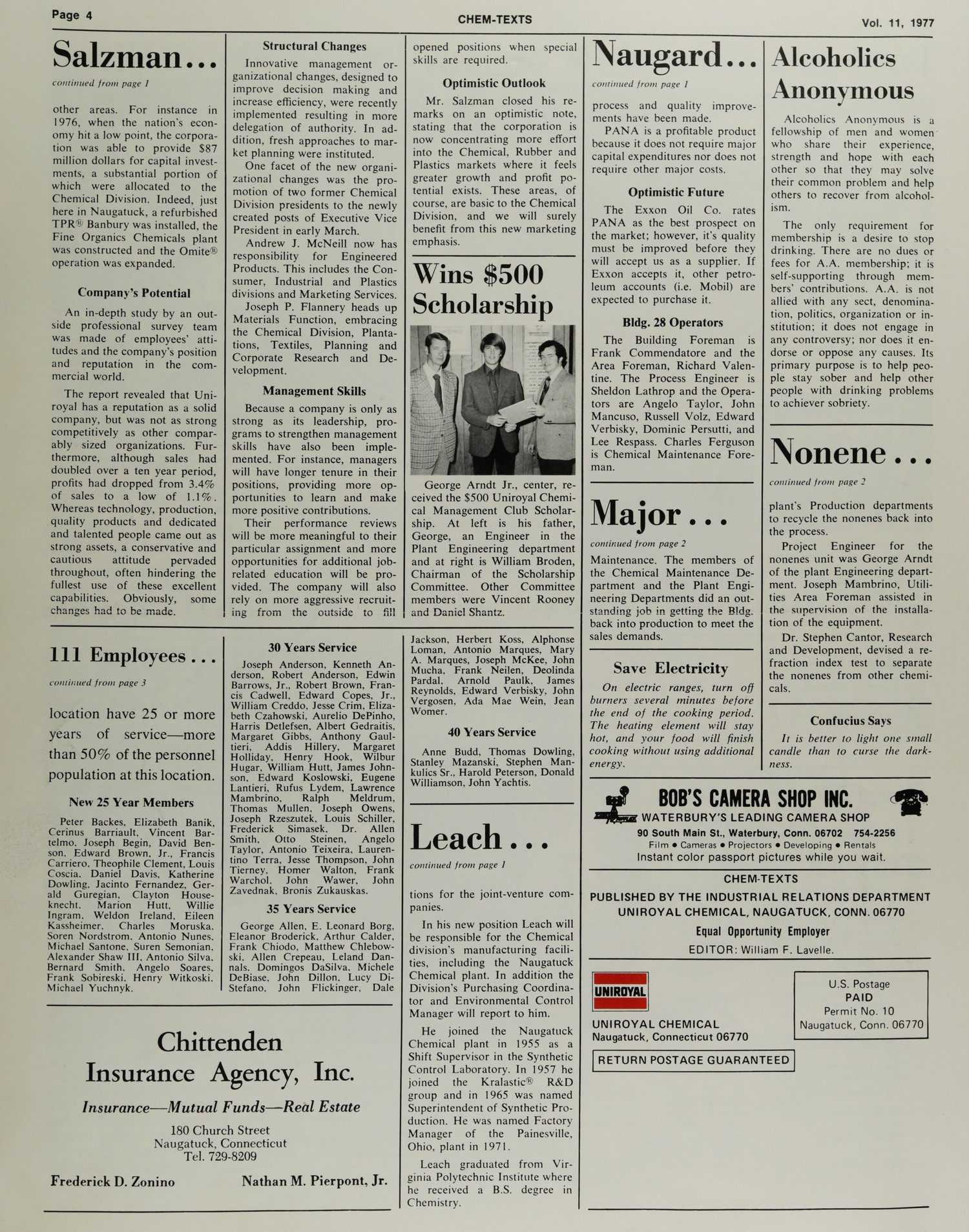
Wins $500 Scholarship

George Arndt Jr., center, received the $500 Uniroyal Chemical Management Club Scholarship. At left is his father, George, an Engineer in the Plant Engineering department and at right is William Broden, Chairman of the Scholarship Committee. Other Committee members were Vincent Rooney and Daniel Shantz.

Jackson, Herbert Koss, Alphonse Loman, Antonio Marques, Mary A. Marques, Joseph McKee, John Mucha, Frank Neilen, Deolinda Pardal, Arnold Paulk, James Reynolds, Edward Verbisky, John Vergosen, Ada Mae Wein, Jean Womer.

40 Years Service

Anne Budd, Thomas Dowling, Stanley Mazanski, Stephen Mankulics Sr., Harold Peterson, Donald Williamson, John Yachtis.


Leach…

continued from page 1

tions for the joint-venture companies.

In his new position Leach will be responsible for the Chemical division’s manufacturing facilities, including the Naugatuck Chemical plant. In addition the Division’s Purchasing Coordinator and Environmental Control Manager will report to him.

He joined the Naugatuck Chemical plant in 1955 as a Shift Supervisor in the Synthetic Control Laboratory. In 1957 he joined the Kralastic® R&D group and in 1965 was named Superintendent of Synthetic Production. He was named Factory Manager of the Painesville, Ohio, plant in 1971.

Leach graduated from Virginia Polytechnic Institute where he received a B.S. degree in Chemistry.


Naugard…

continued from page 1

process and quality improvements have been made.

PANA is a profitable product because it does not require major capital expenditures nor does not require other major costs.

Optimistic Future

The Exxon Oil Co. rates PANA as the best prospect on the market; however, it’s quality must be improved before they will accept us as a supplier. If Exxon accepts it, other petroleum accounts (i.e. Mobil) are expected to purchase it.

Bldg. 28 Operators

The Building Foreman is Frank Commendatore and the Area Foreman, Richard Valentine. The Process Engineer is Sheldon Lathrop and the Operators are Angelo Taylor, John Mancuso, Russell Volz, Edward Verbisky, Dominic Persutti, and Lee Respass. Charles Ferguson is Chemical Maintenance Foreman.


Major…

continued from page 2

Maintenance. The members of the Chemical Maintenance Department and the Plant Engineering Departments did an outstanding job in getting the Bldg. back into production to meet the sales demands.


Save Electricity

On electric ranges, turn off burners several minutes before the end of the cooking period. The heating element will stay hot, and your food will finish cooking without using additional energy.


Alcoholics Anonymous

Alcoholics Anonymous is a fellowship of men and women who share their experience, strength and hope with each other so that they may solve their common problem and help others to recover from alcoholism.

The only requirement for membership is a desire to stop drinking. There are no dues or fees for A.A. membership; it is self-supporting through members’ contributions. A.A. is not allied with any sect, denomination, politics, organization or institution; it does not engage in any controversy; nor does it endorse or oppose any causes. Its primary purpose is to help people stay sober and help other people with drinking problems to achiever sobriety.


Nonene…

continued from page 2

plant’s Production departments to recycle the nonenes back into the process.

Project Engineer for the nonenes unit was George Arndt of the plant Engineering department. Joseph Mambrino, Utilities Area Foreman assisted in the supervision of the installation of the equipment.

Dr. Stephen Cantor, Research and Development, devised a refraction index test to separate the nonenes from other chemicals.


Confucius Says

It is better to light one small candle than to curse the darkness.


BOB’S CAMERA SHOP INC.

WATERBURY’S LEADING CAMERA SHOP

90 South Main St., Waterbury, Conn. 06702 754-2256

• Cameras • Projectors • Developing • Rentals

Instant color passport pictures while you wait.


CHEM-TEXTS

PUBLISHED BY THE INDUSTRIAL RELATIONS DEPARTMENT

UNIROYAL CHEMICAL, NAUGATUCK, CONN. 06770

Equal Opportunity Employer

EDITOR: William F. Lavelle.


UNIROYAL

UNIROYAL CHEMICAL
Naugatuck, Connecticut 06770

U.S. Postage
PAID
Permit No. 10
Naugatuck, Conn. 06770

RETURN POSTAGE GUARANTEED


Chittenden Insurance Agency, Inc.

Insurance—Mutual Funds—Real Estate

180 Church Street
Naugatuck, Connecticut
Tel. 729-8209

Frederick D. Zonino Nathan M. Pierpont, Jr.

CHEM-TEXTS – 1977-v11-i01-s248

Page 248

UNIROYAL CHEM-TEXTS

Vol. 11, 1977 | PUBLISHED FOR THE PEOPLE OF UNIROYAL CHEMICAL | No. 1

Hospital Approved | Sales and Profits Up in the Fourth Quarter

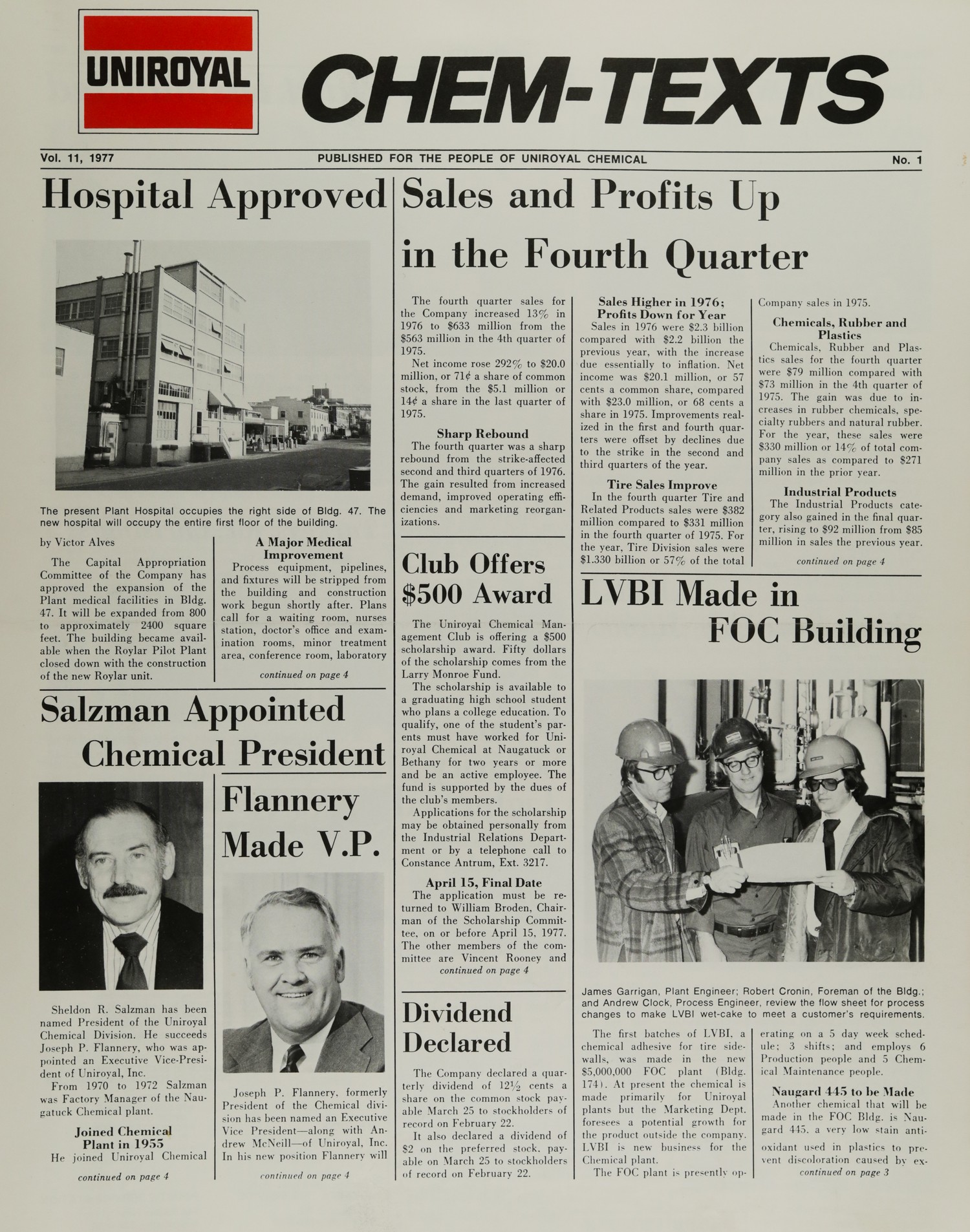
[IMAGE: Black and white photo of a building]

The present Plant Hospital occupies the right side of Bldg. 47. The new hospital will occupy the entire first floor of the building.

by Victor Alves

The Capital Appropriation Committee of the Company has approved the expansion of the Plant medical facilities in Bldg. 47. It will be expanded from 800 to approximately 2400 square feet. The building became available when the Roylar Pilot Plant closed down with the construction of the new Roylar unit.

A Major Medical Improvement

Process equipment, pipelines, and fixtures will be stripped from the building and construction work begun shortly after. Plans call for a waiting room, nurses station, doctor’s office and examination rooms, minor treatment area, conference room, laboratory

continued on page 4


The fourth quarter sales for the Company increased 13% in 1976 to $633 million from the $563 million in the 4th quarter of 1975.

Net income rose 292% to $20.0 million, or 71¢ a share of common stock, from the $5.1 million or 14¢ a share in the last quarter of 1975.

Sharp Rebound

The fourth quarter was a sharp rebound from the strike-affected second and third quarters of 1976. The gain resulted from increased demand, improved operating efficiencies and marketing reorganizations.


Club Offers $500 Award

The Uniroyal Chemical Management Club is offering a $500 scholarship award. Fifty dollars of the scholarship comes from the Larry Monroe Fund.

The scholarship is available to a graduating high school student who plans a college education. To qualify, one of the student’s parents must have worked for Uniroyal Chemical at Naugatuck or Bethany for two years or more and be an active employee. The fund is supported by the dues of the club’s members.

Applications for the scholarship may be obtained personally from the Industrial Relations Department or by a telephone call to Constance Antrum, Ext. 3217.

April 15, Final Date

The application must be returned to William Broden, Chairman of the Scholarship Committee, on or before April 15, 1977. The other members of the committee are Vincent Rooney and

continued on page 4


Sales Higher in 1976; Profits Down for Year

Sales in 1976 were $2.3 billion compared with $2.2 billion the previous year, with the increase due essentially to inflation. Net income was $20.1 million, or 57 cents a common share, compared with $23.0 million, or 68 cents a share in 1975. Improvements realized in the first and fourth quarters were offset by declines due to the strike in the second and third quarters of the year.

Tire Sales Improve

In the fourth quarter Tire and Related Products sales were $382 million compared to $331 million in the fourth quarter of 1975. For the year, Tire Division sales were $1.330 billion or 57% of the total


Company sales in 1975.

Chemicals, Rubber and Plastics

Chemicals, Rubber and Plastics sales for the fourth quarter were $79 million compared with $73 million in the 4th quarter of 1975. The gain was due to increases in rubber chemicals, specialty rubbers and natural rubber. For the year, these sales were $330 million or 14% of total company sales as compared to $271 million in the prior year.

Industrial Products

The Industrial Products category also gained in the final quarter, rising to $92 million from $85 million in sales the previous year.

continued on page 4


Salzman Appointed Chemical President

Flannery Made V.P.

[IMAGE: Photo of Sheldon R. Salzman]

Sheldon R. Salzman has been named President of the Uniroyal Chemical Division. He succeeds Joseph P. Flannery, who was appointed an Executive Vice-President of Uniroyal, Inc.

From 1970 to 1972 Salzman was Factory Manager of the Naugatuck Chemical plant.

Joined Chemical Plant in 1955

He joined Uniroyal Chemical

continued on page 4

[IMAGE: Photo of Joseph P. Flannery]

Joseph P. Flannery, formerly President of the Chemical division has been named an Executive Vice President—along with Andrew McNeill—of Uniroyal, Inc. In his new position Flannery will

continued on page 4


Dividend Declared

The Company declared a quarterly dividend of 12½ cents a share on the common stock payable March 25 to stockholders of record on February 22.

It also declared a dividend of $2 on the preferred stock, payable on March 25 to stockholders of record on February 22.


LVBI Made in FOC Building

[IMAGE: Photo of three workers reviewing documents]

James Garrigan, Plant Engineer; Robert Cronin, Foreman of the Bldg.; and Andrew Clock, Process Engineer, review the flow sheet for process changes to make LVBI wet-cake to meet a customer’s requirements.

The first batches of LVBI, a chemical adhesive for tire sidewalls, was made in the new $5,000,000 FOC plant (Bldg. 174). At present the chemical is made primarily for Uniroyal plants but the Marketing Dept. foresees a potential growth for the product outside the company. LVBI is new business for the Chemical plant.

The FOC plant is presently op-

erating on a 5 day week schedule; 3 shifts; and employs 6 Production people and 5 Chemical Maintenance people.

Naugard 445 to be Made

Another chemical that will be made in the FOC Bldg. is Naugard 445, a very low stain antioxidant used in plastics to prevent discoloration caused by ex-

continued on page 3

CHEM-TEXTS – 1975-v09-i05-s232

Page 232

UNIROYAL CHEM-TEXTS

Vol. 9, 1975 | PUBLISHED FOR THE PEOPLE OF UNIROYAL CHEMICAL | No. 5

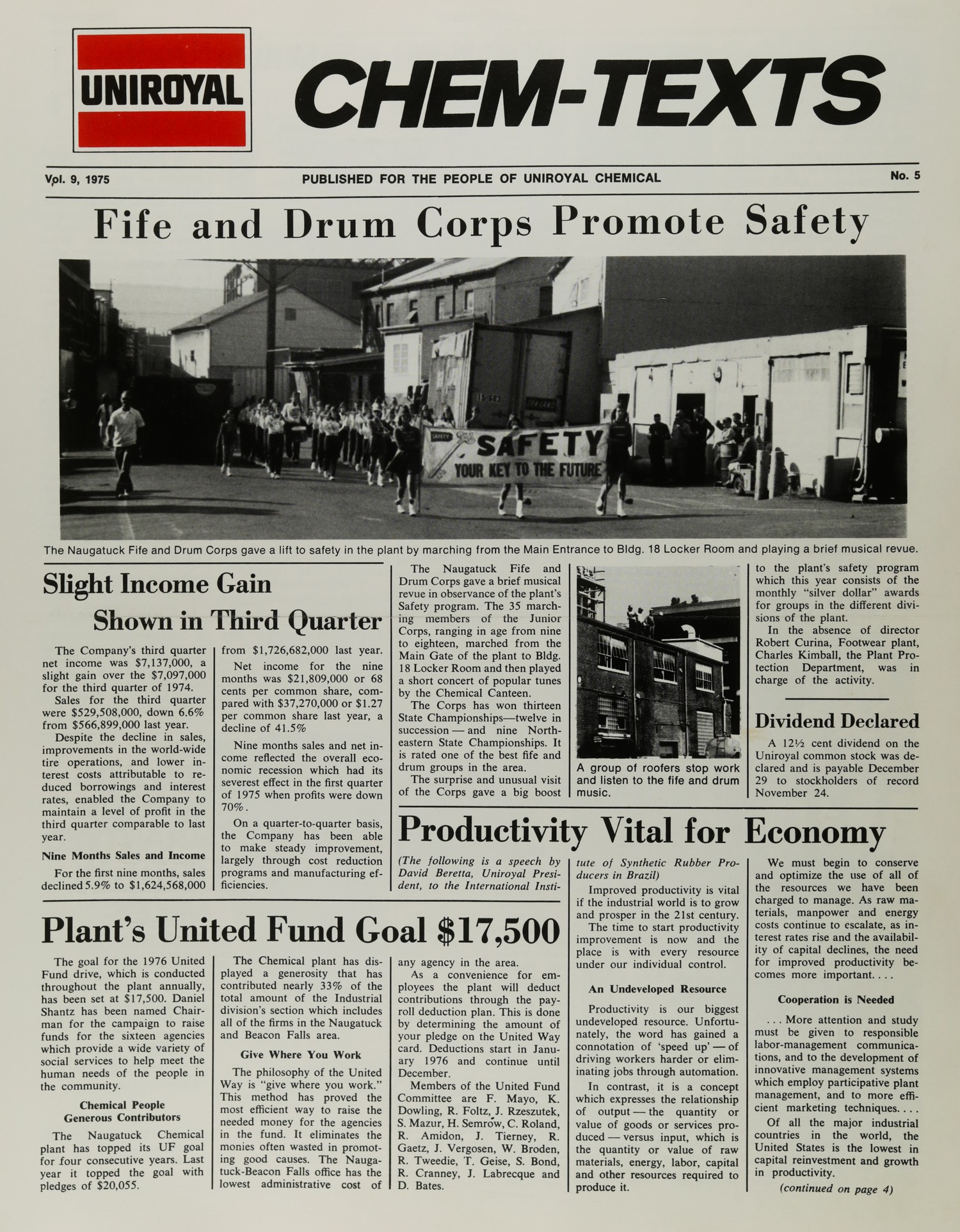
Fife and Drum Corps Promote Safety

[IMAGE: Black and white photograph showing a fife and drum corps marching in front of a building with a “SAFETY YOUR KEY TO THE FUTURE” sign]

The Naugatuck Fife and Drum Corps gave a lift to safety in the plant by marching from the Main Entrance to Bldg. 18 Locker Room and playing a brief musical revue.


Slight Income Gain Shown in Third Quarter

The Company’s third quarter net income was $7,137,000, a slight gain over the $7,097,000 for the third quarter of 1974.

Sales for the third quarter were $529,508,000, down 6.6% from $566,899,000 last year.

Despite the decline in sales, improvements in the world-wide tire operations, and lower interest costs attributable to reduced borrowings and interest rates, enabled the Company to maintain a level of profit in the third quarter comparable to last year.

Nine Months Sales and Income

For the first nine months, sales declined 5.9% to $1,624,568,000 from $1,726,682,000 last year.

Net income for the nine months was $21,809,000 or 68 cents per common share, compared with $37,270,000 or $1.27 per common share last year, a decline of 41.5%

Nine months sales and net income reflected the overall economic recession which had its severest effect in the first quarter of 1975 when profits were down 70%.

On a quarter-to-quarter basis, the Company has been able to make steady improvement, largely through cost reduction programs and manufacturing efficiencies.


The Naugatuck Fife and Drum Corps gave a brief musical revue in observance of the plant’s Safety program. The 35 marching members of the Junior Corps, ranging in age from nine to eighteen, marched from the Main Gate of the plant to Bldg. 18 Locker Room and then played a short concert of popular tunes by the Chemical Canteen.

The Corps has won thirteen State Championships—twelve in succession — and nine Northeastern State Championships. It is rated one of the best fife and drum groups in the area.

The surprise and unusual visit of the Corps gave a big boost

[IMAGE: Small photograph showing a group of roofers stopped work to listen to the fife and drum music]

A group of roofers stop work and listen to the fife and drum music.

to the plant’s safety program which this year consists of the monthly “silver dollar” awards for groups in the different divisions of the plant.

In the absence of director Robert Curina, Footwear plant, Charles Kimball, the Plant Protection Department, was in charge of the activity.


Dividend Declared

A 12½ cent dividend on the Uniroyal common stock was declared and is payable December 29 to stockholders of record November 24.


Productivity Vital for Economy

(The following is a speech by David Beretta, Uniroyal President, to the International Institute of Synthetic Rubber Producers in Brazil)

Improved productivity is vital if the industrial world is to grow and prosper in the 21st century.

The time to start productivity improvement is now and the place is with every resource under our individual control.

An Undeveloped Resource

Productivity is our biggest undeveloped resource. Unfortunately, the word has gained a connotation of ‘speed up’ — of driving workers harder or eliminating jobs through automation.

In contrast, it is a concept which expresses the relationship of output — the quantity or value of goods or services produced — versus input, which is the quantity or value of raw materials, energy, labor, capital and other resources required to produce it.

We must begin to conserve and optimize the use of all of the resources we have been charged to manage. As raw materials, manpower and energy costs continue to escalate, as interest rates rise and the availability of capital declines, the need for improved productivity becomes more important….

Cooperation is Needed

… More attention and study must be given to responsible labor-management communications, and to the development of innovative management systems which employ participative plant management, and to more efficient marketing techniques….

Of all the major industrial countries in the world, the United States is the lowest in capital reinvestment and growth in productivity.

(continued on page 4)


Plant’s United Fund Goal $17,500

The goal for the 1976 United Fund drive, which is conducted throughout the plant annually, has been set at $17,500. Daniel Shantz has been named Chairman for the campaign to raise funds for the sixteen agencies which provide a wide variety of social services to help meet the human needs of the people in the community.

Chemical People Generous Contributors

The Naugatuck Chemical plant has topped its UF goal for four consecutive years. Last year it topped the goal with pledges of $20,055.

The Chemical plant has displayed a generosity that has contributed nearly 33% of the total amount of the Industrial division’s section which includes all of the firms in the Naugatuck and Beacon Falls area.

Give Where You Work

The philosophy of the United Way is “give where you work.” This method has proved the most efficient way to raise the needed money for the agencies in the fund. It eliminates the monies often wasted in promoting good causes. The Naugatuck-Beacon Falls office has the lowest administrative cost of any agency in the area.

As a convenience for employees the plant will deduct contributions through the payroll deduction plan. This is done by determining the amount of your pledge on the United Way card. Deductions start in January 1976 and continue until December.

Members of the United Fund Committee are F. Mayo, K. Dowling, R. Foltz, J. Rzeszutek, S. Mazur, H. Semrow, C. Roland, R. Amidon, J. Tierney, R. Gaetz, J. Vergosen, W. Broden, R. Tweedie, T. Geise, S. Bond, R. Cranney, J. Labrecque and D. Bates.

CHEM-TEXTS – 1974 – Page 3

Page 003

CHEM-TEXTS

Vol. 8, 1974 | Page 3


’73 Sales Set Record; Profits Up Slightly

Sales in 1973 set a new record and net income was slightly higher than the previous year.

Sales exceeded 2 billion dollars ($2,082,691,000) an increase of 15.8% over 1972 and the highest in Uniroyal’s history. Profit was $47,094,000, a 1% increase over 1972. Earnings a share of common stock were $1.58 in 1973, compared with $1.55 in 1972.

4th Quarter Sales and Profits Up

In the 4th quarter of 1973, sales were $537 million, for an increase of 16.6% over the same period in 1972.

Profit in the quarter was $12.1 million, compared with $10.7 million the previous year.

Profit in 1973 was affected chiefly by the price freeze on tires and delays by the Cost of Living Council in granting price relief to cover sharp cost increases in raw materials and

other areas. These factors cost Uniroyal about $10 million in Profit and prevented setting a new profit record in line with sales increases.

Many Lines Improve

The Company’s business improved in many lines in 1973. Among them were radial tires, footwear, Naugahyde, TPR Thermoplastic rubber and rubber chemicals.

New records were set by the Fiber and Textile division and by USCO Services and Computeristics.


Club Sponsors Campership

The Uniroyal Girls Club is sponsoring a 2-3 week Campership summer vacation for a handicapped child with all expenses paid.

Transportation must be supplied by the child’s parents or guardians.

If you know a handicapped child who would be interested, contact Rose Juliano, Ext. 565.


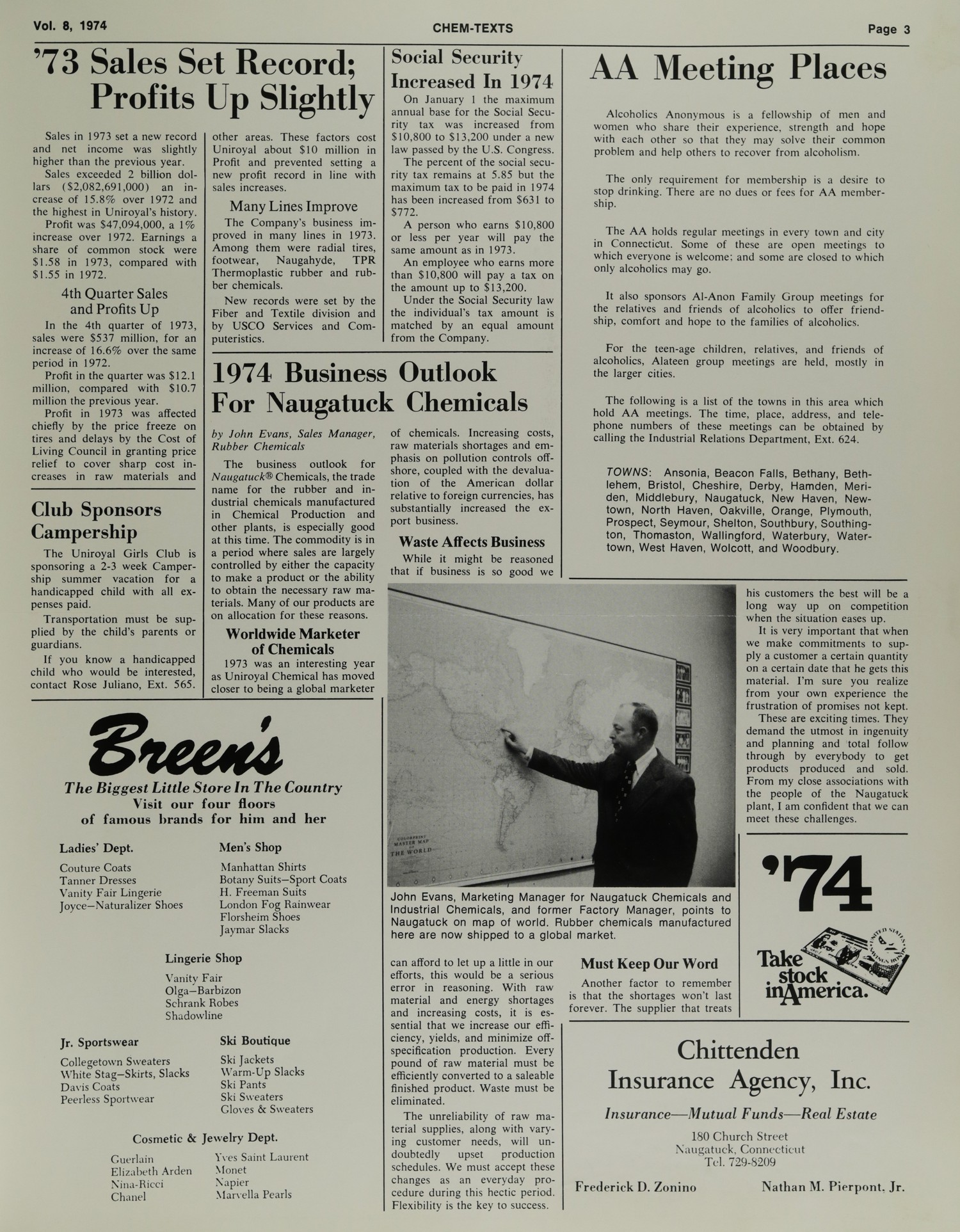
1974 Business Outlook For Naugatuck Chemicals

by John Evans, Sales Manager, Rubber Chemicals

The business outlook for Naugatuck® Chemicals, the trade name for the rubber and industrial chemicals manufactured in Chemical Production and other plants, is especially good at this time. The commodity is in a period where sales are largely controlled by either the capacity to make a product or the ability to obtain the necessary raw materials. Many of our products are on allocation for these reasons.

Worldwide Marketer of Chemicals

1973 was an interesting year as Uniroyal Chemical has moved closer to being a global marketer

of chemicals. Increasing costs, raw materials shortages and emphasis on pollution controls offshore, coupled with the devaluation of the American dollar relative to foreign currencies, has substantially increased the export business.

Waste Affects Business

While it might be reasoned that if business is so good we


Social Security Increased In 1974

On January 1 the maximum annual base for the Social Security tax was increased from $10,800 to $13,200 under a new law passed by the U.S. Congress.

The percent of the social security tax remains at 5.85 but the maximum tax to be paid in 1974 has been increased from $631 to $772.

A person who earns $10,800 or less per year will pay the same amount as in 1973.

An employee who earns more than $10,800 will pay a tax on the amount up to $13,200.

Under the Social Security law the individual’s tax amount is matched by an equal amount from the Company.


AA Meeting Places

Alcoholics Anonymous is a fellowship of men and women who share their experience, strength and hope with each other so that they may solve their common problem and help others to recover from alcoholism.

The only requirement for membership is a desire to stop drinking. There are no dues or fees for AA membership.

The AA holds regular meetings in every town and city in Connecticut. Some of these are open meetings to which everyone is welcome; and some are closed to which only alcoholics may go.

It also sponsors Al-Anon Family Group meetings for the relatives and friends of alcoholics to offer friendship, comfort and hope to the families of alcoholics.

For the teen-age children, relatives, and friends of alcoholics, Alateen group meetings are held, mostly in the larger cities.

The following is a list of the towns in this area which hold AA meetings. The time, place, address, and telephone numbers of these meetings can be obtained by calling the Industrial Relations Department, Ext. 624.

TOWNS: Ansonia, Beacon Falls, Bethany, Bethlehem, Bristol, Cheshire, Derby, Hamden, Meriden, Middlebury, Naugatuck, New Haven, Newtown, North Haven, Oakville, Orange, Plymouth, Prospect, Seymour, Shelton, Southbury, Southington, Thomaston, Wallingford, Waterbury, Watertown, West Haven, Wolcott, and Woodbury.


Breen’s

The Biggest Little Store In The Country

Visit our four floors of famous brands for him and her

Ladies’ Dept.
Couture Coats
Tanner Dresses
Vanity Fair Lingerie
Joyce—Naturalizer Shoes

Men’s Shop
Manhattan Shirts
Botany Suits—Sport Coats
H. Freeman Suits
London Fog Rainwear
Florsheim Shoes
Jaymar Slacks

Lingerie Shop
Vanity Fair
Olga—Barbizon
Schrank Robes
Shadowline

Jr. Sportswear
Collegetown Sweaters
White Stag—Skirts, Slacks
Davis Coats
Peerless Sportwear

Ski Boutique
Ski Jackets
Warm-Up Slacks
Ski Pants
Ski Sweaters
Gloves & Sweaters

Cosmetic & Jewelry Dept.
Guerlain — Yves Saint Laurent
Elizabeth Arden — Monet
Nina-Ricci — Napier
Chanel — Marvella Pearls


[PHOTO CAPTION:]
John Evans, Marketing Manager for Naugatuck Chemicals and Industrial Chemicals, and former Factory Manager, points to Naugatuck on map of world. Rubber chemicals manufactured here are now shipped to a global market.


can afford to let up a little in our efforts, this would be a serious error in reasoning. With raw material and energy shortages and increasing costs, it is essential that we increase our efficiency, yields, and minimize off-specification production. Every pound of raw material must be efficiently converted to a saleable finished product. Waste must be eliminated.

The unreliability of raw material supplies, along with varying customer needs, will undoubtedly upset production schedules. We must accept these changes as an everyday procedure during this hectic period. Flexibility is the key to success.

his customers the best will be a long way up on competition when the situation eases up.

It is very important that when we make commitments to supply a customer a certain quantity on a certain date that he gets this material. I’m sure you realize from your own experience the frustration of promises not kept.

These are exciting times. They demand the utmost in ingenuity and planning and total follow through by everybody to get products produced and sold. From my close associations with the people of the Naugatuck plant, I am confident that we can meet these challenges.

Must Keep Our Word

Another factor to remember is that the shortages won’t last forever. The supplier that treats


’74

Take stock in America.


Chittenden Insurance Agency, Inc.

Insurance—Mutual Funds—Real Estate

180 Church Street
Naugatuck, Connecticut
Tel. 729-8209

Frederick D. Zonino | Nathan M. Pierpont, Jr.

13 Receive 40 Years Service Awards

Vol. 7, 1973 | CHEM-TEXTS | Page 3


13 Receive 40 Years Service Awards

[PHOTO: Group photo of people]

New members of the Forty Years group of the Twenty Five Years Service Club pose with James Cronin, Factory Manager. From left in the photo are Gene Reale, Peter Machnics, Antonio Henriques, Thomas Doran, James Cronin, Michael Chmielewski, Nicholas Salinardi, Joseph Kolakowski, and Evo Gabriel. Missing from photo are J. Conrad Ranney and Anathor Giancarlo.

[PHOTO: Group photo of people in formal setting]

From left, Dr. Charles McCleary, Director of Research and Development for Uniroyal Chemical, congratulates Mary Sullivan and Beatrice Smey on their Forty Years service.

Robert Swallow, Materials Flow Manager, right congratulates Edwin Saunders (second from right) for his service.


Breen’s

The Biggest Little Store In The Country
Visit our four floors
of famous brands for him and her

Ladies’ Dept.
Couture Coats
Tanner Dresses
Vanity Fair Lingerie
Joyce—Naturalizer Shoes

Men’s Shop
Manhattan Shirts
Botany Suits—Sport Coats
H. Freeman Suits
London Fog Rainwear
Florsheim Shoes
Jaymar Slacks

Lingerie Shop
Vanity Fair
Olga—Barbizon
Schrank Robes
Shadowline

Jr. Sportswear
Collegetown Sweaters
White Stag—Skirts, Slacks
Davis Coats
Peerless Sportswear

Ski Boutique
Ski Jackets
Warm-Up Slacks
Ski Pants
Ski Sweaters
Gloves & Sweaters

Cosmetic & Jewelry Dept.
Guerlain | Yves Saint Laurent
Elizabeth Arden | Monet
Nina-Ricci | Napier
Chanel | Marvella Pearls


CHEM-PROD JOTTINGS

by 7 BUILDING CREW

SAFETY: The Monday morning 7 A.M. Safety Meetings are continuing with good success. We are experiencing better attendance than with the previous afternoon sessions. We have achieved 95% of our goal of getting every foreman and operator to at least one meeting every three months.

Chemical Production personnel should be proud of their performance and attitudes toward safety. We have had no lost time or serious accident since September. Keep up the good work.

PRODUCTIVITY: In general, business levels have been good with about half the plant running 7-day schedules. We have started to experience severe raw material shortages with some buildings being shut down for a week or two at a time. We will probably have more of these problems. Finishing productivity rates have been increasing these last few months. This should have a favorable effect on our severe cost problems in this area.

NEW OPERATIONS: The Roylar Plant is on schedule with all of 80 Building cleaned up and ready for new equipment installation. A June start up is expected. The Pre-Treatment Plant has been winterized and in standby condition with start-up scheduled probably in March or April.

QUALITY: The rejection rate has been steadily climbing for the last six months. It is still a lot better than past years, but any rejections cost money (an average 45¢/ pound tied up—300,000 pounds is $13,500). Finishing area has been spotty and in-process control is of particular importance.


Sales Up; Profit Off

Uniroyal set new records during the 3rd quarter and nine months of 1973, but net income declined.

Sales for the third quarter increased 14.8% to a record $489,047,000 compared with $425,901,000 for the same period in 1972.

Sales for the nine months were $1,545,784,000, a gain of 15.5% compared to the previous record of $1,338,549,000 for the same period in 1972.

Profits Decline

The major impact of the government-imposed price freeze occurred in the 3rd quarter and as a result net income declined 61% to $3,019,000 compared with $7,801,000 for the 3rd quarter in 1972.

Net income for the nine months was $35,005,000, a decline of 2.6% compared to the $35,929,000 of last year.

The decline in the third quarter net income broke a string of 10 consecutive quarters in which earnings surpassed those for the same period of the preceding year.

Higher Costs, Tire Market Affect Net Income

A softening in the European tire market and high costs for new constructions in radial ply truck and passenger tires affected income.

Increase Granted, But Insufficient

Although the Cost of Living Council allowed the Company price increases by 50% of the actual cost increases incurred, there is still a need for relief to offset increases in wages, salaries, materials, transportation, higher interest rates, energy, pollution abatement, and supplies required for the company’s operations.

SAFETY IS MY RESPONSIBILITY


Thirteen members of the Uniroyal Chemical Twenty Five Years Service Club were honored for their induction into the select few who contributed 40 years of service to Uniroyal Chemical.

For their years of long service with Naugatuck Chemical which started in 1933 the new members were presented Le Coultre Atmos Perpetual Motion Clocks or Hamilton Wrist Watches.


Three Employees Prevent Fire

Alfred Cignotti, Robert Edmonds, and Tano SanAngelo of the Materials Dept. averted a serious fire in one of the plant’s warehouses when a piece of plastic film caught fire on a shrink machine.

The fire took place on a Saturday morning and was quickly extinguished by the alert action of the three men. The group not only prevented serious injury to themselves and others in the area but also extensive damage to the warehouse facilities.

SAFETY IS MY RESPONSIBILITY


Fahnestock & Co.
(Established 1881)
Members New York Stock Exchange
“ON THE VILLAGE GREEN”

STOCKS | BONDS | MUTUAL FUNDS

HERITAGE VILLAGE FINANCIAL CENTER
SOUTHBURY, CONNECTICUT 06488 | TELEPHONE 264-6511

ARTHUR THOMAS, JR. Manager | EDWARD H. MITCHAM, JR.

CHEM-TEXTS – 1971-v05-i05-s200

Page 200

UNIROYAL CHEM-TEXTS

Vol. 5, 1971 | PUBLISHED FOR THE PEOPLE OF UNIROYAL CHEMICAL | No. 5

Construction Started On New $3,200,000 Pretreatment Plant


Nine Months Sales Up

Net income for the nine months ending October 3, was $33,234,000, equivalent to $1.10 per share of common stock compared with $27,852,000 or 92 cents a share for the comparable period last year, an increase of 19.3%. Earnings were equivalent to $1.04 per common share after adjustment for the potential dilution related to the company’s convertible debentures issued in February 1971.

Sales for the nine months totaled $1,277,000,000, a gain of 8% over the $1,183,-000,000 for the same period in 1970.

Net income of Uniroyal, Inc. for the 3rd quarter totaled $7,130,000, equivalent to 22 cents per common share, a gain of 38.6% compared with $5,143,000, or 14 cents per share, reported for the quarter last year. Sales increased 9% to $400,-000,000 compared with

$366,000,000 for the third quarter of 1970.

Net income for the 3rd quarter and 9 months was adversely affected by the following factors: freeze of price increases; wage increase costs prior to the

(Cont’d. on page 3)


Drive Nears $21,000

by Jim Carroll

The United Givers drive to raise $21,000 for the 16 Agencies in the Fund which provide needed services for families in communities in which most employees live is nearly completed.

Employees have pledged $20,260 to date and only $740 is needed to achieve the plant’s goal of $21,000. The average contribution amounts to $21.40 per employee who donated.

(Cont’d. on page 2)


Unions Elect Officers

[PHOTO: Two images showing union officers]

Joe Rzeszutek, left, was elected President. Cy Blanchard, right, Vice President; and Henry Hook, to the Executive Committee.

by T. Lee and F. Mayo

439 URW Local 218 Union members elected new union officers for a 3 year term.

Joe Rzeszutek was elected President for a seventh

(Cont’d. on page 3)

Charles Roland, right, new 308 President is congratulated by Rocco Manulla, left, Art Calder, right, and Frank Sordi.

by Walt Tabaka

URW Local 308 members elected Charles Roland, President for a three year term. Also voted into office were Rocco Manulla, Vice-Pres-

(Cont’d. on page 3)


by Dick Shaw

Quietly along the Naugatuck River bank, opposite the Synthetic plant, construction of the new $3,200,000 liquid waste pretreatment plant is making rapid progress. Completion is scheduled for the Fall of 1972.

The facilities will pretreat 3,000,000 gallons of waste water a day for discharge into the Boro of Naugatuck’s water pollution control plant for secondary biological treatment. After treatment at the Boro’s plant, the water will be discharged into the Naugatuck River which is classified “C”, and suitable for fish, game and wildlife.

The steel superstructure for the Operations Building is complete and work has started on the interior of the building which will serve as the operational center for the pretreatment facility. A waste water collection pipeline, encased in solid concrete to prevent upheaval and breakage during high water periods, has been installed at the base of the river bank. This pipeline will connect the plant’s discharge outlets to a new pump station currently under construction near the south yard sewer outfall.

Foundations for the two 82 ft. diameter clarification

(Cont’d. on page 3)


[AERIAL PHOTO: Shows pretreatment plant construction site]

The Pretreatment plant occupies an acre of land near the Synthetic reactor area along the Naugatuck river.


987 Join Stock Plan

by Jack Dunn

987 Chemical Division employees exercised their options to participate in the third stock purchase plan for Uniroyal employees.

These employees elected to purchase 59,617 shares of Uniroyal common stock by 46 payroll deductions over the next 2 years.

The purchase price of the stock was $19.3125.

The enrollment figure represents 61% of the Chemical division employees at the Naugatuck location.

18,000 Uniroyal employees

in the U.S. and Canada joined the plan, electing to purchase over 800,000

(Cont’d. on page 4)


[PHOTO: Construction site view]

The $3,200,000 facility will be completed by the Fall of 1972.

CHEM-TEXTS – 1971-v05-i04-s195

Page 195

UNIROYAL CHEM-TEXTS

Vol. 5, 1971 | PUBLISHED FOR THE PEOPLE OF UNIROYAL CHEMICAL | No. 4

$6000 Awards Offered

10 Uniroyal scholarships will be awarded to children of employees—with five or more years of continuous service—who attain the highest finalist qualification in the annual scholarship competition conducted by the National Merit Scholarship Corporation.

Scholars are chosen on the basis of scholastic aptitude, leadership and good citizenship. The Company plays no part in the selection of the scholars.

No Application Required

Eligible high school students must take the new combined
(cont’d. on page 2)


Profits; Sales Up

Chemical Sales Off

Net income for the Company increased 18.1% for the second quarter of 1971 compared with the second quarter of 1970.

Sales for the quarter set a new record of $464,161,000, a gain of 6.3% compared with the previous record of $436,714,000 set last year.

Net income for the quarter was $15,554,000 equivalent to 53 cents a share of common stock, compared with $13,170,000 or 46 cents a share, reported for the second quarter of 1970.

Sales for the first six months of 1971 also set a record of $877,327,000, a gain of 7.3%
(cont’d. on page 3)


Plant Safety Record Marred By Injuries

Since July 10, a rash of accidents occurred in the plant when 21 employees were injured in an 8 week period. Twelve were lost time accidents in which employees required Hospital treatment; the others were serious injuries requiring treatment by the plant nurses.

This series of accidents took place only a month after the plant received an Award of Merit from the National Safety Council for its “noteworthy safety performance” in 1970 when lost time accidents dropped to 6 from 24 the previous year.

1971 Started Well

1971 started as a safe year. From January to June, only 3 employees were injured in lost time accidents and 36 suffered serious injuries. The incidence of serious injuries remained at the same level as in 1970 when 33 serious injuries happened for the same 6 month period. Although this was no significant improvement, it nevertheless showed no major increase in this type of injury.

Pilot Plant Explosion

The explosion in the Chemical Pilot Plant, Bldg. 72 was the most serious to befall the plant in several years. A 20 gallon reactor exploded, causing a flash fire in the building and extensive damage to the piping and equipment. The heat of the fire opened up the sprinkler system flooding the area with water. It was the alert action of Chris Owens, who narrowly escaped injury from the blast, and Al Grella, that was greatly responsible for extinguishing the fire and preventing greater damage to the area.

One employee was seriously burned with 3rd degree burns over 20% of his face and chest
(cont’d. on page 4)

Explosion ripped interior walls of Pilot Plant; shattered windows; and tore hole in roof. The structural steel framework of the building was not affected

The explosion occurred in small 20 gallon reactor shortly after a sample was taken.


Employees Clean-Up River

by Bob Van Allen

Five Uniroyal Chemical Employees recovered 75 discarded tires from the Naugatuck River during “Clean Up” week.

The Clean-Up started when Stan Korpusik and Frank Lynch of the Materials Department toured the river’s banks from Waterbury to Beacon Falls to locate the tires thrown into the river.

For three days Joe Trangle, Vladas Krakauskas and Adnell Lee covered a 20 mile area to pick up the tires and truck them to the Reclaim plant.

GIVE “WHERE YOU WORK”

Materials department group points to discarded tires recovered from the Naugatuck River. From left are Stan Korpusik, Joe Trangle, Vladas Krakauskas, and Frank Lynch. Not present was Adnell Lee.

Vladas Krakauskas cautiously wades the river to recover 75th tire. Ready to offer assistance on bank was Pat Barriault.


Dividend Declared

Uniroyal declared a dividend of 17 1/2c a share on the Company’s common stock. The dividend was payable Sept. 25 to stockholders of record Aug. 23.

The Company also declared a dividend of $2 a share on the 8 percent first preferred stock. It was payable Sept. 25 to stockholders of record Aug. 23.

CHEM-TEXTS – 1971-v05-i01-s183

Page 183

UNIROYAL CHEM-TEXTS

Vol. 5, 1971 | PUBLISHED FOR THE PEOPLE OF UNIROYAL CHEMICAL | No. 1
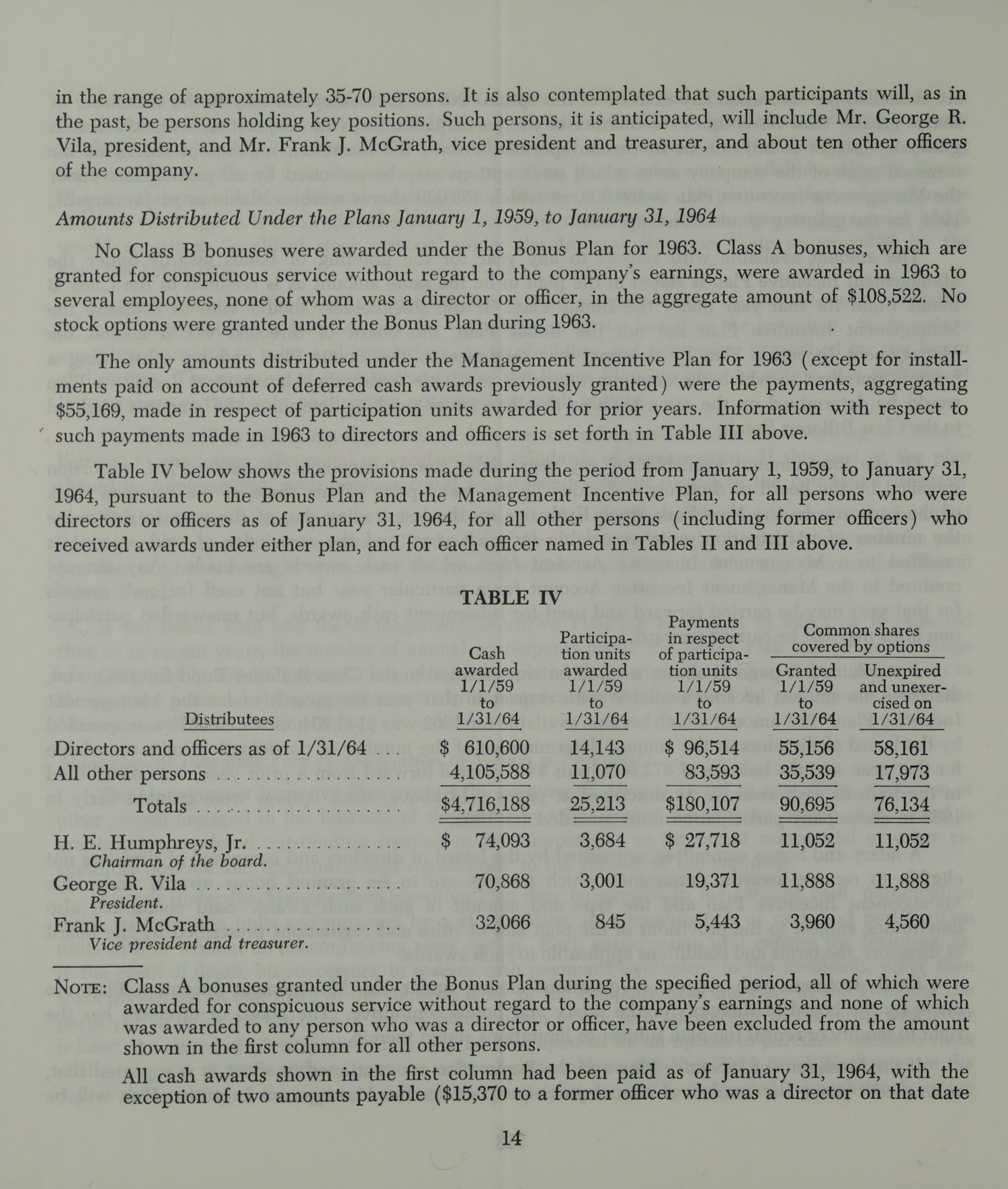

$8,900 Awarded For Ideas


Fuel Costs Doubled For 1971

Save Steam Plan Started In Plant

by Al Manzi

Total fuel costs for 1971 will be approximately double over 1970. $1,143,000 has been budgeted to operate the plant during the year against actual costs of $638,000 for last year.

The $505,000 increased cost of fuel is primarily due to escalating residual oil prices which are a result of the Mid-East crisis, tanker shortages and pollution abatement conversions to oil. An added cost is the premium we will pay for low sulfur oil after Sept. 1, 1971.

(con’t on page 4)


Safety Equipment Program

by Bob Shortt

As part of the plant’s continuous concern for the safety of all employees, a new safety equipment program has been initiated.

The program is based on a section of the 1970 Uniroyal-URW Master Agreement which emphasizes that all employees are expected to cooperate in the prevention of accidents to themselves and their fellow workmen and shall be required to utilize such protective devices and equipment prescribed by the Company at no cost to the employee.

Areas Under Review

Under the program, supervi-

(con’t on page 4)


Profits Off $4,100,000

Uniroyal showed a $4,100,000 loss for the 4th quarter of 1970 compared to a profit of $8,400,000 in 1969.

Sales for the same quarter were $371,000,000, a decrease of $17,000,000 from the same period last year.

1970 sales of the company were $1.554 billion, almost the exact amount as the prior year. Net income for 1970 was $23,800,000 compared to a net income of $46,600,000 in the year of 1969.

The decrease in 1970 profits and sales were attributed to the GM strike, the general softness in the economy, high interest charges, sharply higher employment costs, higher transportation charges and other costs not fully absorbed by price increases or productivity improvements.

Plant Business Down

During the year production of reclaimed rubber, latex and rubber chemicals was affected by the slackness in the automotive industry, home construction and the shutdown of several Uniroyal tire plants.

The plant’s business shows scarcely any improvement according to present sales forecasts for the first quarter of 1971.

Every effort needs to be made at this critical time in our economy to prevent off grade production, improve productivity and quality, and to keep customers satisfied.


Dividend Declared

Uniroyal declared a quarterly dividend of 17½ cents a share on the company’s common stock. The dividend is payable March 25 to stockholders of record on February 22.

The Company also declared two dividends of $2 each on Uniroyal’s preferred stock. One will be paid March 25 to stockholders of record February 22 and the other payable June 25 to stockholders of record on May 24.


Elephant Tests Chair

[IMAGE: Photo of an elephant named Elsie testing a plastic chair]

Elsie, a 5,000 pound elephant, torture tests a molded urethane plastic chair made by a new process developed by Rubicon Chemicals, a Company jointly owned by Uniroyal Chemical and Imperial Chemical Industries, Ltd. The liquid urethane chemicals are poured into special chair molds and react into a rigid foam to create furniture that has fantastic strength, is lightweight and easily movable. The shells are then filled with flexible foam for deep seating comfort and upholstered with Naugahyde® vinyl.

Research work on the new process was done in Bldg. 75 by Tom Haggerty, Group Leader; John Chapman; Don Zalewa; Ken Ferreira and Jim McGinn.


[IMAGE: Photo of Al Urban receiving award from Bob Foltz with Art Nauges]

Al Urban, center, a finisher operator in Reclaim Production, receives $426 Idea Plan check from Bob Foltz, general foreman. At right is Art Nauges, area foreman. Al suggested to reuse the butyl tuber heads, previously discarded, and to reclaim, finish and sell the butyl. He received an initial $50 award.


Lost Time Accidents Drop To 6

By Sal Aloise

The incidence of lost time accidents showed a major improvement in 1970. The plant had only 6 compared to the 23 in 1969. Two of the accidents occurred in December in an odd situation.

An employee fell on ice and fractured two ribs. A few days later he visited Dr. Jelley at the Chemical plant hospital prior to his return to work. After his checkup, Tom Doran, a plant driver, drove him home. When Doran stopped for a stop sign, a trailer truck skidded into the station wagon, injuring Doran who suffered a severe neck strain. One of the safest, most experienced drivers in the plant, Tom lost a month of work when the “unexpected happened“.

Accidents Cost $150,507

The 6 lost time accidents and 66 serious injuries cost the plant $150,507 in 1970. The outside medical bills for hospitalization, X-rays, specialists, medicines and doctors’ visits were $49,214. The money paid out for Work-

(con’t on page 2)


by Mitch Mazur

257 employees received $8,900 for Ideas in 1970. A high award of $476 was made to Al Urban for his idea to reuse butyl tuber heads which were previously discarded after short use. The butyl is now reclaimed; finished; and sold, saving materials cost and scrap haulage charges. It took six months to evaluate the idea for which Urban received an initial award of $50 and a subsequent award of $426.

The $8,900 was one of the highest amounts ever awarded to

(con’t on page 2)


[IMAGE: Photo of Carmine Iannuzzi being congratulated]

Carmine Iannuzzi, of the Chemical Mechanical Dept. right, is congratulated by Leo Napiello for being named Idea Man of Year.

CHEM-TEXTS – Vol. 4, 1970, No. 10 – Page 1

Page 001

UNIROYAL

Merry Christmas – Happy New Year

CHEM-TEXTS

Vol. 4, 1970 | PUBLISHED FOR THE PEOPLE OF UNIROYAL CHEMICAL | No. 10

Real Christmas Spirit

[IMAGE: Black and white photo of women working on a wreath]

Girls in the IBM Tabulating department add a touch of Christmas spirit to the office. Adjusting the wreath which they made, are from left, Julie Curtin, Joyce Lucarelli, Helen Southard and Edna Crycheau.


Unique Company Formed

[IMAGE: Group photo of people at what appears to be a disco event]

Sales of UNIQUE Disco Delic Lite conducted at the Chemical plant were highly successful netting several hundred dollars. From left are Jim Gatling, Lou Schiller, Gail Snedeker, Joe Rzeszutek, URW Local 218 President, Gail Murray, Nancy Murrican, Cathy Gauvin, Ron Stark, Advisor, and Sonya Kernasevic.

Unique is not only the name of the Junior Achievement Company sponsored by Uniroyal Chemical but also the description of the Company’s unusual product, a Disco Delic Lite.

N.H.S. Students Head Firm

The lamp was designed, manufactured, and sold by Naugatuck High School students who organized the corporation and raised the capital to support their activities by issuing stock.

Theory In Practice

The textbook theories of eco-
(Cont’d on page 4)


Omite Facilities Constructed; Productivity Quality Improved

D. Beretta, Chemical President

David Beretta, Factory Manager of the Naugatuck plant from 1965-1966, was named Vice-President of Uniroyal, Inc. and Divisional President of Uniroyal Chemical, succeeding Frank A. Hopkins, who resigned from Uniroyal.

Mr. Beretta joined Uniroyal in 1952 as a process development engineer in plastics and rubber at the Naugatuck plant. He held several positions in polymer Research and Development until named Synthetic Production Superintendent. In 1965 he was appointed Factory Manager, a position he held until 1966 when he was transferred to Canada as a Vice President and
(Cont’d on page 2)

[IMAGE: Three workers in hard hats standing in front of industrial equipment]

Construction of new Omite facilities helped increase productivity and improve the quality of the chemical. Standing in front of new refrigeration unit are three of the Omite operators who helped make significant improvements in its quality: from left, Lyle Bissonette, Ed Cheney, Orrin Huntley and Bob Breton, foreman.

by Dr. Perry Kippur & Frank Bennett

Construction of a new refrigeration unit, and the installation of three 10,000 gal. storage tanks were completed to improve production operations of Omite. These new facilities, and the process improvements made in the past year, will enable us to meet the estimated forecast for Omite sales for the next five years. In charge of construction was Rod Gaetz of the Engineering department.

Productivity Increased

The refrigeration unit eliminates processing delays and thereby increases the productivity of Omite. The unit is large enough to pipe refrigeration to other close by buildings, as needed, to improve the efficiency of the production operations in these buildings.

The construction of these facilities was instrumental in significantly increasing Omite productivity and quality.

Quality Improved Since Jan. 1969

Since January 1969, the quality of Omite has improved significantly and is now excellent. This outstanding quality and production performance is attributable to the men who
(Cont’d on page 3)


Sales Drop; Profits Off

Uniroyal, Inc. sales and profits dropped during the 3rd quarter due to the auto strike and continued slackness in the chemical, rubber, plastics and latex industries. The GM strike forced production cutbacks in several tire, plastic products, and chemical plants. Reduced tire production hurt the sales of many products made in Chemical and Reclaim Production for tire manufacturers.

Company sales dropped $3,000,000 for the 3rd quarter and profits were off $3,149,000, compared with the 3rd quarter of 1969.

During the 9 month period of 1970 the Company suffered a $17,894,000 loss in sales compared to 1969.

Profit for the 9 months of 1970 dropped $10,332,000 compared to 1969.

Higher interest charges and higher costs for labor and raw materials, which cannot be passed on to the customer, also affected the Company’s profits.
(Cont’d on page 2)


Dividend Declared

Uniroyal declared a quarterly dividend of 17½ cents a share on the common stock, payable December 24 to stockholders of record November 23.

The Company also declared a dividend of $2 a share on the first preferred stock, payable December 24 to stockholders of record November 23.

[IMAGE: Man in hard hat inspecting equipment]

Dr. Perry Kippur inspects new 200 HP motor on the new compressor for the refrigeration system in Bldg. 100.

CHEM-TEXTS – Vol. 4, 1970, No. 7 – Page 1

Page 001

UNIROYAL CHEM-TEXTS

Vol. 4, 1970 | PUBLISHED FOR THE PEOPLE OF UNIROYAL CHEMICAL | No. 7

Wear A Dress Once; Throw It Away


Sales Up; Profits Off

Uniroyal set new records in sales for the second quarter and first half of 1970. Net income declined compared with 1969 when profits hit an all-time high.

Sales for the six months were $817,538,000, up 2.6 percent from the first half record of $796,633,000, in 1969.

Profits for the six months was $22,709,000, equivalent to 78 cents per share of common stock, which compares with the record $29,892,000, or $1.06 a share, set in 1969.

Sales for the second quarter set a new record of $436,714,000, compared with $427,802,000 in 1969.

Profit in the second quarter was $13,170,000, or 46 cents a share, compared with the $17,357,000, or 62 cents a share in 1969. (Cont’d. on page 4)


NOW Group Tours Greenhouse

[IMAGE: Group of men standing outside a building]

Future chemists and scientists visited the Agricultural Chemical research green house in Bethany, where Dr. Bob Davis showed then how new chemicals were helping to provide more food for the world. From left are Bob Davis, Allan Peoples, Vincent Wiggins, Joe Trangle, Royal Gladding, Ralph Neubig, of NOW, Eric Lott, Irving James, and Donavan Wiggins. Missing from the photo was Richard Simpson.

[IMAGE: Group seated at tables for lunch]

After tour, the group were luncheon guests of Bob Davis. Joe Trangle, at right, drove group to and from Waterbury.


[IMAGE: Woman in patterned casual dress]

Casual wear dress is made from non woven fibers and Naugatex latex.


by Jerry Twomey

The Synthetic plant makes it. People walk on it; read it; ride on it; chew it; and wear it. The plant, the first SBR plant built in the U.S., is a specialty manufacturer of 29 different types of latexes, tailor-made to meet the special requirements of customers.

Uniroyal Chemical ranks as one of the leading producers of latex manufacturing it at three plants: Naugatuck, Baton Rouge and Scotts Bluff.

Chewing Gum Big Use

One of the most interesting uses of synthetic latex, which is made from the chemical reaction of butadiene and styrene, is chewing gum. Most of the latex used to make chewing gum in the U.S. is produced at the Synthetic plant. The Naugatex® latex is more uniform in quality and has a “chewier” chew than the natural gum of the South American tree from which it was extracted and imported into the states.

The Disposable Market

This is one of the largest markets for nonwoven fabrics (Cont’d. on page 4)


Mower Shoots Steel Stake Into Wall

by Ed Phillips

An 8 inch tent stake, hidden in the grass, was picked up by the blades of a lawnmower and projected against a garage wall ten feet away. The sharp edge of the stake pierced through the 5/8″ thick plywood wall about 10 feet from the ground and entered the inside of the garage wall.

At the time, several children were playing on the lawn. If one of them had been near the (Cont’d. on page 4)


Dividend Declared

Uniroyal declared a dividend of 17½ cents a share on the common stock. The dividend is payable Sept. 25 to stockholders of record August 24.

This is the third dividend declared in 1970, bringing the total of dividends to 52½ cents a share on the common stock.


[IMAGE: Man and boy looking at stake in garage wall]

Ed Phillips, shows his son Dick, the 8 inch stake in garage wall.

CHEM-TEXTS – Vol. 4, 1970, No. 4 – Page 1

Page 001

UNIROYAL CHEM-TEXTS

Vol. 4, 1970 | PUBLISHED FOR THE PEOPLE OF UNIROYAL CHEMICAL | No. 4

Solo, A New Soybean Herbicide Marketed

[IMAGE: Photo showing workers with pallets marked “4614” and “SOLO”]

Jim Nolan, left, checks control number for quality of liquid Solo as Filipe Duarte, center, inspects appearance of packaging. Tony Marques, loads a pallet from Bldg. 76 warehouse on to truck for shipment to one of our distributors.

by John Kitsmiller

Solo,® a new preemergence herbicide made in Bldg. 73, controls more broadleaf weeds, such as ragweed, in soybeans than any other chemical. Marketed for the first time this year, after several years of tests by universities, large growers, and the R & D agronomists, under the direction of George O’Brien, sales of Solo look good for 1970.

Patent Issued

The unique herbicide combination was discovered by Everett Barron and Adam Soboleski of the agricultural chemical R & D group at the Bethany research center. A patent was issued to both which provides 17 years’ exclusive rights to the sales of the product.

42,000,000 Acres

Soybeans are the nation’s second largest crop with 42,000,000 acres grown in the midwest and Delta areas of the U.S.

Solo increases yields by 6-10 bushels per acre. At $2.50 per bushel the chemical improves the grower’s income in a very risky business.

(Cont’d. on page 4)


Sales Up 3%: Profits Drop Down 24%

Uniroyal set a new 1st quarter sales record of $380 million, a 3% increase over the $369 million sales in the 1st quarter of 1969.

Profits for the first three months of 1970 were $9.5 million, a 24% decrease compared to the $12.5 million 1st quarter profits of 1969.

Higher interest charges; more competition in the market; higher working capital requirements; lower demand for quality canvas shoes; and intensified competition from foreign and domestic manufacturers paying wages and benefits far below Uniroyal scales, were major factors in reduced profitability.

Automotive Industry Off

A decline in automobile sales not only has an impact on the many products the company makes for the industry, but also affects the sales and profits of the Nau-

(Cont’d. on page 4)


136 JOIN 25 YEAR CLUB

[IMAGE: Photo of crowd at banquet/dinner event]

350 members of the 25 Year Service Club attended the twentieth annual banquet honoring employees for 25 or more years service. Above, members enjoy refreshments before the dinner.

The 25 Year Service Club of Uniroyal Chemical held its twentieth annual dinner at Waverly Inn honoring 568 active and retired employees for their credited service of 25 or more years.

Committee members for the dinner were Bert Scullin, president and toastmaster, Everett Anderson, Tom Dowling, Pat King, Joe Little, Alice Schofield and Ed Weaving. In charge of the invitations and assisting the committee was Gladys Bradshaw.

Guest speaker for the affair was Frank Hopkins, vice president of the Chemical division.

Andy Molnar of the Synthetic pilot plant holds the unique distinction of longest,

(Cont’d. on page 2)


Vibrathane Bumper First On Auto

[IMAGE: Photo of woman in short dress posing next to Oldsmobile Rallye 350 car with visible “RALLYE 350” text]

The Oldsmobile Rallye 350 has the first color matched bumper in the auto industry. Developed by R & D at the TSSC, the Vibrathane®coating’s elastic-plastic properties make the bumper highly resistant to weather, wear, chipping and scratching from flying road gravel and stones. Working on the project were Dr. Frank O’Shea, R & D manager; John Burkus, group leader; John Shiley, Lou Esposito, technical service; Alex Keniausis and Len Jacoboski.

CHEM-TEXTS – Vol. 4 No. 1 – Page 3

Page 003

CHEM-TEXTS

Vol. 4, No. 1 | Page 3


UNIROYAL, INC.

EMPLOYEE BENEFIT COSTS—1968

U.R.W. PLANTS

Total Dollars Cents Per Hr.
Social Security $ 6,638,454 $ .1629
Unemployment Compensation Taxes 1,553,264 .0375
State Disability Insurance 182,749 .0044
Workmen’s Compensation 1,171,334 .0283
Vacations 11,898,799 .2877
Holidays 5,157,970 .1247
Overtime 8,771,526 .2121
Night Shift Bonus 1,172,040 .0283
Hospital, Surgical, In-Hospital Medical Insurance 7,470,680 .1806
Sickness & Accident Insurance 2,266,966 .0548
Life Insurance 2,222,114 .0535
Severance Pay 54,076 .0013
Grievance Meetings 111,513 .0027
Pensions 15,090,989 3648
Supplemental Unemployment Benefits 2,691,057 .0651
Funeral Pay 318,303 .0077
Military Training Pay 32,801 .0008
Jury Pay 73,024 .0018
Union Time Study 67,988 .0016
Safety Committee 9,651 .0002
Workmen’s Compensation Make-up 101,124 .0024
TOTAL $67,146,422 $1.6232

Above are various benefits employees receive and their cost per wage hour. At $1.62 an hour they add up to $64.80 for each 40 hour week or a total of more than $3,200 a year.


UNIROYAL, INC.

EMPLOYEE BENEFIT COSTS-IN CENTS PER HOUR

U.R.W. PLANTS 1953-1968

[THIS IS CHART: Bar graph showing increasing employee benefit costs from 1953 to 1968, starting at around $0.41 in 1953 and reaching $1.62 in 1968, with data points for each year showing gradual increase: .41, .42, .53, .57, .62, .76, .82, .91, .93, .97, 1.09, 1.23, 1.35, 1.62, 1.76]

The chart shows the increased cost of employee benefits. They have gone up from 41 cents an hour in 1953 to $1.62 in 1968. On August 1, 1969 Uniroyal absorbed the 20% increase in the Hospitalization, Surgical and In-Hospital medical benefits. For 12 months this benefit now amounts to $364.44 per employee.


Sales Highest; Profits Drop

Estimated 1969 sales hit a record high of $1,550,000,000, an 8% increase over 1968.

But 1969 profits were about $46,500,000 or 18% below the record of $56,900,000 in 1968.

Tire, Footwear Profits Affected

Although foreign operations showed good gains, along with industrial and most other U.S. products, the gains were offset by lower profits in U.S. Tires and Footwear operations.

Footwear was hurt by lower demands for its products, low cost foreign imports, and the higher number of lower cost U.S. manufacturers paying wages below Uniroyal wages.

Tires faced sharply higher costs and lower productivity from the introduction of the new bias belted tires and heavy start-up expenses for expanding tire capacity at Opelika.

Fourth Quarter Sales, Profits

Fourth quarter sales were about 5% above the same period in 1968 but profits for the fourth quarter of 1969 were approximately $8,500,000 compared to profits of $14,300,000 in 1968. This represents a $5,800,000 drop in profits for the last quarter of 1969.


Three Employees Avert Fire

[THIS IS PHOTO: Group photo of four men in work attire]

From left, Phil DePasquale, plant protection group leader, congratulates Fred Sargeant, fire inspector, and Gene Lantieri, mechanic, is congratulated by Bill Rek, foreman, for their quick action to avert fire. Missing from photo is Oliver Leduc.

by Ed Weaving

The alert action of Eugene Lantieri and Oliver LeDuc of the Mechanical Department and Fred Sargent, a Fire Inspector, prevented a possible serious fire in Building 16 of the Reclaim Plant.

Lantieri and LeDuc were working in the area when they discovered flames from an accumulation of rubber. They immediately ran to the nearby hoselines and used them to extinguish the fire. The hose operation automatically turn in the sprinkler alarm, which is an important part of our plant protection system. Responding to the alarm which rings in the Firehouse, Fred Sargent entered the smoke-filled area and assisted Lantieri and LeDuc in putting out the fire.

Quick Action Stops Damage

Had it not been for the quick action of the three men and knowing what to do in an emergency, several sprinkler heads would have opened up and flooded the area with water and damage would have resulted from both the fire and water.

Several other employees took part in fighting the fire and helped in controlling it.

Overheating Ignites Rubber Accumulation

The fire resulted from a broken greaseline leading to the mechanical shoe on a screen, causing the overheating of the shoe and ignition of rubber accumulation around the screen.

Due to the nature of this operation, fires will occur and serious damage result unless the mechanical equipment is kept in good operating condition and every employee in the area pays particular attention to good housekeeping and reports possible fire hazards to the foreman of the department.


Snow Plow Hits Car

While driving to work recently, an employee’s car was sideswiped by a snow plow truck.

The truck, approaching in the opposite two lane highway, made a left turn at an intersection separated by a median strip, and ripped into the front left side of the car. The driver was slightly injured but severely shaken up by the unexpected turn of the truck. Another two feet, and the four foot high plow would have crushed the car and the driver.

No matter how careful you are, you can never be sure what the other driver will do. Expect the unexpected happening, especially during the winter months when icy roads make driving more hazardous.


Mattress Bargain Sale On

A special low price sale on Uniroyal’s Koylon foam mattresses is now in progress at the Footwear Employee’s salesroom. Only the firm type is being offered in the sale.

Savings of $47 can be realized on the sale price depending on the size.

The special sale ends Feb. 28. So place your order with the Salesroom now. Orders may be placed by telephone to George O’Donnell, Ext. 17-259 at the Footwear Salesroom.

Mattresses will be delivered to the Salesroom to save you transportation costs.

9 out of 10 of all auto accidents happened in the driver’s own state.


You Couldn’t Afford . . .

Continued from page 1

everyone’s responsibility to keep these benefits secure. They have increased nearly four times what they were 15 years ago.

Competition, imports, price cuts, and higher costs can affect the extent, cost, and value of benefit programs.

Our challenge is to find methods to improve production, reduce costs and waste, work safer, suggest ideas to improve jobs, and to show a real concern for producing quality products to keep our customers.

Every employee holds an important role in the plant’s operations . . . and with 65% holding stock in Uniroyal, everyone’s fullest effort is needed to protect our interests and benefits.


Trucks . . .

Continued from page 2

that seat belts are as important in truck cabs as in automobiles, notwithstanding the added problem of load shift and fire.

With respect to injuries, on the average, injured truck drivers have 32% more injuries than automobile drivers. The most frequent contributor to this discrepancy is the abdominal area. The frequency of head injuries is essentially the same for both.

Among injured truck drivers, the frequency of dangerous or fatal injury is nearly twice as high as among injured automobile drivers. The results of the survey indicate that safety belts and the use of other restraint systems reduce injuries to truck drivers.

Automobile drivers should always drive with their safety belts on. Statistics prove conclusively that they have prevented millions of serious injuries when worn properly. However, it is estimated that only 40% of the drivers with seat belts in their automobiles use them.


SAFETY IS MY RESPONSIBILITY

CHEM-TEXTS – Vol. 3 No. 10 – Page 4

Page 004

Page 4 | CHEM-TEXTS | Vol. 3 No. 10


Sales Set Record; Profits Drop 10.5%

Sales of Uniroyal, Inc. set new records for the thirty-nine weeks ending September 28, 1969, but profits failed to keep pace with sales, and took a 10.5% drop.

Sales for the nine month period totaled $1,165,502,000, an increase of 9.9% compared with $1,060,659,000 reported for 1968. Profits, however, were $38,184,000, equivalent to $1.33 a share of common stock, 10.5% lower than the $42,650,000 or $1.55 a share for 1968.

The third quarter sales for 1969 were $368,869,000 compared to $341,874,000 for 1968 and net income was $8,292,000 equivalent to 27 cents a common share compared with $12,769,000 or 45 cents a share last year. Third quarter earnings in 1969 were based on a greater number of shares outstanding.

Profits were hurt by increasing inflationary factors, including rising costs for wages and raw materials, as well as higher interest rates on borrowed capital.

The Company also encountered abnormally high production costs for new tire constructions and greater start-up expenses for new and expanded production facilities.


Contact Lenses Are Unsafe

by Bob Shortt

Many employees are not fully aware of the dangers in wearing contact lenses in the plant.

Chemicals and dusts which enter the eye and work their way behind the lens cannot be washed out until the lens is removed. Very often permanent damage to the eye can result before this can be done.

There is a rule which is included in the Laboratory Safety Manual stating, Contact Lenses are not to be worn in the plant. For your own safety and to prevent injury to eyesight, it is extremely important to observe this rule.


Dividend Declared

Uniroyal declared a dividend of 17½ cents a share on its common stock. It will be payable December 24 to stockholders of record on November 24.

This payment will bring total dividends paid on the stock in 1969 to 70 cents a share.

Approximately 65% of the Naugatuck plant employees are stockholders or participants in the Stock Purchase Plan.


Clergy Visit Parishioners

During a recent plant tour, local clergy had a chance to see their parishioners at work. Taking a coffee break during the tour they chat with Neil Melore, Industrial Relations Supervisor. From left are John Letts YMCA Director, Rev. Clark Kuntz, Rev. Robert Hankins, Rev. James Dahlgren and Melore. With back to camera is Rev. Robert Baker.


Sabia, Buckingham Retire

Frank Sabia center, is congratulated by Kirk Kirkendall upon retirement after 27 years. Left to right are Ed Plocha, Kirkendall, Sabia, Don Fuller, and Mike Santone.

Ralph Buckingham is congratulated on his retirement by Sal Falcone. From left are Gene Reale, foreman, Tony Malone, Buckingham, Falcone, Tony Galletta and Ovila Fortier.


Luggage Ideal Xmas Gift

Smart looking luggage, ideal for Christmas gifts, is made from Kralastic® ABS, a tough impact resistant plastic, a product of the Chemical Division. Manufactured by several quality baggage companies, the cases can withstand the toughest abuse a traveller can give them.

Royalite® which is the Consumer and Industrial Division’s trademark for ABS sheet is only 40% the weight of aluminum and just one-seventh the weight of steel.

The attache case at top is a perfect gift for the businessman. On the wicker stool is a lightweight ladies overnight case. For travellers, the two suiter makes an excellent gift. The gun case on which the pretty model is standing demonstrates how tough this steel-like plastic is.

The Employees’ Salesroom at the Footwear plant carries most of the luggage which is available in a wide range of colors.


[Photo caption]: Model demonstrates the steel-like strength of Kralastic ABS, a plastic made by Uniroyal Chemical.


Latest News Bulletins Issued

To keep employees informed on the latest news in the Plant, in the Division and in Uniroyal, News Bulletins are now being issued weekly or semi-weekly. Watch for them on the Bulletin Boards at the three plant entrances, in the Plant, and in your department.


SAFETY IS MY RESPONSIBILITY


CHEM TEXTS

PUBLISHED BY THE INDUSTRIAL RELATIONS DEPARTMENT
UNIROYAL CHEMICAL, NAUGATUCK, CONN. 06770

EDITOR: William F. Lavelle.


UNIROYAL Chemical
Naugatuck, Connecticut 06770

U.S. Postage
PAID
Permit No. 10
Naugatuck, Conn. 06770

RETURN POSTAGE GUARANTEED

CHEM-TEXTS – Vol. 3 No. 7 – Page 2

Page 002

Page 2 | CHEM-TEXTS | Vol. 3 No. 7


FROM THE FACTORY MANAGER

DEAR FELLOW EMPLOYEE:

This year we have been pushing the slogan “SAFETY IS MY RESPONSIBILITY.” Frankly, it seems to me that our success to date is in developing the attitude that “everybody is responsible for my safety.” It’s about time that we face up to our own responsibility for safety.

I’ve heard too much of, “you didn’t fix this” or, “why should I do it that way, so and so doesn’t.” Or, the old favorite, “I’ve been doing this for twenty years and nothing has happened to me.” These are, at best, just excuses.

We have to face up to the basic fact that each man is primarily responsible for his own safety. Management’s responsibility extends to providing the proper tools and equipment, protective devices and giving safe operating procedures and instructions.

Beyond this point, supervision can’t make a man safe if he doesn’t act safely. This is particularly true in our plant where each man works with a great deal of responsibility for his own work.

Recently, I read some criticism concerning companies where protective equipment wasn’t furnished to employees.

Let’s take a look at our plant. UNIROYAL provides hard hats, safety glasses, goggles, safety shoes, gloves and other protective equipment, and yet too many employees take the attitude of “let’s see if we can make them force us to wear this stuff.” What kind of a game is this for men to be playing?

Don’t you think it’s about time for you to quit playing Russian Roulette with your SAFETY? I sincerely hope you will think this over and agree for your family’s sake.

Best regards,

John

John D. Evans


Little known but important is the job of sorting tubes and removing brass valves in Reclaim production. Left to right are Hilda Moura, Linda Oliveira, Amelia Francisco. In rear is Ascencao Fonseca.


Frank Giedraitis, left, and Ray Mulcahy of the Synthetic storehouse, service the mechanical department with valves, fittings, sheet metal and necessary supplies.


Responsibility, Reliability

Hand in hand with job responsibility is job reliability knowing that an employee will perform his job conscientiously. For example, suppose the Control Laboratory did not evaluate the quality of a product properly before it was shipped to a customer. Shipping it would affect the profit of the product since it will be returned by the customer and transportation and rework costs must be absorbed by the Company. To some degree every department in the plant is affected by a chain-like interdepartmental reaction: Purchasing must supply new packages; Production must rework and repackage the material; Materials Handling must unload the returned product and store it in the warehouse; Billing must issue a credit; Sales must satisfy the customer’s complaint and possibly lose a long standing one; and Distribution/Scheduling must reschedule production and arrange for warehousing the material.

Profits Lost

It’s evident that every employee’s job is important in the profitable operation of the plant.

If each person performs it well he will be contributing not only to his own, but to every other employee’s job security and to the plant’s successful operation.


Defective instruments affect product quality. Martin Cherkus, Mechanical Dept. repairs critical level band in Reclaim as Larry Rinaldi watches.


Left to right Ray Chevrier, Bob Vadnais, and Pete LaCharity, of the Synthetic plant finishing line, package Naugapol rubber neatly for prompt delivery to a customer.


Responsible Position

(Continued from Page 1)

operating line, resulting in lost production, lost sales, lost profits and a lost customer who required the product delivered to his plant on time to meet his production schedule.

One employee’s absence has a chain-like effect on not only his own job, but the jobs of other people in his departments. In one production department, absenteeism averaged 150 days a month, seriously jeopardizing the production of the department and the jobs of the employees in it …. along with the jobs of people in other areas.


SAFETY IS MY RESPONSIBILITY


Testing the quality of OXAF before it is shipped to customer is Edith Evans, left, and Margaret Sweeney of the Quality Control Lab. In background is Janet Lennan.


Floors are cleaned, waxed and buffed every night by the Janitors to keep offices clean and neat. Don Fuller, left, group leader, advises Joao De Campos as he cleans floor in Bldg. 84.

CHEM-TEXTS – Vol. 2 No. 5 – Page 2

Page 002

Page 2 CHEM TEXTS Vol. 2 No. 5


FROM THE FACTORY MANAGER

Dear Fellow Employee:

Technological advances, especially those over the past twenty to thirty years, have rapidly outpaced our ability to understand each other. While new communication devices, such as television and the computer have expanded our ability to send messages faster, little has been done to make sure that these messages are received, for a message is communicated only when it is understood and the intended purpose of the message is accomplished. Man’s inability to complete this communication cycle is largely responsible for the many problems that face society today.

The recent company-wide survey conducted by Opinion Research, in which many of our people took part, has confirmed that we in UNIROYAL are no different in this respect. To accomplish our purposes of growth and job security for all we must — send, receive and thereby reach understanding of our common objectives. While our efforts may be aided by CHEM-TEXTS, letters and other tools, success can only be achieved if we each, as individuals, regardless of our jobs, learn to talk to each other. We must-always remember that communication is a three-way street — UP, DOWN and SIDE-WAYS. While we each may momentarily have different points of view, fair interchange of these points of view will always clarify the larger purpose.

Sincerely,

John D. Evans


Moniz’s Hard Hat Prevents Injury

[IMAGE: Photo of Joe Moniz showing hard hat to Sal Aloise]

Joe Moniz, left, shows Sal Aloise of the Safety Department the lump of hard rubber which fell 15 feet onto his hard hat.

Recently Joe Moniz reported to work for the 11-7 shift in the Reclaim Digesting Department. He changed clothes and put on all his proper protective equipment for his job: safety shoes, safety glasses and hard hat. Joe didn’t expect an accident that night but he was prepared for the “unexpected happening”.

While opening a chain valve, a large piece of rubber fell 15 feet and would have hit his head. Fortunately, his hard hat prevented a very serious head injury. Moniz’s hard hat saved him and his family considerable anguish and suffering because he wore the proper safety equipment for his job.


Company Sets Third Quarter Records For Sales And Income

Uniroyal, Inc. set new records in sales and net income both for the third quarter and the first nine months of 1968 despite heavy start-up expenses for several new plants under construction in the United States and abroad, George R. Vila, chairman and president, reported today.

Net income for the third quarter was at a record $12, 769,000 or 91 cents per common share, 68.8 per cent above the $7,563,000 or 51 cents a share reported last year.

Net income for the nine-month period was $42,650,000, equivalent to $3.11 per share of common stock, an increase of 128.5 per cent compared with the $18,663,000 or $1.20 per common share reported during strike-marred 1967.

Sales and operating revenues for the third quarter were $341,874,000, an increase of 18.4 per cent compared with the $288,804,000 reported last year.

Sales and operating revenues for the nine months totaled $1,060,659,000, a gain of 14.3 per cent compared with $928,320,000 in 1967.


PINK COLOR CARS ARE THE SAFEST

A Swedish color expert surveyed 31,000 auto collisions and found that black cars are up to 10 times as likely to be involved in accidents as light or bright colored autos.

Pink was the safest car color, involved in only 2.0% of the accidents.


Special Xmas Offer: Royal Golf Balls

A special Christmas offer of ROYAL Golf balls is available to all Company employees. Orders should be placed with the Employees’ Salesroom on Rubber Avenue from now till Dec. 15.

Prices per dozen are: ROYAL Plus at $9.25; ROYAL at $9.25; ROYAL Red at $9.25; ROYAL Queen at $9.25; and FAIRWAY II at $5.45.

The bonus golf ball policy does not apply on this special offer.

Next to black, the most dangerous colors were all shades of brown and gray. Dark colors were more susceptible to collision because they are the hardest to see against a background of trees or buildings, especially at dusk.


New Maintenance Control Center Speeds Up Repairs

In October, a new maintenance control center was initiated at the Chemical plant for the planning and scheduling of work in the Chemical and Reclaim plants. The Center is similar to the Synthetic control center which has been in operation for five months. The center will be in Bldg. 7 and manned by a staff of four people.

The basic purpose of this system is the organization of communications to and from the maintenance department and all other related plant departments requiring service. With this central control of information, it will be easier to plan and coordinate related work, establish priorities, and take advantage of the flexibility of crews. In addition, job information is accumulated for incorporation with electrical data processing which collects data and disseminates

[IMAGE: Photo of four men at control center]

Receiving and transmitting job orders, and recording data for job information are l to r: Frank Gariano, Pat King, Al Manzi and Frank Zettlemoyer. Receiving information from the Center is Tom Dowling.

reports for future job planning, preventive maintenance evaluation and budgeting.

The broad objectives of this system are: 1) to provide

better service; 2) minimize lost time; 3) reduce maintenance costs; and 4) optimize use of manpower, tools, equipment and material.


Board of Directors Recommend 2 For 1 Stock Split

The board of directors of Uniroyal, Inc. voted to recommend to stockholders that the present common stock of the company be split two shares for one, George R. Vila, chairman and president, announced.

The board called a special meeting of the stockholders for January 14, 1969, to obtain stockholders’ approval of the proposed split.

The board declared a quarterly dividend of 30 cents a share on the common stock, payable December 24 to stockholders of record November 25. The board of directors also announced that

it intends to declare a quarterly dividend of 17.5 cents a share on the newly split shares. This would represent an increase in the quarterly dividend from 30 cents to 35 cents a share on the present shares.

At the January 14 meeting, the stockholders will also be asked to act on the board’s recommendation to increase the number of authorized common shares from 30 million shares with a par value of $2.50 each, to 60 million shares with a par value of $1.25 each and to abolish preemptive rights applicable to the company’s common stock.

The board recommended the stock split with the expectation that it would broaden the market for the shares and increase the number of shareholders. The company now has approximately 49,000 common stockholders.

At the board meeting the directors also declared a dividend of $2 a share on the first preferred stock, also payable December 24 to stockholders of record November 25.


SAFETY IS MY RESPONSIBILITY

CHEM-TEXTS – Vol. 2, No. 1 – Page 1

Page 001

UNIROYAL CHEM-TEXTS

Vol. 2 PUBLISHED FOR THE PEOPLE OF UNIROYAL CHEMICAL No. 3

1,000,000 MANHOURS WORKED WITHOUT LOST TIME INJURY

[IMAGE: Black and white photograph showing workers at Chemical Canteen]

Sal Aloise of the Safety Department hands out fountain pens at Chemical Canteen marking 1,000,000 man-hours record.

For the first time in several years the Naugatuck plant worked 1,000,000 manhours without a lost time injury. By July 11, the manhours had reached 1,170,000 toward our next goal of 2,000,000.

Unfortunately, a lost time injury took place in Bldg. 73 ending the 2,000,000 manhour goal. To achieve a 1,000,000 manhours without a lost-time injury, it takes approximately 3 months. With continued attention and awareness toward safe working practices and the use of proper protective equipment on the job, the Naugatuck plant could break the 3,536,013 manhours without a disabling injury, established in 1961.

Injuries to an employee can be avoided by checking for unsafe conditions when he starts his shift and reporting them to his foreman. Many lost-time injuries would’nt happen if this procedure were followed. From January to March there were 7 lost-time injuries and 12 serious injuries. For 3 consecutive months in April, May and June there were no lost-time injuries; but 25 serious injuries.

Although vacation time is over, a great concern for safety is still necessary. Safety awareness starts at home with you and your family. If you’re planning a trip be sure to check your car carefully, drive slowly, and watch out for the other fellow on the road. With your family in the car you have to be safe.


UNIROYAL INCOME, SALES REACH ALL-TIME HIGHS

Net income and sales reached all-time highs for the first six months and the second quarter of the year, George R. Vila, chairman and president, announced recently.

Net income for the first half of the year rose to a new high of $29,881,000 or $2.20 per share of common stock compared with $11,100,000 or 69 cents per share recorded in the strike-marred first six months of 1967 when more than 70% of Uniroyal’s domestic operations were shut down for nearly 2½ months. More meaningfully, the new 1968 six-month high in earnings is 24% greater than the record $24,061,000, or $1.75 per share, attained by Uniroyal in the first six months of 1966, a period in which normal operations prevailed.

Sales for the first six months were at a record level of $718,785,000, 12.4% above the $639,516,000 recorded in the 1967 period and 7.6% higher than the $668,281,000 achieved in 1966.

In the second quarter of 1968 net income was at a record total of $17,805,000, or $1.33 a share, surpassing by 24.4% the $14,309,000 or $1.06 per share, achieved in the second quarter of 1966. No valid comparison can be made with the second quarter of 1967 when the full effect of the industry-wide strike caused earnings to drop to $1,551,000 or 2 cents per share of common stock.

Sales for the second quarter of 1968 were at a record level of $381,417,000, surpassing the strike-bound 1967 period by 18.2% and 9.3% above the $348,839,000 recorded in 1966.

Mr. Vila noted that the all-time highs for the first half and the second quarter stem from all areas of the company’s business, especially in sales of tires, footwear, plastics and plastic products.


Clark Wins Three Awards

[IMAGE: Black and white photograph showing Edward Clark at mechanical equipment]

Edward Clark of the Mechanical Department submitted three suggestions recently: he received $35 and $15 checks for two of his ideas and an Honorable Mention for the other.

UniRoyal Net Profits Down 2.1 Per Cent

UniRoyal Net Profits Down 2.1 Per Cent

4-20-67 [handwritten]

Net profit of UniRoyal, Inc. declined 2.1 per cent on 1.0 per cent lower sales in the first quarter of 1967, George R. Vila, chairman and president, reported at the company’s annual meeting.

Net profit for the first three months came to $9,549,000, equivalent to 67 cents a share of common stock, compared with $9,752,000, or 69 cents a share in the same period in 1966.

Sales totaled $315,587,000 for the three-month period, compared with $318,886,000 a year ago.

Vila attributed the decline, which started in the latter part of 1966, to higher labor costs, lower automobile assemblies, lower housing starts, higher interest rates and a general leveling off of the economy, particularly in the U.S.A., Canada, Germany and the United Kingdom.

Nearly a quarter of UniRoyal’s output finds its way into new automotive production and about 10 per cent is involved in such home furnishings as carpet yarns, latex carpet backings, Naugahyde upholstery material, foam rubber and plastic compounds for appliances and structural parts, he pointed out.

He indicated that the company’s outlook for the remainder of 1967 was uncertain and depended on trends in automotive and housing industries and economic condition generally at home and abroad.

Referring to the expiration of UniRoyal’s labor contract with the United Rubber Workers Union at midnight tonight, Vila said, “We have high hopes of concluding a mutually satisfac-

Please Turn to Page 12


quarter-mile.

UniRoyal Net

Continued from page 1

tory agreement.”

“Looking toward the longer range future,” he said, “We believe there is ample reason to be optimistic. Among the 12 top growth industries for the period up to 1980, industrial chemicals are listed in the number one position and rubber and plastic products in the number two position. These are areas where we are well placed with excellent products.

“In addition, we have a battery of new products now coming on the market which should enhance our growth in sales and profitability as the years unfold.

“By 1970 or sooner, sales should have passed the $1.5-billion-mark and by 1975 we should be beyond the $2-billion-barrier, with profitability well in advance of our current ratios,” he said.

Quick End To Strike At UniRoyal Dimming

Quick End To Strike At UniRoyal Dimming

gatuck, Conn. Established 1885 TUESDAY, JULY 25, 1967 14 PAGES Price Seven Cents

Four Down, One To Go

Quick End To Strike At UniRoyal Dimming

With four of the “Big Five” rubber companies settled with the United Rubber Workers Union, prospects for an early settlement between UniRoyal, Inc. and the URW don’t look particularly good today.

The annual three-week vacation shutdown of the UniRoyal plants throughout the nation begins Friday.

The firm began distributing vacation checks this morning to some 4,500 local UniRoyal employes who are members of Local 45, URW.

At the same time, UniRoyal officials are asking workers if they would be willing to work during the vacation shutdown, in the event the strike is settled during the vacation. It is not known what response the firm is getting to the request.

Many workers have scheduled trips during the vacation shutdown and won’t be available for work, should local production lines start up. For this reason, company officials are asking workers what week or weeks they would be available for work.

The company received cooperation from officials of Local 45. George Froehlich, president, is involved in negotiations in Cincinnati, Ohio.

A reliable source said this morning that apparently negotiations are being held up in Ohio on non-wage issues. UniRoyal said today that the firm “has offered the United Rubber Workers proposals which match the settlements achieved in their negotiations with Goodrich and Firestone last week.

“To date, the URW has not seen fit to accept the UniRoyal proposals and continues to press demands on a number of issues which involve the right to manage,” a high-level source said.

Although the company did not officially disclose the issues preventing settlement, one knowledgeable source said one of the issues is a demand by the union for a differential in pay increases for certain plants.

One plant is asking for a two-cent hike over that offered the other plants and another plant is seeking a one and one-half cent increase, the source said. Neither of the plants is local, the source said.

One of the main issues of the 95-day-old strike has been the union demand for the same hike for non-tire workers as tire workers. The above demand for a pay increase differential is in direct contrast to previous demands for the same pay increase for all workers, if the source is accurate.

URW International President Peter Bommarito is currently participating in the negotiations with UniRoyal in Ohio. He actively took part in settlements with the other members of the “Big Five” and his participation is thought to have hurried settlements in the other four firms.

UniRoyal, Inc. today issued a statement telling of diminished net profits of the firm due to the strike.

The strike, involving more than 70 per cent of the domestic operations of UniRoyal, Inc. which started April 21 and continues, caused net profit for the second quarter of 1967 to drop to $1,551,000, compared with $14,309,000 in the same period last year, a decline of 89.2 per cent, the company announced today.

Earnings for the quarter after provision for dividends on the preferred stock were two cents a share of common stock compared with $1.06 a share in the same quarter of 1966.

Sales for the second quarter totaled $321,375,000, which were 7.7 per cent lower than the $348,164,000 in the same quarter a year ago.

For the full half-year ending June 30, net profit was $11,100,000 or 53.9 per cent below the $24,061,000 in the first half compared with $1.75 a year earlier.

Sales for the six months came to $636,962,000, compared with $667,050,000 in the previous year, a reduction of 4.5 per cent.

Please Turn to Page 8

US Rubber Proxy Statement – Page Exhibit A

Page exhibit-a

UNITED STATES RUBBER COMPANY
1964 STOCK OPTION PLAN

I. Purpose of Plan
The purpose of this Plan is to provide for the granting of stock options as a means of attracting to the Company and retaining in its service persons of outstanding ability and potential and of encouraging such persons to invest in the common stock of the Company and to identify their interests more closely with those of the stockholders.

II. Eligibility for Options
A. A stock option may be granted under this Plan to an employee occupying an important managerial position, or other position of importance and responsibility, who has demonstrated unusual ability or initiative, and who, by discharging his responsibilities in an outstanding manner, can make a significant contribution to the success of the Company.
B. As used in this Plan, the term “employee” shall mean a person who is an officer or an employee of the Company or of any other corporation in which the Company owns 50% or more of the voting stock.
C. Unless he is also an employee as defined in Section B of this Article II, no member of the Board of Directors shall be eligible to receive a stock option under this Plan.
D. An employee may be granted a stock option under this Plan notwithstanding the fact that he may be a participant, and may have been granted one or more stock options, under any other plan or plans of the Company; and more than one stock option may be granted under this Plan to a single employee.

III. Administration of Plan
A. This Plan shall be administered by the Board of Directors, and the granting of all stock options hereunder shall be by action of a majority of the members of said Board not eligible to receive such options.
B. A committee, appointed by the Board of Directors and composed of directors not eligible to receive stock options under this Plan, may from time to time make recommendations to said Board with respect to the granting of options hereunder.
C. Any action taken by the Board of Directors in the administration of this Plan, and any decision of said Board with respect to any question arising as to the interpretation of this Plan or of the terms and conditions applicable to any stock option granted hereunder, shall be final, conclusive and binding. Without limiting the effect of the foregoing, the provisions of this Plan shall be construed in accordance with the laws of the State of New Jersey.

US Rubber Proxy Statement – Page 19

Page 019

IV. Stock to be Optioned
A. The stock options granted under this Plan shall be options to purchase shares of the common stock of the Company.
B. The stock delivered upon the exercise of any stock option granted under this Plan may be common stock newly issued for such purpose, or common stock acquired by the Company and held in its treasury, or partly such newly issued stock and partly such acquired stock.
C. Subject to the provision for adjustments contained in Article VI hereof, the aggregate number of shares of common stock which may be purchased upon the exercise of stock options granted under this Plan, excluding the number of shares covered by options which shall have expired or otherwise shall have become unexercisable, shall not exceed 200,000.
D. Not more than 6% of the aggregate number of shares of common stock referred to in Section C of this Article IV may be made subject to the stock option or options granted under this Plan to a single employee.

V. Terms and Conditions of Options
A. The terms and conditions applicable to the stock options granted under this Plan, which need not be the same in all cases, shall be determined by the Board of Directors subject to the following limitations:
1. The term of any stock option granted under this Plan shall not exceed five years from the date of its grant.
2. The option price for the common stock covered by any stock option granted under this Plan shall in no case be less than the par value of said stock, as stated in the Company’s Amended Certificate of Organization, or less than the fair market value of said stock at the time of the granting of such option, as determined by the Board of Directors; provided, however, that this limitation shall be subject to the provision for adjustments contained in Article VI hereof. For purposes of determining the fair market value of said common stock at the time of the granting of any such stock option, the Board of Directors may, if it so elects, assume such fair market value to be the mean between the high and low prices of said stock on the New York Stock Exchange on the day of the granting of such option or, if no sale of said stock shall be made on said Exchange on said day, on the next preceding day on which any such sale shall have been made.
3. No stock option granted under this Plan shall (a) be exercisable unless and until the optionee shall have continued to be an employee for a period of not less than twelve months following the date of the grant of such option, (b) be transferable or assignable by the optionee otherwise than by will or the laws of descent and distribution, or (c) be exercisable during the lifetime of the optionee except by him.

B. The Board of Directors may at any time, in the light of then existing laws and regulations, modify the terms and conditions applicable to any stock option theretofore granted under this Plan.

US Rubber Proxy Statement – Page 17

Page 017

holders’ meeting, and (b) apply to the Superior Court in New Jersey within thirty days after such stockholders’ meeting, on reasonable notice to the company, for the appointment of three disinterested appraisers. The statute requires the charges and expenses of such appraisers and appraisal to be paid by the corporation. The statute also provides that the corporation may elect to permit the dissenting stockholder to subscribe for his proportionate share of the new stock to be issued. No further notice will be given by the company to any stockholder as to the dates prior to which actions must be taken by the stockholder to perfect rights under said Section 14:9-3.

Required Vote and Recommendation of Board of Directors

The question concerning the Bonus Plan and the question concerning the Management Incentive Plan will be submitted to the stockholders at the forthcoming annual meeting in the form of separate resolutions that each such plan be continued in effect. The proposal concerning the 1964 Stock Option Plan will be submitted at said meeting in the form of a resolution that such plan, as set forth in Exhibit A to this proxy statement, be adopted.

The presence in person or by proxy of the holders of one-third of all the shares of the capital stock of the company is required for a quorum at the meeting. The favorable vote of two-thirds in interest of each class of stockholders present in person or by proxy and voting at the meeting is required for the adoption of each of said resolutions.

The board of directors recommends a vote “FOR” continuing the Bonus Plan in effect, a vote “FOR” continuing the Management Incentive Plan in effect, and a vote “FOR” adopting the proposed 1964 Stock Option Plan as set forth in Exhibit A hereto.

New York, New York
March 17, 1964

US Rubber Proxy Statement – Page 16

Page 016

option or be transferable by the optionee except by will or the laws of descent and distribution.
The maximum term of any such option would be five years, and the minimum option price would be the fair market value (or, if higher, the par value) of the optioned stock at the time of the granting of the option. On January 31, 1964, the fair market value of the common stock of the company (taken as the mean between the high and low prices of said stock on the New York Stock Exchange) was $47.125 per share.

The proposed plan would become effective on April 21, 1964, and would continue in effect until recalled or abolished. The board of directors would have the right to amend the plan subject to limitations stated therein.

It is expected that options under the plan would be granted upon the terms and conditions required for “qualified stock options” under Section 422(b) of the Internal Revenue Code as amended by the Revenue Act of 1964. Under the applicable provisions of said code, if the company grants an employee a “qualified stock option” specifying an option price not less than the fair market value of the optioned stock at the time of grant, and if the recipient exercises the option without having ceased to be an employee of the company or any of its subsidiaries at any time during the period from the grant of the option until three months before its exercise, and if no disposition of the stock transferred to the recipient upon exercise of the option is made by him within the three-year period beginning the day after such stock is so transferred, then, no taxable income will result at the time of the transfer of the stock to the recipient upon his exercise of the option, and any profit realized by the recipient from a sale or exchange of the stock (after the three-year holding period mentioned above) will be treated as a capital gain, and no deduction will be allowable at any time to the company with respect to the stock transferred to the recipient upon his exercise of the option.

No determination has yet been made as to the identity of the employees to whom options would be granted or as to the number of shares which would be optioned to any one person. The plan would permit more than one option to be granted to an employee, but in the aggregate not more than 6% of the shares available under the plan could be optioned to any one person.

Of the persons named in the Tables set forth above, only Messrs. H. E. Humphreys, Jr., George R. Vila and Frank J. McGrath, who are officers of the company, and Mr. James E. Lewis, who is an officer of a subsidiary, could qualify for options under the plan. No director, unless also an employee as defined in the plan, would be eligible.

Right of Appraisal of Dissenting Stockholders
Section 14:9-3 of the General Corporation Law of New Jersey provides that, if a corporation shall adopt a plan providing for the issue of new stock, any stockholder holding stock issued before April 15, 1920, not voting in favor of the plan, may obtain an appraisal of the market value of his stock, and the corporation thereafter shall pay to him the appraised value of such stock and the stock shall be transferred to the corporation. Any holder of such stock, wishing to avail himself of the right afforded by this statute upon the adoption of the proposed 1964 Stock Option Plan, must (a) give the company written notice of his dissent prior to the vote on the adoption of said plan at the forthcoming stock-

US Rubber Proxy Statement – Page 14

Page 014

in the range of approximately 35-70 persons. It is also contemplated that such participants will, as in the past, be persons holding key positions. Such persons, it is anticipated, will include Mr. George R. Vila, president, and Mr. Frank J. McGrath, vice president and treasurer, and about ten other officers of the company.

Amounts Distributed Under the Plans January 1, 1959, to January 31, 1964
No Class B bonuses were awarded under the Bonus Plan for 1963. Class A bonuses, which are granted for conspicuous service without regard to the company’s earnings, were awarded in 1963 to several employees, none of whom was a director or officer, in the aggregate amount of $108,522. No stock options were granted under the Bonus Plan during 1963.

The only amounts distributed under the Management Incentive Plan for 1963 (except for install-ments paid on account of deferred cash awards previously granted) were the payments, aggregating $55,169, made in respect of participation units awarded for prior years. Information with respect to such payments made in 1963 to directors and officers is set forth in Table III above.

Table IV below shows the provisions made during the period from January 1, 1959, to January 31, 1964, pursuant to the Bonus Plan and the Management Incentive Plan, for all persons who were directors or officers as of January 31, 1964, for all other persons (including former officers) who received awards under either plan, and for each officer named in Tables II and III above.

TABLE IV
Cash Participa- Payments Common shares
awarded tion units in respect covered by options
Distributees 1/1/59 awarded of participa- Granted Unexpired
to 1/1/59 to tion units 1/1/59 and unexer-
1/31/64 1/31/64 1/1/59 to cised on
1/31/64 1/31/64
Directors and officers as of 1/31/64 … $ 610,600 14,143 $ 96,514 55,156 58,161
All other persons ………………….. 4,105,588 11,070 83,593 35,539 17,973
$4,716,188 25,213 $180,107 90,695 76,134

H. E. Humphreys, Jr. ………………. $ 74,093 3,684 $ 27,718 11,052 11,052
Chairman of the Board.
George R. Vila ……………………. 70,868 3,001 19,371 11,888 11,888
President.
Frank J. McGrath ………………….. 32,066 845 5,443 3,960 4,560
Vice president and treasurer.

NOTE: Class A bonuses granted under the Bonus Plan during the specified period, all of which were awarded for conspicuous service without regard to the company’s earnings and none of which was awarded to any person who was a director or officer, have been excluded from the amount shown in the first column for all other persons.

All cash awards shown in the first column had been paid as of January 31, 1964, with the exception of two amounts payable ($15,370 to a former officer who was a director on that date.

US Rubber Proxy Statement – Page 13

Page 013

are cancelled pro rata upon any exercise of the option. No such stock option may be for a number of shares greater than three times the number of the participation units in conjunction with which it is granted. Subject to adjustment in certain specified events, the maximum number of shares of the common stock of the company as to which stock options may be exercised by all participants under the Management Incentive Plan is 200,000, of which 153,029 shares were available as of January 31, 1964, for the granting of additional options.

The amount available with respect to any year for the granting of bonus awards under the Management Incentive Plan is stated in the plan to be the same amount as is credited to the Class B Bonus Fund for that year under the Bonus Plan. If the stockholders should vote to continue the Management Incentive Plan but not the Bonus Plan, the board of directors would amend the Management Incentive Plan by deleting that reference to the Bonus Plan and by substituting a formula pursuant to which the amounts thereafter available under the Management Incentive Plan would be determined on the same basis as that heretofore used to determine the amounts credited to the Class B Bonus Fund.

Of the total amount available for any year under the Management Incentive Plan, a portion specified by the board of directors is divided by the mean price of one share of the common stock of the company on the New York Stock Exchange on the last trading day of the year to determine the number of participation units awardable for such year, and the remainder of said amount is credited to a Management Incentive Account from which cash awards are made. Any amount credited to the Management Incentive Account for a particular year but not used for cash awards for that year may be carried forward and used for subsequent cash awards, but unawarded participation units may not be carried forward.

As explained at page 11 above, no amount was credited to the Class B Bonus Fund for 1963, and, therefore, no amount became available with respect to that year for awards under the Management Incentive Plan. The amount which became available for 1962 was $145,204, of which 50% was specified by the board of directors as the amount determinative of the number of participation units awardable for that year, and the balance of $72,602 (plus $479 carried forward from a prior year) was distributed in the form of cash awards. As described at pages 9-10 above, stock options were granted early in 1963 to accompany participation units awarded for 1962.

A salary and bonus committee, appointed by the board of directors and composed of directors not eligible to receive awards, determines which persons are to be granted bonus awards under the Management Incentive Plan and the type and amount of each such award. Said committee also determines, subject to the provisions of the plan and of rules and regulations prescribed by the board of directors, the terms and conditions applicable to such awards.

Final decisions with respect to questions arising under the Management Incentive Plan are made by the board of directors or the salary and bonus committee. The board of directors has the right to modify or repeal the plan subject to limitations stated therein.

If the Management Incentive Plan and the Bonus Plan are continued in effect, it is expected that, as in recent years, the number of annual participants under the Management Incentive Plan will be substantially the same as the number of annual participants under the Bonus Plan.

US Rubber Proxy Statement – Page 12

Page 012

Limited provision for the granting of stock options to officers and employees is contained in the Bonus Plan; and, as described at pages 9-10 above, certain options were granted under the plan early in 1964. As of January 31, 1964, 42,570 unissued shares of the common stock of the company (being the same shares referred to in the immediately preceding paragraph) were available under the Bonus Plan for the granting of additional stock options. However, because the plan was first adopted more than ten years ago, it is uncertain whether the company could grant further options thereunder which would constitute “qualified stock options” under the Internal Revenue Code as amended by the Revenue Act of 1964.

Recommendations for awards under the Bonus Plan are acted upon by the executive committee or, in the case of Class A bonuses only, by the chairman of the board or the president. Such actions are taken pursuant to rules and regulations, as to eligibility and otherwise, prescribed by the board of directors. The granting of stock options under the Bonus Plan has been by action of a majority of the members of the board of directors not receiving such options.

The Bonus Plan authorizes the board of directors to make provision for the awarding of Class C bonuses to employees who equal or excel certain standards of performance. If this part of the plan should be implemented, such bonuses could be awarded without regard to the company’s earnings.

Final decisions with respect to questions arising under the Bonus Plan are made by the board of directors or the executive committee. The board of directors has the right to amend or repeal the plan but does not have the right to increase the amount which may be credited for any year to the Class B Bonus Fund.

If the Bonus Plan and the Management Incentive Plan are continued in effect, it is expected that, as in recent years, the number of annual participants under the Bonus Plan will be in the range of approximately 350-600 persons. It is also contemplated that recipients of Class B bonuses will, as in the past, be persons holding positions next in importance to those occupied by participants under the Management Incentive Plan.

Management Incentive Plan (Continuation of Which is Proposed)
The Management Incentive Plan permits the granting of a bonus award to any officer, employee or other person engaged in the business of the company who, during the year for which such award is granted, has rendered outstanding services to the company in an important managerial or other responsible position and has contributed significantly to the success of the company.

Awards under the Management Incentive Plan may be granted in the form of cash, participation units, participation units accompanied by a stock option, or a combination of cash and participation units with or without an accompanying stock option. Each participation unit entitles the recipient, or, in the event of death, his successors, to receive cash payments equivalent to the dividends, other than stock dividends, on one share of the common stock of the company from the time of the award of the participation unit until the time of the recipient’s death or the 85th anniversary of his birth, whichever is later. An award of participation units may be accompanied by an option to purchase common stock of the company at not less than the mean price of said stock on the New York Stock Exchange on the day of the granting of the option; however, the participation units accompanied by such stock option

US Rubber Proxy Statement – Page 11

Page 011

Management Incentive Plan adopted in 1959. Information concerning these plans and the awards made thereunder is set forth below.

Each of the plans requires that the board of directors submit to the stockholders, at intervals of no more than five years, the question of whether the plan, in its existing form or a revised form, shall be continued in effect. That question with respect to each plan in its existing form will be submitted to the stockholders for their consideration at the forthcoming annual meeting.

In the judgment of the board of directors, these plans have worked well and have served the best interests of the company and its stockholders. At its meeting held January 8, 1964, the board passed a resolution declaring it advisable, and recommending to the stockholders, that the Bonus Plan and the Management Incentive Plan be continued in effect in their respective existing forms.

Bonus Plan (Continuation of Which is Proposed)
The Bonus Plan permits the granting of Class B bonus awards to those who have contributed most in a general way to the success of the company by their ability, industry and loyalty. Although any officer, employee or other person engaged in the business of the company may qualify for a Class B bonus, in practice such awards are not made to persons participating under the Management Incentive Plan for the same period.

Awards of Class B bonuses are made from a Class B Bonus Fund to which is credited for each year an amount fixed by the board of directors. Such amount for any year may not be more than 10% of the adjusted net income for such year in excess of 6% of the capital employed during that year. “Adjusted net income” for any year is the company’s consolidated net income, (a) less that portion of such income representing earnings retained, after income taxes, in respect of the amount determinative of the number of participation units awardable under the Management Incentive Plan, and (b) plus (i) the interest on long-term debt, (ii) the amount credited to the Class B Bonus Fund, and (iii) the amount available for bonus awards under the Management Incentive Plan. “Capital employed” is the aggregate of capital stock, earned surplus, capital surplus and long-term debt of the company, on a consolidated basis.

Because the adjusted net income for 1963 was less than 6% of the capital employed, no amount was available for crediting to the Class B Bonus Fund for that year. The average of the annual amounts credited to that fund for the four years 1959-1962 was $763,622.

Provision is made in the Bonus Plan for the granting of Class A bonuses for conspicuous service of any nature. Such awards may be granted irrespective of the company’s earnings. Awards of this type have been made from time to time, but the aggregate amount of such awards has not been large.

The Bonus Plan permits Class A and Class B awards to be made in cash or in newly issued shares of common stock of the company (42,570 shares having been available for issue for this purpose as of January 31, 1964) or in shares of such stock purchased in the market; however, all such awards have been made entirely in cash for many years. If newly issued shares of stock should be used for this purpose in the future, such shares could not be issued at prices less than 66-2/3% of the market value thereof as determined by the board of directors in accordance with the provisions of the plan.

US Rubber Proxy Statement – Page 10

Page 010

Management Incentive Plan for services in years prior to 1963 and outstanding on January 31, 1964, the amount of the payments made in 1963 in respect of participation units awarded for prior years, and the number of common shares covered by stock options granted during the period from January 1, 1963, to January 31, 1964.

TABLE III

Participation 1963 Common shares
units out- payments covered by options
standing on in respect Granted Granted
1/31/64 of participa- 2/13/63 1/8/64
tion units

H. E. Humphreys, Jr. . . . . . . . . . . . . . . . 3,684 $8,105 – –
Chairman of the board.
George R. Vila . . . . . . . . . . . . . . . . . . . . 3,001 6,602 1,080 –
President.
Frank J. McGrath . . . . . . . . . . . . . . . . . 845 1,859 405 –
Vice president and treasurer.
John W. McGovern . . . . . . . . . . . . . . . . 1,446 3,181 – –
Member of executive committee
and director. Former president.
All directors and officers as a group . . . 14,820 32,604 4,293 825

The stock options granted in February of 1963, accompanying participation units awarded for 1962 under the Management Incentive Plan, provide for an option price of $45.0625 per share, the mean between the high and low market prices on the date of grant. No such option may be exercised unless and until the employee continues in employment for at least 18 months after the date of grant or at least 12 months in specified circumstances. All such options granted for 1962 must be exercised, if at all, on or before February 13, 1973, but may not be exercised later than three months after retirement or one year after death.

The stock options awarded in January of 1964, under the Bonus Plan, were granted upon terms generally similar to those applicable to the options awarded under the Management Incentive Plan as described above, except that the option price is $45.625 per share (the closing market price on the day preceding the date of grant) and the expiration date is January 7, 1970.

Except in cases of approved retirement, death, or other circumstances which would render cancellation inequitable, all participation units and stock options expire upon termination of employment. All participation units and stock options are non-assignable and non-transferable by the employee, except by will or the laws of descent and distribution.

Proposed Continuation of Bonus Plan and Management Incentive Plan

Questions to be Considered

The company has two plans, adopted by the stockholders, providing for awards of incentive compensation based upon the company’s earnings. They are the Bonus Plan adopted in 1929 and the 10

US Rubber Proxy Statement – Page 4

Page 004

TABLE I — INFORMATION CONCERNING NOMINEES FOR DIRECTOR

Approximate amount of
each class of stock of the
company beneficially owned
directly or indirectly
January 24, 1964

Nominee for director Principal occupation or employment Year first Common First
became Preferred
director
Eugene N. Beesley President, Eli Lilly and Company, 1959 100 —
Indianapolis, Ind.
J. Simpson Dean President, Nemours Corporation. 1960 1,600 —
Wilmington, Del.
George P. Edmonds Chairman of the board of directors, Wilmington 1944 2,000 —
Trust Company. Member of the executive com-
mittee of the company.
Wilmington, Del.
Malcolm P. Ferguson President, Bendix Corporation. 1957 200 —
Detroit, Mich.
G. Arnold Hart President, Bank of Montreal. 1961 100 —
Montreal, Canada
Harold H. Helm Chairman of the board of directors, Chemical 1957 802 —
Bank New York Trust Company.
New York, N. Y.
H. E. Humphreys, Jr. Chairman of the board of directors and chairman 1938 10,000 —
of the executive committee of the company.
New York, N. Y.
James P. Lewis* President, The J. P. Lewis Company, 1962 200 —
Beaver Falls, N. Y.
John W. McGovern Member of the executive committee of the com- 1951 8,097 —
pany. Former president.
New York, N. Y.
Robert J. McKim Chairman of the board of directors, Associated Dry 1961 200 —
Goods Corporation.
New York, N. Y.
John M. Schiff Partner of Kuhn, Loeb & Co., investment bankers. 1958 10,000 —
Member of the executive committee of the company.
New York, N. Y.
W. Dent Smith President, Terminal Warehouses, Ltd. 1956 508 —
Toronto, Canada
Charles M. Spofford Partner of Davis Polk Wardwell Sunderland & 1962 200 —
Kiendl, attorneys.
New York, N. Y.
George R. Vila President and vice chairman of the executive 1960 2,894 —
committee of the company.
New York, N. Y.
Medley G. B. Whelpley Member of the executive committee of the com- 1940 1,000 —
pany. Retired corporate executive.
New York, N. Y.

  • By reason of his direct and indirect beneficial ownership of stock of The Beaver River Power Corporation and that corporation’s beneficial ownership of 50% of the preferred stock and 49% of the common stock of Latex Fiber Industries, Inc., Mr. Lewis beneficially owned indirectly, as of January 24, 1964, 17% of the preferred stock and 16.66% of the common stock of Latex Fiber Industries, Inc., one of the company’s subsidiaries.

US Rubber Proxy Statement – Page 3

Page 003

United States Rubber Company
PROXY STATEMENT
Solicitation of Proxies
Execution and return of the enclosed proxy, which may be revoked by written request to the secretary at any time before it is voted, is being solicited on behalf of the management of the company for use at the annual meeting of stockholders to be held April 21, 1964, for the purposes set forth in the accompanying notice of meeting. The cost of solicitation of proxies, including the cost of reimbursing banks and brokers for forwarding proxies and proxy statements to their principals, will be borne by the company. Proxies will be solicited without extra compensation by certain officers and regular employees of the company by mail, telephone, telegraph or personally. All shares represented by valid proxies will be voted; and, where a stockholder has specified a choice by marking any of the ballots in the form of proxy, his shares will be voted as so specified. As stated in the form of proxy, if a stockholder does not otherwise specify, his shares will be voted in favor of continuing the company’s Bonus Plan in effect (as referred to in item “2” in the accompanying notice of meeting and as described below), in favor of continuing the company’s Management Incentive Plan in effect (as referred to in item “3” in said notice and as described below), and in favor of adopting the proposed 1964 Stock Option Plan (as referred to in item “4” in said notice and as described below).

Voting Securities and Record Date
On January 31, 1964, the total number of shares of first preferred stock outstanding was 642,091, and the total number of shares of common stock outstanding was 5,549,014. Each stockholder is entitled to one vote for each share of preferred and one vote for each share of common stock registered in his name on the company’s books on March 4, 1964, at the close of business, the record date for the determination of stockholders entitled to vote at the annual meeting.

Matters to be Considered
The management does not know of any matters to be considered at the annual meeting other than those referred to in items “1”, “2”, “3” and “4” in the accompanying notice. If any other business should come before the meeting, the proxy will be voted in respect therein, and discretionary authority to do so is included in the proxy.

Nominees for Election as Directors
The persons named as proxies intend to cast all votes pursuant to the enclosed form of proxy for fixing the number of directors at 15 and for the election as directors of the 15 persons listed on the following page, hereinafter called “nominees,” upon their nomination for such office at the annual meeting. Directors so elected will hold office for one year and until others are chosen and qualified in their stead. In the event of the decease or incapacity of any of the nominees prior to the election, or the refusal or inability of any of the nominees to accept nomination or election (none of which eventualities is now expected), the persons named as proxies intend to cast all such votes for the election, as director or directors, upon nomination at the annual meeting, of such other person or persons as may be recommended or designated for such nomination and election by a majority of the then members of the board of directors of the company. Certain information as to the nominees is set forth in Table I below and on pages 5-7.

US Rubber Annual Report – 72nd Annual Report – Page Letter

Page letter

United States Rubber Company
Rockefeller Center
1230 AVENUE OF THE AMERICAS • NEW YORK 20, N.Y.

OFFICE OF THE
CHAIRMAN OF THE BOARD

March 17, 1964

To the Stockholders of
UNITED STATES RUBBER COMPANY:

The annual meeting of stockholders of United States Rubber Company will be held on Tuesday, April 21, 1964, at 10:30 a.m., in the Starlight Roof of the Waldorf-Astoria Hotel, 106 Central Park South, New York, New York. At this meeting stockholders will be asked to elect a board of directors for the coming year, to decide whether the company’s Bonus Plan and its Management Incentive Plan shall each be continued in effect, to consider and act upon the adoption of a proposed 1964 Stock Option Plan, and to transact such other business as may properly come before the meeting.

Under the provisions of the company’s Bonus Plan and its Management Incentive Plan, the board of directors is required to submit to the stockholders, at intervals of no more than five years, the question of whether each of those plans shall be continued in effect. The board of directors has passed a resolution declaring it advisable, and recommending to the stockholders, that both plans be continued in effect in their respective existing forms.

A proposed 1964 Stock Option Plan, described in the accompanying proxy statement, has been formulated by the board of directors for consideration by the stockholders. The board of directors has passed a resolution declaring the adoption of such plan advisable and directing that the forthcoming annual meeting be called for the purpose, among others, of taking action thereon.

The board of directors has fixed March 4, 1964, at the close of business, as the record date for the determination of stockholders entitled to vote at the meeting.

Your vote is important. Please sign and return the accompanying proxy in the enclosed addressed envelope. If you attend the meeting and wish to vote in person, you may withdraw your proxy. If you are planning to attend the meeting, it will be greatly appreciated if you will notify Mr. G. T. Pownall, Secretary, so that we may send you an attendance card.

Sincerely yours,

H. E. HUMPHREYS, JR.
Chairman of the Board of Directors

US Rubber Annual Report – 72nd Annual Report – Page 2

Page 002

United States Rubber Company and Subsidiary Companies

Financial Briefs

                             1963      1962

Sales . . . . . . . . . . . . . . . . . . $980,230,000 $1,006,793,000

Federal and foreign income taxes . . . . . . . 24,274,000 22,619,000

Net Income. . . . . . . . . . . . . . . . . 22,105,000 25,694,000

Dividends paid: Preferred stock, $8.00 a share . 5,137,000 5,151,000
Common stock, $2.20 a share . . 12,854,000 12,909,000

Earnings retained in the business . . . . . . . 4,114,000 7,634,000

Net Income a Common Share . . . . . . . . . . $2.90 $3.50

Employees’ pay and benefits . . . . . . . . . 342,389,000 358,478,000

Plant and equipment expenditures* . . . . . . 44,648,000 39,200,000

Depreciation charged to earnings . . . . . . . 27,217,000 27,657,000

Interest on long term debt . . . . . . . . . . 5,338,000 5,310,000

Long term debt . . . . . . . . . . . . . . . 162,039,000 153,262,000

Working capital, net — amount . . . . . . . . 306,064,000 314,047,000
— ratio . . . . . . . . . . 3.0 3.2

Stockholders’ equity in business (net worth) . . 352,121,000 347,434,000

Book Value a Common Share . . . . . . . . . . $48.78 $48.08

  • In total, plant and equipment expenditures aggregated $65,491,000 in 1963, comprising $44,648,000 of direct expenditures, $12,862,000 toward construction of a new $21 million tire plant being financed by Industrial Revenue Bonds and $7,981,000 as our share of expenditures by affiliated companies. For 1962 such total was $48,017,000.

US Rubber Annual Report – 72nd Annual Report – Page Contents

Page contents

Contents
page 2 Financial Briefs
3 Letter to Stockholders
5 Expansion Program
14 Financial Review
16 Balance Sheet
18 Income and Retained Earnings
19 Financial Notes
21 Accountants’ Opinion
22 Twenty-year Summary
24 Products
25 Directors and Officers

72nd Annual Report . . . Year Ended December 31, 1963

United States Rubber Company
1230 AVENUE OF THE AMERICAS, NEW YORK, N.Y. 10020

General Attorneys . . . . . ARTHUR, DRY, KALISH,
TAYLOR & WOOD
General Counsel . . . . . . MYRON KALISH
Associate General Counsel . . NELSON P. TAYLOR
Auditors . . . . . . . . . . HASKINS & SELLS

Trustee-Registrar
(25% Debentures – Both Issues)
MANUFACTURERS HANOVER TRUST COMPANY
40 WALL STREET, NEW YORK, N.Y. 10015

Transfer and Dividend Paying Agent
(Common and Preferred Stocks)
BANKERS TRUST COMPANY
16 WALL STREET, NEW YORK, N.Y. 10015

Registrar (Common and Preferred Stocks)
Paying Agent (25% Debentures – Both Issues)
CHEMICAL BANK NEW YORK TRUST COMPANY
20 PINE STREET, NEW YORK, N.Y. 10015

Annual Meeting of Stockholders
10:30 A.M., Tuesday, April 21, 1964
Theater of the Barbizon-Plaza Hotel
106 Central Park South
New York City

US Rubber Annual Report – 72nd Annual Report – Page 24

Page 024

Quality Products For You

Every time you recommend a U. S. Rubber product to others, and every time you buy a U. S. Rubber product, you improve the sales and profit of your Company.

U. S. Rubber makes and markets a great many quality consumer products. Some of them are listed on this page. Remember them . . . you can be assured they are products of quality.

Tires
U. S. Royal
Fisk
Gillette

Casual Shoes
Keds
Kedettes

Golf Balls and Equipment
Royal
True Blue

Waterproof Footwear
Eskilos
Gaytes
Pak-a-Way
Rainpals

Elastic Yarns
Vyrtene spandex
Lastex

Bathing Caps
Aqua Originals
Aqua Fashions
Aerland
Wondercap
Watertites

Winter Jackets and Coats
Warmster

Mattresses
Koylon Foam Rubber

Cushioning
Koylon Foam Rubber

Raincoats
Rain-Shine-Raynster
Industrial Raynster

Luggage
Royalite
Naugahyde

Fabrics and Yarns
U. S. Royal

Carpet
Royal Vinyl Carpet

Carpet Cushioning
Rug Underlay

Upholstery Materials
Naugahyde

Wall Covering
Naugahyde

“Buy U.S.—Boost U.S.”

Outriger Slipon Kedettes

U. S. Royal Master tire

“Rosalie” and “Topsy” swim caps

Dunbar chair in Encore Naugahyde

Showcase luggage made of Royalite

Royal Vinyl Carpet comes in many colors

For information about Company products, write to:
Product Information Center
United States Rubber Company
1230 Avenue of the Americas
New York, N.Y. 10020
or telephone:
Circle 7-5060
Area Code 212

US Rubber Annual Report – 72nd Annual Report – Page 23

Page 023

United States Rubber Company and Subsidiary Companies

POSITION OTHER STATISTICS

Long Term Debt Capital Stock Employment & Earnings
Amount Interest Net Equity Dividends a Share Number of Holders Average Wages, Total Year
Owed Paid Worth Share* Preferred Common† Preferred Common Number of Employees Benefits Taxes Ended
Employees Dec. 31
$162,039 $5,338 $352,121 $48.78 $8 $2.20 8,196 34,593 60,103 $342,389 $107,481 1963
153,262 5,310 347,434 48.08 8 2.20 8,375 33,794 61,469 358,478 117,365 1962
152,013 5,320 337,489 46.62 8 2.20 8,460 30,535 60,086 337,533 111,106 1961
154,672 5,418 326,140 44.98 8 2.20 8,629 31,690 59,983 336,295 115,181 1960
159,920 5,520 312,634 42.74 8 2.05 8,781 30,873 61,149 330,240 125,218 1959
164,657 5,651 294,010 39.49 8 2.00 8,539 29,694 59,428 305,137 99,935 1958
169,030 5,740 289,109 38.64 8 2.00$ 8,591 27,013 60,136 314,109 96,786† 1957
174,484$ 5,751 271,240 36.17 8 2.00$ 8,743 25,823 63,929 331,470 92,203† 1956
156,325 4,357 254,332 33.17 8 2.00$ 9,070 24,904 63,550 324,382 95,626† 1955
120,896 3,736 236,585 30.01 8 2.00 9,364 24,390 60,726 290,963 80,052† 1954
120,896 3,737 224,373 27.84 8 2.00 9,683 23,586 67,549 303,447 97,260† 1953
102,719 2,761 207,454 24.84 8 2.00 9,755 21,348 65,745 269,791 116,111† 1952
77,724 2,040 194,627 22.64 8 2.00 9,839 16,362 65,083 257,829 126,297† 1951
77,744 2,208 180,035 20.03 8 1.67 9,992 15,480 59,069 216,832 89,913† 1950
92,812 2,384 169,391 18.14 8 1.00 10,592 15,541 56,521 183,866 51,979† 1949
98,000 2,429 163,199 17.03 8 1.33 10,711 15,410 64,208 208,545 61,173 1948
101,000 2,068 155,310 15.62 8 1.33 10,813 14,687 66,765 215,907 65,349 1947
40,000 918 145,697 13.92 8 1.33 10,771 13,707 61,499 190,048 62,367 1946
27,000 584 134,318 11.89 8 .67 10,665 12,657 70,739 188,318 47,026 1945
30,000 1,113 129,420 11.02 8 .67 10,595 12,332 78,347 195,807 57,584 1944

  • Net income a common share calculations are based on average number of shares outstanding; equity
    a common share calculations are based on shares outstanding at year-end; all calculations have been
    adjusted for the three-for-one stock split effective April 23, 1952 and for stock dividends. Dividends
    a share are at amounts declared for the respective years after adjustment for the 1952 stock split.

US Rubber Annual Report – 72nd Annual Report – Page 22

Page 022

Twenty-Year Summary
(Dollars in thousands except amounts per share)

SALES AND INCOME FINANCIAL
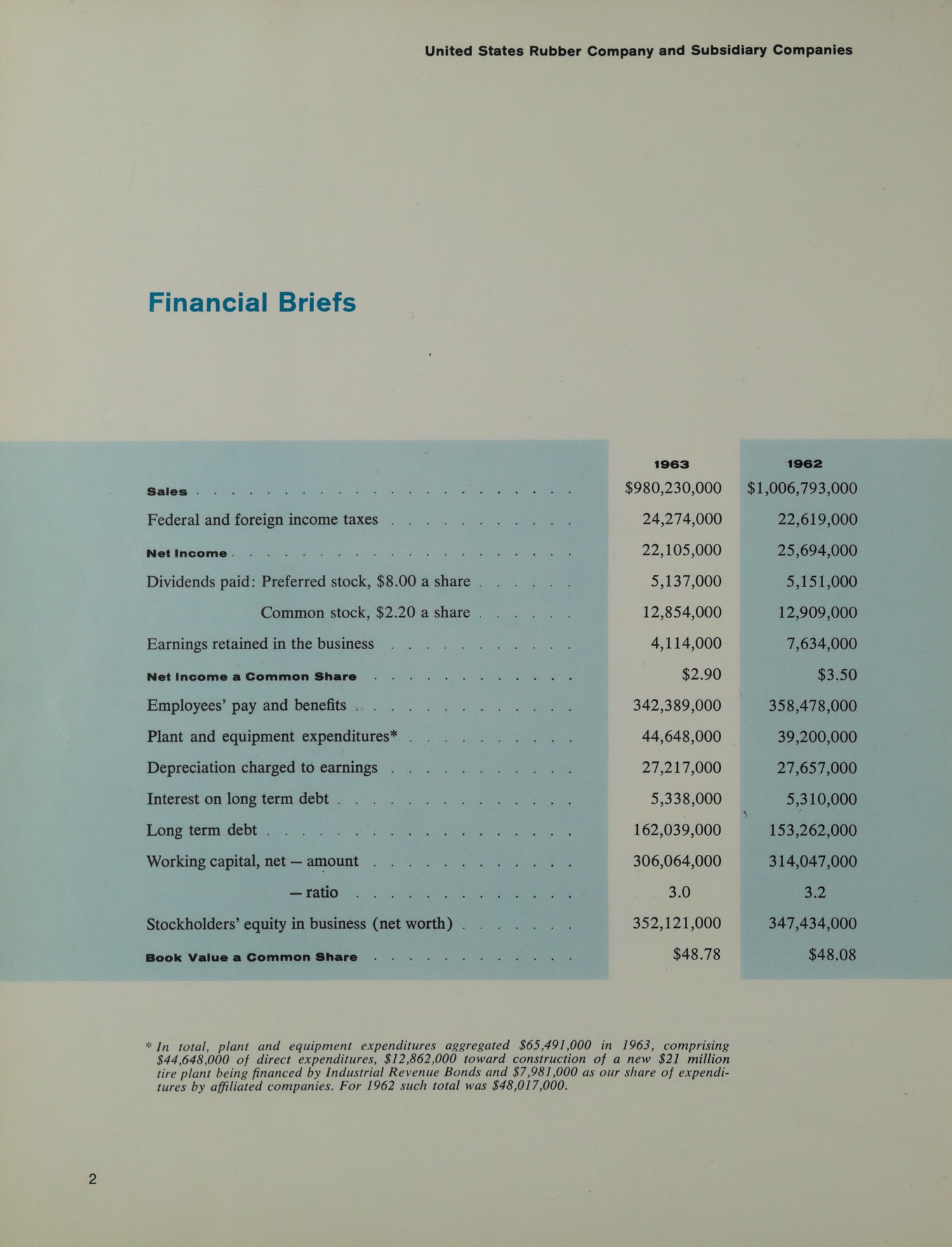
Year Net Per Cent Paid in Property, Plant &
Ended Sales Net of Sales Dividends Equipment
Dec. 31 Amount Common Retained Net Gross Provision for
1963 $ 980,230 $22,105 2.3 $17,991 $ 4,114 $306,064 $44,648 $27,217
1962 1,006,793 25,694 2.6 18,060 7,634 314,047 39,200 27,657
1961 940,399 27,096 2.9 17,860 9,236 311,495 39,795 25,711
1960 966,833 30,737 3.2 17,838 12,899 318,281 27,064 24,246
1959 , 976,766 35,580 3.6 16,956 18,624 312,222 25,311 24,409
1958 870,616 22,671 2.6 16,669 6,002 295,744 39,603 24,706
1957 873,583 29,695 3.4 16,343 13,352 282,032 36,115 22,743
1956 901,260 31,870 3.5 16,025 15,845 285,788 36,042 21,831
1955 925,539 33,559 3.6 15,812 17,747 259,757 35,282 19,627
1954 781,574 27,959 3.6 15,812 12,147 232,447 31,689 17,649
1953 838,451 32,732 3.9 15,812 16,920 231,256 26,033 16,016
1952 850,152 28,170 3.3 15,793 12,377 206,236 26,262 14,364
1951 837,222 30,366 3.6 15,775 14,591 177,030 21,022 13,999
1950 695,756 24,658 3.5 14,013 10,645 167,911 15,230 13,402
1949 517,440 15,100 2.9 10,492 4,608 167,939 16,185 13,328
1948 572,025 20,142 3.5 12,252 7,890 172,062 18,358 13,750
1947 580,968 21,753 3.7 12,250 9,503 170,152 27,566 11,580
1946 494,753 23,208 4.7 12,244 10,964 118,484 24,647 8,022
1945 471,506 13,025 2.8 8,727 4,298 110,071 26,644 37,477
1944 443,077 15,833 3.6 8,727 7,106 93,733 25,384 9,724

† Includes provision for renegotiation.
$ A stock dividend of 2% also paid.

US Rubber Annual Report – 72nd Annual Report – Page 21

Page 021

United States Rubber Company and Subsidiary Companies

Accountants’ Opinion

HASKINS & SELLS
CERTIFIED PUBLIC ACCOUNTANTS
TWO BROADWAY
NEW YORK 4

February 12, 1964

United States Rubber Company:

We have examined the consolidated balance sheet of United States Rubber Company and its subsidiary companies as of December 31, 1963 and the related statement of consolidated income and retained earnings for the year then ended. Our examination was made in accordance with generally accepted auditing standards, and accordingly included such tests of the accounting records and such other auditing procedures as we considered necessary in the circumstances.

In our opinion, the accompanying consolidated balance sheet and statement of consolidated income and retained earnings present fairly the financial position of the companies at December 31, 1963 and the results of their operations for the year then ended, in conformity with generally accepted accounting principles applied on a basis consistent with that of the preceding year.

Haskins & Sells.

US Rubber Annual Report – 72nd Annual Report – Page 20

Page 020

Capital Surplus
The increase of $85,641 in Capital Surplus represents the
excess of market value over par value of 1,740 common
shares issued under employees’ stock options, $63,510; and
the excess of market value over cost of 10,409 common
shares issued from treasury for the acquisition of domestic
subsidiaries, $22,131.

Retirement Allowances
The Retirement Allowance Plan provides generally for
retirement allowances to eligible employees or former em-
ployees beginning at age 65, based upon compensation and
length of service, less applicable statutory benefits. Subject
to continuance during the period of certain labor agree-
ments, the Plan may be repealed or modified as to employ-
ees in active service, and the allowances to all retired
employees may be proportionately reduced.
The stockholders at the Annual Meeting on April 19,
1960 approved the funding of the Plan as from January 1,
1960 as it relates, generally, to domestic employees. The
funds are in the custody of Independent Trustees to whom
the Company pays amounts, computed by independent
actuaries, sufficient to provide for no less than minimum
funding.
For retired employees not covered by funding, the Com-
pany charges allowances paid to current costs and, in addi-
tion, maintains a Retirement Allowance Reserve equivalent
to allowances payable to presently retired employees over
the next five years after application of 1963 income tax
rates.
In 1963, the net cost of current service funding and
interest on past service for domestic employees covered by
funded plans aggregated $14,820,979. In addition, $752,640
was paid to retired employees not covered by funded plans,
and reserves applicable thereto were increased by $378,317.
These amounts, before reduction for income taxes, aggre-
gated $15,951,936 of which $14,751,936 was absorbed in
1963 cost of operations and $1,200,000 (representing a
portion of the 1963 funding cost related to past service

cost) was applied to the Reserve for Retirement Allow-
ances. The balance in this reserve was $9,172,186 at Decem-
ber 31, 1963, of which $7,177,401 related to funded plans.

Class B Bonus and Management Incentive Plans
Net Income for 1963 was insufficient to produce bonuses
under the Class B Bonus and Management Incentive Plans.
In 1962, a total of $145,204 was awarded under the Class B
Bonus Plan, and the same amount was awarded under the
Management Incentive Plan.

Stock Options
At December 31, 1962, options with respect to 69,526
shares of common stock were held by officers and other
key employees. The options generally are not exercisable
for 18 months after grant and expire at varying dates which
in no case exceed ten years from date of granting.
During 1963, options were exercised with respect to
1,740 shares, options expired for 4,692 shares, and options
were granted for 5,400 shares.
Options were outstanding at December 31, 1963 to pur-
chase 68,494 shares of common stock at prices ranging
from $41.50 to $60.875 a share.
At December 31, 1963, after providing for shares appli-
cable to outstanding options, there remained 203,239 shares
of common stock available for granting further options.
Of these remaining shares, options for 7,640 shares were
granted on January 8, 1964 at $45.625 per share.

Commitments and Contingencies
The Company is contingently liable as a guarantor for
$9,815,000 promissory notes issued by a domestic affiliated
company; and to purchase $1,763,000 of long term deben-
tures of a foreign affiliated company.
The Company is committed to expend $3,225,000 in
1964 for a minority interest in a foreign affiliated company.

US Rubber Annual Report – 72nd Annual Report – Page 19

Page 019

United States Rubber Company and Subsidiary Companies

Financial Notes

Principles of Consolidation – Foreign Activities
All subsidiary companies which are more than 50 per cent owned are included in the consolidated statements. Restricted earnings of foreign operations are excluded from net income and credited to the Reserve for Foreign Activities.
Fixed assets and long term liabilities of foreign subsidiaries are stated in United States dollars on the basis of rates of exchange prevailing at December 31, 1957 or at dates of acquisition for subsequent additions. All other foreign assets and liabilities are stated on the basis of rates of exchange prevailing at the close of the year. Cumulative gains resulting from the conversion of net current assets are carried in the Reserve for Foreign Activities; current losses are charged to such reserve, or, if no reserve is available, to consolidated income. Sales and earnings are stated at monthly average rates of exchange.
Net assets located outside the United States were $96,533,807 at the end of 1963.
The Reserve for Foreign Activities at December 31, 1963 consisted of $6,721,174 restricted earnings of foreign operations and $8,887,013 representing principally the excess of certain foreign subsidiaries’ net assets over cost thereof at dates of acquisition.
Deferred charges include $2,125,399 representing the excess of cost over net assets at dates of acquisition for certain subsidiaries.

Liberalized Depreciation and Investment Credit
For financial accounting purposes, depreciation of property, plant and equipment is provided on a straight line basis at rates presently considered adequate to amortize the total cost over the life of the assets.
For Federal income tax purposes, the Company uses the accelerated depreciation method and the liberalized depreciation “guideline” rates. The resultant reduction in current taxes payable, $5,248,000 in 1963 and $3,052,000 at the close of 1962, is included in Deferred Federal Income Taxes and Investment Credit on the balance sheet.
Similar to 1962, the Investment Credit made available under the Revenue Act of 1962, representing about 7 per cent of the cost of new machinery and equipment purchased for domestic operations, will reduce our 1963 Federal income tax payments by $1,062,000. The reduction in 1962 was $1,123,000. These credits will benefit income in future years through amortization over the expected useful life of the machinery and equipment. The unamortized balance of the Investment Credit is included in the amount of $10,207,482 in Deferred Federal Income Taxes and Investment Credit.

Warranties
Expenses and adjustments resulting from warranties on products manufactured and sold are charged to income as incurred.

Long Term Debt
The indentures relating to the 2⅝% debentures provide for redemption of $2,500,000 annually through 1966 and $3,000,000 annually for the issue due April 1, 1967, and for redemption of $2,000,000 each year until maturity for the issue due March 1, 1976.
The loan agreements relating to the 3⅜% promissory notes due January 1, 1982 require payments annually beginning July 1, 1968 equal to 5 per cent of the notes outstanding at that date; effective July 1, 1977, the rate is increased to 9 per cent. The 3⅜% notes due July 15, 1995 require payments annually beginning July 15, 1983 equal to 7⅞ per cent of the notes outstanding at that date.
The indentures and the loan agreements contain certain provisions prohibiting dividends (except stock dividends) and other distributions to stockholders unless stipulated requirements are met. Under the most restrictive covenants, the amount of consolidated retained earnings not restricted at December 31, 1963 was $102,952,358.
Long term debt of foreign subsidiaries includes $9,248,000 borrowed by U.S. Rubber Overseas, S.A., Geneva, Switzerland, providing for interest at 4½ per cent from October 31, 1963, and with annual maturities of $1,850,000 on October 31, 1974 to 1978; and $5,055,050 borrowed by U.S. Royal Lastik Turk, A.S. (Turkey), with interest at 7 per cent and repayment in 19 semi-annual installments in varying amounts beginning December 1, 1963.

US Rubber Annual Report – 72nd Annual Report – Page 18

Page 018

United States Rubber Company and Subsidiary Companies

Consolidated Income and Retained Earnings

                                            1963                1962

Net sales $980,229,858 $1,006,792,650
Other income, net 3,104,402 3,678,822
Total Revenue 983,334,260 1,010,471,472

Cost of goods sold 771,803,722 803,532,053
Selling, administrative and general expenses 157,215,827 149,069,079
Total costs and expenses (including depreciation
of $27,216,802 in 1963 and $27,657,250 in 1962)
929,019,549 952,601,132
54,314,711 57,870,340

Interest on long term debt 5,337,805 5,310,465

Profit Before Income Taxes and Other Charges 48,976,906 52,559,875

Federal and foreign income taxes, less $2,395,000 in 1962
representing taxes paid on depreciation charged to prior years’
operations but not deducted for tax purposes in those years
(see note on page 19) 24,274,394 22,618,743
Restricted foreign earnings and minority interests
1,425,979 1,955,018
Foreign exchange losses 1,171,947 2,291,714
26,872,320 26,865,475

Net Income 22,104,586 25,694,400

Retained Earnings at beginning of year 226,816,682 219,182,691
248,921,268 244,877,091

Cash dividends – Preferred stock $8.00 a share 5,136,728 5,150,728
– Common stock $2.20 a share 12,853,870 12,909,681
17,990,598 18,060,409

Retained Earnings at end of year $230,930,670 $ 226,816,682

See Financial Notes on pages 19 and 20.
18

US Rubber Annual Report – 72nd Annual Report – Page 17

Page 017

United States Rubber Company and Subsidiary Companies

Liabilities
December 31
1963 1962
Current Liabilities
Accounts payable . . . . . . . . . . . . . . . . $ 66,997,403 $ 55,670,807
Foreign bank loans . . . . . . . . . . . . . . . 19,674,268 17,992,000
Current maturities of long term debt . . . . . . . 4,762,753 2,332,000
Accrued Federal income taxes . . . . . . . . . . . 11,920,634 12,536,580
Other accrued taxes, including foreign income taxes . 17,882,045 18,439,779
Other accrued liabilities . . . . . . . . . . . . . . 34,534,979 34,620,781
TOTAL CURRENT LIABILITIES . . . . . . . . . . 155,772,082 141,591,947
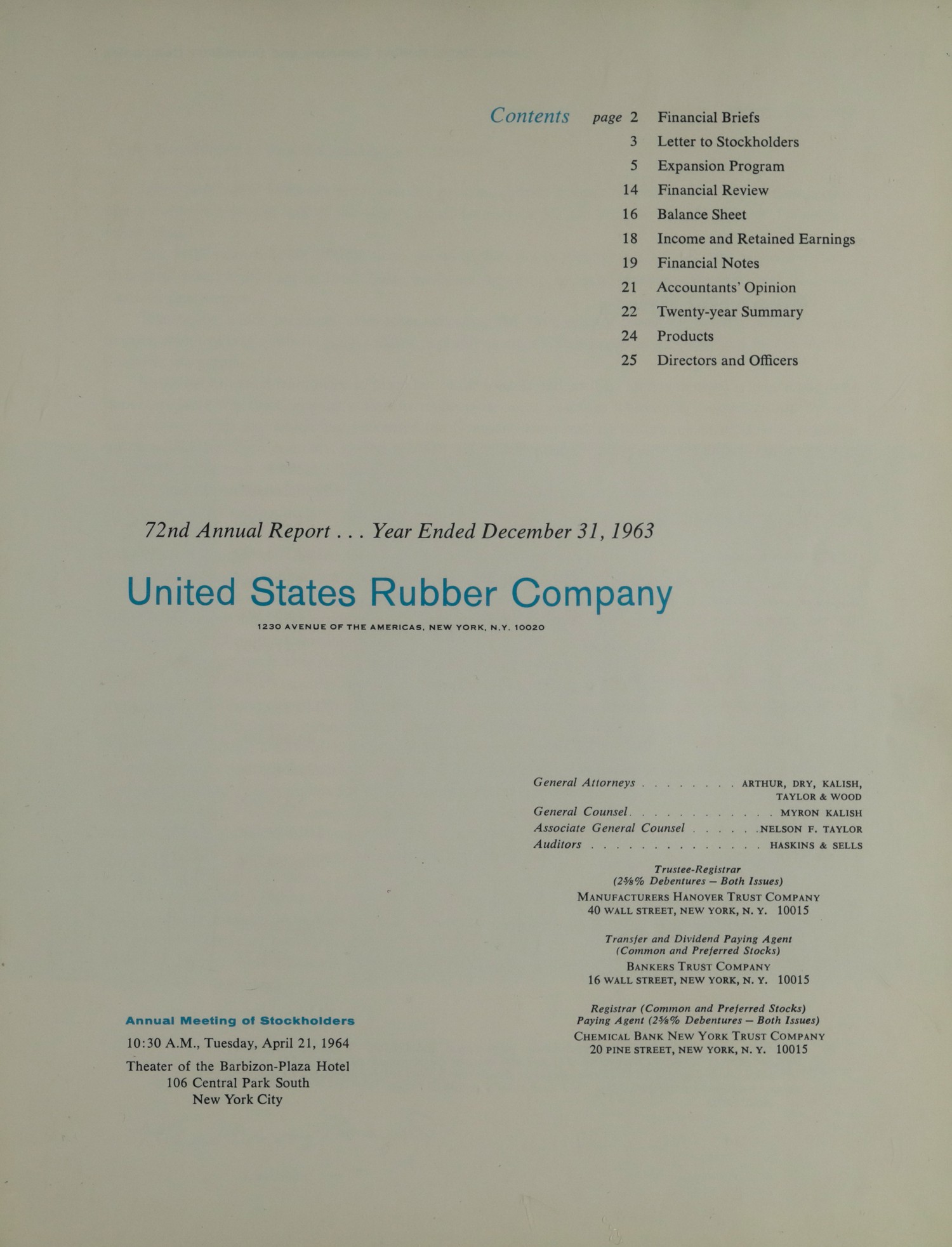
Long Term Debt
2½ % debentures due April 1, 1967 . . . . . . . . 8,000,000 10,500,000
2½ % debentures due May 1, 1976 . . . . . . . . . 21,436,000 24,215,000
3¾ % promissory notes due January 1, 1982 . . . . 50,000,000 50,000,000
3¾ % promissory notes due July 15, 1995 . . . . . 60,000,000 60,000,000
Foreign and domestic subsidiaries . . . . . . . . . 17,839,953 6,215,199
TOTAL LONG TERM DEBT . . . . . . . . . . . 157,275,953 150,930,199

Deferred Federal Income Taxes and Investment Credit . . . 10,207,482 4,174,528

Reserves
Foreign activities . . . . . . . . . . . . . . . . . 15,608,187 17,838,255
Retirement allowances . . . . . . . . . . . . . . 9,172,186 9,908,175
Insurance . . . . . . . . . . . . . . . . . . . . . 3,723,858 3,800,199
TOTAL RESERVES . . . . . . . . . . . . . . . 28,504,231 31,546,629

Minority Interests in Subsidiaries . . . . . . . . . . . . 11,718,766 11,506,355

Stockholders’ Equity
8% non-cumulative preferred stock, $100 par value:
Authorized and issued — 651,091 shares . . . . 65,109,100 65,109,100
Common stock, $5 par value:
Authorized — 10,000,000 shares
Issued — 5,900,844 shares 1963; 5,899,104 shares 1962 . 29,504,220 29,495,520
Capital surplus . . . . . . . . . . . . . . . . . . 30,358,441 30,272,800
Retained earnings . . . . . . . . . . . . . . . . . 230,930,670 226,816,682
355,902,431 351,694,102

Less: Treasury stock at cost
Preferred stock held for retirement — 9,000 shares 1,413,071 1,413,071
Common stock — 51,591 shares 1963;
62,000 shares 1962 . . . . . . . . . . . . . . . 2,368,705 2,846,614
3,781,776 4,259,685

TOTAL STOCKHOLDERS’ EQUITY . . . . . . . . 352,120,655 347,434,417

TOTAL . . . . . . . . . . . . . . . . . . . . . $715,599,169 $687,184,075

See Financial Notes on pages 19 and 20.

US Rubber Annual Report – 72nd Annual Report – Page 16

Page 016

Consolidated Balance Sheet

Assets
December 31
1963 1962

Current Assets
Cash $ 30,527,920 $ 35,085,343
Short term securities 12,159,809 6,585,225
TOTAL CASH AND SHORT TERM SECURITIES 42,687,729 41,670,568

Accounts and notes receivable, less allowance for doubtful
accounts: $4,503,733 for 1963, $3,930,605 for 1962 175,970,335 170,229,672

Inventories, at lower of average cost or market:
Finished goods 151,825,613 159,531,717
Goods in process of manufacture 23,492,269 23,441,831
Raw materials and supplies 67,860,055 60,765,627
TOTAL INVENTORIES 243,177,937 243,739,175
TOTAL CURRENT ASSETS 461,836,001 455,639,415

Investments In Affiliated Companies, etc. 21,781,729 16,934,821

Property, Plant and Equipment
Land and improvements 9,958,770 9,091,628
Plant and equipment 606,499,551 576,718,982
616,458,321 585,810,610
Less accumulated depreciation 397,597,154 381,770,749
NET PROPERTY, PLANT AND EQUIPMENT 218,861,167 204,039,861

Deferred Charges 13,120,272 10,569,978

TOTAL $715,599,169 $687,184,075

See Financial Notes on pages 19 and 20.
16

US Rubber Annual Report – 72nd Annual Report – Page 15

Page 015

United States Rubber Company and Subsidiary Companies

During 1963, the book value of the net assets of our Indonesian plantations was restated to reflect the lower foreign exchange value of the Indonesian rupiah. Such restatement had no effect on 1963 consolidated net income, since the decrease in net assets of $4,077,000 was charged to the Reserve for Foreign Activities, created from prior years’ earnings of the Indonesian plantations.

Net Income and Dividends
Net income of United States Rubber Company and subsidiaries was $22,105,000 for the year 1963, equivalent to $2.90 a common share. This compares with 1962 earnings of $25,694,000, or $3.50 a common share.
As previously indicated, earnings for the year 1963 were adversely affected by the loss of sales and abnormal absorption of maintenance and other costs during the periods certain of our manufacturing facilities were shut down because of strikes.
Preferred stockholders received regular quarterly dividends of $2.00 a share, for a total of $8.00 for the year.
Quarterly dividends of 55 cents a share, or a total of $2.20 for the year, were paid on the common shares in 1963. The same amount was paid in 1962.

Investments
Investments at December 31, 1963 amounted to $21,782,000, comprising $16,677,000 in affiliated companies, in which we own 50 per cent or less of outstanding shares, and $5,105,000 of miscellaneous investments, principally notes receivable from customers due after one year.
During 1963, we made additional investments of $4,400,000 in foreign affiliated companies for the manufacture of tires, plastics and chemicals for the Japanese, Australian and South American markets. Our equity in the net assets of affiliated companies (owned 50 per cent or less) was $25,550,000 at December 31, 1963, compared to $21,620,000 at the close of the preceding year.

Long Term Debt
Long term debt at December 31, 1963 was $157,276,000, comprising $139,436,000 for the parent company and $17,840,000 for foreign and domestic subsidiaries.
Long term debt increased by $6,346,000 during the year, comprising additional foreign borrowings of $11,625,000, less a decrease of $5,279,000 in parent company debt.
During 1963, we purchased and delivered to the Trustee for retirement $2,779,000 face value of our 25% debentures due in 1976. These purchases, together with $3,785,000 debentures held by the Trustees at January 1, 1963, satisfy 1963, 1964 and 1965 sinking fund requirements in full and leave $564,000 as an advance payment against the $2,000,000 due May 1, 1966.
At December 31, 1962, the Trustee held $168,000 of our 25% debentures due in 1967; and we purchased $2,334,000 in 1963. $2,500,000 was required to satisfy our April 1, 1963 sinking fund requirement, leaving $2,000 held by the Trustee.

Property, Plant and Equipment
At December 31, 1963, gross property was $616,458,000 of which $462,087,000 was in the United States; $65,869,000 in Canada, Central and South America; and $88,502,000 in other offshore locations.
The net book value at the close of the year was $218,861,000.
In 1963, a total of $65,491,000 was expended on property, plant and equipment. This total comprised direct expenditures of $44,648,000 for additions and improvements to properties owned by United States Rubber Company and subsidiaries; $12,862,000 towards construction of a new $21 million tire plant being financed with Industrial Revenue Bonds issued by the City of Opelika, Alabama and $7,981,000 expended as our share of capital requirements to increase the manufacturing facilities of domestic and foreign affiliated companies.
The total of all these expenditures is encompassed in the Capital Expansion Program of $300 million commented on pages 5 through 13 of this report.
For 1963, depreciation and obsolescence charged to parent and subsidiary companies’ operations aggregated $27,217,000, compared with $27,657,000 in 1962.

(Additional financial comments are offered on pages 19 and 20 of this report.)