The Flagship – Page 8

Page 008

8 • The Flagship • Winter 1998

Training News

The Chinese have a saying that, “nothing in life worthwhile, comes without instruction.” The past few months have given us ample opportunity to check out this theory. We have been audited by the Department of Transportation, had the phone system changed, been introduced to the wonderful world of SAP, and have even implemented a new Safety Program called BST. We have had our capabilities tested, as in “starting up” after a complete power outage, and we have been applauded for our consistent quality. (See the article concerning “Union Carbide” in this issue). It seems like everything is a test, if that is so; then I would say, “we’ve passed.”

The training center has expanded over these months to include a six-station computer center. The SAP implementation team has used it extensively and many of you have had training on cc: Mail, Windows

95, and the SAP/R3 basic course. The center is there to support the introduction of about 40 computers located throughout the Plant that are networked through Corporate. This is all part of the worldwide corporate networking effort and the reason SAP is being implemented. There is significant instruction going on concerning this effort, but as I mentioned earlier it will be worthwhile. Our lives will be a lot easier as a result.

I mentioned that we received a surprise audit by the Department of Transportation. Congratulations to Pat Jamieson and anyone in the Shipping and Receiving Departments. We answered the mail on this one and responded like the well-trained workforce we are.

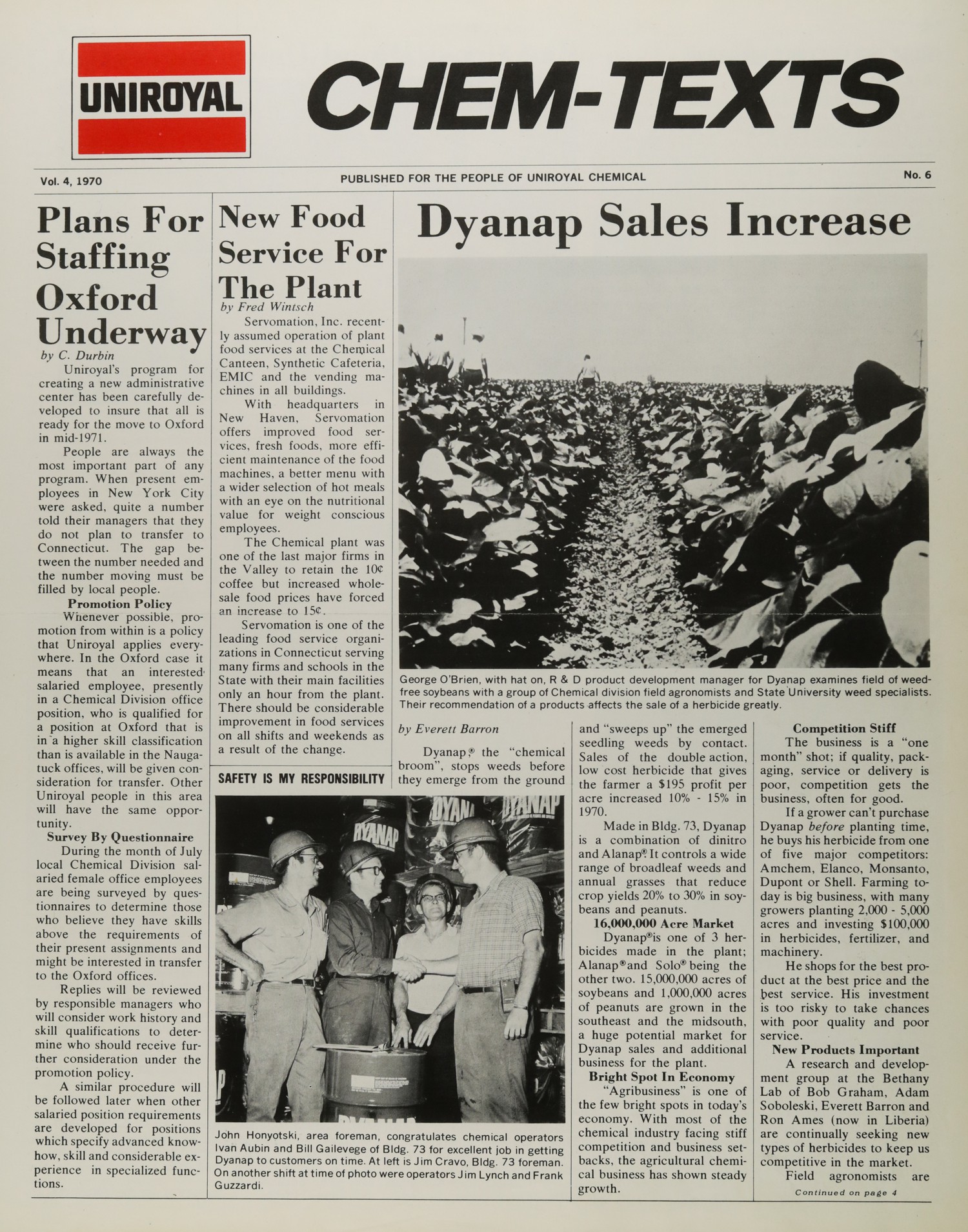
There is a lot of effort going on right now by the Employee Involvement Committee. They are overseeing a Progress Improvement Team (PIT) on

Chemical Operation Training. The idea is to formalize and write out the training needs of our chemical operators. The knowledge that our senior operators have must be captured and passed down to our new operators if we are to continue the successes we have enjoyed in the past. Our commitment to quality demands nothing less from us.

This may have nothing to do with training but, speaking of quality, congratulations to Mark Labrecque and Karla Phair. Mark is the new Vice President of Local 218 and Karla is the new Secretary/Treasurer. These two outstanding associates will be a welcome help to Dan Cleary, especially during the implementation of BST. Both of these individuals are also on the BST Training Committee with Dan. Let’s give both of them our continuing support.

Getting back to training, some of the associates in the Physical

Testing Lab are participating in weekly sessions in the center. Our neighbors from112 are taking the Lab Technician Course as a refresher training. Eventually everyone in the lab will finish the eight sessions and hopefully suggest improvement. This is the same type of ongoing improvement process that the PIT team on Chemical Operator Training is doing. As we move forward through the first quarter of 1998, let’s remember to commit ourselves to fulfilling our obligatory training needs. Where the system needs improving, lets improve it, like the PIT Team and the associates in 112. Where the system needs changing, lets change it, as in learning to make the SAP implementation work.

Work Safe; Take care of each other out there.

Peter Haines,
Training Manager


If you wish to receive future mailings of this Newsletter, please respond to:
Mary Damon, Bldg. 84, Uniroyal Chemical Company, Inc., 280 Elm Street, Naugatuck, CT 06770
by April 1, 1998. Please respond by mail only!!


The FLAGSHIP

UNIROYAL CHEMICAL

The Flagship is brought to you by:

Editors: Norma Solberg
Mary Damon
Laurie Zitzmann
Pete Haines

Printed by: Waterbury Printing & Engraving, L.L.C.


Responsible Care®
A Public Commitment
ChemWorld – Page 8

Page 008

CHEMWORLD

WINTER/SPRING 1995


BRIEFS

WACA Recognizes Uniroyal Chemical Associate for Outstanding Service

Roy Parker of Uniroyal Chemical has recently been honored by the Western Agricultural Chemicals Association for outstanding service to the organization and industry.

Parker, product development representative, was named the WACA Outstanding Member for 1994. He was presented with the award at WACA’s 65th Annual Meeting in October, 1994 and is the sixteenth person to receive the award since 1979.

“We’re thrilled to have someone like Roy active in the association,” said Steve Forsberg, WACA executive director. “He took the Legislative Action Program and put his heart and soul into it. It’s one of the most effective grassroots programs in the country. It’s an award well-deserved—Roy is an asset to the entire industry.”

In addition to the Legislative Action Program, Parker has been active on the California State Action Committee and the Government Affairs Committee.

WACA represents manufacturers, formulators, distributors and retailers of pest management products and services in nine Western states. The association’s objective is to promote a positive business climate and industry goodwill. WACA has approximately 200 member companies with 1,000 active participants. ■


CHEMWORLD

is published twice a year by Uniroyal Chemical Company, Inc. for its associates and retirees.

Robert J. Petrausch
Director, Communications

Maureen C. Fama
Manager, Communications Programs

Uniroyal Chemical Company, Inc.
World Headquarters
Benson Road
Middlebury, CT 06749
(203) 573-2000

UNIROYAL CHEMICAL [Logo]


Uniroyal Chemical Corporation Announces Filing of Initial Public Offering

Uniroyal Chemical Corporation, the parent company of Uniroyal Chemical Company, Inc., announced on December 16, 1994 that it has filed with the Securities and Exchange Commission a Registration Statement relating to a proposed $200 million initial public offering of its common stock. Smith Barney Inc., Morgan Stanley & Co. Incorporated, and Wertheim Schroder & Co.

Incorporated will be the representatives of the underwriting syndicate for the offering. The Company intends to use the anticipated proceeds to the Company and up to an additional $40 million to retire indebtedness.

Subject to market conditions and other factors, the Company anticipates that the proposed offering could occur in the first calendar quarter of 1995. There can be no assurance that such favorable

market conditions will exist in the first quarter of 1995.

A Registration Statement relating to the proposed offering of the new common stock has been filed with the Securities and Exchange Commission but has not yet become effective. None of the new common stock may be sold, nor may offers to buy the new common stock be accepted, prior to the time the Registration Statement becomes effective. ■


Logistics Strives for Continuous Customer Satisfaction

(continued from page 2)

warehouse performance helps to ensure that specific goals for on-time shipments, customer pickup turn around time, and inventory accuracy are met.

HAZMAT AND WAREHOUSE OPERATIONS MANAGER
• Henry R. DeVries

■ PACKAGING

The packaging function is responsible for developing quality packages and labels, which must maintain product integrity, and exceed customer, business and Responsible Care® requirements. They must also be disposable, recyclable or source-reduced to ensure regulatory compliance. This includes establishing and maintaining a global package code system for easier tracking and identification purposes.

In 1994, primarily through the efforts of the company’s Packaging Excellence team, total package landfill elimination amounted to over 5.1 million pounds, with a cost savings to Uniroyal Chemical of almost $1.3 million. Active programs emphasizing customer partnerships are continually being pursued and improved upon.

PACKAGING PROGRAM MANAGER
• Morris L. Beaver

■ TRANSPORTATION

Transportation’s goal is to maintain an efficient, responsible global trans-

portation system which provides safe, on-time delivery in a way that protects people and the environment while observing all rules and regulations with total commitment to Responsible Care guidelines.

Managing a timely, accurate freight payment system through continuous audit and maximizing duty drawback, duty suspension processes and tariff reductions to help minimize costs are part of this area.

GENERAL TRAFFIC MANAGER
• Ralph E. Buonocore

■ FORECASTING

Forecasting provides reliable demand forecasts to be utilized to ensure proper inventory and support business planning. This includes monitoring the accuracy of the product forecast by business on a monthly basis, as well as providing one total forecast for Uniroyal Chemical on a global basis.

PLANNING SUPERVISOR
• Michael J. Rosa


Within Uniroyal Chemical, the Logistics Department has been a major contributor to the company’s “Committed to Excellence” programs. Logistics associates now chair the Chemicals and Polymers and Specialties Packaging, Domestic On-Time, Export On-Time, and Crop Documentation Excellence Teams, and serve on many other Excellence Committees. Logistics associates are also very involved in “Where Do I Fit In Quality?”, and have been recognized numerous times through the

company’s Total Quality Recognition Program. Department associates have also received seven Total Quality “Gold Coin” awards and five “President’s Awards” for their outstanding efforts.

The Logistics Department continues to meet multiple Uniroyal Chemical corporate goals in its daily actions: “Total Associate Involvement,” “Supplier of Choice,” “Low Cost Producer of Products and Services,” and “Zero Damage to People and the Environment.” The department is heavily involved in developing and implementing the Distribution Code of Management Practices (Bill Mischou, code leader) as part of the Responsible Care program initiated by the Chemical Manufacturers Association (CMA). The company is expected to have this code in place by November 1995.

And what sort of challenges will Logistics face in the future?

According to Mischou, there are three key areas which will expand the complexities associated with handling and distributing products worldwide: an increase in regulatory compliance; environmental issues (protection of people and the environment); and ever-increasing customer expectations.

“The area of customer expectations will present the biggest challenge. Customer needs are constantly changing, and they will be looking for a supplier who is flexible enough to change along with them, but who also can help contribute to their growing success. I’m confident that we’ll do whatever it takes to be that supplier — and do it without skipping a beat,” he concluded. ■

ChemWorld – Page 4

Page 004

CHEMWORLD

WINTER/SPRING 1995


Annual Total Quality Recognition Awards Celebrated

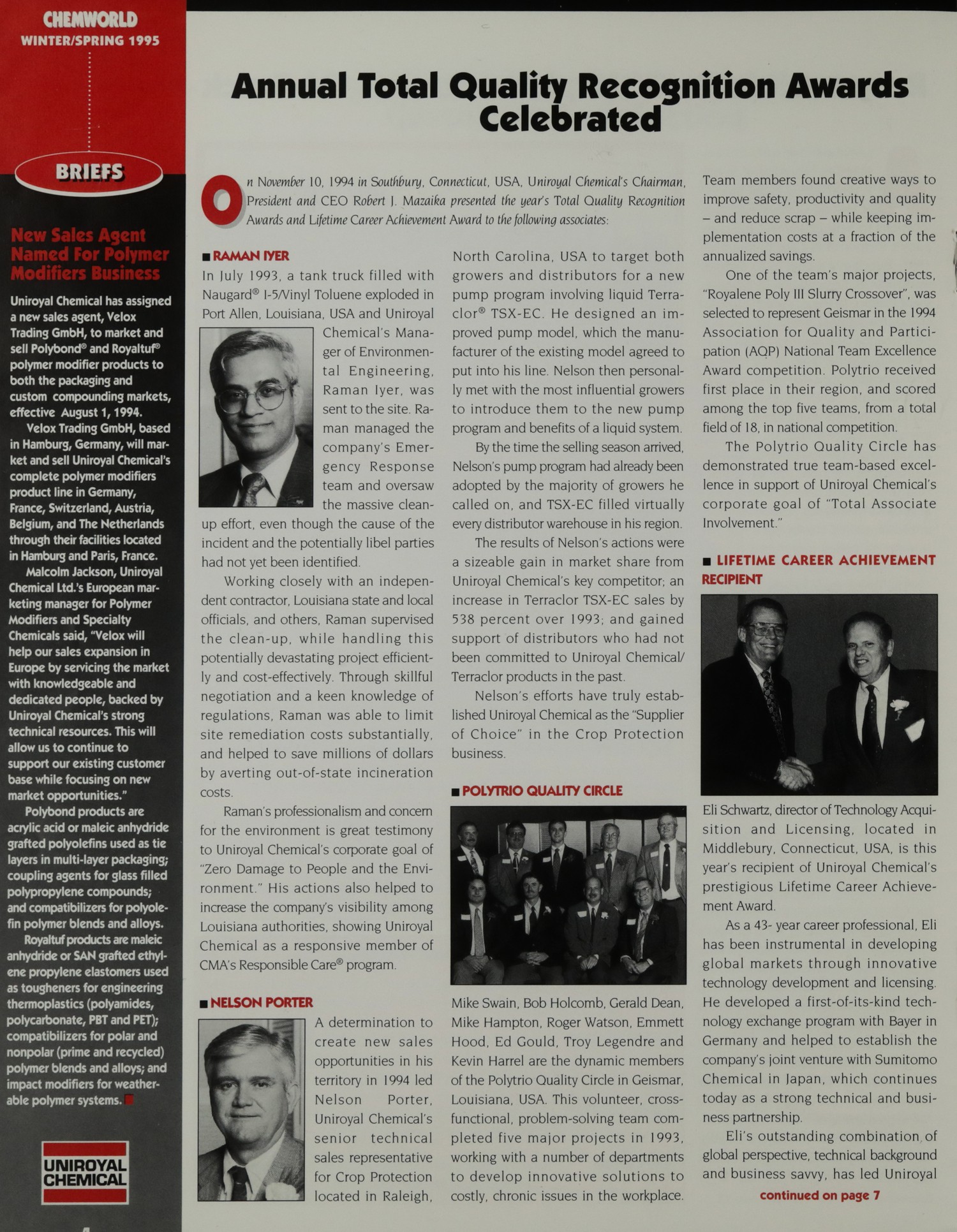
On November 10, 1994 in Southbury, Connecticut, USA, Uniroyal Chemical’s Chairman, President and CEO Robert J. Mazaika presented the year’s Total Quality Recognition Awards and Lifetime Career Achievement Award to the following associates:


BRIEFS

New Sales Agent Named For Polymer Modifiers Business

Uniroyal Chemical has assigned a new sales agent, Velox Trading GmbH, to market and sell Polybond® and Royaltuf® polymer modifier products to both the packaging and custom compounding markets, effective August 1, 1994.

Velox Trading GmbH, based in Hamburg, Germany, will market and sell Uniroyal Chemical’s complete polymer modifiers product line in Germany, France, Switzerland, Austria, Belgium, and The Netherlands through their facilities located in Hamburg and Paris, France.

Malcolm Jackson, Uniroyal Chemical Ltd.’s European marketing manager for Polymer Modifiers and Specialty Chemicals said, “Velox will help our sales expansion in Europe by servicing the market with knowledgeable and dedicated people, backed by Uniroyal Chemical’s strong technical resources. This will allow us to continue to support our existing customer base while focusing on new market opportunities.”

Polybond products are acrylic acid or maleic anhydride grafted polyolefins used as tie layers in multi-layer packaging; coupling agents for glass filled polypropylene compounds; and compatibilizers for polyolefin polymer blends and alloys.

Royaltuf products are maleic anhydride or SAN grafted ethylene propylene elastomers used as tougheners for engineering thermoplastics (polyamides, polycarbonate, PBT and PET); compatibilizers for polar and nonpolar (prime and recycled) polymer blends and alloys; and impact modifiers for weatherable polymer systems. ■


UNIROYAL CHEMICAL


■ RAMAN IYER

In July 1993, a tank truck filled with Naugard® I-5/Vinyl Toluene exploded in Port Allen, Louisiana, USA and Uniroyal Chemical’s Manager of Environmental Engineering, Raman Iyer, was sent to the site. Raman managed the company’s Emergency Response team and oversaw the massive cleanup effort, even though the cause of the incident and the potentially libel parties had not yet been identified.

Working closely with an independent contractor, Louisiana state and local officials, and others, Raman supervised the clean-up, while handling this potentially devastating project efficiently and cost-effectively. Through skillful negotiation and a keen knowledge of regulations, Raman was able to limit site remediation costs substantially, and helped to save millions of dollars by averting out-of-state incineration costs.

Raman’s professionalism and concern for the environment is great testimony to Uniroyal Chemical’s corporate goal of “Zero Damage to People and the Environment.” His actions also helped to increase the company’s visibility among Louisiana authorities, showing Uniroyal Chemical as a responsive member of CMA’s Responsible Care® program.


■ NELSON PORTER

A determination to create new sales opportunities in his territory in 1994 led Nelson Porter, Uniroyal Chemical’s senior technical sales representative for Crop Protection located in Raleigh, North Carolina, USA to target both growers and distributors for a new pump program involving liquid Terraclor® TSX-EC. He designed an improved pump model, which the manufacturer of the existing model agreed to put into his line. Nelson then personally met with the most influential growers to introduce them to the new pump program and benefits of a liquid system.

By the time the selling season arrived, Nelson’s pump program had already been adopted by the majority of growers he called on, and TSX-EC filled virtually every distributor warehouse in his region.

The results of Nelson’s actions were a sizeable gain in market share from Uniroyal Chemical’s key competitor; an increase in Terraclor TSX-EC sales by 538 percent over 1993; and gained support of distributors who had not been committed to Uniroyal Chemical/ Terraclor products in the past.

Nelson’s efforts have truly established Uniroyal Chemical as the “Supplier of Choice” in the Crop Protection business.


■ POLYTRIO QUALITY CIRCLE

Mike Swain, Bob Holcomb, Gerald Dean, Mike Hampton, Roger Watson, Emmett Hood, Ed Gould, Troy Legendre and Kevin Harrel are the dynamic members of the Polytrio Quality Circle in Geismar, Louisiana, USA. This volunteer, cross-functional, problem-solving team completed five major projects in 1993, working with a number of departments to develop innovative solutions to costly, chronic issues in the workplace.

Team members found creative ways to improve safety, productivity and quality – and reduce scrap – while keeping implementation costs at a fraction of the annualized savings.

One of the team’s major projects, “Royalene Poly III Slurry Crossover”, was selected to represent Geismar in the 1994 Association for Quality and Participation (AQP) National Team Excellence Award competition. Polytrio received first place in their region, and scored among the top five teams, from a total field of 18, in national competition.

The Polytrio Quality Circle has demonstrated true team-based excellence in support of Uniroyal Chemical’s corporate goal of “Total Associate Involvement.”


■ LIFETIME CAREER ACHIEVEMENT RECIPIENT

Eli Schwartz, director of Technology Acquisition and Licensing, located in Middlebury, Connecticut, USA, is this year’s recipient of Uniroyal Chemical’s prestigious Lifetime Career Achievement Award.

As a 43- year career professional, Eli has been instrumental in developing global markets through innovative technology development and licensing. He developed a first-of-its-kind technology exchange program with Bayer in Germany and helped to establish the company’s joint venture with Sumitomo Chemical in Japan, which continues today as a strong technical and business partnership.

Eli’s outstanding combination of global perspective, technical background and business savvy, has led Uniroyal

continued on page 7

ChemWorld – Page 7

Page 007

ChemWorld | 7 | January 1991


New Product Technologies And Global Expansion

continued from page 5

Q. New C&P sales are expected in the Soviet Union in 1991. What products and applications will this include?

A. For a number of years, we’ve been considered a preferred supplier to the U.S.S.R. The main product groups that we’ve moved into the U.S.S.R. have been rubber chemicals and urethane prepolymers. We will continue to grow this business in rubber chemicals, mostly used for tire manufacturing; and urethanes, used for solid tires and die-forming pads. The U.S.S.R. has expressed considerable interest in Royalene EPDM for several applications and our commercial and technical people are presently in dialogue with the Russians. The lack of hard currency has produced some constraint, but we are working a number of avenues to secure letters of credit and necessary funds to continue this very important base of business.

Q. Recently, the first worldwide C&P Sales Meeting was held in Lenox, Massachusetts. What was achieved from this meeting?

A. I believe that all 75 participants of this meeting left very much enriched with enhanced sales and technical skills, as well as more in-depth product knowledge. This was a very successful communication exercise, with a significant sharing of issues and opportunities. We have organized a steering committee to review and manage these issues and opportunities through individual assignments. In short, this first meeting has provided us with a new coordination of identified global accounts.

Q. Uniroyal Chemical places tremendous emphasis on partnerships with customers. What is the C&P Division currently doing to enhance its customer relationships and encourage more business from them?

A. The C&P Division interacts with our customer base on a broad front. Our sales and technical representatives are the key, first-line interface with the customer. Secondly, we have organized our customer service department with specific representatives who are in daily contact with customers. Through our Excellence Modeling process, we involve as many people as possible to interact effectively with customers. For example, our Adopt-A-Customer program has been very effective in solving


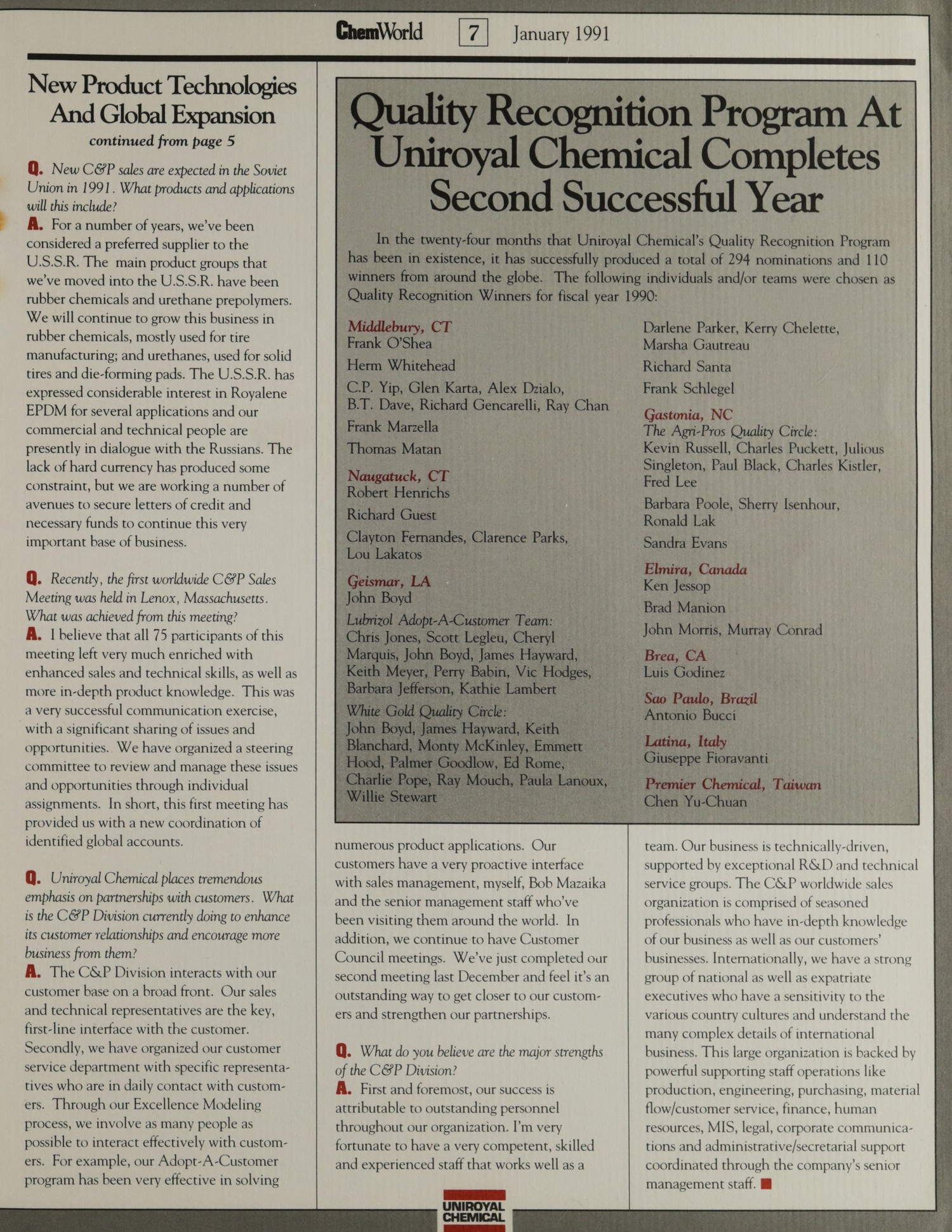
Quality Recognition Program At Uniroyal Chemical Completes Second Successful Year

In the twenty-four months that Uniroyal Chemical’s Quality Recognition Program has been in existence, it has successfully produced a total of 294 nominations and 110 winners from around the globe. The following individuals and/or teams were chosen as Quality Recognition Winners for fiscal year 1990:

Middlebury, CT
Frank O’Shea
Herm Whitehead
C.P. Yip, Glen Karta, Alex Dzialo,
B.T. Dave, Richard Gencarelli, Ray Chan
Frank Marzella
Thomas Matan

Naugatuck, CT
Robert Henrichs
Richard Guest
Clayton Fernandes, Clarence Parks,
Lou Lakatos

Geismar, LA
John Boyd

Lubrizol Adopt-A-Customer Team:
Chris Jones, Scott Legleu, Cheryl Marquis, John Boyd, James Hayward, Keith Meyer, Perry Babin, Vic Hodges, Barbara Jefferson, Kathie Lambert

White Gold Quality Circle:
John Boyd, James Hayward, Keith Blanchard, Monty McKinley, Emmett Hood, Palmer Goodlow, Ed Rome, Charlie Pope, Ray Mouch, Paula Lanoux, Willie Stewart

Darlene Parker, Kerry Chelette,
Marsha Gautreau
Richard Santa
Frank Schlegel

Gastonia, NC
The Agri-Pros Quality Circle:
Kevin Russell, Charles Puckett, Julious Singleton, Paul Black, Charles Kistler, Fred Lee
Barbara Poole, Sherry Isenhour,
Ronald Lak
Sandra Evans

Elmira, Canada
Ken Jessop
Brad Manion
John Morris, Murray Conrad

Brea, CA
Luis Godinez

Sao Paulo, Brazil
Antonio Bucci

Latina, Italy
Giuseppe Fioravanti

Premier Chemical, Taiwan
Chen Yu-Chuan

numerous product applications. Our customers have a very proactive interface with sales management, myself, Bob Mazaika and the senior management staff who’ve been visiting them around the world. In addition, we continue to have Customer Council meetings. We’ve just completed our second meeting last December and feel it’s an outstanding way to get closer to our customers and strengthen our partnerships.

Q. What do you believe are the major strengths of the C&P Division?

A. First and foremost, our success is attributable to outstanding personnel throughout our organization. I’m very fortunate to have a very competent, skilled and experienced staff that works well as a

team. Our business is technically-driven, supported by exceptional R&D and technical service groups. The C&P worldwide sales organization is comprised of seasoned professionals who have in-depth knowledge of our business as well as our customers’ businesses. Internationally, we have a strong group of national as well as expatriate executives who have a sensitivity to the various country cultures and understand the many complex details of international business. This large organization is backed by powerful supporting staff operations like production, engineering, purchasing, material flow/customer service, finance, human resources, MIS, legal, corporate communications and administrative/secretarial support coordinated through the company’s senior management staff. ■


UNIROYAL CHEMICAL

ChemWorld – Page 6

Page 006

ChemWorld | 6 | January 1991


Uniroyal Chemical Receives Two Supplier Quality Awards For Its Royalene EPDM Business

Uniroyal Chemical has received the 1989 Annual Supplier Quality Excellence Award from General Tire Company, on behalf of its Royalene® EPDM business.

This prestigious “quality excellence” award is based on a stringent rating system and performance evaluation developed by General Tire Company. Uniroyal Chemical, one of thirteen companies throughout the United States, Canada and Japan to receive this Award, qualified from a field of almost 300 raw material suppliers and distributors throughout the world.

According to William A. Stephenson, Uniroyal Chemical’s former Royalene EPDM business manager, “it is a great honor for us to be selected as a winner of General Tire’s Annual Supplier Quality Excellence Award. Our strong commitment to our customers has helped us work and grow in partnership with General Tire. We look forward to continuing this relationship in the years to come.”

The company’s Royalene EPDM business provides a high performance specialty elastomer used in the manufacture of tires to impart improved weathering and ozone protection.

General Tire is a subsidiary of Continental AG of West Germany, the fourth largest tire manufacturer in the world.

In addition, Uniroyal Chemical also received the 1990 Supplier “Mark of Distinction” Award from Schlegel Tennessee, Inc., on behalf of its Royalene EPDM products which Schlegel uses in automotive sealing applications.

Uniroyal Chemical is the first supplier to receive this award from Schlegel, given for continuous improvement in five critical areas: quality, technology, management, delivery and cost. The results were based on an internal audit conducted by Schlegel at Uniroyal Chemical’s Geismar, Louisiana facility where Royalene EPDM is produced.

Schlegel, headquartered in Detroit, Michigan, manufactures a broad range of products for the automotive industry on a


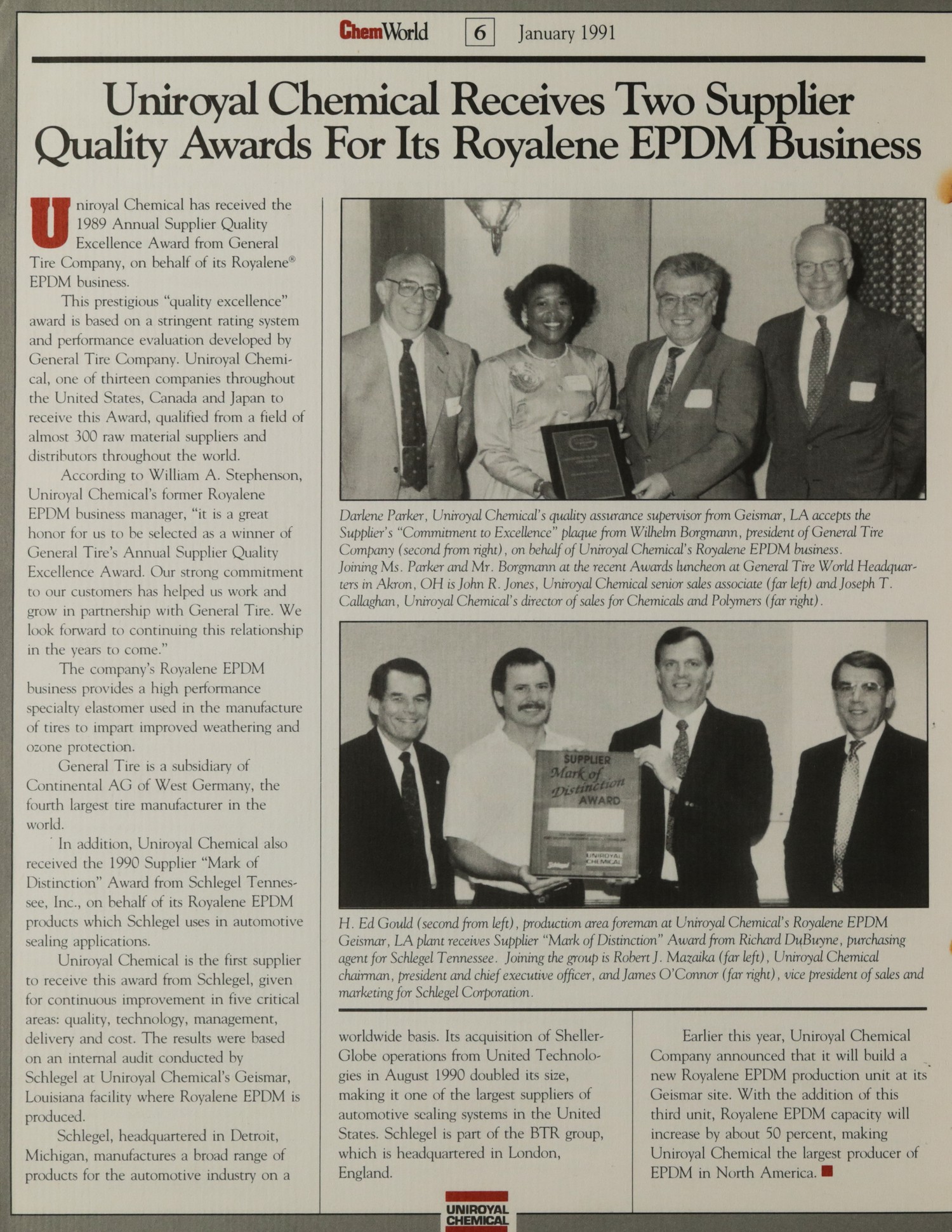
Darlene Parker, Uniroyal Chemical’s quality assurance supervisor from Geismar, LA accepts the Supplier’s “Commitment to Excellence” plaque from Wilhelm Borgmann, president of General Tire Company (second from right), on behalf of Uniroyal Chemical’s Royalene EPDM business. Joining Ms. Parker and Mr. Borgmann at the recent Awards luncheon at General Tire World Headquarters in Akron, OH is John R. Jones, Uniroyal Chemical senior sales associate (far left) and Joseph T. Callaghan, Uniroyal Chemical’s director of sales for Chemicals and Polymers (far right).


H. Ed Gould (second from left), production area foreman at Uniroyal Chemical’s Royalene EPDM Geismar, LA plant receives Supplier “Mark of Distinction” Award from Richard DuBuyne, purchasing agent for Schlegel Tennessee. Joining the group is Robert J. Mazaika (far left), Uniroyal Chemical chairman, president and chief executive officer, and James O’Connor (far right), vice president of sales and marketing for Schlegel Corporation.


worldwide basis. Its acquisition of Sheller-Globe operations from United Technologies in August 1990 doubled its size, making it one of the largest suppliers of automotive sealing systems in the United States. Schlegel is part of the BTR group, which is headquartered in London, England.

Earlier this year, Uniroyal Chemical Company announced that it will build a new Royalene EPDM production unit at its Geismar site. With the addition of this third unit, Royalene EPDM capacity will increase by about 50 percent, making Uniroyal Chemical the largest producer of EPDM in North America. ■


UNIROYAL CHEMICAL

ChemWorld – Page 5

Page 005

ChemWorld | 5 | January 1991


Uniroyal Chemical Names Annual Quality Award Winners and Career Achievement Recipient

During a formal awards ceremony that took place Wednesday, November 28, 1990 in Middlebury, Connecticut, Robert Henrichs and John Boyd were chosen as Annual Winners of the company’s 1990 Quality Recognition Program. Louis Coscia was named the recipient of the company’s lifetime Career Achievement Award.

Robert Henrichs, a maintenance mechanic in Naugatuck, Connecticut, was chosen as a quality winner during the first quarter fiscal year 1990 for his innovation in designing a cleaning bath for the Naugard® Q Rotoformer Drop Forming Sleeve, which substantially reduced cleaning time and resulted in greater productivity and cost savings for the company. Bob also devised a procedure to train other mechanics in the cleaning method.

Originally hired as a millwright mechanic, Bob has worked in the maintenance department and in various facets of production for the majority of his years with Uniroyal Chemical. Bob recently celebrated his 40th anniversary with the company.

As a process engineer at the Geismar, Louisiana facility, John Boyd was chosen as a three-time winner during the second quarter fiscal year 1990 for three separate contributions to the quality program: an individual effort that determined a solution to random process variation in Celogen® OT production; a member of an Adopt-A-Customer Team which helped lead to new BHT business from a major customer; and a member of the White Gold Quality Circle which helped to increase Celogen® OT product quality and productivity at minimum cost, and produced several safety improvements in the process.

John has been with Uniroyal Chemical for approximately two and a half years, and has recently been assigned area foreman responsibilities in the Celogen® AZ production unit.

As recipient of Uniroyal Chemical’s

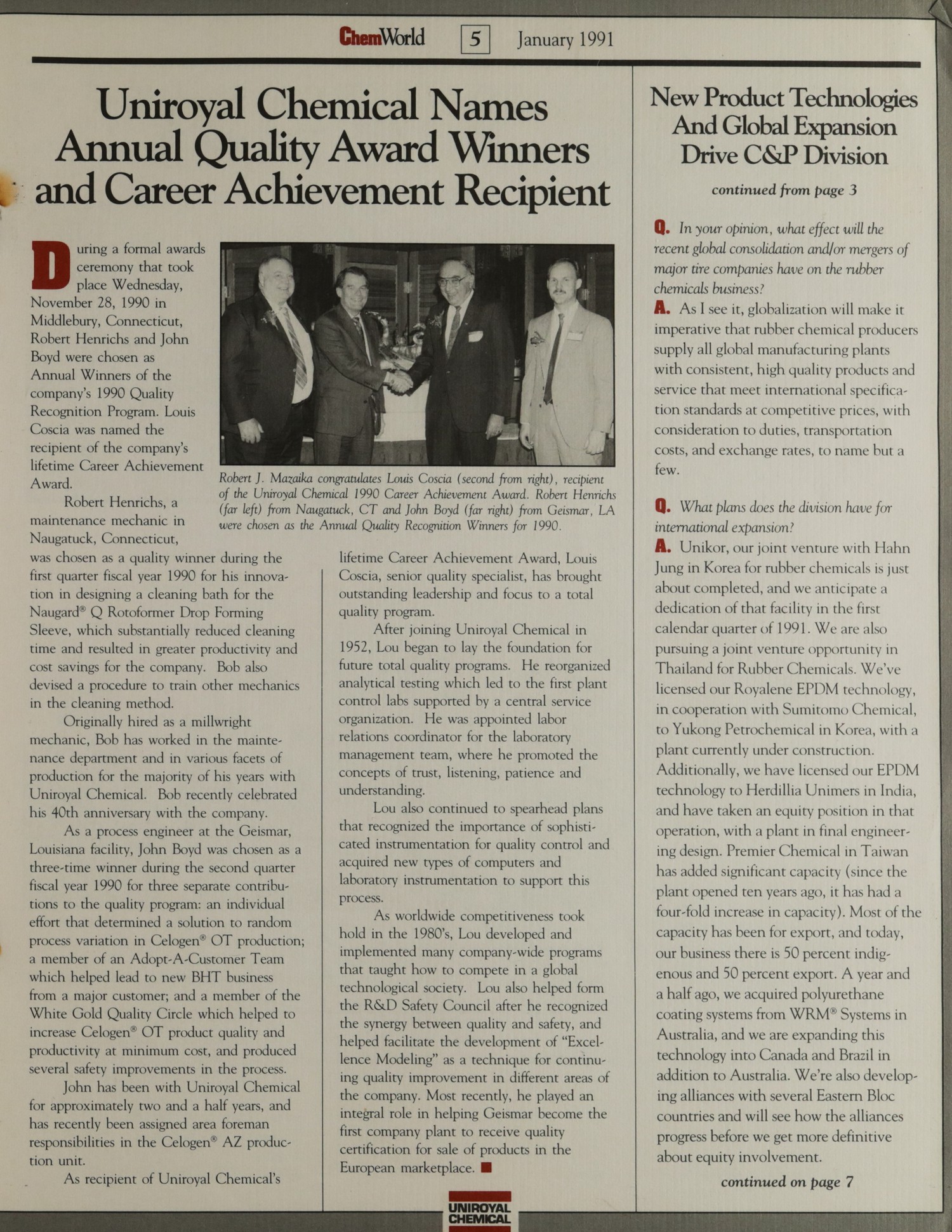
Robert J. Mazaika congratulates Louis Coscia (second from right), recipient of the Uniroyal Chemical 1990 Career Achievement Award. Robert Henrichs (far left) from Naugatuck, CT and John Boyd (far right) from Geismar, LA were chosen as the Annual Quality Recognition Winners for 1990.

lifetime Career Achievement Award, Louis Coscia, senior quality specialist, has brought outstanding leadership and focus to a total quality program.

After joining Uniroyal Chemical in 1952, Lou began to lay the foundation for future total quality programs. He reorganized analytical testing which led to the first plant control labs supported by a central service organization. He was appointed labor relations coordinator for the laboratory management team, where he promoted the concepts of trust, listening, patience and understanding.

Lou also continued to spearhead plans that recognized the importance of sophisticated instrumentation for quality control and acquired new types of computers and laboratory instrumentation to support this process.

As worldwide competitiveness took hold in the 1980’s, Lou developed and implemented many company-wide programs that taught how to compete in a global technological society. Lou also helped form the R&D Safety Council after he recognized the synergy between quality and safety, and helped facilitate the development of “Excellence Modeling” as a technique for continuing quality improvement in different areas of the company. Most recently, he played an integral role in helping Geismar become the first company plant to receive quality certification for sale of products in the European marketplace. ■


New Product Technologies And Global Expansion Drive C&P Division

continued from page 3

Q. In your opinion, what effect will the recent global consolidation and/or mergers of major tire companies have on the rubber chemicals business?

A. As I see it, globalization will make it imperative that rubber chemical producers supply all global manufacturing plants with consistent, high quality products and service that meet international specification standards at competitive prices, with consideration to duties, transportation costs, and exchange rates, to name but a few.

Q. What plans does the division have for international expansion?

A. Unikor, our joint venture with Hahn Jung in Korea for rubber chemicals is just about completed, and we anticipate a dedication of that facility in the first calendar quarter of 1991. We are also pursuing a joint venture opportunity in Thailand for Rubber Chemicals. We’ve licensed our Royalene EPDM technology, in cooperation with Sumitomo Chemical, to Yukong Petrochemical in Korea, with a plant currently under construction. Additionally, we have licensed our EPDM technology to Herdillia Unimers in India, and have taken an equity position in that operation, with a plant in final engineering design. Premier Chemical in Taiwan has added significant capacity (since the plant opened ten years ago, it has had a four-fold increase in capacity). Most of the capacity has been for export, and today, our business there is 50 percent indigenous and 50 percent export. A year and a half ago, we acquired polyurethane coating systems from WRM® Systems in Australia, and we are expanding this technology into Canada and Brazil in addition to Australia. We’re also developing alliances with several Eastern Bloc countries and will see how the alliances progress before we get more definitive about equity involvement.

continued on page 7


UNIROYAL CHEMICAL

ChemWorld – Page 3

Page 003

ChemWorld | 3 | January 1991

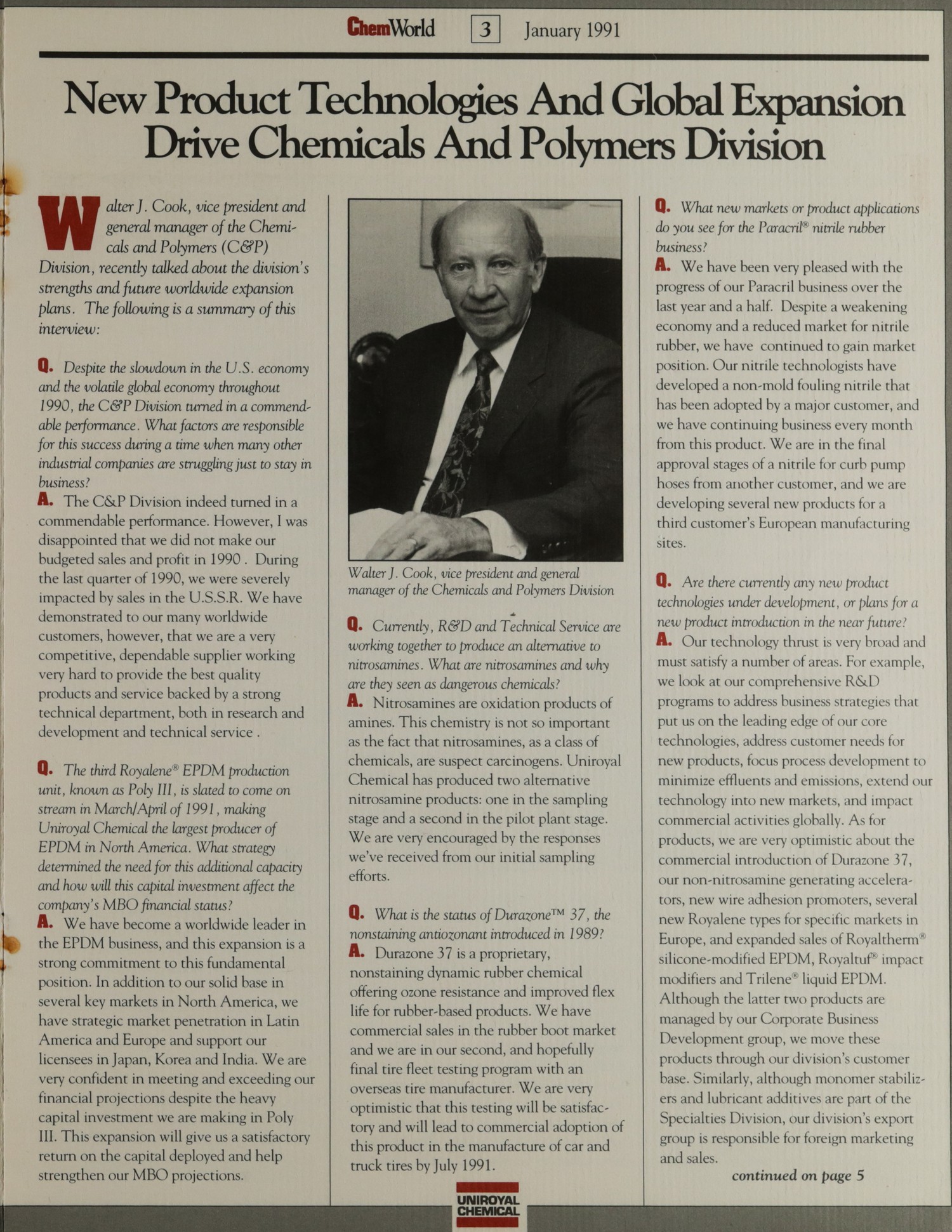
New Product Technologies And Global Expansion Drive Chemicals And Polymers Division

Walter J. Cook, vice president and general manager of the Chemicals and Polymers (C&P) Division, recently talked about the division’s strengths and future worldwide expansion plans. The following is a summary of this interview:

Q. Despite the slowdown in the U.S. economy and the volatile global economy throughout 1990, the C&P Division turned in a commendable performance. What factors are responsible for this success during a time when many other industrial companies are struggling just to stay in business?

A. The C&P Division indeed turned in a commendable performance. However, I was disappointed that we did not make our budgeted sales and profit in 1990. During the last quarter of 1990, we were severely impacted by sales in the U.S.S.R. We have demonstrated to our many worldwide customers, however, that we are a very competitive, dependable supplier working very hard to provide the best quality products and service backed by a strong technical department, both in research and development and technical service.

Q. The third Royalene® EPDM production unit, known as Poly III, is slated to come on stream in March/April of 1991, making Uniroyal Chemical the largest producer of EPDM in North America. What strategy determined the need for this additional capacity and how will this capital investment affect the company’s MBO financial status?

A. We have become a worldwide leader in the EPDM business, and this expansion is a strong commitment to this fundamental position. In addition to our solid base in several key markets in North America, we have strategic market penetration in Latin America and Europe and support our licensees in Japan, Korea and India. We are very confident in meeting and exceeding our financial projections despite the heavy capital investment we are making in Poly III. This expansion will give us a satisfactory return on the capital deployed and help strengthen our MBO projections.


Walter J. Cook, vice president and general manager of the Chemicals and Polymers Division


Q. Currently, R&D and Technical Service are working together to produce an alternative to nitrosamines. What are nitrosamines and why are they seen as dangerous chemicals?

A. Nitrosamines are oxidation products of amines. This chemistry is not so important as the fact that nitrosamines, as a class of chemicals, are suspect carcinogens. Uniroyal Chemical has produced two alternative nitrosamine products: one in the sampling stage and a second in the pilot plant stage. We are very encouraged by the responses we’ve received from our initial sampling efforts.

Q. What is the status of Durazone™ 37, the nonstaining antiozonant introduced in 1989?

A. Durazone 37 is a proprietary, nonstaining dynamic rubber chemical offering ozone resistance and improved flex life for rubber-based products. We have commercial sales in the rubber boot market and we are in our second, and hopefully final tire fleet testing program with an overseas tire manufacturer. We are very optimistic that this testing will be satisfactory and will lead to commercial adoption of this product in the manufacture of car and truck tires by July 1991.


Q. What new markets or product applications do you see for the Paracril® nitrile rubber business?

A. We have been very pleased with the progress of our Paracril business over the last year and a half. Despite a weakening economy and a reduced market for nitrile rubber, we have continued to gain market position. Our nitrile technologists have developed a non-mold fouling nitrile that has been adopted by a major customer, and we have continuing business every month from this product. We are in the final approval stages of a nitrile for curb pump hoses from another customer, and we are developing several new products for a third customer’s European manufacturing sites.

Q. Are there currently any new product technologies under development, or plans for a new product introduction in the near future?

A. Our technology thrust is very broad and must satisfy a number of areas. For example, we look at our comprehensive R&D programs to address business strategies that put us on the leading edge of our core technologies, address customer needs for new products, focus process development to minimize effluents and emissions, extend our technology into new markets, and impact commercial activities globally. As for products, we are very optimistic about the commercial introduction of Durazone 37, our non-nitrosamine generating accelerators, new wire adhesion promoters, several new Royalene types for specific markets in Europe, and expanded sales of Royaltherm® silicone-modified EPDM, Royaltuf® impact modifiers and Trilene® liquid EPDM. Although the latter two products are managed by our Corporate Business Development group, we move these products through our division’s customer base. Similarly, although monomer stabilizers and lubricant additives are part of the Specialties Division, our division’s export group is responsible for foreign marketing and sales.

continued on page 5


UNIROYAL CHEMICAL

ChemWorld – Page 6

Page 006

ChemWorld | 6 | January 1990


Rubber Chemicals Introduces New Nonstaining Antiozonant

In October 1989, Uniroyal Chemical’s Rubber Chemicals Division announced that it developed a new rubber chemical which represents a milestone in leading edge technology for the rubber industry.

Durazone™ 37 is unique because it offers excellent nonstaining static and dynamic ozone resistance, improved flex life and serves as an excellent antioxidant for natural and synthetic rubber. This outstanding resistance to ozone without staining has never before been attainable with an antiozonant.

According to Dr. Joseph B. Eisenberg, Uniroyal Chemical’s former Rubber Chemicals business manager, “Durazone™ 37 represents a major break-

through for the rubber chemicals industry. As a nonstaining antiozonant, its key benefits will permit our customers and the rub-

ber industry to achieve a higher level of product quality, and solve a significant problem at the same time. We are confident that Durazone™ 37 will not only provide the tire industry with a technological advantage, but will also prove successful in other market (rubber) applications as well.”

The primary application of Durazone™ 37 is in tire sidewalls and is also recommended for use in almost any rubber product where nonstaining static and dynamic ozone and aging protection are required. It is especially effective in natural rubber, and in blends of NR with olefin-based rubbers such as Uniroyal Chemical’s line of Royalene® EPDM polymers, and Trilene® liquid EPDM polymers. ■


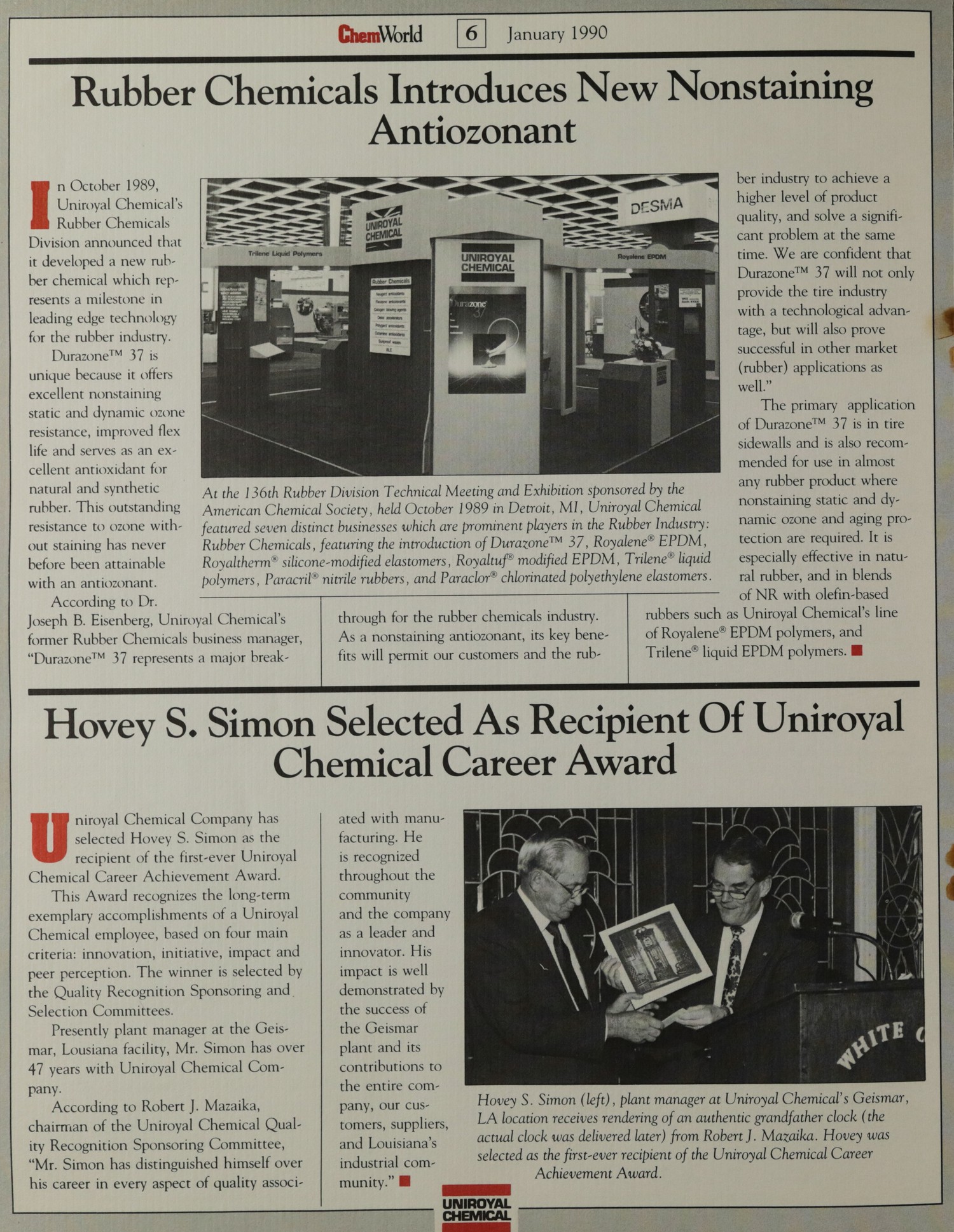
At the 136th Rubber Division Technical Meeting and Exhibition sponsored by the American Chemical Society, held October 1989 in Detroit, MI, Uniroyal Chemical featured seven distinct businesses which are prominent players in the Rubber Industry: Rubber Chemicals, featuring the introduction of Durazone™ 37, Royalene® EPDM, Royaltherm® silicone-modified elastomers, Royaltuf® modified EPDM, Trilene® liquid polymers, Paracril® nitrile rubbers, and Paraclor® chlorinated polyethylene elastomers.


Hovey S. Simon Selected As Recipient Of Uniroyal Chemical Career Award

Uniroyal Chemical Company has selected Hovey S. Simon as the recipient of the first-ever Uniroyal Chemical Career Achievement Award.

This Award recognizes the long-term exemplary accomplishments of a Uniroyal Chemical employee, based on four main criteria: innovation, initiative, impact and peer perception. The winner is selected by the Quality Recognition Sponsoring and Selection Committees.

Presently plant manager at the Geismar, Lousiana facility, Mr. Simon has over 47 years with Uniroyal Chemical Company.

According to Robert J. Mazaika, chairman of the Uniroyal Chemical Quality Recognition Sponsoring Committee, “Mr. Simon has distinguished himself over his career in every aspect of quality associ-

ated with manufacturing. He is recognized throughout the community and the company as a leader and innovator. His impact is well demonstrated by the success of the Geismar plant and its contributions to the entire company, our customers, suppliers, and Louisiana’s industrial community.” ■


Hovey S. Simon (left), plant manager at Uniroyal Chemical’s Geismar, LA location receives rendering of an authentic grandfather clock (the actual clock was delivered later) from Robert J. Mazaika. Hovey was selected as the first-ever recipient of the Uniroyal Chemical Career Achievement Award.


UNIROYAL CHEMICAL

ChemWorld – Page 4

Page 004

ChemWorld | 4 | January 1990


Uniroyal Chemical Prepares For Future Market Demands

Uniroyal Chemical Company is preparing for continued competition in the European market by seeking “International” recognition of its Quality System.

The company is seeking accreditation based upon a Quality System Standard prepared by the International Standards Organization (ISO); specifically, ISO 9000.

In order to receive the accreditation, Uniroyal Chemical will undergo a detailed


The company’s capability to perform against the ISO’s quality standards will determine whether it will receive accreditation. This, in turn, will facilitate Uniroyal Chemical’s continued business growth in the European markets.


examination of each department’s Quality System. Sales order entry, customer service procedures, operation and control of the manufacturing processes, laboratory testing, product packaging and shipping are among the many areas which will be evaluated against the International Standards. The company’s capability to perform against these quality standards will determine whether it will receive accreditation. This, in turn, will facilitate Uniroyal Chemical’s continued business growth in the European markets.

Several of Uniroyal Chemical’s manufacturing sites are presently involved in assessing their quality systems against the ISO 9000 standards, with Geismar, LA and Latina, Italy seeking accreditation in 1990. ■


Two Annual Winners Selected From Uniroyal Chemical’s Quality Recognition Program

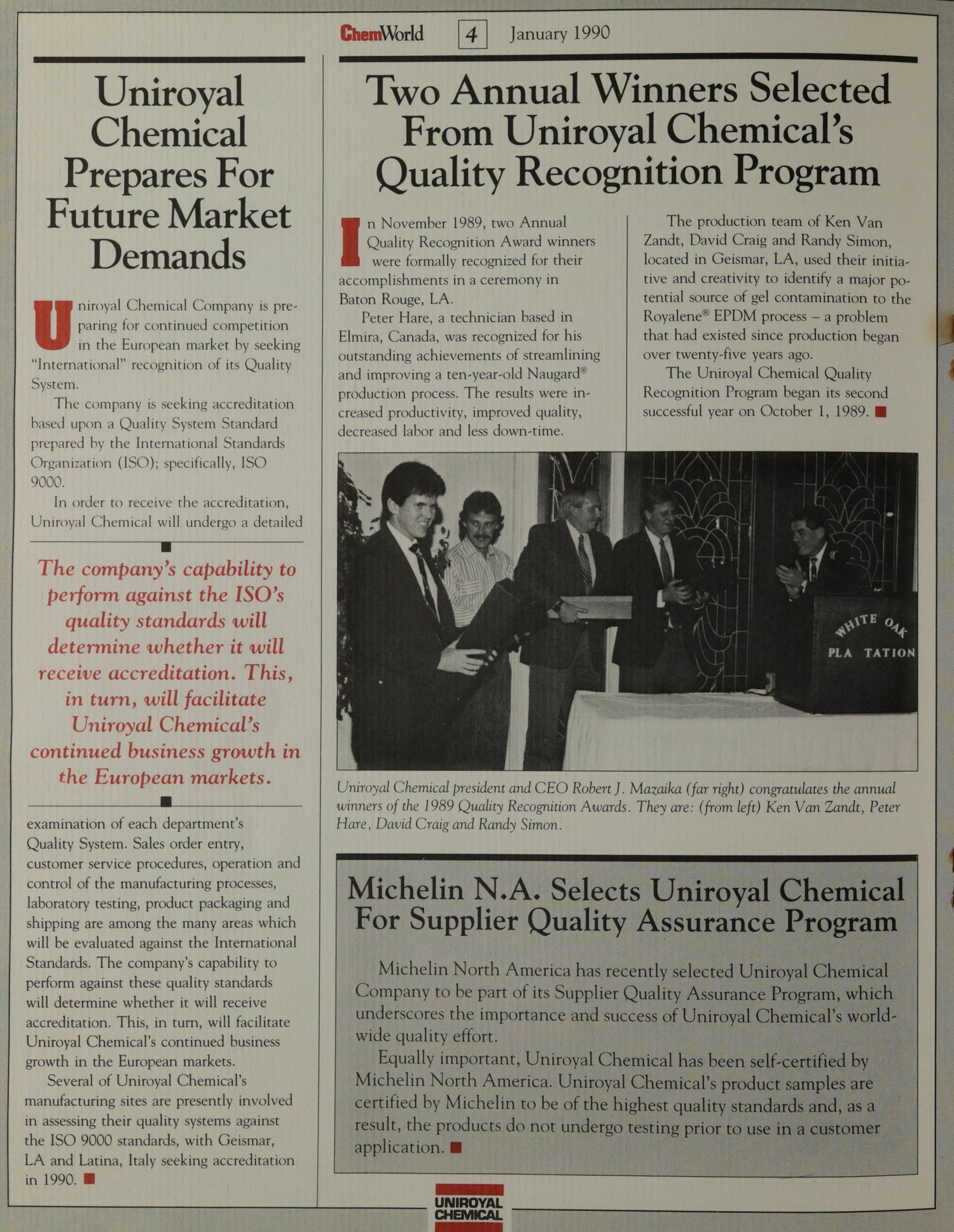
In November 1989, two Annual Quality Recognition Award winners were formally recognized for their accomplishments in a ceremony in Baton Rouge, LA.

Peter Hare, a technician based in Elmira, Canada, was recognized for his outstanding achievements of streamlining and improving a ten-year-old Naugard® production process. The results were increased productivity, improved quality, decreased labor and less down-time.

The production team of Ken Van Zandt, David Craig and Randy Simon, located in Geismar, LA, used their initiative and creativity to identify a major potential source of gel contamination to the Royalene® EPDM process – a problem that had existed since production began over twenty-five years ago.

The Uniroyal Chemical Quality Recognition Program began its second successful year on October 1, 1989. ■

Uniroyal Chemical president and CEO Robert J. Mazaika (far right) congratulates the annual winners of the 1989 Quality Recognition Awards. They are: (from left) Ken Van Zandt, Peter Hare, David Craig and Randy Simon.


Michelin N.A. Selects Uniroyal Chemical For Supplier Quality Assurance Program

Michelin North America has recently selected Uniroyal Chemical Company to be part of its Supplier Quality Assurance Program, which underscores the importance and success of Uniroyal Chemical’s worldwide quality effort.

Equally important, Uniroyal Chemical has been self-certified by Michelin North America. Uniroyal Chemical’s product samples are certified by Michelin to be of the highest quality standards and, as a result, the products do not undergo testing prior to use in a customer application. ■


UNIROYAL CHEMICAL

ChemWorld – Page 3

Page 003

ChemWorld | 3 | January 1990


Uniroyal Chemical Of Canada Wins Canadian Government National Quality Award

In November 1989, Uniroyal Chemical Ltd. of Elmira, Ontario, Canada won the national silver award for quality excellence. This award represents one of Canada’s top honors, which rate the quality of a company’s products and services.

The award was presented to Uniroyal Chemical’s general manager Wally Ruck by Harvie Andres, Federal Minister for Industry, Science and Technology, representing the Canada Awards for Business Excellence Program.

“It was a rigorous and tough review by professionals who had no association with the company,” said Ruck. “That’s what makes the Canada Award for Business Excellence so significant. It’s based on a totally independent study and analysis of our operations and procedures.”

More than 80 companies throughout Canada entered the quality competition but only 15 companies were chosen to participate in extensive, independent reviews to select the winners.

According to Robert J. Mazaika, president and CEO of Uniroyal Chemical Company, “Winning the Canada Award for Business Excellence is a tribute to the hard work and dedication shown by Uniroyal Chemical employees in Elmira and throughout Canada. Our challenge now is to continue to improve on the quality of our products and services both in the U.S. and internationally, as we position ourselves as a worldwide specialty chemical leader with outstanding product quality and technical service excellence.”

Other Uniroyal Chemical individuals joining Mr. Mazaika at the recent Awards Ceremony in Ottawa were: Walter Cook, vice president and general manager of Chemicals and Polymers (international); Ken Jessop, quality assurance manager; Richard Hooper, production manager; David Ash, manufacturing manager; Gary Schaefer, local union president; Vladimir Veres and Sudarshan Shinh, production workers; and Mr. Ruck.

Uniroyal Chemical Ltd. of Elmira manufactures rubber chemicals for the tire and non-tire industry; agricultural chemicals primarily for seed treatment; castable urethane prepolymers used in products that include conveyor belts and roller skate wheels; and specialty chemicals used in synthetic lubricants. ■


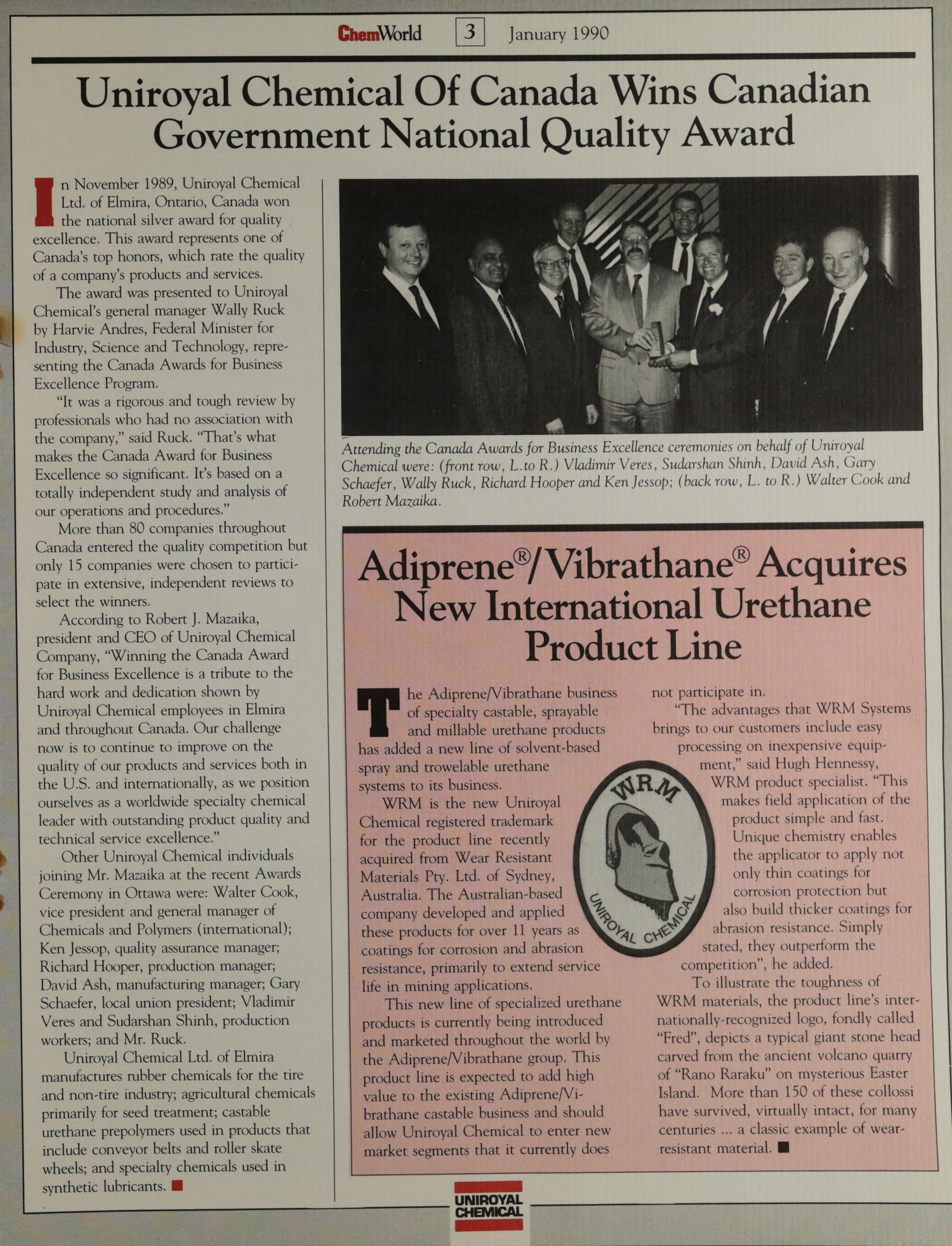
Attending the Canada Awards for Business Excellence ceremonies on behalf of Uniroyal Chemical were: (front row, L. to R.) Vladimir Veres, Sudarshan Shinh, David Ash, Gary Schaefer, Wally Ruck, Richard Hooper and Ken Jessop; (back row, L. to R.) Walter Cook and Robert Mazaika.


Adiprene®/Vibrathane® Acquires New International Urethane Product Line

The Adiprene/Vibrathane business of specialty castable, sprayable and millable urethane products has added a new line of solvent-based spray and trowelable urethane systems to its business.

WRM is the new Uniroyal Chemical registered trademark for the product line recently acquired from Wear Resistant Materials Pty. Ltd. of Sydney, Australia. The Australian-based company developed and applied these products for over 11 years as coatings for corrosion and abrasion resistance, primarily to extend service life in mining applications.

This new line of specialized urethane products is currently being introduced and marketed throughout the world by the Adiprene/Vibrathane group. This product line is expected to add high value to the existing Adiprene/Vibrathane castable business and should allow Uniroyal Chemical to enter new market segments that it currently does not participate in.

“The advantages that WRM Systems brings to our customers include easy processing on inexpensive equipment,” said Hugh Hennessy, WRM product specialist. “This makes field application of the product simple and fast. Unique chemistry enables the applicator to apply not only thin coatings for corrosion protection but also build thicker coatings for abrasion resistance. Simply stated, they outperform the competition”, he added.

To illustrate the toughness of WRM materials, the product line’s internationally-recognized logo, fondly called “Fred”, depicts a typical giant stone head carved from the ancient volcano quarry of “Rano Raraku” on mysterious Easter Island. More than 150 of these collossi have survived, virtually intact, for many centuries … a classic example of wear-resistant material. ■


UNIROYAL CHEMICAL

ChemWorld – Page 2

Page 002

ChemWorld | 2 | January 1990


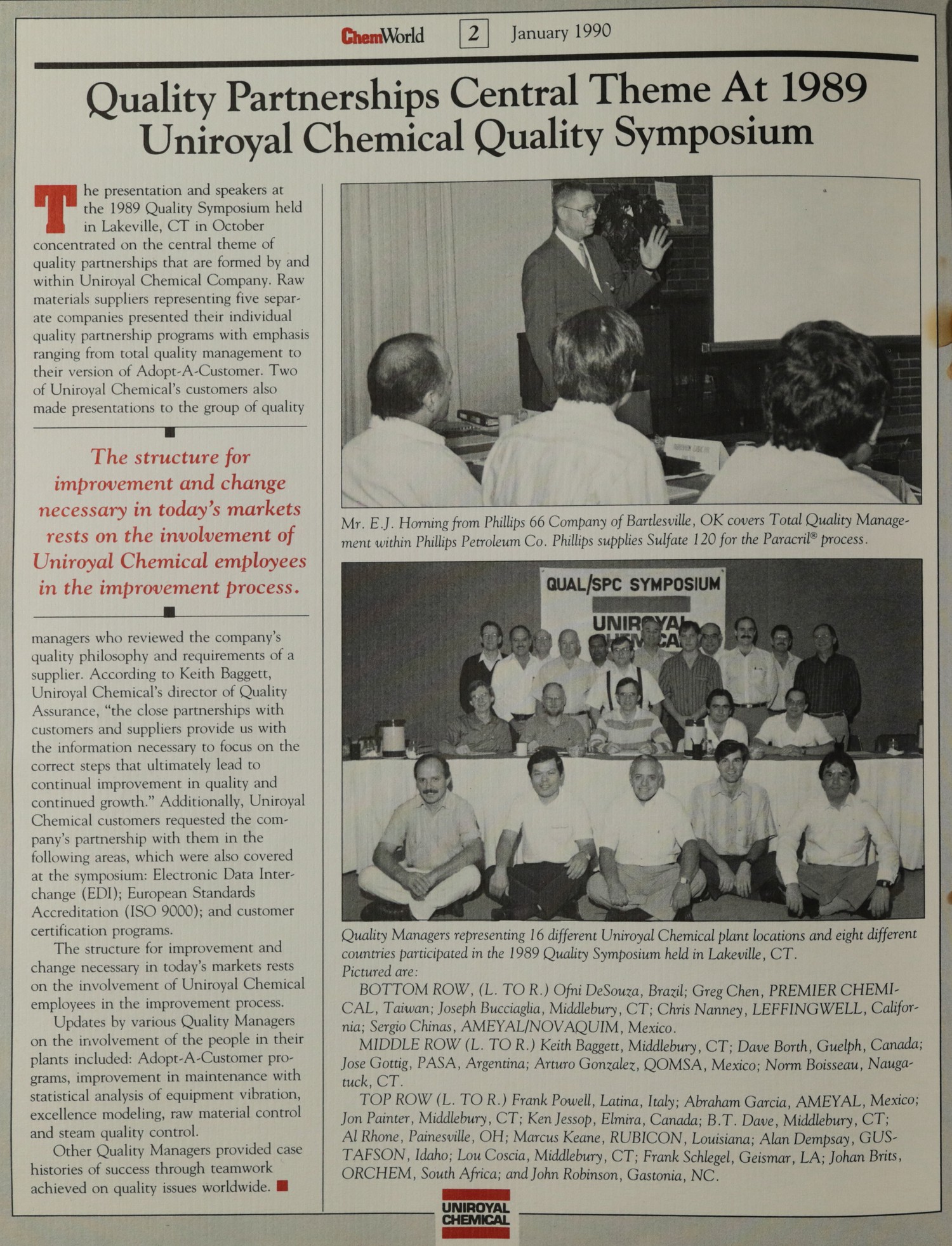
Quality Partnerships Central Theme At 1989 Uniroyal Chemical Quality Symposium

The presentation and speakers at the 1989 Quality Symposium held in Lakeville, CT in October concentrated on the central theme of quality partnerships that are formed by and within Uniroyal Chemical Company. Raw materials suppliers representing five separate companies presented their individual quality partnership programs with emphasis ranging from total quality management to their version of Adopt-A-Customer. Two of Uniroyal Chemical’s customers also made presentations to the group of quality


The structure for improvement and change necessary in today’s markets rests on the involvement of Uniroyal Chemical employees in the improvement process.


managers who reviewed the company’s quality philosophy and requirements of a supplier. According to Keith Baggett, Uniroyal Chemical’s director of Quality Assurance, “the close partnerships with customers and suppliers provide us with the information necessary to focus on the correct steps that ultimately lead to continual improvement in quality and continued growth.” Additionally, Uniroyal Chemical customers requested the company’s partnership with them in the following areas, which were also covered at the symposium: Electronic Data Interchange (EDI); European Standards Accreditation (ISO 9000); and customer certification programs.

The structure for improvement and change necessary in today’s markets rests on the involvement of Uniroyal Chemical employees in the improvement process.

Updates by various Quality Managers on the involvement of the people in their plants included: Adopt-A-Customer programs, improvement in maintenance with statistical analysis of equipment vibration, excellence modeling, raw material control and steam quality control.

Other Quality Managers provided case histories of success through teamwork achieved on quality issues worldwide. ■


Mr. E.J. Horning from Phillips 66 Company of Bartlesville, OK covers Total Quality Management within Phillips Petroleum Co. Phillips supplies Sulfate 120 for the Paracril® process.


QUAL/SPC SYMPOSIUM

UNIROYAL

Quality Managers representing 16 different Uniroyal Chemical plant locations and eight different countries participated in the 1989 Quality Symposium held in Lakeville, CT.

Pictured are:

BOTTOM ROW, (L. TO R.) Ofni DeSouza, Brazil; Greg Chen, PREMIER CHEMICAL, Taiwan; Joseph Bucciaglia, Middlebury, CT; Chris Nanney, LEFFINGWELL, California; Sergio Chinas, AMEYAL/NOVAQUIM, Mexico.

MIDDLE ROW (L. TO R.) Keith Baggett, Middlebury, CT; Dave Borth, Guelph, Canada; Jose Gottig, PASA, Argentina; Arturo Gonzalez, QOMSA, Mexico; Norm Boisseau, Naugatuck, CT.

TOP ROW (L. TO R.) Frank Powell, Latina, Italy; Abraham Garcia, AMEYAL, Mexico; Jon Painter, Middlebury, CT; Ken Jessop, Elmira, Canada; B.T. Dave, Middlebury, CT; Al Rhone, Painesville, OH; Marcus Keane, RUBICON, Louisiana; Alan Dempsay, GUSTAFSON, Idaho; Lou Coscia, Middlebury, CT; Frank Schlegel, Geismar, LA; Johan Brits, ORCHEM, South Africa; and John Robinson, Gastonia, NC.


UNIROYAL CHEMICAL

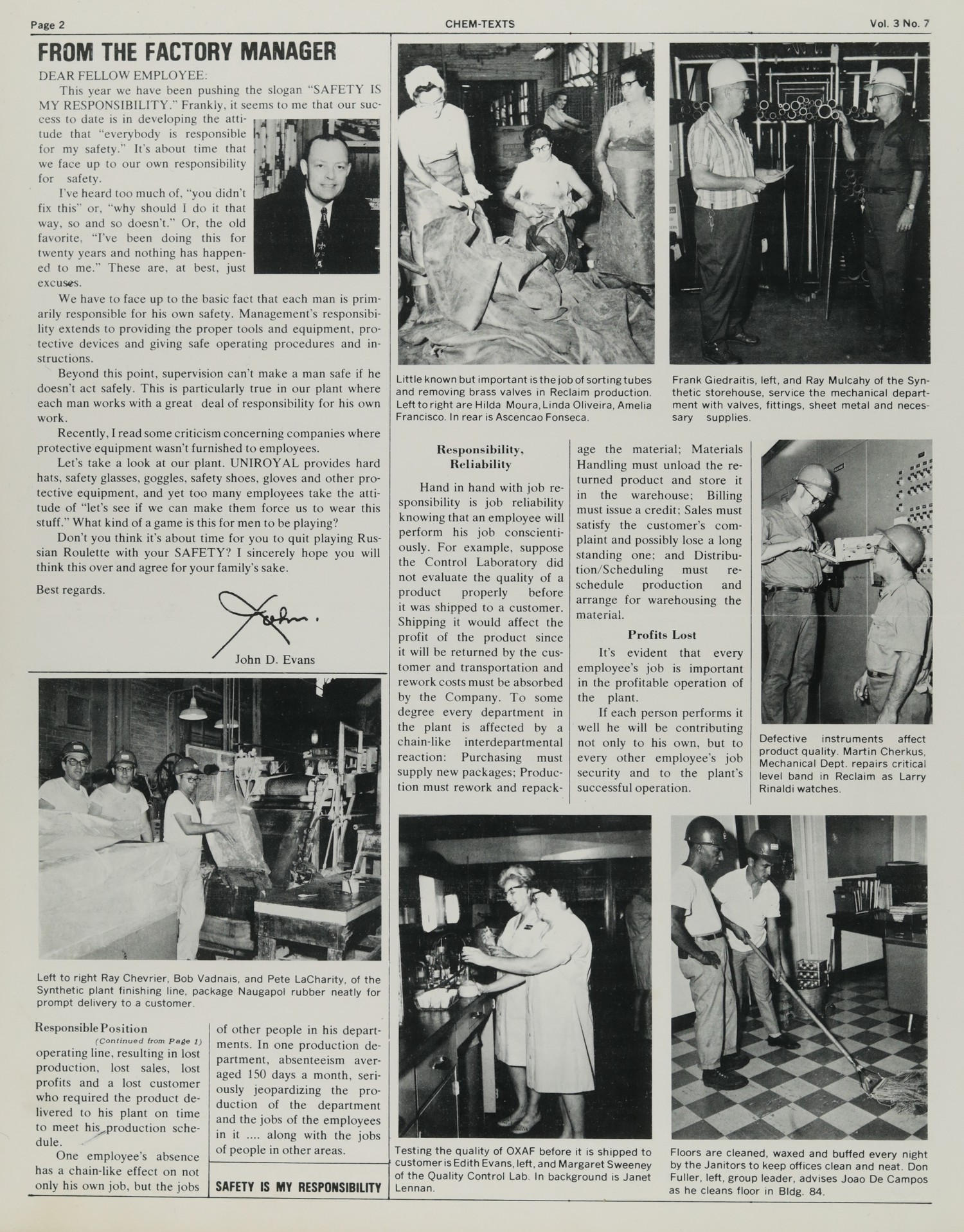
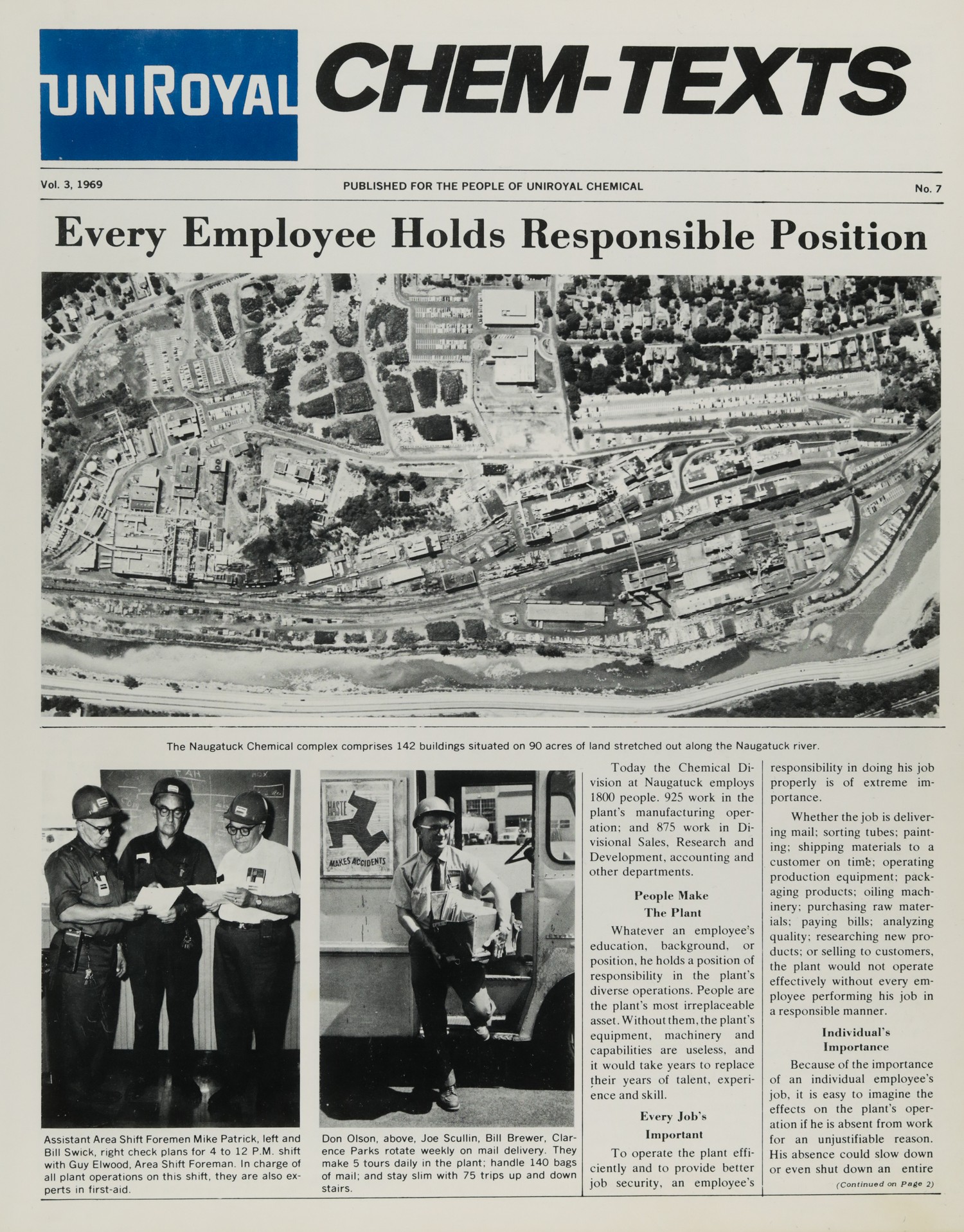
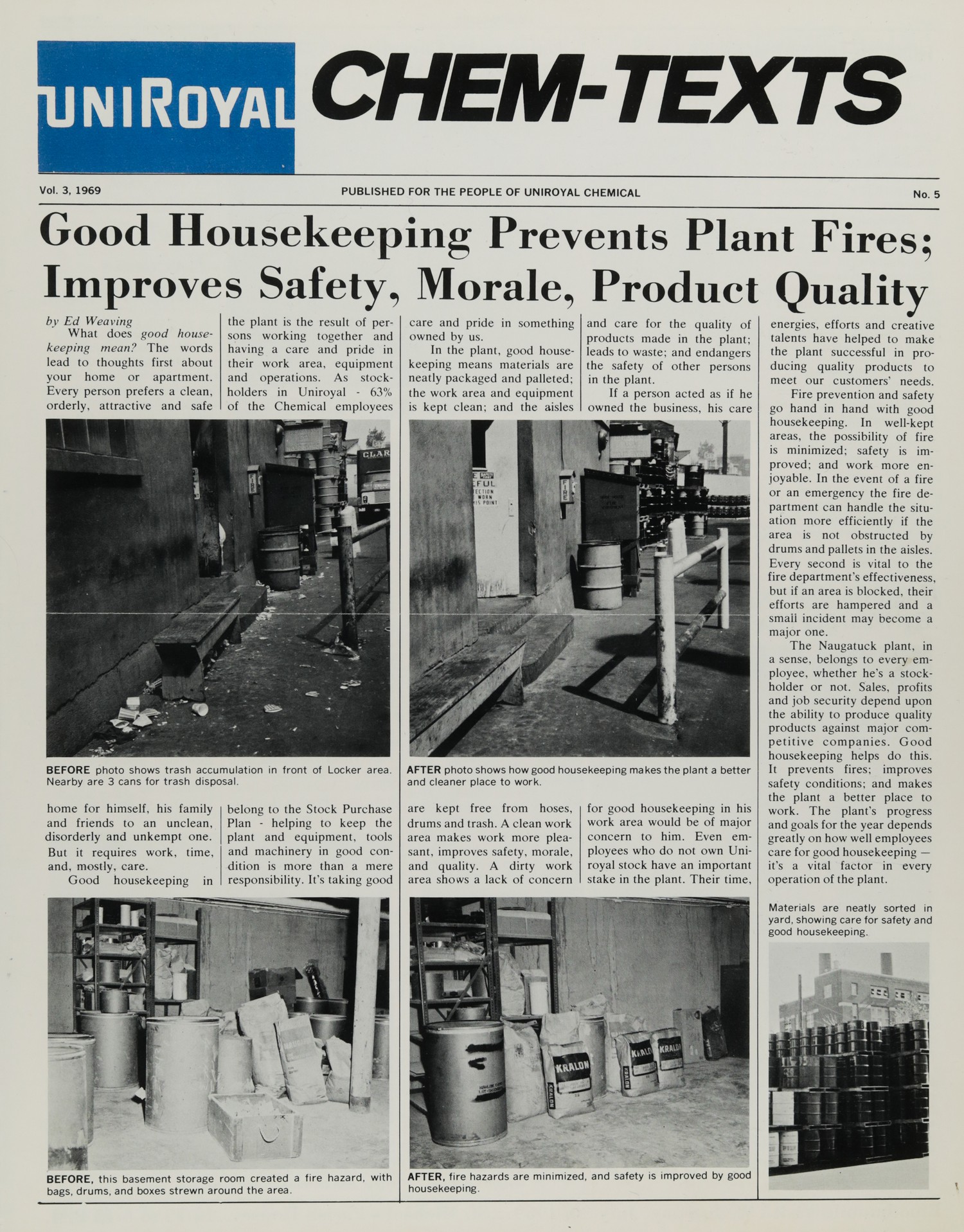
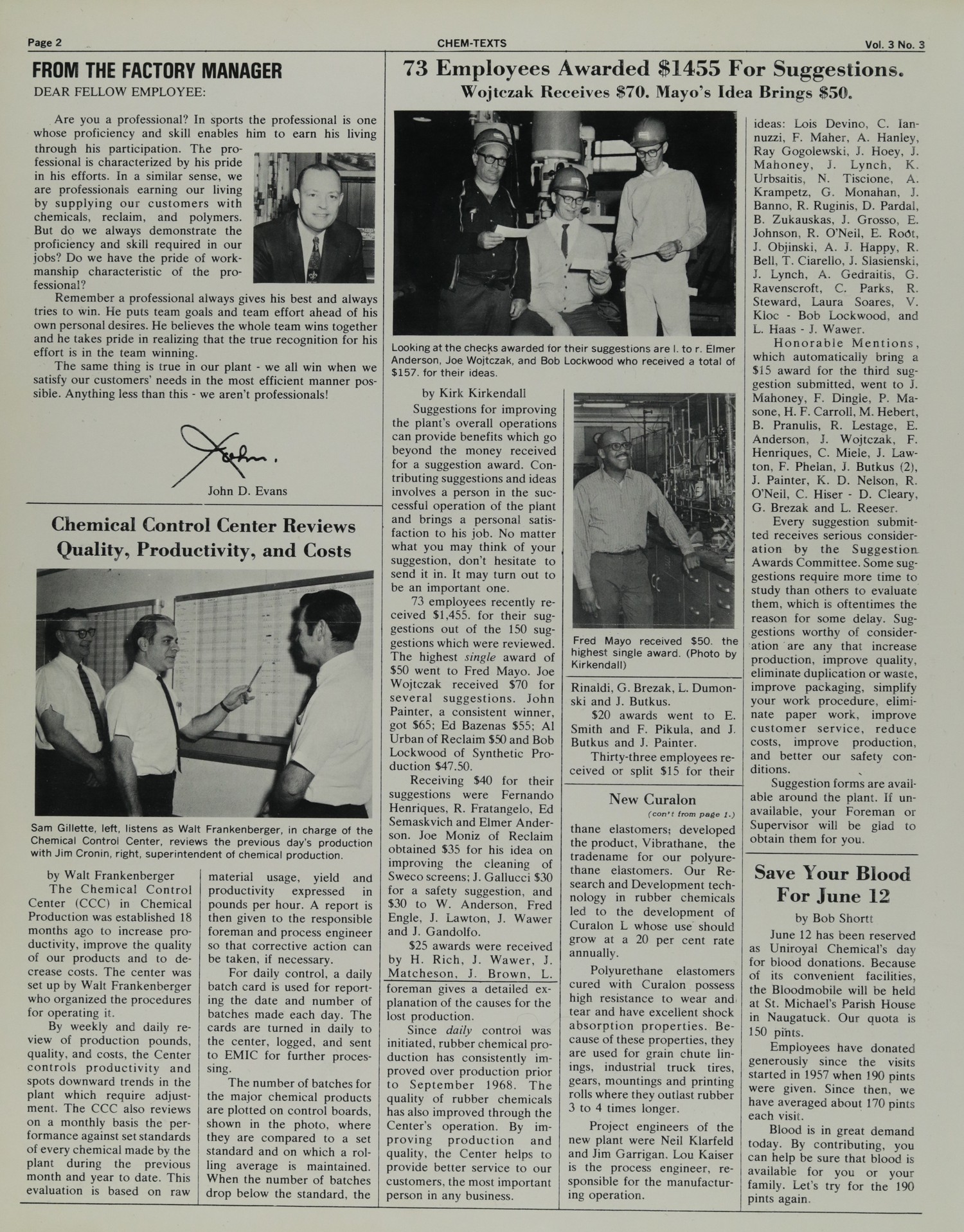
CHEM-TEXTS – 1979 – Page No. 1

Page unknown

UNIROYAL CHEM-TEXTS

Vol. 13, 1979 | PUBLISHED FOR THE PEOPLE OF UNIROYAL CHEMICAL | No. 1


Equality Policy Affirmed

The Uniroyal Chemical plant has a firm commitment to offer equal opportunity to all employees. It is the policy of the plant’s management to support and implement this commitment continually.

This policy requires that all recruiting, hiring, transfers, promotions, compensation, benefits, and company-sponsored training, education and tuition assistance, as well as social, recreational and health programs and lay-off and recall practices are followed and carried out without regard to race, color, creed, religion, sex, national origin, or handicap of any individual person.

J. Robert Douglas, the Industrial Relations Manager for the Naugatuck plant is the Compliance Officer and has the responsibility for implementing this policy; monitoring the Uniroyal Chemical Affirmative Action Compliance Program; and reporting to management the program’s progress.

The responsibility for the improvement of the program and the positive results of it rests with each Manager, Foreman, and Supervisor as an integral part of their job.


$500.00 Scholarship Offered

The Uniroyal Chemical Management Club is again offering a $500 scholarship award. Fifty dollars of the scholarship comes from the Larry Monroe Fund.

The scholarship is available to a graduating high school student who plans a college education. To qualify, one of the student’s parents must have worked for Uniroyal Chemical at Naugatuck or Bethany for two years or more and be an active employee. The fund is supported by the dues of the club’s members.

Applications for the scholarship may be obtained from the Industrial Relations Department or by a telephone call to Constance Antrum, Ext. 3217.

April 20, Final Date

The application must be returned to William Broden, Chair-
Continued on page 4


$614,000 AR Okayed for Plant

A major Appropriations Request (AR) of $614,000 has been approved for equipment additions to Building 124 (FOC) to produce Naugacel SD-1.

The direction of this major project will be the responsibility of the Naugatuck Plant’s Technical Department.

Naugacel SD-1 represents a new product to be manufactured in Chemical Production. It has already been successfully run in both the R. & D. Development Lab and the Chemical Pilot Plant.

Used in Tires

Naugacel SD-1 is a sulfur donor accelerator for use in the vulcanization of natural and synthetic rubber and is utilized primarily in tires and mechanical goods.

Continued on page 4


MAP Plan Saves $27,358

Cuts Time in Half

By Vic Alves

When it was decided that major repairs would be required on the PR-03 vessel in the FOC plant (Bldg. 124), original repair estimates indicated that it would take 17 days of Maintenance Dept. work to complete the necessary repairs.

A Management Action Plan (MAP) was then written to plan the work and coordinate these repairs. As a result of this action plan it was determined that the repairs could be completed in 10 days instead of the estimated 17 days. Through the combined efforts and cooperation of the Maintenance and Manufacturing Departments, the required repairs were made and the work was completed in 8 days.

Naugard Schedule Met

Because of this earlier turnaround, Bldg. 124 was able to finish its scheduled Naugard 445 production; perform a changeover; begin LVBI production on schedule; and meet the production schedule.

$27,358 Saved

Based on conversion costs it is estimated that $27,358 was saved
Continued on page 4


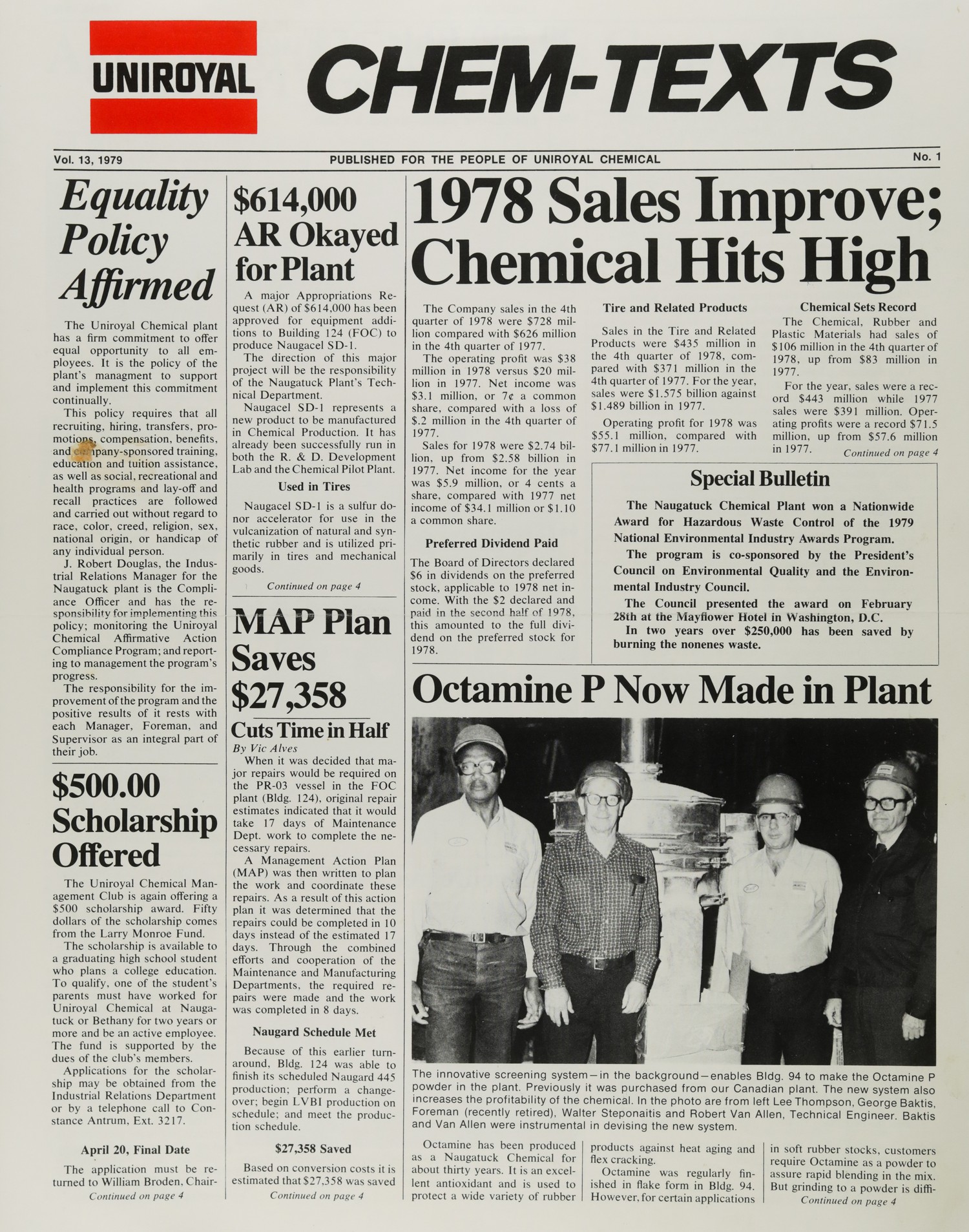
1978 Sales Improve; Chemical Hits High

The Company sales in the 4th quarter of 1978 were $728 million compared with $626 million in the 4th quarter of 1977.

The operating profit was $38 million in 1978 versus $20 million in 1977. Net income was $3.1 million, or 7¢ a common share, compared with a loss of $2.2 million in the 4th quarter of 1977.

Sales for 1978 were $2.74 billion, up from $2.58 billion in 1977. Net income for the year was $5.9 million, or 4 cents a share, compared with 1977 net income of $34.1 million or $1.10 a common share.

Preferred Dividend Paid

The Board of Directors declared $6 in dividends on the preferred stock, applicable to 1978 net income. With the $2 declared and paid in the second half of 1978, this amounted to the full dividend on the preferred stock for 1978.


Tire and Related Products

Sales in the Tire and Related Products were $435 million in the 4th quarter of 1978, compared with $371 million in the 4th quarter of 1977. For the year, sales were $1.575 billion against $1.489 billion in 1977.

Operating profit for 1978 was $55.1 million, compared with $77.1 million in 1977.


Chemical Sets Record

The Chemical, Rubber and Plastic Materials had sales of $106 million in the 4th quarter of 1978, up from $83 million in 1977.

For the year, sales were a record $443 million while 1977 sales were $391 million. Operating profits were a record $71.5 million, up from $57.6 million in 1977.
Continued on page 4


Special Bulletin

The Naugatuck Chemical Plant won a Nationwide Award for Hazardous Waste Control of the 1979 National Environmental Industry Awards Program.

The program is co-sponsored by the President’s Council on Environmental Quality and the Environmental Industry Council.

The Council presented the award on February 28th at the Mayflower Hotel in Washington, D.C.

In two years over $250,000 has been saved by burning the nonenes waste.


Octamine P Now Made in Plant

The innovative screening system—in the background—enables Bldg. 94 to make the Octamine P powder in the plant. Previously it was purchased from our Canadian plant. The new system also increases the profitability of the chemical. In the photo are from left Lee Thompson, George Baktis, Foreman (recently retired), Walter Steponaitis and Robert Van Allen, Technical Engineer. Baktis and Van Allen were instrumental in devising the new system.


Octamine has been produced as a Naugatuck Chemical for about thirty years. It is an excellent antioxidant and is used to protect a wide variety of rubber products against heat aging and flex cracking.

Octamine was regularly finished in flake form in Bldg. 94. However, for certain applications in soft rubber stocks, customers require Octamine as a powder to assure rapid blending in the mix. But grinding to a powder is diffi-
Continued on page 4

CHEM-TEXTS – 1973-v07-s220

Page 220

CHEM-TEXTS

Vol. 7, 1973 | Page 3


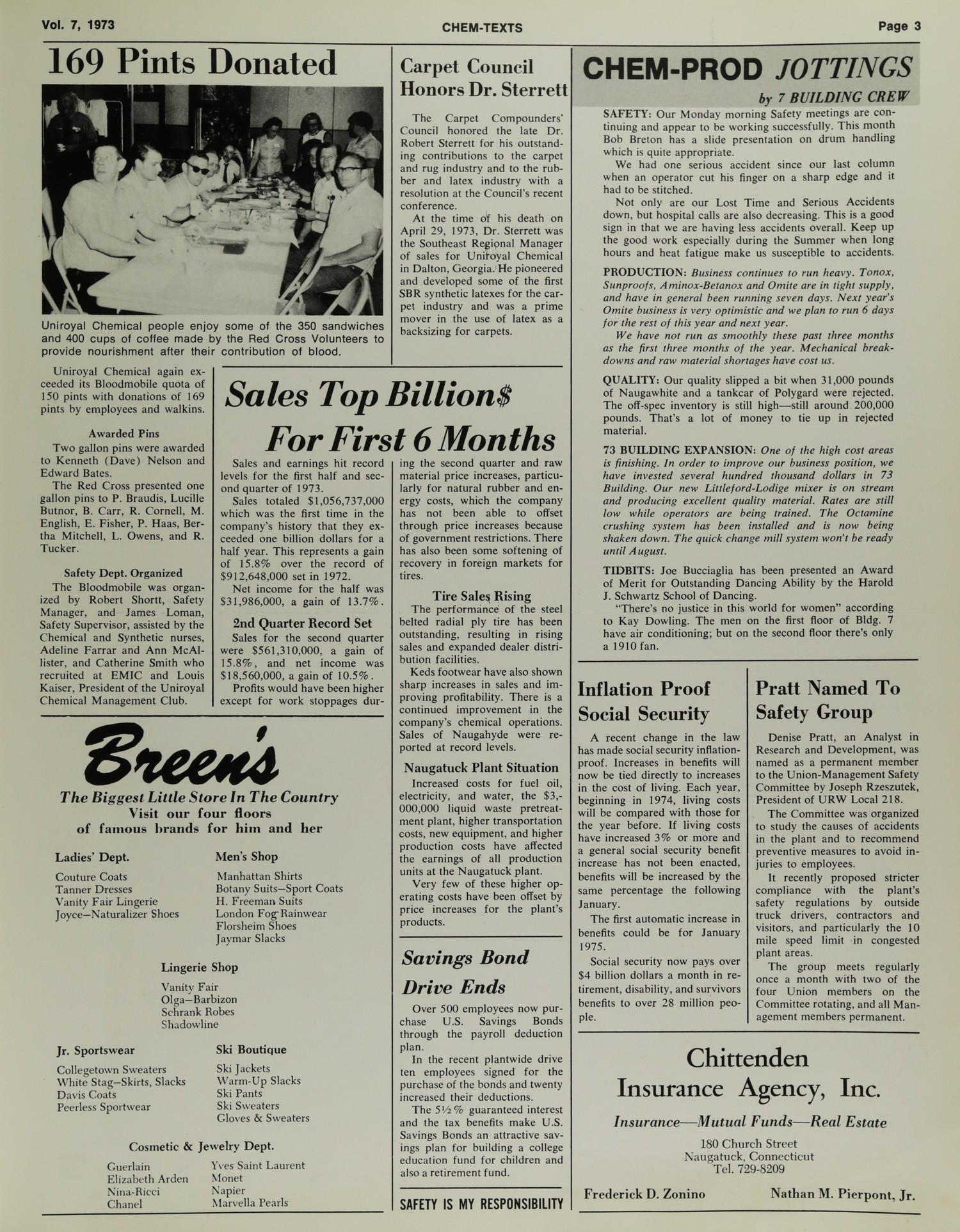
169 Pints Donated

[IMAGE: Black and white photograph showing people at what appears to be a food service counter]

Uniroyal Chemical people enjoy some of the 350 sandwiches and 400 cups of coffee made by the Red Cross Volunteers to provide nourishment after their contribution of blood.

Uniroyal Chemical again exceeded its Bloodmobile quota of 150 pints with donations of 169 pints by employees and walkins.

Awarded Pins

Two gallon pins were awarded to Kenneth (Dave) Nelson and Edward Bates.

The Red Cross presented one gallon pins to P. Braudis, Lucille Butnor, B. Carr, R. Cornell, M. English, E. Fisher, P. Haas, Bertha Mitchell, L. Owens, and R. Tucker.

Safety Dept. Organized

The Bloodmobile was organized by Robert Shortt, Safety Manager, and James Loman, Safety Supervisor, assisted by the Chemical and Synthetic nurses, Adeline Farrar and Ann McAllister, and Catherine Smith who recruited at EMIC and Louis Kaiser, President of the Uniroyal Chemical Management Club.


Breen’s

The Biggest Little Store In The Country
Visit our four floors
of famous brands for him and her

Ladies’ Dept. Men’s Shop
Couture Coats Manhattan Shirts
Tanner Dresses Botany Suits—Sport Coats
Vanity Fair Lingerie H. Freeman Suits
Joyce—Naturalizer Shoes London Fog Rainwear
Florsheim Shoes
Jaymar Slacks

Lingerie Shop
Vanity Fair
Olga—Barbizon
Schrank Robes
Shadowline

Jr. Sportswear Ski Boutique
Collegetown Sweaters Ski Jackets
White Stag—Skirts, Slacks Warm-Up Slacks
Davis Coats Ski Pants
Peerless Sportwear Ski Sweaters
Gloves & Sweaters

Cosmetic & Jewelry Dept.

Guerlain Yves Saint Laurent
Elizabeth Arden Monet
Nina-Ricci Napier
Chanel Marvella Pearls

Carpet Council Honors Dr. Sterrett

The Carpet Compounders’ Council honored the late Dr. Robert Sterrett for his outstanding contributions to the carpet and rug industry and to the rubber and latex industry with a resolution at the Council’s recent conference.

At the time of his death on April 29, 1973, Dr. Sterrett was the Southeast Regional Manager of sales for Uniroyal Chemical in Dalton, Georgia. He pioneered and developed some of the first SBR synthetic latexes for the carpet industry and was a prime mover in the use of latex as a backsizing for carpets.


Sales Top Billion$ For First 6 Months

Sales and earnings hit record levels for the first half and second quarter of 1973.

Sales totaled $1,056,737,000 which was the first time in the company’s history that they exceeded one billion dollars for a half year. This represents a gain of 15.8% over the record of $912,648,000 set in 1972.

Net income for the half was $31,986,000, a gain of 13.7%.

2nd Quarter Record Set

Sales for the second quarter were $561,310,000, a gain of 15.8%, and net income was $18,560,000, a gain of 10.5%.

Profits would have been higher except for work stoppages during the second quarter and raw material price increases, particularly for natural rubber and energy costs, which the company has not been able to offset through price increases because of government restrictions. There has also been some softening of recovery in foreign markets for tires.

Tire Sales Rising

The performance of the steel belted radial ply tire has been outstanding, resulting in rising sales and expanded dealer distribution facilities.

Keds footwear have also shown sharp increases in sales and improving profitability. There is a continued improvement in the company’s chemical operations. Sales of Naugahyde were reported at record levels.

Naugatuck Plant Situation

Increased costs for fuel oil, electricity, and water, the $3,000,000 liquid waste pretreatment plant, higher transportation costs, new equipment, and higher production costs have affected the earnings of all production units at the Naugatuck plant.

Very few of these higher operating costs have been offset by price increases for the plant’s products.


Savings Bond Drive Ends

Over 500 employees now purchase U.S. Savings Bonds through the payroll deduction plan.

In the recent plantwide drive ten employees signed for the purchase of the bonds and twenty increased their deductions.

The 5½% guaranteed interest and the tax benefits make U.S. Savings Bonds an attractive savings plan for building a college education fund for children and also a retirement fund.

SAFETY IS MY RESPONSIBILITY


CHEM-PROD JOTTINGS

by 7 BUILDING CREW

SAFETY: Our Monday morning Safety meetings are continuing and appear to be working successfully. This month Bob Breton has a slide presentation on drum handling which is quite appropriate.

We had one serious accident since our last column when an operator cut his finger on a sharp edge and it had to be stitched.

Not only are our Lost Time and Serious Accidents down, but hospital calls are also decreasing. This is a good sign in that we are having less accidents overall. Keep up the good work especially during the Summer when long hours and heat fatigue make us susceptible to accidents.

PRODUCTION: Business continues to run heavy. Tonox, Sunproofs, Aminox-Betanox and Omite are in tight supply, and have in general been running seven days. Next year’s Omite business is very optimistic and we plan to run 6 days for the rest of this year and next year.

We have not run as smoothly these past three months as the first three months of the year. Mechanical breakdowns and raw material shortages have cost us.

QUALITY: Our quality slipped a bit when 31,000 pounds of Naugawhite and a tankcar of Polygard were rejected. The off-spec inventory is still high—still around 200,000 pounds. That’s a lot of money to tie up in rejected material.

73 BUILDING EXPANSION: One of the high cost areas is finishing. In order to improve our business position, we have invested several hundred thousand dollars in 73 Building. Our new Littleford-Lodige mixer is on stream and producing excellent quality material. Rates are still low while operators are being trained. The Octamine crushing system has been installed and is now being shaken down. The quick change mill system won’t be ready until August.

TIDBITS: Joe Bucciaglia has been presented an Award of Merit for Outstanding Dancing Ability by the Harold J. Schwartz School of Dancing.

“There’s no justice in this world for women” according to Kay Dowling. The men on the first floor of Bldg. 7 have air conditioning; but on the second floor there’s only a 1910 fan.


Inflation Proof Social Security

A recent change in the law has made social security inflation-proof. Increases in benefits will now be tied directly to increases in the cost of living. Each year, beginning in 1974, living costs will be compared with those for the year before. If living costs have increased 3% or more and a general social security benefit increase has not been enacted, benefits will be increased by the same percentage the following January.

The first automatic increase in benefits could be for January 1975.

Social security now pays over $4 billion dollars a month in retirement, disability, and survivors benefits to over 28 million people.


Pratt Named To Safety Group

Denise Pratt, an Analyst in Research and Development, was named as a permanent member to the Union-Management Safety Committee by Joseph Rzeszutek, President of URW Local 218.

The Committee was organized to study the causes of accidents in the plant and to recommend preventive measures to avoid injuries to employees.

It recently proposed stricter compliance with the plant’s safety regulations by outside truck drivers, contractors and visitors, and particularly the 10 mile speed limit in congested plant areas.

The group meets regularly once a month with two of the four Union members on the Committee rotating, and all Management members permanent.


Chittenden Insurance Agency, Inc.

Insurance—Mutual Funds—Real Estate

180 Church Street
Naugatuck, Connecticut
Tel. 729-8209

Frederick D. Zonino | Nathan M. Pierpont, Jr.

CHEM-TEXTS – 1973-v07-s212

Page 212

Vol. 7, 1973 CHEM-TEXTS Page 5


Salesmen Set ’73 Goal | Free X-Ray | CHEM-PROD JOTTINGS

Offered Employees

by 7 BUILDING CREW

These jottings on what is going on in Chemical Production is an attempt to get more information to the people in the department.

Hopefully, with the ideas and suggestions of the Chemical Production Operators, we will get information on what the people in the plant want to know. So, next time you see the “7 Building Crew” give them your suggestions to improve this column.


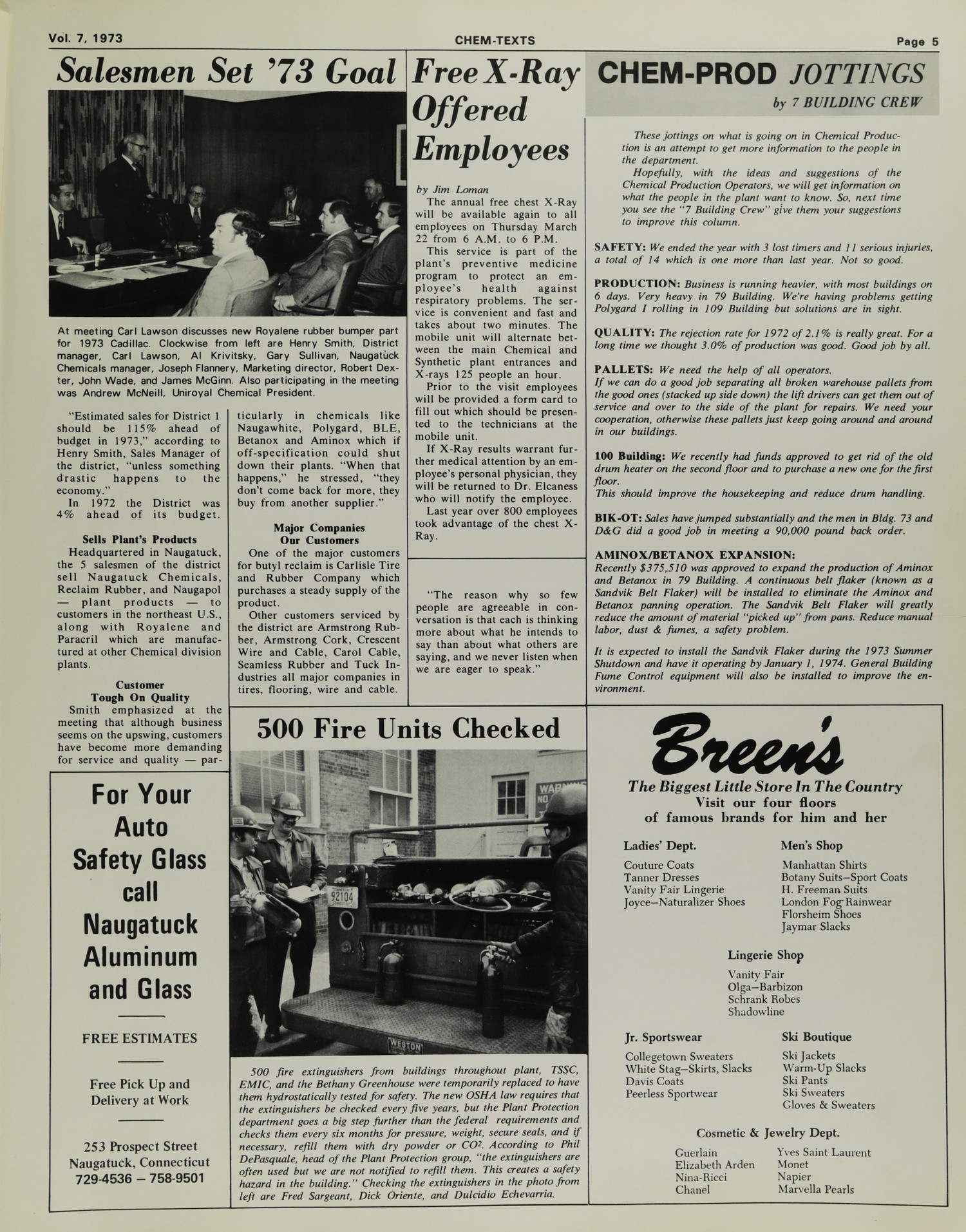
[IMAGE: Photo of men at meeting with car]

At meeting Carl Lawson discusses new Royalene rubber bumper part for 1973 Cadillac. Clockwise from left are Henry Smith, District manager, Carl Lawson, Al Krivitsky, Gary Sullivan, Naugatuck Chemicals manager, Joseph Flannery, Marketing director, Robert Dexter, John Wade, and James McGinn. Also participating in the meeting was Andrew McNeill, Uniroyal Chemical President.

“Estimated sales for District 1 should be 115% ahead of budget in 1973,” according to Henry Smith, Sales Manager of the district, “unless something drastic happens to the economy.”

In 1972 the District was 4% ahead of its budget.

Sells Plant’s Products

Headquartered in Naugatuck, the 5 salesmen of the district sell Naugatuck Chemicals, Reclaim Rubber, and Naugapol — plant products — to customers in the northeast U.S., along with Royalene and Paracril which are manufactured at other Chemical division plants.

Customer Tough On Quality

Smith emphasized at the meeting that although business seems on the upswing, customers have become more demanding for service and quality — par-

ticularly in chemicals like Naugawhite, Polygard, BLE, Betanox and Aminox which if off-specification could shut down their plants. “When that happens,” he stressed, “they don’t come back for more, they buy from another supplier.”

Major Companies Our Customers

One of the major customers for butyl reclaim is Carlisle Tire and Rubber Company which purchases a steady supply of the product.

Other customers serviced by the district are Armstrong Rubber, Armstrong Cork, Crescent Wire and Cable, Carol Cable, Seamless Rubber and Tuck Industries all major companies in tires, flooring, wire and cable.


by Jim Loman

The annual free chest X-Ray will be available again to all employees on Thursday March 22 from 6 A.M. to 6 P.M.

This service is part of the plant’s preventive medicine program to protect an employee’s health against respiratory problems. The service is convenient and fast and takes about two minutes. The mobile unit will alternate between the main Chemical and Synthetic plant entrances and X-rays 125 people an hour.

Prior to the visit employees will be provided a form card to fill out which should be presented to the technicians at the mobile unit.

If X-Ray results warrant further medical attention by an employee’s personal physician, they will be returned to Dr. Elcaness who will notify the employee.

Last year over 800 employees took advantage of the chest X-Ray.


“The reason why so few people are agreeable in conversation is that each is thinking more about what he intends to say than about what others are saying, and we never listen when we are eager to speak.”


SAFETY: We ended the year with 3 lost timers and 11 serious injuries, a total of 14 which is one more than last year. Not so good.

PRODUCTION: Business is running heavier, with most buildings on 6 days. Very heavy in 79 Building. We’re having problems getting Polygard 1 rolling in 109 Building but solutions are in sight.

QUALITY: The rejection rate for 1972 of 2.1% is really great. For a long time we thought 3.0% of production was good. Good job by all.

PALLETS: We need the help of all operators. If we can do a good job separating all broken warehouse pallets from the good ones (stacked up side down) the lift drivers can get them out of service and over to the side of the plant for repairs. We need your cooperation, otherwise these pallets just keep going around and around in our buildings.

100 Building: We recently had funds approved to get rid of the old drum heater on the second floor and to purchase a new one for the first floor.

This should improve the housekeeping and reduce drum handling.

BIK-OT: Sales have jumped substantially and the men in Bldg. 73 and D&G did a good job in meeting a 90,000 pound back order.

AMINOX/BETANOX EXPANSION:

Recently $375,510 was approved to expand the production of Aminox and Betanox in 79 Building. A continuous belt flaker (known as a Sandvik Belt Flaker) will be installed to eliminate the Aminox and Betanox panning operation. The Sandvik Belt Flaker will greatly reduce the amount of material “picked up” from pans. Reduce manual labor, dust & fumes, a safety problem.

It is expected to install the Sandvik Flaker during the 1973 Summer Shutdown and have it operating by January 1, 1974. General Building Fume Control equipment will also be installed to improve the environment.


500 Fire Units Checked

[IMAGE: Photo of workers checking fire extinguishers]

500 fire extinguishers from buildings throughout plant, TSSC, EMIC, and the Bethany Greenhouse were temporarily replaced to have them hydrostatically tested for safety. The new OSHA law requires that the extinguishers be checked every five years, but the Plant Protection department goes a big step further than the federal requirements and checks them every six months for pressure, weight, secure seals, and if necessary, refill them with dry powder or CO². According to Phil DePasquale, head of the Plant Protection group, “the extinguishers are often used but we are not notified to refill them. This creates a safety hazard in the building.” Checking the extinguishers in the photo from left are Fred Sargeant, Dick Oriente, and Dulcidio Echevarria.


For Your Auto Safety Glass call

Naugatuck Aluminum and Glass


FREE ESTIMATES


Free Pick Up and Delivery at Work


253 Prospect Street
Naugatuck, Connecticut
729-4536 — 758-9501


Breen’s

The Biggest Little Store In The Country

Visit our four floors of famous brands for him and her

Ladies’ Dept.
Couture Coats
Tanner Dresses
Vanity Fair Lingerie
Joyce–Naturalizer Shoes

Men’s Shop
Manhattan Shirts
Botany Suits–Sport Coats
H. Freeman Suits
London Fog Rainwear
Florsheim Shoes
Jaymar Slacks

Lingerie Shop
Vanity Fair
Olga–Barbizon
Schrank Robes
Shadowline

Jr. Sportswear
Collegetown Sweaters
White Stag–Skirts, Slacks
Davis Coats
Peerless Sportwear

Ski Boutique
Ski Jackets
Warm-Up Slacks
Ski Pants
Ski Sweaters
Gloves & Sweaters

Cosmetic & Jewelry Dept.

Guerlain Yves Saint Laurent
Elizabeth Arden Monet
Nina-Ricci Napier
Chanel Marvella Pearls

13 Receive 40 Years Service Awards

Vol. 7, 1973 | CHEM-TEXTS | Page 3


13 Receive 40 Years Service Awards

[PHOTO: Group photo of people]

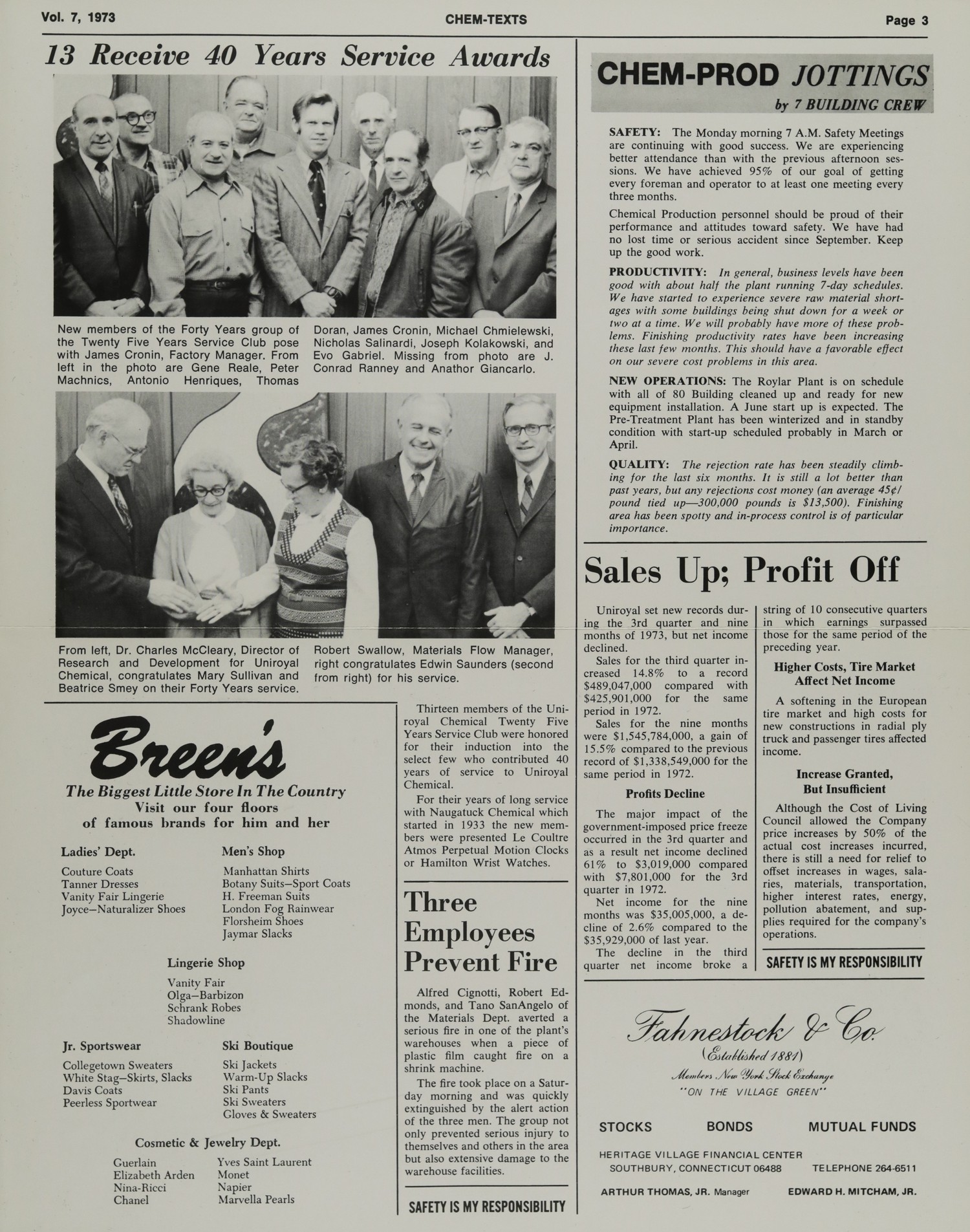
New members of the Forty Years group of the Twenty Five Years Service Club pose with James Cronin, Factory Manager. From left in the photo are Gene Reale, Peter Machnics, Antonio Henriques, Thomas Doran, James Cronin, Michael Chmielewski, Nicholas Salinardi, Joseph Kolakowski, and Evo Gabriel. Missing from photo are J. Conrad Ranney and Anathor Giancarlo.

[PHOTO: Group photo of people in formal setting]

From left, Dr. Charles McCleary, Director of Research and Development for Uniroyal Chemical, congratulates Mary Sullivan and Beatrice Smey on their Forty Years service.

Robert Swallow, Materials Flow Manager, right congratulates Edwin Saunders (second from right) for his service.


Breen’s

The Biggest Little Store In The Country
Visit our four floors
of famous brands for him and her

Ladies’ Dept.
Couture Coats
Tanner Dresses
Vanity Fair Lingerie
Joyce—Naturalizer Shoes

Men’s Shop
Manhattan Shirts
Botany Suits—Sport Coats
H. Freeman Suits
London Fog Rainwear
Florsheim Shoes
Jaymar Slacks

Lingerie Shop
Vanity Fair
Olga—Barbizon
Schrank Robes
Shadowline

Jr. Sportswear
Collegetown Sweaters
White Stag—Skirts, Slacks
Davis Coats
Peerless Sportswear

Ski Boutique
Ski Jackets
Warm-Up Slacks
Ski Pants
Ski Sweaters
Gloves & Sweaters

Cosmetic & Jewelry Dept.
Guerlain | Yves Saint Laurent
Elizabeth Arden | Monet
Nina-Ricci | Napier
Chanel | Marvella Pearls


CHEM-PROD JOTTINGS

by 7 BUILDING CREW

SAFETY: The Monday morning 7 A.M. Safety Meetings are continuing with good success. We are experiencing better attendance than with the previous afternoon sessions. We have achieved 95% of our goal of getting every foreman and operator to at least one meeting every three months.

Chemical Production personnel should be proud of their performance and attitudes toward safety. We have had no lost time or serious accident since September. Keep up the good work.

PRODUCTIVITY: In general, business levels have been good with about half the plant running 7-day schedules. We have started to experience severe raw material shortages with some buildings being shut down for a week or two at a time. We will probably have more of these problems. Finishing productivity rates have been increasing these last few months. This should have a favorable effect on our severe cost problems in this area.

NEW OPERATIONS: The Roylar Plant is on schedule with all of 80 Building cleaned up and ready for new equipment installation. A June start up is expected. The Pre-Treatment Plant has been winterized and in standby condition with start-up scheduled probably in March or April.

QUALITY: The rejection rate has been steadily climbing for the last six months. It is still a lot better than past years, but any rejections cost money (an average 45¢/ pound tied up—300,000 pounds is $13,500). Finishing area has been spotty and in-process control is of particular importance.


Sales Up; Profit Off

Uniroyal set new records during the 3rd quarter and nine months of 1973, but net income declined.

Sales for the third quarter increased 14.8% to a record $489,047,000 compared with $425,901,000 for the same period in 1972.

Sales for the nine months were $1,545,784,000, a gain of 15.5% compared to the previous record of $1,338,549,000 for the same period in 1972.

Profits Decline

The major impact of the government-imposed price freeze occurred in the 3rd quarter and as a result net income declined 61% to $3,019,000 compared with $7,801,000 for the 3rd quarter in 1972.

Net income for the nine months was $35,005,000, a decline of 2.6% compared to the $35,929,000 of last year.

The decline in the third quarter net income broke a string of 10 consecutive quarters in which earnings surpassed those for the same period of the preceding year.

Higher Costs, Tire Market Affect Net Income

A softening in the European tire market and high costs for new constructions in radial ply truck and passenger tires affected income.

Increase Granted, But Insufficient

Although the Cost of Living Council allowed the Company price increases by 50% of the actual cost increases incurred, there is still a need for relief to offset increases in wages, salaries, materials, transportation, higher interest rates, energy, pollution abatement, and supplies required for the company’s operations.

SAFETY IS MY RESPONSIBILITY


Thirteen members of the Uniroyal Chemical Twenty Five Years Service Club were honored for their induction into the select few who contributed 40 years of service to Uniroyal Chemical.

For their years of long service with Naugatuck Chemical which started in 1933 the new members were presented Le Coultre Atmos Perpetual Motion Clocks or Hamilton Wrist Watches.


Three Employees Prevent Fire

Alfred Cignotti, Robert Edmonds, and Tano SanAngelo of the Materials Dept. averted a serious fire in one of the plant’s warehouses when a piece of plastic film caught fire on a shrink machine.

The fire took place on a Saturday morning and was quickly extinguished by the alert action of the three men. The group not only prevented serious injury to themselves and others in the area but also extensive damage to the warehouse facilities.

SAFETY IS MY RESPONSIBILITY


Fahnestock & Co.
(Established 1881)
Members New York Stock Exchange
“ON THE VILLAGE GREEN”

STOCKS | BONDS | MUTUAL FUNDS

HERITAGE VILLAGE FINANCIAL CENTER
SOUTHBURY, CONNECTICUT 06488 | TELEPHONE 264-6511

ARTHUR THOMAS, JR. Manager | EDWARD H. MITCHAM, JR.

CHEM-TEXTS – Vol. 5 No. 4 – Page 3

Page 003

CHEM-TEXTS

Vol. 5 No. 4 | Page 3


New Research Laboratory Studies Pollution Causes

Dr. Jim Brown, left, discusses results of Microbiology Sensitivity Test with, from left, Dr. Dave Liu, Irwin Prager, Suren Semonian, and Dr. Charles McCleary, Director of Research and Development. The test assigns the sensitivity levels of the microrganisms used in the biological secondary treatment process.

by Dr. Jim Brown

If chemistry causes pollution, chemistry should be able to solve the problems of pollution.

This is the philosophy behind the new Pollution Abatement Laboratory recently opened by the Research & Development department near the Tire Gate entrance.

The $70,000 structure, which


Oliveira, The Music Man

As a hobby, Joe Oliveira, one of the plant’s carpenters, makes violins and is also an accomplished violinist. Joe uses special treated maple and spruce wood in his violins, which are worth $500 to $600 each.

Two of the six violins he has made over the years are used by his two sons. One plays first violin in the Houston, Texas Symphony and the other is a concert violinist in New York.

It takes Joe about 70 hours to make a violin.

On many an evening during dinner, Joe and his wife listen to the recordings of their sons’ violin music, knowing that the beautiful sounds come from an instrument he created.


will cost approximately $100,000 a year to operate, is equipped with all the necessary equipment for performing water and waste stream analyses in support of our more consolidated work in all aspects of pollution abatement for the Chemical division plants. The laboratory will be the center of all divisional activities in water and air pollution control, ranging from pilot scale biological treatment systems and toxicological evaluations of the effects of various materials on aquatic life to developing specialized chemical engineering unit operation techniques for pretreating difficult-to-handle liquid wastes.

65 Chemicals Surveyed

One of the group’s most re-


Group Tops 750,000 lbs. No Rejects

by Bill Broden

On January 1, Strong Scott operators, Henriques Marques, Tony Rebelo, and Harry Searl started a production run of BIK and BIK-OT which resulted in over 750,000 lbs. of the chemicals without a reject for quality. The long run ended on June 10 when the first batch in 5 1/2 months was off-spec.

Both chemicals have presented serious quality problems over the years because of their reaction to humidity changes which affected the Grinding operation.

Previously, it was not rare for a batch to be off-spec and the materials had to be reprocessed which greatly increased the cost of the products and reduced or eliminated their profit.

According to Jim Cravo, Foreman of 73 Bldg., “It burned us up to work so hard and see our efforts wasted. One day we put our heads together and with technical assistance from the Process Engineer on the job we tried some new approaches to the problem and achieved this turnaround in quality improvement. Our real challenge now is to top the 1,000,000 lbs. mark.”


Jim Gatling performs an analysis test for mixed liquor suspended solids and mixed liquor volatile suspended solids to determine the total solid content and the determination of the number of organisms in the activated sludge.

cent accomplishments was a comprehensive survey of 65 chemical processes to establish present waste loadings and flows, and to pinpoint major, individual sources of pollution within the plant. Further, the survey served to locate and define areas for reduction in waste, recycling possibilities, and product recovery. Much of this information is required for the safe and efficient operation of the new biological secondary treatment plant which is now being constructed by the Boro of Nau-


Cafeteria Remodeled

Remodeling of the Synthetic Cafeteria was recently completed. Attractively redecorated with new floral design drapery, bright ceiling lights, and colorful chair coverings, the dining room matches eating places in the area.

The cafeteria is in Bldg. 1.


Profits (cont’d. from page 1)

compared with the previous record of $817,538,000, last year.

Net income for the six months period was $26,104,000, equivalent to 88 cents a common share, and represented a gain of 15% compared with the $22,709,000, or 78 cents a share, reported last year.

Division Sales Off

Sales and earnings for the Chemical division were down for the first six months of the year, still running considerably below last year’s figures.

Sales in chemicals were below budget and face severe price competition from domestic and foreign products.

Recently we lost one of our major Naugapol customers which hurt sales of this product.

Generally the profits of Reclaim, Colloids and Naugapol are not in a good position.


Jack Paul examines the activated sludge under the microscope to identify the organisms present in the material.

gatuck. The Chemical plant is contributing $1,500,000 to the construction of this facility. The Chemical plant is also building a $3,000,000 liquid waste pretreatment (primary) plant in the south reclaim yard, which is scheduled for completion in De-


Curt Rice performs a Chemical Oxygen Demand analysis test to measure organic content of waste water.

cember 1972.

Tour Scheduled

A tour of the lab was conducted for plant personnel in September to see the facilities and how the work of the group is helping the plant achieve its environmental control program.


Quiet Summer For Residents

New silencer controls noise of compressor in power plant. The loud vibration from the compressor caused noise pollution for employees and neighbors. Checking operation of silencer are from left, Bill Maguire, George Arndt, and Joe Mambrino.

by George Arndt

Last summer the noise pollution caused by cycle pulsations in the intake piping on one of the 1000 CFM air compressors of the power plant brought numerous complaints from the East Side residents of Naugatuck.

The noise problem was recently stopped by the installation of a new high-efficiency silencer normally used in critical

“noise problem locations” such as hospital areas.

A complete revision of the present facility, changes in the intake and discharge piping, and improvements in the compressor foundation as recommended by Habekost Engineering, Inc., Compressor Consultants, eliminated the noise problem.

Since the installation, no complaints have been received from the Naugatuck residents on the East Side of the town.

CHEM-TEXTS – Vol. 4 No. 8 – Page 4

Page 004

CHEM-TEXTS

Page 4 | Vol. 4 No. 8


Electrical Power Improved

[IMAGE: CL&P linesmen install new electrical lines near Synthetic plant.]

With the construction of the new Connecticut Light and Power Co. sub-station nearer the plant with larger current carrying capacity, voltage variations will be minimized in the plant, TSSC, EMIC, buildings. The possibility of interference with the plant’s electrical power and equipment will be reduced considerably with the new power source.

The new line feeding electrical power to the Naugatuck location has less exposure to electrical faults, as one third of it was installed underground in the Synthetic parking lot.

Previously the plant received its electrical power from the sub-station in Beacon Falls.


Chemical Control Center

(Continued from page 1)

accurately plan the movement of materials through their buildings.

By checking the Lab data on in-process material, the drying and grinding of off-spec products, still in the manufacturing process, can be eliminated and the extra cost of reworking an off-spec product saved.

Priority System

One of the biggest hangups in production can be mechanical or equipment failure, but by establishing a product priority system for mechanical repairs the most important products can be kept running. Tom Dowling coordinates all mechanical activity with Clayt Houseknecht and Leo Napiello, and when necessary will request mechanical overtime, especially if the product has a “top” priority in terms of customer needs.

By keeping accurate records on production and finishing, a department is kept up to date on its performance against its schedule and if called for, changes are more easily made in the schedule to meet customer demands.

Accurate monitoring of raw material receipts and month end inventory reports have eliminated errors and resulted in dollar savings.

Center’s Staff

In charge of scheduling and coordinating with the D/S department is Matty Mathewson, with Francis Egan coordinating the purchase of all raw materials with the Purchasing department to insure sufficient inventory of materials for operation of the plant. Clark Makinson, in charge of the computer program for the Center, is now mapping out a


Synthetic “B” Crew Hits Goal

Getting a quality latex to the customer on time that meets his demands in a highly competitive market is no easy job but the Synthetic “B” crew achieved a production goal of 8 charged batches of latex a shift for an entire month.

The latex market has slumped considerably the past twelve months due to a drop in the carpet industry, so every pound of latex business is needed to keep the plant operating on a full schedule.

Efficient, steady production of a quality Naugatex latex, is a major step towards improvement of our competitive position, in keeping manufacturing costs down; and keeping our customers satisfied.

Reaching this goal required the full effort of all crews and in this case, the “A” and “C” contributed significantly to the “B” crew’s achievement of its month long goal.

Members of the “B” crew are John Needham (now in the mechanical department), Jerry Perkins, Fred Surmanek, Fred Miller, Ray O’Neil, Hal Royle, John Lawton, Horacio Hernandez, Tony Amador, Bob Lockwood, Earl Root, Al Kazemekas, Steve Petkus, foreman, and Fred Engle, asst. foreman.

computerized inventory system. Keeping the records and statistics straight and the information flowing smoothly is Millie Finsel’s important responsibility in the Center.

The Center now completing its first full year of operation, has been highly successful in helping improve production and quality and keeping manufacturing costs down to a competitive level, with the final result of the Center being job security for all.


Kepler Retires To Alaska

[IMAGE: Phil Kepler retired after 27 years, auctioned off his home and set out for Alaska. Wishing him good luck from left are Vic Alves, Don Holmes, Phil and Dave Nelson of the Synthetic mechanical department.]


High School (Cont’d from page 1)

you must be: 1) a former member of a school class which has graduated from high school; 2) at least 18 years old; 3) a Connecticut resident for 6 months just prior to the examination; 4) out of full-time day high school one academic year.

Subjects In Test

In the tests, emphasis is placed on your intellectual power rather than detail content and on your ability to understand, evaluate, and to think clearly. Five subject areas are covered in the tests: Grammar; Social Studies; Natural Science; Literature; and Mathematics.

Exam Brush Up

Many, out of school for several years, are overly concerned about being prepared to take the examination. For an individual who needs only a “slight brush-up”, several books are available in bookstores. Many schools have adult education courses to prepare you for the tests.

How To Apply

An application must be filled out in person before a designated official in your local school system.

The exam is given every month (except July or August) on the 2nd and 3rd Saturday of the month at Waterbury State Technical College for people in this area.

A $3 fee is charged applicants. No fee is required for veterans with an honorable discharge, for either the exam or the diploma.

Employees To Take Tests

John Needham passed the test in June with high marks after several years in the service and a little homework.

Jesse Silva will take the test in September. Clarence Jackson plans to take it after a short review of the subjects.

For further information on how to get a high school diploma, talk to your foreman or supervisor, or call Bill Lavelle, Ext. 624.


Editor Lavelle Makes It

[IMAGE: Man at desk with telephone]

The startled expression is the result of Bill being told he could have a vacation just like everybody else. He was so anxious to go, he left this issue at the mercy of others; so, this is the result. Bill does an outstanding job with Chem-Texts—have a restful three weeks, Bill!


MIP Plan

(Cont’d from page 1)

purchased with the amount deducted from the payroll and the total amount of stock that has been purchased by the employee to date.

Uniroyal will pay the brokerage commissions on the stock purchased under the plan, except for any purchases made with dividend payments.

Non salary employees can obtain a copy of the plan and sign-up forms from Jack Dunn; salary employees from Alice Egan and Kay Descoteaux.


Safety Is My Responsibility


CHEM-TEXTS

PUBLISHED BY THE INDUSTRIAL RELATIONS DEPARTMENT
UNIROYAL CHEMICAL, NAUGATUCK, CONN. 06770

EDITOR: William F. Lavelle.


[UNIROYAL LOGO]

UNIROYAL CHEMICAL
Naugatuck, Connecticut 06770

RETURN POSTAGE GUARANTEED

U.S. Postage
PAID
Permit No. 10
Naugatuck, Conn. 06770

CHEM-TEXTS – Vol. 4 No. 7 – Page 4

Page 004

Page 4 — CHEM-TEXTS — Vol. 4. No. 7


Safety Goal Stops At 650,000 Hours

The safety goal of 1,000,000 manhours was stopped at 650,000 manhours. A chemical production operator lost a small portion of his right ring finger when it was caught under the belt on the drive on a crusher machine. Quick action by him prevented a more serious loss to his other fingers and hand.

The accident was the first lost time one in almost 3 months. It was another case of the unexpected happening. As a result of it, the man suffered an unnecessary loss of a finger.

Lost Time Accidents Drop

This was the third lost time accident for six months of 1970, a significant improvement over 1969 when 12 lost time accidents occurred. This improved concern for the safety of ourselves and other people makes the plant a better, safer place to work.

Serious Injuries Up

Although lost time accidents dropped, serious injuries increased from 28 in 1969 to 33 for the six months of 1970. In June there were 4 serious injuries: 2 lacerations; 1 bruised elbow; and a pulled muscle. These injuries could have been lost time accidents but luck helped, and the employees involved escaped greater injury. Serious injuries can be stopped by not taking chances on the job and checking work conditions carefully.

Mower Shoots

(Cont’d. from page 1)

The steel stake, retouched in black, was hidden by the grass.

mower at the time, the steel stake would have gone through his body and fatally injured him.

Unsafe acts—and this was certainly one, because someone carelessly left the stake on the lawn—can result in a fatal injury to a member of your own family at a time when most unexpected.


Wear It Once (Cont’d. from page 1) made with latex. This year’s sales of paper dresses and other nonwoven apparel will hit $35 million.

Disposable paper diapers are a large market for latex with annual sales climbing to over a billion diapers a year by 1975.

Women’s dresses, bathing suits, beach robes, sport jackets, aprons, wedding gowns, and Kleenex tissues make up a large part of the “throw away” disposable market.

Carpets Big Market

Another major use for Naugatex latex is carpets, where the latex is used to hold the tufted yarn firmly to the jute backing and prevent it from tearing and ripping. Foam latex makes an excellent underlay giving the carpet a luxurious feel and longer wear life.

Paper; Other Markets

Magazines and books are coated with latex to hold the ink on the paper, preventing its absorption into the paper. Latex coated paper improves the reproduction of photographs, and gives a sharpness to the printing for easier reading.

When latex is mixed with the paper, it makes a tough cover for books, giving the book longer life. This use is finding wide acceptance in school textbooks.

Competitive Business

The latex business is a highly competitive business where quality, packaging, delivery, and price are important factors in keeping customers.

Whether at home or work, it’s a good practice to wear safety shoes and safety glasses as protection against such incidents.

A lawnmower can pick up stones, pieces of glass or wire, cans or toys and hurl them at speeds as high as 170 miles an hour-bullet speed.


Competing for the same customers are large progressive chemical companies such as Dow, International Latex, Goodyear, Firestone, Goodrich, General, Vanderbilt, Shell and a number of other companies.

Chemicals For Latex

Latex, which consists of tiny particles of rubber suspended in water, requires special chemicals to protect it from oxygen, heat, sunlight, and weather. Without this chemical protection, the latex would deteriorate during processing or discolor from exposure to atmospheric conditions.


[IMAGE CAPTION:]
From left, Marie Yaroshefski, Mary Foy and Wes Burns discuss quality of Naugatex latex to be used on paper.


The latex backed carpet in your home or car probably contains one of the eight chemicals made in Chemical Production— OXAF, Butazate® 50-D, Ethazate® 50-D, Trimene Base, Thiostop N, Thiotop K, Naugawhite,® and AO 436—to improve the quality and wear life of the latex.

Future Growth

A substantial drop in automobile sales, fewer housing starts and an overall economic slack have hurt latex sales, as well as other areas of the plant’s production. Latex sales for the division and the synthetic plant are projected at a fairly substantial growth for the next 5 years.

To keep this business at the Synthetic plant and share in its growth requires producing the highest quality latex at the lowest cost, and giving our customers better service than the competitors.

Sales Up (Cont’d. from page 1)

Chemicals, Plastics Off

Sales and profits of the tire and international operations showed strong gains during the six months. However, these gains were offset by declines in chemicals and plastic products due to lower automotive production.


Long, Laliberte Retire

[IMAGE CAPTION:]
“One of the best in the Lotol business,” Bill Long retired after 44 years service. Congratulating him are, from left, Connie Ranney, John Dayner, George Brockman, Bill, and Joe Biernacki, foreman.


[IMAGE CAPTION:]
Roland Laliberte, center, retired after 21 years from Reclaim Production. Congratulating him from left are Larry Rinaldi, Al Pistarelli, Laliberte, Minic Brown, and Joe Pereira.


SAL LANTIERE retired with 24 years service. Sal held the position of a mill and calender operator in the plastics compounding laboratory at TSSC where he worked on Kralastic® ABS, the steel-like plastic used in automobiles, appliances, boats, and pipe.

ED SLOMCENSKI, retired recently as a mill and calender operator in the rubber compounding laboratory at TSSC where he tested the properties of new types of synthetic rubber developed by the research and development department.

KEN JARRETT who started with Uniroyal Chemical in 1945 as a laboratory assistant in Dispersions research and development, retired after more than 24 years service, all spent at the Naugatuck location.


CHEM-TEXTS

PUBLISHED BY THE INDUSTRIAL RELATIONS DEPARTMENT
UNIROYAL CHEMICAL, NAUGATUCK, CONN. 06770
EDITOR: William F. Lavelle.


UNIROYAL U.S. Postage
UNIROYAL CHEMICAL PAID
Naugatuck, Connecticut 06770 Permit No. 10
Naugatuck, Conn. 06770
RETURN POSTAGE GUARANTEED

CHEM-TEXTS – Vol. 4, 1970, No. 6 – Page 1

Page 001

UNIROYAL CHEM-TEXTS

Vol. 4, 1970 | PUBLISHED FOR THE PEOPLE OF UNIROYAL CHEMICAL | No. 6


Plans For Staffing Oxford Underway

by C. Durbin

Uniroyal’s program for creating a new administrative center has been carefully developed to insure that all is ready for the move to Oxford in mid-1971.

People are always the most important part of any program. When present employees in New York City were asked, quite a number told their managers that they do not plan to transfer to Connecticut. The gap between the number needed and the number moving must be filled by local people.

Promotion Policy

Whenever possible, promotion from within is a policy that Uniroyal applies everywhere. In the Oxford case it means that an interested salaried employee, presently in a Chemical Division office position, who is qualified for a position at Oxford that is in a higher skill classification than is available in the Naugatuck offices, will be given consideration for transfer. Other Uniroyal people in this area will have the same opportunity.

Survey By Questionnaire

During the month of July local Chemical Division salaried female office employees are being surveyed by questionnaires to determine those who believe they have skills above the requirements of their present assignments and might be interested in transfer to the Oxford offices.

Replies will be reviewed by responsible managers who will consider work history and skill qualifications to determine who should receive further consideration under the promotion policy.

A similar procedure will be followed later when other salaried position requirements are developed for positions which specify advanced knowledge, skill and considerable experience in specialized functions.


New Food Service For The Plant

by Fred Wintsch

Servomation, Inc. recently assumed operation of plant food services at the Chemical Canteen, Synthetic Cafeteria, EMIC and the vending machines in all buildings.

With headquarters in New Haven, Servomation offers improved food services, fresh foods, more efficient maintenance of the food machines, a better menu with a wider selection of hot meals with an eye on the nutritional value for weight conscious employees.

The Chemical plant was one of the last major firms in the Valley to retain the 10¢ coffee but increased wholesale food prices have forced an increase to 15¢.

Servomation is one of the leading food service organizations in Connecticut serving many firms and schools in the State with their main facilities only an hour from the plant. There should be considerable improvement in food services on all shifts and weekends as a result of the change.


SAFETY IS MY RESPONSIBILITY

[IMAGE: Photo of workers in hard hats]

John Honyotski, area foreman, congratulates chemical operators Ivan Aubin and Bill Gaievage of Bldg. 73 for excellent job in getting Dyanap to customers on time. At left is Jim Cravo, Bldg. 73 foreman. On another shift at time of photo were operators Jim Lynch and Frank Guzzardi.


Dyanap Sales Increase

[IMAGE: Photo of men examining soybean field]

George O’Brien, with hat on, R & D product development manager for Dyanap examines field of weed-free soybeans with a group of Chemical division field agronomists and State University weed specialists. Their recommendation of a products affects the sale of a herbicide greatly.

by Everett Barron

Dyanap® the “chemical broom”, stops weeds before they emerge from the ground and “sweeps up” the emerged seedling weeds by contact. Sales of the double action, low cost herbicide that gives the farmer a $195 profit per acre increased 10% – 15% in 1970.

Made in Bldg. 73, Dyanap is a combination of dinitro and Alanap® It controls a wide range of broadleaf weeds and annual grasses that reduce crop yields 20% to 30% in soybeans and peanuts.

16,000,000 Acre Market

Dyanap®is one of 3 herbicides made in the plant; Alanap® and Solo® being the other two. 15,000,000 acres of soybeans and 1,000,000 acres of peanuts are grown in the southeast and the midsouth, a huge potential market for Dyanap sales and additional business for the plant.

Bright Spot In Economy

“Agribusiness” is one of the few bright spots in today’s economy. With most of the chemical industry facing stiff competition and business setbacks, the agricultural chemical business has shown steady growth.

Competition Stiff

The business is a “one month” shot; if quality, packaging, service or delivery is poor, competition gets the business, often for good.

If a grower can’t purchase Dyanap before planting time, he buys his herbicide from one of five major competitors: Amchem, Elanco, Monsanto, Dupont or Shell. Farming today is big business, with many growers planting 2,000 – 5,000 acres and investing $100,000 in herbicides, fertilizer, and machinery.

He shops for the best product at the best price and the best service. His investment is too risky to take chances with poor quality and poor service.

New Products Important

A research and development group at the Bethany Lab of Bob Graham, Adam Soboleski, Everett Barron and Ron Ames (now in Liberia) are continually seeking new types of herbicides to keep us competitive in the market.

Field agronomists are

Continued on page 4

CHEM-TEXTS – Vol. 4 No. 4 – Page 3

Page 003

Vol. 4, No. 4 Page 3

Suggestions, Ideas Bring $2,690 In Awards

Uniroyal’s Policy On Environmental Health

This policy reflects the committment of the Naugatuck Chemical plant to cleaner air and water in the community.

The Chemical plant to date has spent or committed $5,000,000 for pollution control facilities and systems.

Stepped up action is now underway to reduce smells and fumes emitted from the 142 buildings of the plant. Every employee’s help is asked to spot leaks, odors and fumes and report them to his foreman or supervisor.

Good housekeeping, and “No Drain” operations can help reduce many pollution problems created by unconcern to help solve the problem.

  1. UNIROYAL realizes that it has both the obligation and responsibility to join with society in the proper management of wastes, the proper utilization of air and water resources, and the protection of the environment in which we all live.
  2. UNIROYAL believes that progress in pollution control requires the dedication and responsible action of every individual and every segment of society.
  3. UNIROYAL is eliminating or minimizing pollution at all of its existing plant locations through the installation of the most modern and efficient pollution control systems available and through careful monitoring of these systems.
  4. UNIROYAL is incorporating such systems in the design and construction of all of its new plants throughout the world.
  5. UNIROYAL supervises and trains employees in operating methods which minimize pollution at all of its plants.
  6. UNIROYAL is finding new and better ways to prevent or control pollution through a concentrated program of scientific research and development both at its central research laboratories and at 22 other research locations throughout the world.
  7. UNIROYAL supports the efforts of federal, state and municipal governments in developing sound and effective pollution control laws and ordinances.
  8. UNIROYAL cooperates fully with responsible regulatory agencies and welcomes the free exchange of information on pollution control methods with interested industries and communities.
  9. UNIROYAL supports and works actively with conservationists and community organizations for the preservation of the nation’s natural beauties and the protection of her wildlife.
  10. UNIROYAL stands prepared to work actively with every individual and every segment of society in developing a total approach to pollution problems. These problems include, not merely industrial wastes, but the human wastes from sewers, incinerators, home heating, combustion engines, and the haphazard disposal of packages, bottles, trash and other litter that mars our daily lives.

$480 in checks were presented to 6 Synthetic plant employees. From left are Ernst Krauss, Bill Krayeski, Walt Tabaka, Norm Brummett, Frank Chiodo, Vic Alves, Joe Arbachauskas, and Rocco Manulla.


by Bernie Daily

Employees received $2,690 for suggestions and ideas, with 3 receiving more than $200 each in awards.

Fernando Henriques received $251.50 for his suggestion to make up the Daxad solution in more concentrated form to improve latex quality and production.

Perseverance pays off. Frank Chiodo’s suggestion was turned down 5 times in 5 years. He finally got $230 for his suggestion to patch the Sweco screens with polyester fiberglass. The $95 screens were previously thrown away after 24 hours’ use. Frank’s idea extended their use life.

After evaluating the results of Sam Molnar’s suggestion for a year, he received an additional $210 award for a filter system which recovered the slurry from the Monex® process. As a result the material was recovered that would have been washed through the sewer system.

Other top “thinking” employees awarded sizeable amounts for suggestions were: Carmine Iannuzzi who received $100 for 8 suggestions; Walt Tabaka, $95 and Bill Krayeski $95 for 7 suggestions they submitted as a team.

Other Cash Awards

Cash awards went to M. Csepes, F. Gagne, D. Polzella, Manulla, N. Brummett, M. Yaroshefski, T. Carr, L. DeLaRosa, W.F. Scott, P. Senick, C. LoBalbo, J. Gandolfo, W. Scott, J. Wawer, J. Sickola, A. Brazicki, F. Simasek, F. Russell, E. Root, R. Lockwood, F. Miller, J. Painter, L. Raskauskas, J. Butkus, D. Lavorgna, J. Sullivan, and J. Gallucci.

Commendations

Honorable Mentions and Letters of Commendation went to F. Pikula, Z. Kirdzik, L. Fortier, J. Loman, F. Hirt-


Fernando Henriques, center, receives $240 check from Harry Witt, right, synthetic production superintendent as Frank Giordano watches.

Frank Chiodo got $230 for suggestion to repair $95 Sweco screens. Prior to his idea the expensive screens were used for 24 hours.

H. Rich, M. Jannetty, C. Ferguson, W. Breton, F. San Angelo, A. DaSilva, W. Carreiro, F. Ignatowski, F. Rosa, T. Lee, H. Pyshna, T. Parsons, W. Fruin, J. Adamski, R. Newhart, K. Anderson, F. Guerrera, J. Rotella, D. Donato, F. Bendler, H. Walton, K. Urbsaitis, D. Mennillo, H. Nixon, J. Marino, C. Connelly, A. Kazemekas, J. Lawton, I. Engle, J. Kenny, A. MacDonald, L. Recchia, D. Boyd, J. Arbachauskas, R. ler, B. Rosenfeld, B. Zukauskas, M. Nauges, D. McCormack, R. Jennings, S. Cantor, F. Merancy, W. Hilton and G. Bradshaw.

71 awards were given to Synthetic plant employees, a high percent received by the Mechanical department.

Several of the awards were granted under the new Idea Plan which pays a minimum amount of $25 up to $1,000 and even higher depending upon the idea.


Sign visible from Rte. 8 will show construction progress of new $3,000,000 liquid waste pretreatment plant that will control pollution of Naugatuck river.

UNIROYAL

SITE OF LIQUID WASTE PRETREATMENT PLANT

CHEM-TEXTS – Vol. 4 No. 3 – Page 2

Page 002

CHEM-TEXTS

Page 2 | Vol. 4 No. 3


FROM THE FACTORY MANAGER

DEAR FELLOW EMPLOYEE:

Spring is officially here and every now and then the sunshine gives promise that it will be really here before long. Along with spring comes the housecleaning bug that bites our wives and turns our houses upside down while the cleaning is done and the furniture is moved. When it’s all done, the house really looks great, doesn’t it?

Let’s all catch the bug this spring and pitch in together to clean up the plant this month. In a large operation like ours, spread over many acres, winter takes its toll of housekeeping and when the snow is gone our winter carelessness becomes only too obvious.

I’m counting on everybody to do his part in cleaning up his work area. Remember, good housekeeping goes hand in hand with efficient work, quality performance, safe operation and makes for a much more pleasant place to work.

Best regards.

Sincerely,

John

John D. Evans


Chemical Club Elects Officers

[IMAGE: Group photo of officers at meeting]

Newly elected officers of the Uniroyal Chemical Management Club hold their first meeting. From left are Bob Smith, treasurer; Dick Keenan, secretary; Lou Kaiser, president; and Jim Phelan, vice president.

by Lou Kaiser

The Uniroyal Chemical Management Club elected officers at its monthly meeting. Reelected president for a third term was Lou Kaiser. Jim Phelan was reelected vice president over Steve Alper and Al Murray. Bob Smith was reelected over Brad Swain for treasurer. Dick Keenan topped Dick Mastromatteo in the balloting for secretary. Stan Mazur was nominated from the floor for president but declined the nomination.

The Club’s annual dinner will be held at the Ambassador Restaurant in Hamden on April 15.

John Evans, factory manager, main speaker at the meeting, gave a brief picture of the plant’s business outlook for 1970, and was followed by staff members Bert Scullin, Larry Koth, Harry Witt, Hal Lynch, Bob VanAllen, Fred Wintsch, who spoke for Ron Mitchinson, Jim Cronin and Al Manzi, who summarized their department’s prime goals for the year.


Service Keeps Customer

[IMAGE: Workers loading materials on pallet]

From left loading 451 on pallet in Bldg. 109 are Brony Konavage and Mike Yuchnyk as Bert Frennesson and George Baktis watch.

[IMAGE: Group of workers being congratulated]

Rocco Magnanimo congratulates Bldg. 17 employees for refining 451 and shipping to customer on time. From left are Magnanimo, Ted Clement, Bob Orsini, Jack Cuddy, Joe Antonucci and Jerry Markham.

An order for Antioxidant 451 was recently received from a large customer for delivery on very short notice. 451 is a product that the Sales department has been trying to sell for over a year, but without much progress. The new product was important to the Naugatuck plant’s success because it represented new business.

Used In Tires

The customer tried 451 as a stabilizer in styrene-butadiene rubber, which goes into most of the tires made in the country on a small run. It worked. The customer came back and said, “if you can keep me supplied with 451, I’ll use it in our entire run.”

Service Saves Business

This is where the crews in Bldg. 109 and Bldg. 17 played an important role in saving the business. Through their effort, the 451 was processed and transferred into a tank car, and shipped out of the plant in time to satisfy the customer and keep the business.

Cooperation like this, which involves several departments, gets new customers and keeps them. The more customers the plant gets, the more business it gets. This is what makes our jobs more secure.

Crew Members

Building 109 employees responsible for processing the material were George Baktis, area foreman; Dolph Gabriel, foreman; Larry Bogen, John Booth, Brony Konavage, Harold McIlroy, Joe Owens and Buddy Watts.

Building 17 employees who helped get the product shipped out on time were John Honyotski, area foreman; Rocco Magnanimo, foreman; Eric Storch, process engineer; Bert Frennesson, engineering associate; Joe Antonucci, John Shumak, Thurman Walton, Ben Root, Bob Orsini, Jesse Silva, Frank Bedard, and Ted Clement.


New Degree Offered By College

An associate degree in Industrial Management Technology geared to the needs of foremen and supervisors is offered by the Waterbury State Technical College.

The curriculum includes courses on: cost control, personnel management, accounting, job instruction training, work simplification, safety and hygiene, communications, value analysis, manufacturing processes, quality control, data processing, plant layout, physics, economics and human relations.

Courses are given by the Evening Division in trimester sessions. The cost is $5.00 per course.

Waterbury State also offers courses in civil technology, chemical technology, data processing, electrical technology, fire technology, industrial management and mechanical technology.

For further information on the courses, contact your foreman, supervisor or the Director of Extension Services, Waterbury State Technical College, 1460 West Main Street, Waterbury, Conn. 06708. or phone 756-7035.

When the courses are job related, you can apply for Tuition Aid. Under this program, Uniroyal pays the tuition cost upon satisfactory completion of the course.


Spring Tire Sale Starts

A special spring employee tire sale runs from March 30 through May 29. Employee prices will be substantially below regular prices on passenger, small truck, camper and trailer tires.

The new Uniroyal Master with front and rear tires for better steering and traction, a steel reinforced tread and 40,000 mile guarantee are included in the sale.

Other tires offered are the “Tiger Paw,” wide “Tiger Paw” and the Laredo “Rain Tire.”

This will be the only sale on these tires during the year.

Tire slips can be obtained from the Industrial Relations department; Ann McAllister, R.N., Synthetic plant hospital; Luella Anderson, TSSC; and Janet Nolin and Jack Vergosen, EMIC

SAFETY IS MY RESPONSIBILITY

CHEM-TEXTS – Vol. 4 No. 2 – Page 4

Page 004

Page 4 | CHEM-TEXTS | Vol. 4 No. 2


Maxi Coats Go Marvinol

[IMAGE: Woman in long maxi coat standing outdoors]

Maxi coats and maxi-chic Eskiloos® with brass trim on their squared-off moc toes and popular high vamps are right in style with today’s with-it fashions. The honey crushed patent vinyl coat has both style and warmth.

The warm, water-repellent Eskiloos are knee-high, with soles and chunky heels that keep you in step with fashion all the way.

Leading women’s clothes manufacturers use the Chemical division’s Marvinol® vinyl

resins for their superior quality and the real leather look they give to clothing. The Eskiloos are made by the C and I division.

Much of the research and development on Marvinol vinyl used in clothing and home furnishings is done at the TSSC here in Naugatuck by a team of qualified technical people: Charlie Buckley, Al Heinrichs, Mary Marques, Phil Morin, Carl Ruggles, Bill Stephenson, Lou Triano, Bob Tyler, and Arnold Werner, manager.


25 Year Club Holds Dinner

The 25 Year Club will hold a dinner at the Waverly Inn in Cheshire on Friday evening, March 20, at 6 P.M.

Employees with 25 years service and more, both active and retired, are invited to attend the dinner as guests of Uniroyal Chemical.

Forty eight new members will be initiated into the 25 Year Club at this year’s dinner. Presently there are 568 members in the club which honors employees for their loyal and long years of service.


Monahan, Marinello Retire

[IMAGE: Elderly couple, man and woman]

OVER 50 YEARS OF SERVICE was the unique distinction Joe Monahan achieved with Uniroyal Chemical. At left is his wife, Iva. Joe, an assistant to Frank Hopkins, vice president, started work at 15 and spent 35 years at the Naugatuck plant.

[IMAGE: Group of men in work setting]

Bill Marinello started work at 13 with the Rubber Regenerating Co. before it was purchased by Uniroyal Chemical. Congratulating Bill on his retirement after 20 years service are from left Charlie Labalbo, Al Pistarelli, foreman, Marinello, Minic Brown and Larry Rinaldi.


1970 Success . . .

(continued from page 1)

The design and construction of the new pretreatment waste water facility as part of the plant’s environmental program to control pollution of the Naugatuck river will be undertaken during 1970.

A plan has been initiated to study the causes of air pollution by buildings to determine methods to control the discharge of dust and odors into the air.

Materials Handling

Redesigned and standardized packages will improve the package appearance of our products. But these improvements will be wasted unless extra caution is taken during the filling, handling and shipping operation to ship neat, clean packages to our customers to stop customer complaints about our packages.

Damaged drums, dirty packages and dented cans can result in returned shipments and costly repackaging which affects our sales and profits.

Warehousing and trucking costs will be studied to give our customers faster and better service.

A clean plant and building is a good place to work and only good housekeeping practices by every person in their work and locker areas can attain this goal.

Purchasing

This group will continue the implementation of chemical and synthetic raw materials’ orders and inventory control by electronic data processing (EDP) to obtain material at the lowest cost and to provide the necessary materials on time for production operations.

The testing program on can liners for agricultural chemicals will be continued to give our customers quality products in the best packages.

Industrial Relations

Training programs will be conducted for foremen and supervisors; and a new orientation program for new employees will be given when they are hired.

Cafeteria and food services throughout the plant will be studied to improve service, particularly the hot food service in the vending machines.

A Contact and Evaluation program for salaried employees has started and every employee will be interviewed on a two level basis.

To keep employees informed on plant news and plans, the plant paper Chem-Texts, and News Bulletins will be issued on a regular basis.

Industrial Engineering

The red tape and delays in reviewing ideas will be eliminated under the new Idea Plan. Prompt attention will be given to all ideas submitted by all employees.

A Year Of Progress

By understanding the whys of your job, the importance of your job, and by showing a real, personal involvement in your job, 1970 will be a year of progress.


CHEM TEXTS

PUBLISHED BY THE INDUSTRIAL RELATIONS DEPARTMENT
UNIROYAL CHEMICAL, NAUGATUCK, CONN. 06770

EDITOR: William F. Lavelle.


UNIROYAL CHEMICAL
Naugatuck, Connecticut 06770

U.S. Postage
PAID
Permit No. 10
Naugatuck, Conn. 06770

RETURN POSTAGE GUARANTEED

CHEM-TEXTS – Vol. 3 No. 7 – Page 2

Page 002

Page 2 | CHEM-TEXTS | Vol. 3 No. 7


FROM THE FACTORY MANAGER

DEAR FELLOW EMPLOYEE:

This year we have been pushing the slogan “SAFETY IS MY RESPONSIBILITY.” Frankly, it seems to me that our success to date is in developing the attitude that “everybody is responsible for my safety.” It’s about time that we face up to our own responsibility for safety.

I’ve heard too much of, “you didn’t fix this” or, “why should I do it that way, so and so doesn’t.” Or, the old favorite, “I’ve been doing this for twenty years and nothing has happened to me.” These are, at best, just excuses.

We have to face up to the basic fact that each man is primarily responsible for his own safety. Management’s responsibility extends to providing the proper tools and equipment, protective devices and giving safe operating procedures and instructions.

Beyond this point, supervision can’t make a man safe if he doesn’t act safely. This is particularly true in our plant where each man works with a great deal of responsibility for his own work.

Recently, I read some criticism concerning companies where protective equipment wasn’t furnished to employees.

Let’s take a look at our plant. UNIROYAL provides hard hats, safety glasses, goggles, safety shoes, gloves and other protective equipment, and yet too many employees take the attitude of “let’s see if we can make them force us to wear this stuff.” What kind of a game is this for men to be playing?

Don’t you think it’s about time for you to quit playing Russian Roulette with your SAFETY? I sincerely hope you will think this over and agree for your family’s sake.

Best regards,

John

John D. Evans


Little known but important is the job of sorting tubes and removing brass valves in Reclaim production. Left to right are Hilda Moura, Linda Oliveira, Amelia Francisco. In rear is Ascencao Fonseca.


Frank Giedraitis, left, and Ray Mulcahy of the Synthetic storehouse, service the mechanical department with valves, fittings, sheet metal and necessary supplies.


Responsibility, Reliability

Hand in hand with job responsibility is job reliability knowing that an employee will perform his job conscientiously. For example, suppose the Control Laboratory did not evaluate the quality of a product properly before it was shipped to a customer. Shipping it would affect the profit of the product since it will be returned by the customer and transportation and rework costs must be absorbed by the Company. To some degree every department in the plant is affected by a chain-like interdepartmental reaction: Purchasing must supply new packages; Production must rework and repackage the material; Materials Handling must unload the returned product and store it in the warehouse; Billing must issue a credit; Sales must satisfy the customer’s complaint and possibly lose a long standing one; and Distribution/Scheduling must reschedule production and arrange for warehousing the material.

Profits Lost

It’s evident that every employee’s job is important in the profitable operation of the plant.

If each person performs it well he will be contributing not only to his own, but to every other employee’s job security and to the plant’s successful operation.


Defective instruments affect product quality. Martin Cherkus, Mechanical Dept. repairs critical level band in Reclaim as Larry Rinaldi watches.


Left to right Ray Chevrier, Bob Vadnais, and Pete LaCharity, of the Synthetic plant finishing line, package Naugapol rubber neatly for prompt delivery to a customer.


Responsible Position

(Continued from Page 1)

operating line, resulting in lost production, lost sales, lost profits and a lost customer who required the product delivered to his plant on time to meet his production schedule.

One employee’s absence has a chain-like effect on not only his own job, but the jobs of other people in his departments. In one production department, absenteeism averaged 150 days a month, seriously jeopardizing the production of the department and the jobs of the employees in it …. along with the jobs of people in other areas.


SAFETY IS MY RESPONSIBILITY


Testing the quality of OXAF before it is shipped to customer is Edith Evans, left, and Margaret Sweeney of the Quality Control Lab. In background is Janet Lennan.


Floors are cleaned, waxed and buffed every night by the Janitors to keep offices clean and neat. Don Fuller, left, group leader, advises Joao De Campos as he cleans floor in Bldg. 84.

CHEM-TEXTS – Vol. 3, 1969, No. 7 – Page 1

Page 001

UNIROYAL CHEM-TEXTS

Vol. 3, 1969 PUBLISHED FOR THE PEOPLE OF UNIROYAL CHEMICAL No. 7


Every Employee Holds Responsible Position

[AERIAL PHOTOGRAPH OF INDUSTRIAL COMPLEX]

The Naugatuck Chemical complex comprises 142 buildings situated on 90 acres of land stretched out along the Naugatuck river.


[PHOTOGRAPH: Three men in work uniforms reviewing documents]

Assistant Area Shift Foremen Mike Patrick, left and Bill Swick, right check plans for 4 to 12 P.M. shift with Guy Elwood, Area Shift Foreman. In charge of all plant operations on this shift, they are also experts in first-aid.


[PHOTOGRAPH: Men with mail cart, safety sign visible reading “HASTE MAKES ACCIDENTS”]

Don Olson, above, Joe Scullin, Bill Brewer, Clarence Parks rotate weekly on mail delivery. They make 5 tours daily in the plant; handle 140 bags of mail; and stay slim with 75 trips up and down stairs.


Today the Chemical Division at Naugatuck employs 1800 people. 925 work in the plant’s manufacturing operation; and 875 work in Divisional Sales, Research and Development, accounting and other departments.

People Make The Plant

Whatever an employee’s education, background, or position, he holds a position of responsibility in the plant’s diverse operations. People are the plant’s most irreplaceable asset. Without them, the plant’s equipment, machinery and capabilities are useless, and it would take years to replace their years of talent, experience and skill.

Every Job’s Important

To operate the plant efficiently and to provide better job security, an employee’s responsibility in doing his job properly is of extreme importance.

Whether the job is delivering mail; sorting tubes; painting; shipping materials to a customer on time; operating production equipment; packaging products; oiling machinery; purchasing raw materials; paying bills; analyzing quality; researching new products; or selling to customers, the plant would not operate effectively without every employee performing his job in a responsible manner.

Individual’s Importance

Because of the importance of an individual employee’s job, it is easy to imagine the effects on the plant’s operation if he is absent from work for an unjustifiable reason. His absence could slow down or even shut down an entire

(Continued on Page 2)

CHEM-TEXTS – Vol. 3, 1969, No. 5 – Page 1

Page 001

UNIROYAL CHEM-TEXTS

Vol. 3, 1969 | PUBLISHED FOR THE PEOPLE OF UNIROYAL CHEMICAL | No. 5


Good Housekeeping Prevents Plant Fires; Improves Safety, Morale, Product Quality

by Ed Weaving

What does good housekeeping mean? The words lead to thoughts first about your home or apartment. Every person prefers a clean, orderly, attractive and safe

the plant is the result of persons working together and having a care and pride in their work area, equipment and operations. As stockholders in Uniroyal – 63% of the Chemical employees

care and pride in something owned by us.

In the plant, good housekeeping means materials are neatly packaged and palleted; the work area and equipment is kept clean; and the aisles

and care for the quality of products made in the plant; leads to waste; and endangers the safety of other persons in the plant.

If a person acted as if he owned the business, his care

energies, efforts and creative talents have helped to make the plant successful in producing quality products to meet our customers’ needs.

Fire prevention and safety go hand in hand with good housekeeping. In well-kept areas, the possibility of fire is minimized; safety is improved; and work more enjoyable. In the event of a fire or an emergency the fire department can handle the situation more efficiently if the area is not obstructed by drums and pallets in the aisles. Every second is vital to the fire department’s effectiveness, but if an area is blocked, their efforts are hampered and a small incident may become a major one.

The Naugatuck plant, in a sense, belongs to every employee, whether he’s a stockholder or not. Sales, profits and job security depend upon the ability to produce quality products against major competitive companies. Good housekeeping helps do this. It prevents fires; improves safety conditions; and makes the plant a better place to work. The plant’s progress and goals for the year depends greatly on how well employees care for good housekeeping — it’s a vital factor in every operation of the plant.


BEFORE photo shows trash accumulation in front of Locker area. Nearby are 3 cans for trash disposal.

AFTER photo shows how good housekeeping makes the plant a better and cleaner place to work.


home for himself, his family and friends to an unclean, disorderly and unkempt one. But it requires work, time, and, mostly, care.

Good housekeeping in

belong to the Stock Purchase Plan – helping to keep the plant and equipment, tools and machinery in good condition is more than a mere responsibility. It’s taking good

are kept free from hoses, drums and trash. A clean work area makes work more pleasant, improves safety, morale, and quality. A dirty work area shows a lack of concern

for good housekeeping in his work area would be of major concern to him. Even employees who do not own Uniroyal stock have an important stake in the plant. Their time,


BEFORE, this basement storage room created a fire hazard, with bags, drums, and boxes strewn around the area.

AFTER, fire hazards are minimized, and safety is improved by good housekeeping.


Materials are neatly sorted in yard, showing care for safety and good housekeeping.

CHEM-TEXTS – Vol. 3 No. 3 – Page 2

Page 002

Page 2 CHEM-TEXTS Vol. 3 No. 3


FROM THE FACTORY MANAGER

DEAR FELLOW EMPLOYEE:

Are you a professional? In sports the professional is one whose proficiency and skill enables him to earn his living through his participation. The professional is characterized by his pride in his efforts. In a similar sense, we are professionals earning our living by supplying our customers with chemicals, reclaim, and polymers. But do we always demonstrate the proficiency and skill required in our jobs? Do we have the pride of workmanship characteristic of the professional?

Remember a professional always gives his best and always tries to win. He puts team goals and team effort ahead of his own personal desires. He believes the whole team wins together and he takes pride in realizing that the true recognition for his effort is in the team winning.

The same thing is true in our plant – we all win when we satisfy our customers’ needs in the most efficient manner possible. Anything less than this – we aren’t professionals!

[Signature]

John D. Evans


Chemical Control Center Reviews Quality, Productivity, and Costs

[IMAGE: Sam Gillette, left, listens as Walt Frankenberger, in charge of the Chemical Control Center, reviews the previous day’s production with Jim Cronin, right, superintendent of chemical production.]

by Walt Frankenberger

The Chemical Control Center (CCC) in Chemical Production was established 18 months ago to increase productivity, improve the quality of our products and to decrease costs. The center was set up by Walt Frankenberger who organized the procedures for operating it.

By weekly and daily review of production pounds, quality, and costs, the Center controls productivity and spots downward trends in the plant which require adjustment. The CCC also reviews on a monthly basis the performance against set standards of every chemical made by the plant during the previous month and year to date. This evaluation is based on raw material usage, yield and productivity expressed in pounds per hour. A report is then given to the responsible foreman and process engineer so that corrective action can be taken, if necessary.

For daily control, a daily batch card is used for reporting the date and number of batches made each day. The cards are turned in daily to the center, logged, and sent to EMIC for further processing.

The number of batches for the major chemical products are plotted on control boards, shown in the photo, where they are compared to a set standard and on which a rolling average is maintained. When the number of batches drop below the standard, the person in any business.


73 Employees Awarded $1455 For Suggestions.

Wojtczak Receives $70. Mayo’s Idea Brings $50.

[IMAGE: Looking at the checks awarded for their suggestions are l. to r. Elmer Anderson, Joe Wojtczak, and Bob Lockwood who received a total of $157. for their ideas.]

by Kirk Kirkendall

Suggestions for improving the plant’s overall operations can provide benefits which go beyond the money received for a suggestion award. Contributing suggestions and ideas involves a person in the successful operation of the plant and brings a personal satisfaction to his job. No matter what you may think of your suggestion, don’t hesitate to send it in. It may turn out to be an important one.

73 employees recently received $1,455. for their suggestions out of the 150 suggestions which were reviewed. The highest single award of $50 went to Fred Mayo. Joe Wojtczak received $70 for several suggestions. John Painter, a consistent winner, got $65; Ed Bazenas $55; Al Urban of Reclaim $50 and Bob Lockwood of Synthetic Production $47.50.

Receiving $40 for their suggestions were Fernando Henriques, R. Fratangelo, Ed Semaskvich and Elmer Anderson. Joe Moniz of Reclaim obtained $35 for his idea on improving the cleaning of Sweco screens; J. Gallucci $30 for a safety suggestion, and $30 to W. Anderson, Fred Engle, J. Lawton, J. Wawer and J. Gandolfo.

$25 awards were received by H. Rich, J. Wawer, J. Matcheson, J. Brown, L. foreman gives a detailed explanation of the causes for the lost production.

Since daily control was initiated, rubber chemical production has consistently improved over production prior to September 1968. The quality of rubber chemicals has also improved through the Center’s operation. By improving production and quality, the Center helps to provide better service to our customers, the most important person in any business.

[IMAGE: Fred Mayo received $50. the highest single award. (Photo by Kirkendall)]

Rinaldi, G. Brezak, L. Dumonski and J. Butkus.

$20 awards went to E. Smith and F. Pikula, and J. Butkus and J. Painter.

Thirty-three employees received or split $15 for their


New Curalon

(con’t from page 1.)

thane elastomers; developed the product, Vibrathane, the tradename for our polyurethane elastomers. Our Research and Development technology in rubber chemicals led to the development of Curalon L whose use should grow at a 20 per cent rate annually.

Polyurethane elastomers cured with Curalon possess high resistance to wear and tear and have excellent shock absorption properties. Because of these properties, they are used for grain chute linings, industrial truck tires, gears, mountings and printing rolls where they outlast rubber 3 to 4 times longer.

Project engineers of the new plant were Neil Klarfeld and Jim Garrigan. Lou Kaiser is the process engineer, responsible for the manufacturing operation.


ideas: Lois Devino, C. Iannuzzi, F. Maher, A. Hanley, Ray Gogolewski, J. Hoey, J. Mahoney, J. Lynch, K. Urbsaitis, N. Tiscione, A. Krampetz, G. Monahan, J. Banno, R. Ruginis, D. Pardal, B. Zukauskas, J. Grosso, E. Johnson, R. O’Neil, E. Root, J. Objinski, A. J. Happy, R. Bell, T. Ciarello, J. Slasienski, J. Lynch, A. Gedraitis, G. Ravenscroft, C. Parks, R. Steward, Laura Soares, V. Kloc – Bob Lockwood, and L. Haas – J. Wawer.

Honorable Mentions, which automatically bring a $15 award for the third suggestion submitted, went to J. Mahoney, F. Dingle, P. Masone, H. F. Carroll, M. Hebert, B. Pranulis, R. Lestage, E. Anderson, J. Wojtczak, F. Henriques, C. Miele, J. Lawton, F. Phelan, J. Butkus (2), J. Painter, K. D. Nelson, R. O’Neil, C. Hiser – D. Cleary, G. Brezak and L. Reeser.

Every suggestion submitted receives serious consideration by the Suggestion Awards Committee. Some suggestions require more time to study than others to evaluate them, which is oftentimes the reason for some delay. Suggestions worthy of consideration are any that increase production, improve quality, eliminate duplication or waste, improve packaging, simplify your work procedure, eliminate paper work, improve customer service, reduce costs, improve production, and better our safety conditions.

Suggestion forms are available around the plant. If unavailable, your Foreman or Supervisor will be glad to obtain them for you.


Save Your Blood For June 12

by Bob Shortt

June 12 has been reserved as Uniroyal Chemical’s day for blood donations. Because of its convenient facilities, the Bloodmobile will be held at St. Michael’s Parish House in Naugatuck. Our quota is 150 pints.

Employees have donated generously since the visits started in 1957 when 190 pints were given. Since then, we have averaged about 170 pints each visit.

Blood is in great demand today. By contributing, you can help be sure that blood is available for you or your family. Let’s try for the 190 pints again.

CHEM-TEXTS – Vol. 3, 1969, No. 3 – Page 1

Page 001

UNIROYAL CHEM-TEXTS

Vol. 3 1969 PUBLISHED FOR THE PEOPLE OF UNIROYAL CHEMICAL No. 3


NAUGATUCK, LEADER IN RUBBER CHEMICALS

New Curalon Plant Starts Up Will Increase Chemical Sales

[IMAGE: Factory/plant interior with workers and equipment]

Checking operations in the new Curalon plant are l. to r. Anthony Gambardella, Rocco Magnanimo, foreman, and Thurman Walton.

by Harold Smith

The new Curalon plant in Bldg. 17, formerly the Flexzone® and DDM plant, started production recently of Curalon® a new chemical curative used to harden and shape liquid polyurethane elastomers. The polyurethane elastomers have today become a large industry.

Uniroyal Chemical, was a leader in the research and development of the polyure-

(continued on page 2)


Results Successful In Water Pollution Abatement Program

[IMAGE: Industrial water treatment facility]

One of the three waste water treatment units along the Naugatuck river to provide design information for treatment of waste waters

by Dick Shaw

Uniroyal Chemical completed another major step in its water pollution abatement program with excellent results.

For the past 6 months, extensive engineering efforts have been concentrated on the operation of a waste water treatment model scale plant

(continued on page 3)


[IMAGE: Workers watching bagging operation with “DELAC-S PRILLS” visible on equipment]

Good packaging is essential to good customer service. Left to right, watching the bagging of Delac – S Prills are Jim Heagle and Tom Dowling. John Starr, right, operates the bagger.

by Bob Mazaika

Uniroyal Chemical is the world’s leading manufacturer of rubber chemicals, representing a high percent of the division’s sales. The Chemical division manufactures more than 70 different chemicals for the rubber, plastics and latex industries. 70 percent of these chemicals are made here at the Naugatuck plant. Many are patented, which means only Uniroyal Chemical can make them; but many are not, and sold against strong competition. Recent price cuts have hurt sales and profits and made selling a harder job for the Sales Department. To maintain this position as leader in the industry requires constant research for new chemicals; continued improvement in quality; extra effort on good packaging to improve service to our customers; who are the most important part of our business. Because of dirty, wrong-marked packages and poor quality products, we could lose two or three major customers and lose our position as leader in the industry.

Chemicals made at Naugatuck range from C-P-B, used by golf ball manufacturers to “cure” golf ball covers to Sunproof® waxes to protect tires against sidewall cracking from weather conditions.

Uniroyal offers more accelerators to the rubber industry than any other company such as Trimene,® Methazate, Delac®S, M-B-T-S, Monex,® Tuex,® GMF and Royalac.® These chemicals “cure” the rubber and help shape it into its finished form. Without these accelerators, rubber would be like putty or uncured cement. Accelerators are used to make every type of rubber product from pencil erasers to foam rubber mattresses and automobile tires. GMF® is used in the Minuteman Missile as part of the propellant system.

Naugatuck antioxidants, the best in the industry, protect rubber products from heat and oxygen which cause rubber to deteriorate, discolor, or crumble. For example, BX-A protects the nylon used in tire cord; Polygard® and Naugawhite® keep white products — such as sneakers and footwear — white and prevent the rubber from discoloring. Other well known antioxidants are Octamine, Retarder J and Polylite.

Rubber chemicals constitute the highest cost in every rubber product, and are from two to ten times more expensive on a per-pound basis than any other ingredient used in the finished product. Because of their high cost, customers demand the highest quality chemicals for these prices, otherwise they turn to

(continued on page 3)


[IMAGE: Person jogging/running in athletic wear]

Naugatuck antioxidants give Pro-Keds jogging shoes quality and longer wear life.


SAFETY IS MY RESPONSIBILITY

CHEM-TEXTS – Vol. 2 No. 6 – Page 4

Page 004

Page 4 | CHEM-TEXTS | Vol. 2 No. 6


G.E. Uses Kralastic® In Appliances For Quality

General Electric, one of the world’s leading manufacturers of appliances, selected our Kralastic ABS plastic for its new portable vacuum cleaner over competitive plastics for its special properties and quality. The new portable vacuum cleaner is lightweight, compact and easy to carry. The R & D department is presently working on an anti-static Kralastic for G.E. and other manufacturers. Plastics have a tendency to “attract” dust particles, but this new anti-static type will eliminate this problem and give us a competitive advantage.

Kralastic, one of the Chemical Division’s major plastic products, is used for Samsonite luggage, ATT telephones — the telephone on your desk or at home is probably Kralastic — and by GM for automotive grilles. Keen competition in pricing, packaging, delivery and quality with such companies as Monsanto, Marbon Division of Borg-Warner, Goodrich and others, requires continued efforts to improve our product and particularly new types of Kralastic to meet customer demands and the influx of new plastics into the market.

As one of the leading manufacturers of ABS plastics in the U.S. only continued product improvement through Research and Development will maintain our position.

In 1969 ABS plastic automotive parts will account for 60,000,000 pounds or six and a half pounds per car. Use in 1970 is expected to climb to 80,000,000 pounds; and in 1975 it is forecast that the automotive industry will consume 300,000,000 pounds or 25 pounds per car. Combined with the growth in appliances and other markets, Kralastic ABS has a bright future for the Chemical Division’s sales.

Its growth helps the sales of two chemicals made at Naugatuck, Polygard and Naugawhite. Polygard improves the heat stability and Naugawhite prevents heat discoloration in ABS plastics.

[IMAGE CAPTION: General Electric’s new portable vacuum cleaner made from Kralastic ABS plastic is light, powerful and easy to use.]


SAFETY SLOGAN

Contest #6

Date:______

Name______

Address______


Dept.______

My suggestions are:

1.______

2.______

3.______

4.______

5.______


Apply 3 Months Before 65 For Social Security

Visit your local social security office three months before you reach 65 with the following papers:

  1. Your social security card or a record of the number. 2. A birth certificate or baptismal certificate made shortly after your birth. 3. Your W-2 form for the previous year. 4. Birth certificates of your children under 18, or of unmarried full-time students under 22 (or of a child 18 or older if totally disabled before 18). 5. Your wife’s birth certificate and social security card. 6. Your marriage certificate.

Synthetic Production Mechanical Dept. And R & D Win Free Coffee

Three departments worked without a lost time or serious injury in November to qualify for “Free Coffee”. The Mechanical Dept. includes both the chemical and synthetic groups.

Members of the Three departments can obtain their “Free Coffee” cards from the Foreman or Supervisor.

Let’s all work through December with a greater concern for our personal safety and fellow employees.


Frank Zettlemoyer Wins Safety Slogan Contest

[IMAGE CAPTION: Hank DeVries, safety supervisor, right, presents Frank Zettlemoyer, center, with $25.00 award for submitting the winning Safety Slogan. Watching at left is Charlie Dierling.]

Accidents happen fast . . .

It’s the pain that lasts, submitted by Frank Zettlemoyer was selected by the Safety Committee as the winning slogan in the 4th Safety Slogan Contest. More than 60 slogans were entered in the contest. To date 60 employees have written slogans on improving the safety attitude among employees.

All employees and their families may enter the contest by writing a slogan of 10 words or less. Send in as many as you want. You or a member of your family may win the $25. award.

Entries should be sent to Hank DeVries, Safety Supervisor, Bldg. 84 by Jan. 15.

SAFETY IS MY RESPONSIBILITY


CHEM TEXTS

PUBLISHED BY THE INDUSTRIAL RELATIONS DEPARTMENT
UNIROYAL CHEMICAL, NAUGATUCK, CONNECTICUT

UNIROYAL Chemical
Naugatuck, Connecticut 06770

U.S. Postage
PAID
Permit No. 10
Naugatuck, Conn. 06770

RETURN POSTAGE GUARANTEED

CHEM-TEXTS – Vol. 1, No. 1 – Page 1

Page 001

Merry Christmas – Happy New Year

UNIROYAL CHEM-texts

Vol. 1 PUBLISHED FOR THE PEOPLE OF UNIROYAL CHEMICAL No. 3


QUALITY . . The Most Important Ingredient

(One of the difficulties of modern industry is the loss of quality or pride of workmanship which identified “handmade” products of the past. Mr. D.E. Fowler, manager of Distribution and Scheduling has put down some thoughts on the subject of quality which are well worth considering. Ed.)

Our business depends on our customers wanting to buy our products in preference to buying similar materials from our competitors. Our continued growth, and even our maintaining present business depends on our supplying better products, with more dependable quality and shipping the materials when and how the customer wants them. In short, we must do a superior job with respect to quality and service.

A customer will prefer to buy from the supplier in which he has confidence. Confidence that our product will always perform in his application because its quality is good and does not change, and that we will get the material to him as we have agreed to do and he can depend on continuing his operations. Confidence in us is first built by our Sales organization, but must be maintained by all of us

throughout the organization, and all of us must avoid the many pitfalls that tend to destroy it.

Quality itself is a result of the processing and workmanship and graded by testing and we are always striving for a uniform product, but beyond this the impression that we make on the customer can be injured by poor appearing packages, torn or dirty outer packages, crushed cartons, dented drums, indistinct labeling, accidental inclusion of foreign objects, etc. These throw doubt on the quality of the workmanship on the product itself.

Of equal importance is service, which is getting the product to the customer when he wants it. The fear that a supplier might shut their operation down through failure to deliver is an important consideration. Any failure to supply intensifies this fear and

reduces our chance of continuing as the supplier. It is not necessary to shut him down this time by being a day or so later than we had promised, he worries about the next time and has to decide whether we are or are not as reliable a supplier as he can find. Shipment delays are caused by a number of types of happenings including quality rejections of products that we depended on to ship, sampling delays, testing delays, process difficulties, equipment breakdowns as well as failures of carriers to pickup a shipment as scheduled, carrier breakdown or otherwise detained in transit. Failures to ship the amount requested, or to follow customers requests as to markings, notification of shipment, prompt test reports, or using specified carriers, etc. are annoyances to the customer that lessen our chances of continuing as his supplier.

The best possible job by everyone in our organization to build customer confidence will contribute considerably to our continued business growth.


NEW WAY TO TEST TIRES

[IMAGE: Motorized vehicle with cattle in field]

Besides tending 250 head of cattle, this motorized cowhand is testing our tires at the Laredo, Texas, tire proving ground. In a new program, ranchers who rent part of our land at Laredo are equipped with company tires which are inspected regularly for damage from the rocky terrain and needle-like cactus plants. The test program is part of our continuing effort to find new ways of preventing tire punctures.


LOCAL 308 RATIFIES NEW AGREEMENT

The tentative agreement reached between the Company and Local #308 Union Negotiating Committee on 10-26-67 was ratified unanimously at membership meetings held on 11-8-67. The

provisions of the new supplemental agreement, as well as the improved benefits of the 1967 Company-wide Agreement, including vacations and anniversary pay, have been made effective as of 10-26-67.


Strikes Affect Sales, Earnings During Third Quarter and Nine Month Periods

Strikes at 19 tire, C & I and chemical plants caused sales and profits to decline for the third quarter and first nine months, George R. Vila, chairman and president, announced.

Third quarter sales declined 8.6% to $287,367,000, compared with $314,398,000 last year. Net income was $7,563,000, or 51 cents a share of common stock. This compared with $11,631,000, or 84 cents, in 1966.

Earnings in August and September exceeded the same months in 1966 and, if it had not been for the strike, earnings for the quarter would have been improved over the same period last year.

Sales during the first nine months totaled $924,329,000, 5.8 per cent lower than last year’s $981,448,000. Net income for the nine months

came to $18,663,000, compared with $35,692,000 last year. Earnings were $1.20 a share, compared with $2.59 for the same period of 1966.

Third quarter results also were affected by the vacation shutdowns provided in labor agreements, Mr. Vila said. Time was required to start up the plants after the strikes

and vacations. Product inventories were depleted or out of balance, thus curtailing filling of customer orders. Following agreement on the master labor contract, the company started negotiation of local plant supplements. The Opelika, Ala. tire plant was struck for 37 days ending only in mid-October.


A PENNY FOR YOUR THOUGHT

In 1904, a Danish post office worker conceived the idea of a small stamp for Christmas letters and parcels in order to raise funds to set up a children’s tuberculosis hospital. The stamps sold for a penny each. Three years later a small dwelling used as a tuberculosis hospital in Delaware was about to be closed because of lack of funds. A woman who was interested in the hospital heard about the Danish post office worker and enlisted the aid of a leading Philadelphia newspaper to help put over a similar drive. The paper backed this drive and before Christmas rolled around, $3,000, ten

times the amount needed, had been raised. That was the beginning – today, 63 years later, Christmas seals are still the principal means of support in the fight against tuberculosis and respiratory diseases. We can all help to spread the word by buying Christmas Seals in 1967. Use them in good health.

[IMAGES: Christmas 1967 seals and Greetings 1967 stamps shown]


RETIREMENTS

U.S. RUBBER

[IMAGE: Photo of Mr. Domingos Matos]

Mr. Domingos Matos, Pleasant Avenue, Naugatuck, retired recently with 29 years of Company service from the Reclaim Production department.

[IMAGE: Photo of Silverio Barroqueiro]

Silverio Barroqueiro, recent retiree from Reclaim Production will travel to Portugal after 26 years service.


[IMAGE: Large industrial storage tank being lifted]

ABOVE: One of two, 50,000# storage tanks for cracked stock is being readied for installation in bldg. #17 of the Reclaim plant. When in place, the tank reached from the first floor to a point above the roof. The unit is part of the Reclaim modernization program and will be a feed tank for the fibre separation department. A complete story of the modernization of our Reclaim Production facilities will appear in a later issue of “Chem-Texts”.