
CHEM-TEXTS – Vol. 3 No. 5 – Page 2

Page 002

CHEM-TEXTS

Page 2 | Vol. 3 No. 5


FROM THE FACTORY MANAGER

Dear Fellow Employee:

During our nation’s space program RELIABILITY has become a common everyday word. Individual parts, in-fact entire systems human as well as mechanical, are tested and retested to make certain that there are no failures at critical times. This, then, is the essence of RELIABILITY — no failures at critical times.

While each of us appreciates the importance of RELIABILITY in space, we often lose sight of its equal importance right here in our plant. Each and everyone of us is a key man or woman. Everyone must function, with complete RELIABILITY to get the job done properly.

Let’s check our own RELIABILITY right now. Each of us should ask ourself what is my RELIABILITY on:

  1. Job Performance
  2. Safety Performance
  3. Housekeeping Performance
  4. Attendance Performance

What’s your RELIABILITY? Each of us can improve. Each of us must improve.

Sincerely,

John D. Evans


Hugh Garahan’s Eyesight Saved By Wearing His Safety Glasses

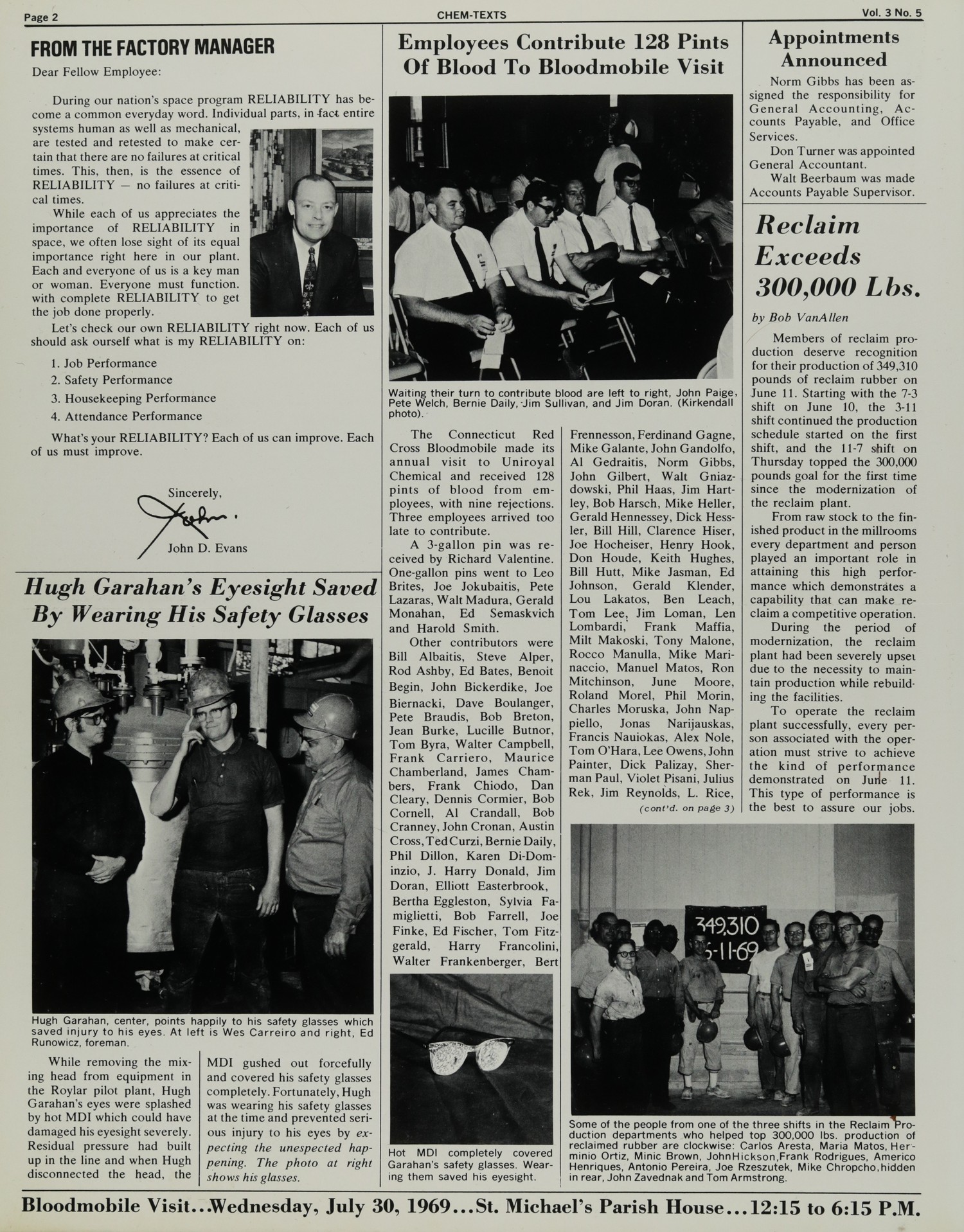
Hugh Garahan, center, points happily to his safety glasses which saved injury to his eyes. At left is Wes Carreiro and right, Ed Runowicz, foreman.

While removing the mixing head from equipment in the Roylar pilot plant, Hugh Garahan’s eyes were splashed by hot MDI which could have damaged his eyesight severely. Residual pressure had built up in the line and when Hugh disconnected the head, the MDI gushed out forcefully and covered his safety glasses completely. Fortunately, Hugh was wearing his safety glasses at the time and prevented serious injury to his eyes by expecting the unexpected happening. The photo at right shows his glasses.

Hot MDI completely covered Garahan’s safety glasses. Wearing them saved his eyesight.


Employees Contribute 128 Pints Of Blood To Bloodmobile Visit

Waiting their turn to contribute blood are left to right, John Paige, Pete Welch, Bernie Daily, Jim Sullivan, and Jim Doran. (Kirkendall photo).

The Connecticut Red Cross Bloodmobile made its annual visit to Uniroyal Chemical and received 128 pints of blood from employees, with nine rejections. Three employees arrived too late to contribute.

A 3-gallon pin was received by Richard Valentine. One-gallon pins went to Leo Brites, Joe Jokubaitis, Pete Lazaras, Walt Madura, Gerald Monahan, Ed Semaskwich and Harold Smith.

Other contributors were Bill Albaitis, Steve Alper, Rod Ashby, Ed Bates, Benoit Begin, John Bickerdike, Joe Biernacki, Dave Boulanger, Pete Braudis, Bob Breton, Jean Burke, Lucille Butnor, Tom Byra, Walter Campbell, Frank Carriero, Maurice Chamberland, James Chambers, Frank Chiodo, Dan Cleary, Dennis Cormier, Bob Cornell, Al Crandall, Bob Cranney, John Cronan, Austin Cross, Ted Curzi, Bernie Daily, Phil Dillon, Karen Di-Dominzio, J. Harry Donald, Jim Doran, Elliott Easterbrook, Bertha Eggleston, Sylvia Famiglietti, Bob Farrell, Joe Finke, Ed Fischer, Tom Fitzgerald, Harry Francolini, Walter Frankenberger, Bert Frennesson, Ferdinand Gagne, Mike Galante, John Gandolfo, Al Gedraitis, Norm Gibbs, John Gilbert, Walt Gnizdowski, Phil Haas, Jim Hartley, Bob Harsch, Mike Heller, Gerald Hennessey, Dick Hessler, Bill Hill, Clarence Hiser, Joe Hocheiser, Henry Hook, Don Houde, Keith Hughes, Bill Hutt, Mike Jasman, Ed Johnson, Gerald Klender, Lou Lakatos, Ben Leach, Tom Lee, Jim Loman, Len Lombardi, Frank Maffia, Milt Makoski, Tony Malone, Rocco Manulla, Mike Marinaccio, Manuel Matos, Ron Mitchinson, June Moore, Roland Morel, Phil Morin, Charles Moruska, John Nappiello, Jonas Narijauskas, Francis Nauiokas, Alex Nole, Tom O’Hara, Lee Owens, John Painter, Dick Palizay, Sherman Paul, Violet Pisani, Julius Rek, Jim Reynolds, L. Rice,

(cont’d. on page 3)


Appointments Announced

Norm Gibbs has been assigned the responsibility for General Accounting, Accounts Payable, and Office Services.

Don Turner was appointed General Accountant.

Walt Beerbaum was made Accounts Payable Supervisor.


Reclaim Exceeds 300,000 Lbs.

by Bob VanAllen

Members of reclaim production deserve recognition for their production of 349,310 pounds of reclaim rubber on June 11. Starting with the 7-3 shift on June 10, the 3-11 shift continued the production schedule started on the first shift, and the 11-7 shift on Thursday topped the 300,000 pounds goal for the first time since the modernization of the reclaim plant.

From raw stock to the finished product in the millrooms every department and person played an important role in attaining this high performance which demonstrates a capability that can make reclaim a competitive operation.

During the period of modernization, the reclaim plant had been severely upset due to the necessity to maintain production while rebuilding the facilities.

To operate the reclaim plant successfully, every person associated with the operation must strive to achieve the kind of performance demonstrated on June 11. This type of performance is the best to assure our jobs.

349,310
6-11-69

Some of the people of the three shifts in the Reclaim Production departments who helped top 300,000 lbs. production of reclaimed rubber are clockwise: Carlos Aresta, Maria Matos, Herminio Ortiz, Minic Brown, JohnHickson,Frank Rodrigues, Americo Henriques, Antonio Pereira, Joe Rzeszutek, Mike Chropcho,hidden in rear, John Zavednak and Tom Armstrong.


Bloodmobile Visit…Wednesday, July 30, 1969…St. Michael’s Parish House…12:15 to 6:15 P.M.
CHEM-TEXTS – Vol. 1, No. 2 – Page 1

Page 001

UNIROYAL CHEM-TEXTS

Vol. 2 PUBLISHED FOR THE PEOPLE OF UNIROYAL CHEMICAL No. 2.


New Equipment for Reclaim Plant Will Keep Us in Reclaim Rubber Business

Our present reclaimed rubber plant dates back to 1895, after fire destroyed the original plant in 1893. For 75 years, we have played an important role in the rubber industry by supplying high quality stocks.

Several years ago, with combining higher production costs and increased shipping expenses, profitability reached a critical point for us in the reclaimed rubber business. Faced with keen competition, reduced prices and low-cost SBR rubber as an alternate, our business was placed in a difficult position. A decision had to be made either to discontinue the business or make major capital investments to modernize the facilities.

After detailed study of the present operation and various improvements and considering the skills of our people, it was decided that a modernization of the facilities would be practical and increase our ability to successfully compete in the market place. An appropriation request for these plans was drawn up and approved.

The “new” plant, efficiently and effectively operated, will help protect the job security of 100 employees while the alternate of going out of the business would have eliminated 150 employees, many with long seniority. Changes in the millrooms, reduced from 3 to 1, will affect the jobs of about 50 employees.

A project team was formed to work on the problem. The team settled on 5 major changes which would offer the best return on investment at this time: 1. fibre separation; 2. fine grinding; 3. central mix in the mill room; 4. revision in the mill room; 5. Zenith and dryer revisions.

The team in charge of the project working closely with the New York engineering group were R. Gaetz, Engineering Dept., Ted Lainas, Reclaim Development; C. Reich, Production and F. Wintsch, Industrial Engineering. Since his transfer to Industrial Relations, Wintsch has been replaced by B. Daily.

This team was charged with the responsibility of making the project go; by developing the flow sheets and recommending the type of equipment. All the details of engineering is being handled by approximately 12 members of the New York corporate engineering staff.

The job to be done consists of removing the fibre from old tires to prepare them for the fine grinding operation. By doing a better job of removing the fibre in the early steps and also by finer grinding, the digester cycle will be shortened, and chemical costs reduced. Also, fine grinding prior to digesting, allows us to make one pass through the mill rooms instead of 4 passes under the old system. The fine grinding, fibre separation and central mixing will be new departments and will require new skills. Engineering also estimates that we would have

(Continued on Page 2)


U.S. BOND DRIVE AIMS FOR 50% PARTICIPATION

John D. Evans, Factory Manager, named Fred Wintsch chairman of the 1968 U.S. Savings Bonds and Freedom Shares Drive at the Naugatuck plant. The drive was sponsored for two weeks from May 6 to May 17.

Last year’s campaign at the Naugatuck plant added 72 new savers to the payroll deduction plan; 88 employees increased their participation; and 152 purchased the new Freedom Shares. Approximately 40% of the Chemical employees are enrolled in the purchase of U.S. Savings Bonds and Freedom Shares.

The goal for the 1968 drive according to Wintsch was to attain 50% participation by Chemical plant employees. A committee of 71 canvassers had been organized in different sections of the plant. Members of the committee were the following: Warren Singleton, E. G. Broderick, Mary Sullivan, J. Flickinger, Harold Smith, L. Anderson, S.E. Salva, R.W. Stutzman, L. P. Ferrigno, T.J. Shilinskas, Harold Campbell, O. Zaprazalka, R.M. Bioski, M.A. Lasky, D. Johnson, E. J. Greene, F.X. O’Shea, R. Rosenbaum, C.C. Smith, A. Budd, I.A. Prager, P.J. Lazaras, W.R. Smith, V.R. Lardi, A.J. Loman, J.F. Zappala, M.E. Kuryn, G.M. Stone, R. Juliano, D. Pagnoni, C. Terniko, L. Scheithe, M. Dodd, T. Dowling, J. Homyetski, F. Magnamo, L. McCoy, G. Baktis, W. Frankerberg, A. Enamait, A. Pistarelli, E. Polonis, W. Booth, D. Rappe, T. Skehan, H. Piascik, R.R. Foltz, M. Mazur, S. Petkis, R. Magnamo, T. McMahon, L. Opdyke, L. Evan, J. Casey, J. Tierney, S. Korpusik, C. Bulka, W. Lannon, D. Nelson, J. Murtha, K. Pittner, R. Burns, J. Quint, V. Alves, J. Carroll, R. Terino, J. Vergosen, P. Norton, R. Krajewski, A. Nole and A. Juliano.

George Murdock of the Treasury Department addressed the group on the advantages of payroll deductions as an important part of an employee’s savings program. 70% of Savings Bonds purchasers do not redeem them until after age 65. In this way, the tax liability on E. Bond interest could be greatly reduced and even eliminated entirely under some circumstances.


[IMAGE: Black and white photograph showing industrial equipment on a rooftop]

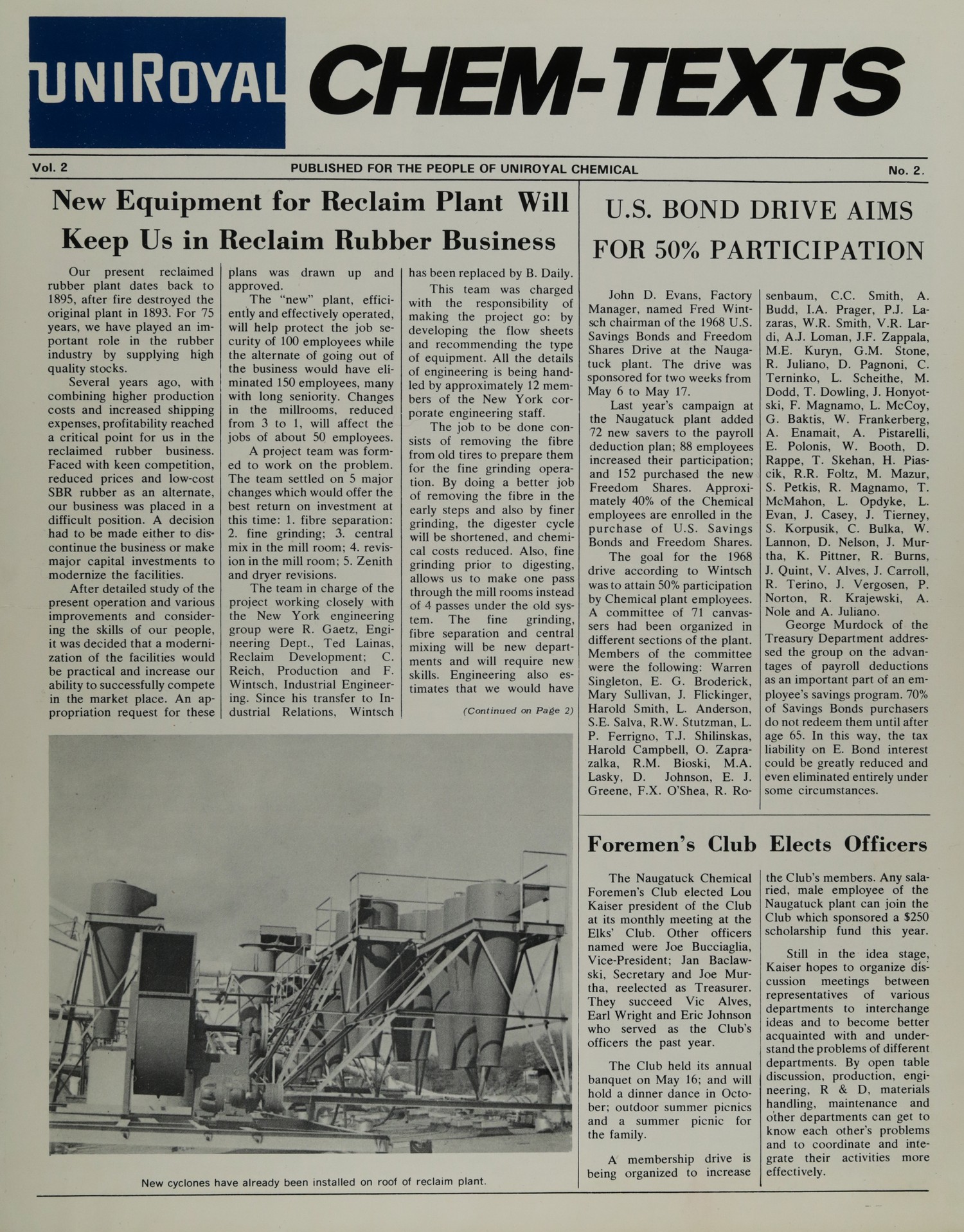
New cyclones have already been installed on roof of reclaim plant.


Foremen’s Club Elects Officers

The Naugatuck Chemical Foremen’s Club elected Lou Kaiser president of the Club at its monthly meeting at the Elks’ Club. Other officers named were Joe Bucciaglia, Vice-President; Jan Baclawski, Secretary and Joe Murtha, reelected as Treasurer. They succeed Vic Alves, Earl Wright and Eric Johnson who served as the Club’s officers the past year.

The Club held its annual banquet on May 16; and will hold a dinner dance in October; outdoor summer picnics and a summer picnic for the family.

A membership drive is being organized to increase the Club’s members. Any salaried, male employee of the Naugatuck plant can join the Club which sponsored a $250 scholarship fund this year.

Still in the idea stage, Kaiser hopes to organize discussion meetings between representatives of various departments to interchange ideas and to become better acquainted with and understand the problems of different departments. By open table discussion, production, engineering, R & D, materials handling, maintenance and other departments can get to know each other’s problems and to coordinate and integrate their activities more effectively.