CHEM-TEXTS – 1980-v14-s290

Page 290

CHEM-TEXTS

Page 3 | Vol. 14, 1980


V. Calarco Looks at 1980

[PHOTO CAPTION:]
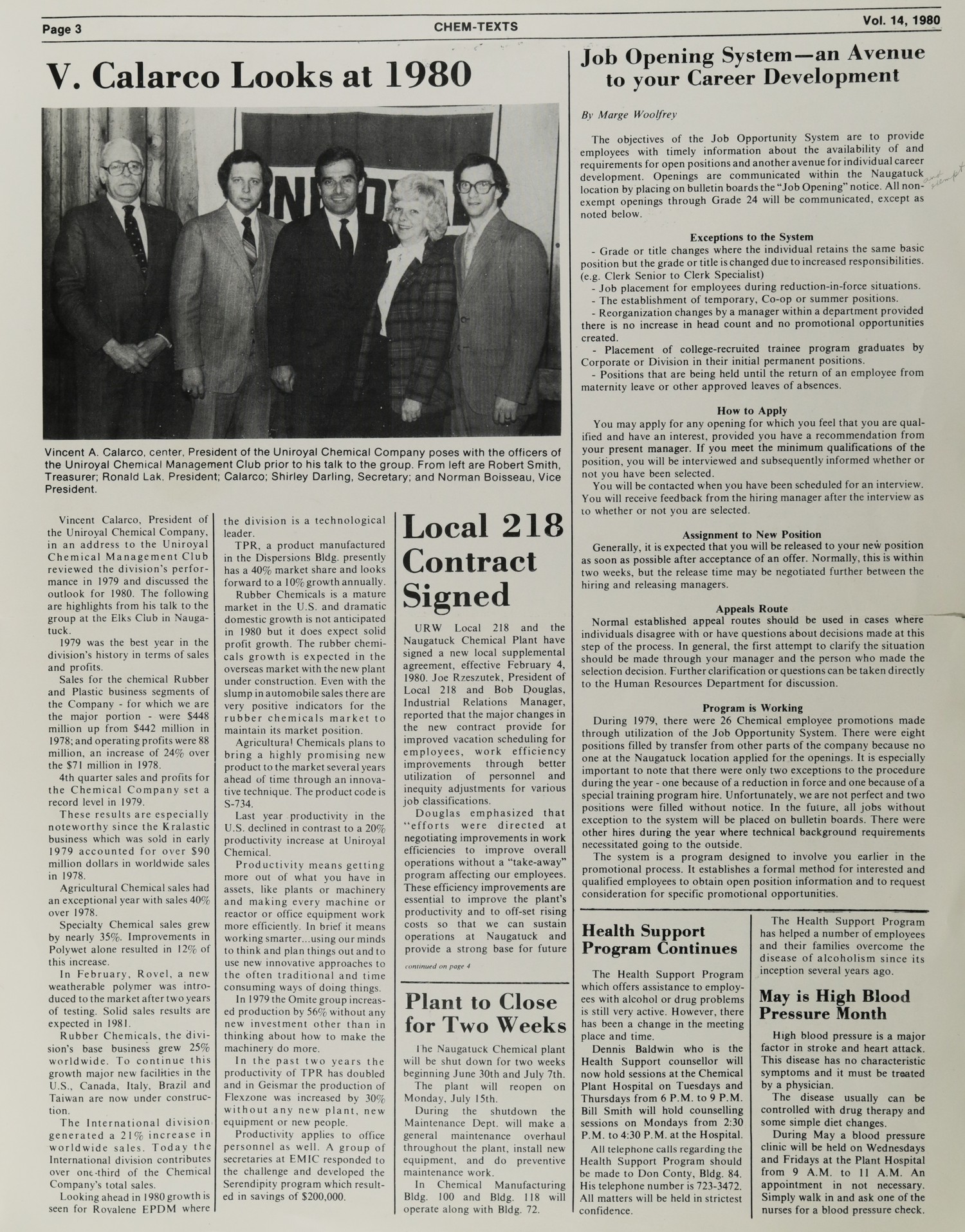
Vincent A. Calarco, center, President of the Uniroyal Chemical Company poses with the officers of the Uniroyal Chemical Management Club prior to his talk to the group. From left are Robert Smith, Treasurer; Ronald Lak, President; Calarco; Shirley Darling, Secretary; and Norman Boisseau, Vice President.


Vincent Calarco, President of the Uniroyal Chemical Company, in an address to the Uniroyal Chemical Management Club reviewed the division’s performance in 1979 and discussed the outlook for 1980. The following are highlights from his talk to the group at the Elks Club in Naugatuck.

1979 was the best year in the division’s history in terms of sales and profits.

Sales for the chemical Rubber and Plastic business segments of the Company – for which we are the major portion – were $448 million up from $442 million in 1978; and operating profits were 88 million, an increase of 24% over the $71 million in 1978.

4th quarter sales and profits for the Chemical Company set a record level in 1979.

These results are especially noteworthy since the Kralastic business which was sold in early 1979 accounted for over $90 million dollars in worldwide sales in 1978.

Agricultural Chemical sales had an exceptional year with sales 40% over 1978.

Specialty Chemical sales grew by nearly 35%. Improvements in Polywet alone resulted in 12% of this increase.

In February, Rovel, a new weatherable polymer was introduced to the market after two years of testing. Solid sales results are expected in 1981.

Rubber Chemicals, the division’s base business grew 25% worldwide. To continue this growth major new facilities in the U.S., Canada, Italy, Brazil and Taiwan are now under construction.

The International division generated a 21% increase in worldwide sales. Today the International division contributes over one-third of the Chemical Company’s total sales.

Looking ahead in 1980 growth is seen for Rovalene EPDM where the division is a technological leader.

TPR, a product manufactured in the Dispersions Bldg. presently has a 40% market share and looks forward to a 10% growth annually.

Rubber Chemicals is a mature market in the U.S. and dramatic domestic growth is not anticipated in 1980 but it does expect solid profit growth. The rubber chemicals growth is expected in the overseas market with the new plant under construction. Even with the slump in automobile sales there are very positive indicators for the rubber chemicals market to maintain its market position.

Agricultural Chemicals plans to bring a highly promising new product to the market several years ahead of time through an innovative technique. The product code is S-734.

Last year productivity in the U.S. declined in contrast to a 20% productivity increase at Uniroyal Chemical.

Productivity means getting more out of what you have in assets, like plants or machinery and making every machine or reactor or office equipment work more efficiently. In brief it means working smarter…using our minds to think and plan things out and to use new innovative approaches to the often traditional and time consuming ways of doing things.

In 1979 the Omite group increased production by 56% without any new investment other than in thinking about how to make the machinery do more.

In the past two years the productivity of TPR has doubled and in Geismar the production of Flexzone was increased by 30% without any new plant, new equipment or new people.

Productivity applies to office personnel as well. A group of secretaries at EMIC responded to the challenge and developed the Serendipity program which resulted in savings of $200,000.


Job Opening System—an Avenue to your Career Development

By Marge Woolfrey

The objectives of the Job Opportunity System are to provide employees with timely information about the availability of and requirements for open positions and another avenue for individual career development. Openings are communicated within the Naugatuck location by placing on bulletin boards the “Job Opening” notice. All non-exempt openings through Grade 24 will be communicated, except as noted below.

Exceptions to the System

  • Grade or title changes where the individual retains the same basic position but the grade or title is changed due to increased responsibilities. (e.g. Clerk Senior to Clerk Specialist)
  • Job placement for employees during reduction-in-force situations.
  • The establishment of temporary, Co-op or summer positions.
  • Reorganization changes by a manager within a department provided there is no increase in head count and no promotional opportunities created.
  • Placement of college-recruited trainee program graduates by Corporate or Division in their initial permanent positions.
  • Positions that are being held until the return of an employee from maternity leave or other approved leaves of absences.

How to Apply

You may apply for any opening for which you feel that you are qualified and have an interest, provided you have a recommendation from your present manager. If you meet the minimum qualifications of the position, you will be interviewed and subsequently informed whether or not you have been selected.

You will be contacted when you have been scheduled for an interview. You will receive feedback from the hiring manager after the interview as to whether or not you are selected.

Assignment to New Position

Generally, it is expected that you will be released to your new position as soon as possible after acceptance of an offer. Normally, this is within two weeks, but the release time may be negotiated further between the hiring and releasing managers.

Appeals Route

Normal established appeal routes should be used in cases where individuals disagree with or have questions about decisions made at this step of the process. In general, the first attempt to clarify the situation should be made through your manager and the person who made the selection decision. Further clarification or questions can be taken directly to the Human Resources Department for discussion.

Program is Working

During 1979, there were 26 Chemical employee promotions made through utilization of the Job Opportunity System. There were eight positions filled by transfer from other parts of the company because no one at the Naugatuck location applied for the openings. It is especially important to note that there were only two exceptions to the procedure during the year – one because of a reduction in force and one because of a special training program hire. Unfortunately, we are not perfect and two positions were filled without notice. In the future, all jobs without exception to the system will be placed on bulletin boards. There were other hires during the year where technical background requirements necessitated going to the outside.

The system is a program designed to involve you earlier in the promotional process. It establishes a formal method for interested and qualified employees to obtain open position information and to request consideration for specific promotional opportunities.


Local 218 Contract Signed

URW Local 218 and the Naugatuck Chemical Plant have signed a new local supplemental agreement, effective February 4, 1980. Joe Rzeszutek, President of Local 218 and Bob Douglas, Industrial Relations Manager, reported that the major changes in the new contract provide for improved vacation scheduling for employees, work efficiency improvements through better utilization of personnel and inequity adjustments for various job classifications.

Douglas emphasized that “efforts were directed at negotiating improvements in work efficiencies to improve overall operations without a “take-away” program affecting our employees. These efficiency improvements are essential to improve the plant’s productivity and to off-set rising costs so that we can sustain operations at Naugatuck and provide a strong base for future

continued on page 4


Plant to Close for Two Weeks

The Naugatuck Chemical plant will be shut down for two weeks beginning June 30th and July 7th. The plant will reopen on Monday, July 15th.

During the shutdown the Maintenance Dept. will make a general maintenance overhaul throughout the plant, install new equipment, and do preventive maintenance work.

In Chemical Manufacturing Bldg. 100 and Bldg. 118 will operate along with Bldg. 72.


Health Support Program Continues

The Health Support Program which offers assistance to employees with alcohol or drug problems is still very active. However, there has been a change in the meeting place and time.

Dennis Baldwin who is the Health Support counsellor will now hold sessions at the Chemical Plant Hospital on Tuesdays and Thursdays from 6 P.M. to 9 P.M. Bill Smith will hold counselling sessions on Mondays from 2:30 P.M. to 4:30 P.M. at the Hospital.

All telephone calls regarding the Health Support Program should be made to Don Conty, Bldg. 84. His telephone number is 723-3472. All matters will be held in strictest confidence.

The Health Support Program has helped a number of employees and their families overcome the disease of alcoholism since its inception several years ago.


May is High Blood Pressure Month

High blood pressure is a major factor in stroke and heart attack. This disease has no characteristic symptoms and it must be treated by a physician.

The disease usually can be controlled with drug therapy and some simple diet changes.

During May a blood pressure clinic will be held on Wednesdays and Fridays at the Plant Hospital from 9 A.M. to 11 A.M. An appointment in not necessary. Simply walk in and ask one of the nurses for a blood pressure check.
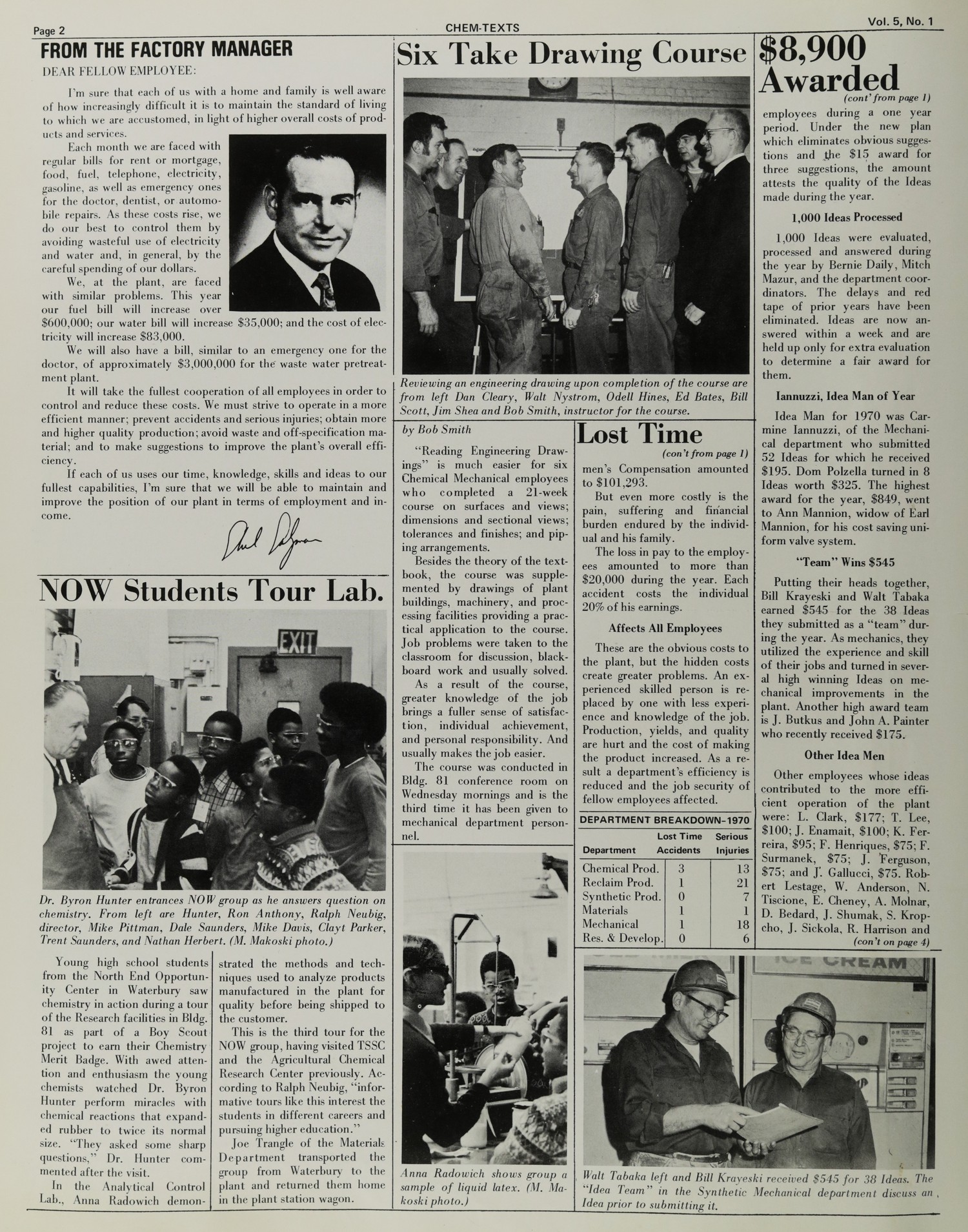
CHEM-TEXTS – Vol. 5, No. 1 – Page 2

Page 002

CHEM-TEXTS

Page 2 | Vol. 5, No. 1


FROM THE FACTORY MANAGER

DEAR FELLOW EMPLOYEE:

I’m sure that each of us with a home and family is well aware of how increasingly difficult it is to maintain the standard of living to which we are accustomed, in light of higher overall costs of products and services.

Each month we are faced with regular bills for rent or mortgage, food, fuel, telephone, electricity, gasoline, as well as emergency ones for the doctor, dentist, or automobile repairs. As these costs rise, we do our best to control them by avoiding wasteful use of electricity and water and, in general, by the careful spending of our dollars.

We, at the plant, are faced with similar problems. This year our fuel bill will increase over $600,000; our water bill will increase $35,000; and the cost of electricity will increase $83,000.

We will also have a bill, similar to an emergency one for the doctor, of approximately $3,000,000 for the waste water pretreatment plant.

It will take the fullest cooperation of all employees in order to control and reduce these costs. We must strive to operate in a more efficient manner; prevent accidents and serious injuries; obtain more and higher quality production; avoid waste and off-specification material; and to make suggestions to improve the plant’s overall efficiency.

If each of us uses our time, knowledge, skills and ideas to our fullest capabilities, I’m sure that we will be able to maintain and improve the position of our plant in terms of employment and income.

[Signature: Paul Lyson]


NOW Students Tour Lab.

Dr. Byron Hunter entrances NOW group as he answers question on chemistry. From left are Hunter, Ron Anthony, Ralph Neubig, director, Mike Pittman, Dale Saunders, Mike Davis, Clayt Parker, Trent Saunders, and Nathan Herbert. (M. Makoski photo.)

Young high school students from the North End Opportunity Center in Waterbury saw chemistry in action during a tour of the Research facilities in Bldg. 81 as part of a Boy Scout project to earn their Chemistry Merit Badge. With awed attention and enthusiasm the young chemists watched Dr. Byron Hunter perform miracles with chemical reactions that expanded rubber to twice its normal size. “They asked some sharp questions,” Dr. Hunter commented after the visit.

In the Analytical Control Lab., Anna Radowich demonstrated the methods and techniques used to analyze products manufactured in the plant for quality before being shipped to the customer.

This is the third tour for the NOW group, having visited TSSC and the Agricultural Chemical Research Center previously. According to Ralph Neubig, “informative tours like this interest the students in different careers and pursuing higher education.”

Joe Trangle of the Materials Department transported the group from Waterbury to the plant and returned them home in the plant station wagon.


Six Take Drawing Course

Reviewing an engineering drawing upon completion of the course are from left Dan Cleary, Walt Nystrom, Odell Hines, Ed Bates, Bill Scott, Jim Shea and Bob Smith, instructor for the course.

by Bob Smith

“Reading Engineering Drawings” is much easier for six Chemical Mechanical employees who completed a 21-week course on surfaces and views; dimensions and sectional views; tolerances and finishes; and piping arrangements.

Besides the theory of the textbook, the course was supplemented by drawings of plant buildings, machinery, and processing facilities providing a practical application to the course. Job problems were taken to the classroom for discussion, blackboard work and usually solved.

As a result of the course, greater knowledge of the job brings a fuller sense of satisfaction, individual achievement, and personal responsibility. And usually makes the job easier.

The course was conducted in Bldg. 81 conference room on Wednesday mornings and is the third time it has been given to mechanical department personnel.


$8,900 Awarded

(cont’ from page 1)

employees during a one year period. Under the new plan which eliminates obvious suggestions and the $15 award for three suggestions, the amount attests the quality of the Ideas made during the year.

1,000 Ideas Processed

1,000 Ideas were evaluated, processed and answered during the year by Bernie Daily, Mitch Mazur, and the department coordinators. The delays and red tape of prior years have been eliminated. Ideas are now answered within a week and are held up only for extra evaluation to determine a fair award for them.

Iannuzzi, Idea Man of Year

Idea Man for 1970 was Carmine Iannuzzi, of the Mechanical department who submitted 52 Ideas for which he received $195. Dom Polzella turned in 8 Ideas worth $325. The highest award for the year, $849, went to Ann Mannion, widow of Earl Mannion, for his cost saving uniform valve system.

“Team” Wins $545

Putting their heads together, Bill Krayeski and Walt Tabaka earned $545 for the 38 Ideas they submitted as a “team” during the year. As mechanics, they utilized the experience and skill of their jobs and turned in several high winning Ideas on mechanical improvements in the plant. Another high award team is J. Butkus and John A. Painter who recently received $175.

Other Idea Men

Other employees whose ideas contributed to the more efficient operation of the plant were: L. Clark, $177; T. Lee, $100; J. Enamait, $100; K. Ferreira, $95; F. Henriques, $75; F. Surmanek, $75; J. Ferguson, $75; and J. Gallucci, $75. Robert Lestage, W. Anderson, N. Tiscione, E. Cheney, A. Molnar, D. Bedard, J. Shumak, S. Kropcho, J. Sickola, R. Harrison and (con’t on page 4)


Lost Time

(con’t from page 1)

men’s Compensation amounted to $101,293.

But even more costly is the pain, suffering and financial burden endured by the individual and his family.

The loss in pay to the employees amounted to more than $20,000 during the year. Each accident costs the individual 20% of his earnings.

Affects All Employees

These are the obvious costs to the plant, but the hidden costs create greater problems. An experienced skilled person is replaced by one with less experience and knowledge of the job. Production, yields, and quality are hurt and the cost of making the product increased. As a result a department’s efficiency is reduced and the job security of fellow employees affected.

DEPARTMENT BREAKDOWN—1970

Department Lost Time Accidents Serious Injuries
Chemical Prod. 3 13
Reclaim Prod. 1 21
Synthetic Prod. 0 7
Materials 1 1
Mechanical 1 18
Res. & Develop. 0 6

Anna Radowich shows group a sample of liquid latex. (M. Makoski photo.)

Walt Tabaka left and Bill Krayeski received $545 for 38 Ideas. The “Idea Team” in the Synthetic Mechanical department discuss an Idea prior to submitting it.

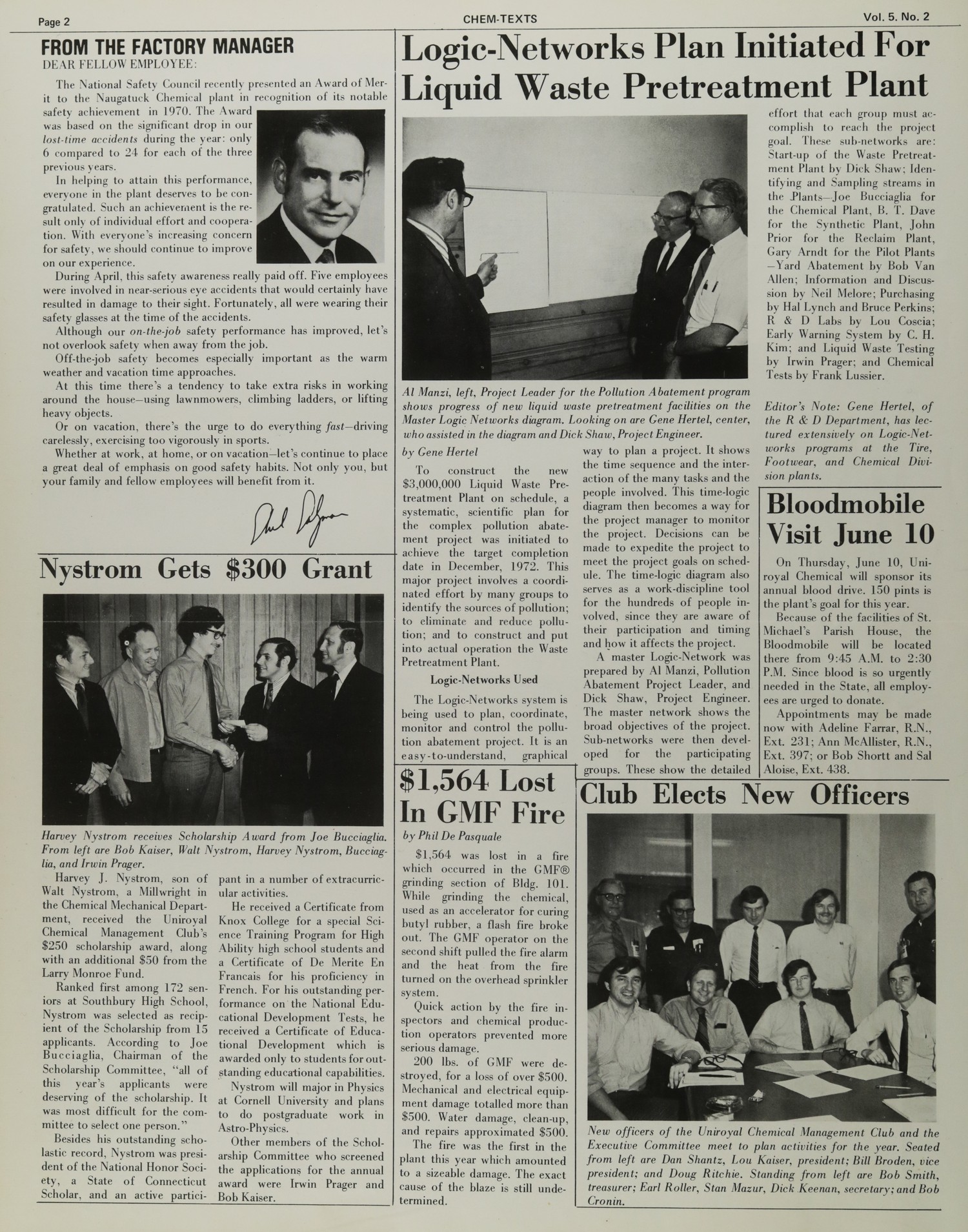
CHEM-TEXTS – Vol. 5, No. 2 – Page 2

Page 002

CHEM-TEXTS

Page 2 | Vol. 5, No. 2


FROM THE FACTORY MANAGER

DEAR FELLOW EMPLOYEE:

The National Safety Council recently presented an Award of Merit to the Naugatuck Chemical plant in recognition of its notable safety achievement in 1970. The Award was based on the significant drop in our lost-time accidents during the year: only 6 compared to 24 for each of the three previous years.

In helping to attain this performance, everyone in the plant deserves to be congratulated. Such an achievement is the result only of individual effort and cooperation. With everyone’s increasing concern for safety, we should continue to improve on our experience.

During April, this safety awareness really paid off. Five employees were involved in near-serious eye accidents that would certainly have resulted in damage to their sight. Fortunately, all were wearing their safety glasses at the time of the accidents.

Although our on-the-job safety performance has improved, let’s not overlook safety when away from the job.

Off-the-job safety becomes especially important as the warm weather and vacation time approaches.

At this time there’s a tendency to take extra risks in working around the house—using lawnmowers, climbing ladders, or lifting heavy objects.

Or on vacation, there’s the urge to do everything fast—driving carelessly, exercising too vigorously in sports.

Whether at work, at home, or on vacation—let’s continue to place a great deal of emphasis on good safety habits. Not only you, but your family and fellow employees will benefit from it.

[Signature]


Nystrom Gets $300 Grant

Harvey Nystrom receives Scholarship Award from Joe Bucciaglia. From left are Bob Kaiser, Walt Nystrom, Harvey Nystrom, Bucciaglia, and Irwin Prager.

Harvey J. Nystrom, son of Walt Nystrom, a Millwright in the Chemical Mechanical Department, received the Uniroyal Chemical Management Club’s $250 scholarship award, along with an additional $50 from the Larry Monroe Fund.

Ranked first among 172 seniors at Southbury High School, Nystrom was selected as recipient of the Scholarship from 15 applicants. According to Joe Bucciaglia, Chairman of the Scholarship Committee, “all of this year’s applicants were deserving of the scholarship. It was most difficult for the committee to select one person.”

Besides his outstanding scholastic record, Nystrom was president of the National Honor Society, a State of Connecticut Scholar, and an active participant in a number of extracurricular activities.

He received a Certificate from Knox College for a special Science Training Program for High Ability high school students and a Certificate of De Merite En Francais for his proficiency in French. For his outstanding performance on the National Educational Development Tests, he received a Certificate of Educational Development which is awarded only to students for outstanding educational capabilities.

Nystrom will major in Physics at Cornell University and plans to do postgraduate work in Astro-Physics.

Other members of the Scholarship Committee who screened the applications for the annual award were Irwin Prager and Bob Kaiser.


Logic-Networks Plan Initiated For Liquid Waste Pretreatment Plant

Al Manzi, left, Project Leader for the Pollution Abatement program shows progress of new liquid waste pretreatment facilities on the Master Logic Networks diagram. Looking on are Gene Hertel, center, who assisted in the diagram and Dick Shaw, Project Engineer.

by Gene Hertel

To construct the new $3,000,000 Liquid Waste Pretreatment Plant on schedule, a systematic, scientific plan for the complex pollution abatement project was initiated to achieve the target completion date in December, 1972. This major project involves a coordinated effort by many groups to identify the sources of pollution; to eliminate and reduce pollution; and to construct and put into actual operation the Waste Pretreatment Plant.

Logic-Networks Used

The Logic-Networks system is being used to plan, coordinate, monitor and control the pollution abatement project. It is an easy-to-understand, graphical way to plan a project. It shows the time sequence and the interaction of the many tasks and the people involved. This time-logic diagram then becomes a way for the project manager to monitor the project. Decisions can be made to expedite the project to meet the project goals on schedule. The time-logic diagram also serves as a work-discipline tool for the hundreds of people involved, since they are aware of their participation and timing and how it affects the project.

A master Logic-Network was prepared by Al Manzi, Pollution Abatement Project Leader, and Dick Shaw, Project Engineer. The master network shows the broad objectives of the project. Sub-networks were then developed for the participating groups. These show the detailed effort that each group must accomplish to reach the project goal. These sub-networks are: Start-up of the Waste Pretreatment Plant by Dick Shaw; Identifying and Sampling streams in the Plants—Joe Bucciaglia for the Chemical Plant, B. T. Dave for the Synthetic Plant, John Prior for the Reclaim Plant, Gary Arndt for the Pilot Plants – Yard Abatement by Bob Van Allen; Information and Discussion by Neil Melore; Purchasing by Hal Lynch and Bruce Perkins; R & D Labs by Lou Coscia; Early Warning System by C. H. Kim; and Liquid Waste Testing by Irwin Prager; and Chemical Tests by Frank Lussier.

Editor’s Note: Gene Hertel, of the R & D Department, has lectured extensively on Logic-Networks programs at the Tire, Footwear, and Chemical Division plants.


Bloodmobile Visit June 10

On Thursday, June 10, Uniroyal Chemical will sponsor its annual blood drive. 150 pints is the plant’s goal for this year.

Because of the facilities of St. Michael’s Parish House, the Bloodmobile will be located there from 9:45 A.M. to 2:30 P.M. Since blood is so urgently needed in the State, all employees are urged to donate.

Appointments may be made now with Adeline Farrar, R.N., Ext. 231; Ann McAllister, R.N., Ext. 397; or Bob Shortt and Sal Aloise, Ext. 438.


$1,564 Lost In GMF Fire

by Phil De Pasquale

$1,564 was lost in a fire which occurred in the GMF® grinding section of Bldg. 101. While grinding the chemical, used as an accelerator for curing butyl rubber, a flash fire broke out. The GMF operator on the second shift pulled the fire alarm and the heat from the fire turned on the overhead sprinkler system.

Quick action by the fire inspectors and chemical production operators prevented more serious damage.

200 lbs. of GMF were destroyed, for a loss of over $500. Mechanical and electrical equipment damage totalled more than $500. Water damage, clean-up, and repairs approximated $500.

The fire was the first in the plant this year which amounted to a sizeable damage. The exact cause of the blaze is still undetermined.


Club Elects New Officers

New officers of the Uniroyal Chemical Management Club and the Executive Committee meet to plan activities for the year. Seated from left are Dan Shantz, Lou Kaiser, president; Bill Broden, vice president; and Doug Ritchie. Standing from left are Bob Smith, treasurer; Earl Roller, Stan Mazur, Dick Keenan, secretary; and Bob Cronin.

CHEM-TEXTS – Vol. 4 No. 3 – Page 2

Page 002

CHEM-TEXTS

Page 2 | Vol. 4 No. 3


FROM THE FACTORY MANAGER

DEAR FELLOW EMPLOYEE:

Spring is officially here and every now and then the sunshine gives promise that it will be really here before long. Along with spring comes the housecleaning bug that bites our wives and turns our houses upside down while the cleaning is done and the furniture is moved. When it’s all done, the house really looks great, doesn’t it?

Let’s all catch the bug this spring and pitch in together to clean up the plant this month. In a large operation like ours, spread over many acres, winter takes its toll of housekeeping and when the snow is gone our winter carelessness becomes only too obvious.

I’m counting on everybody to do his part in cleaning up his work area. Remember, good housekeeping goes hand in hand with efficient work, quality performance, safe operation and makes for a much more pleasant place to work.

Best regards.

Sincerely,

John

John D. Evans


Chemical Club Elects Officers

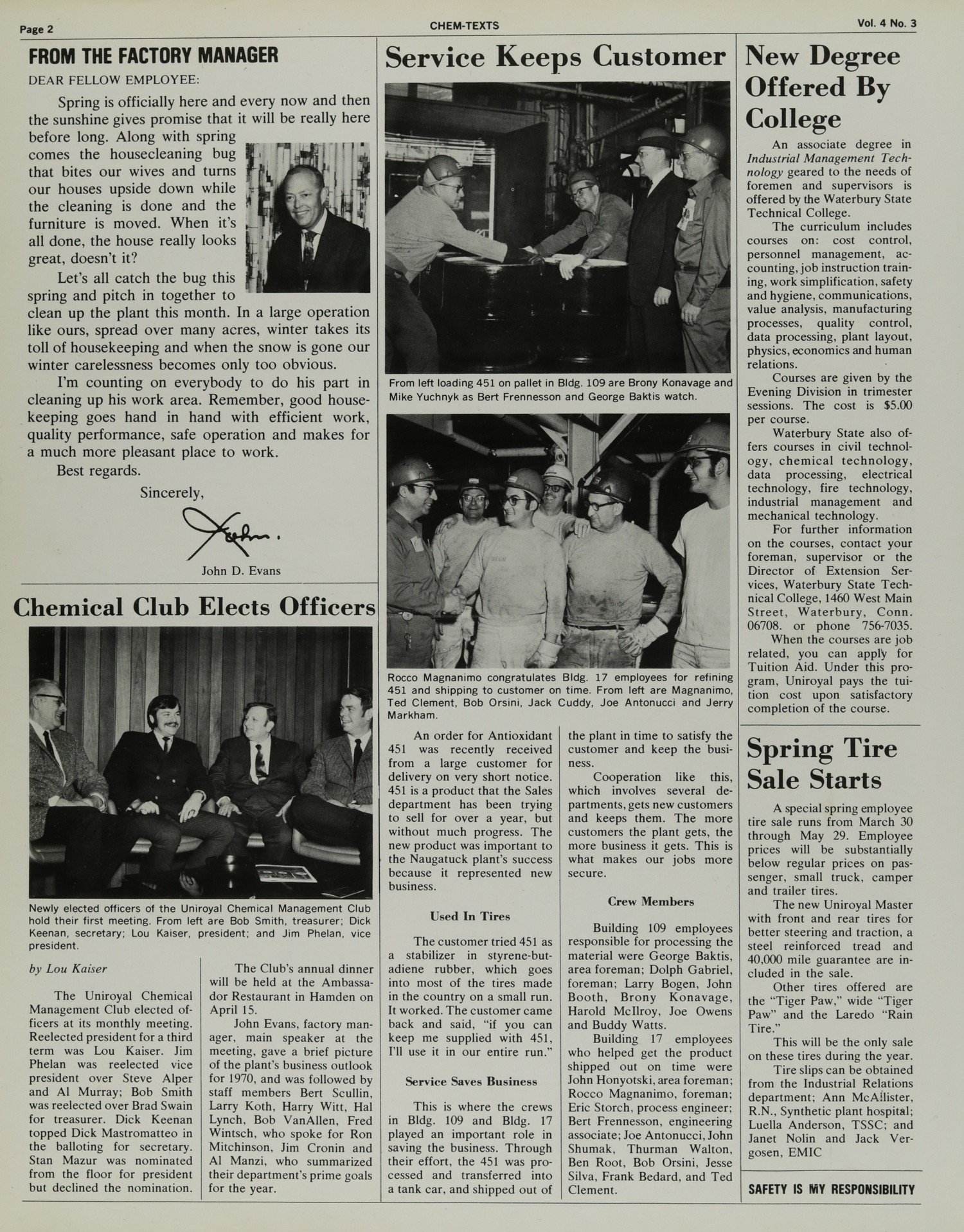
[IMAGE: Group photo of officers at meeting]

Newly elected officers of the Uniroyal Chemical Management Club hold their first meeting. From left are Bob Smith, treasurer; Dick Keenan, secretary; Lou Kaiser, president; and Jim Phelan, vice president.

by Lou Kaiser

The Uniroyal Chemical Management Club elected officers at its monthly meeting. Reelected president for a third term was Lou Kaiser. Jim Phelan was reelected vice president over Steve Alper and Al Murray. Bob Smith was reelected over Brad Swain for treasurer. Dick Keenan topped Dick Mastromatteo in the balloting for secretary. Stan Mazur was nominated from the floor for president but declined the nomination.

The Club’s annual dinner will be held at the Ambassador Restaurant in Hamden on April 15.

John Evans, factory manager, main speaker at the meeting, gave a brief picture of the plant’s business outlook for 1970, and was followed by staff members Bert Scullin, Larry Koth, Harry Witt, Hal Lynch, Bob VanAllen, Fred Wintsch, who spoke for Ron Mitchinson, Jim Cronin and Al Manzi, who summarized their department’s prime goals for the year.


Service Keeps Customer

[IMAGE: Workers loading materials on pallet]

From left loading 451 on pallet in Bldg. 109 are Brony Konavage and Mike Yuchnyk as Bert Frennesson and George Baktis watch.

[IMAGE: Group of workers being congratulated]

Rocco Magnanimo congratulates Bldg. 17 employees for refining 451 and shipping to customer on time. From left are Magnanimo, Ted Clement, Bob Orsini, Jack Cuddy, Joe Antonucci and Jerry Markham.

An order for Antioxidant 451 was recently received from a large customer for delivery on very short notice. 451 is a product that the Sales department has been trying to sell for over a year, but without much progress. The new product was important to the Naugatuck plant’s success because it represented new business.

Used In Tires

The customer tried 451 as a stabilizer in styrene-butadiene rubber, which goes into most of the tires made in the country on a small run. It worked. The customer came back and said, “if you can keep me supplied with 451, I’ll use it in our entire run.”

Service Saves Business

This is where the crews in Bldg. 109 and Bldg. 17 played an important role in saving the business. Through their effort, the 451 was processed and transferred into a tank car, and shipped out of the plant in time to satisfy the customer and keep the business.

Cooperation like this, which involves several departments, gets new customers and keeps them. The more customers the plant gets, the more business it gets. This is what makes our jobs more secure.

Crew Members

Building 109 employees responsible for processing the material were George Baktis, area foreman; Dolph Gabriel, foreman; Larry Bogen, John Booth, Brony Konavage, Harold McIlroy, Joe Owens and Buddy Watts.

Building 17 employees who helped get the product shipped out on time were John Honyotski, area foreman; Rocco Magnanimo, foreman; Eric Storch, process engineer; Bert Frennesson, engineering associate; Joe Antonucci, John Shumak, Thurman Walton, Ben Root, Bob Orsini, Jesse Silva, Frank Bedard, and Ted Clement.


New Degree Offered By College

An associate degree in Industrial Management Technology geared to the needs of foremen and supervisors is offered by the Waterbury State Technical College.

The curriculum includes courses on: cost control, personnel management, accounting, job instruction training, work simplification, safety and hygiene, communications, value analysis, manufacturing processes, quality control, data processing, plant layout, physics, economics and human relations.

Courses are given by the Evening Division in trimester sessions. The cost is $5.00 per course.

Waterbury State also offers courses in civil technology, chemical technology, data processing, electrical technology, fire technology, industrial management and mechanical technology.

For further information on the courses, contact your foreman, supervisor or the Director of Extension Services, Waterbury State Technical College, 1460 West Main Street, Waterbury, Conn. 06708. or phone 756-7035.

When the courses are job related, you can apply for Tuition Aid. Under this program, Uniroyal pays the tuition cost upon satisfactory completion of the course.


Spring Tire Sale Starts

A special spring employee tire sale runs from March 30 through May 29. Employee prices will be substantially below regular prices on passenger, small truck, camper and trailer tires.

The new Uniroyal Master with front and rear tires for better steering and traction, a steel reinforced tread and 40,000 mile guarantee are included in the sale.

Other tires offered are the “Tiger Paw,” wide “Tiger Paw” and the Laredo “Rain Tire.”

This will be the only sale on these tires during the year.

Tire slips can be obtained from the Industrial Relations department; Ann McAllister, R.N., Synthetic plant hospital; Luella Anderson, TSSC; and Janet Nolin and Jack Vergosen, EMIC

SAFETY IS MY RESPONSIBILITY

CHEM-TEXTS – Vol. 4 No. 5 – Page 4

Page 004

Page 4 | CHEM-TEXT | Vol. 4, No. 5

$5,200,000 . . .

(continued from page 1)

tem eliminated the discharge of 34,000 lbs. of fiber to the river daily.

Air Pollution Control

A major improvement in cleaner air resulted from the conversion of the boiler house from coal to oil firing. This $500,000 facility stopped the discharge of 2½ tons of flyash into the air each day. The conversion also eliminated the need for cooling cinders which caused pollution of the river.

At a cost of $510,000, cyclones, Holoflite dryers, and a digester blowdown condensing system were installed to reduce pollution of the air from lint and evaporated oil caused by the reclaim plant.

Scrubbers Control Odors

Seven scrubbers are now in operation in plant buildings to “wash” the fumes and odors created by processing operations. Ranging in cost from $2,000 to $70,000, some of the complex systems prevent the discharge of phenolic, mercaptans, formaldehyde and hydrochloric fumes into the atmosphere.

Two new scrubbers are now on order and will be installed when delivered.

Groups Study Problems

Immediate remedial action is being taken by an


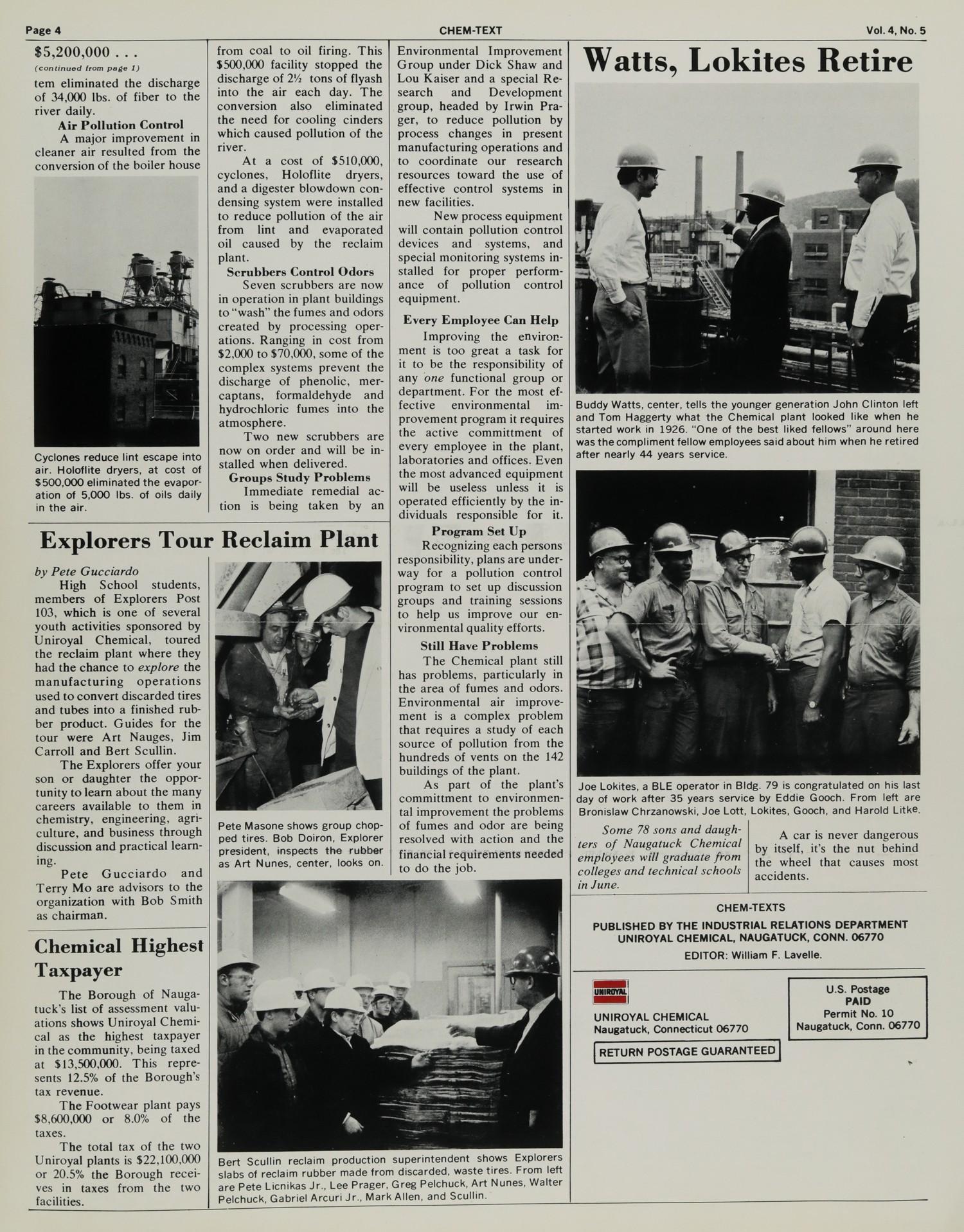
Cyclones reduce lint escape into air. Holoflite dryers, at cost of $500,000 eliminated the evaporation of 5,000 lbs. of oils daily in the air.


Environmental Improvement Group under Dick Shaw and Lou Kaiser and a special Research and Development group, headed by Irwin Prager, to reduce pollution by process changes in present manufacturing operations and to coordinate our research resources toward the use of effective control systems in new facilities.

New process equipment will contain pollution control devices and systems, and special monitoring systems installed for proper performance of pollution control equipment.

Every Employee Can Help

Improving the environment is too great a task for it to be the responsibility of any one functional group or department. For the most effective environmental improvement program it requires the active committment of every employee in the plant, laboratories and offices. Even the most advanced equipment will be useless unless it is operated efficiently by the individuals responsible for it.

Program Set Up

Recognizing each persons responsibility, plans are underway for a pollution control program to set up discussion groups and training sessions to help us improve our environmental quality efforts.

Still Have Problems

The Chemical plant still has problems, particularly in the area of fumes and odors. Environmental air improvement is a complex problem that requires a study of each source of pollution from the hundreds of vents on the 142 buildings of the plant.

As part of the plant’s commitment to environmental improvement the problems of fumes and odor are being resolved with action and the financial requirements needed to do the job.


Watts, Lokites Retire

Buddy Watts, center, tells the younger generation John Clinton left and Tom Haggerty what the Chemical plant looked like when he started work in 1926. “One of the best liked fellows” around here was the compliment fellow employees said about him when he retired after nearly 44 years service.

Joe Lokites, a BLE operator in Bldg. 79 is congratulated on his last day of work after 35 years service by Eddie Gooch. From left are Bronislaw Chrzanowski, Joe Lott, Lokites, Gooch, and Harold Litke.

Some 78 sons and daughters of Naugatuck Chemical employees will graduate from colleges and technical schools in June.

A car is never dangerous by itself, it’s the nut behind the wheel that causes most accidents.


Explorers Tour Reclaim Plant

by Pete Gucciardo

High School students, members of Explorers Post 103, which is one of several youth activities sponsored by Uniroyal Chemical, toured the reclaim plant where they had the chance to explore the manufacturing operations used to convert discarded tires and tubes into a finished rubber product. Guides for the tour were Art Nauges, Jim Carroll and Bert Scullin.

The Explorers offer your son or daughter the opportunity to learn about the many careers available to them in chemistry, engineering, agriculture, and business through discussion and practical learning.

Pete Gucciardo and Terry Mo are advisors to the organization with Bob Smith as chairman.


Pete Masone shows group chopped tires. Bob Doiron, Explorer president, inspects the rubber as Art Nunes, center, looks on.


Bert Scullin reclaim production superintendent shows Explorers slabs of reclaim rubber made from discarded, waste tires. From left are Pete Licnikas Jr., Lee Prager, Greg Pelchuck, Art Nunes, Walter Pelchuck, Gabriel Arcuri Jr., Mark Allen, and Scullin.


Chemical Highest Taxpayer

The Borough of Naugatuck’s list of assessment valuations shows Uniroyal Chemical as the highest taxpayer in the community, being taxed at $13,500,000. This represents 12.5% of the Borough’s tax revenue.

The Footwear plant pays $8,600,000 or 8.0% of the taxes.

The total tax of the two Uniroyal plants is $22,100,000 or 20.5% the Borough receives in taxes from the two facilities.


CHEM-TEXTS

PUBLISHED BY THE INDUSTRIAL RELATIONS DEPARTMENT
UNIROYAL CHEMICAL, NAUGATUCK, CONN. 06770

EDITOR: William F. Lavelle.


UNIROYAL

UNIROYAL CHEMICAL
Naugatuck, Connecticut 06770

RETURN POSTAGE GUARANTEED

U.S. Postage
PAID
Permit No. 10
Naugatuck, Conn. 06770

CHEM-TEXTS – Vol. 3 No. 4 – Page 2

Page 002

CHEM-TEXTS

Page 2 | Vol. 3 No. 4


FROM THE FACTORY MANAGER

DEAR FELLOW EMPLOYEE:

All of us are aware of the importance of producing quality products in an efficient and safe manner. We are also aware of the importance of providing service to our customers, for only through the sale of the results of our effort can we be paid for this effort. I am convinced that each of us tries to do his job in the best way.

But how do we see our jobs? Is our particular job over, when we feel that somebody other than ourselves can be blamed for poor performance?

For example, is it justifiable to blame our injury on someone else if, indeed, it was an unsafe act on our part? Or, is it reasonable to blame lost production on the shortage of raw materials if we didn’t do something about it? Maybe we are all too quick to place the blame on someone else, before we accept all of our own responsibilities.

Together, we operate a very complex operation where each employee bears a great deal of responsibility for his personal efforts, and if we are fully successful a great deal of responsibility for the efforts of others.

Sincerely,

[Signature]

John D. Evans


Flood, Disaster Plan Revised

[IMAGE: Black and white photograph showing flooded area with building]

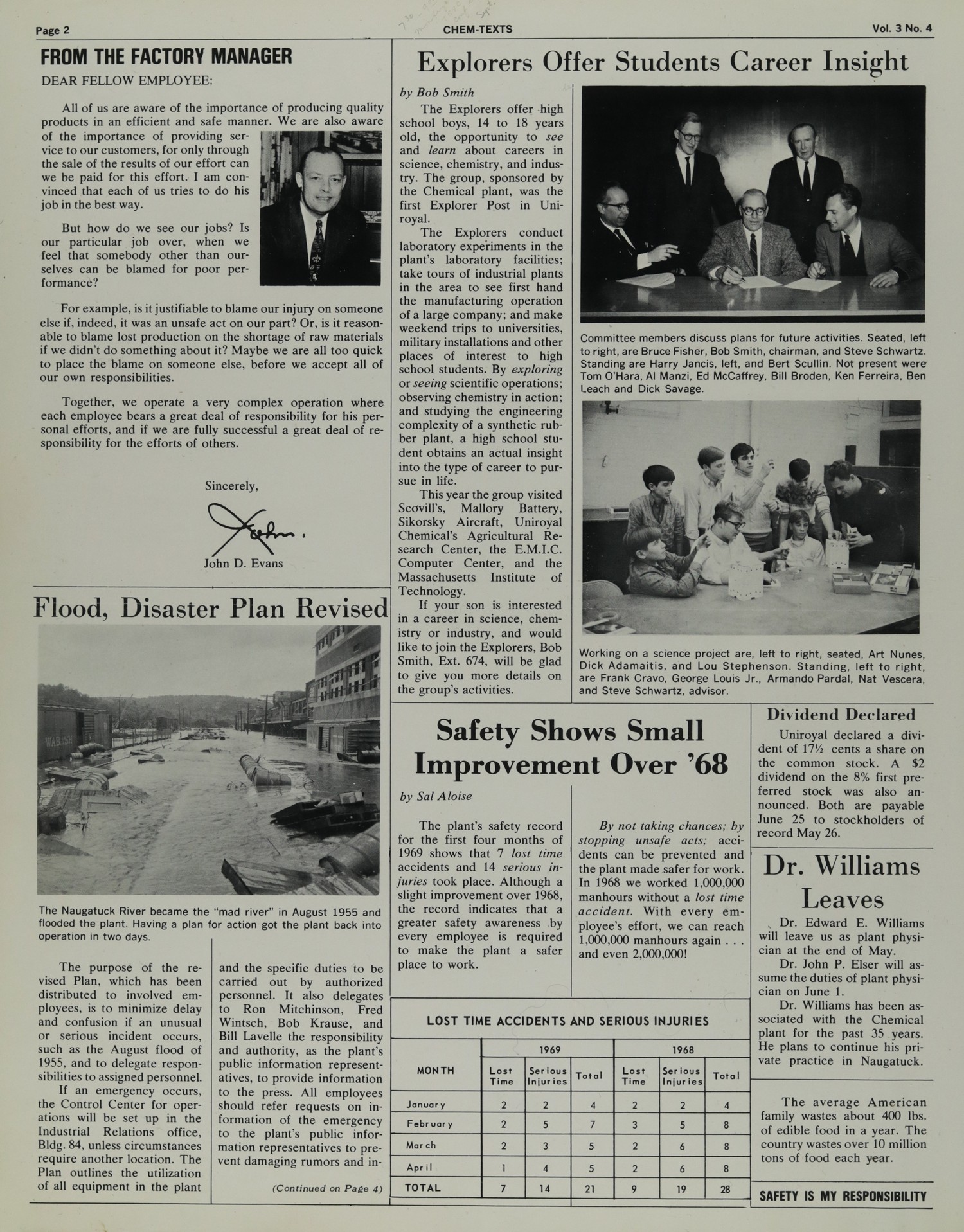
The Naugatuck River became the “mad river” in August 1955 and flooded the plant. Having a plan for action got the plant back into operation in two days.

The purpose of the revised Plan, which has been distributed to involved employees, is to minimize delay and confusion if an unusual or serious incident occurs, such as the August flood of 1955, and to delegate responsibilities to assigned personnel.

If an emergency occurs, the Control Center for operations will be set up in the Industrial Relations office, Bldg. 84, unless circumstances require another location. The Plan outlines the utilization of all equipment in the plant and the specific duties to be carried out by authorized personnel. It also delegates to Ron Mitchinson, Fred Wintsch, Bob Krause, and Bill Lavelle the responsibility and authority, as the plant’s public information representatives, to provide information to the press. All employees should refer requests on information of the emergency to the plant’s public information representatives to prevent damaging rumors and in-

(Continued on Page 4)


Explorers Offer Students Career Insight

by Bob Smith

The Explorers offer high school boys, 14 to 18 years old, the opportunity to see and learn about careers in science, chemistry, and industry. The group, sponsored by the Chemical plant, was the first Explorer Post in Uniroyal.

The Explorers conduct laboratory experiments in the plant’s laboratory facilities; take tours of industrial plants in the area to see first hand the manufacturing operation of a large company; and make weekend trips to universities, military installations and other places of interest to high school students. By exploring or seeing scientific operations; observing chemistry in action; and studying the engineering complexity of a synthetic rubber plant, a high school student obtains an actual insight into the type of career to pursue in life.

This year the group visited Scovill’s, Mallory Battery, Sikorsky Aircraft, Uniroyal Chemical’s Agricultural Research Center, the E.M.I.C. Computer Center, and the Massachusetts Institute of Technology.

If your son is interested in a career in science, chemistry or industry, and would like to join the Explorers, Bob Smith, Ext. 674, will be glad to give you more details on the group’s activities.

[IMAGE: Group photograph of committee members]

Committee members discuss plans for future activities. Seated, left to right, are Bruce Fisher, Bob Smith, chairman, and Steve Schwartz. Standing are Harry Jancis, left, and Bert Scullin. Not present were Tom O’Hara, Al Manzi, Ed McCaffrey, Bill Broden, Ken Ferreira, Ben Leach and Dick Savage.

[IMAGE: Group working on science project]

Working on a science project are, left to right, seated, Art Nunes, Dick Adamaitis, and Lou Stephenson. Standing, left to right, are Frank Cravo, George Louis Jr., Armando Pardal, Nat Vescera, and Steve Schwartz, advisor.


Safety Shows Small Improvement Over ’68

by Sal Aloise

The plant’s safety record for the first four months of 1969 shows that 7 lost time accidents and 14 serious injuries took place. Although a slight improvement over 1968, the record indicates that a greater safety awareness by every employee is required to make the plant a safer place to work.

By not taking chances; by stopping unsafe acts; accidents can be prevented and the plant made safer for work. In 1968 we worked 1,000,000 manhours without a lost time accident. With every employee’s effort, we can reach 1,000,000 manhours again . . . and even 2,000,000!

LOST TIME ACCIDENTS AND SERIOUS INJURIES

MONTH 1969 Lost Time Serious Injuries Total 1968 Lost Time Serious Injuries Total
January 2 2 4 2 2 4
February 2 5 7 3 5 8
March 2 3 5 2 6 8
April 1 4 5 2 6 8
TOTAL 7 14 21 9 19 28

Dividend Declared

Uniroyal declared a dividend of 17½ cents a share on the common stock. A $2 dividend on the 8% first preferred stock was also announced. Both are payable June 25 to stockholders of record May 26.


Dr. Williams Leaves

Dr. Edward E. Williams will leave us as plant physician at the end of May.

Dr. John P. Elser will assume the duties of plant physician on June 1.

Dr. Williams has been associated with the Chemical plant for the past 35 years. He plans to continue his private practice in Naugatuck.


The average American family wastes about 400 lbs. of edible food in a year. The country wastes over 10 million tons of food each year.


SAFETY IS MY RESPONSIBILITY

CHEM-TEXTS – Vol. 3 No. 5 – Page 4

Page 004

CHEM-TEXTS

Page 4 | Vol. 3 No. 5


Technical Team Wins Bowling League

by Shirley Sandora

The Uniroyal Chemical Handicap Bowling League ended its season with the Technical team, first half winner, defeating the Atatics, second half winner, in the roll-off to take first place.

Eight teams, registered with the National Duckpin Bowling Congress, made up the league: Engineering, Atatics, Technical, Synthetic, EMIC, Process Development, Distribution/Scheduling and

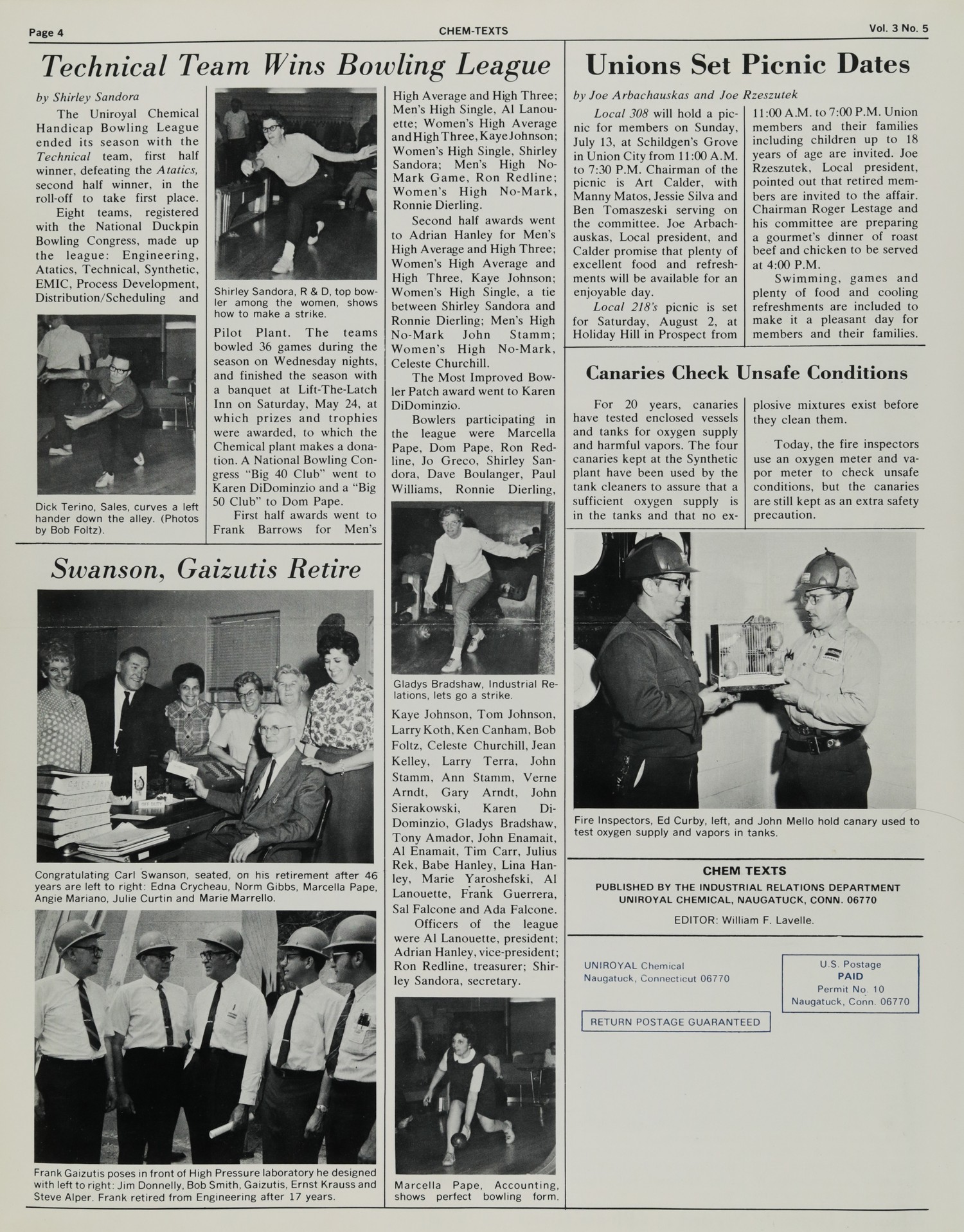
Dick Terino, Sales, curves a left hander down the alley. (Photos by Bob Foltz).


Shirley Sandora, R & D, top bowler among the women, shows how to make a strike.

Pilot Plant. The teams bowled 36 games during the season on Wednesday nights, and finished the season with a banquet at Lift-The-Latch Inn on Saturday, May 24, at which prizes and trophies were awarded, to which the Chemical plant makes a donation. A National Bowling Congress “Big 40 Club” went to Karen DiDominzio and a “Big 50 Club” to Dom Pape.

First half awards went to Frank Barrows for Men’s

High Average and High Three; Men’s High Single, Al Lanouette; Women’s High Average and High Three, Kaye Johnson; Women’s High Single, Shirley Sandora; Men’s High No-Mark Game, Ron Redline; Women’s High No-Mark, Ronnie Dierling.

Second half awards went to Adrian Hanley for Men’s High Average and High Three; Women’s High Average and High Three, Kaye Johnson; Women’s High Single, a tie between Shirley Sandora and Ronnie Dierling; Men’s High No-Mark John Stamm; Women’s High No-Mark, Celeste Churchill.

The Most Improved Bowler Patch award went to Karen DiDominzio.

Bowlers participating in the league were Marcella Pape, Dom Pape, Ron Redline, Jo Greco, Shirley Sandora, Dave Boulanger, Paul Williams, Ronnie Dierling,


Unions Set Picnic Dates

by Joe Arbachauskas and Joe Rzeszutek

Local 308 will hold a picnic for members on Sunday, July 13, at Schildgen’s Grove in Union City from 11:00 A.M. to 7:30 P.M. Chairman of the picnic is Art Calder, with Manny Matos, Jessie Silva and Ben Tomaszeski serving on the committee. Joe Arbachauskas, Local president, and Calder promise that plenty of excellent food and refreshments will be available for an enjoyable day.

Local 218’s picnic is set for Saturday, August 2, at Holiday Hill in Prospect from

11:00 A.M. to 7:00 P.M. Union members and their families including children up to 18 years of age are invited. Joe Rzeszutek, Local president, pointed out that retired members are invited to the affair. Chairman Roger Lestage and his committee are preparing a gourmet’s dinner of roast beef and chicken to be served at 4:00 P.M.

Swimming, games and plenty of food and cooling refreshments are included to make it a pleasant day for members and their families.


Canaries Check Unsafe Conditions

For 20 years, canaries have tested enclosed vessels and tanks for oxygen supply and harmful vapors. The four canaries kept at the Synthetic plant have been used by the tank cleaners to assure that a sufficient oxygen supply is in the tanks and that no explosive mixtures exist before they clean them.

Today, the fire inspectors use an oxygen meter and vapor meter to check unsafe conditions, but the canaries are still kept as an extra safety precaution.


Swanson, Gaizutis Retire

Congratulating Carl Swanson, seated, on his retirement after 46 years are left to right: Edna Crycheau, Norm Gibbs, Marcella Pape, Angie Mariano, Julie Curtin and Marie Marrello.


Frank Gaizutis poses in front of High Pressure laboratory he designed with left to right: Jim Donnelly, Bob Smith, Gaizutis, Ernst Krauss and Steve Alper. Frank retired from Engineering after 17 years.


Gladys Bradshaw, Industrial Relations, lets go a strike.

Kaye Johnson, Tom Johnson, Larry Koth, Ken Canham, Bob Foltz, Celeste Churchill, Jean Kelley, Larry Terra, John Stamm, Ann Stamm, Verne Arndt, Gary Arndt, John Sierakowski, Karen DiDominzio, Gladys Bradshaw, Tony Amador, John Enamait, Al Enamait, Tim Carr, Julius Rek, Babe Hanley, Lina Hanley, Marie Yaroshefski, Al Lanouette, Frank Guerrera, Sal Falcone and Ada Falcone.

Officers of the league were Al Lanouette, president; Adrian Hanley, vice-president; Ron Redline, treasurer; Shirley Sandora, secretary.


Marcella Pape, Accounting, shows perfect bowling form.


Fire Inspectors, Ed Curby, left, and John Mello hold canary used to test oxygen supply and vapors in tanks.


CHEM TEXTS

PUBLISHED BY THE INDUSTRIAL RELATIONS DEPARTMENT
UNIROYAL CHEMICAL, NAUGATUCK, CONN. 06770

EDITOR: William F. Lavelle.


UNIROYAL Chemical
Naugatuck, Connecticut 06770

U.S. Postage
PAID
Permit No. 10
Naugatuck, Conn. 06770

RETURN POSTAGE GUARANTEED

CHEM-TEXTS – Vol. 3 No. 6 – Page 3

Page 003

CHEM-TEXTS

Vol. 3 No. 8 | Page 3


Synthetic’s “A” Crew Hits 9 Batches Daily

[IMAGE: Group photo of workers in hard hats]

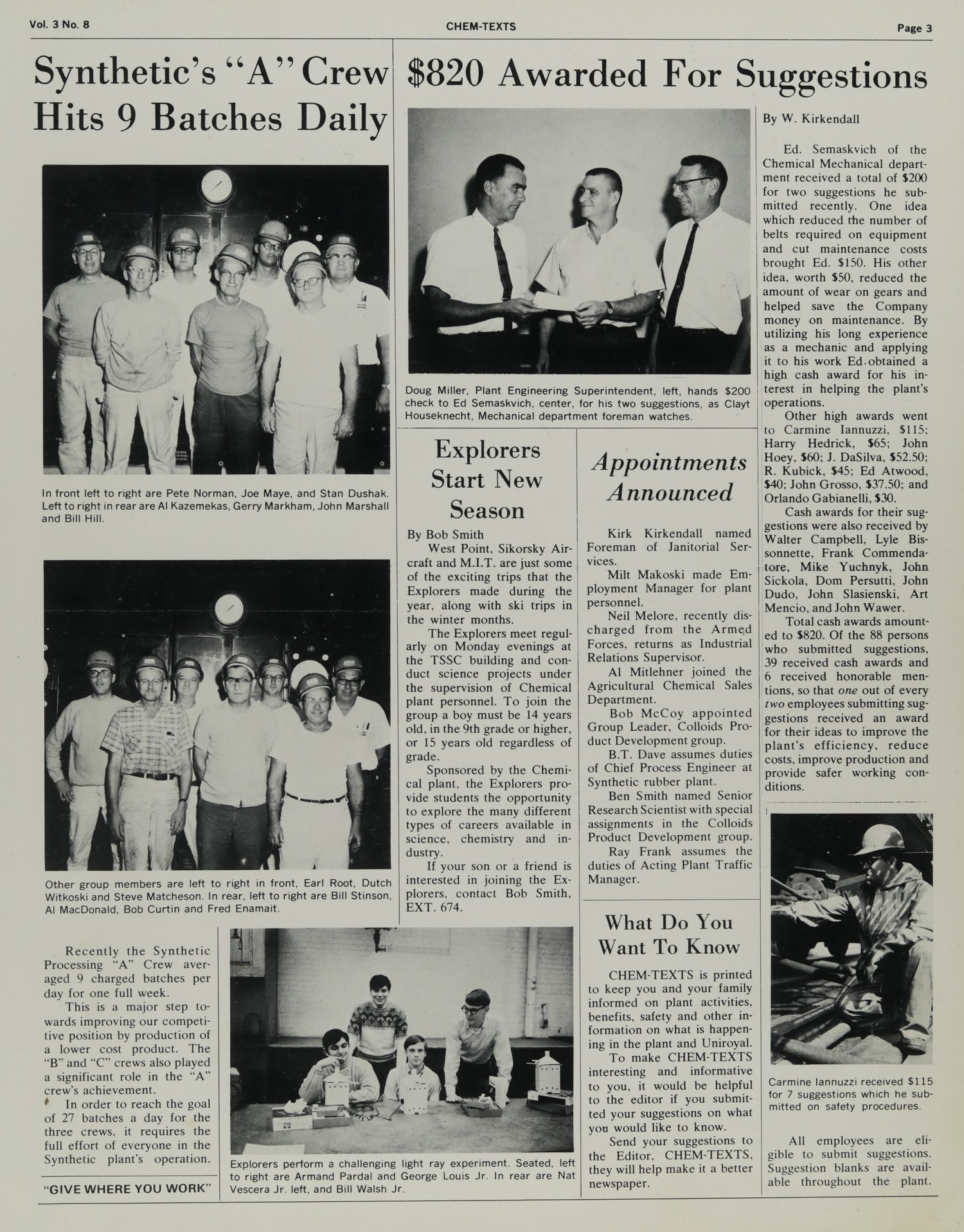
In front left to right are Pete Norman, Joe Maye, and Stan Dushak. Left to right in rear are Al Kazemekas, Gerry Markham, John Marshall and Bill Hill.

[IMAGE: Second group photo of workers]

Other group members are left to right in front, Earl Root, Dutch Witkoski and Steve Matcheson. In rear, left to right are Bill Stinson, Al MacDonald, Bob Curtin and Fred Enamait.

Recently the Synthetic Processing “A” Crew averaged 9 charged batches per day for one full week.

This is a major step towards improving our competitive position by production of a lower cost product. The “B” and “C” crews also played a significant role in the “A” crew’s achievement.

In order to reach the goal of 27 batches a day for the three crews, it requires the full effort of everyone in the Synthetic plant’s operation.

“GIVE WHERE YOU WORK”


$820 Awarded For Suggestions

By W. Kirkendall

[IMAGE: Three men, one handing check to another]

Doug Miller, Plant Engineering Superintendent, left, hands $200 check to Ed Semaskvich, center, for his two suggestions, as Clayt Houseknecht, Mechanical department foreman watches.

Ed. Semaskvich of the Chemical Mechanical department received a total of $200 for two suggestions he submitted recently. One idea which reduced the number of belts required on equipment and cut maintenance costs brought Ed. $150. His other idea, worth $50, reduced the amount of wear on gears and helped save the Company money on maintenance. By utilizing his long experience as a mechanic and applying it to his work Ed obtained a high cash award for his interest in helping the plant’s operations.

Other high awards went to Carmine Iannuzzi, $115; Harry Hedrick, $65; John Hoey, $60; J. DaSilva, $52.50; R. Kubick, $45; Ed Atwood, $40; John Grosso, $37.50; and Orlando Gabianelli, $30.

Cash awards for their suggestions were also received by Walter Campbell, Lyle Bissonnette, Frank Commendatore, Mike Yuchnyk, John Sickola, Dom Persutti, John Dudo, John Slasienski, Art Mencio, and John Wawer.

Total cash awards amounted to $820. Of the 88 persons who submitted suggestions, 39 received cash awards and 6 received honorable mentions, so that one out of every two employees submitting suggestions received an award for their ideas to improve the plant’s efficiency, reduce costs, improve production and provide safer working conditions.

[IMAGE: Man working]

Carmine Iannuzzi received $115 for 7 suggestions which he submitted on safety procedures.

All employees are eligible to submit suggestions. Suggestion blanks are available throughout the plant.


Explorers Start New Season

By Bob Smith

West Point, Sikorsky Aircraft and M.I.T. are just some of the exciting trips that the Explorers made during the year, along with ski trips in the winter months.

The Explorers meet regularly on Monday evenings at the TSSC building and conduct science projects under the supervision of Chemical plant personnel. To join the group a boy must be 14 years old, in the 9th grade or higher, or 15 years old regardless of grade.

Sponsored by the Chemical plant, the Explorers provide students the opportunity to explore the many different types of careers available in science, chemistry and industry.

If your son or a friend is interested in joining the Explorers, contact Bob Smith, EXT. 674.

[IMAGE: Group of young people at table with experiment]

Explorers perform a challenging light ray experiment. Seated, left to right are Armand Pardal and George Louis Jr. In rear are Nat Vescera Jr. left, and Bill Walsh Jr.


Appointments Announced

Kirk Kirkendall named Foreman of Janitorial Services.

Milt Makoski made Employment Manager for plant personnel.

Neil Melore, recently discharged from the Armed Forces, returns as Industrial Relations Supervisor.

Al Mitlehner joined the Agricultural Chemical Sales Department.

Bob McCoy appointed Group Leader, Colloids Product Development group.

B.T. Dave assumes duties of Chief Process Engineer at Synthetic rubber plant.

Ben Smith named Senior Research Scientist with special assignments in the Colloids Product Development group.

Ray Frank assumes the duties of Acting Plant Traffic Manager.


What Do You Want To Know

CHEM-TEXTS is printed to keep you and your family informed on plant activities, benefits, safety and other information on what is happening in the plant and Uniroyal.

To make CHEM-TEXTS interesting and informative to you, it would be helpful to the editor if you submitted your suggestions on what you would like to know.

Send your suggestions to the Editor, CHEM-TEXTS, they will help make it a better newspaper.

CHEM-TEXTS – Vol. 3, 1969, No. 11 – Page 1

Page 001

UNIROYAL

Merry Christmas – Happy New Year

CHEM-TEXTS

Vol. 3, 1969 PUBLISHED FOR THE PEOPLE OF UNIROYAL CHEMICAL No. 11


[IMAGE: Two people decorating a Christmas tree]

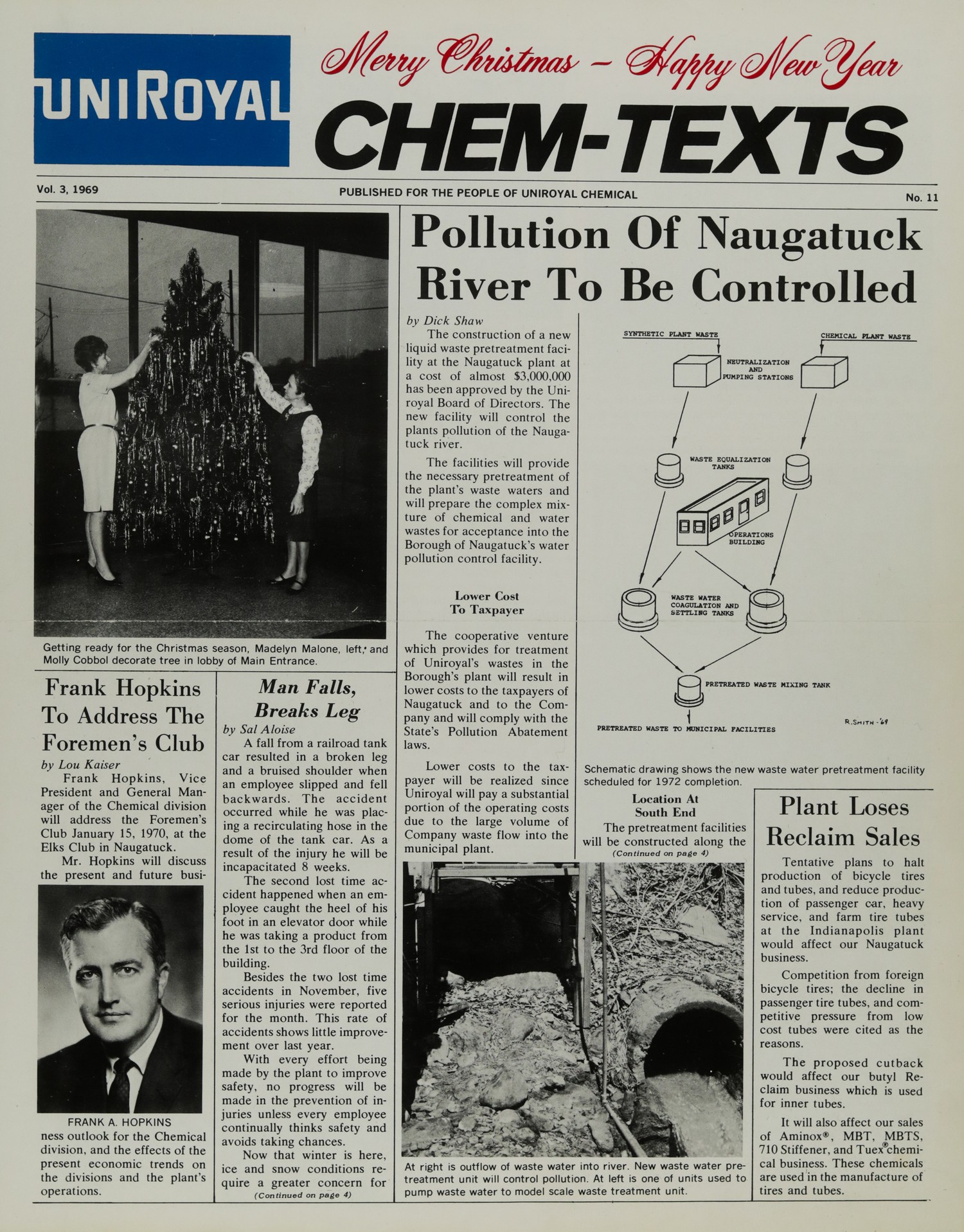
Getting ready for the Christmas season, Madelyn Malone, left; and Molly Cobbol decorate tree in lobby of Main Entrance.


Frank Hopkins To Address The Foremen’s Club

by Lou Kaiser

Frank Hopkins, Vice President and General Manager of the Chemical division will address the Foremen’s Club January 15, 1970, at the Elks Club in Naugatuck.

Mr. Hopkins will discuss the present and future busi-

[IMAGE: Portrait photo of Frank A. Hopkins]

FRANK A. HOPKINS

ness outlook for the Chemical division, and the effects of the present economic trends on the divisions and the plant’s operations.


Man Falls, Breaks Leg

by Sal Aloise

A fall from a railroad tank car resulted in a broken leg and a bruised shoulder when an employee slipped and fell backwards. The accident occurred while he was placing a recirculating hose in the dome of the tank car. As a result of the injury he will be incapacitated 8 weeks.

The second lost time accident happened when an employee caught the heel of his foot in an elevator door while he was taking a product from the 1st to the 3rd floor of the building.

Besides the two lost time accidents in November, five serious injuries were reported for the month. This rate of accidents shows little improvement over last year.

With every effort being made by the plant to improve safety, no progress will be made in the prevention of injuries unless every employee continually thinks safety and avoids taking chances.

Now that winter is here, ice and snow conditions require a greater concern for

(Continued on page 4)


Pollution Of Naugatuck River To Be Controlled

by Dick Shaw

The construction of a new liquid waste pretreatment facility at the Naugatuck plant at a cost of almost $3,000,000 has been approved by the Uniroyal Board of Directors. The new facility will control the plants pollution of the Naugatuck river.

The facilities will provide the necessary pretreatment of the plant’s waste waters and will prepare the complex mixture of chemical and water wastes for acceptance into the Borough of Naugatuck’s water pollution control facility.

Lower Cost To Taxpayer

The cooperative venture which provides for treatment of Uniroyal’s wastes in the Borough’s plant will result in lower costs to the taxpayers of Naugatuck and to the Company and will comply with the State’s Pollution Abatement laws.

Lower costs to the taxpayer will be realized since Uniroyal will pay a substantial portion of the operating costs due to the large volume of Company waste flow into the municipal plant.


[DIAGRAM: Schematic showing waste water treatment process flow, including:
– SYNTHETIC PLANT WASTE
– CHEMICAL PLANT WASTE
– NEUTRALIZATION AND PUMPING STATIONS
– WASTE EQUALIZATION TANKS
– OPERATIONS BUILDING
– WASTE WATER COAGULATION AND SETTLING TANKS
– PRETREATED WASTE MIXING TANK
– PRETREATED WASTE TO MUNICIPAL FACILITIES]

R.Smith-69

Schematic drawing shows the new waste water pretreatment facility scheduled for 1972 completion.

Location At South End

The pretreatment facilities will be constructed along the

(Continued on page 4)


[IMAGE: Industrial equipment/construction site]

At right is outflow of waste water into river. New waste water pretreatment unit will control pollution. At left is one of units used to pump waste water to model scale waste treatment unit.


Plant Loses Reclaim Sales

Tentative plans to halt production of bicycle tires and tubes, and reduce production of passenger car, heavy service, and farm tire tubes at the Indianapolis plant would affect our Naugatuck business.

Competition from foreign bicycle tires; the decline in passenger tire tubes, and competitive pressure from low cost tubes were cited as the reasons.

The proposed cutback would affect our butyl Reclaim business which is used for inner tubes.

It will also affect our sales of Aminox®, MBT, MBTS, 710 Stiffener, and Tuex chemical business. These chemicals are used in the manufacture of tires and tubes.

CHEM-TEXTS – Vol. 3 No. 11 – Page 2

Page 002

CHEM-TEXTS

Page 2 | Vol. 3 No. 11


FROM THE FACTORY MANAGER

DEAR FELLOW EMPLOYEE:

The season leading up to Christmas is often filled with frantic searching to solve the questions of “what should I give to the wife?” or “what should I give to the kids?” Perhaps in the rush to find the gift, we too often lose sight of the real meaning of the season; perhaps we even lose sight of one gift we could all give to each other, family, friends, as well as those with whom we work. The gift that I’m thinking of is the gift of understanding. The gift of being able to “put ourselves in the other guy’s shoes” to see his problems as he see’s them.

It seems to me that if each of us gave this gift on a year-around basis we would each make a real contribution to solving the economic and social problems facing our nation. I’m sure that we would start to see the “communication gap,” the “generation gap” and, yes, even the “management-labor gap” start to close.

Please accept my most sincere wishes for you and yours for a Most Joyous Christmas and the best of New Year’s in 1970.

Sincerely,

John D. Evans

John D. Evans


Explorers Post Names New Advisors

[IMAGE: Photo of three men]

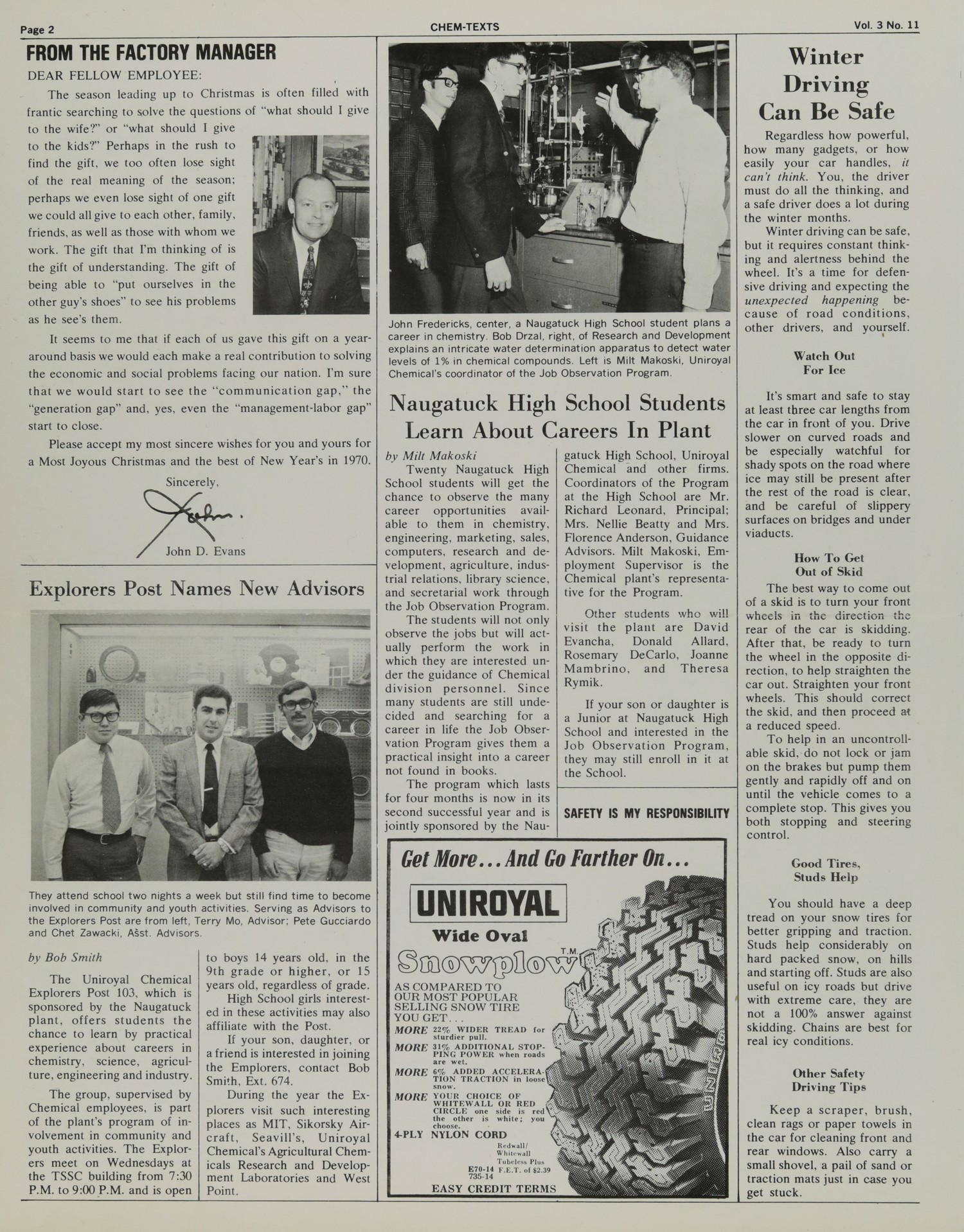
They attend school two nights a week but still find time to become involved in community and youth activities. Serving as Advisors to the Explorers Post are from left, Terry Mo, Advisor; Pete Gucciardo and Chet Zawacki, Asst. Advisors.

by Bob Smith

The Uniroyal Chemical Explorers Post 103, which is sponsored by the Naugatuck plant, offers students the chance to learn by practical experience about careers in chemistry, science, agriculture, engineering and industry.

The group, supervised by Chemical employees, is part of the plant’s program of involvement in community and youth activities. The Explorers meet on Wednesdays at the TSSC building from 7:30 P.M. to 9:00 P.M. and is open to boys 14 years old, in the 9th grade or higher, or 15 years old, regardless of grade.

High School girls interested in these activities may also affiliate with the Post.

If your son, daughter, or a friend is interested in joining the Emplorers, contact Bob Smith, Ext. 674.

During the year the Explorers visit such interesting places as MIT, Sikorsky Aircraft, Seavill’s, Uniroyal Chemical’s Agricultural Chemicals Research and Development Laboratories and West Point.


[IMAGE: Photo showing people at what appears to be an industrial/laboratory setting]

John Fredericks, center, a Naugatuck High School student plans a career in chemistry. Bob Drzal, right, of Research and Development explains an intricate water determination apparatus to detect water levels of 1% in chemical compounds. Left is Milt Makoski, Uniroyal Chemical’s coordinator of the Job Observation Program.

Naugatuck High School Students Learn About Careers In Plant

by Milt Makoski

Twenty Naugatuck High School students will get the chance to observe the many career opportunities available to them in chemistry, engineering, marketing, sales, computers, research and development, agriculture, industrial relations, library science, and secretarial work through the Job Observation Program.

The students will not only observe the jobs but will actually perform the work in which they are interested under the guidance of Chemical division personnel. Since many students are still undecided and searching for a career in life the Job Observation Program gives them a practical insight into a career not found in books.

The program which lasts for four months is now in its second successful year and is jointly sponsored by the Naugatuck High School, Uniroyal Chemical and other firms. Coordinators of the Program at the High School are Mr. Richard Leonard, Principal; Mrs. Nellie Beatty and Mrs. Florence Anderson, Guidance Advisors. Milt Makoski, Employment Supervisor is the Chemical plant’s representative for the Program.

Other students who will visit the plant are David Evancha, Donald Allard, Rosemary DeCarlo, Joanne Mambrino, and Theresa Rymik.

If your son or daughter is a Junior at Naugatuck High School and interested in the Job Observation Program, they may still enroll in it at the School.


SAFETY IS MY RESPONSIBILITY


Get More… And Go Farther On…

UNIROYAL

Wide Oval

Snowplow™

AS COMPARED TO OUR MOST POPULAR SELLING SNOW TIRE YOU GET

MORE 22% WIDER TREAD for sturdier pull.

MORE 31% ADDITIONAL STOPPING POWER when roads are wet.

MORE 6% ADDED ACCELERATION TRACTION in loose snow.

MORE YOUR CHOICE OF WHITEWALL OR RED CIRCLE one side is red the other is white; you choose.

4-PLY NYLON CORD
Redwall/
Whitewall
Tubeless Plus
E78-14 F.E.T. of $2.39
735-14

EASY CREDIT TERMS


Winter Driving Can Be Safe

Regardless how powerful, how many gadgets, or how easily your car handles, it can’t think. You, the driver must do all the thinking, and a safe driver does a lot during the winter months.

Winter driving can be safe, but it requires constant thinking and alertness behind the wheel. It’s a time for defensive driving and expecting the unexpected happening because of road conditions, other drivers, and yourself.

Watch Out For Ice

It’s smart and safe to stay at least three car lengths from the car in front of you. Drive slower on curved roads and be especially watchful for shady spots on the road where ice may still be present after the rest of the road is clear, and be careful of slippery surfaces on bridges and under viaducts.

How To Get Out of Skid

The best way to come out of a skid is to turn your front wheels in the direction the rear of the car is skidding. After that, be ready to turn the wheel in the opposite direction, to help straighten the car out. Straighten your front wheels. This should correct the skid, and then proceed at a reduced speed.

To help in an uncontrollable skid, do not lock or jam on the brakes but pump them gently and rapidly off and on until the vehicle comes to a complete stop. This gives you both stopping and steering control.

Good Tires, Studs Help

You should have a deep tread on your snow tires for better gripping and traction. Studs help considerably on hard packed snow, on hills and starting off. Studs are also useful on icy roads but drive with extreme care, they are not a 100% answer against skidding. Chains are best for real icy conditions.

Other Safety Driving Tips

Keep a scraper, brush, clean rags or paper towels in the car for cleaning front and rear windows. Also carry a small shovel, a pail of sand or traction mats just in case you get stuck.