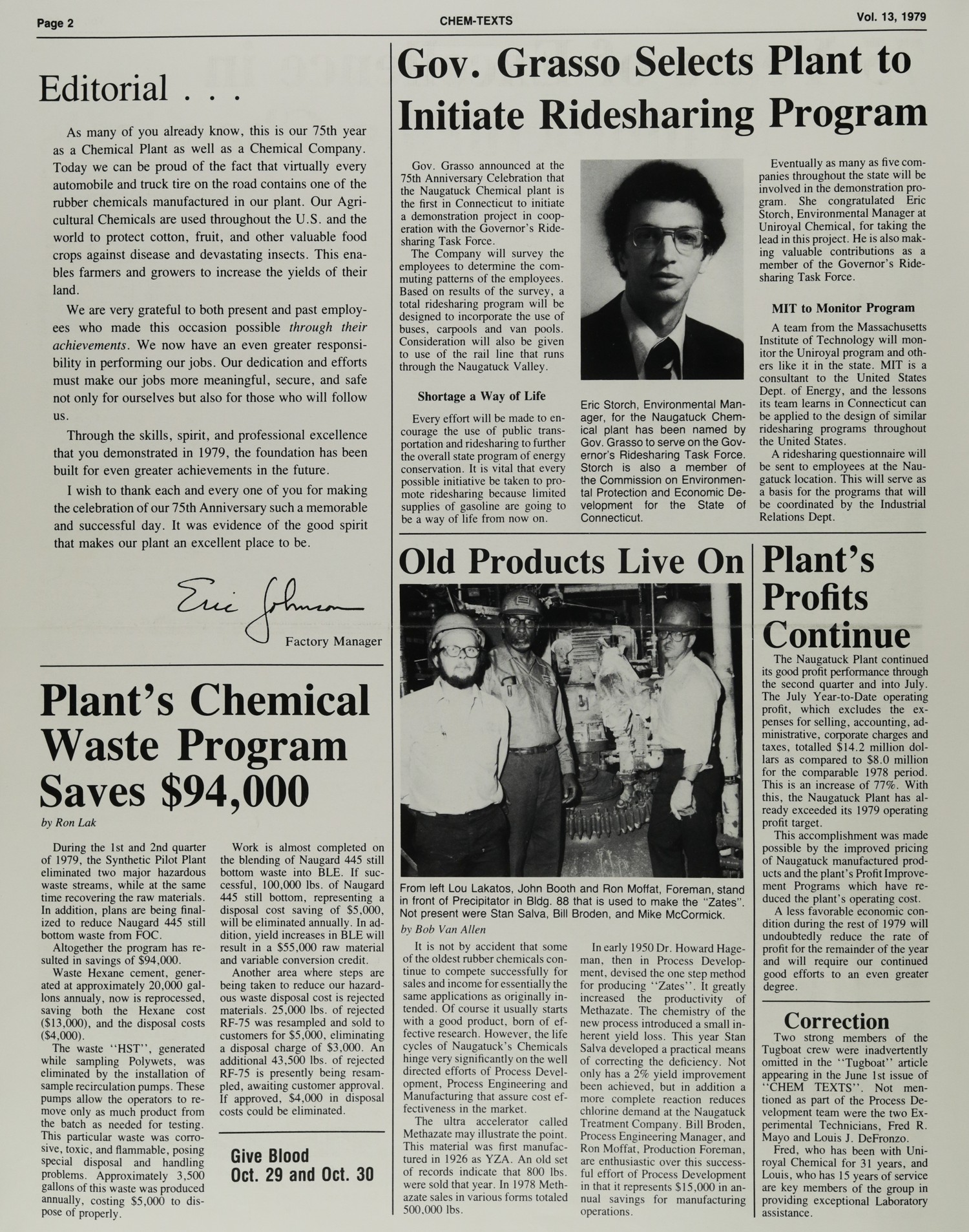
CHEM-TEXTS – 1979-v13-s273

Page 273

CHEM-TEXTS

Page 2 | Vol. 13, 1979


Editorial . . .

As many of you already know, this is our 75th year as a Chemical Plant as well as a Chemical Company. Today we can be proud of the fact that virtually every automobile and truck tire on the road contains one of the rubber chemicals manufactured in our plant. Our Agricultural Chemicals are used throughout the U.S. and the world to protect cotton, fruit, and other valuable food crops against disease and devastating insects. This enables farmers and growers to increase the yields of their land.

We are very grateful to both present and past employees who made this occasion possible through their achievements. We now have an even greater responsibility in performing our jobs. Our dedication and efforts must make our jobs more meaningful, secure, and safe not only for ourselves but also for those who will follow us.

Through the skills, spirit, and professional excellence that you demonstrated in 1979, the foundation has been built for even greater achievements in the future.

I wish to thank each and every one of you for making the celebration of our 75th Anniversary such a memorable and successful day. It was evidence of the good spirit that makes our plant an excellent place to be.

Eric Johnson
Factory Manager


Plant’s Chemical Waste Program Saves $94,000

by Ron Lak

During the 1st and 2nd quarter of 1979, the Synthetic Pilot Plant eliminated two major hazardous waste streams, while at the same time recovering the raw materials. In addition, plans are being finalized to reduce Naugard 445 still bottom waste from FOC.

Altogether the program has resulted in savings of $94,000.

Waste Hexane cement, generated at approximately 20,000 gallons annually, now is reprocessed, saving both the Hexane cost ($13,000), and the disposal costs ($4,000).

The waste “HST”, generated while sampling Polywets, was eliminated by the installation of sample recirculation pumps. These pumps allow the operators to remove only as much product from the batch as needed for testing. This particular waste was corrosive, toxic, and flammable, posing special disposal and handling problems. Approximately 3,500 gallons of this waste was produced annually, costing $5,000 to dispose of properly.

Work is almost completed on the blending of Naugard 445 still bottom waste into BLE. If successful, 100,000 lbs. of Naugard 445 still bottom, representing a disposal cost saving of $5,000, will be eliminated annually. In addition, yield increases in BLE will result in a $55,000 raw material and variable conversion credit.

Another area where steps are being taken to reduce our hazardous waste disposal cost is rejected materials. 25,000 lbs. of rejected RF-75 was resampled and sold to customers for $5,000, eliminating a disposal charge of $3,000. An additional 43,500 lbs. of rejected RF-75 is presently being resampled, awaiting customer approval. If approved, $4,000 in disposal costs could be eliminated.


Give Blood
Oct. 29 and Oct. 30


Gov. Grasso Selects Plant to Initiate Ridesharing Program

Gov. Grasso announced at the 75th Anniversary Celebration that the Naugatuck Chemical plant is the first in Connecticut to initiate a demonstration project in cooperation with the Governor’s Ridesharing Task Force.

The Company will survey the employees to determine the commuting patterns of the employees. Based on results of the survey, a total ridesharing program will be designed to incorporate the use of buses, carpools and van pools. Consideration will also be given to use of the rail line that runs through the Naugatuck Valley.

Shortage a Way of Life

Every effort will be made to encourage the use of public transportation and ridesharing to further the overall state program of energy conservation. It is vital that every possible initiative be taken to promote ridesharing because limited supplies of gasoline are going to be a way of life from now on.

[PHOTO CAPTION:]
Eric Storch, Environmental Manager, for the Naugatuck Chemical plant has been named by Gov. Grasso to serve on the Governor’s Ridesharing Task Force. Storch is also a member of the Commission on Environmental Protection and Economic Development for the State of Connecticut.

Eventually as many as five companies throughout the state will be involved in the demonstration program. She congratulated Eric Storch, Environmental Manager at Uniroyal Chemical, for taking the lead in this project. He is also making valuable contributions as a member of the Governor’s Ridesharing Task Force.

MIT to Monitor Program

A team from the Massachusetts Institute of Technology will monitor the Uniroyal program and others like it in the state. MIT is a consultant to the United States Dept. of Energy, and the lessons its team learns in Connecticut can be applied to the design of similar ridesharing programs throughout the United States.

A ridesharing questionnaire will be sent to employees at the Naugatuck location. This will serve as a basis for the programs that will be coordinated by the Industrial Relations Dept.


Old Products Live On

[PHOTO CAPTION:]
From left Lou Lakatos, John Booth and Ron Moffat, Foreman, stand in front of Precipitator in Bldg. 88 that is used to make the “Zates”. Not present were Stan Salva, Bill Broden, and Mike McCormick.

by Bob Van Allen

It is not by accident that some of the oldest rubber chemicals continue to compete successfully for sales and income for essentially the same applications as originally intended. Of course it usually starts with a good product, born of effective research. However, the life cycles of Naugatuck’s Chemicals hinge very significantly on the well directed efforts of Process Development, Process Engineering and Manufacturing that assure cost effectiveness in the market.

The ultra accelerator called Methazate may illustrate the point. This material was first manufactured in 1926 as YZA. An old set of records indicate that 800 lbs. were sold that year. In 1978 Methazate sales in various forms totaled 500,000 lbs.

In early 1950 Dr. Howard Hageman, then in Process Development, devised the one step method for producing “Zates”. It greatly increased the productivity of Methazate. The chemistry of the new process introduced a small inherent yield loss. This year Stan Salva developed a practical means of correcting the deficiency. Not only has a 2% yield improvement been achieved, but in addition a more complete reaction reduces chlorine demand at the Naugatuck Treatment Company. Bill Broden, Process Engineering Manager, and Ron Moffat, Production Foreman, are enthusiastic over this successful effort of Process Development in that it represents $15,000 in annual savings for manufacturing operations.


Plant’s Profits Continue

The Naugatuck Plant continued its good profit performance through the second quarter and into July. The July Year-to-Date operating profit, which excludes the expenses for selling, accounting, administrative, corporate charges and taxes, totalled $14.2 million dollars as compared to $8.0 million for the comparable 1978 period. This is an increase of 77%. With this, the Naugatuck Plant has already exceeded its 1979 operating profit target.

This accomplishment was made possible by the improved pricing of Naugatuck manufactured products and the plant’s Profit Improvement Programs which have reduced the plant’s operating cost.

A less favorable economic condition during the rest of 1979 will undoubtedly reduce the rate of profit for the remainder of the year and will require our continued good efforts to an even greater degree.


Correction

Two strong members of the Tugboat crew were inadvertently omitted in the “Tugboat” article appearing in the June 1st issue of “CHEM TEXTS”. Not mentioned as part of the Process Development team were the two Experimental Technicians, Fred R. Mayo and Louis J. DeFronzo.

Fred, who has been with Uniroyal Chemical for 31 years, and Louis, who has 15 years of service are key members of the group in providing exceptional Laboratory assistance.
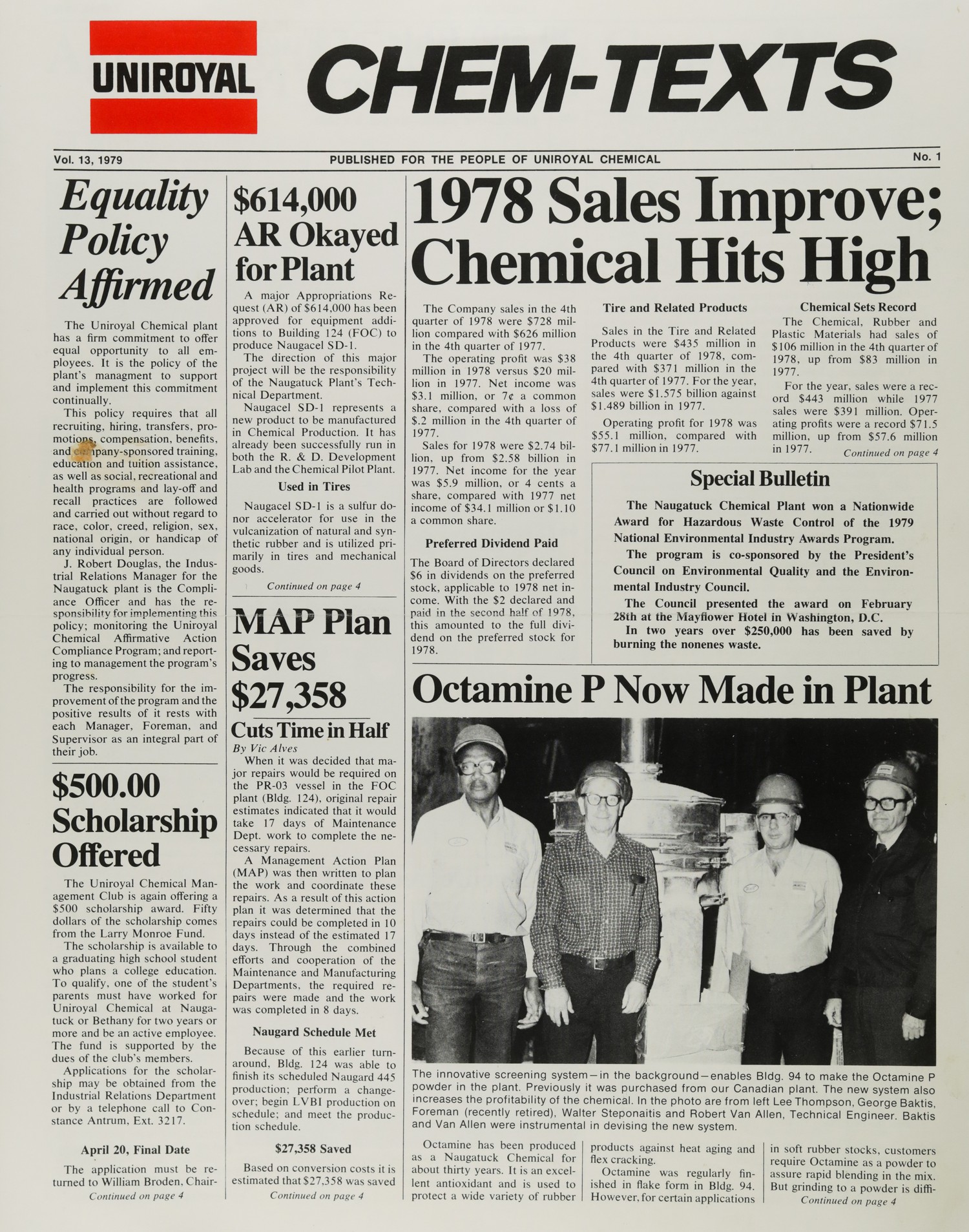
CHEM-TEXTS – 1979 – Page No. 1

Page unknown

UNIROYAL CHEM-TEXTS

Vol. 13, 1979 | PUBLISHED FOR THE PEOPLE OF UNIROYAL CHEMICAL | No. 1


Equality Policy Affirmed

The Uniroyal Chemical plant has a firm commitment to offer equal opportunity to all employees. It is the policy of the plant’s management to support and implement this commitment continually.

This policy requires that all recruiting, hiring, transfers, promotions, compensation, benefits, and company-sponsored training, education and tuition assistance, as well as social, recreational and health programs and lay-off and recall practices are followed and carried out without regard to race, color, creed, religion, sex, national origin, or handicap of any individual person.

J. Robert Douglas, the Industrial Relations Manager for the Naugatuck plant is the Compliance Officer and has the responsibility for implementing this policy; monitoring the Uniroyal Chemical Affirmative Action Compliance Program; and reporting to management the program’s progress.

The responsibility for the improvement of the program and the positive results of it rests with each Manager, Foreman, and Supervisor as an integral part of their job.


$500.00 Scholarship Offered

The Uniroyal Chemical Management Club is again offering a $500 scholarship award. Fifty dollars of the scholarship comes from the Larry Monroe Fund.

The scholarship is available to a graduating high school student who plans a college education. To qualify, one of the student’s parents must have worked for Uniroyal Chemical at Naugatuck or Bethany for two years or more and be an active employee. The fund is supported by the dues of the club’s members.

Applications for the scholarship may be obtained from the Industrial Relations Department or by a telephone call to Constance Antrum, Ext. 3217.

April 20, Final Date

The application must be returned to William Broden, Chair-
Continued on page 4


$614,000 AR Okayed for Plant

A major Appropriations Request (AR) of $614,000 has been approved for equipment additions to Building 124 (FOC) to produce Naugacel SD-1.

The direction of this major project will be the responsibility of the Naugatuck Plant’s Technical Department.

Naugacel SD-1 represents a new product to be manufactured in Chemical Production. It has already been successfully run in both the R. & D. Development Lab and the Chemical Pilot Plant.

Used in Tires

Naugacel SD-1 is a sulfur donor accelerator for use in the vulcanization of natural and synthetic rubber and is utilized primarily in tires and mechanical goods.

Continued on page 4


MAP Plan Saves $27,358

Cuts Time in Half

By Vic Alves

When it was decided that major repairs would be required on the PR-03 vessel in the FOC plant (Bldg. 124), original repair estimates indicated that it would take 17 days of Maintenance Dept. work to complete the necessary repairs.

A Management Action Plan (MAP) was then written to plan the work and coordinate these repairs. As a result of this action plan it was determined that the repairs could be completed in 10 days instead of the estimated 17 days. Through the combined efforts and cooperation of the Maintenance and Manufacturing Departments, the required repairs were made and the work was completed in 8 days.

Naugard Schedule Met

Because of this earlier turnaround, Bldg. 124 was able to finish its scheduled Naugard 445 production; perform a changeover; begin LVBI production on schedule; and meet the production schedule.

$27,358 Saved

Based on conversion costs it is estimated that $27,358 was saved
Continued on page 4


1978 Sales Improve; Chemical Hits High

The Company sales in the 4th quarter of 1978 were $728 million compared with $626 million in the 4th quarter of 1977.

The operating profit was $38 million in 1978 versus $20 million in 1977. Net income was $3.1 million, or 7¢ a common share, compared with a loss of $2.2 million in the 4th quarter of 1977.

Sales for 1978 were $2.74 billion, up from $2.58 billion in 1977. Net income for the year was $5.9 million, or 4 cents a share, compared with 1977 net income of $34.1 million or $1.10 a common share.

Preferred Dividend Paid

The Board of Directors declared $6 in dividends on the preferred stock, applicable to 1978 net income. With the $2 declared and paid in the second half of 1978, this amounted to the full dividend on the preferred stock for 1978.


Tire and Related Products

Sales in the Tire and Related Products were $435 million in the 4th quarter of 1978, compared with $371 million in the 4th quarter of 1977. For the year, sales were $1.575 billion against $1.489 billion in 1977.

Operating profit for 1978 was $55.1 million, compared with $77.1 million in 1977.


Chemical Sets Record

The Chemical, Rubber and Plastic Materials had sales of $106 million in the 4th quarter of 1978, up from $83 million in 1977.

For the year, sales were a record $443 million while 1977 sales were $391 million. Operating profits were a record $71.5 million, up from $57.6 million in 1977.
Continued on page 4


Special Bulletin

The Naugatuck Chemical Plant won a Nationwide Award for Hazardous Waste Control of the 1979 National Environmental Industry Awards Program.

The program is co-sponsored by the President’s Council on Environmental Quality and the Environmental Industry Council.

The Council presented the award on February 28th at the Mayflower Hotel in Washington, D.C.

In two years over $250,000 has been saved by burning the nonenes waste.


Octamine P Now Made in Plant

The innovative screening system—in the background—enables Bldg. 94 to make the Octamine P powder in the plant. Previously it was purchased from our Canadian plant. The new system also increases the profitability of the chemical. In the photo are from left Lee Thompson, George Baktis, Foreman (recently retired), Walter Steponaitis and Robert Van Allen, Technical Engineer. Baktis and Van Allen were instrumental in devising the new system.


Octamine has been produced as a Naugatuck Chemical for about thirty years. It is an excellent antioxidant and is used to protect a wide variety of rubber products against heat aging and flex cracking.

Octamine was regularly finished in flake form in Bldg. 94. However, for certain applications in soft rubber stocks, customers require Octamine as a powder to assure rapid blending in the mix. But grinding to a powder is diffi-
Continued on page 4

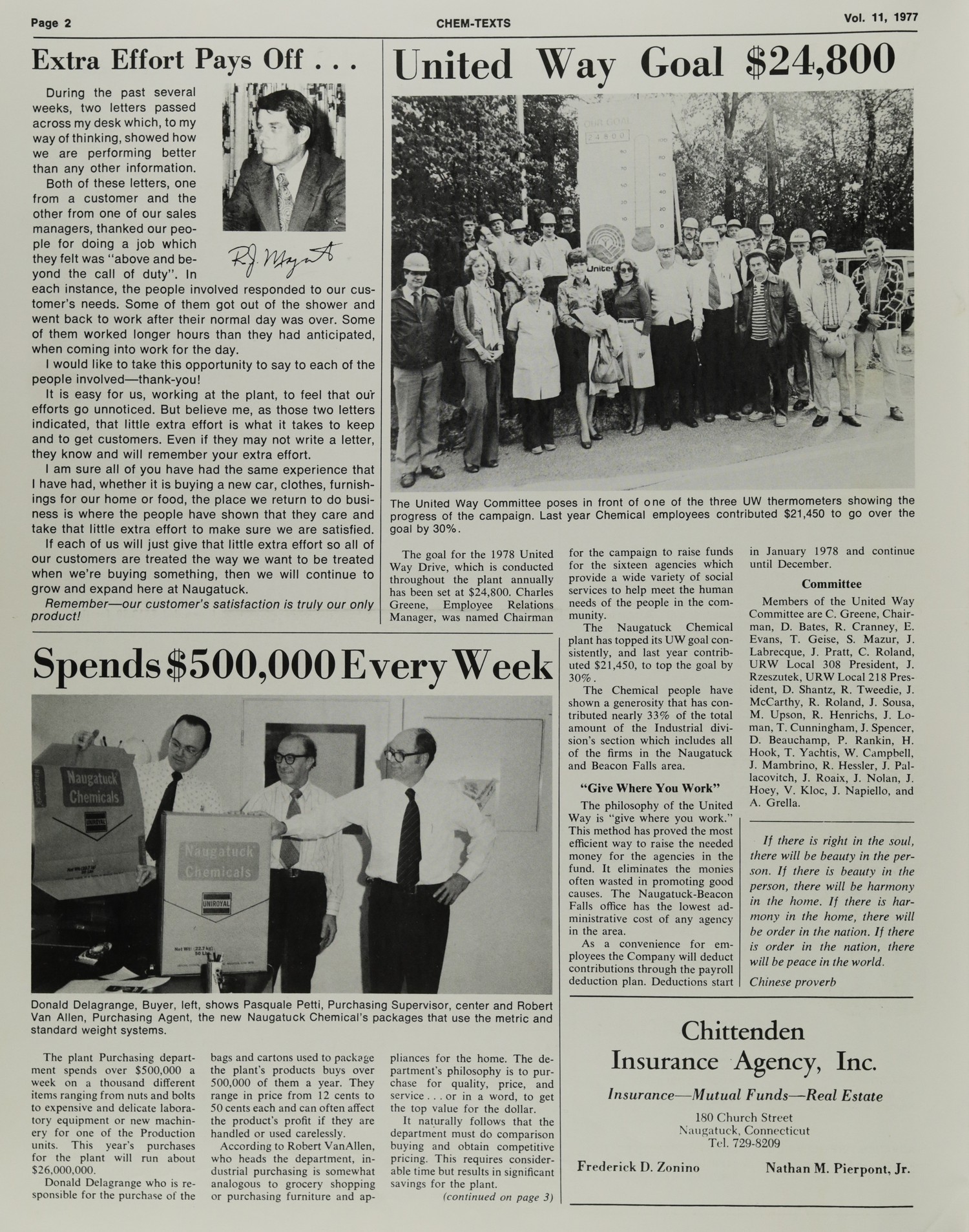
CHEM-TEXTS – Vol. 11 – Page 2

Page 002

CHEM-TEXTS

Page 2 | Vol. 11, 1977


Extra Effort Pays Off . . .

During the past several weeks, two letters passed across my desk which, to my way of thinking, showed how we are performing better than any other information.

Both of these letters, one from a customer and the other from one of our sales managers, thanked our people for doing a job which they felt was “above and beyond the call of duty”. In each instance, the people involved responded to our customer’s needs. Some of them got out of the shower and went back to work after their normal day was over. Some of them worked longer hours than they had anticipated, when coming into work for the day.

I would like to take this opportunity to say to each of the people involved—thank-you!

It is easy for us, working at the plant, to feel that our efforts go unnoticed. But believe me, as those two letters indicated, that little extra effort is what it takes to keep and to get customers. Even if they may not write a letter, they know and will remember your extra effort.

I am sure all of you have had the same experience that I have had, whether it is buying a new car, clothes, furnishings for our home or food, the place we return to do business is where the people have shown that they care and take that little extra effort to make sure we are satisfied.

If each of us will just give that little extra effort so all of our customers are treated the way we want to be treated when we’re buying something, then we will continue to grow and expand here at Naugatuck.

Remember—our customer’s satisfaction is truly our only product!

R.J. Wayatt


United Way Goal $24,800

The United Way Committee poses in front of one of the three UW thermometers showing the progress of the campaign. Last year Chemical employees contributed $21,450 to go over the goal by 30%.

The goal for the 1978 United Way Drive, which is conducted throughout the plant annually has been set at $24,800. Charles Greene, Employee Relations Manager, was named Chairman for the campaign to raise funds for the sixteen agencies which provide a wide variety of social services to help meet the human needs of the people in the community.

The Naugatuck Chemical plant has topped its UW goal consistently, and last year contributed $21,450, to top the goal by 30%.

The Chemical people have shown a generosity that has contributed nearly 33% of the total amount of the Industrial division’s section which includes all of the firms in the Naugatuck and Beacon Falls area.

“Give Where You Work”

The philosophy of the United Way is “give where you work.” This method has proved the most efficient way to raise the needed money for the agencies in the fund. It eliminates the monies often wasted in promoting good causes. The Naugatuck-Beacon Falls office has the lowest administrative cost of any agency in the area.

As a convenience for employees the Company will deduct contributions through the payroll deduction plan. Deductions start in January 1978 and continue until December.

Committee

Members of the United Way Committee are C. Greene, Chairman, D. Bates, R. Cranney, E. Evans, T. Geise, S. Mazur, J. Labrecque, J. Pratt, C. Roland, URW Local 308 President, J. Rzeszutek, URW Local 218 President, D. Shantz, R. Tweedie, J. McCarthy, R. Roland, J. Sousa, M. Upson, R. Henrichs, J. Loman, T. Cunningham, J. Spencer, D. Beauchamp, P. Rankin, H. Hook, T. Yachtis, W. Campbell, J. Mambrino, R. Hessler, J. Pallacovitch, J. Roaix, J. Nolan, J. Hoey, V. Kloc, J. Napiello, and A. Grella.


If there is right in the soul, there will be beauty in the person. If there is beauty in the person, there will be harmony in the home. If there is harmony in the home, there will be order in the nation. If there is order in the nation, there will be peace in the world.

Chinese proverb


Spends $500,000 Every Week

Donald Delagrange, Buyer, left, shows Pasquale Petti, Purchasing Supervisor, center and Robert Van Allen, Purchasing Agent, the new Naugatuck Chemical’s packages that use the metric and standard weight systems.

The plant Purchasing department spends over $500,000 a week on a thousand different items ranging from nuts and bolts to expensive and delicate laboratory equipment or new machinery for one of the Production units. This year’s purchases for the plant will run about $26,000,000.

Donald Delagrange who is responsible for the purchase of the bags and cartons used to package the plant’s products buys over 500,000 of them a year. They range in price from 12 cents to 50 cents each and can often affect the product’s profit if they are handled or used carelessly.

According to Robert VanAllen, who heads the department, industrial purchasing is somewhat analogous to grocery shopping or purchasing furniture and appliances for the home. The department’s philosophy is to purchase for quality, price, and service . . . or in a word, to get the top value for the dollar.

It naturally follows that the department must do comparison buying and obtain competitive pricing. This requires considerable time but results in significant savings for the plant.

(continued on page 3)


Chittenden Insurance Agency, Inc.

Insurance—Mutual Funds—Real Estate

180 Church Street
Naugatuck, Connecticut
Tel. 729-8209

Frederick D. Zonino | Nathan M. Pierpont, Jr.

CHEM-TEXTS – Vol. 5, No. 1 – Page 3

Page 003

CHEM-TEXTS

Vol. 5, No. 1 | Page 3


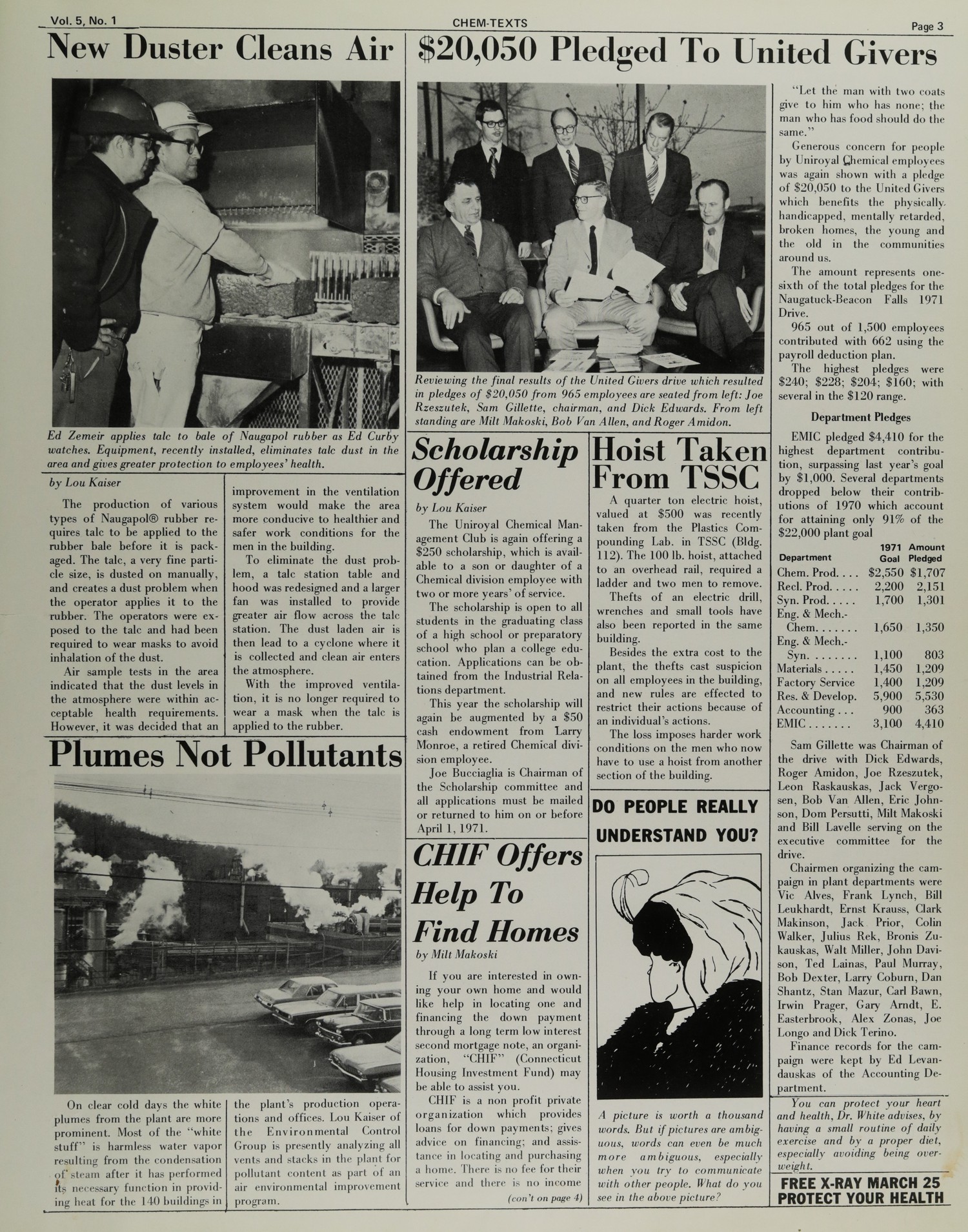
New Duster Cleans Air

Ed Zemeir applies talc to bale of Naugapol rubber as Ed Curby watches. Equipment, recently installed, eliminates talc dust in the area and gives greater protection to employees’ health.

by Lou Kaiser

The production of various types of Naugapol® rubber requires talc to be applied to the rubber bale before it is packaged. The talc, a very fine particle size, is dusted on manually, and creates a dust problem when the operator applies it to the rubber. The operators were exposed to the talc and had been required to wear masks to avoid inhalation of the dust.

Air sample tests in the area indicated that the dust levels in the atmosphere were within acceptable health requirements. However, it was decided that an improvement in the ventilation system would make the area more conducive to healthier and safer work conditions for the men in the building.

To eliminate the dust problem, a talc station table and hood was redesigned and a larger fan was installed to provide greater air flow across the talc station. The dust laden air is then lead to a cyclone where it is collected and clean air enters the atmosphere.

With the improved ventilation, it is no longer required to wear a mask when the talc is applied to the rubber.


Plumes Not Pollutants

On clear cold days the white plumes from the plant are more prominent. Most of the “white stuff” is harmless water vapor resulting from the condensation of steam after it has performed its necessary function in providing heat for the 140 buildings in the plant’s production operations and offices. Lou Kaiser of the Environmental Control Group is presently analyzing all vents and stacks in the plant for pollutant content as part of an air environmental improvement program.


$20,050 Pledged To United Givers

Reviewing the final results of the United Givers drive which resulted in pledges of $20,050 from 965 employees are seated from left: Joe Rzeszutek, Sam Gillette, chairman, and Dick Edwards. From left standing are Milt Makoski, Bob Van Allen, and Roger Amidon.

“Let the man with two coats give to him who has none; the man who has food should do the same.”

Generous concern for people by Uniroyal Chemical employees was again shown with a pledge of $20,050 to the United Givers which benefits the physically handicapped, mentally retarded, broken homes, the young and the old in the communities around us.

The amount represents one-sixth of the total pledges for the Naugatuck-Beacon Falls 1971 Drive.

965 out of 1,500 employees contributed with 662 using the payroll deduction plan.

The highest pledges were $240; $228; $204; $160; with several in the $120 range.

Department Pledges

EMIC pledged $4,410 for the highest department contribution, surpassing last year’s goal by $1,000. Several departments dropped below their contributions of 1970 which account for attaining only 91% of the $22,000 plant goal

Department 1971 Goal Amount Pledged
Chem. Prod…. $2,550 $1,707
Recl. Prod….. 2,200 2,151
Syn. Prod…… 1,700 1,301
Eng. & Mech.- Chem……. 1,650 1,350
Eng. & Mech.- Syn……. 1,100 803
Materials….. 1,450 1,209
Factory Service 1,400 1,209
Res. & Develop. 5,900 5,530
Accounting… 900 363
EMIC…….. 3,100 4,410

Sam Gillette was Chairman of the drive with Dick Edwards, Roger Amidon, Joe Rzeszutek, Leon Raskauskas, Jack Vergosen, Bob Van Allen, Eric Johnson, Dom Persutti, Milt Makoski and Bill Lavelle serving on the executive committee for the drive.

Chairmen organizing the campaign in plant departments were Vic Alves, Frank Lynch, Bill Leukhardt, Ernst Krauss, Clark Makinson, Jack Prior, Colin Walker, Julius Rek, Bronis Zukauskas, Walt Miller, John Davison, Ted Lainas, Paul Murray, Bob Dexter, Larry Coburn, Dan Shantz, Stan Mazur, Carl Bawn, Irwin Prager, Gary Arndt, E. Easterbrook, Alex Zonas, Joe Longo and Dick Terino.

Finance records for the campaign were kept by Ed Levandauskas of the Accounting Department.


Scholarship Offered

by Lou Kaiser

The Uniroyal Chemical Management Club is again offering a $250 scholarship, which is available to a son or daughter of a Chemical division employee with two or more years’ of service.

The scholarship is open to all students in the graduating class of a high school or preparatory school who plan a college education. Applications can be obtained from the Industrial Relations department.

This year the scholarship will again be augmented by a $50 cash endowment from Larry Monroe, a retired Chemical division employee.

Joe Bucciaglia is Chairman of the Scholarship committee and all applications must be mailed or returned to him on or before April 1, 1971.


Hoist Taken From TSSC

A quarter ton electric hoist, valued at $500 was recently taken from the Plastics Compounding Lab. in TSSC (Bldg. 112). The 100 lb. hoist, attached to an overhead rail, required a ladder and two men to remove.

Thefts of an electric drill, wrenches and small tools have also been reported in the same building.

Besides the extra cost to the plant, the thefts cast suspicion on all employees in the building, and new rules are effected to restrict their actions because of an individual’s actions.

The loss imposes harder work conditions on the men who now have to use a hoist from another section of the building.


CHIF Offers Help To Find Homes

by Milt Makoski

If you are interested in owning your own home and would like help in locating one and financing the down payment through a long term low interest second mortgage note, an organization, “CHIF” (Connecticut Housing Investment Fund) may be able to assist you.

CHIF is a non profit private organization which provides loans for down payments; gives advice on financing; and assistance in locating and purchasing a home. There is no fee for their service and there is no income

(con’t on page 4)


DO PEOPLE REALLY UNDERSTAND YOU?

A picture is worth a thousand words. But if pictures are ambiguous, words can even be much more ambiguous, especially when you try to communicate with other people. What do you see in the above picture?


You can protect your heart and health, Dr. White advises, by having a small routine of daily exercise and by a proper diet, especially avoiding being overweight.

FREE X-RAY MARCH 25
PROTECT YOUR HEALTH

CHEM-TEXTS – Vol. 5, No. 2 – Page 2

Page 002

CHEM-TEXTS

Page 2 | Vol. 5, No. 2


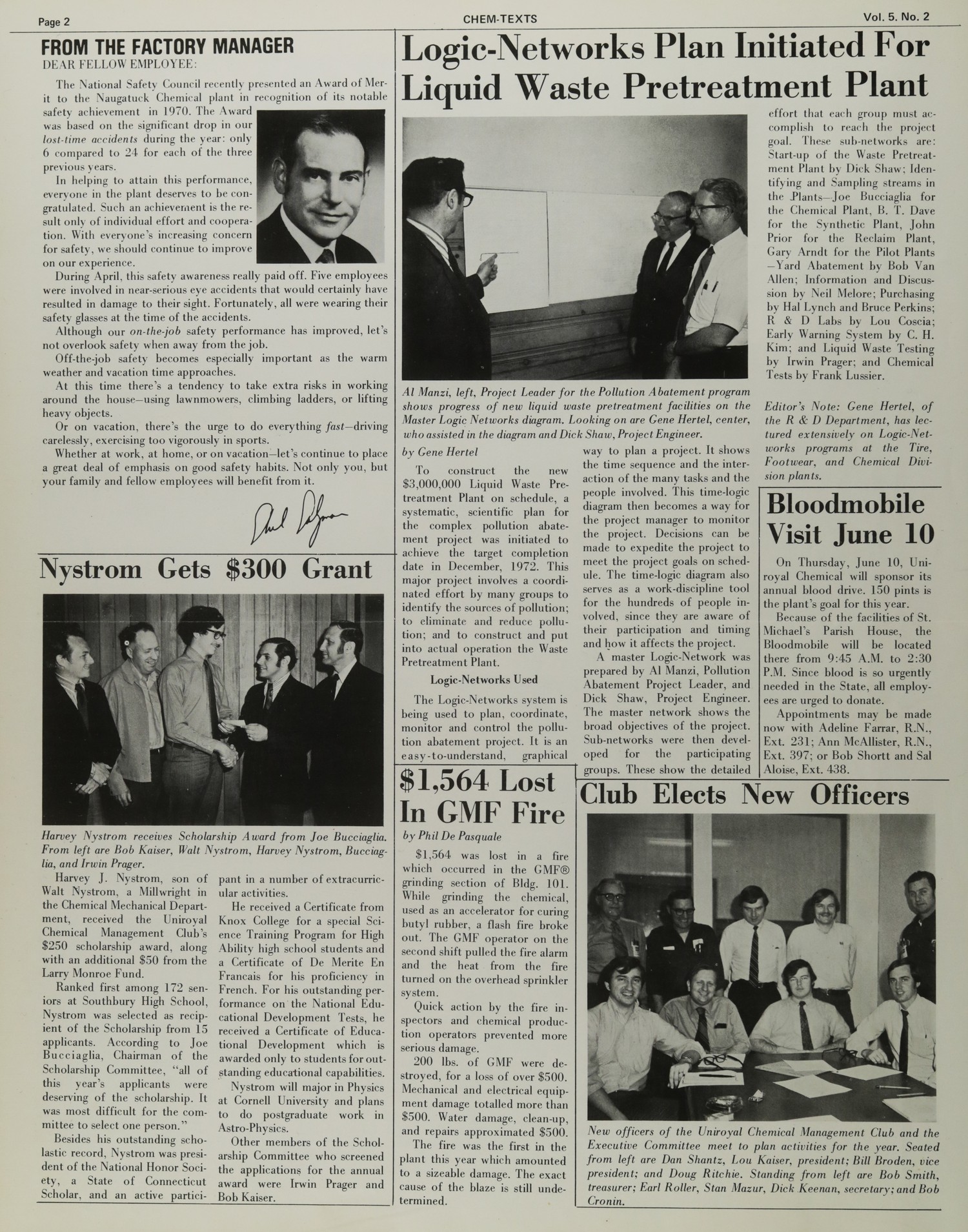
FROM THE FACTORY MANAGER

DEAR FELLOW EMPLOYEE:

The National Safety Council recently presented an Award of Merit to the Naugatuck Chemical plant in recognition of its notable safety achievement in 1970. The Award was based on the significant drop in our lost-time accidents during the year: only 6 compared to 24 for each of the three previous years.

In helping to attain this performance, everyone in the plant deserves to be congratulated. Such an achievement is the result only of individual effort and cooperation. With everyone’s increasing concern for safety, we should continue to improve on our experience.

During April, this safety awareness really paid off. Five employees were involved in near-serious eye accidents that would certainly have resulted in damage to their sight. Fortunately, all were wearing their safety glasses at the time of the accidents.

Although our on-the-job safety performance has improved, let’s not overlook safety when away from the job.

Off-the-job safety becomes especially important as the warm weather and vacation time approaches.

At this time there’s a tendency to take extra risks in working around the house—using lawnmowers, climbing ladders, or lifting heavy objects.

Or on vacation, there’s the urge to do everything fast—driving carelessly, exercising too vigorously in sports.

Whether at work, at home, or on vacation—let’s continue to place a great deal of emphasis on good safety habits. Not only you, but your family and fellow employees will benefit from it.

[Signature]


Nystrom Gets $300 Grant

Harvey Nystrom receives Scholarship Award from Joe Bucciaglia. From left are Bob Kaiser, Walt Nystrom, Harvey Nystrom, Bucciaglia, and Irwin Prager.

Harvey J. Nystrom, son of Walt Nystrom, a Millwright in the Chemical Mechanical Department, received the Uniroyal Chemical Management Club’s $250 scholarship award, along with an additional $50 from the Larry Monroe Fund.

Ranked first among 172 seniors at Southbury High School, Nystrom was selected as recipient of the Scholarship from 15 applicants. According to Joe Bucciaglia, Chairman of the Scholarship Committee, “all of this year’s applicants were deserving of the scholarship. It was most difficult for the committee to select one person.”

Besides his outstanding scholastic record, Nystrom was president of the National Honor Society, a State of Connecticut Scholar, and an active participant in a number of extracurricular activities.

He received a Certificate from Knox College for a special Science Training Program for High Ability high school students and a Certificate of De Merite En Francais for his proficiency in French. For his outstanding performance on the National Educational Development Tests, he received a Certificate of Educational Development which is awarded only to students for outstanding educational capabilities.

Nystrom will major in Physics at Cornell University and plans to do postgraduate work in Astro-Physics.

Other members of the Scholarship Committee who screened the applications for the annual award were Irwin Prager and Bob Kaiser.


Logic-Networks Plan Initiated For Liquid Waste Pretreatment Plant

Al Manzi, left, Project Leader for the Pollution Abatement program shows progress of new liquid waste pretreatment facilities on the Master Logic Networks diagram. Looking on are Gene Hertel, center, who assisted in the diagram and Dick Shaw, Project Engineer.

by Gene Hertel

To construct the new $3,000,000 Liquid Waste Pretreatment Plant on schedule, a systematic, scientific plan for the complex pollution abatement project was initiated to achieve the target completion date in December, 1972. This major project involves a coordinated effort by many groups to identify the sources of pollution; to eliminate and reduce pollution; and to construct and put into actual operation the Waste Pretreatment Plant.

Logic-Networks Used

The Logic-Networks system is being used to plan, coordinate, monitor and control the pollution abatement project. It is an easy-to-understand, graphical way to plan a project. It shows the time sequence and the interaction of the many tasks and the people involved. This time-logic diagram then becomes a way for the project manager to monitor the project. Decisions can be made to expedite the project to meet the project goals on schedule. The time-logic diagram also serves as a work-discipline tool for the hundreds of people involved, since they are aware of their participation and timing and how it affects the project.

A master Logic-Network was prepared by Al Manzi, Pollution Abatement Project Leader, and Dick Shaw, Project Engineer. The master network shows the broad objectives of the project. Sub-networks were then developed for the participating groups. These show the detailed effort that each group must accomplish to reach the project goal. These sub-networks are: Start-up of the Waste Pretreatment Plant by Dick Shaw; Identifying and Sampling streams in the Plants—Joe Bucciaglia for the Chemical Plant, B. T. Dave for the Synthetic Plant, John Prior for the Reclaim Plant, Gary Arndt for the Pilot Plants – Yard Abatement by Bob Van Allen; Information and Discussion by Neil Melore; Purchasing by Hal Lynch and Bruce Perkins; R & D Labs by Lou Coscia; Early Warning System by C. H. Kim; and Liquid Waste Testing by Irwin Prager; and Chemical Tests by Frank Lussier.

Editor’s Note: Gene Hertel, of the R & D Department, has lectured extensively on Logic-Networks programs at the Tire, Footwear, and Chemical Division plants.


Bloodmobile Visit June 10

On Thursday, June 10, Uniroyal Chemical will sponsor its annual blood drive. 150 pints is the plant’s goal for this year.

Because of the facilities of St. Michael’s Parish House, the Bloodmobile will be located there from 9:45 A.M. to 2:30 P.M. Since blood is so urgently needed in the State, all employees are urged to donate.

Appointments may be made now with Adeline Farrar, R.N., Ext. 231; Ann McAllister, R.N., Ext. 397; or Bob Shortt and Sal Aloise, Ext. 438.


$1,564 Lost In GMF Fire

by Phil De Pasquale

$1,564 was lost in a fire which occurred in the GMF® grinding section of Bldg. 101. While grinding the chemical, used as an accelerator for curing butyl rubber, a flash fire broke out. The GMF operator on the second shift pulled the fire alarm and the heat from the fire turned on the overhead sprinkler system.

Quick action by the fire inspectors and chemical production operators prevented more serious damage.

200 lbs. of GMF were destroyed, for a loss of over $500. Mechanical and electrical equipment damage totalled more than $500. Water damage, clean-up, and repairs approximated $500.

The fire was the first in the plant this year which amounted to a sizeable damage. The exact cause of the blaze is still undetermined.


Club Elects New Officers

New officers of the Uniroyal Chemical Management Club and the Executive Committee meet to plan activities for the year. Seated from left are Dan Shantz, Lou Kaiser, president; Bill Broden, vice president; and Doug Ritchie. Standing from left are Bob Smith, treasurer; Earl Roller, Stan Mazur, Dick Keenan, secretary; and Bob Cronin.

CHEM-TEXTS – 1971-v05-i04-s195

Page 195

UNIROYAL CHEM-TEXTS

Vol. 5, 1971 | PUBLISHED FOR THE PEOPLE OF UNIROYAL CHEMICAL | No. 4


$6000 Awards Offered

10 Uniroyal scholarships will be awarded to children of employees—with five or more years of continuous service—who attain the highest finalist qualification in the annual scholarship competition conducted by the National Merit Scholarship Corporation.

Scholars are chosen on the basis of scholastic aptitude, leadership and good citizenship. The Company plays no part in the selection of the scholars.

No Application Required

Eligible high school students must take the new combined
(cont’d. on page 2)


Profits; Sales Up

Chemical Sales Off

Net income for the Company increased 18.1% for the second quarter of 1971 compared with the second quarter of 1970.

Sales for the quarter set a new record of $464,161,000, a gain of 6.3% compared with the previous record of $436,714,000 set last year.

Net income for the quarter was $15,554,000 equivalent to 53 cents a share of common stock, compared with $13,170,000 or 46 cents a share, reported for the second quarter of 1970.

Sales for the first six months of 1971 also set a record of $877,327,000, a gain of 7.3%
(cont’d. on page 3)


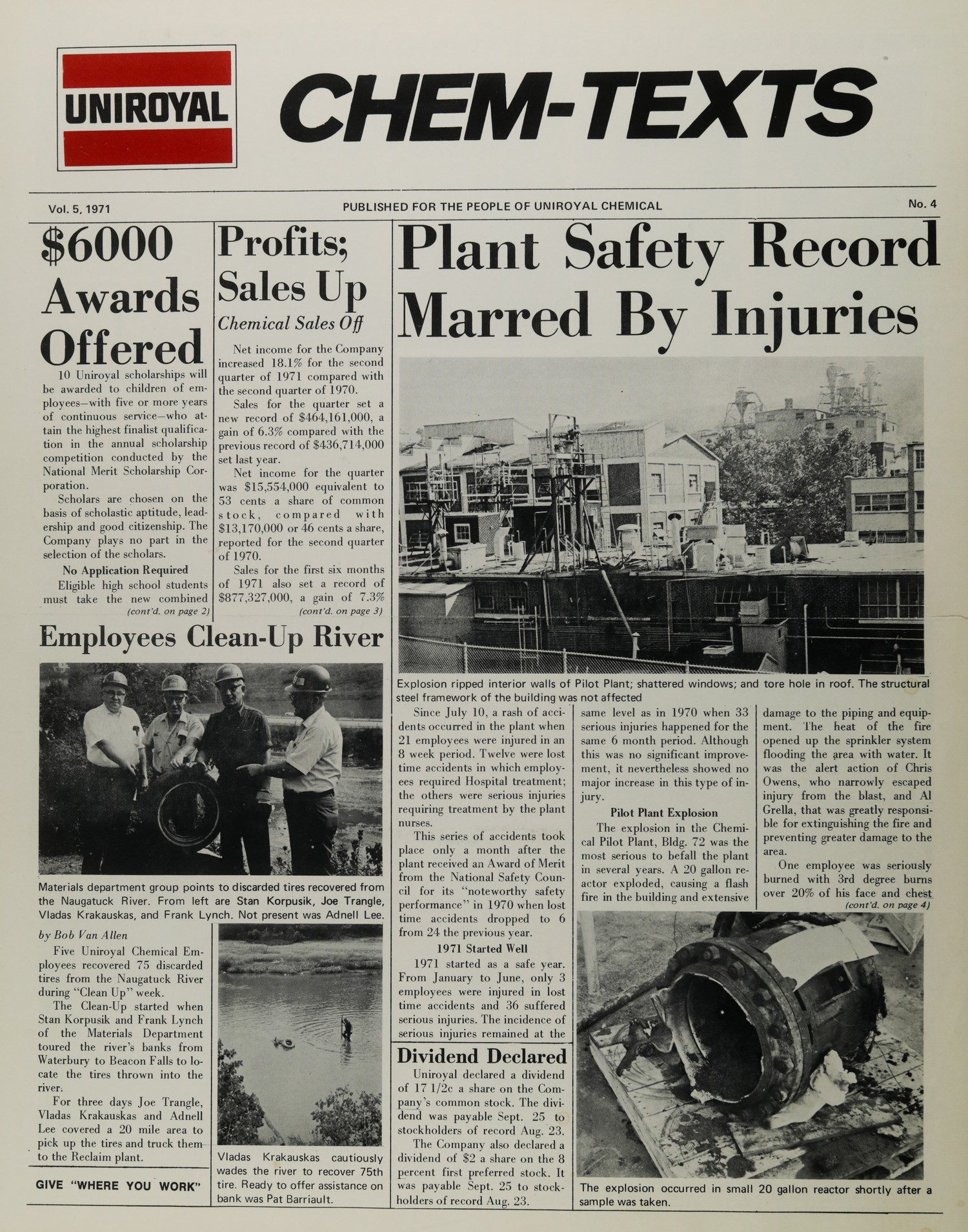
Plant Safety Record Marred By Injuries

Since July 10, a rash of accidents occurred in the plant when 21 employees were injured in an 8 week period. Twelve were lost time accidents in which employees required Hospital treatment; the others were serious injuries requiring treatment by the plant nurses.

This series of accidents took place only a month after the plant received an Award of Merit from the National Safety Council for its “noteworthy safety performance” in 1970 when lost time accidents dropped to 6 from 24 the previous year.

1971 Started Well

1971 started as a safe year. From January to June, only 3 employees were injured in lost time accidents and 36 suffered serious injuries. The incidence of serious injuries remained at the same level as in 1970 when 33 serious injuries happened for the same 6 month period. Although this was no significant improvement, it nevertheless showed no major increase in this type of injury.

Pilot Plant Explosion

The explosion in the Chemical Pilot Plant, Bldg. 72 was the most serious to befall the plant in several years. A 20 gallon reactor exploded, causing a flash fire in the building and extensive damage to the piping and equipment. The heat of the fire opened up the sprinkler system flooding the area with water. It was the alert action of Chris Owens, who narrowly escaped injury from the blast, and Al Grella, that was greatly responsible for extinguishing the fire and preventing greater damage to the area.

One employee was seriously burned with 3rd degree burns over 20% of his face and chest
(cont’d. on page 4)

Explosion ripped interior walls of Pilot Plant; shattered windows; and tore hole in roof. The structural steel framework of the building was not affected

The explosion occurred in small 20 gallon reactor shortly after a sample was taken.


Employees Clean-Up River

by Bob Van Allen

Five Uniroyal Chemical Employees recovered 75 discarded tires from the Naugatuck River during “Clean Up” week.

The Clean-Up started when Stan Korpusik and Frank Lynch of the Materials Department toured the river’s banks from Waterbury to Beacon Falls to locate the tires thrown into the river.

For three days Joe Trangle, Vladas Krakauskas and Adnell Lee covered a 20 mile area to pick up the tires and truck them to the Reclaim plant.

GIVE “WHERE YOU WORK”

Materials department group points to discarded tires recovered from the Naugatuck River. From left are Stan Korpusik, Joe Trangle, Vladas Krakauskas, and Frank Lynch. Not present was Adnell Lee.

Vladas Krakauskas cautiously wades the river to recover 75th tire. Ready to offer assistance on bank was Pat Barriault.


Dividend Declared

Uniroyal declared a dividend of 17 1/2c a share on the Company’s common stock. The dividend was payable Sept. 25 to stockholders of record Aug. 23.

The Company also declared a dividend of $2 a share on the 8 percent first preferred stock. It was payable Sept. 25 to stockholders of record Aug. 23.

CHEM-TEXTS – Vol. 3 No. 4 – Page 4

Page 004

CHEM-TEXTS

Page 4 | Vol. 3 No. 4


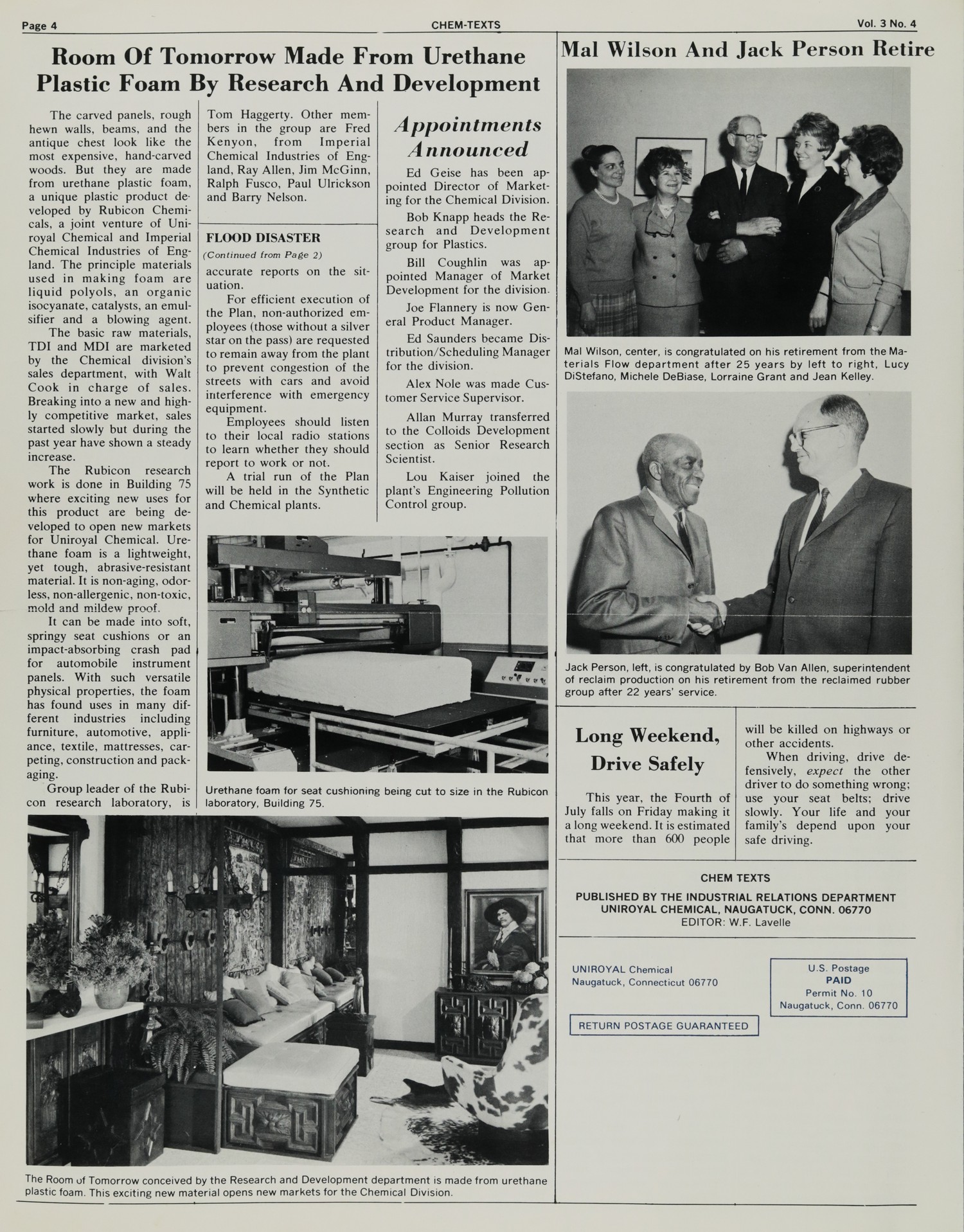
Room Of Tomorrow Made From Urethane Plastic Foam By Research And Development

The carved panels, rough hewn walls, beams, and the antique chest look like the most expensive, hand-carved woods. But they are made from urethane plastic foam, a unique plastic product developed by Rubicon Chemicals, a joint venture of Uniroyal Chemical and Imperial Chemical Industries of England. The principle materials used in making foam are liquid polyols, an organic isocyanate, catalysts, an emulsifier and a blowing agent.

The basic raw materials, TDI and MDI are marketed by the Chemical division’s sales department, with Walt Cook in charge of sales. Breaking into a new and highly competitive market, sales started slowly but during the past year have shown a steady increase.

The Rubicon research work is done in Building 75 where exciting new uses for this product are being developed to open new markets for Uniroyal Chemical. Urethane foam is a lightweight, yet tough, abrasive-resistant material. It is non-aging, odorless, non-allergenic, non-toxic, mold and mildew proof.

It can be made into soft, springy seat cushions or an impact-absorbing crash pad for automobile instrument panels. With such versatile physical properties, the foam has found uses in many different industries including furniture, automotive, appliance, textile, mattresses, carpeting, construction and packaging.

Group leader of the Rubicon research laboratory, is Tom Haggerty. Other members in the group are Fred Kenyon, from Imperial Chemical Industries of England, Ray Allen, Jim McGinn, Ralph Fusco, Paul Ulrickson and Barry Nelson.


FLOOD DISASTER

(Continued from Page 2)

accurate reports on the situation.

For efficient execution of the Plan, non-authorized employees (those without a silver star on the pass) are requested to remain away from the plant to prevent congestion of the streets with cars and avoid interference with emergency equipment.

Employees should listen to their local radio stations to learn whether they should report to work or not.

A trial run of the Plan will be held in the Synthetic and Chemical plants.


Appointments Announced

Ed Geise has been appointed Director of Marketing for the Chemical Division.

Bob Knapp heads the Research and Development group for Plastics.

Bill Coughlin was appointed Manager of Market Development for the division.

Joe Flannery is now General Product Manager.

Ed Saunders became Distribution/Scheduling Manager for the division.

Alex Nole was made Customer Service Supervisor.

Allan Murray transferred to the Colloids Development section as Senior Research Scientist.

Lou Kaiser joined the plant’s Engineering Pollution Control group.


[IMAGE CAPTION]: Urethane foam for seat cushioning being cut to size in the Rubicon laboratory, Building 75.


[IMAGE CAPTION]: The Room of Tomorrow conceived by the Research and Development department is made from urethane plastic foam. This exciting new material opens new markets for the Chemical Division.


Mal Wilson And Jack Person Retire

[IMAGE CAPTION]: Mal Wilson, center, is congratulated on his retirement from the Materials Flow department after 25 years by left to right, Lucy DiStefano, Michele DeBiase, Lorraine Grant and Jean Kelley.

[IMAGE CAPTION]: Jack Person, left, is congratulated by Bob Van Allen, superintendent of reclaim production on his retirement from the reclaimed rubber group after 22 years’ service.


Long Weekend, Drive Safely

This year, the Fourth of July falls on Friday making it a long weekend. It is estimated that more than 600 people will be killed on highways or other accidents.

When driving, drive defensively, expect the other driver to do something wrong; use your seat belts; drive slowly. Your life and your family’s depend upon your safe driving.


CHEM TEXTS

PUBLISHED BY THE INDUSTRIAL RELATIONS DEPARTMENT
UNIROYAL CHEMICAL, NAUGATUCK, CONN. 06770
EDITOR: W.F. Lavelle


UNIROYAL Chemical
Naugatuck, Connecticut 06770

U.S. Postage
PAID
Permit No. 10
Naugatuck, Conn. 06770

RETURN POSTAGE GUARANTEED