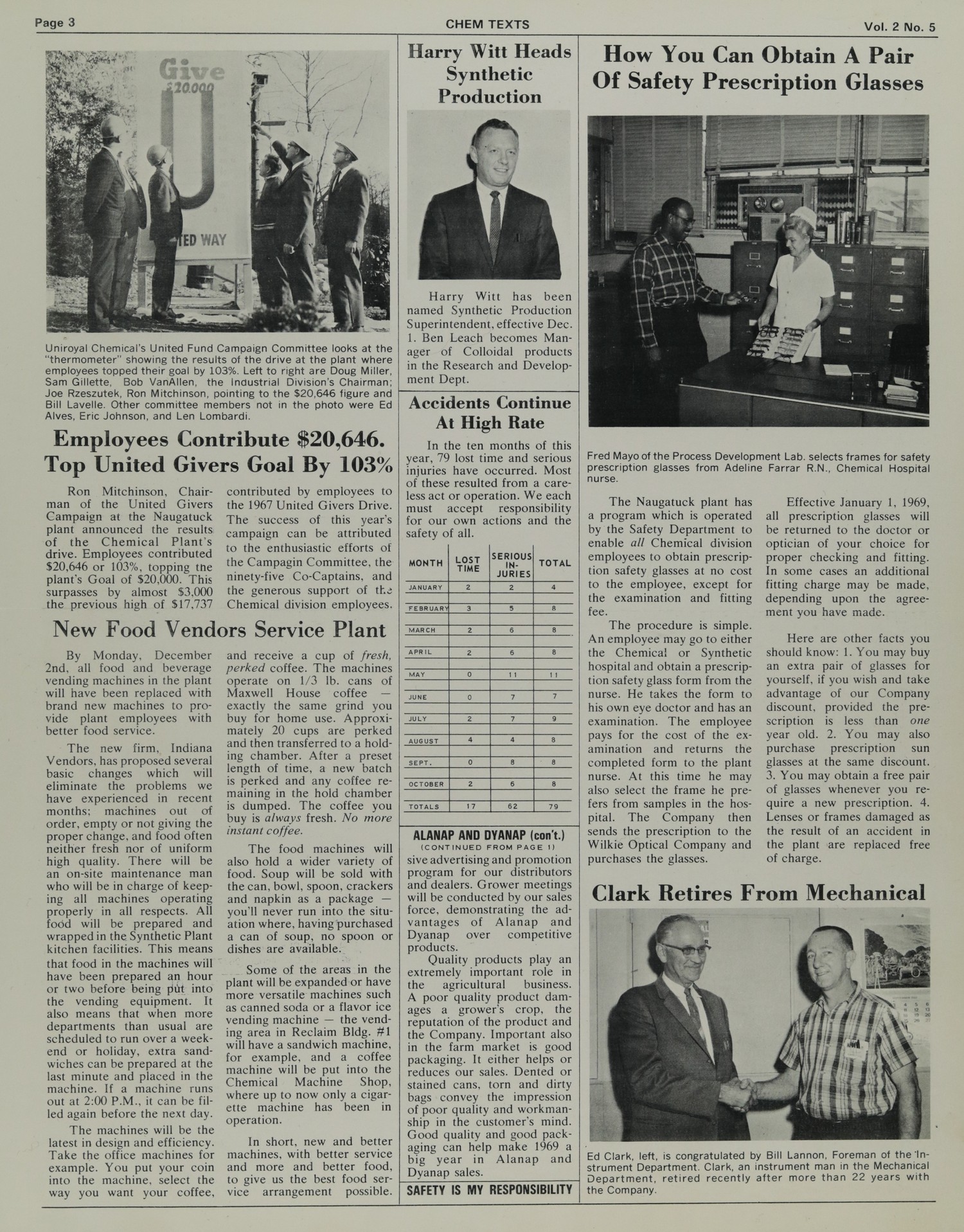
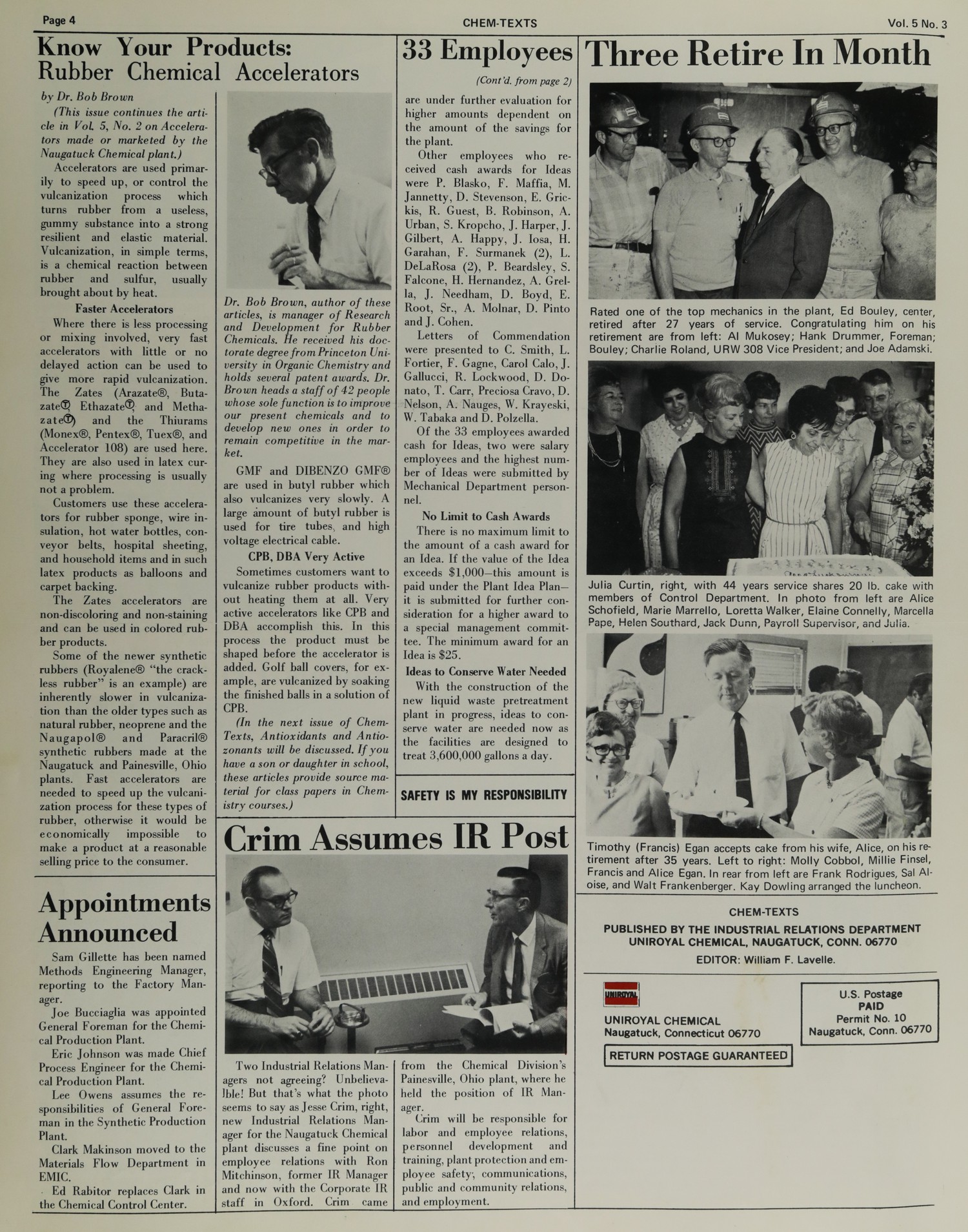
CHEM-TEXTS – Vol. 5 No. 3 – Page 4

Page 004

Page 4 CHEM-TEXTS Vol. 5 No. 3


Know Your Products: Rubber Chemical Accelerators

by Dr. Bob Brown

(This issue continues the article in Vol. 5, No. 2 on Accelerators made or marketed by the Naugatuck Chemical plant.)

Accelerators are used primarily to speed up, or control the vulcanization process which turns rubber from a useless, gummy substance into a strong resilient and elastic material. Vulcanization, in simple terms, is a chemical reaction between rubber and sulfur, usually brought about by heat.

Faster Accelerators

Where there is less processing or mixing involved, very fast accelerators with little or no delayed action can be used to give more rapid vulcanization. The Zates (Arazate®, Butazate®, Ethazate® and Methazate®) and the Thiurams (Monex®, Pentex®, Tuex®, and Accelerator 108) are used here. They are also used in latex curing where processing is usually not a problem.

Customers use these accelerators for rubber sponge, wire insulation, hot water bottles, conveyor belts, hospital sheeting, and household items and in such latex products as balloons and carpet backing.

The Zates accelerators are non-discoloring and non-staining and can be used in colored rubber products.

Some of the newer synthetic rubbers (Royalene® “the crackless rubber” is an example) are inherently slower in vulcanization than the older types such as natural rubber, neoprene and the Naugapol® and Paracril® synthetic rubbers made at the Naugatuck and Painesville, Ohio plants. Fast accelerators are needed to speed up the vulcanization process for these types of rubber, otherwise it would be economically impossible to make a product at a reasonable selling price to the consumer.

Dr. Bob Brown, author of these articles, is manager of Research and Development for Rubber Chemicals. He received his doctorate degree from Princeton University in Organic Chemistry and holds several patent awards. Dr. Brown heads a staff of 42 people whose sole function is to improve our present chemicals and to develop new ones in order to remain competitive in the market.

GMF and DIBENZO GMF® are used in butyl rubber which also vulcanizes very slowly. A large amount of butyl rubber is used for tire tubes, and high voltage electrical cable.

CPB, DBA Very Active

Sometimes customers want to vulcanize rubber products without heating them at all. Very active accelerators like CPB and DBA accomplish this. In this process the product must be shaped before the accelerator is added. Golf ball covers, for example, are vulcanized by soaking the finished balls in a solution of CPB.

(In the next issue of Chem-Texts, Antioxidants and Antiozonants will be discussed. If you have a son or daughter in school, these articles provide source material for class papers in Chemistry courses.)


33 Employees

(Cont’d. from page 2)

are under further evaluation for higher amounts dependent on the amount of the savings for the plant.

Other employees who received cash awards for Ideas were P. Blasko, F. Maffia, M. Jannetty, D. Stevenson, E. Grickis, R. Guest, B. Robinson, A. Urban, S. Kropcho, J. Harper, J. Gilbert, A. Happy, J. Iosa, H. Garahan, F. Surmanek (2), L. DeLaRosa (2), P. Beardsley, S. Falcone, H. Hernandez, A. Grella, J. Needham, D. Boyd, E. Root, Sr., A. Molnar, D. Pinto and J. Cohen.

Letters of Commendation were presented to C. Smith, L. Fortier, F. Gagne, Carol Calo, J. Gallucci, R. Lockwood, D. Donato, T. Carr, Preciosa Cravo, D. Nelson, A. Nauges, W. Krayeski, W. Tabaka and D. Polzella.

Of the 33 employees awarded cash for Ideas, two were salary employees and the highest number of Ideas were submitted by Mechanical Department personnel.

No Limit to Cash Awards

There is no maximum limit to the amount of a cash award for an Idea. If the value of the Idea exceeds $1,000—this amount is paid under the Plant Idea Plan—it is submitted for further consideration for a higher award to a special management committee. The minimum award for an Idea is $25.

Ideas to Conserve Water Needed

With the construction of the new liquid waste pretreatment plant in progress, ideas to conserve water are needed now as the facilities are designed to treat 3,600,000 gallons a day.


SAFETY IS MY RESPONSIBILITY


Crim Assumes IR Post

Two Industrial Relations Managers not agreeing? Unbelievable! But that’s what the photo seems to say as Jesse Crim, right, new Industrial Relations Manager for the Naugatuck Chemical plant discusses a fine point on employee relations with Ron Mitchinson, former IR Manager and now with the Corporate IR staff in Oxford. Crim came from the Chemical Division’s Painesville, Ohio plant, where he held the position of IR Manager.

Crim will be responsible for labor and employee relations, personnel development and training, plant protection and employee safety, communications, public and community relations, and employment.


Appointments Announced

Sam Gillette has been named Methods Engineering Manager, reporting to the Factory Manager.

Joe Bucciaglia was appointed General Foreman for the Chemical Production Plant.

Eric Johnson was made Chief Process Engineer for the Chemical Production Plant.

Lee Owens assumes the responsibilities of General Foreman in the Synthetic Production Plant.

Clark Makinson moved to the Materials Flow Department in EMIC.

Ed Rabitor replaces Clark in the Chemical Control Center.


Three Retire In Month

Rated one of the top mechanics in the plant, Ed Bouley, center, retired after 27 years of service. Congratulating him on his retirement are from left: Al Mukosey; Hank Drummer, Foreman; Bouley; Charlie Roland, URW 308 Vice President; and Joe Adamski.


Julia Curtin, right, with 44 years service shares 20 lb. cake with members of Control Department. In photo from left are Alice Schofield, Marie Marrello, Loretta Walker, Elaine Connelly, Marcella Pape, Helen Southard, Jack Dunn, Payroll Supervisor, and Julia.


Timothy (Francis) Egan accepts cake from his wife, Alice, on his retirement after 35 years. Left to right: Molly Cobbol, Millie Finsel, Francis and Alice Egan. In rear from left are Frank Rodrigues, Sal Aloise, and Walt Frankenberger. Kay Dowling arranged the luncheon.


CHEM-TEXTS

PUBLISHED BY THE INDUSTRIAL RELATIONS DEPARTMENT
UNIROYAL CHEMICAL, NAUGATUCK, CONN. 06770

EDITOR: William F. Lavelle.


UNIROYAL CHEMICAL
Naugatuck, Connecticut 06770

RETURN POSTAGE GUARANTEED

U.S. Postage
PAID
Permit No. 10
Naugatuck, Conn. 06770
CHEM-TEXTS – 1971 – Page No. 2

Page unknown

UNIROYAL CHEM-TEXTS

Vol. 5, 1971 | PUBLISHED FOR THE PEOPLE OF UNIROYAL CHEMICAL | No. 2


Crim Named IR Manager

Mitchinson, Melore Receive New Posts

Jesse Crim was named Industrial Relations Manager for the Naugatuck Chemical plant, effective June 1. He succeeds Ron Mitchinson who has accepted a position in the Corporate Industrial Relations Department in Oxford.

Neil Melore was appointed Industrial Relations Manager for the Painesville, Ohio plant.

Crim served as Industrial Relations Manager in Painesville from 1968-1971. He held the same position in the Santa Ana, Calif., and Washington, Ind. plants.

He joined Uniroyal in 1947; is a veteran of World War II; and a graduate of Purdue University.


Hats, Glasses Required

by Bob Shortt

As of May 1, hard hats and safety glasses were required to be worn in designated areas of the plant.

[IMAGE: Photo showing workers wearing safety equipment]

Joining the plant’s safety equipment program of wearing hard hats and safety glasses are two of its more attractive members. From left is Kay Dowling, Chemical Production, and Adeline Farrar, Chemical Plant nurse.

During April, foremen and supervisors discussed the new program with people in their departments. The program is based on a Section of the 1970 Uniroyal-
(Con’t. on page 4)


Profits; Sales Up

Tires; Footwear Improve; Chemical Business Off

Uniroyal, Inc. income increased 10.6% to $10.6 million in the first quarter of 1971 compared with $9.5 million reported for the same period last year.

Sales in the first quarter climbed to a record of $413 million, about an 8% increase over the record $381 million set in 1970.

Uniroyal was the only Company of the “Big Four” rubber companies to report an increase in profits and sales for the first quarter of the year. Goodyear, Firestone, and Goodrich dropped during the quarter.

Tire, Footwear Business Up

Sales of original equipment tires hit an all-time high in the
(Con’t. on page 4)


Phase I Of Liquid Waste Pretreatment Plant Started

Sewerage System Now Being Installed

[IMAGE: Photo showing industrial buildings and sewerage system installation]

A new sanitary sewerage system was installed in the Chemical yard to carry liquid discharges to main sewers of the Chemical plant system.

by Dick Shaw

The construction of Phase I of the new $3,000,000 Liquid Waste Pretreatment Plant is now in progress.

Phase I includes the installation of new sanitary sewers in the Reclaim, Chemical, and Synthetic plant yards. These new sewers will divert the sanitary sewage from the present side streams to the main sewers in order to be ready for transfer into the new pretreatment facilities.

Pretreats For Borough’s Secondary Treatment Plant

The new pretreatment facilities will pretreat the plant’s waste liquids for acceptance into the Borough of Naugatuck’s Secondary Treatment Plant.

Uniroyal Chemical has committed $1,500,000 toward the construction of the Borough’s waste disposal plant, and will pay 60% of the operational costs due to the large volume of the plant’s waste flowing into the Borough’s plant.

50% of Capital Expenditures Allocated to Pollution Control

In 1971, approximately 50% of the plant’s capital expenditures will be spent on pollution control facilities.

A major project currently under study is the elimination of the odors created by the Reclaim operations. By process changes, it is expected that the odors of the Reclaim plant will be controlled.

Waste Control Important

The efficient operation of the waste water treatment facilities depends on everyone’s cooperation in the use of water, prevention of spills, and avoidance of washing chemicals “down the drain.”

The nature of our business requires the use of over 750 differ-
(Con’t. on page 4)

[IMAGE: Photo of Phil DePasquale with concrete tank]

Phil DePasquale shows size of reinforced concrete tank that will be used as a sewage pumping station for one of plant’s buildings.


Medicine Search Started

[IMAGE: Photo showing three scientists studying a molecule model]

Studying a molecule prepared for pharmaceutical use are from left Drs. Costa Courduvelis, Zaven Ariyan, Coordinator of program, and Terry O’Brien.

by Dr. Zaven Ariyan

A Pharmaceutical Research Program has been initiated to study and screen chemicals for possible medical use. Assisted in the search by outside pharmacology laboratories, the group is interested in developing chemicals which could be made at the Naugatuck plant.

Five Year Goal

The main aim within the next three to five years is to obtain a drug through clinical work and receive approval from the Food and Drug Administration to market it. Research work is presently centered on antiinflammatory drugs for the treatment of arthritis; cardiovascular antihypertensive drugs for high blood pressure and related disorders; and tranquilizer related drugs.

The Chemical Division R & D group consists of Dr. Zaven S. Ariyan, Coordinator of the Program and two Senior Research Chemists, Dr. Constantine I. Courduvelis and Dr. J. Terence O’Brien.

CHEM-TEXTS – Vol. 4 No. 1 – Page 2

Page 002

CHEM-TEXTS

Page 2 | Vol. 4, No. 1


FROM THE FACTORY MANAGER

DEAR FELLOW EMPLOYEE:

During most of the 1960’s, in fact until about mid-1969, our plant has operated in what Jim Cronin has called an “oversold” position. In other words, we were operating all out to produce every pound we could, to meet our customers’ requirements.

In 1969 the situation changed to what can be called an “undersold” position, which means we can produce more than the customer needs. This fairly abrupt change from what had become an established way of operating has affected the way all of us do our jobs. Basically, under these conditions all of us have to make better decisions faster in order to be responsive to the customers’ needs at the moment.

Considering the general decline in business activity in the markets we serve, the high cost of money, the “undersold” capacity of domestic competition and increasing foreign competition, I expect that these conditions will continue well into 1970. Therefore, it becomes even more important that we be as flexible to change as possible. Under these circumstances what we did yesterday isn’t important. What is important, is what we do right now to meet a new opportunity.

All of us have expressed individual pride in the flexibility of our plant – men and machinery alike – to do the job, whatever the requirements. Now if we really have this flexibility, and I believe we do, it seems to me that the economic climate of 1970 plays right into our hands.

I’m confident we can and will meet these demands regardless of how difficult they may be.

Sincerely,

John

John D. Evans


Jaroy Inc. Enjoys Brisk Sales

Jaroy, Inc. officers sell stock to Uniroyal Chemical employees. From left to right are John Evans, Factory Manager; Jill Subataitis, President of Jaroy; Harry Witt, Synthetic Production Superintendent; Joe Rzeszutek, President URW Local 218; Ted Lainas; Jim Brown; Ron Mitchinson, Industrial Relations Manager; and Jo Ann Niski, Purchasing Agent.

by Ted Lainas

Jaroy, Junior Achievement of Uniroyal, is a small company with big goals. On its first day of sales, the company sold every product made during the past months.

Jaroy is a Junior Achievement company sponsored by Uniroyal Chemical, and consists of Naugatuck High School students and one Achiever from Holy Cross High.

The basic principle of the JA program is to give high school students real business experience and to help them develop an accurate understanding of the economic factors that make the free enterprise system work.

Issues Stock For Capital

The company issues and sells stock for its operating capital. This money is used to buy raw materials, tools, pay rent, heat, and light bills, and other expenditures to operate the business. Jaroy pays regular salaries, and taxes, carries insurance, and pays dividends to stockholders from any profits made.

Living Economics

Economics can be a difficult subject, especially when taught from a textbook and by lectures. In Junior Achievement, the student puts into practice what is taught in school about complicated practices and theories. Be-

Continued on page 4


Trucks Get Safety Belts

by Bob Shortt

Safety belts are being installed in all plant trucks for safety protection for plant drivers as a result of a survey by the Cornell Aeronautical Laboratory of Cornell University.

For a long time, the trucking industry had questioned the value of safety belts in trucks because of the floating seat drivers used for comfort, but the survey results indicate otherwise.

A study of 243 truck accidents showed the frequency of door openings in trucks to be double the frequency of door openings in 1963 model automobiles. The frequency of truck driver ejection was shown to be about double the frequency of driver ejections from recent model automobiles. The rate of dangerous or fatal injuries for ejected truck drivers was four times as high as for non-ejected truck drivers. Therefore, it is believed

Continued on page 3

Presley Joines, a driver for Synthetic Materials Handling shows safety belt installed in new plant truck to John Metesky, right. Seat belts provide extra safety protection for our drivers.


At left of photo is conveyor to carry scrap tires to grinder. Employee’s head barely missed the steel prong of the conveyor as he fell backwards. (Conveyor prongs were retouched to show them more clearly).


Man Slips . . .

Continued from page 1

injuries. Training and education programs, installation of safer equipment, and repairs are continually being made to improve safety.

In the final analysis, however, Safety is the responsibility of every employee. Unless he has a safety attitude, performs his job safely, wears the proper safety clothing and equipment and avoids taking chances, accidents and injuries will continue to happen.

55,200 persons were killed in motor vehicle accidents in 1968, an increase of 4% over 1967.


Foremen’s Club Changes Name And By-Laws

by Lou Kaiser

By a high margin vote, the Uniroyal Chemical Foremen’s Club changed its name to the Uniroyal Chemical Management Club.

The new by-laws open membership to all male salaried personnel. Members of the Divisional staff are now eligible for the Club but are not eligible to hold office.

Dues were increased from $6 to $8 yearly.

CHEM-TEXTS – Vol. 4, 1970, No. 2 – Page 1

Page 001

UNIROYAL CHEM-TEXTS

Vol. 4, 1970 | PUBLISHED FOR THE PEOPLE OF UNIROYAL CHEMICAL | No. 2


1970 Success Depends On Each Employe

If you were going on a long vacation you would carefully plan in advance and consider everything necessary for a safe and rewarding trip for yourself and your family.

Operation of a large chemical plant requires the same deliberate planning in advance to assure progress, produce products competitively, improve safety and to secure the jobs of every employee.

To implement the plans of the plant for 1970, millions of dollars will be invested by the Company proving its confidence in the skills and abilities of the people at Naugatuck. Mere spending of money will not do the job alone; only the fullest use of every employee’s efforts in every department is needed to justify these expenditures. With a positive attitude and concern by each employee to do his full share, 1970 will be a year of progress.

Departments Depend Upon Each Other

Each department outlined plans and goals for the year for its own group. But the success of these plans require the cooperative effort of all departments. Progress depends upon every employee’s fullest cooperation to work in a unified effort with all the departments in the plant’s operation.

The following summarize the major plans for departments to make 1970 a year of progress.

Chemical Production

Product quality and production must be improved to satisfy our customers’ demands. Their purchase of our products are critically important to the operation of the plant.

To help us improve this situation, the new Control Center will schedule products by priority; help improve product quality and utilize equip-


[PHOTO CAPTION]
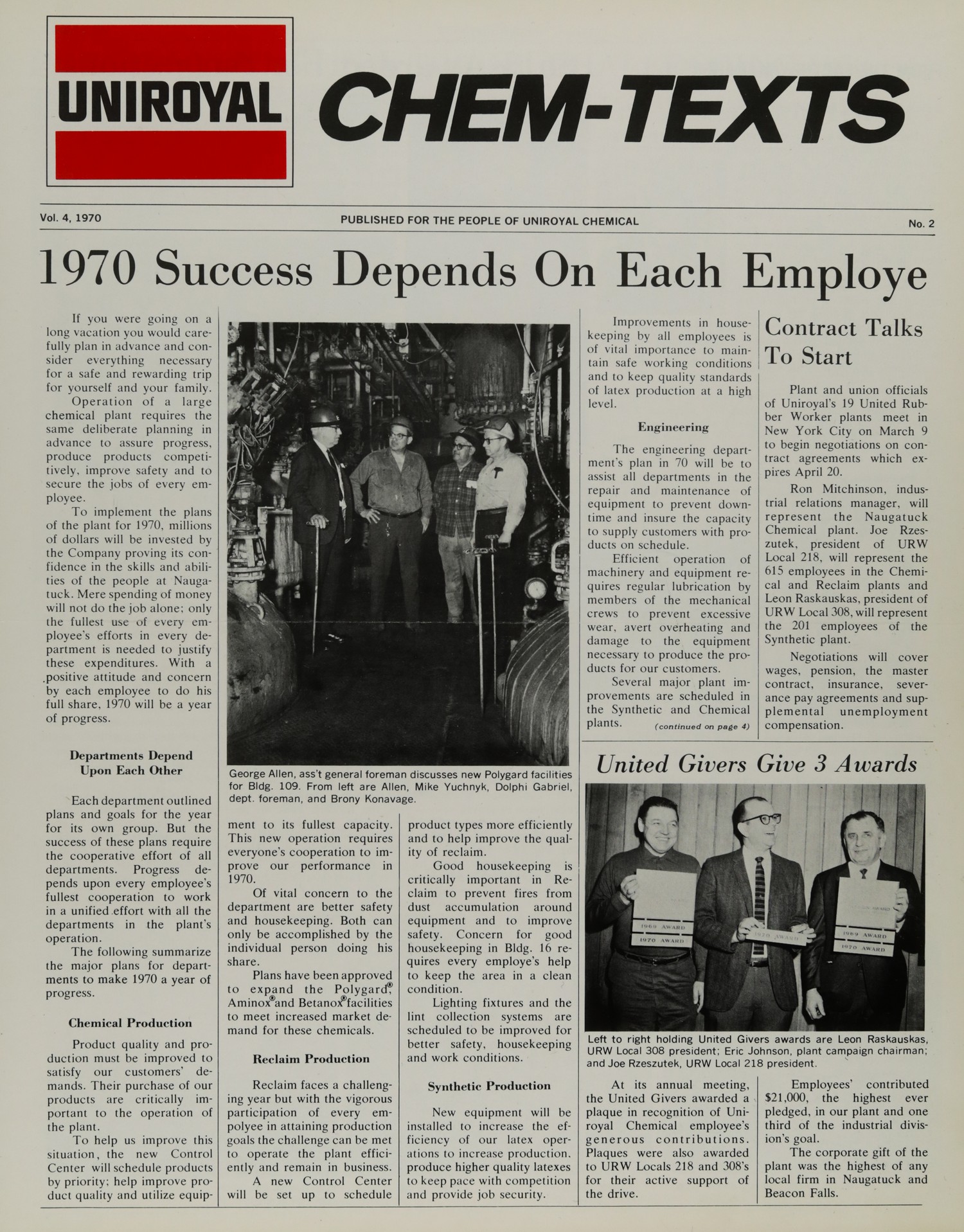
George Allen, ass’t general foreman discusses new Polygard facilities for Bldg. 109. From left are Allen, Mike Yuchnyk, Dolphi Gabriel, dept. foreman, and Brony Konavage.


ment to its fullest capacity. This new operation requires everyone’s cooperation to improve our performance in 1970.

Of vital concern to the department are better safety and housekeeping. Both can only be accomplished by the individual person doing his share.

Plans have been approved to expand the Polygard, Aminox and Betanox facilities to meet increased market demand for these chemicals.

Reclaim Production

Reclaim faces a challenging year but with the vigorous participation of every employee in attaining production goals the challenge can be met to operate the plant efficiently and remain in business.

A new Control Center will be set up to schedule product types more efficiently and to help improve the quality of reclaim.

Good housekeeping is critically important in Reclaim to prevent fires from dust accumulation around equipment and to improve safety. Concern for good housekeeping in Bldg. 16 requires every employe’s help to keep the area in a clean condition.

Lighting fixtures and the lint collection systems are scheduled to be improved for better safety, housekeeping and work conditions.

Synthetic Production

New equipment will be installed to increase the efficiency of our latex operations to increase production, produce higher quality latexes to keep pace with competition and provide job security.


Improvements in housekeeping by all employees is of vital importance to maintain safe working conditions and to keep quality standards of latex production at a high level.

Engineering

The engineering department’s plan in 70 will be to assist all departments in the repair and maintenance of equipment to prevent downtime and insure the capacity to supply customers with products on schedule.

Efficient operation of machinery and equipment requires regular lubrication by members of the mechanical crews to prevent excessive wear, avert overheating and damage to the equipment necessary to produce the products for our customers.

Several major plant improvements are scheduled in the Synthetic and Chemical plants. (continued on page 4)


Contract Talks To Start

Plant and union officials of Uniroyal’s 19 United Rubber Worker plants meet in New York City on March 9 to begin negotiations on contract agreements which expires April 20.

Ron Mitchinson, industrial relations manager, will represent the Naugatuck Chemical plant. Joe Rzeszutek, president of URW Local 218, will represent the 615 employees in the Chemical and Reclaim plants and Leon Raskauskas, president of URW Local 308, will represent the 201 employees of the Synthetic plant.

Negotiations will cover wages, pension, the master contract, insurance, severance pay agreements and supplemental unemployment compensation.


United Givers Give 3 Awards

[PHOTO CAPTION]
Left to right holding United Givers awards are Leon Raskauskas, URW Local 308 president; Eric Johnson, plant campaign chairman, and Joe Rzeszutek, URW Local 218 president.

At its annual meeting, the United Givers awarded a plaque in recognition of Uniroyal Chemical employee’s generous contributions. Plaques were also awarded to URW Locals 218 and 308’s for their active support of the drive.

Employees’ contributed $21,000, the highest ever pledged, in our plant and one third of the industrial division’s goal.

The corporate gift of the plant was the highest of any local firm in Naugatuck and Beacon Falls.

CHEM-TEXTS – Vol. 4 No. 3 – Page 2

Page 002

CHEM-TEXTS

Page 2 | Vol. 4 No. 3


FROM THE FACTORY MANAGER

DEAR FELLOW EMPLOYEE:

Spring is officially here and every now and then the sunshine gives promise that it will be really here before long. Along with spring comes the housecleaning bug that bites our wives and turns our houses upside down while the cleaning is done and the furniture is moved. When it’s all done, the house really looks great, doesn’t it?

Let’s all catch the bug this spring and pitch in together to clean up the plant this month. In a large operation like ours, spread over many acres, winter takes its toll of housekeeping and when the snow is gone our winter carelessness becomes only too obvious.

I’m counting on everybody to do his part in cleaning up his work area. Remember, good housekeeping goes hand in hand with efficient work, quality performance, safe operation and makes for a much more pleasant place to work.

Best regards.

Sincerely,

John

John D. Evans


Chemical Club Elects Officers

[IMAGE: Group photo of officers at meeting]

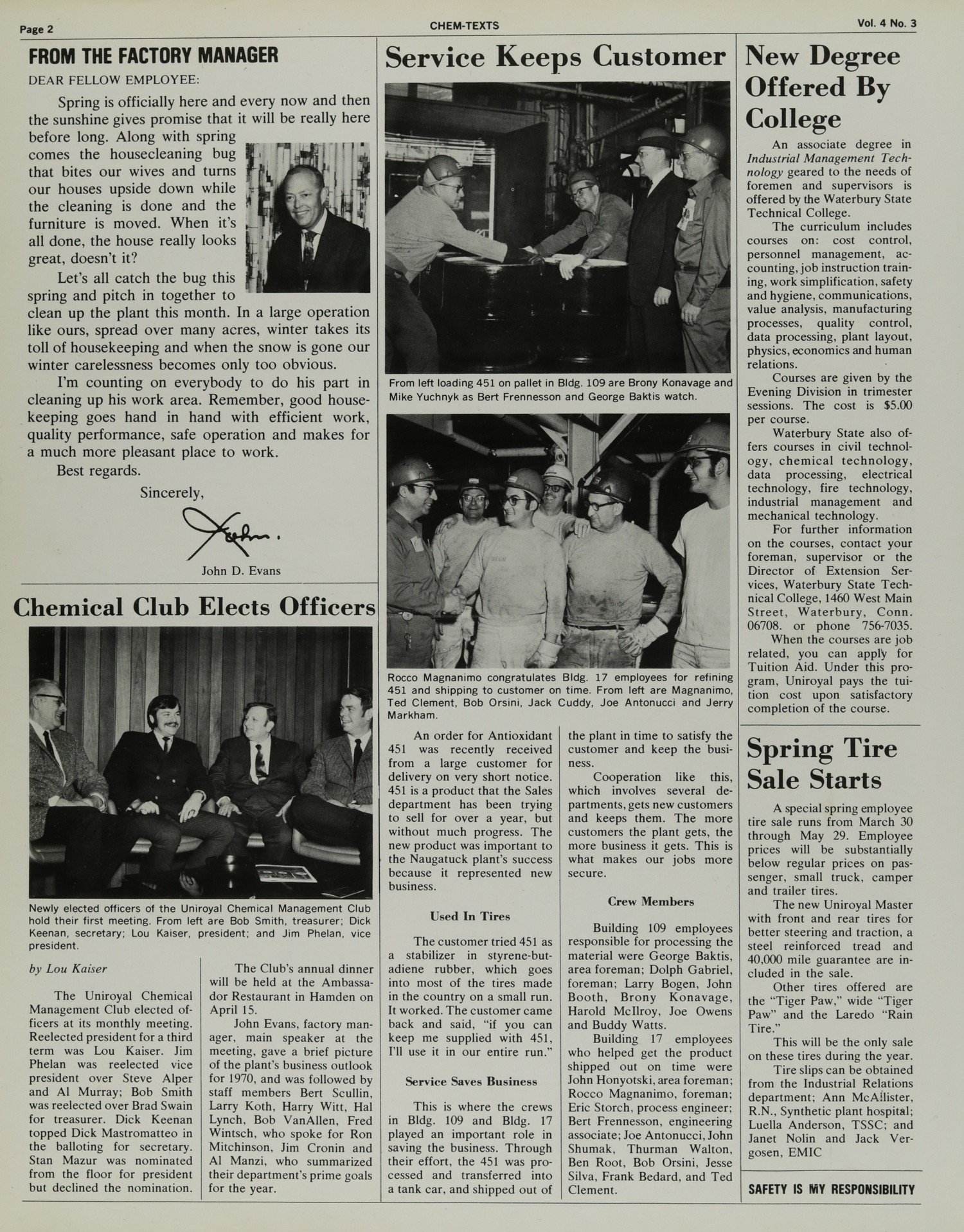
Newly elected officers of the Uniroyal Chemical Management Club hold their first meeting. From left are Bob Smith, treasurer; Dick Keenan, secretary; Lou Kaiser, president; and Jim Phelan, vice president.

by Lou Kaiser

The Uniroyal Chemical Management Club elected officers at its monthly meeting. Reelected president for a third term was Lou Kaiser. Jim Phelan was reelected vice president over Steve Alper and Al Murray. Bob Smith was reelected over Brad Swain for treasurer. Dick Keenan topped Dick Mastromatteo in the balloting for secretary. Stan Mazur was nominated from the floor for president but declined the nomination.

The Club’s annual dinner will be held at the Ambassador Restaurant in Hamden on April 15.

John Evans, factory manager, main speaker at the meeting, gave a brief picture of the plant’s business outlook for 1970, and was followed by staff members Bert Scullin, Larry Koth, Harry Witt, Hal Lynch, Bob VanAllen, Fred Wintsch, who spoke for Ron Mitchinson, Jim Cronin and Al Manzi, who summarized their department’s prime goals for the year.


Service Keeps Customer

[IMAGE: Workers loading materials on pallet]

From left loading 451 on pallet in Bldg. 109 are Brony Konavage and Mike Yuchnyk as Bert Frennesson and George Baktis watch.

[IMAGE: Group of workers being congratulated]

Rocco Magnanimo congratulates Bldg. 17 employees for refining 451 and shipping to customer on time. From left are Magnanimo, Ted Clement, Bob Orsini, Jack Cuddy, Joe Antonucci and Jerry Markham.

An order for Antioxidant 451 was recently received from a large customer for delivery on very short notice. 451 is a product that the Sales department has been trying to sell for over a year, but without much progress. The new product was important to the Naugatuck plant’s success because it represented new business.

Used In Tires

The customer tried 451 as a stabilizer in styrene-butadiene rubber, which goes into most of the tires made in the country on a small run. It worked. The customer came back and said, “if you can keep me supplied with 451, I’ll use it in our entire run.”

Service Saves Business

This is where the crews in Bldg. 109 and Bldg. 17 played an important role in saving the business. Through their effort, the 451 was processed and transferred into a tank car, and shipped out of the plant in time to satisfy the customer and keep the business.

Cooperation like this, which involves several departments, gets new customers and keeps them. The more customers the plant gets, the more business it gets. This is what makes our jobs more secure.

Crew Members

Building 109 employees responsible for processing the material were George Baktis, area foreman; Dolph Gabriel, foreman; Larry Bogen, John Booth, Brony Konavage, Harold McIlroy, Joe Owens and Buddy Watts.

Building 17 employees who helped get the product shipped out on time were John Honyotski, area foreman; Rocco Magnanimo, foreman; Eric Storch, process engineer; Bert Frennesson, engineering associate; Joe Antonucci, John Shumak, Thurman Walton, Ben Root, Bob Orsini, Jesse Silva, Frank Bedard, and Ted Clement.


New Degree Offered By College

An associate degree in Industrial Management Technology geared to the needs of foremen and supervisors is offered by the Waterbury State Technical College.

The curriculum includes courses on: cost control, personnel management, accounting, job instruction training, work simplification, safety and hygiene, communications, value analysis, manufacturing processes, quality control, data processing, plant layout, physics, economics and human relations.

Courses are given by the Evening Division in trimester sessions. The cost is $5.00 per course.

Waterbury State also offers courses in civil technology, chemical technology, data processing, electrical technology, fire technology, industrial management and mechanical technology.

For further information on the courses, contact your foreman, supervisor or the Director of Extension Services, Waterbury State Technical College, 1460 West Main Street, Waterbury, Conn. 06708. or phone 756-7035.

When the courses are job related, you can apply for Tuition Aid. Under this program, Uniroyal pays the tuition cost upon satisfactory completion of the course.


Spring Tire Sale Starts

A special spring employee tire sale runs from March 30 through May 29. Employee prices will be substantially below regular prices on passenger, small truck, camper and trailer tires.

The new Uniroyal Master with front and rear tires for better steering and traction, a steel reinforced tread and 40,000 mile guarantee are included in the sale.

Other tires offered are the “Tiger Paw,” wide “Tiger Paw” and the Laredo “Rain Tire.”

This will be the only sale on these tires during the year.

Tire slips can be obtained from the Industrial Relations department; Ann McAllister, R.N., Synthetic plant hospital; Luella Anderson, TSSC; and Janet Nolin and Jack Vergosen, EMIC

SAFETY IS MY RESPONSIBILITY

CHEM-TEXTS – Vol. 4 No. 3 – Page 3

Page 003

CHEM-TEXTS

Vol. 4 No. 3 Page 3


Supervisory Skills Training Program Started For Foremen

[LEFT PHOTO CAPTION:]
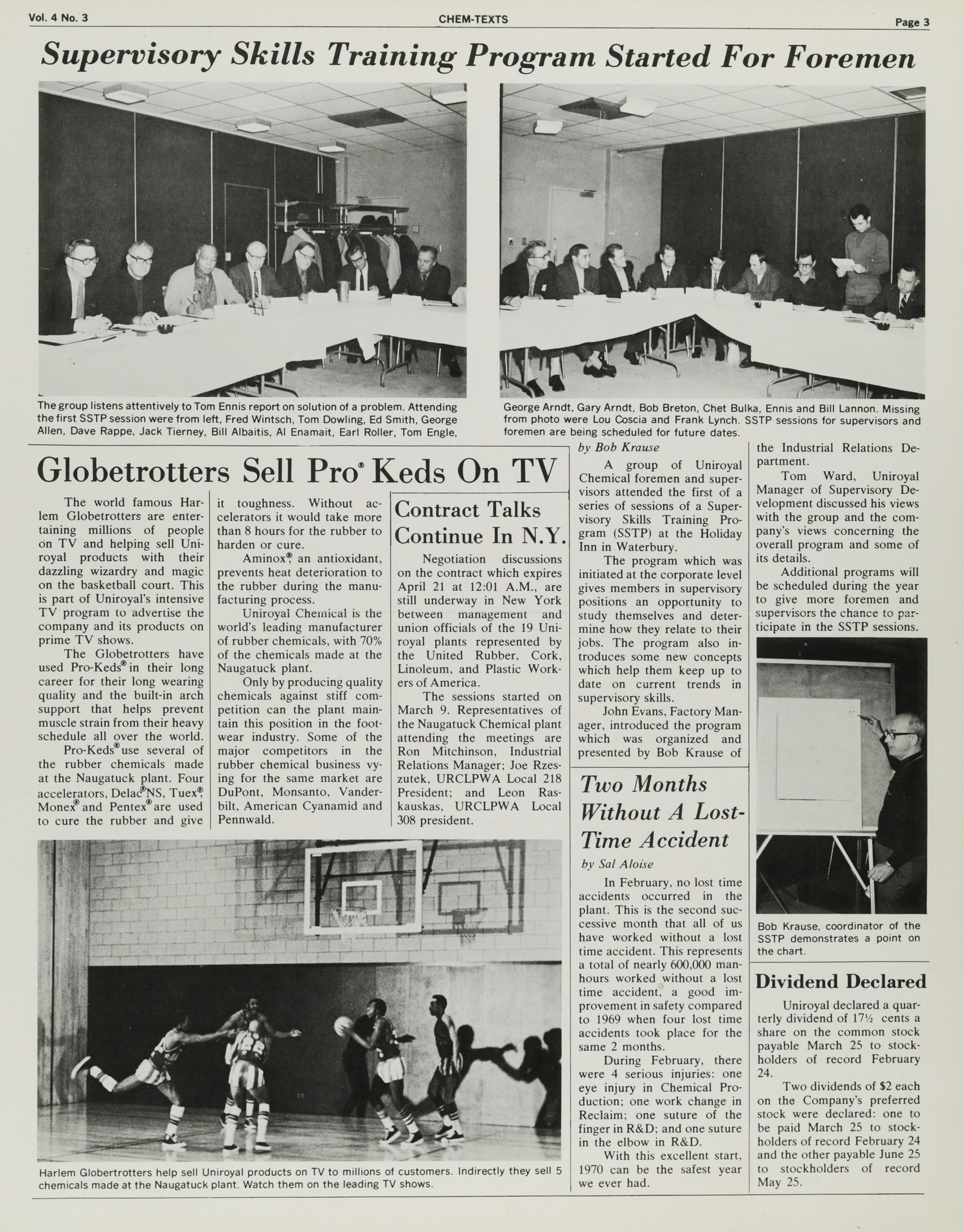
The group listens attentively to Tom Ennis report on solution of a problem. Attending the first SSTP session were from left, Fred Wintsch, Tom Dowling, Ed Smith, George Allen, Dave Rappe, Jack Tierney, Bill Albaitis, Al Enamait, Earl Roller, Tom Engle,

[RIGHT PHOTO CAPTION:]
George Arndt, Gary Arndt, Bob Breton, Chet Bulka, Ennis and Bill Lannon. Missing from photo were Lou Coscia and Frank Lynch. SSTP sessions for supervisors and foremen are being scheduled for future dates.


Globetrotters Sell Pro* Keds On TV

The world famous Harlem Globetrotters are entertaining millions of people on TV and helping sell Uniroyal products with their dazzling wizardry and magic on the basketball court. This is part of Uniroyal’s intensive TV program to advertise the company and its products on prime TV shows.

The Globetrotters have used Pro-Keds® in their long career for their long wearing quality and the built-in arch support that helps prevent muscle strain from their heavy schedule all over the world.

Pro-Keds® use several of the rubber chemicals made at the Naugatuck plant. Four accelerators, Delac®NS, Tuex®, Monex® and Pentex® are used to cure the rubber and give it toughness. Without accelerators it would take more than 8 hours for the rubber to harden or cure.

Aminox®, an antioxidant, prevents heat deterioration to the rubber during the manufacturing process.

Uniroyal Chemical is the world’s leading manufacturer of rubber chemicals, with 70% of the chemicals made at the Naugatuck plant.

Only by producing quality chemicals against stiff competition can the plant maintain this position in the footwear industry. Some of the major competitors in the rubber chemical business vying for the same market are DuPont, Monsanto, Vanderbilt, American Cyanamid and Pennwald.


Contract Talks Continue In N.Y.

Negotiation discussions on the contract which expires April 21 at 12:01 A.M., are still underway in New York between management and union officials of the 19 Uniroyal plants represented by the United Rubber, Cork, Linoleum, and Plastic Workers of America.

The sessions started on March 9. Representatives of the Naugatuck Chemical plant attending the meetings are Ron Mitchinson, Industrial Relations Manager; Joe Rzeszutek, URCLPWA Local 218 President; and Leon Raskauskas, URCLPWA Local 308 president.


by Bob Krause

A group of Uniroyal Chemical foremen and supervisors attended the first of a series of sessions of a Supervisory Skills Training Program (SSTP) at the Holiday Inn in Waterbury.

The program which was initiated at the corporate level gives members in supervisory positions an opportunity to study themselves and determine how they relate to their jobs. The program also introduces some new concepts which help them keep up to date on current trends in supervisory skills.

John Evans, Factory Manager, introduced the program which was organized and presented by Bob Krause of the Industrial Relations Department.

Tom Ward, Uniroyal Manager of Supervisory Development discussed his views with the group and the company’s views concerning the overall program and some of its details.

Additional programs will be scheduled during the year to give more foremen and supervisors the chance to participate in the SSTP sessions.


[BOTTOM LEFT PHOTO CAPTION:]
Harlem Globertrotters help sell Uniroyal products on TV to millions of customers. Indirectly they sell 5 chemicals made at the Naugatuck plant. Watch them on the leading TV shows.


Two Months Without A Lost-Time Accident

by Sal Aloise

In February, no lost time accidents occurred in the plant. This is the second successive month that all of us have worked without a lost time accident. This represents a total of nearly 600,000 manhours worked without a lost time accident, a good improvement in safety compared to 1969 when four lost time accidents took place for the same 2 months.

During February, there were 4 serious injuries: one eye injury in Chemical Production; one work change in Reclaim; one suture of the finger in R&D; and one suture in the elbow in R&D.

With this excellent start, 1970 can be the safest year we ever had.


[RIGHT PHOTO CAPTION:]
Bob Krause, coordinator of the SSTP demonstrates a point on the chart.


Dividend Declared

Uniroyal declared a quarterly dividend of 17½ cents a share on the common stock payable March 25 to stockholders of record February 24.

Two dividends of $2 each on the Company’s preferred stock were declared: one to be paid March 25 to stockholders of record February 24 and the other payable June 25 to stockholders of record May 25.

CHEM-TEXTS – Vol. 4 No. 7 – Page 3

Page 003

CHEM-TEXTS

Vol. 4. No. 7 Page 3


KNOW YOUR BENEFITS:

Some Questions And Answers On Uniroyal’s Tuition Aid Program

by Marion Hutt

About seventy-three Uniroyal Chemical employees improved their education and their opportunities for advancement in their jobs by taking job related courses during the 1968-69 academic year with the help of Uniroyal’s Tuition Aid Program. (1969-70 figures were unavailable for this issue)

For those of you who are not familiar with the plan, here is some helpful information on the program which is available to all employees.

Q. What Is It?
A. To encourage self-development and education of all employees, Uniroyal will reimburse you for the full tuition cost and lab fees necessary in any course taken which is related to your current job or will be of value, as determined by the Company, in future promotional areas.

All Employees Eligible

Q. Is the program available to wage and salary personnel?
A. Yes, it is available to all full-time employees.

Q. Do I have to notify the Company of the course I wish to take?

A. Yes, prior approval has to be obtained to qualify.

Q. How many courses can I take?
A. The number of allowed courses per semester cannot exceed two.

Q. Do I take these courses on Uniroyal’s time or my time?
A. Your own time.

Q. I’d like to take a course in mechanical drawing. Am I reimbursed for any instruments I must purchase?
A. No. Books, library fees, instruments and transportation are not reimbursable.

Q. When am I reimbursed?
A. Reimbursement will be made by Uniroyal after satisfactory completion of the course has been documented by the school or institution which administered it.

Q. Is every school or institution offering courses acceptable?

A. Only fully accredited institutions or professionally recognized associations are approved.

Schools In Area

Q. What schools qualify in the area?
A. University of Connecticut (Waterbury Branch), Fairfield University, University of Hartford, University of Bridgeport, Sacred Heart University, Trinity College, Mattatuck Community College, West Connecticut State College, Central Connecticut State College, Southern Connecticut State College, RPI (Hartford Branch), Waterbury State Technical College, Kaynor

Technical, H. C. Wilcox Technical-Vocational School, New Haven College, Quinnipiac College, Post Junior College and other specialized educational institutes.

Q. Do you have any facts about people using this plan?
A. During 67-68, sixty employees were enrolled in degree programs and were reimbursed an average of $275 by Uniroyal. In 69, five employees received M.B.A. degrees. In 1970 about 70 employees attended courses, with several receiving degrees.

Q. Where do I find out the procedure I must follow to qualify?
A. Your foreman or supervisor will be glad to assist you in obtaining and processing the forms for approval. Tuition aid is another of Uniroyal’s programs for the benefit of all employees to assist them in the development of their talents and capabilities.


[IMAGE CAPTION: Marty Cherkus, right, tells Charlie Dierling about course he plans to take under Tuition Aid program.]


Three Story Glass Tube Reduces Water Pollution

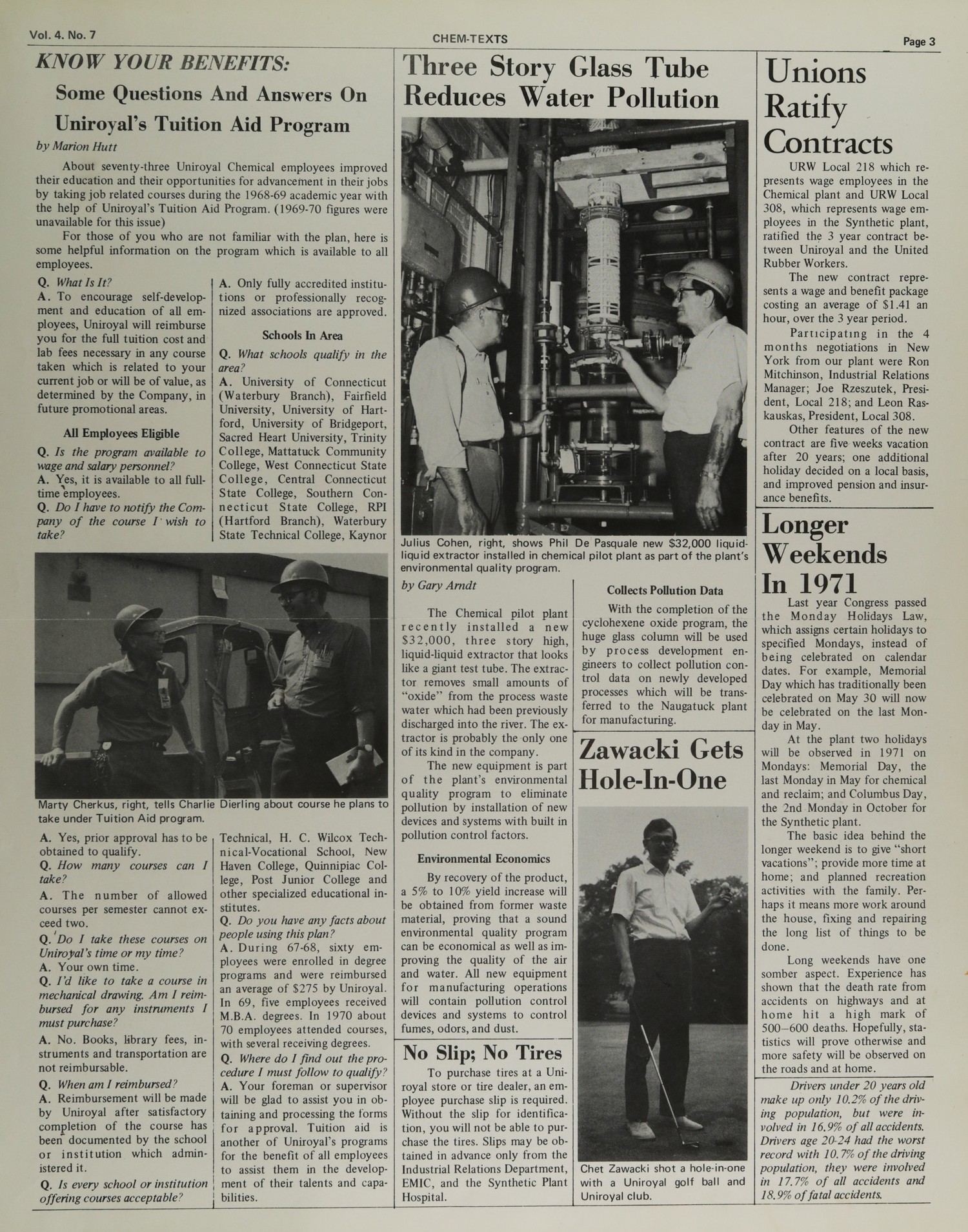
[IMAGE CAPTION: Julius Cohen, right, shows Phil De Pasquale new $32,000 liquid-liquid extractor installed in chemical pilot plant as part of the plant’s environmental quality program.]

by Gary Arndt

The Chemical pilot plant recently installed a new $32,000, three story high, liquid-liquid extractor that looks like a giant test tube. The extractor removes small amounts of “oxide” from the process waste water which had been previously discharged into the river. The extractor is probably the only one of its kind in the company.

The new equipment is part of the plant’s environmental quality program to eliminate pollution by installation of new devices and systems with built in pollution control factors.

Environmental Economics

By recovery of the product, a 5% to 10% yield increase will be obtained from former waste material, proving that a sound environmental quality program can be economical as well as improving the quality of the air and water. All new equipment for manufacturing operations will contain pollution control devices and systems to control fumes, odors, and dust.

Collects Pollution Data

With the completion of the cyclohexene oxide program, the huge glass column will be used by process development engineers to collect pollution control data on newly developed processes which will be transferred to the Naugatuck plant for manufacturing.


Zawacki Gets Hole-In-One

No Slip; No Tires

To purchase tires at a Uniroyal store or tire dealer, an employee purchase slip is required. Without the slip for identification, you will not be able to purchase the tires. Slips may be obtained in advance only from the Industrial Relations Department, EMIC, and the Synthetic Plant Hospital.

[IMAGE CAPTION: Chet Zawacki shot a hole-in-one with a Uniroyal golf ball and Uniroyal club.]


Unions Ratify Contracts

URW Local 218 which represents wage employees in the Chemical plant and URW Local 308, which represents wage employees in the Synthetic plant, ratified the 3 year contract between Uniroyal and the United Rubber Workers.

The new contract represents a wage and benefit package costing an average of $1.41 an hour, over the 3 year period.

Participating in the 4 months negotiations in New York from our plant were Ron Mitchinson, Industrial Relations Manager; Joe Rzeszutek, President, Local 218; and Leon Raskauskas, President, Local 308.

Other features of the new contract are five weeks vacation after 20 years; one additional holiday decided on a local basis, and improved pension and insurance benefits.


Longer Weekends In 1971

Last year Congress passed the Monday Holidays Law, which assigns certain holidays to specified Mondays, instead of being celebrated on calendar dates. For example, Memorial Day which has traditionally been celebrated on May 30 will now be celebrated on the last Monday in May.

At the plant two holidays will be observed in 1971 on Mondays: Memorial Day, the last Monday in May for chemical and reclaim; and Columbus Day, the 2nd Monday in October for the Synthetic plant.

The basic idea behind the longer weekend is to give “short vacations”; provide more time at home; and planned recreation activities with the family. Perhaps it means more work around the house, fixing and repairing the long list of things to be done.

Long weekends have one somber aspect. Experience has shown that the death rate from accidents on highways and at home hit a high mark of 500–600 deaths. Hopefully, statistics will prove otherwise and more safety will be observed on the roads and at home.

Drivers under 20 years old make up only 10.2% of the driving population, but were involved in 16.9% of all accidents. Drivers age 20-24 had the worst record with 10.7% of the driving population, they were involved in 17.7% of all accidents and 18.9% of fatal accidents.

CHEM-TEXTS – Vol. 3 No. 4 – Page 2

Page 002

CHEM-TEXTS

Page 2 | Vol. 3 No. 4


FROM THE FACTORY MANAGER

DEAR FELLOW EMPLOYEE:

All of us are aware of the importance of producing quality products in an efficient and safe manner. We are also aware of the importance of providing service to our customers, for only through the sale of the results of our effort can we be paid for this effort. I am convinced that each of us tries to do his job in the best way.

But how do we see our jobs? Is our particular job over, when we feel that somebody other than ourselves can be blamed for poor performance?

For example, is it justifiable to blame our injury on someone else if, indeed, it was an unsafe act on our part? Or, is it reasonable to blame lost production on the shortage of raw materials if we didn’t do something about it? Maybe we are all too quick to place the blame on someone else, before we accept all of our own responsibilities.

Together, we operate a very complex operation where each employee bears a great deal of responsibility for his personal efforts, and if we are fully successful a great deal of responsibility for the efforts of others.

Sincerely,

[Signature]

John D. Evans


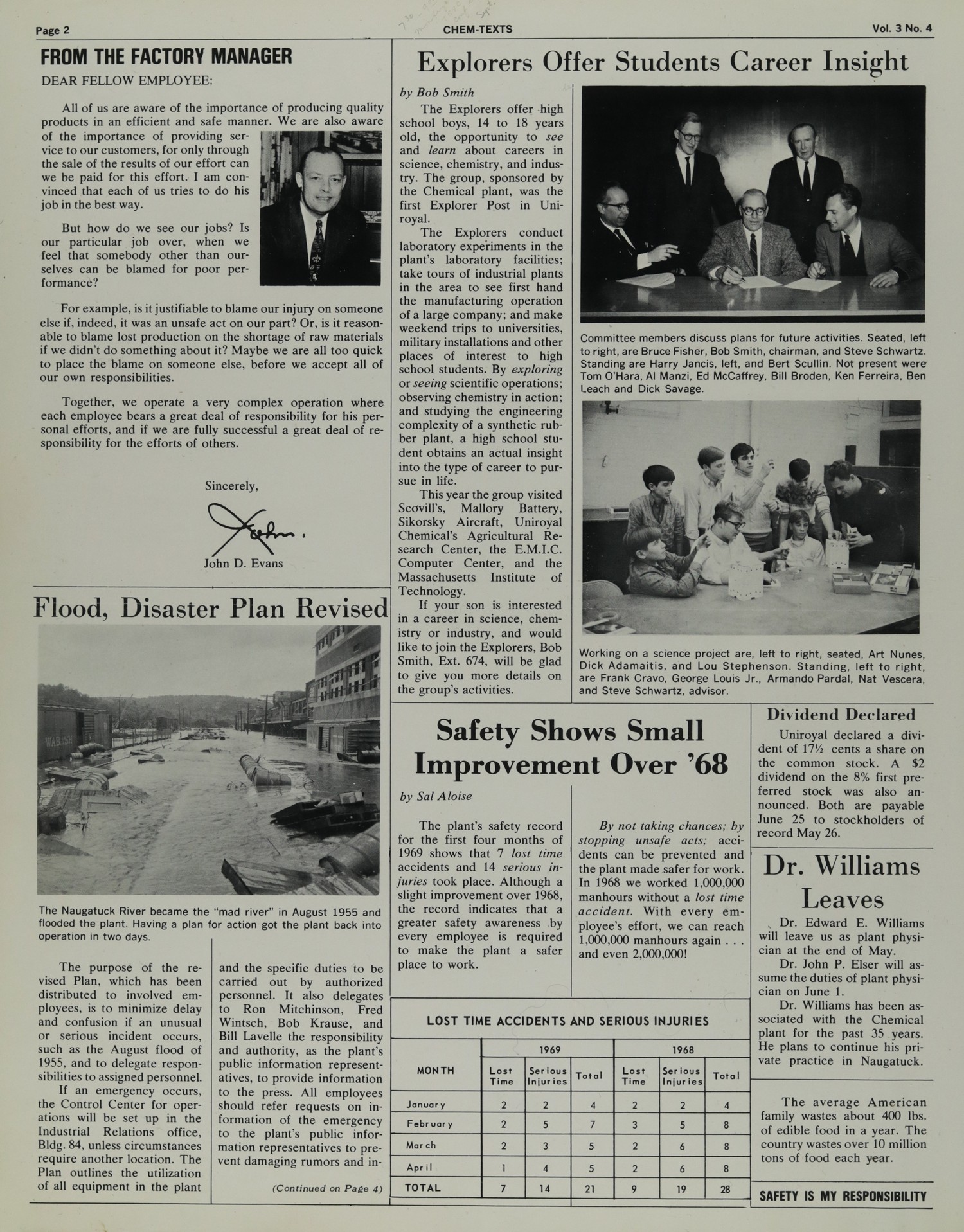
Flood, Disaster Plan Revised

[IMAGE: Black and white photograph showing flooded area with building]

The Naugatuck River became the “mad river” in August 1955 and flooded the plant. Having a plan for action got the plant back into operation in two days.

The purpose of the revised Plan, which has been distributed to involved employees, is to minimize delay and confusion if an unusual or serious incident occurs, such as the August flood of 1955, and to delegate responsibilities to assigned personnel.

If an emergency occurs, the Control Center for operations will be set up in the Industrial Relations office, Bldg. 84, unless circumstances require another location. The Plan outlines the utilization of all equipment in the plant and the specific duties to be carried out by authorized personnel. It also delegates to Ron Mitchinson, Fred Wintsch, Bob Krause, and Bill Lavelle the responsibility and authority, as the plant’s public information representatives, to provide information to the press. All employees should refer requests on information of the emergency to the plant’s public information representatives to prevent damaging rumors and in-

(Continued on Page 4)


Explorers Offer Students Career Insight

by Bob Smith

The Explorers offer high school boys, 14 to 18 years old, the opportunity to see and learn about careers in science, chemistry, and industry. The group, sponsored by the Chemical plant, was the first Explorer Post in Uniroyal.

The Explorers conduct laboratory experiments in the plant’s laboratory facilities; take tours of industrial plants in the area to see first hand the manufacturing operation of a large company; and make weekend trips to universities, military installations and other places of interest to high school students. By exploring or seeing scientific operations; observing chemistry in action; and studying the engineering complexity of a synthetic rubber plant, a high school student obtains an actual insight into the type of career to pursue in life.

This year the group visited Scovill’s, Mallory Battery, Sikorsky Aircraft, Uniroyal Chemical’s Agricultural Research Center, the E.M.I.C. Computer Center, and the Massachusetts Institute of Technology.

If your son is interested in a career in science, chemistry or industry, and would like to join the Explorers, Bob Smith, Ext. 674, will be glad to give you more details on the group’s activities.

[IMAGE: Group photograph of committee members]

Committee members discuss plans for future activities. Seated, left to right, are Bruce Fisher, Bob Smith, chairman, and Steve Schwartz. Standing are Harry Jancis, left, and Bert Scullin. Not present were Tom O’Hara, Al Manzi, Ed McCaffrey, Bill Broden, Ken Ferreira, Ben Leach and Dick Savage.

[IMAGE: Group working on science project]

Working on a science project are, left to right, seated, Art Nunes, Dick Adamaitis, and Lou Stephenson. Standing, left to right, are Frank Cravo, George Louis Jr., Armando Pardal, Nat Vescera, and Steve Schwartz, advisor.


Safety Shows Small Improvement Over ’68

by Sal Aloise

The plant’s safety record for the first four months of 1969 shows that 7 lost time accidents and 14 serious injuries took place. Although a slight improvement over 1968, the record indicates that a greater safety awareness by every employee is required to make the plant a safer place to work.

By not taking chances; by stopping unsafe acts; accidents can be prevented and the plant made safer for work. In 1968 we worked 1,000,000 manhours without a lost time accident. With every employee’s effort, we can reach 1,000,000 manhours again . . . and even 2,000,000!

LOST TIME ACCIDENTS AND SERIOUS INJURIES

MONTH 1969 Lost Time Serious Injuries Total 1968 Lost Time Serious Injuries Total
January 2 2 4 2 2 4
February 2 5 7 3 5 8
March 2 3 5 2 6 8
April 1 4 5 2 6 8
TOTAL 7 14 21 9 19 28

Dividend Declared

Uniroyal declared a dividend of 17½ cents a share on the common stock. A $2 dividend on the 8% first preferred stock was also announced. Both are payable June 25 to stockholders of record May 26.


Dr. Williams Leaves

Dr. Edward E. Williams will leave us as plant physician at the end of May.

Dr. John P. Elser will assume the duties of plant physician on June 1.

Dr. Williams has been associated with the Chemical plant for the past 35 years. He plans to continue his private practice in Naugatuck.


The average American family wastes about 400 lbs. of edible food in a year. The country wastes over 10 million tons of food each year.


SAFETY IS MY RESPONSIBILITY

CHEM-TEXTS – Vol. 3 No. 6 – Page 2

Page 002

Page 2 | CHEM-TEXTS | Vol. 3, No. 8


FROM THE FACTORY MANAGER

DEAR FELLOW EMPLOYEES:

October again brings us each the opportunity to invest in the sixteen agencies supported by the United Givers of Naugatuck and Beacon Falls. Each of these agencies, working in essential health, welfare and educational activities, makes our community a better place to live for our families and our friends. Beyond this, many of the agencies have an outreach of service beyond our borders to neighboring towns and to the nation.

We at Uniroyal Chemical have, in each year’s campaign, shown a greater willingness to give to these causes. Yet, our average gift per employee last year was something less than $13.00 per year for all of these needs. Our average is this low because some one-third of us did not give last year and some half of us gave a cash donation rather than spreading our giving by utilizing the payroll deduction plan.

When the canvasser calls on us this year, let’s all give something and let’s all pledge on payroll deductions. I think we all will be pleasantly surprised when the results are in.

Sincerely,

[Signature]

John D. Evans


Three Named Chairmen For Borough’s United Givers Drive

[IMAGE: Photo of three men in business attire having a discussion]

Ron Mitchinson, right, Industrial Relations Manager, and this year’s United Givers Campaign Chairman for Naugatuck and Beacon Falls discusses plans with Doug Miller, Engineering Superintendent, Corporate Division Chairman. Absent was Fred Wintsch, Chairman of the Commercial Division.

Over the years, the Naugatuck plant has participated in community activities by sponsoring the Junior Achievement, Naugatuck High School Career Observation Program, the Explorers, the United Givers, and other community and civic programs.

For its campaign drive this year, the United Givers of Naugatuck and Beacon Falls named Ron Mitchinson Industrial Relations Manager, Campaign Chairman for the overall drive; Doug Miller, Superintendent of Engineering, as Chairman of the Corporate division and Fred Wintsch, Labor Relations Manager, as Chairman of the Commercial group.

The annual United Givers drive is one of the major events in the community to support the charitable, social and youth work of the 16 Agencies in the campaign. This year’s goal for the campaign is $145,000 to help continue and improve the worthwhile activities of the participating groups.


Dr. Jelley New Plant Doctor

[IMAGE: Photo of Dr. Jelley reviewing medical records with Ann McAllister]

Dr. Jelley reviews medical records with Ann McAllister, R.N., Synthetic Hospital nurse.

by Bob Shortt

Dr. Edward Jelley accepted the position of plant physician replacing Dr. Elser. Dr. Jelley, a prominent physician with offices in Naugatuck, will be available at the Chemical Plant hospital from 8:30 A.M. to 10:00 A.M. and at the Synthetic Plant hospital from 10:00 A.M. to 11:00 A.M., Monday through Friday, except holidays.

The Chemical and Synthetic plant nurses, Adeline Farrar, R.N. and Ann McAllister, R.N., are on duty from 8:00 A.M. to 4:30 P.M., Monday through Friday. The Chemical nurse is also on duty Saturday morning, 8:00 A.M. to 12 Noon.

To prevent cuts, bruises or dust in the eye from becoming serious injuries, employees should see the plant nurse immediately and have the problem taken care of as a preventive measure against further complications.

In case of an accident or injury during the second or third shift, the night general foreman should be contacted by calling the night watchman on EXT. 670 who will contact the general foreman by radio for immediate attention.


Employee Snow Tire Sale On

The special employee snow tire sale runs for two months until Nov. 28. On sale are the Glas-Belt Snowplow, Glas-Belt Winter Patrol, Snowplow, and the Winter Patrol.

Purchases may be made at Uniroyal Home and Auto Centers and Uniroyal Tire Dealers.

Slips can be obtained from Industrial Relations; Ann McAllister, Synthetic plant nurse; Luella Anderson TSSC; and Diana Strollo, EMIC.


United Givers: (cont’d. from pg. 1)

The Executive Committee for the plant is Eric Johnson, Leon Raskauskas, Joe Rzeszutek, Milt Makoski, Gene Hertel, Roger Amidon, Jack Vergosen, Joe Bucciaglia, Bob Foltz, Frank Lynch and Vic Anderson.

Chairmen of the various plant sections and departments are Roger Lestage, Pat Tortorici, Carl Wehmann, Paul Laurenzi, Sal Sapio, Mike Dodd, Phil Morin, Stan Mazur, Doug Ritchie, Bob Grahame, Dom Scalzo, Al Juliano and Mary Vergosen.


Dividend Declared

Uniroyal declared a dividend of 17½ cents a share on its common stock. The dividend was payable September 25 to stockholders of record on August 25.

A dividend of $2 a share on the 8 percent first preferred stock was also declared and payable September 25 to stockholders of record on August 25.

“GIVE WHERE YOU WORK”


New Staff For Chemical Control Center

New assignments were made to the Chemical Production Control Center which was recently established. Heading the new system is Walt Frankenberger, and working as Technical Assistant is Clark Makinson.

Tom Dowling will coordinate mechanical work in the chemical plant.

Francis Egan and Matty Mathewson will work on scheduling, raw materials and quality control. Also assigned to the Center, Mildred Finsel will handle the clerical responsibilities.

As a result of the new staff assignments, several changes were made in the plant.

John Honyotski assumes responsibility for all thiazoles operations. Tom Engle takes over as Foreman in thiazole operations. Lloyd McCoy assumes charge of Bldg. 100. Earl Roller becomes Foreman of the Central Finishing Dept. Bob Cronin was made Foreman of Bldg. 88 and Tom Carey assumes the position of Production Clerk.


Fathers-Sons See Amazing Mets Play

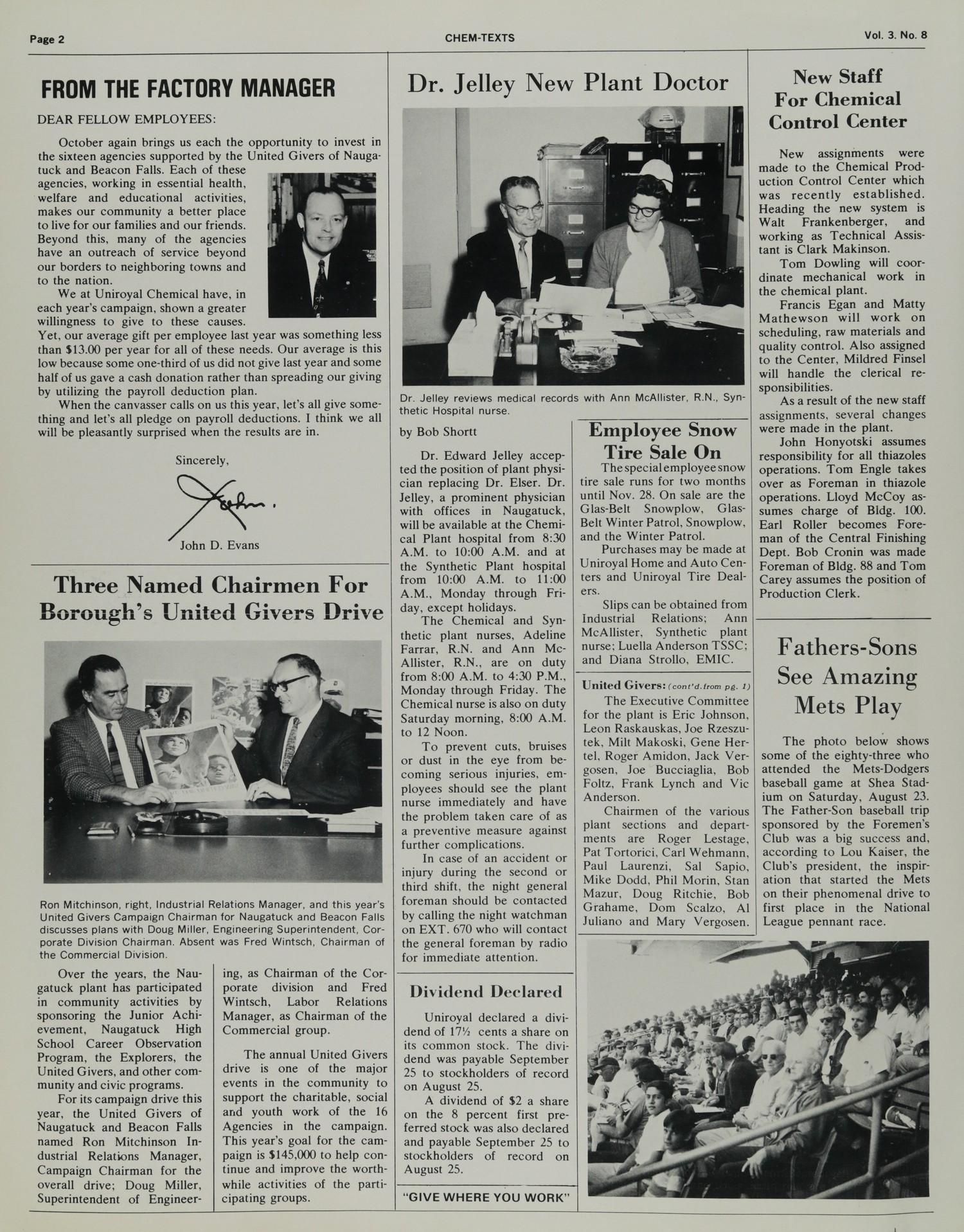
The photo below shows some of the eighty-three who attended the Mets-Dodgers baseball game at Shea Stadium on Saturday, August 23. The Father-Son baseball trip sponsored by the Foremen’s Club was a big success and, according to Lou Kaiser, the Club’s president, the inspiration that started the Mets on their phenomenal drive to first place in the National League pennant race.

[IMAGE: Photo showing crowd at baseball stadium]

CHEM-TEXTS – Vol. 3 No. 6 – Page 4

Page 004

Page 4 CHEM-TEXTS

New “Idea Plan” Offers $1000 Cash Awards

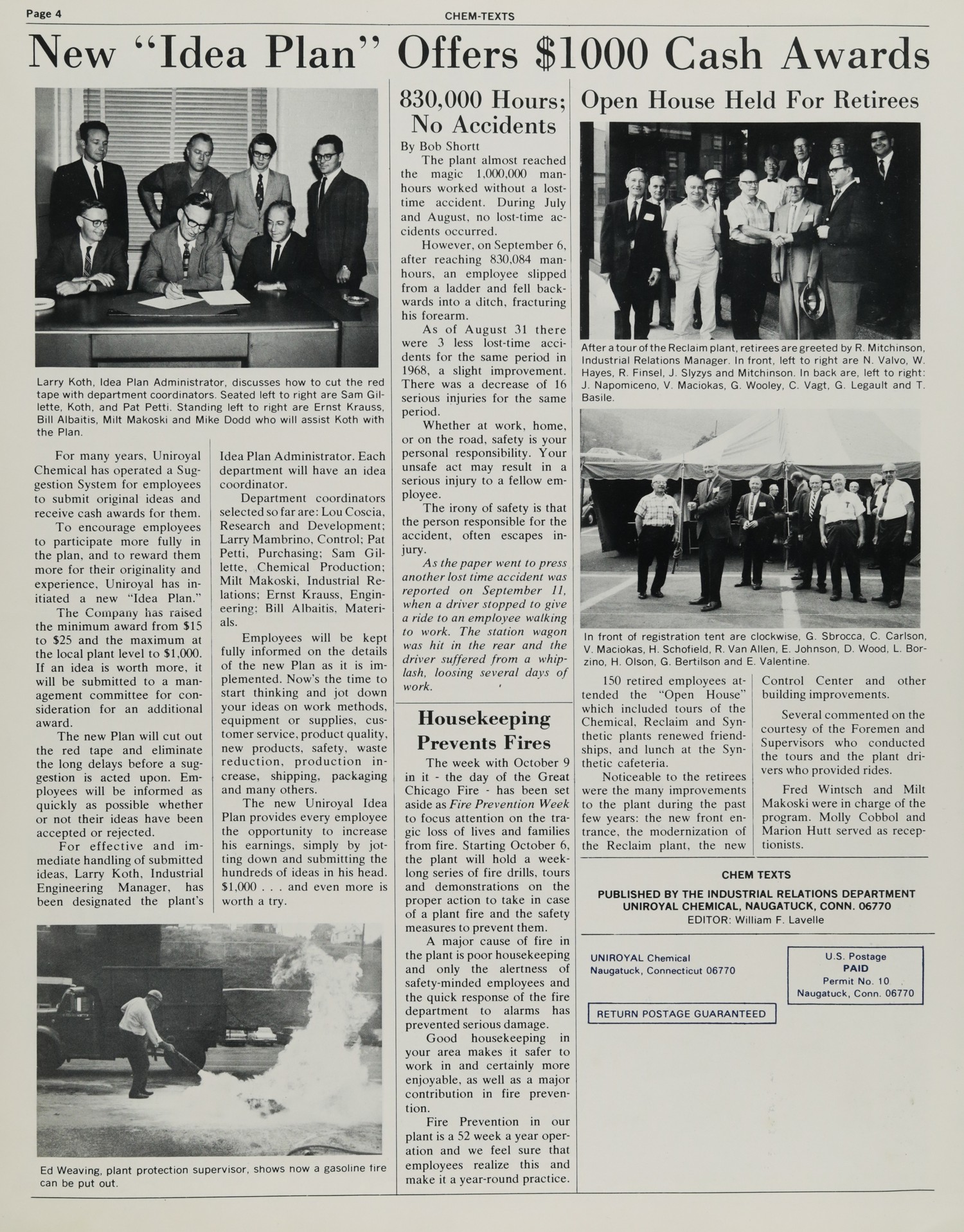
Larry Koth, Idea Plan Administrator, discusses how to cut the red tape with department coordinators. Seated left to right are Sam Gillette, Koth, and Pat Petti. Standing left to right are Ernst Krauss, Bill Albaitis, Milt Makoski and Mike Dodd who will assist Koth with the Plan.

For many years, Uniroyal Chemical has operated a Suggestion System for employees to submit original ideas and receive cash awards for them.

To encourage employees to participate more fully in the plan, and to reward them more for their originality and experience, Uniroyal has initiated a new “Idea Plan.”

The Company has raised the minimum award from $15 to $25 and the maximum at the local plant level to $1,000. If an idea is worth more, it will be submitted to a management committee for consideration for an additional award.

The new Plan will cut out the red tape and eliminate the long delays before a suggestion is acted upon. Employees will be informed as quickly as possible whether or not their ideas have been accepted or rejected.

For effective and immediate handling of submitted ideas, Larry Koth, Industrial Engineering Manager, has been designated the plant’s Idea Plan Administrator. Each department will have an idea coordinator.

Department coordinators selected so far are: Lou Coscia, Research and Development; Larry Mambrino, Control; Pat Petti, Purchasing; Sam Gillette, Chemical Production; Milt Makoski, Industrial Relations; Ernst Krauss, Engineering; Bill Albaitis, Materials.

Employees will be kept fully informed on the details of the new Plan as it is implemented. Now’s the time to start thinking and jot down your ideas on work methods, equipment or supplies, customer service, product quality, new products, safety, waste reduction, production increase, shipping, packaging and many others.

The new Uniroyal Idea Plan provides every employee the opportunity to increase his earnings, simply by jotting down and submitting the hundreds of ideas in his head. $1,000 . . . and even more is worth a try.


Ed Weaving, plant protection supervisor, shows now a gasoline fire can be put out.


830,000 Hours; No Accidents

By Bob Shortt

The plant almost reached the magic 1,000,000 manhours worked without a losttime accident. During July and August, no lost-time accidents occurred.

However, on September 6, after reaching 830,084 manhours, an employee slipped from a ladder and fell backwards into a ditch, fracturing his forearm.

As of August 31 there were 3 less lost-time accidents for the same period in 1968, a slight improvement. There was a decrease of 16 serious injuries for the same period.

Whether at work, home, or on the road, safety is your personal responsibility. Your unsafe act may result in a serious injury to a fellow employee.

The irony of safety is that the person responsible for the accident, often escapes injury.

As the paper went to press another lost time accident was reported on September 11, when a driver stopped to give a ride to an employee walking to work. The station wagon was hit in the rear and the driver suffered from a whiplash, loosing several days of work.


Housekeeping Prevents Fires

The week with October 9 in it – the day of the Great Chicago Fire – has been set aside as Fire Prevention Week to focus attention on the tragic loss of lives and families from fire. Starting October 6, the plant will hold a weeklong series of fire drills, tours and demonstrations on the proper action to take in case of a plant fire and the safety measures to prevent them.

A major cause of fire in the plant is poor housekeeping and only the alertness of safety-minded employees and the quick response of the fire department to alarms has prevented serious damage.

Good housekeeping in your area makes it safer to work in and certainly more enjoyable, as well as a major contribution in fire prevention.

Fire Prevention in our plant is a 52 week a year operation and we feel sure that employees realize this and make it a year-round practice.


Open House Held For Retirees

After a tour of the Reclaim plant, retirees are greeted by R. Mitchinson, Industrial Relations Manager. In front, left to right are N. Valvo, W. Hayes, R. Finsel, J. Slyzys and Mitchinson. In back are, left to right: J. Napomiceno, V. Maciokas, G. Wooley, C. Vagt, G. Legault and T. Basile.

In front of registration tent are clockwise, G. Sbrocca, C. Carlson, V. Maciokas, H. Schofield, R. Van Allen, E. Johnson, D. Wood, L. Borzino, H. Olson, G. Bertilson and E. Valentine.

150 retired employees attended the “Open House” which included tours of the Chemical, Reclaim and Synthetic plants renewed friendships, and lunch at the Synthetic cafeteria.

Noticeable to the retirees were the many improvements to the plant during the past few years: the new front entrance, the modernization of the Reclaim plant, the new Control Center and other building improvements.

Several commented on the courtesy of the Foremen and Supervisors who conducted the tours and the plant drivers who provided rides.

Fred Wintsch and Milt Makoski were in charge of the program. Molly Cobbol and Marion Hutt served as receptionists.


CHEM TEXTS

PUBLISHED BY THE INDUSTRIAL RELATIONS DEPARTMENT
UNIROYAL CHEMICAL, NAUGATUCK, CONN. 06770
EDITOR: William F. Lavelle

UNIROYAL Chemical
Naugatuck, Connecticut 06770

U.S. Postage
PAID
Permit No. 10
Naugatuck, Conn. 06770
RETURN POSTAGE GUARANTEED

CHEM-TEXTS – Vol. 2 No. 4 – Page 2

Page 002

CHEM TEXTS

Page 2 | Vol. 2 No. 4


FROM THE FACTORY MANAGER

Dear Fellow Employee:

Within the next several weeks we will each be contacted by one of our friends to make our annual pledge to the United Givers of Naugatuck and Beacon Falls.

Experience has proven that this once-a-year campaign is the most efficient way of providing funds for sixteen volunteer agencies that serve the people of our area. I am, however, concerned that the convenience of this method of giving may tend to lessen our generosity as givers. May I suggest that we each use the following guidelines in making out our pledges?

1) Review carefully the agencies presented on our pledge card and the details of their needs and services as described in the United Givers folder.

2) Consider the services that we, our family, our friends and neighbors receive from these agencies. Note that many of the agencies serve an area broader than the campaign towns. Some are even national.

3) Use the Work Sheet on this page of CHEM-TEXTS to work out our pledge on the payroll deduction plan. This method makes it convenient to give our share on a year-around basis.

4) PLEDGE! Before filling in our card – ask ourselves one question – “Have I given until it feels good?

[Signature]

John D. Evans


HOW MUCH SHOULD YOU GIVE TO THE UNITED GIVERS DRIVE

A few years ago, somebody knocked on your door almost once a week for a contribution to a worthy cause. You probably contributed $30 to $50 to these organizations.

Through the United Givers Fund your continued generous support of most of these organizations can now be done on a once-a-year basis through the Company’s payroll deduction plan.

To determine your contribution for 1969, this work sheet, listing the 16 participating agencies, will help you decide the amount of your gift.

Agency Gift amt. if contacted separately
American Red Cross $_____
Child Guidance Clinic $_____
Children’s Center $_____
Conn. Trails Council,
Girl Scouts of America $_____
Catholic Family Serv. $_____

Family Serv. Assoc. $__
Mattatuck Council,
Boy Scouts of America $
____

Naugatuck Jr.
Athletic Leagues $__
Salvation Army $
_
United Cerebral Palsy $

U.S.O. $

Waterbury Assoc. for
Retarded Children $

Y.M.C.A. – Naugatuck $

Total Amount $
___

By dividing the number of payroll deductions into your total amount, you obtain the amount you should pledge. For salary employees, payroll deductions will be made monthly; and for wage employees, deductions will be weekly.

The Naugatuck plant always contributed generously in the past to these worthwhile agencies. Because of their increased services and expenses they depend more on us for 1969.


New Assignments Made in Plant

Fred Wintsch has been appointed Labor Relations Manager for the Naugatuck plant. He will be responsible for employee relations, reporting to Ron Mitchinson, Industrial Relations Manager.

[PHOTO]

Sam Gillette, formerly General Foreman at the Synthetic rubber plant, moved to the Chemical production as General Foreman reporting to Jim Cronin, Superintendent.

[PHOTO]

Eric Johnson, named General Foreman of the Synthetic rubber plant, will supervise production of synthetic latexes. He reports to Ben Leach, plant Superintendent.


[PHOTO]

The new 300,000 gallon oil storage tank and steel dike dwarfs members of the Engineering department as they inspect the 29 ft. high structure, south of the boiler plant.


[PHOTO]

Plant personnel involved in the boiler plant conversion project are left to right: Vic Anderson, Paul DeAngelis, Bill Maguire, Joe Mambrino, Frank Gaizutis and George Arndt, shown checking fuel oil connections.


Special Winter Tire Sale

A special two month winter tire sale for active and retired employees will run from October 1 to November 30, 1968.

The sale is on winter patrol snow tires only and offers considerable savings below existing employee prices.

Lists of the special low prices can be obtained from the Industrial Relation’s Department or Employee Salesroom Managers.


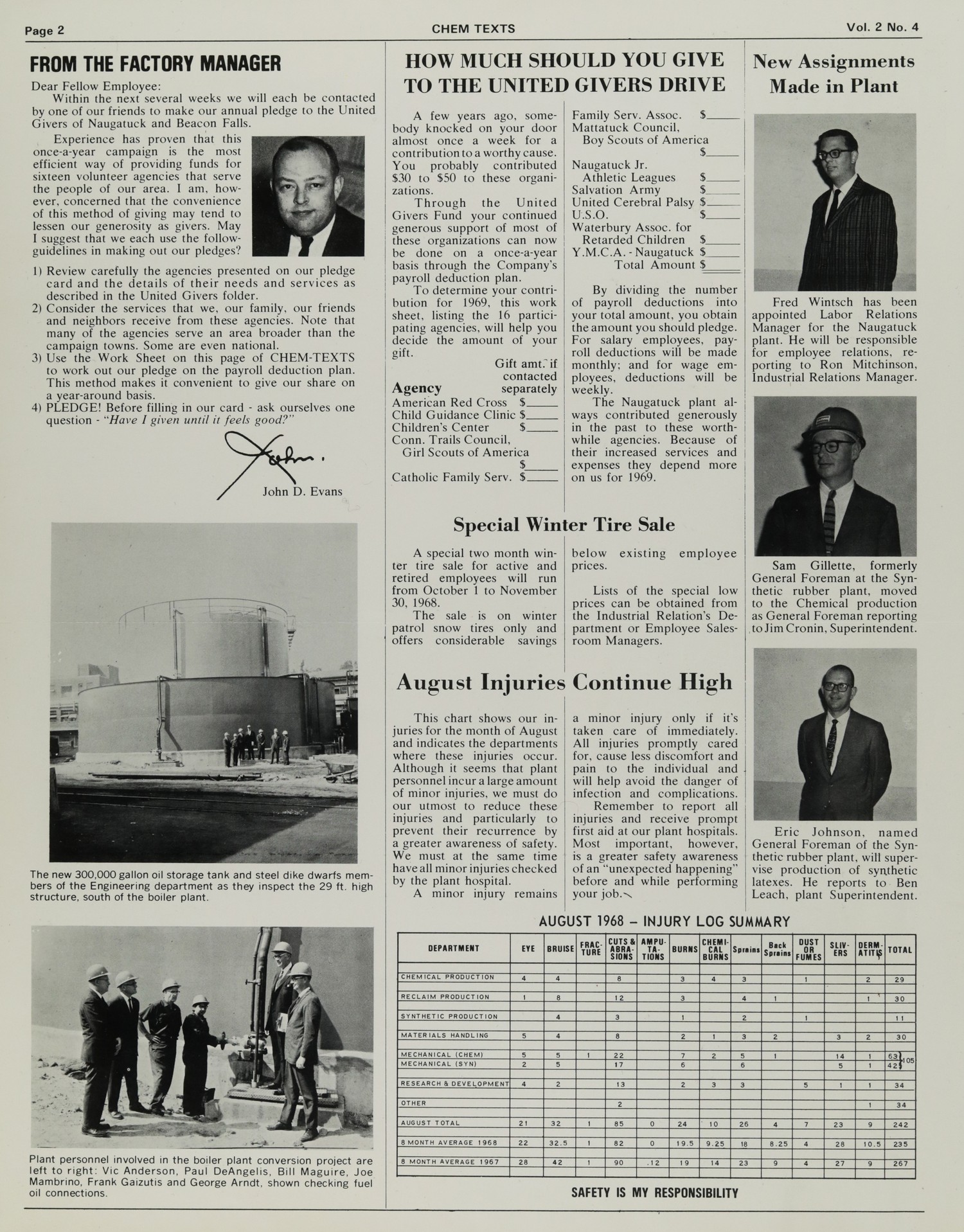
August Injuries Continue High

This chart shows our injuries for the month of August and indicates the departments where these injuries occur. Although it seems that plant personnel incur a large amount of minor injuries, we must do our utmost to reduce these injuries and particularly to prevent their recurrence by a greater awareness of safety. We must at the same time have all minor injuries checked by the plant hospital.

A minor injury remains a minor injury only if it’s taken care of immediately. All injuries promptly cared for, cause less discomfort and pain to the individual and will help avoid the danger of infection and complications.

Remember to report all injuries and receive prompt first aid at our plant hospitals. Most important, however, is a greater safety awareness of an “unexpected happening” before and while performing your job.


AUGUST 1968 – INJURY LOG SUMMARY

DEPARTMENT EYE BRUISE FRACTURE CUTS & ABRASIONS AMPUTATIONS BURNS CHEMICAL BURNS Sprains Back Sprains DUST OR FUMES SLIVERS DERMATITIS TOTAL
CHEMICAL PRODUCTION 4 4 8 3 4 3 1 2 29
RECLAIM PRODUCTION 1 8 12 3 4 1 1 30
SYNTHETIC PRODUCTION 4 3 1 2 1 11
MATERIALS HANDLING 5 4 8 2 1 3 2 3 2 30
MECHANICAL (CHEM) 5 5 1 22 7 2 5 1 14 1 63
MECHANICAL (SYN) 2 5 17 6 6 5 1 42
RESEARCH & DEVELOPMENT 4 2 13 2 3 3 5 1 1 34
OTHER 2 1 34
AUGUST TOTAL 21 32 1 85 0 24 10 26 4 7 23 9 242
8 MONTH AVERAGE 1968 22 32.5 1 82 0 19.5 9.25 18 8.25 4 28 10.5 235
8 MONTH AVERAGE 1967 28 42 1 90 12 19 14 23 9 4 27 9 267

SAFETY IS MY RESPONSIBILITY

CHEM-TEXTS – Vol. 2 No. 5 – Page 3

Page 003

CHEM TEXTS

Page 3 | Vol. 2 No. 5


Harry Witt Heads Synthetic Production

Harry Witt has been named Synthetic Production Superintendent, effective Dec. 1. Ben Leach becomes Manager of Colloidal products in the Research and Development Dept.


How You Can Obtain A Pair Of Safety Prescription Glasses

Fred Mayo of the Process Development Lab. selects frames for safety prescription glasses from Adeline Farrar R.N., Chemical Hospital nurse.

The Naugatuck plant has a program which is operated by the Safety Department to enable all Chemical division employees to obtain prescription safety glasses at no cost to the employee, except for the examination and fitting fee.

The procedure is simple. An employee may go to either the Chemical or Synthetic hospital and obtain a prescription safety glass form from the nurse. He takes the form to his own eye doctor and has an examination. The employee pays for the cost of the examination and returns the completed form to the plant nurse. At this time he may also select the frame he prefers from samples in the hospital. The Company then sends the prescription to the Wilkie Optical Company and purchases the glasses.

Effective January 1, 1969, all prescription glasses will be returned to the doctor or optician of your choice for proper checking and fitting. In some cases an additional fitting charge may be made, depending upon the agreement you have made.

Here are other facts you should know: 1. You may buy an extra pair of glasses for yourself, if you wish and take advantage of our Company discount, provided the prescription is less than one year old. 2. You may also purchase prescription sun glasses at the same discount. 3. You may obtain a free pair of glasses whenever you require a new prescription. 4. Lenses or frames damaged as the result of an accident in the plant are replaced free of charge.


[PHOTO CAPTION:]
Uniroyal Chemical’s United Fund Campaign Committee looks at the “thermometer” showing the results of the drive at the plant where employees topped their goal by 103%. Left to right are Doug Miller, Sam Gillette, Bob VanAllen, the Industrial Division’s Chairman; Joe Kresziutek, Ron Mitchinson, pointing to the $20,646 figure and Bill Lavelle. Other committee members not in the photo were Ed Alves, Eric Johnson, and Len Lombardi.


Employees Contribute $20,646. Top United Givers Goal By 103%

Ron Mitchinson, Chairman of the United Givers Campaign at the Naugatuck plant announced the results of the Chemical Plant’s drive. Employees contributed $20,646 or 103%, topping the plant’s Goal of $20,000. This surpasses by almost $3,000 the previous high of $17,737 contributed by employees to the 1967 United Givers Drive. The success of this year’s campaign can be attributed to the enthusiastic efforts of the Campagin Committee, the ninety-five Co-Captains, and the generous support of the Chemical division employees.


Accidents Continue At High Rate

In the ten months of this year, 79 lost time and serious injuries have occurred. Most of these resulted from a careless act or operation. We each must accept responsibility for our own actions and the safety of all.

MONTH LOST TIME SERIOUS IN-JURIES TOTAL
JANUARY 2 2 4
FEBRUARY 3 5 8
MARCH 2 6 8
APRIL 2 6 8
MAY 0 11 11
JUNE 0 7 7
JULY 2 7 9
AUGUST 4 4 8
SEPT. 0 8 8
OCTOBER 2 6 8
TOTALS 17 62 79

New Food Vendors Service Plant

By Monday, December 2nd, all food and beverage vending machines in the plant will have been replaced with brand new machines to provide plant employees with better food service.

The new firm, Indiana Vendors, has proposed several basic changes which will eliminate the problems we have experienced in recent months; machines out of order, empty or not giving the proper change, and food often neither fresh nor of uniform high quality. There will be an on-site maintenance man who will be in charge of keeping all machines operating properly in all respects. All food will be prepared and wrapped in the Synthetic Plant kitchen facilities. This means that food in the machines will have been prepared an hour or two before being put into the vending equipment. It also means that when more departments than usual are scheduled to run over a weekend or holiday, extra sandwiches can be prepared at the last minute and placed in the machine. If a machine runs out at 2:00 P.M., it can be filled again before the next day.

The machines will be the latest in design and efficiency. Take the office machines for example. You put your coin into the machine, select the way you want your coffee, and receive a cup of fresh, perked coffee. The machines operate on 1/3 lb. cans of Maxwell House coffee — exactly the same grind you buy for home use. Approximately 20 cups are perked and then transferred to a holding chamber. After a preset length of time, a new batch is perked and any coffee remaining in the hold chamber is dumped. The coffee you buy is always fresh. No more instant coffee.

The food machines will also hold a wider variety of food. Soup will be sold with the can, bowl, spoon, crackers and napkin as a package — you’ll never run into the situation where, having purchased a can of soup, no spoon or dishes are available.

Some of the areas in the plant will be expanded or have more versatile machines such as canned soda or a flavor ice vending machine — the vending area in Reclaim Bldg. #1 will have a sandwich machine, for example, and a coffee machine will be put into the Chemical Machine Shop, where up to now only a cigarette machine has been in operation.

In short, new and better machines, with better service and more and better food, to give us the best food service arrangement possible.


ALANAP AND DYANAP (con’t.)

(CONTINUED FROM PAGE 1)

sive advertising and promotion program for our distributors and dealers. Grower meetings will be conducted by our sales force, demonstrating the advantages of Alanap and Dyanap over competitive products.

Quality products play an extremely important role in the agricultural business. A poor quality product damages a grower’s crop, the reputation of the product and the Company. Important also in the farm market is good packaging. It either helps or reduces our sales. Dented or stained cans, torn and dirty bags convey the impression of poor quality and workmanship in the customer’s mind. Good quality and good packaging can help make 1969 a big year in Alanap and Dyanap sales.

SAFETY IS MY RESPONSIBILITY


Clark Retires From Mechanical

Ed Clark, left, is congratulated by Bill Lannon, Foreman of the Instrument Department. Clark, an instrument man in the Mechanical Department, retired recently after more than 22 years with the Company.