CHEM-TEXTS – 1975-v09-s230

Page 230

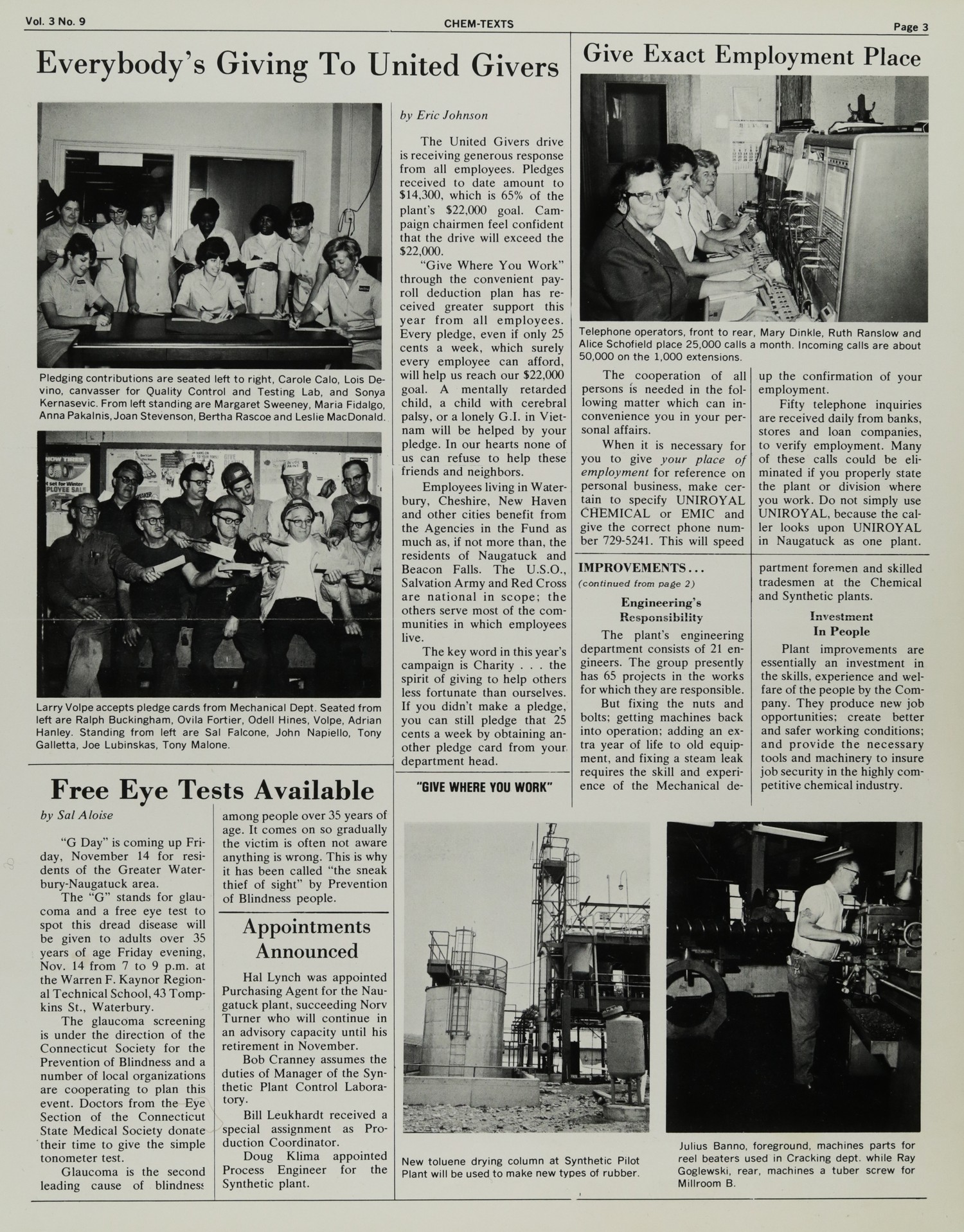
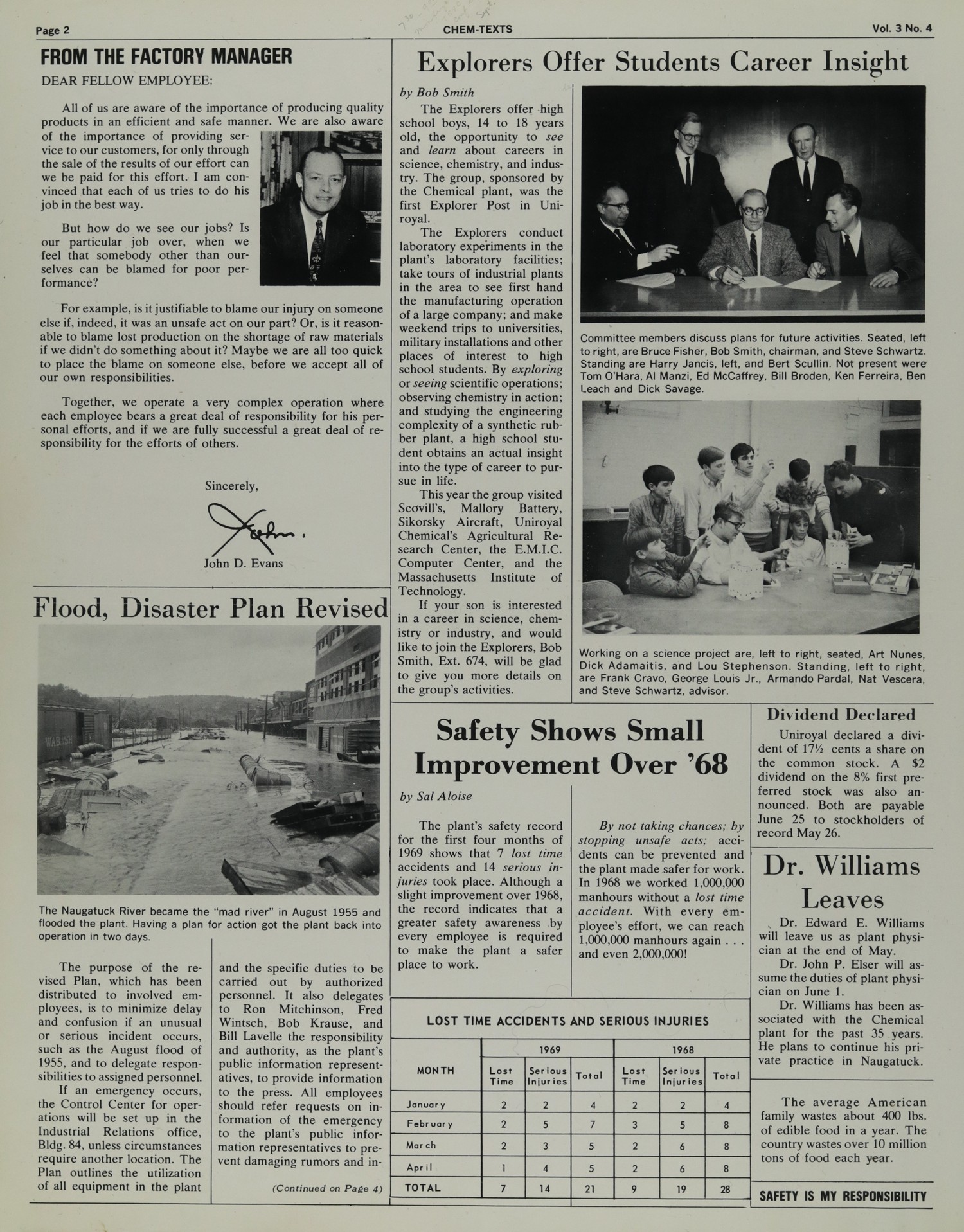
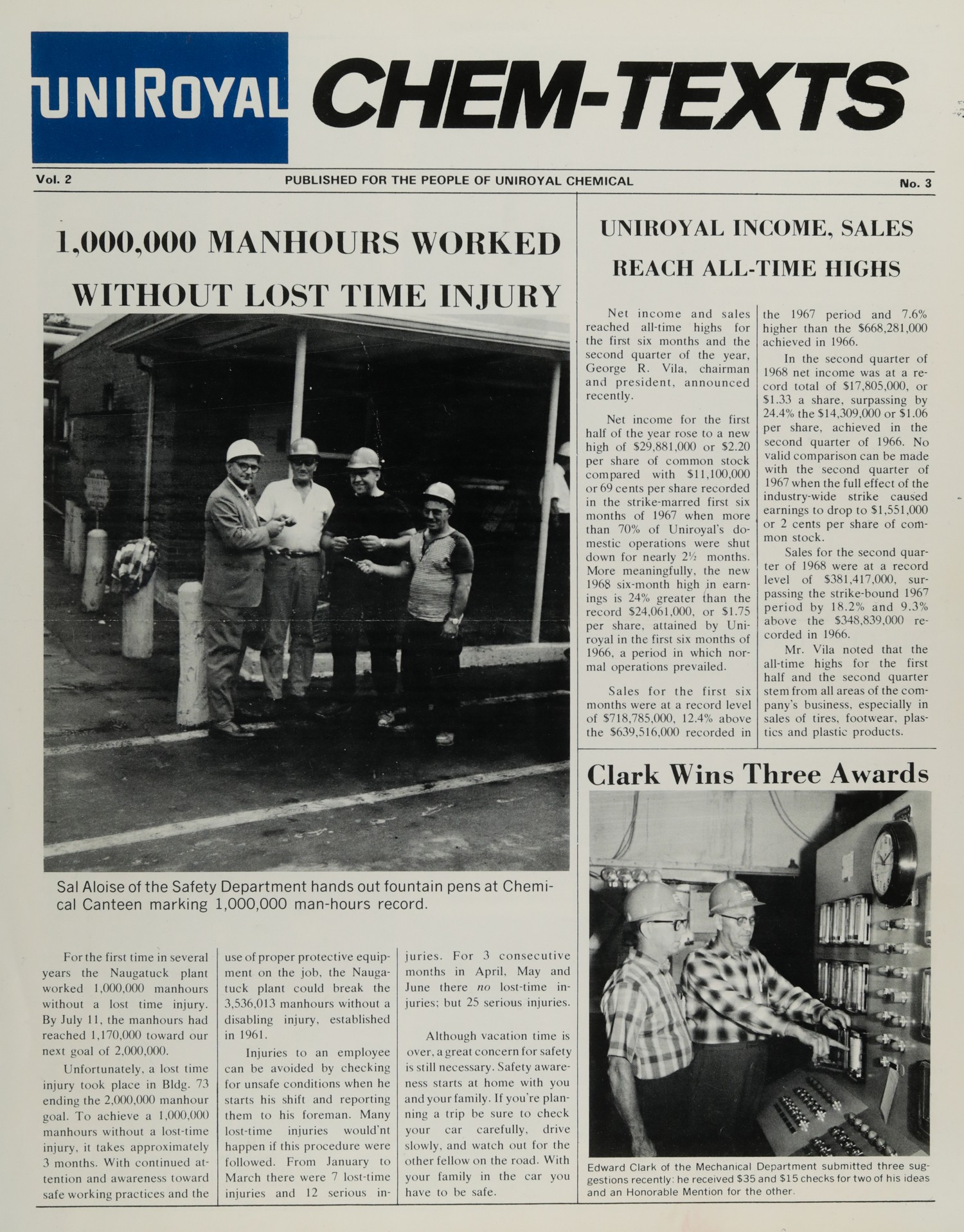
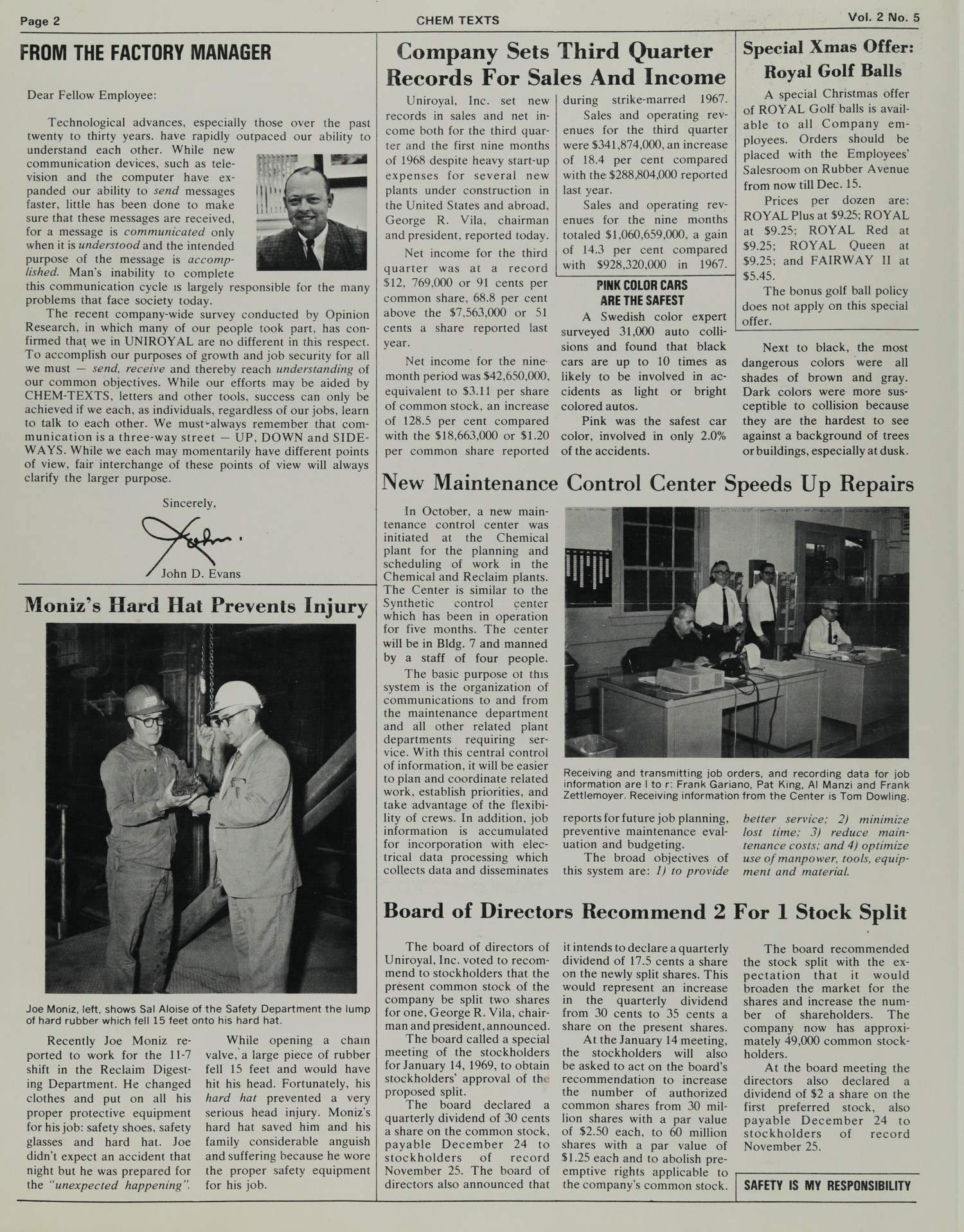
Vol. 9, 1975 CHEM-TEXTS Page 3

94 Honored for Long Service

Sixty nine new members were inducted into the Uniroyal Chemical Twenty Five Years Service Club and another twenty-six were advanced to the 5 year groups in the club which honors employees for their years of service with the Naugatuck Chemical plant.

40 Advanced to New Groups

In the recent service pin awards 15 people were advanced to the 30 years group; 16 to the 35 years group, and 8 to the 40 years group and one to the 45 year group.

New Members

New members who were enrolled in the 25 Year Service group were the following:

J. Adamaitis, S. Aloise, D. Angiolillo, G. Arndt, V. Bajelis, L. Baummer, E. Bazenas, R. Bell, W. Bieleski, G. Bierce, W. Breton, L. Brites, K. Britton, N. Brummett, B. Carey, A. Carricro, R. Clark, W. Curtis, S. Cutrali, C. Czarazsty, E. Day, J. DelGaizo, H. DeVries, F. Dingle, C. Fazzino, L. Fortier, B. Frennesson, J. Gallagher, R. Henrichs, L. Hisert, V. Hrynkewicz, F. Johnson, R. Juliano, A. Keniausis, H. Kowalewski, J. Lane, W. Lavelle, J. Mancuso, A. Manzi, J. McCarthy, R. McMichael, W. Mears, M. Moniz, J. Narijauskas, H. Needham, E. Nole, C. Owens, R. Pakalnis, R. Palizay, T. Palmieri, C. Parks, T. Petroski, A. Piooli, E. Plocha, A. Polomski, A. Rebelo, H. Rich, F. Rodrigues, R. Ruginis,

(Continued on page 4)


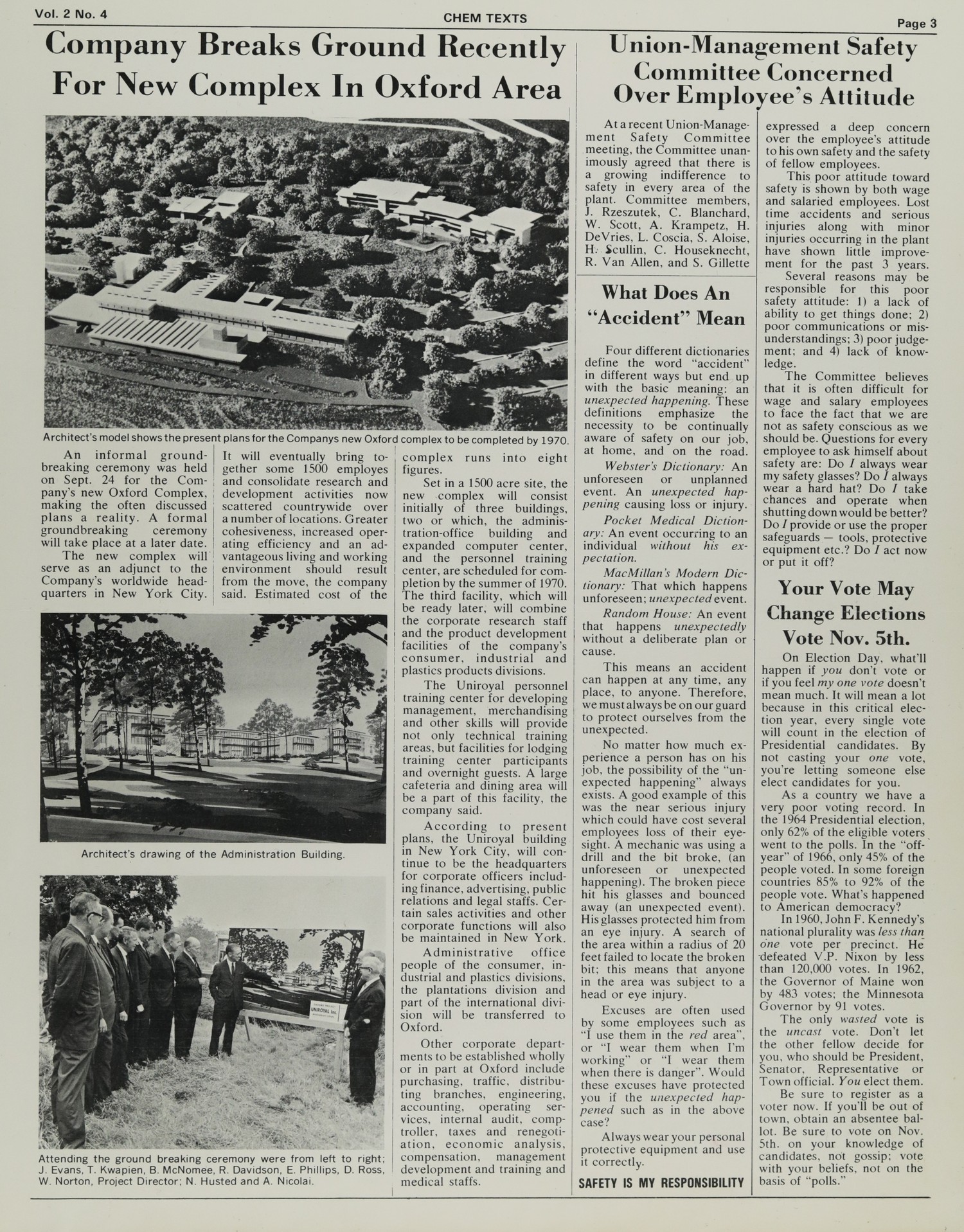
New 25 Year Members from left are N. Brummett, H. Needham, D. Angiolillo, R. Palizay, H. Venslow, J. Lane, F. Carbone, F. Johnson, A. Rebelo, R. Pakalnis, K. Urbsaitis, A. Keniausis, and Dr. Charles McCleary.


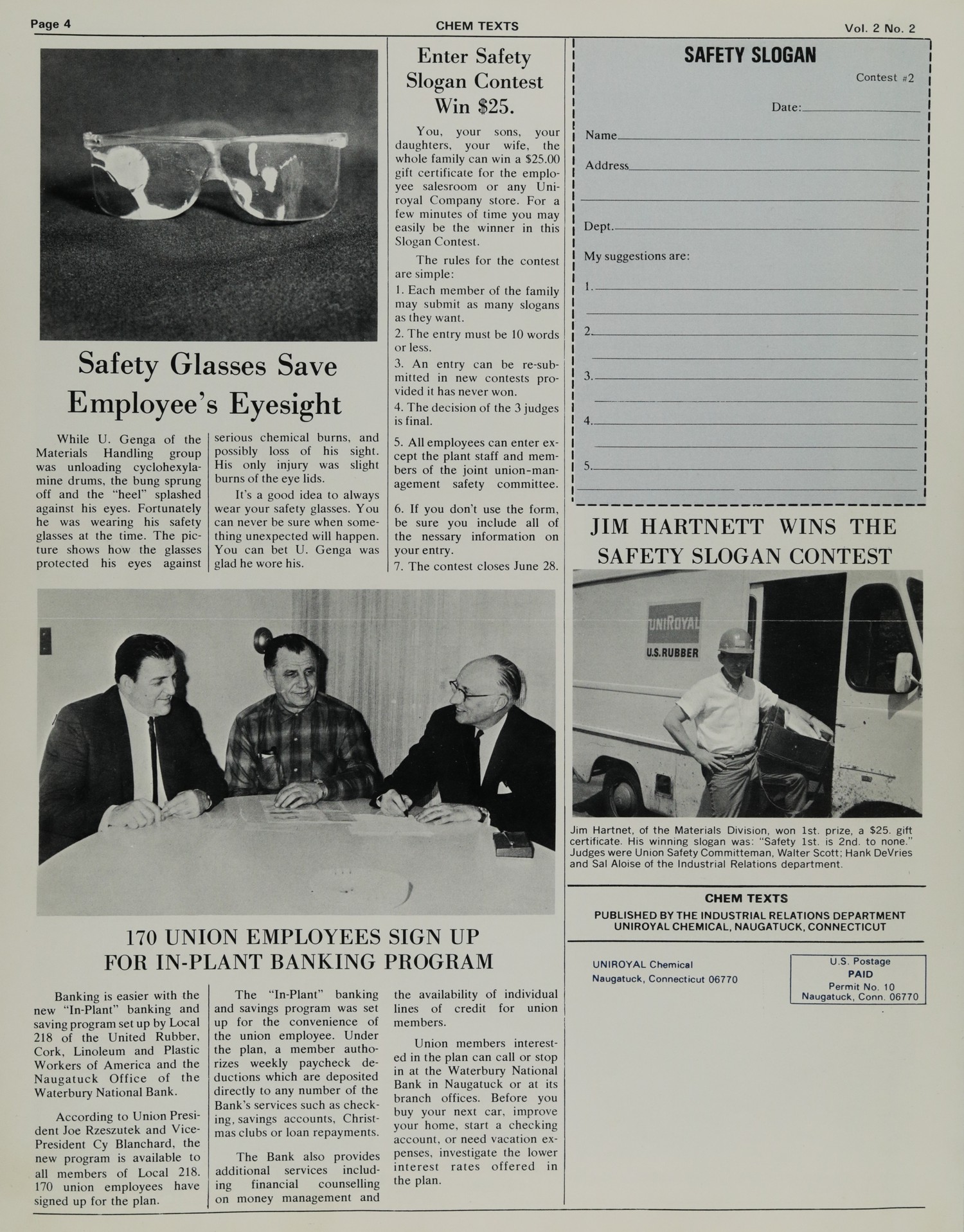
Walter Budd, right, receives LeCoultre Perpetual Motion clock from Dr. McCleary for his 40 years of service in Research & Development. Walter is the inventor of the Automatic Tensile Tester and the Automatic Hardness Tester.

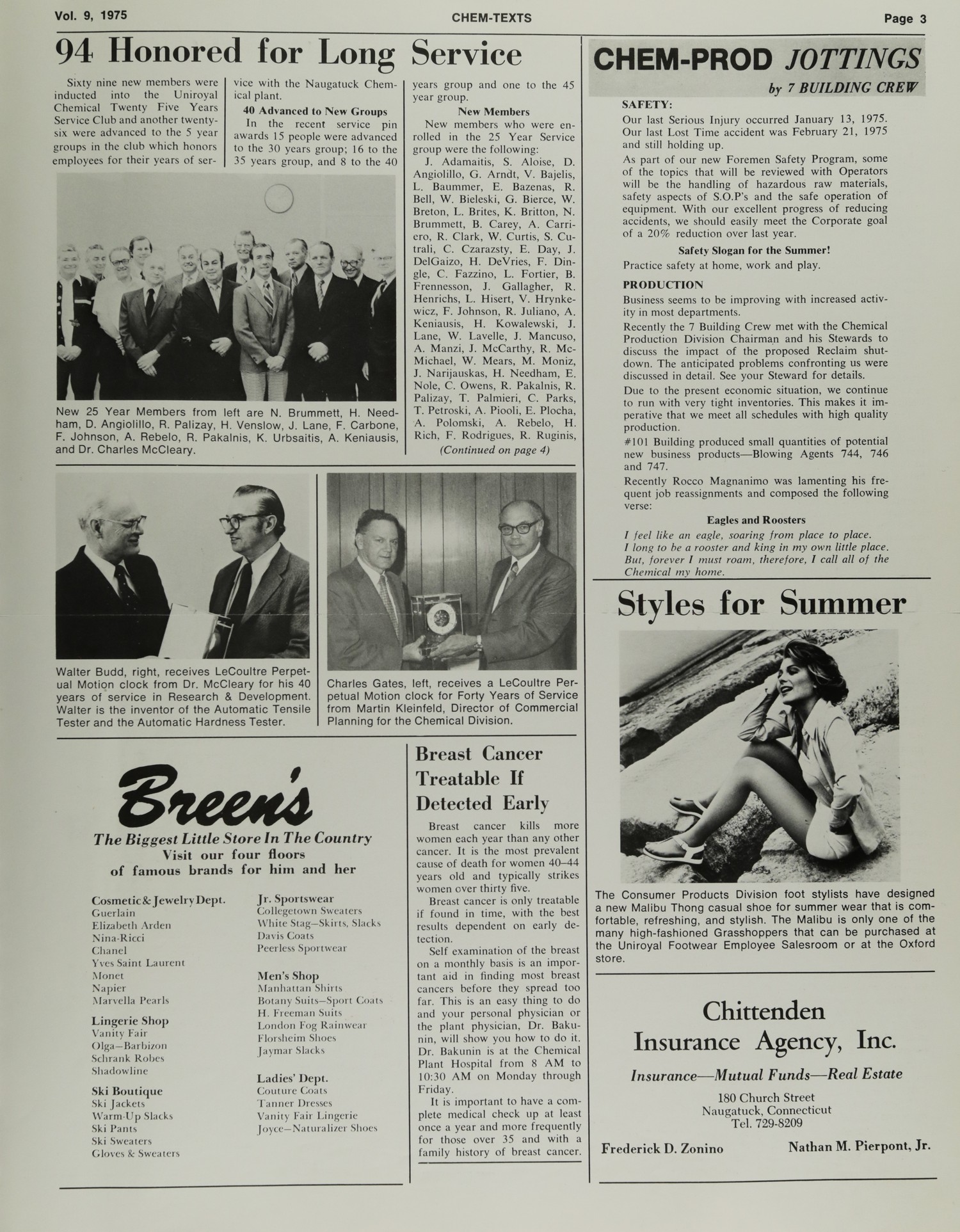
Charles Gates, left, receives a LeCoultre Perpetual Motion clock for Forty Years of Service from Martin Kleinfeld, Director of Commercial Planning for the Chemical Division.


Breen’s

The Biggest Little Store In The Country
Visit our four floors of famous brands for him and her

Cosmetic & Jewelry Dept.
Guerlain
Elizabeth Arden
Nina Ricci
Chanel
Yves Saint Laurent
Monet
Napier
Marvella Pearls

Lingerie Shop
Vanity Fair
Olga—Barbizon
Schrank Robes
Shadowline

Ski Boutique
Ski Jackets
Warm-Up Slacks
Ski Pants
Ski Sweaters
Gloves & Sweaters

Jr. Sportswear
Collegetown Sweaters
White Stag—Skirts, Slacks
Davis Coats
Peerless Sportwear

Men’s Shop
Manhattan Shirts
Botany Suits—Sport Coats
H. Freeman Suits
London Fog Rainwear
Florsheim Shoes
Jaymar Slacks

Ladies’ Dept.
Couture Coats
Tanner Dresses
Vanity Fair Lingerie
Joyce—Naturalizer Shoes


Breast Cancer Treatable If Detected Early

Breast cancer kills more women each year than any other cancer. It is the most prevalent cause of death for women 40–44 years old and typically strikes women over thirty five.

Breast cancer is only treatable if found in time, with the best results dependent on early detection.

Self examination of the breast on a monthly basis is an important aid in finding most breast cancers before they spread too far. This is an easy thing to do and your personal physician or the plant physician, Dr. Bakunin, will show you how to do it. Dr. Bakunin is at the Chemical Plant Hospital from 8 AM to 10:30 AM on Monday through Friday.

It is important to have a complete medical check up at least once a year and more frequently for those over 35 and with a family history of breast cancer.


CHEM-PROD JOTTINGS

by 7 BUILDING CREW

SAFETY:

Our last Serious Injury occurred January 13, 1975. Our last Lost Time accident was February 21, 1975 and still holding up.

As part of our new Foremen Safety Program, some of the topics that will be reviewed with Operators will be the handling of hazardous raw materials, safety aspects of S.O.P’s and the safe operation of equipment. With our excellent progress of reducing accidents, we should easily meet the Corporate goal of a 20% reduction over last year.

Safety Slogan for the Summer!

Practice safety at home, work and play.

PRODUCTION

Business seems to be improving with increased activity in most departments.

Recently the 7 Building Crew met with the Chemical Production Division Chairman and his Stewards to discuss the impact of the proposed Reclaim shutdown. The anticipated problems confronting us were discussed in detail. See your Steward for details.

Due to the present economic situation, we continue to run with very tight inventories. This makes it imperative that we meet all schedules with high quality production.

101 Building produced small quantities of potential new business products—Blowing Agents 744, 746 and 747.

Recently Rocco Magnanimo was lamenting his frequent job reassignments and composed the following verse:

Eagles and Roosters

I feel like an eagle, soaring from place to place.
I long to be a rooster and king in my own little place.
But, forever I must roam, therefore, I call all of the Chemical my home.


Styles for Summer

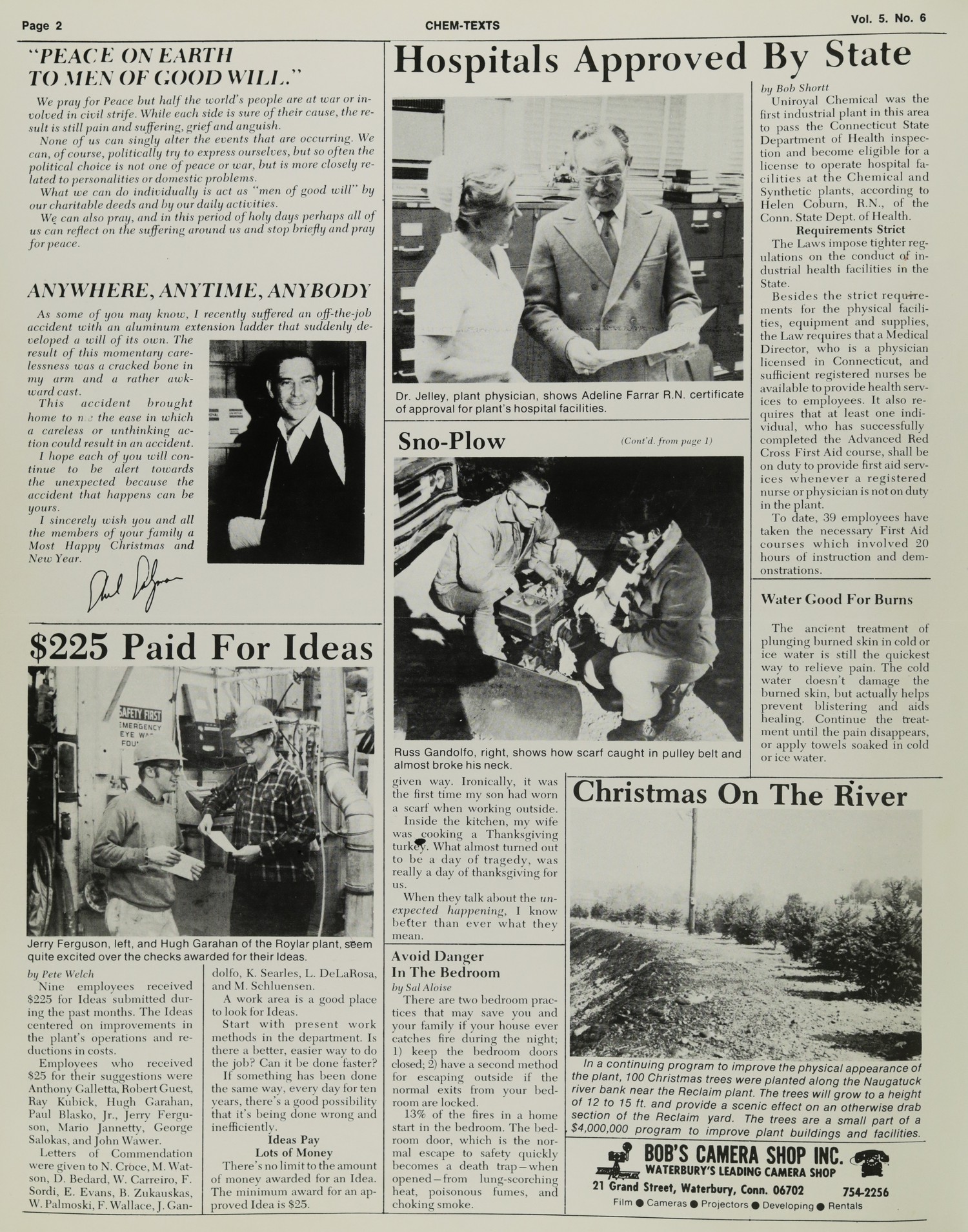
The Consumer Products Division foot stylists have designed a new Malibu Thong casual shoe for summer wear that is comfortable, refreshing, and stylish. The Malibu is only one of the many high-fashioned Grasshoppers that can be purchased at the Uniroyal Footwear Employee Salesroom or at the Oxford store.


Chittenden Insurance Agency, Inc.

Insurance—Mutual Funds—Real Estate

180 Church Street
Naugatuck, Connecticut
Tel. 729-8209

Frederick D. Zonino Nathan M. Pierpont, Jr.
CHEM-TEXTS – 1971-v05-i06-s205

Page 205

Page 2 | CHEM-TEXTS | Vol. 5, No. 6


“PEACE ON EARTH TO MEN OF GOOD WILL..”

We pray for Peace but half the world’s people are at war or involved in civil strife. While each side is sure of their cause, the result is still pain and suffering, grief and anguish.

None of us can singly alter the events that are occurring. We can, of course, politically try to express ourselves, but so often the political choice is not one of peace or war, but is more closely related to personalities or domestic problems.

What we can do individually is act as “men of good will” by our charitable deeds and by our daily activities.

We can also pray, and in this period of holy days perhaps all of us can reflect on the suffering around us and stop briefly and pray for peace.


ANYWHERE, ANYTIME, ANYBODY

As some of you may know, I recently suffered an off-the-job accident with an aluminum extension ladder that suddenly developed a will of its own. The result of this momentary carelessness was a cracked bone in my arm and a rather awkward cast.

This accident brought home to me the ease in which a careless or unthinking action could result in an accident.

I hope each of you will continue to be alert towards the unexpected because the accident that happens can be yours.

I sincerely wish you and all the members of your family a Most Happy Christmas and New Year.

[Signature]


$225 Paid For Ideas

[IMAGE: Photo showing two men, with “SAFETY FIRST EMERGENCY EYE WASH FOU…” sign visible]

Jerry Ferguson, left, and Hugh Garahan of the Roylar plant, seem quite excited over the checks awarded for their Ideas.

by Pete Welch

Nine employees received $225 for Ideas submitted during the past months. The Ideas centered on improvements in the plant’s operations and reductions in costs.

Employees who received $25 for their suggestions were Anthony Galletta, Robert Guest, Ray Kubick, Hugh Garahan, Paul Blasko, Jr., Jerry Ferguson, Mario Jannetty, George Salokas, and John Wawer.

Letters of Commendation were given to N. Croce, M. Watson, D. Bedard, W. Carreiro, F. Sordi, E. Evans, B. Zukauskas, W. Palmoski, F. Wallace, J. Gandolfo, K. Searles, L. DeLaRosa, and M. Schluensen.

A work area is a good place to look for Ideas.

Start with present work methods in the department. Is there a better, easier way to do the job? Can it be done faster?

If something has been done the same way, every day for ten years, there’s a good possibility that it’s being done wrong and inefficiently.

Ideas Pay Lots of Money

There’s no limit to the amount of money awarded for an Idea. The minimum award for an approved Idea is $25.


Hospitals Approved By State

[IMAGE: Photo showing Dr. Jelley and Adeline Farrar]

Dr. Jelley, plant physician, shows Adeline Farrar R.N. certificate of approval for plant’s hospital facilities.

by Bob Shortt

Uniroyal Chemical was the first industrial plant in this area to pass the Connecticut State Department of Health inspection and become eligible for a license to operate hospital facilities at the Chemical and Synthetic plants, according to Helen Coburn, R.N., of the Conn. State Dept. of Health.

Requirements Strict

The Laws impose tighter regulations upon the conduct of industrial health facilities in the State.

Besides the strict requirements for the physical facilities, equipment and supplies, the Law requires that a Medical Director, who is a physician licensed in Connecticut, and sufficient registered nurses be available to provide health services to employees. It also requires that at least one individual, who has successfully completed the Advanced Red Cross First Aid course, shall be on duty to provide first aid services whenever a registered nurse or physician is not on duty in the plant.

To date, 39 employees have taken the necessary First Aid courses which involved 20 hours of instruction and demonstrations.


Water Good For Burns

The ancient treatment of plunging burned skin in cold or ice water is still the quickest way to relieve pain. The cold water doesn’t damage the burned skin, but actually helps prevent blistering and aids healing. Continue the treatment until the pain disappears, or apply towels soaked in cold or ice water.


Sno-Plow

(Cont’d. from page 1)

[IMAGE: Photo showing Russ Gandolfo demonstrating scarf caught in pulley belt]

Russ Gandolfo, right, shows how scarf caught in pulley belt and almost broke his neck.

given way. Ironically, it was the first time my son had worn a scarf when working outside.

Inside the kitchen, my wife was cooking a Thanksgiving turkey. What almost turned out to be a day of tragedy, was really a day of thanksgiving for us.

When they talk about the unexpected happening, I know better than ever what they mean.


Avoid Danger In The Bedroom

by Sal Aloise

There are two bedroom practices that may save you and your family if your house ever catches fire during the night; 1) keep the bedroom doors closed, 2) have a second method for escaping outside if the normal exits from your bedroom are locked.

13% of the fires in a home start in the bedroom. The bedroom door, which is the normal escape to safety quickly becomes a death trap—when opened—from lung-scorching heat, poisonous fumes, and choking smoke.


Christmas On The River

In a continuing program to improve the physical appearance of the plant, 100 Christmas trees were planted along the Naugatuck river bank near the Reclaim plant. The trees will grow to a height of 12 to 15 ft. and provide a scenic effect on an otherwise drab section of the Reclaim yard. The trees are a small part of a $4,000,000 program to improve plant buildings and facilities.


BOB’S CAMERA SHOP INC. [Logo]
WATERBURY’S LEADING CAMERA SHOP
21 Grand Street, Waterbury, Conn. 06702 | 754-2256
Film ● Cameras ● Projectors ● Developing ● Rentals

CHEM-TEXTS – Vol. 5, No. 6 – Page 3

Page 003

Page 3 | CHEM-TEXTS | Vol. 5. No. 6


$21,000 Unit…

(Cont’d. from page 1)

than previously made at the plant.

Mike English was the Process Development Engineer for the process requirements and Rod Ashby was Project Engineer for the design and construction of the unit.

The new facility burns off waste gases completely in a smoke-less flame, and eliminates air pollution and fire hazard.

[IMAGE: Industrial facility/equipment]


United Givers

(Cont’d. from page 1)

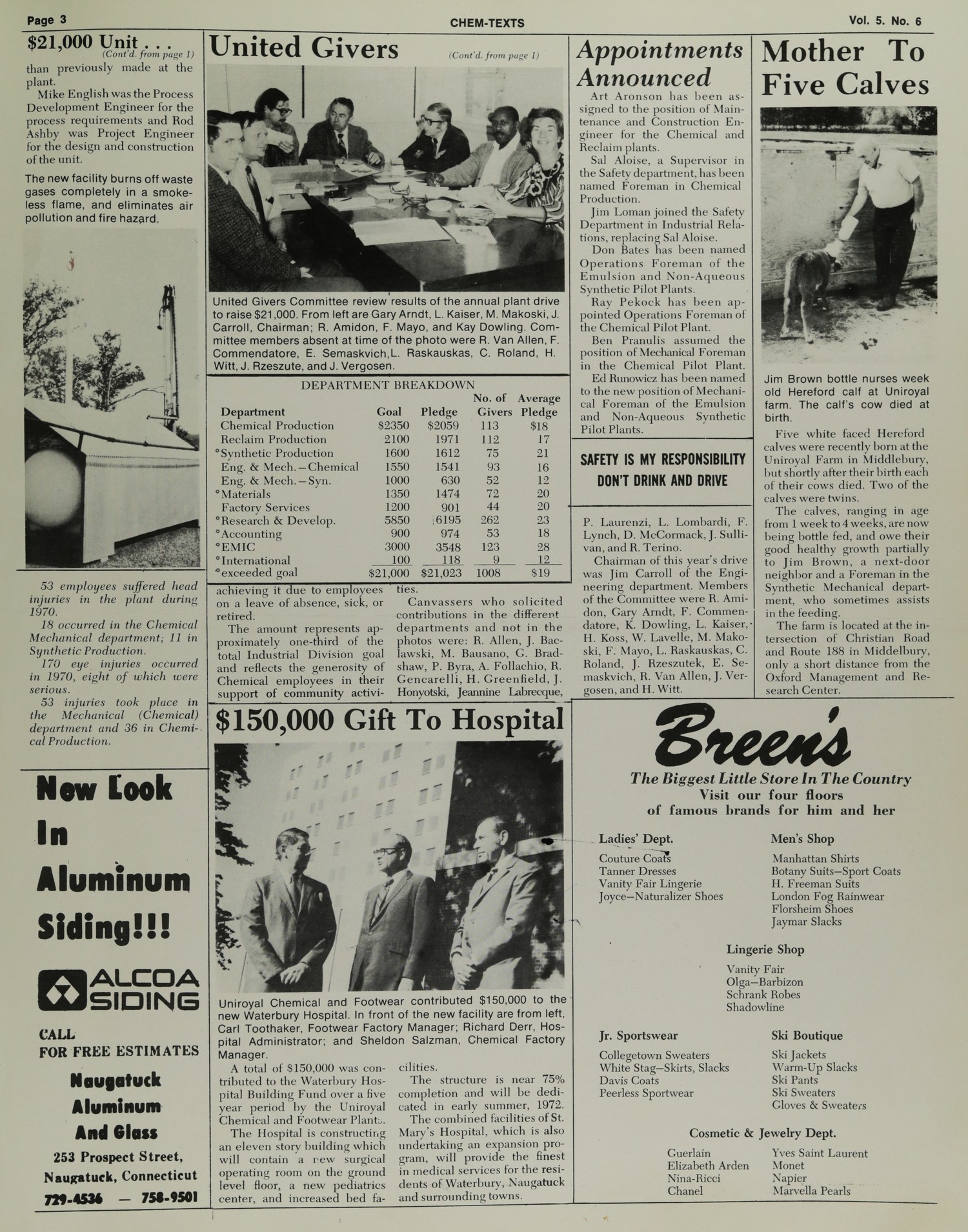
[IMAGE: Group of people at a table reviewing documents]

United Givers Committee review results of the annual plant drive to raise $21,000. From left are Gary Arndt, L. Kaiser, M. Makoski, J. Carroll, Chairman; R. Amidon, F. Mayo, and Kay Dowling. Committee members absent at time of the photo were R. Van Allen, F. Commendatore, E. Semaskvich, L. Raskauskas, C. Roland, H. Witt, J. Rzeszute, and J. Vergosen.

DEPARTMENT BREAKDOWN

Department Goal Pledge No. of Givers Average Pledge
Chemical Production $2350 $2059 113 $18
Reclaim Production 2100 1971 112 17
*Synthetic Production 1600 1612 75 21
Eng. & Mech.—Chemical 1550 1541 93 16
Eng. & Mech.—Syn. 1000 630 52 12
*Materials 1350 1474 72 20
Factory Services 1200 901 44 20
*Research & Develop. 5850 6195 262 23
*Accounting 900 974 53 18
*EMIC 3000 3548 123 28
*International 100 118 9 12
*exceeded goal $21,000 $21,023 1008 $19

53 employees suffered head injuries in the plant during 1970.

18 occurred in the Chemical Mechanical department; 11 in Synthetic Production.

170 eye injuries occurred in 1970, eight of which were serious.

53 injuries took place in the Mechanical (Chemical) department and 36 in Chemical Production.


achieving it due to employees on a leave of absence, sick, or retired.

The amount represents approximately one-third of the total Industrial Division goal and reflects the generosity of Chemical employees in their support of community activities.

Canvassers who solicited contributions in the different departments and not in the photos were: R. Allen, J. Baclawski, M. Bausano, G. Bradshaw, P. Byra, A. Follachio, R. Gencarelli, H. Greenfield, J. Honyotski, Jeannine Labrecque,


Appointments Announced

Art Aronson has been assigned to the position of Maintenance and Construction Engineer for the Chemical and Reclaim plants.

Sal Aloise, a Supervisor in the Safety department, has been named Foreman in Chemical Production.

Jim Loman joined the Safety Department in Industrial Relations, replacing Sal Aloise.

Don Bates has been named Operations Foreman of the Emulsion and Non-Aqueous Synthetic Pilot Plants.

Ray Pekoek has been appointed Operations Foreman of the Chemical Pilot Plant.

Ben Pranulis assumed the position of Mechanical Foreman in the Chemical Pilot Plant.

Ed Hunwicz has been named to the new position of Mechanical Foreman of the Emulsion and Non-Aqueous Synthetic Pilot Plants.


SAFETY IS MY RESPONSIBILITY

DON’T DRINK AND DRIVE

P. Laurenzi, L. Lombardi, F. Lynch, D. McCormack, J. Sullivan, and R. Terino.

Chairman of this year’s drive was Jim Carroll of the Engineering department. Members of the Committee were R. Amidon, Gary Arndt, F. Commendatore, K. Dowling, L. Kaiser, H. Koss, W. Lavelle, M. Makoski, F. Mayo, L. Raskauskas, C. Roland, J. Rzeszutek, E. Semaskvich, R. Van Allen, J. Vergosen, and H. Witt.


Mother To Five Calves

[IMAGE: Man with calf]

Jim Brown bottle nurses week old Hereford calf at Uniroyal farm. The calf’s cow died at birth.

Five white faced Hereford calves were recently born at the Uniroyal Farm in Middlebury, but shortly after their birth each of their cows died. Two of the calves were twins.

The calves, ranging in age from 1 week to 4 weeks, are now being bottle fed, and owe their good healthy growth partially to Jim Brown, a next-door neighbor and a Foreman in the Synthetic Mechanical department, who sometimes assists in the feeding.

The farm is located at the intersection of Christian Road and Route 188 in Middlebury, only a short distance from the Oxford Management and Research Center.


New Look In Aluminum Siding!!!

ALCOA SIDING

CALL FOR FREE ESTIMATES

Naugatuck Aluminum And Glass

253 Prospect Street,
Naugatuck, Connecticut

729-4534 — 758-9501


$150,000 Gift To Hospital

[IMAGE: Three men in front of building under construction]

Uniroyal Chemical and Footwear contributed $150,000 to the new Waterbury Hospital. In front of the new facility are from left, Carl Toothaker, Footwear Factory Manager; Richard Derr, Hospital Administrator; and Sheldon Salzman, Chemical Factory Manager.

A total of $150,000 was contributed to the Waterbury Hospital Building Fund over a five year period by the Uniroyal Chemical and Footwear Plant.

The Hospital is constructing an eleven story building which will contain a new surgical operating room on the ground level floor, a new pediatrics center, and increased bed facilities.

The structure is near 75% completion and will be dedicated in early summer, 1972.

The combined facilities of St. Mary’s Hospital, which is also undertaking an expansion program, will provide the finest in medical services for the residents of Waterbury, Naugatuck and surrounding towns.


Breen’s

The Biggest Little Store In The Country

Visit our four floors of famous brands for him and her

Ladies’ Dept.
– Couture Coats
– Tanner Dresses
– Vanity Fair Lingerie
– Joyce—Naturalizer Shoes

Men’s Shop
– Manhattan Shirts
– Botany Suits—Sport Coats
– H. Freeman Suits
– London Fog Rainwear
– Florsheim Shoes
– Jaymar Slacks

Lingerie Shop
– Vanity Fair
– Olga—Barbizon
– Schrank Robes
– Shadowline

Jr. Sportswear
– Collegetown Sweaters
– White Stag—Skirts, Slacks
– Davis Coats
– Peerless Sportwear

Ski Boutique
– Ski Jackets
– Warm-Up Slacks
– Ski Pants
– Ski Sweaters
– Gloves & Sweaters

Cosmetic & Jewelry Dept.
– Guerlain
– Elizabeth Arden
– Nina-Ricci
– Chanel
– Yves Saint Laurent
– Monet
– Napier
– Marvella Pearls

CHEM-TEXTS – 1971-v05-i05-s203

Page 203

Page 4 — CHEM-TEXTS — Vol. 5, No. 5


Know Your Products:

Retarders; Blowing Agents; Waxes

by Dr. Bob Brown

Besides the diverse line of accelerators, antioxidants and antiozontants manufactured in Chemical Production, the plant makes a number of specialty chemicals: Retarders, Process Stiffeners, Bonding Agents, Waxes and Blowing Agents.

The Retarders, ESEN and Retarder J, slow down the vulcanization of the rubber during processing. This may sound like driving a car with your foot on the brake, but when a customer is trying to mix a batch of rubber on a mill and it starts to vulcanize (harden) before he can finish processing it, he must rely on a Retarder to slow down the vulcanization.

Process Stiffener 710 is also used as a processing aid. Rubber is usually easier to handle when it is fairly soft, but some types of rubber soften so much, that they almost seem to be turning into a liquid during the processing. Stiffener 710 gives these rubbers the necessary hardness and firmness to stay sufficiently solid so they can be worked on the mill.

The Celogen® Blowing Agents are used to expn Agents are used to expand rubber, and plastics. When mixed with rubber or plastics and heated, they form a

Celogen is used to expand rubber and plastics, giving a fine cellular structure to the finished product.

fine cellular structure in the finished product, expanding the product volume and lowering its density. This results in a savings in materials for the customer. Blowing Agents are used primarily in rug underlay, upholstery, fashionable footwear, boats, and electrical insulators.

The Sunproof® Waxes are used along with Flexzone® antiozontants to reduce the cracking of tire sidewalls and treads. The Waxes are mixed with the rubber on the mill and then migrate to the surface of the rubber to form a protective film against atmospheric cracking.


Plant Gets Red Cross Award

The Naugatuck Red Cross awarded Uniroyal Chemical a Certificate of Appreciation for outstanding cooperation with the Connecticut Red Cross Blood Program.

In the annual Bloodmobile sponsored by the plant Chemical and Footwear employees and walk-ins donated 214 pints of blood. Another 25 were deferred.

During the year the Naugatuck Red Cross collected 1038 pints of blood. Connecticut is one of the few states where the blood itself is free.

Organized by the Safety Dept. the successful drive was carried out by Bob Shortt, Sal Aloise, Adeline Farrar R.N., and Ann McAllister R.N.


Christmas Special Royal Golf Balls

From November 15 to December 17, a special Christmas Purchase of ROYAL golf balls is available to employees through the Footwear Employee’s Salesroom on Rubber Ave. Each employee is limited to a maximum of 6 dozen.

The balls come in a gift package and the prices range from 9.25 to 11.50 per dozen.


987 Join . . .

(Cont’d. from page 1)

shares of Uniroyal common stock.

MIP Stock Plan

Employees may still purchase Uniroyal common stock through the Monthly Investment Plan (MIP). This plan is operated by Merrill, Lynch, Pierce, Fenner and Smith, Inc.


Enamait Improved

Bob Enamait has been transferred from the intensive care unit of St. Mary’s Hospital and officially removed from the danger list.

He is now in a private room and attended by private duty nurses around the clock. He is still on a circular motorized bed and receiving physical therapy. His response to treatment is good.


Safety Sign Installed

[IMAGE: UNIROYAL EMPLOYEE SAFETY RECORD sign showing INJURIES with DISABLING and NEAR SERIOUS categories, showing “24” and “LAST” indicators]

The first Employee Safety Record sign has been installed at Main Gate. Flashing lights indicate safety record for 24 hour period.

Three new Employee Safety Record signs will be installed to keep employees posted on the plant’s safety record for this year as compared with 1970.

Flashing lights will indicate the 24 hour safety record of employees: the red signifies a Lost Time accident; yellow, a Serious Injury; and the green will indicate that employees have worked safely for a 24 hour period.

The first of the three signs has been installed at the Main entrance; the others will be constructed at the Tire Gate and the Synthetic plant.

The signs are another step in the Safety departments continuing program to improve safety awareness among employees.


Three Employees Retire

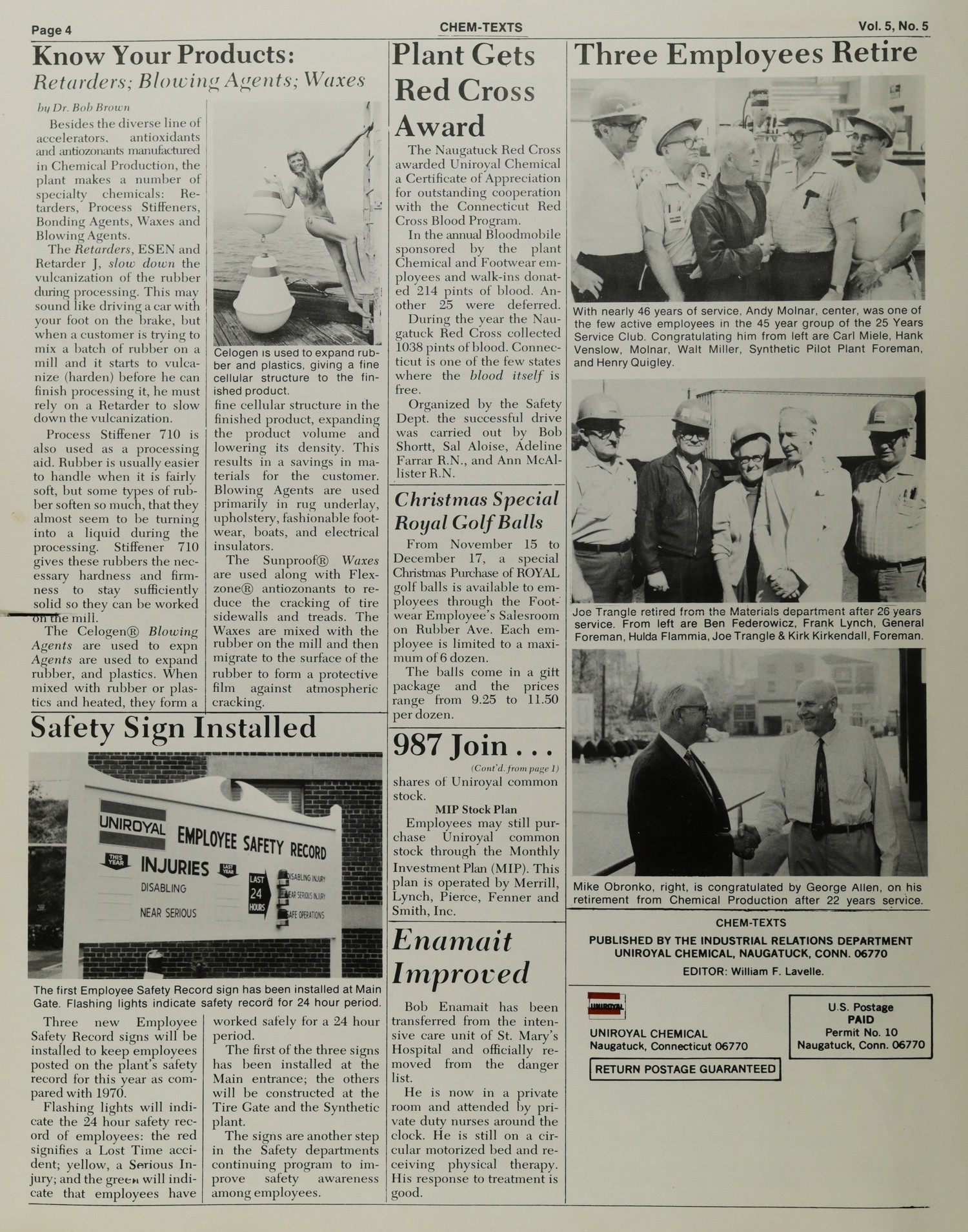
[IMAGE: Group photo of employees]

With nearly 46 years of service, Andy Molnar, center, was one of the few active employees in the 45 year group of the 25 Years Service Club. Congratulating him from left are Carl Miele, Hank Venslow, Molnar, Walt Miller, Synthetic Pilot Plant Foreman, and Henry Quigley.

[IMAGE: Group photo of employees in hard hats]

Joe Trangle retired from the Materials department after 26 years service. From left are Ben Federowicz, Frank Lynch, General Foreman, Hulda Flammia, Joe Trangle & Kirk Kirkendall, Foreman.

[IMAGE: Two men, one congratulating the other]

Mike Obronko, right, is congratulated by George Allen, on his retirement from Chemical Production after 22 years service.


CHEM-TEXTS

PUBLISHED BY THE INDUSTRIAL RELATIONS DEPARTMENT
UNIROYAL CHEMICAL, NAUGATUCK, CONN. 06770

EDITOR: William F. Lavelle.


UNIROYAL CHEMICAL
Naugatuck, Connecticut 06770

RETURN POSTAGE GUARANTEED

U.S. Postage
PAID
Permit No. 10
Naugatuck, Conn. 06770

CHEM-TEXTS – Vol. 5 No. 3 – Page 4

Page 004

Page 4 CHEM-TEXTS Vol. 5 No. 3


Know Your Products: Rubber Chemical Accelerators

by Dr. Bob Brown

(This issue continues the article in Vol. 5, No. 2 on Accelerators made or marketed by the Naugatuck Chemical plant.)

Accelerators are used primarily to speed up, or control the vulcanization process which turns rubber from a useless, gummy substance into a strong resilient and elastic material. Vulcanization, in simple terms, is a chemical reaction between rubber and sulfur, usually brought about by heat.

Faster Accelerators

Where there is less processing or mixing involved, very fast accelerators with little or no delayed action can be used to give more rapid vulcanization. The Zates (Arazate®, Butazate®, Ethazate® and Methazate®) and the Thiurams (Monex®, Pentex®, Tuex®, and Accelerator 108) are used here. They are also used in latex curing where processing is usually not a problem.

Customers use these accelerators for rubber sponge, wire insulation, hot water bottles, conveyor belts, hospital sheeting, and household items and in such latex products as balloons and carpet backing.

The Zates accelerators are non-discoloring and non-staining and can be used in colored rubber products.

Some of the newer synthetic rubbers (Royalene® “the crackless rubber” is an example) are inherently slower in vulcanization than the older types such as natural rubber, neoprene and the Naugapol® and Paracril® synthetic rubbers made at the Naugatuck and Painesville, Ohio plants. Fast accelerators are needed to speed up the vulcanization process for these types of rubber, otherwise it would be economically impossible to make a product at a reasonable selling price to the consumer.

Dr. Bob Brown, author of these articles, is manager of Research and Development for Rubber Chemicals. He received his doctorate degree from Princeton University in Organic Chemistry and holds several patent awards. Dr. Brown heads a staff of 42 people whose sole function is to improve our present chemicals and to develop new ones in order to remain competitive in the market.

GMF and DIBENZO GMF® are used in butyl rubber which also vulcanizes very slowly. A large amount of butyl rubber is used for tire tubes, and high voltage electrical cable.

CPB, DBA Very Active

Sometimes customers want to vulcanize rubber products without heating them at all. Very active accelerators like CPB and DBA accomplish this. In this process the product must be shaped before the accelerator is added. Golf ball covers, for example, are vulcanized by soaking the finished balls in a solution of CPB.

(In the next issue of Chem-Texts, Antioxidants and Antiozonants will be discussed. If you have a son or daughter in school, these articles provide source material for class papers in Chemistry courses.)


33 Employees

(Cont’d. from page 2)

are under further evaluation for higher amounts dependent on the amount of the savings for the plant.

Other employees who received cash awards for Ideas were P. Blasko, F. Maffia, M. Jannetty, D. Stevenson, E. Grickis, R. Guest, B. Robinson, A. Urban, S. Kropcho, J. Harper, J. Gilbert, A. Happy, J. Iosa, H. Garahan, F. Surmanek (2), L. DeLaRosa (2), P. Beardsley, S. Falcone, H. Hernandez, A. Grella, J. Needham, D. Boyd, E. Root, Sr., A. Molnar, D. Pinto and J. Cohen.

Letters of Commendation were presented to C. Smith, L. Fortier, F. Gagne, Carol Calo, J. Gallucci, R. Lockwood, D. Donato, T. Carr, Preciosa Cravo, D. Nelson, A. Nauges, W. Krayeski, W. Tabaka and D. Polzella.

Of the 33 employees awarded cash for Ideas, two were salary employees and the highest number of Ideas were submitted by Mechanical Department personnel.

No Limit to Cash Awards

There is no maximum limit to the amount of a cash award for an Idea. If the value of the Idea exceeds $1,000—this amount is paid under the Plant Idea Plan—it is submitted for further consideration for a higher award to a special management committee. The minimum award for an Idea is $25.

Ideas to Conserve Water Needed

With the construction of the new liquid waste pretreatment plant in progress, ideas to conserve water are needed now as the facilities are designed to treat 3,600,000 gallons a day.


SAFETY IS MY RESPONSIBILITY


Crim Assumes IR Post

Two Industrial Relations Managers not agreeing? Unbelievable! But that’s what the photo seems to say as Jesse Crim, right, new Industrial Relations Manager for the Naugatuck Chemical plant discusses a fine point on employee relations with Ron Mitchinson, former IR Manager and now with the Corporate IR staff in Oxford. Crim came from the Chemical Division’s Painesville, Ohio plant, where he held the position of IR Manager.

Crim will be responsible for labor and employee relations, personnel development and training, plant protection and employee safety, communications, public and community relations, and employment.


Appointments Announced

Sam Gillette has been named Methods Engineering Manager, reporting to the Factory Manager.

Joe Bucciaglia was appointed General Foreman for the Chemical Production Plant.

Eric Johnson was made Chief Process Engineer for the Chemical Production Plant.

Lee Owens assumes the responsibilities of General Foreman in the Synthetic Production Plant.

Clark Makinson moved to the Materials Flow Department in EMIC.

Ed Rabitor replaces Clark in the Chemical Control Center.


Three Retire In Month

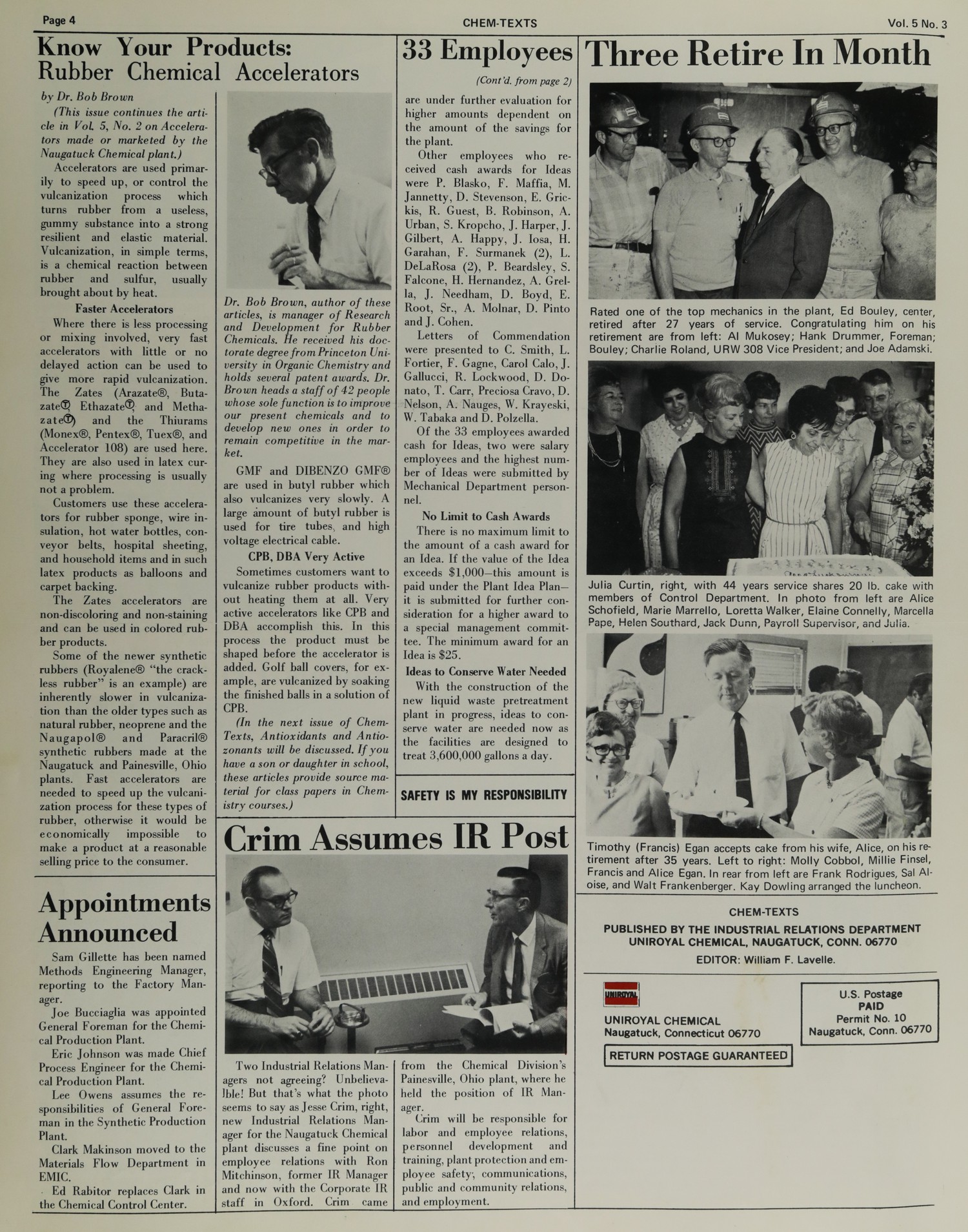
Rated one of the top mechanics in the plant, Ed Bouley, center, retired after 27 years of service. Congratulating him on his retirement are from left: Al Mukosey; Hank Drummer, Foreman; Bouley; Charlie Roland, URW 308 Vice President; and Joe Adamski.


Julia Curtin, right, with 44 years service shares 20 lb. cake with members of Control Department. In photo from left are Alice Schofield, Marie Marrello, Loretta Walker, Elaine Connelly, Marcella Pape, Helen Southard, Jack Dunn, Payroll Supervisor, and Julia.


Timothy (Francis) Egan accepts cake from his wife, Alice, on his retirement after 35 years. Left to right: Molly Cobbol, Millie Finsel, Francis and Alice Egan. In rear from left are Frank Rodrigues, Sal Aloise, and Walt Frankenberger. Kay Dowling arranged the luncheon.


CHEM-TEXTS

PUBLISHED BY THE INDUSTRIAL RELATIONS DEPARTMENT
UNIROYAL CHEMICAL, NAUGATUCK, CONN. 06770

EDITOR: William F. Lavelle.


UNIROYAL CHEMICAL
Naugatuck, Connecticut 06770

RETURN POSTAGE GUARANTEED

U.S. Postage
PAID
Permit No. 10
Naugatuck, Conn. 06770

CHEM-TEXTS – Vol. 5 No. 3 – Page 2

Page 002

CHEM-TEXTS

Page 2 | Vol. 5 No. 3


FROM THE FACTORY MANAGER

DEAR FELLOW EMPLOYEE:

The miracle of the twenty five years of continual growth in the U.S. economy since World War II is something all Americans can be proud of. It has enabled us to become leaders in the world’s markets and to raise our standard of living to the point where we are better off than any people in history.

This miracle didn’t just happen. It was brought about by the tremendous productivity of the people of this country. For twenty years every time wages increased, productivity also increased and our standard of living went up.

In the last five years, however, we have seen a change in this pattern. While wages have increased, productivity has not kept pace with them. This has helped cause inflation and has helped drive the cost of our products up.

In turn, foreign manufacturers have maintained their productivity and are now able to sell their goods in our markets at prices lower than ours. We can see this in Japanese electronics; German and Japanese automobiles; and textile and footwear products from all over the world.

On a smaller scale the same thing is happening at our factory. We are in competition with both foreign and domestic producers. They are competing with us for the same customers and markets, oftentimes at lower prices. Besides this our markets are moving away from the northeast and the increasing cost of rail and truck transportation adds to our problem of doing business competitively.

All of us must realize this and remember that the chemicals we produce are in competition with these domestic and foreign manufacturers. We can only sell what we can produce economically. We can only produce economically with your help and cooperation. Every job in the plant is important. Every person counts in this effort. We all must chip in.

Phil LaJoie


33 Employees Receive $1355

Mechanical Department Submits Most Ideas

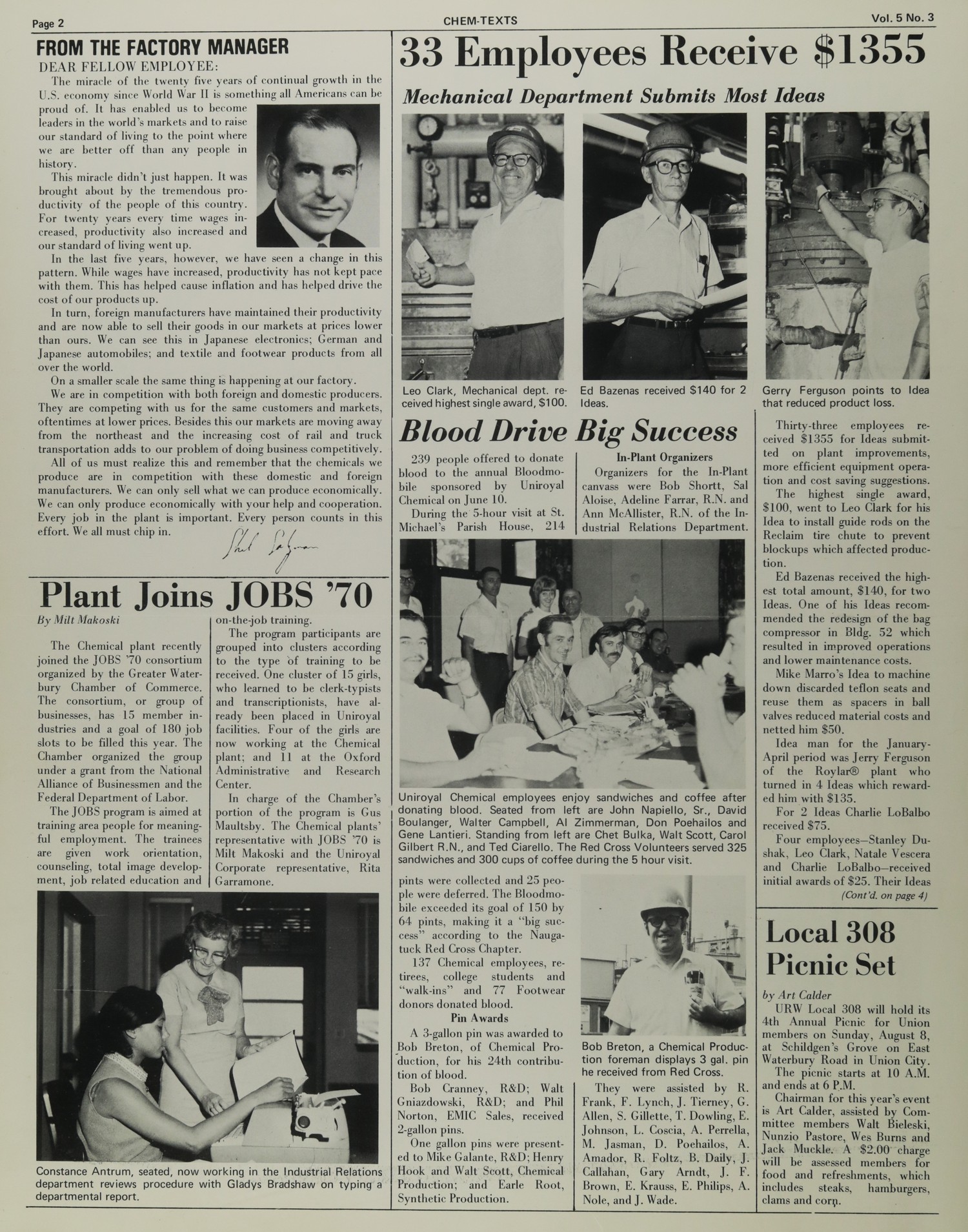
Leo Clark, Mechanical dept. received highest single award, $100.

Ed Bazenas received $140 for 2 Ideas.

Gerry Ferguson points to Idea that reduced product loss.

Thirty-three employees received $1355 for Ideas submitted on plant improvements, more efficient equipment operation and cost saving suggestions.

The highest single award, $100, went to Leo Clark for his Idea to install guide rods on the Reclaim tire chute to prevent blockups which affected production.

Ed Bazenas received the highest total amount, $140, for two Ideas. One of his Ideas recommended the redesign of the bag compressor in Bldg. 52 which resulted in improved operations and lower maintenance costs.

Mike Marro’s Idea to machine down discarded teflon seats and reuse them as spacers in ball valves reduced material costs and netted him $50.

Idea man for the January-April period was Jerry Ferguson of the Roylar® plant who turned in 4 Ideas which rewarded him with $135.

For 2 Ideas Charlie LoBalbo received $75.

Four employees—Stanley Dushak, Leo Clark, Natale Vescera and Charlie LoBalbo—received initial awards of $25. Their Ideas
(Cont’d. on page 4)


Blood Drive Big Success

239 people offered to donate blood to the annual Bloodmobile sponsored by Uniroyal Chemical on June 10.

During the 5-hour visit at St. Michael’s Parish House, 214 pints were collected and 25 people were deferred. The Bloodmobile exceeded its goal of 150 by 64 pints, making it a “big success” according to the Naugatuck Red Cross Chapter.

137 Chemical employees, retirees, college students and “walk-ins” and 77 Footwear donors donated blood.

Pin Awards

A 3-gallon pin was awarded to Bob Breton, of Chemical Production, for his 24th contribution of blood.

Bob Cranney, R&D; Walt Gniazdowski, R&D; and Phil Norton, EMIC Sales, received 2-gallon pins.

One gallon pins were presented to Mike Galante, R&D; Henry Hook and Walt Scott, Chemical Production; and Earle Root, Synthetic Production.

In-Plant Organizers

Organizers for the In-Plant canvass were Bob Shortt, Sal Aloise, Adeline Farrar, R.N. and Ann McAllister, R.N. of the Industrial Relations Department.

Uniroyal Chemical employees enjoy sandwiches and coffee after donating blood. Seated from left are John Napiello, Sr., David Boulanger, Walter Campbell, Al Zimmerman, Don Poehailos and Gene Lantieri. Standing from left are Chet Bulka, Walt Scott, Carol Gilbert R.N., and Ted Ciarello. The Red Cross Volunteers served 325 sandwiches and 300 cups of coffee during the 5 hour visit.

Bob Breton, a Chemical Production foreman displays 3 gal. pin he received from Red Cross.

They were assisted by R. Frank, F. Lynch, J. Tierney, G. Allen, S. Gillette, T. Dowling, E. Johnson, L. Coscia, A. Perrella, M. Jasman, D. Poehailos, A. Amador, R. Foltz, B. Daily, J. Callahan, Gary Arndt, J. F. Brown, E. Krauss, E. Philips, A. Nole, and J. Wade.


Plant Joins JOBS ’70

By Milt Makoski

The Chemical plant recently joined the JOBS ’70 consortium organized by the Greater Waterbury Chamber of Commerce. The consortium, or group of businesses, has 15 member industries and a goal of 180 job slots to be filled this year. The Chamber organized the group under a grant from the National Alliance of Businessmen and the Federal Department of Labor.

The JOBS program is aimed at training area people for meaningful employment. The trainees are given work orientation, counseling, total image development, job related education and on-the-job training.

The program participants are grouped into clusters according to the type of training to be received. One cluster of 15 girls, who learned to be clerk-typists and transcriptionists, have already been placed in Uniroyal facilities. Four of the girls are now working at the Chemical plant; and 11 at the Oxford Administrative and Research Center.

In charge of the Chamber’s portion of the program is Gus Maultsby. The Chemical plants’ representative with JOBS ’70 is Milt Makoski and the Uniroyal Corporate representative, Rita Garramone.

Constance Antrum, seated, now working in the Industrial Relations department reviews procedure with Gladys Bradshaw on typing a departmental report.


Local 308 Picnic Set

by Art Calder

URW Local 308 will hold its 4th Annual Picnic for Union members on Sunday, August 8, at Schildgen’s Grove on East Waterbury Road in Union City. The picnic starts at 10 A.M. and ends at 6 P.M.

Chairman for this year’s event is Art Calder, assisted by Committee members Walt Bieleski, Nunzio Pastore, Wes Burns and Jack Muckle. A $2.00 charge will be assessed members for food and refreshments, which includes steaks, hamburgers, clams and corp.

CHEM-TEXTS – Vol. 5, No. 2 – Page 3

Page 003

CHEM-TEXTS

Vol. 5. No. 2 Page 3


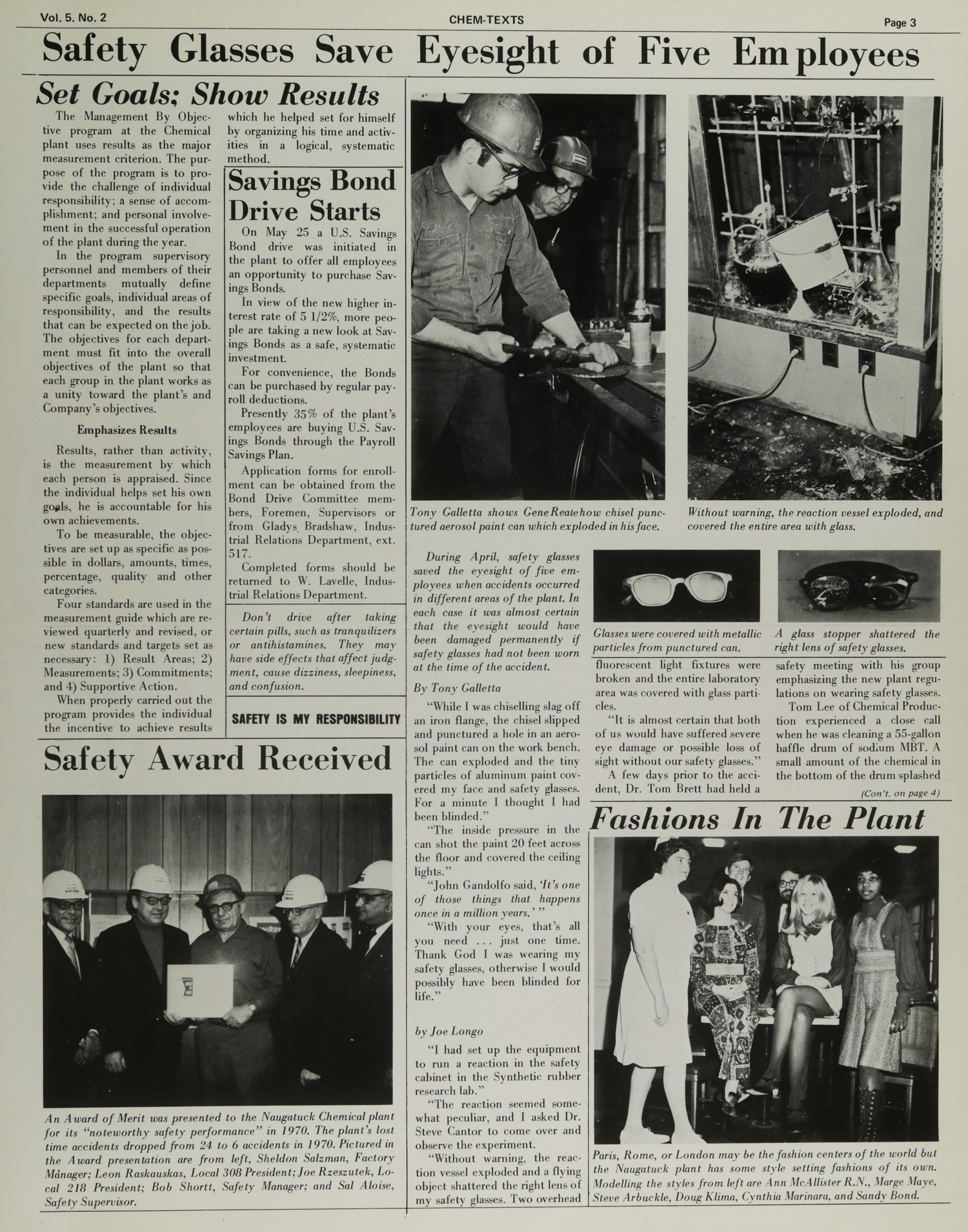
Safety Glasses Save Eyesight of Five Employees

Set Goals; Show Results

The Management By Objective program at the Chemical plant uses results as the major measurement criterion. The purpose of the program is to provide the challenge of individual responsibility; a sense of accomplishment; and personal involvement in the successful operation of the plant during the year.

In the program supervisory personnel and members of their departments mutually define specific goals, individual areas of responsibility, and the results that can be expected on the job. The objectives for each department must fit into the overall objectives of the plant so that each group in the plant works as a unity toward the plant’s and Company’s objectives.

Emphasizes Results

Results, rather than activity, is the measurement by which each person is appraised. Since the individual helps set his own goals, he is accountable for his own achievements.

To be measurable, the objectives are set up as specific as possible in dollars, amounts, times, percentage, quality and other categories.

Four standards are used in the measurement guide which are reviewed quarterly and revised, or new standards and targets set as necessary: 1) Result Areas; 2) Measurements; 3) Commitments; and 4) Supportive Action.

When properly carried out the program provides the individual the incentive to achieve results which he helped set for himself by organizing his time and activities in a logical, systematic method.


Savings Bond Drive Starts

On May 25 a U.S. Savings Bond drive was initiated in the plant to offer all employees an opportunity to purchase Savings Bonds.

In view of the new higher interest rate of 5 1/2%, more people are taking a new look at Savings Bonds as a safe, systematic investment.

For convenience, the Bonds can be purchased by regular payroll deductions.

Presently 35% of the plant’s employees are buying U.S. Savings Bonds through the Payroll Savings Plan.

Application forms for enrollment can be obtained from the Bond Drive Committee members, Foremen, Supervisors or from Gladys Bradshaw, Industrial Relations Department, ext. 517.

Completed forms should be returned to W. Lavelle, Industrial Relations Department.


Don’t drive after taking certain pills, such as tranquilizers or antihistamines. They may have side effects that affect judgment, cause dizziness, sleepiness, and confusion.


SAFETY IS MY RESPONSIBILITY


Safety Award Received

An Award of Merit was presented to the Naugatuck Chemical plant for its “noteworthy safety performance” in 1970. The plant’s lost time accidents dropped from 24 to 6 accidents in 1970. Pictured in the Award presentation are from left, Sheldon Salzman, Factory Manager; Leon Raskauskas, Local 308 President; Joe Rzeszutek, Local 218 President; Bob Shortt, Safety Manager; and Sal Aloise, Safety Supervisor.


Tony Galletta shows Gene Reate how chisel punctured aerosol paint can which exploded in his face.

Without warning, the reaction vessel exploded, and covered the entire area with glass.


During April, safety glasses saved the eyesight of five employees when accidents occurred in different areas of the plant. In each case it was almost certain that the eyesight would have been damaged permanently if safety glasses had not been worn at the time of the accident.

By Tony Galletta

“While I was chiselling slag off an iron flange, the chisel slipped and punctured a hole in an aerosol paint can on the work bench. The can exploded and the tiny particles of aluminum paint covered my face and safety glasses. For a minute I thought I had been blinded.”

“The inside pressure in the can shot the paint 20 feet across the floor and covered the ceiling lights.”

“John Gandolfo said, ‘It’s one of those things that happens once in a million years.’

“With your eyes, that’s all you need . . . just one time. Thank God I was wearing my safety glasses, otherwise I would possibly have been blinded for life.”


by Joe Longo

“I had set up the equipment to run a reaction in the safety cabinet in the Synthetic rubber research lab.”

“The reaction seemed somewhat peculiar, and I asked Dr. Steve Cantor to come over and observe the experiment.

“Without warning, the reaction vessel exploded and a flying object shattered the right lens of my safety glasses. Two overhead fluorescent light fixtures were broken and the entire laboratory area was covered with glass particles.

“It is almost certain that both of us would have suffered severe eye damage or possible loss of sight without our safety glasses.”

A few days prior to the accident, Dr. Tom Brett had held a


Glasses were covered with metallic particles from punctured can.

A glass stopper shattered the right lens of safety glasses.

safety meeting with his group emphasizing the new plant regulations on wearing safety glasses.

Tom Lee of Chemical Production experienced a close call when he was cleaning a 55-gallon baffle drum of sodium MBT. A small amount of the chemical in the bottom of the drum splashed

(Con’t. on page 4)


Fashions In The Plant

Paris, Rome, or London may be the fashion centers of the world but the Naugatuck plant has some style setting fashions of its own. Modelling the styles from left are Ann McAllister R.N., Marge Maye, Steve Arbuckle, Doug Klima, Cynthia Marinaro, and Sandy Bond.

CHEM-TEXTS – Vol. 5, No. 2 – Page 2

Page 002

CHEM-TEXTS

Page 2 | Vol. 5, No. 2


FROM THE FACTORY MANAGER

DEAR FELLOW EMPLOYEE:

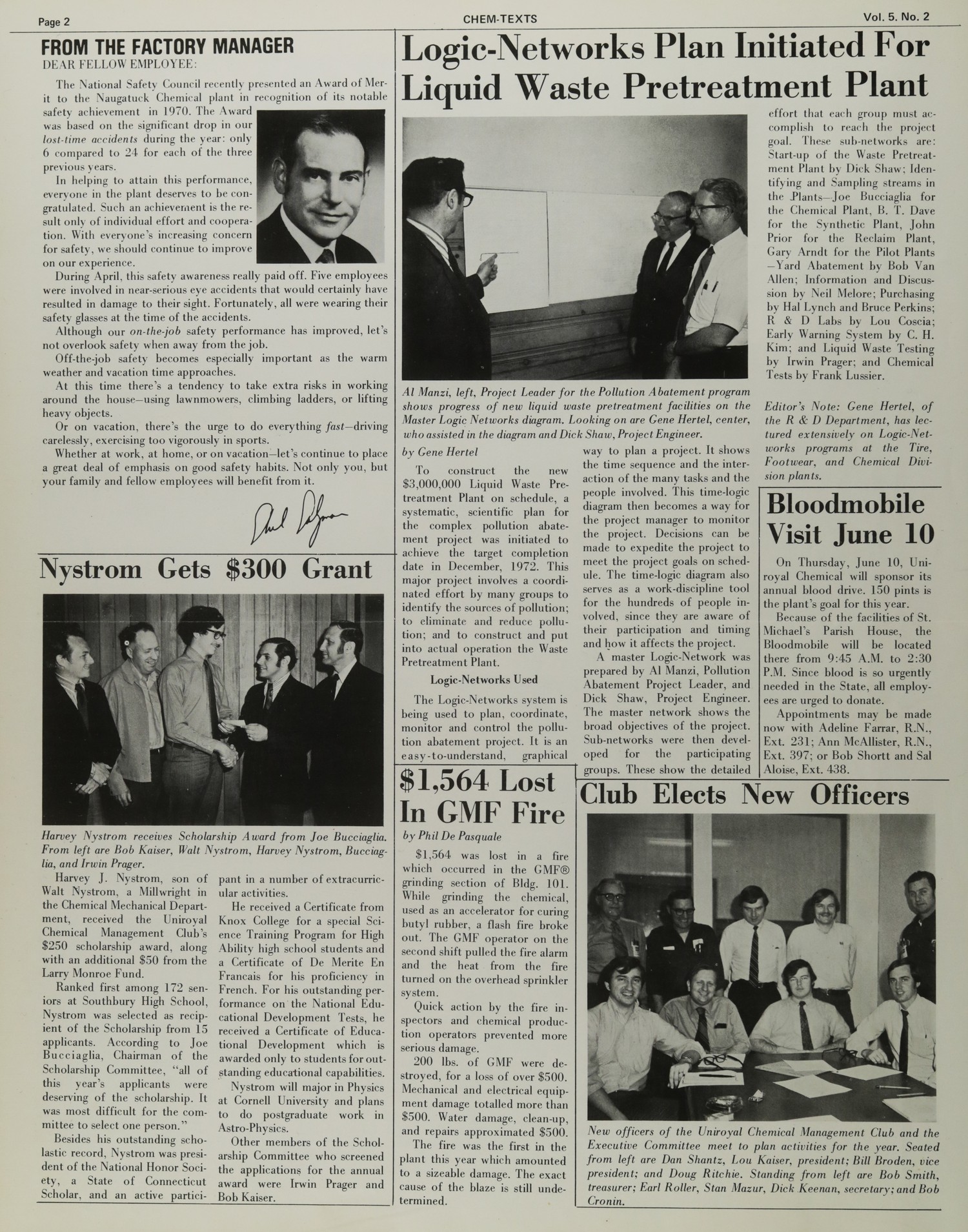
The National Safety Council recently presented an Award of Merit to the Naugatuck Chemical plant in recognition of its notable safety achievement in 1970. The Award was based on the significant drop in our lost-time accidents during the year: only 6 compared to 24 for each of the three previous years.

In helping to attain this performance, everyone in the plant deserves to be congratulated. Such an achievement is the result only of individual effort and cooperation. With everyone’s increasing concern for safety, we should continue to improve on our experience.

During April, this safety awareness really paid off. Five employees were involved in near-serious eye accidents that would certainly have resulted in damage to their sight. Fortunately, all were wearing their safety glasses at the time of the accidents.

Although our on-the-job safety performance has improved, let’s not overlook safety when away from the job.

Off-the-job safety becomes especially important as the warm weather and vacation time approaches.

At this time there’s a tendency to take extra risks in working around the house—using lawnmowers, climbing ladders, or lifting heavy objects.

Or on vacation, there’s the urge to do everything fast—driving carelessly, exercising too vigorously in sports.

Whether at work, at home, or on vacation—let’s continue to place a great deal of emphasis on good safety habits. Not only you, but your family and fellow employees will benefit from it.

[Signature]


Nystrom Gets $300 Grant

Harvey Nystrom receives Scholarship Award from Joe Bucciaglia. From left are Bob Kaiser, Walt Nystrom, Harvey Nystrom, Bucciaglia, and Irwin Prager.

Harvey J. Nystrom, son of Walt Nystrom, a Millwright in the Chemical Mechanical Department, received the Uniroyal Chemical Management Club’s $250 scholarship award, along with an additional $50 from the Larry Monroe Fund.

Ranked first among 172 seniors at Southbury High School, Nystrom was selected as recipient of the Scholarship from 15 applicants. According to Joe Bucciaglia, Chairman of the Scholarship Committee, “all of this year’s applicants were deserving of the scholarship. It was most difficult for the committee to select one person.”

Besides his outstanding scholastic record, Nystrom was president of the National Honor Society, a State of Connecticut Scholar, and an active participant in a number of extracurricular activities.

He received a Certificate from Knox College for a special Science Training Program for High Ability high school students and a Certificate of De Merite En Francais for his proficiency in French. For his outstanding performance on the National Educational Development Tests, he received a Certificate of Educational Development which is awarded only to students for outstanding educational capabilities.

Nystrom will major in Physics at Cornell University and plans to do postgraduate work in Astro-Physics.

Other members of the Scholarship Committee who screened the applications for the annual award were Irwin Prager and Bob Kaiser.


Logic-Networks Plan Initiated For Liquid Waste Pretreatment Plant

Al Manzi, left, Project Leader for the Pollution Abatement program shows progress of new liquid waste pretreatment facilities on the Master Logic Networks diagram. Looking on are Gene Hertel, center, who assisted in the diagram and Dick Shaw, Project Engineer.

by Gene Hertel

To construct the new $3,000,000 Liquid Waste Pretreatment Plant on schedule, a systematic, scientific plan for the complex pollution abatement project was initiated to achieve the target completion date in December, 1972. This major project involves a coordinated effort by many groups to identify the sources of pollution; to eliminate and reduce pollution; and to construct and put into actual operation the Waste Pretreatment Plant.

Logic-Networks Used

The Logic-Networks system is being used to plan, coordinate, monitor and control the pollution abatement project. It is an easy-to-understand, graphical way to plan a project. It shows the time sequence and the interaction of the many tasks and the people involved. This time-logic diagram then becomes a way for the project manager to monitor the project. Decisions can be made to expedite the project to meet the project goals on schedule. The time-logic diagram also serves as a work-discipline tool for the hundreds of people involved, since they are aware of their participation and timing and how it affects the project.

A master Logic-Network was prepared by Al Manzi, Pollution Abatement Project Leader, and Dick Shaw, Project Engineer. The master network shows the broad objectives of the project. Sub-networks were then developed for the participating groups. These show the detailed effort that each group must accomplish to reach the project goal. These sub-networks are: Start-up of the Waste Pretreatment Plant by Dick Shaw; Identifying and Sampling streams in the Plants—Joe Bucciaglia for the Chemical Plant, B. T. Dave for the Synthetic Plant, John Prior for the Reclaim Plant, Gary Arndt for the Pilot Plants – Yard Abatement by Bob Van Allen; Information and Discussion by Neil Melore; Purchasing by Hal Lynch and Bruce Perkins; R & D Labs by Lou Coscia; Early Warning System by C. H. Kim; and Liquid Waste Testing by Irwin Prager; and Chemical Tests by Frank Lussier.

Editor’s Note: Gene Hertel, of the R & D Department, has lectured extensively on Logic-Networks programs at the Tire, Footwear, and Chemical Division plants.


Bloodmobile Visit June 10

On Thursday, June 10, Uniroyal Chemical will sponsor its annual blood drive. 150 pints is the plant’s goal for this year.

Because of the facilities of St. Michael’s Parish House, the Bloodmobile will be located there from 9:45 A.M. to 2:30 P.M. Since blood is so urgently needed in the State, all employees are urged to donate.

Appointments may be made now with Adeline Farrar, R.N., Ext. 231; Ann McAllister, R.N., Ext. 397; or Bob Shortt and Sal Aloise, Ext. 438.


$1,564 Lost In GMF Fire

by Phil De Pasquale

$1,564 was lost in a fire which occurred in the GMF® grinding section of Bldg. 101. While grinding the chemical, used as an accelerator for curing butyl rubber, a flash fire broke out. The GMF operator on the second shift pulled the fire alarm and the heat from the fire turned on the overhead sprinkler system.

Quick action by the fire inspectors and chemical production operators prevented more serious damage.

200 lbs. of GMF were destroyed, for a loss of over $500. Mechanical and electrical equipment damage totalled more than $500. Water damage, clean-up, and repairs approximated $500.

The fire was the first in the plant this year which amounted to a sizeable damage. The exact cause of the blaze is still undetermined.


Club Elects New Officers

New officers of the Uniroyal Chemical Management Club and the Executive Committee meet to plan activities for the year. Seated from left are Dan Shantz, Lou Kaiser, president; Bill Broden, vice president; and Doug Ritchie. Standing from left are Bob Smith, treasurer; Earl Roller, Stan Mazur, Dick Keenan, secretary; and Bob Cronin.

CHEM-TEXTS – 1971-v05-i01-s183

Page 183

UNIROYAL CHEM-TEXTS

Vol. 5, 1971 | PUBLISHED FOR THE PEOPLE OF UNIROYAL CHEMICAL | No. 1


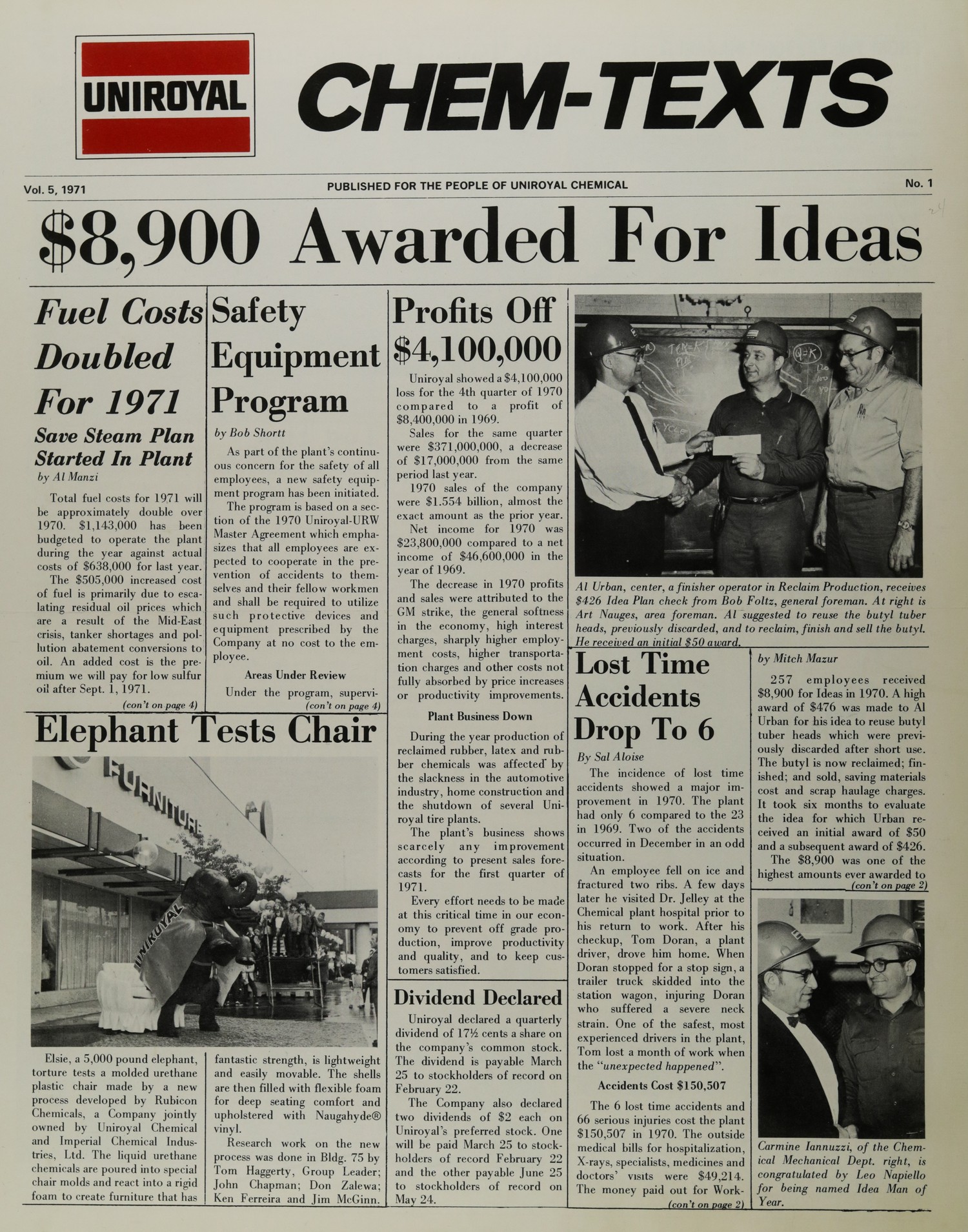
$8,900 Awarded For Ideas


Fuel Costs Doubled For 1971

Save Steam Plan Started In Plant

by Al Manzi

Total fuel costs for 1971 will be approximately double over 1970. $1,143,000 has been budgeted to operate the plant during the year against actual costs of $638,000 for last year.

The $505,000 increased cost of fuel is primarily due to escalating residual oil prices which are a result of the Mid-East crisis, tanker shortages and pollution abatement conversions to oil. An added cost is the premium we will pay for low sulfur oil after Sept. 1, 1971.

(con’t on page 4)


Safety Equipment Program

by Bob Shortt

As part of the plant’s continuous concern for the safety of all employees, a new safety equipment program has been initiated.

The program is based on a section of the 1970 Uniroyal-URW Master Agreement which emphasizes that all employees are expected to cooperate in the prevention of accidents to themselves and their fellow workmen and shall be required to utilize such protective devices and equipment prescribed by the Company at no cost to the employee.

Areas Under Review

Under the program, supervi-

(con’t on page 4)


Profits Off $4,100,000

Uniroyal showed a $4,100,000 loss for the 4th quarter of 1970 compared to a profit of $8,400,000 in 1969.

Sales for the same quarter were $371,000,000, a decrease of $17,000,000 from the same period last year.

1970 sales of the company were $1.554 billion, almost the exact amount as the prior year. Net income for 1970 was $23,800,000 compared to a net income of $46,600,000 in the year of 1969.

The decrease in 1970 profits and sales were attributed to the GM strike, the general softness in the economy, high interest charges, sharply higher employment costs, higher transportation charges and other costs not fully absorbed by price increases or productivity improvements.

Plant Business Down

During the year production of reclaimed rubber, latex and rubber chemicals was affected by the slackness in the automotive industry, home construction and the shutdown of several Uniroyal tire plants.

The plant’s business shows scarcely any improvement according to present sales forecasts for the first quarter of 1971.

Every effort needs to be made at this critical time in our economy to prevent off grade production, improve productivity and quality, and to keep customers satisfied.


Dividend Declared

Uniroyal declared a quarterly dividend of 17½ cents a share on the company’s common stock. The dividend is payable March 25 to stockholders of record on February 22.

The Company also declared two dividends of $2 each on Uniroyal’s preferred stock. One will be paid March 25 to stockholders of record February 22 and the other payable June 25 to stockholders of record on May 24.


Elephant Tests Chair

[IMAGE: Photo of an elephant named Elsie testing a plastic chair]

Elsie, a 5,000 pound elephant, torture tests a molded urethane plastic chair made by a new process developed by Rubicon Chemicals, a Company jointly owned by Uniroyal Chemical and Imperial Chemical Industries, Ltd. The liquid urethane chemicals are poured into special chair molds and react into a rigid foam to create furniture that has fantastic strength, is lightweight and easily movable. The shells are then filled with flexible foam for deep seating comfort and upholstered with Naugahyde® vinyl.

Research work on the new process was done in Bldg. 75 by Tom Haggerty, Group Leader; John Chapman; Don Zalewa; Ken Ferreira and Jim McGinn.


[IMAGE: Photo of Al Urban receiving award from Bob Foltz with Art Nauges]

Al Urban, center, a finisher operator in Reclaim Production, receives $426 Idea Plan check from Bob Foltz, general foreman. At right is Art Nauges, area foreman. Al suggested to reuse the butyl tuber heads, previously discarded, and to reclaim, finish and sell the butyl. He received an initial $50 award.


Lost Time Accidents Drop To 6

By Sal Aloise

The incidence of lost time accidents showed a major improvement in 1970. The plant had only 6 compared to the 23 in 1969. Two of the accidents occurred in December in an odd situation.

An employee fell on ice and fractured two ribs. A few days later he visited Dr. Jelley at the Chemical plant hospital prior to his return to work. After his checkup, Tom Doran, a plant driver, drove him home. When Doran stopped for a stop sign, a trailer truck skidded into the station wagon, injuring Doran who suffered a severe neck strain. One of the safest, most experienced drivers in the plant, Tom lost a month of work when the “unexpected happened“.

Accidents Cost $150,507

The 6 lost time accidents and 66 serious injuries cost the plant $150,507 in 1970. The outside medical bills for hospitalization, X-rays, specialists, medicines and doctors’ visits were $49,214. The money paid out for Work-

(con’t on page 2)


by Mitch Mazur

257 employees received $8,900 for Ideas in 1970. A high award of $476 was made to Al Urban for his idea to reuse butyl tuber heads which were previously discarded after short use. The butyl is now reclaimed; finished; and sold, saving materials cost and scrap haulage charges. It took six months to evaluate the idea for which Urban received an initial award of $50 and a subsequent award of $426.

The $8,900 was one of the highest amounts ever awarded to

(con’t on page 2)


[IMAGE: Photo of Carmine Iannuzzi being congratulated]

Carmine Iannuzzi, of the Chemical Mechanical Dept. right, is congratulated by Leo Napiello for being named Idea Man of Year.

CHEM-TEXTS – Vol. 4 No. 5 – Page 3

Page 003

CHEM-TEXT

Vol. 4, No. 5 | Page 3


Brains And Beauty Match Brains And Brawn


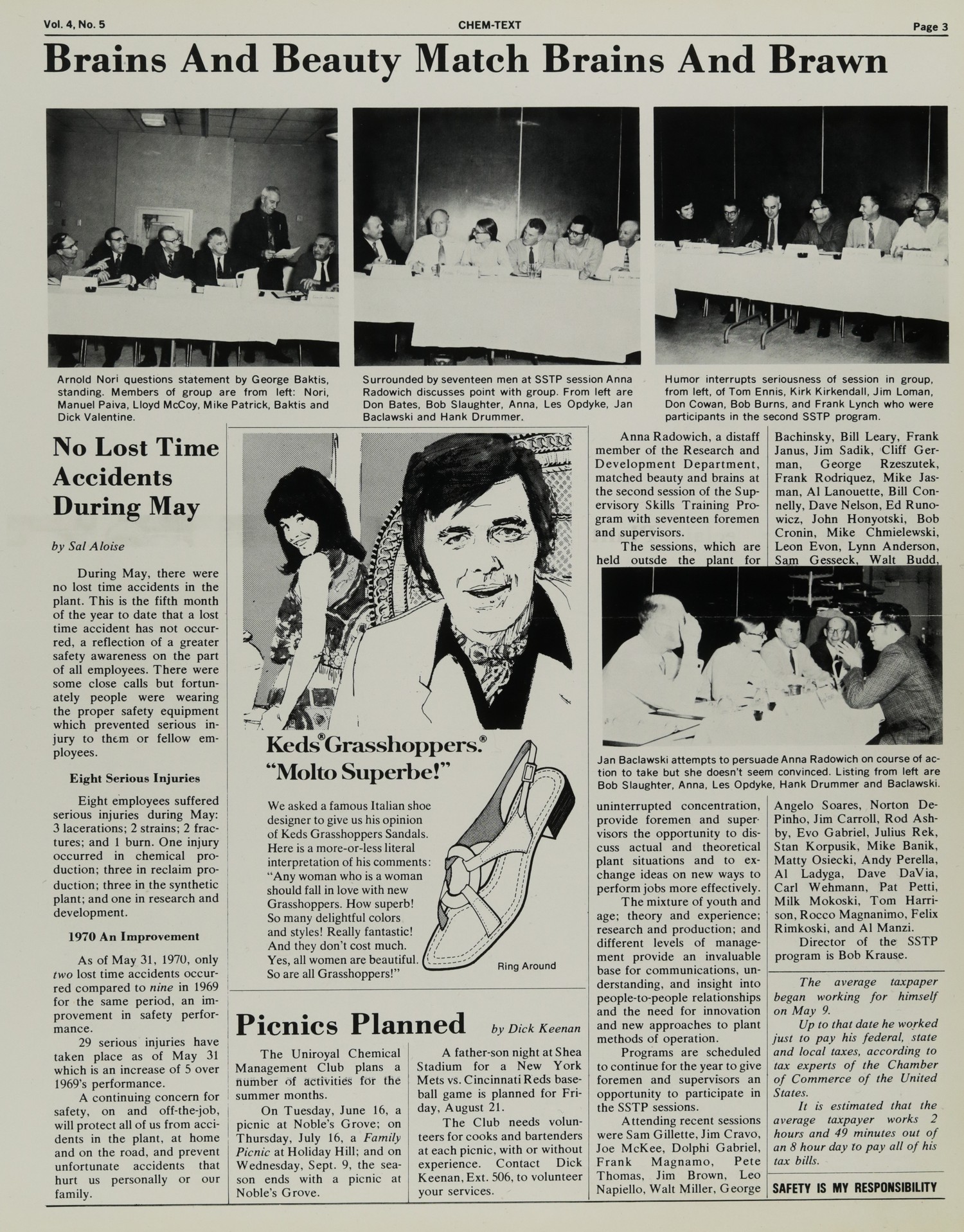
Arnold Nori questions statement by George Baktis, standing. Members of group are from left: Nori, Manuel Paiva, Lloyd McCoy, Mike Patrick, Baktis and Dick Valentine.

Surrounded by seventeen men at SSTP session Anna Radowich discusses point with group. From left are Don Bates, Bob Slaughter, Anna, Les Opdyke, Jan Baclawski and Hank Drummer.

Humor interrupts seriousness of session in group, from left, of Tom Ennis, Kirk Kirkendall, Jim Loman, Don Cowan, Bob Burns, and Frank Lynch who were participants in the second SSTP program.


No Lost Time Accidents During May

by Sal Aloise

During May, there were no lost time accidents in the plant. This is the fifth month of the year to date that a lost time accident has not occurred, a reflection of a greater safety awareness on the part of all employees. There were some close calls but fortunately people were wearing the proper safety equipment which prevented serious injury to them or fellow employees.

Eight Serious Injuries

Eight employees suffered serious injuries during May: 3 lacerations; 2 strains; 2 fractures; and 1 burn. One injury occurred in chemical production; three in reclaim production; three in the synthetic plant; and one in research and development.

1970 An Improvement

As of May 31, 1970, only two lost time accidents occurred compared to nine in 1969 for the same period, an improvement in safety performance.

29 serious injuries have taken place as of May 31 which is an increase of 5 over 1969’s performance.

A continuing concern for safety, on and off-the-job, will protect all of us from accidents in the plant, at home and on the road, and prevent unfortunate accidents that hurt us personally or our family.


Keds® Grasshoppers.® “Molto Superbe!”

We asked a famous Italian shoe designer to give us his opinion of Keds Grasshoppers Sandals. Here is a more-or-less literal interpretation of his comments: “Any woman who is a woman should fall in love with new Grasshoppers. How superb! So many delightful colors and styles! Really fantastic! And they don’t cost much. Yes, all women are beautiful. So are all Grasshoppers!”

Ring Around


Picnics Planned

by Dick Keenan

The Uniroyal Chemical Management Club plans a number of activities for the summer months.

On Tuesday, June 16, a picnic at Noble’s Grove; on Thursday, July 16, a Family Picnic at Holiday Hill; and on Wednesday, Sept. 9, the season ends with a picnic at Noble’s Grove.

A father-son night at Shea Stadium for a New York Mets vs. Cincinnati Reds baseball game is planned for Friday, August 21.

The Club needs volunteers for cooks and bartenders at each picnic, with or without experience. Contact Dick Keenan, Ext. 506, to volunteer your services.


Anna Radowich, a distaff member of the Research and Development Department, matched beauty and brains at the second session of the Supervisory Skills Training Program with seventeen foremen and supervisors.

The sessions, which are held outsde the plant for

Bachinsky, Bill Leary, Frank Janus, Jim Sadik, Cliff German, George Rzeszutek, Frank Rodriquez, Mike Jasman, Al Lanouette, Bill Connelly, Dave Nelson, Ed Runowicz, John Honyotski, Bob Cronin, Mike Chmielewski, Leon Evon, Lynn Anderson, Sam Gesseck, Walt Budd.


Jan Baclawski attempts to persuade Anna Radowich on course of action to take but she doesn’t seem convinced. Listing from left are Bob Slaughter, Anna, Les Opdyke, Hank Drummer and Baclawski.

uninterrupted concentration, provide foremen and supervisors the opportunity to discuss actual and theoretical plant situations and to exchange ideas on new ways to perform jobs more effectively.

The mixture of youth and age; theory and experience; research and production; and different levels of management provide an invaluable base for communications, understanding, and insight into people-to-people relationships and the need for innovation and new approaches to plant methods of operation.

Programs are scheduled to continue for the year to give foremen and supervisors an opportunity to participate in the SSTP sessions.

Attending recent sessions were Sam Gillette, Jim Cravo, Joe McKee, Dolphi Gabriel, Frank Magnanimo, Pete Thomas, Jim Brown, Leo Napiello, Walt Miller, George

Angelo Soares, Norton DePinho, Jim Carroll, Rod Ashby, Evo Gabriel, Julius Rek, Stan Korpusik, Mike Banik, Matty Osiecki, Andy Perella, Al Ladyga, Dave DaVia, Carl Wehmann, Pat Petti, Milk Mokoski, Tom Harrison, Rocco Magnanimo, Felix Rimkoski, and Al Manzi.

Director of the SSTP program is Bob Krause.


The average taxpayer began working for himself on May 9.

Up to that date he worked just to pay his federal, state and local taxes, according to tax experts of the Chamber of Commerce of the United States.

It is estimated that the average taxpayer works 2 hours and 49 minutes out of an 8 hour day to pay all of his tax bills.


SAFETY IS MY RESPONSIBILITY

CHEM-TEXTS – Vol. 4 No. 3 – Page 3

Page 003

CHEM-TEXTS

Vol. 4 No. 3 Page 3


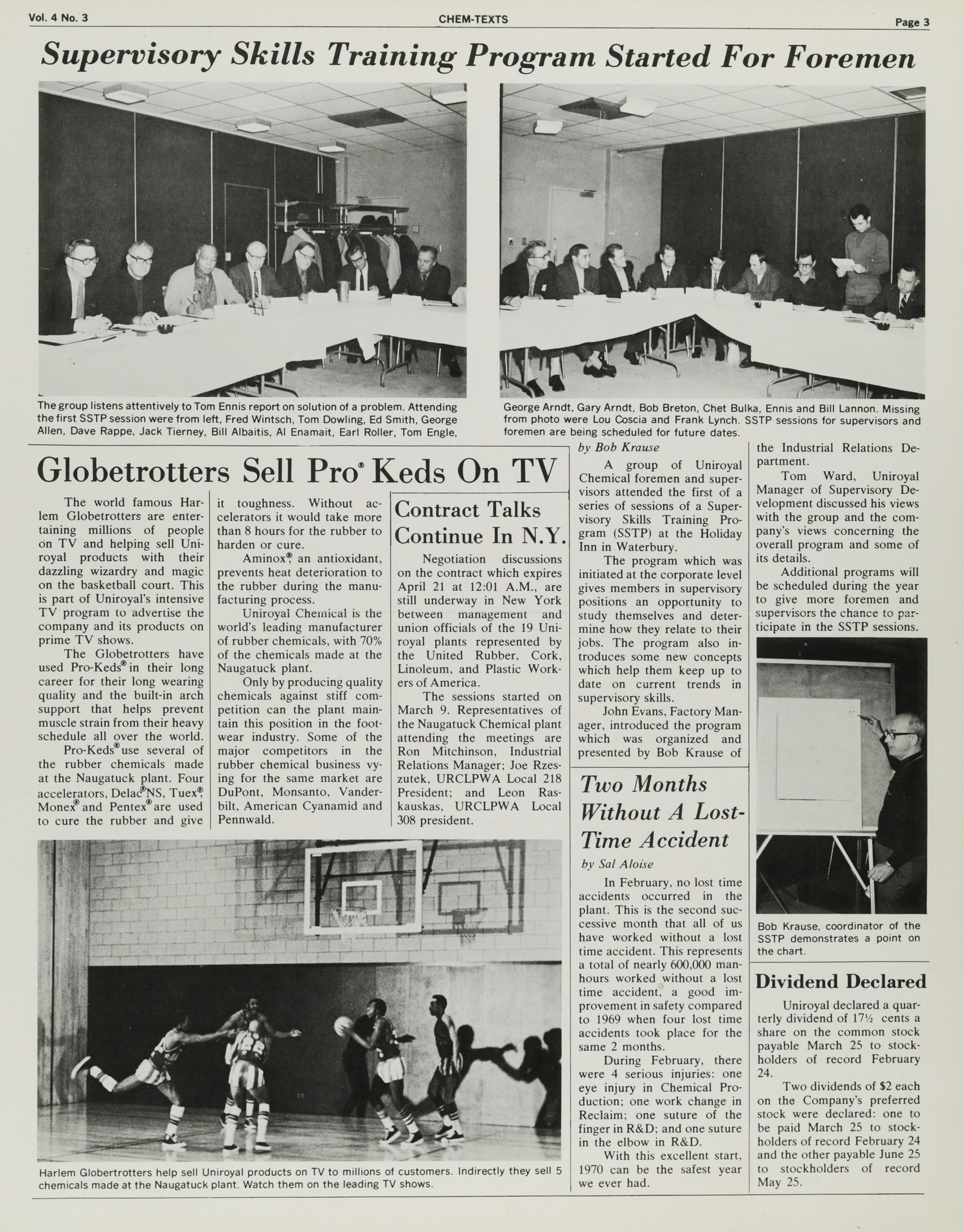
Supervisory Skills Training Program Started For Foremen

[LEFT PHOTO CAPTION:]
The group listens attentively to Tom Ennis report on solution of a problem. Attending the first SSTP session were from left, Fred Wintsch, Tom Dowling, Ed Smith, George Allen, Dave Rappe, Jack Tierney, Bill Albaitis, Al Enamait, Earl Roller, Tom Engle,

[RIGHT PHOTO CAPTION:]
George Arndt, Gary Arndt, Bob Breton, Chet Bulka, Ennis and Bill Lannon. Missing from photo were Lou Coscia and Frank Lynch. SSTP sessions for supervisors and foremen are being scheduled for future dates.


Globetrotters Sell Pro* Keds On TV

The world famous Harlem Globetrotters are entertaining millions of people on TV and helping sell Uniroyal products with their dazzling wizardry and magic on the basketball court. This is part of Uniroyal’s intensive TV program to advertise the company and its products on prime TV shows.

The Globetrotters have used Pro-Keds® in their long career for their long wearing quality and the built-in arch support that helps prevent muscle strain from their heavy schedule all over the world.

Pro-Keds® use several of the rubber chemicals made at the Naugatuck plant. Four accelerators, Delac®NS, Tuex®, Monex® and Pentex® are used to cure the rubber and give it toughness. Without accelerators it would take more than 8 hours for the rubber to harden or cure.

Aminox®, an antioxidant, prevents heat deterioration to the rubber during the manufacturing process.

Uniroyal Chemical is the world’s leading manufacturer of rubber chemicals, with 70% of the chemicals made at the Naugatuck plant.

Only by producing quality chemicals against stiff competition can the plant maintain this position in the footwear industry. Some of the major competitors in the rubber chemical business vying for the same market are DuPont, Monsanto, Vanderbilt, American Cyanamid and Pennwald.


Contract Talks Continue In N.Y.

Negotiation discussions on the contract which expires April 21 at 12:01 A.M., are still underway in New York between management and union officials of the 19 Uniroyal plants represented by the United Rubber, Cork, Linoleum, and Plastic Workers of America.

The sessions started on March 9. Representatives of the Naugatuck Chemical plant attending the meetings are Ron Mitchinson, Industrial Relations Manager; Joe Rzeszutek, URCLPWA Local 218 President; and Leon Raskauskas, URCLPWA Local 308 president.


by Bob Krause

A group of Uniroyal Chemical foremen and supervisors attended the first of a series of sessions of a Supervisory Skills Training Program (SSTP) at the Holiday Inn in Waterbury.

The program which was initiated at the corporate level gives members in supervisory positions an opportunity to study themselves and determine how they relate to their jobs. The program also introduces some new concepts which help them keep up to date on current trends in supervisory skills.

John Evans, Factory Manager, introduced the program which was organized and presented by Bob Krause of the Industrial Relations Department.

Tom Ward, Uniroyal Manager of Supervisory Development discussed his views with the group and the company’s views concerning the overall program and some of its details.

Additional programs will be scheduled during the year to give more foremen and supervisors the chance to participate in the SSTP sessions.


[BOTTOM LEFT PHOTO CAPTION:]
Harlem Globertrotters help sell Uniroyal products on TV to millions of customers. Indirectly they sell 5 chemicals made at the Naugatuck plant. Watch them on the leading TV shows.


Two Months Without A Lost-Time Accident

by Sal Aloise

In February, no lost time accidents occurred in the plant. This is the second successive month that all of us have worked without a lost time accident. This represents a total of nearly 600,000 manhours worked without a lost time accident, a good improvement in safety compared to 1969 when four lost time accidents took place for the same 2 months.

During February, there were 4 serious injuries: one eye injury in Chemical Production; one work change in Reclaim; one suture of the finger in R&D; and one suture in the elbow in R&D.

With this excellent start, 1970 can be the safest year we ever had.


[RIGHT PHOTO CAPTION:]
Bob Krause, coordinator of the SSTP demonstrates a point on the chart.


Dividend Declared

Uniroyal declared a quarterly dividend of 17½ cents a share on the common stock payable March 25 to stockholders of record February 24.

Two dividends of $2 each on the Company’s preferred stock were declared: one to be paid March 25 to stockholders of record February 24 and the other payable June 25 to stockholders of record May 25.

CHEM-TEXTS – Vol. 4 No. 2 – Page 3

Page 003

CHEM-TEXTS

Vol. 4 No. 2 | Page 3


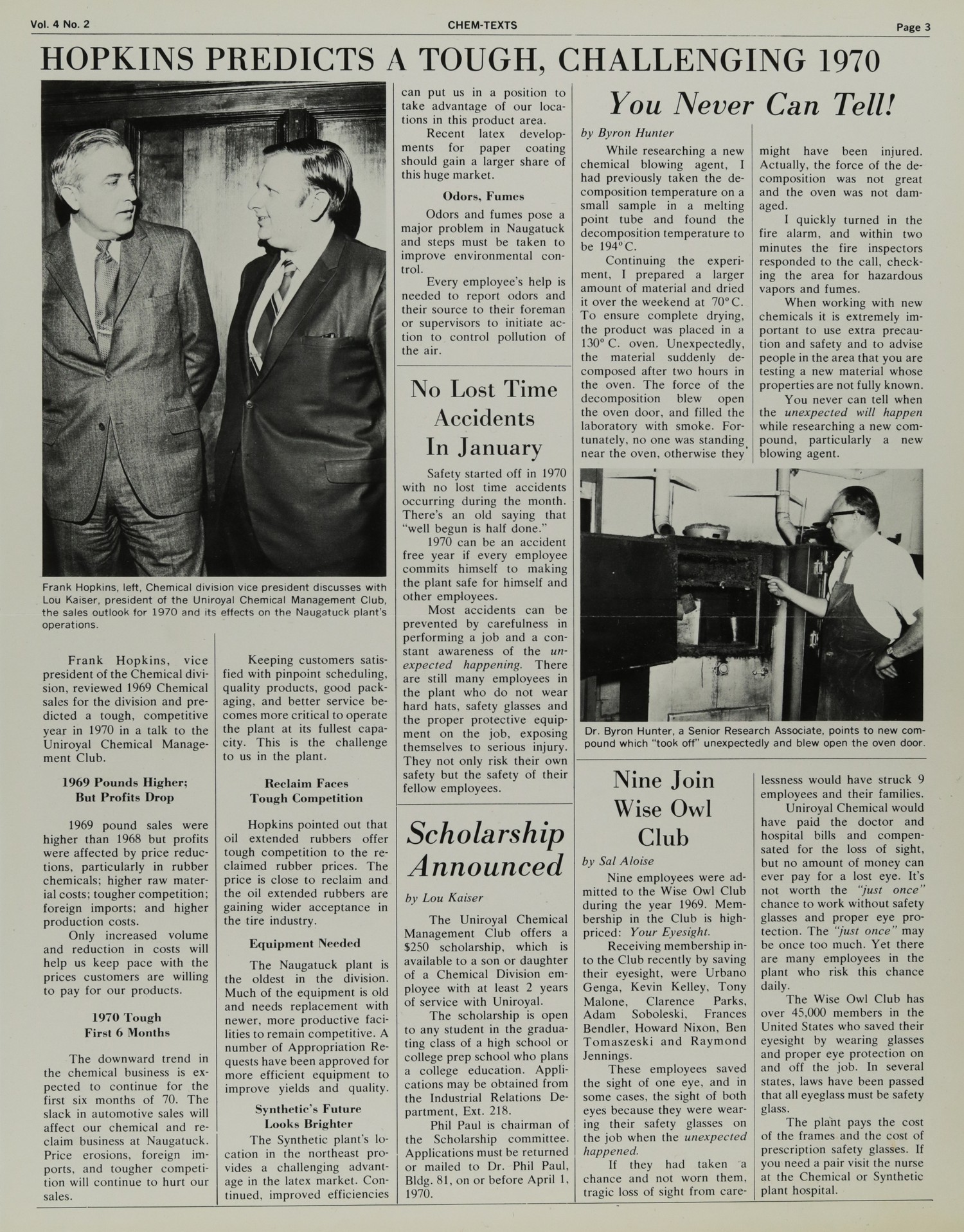
HOPKINS PREDICTS A TOUGH, CHALLENGING 1970

[IMAGE: Black and white photograph of two men in suits having a discussion]

Frank Hopkins, left, Chemical division vice president discusses with Lou Kaiser, president of the Uniroyal Chemical Management Club, the sales outlook for 1970 and its effects on the Naugatuck plant’s operations.


Frank Hopkins, vice president of the Chemical division, reviewed 1969 Chemical sales for the division and predicted a tough, competitive year in 1970 in a talk to the Uniroyal Chemical Management Club.

1969 Pounds Higher;
But Profits Drop

1969 pound sales were higher than 1968 but profits were affected by price reductions, particularly in rubber chemicals; higher raw material costs; tougher competition; foreign imports; and higher production costs.

Only increased volume and reduction in costs will help us keep pace with the prices customers are willing to pay for our products.

1970 Tough
First 6 Months

The downward trend in the chemical business is expected to continue for the first six months of 70. The slack in automotive sales will affect our chemical and reclaim business at Naugatuck. Price erosions, foreign imports, and tougher competition will continue to hurt our sales.


Keeping customers satisfied with pinpoint scheduling, quality products, good packaging, and better service becomes more critical to operate the plant at its fullest capacity. This is the challenge to us in the plant.

Reclaim Faces
Tough Competition

Hopkins pointed out that oil extended rubbers offer tough competition to the reclaimed rubber prices. The price is close to reclaim and the oil extended rubbers are gaining wider acceptance in the tire industry.

Equipment Needed

The Naugatuck plant is the oldest in the division. Much of the equipment is old and needs replacement with newer, more productive facilities to remain competitive. A number of Appropriation Requests have been approved for more efficient equipment to improve yields and quality.

Synthetic’s Future
Looks Brighter

The Synthetic plant’s location in the northeast provides a challenging advantage in the latex market. Continued, improved efficiencies


can put us in a position to take advantage of our locations in this product area.

Recent latex developments for paper coating should gain a larger share of this huge market.

Odors, Fumes

Odors and fumes pose a major problem in Naugatuck and steps must be taken to improve environmental control.

Every employee’s help is needed to report odors and their source to their foreman or supervisors to initiate action to control pollution of the air.


No Lost Time Accidents In January

Safety started off in 1970 with no lost time accidents occurring during the month. There’s an old saying that “well begun is half done.”

1970 can be an accident free year if every employee commits himself to making the plant safe for himself and other employees.

Most accidents can be prevented by carefulness in performing a job and a constant awareness of the unexpected happening. There are still many employees in the plant who do not wear hard hats, safety glasses and the proper protective equipment on the job, exposing themselves to serious injury. They not only risk their own safety but the safety of their fellow employees.


Scholarship Announced

by Lou Kaiser

The Uniroyal Chemical Management Club offers a $250 scholarship, which is available to a son or daughter of a Chemical Division employee with at least 2 years of service with Uniroyal.

The scholarship is open to any student in the graduating class of a high school or college prep school who plans a college education. Applications may be obtained from the Industrial Relations Department, Ext. 218.

Phil Paul is chairman of the Scholarship committee. Applications must be returned or mailed to Dr. Phil Paul, Bldg. 81, on or before April 1, 1970.


You Never Can Tell!

by Byron Hunter

While researching a new chemical blowing agent, I had previously taken the decomposition temperature on a small sample in a melting point tube and found the decomposition temperature to be 194° C.

Continuing the experiment, I prepared a larger amount of material and dried it over the weekend at 70° C. To ensure complete drying, the product was placed in a 130° C. oven. Unexpectedly, the material suddenly decomposed after two hours in the oven. The force of the decomposition blew open the oven door, and filled the laboratory with smoke. Fortunately, no one was standing near the oven, otherwise they

might have been injured. Actually, the force of the decomposition was not great and the oven was not damaged.

I quickly turned in the fire alarm, and within two minutes the fire inspectors responded to the call, checking the area for hazardous vapors and fumes.

When working with new chemicals it is extremely important to use extra precaution and safety and to advise people in the area that you are testing a new material whose properties are not fully known.

You never can tell when the unexpected will happen while researching a new compound, particularly a new blowing agent.


[IMAGE: Black and white photograph of a man in a lab coat pointing at laboratory equipment]

Dr. Byron Hunter, a Senior Research Associate, points to new compound which “took off” unexpectedly and blew open the oven door.


Nine Join Wise Owl Club

by Sal Aloise

Nine employees were admitted to the Wise Owl Club during the year 1969. Membership in the Club is highpriced: Your Eyesight.

Receiving membership into the Club recently by saving their eyesight, were Urbano Genga, Kevin Kelley, Tony Malone, Clarence Parks, Adam Soboleski, Frances Bendler, Howard Nixon, Ben Tomaszeski and Raymond Jennings.

These employees saved the sight of one eye, and in some cases, the sight of both eyes because they were wearing their safety glasses on the job when the unexpected happened.

If they had taken a chance and not worn them, tragic loss of sight from care-

lessness would have struck 9 employees and their families.

Uniroyal Chemical would have paid the doctor and hospital bills and compensated for the loss of sight, but no amount of money can ever pay for a lost eye. It’s not worth the “just once” chance to work without safety glasses and proper eye protection. The “just once” may be once too much. Yet there are many employees in the plant who risk this chance daily.

The Wise Owl Club has over 45,000 members in the United States who saved their eyesight by wearing glasses and proper eye protection on and off the job. In several states, laws have been passed that all eyeglass must be safety glass.

The plant pays the cost of the frames and the cost of prescription safety glasses. If you need a pair visit the nurse at the Chemical or Synthetic plant hospital.

CHEM-TEXTS – Vol. 3, 1969, No. 11 – Page 1

Page 001

UNIROYAL

Merry Christmas – Happy New Year

CHEM-TEXTS

Vol. 3, 1969 PUBLISHED FOR THE PEOPLE OF UNIROYAL CHEMICAL No. 11


[IMAGE: Two people decorating a Christmas tree]

Getting ready for the Christmas season, Madelyn Malone, left; and Molly Cobbol decorate tree in lobby of Main Entrance.


Frank Hopkins To Address The Foremen’s Club

by Lou Kaiser

Frank Hopkins, Vice President and General Manager of the Chemical division will address the Foremen’s Club January 15, 1970, at the Elks Club in Naugatuck.

Mr. Hopkins will discuss the present and future busi-

[IMAGE: Portrait photo of Frank A. Hopkins]

FRANK A. HOPKINS

ness outlook for the Chemical division, and the effects of the present economic trends on the divisions and the plant’s operations.


Man Falls, Breaks Leg

by Sal Aloise

A fall from a railroad tank car resulted in a broken leg and a bruised shoulder when an employee slipped and fell backwards. The accident occurred while he was placing a recirculating hose in the dome of the tank car. As a result of the injury he will be incapacitated 8 weeks.

The second lost time accident happened when an employee caught the heel of his foot in an elevator door while he was taking a product from the 1st to the 3rd floor of the building.

Besides the two lost time accidents in November, five serious injuries were reported for the month. This rate of accidents shows little improvement over last year.

With every effort being made by the plant to improve safety, no progress will be made in the prevention of injuries unless every employee continually thinks safety and avoids taking chances.

Now that winter is here, ice and snow conditions require a greater concern for

(Continued on page 4)


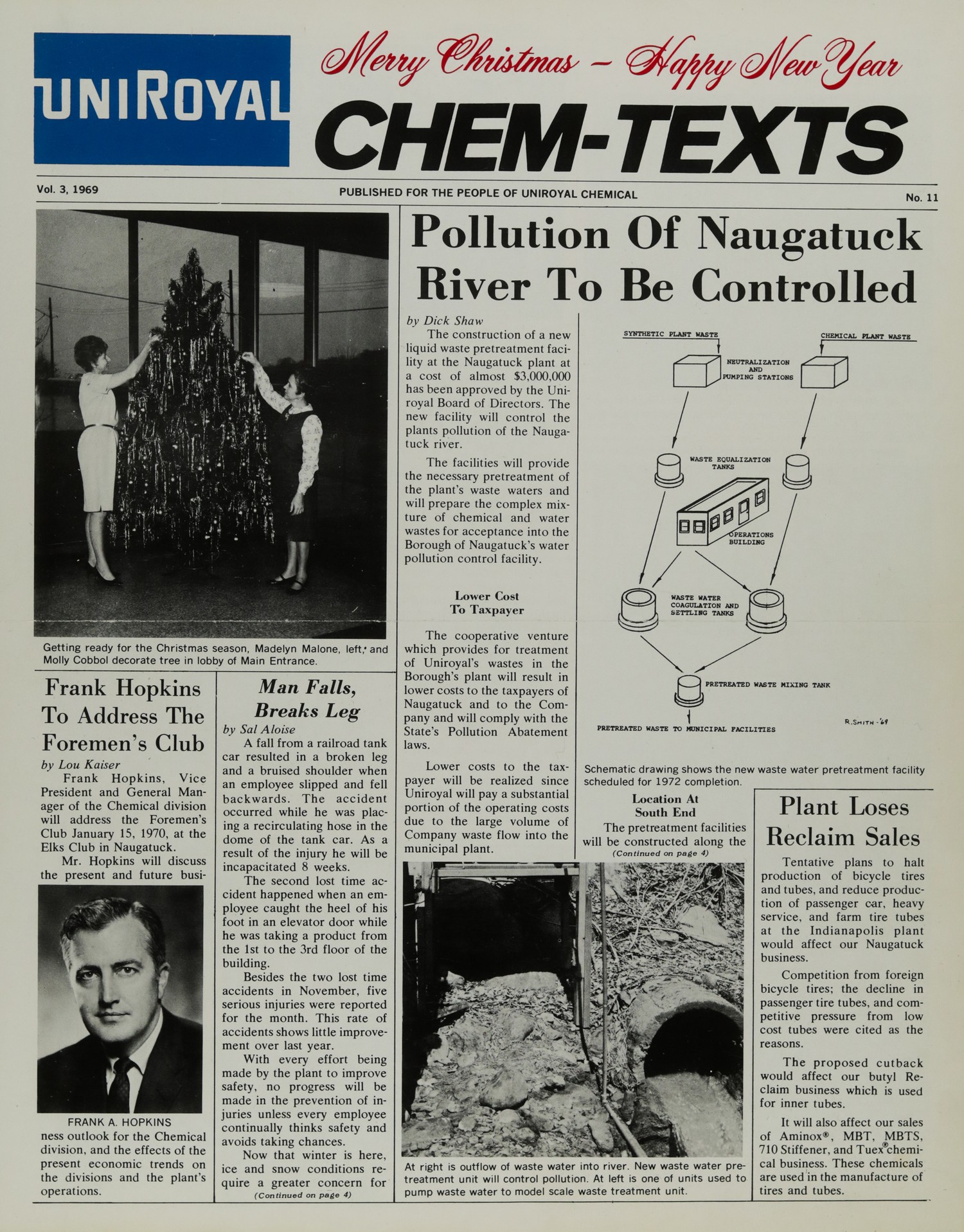
Pollution Of Naugatuck River To Be Controlled

by Dick Shaw

The construction of a new liquid waste pretreatment facility at the Naugatuck plant at a cost of almost $3,000,000 has been approved by the Uniroyal Board of Directors. The new facility will control the plants pollution of the Naugatuck river.

The facilities will provide the necessary pretreatment of the plant’s waste waters and will prepare the complex mixture of chemical and water wastes for acceptance into the Borough of Naugatuck’s water pollution control facility.

Lower Cost To Taxpayer

The cooperative venture which provides for treatment of Uniroyal’s wastes in the Borough’s plant will result in lower costs to the taxpayers of Naugatuck and to the Company and will comply with the State’s Pollution Abatement laws.

Lower costs to the taxpayer will be realized since Uniroyal will pay a substantial portion of the operating costs due to the large volume of Company waste flow into the municipal plant.


[DIAGRAM: Schematic showing waste water treatment process flow, including:
– SYNTHETIC PLANT WASTE
– CHEMICAL PLANT WASTE
– NEUTRALIZATION AND PUMPING STATIONS
– WASTE EQUALIZATION TANKS
– OPERATIONS BUILDING
– WASTE WATER COAGULATION AND SETTLING TANKS
– PRETREATED WASTE MIXING TANK
– PRETREATED WASTE TO MUNICIPAL FACILITIES]

R.Smith-69

Schematic drawing shows the new waste water pretreatment facility scheduled for 1972 completion.

Location At South End

The pretreatment facilities will be constructed along the

(Continued on page 4)


[IMAGE: Industrial equipment/construction site]

At right is outflow of waste water into river. New waste water pretreatment unit will control pollution. At left is one of units used to pump waste water to model scale waste treatment unit.


Plant Loses Reclaim Sales

Tentative plans to halt production of bicycle tires and tubes, and reduce production of passenger car, heavy service, and farm tire tubes at the Indianapolis plant would affect our Naugatuck business.

Competition from foreign bicycle tires; the decline in passenger tire tubes, and competitive pressure from low cost tubes were cited as the reasons.

The proposed cutback would affect our butyl Reclaim business which is used for inner tubes.

It will also affect our sales of Aminox®, MBT, MBTS, 710 Stiffener, and Tuex chemical business. These chemicals are used in the manufacture of tires and tubes.

CHEM-TEXTS – Vol. 3 No. 10 – Page 3

Page 003

CHEM-TEXTS

Vol. 3 No. 10 | Page 3


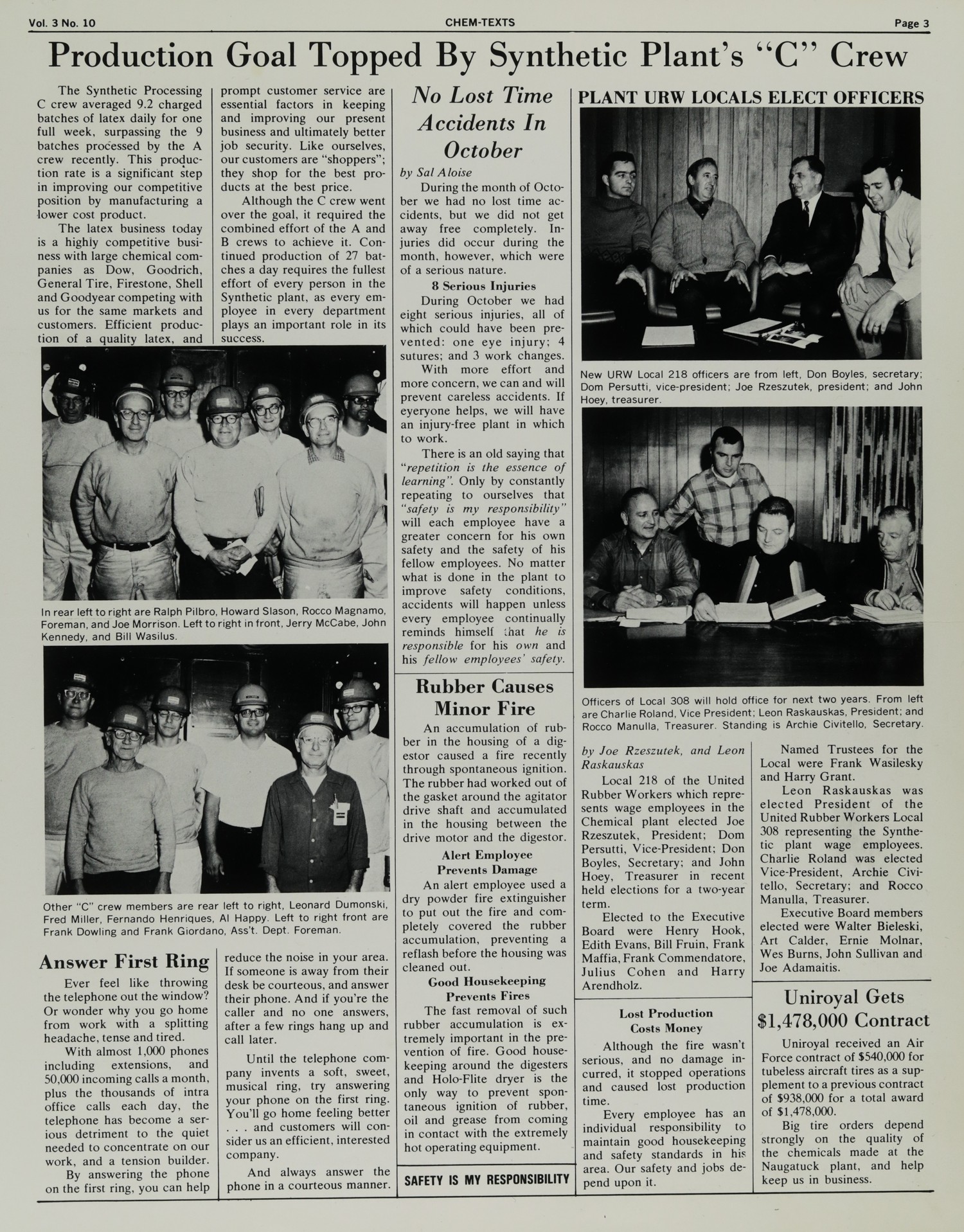
Production Goal Topped By Synthetic Plant’s “C” Crew

The Synthetic Processing C crew averaged 9.2 charged batches of latex daily for one full week, surpassing the 9 batches processed by the A crew recently. This production rate is a significant step in improving our competitive position by manufacturing a lower cost product.

The latex business today is a highly competitive business with large chemical companies as Dow, Goodrich, General Tire, Firestone, Shell and Goodyear competing with us for the same markets and customers. Efficient production of a quality latex, and prompt customer service are essential factors in keeping and improving our present business and ultimately better job security. Like ourselves, our customers are “shoppers”; they shop for the best products at the best price.

Although the C crew went over the goal, it required the combined effort of the A and B crews to achieve it. Continued production of 27 batches a day requires the fullest effort of every person in the Synthetic plant, as every employee in every department plays an important role in its success.


[PHOTO CAPTION:]
In rear left to right are Ralph Pilbro, Howard Slason, Rocco Magnamo, Foreman, and Joe Morrison. Left to right in front, Jerry McCabe, John Kennedy, and Bill Wasilus.


[PHOTO CAPTION:]
Other “C” crew members are rear left to right, Leonard Dumonski, Fred Miller, Fernando Henriques, Al Happy. Left to right front are Frank Dowling and Frank Giordano, Ass’t. Dept. Foreman.


Answer First Ring

Ever feel like throwing the telephone out the window? Or wonder why you go home from work with a splitting headache, tense and tired.

With almost 1,000 phones including extensions, and 50,000 incoming calls a month, plus the thousands of intra office calls each day, the telephone has become a serious detriment to the quiet needed to concentrate on our work, and a tension builder.

By answering the phone on the first ring, you can help reduce the noise in your area. If someone is away from their desk be courteous, and answer their phone. And if you’re the caller and no one answers, after a few rings hang up and call later.

Until the telephone company invents a soft, sweet, musical ring, try answering your phone on the first ring. You’ll go home feeling better . . . and customers will consider us an efficient, interested company.

And always answer the phone in a courteous manner.


No Lost Time Accidents In October

by Sal Aloise

During the month of October we had no lost time accidents, but we did not get away free completely. Injuries did occur during the month, however, which were of a serious nature.

8 Serious Injuries

During October we had eight serious injuries, all of which could have been prevented: one eye injury; 4 sutures; and 3 work changes.

With more effort and more concern, we can and will prevent careless accidents. If everyone helps, we will have an injury-free plant in which to work.

There is an old saying that “repetition is the essence of learning”. Only by constantly repeating to ourselves that “safety is my responsibility” will each employee have a greater concern for his own safety and the safety of his fellow employees. No matter what is done in the plant to improve safety conditions, accidents will happen unless every employee continually reminds himself that he is responsible for his own and his fellow employees’ safety.


Rubber Causes Minor Fire

An accumulation of rubber in the housing of a digestor caused a fire recently through spontaneous ignition. The rubber had worked out of the gasket around the agitator drive shaft and accumulated in the housing between the drive motor and the digestor.

Alert Employee Prevents Damage

An alert employee used a dry powder fire extinguisher to put out the fire and completely covered the rubber accumulation, preventing a reflash before the housing was cleaned out.

Good Housekeeping Prevents Fires

The fast removal of such rubber accumulation is extremely important in the prevention of fire. Good housekeeping around the digesters and Holo-Flite dryer is the only way to prevent spontaneous ignition of rubber, oil and grease from coming in contact with the extremely hot operating equipment.


SAFETY IS MY RESPONSIBILITY


PLANT URW LOCALS ELECT OFFICERS

[PHOTO CAPTION:]
New URW Local 218 officers are from left, Don Boyles, secretary; Dom Persutti, vice-president; Joe Rzeszutek, president; and John Hoey, treasurer.


[PHOTO CAPTION:]
Officers of Local 308 will hold office for next two years. From left are Charlie Roland, Vice President; Leon Raskauskas, President; and Rocco Manulla, Treasurer. Standing is Archie Civitello, Secretary.


by Joe Rzeszutek, and Leon Raskauskas

Local 218 of the United Rubber Workers which represents wage employees in the Chemical plant elected Joe Rzeszutek, President; Dom Persutti, Vice-President; Don Boyles, Secretary; and John Hoey, Treasurer in recent held elections for a two-year term.

Elected to the Executive Board were Henry Hook, Edith Evans, Bill Fruin, Frank Maffia, Frank Commendatore, Julius Cohen and Harry Arendholz.

Lost Production Costs Money

Although the fire wasn’t serious, and no damage incurred, it stopped operations and caused lost production time.

Every employee has an individual responsibility to maintain good housekeeping and safety standards in his area. Our safety and jobs depend upon it.

Named Trustees for the Local were Frank Wasilesky and Harry Grant.

Leon Raskauskas was elected President of the United Rubber Workers Local 308 representing the Synthetic plant wage employees. Charlie Roland was elected Vice-President, Archie Civitello, Secretary; and Rocco Manulla, Treasurer.

Executive Board members elected were Walter Bieleski, Art Calder, Ernie Molnar, Wes Burns, John Sullivan and Joe Adamaitis.


Uniroyal Gets $1,478,000 Contract

Uniroyal received an Air Force contract of $540,000 for tubeless aircraft tires as a supplement to a previous contract of $938,000 for a total award of $1,478,000.

Big tire orders depend strongly on the quality of the chemicals made at the Naugatuck plant, and help keep us in business.

CHEM-TEXTS – Vol. 3 No. 8 – Page 3

Page 003

CHEM-TEXTS

Vol. 3 No. 9 Page 3


Everybody’s Giving To United Givers

by Eric Johnson

The United Givers drive is receiving generous response from all employees. Pledges received to date amount to $14,300, which is 65% of the plant’s $22,000 goal. Campaign chairmen feel confident that the drive will exceed the $22,000.

“Give Where You Work” through the convenient payroll deduction plan has received greater support this year from all employees. Every pledge, even if only 25 cents a week, which surely every employee can afford, will help us reach our $22,000 goal. A mentally retarded child, a child with cerebral palsy, or a lonely G.I. in Vietnam will be helped by your pledge. In our hearts none of us can refuse to help these friends and neighbors.

Employees living in Waterbury, Cheshire, New Haven and other cities benefit from the Agencies in the Fund as much as, if not more than, the residents of Naugatuck and Beacon Falls. The U.S.O., Salvation Army and Red Cross are national in scope; the others serve most of the communities in which employees live.

The key word in this year’s campaign is Charity . . . the spirit of giving to help others less fortunate than ourselves. If you didn’t make a pledge, you can still pledge that 25 cents a week by obtaining another pledge card from your department head.

“GIVE WHERE YOU WORK”


Pledging contributions are seated left to right, Carole Calo, Lois Devino, canvasser for Quality Control and Testing Lab, and Sonya Kernasevic. From left standing are Margaret Sweeney, Maria Fidalgo, Anna Pakalnis, Joan Stevenson, Bertha Rascoe and Leslie MacDonald.


Larry Volpe accepts pledge cards from Mechanical Dept. Seated from left are Ralph Buckingham, Ovila Fortier, Odell Hines, Volpe, Adrian Hanley. Standing from left are Sal Falcone, John Napiello, Tony Galletta, Joe Lubinskas, Tony Malone.


Give Exact Employment Place

Telephone operators, front to rear, Mary Dinkle, Ruth Ranslow and Alice Schofield place 25,000 calls a month. Incoming calls are about 50,000 on the 1,000 extensions.

The cooperation of all persons is needed in the following matter which can inconvenience you in your personal affairs.

When it is necessary for you to give your place of employment for reference on personal business, make certain to specify UNIROYAL CHEMICAL or EMIC and give the correct phone number 729-5241. This will speed up the confirmation of your employment.

Fifty telephone inquiries are received daily from banks, stores and loan companies, to verify employment. Many of these calls could be eliminated if you properly state the plant or division where you work. Do not simply use UNIROYAL, because the caller looks upon UNIROYAL in Naugatuck as one plant.


IMPROVEMENTS…

(continued from page 2)

Engineering’s Responsibility

The plant’s engineering department consists of 21 engineers. The group presently has 65 projects in the works for which they are responsible.

But fixing the nuts and bolts; getting machines back into operation; adding an extra year of life to old equipment, and fixing a steam leak requires the skill and experience of the Mechanical department foremen and skilled tradesmen at the Chemical and Synthetic plants.

Investment In People

Plant improvements are essentially an investment in the skills, experience and welfare of the people by the Company. They produce new job opportunities; create better and safer working conditions; and provide the necessary tools and machinery to insure job security in the highly competitive chemical industry.


Free Eye Tests Available

by Sal Aloise

“G Day” is coming up Friday, November 14 for residents of the Greater Waterbury-Naugatuck area.

The “G” stands for glaucoma and a free eye test to spot this dread disease will be given to adults over 35 years of age Friday evening, Nov. 14 from 7 to 9 p.m. at the Warren F. Kaynor Regional Technical School, 43 Tompkins St., Waterbury.

The glaucoma screening is under the direction of the Connecticut Society for the Prevention of Blindness and a number of local organizations are cooperating to plan this event. Doctors from the Eye Section of the Connecticut State Medical Society donate their time to give the simple tonometer test.

Glaucoma is the second leading cause of blindness among people over 35 years of age. It comes on so gradually the victim is often not aware anything is wrong. This is why it has been called “the sneak thief of sight” by Prevention of Blindness people.


Appointments Announced

Hal Lynch was appointed Purchasing Agent for the Naugatuck plant, succeeding Norv Turner who will continue in an advisory capacity until his retirement in November.

Bob Cranney assumes the duties of Manager of the Synthetic Plant Control Laboratory.

Bill Leukhardt received a special assignment as Production Coordinator.

Doug Klima appointed Process Engineer for the Synthetic plant.


New toluene drying column at Synthetic Pilot Plant will be used to make new types of rubber.


Julius Banno, foreground, machines parts for reel beaters used in Cracking dept. while Ray Goglewski, rear, machines a tuber screw for Millroom B.

CHEM-TEXTS – Vol. 3 No. 4 – Page 2

Page 002

CHEM-TEXTS

Page 2 | Vol. 3 No. 4


FROM THE FACTORY MANAGER

DEAR FELLOW EMPLOYEE:

All of us are aware of the importance of producing quality products in an efficient and safe manner. We are also aware of the importance of providing service to our customers, for only through the sale of the results of our effort can we be paid for this effort. I am convinced that each of us tries to do his job in the best way.

But how do we see our jobs? Is our particular job over, when we feel that somebody other than ourselves can be blamed for poor performance?

For example, is it justifiable to blame our injury on someone else if, indeed, it was an unsafe act on our part? Or, is it reasonable to blame lost production on the shortage of raw materials if we didn’t do something about it? Maybe we are all too quick to place the blame on someone else, before we accept all of our own responsibilities.

Together, we operate a very complex operation where each employee bears a great deal of responsibility for his personal efforts, and if we are fully successful a great deal of responsibility for the efforts of others.

Sincerely,

[Signature]

John D. Evans


Flood, Disaster Plan Revised

[IMAGE: Black and white photograph showing flooded area with building]

The Naugatuck River became the “mad river” in August 1955 and flooded the plant. Having a plan for action got the plant back into operation in two days.

The purpose of the revised Plan, which has been distributed to involved employees, is to minimize delay and confusion if an unusual or serious incident occurs, such as the August flood of 1955, and to delegate responsibilities to assigned personnel.

If an emergency occurs, the Control Center for operations will be set up in the Industrial Relations office, Bldg. 84, unless circumstances require another location. The Plan outlines the utilization of all equipment in the plant and the specific duties to be carried out by authorized personnel. It also delegates to Ron Mitchinson, Fred Wintsch, Bob Krause, and Bill Lavelle the responsibility and authority, as the plant’s public information representatives, to provide information to the press. All employees should refer requests on information of the emergency to the plant’s public information representatives to prevent damaging rumors and in-

(Continued on Page 4)


Explorers Offer Students Career Insight

by Bob Smith

The Explorers offer high school boys, 14 to 18 years old, the opportunity to see and learn about careers in science, chemistry, and industry. The group, sponsored by the Chemical plant, was the first Explorer Post in Uniroyal.

The Explorers conduct laboratory experiments in the plant’s laboratory facilities; take tours of industrial plants in the area to see first hand the manufacturing operation of a large company; and make weekend trips to universities, military installations and other places of interest to high school students. By exploring or seeing scientific operations; observing chemistry in action; and studying the engineering complexity of a synthetic rubber plant, a high school student obtains an actual insight into the type of career to pursue in life.

This year the group visited Scovill’s, Mallory Battery, Sikorsky Aircraft, Uniroyal Chemical’s Agricultural Research Center, the E.M.I.C. Computer Center, and the Massachusetts Institute of Technology.

If your son is interested in a career in science, chemistry or industry, and would like to join the Explorers, Bob Smith, Ext. 674, will be glad to give you more details on the group’s activities.

[IMAGE: Group photograph of committee members]

Committee members discuss plans for future activities. Seated, left to right, are Bruce Fisher, Bob Smith, chairman, and Steve Schwartz. Standing are Harry Jancis, left, and Bert Scullin. Not present were Tom O’Hara, Al Manzi, Ed McCaffrey, Bill Broden, Ken Ferreira, Ben Leach and Dick Savage.

[IMAGE: Group working on science project]

Working on a science project are, left to right, seated, Art Nunes, Dick Adamaitis, and Lou Stephenson. Standing, left to right, are Frank Cravo, George Louis Jr., Armando Pardal, Nat Vescera, and Steve Schwartz, advisor.


Safety Shows Small Improvement Over ’68

by Sal Aloise

The plant’s safety record for the first four months of 1969 shows that 7 lost time accidents and 14 serious injuries took place. Although a slight improvement over 1968, the record indicates that a greater safety awareness by every employee is required to make the plant a safer place to work.

By not taking chances; by stopping unsafe acts; accidents can be prevented and the plant made safer for work. In 1968 we worked 1,000,000 manhours without a lost time accident. With every employee’s effort, we can reach 1,000,000 manhours again . . . and even 2,000,000!

LOST TIME ACCIDENTS AND SERIOUS INJURIES

MONTH 1969 Lost Time Serious Injuries Total 1968 Lost Time Serious Injuries Total
January 2 2 4 2 2 4
February 2 5 7 3 5 8
March 2 3 5 2 6 8
April 1 4 5 2 6 8
TOTAL 7 14 21 9 19 28

Dividend Declared

Uniroyal declared a dividend of 17½ cents a share on the common stock. A $2 dividend on the 8% first preferred stock was also announced. Both are payable June 25 to stockholders of record May 26.


Dr. Williams Leaves

Dr. Edward E. Williams will leave us as plant physician at the end of May.

Dr. John P. Elser will assume the duties of plant physician on June 1.

Dr. Williams has been associated with the Chemical plant for the past 35 years. He plans to continue his private practice in Naugatuck.


The average American family wastes about 400 lbs. of edible food in a year. The country wastes over 10 million tons of food each year.


SAFETY IS MY RESPONSIBILITY

CHEM-TEXTS – Vol. 2, No. 1 – Page 1

Page 001

UNIROYAL CHEM-TEXTS

Vol. 2 PUBLISHED FOR THE PEOPLE OF UNIROYAL CHEMICAL No. 3


1,000,000 MANHOURS WORKED WITHOUT LOST TIME INJURY

[IMAGE: Black and white photograph showing workers at Chemical Canteen]

Sal Aloise of the Safety Department hands out fountain pens at Chemical Canteen marking 1,000,000 man-hours record.

For the first time in several years the Naugatuck plant worked 1,000,000 manhours without a lost time injury. By July 11, the manhours had reached 1,170,000 toward our next goal of 2,000,000.

Unfortunately, a lost time injury took place in Bldg. 73 ending the 2,000,000 manhour goal. To achieve a 1,000,000 manhours without a lost-time injury, it takes approximately 3 months. With continued attention and awareness toward safe working practices and the use of proper protective equipment on the job, the Naugatuck plant could break the 3,536,013 manhours without a disabling injury, established in 1961.

Injuries to an employee can be avoided by checking for unsafe conditions when he starts his shift and reporting them to his foreman. Many lost-time injuries would’nt happen if this procedure were followed. From January to March there were 7 lost-time injuries and 12 serious injuries. For 3 consecutive months in April, May and June there were no lost-time injuries; but 25 serious injuries.

Although vacation time is over, a great concern for safety is still necessary. Safety awareness starts at home with you and your family. If you’re planning a trip be sure to check your car carefully, drive slowly, and watch out for the other fellow on the road. With your family in the car you have to be safe.


UNIROYAL INCOME, SALES REACH ALL-TIME HIGHS

Net income and sales reached all-time highs for the first six months and the second quarter of the year, George R. Vila, chairman and president, announced recently.

Net income for the first half of the year rose to a new high of $29,881,000 or $2.20 per share of common stock compared with $11,100,000 or 69 cents per share recorded in the strike-marred first six months of 1967 when more than 70% of Uniroyal’s domestic operations were shut down for nearly 2½ months. More meaningfully, the new 1968 six-month high in earnings is 24% greater than the record $24,061,000, or $1.75 per share, attained by Uniroyal in the first six months of 1966, a period in which normal operations prevailed.

Sales for the first six months were at a record level of $718,785,000, 12.4% above the $639,516,000 recorded in the 1967 period and 7.6% higher than the $668,281,000 achieved in 1966.

In the second quarter of 1968 net income was at a record total of $17,805,000, or $1.33 a share, surpassing by 24.4% the $14,309,000 or $1.06 per share, achieved in the second quarter of 1966. No valid comparison can be made with the second quarter of 1967 when the full effect of the industry-wide strike caused earnings to drop to $1,551,000 or 2 cents per share of common stock.

Sales for the second quarter of 1968 were at a record level of $381,417,000, surpassing the strike-bound 1967 period by 18.2% and 9.3% above the $348,839,000 recorded in 1966.

Mr. Vila noted that the all-time highs for the first half and the second quarter stem from all areas of the company’s business, especially in sales of tires, footwear, plastics and plastic products.


Clark Wins Three Awards

[IMAGE: Black and white photograph showing Edward Clark at mechanical equipment]

Edward Clark of the Mechanical Department submitted three suggestions recently: he received $35 and $15 checks for two of his ideas and an Honorable Mention for the other.

CHEM-TEXTS – Vol. 2 No. 5 – Page 2

Page 002

Page 2 CHEM TEXTS Vol. 2 No. 5


FROM THE FACTORY MANAGER

Dear Fellow Employee:

Technological advances, especially those over the past twenty to thirty years, have rapidly outpaced our ability to understand each other. While new communication devices, such as television and the computer have expanded our ability to send messages faster, little has been done to make sure that these messages are received, for a message is communicated only when it is understood and the intended purpose of the message is accomplished. Man’s inability to complete this communication cycle is largely responsible for the many problems that face society today.

The recent company-wide survey conducted by Opinion Research, in which many of our people took part, has confirmed that we in UNIROYAL are no different in this respect. To accomplish our purposes of growth and job security for all we must — send, receive and thereby reach understanding of our common objectives. While our efforts may be aided by CHEM-TEXTS, letters and other tools, success can only be achieved if we each, as individuals, regardless of our jobs, learn to talk to each other. We must-always remember that communication is a three-way street — UP, DOWN and SIDE-WAYS. While we each may momentarily have different points of view, fair interchange of these points of view will always clarify the larger purpose.

Sincerely,

John D. Evans


Moniz’s Hard Hat Prevents Injury

[IMAGE: Photo of Joe Moniz showing hard hat to Sal Aloise]

Joe Moniz, left, shows Sal Aloise of the Safety Department the lump of hard rubber which fell 15 feet onto his hard hat.

Recently Joe Moniz reported to work for the 11-7 shift in the Reclaim Digesting Department. He changed clothes and put on all his proper protective equipment for his job: safety shoes, safety glasses and hard hat. Joe didn’t expect an accident that night but he was prepared for the “unexpected happening”.

While opening a chain valve, a large piece of rubber fell 15 feet and would have hit his head. Fortunately, his hard hat prevented a very serious head injury. Moniz’s hard hat saved him and his family considerable anguish and suffering because he wore the proper safety equipment for his job.


Company Sets Third Quarter Records For Sales And Income

Uniroyal, Inc. set new records in sales and net income both for the third quarter and the first nine months of 1968 despite heavy start-up expenses for several new plants under construction in the United States and abroad, George R. Vila, chairman and president, reported today.

Net income for the third quarter was at a record $12, 769,000 or 91 cents per common share, 68.8 per cent above the $7,563,000 or 51 cents a share reported last year.

Net income for the nine-month period was $42,650,000, equivalent to $3.11 per share of common stock, an increase of 128.5 per cent compared with the $18,663,000 or $1.20 per common share reported during strike-marred 1967.

Sales and operating revenues for the third quarter were $341,874,000, an increase of 18.4 per cent compared with the $288,804,000 reported last year.

Sales and operating revenues for the nine months totaled $1,060,659,000, a gain of 14.3 per cent compared with $928,320,000 in 1967.


PINK COLOR CARS ARE THE SAFEST

A Swedish color expert surveyed 31,000 auto collisions and found that black cars are up to 10 times as likely to be involved in accidents as light or bright colored autos.

Pink was the safest car color, involved in only 2.0% of the accidents.


Special Xmas Offer: Royal Golf Balls

A special Christmas offer of ROYAL Golf balls is available to all Company employees. Orders should be placed with the Employees’ Salesroom on Rubber Avenue from now till Dec. 15.

Prices per dozen are: ROYAL Plus at $9.25; ROYAL at $9.25; ROYAL Red at $9.25; ROYAL Queen at $9.25; and FAIRWAY II at $5.45.

The bonus golf ball policy does not apply on this special offer.

Next to black, the most dangerous colors were all shades of brown and gray. Dark colors were more susceptible to collision because they are the hardest to see against a background of trees or buildings, especially at dusk.


New Maintenance Control Center Speeds Up Repairs

In October, a new maintenance control center was initiated at the Chemical plant for the planning and scheduling of work in the Chemical and Reclaim plants. The Center is similar to the Synthetic control center which has been in operation for five months. The center will be in Bldg. 7 and manned by a staff of four people.

The basic purpose of this system is the organization of communications to and from the maintenance department and all other related plant departments requiring service. With this central control of information, it will be easier to plan and coordinate related work, establish priorities, and take advantage of the flexibility of crews. In addition, job information is accumulated for incorporation with electrical data processing which collects data and disseminates

[IMAGE: Photo of four men at control center]

Receiving and transmitting job orders, and recording data for job information are l to r: Frank Gariano, Pat King, Al Manzi and Frank Zettlemoyer. Receiving information from the Center is Tom Dowling.

reports for future job planning, preventive maintenance evaluation and budgeting.

The broad objectives of this system are: 1) to provide

better service; 2) minimize lost time; 3) reduce maintenance costs; and 4) optimize use of manpower, tools, equipment and material.


Board of Directors Recommend 2 For 1 Stock Split

The board of directors of Uniroyal, Inc. voted to recommend to stockholders that the present common stock of the company be split two shares for one, George R. Vila, chairman and president, announced.

The board called a special meeting of the stockholders for January 14, 1969, to obtain stockholders’ approval of the proposed split.

The board declared a quarterly dividend of 30 cents a share on the common stock, payable December 24 to stockholders of record November 25. The board of directors also announced that

it intends to declare a quarterly dividend of 17.5 cents a share on the newly split shares. This would represent an increase in the quarterly dividend from 30 cents to 35 cents a share on the present shares.

At the January 14 meeting, the stockholders will also be asked to act on the board’s recommendation to increase the number of authorized common shares from 30 million shares with a par value of $2.50 each, to 60 million shares with a par value of $1.25 each and to abolish preemptive rights applicable to the company’s common stock.

The board recommended the stock split with the expectation that it would broaden the market for the shares and increase the number of shareholders. The company now has approximately 49,000 common stockholders.

At the board meeting the directors also declared a dividend of $2 a share on the first preferred stock, also payable December 24 to stockholders of record November 25.


SAFETY IS MY RESPONSIBILITY

CHEM-TEXTS – Vol. 2 No. 4 – Page 3

Page 003

CHEM TEXTS

Vol. 2 No. 4Page 3


Company Breaks Ground Recently For New Complex In Oxford Area

[IMAGE: Aerial view of architectural model]

Architect’s model shows the present plans for the Companys new Oxford complex to be completed by 1970.

An informal ground-breaking ceremony was held on Sept. 24 for the Company’s new Oxford Complex, making the often discussed plans a reality. A formal groundbreaking ceremony will take place at a later date.

The new complex will serve as an adjunct to the Company’s worldwide headquarters in New York City.

It will eventually bring together some 1500 employes and consolidate research and development activities now scattered countrywide over a number of locations. Greater cohesiveness, increased operating efficiency and an advantageous living and working environment should result from the move, the company said. Estimated cost of the complex runs into eight figures.

Set in a 1500 acre site, the new complex will consist initially of three buildings, two or which, the administration-office building and expanded computer center, and the personnel training center, are scheduled for completion by the summer of 1970. The third facility, which will be ready later, will combine the corporate research staff and the product development facilities of the company’s consumer, industrial and plastics products divisions.

The Uniroyal personnel training center for developing management, merchandising and other skills will provide not only technical training areas, but facilities for lodging training center participants and overnight guests. A large cafeteria and dining area will be a part of this facility, the company said.

According to present plans, the Uniroyal building in New York City, will continue to be the headquarters for corporate officers including finance, advertising, public relations and legal staffs. Certain sales activities and other corporate functions will also be maintained in New York.

Administrative office people of the consumer, industrial and plastics divisions, the plantations division and part of the international division will be transferred to Oxford.

Other corporate departments to be established wholly or in part at Oxford include purchasing, traffic, distributing branches, engineering, accounting, operating services, internal audit, comptroller, taxes and renegotiation, economic analysis, compensation, management development and training and medical staffs.

[IMAGE: Architect’s drawing of building]

Architect’s drawing of the Administration Building.

[IMAGE: Group photo of people at ceremony]

Attending the ground breaking ceremony were from left to right: J. Evans, T. Kwapien, B. McNomee, R. Davidson, E. Phillips, D. Ross, W. Norton, Project Director; N. Husted and A. Nicolai.


Union-Management Safety Committee Concerned Over Employee’s Attitude

At a recent Union-Management Safety Committee meeting, the Committee unanimously agreed that there is a growing indifference to safety in every area of the plant. Committee members, J. Rzeszutek, C. Blanchard, W. Scott, A. Krampetz, H. DeVries, L. Coscia, S. Aloise, H. Scullin, C. Houseknecht, R. Van Allen, and S. Gillette expressed a deep concern over the employee’s attitude to his own safety and the safety of fellow employees.

This poor attitude toward safety is shown by both wage and salaried employees. Lost time accidents and serious injuries along with minor injuries occurring in the plant have shown little improvement for the past 3 years.

Several reasons may be responsible for this poor safety attitude: 1) a lack of ability to get things done; 2) poor communications or misunderstandings; 3) poor judgement; and 4) lack of knowledge.

The Committee believes that it is often difficult for wage and salary employees to face the fact that we are not as safety conscious as we should be. Questions for every employee to ask himself about safety are: Do I always wear my safety glasses? Do I always wear a hard hat? Do I take chances and operate when shutting down would be better? Do I provide or use the proper safeguards — tools, protective equipment etc.? Do I act now or put it off?


What Does An “Accident” Mean

Four different dictionaries define the word “accident” in different ways but end up with the basic meaning; an unexpected happening. These definitions emphasize the necessity to be continually aware of safety on our job, at home, and on the road.

Webster’s Dictionary: An unforeseen or unplanned event. An unexpected happening causing loss or injury.

Pocket Medical Dictionary: An event occurring to an individual without his expectation.

MacMillan’s Modern Dictionary: That which happens unforeseen; unexpected event.

Random House: An event that happens unexpectedly without a deliberate plan or cause.

This means an accident can happen at any time, any place, to anyone. Therefore, we must always be on our guard to protect ourselves from the unexpected.

No matter how much experience a person has on his job, the possibility of the “unexpected happening” always exists. A good example of this was the near serious injury which could have cost several employees loss of their eyesight. A mechanic was using a drill and the bit broke, (an unforeseen or unexpected happening). The broken piece hit his glasses and bounced away (an unexpected event). His glasses protected him from an eye injury. A search of the area within a radius of 20 feet failed to locate the broken bit; this means that anyone in the area was subject to a head or eye injury.

Excuses are often used by some employees such as “I use them in the red area”, or “I wear them when I’m working” or “I wear them when there is danger”. Would these excuses have protected you if the unexpected happened such as in the above case?

Always wear your personal protective equipment and use it correctly.

SAFETY IS MY RESPONSIBILITY


Your Vote May Change Elections Vote Nov. 5th.

On Election Day, what’ll happen if you don’t vote or if you feel my one vote doesn’t mean much. It will mean a lot because in this critical election year, every single vote will count in the election of Presidential candidates. By not casting your one vote, you’re letting someone else elect candidates for you.

As a country we have a very poor voting record. In the 1964 Presidential election, only 62% of the eligible voters went to the polls. In the “off-year” of 1966, only 45% of the people voted. In some foreign countries 85% to 92% of the people vote. What’s happened to American democracy?

In 1960, John F. Kennedy’s national plurality was less than one vote per precinct. He defeated V.P. Nixon by less than 120,000 votes. In 1962, the Governor of Maine won by 483 votes; the Minnesota Governor by 91 votes.

The only wasted vote is the uncast vote. Don’t let the other fellow decide for you, who should be President, Senator, Representative or Town official. You elect them.

Be sure to register as a voter now. If you’ll be out of town, obtain an absentee ballot. Be sure to vote on Nov. 5th. on your knowledge of candidates, not gossip; vote with your beliefs, not on the basis of “polls.”

CHEM-TEXTS – Vol. 2 No. 2 – Page 4

Page 004

Page 4 | CHEM TEXTS | Vol. 2 No. 2


[IMAGE: Safety glasses with visible damage/marks]

Safety Glasses Save Employee’s Eyesight

While U. Genga of the Materials Handling group was unloading cyclohexylamine drums, the bung sprung off and the “heel” splashed against his eyes. Fortunately he was wearing his safety glasses at the time. The picture shows how the glasses protected his eyes against serious chemical burns, and possibly loss of his sight. His only injury was slight burns of the eye lids.

It’s a good idea to always wear your safety glasses. You can never be sure when something unexpected will happen. You can bet U. Genga was glad he wore his.


Enter Safety Slogan Contest Win $25.

You, your sons, your daughters, your wife, the whole family can win a $25.00 gift certificate for the employee salesroom or any Uniroyal Company store. For a few minutes of time you may easily be the winner in this Slogan Contest.

The rules for the contest are simple:

  1. Each member of the family may submit as many slogans as they want.
  2. The entry must be 10 words or less.
  3. An entry can be re-submitted in new contests provided it has never won.
  4. The decision of the 3 judges is final.
  5. All employees can enter except the plant staff and members of the joint union-management safety committee.
  6. If you don’t use the form, be sure you include all of the nessary information on your entry.
  7. The contest closes June 28.

SAFETY SLOGAN

Contest #2

Date:___

Name___

Address___


Dept.___

My suggestions are:

1.___

2.___

3.___

4.___

5.___


JIM HARTNETT WINS THE SAFETY SLOGAN CONTEST

[IMAGE: Man standing next to Uniroyal U.S. Rubber truck]

Jim Hartnet, of the Materials Division, won 1st. prize, a $25. gift certificate. His winning slogan was: “Safety 1st. is 2nd. to none.” Judges were Union Safety Committeeman, Walter Scott; Hank DeVries and Sal Aloise of the Industrial Relations department.


[IMAGE: Three men at table signing documents]

170 UNION EMPLOYEES SIGN UP FOR IN-PLANT BANKING PROGRAM

Banking is easier with the new “In-Plant” banking and saving program set up by Local 218 of the United Rubber, Cork, Linoleum and Plastic Workers of America and the Naugatuck Office of the Waterbury National Bank.

According to Union President Joe Rzeszutek and Vice-President Cy Blanchard, the new program is available to all members of Local 218. 170 union employees have signed up for the plan.

The “In-Plant” banking and savings program was set up for the convenience of the union employee. Under the plan, a member authorizes weekly paycheck deductions which are deposited directly to any number of the Bank’s services such as checking, savings accounts, Christmas clubs or loan repayments.

The Bank also provides additional services including financial counselling on money management and the availability of individual lines of credit for union members.

Union members interested in the plan can call or stop in at the Waterbury National Bank in Naugatuck or at its branch offices. Before you buy your next car, improve your home, start a checking account, or need vacation expenses, investigate the lower interest rates offered in the plan.


CHEM TEXTS

PUBLISHED BY THE INDUSTRIAL RELATIONS DEPARTMENT
UNIROYAL CHEMICAL, NAUGATUCK, CONNECTICUT

UNIROYAL Chemical
Naugatuck, Connecticut 06770

U.S. Postage
PAID
Permit No. 10
Naugatuck, Conn. 06770