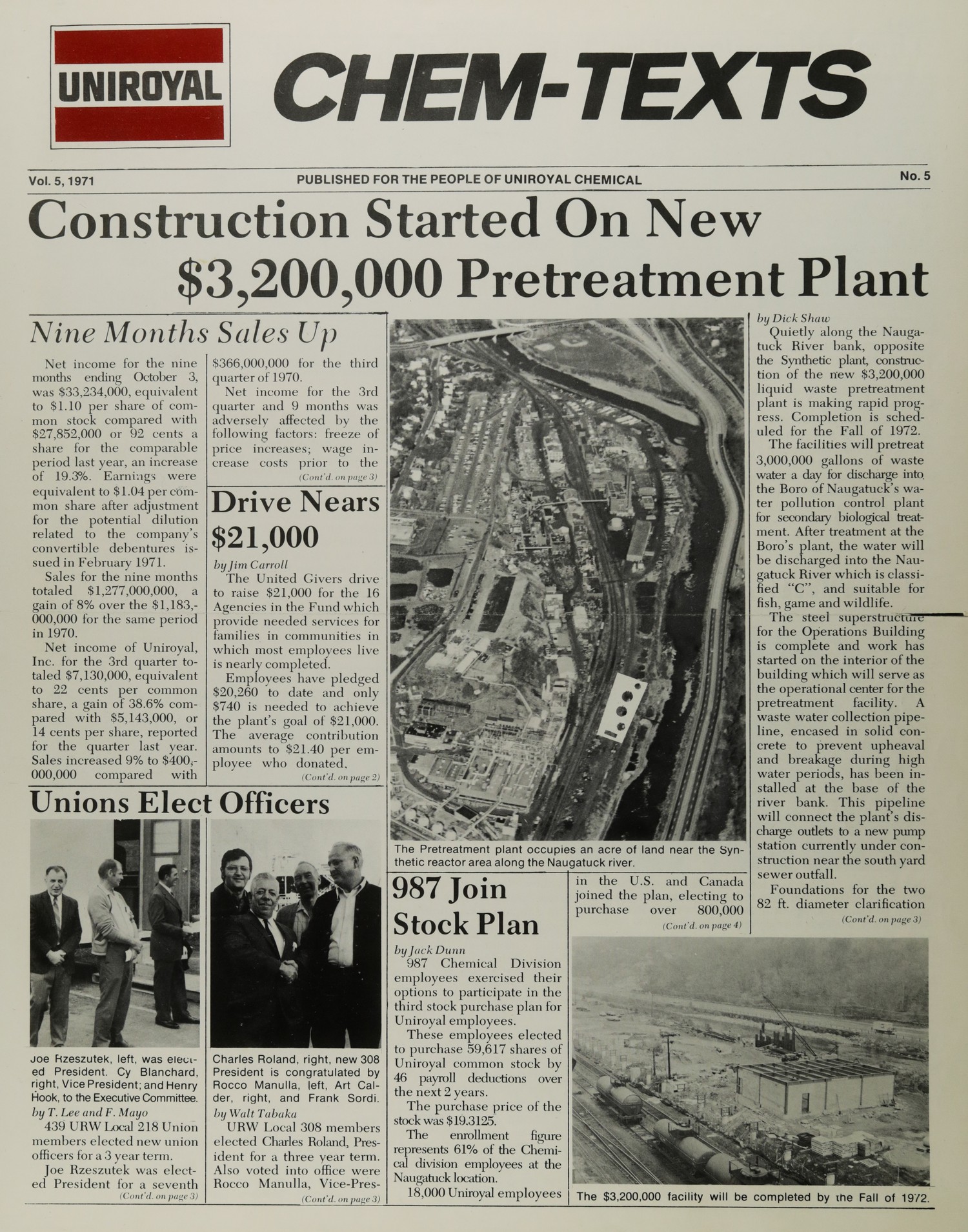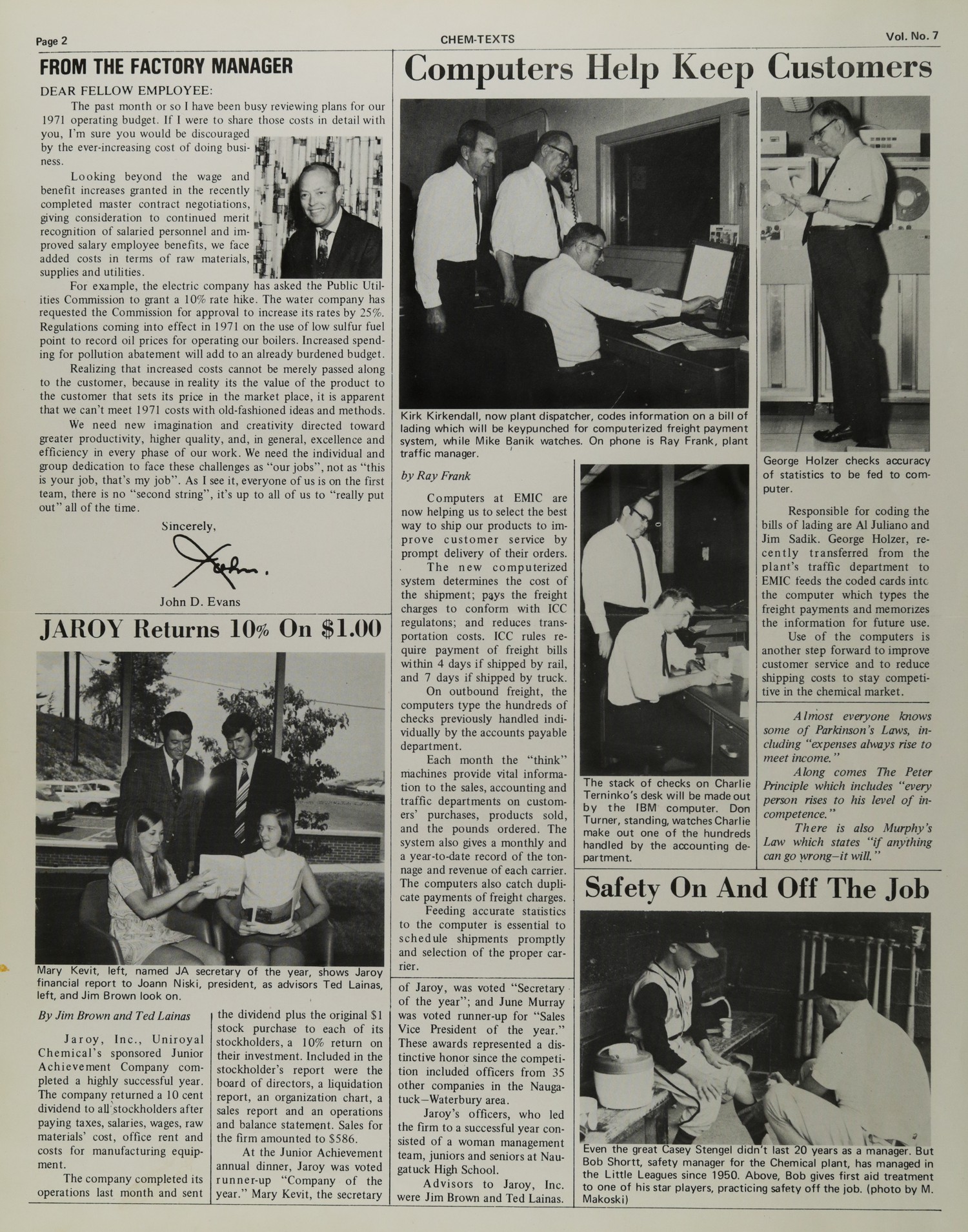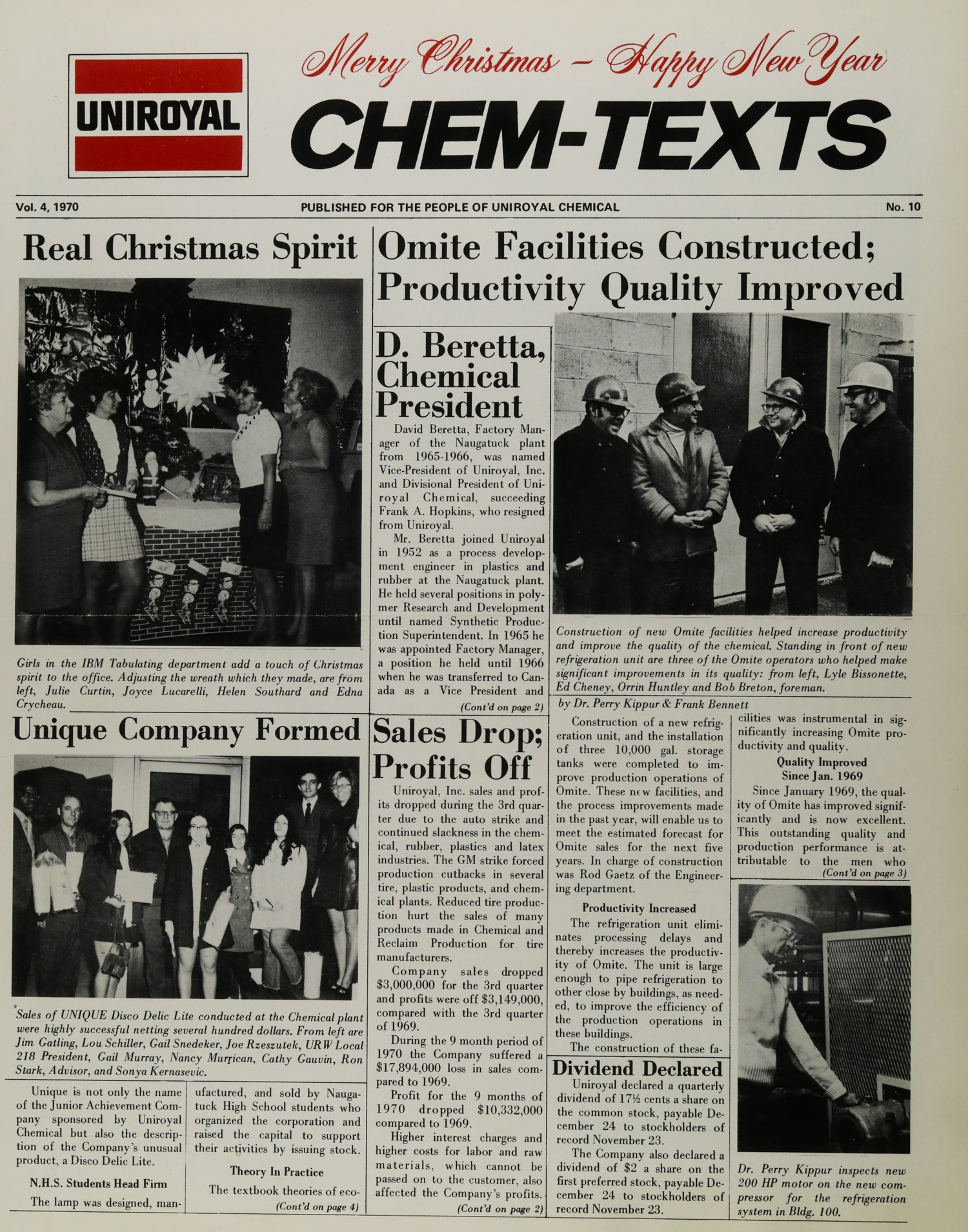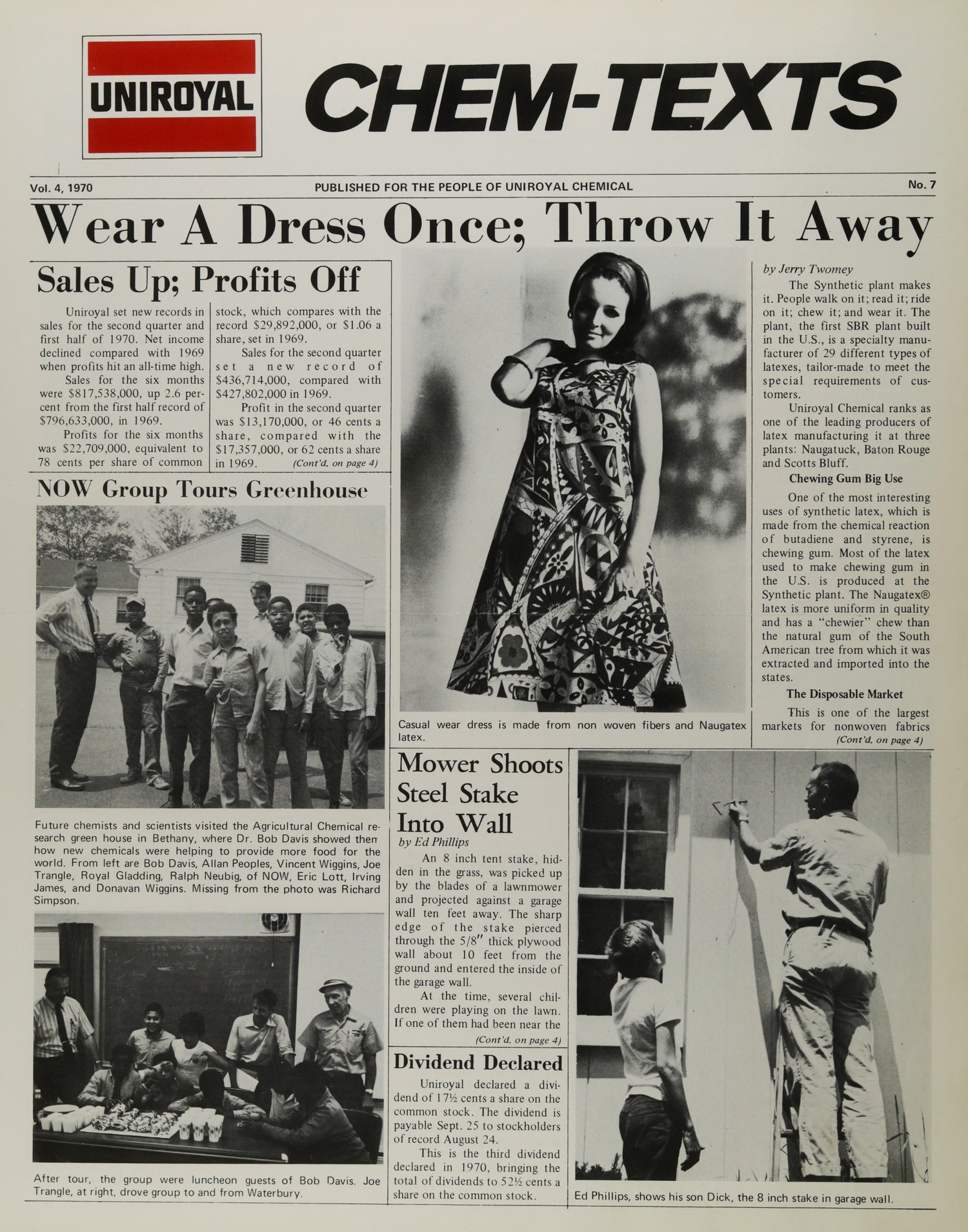
ChemWorld – Page 8

Page 008

CHEMWORLD

WINTER/SPRING 1995


BRIEFS

WACA Recognizes Uniroyal Chemical Associate for Outstanding Service

Roy Parker of Uniroyal Chemical has recently been honored by the Western Agricultural Chemicals Association for outstanding service to the organization and industry.

Parker, product development representative, was named the WACA Outstanding Member for 1994. He was presented with the award at WACA’s 65th Annual Meeting in October, 1994 and is the sixteenth person to receive the award since 1979.

“We’re thrilled to have someone like Roy active in the association,” said Steve Forsberg, WACA executive director. “He took the Legislative Action Program and put his heart and soul into it. It’s one of the most effective grassroots programs in the country. It’s an award well-deserved—Roy is an asset to the entire industry.”

In addition to the Legislative Action Program, Parker has been active on the California State Action Committee and the Government Affairs Committee.

WACA represents manufacturers, formulators, distributors and retailers of pest management products and services in nine Western states. The association’s objective is to promote a positive business climate and industry goodwill. WACA has approximately 200 member companies with 1,000 active participants. ■


CHEMWORLD

is published twice a year by Uniroyal Chemical Company, Inc. for its associates and retirees.

Robert J. Petrausch
Director, Communications

Maureen C. Fama
Manager, Communications Programs

Uniroyal Chemical Company, Inc.
World Headquarters
Benson Road
Middlebury, CT 06749
(203) 573-2000

UNIROYAL CHEMICAL [Logo]


Uniroyal Chemical Corporation Announces Filing of Initial Public Offering

Uniroyal Chemical Corporation, the parent company of Uniroyal Chemical Company, Inc., announced on December 16, 1994 that it has filed with the Securities and Exchange Commission a Registration Statement relating to a proposed $200 million initial public offering of its common stock. Smith Barney Inc., Morgan Stanley & Co. Incorporated, and Wertheim Schroder & Co.

Incorporated will be the representatives of the underwriting syndicate for the offering. The Company intends to use the anticipated proceeds to the Company and up to an additional $40 million to retire indebtedness.

Subject to market conditions and other factors, the Company anticipates that the proposed offering could occur in the first calendar quarter of 1995. There can be no assurance that such favorable

market conditions will exist in the first quarter of 1995.

A Registration Statement relating to the proposed offering of the new common stock has been filed with the Securities and Exchange Commission but has not yet become effective. None of the new common stock may be sold, nor may offers to buy the new common stock be accepted, prior to the time the Registration Statement becomes effective. ■


Logistics Strives for Continuous Customer Satisfaction

(continued from page 2)

warehouse performance helps to ensure that specific goals for on-time shipments, customer pickup turn around time, and inventory accuracy are met.

HAZMAT AND WAREHOUSE OPERATIONS MANAGER
• Henry R. DeVries

■ PACKAGING

The packaging function is responsible for developing quality packages and labels, which must maintain product integrity, and exceed customer, business and Responsible Care® requirements. They must also be disposable, recyclable or source-reduced to ensure regulatory compliance. This includes establishing and maintaining a global package code system for easier tracking and identification purposes.

In 1994, primarily through the efforts of the company’s Packaging Excellence team, total package landfill elimination amounted to over 5.1 million pounds, with a cost savings to Uniroyal Chemical of almost $1.3 million. Active programs emphasizing customer partnerships are continually being pursued and improved upon.

PACKAGING PROGRAM MANAGER
• Morris L. Beaver

■ TRANSPORTATION

Transportation’s goal is to maintain an efficient, responsible global trans-

portation system which provides safe, on-time delivery in a way that protects people and the environment while observing all rules and regulations with total commitment to Responsible Care guidelines.

Managing a timely, accurate freight payment system through continuous audit and maximizing duty drawback, duty suspension processes and tariff reductions to help minimize costs are part of this area.

GENERAL TRAFFIC MANAGER
• Ralph E. Buonocore

■ FORECASTING

Forecasting provides reliable demand forecasts to be utilized to ensure proper inventory and support business planning. This includes monitoring the accuracy of the product forecast by business on a monthly basis, as well as providing one total forecast for Uniroyal Chemical on a global basis.

PLANNING SUPERVISOR
• Michael J. Rosa


Within Uniroyal Chemical, the Logistics Department has been a major contributor to the company’s “Committed to Excellence” programs. Logistics associates now chair the Chemicals and Polymers and Specialties Packaging, Domestic On-Time, Export On-Time, and Crop Documentation Excellence Teams, and serve on many other Excellence Committees. Logistics associates are also very involved in “Where Do I Fit In Quality?”, and have been recognized numerous times through the

company’s Total Quality Recognition Program. Department associates have also received seven Total Quality “Gold Coin” awards and five “President’s Awards” for their outstanding efforts.

The Logistics Department continues to meet multiple Uniroyal Chemical corporate goals in its daily actions: “Total Associate Involvement,” “Supplier of Choice,” “Low Cost Producer of Products and Services,” and “Zero Damage to People and the Environment.” The department is heavily involved in developing and implementing the Distribution Code of Management Practices (Bill Mischou, code leader) as part of the Responsible Care program initiated by the Chemical Manufacturers Association (CMA). The company is expected to have this code in place by November 1995.

And what sort of challenges will Logistics face in the future?

According to Mischou, there are three key areas which will expand the complexities associated with handling and distributing products worldwide: an increase in regulatory compliance; environmental issues (protection of people and the environment); and ever-increasing customer expectations.

“The area of customer expectations will present the biggest challenge. Customer needs are constantly changing, and they will be looking for a supplier who is flexible enough to change along with them, but who also can help contribute to their growing success. I’m confident that we’ll do whatever it takes to be that supplier — and do it without skipping a beat,” he concluded. ■
ChemWorld – Page 7

Page 007

CHEMWORLD

WINTER/SPRING 1995


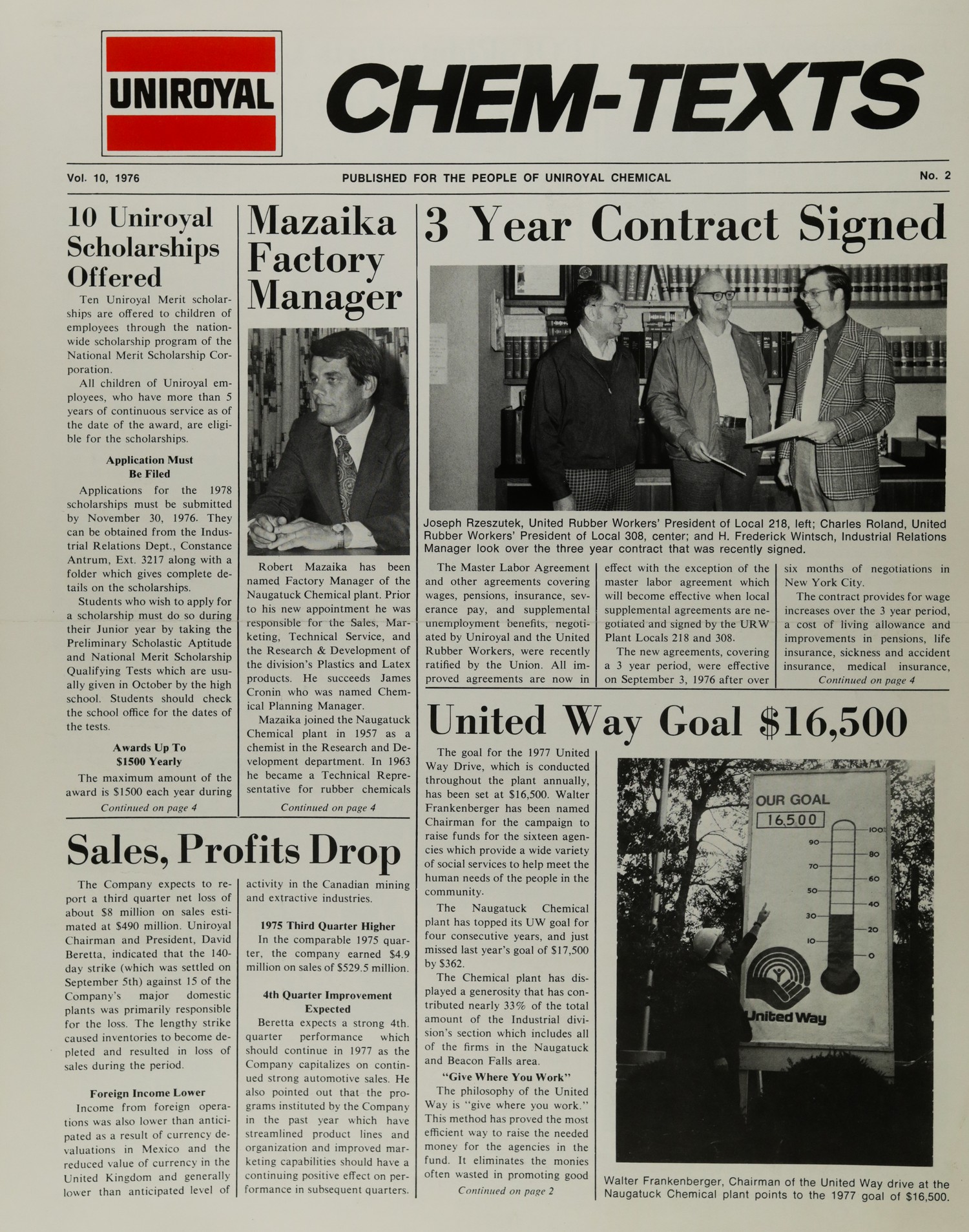
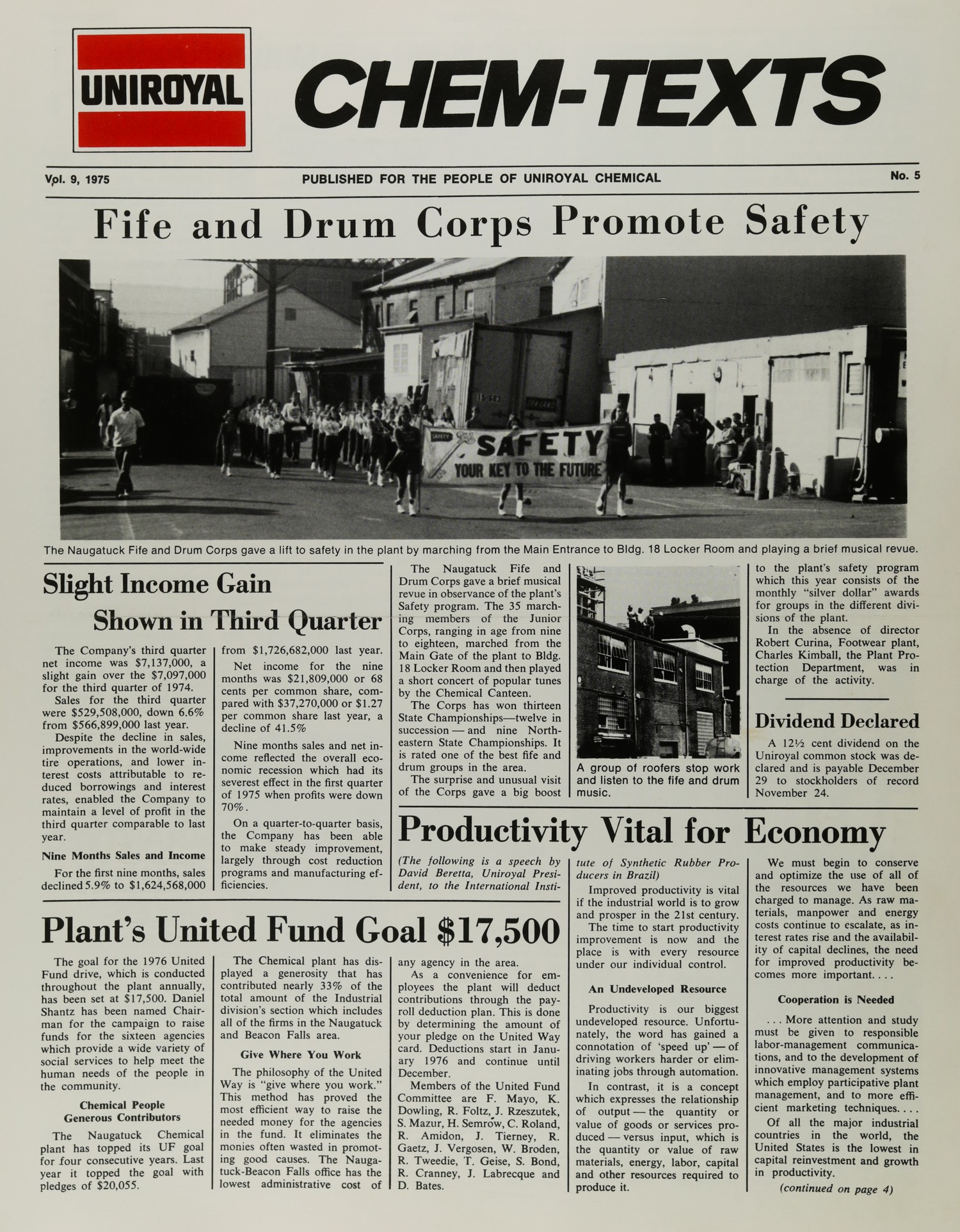
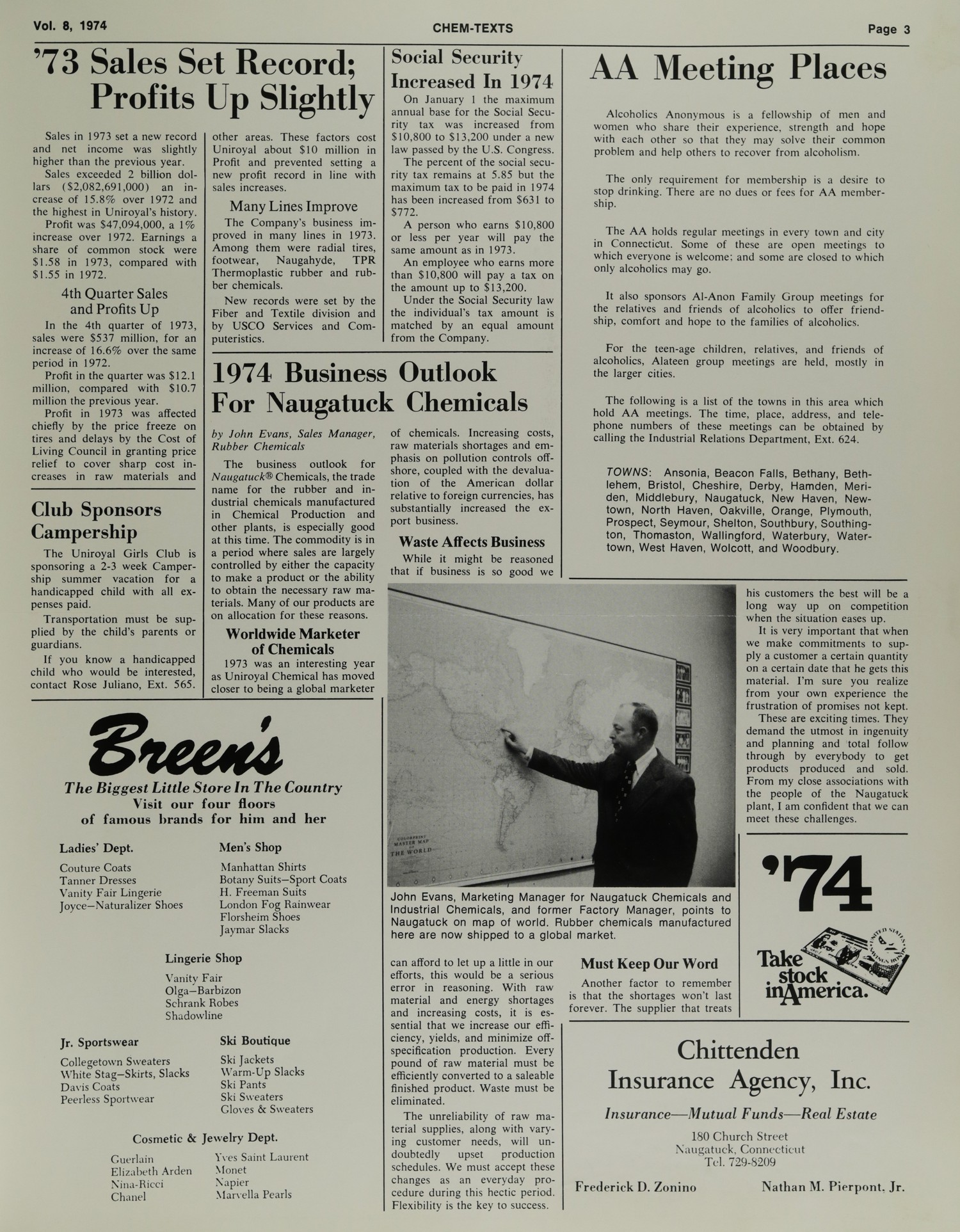
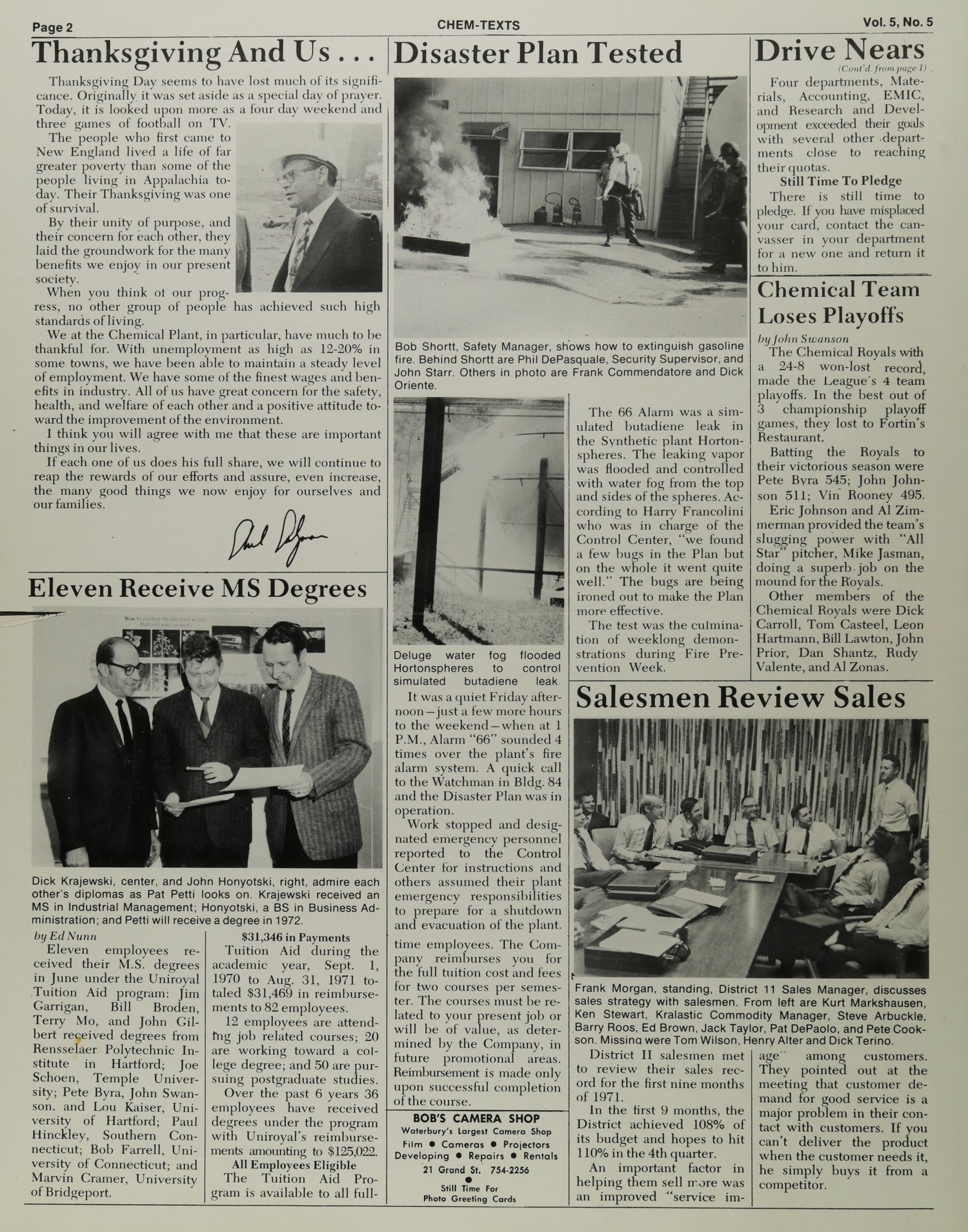
Novaquim Strengthens Uniroyal Chemical’s Expansion Efforts

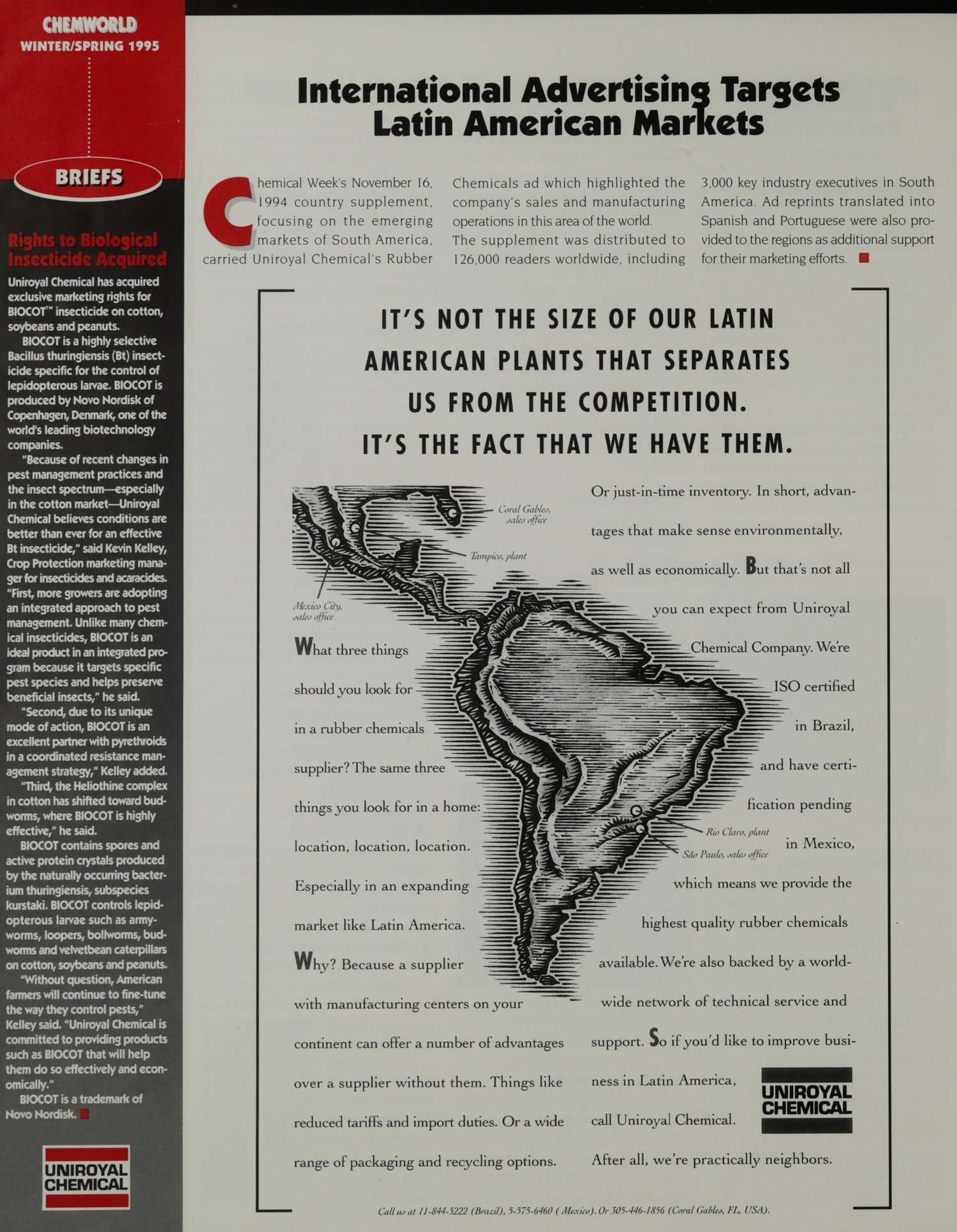
When Uniroyal Chemical fully acquired Novaquim S.A. de C.V. in Mexico from its former joint venture partner Cydsa in July 1993, it hailed the event as a “milestone in the company’s drive toward globalization” and a sign of its “solid commitment to a worldwide customer base and to specialty rubber chemicals, polymers, and urethane markets in Mexico.” Today, Novaquim is proving itself to be more than just a milestone and symbol of commitment.

Under the leadership of Managing Director Rodolfo Montemayor, Novaquim is a pivotal sales and manufacturing organization which allows Uniroyal Chemical to position itself more strongly to serve Mexico and Latin American markets.

“Since the early 1970s, Novaquim has continued to build an outstanding reputation in Mexico as a producer of superior quality products,” said Montemayor. “Our customers continually put our products to the test, and they demand that our products meet the most stringent quality standards for performance. The feedback we’ve received indicates that we’re achieving the highest levels of satisfaction with our customers. We are very proud of this achievement.”

Novaquim is primarily engaged in the manufacture of specialty rubber chemicals for the tire and rubber processing markets, and since 1985, specialty chemicals and polyurethanes for the plastics, petroleum, food additives and recreational markets. Among the key products manufactured at Novaquim’s Tampico facility are a broad range of antioxidants, antiozonants, and other rubber additives such as: Novazone® AS, Tuex Thiram®, Naugard® P/HR, Flexzone® 7F, BLE® 25 and Naugard S.

The Tampico plant, which currently employs almost 100 associates (48 additional associates work at Novaquim’s Mexico City sales office), has helped Uniroyal Chemical meet its goal of establishing research, production, and marketing support capabilities in


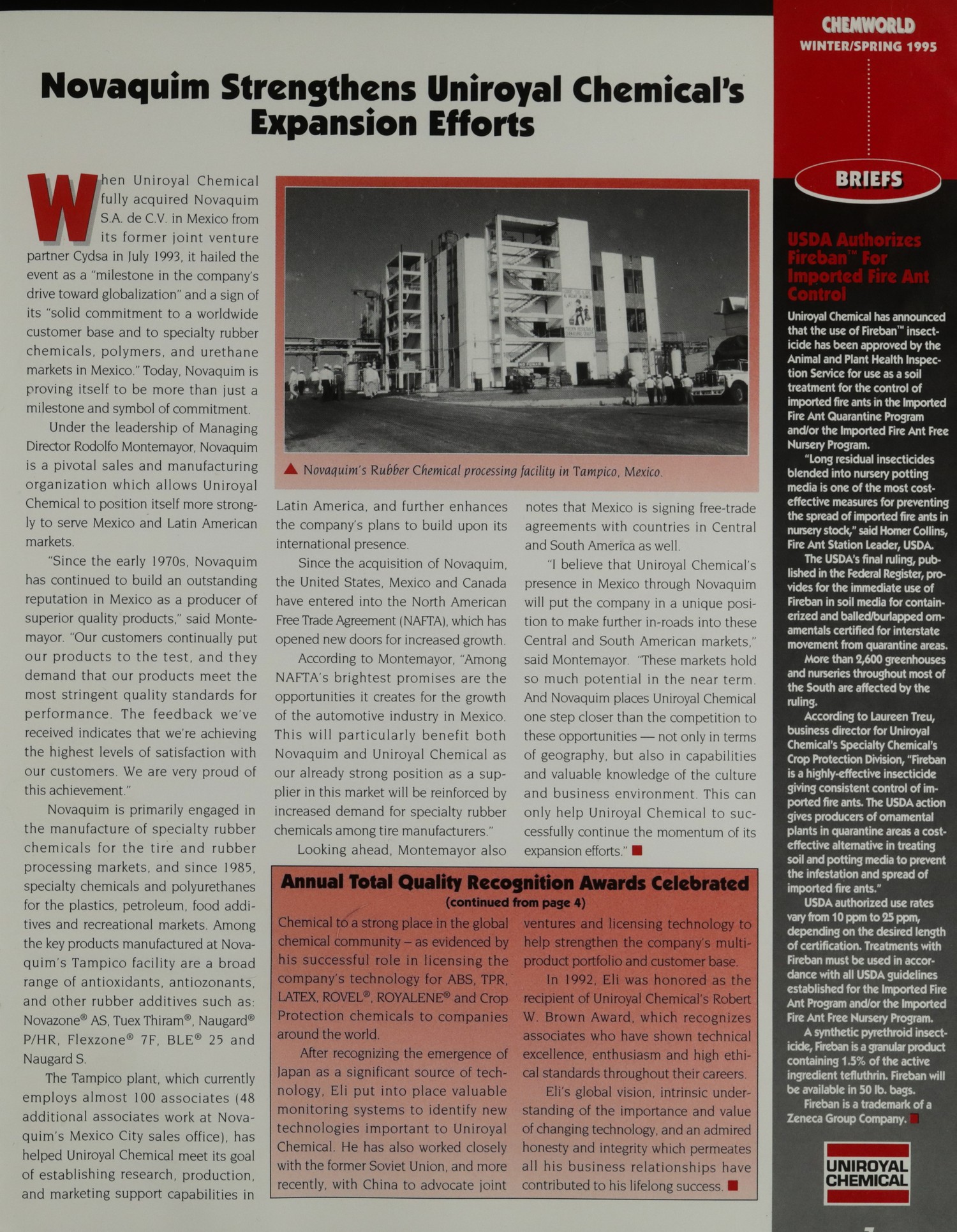
Novaquim’s Rubber Chemical processing facility in Tampico, Mexico.

Latin America, and further enhances the company’s plans to build upon its international presence.

Since the acquisition of Novaquim, the United States, Mexico and Canada have entered into the North American Free Trade Agreement (NAFTA), which has opened new doors for increased growth.

According to Montemayor, “Among NAFTA’s brightest promises are the opportunities it creates for the growth of the automotive industry in Mexico. This will particularly benefit both Novaquim and Uniroyal Chemical as our already strong position as a supplier in this market will be reinforced by increased demand for specialty rubber chemicals among tire manufacturers.”

Looking ahead, Montemayor also

notes that Mexico is signing free-trade agreements with countries in Central and South America as well.

“I believe that Uniroyal Chemical’s presence in Mexico through Novaquim will put the company in a unique position to make further in-roads into these Central and South American markets,” said Montemayor. “These markets hold so much potential in the near term. And Novaquim places Uniroyal Chemical one step closer than the competition to these opportunities — not only in terms of geography, but also in capabilities and valuable knowledge of the culture and business environment. This can only help Uniroyal Chemical to successfully continue the momentum of its expansion efforts.” ■


Annual Total Quality Recognition Awards Celebrated

(continued from page 4)

Chemical to a strong place in the global chemical community – as evidenced by his successful role in licensing the company’s technology for ABS, TPR, LATEX, ROVEL®, ROYALENE® and Crop Protection chemicals to companies around the world.

After recognizing the emergence of Japan as a significant source of technology, Eli put into place valuable monitoring systems to identify new technologies important to Uniroyal Chemical. He has also worked closely with the former Soviet Union, and more recently, with China to advocate joint

ventures and licensing technology to help strengthen the company’s multi-product portfolio and customer base.

In 1992, Eli was honored as the recipient of Uniroyal Chemical’s Robert W. Brown Award, which recognizes associates who have shown technical excellence, enthusiasm and high ethical standards throughout their careers.

Eli’s global vision, intrinsic understanding of the importance and value of changing technology, and an admired honesty and integrity which permeates all his business relationships have contributed to his lifelong success. ■

BRIEFS

USDA Authorizes Fireban™ For Imported Fire Ant Control

Uniroyal Chemical has announced that the use of Fireban™ insecticide has been approved by the Animal and Plant Health Inspection Service for use as a soil treatment for the control of imported fire ants in the Imported Fire Ant Quarantine Program and/or the Imported Fire Ant Free Nursery Program.

“Long residual insecticides blended into nursery potting media is one of the most cost-effective measures for preventing the spread of imported fire ants in nursery stock,” said Homer Collins, Fire Ant Station Leader, USDA.

The USDA’s final ruling, published in the Federal Register, provides for the immediate use of Fireban in soil media for containerized and balled/burlapped ornamentals certified for interstate movement from quarantine areas.

More than 2,600 greenhouses and nurseries throughout most of the South are affected by the ruling.

According to Laureen Treu, business director for Uniroyal Chemical’s Specialty Chemical’s Crop Protection Division, “Fireban is a highly-effective insecticide giving consistent control of imported fire ants. The USDA action gives producers of ornamental plants in quarantine areas a cost-effective alternative in treating soil and potting media to prevent the infestation and spread of imported fire ants.”

USDA authorized use rates vary from 10 ppm to 25 ppm, depending on the desired length of certification. Treatments with Fireban must be used in accordance with all USDA guidelines established for the Imported Fire Ant Program and/or the Imported Fire Ant Free Nursery Program.

A synthetic pyrethroid insecticide, Fireban is a granular product containing 1.5% of the active ingredient tefluthrin. Fireban will be available in 50 lb. bags.

Fireban is a trademark of a Zeneca Group Company. ■

UNIROYAL CHEMICAL

ChemWorld – Page 4

Page 004

CHEMWORLD

WINTER/SPRING 1995


Annual Total Quality Recognition Awards Celebrated

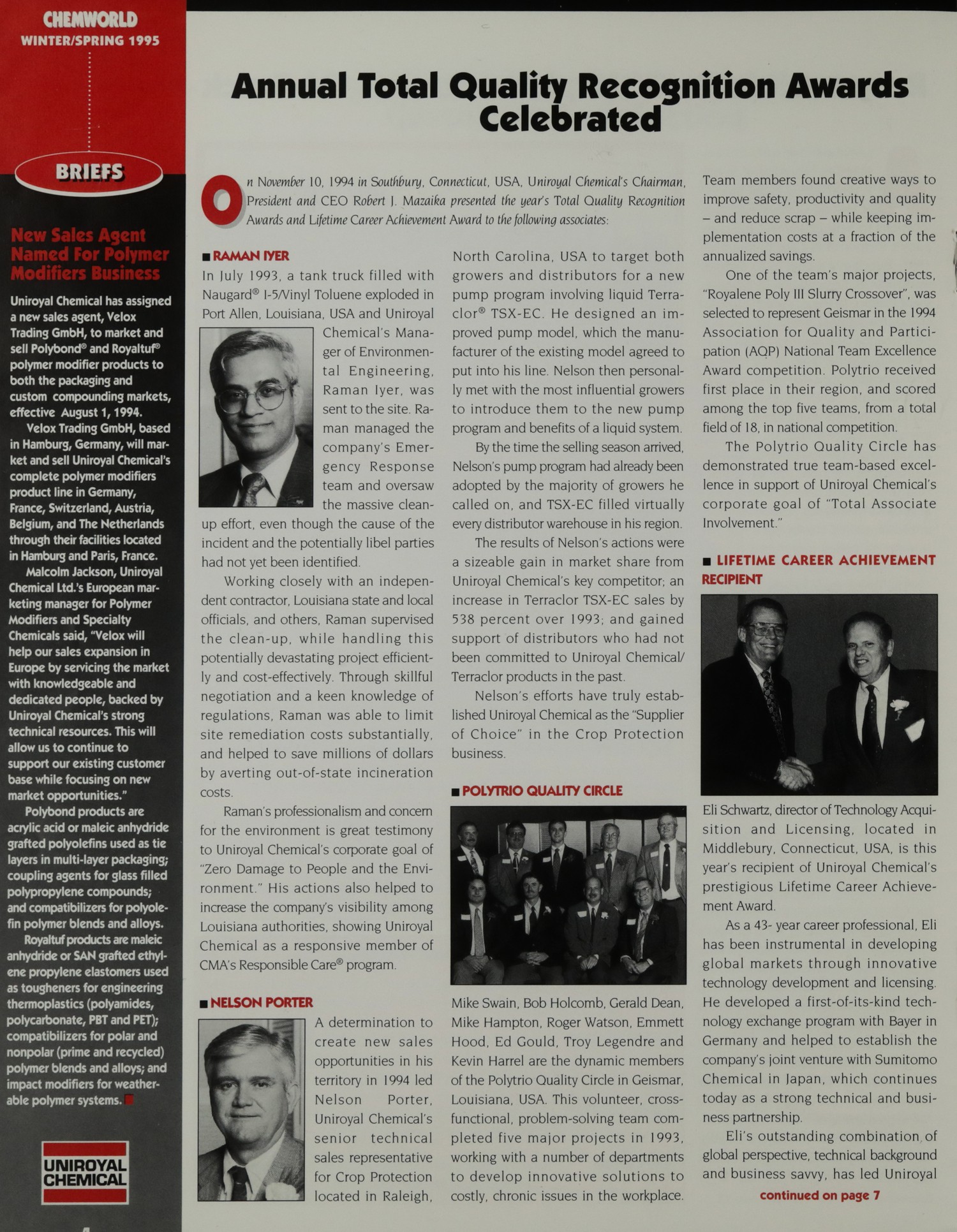
On November 10, 1994 in Southbury, Connecticut, USA, Uniroyal Chemical’s Chairman, President and CEO Robert J. Mazaika presented the year’s Total Quality Recognition Awards and Lifetime Career Achievement Award to the following associates:


BRIEFS

New Sales Agent Named For Polymer Modifiers Business

Uniroyal Chemical has assigned a new sales agent, Velox Trading GmbH, to market and sell Polybond® and Royaltuf® polymer modifier products to both the packaging and custom compounding markets, effective August 1, 1994.

Velox Trading GmbH, based in Hamburg, Germany, will market and sell Uniroyal Chemical’s complete polymer modifiers product line in Germany, France, Switzerland, Austria, Belgium, and The Netherlands through their facilities located in Hamburg and Paris, France.

Malcolm Jackson, Uniroyal Chemical Ltd.’s European marketing manager for Polymer Modifiers and Specialty Chemicals said, “Velox will help our sales expansion in Europe by servicing the market with knowledgeable and dedicated people, backed by Uniroyal Chemical’s strong technical resources. This will allow us to continue to support our existing customer base while focusing on new market opportunities.”

Polybond products are acrylic acid or maleic anhydride grafted polyolefins used as tie layers in multi-layer packaging; coupling agents for glass filled polypropylene compounds; and compatibilizers for polyolefin polymer blends and alloys.

Royaltuf products are maleic anhydride or SAN grafted ethylene propylene elastomers used as tougheners for engineering thermoplastics (polyamides, polycarbonate, PBT and PET); compatibilizers for polar and nonpolar (prime and recycled) polymer blends and alloys; and impact modifiers for weatherable polymer systems. ■

UNIROYAL CHEMICAL


■ RAMAN IYER

In July 1993, a tank truck filled with Naugard® I-5/Vinyl Toluene exploded in Port Allen, Louisiana, USA and Uniroyal Chemical’s Manager of Environmental Engineering, Raman Iyer, was sent to the site. Raman managed the company’s Emergency Response team and oversaw the massive cleanup effort, even though the cause of the incident and the potentially libel parties had not yet been identified.

Working closely with an independent contractor, Louisiana state and local officials, and others, Raman supervised the clean-up, while handling this potentially devastating project efficiently and cost-effectively. Through skillful negotiation and a keen knowledge of regulations, Raman was able to limit site remediation costs substantially, and helped to save millions of dollars by averting out-of-state incineration costs.

Raman’s professionalism and concern for the environment is great testimony to Uniroyal Chemical’s corporate goal of “Zero Damage to People and the Environment.” His actions also helped to increase the company’s visibility among Louisiana authorities, showing Uniroyal Chemical as a responsive member of CMA’s Responsible Care® program.


■ NELSON PORTER

A determination to create new sales opportunities in his territory in 1994 led Nelson Porter, Uniroyal Chemical’s senior technical sales representative for Crop Protection located in Raleigh, North Carolina, USA to target both growers and distributors for a new pump program involving liquid Terraclor® TSX-EC. He designed an improved pump model, which the manufacturer of the existing model agreed to put into his line. Nelson then personally met with the most influential growers to introduce them to the new pump program and benefits of a liquid system.

By the time the selling season arrived, Nelson’s pump program had already been adopted by the majority of growers he called on, and TSX-EC filled virtually every distributor warehouse in his region.

The results of Nelson’s actions were a sizeable gain in market share from Uniroyal Chemical’s key competitor; an increase in Terraclor TSX-EC sales by 538 percent over 1993; and gained support of distributors who had not been committed to Uniroyal Chemical/ Terraclor products in the past.

Nelson’s efforts have truly established Uniroyal Chemical as the “Supplier of Choice” in the Crop Protection business.


■ POLYTRIO QUALITY CIRCLE

Mike Swain, Bob Holcomb, Gerald Dean, Mike Hampton, Roger Watson, Emmett Hood, Ed Gould, Troy Legendre and Kevin Harrel are the dynamic members of the Polytrio Quality Circle in Geismar, Louisiana, USA. This volunteer, cross-functional, problem-solving team completed five major projects in 1993, working with a number of departments to develop innovative solutions to costly, chronic issues in the workplace.

Team members found creative ways to improve safety, productivity and quality – and reduce scrap – while keeping implementation costs at a fraction of the annualized savings.

One of the team’s major projects, “Royalene Poly III Slurry Crossover”, was selected to represent Geismar in the 1994 Association for Quality and Participation (AQP) National Team Excellence Award competition. Polytrio received first place in their region, and scored among the top five teams, from a total field of 18, in national competition.

The Polytrio Quality Circle has demonstrated true team-based excellence in support of Uniroyal Chemical’s corporate goal of “Total Associate Involvement.”


■ LIFETIME CAREER ACHIEVEMENT RECIPIENT

Eli Schwartz, director of Technology Acquisition and Licensing, located in Middlebury, Connecticut, USA, is this year’s recipient of Uniroyal Chemical’s prestigious Lifetime Career Achievement Award.

As a 43- year career professional, Eli has been instrumental in developing global markets through innovative technology development and licensing. He developed a first-of-its-kind technology exchange program with Bayer in Germany and helped to establish the company’s joint venture with Sumitomo Chemical in Japan, which continues today as a strong technical and business partnership.

Eli’s outstanding combination of global perspective, technical background and business savvy, has led Uniroyal

continued on page 7

ChemWorld – Page 2

Page 002

CHEMWORLD

WINTER/SPRING 1995


Logistics Strives For Continuous Customer Satisfaction


BRIEFS

Letter Of Intent Signed To Purchase Crop Protection Business Of Solvay Duphar B.V.

Uniroyal Chemical has signed a letter of intent to purchase the worldwide crop protection business of Solvay Duphar B.V., headquartered in The Netherlands. The business, which has annual sales of approximately $60 million, includes all crop protection assets associated with the production and sale of Casoron® herbicide and Dimilin® insecticide. Both of these products are currently sold in selected geographic regions by Uniroyal Chemical under marketing agreements. Uniroyal Chemical plans to continue production at the Ankerweg plant which is located near Amsterdam. Subject to the execution of a definitive acquisition agreement, it is expected that the acquisition will be completed early in 1995. ■


UNIROYAL CHEMICAL


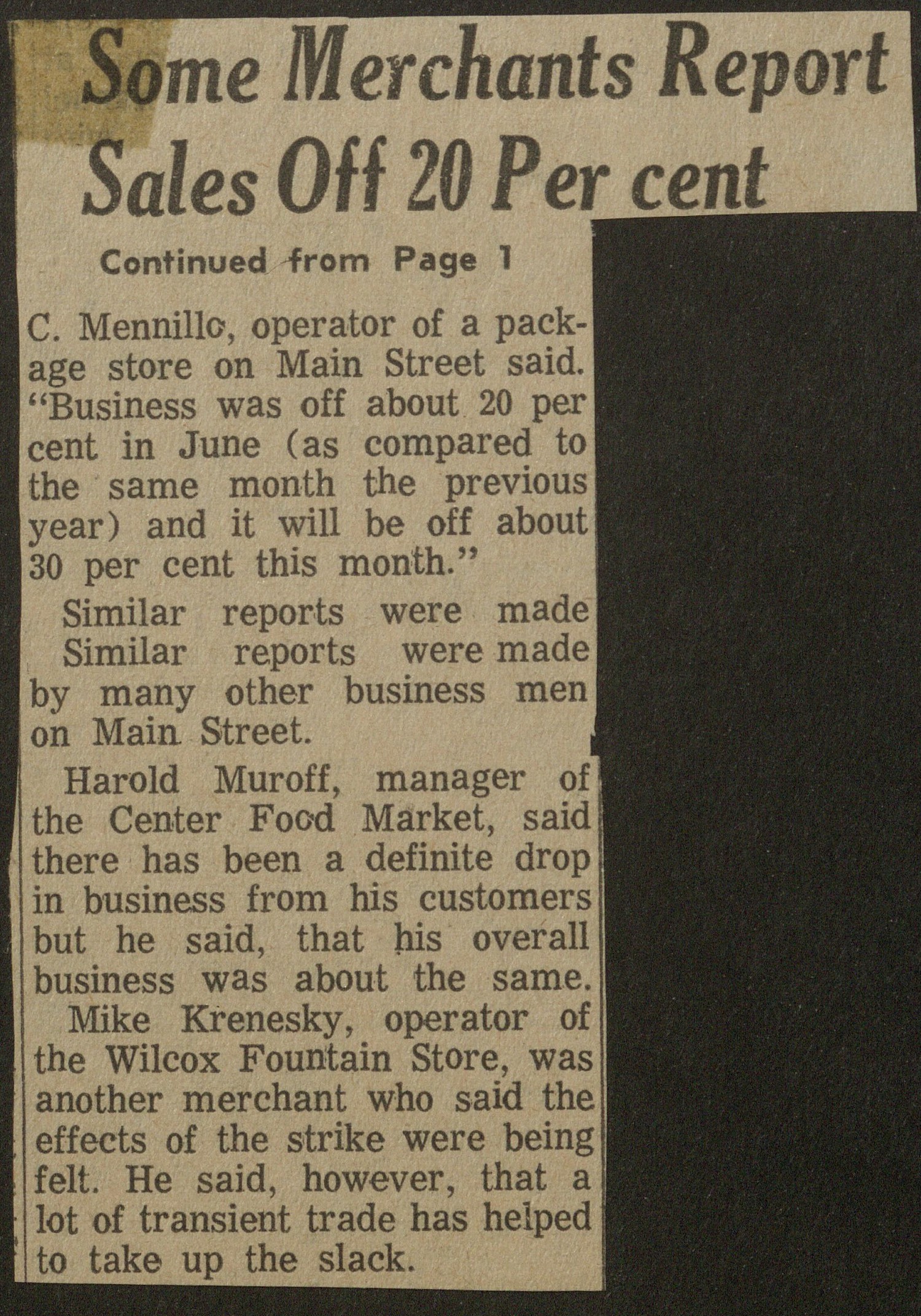
If you ask Uniroyal Chemical’s Director of Logistics worldwide, William T. “Bill” Mischou, what he believes characterizes value-added customer service today and into the 21st century, you’ll hear a firm three-word response: “Reliability, Resilience and Innovation.”

Reliability is providing the right products and service at the right price, delivered as requested by the customer, in the right quantity and package, and without damage. Resilience is the ability to recover when you didn’t do what you were supposed to do right in the first place. Innovation means doing more than just meeting your customers’ basic requests, but also doing more than what the competition does — in essence, doing what’s more than expected and “delighting” the customer.

And these three principles seem to be working. In 1994, the Logistics Department successfully managed to keep inventory levels at a relatively low percent of the company’s total sales on a worldwide basis, while ensuring that Uniroyal Chemical plants around the world received the correct amount of raw materials to manufacture products to meet customers’ needs on a timely basis (on-time service averaged in the mid-90 percent range, with the ultimate goal of 100 percent for all businesses). Ironically, as sales have increased over the last decade, Logistics has been able to more effectively service customers using less inventory each year — a tribute to the management philosophy of efficient worldwide teamwork.

“We are constantly facing a balancing act among customer service, working capital and plant operations,” stated Mischou. “This means providing the best possible service to the customer, while simultaneously keeping working capital costs low through inventory management, but not so low that we jeopardize the efficiency of our plants or lower our on-time delivery

goals. This is, by far, our greatest continuing challenge.”

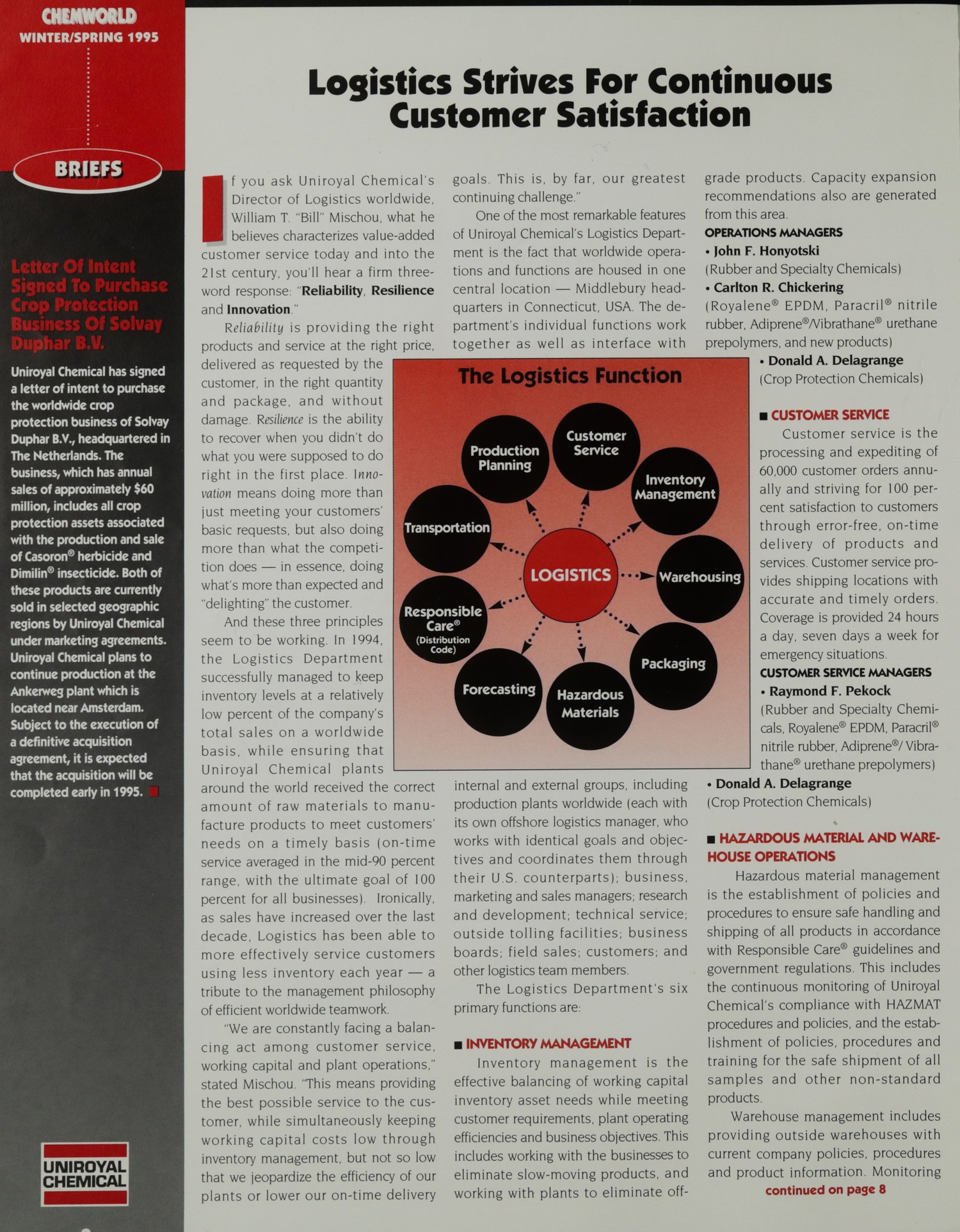
One of the most remarkable features of Uniroyal Chemical’s Logistics Department is the fact that worldwide operations and functions are housed in one central location — Middlebury headquarters in Connecticut, USA. The department’s individual functions work together as well as interface with


The Logistics Function

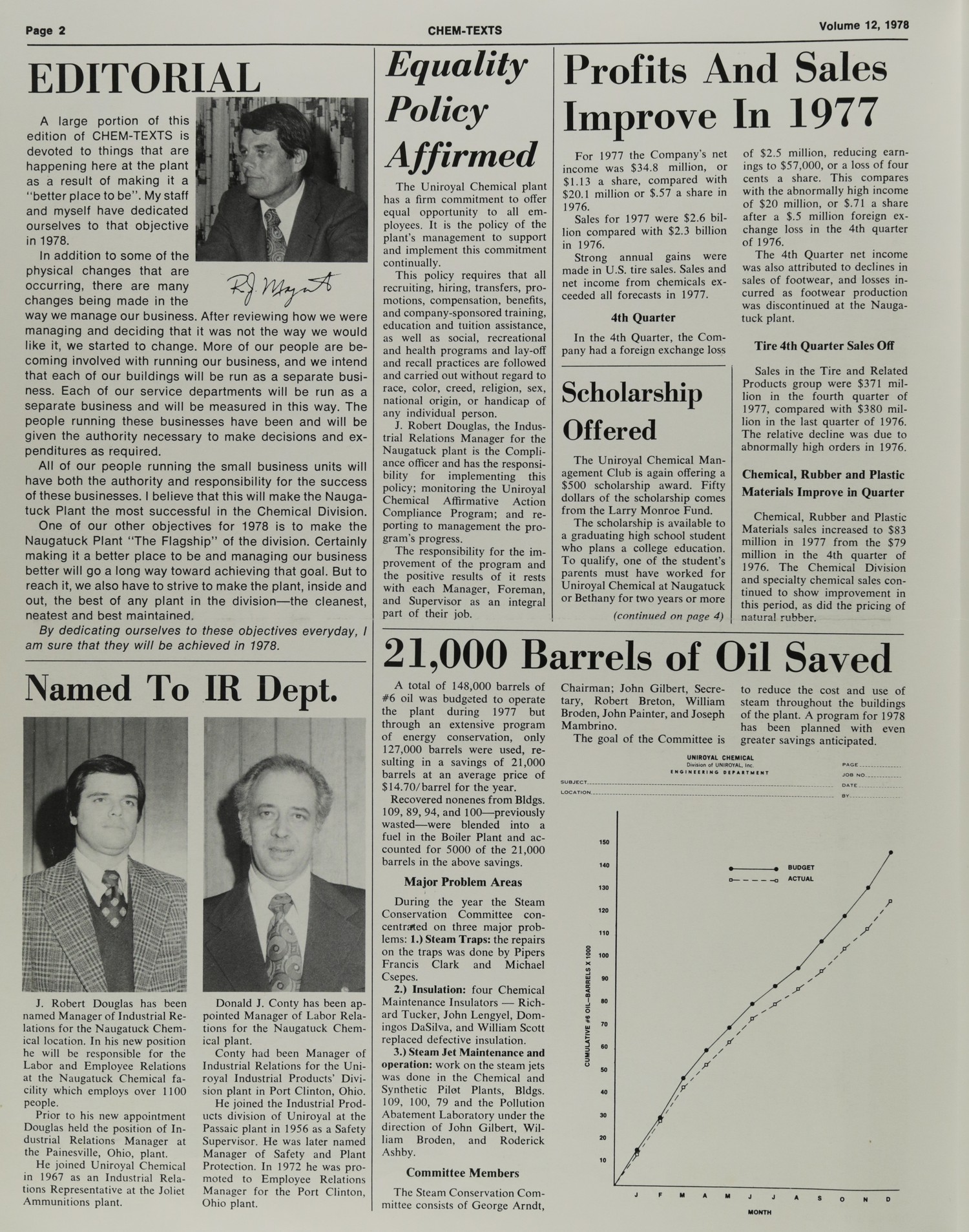
[DIAGRAM showing interconnected circles around central “LOGISTICS” hub, including:
– Production Planning
– Customer Service
– Inventory Management
– Transportation
– Warehousing
– Responsible Care® (Distribution Code)
– Packaging
– Forecasting
– Hazardous Materials]


internal and external groups, including production plants worldwide (each with its own offshore logistics manager, who works with identical goals and objectives and coordinates them through their U.S. counterparts); business, marketing and sales managers; research and development; technical service; outside tolling facilities; business boards; field sales; customers; and other logistics team members.

The Logistics Department’s six primary functions are:

INVENTORY MANAGEMENT

Inventory management is the effective balancing of working capital inventory asset needs while meeting customer requirements, plant operating efficiencies and business objectives. This includes working with the businesses to eliminate slow-moving products, and working with plants to eliminate off-

grade products. Capacity expansion recommendations also are generated from this area.

OPERATIONS MANAGERS
John F. Honyotski
(Rubber and Specialty Chemicals)
Carlton R. Chickering
(Royalene® EPDM, Paracril® nitrile rubber, Adiprene®/Vibrathane® urethane prepolymers, and new products)
Donald A. Delagrange
(Crop Protection Chemicals)

CUSTOMER SERVICE

Customer service is the processing and expediting of 60,000 customer orders annually and striving for 100 percent satisfaction to customers through error-free, on-time delivery of products and services. Customer service provides shipping locations with accurate and timely orders. Coverage is provided 24 hours a day, seven days a week for emergency situations.

CUSTOMER SERVICE MANAGERS
Raymond F. Pecock
(Rubber and Specialty Chemicals, Royalene® EPDM, Paracril® nitrile rubber, Adiprene®/Vibrathane® urethane prepolymers)
Donald A. Delagrange
(Crop Protection Chemicals)

HAZARDOUS MATERIAL AND WAREHOUSE OPERATIONS

Hazardous material management is the establishment of policies and procedures to ensure safe handling and shipping of all products in accordance with Responsible Care® guidelines and government regulations. This includes the continuous monitoring of Uniroyal Chemical’s compliance with HAZMAT procedures and policies, and the establishment of policies, procedures and training for the safe shipment of all samples and other non-standard products.

Warehouse management includes providing outside warehouses with current company policies, procedures and product information. Monitoring

continued on page 8

ChemWorld – Page 6

Page 006

ChemWorld | 6 | January 1991


Uniroyal Chemical Receives Two Supplier Quality Awards For Its Royalene EPDM Business

Uniroyal Chemical has received the 1989 Annual Supplier Quality Excellence Award from General Tire Company, on behalf of its Royalene® EPDM business.

This prestigious “quality excellence” award is based on a stringent rating system and performance evaluation developed by General Tire Company. Uniroyal Chemical, one of thirteen companies throughout the United States, Canada and Japan to receive this Award, qualified from a field of almost 300 raw material suppliers and distributors throughout the world.

According to William A. Stephenson, Uniroyal Chemical’s former Royalene EPDM business manager, “it is a great honor for us to be selected as a winner of General Tire’s Annual Supplier Quality Excellence Award. Our strong commitment to our customers has helped us work and grow in partnership with General Tire. We look forward to continuing this relationship in the years to come.”

The company’s Royalene EPDM business provides a high performance specialty elastomer used in the manufacture of tires to impart improved weathering and ozone protection.

General Tire is a subsidiary of Continental AG of West Germany, the fourth largest tire manufacturer in the world.

In addition, Uniroyal Chemical also received the 1990 Supplier “Mark of Distinction” Award from Schlegel Tennessee, Inc., on behalf of its Royalene EPDM products which Schlegel uses in automotive sealing applications.

Uniroyal Chemical is the first supplier to receive this award from Schlegel, given for continuous improvement in five critical areas: quality, technology, management, delivery and cost. The results were based on an internal audit conducted by Schlegel at Uniroyal Chemical’s Geismar, Louisiana facility where Royalene EPDM is produced.

Schlegel, headquartered in Detroit, Michigan, manufactures a broad range of products for the automotive industry on a


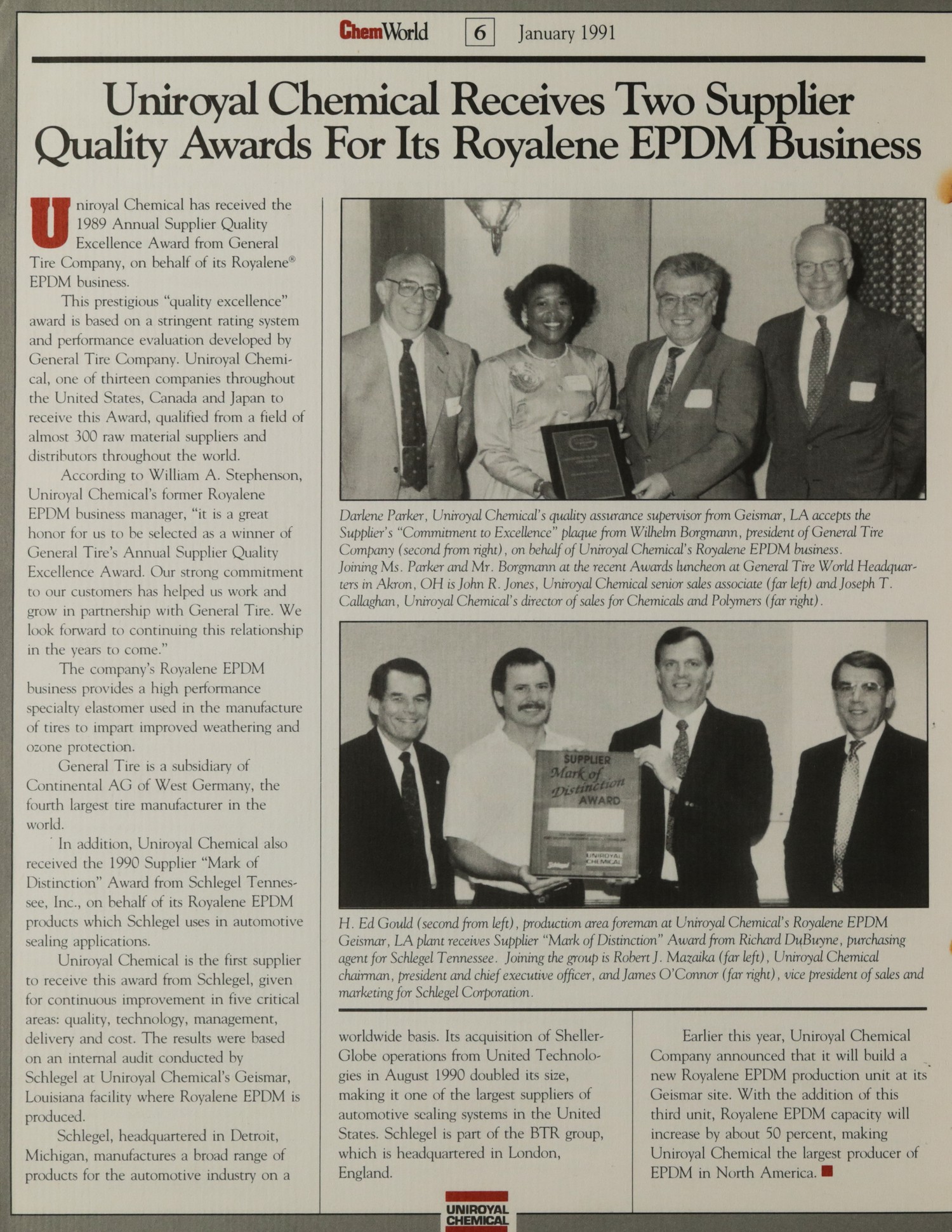
Darlene Parker, Uniroyal Chemical’s quality assurance supervisor from Geismar, LA accepts the Supplier’s “Commitment to Excellence” plaque from Wilhelm Borgmann, president of General Tire Company (second from right), on behalf of Uniroyal Chemical’s Royalene EPDM business. Joining Ms. Parker and Mr. Borgmann at the recent Awards luncheon at General Tire World Headquarters in Akron, OH is John R. Jones, Uniroyal Chemical senior sales associate (far left) and Joseph T. Callaghan, Uniroyal Chemical’s director of sales for Chemicals and Polymers (far right).


H. Ed Gould (second from left), production area foreman at Uniroyal Chemical’s Royalene EPDM Geismar, LA plant receives Supplier “Mark of Distinction” Award from Richard DuBuyne, purchasing agent for Schlegel Tennessee. Joining the group is Robert J. Mazaika (far left), Uniroyal Chemical chairman, president and chief executive officer, and James O’Connor (far right), vice president of sales and marketing for Schlegel Corporation.


worldwide basis. Its acquisition of Sheller-Globe operations from United Technologies in August 1990 doubled its size, making it one of the largest suppliers of automotive sealing systems in the United States. Schlegel is part of the BTR group, which is headquartered in London, England.

Earlier this year, Uniroyal Chemical Company announced that it will build a new Royalene EPDM production unit at its Geismar site. With the addition of this third unit, Royalene EPDM capacity will increase by about 50 percent, making Uniroyal Chemical the largest producer of EPDM in North America. ■


UNIROYAL CHEMICAL

ChemWorld – Page 2

Page 002

ChemWorld | 2 | January 1991


Uniroyal Chemical Aids U.S.S.R. Cotton Industry

In the spirit of glasnost, Uniroyal Chemical recently launched an integrated cotton improvement program in the U.S.S.R., symbolizing its commitment to developing business in Soviet Central Asia. The program represents a giant step towards establishing Uniroyal Chemical as a leader in worldwide harvest aid technology.

SIBIR, Inc., USA, a business development/consulting firm which has a joint venture in Soviet Central Asia to advance the cotton industry, approached Uniroyal Chemical to help the Soviet cotton industry develop harvest aids, and ultimately to become more competitive.

“The Soviets grow excellent cotton, but haven’t yet mastered harvesting techniques,” said David Cote, marketing manager for plant growth regulators and herbicides, Crop Protection Division of Uniroyal Chemical. “Our technical teams from the U.S. and Langley, England offices assisted in establishing the research protocols for selecting inputs for their cotton improvement program.” Field testing is now underway to evaluate those inputs. If all goes well, the program could result in multi-million dollar sales of American products, including Harvade® harvest growth regulant.

Uniroyal Chemical technical teams have provided field development assistance to Uzbekistan, a republic of the U.S.S.R., which grows over 4.5 million acres of cotton, and accounts for 65 percent of the country’s cotton industry. Recently, the Soviet team, which includes three delegates from Uzbekistan, toured the top U.S. cotton growing areas in the Mississippi Delta and California (see sidebar).

More than half of Uniroyal Chemical’s agricultural business is outside of the United States. The U.S.S.R. has been a large importer of Vitavax® fungicide for cereal grain production. Uniroyal Chemical is well-positioned to expand this business further to develop agricultural marketplaces worldwide. ■


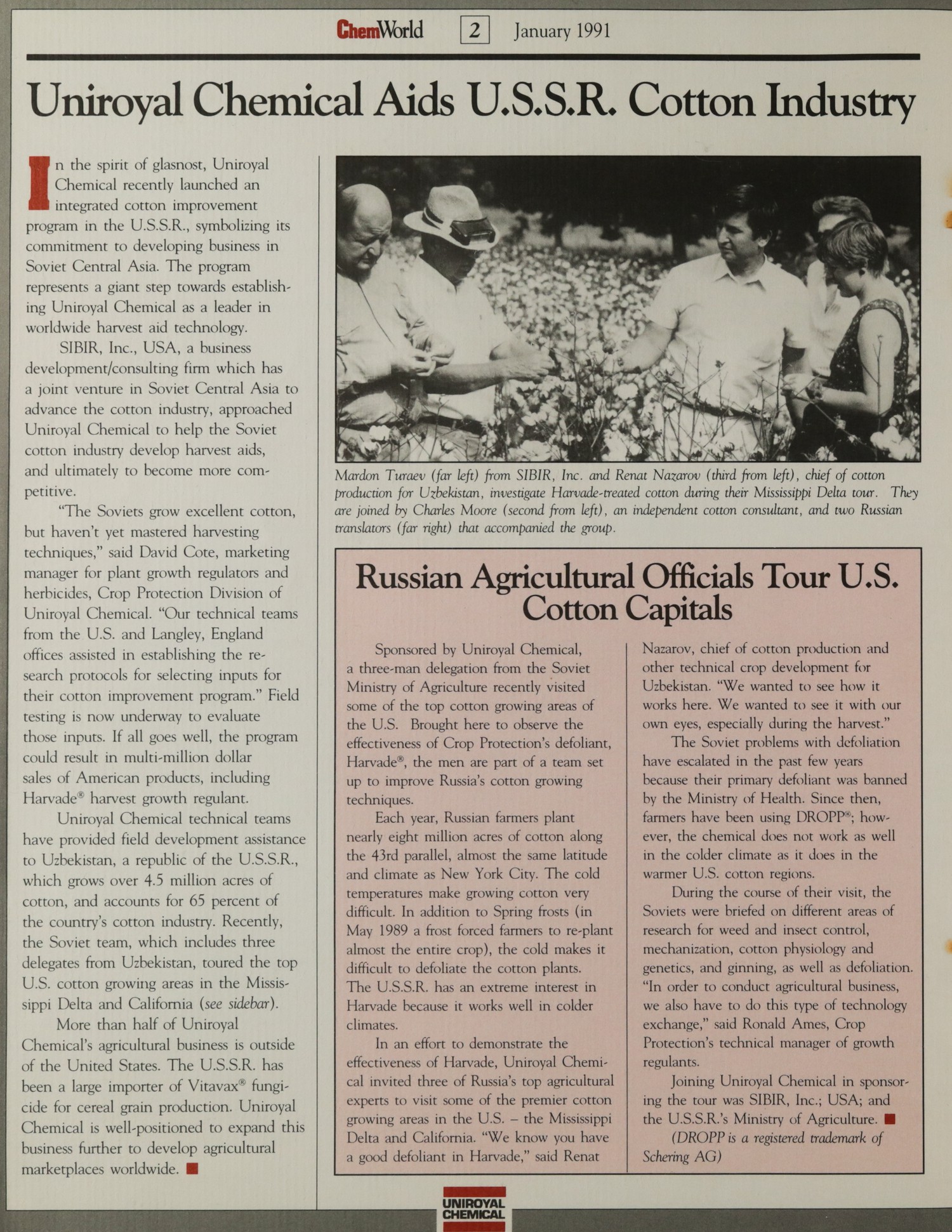
Mardon Turaev (far left) from SIBIR, Inc. and Renat Nazarov (third from left), chief of cotton production for Uzbekistan, investigate Harvade-treated cotton during their Mississippi Delta tour. They are joined by Charles Moore (second from left), an independent cotton consultant, and two Russian translators (far right) that accompanied the group.


Russian Agricultural Officials Tour U.S. Cotton Capitals

Sponsored by Uniroyal Chemical, a three-man delegation from the Soviet Ministry of Agriculture recently visited some of the top cotton growing areas of the U.S. Brought here to observe the effectiveness of Crop Protection’s defoliant, Harvade®, the men are part of a team set up to improve Russia’s cotton growing techniques.

Each year, Russian farmers plant nearly eight million acres of cotton along the 43rd parallel, almost the same latitude and climate as New York City. The cold temperatures make growing cotton very difficult. In addition to Spring frosts (in May 1989 a frost forced farmers to re-plant almost the entire crop), the cold makes it difficult to defoliate the cotton plants. The U.S.S.R. has an extreme interest in Harvade because it works well in colder climates.

In an effort to demonstrate the effectiveness of Harvade, Uniroyal Chemical invited three of Russia’s top agricultural experts to visit some of the premier cotton growing areas in the U.S. – the Mississippi Delta and California. “We know you have a good defoliant in Harvade,” said Renat

Nazarov, chief of cotton production and other technical crop development for Uzbekistan. “We wanted to see how it works here. We wanted to see it with our own eyes, especially during the harvest.”

The Soviet problems with defoliation have escalated in the past few years because their primary defoliant was banned by the Ministry of Health. Since then, farmers have been using DROPP®; however, the chemical does not work as well in the colder climate as it does in the warmer U.S. cotton regions.

During the course of their visit, the Soviets were briefed on different areas of research for weed and insect control, mechanization, cotton physiology and genetics, and ginning, as well as defoliation. “In order to conduct agricultural business, we also have to do this type of technology exchange,” said Ronald Ames, Crop Protection’s technical manager of growth regulants.

Joining Uniroyal Chemical in sponsoring the tour was SIBIR, Inc.; USA; and the U.S.S.R.’s Ministry of Agriculture. ■

(DROPP is a registered trademark of Schering AG)


UNIROYAL CHEMICAL

ChemWorld – Page 7

Page 007

ChemWorld | 7 | January 1991


New Product Technologies And Global Expansion

continued from page 5

Q. New C&P sales are expected in the Soviet Union in 1991. What products and applications will this include?

A. For a number of years, we’ve been considered a preferred supplier to the U.S.S.R. The main product groups that we’ve moved into the U.S.S.R. have been rubber chemicals and urethane prepolymers. We will continue to grow this business in rubber chemicals, mostly used for tire manufacturing; and urethanes, used for solid tires and die-forming pads. The U.S.S.R. has expressed considerable interest in Royalene EPDM for several applications and our commercial and technical people are presently in dialogue with the Russians. The lack of hard currency has produced some constraint, but we are working a number of avenues to secure letters of credit and necessary funds to continue this very important base of business.

Q. Recently, the first worldwide C&P Sales Meeting was held in Lenox, Massachusetts. What was achieved from this meeting?

A. I believe that all 75 participants of this meeting left very much enriched with enhanced sales and technical skills, as well as more in-depth product knowledge. This was a very successful communication exercise, with a significant sharing of issues and opportunities. We have organized a steering committee to review and manage these issues and opportunities through individual assignments. In short, this first meeting has provided us with a new coordination of identified global accounts.

Q. Uniroyal Chemical places tremendous emphasis on partnerships with customers. What is the C&P Division currently doing to enhance its customer relationships and encourage more business from them?

A. The C&P Division interacts with our customer base on a broad front. Our sales and technical representatives are the key, first-line interface with the customer. Secondly, we have organized our customer service department with specific representatives who are in daily contact with customers. Through our Excellence Modeling process, we involve as many people as possible to interact effectively with customers. For example, our Adopt-A-Customer program has been very effective in solving


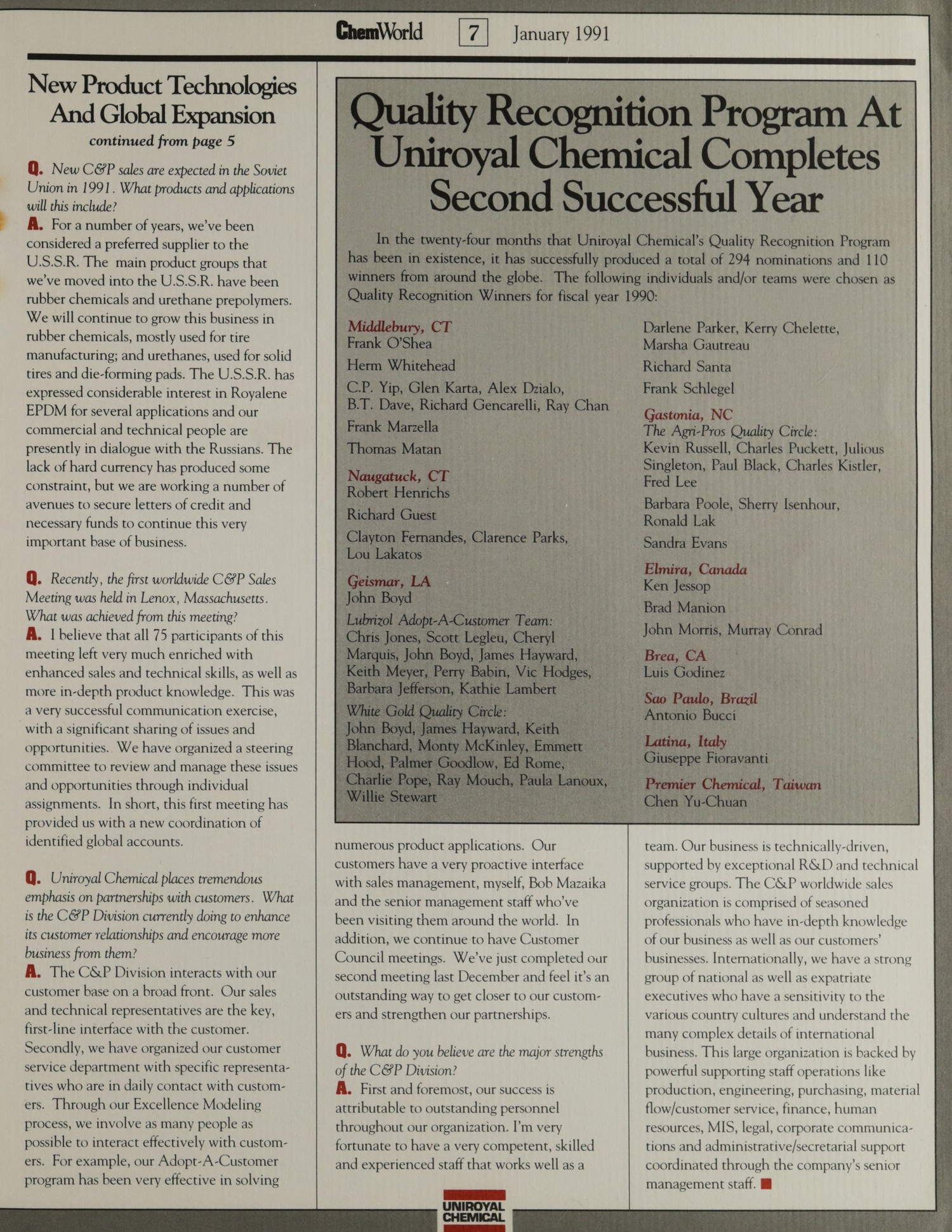
Quality Recognition Program At Uniroyal Chemical Completes Second Successful Year

In the twenty-four months that Uniroyal Chemical’s Quality Recognition Program has been in existence, it has successfully produced a total of 294 nominations and 110 winners from around the globe. The following individuals and/or teams were chosen as Quality Recognition Winners for fiscal year 1990:

Middlebury, CT
Frank O’Shea
Herm Whitehead
C.P. Yip, Glen Karta, Alex Dzialo,
B.T. Dave, Richard Gencarelli, Ray Chan
Frank Marzella
Thomas Matan

Naugatuck, CT
Robert Henrichs
Richard Guest
Clayton Fernandes, Clarence Parks,
Lou Lakatos

Geismar, LA
John Boyd

Lubrizol Adopt-A-Customer Team:
Chris Jones, Scott Legleu, Cheryl Marquis, John Boyd, James Hayward, Keith Meyer, Perry Babin, Vic Hodges, Barbara Jefferson, Kathie Lambert

White Gold Quality Circle:
John Boyd, James Hayward, Keith Blanchard, Monty McKinley, Emmett Hood, Palmer Goodlow, Ed Rome, Charlie Pope, Ray Mouch, Paula Lanoux, Willie Stewart

Darlene Parker, Kerry Chelette,
Marsha Gautreau
Richard Santa
Frank Schlegel

Gastonia, NC
The Agri-Pros Quality Circle:
Kevin Russell, Charles Puckett, Julious Singleton, Paul Black, Charles Kistler, Fred Lee
Barbara Poole, Sherry Isenhour,
Ronald Lak
Sandra Evans

Elmira, Canada
Ken Jessop
Brad Manion
John Morris, Murray Conrad

Brea, CA
Luis Godinez

Sao Paulo, Brazil
Antonio Bucci

Latina, Italy
Giuseppe Fioravanti

Premier Chemical, Taiwan
Chen Yu-Chuan

numerous product applications. Our customers have a very proactive interface with sales management, myself, Bob Mazaika and the senior management staff who’ve been visiting them around the world. In addition, we continue to have Customer Council meetings. We’ve just completed our second meeting last December and feel it’s an outstanding way to get closer to our customers and strengthen our partnerships.

Q. What do you believe are the major strengths of the C&P Division?

A. First and foremost, our success is attributable to outstanding personnel throughout our organization. I’m very fortunate to have a very competent, skilled and experienced staff that works well as a

team. Our business is technically-driven, supported by exceptional R&D and technical service groups. The C&P worldwide sales organization is comprised of seasoned professionals who have in-depth knowledge of our business as well as our customers’ businesses. Internationally, we have a strong group of national as well as expatriate executives who have a sensitivity to the various country cultures and understand the many complex details of international business. This large organization is backed by powerful supporting staff operations like production, engineering, purchasing, material flow/customer service, finance, human resources, MIS, legal, corporate communications and administrative/secretarial support coordinated through the company’s senior management staff. ■


UNIROYAL CHEMICAL

ChemWorld – Page 7

Page 007

ChemWorld | 7 | January 1990


Technical Publishers Honored At Uniroyal Chemical’s Author Recognition Program

Forty-five Uniroyal Chemical Company employees were recognized in October 1989 at the Authors Recognition Program, which acknowledges staff members who have published in a professional journal or have presented a technical paper before a major scientific organization.

Established in 1983 and held every two years, the Authors Recognition Program helps to promote the reputation of Uniroyal Chemical Company and its technical staff as industry innovators and contributors to the scientific community. To date, over 95 Uniroyal Chemical employees have been recognized for their accomplishments in this area.

The Authors Recognition Committee is comprised of: Dr. Emmanuel G. Kontos, manager of elastomers technology; Robert C. LaClair, specialty chemicals technical sales service manager; and Allen R. Blem, registration specialist.

Distinguished Authors

Chemicals and Polymers

| Allen, R.D. (2) | Paolino, P.R. |
| Barnhart, R.R. | Peterson, H.A. |
| Cesare, F.C. (3) | Perrella, A.V. |
| Davies, T.J. | Sheridan, D.F., Jr. (2) |
| Farber, M. | Synnott, D.J. (2) |
| Hong, S.W. (2) | Tomlinson, R.W. |
| Jablonowski, T.L. (3) | Tredinnick, D.W. |
| Mazzeo, R.A. (2) | Tweedie, R.W. |

Crop Protection

| Bell, A.R. | Lai, H.K. |
| Blem, A.R. | Mishra, A. |
| Borth, D.M. | Moore, E.L. |
| Brouwer, W.G. | Moore, R.C. |
| Burger, R.N. | Parkins, M.D. |
| Cole, L.P. | Polakoff, B.M. |
| Covey, R.A. | Relyea, D.I. (3) |
| Dekeyser, M.A. (2) | Rockwell, J. |
| Kelley, K.L. | Shadbolt, C.A. |
| Kulka, M. | von Schmeling, B. |

Specialties

| Abruscato, G.J. | Rosenberg, R.O. |
| Chucta, T.M. | Singh, A. |
| Horng, P.L. | Stott, P.E. |
| McKinstry, P.H. | Zawacki, C.A. |
| Ricci, V. | |

( ) signifies multiple presentations


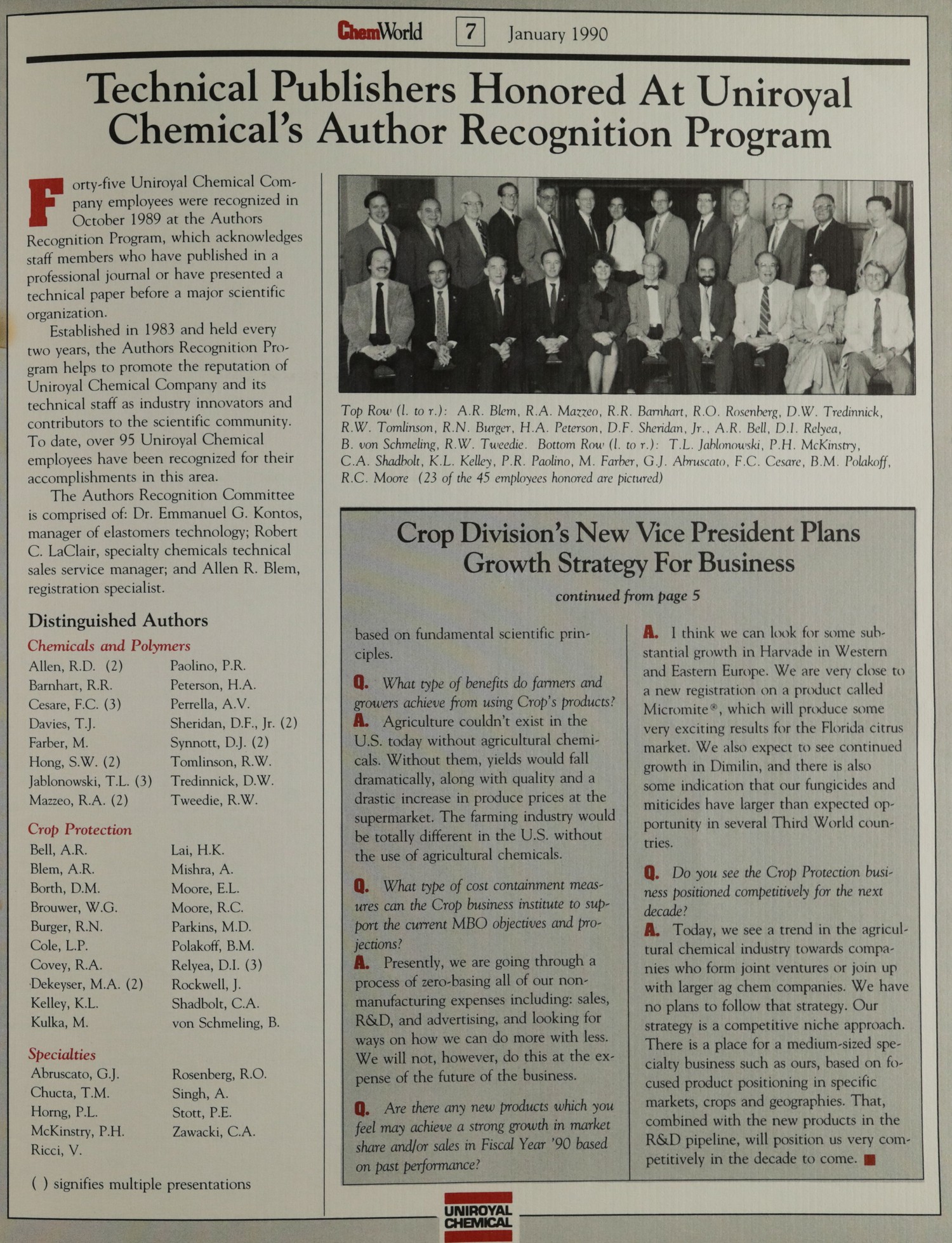
[PHOTOGRAPH]

Top Row (l. to r.): A.R. Blem, R.A. Mazzeo, R.R. Barnhart, R.O. Rosenberg, D.W. Tredinnick, R.W. Tomlinson, R.N. Burger, H.A. Peterson, D.F. Sheridan, Jr., A.R. Bell, D.I. Relyea, B. von Schmeling, R.W. Tweedie. Bottom Row (l. to r.): T.L. Jablonowski, P.H. McKinstry, C.A. Shadbolt, K.L. Kelley, P.R. Paolino, M. Farber, G.J. Abruscato, F.C. Cesare, B.M. Polakoff, R.C. Moore (23 of the 45 employees honored are pictured)


Crop Division’s New Vice President Plans Growth Strategy For Business

continued from page 5

based on fundamental scientific principles.

Q. What type of benefits do farmers and growers achieve from using Crop’s products?

A. Agriculture couldn’t exist in the U.S. today without agricultural chemicals. Without them, yields would fall dramatically, along with quality and a drastic increase in produce prices at the supermarket. The farming industry would be totally different in the U.S. without the use of agricultural chemicals.

Q. What type of cost containment measures can the Crop business institute to support the current MBO objectives and projections?

A. Presently, we are going through a process of zero-basing all of our non-manufacturing expenses including: sales, R&D, and advertising, and looking for ways on how we can do more with less. We will not, however, do this at the expense of the future of the business.

Q. Are there any new products which you feel may achieve a strong growth in market share and/or sales in Fiscal Year ’90 based on past performance?

A. I think we can look for some substantial growth in Harvade in Western and Eastern Europe. We are very close to a new registration on a product called Micromite®, which will produce some very exciting results for the Florida citrus market. We also expect to see continued growth in Dimilin, and there is also some indication that our fungicides and miticides have larger than expected opportunity in several Third World countries.

Q. Do you see the Crop Protection business positioned competitively for the next decade?

A. Today, we see a trend in the agricultural chemical industry towards companies who form joint ventures or join up with larger ag chem companies. We have no plans to follow that strategy. Our strategy is a competitive niche approach. There is a place for a medium-sized specialty business such as ours, based on focused product positioning in specific markets, crops and geographies. That, combined with the new products in the R&D pipeline, will position us very competitively in the decade to come. ■


UNIROYAL CHEMICAL

ChemWorld – Page 4

Page 004

ChemWorld | 4 | January 1990


Uniroyal Chemical Prepares For Future Market Demands

Uniroyal Chemical Company is preparing for continued competition in the European market by seeking “International” recognition of its Quality System.

The company is seeking accreditation based upon a Quality System Standard prepared by the International Standards Organization (ISO); specifically, ISO 9000.

In order to receive the accreditation, Uniroyal Chemical will undergo a detailed


The company’s capability to perform against the ISO’s quality standards will determine whether it will receive accreditation. This, in turn, will facilitate Uniroyal Chemical’s continued business growth in the European markets.


examination of each department’s Quality System. Sales order entry, customer service procedures, operation and control of the manufacturing processes, laboratory testing, product packaging and shipping are among the many areas which will be evaluated against the International Standards. The company’s capability to perform against these quality standards will determine whether it will receive accreditation. This, in turn, will facilitate Uniroyal Chemical’s continued business growth in the European markets.

Several of Uniroyal Chemical’s manufacturing sites are presently involved in assessing their quality systems against the ISO 9000 standards, with Geismar, LA and Latina, Italy seeking accreditation in 1990. ■


Two Annual Winners Selected From Uniroyal Chemical’s Quality Recognition Program

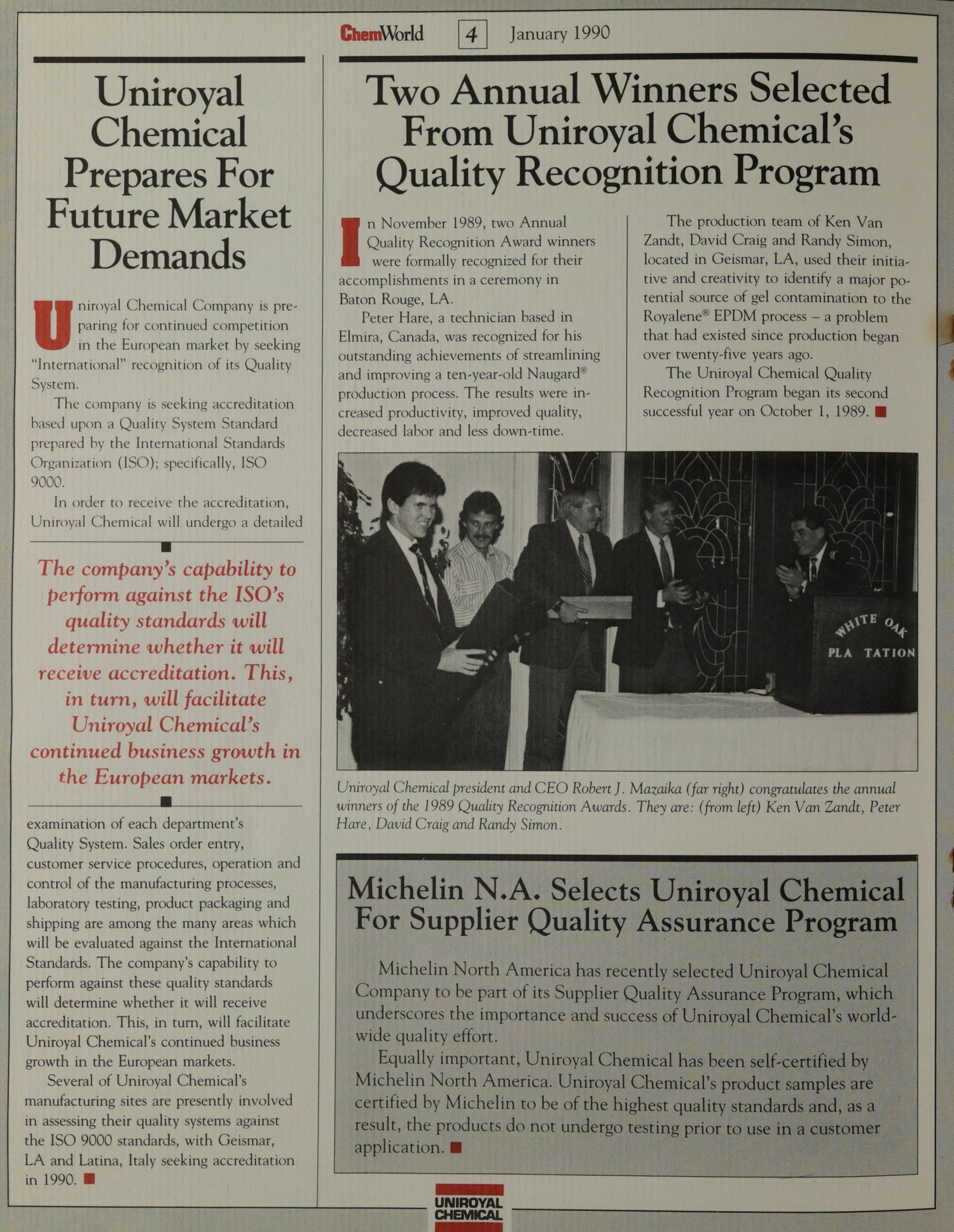
In November 1989, two Annual Quality Recognition Award winners were formally recognized for their accomplishments in a ceremony in Baton Rouge, LA.

Peter Hare, a technician based in Elmira, Canada, was recognized for his outstanding achievements of streamlining and improving a ten-year-old Naugard® production process. The results were increased productivity, improved quality, decreased labor and less down-time.

The production team of Ken Van Zandt, David Craig and Randy Simon, located in Geismar, LA, used their initiative and creativity to identify a major potential source of gel contamination to the Royalene® EPDM process – a problem that had existed since production began over twenty-five years ago.

The Uniroyal Chemical Quality Recognition Program began its second successful year on October 1, 1989. ■

Uniroyal Chemical president and CEO Robert J. Mazaika (far right) congratulates the annual winners of the 1989 Quality Recognition Awards. They are: (from left) Ken Van Zandt, Peter Hare, David Craig and Randy Simon.


Michelin N.A. Selects Uniroyal Chemical For Supplier Quality Assurance Program

Michelin North America has recently selected Uniroyal Chemical Company to be part of its Supplier Quality Assurance Program, which underscores the importance and success of Uniroyal Chemical’s worldwide quality effort.

Equally important, Uniroyal Chemical has been self-certified by Michelin North America. Uniroyal Chemical’s product samples are certified by Michelin to be of the highest quality standards and, as a result, the products do not undergo testing prior to use in a customer application. ■


UNIROYAL CHEMICAL

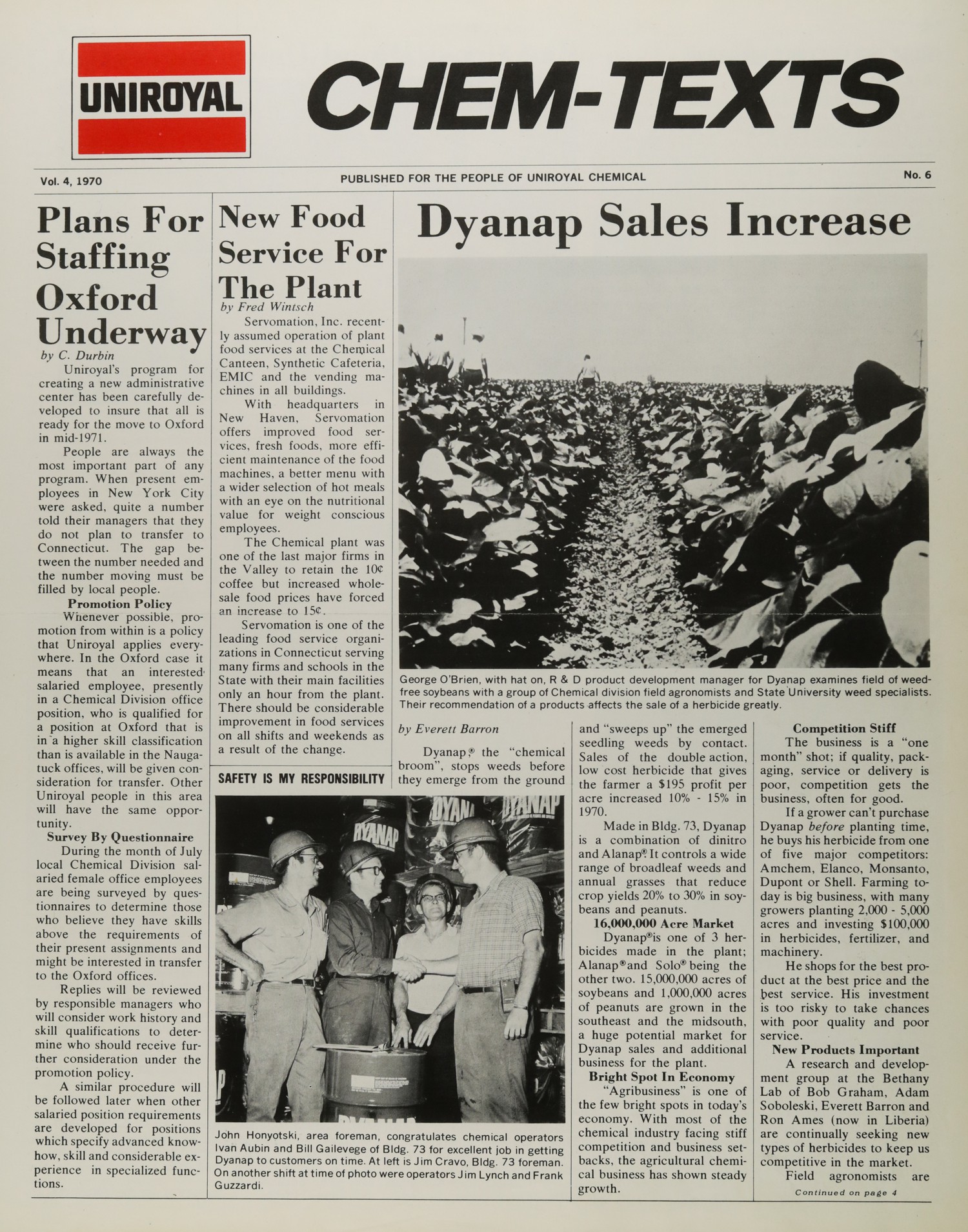
CHEM-TEXTS – 1980-v14-s290

Page 290

CHEM-TEXTS

Page 3 | Vol. 14, 1980


V. Calarco Looks at 1980

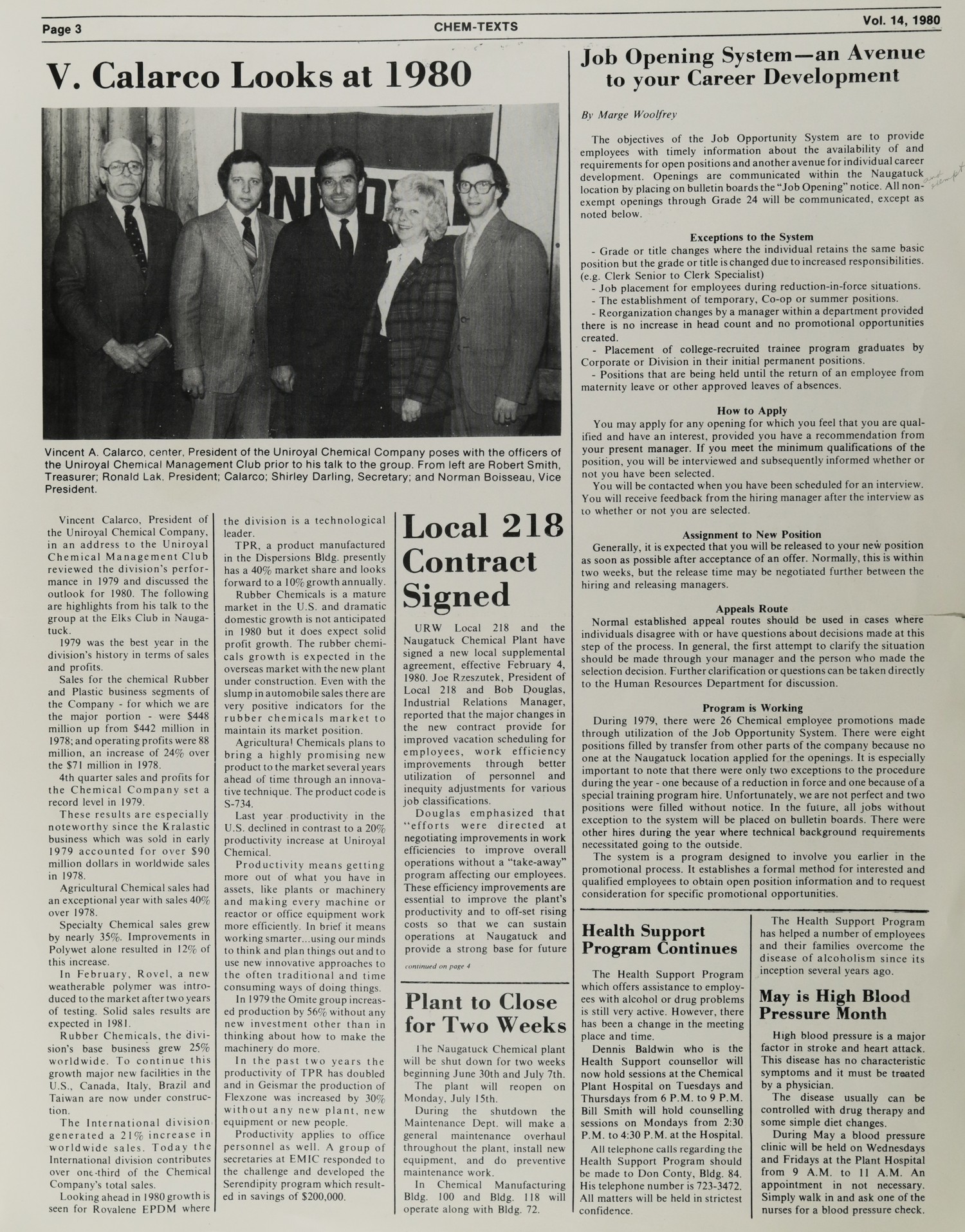
[PHOTO CAPTION:]
Vincent A. Calarco, center, President of the Uniroyal Chemical Company poses with the officers of the Uniroyal Chemical Management Club prior to his talk to the group. From left are Robert Smith, Treasurer; Ronald Lak, President; Calarco; Shirley Darling, Secretary; and Norman Boisseau, Vice President.


Vincent Calarco, President of the Uniroyal Chemical Company, in an address to the Uniroyal Chemical Management Club reviewed the division’s performance in 1979 and discussed the outlook for 1980. The following are highlights from his talk to the group at the Elks Club in Naugatuck.

1979 was the best year in the division’s history in terms of sales and profits.

Sales for the chemical Rubber and Plastic business segments of the Company – for which we are the major portion – were $448 million up from $442 million in 1978; and operating profits were 88 million, an increase of 24% over the $71 million in 1978.

4th quarter sales and profits for the Chemical Company set a record level in 1979.

These results are especially noteworthy since the Kralastic business which was sold in early 1979 accounted for over $90 million dollars in worldwide sales in 1978.

Agricultural Chemical sales had an exceptional year with sales 40% over 1978.

Specialty Chemical sales grew by nearly 35%. Improvements in Polywet alone resulted in 12% of this increase.

In February, Rovel, a new weatherable polymer was introduced to the market after two years of testing. Solid sales results are expected in 1981.

Rubber Chemicals, the division’s base business grew 25% worldwide. To continue this growth major new facilities in the U.S., Canada, Italy, Brazil and Taiwan are now under construction.

The International division generated a 21% increase in worldwide sales. Today the International division contributes over one-third of the Chemical Company’s total sales.

Looking ahead in 1980 growth is seen for Rovalene EPDM where the division is a technological leader.

TPR, a product manufactured in the Dispersions Bldg. presently has a 40% market share and looks forward to a 10% growth annually.

Rubber Chemicals is a mature market in the U.S. and dramatic domestic growth is not anticipated in 1980 but it does expect solid profit growth. The rubber chemicals growth is expected in the overseas market with the new plant under construction. Even with the slump in automobile sales there are very positive indicators for the rubber chemicals market to maintain its market position.

Agricultural Chemicals plans to bring a highly promising new product to the market several years ahead of time through an innovative technique. The product code is S-734.

Last year productivity in the U.S. declined in contrast to a 20% productivity increase at Uniroyal Chemical.

Productivity means getting more out of what you have in assets, like plants or machinery and making every machine or reactor or office equipment work more efficiently. In brief it means working smarter…using our minds to think and plan things out and to use new innovative approaches to the often traditional and time consuming ways of doing things.

In 1979 the Omite group increased production by 56% without any new investment other than in thinking about how to make the machinery do more.

In the past two years the productivity of TPR has doubled and in Geismar the production of Flexzone was increased by 30% without any new plant, new equipment or new people.

Productivity applies to office personnel as well. A group of secretaries at EMIC responded to the challenge and developed the Serendipity program which resulted in savings of $200,000.


Job Opening System—an Avenue to your Career Development

By Marge Woolfrey

The objectives of the Job Opportunity System are to provide employees with timely information about the availability of and requirements for open positions and another avenue for individual career development. Openings are communicated within the Naugatuck location by placing on bulletin boards the “Job Opening” notice. All non-exempt openings through Grade 24 will be communicated, except as noted below.

Exceptions to the System

  • Grade or title changes where the individual retains the same basic position but the grade or title is changed due to increased responsibilities. (e.g. Clerk Senior to Clerk Specialist)
  • Job placement for employees during reduction-in-force situations.
  • The establishment of temporary, Co-op or summer positions.
  • Reorganization changes by a manager within a department provided there is no increase in head count and no promotional opportunities created.
  • Placement of college-recruited trainee program graduates by Corporate or Division in their initial permanent positions.
  • Positions that are being held until the return of an employee from maternity leave or other approved leaves of absences.

How to Apply

You may apply for any opening for which you feel that you are qualified and have an interest, provided you have a recommendation from your present manager. If you meet the minimum qualifications of the position, you will be interviewed and subsequently informed whether or not you have been selected.

You will be contacted when you have been scheduled for an interview. You will receive feedback from the hiring manager after the interview as to whether or not you are selected.

Assignment to New Position

Generally, it is expected that you will be released to your new position as soon as possible after acceptance of an offer. Normally, this is within two weeks, but the release time may be negotiated further between the hiring and releasing managers.

Appeals Route

Normal established appeal routes should be used in cases where individuals disagree with or have questions about decisions made at this step of the process. In general, the first attempt to clarify the situation should be made through your manager and the person who made the selection decision. Further clarification or questions can be taken directly to the Human Resources Department for discussion.

Program is Working

During 1979, there were 26 Chemical employee promotions made through utilization of the Job Opportunity System. There were eight positions filled by transfer from other parts of the company because no one at the Naugatuck location applied for the openings. It is especially important to note that there were only two exceptions to the procedure during the year – one because of a reduction in force and one because of a special training program hire. Unfortunately, we are not perfect and two positions were filled without notice. In the future, all jobs without exception to the system will be placed on bulletin boards. There were other hires during the year where technical background requirements necessitated going to the outside.

The system is a program designed to involve you earlier in the promotional process. It establishes a formal method for interested and qualified employees to obtain open position information and to request consideration for specific promotional opportunities.


Local 218 Contract Signed

URW Local 218 and the Naugatuck Chemical Plant have signed a new local supplemental agreement, effective February 4, 1980. Joe Rzeszutek, President of Local 218 and Bob Douglas, Industrial Relations Manager, reported that the major changes in the new contract provide for improved vacation scheduling for employees, work efficiency improvements through better utilization of personnel and inequity adjustments for various job classifications.

Douglas emphasized that “efforts were directed at negotiating improvements in work efficiencies to improve overall operations without a “take-away” program affecting our employees. These efficiency improvements are essential to improve the plant’s productivity and to off-set rising costs so that we can sustain operations at Naugatuck and provide a strong base for future

continued on page 4


Plant to Close for Two Weeks

The Naugatuck Chemical plant will be shut down for two weeks beginning June 30th and July 7th. The plant will reopen on Monday, July 15th.

During the shutdown the Maintenance Dept. will make a general maintenance overhaul throughout the plant, install new equipment, and do preventive maintenance work.

In Chemical Manufacturing Bldg. 100 and Bldg. 118 will operate along with Bldg. 72.


Health Support Program Continues

The Health Support Program which offers assistance to employees with alcohol or drug problems is still very active. However, there has been a change in the meeting place and time.

Dennis Baldwin who is the Health Support counsellor will now hold sessions at the Chemical Plant Hospital on Tuesdays and Thursdays from 6 P.M. to 9 P.M. Bill Smith will hold counselling sessions on Mondays from 2:30 P.M. to 4:30 P.M. at the Hospital.

All telephone calls regarding the Health Support Program should be made to Don Conty, Bldg. 84. His telephone number is 723-3472. All matters will be held in strictest confidence.

The Health Support Program has helped a number of employees and their families overcome the disease of alcoholism since its inception several years ago.


May is High Blood Pressure Month

High blood pressure is a major factor in stroke and heart attack. This disease has no characteristic symptoms and it must be treated by a physician.

The disease usually can be controlled with drug therapy and some simple diet changes.

During May a blood pressure clinic will be held on Wednesdays and Fridays at the Plant Hospital from 9 A.M. to 11 A.M. An appointment in not necessary. Simply walk in and ask one of the nurses for a blood pressure check.

CHEM-TEXTS – 1979 – Page No. 2

Page unknown

UNIROYAL CHEM-TEXTS

Vol. 13, 1979 | PUBLISHED FOR THE PEOPLE OF UNIROYAL CHEMICAL | No. 2


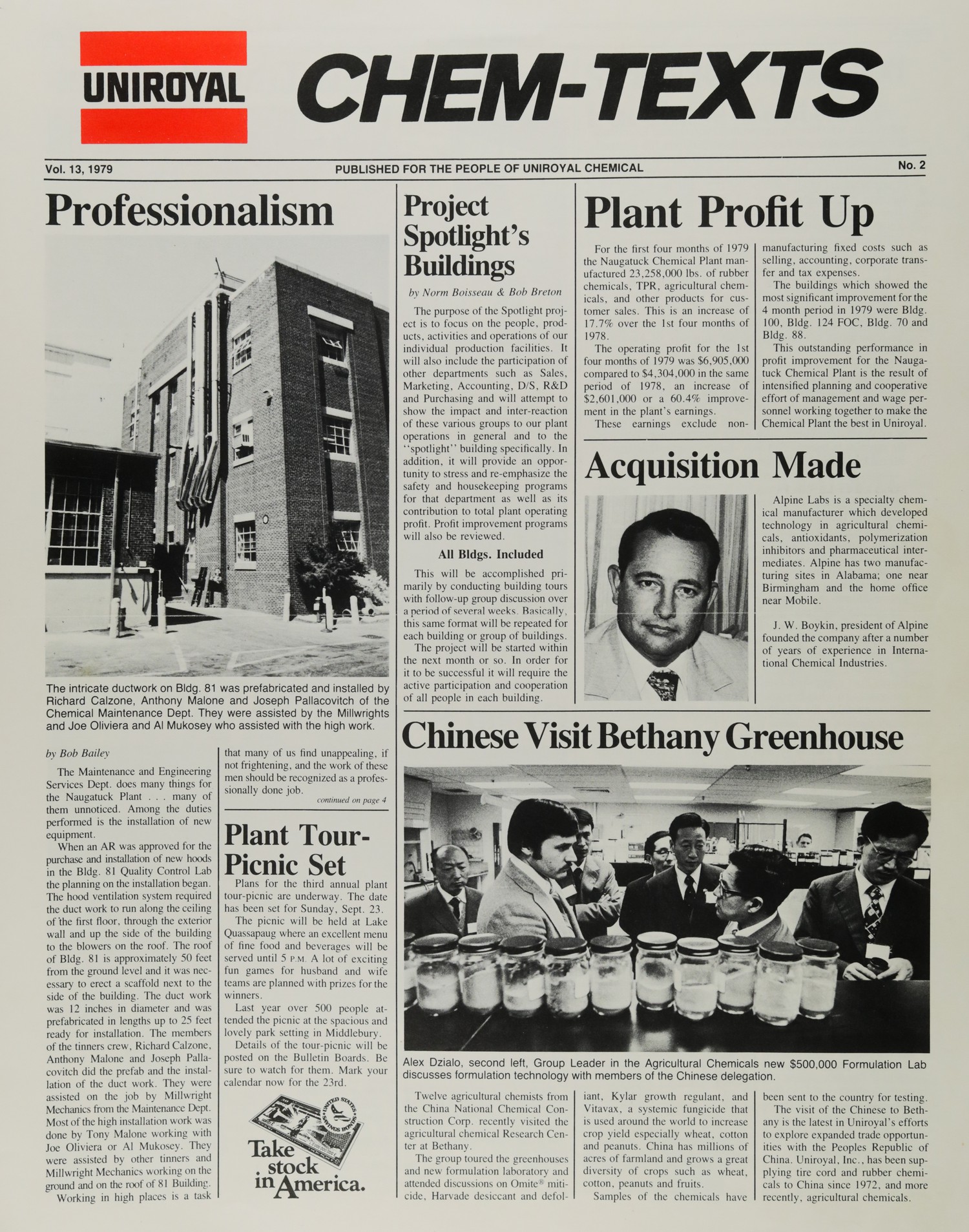
Professionalism

[IMAGE: Black and white photograph of a multi-story building with external ductwork]

The intricate ductwork on Bldg. 81 was prefabricated and installed by Richard Calzone, Anthony Malone and Joseph Pallacovitch of the Chemical Maintenance Dept. They were assisted by the Millwrights and Joe Oliviera and Al Mukosey who assisted with the high work.

by Bob Bailey

The Maintenance and Engineering Services Dept. does many things for the Naugatuck Plant . . . many of them unnoticed. Among the duties performed is the installation of new equipment.

When an AR was approved for the purchase and installation of new hoods in the Bldg. 81 Quality Control Lab the planning on the installation began. The hood ventilation system required the duct work to run along the ceiling of the first floor, through the exterior wall and up the side of the building to the blowers on the roof. The roof of Bldg. 81 is approximately 50 feet from the ground level and it was necessary to erect a scaffold next to the side of the building. The duct work was 12 inches in diameter and was prefabricated in lengths up to 25 feet ready for installation. The members of the tinners crew, Richard Calzone, Anthony Malone and Joseph Pallacovitch did the prefab and the installation of the duct work. They were assisted on the job by Millwright Mechanics from the Maintenance Dept. Most of the high installation work was done by Tony Malone working with Joe Oliviera or Al Mukosey. They were assisted by other tinners and Millwright Mechanics working on the ground and on the roof of 81 Building.

Working in high places is a task that many of us find unappealing, if not frightening, and the work of these men should be recognized as a professionally done job.

continued on page 4


Project Spotlight’s Buildings

by Norm Boisseau & Bob Breton

The purpose of the Spotlight project is to focus on the people, products, activities and operations of our individual production facilities. It will also include the participation of other departments such as Sales, Marketing, Accounting, D/S, R&D and Purchasing and will attempt to show the impact and inter-reaction of these various groups to our plant operations in general and to the “spotlight” building specifically. In addition, it will provide an opportunity to stress and re-emphasize the safety and housekeeping programs for that department as well as its contribution to total plant operating profit. Profit improvement programs will also be reviewed.

All Bldgs. Included

This will be accomplished primarily by conducting building tours with follow-up group discussion over a period of several weeks. Basically, this same format will be repeated for each building or group of buildings.

The project will be started within the next month or so. In order for it to be successful it will require the active participation and cooperation of all people in each building.


Plant Tour-Picnic Set

Plans for the third annual plant tour-picnic are underway. The date has been set for Sunday, Sept. 23.

The picnic will be held at Lake Quassapaug where an excellent menu of fine food and beverages will be served until 5 P.M. A lot of exciting fun games for husband and wife teams are planned with prizes for the winners.

Last year over 500 people attended the picnic at the spacious and lovely park setting in Middlebury.

Details of the tour-picnic will be posted on the Bulletin Boards. Be sure to watch for them. Mark your calendar now for the 23rd.

[IMAGE: Small graphic showing “Take stock in America.”]


Plant Profit Up

For the first four months of 1979 the Naugatuck Chemical Plant manufactured 23,258,000 lbs. of rubber chemicals, TPR, agricultural chemicals, and other products for customer sales. This is an increase of 17.7% over the 1st four months of 1978.

The operating profit for the 1st four months of 1979 was $6,905,000 compared to $4,304,000 in the same period of 1978, an increase of $2,601,000 or a 60.4% improvement in the plant’s earnings.

These earnings exclude non-manufacturing fixed costs such as selling, accounting, corporate transfer and tax expenses.

The buildings which showed the most significant improvement for the 4 month period in 1979 were Bldg. 100, Bldg. 124 FOC, Bldg. 70 and Bldg. 88.

This outstanding performance in profit improvement for the Naugatuck Chemical Plant is the result of intensified planning and cooperative effort of management and wage personnel working together to make the Chemical Plant the best in Uniroyal.


Acquisition Made

[IMAGE: Black and white portrait photograph of a man in business attire]

Alpine Labs is a specialty chemical manufacturer which developed technology in agricultural chemicals, antioxidants, polymerization inhibitors and pharmaceutical intermediates. Alpine has two manufacturing sites in Alabama; one near Birmingham and the home office near Mobile.

J. W. Boykin, president of Alpine founded the company after a number of years of experience in International Chemical Industries.


Chinese Visit Bethany Greenhouse

[IMAGE: Black and white photograph showing several people seated at a table in discussion]

Alex Dzialo, second left, Group Leader in the Agricultural Chemicals new $500,000 Formulation Lab discusses formulation technology with members of the Chinese delegation.

Twelve agricultural chemists from the China National Chemical Construction Corp. recently visited the agricultural chemical Research Center at Bethany.

The group toured the greenhouses and new formulation laboratory and attended discussions on Omite® miticide, Harvade desiccant and defoliant, Kylar growth regulant, and Vitavax, a systemic fungicide that is used around the world to increase crop yield especially wheat, cotton and peanuts. China has millions of acres of farmland and grows a great diversity of crops such as wheat, cotton, peanuts and fruits.

Samples of the chemicals have been sent to the country for testing.

The visit of the Chinese to Bethany is the latest in Uniroyal’s efforts to explore expanded trade opportunities with the Peoples Republic of China. Uniroyal, Inc., has been supplying tire cord and rubber chemicals to China since 1972, and more recently, agricultural chemicals.

CHEM-TEXTS – 1979 – Page 4

Page 004

CHEM-TEXTS

Page 4 | Vol. 13, 1979


Recent Retirements

[PHOTO: Group photo of retirees]

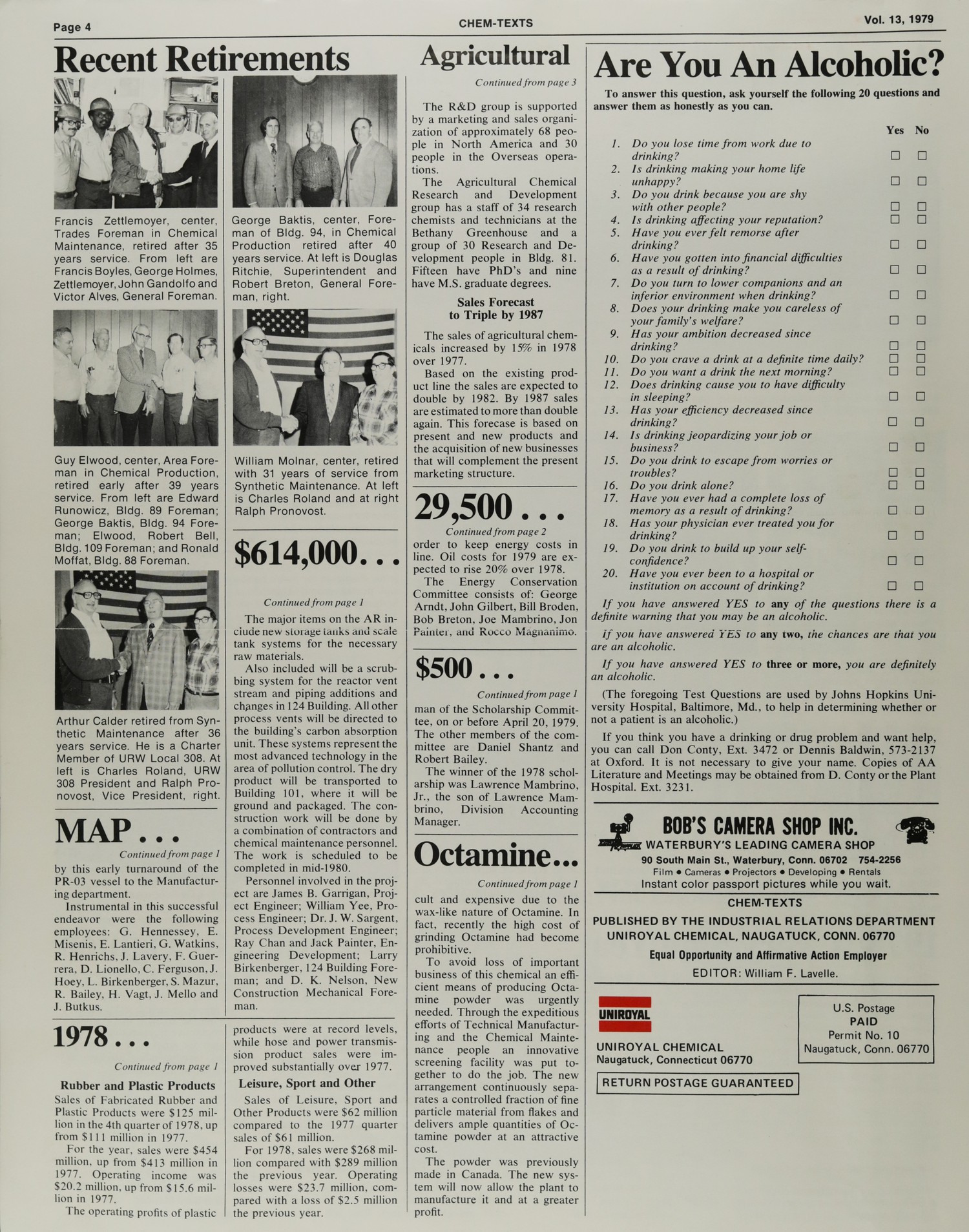
Francis Zettlemoyer, center, Trades Foreman in Chemical Maintenance, retired after 35 years service. From left are Francis Boyles, George Holmes, Zettlemoyer, John Gandolfo and Victor Alves, General Foreman.

[PHOTO: Group photo of retirees]

Guy Elwood, center, Area Foreman in Chemical Production, retired early after 39 years service. From left are Edward Runowicz, Bldg. 89 Foreman; George Baktis, Bldg. 94 Foreman; Elwood, Robert Bell, Bldg. 109 Foreman; and Ronald Moffat, Bldg. 88 Foreman.

[PHOTO: Group photo]

Arthur Calder retired from Synthetic Maintenance after 36 years service. He is a Charter Member of URW Local 308. At left is Charles Roland, URW 308 President and Ralph Pronovost, Vice President, right.


George Baktis, center, Foreman of Bldg. 94, in Chemical Production retired after 40 years service. At left is Douglas Ritchie, Superintendent and Robert Breton, General Foreman, right.

[PHOTO: Group photo]

William Molnar, center, retired with 31 years of service from Synthetic Maintenance. At left is Charles Roland and at right Ralph Pronovost.


MAP…

Continued from page 1

by this early turnaround of the PR-03 vessel to the Manufacturing department.

Instrumental in this successful endeavor were the following employees: G. Hennessey, E. Misenis, E. Lantieri, G. Watkins, R. Henrichs, J. Lavery, F. Guerrera, D. Lionello, C. Ferguson, J. Hoey, L. Birkenberger, S. Mazur, R. Bailey, H. Vagt, J. Mello and J. Butkus.


1978…

Continued from page 1

Rubber and Plastic Products
Sales of Fabricated Rubber and Plastic Products were $125 million in the 4th quarter of 1978, up from $111 million in 1977.

For the year, sales were $454 million, up from $413 million in 1977. Operating income was $20.2 million, up from $15.6 million in 1977.

The operating profits of plastic products were at record levels, while hose and power transmission product sales were improved substantially over 1977.

Leisure, Sport and Other
Sales of Leisure, Sport and Other Products were $62 million compared to the 1977 quarter sales of $61 million.

For 1978, sales were $268 million compared with $289 million the previous year. Operating losses were $23.7 million, compared with a loss of $2.5 million the previous year.


Agricultural

Continued from page 3

The R&D group is supported by a marketing and sales organization of approximately 68 people in North America and 30 people in the Overseas operations.

The Agricultural Chemical Research and Development group has a staff of 34 research chemists and technicians at the Bethany Greenhouse and a group of 30 Research and Development people in Bldg. 81. Fifteen have PhD’s and nine have M.S. graduate degrees.

Sales Forecast to Triple by 1987

The sales of agricultural chemicals increased by 15% in 1978 over 1977.

Based on the existing product line the sales are expected to double by 1982. By 1987 sales are estimated to more than double again. This forecase is based on present and new products and the acquisition of new businesses that will complement the present marketing structure.


29,500…

Continued from page 2

$614,000…

Continued from page 1

The major items on the AR include new storage tanks and scale tank systems for the necessary raw materials.

Also included will be a scrubbing system for the reactor vent stream and piping additions and changes in 124 Building. All other process vents will be directed to the building’s carbon absorption unit. These systems represent the most advanced technology in the area of pollution control. The dry product will be transported to Building 101, where it will be ground and packaged. The construction work will be done by a combination of contractors and chemical maintenance personnel. The work is scheduled to be completed in mid-1980.

Personnel involved in the project are James B. Garrigan, Project Engineer; William Yee, Process Engineer; Dr. J. W. Sargent, Process Development Engineer; Ray Chan and Jack Painter, Engineering Development; Larry Birkenberger, 124 Building Foreman; and D. K. Nelson, New Construction Mechanical Foreman.

order to keep energy costs in line. Oil costs for 1979 are expected to rise 20% over 1978. The Energy Conservation Committee consists of: George Arndt, John Gilbert, Bill Broden, Bob Breton, Joe Mambrino, Jon Painter, and Rocco Magnanimo.


$500…

Continued from page 1

man of the Scholarship Committee, on or before April 20, 1979. The other members of the committee are Daniel Shantz and Robert Bailey.

The winner of the 1978 scholarship was Lawrence Mambrino, Jr., the son of Lawrence Mambrino, Division Accounting Manager.


Octamine…

Continued from page 1

cult and expensive due to the wax-like nature of Octamine. In fact, recently the high cost of grinding Octamine had become prohibitive.

To avoid loss of important business of this chemical an efficient means of producing Octamine powder was urgently needed. Through the expeditious efforts of Technical Manufacturing and the Chemical Maintenance people an innovative screening facility was put together to do the job. The new arrangement continuously separates a controlled fraction of fine particle material from flakes and delivers ample quantities of Octamine powder at an attractive cost.

The powder was previously made in Canada. The new system will now allow the plant to manufacture it and at a greater profit.


Are You An Alcoholic?

To answer this question, ask yourself the following 20 questions and answer them as honestly as you can.

Yes No
1. Do you lose time from work due to drinking?
2. Is drinking making your home life unhappy?
3. Do you drink because you are shy with other people?
4. Is drinking affecting your reputation?
5. Have you ever felt remorse after drinking?
6. Have you gotten into financial difficulties as a result of drinking?
7. Do you turn to lower companions and an inferior environment when drinking?
8. Does your drinking make you careless of your family’s welfare?
9. Has your ambition decreased since drinking?
10. Do you crave a drink at a definite time daily?
11. Do you want a drink the next morning?
12. Does drinking cause you to have difficulty in sleeping?
13. Has your efficiency decreased since drinking?
14. Is drinking jeopardizing your job or business?
15. Do you drink to escape from worries or troubles?
16. Do you drink alone?
17. Have you ever had a complete loss of memory as a result of drinking?
18. Has your physician ever treated you for drinking?
19. Do you drink to build up your self-confidence?
20. Have you ever been to a hospital or institution on account of drinking?

If you have answered YES to any of the questions there is a definite warning that you may be an alcoholic.

if you have answered YES to any two, the chances are that you are an alcoholic.

If you have answered YES to three or more, you are definitely an alcoholic.

(The foregoing Test Questions are used by Johns Hopkins University Hospital, Baltimore, Md., to help in determining whether or not a patient is an alcoholic.)

If you think you have a drinking or drug problem and want help, you can call Don Conty, Ext. 3472 or Dennis Baldwin, 573-2137 at Oxford. It is not necessary to give your name. Copies of AA Literature and Meetings may be obtained from D. Conty or the Plant Hospital. Ext. 3231.


BOB’S CAMERA SHOP INC.

WATERBURY’S LEADING CAMERA SHOP
90 South Main St., Waterbury, Conn. 06702 754-2256
Film • Cameras • Projectors • Developing • Rentals
Instant color passport pictures while you wait.


CHEM-TEXTS
PUBLISHED BY THE INDUSTRIAL RELATIONS DEPARTMENT
UNIROYAL CHEMICAL, NAUGATUCK, CONN. 06770
Equal Opportunity and Affirmative Action Employer
EDITOR: William F. Lavelle.


[MAILING LABEL AREA]

UNIROYAL | U.S. Postage PAID Permit No. 10 Naugatuck, Conn. 06770

UNIROYAL CHEMICAL
Naugatuck, Connecticut 06770

RETURN POSTAGE GUARANTEED

CHEM-TEXTS – 12 – Page 4

Page 004

Volume 12, 1978 | CHEM-TEXTS | Page 4


Recent Retirements | Lotol Group Holds Reunion

[PHOTO]

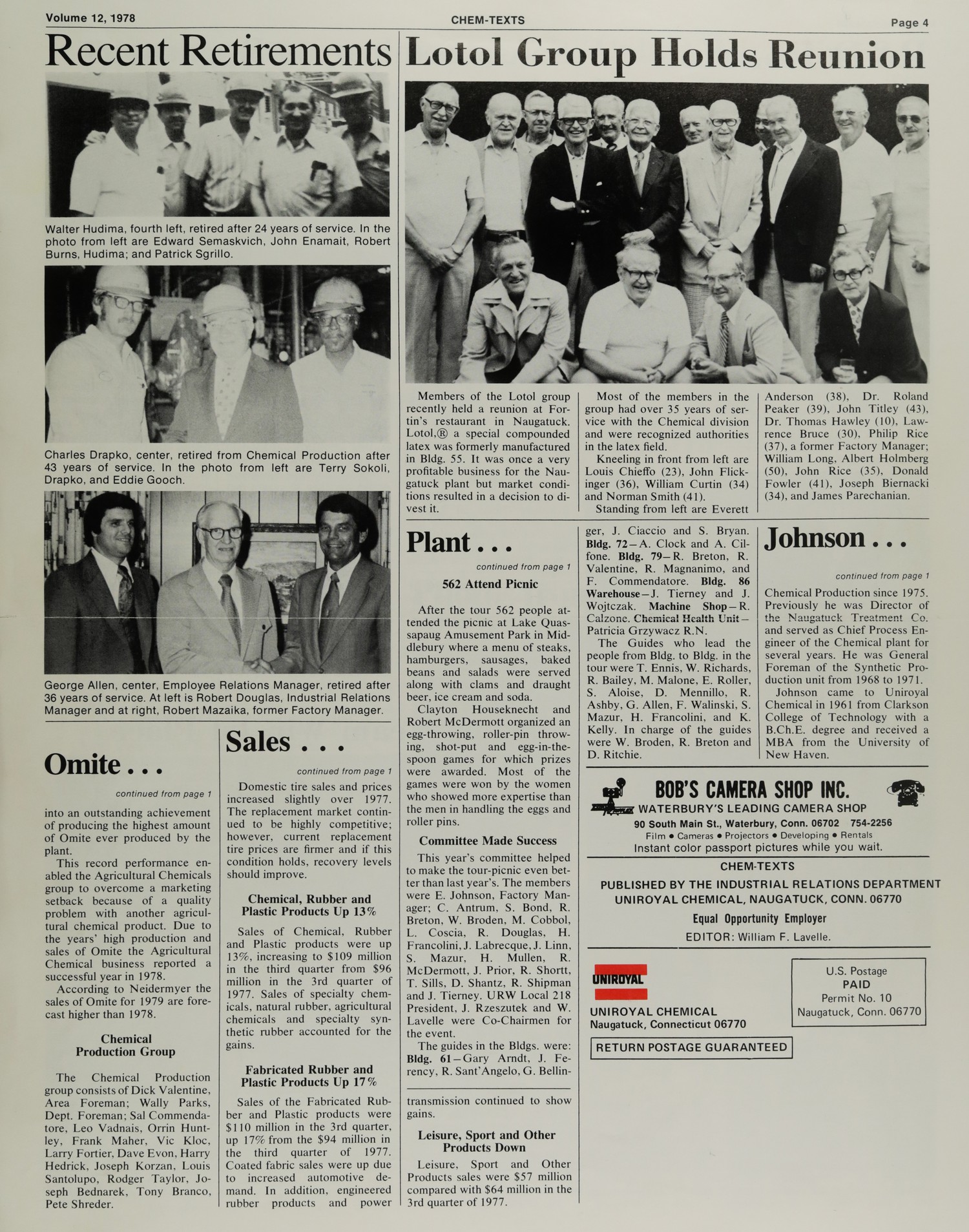
Walter Hudima, fourth left, retired after 24 years of service. In the photo from left are Edward Semaskvich, John Enamait, Robert Burns, Hudima; and Patrick Sgrillo.


[PHOTO]

Charles Drapko, center, retired from Chemical Production after 43 years of service. In the photo from left are Terry Sokoli, Drapko, and Eddie Gooch.


[PHOTO]

George Allen, center, Employee Relations Manager, retired after 36 years of service. At left is Robert Douglas, Industrial Relations Manager and at right, Robert Mazaika, former Factory Manager.


Omite . . .

continued from page 1

into an outstanding achievement of producing the highest amount of Omite ever produced by the plant.

This record performance enabled the Agricultural Chemicals group to overcome a marketing setback because of a quality problem with another agricultural chemical product. Due to the years’ high production and sales of Omite the Agricultural Chemical business reported a successful year in 1978.

According to Neidermyer the sales of Omite for 1979 are forecast higher than 1978.

Chemical Production Group

The Chemical Production group consists of Dick Valentine, Area Foreman; Wally Parks, Dept. Foreman; Sal Commendatore, Leo Vadnais, Orrin Huntley, Frank Maher, Vic Kloc, Larry Fortier, Dave Evon, Harry Hedrick, Joseph Korzan, Louis Santolupo, Rodger Taylor, Joseph Bednarek, Tony Branco, Pete Shreder.


Sales . . .

continued from page 1

Domestic tire sales and prices increased slightly over 1977. The replacement market continued to be highly competitive; however, current replacement tire prices are firmer and if this condition holds, recovery levels should improve.

Chemical, Rubber and Plastic Products Up 13%

Sales of Chemical, Rubber and Plastic products were up 13%, increasing to $109 million in the third quarter from $96 million in the 3rd quarter of 1977. Sales of specialty chemicals, natural rubber, agricultural chemicals and specialty synthetic rubber accounted for the gains.

Fabricated Rubber and Plastic Products Up 17%

Sales of the Fabricated Rubber and Plastic products were $110 million in the 3rd quarter, up 17% from the $94 million in the third quarter of 1977. Coated fabric sales were up due to increased automotive demand. In addition, engineered rubber products and power


[PHOTO – Group photo of Lotol reunion members]

Members of the Lotol group recently held a reunion at Fortin’s restaurant in Naugatuck. Lotol,® a special compounded latex was formerly manufactured in Bldg. 55. It was once a very profitable business for the Naugatuck plant but market conditions resulted in a decision to divest it.

Most of the members in the group had over 35 years of service with the Chemical division and were recognized authorities in the latex field.

Kneeling in front from left are Louis Chieffo (23), John Flickinger (36), William Curtin (34) and Norman Smith (41).

Standing from left are Everett Anderson (38), Dr. Roland Peaker (39), John Titley (43), Dr. Thomas Hawley (10), Lawrence Bruce (30), Philip Rice (37), a former Factory Manager; William Long, Albert Holmberg (50), John Rice (35), Donald Fowler (41), Joseph Biernacki (34), and James Parechanian.


Plant . . .

continued from page 1

562 Attend Picnic

After the tour 562 people attended the picnic at Lake Quassapaug Amusement Park in Middlebury where a menu of steaks, hamburgers, sausages, baked beans and salads were served along with clams and draught beer, ice cream and soda.

Clayton Houseknecht and Robert McDermott organized an egg-throwing, roller-pin throwing, shot-put and egg-in-the-spoon games for which prizes were awarded. Most of the games were won by the women who showed more expertise than the men in handling the eggs and roller pins.

Committee Made Success

This year’s committee helped to make the tour-picnic even better than last year’s. The members were E. Johnson, Factory Manager; C. Antrum, S. Bond, R. Breton, W. Broden, M. Cobbol, L. Coscia, R. Douglas, H. Francolini, J. Labrecque, J. Linn, S. Mazur, H. Mullen, R. McDermott, J. Prior, R. Shortt, T. Sills, D. Shantz, R. Shipman and J. Tierney. URW Local 218 President, J. Rzeszutek and W. Lavelle were Co-Chairmen for the event.

The guides in the Bldgs. were: Bldg. 61—Gary Arndt, J. Ferency, R. Sant’Angelo, G. Bellin-

ger, J. Ciaccio and S. Bryan. Bldg. 72—A. Clock and A. Cilfone. Bldg. 79—R. Breton, R. Valentine, R. Magnanimo, and F. Commendatore. Bldg. 86 Warehouse—J. Tierney and J. Wojtczak. Machine Shop—R. Calzone. Chemical Health Unit—Patricia Grzywacz R.N.

The Guides who lead the people from Bldg. to Bldg. in the tour were T. Ennis, W. Richards, R. Bailey, M. Malone, E. Roller, S. Aloise, D. Mennillo, R. Ashby, G. Allen, F. Walinski, S. Mazur, H. Francolini, and K. Kelly. In charge of the guides were W. Broden, R. Breton and D. Ritchie.


Johnson . . .

continued from page 1

Chemical Production since 1975. Previously he was Director of the Naugatuck Treatment Co. and served as Chief Process Engineer of the Chemical plant for several years. He was General Foreman of the Synthetic Production unit from 1968 to 1971.

Johnson came to Uniroyal Chemical in 1961 from Clarkson College of Technology with a B.Ch.E. degree and received a MBA from the University of New Haven.


BOB’S CAMERA SHOP INC.

WATERBURY’S LEADING CAMERA SHOP
90 South Main St., Waterbury, Conn. 06702 754-2256
Film ● Cameras ● Projectors ● Developing ● Rentals
Instant color passport pictures while you wait.


transmission continued to show gains.

Leisure, Sport and Other Products Down

Leisure, Sport and Other Products sales were $57 million compared with $64 million in the 3rd quarter of 1977.


CHEM-TEXTS
PUBLISHED BY THE INDUSTRIAL RELATIONS DEPARTMENT
UNIROYAL CHEMICAL, NAUGATUCK, CONN. 06770

Equal Opportunity Employer
EDITOR: William F. Lavelle.


[UNIROYAL LOGO]

UNIROYAL CHEMICAL
Naugatuck, Connecticut 06770

U.S. Postage
PAID
Permit No. 10
Naugatuck, Conn. 06770

RETURN POSTAGE GUARANTEED

CHEM-TEXTS – 1978-v12-i03-s268

Page 268

Merry Christmas – Happy New Year

UNIROYAL CHEM-TEXTS

Vol. 12, 1978 | PUBLISHED FOR THE PEOPLE OF UNIROYAL CHEMICAL | No. 3


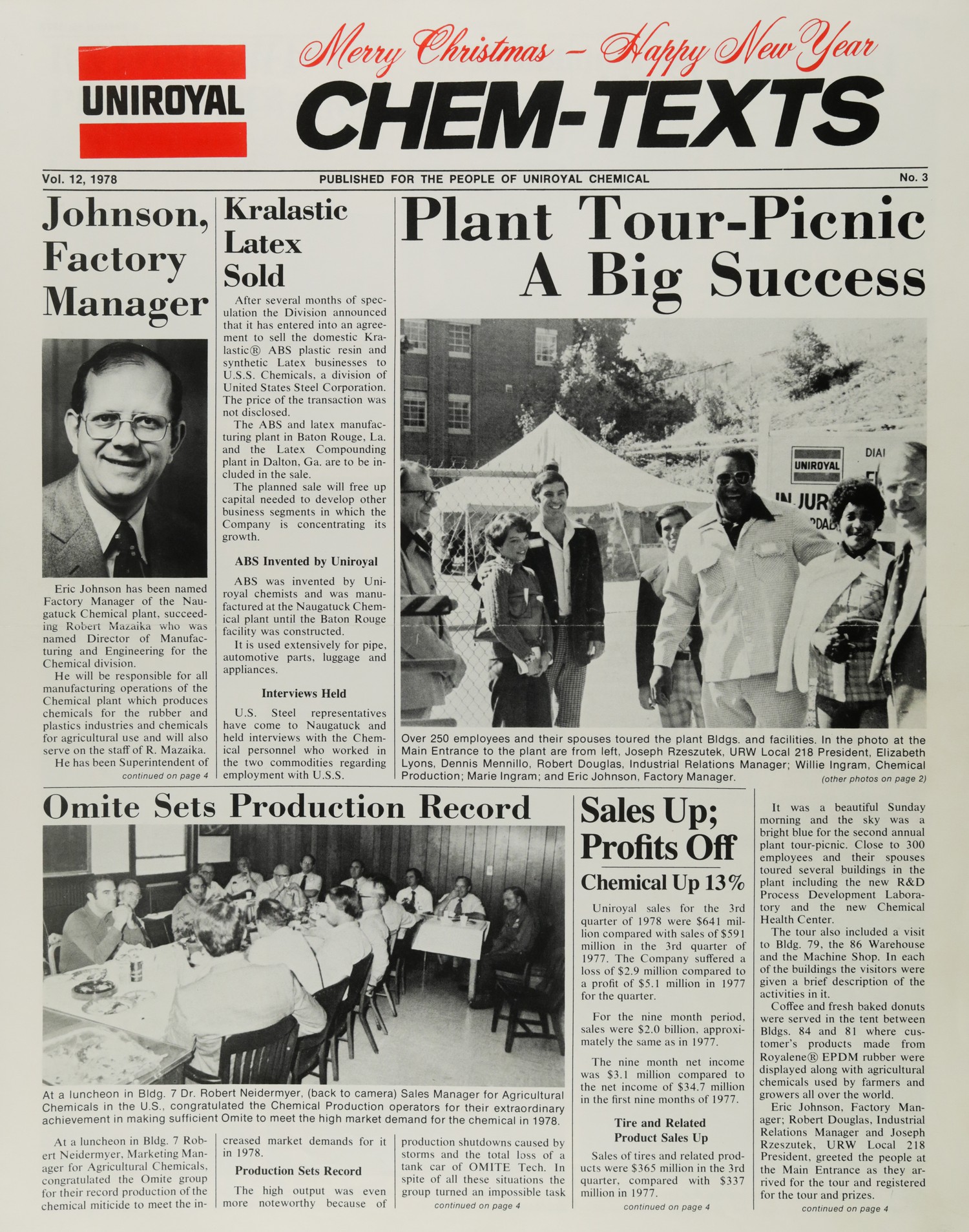
Johnson, Factory Manager

Eric Johnson has been named Factory Manager of the Naugatuck Chemical plant, succeeding Robert Mazaika who was named Director of Manufacturing and Engineering for the Chemical division.

He will be responsible for all manufacturing operations of the Chemical plant which produces chemicals for the rubber and plastics industries and chemicals for agricultural use and will also serve on the staff of R. Mazaika. He has been Superintendent of
continued on page 4


Kralastic Latex Sold

After several months of speculation the Division announced that it has entered into an agreement to sell the domestic Kralastic® ABS plastic resin and synthetic Latex businesses to U.S.S. Chemicals, a division of United States Steel Corporation. The price of the transaction was not disclosed.

The ABS and latex manufacturing plant in Baton Rouge, La. and the Latex Compounding plant in Dalton, Ga. are to be included in the sale.

The planned sale will free up capital needed to develop other business segments in which the Company is concentrating its growth.

ABS Invented by Uniroyal

ABS was invented by Uniroyal chemists and was manufactured at the Naugatuck Chemical plant until the Baton Rouge facility was constructed.

It is used extensively for pipe, automotive parts, luggage and appliances.

Interviews Held

U.S. Steel representatives have come to Naugatuck and held interviews with the Chemical personnel who worked in the two commodities regarding employment with U.S.S.


Plant Tour-Picnic A Big Success

Over 250 employees and their spouses toured the plant Bldgs. and facilities. In the photo at the Main Entrance to the plant are from left, Joseph Rzeszutek, URW Local 218 President, Elizabeth Lyons, Dennis Mennillo, Robert Douglas, Industrial Relations Manager; Willie Ingram, Chemical Production; Marie Ingram; and Eric Johnson, Factory Manager. (other photos on page 2)

It was a beautiful Sunday morning and the sky was a bright blue for the second annual plant tour-picnic. Close to 300 employees and their spouses toured several buildings in the plant including the new R&D Process Development Laboratory and the new Chemical Health Center.

The tour also included a visit to Bldg. 79, the 86 Warehouse and the Machine Shop. In each of the buildings the visitors were given a brief description of the activities in it.

Coffee and fresh baked donuts were served in the tent between Bldgs. 84 and 81 where customer’s products made from Royalene® EPDM rubber were displayed along with agricultural chemicals used by farmers and growers all over the world.

Eric Johnson, Factory Manager; Robert Douglas, Industrial Relations Manager and Joseph Rzeszutek, URW Local 218 President, greeted the people at the Main Entrance as they arrived for the tour and registered for the tour and prizes.
continued on page 4


Omite Sets Production Record

At a luncheon in Bldg. 7 Dr. Robert Neidermyer, (back to camera) Sales Manager for Agricultural Chemicals in the U.S., congratulated the Chemical Production operators for their extraordinary achievement in making sufficient Omite to meet the high market demand for the chemical in 1978.

At a luncheon in Bldg. 7 Robert Neidermyer, Marketing Manager for Agricultural Chemicals, congratulated the Omite group for their record production of the chemical miticide to meet the increased market demands for it in 1978.

Production Sets Record

The high output was even more noteworthy because of production shutdowns caused by storms and the total loss of a tank car of OMITE Tech. In spite of all these situations the group turned an impossible task
continued on page 4


Sales Up; Profits Off

Chemical Up 13%

Uniroyal sales for the 3rd quarter of 1978 were $641 million compared with sales of $591 million in the 3rd quarter of 1977. The Company suffered a loss of $2.9 million compared to a profit of $5.1 million in 1977 for the quarter.

For the nine month period, sales were $2.0 billion, approximately the same as in 1977.

The nine month net income was $3.1 million compared to the net income of $34.7 million in the first nine months of 1977.

Tire and Related Product Sales Up

Sales of tires and related products were $365 million in the 3rd quarter, compared with $337 million in 1977.
continued on page 4

CHEM-TEXTS – 1978-v12-s261

Page 261

Page 2 CHEM-TEXTS Volume 12, 1978


EDITORIAL

A large portion of this edition of CHEM-TEXTS is devoted to things that are happening here at the plant as a result of making it a “better place to be”. My staff and myself have dedicated ourselves to that objective in 1978.

In addition to some of the physical changes that are occurring, there are many changes being made in the way we manage our business. After reviewing how we were managing and deciding that it was not the way we would like it, we started to change. More of our people are becoming involved with running our business, and we intend that each of our buildings will be run as a separate business. Each of our service departments will be run as a separate business and will be measured in this way. The people running these businesses have been and will be given the authority necessary to make decisions and expenditures as required.

All of our people running the small business units will have both the authority and responsibility for the success of these businesses. I believe that this will make the Naugatuck Plant the most successful in the Chemical Division.

One of our other objectives for 1978 is to make the Naugatuck Plant “The Flagship” of the division. Certainly making it a better place to be and managing our business better will go a long way toward achieving that goal. But to reach it, we also have to strive to make the plant, inside and out, the best of any plant in the division—the cleanest, neatest and best maintained.

By dedicating ourselves to these objectives everyday, I am sure that they will be achieved in 1978.

[Signature: R.J. Meyst]


Named To IR Dept.

[PHOTO: Black and white photograph of J. Robert Douglas]

J. Robert Douglas has been named Manager of Industrial Relations for the Naugatuck Chemical location. In his new position he will be responsible for the Labor and Employee Relations at the Naugatuck Chemical facility which employs over 1100 people.

Prior to his new appointment Douglas held the position of Industrial Relations Manager at the Painesville, Ohio, plant.

He joined Uniroyal Chemical in 1967 as an Industrial Relations Representative at the Joliet Ammunitions plant.

[PHOTO: Black and white photograph of Donald J. Conty]

Donald J. Conty has been appointed Manager of Labor Relations for the Naugatuck Chemical plant.

Conty had been Manager of Industrial Relations for the Uniroyal Industrial Products’ Division plant in Port Clinton, Ohio.

He joined the Industrial Products division of Uniroyal at the Passaic plant in 1956 as a Safety Supervisor. He was later named Manager of Safety and Plant Protection. In 1972 he was promoted to Employee Relations Manager for the Port Clinton, Ohio plant.


Equality Policy Affirmed

The Uniroyal Chemical plant has a firm commitment to offer equal opportunity to all employees. It is the policy of the plant’s management to support and implement this commitment continually.

This policy requires that all recruiting, hiring, transfers, promotions, compensation, benefits, and company-sponsored training, education and tuition assistance, as well as social, recreational and health programs and lay-off and recall practices are followed and carried out without regard to race, color, creed, religion, sex, national origin, or handicap of any individual person.

J. Robert Douglas, the Industrial Relations Manager for the Naugatuck plant is the Compliance officer and has the responsibility for implementing this policy; monitoring the Uniroyal Chemical Affirmative Action Compliance Program; and reporting to management the program’s progress.

The responsibility for the improvement of the program and the positive results of it rests with each Manager, Foreman, and Supervisor as an integral part of their job.


Profits And Sales Improve In 1977

For 1977 the Company’s net income was $34.8 million, or $1.13 a share, compared with $20.1 million or $.57 a share in 1976.

Sales for 1977 were $2.6 billion compared with $2.3 billion in 1976.

Strong annual gains were made in U.S. tire sales. Sales and net income from chemicals exceeded all forecasts in 1977.

4th Quarter

In the 4th Quarter, the Company had a foreign exchange loss of $2.5 million, reducing earnings to $57,000, or a loss of four cents a share. This compares with the abnormally high income of $20 million, or $.71 a share after a $.5 million foreign exchange loss in the 4th quarter of 1976.

The 4th Quarter net income was also attributed to declines in sales of footwear, and losses incurred as footwear production was discontinued at the Naugatuck plant.

Tire 4th Quarter Sales Off

Sales in the Tire and Related Products group were $371 million in the fourth quarter of 1977, compared with $380 million in the last quarter of 1976. The relative decline was due to abnormally high orders in 1976.

Chemical, Rubber and Plastic Materials Improve in Quarter

Chemical, Rubber and Plastic Materials sales increased to $83 million in 1977 from the $79 million in the 4th quarter of 1976. The Chemical Division and specialty chemical sales continued to show improvement in this period, as did the pricing of natural rubber.


Scholarship Offered

The Uniroyal Chemical Management Club is again offering a $500 scholarship award. Fifty dollars of the scholarship comes from the Larry Monroe Fund.

The scholarship is available to a graduating high school student who plans a college education. To qualify, one of the student’s parents must have worked for Uniroyal Chemical at Naugatuck or Bethany for two years or more

(continued on page 4)


21,000 Barrels of Oil Saved

A total of 148,000 barrels of #6 oil was budgeted to operate the plant during 1977 but through an extensive program of energy conservation, only 127,000 barrels were used, resulting in a savings of 21,000 barrels at an average price of $14.70/barrel for the year.

Recovered nonenes from Bldgs. 109, 89, 94, and 100—previously wasted—were blended into a fuel in the Boiler Plant and accounted for 5000 of the 21,000 barrels in the above savings.

Major Problem Areas

During the year the Steam Conservation Committee concentrated on three major problems: 1.) Steam Traps: the repairs on the traps was done by Pipers Francis Clark and Michael Csepes.

2.) Insulation: four Chemical Maintenance Insulators — Richard Tucker, John Lengyel, Domingos DaSilva, and William Scott replaced defective insulation.

3.) Steam Jet Maintenance and operation: work on the steam jets was done in the Chemical and Synthetic Pilot Plants, Bldgs. 109, 100, 79 and the Pollution Abatement Laboratory under the direction of John Gilbert, William Broden, and Roderick Ashby.

Committee Members

The Steam Conservation Committee consists of George Arndt,

Chairman; John Gilbert, Secretary, Robert Breton, William Broden, John Painter, and Joseph Mambrino.

The goal of the Committee is to reduce the cost and use of steam throughout the buildings of the plant. A program for 1978 has been planned with even greater savings anticipated.

[FORM HEADER:]
UNIROYAL CHEMICAL
Division of UNIROYAL Inc.
ENGINEERING DEPARTMENT

SUBJECT___
LOCATION__

PAGE_
JOB NO._
DATE_
BY_

[GRAPH: Line graph showing cumulative #6 oil barrels x 1000 from months J through D, with two lines labeled “BUDGET” (solid) and “ACTUAL” (dashed), ranging from approximately 10 to 150 on the y-axis]

CHEM-TEXTS – 1977-v11-i01-s248

Page 248

UNIROYAL CHEM-TEXTS

Vol. 11, 1977 | PUBLISHED FOR THE PEOPLE OF UNIROYAL CHEMICAL | No. 1


Hospital Approved | Sales and Profits Up in the Fourth Quarter

[IMAGE: Black and white photo of a building]

The present Plant Hospital occupies the right side of Bldg. 47. The new hospital will occupy the entire first floor of the building.

by Victor Alves

The Capital Appropriation Committee of the Company has approved the expansion of the Plant medical facilities in Bldg. 47. It will be expanded from 800 to approximately 2400 square feet. The building became available when the Roylar Pilot Plant closed down with the construction of the new Roylar unit.

A Major Medical Improvement

Process equipment, pipelines, and fixtures will be stripped from the building and construction work begun shortly after. Plans call for a waiting room, nurses station, doctor’s office and examination rooms, minor treatment area, conference room, laboratory

continued on page 4


The fourth quarter sales for the Company increased 13% in 1976 to $633 million from the $563 million in the 4th quarter of 1975.

Net income rose 292% to $20.0 million, or 71¢ a share of common stock, from the $5.1 million or 14¢ a share in the last quarter of 1975.

Sharp Rebound

The fourth quarter was a sharp rebound from the strike-affected second and third quarters of 1976. The gain resulted from increased demand, improved operating efficiencies and marketing reorganizations.


Club Offers $500 Award

The Uniroyal Chemical Management Club is offering a $500 scholarship award. Fifty dollars of the scholarship comes from the Larry Monroe Fund.

The scholarship is available to a graduating high school student who plans a college education. To qualify, one of the student’s parents must have worked for Uniroyal Chemical at Naugatuck or Bethany for two years or more and be an active employee. The fund is supported by the dues of the club’s members.

Applications for the scholarship may be obtained personally from the Industrial Relations Department or by a telephone call to Constance Antrum, Ext. 3217.

April 15, Final Date

The application must be returned to William Broden, Chairman of the Scholarship Committee, on or before April 15, 1977. The other members of the committee are Vincent Rooney and

continued on page 4


Sales Higher in 1976; Profits Down for Year

Sales in 1976 were $2.3 billion compared with $2.2 billion the previous year, with the increase due essentially to inflation. Net income was $20.1 million, or 57 cents a common share, compared with $23.0 million, or 68 cents a share in 1975. Improvements realized in the first and fourth quarters were offset by declines due to the strike in the second and third quarters of the year.

Tire Sales Improve

In the fourth quarter Tire and Related Products sales were $382 million compared to $331 million in the fourth quarter of 1975. For the year, Tire Division sales were $1.330 billion or 57% of the total


Company sales in 1975.

Chemicals, Rubber and Plastics

Chemicals, Rubber and Plastics sales for the fourth quarter were $79 million compared with $73 million in the 4th quarter of 1975. The gain was due to increases in rubber chemicals, specialty rubbers and natural rubber. For the year, these sales were $330 million or 14% of total company sales as compared to $271 million in the prior year.

Industrial Products

The Industrial Products category also gained in the final quarter, rising to $92 million from $85 million in sales the previous year.

continued on page 4


Salzman Appointed Chemical President

Flannery Made V.P.

[IMAGE: Photo of Sheldon R. Salzman]

Sheldon R. Salzman has been named President of the Uniroyal Chemical Division. He succeeds Joseph P. Flannery, who was appointed an Executive Vice-President of Uniroyal, Inc.

From 1970 to 1972 Salzman was Factory Manager of the Naugatuck Chemical plant.

Joined Chemical Plant in 1955

He joined Uniroyal Chemical

continued on page 4

[IMAGE: Photo of Joseph P. Flannery]

Joseph P. Flannery, formerly President of the Chemical division has been named an Executive Vice President—along with Andrew McNeill—of Uniroyal, Inc. In his new position Flannery will

continued on page 4


Dividend Declared

The Company declared a quarterly dividend of 12½ cents a share on the common stock payable March 25 to stockholders of record on February 22.

It also declared a dividend of $2 on the preferred stock, payable on March 25 to stockholders of record on February 22.


LVBI Made in FOC Building

[IMAGE: Photo of three workers reviewing documents]

James Garrigan, Plant Engineer; Robert Cronin, Foreman of the Bldg.; and Andrew Clock, Process Engineer, review the flow sheet for process changes to make LVBI wet-cake to meet a customer’s requirements.

The first batches of LVBI, a chemical adhesive for tire sidewalls, was made in the new $5,000,000 FOC plant (Bldg. 174). At present the chemical is made primarily for Uniroyal plants but the Marketing Dept. foresees a potential growth for the product outside the company. LVBI is new business for the Chemical plant.

The FOC plant is presently op-

erating on a 5 day week schedule; 3 shifts; and employs 6 Production people and 5 Chemical Maintenance people.

Naugard 445 to be Made

Another chemical that will be made in the FOC Bldg. is Naugard 445, a very low stain antioxidant used in plastics to prevent discoloration caused by ex-

continued on page 3

CHEM-TEXTS – Vol. 11 – Page 2

Page 002

CHEM-TEXTS

Page 2 | Vol. 11, 1977


Extra Effort Pays Off . . .

During the past several weeks, two letters passed across my desk which, to my way of thinking, showed how we are performing better than any other information.

Both of these letters, one from a customer and the other from one of our sales managers, thanked our people for doing a job which they felt was “above and beyond the call of duty”. In each instance, the people involved responded to our customer’s needs. Some of them got out of the shower and went back to work after their normal day was over. Some of them worked longer hours than they had anticipated, when coming into work for the day.

I would like to take this opportunity to say to each of the people involved—thank-you!

It is easy for us, working at the plant, to feel that our efforts go unnoticed. But believe me, as those two letters indicated, that little extra effort is what it takes to keep and to get customers. Even if they may not write a letter, they know and will remember your extra effort.

I am sure all of you have had the same experience that I have had, whether it is buying a new car, clothes, furnishings for our home or food, the place we return to do business is where the people have shown that they care and take that little extra effort to make sure we are satisfied.

If each of us will just give that little extra effort so all of our customers are treated the way we want to be treated when we’re buying something, then we will continue to grow and expand here at Naugatuck.

Remember—our customer’s satisfaction is truly our only product!

R.J. Wayatt


United Way Goal $24,800

The United Way Committee poses in front of one of the three UW thermometers showing the progress of the campaign. Last year Chemical employees contributed $21,450 to go over the goal by 30%.

The goal for the 1978 United Way Drive, which is conducted throughout the plant annually has been set at $24,800. Charles Greene, Employee Relations Manager, was named Chairman for the campaign to raise funds for the sixteen agencies which provide a wide variety of social services to help meet the human needs of the people in the community.

The Naugatuck Chemical plant has topped its UW goal consistently, and last year contributed $21,450, to top the goal by 30%.

The Chemical people have shown a generosity that has contributed nearly 33% of the total amount of the Industrial division’s section which includes all of the firms in the Naugatuck and Beacon Falls area.

“Give Where You Work”

The philosophy of the United Way is “give where you work.” This method has proved the most efficient way to raise the needed money for the agencies in the fund. It eliminates the monies often wasted in promoting good causes. The Naugatuck-Beacon Falls office has the lowest administrative cost of any agency in the area.

As a convenience for employees the Company will deduct contributions through the payroll deduction plan. Deductions start in January 1978 and continue until December.

Committee

Members of the United Way Committee are C. Greene, Chairman, D. Bates, R. Cranney, E. Evans, T. Geise, S. Mazur, J. Labrecque, J. Pratt, C. Roland, URW Local 308 President, J. Rzeszutek, URW Local 218 President, D. Shantz, R. Tweedie, J. McCarthy, R. Roland, J. Sousa, M. Upson, R. Henrichs, J. Loman, T. Cunningham, J. Spencer, D. Beauchamp, P. Rankin, H. Hook, T. Yachtis, W. Campbell, J. Mambrino, R. Hessler, J. Pallacovitch, J. Roaix, J. Nolan, J. Hoey, V. Kloc, J. Napiello, and A. Grella.


If there is right in the soul, there will be beauty in the person. If there is beauty in the person, there will be harmony in the home. If there is harmony in the home, there will be order in the nation. If there is order in the nation, there will be peace in the world.

Chinese proverb


Spends $500,000 Every Week

Donald Delagrange, Buyer, left, shows Pasquale Petti, Purchasing Supervisor, center and Robert Van Allen, Purchasing Agent, the new Naugatuck Chemical’s packages that use the metric and standard weight systems.

The plant Purchasing department spends over $500,000 a week on a thousand different items ranging from nuts and bolts to expensive and delicate laboratory equipment or new machinery for one of the Production units. This year’s purchases for the plant will run about $26,000,000.

Donald Delagrange who is responsible for the purchase of the bags and cartons used to package the plant’s products buys over 500,000 of them a year. They range in price from 12 cents to 50 cents each and can often affect the product’s profit if they are handled or used carelessly.

According to Robert VanAllen, who heads the department, industrial purchasing is somewhat analogous to grocery shopping or purchasing furniture and appliances for the home. The department’s philosophy is to purchase for quality, price, and service . . . or in a word, to get the top value for the dollar.

It naturally follows that the department must do comparison buying and obtain competitive pricing. This requires considerable time but results in significant savings for the plant.

(continued on page 3)


Chittenden Insurance Agency, Inc.

Insurance—Mutual Funds—Real Estate

180 Church Street
Naugatuck, Connecticut
Tel. 729-8209

Frederick D. Zonino | Nathan M. Pierpont, Jr.

CHEM-TEXTS – 1977-v11-s258

Page 258

CHEM-TEXTS

Vol. 11, 1977 | Page 3


World Meets in EMIC

The first worldwide Sales and Materials Flow meeting was held in the EMIC Bldg. Attending the session were clockwise: P. Haas, F. Johns, R. Mazzeo, E. Geise, Vice President of International Operations, T. McMahon, T. Griffiths, J. Hunt, W. Cook, E. Barrows, R. Kraynick, R. Hall, J. Pheasant, J. Ford and W. Leukhardt.

The world came together in EMIC when the first Uniroyal Chemical International Sales and Material Flow meeting was held there. The meeting was organized to solidify the activities of the worldwide Sales and Material Flow groups.

The Overseas Marketing Group is part of the Chemical Division’s International Operations and is headed by Edward Geise, Vice President. All of the Division’s operations outside of the U.S.A. make up the International Group: Sales, Production and Research and Development and provide a strong, coordinated worldwide marketing activity.

The direct sales activities are centered in Belgium, Italy, the United Kingdom, Singapore, Australia, Venezuela, Argentina, and Brazil. From these international offices, customers are served by technically competent and customer-oriented agents and distributors. These activities (except for the European area and Brazil) are coordinated from the Headquarters office in EMIC by Walter Cook, Philip Haas, Russell Mazzeo, Robert Kraynick, Francis Johns, Edward Barrows, Denise Dovell, Mary Okoski and Gill Boyle.

Nearly 10% of the 1977 estimated Division sales of Naugatuck Rubber Chemicals, Polymers, and Plastics will be products manufactured at the Naugatuck plant.


$1228 for Ideas

$1228.00 in checks is handed out by Charles Ferguson, Chemical Maintenance Foreman, for Ideas submitted by members of the department. Emil Rehel (left) and Raymond Kubick (right) received a total of $716.00. Cirno LoBalbo, (second left) and Ted Hubbell (third left) received $512.00 for their Idea.

Four members of the Chemical Maintenance Dept. received $1228.00, for their Ideas on reducing costs in the plant.

The team of Raymond Kubick and Emil Rehel received a total of $716.00 for their idea to reuse the stainless steel hoses in the manufacture of MDI. They recommended that the solid matter that accumulated in the hoses during manufacture be burned out and the hoses reused. The idea will result in annual savings of $5340.00 for the plant.

Ted Hubbell and Cirno LoBalbo, also of the Chemical Maintenance Department, were awarded $512.80 for their suggestion on improving the bagging of Roylar® polyurethane elastomers in Bldg. 80. The Idea will result in savings of $4930.00 per year for the plant.

The combined annual savings of the two Ideas amounts to $10,270.


322 Pints Donated

Edmund Nole, center, receives his 11 gallon pin from Elizabeth Garrigan, a Red Cross volunteer at the Bloodmobile. From left are James Loman, June Moore, Nole, Garrigan, and Robert Shortt, who with Loman organized the two successful Bloodmobiles.

Over 300 pints of blood have been donated by Uniroyal Chemical employees in the two Bloodmobiles sponsored by the plant this past year. At the most recent visit employees contributed 171 pints of blood.

Contributes 11 Gallons

The Bloodmobile marked a special occasion for Edmund Nole, a Materials Flow Supervisor in EMIC who contributed his 11th gallon of blood. Nole has contributed blood four times a year for twenty-two consecutive years.


Income…

(continued from page 1)

Chemicals, Rubber and Plastics

The Chemicals, Rubber and Plastics sales were $92 million, compared with $80 million in the same period a year ago. For the three quarters, sales were $298 million, up from $251 million in the first nine months of 1976.

Increased sales were recorded in rubber chemicals—the antiozonants and antioxidants that are used extensively in the rubber and plastics industry. Also, Royalene® thermoplastic rubber, which has wide application in automotive uses, had increased sales in the quarter.


10 Uniroyal…

(continued from page 1)

Awards Up To $1500 Yearly

The maximum amount of the award is $1500 each year during the four years of college. The amount depends on the family’s financial circumstances and the cost of the school. The minimum amount of $250.


Spends…

(continued from page 2)

By consolidation and standardization and the use of substitutions, the Purchasing Dept. can reduce the per unit cost of highuse items and improve the profit of a product line.

The other members of the department who hold specific purchasing responsibilities are Pasquale Petti, Bruce Perkins, Ann Bains, and Teri Sills.


Save Your Electric Bill

Turning out lights saves energy. A 100-watt light bulb burning for 10 hours uses 11,600 BTU’s, which is the energy equivalent of a pound of coal or a half-pint of oil.


[ADVERTISEMENT]

UNIROYAL ZETA 40M STEEL RADIAL TIRE

GUARANTEED 40000 MILES

A Whole new driving experience.
75% MORE HAZARD PROTECTION
20% MORE CAR CONTROL

12% BETTER TRACTION
than conventional 78 series bias ply tires.

DOUBLE (2) BELTS OF FIBERGLAS
DOUBLE (2) POLYESTER CORD PLIES

FEATURES:
– 70 SERIES DESIGN (WIDE OVAL)
– POLYESTER CORD PLIES
– FIBERGLAS BELTS

MEZZIO’S
792 New Haven Rd.
Naugatuck—729-5988

ADVANCE TIRE SERVICE
510 Meriden Rd.
Waterbury—756-7205

POUST’S SERVICE STATION
144 Rubber Ave.
Naugatuck—729-0433

CHEM-TEXTS – 1976-v10-i02-s240

Page 240

UNIROYAL CHEM-TEXTS

Vol. 10, 1976 | PUBLISHED FOR THE PEOPLE OF UNIROYAL CHEMICAL | No. 2


10 Uniroyal Scholarships Offered

Ten Uniroyal Merit scholarships are offered to children of employees through the nationwide scholarship program of the National Merit Scholarship Corporation.

All children of Uniroyal employees, who have more than 5 years of continuous service as of the date of the award, are eligible for the scholarships.

Application Must Be Filed

Applications for the 1978 scholarships must be submitted by November 30, 1976. They can be obtained from the Industrial Relations Dept., Constance Antrum, Ext. 3217 along with a folder which gives complete details on the scholarships.

Students who wish to apply for a scholarship must do so during their Junior year by taking the Preliminary Scholastic Aptitude and National Merit Scholarship Qualifying Tests which are usually given in October by the high school. Students should check the school office for the dates of the tests.

Awards Up To $1500 Yearly

The maximum amount of the award is $1500 each year during
Continued on page 4


Mazaika Factory Manager

[IMAGE: Photo of Robert Mazaika]

Robert Mazaika has been named Factory Manager of the Naugatuck Chemical plant. Prior to his new appointment he was responsible for the Sales, Marketing, Technical Service, and the Research & Development of the division’s Plastics and Latex products. He succeeds James Cronin who was named Chemical Planning Manager.

Mazaika joined the Naugatuck Chemical plant in 1957 as a chemist in the Research and Development department. In 1963 he became a Technical Representative for rubber chemicals
Continued on page 4


3 Year Contract Signed

[IMAGE: Photo of three men looking at documents]

Joseph Rzeszutek, United Rubber Workers’ President of Local 218, left; Charles Roland, United Rubber Workers’ President of Local 308, center; and H. Frederick Wintsch, Industrial Relations Manager look over the three year contract that was recently signed.

The Master Labor Agreement and other agreements covering wages, pensions, insurance, severance pay, and supplemental unemployment benefits, negotiated by Uniroyal and the United Rubber Workers, were recently ratified by the Union. All improved agreements are now in effect with the exception of the master labor agreement which will become effective when local supplemental agreements are negotiated and signed by the URW Plant Locals 218 and 308.

The new agreements, covering a 3 year period, were effective on September 3, 1976 after over six months of negotiations in New York City.

The contract provides for wage increases over the 3 year period, a cost of living allowance and improvements in pensions, life insurance, sickness and accident insurance, medical insurance,
Continued on page 4


Sales, Profits Drop

The Company expects to report a third quarter net loss of about $8 million on sales estimated at $490 million. Uniroyal Chairman and President, David Beretta, indicated that the 140-day strike (which was settled on September 5th) against 15 of the Company’s major domestic plants was primarily responsible for the loss. The lengthy strike caused inventories to become depleted and resulted in loss of sales during the period.

Foreign Income Lower

Income from foreign operations was also lower than anticipated as a result of currency devaluations in Mexico and the reduced value of currency in the United Kingdom and generally lower than anticipated level of activity in the Canadian mining and extractive industries.

1975 Third Quarter Higher

In the comparable 1975 quarter, the company earned $4.9 million on sales of $529.5 million.

4th Quarter Improvement Expected

Beretta expects a strong 4th quarter performance which should continue in 1977 as the Company capitalizes on continued strong automotive sales. He also pointed out that the programs instituted by the Company in the past year which have streamlined product lines and organization and improved marketing capabilities should have a continuing positive effect on performance in subsequent quarters.


United Way Goal $16,500

The goal for the 1977 United Way Drive, which is conducted throughout the plant annually, has been set at $16,500. Walter Frankenberger has been named Chairman for the campaign to raise funds for the sixteen agencies which provide a wide variety of social services to help meet the human needs of the people in the community.

The Naugatuck Chemical plant has topped its UW goal for four consecutive years, and just missed last year’s goal of $17,500 by $362.

The Chemical plant has displayed a generosity that has contributed nearly 33% of the total amount of the Industrial division’s section which includes all of the firms in the Naugatuck and Beacon Falls area.

“Give Where You Work”

The philosophy of the United Way is “give where you work.” This method has proved the most efficient way to raise the needed money for the agencies in the fund. It eliminates the monies often wasted in promoting good
Continued on page 2

[IMAGE: Photo of Walter Frankenberger pointing to United Way goal thermometer showing $16,500 goal]

Walter Frankenberger, Chairman of the United Way drive at the Naugatuck Chemical plant points to the 1977 goal of $16,500.

CHEM-TEXTS – 1975-v09-i05-s232

Page 232

UNIROYAL CHEM-TEXTS

Vol. 9, 1975 | PUBLISHED FOR THE PEOPLE OF UNIROYAL CHEMICAL | No. 5


Fife and Drum Corps Promote Safety

[IMAGE: Black and white photograph showing a fife and drum corps marching in front of a building with a “SAFETY YOUR KEY TO THE FUTURE” sign]

The Naugatuck Fife and Drum Corps gave a lift to safety in the plant by marching from the Main Entrance to Bldg. 18 Locker Room and playing a brief musical revue.


Slight Income Gain Shown in Third Quarter

The Company’s third quarter net income was $7,137,000, a slight gain over the $7,097,000 for the third quarter of 1974.

Sales for the third quarter were $529,508,000, down 6.6% from $566,899,000 last year.

Despite the decline in sales, improvements in the world-wide tire operations, and lower interest costs attributable to reduced borrowings and interest rates, enabled the Company to maintain a level of profit in the third quarter comparable to last year.

Nine Months Sales and Income

For the first nine months, sales declined 5.9% to $1,624,568,000 from $1,726,682,000 last year.

Net income for the nine months was $21,809,000 or 68 cents per common share, compared with $37,270,000 or $1.27 per common share last year, a decline of 41.5%

Nine months sales and net income reflected the overall economic recession which had its severest effect in the first quarter of 1975 when profits were down 70%.

On a quarter-to-quarter basis, the Company has been able to make steady improvement, largely through cost reduction programs and manufacturing efficiencies.


The Naugatuck Fife and Drum Corps gave a brief musical revue in observance of the plant’s Safety program. The 35 marching members of the Junior Corps, ranging in age from nine to eighteen, marched from the Main Gate of the plant to Bldg. 18 Locker Room and then played a short concert of popular tunes by the Chemical Canteen.

The Corps has won thirteen State Championships—twelve in succession — and nine Northeastern State Championships. It is rated one of the best fife and drum groups in the area.

The surprise and unusual visit of the Corps gave a big boost

[IMAGE: Small photograph showing a group of roofers stopped work to listen to the fife and drum music]

A group of roofers stop work and listen to the fife and drum music.

to the plant’s safety program which this year consists of the monthly “silver dollar” awards for groups in the different divisions of the plant.

In the absence of director Robert Curina, Footwear plant, Charles Kimball, the Plant Protection Department, was in charge of the activity.


Dividend Declared

A 12½ cent dividend on the Uniroyal common stock was declared and is payable December 29 to stockholders of record November 24.


Productivity Vital for Economy

(The following is a speech by David Beretta, Uniroyal President, to the International Institute of Synthetic Rubber Producers in Brazil)

Improved productivity is vital if the industrial world is to grow and prosper in the 21st century.

The time to start productivity improvement is now and the place is with every resource under our individual control.

An Undeveloped Resource

Productivity is our biggest undeveloped resource. Unfortunately, the word has gained a connotation of ‘speed up’ — of driving workers harder or eliminating jobs through automation.

In contrast, it is a concept which expresses the relationship of output — the quantity or value of goods or services produced — versus input, which is the quantity or value of raw materials, energy, labor, capital and other resources required to produce it.

We must begin to conserve and optimize the use of all of the resources we have been charged to manage. As raw materials, manpower and energy costs continue to escalate, as interest rates rise and the availability of capital declines, the need for improved productivity becomes more important….

Cooperation is Needed

… More attention and study must be given to responsible labor-management communications, and to the development of innovative management systems which employ participative plant management, and to more efficient marketing techniques….

Of all the major industrial countries in the world, the United States is the lowest in capital reinvestment and growth in productivity.

(continued on page 4)


Plant’s United Fund Goal $17,500

The goal for the 1976 United Fund drive, which is conducted throughout the plant annually, has been set at $17,500. Daniel Shantz has been named Chairman for the campaign to raise funds for the sixteen agencies which provide a wide variety of social services to help meet the human needs of the people in the community.

Chemical People Generous Contributors

The Naugatuck Chemical plant has topped its UF goal for four consecutive years. Last year it topped the goal with pledges of $20,055.

The Chemical plant has displayed a generosity that has contributed nearly 33% of the total amount of the Industrial division’s section which includes all of the firms in the Naugatuck and Beacon Falls area.

Give Where You Work

The philosophy of the United Way is “give where you work.” This method has proved the most efficient way to raise the needed money for the agencies in the fund. It eliminates the monies often wasted in promoting good causes. The Naugatuck-Beacon Falls office has the lowest administrative cost of any agency in the area.

As a convenience for employees the plant will deduct contributions through the payroll deduction plan. This is done by determining the amount of your pledge on the United Way card. Deductions start in January 1976 and continue until December.

Members of the United Fund Committee are F. Mayo, K. Dowling, R. Foltz, J. Rzeszutek, S. Mazur, H. Semrow, C. Roland, R. Amidon, J. Tierney, R. Gaetz, J. Vergosen, W. Broden, R. Tweedie, T. Geise, S. Bond, R. Cranney, J. Labrecque and D. Bates.

CHEM-TEXTS – 1974 – Page 3

Page 003

CHEM-TEXTS

Vol. 8, 1974 | Page 3


’73 Sales Set Record; Profits Up Slightly

Sales in 1973 set a new record and net income was slightly higher than the previous year.

Sales exceeded 2 billion dollars ($2,082,691,000) an increase of 15.8% over 1972 and the highest in Uniroyal’s history. Profit was $47,094,000, a 1% increase over 1972. Earnings a share of common stock were $1.58 in 1973, compared with $1.55 in 1972.

4th Quarter Sales and Profits Up

In the 4th quarter of 1973, sales were $537 million, for an increase of 16.6% over the same period in 1972.

Profit in the quarter was $12.1 million, compared with $10.7 million the previous year.

Profit in 1973 was affected chiefly by the price freeze on tires and delays by the Cost of Living Council in granting price relief to cover sharp cost increases in raw materials and

other areas. These factors cost Uniroyal about $10 million in Profit and prevented setting a new profit record in line with sales increases.

Many Lines Improve

The Company’s business improved in many lines in 1973. Among them were radial tires, footwear, Naugahyde, TPR Thermoplastic rubber and rubber chemicals.

New records were set by the Fiber and Textile division and by USCO Services and Computeristics.


Club Sponsors Campership

The Uniroyal Girls Club is sponsoring a 2-3 week Campership summer vacation for a handicapped child with all expenses paid.

Transportation must be supplied by the child’s parents or guardians.

If you know a handicapped child who would be interested, contact Rose Juliano, Ext. 565.


1974 Business Outlook For Naugatuck Chemicals

by John Evans, Sales Manager, Rubber Chemicals

The business outlook for Naugatuck® Chemicals, the trade name for the rubber and industrial chemicals manufactured in Chemical Production and other plants, is especially good at this time. The commodity is in a period where sales are largely controlled by either the capacity to make a product or the ability to obtain the necessary raw materials. Many of our products are on allocation for these reasons.

Worldwide Marketer of Chemicals

1973 was an interesting year as Uniroyal Chemical has moved closer to being a global marketer

of chemicals. Increasing costs, raw materials shortages and emphasis on pollution controls offshore, coupled with the devaluation of the American dollar relative to foreign currencies, has substantially increased the export business.

Waste Affects Business

While it might be reasoned that if business is so good we


Social Security Increased In 1974

On January 1 the maximum annual base for the Social Security tax was increased from $10,800 to $13,200 under a new law passed by the U.S. Congress.

The percent of the social security tax remains at 5.85 but the maximum tax to be paid in 1974 has been increased from $631 to $772.

A person who earns $10,800 or less per year will pay the same amount as in 1973.

An employee who earns more than $10,800 will pay a tax on the amount up to $13,200.

Under the Social Security law the individual’s tax amount is matched by an equal amount from the Company.


AA Meeting Places

Alcoholics Anonymous is a fellowship of men and women who share their experience, strength and hope with each other so that they may solve their common problem and help others to recover from alcoholism.

The only requirement for membership is a desire to stop drinking. There are no dues or fees for AA membership.

The AA holds regular meetings in every town and city in Connecticut. Some of these are open meetings to which everyone is welcome; and some are closed to which only alcoholics may go.

It also sponsors Al-Anon Family Group meetings for the relatives and friends of alcoholics to offer friendship, comfort and hope to the families of alcoholics.

For the teen-age children, relatives, and friends of alcoholics, Alateen group meetings are held, mostly in the larger cities.

The following is a list of the towns in this area which hold AA meetings. The time, place, address, and telephone numbers of these meetings can be obtained by calling the Industrial Relations Department, Ext. 624.

TOWNS: Ansonia, Beacon Falls, Bethany, Bethlehem, Bristol, Cheshire, Derby, Hamden, Meriden, Middlebury, Naugatuck, New Haven, Newtown, North Haven, Oakville, Orange, Plymouth, Prospect, Seymour, Shelton, Southbury, Southington, Thomaston, Wallingford, Waterbury, Watertown, West Haven, Wolcott, and Woodbury.


Breen’s

The Biggest Little Store In The Country

Visit our four floors of famous brands for him and her

Ladies’ Dept.
Couture Coats
Tanner Dresses
Vanity Fair Lingerie
Joyce—Naturalizer Shoes

Men’s Shop
Manhattan Shirts
Botany Suits—Sport Coats
H. Freeman Suits
London Fog Rainwear
Florsheim Shoes
Jaymar Slacks

Lingerie Shop
Vanity Fair
Olga—Barbizon
Schrank Robes
Shadowline

Jr. Sportswear
Collegetown Sweaters
White Stag—Skirts, Slacks
Davis Coats
Peerless Sportwear

Ski Boutique
Ski Jackets
Warm-Up Slacks
Ski Pants
Ski Sweaters
Gloves & Sweaters

Cosmetic & Jewelry Dept.
Guerlain — Yves Saint Laurent
Elizabeth Arden — Monet
Nina-Ricci — Napier
Chanel — Marvella Pearls


[PHOTO CAPTION:]
John Evans, Marketing Manager for Naugatuck Chemicals and Industrial Chemicals, and former Factory Manager, points to Naugatuck on map of world. Rubber chemicals manufactured here are now shipped to a global market.


can afford to let up a little in our efforts, this would be a serious error in reasoning. With raw material and energy shortages and increasing costs, it is essential that we increase our efficiency, yields, and minimize off-specification production. Every pound of raw material must be efficiently converted to a saleable finished product. Waste must be eliminated.

The unreliability of raw material supplies, along with varying customer needs, will undoubtedly upset production schedules. We must accept these changes as an everyday procedure during this hectic period. Flexibility is the key to success.

his customers the best will be a long way up on competition when the situation eases up.

It is very important that when we make commitments to supply a customer a certain quantity on a certain date that he gets this material. I’m sure you realize from your own experience the frustration of promises not kept.

These are exciting times. They demand the utmost in ingenuity and planning and total follow through by everybody to get products produced and sold. From my close associations with the people of the Naugatuck plant, I am confident that we can meet these challenges.

Must Keep Our Word

Another factor to remember is that the shortages won’t last forever. The supplier that treats


’74

Take stock in America.


Chittenden Insurance Agency, Inc.

Insurance—Mutual Funds—Real Estate

180 Church Street
Naugatuck, Connecticut
Tel. 729-8209

Frederick D. Zonino | Nathan M. Pierpont, Jr.

CHEM-TEXTS – unknown-i05-s201

Page 201

CHEM-TEXTS

Page 2 | Vol. 5, No. 5


Thanksgiving And Us…

Thanksgiving Day seems to have lost much of its significance. Originally it was set aside as a special day of prayer. Today, it is looked upon more as a four day weekend and three games of football on TV.

The people who first came to New England lived a life of far greater poverty than some of the people living in Appalachia today. Their Thanksgiving was one of survival.

By their unity of purpose, and their concern for each other, they laid the groundwork for the many benefits we enjoy in our present society.

When you think ot our progress, no other group of people has achieved such high standards of living.

We at the Chemical Plant, in particular, have much to be thankful for. With unemployment as high as 12-20% in some towns, we have been able to maintain a steady level of employment. We have some of the finest wages and benefits in industry. All of us have great concern for the safety, health, and welfare of each other and a positive attitude toward the improvement of the environment.

I think you will agree with me that these are important things in our lives.

If each one of us does his full share, we will continue to reap the rewards of our efforts and assure, even increase, the many good things we now enjoy for ourselves and our families.

[Signature: Paul Lyons]


Eleven Receive MS Degrees

Dick Krajewski, center, and John Honyotski, right, admire each other’s diplomas as Pat Petti looks on. Krajewski received an MS in Industrial Management; Honyotski, a BS in Business Administration; and Petti will receive a degree in 1972.

by Ed Nunn

Eleven employees received their M.S. degrees in June under the Uniroyal Tuition Aid program: Jim Garrigan, Bill Broden, Terry Mo, and John Gilbert received degrees from Rensselaer Polytechnic Institute in Hartford; Joe Schoen, Temple University; Pete Byra, John Swanson, and Lou Kaiser, University of Hartford; Paul Hinckley, Southern Connecticut; Bob Farrell, University of Connecticut; and Marvin Cramer, University of Bridgeport.

$31,346 in Payments

Tuition Aid during the academic year, Sept. 1, 1970 to Aug. 31, 1971 totaled $31,469 in reimbursements to 82 employees.

12 employees are attending job related courses; 20 are working toward a college degree; and 50 are pursuing postgraduate studies.

Over the past 6 years 36 employees have received degrees under the program with Uniroyal’s reimbursements amounting to $125,022.

All Employees Eligible

The Tuition Aid Program is available to all full-time employees. The Company reimburses you for the full tuition cost and fees for two courses per semester. The courses must be related to your present job or will be of value, as determined by the Company, in future promotional areas. Reimbursement is made only upon successful completion of the course.


BOB’S CAMERA SHOP
Waterbury’s Largest Camera Shop
Film ● Cameras ● Projectors
Developing ● Repairs ● Rentals
21 Grand St. 754-2256

Still Time For
Photo Greeting Cards


Disaster Plan Tested

Bob Shortt, Safety Manager, shows how to extinguish gasoline fire. Behind Shortt are Phil DePasquale, Security Supervisor, and John Starr. Others in photo are Frank Commendatore and Dick Oriente.

Deluge water fog flooded Hortonspheres to control simulated butadiene leak

The 66 Alarm was a simulated butadiene leak in the Synthetic plant Hortonspheres. The leaking vapor was flooded and controlled with water fog from the top and sides of the spheres. According to Harry Francolini who was in charge of the Control Center, “we found a few bugs in the Plan but on the whole it went quite well.” The bugs are being ironed out to make the Plan more effective.

The test was the culmination of weeklong demonstrations during Fire Prevention Week.

It was a quiet Friday afternoon—just a few more hours to the weekend—when at 1 P.M., Alarm “66” sounded 4 times over the plant’s fire alarm system. A quick call to the Watchman in Bldg. 84 and the Disaster Plan was in operation.

Work stopped and designated emergency personnel reported to the Control Center for instructions and others assumed their plant emergency responsibilities to prepare for a shutdown and evacuation of the plant.


Drive Nears

(Cont’d. from page 1)

Four departments, Materials, Accounting, EMIC, and Research and Development exceeded their goals with several other departments close to reaching their quotas.

Still Time To Pledge

There is still time to pledge. If you have misplaced your card, contact the canvasser in your department or call any one and return it to him.


Chemical Team Loses Playoffs

by John Swanson

The Chemical Royals with a 24-8 won-lost record, made the League’s 4 team playoffs. In the best out of 3 championship playoff games, they lost to Fortin’s Restaurant.

Batting the Royals to their victorious season were Pete Byra 545; John Johnson 511; Vin Rooney 495.

Eric Johnson and Al Zimmerman provided the team’s slugging power with “All Star” pitcher, Mike Jasman, doing a superb job on the mound for the Royals.

Other members of the Chemical Royals were Dick Carroll, Tom Casteel, Leon Hartmann, Bill Lawton, John Prior, Dan Shantz, Rudy Valente, and Al Zonas.


Salesmen Review Sales

Frank Morgan, standing, District 11 Sales Manager, discusses sales strategy with salesmen. From left are Kurt Markshausen, Ken Stewart, Kralastic Commodity Manager, Steve Arbuckle, Barry Roos, Ed Brown, Jack Taylor, Pat DePaolo, and Pete Cookson. Missing were Tom Wilson, Henry Alter and Dick Terino.

District 11 salesmen met to review their sales record for the first nine months of 1971.

In the first 9 months, the District achieved 108% of its budget and hopes to hit 110% in the 4th quarter.

An important factor in helping them sell more was an improved “service image” among customers. They pointed out at the meeting that customer demand for good service is a major problem in their contact with customers. If you can’t deliver the product when the customer needs it, he simply buys it from a competitor.

CHEM-TEXTS – 1971-v05-i05-s200

Page 200

UNIROYAL CHEM-TEXTS

Vol. 5, 1971 | PUBLISHED FOR THE PEOPLE OF UNIROYAL CHEMICAL | No. 5


Construction Started On New $3,200,000 Pretreatment Plant


Nine Months Sales Up

Net income for the nine months ending October 3, was $33,234,000, equivalent to $1.10 per share of common stock compared with $27,852,000 or 92 cents a share for the comparable period last year, an increase of 19.3%. Earnings were equivalent to $1.04 per common share after adjustment for the potential dilution related to the company’s convertible debentures issued in February 1971.

Sales for the nine months totaled $1,277,000,000, a gain of 8% over the $1,183,-000,000 for the same period in 1970.

Net income of Uniroyal, Inc. for the 3rd quarter totaled $7,130,000, equivalent to 22 cents per common share, a gain of 38.6% compared with $5,143,000, or 14 cents per share, reported for the quarter last year. Sales increased 9% to $400,-000,000 compared with

$366,000,000 for the third quarter of 1970.

Net income for the 3rd quarter and 9 months was adversely affected by the following factors: freeze of price increases; wage increase costs prior to the

(Cont’d. on page 3)


Drive Nears $21,000

by Jim Carroll

The United Givers drive to raise $21,000 for the 16 Agencies in the Fund which provide needed services for families in communities in which most employees live is nearly completed.

Employees have pledged $20,260 to date and only $740 is needed to achieve the plant’s goal of $21,000. The average contribution amounts to $21.40 per employee who donated.

(Cont’d. on page 2)


Unions Elect Officers

[PHOTO: Two images showing union officers]

Joe Rzeszutek, left, was elected President. Cy Blanchard, right, Vice President; and Henry Hook, to the Executive Committee.

by T. Lee and F. Mayo

439 URW Local 218 Union members elected new union officers for a 3 year term.

Joe Rzeszutek was elected President for a seventh

(Cont’d. on page 3)

Charles Roland, right, new 308 President is congratulated by Rocco Manulla, left, Art Calder, right, and Frank Sordi.

by Walt Tabaka

URW Local 308 members elected Charles Roland, President for a three year term. Also voted into office were Rocco Manulla, Vice-Pres-

(Cont’d. on page 3)


by Dick Shaw

Quietly along the Naugatuck River bank, opposite the Synthetic plant, construction of the new $3,200,000 liquid waste pretreatment plant is making rapid progress. Completion is scheduled for the Fall of 1972.

The facilities will pretreat 3,000,000 gallons of waste water a day for discharge into the Boro of Naugatuck’s water pollution control plant for secondary biological treatment. After treatment at the Boro’s plant, the water will be discharged into the Naugatuck River which is classified “C”, and suitable for fish, game and wildlife.

The steel superstructure for the Operations Building is complete and work has started on the interior of the building which will serve as the operational center for the pretreatment facility. A waste water collection pipeline, encased in solid concrete to prevent upheaval and breakage during high water periods, has been installed at the base of the river bank. This pipeline will connect the plant’s discharge outlets to a new pump station currently under construction near the south yard sewer outfall.

Foundations for the two 82 ft. diameter clarification

(Cont’d. on page 3)


[AERIAL PHOTO: Shows pretreatment plant construction site]

The Pretreatment plant occupies an acre of land near the Synthetic reactor area along the Naugatuck river.


987 Join Stock Plan

by Jack Dunn

987 Chemical Division employees exercised their options to participate in the third stock purchase plan for Uniroyal employees.

These employees elected to purchase 59,617 shares of Uniroyal common stock by 46 payroll deductions over the next 2 years.

The purchase price of the stock was $19.3125.

The enrollment figure represents 61% of the Chemical division employees at the Naugatuck location.

18,000 Uniroyal employees

in the U.S. and Canada joined the plan, electing to purchase over 800,000

(Cont’d. on page 4)


[PHOTO: Construction site view]

The $3,200,000 facility will be completed by the Fall of 1972.

CHEM-TEXTS – Vol. No. 7 – Page 2

Page 002

CHEM-TEXTS

Page 2 | Vol. No. 7


FROM THE FACTORY MANAGER

DEAR FELLOW EMPLOYEE:

The past month or so I have been busy reviewing plans for our 1971 operating budget. If I were to share those costs in detail with you, I’m sure you would be discouraged by the ever-increasing cost of doing business.

Looking beyond the wage and benefit increases granted in the recently completed master contract negotiations, giving consideration to continued merit recognition of salaried personnel and improved salary employee benefits, we face added costs in terms of raw materials, supplies and utilities.

For example, the electric company has asked the Public Utilities Commission to grant a 10% rate hike. The water company has requested the Commission for approval to increase its rates by 25%. Regulations coming into effect in 1971 on the use of low sulfur fuel point to record oil prices for operating our boilers. Increased spending for pollution abatement will add to an already burdened budget.

Realizing that increased costs cannot be merely passed along to the customer, because in reality its the value of the product to the customer that sets its price in the market place, it is apparent that we can’t meet 1971 costs with old-fashioned ideas and methods.

We need new imagination and creativity directed toward greater productivity, higher quality, and, in general, excellence and efficiency in every phase of our work. We need the individual and group dedication to face these challenges as “our jobs”, not as “this is your job, that’s my job”. As I see it, everyone of us is on the first team, there is no “second string”, it’s up to all of us to “really put out” all of the time.

Sincerely,

[Signature]

John D. Evans


JAROY Returns 10% On $1.00

[IMAGE: Photo showing Mary Kevit, left, named JA secretary of the year, shows Jaroy financial report to Joann Niski, president, as advisors Ted Lainas, left, and Jim Brown look on.]

By Jim Brown and Ted Lainas

Jaroy, Inc., Uniroyal Chemical’s sponsored Junior Achievement Company completed a highly successful year. The company returned a 10 cent dividend to all stockholders after paying taxes, salaries, wages, raw materials’ cost, office rent and costs for manufacturing equipment.

The company completed its operations last month and sent the dividend plus the original $1 stock purchase to each of its stockholders, a 10% return on their investment. Included in the stockholder’s report were the board of directors, a liquidation report, an organization chart, a sales report and an operations and balance statement. Sales for the firm amounted to $586.

At the Junior Achievement annual dinner, Jaroy was voted runner-up “Company of the year.” Mary Kevit, the secretary of Jaroy, was voted “Secretary of the year”; and June Murray was voted runner-up for “Sales Vice President of the year.” These awards represented a distinctive honor since the competition included officers from 35 other companies in the Naugatuck–Waterbury area.

Jaroy’s officers, who led the firm to a successful year consisted of a woman management team, juniors and seniors at Naugatuck High School.

Advisors to Jaroy, Inc. were Jim Brown and Ted Lainas.


Computers Help Keep Customers

[IMAGE: Kirk Kirkendall, now plant dispatcher, codes information on a bill of lading which will be keypunched for computerized freight payment system, while Mike Banik watches. On phone is Ray Frank, plant traffic manager.]

by Ray Frank

Computers at EMIC are now helping us to select the best way to ship our products to improve customer service by prompt delivery of their orders.

The new computerized system determines the cost of the shipment; pays the freight charges to conform with ICC regulatons; and reduces transportation costs. ICC rules require payment of freight bills within 4 days if shipped by rail, and 7 days if shipped by truck.

On outbound freight, the computers type the hundreds of checks previously handled individually by the accounts payable department.

Each month the “think” machines provide vital information to the sales, accounting and traffic departments on customers’ purchases, products sold, and the pounds ordered. The system also gives a monthly and a year-to-date record of the tonnage and revenue of each carrier. The computers also catch duplicate payments of freight charges.

Feeding accurate statistics to the computer is essential to schedule shipments promptly and selection of the proper carrier.

[IMAGE: George Holzer checks accuracy of statistics to be fed to computer.]

Responsible for coding the bills of lading are Al Juliano and Jim Sadik. George Holzer, recently transferred from the plant’s traffic department to EMIC feeds the coded cards into the computer which types the freight payments and memorizes the information for future use.

Use of the computers is another step forward to improve customer service and to reduce shipping costs to stay competitive in the chemical market.

[IMAGE: The stack of checks on Charlie Terninko’s desk will be made out by the IBM computer. Don Turner, standing, watches Charlie make out one of the hundreds handled by the accounting department.]

Almost everyone knows some of Parkinson’s Laws, including “expenses always rise to meet income.”

Along comes The Peter Principle which includes “every person rises to his level of incompetence.”

There is also Murphy’s Law which states “if anything can go wrong–it will.”


Safety On And Off The Job

[IMAGE: Even the great Casey Stengel didn’t last 20 years as a manager. But Bob Shortt, safety manager for the Chemical plant, has managed in the Little Leagues since 1950. Above, Bob gives first aid treatment to one of his star players, practicing safety off the job. (photo by M. Makoski)]

CHEM-TEXTS – Vol. 4, 1970, No. 10 – Page 1

Page 001

UNIROYAL

Merry Christmas – Happy New Year

CHEM-TEXTS

Vol. 4, 1970 | PUBLISHED FOR THE PEOPLE OF UNIROYAL CHEMICAL | No. 10


Real Christmas Spirit

[IMAGE: Black and white photo of women working on a wreath]

Girls in the IBM Tabulating department add a touch of Christmas spirit to the office. Adjusting the wreath which they made, are from left, Julie Curtin, Joyce Lucarelli, Helen Southard and Edna Crycheau.


Unique Company Formed

[IMAGE: Group photo of people at what appears to be a disco event]

Sales of UNIQUE Disco Delic Lite conducted at the Chemical plant were highly successful netting several hundred dollars. From left are Jim Gatling, Lou Schiller, Gail Snedeker, Joe Rzeszutek, URW Local 218 President, Gail Murray, Nancy Murrican, Cathy Gauvin, Ron Stark, Advisor, and Sonya Kernasevic.

Unique is not only the name of the Junior Achievement Company sponsored by Uniroyal Chemical but also the description of the Company’s unusual product, a Disco Delic Lite.

N.H.S. Students Head Firm

The lamp was designed, manufactured, and sold by Naugatuck High School students who organized the corporation and raised the capital to support their activities by issuing stock.

Theory In Practice

The textbook theories of eco-
(Cont’d on page 4)


Omite Facilities Constructed; Productivity Quality Improved

D. Beretta, Chemical President

David Beretta, Factory Manager of the Naugatuck plant from 1965-1966, was named Vice-President of Uniroyal, Inc. and Divisional President of Uniroyal Chemical, succeeding Frank A. Hopkins, who resigned from Uniroyal.

Mr. Beretta joined Uniroyal in 1952 as a process development engineer in plastics and rubber at the Naugatuck plant. He held several positions in polymer Research and Development until named Synthetic Production Superintendent. In 1965 he was appointed Factory Manager, a position he held until 1966 when he was transferred to Canada as a Vice President and
(Cont’d on page 2)

[IMAGE: Three workers in hard hats standing in front of industrial equipment]

Construction of new Omite facilities helped increase productivity and improve the quality of the chemical. Standing in front of new refrigeration unit are three of the Omite operators who helped make significant improvements in its quality: from left, Lyle Bissonette, Ed Cheney, Orrin Huntley and Bob Breton, foreman.

by Dr. Perry Kippur & Frank Bennett

Construction of a new refrigeration unit, and the installation of three 10,000 gal. storage tanks were completed to improve production operations of Omite. These new facilities, and the process improvements made in the past year, will enable us to meet the estimated forecast for Omite sales for the next five years. In charge of construction was Rod Gaetz of the Engineering department.

Productivity Increased

The refrigeration unit eliminates processing delays and thereby increases the productivity of Omite. The unit is large enough to pipe refrigeration to other close by buildings, as needed, to improve the efficiency of the production operations in these buildings.

The construction of these facilities was instrumental in significantly increasing Omite productivity and quality.

Quality Improved Since Jan. 1969

Since January 1969, the quality of Omite has improved significantly and is now excellent. This outstanding quality and production performance is attributable to the men who
(Cont’d on page 3)


Sales Drop; Profits Off

Uniroyal, Inc. sales and profits dropped during the 3rd quarter due to the auto strike and continued slackness in the chemical, rubber, plastics and latex industries. The GM strike forced production cutbacks in several tire, plastic products, and chemical plants. Reduced tire production hurt the sales of many products made in Chemical and Reclaim Production for tire manufacturers.

Company sales dropped $3,000,000 for the 3rd quarter and profits were off $3,149,000, compared with the 3rd quarter of 1969.

During the 9 month period of 1970 the Company suffered a $17,894,000 loss in sales compared to 1969.

Profit for the 9 months of 1970 dropped $10,332,000 compared to 1969.

Higher interest charges and higher costs for labor and raw materials, which cannot be passed on to the customer, also affected the Company’s profits.
(Cont’d on page 2)


Dividend Declared

Uniroyal declared a quarterly dividend of 17½ cents a share on the common stock, payable December 24 to stockholders of record November 23.

The Company also declared a dividend of $2 a share on the first preferred stock, payable December 24 to stockholders of record November 23.

[IMAGE: Man in hard hat inspecting equipment]

Dr. Perry Kippur inspects new 200 HP motor on the new compressor for the refrigeration system in Bldg. 100.

CHEM-TEXTS – Vol. 4, 1970, No. 7 – Page 1

Page 001

UNIROYAL CHEM-TEXTS

Vol. 4, 1970 | PUBLISHED FOR THE PEOPLE OF UNIROYAL CHEMICAL | No. 7


Wear A Dress Once; Throw It Away


Sales Up; Profits Off

Uniroyal set new records in sales for the second quarter and first half of 1970. Net income declined compared with 1969 when profits hit an all-time high.

Sales for the six months were $817,538,000, up 2.6 percent from the first half record of $796,633,000, in 1969.

Profits for the six months was $22,709,000, equivalent to 78 cents per share of common stock, which compares with the record $29,892,000, or $1.06 a share, set in 1969.

Sales for the second quarter set a new record of $436,714,000, compared with $427,802,000 in 1969.

Profit in the second quarter was $13,170,000, or 46 cents a share, compared with the $17,357,000, or 62 cents a share in 1969. (Cont’d. on page 4)


NOW Group Tours Greenhouse

[IMAGE: Group of men standing outside a building]

Future chemists and scientists visited the Agricultural Chemical research green house in Bethany, where Dr. Bob Davis showed then how new chemicals were helping to provide more food for the world. From left are Bob Davis, Allan Peoples, Vincent Wiggins, Joe Trangle, Royal Gladding, Ralph Neubig, of NOW, Eric Lott, Irving James, and Donavan Wiggins. Missing from the photo was Richard Simpson.

[IMAGE: Group seated at tables for lunch]

After tour, the group were luncheon guests of Bob Davis. Joe Trangle, at right, drove group to and from Waterbury.


[IMAGE: Woman in patterned casual dress]

Casual wear dress is made from non woven fibers and Naugatex latex.


by Jerry Twomey

The Synthetic plant makes it. People walk on it; read it; ride on it; chew it; and wear it. The plant, the first SBR plant built in the U.S., is a specialty manufacturer of 29 different types of latexes, tailor-made to meet the special requirements of customers.

Uniroyal Chemical ranks as one of the leading producers of latex manufacturing it at three plants: Naugatuck, Baton Rouge and Scotts Bluff.

Chewing Gum Big Use

One of the most interesting uses of synthetic latex, which is made from the chemical reaction of butadiene and styrene, is chewing gum. Most of the latex used to make chewing gum in the U.S. is produced at the Synthetic plant. The Naugatex® latex is more uniform in quality and has a “chewier” chew than the natural gum of the South American tree from which it was extracted and imported into the states.

The Disposable Market

This is one of the largest markets for nonwoven fabrics (Cont’d. on page 4)


Mower Shoots Steel Stake Into Wall

by Ed Phillips

An 8 inch tent stake, hidden in the grass, was picked up by the blades of a lawnmower and projected against a garage wall ten feet away. The sharp edge of the stake pierced through the 5/8″ thick plywood wall about 10 feet from the ground and entered the inside of the garage wall.

At the time, several children were playing on the lawn. If one of them had been near the (Cont’d. on page 4)


Dividend Declared

Uniroyal declared a dividend of 17½ cents a share on the common stock. The dividend is payable Sept. 25 to stockholders of record August 24.

This is the third dividend declared in 1970, bringing the total of dividends to 52½ cents a share on the common stock.


[IMAGE: Man and boy looking at stake in garage wall]

Ed Phillips, shows his son Dick, the 8 inch stake in garage wall.

CHEM-TEXTS – Vol. 4, 1970, No. 6 – Page 1

Page 001

UNIROYAL CHEM-TEXTS

Vol. 4, 1970 | PUBLISHED FOR THE PEOPLE OF UNIROYAL CHEMICAL | No. 6


Plans For Staffing Oxford Underway

by C. Durbin

Uniroyal’s program for creating a new administrative center has been carefully developed to insure that all is ready for the move to Oxford in mid-1971.

People are always the most important part of any program. When present employees in New York City were asked, quite a number told their managers that they do not plan to transfer to Connecticut. The gap between the number needed and the number moving must be filled by local people.

Promotion Policy

Whenever possible, promotion from within is a policy that Uniroyal applies everywhere. In the Oxford case it means that an interested salaried employee, presently in a Chemical Division office position, who is qualified for a position at Oxford that is in a higher skill classification than is available in the Naugatuck offices, will be given consideration for transfer. Other Uniroyal people in this area will have the same opportunity.

Survey By Questionnaire

During the month of July local Chemical Division salaried female office employees are being surveyed by questionnaires to determine those who believe they have skills above the requirements of their present assignments and might be interested in transfer to the Oxford offices.

Replies will be reviewed by responsible managers who will consider work history and skill qualifications to determine who should receive further consideration under the promotion policy.

A similar procedure will be followed later when other salaried position requirements are developed for positions which specify advanced knowledge, skill and considerable experience in specialized functions.


New Food Service For The Plant

by Fred Wintsch

Servomation, Inc. recently assumed operation of plant food services at the Chemical Canteen, Synthetic Cafeteria, EMIC and the vending machines in all buildings.

With headquarters in New Haven, Servomation offers improved food services, fresh foods, more efficient maintenance of the food machines, a better menu with a wider selection of hot meals with an eye on the nutritional value for weight conscious employees.

The Chemical plant was one of the last major firms in the Valley to retain the 10¢ coffee but increased wholesale food prices have forced an increase to 15¢.

Servomation is one of the leading food service organizations in Connecticut serving many firms and schools in the State with their main facilities only an hour from the plant. There should be considerable improvement in food services on all shifts and weekends as a result of the change.


SAFETY IS MY RESPONSIBILITY

[IMAGE: Photo of workers in hard hats]

John Honyotski, area foreman, congratulates chemical operators Ivan Aubin and Bill Gaievage of Bldg. 73 for excellent job in getting Dyanap to customers on time. At left is Jim Cravo, Bldg. 73 foreman. On another shift at time of photo were operators Jim Lynch and Frank Guzzardi.


Dyanap Sales Increase

[IMAGE: Photo of men examining soybean field]

George O’Brien, with hat on, R & D product development manager for Dyanap examines field of weed-free soybeans with a group of Chemical division field agronomists and State University weed specialists. Their recommendation of a products affects the sale of a herbicide greatly.

by Everett Barron

Dyanap® the “chemical broom”, stops weeds before they emerge from the ground and “sweeps up” the emerged seedling weeds by contact. Sales of the double action, low cost herbicide that gives the farmer a $195 profit per acre increased 10% – 15% in 1970.

Made in Bldg. 73, Dyanap is a combination of dinitro and Alanap® It controls a wide range of broadleaf weeds and annual grasses that reduce crop yields 20% to 30% in soybeans and peanuts.

16,000,000 Acre Market

Dyanap®is one of 3 herbicides made in the plant; Alanap® and Solo® being the other two. 15,000,000 acres of soybeans and 1,000,000 acres of peanuts are grown in the southeast and the midsouth, a huge potential market for Dyanap sales and additional business for the plant.

Bright Spot In Economy

“Agribusiness” is one of the few bright spots in today’s economy. With most of the chemical industry facing stiff competition and business setbacks, the agricultural chemical business has shown steady growth.

Competition Stiff

The business is a “one month” shot; if quality, packaging, service or delivery is poor, competition gets the business, often for good.

If a grower can’t purchase Dyanap before planting time, he buys his herbicide from one of five major competitors: Amchem, Elanco, Monsanto, Dupont or Shell. Farming today is big business, with many growers planting 2,000 – 5,000 acres and investing $100,000 in herbicides, fertilizer, and machinery.

He shops for the best product at the best price and the best service. His investment is too risky to take chances with poor quality and poor service.

New Products Important

A research and development group at the Bethany Lab of Bob Graham, Adam Soboleski, Everett Barron and Ron Ames (now in Liberia) are continually seeking new types of herbicides to keep us competitive in the market.

Field agronomists are

Continued on page 4

CHEM-TEXTS – Vol. 4, 1970, No. 4 – Page 1

Page 001

UNIROYAL CHEM-TEXTS

Vol. 4, 1970 | PUBLISHED FOR THE PEOPLE OF UNIROYAL CHEMICAL | No. 4


Solo, A New Soybean Herbicide Marketed

[IMAGE: Photo showing workers with pallets marked “4614” and “SOLO”]

Jim Nolan, left, checks control number for quality of liquid Solo as Filipe Duarte, center, inspects appearance of packaging. Tony Marques, loads a pallet from Bldg. 76 warehouse on to truck for shipment to one of our distributors.

by John Kitsmiller

Solo,® a new preemergence herbicide made in Bldg. 73, controls more broadleaf weeds, such as ragweed, in soybeans than any other chemical. Marketed for the first time this year, after several years of tests by universities, large growers, and the R & D agronomists, under the direction of George O’Brien, sales of Solo look good for 1970.

Patent Issued

The unique herbicide combination was discovered by Everett Barron and Adam Soboleski of the agricultural chemical R & D group at the Bethany research center. A patent was issued to both which provides 17 years’ exclusive rights to the sales of the product.

42,000,000 Acres

Soybeans are the nation’s second largest crop with 42,000,000 acres grown in the midwest and Delta areas of the U.S.

Solo increases yields by 6-10 bushels per acre. At $2.50 per bushel the chemical improves the grower’s income in a very risky business.

(Cont’d. on page 4)


Sales Up 3%: Profits Drop Down 24%

Uniroyal set a new 1st quarter sales record of $380 million, a 3% increase over the $369 million sales in the 1st quarter of 1969.

Profits for the first three months of 1970 were $9.5 million, a 24% decrease compared to the $12.5 million 1st quarter profits of 1969.

Higher interest charges; more competition in the market; higher working capital requirements; lower demand for quality canvas shoes; and intensified competition from foreign and domestic manufacturers paying wages and benefits far below Uniroyal scales, were major factors in reduced profitability.

Automotive Industry Off

A decline in automobile sales not only has an impact on the many products the company makes for the industry, but also affects the sales and profits of the Nau-

(Cont’d. on page 4)


136 JOIN 25 YEAR CLUB

[IMAGE: Photo of crowd at banquet/dinner event]

350 members of the 25 Year Service Club attended the twentieth annual banquet honoring employees for 25 or more years service. Above, members enjoy refreshments before the dinner.

The 25 Year Service Club of Uniroyal Chemical held its twentieth annual dinner at Waverly Inn honoring 568 active and retired employees for their credited service of 25 or more years.

Committee members for the dinner were Bert Scullin, president and toastmaster, Everett Anderson, Tom Dowling, Pat King, Joe Little, Alice Schofield and Ed Weaving. In charge of the invitations and assisting the committee was Gladys Bradshaw.

Guest speaker for the affair was Frank Hopkins, vice president of the Chemical division.

Andy Molnar of the Synthetic pilot plant holds the unique distinction of longest,

(Cont’d. on page 2)


Vibrathane Bumper First On Auto

[IMAGE: Photo of woman in short dress posing next to Oldsmobile Rallye 350 car with visible “RALLYE 350” text]

The Oldsmobile Rallye 350 has the first color matched bumper in the auto industry. Developed by R & D at the TSSC, the Vibrathane®coating’s elastic-plastic properties make the bumper highly resistant to weather, wear, chipping and scratching from flying road gravel and stones. Working on the project were Dr. Frank O’Shea, R & D manager; John Burkus, group leader; John Shiley, Lou Esposito, technical service; Alex Keniausis and Len Jacoboski.

CHEM-TEXTS – Vol. 4 No. 3 – Page 2

Page 002

CHEM-TEXTS

Page 2 | Vol. 4 No. 3


FROM THE FACTORY MANAGER

DEAR FELLOW EMPLOYEE:

Spring is officially here and every now and then the sunshine gives promise that it will be really here before long. Along with spring comes the housecleaning bug that bites our wives and turns our houses upside down while the cleaning is done and the furniture is moved. When it’s all done, the house really looks great, doesn’t it?

Let’s all catch the bug this spring and pitch in together to clean up the plant this month. In a large operation like ours, spread over many acres, winter takes its toll of housekeeping and when the snow is gone our winter carelessness becomes only too obvious.

I’m counting on everybody to do his part in cleaning up his work area. Remember, good housekeeping goes hand in hand with efficient work, quality performance, safe operation and makes for a much more pleasant place to work.

Best regards.

Sincerely,

John

John D. Evans


Chemical Club Elects Officers

[IMAGE: Group photo of officers at meeting]

Newly elected officers of the Uniroyal Chemical Management Club hold their first meeting. From left are Bob Smith, treasurer; Dick Keenan, secretary; Lou Kaiser, president; and Jim Phelan, vice president.

by Lou Kaiser

The Uniroyal Chemical Management Club elected officers at its monthly meeting. Reelected president for a third term was Lou Kaiser. Jim Phelan was reelected vice president over Steve Alper and Al Murray. Bob Smith was reelected over Brad Swain for treasurer. Dick Keenan topped Dick Mastromatteo in the balloting for secretary. Stan Mazur was nominated from the floor for president but declined the nomination.

The Club’s annual dinner will be held at the Ambassador Restaurant in Hamden on April 15.

John Evans, factory manager, main speaker at the meeting, gave a brief picture of the plant’s business outlook for 1970, and was followed by staff members Bert Scullin, Larry Koth, Harry Witt, Hal Lynch, Bob VanAllen, Fred Wintsch, who spoke for Ron Mitchinson, Jim Cronin and Al Manzi, who summarized their department’s prime goals for the year.


Service Keeps Customer

[IMAGE: Workers loading materials on pallet]

From left loading 451 on pallet in Bldg. 109 are Brony Konavage and Mike Yuchnyk as Bert Frennesson and George Baktis watch.

[IMAGE: Group of workers being congratulated]

Rocco Magnanimo congratulates Bldg. 17 employees for refining 451 and shipping to customer on time. From left are Magnanimo, Ted Clement, Bob Orsini, Jack Cuddy, Joe Antonucci and Jerry Markham.

An order for Antioxidant 451 was recently received from a large customer for delivery on very short notice. 451 is a product that the Sales department has been trying to sell for over a year, but without much progress. The new product was important to the Naugatuck plant’s success because it represented new business.

Used In Tires

The customer tried 451 as a stabilizer in styrene-butadiene rubber, which goes into most of the tires made in the country on a small run. It worked. The customer came back and said, “if you can keep me supplied with 451, I’ll use it in our entire run.”

Service Saves Business

This is where the crews in Bldg. 109 and Bldg. 17 played an important role in saving the business. Through their effort, the 451 was processed and transferred into a tank car, and shipped out of the plant in time to satisfy the customer and keep the business.

Cooperation like this, which involves several departments, gets new customers and keeps them. The more customers the plant gets, the more business it gets. This is what makes our jobs more secure.

Crew Members

Building 109 employees responsible for processing the material were George Baktis, area foreman; Dolph Gabriel, foreman; Larry Bogen, John Booth, Brony Konavage, Harold McIlroy, Joe Owens and Buddy Watts.

Building 17 employees who helped get the product shipped out on time were John Honyotski, area foreman; Rocco Magnanimo, foreman; Eric Storch, process engineer; Bert Frennesson, engineering associate; Joe Antonucci, John Shumak, Thurman Walton, Ben Root, Bob Orsini, Jesse Silva, Frank Bedard, and Ted Clement.


New Degree Offered By College

An associate degree in Industrial Management Technology geared to the needs of foremen and supervisors is offered by the Waterbury State Technical College.

The curriculum includes courses on: cost control, personnel management, accounting, job instruction training, work simplification, safety and hygiene, communications, value analysis, manufacturing processes, quality control, data processing, plant layout, physics, economics and human relations.

Courses are given by the Evening Division in trimester sessions. The cost is $5.00 per course.

Waterbury State also offers courses in civil technology, chemical technology, data processing, electrical technology, fire technology, industrial management and mechanical technology.

For further information on the courses, contact your foreman, supervisor or the Director of Extension Services, Waterbury State Technical College, 1460 West Main Street, Waterbury, Conn. 06708. or phone 756-7035.

When the courses are job related, you can apply for Tuition Aid. Under this program, Uniroyal pays the tuition cost upon satisfactory completion of the course.


Spring Tire Sale Starts

A special spring employee tire sale runs from March 30 through May 29. Employee prices will be substantially below regular prices on passenger, small truck, camper and trailer tires.

The new Uniroyal Master with front and rear tires for better steering and traction, a steel reinforced tread and 40,000 mile guarantee are included in the sale.

Other tires offered are the “Tiger Paw,” wide “Tiger Paw” and the Laredo “Rain Tire.”

This will be the only sale on these tires during the year.

Tire slips can be obtained from the Industrial Relations department; Ann McAllister, R.N., Synthetic plant hospital; Luella Anderson, TSSC; and Janet Nolin and Jack Vergosen, EMIC

SAFETY IS MY RESPONSIBILITY

CHEM-TEXTS – Vol. 3 No. 10 – Page 4

Page 004

Page 4 | CHEM-TEXTS | Vol. 3 No. 10


Sales Set Record; Profits Drop 10.5%

Sales of Uniroyal, Inc. set new records for the thirty-nine weeks ending September 28, 1969, but profits failed to keep pace with sales, and took a 10.5% drop.

Sales for the nine month period totaled $1,165,502,000, an increase of 9.9% compared with $1,060,659,000 reported for 1968. Profits, however, were $38,184,000, equivalent to $1.33 a share of common stock, 10.5% lower than the $42,650,000 or $1.55 a share for 1968.

The third quarter sales for 1969 were $368,869,000 compared to $341,874,000 for 1968 and net income was $8,292,000 equivalent to 27 cents a common share compared with $12,769,000 or 45 cents a share last year. Third quarter earnings in 1969 were based on a greater number of shares outstanding.

Profits were hurt by increasing inflationary factors, including rising costs for wages and raw materials, as well as higher interest rates on borrowed capital.

The Company also encountered abnormally high production costs for new tire constructions and greater start-up expenses for new and expanded production facilities.


Contact Lenses Are Unsafe

by Bob Shortt

Many employees are not fully aware of the dangers in wearing contact lenses in the plant.

Chemicals and dusts which enter the eye and work their way behind the lens cannot be washed out until the lens is removed. Very often permanent damage to the eye can result before this can be done.

There is a rule which is included in the Laboratory Safety Manual stating, Contact Lenses are not to be worn in the plant. For your own safety and to prevent injury to eyesight, it is extremely important to observe this rule.


Dividend Declared

Uniroyal declared a dividend of 17½ cents a share on its common stock. It will be payable December 24 to stockholders of record on November 24.

This payment will bring total dividends paid on the stock in 1969 to 70 cents a share.

Approximately 65% of the Naugatuck plant employees are stockholders or participants in the Stock Purchase Plan.


Clergy Visit Parishioners

During a recent plant tour, local clergy had a chance to see their parishioners at work. Taking a coffee break during the tour they chat with Neil Melore, Industrial Relations Supervisor. From left are John Letts YMCA Director, Rev. Clark Kuntz, Rev. Robert Hankins, Rev. James Dahlgren and Melore. With back to camera is Rev. Robert Baker.


Sabia, Buckingham Retire

Frank Sabia center, is congratulated by Kirk Kirkendall upon retirement after 27 years. Left to right are Ed Plocha, Kirkendall, Sabia, Don Fuller, and Mike Santone.

Ralph Buckingham is congratulated on his retirement by Sal Falcone. From left are Gene Reale, foreman, Tony Malone, Buckingham, Falcone, Tony Galletta and Ovila Fortier.


Luggage Ideal Xmas Gift

Smart looking luggage, ideal for Christmas gifts, is made from Kralastic® ABS, a tough impact resistant plastic, a product of the Chemical Division. Manufactured by several quality baggage companies, the cases can withstand the toughest abuse a traveller can give them.

Royalite® which is the Consumer and Industrial Division’s trademark for ABS sheet is only 40% the weight of aluminum and just one-seventh the weight of steel.

The attache case at top is a perfect gift for the businessman. On the wicker stool is a lightweight ladies overnight case. For travellers, the two suiter makes an excellent gift. The gun case on which the pretty model is standing demonstrates how tough this steel-like plastic is.

The Employees’ Salesroom at the Footwear plant carries most of the luggage which is available in a wide range of colors.


[Photo caption]: Model demonstrates the steel-like strength of Kralastic ABS, a plastic made by Uniroyal Chemical.


Latest News Bulletins Issued

To keep employees informed on the latest news in the Plant, in the Division and in Uniroyal, News Bulletins are now being issued weekly or semi-weekly. Watch for them on the Bulletin Boards at the three plant entrances, in the Plant, and in your department.


SAFETY IS MY RESPONSIBILITY


CHEM TEXTS

PUBLISHED BY THE INDUSTRIAL RELATIONS DEPARTMENT
UNIROYAL CHEMICAL, NAUGATUCK, CONN. 06770

EDITOR: William F. Lavelle.


UNIROYAL Chemical
Naugatuck, Connecticut 06770

U.S. Postage
PAID
Permit No. 10
Naugatuck, Conn. 06770

RETURN POSTAGE GUARANTEED

CHEM-TEXTS – Vol. 3, 1969, No. 3 – Page 1

Page 001

UNIROYAL CHEM-TEXTS

Vol. 3 1969 PUBLISHED FOR THE PEOPLE OF UNIROYAL CHEMICAL No. 3


NAUGATUCK, LEADER IN RUBBER CHEMICALS

New Curalon Plant Starts Up Will Increase Chemical Sales

[IMAGE: Factory/plant interior with workers and equipment]

Checking operations in the new Curalon plant are l. to r. Anthony Gambardella, Rocco Magnanimo, foreman, and Thurman Walton.

by Harold Smith

The new Curalon plant in Bldg. 17, formerly the Flexzone® and DDM plant, started production recently of Curalon® a new chemical curative used to harden and shape liquid polyurethane elastomers. The polyurethane elastomers have today become a large industry.

Uniroyal Chemical, was a leader in the research and development of the polyure-

(continued on page 2)


Results Successful In Water Pollution Abatement Program

[IMAGE: Industrial water treatment facility]

One of the three waste water treatment units along the Naugatuck river to provide design information for treatment of waste waters

by Dick Shaw

Uniroyal Chemical completed another major step in its water pollution abatement program with excellent results.

For the past 6 months, extensive engineering efforts have been concentrated on the operation of a waste water treatment model scale plant

(continued on page 3)


[IMAGE: Workers watching bagging operation with “DELAC-S PRILLS” visible on equipment]

Good packaging is essential to good customer service. Left to right, watching the bagging of Delac – S Prills are Jim Heagle and Tom Dowling. John Starr, right, operates the bagger.

by Bob Mazaika

Uniroyal Chemical is the world’s leading manufacturer of rubber chemicals, representing a high percent of the division’s sales. The Chemical division manufactures more than 70 different chemicals for the rubber, plastics and latex industries. 70 percent of these chemicals are made here at the Naugatuck plant. Many are patented, which means only Uniroyal Chemical can make them; but many are not, and sold against strong competition. Recent price cuts have hurt sales and profits and made selling a harder job for the Sales Department. To maintain this position as leader in the industry requires constant research for new chemicals; continued improvement in quality; extra effort on good packaging to improve service to our customers; who are the most important part of our business. Because of dirty, wrong-marked packages and poor quality products, we could lose two or three major customers and lose our position as leader in the industry.

Chemicals made at Naugatuck range from C-P-B, used by golf ball manufacturers to “cure” golf ball covers to Sunproof® waxes to protect tires against sidewall cracking from weather conditions.

Uniroyal offers more accelerators to the rubber industry than any other company such as Trimene,® Methazate, Delac®S, M-B-T-S, Monex,® Tuex,® GMF and Royalac.® These chemicals “cure” the rubber and help shape it into its finished form. Without these accelerators, rubber would be like putty or uncured cement. Accelerators are used to make every type of rubber product from pencil erasers to foam rubber mattresses and automobile tires. GMF® is used in the Minuteman Missile as part of the propellant system.

Naugatuck antioxidants, the best in the industry, protect rubber products from heat and oxygen which cause rubber to deteriorate, discolor, or crumble. For example, BX-A protects the nylon used in tire cord; Polygard® and Naugawhite® keep white products — such as sneakers and footwear — white and prevent the rubber from discoloring. Other well known antioxidants are Octamine, Retarder J and Polylite.

Rubber chemicals constitute the highest cost in every rubber product, and are from two to ten times more expensive on a per-pound basis than any other ingredient used in the finished product. Because of their high cost, customers demand the highest quality chemicals for these prices, otherwise they turn to

(continued on page 3)


[IMAGE: Person jogging/running in athletic wear]

Naugatuck antioxidants give Pro-Keds jogging shoes quality and longer wear life.


SAFETY IS MY RESPONSIBILITY

CHEM-TEXTS – Vol. 2, No. 1 – Page 1

Page 001

UNIROYAL CHEM-TEXTS

Vol. 2 PUBLISHED FOR THE PEOPLE OF UNIROYAL CHEMICAL No. 3


1,000,000 MANHOURS WORKED WITHOUT LOST TIME INJURY

[IMAGE: Black and white photograph showing workers at Chemical Canteen]

Sal Aloise of the Safety Department hands out fountain pens at Chemical Canteen marking 1,000,000 man-hours record.

For the first time in several years the Naugatuck plant worked 1,000,000 manhours without a lost time injury. By July 11, the manhours had reached 1,170,000 toward our next goal of 2,000,000.

Unfortunately, a lost time injury took place in Bldg. 73 ending the 2,000,000 manhour goal. To achieve a 1,000,000 manhours without a lost-time injury, it takes approximately 3 months. With continued attention and awareness toward safe working practices and the use of proper protective equipment on the job, the Naugatuck plant could break the 3,536,013 manhours without a disabling injury, established in 1961.

Injuries to an employee can be avoided by checking for unsafe conditions when he starts his shift and reporting them to his foreman. Many lost-time injuries would’nt happen if this procedure were followed. From January to March there were 7 lost-time injuries and 12 serious injuries. For 3 consecutive months in April, May and June there were no lost-time injuries; but 25 serious injuries.

Although vacation time is over, a great concern for safety is still necessary. Safety awareness starts at home with you and your family. If you’re planning a trip be sure to check your car carefully, drive slowly, and watch out for the other fellow on the road. With your family in the car you have to be safe.


UNIROYAL INCOME, SALES REACH ALL-TIME HIGHS

Net income and sales reached all-time highs for the first six months and the second quarter of the year, George R. Vila, chairman and president, announced recently.

Net income for the first half of the year rose to a new high of $29,881,000 or $2.20 per share of common stock compared with $11,100,000 or 69 cents per share recorded in the strike-marred first six months of 1967 when more than 70% of Uniroyal’s domestic operations were shut down for nearly 2½ months. More meaningfully, the new 1968 six-month high in earnings is 24% greater than the record $24,061,000, or $1.75 per share, attained by Uniroyal in the first six months of 1966, a period in which normal operations prevailed.

Sales for the first six months were at a record level of $718,785,000, 12.4% above the $639,516,000 recorded in the 1967 period and 7.6% higher than the $668,281,000 achieved in 1966.

In the second quarter of 1968 net income was at a record total of $17,805,000, or $1.33 a share, surpassing by 24.4% the $14,309,000 or $1.06 per share, achieved in the second quarter of 1966. No valid comparison can be made with the second quarter of 1967 when the full effect of the industry-wide strike caused earnings to drop to $1,551,000 or 2 cents per share of common stock.

Sales for the second quarter of 1968 were at a record level of $381,417,000, surpassing the strike-bound 1967 period by 18.2% and 9.3% above the $348,839,000 recorded in 1966.

Mr. Vila noted that the all-time highs for the first half and the second quarter stem from all areas of the company’s business, especially in sales of tires, footwear, plastics and plastic products.


Clark Wins Three Awards

[IMAGE: Black and white photograph showing Edward Clark at mechanical equipment]

Edward Clark of the Mechanical Department submitted three suggestions recently: he received $35 and $15 checks for two of his ideas and an Honorable Mention for the other.

CHEM-TEXTS – Vol. 1, No. 1 – Page 1

Page 001

Merry Christmas – Happy New Year

UNIROYAL CHEM-texts

Vol. 1 PUBLISHED FOR THE PEOPLE OF UNIROYAL CHEMICAL No. 3


QUALITY . . The Most Important Ingredient

(One of the difficulties of modern industry is the loss of quality or pride of workmanship which identified “handmade” products of the past. Mr. D.E. Fowler, manager of Distribution and Scheduling has put down some thoughts on the subject of quality which are well worth considering. Ed.)

Our business depends on our customers wanting to buy our products in preference to buying similar materials from our competitors. Our continued growth, and even our maintaining present business depends on our supplying better products, with more dependable quality and shipping the materials when and how the customer wants them. In short, we must do a superior job with respect to quality and service.

A customer will prefer to buy from the supplier in which he has confidence. Confidence that our product will always perform in his application because its quality is good and does not change, and that we will get the material to him as we have agreed to do and he can depend on continuing his operations. Confidence in us is first built by our Sales organization, but must be maintained by all of us

throughout the organization, and all of us must avoid the many pitfalls that tend to destroy it.

Quality itself is a result of the processing and workmanship and graded by testing and we are always striving for a uniform product, but beyond this the impression that we make on the customer can be injured by poor appearing packages, torn or dirty outer packages, crushed cartons, dented drums, indistinct labeling, accidental inclusion of foreign objects, etc. These throw doubt on the quality of the workmanship on the product itself.

Of equal importance is service, which is getting the product to the customer when he wants it. The fear that a supplier might shut their operation down through failure to deliver is an important consideration. Any failure to supply intensifies this fear and

reduces our chance of continuing as the supplier. It is not necessary to shut him down this time by being a day or so later than we had promised, he worries about the next time and has to decide whether we are or are not as reliable a supplier as he can find. Shipment delays are caused by a number of types of happenings including quality rejections of products that we depended on to ship, sampling delays, testing delays, process difficulties, equipment breakdowns as well as failures of carriers to pickup a shipment as scheduled, carrier breakdown or otherwise detained in transit. Failures to ship the amount requested, or to follow customers requests as to markings, notification of shipment, prompt test reports, or using specified carriers, etc. are annoyances to the customer that lessen our chances of continuing as his supplier.

The best possible job by everyone in our organization to build customer confidence will contribute considerably to our continued business growth.


NEW WAY TO TEST TIRES

[IMAGE: Motorized vehicle with cattle in field]

Besides tending 250 head of cattle, this motorized cowhand is testing our tires at the Laredo, Texas, tire proving ground. In a new program, ranchers who rent part of our land at Laredo are equipped with company tires which are inspected regularly for damage from the rocky terrain and needle-like cactus plants. The test program is part of our continuing effort to find new ways of preventing tire punctures.


LOCAL 308 RATIFIES NEW AGREEMENT

The tentative agreement reached between the Company and Local #308 Union Negotiating Committee on 10-26-67 was ratified unanimously at membership meetings held on 11-8-67. The

provisions of the new supplemental agreement, as well as the improved benefits of the 1967 Company-wide Agreement, including vacations and anniversary pay, have been made effective as of 10-26-67.


Strikes Affect Sales, Earnings During Third Quarter and Nine Month Periods

Strikes at 19 tire, C & I and chemical plants caused sales and profits to decline for the third quarter and first nine months, George R. Vila, chairman and president, announced.

Third quarter sales declined 8.6% to $287,367,000, compared with $314,398,000 last year. Net income was $7,563,000, or 51 cents a share of common stock. This compared with $11,631,000, or 84 cents, in 1966.

Earnings in August and September exceeded the same months in 1966 and, if it had not been for the strike, earnings for the quarter would have been improved over the same period last year.

Sales during the first nine months totaled $924,329,000, 5.8 per cent lower than last year’s $981,448,000. Net income for the nine months

came to $18,663,000, compared with $35,692,000 last year. Earnings were $1.20 a share, compared with $2.59 for the same period of 1966.

Third quarter results also were affected by the vacation shutdowns provided in labor agreements, Mr. Vila said. Time was required to start up the plants after the strikes

and vacations. Product inventories were depleted or out of balance, thus curtailing filling of customer orders. Following agreement on the master labor contract, the company started negotiation of local plant supplements. The Opelika, Ala. tire plant was struck for 37 days ending only in mid-October.


A PENNY FOR YOUR THOUGHT

In 1904, a Danish post office worker conceived the idea of a small stamp for Christmas letters and parcels in order to raise funds to set up a children’s tuberculosis hospital. The stamps sold for a penny each. Three years later a small dwelling used as a tuberculosis hospital in Delaware was about to be closed because of lack of funds. A woman who was interested in the hospital heard about the Danish post office worker and enlisted the aid of a leading Philadelphia newspaper to help put over a similar drive. The paper backed this drive and before Christmas rolled around, $3,000, ten

times the amount needed, had been raised. That was the beginning – today, 63 years later, Christmas seals are still the principal means of support in the fight against tuberculosis and respiratory diseases. We can all help to spread the word by buying Christmas Seals in 1967. Use them in good health.

[IMAGES: Christmas 1967 seals and Greetings 1967 stamps shown]


RETIREMENTS

U.S. RUBBER

[IMAGE: Photo of Mr. Domingos Matos]

Mr. Domingos Matos, Pleasant Avenue, Naugatuck, retired recently with 29 years of Company service from the Reclaim Production department.

[IMAGE: Photo of Silverio Barroqueiro]

Silverio Barroqueiro, recent retiree from Reclaim Production will travel to Portugal after 26 years service.


[IMAGE: Large industrial storage tank being lifted]

ABOVE: One of two, 50,000# storage tanks for cracked stock is being readied for installation in bldg. #17 of the Reclaim plant. When in place, the tank reached from the first floor to a point above the roof. The unit is part of the Reclaim modernization program and will be a feed tank for the fibre separation department. A complete story of the modernization of our Reclaim Production facilities will appear in a later issue of “Chem-Texts”.

“Samples” Made In Japan?

"Samples" Made In Japan?

“Samples” Made In Japan?

7-18-67 [handwritten date]

A court injunction has been issued restraining UniRoyal, Inc. from resuming production of footwear at its strike-bound Naugatuck plant, thus enforcing an agreement between the company and the United Rubber Workers union which was signed before the current strike began.

The court has found for the union in this instance, partially on the ground that failure to restrain the company from resuming production would mean the loss of all confidence in the union . . . “its effectiveness as a bargaining unit will be destroyed and its control over its members will be lost, as well as any hope of restraining its members from acts of violence.”

The company cannot, as a result of the decision, produce samples of its new line of footwear for distribution through salesmen to potential buyers—which raises an interesting question.

If salesman cannot deliver samples, they will have nothing to sell. With nothing to sell, they are not going to be taking any orders. Without any orders, there isn’t going to be much work for the members of the United Rubber Workers when and if they finally get back to their jobs. It strikes us that this, too, might have a detrimental effect on the future of the union. A bargaining unit can be destroyed in more ways than one.

Has anyone on either side of the UniRoyal impasse attempted to reach a compromise on this matter of sample shoes? If the union will not allow the company to use supervisory help to produce the samples, might it not be logical for the URW to suggest that on a seniority basis a certain number of production workers would be allowed back to work to produce the vital samples?

From the company point of view, wouldn’t it be better to produce the samples now under any agreeable arrangement than to have no samples at all?

It would be of mutual benefit to both company and union if some arrangement could be worked out on this matter, without in any way affecting other issues in the current impasse.

Of course, UniRoyal could always go out into the open market and pick up “samples” with that “Made in Japan” label on them. There’s no shortage of those around.

After all, it’s generally accepted that the Japanese are pretty clever at copying American-made products of all kinds. Why not reverse the process?

UniRoyal Net Profits Down 2.1 Per Cent

UniRoyal Net Profits Down 2.1 Per Cent

4-20-67 [handwritten]

Net profit of UniRoyal, Inc. declined 2.1 per cent on 1.0 per cent lower sales in the first quarter of 1967, George R. Vila, chairman and president, reported at the company’s annual meeting.

Net profit for the first three months came to $9,549,000, equivalent to 67 cents a share of common stock, compared with $9,752,000, or 69 cents a share in the same period in 1966.

Sales totaled $315,587,000 for the three-month period, compared with $318,886,000 a year ago.

Vila attributed the decline, which started in the latter part of 1966, to higher labor costs, lower automobile assemblies, lower housing starts, higher interest rates and a general leveling off of the economy, particularly in the U.S.A., Canada, Germany and the United Kingdom.

Nearly a quarter of UniRoyal’s output finds its way into new automotive production and about 10 per cent is involved in such home furnishings as carpet yarns, latex carpet backings, Naugahyde upholstery material, foam rubber and plastic compounds for appliances and structural parts, he pointed out.

He indicated that the company’s outlook for the remainder of 1967 was uncertain and depended on trends in automotive and housing industries and economic condition generally at home and abroad.

Referring to the expiration of UniRoyal’s labor contract with the United Rubber Workers Union at midnight tonight, Vila said, “We have high hopes of concluding a mutually satisfac-

Please Turn to Page 12


quarter-mile.

UniRoyal Net

Continued from page 1

tory agreement.”

“Looking toward the longer range future,” he said, “We believe there is ample reason to be optimistic. Among the 12 top growth industries for the period up to 1980, industrial chemicals are listed in the number one position and rubber and plastic products in the number two position. These are areas where we are well placed with excellent products.

“In addition, we have a battery of new products now coming on the market which should enhance our growth in sales and profitability as the years unfold.

“By 1970 or sooner, sales should have passed the $1.5-billion-mark and by 1975 we should be beyond the $2-billion-barrier, with profitability well in advance of our current ratios,” he said.

US Rubber Proxy Statement – Page 7

Page 007

JOHN M. SCHIFF, partner of Kuhn, Loeb & Co., was born in Roslyn, New York, in 1904. Following graduation from Yale University, he attended New College, Oxford University in England and received an additional bac-
calaurcatc degree and an M.A. degree as well. Associated with Kuhn, Loeb
& Co. since 1929, he became a director and member of the executive commit-
tee of United States Rubber Company in 1958. He is a director of the Tide-
water Oil Corporation, C.I.T. Financial Corporation, Westinghouse Electric
Corporation, Los Angeles & Salt Lake Railroad, Madison Fund, Inc. and
Great Atlantic & Pacific Tea Company. He is also a director or trustee of
various philanthropic and cultural organizations.
W. DENT SMITH, president of Terminal Warehouses, Ltd., Toronto,
Canada, has been a member of the board of directors of United States
Rubber Company since 1956. Born in Wilmington, Delaware, in 1899,
he was graduated from the University of Delaware and later received the
Doctor of Laws degree from that University. From 1935 to 1936 he served
as the Secretary of State of Delaware. He is a director of the Toronto-Domin-
ion Bank, Kerr-Addison Mines, Ltd., Union Gas Company of Canada Ltd.,
Page-Hersey Tubes Ltd., Imperial Life Assurance Company of Canada, and
other Canadian companies. He is a trustee of the American Museum of
Safety, New York.
CHARLES M. SPOFFORD, a partner in the law firm of Davis Polk Ward-
well Sunderland & Kiendl, was born in St. Louis in 1902 and graduated
from Yale University and Harvard Law School. He served in the U. S.
Army as a Brigadier General in the Mediterranean Theater during World
War II, receiving the Distinguished Service Medal and several foreign
decorations. From 1950 to 1952 he was the first U. S Permanent Repre-
sentative to the North Atlantic Council with the rank of Ambassador. A
director of United States Rubber Company since 1962, he is also a director
of CIBÄ Corporation and the Council on Foreign Relations; a trustee of
Mutual Life Insurance Company of New York, the Carnegie Corporation;
and a member of the governing boards of other business, civic and educa-
tional institutions and professional associations.
GEORGE R. VILA, president and chief executive officer of United States
Rubber Company, was born in Philadelphia in 1909. After graduating from
Wesleyan University, he earned his M. S. degree in chemical engineering
from the Massachusetts Institute of Technology. He joined Naugatuck Chemi-
cal Division as a rubber chemicals salesman in 1936 and advanced through
sales and research assignments in the chemical division until 1960 when he
was elected president of U. S. Rubber and a member of the board of directors.
He became the company’s chief executive officer in 1961. A member of the
National Industrial Conference Board, he is also a director of ACF Industries,
Inc., Chemical Bank New York Trust Company, the Rubber Manufacturers
Association and the Manufacturing Chemists Association, and a trustee of
Wesleyan University.
MEDLEY G. B. WHELPLEY, presently retired from active business, has
been a director of United States Rubber Company since 1940. Born in
1893, he was educated at Coe College and the University of Pennsylvania. He
served with the U. S. National Army, 1917-1919, A. E. F. France as a Captain
of Field Artillery. During recent years a business and financial consultant, he
was formerly a general partner of Guggenheim Brothers, New York, Mining
Investments, and prior thereto he was a vice president of Chase National Bank
and its affiliates. He is a trustee of the John Simon Guggenheim Memorial
Foundation and of the Solomon R. Guggenheim Foundation. He is also a
director of Kennecott Copper Corporation and its affiliates.

Some Merchants Report Sales Off 20 Per cent

Some Merchants Report Sales Off 20 Per cent

Some Merchants Report Sales Off 20 Per cent

Continued from Page 1

C. Mennillo, operator of a package store on Main Street said. “Business was off about 20 per cent in June (as compared to the same month the previous year) and it will be off about 30 per cent this month.”

Similar reports were made Similar reports were made by many other business men on Main Street.

Harold Muroff, manager of the Center Food Market, said there has been a definite drop in business from his customers but he said, that his overall business was about the same.

Mike Krenesky, operator of the Wilcox Fountain Store, was another merchant who said the effects of the strike were being felt. He said, however, that a lot of transient trade has helped to take up the slack.

US Rubber Annual Report – 72nd Annual Report – Page 2

Page 002

United States Rubber Company and Subsidiary Companies

Financial Briefs

                             1963      1962

Sales . . . . . . . . . . . . . . . . . . $980,230,000 $1,006,793,000

Federal and foreign income taxes . . . . . . . 24,274,000 22,619,000

Net Income. . . . . . . . . . . . . . . . . 22,105,000 25,694,000

Dividends paid: Preferred stock, $8.00 a share . 5,137,000 5,151,000
Common stock, $2.20 a share . . 12,854,000 12,909,000

Earnings retained in the business . . . . . . . 4,114,000 7,634,000

Net Income a Common Share . . . . . . . . . . $2.90 $3.50

Employees’ pay and benefits . . . . . . . . . 342,389,000 358,478,000

Plant and equipment expenditures* . . . . . . 44,648,000 39,200,000

Depreciation charged to earnings . . . . . . . 27,217,000 27,657,000

Interest on long term debt . . . . . . . . . . 5,338,000 5,310,000

Long term debt . . . . . . . . . . . . . . . 162,039,000 153,262,000

Working capital, net — amount . . . . . . . . 306,064,000 314,047,000
— ratio . . . . . . . . . . 3.0 3.2

Stockholders’ equity in business (net worth) . . 352,121,000 347,434,000

Book Value a Common Share . . . . . . . . . . $48.78 $48.08

  • In total, plant and equipment expenditures aggregated $65,491,000 in 1963, comprising $44,648,000 of direct expenditures, $12,862,000 toward construction of a new $21 million tire plant being financed by Industrial Revenue Bonds and $7,981,000 as our share of expenditures by affiliated companies. For 1962 such total was $48,017,000.

US Rubber Annual Report – 72nd Annual Report – Page 3

Page 003

February 12, 1964

To the Stockholders of United States Rubber Company:

In the first half of 1963 our profit rose 2.7 per cent, despite 1.4 per cent lower sales. But strikes in nine plants during the second half of the year reduced net income for the year to $22,105,000, or 14 per cent below 1962.

Our 1963 sales of $980,230,000 were second highest in our history, but 2.6 per cent below the record high of $1,006,793,000 set in 1962. Sales increased, however, in many product categories and in several cases set new records.

The strikes, which prevented sales from exceeding the 1962 record, lasted for varying periods of time at three chemical and synthetic rubber plants, a plastic plant, a Canadian footwear plant and four of our five domestic tire plants.

Strike issues varied from place to place but in the longest and costliest strikes at our tire plants the most important issue was the Company’s need to revise loose work practices which had evolved during the war and post-war years and which had prevented the Company from making full use of its expensive manufacturing equipment. New contracts signed at these plants will improve our position and provide long range security in the interest of stockholders and employes alike.

Capital expenditures for new plants and the modernization of existing ones reached a new level of approximately 65 million dollars, compared with 48 million in 1962. These figures include our direct capital expenditures, the expenditure at our new tire plant in Alabama and our share of investment in joint ventures and affiliated companies. Outside the U.S. A., new investments included a plastics plant in Italy, a footwear plant in Spain, a rubber company in Australia and both a tire and chemical venture in Japan.

This new level of capital expenditures strengthens our profit potential for the future. It is a part of a 300-million-dollar long term expansion and modernization program, the largest in the Company’s history, which is described on the following pages.

The Company made new strides in distribution of its products, particularly tires. Many new tire dealers took on the U. S. Royal franchise because of the outstanding quality of our tires and the new merchandising techniques we have developed. We moved strongly into many shopping centers. In areas where we could not obtain suitable independent dealers, we continued to supplement our distribution by opening Company tire centers. We now have a total of 228 Company-owned tire distribution outlets.

In research and development, a number of new products were put into production. In addition, we committed several million dollars for plants to manufacture new products starting in 1964. Among these are Royalene – our new ethylene-propylene rubber – a new dyeable polypropylene fiber, and Expanded Royalite – a new plastic material now coming into use in auto body parts, truck cabs, house trailers, and a host of other products. Gratifying progress was made in the development of a new high speed, super performance tire based on Royalene rubber.

We completed the second full year of use of our CVC bonding agent in tires. This development and other advances allowed us to move into a position of leadership in tire quality and performance. Late in the year, we completed construction of a new tire proving ground on a 6,900-acre tract in Laredo, Texas. This is by far the most advanced of any tire testing facility in the world today and will insure our maintaining product leadership.

By order of the Board of Directors,

[Handwritten signatures]
President
Chairman

US Rubber Annual Report – 72nd Annual Report – Page 10

Page 010

largest and most diversified rubber company, our tire,
footwear and chemical business continues to expand.

Two Plants in Italy
At Turin in Italy we have a 50 per cent interest in Naugatuck-Rumianica, a producer of rubber and agricultural
chemicals, and other products that are sold throughout
the Common Market. In Milan, U. S. Rubber has acquired a majority interest in Rub-Co-Plast, a company
that will produce our line of coated fabrics and Royalite
products.

Information Center to Cut Costs
First of a series of management information and data
processing centers is nearing completion at Naugatuck,
Conn. The center’s modern electronic data processing
equipment will help speed such management functions as
purchasing, sales forecasting, production planning, inven-

A
B
C
D

US Rubber Annual Report – 72nd Annual Report – Page 14

Page 014

Financial Review

1963 Sales and Profits Affected by Strikes
Although sales of most products in 1963 were equal to or better than 1962, strikes in four of our five tire plants seriously affected our sales of this major product.
A company-wide labor agreement with plants represented by the United Rubber, Cork, Linoleum and Plastic Workers of America was signed in June by the Company and officers of the Union. However, strikes were called in July by local unions at four of our five tire plants, over terms of local supplemental contracts.
One tire plant was reopened in mid-October, another in mid-November and a third was reopened in mid-December, with the fourth plant continuing on strike through the year end.
In addition, there was a 27 day strike at two of our chemical plants, a 10 day strike at a third chemical plant, and day strikes at one of our plastic plants and a 39 day strike at one of our Canadian footwear plants, the largest rubber footwear plant in Canada. The stoppage of production at these plants caused merchandise shortages which affected our ability to fill customers’ orders. As this report was written, all strikes had been settled.
Obviously, the cost of these strikes, both in loss of sales and higher expenses due to abnormal absorption of maintenance and other overhead expenses during the periods the plants were shut down, adversely affected our results from operations.

Sales Lower by 2.6% vs 1962
Notwithstanding the shortages of inventories caused by the strikes, our sales to customers in 1963 aggregated $980,230,000 – the second highest year in our history, being exceeded only by our peak year of 1962 when sales totaled $1,006,793,000.
Higher sales in domestic markets of footwear, foam rubber products, textiles and chemicals, and in practically all areas outside the U. S. A. helped to offset some of the decrease in domestic tire sales.

Other Income
“Other Income, Net” comprises $5,071,000 of dividends from affiliated companies, interest earned on loans to customers, securities and temporary investment of excess working cash, royalties from licensees, and other miscellaneous income items, less $1,967,000 of interest paid on short term bank loans, mostly in connection with foreign operations.
Undistributed earnings of affiliated companies (in which we own 50 per cent or less of the outstanding shares) are not included in our income. Equity in 1963 retained earnings was $362,000, equivalent to an additional six cents on our common shares.

Taxes
During 1963, we provided $24,274,000 for Federal and foreign income taxes. In addition, excise, social security, property and other taxes levied against the Company by Federal, State and local governments amounted to $83,207,000. These direct taxes aggregated $107,481,000, compared with $117,365,000 for the year 1962. In addition, in 1963, the company withheld $42,253,000 from employees’ wages and salaries for personal income and social security taxes.
The total of all taxes paid and collected was $149,734,000.

Foreign Exchange Losses
Foreign exchange losses charged against 1963 income amounted to $1,172,000, chiefly from currency devaluation in the Congo. Comparable losses in 1962 were $2,292,000, principally in Canada, Colombia, Argentina and Brazil.

US Rubber Annual Report – 72nd Annual Report – Page 18

Page 018

United States Rubber Company and Subsidiary Companies

Consolidated Income and Retained Earnings

                                            1963                1962

Net sales $980,229,858 $1,006,792,650
Other income, net 3,104,402 3,678,822
Total Revenue 983,334,260 1,010,471,472

Cost of goods sold 771,803,722 803,532,053
Selling, administrative and general expenses 157,215,827 149,069,079
Total costs and expenses (including depreciation
of $27,216,802 in 1963 and $27,657,250 in 1962)
929,019,549 952,601,132
54,314,711 57,870,340

Interest on long term debt 5,337,805 5,310,465

Profit Before Income Taxes and Other Charges 48,976,906 52,559,875

Federal and foreign income taxes, less $2,395,000 in 1962
representing taxes paid on depreciation charged to prior years’
operations but not deducted for tax purposes in those years
(see note on page 19) 24,274,394 22,618,743
Restricted foreign earnings and minority interests
1,425,979 1,955,018
Foreign exchange losses 1,171,947 2,291,714
26,872,320 26,865,475

Net Income 22,104,586 25,694,400

Retained Earnings at beginning of year 226,816,682 219,182,691
248,921,268 244,877,091

Cash dividends – Preferred stock $8.00 a share 5,136,728 5,150,728
– Common stock $2.20 a share 12,853,870 12,909,681
17,990,598 18,060,409

Retained Earnings at end of year $230,930,670 $ 226,816,682

See Financial Notes on pages 19 and 20.
18

US Rubber Annual Report – 72nd Annual Report – Page 22

Page 022

Twenty-Year Summary
(Dollars in thousands except amounts per share)

SALES AND INCOME FINANCIAL

Year Net Per Cent Paid in Property, Plant &
Ended Sales Net of Sales Dividends Equipment
Dec. 31 Amount Common Retained Net Gross Provision for
1963 $ 980,230 $22,105 2.3 $17,991 $ 4,114 $306,064 $44,648 $27,217
1962 1,006,793 25,694 2.6 18,060 7,634 314,047 39,200 27,657
1961 940,399 27,096 2.9 17,860 9,236 311,495 39,795 25,711
1960 966,833 30,737 3.2 17,838 12,899 318,281 27,064 24,246
1959 , 976,766 35,580 3.6 16,956 18,624 312,222 25,311 24,409
1958 870,616 22,671 2.6 16,669 6,002 295,744 39,603 24,706
1957 873,583 29,695 3.4 16,343 13,352 282,032 36,115 22,743
1956 901,260 31,870 3.5 16,025 15,845 285,788 36,042 21,831
1955 925,539 33,559 3.6 15,812 17,747 259,757 35,282 19,627
1954 781,574 27,959 3.6 15,812 12,147 232,447 31,689 17,649
1953 838,451 32,732 3.9 15,812 16,920 231,256 26,033 16,016
1952 850,152 28,170 3.3 15,793 12,377 206,236 26,262 14,364
1951 837,222 30,366 3.6 15,775 14,591 177,030 21,022 13,999
1950 695,756 24,658 3.5 14,013 10,645 167,911 15,230 13,402
1949 517,440 15,100 2.9 10,492 4,608 167,939 16,185 13,328
1948 572,025 20,142 3.5 12,252 7,890 172,062 18,358 13,750
1947 580,968 21,753 3.7 12,250 9,503 170,152 27,566 11,580
1946 494,753 23,208 4.7 12,244 10,964 118,484 24,647 8,022
1945 471,506 13,025 2.8 8,727 4,298 110,071 26,644 37,477
1944 443,077 15,833 3.6 8,727 7,106 93,733 25,384 9,724

† Includes provision for renegotiation.
$ A stock dividend of 2% also paid.

US Rubber Annual Report – 72nd Annual Report – Page 24

Page 024

Quality Products For You

Every time you recommend a U. S. Rubber product to others, and every time you buy a U. S. Rubber product, you improve the sales and profit of your Company.

U. S. Rubber makes and markets a great many quality consumer products. Some of them are listed on this page. Remember them . . . you can be assured they are products of quality.

Tires
U. S. Royal
Fisk
Gillette

Casual Shoes
Keds
Kedettes

Golf Balls and Equipment
Royal
True Blue

Waterproof Footwear
Eskilos
Gaytes
Pak-a-Way
Rainpals

Elastic Yarns
Vyrtene spandex
Lastex

Bathing Caps
Aqua Originals
Aqua Fashions
Aerland
Wondercap
Watertites

Winter Jackets and Coats
Warmster

Mattresses
Koylon Foam Rubber

Cushioning
Koylon Foam Rubber

Raincoats
Rain-Shine-Raynster
Industrial Raynster

Luggage
Royalite
Naugahyde

Fabrics and Yarns
U. S. Royal

Carpet
Royal Vinyl Carpet

Carpet Cushioning
Rug Underlay

Upholstery Materials
Naugahyde

Wall Covering
Naugahyde

“Buy U.S.—Boost U.S.”

Outriger Slipon Kedettes

U. S. Royal Master tire

“Rosalie” and “Topsy” swim caps

Dunbar chair in Encore Naugahyde

Showcase luggage made of Royalite

Royal Vinyl Carpet comes in many colors

For information about Company products, write to:
Product Information Center
United States Rubber Company
1230 Avenue of the Americas
New York, N.Y. 10020
or telephone:
Circle 7-5060
Area Code 212

US Rubber Annual Report – 72nd Annual Report – Page 25

Page 025

Board of Directors
H. E. Humphreys, Jr. Chairman of the Board
George R. Vila President and Chief Executive Officer
Eugene N. Beesley President, Eli Lilly and Company
J. Simpson Dean President, Nemours Corporation
George P. Edmonds Chairman, Wilmington Trust Company
Malcolm P. Ferguson President, Bendix Corporation
G. Arnold Hart President, Bank of Montreal
Harold H. Helm Chairman, Chemical Bank New York Trust Company
James P. Lewis President, Latex Fiber Industries, Inc.
John W. McGovern Retired as President, 1960
Robert J. McKim Chairman, Associated Dry Goods Corporation
John M. Schiff Partner of Kuhn, Loeb & Co.
W. Dent Smith President, Terminal Warehouses, Ltd.
Charles M. Spofford Partner, Davis Polk Wardwell Sunderland and Kiendl
Medley G. B. Whelpley Retired Corporate Executive

ADVISORY DIRECTORS
Herbert E. Smith, former Chairman and President
Thomas J. Needham, former Vice President

Officers of the Company
its divisions, departments and principal subsidiaries

H. E. Humphreys, Jr. Chairman, Board of Directors
George R. Vila President and Chief Executive Officer
Walter D. Baldwin Vice President, Corporate Sales
E. M. Cushing Vice President, Industrial Relations Department
Earle S. Ebers Vice President and Group Executive, polymers, fibers and chemicals
Frank J. McGrath Financial Vice President and Treasurer
C. William Pennington Vice President and Group Executive, tires, consumer and industrial products
Perce C. Rowe Vice President, Market Development
Leland M. White Vice President, Research and Engineering
G. T. Pownall Secretary
Claude H. Allard Vice President and General Manager, Textile Division
M. F. Anderson President, Dominion Rubber Company, Ltd.
Harold N. Barrett President, U. S. Rubber Tire Co.
F. Dudley Chittenden Vice President and General Manager, Naugatuck Chemical Division
Louis J. Healey President, Consumer and Industrial Products Division
Edward J. Higgins President, U. S. Rubber International Company
James P. Lewis President, Latex Fiber Industries, Inc.

Executive Committee:
Mr. Humphreys, Chairman;
Messrs. Vila, Edmonds,
McGovern, Schiff and Whelpley.

Salary and Bonus Committee:
Mr. McGovern, Chairman;
Messrs. Edmonds,
Schiff and Whelpley.

Audit Committee:
Mr. Edmonds, Chairman;
Messrs. Helm and Spofford.

US Rubber Annual Report – 72nd Annual Report – Page Contents

Page contents

Contents
page 2 Financial Briefs
3 Letter to Stockholders
5 Expansion Program
14 Financial Review
16 Balance Sheet
18 Income and Retained Earnings
19 Financial Notes
21 Accountants’ Opinion
22 Twenty-year Summary
24 Products
25 Directors and Officers

72nd Annual Report . . . Year Ended December 31, 1963

United States Rubber Company
1230 AVENUE OF THE AMERICAS, NEW YORK, N.Y. 10020

General Attorneys . . . . . ARTHUR, DRY, KALISH,
TAYLOR & WOOD
General Counsel . . . . . . MYRON KALISH
Associate General Counsel . . NELSON P. TAYLOR
Auditors . . . . . . . . . . HASKINS & SELLS

Trustee-Registrar
(25% Debentures – Both Issues)
MANUFACTURERS HANOVER TRUST COMPANY
40 WALL STREET, NEW YORK, N.Y. 10015

Transfer and Dividend Paying Agent
(Common and Preferred Stocks)
BANKERS TRUST COMPANY
16 WALL STREET, NEW YORK, N.Y. 10015

Registrar (Common and Preferred Stocks)
Paying Agent (25% Debentures – Both Issues)
CHEMICAL BANK NEW YORK TRUST COMPANY
20 PINE STREET, NEW YORK, N.Y. 10015

Annual Meeting of Stockholders
10:30 A.M., Tuesday, April 21, 1964
Theater of the Barbizon-Plaza Hotel
106 Central Park South
New York City

US Rubber Annual Report – 72nd Annual Report – Page Letter

Page letter

United States Rubber Company
Rockefeller Center
1230 AVENUE OF THE AMERICAS • NEW YORK 20, N.Y.

OFFICE OF THE
CHAIRMAN OF THE BOARD

March 17, 1964

To the Stockholders of
UNITED STATES RUBBER COMPANY:

The annual meeting of stockholders of United States Rubber Company will be held on Tuesday, April 21, 1964, at 10:30 a.m., in the Starlight Roof of the Waldorf-Astoria Hotel, 106 Central Park South, New York, New York. At this meeting stockholders will be asked to elect a board of directors for the coming year, to decide whether the company’s Bonus Plan and its Management Incentive Plan shall each be continued in effect, to consider and act upon the adoption of a proposed 1964 Stock Option Plan, and to transact such other business as may properly come before the meeting.

Under the provisions of the company’s Bonus Plan and its Management Incentive Plan, the board of directors is required to submit to the stockholders, at intervals of no more than five years, the question of whether each of those plans shall be continued in effect. The board of directors has passed a resolution declaring it advisable, and recommending to the stockholders, that both plans be continued in effect in their respective existing forms.

A proposed 1964 Stock Option Plan, described in the accompanying proxy statement, has been formulated by the board of directors for consideration by the stockholders. The board of directors has passed a resolution declaring the adoption of such plan advisable and directing that the forthcoming annual meeting be called for the purpose, among others, of taking action thereon.

The board of directors has fixed March 4, 1964, at the close of business, as the record date for the determination of stockholders entitled to vote at the meeting.

Your vote is important. Please sign and return the accompanying proxy in the enclosed addressed envelope. If you attend the meeting and wish to vote in person, you may withdraw your proxy. If you are planning to attend the meeting, it will be greatly appreciated if you will notify Mr. G. T. Pownall, Secretary, so that we may send you an attendance card.

Sincerely yours,

H. E. HUMPHREYS, JR.
Chairman of the Board of Directors