CHEM-TEXTS – 12 – Page 3

Page 003

Volume 12, 1978 | CHEM-TEXTS | Page 3


25 Year Club…

(continued from page 1)

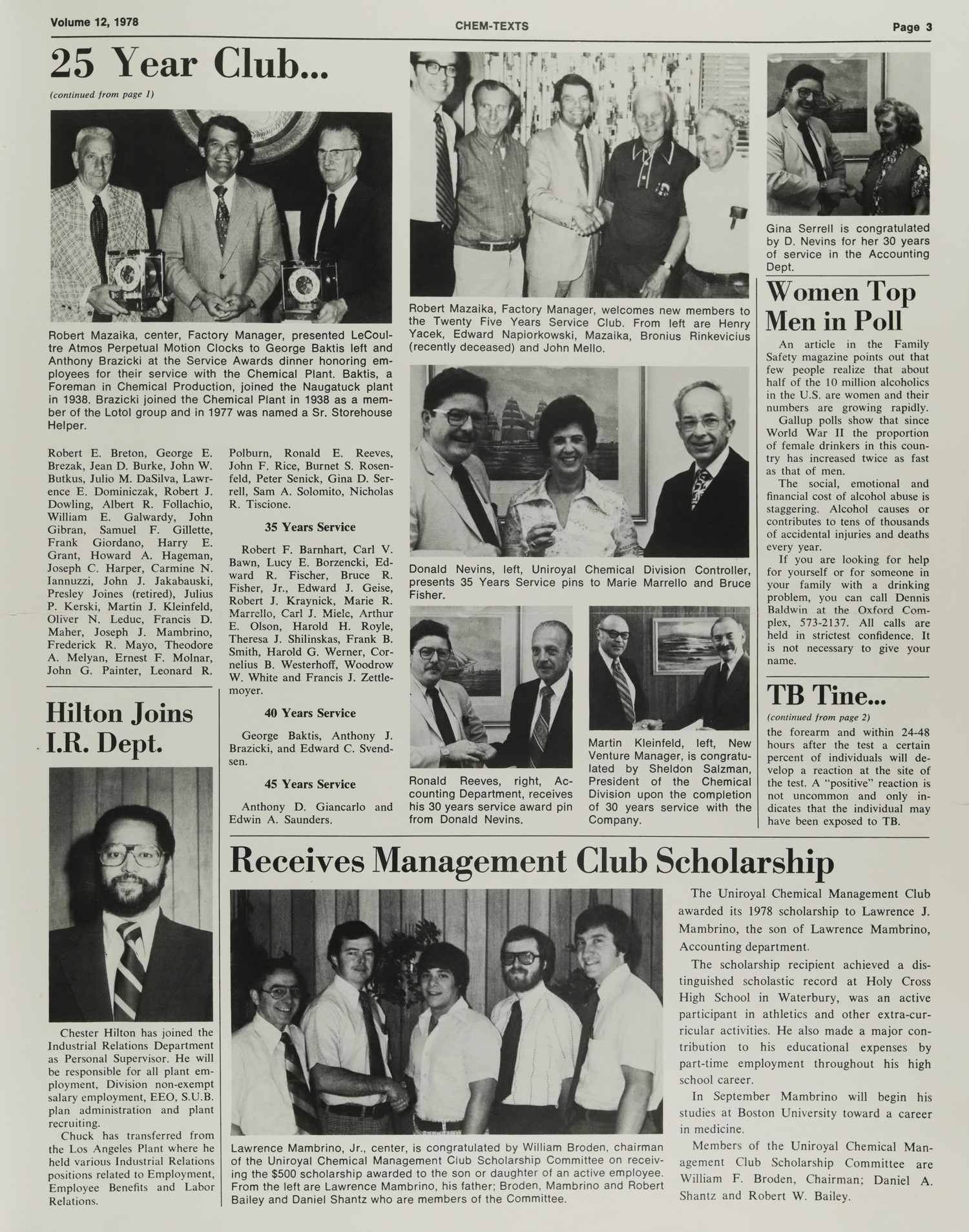
Robert Mazaika, center, Factory Manager, presented LeCoultre Atmos Perpetual Motion Clocks to George Baktis left and Anthony Brazicki at the Service Awards dinner honoring employees for their service with the Chemical Plant. Baktis, a Foreman in Chemical Production, joined the Naugatuck plant in 1938. Brazicki joined the Chemical Plant in 1938 as a member of the Lotol group and in 1977 was named a Sr. Storehouse Helper.

Robert E. Breton, George E. Brezak, Jean D. Burke, John W. Butkus, Julio M. DaSilva, Lawrence E. Dominiczak, Robert J. Dowling, Albert R. Follachio, William E. Galwardy, John Gibran, Samuel F. Gillette, Frank Giordano, Harry E. Grant, Howard A. Hageman, Joseph C. Harper, Carmine N. Iannuzzi, John J. Jakabauski, Presley Joines (retired), Julius P. Kerski, Martin J. Kleinfeld, Oliver N. Leduc, Francis D. Maher, Joseph J. Mambrino, Frederick R. Mayo, Theodore A. Melyan, Ernest F. Molnar, John G. Painter, Leonard R.

Polburn, Ronald E. Reeves, John F. Rice, Burnet S. Rosenfeld, Peter Senick, Gina D. Serrell, Sam A. Solomito, Nicholas R. Tiscione.

35 Years Service

Robert F. Barnhart, Carl V. Bawn, Lucy E. Borzencki, Edward R. Fischer, Bruce R. Fisher, Jr., Edward J. Geise, Robert J. Kraynick, Marie R. Marrollo, Carl J. Miele, Arthur E. Olson, Harold H. Royle, Theresa J. Shilinskas, Frank B. Smith, Harold G. Werner, Cornelius B. Westerhoff, Woodrow W. White and Francis J. Zettlemoyer.

40 Years Service

George Baktis, Anthony J. Brazicki, and Edward C. Svendsen.

45 Years Service

Anthony D. Giancarlo and Edwin A. Saunders.


Robert Mazaika, Factory Manager, welcomes new members to the Twenty Five Years Service Club. From left are Henry Yacek, Edward Napiorkowski, Mazaika, Bronius Rinkevicius (recently deceased) and John Mello.


Donald Nevins, left, Uniroyal Chemical Division Controller, presents 35 Years Service pins to Marie Marrello and Bruce Fisher.


Ronald Reeves, right, Accounting Department, receives his 30 years service award pin from Donald Nevins.

Martin Kleinfeld, left, New Venture Manager, is congratulated by Sheldon Salzman, President of the Chemical Division upon the completion of 30 years service with the Company.


Gina Serrell is congratulated by D. Nevins for her 30 years of service in the Accounting Dept.


Women Top Men in Poll

An article in the Family Safety magazine points out that few people realize that about half of the 10 million alcoholics in the U.S. are women and their numbers are growing rapidly.

Gallup polls show that since World War II the proportion of female drinkers in this country has increased twice as fast as that of men.

The social, emotional and financial cost of alcohol abuse is staggering. Alcohol causes or contributes to tens of thousands of accidental injuries and deaths every year.

If you are looking for help for yourself or for someone in your family with a drinking problem, you can call Dennis Baldwin at the Oxford Complex, 573-2137. All calls are held in strictest confidence. It is not necessary to give your name.


TB Tine…

(continued from page 2)

the forearm and within 24-48 hours after the test a certain percent of individuals will develop a reaction at the site of the test. A “positive” reaction is not uncommon and only indicates that the individual may have been exposed to TB.


Hilton Joins I.R. Dept.

Chester Hilton has joined the Industrial Relations Department as Personal Supervisor. He will be responsible for all plant employment, Division non-exempt salary employment, EEO, S.U.B. plan administration and plant recruiting.

Chuck has transferred from the Los Angeles Plant where he held various Industrial Relations positions related to Employment, Employee Benefits and Labor Relations.


Receives Management Club Scholarship

Lawrence Mambrino, Jr., center, is congratulated by William Broden, chairman of the Uniroyal Chemical Management Club Scholarship Committee on receiving the $500 scholarship awarded to the son or daughter of an active employee. From the left are Lawrence Mambrino, his father; Broden, Mambrino and Robert Bailey and Daniel Shantz who are members of the Committee.

The Uniroyal Chemical Management Club awarded its 1978 scholarship to Lawrence J. Mambrino, the son of Lawrence Mambrino, Accounting department.

The scholarship recipient achieved a distinguished scholastic record at Holy Cross High School in Waterbury, was an active participant in athletics and other extra-curricular activities. He also made a major contribution to his educational expenses by part-time employment throughout his high school career.

In September Mambrino will begin his studies at Boston University toward a career in medicine.

Members of the Uniroyal Chemical Management Club Scholarship Committee are William F. Broden, Chairman; Daniel A. Shantz and Robert W. Bailey.
CHEM-TEXTS – Vol. 5, No. 1 – Page 3

Page 003

CHEM-TEXTS

Vol. 5, No. 1 | Page 3


New Duster Cleans Air

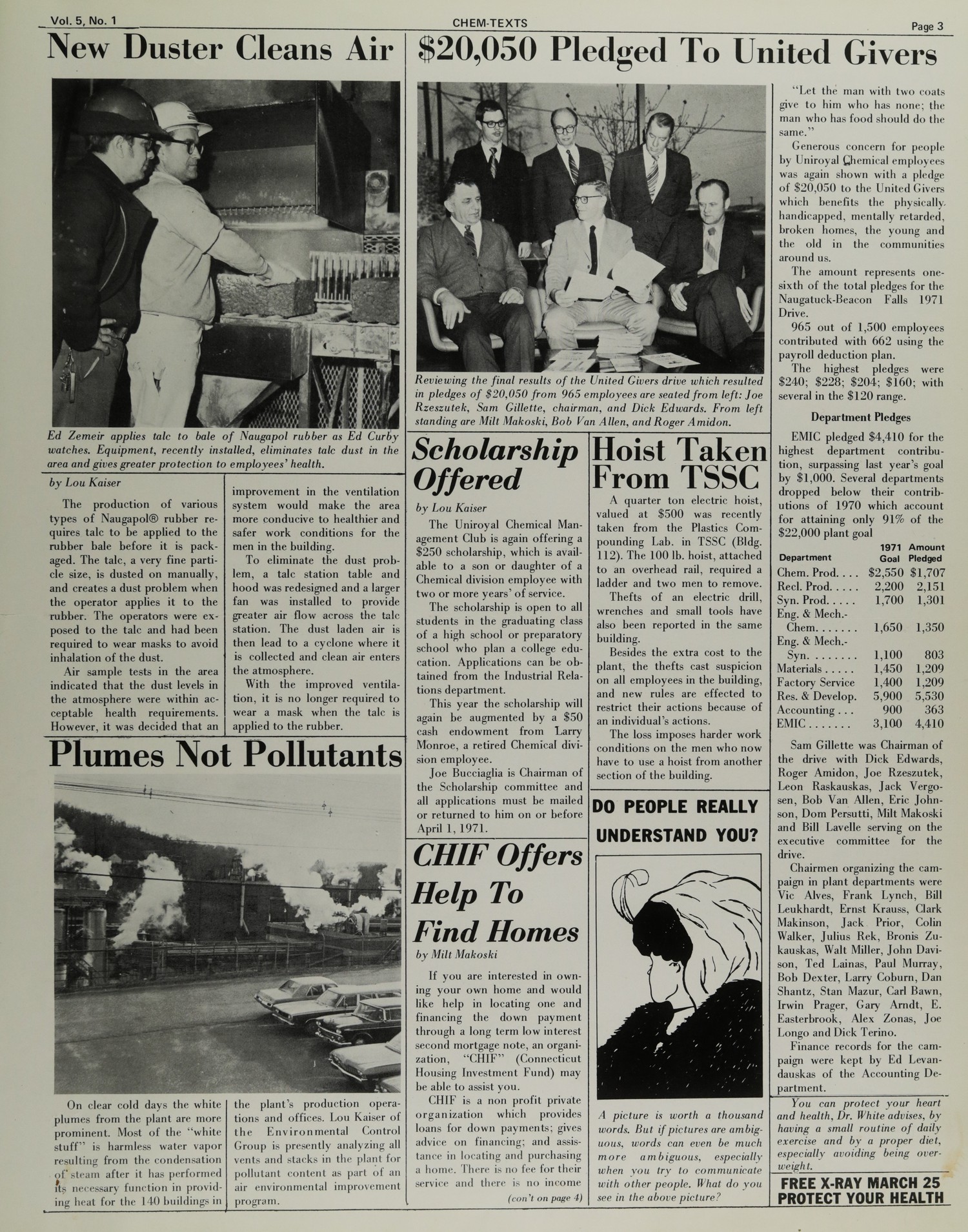
Ed Zemeir applies talc to bale of Naugapol rubber as Ed Curby watches. Equipment, recently installed, eliminates talc dust in the area and gives greater protection to employees’ health.

by Lou Kaiser

The production of various types of Naugapol® rubber requires talc to be applied to the rubber bale before it is packaged. The talc, a very fine particle size, is dusted on manually, and creates a dust problem when the operator applies it to the rubber. The operators were exposed to the talc and had been required to wear masks to avoid inhalation of the dust.

Air sample tests in the area indicated that the dust levels in the atmosphere were within acceptable health requirements. However, it was decided that an improvement in the ventilation system would make the area more conducive to healthier and safer work conditions for the men in the building.

To eliminate the dust problem, a talc station table and hood was redesigned and a larger fan was installed to provide greater air flow across the talc station. The dust laden air is then lead to a cyclone where it is collected and clean air enters the atmosphere.

With the improved ventilation, it is no longer required to wear a mask when the talc is applied to the rubber.


Plumes Not Pollutants

On clear cold days the white plumes from the plant are more prominent. Most of the “white stuff” is harmless water vapor resulting from the condensation of steam after it has performed its necessary function in providing heat for the 140 buildings in the plant’s production operations and offices. Lou Kaiser of the Environmental Control Group is presently analyzing all vents and stacks in the plant for pollutant content as part of an air environmental improvement program.


$20,050 Pledged To United Givers

Reviewing the final results of the United Givers drive which resulted in pledges of $20,050 from 965 employees are seated from left: Joe Rzeszutek, Sam Gillette, chairman, and Dick Edwards. From left standing are Milt Makoski, Bob Van Allen, and Roger Amidon.

“Let the man with two coats give to him who has none; the man who has food should do the same.”

Generous concern for people by Uniroyal Chemical employees was again shown with a pledge of $20,050 to the United Givers which benefits the physically handicapped, mentally retarded, broken homes, the young and the old in the communities around us.

The amount represents one-sixth of the total pledges for the Naugatuck-Beacon Falls 1971 Drive.

965 out of 1,500 employees contributed with 662 using the payroll deduction plan.

The highest pledges were $240; $228; $204; $160; with several in the $120 range.

Department Pledges

EMIC pledged $4,410 for the highest department contribution, surpassing last year’s goal by $1,000. Several departments dropped below their contributions of 1970 which account for attaining only 91% of the $22,000 plant goal

Department 1971 Goal Amount Pledged
Chem. Prod…. $2,550 $1,707
Recl. Prod….. 2,200 2,151
Syn. Prod…… 1,700 1,301
Eng. & Mech.- Chem……. 1,650 1,350
Eng. & Mech.- Syn……. 1,100 803
Materials….. 1,450 1,209
Factory Service 1,400 1,209
Res. & Develop. 5,900 5,530
Accounting… 900 363
EMIC…….. 3,100 4,410

Sam Gillette was Chairman of the drive with Dick Edwards, Roger Amidon, Joe Rzeszutek, Leon Raskauskas, Jack Vergosen, Bob Van Allen, Eric Johnson, Dom Persutti, Milt Makoski and Bill Lavelle serving on the executive committee for the drive.

Chairmen organizing the campaign in plant departments were Vic Alves, Frank Lynch, Bill Leukhardt, Ernst Krauss, Clark Makinson, Jack Prior, Colin Walker, Julius Rek, Bronis Zukauskas, Walt Miller, John Davison, Ted Lainas, Paul Murray, Bob Dexter, Larry Coburn, Dan Shantz, Stan Mazur, Carl Bawn, Irwin Prager, Gary Arndt, E. Easterbrook, Alex Zonas, Joe Longo and Dick Terino.

Finance records for the campaign were kept by Ed Levandauskas of the Accounting Department.


Scholarship Offered

by Lou Kaiser

The Uniroyal Chemical Management Club is again offering a $250 scholarship, which is available to a son or daughter of a Chemical division employee with two or more years’ of service.

The scholarship is open to all students in the graduating class of a high school or preparatory school who plan a college education. Applications can be obtained from the Industrial Relations department.

This year the scholarship will again be augmented by a $50 cash endowment from Larry Monroe, a retired Chemical division employee.

Joe Bucciaglia is Chairman of the Scholarship committee and all applications must be mailed or returned to him on or before April 1, 1971.


Hoist Taken From TSSC

A quarter ton electric hoist, valued at $500 was recently taken from the Plastics Compounding Lab. in TSSC (Bldg. 112). The 100 lb. hoist, attached to an overhead rail, required a ladder and two men to remove.

Thefts of an electric drill, wrenches and small tools have also been reported in the same building.

Besides the extra cost to the plant, the thefts cast suspicion on all employees in the building, and new rules are effected to restrict their actions because of an individual’s actions.

The loss imposes harder work conditions on the men who now have to use a hoist from another section of the building.


CHIF Offers Help To Find Homes

by Milt Makoski

If you are interested in owning your own home and would like help in locating one and financing the down payment through a long term low interest second mortgage note, an organization, “CHIF” (Connecticut Housing Investment Fund) may be able to assist you.

CHIF is a non profit private organization which provides loans for down payments; gives advice on financing; and assistance in locating and purchasing a home. There is no fee for their service and there is no income

(con’t on page 4)


DO PEOPLE REALLY UNDERSTAND YOU?

A picture is worth a thousand words. But if pictures are ambiguous, words can even be much more ambiguous, especially when you try to communicate with other people. What do you see in the above picture?


You can protect your heart and health, Dr. White advises, by having a small routine of daily exercise and by a proper diet, especially avoiding being overweight.

FREE X-RAY MARCH 25
PROTECT YOUR HEALTH

CHEM-TEXTS – Vol. 5 No. 3 – Page 4

Page 004

Page 4 CHEM-TEXTS Vol. 5 No. 3


Know Your Products: Rubber Chemical Accelerators

by Dr. Bob Brown

(This issue continues the article in Vol. 5, No. 2 on Accelerators made or marketed by the Naugatuck Chemical plant.)

Accelerators are used primarily to speed up, or control the vulcanization process which turns rubber from a useless, gummy substance into a strong resilient and elastic material. Vulcanization, in simple terms, is a chemical reaction between rubber and sulfur, usually brought about by heat.

Faster Accelerators

Where there is less processing or mixing involved, very fast accelerators with little or no delayed action can be used to give more rapid vulcanization. The Zates (Arazate®, Butazate®, Ethazate® and Methazate®) and the Thiurams (Monex®, Pentex®, Tuex®, and Accelerator 108) are used here. They are also used in latex curing where processing is usually not a problem.

Customers use these accelerators for rubber sponge, wire insulation, hot water bottles, conveyor belts, hospital sheeting, and household items and in such latex products as balloons and carpet backing.

The Zates accelerators are non-discoloring and non-staining and can be used in colored rubber products.

Some of the newer synthetic rubbers (Royalene® “the crackless rubber” is an example) are inherently slower in vulcanization than the older types such as natural rubber, neoprene and the Naugapol® and Paracril® synthetic rubbers made at the Naugatuck and Painesville, Ohio plants. Fast accelerators are needed to speed up the vulcanization process for these types of rubber, otherwise it would be economically impossible to make a product at a reasonable selling price to the consumer.

Dr. Bob Brown, author of these articles, is manager of Research and Development for Rubber Chemicals. He received his doctorate degree from Princeton University in Organic Chemistry and holds several patent awards. Dr. Brown heads a staff of 42 people whose sole function is to improve our present chemicals and to develop new ones in order to remain competitive in the market.

GMF and DIBENZO GMF® are used in butyl rubber which also vulcanizes very slowly. A large amount of butyl rubber is used for tire tubes, and high voltage electrical cable.

CPB, DBA Very Active

Sometimes customers want to vulcanize rubber products without heating them at all. Very active accelerators like CPB and DBA accomplish this. In this process the product must be shaped before the accelerator is added. Golf ball covers, for example, are vulcanized by soaking the finished balls in a solution of CPB.

(In the next issue of Chem-Texts, Antioxidants and Antiozonants will be discussed. If you have a son or daughter in school, these articles provide source material for class papers in Chemistry courses.)


33 Employees

(Cont’d. from page 2)

are under further evaluation for higher amounts dependent on the amount of the savings for the plant.

Other employees who received cash awards for Ideas were P. Blasko, F. Maffia, M. Jannetty, D. Stevenson, E. Grickis, R. Guest, B. Robinson, A. Urban, S. Kropcho, J. Harper, J. Gilbert, A. Happy, J. Iosa, H. Garahan, F. Surmanek (2), L. DeLaRosa (2), P. Beardsley, S. Falcone, H. Hernandez, A. Grella, J. Needham, D. Boyd, E. Root, Sr., A. Molnar, D. Pinto and J. Cohen.

Letters of Commendation were presented to C. Smith, L. Fortier, F. Gagne, Carol Calo, J. Gallucci, R. Lockwood, D. Donato, T. Carr, Preciosa Cravo, D. Nelson, A. Nauges, W. Krayeski, W. Tabaka and D. Polzella.

Of the 33 employees awarded cash for Ideas, two were salary employees and the highest number of Ideas were submitted by Mechanical Department personnel.

No Limit to Cash Awards

There is no maximum limit to the amount of a cash award for an Idea. If the value of the Idea exceeds $1,000—this amount is paid under the Plant Idea Plan—it is submitted for further consideration for a higher award to a special management committee. The minimum award for an Idea is $25.

Ideas to Conserve Water Needed

With the construction of the new liquid waste pretreatment plant in progress, ideas to conserve water are needed now as the facilities are designed to treat 3,600,000 gallons a day.


SAFETY IS MY RESPONSIBILITY


Crim Assumes IR Post

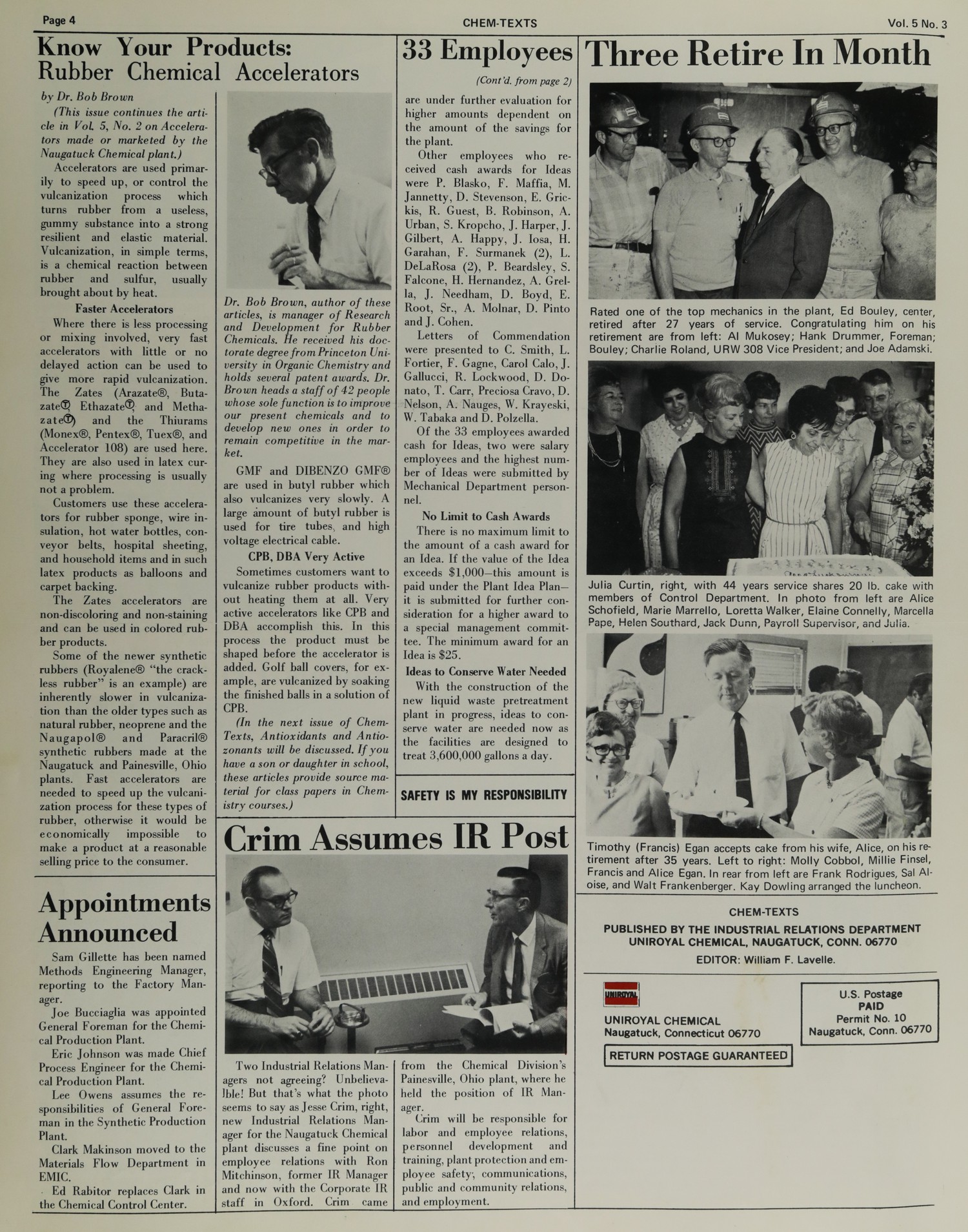
Two Industrial Relations Managers not agreeing? Unbelievable! But that’s what the photo seems to say as Jesse Crim, right, new Industrial Relations Manager for the Naugatuck Chemical plant discusses a fine point on employee relations with Ron Mitchinson, former IR Manager and now with the Corporate IR staff in Oxford. Crim came from the Chemical Division’s Painesville, Ohio plant, where he held the position of IR Manager.

Crim will be responsible for labor and employee relations, personnel development and training, plant protection and employee safety, communications, public and community relations, and employment.


Appointments Announced

Sam Gillette has been named Methods Engineering Manager, reporting to the Factory Manager.

Joe Bucciaglia was appointed General Foreman for the Chemical Production Plant.

Eric Johnson was made Chief Process Engineer for the Chemical Production Plant.

Lee Owens assumes the responsibilities of General Foreman in the Synthetic Production Plant.

Clark Makinson moved to the Materials Flow Department in EMIC.

Ed Rabitor replaces Clark in the Chemical Control Center.


Three Retire In Month

Rated one of the top mechanics in the plant, Ed Bouley, center, retired after 27 years of service. Congratulating him on his retirement are from left: Al Mukosey; Hank Drummer, Foreman; Bouley; Charlie Roland, URW 308 Vice President; and Joe Adamski.


Julia Curtin, right, with 44 years service shares 20 lb. cake with members of Control Department. In photo from left are Alice Schofield, Marie Marrello, Loretta Walker, Elaine Connelly, Marcella Pape, Helen Southard, Jack Dunn, Payroll Supervisor, and Julia.


Timothy (Francis) Egan accepts cake from his wife, Alice, on his retirement after 35 years. Left to right: Molly Cobbol, Millie Finsel, Francis and Alice Egan. In rear from left are Frank Rodrigues, Sal Aloise, and Walt Frankenberger. Kay Dowling arranged the luncheon.


CHEM-TEXTS

PUBLISHED BY THE INDUSTRIAL RELATIONS DEPARTMENT
UNIROYAL CHEMICAL, NAUGATUCK, CONN. 06770

EDITOR: William F. Lavelle.


UNIROYAL CHEMICAL
Naugatuck, Connecticut 06770

RETURN POSTAGE GUARANTEED

U.S. Postage
PAID
Permit No. 10
Naugatuck, Conn. 06770

CHEM-TEXTS – Vol. 5, No. 5 – Page 3

Page 003

CHEM-TEXTS

Vol. 5, No. 5 Page 3


Gillette, Welch Named To Head Up Idea Plan

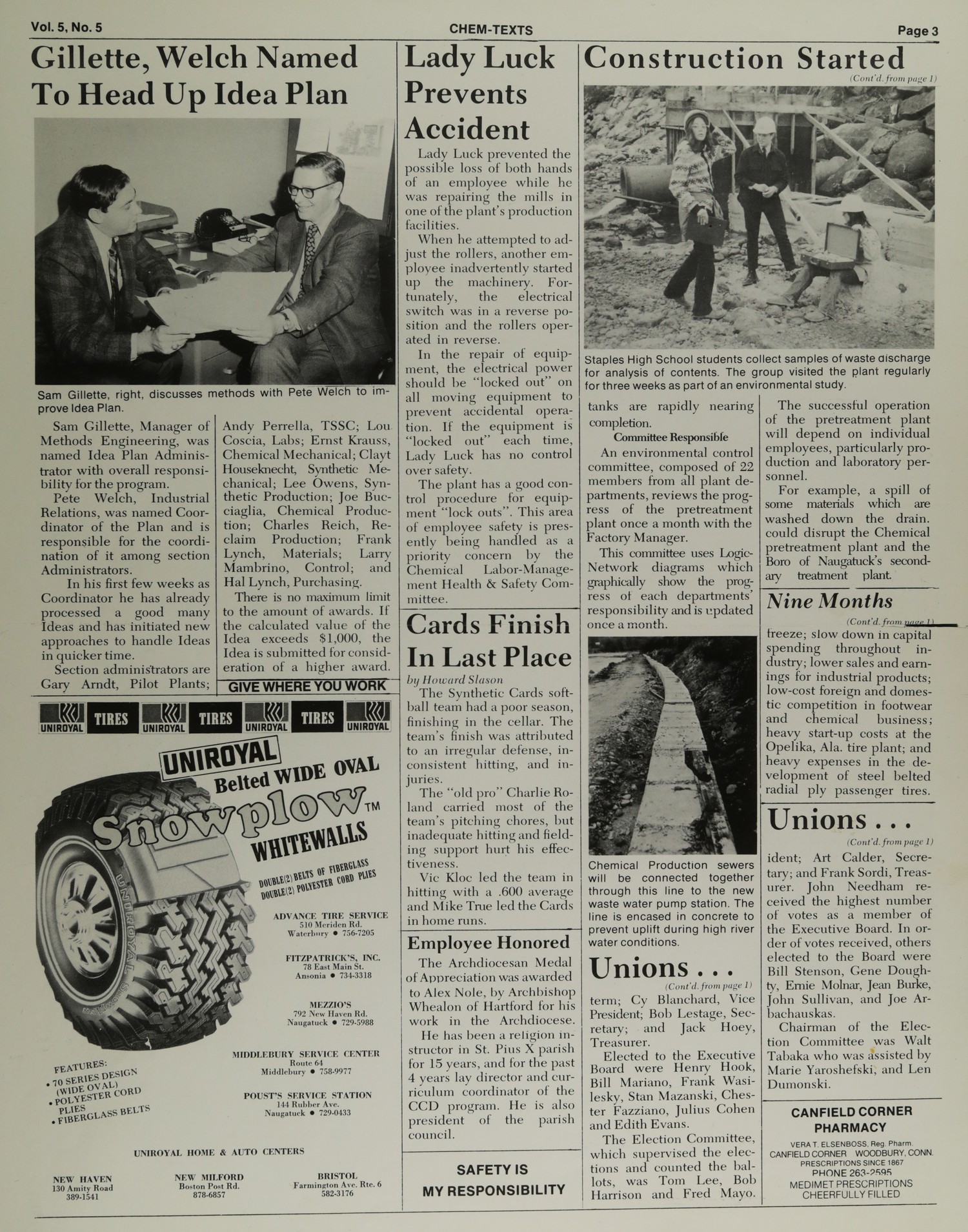
[IMAGE: Sam Gillette, right, discusses methods with Pete Welch to improve Idea Plan.]

Sam Gillette, Manager of Methods Engineering, was named Idea Plan Administrator with overall responsibility for the program.

Pete Welch, Industrial Relations, was named Coordinator of the Plan and is responsible for the coordination of it among section Administrators.

In his first few weeks as Coordinator he has already processed a good many Ideas and has initiated new approaches to handle Ideas in quicker time.

Section administrators are Gary Arndt, Pilot Plants; Andy Perrella, TSSC; Lou Coscia, Labs; Ernst Krauss, Chemical Mechanical; Clayt Houseknecht, Synthetic Mechanical; Lee Owens, Synthetic Production; Joe Bucciaglia, Chemical Production; Charles Reich, Reclaim Production; Frank Lynch, Materials; Larry Mambrino, Control; and Hal Lynch, Purchasing.

There is no maximum limit to the amount of awards. If the calculated value of the Idea exceeds $1,000, the Idea is submitted for consideration of a higher award.

GIVE WHERE YOU WORK


Lady Luck Prevents Accident

Lady Luck prevented the possible loss of both hands of an employee while he was repairing the mills in one of the plant’s production facilities.

When he attempted to adjust the rollers, another employee inadvertently started up the machinery. Fortunately, the electrical switch was in a reverse position and the rollers operated in reverse.

In the repair of equipment, the electrical power should be “locked out” on all moving equipment to prevent accidental operation. If the equipment is “locked out” each time, Lady Luck has no control over safety.

The plant has a good control procedure for equipment “lock outs”. This area of employee safety is presently being handled as a priority concern by the Chemical Labor-Management Health & Safety Committee.


Cards Finish In Last Place

by Howard Slason

The Synthetic Cards softball team had a poor season, finishing in the cellar. The team’s finish was attributed to an irregular defense, inconsistent hitting, and injuries.

The “old pro” Charlie Roland carried most of the team’s pitching chores, but inadequate hitting and fielding support hurt his effectiveness.

Vic Kloc led the team in hitting with a .600 average and Mike True led the Cards in home runs.


Employee Honored

The Archdiocesan Medal of Appreciation was awarded to Alex Nole, by Archbishop Whealon of Hartford for his work in the Archdiocese.

He has been a religion instructor in St. Pius X parish for 15 years, and for the past 4 years lay director and curriculum coordinator of the CCD program. He is also president of the parish council.


SAFETY IS MY RESPONSIBILITY


Construction Started

(Cont’d. from page 1)

[IMAGE: Staples High School students collect samples of waste discharge for analysis of contents. The group visited the plant regularly for three weeks as part of an environmental study.]

tanks are rapidly nearing completion.

Committee Responsible

An environmental control committee, composed of 22 members from all plant departments, reviews the progress of the pretreatment plant once a month with the Factory Manager.

This committee uses Logic-Network diagrams which graphically show the progress of each departments’ responsibility and is updated once a month.

The successful operation of the pretreatment plant will depend on individual employees, particularly production and laboratory personnel.

For example, a spill of some materials which are washed down the drain, could disrupt the Chemical pretreatment plant and the Boro of Naugatuck’s secondary treatment plant.


Nine Months

(Cont’d. from page 1)

freeze; slow down in capital spending throughout industry; lower sales and earnings for industrial products; low-cost foreign and domestic competition in footwear and chemical business; heavy start-up costs at the Opelika, Ala. tire plant; and heavy expenses in the development of steel belted radial ply passenger tires.


Unions…

(Cont’d. from page 1)

Chemical Production sewers will be connected together through this line to the new waste water pump station. The line is encased in concrete to prevent uplift during high river water conditions.

Unions…

(Cont’d. from page 1)

term; Cy Blanchard, Vice President; Bob Lestage, Secretary; and Jack Hoey, Treasurer.

Elected to the Executive Board were Henry Hook, Bill Mariano, Frank Wasilesky, Stan Mazanski, Chester Fazziano, Julius Cohen and Edith Evans.

The Election Committee, which supervised the elections and counted the ballots, was Tom Lee, Bob Harrison and Fred Mayo.

ident; Art Calder, Secretary; and Frank Sordi, Treasurer. John Needham received the highest number of votes as a member of the Executive Board. In order of votes received, others elected to the Board were Bill Stenson, Gene Doughty, Ernie Molnar, Jean Burke, John Sullivan, and Joe Arbachauskas.

Chairman of the Election Committee was Walt Tabaka who was assisted by Marie Yaroshefski, and Len Dumonski.


ADVERTISEMENTS

UNIROYAL TIRES

UNIROYAL Belted WIDE OVAL

Snowplow™ WHITEWALLS

DOUBLE/2 BELTS OF FIBERGLASS
DOUBLE/2 POLYESTER CORD PLIES

ADVANCE TIRE SERVICE
510 Meriden Rd.
Waterbury ● 756-2205

FITZPATRICK’S, INC.
78 East Main St.
Ansonia ● 734-5318

MEZZIO’S
792 New Haven Rd.
Naugatuck ● 729-3988

MIDDLEBURY SERVICE CENTER
Route 64
Middlebury ● 758-9977

POUST’S SERVICE STATION
144 Rubber Ave.
Naugatuck ● 729-0433

FEATURES:
– 70 SERIES DESIGN (WIDE OVAL)
– POLYESTER CORD PLIES
– FIBERGLASS BELTS

UNIROYAL HOME & AUTO CENTERS

NEW HAVEN NEW MILFORD BRISTOL
130 Amity Road Boston Post Rd. Farmington Ave. Rte. 6
389-1541 878-6857 582-3176

CANFIELD CORNER PHARMACY

VERA T. ELSENBOSS, Reg. Pharm.
CANFIELD CORNER WOODBURY, CONN
PRESCRIPTIONS SINCE 1907
PHONE 263-2595
MEDIMET PRESCRIPTIONS
CHEERFULLY FILLED

CHEM-TEXTS – Vol. 4 No. 2 – Page 2

Page 002

Page 2 CHEM-TEXTS Vol. 4 No. 2

FROM THE FACTORY MANAGER

DEAR FELLOW EMPLOYEE:

Recently I was pleased to announce to the general public that our Management had approved funds to construct waste pre-treatment facilities at our plant. This expenditure of close to $3,000,000, along with successful negotiations of an agreement with the Borough of Naugatuck to provide secondary treatment of our wastes, will bring us a long way in meeting our obligations to help clean up the Naugatuck River.

However, I am very much concerned that each of us realize our individual part in doing the total job to control pollution. No matter what Management does or spends on pollution control facilities, these actions will never be effective unless every employee shows a personal concern to eliminate pollution in his activities.

We all have to face up to our individual responsibilities to avoid spills, careless dumping of spoiled materials and excessive flushing of processing areas. In practice, we have to operate on the basis that the drain is the very last alternative for disposal.

We can not wait for the new treatment plants before we start to operate in this manner. We have to learn right away to put into practice “NO DRAIN” operation. To stop pollution everybody must do their part – we are all counting on each other to do the job!

John D. Evans


$615 Awarded For Suggestions

Zates line in Bldg. 89 which will increase productivity, provide a smoother operation and improve product quality.

Marty Hebert was awarded an additional $85 based on his suggestion to reduce the cycle time on the CHO still in Bldg. 72 by hook-

Other high awards went to Charlie Ferguson, $50; Joe Chasse, $40. Carmen Iannuzzi received three $15 awards.

Cash awards were also received by Pete Shreder, Dan Cleary, Tim Clark, John Enamait, Sam Molnar, Jerry Ferguson, Ken Ferreira, Mary

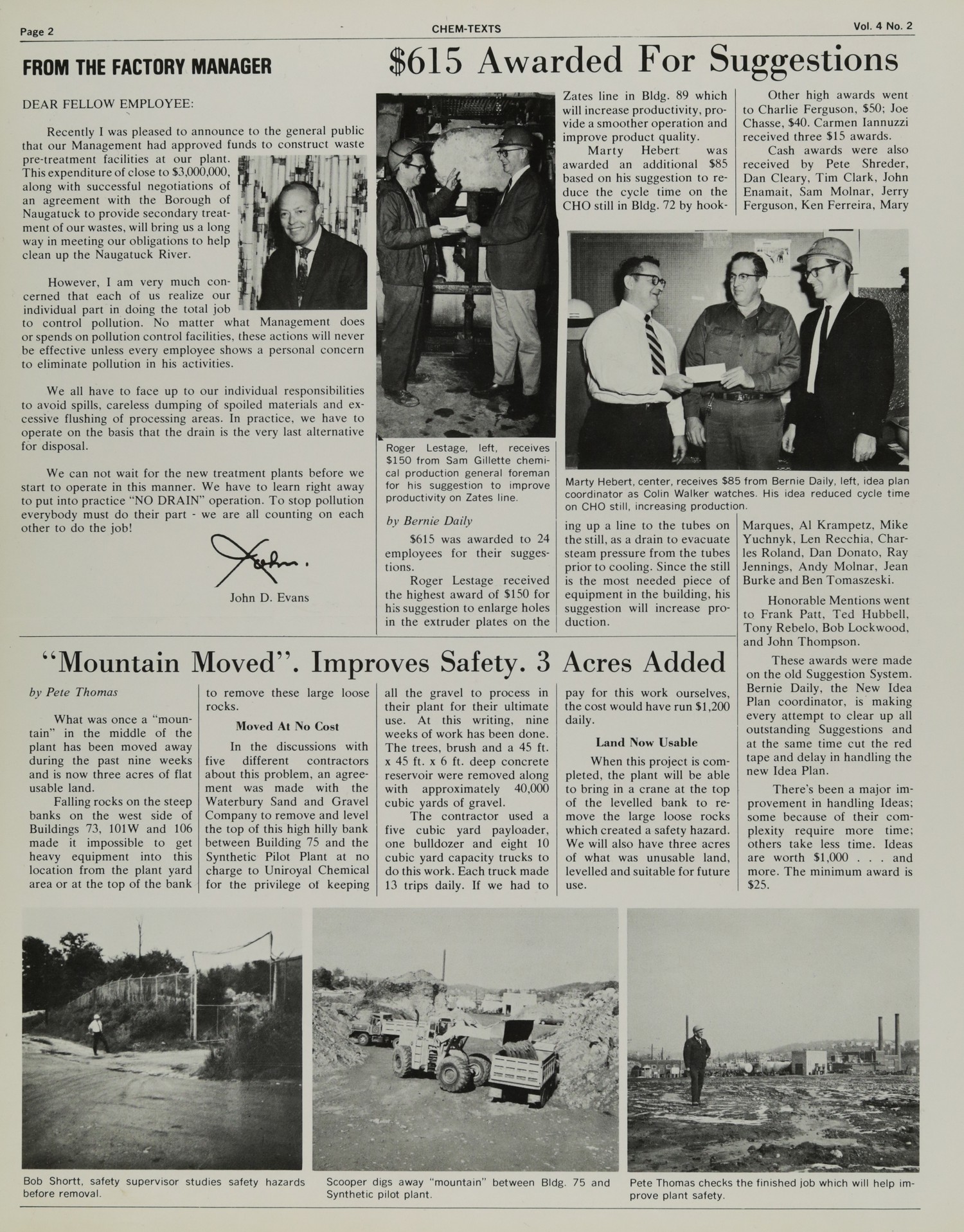
Roger Lestage, left, receives $150 from Sam Gillette chemical production general foreman for his suggestion to improve productivity on Zates line.

Marty Hebert, center, receives $85 from Bernie Daily, left, idea plan coordinator as Colin Walker watches. His idea reduced cycle time on CHO still, increasing production.

by Bernie Daily

$615 was awarded to 24 employees for their suggestions.

Roger Lestage received the highest award of $150 for his suggestion to enlarge holes in the extruder plates on the

ing up a line to the tubes on the still, as a drain to evacuate steam pressure from the tubes prior to cooling. Since the still is the most needed piece of equipment in the building, his suggestion will increase production.

Marques, Al Krampetz, Mike Yuchnyk, Len Recchia, Charles Roland, Dan Donato, Ray Jennings, Andy Molnar, Jean Burke and Ben Tomaszeski.

Honorable Mentions went to Frank Patt, Ted Hubbell, Tony Rebelo, Bob Lockwood, and John Thompson.

These awards were made on the old Suggestion System. Bernie Daily, the New Idea Plan coordinator, is making every attempt to clear up all outstanding Suggestions and at the same time cut the red tape and delay in handling the new Idea Plan.

There’s been a major improvement in handling Ideas; some because of their complexity require more time; others take less time. Ideas are worth $1,000 . . . and more. The minimum award is $25.


“Mountain Moved”. Improves Safety. 3 Acres Added

by Pete Thomas

What was once a “mountain” in the middle of the plant has been moved away during the past nine weeks and is now three acres of flat usable land.

Falling rocks on the steep banks on the west side of Buildings 73, 101W and 106 made it impossible to get heavy equipment into this location from the plant yard area or at the top of the bank to remove these large loose rocks.

Moved At No Cost

In the discussions with five different contractors about this problem, an agreement was made with the Waterbury Sand and Gravel Company to remove and level the top of this high hilly bank between Building 75 and the Synthetic Pilot Plant at no charge to Uniroyal Chemical for the privilege of keeping all the gravel to process in their plant for their ultimate use. At this writing, nine weeks of work has been done. The trees, brush and a 45 ft. x 45 ft. x 6 ft. deep concrete reservoir were removed along with approximately 40,000 cubic yards of gravel.

The contractor used a five cubic yard payloader, one bulldozer and eight 10 cubic yard capacity trucks to do this work. Each truck made 13 trips daily. If we had to pay for this work ourselves, the cost would have run $1,200 daily.

Land Now Usable

When this project is completed, the plant will be able to bring in a crane at the top of the levelled bank to remove the large loose rocks which created a safety hazard. We will also have three acres of what was unusable land, levelled and suitable for future use.


Bob Shortt, safety supervisor studies safety hazards before removal.

Scooper digs away “mountain” between Bldg. 75 and Synthetic pilot plant.

Pete Thomas checks the finished job which will help improve plant safety.

CHEM-TEXTS – Vol. 4 No. 5 – Page 3

Page 003

CHEM-TEXT

Vol. 4, No. 5 | Page 3


Brains And Beauty Match Brains And Brawn


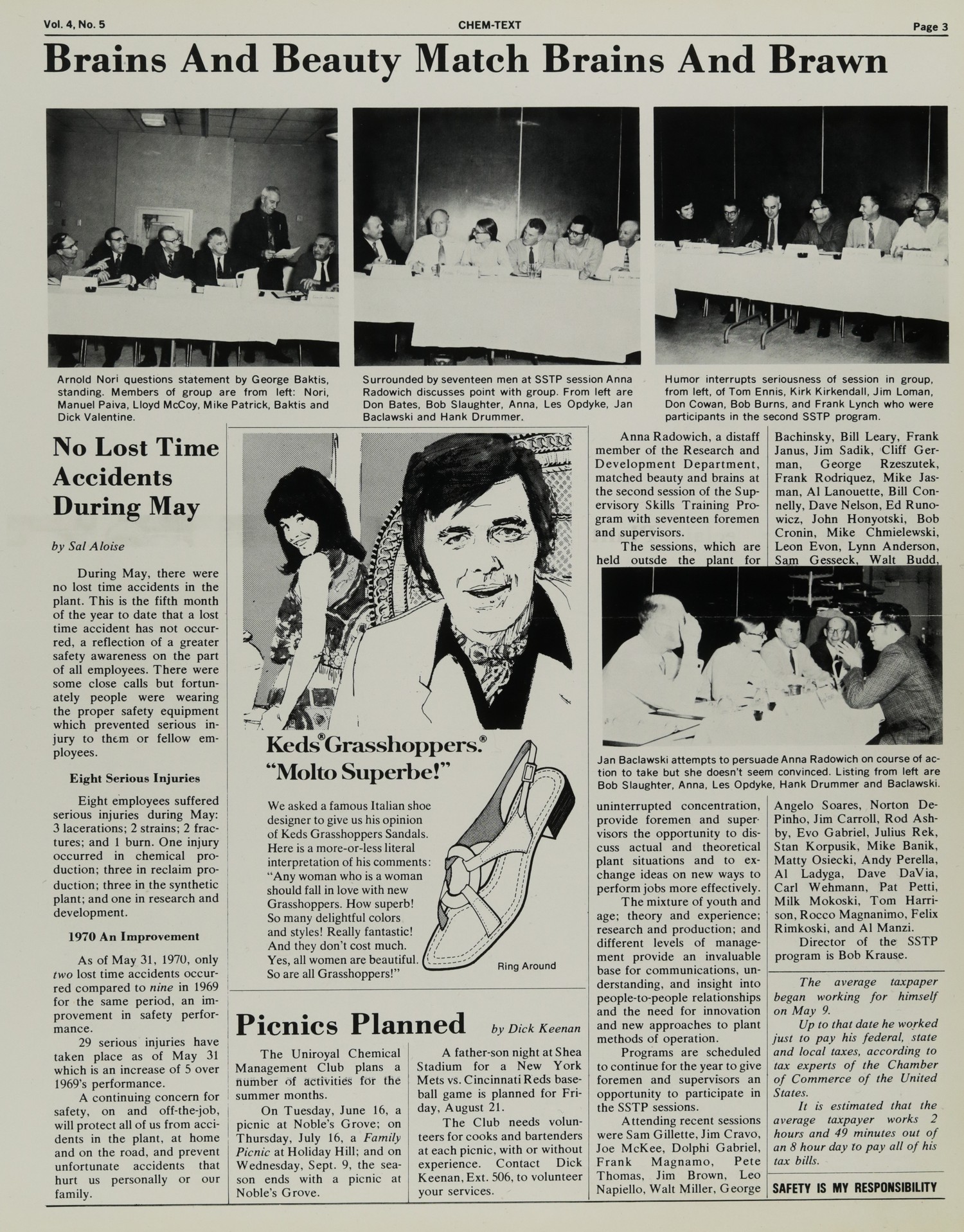
Arnold Nori questions statement by George Baktis, standing. Members of group are from left: Nori, Manuel Paiva, Lloyd McCoy, Mike Patrick, Baktis and Dick Valentine.

Surrounded by seventeen men at SSTP session Anna Radowich discusses point with group. From left are Don Bates, Bob Slaughter, Anna, Les Opdyke, Jan Baclawski and Hank Drummer.

Humor interrupts seriousness of session in group, from left, of Tom Ennis, Kirk Kirkendall, Jim Loman, Don Cowan, Bob Burns, and Frank Lynch who were participants in the second SSTP program.


No Lost Time Accidents During May

by Sal Aloise

During May, there were no lost time accidents in the plant. This is the fifth month of the year to date that a lost time accident has not occurred, a reflection of a greater safety awareness on the part of all employees. There were some close calls but fortunately people were wearing the proper safety equipment which prevented serious injury to them or fellow employees.

Eight Serious Injuries

Eight employees suffered serious injuries during May: 3 lacerations; 2 strains; 2 fractures; and 1 burn. One injury occurred in chemical production; three in reclaim production; three in the synthetic plant; and one in research and development.

1970 An Improvement

As of May 31, 1970, only two lost time accidents occurred compared to nine in 1969 for the same period, an improvement in safety performance.

29 serious injuries have taken place as of May 31 which is an increase of 5 over 1969’s performance.

A continuing concern for safety, on and off-the-job, will protect all of us from accidents in the plant, at home and on the road, and prevent unfortunate accidents that hurt us personally or our family.


Keds® Grasshoppers.® “Molto Superbe!”

We asked a famous Italian shoe designer to give us his opinion of Keds Grasshoppers Sandals. Here is a more-or-less literal interpretation of his comments: “Any woman who is a woman should fall in love with new Grasshoppers. How superb! So many delightful colors and styles! Really fantastic! And they don’t cost much. Yes, all women are beautiful. So are all Grasshoppers!”

Ring Around


Picnics Planned

by Dick Keenan

The Uniroyal Chemical Management Club plans a number of activities for the summer months.

On Tuesday, June 16, a picnic at Noble’s Grove; on Thursday, July 16, a Family Picnic at Holiday Hill; and on Wednesday, Sept. 9, the season ends with a picnic at Noble’s Grove.

A father-son night at Shea Stadium for a New York Mets vs. Cincinnati Reds baseball game is planned for Friday, August 21.

The Club needs volunteers for cooks and bartenders at each picnic, with or without experience. Contact Dick Keenan, Ext. 506, to volunteer your services.


Anna Radowich, a distaff member of the Research and Development Department, matched beauty and brains at the second session of the Supervisory Skills Training Program with seventeen foremen and supervisors.

The sessions, which are held outsde the plant for

Bachinsky, Bill Leary, Frank Janus, Jim Sadik, Cliff German, George Rzeszutek, Frank Rodriquez, Mike Jasman, Al Lanouette, Bill Connelly, Dave Nelson, Ed Runowicz, John Honyotski, Bob Cronin, Mike Chmielewski, Leon Evon, Lynn Anderson, Sam Gesseck, Walt Budd.


Jan Baclawski attempts to persuade Anna Radowich on course of action to take but she doesn’t seem convinced. Listing from left are Bob Slaughter, Anna, Les Opdyke, Hank Drummer and Baclawski.

uninterrupted concentration, provide foremen and supervisors the opportunity to discuss actual and theoretical plant situations and to exchange ideas on new ways to perform jobs more effectively.

The mixture of youth and age; theory and experience; research and production; and different levels of management provide an invaluable base for communications, understanding, and insight into people-to-people relationships and the need for innovation and new approaches to plant methods of operation.

Programs are scheduled to continue for the year to give foremen and supervisors an opportunity to participate in the SSTP sessions.

Attending recent sessions were Sam Gillette, Jim Cravo, Joe McKee, Dolphi Gabriel, Frank Magnanimo, Pete Thomas, Jim Brown, Leo Napiello, Walt Miller, George

Angelo Soares, Norton DePinho, Jim Carroll, Rod Ashby, Evo Gabriel, Julius Rek, Stan Korpusik, Mike Banik, Matty Osiecki, Andy Perella, Al Ladyga, Dave DaVia, Carl Wehmann, Pat Petti, Milk Mokoski, Tom Harrison, Rocco Magnanimo, Felix Rimkoski, and Al Manzi.

Director of the SSTP program is Bob Krause.


The average taxpayer began working for himself on May 9.

Up to that date he worked just to pay his federal, state and local taxes, according to tax experts of the Chamber of Commerce of the United States.

It is estimated that the average taxpayer works 2 hours and 49 minutes out of an 8 hour day to pay all of his tax bills.


SAFETY IS MY RESPONSIBILITY

CHEM-TEXTS – Vol. 3 No. 3 – Page 2

Page 002

Page 2 CHEM-TEXTS Vol. 3 No. 3


FROM THE FACTORY MANAGER

DEAR FELLOW EMPLOYEE:

Are you a professional? In sports the professional is one whose proficiency and skill enables him to earn his living through his participation. The professional is characterized by his pride in his efforts. In a similar sense, we are professionals earning our living by supplying our customers with chemicals, reclaim, and polymers. But do we always demonstrate the proficiency and skill required in our jobs? Do we have the pride of workmanship characteristic of the professional?

Remember a professional always gives his best and always tries to win. He puts team goals and team effort ahead of his own personal desires. He believes the whole team wins together and he takes pride in realizing that the true recognition for his effort is in the team winning.

The same thing is true in our plant – we all win when we satisfy our customers’ needs in the most efficient manner possible. Anything less than this – we aren’t professionals!

[Signature]

John D. Evans


Chemical Control Center Reviews Quality, Productivity, and Costs

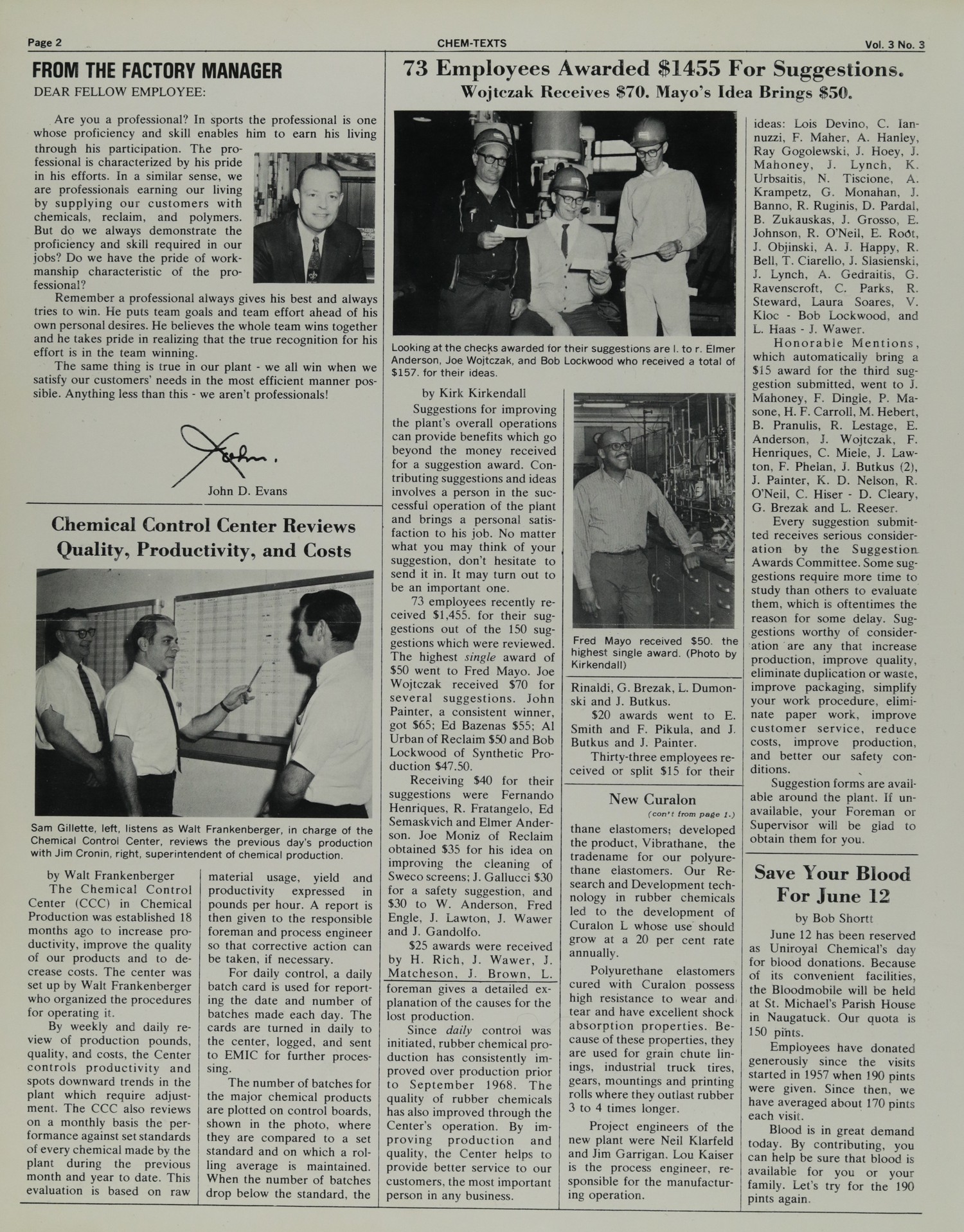
[IMAGE: Sam Gillette, left, listens as Walt Frankenberger, in charge of the Chemical Control Center, reviews the previous day’s production with Jim Cronin, right, superintendent of chemical production.]

by Walt Frankenberger

The Chemical Control Center (CCC) in Chemical Production was established 18 months ago to increase productivity, improve the quality of our products and to decrease costs. The center was set up by Walt Frankenberger who organized the procedures for operating it.

By weekly and daily review of production pounds, quality, and costs, the Center controls productivity and spots downward trends in the plant which require adjustment. The CCC also reviews on a monthly basis the performance against set standards of every chemical made by the plant during the previous month and year to date. This evaluation is based on raw material usage, yield and productivity expressed in pounds per hour. A report is then given to the responsible foreman and process engineer so that corrective action can be taken, if necessary.

For daily control, a daily batch card is used for reporting the date and number of batches made each day. The cards are turned in daily to the center, logged, and sent to EMIC for further processing.

The number of batches for the major chemical products are plotted on control boards, shown in the photo, where they are compared to a set standard and on which a rolling average is maintained. When the number of batches drop below the standard, the person in any business.


73 Employees Awarded $1455 For Suggestions.

Wojtczak Receives $70. Mayo’s Idea Brings $50.

[IMAGE: Looking at the checks awarded for their suggestions are l. to r. Elmer Anderson, Joe Wojtczak, and Bob Lockwood who received a total of $157. for their ideas.]

by Kirk Kirkendall

Suggestions for improving the plant’s overall operations can provide benefits which go beyond the money received for a suggestion award. Contributing suggestions and ideas involves a person in the successful operation of the plant and brings a personal satisfaction to his job. No matter what you may think of your suggestion, don’t hesitate to send it in. It may turn out to be an important one.

73 employees recently received $1,455. for their suggestions out of the 150 suggestions which were reviewed. The highest single award of $50 went to Fred Mayo. Joe Wojtczak received $70 for several suggestions. John Painter, a consistent winner, got $65; Ed Bazenas $55; Al Urban of Reclaim $50 and Bob Lockwood of Synthetic Production $47.50.

Receiving $40 for their suggestions were Fernando Henriques, R. Fratangelo, Ed Semaskvich and Elmer Anderson. Joe Moniz of Reclaim obtained $35 for his idea on improving the cleaning of Sweco screens; J. Gallucci $30 for a safety suggestion, and $30 to W. Anderson, Fred Engle, J. Lawton, J. Wawer and J. Gandolfo.

$25 awards were received by H. Rich, J. Wawer, J. Matcheson, J. Brown, L. foreman gives a detailed explanation of the causes for the lost production.

Since daily control was initiated, rubber chemical production has consistently improved over production prior to September 1968. The quality of rubber chemicals has also improved through the Center’s operation. By improving production and quality, the Center helps to provide better service to our customers, the most important person in any business.

[IMAGE: Fred Mayo received $50. the highest single award. (Photo by Kirkendall)]

Rinaldi, G. Brezak, L. Dumonski and J. Butkus.

$20 awards went to E. Smith and F. Pikula, and J. Butkus and J. Painter.

Thirty-three employees received or split $15 for their


New Curalon

(con’t from page 1.)

thane elastomers; developed the product, Vibrathane, the tradename for our polyurethane elastomers. Our Research and Development technology in rubber chemicals led to the development of Curalon L whose use should grow at a 20 per cent rate annually.

Polyurethane elastomers cured with Curalon possess high resistance to wear and tear and have excellent shock absorption properties. Because of these properties, they are used for grain chute linings, industrial truck tires, gears, mountings and printing rolls where they outlast rubber 3 to 4 times longer.

Project engineers of the new plant were Neil Klarfeld and Jim Garrigan. Lou Kaiser is the process engineer, responsible for the manufacturing operation.


ideas: Lois Devino, C. Iannuzzi, F. Maher, A. Hanley, Ray Gogolewski, J. Hoey, J. Mahoney, J. Lynch, K. Urbsaitis, N. Tiscione, A. Krampetz, G. Monahan, J. Banno, R. Ruginis, D. Pardal, B. Zukauskas, J. Grosso, E. Johnson, R. O’Neil, E. Root, J. Objinski, A. J. Happy, R. Bell, T. Ciarello, J. Slasienski, J. Lynch, A. Gedraitis, G. Ravenscroft, C. Parks, R. Steward, Laura Soares, V. Kloc – Bob Lockwood, and L. Haas – J. Wawer.

Honorable Mentions, which automatically bring a $15 award for the third suggestion submitted, went to J. Mahoney, F. Dingle, P. Masone, H. F. Carroll, M. Hebert, B. Pranulis, R. Lestage, E. Anderson, J. Wojtczak, F. Henriques, C. Miele, J. Lawton, F. Phelan, J. Butkus (2), J. Painter, K. D. Nelson, R. O’Neil, C. Hiser – D. Cleary, G. Brezak and L. Reeser.

Every suggestion submitted receives serious consideration by the Suggestion Awards Committee. Some suggestions require more time to study than others to evaluate them, which is oftentimes the reason for some delay. Suggestions worthy of consideration are any that increase production, improve quality, eliminate duplication or waste, improve packaging, simplify your work procedure, eliminate paper work, improve customer service, reduce costs, improve production, and better our safety conditions.

Suggestion forms are available around the plant. If unavailable, your Foreman or Supervisor will be glad to obtain them for you.


Save Your Blood For June 12

by Bob Shortt

June 12 has been reserved as Uniroyal Chemical’s day for blood donations. Because of its convenient facilities, the Bloodmobile will be held at St. Michael’s Parish House in Naugatuck. Our quota is 150 pints.

Employees have donated generously since the visits started in 1957 when 190 pints were given. Since then, we have averaged about 170 pints each visit.

Blood is in great demand today. By contributing, you can help be sure that blood is available for you or your family. Let’s try for the 190 pints again.

CHEM-TEXTS – Vol. 3 No. 6 – Page 4

Page 004

Page 4 CHEM-TEXTS

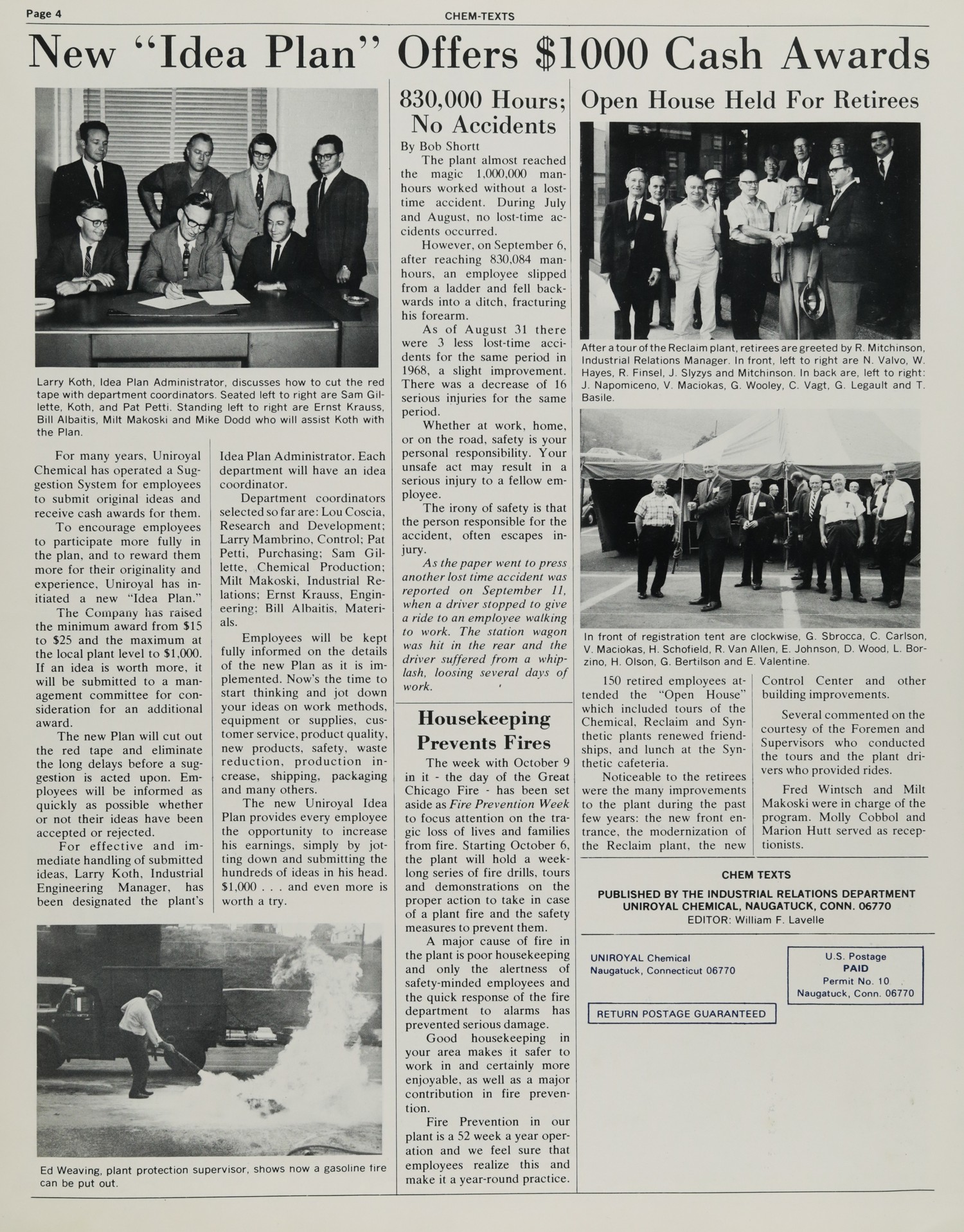
New “Idea Plan” Offers $1000 Cash Awards

Larry Koth, Idea Plan Administrator, discusses how to cut the red tape with department coordinators. Seated left to right are Sam Gillette, Koth, and Pat Petti. Standing left to right are Ernst Krauss, Bill Albaitis, Milt Makoski and Mike Dodd who will assist Koth with the Plan.

For many years, Uniroyal Chemical has operated a Suggestion System for employees to submit original ideas and receive cash awards for them.

To encourage employees to participate more fully in the plan, and to reward them more for their originality and experience, Uniroyal has initiated a new “Idea Plan.”

The Company has raised the minimum award from $15 to $25 and the maximum at the local plant level to $1,000. If an idea is worth more, it will be submitted to a management committee for consideration for an additional award.

The new Plan will cut out the red tape and eliminate the long delays before a suggestion is acted upon. Employees will be informed as quickly as possible whether or not their ideas have been accepted or rejected.

For effective and immediate handling of submitted ideas, Larry Koth, Industrial Engineering Manager, has been designated the plant’s Idea Plan Administrator. Each department will have an idea coordinator.

Department coordinators selected so far are: Lou Coscia, Research and Development; Larry Mambrino, Control; Pat Petti, Purchasing; Sam Gillette, Chemical Production; Milt Makoski, Industrial Relations; Ernst Krauss, Engineering; Bill Albaitis, Materials.

Employees will be kept fully informed on the details of the new Plan as it is implemented. Now’s the time to start thinking and jot down your ideas on work methods, equipment or supplies, customer service, product quality, new products, safety, waste reduction, production increase, shipping, packaging and many others.

The new Uniroyal Idea Plan provides every employee the opportunity to increase his earnings, simply by jotting down and submitting the hundreds of ideas in his head. $1,000 . . . and even more is worth a try.


Ed Weaving, plant protection supervisor, shows now a gasoline fire can be put out.


830,000 Hours; No Accidents

By Bob Shortt

The plant almost reached the magic 1,000,000 manhours worked without a losttime accident. During July and August, no lost-time accidents occurred.

However, on September 6, after reaching 830,084 manhours, an employee slipped from a ladder and fell backwards into a ditch, fracturing his forearm.

As of August 31 there were 3 less lost-time accidents for the same period in 1968, a slight improvement. There was a decrease of 16 serious injuries for the same period.

Whether at work, home, or on the road, safety is your personal responsibility. Your unsafe act may result in a serious injury to a fellow employee.

The irony of safety is that the person responsible for the accident, often escapes injury.

As the paper went to press another lost time accident was reported on September 11, when a driver stopped to give a ride to an employee walking to work. The station wagon was hit in the rear and the driver suffered from a whiplash, loosing several days of work.


Housekeeping Prevents Fires

The week with October 9 in it – the day of the Great Chicago Fire – has been set aside as Fire Prevention Week to focus attention on the tragic loss of lives and families from fire. Starting October 6, the plant will hold a weeklong series of fire drills, tours and demonstrations on the proper action to take in case of a plant fire and the safety measures to prevent them.

A major cause of fire in the plant is poor housekeeping and only the alertness of safety-minded employees and the quick response of the fire department to alarms has prevented serious damage.

Good housekeeping in your area makes it safer to work in and certainly more enjoyable, as well as a major contribution in fire prevention.

Fire Prevention in our plant is a 52 week a year operation and we feel sure that employees realize this and make it a year-round practice.


Open House Held For Retirees

After a tour of the Reclaim plant, retirees are greeted by R. Mitchinson, Industrial Relations Manager. In front, left to right are N. Valvo, W. Hayes, R. Finsel, J. Slyzys and Mitchinson. In back are, left to right: J. Napomiceno, V. Maciokas, G. Wooley, C. Vagt, G. Legault and T. Basile.

In front of registration tent are clockwise, G. Sbrocca, C. Carlson, V. Maciokas, H. Schofield, R. Van Allen, E. Johnson, D. Wood, L. Borzino, H. Olson, G. Bertilson and E. Valentine.

150 retired employees attended the “Open House” which included tours of the Chemical, Reclaim and Synthetic plants renewed friendships, and lunch at the Synthetic cafeteria.

Noticeable to the retirees were the many improvements to the plant during the past few years: the new front entrance, the modernization of the Reclaim plant, the new Control Center and other building improvements.

Several commented on the courtesy of the Foremen and Supervisors who conducted the tours and the plant drivers who provided rides.

Fred Wintsch and Milt Makoski were in charge of the program. Molly Cobbol and Marion Hutt served as receptionists.


CHEM TEXTS

PUBLISHED BY THE INDUSTRIAL RELATIONS DEPARTMENT
UNIROYAL CHEMICAL, NAUGATUCK, CONN. 06770
EDITOR: William F. Lavelle

UNIROYAL Chemical
Naugatuck, Connecticut 06770

U.S. Postage
PAID
Permit No. 10
Naugatuck, Conn. 06770

RETURN POSTAGE GUARANTEED

CHEM-TEXTS – Vol. 2 No. 4 – Page 2

Page 002

CHEM TEXTS

Page 2 | Vol. 2 No. 4


FROM THE FACTORY MANAGER

Dear Fellow Employee:

Within the next several weeks we will each be contacted by one of our friends to make our annual pledge to the United Givers of Naugatuck and Beacon Falls.

Experience has proven that this once-a-year campaign is the most efficient way of providing funds for sixteen volunteer agencies that serve the people of our area. I am, however, concerned that the convenience of this method of giving may tend to lessen our generosity as givers. May I suggest that we each use the following guidelines in making out our pledges?

1) Review carefully the agencies presented on our pledge card and the details of their needs and services as described in the United Givers folder.

2) Consider the services that we, our family, our friends and neighbors receive from these agencies. Note that many of the agencies serve an area broader than the campaign towns. Some are even national.

3) Use the Work Sheet on this page of CHEM-TEXTS to work out our pledge on the payroll deduction plan. This method makes it convenient to give our share on a year-around basis.

4) PLEDGE! Before filling in our card – ask ourselves one question – “Have I given until it feels good?

[Signature]

John D. Evans


HOW MUCH SHOULD YOU GIVE TO THE UNITED GIVERS DRIVE

A few years ago, somebody knocked on your door almost once a week for a contribution to a worthy cause. You probably contributed $30 to $50 to these organizations.

Through the United Givers Fund your continued generous support of most of these organizations can now be done on a once-a-year basis through the Company’s payroll deduction plan.

To determine your contribution for 1969, this work sheet, listing the 16 participating agencies, will help you decide the amount of your gift.

Agency Gift amt. if contacted separately
American Red Cross $_____
Child Guidance Clinic $_____
Children’s Center $_____
Conn. Trails Council,
Girl Scouts of America $_____
Catholic Family Serv. $_____

Family Serv. Assoc. $__
Mattatuck Council,
Boy Scouts of America $
____

Naugatuck Jr.
Athletic Leagues $__
Salvation Army $
_
United Cerebral Palsy $

U.S.O. $

Waterbury Assoc. for
Retarded Children $

Y.M.C.A. – Naugatuck $

Total Amount $
___

By dividing the number of payroll deductions into your total amount, you obtain the amount you should pledge. For salary employees, payroll deductions will be made monthly; and for wage employees, deductions will be weekly.

The Naugatuck plant always contributed generously in the past to these worthwhile agencies. Because of their increased services and expenses they depend more on us for 1969.


New Assignments Made in Plant

Fred Wintsch has been appointed Labor Relations Manager for the Naugatuck plant. He will be responsible for employee relations, reporting to Ron Mitchinson, Industrial Relations Manager.

[PHOTO]

Sam Gillette, formerly General Foreman at the Synthetic rubber plant, moved to the Chemical production as General Foreman reporting to Jim Cronin, Superintendent.

[PHOTO]

Eric Johnson, named General Foreman of the Synthetic rubber plant, will supervise production of synthetic latexes. He reports to Ben Leach, plant Superintendent.


[PHOTO]

The new 300,000 gallon oil storage tank and steel dike dwarfs members of the Engineering department as they inspect the 29 ft. high structure, south of the boiler plant.


[PHOTO]

Plant personnel involved in the boiler plant conversion project are left to right: Vic Anderson, Paul DeAngelis, Bill Maguire, Joe Mambrino, Frank Gaizutis and George Arndt, shown checking fuel oil connections.


Special Winter Tire Sale

A special two month winter tire sale for active and retired employees will run from October 1 to November 30, 1968.

The sale is on winter patrol snow tires only and offers considerable savings below existing employee prices.

Lists of the special low prices can be obtained from the Industrial Relation’s Department or Employee Salesroom Managers.


August Injuries Continue High

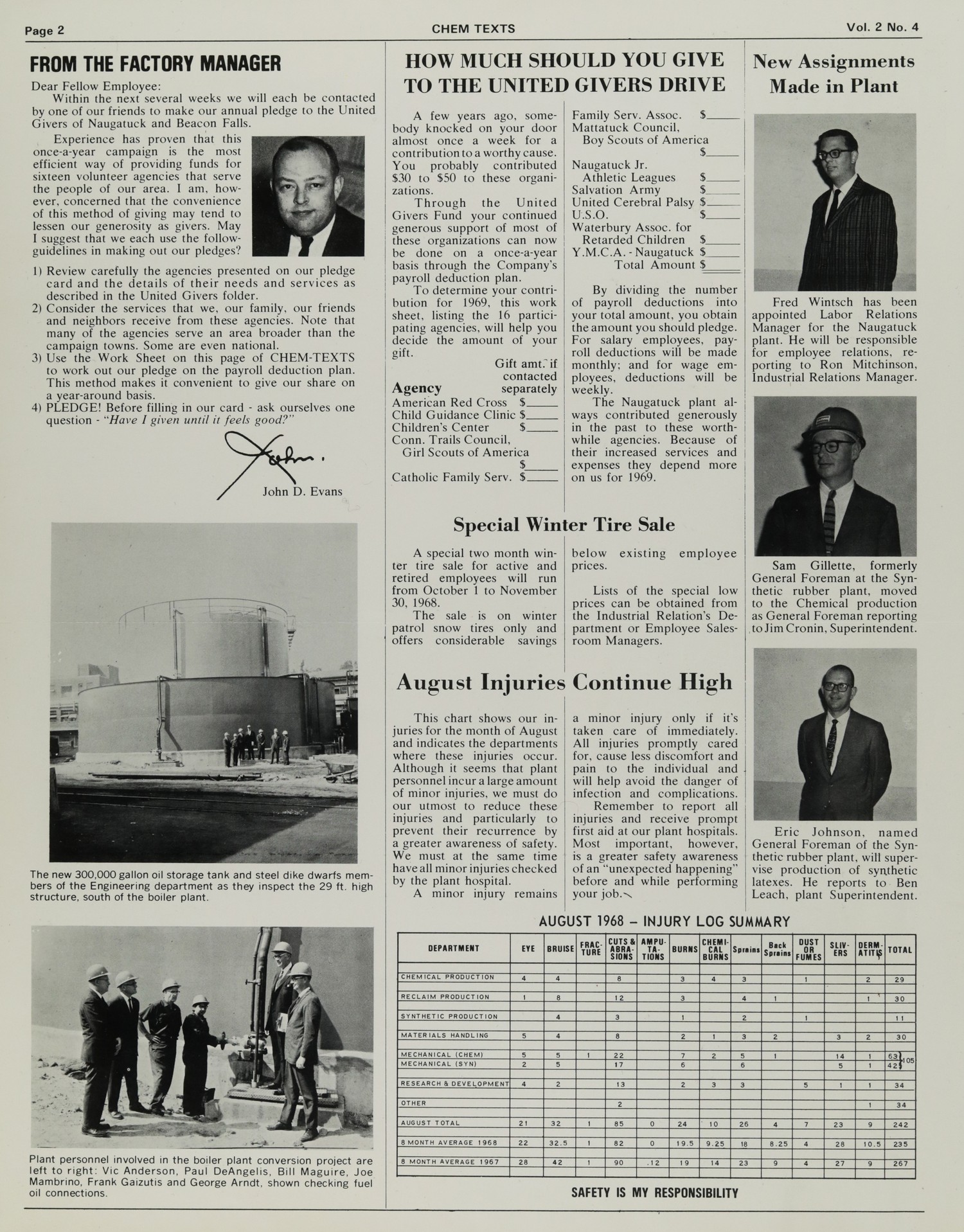
This chart shows our injuries for the month of August and indicates the departments where these injuries occur. Although it seems that plant personnel incur a large amount of minor injuries, we must do our utmost to reduce these injuries and particularly to prevent their recurrence by a greater awareness of safety. We must at the same time have all minor injuries checked by the plant hospital.

A minor injury remains a minor injury only if it’s taken care of immediately. All injuries promptly cared for, cause less discomfort and pain to the individual and will help avoid the danger of infection and complications.

Remember to report all injuries and receive prompt first aid at our plant hospitals. Most important, however, is a greater safety awareness of an “unexpected happening” before and while performing your job.


AUGUST 1968 – INJURY LOG SUMMARY

DEPARTMENT EYE BRUISE FRACTURE CUTS & ABRASIONS AMPUTATIONS BURNS CHEMICAL BURNS Sprains Back Sprains DUST OR FUMES SLIVERS DERMATITIS TOTAL
CHEMICAL PRODUCTION 4 4 8 3 4 3 1 2 29
RECLAIM PRODUCTION 1 8 12 3 4 1 1 30
SYNTHETIC PRODUCTION 4 3 1 2 1 11
MATERIALS HANDLING 5 4 8 2 1 3 2 3 2 30
MECHANICAL (CHEM) 5 5 1 22 7 2 5 1 14 1 63
MECHANICAL (SYN) 2 5 17 6 6 5 1 42
RESEARCH & DEVELOPMENT 4 2 13 2 3 3 5 1 1 34
OTHER 2 1 34
AUGUST TOTAL 21 32 1 85 0 24 10 26 4 7 23 9 242
8 MONTH AVERAGE 1968 22 32.5 1 82 0 19.5 9.25 18 8.25 4 28 10.5 235
8 MONTH AVERAGE 1967 28 42 1 90 12 19 14 23 9 4 27 9 267

SAFETY IS MY RESPONSIBILITY

CHEM-TEXTS – Vol. 2 No. 5 – Page 3

Page 003

CHEM TEXTS

Page 3 | Vol. 2 No. 5


Harry Witt Heads Synthetic Production

Harry Witt has been named Synthetic Production Superintendent, effective Dec. 1. Ben Leach becomes Manager of Colloidal products in the Research and Development Dept.


How You Can Obtain A Pair Of Safety Prescription Glasses

Fred Mayo of the Process Development Lab. selects frames for safety prescription glasses from Adeline Farrar R.N., Chemical Hospital nurse.

The Naugatuck plant has a program which is operated by the Safety Department to enable all Chemical division employees to obtain prescription safety glasses at no cost to the employee, except for the examination and fitting fee.

The procedure is simple. An employee may go to either the Chemical or Synthetic hospital and obtain a prescription safety glass form from the nurse. He takes the form to his own eye doctor and has an examination. The employee pays for the cost of the examination and returns the completed form to the plant nurse. At this time he may also select the frame he prefers from samples in the hospital. The Company then sends the prescription to the Wilkie Optical Company and purchases the glasses.

Effective January 1, 1969, all prescription glasses will be returned to the doctor or optician of your choice for proper checking and fitting. In some cases an additional fitting charge may be made, depending upon the agreement you have made.

Here are other facts you should know: 1. You may buy an extra pair of glasses for yourself, if you wish and take advantage of our Company discount, provided the prescription is less than one year old. 2. You may also purchase prescription sun glasses at the same discount. 3. You may obtain a free pair of glasses whenever you require a new prescription. 4. Lenses or frames damaged as the result of an accident in the plant are replaced free of charge.


[PHOTO CAPTION:]
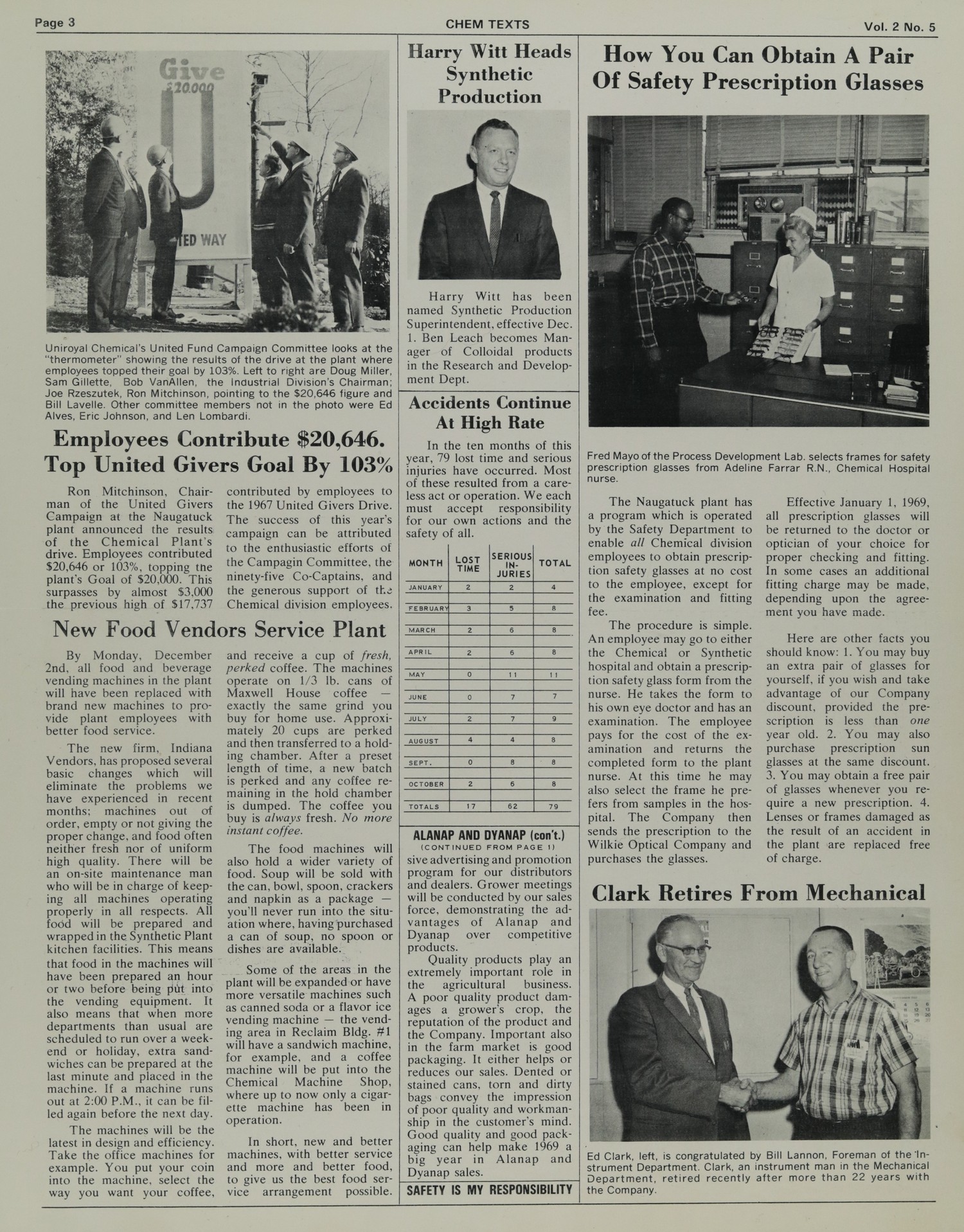
Uniroyal Chemical’s United Fund Campaign Committee looks at the “thermometer” showing the results of the drive at the plant where employees topped their goal by 103%. Left to right are Doug Miller, Sam Gillette, Bob VanAllen, the Industrial Division’s Chairman; Joe Kresziutek, Ron Mitchinson, pointing to the $20,646 figure and Bill Lavelle. Other committee members not in the photo were Ed Alves, Eric Johnson, and Len Lombardi.


Employees Contribute $20,646. Top United Givers Goal By 103%

Ron Mitchinson, Chairman of the United Givers Campaign at the Naugatuck plant announced the results of the Chemical Plant’s drive. Employees contributed $20,646 or 103%, topping the plant’s Goal of $20,000. This surpasses by almost $3,000 the previous high of $17,737 contributed by employees to the 1967 United Givers Drive. The success of this year’s campaign can be attributed to the enthusiastic efforts of the Campagin Committee, the ninety-five Co-Captains, and the generous support of the Chemical division employees.


Accidents Continue At High Rate

In the ten months of this year, 79 lost time and serious injuries have occurred. Most of these resulted from a careless act or operation. We each must accept responsibility for our own actions and the safety of all.

MONTH LOST TIME SERIOUS IN-JURIES TOTAL
JANUARY 2 2 4
FEBRUARY 3 5 8
MARCH 2 6 8
APRIL 2 6 8
MAY 0 11 11
JUNE 0 7 7
JULY 2 7 9
AUGUST 4 4 8
SEPT. 0 8 8
OCTOBER 2 6 8
TOTALS 17 62 79

New Food Vendors Service Plant

By Monday, December 2nd, all food and beverage vending machines in the plant will have been replaced with brand new machines to provide plant employees with better food service.

The new firm, Indiana Vendors, has proposed several basic changes which will eliminate the problems we have experienced in recent months; machines out of order, empty or not giving the proper change, and food often neither fresh nor of uniform high quality. There will be an on-site maintenance man who will be in charge of keeping all machines operating properly in all respects. All food will be prepared and wrapped in the Synthetic Plant kitchen facilities. This means that food in the machines will have been prepared an hour or two before being put into the vending equipment. It also means that when more departments than usual are scheduled to run over a weekend or holiday, extra sandwiches can be prepared at the last minute and placed in the machine. If a machine runs out at 2:00 P.M., it can be filled again before the next day.

The machines will be the latest in design and efficiency. Take the office machines for example. You put your coin into the machine, select the way you want your coffee, and receive a cup of fresh, perked coffee. The machines operate on 1/3 lb. cans of Maxwell House coffee — exactly the same grind you buy for home use. Approximately 20 cups are perked and then transferred to a holding chamber. After a preset length of time, a new batch is perked and any coffee remaining in the hold chamber is dumped. The coffee you buy is always fresh. No more instant coffee.

The food machines will also hold a wider variety of food. Soup will be sold with the can, bowl, spoon, crackers and napkin as a package — you’ll never run into the situation where, having purchased a can of soup, no spoon or dishes are available.

Some of the areas in the plant will be expanded or have more versatile machines such as canned soda or a flavor ice vending machine — the vending area in Reclaim Bldg. #1 will have a sandwich machine, for example, and a coffee machine will be put into the Chemical Machine Shop, where up to now only a cigarette machine has been in operation.

In short, new and better machines, with better service and more and better food, to give us the best food service arrangement possible.


ALANAP AND DYANAP (con’t.)

(CONTINUED FROM PAGE 1)

sive advertising and promotion program for our distributors and dealers. Grower meetings will be conducted by our sales force, demonstrating the advantages of Alanap and Dyanap over competitive products.

Quality products play an extremely important role in the agricultural business. A poor quality product damages a grower’s crop, the reputation of the product and the Company. Important also in the farm market is good packaging. It either helps or reduces our sales. Dented or stained cans, torn and dirty bags convey the impression of poor quality and workmanship in the customer’s mind. Good quality and good packaging can help make 1969 a big year in Alanap and Dyanap sales.

SAFETY IS MY RESPONSIBILITY


Clark Retires From Mechanical

Ed Clark, left, is congratulated by Bill Lannon, Foreman of the Instrument Department. Clark, an instrument man in the Mechanical Department, retired recently after more than 22 years with the Company.