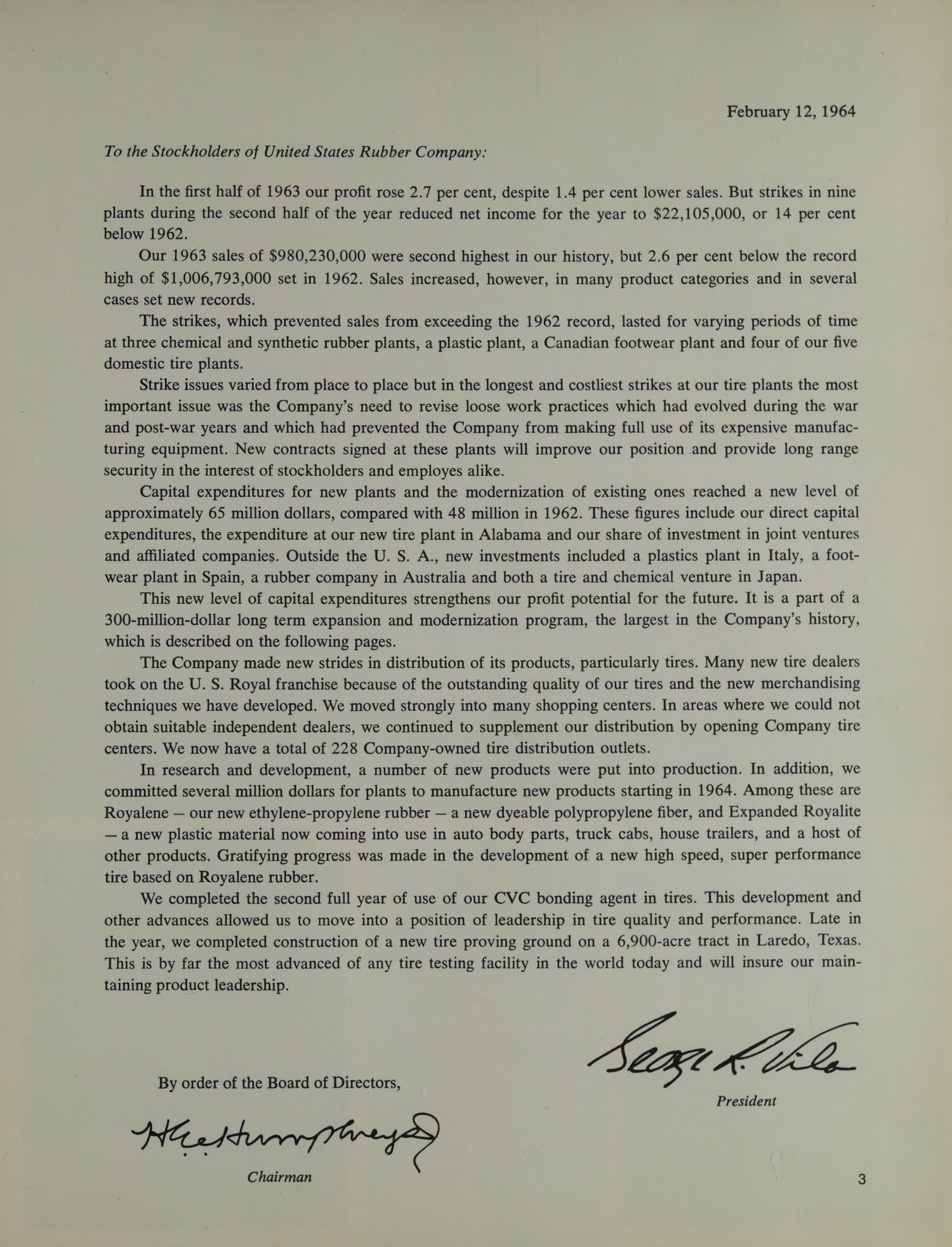
CHEM-TEXTS – 1977-v11-i01-s248

Page 248

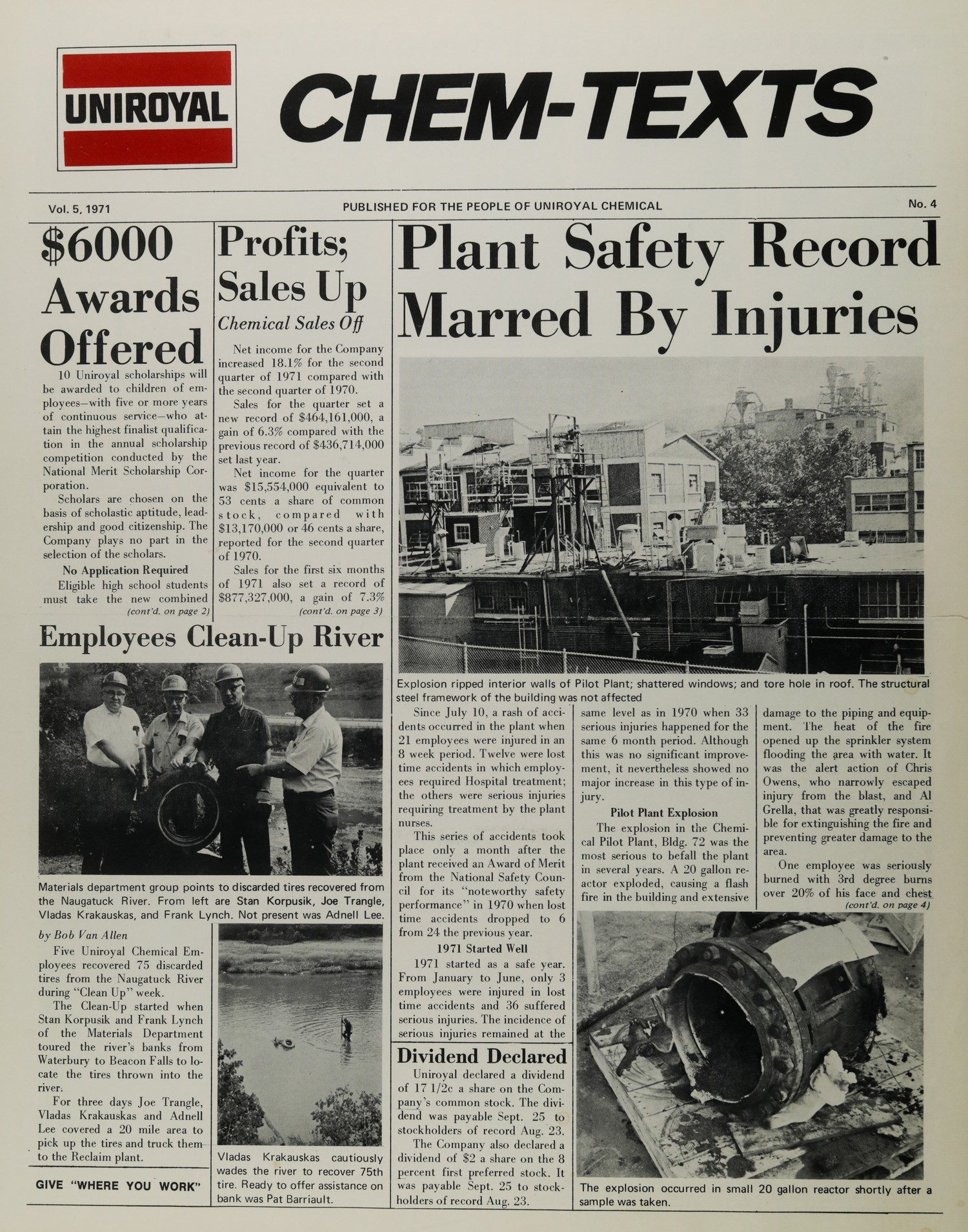
UNIROYAL CHEM-TEXTS

Vol. 11, 1977 | PUBLISHED FOR THE PEOPLE OF UNIROYAL CHEMICAL | No. 1


Hospital Approved | Sales and Profits Up in the Fourth Quarter

[IMAGE: Black and white photo of a building]

The present Plant Hospital occupies the right side of Bldg. 47. The new hospital will occupy the entire first floor of the building.

by Victor Alves

The Capital Appropriation Committee of the Company has approved the expansion of the Plant medical facilities in Bldg. 47. It will be expanded from 800 to approximately 2400 square feet. The building became available when the Roylar Pilot Plant closed down with the construction of the new Roylar unit.

A Major Medical Improvement

Process equipment, pipelines, and fixtures will be stripped from the building and construction work begun shortly after. Plans call for a waiting room, nurses station, doctor’s office and examination rooms, minor treatment area, conference room, laboratory

continued on page 4


The fourth quarter sales for the Company increased 13% in 1976 to $633 million from the $563 million in the 4th quarter of 1975.

Net income rose 292% to $20.0 million, or 71¢ a share of common stock, from the $5.1 million or 14¢ a share in the last quarter of 1975.

Sharp Rebound

The fourth quarter was a sharp rebound from the strike-affected second and third quarters of 1976. The gain resulted from increased demand, improved operating efficiencies and marketing reorganizations.


Club Offers $500 Award

The Uniroyal Chemical Management Club is offering a $500 scholarship award. Fifty dollars of the scholarship comes from the Larry Monroe Fund.

The scholarship is available to a graduating high school student who plans a college education. To qualify, one of the student’s parents must have worked for Uniroyal Chemical at Naugatuck or Bethany for two years or more and be an active employee. The fund is supported by the dues of the club’s members.

Applications for the scholarship may be obtained personally from the Industrial Relations Department or by a telephone call to Constance Antrum, Ext. 3217.

April 15, Final Date

The application must be returned to William Broden, Chairman of the Scholarship Committee, on or before April 15, 1977. The other members of the committee are Vincent Rooney and

continued on page 4


Sales Higher in 1976; Profits Down for Year

Sales in 1976 were $2.3 billion compared with $2.2 billion the previous year, with the increase due essentially to inflation. Net income was $20.1 million, or 57 cents a common share, compared with $23.0 million, or 68 cents a share in 1975. Improvements realized in the first and fourth quarters were offset by declines due to the strike in the second and third quarters of the year.

Tire Sales Improve

In the fourth quarter Tire and Related Products sales were $382 million compared to $331 million in the fourth quarter of 1975. For the year, Tire Division sales were $1.330 billion or 57% of the total


Company sales in 1975.

Chemicals, Rubber and Plastics

Chemicals, Rubber and Plastics sales for the fourth quarter were $79 million compared with $73 million in the 4th quarter of 1975. The gain was due to increases in rubber chemicals, specialty rubbers and natural rubber. For the year, these sales were $330 million or 14% of total company sales as compared to $271 million in the prior year.

Industrial Products

The Industrial Products category also gained in the final quarter, rising to $92 million from $85 million in sales the previous year.

continued on page 4


Salzman Appointed Chemical President

Flannery Made V.P.

[IMAGE: Photo of Sheldon R. Salzman]

Sheldon R. Salzman has been named President of the Uniroyal Chemical Division. He succeeds Joseph P. Flannery, who was appointed an Executive Vice-President of Uniroyal, Inc.

From 1970 to 1972 Salzman was Factory Manager of the Naugatuck Chemical plant.

Joined Chemical Plant in 1955

He joined Uniroyal Chemical

continued on page 4

[IMAGE: Photo of Joseph P. Flannery]

Joseph P. Flannery, formerly President of the Chemical division has been named an Executive Vice President—along with Andrew McNeill—of Uniroyal, Inc. In his new position Flannery will

continued on page 4


Dividend Declared

The Company declared a quarterly dividend of 12½ cents a share on the common stock payable March 25 to stockholders of record on February 22.

It also declared a dividend of $2 on the preferred stock, payable on March 25 to stockholders of record on February 22.


LVBI Made in FOC Building

[IMAGE: Photo of three workers reviewing documents]

James Garrigan, Plant Engineer; Robert Cronin, Foreman of the Bldg.; and Andrew Clock, Process Engineer, review the flow sheet for process changes to make LVBI wet-cake to meet a customer’s requirements.

The first batches of LVBI, a chemical adhesive for tire sidewalls, was made in the new $5,000,000 FOC plant (Bldg. 174). At present the chemical is made primarily for Uniroyal plants but the Marketing Dept. foresees a potential growth for the product outside the company. LVBI is new business for the Chemical plant.

The FOC plant is presently op-

erating on a 5 day week schedule; 3 shifts; and employs 6 Production people and 5 Chemical Maintenance people.

Naugard 445 to be Made

Another chemical that will be made in the FOC Bldg. is Naugard 445, a very low stain antioxidant used in plastics to prevent discoloration caused by ex-

continued on page 3
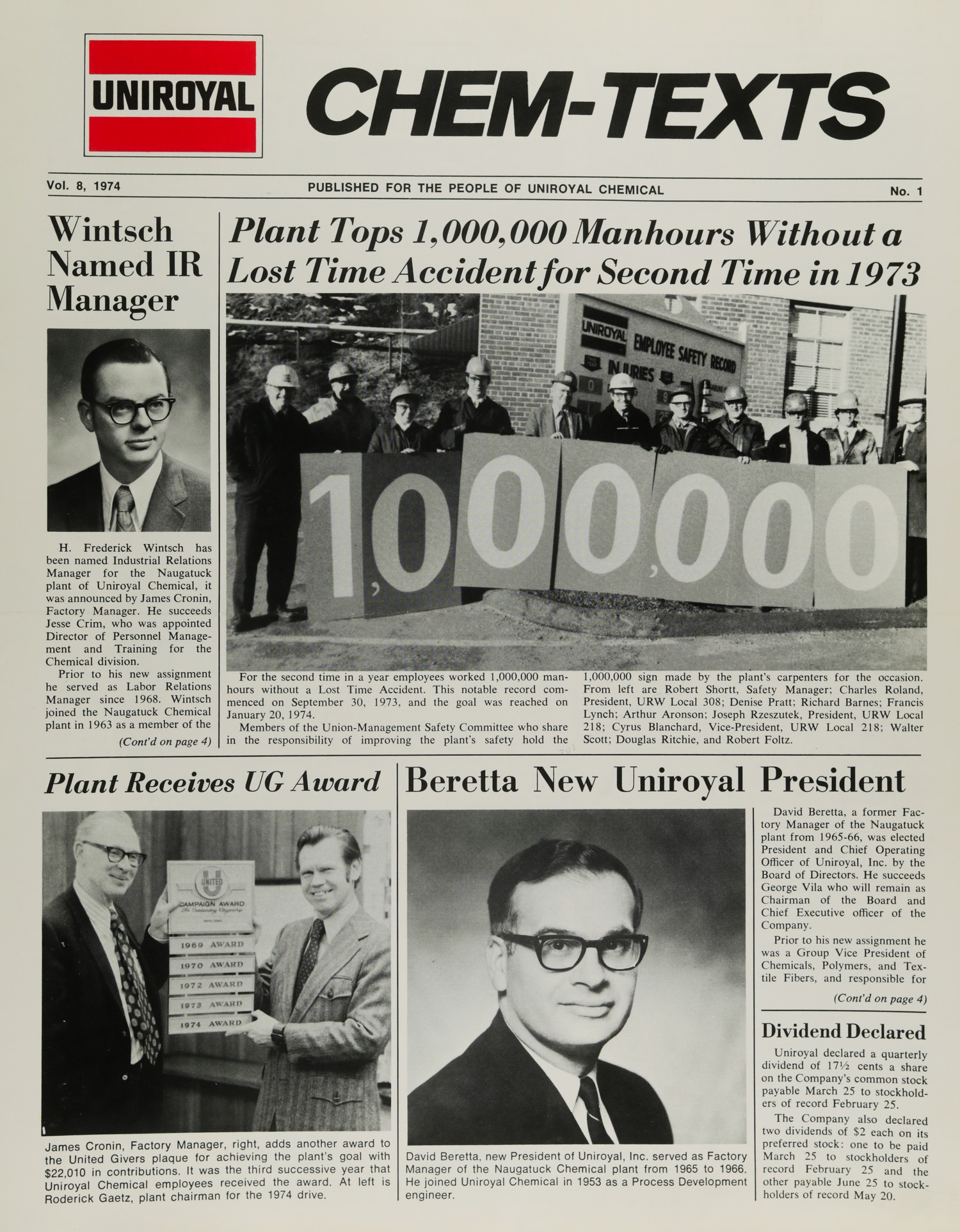
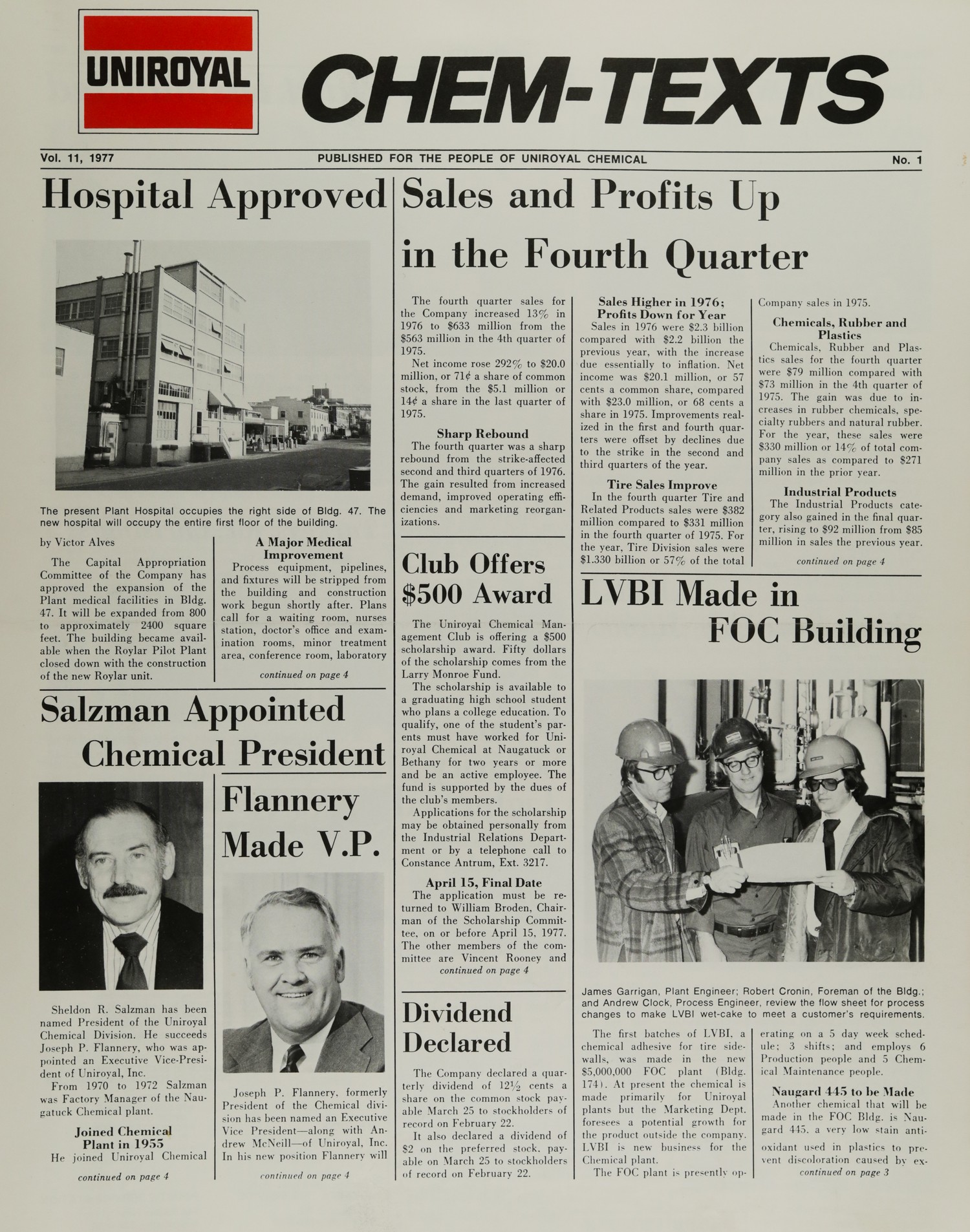
CHEM-TEXTS – 1974-v08-i01-s222

Page 222

UNIROYAL CHEM-TEXTS

Vol. 8, 1974 | PUBLISHED FOR THE PEOPLE OF UNIROYAL CHEMICAL | No. 1


Wintsch Named IR Manager

[PHOTO: Portrait of H. Frederick Wintsch]

H. Frederick Wintsch has been named Industrial Relations Manager for the Naugatuck plant of Uniroyal Chemical, it was announced by James Cronin, Factory Manager. He succeeds Jesse Crim, who was appointed Director of Personnel Management and Training for the Chemical division.

Prior to his new assignment he served as Labor Relations Manager since 1968. Wintsch joined the Naugatuck Chemical plant in 1963 as a member of the

(Cont’d on page 4)


Plant Tops 1,000,000 Manhours Without a Lost Time Accident for Second Time in 1973

[PHOTO: Group of employees standing in front of sign reading “UNIROYAL EMPLOYEE SAFETY RECORD NO INJURIES 1,000,000”]

For the second time in a year employees worked 1,000,000 man-hours without a Lost Time Accident. This notable record commenced on September 30, 1973, and the goal was reached on January 20, 1974.

Members of the Union-Management Safety Committee who share in the responsibility of improving the plant’s safety hold the 1,000,000 sign made by the plant’s carpenters for the occasion. From left are Robert Shortt, Safety Manager; Charles Roland, President, URW Local 308; Denise Pratt; Richard Barnes; Francis Lynch; Arthur Aronson; Joseph Rzeszutek, President, URW Local 218; Cyrus Blanchard, Vice-President, URW Local 218; Walter Scott; Douglas Ritchie, and Robert Foltz.


Plant Receives UG Award

[PHOTO: Two men with United Givers award plaque showing awards from 1969, 1970, 1972, 1973, 1974]

James Cronin, Factory Manager, right, adds another award to the United Givers plaque for achieving the plant’s goal with $22,010 in contributions. It was the third successive year that Uniroyal Chemical employees received the award. At left is Roderick Gaetz, plant chairman for the 1974 drive.


Beretta New Uniroyal President

[PHOTO: Portrait of David Beretta wearing glasses]

David Beretta, a former Factory Manager of the Naugatuck plant from 1965-66, was elected President and Chief Operating Officer of Uniroyal, Inc. by the Board of Directors. He succeeds George Vila who will remain as Chairman of the Board and Chief Executive officer of the Company.

Prior to his new assignment he was a Group Vice President of Chemicals, Polymers, and Textile Fibers, and responsible for

(Cont’d on page 4)

David Beretta, new President of Uniroyal, Inc. served as Factory Manager of the Naugatuck Chemical plant from 1965 to 1966. He joined Uniroyal Chemical in 1953 as a Process Development engineer.


Dividend Declared

Uniroyal declared a quarterly dividend of 17½ cents a share on the Company’s common stock payable March 25 to stockholders of record February 25.

The Company also declared two dividends of $2 each on its preferred stock: one to be paid March 25 to stockholders of record February 25 and the other payable June 25 to stockholders of record May 20.

CHEM-TEXTS – 1971-v05-i04-s195

Page 195

UNIROYAL CHEM-TEXTS

Vol. 5, 1971 | PUBLISHED FOR THE PEOPLE OF UNIROYAL CHEMICAL | No. 4


$6000 Awards Offered

10 Uniroyal scholarships will be awarded to children of employees—with five or more years of continuous service—who attain the highest finalist qualification in the annual scholarship competition conducted by the National Merit Scholarship Corporation.

Scholars are chosen on the basis of scholastic aptitude, leadership and good citizenship. The Company plays no part in the selection of the scholars.

No Application Required

Eligible high school students must take the new combined
(cont’d. on page 2)


Profits; Sales Up

Chemical Sales Off

Net income for the Company increased 18.1% for the second quarter of 1971 compared with the second quarter of 1970.

Sales for the quarter set a new record of $464,161,000, a gain of 6.3% compared with the previous record of $436,714,000 set last year.

Net income for the quarter was $15,554,000 equivalent to 53 cents a share of common stock, compared with $13,170,000 or 46 cents a share, reported for the second quarter of 1970.

Sales for the first six months of 1971 also set a record of $877,327,000, a gain of 7.3%
(cont’d. on page 3)


Plant Safety Record Marred By Injuries

Since July 10, a rash of accidents occurred in the plant when 21 employees were injured in an 8 week period. Twelve were lost time accidents in which employees required Hospital treatment; the others were serious injuries requiring treatment by the plant nurses.

This series of accidents took place only a month after the plant received an Award of Merit from the National Safety Council for its “noteworthy safety performance” in 1970 when lost time accidents dropped to 6 from 24 the previous year.

1971 Started Well

1971 started as a safe year. From January to June, only 3 employees were injured in lost time accidents and 36 suffered serious injuries. The incidence of serious injuries remained at the same level as in 1970 when 33 serious injuries happened for the same 6 month period. Although this was no significant improvement, it nevertheless showed no major increase in this type of injury.

Pilot Plant Explosion

The explosion in the Chemical Pilot Plant, Bldg. 72 was the most serious to befall the plant in several years. A 20 gallon reactor exploded, causing a flash fire in the building and extensive damage to the piping and equipment. The heat of the fire opened up the sprinkler system flooding the area with water. It was the alert action of Chris Owens, who narrowly escaped injury from the blast, and Al Grella, that was greatly responsible for extinguishing the fire and preventing greater damage to the area.

One employee was seriously burned with 3rd degree burns over 20% of his face and chest
(cont’d. on page 4)

Explosion ripped interior walls of Pilot Plant; shattered windows; and tore hole in roof. The structural steel framework of the building was not affected

The explosion occurred in small 20 gallon reactor shortly after a sample was taken.


Employees Clean-Up River

by Bob Van Allen

Five Uniroyal Chemical Employees recovered 75 discarded tires from the Naugatuck River during “Clean Up” week.

The Clean-Up started when Stan Korpusik and Frank Lynch of the Materials Department toured the river’s banks from Waterbury to Beacon Falls to locate the tires thrown into the river.

For three days Joe Trangle, Vladas Krakauskas and Adnell Lee covered a 20 mile area to pick up the tires and truck them to the Reclaim plant.

GIVE “WHERE YOU WORK”

Materials department group points to discarded tires recovered from the Naugatuck River. From left are Stan Korpusik, Joe Trangle, Vladas Krakauskas, and Frank Lynch. Not present was Adnell Lee.

Vladas Krakauskas cautiously wades the river to recover 75th tire. Ready to offer assistance on bank was Pat Barriault.


Dividend Declared

Uniroyal declared a dividend of 17 1/2c a share on the Company’s common stock. The dividend was payable Sept. 25 to stockholders of record Aug. 23.

The Company also declared a dividend of $2 a share on the 8 percent first preferred stock. It was payable Sept. 25 to stockholders of record Aug. 23.

CHEM-TEXTS – Vol. 4, 1970, No. 7 – Page 1

Page 001

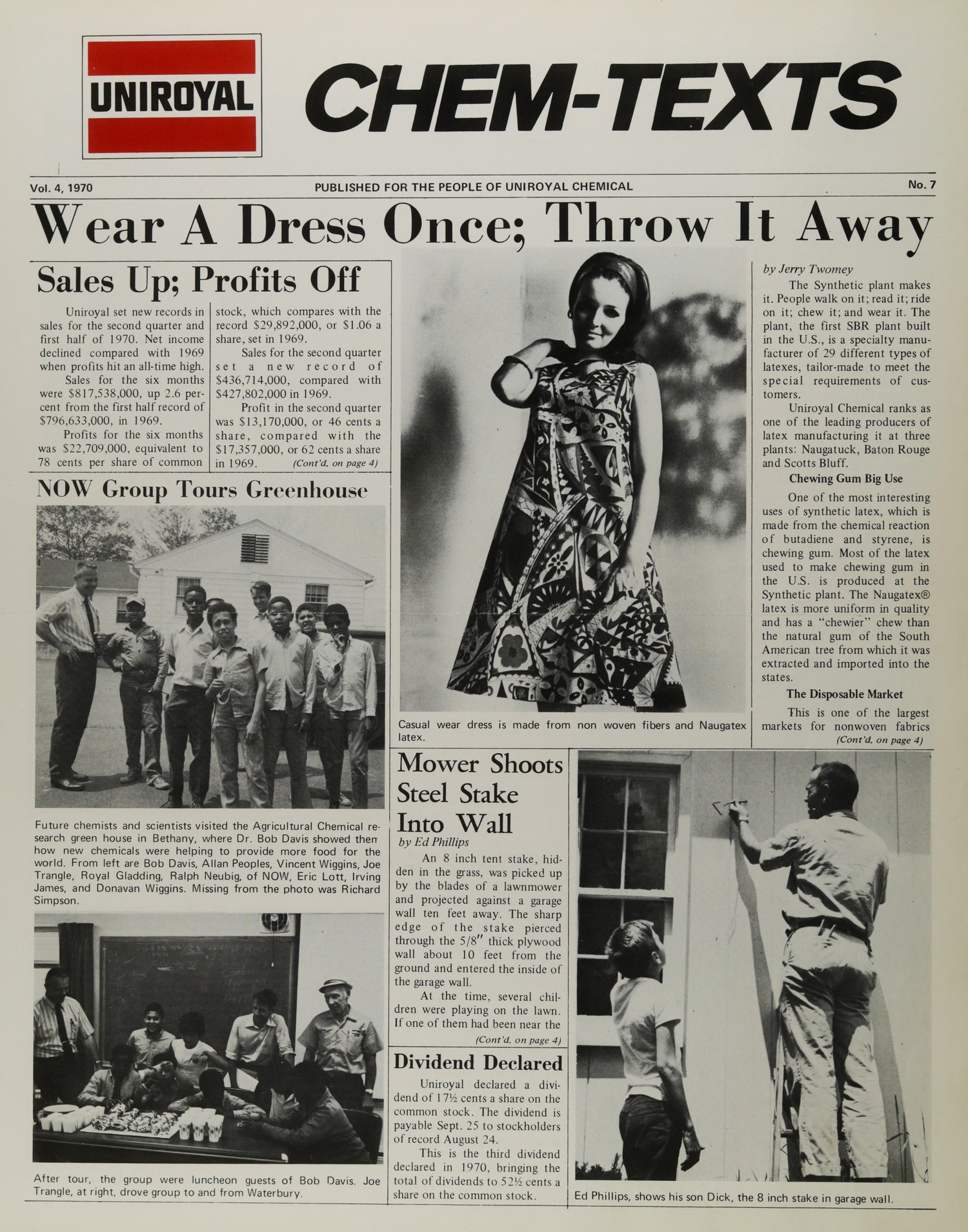
UNIROYAL CHEM-TEXTS

Vol. 4, 1970 | PUBLISHED FOR THE PEOPLE OF UNIROYAL CHEMICAL | No. 7


Wear A Dress Once; Throw It Away


Sales Up; Profits Off

Uniroyal set new records in sales for the second quarter and first half of 1970. Net income declined compared with 1969 when profits hit an all-time high.

Sales for the six months were $817,538,000, up 2.6 percent from the first half record of $796,633,000, in 1969.

Profits for the six months was $22,709,000, equivalent to 78 cents per share of common stock, which compares with the record $29,892,000, or $1.06 a share, set in 1969.

Sales for the second quarter set a new record of $436,714,000, compared with $427,802,000 in 1969.

Profit in the second quarter was $13,170,000, or 46 cents a share, compared with the $17,357,000, or 62 cents a share in 1969. (Cont’d. on page 4)


NOW Group Tours Greenhouse

[IMAGE: Group of men standing outside a building]

Future chemists and scientists visited the Agricultural Chemical research green house in Bethany, where Dr. Bob Davis showed then how new chemicals were helping to provide more food for the world. From left are Bob Davis, Allan Peoples, Vincent Wiggins, Joe Trangle, Royal Gladding, Ralph Neubig, of NOW, Eric Lott, Irving James, and Donavan Wiggins. Missing from the photo was Richard Simpson.

[IMAGE: Group seated at tables for lunch]

After tour, the group were luncheon guests of Bob Davis. Joe Trangle, at right, drove group to and from Waterbury.


[IMAGE: Woman in patterned casual dress]

Casual wear dress is made from non woven fibers and Naugatex latex.


by Jerry Twomey

The Synthetic plant makes it. People walk on it; read it; ride on it; chew it; and wear it. The plant, the first SBR plant built in the U.S., is a specialty manufacturer of 29 different types of latexes, tailor-made to meet the special requirements of customers.

Uniroyal Chemical ranks as one of the leading producers of latex manufacturing it at three plants: Naugatuck, Baton Rouge and Scotts Bluff.

Chewing Gum Big Use

One of the most interesting uses of synthetic latex, which is made from the chemical reaction of butadiene and styrene, is chewing gum. Most of the latex used to make chewing gum in the U.S. is produced at the Synthetic plant. The Naugatex® latex is more uniform in quality and has a “chewier” chew than the natural gum of the South American tree from which it was extracted and imported into the states.

The Disposable Market

This is one of the largest markets for nonwoven fabrics (Cont’d. on page 4)


Mower Shoots Steel Stake Into Wall

by Ed Phillips

An 8 inch tent stake, hidden in the grass, was picked up by the blades of a lawnmower and projected against a garage wall ten feet away. The sharp edge of the stake pierced through the 5/8″ thick plywood wall about 10 feet from the ground and entered the inside of the garage wall.

At the time, several children were playing on the lawn. If one of them had been near the (Cont’d. on page 4)


Dividend Declared

Uniroyal declared a dividend of 17½ cents a share on the common stock. The dividend is payable Sept. 25 to stockholders of record August 24.

This is the third dividend declared in 1970, bringing the total of dividends to 52½ cents a share on the common stock.


[IMAGE: Man and boy looking at stake in garage wall]

Ed Phillips, shows his son Dick, the 8 inch stake in garage wall.

CHEM-TEXTS – Vol. 3, 1969, No. 5 – Page 1

Page 001

UNIROYAL CHEM-TEXTS

Vol. 3, 1969 | PUBLISHED FOR THE PEOPLE OF UNIROYAL CHEMICAL | No. 5


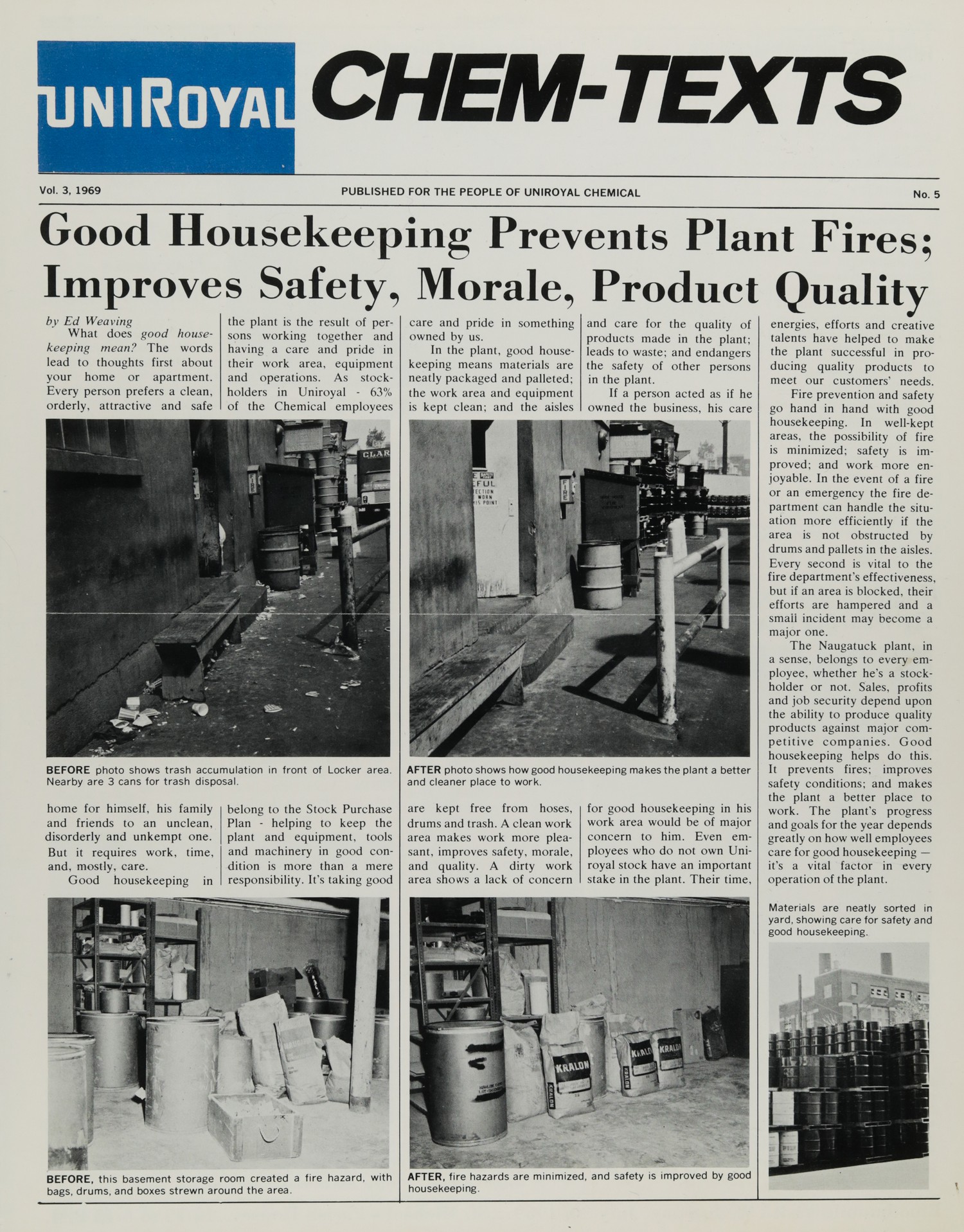
Good Housekeeping Prevents Plant Fires; Improves Safety, Morale, Product Quality

by Ed Weaving

What does good housekeeping mean? The words lead to thoughts first about your home or apartment. Every person prefers a clean, orderly, attractive and safe

the plant is the result of persons working together and having a care and pride in their work area, equipment and operations. As stockholders in Uniroyal – 63% of the Chemical employees

care and pride in something owned by us.

In the plant, good housekeeping means materials are neatly packaged and palleted; the work area and equipment is kept clean; and the aisles

and care for the quality of products made in the plant; leads to waste; and endangers the safety of other persons in the plant.

If a person acted as if he owned the business, his care

energies, efforts and creative talents have helped to make the plant successful in producing quality products to meet our customers’ needs.

Fire prevention and safety go hand in hand with good housekeeping. In well-kept areas, the possibility of fire is minimized; safety is improved; and work more enjoyable. In the event of a fire or an emergency the fire department can handle the situation more efficiently if the area is not obstructed by drums and pallets in the aisles. Every second is vital to the fire department’s effectiveness, but if an area is blocked, their efforts are hampered and a small incident may become a major one.

The Naugatuck plant, in a sense, belongs to every employee, whether he’s a stockholder or not. Sales, profits and job security depend upon the ability to produce quality products against major competitive companies. Good housekeeping helps do this. It prevents fires; improves safety conditions; and makes the plant a better place to work. The plant’s progress and goals for the year depends greatly on how well employees care for good housekeeping — it’s a vital factor in every operation of the plant.


BEFORE photo shows trash accumulation in front of Locker area. Nearby are 3 cans for trash disposal.

AFTER photo shows how good housekeeping makes the plant a better and cleaner place to work.


home for himself, his family and friends to an unclean, disorderly and unkempt one. But it requires work, time, and, mostly, care.

Good housekeeping in

belong to the Stock Purchase Plan – helping to keep the plant and equipment, tools and machinery in good condition is more than a mere responsibility. It’s taking good

are kept free from hoses, drums and trash. A clean work area makes work more pleasant, improves safety, morale, and quality. A dirty work area shows a lack of concern

for good housekeeping in his work area would be of major concern to him. Even employees who do not own Uniroyal stock have an important stake in the plant. Their time,


BEFORE, this basement storage room created a fire hazard, with bags, drums, and boxes strewn around the area.

AFTER, fire hazards are minimized, and safety is improved by good housekeeping.


Materials are neatly sorted in yard, showing care for safety and good housekeeping.

CHEM-TEXTS – Vol. 3 No. 10 – Page 4

Page 004

Page 4 | CHEM-TEXTS | Vol. 3 No. 10


Sales Set Record; Profits Drop 10.5%

Sales of Uniroyal, Inc. set new records for the thirty-nine weeks ending September 28, 1969, but profits failed to keep pace with sales, and took a 10.5% drop.

Sales for the nine month period totaled $1,165,502,000, an increase of 9.9% compared with $1,060,659,000 reported for 1968. Profits, however, were $38,184,000, equivalent to $1.33 a share of common stock, 10.5% lower than the $42,650,000 or $1.55 a share for 1968.

The third quarter sales for 1969 were $368,869,000 compared to $341,874,000 for 1968 and net income was $8,292,000 equivalent to 27 cents a common share compared with $12,769,000 or 45 cents a share last year. Third quarter earnings in 1969 were based on a greater number of shares outstanding.

Profits were hurt by increasing inflationary factors, including rising costs for wages and raw materials, as well as higher interest rates on borrowed capital.

The Company also encountered abnormally high production costs for new tire constructions and greater start-up expenses for new and expanded production facilities.


Contact Lenses Are Unsafe

by Bob Shortt

Many employees are not fully aware of the dangers in wearing contact lenses in the plant.

Chemicals and dusts which enter the eye and work their way behind the lens cannot be washed out until the lens is removed. Very often permanent damage to the eye can result before this can be done.

There is a rule which is included in the Laboratory Safety Manual stating, Contact Lenses are not to be worn in the plant. For your own safety and to prevent injury to eyesight, it is extremely important to observe this rule.


Dividend Declared

Uniroyal declared a dividend of 17½ cents a share on its common stock. It will be payable December 24 to stockholders of record on November 24.

This payment will bring total dividends paid on the stock in 1969 to 70 cents a share.

Approximately 65% of the Naugatuck plant employees are stockholders or participants in the Stock Purchase Plan.


Clergy Visit Parishioners

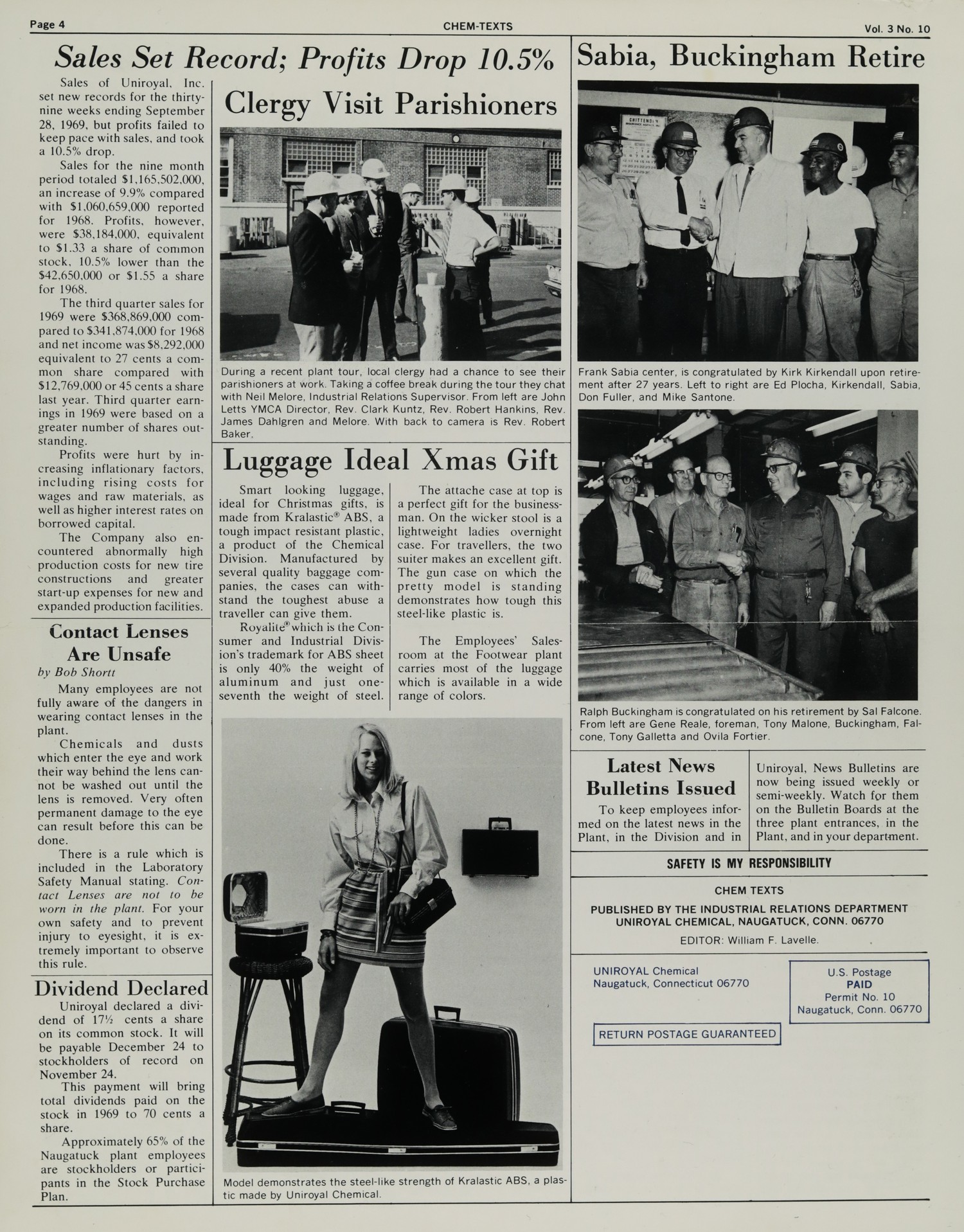
During a recent plant tour, local clergy had a chance to see their parishioners at work. Taking a coffee break during the tour they chat with Neil Melore, Industrial Relations Supervisor. From left are John Letts YMCA Director, Rev. Clark Kuntz, Rev. Robert Hankins, Rev. James Dahlgren and Melore. With back to camera is Rev. Robert Baker.


Sabia, Buckingham Retire

Frank Sabia center, is congratulated by Kirk Kirkendall upon retirement after 27 years. Left to right are Ed Plocha, Kirkendall, Sabia, Don Fuller, and Mike Santone.

Ralph Buckingham is congratulated on his retirement by Sal Falcone. From left are Gene Reale, foreman, Tony Malone, Buckingham, Falcone, Tony Galletta and Ovila Fortier.


Luggage Ideal Xmas Gift

Smart looking luggage, ideal for Christmas gifts, is made from Kralastic® ABS, a tough impact resistant plastic, a product of the Chemical Division. Manufactured by several quality baggage companies, the cases can withstand the toughest abuse a traveller can give them.

Royalite® which is the Consumer and Industrial Division’s trademark for ABS sheet is only 40% the weight of aluminum and just one-seventh the weight of steel.

The attache case at top is a perfect gift for the businessman. On the wicker stool is a lightweight ladies overnight case. For travellers, the two suiter makes an excellent gift. The gun case on which the pretty model is standing demonstrates how tough this steel-like plastic is.

The Employees’ Salesroom at the Footwear plant carries most of the luggage which is available in a wide range of colors.


[Photo caption]: Model demonstrates the steel-like strength of Kralastic ABS, a plastic made by Uniroyal Chemical.


Latest News Bulletins Issued

To keep employees informed on the latest news in the Plant, in the Division and in Uniroyal, News Bulletins are now being issued weekly or semi-weekly. Watch for them on the Bulletin Boards at the three plant entrances, in the Plant, and in your department.


SAFETY IS MY RESPONSIBILITY


CHEM TEXTS

PUBLISHED BY THE INDUSTRIAL RELATIONS DEPARTMENT
UNIROYAL CHEMICAL, NAUGATUCK, CONN. 06770

EDITOR: William F. Lavelle.


UNIROYAL Chemical
Naugatuck, Connecticut 06770

U.S. Postage
PAID
Permit No. 10
Naugatuck, Conn. 06770

RETURN POSTAGE GUARANTEED

CHEM-TEXTS – Vol. 2 No. 5 – Page 2

Page 002

Page 2 CHEM TEXTS Vol. 2 No. 5


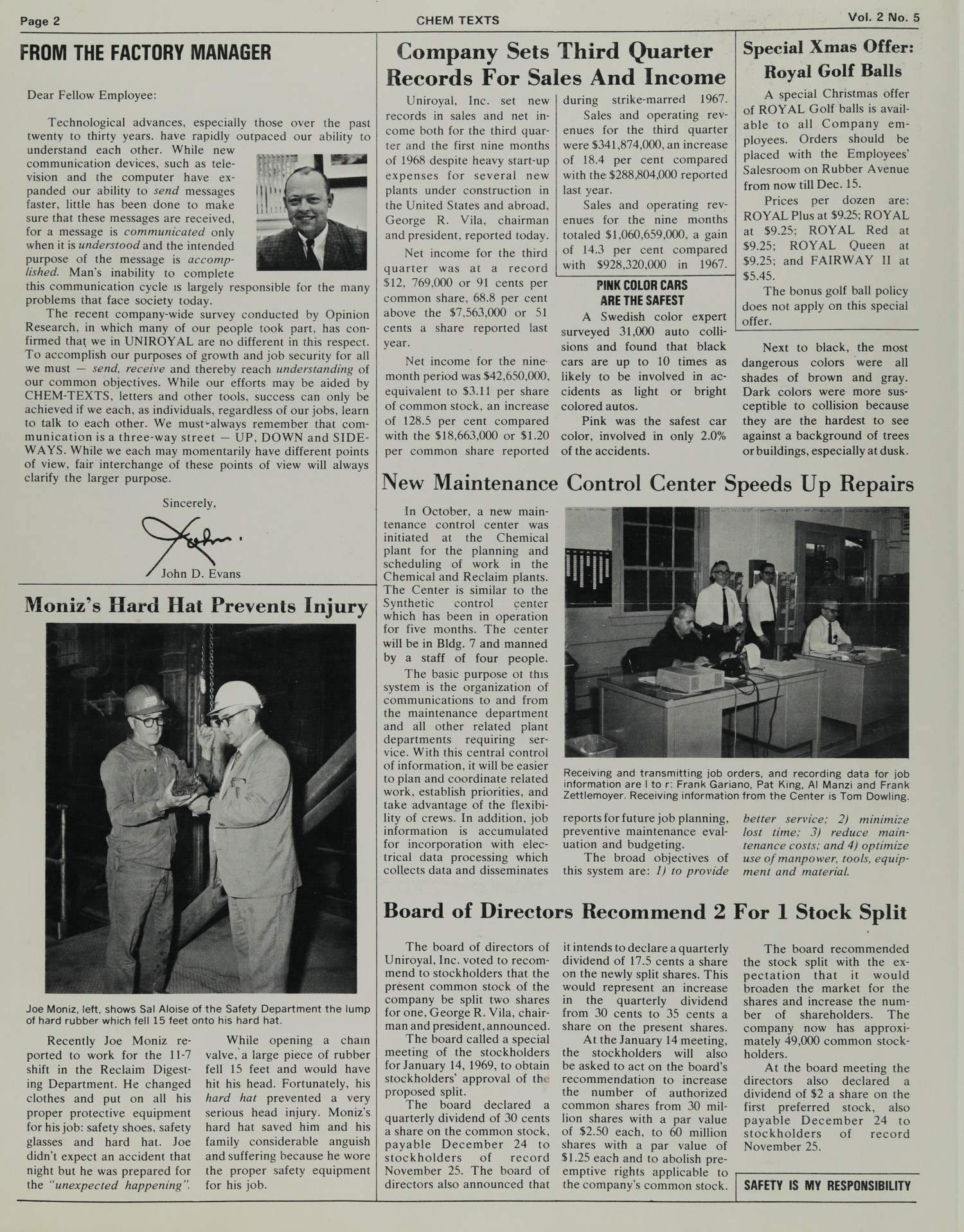
FROM THE FACTORY MANAGER

Dear Fellow Employee:

Technological advances, especially those over the past twenty to thirty years, have rapidly outpaced our ability to understand each other. While new communication devices, such as television and the computer have expanded our ability to send messages faster, little has been done to make sure that these messages are received, for a message is communicated only when it is understood and the intended purpose of the message is accomplished. Man’s inability to complete this communication cycle is largely responsible for the many problems that face society today.

The recent company-wide survey conducted by Opinion Research, in which many of our people took part, has confirmed that we in UNIROYAL are no different in this respect. To accomplish our purposes of growth and job security for all we must — send, receive and thereby reach understanding of our common objectives. While our efforts may be aided by CHEM-TEXTS, letters and other tools, success can only be achieved if we each, as individuals, regardless of our jobs, learn to talk to each other. We must-always remember that communication is a three-way street — UP, DOWN and SIDE-WAYS. While we each may momentarily have different points of view, fair interchange of these points of view will always clarify the larger purpose.

Sincerely,

John D. Evans


Moniz’s Hard Hat Prevents Injury

[IMAGE: Photo of Joe Moniz showing hard hat to Sal Aloise]

Joe Moniz, left, shows Sal Aloise of the Safety Department the lump of hard rubber which fell 15 feet onto his hard hat.

Recently Joe Moniz reported to work for the 11-7 shift in the Reclaim Digesting Department. He changed clothes and put on all his proper protective equipment for his job: safety shoes, safety glasses and hard hat. Joe didn’t expect an accident that night but he was prepared for the “unexpected happening”.

While opening a chain valve, a large piece of rubber fell 15 feet and would have hit his head. Fortunately, his hard hat prevented a very serious head injury. Moniz’s hard hat saved him and his family considerable anguish and suffering because he wore the proper safety equipment for his job.


Company Sets Third Quarter Records For Sales And Income

Uniroyal, Inc. set new records in sales and net income both for the third quarter and the first nine months of 1968 despite heavy start-up expenses for several new plants under construction in the United States and abroad, George R. Vila, chairman and president, reported today.

Net income for the third quarter was at a record $12, 769,000 or 91 cents per common share, 68.8 per cent above the $7,563,000 or 51 cents a share reported last year.

Net income for the nine-month period was $42,650,000, equivalent to $3.11 per share of common stock, an increase of 128.5 per cent compared with the $18,663,000 or $1.20 per common share reported during strike-marred 1967.

Sales and operating revenues for the third quarter were $341,874,000, an increase of 18.4 per cent compared with the $288,804,000 reported last year.

Sales and operating revenues for the nine months totaled $1,060,659,000, a gain of 14.3 per cent compared with $928,320,000 in 1967.


PINK COLOR CARS ARE THE SAFEST

A Swedish color expert surveyed 31,000 auto collisions and found that black cars are up to 10 times as likely to be involved in accidents as light or bright colored autos.

Pink was the safest car color, involved in only 2.0% of the accidents.


Special Xmas Offer: Royal Golf Balls

A special Christmas offer of ROYAL Golf balls is available to all Company employees. Orders should be placed with the Employees’ Salesroom on Rubber Avenue from now till Dec. 15.

Prices per dozen are: ROYAL Plus at $9.25; ROYAL at $9.25; ROYAL Red at $9.25; ROYAL Queen at $9.25; and FAIRWAY II at $5.45.

The bonus golf ball policy does not apply on this special offer.

Next to black, the most dangerous colors were all shades of brown and gray. Dark colors were more susceptible to collision because they are the hardest to see against a background of trees or buildings, especially at dusk.


New Maintenance Control Center Speeds Up Repairs

In October, a new maintenance control center was initiated at the Chemical plant for the planning and scheduling of work in the Chemical and Reclaim plants. The Center is similar to the Synthetic control center which has been in operation for five months. The center will be in Bldg. 7 and manned by a staff of four people.

The basic purpose of this system is the organization of communications to and from the maintenance department and all other related plant departments requiring service. With this central control of information, it will be easier to plan and coordinate related work, establish priorities, and take advantage of the flexibility of crews. In addition, job information is accumulated for incorporation with electrical data processing which collects data and disseminates

[IMAGE: Photo of four men at control center]

Receiving and transmitting job orders, and recording data for job information are l to r: Frank Gariano, Pat King, Al Manzi and Frank Zettlemoyer. Receiving information from the Center is Tom Dowling.

reports for future job planning, preventive maintenance evaluation and budgeting.

The broad objectives of this system are: 1) to provide

better service; 2) minimize lost time; 3) reduce maintenance costs; and 4) optimize use of manpower, tools, equipment and material.


Board of Directors Recommend 2 For 1 Stock Split

The board of directors of Uniroyal, Inc. voted to recommend to stockholders that the present common stock of the company be split two shares for one, George R. Vila, chairman and president, announced.

The board called a special meeting of the stockholders for January 14, 1969, to obtain stockholders’ approval of the proposed split.

The board declared a quarterly dividend of 30 cents a share on the common stock, payable December 24 to stockholders of record November 25. The board of directors also announced that

it intends to declare a quarterly dividend of 17.5 cents a share on the newly split shares. This would represent an increase in the quarterly dividend from 30 cents to 35 cents a share on the present shares.

At the January 14 meeting, the stockholders will also be asked to act on the board’s recommendation to increase the number of authorized common shares from 30 million shares with a par value of $2.50 each, to 60 million shares with a par value of $1.25 each and to abolish preemptive rights applicable to the company’s common stock.

The board recommended the stock split with the expectation that it would broaden the market for the shares and increase the number of shareholders. The company now has approximately 49,000 common stockholders.

At the board meeting the directors also declared a dividend of $2 a share on the first preferred stock, also payable December 24 to stockholders of record November 25.


SAFETY IS MY RESPONSIBILITY

US Rubber Proxy Statement – Page 5

Page 005

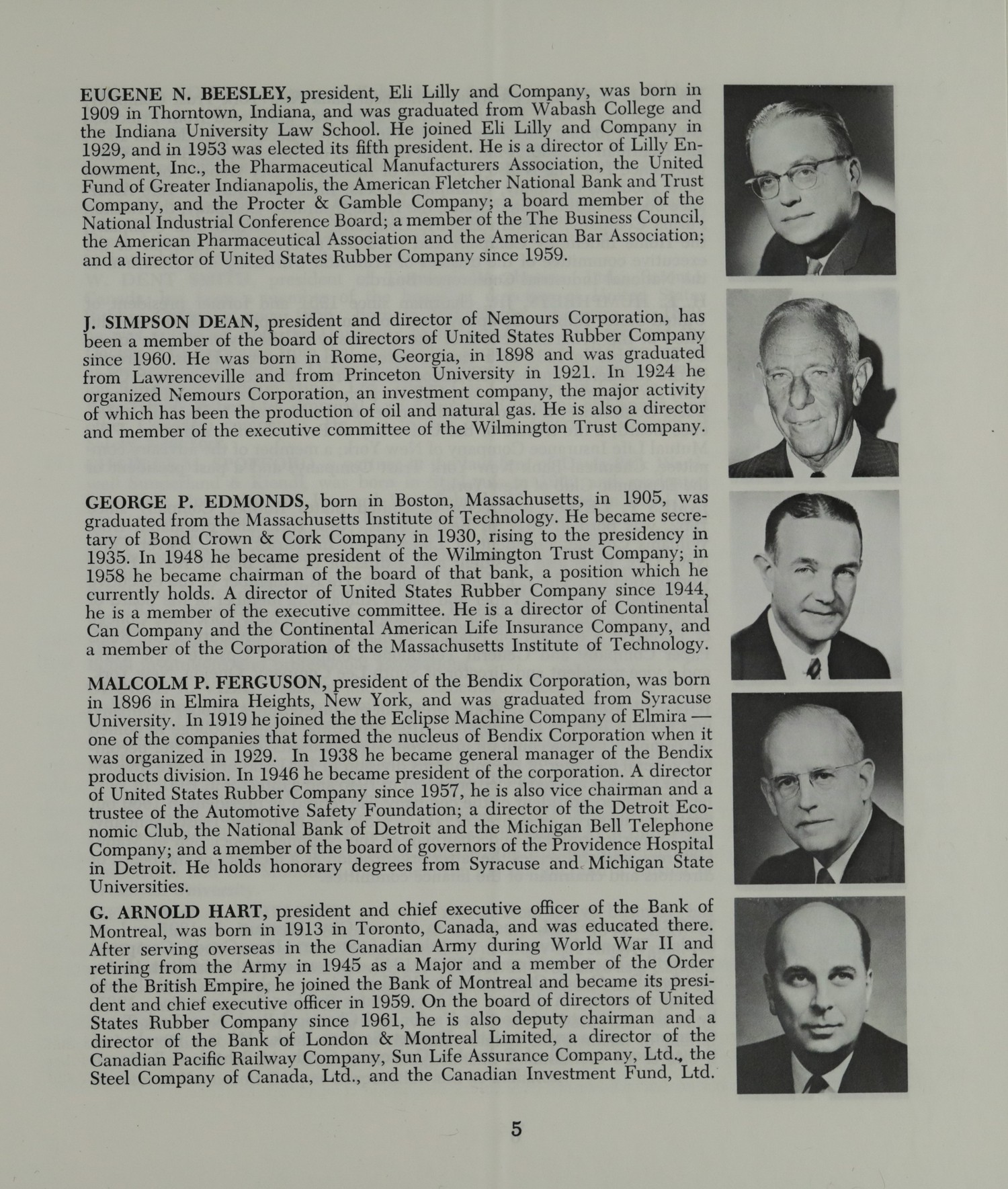
EUGENE N. BEESLEY, president, Eli Lilly and Company, was born in 1909 in Thorntown, Indiana, and was graduated from Wabash College and the Indiana University Law School. He joined Eli Lilly and Company in 1929, and in 1953 was elected its fifth president. He is a director of Lilly Endowment, Inc., the Pharmaceutical Manufacturers Association, the United Fund of Greater Indianapolis, the American Fletcher National Bank and Trust Company, and the Procter & Gamble Company; a board member of the National Industrial Conference Board; a member of the Business Council, the American Pharmaceutical Association; and a director of United States Rubber Company since 1959.

J. SIMPSON DEAN, president and director of Nemours Corporation, has been a member of the board of directors of United States Rubber Company since 1960. He was born in Rome, Georgia, in 1898 and was graduated from Lawrenceville and from Princeton University in 1921. In 1924 he organized Nemours Corporation, an investment company, the major activity of which has been the production of oil and natural gas. He is also a director and member of the executive committee of the Wilmington Trust Company.

GEORGE P. EDMONDS, born in Boston, Massachusetts, in 1905, was graduated from the Massachusetts Institute of Technology. He became secretary of Bond Crow & Cork Company in 1930, rising to the presidency in 1935. In 1948 he became president of the Wilmington Trust Company; in 1953 he became chairman of the board of that bank, a position which he currently holds. A director of United States Rubber Company since 1944, he is a member of the executive committee. He is a director of Continental Can Company and the Continental American Life Insurance Company, and a member of the Corporation of the Massachusetts Institute of Technology.

MALCOLM P. FERGUSON, president of the Bendix Corporation, was born in 1896 in Elmira Heights, New York, and was graduated from Syracuse University. In 1919 he joined the Eclipse Machine Company of Elmira — one of the companies that formed the nucleus of Bendix Corporation when it was organized in 1929. In 1938 he became general manager of the Bendix products division. In 1946 he became president of the corporation. A director of United States Rubber Company since 1957, he is also vice chairman and a trustee of the Automotive Safety Foundation; a director of the National Bank of Detroit and the Michigan Bell Telephone Company; and a member of the board of governors of the Providence Hospital in Detroit. He holds honorary degrees from Syracuse and Michigan State Universities.

G. ARNOLD HART, president and chief executive officer of the Bank of Montreal, was born in 1913 in Toronto, Canada, and was educated there. After serving overseas in the Canadian Army during World War II and retiring from the Army in 1945 as a Major and a member of the Order of the British Empire, he joined the Bank of Montreal and became its president and chief executive officer in 1959. On the board of directors of United States Rubber Company since 1961, he is also deputy chairman and a director of the Bank of London & Montreal Limited, a director of the Canadian Pacific Railway Company, Sun Life Assurance Company, Ltd., the Steel Company of Canada, Ltd., and the Canadian Investment Fund, Ltd.

US Rubber Proxy Statement – Page Exhibit A

Page exhibit-a

UNITED STATES RUBBER COMPANY
1964 STOCK OPTION PLAN

I. Purpose of Plan
The purpose of this Plan is to provide for the granting of stock options as a means of attracting to the Company and retaining in its service persons of outstanding ability and potential and of encouraging such persons to invest in the common stock of the Company and to identify their interests more closely with those of the stockholders.

II. Eligibility for Options
A. A stock option may be granted under this Plan to an employee occupying an important managerial position, or other position of importance and responsibility, who has demonstrated unusual ability or initiative, and who, by discharging his responsibilities in an outstanding manner, can make a significant contribution to the success of the Company.
B. As used in this Plan, the term “employee” shall mean a person who is an officer or an employee of the Company or of any other corporation in which the Company owns 50% or more of the voting stock.
C. Unless he is also an employee as defined in Section B of this Article II, no member of the Board of Directors shall be eligible to receive a stock option under this Plan.
D. An employee may be granted a stock option under this Plan notwithstanding the fact that he may be a participant, and may have been granted one or more stock options, under any other plan or plans of the Company; and more than one stock option may be granted under this Plan to a single employee.

III. Administration of Plan
A. This Plan shall be administered by the Board of Directors, and the granting of all stock options hereunder shall be by action of a majority of the members of said Board not eligible to receive such options.
B. A committee, appointed by the Board of Directors and composed of directors not eligible to receive stock options under this Plan, may from time to time make recommendations to said Board with respect to the granting of options hereunder.
C. Any action taken by the Board of Directors in the administration of this Plan, and any decision of said Board with respect to any question arising as to the interpretation of this Plan or of the terms and conditions applicable to any stock option granted hereunder, shall be final, conclusive and binding. Without limiting the effect of the foregoing, the provisions of this Plan shall be construed in accordance with the laws of the State of New Jersey.

US Rubber Proxy Statement – Page 6

Page 006

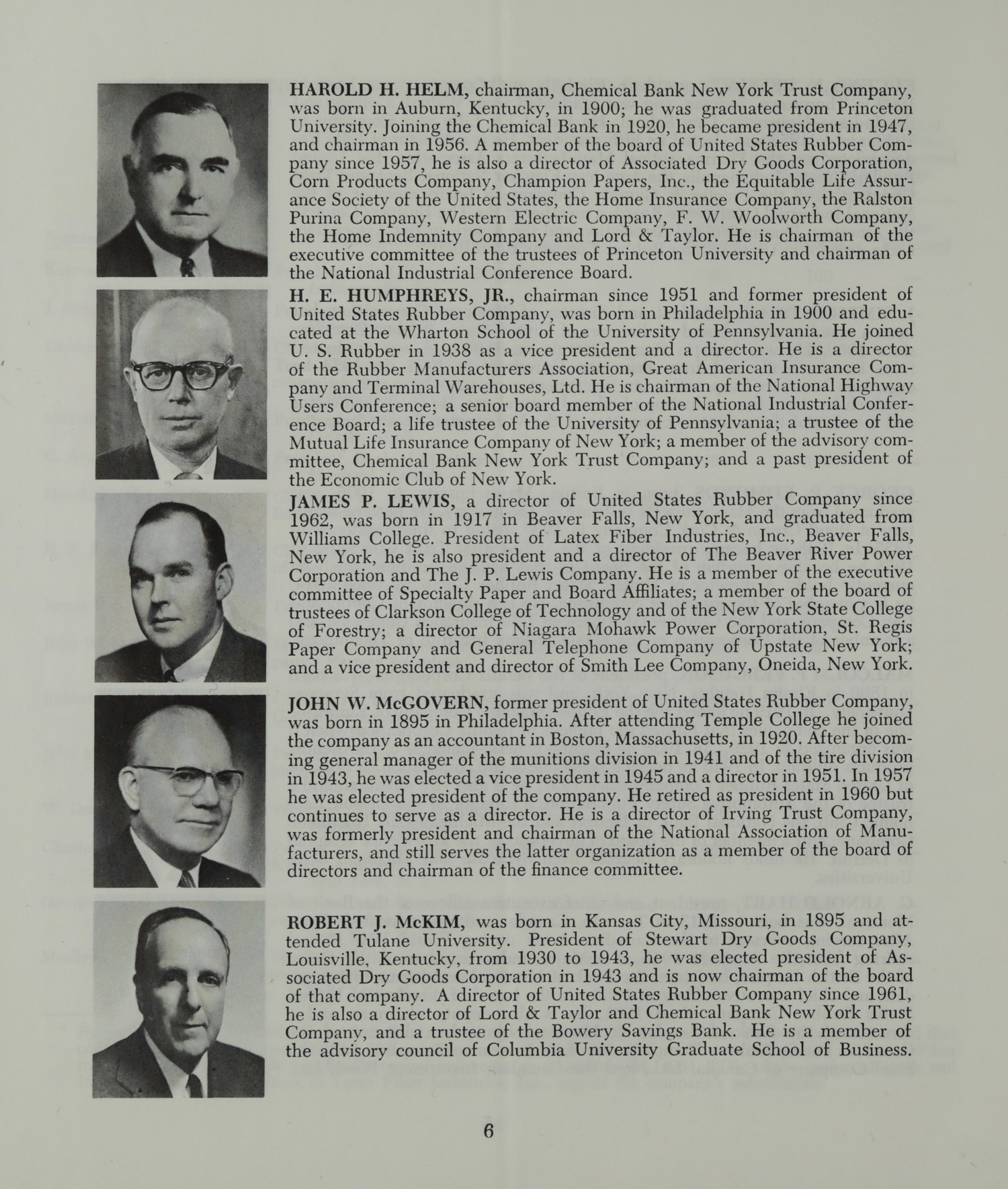
HAROLD H. HELM, chairman, Chemical Bank New York Trust Company, was born in Auburn, Kentucky, in 1900; he was graduated from Princeton University. Joining the Chemical Bank in 1920, he became president in 1947, and chairman in 1956. A member of the board of United States Rubber Company since 1957, he is also a director of Associated Dry Goods Corporation, Champion Papers, Inc., the Equitable Life Assurance Society of the United States, the Home Insurance Company, the Ralston Purina Company, Western Electric Company, F. W. Woolworth Company, the Home Indemnity Company and Lord & Taylor. He is chairman of the executive committee of the trustees of Princeton University and chairman of the National Industrial Conference Board.

H. E. HUMPHREYS, JR., chairman since 1951 and former president of United States Rubber Company, was born in Philadelphia in 1900 and educated at the Wharton School of the University of Pennsylvania. He joined U. S. Rubber in 1935 as a vice president and a director. He is a director of the Rubber Manufacturers Association, Great American Insurance Company and Terminal Warehouses, Ltd. He is chairman of the National Highway Users Conference; a senior board member of the National Industrial Conference Board; a life trustee of the University of Pennsylvania; a trustee of the Mutual Life Insurance Company of New York; a member of the advisory committee, Chemical Bank New York Trust Company; and a past president of the Economic Club of New York.

JAMES P. LEWIS, a director of United States Rubber Company since 1962, was born in 1917 in Beaver Falls, New York, and graduated from Williams College. President of Latex Fiber Industries, Inc., Beaver Falls, New York, he is also president and a director of The Beaver River Power Corporation and The J. P. Lewis Company. He is a member of the executive committee of Specialty Paper and Board Affiliates; a member of the board of trustees of Clarkson College of Technology and of Forestry; a director of Niagara Mohawk Power Corporation, St. Regis Paper Company and General Telephone Company of Upstate New York; and a vice president and director of Smith Lee Company, Oneida, New York.

JOHN W. McGOVERN, former president of United States Rubber Company, was born in 1895 in Philadelphia. After attending Temple College he joined the company as an accountant in Boston, Massachusetts, in 1920. After becoming general manager of the munitions division in 1941 and of the tire division in 1943, he was elected a vice president in 1945 and a director in 1951. In 1957 he was elected president of the company. He retired as president in 1960 but continues to serve as a director. He is a director of Irving Trust Company, was formerly president and chairman of the National Association of Manufacturers, and still serves the latter organization as a member of the board of directors and chairman of the finance committee.

ROBERT J. McKIM, was born in Kansas City, Missouri, in 1895 and attended Tulane University. President of Stewart Dry Goods Company, Louisville, Kentucky, from 1930 to 1943, he was elected president of Associated Dry Goods Corporation in 1943 and is now chairman of the board of that company. A director of United States Rubber Company since 1961, he is also a director of Lord & Taylor and Chemical Bank New York Trust Company, and a trustee of the Savings Bank. He is a member of the advisory council of the Columbia University Graduate School of Business.

US Rubber Proxy Statement – Page 8

Page 008

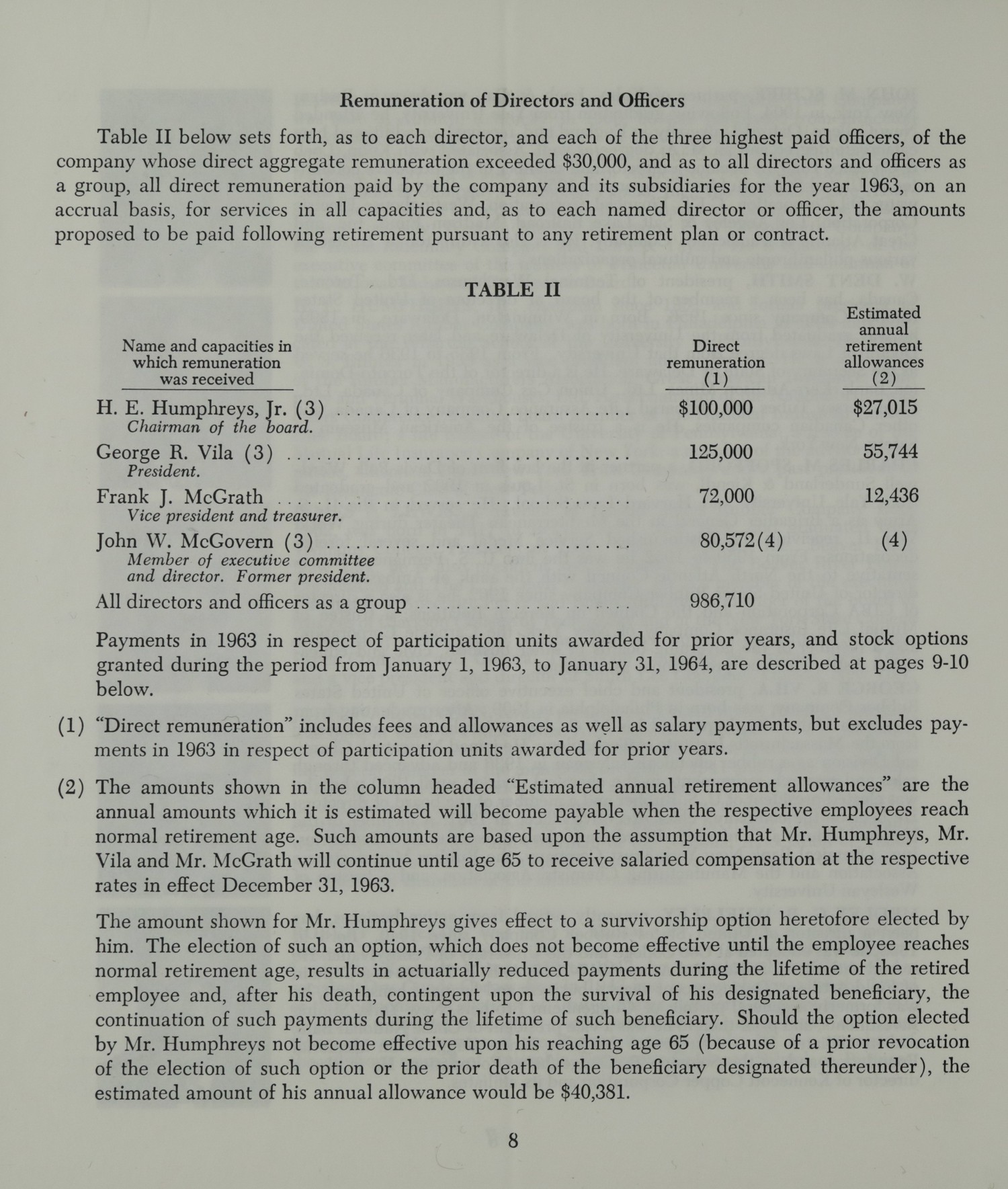
Remuneration of Directors and Officers

Table II below sets forth, as to each director, and each of the three highest paid officers, of the company whose direct aggregate remuneration exceeded $30,000, and as to all directors and officers as a group, all direct remuneration paid by the company and its subsidiaries for the year 1963, on an accrual basis, for services in all capacities and, as to each named director or officer, the amounts proposed to be paid following retirement pursuant to any retirement plan or contract.

TABLE II
Estimated
Name and capacities in Direct annual
which remuneration remuneration retirement
was received (1) allowances (2)
H. E. Humphreys, Jr. (3) $100,000 $27,015
Chairman of the board.
George R. Vila (3) 125,000 55,744
President.
Frank J. McGrath 72,000 12,436
Vice president and treasurer.
John W. McGovern (3) 80,572(4) (4)
Member of executive committee
and director. Former president.
All directors and officers as a group 986,710

Payments in 1963 in respect of participation units awarded for prior years, and stock options granted during the period from January 1, 1963, to January 31, 1964, are described at pages 9-10 below.

(1) “Direct remuneration” includes fees and allowances as well as salary payments, but excludes payments in 1963 in respect of participation units awarded for prior years.

(2) The amounts shown in the column headed “Estimated annual retirement allowances” are the annual amounts which it is estimated will become payable when the respective employees reach normal retirement age. Such amounts are based upon the assumption that Mr. Humphreys, Mr. Vila and Mr. McGrath will continue until age 65 to receive salaries compensation at the respective rates in effect December 31, 1963.

The amount shown for Mr. Humphreys gives effect to a survivorship option heretofore elected by him. The election of such an option, which does not become effective until the employee reaches normal retirement age, results in actuarially reduced payments during the lifetime of the retired employee and, after his death, contingent upon the survival of his designated beneficiary, the continuation of such payments during the lifetime of such beneficiary. Should the option elected by Mr. Humphreys not become effective upon his reaching age 65 (because of a prior revocation of the election of such option or the prior death of the beneficiary designated thereunder), the estimated amount of his annual allowance would be $40,331.

US Rubber Proxy Statement – Page 9

Page 009

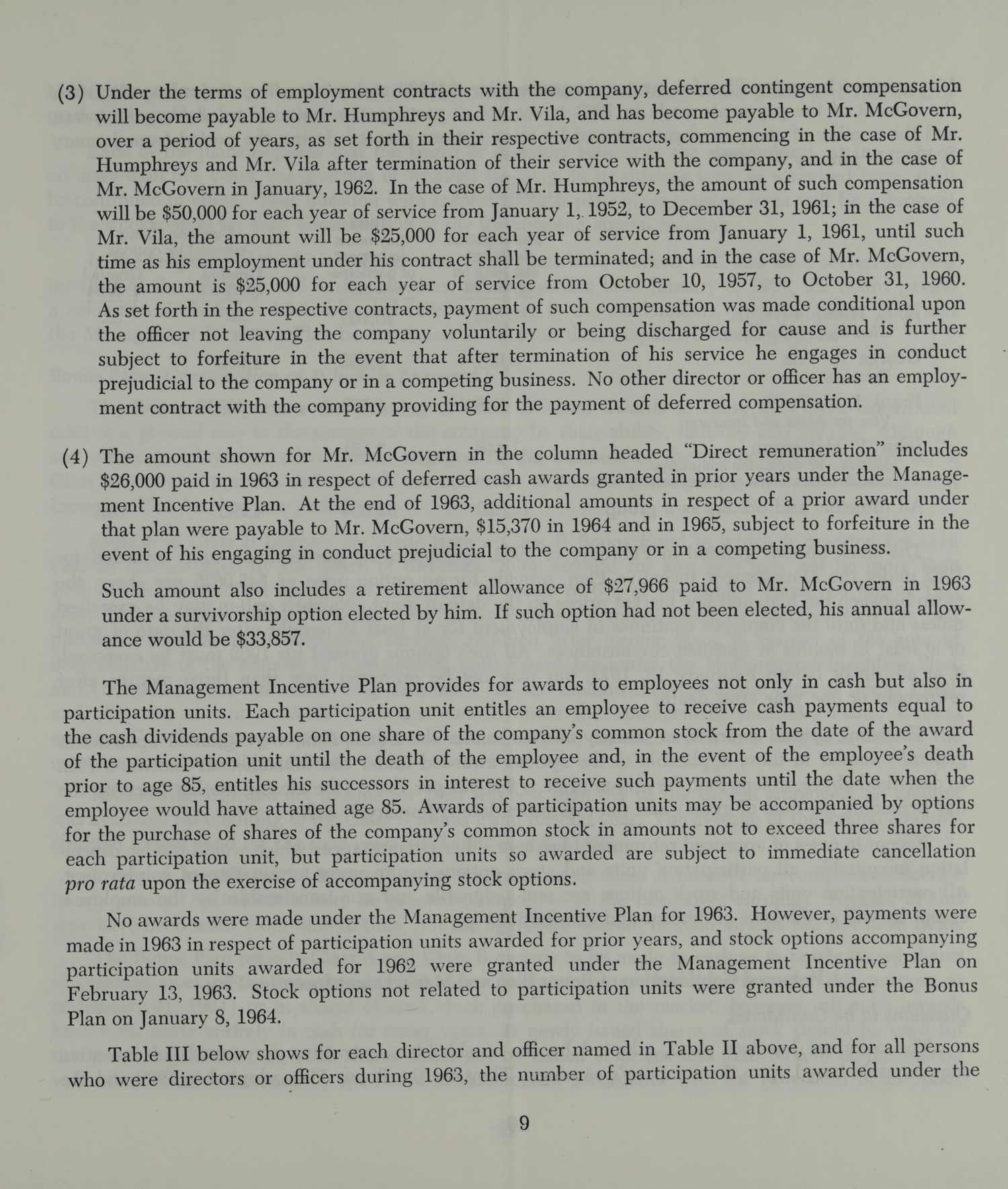
(3) Under the terms of employment contracts with the company, deferred contingent compensation will become payable to Mr. Humphreys and Mr. Vila, and has become payable to Mr. McGovern, over a period of years, as set forth in their respective contracts, commencing in the case of Mr. Humphreys and Mr. Vila after termination of their service with the company, and in the case of Mr. McGovern in January, 1962. In the case of Mr. Humphreys, the amount of such compensation will be $50,000 for each year of service from January 1, 1952, to December 31, 1961; in the case of Mr. Vila, the amount will be $25,000 for each year of service from January 1, 1961, until such time as his employment under his contract shall be terminated; and in the case of Mr. McGovern, the amount is $25,000 for each year of service from October 10, 1957, to October 31, 1960. As set forth in the respective contracts, payment of such compensation was made conditional upon the officer not leaving the company voluntarily or being discharged for cause and is further subject to forfeiture in the event that after termination of his service he engages in conduct prejudicial to the company or in a competing business. No other director or officer has an employment contract with the company providing for the payment of deferred compensation.

(4) The amount shown for Mr. McGovern in the column headed “Direct remuneration” includes $26,000 paid in 1963 in respect of deferred cash awards granted in prior years under the Management Incentive Plan. At the end of 1963, additional amounts in respect of a prior award under that plan were payable to Mr. McGovern, $15,370 in 1964 and in 1965, subject to forfeiture in the event of his engaging in conduct prejudicial to the company or in a competing business.

Such amount also includes a retirement allowance of $27,966 paid to Mr. McGovern in 1963 under a survivorship option elected by him. If such option had not been elected, his annual allowance would be $33,857.

The Management Incentive Plan provides for awards to employees not only in cash but also in participation units. Each participation unit entitles an employee to receive cash payments equal to the cash dividends payable on one share of the company’s common stock from the date of the award of the participation unit until the death of the employee and, in the event of the employee’s death prior to age 65, entitles his successors in interest to receive such payments until the date when the employee would have attained age 65. Awards of participation units may be accompanied by options for the purchase of shares of the company’s common stock in amounts not to exceed three shares for each participation unit, but participation units so awarded are subject to immediate cancellation pro rata upon the exercise of accompanying stock options.

No awards were made under the Management Incentive Plan for 1963. However, payments were made in 1963 in respect of participation units awarded for prior years, and stock options accompanying participation units awarded for 1962 were granted under the Management Incentive Plan on February 13, 1963. Stock options not related to participation units were granted under the Bonus Plan on January 8, 1964.

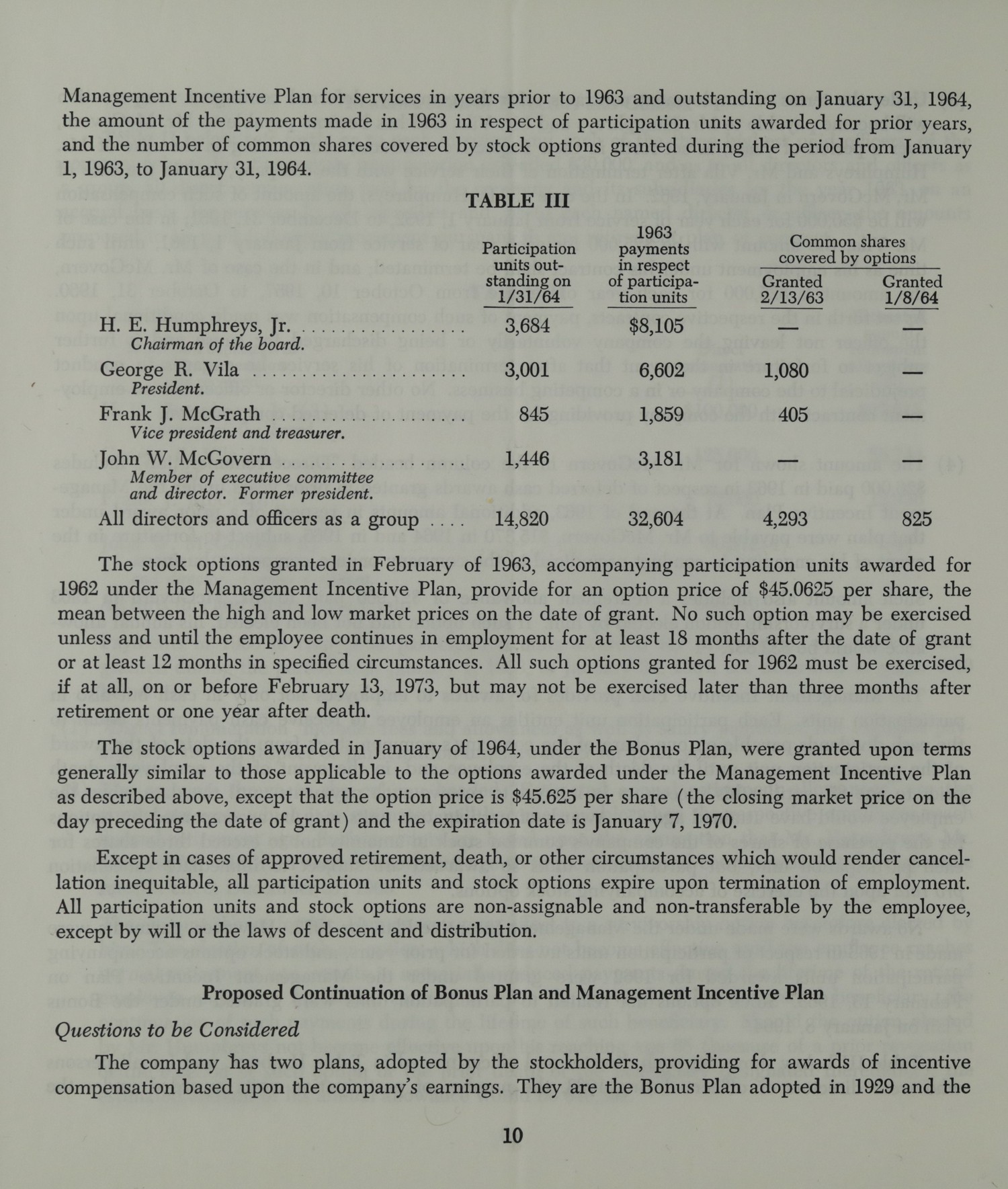
Table III below shows for each director and officer named in Table II above, and for all persons who were directors or officers during 1963, the number of participation units awarded under the Management Incentive Plan.

US Rubber Proxy Statement – Page 10

Page 010

Management Incentive Plan for services in years prior to 1963 and outstanding on January 31, 1964, the amount of the payments made in 1963 in respect of participation units awarded for prior years, and the number of common shares covered by stock options granted during the period from January 1, 1963, to January 31, 1964.

TABLE III

Participation 1963 Common shares
units out- payments covered by options
standing on in respect Granted Granted
1/31/64 of participa- 2/13/63 1/8/64
tion units

H. E. Humphreys, Jr. . . . . . . . . . . . . . . . 3,684 $8,105 – –
Chairman of the board.
George R. Vila . . . . . . . . . . . . . . . . . . . . 3,001 6,602 1,080 –
President.
Frank J. McGrath . . . . . . . . . . . . . . . . . 845 1,859 405 –
Vice president and treasurer.
John W. McGovern . . . . . . . . . . . . . . . . 1,446 3,181 – –
Member of executive committee
and director. Former president.
All directors and officers as a group . . . 14,820 32,604 4,293 825

The stock options granted in February of 1963, accompanying participation units awarded for 1962 under the Management Incentive Plan, provide for an option price of $45.0625 per share, the mean between the high and low market prices on the date of grant. No such option may be exercised unless and until the employee continues in employment for at least 18 months after the date of grant or at least 12 months in specified circumstances. All such options granted for 1962 must be exercised, if at all, on or before February 13, 1973, but may not be exercised later than three months after retirement or one year after death.

The stock options awarded in January of 1964, under the Bonus Plan, were granted upon terms generally similar to those applicable to the options awarded under the Management Incentive Plan as described above, except that the option price is $45.625 per share (the closing market price on the day preceding the date of grant) and the expiration date is January 7, 1970.

Except in cases of approved retirement, death, or other circumstances which would render cancellation inequitable, all participation units and stock options expire upon termination of employment. All participation units and stock options are non-assignable and non-transferable by the employee, except by will or the laws of descent and distribution.

Proposed Continuation of Bonus Plan and Management Incentive Plan

Questions to be Considered

The company has two plans, adopted by the stockholders, providing for awards of incentive compensation based upon the company’s earnings. They are the Bonus Plan adopted in 1929 and the 10

US Rubber Proxy Statement – Page 11

Page 011

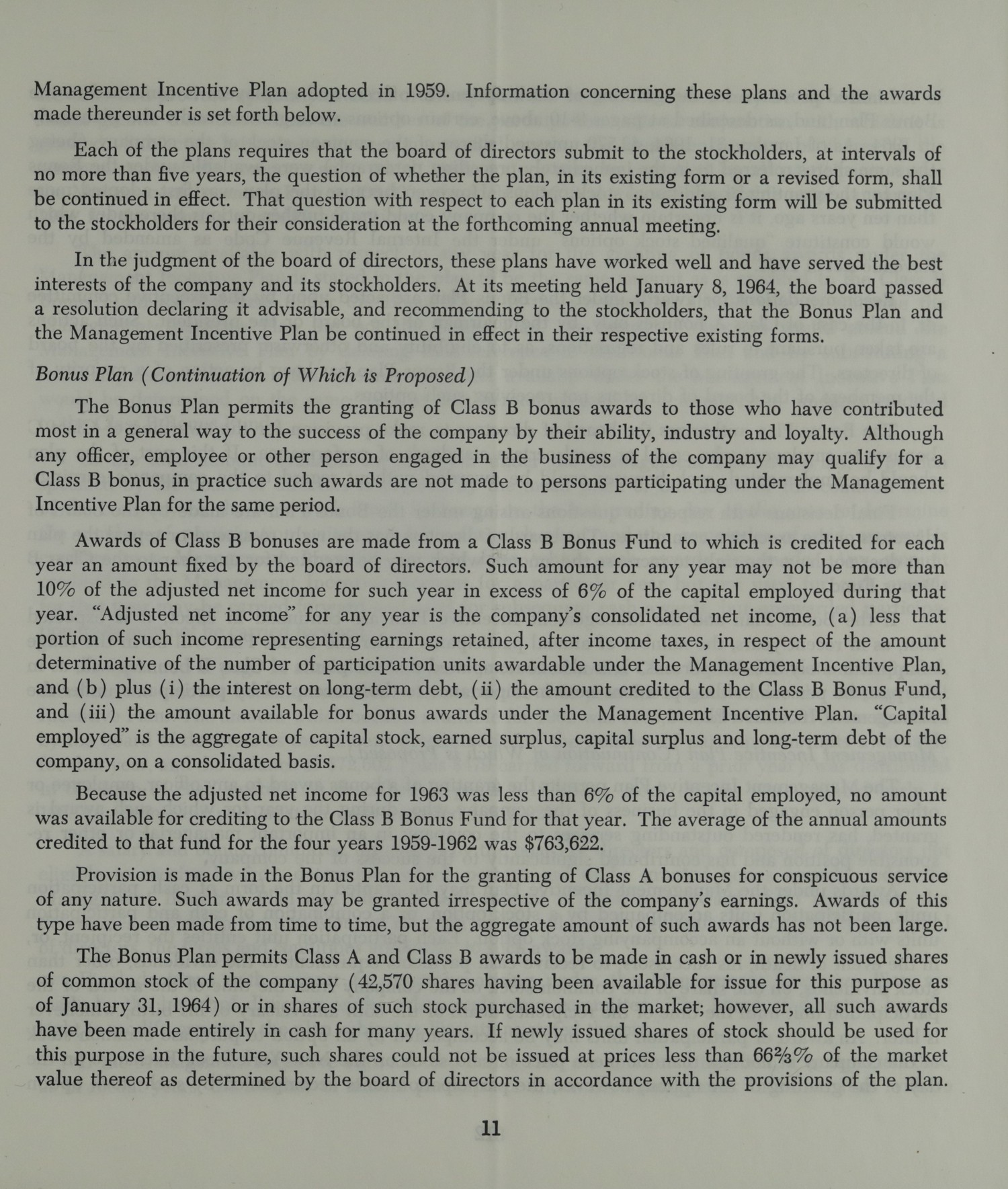
Management Incentive Plan adopted in 1959. Information concerning these plans and the awards made thereunder is set forth below.

Each of the plans requires that the board of directors submit to the stockholders, at intervals of no more than five years, the question of whether the plan, in its existing form or a revised form, shall be continued in effect. That question with respect to each plan in its existing form will be submitted to the stockholders for their consideration at the forthcoming annual meeting.

In the judgment of the board of directors, these plans have worked well and have served the best interests of the company and its stockholders. At its meeting held January 8, 1964, the board passed a resolution declaring it advisable, and recommending to the stockholders, that the Bonus Plan and the Management Incentive Plan be continued in effect in their respective existing forms.

Bonus Plan (Continuation of Which is Proposed)
The Bonus Plan permits the granting of Class B bonus awards to those who have contributed most in a general way to the success of the company by their ability, industry and loyalty. Although any officer, employee or other person engaged in the business of the company may qualify for a Class B bonus, in practice such awards are not made to persons participating under the Management Incentive Plan for the same period.

Awards of Class B bonuses are made from a Class B Bonus Fund to which is credited for each year an amount fixed by the board of directors. Such amount for any year may not be more than 10% of the adjusted net income for such year in excess of 6% of the capital employed during that year. “Adjusted net income” for any year is the company’s consolidated net income, (a) less that portion of such income representing earnings retained, after income taxes, in respect of the amount determinative of the number of participation units awardable under the Management Incentive Plan, and (b) plus (i) the interest on long-term debt, (ii) the amount credited to the Class B Bonus Fund, and (iii) the amount available for bonus awards under the Management Incentive Plan. “Capital employed” is the aggregate of capital stock, earned surplus, capital surplus and long-term debt of the company, on a consolidated basis.

Because the adjusted net income for 1963 was less than 6% of the capital employed, no amount was available for crediting to the Class B Bonus Fund for that year. The average of the annual amounts credited to that fund for the four years 1959-1962 was $763,622.

Provision is made in the Bonus Plan for the granting of Class A bonuses for conspicuous service of any nature. Such awards may be granted irrespective of the company’s earnings. Awards of this type have been made from time to time, but the aggregate amount of such awards has not been large.

The Bonus Plan permits Class A and Class B awards to be made in cash or in newly issued shares of common stock of the company (42,570 shares having been available for issue for this purpose as of January 31, 1964) or in shares of such stock purchased in the market; however, all such awards have been made entirely in cash for many years. If newly issued shares of stock should be used for this purpose in the future, such shares could not be issued at prices less than 66-2/3% of the market value thereof as determined by the board of directors in accordance with the provisions of the plan.

US Rubber Proxy Statement – Page 12

Page 012

Limited provision for the granting of stock options to officers and employees is contained in the Bonus Plan; and, as described at pages 9-10 above, certain options were granted under the plan early in 1964. As of January 31, 1964, 42,570 unissued shares of the common stock of the company (being the same shares referred to in the immediately preceding paragraph) were available under the Bonus Plan for the granting of additional stock options. However, because the plan was first adopted more than ten years ago, it is uncertain whether the company could grant further options thereunder which would constitute “qualified stock options” under the Internal Revenue Code as amended by the Revenue Act of 1964.

Recommendations for awards under the Bonus Plan are acted upon by the executive committee or, in the case of Class A bonuses only, by the chairman of the board or the president. Such actions are taken pursuant to rules and regulations, as to eligibility and otherwise, prescribed by the board of directors. The granting of stock options under the Bonus Plan has been by action of a majority of the members of the board of directors not receiving such options.

The Bonus Plan authorizes the board of directors to make provision for the awarding of Class C bonuses to employees who equal or excel certain standards of performance. If this part of the plan should be implemented, such bonuses could be awarded without regard to the company’s earnings.

Final decisions with respect to questions arising under the Bonus Plan are made by the board of directors or the executive committee. The board of directors has the right to amend or repeal the plan but does not have the right to increase the amount which may be credited for any year to the Class B Bonus Fund.

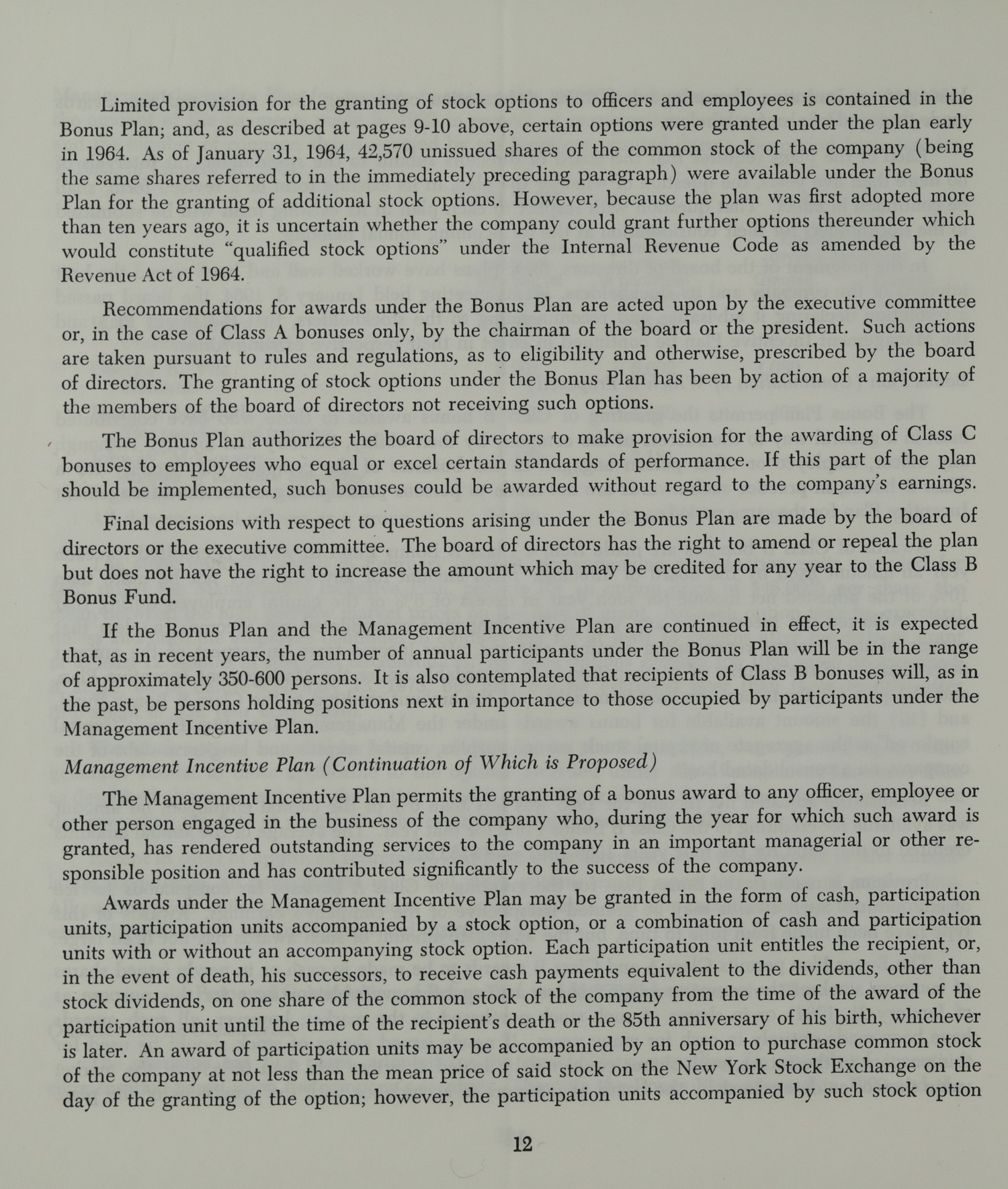
If the Bonus Plan and the Management Incentive Plan are continued in effect, it is expected that, as in recent years, the number of annual participants under the Bonus Plan will be in the range of approximately 350-600 persons. It is also contemplated that recipients of Class B bonuses will, as in the past, be persons holding positions next in importance to those occupied by participants under the Management Incentive Plan.

Management Incentive Plan (Continuation of Which is Proposed)
The Management Incentive Plan permits the granting of a bonus award to any officer, employee or other person engaged in the business of the company who, during the year for which such award is granted, has rendered outstanding services to the company in an important managerial or other responsible position and has contributed significantly to the success of the company.

Awards under the Management Incentive Plan may be granted in the form of cash, participation units, participation units accompanied by a stock option, or a combination of cash and participation units with or without an accompanying stock option. Each participation unit entitles the recipient, or, in the event of death, his successors, to receive cash payments equivalent to the dividends, other than stock dividends, on one share of the common stock of the company from the time of the award of the participation unit until the time of the recipient’s death or the 85th anniversary of his birth, whichever is later. An award of participation units may be accompanied by an option to purchase common stock of the company at not less than the mean price of said stock on the New York Stock Exchange on the day of the granting of the option; however, the participation units accompanied by such stock option

US Rubber Proxy Statement – Page 13

Page 013

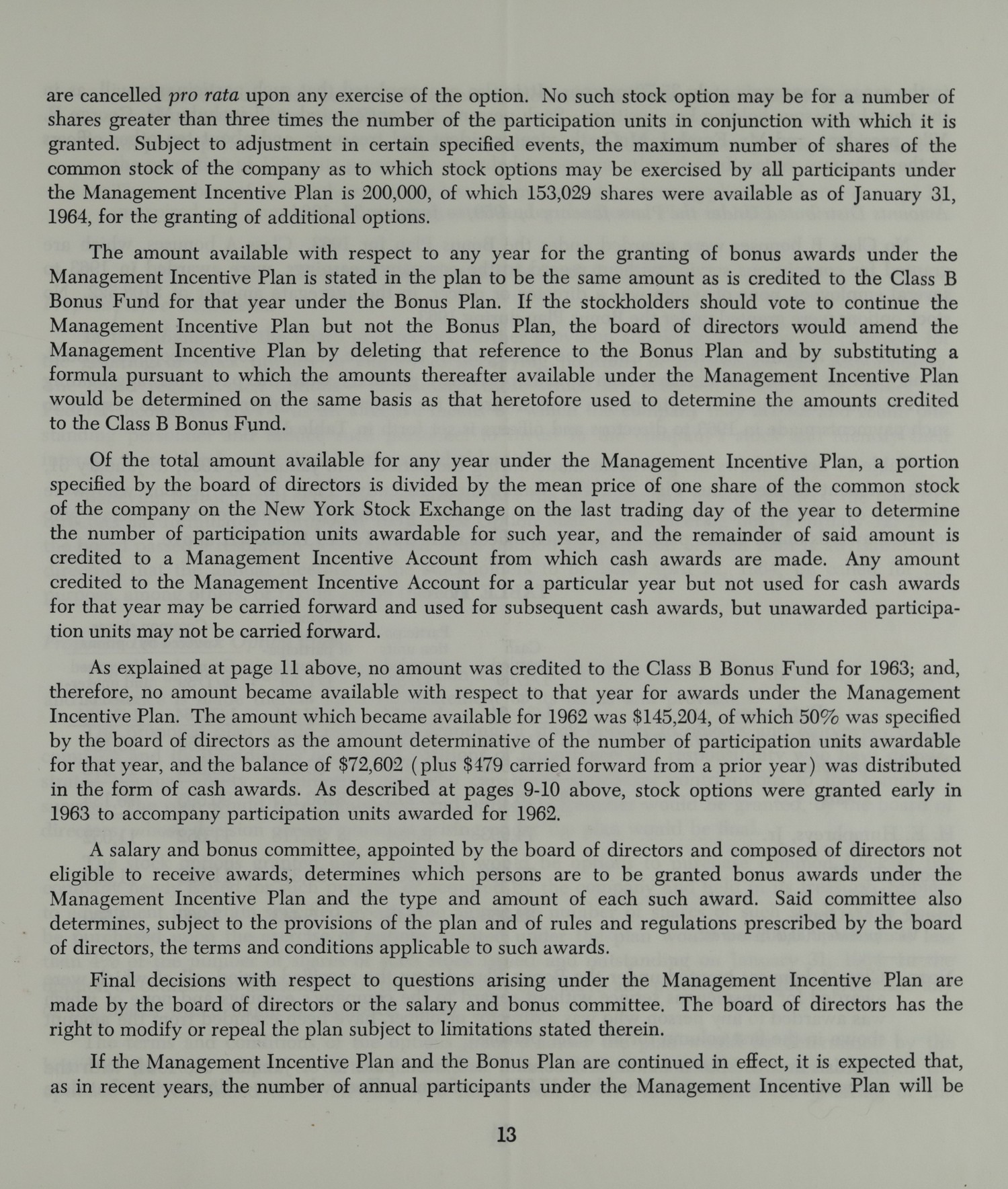
are cancelled pro rata upon any exercise of the option. No such stock option may be for a number of shares greater than three times the number of the participation units in conjunction with which it is granted. Subject to adjustment in certain specified events, the maximum number of shares of the common stock of the company as to which stock options may be exercised by all participants under the Management Incentive Plan is 200,000, of which 153,029 shares were available as of January 31, 1964, for the granting of additional options.

The amount available with respect to any year for the granting of bonus awards under the Management Incentive Plan is stated in the plan to be the same amount as is credited to the Class B Bonus Fund for that year under the Bonus Plan. If the stockholders should vote to continue the Management Incentive Plan but not the Bonus Plan, the board of directors would amend the Management Incentive Plan by deleting that reference to the Bonus Plan and by substituting a formula pursuant to which the amounts thereafter available under the Management Incentive Plan would be determined on the same basis as that heretofore used to determine the amounts credited to the Class B Bonus Fund.

Of the total amount available for any year under the Management Incentive Plan, a portion specified by the board of directors is divided by the mean price of one share of the common stock of the company on the New York Stock Exchange on the last trading day of the year to determine the number of participation units awardable for such year, and the remainder of said amount is credited to a Management Incentive Account from which cash awards are made. Any amount credited to the Management Incentive Account for a particular year but not used for cash awards for that year may be carried forward and used for subsequent cash awards, but unawarded participation units may not be carried forward.

As explained at page 11 above, no amount was credited to the Class B Bonus Fund for 1963, and, therefore, no amount became available with respect to that year for awards under the Management Incentive Plan. The amount which became available for 1962 was $145,204, of which 50% was specified by the board of directors as the amount determinative of the number of participation units awardable for that year, and the balance of $72,602 (plus $479 carried forward from a prior year) was distributed in the form of cash awards. As described at pages 9-10 above, stock options were granted early in 1963 to accompany participation units awarded for 1962.

A salary and bonus committee, appointed by the board of directors and composed of directors not eligible to receive awards, determines which persons are to be granted bonus awards under the Management Incentive Plan and the type and amount of each such award. Said committee also determines, subject to the provisions of the plan and of rules and regulations prescribed by the board of directors, the terms and conditions applicable to such awards.

Final decisions with respect to questions arising under the Management Incentive Plan are made by the board of directors or the salary and bonus committee. The board of directors has the right to modify or repeal the plan subject to limitations stated therein.

If the Management Incentive Plan and the Bonus Plan are continued in effect, it is expected that, as in recent years, the number of annual participants under the Management Incentive Plan will be substantially the same as the number of annual participants under the Bonus Plan.

US Rubber Proxy Statement – Page 14

Page 014

in the range of approximately 35-70 persons. It is also contemplated that such participants will, as in the past, be persons holding key positions. Such persons, it is anticipated, will include Mr. George R. Vila, president, and Mr. Frank J. McGrath, vice president and treasurer, and about ten other officers of the company.

Amounts Distributed Under the Plans January 1, 1959, to January 31, 1964
No Class B bonuses were awarded under the Bonus Plan for 1963. Class A bonuses, which are granted for conspicuous service without regard to the company’s earnings, were awarded in 1963 to several employees, none of whom was a director or officer, in the aggregate amount of $108,522. No stock options were granted under the Bonus Plan during 1963.

The only amounts distributed under the Management Incentive Plan for 1963 (except for install-ments paid on account of deferred cash awards previously granted) were the payments, aggregating $55,169, made in respect of participation units awarded for prior years. Information with respect to such payments made in 1963 to directors and officers is set forth in Table III above.

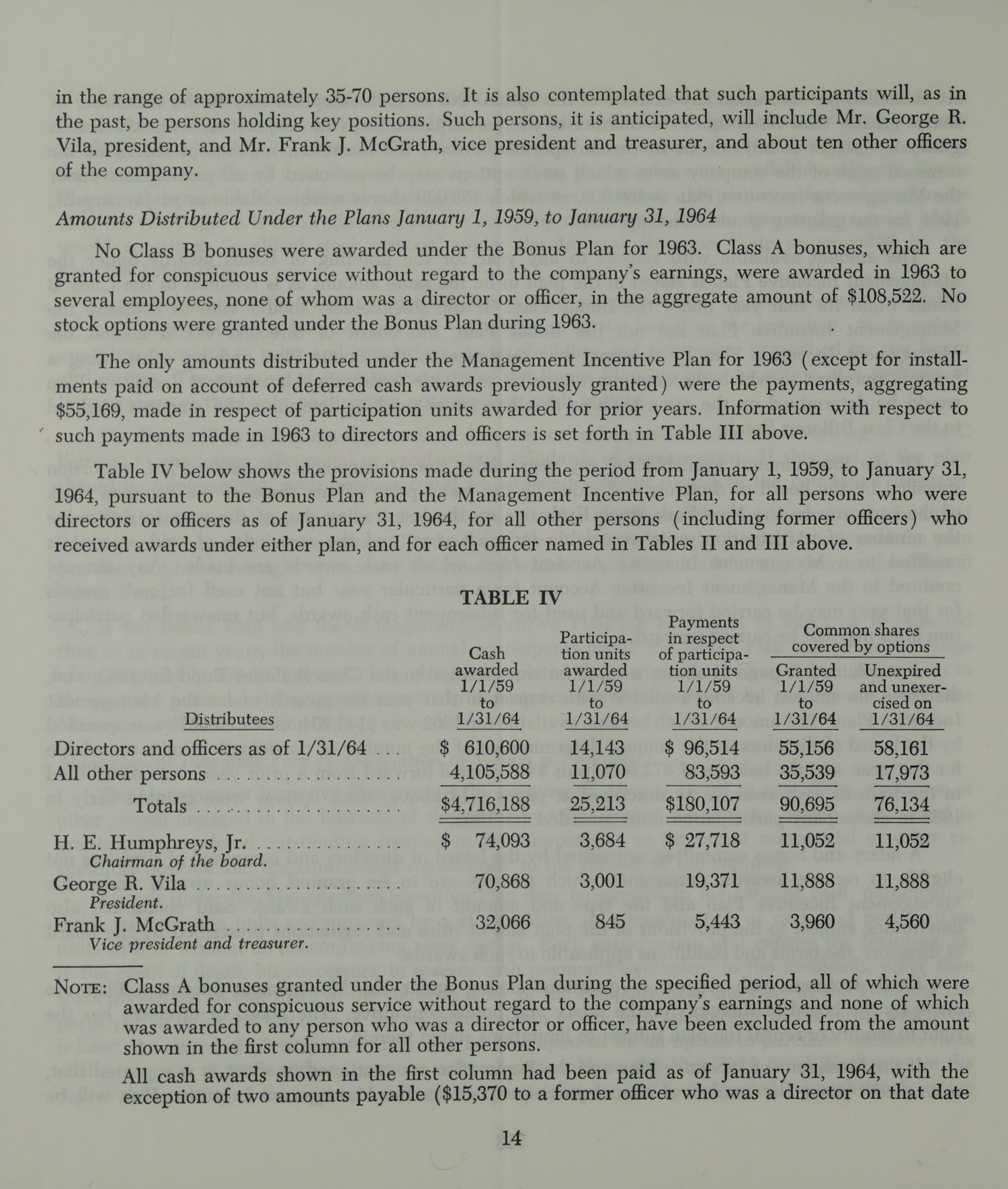
Table IV below shows the provisions made during the period from January 1, 1959, to January 31, 1964, pursuant to the Bonus Plan and the Management Incentive Plan, for all persons who were directors or officers as of January 31, 1964, for all other persons (including former officers) who received awards under either plan, and for each officer named in Tables II and III above.

TABLE IV
Cash Participa- Payments Common shares
awarded tion units in respect covered by options
Distributees 1/1/59 awarded of participa- Granted Unexpired
to 1/1/59 to tion units 1/1/59 and unexer-
1/31/64 1/31/64 1/1/59 to cised on
1/31/64 1/31/64
Directors and officers as of 1/31/64 … $ 610,600 14,143 $ 96,514 55,156 58,161
All other persons ………………….. 4,105,588 11,070 83,593 35,539 17,973
$4,716,188 25,213 $180,107 90,695 76,134

H. E. Humphreys, Jr. ………………. $ 74,093 3,684 $ 27,718 11,052 11,052
Chairman of the Board.
George R. Vila ……………………. 70,868 3,001 19,371 11,888 11,888
President.
Frank J. McGrath ………………….. 32,066 845 5,443 3,960 4,560
Vice president and treasurer.

NOTE: Class A bonuses granted under the Bonus Plan during the specified period, all of which were awarded for conspicuous service without regard to the company’s earnings and none of which was awarded to any person who was a director or officer, have been excluded from the amount shown in the first column for all other persons.

All cash awards shown in the first column had been paid as of January 31, 1964, with the exception of two amounts payable ($15,370 to a former officer who was a director on that date.

US Rubber Proxy Statement – Page 15

Page 015

and $2,690 to another person) in respect of deferred cash awards previously granted under the Management Incentive Plan.

All participation units shown in the second column were outstanding on January 31, 1964, with the exception of 136 units previously awarded to persons other than directors and officers.

The numbers of shares shown in the last column include, where applicable, shares covered by unexpired and unexercised options granted under the Bonus Plan in 1958.

Proposed Adoption of 1964 Stock Option Plan

Proposal to be Considered

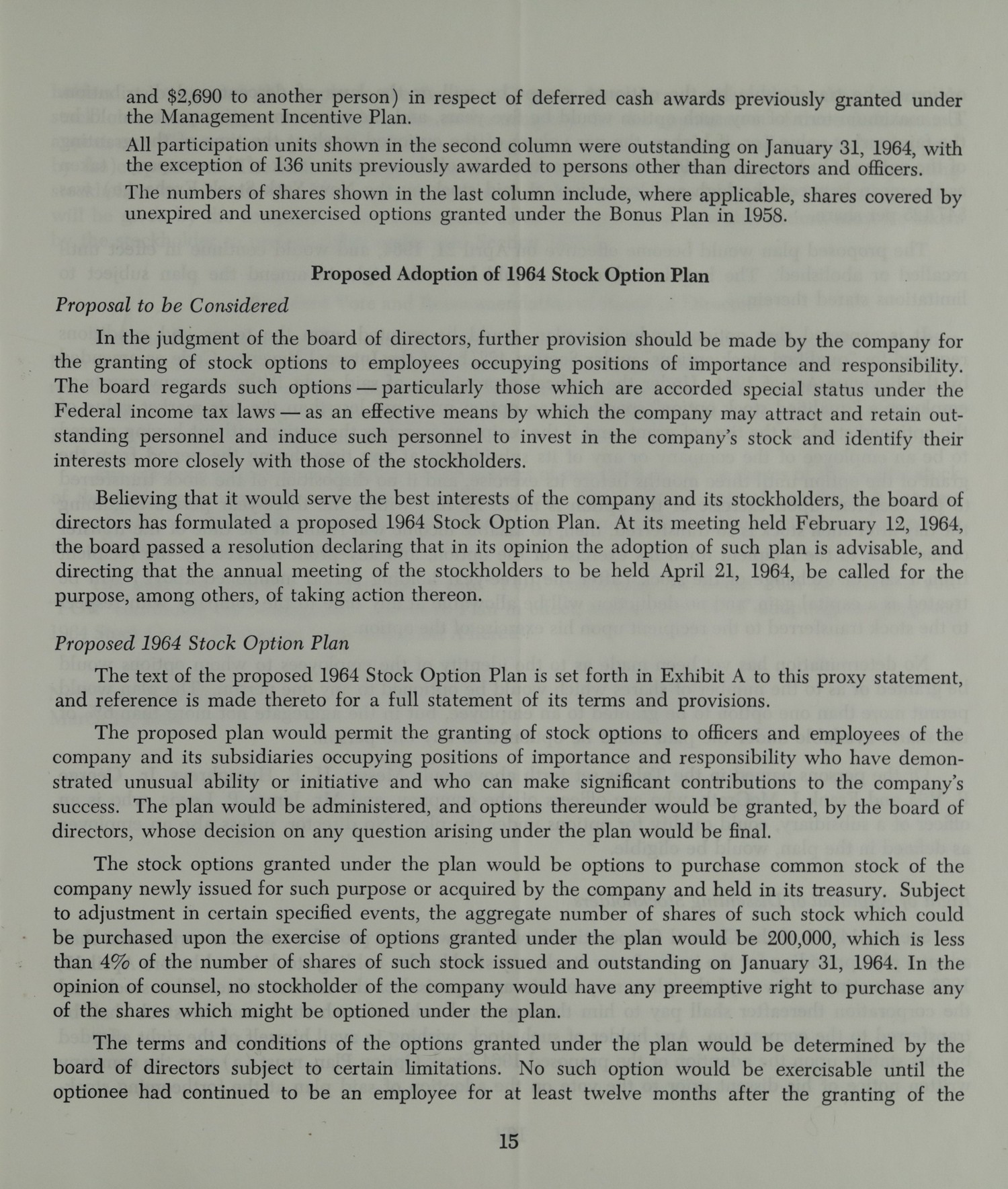
In the judgment of the board of directors, further provision should be made by the company for the granting of stock options to employees occupying positions of importance and responsibility. The board regards such options — particularly those which are accorded special status under the Federal income tax laws — as an effective means by which the company may attract and retain outstanding personnel and induce such personnel to invest in the company’s stock and identify their interests more closely with those of the stockholders.

Believing that it would serve the best interests of the company and its stockholders, the board of directors has formulated a proposed 1964 Stock Option Plan. At its meeting held February 12, 1964, the board passed a resolution declaring that in its opinion the adoption of such plan is advisable, and directing that the annual meeting of the stockholders to be held April 21, 1964, be called for the purpose, among others, of taking action thereon.

Proposed 1964 Stock Option Plan

The text of the proposed 1964 Stock Option Plan is set forth in Exhibit A to this proxy statement, and reference is made thereto for a full statement of its terms and provisions.

The proposed plan would permit the granting of stock options to officers and employees of the company and its subsidiaries occupying positions of importance and responsibility who have demonstrated unusual ability or initiative and who can make significant contributions to the company’s success. The plan would be administered, and options thereunder would be granted, by the board of directors, whose decision on any question arising under the plan would be final.

The stock options granted under the plan would be options to purchase common stock of the company newly issued for such purpose or acquired by the company and held in its treasury. Subject to adjustment in certain specified events, the aggregate number of shares of such stock which could be purchased upon the exercise of options granted under the plan would be 200,000, which is less than 4% of the number of shares of such stock issued and outstanding on January 31, 1964. In the opinion of counsel, no stockholder of the company would have any preemptive right to purchase any of the shares which might be optioned under the plan.

The terms and conditions of the options granted under the plan would be determined by the board of directors subject to certain limitations. No such option would be exercisable until the optionee had continued to be an employee for at least twelve months after the granting of the

US Rubber Proxy Statement – Page 16

Page 016

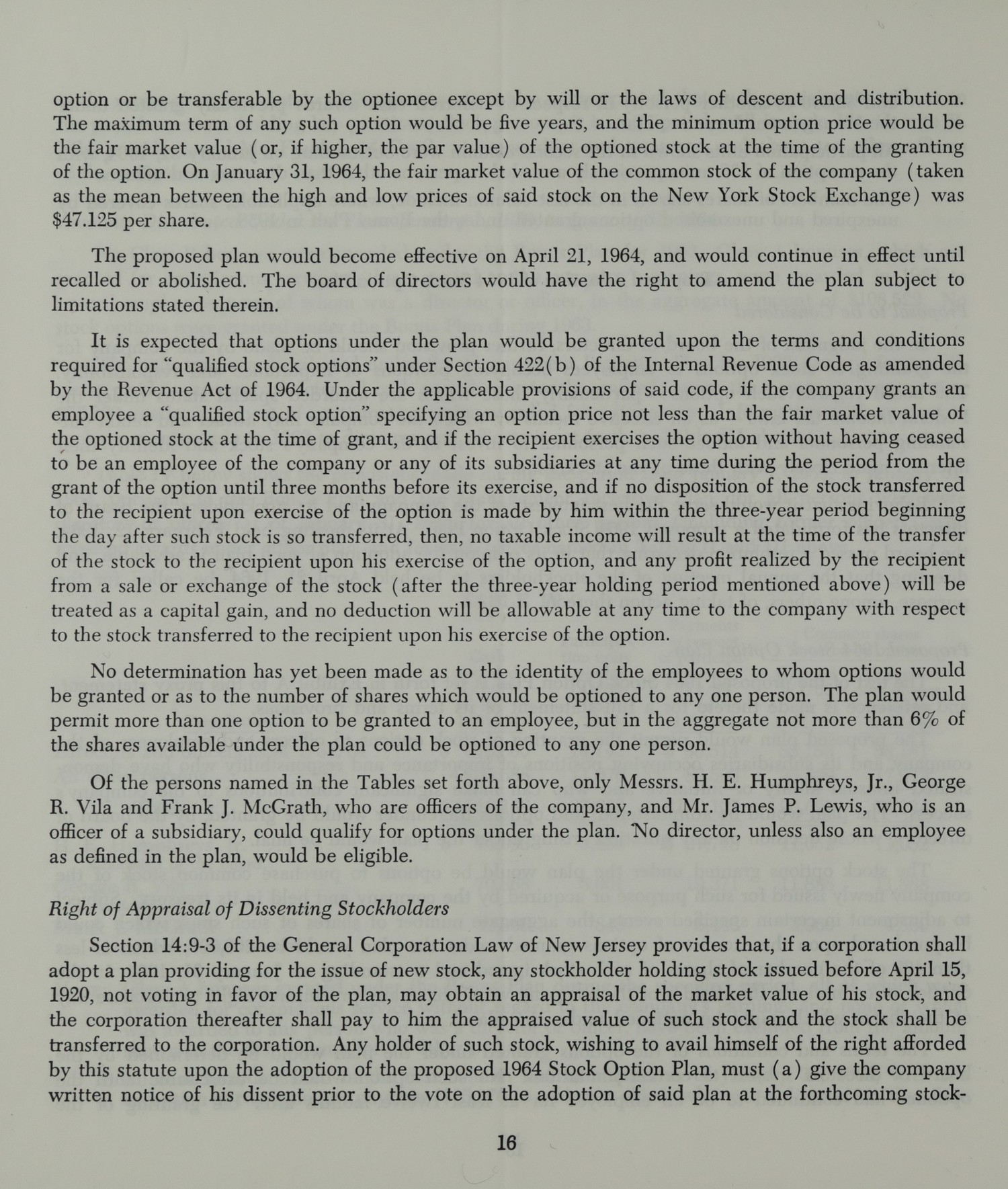
option or be transferable by the optionee except by will or the laws of descent and distribution.
The maximum term of any such option would be five years, and the minimum option price would be the fair market value (or, if higher, the par value) of the optioned stock at the time of the granting of the option. On January 31, 1964, the fair market value of the common stock of the company (taken as the mean between the high and low prices of said stock on the New York Stock Exchange) was $47.125 per share.

The proposed plan would become effective on April 21, 1964, and would continue in effect until recalled or abolished. The board of directors would have the right to amend the plan subject to limitations stated therein.

It is expected that options under the plan would be granted upon the terms and conditions required for “qualified stock options” under Section 422(b) of the Internal Revenue Code as amended by the Revenue Act of 1964. Under the applicable provisions of said code, if the company grants an employee a “qualified stock option” specifying an option price not less than the fair market value of the optioned stock at the time of grant, and if the recipient exercises the option without having ceased to be an employee of the company or any of its subsidiaries at any time during the period from the grant of the option until three months before its exercise, and if no disposition of the stock transferred to the recipient upon exercise of the option is made by him within the three-year period beginning the day after such stock is so transferred, then, no taxable income will result at the time of the transfer of the stock to the recipient upon his exercise of the option, and any profit realized by the recipient from a sale or exchange of the stock (after the three-year holding period mentioned above) will be treated as a capital gain, and no deduction will be allowable at any time to the company with respect to the stock transferred to the recipient upon his exercise of the option.

No determination has yet been made as to the identity of the employees to whom options would be granted or as to the number of shares which would be optioned to any one person. The plan would permit more than one option to be granted to an employee, but in the aggregate not more than 6% of the shares available under the plan could be optioned to any one person.

Of the persons named in the Tables set forth above, only Messrs. H. E. Humphreys, Jr., George R. Vila and Frank J. McGrath, who are officers of the company, and Mr. James E. Lewis, who is an officer of a subsidiary, could qualify for options under the plan. No director, unless also an employee as defined in the plan, would be eligible.

Right of Appraisal of Dissenting Stockholders
Section 14:9-3 of the General Corporation Law of New Jersey provides that, if a corporation shall adopt a plan providing for the issue of new stock, any stockholder holding stock issued before April 15, 1920, not voting in favor of the plan, may obtain an appraisal of the market value of his stock, and the corporation thereafter shall pay to him the appraised value of such stock and the stock shall be transferred to the corporation. Any holder of such stock, wishing to avail himself of the right afforded by this statute upon the adoption of the proposed 1964 Stock Option Plan, must (a) give the company written notice of his dissent prior to the vote on the adoption of said plan at the forthcoming stock-

US Rubber Proxy Statement – Page 17

Page 017

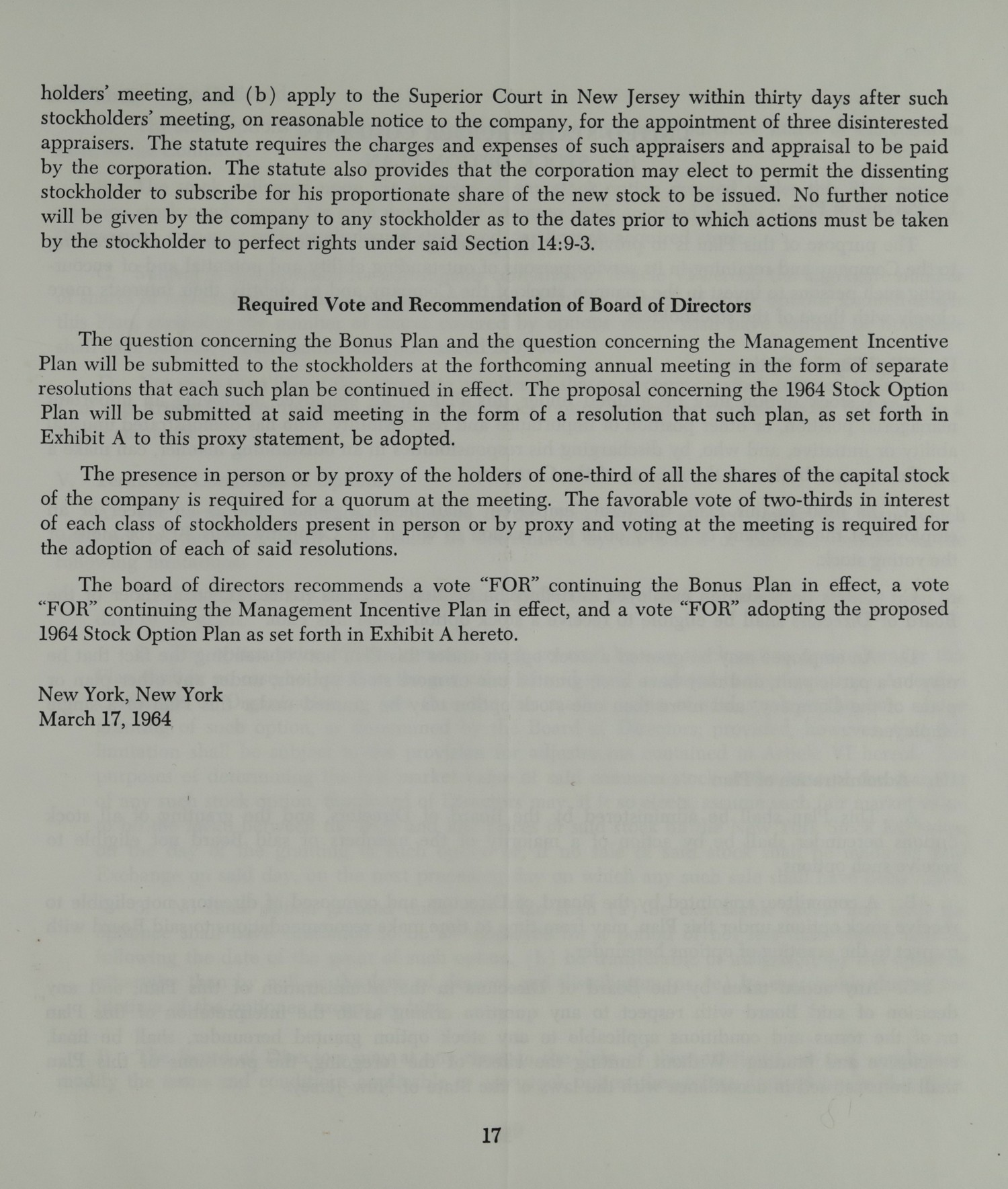
holders’ meeting, and (b) apply to the Superior Court in New Jersey within thirty days after such stockholders’ meeting, on reasonable notice to the company, for the appointment of three disinterested appraisers. The statute requires the charges and expenses of such appraisers and appraisal to be paid by the corporation. The statute also provides that the corporation may elect to permit the dissenting stockholder to subscribe for his proportionate share of the new stock to be issued. No further notice will be given by the company to any stockholder as to the dates prior to which actions must be taken by the stockholder to perfect rights under said Section 14:9-3.

Required Vote and Recommendation of Board of Directors

The question concerning the Bonus Plan and the question concerning the Management Incentive Plan will be submitted to the stockholders at the forthcoming annual meeting in the form of separate resolutions that each such plan be continued in effect. The proposal concerning the 1964 Stock Option Plan will be submitted at said meeting in the form of a resolution that such plan, as set forth in Exhibit A to this proxy statement, be adopted.

The presence in person or by proxy of the holders of one-third of all the shares of the capital stock of the company is required for a quorum at the meeting. The favorable vote of two-thirds in interest of each class of stockholders present in person or by proxy and voting at the meeting is required for the adoption of each of said resolutions.

The board of directors recommends a vote “FOR” continuing the Bonus Plan in effect, a vote “FOR” continuing the Management Incentive Plan in effect, and a vote “FOR” adopting the proposed 1964 Stock Option Plan as set forth in Exhibit A hereto.

New York, New York
March 17, 1964

US Rubber Proxy Statement – Page 19

Page 019

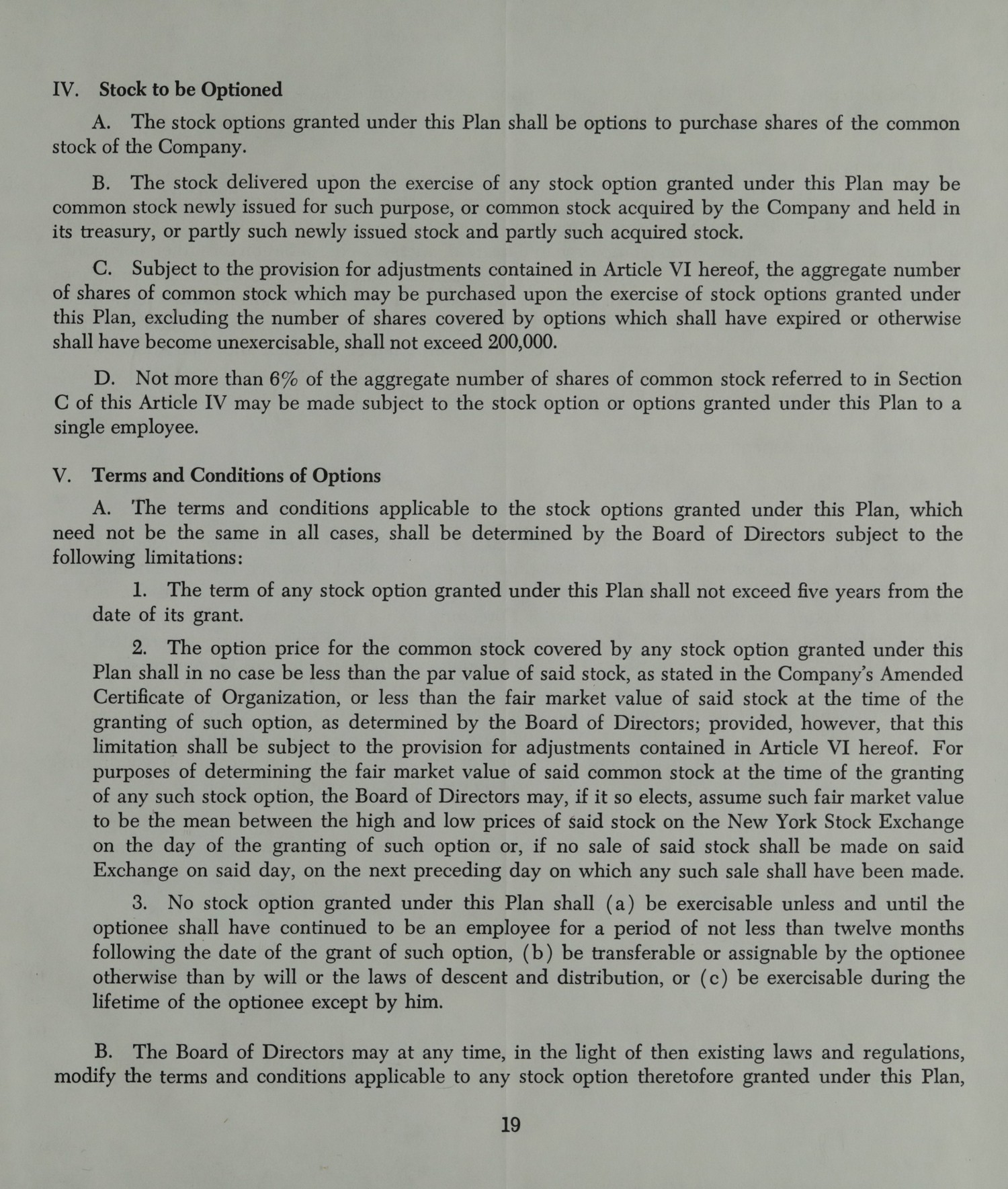
IV. Stock to be Optioned
A. The stock options granted under this Plan shall be options to purchase shares of the common stock of the Company.
B. The stock delivered upon the exercise of any stock option granted under this Plan may be common stock newly issued for such purpose, or common stock acquired by the Company and held in its treasury, or partly such newly issued stock and partly such acquired stock.
C. Subject to the provision for adjustments contained in Article VI hereof, the aggregate number of shares of common stock which may be purchased upon the exercise of stock options granted under this Plan, excluding the number of shares covered by options which shall have expired or otherwise shall have become unexercisable, shall not exceed 200,000.
D. Not more than 6% of the aggregate number of shares of common stock referred to in Section C of this Article IV may be made subject to the stock option or options granted under this Plan to a single employee.

V. Terms and Conditions of Options
A. The terms and conditions applicable to the stock options granted under this Plan, which need not be the same in all cases, shall be determined by the Board of Directors subject to the following limitations:
1. The term of any stock option granted under this Plan shall not exceed five years from the date of its grant.
2. The option price for the common stock covered by any stock option granted under this Plan shall in no case be less than the par value of said stock, as stated in the Company’s Amended Certificate of Organization, or less than the fair market value of said stock at the time of the granting of such option, as determined by the Board of Directors; provided, however, that this limitation shall be subject to the provision for adjustments contained in Article VI hereof. For purposes of determining the fair market value of said common stock at the time of the granting of any such stock option, the Board of Directors may, if it so elects, assume such fair market value to be the mean between the high and low prices of said stock on the New York Stock Exchange on the day of the granting of such option or, if no sale of said stock shall be made on said Exchange on said day, on the next preceding day on which any such sale shall have been made.
3. No stock option granted under this Plan shall (a) be exercisable unless and until the optionee shall have continued to be an employee for a period of not less than twelve months following the date of the grant of such option, (b) be transferable or assignable by the optionee otherwise than by will or the laws of descent and distribution, or (c) be exercisable during the lifetime of the optionee except by him.

B. The Board of Directors may at any time, in the light of then existing laws and regulations, modify the terms and conditions applicable to any stock option theretofore granted under this Plan.

US Rubber Proxy Statement – Page 4

Page 004

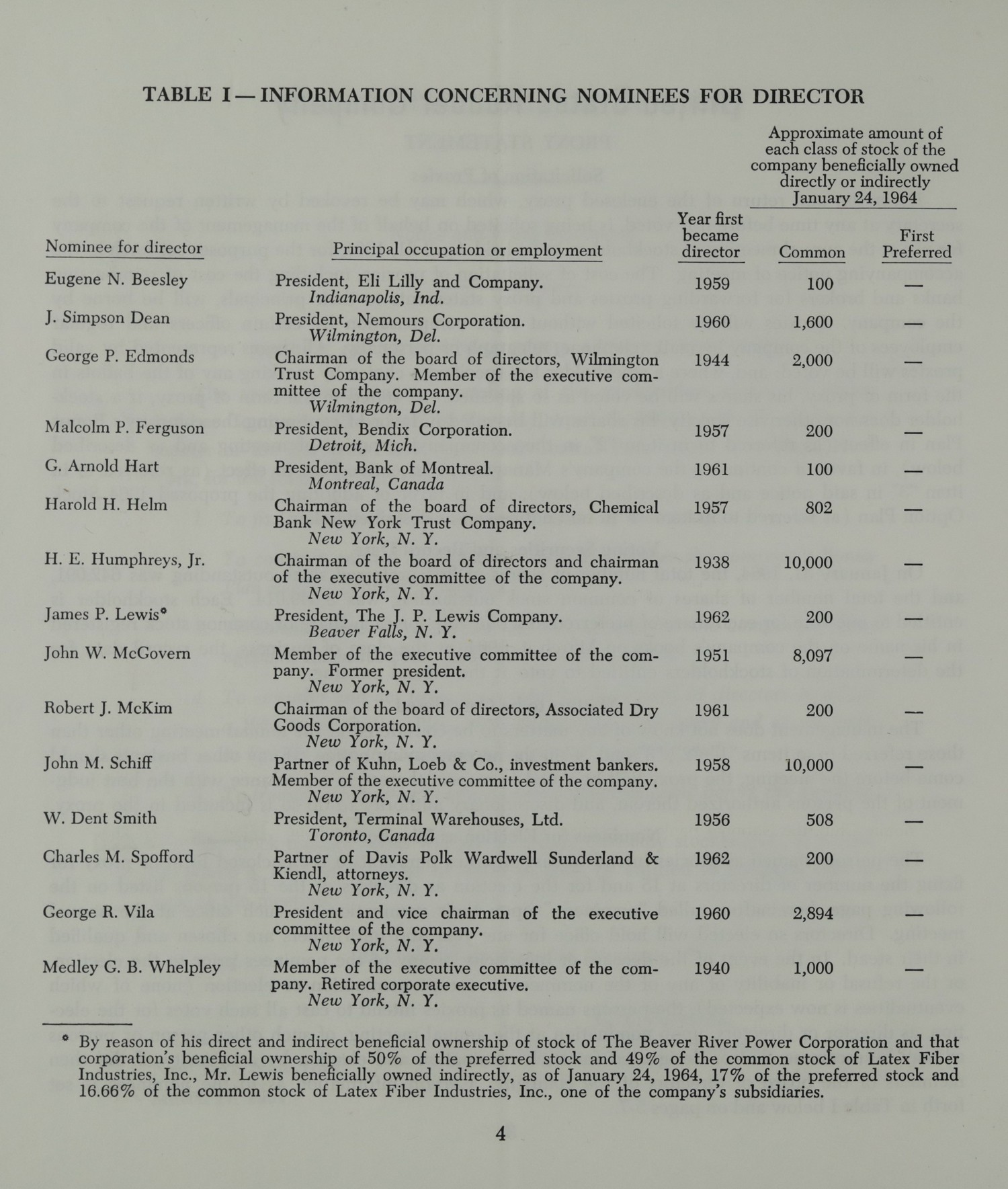
TABLE I — INFORMATION CONCERNING NOMINEES FOR DIRECTOR

Approximate amount of
each class of stock of the
company beneficially owned
directly or indirectly
January 24, 1964

Nominee for director Principal occupation or employment Year first Common First
became Preferred
director
Eugene N. Beesley President, Eli Lilly and Company, 1959 100 —
Indianapolis, Ind.
J. Simpson Dean President, Nemours Corporation. 1960 1,600 —
Wilmington, Del.
George P. Edmonds Chairman of the board of directors, Wilmington 1944 2,000 —
Trust Company. Member of the executive com-
mittee of the company.
Wilmington, Del.
Malcolm P. Ferguson President, Bendix Corporation. 1957 200 —
Detroit, Mich.
G. Arnold Hart President, Bank of Montreal. 1961 100 —
Montreal, Canada
Harold H. Helm Chairman of the board of directors, Chemical 1957 802 —
Bank New York Trust Company.
New York, N. Y.
H. E. Humphreys, Jr. Chairman of the board of directors and chairman 1938 10,000 —
of the executive committee of the company.
New York, N. Y.
James P. Lewis* President, The J. P. Lewis Company, 1962 200 —
Beaver Falls, N. Y.
John W. McGovern Member of the executive committee of the com- 1951 8,097 —
pany. Former president.
New York, N. Y.
Robert J. McKim Chairman of the board of directors, Associated Dry 1961 200 —
Goods Corporation.
New York, N. Y.
John M. Schiff Partner of Kuhn, Loeb & Co., investment bankers. 1958 10,000 —
Member of the executive committee of the company.
New York, N. Y.
W. Dent Smith President, Terminal Warehouses, Ltd. 1956 508 —
Toronto, Canada
Charles M. Spofford Partner of Davis Polk Wardwell Sunderland & 1962 200 —
Kiendl, attorneys.
New York, N. Y.
George R. Vila President and vice chairman of the executive 1960 2,894 —
committee of the company.
New York, N. Y.
Medley G. B. Whelpley Member of the executive committee of the com- 1940 1,000 —
pany. Retired corporate executive.
New York, N. Y.

  • By reason of his direct and indirect beneficial ownership of stock of The Beaver River Power Corporation and that corporation’s beneficial ownership of 50% of the preferred stock and 49% of the common stock of Latex Fiber Industries, Inc., Mr. Lewis beneficially owned indirectly, as of January 24, 1964, 17% of the preferred stock and 16.66% of the common stock of Latex Fiber Industries, Inc., one of the company’s subsidiaries.

US Rubber Proxy Statement – Page 3
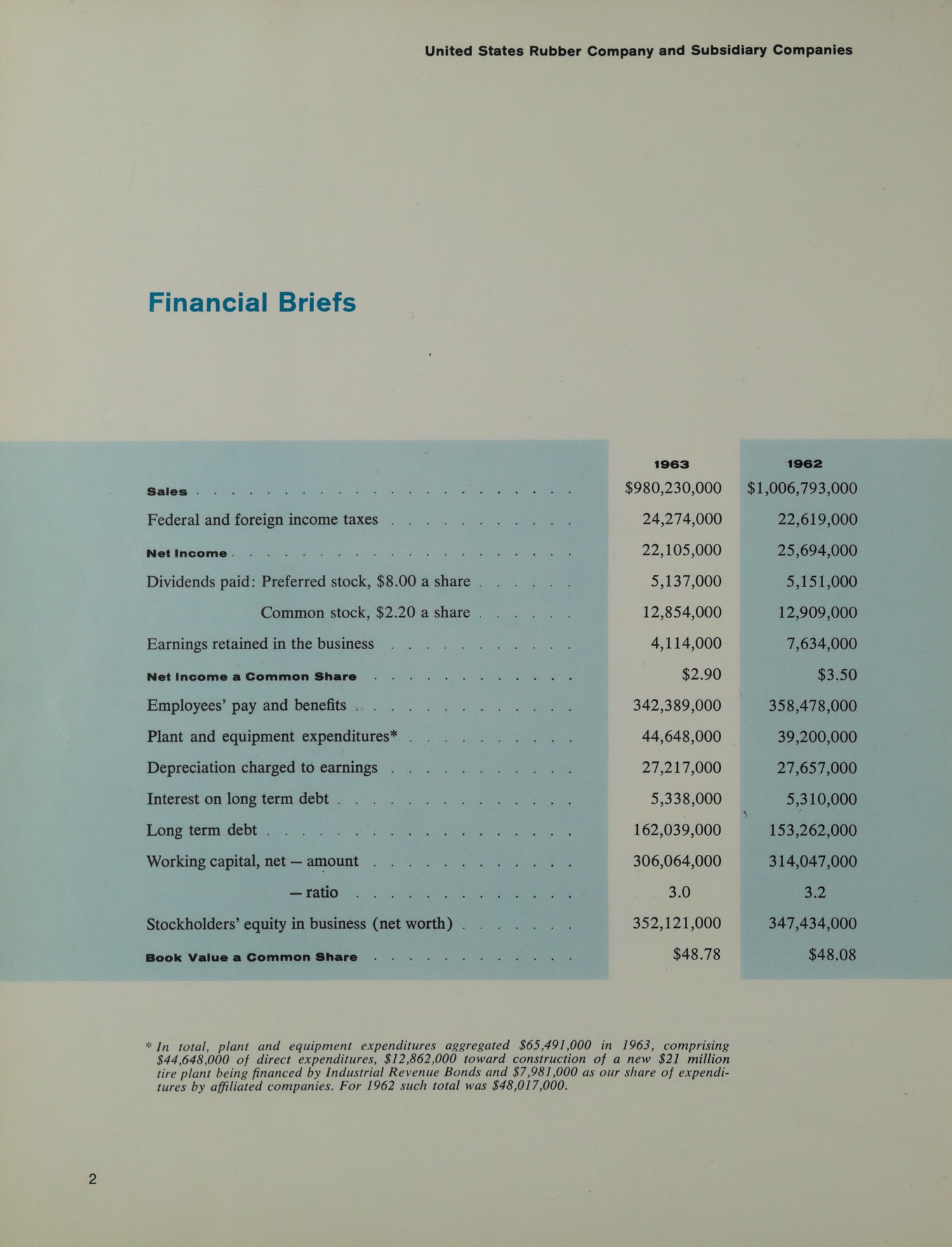
Page 003

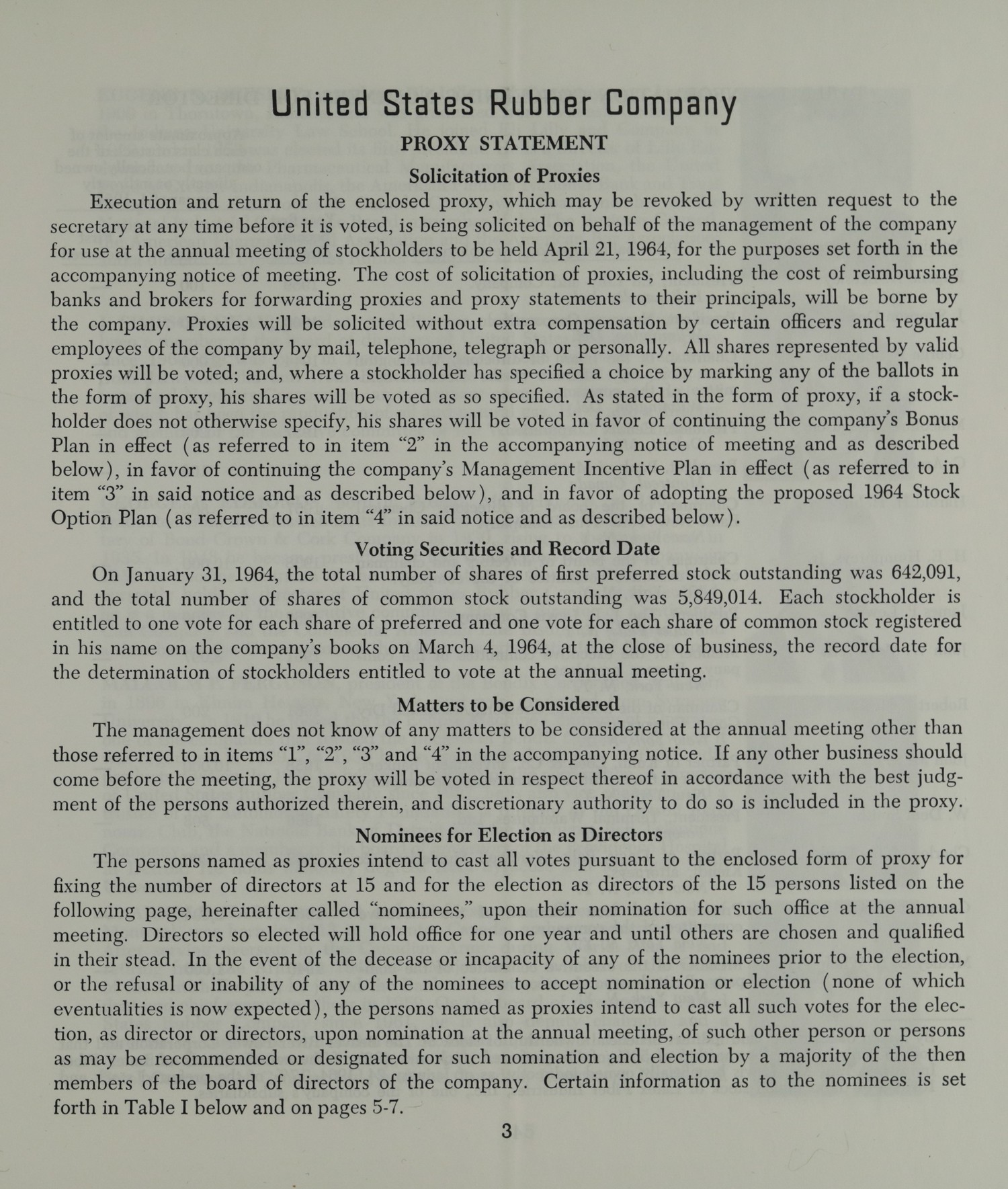
United States Rubber Company
PROXY STATEMENT
Solicitation of Proxies
Execution and return of the enclosed proxy, which may be revoked by written request to the secretary at any time before it is voted, is being solicited on behalf of the management of the company for use at the annual meeting of stockholders to be held April 21, 1964, for the purposes set forth in the accompanying notice of meeting. The cost of solicitation of proxies, including the cost of reimbursing banks and brokers for forwarding proxies and proxy statements to their principals, will be borne by the company. Proxies will be solicited without extra compensation by certain officers and regular employees of the company by mail, telephone, telegraph or personally. All shares represented by valid proxies will be voted; and, where a stockholder has specified a choice by marking any of the ballots in the form of proxy, his shares will be voted as so specified. As stated in the form of proxy, if a stockholder does not otherwise specify, his shares will be voted in favor of continuing the company’s Bonus Plan in effect (as referred to in item “2” in the accompanying notice of meeting and as described below), in favor of continuing the company’s Management Incentive Plan in effect (as referred to in item “3” in said notice and as described below), and in favor of adopting the proposed 1964 Stock Option Plan (as referred to in item “4” in said notice and as described below).

Voting Securities and Record Date
On January 31, 1964, the total number of shares of first preferred stock outstanding was 642,091, and the total number of shares of common stock outstanding was 5,549,014. Each stockholder is entitled to one vote for each share of preferred and one vote for each share of common stock registered in his name on the company’s books on March 4, 1964, at the close of business, the record date for the determination of stockholders entitled to vote at the annual meeting.

Matters to be Considered
The management does not know of any matters to be considered at the annual meeting other than those referred to in items “1”, “2”, “3” and “4” in the accompanying notice. If any other business should come before the meeting, the proxy will be voted in respect therein, and discretionary authority to do so is included in the proxy.

Nominees for Election as Directors
The persons named as proxies intend to cast all votes pursuant to the enclosed form of proxy for fixing the number of directors at 15 and for the election as directors of the 15 persons listed on the following page, hereinafter called “nominees,” upon their nomination for such office at the annual meeting. Directors so elected will hold office for one year and until others are chosen and qualified in their stead. In the event of the decease or incapacity of any of the nominees prior to the election, or the refusal or inability of any of the nominees to accept nomination or election (none of which eventualities is now expected), the persons named as proxies intend to cast all such votes for the election, as director or directors, upon nomination at the annual meeting, of such other person or persons as may be recommended or designated for such nomination and election by a majority of the then members of the board of directors of the company. Certain information as to the nominees is set forth in Table I below and on pages 5-7.

US Rubber Annual Report – 72nd Annual Report – Page Letter

Page letter

United States Rubber Company
Rockefeller Center
1230 AVENUE OF THE AMERICAS • NEW YORK 20, N.Y.

OFFICE OF THE
CHAIRMAN OF THE BOARD

March 17, 1964

To the Stockholders of
UNITED STATES RUBBER COMPANY:

The annual meeting of stockholders of United States Rubber Company will be held on Tuesday, April 21, 1964, at 10:30 a.m., in the Starlight Roof of the Waldorf-Astoria Hotel, 106 Central Park South, New York, New York. At this meeting stockholders will be asked to elect a board of directors for the coming year, to decide whether the company’s Bonus Plan and its Management Incentive Plan shall each be continued in effect, to consider and act upon the adoption of a proposed 1964 Stock Option Plan, and to transact such other business as may properly come before the meeting.

Under the provisions of the company’s Bonus Plan and its Management Incentive Plan, the board of directors is required to submit to the stockholders, at intervals of no more than five years, the question of whether each of those plans shall be continued in effect. The board of directors has passed a resolution declaring it advisable, and recommending to the stockholders, that both plans be continued in effect in their respective existing forms.

A proposed 1964 Stock Option Plan, described in the accompanying proxy statement, has been formulated by the board of directors for consideration by the stockholders. The board of directors has passed a resolution declaring the adoption of such plan advisable and directing that the forthcoming annual meeting be called for the purpose, among others, of taking action thereon.

The board of directors has fixed March 4, 1964, at the close of business, as the record date for the determination of stockholders entitled to vote at the meeting.

Your vote is important. Please sign and return the accompanying proxy in the enclosed addressed envelope. If you attend the meeting and wish to vote in person, you may withdraw your proxy. If you are planning to attend the meeting, it will be greatly appreciated if you will notify Mr. G. T. Pownall, Secretary, so that we may send you an attendance card.

Sincerely yours,

H. E. HUMPHREYS, JR.
Chairman of the Board of Directors

US Rubber Annual Report – 72nd Annual Report – Page Contents

Page contents

Contents
page 2 Financial Briefs
3 Letter to Stockholders
5 Expansion Program
14 Financial Review
16 Balance Sheet
18 Income and Retained Earnings
19 Financial Notes
21 Accountants’ Opinion
22 Twenty-year Summary
24 Products
25 Directors and Officers

72nd Annual Report . . . Year Ended December 31, 1963

United States Rubber Company
1230 AVENUE OF THE AMERICAS, NEW YORK, N.Y. 10020

General Attorneys . . . . . ARTHUR, DRY, KALISH,
TAYLOR & WOOD
General Counsel . . . . . . MYRON KALISH
Associate General Counsel . . NELSON P. TAYLOR
Auditors . . . . . . . . . . HASKINS & SELLS

Trustee-Registrar
(25% Debentures – Both Issues)
MANUFACTURERS HANOVER TRUST COMPANY
40 WALL STREET, NEW YORK, N.Y. 10015

Transfer and Dividend Paying Agent
(Common and Preferred Stocks)
BANKERS TRUST COMPANY
16 WALL STREET, NEW YORK, N.Y. 10015

Registrar (Common and Preferred Stocks)
Paying Agent (25% Debentures – Both Issues)
CHEMICAL BANK NEW YORK TRUST COMPANY
20 PINE STREET, NEW YORK, N.Y. 10015

Annual Meeting of Stockholders
10:30 A.M., Tuesday, April 21, 1964
Theater of the Barbizon-Plaza Hotel
106 Central Park South
New York City

US Rubber Annual Report – 72nd Annual Report – Page 23

Page 023

United States Rubber Company and Subsidiary Companies

POSITION OTHER STATISTICS

Long Term Debt Capital Stock Employment & Earnings
Amount Interest Net Equity Dividends a Share Number of Holders Average Wages, Total Year
Owed Paid Worth Share* Preferred Common† Preferred Common Number of Employees Benefits Taxes Ended
Employees Dec. 31
$162,039 $5,338 $352,121 $48.78 $8 $2.20 8,196 34,593 60,103 $342,389 $107,481 1963
153,262 5,310 347,434 48.08 8 2.20 8,375 33,794 61,469 358,478 117,365 1962
152,013 5,320 337,489 46.62 8 2.20 8,460 30,535 60,086 337,533 111,106 1961
154,672 5,418 326,140 44.98 8 2.20 8,629 31,690 59,983 336,295 115,181 1960
159,920 5,520 312,634 42.74 8 2.05 8,781 30,873 61,149 330,240 125,218 1959
164,657 5,651 294,010 39.49 8 2.00 8,539 29,694 59,428 305,137 99,935 1958
169,030 5,740 289,109 38.64 8 2.00$ 8,591 27,013 60,136 314,109 96,786† 1957
174,484$ 5,751 271,240 36.17 8 2.00$ 8,743 25,823 63,929 331,470 92,203† 1956
156,325 4,357 254,332 33.17 8 2.00$ 9,070 24,904 63,550 324,382 95,626† 1955
120,896 3,736 236,585 30.01 8 2.00 9,364 24,390 60,726 290,963 80,052† 1954
120,896 3,737 224,373 27.84 8 2.00 9,683 23,586 67,549 303,447 97,260† 1953
102,719 2,761 207,454 24.84 8 2.00 9,755 21,348 65,745 269,791 116,111† 1952
77,724 2,040 194,627 22.64 8 2.00 9,839 16,362 65,083 257,829 126,297† 1951
77,744 2,208 180,035 20.03 8 1.67 9,992 15,480 59,069 216,832 89,913† 1950
92,812 2,384 169,391 18.14 8 1.00 10,592 15,541 56,521 183,866 51,979† 1949
98,000 2,429 163,199 17.03 8 1.33 10,711 15,410 64,208 208,545 61,173 1948
101,000 2,068 155,310 15.62 8 1.33 10,813 14,687 66,765 215,907 65,349 1947
40,000 918 145,697 13.92 8 1.33 10,771 13,707 61,499 190,048 62,367 1946
27,000 584 134,318 11.89 8 .67 10,665 12,657 70,739 188,318 47,026 1945
30,000 1,113 129,420 11.02 8 .67 10,595 12,332 78,347 195,807 57,584 1944

  • Net income a common share calculations are based on average number of shares outstanding; equity
    a common share calculations are based on shares outstanding at year-end; all calculations have been
    adjusted for the three-for-one stock split effective April 23, 1952 and for stock dividends. Dividends
    a share are at amounts declared for the respective years after adjustment for the 1952 stock split.

US Rubber Annual Report – 72nd Annual Report – Page 22

Page 022

Twenty-Year Summary
(Dollars in thousands except amounts per share)

SALES AND INCOME FINANCIAL

Year Net Per Cent Paid in Property, Plant &
Ended Sales Net of Sales Dividends Equipment
Dec. 31 Amount Common Retained Net Gross Provision for
1963 $ 980,230 $22,105 2.3 $17,991 $ 4,114 $306,064 $44,648 $27,217
1962 1,006,793 25,694 2.6 18,060 7,634 314,047 39,200 27,657
1961 940,399 27,096 2.9 17,860 9,236 311,495 39,795 25,711
1960 966,833 30,737 3.2 17,838 12,899 318,281 27,064 24,246
1959 , 976,766 35,580 3.6 16,956 18,624 312,222 25,311 24,409
1958 870,616 22,671 2.6 16,669 6,002 295,744 39,603 24,706
1957 873,583 29,695 3.4 16,343 13,352 282,032 36,115 22,743
1956 901,260 31,870 3.5 16,025 15,845 285,788 36,042 21,831
1955 925,539 33,559 3.6 15,812 17,747 259,757 35,282 19,627
1954 781,574 27,959 3.6 15,812 12,147 232,447 31,689 17,649
1953 838,451 32,732 3.9 15,812 16,920 231,256 26,033 16,016
1952 850,152 28,170 3.3 15,793 12,377 206,236 26,262 14,364
1951 837,222 30,366 3.6 15,775 14,591 177,030 21,022 13,999
1950 695,756 24,658 3.5 14,013 10,645 167,911 15,230 13,402
1949 517,440 15,100 2.9 10,492 4,608 167,939 16,185 13,328
1948 572,025 20,142 3.5 12,252 7,890 172,062 18,358 13,750
1947 580,968 21,753 3.7 12,250 9,503 170,152 27,566 11,580
1946 494,753 23,208 4.7 12,244 10,964 118,484 24,647 8,022
1945 471,506 13,025 2.8 8,727 4,298 110,071 26,644 37,477
1944 443,077 15,833 3.6 8,727 7,106 93,733 25,384 9,724

† Includes provision for renegotiation.
$ A stock dividend of 2% also paid.

US Rubber Annual Report – 72nd Annual Report – Page 21

Page 021

United States Rubber Company and Subsidiary Companies

Accountants’ Opinion

HASKINS & SELLS
CERTIFIED PUBLIC ACCOUNTANTS
TWO BROADWAY
NEW YORK 4

February 12, 1964

United States Rubber Company:

We have examined the consolidated balance sheet of United States Rubber Company and its subsidiary companies as of December 31, 1963 and the related statement of consolidated income and retained earnings for the year then ended. Our examination was made in accordance with generally accepted auditing standards, and accordingly included such tests of the accounting records and such other auditing procedures as we considered necessary in the circumstances.

In our opinion, the accompanying consolidated balance sheet and statement of consolidated income and retained earnings present fairly the financial position of the companies at December 31, 1963 and the results of their operations for the year then ended, in conformity with generally accepted accounting principles applied on a basis consistent with that of the preceding year.

Haskins & Sells.

US Rubber Annual Report – 72nd Annual Report – Page 20

Page 020

Capital Surplus
The increase of $85,641 in Capital Surplus represents the
excess of market value over par value of 1,740 common
shares issued under employees’ stock options, $63,510; and
the excess of market value over cost of 10,409 common
shares issued from treasury for the acquisition of domestic
subsidiaries, $22,131.

Retirement Allowances
The Retirement Allowance Plan provides generally for
retirement allowances to eligible employees or former em-
ployees beginning at age 65, based upon compensation and
length of service, less applicable statutory benefits. Subject
to continuance during the period of certain labor agree-
ments, the Plan may be repealed or modified as to employ-
ees in active service, and the allowances to all retired
employees may be proportionately reduced.
The stockholders at the Annual Meeting on April 19,
1960 approved the funding of the Plan as from January 1,
1960 as it relates, generally, to domestic employees. The
funds are in the custody of Independent Trustees to whom
the Company pays amounts, computed by independent
actuaries, sufficient to provide for no less than minimum
funding.
For retired employees not covered by funding, the Com-
pany charges allowances paid to current costs and, in addi-
tion, maintains a Retirement Allowance Reserve equivalent
to allowances payable to presently retired employees over
the next five years after application of 1963 income tax
rates.
In 1963, the net cost of current service funding and
interest on past service for domestic employees covered by
funded plans aggregated $14,820,979. In addition, $752,640
was paid to retired employees not covered by funded plans,
and reserves applicable thereto were increased by $378,317.
These amounts, before reduction for income taxes, aggre-
gated $15,951,936 of which $14,751,936 was absorbed in
1963 cost of operations and $1,200,000 (representing a
portion of the 1963 funding cost related to past service

cost) was applied to the Reserve for Retirement Allow-
ances. The balance in this reserve was $9,172,186 at Decem-
ber 31, 1963, of which $7,177,401 related to funded plans.

Class B Bonus and Management Incentive Plans
Net Income for 1963 was insufficient to produce bonuses
under the Class B Bonus and Management Incentive Plans.
In 1962, a total of $145,204 was awarded under the Class B
Bonus Plan, and the same amount was awarded under the
Management Incentive Plan.

Stock Options
At December 31, 1962, options with respect to 69,526
shares of common stock were held by officers and other
key employees. The options generally are not exercisable
for 18 months after grant and expire at varying dates which
in no case exceed ten years from date of granting.
During 1963, options were exercised with respect to
1,740 shares, options expired for 4,692 shares, and options
were granted for 5,400 shares.
Options were outstanding at December 31, 1963 to pur-
chase 68,494 shares of common stock at prices ranging
from $41.50 to $60.875 a share.
At December 31, 1963, after providing for shares appli-
cable to outstanding options, there remained 203,239 shares
of common stock available for granting further options.
Of these remaining shares, options for 7,640 shares were
granted on January 8, 1964 at $45.625 per share.

Commitments and Contingencies
The Company is contingently liable as a guarantor for
$9,815,000 promissory notes issued by a domestic affiliated
company; and to purchase $1,763,000 of long term deben-
tures of a foreign affiliated company.
The Company is committed to expend $3,225,000 in
1964 for a minority interest in a foreign affiliated company.

US Rubber Annual Report – 72nd Annual Report – Page 19

Page 019

United States Rubber Company and Subsidiary Companies

Financial Notes

Principles of Consolidation – Foreign Activities
All subsidiary companies which are more than 50 per cent owned are included in the consolidated statements. Restricted earnings of foreign operations are excluded from net income and credited to the Reserve for Foreign Activities.
Fixed assets and long term liabilities of foreign subsidiaries are stated in United States dollars on the basis of rates of exchange prevailing at December 31, 1957 or at dates of acquisition for subsequent additions. All other foreign assets and liabilities are stated on the basis of rates of exchange prevailing at the close of the year. Cumulative gains resulting from the conversion of net current assets are carried in the Reserve for Foreign Activities; current losses are charged to such reserve, or, if no reserve is available, to consolidated income. Sales and earnings are stated at monthly average rates of exchange.
Net assets located outside the United States were $96,533,807 at the end of 1963.
The Reserve for Foreign Activities at December 31, 1963 consisted of $6,721,174 restricted earnings of foreign operations and $8,887,013 representing principally the excess of certain foreign subsidiaries’ net assets over cost thereof at dates of acquisition.
Deferred charges include $2,125,399 representing the excess of cost over net assets at dates of acquisition for certain subsidiaries.

Liberalized Depreciation and Investment Credit
For financial accounting purposes, depreciation of property, plant and equipment is provided on a straight line basis at rates presently considered adequate to amortize the total cost over the life of the assets.
For Federal income tax purposes, the Company uses the accelerated depreciation method and the liberalized depreciation “guideline” rates. The resultant reduction in current taxes payable, $5,248,000 in 1963 and $3,052,000 at the close of 1962, is included in Deferred Federal Income Taxes and Investment Credit on the balance sheet.
Similar to 1962, the Investment Credit made available under the Revenue Act of 1962, representing about 7 per cent of the cost of new machinery and equipment purchased for domestic operations, will reduce our 1963 Federal income tax payments by $1,062,000. The reduction in 1962 was $1,123,000. These credits will benefit income in future years through amortization over the expected useful life of the machinery and equipment. The unamortized balance of the Investment Credit is included in the amount of $10,207,482 in Deferred Federal Income Taxes and Investment Credit.

Warranties
Expenses and adjustments resulting from warranties on products manufactured and sold are charged to income as incurred.

Long Term Debt
The indentures relating to the 2⅝% debentures provide for redemption of $2,500,000 annually through 1966 and $3,000,000 annually for the issue due April 1, 1967, and for redemption of $2,000,000 each year until maturity for the issue due March 1, 1976.
The loan agreements relating to the 3⅜% promissory notes due January 1, 1982 require payments annually beginning July 1, 1968 equal to 5 per cent of the notes outstanding at that date; effective July 1, 1977, the rate is increased to 9 per cent. The 3⅜% notes due July 15, 1995 require payments annually beginning July 15, 1983 equal to 7⅞ per cent of the notes outstanding at that date.
The indentures and the loan agreements contain certain provisions prohibiting dividends (except stock dividends) and other distributions to stockholders unless stipulated requirements are met. Under the most restrictive covenants, the amount of consolidated retained earnings not restricted at December 31, 1963 was $102,952,358.
Long term debt of foreign subsidiaries includes $9,248,000 borrowed by U.S. Rubber Overseas, S.A., Geneva, Switzerland, providing for interest at 4½ per cent from October 31, 1963, and with annual maturities of $1,850,000 on October 31, 1974 to 1978; and $5,055,050 borrowed by U.S. Royal Lastik Turk, A.S. (Turkey), with interest at 7 per cent and repayment in 19 semi-annual installments in varying amounts beginning December 1, 1963.

US Rubber Annual Report – 72nd Annual Report – Page 18

Page 018

United States Rubber Company and Subsidiary Companies

Consolidated Income and Retained Earnings

                                            1963                1962

Net sales $980,229,858 $1,006,792,650
Other income, net 3,104,402 3,678,822
Total Revenue 983,334,260 1,010,471,472

Cost of goods sold 771,803,722 803,532,053
Selling, administrative and general expenses 157,215,827 149,069,079
Total costs and expenses (including depreciation
of $27,216,802 in 1963 and $27,657,250 in 1962)
929,019,549 952,601,132
54,314,711 57,870,340

Interest on long term debt 5,337,805 5,310,465

Profit Before Income Taxes and Other Charges 48,976,906 52,559,875

Federal and foreign income taxes, less $2,395,000 in 1962
representing taxes paid on depreciation charged to prior years’
operations but not deducted for tax purposes in those years
(see note on page 19) 24,274,394 22,618,743
Restricted foreign earnings and minority interests
1,425,979 1,955,018
Foreign exchange losses 1,171,947 2,291,714
26,872,320 26,865,475

Net Income 22,104,586 25,694,400

Retained Earnings at beginning of year 226,816,682 219,182,691
248,921,268 244,877,091

Cash dividends – Preferred stock $8.00 a share 5,136,728 5,150,728
– Common stock $2.20 a share 12,853,870 12,909,681
17,990,598 18,060,409

Retained Earnings at end of year $230,930,670 $ 226,816,682

See Financial Notes on pages 19 and 20.
18

US Rubber Annual Report – 72nd Annual Report – Page 17

Page 017

United States Rubber Company and Subsidiary Companies

Liabilities
December 31
1963 1962
Current Liabilities
Accounts payable . . . . . . . . . . . . . . . . $ 66,997,403 $ 55,670,807
Foreign bank loans . . . . . . . . . . . . . . . 19,674,268 17,992,000
Current maturities of long term debt . . . . . . . 4,762,753 2,332,000
Accrued Federal income taxes . . . . . . . . . . . 11,920,634 12,536,580
Other accrued taxes, including foreign income taxes . 17,882,045 18,439,779
Other accrued liabilities . . . . . . . . . . . . . . 34,534,979 34,620,781
TOTAL CURRENT LIABILITIES . . . . . . . . . . 155,772,082 141,591,947

Long Term Debt
2½ % debentures due April 1, 1967 . . . . . . . . 8,000,000 10,500,000
2½ % debentures due May 1, 1976 . . . . . . . . . 21,436,000 24,215,000
3¾ % promissory notes due January 1, 1982 . . . . 50,000,000 50,000,000
3¾ % promissory notes due July 15, 1995 . . . . . 60,000,000 60,000,000
Foreign and domestic subsidiaries . . . . . . . . . 17,839,953 6,215,199
TOTAL LONG TERM DEBT . . . . . . . . . . . 157,275,953 150,930,199

Deferred Federal Income Taxes and Investment Credit . . . 10,207,482 4,174,528

Reserves
Foreign activities . . . . . . . . . . . . . . . . . 15,608,187 17,838,255
Retirement allowances . . . . . . . . . . . . . . 9,172,186 9,908,175
Insurance . . . . . . . . . . . . . . . . . . . . . 3,723,858 3,800,199
TOTAL RESERVES . . . . . . . . . . . . . . . 28,504,231 31,546,629

Minority Interests in Subsidiaries . . . . . . . . . . . . 11,718,766 11,506,355

Stockholders’ Equity
8% non-cumulative preferred stock, $100 par value:
Authorized and issued — 651,091 shares . . . . 65,109,100 65,109,100
Common stock, $5 par value:
Authorized — 10,000,000 shares
Issued — 5,900,844 shares 1963; 5,899,104 shares 1962 . 29,504,220 29,495,520
Capital surplus . . . . . . . . . . . . . . . . . . 30,358,441 30,272,800
Retained earnings . . . . . . . . . . . . . . . . . 230,930,670 226,816,682
355,902,431 351,694,102

Less: Treasury stock at cost
Preferred stock held for retirement — 9,000 shares 1,413,071 1,413,071
Common stock — 51,591 shares 1963;
62,000 shares 1962 . . . . . . . . . . . . . . . 2,368,705 2,846,614
3,781,776 4,259,685

TOTAL STOCKHOLDERS’ EQUITY . . . . . . . . 352,120,655 347,434,417

TOTAL . . . . . . . . . . . . . . . . . . . . . $715,599,169 $687,184,075

See Financial Notes on pages 19 and 20.

US Rubber Annual Report – 72nd Annual Report – Page 16

Page 016

Consolidated Balance Sheet

Assets
December 31
1963 1962

Current Assets
Cash $ 30,527,920 $ 35,085,343
Short term securities 12,159,809 6,585,225
TOTAL CASH AND SHORT TERM SECURITIES 42,687,729 41,670,568

Accounts and notes receivable, less allowance for doubtful
accounts: $4,503,733 for 1963, $3,930,605 for 1962 175,970,335 170,229,672

Inventories, at lower of average cost or market:
Finished goods 151,825,613 159,531,717
Goods in process of manufacture 23,492,269 23,441,831
Raw materials and supplies 67,860,055 60,765,627
TOTAL INVENTORIES 243,177,937 243,739,175
TOTAL CURRENT ASSETS 461,836,001 455,639,415

Investments In Affiliated Companies, etc. 21,781,729 16,934,821

Property, Plant and Equipment
Land and improvements 9,958,770 9,091,628
Plant and equipment 606,499,551 576,718,982
616,458,321 585,810,610
Less accumulated depreciation 397,597,154 381,770,749
NET PROPERTY, PLANT AND EQUIPMENT 218,861,167 204,039,861

Deferred Charges 13,120,272 10,569,978

TOTAL $715,599,169 $687,184,075

See Financial Notes on pages 19 and 20.
16

US Rubber Annual Report – 72nd Annual Report – Page 15

Page 015

United States Rubber Company and Subsidiary Companies

During 1963, the book value of the net assets of our Indonesian plantations was restated to reflect the lower foreign exchange value of the Indonesian rupiah. Such restatement had no effect on 1963 consolidated net income, since the decrease in net assets of $4,077,000 was charged to the Reserve for Foreign Activities, created from prior years’ earnings of the Indonesian plantations.

Net Income and Dividends
Net income of United States Rubber Company and subsidiaries was $22,105,000 for the year 1963, equivalent to $2.90 a common share. This compares with 1962 earnings of $25,694,000, or $3.50 a common share.
As previously indicated, earnings for the year 1963 were adversely affected by the loss of sales and abnormal absorption of maintenance and other costs during the periods certain of our manufacturing facilities were shut down because of strikes.
Preferred stockholders received regular quarterly dividends of $2.00 a share, for a total of $8.00 for the year.
Quarterly dividends of 55 cents a share, or a total of $2.20 for the year, were paid on the common shares in 1963. The same amount was paid in 1962.

Investments
Investments at December 31, 1963 amounted to $21,782,000, comprising $16,677,000 in affiliated companies, in which we own 50 per cent or less of outstanding shares, and $5,105,000 of miscellaneous investments, principally notes receivable from customers due after one year.
During 1963, we made additional investments of $4,400,000 in foreign affiliated companies for the manufacture of tires, plastics and chemicals for the Japanese, Australian and South American markets. Our equity in the net assets of affiliated companies (owned 50 per cent or less) was $25,550,000 at December 31, 1963, compared to $21,620,000 at the close of the preceding year.

Long Term Debt
Long term debt at December 31, 1963 was $157,276,000, comprising $139,436,000 for the parent company and $17,840,000 for foreign and domestic subsidiaries.
Long term debt increased by $6,346,000 during the year, comprising additional foreign borrowings of $11,625,000, less a decrease of $5,279,000 in parent company debt.
During 1963, we purchased and delivered to the Trustee for retirement $2,779,000 face value of our 25% debentures due in 1976. These purchases, together with $3,785,000 debentures held by the Trustees at January 1, 1963, satisfy 1963, 1964 and 1965 sinking fund requirements in full and leave $564,000 as an advance payment against the $2,000,000 due May 1, 1966.
At December 31, 1962, the Trustee held $168,000 of our 25% debentures due in 1967; and we purchased $2,334,000 in 1963. $2,500,000 was required to satisfy our April 1, 1963 sinking fund requirement, leaving $2,000 held by the Trustee.

Property, Plant and Equipment
At December 31, 1963, gross property was $616,458,000 of which $462,087,000 was in the United States; $65,869,000 in Canada, Central and South America; and $88,502,000 in other offshore locations.
The net book value at the close of the year was $218,861,000.
In 1963, a total of $65,491,000 was expended on property, plant and equipment. This total comprised direct expenditures of $44,648,000 for additions and improvements to properties owned by United States Rubber Company and subsidiaries; $12,862,000 towards construction of a new $21 million tire plant being financed with Industrial Revenue Bonds issued by the City of Opelika, Alabama and $7,981,000 expended as our share of capital requirements to increase the manufacturing facilities of domestic and foreign affiliated companies.
The total of all these expenditures is encompassed in the Capital Expansion Program of $300 million commented on pages 5 through 13 of this report.
For 1963, depreciation and obsolescence charged to parent and subsidiary companies’ operations aggregated $27,217,000, compared with $27,657,000 in 1962.

(Additional financial comments are offered on pages 19 and 20 of this report.)

US Rubber Annual Report – 72nd Annual Report – Page 3

Page 003

February 12, 1964

To the Stockholders of United States Rubber Company:

In the first half of 1963 our profit rose 2.7 per cent, despite 1.4 per cent lower sales. But strikes in nine plants during the second half of the year reduced net income for the year to $22,105,000, or 14 per cent below 1962.

Our 1963 sales of $980,230,000 were second highest in our history, but 2.6 per cent below the record high of $1,006,793,000 set in 1962. Sales increased, however, in many product categories and in several cases set new records.

The strikes, which prevented sales from exceeding the 1962 record, lasted for varying periods of time at three chemical and synthetic rubber plants, a plastic plant, a Canadian footwear plant and four of our five domestic tire plants.

Strike issues varied from place to place but in the longest and costliest strikes at our tire plants the most important issue was the Company’s need to revise loose work practices which had evolved during the war and post-war years and which had prevented the Company from making full use of its expensive manufacturing equipment. New contracts signed at these plants will improve our position and provide long range security in the interest of stockholders and employes alike.

Capital expenditures for new plants and the modernization of existing ones reached a new level of approximately 65 million dollars, compared with 48 million in 1962. These figures include our direct capital expenditures, the expenditure at our new tire plant in Alabama and our share of investment in joint ventures and affiliated companies. Outside the U.S. A., new investments included a plastics plant in Italy, a footwear plant in Spain, a rubber company in Australia and both a tire and chemical venture in Japan.

This new level of capital expenditures strengthens our profit potential for the future. It is a part of a 300-million-dollar long term expansion and modernization program, the largest in the Company’s history, which is described on the following pages.

The Company made new strides in distribution of its products, particularly tires. Many new tire dealers took on the U. S. Royal franchise because of the outstanding quality of our tires and the new merchandising techniques we have developed. We moved strongly into many shopping centers. In areas where we could not obtain suitable independent dealers, we continued to supplement our distribution by opening Company tire centers. We now have a total of 228 Company-owned tire distribution outlets.

In research and development, a number of new products were put into production. In addition, we committed several million dollars for plants to manufacture new products starting in 1964. Among these are Royalene – our new ethylene-propylene rubber – a new dyeable polypropylene fiber, and Expanded Royalite – a new plastic material now coming into use in auto body parts, truck cabs, house trailers, and a host of other products. Gratifying progress was made in the development of a new high speed, super performance tire based on Royalene rubber.

We completed the second full year of use of our CVC bonding agent in tires. This development and other advances allowed us to move into a position of leadership in tire quality and performance. Late in the year, we completed construction of a new tire proving ground on a 6,900-acre tract in Laredo, Texas. This is by far the most advanced of any tire testing facility in the world today and will insure our maintaining product leadership.

By order of the Board of Directors,

[Handwritten signatures]
President
Chairman

US Rubber Annual Report – 72nd Annual Report – Page 2

Page 002

United States Rubber Company and Subsidiary Companies

Financial Briefs

                             1963      1962

Sales . . . . . . . . . . . . . . . . . . $980,230,000 $1,006,793,000

Federal and foreign income taxes . . . . . . . 24,274,000 22,619,000

Net Income. . . . . . . . . . . . . . . . . 22,105,000 25,694,000

Dividends paid: Preferred stock, $8.00 a share . 5,137,000 5,151,000
Common stock, $2.20 a share . . 12,854,000 12,909,000

Earnings retained in the business . . . . . . . 4,114,000 7,634,000

Net Income a Common Share . . . . . . . . . . $2.90 $3.50

Employees’ pay and benefits . . . . . . . . . 342,389,000 358,478,000

Plant and equipment expenditures* . . . . . . 44,648,000 39,200,000

Depreciation charged to earnings . . . . . . . 27,217,000 27,657,000

Interest on long term debt . . . . . . . . . . 5,338,000 5,310,000

Long term debt . . . . . . . . . . . . . . . 162,039,000 153,262,000

Working capital, net — amount . . . . . . . . 306,064,000 314,047,000
— ratio . . . . . . . . . . 3.0 3.2

Stockholders’ equity in business (net worth) . . 352,121,000 347,434,000

Book Value a Common Share . . . . . . . . . . $48.78 $48.08

  • In total, plant and equipment expenditures aggregated $65,491,000 in 1963, comprising $44,648,000 of direct expenditures, $12,862,000 toward construction of a new $21 million tire plant being financed by Industrial Revenue Bonds and $7,981,000 as our share of expenditures by affiliated companies. For 1962 such total was $48,017,000.