CHEM-TEXTS – 1977-v11-s258

Page 258

CHEM-TEXTS

Vol. 11, 1977 | Page 3


World Meets in EMIC

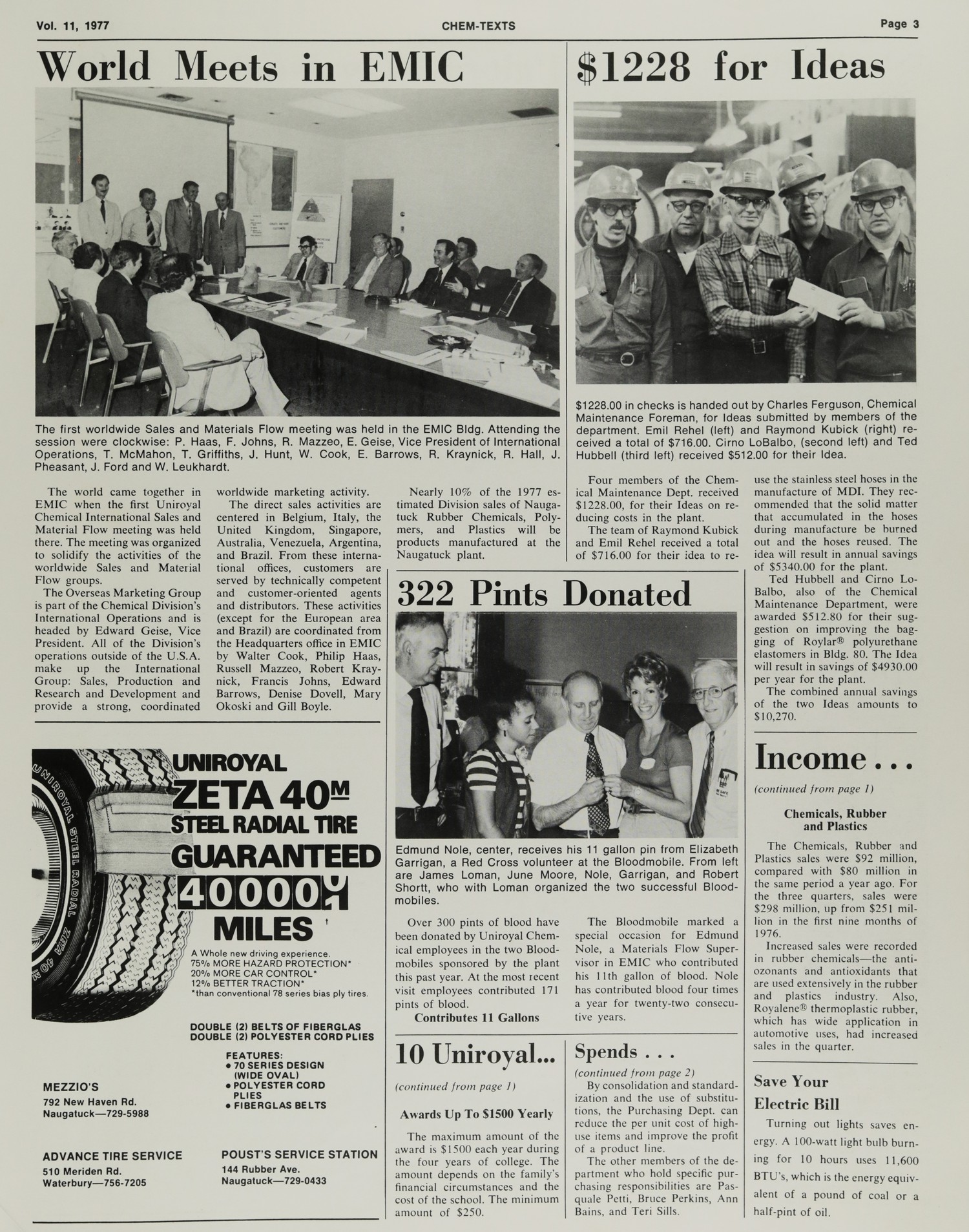
The first worldwide Sales and Materials Flow meeting was held in the EMIC Bldg. Attending the session were clockwise: P. Haas, F. Johns, R. Mazzeo, E. Geise, Vice President of International Operations, T. McMahon, T. Griffiths, J. Hunt, W. Cook, E. Barrows, R. Kraynick, R. Hall, J. Pheasant, J. Ford and W. Leukhardt.

The world came together in EMIC when the first Uniroyal Chemical International Sales and Material Flow meeting was held there. The meeting was organized to solidify the activities of the worldwide Sales and Material Flow groups.

The Overseas Marketing Group is part of the Chemical Division’s International Operations and is headed by Edward Geise, Vice President. All of the Division’s operations outside of the U.S.A. make up the International Group: Sales, Production and Research and Development and provide a strong, coordinated worldwide marketing activity.

The direct sales activities are centered in Belgium, Italy, the United Kingdom, Singapore, Australia, Venezuela, Argentina, and Brazil. From these international offices, customers are served by technically competent and customer-oriented agents and distributors. These activities (except for the European area and Brazil) are coordinated from the Headquarters office in EMIC by Walter Cook, Philip Haas, Russell Mazzeo, Robert Kraynick, Francis Johns, Edward Barrows, Denise Dovell, Mary Okoski and Gill Boyle.

Nearly 10% of the 1977 estimated Division sales of Naugatuck Rubber Chemicals, Polymers, and Plastics will be products manufactured at the Naugatuck plant.


$1228 for Ideas

$1228.00 in checks is handed out by Charles Ferguson, Chemical Maintenance Foreman, for Ideas submitted by members of the department. Emil Rehel (left) and Raymond Kubick (right) received a total of $716.00. Cirno LoBalbo, (second left) and Ted Hubbell (third left) received $512.00 for their Idea.

Four members of the Chemical Maintenance Dept. received $1228.00, for their Ideas on reducing costs in the plant.

The team of Raymond Kubick and Emil Rehel received a total of $716.00 for their idea to reuse the stainless steel hoses in the manufacture of MDI. They recommended that the solid matter that accumulated in the hoses during manufacture be burned out and the hoses reused. The idea will result in annual savings of $5340.00 for the plant.

Ted Hubbell and Cirno LoBalbo, also of the Chemical Maintenance Department, were awarded $512.80 for their suggestion on improving the bagging of Roylar® polyurethane elastomers in Bldg. 80. The Idea will result in savings of $4930.00 per year for the plant.

The combined annual savings of the two Ideas amounts to $10,270.


322 Pints Donated

Edmund Nole, center, receives his 11 gallon pin from Elizabeth Garrigan, a Red Cross volunteer at the Bloodmobile. From left are James Loman, June Moore, Nole, Garrigan, and Robert Shortt, who with Loman organized the two successful Bloodmobiles.

Over 300 pints of blood have been donated by Uniroyal Chemical employees in the two Bloodmobiles sponsored by the plant this past year. At the most recent visit employees contributed 171 pints of blood.

Contributes 11 Gallons

The Bloodmobile marked a special occasion for Edmund Nole, a Materials Flow Supervisor in EMIC who contributed his 11th gallon of blood. Nole has contributed blood four times a year for twenty-two consecutive years.


Income…

(continued from page 1)

Chemicals, Rubber and Plastics

The Chemicals, Rubber and Plastics sales were $92 million, compared with $80 million in the same period a year ago. For the three quarters, sales were $298 million, up from $251 million in the first nine months of 1976.

Increased sales were recorded in rubber chemicals—the antiozonants and antioxidants that are used extensively in the rubber and plastics industry. Also, Royalene® thermoplastic rubber, which has wide application in automotive uses, had increased sales in the quarter.


10 Uniroyal…

(continued from page 1)

Awards Up To $1500 Yearly

The maximum amount of the award is $1500 each year during the four years of college. The amount depends on the family’s financial circumstances and the cost of the school. The minimum amount of $250.


Spends…

(continued from page 2)

By consolidation and standardization and the use of substitutions, the Purchasing Dept. can reduce the per unit cost of highuse items and improve the profit of a product line.

The other members of the department who hold specific purchasing responsibilities are Pasquale Petti, Bruce Perkins, Ann Bains, and Teri Sills.


Save Your Electric Bill

Turning out lights saves energy. A 100-watt light bulb burning for 10 hours uses 11,600 BTU’s, which is the energy equivalent of a pound of coal or a half-pint of oil.


[ADVERTISEMENT]

UNIROYAL ZETA 40M STEEL RADIAL TIRE

GUARANTEED 40000 MILES

A Whole new driving experience.
75% MORE HAZARD PROTECTION
20% MORE CAR CONTROL

12% BETTER TRACTION
than conventional 78 series bias ply tires.

DOUBLE (2) BELTS OF FIBERGLAS
DOUBLE (2) POLYESTER CORD PLIES

FEATURES:
– 70 SERIES DESIGN (WIDE OVAL)
– POLYESTER CORD PLIES
– FIBERGLAS BELTS

MEZZIO’S
792 New Haven Rd.
Naugatuck—729-5988

ADVANCE TIRE SERVICE
510 Meriden Rd.
Waterbury—756-7205

POUST’S SERVICE STATION
144 Rubber Ave.
Naugatuck—729-0433
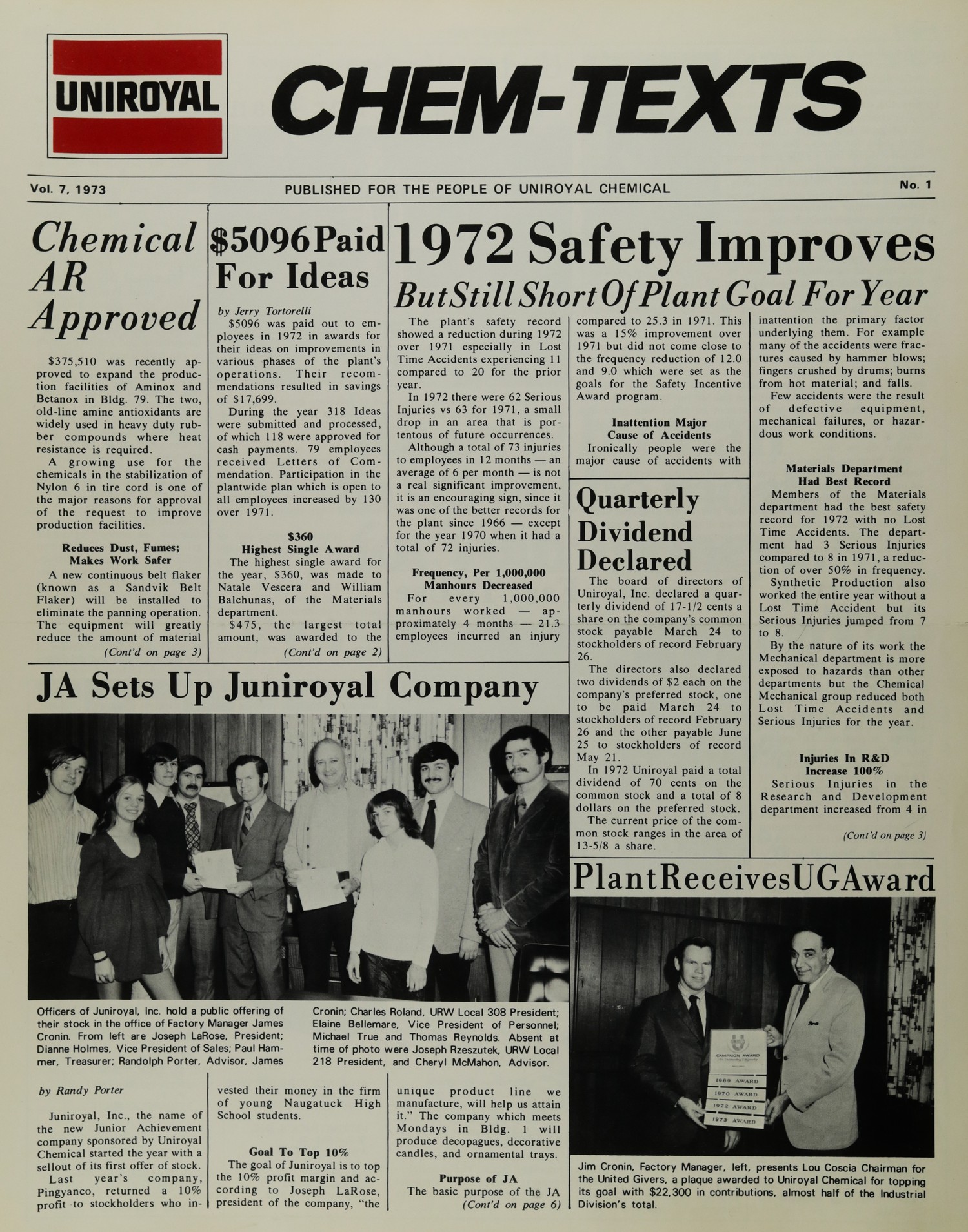
CHEM-TEXTS – 1973 – Page No. 1

Page unknown

UNIROYAL CHEM-TEXTS

Vol. 7, 1973 PUBLISHED FOR THE PEOPLE OF UNIROYAL CHEMICAL No. 1


Chemical AR Approved

$375,510 was recently approved to expand the production facilities of Aminox and Betanox in Bldg. 79. The two, old-line amine antioxidants are widely used in heavy duty rubber compounds where heat resistance is required.

A growing use for the chemicals in the stabilization of Nylon 6 in tire cord is one of the major reasons for approval of the request to improve production facilities.

Reduces Dust, Fumes; Makes Work Safer

A new continuous belt flaker (known as a Sandvik Belt Flaker) will be installed to eliminate the panning operation. The equipment will greatly reduce the amount of material (Cont’d on page 3)


$5096 Paid For Ideas

by Jerry Tortorelli

$5096 was paid out to employees in 1972 in awards for their ideas on improvements in various phases of the plant’s operations. Their recommendations resulted in savings of $17,699.

During the year 318 Ideas were submitted and processed, of which 118 were approved for cash payments. 79 employees received Letters of Commendation. Participation in the plantwide plan which is open to all employees increased by 130 over 1971.

$360 Highest Single Award

The highest single award for the year, $360, was made to Natale Vescera and William Balchunas, of the Materials department.

$475, the largest total amount, was awarded to the (Cont’d on page 2)


1972 Safety Improves

But Still Short Of Plant Goal For Year

The plant’s safety record showed a reduction during 1972 over 1971 especially in Lost Time Accidents experiencing 11 compared to 20 for the prior year.

In 1972 there were 62 Serious Injuries vs 63 for 1971, a small drop in an area that is portentous of future occurrences.

Although a total of 73 injuries to employees in 12 months — an average of 6 per month — is not a real significant improvement, it is an encouraging sign, since it was one of the better records for the plant since 1966 — except for the year 1970 when it had a total of 72 injuries.

Frequency, Per 1,000,000 Manhours Decreased

For every 1,000,000 manhours worked — approximately 4 months — 21.3 employees incurred an injury compared to 25.3 in 1971. This was a 15% improvement over 1971 but did not come close to the frequency reduction of 12.0 and 9.0 which were set as the goals for the Safety Incentive Award program.

Inattention Major Cause of Accidents

Ironically people were the major cause of accidents with inattention the primary factor underlying them. For example many of the accidents were fractures caused by hammer blows; fingers crushed by drums; burns from hot material; and falls.

Few accidents were the result of defective equipment, mechanical failures, or hazardous work conditions.

Materials Department Had Best Record

Members of the Materials department had the best safety record for 1972 with no Lost Time Accidents. The department had 3 Serious Injuries compared to 8 in 1971, a reduction of over 50% in frequency.

Synthetic Production also worked the entire year without a Lost Time Accident but its Serious Injuries jumped from 7 to 8.

By the nature of its work the Mechanical department is more exposed to hazards than other departments but the Chemical Mechanical group reduced both Lost Time Accidents and Serious Injuries for the year.

Injuries In R&D Increase 100%

Serious Injuries in the Research and Development department increased from 4 in

(Cont’d on page 3)


Quarterly Dividend Declared

The board of directors of Uniroyal, Inc. declared a quarterly dividend of 17-1/2 cents a share on the company’s common stock payable March 24 to stockholders of record February 26.

The directors also declared two dividends of $2 each on the company’s preferred stock, one to be paid March 24 to stockholders of record February 26 and the other payable June 25 to stockholders of record May 21.

In 1972 Uniroyal paid a total dividend of 70 cents on the common stock and a total of $8 dollars on the preferred stock.

The current price of the common stock ranges in the area of 13-5/8 a share.


JA Sets Up Juniroyal Company

[PHOTOGRAPH OF GROUP]

Officers of Juniroyal, Inc. hold a public offering of their stock in the office of Factory Manager James Cronin. From left are Joseph LaRose, President; Dianne Holmes, Vice President of Sales; Paul Hammer, Treasurer; Randolph Porter, Advisor, James Cronin; Charles Roland, URW Local 308 President; Elaine Bellemare, Vice President of Personnel; Michael True and Thomas Reynolds. Absent at time of photo were Joseph Rzeszutek, URW Local 218 President, and Cheryl McMahon, Advisor.

by Randy Porter

Juniroyal, Inc., the name of the new Junior Achievement company sponsored by Uniroyal Chemical started the year with a sellout of its first offer of stock.

Last year’s company, Pingyanco, returned a 10% profit to stockholders who invested their money in the firm of young Naugatuck High School students.

Goal To Top 10%

The goal of Juniroyal is to top the 10% profit margin and according to Joseph LaRose, president of the company, “the unique product line we manufacture, will help us attain it.” The company which meets Mondays in Bldg. 1 will produce decoupages, decorative candles, and ornamental trays.

Purpose of JA

The basic purpose of the JA (Cont’d on page 6)


Plant Receives UG Award

[PHOTOGRAPH OF TWO MEN WITH PLAQUE]

Jim Cronin, Factory Manager, left, presents Lou Coscia Chairman for the United Givers, a plaque awarded to Uniroyal Chemical for topping its goal with $22,300 in contributions, almost half of the Industrial Division’s total.

CHEM-TEXTS – Vol. 5, No. 5 – Page 3

Page 003

CHEM-TEXTS

Vol. 5, No. 5 Page 3


Gillette, Welch Named To Head Up Idea Plan

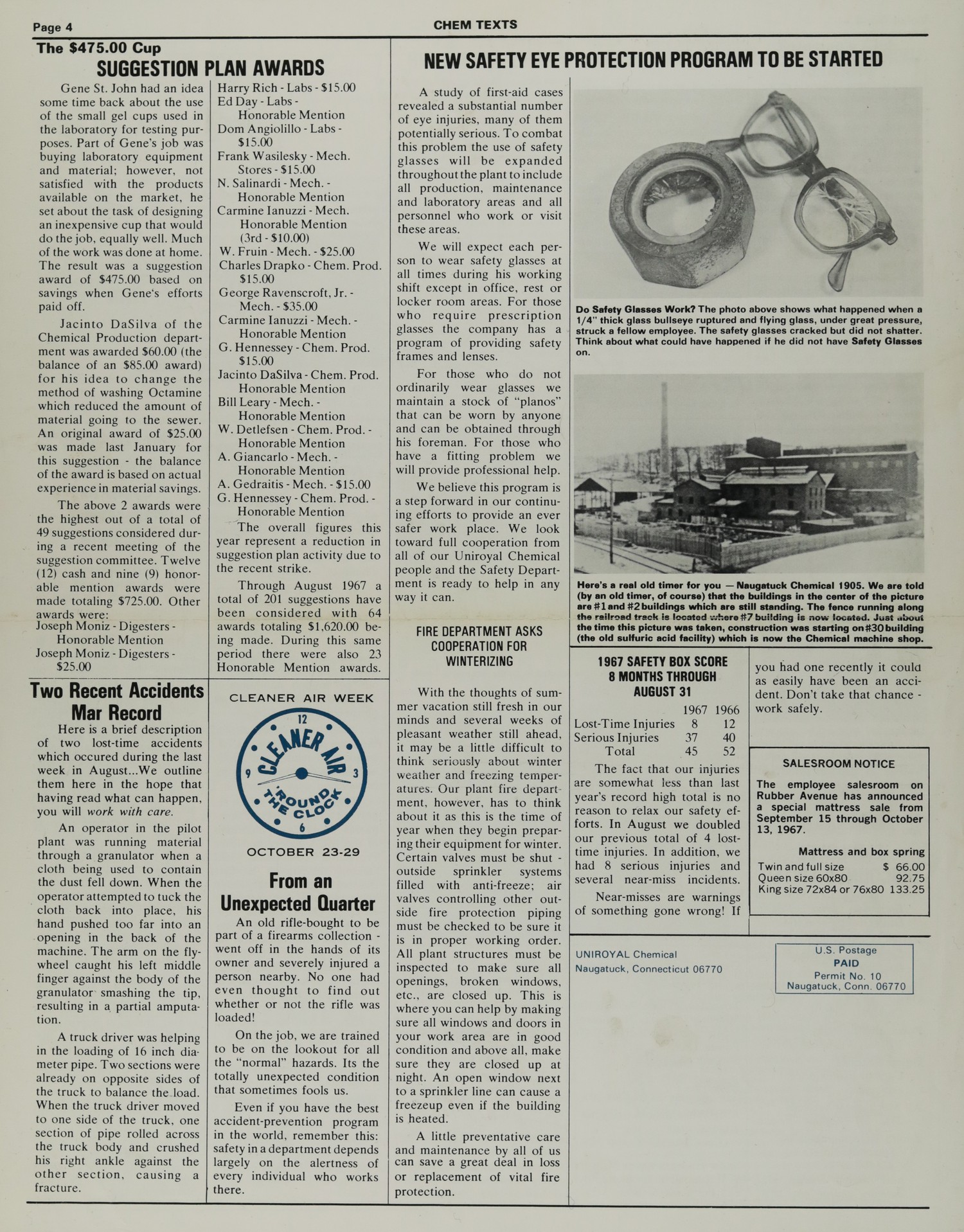
[IMAGE: Sam Gillette, right, discusses methods with Pete Welch to improve Idea Plan.]

Sam Gillette, Manager of Methods Engineering, was named Idea Plan Administrator with overall responsibility for the program.

Pete Welch, Industrial Relations, was named Coordinator of the Plan and is responsible for the coordination of it among section Administrators.

In his first few weeks as Coordinator he has already processed a good many Ideas and has initiated new approaches to handle Ideas in quicker time.

Section administrators are Gary Arndt, Pilot Plants; Andy Perrella, TSSC; Lou Coscia, Labs; Ernst Krauss, Chemical Mechanical; Clayt Houseknecht, Synthetic Mechanical; Lee Owens, Synthetic Production; Joe Bucciaglia, Chemical Production; Charles Reich, Reclaim Production; Frank Lynch, Materials; Larry Mambrino, Control; and Hal Lynch, Purchasing.

There is no maximum limit to the amount of awards. If the calculated value of the Idea exceeds $1,000, the Idea is submitted for consideration of a higher award.

GIVE WHERE YOU WORK


Lady Luck Prevents Accident

Lady Luck prevented the possible loss of both hands of an employee while he was repairing the mills in one of the plant’s production facilities.

When he attempted to adjust the rollers, another employee inadvertently started up the machinery. Fortunately, the electrical switch was in a reverse position and the rollers operated in reverse.

In the repair of equipment, the electrical power should be “locked out” on all moving equipment to prevent accidental operation. If the equipment is “locked out” each time, Lady Luck has no control over safety.

The plant has a good control procedure for equipment “lock outs”. This area of employee safety is presently being handled as a priority concern by the Chemical Labor-Management Health & Safety Committee.


Cards Finish In Last Place

by Howard Slason

The Synthetic Cards softball team had a poor season, finishing in the cellar. The team’s finish was attributed to an irregular defense, inconsistent hitting, and injuries.

The “old pro” Charlie Roland carried most of the team’s pitching chores, but inadequate hitting and fielding support hurt his effectiveness.

Vic Kloc led the team in hitting with a .600 average and Mike True led the Cards in home runs.


Employee Honored

The Archdiocesan Medal of Appreciation was awarded to Alex Nole, by Archbishop Whealon of Hartford for his work in the Archdiocese.

He has been a religion instructor in St. Pius X parish for 15 years, and for the past 4 years lay director and curriculum coordinator of the CCD program. He is also president of the parish council.


SAFETY IS MY RESPONSIBILITY


Construction Started

(Cont’d. from page 1)

[IMAGE: Staples High School students collect samples of waste discharge for analysis of contents. The group visited the plant regularly for three weeks as part of an environmental study.]

tanks are rapidly nearing completion.

Committee Responsible

An environmental control committee, composed of 22 members from all plant departments, reviews the progress of the pretreatment plant once a month with the Factory Manager.

This committee uses Logic-Network diagrams which graphically show the progress of each departments’ responsibility and is updated once a month.

The successful operation of the pretreatment plant will depend on individual employees, particularly production and laboratory personnel.

For example, a spill of some materials which are washed down the drain, could disrupt the Chemical pretreatment plant and the Boro of Naugatuck’s secondary treatment plant.


Nine Months

(Cont’d. from page 1)

freeze; slow down in capital spending throughout industry; lower sales and earnings for industrial products; low-cost foreign and domestic competition in footwear and chemical business; heavy start-up costs at the Opelika, Ala. tire plant; and heavy expenses in the development of steel belted radial ply passenger tires.


Unions…

(Cont’d. from page 1)

Chemical Production sewers will be connected together through this line to the new waste water pump station. The line is encased in concrete to prevent uplift during high river water conditions.

Unions…

(Cont’d. from page 1)

term; Cy Blanchard, Vice President; Bob Lestage, Secretary; and Jack Hoey, Treasurer.

Elected to the Executive Board were Henry Hook, Bill Mariano, Frank Wasilesky, Stan Mazanski, Chester Fazziano, Julius Cohen and Edith Evans.

The Election Committee, which supervised the elections and counted the ballots, was Tom Lee, Bob Harrison and Fred Mayo.

ident; Art Calder, Secretary; and Frank Sordi, Treasurer. John Needham received the highest number of votes as a member of the Executive Board. In order of votes received, others elected to the Board were Bill Stenson, Gene Doughty, Ernie Molnar, Jean Burke, John Sullivan, and Joe Arbachauskas.

Chairman of the Election Committee was Walt Tabaka who was assisted by Marie Yaroshefski, and Len Dumonski.


ADVERTISEMENTS

UNIROYAL TIRES

UNIROYAL Belted WIDE OVAL

Snowplow™ WHITEWALLS

DOUBLE/2 BELTS OF FIBERGLASS
DOUBLE/2 POLYESTER CORD PLIES

ADVANCE TIRE SERVICE
510 Meriden Rd.
Waterbury ● 756-2205

FITZPATRICK’S, INC.
78 East Main St.
Ansonia ● 734-5318

MEZZIO’S
792 New Haven Rd.
Naugatuck ● 729-3988

MIDDLEBURY SERVICE CENTER
Route 64
Middlebury ● 758-9977

POUST’S SERVICE STATION
144 Rubber Ave.
Naugatuck ● 729-0433

FEATURES:
– 70 SERIES DESIGN (WIDE OVAL)
– POLYESTER CORD PLIES
– FIBERGLASS BELTS

UNIROYAL HOME & AUTO CENTERS

NEW HAVEN NEW MILFORD BRISTOL
130 Amity Road Boston Post Rd. Farmington Ave. Rte. 6
389-1541 878-6857 582-3176

CANFIELD CORNER PHARMACY

VERA T. ELSENBOSS, Reg. Pharm.
CANFIELD CORNER WOODBURY, CONN
PRESCRIPTIONS SINCE 1907
PHONE 263-2595
MEDIMET PRESCRIPTIONS
CHEERFULLY FILLED

CHEM-TEXTS – Vol. 5 No. 3 – Page 4

Page 004

Page 4 CHEM-TEXTS Vol. 5 No. 3


Know Your Products: Rubber Chemical Accelerators

by Dr. Bob Brown

(This issue continues the article in Vol. 5, No. 2 on Accelerators made or marketed by the Naugatuck Chemical plant.)

Accelerators are used primarily to speed up, or control the vulcanization process which turns rubber from a useless, gummy substance into a strong resilient and elastic material. Vulcanization, in simple terms, is a chemical reaction between rubber and sulfur, usually brought about by heat.

Faster Accelerators

Where there is less processing or mixing involved, very fast accelerators with little or no delayed action can be used to give more rapid vulcanization. The Zates (Arazate®, Butazate®, Ethazate® and Methazate®) and the Thiurams (Monex®, Pentex®, Tuex®, and Accelerator 108) are used here. They are also used in latex curing where processing is usually not a problem.

Customers use these accelerators for rubber sponge, wire insulation, hot water bottles, conveyor belts, hospital sheeting, and household items and in such latex products as balloons and carpet backing.

The Zates accelerators are non-discoloring and non-staining and can be used in colored rubber products.

Some of the newer synthetic rubbers (Royalene® “the crackless rubber” is an example) are inherently slower in vulcanization than the older types such as natural rubber, neoprene and the Naugapol® and Paracril® synthetic rubbers made at the Naugatuck and Painesville, Ohio plants. Fast accelerators are needed to speed up the vulcanization process for these types of rubber, otherwise it would be economically impossible to make a product at a reasonable selling price to the consumer.

Dr. Bob Brown, author of these articles, is manager of Research and Development for Rubber Chemicals. He received his doctorate degree from Princeton University in Organic Chemistry and holds several patent awards. Dr. Brown heads a staff of 42 people whose sole function is to improve our present chemicals and to develop new ones in order to remain competitive in the market.

GMF and DIBENZO GMF® are used in butyl rubber which also vulcanizes very slowly. A large amount of butyl rubber is used for tire tubes, and high voltage electrical cable.

CPB, DBA Very Active

Sometimes customers want to vulcanize rubber products without heating them at all. Very active accelerators like CPB and DBA accomplish this. In this process the product must be shaped before the accelerator is added. Golf ball covers, for example, are vulcanized by soaking the finished balls in a solution of CPB.

(In the next issue of Chem-Texts, Antioxidants and Antiozonants will be discussed. If you have a son or daughter in school, these articles provide source material for class papers in Chemistry courses.)


33 Employees

(Cont’d. from page 2)

are under further evaluation for higher amounts dependent on the amount of the savings for the plant.

Other employees who received cash awards for Ideas were P. Blasko, F. Maffia, M. Jannetty, D. Stevenson, E. Grickis, R. Guest, B. Robinson, A. Urban, S. Kropcho, J. Harper, J. Gilbert, A. Happy, J. Iosa, H. Garahan, F. Surmanek (2), L. DeLaRosa (2), P. Beardsley, S. Falcone, H. Hernandez, A. Grella, J. Needham, D. Boyd, E. Root, Sr., A. Molnar, D. Pinto and J. Cohen.

Letters of Commendation were presented to C. Smith, L. Fortier, F. Gagne, Carol Calo, J. Gallucci, R. Lockwood, D. Donato, T. Carr, Preciosa Cravo, D. Nelson, A. Nauges, W. Krayeski, W. Tabaka and D. Polzella.

Of the 33 employees awarded cash for Ideas, two were salary employees and the highest number of Ideas were submitted by Mechanical Department personnel.

No Limit to Cash Awards

There is no maximum limit to the amount of a cash award for an Idea. If the value of the Idea exceeds $1,000—this amount is paid under the Plant Idea Plan—it is submitted for further consideration for a higher award to a special management committee. The minimum award for an Idea is $25.

Ideas to Conserve Water Needed

With the construction of the new liquid waste pretreatment plant in progress, ideas to conserve water are needed now as the facilities are designed to treat 3,600,000 gallons a day.


SAFETY IS MY RESPONSIBILITY


Crim Assumes IR Post

Two Industrial Relations Managers not agreeing? Unbelievable! But that’s what the photo seems to say as Jesse Crim, right, new Industrial Relations Manager for the Naugatuck Chemical plant discusses a fine point on employee relations with Ron Mitchinson, former IR Manager and now with the Corporate IR staff in Oxford. Crim came from the Chemical Division’s Painesville, Ohio plant, where he held the position of IR Manager.

Crim will be responsible for labor and employee relations, personnel development and training, plant protection and employee safety, communications, public and community relations, and employment.


Appointments Announced

Sam Gillette has been named Methods Engineering Manager, reporting to the Factory Manager.

Joe Bucciaglia was appointed General Foreman for the Chemical Production Plant.

Eric Johnson was made Chief Process Engineer for the Chemical Production Plant.

Lee Owens assumes the responsibilities of General Foreman in the Synthetic Production Plant.

Clark Makinson moved to the Materials Flow Department in EMIC.

Ed Rabitor replaces Clark in the Chemical Control Center.


Three Retire In Month

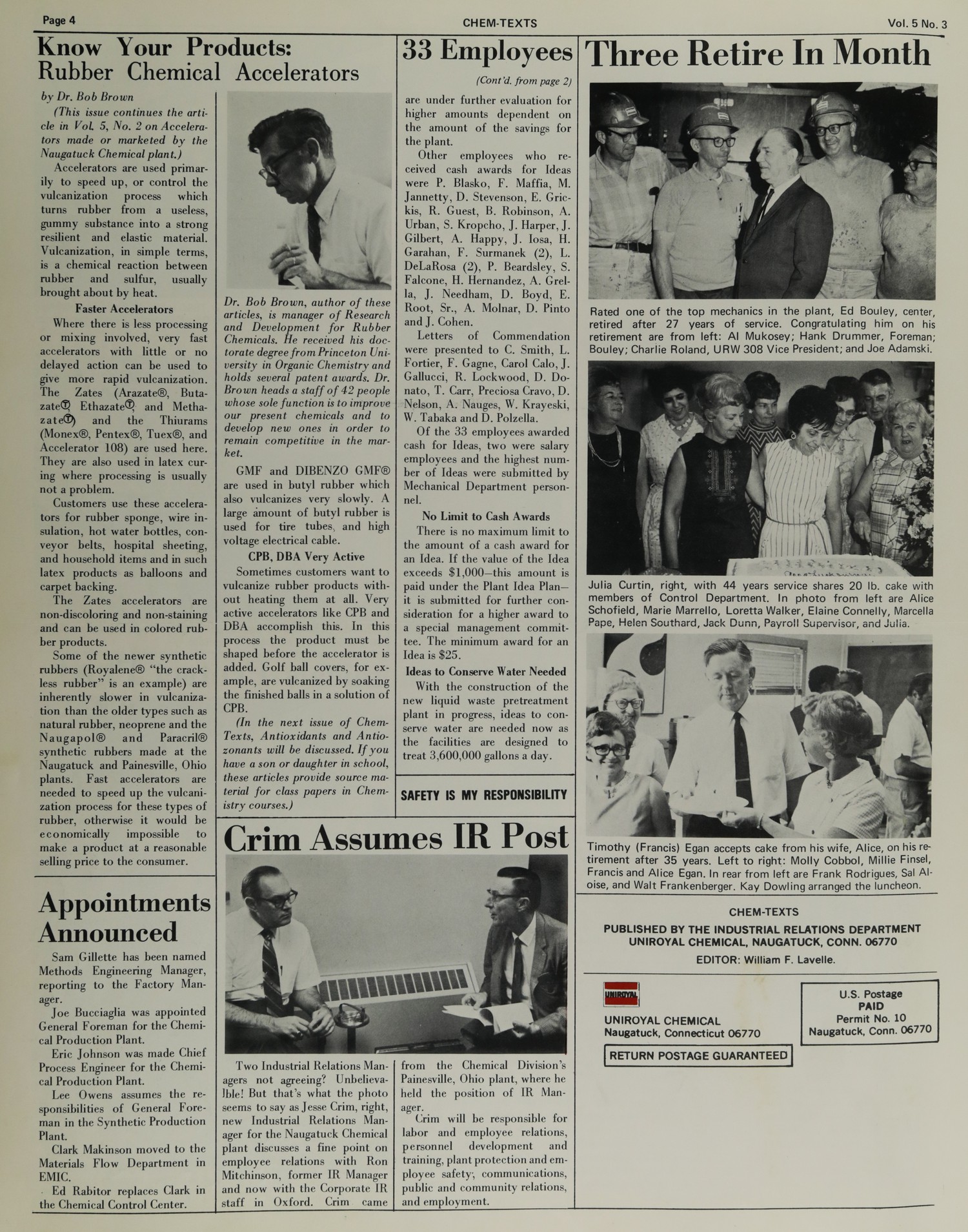
Rated one of the top mechanics in the plant, Ed Bouley, center, retired after 27 years of service. Congratulating him on his retirement are from left: Al Mukosey; Hank Drummer, Foreman; Bouley; Charlie Roland, URW 308 Vice President; and Joe Adamski.


Julia Curtin, right, with 44 years service shares 20 lb. cake with members of Control Department. In photo from left are Alice Schofield, Marie Marrello, Loretta Walker, Elaine Connelly, Marcella Pape, Helen Southard, Jack Dunn, Payroll Supervisor, and Julia.


Timothy (Francis) Egan accepts cake from his wife, Alice, on his retirement after 35 years. Left to right: Molly Cobbol, Millie Finsel, Francis and Alice Egan. In rear from left are Frank Rodrigues, Sal Aloise, and Walt Frankenberger. Kay Dowling arranged the luncheon.


CHEM-TEXTS

PUBLISHED BY THE INDUSTRIAL RELATIONS DEPARTMENT
UNIROYAL CHEMICAL, NAUGATUCK, CONN. 06770

EDITOR: William F. Lavelle.


UNIROYAL CHEMICAL
Naugatuck, Connecticut 06770

RETURN POSTAGE GUARANTEED

U.S. Postage
PAID
Permit No. 10
Naugatuck, Conn. 06770

CHEM-TEXTS – Vol. 5 No. 3 – Page 2

Page 002

CHEM-TEXTS

Page 2 | Vol. 5 No. 3


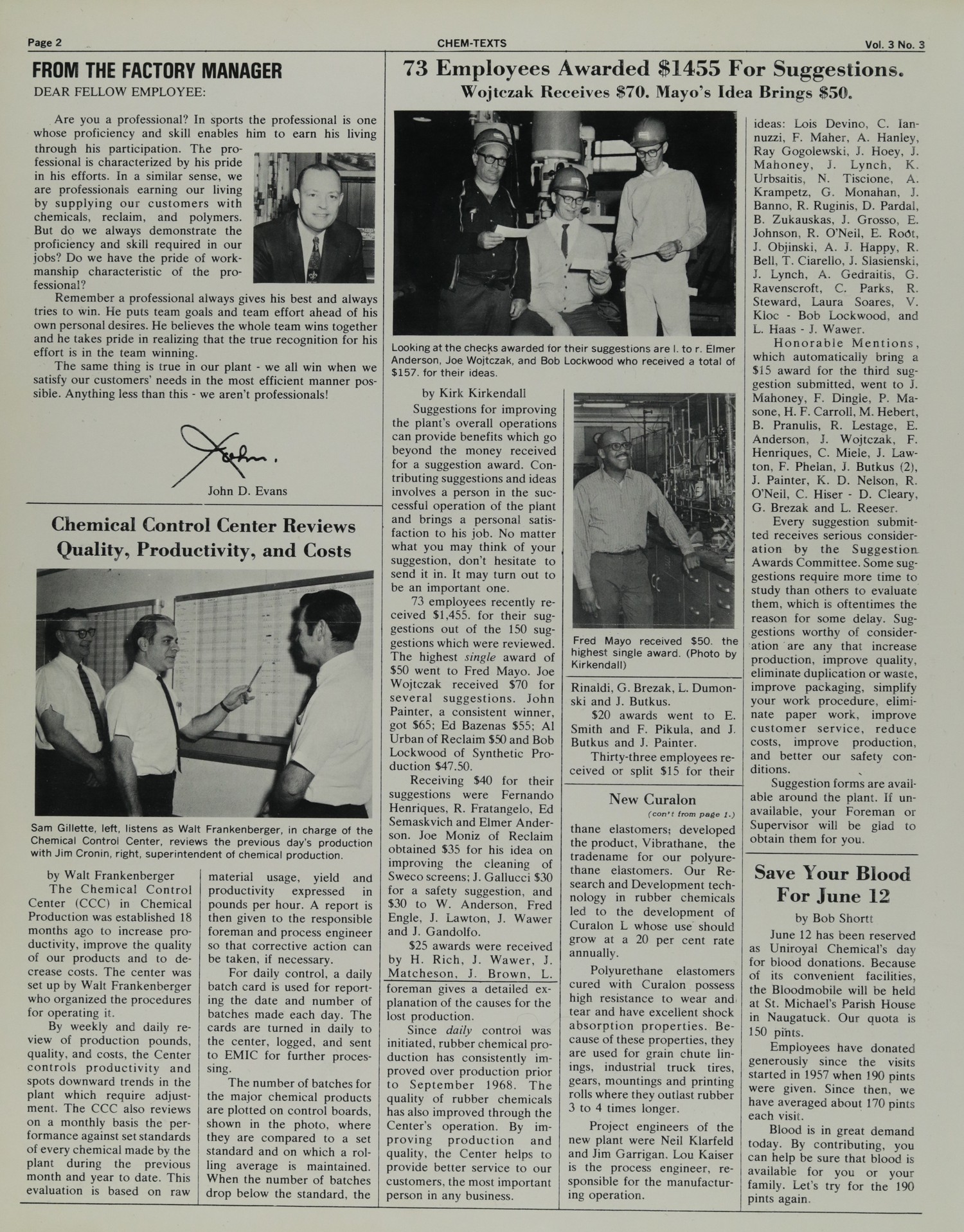
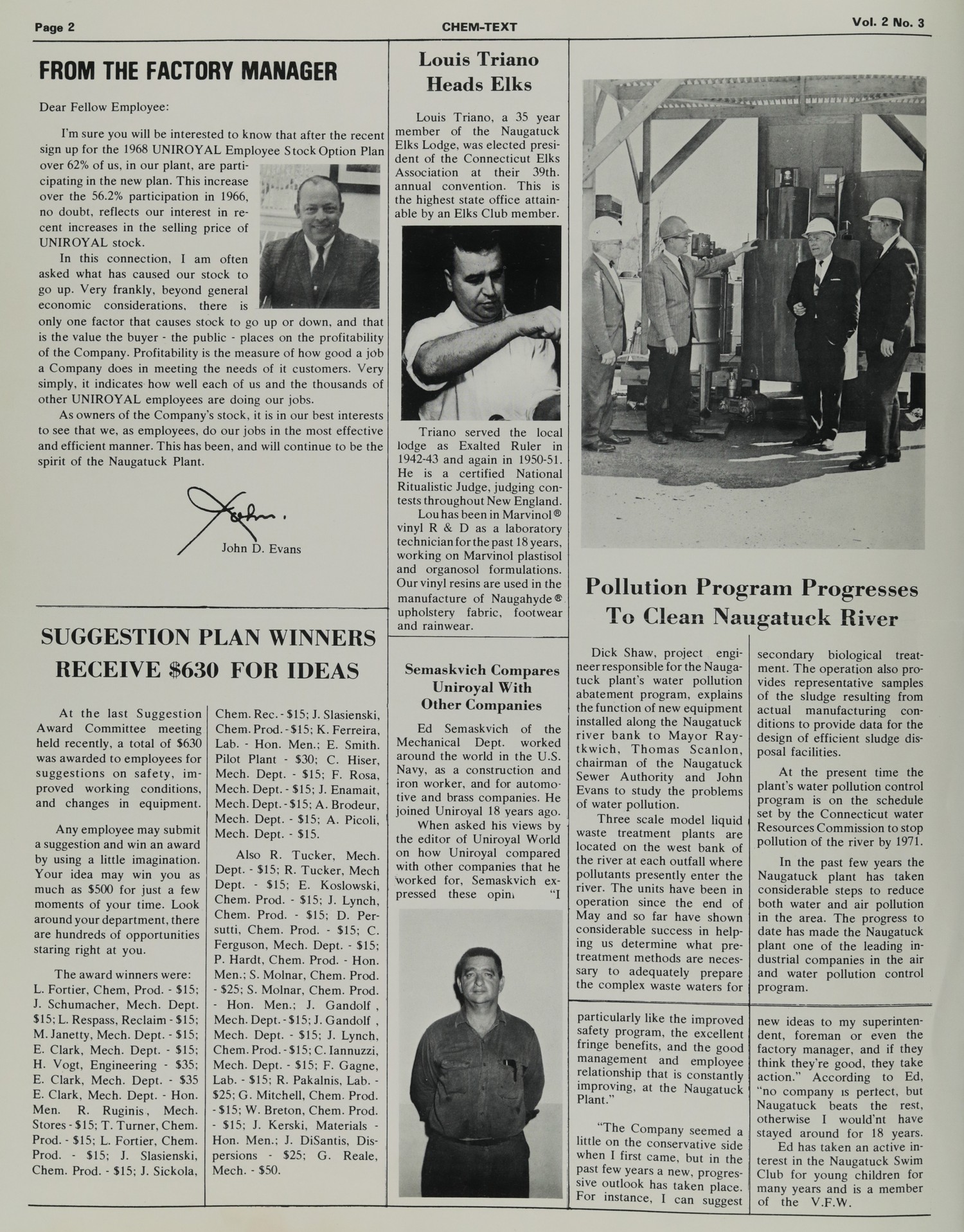
FROM THE FACTORY MANAGER

DEAR FELLOW EMPLOYEE:

The miracle of the twenty five years of continual growth in the U.S. economy since World War II is something all Americans can be proud of. It has enabled us to become leaders in the world’s markets and to raise our standard of living to the point where we are better off than any people in history.

This miracle didn’t just happen. It was brought about by the tremendous productivity of the people of this country. For twenty years every time wages increased, productivity also increased and our standard of living went up.

In the last five years, however, we have seen a change in this pattern. While wages have increased, productivity has not kept pace with them. This has helped cause inflation and has helped drive the cost of our products up.

In turn, foreign manufacturers have maintained their productivity and are now able to sell their goods in our markets at prices lower than ours. We can see this in Japanese electronics; German and Japanese automobiles; and textile and footwear products from all over the world.

On a smaller scale the same thing is happening at our factory. We are in competition with both foreign and domestic producers. They are competing with us for the same customers and markets, oftentimes at lower prices. Besides this our markets are moving away from the northeast and the increasing cost of rail and truck transportation adds to our problem of doing business competitively.

All of us must realize this and remember that the chemicals we produce are in competition with these domestic and foreign manufacturers. We can only sell what we can produce economically. We can only produce economically with your help and cooperation. Every job in the plant is important. Every person counts in this effort. We all must chip in.

Phil LaJoie


33 Employees Receive $1355

Mechanical Department Submits Most Ideas

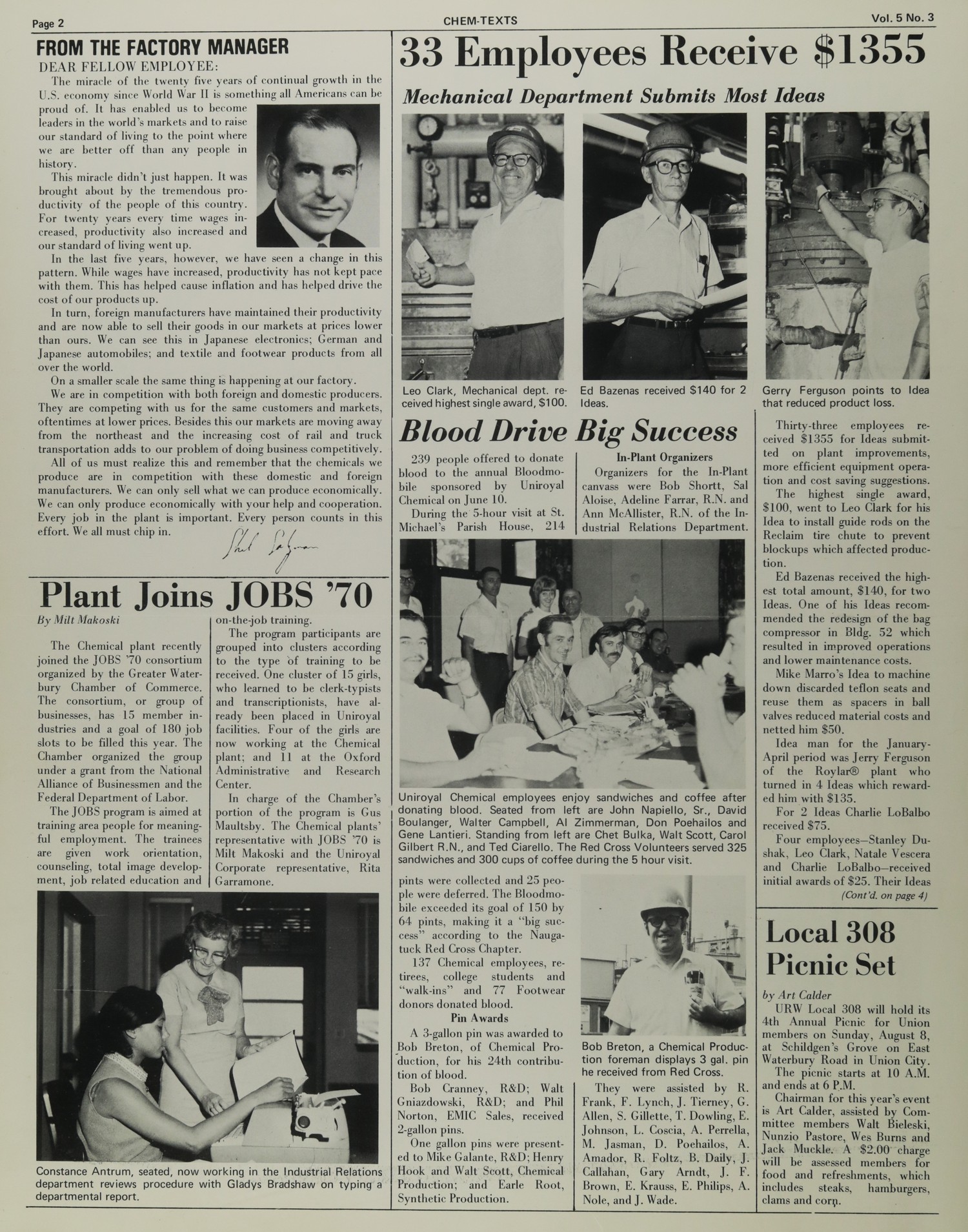
Leo Clark, Mechanical dept. received highest single award, $100.

Ed Bazenas received $140 for 2 Ideas.

Gerry Ferguson points to Idea that reduced product loss.

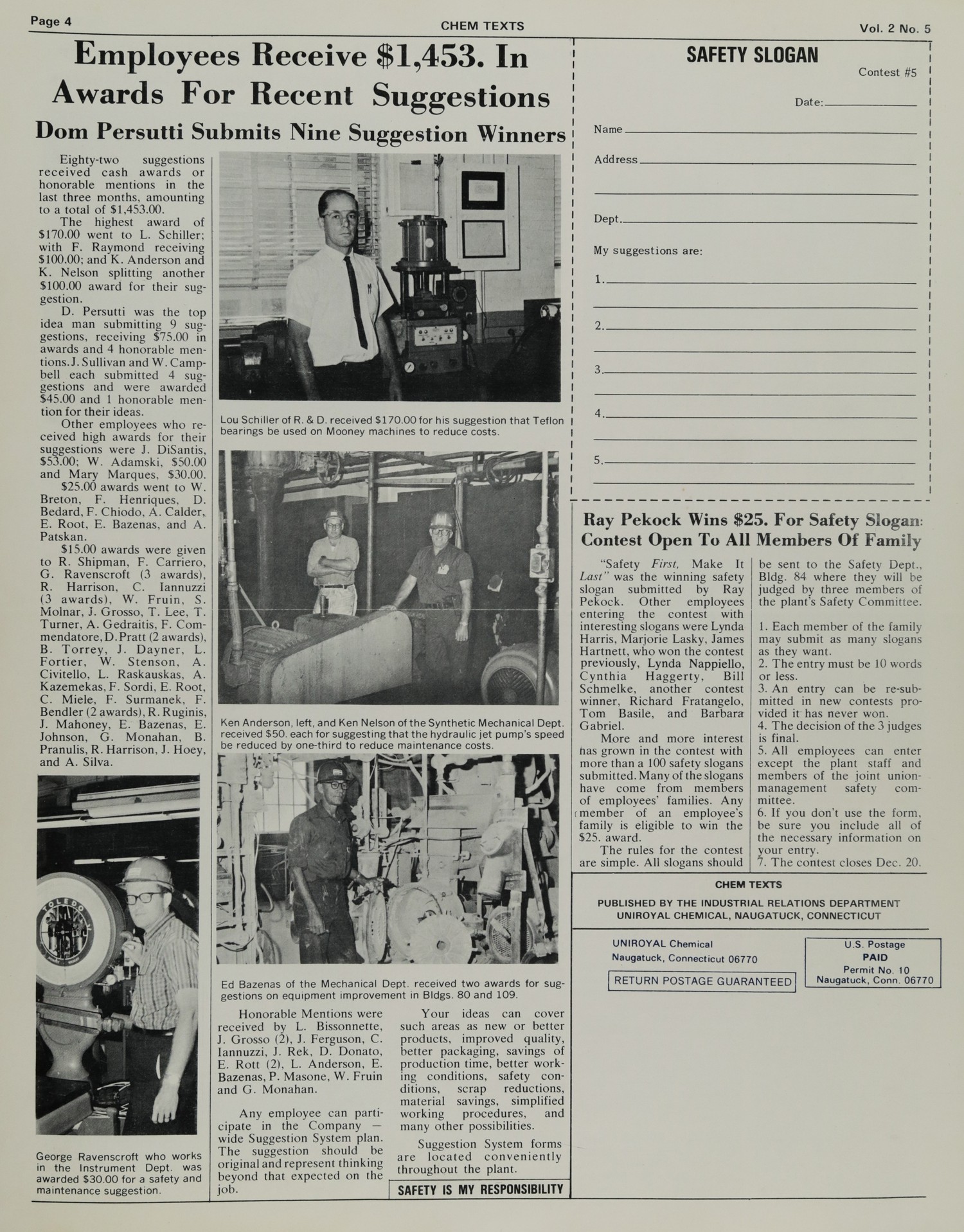
Thirty-three employees received $1355 for Ideas submitted on plant improvements, more efficient equipment operation and cost saving suggestions.

The highest single award, $100, went to Leo Clark for his Idea to install guide rods on the Reclaim tire chute to prevent blockups which affected production.

Ed Bazenas received the highest total amount, $140, for two Ideas. One of his Ideas recommended the redesign of the bag compressor in Bldg. 52 which resulted in improved operations and lower maintenance costs.

Mike Marro’s Idea to machine down discarded teflon seats and reuse them as spacers in ball valves reduced material costs and netted him $50.

Idea man for the January-April period was Jerry Ferguson of the Roylar® plant who turned in 4 Ideas which rewarded him with $135.

For 2 Ideas Charlie LoBalbo received $75.

Four employees—Stanley Dushak, Leo Clark, Natale Vescera and Charlie LoBalbo—received initial awards of $25. Their Ideas
(Cont’d. on page 4)


Blood Drive Big Success

239 people offered to donate blood to the annual Bloodmobile sponsored by Uniroyal Chemical on June 10.

During the 5-hour visit at St. Michael’s Parish House, 214 pints were collected and 25 people were deferred. The Bloodmobile exceeded its goal of 150 by 64 pints, making it a “big success” according to the Naugatuck Red Cross Chapter.

137 Chemical employees, retirees, college students and “walk-ins” and 77 Footwear donors donated blood.

Pin Awards

A 3-gallon pin was awarded to Bob Breton, of Chemical Production, for his 24th contribution of blood.

Bob Cranney, R&D; Walt Gniazdowski, R&D; and Phil Norton, EMIC Sales, received 2-gallon pins.

One gallon pins were presented to Mike Galante, R&D; Henry Hook and Walt Scott, Chemical Production; and Earle Root, Synthetic Production.

In-Plant Organizers

Organizers for the In-Plant canvass were Bob Shortt, Sal Aloise, Adeline Farrar, R.N. and Ann McAllister, R.N. of the Industrial Relations Department.

Uniroyal Chemical employees enjoy sandwiches and coffee after donating blood. Seated from left are John Napiello, Sr., David Boulanger, Walter Campbell, Al Zimmerman, Don Poehailos and Gene Lantieri. Standing from left are Chet Bulka, Walt Scott, Carol Gilbert R.N., and Ted Ciarello. The Red Cross Volunteers served 325 sandwiches and 300 cups of coffee during the 5 hour visit.

Bob Breton, a Chemical Production foreman displays 3 gal. pin he received from Red Cross.

They were assisted by R. Frank, F. Lynch, J. Tierney, G. Allen, S. Gillette, T. Dowling, E. Johnson, L. Coscia, A. Perrella, M. Jasman, D. Poehailos, A. Amador, R. Foltz, B. Daily, J. Callahan, Gary Arndt, J. F. Brown, E. Krauss, E. Philips, A. Nole, and J. Wade.


Plant Joins JOBS ’70

By Milt Makoski

The Chemical plant recently joined the JOBS ’70 consortium organized by the Greater Waterbury Chamber of Commerce. The consortium, or group of businesses, has 15 member industries and a goal of 180 job slots to be filled this year. The Chamber organized the group under a grant from the National Alliance of Businessmen and the Federal Department of Labor.

The JOBS program is aimed at training area people for meaningful employment. The trainees are given work orientation, counseling, total image development, job related education and on-the-job training.

The program participants are grouped into clusters according to the type of training to be received. One cluster of 15 girls, who learned to be clerk-typists and transcriptionists, have already been placed in Uniroyal facilities. Four of the girls are now working at the Chemical plant; and 11 at the Oxford Administrative and Research Center.

In charge of the Chamber’s portion of the program is Gus Maultsby. The Chemical plants’ representative with JOBS ’70 is Milt Makoski and the Uniroyal Corporate representative, Rita Garramone.

Constance Antrum, seated, now working in the Industrial Relations department reviews procedure with Gladys Bradshaw on typing a departmental report.


Local 308 Picnic Set

by Art Calder

URW Local 308 will hold its 4th Annual Picnic for Union members on Sunday, August 8, at Schildgen’s Grove on East Waterbury Road in Union City. The picnic starts at 10 A.M. and ends at 6 P.M.

Chairman for this year’s event is Art Calder, assisted by Committee members Walt Bieleski, Nunzio Pastore, Wes Burns and Jack Muckle. A $2.00 charge will be assessed members for food and refreshments, which includes steaks, hamburgers, clams and corp.

CHEM-TEXTS – 1971-v05-i01-s183

Page 183

UNIROYAL CHEM-TEXTS

Vol. 5, 1971 | PUBLISHED FOR THE PEOPLE OF UNIROYAL CHEMICAL | No. 1


$8,900 Awarded For Ideas


Fuel Costs Doubled For 1971

Save Steam Plan Started In Plant

by Al Manzi

Total fuel costs for 1971 will be approximately double over 1970. $1,143,000 has been budgeted to operate the plant during the year against actual costs of $638,000 for last year.

The $505,000 increased cost of fuel is primarily due to escalating residual oil prices which are a result of the Mid-East crisis, tanker shortages and pollution abatement conversions to oil. An added cost is the premium we will pay for low sulfur oil after Sept. 1, 1971.

(con’t on page 4)


Safety Equipment Program

by Bob Shortt

As part of the plant’s continuous concern for the safety of all employees, a new safety equipment program has been initiated.

The program is based on a section of the 1970 Uniroyal-URW Master Agreement which emphasizes that all employees are expected to cooperate in the prevention of accidents to themselves and their fellow workmen and shall be required to utilize such protective devices and equipment prescribed by the Company at no cost to the employee.

Areas Under Review

Under the program, supervi-

(con’t on page 4)


Profits Off $4,100,000

Uniroyal showed a $4,100,000 loss for the 4th quarter of 1970 compared to a profit of $8,400,000 in 1969.

Sales for the same quarter were $371,000,000, a decrease of $17,000,000 from the same period last year.

1970 sales of the company were $1.554 billion, almost the exact amount as the prior year. Net income for 1970 was $23,800,000 compared to a net income of $46,600,000 in the year of 1969.

The decrease in 1970 profits and sales were attributed to the GM strike, the general softness in the economy, high interest charges, sharply higher employment costs, higher transportation charges and other costs not fully absorbed by price increases or productivity improvements.

Plant Business Down

During the year production of reclaimed rubber, latex and rubber chemicals was affected by the slackness in the automotive industry, home construction and the shutdown of several Uniroyal tire plants.

The plant’s business shows scarcely any improvement according to present sales forecasts for the first quarter of 1971.

Every effort needs to be made at this critical time in our economy to prevent off grade production, improve productivity and quality, and to keep customers satisfied.


Dividend Declared

Uniroyal declared a quarterly dividend of 17½ cents a share on the company’s common stock. The dividend is payable March 25 to stockholders of record on February 22.

The Company also declared two dividends of $2 each on Uniroyal’s preferred stock. One will be paid March 25 to stockholders of record February 22 and the other payable June 25 to stockholders of record on May 24.


Elephant Tests Chair

[IMAGE: Photo of an elephant named Elsie testing a plastic chair]

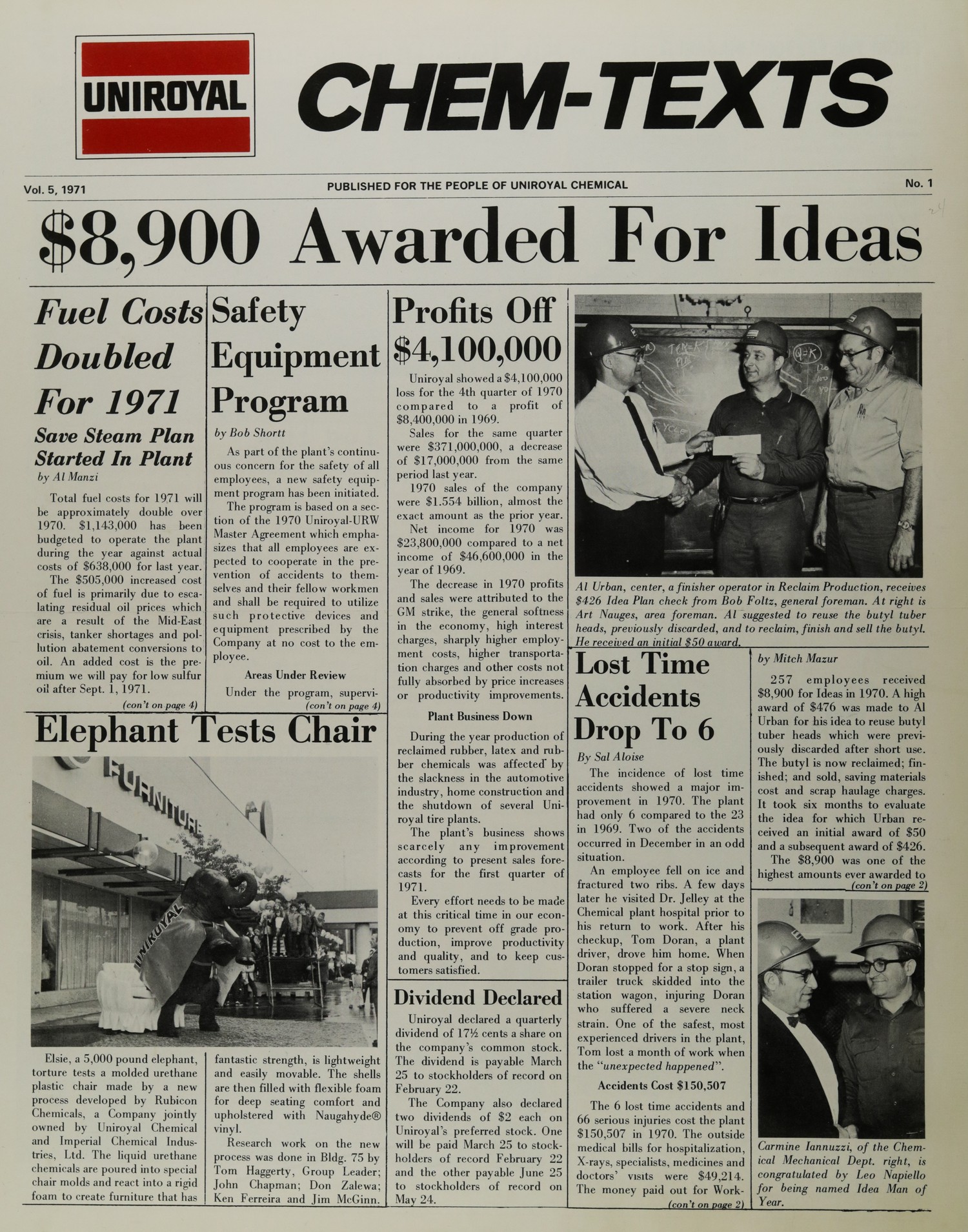
Elsie, a 5,000 pound elephant, torture tests a molded urethane plastic chair made by a new process developed by Rubicon Chemicals, a Company jointly owned by Uniroyal Chemical and Imperial Chemical Industries, Ltd. The liquid urethane chemicals are poured into special chair molds and react into a rigid foam to create furniture that has fantastic strength, is lightweight and easily movable. The shells are then filled with flexible foam for deep seating comfort and upholstered with Naugahyde® vinyl.

Research work on the new process was done in Bldg. 75 by Tom Haggerty, Group Leader; John Chapman; Don Zalewa; Ken Ferreira and Jim McGinn.


[IMAGE: Photo of Al Urban receiving award from Bob Foltz with Art Nauges]

Al Urban, center, a finisher operator in Reclaim Production, receives $426 Idea Plan check from Bob Foltz, general foreman. At right is Art Nauges, area foreman. Al suggested to reuse the butyl tuber heads, previously discarded, and to reclaim, finish and sell the butyl. He received an initial $50 award.


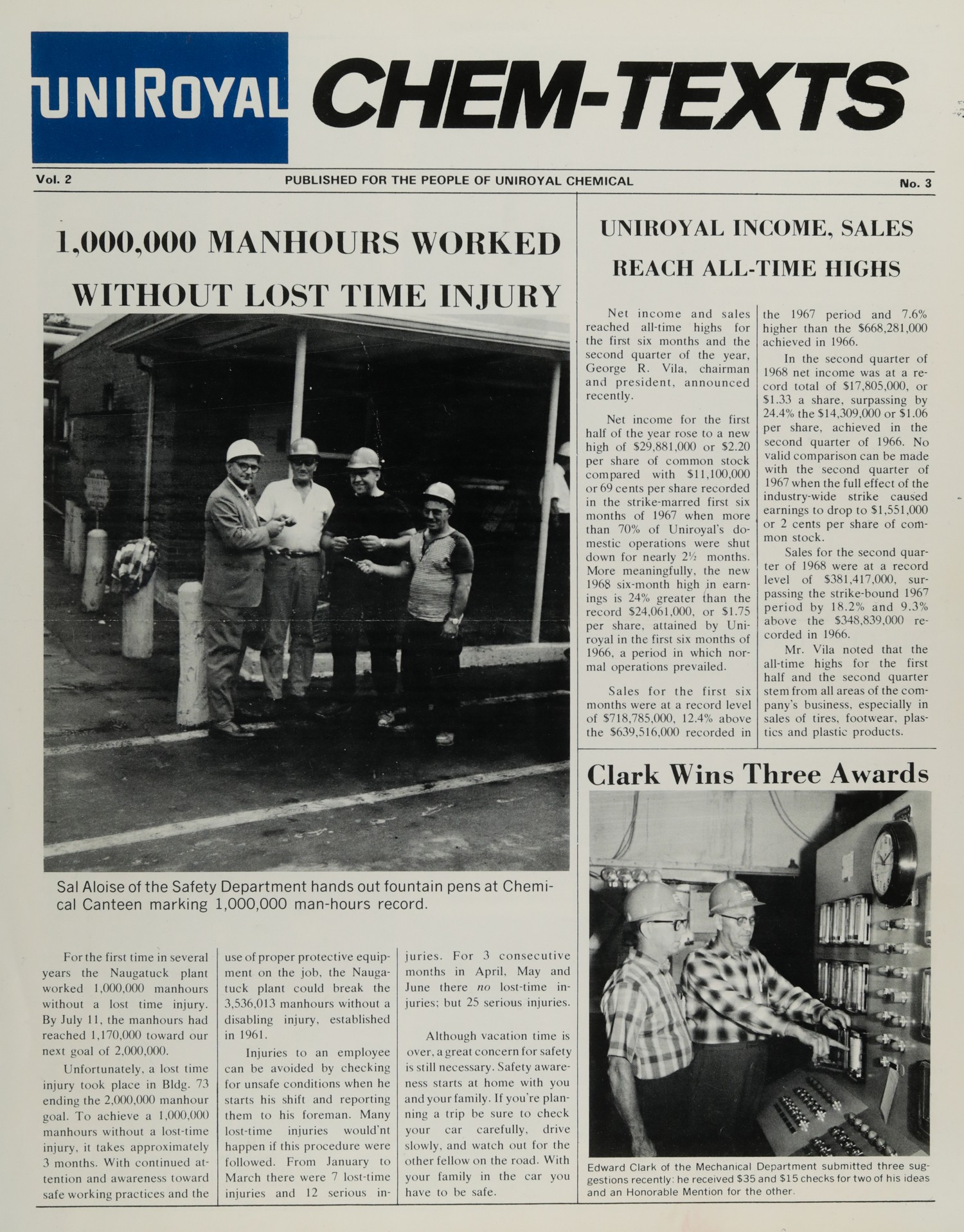
Lost Time Accidents Drop To 6

By Sal Aloise

The incidence of lost time accidents showed a major improvement in 1970. The plant had only 6 compared to the 23 in 1969. Two of the accidents occurred in December in an odd situation.

An employee fell on ice and fractured two ribs. A few days later he visited Dr. Jelley at the Chemical plant hospital prior to his return to work. After his checkup, Tom Doran, a plant driver, drove him home. When Doran stopped for a stop sign, a trailer truck skidded into the station wagon, injuring Doran who suffered a severe neck strain. One of the safest, most experienced drivers in the plant, Tom lost a month of work when the “unexpected happened“.

Accidents Cost $150,507

The 6 lost time accidents and 66 serious injuries cost the plant $150,507 in 1970. The outside medical bills for hospitalization, X-rays, specialists, medicines and doctors’ visits were $49,214. The money paid out for Work-

(con’t on page 2)


by Mitch Mazur

257 employees received $8,900 for Ideas in 1970. A high award of $476 was made to Al Urban for his idea to reuse butyl tuber heads which were previously discarded after short use. The butyl is now reclaimed; finished; and sold, saving materials cost and scrap haulage charges. It took six months to evaluate the idea for which Urban received an initial award of $50 and a subsequent award of $426.

The $8,900 was one of the highest amounts ever awarded to

(con’t on page 2)


[IMAGE: Photo of Carmine Iannuzzi being congratulated]

Carmine Iannuzzi, of the Chemical Mechanical Dept. right, is congratulated by Leo Napiello for being named Idea Man of Year.

CHEM-TEXTS – Vol. 5, No. 1 – Page 2

Page 002

CHEM-TEXTS

Page 2 | Vol. 5, No. 1


FROM THE FACTORY MANAGER

DEAR FELLOW EMPLOYEE:

I’m sure that each of us with a home and family is well aware of how increasingly difficult it is to maintain the standard of living to which we are accustomed, in light of higher overall costs of products and services.

Each month we are faced with regular bills for rent or mortgage, food, fuel, telephone, electricity, gasoline, as well as emergency ones for the doctor, dentist, or automobile repairs. As these costs rise, we do our best to control them by avoiding wasteful use of electricity and water and, in general, by the careful spending of our dollars.

We, at the plant, are faced with similar problems. This year our fuel bill will increase over $600,000; our water bill will increase $35,000; and the cost of electricity will increase $83,000.

We will also have a bill, similar to an emergency one for the doctor, of approximately $3,000,000 for the waste water pretreatment plant.

It will take the fullest cooperation of all employees in order to control and reduce these costs. We must strive to operate in a more efficient manner; prevent accidents and serious injuries; obtain more and higher quality production; avoid waste and off-specification material; and to make suggestions to improve the plant’s overall efficiency.

If each of us uses our time, knowledge, skills and ideas to our fullest capabilities, I’m sure that we will be able to maintain and improve the position of our plant in terms of employment and income.

[Signature: Paul Lyson]


NOW Students Tour Lab.

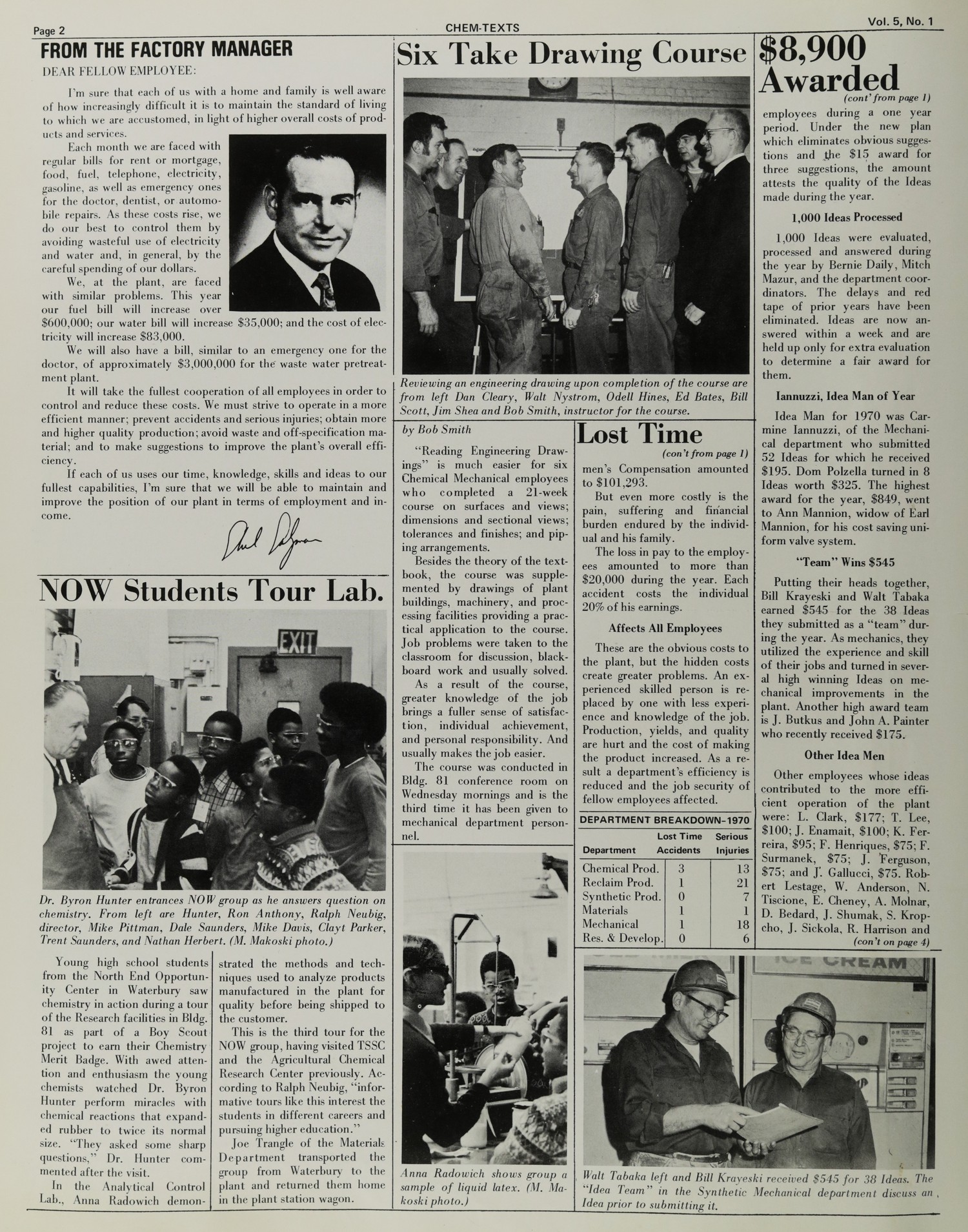
Dr. Byron Hunter entrances NOW group as he answers question on chemistry. From left are Hunter, Ron Anthony, Ralph Neubig, director, Mike Pittman, Dale Saunders, Mike Davis, Clayt Parker, Trent Saunders, and Nathan Herbert. (M. Makoski photo.)

Young high school students from the North End Opportunity Center in Waterbury saw chemistry in action during a tour of the Research facilities in Bldg. 81 as part of a Boy Scout project to earn their Chemistry Merit Badge. With awed attention and enthusiasm the young chemists watched Dr. Byron Hunter perform miracles with chemical reactions that expanded rubber to twice its normal size. “They asked some sharp questions,” Dr. Hunter commented after the visit.

In the Analytical Control Lab., Anna Radowich demonstrated the methods and techniques used to analyze products manufactured in the plant for quality before being shipped to the customer.

This is the third tour for the NOW group, having visited TSSC and the Agricultural Chemical Research Center previously. According to Ralph Neubig, “informative tours like this interest the students in different careers and pursuing higher education.”

Joe Trangle of the Materials Department transported the group from Waterbury to the plant and returned them home in the plant station wagon.


Six Take Drawing Course

Reviewing an engineering drawing upon completion of the course are from left Dan Cleary, Walt Nystrom, Odell Hines, Ed Bates, Bill Scott, Jim Shea and Bob Smith, instructor for the course.

by Bob Smith

“Reading Engineering Drawings” is much easier for six Chemical Mechanical employees who completed a 21-week course on surfaces and views; dimensions and sectional views; tolerances and finishes; and piping arrangements.

Besides the theory of the textbook, the course was supplemented by drawings of plant buildings, machinery, and processing facilities providing a practical application to the course. Job problems were taken to the classroom for discussion, blackboard work and usually solved.

As a result of the course, greater knowledge of the job brings a fuller sense of satisfaction, individual achievement, and personal responsibility. And usually makes the job easier.

The course was conducted in Bldg. 81 conference room on Wednesday mornings and is the third time it has been given to mechanical department personnel.


$8,900 Awarded

(cont’ from page 1)

employees during a one year period. Under the new plan which eliminates obvious suggestions and the $15 award for three suggestions, the amount attests the quality of the Ideas made during the year.

1,000 Ideas Processed

1,000 Ideas were evaluated, processed and answered during the year by Bernie Daily, Mitch Mazur, and the department coordinators. The delays and red tape of prior years have been eliminated. Ideas are now answered within a week and are held up only for extra evaluation to determine a fair award for them.

Iannuzzi, Idea Man of Year

Idea Man for 1970 was Carmine Iannuzzi, of the Mechanical department who submitted 52 Ideas for which he received $195. Dom Polzella turned in 8 Ideas worth $325. The highest award for the year, $849, went to Ann Mannion, widow of Earl Mannion, for his cost saving uniform valve system.

“Team” Wins $545

Putting their heads together, Bill Krayeski and Walt Tabaka earned $545 for the 38 Ideas they submitted as a “team” during the year. As mechanics, they utilized the experience and skill of their jobs and turned in several high winning Ideas on mechanical improvements in the plant. Another high award team is J. Butkus and John A. Painter who recently received $175.

Other Idea Men

Other employees whose ideas contributed to the more efficient operation of the plant were: L. Clark, $177; T. Lee, $100; J. Enamait, $100; K. Ferreira, $95; F. Henriques, $75; F. Surmanek, $75; J. Ferguson, $75; and J. Gallucci, $75. Robert Lestage, W. Anderson, N. Tiscione, E. Cheney, A. Molnar, D. Bedard, J. Shumak, S. Kropcho, J. Sickola, R. Harrison and (con’t on page 4)


Lost Time

(con’t from page 1)

men’s Compensation amounted to $101,293.

But even more costly is the pain, suffering and financial burden endured by the individual and his family.

The loss in pay to the employees amounted to more than $20,000 during the year. Each accident costs the individual 20% of his earnings.

Affects All Employees

These are the obvious costs to the plant, but the hidden costs create greater problems. An experienced skilled person is replaced by one with less experience and knowledge of the job. Production, yields, and quality are hurt and the cost of making the product increased. As a result a department’s efficiency is reduced and the job security of fellow employees affected.

DEPARTMENT BREAKDOWN—1970

Department Lost Time Accidents Serious Injuries
Chemical Prod. 3 13
Reclaim Prod. 1 21
Synthetic Prod. 0 7
Materials 1 1
Mechanical 1 18
Res. & Develop. 0 6

Anna Radowich shows group a sample of liquid latex. (M. Makoski photo.)

Walt Tabaka left and Bill Krayeski received $545 for 38 Ideas. The “Idea Team” in the Synthetic Mechanical department discuss an Idea prior to submitting it.

CHEM-TEXTS – 1971-v05-i06-s205

Page 205

Page 2 | CHEM-TEXTS | Vol. 5, No. 6


“PEACE ON EARTH TO MEN OF GOOD WILL..”

We pray for Peace but half the world’s people are at war or involved in civil strife. While each side is sure of their cause, the result is still pain and suffering, grief and anguish.

None of us can singly alter the events that are occurring. We can, of course, politically try to express ourselves, but so often the political choice is not one of peace or war, but is more closely related to personalities or domestic problems.

What we can do individually is act as “men of good will” by our charitable deeds and by our daily activities.

We can also pray, and in this period of holy days perhaps all of us can reflect on the suffering around us and stop briefly and pray for peace.


ANYWHERE, ANYTIME, ANYBODY

As some of you may know, I recently suffered an off-the-job accident with an aluminum extension ladder that suddenly developed a will of its own. The result of this momentary carelessness was a cracked bone in my arm and a rather awkward cast.

This accident brought home to me the ease in which a careless or unthinking action could result in an accident.

I hope each of you will continue to be alert towards the unexpected because the accident that happens can be yours.

I sincerely wish you and all the members of your family a Most Happy Christmas and New Year.

[Signature]


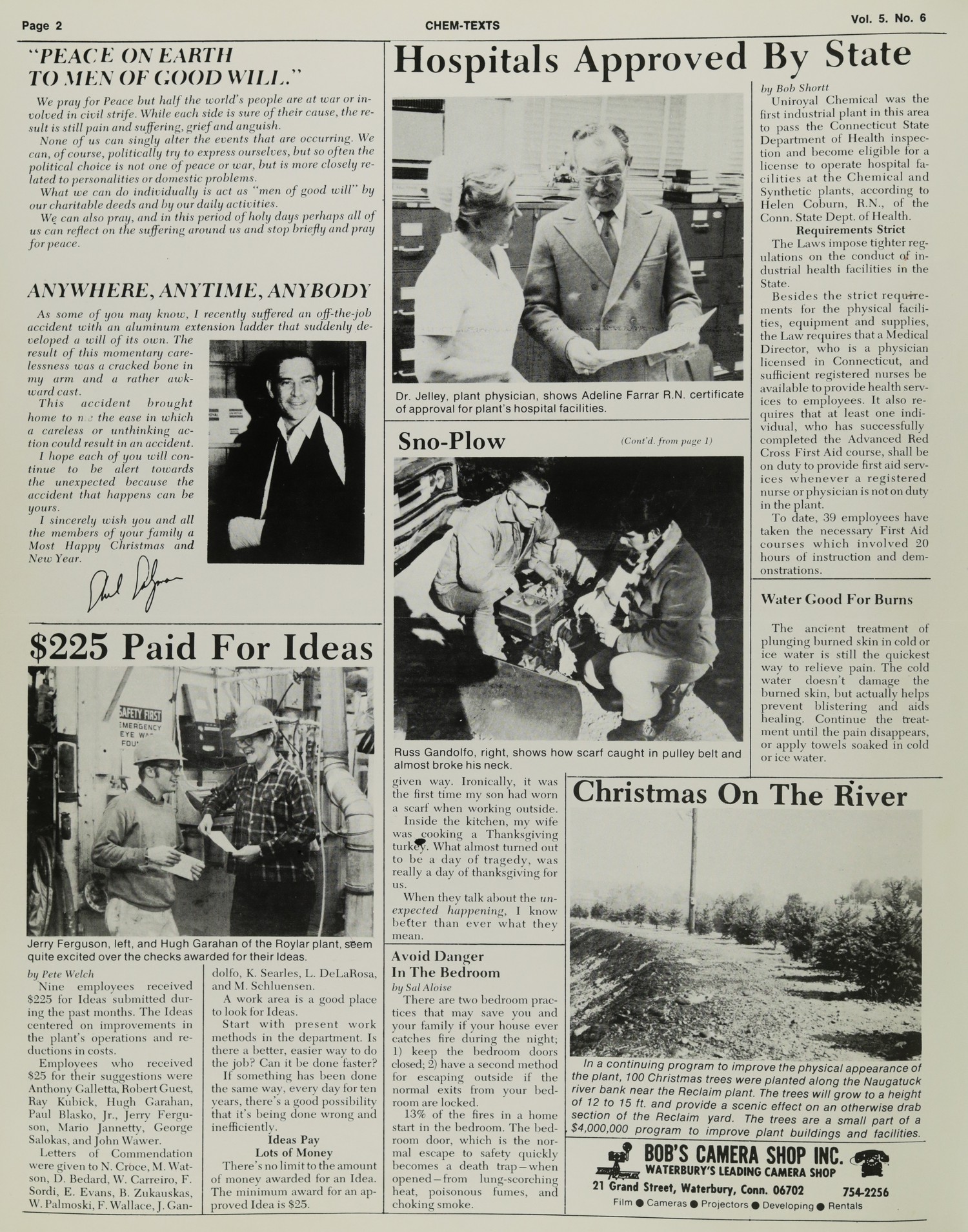
$225 Paid For Ideas

[IMAGE: Photo showing two men, with “SAFETY FIRST EMERGENCY EYE WASH FOU…” sign visible]

Jerry Ferguson, left, and Hugh Garahan of the Roylar plant, seem quite excited over the checks awarded for their Ideas.

by Pete Welch

Nine employees received $225 for Ideas submitted during the past months. The Ideas centered on improvements in the plant’s operations and reductions in costs.

Employees who received $25 for their suggestions were Anthony Galletta, Robert Guest, Ray Kubick, Hugh Garahan, Paul Blasko, Jr., Jerry Ferguson, Mario Jannetty, George Salokas, and John Wawer.

Letters of Commendation were given to N. Croce, M. Watson, D. Bedard, W. Carreiro, F. Sordi, E. Evans, B. Zukauskas, W. Palmoski, F. Wallace, J. Gandolfo, K. Searles, L. DeLaRosa, and M. Schluensen.

A work area is a good place to look for Ideas.

Start with present work methods in the department. Is there a better, easier way to do the job? Can it be done faster?

If something has been done the same way, every day for ten years, there’s a good possibility that it’s being done wrong and inefficiently.

Ideas Pay Lots of Money

There’s no limit to the amount of money awarded for an Idea. The minimum award for an approved Idea is $25.


Hospitals Approved By State

[IMAGE: Photo showing Dr. Jelley and Adeline Farrar]

Dr. Jelley, plant physician, shows Adeline Farrar R.N. certificate of approval for plant’s hospital facilities.

by Bob Shortt

Uniroyal Chemical was the first industrial plant in this area to pass the Connecticut State Department of Health inspection and become eligible for a license to operate hospital facilities at the Chemical and Synthetic plants, according to Helen Coburn, R.N., of the Conn. State Dept. of Health.

Requirements Strict

The Laws impose tighter regulations upon the conduct of industrial health facilities in the State.

Besides the strict requirements for the physical facilities, equipment and supplies, the Law requires that a Medical Director, who is a physician licensed in Connecticut, and sufficient registered nurses be available to provide health services to employees. It also requires that at least one individual, who has successfully completed the Advanced Red Cross First Aid course, shall be on duty to provide first aid services whenever a registered nurse or physician is not on duty in the plant.

To date, 39 employees have taken the necessary First Aid courses which involved 20 hours of instruction and demonstrations.


Water Good For Burns

The ancient treatment of plunging burned skin in cold or ice water is still the quickest way to relieve pain. The cold water doesn’t damage the burned skin, but actually helps prevent blistering and aids healing. Continue the treatment until the pain disappears, or apply towels soaked in cold or ice water.


Sno-Plow

(Cont’d. from page 1)

[IMAGE: Photo showing Russ Gandolfo demonstrating scarf caught in pulley belt]

Russ Gandolfo, right, shows how scarf caught in pulley belt and almost broke his neck.

given way. Ironically, it was the first time my son had worn a scarf when working outside.

Inside the kitchen, my wife was cooking a Thanksgiving turkey. What almost turned out to be a day of tragedy, was really a day of thanksgiving for us.

When they talk about the unexpected happening, I know better than ever what they mean.


Avoid Danger In The Bedroom

by Sal Aloise

There are two bedroom practices that may save you and your family if your house ever catches fire during the night; 1) keep the bedroom doors closed, 2) have a second method for escaping outside if the normal exits from your bedroom are locked.

13% of the fires in a home start in the bedroom. The bedroom door, which is the normal escape to safety quickly becomes a death trap—when opened—from lung-scorching heat, poisonous fumes, and choking smoke.


Christmas On The River

In a continuing program to improve the physical appearance of the plant, 100 Christmas trees were planted along the Naugatuck river bank near the Reclaim plant. The trees will grow to a height of 12 to 15 ft. and provide a scenic effect on an otherwise drab section of the Reclaim yard. The trees are a small part of a $4,000,000 program to improve plant buildings and facilities.


BOB’S CAMERA SHOP INC. [Logo]
WATERBURY’S LEADING CAMERA SHOP
21 Grand Street, Waterbury, Conn. 06702 | 754-2256
Film ● Cameras ● Projectors ● Developing ● Rentals

CHEM-TEXTS – Vol. 4 No. 2 – Page 2

Page 002

Page 2 CHEM-TEXTS Vol. 4 No. 2

FROM THE FACTORY MANAGER

DEAR FELLOW EMPLOYEE:

Recently I was pleased to announce to the general public that our Management had approved funds to construct waste pre-treatment facilities at our plant. This expenditure of close to $3,000,000, along with successful negotiations of an agreement with the Borough of Naugatuck to provide secondary treatment of our wastes, will bring us a long way in meeting our obligations to help clean up the Naugatuck River.

However, I am very much concerned that each of us realize our individual part in doing the total job to control pollution. No matter what Management does or spends on pollution control facilities, these actions will never be effective unless every employee shows a personal concern to eliminate pollution in his activities.

We all have to face up to our individual responsibilities to avoid spills, careless dumping of spoiled materials and excessive flushing of processing areas. In practice, we have to operate on the basis that the drain is the very last alternative for disposal.

We can not wait for the new treatment plants before we start to operate in this manner. We have to learn right away to put into practice “NO DRAIN” operation. To stop pollution everybody must do their part – we are all counting on each other to do the job!

John D. Evans


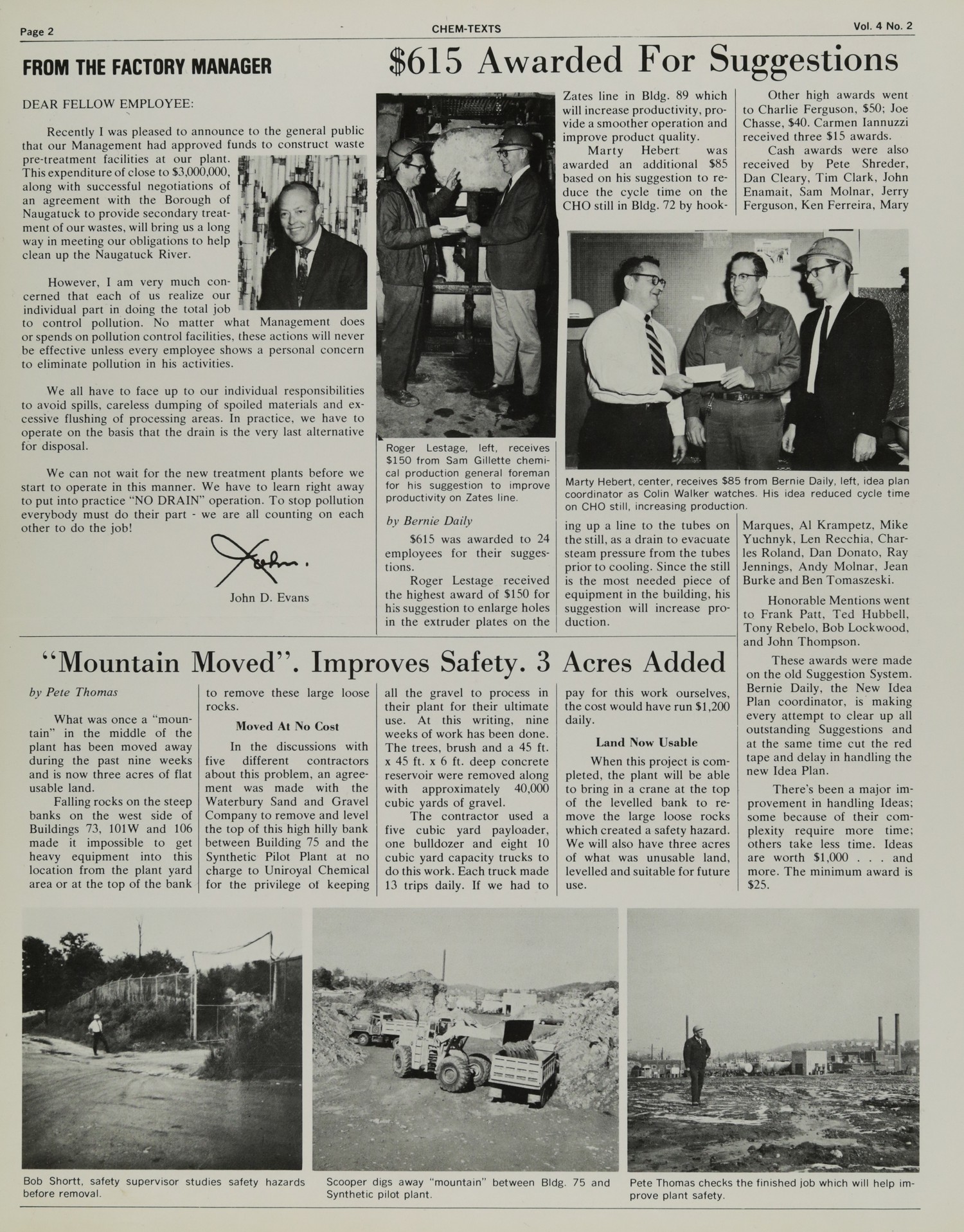
$615 Awarded For Suggestions

Zates line in Bldg. 89 which will increase productivity, provide a smoother operation and improve product quality.

Marty Hebert was awarded an additional $85 based on his suggestion to reduce the cycle time on the CHO still in Bldg. 72 by hook-

Other high awards went to Charlie Ferguson, $50; Joe Chasse, $40. Carmen Iannuzzi received three $15 awards.

Cash awards were also received by Pete Shreder, Dan Cleary, Tim Clark, John Enamait, Sam Molnar, Jerry Ferguson, Ken Ferreira, Mary

Roger Lestage, left, receives $150 from Sam Gillette chemical production general foreman for his suggestion to improve productivity on Zates line.

Marty Hebert, center, receives $85 from Bernie Daily, left, idea plan coordinator as Colin Walker watches. His idea reduced cycle time on CHO still, increasing production.

by Bernie Daily

$615 was awarded to 24 employees for their suggestions.

Roger Lestage received the highest award of $150 for his suggestion to enlarge holes in the extruder plates on the

ing up a line to the tubes on the still, as a drain to evacuate steam pressure from the tubes prior to cooling. Since the still is the most needed piece of equipment in the building, his suggestion will increase production.

Marques, Al Krampetz, Mike Yuchnyk, Len Recchia, Charles Roland, Dan Donato, Ray Jennings, Andy Molnar, Jean Burke and Ben Tomaszeski.

Honorable Mentions went to Frank Patt, Ted Hubbell, Tony Rebelo, Bob Lockwood, and John Thompson.

These awards were made on the old Suggestion System. Bernie Daily, the New Idea Plan coordinator, is making every attempt to clear up all outstanding Suggestions and at the same time cut the red tape and delay in handling the new Idea Plan.

There’s been a major improvement in handling Ideas; some because of their complexity require more time; others take less time. Ideas are worth $1,000 . . . and more. The minimum award is $25.


“Mountain Moved”. Improves Safety. 3 Acres Added

by Pete Thomas

What was once a “mountain” in the middle of the plant has been moved away during the past nine weeks and is now three acres of flat usable land.

Falling rocks on the steep banks on the west side of Buildings 73, 101W and 106 made it impossible to get heavy equipment into this location from the plant yard area or at the top of the bank to remove these large loose rocks.

Moved At No Cost

In the discussions with five different contractors about this problem, an agreement was made with the Waterbury Sand and Gravel Company to remove and level the top of this high hilly bank between Building 75 and the Synthetic Pilot Plant at no charge to Uniroyal Chemical for the privilege of keeping all the gravel to process in their plant for their ultimate use. At this writing, nine weeks of work has been done. The trees, brush and a 45 ft. x 45 ft. x 6 ft. deep concrete reservoir were removed along with approximately 40,000 cubic yards of gravel.

The contractor used a five cubic yard payloader, one bulldozer and eight 10 cubic yard capacity trucks to do this work. Each truck made 13 trips daily. If we had to pay for this work ourselves, the cost would have run $1,200 daily.

Land Now Usable

When this project is completed, the plant will be able to bring in a crane at the top of the levelled bank to remove the large loose rocks which created a safety hazard. We will also have three acres of what was unusable land, levelled and suitable for future use.


Bob Shortt, safety supervisor studies safety hazards before removal.

Scooper digs away “mountain” between Bldg. 75 and Synthetic pilot plant.

Pete Thomas checks the finished job which will help improve plant safety.

CHEM-TEXTS – Vol. 4 No. 8 – Page 2

Page 002

CHEM-TEXTS

Page 2 | Vol. 4 No. 8


FROM THE FACTORY MANAGER

DEAR FELLOW EMPLOYEE:

I’m certain that the vast majority of us know and appreciate the fact that UNIROYAL CHEMICAL is a good place to work. Sure, we all have our gripes and inconveniences but when we really think about it we’ve got it pretty good. As only one example, the other day I was looking at the average earnings for all manufacturing workers in Connecticut and noted that the straight time rate averages $3.31 per hour as compared to $4.00 per hour in our plant. When the effect of premium rates for overtime is considered, the State average is $3.43 per hour and our average is $4.39 per hour.

Beyond pay and the importance of our superior benefit plans, there is the question of what kind of place is it to work? I believe you will agree with me that a very important factor is the “atmosphere” or “climate.” Like productivity, safety, good housekeeping and quality, each of us must bear a responsibility for “climate.” We do this every day by our attitudes, our cooperation and our ability to communicate with each other. To fully face this responsibility each of us must listen, as well as talk. Each of us must recognize that others have problems, as well as ourselves.

Concern for the customer, concern for the fellow employee and yes, concern for the job produces results.

Best regards,

John D. Evans

John D. Evans


Many Apply For Kaynor

[IMAGE: Aerial photograph of industrial/educational facility with parking lot]

Kaynor Tech offers a broad program of excellent trades courses.

More than 45 employees have applied for the training program to qualify candidates for skilled trades openings in the plant. The 2-year trades courses program will cover: Fundamentals of Arithmetic; Measurements; and Engineering Drawing in the first year.

The second year is tentatively planned to cover: Introduction to Pipe Fitting; Electricity; and Construction Trades.

Successful completion of the program as judged by Kaynor Tech’s instructors will give the candidates the chance to qualify for second-class trades openings in accordance with present contractual requirements of seniority and qualifications.

Employees applying for the program are: C. Andrus; F. Ash; D. Bedard; W. Carreiro; R. Chevrier; A. Cifone; T. Douty; J. Dowling; R. Enamait; J. Ferguson; K. Ferreira; F. Gagne; H. Garahan; T. Gladding; T. Griffin; A. Happy; P. Hardt, Sr.; J. Hartnett; M. Hebert; G. Hennessey; J. Iosa; C. Jackson; J. Kenny; R. Kubicki; H. McIsaac; J. Mello; D. Memillo; F. Miller; E. Molnar; R. Morel; J. Morrison; J. Needham, H. Nixon; J. Oliveira; R. Orsini; D. Polzella; J. Poudrier; J. Poveromo; L. Recchia; F. San Angelo; W. Seymour; F. Simasek; F. Sordi; J. Sullivan; B. Tomaszeski; L. Watson and E. Zemeir. Other names were unavailable at press time.


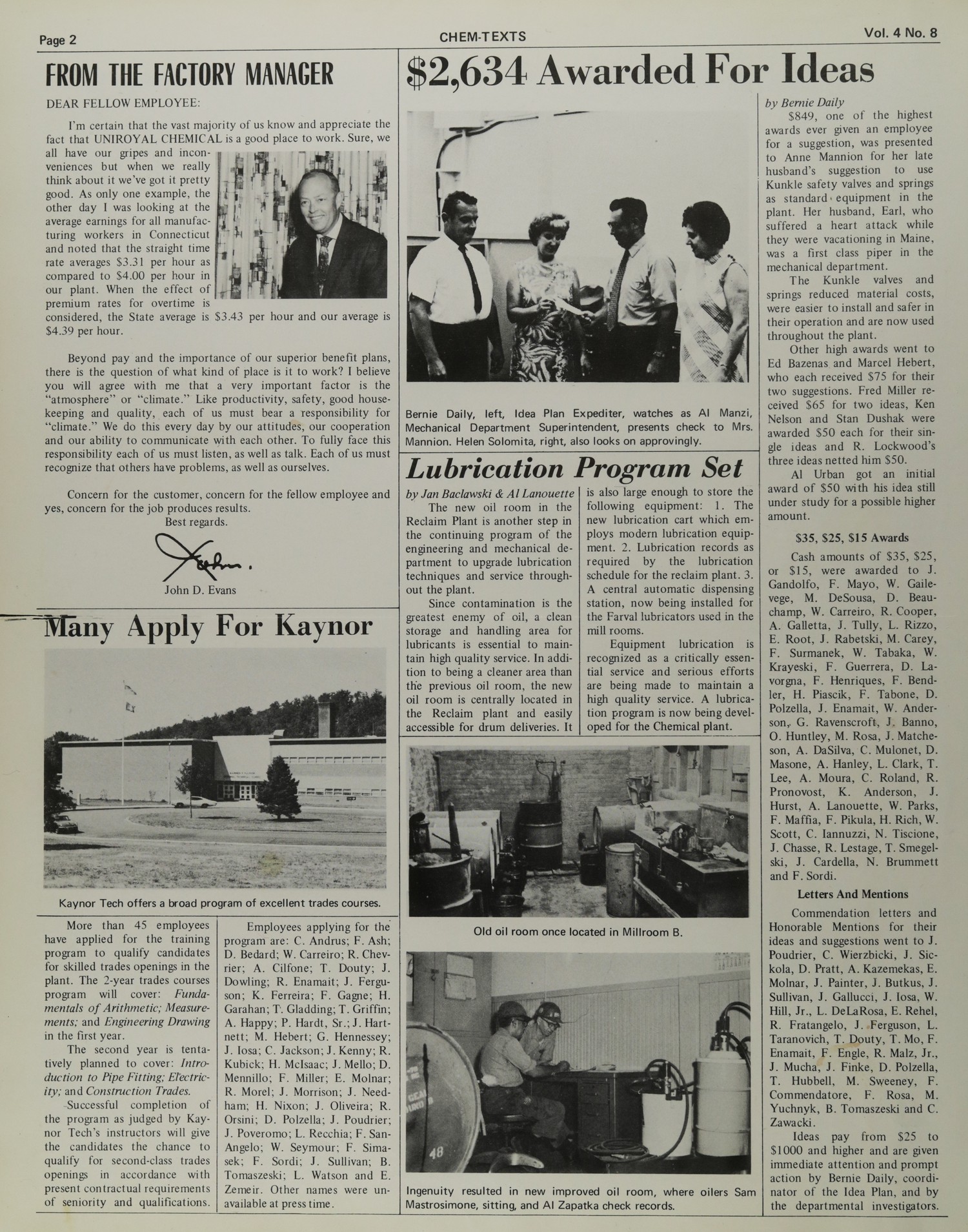
$2,634 Awarded For Ideas

by Bernie Daily

$849, one of the highest awards ever given an employee for a suggestion, was presented to Anne Mannion for her late husband’s suggestion to use Kunkle safety valves and springs as standard equipment in the plant. Her husband, Earl, who suffered a heart attack while they were vacationing in Maine, was a first class piper in the mechanical department.

The Kunkle valves and springs reduced material costs, were easier to install and safer in their operation and are now used throughout the plant.

Other high awards went to Ed Bazenas and Marcel Hebert, who each received $75 for their two suggestions. Fred Miller received $65 for two ideas, Ken Nelson and Stan Dushak were awarded $50 each for their single ideas and R. Lockwood’s three ideas netted him $50.

Al Urban got an initial award of $50 with his idea still under study for a possible higher amount.

$35, $25, $15 Awards

Cash amounts of $35, $25, or $15, were awarded to J. Gandolfo, F. Mayo, W. Gailevege, M. DeSousa, D. Beauchamp, W. Carreiro, R. Cooper, A. Galletta, J. Tully, L. Rizzo, E. Root, J. Rabetski, M. Carey, F. Surmanek, W. Tabaka, W. Krayeski, F. Guerrera, D. Lavorgna, F. Henriques, F. Bendler, H. Piascik, F. Tabone, D. Polzella, J. Enamait, W. Anderson, G. Ravenscroft, J. Banno, O. Huntley, M. Rosa, J. Matcheson, A. DaSilva, C. Mulonet, D. Masone, A. Hanley, L. Clark, T. Lee, A. Moura, C. Roland, R. Pronovost, K. Anderson, J. Hurst, A. Lanouette, W. Parks, F. Maffia, F. Pikula, H. Rich, W. Scott, C. Iannuzzi, N. Tiscione, J. Chasse, R. Lestage, T. Smegelski, J. Cardella, N. Brummett and F. Sordi.

Letters And Mentions

Commendation letters and Honorable Mentions for their ideas and suggestions went to J. Poudrier, C. Wierzbicki, J. Sickola, D. Pratt, A. Kazemekas, E. Molnar, J. Painter, J. Butkus, J. Sullivan, J. Gallucci, J. Iosa, W. Hill, Jr., L. DeLaRosa, E. Rehel, R. Fratangelo, J. Ferguson, L. Taranovich, T. Douty, T. Mo, F. Enamait, F. Engle, R. Malz, Jr., J. Mucha, J. Finke, D. Polzella, T. Hubbell, M. Sweeney, F. Commendatore, F. Rosa, M. Yuchnyk, B. Tomaszeski and C. Zawacki.

Ideas pay from $25 to $1000 and higher and are given immediate attention and prompt action by Bernie Daily, coordinator of the Idea Plan, and by the departmental investigators.

[IMAGE: Three people in office setting]

Bernie Daily, left, Idea Plan Expediter, watches as Al Manzi, Mechanical Department Superintendent, presents check to Mrs. Mannion. Helen Solomita, right, also looks on approvingly.


Lubrication Program Set

by Jan Baclawski & Al Lanouette

The new oil room in the Reclaim Plant is another step in the continuing program of the engineering and mechanical department to upgrade lubrication techniques and service throughout the plant.

Since contamination is the greatest enemy of oil, a clean storage and handling area for lubricants is essential to maintain high quality service. In addition to being a cleaner area than the previous oil room, the new oil room is centrally located in the Reclaim plant and easily accessible for drum deliveries. It is also large enough to store the following equipment: 1. The new lubrication cart which employs modern lubrication equipment. 2. Lubrication records as required by the lubrication schedule for the reclaim plant. 3. A central automatic dispensing station, now being installed for the Farval lubricators used in the mill rooms.

Equipment lubrication is recognized as a critically essential service and serious efforts are being made to maintain a high quality service. A lubrication program is now being developed for the Chemical plant.

[IMAGE: Old oil room equipment]

Old oil room once located in Millroom B.

[IMAGE: Two men working in new oil room]

Ingenuity resulted in new improved oil room, where oilers Sam Mastrosimone, sitting, and Al Zapatka check records.

CHEM-TEXTS – Vol. 3 No. 6 – Page 3

Page 003

CHEM-TEXTS

Vol. 3 No. 8 | Page 3


Synthetic’s “A” Crew Hits 9 Batches Daily

[IMAGE: Group photo of workers in hard hats]

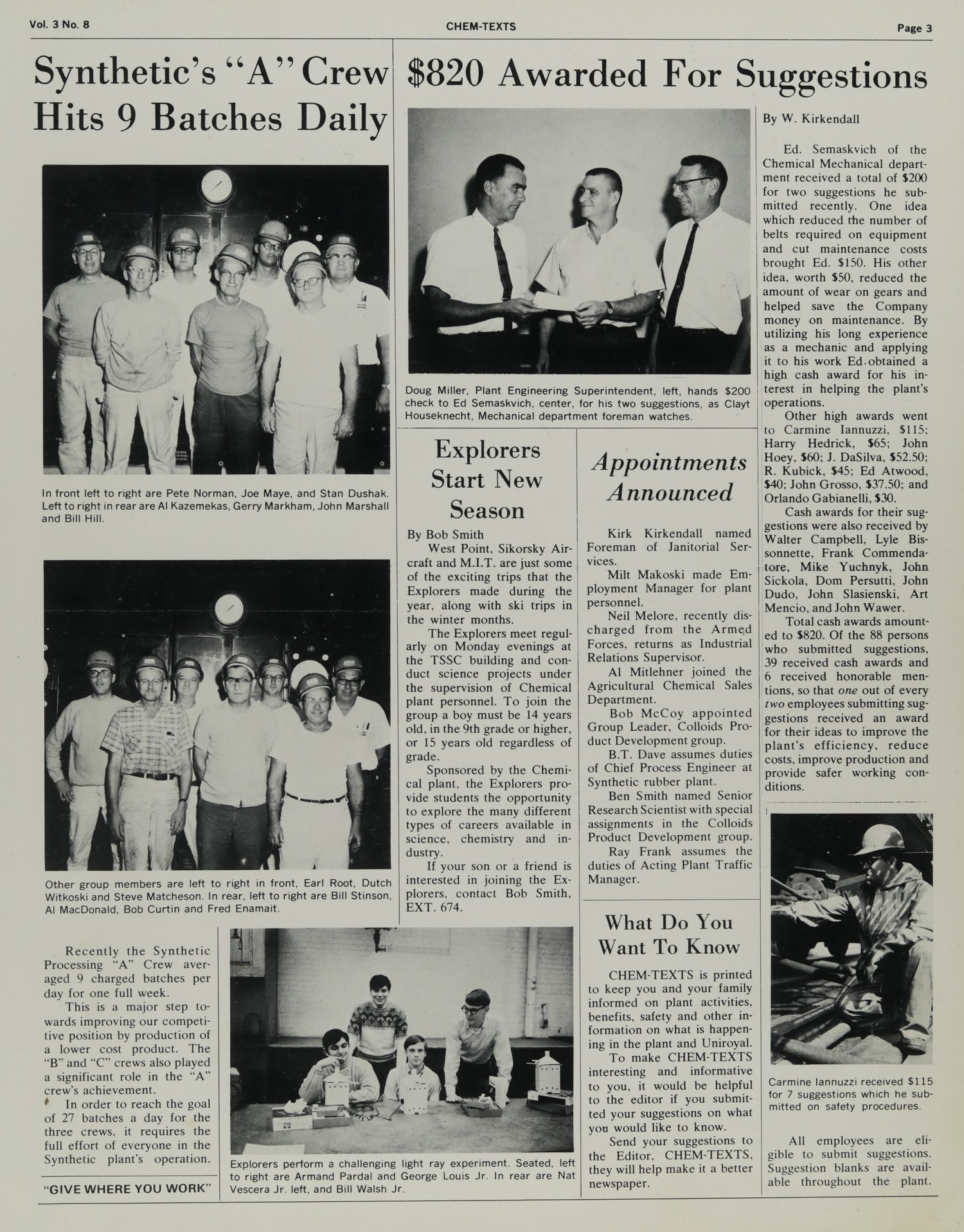
In front left to right are Pete Norman, Joe Maye, and Stan Dushak. Left to right in rear are Al Kazemekas, Gerry Markham, John Marshall and Bill Hill.

[IMAGE: Second group photo of workers]

Other group members are left to right in front, Earl Root, Dutch Witkoski and Steve Matcheson. In rear, left to right are Bill Stinson, Al MacDonald, Bob Curtin and Fred Enamait.

Recently the Synthetic Processing “A” Crew averaged 9 charged batches per day for one full week.

This is a major step towards improving our competitive position by production of a lower cost product. The “B” and “C” crews also played a significant role in the “A” crew’s achievement.

In order to reach the goal of 27 batches a day for the three crews, it requires the full effort of everyone in the Synthetic plant’s operation.

“GIVE WHERE YOU WORK”


$820 Awarded For Suggestions

By W. Kirkendall

[IMAGE: Three men, one handing check to another]

Doug Miller, Plant Engineering Superintendent, left, hands $200 check to Ed Semaskvich, center, for his two suggestions, as Clayt Houseknecht, Mechanical department foreman watches.

Ed. Semaskvich of the Chemical Mechanical department received a total of $200 for two suggestions he submitted recently. One idea which reduced the number of belts required on equipment and cut maintenance costs brought Ed. $150. His other idea, worth $50, reduced the amount of wear on gears and helped save the Company money on maintenance. By utilizing his long experience as a mechanic and applying it to his work Ed obtained a high cash award for his interest in helping the plant’s operations.

Other high awards went to Carmine Iannuzzi, $115; Harry Hedrick, $65; John Hoey, $60; J. DaSilva, $52.50; R. Kubick, $45; Ed Atwood, $40; John Grosso, $37.50; and Orlando Gabianelli, $30.

Cash awards for their suggestions were also received by Walter Campbell, Lyle Bissonnette, Frank Commendatore, Mike Yuchnyk, John Sickola, Dom Persutti, John Dudo, John Slasienski, Art Mencio, and John Wawer.

Total cash awards amounted to $820. Of the 88 persons who submitted suggestions, 39 received cash awards and 6 received honorable mentions, so that one out of every two employees submitting suggestions received an award for their ideas to improve the plant’s efficiency, reduce costs, improve production and provide safer working conditions.

[IMAGE: Man working]

Carmine Iannuzzi received $115 for 7 suggestions which he submitted on safety procedures.

All employees are eligible to submit suggestions. Suggestion blanks are available throughout the plant.


Explorers Start New Season

By Bob Smith

West Point, Sikorsky Aircraft and M.I.T. are just some of the exciting trips that the Explorers made during the year, along with ski trips in the winter months.

The Explorers meet regularly on Monday evenings at the TSSC building and conduct science projects under the supervision of Chemical plant personnel. To join the group a boy must be 14 years old, in the 9th grade or higher, or 15 years old regardless of grade.

Sponsored by the Chemical plant, the Explorers provide students the opportunity to explore the many different types of careers available in science, chemistry and industry.

If your son or a friend is interested in joining the Explorers, contact Bob Smith, EXT. 674.

[IMAGE: Group of young people at table with experiment]

Explorers perform a challenging light ray experiment. Seated, left to right are Armand Pardal and George Louis Jr. In rear are Nat Vescera Jr. left, and Bill Walsh Jr.


Appointments Announced

Kirk Kirkendall named Foreman of Janitorial Services.

Milt Makoski made Employment Manager for plant personnel.

Neil Melore, recently discharged from the Armed Forces, returns as Industrial Relations Supervisor.

Al Mitlehner joined the Agricultural Chemical Sales Department.

Bob McCoy appointed Group Leader, Colloids Product Development group.

B.T. Dave assumes duties of Chief Process Engineer at Synthetic rubber plant.

Ben Smith named Senior Research Scientist with special assignments in the Colloids Product Development group.

Ray Frank assumes the duties of Acting Plant Traffic Manager.


What Do You Want To Know

CHEM-TEXTS is printed to keep you and your family informed on plant activities, benefits, safety and other information on what is happening in the plant and Uniroyal.

To make CHEM-TEXTS interesting and informative to you, it would be helpful to the editor if you submitted your suggestions on what you would like to know.

Send your suggestions to the Editor, CHEM-TEXTS, they will help make it a better newspaper.

CHEM-TEXTS – Vol. 3 No. 6 – Page 4

Page 004

Page 4 CHEM-TEXTS

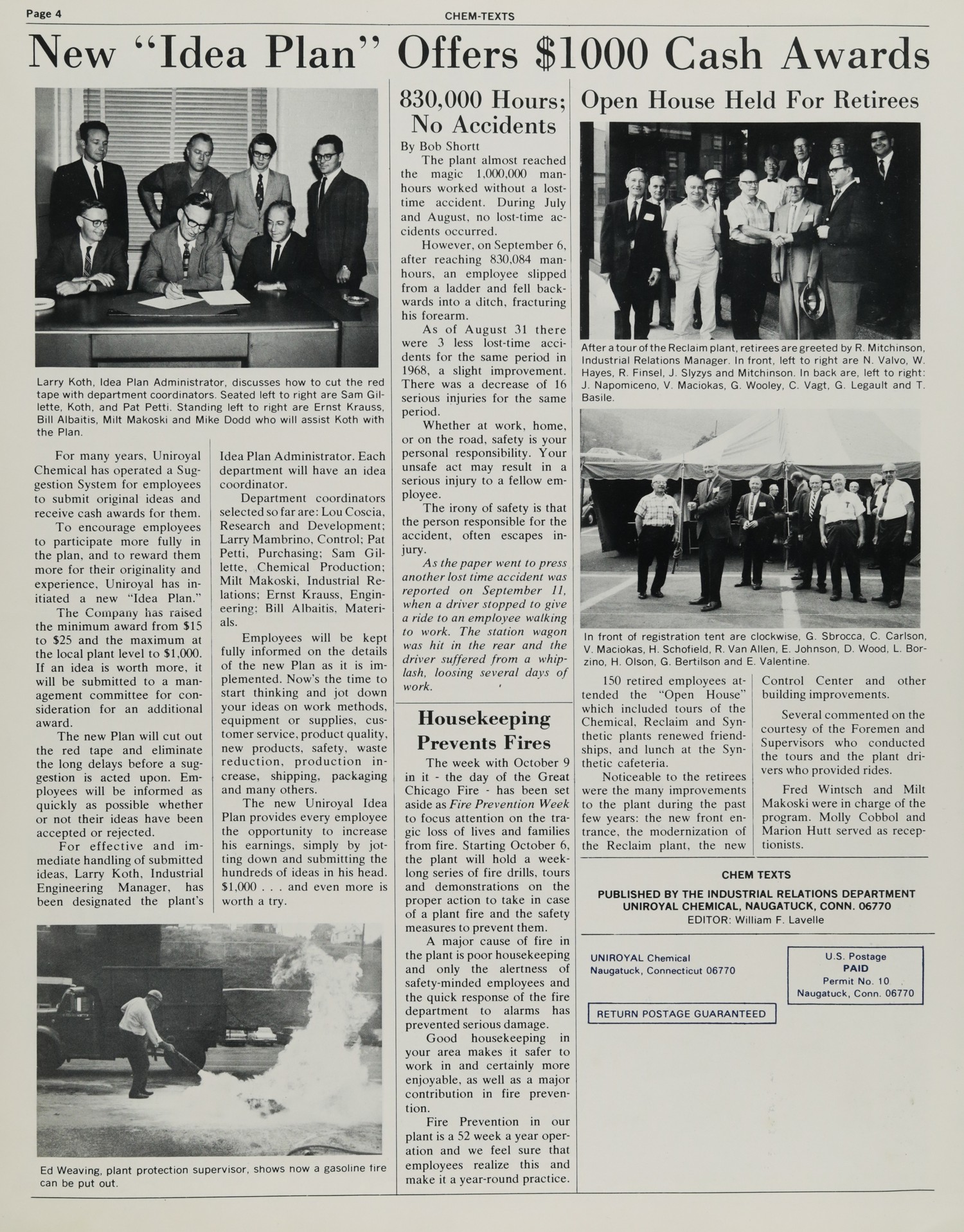
New “Idea Plan” Offers $1000 Cash Awards

Larry Koth, Idea Plan Administrator, discusses how to cut the red tape with department coordinators. Seated left to right are Sam Gillette, Koth, and Pat Petti. Standing left to right are Ernst Krauss, Bill Albaitis, Milt Makoski and Mike Dodd who will assist Koth with the Plan.

For many years, Uniroyal Chemical has operated a Suggestion System for employees to submit original ideas and receive cash awards for them.

To encourage employees to participate more fully in the plan, and to reward them more for their originality and experience, Uniroyal has initiated a new “Idea Plan.”

The Company has raised the minimum award from $15 to $25 and the maximum at the local plant level to $1,000. If an idea is worth more, it will be submitted to a management committee for consideration for an additional award.

The new Plan will cut out the red tape and eliminate the long delays before a suggestion is acted upon. Employees will be informed as quickly as possible whether or not their ideas have been accepted or rejected.

For effective and immediate handling of submitted ideas, Larry Koth, Industrial Engineering Manager, has been designated the plant’s Idea Plan Administrator. Each department will have an idea coordinator.

Department coordinators selected so far are: Lou Coscia, Research and Development; Larry Mambrino, Control; Pat Petti, Purchasing; Sam Gillette, Chemical Production; Milt Makoski, Industrial Relations; Ernst Krauss, Engineering; Bill Albaitis, Materials.

Employees will be kept fully informed on the details of the new Plan as it is implemented. Now’s the time to start thinking and jot down your ideas on work methods, equipment or supplies, customer service, product quality, new products, safety, waste reduction, production increase, shipping, packaging and many others.

The new Uniroyal Idea Plan provides every employee the opportunity to increase his earnings, simply by jotting down and submitting the hundreds of ideas in his head. $1,000 . . . and even more is worth a try.


Ed Weaving, plant protection supervisor, shows now a gasoline fire can be put out.


830,000 Hours; No Accidents

By Bob Shortt

The plant almost reached the magic 1,000,000 manhours worked without a losttime accident. During July and August, no lost-time accidents occurred.

However, on September 6, after reaching 830,084 manhours, an employee slipped from a ladder and fell backwards into a ditch, fracturing his forearm.

As of August 31 there were 3 less lost-time accidents for the same period in 1968, a slight improvement. There was a decrease of 16 serious injuries for the same period.

Whether at work, home, or on the road, safety is your personal responsibility. Your unsafe act may result in a serious injury to a fellow employee.

The irony of safety is that the person responsible for the accident, often escapes injury.

As the paper went to press another lost time accident was reported on September 11, when a driver stopped to give a ride to an employee walking to work. The station wagon was hit in the rear and the driver suffered from a whiplash, loosing several days of work.


Housekeeping Prevents Fires

The week with October 9 in it – the day of the Great Chicago Fire – has been set aside as Fire Prevention Week to focus attention on the tragic loss of lives and families from fire. Starting October 6, the plant will hold a weeklong series of fire drills, tours and demonstrations on the proper action to take in case of a plant fire and the safety measures to prevent them.

A major cause of fire in the plant is poor housekeeping and only the alertness of safety-minded employees and the quick response of the fire department to alarms has prevented serious damage.

Good housekeeping in your area makes it safer to work in and certainly more enjoyable, as well as a major contribution in fire prevention.

Fire Prevention in our plant is a 52 week a year operation and we feel sure that employees realize this and make it a year-round practice.


Open House Held For Retirees

After a tour of the Reclaim plant, retirees are greeted by R. Mitchinson, Industrial Relations Manager. In front, left to right are N. Valvo, W. Hayes, R. Finsel, J. Slyzys and Mitchinson. In back are, left to right: J. Napomiceno, V. Maciokas, G. Wooley, C. Vagt, G. Legault and T. Basile.

In front of registration tent are clockwise, G. Sbrocca, C. Carlson, V. Maciokas, H. Schofield, R. Van Allen, E. Johnson, D. Wood, L. Borzino, H. Olson, G. Bertilson and E. Valentine.

150 retired employees attended the “Open House” which included tours of the Chemical, Reclaim and Synthetic plants renewed friendships, and lunch at the Synthetic cafeteria.

Noticeable to the retirees were the many improvements to the plant during the past few years: the new front entrance, the modernization of the Reclaim plant, the new Control Center and other building improvements.

Several commented on the courtesy of the Foremen and Supervisors who conducted the tours and the plant drivers who provided rides.

Fred Wintsch and Milt Makoski were in charge of the program. Molly Cobbol and Marion Hutt served as receptionists.


CHEM TEXTS

PUBLISHED BY THE INDUSTRIAL RELATIONS DEPARTMENT
UNIROYAL CHEMICAL, NAUGATUCK, CONN. 06770
EDITOR: William F. Lavelle

UNIROYAL Chemical
Naugatuck, Connecticut 06770

U.S. Postage
PAID
Permit No. 10
Naugatuck, Conn. 06770

RETURN POSTAGE GUARANTEED

CHEM-TEXTS – Vol. 3 No. 7 – Page 4

Page 004

Page 4

CHEM-TEXTS

Vol. 3 No. 7

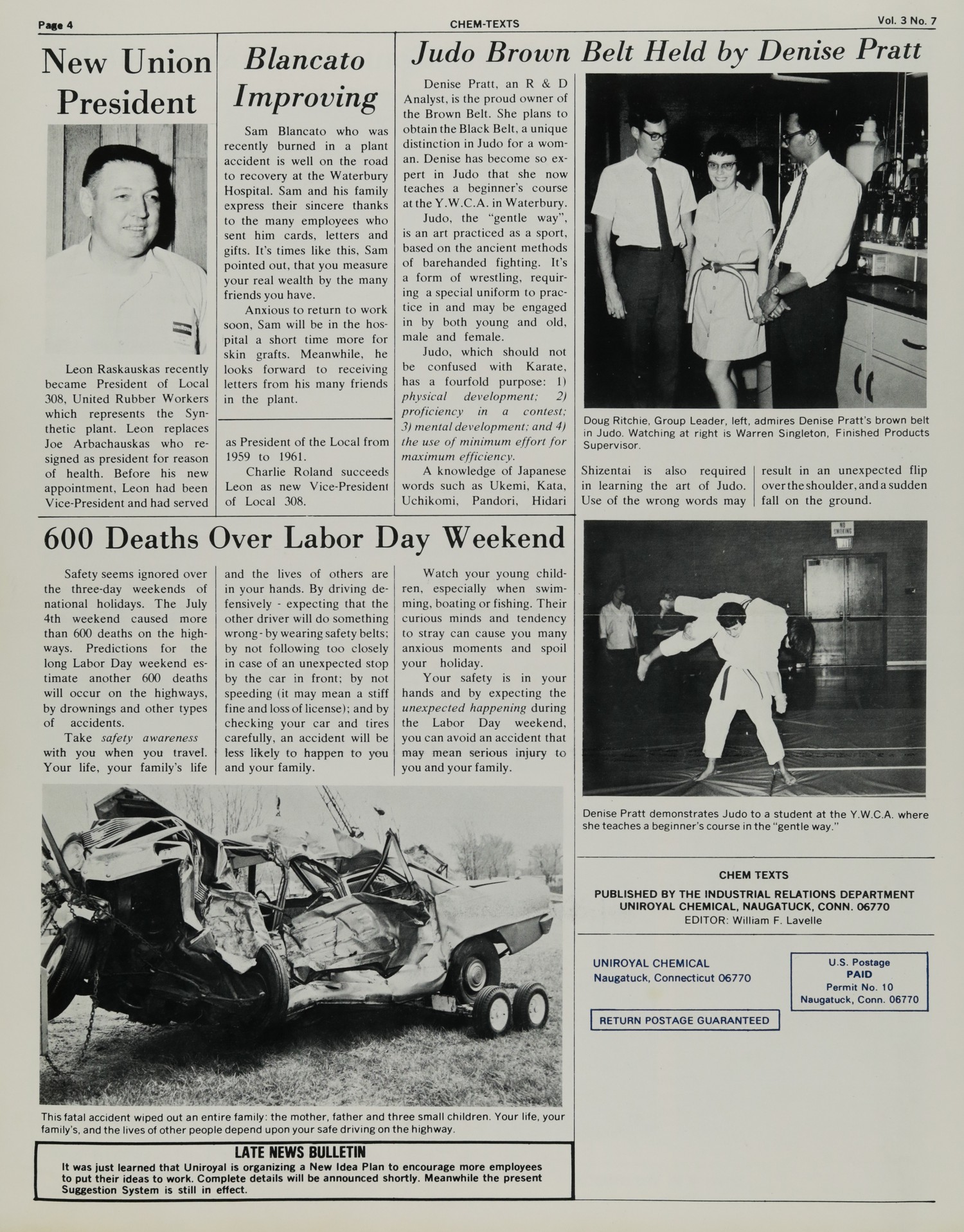
New Union President

Leon Raskauskas recently became President of Local 308, United Rubber Workers which represents the Synthetic plant. Leon replaces Joe Arbachauskas who resigned as president for reason of health. Before his new appointment, Leon had been Vice-President and had served

as President of the Local from 1959 to 1961.

Charlie Roland succeeds Leon as new Vice-President of Local 308.


Blancato Improving

Sam Blancato who was recently burned in a plant accident is well on the road to recovery at the Waterbury Hospital. Sam and his family express their sincere thanks to the many employees who sent him cards, letters and gifts. It’s times like this, Sam pointed out, that you measure your real wealth by the many friends you have.

Anxious to return to work soon, Sam will be in the hospital a short time more for skin grafts. Meanwhile, he looks forward to receiving letters from his many friends in the plant.


Judo Brown Belt Held by Denise Pratt

Denise Pratt, an R & D Analyst, is the proud owner of the Brown Belt. She plans to obtain the Black Belt, a unique distinction in Judo for a woman. Denise has become so expert in Judo that she now teaches a beginner’s course at the Y.W.C.A. in Waterbury.

Judo, the “gentle way”, is an art practiced as a sport, based on the ancient methods of barehanded fighting. It’s a form of wrestling, requiring a special uniform to practice in and may be engaged in by both young and old, male and female.

Judo, which should not be confused with Karate, has a fourfold purpose: 1) physical development; 2) proficiency in a contest; 3) mental development; and 4) the use of minimum effort for maximum efficiency.

A knowledge of Japanese words such as Ukemi, Kata, Uchikomi, Pandori, Hidari

Shizentai is also required in learning the art of Judo. Use of the wrong words may result in an unexpected flip over the shoulder, and a sudden fall on the ground.

Doug Ritchie, Group Leader, left, admires Denise Pratt’s brown belt in Judo. Watching at right is Warren Singleton, Finished Products Supervisor.


600 Deaths Over Labor Day Weekend

Safety seems ignored over the three-day weekends of national holidays. The July 4th weekend caused more than 600 deaths on the highways. Predictions for the long Labor Day weekend estimate another 600 deaths will occur on the highways, by drownings and other types of accidents.

Take safety awareness with you when you travel. Your life, your family’s life and the lives of others are in your hands. By driving defensively – expecting that the other driver will do something wrong – by wearing safety belts; by not following too closely in case of an unexpected stop by the car in front; by not speeding (it may mean a stiff fine and loss of license); and by checking your car and tires carefully, an accident will be less likely to happen to you and your family.

Watch your young children, especially when swimming, boating or fishing. Their curious minds and tendency to stray can cause you many anxious moments and spoil your holiday.

Your safety is in your hands and by expecting the unexpected happening during the Labor Day weekend, you can avoid an accident that may mean serious injury to you and your family.

This fatal accident wiped out an entire family: the mother, father and three small children. Your life, your family’s, and the lives of other people depend upon your safe driving on the highway.

Denise Pratt demonstrates Judo to a student at the Y.W.C.A. where she teaches a beginner’s course in the “gentle way.”


LATE NEWS BULLETIN

It was just learned that Uniroyal is organizing a New Idea Plan to encourage more employees to put their ideas to work. Complete details will be announced shortly. Meanwhile the present Suggestion System is still in effect.


CHEM TEXTS

PUBLISHED BY THE INDUSTRIAL RELATIONS DEPARTMENT
UNIROYAL CHEMICAL, NAUGATUCK, CONN. 06770
EDITOR: William F. Lavelle

UNIROYAL CHEMICAL
Naugatuck, Connecticut 06770

U.S. Postage
PAID
Permit No. 10
Naugatuck, Conn. 06770

RETURN POSTAGE GUARANTEED

CHEM-TEXTS – Vol. 3 No. 5 – Page 3

Page 003

Vol. 3 No. 5 CHEM-TEXTS Page 3


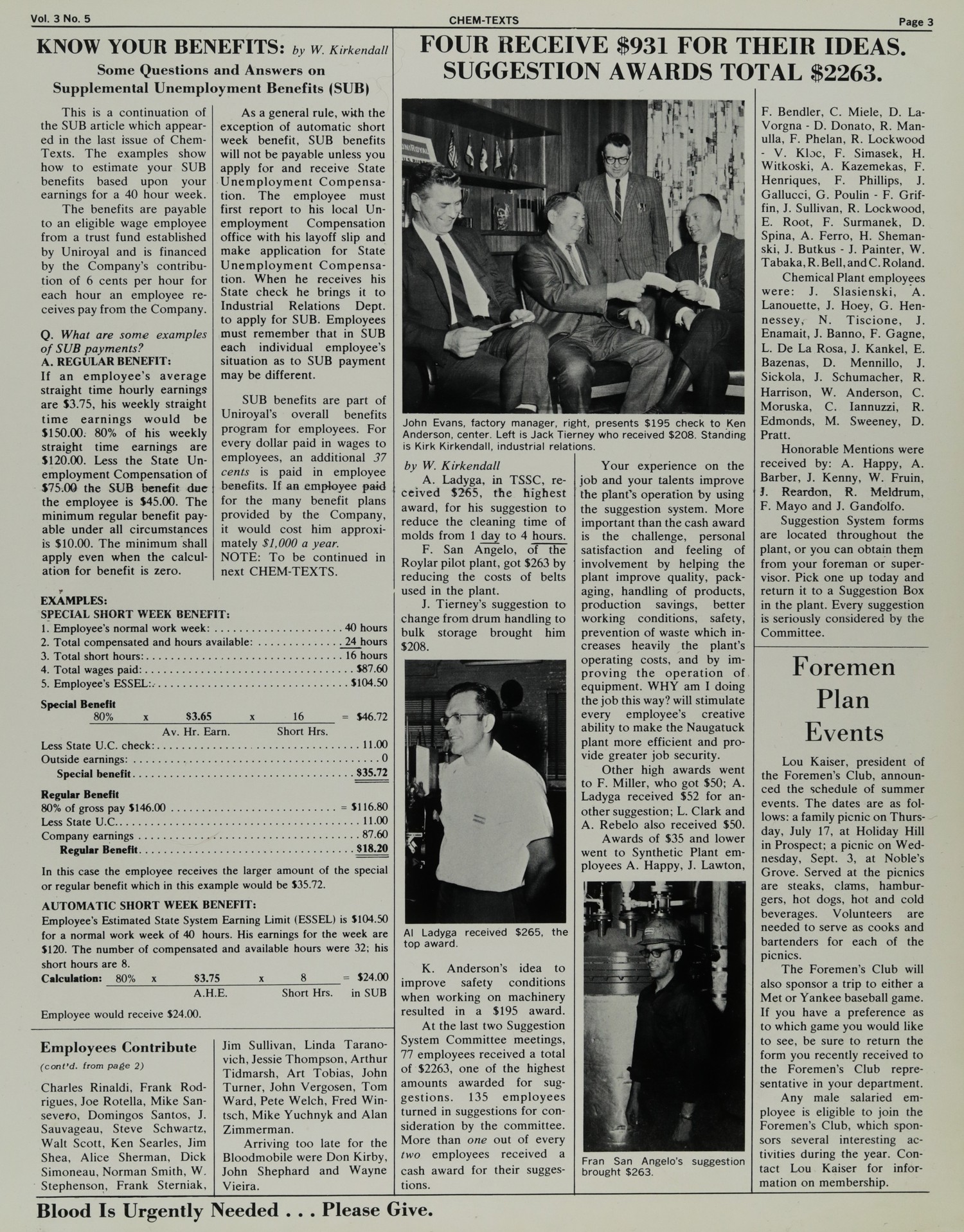
KNOW YOUR BENEFITS: by W. Kirkendall

Some Questions and Answers on Supplemental Unemployment Benefits (SUB)

This is a continuation of the SUB article which appeared in the last issue of Chem-Texts. The examples show how to estimate your SUB benefits based upon your earnings for a 40 hour week.

The benefits are payable to an eligible wage employee from a trust fund established by Uniroyal and is financed by the Company’s contribution of 6 cents per hour for each hour an employee receives pay from the Company.

Q. What are some examples of SUB payments?

A. REGULAR BENEFIT:
If an employee’s average straight time hourly earnings are $3.75, his weekly straight time earnings would be $150.00. 80% of his weekly straight time earnings are $120.00. Less the State Unemployment Compensation of $75.00 the SUB benefit due the employee is $45.00. The minimum regular benefit payable under all circumstances is $10.00. The minimum shall apply even when the calculation for benefit is zero.

EXAMPLES:
SPECIAL SHORT WEEK BENEFIT:
1. Employee’s normal work week:……………………40 hours
2. Total compensated and hours available:………….24 hours
3. Total short hours:…………………………16 hours
4. Total wages paid:………………………….$87.60
5. Employee’s ESSEL:…………………………$104.50

Special Benefit
80% x $3.65 x 16 = $46.72
Av. Hr. Earn. Short Hrs.
Less State U.C. check:…………………………11.00
Outside earnings:……………………………..0
Special benefit……………………………..$35.72

Regular Benefit
80% of gross pay $146.00……………………..= $116.80
Less State U.C………………………………11.00
Company earnings…………………………….87.60
Regular Benefit…………………………….$18.20

In this case the employee receives the larger amount of the special or regular benefit which in this example would be $35.72.

AUTOMATIC SHORT WEEK BENEFIT:
Employee’s Estimated State System Earning Limit (ESSEL) is $104.50 for a normal work week of 40 hours. His earnings for the week are $120. The number of compensated and available hours were 32; his short hours are 8.

Calculation: 80% x $3.75 x 8 = $24.00
A.H.E. Short Hrs. in SUB

Employee would receive $24.00.


As a general rule, with the exception of automatic short week benefit, SUB benefits will not be payable unless you apply for and receive State Unemployment Compensation. The employee must first report to his local Unemployment Compensation office with his layoff slip and make application for State Unemployment Compensation. When he receives his State check he brings it to Industrial Relations Dept. to apply for SUB. Employees must remember that in SUB each individual employee’s situation as to SUB payment may be different.

SUB benefits are part of Uniroyal’s overall benefits program for employees. For every dollar paid in wages to employees, an additional 37 cents is paid in employee benefits. If an employee paid for the many benefit plans provided by the Company, it would cost him approximately $1,000 a year.
NOTE: To be continued in next CHEM-TEXTS.


FOUR RECEIVE $931 FOR THEIR IDEAS. SUGGESTION AWARDS TOTAL $2263.

[PHOTO: John Evans, factory manager, right, presents $195 check to Ken Anderson, center. Left is Jack Tierney who received $208. Standing is Kirk Kirkendall, industrial relations.]

by W. Kirkendall

A. Ladyga, in TSSC, received $265, the highest award, for his suggestion to reduce the cleaning time of molds from 1 day to 4 hours.

F. San Angelo, of the Roylar pilot plant, got $263 by reducing the costs of belts used in the plant.

J. Tierney’s suggestion to change from drum handling to bulk storage brought him $208.

[PHOTO: Al Ladyga received $265, the top award.]

K. Anderson’s idea to improve safety conditions when working on machinery resulted in a $195 award.

At the last two Suggestion System Committee meetings, 77 employees received a total of $2263, one of the highest amounts awarded for suggestions. 135 employees turned in suggestions for consideration by the committee. More than one out of every two employees received a cash award for their suggestions.

[PHOTO: Fran San Angelo’s suggestion brought $263.]

Your experience on the job and your talents improve the plant’s operation by using the suggestion system. More important than the cash award is the challenge, personal satisfaction and feeling of involvement by helping the plant improve quality, packaging, handling of products, production savings, better working conditions, safety, prevention of waste which increases heavily the plant’s operating costs, and by improving the operation of equipment. WHY am I doing the job this way? will stimulate every employee’s creative ability to make the Naugatuck plant more efficient and provide greater job security.

Other high awards went to F. Miller, who got $50; A. Ladyga received $52 for another suggestion; L. Clark and A. Rebelo also received $50.

Awards of $35 and lower went to Synthetic Plant employees A. Happy, J. Lawton, F. Bendler, C. Miele, D. LaVorgna – D. Donato, R. Manulla, F. Phelan, R. Lockwood – V. Kloc, F. Simasek, H. Witkoski, A. Kazemekas, F. Henriques, F. Phillips, J. Gallucci, G. Poulin – F. Griffin, J. Sullivan, R. Lockwood, E. Root, F. Surmanek, D. Spina, A. Ferro, H. Shemanski, J. Butkus – J. Painter, W. Tabaka, R. Bell, and C. Roland.

Chemical Plant employees were: J. Slasienski, A. Lanouette, J. Hoey, G. Hennessey, N. Tiscione, J. Enamait, J. Banno, F. Gagne, L. De La Rosa, J. Kankel, E. Bazenas, D. Mennillo, J. Sickola, J. Schumacher, R. Harrison, W. Anderson, C. Moruska, C. Iannuzzi, R. Edmonds, M. Sweeney, D. Pratt.

Honorable Mentions were received by: A. Happy, A. Barber, J. Kenny, W. Fruin, J. Reardon, R. Meldrum, F. Mayo and J. Gandolfo.

Suggestion System forms are located throughout the plant, or you can obtain them from your foreman or supervisor. Pick one up today and return it to a Suggestion Box in the plant. Every suggestion is seriously considered by the Committee.


Foremen Plan Events

Lou Kaiser, president of the Foremen’s Club, announced the schedule of summer events. The dates are as follows: a family picnic on Thursday, July 17, at Holiday Hill in Prospect; a picnic on Wednesday, Sept. 3, at Noble’s Grove. Served at the picnics are steaks, clams, hamburgers, hot dogs, hot and cold beverages. Volunteers are needed to serve as cooks and bartenders for each of the picnics.

The Foremen’s Club will also sponsor a trip to either a Met or Yankee baseball game. If you have a preference as to which game you would like to see, be sure to return the form you recently received to the Foremen’s Club representative in your department.

Any male salaried employee is eligible to join the Foremen’s Club, which sponsors several interesting activities during the year. Contact Lou Kaiser for information on membership.


Employees Contribute

(cont’d. from page 2)

Charles Rinaldi, Frank Rodrigues, Joe Rotella, Mike Sansevero, Domingos Santos, J. Sauvageau, Steve Schwartz, Walt Scott, Ken Searles, Jim Shea, Alice Sherman, Dick Simoneau, Norman Smith, W. Stephenson, Frank Sterniak,

Jim Sullivan, Linda Taranovich, Jessie Thompson, Arthur Tidmarsh, Art Tobias, John Turner, John Vergosen, Tom Ward, Pete Welch, Fred Wintsch, Mike Yuchnyk and Alan Zimmerman.

Arriving too late for the Bloodmobile were Don Kirby, John Shephard and Wayne Vieira.


Blood Is Urgently Needed . . . Please Give.

CHEM-TEXTS – Vol. 3 No. 3 – Page 2

Page 002

Page 2 CHEM-TEXTS Vol. 3 No. 3


FROM THE FACTORY MANAGER

DEAR FELLOW EMPLOYEE:

Are you a professional? In sports the professional is one whose proficiency and skill enables him to earn his living through his participation. The professional is characterized by his pride in his efforts. In a similar sense, we are professionals earning our living by supplying our customers with chemicals, reclaim, and polymers. But do we always demonstrate the proficiency and skill required in our jobs? Do we have the pride of workmanship characteristic of the professional?

Remember a professional always gives his best and always tries to win. He puts team goals and team effort ahead of his own personal desires. He believes the whole team wins together and he takes pride in realizing that the true recognition for his effort is in the team winning.

The same thing is true in our plant – we all win when we satisfy our customers’ needs in the most efficient manner possible. Anything less than this – we aren’t professionals!

[Signature]

John D. Evans


Chemical Control Center Reviews Quality, Productivity, and Costs

[IMAGE: Sam Gillette, left, listens as Walt Frankenberger, in charge of the Chemical Control Center, reviews the previous day’s production with Jim Cronin, right, superintendent of chemical production.]

by Walt Frankenberger

The Chemical Control Center (CCC) in Chemical Production was established 18 months ago to increase productivity, improve the quality of our products and to decrease costs. The center was set up by Walt Frankenberger who organized the procedures for operating it.

By weekly and daily review of production pounds, quality, and costs, the Center controls productivity and spots downward trends in the plant which require adjustment. The CCC also reviews on a monthly basis the performance against set standards of every chemical made by the plant during the previous month and year to date. This evaluation is based on raw material usage, yield and productivity expressed in pounds per hour. A report is then given to the responsible foreman and process engineer so that corrective action can be taken, if necessary.

For daily control, a daily batch card is used for reporting the date and number of batches made each day. The cards are turned in daily to the center, logged, and sent to EMIC for further processing.

The number of batches for the major chemical products are plotted on control boards, shown in the photo, where they are compared to a set standard and on which a rolling average is maintained. When the number of batches drop below the standard, the person in any business.


73 Employees Awarded $1455 For Suggestions.

Wojtczak Receives $70. Mayo’s Idea Brings $50.

[IMAGE: Looking at the checks awarded for their suggestions are l. to r. Elmer Anderson, Joe Wojtczak, and Bob Lockwood who received a total of $157. for their ideas.]

by Kirk Kirkendall

Suggestions for improving the plant’s overall operations can provide benefits which go beyond the money received for a suggestion award. Contributing suggestions and ideas involves a person in the successful operation of the plant and brings a personal satisfaction to his job. No matter what you may think of your suggestion, don’t hesitate to send it in. It may turn out to be an important one.

73 employees recently received $1,455. for their suggestions out of the 150 suggestions which were reviewed. The highest single award of $50 went to Fred Mayo. Joe Wojtczak received $70 for several suggestions. John Painter, a consistent winner, got $65; Ed Bazenas $55; Al Urban of Reclaim $50 and Bob Lockwood of Synthetic Production $47.50.

Receiving $40 for their suggestions were Fernando Henriques, R. Fratangelo, Ed Semaskvich and Elmer Anderson. Joe Moniz of Reclaim obtained $35 for his idea on improving the cleaning of Sweco screens; J. Gallucci $30 for a safety suggestion, and $30 to W. Anderson, Fred Engle, J. Lawton, J. Wawer and J. Gandolfo.

$25 awards were received by H. Rich, J. Wawer, J. Matcheson, J. Brown, L. foreman gives a detailed explanation of the causes for the lost production.

Since daily control was initiated, rubber chemical production has consistently improved over production prior to September 1968. The quality of rubber chemicals has also improved through the Center’s operation. By improving production and quality, the Center helps to provide better service to our customers, the most important person in any business.

[IMAGE: Fred Mayo received $50. the highest single award. (Photo by Kirkendall)]

Rinaldi, G. Brezak, L. Dumonski and J. Butkus.

$20 awards went to E. Smith and F. Pikula, and J. Butkus and J. Painter.

Thirty-three employees received or split $15 for their


New Curalon

(con’t from page 1.)

thane elastomers; developed the product, Vibrathane, the tradename for our polyurethane elastomers. Our Research and Development technology in rubber chemicals led to the development of Curalon L whose use should grow at a 20 per cent rate annually.

Polyurethane elastomers cured with Curalon possess high resistance to wear and tear and have excellent shock absorption properties. Because of these properties, they are used for grain chute linings, industrial truck tires, gears, mountings and printing rolls where they outlast rubber 3 to 4 times longer.

Project engineers of the new plant were Neil Klarfeld and Jim Garrigan. Lou Kaiser is the process engineer, responsible for the manufacturing operation.


ideas: Lois Devino, C. Iannuzzi, F. Maher, A. Hanley, Ray Gogolewski, J. Hoey, J. Mahoney, J. Lynch, K. Urbsaitis, N. Tiscione, A. Krampetz, G. Monahan, J. Banno, R. Ruginis, D. Pardal, B. Zukauskas, J. Grosso, E. Johnson, R. O’Neil, E. Root, J. Objinski, A. J. Happy, R. Bell, T. Ciarello, J. Slasienski, J. Lynch, A. Gedraitis, G. Ravenscroft, C. Parks, R. Steward, Laura Soares, V. Kloc – Bob Lockwood, and L. Haas – J. Wawer.

Honorable Mentions, which automatically bring a $15 award for the third suggestion submitted, went to J. Mahoney, F. Dingle, P. Masone, H. F. Carroll, M. Hebert, B. Pranulis, R. Lestage, E. Anderson, J. Wojtczak, F. Henriques, C. Miele, J. Lawton, F. Phelan, J. Butkus (2), J. Painter, K. D. Nelson, R. O’Neil, C. Hiser – D. Cleary, G. Brezak and L. Reeser.

Every suggestion submitted receives serious consideration by the Suggestion Awards Committee. Some suggestions require more time to study than others to evaluate them, which is oftentimes the reason for some delay. Suggestions worthy of consideration are any that increase production, improve quality, eliminate duplication or waste, improve packaging, simplify your work procedure, eliminate paper work, improve customer service, reduce costs, improve production, and better our safety conditions.

Suggestion forms are available around the plant. If unavailable, your Foreman or Supervisor will be glad to obtain them for you.


Save Your Blood For June 12

by Bob Shortt

June 12 has been reserved as Uniroyal Chemical’s day for blood donations. Because of its convenient facilities, the Bloodmobile will be held at St. Michael’s Parish House in Naugatuck. Our quota is 150 pints.

Employees have donated generously since the visits started in 1957 when 190 pints were given. Since then, we have averaged about 170 pints each visit.

Blood is in great demand today. By contributing, you can help be sure that blood is available for you or your family. Let’s try for the 190 pints again.

CHEM-TEXTS – Vol. 3 No. 2 – Page 2

Page 002

CHEM TEXTS

Page 4

The $475.00 Cup

SUGGESTION PLAN AWARDS

Gene St. John had an idea some time back about the use of the small gel cups used in the laboratory for testing purposes. Part of Gene’s job was buying laboratory equipment and material; however, not satisfied with the products available on the market, he set about the task of designing an inexpensive cup that would do the job, equally well. Much of the work was done at home. The result was a suggestion award of $475.00 based on savings when Gene’s efforts paid off.

Jacinto DaSilva of the Chemical Production department was awarded $60.00 (the balance of an $85.00 award) for his idea to change the method of washing Octamine which reduced the amount of material going to the sewer. An original award of $25.00 was made last January for this suggestion – the balance of the award is based on actual experience in material savings.

The above 2 awards were the highest out of a total of 49 suggestions considered during a recent meeting of the suggestion committee. Twelve (12) cash and nine (9) Honorable mention awards were made totaling $725.00. Other awards were:

Joseph Moniz – Digesters –
Honorable Mention

Joseph Moniz – Digesters –
$25.00


Harry Rich – Labs – $15.00
Ed Day – Labs –
Honorable Mention
Dom Angiolillo – Labs –
$15.00
Frank Wasilesky – Mech.
Stores – $15.00
N. Salinardi – Mech. –
Honorable Mention
Carmine Ianuzzi – Mech.
Honorable Mention
(3rd – $10.00)
W. Frum – Mech. – $25.00
Charles Drapko – Chem. Prod.
$15.00
George Ravenscroft, Jr. –
Mech. – $35.00
Carmine Ianuzzi – Mech. –
Honorable Mention
G. Hennessey – Chem. Prod.
$15.00
Jacinto DaSilva – Chem. Prod.
Honorable Mention
Bill Leary – Mech. –
Honorable Mention
W. Detlefsen – Chem. Prod. –
Honorable Mention
A. Giancarlo – Mech. –
Honorable Mention
A. Gedraitis – Mech. – $15.00
G. Hennessey – Chem. Prod. –
Honorable Mention

The overall figures this year represent a reduction in suggestion plan activity due to the recent strike.

Through August 1967 a total of 201 suggestions have been considered with 64 awards totaling $1,620.00 being made. During this same period there were also 23 Honorable Mention awards.


NEW SAFETY EYE PROTECTION PROGRAM TO BE STARTED

A study of first-aid cases revealed a substantial number of eye injuries, many of them potentially serious. To combat this problem the use of safety glasses will be expanded throughout the plant to include all production, maintenance and laboratory areas and all personnel who work or visit these areas.

We will expect each person to wear safety glasses at all times during his working shift except in office, rest or locker room areas. For those who require prescription glasses the company has a program of providing safety frames and lenses.

For those who do not ordinarily wear glasses we maintain a stock of “planos” that can be worn by anyone and can be obtained through his foreman. For those who have a fitting problem we will provide professional help.

We believe this program is a step forward in our continuing efforts to provide an ever safer work place. We look toward full cooperation from all of our Uniroyal Chemical people and the Safety Department is ready to help in any way it can.


Do Safety Glasses Work? The photo above shows what happened when a 1/4″ thick glass bullseye ruptured and flying glass, under great pressure, struck a fellow employee. The safety glasses cracked but did not shatter. Think about what could have happened if he did not have Safety Glasses on.


Here’s a real old timer for you — Naugatuck Chemical 1905. We are told (by an old timer, of course) that the buildings in the center of the picture are #1 and #2 buildings which are still standing. The fence running along the railroad track is located where #7 building is now located. Just about the time this picture was taken, construction was starting on #30 building (the old sulfuric acid facility) which is now the Chemical machine shop.


Two Recent Accidents Mar Record

Here is a brief description of two lost-time accidents which occured during the last week in August…We outline them here in the hope that having read what can happen, you will work with care.

An operator in the pilot plant was running material through a granulator when a cloth being used to contain the dust fell down. When the operator attempted to tuck the cloth back into place, his hand pushed too far into an opening in the back of the machine. The arm on the flywheel caught his left middle finger against the body of the granulator smashing the tip, resulting in a partial amputation.

A truck driver was helping in the loading of 16 inch diameter pipe. Two sections were already on opposite sides of the truck to balance the load. When the truck driver moved to one side of the truck, one section of pipe rolled across the truck body and crushed his right ankle against the other section, causing a fracture.


CLEANER AIR WEEK

[IMAGE: Logo showing “CLEANER” with numbers 12, 9, 3, 6 around it and text “ROUND THE CLOCK”]

OCTOBER 23-29


From an Unexpected Quarter

An old rifle-bought to be part of a firearms collection – went off in the hands of its owner and severely injured a person nearby. No one had even thought to find out whether or not the rifle was loaded!

On the job, we are trained to be on the lookout for all the “normal” hazards. Its the totally unexpected condition that sometimes fools us.

Even if you have the best accident-prevention program in the world, remember this: safety in a department depends largely on the alertness of every individual who works there.


FIRE DEPARTMENT ASKS COOPERATION FOR WINTERIZING

With the thoughts of summer vacation still fresh in our minds and several weeks of pleasant weather still ahead, it may be a little difficult to think seriously about winter weather and freezing temperatures. Our plant fire department, however, has to think about it as this is the time of year when they begin preparing their equipment for winter. Certain valves must be shut – outside sprinkler systems filled with anti-freeze; air valves controlling other outside fire protection piping must be checked to be sure it is in proper working order. All plant structures must be inspected to make sure all openings, broken windows, etc., are closed up. This is where you can help by making sure all windows and doors in your work area are in good condition and above all, make sure they are closed up at night. An open window next to a sprinkler line can cause a freezeup even if the building is heated.

A little preventative care and maintenance by all of us can save a great deal in loss or replacement of vital fire protection.


1967 SAFETY BOX SCORE 8 MONTHS THROUGH AUGUST 31

1967 1966
Lost-Time Injuries 8 12
Serious Injuries 37 40
Total 45 52

The fact that our injuries are somewhat less than last year’s record high total is no reason to relax our safety efforts. In August we doubled our previous total of 4 lost-time injuries. In addition, we had 8 serious injuries and several near-miss incidents.

Near-misses are warnings of something gone wrong! If you had one recently it could as easily have been an accident. Don’t take that chance – work safely.


SALESROOM NOTICE

The employee salesroom on Rubber Avenue has announced a special mattress sale from September 15 through October 13, 1967.

Mattress and box spring

Twin and full size — $ 66.00
Queen size 60×80 — 92.75
King size 72×84 or 76×80 — 133.25


UNIROYAL Chemical
Naugatuck, Connecticut 06770

U.S. Postage
PAID
Permit No. 10
Naugatuck, Conn. 06770

CHEM-TEXTS – Vol. 2, No. 1 – Page 1

Page 001

UNIROYAL CHEM-TEXTS

Vol. 2 PUBLISHED FOR THE PEOPLE OF UNIROYAL CHEMICAL No. 3


1,000,000 MANHOURS WORKED WITHOUT LOST TIME INJURY

[IMAGE: Black and white photograph showing workers at Chemical Canteen]

Sal Aloise of the Safety Department hands out fountain pens at Chemical Canteen marking 1,000,000 man-hours record.

For the first time in several years the Naugatuck plant worked 1,000,000 manhours without a lost time injury. By July 11, the manhours had reached 1,170,000 toward our next goal of 2,000,000.

Unfortunately, a lost time injury took place in Bldg. 73 ending the 2,000,000 manhour goal. To achieve a 1,000,000 manhours without a lost-time injury, it takes approximately 3 months. With continued attention and awareness toward safe working practices and the use of proper protective equipment on the job, the Naugatuck plant could break the 3,536,013 manhours without a disabling injury, established in 1961.

Injuries to an employee can be avoided by checking for unsafe conditions when he starts his shift and reporting them to his foreman. Many lost-time injuries would’nt happen if this procedure were followed. From January to March there were 7 lost-time injuries and 12 serious injuries. For 3 consecutive months in April, May and June there were no lost-time injuries; but 25 serious injuries.

Although vacation time is over, a great concern for safety is still necessary. Safety awareness starts at home with you and your family. If you’re planning a trip be sure to check your car carefully, drive slowly, and watch out for the other fellow on the road. With your family in the car you have to be safe.


UNIROYAL INCOME, SALES REACH ALL-TIME HIGHS

Net income and sales reached all-time highs for the first six months and the second quarter of the year, George R. Vila, chairman and president, announced recently.

Net income for the first half of the year rose to a new high of $29,881,000 or $2.20 per share of common stock compared with $11,100,000 or 69 cents per share recorded in the strike-marred first six months of 1967 when more than 70% of Uniroyal’s domestic operations were shut down for nearly 2½ months. More meaningfully, the new 1968 six-month high in earnings is 24% greater than the record $24,061,000, or $1.75 per share, attained by Uniroyal in the first six months of 1966, a period in which normal operations prevailed.

Sales for the first six months were at a record level of $718,785,000, 12.4% above the $639,516,000 recorded in the 1967 period and 7.6% higher than the $668,281,000 achieved in 1966.

In the second quarter of 1968 net income was at a record total of $17,805,000, or $1.33 a share, surpassing by 24.4% the $14,309,000 or $1.06 per share, achieved in the second quarter of 1966. No valid comparison can be made with the second quarter of 1967 when the full effect of the industry-wide strike caused earnings to drop to $1,551,000 or 2 cents per share of common stock.

Sales for the second quarter of 1968 were at a record level of $381,417,000, surpassing the strike-bound 1967 period by 18.2% and 9.3% above the $348,839,000 recorded in 1966.

Mr. Vila noted that the all-time highs for the first half and the second quarter stem from all areas of the company’s business, especially in sales of tires, footwear, plastics and plastic products.


Clark Wins Three Awards

[IMAGE: Black and white photograph showing Edward Clark at mechanical equipment]

Edward Clark of the Mechanical Department submitted three suggestions recently: he received $35 and $15 checks for two of his ideas and an Honorable Mention for the other.

CHEM-TEXTS – Vol. 2 No. 5 – Page 4

Page 004

Page 4 | CHEM TEXTS | Vol. 2 No. 5


Employees Receive $1,453. In Awards For Recent Suggestions

Dom Persutti Submits Nine Suggestion Winners

Eighty-two suggestions received cash awards or honorable mentions in the last three months, amounting to a total of $1,453.00.

The highest award of $170.00 went to L. Schiller; with F. Raymond receiving $100.00; and K. Anderson and K. Nelson splitting another $100.00 award for their suggestion.

D. Persutti was the top idea man submitting 9 suggestions, receiving $75.00 in awards and 4 honorable mentions. J. Sullivan and W. Campbell each submitted 4 suggestions and were awarded $45.00 and 1 honorable mention for their ideas.

Other employees who received high awards for their suggestions were J. DiSantis, $53.00; W. Adamski, $50.00 and Mary Marques, $30.00.

$25.00 awards went to W. Breton, F. Henriques, D. Bedard, F. Chiodo, A. Calder, E. Root, E. Bazenas, and A. Patskan.

$15.00 awards were given to R. Shipman, F. Carriero, G. Ravenscroft (3 awards), R. Harrison, C. Iannuzzi (3 awards), W. Fruin, S. Molnar, J. Grosso, T. Lee, T. Turner, A. Gedraitis, F. Commendatore, D. Pratt (2 awards), B. Torrey, J. Dayner, L. Fortier, W. Stenson, A. Civitello, L. Raskauskas, A. Kazemekas, F. Sordi, E. Root, C. Miele, F. Surmanck, F. Bendler (2 awards), R. Ruginis, J. Mahoney, E. Bazenas, E. Johnson, G. Monahan, B. Pranulis, R. Harrison, J. Hoey, and A. Silva.


[PHOTO CAPTION]
Lou Schiller of R. & D. received $170.00 for his suggestion that Teflon bearings be used on Mooney machines to reduce costs.


[PHOTO CAPTION]
Ken Anderson, left, and Ken Nelson of the Synthetic Mechanical Dept. received $50. each for suggesting that the hydraulic jet pump’s speed be reduced by one-third to reduce maintenance costs.


[PHOTO CAPTION]
George Ravenscroft who works in the Instrument Dept. was awarded $30.00 for a safety and maintenance suggestion.


[PHOTO CAPTION]
Ed Bazenas of the Mechanical Dept. received two awards for suggestions on equipment improvement in Bldgs. 80 and 109.


Honorable Mentions were received by L. Bissonnette, J. Grosso (2), J. Ferguson, C. Iannuzzi, J. Rek, D. Donato, E. Rott (2), L. Anderson, E. Bazenas, P. Masone, W. Fruin and G. Monahan.

Any employee can participate in the Company — wide Suggestion System plan. The suggestion should be original and represent thinking beyond that expected on the job.

Your ideas can cover such areas as new or better products, improved quality, better packaging, savings of production time, better working conditions, safety conditions, scrap reductions, material savings, simplified working procedures, and many other possibilities.

Suggestion System forms are located conveniently throughout the plant.

SAFETY IS MY RESPONSIBILITY


SAFETY SLOGAN

Contest #5

Date:___

Name ___________

Address _________


Dept.____________

My suggestions are:

1._________


2._________


3._________


4._________


5._________


Ray Pekock Wins $25. For Safety Slogan: Contest Open To All Members Of Family

“Safety First, Make It Last” was the winning safety slogan submitted by Ray Pekock. Other employees entering the contest with interesting slogans were Lynda Harris, Marjorie Lasky, James Hartnett, who won the contest previously, Lynda Nappiello, Cynthia Haggerty, Bill Schmelke, another contest winner, Richard Fratangelo, Tom Basile, and Barbara Gabriel.

More and more interest has grown in the contest with more than a 100 safety slogans submitted. Many of the slogans have come from members of employees’ families. Any member of an employee’s family is eligible to win the $25. award.

The rules for the contest are simple. All slogans should be sent to the Safety Dept., Bldg. 84 where they will be judged by three members of the plant’s Safety Committee.

  1. Each member of the family may submit as many slogans as they want.
  2. The entry must be 10 words or less.
  3. An entry can be re-submitted in new contests provided it has never won.
  4. The decision of the 3 judges is final.
  5. All employees can enter except the plant staff and members of the joint union-management safety committee.
  6. If you don’t use the form, be sure you include all of the necessary information on your entry.
  7. The contest closes Dec. 20.

CHEM TEXTS

PUBLISHED BY THE INDUSTRIAL RELATIONS DEPARTMENT
UNIROYAL CHEMICAL, NAUGATUCK, CONNECTICUT

UNIROYAL Chemical
Naugatuck, Connecticut 06770

RETURN POSTAGE GUARANTEED

U.S. Postage
PAID
Permit No. 10
Naugatuck, Conn. 06770

CHEM-TEXTS – Vol. 2 No. 3 – Page 2

Page 002

Page 2 | CHEM-TEXT | Vol. 2 No. 3


FROM THE FACTORY MANAGER

Dear Fellow Employee:

I’m sure you will be interested to know that after the recent sign up for the 1968 UNIROYAL Employee Stock Option Plan over 62% of us, in our plant, are participating in the new plan. This increase over the 56.2% participation in 1966, no doubt, reflects our interest in recent increases in the selling price of UNIROYAL stock.

In this connection, I am often asked what has caused our stock to go up. Very frankly, beyond general economic considerations, there is only one factor that causes stock to go up or down, and that is the value the buyer – the public – places on the profitability of the Company. Profitability is the measure of how good a job a Company does in meeting the needs of it customers. Very simply, it indicates how well each of us and the thousands of other UNIROYAL employees are doing our jobs.

As owners of the Company’s stock, it is in our best interests to see that we, as employees, do our jobs in the most effective and efficient manner. This has been, and will continue to be the spirit of the Naugatuck Plant.

[Signature]

John D. Evans


Louis Triano Heads Elks

Louis Triano, a 35 year member of the Naugatuck Elks Lodge, was elected president of the Connecticut Elks Association at their 39th. annual convention. This is the highest state office attainable by an Elks Club member.

Triano served the local lodge as Exalted Ruler in 1942-43 and again in 1950-51. He is a certified National Ritualistic Judge, judging contests throughout New England.

Lou has been in Marvinol® vinyl R & D as a laboratory technician for the past 18 years, working on Marvinol plastisol and organosol formulations. Our vinyl resins are used in the manufacture of Naugahyde® upholstery fabric, footwear and rainwear.


Semaskvich Compares Uniroyal With Other Companies

Ed Semaskvich of the Mechanical Dept. worked around the world in the U.S. Navy, as a construction and iron worker, and for automotive and brass companies. He joined Uniroyal 18 years ago.

When asked his views by the editor of Uniroyal World on how Uniroyal compared with other companies that he worked for, Semaskvich expressed these opini “I

particularly like the improved safety program, the excellent fringe benefits, and the good management and employee relationship that is constantly improving, at the Naugatuck Plant.”

“The Company seemed a little on the conservative side when I first came, but in the past few years a new, progressive outlook has taken place. For instance, I can suggest

new ideas to my superintendent, foreman or even the factory manager, and if they think they’re good, they take action.” According to Ed, “no company is pertect, but Naugatuck beats the rest, otherwise I would’nt have stayed around for 18 years.

Ed has taken an active interest in the Naugatuck Swim Club for young children for many years and is a member of the V.F.W.


SUGGESTION PLAN WINNERS RECEIVE $630 FOR IDEAS

At the last Suggestion Award Committee meeting held recently, a total of $630 was awarded to employees for suggestions on safety, improved working conditions, and changes in equipment.

Any employee may submit a suggestion and win an award by using a little imagination. Your idea may win you as much as $500 for just a few moments of your time. Look around your department, there are hundreds of opportunities staring right at you.

The award winners were:
L. Fortier, Chem, Prod. – $15; J. Schumacher, Mech. Dept. $15; L. Respass, Reclaim – $15; M. Janetty, Mech. Dept. – $15; E. Clark, Mech. Dept. – $15; H. Vogt, Engineering – $35; E. Clark, Mech. Dept. – $35 E. Clark, Mech. Dept. – Hon. Men. R. Ruginis, Mech. Stores – $15; T. Turner, Chem. Prod. – $15; L. Fortier, Chem. Prod. – $15; J. Slasienski, Chem. Prod. – $15; J. Sickola,

Chem. Rec. – $15; J. Slasienski, Chem. Prod. – $15; K. Ferreira, Lab. – Hon. Men.; E. Smith, Pilot Plant – $30; C. Hiser, Mech. Dept. – $15; F. Rosa, Mech. Dept. – $15; J. Enamait, Mech. Dept. – $15; A. Brodeur, Mech. Dept. – $15; A. Picoli, Mech. Dept. – $15.

Also R. Tucker, Mech. Dept. – $15; R. Tucker, Mech Dept. – $15; E. Koslowski, Chem. Prod. – $15; J. Lynch, Chem. Prod. – $15; D. Persutti, Chem. Prod. – $15; C. Ferguson, Mech. Dept. – $15; P. Hardt, Chem. Prod. – Hon. Men.; S. Molnar, Chem. Prod. – $25; S. Molnar, Chem. Prod. – Hon. Men.; J. Gandolf, Mech. Dept. – $15; J. Gandolf, Mech. Dept. – $15; J. Lynch, Chem. Prod. – $15; C. Iannuzzi, Mech. Dept. – $15; F. Gagne, Lab. – $15; R. Pakalnis, Lab. – $25; G. Mitchell, Chem. Prod. – $15; W. Breton, Chem. Prod. – $15; J. Kerski, Materials – Hon. Men.; J. DiSantis, Dispersions – $25; G. Reale, Mech. – $50.


Pollution Program Progresses To Clean Naugatuck River

Dick Shaw, project engineer responsible for the Naugatuck plant’s water pollution abatement program, explains the function of new equipment installed along the Naugatuck river bank to Mayor Raytkwich, Thomas Scanlon, chairman of the Naugatuck Sewer Authority and John Evans to study the problems of water pollution.

Three scale model liquid waste treatment plants are located on the west bank of the river at each outfall where pollutants presently enter the river. The units have been in operation since the end of May and so far have shown considerable success in helping us determine what pretreatment methods are necessary to adequately prepare the complex waste waters for

secondary biological treatment. The operation also provides representative samples of the sludge resulting from actual manufacturing conditions to provide data for the design of efficient sludge disposal facilities.

At the present time the plant’s water pollution control program is on the schedule set by the Connecticut Water Resources Commission to stop pollution of the river by 1971.

In the past few years the Naugatuck plant has taken considerable steps to reduce both water and air pollution in the area. The progress to date has made the Naugatuck plant one of the leading industrial companies in the air and water pollution control program.

CHEM-TEXTS – Vol. 1 No. 2 – Page 2

Page 002

CHEM TEXTS

Page 2 | Vol. 1 No. 3


FROM THE FACTORY MANAGER

Dear fellow employee:

When we were children it seemed like an eternity waiting for Christmas to arrive with its many joys. Now, too often, we find Christmas upon us too soon to appreciate its many meanings to all of us. We complain when Christmas decorations start to appear before Thanksgiving that Christmas is becoming too commercial. But possibly in our complex and “perpetually busy” society we need the extra lead time, yes the advertising, to set our minds for the approach of Christmas.

Who, but the most bitter “Scrooge” will for one moment deny the warm glow of fellowship with family and friends that descends upon all of us as the spirit of Christmas comes into our lives. Yet, the very hope and promise of Christmas too frequently comes as a false spring day in February only to be followed by a return to the dreariness of winter. Perhaps we aren’t yet too old not to continue to wish that Christmas could last the year around?

This, then, is my Christmas Wish for you and your family; a wish for all the good things of life and a hope for a New Year with its full measure of health and happiness.

[Signature: John Harwood]


John Lawton Wins Top Suggestion Award

John Lawton of the Synthetic Processing department was awarded $100 during a recent meeting of the award committee at the Synthetic Plant. John’s idea to install additional riser valves on the front lines of certain reactors resulted in productivity savings and elimination of some contamination. During the meeting, a total of 16 awards were made – 9 cash awards totaling $250 and 7 honorable mention. Other winners were: Fred Surmanek and Robert Lockwood, Processing, Honorable Mention; Joe Wojtczak, Processing, Honorable Mention; Charles Harris, Laboratory,

$15.00; Joe Gallucci, Mechanical, $25.00; Fred Surmanek, Processing, $15.00; Charles Harris, Laboratory, Honorable Mention; Frank Phillips, Chem. Mix, Honorable Mention; Leon Raskauskas, Processing, Honorable Mention; Dan Donato, Mechanical, $15.00; Earle Root, Processing, $30.00; Earle Root, Processing, $15.00; Alan Happy, Processing, Honorable Mention; Alan Happy, Processing, Honorable Mention and Frank Phillips, Chem. Mix, $20.00. Note: This does not include Chemical and Reclaim plants. Meetings incomplete at press time.

[Photo caption:] John Lawton, Processing Department, Synthetic Plant, above right is shown receiving a Suggestion Award check for $100 from B.R. Leach, Synthetic Production superintendent, for his recent suggestion. Over the past years, John has received five cash awards for a total of $145 and three Honorable Mentions. Put your imagination to work. In our highly competitive industry, UNIROYAL CHEMICAL needs your ideas. A cash award may be waiting for you.


Did You Know?

… That our society hurls more than 130 million tons of pollutants skyward each year and approximately 2/3 of this waste comes from motor vehicles. The major causes of pollution that make up this total are:

Motor vehicles
85 million tons
Manufacturing
22 million tons
Electric Power Generation
15 million tons
Heating of buildings and homes
8 million tons
Total
130 million tons

… Research has shown that pollution caused by exhaust gases and crank case emission from automobiles may be controlled by what is called Positive Crankcase ventilation. Postive crankcase ventilation draws unburned pollutants out before they enter the exhaust system of the car and reroutes them back into the carbureted fuel intake where they are burned off. As a result of this there is an estimated 30% reduction in pollutants. The entire system was made possible through the use of a hose connection made of Paracril Nitrile rubber which has a high resistance to heat and oil. Positive crackcase ventilation is now standard on all cars being manufactured in the United States. Thus UNIROYAL CHEMICAL through its production of Nitrile rubber at our Painesville, Baton Rouge plants is making a major contribution in the battle against air pollution.

… That we have received our order from the state to install the water abatement facilities in the plant by February 1971. The first step in the timetable for this equipment has been complied with when we submitted our initial engineering report prior to November 30, 1967.


First Aid . . Think Ice

One of the most effective and safe medicinal aids is an ice cube. Ice is safe because it refrigerates, rather than freezes, tissue.

So to relieve pain, think about ice:
1. Before removing a splinter with a sterilized needle, put your finger on an ice cube until it feels numb.
2. If you should burn your fingers, put your hand under a faucet of cold water, then into a bucket of ice and water until the pain is gone. This will prevent blisters. Later, you can use an ointment.
3. To prevent being overcome with heat, hold an ice cube in your fist. A heat stroke victim can be restored to consciousness if ice is rubbed over his arms, legs, and back.
4. To reduce and eliminate bleeding, place ice atop the cut, for it will constrict the blood vessels.
5. To get rid of headache or backache pains, try ice for almost instant relief.


[Photo of E.M.I.C. building with caption:]
The original oil painting of the above picture of the E.M.I.C. building was done by Luella Anderson of our Research and Development Department. Luella has been painting as a hobby for about 10 years. She says she started with five lessons but confesses she probably should have had additional lessons in basics. From what we can see she does pretty well without them.

Luella has had one exhibition in Vermont this past summer and an earlier exhibit in G. Fox and Company in Hartford. She states that the E.M.I.C. painting took about 12 hours to complete. She worked on it over several week-ends.

Luella recommends art as an interesting (and sometimes profitable) hobby – it is also very relaxing on the nervous system she says.


Safety Hats In Greater Use

The Safety Department has continued to expand the safety hat program throughout the plant. Since it was started last August, a total of 962 hats have been ordered. When the program is complete everyone will be assigned a safety hat. Various departments have been given individual colors as follows:

Fire Department – Red
Production – Blue
Mechanical and Engineering – Orange
Materials – Green
Pilot Plants – Grey
Offices and Visitors – White


Curalon Production To Start Soon

Approval of funds for CURALON production facilities was granted in October. These facilities will be installed in Bldg. 17 at the Synthetic plant. This building, formerly used for Flexzone production, will be completely reconditioned and rehabilitated to provide a suitable area for production of quality chemicals. CURALON is a curing agent for polyurethane elastomers.

Expanding markets for these urethanes indicate a promising future for this curative.


THE LAND AROUND US… by ThOMEron

[Comic strip panel 1:]
THE LARGEST APPETITE IN THE U.S., ACCORDING TO GOVERNMENT ESTIMATES, BELONGS TO A 17-TO 19-YEAR-OLD BOY! TO CHECK ON THE AMOUNT OF PESTICIDE CHEMICAL RESIDUES IN THE FOOD YOU EAT, THE FOOD AND DRUG ADMINISTRATION MAKES A “MARKET BASKET” STUDY BASED ON THIS FACT.

[Comic strip panel 2:]
THE FDA PURCHASES IN RETAIL FOOD STORES, AS WOULD ANY CONSUMER, A DIET LIST OF 82 FOODS IN A QUANTITY SUFFICIENT TO SATISFY THE NATION’S LARGEST APPETITE FOR TWO WEEKS. THESE FOODS ARE ANALYZED TO DETERMINE THE INCIDENCE AND LEVELS OF PESTICIDE RESIDUES.

[Image shows produce]

[Comic strip panel 3:]
WHAT DID THE GOVERNMENT FIND?
AMERICAN CONSUMERS OF ALL AGES MAY BE CONFIDENT THAT THEIR FOODS ARE FREE FROM HARMFUL AMOUNTS OF PESTICIDE RESIDUES, DUE TO EPA’S TOLERANCE-SETTING AND ENFORCEMENT PROCEDURES. ANALYSES OF RAW AGRICULTURAL PRODUCTS AS WELL AS TOTAL DIET SURVEYS SHOW THAT PESTICIDE RESIDUES ARE MUCH LOWER THAN THE AMOUNTS JUDGED TO BE SAFE BY EPA AND THE WORLD HEALTH ORGANIZATION.

CHEM-TEXTS – unknown-s238

Page 238

CHEM-TEXTS

Page 3


Synthetic Plant Dismantled

The Synthetic Rubber plant is nearing the final stages of dismantlement. In the reactor area above many of the tanks and salvageable equipment have been removed.

The Federal Equipment Co., of Cleveland, Ohio, who purchased the plant for resale, has been shipping the tanks and useable equipment to all parts of the country and overseas.

The Hortonspheres, which were navigational landmarks for airplane pilots, have been carefully cut, piece by piece, prior to shipment to Canada for re-erection.

Thomas Ennis of the Plant Engineering department is in charge of the operation which has been going on for several months.


Pallets Avert Mishap

Thomas Carey points to the broken support under a tank trailer, loaded with a caustic byproduct.

The Materials Department has found a new use for old pallets as safety supports under tank and trailer trucks.

The pallets have already saved thousands of dollars when the support of a tank trailer filled with a caustic byproduct collapsed between Bldg. 118 & Bldg. 18. Besides the loss of the material, the spill would have interrupted the operation of the pretreatment plant.

To prevent recurrences of such mishaps it has been made a standard safety practice to place the old pallets under the trailers.


2,000,000 Manhours . . .

continued from page 1

Safety Record & Costs — 1966 to 1975

in 1975 they had dropped to $100,000.

Since the plant is self-insured, its insurance costs per 100 hours were high because of the frequency and severity of the accident. These costs adversely affected the profits of the plant.

Lost Time Serious Injuries Total Total Costs
1966 21 84 105
1967 22 56 78
1968 20 68 88
1969 23 56 79
1970 6 66 72
1971 20 63 83 $231,567
1972 11 62 73 $275,641
1973 9 24 33 $199,682
1974 4 23 27 $238,359
1975 3 26 29 $ 95,307

New Sewer System Reduces Pollution

by Richard Shaw

When the new $3,000,000 liquid waste water pretreatment plant went into full operation it became necessary to start work on the next major item of water pollution control, the separation of the storm and process sewers. The entire project will cost about $1,500,000.

The Chemical plant was built with only one sewer system which carried all the process waste, sanitary waste and storm water to the Naugatuck River. The sewer system is now connected to the pretreatment plant

$1,116….

continued from page 2

Pasquale Tortorici, Reclaim, was presented $168. Eleanor Chmielinski, Research and Development received $156. An award of $100. was given to Lawrence Fortier, Chemical Production.

All Employees Eligible to Submit Ideas

Any employee may participate in the Idea Plan. It’s a simple way to earn extra money by recommending improvements in the way things are done.

Awards are made for suggestions on production improvement, equipment changes, materials handling, waste reduction and other areas.

The minimum award for an Idea is $25.00. There is no limit on the maximum award.

The new sewer separates the rain and process waters. It will carry the rain water to the river and prevent an overflow at the Pretreatment plant.

and during periods of heavy rain or snow melt there is too much water for it to handle. Some of the water must overflow to the river carrying some process waste with it.

To prevent the overflow the plant is installing a separate sewer system for storm water which will collect water from the building roofs and the yard areas and carry it directly to the river.

Storm sewers will be installed continued on page 4


Breen’s

The Biggest Little Store In The Country
Visit our four floors
of famous brands for him and her.

Cosmetic & Jewelry Dept.
Guerlain
Elizabeth Arden
Nina-Ricci
Chanel
Yves Saint Laurent
Monet
Napier
Marvella Pearls

Lingerie Shop
Vanity Fair
Olga—Barbizon
Schrank Robes
Shadowline

Ski Boutique
Ski Jackets
Warm-Up Slacks
Ski Pants
Ski Sweaters
Gloves & Sweaters

Jr. Sportswear
Collegetown Sweaters
White Stag—Skirts, Slacks
Davis Coats
Peerless Sportwear

Men’s Shop
Manhattan Shirts
Botany Suits—Sport Coats
H. Freeman Suits
London Fog Rainwear
Florsheim Shoes
Jaymar Slacks

Ladies’ Dept.
Couture Coats
Tanner Dresses
Vanity Fair Lingerie
Joyce—Naturalizer Shoes


Chittenden Insurance Agency, Inc.

Insurance—Mutual Funds—Real Estate

180 Church Street
Naugatuck, Connecticut
Tel. 729-8209

Frederick D. Zonino Nathan M. Pierpont, Jr.

CHEM-TEXTS – Page 2

Page 237

CHEM-TEXTS

Page 2


The thought of Christmas brings several things to mind. One is snow—and that speaks for itself; another is “that ole Christmas spirit” which unfortunately seems to come to many people only once a year; and another is safety.

We’ve all heard the expression before—have a safe Christmas. Well, here at the plant, I hope we all have a safe Christmas this year and next, and come to think of it, why not all the days in between. You all know that at Naugatuck we have just passed the milestone of working two million, that’s 2,000,000, manhours without a Lost Time Accident. We haven’t done that since 1961. That’s a tremendous and significant accomplishment and we should all be proud, and pleased, about it. After attaining this performance, I strangely found myself asking—”why has it taken us so long?” I ask myself, “why can’t we just keep on going?”

Jim Cronin [signature]

Wouldn’t that be a great Christmas present next year, working through all of 1976 without a Lost Time Accident. Strange as it may seem, this is one goal that is essentially under our full control. We can’t blame this on the Legislature in Hartford or the Congress in Washington—not even on the Governor or President. This is something that we, as employees of Uniroyal Chemical at Naugatuck, Conn., can claim full responsibility. It is, in a nut shell, strictly up to us.

Somehow, a happy Christmas helps to strengthen us. If we could minimize our exposure to accidents—at work, at home, on the road—we would, I’m sure, enjoy the spiritual and material joys of Christmastime even more. To attain this, we must not only be more aware of our own safety, but we must make others, particularly our family, more aware of their exposure to accidents. We have already seen how working together has reduced accidents and improved safety in the plant. We should instill this same positive attitude within our own family. Then we’ve really accomplished something.

With all this in mind, I would like to wish you and your families a very Merry, and Safe Christmas, and for next year, the return of reasonable prosperity.


Christmas in the Plant

[IMAGE: Photo of trees/spruces near a building]

In 1971, ninety five Colorado spruces were planted along the bank of the Naugatuck river; another 75 were planted in 1973. Besides improving the appearance of the plant, the trees add a touch of Christmas at this time of year. Naugatuck Chemical is probably the only industrial factory in the area with such a touch of green on its property. Over 100 hemlocks surround the scrap tire yard and 60 spreading yews were recently planted by the Main Entrance.


Diploma Awarded

[IMAGE: Photo of woman and man looking at documents]

Theresa Martin, an Order Clerk, in the D/S department plans to continue her education at the Mattatuck Community College in a Business related course. She is one of several Naugatuck Chemical people who have fulfilled the requirements for a high school equivalency diploma, which she is showing to Alex Nole.

The Industrial Relations department has a set of preparation books for the tests and may be borrowed at any time.


Survey Team Studies Noise

A survey was recently made of the noise factors in over 129 buildings throughout the plant by Thomas Ennis, Engineering, and James Loman of the Safety Dept. in compliance with the Occupational Safety and Health Act (OSHA).

The purpose of the study was to determine the range of noise problems that may exist in each section or floor of a building in the plant. Basing their measurements on engineering procedures, they recorded over 875 noise soundings which are kept on file in the Safety department.

The results have been given to the department heads of the buildings who in turn consult the plant Engineering department for recommendations to diminish or eliminate the noise level in compliance with OSHA.

In areas where the level is higher than desirable, people working in the area are urged to wear the proper protective equipment until the condition is remedied.


Accidents Cost Over $100,000

Accidents in 1975 cost over $100,000. During the year there were 3 Lost Time Injuries and 26 Serious Injuries for a total of 29. Although this is a major improvement over the hospital, surgical, and medical costs of $238,359 in 1974 and prior years when injuries cost over $200,000 annually, it still represents a severe drain on the plant’s financial condition.

The average direct cost of a Lost Time accident is $15,000. Overtime and other indirect costs increase it 5 times more, according to estimates of the National Safety Council and the Safety department.

Accidents Can Be Avoided

Eighty-five percent of the injuries in the plant are person-caused. Not that the accidents are deliberate, but they could have been avoided by a greater safety awareness. Many of them are caused by “taking chances” or “short cuts” or by not using the proper safety equipment or procedures.

Fingers were the most common injuries, accounting for half of the 29 accidents that occurred during the year. All of them required sutures.

But incomparable to the medical and hospital costs is the unnecessary suffering to the employee, his family, and the people in the department of which the employee is a member.


$1,116 Paid for Ideas

[IMAGE: Photo of three men, one receiving a check]

Russell Volz, center, Chemical Production, receives a $286.00 check from James Cronin, Factory Manager, for his Idea that saved $2750.00 a year in valves. At right is Frank Commendatore.


$9,449 Savings

Twenty people received $1116.00 for Ideas submitted during the year recommending different ways to save money in the operation of the plant.

The Ideas resulted in savings of $9449.00 at the Naugatuck location.

The highest award for the year $286.00 went to Russell Volz, Chemical Production, for reducing the number of valves used in the manufacture of J-Z-F. His idea resulted in a savings of $2750.

Another high award of $186.00 was made to Emil Rehel and Raymond Kubick, Chemical Maintenance, plus an additional $100. in small awards.

continued on page 3


Eric Johnson Named Chemical Superintendent

Eric Johnson has been named Superintendent of Chemical Production.

He joined the Naugatuck Chemical plant in 1961 upon graduation from Clarkson College with a B.Ch.E. degree. He held several Engineering positions until 1968 when he was appointed General Foreman of Synthetic Production. In 1971 he was named Chief Process Engineer for Chemical Production and in 1973 was assigned to the Naugatuck Treatment Co. a subsidiary of Uniroyal, Inc.


[ADVERTISEMENT]

UNIROYAL WINTER PATROL
WHITEWALL

TWO FIBERGLASS BELTS/TWO POLYESTER CORD PLIES
SELF-CLEANING TREAD FOR TRACTION

[IMAGE: Tire illustration]

ADVANCE TIRE SERVICE
510 Meriden Rd.
Waterbury—756-7205

POUST’S SERVICE STATION
144 Rubber Ave.
Naugatuck—729-0433
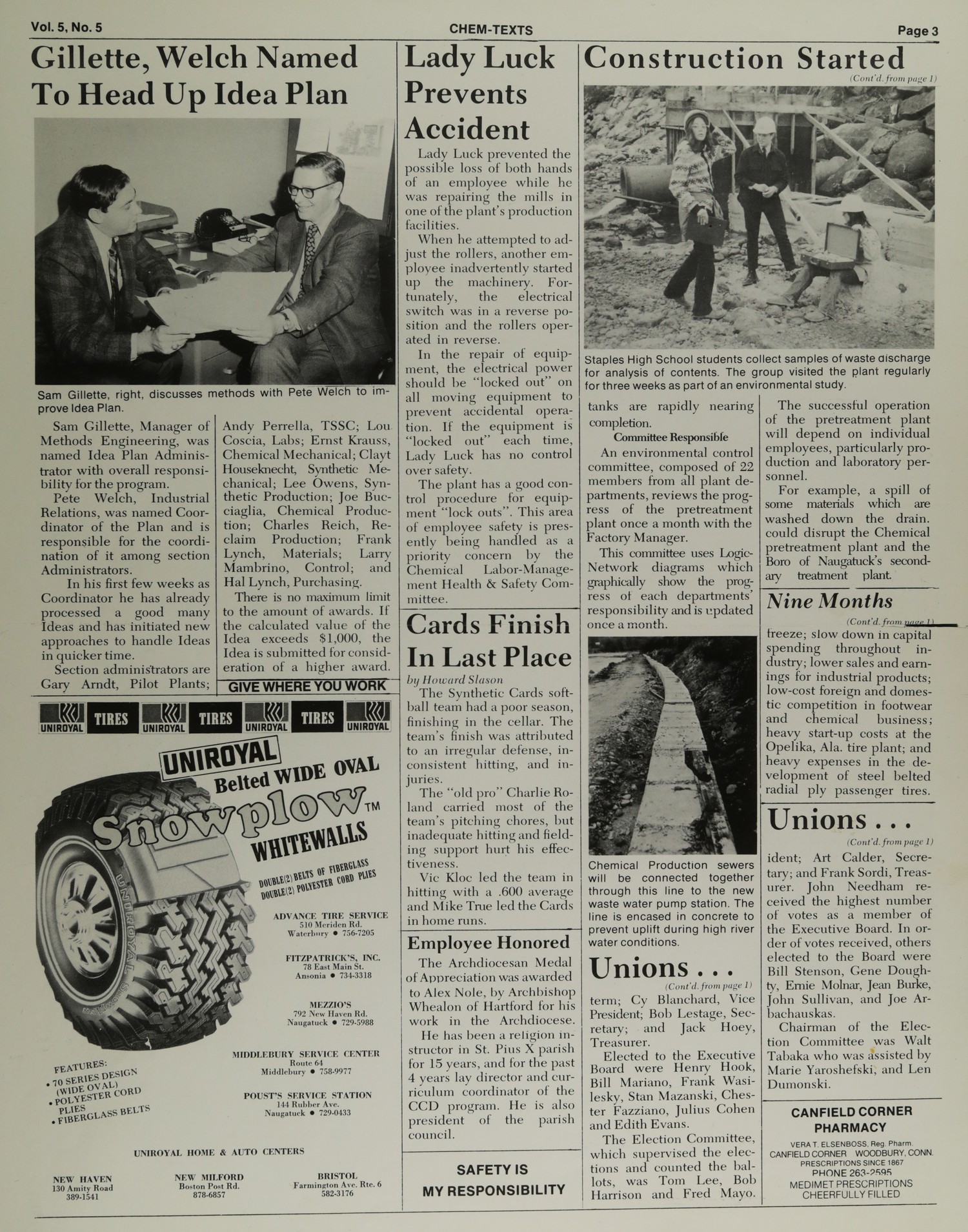
MEZZIO’S
792 New Haven Rd.
Naugatuck—729-5988

• Double fiberglass belts for hazard protection and mileage
• 78 Series design for traction