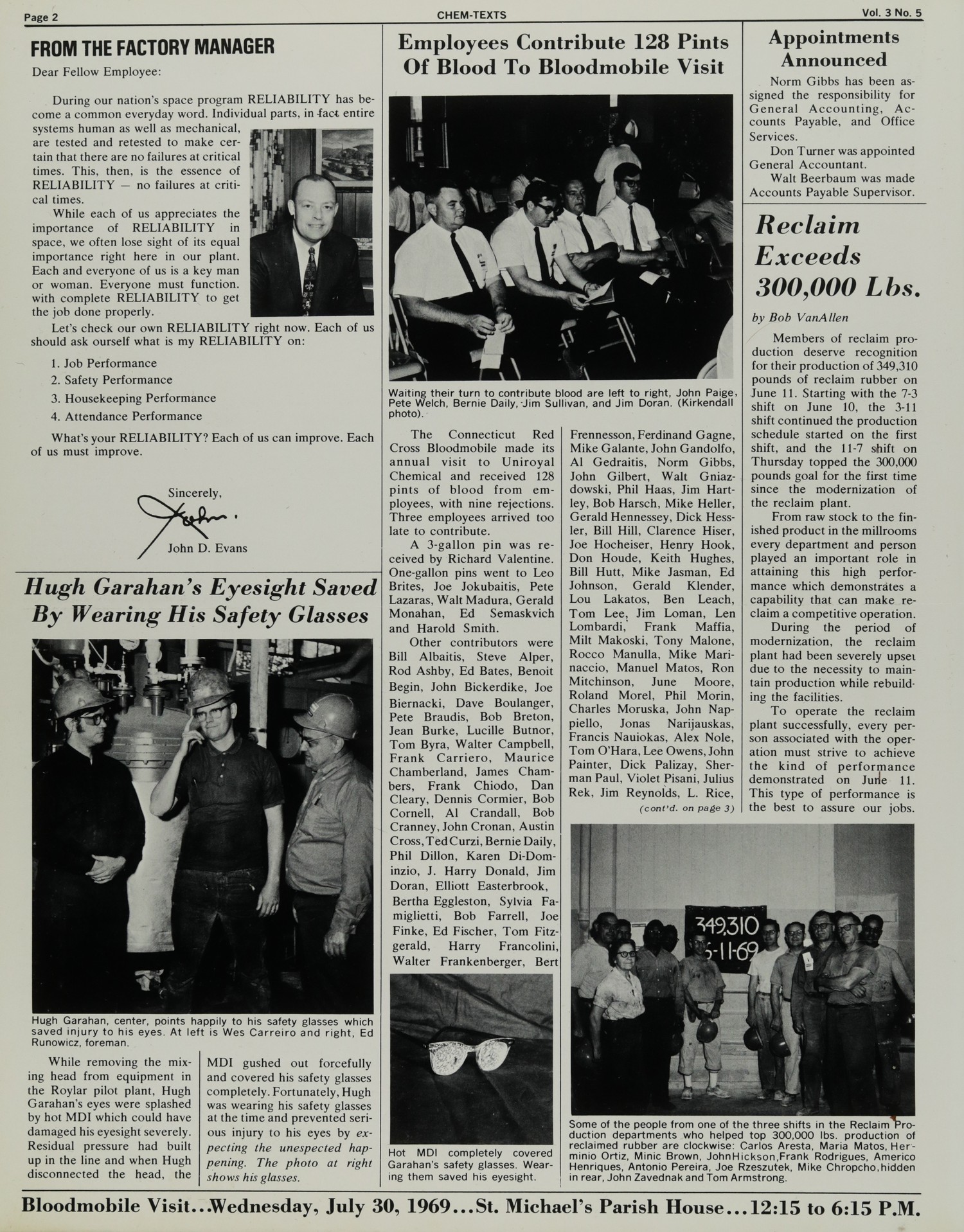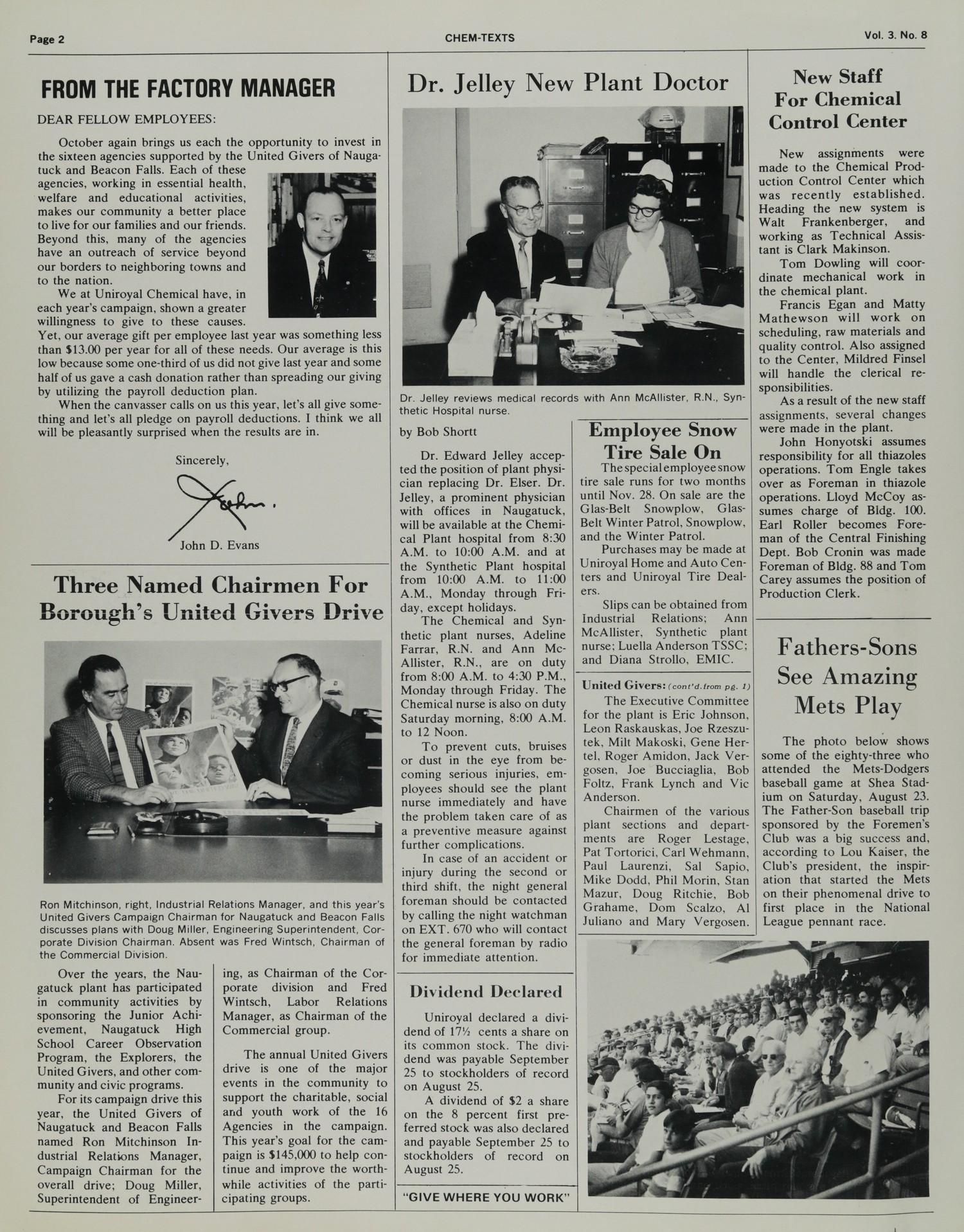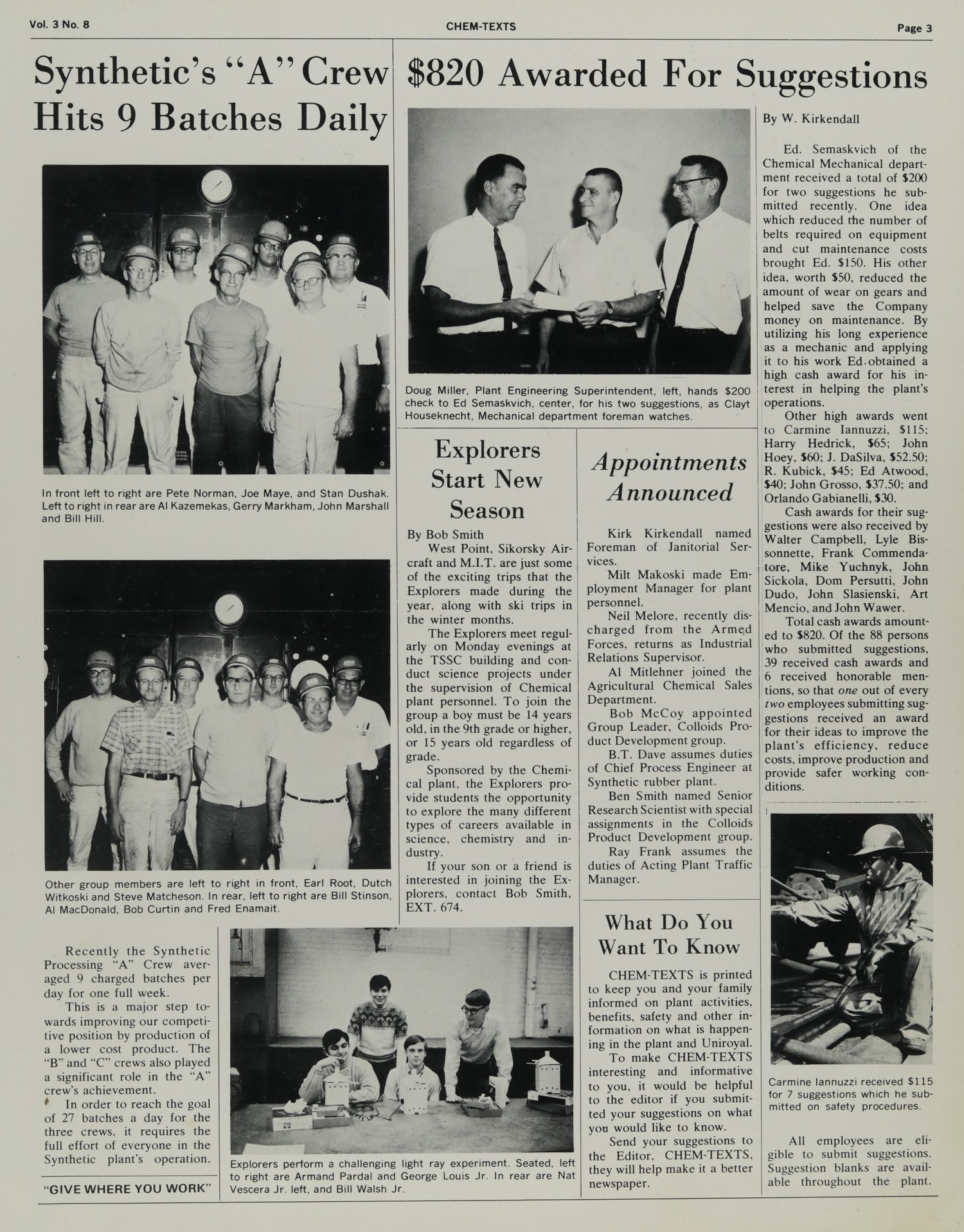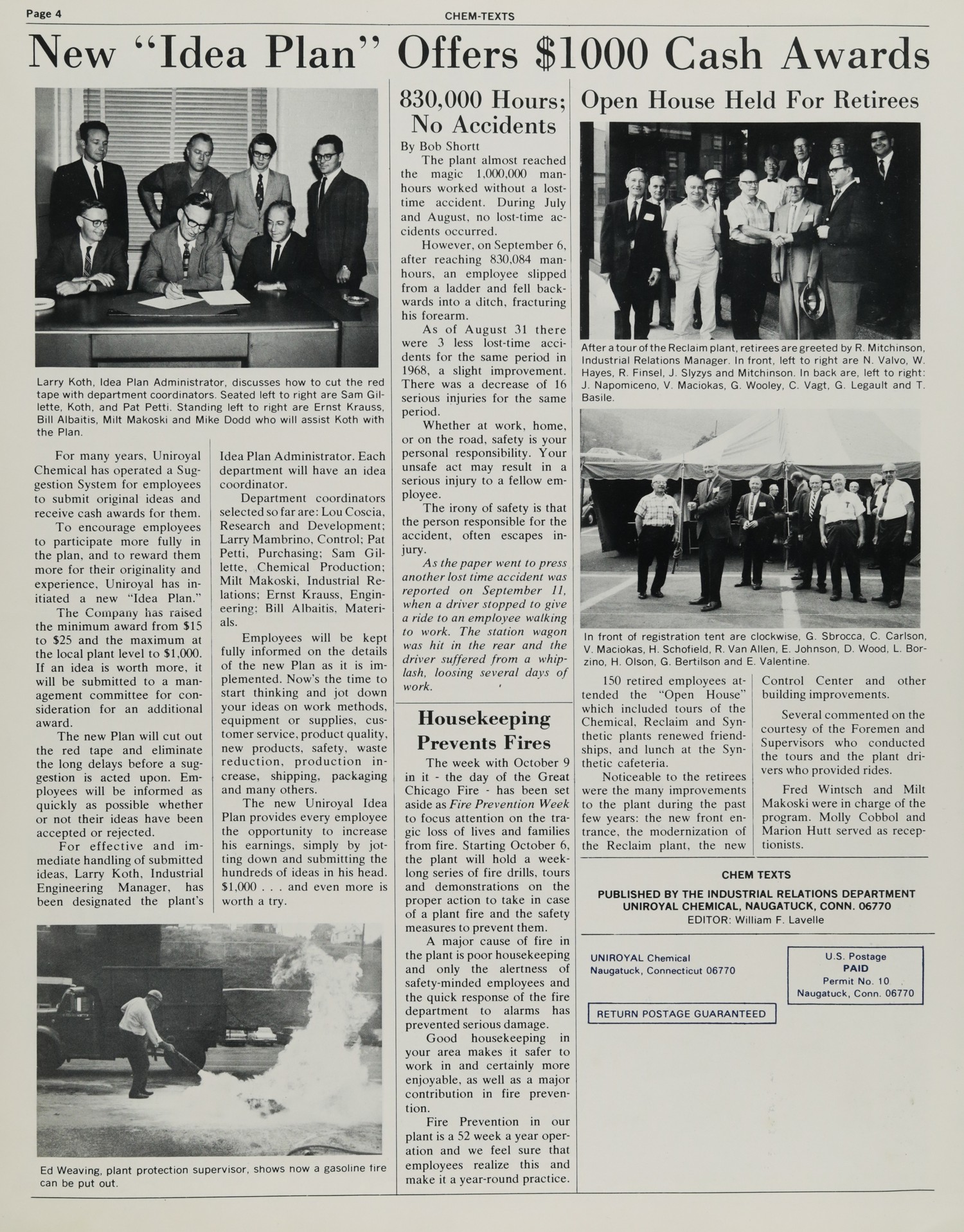
CHEM-TEXTS – Vol. 5 No. 4 – Page 4

Page 004

Page 4 | CHEM-TEXTS | Vol. 5 No. 4


Know Your Products:

Naugatuck® Chemical Antioxidants

by Dr. Bob Brown

(This is the third in a series of articles on the chemicals manufactured in Chemical Production or sold by the Chemical Division.)

If we didn’t have antioxidants and antiozonants, rubber products would fall apart, before we could wear them out.

In fact, most kinds of synthetic rubber can’t even be manufactured without some type of a protective chemical to get them through the drying and storage stages.

Polygard®, for example, is used extensively by the synthetic rubber plants as a stabilizer (antioxidant) during processing and manufacture. It is not only an excellent antioxidant but it does not discolor or stain the rubber, therefore it can be used for white and light colored rubber articles.

If the rubber is to be manufactured into a black or dark colored product (such as tires) the customer may prefer to use BLE® which discolors the rubber, but also carries its protection over into the finished product to a greater extent than Polygard.

New Chemicals Developed For Synthetic Rubbers

The newer types of synthetic rubber required new types of antioxidants to protect them against oxygen and heat degradation.

Antioxidant 451 was especial-

purpose and is used in cis-polybutadiene rubber. Antioxidant 449 was also developed for a new, and different type of synthetic rubber, EPT: Royalene® the crackless rubber, made at the Chemical Division’s Geismar, La. plant.

Chemicals Vary In Color and Protection

In the development of antioxidants there is always the problem that the chemical structure which provides the best protection against oxygen and heat also causes the worst discoloration in the rubber. Generally speaking, all antioxidants cause some degree of discoloration from a very slight yellowing to a very brownish black discoloration. Usually a chemical which discolors only slightly, gives poorer protection.

Antioxidant 431 (VCIU) is such a chemical. It gives the best color but less protection against oxygen and heat.

Naugawhite® Antioxidant 439 and Antioxidant 451 are a little further down the color scale, but are somewhat more effective as antioxidants. These chemicals are used in latex foam, footwear and household products which are usually made from a bright color rubber.

(This series of articles on Rubber Chemicals will be concluded in the next issue of Chem-Texts.)


Plant Safety

(cont’d. from page 1)

and is still in the Intensive Care unit of St. Mary’s Hospital.

Disaster Plan Operates

A few minutes after the explosion members of the Disaster Plan arrived at the plant and assumed their responsibilities during the emergency. One evidence of the Plan’s effectiveness was the swift medical attention provided the injured employee—he was receiving medical care by a team of specialists at St. Mary’s Hospital ten minutes after the accident.

The cause of the explosion is still under investigation.

Other Accidents In Period

Other injuries during the 8 week period were: one employee suffered partial loss of a finger; an employee cut his hand with a knife requiring ten stitches; another employee dropped a valve on his foot and broke a toe; an employee injured his eye when a flying chip struck his eyeball; two employees suffered severe burns from steaming hot water and a steam hose; and another employee broke an ankle when a ladder slipped and he fell off it backwards.

Where Accidents Occurred, July 10 to Sept. 4

Dept. Lost Time Serious Injuries
Chem. Prod 4 1
Reclaim Prod. 3 2
Syn. Prod. 3 1
Materials 0 1
Mechanical 1 4
Res. & Devel. 1 0
TOTAL 12 9

Two Employees Retire

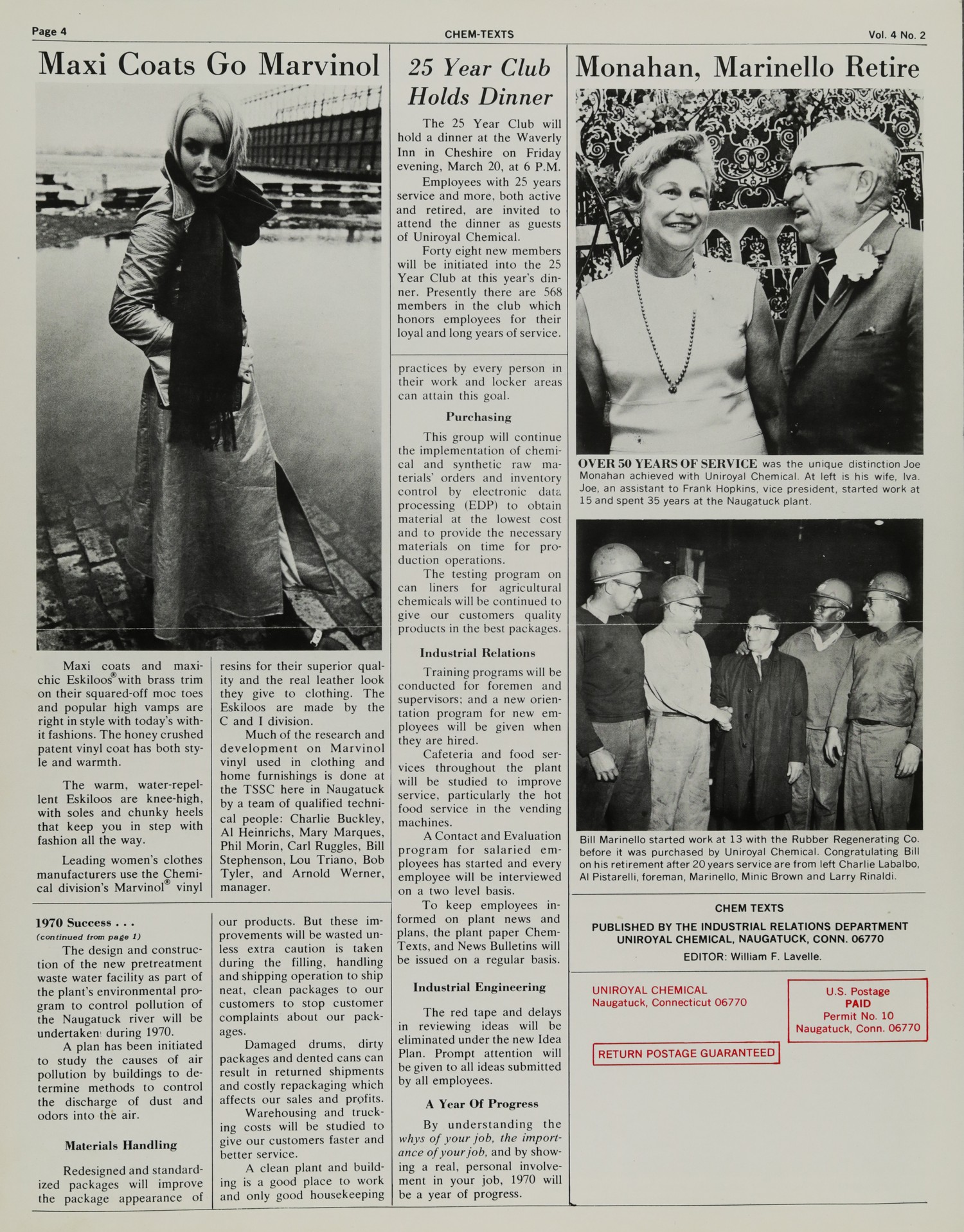
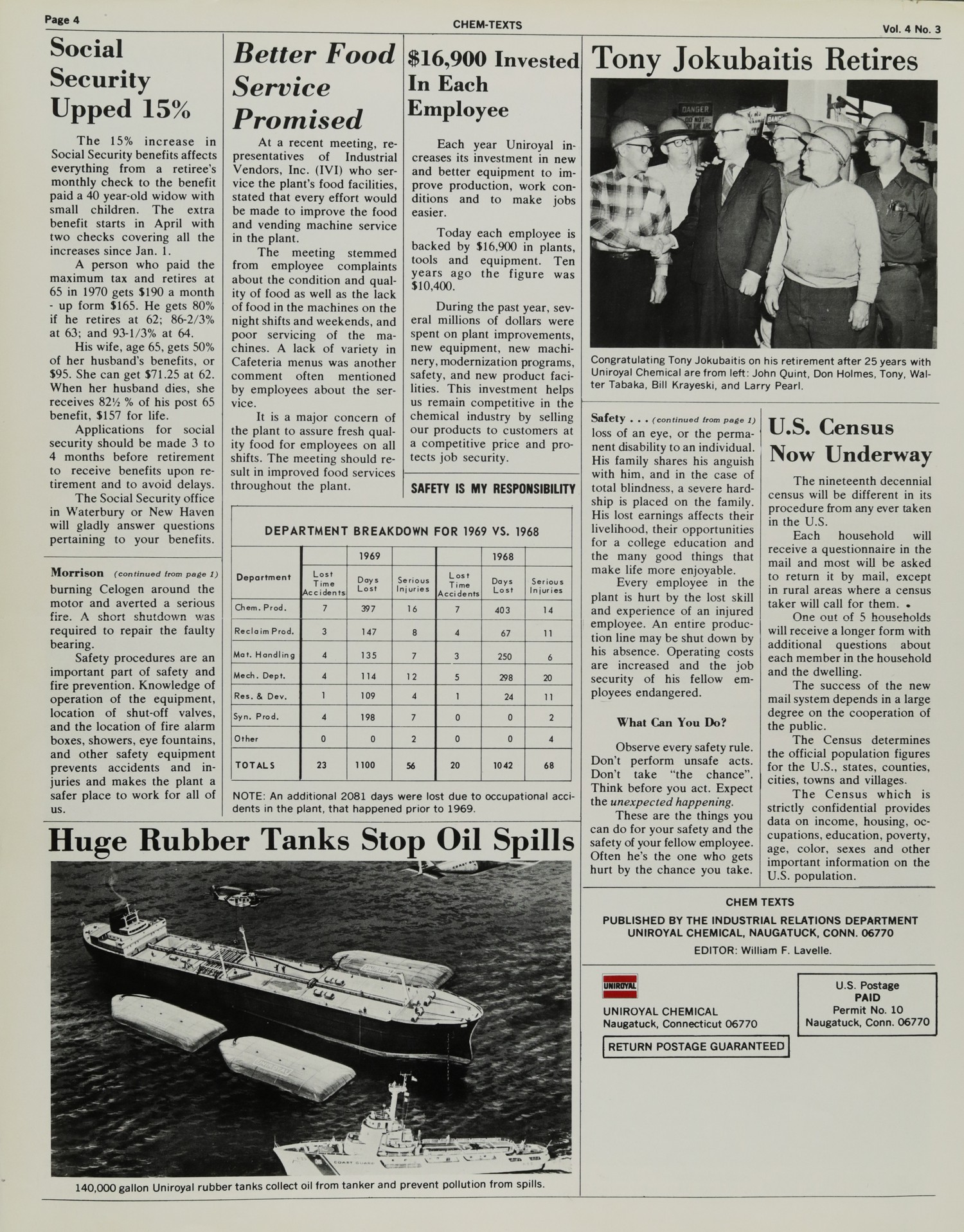
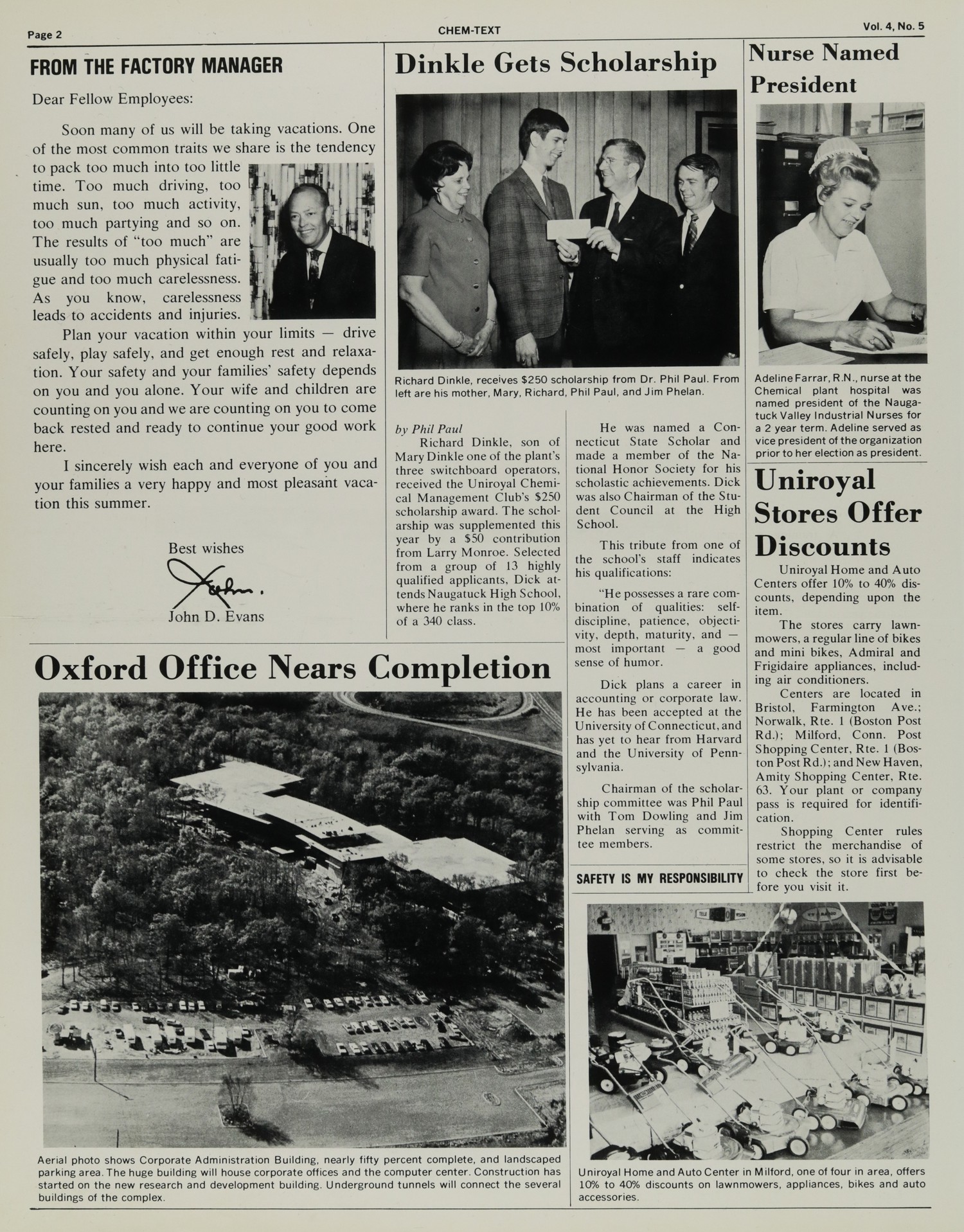
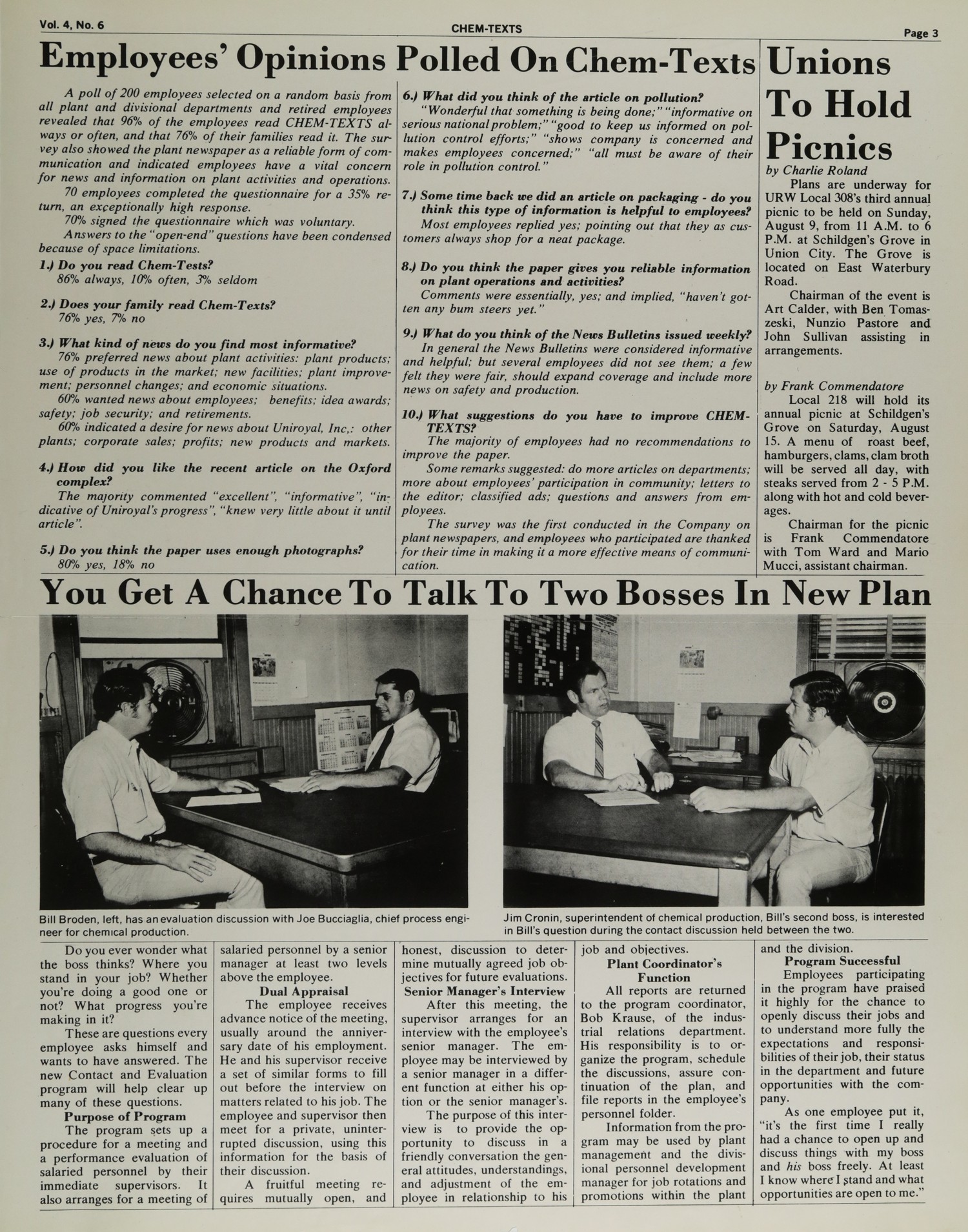
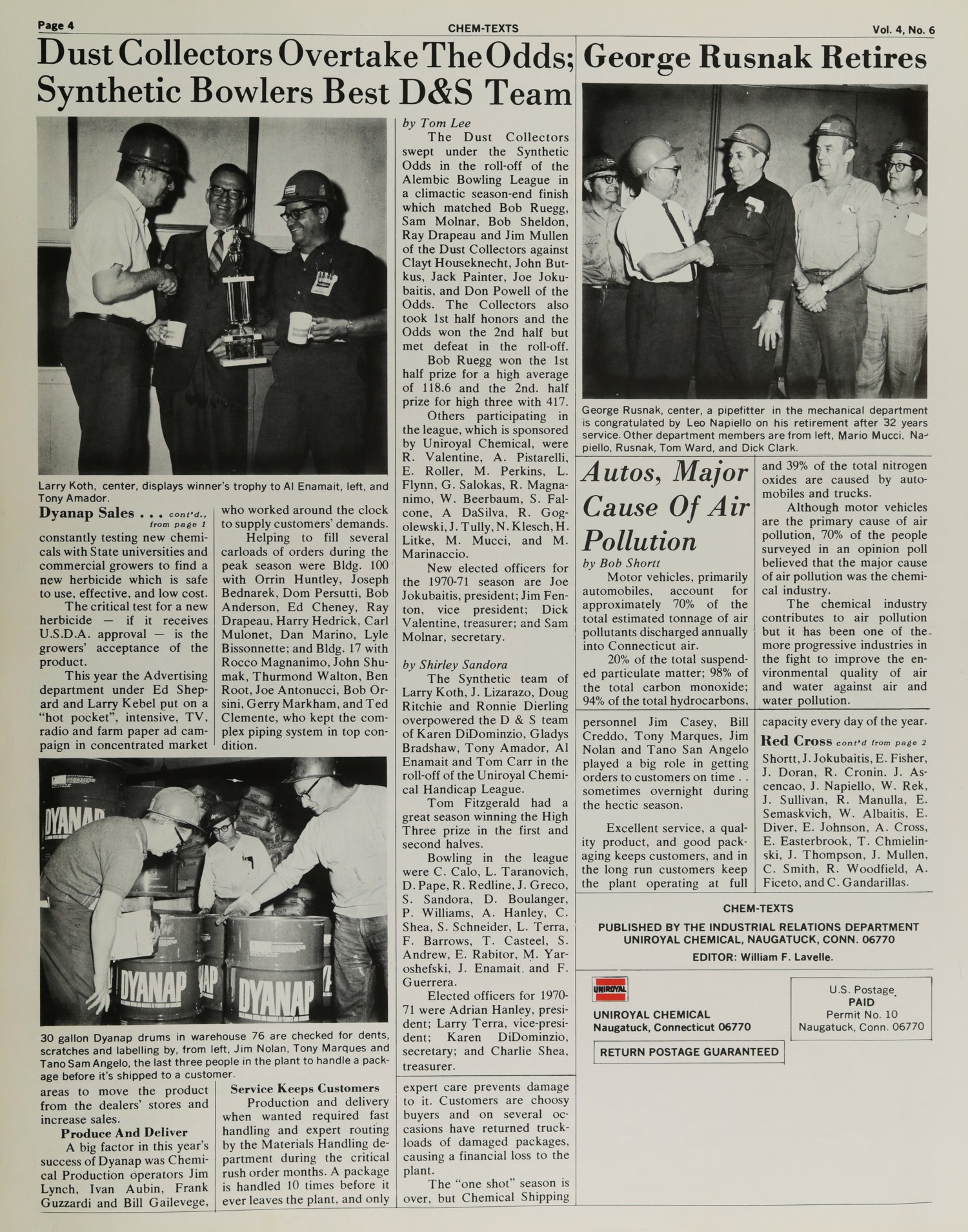
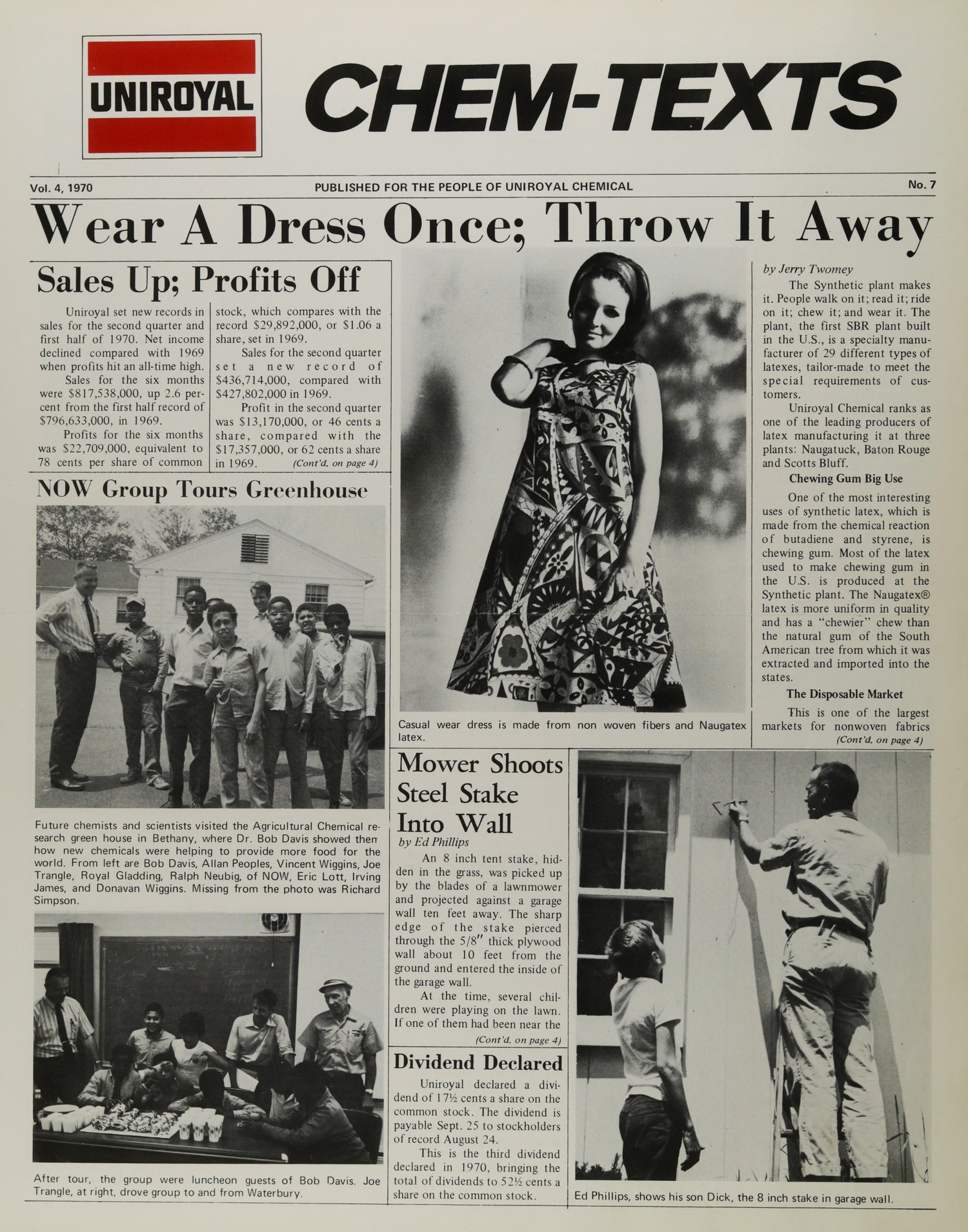
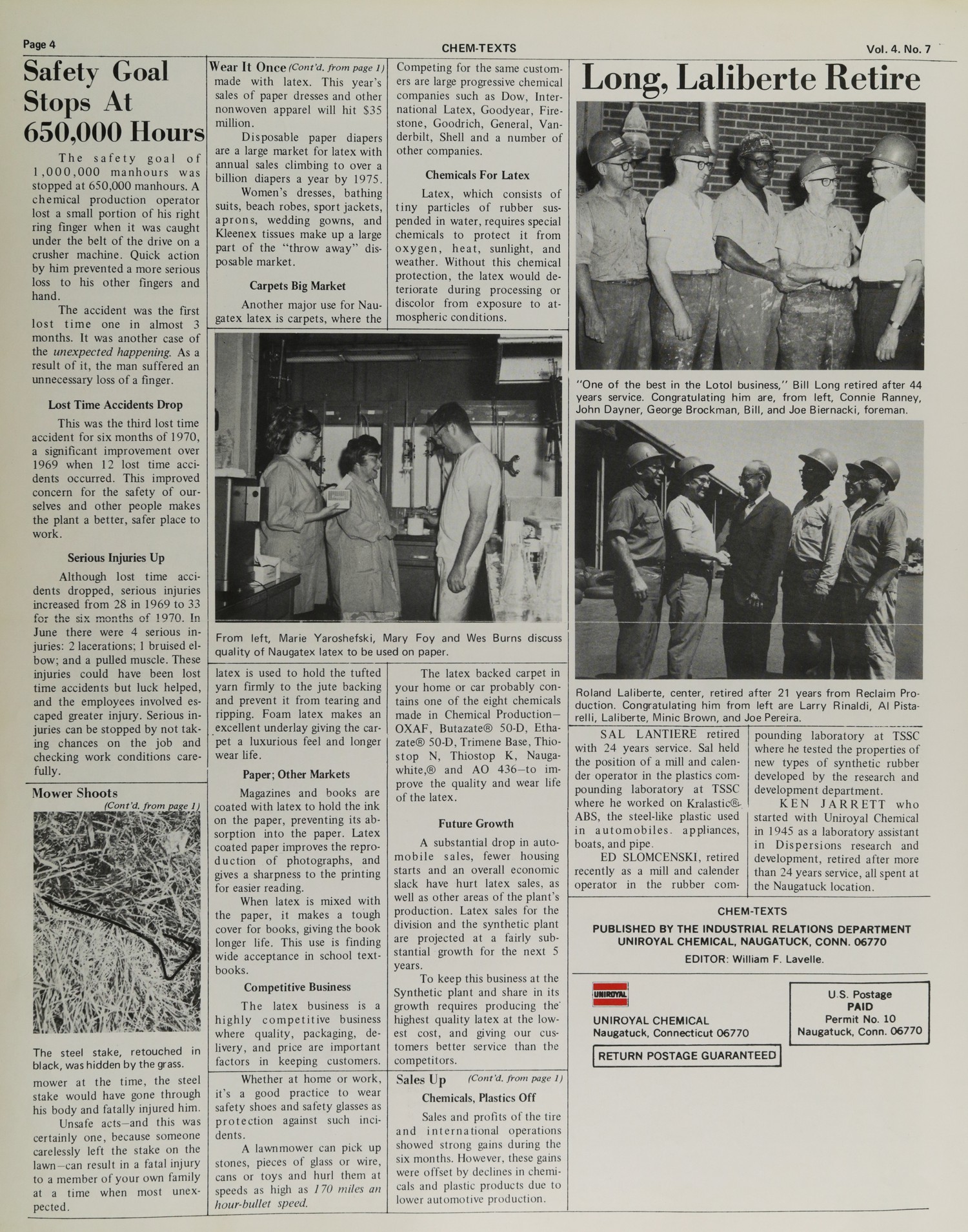
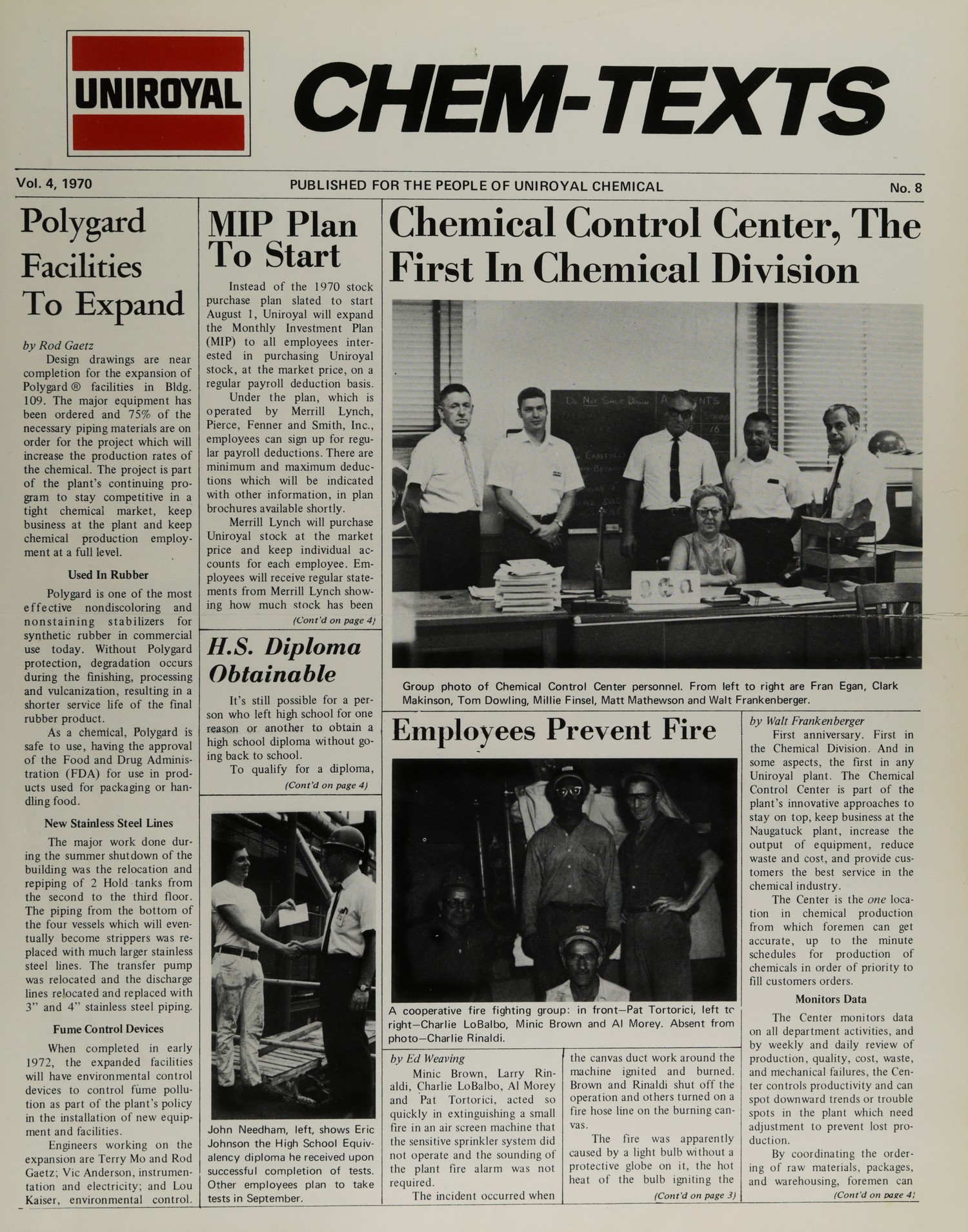
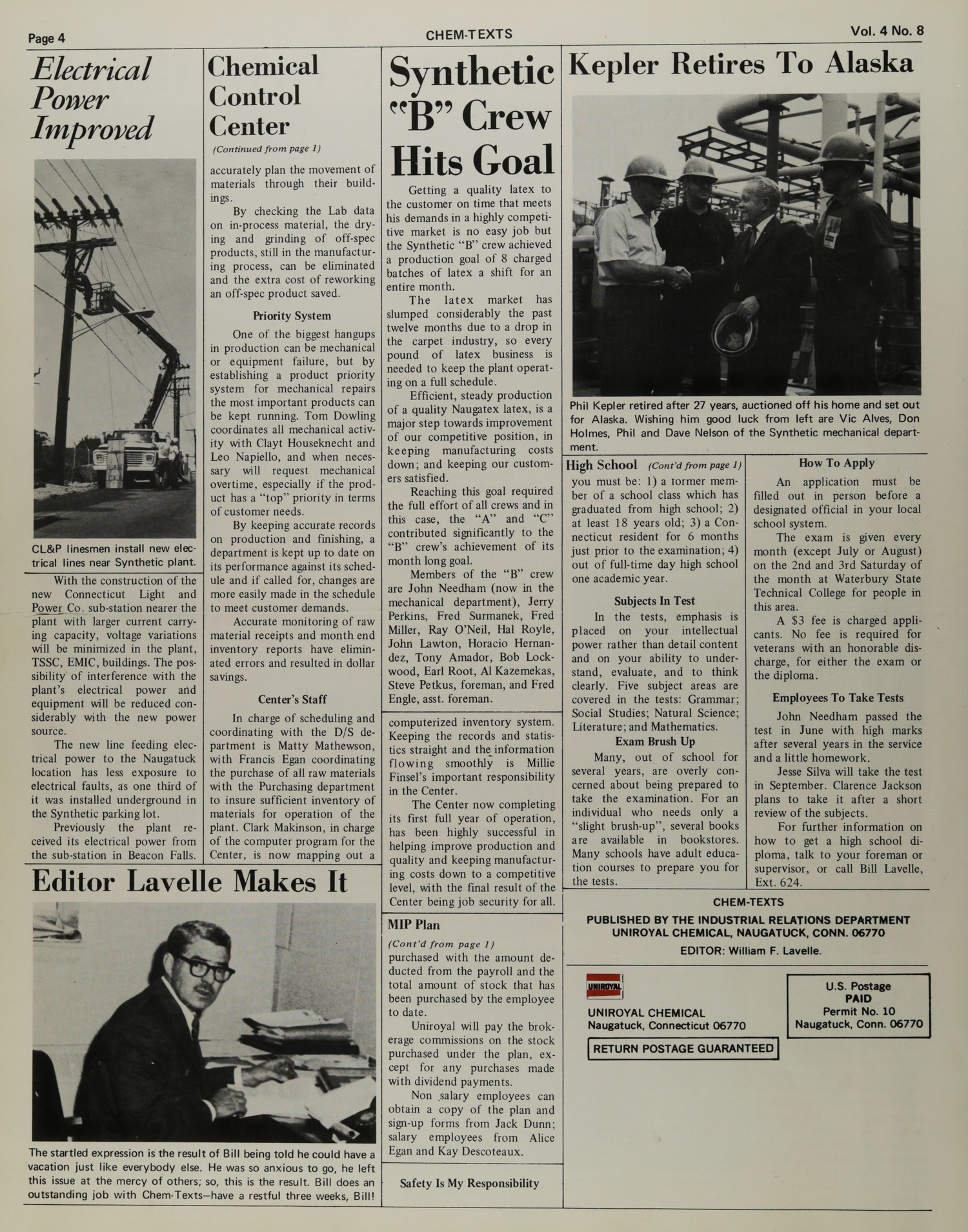
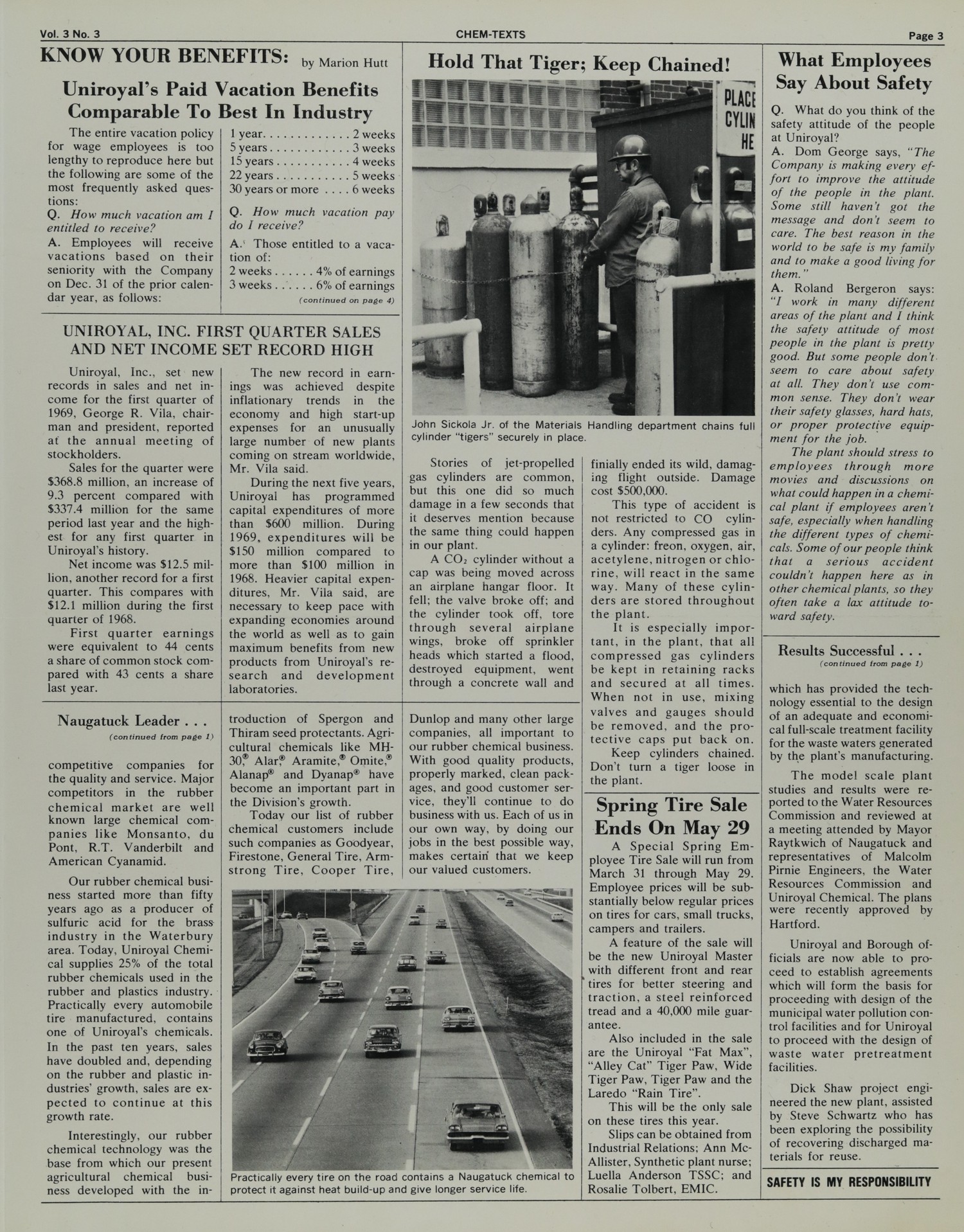
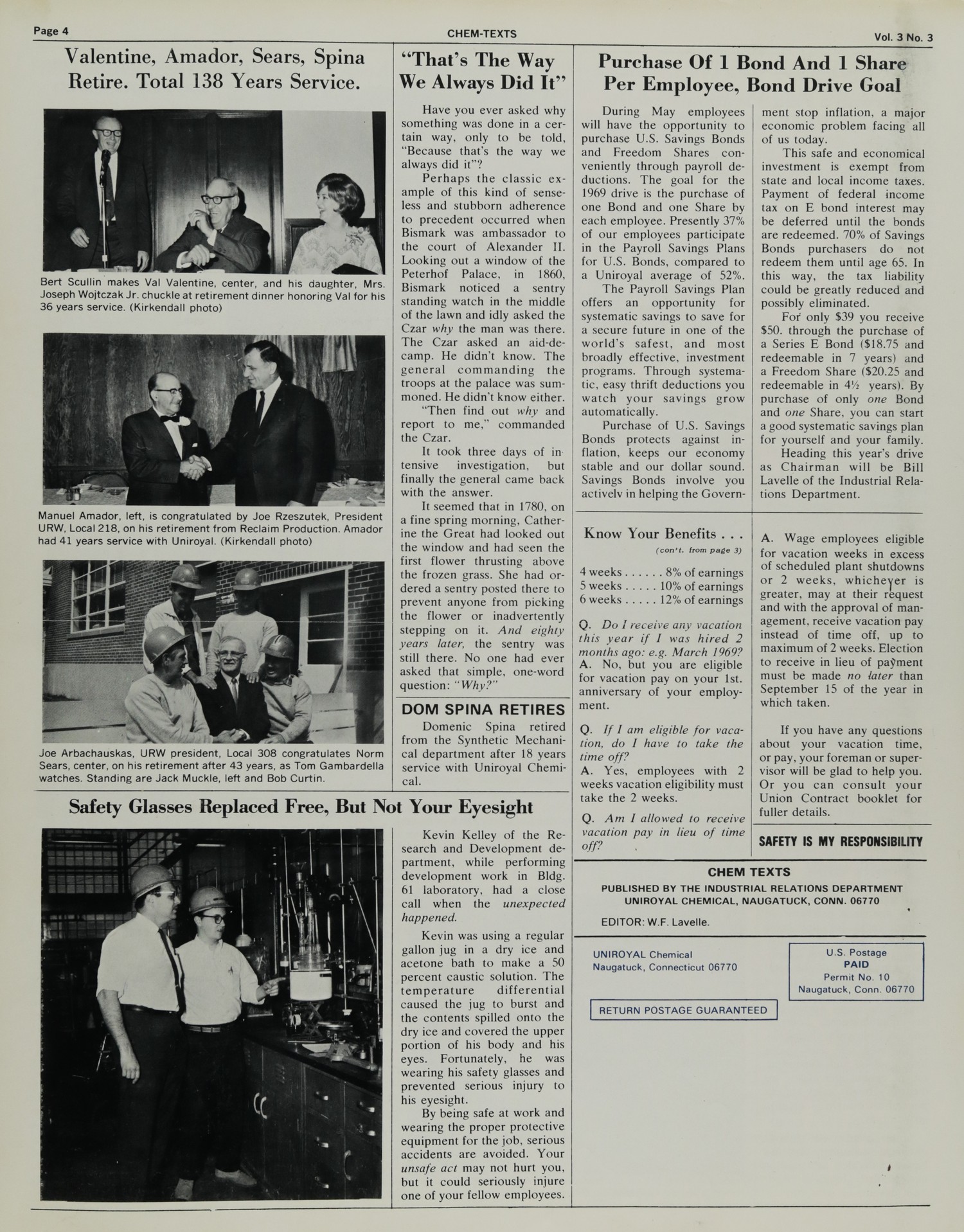
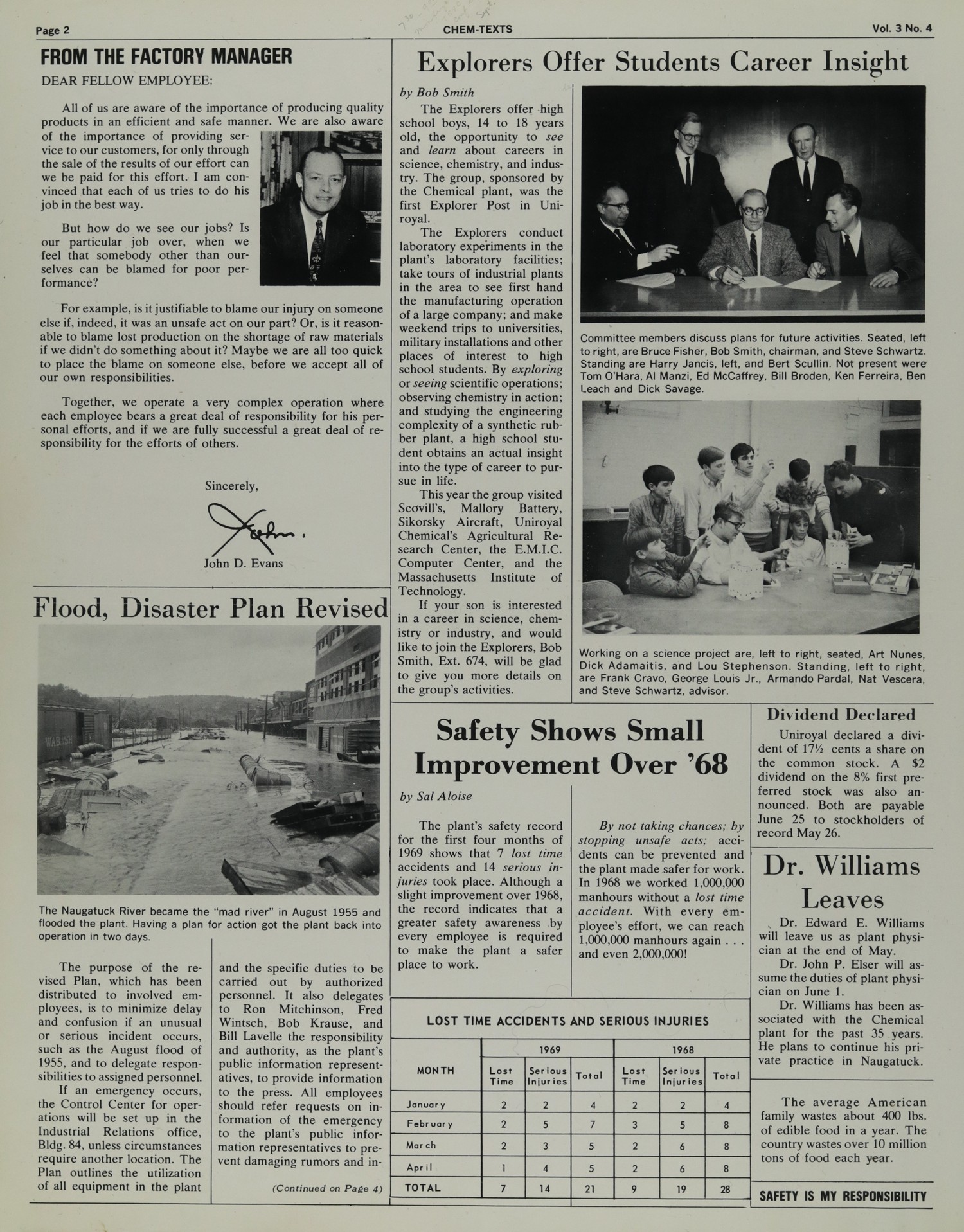
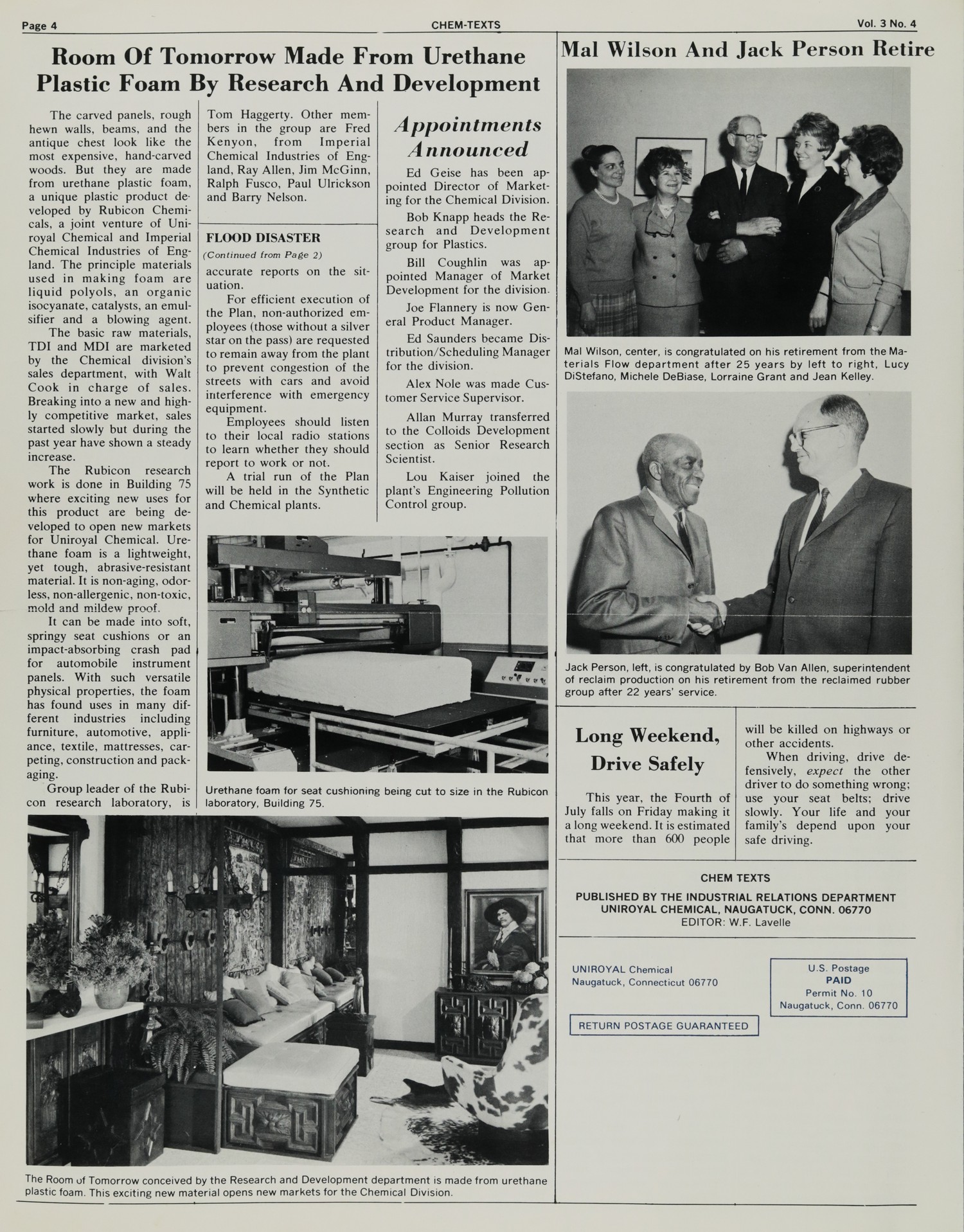
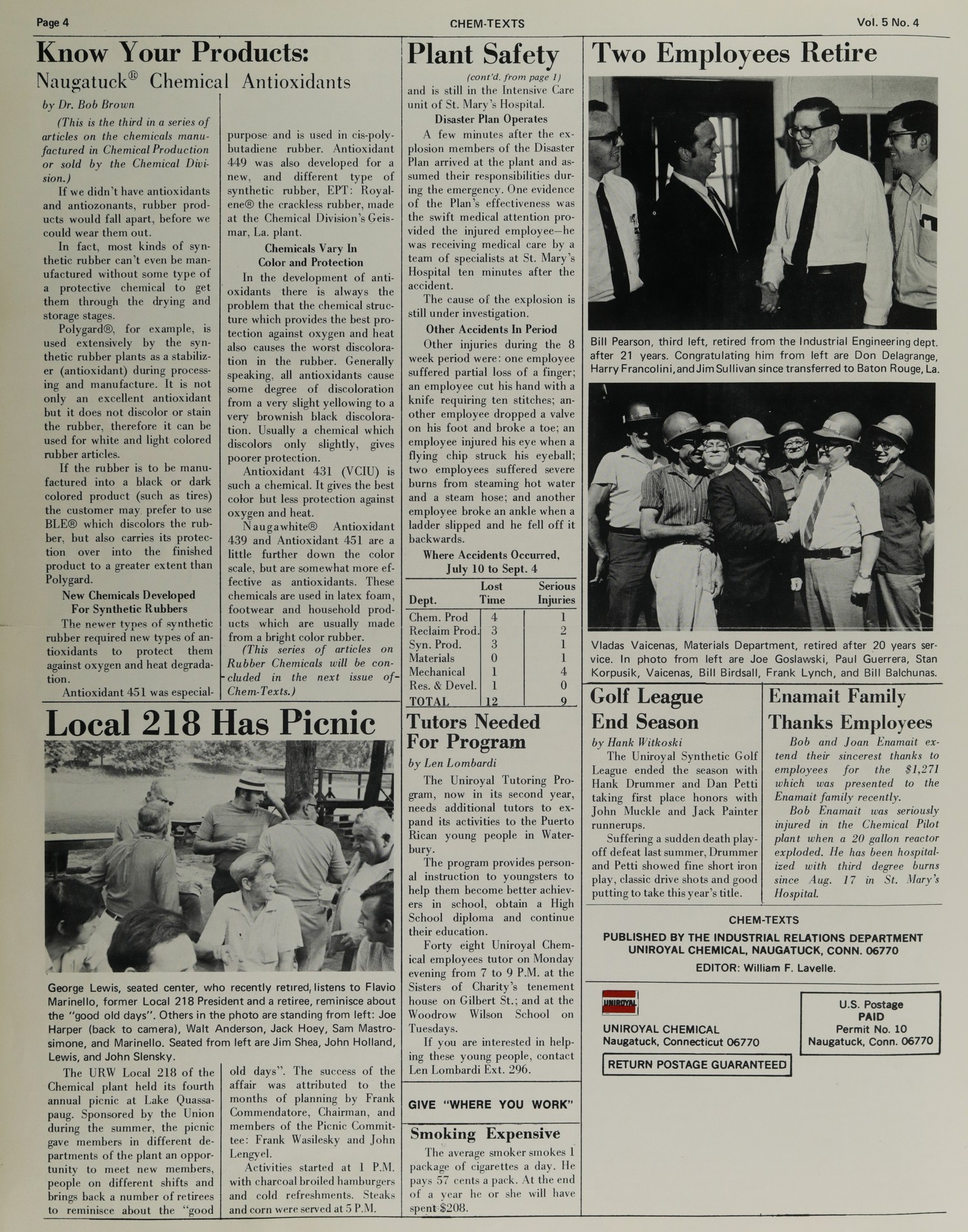
Bill Pearson, third left, retired from the Industrial Engineering dept. after 21 years. Congratulating him from left are Don Delagrange, Harry Francolini, and Jim Sullivan since transferred to Baton Rouge, La.

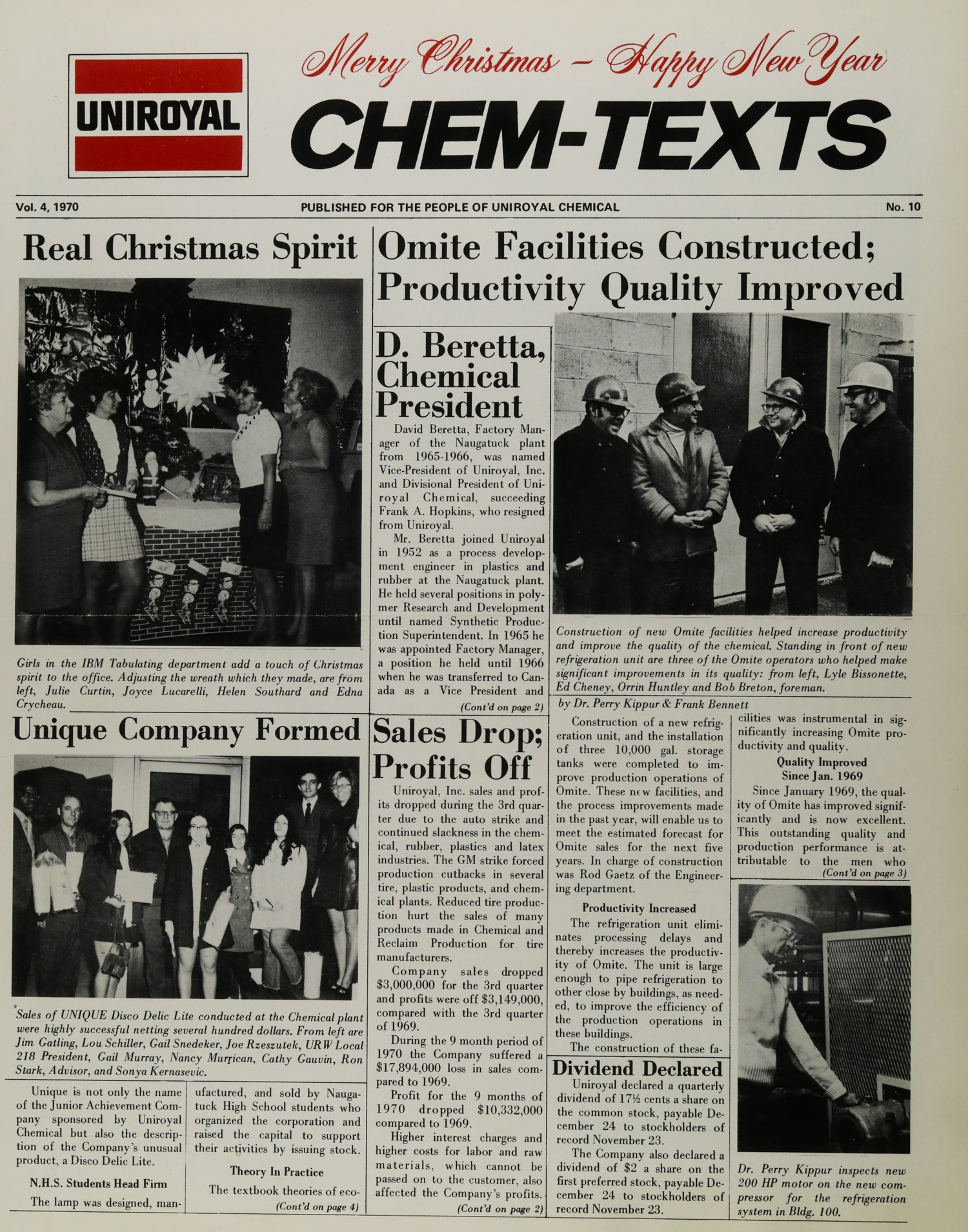
Vladas Vaicenas, Materials Department, retired after 20 years service. In photo from left are Joe Goslawski, Paul Guerrera, Stan Korpusik, Vaicenas, Bill Birdsall, Frank Lynch, and Bill Balchunas.


Local 218 Has Picnic

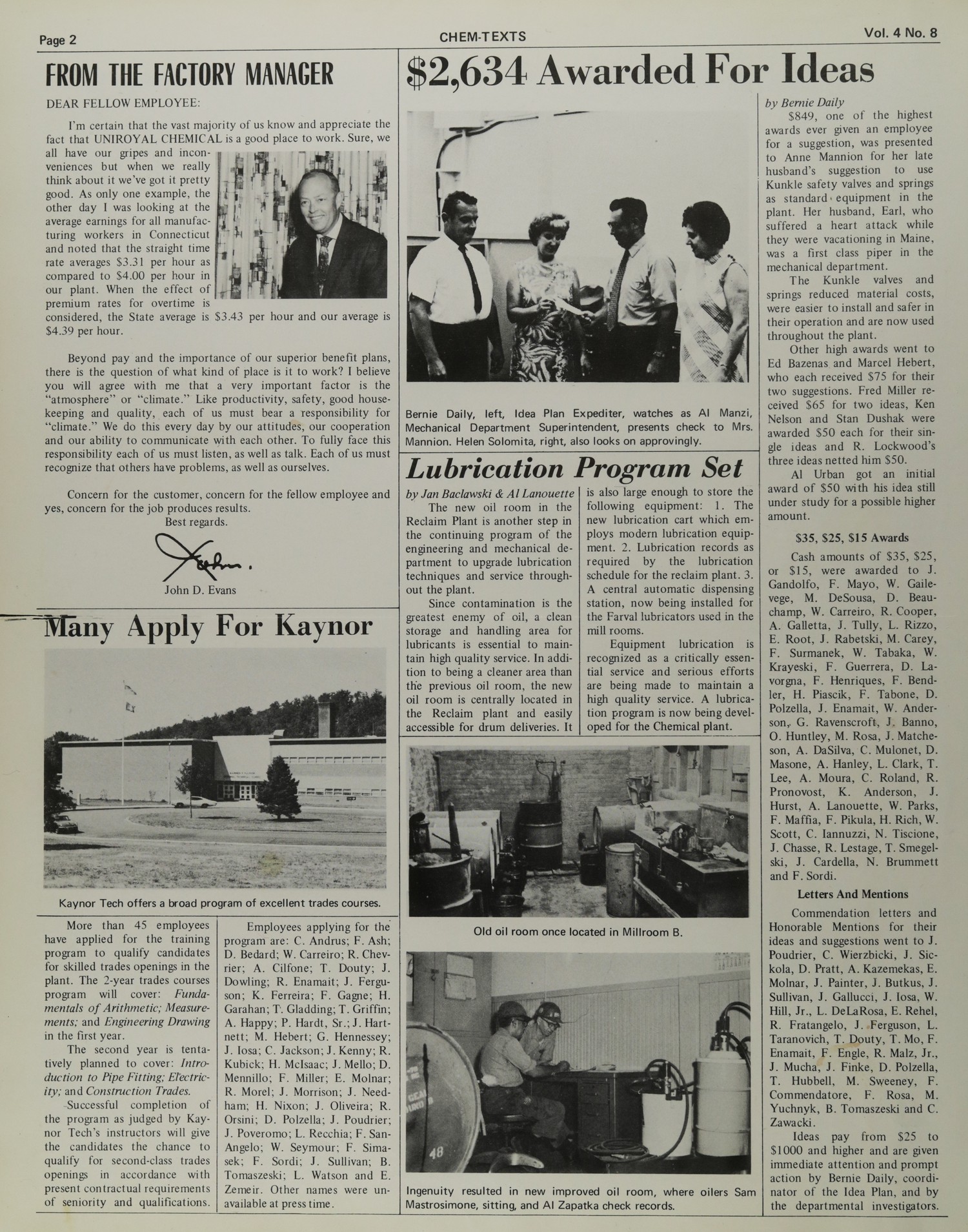
George Lewis, seated center, who recently retired, listens to Flavio Marinello, former Local 218 President and a retiree, reminisce about the “good old days”. Others in the photo are standing from left: Joe Harper (back to camera), Walt Anderson, Jack Hoey, Sam Mastrosimone, and Marinello. Seated from left are Jim Shea, John Holland, Lewis, and John Slensky.

The URW Local 218 of the Chemical plant held its fourth annual picnic at Lake Quassapaug. Sponsored by the Union during the summer, the picnic gave members in different departments of the plant an opportunity to meet new members, people on different shifts and brings back a number of retirees to reminisce about the “good old days”. The success of the affair was attributed to the months of planning by Frank Commendatore, Chairman, and members of the Picnic Committee: Frank Wasilesky and John Lengyel.

Activities started at 1 P.M. with charcoal broiled hamburgers and cold refreshments. Steaks and corn were served at 5 P.M.


Tutors Needed For Program

by Len Lombardi

The Uniroyal Tutoring Program, now in its second year, needs additional tutors to expand its activities to the Puerto Rican young people in Waterbury.

The program provides personal instruction to youngsters to help them become better achievers in school, obtain a High School diploma and continue their education.

Forty eight Uniroyal Chemical employees tutor on Monday evening from 7 to 9 P.M. at the Sisters of Charity’s tenement house on Gilbert St.; and at the Woodrow Wilson School on Tuesdays.

If you are interested in helping these young people, contact Len Lombardi Ext. 296.


GIVE “WHERE YOU WORK”


Smoking Expensive

The average smoker smokes 1 package of cigarettes a day. He pays 57 cents a pack. At the end of a year he or she will have spent $208.


Golf League End Season

by Hank Witkoski

The Uniroyal Synthetic Golf League ended the season with Hank Drummer and Dan Petti taking first place honors with John Muckle and Jack Painter runnerups.

Suffering a sudden death playoff defeat last summer, Drummer and Petti showed fine short iron play, classic drive shots and good putting to take this year’s title.


Enamait Family Thanks Employees

Bob and Joan Enamait extend their sincerest thanks to employees for the $1,271 which was presented to the Enamait family recently.

Bob Enamait was seriously injured in the Chemical Pilot plant when a 20 gallon reactor exploded. He has been hospitalized with third degree burns since Aug. 17 in St. Mary’s Hospital.


CHEM-TEXTS

PUBLISHED BY THE INDUSTRIAL RELATIONS DEPARTMENT
UNIROYAL CHEMICAL, NAUGATUCK, CONN. 06770

EDITOR: William F. Lavelle.


UNIROYAL

UNIROYAL CHEMICAL
Naugatuck, Connecticut 06770

RETURN POSTAGE GUARANTEED

U.S. Postage
PAID
Permit No. 10
Naugatuck, Conn. 06770
CHEM-TEXTS – Vol. 5, No. 5 – Page 3

Page 003

CHEM-TEXTS

Vol. 5, No. 5 Page 3


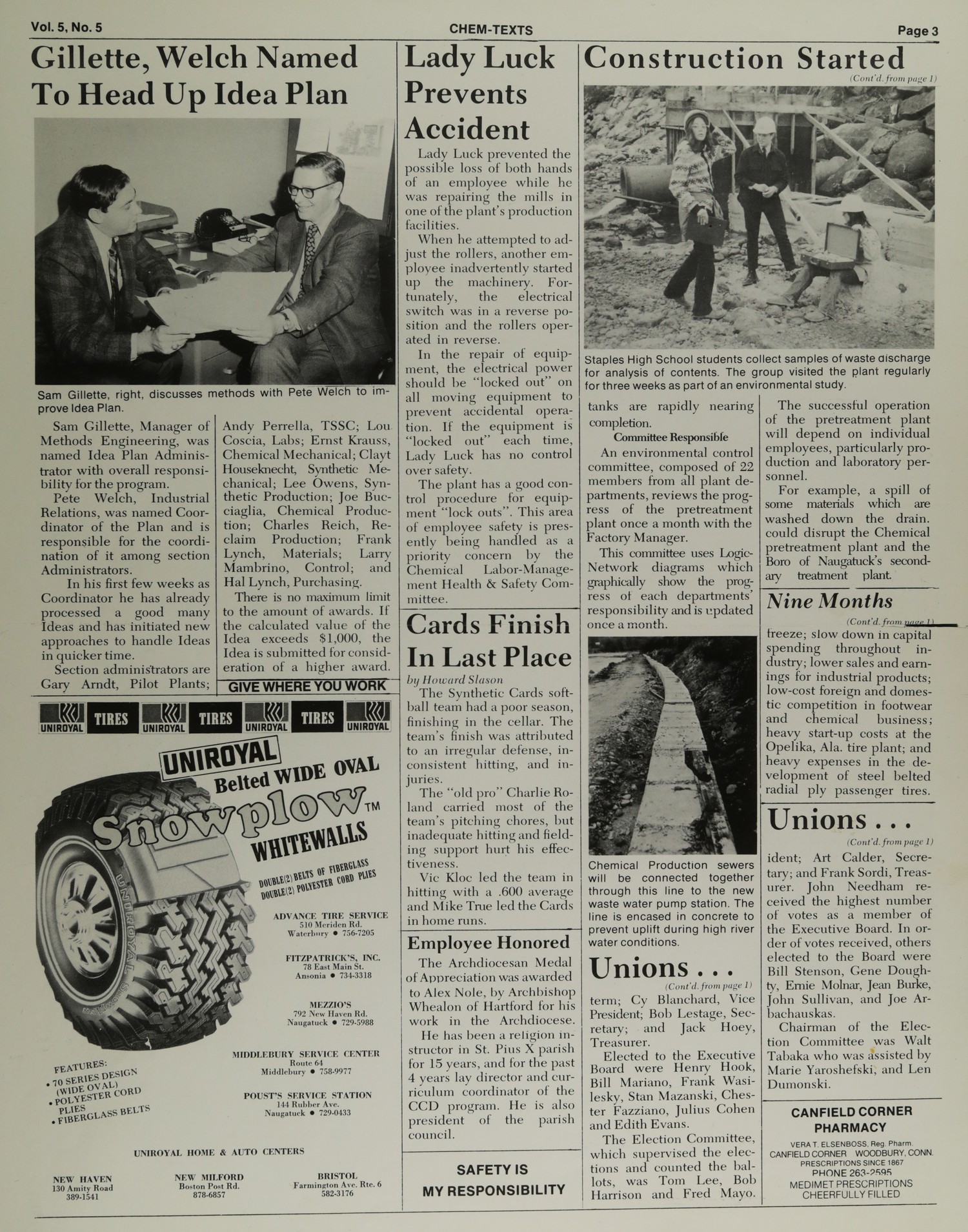
Gillette, Welch Named To Head Up Idea Plan

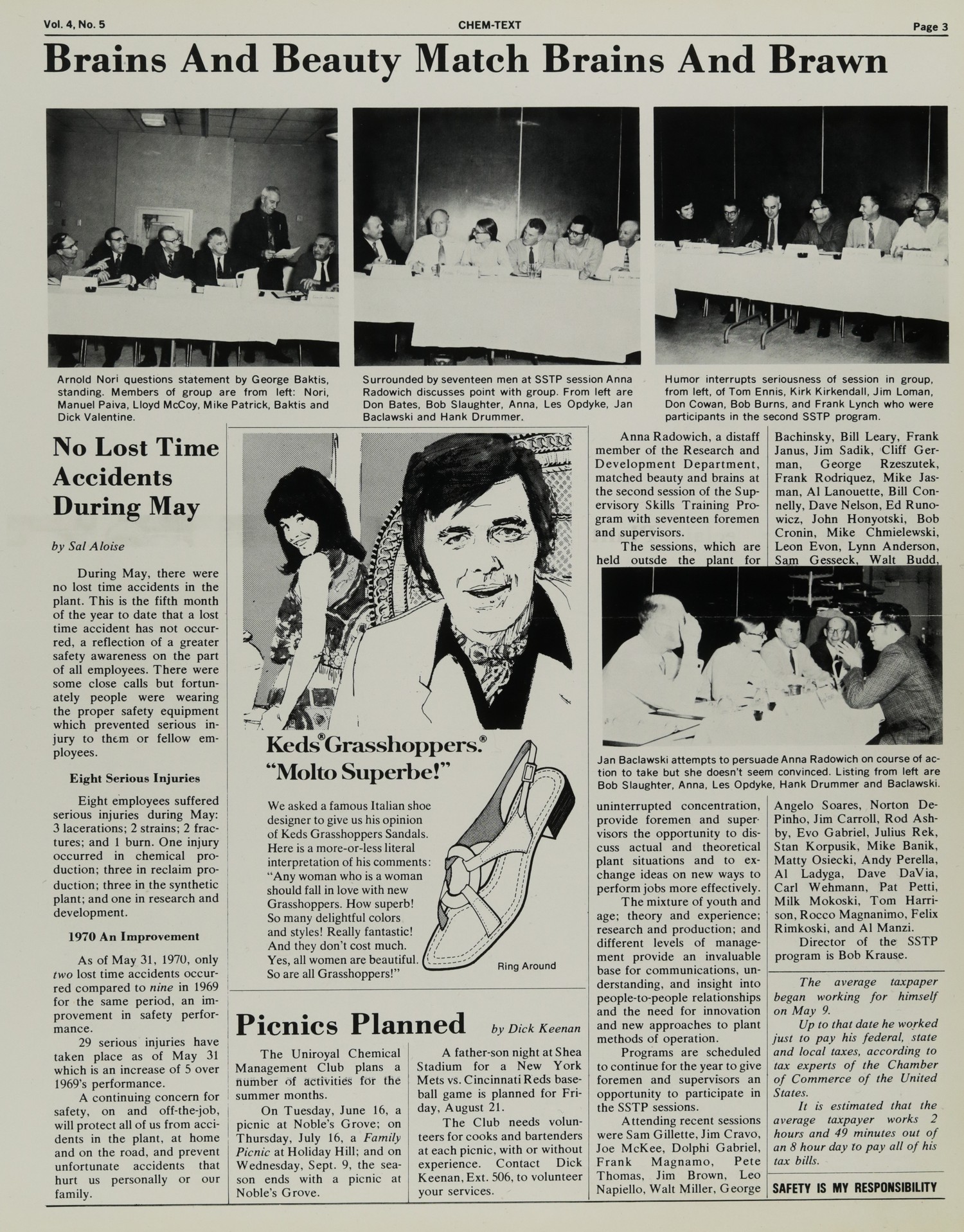
[IMAGE: Sam Gillette, right, discusses methods with Pete Welch to improve Idea Plan.]

Sam Gillette, Manager of Methods Engineering, was named Idea Plan Administrator with overall responsibility for the program.

Pete Welch, Industrial Relations, was named Coordinator of the Plan and is responsible for the coordination of it among section Administrators.

In his first few weeks as Coordinator he has already processed a good many Ideas and has initiated new approaches to handle Ideas in quicker time.

Section administrators are Gary Arndt, Pilot Plants; Andy Perrella, TSSC; Lou Coscia, Labs; Ernst Krauss, Chemical Mechanical; Clayt Houseknecht, Synthetic Mechanical; Lee Owens, Synthetic Production; Joe Bucciaglia, Chemical Production; Charles Reich, Reclaim Production; Frank Lynch, Materials; Larry Mambrino, Control; and Hal Lynch, Purchasing.

There is no maximum limit to the amount of awards. If the calculated value of the Idea exceeds $1,000, the Idea is submitted for consideration of a higher award.

GIVE WHERE YOU WORK


Lady Luck Prevents Accident

Lady Luck prevented the possible loss of both hands of an employee while he was repairing the mills in one of the plant’s production facilities.

When he attempted to adjust the rollers, another employee inadvertently started up the machinery. Fortunately, the electrical switch was in a reverse position and the rollers operated in reverse.

In the repair of equipment, the electrical power should be “locked out” on all moving equipment to prevent accidental operation. If the equipment is “locked out” each time, Lady Luck has no control over safety.

The plant has a good control procedure for equipment “lock outs”. This area of employee safety is presently being handled as a priority concern by the Chemical Labor-Management Health & Safety Committee.


Cards Finish In Last Place

by Howard Slason

The Synthetic Cards softball team had a poor season, finishing in the cellar. The team’s finish was attributed to an irregular defense, inconsistent hitting, and injuries.

The “old pro” Charlie Roland carried most of the team’s pitching chores, but inadequate hitting and fielding support hurt his effectiveness.

Vic Kloc led the team in hitting with a .600 average and Mike True led the Cards in home runs.


Employee Honored

The Archdiocesan Medal of Appreciation was awarded to Alex Nole, by Archbishop Whealon of Hartford for his work in the Archdiocese.

He has been a religion instructor in St. Pius X parish for 15 years, and for the past 4 years lay director and curriculum coordinator of the CCD program. He is also president of the parish council.


SAFETY IS MY RESPONSIBILITY


Construction Started

(Cont’d. from page 1)

[IMAGE: Staples High School students collect samples of waste discharge for analysis of contents. The group visited the plant regularly for three weeks as part of an environmental study.]

tanks are rapidly nearing completion.

Committee Responsible

An environmental control committee, composed of 22 members from all plant departments, reviews the progress of the pretreatment plant once a month with the Factory Manager.

This committee uses Logic-Network diagrams which graphically show the progress of each departments’ responsibility and is updated once a month.

The successful operation of the pretreatment plant will depend on individual employees, particularly production and laboratory personnel.

For example, a spill of some materials which are washed down the drain, could disrupt the Chemical pretreatment plant and the Boro of Naugatuck’s secondary treatment plant.


Nine Months

(Cont’d. from page 1)

freeze; slow down in capital spending throughout industry; lower sales and earnings for industrial products; low-cost foreign and domestic competition in footwear and chemical business; heavy start-up costs at the Opelika, Ala. tire plant; and heavy expenses in the development of steel belted radial ply passenger tires.


Unions…

(Cont’d. from page 1)

Chemical Production sewers will be connected together through this line to the new waste water pump station. The line is encased in concrete to prevent uplift during high river water conditions.

Unions…

(Cont’d. from page 1)

term; Cy Blanchard, Vice President; Bob Lestage, Secretary; and Jack Hoey, Treasurer.

Elected to the Executive Board were Henry Hook, Bill Mariano, Frank Wasilesky, Stan Mazanski, Chester Fazziano, Julius Cohen and Edith Evans.

The Election Committee, which supervised the elections and counted the ballots, was Tom Lee, Bob Harrison and Fred Mayo.

ident; Art Calder, Secretary; and Frank Sordi, Treasurer. John Needham received the highest number of votes as a member of the Executive Board. In order of votes received, others elected to the Board were Bill Stenson, Gene Doughty, Ernie Molnar, Jean Burke, John Sullivan, and Joe Arbachauskas.

Chairman of the Election Committee was Walt Tabaka who was assisted by Marie Yaroshefski, and Len Dumonski.


ADVERTISEMENTS

UNIROYAL TIRES

UNIROYAL Belted WIDE OVAL

Snowplow™ WHITEWALLS

DOUBLE/2 BELTS OF FIBERGLASS
DOUBLE/2 POLYESTER CORD PLIES

ADVANCE TIRE SERVICE
510 Meriden Rd.
Waterbury ● 756-2205

FITZPATRICK’S, INC.
78 East Main St.
Ansonia ● 734-5318

MEZZIO’S
792 New Haven Rd.
Naugatuck ● 729-3988

MIDDLEBURY SERVICE CENTER
Route 64
Middlebury ● 758-9977

POUST’S SERVICE STATION
144 Rubber Ave.
Naugatuck ● 729-0433

FEATURES:
– 70 SERIES DESIGN (WIDE OVAL)
– POLYESTER CORD PLIES
– FIBERGLASS BELTS

UNIROYAL HOME & AUTO CENTERS

NEW HAVEN NEW MILFORD BRISTOL
130 Amity Road Boston Post Rd. Farmington Ave. Rte. 6
389-1541 878-6857 582-3176

CANFIELD CORNER PHARMACY

VERA T. ELSENBOSS, Reg. Pharm.
CANFIELD CORNER WOODBURY, CONN
PRESCRIPTIONS SINCE 1907
PHONE 263-2595
MEDIMET PRESCRIPTIONS
CHEERFULLY FILLED

CHEM-TEXTS – 1971-v05-i05-s200

Page 200

UNIROYAL CHEM-TEXTS

Vol. 5, 1971 | PUBLISHED FOR THE PEOPLE OF UNIROYAL CHEMICAL | No. 5


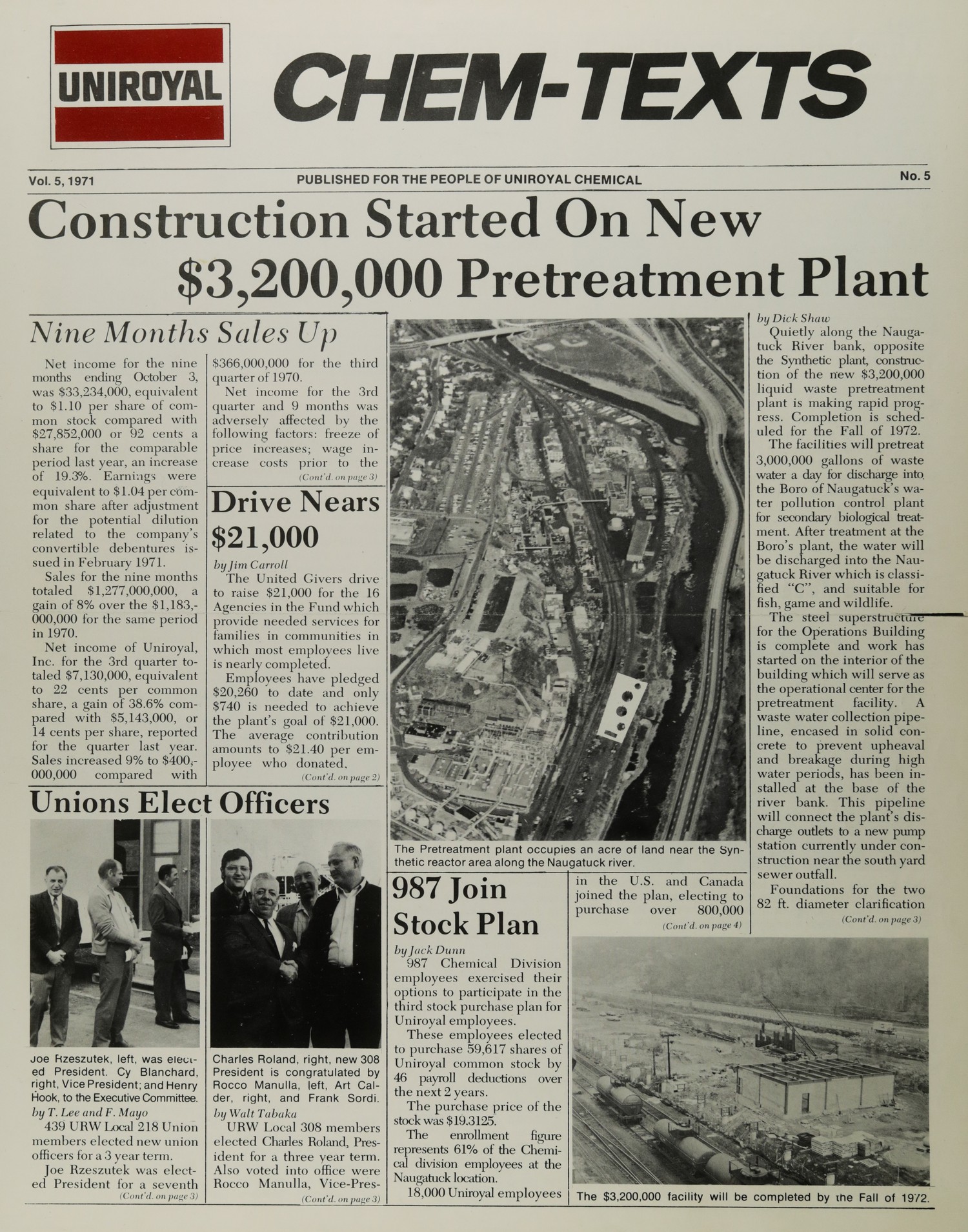
Construction Started On New $3,200,000 Pretreatment Plant


Nine Months Sales Up

Net income for the nine months ending October 3, was $33,234,000, equivalent to $1.10 per share of common stock compared with $27,852,000 or 92 cents a share for the comparable period last year, an increase of 19.3%. Earnings were equivalent to $1.04 per common share after adjustment for the potential dilution related to the company’s convertible debentures issued in February 1971.

Sales for the nine months totaled $1,277,000,000, a gain of 8% over the $1,183,-000,000 for the same period in 1970.

Net income of Uniroyal, Inc. for the 3rd quarter totaled $7,130,000, equivalent to 22 cents per common share, a gain of 38.6% compared with $5,143,000, or 14 cents per share, reported for the quarter last year. Sales increased 9% to $400,-000,000 compared with

$366,000,000 for the third quarter of 1970.

Net income for the 3rd quarter and 9 months was adversely affected by the following factors: freeze of price increases; wage increase costs prior to the

(Cont’d. on page 3)


Drive Nears $21,000

by Jim Carroll

The United Givers drive to raise $21,000 for the 16 Agencies in the Fund which provide needed services for families in communities in which most employees live is nearly completed.

Employees have pledged $20,260 to date and only $740 is needed to achieve the plant’s goal of $21,000. The average contribution amounts to $21.40 per employee who donated.

(Cont’d. on page 2)


Unions Elect Officers

[PHOTO: Two images showing union officers]

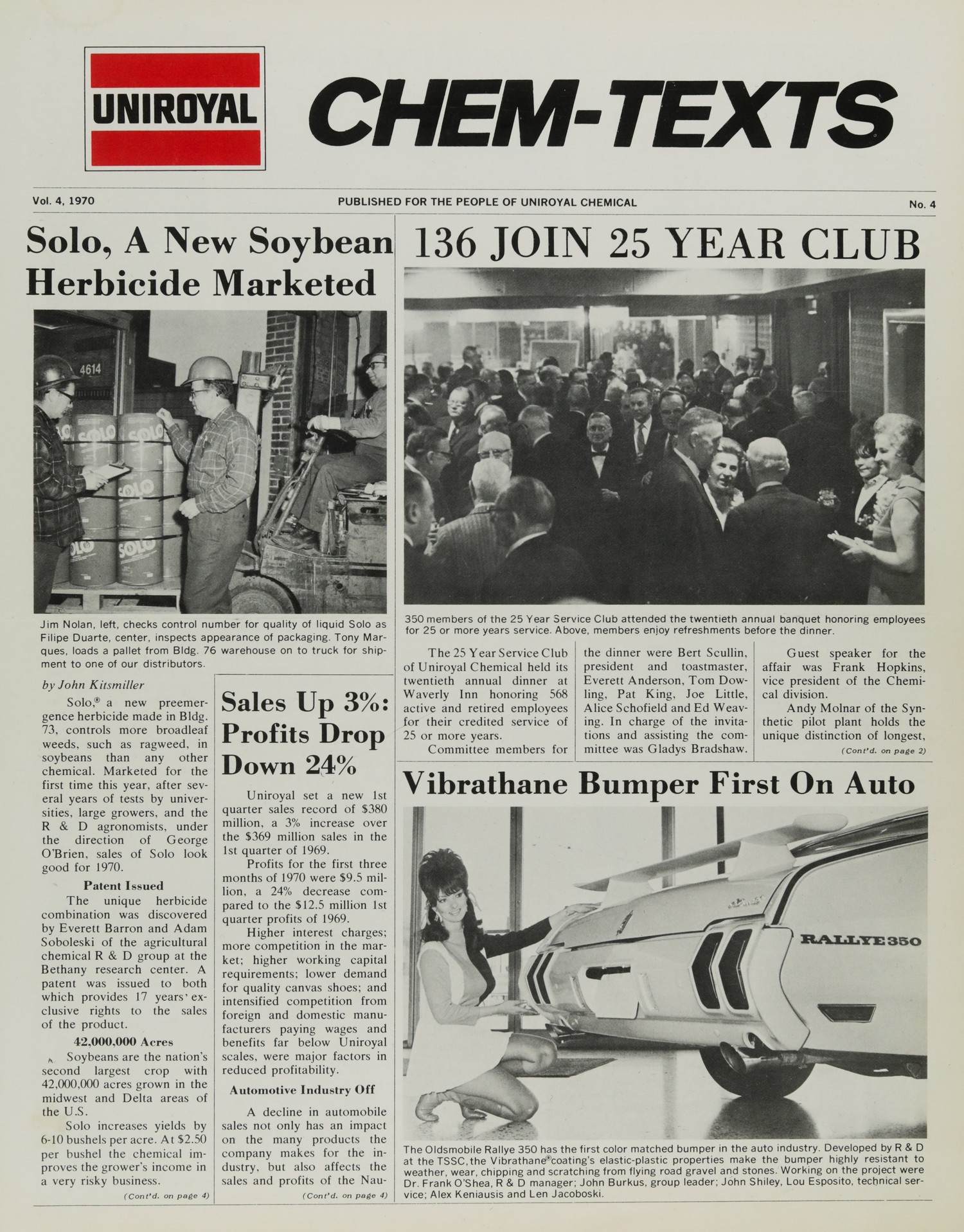
Joe Rzeszutek, left, was elected President. Cy Blanchard, right, Vice President; and Henry Hook, to the Executive Committee.

by T. Lee and F. Mayo

439 URW Local 218 Union members elected new union officers for a 3 year term.

Joe Rzeszutek was elected President for a seventh

(Cont’d. on page 3)

Charles Roland, right, new 308 President is congratulated by Rocco Manulla, left, Art Calder, right, and Frank Sordi.

by Walt Tabaka

URW Local 308 members elected Charles Roland, President for a three year term. Also voted into office were Rocco Manulla, Vice-Pres-

(Cont’d. on page 3)


by Dick Shaw

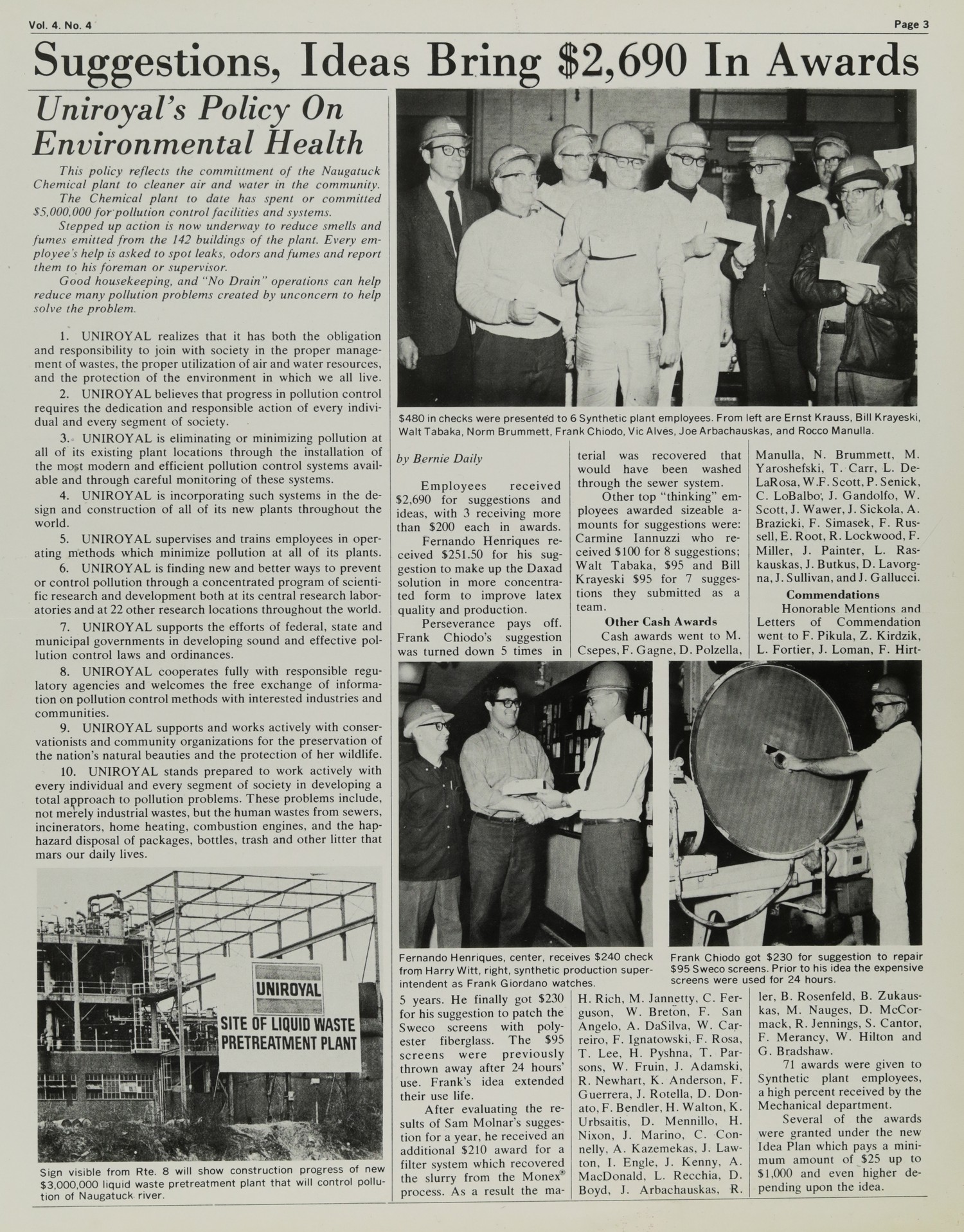
Quietly along the Naugatuck River bank, opposite the Synthetic plant, construction of the new $3,200,000 liquid waste pretreatment plant is making rapid progress. Completion is scheduled for the Fall of 1972.

The facilities will pretreat 3,000,000 gallons of waste water a day for discharge into the Boro of Naugatuck’s water pollution control plant for secondary biological treatment. After treatment at the Boro’s plant, the water will be discharged into the Naugatuck River which is classified “C”, and suitable for fish, game and wildlife.

The steel superstructure for the Operations Building is complete and work has started on the interior of the building which will serve as the operational center for the pretreatment facility. A waste water collection pipeline, encased in solid concrete to prevent upheaval and breakage during high water periods, has been installed at the base of the river bank. This pipeline will connect the plant’s discharge outlets to a new pump station currently under construction near the south yard sewer outfall.

Foundations for the two 82 ft. diameter clarification

(Cont’d. on page 3)


[AERIAL PHOTO: Shows pretreatment plant construction site]

The Pretreatment plant occupies an acre of land near the Synthetic reactor area along the Naugatuck river.


987 Join Stock Plan

by Jack Dunn

987 Chemical Division employees exercised their options to participate in the third stock purchase plan for Uniroyal employees.

These employees elected to purchase 59,617 shares of Uniroyal common stock by 46 payroll deductions over the next 2 years.

The purchase price of the stock was $19.3125.

The enrollment figure represents 61% of the Chemical division employees at the Naugatuck location.

18,000 Uniroyal employees

in the U.S. and Canada joined the plan, electing to purchase over 800,000

(Cont’d. on page 4)


[PHOTO: Construction site view]

The $3,200,000 facility will be completed by the Fall of 1972.

CHEM-TEXTS – 1971-v05-i05-s203

Page 203

Page 4 — CHEM-TEXTS — Vol. 5, No. 5


Know Your Products:

Retarders; Blowing Agents; Waxes

by Dr. Bob Brown

Besides the diverse line of accelerators, antioxidants and antiozontants manufactured in Chemical Production, the plant makes a number of specialty chemicals: Retarders, Process Stiffeners, Bonding Agents, Waxes and Blowing Agents.

The Retarders, ESEN and Retarder J, slow down the vulcanization of the rubber during processing. This may sound like driving a car with your foot on the brake, but when a customer is trying to mix a batch of rubber on a mill and it starts to vulcanize (harden) before he can finish processing it, he must rely on a Retarder to slow down the vulcanization.

Process Stiffener 710 is also used as a processing aid. Rubber is usually easier to handle when it is fairly soft, but some types of rubber soften so much, that they almost seem to be turning into a liquid during the processing. Stiffener 710 gives these rubbers the necessary hardness and firmness to stay sufficiently solid so they can be worked on the mill.

The Celogen® Blowing Agents are used to expn Agents are used to expand rubber, and plastics. When mixed with rubber or plastics and heated, they form a

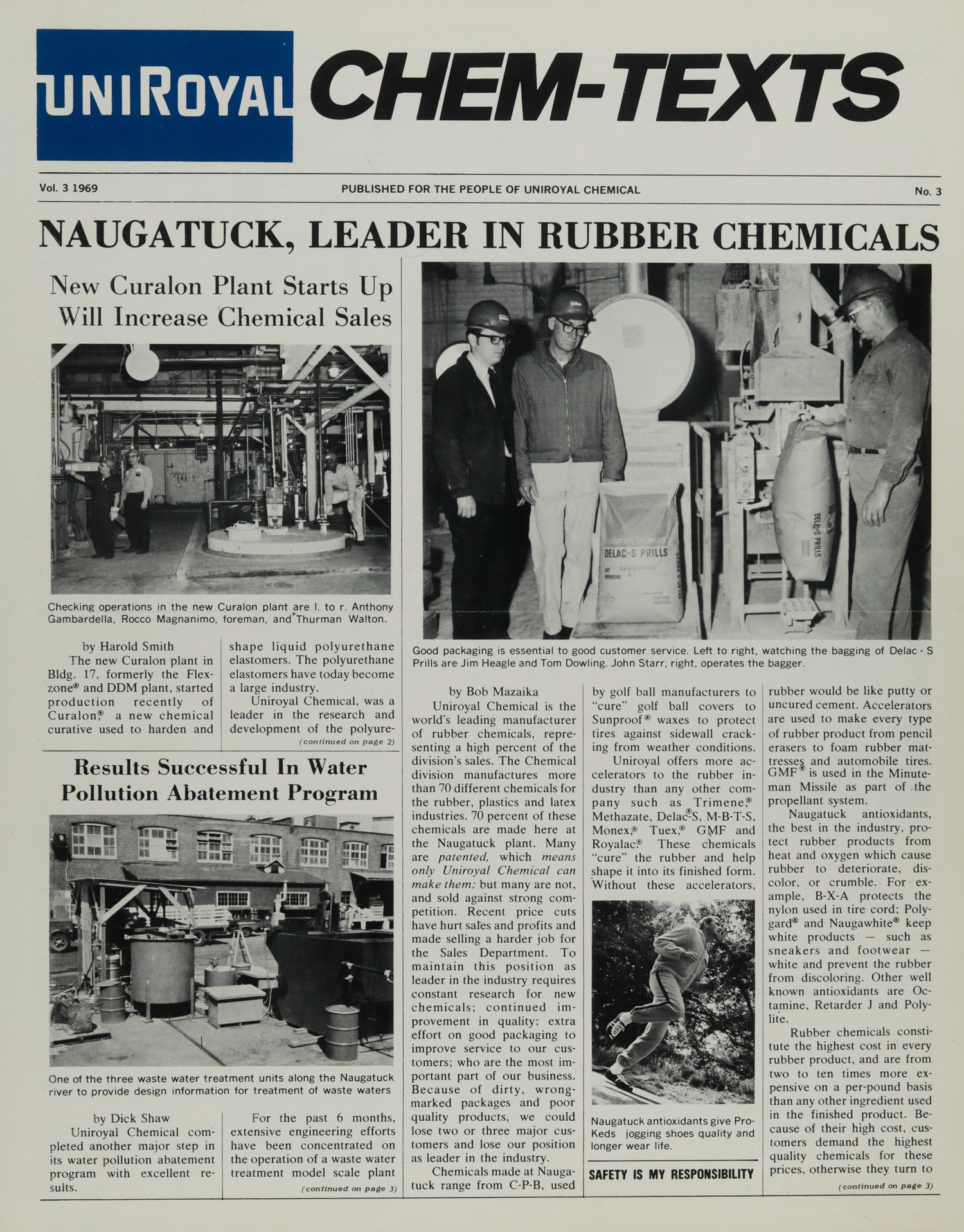
Celogen is used to expand rubber and plastics, giving a fine cellular structure to the finished product.

fine cellular structure in the finished product, expanding the product volume and lowering its density. This results in a savings in materials for the customer. Blowing Agents are used primarily in rug underlay, upholstery, fashionable footwear, boats, and electrical insulators.

The Sunproof® Waxes are used along with Flexzone® antiozontants to reduce the cracking of tire sidewalls and treads. The Waxes are mixed with the rubber on the mill and then migrate to the surface of the rubber to form a protective film against atmospheric cracking.


Plant Gets Red Cross Award

The Naugatuck Red Cross awarded Uniroyal Chemical a Certificate of Appreciation for outstanding cooperation with the Connecticut Red Cross Blood Program.

In the annual Bloodmobile sponsored by the plant Chemical and Footwear employees and walk-ins donated 214 pints of blood. Another 25 were deferred.

During the year the Naugatuck Red Cross collected 1038 pints of blood. Connecticut is one of the few states where the blood itself is free.

Organized by the Safety Dept. the successful drive was carried out by Bob Shortt, Sal Aloise, Adeline Farrar R.N., and Ann McAllister R.N.


Christmas Special Royal Golf Balls

From November 15 to December 17, a special Christmas Purchase of ROYAL golf balls is available to employees through the Footwear Employee’s Salesroom on Rubber Ave. Each employee is limited to a maximum of 6 dozen.

The balls come in a gift package and the prices range from 9.25 to 11.50 per dozen.


987 Join . . .

(Cont’d. from page 1)

shares of Uniroyal common stock.

MIP Stock Plan

Employees may still purchase Uniroyal common stock through the Monthly Investment Plan (MIP). This plan is operated by Merrill, Lynch, Pierce, Fenner and Smith, Inc.


Enamait Improved

Bob Enamait has been transferred from the intensive care unit of St. Mary’s Hospital and officially removed from the danger list.

He is now in a private room and attended by private duty nurses around the clock. He is still on a circular motorized bed and receiving physical therapy. His response to treatment is good.


Safety Sign Installed

[IMAGE: UNIROYAL EMPLOYEE SAFETY RECORD sign showing INJURIES with DISABLING and NEAR SERIOUS categories, showing “24” and “LAST” indicators]

The first Employee Safety Record sign has been installed at Main Gate. Flashing lights indicate safety record for 24 hour period.

Three new Employee Safety Record signs will be installed to keep employees posted on the plant’s safety record for this year as compared with 1970.

Flashing lights will indicate the 24 hour safety record of employees: the red signifies a Lost Time accident; yellow, a Serious Injury; and the green will indicate that employees have worked safely for a 24 hour period.

The first of the three signs has been installed at the Main entrance; the others will be constructed at the Tire Gate and the Synthetic plant.

The signs are another step in the Safety departments continuing program to improve safety awareness among employees.


Three Employees Retire

[IMAGE: Group photo of employees]

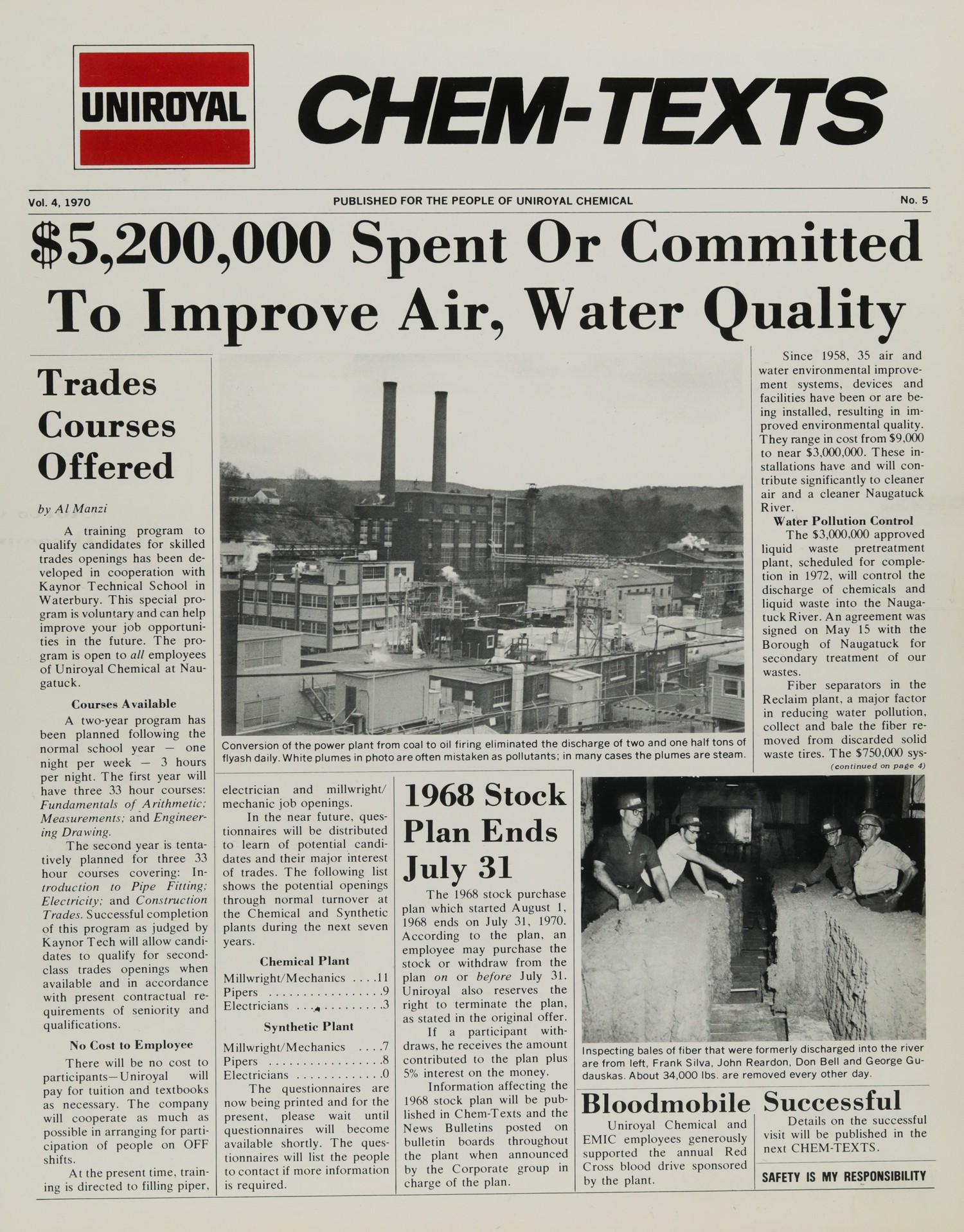
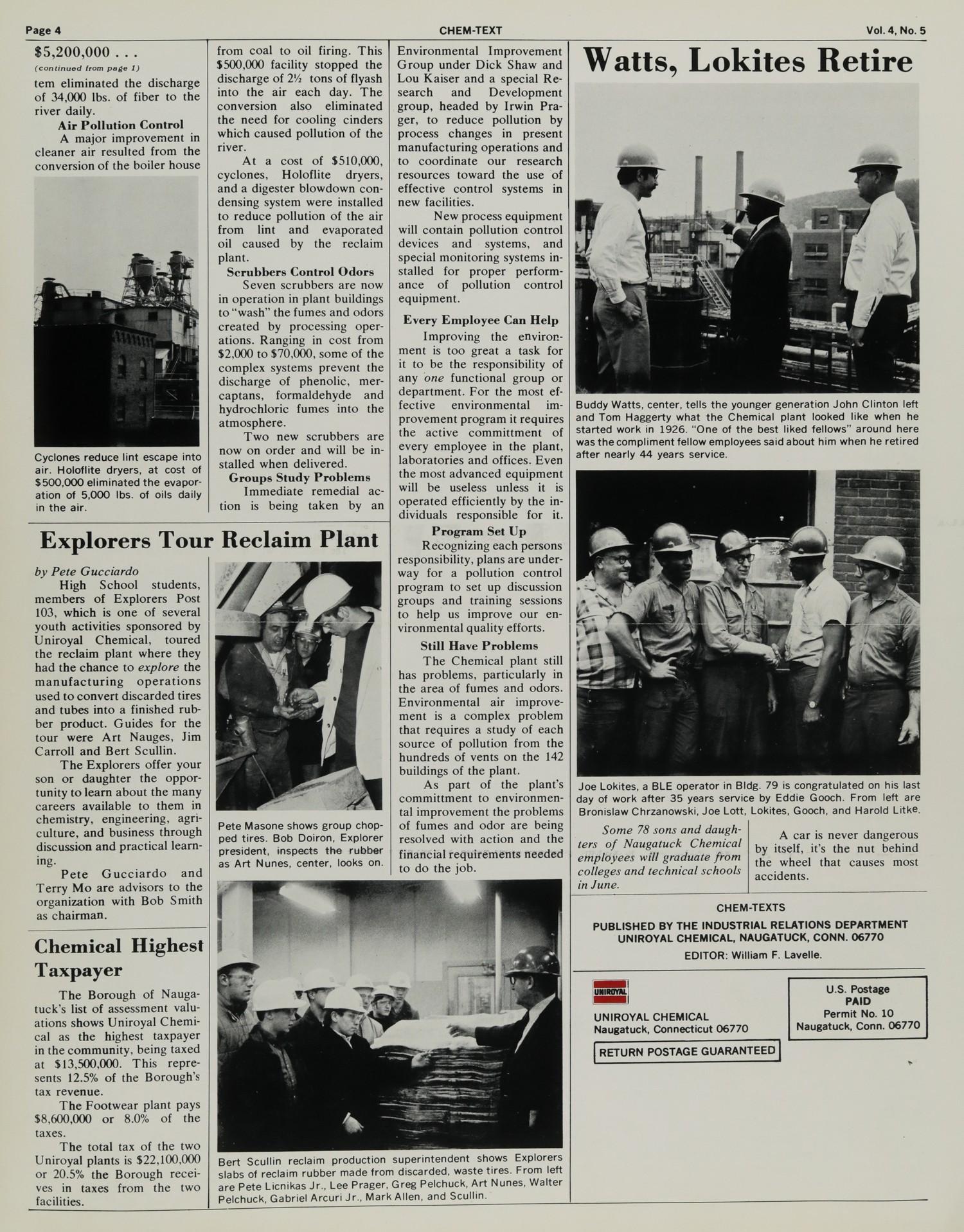
With nearly 46 years of service, Andy Molnar, center, was one of the few active employees in the 45 year group of the 25 Years Service Club. Congratulating him from left are Carl Miele, Hank Venslow, Molnar, Walt Miller, Synthetic Pilot Plant Foreman, and Henry Quigley.

[IMAGE: Group photo of employees in hard hats]

Joe Trangle retired from the Materials department after 26 years service. From left are Ben Federowicz, Frank Lynch, General Foreman, Hulda Flammia, Joe Trangle & Kirk Kirkendall, Foreman.

[IMAGE: Two men, one congratulating the other]

Mike Obronko, right, is congratulated by George Allen, on his retirement from Chemical Production after 22 years service.


CHEM-TEXTS

PUBLISHED BY THE INDUSTRIAL RELATIONS DEPARTMENT
UNIROYAL CHEMICAL, NAUGATUCK, CONN. 06770

EDITOR: William F. Lavelle.


UNIROYAL CHEMICAL
Naugatuck, Connecticut 06770

RETURN POSTAGE GUARANTEED

U.S. Postage
PAID
Permit No. 10
Naugatuck, Conn. 06770
CHEM-TEXTS – Vol. 5, No. 6 – Page 3

Page 003

Page 3 | CHEM-TEXTS | Vol. 5. No. 6


$21,000 Unit…

(Cont’d. from page 1)

than previously made at the plant.

Mike English was the Process Development Engineer for the process requirements and Rod Ashby was Project Engineer for the design and construction of the unit.

The new facility burns off waste gases completely in a smoke-less flame, and eliminates air pollution and fire hazard.

[IMAGE: Industrial facility/equipment]


United Givers

(Cont’d. from page 1)

[IMAGE: Group of people at a table reviewing documents]

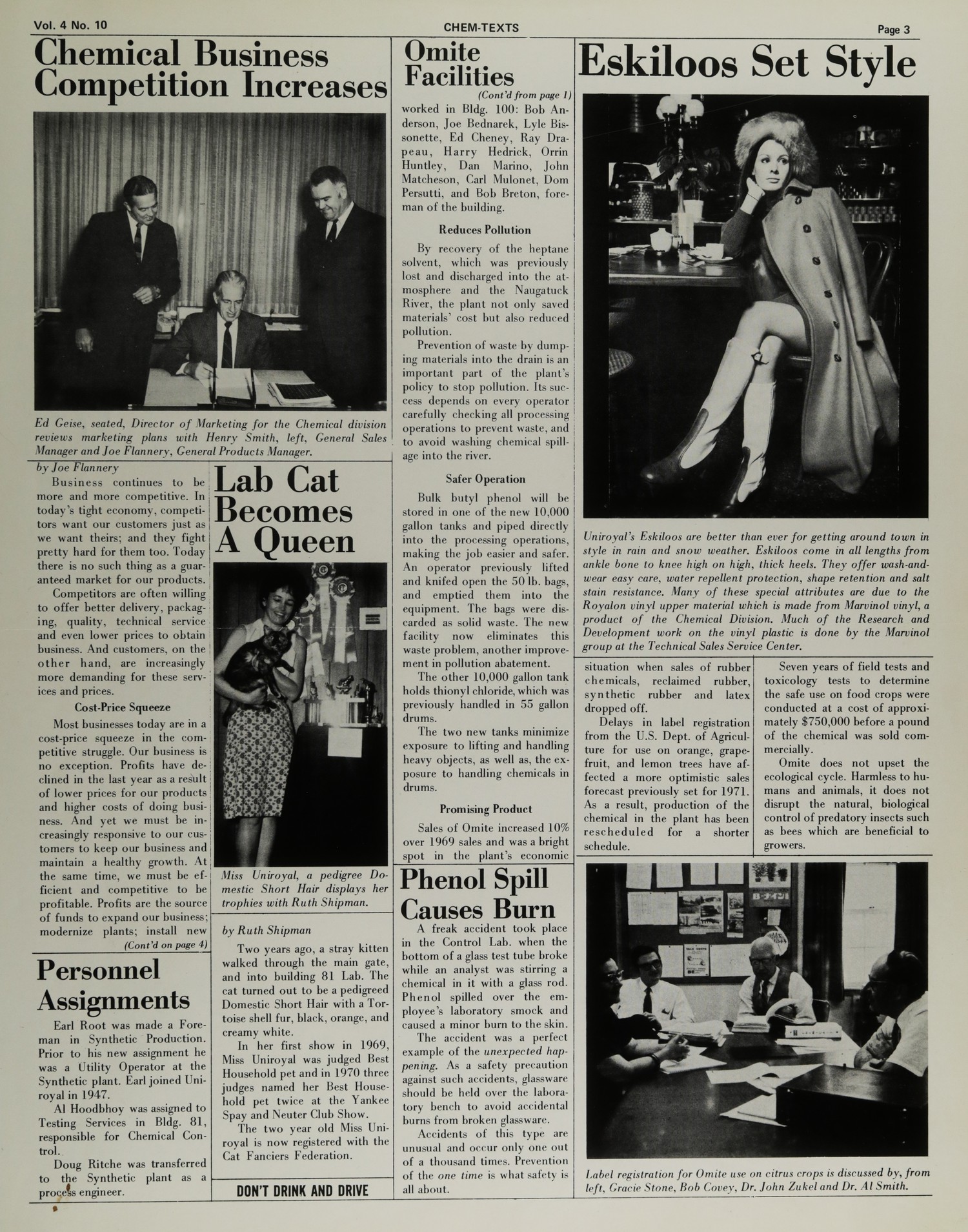
United Givers Committee review results of the annual plant drive to raise $21,000. From left are Gary Arndt, L. Kaiser, M. Makoski, J. Carroll, Chairman; R. Amidon, F. Mayo, and Kay Dowling. Committee members absent at time of the photo were R. Van Allen, F. Commendatore, E. Semaskvich, L. Raskauskas, C. Roland, H. Witt, J. Rzeszute, and J. Vergosen.

DEPARTMENT BREAKDOWN

Department Goal Pledge No. of Givers Average Pledge
Chemical Production $2350 $2059 113 $18
Reclaim Production 2100 1971 112 17
*Synthetic Production 1600 1612 75 21
Eng. & Mech.—Chemical 1550 1541 93 16
Eng. & Mech.—Syn. 1000 630 52 12
*Materials 1350 1474 72 20
Factory Services 1200 901 44 20
*Research & Develop. 5850 6195 262 23
*Accounting 900 974 53 18
*EMIC 3000 3548 123 28
*International 100 118 9 12
*exceeded goal $21,000 $21,023 1008 $19

53 employees suffered head injuries in the plant during 1970.

18 occurred in the Chemical Mechanical department; 11 in Synthetic Production.

170 eye injuries occurred in 1970, eight of which were serious.

53 injuries took place in the Mechanical (Chemical) department and 36 in Chemical Production.


achieving it due to employees on a leave of absence, sick, or retired.

The amount represents approximately one-third of the total Industrial Division goal and reflects the generosity of Chemical employees in their support of community activities.

Canvassers who solicited contributions in the different departments and not in the photos were: R. Allen, J. Baclawski, M. Bausano, G. Bradshaw, P. Byra, A. Follachio, R. Gencarelli, H. Greenfield, J. Honyotski, Jeannine Labrecque,


Appointments Announced

Art Aronson has been assigned to the position of Maintenance and Construction Engineer for the Chemical and Reclaim plants.

Sal Aloise, a Supervisor in the Safety department, has been named Foreman in Chemical Production.

Jim Loman joined the Safety Department in Industrial Relations, replacing Sal Aloise.

Don Bates has been named Operations Foreman of the Emulsion and Non-Aqueous Synthetic Pilot Plants.

Ray Pekoek has been appointed Operations Foreman of the Chemical Pilot Plant.

Ben Pranulis assumed the position of Mechanical Foreman in the Chemical Pilot Plant.

Ed Hunwicz has been named to the new position of Mechanical Foreman of the Emulsion and Non-Aqueous Synthetic Pilot Plants.


SAFETY IS MY RESPONSIBILITY

DON’T DRINK AND DRIVE

P. Laurenzi, L. Lombardi, F. Lynch, D. McCormack, J. Sullivan, and R. Terino.

Chairman of this year’s drive was Jim Carroll of the Engineering department. Members of the Committee were R. Amidon, Gary Arndt, F. Commendatore, K. Dowling, L. Kaiser, H. Koss, W. Lavelle, M. Makoski, F. Mayo, L. Raskauskas, C. Roland, J. Rzeszutek, E. Semaskvich, R. Van Allen, J. Vergosen, and H. Witt.


Mother To Five Calves

[IMAGE: Man with calf]

Jim Brown bottle nurses week old Hereford calf at Uniroyal farm. The calf’s cow died at birth.

Five white faced Hereford calves were recently born at the Uniroyal Farm in Middlebury, but shortly after their birth each of their cows died. Two of the calves were twins.

The calves, ranging in age from 1 week to 4 weeks, are now being bottle fed, and owe their good healthy growth partially to Jim Brown, a next-door neighbor and a Foreman in the Synthetic Mechanical department, who sometimes assists in the feeding.

The farm is located at the intersection of Christian Road and Route 188 in Middlebury, only a short distance from the Oxford Management and Research Center.


New Look In Aluminum Siding!!!

ALCOA SIDING

CALL FOR FREE ESTIMATES

Naugatuck Aluminum And Glass

253 Prospect Street,
Naugatuck, Connecticut

729-4534 — 758-9501


$150,000 Gift To Hospital

[IMAGE: Three men in front of building under construction]

Uniroyal Chemical and Footwear contributed $150,000 to the new Waterbury Hospital. In front of the new facility are from left, Carl Toothaker, Footwear Factory Manager; Richard Derr, Hospital Administrator; and Sheldon Salzman, Chemical Factory Manager.

A total of $150,000 was contributed to the Waterbury Hospital Building Fund over a five year period by the Uniroyal Chemical and Footwear Plant.

The Hospital is constructing an eleven story building which will contain a new surgical operating room on the ground level floor, a new pediatrics center, and increased bed facilities.

The structure is near 75% completion and will be dedicated in early summer, 1972.

The combined facilities of St. Mary’s Hospital, which is also undertaking an expansion program, will provide the finest in medical services for the residents of Waterbury, Naugatuck and surrounding towns.


Breen’s

The Biggest Little Store In The Country

Visit our four floors of famous brands for him and her

Ladies’ Dept.
– Couture Coats
– Tanner Dresses
– Vanity Fair Lingerie
– Joyce—Naturalizer Shoes

Men’s Shop
– Manhattan Shirts
– Botany Suits—Sport Coats
– H. Freeman Suits
– London Fog Rainwear
– Florsheim Shoes
– Jaymar Slacks

Lingerie Shop
– Vanity Fair
– Olga—Barbizon
– Schrank Robes
– Shadowline

Jr. Sportswear
– Collegetown Sweaters
– White Stag—Skirts, Slacks
– Davis Coats
– Peerless Sportwear

Ski Boutique
– Ski Jackets
– Warm-Up Slacks
– Ski Pants
– Ski Sweaters
– Gloves & Sweaters

Cosmetic & Jewelry Dept.
– Guerlain
– Elizabeth Arden
– Nina-Ricci
– Chanel
– Yves Saint Laurent
– Monet
– Napier
– Marvella Pearls

CHEM-TEXTS – Vol. 5. No. 6 – Page 4

Page 004

CHEM-TEXTS

Page 4 | Vol. 5. No. 6


Blues Conquer Yellows

[IMAGE: Football team lined up on field]

The Blues and the Yellows line up for their crucial championship game. The Blues, with quarterback Dan Shantz throwing 3 touchdown passes, won 27-0 to take the league title. (Photo— Naugatuck Daily News)

by John Prior

The Uniroyal Chemical Touch-Football League ended its season with the “Blues” holding the “Yellows” scoreless in the Championship game, 27-0. During the regular season the Blues had a 6-0 won-lost record.

Quarterback Dan Shantz tossed 3 touchdowns to lead the Blues to the title. The Blues had a granite wall defense with the hard-charging, veteran Eric Johnson, a constant threat to the Yellow’s quarterback. The league games were umpired by Stan Mazur.

With Paul McKinstry as Captain, the Yellows had a 4-2 season. The Reds, led by Tom Geise, ended with a 2-4 record; and the Greens with Keith Hughes, suffered a 0-6 record.


Plant Ranks 69th In Uniroyal Safety

The Naugatuck Chemical plant ranks 69 among the 80 domestic and international Uniroyal plants in Lost Time and Serious Injuries.

For every 1,000,000 manhours worked (4 months) approximately 26 injuries occur among employees at the Naugatuck Chemical location.

At the Naugatuck plant there is a high concern by management and union representatives that our safety record for 1972 must improve considerably over our 1971 performance. Their joint efforts will receive top priority to improve the plant’s safety record and people’s attitudes toward it.


Seminars Scheduled

Speakers for the Technical Seminars, sponsored by the Research and Development department, have been scheduled for the first half of 1972, it was announced by Dr. Charles Crittendon, secretary for the group. The monthly meetings will be held at the Knights of Columbus Hall, New Haven Road, and start at 3:30 P.M.

The first speaker was Dr. Charles McCleary.

Dates and topics for the other seminars are: January 10, Management by PERT-CPM, Gene Hertel; February 7, Opportunities in the Market Place, Joseph Flannery, Marketing Manager, Chemicals & Synthetic Rubber and William Coughlin, Marketing Mgr., Plastics; March 6, PVC Plastisol Resins, Len Henrey of the Wayne Research Center; April 10, Uniroyal’s Radial Tire, Tire Division representative; May 8, Thermoplastic Rubber, William Fishcher and Dr. Vince Landi.


JA Forms

(Cont’d. from page 1)

factors involved in a business organization.

The Company issues and sells stock; purchases raw materials; pays heat and light bills and rent; pays regular salaries and taxes; carries insurance; regulates health and safety; and pays dividends to stockholders from profits on the sales of its products.

Last year the Jaroy Company gave stockholders a $3 dividend on their investment.

Officers of the firm are Robert Tourrangeau, President: Joseph Bush, Vice President—Manufacturing; Linda Litke, Vice President—Sales; Christopher Bernard—Treasurer; and Jo Ann Niski—Secretary.

Chemical plant advisors to Pingyanco are Jim Chambers, Randy Porter and Dianne Carignon.

Lou Kaiser represents Uniroyal Chemical on the Junior Achievement Board of Directors in Waterbury.


Enamait Moved To Gaylord

Bob Enamait, after almost 4 months in the intensive care unit of St. Mary’s Hospital, was moved to Gaylord Hospital, Wallingford, Conn. where he will undergo intensive physiotherapy treatments.

According to Dr. Edward Jelley, plant physician, Bob is in excellent spirits, enjoys watching TV, and talking to friends. Fellow employees are encouraged to visit him at the hospital and write to him.

A special water bed is used by him to provide him comfort during his stay at the hospital.


Synthetic People Retire

[IMAGE: Group of men, one receiving good wishes]

Walt Miller, Foreman of the Synthetic Pilot plants, receives good wishes on his retirement after 41 years service. In photo from left are Don Bates, Gary Arndt, Walt, and Ed Runowicz.

[IMAGE: Sign reading “DEPARTMENTS ARE GRANTED THE PRIVILEGE OF SMOKING IN THIS AREA” with “ENGINEERING” visible]

[IMAGE: Group of men congratulating someone]

Bill Krayeski, center, one of the best Idea men in the plant, retired after 35 years service. Congratulating him from left are Hank Yacek, Walt Tabaka, Bill Adamski and Henry Drummer of the Synthetic Mechanical Department. Over the years Krayeski— along with Walt Tabaka—has submitted over 300 Ideas.


[ADVERTISEMENT: UNIROYAL TIRES]

UNIROYAL
Belted WIDE OVAL

Snowplow
WHITEWALLS

DOUBLE BELTS OF FIBERGLASS
DOUBLE POLYESTER CORD PLIES

ADVANCE TIRE SERVICE
510 Meriden Rd.
Waterbury ● 756-7205

FITZPATRICK’S. INC.
78 East Main St.
Ansonia ● 734-3318

DON HEAVENS
Chevrolet Inc.
Main Street
Woodbury ● 263-2168

MEZZIO’S
792 New Haven Rd.
Naugatuck ● 729-5988

MIDDLEBURY SERVICE CENTER
Route 64
Middlebury ● 758-9977

POUST’S SERVICE STATION
144 Rubber Ave.
Naugatuck ● 729-0433

UNIROYAL HOME & AUTO CENTERS

NEW HAVEN NEW MILFORD BRISTOL
130 Amity Road Boston Post Rd. Farmington Ave. Rte. 6
389-1541 878-0857 582-3176

FEATURES:
– 78 SERIES DESIGN (WIDE OVAL)
– POLYESTER CORD PLIES
– FIBERGLASS BELTS


[ADVERTISEMENT: CANFIELD CORNER PHARMACY]

CANFIELD CORNER PHARMACY
VERA T. ELSENBOSS, Reg. Pharm.
CANFIELD CORNER WOODBURY, CONN.
PHONE 263-2595
PRESCRIPTIONS SINCE 1867

MEDIMET | PRESCRIPTIONS FILLED | CHEERFULLY


CHEM-TEXTS
PUBLISHED BY THE INDUSTRIAL RELATIONS DEPARTMENT
UNIROYAL CHEMICAL, NAUGATUCK, CONN. 06770
EDITOR: William F. Lavelle.

[UNIROYAL LOGO]

UNIROYAL CHEMICAL
Naugatuck, Connecticut 06770

U.S. Postage
PAID
Permit No. 10
Naugatuck, Conn. 06770

RETURN POSTAGE GUARANTEED


SAFETY IS MY RESPONSIBILITY

CHEM-TEXTS – 1971-v05-i06-s205

Page 205

Page 2 | CHEM-TEXTS | Vol. 5, No. 6


“PEACE ON EARTH TO MEN OF GOOD WILL..”

We pray for Peace but half the world’s people are at war or involved in civil strife. While each side is sure of their cause, the result is still pain and suffering, grief and anguish.

None of us can singly alter the events that are occurring. We can, of course, politically try to express ourselves, but so often the political choice is not one of peace or war, but is more closely related to personalities or domestic problems.

What we can do individually is act as “men of good will” by our charitable deeds and by our daily activities.

We can also pray, and in this period of holy days perhaps all of us can reflect on the suffering around us and stop briefly and pray for peace.


ANYWHERE, ANYTIME, ANYBODY

As some of you may know, I recently suffered an off-the-job accident with an aluminum extension ladder that suddenly developed a will of its own. The result of this momentary carelessness was a cracked bone in my arm and a rather awkward cast.

This accident brought home to me the ease in which a careless or unthinking action could result in an accident.

I hope each of you will continue to be alert towards the unexpected because the accident that happens can be yours.

I sincerely wish you and all the members of your family a Most Happy Christmas and New Year.

[Signature]


$225 Paid For Ideas

[IMAGE: Photo showing two men, with “SAFETY FIRST EMERGENCY EYE WASH FOU…” sign visible]

Jerry Ferguson, left, and Hugh Garahan of the Roylar plant, seem quite excited over the checks awarded for their Ideas.

by Pete Welch

Nine employees received $225 for Ideas submitted during the past months. The Ideas centered on improvements in the plant’s operations and reductions in costs.

Employees who received $25 for their suggestions were Anthony Galletta, Robert Guest, Ray Kubick, Hugh Garahan, Paul Blasko, Jr., Jerry Ferguson, Mario Jannetty, George Salokas, and John Wawer.

Letters of Commendation were given to N. Croce, M. Watson, D. Bedard, W. Carreiro, F. Sordi, E. Evans, B. Zukauskas, W. Palmoski, F. Wallace, J. Gandolfo, K. Searles, L. DeLaRosa, and M. Schluensen.

A work area is a good place to look for Ideas.

Start with present work methods in the department. Is there a better, easier way to do the job? Can it be done faster?

If something has been done the same way, every day for ten years, there’s a good possibility that it’s being done wrong and inefficiently.

Ideas Pay Lots of Money

There’s no limit to the amount of money awarded for an Idea. The minimum award for an approved Idea is $25.


Hospitals Approved By State

[IMAGE: Photo showing Dr. Jelley and Adeline Farrar]

Dr. Jelley, plant physician, shows Adeline Farrar R.N. certificate of approval for plant’s hospital facilities.

by Bob Shortt

Uniroyal Chemical was the first industrial plant in this area to pass the Connecticut State Department of Health inspection and become eligible for a license to operate hospital facilities at the Chemical and Synthetic plants, according to Helen Coburn, R.N., of the Conn. State Dept. of Health.

Requirements Strict

The Laws impose tighter regulations upon the conduct of industrial health facilities in the State.

Besides the strict requirements for the physical facilities, equipment and supplies, the Law requires that a Medical Director, who is a physician licensed in Connecticut, and sufficient registered nurses be available to provide health services to employees. It also requires that at least one individual, who has successfully completed the Advanced Red Cross First Aid course, shall be on duty to provide first aid services whenever a registered nurse or physician is not on duty in the plant.

To date, 39 employees have taken the necessary First Aid courses which involved 20 hours of instruction and demonstrations.


Water Good For Burns

The ancient treatment of plunging burned skin in cold or ice water is still the quickest way to relieve pain. The cold water doesn’t damage the burned skin, but actually helps prevent blistering and aids healing. Continue the treatment until the pain disappears, or apply towels soaked in cold or ice water.


Sno-Plow

(Cont’d. from page 1)

[IMAGE: Photo showing Russ Gandolfo demonstrating scarf caught in pulley belt]

Russ Gandolfo, right, shows how scarf caught in pulley belt and almost broke his neck.

given way. Ironically, it was the first time my son had worn a scarf when working outside.

Inside the kitchen, my wife was cooking a Thanksgiving turkey. What almost turned out to be a day of tragedy, was really a day of thanksgiving for us.

When they talk about the unexpected happening, I know better than ever what they mean.


Avoid Danger In The Bedroom

by Sal Aloise

There are two bedroom practices that may save you and your family if your house ever catches fire during the night; 1) keep the bedroom doors closed, 2) have a second method for escaping outside if the normal exits from your bedroom are locked.

13% of the fires in a home start in the bedroom. The bedroom door, which is the normal escape to safety quickly becomes a death trap—when opened—from lung-scorching heat, poisonous fumes, and choking smoke.


Christmas On The River

In a continuing program to improve the physical appearance of the plant, 100 Christmas trees were planted along the Naugatuck river bank near the Reclaim plant. The trees will grow to a height of 12 to 15 ft. and provide a scenic effect on an otherwise drab section of the Reclaim yard. The trees are a small part of a $4,000,000 program to improve plant buildings and facilities.


BOB’S CAMERA SHOP INC. [Logo]
WATERBURY’S LEADING CAMERA SHOP
21 Grand Street, Waterbury, Conn. 06702 | 754-2256
Film ● Cameras ● Projectors ● Developing ● Rentals

CHEM-TEXTS – 1971 – Page No. 2

Page unknown

UNIROYAL CHEM-TEXTS

Vol. 5, 1971 | PUBLISHED FOR THE PEOPLE OF UNIROYAL CHEMICAL | No. 2


Crim Named IR Manager

Mitchinson, Melore Receive New Posts

Jesse Crim was named Industrial Relations Manager for the Naugatuck Chemical plant, effective June 1. He succeeds Ron Mitchinson who has accepted a position in the Corporate Industrial Relations Department in Oxford.

Neil Melore was appointed Industrial Relations Manager for the Painesville, Ohio plant.

Crim served as Industrial Relations Manager in Painesville from 1968-1971. He held the same position in the Santa Ana, Calif., and Washington, Ind. plants.

He joined Uniroyal in 1947; is a veteran of World War II; and a graduate of Purdue University.


Hats, Glasses Required

by Bob Shortt

As of May 1, hard hats and safety glasses were required to be worn in designated areas of the plant.

[IMAGE: Photo showing workers wearing safety equipment]

Joining the plant’s safety equipment program of wearing hard hats and safety glasses are two of its more attractive members. From left is Kay Dowling, Chemical Production, and Adeline Farrar, Chemical Plant nurse.

During April, foremen and supervisors discussed the new program with people in their departments. The program is based on a Section of the 1970 Uniroyal-
(Con’t. on page 4)


Profits; Sales Up

Tires; Footwear Improve; Chemical Business Off

Uniroyal, Inc. income increased 10.6% to $10.6 million in the first quarter of 1971 compared with $9.5 million reported for the same period last year.

Sales in the first quarter climbed to a record of $413 million, about an 8% increase over the record $381 million set in 1970.

Uniroyal was the only Company of the “Big Four” rubber companies to report an increase in profits and sales for the first quarter of the year. Goodyear, Firestone, and Goodrich dropped during the quarter.

Tire, Footwear Business Up

Sales of original equipment tires hit an all-time high in the
(Con’t. on page 4)


Phase I Of Liquid Waste Pretreatment Plant Started

Sewerage System Now Being Installed

[IMAGE: Photo showing industrial buildings and sewerage system installation]

A new sanitary sewerage system was installed in the Chemical yard to carry liquid discharges to main sewers of the Chemical plant system.

by Dick Shaw

The construction of Phase I of the new $3,000,000 Liquid Waste Pretreatment Plant is now in progress.

Phase I includes the installation of new sanitary sewers in the Reclaim, Chemical, and Synthetic plant yards. These new sewers will divert the sanitary sewage from the present side streams to the main sewers in order to be ready for transfer into the new pretreatment facilities.

Pretreats For Borough’s Secondary Treatment Plant

The new pretreatment facilities will pretreat the plant’s waste liquids for acceptance into the Borough of Naugatuck’s Secondary Treatment Plant.

Uniroyal Chemical has committed $1,500,000 toward the construction of the Borough’s waste disposal plant, and will pay 60% of the operational costs due to the large volume of the plant’s waste flowing into the Borough’s plant.

50% of Capital Expenditures Allocated to Pollution Control

In 1971, approximately 50% of the plant’s capital expenditures will be spent on pollution control facilities.

A major project currently under study is the elimination of the odors created by the Reclaim operations. By process changes, it is expected that the odors of the Reclaim plant will be controlled.

Waste Control Important

The efficient operation of the waste water treatment facilities depends on everyone’s cooperation in the use of water, prevention of spills, and avoidance of washing chemicals “down the drain.”

The nature of our business requires the use of over 750 differ-
(Con’t. on page 4)

[IMAGE: Photo of Phil DePasquale with concrete tank]

Phil DePasquale shows size of reinforced concrete tank that will be used as a sewage pumping station for one of plant’s buildings.


Medicine Search Started

[IMAGE: Photo showing three scientists studying a molecule model]

Studying a molecule prepared for pharmaceutical use are from left Drs. Costa Courduvelis, Zaven Ariyan, Coordinator of program, and Terry O’Brien.

by Dr. Zaven Ariyan

A Pharmaceutical Research Program has been initiated to study and screen chemicals for possible medical use. Assisted in the search by outside pharmacology laboratories, the group is interested in developing chemicals which could be made at the Naugatuck plant.

Five Year Goal

The main aim within the next three to five years is to obtain a drug through clinical work and receive approval from the Food and Drug Administration to market it. Research work is presently centered on antiinflammatory drugs for the treatment of arthritis; cardiovascular antihypertensive drugs for high blood pressure and related disorders; and tranquilizer related drugs.

The Chemical Division R & D group consists of Dr. Zaven S. Ariyan, Coordinator of the Program and two Senior Research Chemists, Dr. Constantine I. Courduvelis and Dr. J. Terence O’Brien.

CHEM-TEXTS – unknown-i05-s201

Page 201

CHEM-TEXTS

Page 2 | Vol. 5, No. 5


Thanksgiving And Us…

Thanksgiving Day seems to have lost much of its significance. Originally it was set aside as a special day of prayer. Today, it is looked upon more as a four day weekend and three games of football on TV.

The people who first came to New England lived a life of far greater poverty than some of the people living in Appalachia today. Their Thanksgiving was one of survival.

By their unity of purpose, and their concern for each other, they laid the groundwork for the many benefits we enjoy in our present society.

When you think ot our progress, no other group of people has achieved such high standards of living.

We at the Chemical Plant, in particular, have much to be thankful for. With unemployment as high as 12-20% in some towns, we have been able to maintain a steady level of employment. We have some of the finest wages and benefits in industry. All of us have great concern for the safety, health, and welfare of each other and a positive attitude toward the improvement of the environment.

I think you will agree with me that these are important things in our lives.

If each one of us does his full share, we will continue to reap the rewards of our efforts and assure, even increase, the many good things we now enjoy for ourselves and our families.

[Signature: Paul Lyons]


Eleven Receive MS Degrees

Dick Krajewski, center, and John Honyotski, right, admire each other’s diplomas as Pat Petti looks on. Krajewski received an MS in Industrial Management; Honyotski, a BS in Business Administration; and Petti will receive a degree in 1972.

by Ed Nunn

Eleven employees received their M.S. degrees in June under the Uniroyal Tuition Aid program: Jim Garrigan, Bill Broden, Terry Mo, and John Gilbert received degrees from Rensselaer Polytechnic Institute in Hartford; Joe Schoen, Temple University; Pete Byra, John Swanson, and Lou Kaiser, University of Hartford; Paul Hinckley, Southern Connecticut; Bob Farrell, University of Connecticut; and Marvin Cramer, University of Bridgeport.

$31,346 in Payments

Tuition Aid during the academic year, Sept. 1, 1970 to Aug. 31, 1971 totaled $31,469 in reimbursements to 82 employees.

12 employees are attending job related courses; 20 are working toward a college degree; and 50 are pursuing postgraduate studies.

Over the past 6 years 36 employees have received degrees under the program with Uniroyal’s reimbursements amounting to $125,022.

All Employees Eligible

The Tuition Aid Program is available to all full-time employees. The Company reimburses you for the full tuition cost and fees for two courses per semester. The courses must be related to your present job or will be of value, as determined by the Company, in future promotional areas. Reimbursement is made only upon successful completion of the course.


BOB’S CAMERA SHOP
Waterbury’s Largest Camera Shop
Film ● Cameras ● Projectors
Developing ● Repairs ● Rentals
21 Grand St. 754-2256

Still Time For
Photo Greeting Cards


Disaster Plan Tested

Bob Shortt, Safety Manager, shows how to extinguish gasoline fire. Behind Shortt are Phil DePasquale, Security Supervisor, and John Starr. Others in photo are Frank Commendatore and Dick Oriente.

Deluge water fog flooded Hortonspheres to control simulated butadiene leak

The 66 Alarm was a simulated butadiene leak in the Synthetic plant Hortonspheres. The leaking vapor was flooded and controlled with water fog from the top and sides of the spheres. According to Harry Francolini who was in charge of the Control Center, “we found a few bugs in the Plan but on the whole it went quite well.” The bugs are being ironed out to make the Plan more effective.

The test was the culmination of weeklong demonstrations during Fire Prevention Week.

It was a quiet Friday afternoon—just a few more hours to the weekend—when at 1 P.M., Alarm “66” sounded 4 times over the plant’s fire alarm system. A quick call to the Watchman in Bldg. 84 and the Disaster Plan was in operation.

Work stopped and designated emergency personnel reported to the Control Center for instructions and others assumed their plant emergency responsibilities to prepare for a shutdown and evacuation of the plant.


Drive Nears

(Cont’d. from page 1)

Four departments, Materials, Accounting, EMIC, and Research and Development exceeded their goals with several other departments close to reaching their quotas.

Still Time To Pledge

There is still time to pledge. If you have misplaced your card, contact the canvasser in your department or call any one and return it to him.


Chemical Team Loses Playoffs

by John Swanson

The Chemical Royals with a 24-8 won-lost record, made the League’s 4 team playoffs. In the best out of 3 championship playoff games, they lost to Fortin’s Restaurant.

Batting the Royals to their victorious season were Pete Byra 545; John Johnson 511; Vin Rooney 495.

Eric Johnson and Al Zimmerman provided the team’s slugging power with “All Star” pitcher, Mike Jasman, doing a superb job on the mound for the Royals.

Other members of the Chemical Royals were Dick Carroll, Tom Casteel, Leon Hartmann, Bill Lawton, John Prior, Dan Shantz, Rudy Valente, and Al Zonas.


Salesmen Review Sales

Frank Morgan, standing, District 11 Sales Manager, discusses sales strategy with salesmen. From left are Kurt Markshausen, Ken Stewart, Kralastic Commodity Manager, Steve Arbuckle, Barry Roos, Ed Brown, Jack Taylor, Pat DePaolo, and Pete Cookson. Missing were Tom Wilson, Henry Alter and Dick Terino.

District 11 salesmen met to review their sales record for the first nine months of 1971.

In the first 9 months, the District achieved 108% of its budget and hopes to hit 110% in the 4th quarter.

An important factor in helping them sell more was an improved “service image” among customers. They pointed out at the meeting that customer demand for good service is a major problem in their contact with customers. If you can’t deliver the product when the customer needs it, he simply buys it from a competitor.

CHEM-TEXTS – Vol. No. 7 – Page 2

Page 002

CHEM-TEXTS

Page 2 | Vol. No. 7


FROM THE FACTORY MANAGER

DEAR FELLOW EMPLOYEE:

The past month or so I have been busy reviewing plans for our 1971 operating budget. If I were to share those costs in detail with you, I’m sure you would be discouraged by the ever-increasing cost of doing business.

Looking beyond the wage and benefit increases granted in the recently completed master contract negotiations, giving consideration to continued merit recognition of salaried personnel and improved salary employee benefits, we face added costs in terms of raw materials, supplies and utilities.

For example, the electric company has asked the Public Utilities Commission to grant a 10% rate hike. The water company has requested the Commission for approval to increase its rates by 25%. Regulations coming into effect in 1971 on the use of low sulfur fuel point to record oil prices for operating our boilers. Increased spending for pollution abatement will add to an already burdened budget.

Realizing that increased costs cannot be merely passed along to the customer, because in reality its the value of the product to the customer that sets its price in the market place, it is apparent that we can’t meet 1971 costs with old-fashioned ideas and methods.

We need new imagination and creativity directed toward greater productivity, higher quality, and, in general, excellence and efficiency in every phase of our work. We need the individual and group dedication to face these challenges as “our jobs”, not as “this is your job, that’s my job”. As I see it, everyone of us is on the first team, there is no “second string”, it’s up to all of us to “really put out” all of the time.

Sincerely,

[Signature]

John D. Evans


JAROY Returns 10% On $1.00

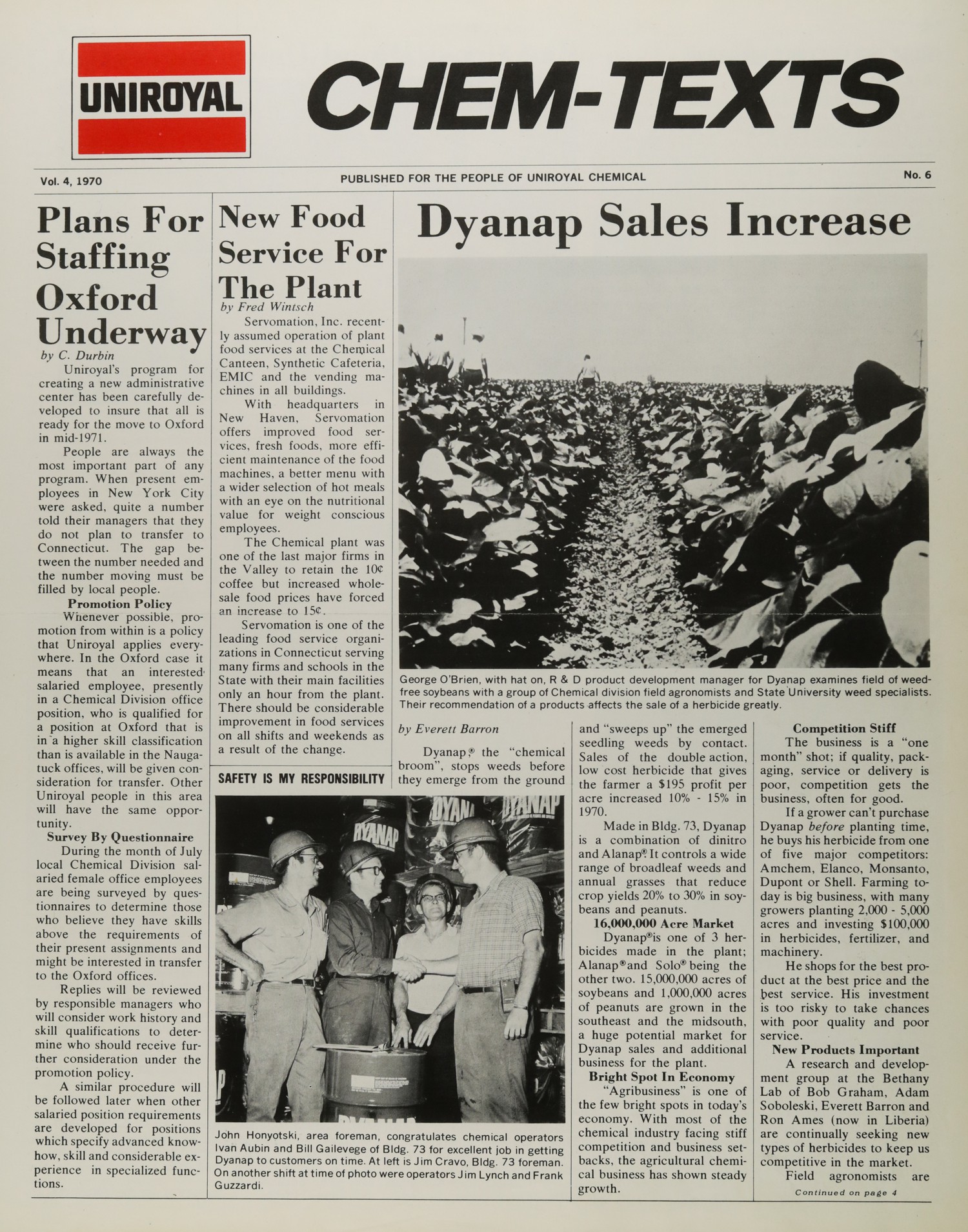
[IMAGE: Photo showing Mary Kevit, left, named JA secretary of the year, shows Jaroy financial report to Joann Niski, president, as advisors Ted Lainas, left, and Jim Brown look on.]

By Jim Brown and Ted Lainas

Jaroy, Inc., Uniroyal Chemical’s sponsored Junior Achievement Company completed a highly successful year. The company returned a 10 cent dividend to all stockholders after paying taxes, salaries, wages, raw materials’ cost, office rent and costs for manufacturing equipment.

The company completed its operations last month and sent the dividend plus the original $1 stock purchase to each of its stockholders, a 10% return on their investment. Included in the stockholder’s report were the board of directors, a liquidation report, an organization chart, a sales report and an operations and balance statement. Sales for the firm amounted to $586.

At the Junior Achievement annual dinner, Jaroy was voted runner-up “Company of the year.” Mary Kevit, the secretary of Jaroy, was voted “Secretary of the year”; and June Murray was voted runner-up for “Sales Vice President of the year.” These awards represented a distinctive honor since the competition included officers from 35 other companies in the Naugatuck–Waterbury area.

Jaroy’s officers, who led the firm to a successful year consisted of a woman management team, juniors and seniors at Naugatuck High School.

Advisors to Jaroy, Inc. were Jim Brown and Ted Lainas.


Computers Help Keep Customers

[IMAGE: Kirk Kirkendall, now plant dispatcher, codes information on a bill of lading which will be keypunched for computerized freight payment system, while Mike Banik watches. On phone is Ray Frank, plant traffic manager.]

by Ray Frank

Computers at EMIC are now helping us to select the best way to ship our products to improve customer service by prompt delivery of their orders.

The new computerized system determines the cost of the shipment; pays the freight charges to conform with ICC regulatons; and reduces transportation costs. ICC rules require payment of freight bills within 4 days if shipped by rail, and 7 days if shipped by truck.

On outbound freight, the computers type the hundreds of checks previously handled individually by the accounts payable department.

Each month the “think” machines provide vital information to the sales, accounting and traffic departments on customers’ purchases, products sold, and the pounds ordered. The system also gives a monthly and a year-to-date record of the tonnage and revenue of each carrier. The computers also catch duplicate payments of freight charges.

Feeding accurate statistics to the computer is essential to schedule shipments promptly and selection of the proper carrier.

[IMAGE: George Holzer checks accuracy of statistics to be fed to computer.]

Responsible for coding the bills of lading are Al Juliano and Jim Sadik. George Holzer, recently transferred from the plant’s traffic department to EMIC feeds the coded cards into the computer which types the freight payments and memorizes the information for future use.

Use of the computers is another step forward to improve customer service and to reduce shipping costs to stay competitive in the chemical market.

[IMAGE: The stack of checks on Charlie Terninko’s desk will be made out by the IBM computer. Don Turner, standing, watches Charlie make out one of the hundreds handled by the accounting department.]

Almost everyone knows some of Parkinson’s Laws, including “expenses always rise to meet income.”

Along comes The Peter Principle which includes “every person rises to his level of incompetence.”

There is also Murphy’s Law which states “if anything can go wrong–it will.”


Safety On And Off The Job

[IMAGE: Even the great Casey Stengel didn’t last 20 years as a manager. But Bob Shortt, safety manager for the Chemical plant, has managed in the Little Leagues since 1950. Above, Bob gives first aid treatment to one of his star players, practicing safety off the job. (photo by M. Makoski)]

Synthetic Rubber Plant To Close

UNIROYAL CHEM-TEXTS

Vol. 7, 1973 | PUBLISHED FOR THE PEOPLE OF UNIROYAL CHEMICAL | No. 5


Synthetic Rubber Plant To Close


Top UG Goal With $22,010

Third Successive Year

Uniroyal Chemical people again topped the United Fund goal. This year’s goal was $21,000. Pledges and contributions amounted to $22,010.

944 employees—or 65% of the people at the Naugatuck location—participated in the annual drive to raise funds for the work of the 16 charitable and social organizations in the Fund.

4 Departments Exceed Goals

Four departments — Reclaim Production, Chemical Engineering and Mechanical, Research & Development and EMIC exceeded their goals with EMIC going over its goal by $1146.

Research and Development

(Cont’d on page 4)


[CENTER IMAGE CAPTION:]
The Synthetic Rubber plant was constructed by the U.S. Government during WW II. It was purchased by Uniroyal Chemical in 1955. Bldg. 17 and the Synthetic Pilot Plant will not be affected by the closing and will continue to operate.


Although rumors had persisted for a long time that the Synthetic Plant would close, it was hoped that each year would bring an economic miracle and keep it operating. But the sad end of a historic era came on November 27 when the Company announced final plans to cease operation of it.

For several years efforts had been made to keep the plant operating and getting it in the black, including the possibility of introducing new products. But in spite of the cost reduction efforts and the study of various alternatives, the plant continued to be non-competitive.

Obsolescence A Major Factor

Even a reduction in labor costs was not a solution and would not of itself have kept it in operation.

Plant obsolescence, increased power and utility costs, raw materials and market conditions were some of the many factors which contributed to the closing.

The phase out will start about

(Cont’d on page 4)


Crim New Personnel Director

Jesse E. Crim, Industrial Relations Manager, has been named Director of Personnel for the Uniroyal Chemical division, it was announced by Andrew J. McNeill, President of Uniroyal Chemical.

In his new position Crim will be responsible for the coordination of Industrial Relations activities and Personnel and Organization Development and Planning in the Chemical division. In addition he will temporarily retain certain special assignments in the Naugatuck factory.

In 1971 he was appointed Industrial Relations Manager for the Naugatuck Chemical plant and coordinator of IR managers for the divisional plants. Prior to his Naugatuck position he was IR Manager at Painesville, Ohio from 1968 to 1971. He held the same post at the Company’s Santa Ana, Calif. and Washington, Ind. plants.

(Cont’d on page 4)


$50,000 Unit for Cleaner Air Installed

[LEFT IMAGE CAPTION:]
It took 3 mins. 8 secs. to fly from the ground to the roof; pick up the cyclone; and return to the ground.

[RIGHT IMAGE CAPTION:]
The helicopter pilot skillfully maneuvers the $50,000 air pollution control device into position. (Photos by James Reynolds)


As part of Uniroyal Chemical’s commitment to comply with the Federal and State’s emission standards of the Clean Air Act of 1970, the Reclaim Plant installed an air pollution control device to collect and recycle the lint and rubber particles which were emitted from two of the cyclones that convey the finely ground rubber to the digesting operation.

A Delicate Operation

To install the 6000-pound system a helicopter airlifted it from the ground to the reclaim roof, completing the delicate operation within 3 hours on a Saturday morning. Three obsolete cyclones were also removed from the Reclaim roof.

Ordinarily a job of this nature, according to Eric Storch, who engineered the project, would have required two to three weeks.

Lands In Reclaim Yard

Besides the skill of the helicopter crew, the maneuver re-

(Cont’d on page 2)

CHEM-TEXTS – Vol. 4 No. 1 – Page 2

Page 002

CHEM-TEXTS

Page 2 | Vol. 4, No. 1


FROM THE FACTORY MANAGER

DEAR FELLOW EMPLOYEE:

During most of the 1960’s, in fact until about mid-1969, our plant has operated in what Jim Cronin has called an “oversold” position. In other words, we were operating all out to produce every pound we could, to meet our customers’ requirements.

In 1969 the situation changed to what can be called an “undersold” position, which means we can produce more than the customer needs. This fairly abrupt change from what had become an established way of operating has affected the way all of us do our jobs. Basically, under these conditions all of us have to make better decisions faster in order to be responsive to the customers’ needs at the moment.

Considering the general decline in business activity in the markets we serve, the high cost of money, the “undersold” capacity of domestic competition and increasing foreign competition, I expect that these conditions will continue well into 1970. Therefore, it becomes even more important that we be as flexible to change as possible. Under these circumstances what we did yesterday isn’t important. What is important, is what we do right now to meet a new opportunity.

All of us have expressed individual pride in the flexibility of our plant – men and machinery alike – to do the job, whatever the requirements. Now if we really have this flexibility, and I believe we do, it seems to me that the economic climate of 1970 plays right into our hands.

I’m confident we can and will meet these demands regardless of how difficult they may be.

Sincerely,

John

John D. Evans


Jaroy Inc. Enjoys Brisk Sales

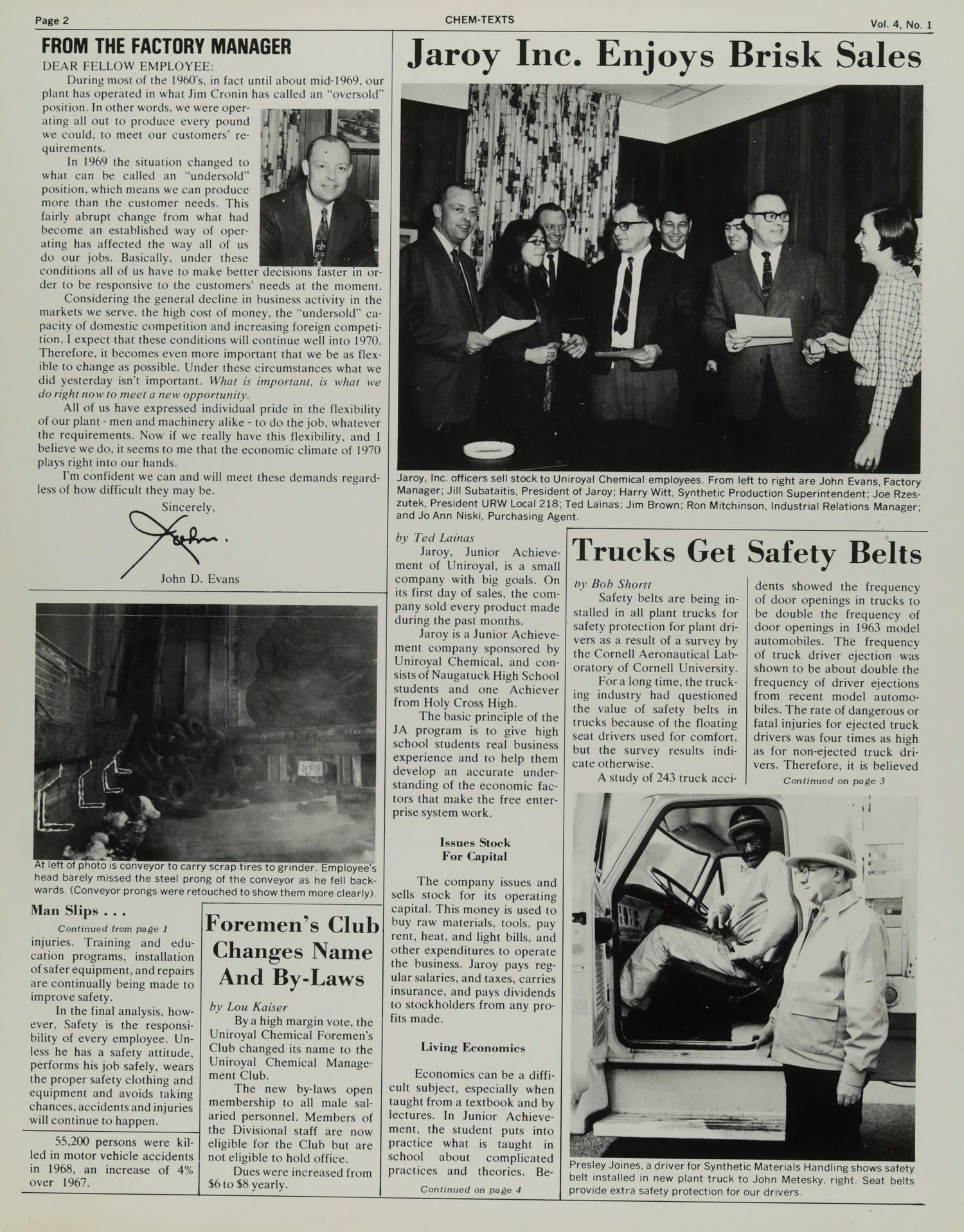
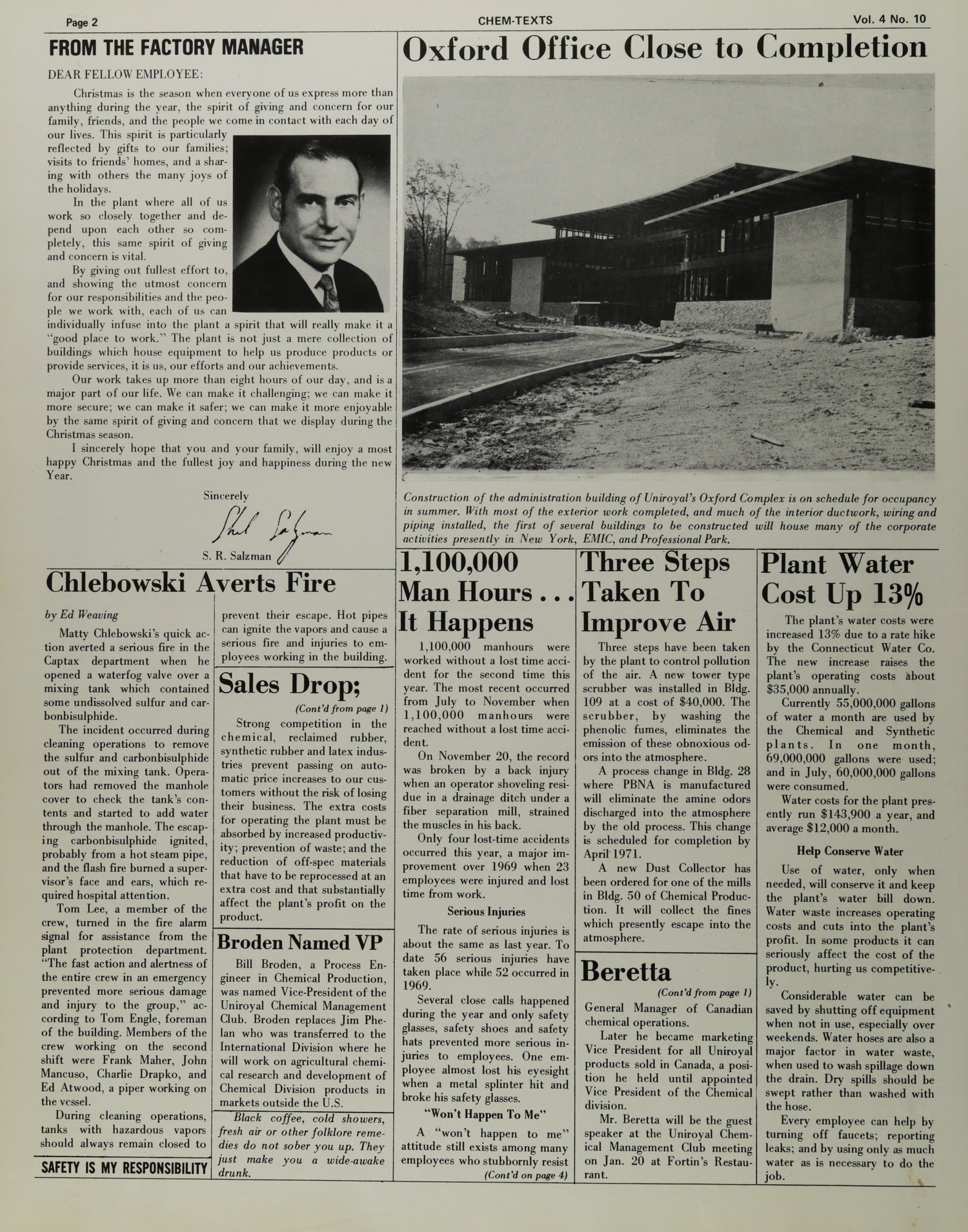
Jaroy, Inc. officers sell stock to Uniroyal Chemical employees. From left to right are John Evans, Factory Manager; Jill Subataitis, President of Jaroy; Harry Witt, Synthetic Production Superintendent; Joe Rzeszutek, President URW Local 218; Ted Lainas; Jim Brown; Ron Mitchinson, Industrial Relations Manager; and Jo Ann Niski, Purchasing Agent.

by Ted Lainas

Jaroy, Junior Achievement of Uniroyal, is a small company with big goals. On its first day of sales, the company sold every product made during the past months.

Jaroy is a Junior Achievement company sponsored by Uniroyal Chemical, and consists of Naugatuck High School students and one Achiever from Holy Cross High.

The basic principle of the JA program is to give high school students real business experience and to help them develop an accurate understanding of the economic factors that make the free enterprise system work.

Issues Stock For Capital

The company issues and sells stock for its operating capital. This money is used to buy raw materials, tools, pay rent, heat, and light bills, and other expenditures to operate the business. Jaroy pays regular salaries, and taxes, carries insurance, and pays dividends to stockholders from any profits made.

Living Economics

Economics can be a difficult subject, especially when taught from a textbook and by lectures. In Junior Achievement, the student puts into practice what is taught in school about complicated practices and theories. Be-

Continued on page 4


Trucks Get Safety Belts

by Bob Shortt

Safety belts are being installed in all plant trucks for safety protection for plant drivers as a result of a survey by the Cornell Aeronautical Laboratory of Cornell University.

For a long time, the trucking industry had questioned the value of safety belts in trucks because of the floating seat drivers used for comfort, but the survey results indicate otherwise.

A study of 243 truck accidents showed the frequency of door openings in trucks to be double the frequency of door openings in 1963 model automobiles. The frequency of truck driver ejection was shown to be about double the frequency of driver ejections from recent model automobiles. The rate of dangerous or fatal injuries for ejected truck drivers was four times as high as for non-ejected truck drivers. Therefore, it is believed

Continued on page 3

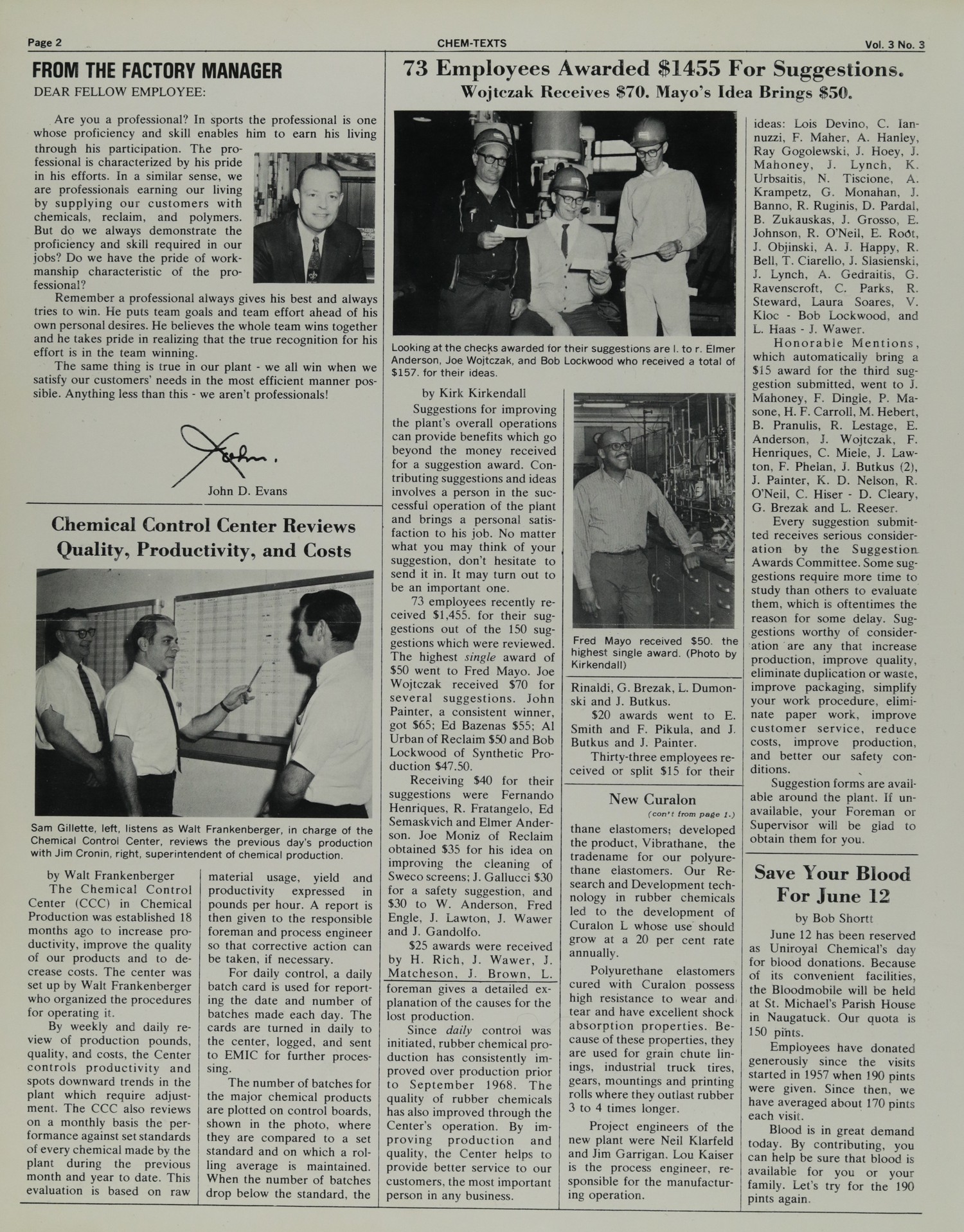
Presley Joines, a driver for Synthetic Materials Handling shows safety belt installed in new plant truck to John Metesky, right. Seat belts provide extra safety protection for our drivers.


At left of photo is conveyor to carry scrap tires to grinder. Employee’s head barely missed the steel prong of the conveyor as he fell backwards. (Conveyor prongs were retouched to show them more clearly).


Man Slips . . .

Continued from page 1

injuries. Training and education programs, installation of safer equipment, and repairs are continually being made to improve safety.

In the final analysis, however, Safety is the responsibility of every employee. Unless he has a safety attitude, performs his job safely, wears the proper safety clothing and equipment and avoids taking chances, accidents and injuries will continue to happen.

55,200 persons were killed in motor vehicle accidents in 1968, an increase of 4% over 1967.


Foremen’s Club Changes Name And By-Laws

by Lou Kaiser

By a high margin vote, the Uniroyal Chemical Foremen’s Club changed its name to the Uniroyal Chemical Management Club.

The new by-laws open membership to all male salaried personnel. Members of the Divisional staff are now eligible for the Club but are not eligible to hold office.

Dues were increased from $6 to $8 yearly.

CHEM-TEXTS – Vol. 4 No. 1 – Page 3

Page 003

CHEM-TEXTS

Vol. 4, No. 1 | Page 3


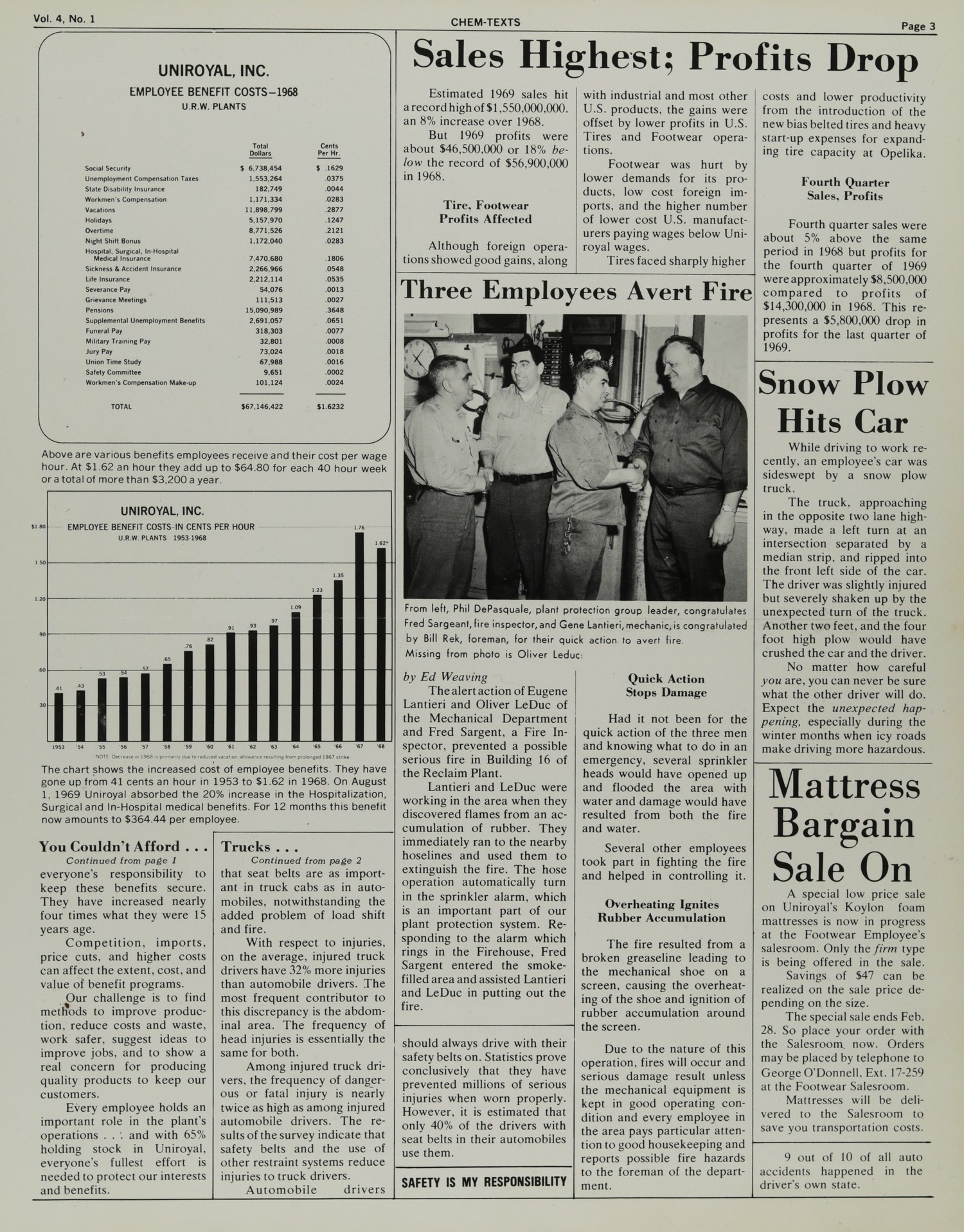
UNIROYAL, INC.

EMPLOYEE BENEFIT COSTS—1968

U.R.W. PLANTS

Total Dollars Cents Per Hr.
Social Security $ 6,638,454 $ .1629
Unemployment Compensation Taxes 1,553,264 .0375
State Disability Insurance 182,749 .0044
Workmen’s Compensation 1,171,334 .0283
Vacations 11,898,799 .2877
Holidays 5,157,970 .1247
Overtime 8,771,526 .2121
Night Shift Bonus 1,172,040 .0283
Hospital, Surgical, In-Hospital Medical Insurance 7,470,680 .1806
Sickness & Accident Insurance 2,266,966 .0548
Life Insurance 2,222,114 .0535
Severance Pay 54,076 .0013
Grievance Meetings 111,513 .0027
Pensions 15,090,989 3648
Supplemental Unemployment Benefits 2,691,057 .0651
Funeral Pay 318,303 .0077
Military Training Pay 32,801 .0008
Jury Pay 73,024 .0018
Union Time Study 67,988 .0016
Safety Committee 9,651 .0002
Workmen’s Compensation Make-up 101,124 .0024
TOTAL $67,146,422 $1.6232

Above are various benefits employees receive and their cost per wage hour. At $1.62 an hour they add up to $64.80 for each 40 hour week or a total of more than $3,200 a year.


UNIROYAL, INC.

EMPLOYEE BENEFIT COSTS-IN CENTS PER HOUR

U.R.W. PLANTS 1953-1968

[THIS IS CHART: Bar graph showing increasing employee benefit costs from 1953 to 1968, starting at around $0.41 in 1953 and reaching $1.62 in 1968, with data points for each year showing gradual increase: .41, .42, .53, .57, .62, .76, .82, .91, .93, .97, 1.09, 1.23, 1.35, 1.62, 1.76]

The chart shows the increased cost of employee benefits. They have gone up from 41 cents an hour in 1953 to $1.62 in 1968. On August 1, 1969 Uniroyal absorbed the 20% increase in the Hospitalization, Surgical and In-Hospital medical benefits. For 12 months this benefit now amounts to $364.44 per employee.


Sales Highest; Profits Drop

Estimated 1969 sales hit a record high of $1,550,000,000, an 8% increase over 1968.

But 1969 profits were about $46,500,000 or 18% below the record of $56,900,000 in 1968.

Tire, Footwear Profits Affected

Although foreign operations showed good gains, along with industrial and most other U.S. products, the gains were offset by lower profits in U.S. Tires and Footwear operations.

Footwear was hurt by lower demands for its products, low cost foreign imports, and the higher number of lower cost U.S. manufacturers paying wages below Uniroyal wages.

Tires faced sharply higher costs and lower productivity from the introduction of the new bias belted tires and heavy start-up expenses for expanding tire capacity at Opelika.

Fourth Quarter Sales, Profits

Fourth quarter sales were about 5% above the same period in 1968 but profits for the fourth quarter of 1969 were approximately $8,500,000 compared to profits of $14,300,000 in 1968. This represents a $5,800,000 drop in profits for the last quarter of 1969.


Three Employees Avert Fire

[THIS IS PHOTO: Group photo of four men in work attire]

From left, Phil DePasquale, plant protection group leader, congratulates Fred Sargeant, fire inspector, and Gene Lantieri, mechanic, is congratulated by Bill Rek, foreman, for their quick action to avert fire. Missing from photo is Oliver Leduc.

by Ed Weaving

The alert action of Eugene Lantieri and Oliver LeDuc of the Mechanical Department and Fred Sargent, a Fire Inspector, prevented a possible serious fire in Building 16 of the Reclaim Plant.

Lantieri and LeDuc were working in the area when they discovered flames from an accumulation of rubber. They immediately ran to the nearby hoselines and used them to extinguish the fire. The hose operation automatically turn in the sprinkler alarm, which is an important part of our plant protection system. Responding to the alarm which rings in the Firehouse, Fred Sargent entered the smoke-filled area and assisted Lantieri and LeDuc in putting out the fire.

Quick Action Stops Damage

Had it not been for the quick action of the three men and knowing what to do in an emergency, several sprinkler heads would have opened up and flooded the area with water and damage would have resulted from both the fire and water.

Several other employees took part in fighting the fire and helped in controlling it.

Overheating Ignites Rubber Accumulation

The fire resulted from a broken greaseline leading to the mechanical shoe on a screen, causing the overheating of the shoe and ignition of rubber accumulation around the screen.

Due to the nature of this operation, fires will occur and serious damage result unless the mechanical equipment is kept in good operating condition and every employee in the area pays particular attention to good housekeeping and reports possible fire hazards to the foreman of the department.


Snow Plow Hits Car

While driving to work recently, an employee’s car was sideswiped by a snow plow truck.

The truck, approaching in the opposite two lane highway, made a left turn at an intersection separated by a median strip, and ripped into the front left side of the car. The driver was slightly injured but severely shaken up by the unexpected turn of the truck. Another two feet, and the four foot high plow would have crushed the car and the driver.

No matter how careful you are, you can never be sure what the other driver will do. Expect the unexpected happening, especially during the winter months when icy roads make driving more hazardous.


Mattress Bargain Sale On

A special low price sale on Uniroyal’s Koylon foam mattresses is now in progress at the Footwear Employee’s salesroom. Only the firm type is being offered in the sale.

Savings of $47 can be realized on the sale price depending on the size.

The special sale ends Feb. 28. So place your order with the Salesroom now. Orders may be placed by telephone to George O’Donnell, Ext. 17-259 at the Footwear Salesroom.

Mattresses will be delivered to the Salesroom to save you transportation costs.

9 out of 10 of all auto accidents happened in the driver’s own state.


You Couldn’t Afford . . .

Continued from page 1

everyone’s responsibility to keep these benefits secure. They have increased nearly four times what they were 15 years ago.

Competition, imports, price cuts, and higher costs can affect the extent, cost, and value of benefit programs.

Our challenge is to find methods to improve production, reduce costs and waste, work safer, suggest ideas to improve jobs, and to show a real concern for producing quality products to keep our customers.

Every employee holds an important role in the plant’s operations . . . and with 65% holding stock in Uniroyal, everyone’s fullest effort is needed to protect our interests and benefits.


Trucks . . .

Continued from page 2

that seat belts are as important in truck cabs as in automobiles, notwithstanding the added problem of load shift and fire.

With respect to injuries, on the average, injured truck drivers have 32% more injuries than automobile drivers. The most frequent contributor to this discrepancy is the abdominal area. The frequency of head injuries is essentially the same for both.

Among injured truck drivers, the frequency of dangerous or fatal injury is nearly twice as high as among injured automobile drivers. The results of the survey indicate that safety belts and the use of other restraint systems reduce injuries to truck drivers.

Automobile drivers should always drive with their safety belts on. Statistics prove conclusively that they have prevented millions of serious injuries when worn properly. However, it is estimated that only 40% of the drivers with seat belts in their automobiles use them.


SAFETY IS MY RESPONSIBILITY

CHEM-TEXTS – Vol. 4, 1970, No. 2 – Page 1

Page 001

UNIROYAL CHEM-TEXTS

Vol. 4, 1970 | PUBLISHED FOR THE PEOPLE OF UNIROYAL CHEMICAL | No. 2


1970 Success Depends On Each Employe

If you were going on a long vacation you would carefully plan in advance and consider everything necessary for a safe and rewarding trip for yourself and your family.

Operation of a large chemical plant requires the same deliberate planning in advance to assure progress, produce products competitively, improve safety and to secure the jobs of every employee.

To implement the plans of the plant for 1970, millions of dollars will be invested by the Company proving its confidence in the skills and abilities of the people at Naugatuck. Mere spending of money will not do the job alone; only the fullest use of every employee’s efforts in every department is needed to justify these expenditures. With a positive attitude and concern by each employee to do his full share, 1970 will be a year of progress.

Departments Depend Upon Each Other

Each department outlined plans and goals for the year for its own group. But the success of these plans require the cooperative effort of all departments. Progress depends upon every employee’s fullest cooperation to work in a unified effort with all the departments in the plant’s operation.

The following summarize the major plans for departments to make 1970 a year of progress.

Chemical Production

Product quality and production must be improved to satisfy our customers’ demands. Their purchase of our products are critically important to the operation of the plant.

To help us improve this situation, the new Control Center will schedule products by priority; help improve product quality and utilize equip-


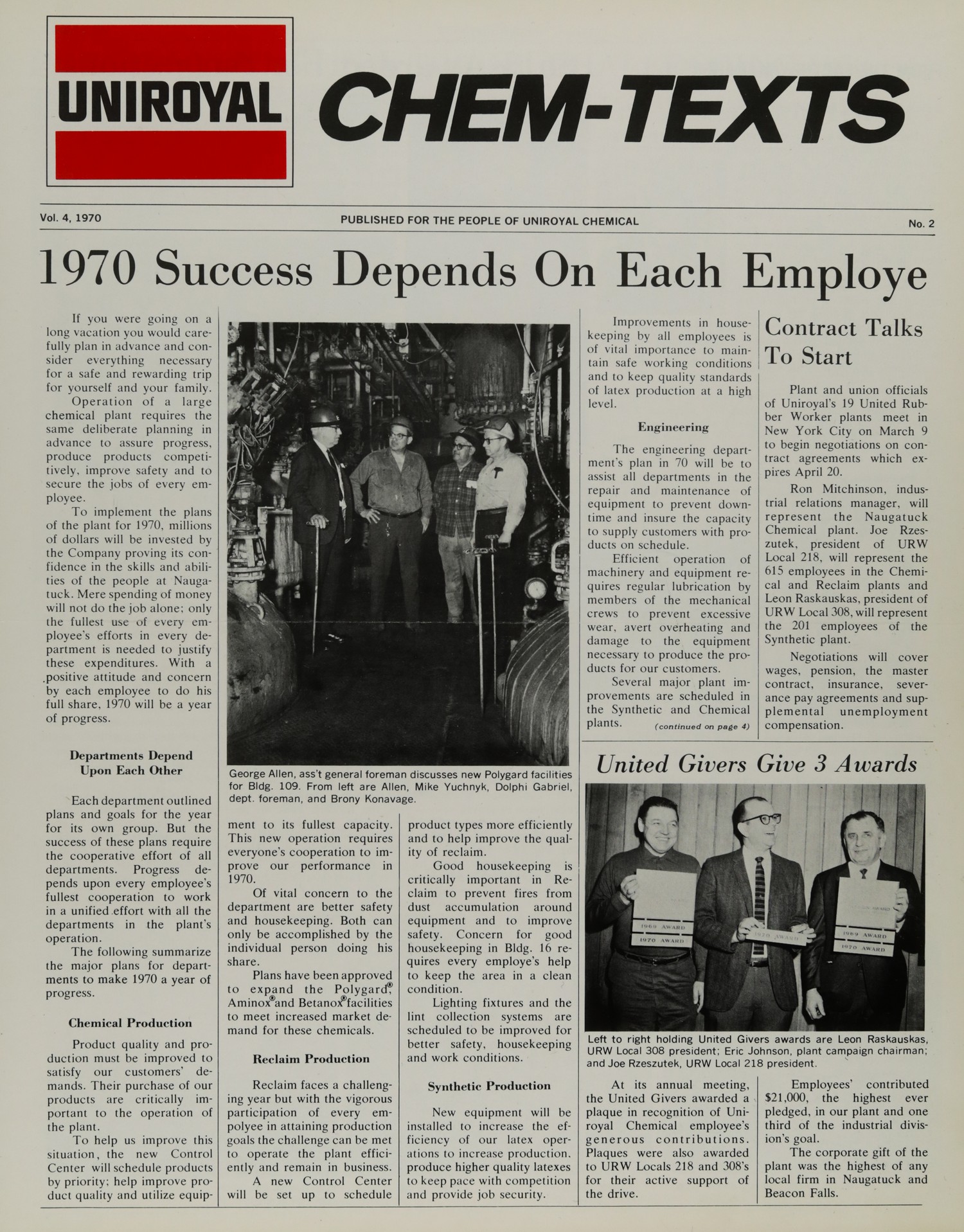
[PHOTO CAPTION]
George Allen, ass’t general foreman discusses new Polygard facilities for Bldg. 109. From left are Allen, Mike Yuchnyk, Dolphi Gabriel, dept. foreman, and Brony Konavage.


ment to its fullest capacity. This new operation requires everyone’s cooperation to improve our performance in 1970.

Of vital concern to the department are better safety and housekeeping. Both can only be accomplished by the individual person doing his share.

Plans have been approved to expand the Polygard, Aminox and Betanox facilities to meet increased market demand for these chemicals.

Reclaim Production

Reclaim faces a challenging year but with the vigorous participation of every employee in attaining production goals the challenge can be met to operate the plant efficiently and remain in business.

A new Control Center will be set up to schedule product types more efficiently and to help improve the quality of reclaim.

Good housekeeping is critically important in Reclaim to prevent fires from dust accumulation around equipment and to improve safety. Concern for good housekeeping in Bldg. 16 requires every employe’s help to keep the area in a clean condition.

Lighting fixtures and the lint collection systems are scheduled to be improved for better safety, housekeeping and work conditions.

Synthetic Production

New equipment will be installed to increase the efficiency of our latex operations to increase production, produce higher quality latexes to keep pace with competition and provide job security.


Improvements in housekeeping by all employees is of vital importance to maintain safe working conditions and to keep quality standards of latex production at a high level.

Engineering

The engineering department’s plan in 70 will be to assist all departments in the repair and maintenance of equipment to prevent downtime and insure the capacity to supply customers with products on schedule.

Efficient operation of machinery and equipment requires regular lubrication by members of the mechanical crews to prevent excessive wear, avert overheating and damage to the equipment necessary to produce the products for our customers.

Several major plant improvements are scheduled in the Synthetic and Chemical plants. (continued on page 4)


Contract Talks To Start

Plant and union officials of Uniroyal’s 19 United Rubber Worker plants meet in New York City on March 9 to begin negotiations on contract agreements which expires April 20.

Ron Mitchinson, industrial relations manager, will represent the Naugatuck Chemical plant. Joe Rzeszutek, president of URW Local 218, will represent the 615 employees in the Chemical and Reclaim plants and Leon Raskauskas, president of URW Local 308, will represent the 201 employees of the Synthetic plant.

Negotiations will cover wages, pension, the master contract, insurance, severance pay agreements and supplemental unemployment compensation.


United Givers Give 3 Awards

[PHOTO CAPTION]
Left to right holding United Givers awards are Leon Raskauskas, URW Local 308 president; Eric Johnson, plant campaign chairman, and Joe Rzeszutek, URW Local 218 president.

At its annual meeting, the United Givers awarded a plaque in recognition of Uniroyal Chemical employee’s generous contributions. Plaques were also awarded to URW Locals 218 and 308’s for their active support of the drive.

Employees’ contributed $21,000, the highest ever pledged, in our plant and one third of the industrial division’s goal.

The corporate gift of the plant was the highest of any local firm in Naugatuck and Beacon Falls.

CHEM-TEXTS – Vol. 4 No. 2 – Page 3

Page 003

CHEM-TEXTS

Vol. 4 No. 2 | Page 3


HOPKINS PREDICTS A TOUGH, CHALLENGING 1970

[IMAGE: Black and white photograph of two men in suits having a discussion]

Frank Hopkins, left, Chemical division vice president discusses with Lou Kaiser, president of the Uniroyal Chemical Management Club, the sales outlook for 1970 and its effects on the Naugatuck plant’s operations.


Frank Hopkins, vice president of the Chemical division, reviewed 1969 Chemical sales for the division and predicted a tough, competitive year in 1970 in a talk to the Uniroyal Chemical Management Club.

1969 Pounds Higher;
But Profits Drop

1969 pound sales were higher than 1968 but profits were affected by price reductions, particularly in rubber chemicals; higher raw material costs; tougher competition; foreign imports; and higher production costs.

Only increased volume and reduction in costs will help us keep pace with the prices customers are willing to pay for our products.

1970 Tough
First 6 Months

The downward trend in the chemical business is expected to continue for the first six months of 70. The slack in automotive sales will affect our chemical and reclaim business at Naugatuck. Price erosions, foreign imports, and tougher competition will continue to hurt our sales.


Keeping customers satisfied with pinpoint scheduling, quality products, good packaging, and better service becomes more critical to operate the plant at its fullest capacity. This is the challenge to us in the plant.

Reclaim Faces
Tough Competition

Hopkins pointed out that oil extended rubbers offer tough competition to the reclaimed rubber prices. The price is close to reclaim and the oil extended rubbers are gaining wider acceptance in the tire industry.

Equipment Needed

The Naugatuck plant is the oldest in the division. Much of the equipment is old and needs replacement with newer, more productive facilities to remain competitive. A number of Appropriation Requests have been approved for more efficient equipment to improve yields and quality.

Synthetic’s Future
Looks Brighter

The Synthetic plant’s location in the northeast provides a challenging advantage in the latex market. Continued, improved efficiencies


can put us in a position to take advantage of our locations in this product area.

Recent latex developments for paper coating should gain a larger share of this huge market.

Odors, Fumes

Odors and fumes pose a major problem in Naugatuck and steps must be taken to improve environmental control.

Every employee’s help is needed to report odors and their source to their foreman or supervisors to initiate action to control pollution of the air.


No Lost Time Accidents In January

Safety started off in 1970 with no lost time accidents occurring during the month. There’s an old saying that “well begun is half done.”

1970 can be an accident free year if every employee commits himself to making the plant safe for himself and other employees.

Most accidents can be prevented by carefulness in performing a job and a constant awareness of the unexpected happening. There are still many employees in the plant who do not wear hard hats, safety glasses and the proper protective equipment on the job, exposing themselves to serious injury. They not only risk their own safety but the safety of their fellow employees.


Scholarship Announced

by Lou Kaiser

The Uniroyal Chemical Management Club offers a $250 scholarship, which is available to a son or daughter of a Chemical Division employee with at least 2 years of service with Uniroyal.

The scholarship is open to any student in the graduating class of a high school or college prep school who plans a college education. Applications may be obtained from the Industrial Relations Department, Ext. 218.

Phil Paul is chairman of the Scholarship committee. Applications must be returned or mailed to Dr. Phil Paul, Bldg. 81, on or before April 1, 1970.


You Never Can Tell!

by Byron Hunter

While researching a new chemical blowing agent, I had previously taken the decomposition temperature on a small sample in a melting point tube and found the decomposition temperature to be 194° C.

Continuing the experiment, I prepared a larger amount of material and dried it over the weekend at 70° C. To ensure complete drying, the product was placed in a 130° C. oven. Unexpectedly, the material suddenly decomposed after two hours in the oven. The force of the decomposition blew open the oven door, and filled the laboratory with smoke. Fortunately, no one was standing near the oven, otherwise they

might have been injured. Actually, the force of the decomposition was not great and the oven was not damaged.

I quickly turned in the fire alarm, and within two minutes the fire inspectors responded to the call, checking the area for hazardous vapors and fumes.

When working with new chemicals it is extremely important to use extra precaution and safety and to advise people in the area that you are testing a new material whose properties are not fully known.

You never can tell when the unexpected will happen while researching a new compound, particularly a new blowing agent.


[IMAGE: Black and white photograph of a man in a lab coat pointing at laboratory equipment]

Dr. Byron Hunter, a Senior Research Associate, points to new compound which “took off” unexpectedly and blew open the oven door.


Nine Join Wise Owl Club

by Sal Aloise

Nine employees were admitted to the Wise Owl Club during the year 1969. Membership in the Club is highpriced: Your Eyesight.

Receiving membership into the Club recently by saving their eyesight, were Urbano Genga, Kevin Kelley, Tony Malone, Clarence Parks, Adam Soboleski, Frances Bendler, Howard Nixon, Ben Tomaszeski and Raymond Jennings.

These employees saved the sight of one eye, and in some cases, the sight of both eyes because they were wearing their safety glasses on the job when the unexpected happened.

If they had taken a chance and not worn them, tragic loss of sight from care-

lessness would have struck 9 employees and their families.

Uniroyal Chemical would have paid the doctor and hospital bills and compensated for the loss of sight, but no amount of money can ever pay for a lost eye. It’s not worth the “just once” chance to work without safety glasses and proper eye protection. The “just once” may be once too much. Yet there are many employees in the plant who risk this chance daily.

The Wise Owl Club has over 45,000 members in the United States who saved their eyesight by wearing glasses and proper eye protection on and off the job. In several states, laws have been passed that all eyeglass must be safety glass.

The plant pays the cost of the frames and the cost of prescription safety glasses. If you need a pair visit the nurse at the Chemical or Synthetic plant hospital.

CHEM-TEXTS – Vol. 4 No. 2 – Page 4

Page 004

Page 4 | CHEM-TEXTS | Vol. 4 No. 2


Maxi Coats Go Marvinol

[IMAGE: Woman in long maxi coat standing outdoors]

Maxi coats and maxi-chic Eskiloos® with brass trim on their squared-off moc toes and popular high vamps are right in style with today’s with-it fashions. The honey crushed patent vinyl coat has both style and warmth.

The warm, water-repellent Eskiloos are knee-high, with soles and chunky heels that keep you in step with fashion all the way.

Leading women’s clothes manufacturers use the Chemical division’s Marvinol® vinyl

resins for their superior quality and the real leather look they give to clothing. The Eskiloos are made by the C and I division.

Much of the research and development on Marvinol vinyl used in clothing and home furnishings is done at the TSSC here in Naugatuck by a team of qualified technical people: Charlie Buckley, Al Heinrichs, Mary Marques, Phil Morin, Carl Ruggles, Bill Stephenson, Lou Triano, Bob Tyler, and Arnold Werner, manager.


25 Year Club Holds Dinner

The 25 Year Club will hold a dinner at the Waverly Inn in Cheshire on Friday evening, March 20, at 6 P.M.

Employees with 25 years service and more, both active and retired, are invited to attend the dinner as guests of Uniroyal Chemical.

Forty eight new members will be initiated into the 25 Year Club at this year’s dinner. Presently there are 568 members in the club which honors employees for their loyal and long years of service.


Monahan, Marinello Retire

[IMAGE: Elderly couple, man and woman]

OVER 50 YEARS OF SERVICE was the unique distinction Joe Monahan achieved with Uniroyal Chemical. At left is his wife, Iva. Joe, an assistant to Frank Hopkins, vice president, started work at 15 and spent 35 years at the Naugatuck plant.

[IMAGE: Group of men in work setting]

Bill Marinello started work at 13 with the Rubber Regenerating Co. before it was purchased by Uniroyal Chemical. Congratulating Bill on his retirement after 20 years service are from left Charlie Labalbo, Al Pistarelli, foreman, Marinello, Minic Brown and Larry Rinaldi.


1970 Success . . .

(continued from page 1)

The design and construction of the new pretreatment waste water facility as part of the plant’s environmental program to control pollution of the Naugatuck river will be undertaken during 1970.

A plan has been initiated to study the causes of air pollution by buildings to determine methods to control the discharge of dust and odors into the air.

Materials Handling

Redesigned and standardized packages will improve the package appearance of our products. But these improvements will be wasted unless extra caution is taken during the filling, handling and shipping operation to ship neat, clean packages to our customers to stop customer complaints about our packages.

Damaged drums, dirty packages and dented cans can result in returned shipments and costly repackaging which affects our sales and profits.

Warehousing and trucking costs will be studied to give our customers faster and better service.

A clean plant and building is a good place to work and only good housekeeping practices by every person in their work and locker areas can attain this goal.

Purchasing

This group will continue the implementation of chemical and synthetic raw materials’ orders and inventory control by electronic data processing (EDP) to obtain material at the lowest cost and to provide the necessary materials on time for production operations.

The testing program on can liners for agricultural chemicals will be continued to give our customers quality products in the best packages.

Industrial Relations

Training programs will be conducted for foremen and supervisors; and a new orientation program for new employees will be given when they are hired.

Cafeteria and food services throughout the plant will be studied to improve service, particularly the hot food service in the vending machines.

A Contact and Evaluation program for salaried employees has started and every employee will be interviewed on a two level basis.

To keep employees informed on plant news and plans, the plant paper Chem-Texts, and News Bulletins will be issued on a regular basis.

Industrial Engineering

The red tape and delays in reviewing ideas will be eliminated under the new Idea Plan. Prompt attention will be given to all ideas submitted by all employees.

A Year Of Progress

By understanding the whys of your job, the importance of your job, and by showing a real, personal involvement in your job, 1970 will be a year of progress.


CHEM TEXTS

PUBLISHED BY THE INDUSTRIAL RELATIONS DEPARTMENT
UNIROYAL CHEMICAL, NAUGATUCK, CONN. 06770

EDITOR: William F. Lavelle.


UNIROYAL CHEMICAL
Naugatuck, Connecticut 06770

U.S. Postage
PAID
Permit No. 10
Naugatuck, Conn. 06770

RETURN POSTAGE GUARANTEED

CHEM-TEXTS – Vol. 4, 1970, No. 3 – Page 1

Page 001

UNIROYAL CHEM-TEXTS

Vol. 4, 1970 PUBLISHED FOR THE PEOPLE OF UNIROYAL CHEMICAL No. 3


Safety Is Everyone’s Responsibility

[IMAGE: Black and white photograph showing employees leaving work at a plant with cars visible]

A day’s work is done safely and employees leave for home and their families. Driving home requires just as much concern for safety as at work.


The plants. The foremans. The employees.

To make the plant a safer place to work, local management is doing everything possible to prevent accidents. It’s a major goal of every department to make 1970 a safer year than 1969. However, no matter what improvements are made, it ultimately depends on the individual’s attitude and concern for his own safety and the safety of his fellow employee to improve safety.

Safety is just as important to the plant’s operation as production, cost, quality and morale. It’s the responsibility of the factory manager, superintendent, foreman, supervisor and every employee to eliminate every unsafe condition in the department, which is usually the result of an unsafe act of a person.

3,181 Work Days Lost

In 1969 there were 23 lost-time injuries. As a result of these injuries along with a carryover from prior years, a total of 3181 work days were lost. Most of these injuries could have been avoided by a greater awareness of safety and observing safe work procedures.

Accidents Cost $145,512

$145,512 was the total cost of lost-time accidents and serious injuries in 1969. This represents approximately $85 for each employee as a result of lost time accidents. These payments are made from the plant’s profits. It is evident that accidents affect us not only personally by pain and suffering but also affect the job security of all people.

Who Suffers?

The individual employee hurt in the accident; his family; and every employee in the plant.

No amount of money can pay the cost of the pain, the

(continued on page 4)


H.S. Girls Run JAROY, Inc.

[IMAGE: Black and white photograph showing five people standing together]

Five women executives of Jaroy, Inc., a Junior Achievement firm sponsored by Uniroyal Chemical, are leading the company to record sales this year. Sales were high recently when the firm sold slate boards, first aid kits, roll-a-notes and solid maple cutting boards at the plant entrances. From left are Jo Ann Niski, president; Lisa Rossi, Eugenia Arnold, Ted Lainas, advisor; and John Prior, purchasing a first aid kit. The products were designed and manufactured by the firm’s members, who are high school students.


Corporate Identity Changed

Uniroyal adopted a new corporate identification logotype which replaces the blue rectangle with white UniRoyal letters. The new identification will be used on TV commercials, advertising, booklets, brochures, catalogs, point of sale, letterheads and printed material.

This issue of CHEM-TEXTS shows the new corporate identification, a bright red rectangle with black UNIROYAL letters on a white background. It is somewhat similar to the Uniroyal Tire division identity which is black and red with a tire tread, seen at Uniroyal tire dealers.

All material with the old identification such as stationery should be used until supplies are depleted. When new supplies and materials are ordered the new corporate mark should be used.


Morrison Prevents Fire

Quick action prevented a fire when overheating of a motor ignited a thin accumulation of Celogen® dust on the floor below the grinder motor.

Chet Morrison, operator of the grinder, shut off the moto., opened the manually operated sprinkler head over the area and asked Nunzie Ruby to turn in the fire alarm which recorded the location at the watchman’s control center, where Ed Day was on duty.

The sprinkler system extinguished the thin film of

(continued on page 4)

[IMAGE: Black and white photograph showing three men, one wearing a hard hat]

Morrison’s quick action averted fire. From left are Clyde Rapp, Angelo Taylor congratulating Chet, and Eddie Gooch.

CHEM-TEXTS – Vol. 4 No. 3 – Page 2

Page 002

CHEM-TEXTS

Page 2 | Vol. 4 No. 3


FROM THE FACTORY MANAGER

DEAR FELLOW EMPLOYEE:

Spring is officially here and every now and then the sunshine gives promise that it will be really here before long. Along with spring comes the housecleaning bug that bites our wives and turns our houses upside down while the cleaning is done and the furniture is moved. When it’s all done, the house really looks great, doesn’t it?

Let’s all catch the bug this spring and pitch in together to clean up the plant this month. In a large operation like ours, spread over many acres, winter takes its toll of housekeeping and when the snow is gone our winter carelessness becomes only too obvious.

I’m counting on everybody to do his part in cleaning up his work area. Remember, good housekeeping goes hand in hand with efficient work, quality performance, safe operation and makes for a much more pleasant place to work.

Best regards.

Sincerely,

John

John D. Evans


Chemical Club Elects Officers

[IMAGE: Group photo of officers at meeting]

Newly elected officers of the Uniroyal Chemical Management Club hold their first meeting. From left are Bob Smith, treasurer; Dick Keenan, secretary; Lou Kaiser, president; and Jim Phelan, vice president.

by Lou Kaiser

The Uniroyal Chemical Management Club elected officers at its monthly meeting. Reelected president for a third term was Lou Kaiser. Jim Phelan was reelected vice president over Steve Alper and Al Murray. Bob Smith was reelected over Brad Swain for treasurer. Dick Keenan topped Dick Mastromatteo in the balloting for secretary. Stan Mazur was nominated from the floor for president but declined the nomination.

The Club’s annual dinner will be held at the Ambassador Restaurant in Hamden on April 15.

John Evans, factory manager, main speaker at the meeting, gave a brief picture of the plant’s business outlook for 1970, and was followed by staff members Bert Scullin, Larry Koth, Harry Witt, Hal Lynch, Bob VanAllen, Fred Wintsch, who spoke for Ron Mitchinson, Jim Cronin and Al Manzi, who summarized their department’s prime goals for the year.


Service Keeps Customer

[IMAGE: Workers loading materials on pallet]

From left loading 451 on pallet in Bldg. 109 are Brony Konavage and Mike Yuchnyk as Bert Frennesson and George Baktis watch.

[IMAGE: Group of workers being congratulated]

Rocco Magnanimo congratulates Bldg. 17 employees for refining 451 and shipping to customer on time. From left are Magnanimo, Ted Clement, Bob Orsini, Jack Cuddy, Joe Antonucci and Jerry Markham.

An order for Antioxidant 451 was recently received from a large customer for delivery on very short notice. 451 is a product that the Sales department has been trying to sell for over a year, but without much progress. The new product was important to the Naugatuck plant’s success because it represented new business.

Used In Tires

The customer tried 451 as a stabilizer in styrene-butadiene rubber, which goes into most of the tires made in the country on a small run. It worked. The customer came back and said, “if you can keep me supplied with 451, I’ll use it in our entire run.”

Service Saves Business

This is where the crews in Bldg. 109 and Bldg. 17 played an important role in saving the business. Through their effort, the 451 was processed and transferred into a tank car, and shipped out of the plant in time to satisfy the customer and keep the business.

Cooperation like this, which involves several departments, gets new customers and keeps them. The more customers the plant gets, the more business it gets. This is what makes our jobs more secure.

Crew Members

Building 109 employees responsible for processing the material were George Baktis, area foreman; Dolph Gabriel, foreman; Larry Bogen, John Booth, Brony Konavage, Harold McIlroy, Joe Owens and Buddy Watts.

Building 17 employees who helped get the product shipped out on time were John Honyotski, area foreman; Rocco Magnanimo, foreman; Eric Storch, process engineer; Bert Frennesson, engineering associate; Joe Antonucci, John Shumak, Thurman Walton, Ben Root, Bob Orsini, Jesse Silva, Frank Bedard, and Ted Clement.


New Degree Offered By College

An associate degree in Industrial Management Technology geared to the needs of foremen and supervisors is offered by the Waterbury State Technical College.

The curriculum includes courses on: cost control, personnel management, accounting, job instruction training, work simplification, safety and hygiene, communications, value analysis, manufacturing processes, quality control, data processing, plant layout, physics, economics and human relations.

Courses are given by the Evening Division in trimester sessions. The cost is $5.00 per course.

Waterbury State also offers courses in civil technology, chemical technology, data processing, electrical technology, fire technology, industrial management and mechanical technology.

For further information on the courses, contact your foreman, supervisor or the Director of Extension Services, Waterbury State Technical College, 1460 West Main Street, Waterbury, Conn. 06708. or phone 756-7035.

When the courses are job related, you can apply for Tuition Aid. Under this program, Uniroyal pays the tuition cost upon satisfactory completion of the course.


Spring Tire Sale Starts

A special spring employee tire sale runs from March 30 through May 29. Employee prices will be substantially below regular prices on passenger, small truck, camper and trailer tires.

The new Uniroyal Master with front and rear tires for better steering and traction, a steel reinforced tread and 40,000 mile guarantee are included in the sale.

Other tires offered are the “Tiger Paw,” wide “Tiger Paw” and the Laredo “Rain Tire.”

This will be the only sale on these tires during the year.

Tire slips can be obtained from the Industrial Relations department; Ann McAllister, R.N., Synthetic plant hospital; Luella Anderson, TSSC; and Janet Nolin and Jack Vergosen, EMIC

SAFETY IS MY RESPONSIBILITY

CHEM-TEXTS – Vol. 4 No. 3 – Page 3

Page 003

CHEM-TEXTS

Vol. 4 No. 3 Page 3


Supervisory Skills Training Program Started For Foremen

[LEFT PHOTO CAPTION:]
The group listens attentively to Tom Ennis report on solution of a problem. Attending the first SSTP session were from left, Fred Wintsch, Tom Dowling, Ed Smith, George Allen, Dave Rappe, Jack Tierney, Bill Albaitis, Al Enamait, Earl Roller, Tom Engle,

[RIGHT PHOTO CAPTION:]
George Arndt, Gary Arndt, Bob Breton, Chet Bulka, Ennis and Bill Lannon. Missing from photo were Lou Coscia and Frank Lynch. SSTP sessions for supervisors and foremen are being scheduled for future dates.


Globetrotters Sell Pro* Keds On TV

The world famous Harlem Globetrotters are entertaining millions of people on TV and helping sell Uniroyal products with their dazzling wizardry and magic on the basketball court. This is part of Uniroyal’s intensive TV program to advertise the company and its products on prime TV shows.

The Globetrotters have used Pro-Keds® in their long career for their long wearing quality and the built-in arch support that helps prevent muscle strain from their heavy schedule all over the world.

Pro-Keds® use several of the rubber chemicals made at the Naugatuck plant. Four accelerators, Delac®NS, Tuex®, Monex® and Pentex® are used to cure the rubber and give it toughness. Without accelerators it would take more than 8 hours for the rubber to harden or cure.

Aminox®, an antioxidant, prevents heat deterioration to the rubber during the manufacturing process.

Uniroyal Chemical is the world’s leading manufacturer of rubber chemicals, with 70% of the chemicals made at the Naugatuck plant.

Only by producing quality chemicals against stiff competition can the plant maintain this position in the footwear industry. Some of the major competitors in the rubber chemical business vying for the same market are DuPont, Monsanto, Vanderbilt, American Cyanamid and Pennwald.


Contract Talks Continue In N.Y.

Negotiation discussions on the contract which expires April 21 at 12:01 A.M., are still underway in New York between management and union officials of the 19 Uniroyal plants represented by the United Rubber, Cork, Linoleum, and Plastic Workers of America.

The sessions started on March 9. Representatives of the Naugatuck Chemical plant attending the meetings are Ron Mitchinson, Industrial Relations Manager; Joe Rzeszutek, URCLPWA Local 218 President; and Leon Raskauskas, URCLPWA Local 308 president.


by Bob Krause

A group of Uniroyal Chemical foremen and supervisors attended the first of a series of sessions of a Supervisory Skills Training Program (SSTP) at the Holiday Inn in Waterbury.

The program which was initiated at the corporate level gives members in supervisory positions an opportunity to study themselves and determine how they relate to their jobs. The program also introduces some new concepts which help them keep up to date on current trends in supervisory skills.

John Evans, Factory Manager, introduced the program which was organized and presented by Bob Krause of the Industrial Relations Department.

Tom Ward, Uniroyal Manager of Supervisory Development discussed his views with the group and the company’s views concerning the overall program and some of its details.

Additional programs will be scheduled during the year to give more foremen and supervisors the chance to participate in the SSTP sessions.


[BOTTOM LEFT PHOTO CAPTION:]
Harlem Globertrotters help sell Uniroyal products on TV to millions of customers. Indirectly they sell 5 chemicals made at the Naugatuck plant. Watch them on the leading TV shows.


Two Months Without A Lost-Time Accident

by Sal Aloise

In February, no lost time accidents occurred in the plant. This is the second successive month that all of us have worked without a lost time accident. This represents a total of nearly 600,000 manhours worked without a lost time accident, a good improvement in safety compared to 1969 when four lost time accidents took place for the same 2 months.

During February, there were 4 serious injuries: one eye injury in Chemical Production; one work change in Reclaim; one suture of the finger in R&D; and one suture in the elbow in R&D.

With this excellent start, 1970 can be the safest year we ever had.


[RIGHT PHOTO CAPTION:]
Bob Krause, coordinator of the SSTP demonstrates a point on the chart.


Dividend Declared

Uniroyal declared a quarterly dividend of 17½ cents a share on the common stock payable March 25 to stockholders of record February 24.

Two dividends of $2 each on the Company’s preferred stock were declared: one to be paid March 25 to stockholders of record February 24 and the other payable June 25 to stockholders of record May 25.

CHEM-TEXTS – Vol. 4 No. 3 – Page 4

Page 004

CHEM-TEXTS

Page 4 | Vol. 4 No. 3


Social Security Upped 15%

The 15% increase in Social Security benefits affects everything from a retiree’s monthly check to the benefit paid a 40 year-old widow with small children. The extra benefit starts in April with two checks covering all the increases since Jan. 1.

A person who paid the maximum tax and retires at 65 in 1970 gets $190 a month – up form $165. He gets 80% if he retires at 62; 86-2/3% at 63; and 93-1/3% at 64.

His wife, age 65, gets 50% of her husband’s benefits, or $95. She can get $71.25 at 62. When her husband dies, she receives 82½ % of his post 65 benefit, $157 for life.

Applications for social security should be made 3 to 4 months before retirement to receive benefits upon retirement and to avoid delays.

The Social Security office in Waterbury or New Haven will gladly answer questions pertaining to your benefits.


Morrison (continued from page 1) burning Celogen around the motor and averted a serious fire. A short shutdown was required to repair the faulty bearing.

Safety procedures are an important part of safety and fire prevention. Knowledge of operation of the equipment, location of shut-off valves, and the location of fire alarm boxes, showers, eye fountains, and other safety equipment prevents accidents and injuries and makes the plant a safer place to work for all of us.


Better Food Service Promised

At a recent meeting, representatives of Industrial Vendors, Inc. (IVI) who service the plant’s food facilities, stated that every effort would be made to improve the food and vending machine service in the plant.

The meeting stemmed from employee complaints about the condition and quality of food as well as the lack of food in the machines on the night shifts and weekends, and poor servicing of the machines. A lack of variety in Cafeteria menus was another comment often mentioned by employees about the service.

It is a major concern of the plant to assure fresh quality food for employees on all shifts. The meeting should result in improved food services throughout the plant.


$16,900 Invested In Each Employee

Each year Uniroyal increases its investment in new and better equipment to improve production, work conditions and to make jobs easier.

Today each employee is backed by $16,900 in plants, tools and equipment. Ten years ago the figure was $10,400.

During the past year, several millions of dollars were spent on plant improvements, new equipment, new machinery, modernization programs, safety, and new product facilities. This investment helps us remain competitive in the chemical industry by selling our products to customers at a competitive price and protects job security.

SAFETY IS MY RESPONSIBILITY


Tony Jokubaitis Retires

[IMAGE: Photo showing group of men, one wearing a “DANGER” hard hat]

Congratulating Tony Jokubaitis on his retirement after 25 years with Uniroyal Chemical are from left: John Quint, Don Holmes, Tony, Walter Tabaka, Bill Krayeski, and Larry Pearl.


DEPARTMENT BREAKDOWN FOR 1969 VS. 1968

Department 1969 Lost Time Accidents Days Lost Serious Injuries 1968 Lost Time Accidents Days Lost Serious Injuries
Chem. Prod. 7 397 16 7 403 14
Reclaim Prod. 3 147 8 4 67 11
Mat. Handling 4 135 7 3 250 6
Mech. Dept. 4 114 12 5 298 20
Res. & Dev. 1 109 4 1 24 11
Syn. Prod. 4 198 7 0 0 2
Other 0 0 2 0 0 4
TOTALS 23 1100 56 20 1042 68

NOTE: An additional 2081 days were lost due to occupational accidents in the plant, that happened prior to 1969.


Safety . . . (continued from page 1)

loss of an eye, or the permanent disability to an individual. His family shares his anguish with him, and in the case of total blindness, a severe hardship is placed on the family. His lost earnings affects their livelihood, their opportunities for a college education and the many good things that make life more enjoyable.

Every employee in the plant is hurt by the lost skill and experience of an injured employee. An entire production line may be shut down by his absence. Operating costs are increased and the job security of his fellow employees endangered.

What Can You Do?

Observe every safety rule. Don’t perform unsafe acts. Don’t take “the chance”. Think before you act. Expect the unexpected happening.

These are the things you can do for your safety and the safety of your fellow employee. Often he’s the one who gets hurt by the chance you take.


U.S. Census Now Underway

The nineteenth decennial census will be different in its procedure from any ever taken in the U.S.

Each household will receive a questionnaire in the mail and most will be asked to return it by mail, except in rural areas where a census taker will call for them. •

One out of 5 households will receive a longer form with additional questions about each member in the household and the dwelling.

The success of the new mail system depends in a large degree on the cooperation of the public.

The Census determines the official population figures for the U.S., states, counties, cities, towns and villages.

The Census which is strictly confidential provides data on income, housing, occupations, education, poverty, age, color, sexes and other important information on the U.S. population.


Huge Rubber Tanks Stop Oil Spills

[IMAGE: Photograph showing rubber tanks on water near a tanker ship]

140,000 gallon Uniroyal rubber tanks collect oil from tanker and prevent pollution from spills.


CHEM TEXTS

PUBLISHED BY THE INDUSTRIAL RELATIONS DEPARTMENT
UNIROYAL CHEMICAL, NAUGATUCK, CONN. 06770

EDITOR: William F. Lavelle.


UNIROYAL

UNIROYAL CHEMICAL
Naugatuck, Connecticut 06770

RETURN POSTAGE GUARANTEED

U.S. Postage
PAID
Permit No. 10
Naugatuck, Conn. 06770
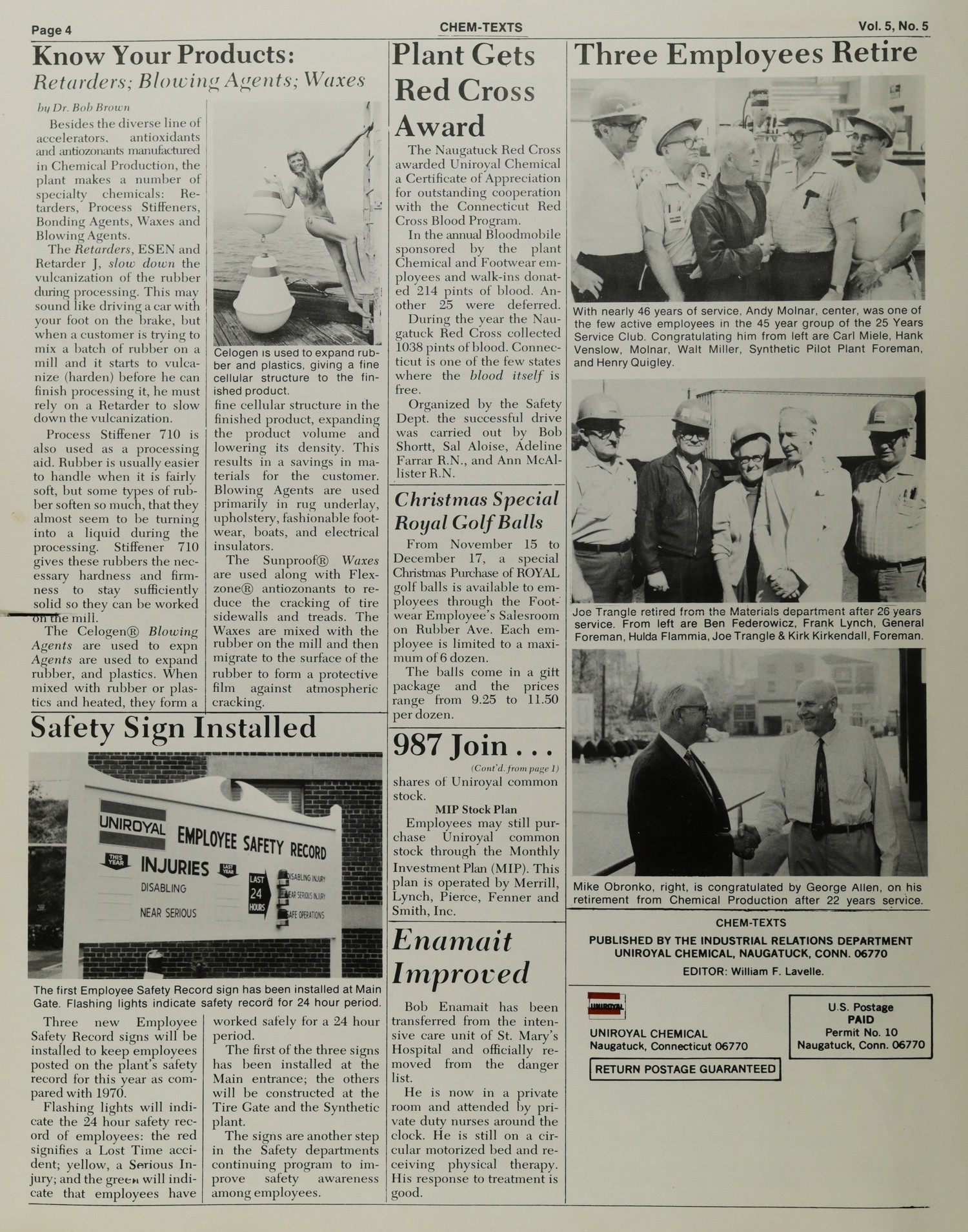
CHEM-TEXTS – Vol. 4, 1970, No. 4 – Page 1

Page 001

UNIROYAL CHEM-TEXTS

Vol. 4, 1970 | PUBLISHED FOR THE PEOPLE OF UNIROYAL CHEMICAL | No. 4


Solo, A New Soybean Herbicide Marketed

[IMAGE: Photo showing workers with pallets marked “4614” and “SOLO”]

Jim Nolan, left, checks control number for quality of liquid Solo as Filipe Duarte, center, inspects appearance of packaging. Tony Marques, loads a pallet from Bldg. 76 warehouse on to truck for shipment to one of our distributors.

by John Kitsmiller

Solo,® a new preemergence herbicide made in Bldg. 73, controls more broadleaf weeds, such as ragweed, in soybeans than any other chemical. Marketed for the first time this year, after several years of tests by universities, large growers, and the R & D agronomists, under the direction of George O’Brien, sales of Solo look good for 1970.

Patent Issued

The unique herbicide combination was discovered by Everett Barron and Adam Soboleski of the agricultural chemical R & D group at the Bethany research center. A patent was issued to both which provides 17 years’ exclusive rights to the sales of the product.

42,000,000 Acres

Soybeans are the nation’s second largest crop with 42,000,000 acres grown in the midwest and Delta areas of the U.S.

Solo increases yields by 6-10 bushels per acre. At $2.50 per bushel the chemical improves the grower’s income in a very risky business.

(Cont’d. on page 4)


Sales Up 3%: Profits Drop Down 24%

Uniroyal set a new 1st quarter sales record of $380 million, a 3% increase over the $369 million sales in the 1st quarter of 1969.

Profits for the first three months of 1970 were $9.5 million, a 24% decrease compared to the $12.5 million 1st quarter profits of 1969.

Higher interest charges; more competition in the market; higher working capital requirements; lower demand for quality canvas shoes; and intensified competition from foreign and domestic manufacturers paying wages and benefits far below Uniroyal scales, were major factors in reduced profitability.

Automotive Industry Off

A decline in automobile sales not only has an impact on the many products the company makes for the industry, but also affects the sales and profits of the Nau-

(Cont’d. on page 4)


136 JOIN 25 YEAR CLUB

[IMAGE: Photo of crowd at banquet/dinner event]

350 members of the 25 Year Service Club attended the twentieth annual banquet honoring employees for 25 or more years service. Above, members enjoy refreshments before the dinner.

The 25 Year Service Club of Uniroyal Chemical held its twentieth annual dinner at Waverly Inn honoring 568 active and retired employees for their credited service of 25 or more years.

Committee members for the dinner were Bert Scullin, president and toastmaster, Everett Anderson, Tom Dowling, Pat King, Joe Little, Alice Schofield and Ed Weaving. In charge of the invitations and assisting the committee was Gladys Bradshaw.

Guest speaker for the affair was Frank Hopkins, vice president of the Chemical division.

Andy Molnar of the Synthetic pilot plant holds the unique distinction of longest,

(Cont’d. on page 2)


Vibrathane Bumper First On Auto

[IMAGE: Photo of woman in short dress posing next to Oldsmobile Rallye 350 car with visible “RALLYE 350” text]

The Oldsmobile Rallye 350 has the first color matched bumper in the auto industry. Developed by R & D at the TSSC, the Vibrathane®coating’s elastic-plastic properties make the bumper highly resistant to weather, wear, chipping and scratching from flying road gravel and stones. Working on the project were Dr. Frank O’Shea, R & D manager; John Burkus, group leader; John Shiley, Lou Esposito, technical service; Alex Keniausis and Len Jacoboski.

CHEM-TEXTS – Vol. 4 No. 4 – Page 3

Page 003

Vol. 4, No. 4 Page 3

Suggestions, Ideas Bring $2,690 In Awards

Uniroyal’s Policy On Environmental Health

This policy reflects the committment of the Naugatuck Chemical plant to cleaner air and water in the community.

The Chemical plant to date has spent or committed $5,000,000 for pollution control facilities and systems.

Stepped up action is now underway to reduce smells and fumes emitted from the 142 buildings of the plant. Every employee’s help is asked to spot leaks, odors and fumes and report them to his foreman or supervisor.

Good housekeeping, and “No Drain” operations can help reduce many pollution problems created by unconcern to help solve the problem.

  1. UNIROYAL realizes that it has both the obligation and responsibility to join with society in the proper management of wastes, the proper utilization of air and water resources, and the protection of the environment in which we all live.
  2. UNIROYAL believes that progress in pollution control requires the dedication and responsible action of every individual and every segment of society.
  3. UNIROYAL is eliminating or minimizing pollution at all of its existing plant locations through the installation of the most modern and efficient pollution control systems available and through careful monitoring of these systems.
  4. UNIROYAL is incorporating such systems in the design and construction of all of its new plants throughout the world.
  5. UNIROYAL supervises and trains employees in operating methods which minimize pollution at all of its plants.
  6. UNIROYAL is finding new and better ways to prevent or control pollution through a concentrated program of scientific research and development both at its central research laboratories and at 22 other research locations throughout the world.
  7. UNIROYAL supports the efforts of federal, state and municipal governments in developing sound and effective pollution control laws and ordinances.
  8. UNIROYAL cooperates fully with responsible regulatory agencies and welcomes the free exchange of information on pollution control methods with interested industries and communities.
  9. UNIROYAL supports and works actively with conservationists and community organizations for the preservation of the nation’s natural beauties and the protection of her wildlife.
  10. UNIROYAL stands prepared to work actively with every individual and every segment of society in developing a total approach to pollution problems. These problems include, not merely industrial wastes, but the human wastes from sewers, incinerators, home heating, combustion engines, and the haphazard disposal of packages, bottles, trash and other litter that mars our daily lives.

$480 in checks were presented to 6 Synthetic plant employees. From left are Ernst Krauss, Bill Krayeski, Walt Tabaka, Norm Brummett, Frank Chiodo, Vic Alves, Joe Arbachauskas, and Rocco Manulla.


by Bernie Daily

Employees received $2,690 for suggestions and ideas, with 3 receiving more than $200 each in awards.

Fernando Henriques received $251.50 for his suggestion to make up the Daxad solution in more concentrated form to improve latex quality and production.

Perseverance pays off. Frank Chiodo’s suggestion was turned down 5 times in 5 years. He finally got $230 for his suggestion to patch the Sweco screens with polyester fiberglass. The $95 screens were previously thrown away after 24 hours’ use. Frank’s idea extended their use life.

After evaluating the results of Sam Molnar’s suggestion for a year, he received an additional $210 award for a filter system which recovered the slurry from the Monex® process. As a result the material was recovered that would have been washed through the sewer system.

Other top “thinking” employees awarded sizeable amounts for suggestions were: Carmine Iannuzzi who received $100 for 8 suggestions; Walt Tabaka, $95 and Bill Krayeski $95 for 7 suggestions they submitted as a team.

Other Cash Awards

Cash awards went to M. Csepes, F. Gagne, D. Polzella, Manulla, N. Brummett, M. Yaroshefski, T. Carr, L. DeLaRosa, W.F. Scott, P. Senick, C. LoBalbo, J. Gandolfo, W. Scott, J. Wawer, J. Sickola, A. Brazicki, F. Simasek, F. Russell, E. Root, R. Lockwood, F. Miller, J. Painter, L. Raskauskas, J. Butkus, D. Lavorgna, J. Sullivan, and J. Gallucci.

Commendations

Honorable Mentions and Letters of Commendation went to F. Pikula, Z. Kirdzik, L. Fortier, J. Loman, F. Hirt-


Fernando Henriques, center, receives $240 check from Harry Witt, right, synthetic production superintendent as Frank Giordano watches.

Frank Chiodo got $230 for suggestion to repair $95 Sweco screens. Prior to his idea the expensive screens were used for 24 hours.

H. Rich, M. Jannetty, C. Ferguson, W. Breton, F. San Angelo, A. DaSilva, W. Carreiro, F. Ignatowski, F. Rosa, T. Lee, H. Pyshna, T. Parsons, W. Fruin, J. Adamski, R. Newhart, K. Anderson, F. Guerrera, J. Rotella, D. Donato, F. Bendler, H. Walton, K. Urbsaitis, D. Mennillo, H. Nixon, J. Marino, C. Connelly, A. Kazemekas, J. Lawton, I. Engle, J. Kenny, A. MacDonald, L. Recchia, D. Boyd, J. Arbachauskas, R. ler, B. Rosenfeld, B. Zukauskas, M. Nauges, D. McCormack, R. Jennings, S. Cantor, F. Merancy, W. Hilton and G. Bradshaw.

71 awards were given to Synthetic plant employees, a high percent received by the Mechanical department.

Several of the awards were granted under the new Idea Plan which pays a minimum amount of $25 up to $1,000 and even higher depending upon the idea.


Sign visible from Rte. 8 will show construction progress of new $3,000,000 liquid waste pretreatment plant that will control pollution of Naugatuck river.

UNIROYAL

SITE OF LIQUID WASTE PRETREATMENT PLANT

CHEM-TEXTS – Vol. 4, 1970, No. 5 – Page 1

Page 001

UNIROYAL CHEM-TEXTS

Vol. 4, 1970 | PUBLISHED FOR THE PEOPLE OF UNIROYAL CHEMICAL | No. 5


$5,200,000 Spent Or Committed To Improve Air, Water Quality


Trades Courses Offered

by Al Manzi

A training program to qualify candidates for skilled trades openings has been developed in cooperation with Kaynor Technical School in Waterbury. This special program is voluntary and can help improve your job opportunities in the future. The program is open to all employees of Uniroyal Chemical at Naugatuck.

Courses Available

A two-year program has been planned following the normal school year — one night per week — 3 hours per night. The first year will have three 33 hour courses: Fundamentals of Arithmetic; Measurements; and Engineering Drawing.

The second year is tentatively planned for three 33 hour courses covering: Introduction to Pipe Fitting; Electricity; and Construction Trades. Successful completion of this program as judged by Kaynor Tech will allow candidates to qualify for second-class trades openings when available and in accordance with present contractual requirements of seniority and qualifications.

No Cost to Employee

There will be no cost to participants—Uniroyal will pay for tuition and textbooks as necessary. The company will cooperate as much as possible in arranging for participation of people on OFF shifts.

At the present time, training is directed to filling piper, electrician and millwright/mechanic job openings.

In the near future, questionnaires will be distributed to learn of potential candidates and their major interest of trades. The following list shows the potential openings through normal turnover at the Chemical and Synthetic plants during the next seven years.

Chemical Plant
Millwright/Mechanics ….11
Pipers ……………….9
Electricians ………….3

Synthetic Plant
Millwright/Mechanics …..7
Pipers ……………….8
Electricians ………….0

The questionnaires are now being printed and for the present, please wait until questionnaires will become available shortly. The questionnaires will list the people to contact if more information is required.


[IMAGE CAPTION: Conversion of the power plant from coal to oil firing eliminated the discharge of two and one half tons of flyash daily. White plumes in photo are often mistaken as pollutants; in many cases the plumes are steam.]


Since 1958, 35 air and water environmental improvement systems, devices and facilities have been or are being installed, resulting in improved environmental quality. They range in cost from $9,000 to near $3,000,000. These installations have and will contribute significantly to cleaner air and a cleaner Naugatuck River.

Water Pollution Control

The $3,000,000 approved liquid waste pretreatment plant, scheduled for completion in 1972, will control the discharge of chemicals and liquid waste into the Naugatuck River. An agreement was signed on May 15 with the Borough of Naugatuck for secondary treatment of our wastes.

Fiber separators in the Reclaim plant, a major factor in reducing water pollution, collect and bale the fiber removed from discarded solid waste tires. The $750,000 sys-

(continued on page 4)


1968 Stock Plan Ends July 31

The 1968 stock purchase plan which started August 1, 1968 ends on July 31, 1970. According to the plan, an employee may purchase the stock or withdraw from the plan on or before July 31. Uniroyal also reserves the right to terminate the plan, as stated in the original offer.

If a participant withdraws, he receives the amount contributed to the plan plus 5% interest on the money.

Information affecting the 1968 stock plan will be published in Chem-Texts and the News Bulletins posted on bulletin boards throughout the plant when announced by the Corporate group in charge of the plan.


[IMAGE CAPTION: Inspecting bales of fiber that were formerly discharged into the river are from left, Frank Silva, John Reardon, Don Bell and George Gudauskas. About 34,000 lbs. are removed every other day.]


Bloodmobile Successful

Uniroyal Chemical and EMIC employees generously supported the annual Red Cross blood drive sponsored by the plant.

Details on the successful visit will be published in the next CHEM-TEXTS.

SAFETY IS MY RESPONSIBILITY

CHEM-TEXTS – Vol. 4 No. 5 – Page 2

Page 002

Page 2 | CHEM-TEXT | Vol. 4, No. 5


FROM THE FACTORY MANAGER

Dear Fellow Employees:

Soon many of us will be taking vacations. One of the most common traits we share is the tendency to pack too much into too little time. Too much driving, too much sun, too much activity, too much partying and so on. The results of “too much” are usually too much physical fatigue and too much carelessness. As you know, carelessness leads to accidents and injuries.

Plan your vacation within your limits — drive safely, play safely, and get enough rest and relaxation. Your safety and your families’ safety depends on you and you alone. Your wife and children are counting on you and we are counting on you to come back rested and ready to continue your good work here.

I sincerely wish each and everyone of you and your families a very happy and most pleasant vacation this summer.

Best wishes

[Signature]

John D. Evans


Dinkle Gets Scholarship

Richard Dinkle, receives $250 scholarship from Dr. Phil Paul. From left are his mother, Mary, Richard, Phil Paul, and Jim Phelan.

by Phil Paul

Richard Dinkle, son of Mary Dinkle one of the plant’s three switchboard operators, received the Uniroyal Chemical Management Club’s $250 scholarship award. The scholarship was supplemented this year by a $50 contribution from Larry Monroe. Selected from a group of 13 highly qualified applicants, Dick attends Naugatuck High School, where he ranks in the top 10% of a 340 class.

He was named a Connecticut State Scholar and made a member of the National Honor Society for his scholastic achievements. Dick was also Chairman of the Student Council at the High School.

This tribute from one of the school’s staff indicates his qualifications:

“He possesses a rare combination of qualities: self-discipline, patience, objectivity, depth, maturity, and — most important — a good sense of humor.

Dick plans a career in accounting or corporate law. He has been accepted at the University of Connecticut, and has yet to hear from Harvard and the University of Pennsylvania.

Chairman of the scholarship committee was Phil Paul with Tom Dowling and Jim Phelan serving as committee members.

SAFETY IS MY RESPONSIBILITY


Nurse Named President

Adeline Farrar, R.N., nurse at the Chemical plant hospital was named president of the Naugatuck Valley Industrial Nurses for a 2 year term. Adeline served as vice president of the organization prior to her election as president.


Uniroyal Stores Offer Discounts

Uniroyal Home and Auto Centers offer 10% to 40% discounts, depending upon the item.

The stores carry lawnmowers, a regular line of bikes and mini bikes, Admiral and Frigidaire appliances, including air conditioners.

Centers are located in Bristol, Farmington Ave.; Norwalk, Rte. 1 (Boston Post Rd.); Milford, Conn. Post Shopping Center, Rte. 1 (Boston Post Rd.); and New Haven, Amity Shopping Center, Rte. 63. Your plant or company pass is required for identification.

Shopping Center rules restrict the merchandise of some stores, so it is advisable to check the store first before you visit it.


Oxford Office Nears Completion

Aerial photo shows Corporate Administration Building, nearly fifty percent complete, and landscaped parking area. The huge building will house corporate offices and the computer center. Construction has started on the new research and development building. Underground tunnels will connect the several buildings of the complex.


Uniroyal Home and Auto Center in Milford, one of four in area, offers 10% to 40% discounts on lawnmowers, appliances, bikes and auto accessories.

CHEM-TEXTS – Vol. 4 No. 5 – Page 3

Page 003

CHEM-TEXT

Vol. 4, No. 5 | Page 3


Brains And Beauty Match Brains And Brawn


Arnold Nori questions statement by George Baktis, standing. Members of group are from left: Nori, Manuel Paiva, Lloyd McCoy, Mike Patrick, Baktis and Dick Valentine.

Surrounded by seventeen men at SSTP session Anna Radowich discusses point with group. From left are Don Bates, Bob Slaughter, Anna, Les Opdyke, Jan Baclawski and Hank Drummer.

Humor interrupts seriousness of session in group, from left, of Tom Ennis, Kirk Kirkendall, Jim Loman, Don Cowan, Bob Burns, and Frank Lynch who were participants in the second SSTP program.


No Lost Time Accidents During May

by Sal Aloise

During May, there were no lost time accidents in the plant. This is the fifth month of the year to date that a lost time accident has not occurred, a reflection of a greater safety awareness on the part of all employees. There were some close calls but fortunately people were wearing the proper safety equipment which prevented serious injury to them or fellow employees.

Eight Serious Injuries

Eight employees suffered serious injuries during May: 3 lacerations; 2 strains; 2 fractures; and 1 burn. One injury occurred in chemical production; three in reclaim production; three in the synthetic plant; and one in research and development.

1970 An Improvement

As of May 31, 1970, only two lost time accidents occurred compared to nine in 1969 for the same period, an improvement in safety performance.

29 serious injuries have taken place as of May 31 which is an increase of 5 over 1969’s performance.

A continuing concern for safety, on and off-the-job, will protect all of us from accidents in the plant, at home and on the road, and prevent unfortunate accidents that hurt us personally or our family.


Keds® Grasshoppers.® “Molto Superbe!”

We asked a famous Italian shoe designer to give us his opinion of Keds Grasshoppers Sandals. Here is a more-or-less literal interpretation of his comments: “Any woman who is a woman should fall in love with new Grasshoppers. How superb! So many delightful colors and styles! Really fantastic! And they don’t cost much. Yes, all women are beautiful. So are all Grasshoppers!”

Ring Around


Picnics Planned

by Dick Keenan

The Uniroyal Chemical Management Club plans a number of activities for the summer months.

On Tuesday, June 16, a picnic at Noble’s Grove; on Thursday, July 16, a Family Picnic at Holiday Hill; and on Wednesday, Sept. 9, the season ends with a picnic at Noble’s Grove.

A father-son night at Shea Stadium for a New York Mets vs. Cincinnati Reds baseball game is planned for Friday, August 21.

The Club needs volunteers for cooks and bartenders at each picnic, with or without experience. Contact Dick Keenan, Ext. 506, to volunteer your services.


Anna Radowich, a distaff member of the Research and Development Department, matched beauty and brains at the second session of the Supervisory Skills Training Program with seventeen foremen and supervisors.

The sessions, which are held outsde the plant for

Bachinsky, Bill Leary, Frank Janus, Jim Sadik, Cliff German, George Rzeszutek, Frank Rodriquez, Mike Jasman, Al Lanouette, Bill Connelly, Dave Nelson, Ed Runowicz, John Honyotski, Bob Cronin, Mike Chmielewski, Leon Evon, Lynn Anderson, Sam Gesseck, Walt Budd.


Jan Baclawski attempts to persuade Anna Radowich on course of action to take but she doesn’t seem convinced. Listing from left are Bob Slaughter, Anna, Les Opdyke, Hank Drummer and Baclawski.

uninterrupted concentration, provide foremen and supervisors the opportunity to discuss actual and theoretical plant situations and to exchange ideas on new ways to perform jobs more effectively.

The mixture of youth and age; theory and experience; research and production; and different levels of management provide an invaluable base for communications, understanding, and insight into people-to-people relationships and the need for innovation and new approaches to plant methods of operation.

Programs are scheduled to continue for the year to give foremen and supervisors an opportunity to participate in the SSTP sessions.

Attending recent sessions were Sam Gillette, Jim Cravo, Joe McKee, Dolphi Gabriel, Frank Magnanimo, Pete Thomas, Jim Brown, Leo Napiello, Walt Miller, George

Angelo Soares, Norton DePinho, Jim Carroll, Rod Ashby, Evo Gabriel, Julius Rek, Stan Korpusik, Mike Banik, Matty Osiecki, Andy Perella, Al Ladyga, Dave DaVia, Carl Wehmann, Pat Petti, Milk Mokoski, Tom Harrison, Rocco Magnanimo, Felix Rimkoski, and Al Manzi.

Director of the SSTP program is Bob Krause.


The average taxpayer began working for himself on May 9.

Up to that date he worked just to pay his federal, state and local taxes, according to tax experts of the Chamber of Commerce of the United States.

It is estimated that the average taxpayer works 2 hours and 49 minutes out of an 8 hour day to pay all of his tax bills.


SAFETY IS MY RESPONSIBILITY

CHEM-TEXTS – Vol. 4 No. 5 – Page 4

Page 004

Page 4 | CHEM-TEXT | Vol. 4, No. 5

$5,200,000 . . .

(continued from page 1)

tem eliminated the discharge of 34,000 lbs. of fiber to the river daily.

Air Pollution Control

A major improvement in cleaner air resulted from the conversion of the boiler house from coal to oil firing. This $500,000 facility stopped the discharge of 2½ tons of flyash into the air each day. The conversion also eliminated the need for cooling cinders which caused pollution of the river.

At a cost of $510,000, cyclones, Holoflite dryers, and a digester blowdown condensing system were installed to reduce pollution of the air from lint and evaporated oil caused by the reclaim plant.

Scrubbers Control Odors

Seven scrubbers are now in operation in plant buildings to “wash” the fumes and odors created by processing operations. Ranging in cost from $2,000 to $70,000, some of the complex systems prevent the discharge of phenolic, mercaptans, formaldehyde and hydrochloric fumes into the atmosphere.

Two new scrubbers are now on order and will be installed when delivered.

Groups Study Problems

Immediate remedial action is being taken by an


Cyclones reduce lint escape into air. Holoflite dryers, at cost of $500,000 eliminated the evaporation of 5,000 lbs. of oils daily in the air.


Environmental Improvement Group under Dick Shaw and Lou Kaiser and a special Research and Development group, headed by Irwin Prager, to reduce pollution by process changes in present manufacturing operations and to coordinate our research resources toward the use of effective control systems in new facilities.

New process equipment will contain pollution control devices and systems, and special monitoring systems installed for proper performance of pollution control equipment.

Every Employee Can Help

Improving the environment is too great a task for it to be the responsibility of any one functional group or department. For the most effective environmental improvement program it requires the active committment of every employee in the plant, laboratories and offices. Even the most advanced equipment will be useless unless it is operated efficiently by the individuals responsible for it.

Program Set Up

Recognizing each persons responsibility, plans are underway for a pollution control program to set up discussion groups and training sessions to help us improve our environmental quality efforts.

Still Have Problems

The Chemical plant still has problems, particularly in the area of fumes and odors. Environmental air improvement is a complex problem that requires a study of each source of pollution from the hundreds of vents on the 142 buildings of the plant.

As part of the plant’s commitment to environmental improvement the problems of fumes and odor are being resolved with action and the financial requirements needed to do the job.


Watts, Lokites Retire

Buddy Watts, center, tells the younger generation John Clinton left and Tom Haggerty what the Chemical plant looked like when he started work in 1926. “One of the best liked fellows” around here was the compliment fellow employees said about him when he retired after nearly 44 years service.

Joe Lokites, a BLE operator in Bldg. 79 is congratulated on his last day of work after 35 years service by Eddie Gooch. From left are Bronislaw Chrzanowski, Joe Lott, Lokites, Gooch, and Harold Litke.

Some 78 sons and daughters of Naugatuck Chemical employees will graduate from colleges and technical schools in June.

A car is never dangerous by itself, it’s the nut behind the wheel that causes most accidents.


Explorers Tour Reclaim Plant

by Pete Gucciardo

High School students, members of Explorers Post 103, which is one of several youth activities sponsored by Uniroyal Chemical, toured the reclaim plant where they had the chance to explore the manufacturing operations used to convert discarded tires and tubes into a finished rubber product. Guides for the tour were Art Nauges, Jim Carroll and Bert Scullin.

The Explorers offer your son or daughter the opportunity to learn about the many careers available to them in chemistry, engineering, agriculture, and business through discussion and practical learning.

Pete Gucciardo and Terry Mo are advisors to the organization with Bob Smith as chairman.


Pete Masone shows group chopped tires. Bob Doiron, Explorer president, inspects the rubber as Art Nunes, center, looks on.


Bert Scullin reclaim production superintendent shows Explorers slabs of reclaim rubber made from discarded, waste tires. From left are Pete Licnikas Jr., Lee Prager, Greg Pelchuck, Art Nunes, Walter Pelchuck, Gabriel Arcuri Jr., Mark Allen, and Scullin.


Chemical Highest Taxpayer

The Borough of Naugatuck’s list of assessment valuations shows Uniroyal Chemical as the highest taxpayer in the community, being taxed at $13,500,000. This represents 12.5% of the Borough’s tax revenue.

The Footwear plant pays $8,600,000 or 8.0% of the taxes.

The total tax of the two Uniroyal plants is $22,100,000 or 20.5% the Borough receives in taxes from the two facilities.


CHEM-TEXTS

PUBLISHED BY THE INDUSTRIAL RELATIONS DEPARTMENT
UNIROYAL CHEMICAL, NAUGATUCK, CONN. 06770

EDITOR: William F. Lavelle.


UNIROYAL

UNIROYAL CHEMICAL
Naugatuck, Connecticut 06770

RETURN POSTAGE GUARANTEED

U.S. Postage
PAID
Permit No. 10
Naugatuck, Conn. 06770
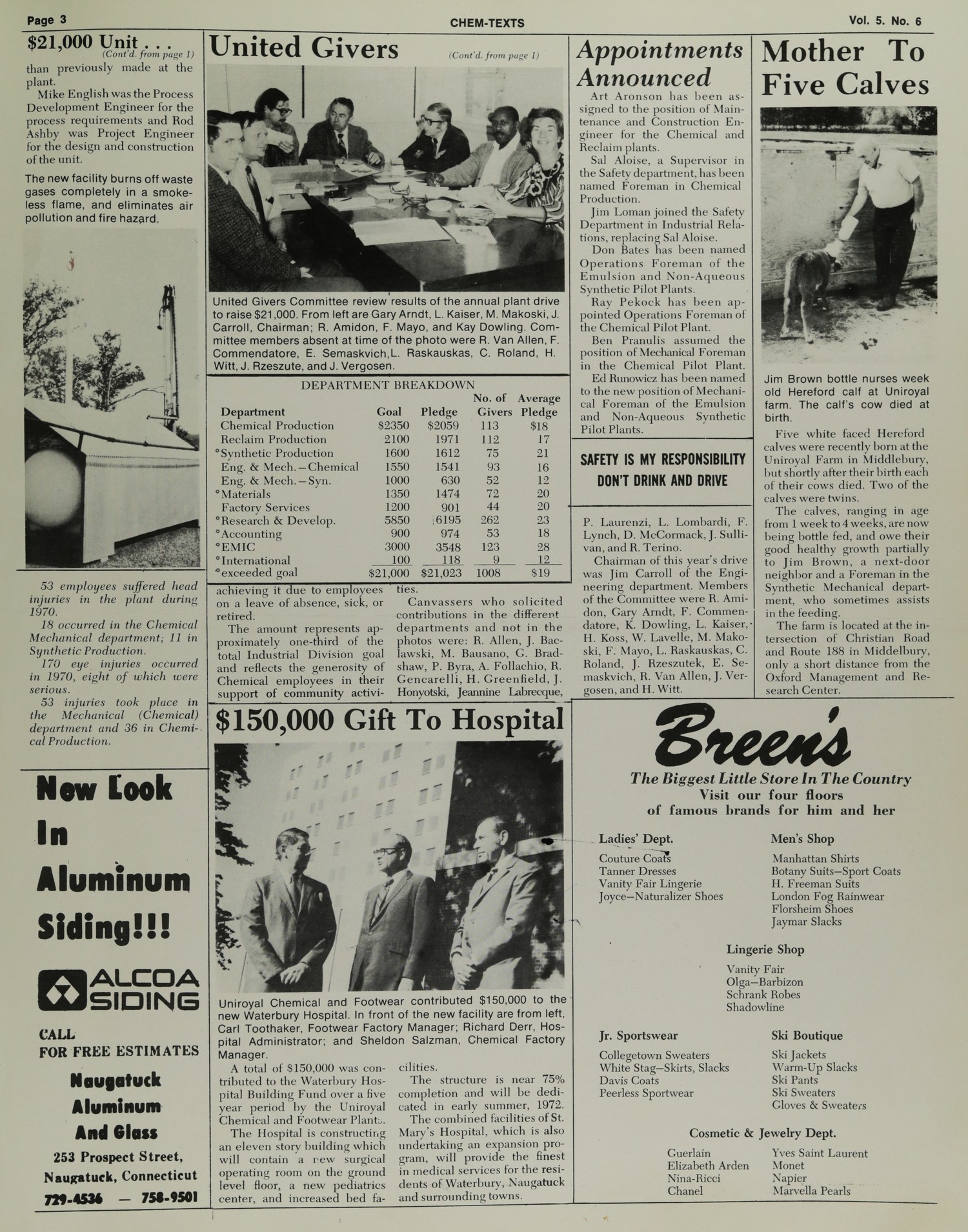
CHEM-TEXTS – Vol. 4, 1970, No. 6 – Page 1

Page 001

UNIROYAL CHEM-TEXTS

Vol. 4, 1970 | PUBLISHED FOR THE PEOPLE OF UNIROYAL CHEMICAL | No. 6


Plans For Staffing Oxford Underway

by C. Durbin

Uniroyal’s program for creating a new administrative center has been carefully developed to insure that all is ready for the move to Oxford in mid-1971.

People are always the most important part of any program. When present employees in New York City were asked, quite a number told their managers that they do not plan to transfer to Connecticut. The gap between the number needed and the number moving must be filled by local people.

Promotion Policy

Whenever possible, promotion from within is a policy that Uniroyal applies everywhere. In the Oxford case it means that an interested salaried employee, presently in a Chemical Division office position, who is qualified for a position at Oxford that is in a higher skill classification than is available in the Naugatuck offices, will be given consideration for transfer. Other Uniroyal people in this area will have the same opportunity.

Survey By Questionnaire

During the month of July local Chemical Division salaried female office employees are being surveyed by questionnaires to determine those who believe they have skills above the requirements of their present assignments and might be interested in transfer to the Oxford offices.

Replies will be reviewed by responsible managers who will consider work history and skill qualifications to determine who should receive further consideration under the promotion policy.

A similar procedure will be followed later when other salaried position requirements are developed for positions which specify advanced knowledge, skill and considerable experience in specialized functions.


New Food Service For The Plant

by Fred Wintsch

Servomation, Inc. recently assumed operation of plant food services at the Chemical Canteen, Synthetic Cafeteria, EMIC and the vending machines in all buildings.

With headquarters in New Haven, Servomation offers improved food services, fresh foods, more efficient maintenance of the food machines, a better menu with a wider selection of hot meals with an eye on the nutritional value for weight conscious employees.

The Chemical plant was one of the last major firms in the Valley to retain the 10¢ coffee but increased wholesale food prices have forced an increase to 15¢.

Servomation is one of the leading food service organizations in Connecticut serving many firms and schools in the State with their main facilities only an hour from the plant. There should be considerable improvement in food services on all shifts and weekends as a result of the change.


SAFETY IS MY RESPONSIBILITY

[IMAGE: Photo of workers in hard hats]

John Honyotski, area foreman, congratulates chemical operators Ivan Aubin and Bill Gaievage of Bldg. 73 for excellent job in getting Dyanap to customers on time. At left is Jim Cravo, Bldg. 73 foreman. On another shift at time of photo were operators Jim Lynch and Frank Guzzardi.


Dyanap Sales Increase

[IMAGE: Photo of men examining soybean field]

George O’Brien, with hat on, R & D product development manager for Dyanap examines field of weed-free soybeans with a group of Chemical division field agronomists and State University weed specialists. Their recommendation of a products affects the sale of a herbicide greatly.

by Everett Barron

Dyanap® the “chemical broom”, stops weeds before they emerge from the ground and “sweeps up” the emerged seedling weeds by contact. Sales of the double action, low cost herbicide that gives the farmer a $195 profit per acre increased 10% – 15% in 1970.

Made in Bldg. 73, Dyanap is a combination of dinitro and Alanap® It controls a wide range of broadleaf weeds and annual grasses that reduce crop yields 20% to 30% in soybeans and peanuts.

16,000,000 Acre Market

Dyanap®is one of 3 herbicides made in the plant; Alanap® and Solo® being the other two. 15,000,000 acres of soybeans and 1,000,000 acres of peanuts are grown in the southeast and the midsouth, a huge potential market for Dyanap sales and additional business for the plant.

Bright Spot In Economy

“Agribusiness” is one of the few bright spots in today’s economy. With most of the chemical industry facing stiff competition and business setbacks, the agricultural chemical business has shown steady growth.

Competition Stiff

The business is a “one month” shot; if quality, packaging, service or delivery is poor, competition gets the business, often for good.

If a grower can’t purchase Dyanap before planting time, he buys his herbicide from one of five major competitors: Amchem, Elanco, Monsanto, Dupont or Shell. Farming today is big business, with many growers planting 2,000 – 5,000 acres and investing $100,000 in herbicides, fertilizer, and machinery.

He shops for the best product at the best price and the best service. His investment is too risky to take chances with poor quality and poor service.

New Products Important

A research and development group at the Bethany Lab of Bob Graham, Adam Soboleski, Everett Barron and Ron Ames (now in Liberia) are continually seeking new types of herbicides to keep us competitive in the market.

Field agronomists are

Continued on page 4

CHEM-TEXTS – Vol. 4 No. 6 – Page 3

Page 003

Vol. 4, No. 6 CHEM-TEXTS Page 3

Employees’ Opinions Polled On Chem-Texts | Unions To Hold Picnics

A poll of 200 employees selected on a random basis from all plant and divisional departments and retired employees revealed that 96% of the employees read CHEM-TEXTS always or often, and that 76% of their families read it. The survey also showed the plant newspaper as a reliable form of communication and indicated employees have a vital concern for news and information on plant activities and operations.

70 employees completed the questionnaire for a 35% return, an exceptionally high response.

70% signed the questionnaire which was voluntary.

Answers to the “open-end” questions have been condensed because of space limitations.

1.) Do you read Chem-Tests?
86% always, 10% often, 3% seldom

2.) Does your family read Chem-Texts?
76% yes, 7% no

3.) What kind of news do you find most informative?
76% preferred news about plant activities: plant products; use of products in the market; new facilities; plant improvement; personnel changes; and economic situations.

60% wanted news about employees; benefits; idea awards; safety; job security; and retirements.

60% indicated a desire for news about Uniroyal, Inc.; other plants; corporate sales; profits; new products and markets.

4.) How did you like the recent article on the Oxford complex?
The majority commented “excellent”, “informative”, “indicative of Uniroyal’s progress”, “knew very little about it until article”.

5.) Do you think the paper uses enough photographs?
80% yes, 18% no


6.) What did you think of the article on pollution?
“Wonderful that something is being done;” “informative on serious national problem;” “good to keep us informed on pollution control efforts;” “shows company is concerned and makes employees concerned;” “all must be aware of their role in pollution control.”

7.) Some time back we did an article on packaging – do you think this type of information is helpful to employees?
Most employees replied yes; pointing out that they as customers always shop for a neat package.

8.) Do you think the paper gives you reliable information on plant operations and activities?
Comments were essentially, yes; and implied, “haven’t gotten any bum steers yet.”

9.) What do you think of the News Bulletins issued weekly?
In general the News Bulletins were considered informative and helpful; but several employees did not see them; a few felt they were fair, should expand coverage and include more news on safety and production.

10.) What suggestions do you have to improve CHEM-TEXTS?
The majority of employees had no recommendations to improve the paper.

Some remarks suggested: do more articles on departments; more about employees’ participation in community; letters to the editor; classified ads; questions and answers from employees.

The survey was the first conducted in the Company on plant newspapers, and employees who participated are thanked for their time in making it a more effective means of communication.


by Charlie Roland

Plans are underway for URW Local 308’s third annual picnic to be held on Sunday, August 9, from 11 A.M. to 6 P.M. at Schildgen’s Grove in Union City. The Grove is located on East Waterbury Road.

Chairman of the event is Art Calder, with Ben Tomaszeski, Nunzio Pastore and John Sullivan assisting in arrangements.

by Frank Commendatore

Local 218 will hold its annual picnic at Schildgen’s Grove on Saturday, August 15. A menu of roast beef, hamburgers, clams, clam broth will be served all day, with steaks served from 2 – 5 P.M. along with hot and cold beverages.

Chairman for the picnic is Frank Commendatore with Tom Ward and Mario Mucci, assistant chairman.


You Get A Chance To Talk To Two Bosses In New Plan

[PHOTO: Two men in discussion at what appears to be an industrial setting]

Bill Broden, left, has an evaluation discussion with Joe Bucciaglia, chief process engineer for chemical production.

[PHOTO: Three men in discussion in an office setting]

Jim Cronin, superintendent of chemical production, Bill’s second boss, is interested in Bill’s question during the contact discussion held between the two.


Do you ever wonder what the boss thinks? Where you stand in your job? Whether you’re doing a good one or not? What progress you’re making in it?

These are questions every employee asks himself and wants to have answered. The new Contact and Evaluation program will help clear up many of these questions.

Purpose of Program

The program sets up a procedure for a meeting and a performance evaluation of salaried personnel by their immediate supervisors. It also arranges for a meeting of salaried personnel by a senior manager at least two levels above the employee.

Dual Appraisal

The employee receives advance notice of the meeting, usually around the anniversary date of his employment. He and his supervisor receive a set of similar forms to fill out before the interview on matters related to his job. The employee and supervisor then meet for a private, uninterrupted discussion, using this information for the basis of their discussion.

A fruitful meeting requires mutually open, and honest, discussion to determine mutually agreed job objectives for future evaluations.

Senior Manager’s Interview

After this meeting, the supervisor arranges for an interview with the employee’s senior manager. The employee may be interviewed by a senior manager in a different function at either his option or the senior manager’s.

The purpose of this interview is to provide the opportunity to discuss in a friendly conversation the general attitudes, understandings, and adjustment of the employee in relationship to his job and objectives.

Plant Coordinator’s Function

All reports are returned to the program coordinator, Bob Krause, of the industrial relations department. His responsibility is to organize the program, schedule the discussions, assure continuation of the plan, and file reports in the employee’s personnel folder.

Information from the program may be used by plant management and the divisional personnel development manager for job rotations and promotions within the plant and the division.

Program Successful

Employees participating in the program have praised it highly for the chance to openly discuss their jobs and to understand more fully the expectations and responsibilities of their job, their status in the department and future opportunities with the company.

As one employee put it, “it’s the first time I really had a chance to open up and discuss things with my boss and his boss freely. At least I know where I stand and what opportunities are open to me.”

CHEM-TEXTS – Vol. 4 No. 6 – Page 4

Page 004

Page 4 | CHEM-TEXTS | Vol. 4, No. 6

Dust Collectors Overtake The Odds; George Rusnak Retires

Synthetic Bowlers Best D&S Team

[IMAGE: Larry Koth, center, displays winner’s trophy to Al Enamait, left, and Tony Amador.]

Dyanap Sales . . . cont’d., from page 1

constantly testing new chemicals with State universities and commercial growers to find a new herbicide which is safe to use, effective, and low cost.

The critical test for a new herbicide — if it receives U.S.D.A. approval — is the growers’ acceptance of the product.

This year the Advertising department under Ed Shepard and Larry Kebel put on a “hot pocket”, intensive, TV, radio and farm paper ad campaign in concentrated market

[IMAGE: 30 gallon Dyanap drums in warehouse 76 are checked for dents, scratches and labeling by, from left, Jim Nolan, Tony Marques and Tano Sam Angelo, the last three people in the plant to handle a package before it’s shipped to a customer.]

areas to move the product from the dealers’ stores and increase sales.

Produce And Deliver

A big factor in this year’s success of Dyanap was Chemical Production operators Jim Lynch, Ivan Aubin, Frank Guzzardi and Bill Gailevege,

who worked around the clock to supply customers’ demands.

Helping to fill several carloads of orders during the peak season were Bldg. 100 with Orrin Huntley, Joseph Bednarek, Dom Persutti, Bob Anderson, Ed Cheney, Ray Drapeau, Harry Hedrick, Carl Mulonet, Dan Marino, Lyle Bissonnette; and Bldg. 17 with Rocco Magnanimo, John Shumak, Thurmond Walton, Ben Root, Joe Antonucci, Bob Orsini, Gerry Markham, and Ted Clemente, who kept the complex piping system in top condition.

Service Keeps Customers

Production and delivery when wanted required fast handling and expert routing by the Materials Handling department during the critical rush order months. A package is handled 10 times before it ever leaves the plant, and only

by Tom Lee

The Dust Collectors swept under the Synthetic Odds in the roll-off of the Alembic Bowling League in a climactic season-end finish which matched Bob Ruegg, Sam Molnar, Bob Sheldon, Ray Drapeau and Jim Mullen of the Dust Collectors against Clayt Houseknecht, John Butkus, Jack Painter, Joe Jokubaitis, and Don Powell of the Odds. The Collectors also took 1st half honors and the Odds won the 2nd half but met defeat in the roll-off.

Bob Ruegg won the 1st half prize for a high average of 118.6 and the 2nd. half prize for high three with 417.

Others participating in the league, which is sponsored by Uniroyal Chemical, were R. Valentine, A. Pistarelli, E. Roller, M. Perkins, L. Flynn, G. Salokas, R. Magnanimo, W. Beerbaum, S. Falcone, A DaSilva, R. Gogolewski, J. Tully, N. Klesch, H. Litke, M. Mucci, and M. Marinaccio.

New elected officers for the 1970-71 season are Joe Jokubaitis, president; Jim Fenton, vice president; Dick Valentine, treasurer; and Sam Molnar, secretary.

by Shirley Sandora

The Synthetic team of Larry Koth, J. Lizarazo, Doug Ritchie and Ronnie Dierling overpowered the D & S team of Karen DiDominzio, Gladys Bradshaw, Tony Amador, Al Enamait and Tom Carr in the roll-off of the Uniroyal Chemical Handicap League.

Tom Fitzgerald had a great season winning the High Three prize in the first and second halves.

Bowling in the league were C. Calo, L. Taranovich, D. Pape, R. Redline, J. Greco, S. Sandora, D. Boulanger, P. Williams, A. Hanley, C. Shea, S. Schneider, L. Terra, F. Barrows, T. Casteel, S. Andrew, E. Rabitor, M. Yaroshefski, J. Enamait, and F. Guerrera.

Elected officers for 1970-71 were Adrian Hanley, president; Larry Terra, vice-president; Karen DiDominzio, secretary; and Charlie Shea, treasurer.

expert care prevents damage to it. Customers are choosy buyers and on several occasions have returned truckloads of damaged packages, causing a financial loss to the plant.

The “one shot” season is over, but Chemical Shipping

[IMAGE: George Rusnak, center, a pipefitter in the mechanical department is congratulated by Leo Napiello on his retirement after 32 years service. Other department members are from left, Mario Mucci, Napiello, Rusnak, Tom Ward, and Dick Clark.]

Autos, Major Cause Of Air Pollution

by Bob Shortt

Motor vehicles, primarily automobiles, account for approximately 70% of the total estimated tonnage of air pollutants discharged annually into Connecticut air.

20% of the total suspended particulate matter; 98% of the total carbon monoxide; 94% of the total hydrocarbons,

personnel Jim Casey, Bill Creddo, Tony Marques, Jim Nolan and Tano San Angelo played a big role in getting orders to customers on time . . sometimes overnight during the hectic season.

Excellent service, a quality product, and good packaging keeps customers, and in the long run customers keep the plant operating at full

and 39% of the total nitrogen oxides are caused by automobiles and trucks.

Although motor vehicles are the primary cause of air pollution, 70% of the people surveyed in an opinion poll believed that the major cause of air pollution was the chemical industry.

The chemical industry contributes to air pollution but it has been one of the more progressive industries in the fight to improve the environmental quality of air and water against air and water pollution.

capacity every day of the year.

Red Cross cont’d from page 2

Shortt, J. Jokubaitis, E. Fisher, J. Doran, R. Cronin, J. Ascencao, J. Napiello, W. Rek, J. Sullivan, R. Manulla, E. Semaskvich, W. Albaitis, E. Diver, E. Johnson, A. Cross, E. Easterbrook, T. Chmielinski, J. Thompson, J. Mullen, C. Smith, R. Woodfield, A. Ficeto, and C. Gandarillas.


CHEM-TEXTS

PUBLISHED BY THE INDUSTRIAL RELATIONS DEPARTMENT
UNIROYAL CHEMICAL, NAUGATUCK, CONN. 06770

EDITOR: William F. Lavelle.

[UNIROYAL LOGO]

UNIROYAL CHEMICAL
Naugatuck, Connecticut 06770

RETURN POSTAGE GUARANTEED

U.S. Postage
PAID
Permit No. 10
Naugatuck, Conn. 06770
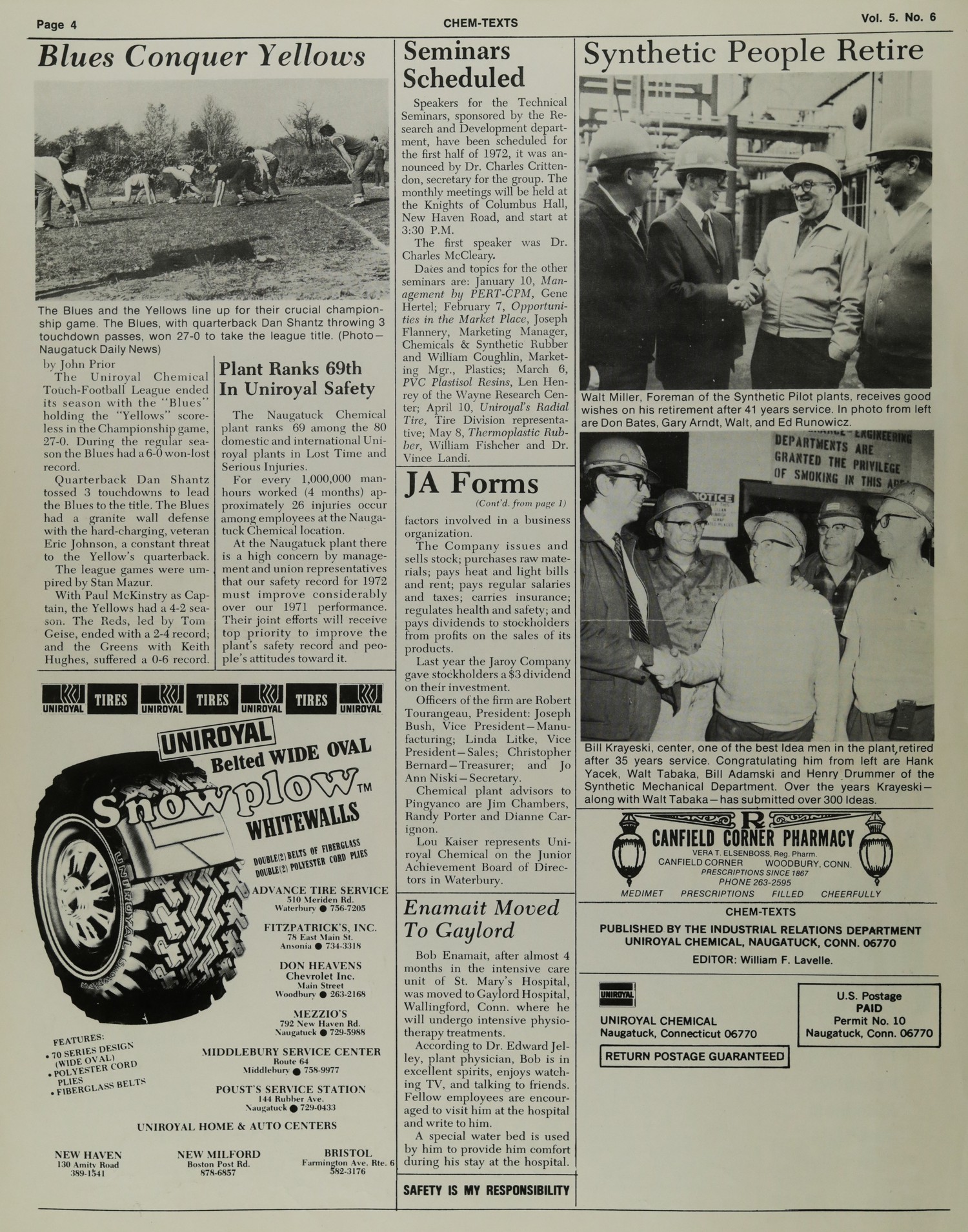
CHEM-TEXTS – Vol. 4, 1970, No. 7 – Page 1

Page 001

UNIROYAL CHEM-TEXTS

Vol. 4, 1970 | PUBLISHED FOR THE PEOPLE OF UNIROYAL CHEMICAL | No. 7


Wear A Dress Once; Throw It Away


Sales Up; Profits Off

Uniroyal set new records in sales for the second quarter and first half of 1970. Net income declined compared with 1969 when profits hit an all-time high.

Sales for the six months were $817,538,000, up 2.6 percent from the first half record of $796,633,000, in 1969.

Profits for the six months was $22,709,000, equivalent to 78 cents per share of common stock, which compares with the record $29,892,000, or $1.06 a share, set in 1969.

Sales for the second quarter set a new record of $436,714,000, compared with $427,802,000 in 1969.

Profit in the second quarter was $13,170,000, or 46 cents a share, compared with the $17,357,000, or 62 cents a share in 1969. (Cont’d. on page 4)


NOW Group Tours Greenhouse

[IMAGE: Group of men standing outside a building]

Future chemists and scientists visited the Agricultural Chemical research green house in Bethany, where Dr. Bob Davis showed then how new chemicals were helping to provide more food for the world. From left are Bob Davis, Allan Peoples, Vincent Wiggins, Joe Trangle, Royal Gladding, Ralph Neubig, of NOW, Eric Lott, Irving James, and Donavan Wiggins. Missing from the photo was Richard Simpson.

[IMAGE: Group seated at tables for lunch]

After tour, the group were luncheon guests of Bob Davis. Joe Trangle, at right, drove group to and from Waterbury.


[IMAGE: Woman in patterned casual dress]

Casual wear dress is made from non woven fibers and Naugatex latex.


by Jerry Twomey

The Synthetic plant makes it. People walk on it; read it; ride on it; chew it; and wear it. The plant, the first SBR plant built in the U.S., is a specialty manufacturer of 29 different types of latexes, tailor-made to meet the special requirements of customers.

Uniroyal Chemical ranks as one of the leading producers of latex manufacturing it at three plants: Naugatuck, Baton Rouge and Scotts Bluff.

Chewing Gum Big Use

One of the most interesting uses of synthetic latex, which is made from the chemical reaction of butadiene and styrene, is chewing gum. Most of the latex used to make chewing gum in the U.S. is produced at the Synthetic plant. The Naugatex® latex is more uniform in quality and has a “chewier” chew than the natural gum of the South American tree from which it was extracted and imported into the states.

The Disposable Market

This is one of the largest markets for nonwoven fabrics (Cont’d. on page 4)


Mower Shoots Steel Stake Into Wall

by Ed Phillips

An 8 inch tent stake, hidden in the grass, was picked up by the blades of a lawnmower and projected against a garage wall ten feet away. The sharp edge of the stake pierced through the 5/8″ thick plywood wall about 10 feet from the ground and entered the inside of the garage wall.

At the time, several children were playing on the lawn. If one of them had been near the (Cont’d. on page 4)


Dividend Declared

Uniroyal declared a dividend of 17½ cents a share on the common stock. The dividend is payable Sept. 25 to stockholders of record August 24.

This is the third dividend declared in 1970, bringing the total of dividends to 52½ cents a share on the common stock.


[IMAGE: Man and boy looking at stake in garage wall]

Ed Phillips, shows his son Dick, the 8 inch stake in garage wall.

CHEM-TEXTS – Vol. 4 No. 7 – Page 4

Page 004

Page 4 — CHEM-TEXTS — Vol. 4. No. 7


Safety Goal Stops At 650,000 Hours

The safety goal of 1,000,000 manhours was stopped at 650,000 manhours. A chemical production operator lost a small portion of his right ring finger when it was caught under the belt on the drive on a crusher machine. Quick action by him prevented a more serious loss to his other fingers and hand.

The accident was the first lost time one in almost 3 months. It was another case of the unexpected happening. As a result of it, the man suffered an unnecessary loss of a finger.

Lost Time Accidents Drop

This was the third lost time accident for six months of 1970, a significant improvement over 1969 when 12 lost time accidents occurred. This improved concern for the safety of ourselves and other people makes the plant a better, safer place to work.

Serious Injuries Up

Although lost time accidents dropped, serious injuries increased from 28 in 1969 to 33 for the six months of 1970. In June there were 4 serious injuries: 2 lacerations; 1 bruised elbow; and a pulled muscle. These injuries could have been lost time accidents but luck helped, and the employees involved escaped greater injury. Serious injuries can be stopped by not taking chances on the job and checking work conditions carefully.

Mower Shoots

(Cont’d. from page 1)

The steel stake, retouched in black, was hidden by the grass.

mower at the time, the steel stake would have gone through his body and fatally injured him.

Unsafe acts—and this was certainly one, because someone carelessly left the stake on the lawn—can result in a fatal injury to a member of your own family at a time when most unexpected.


Wear It Once (Cont’d. from page 1) made with latex. This year’s sales of paper dresses and other nonwoven apparel will hit $35 million.

Disposable paper diapers are a large market for latex with annual sales climbing to over a billion diapers a year by 1975.

Women’s dresses, bathing suits, beach robes, sport jackets, aprons, wedding gowns, and Kleenex tissues make up a large part of the “throw away” disposable market.

Carpets Big Market

Another major use for Naugatex latex is carpets, where the latex is used to hold the tufted yarn firmly to the jute backing and prevent it from tearing and ripping. Foam latex makes an excellent underlay giving the carpet a luxurious feel and longer wear life.

Paper; Other Markets

Magazines and books are coated with latex to hold the ink on the paper, preventing its absorption into the paper. Latex coated paper improves the reproduction of photographs, and gives a sharpness to the printing for easier reading.

When latex is mixed with the paper, it makes a tough cover for books, giving the book longer life. This use is finding wide acceptance in school textbooks.

Competitive Business

The latex business is a highly competitive business where quality, packaging, delivery, and price are important factors in keeping customers.

Whether at home or work, it’s a good practice to wear safety shoes and safety glasses as protection against such incidents.

A lawnmower can pick up stones, pieces of glass or wire, cans or toys and hurl them at speeds as high as 170 miles an hour-bullet speed.


Competing for the same customers are large progressive chemical companies such as Dow, International Latex, Goodyear, Firestone, Goodrich, General, Vanderbilt, Shell and a number of other companies.

Chemicals For Latex

Latex, which consists of tiny particles of rubber suspended in water, requires special chemicals to protect it from oxygen, heat, sunlight, and weather. Without this chemical protection, the latex would deteriorate during processing or discolor from exposure to atmospheric conditions.


[IMAGE CAPTION:]
From left, Marie Yaroshefski, Mary Foy and Wes Burns discuss quality of Naugatex latex to be used on paper.


The latex backed carpet in your home or car probably contains one of the eight chemicals made in Chemical Production— OXAF, Butazate® 50-D, Ethazate® 50-D, Trimene Base, Thiostop N, Thiotop K, Naugawhite,® and AO 436—to improve the quality and wear life of the latex.

Future Growth

A substantial drop in automobile sales, fewer housing starts and an overall economic slack have hurt latex sales, as well as other areas of the plant’s production. Latex sales for the division and the synthetic plant are projected at a fairly substantial growth for the next 5 years.

To keep this business at the Synthetic plant and share in its growth requires producing the highest quality latex at the lowest cost, and giving our customers better service than the competitors.

Sales Up (Cont’d. from page 1)

Chemicals, Plastics Off

Sales and profits of the tire and international operations showed strong gains during the six months. However, these gains were offset by declines in chemicals and plastic products due to lower automotive production.


Long, Laliberte Retire

[IMAGE CAPTION:]
“One of the best in the Lotol business,” Bill Long retired after 44 years service. Congratulating him are, from left, Connie Ranney, John Dayner, George Brockman, Bill, and Joe Biernacki, foreman.


[IMAGE CAPTION:]
Roland Laliberte, center, retired after 21 years from Reclaim Production. Congratulating him from left are Larry Rinaldi, Al Pistarelli, Laliberte, Minic Brown, and Joe Pereira.


SAL LANTIERE retired with 24 years service. Sal held the position of a mill and calender operator in the plastics compounding laboratory at TSSC where he worked on Kralastic® ABS, the steel-like plastic used in automobiles, appliances, boats, and pipe.

ED SLOMCENSKI, retired recently as a mill and calender operator in the rubber compounding laboratory at TSSC where he tested the properties of new types of synthetic rubber developed by the research and development department.

KEN JARRETT who started with Uniroyal Chemical in 1945 as a laboratory assistant in Dispersions research and development, retired after more than 24 years service, all spent at the Naugatuck location.


CHEM-TEXTS

PUBLISHED BY THE INDUSTRIAL RELATIONS DEPARTMENT
UNIROYAL CHEMICAL, NAUGATUCK, CONN. 06770
EDITOR: William F. Lavelle.


UNIROYAL U.S. Postage
UNIROYAL CHEMICAL PAID
Naugatuck, Connecticut 06770 Permit No. 10
Naugatuck, Conn. 06770
RETURN POSTAGE GUARANTEED

CHEM-TEXTS – Vol. 4, 1970, No. 8 – Page 1

Page 001

UNIROYAL CHEM-TEXTS

Vol. 4, 1970 | PUBLISHED FOR THE PEOPLE OF UNIROYAL CHEMICAL | No. 8


Polygard Facilities To Expand

by Rod Gaetz

Design drawings are near completion for the expansion of Polygard ® facilities in Bldg. 109. The major equipment has been ordered and 75% of the necessary piping materials are on order for the project which will increase the production rates of the chemical. The project is part of the plant’s continuing program to stay competitive in a tight chemical market, keep business at the plant and keep chemical production employment at a full level.

Used In Rubber

Polygard is one of the most effective nondiscoloring and nonstaining stabilizers for synthetic rubber in commercial use today. Without Polygard protection, degradation occurs during the finishing, processing and vulcanization, resulting in a shorter service life of the final rubber product.

As a chemical, Polygard is safe to use, having the approval of the Food and Drug Administration (FDA) for use in products used for packaging or handling food.

New Stainless Steel Lines

The major work done during the summer shutdown of the building was the relocation and repiping of 2 Hold tanks from the second to the third floor. The piping from the bottom of the four vessels which will eventually become strippers was replaced with much larger stainless steel lines. The transfer pump was relocated and the discharge lines relocated and replaced with 3″ and 4″ stainless steel piping.

Fume Control Devices

When completed in early 1972, the expanded facilities will have environmental control devices to control fume pollution as part of the plant’s policy in the installation of new equipment and facilities.

Engineers working on the expansion are Terry Mo and Rod Gaetz; Vic Anderson, instrumentation and electricity; and Lou Kaiser, environmental control.


MIP Plan To Start

Instead of the 1970 stock purchase plan slated to start August 1, Uniroyal will expand the Monthly Investment Plan (MIP) to all employees interested in purchasing Uniroyal stock, at the market price, on a regular payroll deduction basis.

Under the plan, which is operated by Merrill Lynch, Pierce, Fenner and Smith, Inc., employees can sign up for regular payroll deductions. There are minimum and maximum deductions which will be indicated with other information, in plan brochures available shortly.

Merrill Lynch will purchase Uniroyal stock at the market price and keep individual accounts for each employee. Employees will receive regular statements from Merrill Lynch showing how much stock has been

(Cont’d on page 4)


H.S. Diploma Obtainable

It’s still possible for a person who left high school for one reason or another to obtain a high school diploma without going back to school.

To qualify for a diploma,

(Cont’d on page 4)


Chemical Control Center, The First In Chemical Division

Group photo of Chemical Control Center personnel. From left to right are Fran Egan, Clark Makinson, Tom Dowling, Millie Finsel, Matt Mathewson and Walt Frankenberger.


Employees Prevent Fire

by Walt Frankenberger

First anniversary. First in the Chemical Division. And in some aspects, the first in any Uniroyal plant. The Chemical Control Center is part of the plant’s innovative approaches to stay on top, keep business at the Naugatuck plant, increase the output of equipment, reduce waste and cost, and provide customers the best service in the chemical industry.

The Center is the one location in chemical production from which foremen can get accurate, up to the minute schedules for production of chemicals in order of priority to fill customers orders.

Monitors Data

The Center monitors data on all department activities, and by weekly and daily review of production, quality, cost, waste, and mechanical failures, the Center controls productivity and can spot downward trends or trouble spots in the plant which need adjustment to prevent lost production.

By coordinating the ordering of raw materials, packages, and warehousing, foremen can

(Cont’d on page 4)


A cooperative fire fighting group: in front—Pat Tortorici, left to right—Charlie LoBalbo, Minic Brown and Al Morey. Absent from photo—Charlie Rinaldi.


John Needham, left, shows Eric Johnson the High School Equivalency diploma he received upon successful completion of tests. Other employees plan to take tests in September.


by Ed Weaving

Minic Brown, Larry Rinaldi, Charlie LoBalbo, Al Morey and Pat Tortorici, acted so quickly in extinguishing a small fire in an air screen machine that the sensitive sprinkler system did not operate and the sounding of the plant fire alarm was not required.

The incident occurred when the canvas duct work around the machine ignited and burned. Brown and Rinaldi shut off the operation and others turned on a fire hose line on the burning canvas.

The fire was apparently caused by a light bulb without a protective globe on it, the hot heat of the bulb igniting the

(Cont’d on page 3)

CHEM-TEXTS – Vol. 4 No. 8 – Page 2

Page 002

CHEM-TEXTS

Page 2 | Vol. 4 No. 8


FROM THE FACTORY MANAGER

DEAR FELLOW EMPLOYEE:

I’m certain that the vast majority of us know and appreciate the fact that UNIROYAL CHEMICAL is a good place to work. Sure, we all have our gripes and inconveniences but when we really think about it we’ve got it pretty good. As only one example, the other day I was looking at the average earnings for all manufacturing workers in Connecticut and noted that the straight time rate averages $3.31 per hour as compared to $4.00 per hour in our plant. When the effect of premium rates for overtime is considered, the State average is $3.43 per hour and our average is $4.39 per hour.

Beyond pay and the importance of our superior benefit plans, there is the question of what kind of place is it to work? I believe you will agree with me that a very important factor is the “atmosphere” or “climate.” Like productivity, safety, good housekeeping and quality, each of us must bear a responsibility for “climate.” We do this every day by our attitudes, our cooperation and our ability to communicate with each other. To fully face this responsibility each of us must listen, as well as talk. Each of us must recognize that others have problems, as well as ourselves.

Concern for the customer, concern for the fellow employee and yes, concern for the job produces results.

Best regards,

John D. Evans

John D. Evans


Many Apply For Kaynor

[IMAGE: Aerial photograph of industrial/educational facility with parking lot]

Kaynor Tech offers a broad program of excellent trades courses.

More than 45 employees have applied for the training program to qualify candidates for skilled trades openings in the plant. The 2-year trades courses program will cover: Fundamentals of Arithmetic; Measurements; and Engineering Drawing in the first year.

The second year is tentatively planned to cover: Introduction to Pipe Fitting; Electricity; and Construction Trades.

Successful completion of the program as judged by Kaynor Tech’s instructors will give the candidates the chance to qualify for second-class trades openings in accordance with present contractual requirements of seniority and qualifications.

Employees applying for the program are: C. Andrus; F. Ash; D. Bedard; W. Carreiro; R. Chevrier; A. Cifone; T. Douty; J. Dowling; R. Enamait; J. Ferguson; K. Ferreira; F. Gagne; H. Garahan; T. Gladding; T. Griffin; A. Happy; P. Hardt, Sr.; J. Hartnett; M. Hebert; G. Hennessey; J. Iosa; C. Jackson; J. Kenny; R. Kubicki; H. McIsaac; J. Mello; D. Memillo; F. Miller; E. Molnar; R. Morel; J. Morrison; J. Needham, H. Nixon; J. Oliveira; R. Orsini; D. Polzella; J. Poudrier; J. Poveromo; L. Recchia; F. San Angelo; W. Seymour; F. Simasek; F. Sordi; J. Sullivan; B. Tomaszeski; L. Watson and E. Zemeir. Other names were unavailable at press time.


$2,634 Awarded For Ideas

by Bernie Daily

$849, one of the highest awards ever given an employee for a suggestion, was presented to Anne Mannion for her late husband’s suggestion to use Kunkle safety valves and springs as standard equipment in the plant. Her husband, Earl, who suffered a heart attack while they were vacationing in Maine, was a first class piper in the mechanical department.

The Kunkle valves and springs reduced material costs, were easier to install and safer in their operation and are now used throughout the plant.

Other high awards went to Ed Bazenas and Marcel Hebert, who each received $75 for their two suggestions. Fred Miller received $65 for two ideas, Ken Nelson and Stan Dushak were awarded $50 each for their single ideas and R. Lockwood’s three ideas netted him $50.

Al Urban got an initial award of $50 with his idea still under study for a possible higher amount.

$35, $25, $15 Awards

Cash amounts of $35, $25, or $15, were awarded to J. Gandolfo, F. Mayo, W. Gailevege, M. DeSousa, D. Beauchamp, W. Carreiro, R. Cooper, A. Galletta, J. Tully, L. Rizzo, E. Root, J. Rabetski, M. Carey, F. Surmanek, W. Tabaka, W. Krayeski, F. Guerrera, D. Lavorgna, F. Henriques, F. Bendler, H. Piascik, F. Tabone, D. Polzella, J. Enamait, W. Anderson, G. Ravenscroft, J. Banno, O. Huntley, M. Rosa, J. Matcheson, A. DaSilva, C. Mulonet, D. Masone, A. Hanley, L. Clark, T. Lee, A. Moura, C. Roland, R. Pronovost, K. Anderson, J. Hurst, A. Lanouette, W. Parks, F. Maffia, F. Pikula, H. Rich, W. Scott, C. Iannuzzi, N. Tiscione, J. Chasse, R. Lestage, T. Smegelski, J. Cardella, N. Brummett and F. Sordi.

Letters And Mentions

Commendation letters and Honorable Mentions for their ideas and suggestions went to J. Poudrier, C. Wierzbicki, J. Sickola, D. Pratt, A. Kazemekas, E. Molnar, J. Painter, J. Butkus, J. Sullivan, J. Gallucci, J. Iosa, W. Hill, Jr., L. DeLaRosa, E. Rehel, R. Fratangelo, J. Ferguson, L. Taranovich, T. Douty, T. Mo, F. Enamait, F. Engle, R. Malz, Jr., J. Mucha, J. Finke, D. Polzella, T. Hubbell, M. Sweeney, F. Commendatore, F. Rosa, M. Yuchnyk, B. Tomaszeski and C. Zawacki.

Ideas pay from $25 to $1000 and higher and are given immediate attention and prompt action by Bernie Daily, coordinator of the Idea Plan, and by the departmental investigators.

[IMAGE: Three people in office setting]

Bernie Daily, left, Idea Plan Expediter, watches as Al Manzi, Mechanical Department Superintendent, presents check to Mrs. Mannion. Helen Solomita, right, also looks on approvingly.


Lubrication Program Set

by Jan Baclawski & Al Lanouette

The new oil room in the Reclaim Plant is another step in the continuing program of the engineering and mechanical department to upgrade lubrication techniques and service throughout the plant.

Since contamination is the greatest enemy of oil, a clean storage and handling area for lubricants is essential to maintain high quality service. In addition to being a cleaner area than the previous oil room, the new oil room is centrally located in the Reclaim plant and easily accessible for drum deliveries. It is also large enough to store the following equipment: 1. The new lubrication cart which employs modern lubrication equipment. 2. Lubrication records as required by the lubrication schedule for the reclaim plant. 3. A central automatic dispensing station, now being installed for the Farval lubricators used in the mill rooms.

Equipment lubrication is recognized as a critically essential service and serious efforts are being made to maintain a high quality service. A lubrication program is now being developed for the Chemical plant.

[IMAGE: Old oil room equipment]

Old oil room once located in Millroom B.

[IMAGE: Two men working in new oil room]

Ingenuity resulted in new improved oil room, where oilers Sam Mastrosimone, sitting, and Al Zapatka check records.

CHEM-TEXTS – Vol. 4 No. 8 – Page 4

Page 004

CHEM-TEXTS

Page 4 | Vol. 4 No. 8


Electrical Power Improved

[IMAGE: CL&P linesmen install new electrical lines near Synthetic plant.]

With the construction of the new Connecticut Light and Power Co. sub-station nearer the plant with larger current carrying capacity, voltage variations will be minimized in the plant, TSSC, EMIC, buildings. The possibility of interference with the plant’s electrical power and equipment will be reduced considerably with the new power source.

The new line feeding electrical power to the Naugatuck location has less exposure to electrical faults, as one third of it was installed underground in the Synthetic parking lot.

Previously the plant received its electrical power from the sub-station in Beacon Falls.


Chemical Control Center

(Continued from page 1)

accurately plan the movement of materials through their buildings.

By checking the Lab data on in-process material, the drying and grinding of off-spec products, still in the manufacturing process, can be eliminated and the extra cost of reworking an off-spec product saved.

Priority System

One of the biggest hangups in production can be mechanical or equipment failure, but by establishing a product priority system for mechanical repairs the most important products can be kept running. Tom Dowling coordinates all mechanical activity with Clayt Houseknecht and Leo Napiello, and when necessary will request mechanical overtime, especially if the product has a “top” priority in terms of customer needs.

By keeping accurate records on production and finishing, a department is kept up to date on its performance against its schedule and if called for, changes are more easily made in the schedule to meet customer demands.

Accurate monitoring of raw material receipts and month end inventory reports have eliminated errors and resulted in dollar savings.

Center’s Staff

In charge of scheduling and coordinating with the D/S department is Matty Mathewson, with Francis Egan coordinating the purchase of all raw materials with the Purchasing department to insure sufficient inventory of materials for operation of the plant. Clark Makinson, in charge of the computer program for the Center, is now mapping out a


Synthetic “B” Crew Hits Goal

Getting a quality latex to the customer on time that meets his demands in a highly competitive market is no easy job but the Synthetic “B” crew achieved a production goal of 8 charged batches of latex a shift for an entire month.

The latex market has slumped considerably the past twelve months due to a drop in the carpet industry, so every pound of latex business is needed to keep the plant operating on a full schedule.

Efficient, steady production of a quality Naugatex latex, is a major step towards improvement of our competitive position, in keeping manufacturing costs down; and keeping our customers satisfied.

Reaching this goal required the full effort of all crews and in this case, the “A” and “C” contributed significantly to the “B” crew’s achievement of its month long goal.

Members of the “B” crew are John Needham (now in the mechanical department), Jerry Perkins, Fred Surmanek, Fred Miller, Ray O’Neil, Hal Royle, John Lawton, Horacio Hernandez, Tony Amador, Bob Lockwood, Earl Root, Al Kazemekas, Steve Petkus, foreman, and Fred Engle, asst. foreman.

computerized inventory system. Keeping the records and statistics straight and the information flowing smoothly is Millie Finsel’s important responsibility in the Center.

The Center now completing its first full year of operation, has been highly successful in helping improve production and quality and keeping manufacturing costs down to a competitive level, with the final result of the Center being job security for all.


Kepler Retires To Alaska

[IMAGE: Phil Kepler retired after 27 years, auctioned off his home and set out for Alaska. Wishing him good luck from left are Vic Alves, Don Holmes, Phil and Dave Nelson of the Synthetic mechanical department.]


High School (Cont’d from page 1)

you must be: 1) a former member of a school class which has graduated from high school; 2) at least 18 years old; 3) a Connecticut resident for 6 months just prior to the examination; 4) out of full-time day high school one academic year.

Subjects In Test

In the tests, emphasis is placed on your intellectual power rather than detail content and on your ability to understand, evaluate, and to think clearly. Five subject areas are covered in the tests: Grammar; Social Studies; Natural Science; Literature; and Mathematics.

Exam Brush Up

Many, out of school for several years, are overly concerned about being prepared to take the examination. For an individual who needs only a “slight brush-up”, several books are available in bookstores. Many schools have adult education courses to prepare you for the tests.

How To Apply

An application must be filled out in person before a designated official in your local school system.

The exam is given every month (except July or August) on the 2nd and 3rd Saturday of the month at Waterbury State Technical College for people in this area.

A $3 fee is charged applicants. No fee is required for veterans with an honorable discharge, for either the exam or the diploma.

Employees To Take Tests

John Needham passed the test in June with high marks after several years in the service and a little homework.

Jesse Silva will take the test in September. Clarence Jackson plans to take it after a short review of the subjects.

For further information on how to get a high school diploma, talk to your foreman or supervisor, or call Bill Lavelle, Ext. 624.


Editor Lavelle Makes It

[IMAGE: Man at desk with telephone]

The startled expression is the result of Bill being told he could have a vacation just like everybody else. He was so anxious to go, he left this issue at the mercy of others; so, this is the result. Bill does an outstanding job with Chem-Texts—have a restful three weeks, Bill!


MIP Plan

(Cont’d from page 1)

purchased with the amount deducted from the payroll and the total amount of stock that has been purchased by the employee to date.

Uniroyal will pay the brokerage commissions on the stock purchased under the plan, except for any purchases made with dividend payments.

Non salary employees can obtain a copy of the plan and sign-up forms from Jack Dunn; salary employees from Alice Egan and Kay Descoteaux.


Safety Is My Responsibility


CHEM-TEXTS

PUBLISHED BY THE INDUSTRIAL RELATIONS DEPARTMENT
UNIROYAL CHEMICAL, NAUGATUCK, CONN. 06770

EDITOR: William F. Lavelle.


[UNIROYAL LOGO]

UNIROYAL CHEMICAL
Naugatuck, Connecticut 06770

RETURN POSTAGE GUARANTEED

U.S. Postage
PAID
Permit No. 10
Naugatuck, Conn. 06770
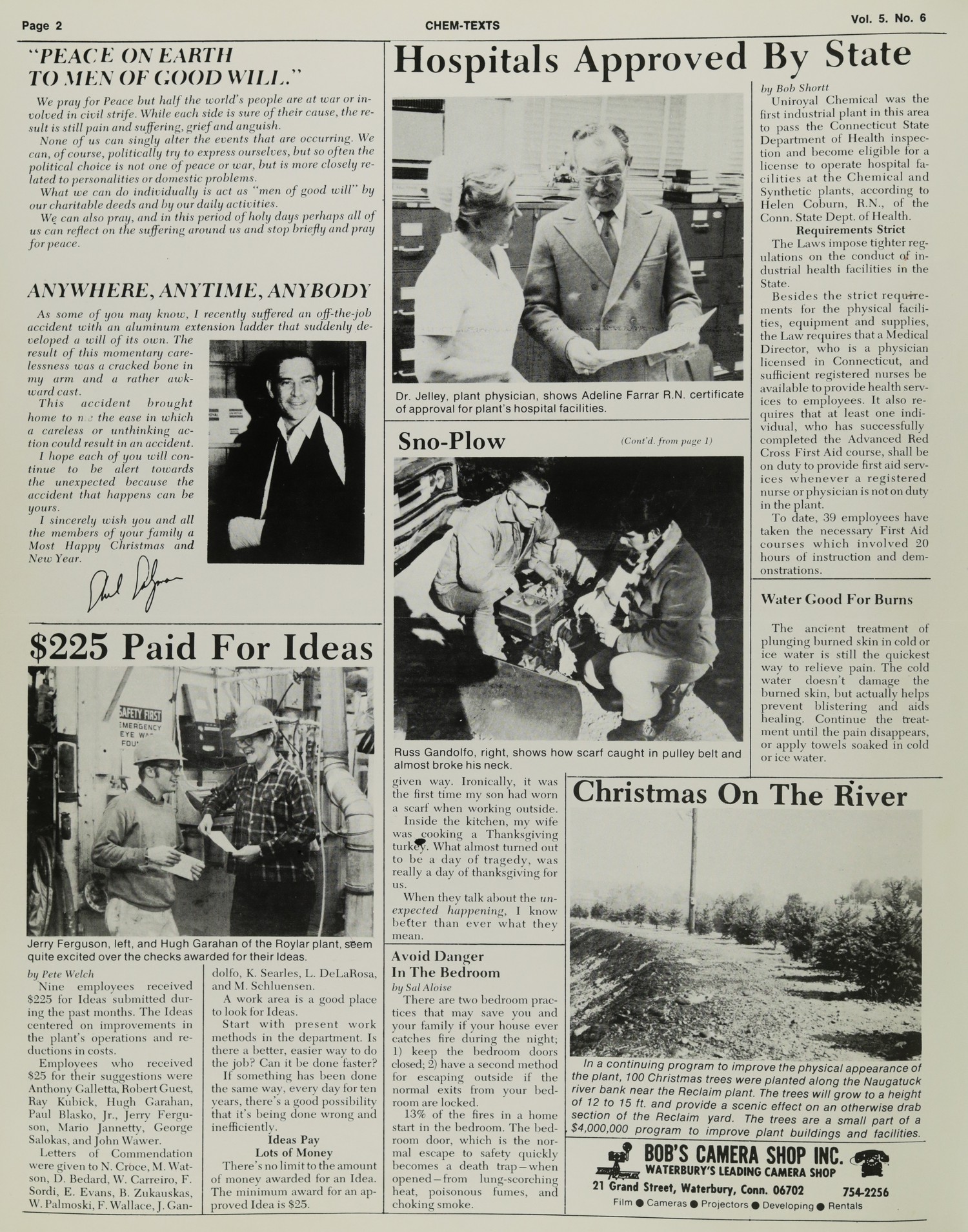
CHEM-TEXTS – Vol. 4, 1970, No. 10 – Page 1

Page 001

UNIROYAL

Merry Christmas – Happy New Year

CHEM-TEXTS

Vol. 4, 1970 | PUBLISHED FOR THE PEOPLE OF UNIROYAL CHEMICAL | No. 10


Real Christmas Spirit

[IMAGE: Black and white photo of women working on a wreath]

Girls in the IBM Tabulating department add a touch of Christmas spirit to the office. Adjusting the wreath which they made, are from left, Julie Curtin, Joyce Lucarelli, Helen Southard and Edna Crycheau.


Unique Company Formed

[IMAGE: Group photo of people at what appears to be a disco event]

Sales of UNIQUE Disco Delic Lite conducted at the Chemical plant were highly successful netting several hundred dollars. From left are Jim Gatling, Lou Schiller, Gail Snedeker, Joe Rzeszutek, URW Local 218 President, Gail Murray, Nancy Murrican, Cathy Gauvin, Ron Stark, Advisor, and Sonya Kernasevic.

Unique is not only the name of the Junior Achievement Company sponsored by Uniroyal Chemical but also the description of the Company’s unusual product, a Disco Delic Lite.

N.H.S. Students Head Firm

The lamp was designed, manufactured, and sold by Naugatuck High School students who organized the corporation and raised the capital to support their activities by issuing stock.

Theory In Practice

The textbook theories of eco-
(Cont’d on page 4)


Omite Facilities Constructed; Productivity Quality Improved

D. Beretta, Chemical President

David Beretta, Factory Manager of the Naugatuck plant from 1965-1966, was named Vice-President of Uniroyal, Inc. and Divisional President of Uniroyal Chemical, succeeding Frank A. Hopkins, who resigned from Uniroyal.

Mr. Beretta joined Uniroyal in 1952 as a process development engineer in plastics and rubber at the Naugatuck plant. He held several positions in polymer Research and Development until named Synthetic Production Superintendent. In 1965 he was appointed Factory Manager, a position he held until 1966 when he was transferred to Canada as a Vice President and
(Cont’d on page 2)

[IMAGE: Three workers in hard hats standing in front of industrial equipment]

Construction of new Omite facilities helped increase productivity and improve the quality of the chemical. Standing in front of new refrigeration unit are three of the Omite operators who helped make significant improvements in its quality: from left, Lyle Bissonette, Ed Cheney, Orrin Huntley and Bob Breton, foreman.

by Dr. Perry Kippur & Frank Bennett

Construction of a new refrigeration unit, and the installation of three 10,000 gal. storage tanks were completed to improve production operations of Omite. These new facilities, and the process improvements made in the past year, will enable us to meet the estimated forecast for Omite sales for the next five years. In charge of construction was Rod Gaetz of the Engineering department.

Productivity Increased

The refrigeration unit eliminates processing delays and thereby increases the productivity of Omite. The unit is large enough to pipe refrigeration to other close by buildings, as needed, to improve the efficiency of the production operations in these buildings.

The construction of these facilities was instrumental in significantly increasing Omite productivity and quality.

Quality Improved Since Jan. 1969

Since January 1969, the quality of Omite has improved significantly and is now excellent. This outstanding quality and production performance is attributable to the men who
(Cont’d on page 3)


Sales Drop; Profits Off

Uniroyal, Inc. sales and profits dropped during the 3rd quarter due to the auto strike and continued slackness in the chemical, rubber, plastics and latex industries. The GM strike forced production cutbacks in several tire, plastic products, and chemical plants. Reduced tire production hurt the sales of many products made in Chemical and Reclaim Production for tire manufacturers.

Company sales dropped $3,000,000 for the 3rd quarter and profits were off $3,149,000, compared with the 3rd quarter of 1969.

During the 9 month period of 1970 the Company suffered a $17,894,000 loss in sales compared to 1969.

Profit for the 9 months of 1970 dropped $10,332,000 compared to 1969.

Higher interest charges and higher costs for labor and raw materials, which cannot be passed on to the customer, also affected the Company’s profits.
(Cont’d on page 2)


Dividend Declared

Uniroyal declared a quarterly dividend of 17½ cents a share on the common stock, payable December 24 to stockholders of record November 23.

The Company also declared a dividend of $2 a share on the first preferred stock, payable December 24 to stockholders of record November 23.

[IMAGE: Man in hard hat inspecting equipment]

Dr. Perry Kippur inspects new 200 HP motor on the new compressor for the refrigeration system in Bldg. 100.

CHEM-TEXTS – Vol. 4 No. 10 – Page 2

Page 002

Page 2 CHEM-TEXTS Vol. 4 No. 10

FROM THE FACTORY MANAGER | Oxford Office Close to Completion

DEAR FELLOW EMPLOYEE:

Christmas is the season when everyone of us express more than anything during the year, the spirit of giving and concern for our family, friends, and the people we come in contact with each day of our lives. This spirit is particularly reflected by gifts to our families; visits to friends’ homes, and a sharing with others the many joys of the holidays.

In the plant where all of us work so closely together and depend upon each other so completely, this same spirit of giving and concern is vital.

By giving out fullest effort to, and showing the utmost concern for our responsibilities and the people we work with, each of us can individually infuse into the plant a spirit that will really make it a “good place to work.” The plant is not just a mere collection of buildings which house equipment to help us produce products or provide services, it is us, our efforts and our achievements.

Our work takes up more than eight hours of our day, and is a major part of our life. We can make it challenging; we can make it more secure; we can make it safer; we can make it more enjoyable by the same spirit of giving and concern that we display during the Christmas season.

I sincerely hope that you and your family, will enjoy a most happy Christmas and the fullest joy and happiness during the new Year.

Sincerely

Shel Salzman

S. R. Salzman


Construction of the administration building of Uniroyal’s Oxford Complex is on schedule for occupancy in summer. With most of the exterior work completed, and much of the interior ductwork, wiring and piping installed, the first of several buildings to be constructed will house many of the corporate activities presently in New York, EMIC, and Professional Park.


Chlebowski Averts Fire

by Ed Weaving

Matty Chlebowski’s quick action averted a serious fire in the Captax department when he opened a waterfog valve over a mixing tank which contained some undissolved sulfur and carbonbisulphide.

The incident occurred during cleaning operations to remove the sulfur and carbonbisulphide out of the mixing tank. Operators had removed the manhole cover to check the tank’s contents and started to add water through the manhole. The escaping carbonbisulphide ignited, probably from a hot steam pipe, and the flash fire burned a supervisor’s face and ears, which required hospital attention.

Tom Lee, a member of the crew, turned in the fire alarm signal for assistance from the plant protection department. “The fast action and alertness of the entire crew in an emergency prevented more serious damage and injury to the group,” according to Tom Engle, foreman of the building. Members of the crew working on the second shift were Frank Maher, John Mancuso, Charlie Drapko, and Ed Atwood, a piper working on the vessel.

During cleaning operations, tanks with hazardous vapors should always remain closed to

SAFETY IS MY RESPONSIBILITY

prevent their escape. Hot pipes can ignite the vapors and cause a serious fire and injuries to employees working in the building.


Sales Drop;

(Cont’d from page 1)

Strong competition in the chemical, reclaimed rubber, synthetic rubber and latex industries prevent passing on automatic price increases to our customers without the risk of losing their business. The extra costs for operating the plant must be absorbed by increased productivity; prevention of waste; and the reduction of off-spec materials that have to be reprocessed at an extra cost and that substantially affect the plant’s profit on the product.


Broden Named VP

Bill Broden, a Process Engineer in Chemical Production, was named Vice-President of the Uniroyal Chemical Management Club. Broden replaces Jim Phelan who was transferred to the International Division where he will work on agricultural chemical research and development of Chemical Division products in markets outside the U.S.

Black coffee, cold showers, fresh air or other folklore remedies do not sober you up. They just make you a wide-awake drunk.


1,100,000 Man Hours… It Happens

1,100,000 manhours were worked without a lost time accident for the second time this year. The most recent occurred from July to November when 1,100,000 manhours were reached without a lost time accident.

On November 20, the record was broken by a back injury when an operator shoveling residue in a drainage ditch under a fiber separation mill, strained the muscles in his back.

Only four lost-time accidents occurred this year, a major improvement over 1969 when 23 employees were injured and lost time from work.

Serious Injuries

The rate of serious injuries is about the same as last year. To date 56 serious injuries have taken place while 52 occurred in 1969.

Several close calls happened during the year and only safety glasses, safety shoes and safety hats prevented more serious injuries to employees. One employee almost lost his eyesight when a metal splinter hit and broke his safety glasses.

“Won’t Happen To Me”

A “won’t happen to me” attitude still exists among many employees who stubbornly resist

(Cont’d on page 4)


Three Steps Taken To Improve Air

Three steps have been taken by the plant to control pollution of the air. A new tower type scrubber was installed in Bldg. 109 at a cost of $40,000. The scrubber, by washing the phenolic fumes, eliminates the emission of these obnoxious odors into the atmosphere.

A process change in Bldg. 28 where PBNA is manufactured will eliminate the amine odors discharged into the atmosphere by the old process. This change is scheduled for completion by April 1971.

A new Dust Collector has been ordered for one of the mills in Bldg. 50 of Chemical Production. It will collect the fines which presently escape into the atmosphere.


Beretta

(Cont’d from page 1)

General Manager of Canadian chemical operations.

Later he became marketing Vice President for all Uniroyal products sold in Canada, a position he held until appointed Vice President of the Chemical division.

Mr. Beretta will be the guest speaker at the Uniroyal Chemical Management Club meeting on Jan. 20 at Fortin’s Restaurant.


Plant Water Cost Up 13%

The plant’s water costs were increased 13% due to a rate hike by the Connecticut Water Co. The new increase raises the plant’s operating costs about $35,000 annually.

Currently 55,000,000 gallons of water a month are used by the Chemical and Synthetic plants. In one month, 69,000,000 gallons were used; and in July, 60,000,000 gallons were consumed.

Water costs for the plant presently run $143,900 a year, and average $12,000 a month.

Help Conserve Water

Use of water, only when needed, will conserve it and keep the plant’s water bill down. Water waste increases operating costs and cuts into the plant’s profit. In some products it can seriously affect the cost of the product, hurting us competitively.

Considerable water can be saved by shutting off equipment when not in use, especially over weekends. Water hoses are also a major factor in water waste, when used to wash spillage down the drain. Dry spills should be swept rather than washed with the hose.

Every employee can help by turning off faucets; reporting leaks; and by using only as much water as is necessary to do the job.

CHEM-TEXTS – Vol. 4 No. 10 – Page 10

Page 010

CHEM-TEXTS

Vol. 4 No. 10 Page 3


Chemical Business Competition Increases

[IMAGE: Three men in business attire reviewing documents]

Ed Geise, seated, Director of Marketing for the Chemical division reviews marketing plans with Henry Smith, left, General Sales Manager and Joe Flannery, General Products Manager.

by Joe Flannery

Business continues to be more and more competitive. In today’s tight economy, competitors want our customers just as we want theirs; and they fight pretty hard for them too. Today there is no such thing as a guaranteed market for our products.

Competitors are often willing to offer better delivery, packaging, quality, technical service and even lower prices to obtain business. And customers, on the other hand, are increasingly more demanding for these services and prices.

Cost-Price Squeeze

Most businesses today are in a cost-price squeeze in the competitive struggle. Our business is no exception. Profits have declined in the last year as a result of lower prices for our products and higher costs of doing business. And yet we must be increasingly responsive to our customers to keep our business and maintain a healthy growth. At the same time, we must be efficient and competitive to be profitable. Profits are the source of funds to expand our business; modernize plants; install new

(Cont’d on page 4)


Personnel Assignments

Earl Root was made a Foreman in Synthetic Production. Prior to his new assignment he was a Utility Operator at the Synthetic plant. Earl joined Uniroyal in 1947.

Al Hoodbhoy was assigned to Testing Services in Bldg. 81, responsible for Chemical Control.

Doug Ritche was transferred to the Synthetic plant as a process engineer.


Lab Cat Becomes A Queen

[IMAGE: Woman holding a cat and displaying trophies]

Miss Uniroyal, a pedigree Domestic Short Hair displays her trophies with Ruth Shipman.

by Ruth Shipman

Two years ago, a stray kitten walked through the main gate, and into building 81 Lab. The cat turned out to be a pedigreed Domestic Short Hair with a Tortoise shell fur, black, orange, and creamy white.

In her first show in 1969, Miss Uniroyal was judged Best Household pet and in 1970 three judges named her Best Household pet twice at the Yankee Spay and Neuter Club Show.

The two year old Miss Uniroyal is now registered with the Cat Fanciers Federation.


DON’T DRINK AND DRIVE


Omite Facilities

(Cont’d from page 1)

worked in Bldg. 100: Bob Anderson, Joe Bednarek, Lyle Bissonette, Ed Cheney, Ray Drapeau, Harry Hedrick, Orrin Huntley, Dan Marino, John Matcheson, Carl Mulonet, Dom Persutti, and Bob Breton, foreman of the building.

Reduces Pollution

By recovery of the heptane solvent, which was previously lost and discharged into the atmosphere and the Naugatuck River, the plant not only saved materials’ cost but also reduced pollution.

Prevention of waste by dumping materials into the drain is an important part of the plant’s policy to stop pollution. Its success depends on every operator carefully checking all processing operations to prevent waste, and to avoid washing chemical spillage into the river.

Safer Operation

Bulk butyl phenol will be stored in one of the new 10,000 gallon tanks and piped directly into the processing operations, making the job easier and safer. An operator previously lifted and knifed open the 50 lb. bags, and emptied them into the equipment. The bags were discarded as solid waste. The new facility now eliminates this waste problem, another improvement in pollution abatement.

The other 10,000 gallon tank holds thionyl chloride, which was previously handled in 55 gallon drums.

The two new tanks minimize exposure to lifting and handling heavy objects, as well as, the exposure to handling chemicals in drums.

Promising Product

Sales of Omite increased 10% over 1969 sales and was a bright spot in the plant’s economic


Eskiloos Set Style

[IMAGE: Woman in boots posing outdoors]

Uniroyal’s Eskiloos are better than ever for getting around town in style in rain and snow weather. Eskiloos come in all lengths from ankle bone to knee high on high, thick heels. They offer wash-and-wear easy care, water repellent protection, shape retention and salt stain resistance. Many of these special attributes are due to the Royalon vinyl upper material which is made from Marvinol vinyl, a product of the Chemical Division. Much of the Research and Development work on the vinyl plastic is done by the Marvinol group at the Technical Sales Service Center.

situation when sales of rubber chemicals, reclaimed rubber, synthetic rubber and latex dropped off.

Delays in label registration from the U.S. Dept. of Agriculture for use on orange, grapefruit, and lemon trees have affected a more optimistic sales forecast previously set for 1971. As a result, production of the chemical in the plant has been rescheduled for a shorter schedule.

Seven years of field tests and toxicology tests to determine the safe use on food crops were conducted at a cost of approximately $750,000 before a pound of the chemical was sold commercially.

Omite does not upset the ecological cycle. Harmless to humans and animals, it does not disrupt the natural, biological control of predatory insects such as bees which are beneficial to growers.


Phenol Spill Causes Burn

A freak accident took place in the Control Lab. when the bottom of a glass test tube broke while an analyst was stirring a chemical in it with a glass rod. Phenol spilled over the employee’s laboratory smock and caused a minor burn to the skin.

The accident was a perfect example of the unexpected happening. As a safety precaution against such accidents, glassware should be held over the laboratory bench to avoid accidental burns from broken glassware.

Accidents of this type are unusual and occur only one out of a thousand times. Prevention of the one time is what safety is all about.


[IMAGE: Four people in discussion around a table]

Label registration for Omite use on citrus crops is discussed by, from left, Gracie Stone, Bob Covey, Dr. John Zukel and Dr. Al Smith.

CHEM-TEXTS – Vol. 3, 1969, No. 3 – Page 1

Page 001

UNIROYAL CHEM-TEXTS

Vol. 3 1969 PUBLISHED FOR THE PEOPLE OF UNIROYAL CHEMICAL No. 3


NAUGATUCK, LEADER IN RUBBER CHEMICALS

New Curalon Plant Starts Up Will Increase Chemical Sales

[IMAGE: Factory/plant interior with workers and equipment]

Checking operations in the new Curalon plant are l. to r. Anthony Gambardella, Rocco Magnanimo, foreman, and Thurman Walton.

by Harold Smith

The new Curalon plant in Bldg. 17, formerly the Flexzone® and DDM plant, started production recently of Curalon® a new chemical curative used to harden and shape liquid polyurethane elastomers. The polyurethane elastomers have today become a large industry.

Uniroyal Chemical, was a leader in the research and development of the polyure-

(continued on page 2)


Results Successful In Water Pollution Abatement Program

[IMAGE: Industrial water treatment facility]

One of the three waste water treatment units along the Naugatuck river to provide design information for treatment of waste waters

by Dick Shaw

Uniroyal Chemical completed another major step in its water pollution abatement program with excellent results.

For the past 6 months, extensive engineering efforts have been concentrated on the operation of a waste water treatment model scale plant

(continued on page 3)


[IMAGE: Workers watching bagging operation with “DELAC-S PRILLS” visible on equipment]

Good packaging is essential to good customer service. Left to right, watching the bagging of Delac – S Prills are Jim Heagle and Tom Dowling. John Starr, right, operates the bagger.

by Bob Mazaika

Uniroyal Chemical is the world’s leading manufacturer of rubber chemicals, representing a high percent of the division’s sales. The Chemical division manufactures more than 70 different chemicals for the rubber, plastics and latex industries. 70 percent of these chemicals are made here at the Naugatuck plant. Many are patented, which means only Uniroyal Chemical can make them; but many are not, and sold against strong competition. Recent price cuts have hurt sales and profits and made selling a harder job for the Sales Department. To maintain this position as leader in the industry requires constant research for new chemicals; continued improvement in quality; extra effort on good packaging to improve service to our customers; who are the most important part of our business. Because of dirty, wrong-marked packages and poor quality products, we could lose two or three major customers and lose our position as leader in the industry.

Chemicals made at Naugatuck range from C-P-B, used by golf ball manufacturers to “cure” golf ball covers to Sunproof® waxes to protect tires against sidewall cracking from weather conditions.

Uniroyal offers more accelerators to the rubber industry than any other company such as Trimene,® Methazate, Delac®S, M-B-T-S, Monex,® Tuex,® GMF and Royalac.® These chemicals “cure” the rubber and help shape it into its finished form. Without these accelerators, rubber would be like putty or uncured cement. Accelerators are used to make every type of rubber product from pencil erasers to foam rubber mattresses and automobile tires. GMF® is used in the Minuteman Missile as part of the propellant system.

Naugatuck antioxidants, the best in the industry, protect rubber products from heat and oxygen which cause rubber to deteriorate, discolor, or crumble. For example, BX-A protects the nylon used in tire cord; Polygard® and Naugawhite® keep white products — such as sneakers and footwear — white and prevent the rubber from discoloring. Other well known antioxidants are Octamine, Retarder J and Polylite.

Rubber chemicals constitute the highest cost in every rubber product, and are from two to ten times more expensive on a per-pound basis than any other ingredient used in the finished product. Because of their high cost, customers demand the highest quality chemicals for these prices, otherwise they turn to

(continued on page 3)


[IMAGE: Person jogging/running in athletic wear]

Naugatuck antioxidants give Pro-Keds jogging shoes quality and longer wear life.


SAFETY IS MY RESPONSIBILITY

CHEM-TEXTS – Vol. 3 No. 3 – Page 2

Page 002

Page 2 CHEM-TEXTS Vol. 3 No. 3


FROM THE FACTORY MANAGER

DEAR FELLOW EMPLOYEE:

Are you a professional? In sports the professional is one whose proficiency and skill enables him to earn his living through his participation. The professional is characterized by his pride in his efforts. In a similar sense, we are professionals earning our living by supplying our customers with chemicals, reclaim, and polymers. But do we always demonstrate the proficiency and skill required in our jobs? Do we have the pride of workmanship characteristic of the professional?

Remember a professional always gives his best and always tries to win. He puts team goals and team effort ahead of his own personal desires. He believes the whole team wins together and he takes pride in realizing that the true recognition for his effort is in the team winning.

The same thing is true in our plant – we all win when we satisfy our customers’ needs in the most efficient manner possible. Anything less than this – we aren’t professionals!

[Signature]

John D. Evans


Chemical Control Center Reviews Quality, Productivity, and Costs

[IMAGE: Sam Gillette, left, listens as Walt Frankenberger, in charge of the Chemical Control Center, reviews the previous day’s production with Jim Cronin, right, superintendent of chemical production.]

by Walt Frankenberger

The Chemical Control Center (CCC) in Chemical Production was established 18 months ago to increase productivity, improve the quality of our products and to decrease costs. The center was set up by Walt Frankenberger who organized the procedures for operating it.

By weekly and daily review of production pounds, quality, and costs, the Center controls productivity and spots downward trends in the plant which require adjustment. The CCC also reviews on a monthly basis the performance against set standards of every chemical made by the plant during the previous month and year to date. This evaluation is based on raw material usage, yield and productivity expressed in pounds per hour. A report is then given to the responsible foreman and process engineer so that corrective action can be taken, if necessary.

For daily control, a daily batch card is used for reporting the date and number of batches made each day. The cards are turned in daily to the center, logged, and sent to EMIC for further processing.

The number of batches for the major chemical products are plotted on control boards, shown in the photo, where they are compared to a set standard and on which a rolling average is maintained. When the number of batches drop below the standard, the person in any business.


73 Employees Awarded $1455 For Suggestions.

Wojtczak Receives $70. Mayo’s Idea Brings $50.

[IMAGE: Looking at the checks awarded for their suggestions are l. to r. Elmer Anderson, Joe Wojtczak, and Bob Lockwood who received a total of $157. for their ideas.]

by Kirk Kirkendall

Suggestions for improving the plant’s overall operations can provide benefits which go beyond the money received for a suggestion award. Contributing suggestions and ideas involves a person in the successful operation of the plant and brings a personal satisfaction to his job. No matter what you may think of your suggestion, don’t hesitate to send it in. It may turn out to be an important one.

73 employees recently received $1,455. for their suggestions out of the 150 suggestions which were reviewed. The highest single award of $50 went to Fred Mayo. Joe Wojtczak received $70 for several suggestions. John Painter, a consistent winner, got $65; Ed Bazenas $55; Al Urban of Reclaim $50 and Bob Lockwood of Synthetic Production $47.50.

Receiving $40 for their suggestions were Fernando Henriques, R. Fratangelo, Ed Semaskvich and Elmer Anderson. Joe Moniz of Reclaim obtained $35 for his idea on improving the cleaning of Sweco screens; J. Gallucci $30 for a safety suggestion, and $30 to W. Anderson, Fred Engle, J. Lawton, J. Wawer and J. Gandolfo.

$25 awards were received by H. Rich, J. Wawer, J. Matcheson, J. Brown, L. foreman gives a detailed explanation of the causes for the lost production.

Since daily control was initiated, rubber chemical production has consistently improved over production prior to September 1968. The quality of rubber chemicals has also improved through the Center’s operation. By improving production and quality, the Center helps to provide better service to our customers, the most important person in any business.

[IMAGE: Fred Mayo received $50. the highest single award. (Photo by Kirkendall)]

Rinaldi, G. Brezak, L. Dumonski and J. Butkus.

$20 awards went to E. Smith and F. Pikula, and J. Butkus and J. Painter.

Thirty-three employees received or split $15 for their


New Curalon

(con’t from page 1.)

thane elastomers; developed the product, Vibrathane, the tradename for our polyurethane elastomers. Our Research and Development technology in rubber chemicals led to the development of Curalon L whose use should grow at a 20 per cent rate annually.

Polyurethane elastomers cured with Curalon possess high resistance to wear and tear and have excellent shock absorption properties. Because of these properties, they are used for grain chute linings, industrial truck tires, gears, mountings and printing rolls where they outlast rubber 3 to 4 times longer.

Project engineers of the new plant were Neil Klarfeld and Jim Garrigan. Lou Kaiser is the process engineer, responsible for the manufacturing operation.


ideas: Lois Devino, C. Iannuzzi, F. Maher, A. Hanley, Ray Gogolewski, J. Hoey, J. Mahoney, J. Lynch, K. Urbsaitis, N. Tiscione, A. Krampetz, G. Monahan, J. Banno, R. Ruginis, D. Pardal, B. Zukauskas, J. Grosso, E. Johnson, R. O’Neil, E. Root, J. Objinski, A. J. Happy, R. Bell, T. Ciarello, J. Slasienski, J. Lynch, A. Gedraitis, G. Ravenscroft, C. Parks, R. Steward, Laura Soares, V. Kloc – Bob Lockwood, and L. Haas – J. Wawer.

Honorable Mentions, which automatically bring a $15 award for the third suggestion submitted, went to J. Mahoney, F. Dingle, P. Masone, H. F. Carroll, M. Hebert, B. Pranulis, R. Lestage, E. Anderson, J. Wojtczak, F. Henriques, C. Miele, J. Lawton, F. Phelan, J. Butkus (2), J. Painter, K. D. Nelson, R. O’Neil, C. Hiser – D. Cleary, G. Brezak and L. Reeser.

Every suggestion submitted receives serious consideration by the Suggestion Awards Committee. Some suggestions require more time to study than others to evaluate them, which is oftentimes the reason for some delay. Suggestions worthy of consideration are any that increase production, improve quality, eliminate duplication or waste, improve packaging, simplify your work procedure, eliminate paper work, improve customer service, reduce costs, improve production, and better our safety conditions.

Suggestion forms are available around the plant. If unavailable, your Foreman or Supervisor will be glad to obtain them for you.


Save Your Blood For June 12

by Bob Shortt

June 12 has been reserved as Uniroyal Chemical’s day for blood donations. Because of its convenient facilities, the Bloodmobile will be held at St. Michael’s Parish House in Naugatuck. Our quota is 150 pints.

Employees have donated generously since the visits started in 1957 when 190 pints were given. Since then, we have averaged about 170 pints each visit.

Blood is in great demand today. By contributing, you can help be sure that blood is available for you or your family. Let’s try for the 190 pints again.

CHEM-TEXTS – Vol. 3 No. 3 – Page 3

Page 003

CHEM-TEXTS

Vol. 3 No. 3 | Page 3


KNOW YOUR BENEFITS: by Marion Hutt

Uniroyal’s Paid Vacation Benefits Comparable To Best In Industry

The entire vacation policy for wage employees is too lengthy to reproduce here but the following are some of the most frequently asked questions:

Q. How much vacation am I entitled to receive?

A. Employees will receive vacations based on their seniority with the Company on Dec. 31 of the prior calendar year, as follows:

1 year. . . . . . . . . . . . . 2 weeks
5 years. . . . . . . . . . . . 3 weeks
15 years . . . . . . . . . . . 4 weeks
22 years . . . . . . . . . . . 5 weeks
30 years or more . . . . 6 weeks

Q. How much vacation pay do I receive?

A. Those entitled to a vacation of:
2 weeks . . . . . . 4% of earnings
3 weeks . . . . . . 6% of earnings

(continued on page 4)


UNIROYAL, INC. FIRST QUARTER SALES AND NET INCOME SET RECORD HIGH

Uniroyal, Inc., set new records in sales and net income for the first quarter of 1969, George R. Vila, chairman and president, reported at the annual meeting of stockholders.

Sales for the quarter were $368.8 million, an increase of 9.3 percent compared with $337.4 million for the same period last year and the highest for any first quarter in Uniroyal’s history.

Net income was $12.5 million, another record for a first quarter. This compares with $12.1 million during the first quarter of 1968.

First quarter earnings were equivalent to 44 cents a share of common stock compared with 43 cents a share last year.

The new record in earnings was achieved despite inflationary trends in the economy and high start-up expenses for an unusually large number of new plants coming on stream worldwide, Mr. Vila said.

During the next five years, Uniroyal has programmed capital expenditures of more than $600 million. During 1969, expenditures will be $150 million compared to more than $100 million in 1968. Heavier capital expenditures, Mr. Vila said, are necessary to keep pace with expanding economies around the world as well as to gain maximum benefits from new products from Uniroyal’s research and development laboratories.


Naugatuck Leader . . .

(continued from page 1)

competitive companies for the quality and service. Major competitors in the rubber chemical market are well known large chemical companies like Monsanto, du Pont, R.T. Vanderbilt and American Cyanamid.

Our rubber chemical business started more than fifty years ago as a producer of sulfuric acid for the brass industry in the Waterbury area. Today, Uniroyal Chemical supplies 25% of the total rubber chemicals used in the rubber and plastics industry. Practically every automobile tire manufactured, contains one of Uniroyal’s chemicals. In the past ten years, sales have doubled and, depending on the rubber and plastic industries’ growth, sales are expected to continue at this growth rate.

Interestingly, our rubber chemical technology was the base from which our present agricultural chemical business developed with the introduction of Spergon and Thiram seed protectants. Agricultural chemicals like MH-30,® Alar,® Aramite,® Omite,® Alanap® and Dyanap® have become an important part in the Division’s growth.

Today our list of rubber chemical customers include such companies as Goodyear, Firestone, General Tire, Armstrong Tire, Cooper Tire, Dunlop and many other large companies, all important to our rubber chemical business. With good quality products, properly marked, clean packages, and good customer service, they’ll continue to do business with us. Each of us in our own way, by doing our jobs in the best possible way, makes certain that we keep our valued customers.


Hold That Tiger; Keep Chained!

PLACE CYLIN HE

[IMAGE: John Sickola Jr. of the Materials Handling department chains full cylinder “tigers” securely in place.]

Stories of jet-propelled gas cylinders are common, but this one did so much damage in a few seconds that it deserves mention because the same thing could happen in our plant.

A CO₂ cylinder without a cap was being moved across an airplane hangar floor. It fell; the valve broke off; and the cylinder took off, tore through several airplane wings, broke off sprinkler heads which started a flood, destroyed equipment, went through a concrete wall and finally ended its wild, damaging flight outside. Damage cost $500,000.

This type of accident is not restricted to CO cylinders. Any compressed gas in a cylinder: freon, oxygen, air, acetylene, nitrogen or chlorine, will react in the same way. Many of these cylinders are stored throughout the plant.

It is especially important, in the plant, that all compressed gas cylinders be kept in retaining racks and secured at all times. When not in use, mixing valves and gauges should be removed, and the protective caps put back on. Keep cylinders chained. Don’t turn a tiger loose in the plant.


Spring Tire Sale Ends On May 29

A Special Spring Employee Tire Sale will run from March 31 through May 29. Employee prices will be substantially below regular prices on tires for cars, small trucks, campers and trailers.

A feature of the sale will be the new Uniroyal Master with different front and rear tires for better steering and traction, a steel reinforced tread and a 40,000 mile guarantee.

Also included in the sale are the Uniroyal “Fat Max”, “Alley Cat” Tiger Paw, Wide Tiger Paw, Tiger Paw and the Laredo “Rain Tire”.

This will be the only sale on these tires this year.

Slips can be obtained from Industrial Relations: Ann McAllister, Synthetic plant nurse: Luella Anderson TSSC; and Rosalie Tolbert, EMIC.


[IMAGE: Practically every tire on the road contains a Naugatuck chemical to protect it against heat build-up and give longer service life.]


What Employees Say About Safety

Q. What do you think of the safety attitude of the people at Uniroyal?

A. Dom George says, “The Company is making every effort to improve the attitude of the people in the plant. Some still haven’t got the message and don’t seem to care. The best reason in the world to be safe is my family and to make a good living for them.”

A. Roland Bergeron says: “I work in many different areas of the plant and I think the safety attitude of most people in the plant is pretty good. But some people don’t seem to care about safety at all. They don’t use common sense. They don’t wear their safety glasses, hard hats, or proper protective equipment for the job.

The plant should stress to employees through more movies and discussions on what could happen in a chemical plant if employees aren’t safe, especially when handling the different types of chemicals. Some of our people think that a serious accident couldn’t happen here as in other chemical plants, so they often take a lax attitude toward safety.


Results Successful . . .

(continued from page 1)

which has provided the technology essential to the design of an adequate and economical full-scale treatment facility for the waste waters generated by the plant’s manufacturing.

The model scale plant studies and results were reported to the Water Resources Commission and reviewed at a meeting attended by Mayor Raytkwich of Naugatuck and representatives of Malcolm Pirnie Engineers, the Water Resources Commission and Uniroyal Chemical. The plans were recently approved by Hartford.

Uniroyal and Borough officials are now able to proceed to establish agreements which will form the basis for proceeding with design of the municipal water pollution control facilities and for Uniroyal to proceed with the design of waste water pretreatment facilities.

Dick Shaw project engineered the new plant, assisted by Steve Schwartz who has been exploring the possibility of recovering discharged materials for reuse.


SAFETY IS MY RESPONSIBILITY

CHEM-TEXTS – Vol. 3 No. 3 – Page 4

Page 004

Page 4 CHEM-TEXTS Vol. 3 No. 3


Valentine, Amador, Sears, Spina Retire. Total 138 Years Service.

[PHOTO]

Bert Scullin makes Val Valentine, center, and his daughter, Mrs. Joseph Wojtczak Jr. chuckle at retirement dinner honoring Val for his 36 years service. (Kirkendall photo)

[PHOTO]

Manuel Amador, left, is congratulated by Joe Rzeszutek, President URW, Local 218, on his retirement from Reclaim Production. Amador had 41 years service with Uniroyal. (Kirkendall photo)

[PHOTO]

Joe Arbachauskas, URW president, Local 308 congratulates Norm Sears, center, on his retirement after 43 years, as Tom Gambardella watches. Standing are Jack Muckle, left and Bob Curtin.


“That’s The Way We Always Did It”

Have you ever asked why something was done in a certain way, only to be told, “Because that’s the way we always did it”?

Perhaps the classic example of this kind of senseless and stubborn adherence to precedent occurred when Bismark was ambassador to the court of Alexander II. Looking out a window of the Peterhof Palace, in 1860, Bismark noticed a sentry standing watch in the middle of the lawn and idly asked the Czar why the man was there. The Czar asked an aid-decamp. He didn’t know. The general commanding the troops at the palace was summoned. He didn’t know either.

“Then find out why and report to me,” commanded the Czar.

It took three days of intensive investigation, but finally the general came back with the answer.

It seemed that in 1780, on a fine spring morning, Catherine the Great had looked out the window and had seen the first flower thrusting above the frozen grass. She had ordered a sentry posted there to prevent anyone from picking the flower or inadvertently stepping on it. And eighty years later, the sentry was still there. No one had ever asked that simple, one-word question: “Why?


DOM SPINA RETIRES

Domenic Spina retired from the Synthetic Mechanical department after 18 years service with Uniroyal Chemical.


Safety Glasses Replaced Free, But Not Your Eyesight

[PHOTO]

Kevin Kelley of the Research and Development department, while performing development work in Bldg. 61 laboratory, had a close call when the unexpected happened.

Kevin was using a regular gallon jug in a dry ice and acetone bath to make a 50 percent caustic solution. The temperature differential caused the jug to burst and the contents spilled onto the dry ice and covered the upper portion of his body and his eyes. Fortunately, he was wearing his safety glasses and prevented serious injury to his eyesight.

By being safe at work and wearing the proper protective equipment for the job, serious accidents are avoided. Your unsafe act may not hurt you, but it could seriously injure one of your fellow employees.


Purchase Of 1 Bond And 1 Share Per Employee, Bond Drive Goal

During May employees will have the opportunity to purchase U.S. Savings Bonds and Freedom Shares conveniently through payroll deductions. The goal for the 1969 drive is the purchase of one Bond and one Share by each employee. Presently 37% of our employees participate in the Payroll Savings Plans for U.S. Bonds, compared to a Uniroyal average of 52%.

The Payroll Savings Plan offers an opportunity for systematic savings to save for a secure future in one of the world’s safest, and most broadly effective, investment programs. Through systematic, easy thrift deductions you watch your savings grow automatically.

Purchase of U.S. Savings Bonds protects against inflation, keeps our economy stable and our dollar sound. Savings Bonds involve you actively in helping the Government stop inflation, a major economic problem facing all of us today.

This safe and economical investment is exempt from state and local income taxes. Payment of federal income tax on E bond interest may be deferred until the bonds are redeemed. 70% of Savings Bonds purchasers do not redeem them until age 65. In this way, the tax liability could be greatly reduced and possibly eliminated.

For only $39 you receive $50. through the purchase of a Series E Bond ($18.75 and redeemable in 7 years) and a Freedom Share ($20.25 and redeemable in 4½ years). By purchase of only one Bond and one Share, you can start a good systematic savings plan for yourself and your family.

Heading this year’s drive as Chairman will be Bill Lavelle of the Industrial Relations Department.


Know Your Benefits . . .

(con’t. from page 3)

4 weeks . . . . . . 8% of earnings
5 weeks . . . . . 10% of earnings
6 weeks . . . . . 12% of earnings

Q. Do I receive any vacation this year if I was hired 2 months ago: e.g. March 1969?
A. No, but you are eligible for vacation pay on your 1st. anniversary of your employment.

Q. If I am eligible for vacation, do I have to take the time off?
A. Yes, employees with 2 weeks vacation eligibility must take the 2 weeks.

Q. Am I allowed to receive vacation pay in lieu of time off?

A. Wage employees eligible for vacation weeks in excess of scheduled plant shutdowns or 2 weeks, whichever is greater, may at their request and with the approval of management, receive vacation pay instead of time off, up to maximum of 2 weeks. Election to receive in lieu of payment must be made no later than September 15 of the year in which taken.

If you have any questions about your vacation time, or pay, your foreman or supervisor will be glad to help you. Or you can consult your Union Contract booklet for fuller details.


SAFETY IS MY RESPONSIBILITY


CHEM TEXTS

PUBLISHED BY THE INDUSTRIAL RELATIONS DEPARTMENT
UNIROYAL CHEMICAL, NAUGATUCK, CONN. 06770

EDITOR: W.F. Lavelle.


UNIROYAL Chemical
Naugatuck, Connecticut 06770

U.S. Postage
PAID
Permit No. 10
Naugatuck, Conn. 06770
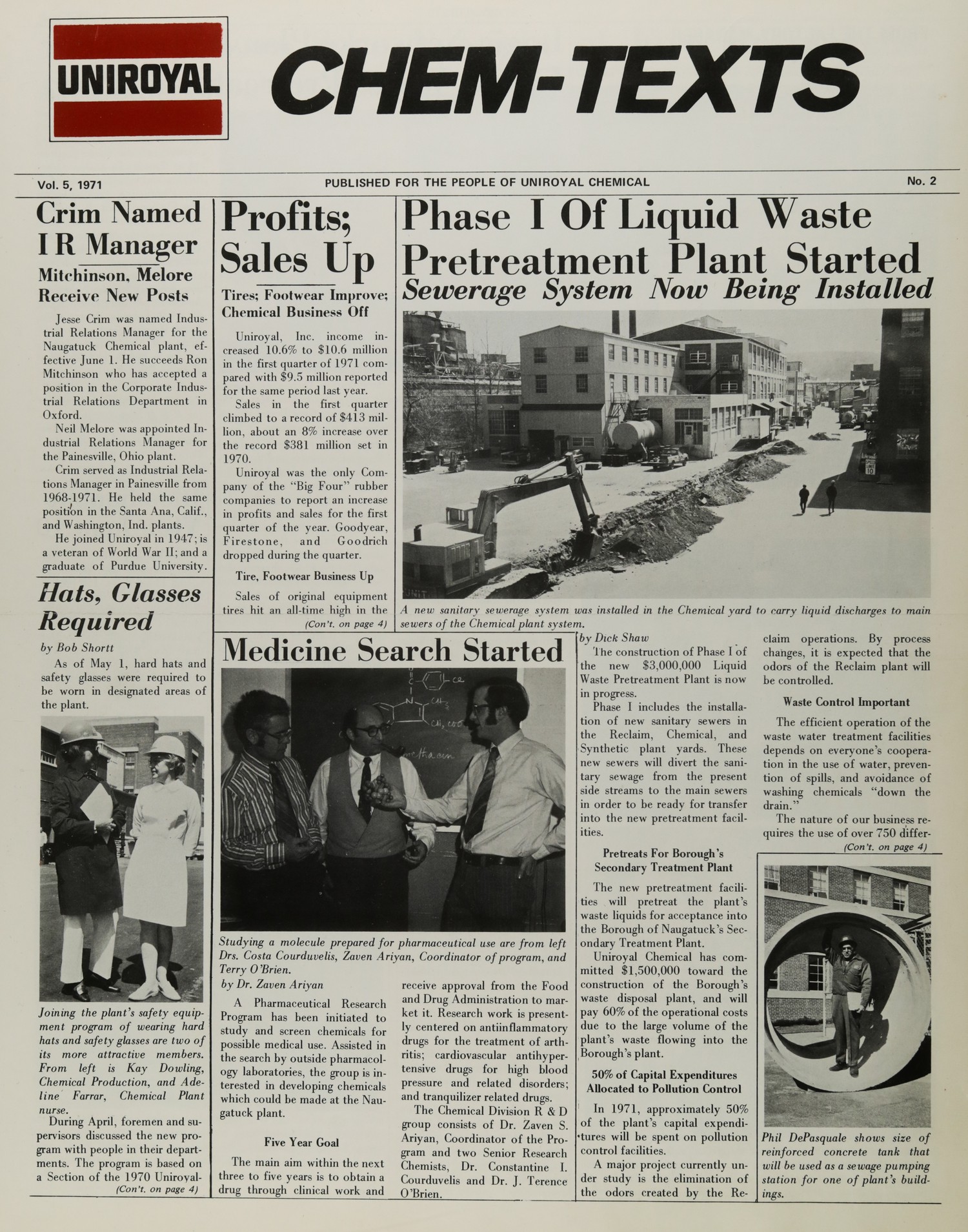
RETURN POSTAGE GUARANTEED

CHEM-TEXTS – Vol. 3 No. 4 – Page 2

Page 002

CHEM-TEXTS

Page 2 | Vol. 3 No. 4


FROM THE FACTORY MANAGER

DEAR FELLOW EMPLOYEE:

All of us are aware of the importance of producing quality products in an efficient and safe manner. We are also aware of the importance of providing service to our customers, for only through the sale of the results of our effort can we be paid for this effort. I am convinced that each of us tries to do his job in the best way.

But how do we see our jobs? Is our particular job over, when we feel that somebody other than ourselves can be blamed for poor performance?

For example, is it justifiable to blame our injury on someone else if, indeed, it was an unsafe act on our part? Or, is it reasonable to blame lost production on the shortage of raw materials if we didn’t do something about it? Maybe we are all too quick to place the blame on someone else, before we accept all of our own responsibilities.

Together, we operate a very complex operation where each employee bears a great deal of responsibility for his personal efforts, and if we are fully successful a great deal of responsibility for the efforts of others.

Sincerely,

[Signature]

John D. Evans


Flood, Disaster Plan Revised

[IMAGE: Black and white photograph showing flooded area with building]

The Naugatuck River became the “mad river” in August 1955 and flooded the plant. Having a plan for action got the plant back into operation in two days.

The purpose of the revised Plan, which has been distributed to involved employees, is to minimize delay and confusion if an unusual or serious incident occurs, such as the August flood of 1955, and to delegate responsibilities to assigned personnel.

If an emergency occurs, the Control Center for operations will be set up in the Industrial Relations office, Bldg. 84, unless circumstances require another location. The Plan outlines the utilization of all equipment in the plant and the specific duties to be carried out by authorized personnel. It also delegates to Ron Mitchinson, Fred Wintsch, Bob Krause, and Bill Lavelle the responsibility and authority, as the plant’s public information representatives, to provide information to the press. All employees should refer requests on information of the emergency to the plant’s public information representatives to prevent damaging rumors and in-

(Continued on Page 4)


Explorers Offer Students Career Insight

by Bob Smith

The Explorers offer high school boys, 14 to 18 years old, the opportunity to see and learn about careers in science, chemistry, and industry. The group, sponsored by the Chemical plant, was the first Explorer Post in Uniroyal.

The Explorers conduct laboratory experiments in the plant’s laboratory facilities; take tours of industrial plants in the area to see first hand the manufacturing operation of a large company; and make weekend trips to universities, military installations and other places of interest to high school students. By exploring or seeing scientific operations; observing chemistry in action; and studying the engineering complexity of a synthetic rubber plant, a high school student obtains an actual insight into the type of career to pursue in life.

This year the group visited Scovill’s, Mallory Battery, Sikorsky Aircraft, Uniroyal Chemical’s Agricultural Research Center, the E.M.I.C. Computer Center, and the Massachusetts Institute of Technology.

If your son is interested in a career in science, chemistry or industry, and would like to join the Explorers, Bob Smith, Ext. 674, will be glad to give you more details on the group’s activities.

[IMAGE: Group photograph of committee members]

Committee members discuss plans for future activities. Seated, left to right, are Bruce Fisher, Bob Smith, chairman, and Steve Schwartz. Standing are Harry Jancis, left, and Bert Scullin. Not present were Tom O’Hara, Al Manzi, Ed McCaffrey, Bill Broden, Ken Ferreira, Ben Leach and Dick Savage.

[IMAGE: Group working on science project]

Working on a science project are, left to right, seated, Art Nunes, Dick Adamaitis, and Lou Stephenson. Standing, left to right, are Frank Cravo, George Louis Jr., Armando Pardal, Nat Vescera, and Steve Schwartz, advisor.


Safety Shows Small Improvement Over ’68

by Sal Aloise

The plant’s safety record for the first four months of 1969 shows that 7 lost time accidents and 14 serious injuries took place. Although a slight improvement over 1968, the record indicates that a greater safety awareness by every employee is required to make the plant a safer place to work.

By not taking chances; by stopping unsafe acts; accidents can be prevented and the plant made safer for work. In 1968 we worked 1,000,000 manhours without a lost time accident. With every employee’s effort, we can reach 1,000,000 manhours again . . . and even 2,000,000!

LOST TIME ACCIDENTS AND SERIOUS INJURIES

MONTH 1969 Lost Time Serious Injuries Total 1968 Lost Time Serious Injuries Total
January 2 2 4 2 2 4
February 2 5 7 3 5 8
March 2 3 5 2 6 8
April 1 4 5 2 6 8
TOTAL 7 14 21 9 19 28

Dividend Declared

Uniroyal declared a dividend of 17½ cents a share on the common stock. A $2 dividend on the 8% first preferred stock was also announced. Both are payable June 25 to stockholders of record May 26.


Dr. Williams Leaves

Dr. Edward E. Williams will leave us as plant physician at the end of May.

Dr. John P. Elser will assume the duties of plant physician on June 1.

Dr. Williams has been associated with the Chemical plant for the past 35 years. He plans to continue his private practice in Naugatuck.


The average American family wastes about 400 lbs. of edible food in a year. The country wastes over 10 million tons of food each year.


SAFETY IS MY RESPONSIBILITY

CHEM-TEXTS – Vol. 3 No. 4 – Page 4

Page 004

CHEM-TEXTS

Page 4 | Vol. 3 No. 4


Room Of Tomorrow Made From Urethane Plastic Foam By Research And Development

The carved panels, rough hewn walls, beams, and the antique chest look like the most expensive, hand-carved woods. But they are made from urethane plastic foam, a unique plastic product developed by Rubicon Chemicals, a joint venture of Uniroyal Chemical and Imperial Chemical Industries of England. The principle materials used in making foam are liquid polyols, an organic isocyanate, catalysts, an emulsifier and a blowing agent.

The basic raw materials, TDI and MDI are marketed by the Chemical division’s sales department, with Walt Cook in charge of sales. Breaking into a new and highly competitive market, sales started slowly but during the past year have shown a steady increase.

The Rubicon research work is done in Building 75 where exciting new uses for this product are being developed to open new markets for Uniroyal Chemical. Urethane foam is a lightweight, yet tough, abrasive-resistant material. It is non-aging, odorless, non-allergenic, non-toxic, mold and mildew proof.

It can be made into soft, springy seat cushions or an impact-absorbing crash pad for automobile instrument panels. With such versatile physical properties, the foam has found uses in many different industries including furniture, automotive, appliance, textile, mattresses, carpeting, construction and packaging.

Group leader of the Rubicon research laboratory, is Tom Haggerty. Other members in the group are Fred Kenyon, from Imperial Chemical Industries of England, Ray Allen, Jim McGinn, Ralph Fusco, Paul Ulrickson and Barry Nelson.


FLOOD DISASTER

(Continued from Page 2)

accurate reports on the situation.

For efficient execution of the Plan, non-authorized employees (those without a silver star on the pass) are requested to remain away from the plant to prevent congestion of the streets with cars and avoid interference with emergency equipment.

Employees should listen to their local radio stations to learn whether they should report to work or not.

A trial run of the Plan will be held in the Synthetic and Chemical plants.


Appointments Announced

Ed Geise has been appointed Director of Marketing for the Chemical Division.

Bob Knapp heads the Research and Development group for Plastics.

Bill Coughlin was appointed Manager of Market Development for the division.

Joe Flannery is now General Product Manager.

Ed Saunders became Distribution/Scheduling Manager for the division.

Alex Nole was made Customer Service Supervisor.

Allan Murray transferred to the Colloids Development section as Senior Research Scientist.

Lou Kaiser joined the plant’s Engineering Pollution Control group.


[IMAGE CAPTION]: Urethane foam for seat cushioning being cut to size in the Rubicon laboratory, Building 75.


[IMAGE CAPTION]: The Room of Tomorrow conceived by the Research and Development department is made from urethane plastic foam. This exciting new material opens new markets for the Chemical Division.


Mal Wilson And Jack Person Retire

[IMAGE CAPTION]: Mal Wilson, center, is congratulated on his retirement from the Materials Flow department after 25 years by left to right, Lucy DiStefano, Michele DeBiase, Lorraine Grant and Jean Kelley.

[IMAGE CAPTION]: Jack Person, left, is congratulated by Bob Van Allen, superintendent of reclaim production on his retirement from the reclaimed rubber group after 22 years’ service.


Long Weekend, Drive Safely

This year, the Fourth of July falls on Friday making it a long weekend. It is estimated that more than 600 people will be killed on highways or other accidents.

When driving, drive defensively, expect the other driver to do something wrong; use your seat belts; drive slowly. Your life and your family’s depend upon your safe driving.


CHEM TEXTS

PUBLISHED BY THE INDUSTRIAL RELATIONS DEPARTMENT
UNIROYAL CHEMICAL, NAUGATUCK, CONN. 06770
EDITOR: W.F. Lavelle


UNIROYAL Chemical
Naugatuck, Connecticut 06770

U.S. Postage
PAID
Permit No. 10
Naugatuck, Conn. 06770
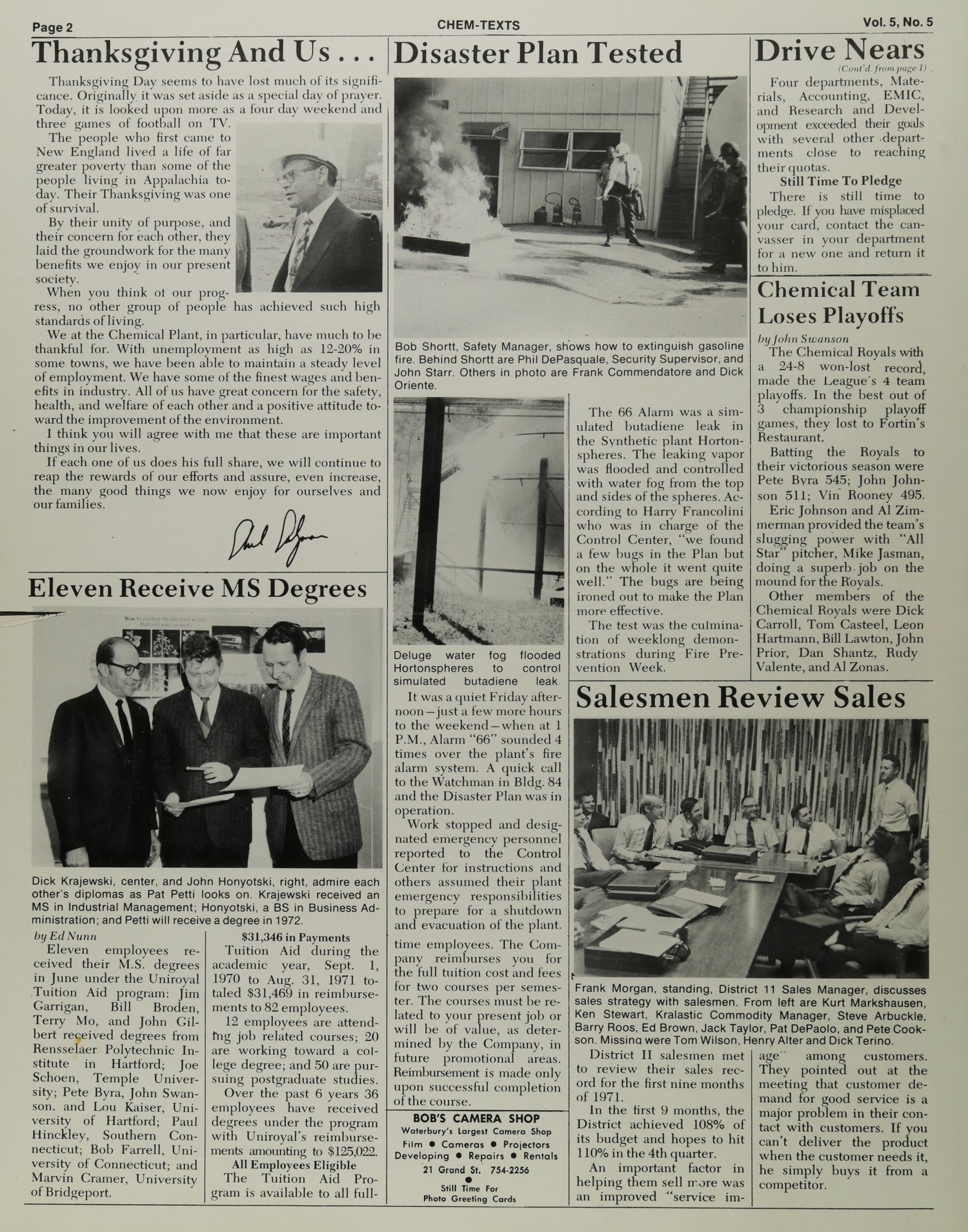
RETURN POSTAGE GUARANTEED

CHEM-TEXTS – Vol. 3 No. 5 – Page 2

Page 002

CHEM-TEXTS

Page 2 | Vol. 3 No. 5


FROM THE FACTORY MANAGER

Dear Fellow Employee:

During our nation’s space program RELIABILITY has become a common everyday word. Individual parts, in-fact entire systems human as well as mechanical, are tested and retested to make certain that there are no failures at critical times. This, then, is the essence of RELIABILITY — no failures at critical times.

While each of us appreciates the importance of RELIABILITY in space, we often lose sight of its equal importance right here in our plant. Each and everyone of us is a key man or woman. Everyone must function, with complete RELIABILITY to get the job done properly.

Let’s check our own RELIABILITY right now. Each of us should ask ourself what is my RELIABILITY on:

  1. Job Performance
  2. Safety Performance
  3. Housekeeping Performance
  4. Attendance Performance

What’s your RELIABILITY? Each of us can improve. Each of us must improve.

Sincerely,

John D. Evans


Hugh Garahan’s Eyesight Saved By Wearing His Safety Glasses

Hugh Garahan, center, points happily to his safety glasses which saved injury to his eyes. At left is Wes Carreiro and right, Ed Runowicz, foreman.

While removing the mixing head from equipment in the Roylar pilot plant, Hugh Garahan’s eyes were splashed by hot MDI which could have damaged his eyesight severely. Residual pressure had built up in the line and when Hugh disconnected the head, the MDI gushed out forcefully and covered his safety glasses completely. Fortunately, Hugh was wearing his safety glasses at the time and prevented serious injury to his eyes by expecting the unexpected happening. The photo at right shows his glasses.

Hot MDI completely covered Garahan’s safety glasses. Wearing them saved his eyesight.


Employees Contribute 128 Pints Of Blood To Bloodmobile Visit

Waiting their turn to contribute blood are left to right, John Paige, Pete Welch, Bernie Daily, Jim Sullivan, and Jim Doran. (Kirkendall photo).

The Connecticut Red Cross Bloodmobile made its annual visit to Uniroyal Chemical and received 128 pints of blood from employees, with nine rejections. Three employees arrived too late to contribute.

A 3-gallon pin was received by Richard Valentine. One-gallon pins went to Leo Brites, Joe Jokubaitis, Pete Lazaras, Walt Madura, Gerald Monahan, Ed Semaskwich and Harold Smith.

Other contributors were Bill Albaitis, Steve Alper, Rod Ashby, Ed Bates, Benoit Begin, John Bickerdike, Joe Biernacki, Dave Boulanger, Pete Braudis, Bob Breton, Jean Burke, Lucille Butnor, Tom Byra, Walter Campbell, Frank Carriero, Maurice Chamberland, James Chambers, Frank Chiodo, Dan Cleary, Dennis Cormier, Bob Cornell, Al Crandall, Bob Cranney, John Cronan, Austin Cross, Ted Curzi, Bernie Daily, Phil Dillon, Karen Di-Dominzio, J. Harry Donald, Jim Doran, Elliott Easterbrook, Bertha Eggleston, Sylvia Famiglietti, Bob Farrell, Joe Finke, Ed Fischer, Tom Fitzgerald, Harry Francolini, Walter Frankenberger, Bert Frennesson, Ferdinand Gagne, Mike Galante, John Gandolfo, Al Gedraitis, Norm Gibbs, John Gilbert, Walt Gnizdowski, Phil Haas, Jim Hartley, Bob Harsch, Mike Heller, Gerald Hennessey, Dick Hessler, Bill Hill, Clarence Hiser, Joe Hocheiser, Henry Hook, Don Houde, Keith Hughes, Bill Hutt, Mike Jasman, Ed Johnson, Gerald Klender, Lou Lakatos, Ben Leach, Tom Lee, Jim Loman, Len Lombardi, Frank Maffia, Milt Makoski, Tony Malone, Rocco Manulla, Mike Marinaccio, Manuel Matos, Ron Mitchinson, June Moore, Roland Morel, Phil Morin, Charles Moruska, John Nappiello, Jonas Narijauskas, Francis Nauiokas, Alex Nole, Tom O’Hara, Lee Owens, John Painter, Dick Palizay, Sherman Paul, Violet Pisani, Julius Rek, Jim Reynolds, L. Rice,

(cont’d. on page 3)


Appointments Announced

Norm Gibbs has been assigned the responsibility for General Accounting, Accounts Payable, and Office Services.

Don Turner was appointed General Accountant.

Walt Beerbaum was made Accounts Payable Supervisor.


Reclaim Exceeds 300,000 Lbs.

by Bob VanAllen

Members of reclaim production deserve recognition for their production of 349,310 pounds of reclaim rubber on June 11. Starting with the 7-3 shift on June 10, the 3-11 shift continued the production schedule started on the first shift, and the 11-7 shift on Thursday topped the 300,000 pounds goal for the first time since the modernization of the reclaim plant.

From raw stock to the finished product in the millrooms every department and person played an important role in attaining this high performance which demonstrates a capability that can make reclaim a competitive operation.

During the period of modernization, the reclaim plant had been severely upset due to the necessity to maintain production while rebuilding the facilities.

To operate the reclaim plant successfully, every person associated with the operation must strive to achieve the kind of performance demonstrated on June 11. This type of performance is the best to assure our jobs.

349,310
6-11-69

Some of the people of the three shifts in the Reclaim Production departments who helped top 300,000 lbs. production of reclaimed rubber are clockwise: Carlos Aresta, Maria Matos, Herminio Ortiz, Minic Brown, JohnHickson,Frank Rodrigues, Americo Henriques, Antonio Pereira, Joe Rzeszutek, Mike Chropcho,hidden in rear, John Zavednak and Tom Armstrong.


Bloodmobile Visit…Wednesday, July 30, 1969…St. Michael’s Parish House…12:15 to 6:15 P.M.

CHEM-TEXTS – Vol. 3 No. 6 – Page 2

Page 002

Page 2 | CHEM-TEXTS | Vol. 3, No. 8


FROM THE FACTORY MANAGER

DEAR FELLOW EMPLOYEES:

October again brings us each the opportunity to invest in the sixteen agencies supported by the United Givers of Naugatuck and Beacon Falls. Each of these agencies, working in essential health, welfare and educational activities, makes our community a better place to live for our families and our friends. Beyond this, many of the agencies have an outreach of service beyond our borders to neighboring towns and to the nation.

We at Uniroyal Chemical have, in each year’s campaign, shown a greater willingness to give to these causes. Yet, our average gift per employee last year was something less than $13.00 per year for all of these needs. Our average is this low because some one-third of us did not give last year and some half of us gave a cash donation rather than spreading our giving by utilizing the payroll deduction plan.

When the canvasser calls on us this year, let’s all give something and let’s all pledge on payroll deductions. I think we all will be pleasantly surprised when the results are in.

Sincerely,

[Signature]

John D. Evans


Three Named Chairmen For Borough’s United Givers Drive

[IMAGE: Photo of three men in business attire having a discussion]

Ron Mitchinson, right, Industrial Relations Manager, and this year’s United Givers Campaign Chairman for Naugatuck and Beacon Falls discusses plans with Doug Miller, Engineering Superintendent, Corporate Division Chairman. Absent was Fred Wintsch, Chairman of the Commercial Division.

Over the years, the Naugatuck plant has participated in community activities by sponsoring the Junior Achievement, Naugatuck High School Career Observation Program, the Explorers, the United Givers, and other community and civic programs.

For its campaign drive this year, the United Givers of Naugatuck and Beacon Falls named Ron Mitchinson Industrial Relations Manager, Campaign Chairman for the overall drive; Doug Miller, Superintendent of Engineering, as Chairman of the Corporate division and Fred Wintsch, Labor Relations Manager, as Chairman of the Commercial group.

The annual United Givers drive is one of the major events in the community to support the charitable, social and youth work of the 16 Agencies in the campaign. This year’s goal for the campaign is $145,000 to help continue and improve the worthwhile activities of the participating groups.


Dr. Jelley New Plant Doctor

[IMAGE: Photo of Dr. Jelley reviewing medical records with Ann McAllister]

Dr. Jelley reviews medical records with Ann McAllister, R.N., Synthetic Hospital nurse.

by Bob Shortt

Dr. Edward Jelley accepted the position of plant physician replacing Dr. Elser. Dr. Jelley, a prominent physician with offices in Naugatuck, will be available at the Chemical Plant hospital from 8:30 A.M. to 10:00 A.M. and at the Synthetic Plant hospital from 10:00 A.M. to 11:00 A.M., Monday through Friday, except holidays.

The Chemical and Synthetic plant nurses, Adeline Farrar, R.N. and Ann McAllister, R.N., are on duty from 8:00 A.M. to 4:30 P.M., Monday through Friday. The Chemical nurse is also on duty Saturday morning, 8:00 A.M. to 12 Noon.

To prevent cuts, bruises or dust in the eye from becoming serious injuries, employees should see the plant nurse immediately and have the problem taken care of as a preventive measure against further complications.

In case of an accident or injury during the second or third shift, the night general foreman should be contacted by calling the night watchman on EXT. 670 who will contact the general foreman by radio for immediate attention.


Employee Snow Tire Sale On

The special employee snow tire sale runs for two months until Nov. 28. On sale are the Glas-Belt Snowplow, Glas-Belt Winter Patrol, Snowplow, and the Winter Patrol.

Purchases may be made at Uniroyal Home and Auto Centers and Uniroyal Tire Dealers.

Slips can be obtained from Industrial Relations; Ann McAllister, Synthetic plant nurse; Luella Anderson TSSC; and Diana Strollo, EMIC.


United Givers: (cont’d. from pg. 1)

The Executive Committee for the plant is Eric Johnson, Leon Raskauskas, Joe Rzeszutek, Milt Makoski, Gene Hertel, Roger Amidon, Jack Vergosen, Joe Bucciaglia, Bob Foltz, Frank Lynch and Vic Anderson.

Chairmen of the various plant sections and departments are Roger Lestage, Pat Tortorici, Carl Wehmann, Paul Laurenzi, Sal Sapio, Mike Dodd, Phil Morin, Stan Mazur, Doug Ritchie, Bob Grahame, Dom Scalzo, Al Juliano and Mary Vergosen.


Dividend Declared

Uniroyal declared a dividend of 17½ cents a share on its common stock. The dividend was payable September 25 to stockholders of record on August 25.

A dividend of $2 a share on the 8 percent first preferred stock was also declared and payable September 25 to stockholders of record on August 25.

“GIVE WHERE YOU WORK”


New Staff For Chemical Control Center

New assignments were made to the Chemical Production Control Center which was recently established. Heading the new system is Walt Frankenberger, and working as Technical Assistant is Clark Makinson.

Tom Dowling will coordinate mechanical work in the chemical plant.

Francis Egan and Matty Mathewson will work on scheduling, raw materials and quality control. Also assigned to the Center, Mildred Finsel will handle the clerical responsibilities.

As a result of the new staff assignments, several changes were made in the plant.

John Honyotski assumes responsibility for all thiazoles operations. Tom Engle takes over as Foreman in thiazole operations. Lloyd McCoy assumes charge of Bldg. 100. Earl Roller becomes Foreman of the Central Finishing Dept. Bob Cronin was made Foreman of Bldg. 88 and Tom Carey assumes the position of Production Clerk.


Fathers-Sons See Amazing Mets Play

The photo below shows some of the eighty-three who attended the Mets-Dodgers baseball game at Shea Stadium on Saturday, August 23. The Father-Son baseball trip sponsored by the Foremen’s Club was a big success and, according to Lou Kaiser, the Club’s president, the inspiration that started the Mets on their phenomenal drive to first place in the National League pennant race.

[IMAGE: Photo showing crowd at baseball stadium]

CHEM-TEXTS – Vol. 3 No. 6 – Page 3

Page 003

CHEM-TEXTS

Vol. 3 No. 8 | Page 3


Synthetic’s “A” Crew Hits 9 Batches Daily

[IMAGE: Group photo of workers in hard hats]

In front left to right are Pete Norman, Joe Maye, and Stan Dushak. Left to right in rear are Al Kazemekas, Gerry Markham, John Marshall and Bill Hill.

[IMAGE: Second group photo of workers]

Other group members are left to right in front, Earl Root, Dutch Witkoski and Steve Matcheson. In rear, left to right are Bill Stinson, Al MacDonald, Bob Curtin and Fred Enamait.

Recently the Synthetic Processing “A” Crew averaged 9 charged batches per day for one full week.

This is a major step towards improving our competitive position by production of a lower cost product. The “B” and “C” crews also played a significant role in the “A” crew’s achievement.

In order to reach the goal of 27 batches a day for the three crews, it requires the full effort of everyone in the Synthetic plant’s operation.

“GIVE WHERE YOU WORK”


$820 Awarded For Suggestions

By W. Kirkendall

[IMAGE: Three men, one handing check to another]

Doug Miller, Plant Engineering Superintendent, left, hands $200 check to Ed Semaskvich, center, for his two suggestions, as Clayt Houseknecht, Mechanical department foreman watches.

Ed. Semaskvich of the Chemical Mechanical department received a total of $200 for two suggestions he submitted recently. One idea which reduced the number of belts required on equipment and cut maintenance costs brought Ed. $150. His other idea, worth $50, reduced the amount of wear on gears and helped save the Company money on maintenance. By utilizing his long experience as a mechanic and applying it to his work Ed obtained a high cash award for his interest in helping the plant’s operations.

Other high awards went to Carmine Iannuzzi, $115; Harry Hedrick, $65; John Hoey, $60; J. DaSilva, $52.50; R. Kubick, $45; Ed Atwood, $40; John Grosso, $37.50; and Orlando Gabianelli, $30.

Cash awards for their suggestions were also received by Walter Campbell, Lyle Bissonnette, Frank Commendatore, Mike Yuchnyk, John Sickola, Dom Persutti, John Dudo, John Slasienski, Art Mencio, and John Wawer.

Total cash awards amounted to $820. Of the 88 persons who submitted suggestions, 39 received cash awards and 6 received honorable mentions, so that one out of every two employees submitting suggestions received an award for their ideas to improve the plant’s efficiency, reduce costs, improve production and provide safer working conditions.

[IMAGE: Man working]

Carmine Iannuzzi received $115 for 7 suggestions which he submitted on safety procedures.

All employees are eligible to submit suggestions. Suggestion blanks are available throughout the plant.


Explorers Start New Season

By Bob Smith

West Point, Sikorsky Aircraft and M.I.T. are just some of the exciting trips that the Explorers made during the year, along with ski trips in the winter months.

The Explorers meet regularly on Monday evenings at the TSSC building and conduct science projects under the supervision of Chemical plant personnel. To join the group a boy must be 14 years old, in the 9th grade or higher, or 15 years old regardless of grade.

Sponsored by the Chemical plant, the Explorers provide students the opportunity to explore the many different types of careers available in science, chemistry and industry.

If your son or a friend is interested in joining the Explorers, contact Bob Smith, EXT. 674.

[IMAGE: Group of young people at table with experiment]

Explorers perform a challenging light ray experiment. Seated, left to right are Armand Pardal and George Louis Jr. In rear are Nat Vescera Jr. left, and Bill Walsh Jr.


Appointments Announced

Kirk Kirkendall named Foreman of Janitorial Services.

Milt Makoski made Employment Manager for plant personnel.

Neil Melore, recently discharged from the Armed Forces, returns as Industrial Relations Supervisor.

Al Mitlehner joined the Agricultural Chemical Sales Department.

Bob McCoy appointed Group Leader, Colloids Product Development group.

B.T. Dave assumes duties of Chief Process Engineer at Synthetic rubber plant.

Ben Smith named Senior Research Scientist with special assignments in the Colloids Product Development group.

Ray Frank assumes the duties of Acting Plant Traffic Manager.


What Do You Want To Know

CHEM-TEXTS is printed to keep you and your family informed on plant activities, benefits, safety and other information on what is happening in the plant and Uniroyal.

To make CHEM-TEXTS interesting and informative to you, it would be helpful to the editor if you submitted your suggestions on what you would like to know.

Send your suggestions to the Editor, CHEM-TEXTS, they will help make it a better newspaper.

CHEM-TEXTS – Vol. 3 No. 6 – Page 4

Page 004

Page 4 CHEM-TEXTS

New “Idea Plan” Offers $1000 Cash Awards

Larry Koth, Idea Plan Administrator, discusses how to cut the red tape with department coordinators. Seated left to right are Sam Gillette, Koth, and Pat Petti. Standing left to right are Ernst Krauss, Bill Albaitis, Milt Makoski and Mike Dodd who will assist Koth with the Plan.

For many years, Uniroyal Chemical has operated a Suggestion System for employees to submit original ideas and receive cash awards for them.

To encourage employees to participate more fully in the plan, and to reward them more for their originality and experience, Uniroyal has initiated a new “Idea Plan.”

The Company has raised the minimum award from $15 to $25 and the maximum at the local plant level to $1,000. If an idea is worth more, it will be submitted to a management committee for consideration for an additional award.

The new Plan will cut out the red tape and eliminate the long delays before a suggestion is acted upon. Employees will be informed as quickly as possible whether or not their ideas have been accepted or rejected.

For effective and immediate handling of submitted ideas, Larry Koth, Industrial Engineering Manager, has been designated the plant’s Idea Plan Administrator. Each department will have an idea coordinator.

Department coordinators selected so far are: Lou Coscia, Research and Development; Larry Mambrino, Control; Pat Petti, Purchasing; Sam Gillette, Chemical Production; Milt Makoski, Industrial Relations; Ernst Krauss, Engineering; Bill Albaitis, Materials.

Employees will be kept fully informed on the details of the new Plan as it is implemented. Now’s the time to start thinking and jot down your ideas on work methods, equipment or supplies, customer service, product quality, new products, safety, waste reduction, production increase, shipping, packaging and many others.

The new Uniroyal Idea Plan provides every employee the opportunity to increase his earnings, simply by jotting down and submitting the hundreds of ideas in his head. $1,000 . . . and even more is worth a try.


Ed Weaving, plant protection supervisor, shows now a gasoline fire can be put out.


830,000 Hours; No Accidents

By Bob Shortt

The plant almost reached the magic 1,000,000 manhours worked without a losttime accident. During July and August, no lost-time accidents occurred.

However, on September 6, after reaching 830,084 manhours, an employee slipped from a ladder and fell backwards into a ditch, fracturing his forearm.

As of August 31 there were 3 less lost-time accidents for the same period in 1968, a slight improvement. There was a decrease of 16 serious injuries for the same period.

Whether at work, home, or on the road, safety is your personal responsibility. Your unsafe act may result in a serious injury to a fellow employee.

The irony of safety is that the person responsible for the accident, often escapes injury.

As the paper went to press another lost time accident was reported on September 11, when a driver stopped to give a ride to an employee walking to work. The station wagon was hit in the rear and the driver suffered from a whiplash, loosing several days of work.


Housekeeping Prevents Fires

The week with October 9 in it – the day of the Great Chicago Fire – has been set aside as Fire Prevention Week to focus attention on the tragic loss of lives and families from fire. Starting October 6, the plant will hold a weeklong series of fire drills, tours and demonstrations on the proper action to take in case of a plant fire and the safety measures to prevent them.

A major cause of fire in the plant is poor housekeeping and only the alertness of safety-minded employees and the quick response of the fire department to alarms has prevented serious damage.

Good housekeeping in your area makes it safer to work in and certainly more enjoyable, as well as a major contribution in fire prevention.

Fire Prevention in our plant is a 52 week a year operation and we feel sure that employees realize this and make it a year-round practice.


Open House Held For Retirees

After a tour of the Reclaim plant, retirees are greeted by R. Mitchinson, Industrial Relations Manager. In front, left to right are N. Valvo, W. Hayes, R. Finsel, J. Slyzys and Mitchinson. In back are, left to right: J. Napomiceno, V. Maciokas, G. Wooley, C. Vagt, G. Legault and T. Basile.

In front of registration tent are clockwise, G. Sbrocca, C. Carlson, V. Maciokas, H. Schofield, R. Van Allen, E. Johnson, D. Wood, L. Borzino, H. Olson, G. Bertilson and E. Valentine.

150 retired employees attended the “Open House” which included tours of the Chemical, Reclaim and Synthetic plants renewed friendships, and lunch at the Synthetic cafeteria.

Noticeable to the retirees were the many improvements to the plant during the past few years: the new front entrance, the modernization of the Reclaim plant, the new Control Center and other building improvements.

Several commented on the courtesy of the Foremen and Supervisors who conducted the tours and the plant drivers who provided rides.

Fred Wintsch and Milt Makoski were in charge of the program. Molly Cobbol and Marion Hutt served as receptionists.


CHEM TEXTS

PUBLISHED BY THE INDUSTRIAL RELATIONS DEPARTMENT
UNIROYAL CHEMICAL, NAUGATUCK, CONN. 06770
EDITOR: William F. Lavelle

UNIROYAL Chemical
Naugatuck, Connecticut 06770

U.S. Postage
PAID
Permit No. 10
Naugatuck, Conn. 06770
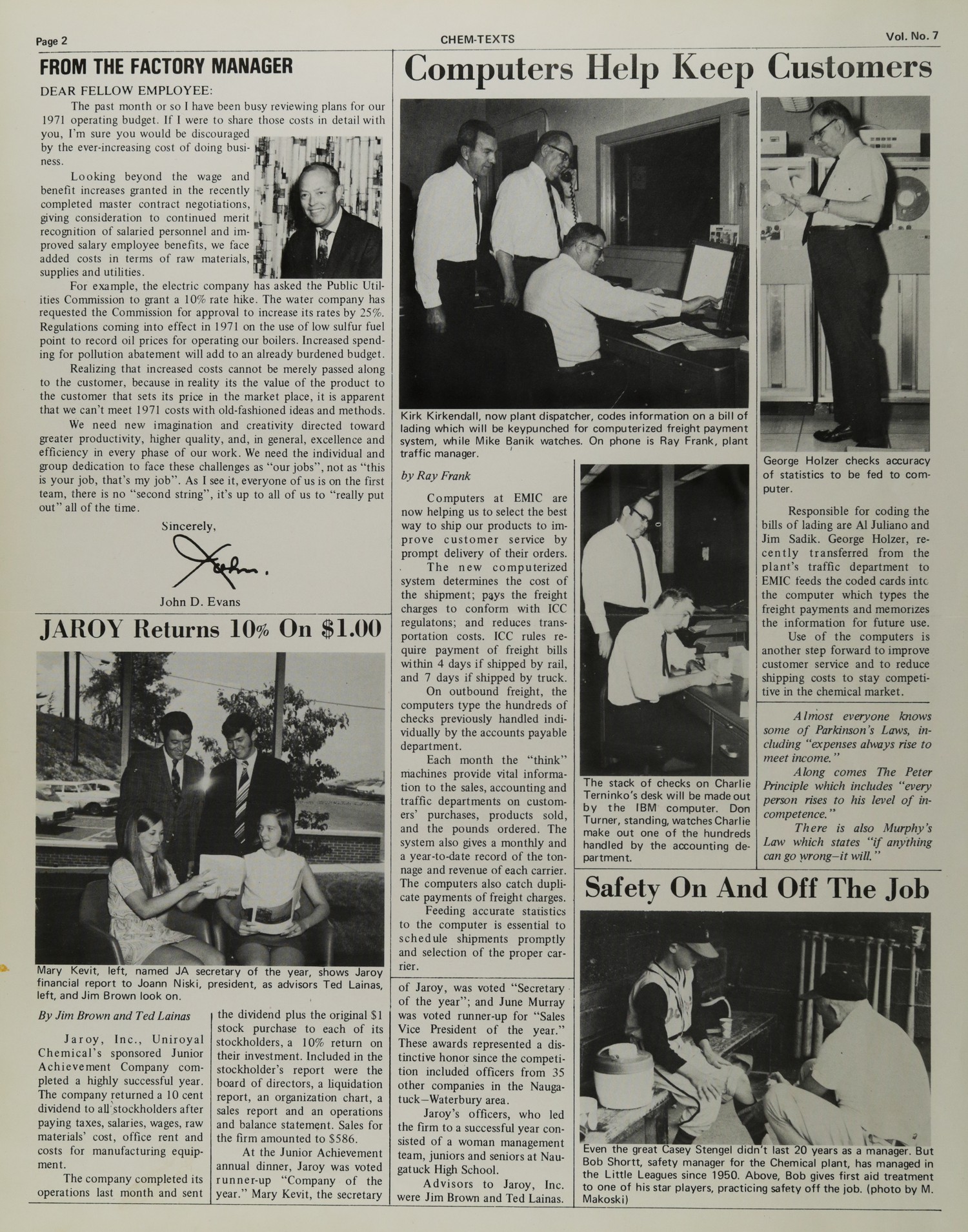
RETURN POSTAGE GUARANTEED

CHEM-TEXTS – Vol. 3, 1969, No. 7 – Page 1

Page 001

UNIROYAL CHEM-TEXTS

Vol. 3, 1969 PUBLISHED FOR THE PEOPLE OF UNIROYAL CHEMICAL No. 7


Every Employee Holds Responsible Position

[AERIAL PHOTOGRAPH OF INDUSTRIAL COMPLEX]

The Naugatuck Chemical complex comprises 142 buildings situated on 90 acres of land stretched out along the Naugatuck river.


[PHOTOGRAPH: Three men in work uniforms reviewing documents]

Assistant Area Shift Foremen Mike Patrick, left and Bill Swick, right check plans for 4 to 12 P.M. shift with Guy Elwood, Area Shift Foreman. In charge of all plant operations on this shift, they are also experts in first-aid.


[PHOTOGRAPH: Men with mail cart, safety sign visible reading “HASTE MAKES ACCIDENTS”]

Don Olson, above, Joe Scullin, Bill Brewer, Clarence Parks rotate weekly on mail delivery. They make 5 tours daily in the plant; handle 140 bags of mail; and stay slim with 75 trips up and down stairs.


Today the Chemical Division at Naugatuck employs 1800 people. 925 work in the plant’s manufacturing operation; and 875 work in Divisional Sales, Research and Development, accounting and other departments.

People Make The Plant

Whatever an employee’s education, background, or position, he holds a position of responsibility in the plant’s diverse operations. People are the plant’s most irreplaceable asset. Without them, the plant’s equipment, machinery and capabilities are useless, and it would take years to replace their years of talent, experience and skill.

Every Job’s Important

To operate the plant efficiently and to provide better job security, an employee’s responsibility in doing his job properly is of extreme importance.

Whether the job is delivering mail; sorting tubes; painting; shipping materials to a customer on time; operating production equipment; packaging products; oiling machinery; purchasing raw materials; paying bills; analyzing quality; researching new products; or selling to customers, the plant would not operate effectively without every employee performing his job in a responsible manner.

Individual’s Importance

Because of the importance of an individual employee’s job, it is easy to imagine the effects on the plant’s operation if he is absent from work for an unjustifiable reason. His absence could slow down or even shut down an entire

(Continued on Page 2)

CHEM-TEXTS – Vol. 3 No. 7 – Page 4

Page 004

Page 4

CHEM-TEXTS

Vol. 3 No. 7

New Union President

Leon Raskauskas recently became President of Local 308, United Rubber Workers which represents the Synthetic plant. Leon replaces Joe Arbachauskas who resigned as president for reason of health. Before his new appointment, Leon had been Vice-President and had served

as President of the Local from 1959 to 1961.

Charlie Roland succeeds Leon as new Vice-President of Local 308.


Blancato Improving

Sam Blancato who was recently burned in a plant accident is well on the road to recovery at the Waterbury Hospital. Sam and his family express their sincere thanks to the many employees who sent him cards, letters and gifts. It’s times like this, Sam pointed out, that you measure your real wealth by the many friends you have.

Anxious to return to work soon, Sam will be in the hospital a short time more for skin grafts. Meanwhile, he looks forward to receiving letters from his many friends in the plant.


Judo Brown Belt Held by Denise Pratt

Denise Pratt, an R & D Analyst, is the proud owner of the Brown Belt. She plans to obtain the Black Belt, a unique distinction in Judo for a woman. Denise has become so expert in Judo that she now teaches a beginner’s course at the Y.W.C.A. in Waterbury.

Judo, the “gentle way”, is an art practiced as a sport, based on the ancient methods of barehanded fighting. It’s a form of wrestling, requiring a special uniform to practice in and may be engaged in by both young and old, male and female.

Judo, which should not be confused with Karate, has a fourfold purpose: 1) physical development; 2) proficiency in a contest; 3) mental development; and 4) the use of minimum effort for maximum efficiency.

A knowledge of Japanese words such as Ukemi, Kata, Uchikomi, Pandori, Hidari

Shizentai is also required in learning the art of Judo. Use of the wrong words may result in an unexpected flip over the shoulder, and a sudden fall on the ground.

Doug Ritchie, Group Leader, left, admires Denise Pratt’s brown belt in Judo. Watching at right is Warren Singleton, Finished Products Supervisor.


600 Deaths Over Labor Day Weekend

Safety seems ignored over the three-day weekends of national holidays. The July 4th weekend caused more than 600 deaths on the highways. Predictions for the long Labor Day weekend estimate another 600 deaths will occur on the highways, by drownings and other types of accidents.

Take safety awareness with you when you travel. Your life, your family’s life and the lives of others are in your hands. By driving defensively – expecting that the other driver will do something wrong – by wearing safety belts; by not following too closely in case of an unexpected stop by the car in front; by not speeding (it may mean a stiff fine and loss of license); and by checking your car and tires carefully, an accident will be less likely to happen to you and your family.

Watch your young children, especially when swimming, boating or fishing. Their curious minds and tendency to stray can cause you many anxious moments and spoil your holiday.

Your safety is in your hands and by expecting the unexpected happening during the Labor Day weekend, you can avoid an accident that may mean serious injury to you and your family.

This fatal accident wiped out an entire family: the mother, father and three small children. Your life, your family’s, and the lives of other people depend upon your safe driving on the highway.

Denise Pratt demonstrates Judo to a student at the Y.W.C.A. where she teaches a beginner’s course in the “gentle way.”


LATE NEWS BULLETIN

It was just learned that Uniroyal is organizing a New Idea Plan to encourage more employees to put their ideas to work. Complete details will be announced shortly. Meanwhile the present Suggestion System is still in effect.


CHEM TEXTS

PUBLISHED BY THE INDUSTRIAL RELATIONS DEPARTMENT
UNIROYAL CHEMICAL, NAUGATUCK, CONN. 06770
EDITOR: William F. Lavelle

UNIROYAL CHEMICAL
Naugatuck, Connecticut 06770

U.S. Postage
PAID
Permit No. 10
Naugatuck, Conn. 06770
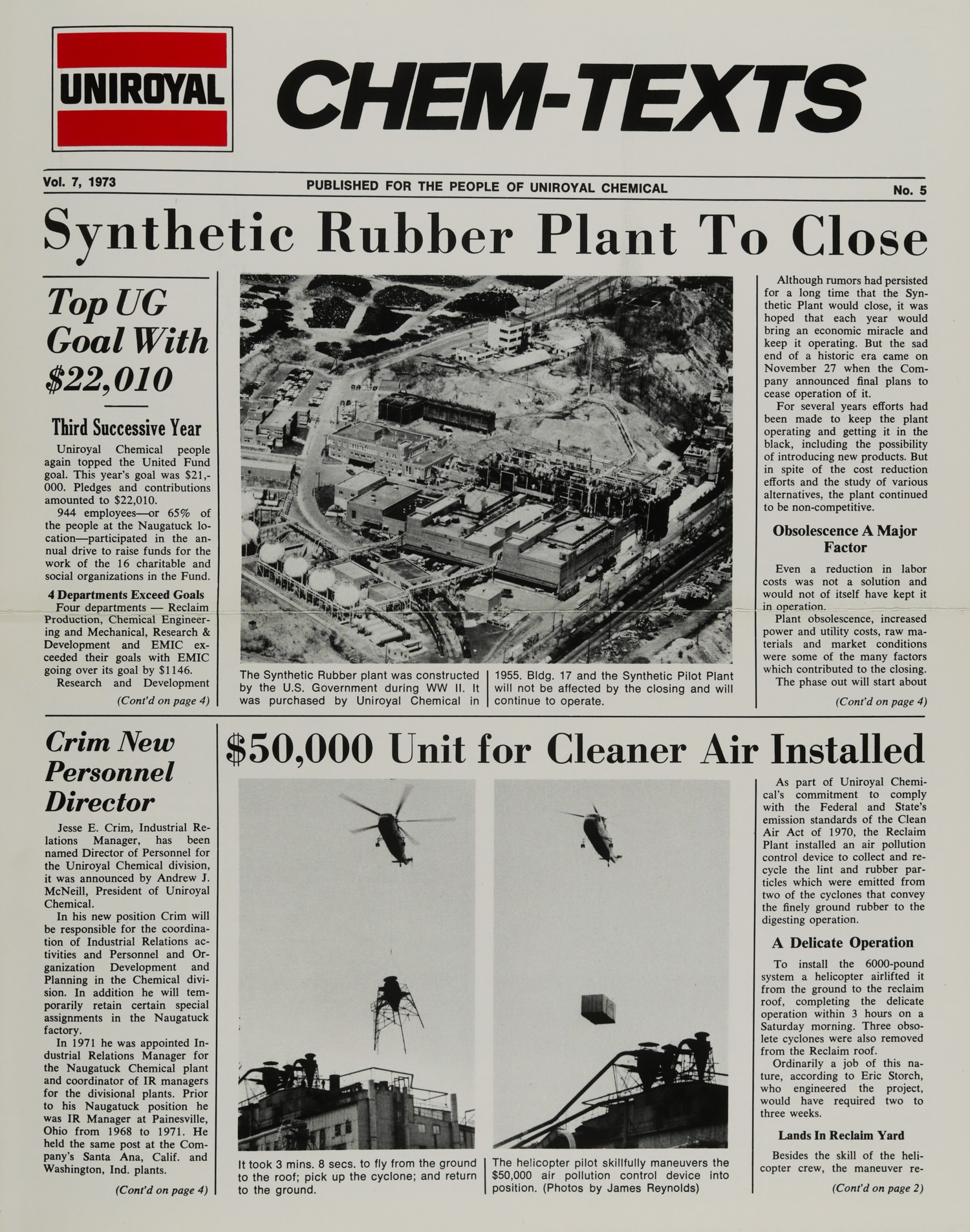
RETURN POSTAGE GUARANTEED

CHEM-TEXTS – Vol. 3, No. 8 – Page 1

Page 001

UNIROYAL CHEM-TEXTS

Vol. 3 PUBLISHED FOR THE PEOPLE OF UNIROYAL CHEMICAL No. 9


Improvements Protect Jobs. Make Plant Cleaner, Safer.

[IMAGE: Black and white photo of industrial building with bulldozer in foreground]

Bulldozer digs out aniline sludge that caused the Main entrance roadway to sink under heavy trailer trucks.

Today, somewhere in the plant, another step is being made to protect jobs, improve safety, housekeeping, production, and working conditions. Or a new reactor is being installed to improve productivity.

Major Improvements

Major improvements this year included a new main entrance; resurfacing of the road to the main entrance, once an aniline sludge dump. The old DDM building was completely remodeled to manufacture Curalon® a new chemical curing agent.

A high cost investment was made in the recent installation of refrigeration facilities for Omite® a new agricultural chemical.

Expansion of the high pressure laboratory which researches high pressure chemical reactions is nearing completion. This new R & D facility provides the technology to improve manufacturing operations by faster reactions.

A giant step was made in air pollution control with the conversion of the plant’s power house from coal to oil.

Repairs and Maintenance

Ordinary repair and maintenance costs during the year will extend into six figures simply for general building and yard maintenance. Priority repairs made this year included refacing of the Chemical firehouse and Lotol Bldg. 76 with aluminum siding; and renovation of the Reclaim pilot plant, parcel post, small (continued on page 2)

[IMAGE: Black and white photo of paved roadway with buildings]

Solid bed of new paved and marked roadway improves safety and reduces maintenance costs. Major improvements in photo show new front entrance; refaced aluminum siding on Bldg. 76, and pollution free smokestacks.


Reclaim Dust Collectors Reduce Escape Of Lint

[IMAGE: Black and white photo of industrial dust collection system on roof]

Dust collection system nears completion on roof of Reclaim plant. The system will reduce the fiber escape from the cyclones.

by Rod Gaetz

The escape of lint from the Cracking Department of the Reclaim plant has always caused a problem in the plant and surrounding area. With the new manufacturing process used in the modernized plant which requires tires to be ground to a much finer particle size, the problem has become more acute.

In designing the new plant, the systems enclosed the mechanical conveyors, and completely enclosed processing machinery was utilized to prevent lint escape. Where it was necessary to utilize pneumatic conveying systems, cyclone separators were first installed to separate the conveying air from the product streams and leave the secondary air treatment systems until later. The reason for this was to determine from practical operating experience the (continued on page 2)


Woman Supervisor Named

[IMAGE: Black and white photo of two women at desk reviewing documents]

Anna Radowich, left, newly named Special Analysis Supervisor in the Analytical Research Lab, reviews a project with Helen Mullen.