Injunction Against

Injunction Against

7-17-67

Continued From Page 1

William E. Simkin, head of the Federal Mediation and Conciliation Service, congratulated both Goodrich and the URW for completing what he called “extremely difficult negotiations”

He and Bommarito had assisted in the Goodrich negotiations in Columbus.

The Firestone Tire & Rubber Co., the Goodyear Tire & Rubber Co., and UniRoyal Inc. were scheduled to meet today. Firestone, Goodrich and UniRoyal were struck April 20, General June 21 and Goodyear last Thursday.

Goodrich President J. Ward Keener said the contract would mean price increases throughout the product line.

Forecast

94-Day Uni Royal

behalf of that group.

94-Day UniRoyal

7-24-67

Continued From Page 1

Under the old contract, tire workers averaged $3.68 per hour and non-tire workers $2.68. A pay raise differential between the two was eliminated in both the Goodrich and Firestone pacts. General employs no non-tire workers covered by the URW contract.

The settlements set an industry precedent by wrapping up wages, working conditions, pensions and other benefits in single three-year contracts. Traditionally wages and working conditions have been negotiated every two years, pensions and benefits every three years, in separate contracts with separate expiration dates.

US Rubber Annual Report – 72nd Annual Report – Page 6

Page 006

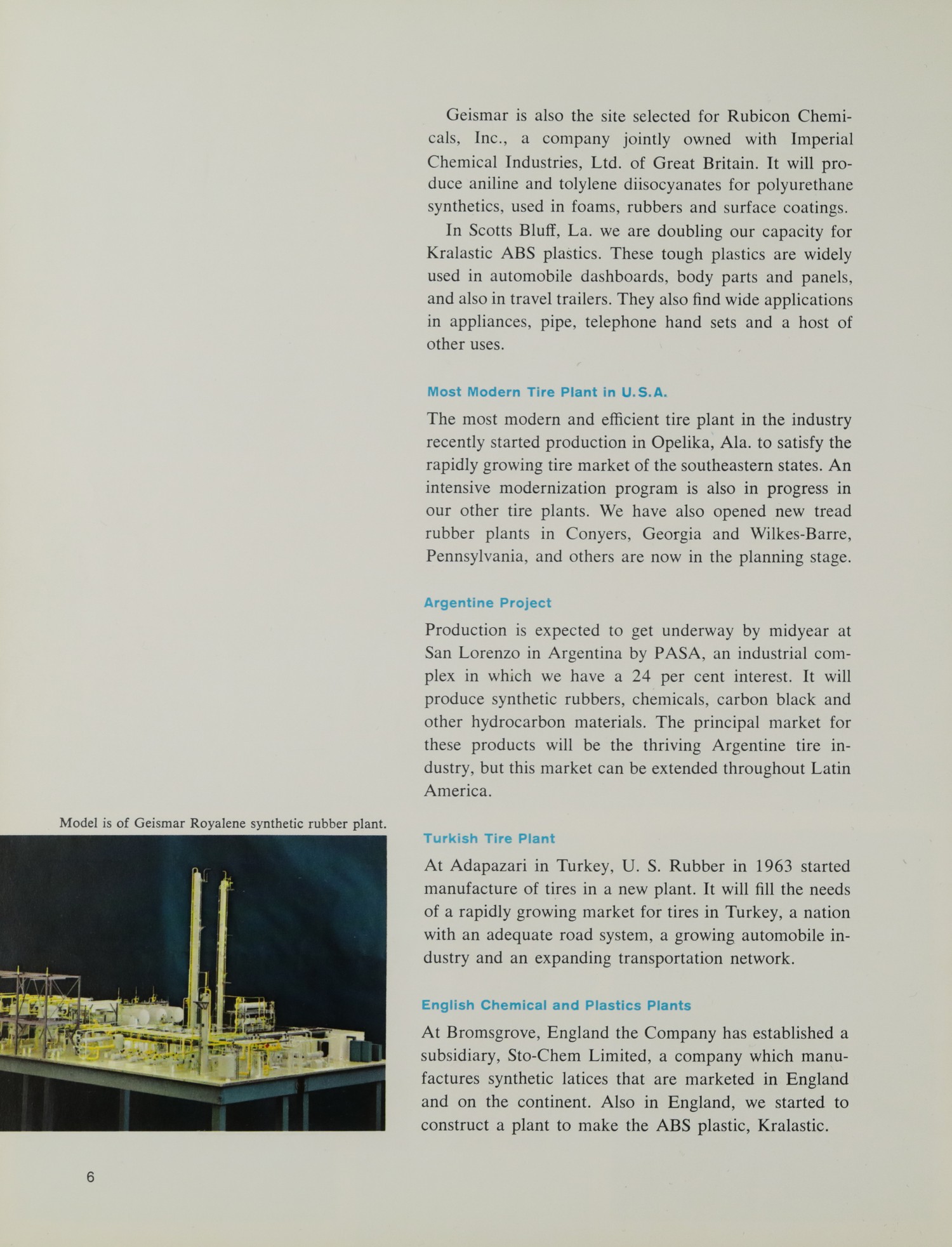
Geismar is also the site selected for Rubicon Chemicals, Inc., a company jointly owned with Imperial Chemical Industries, Ltd. of Great Britain. It will produce aniline and tolylene diisocyanates for polyurethane synthetics, used in foams, rubbers and surface coatings.

In Scotts Bluff, La. we are doubling our capacity for Kralastic ABS plastics. These tough plastics are widely used in automobile dashboards, body parts and panels, and also in travel trailers. They also find wide applications in appliances, pipe, telephone hand sets and a host of other uses.

Most Modern Tire Plant in U.S.A.
The most modern and efficient tire plant in the industry recently started production in Opelika, Ala. to satisfy the rapidly growing tire market of the southeastern states. An intensive modernization program is also in progress in our other tire plants. We have also opened new tread rubber plants in Conyers, Georgia and Wilkes-Barre, Pennsylvania, and others are now in the planning stage.

Argentine Project
Production is expected to get underway by midyear at San Lorenzo in Argentina by PASA, an industrial complex in which we have a 24 per cent interest. It will produce synthetic rubbers, chemicals, carbon black and other hydrocarbon materials. The principal market for these products will be the thriving Argentine tire industry, but this market can be extended throughout Latin America.

Model is of Geismar Royalene synthetic rubber plant.

Turkish Tire Plant
At Adapazari in Turkey, U. S. Rubber in 1963 started manufacture of tires in a new plant. It will fill the needs of a rapidly growing market for tires in Turkey, a nation with an adequate road system, a growing automobile industry and an expanding transportation network.

English Chemical and Plastics Plants
At Bromsgrove, England the Company has established a subsidiary, Sto-Chem Limited, a company which manufactures synthetic latices that are marketed in England and on the continent. Also in England, we started to construct a plant to make the ABS plastic, Kralastic.

US Rubber Annual Report – 72nd Annual Report – Page 8

Page 008

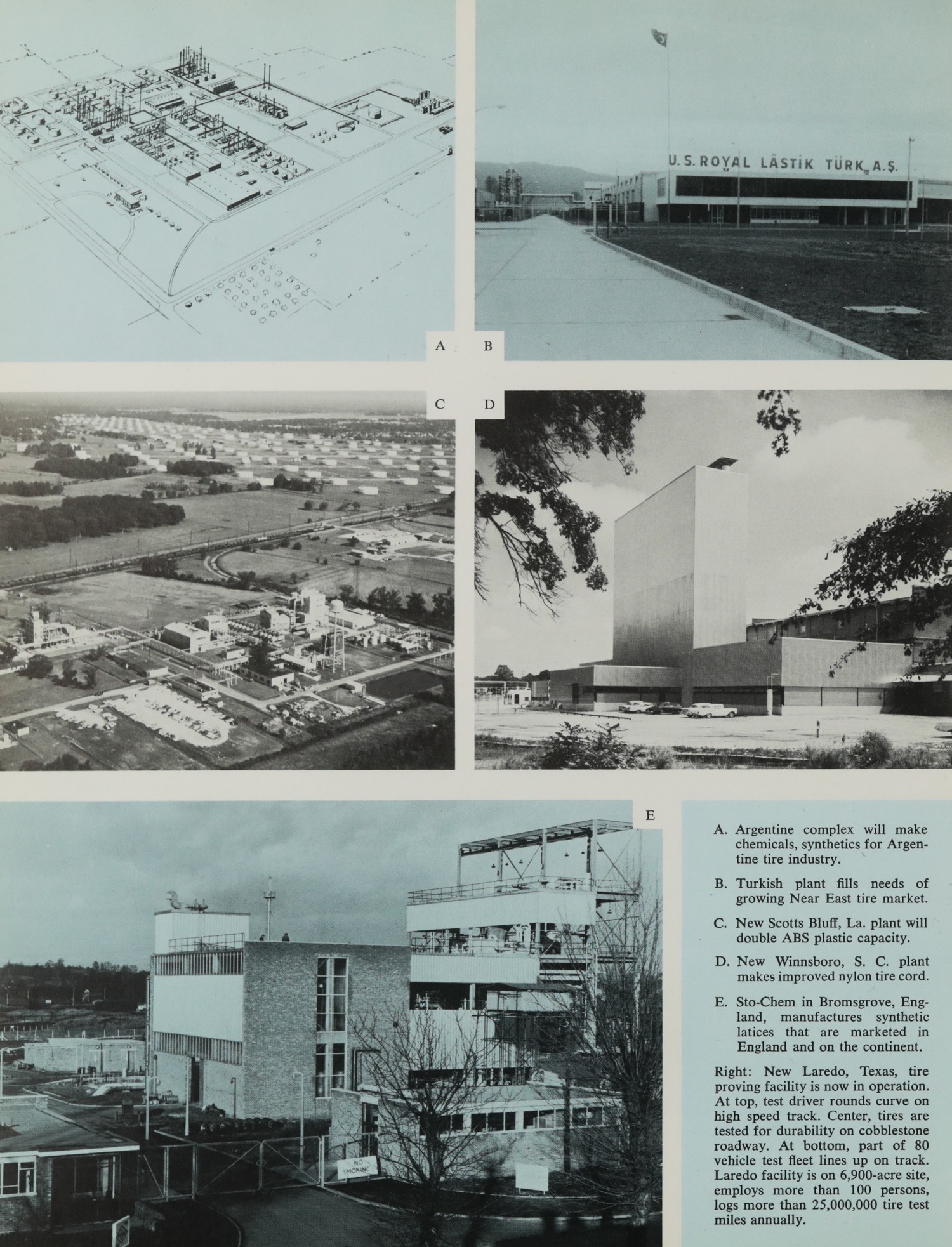
A. Argentine complex will make chemicals, synthetics for Argentine tire industry.
B. Turkish plant fills needs of growing Near East tire market.
C. New Scotts Bluff, La. plant will double ABS plastic capacity.
D. New Winnsboro, S. C. plant makes improved nylon tire cord.
E. Sto-Chem in Bromsgrove, England, manufactures synthetic latices that are marketed in England and on the continent.
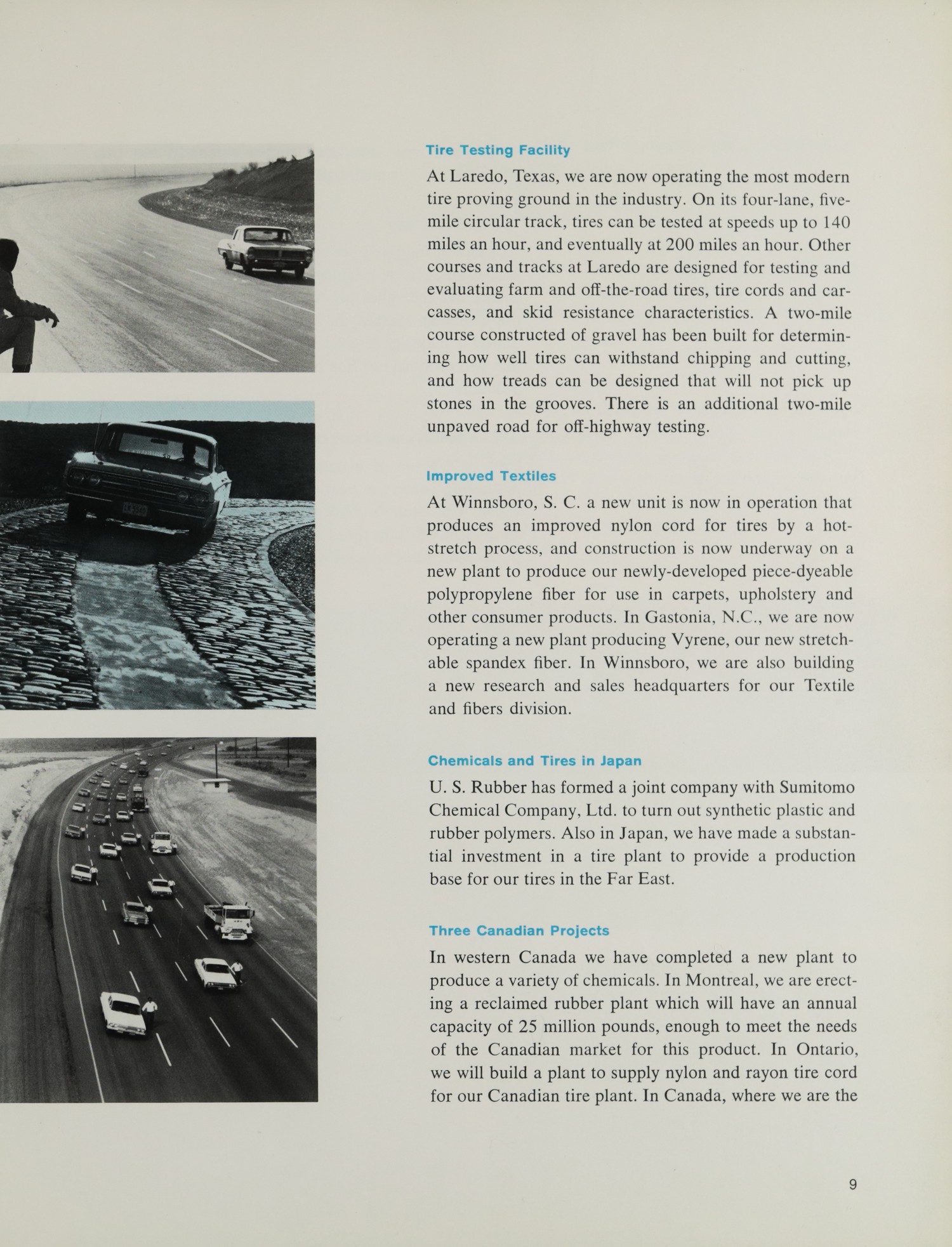
Right: New Laredo, Texas, tire proving facility is now in operation. At top, test driver rounds curve on high speed track. Center, tires are tested for durability on cobblestone roadway. At bottom, part of 80 vehicle test fleet lines up on track. Laredo facility is on 6,900-acre site, employs more than 100 persons, logs more than 25,000,000 tire test miles annually.
U.S. ROYAL LASTIK TURK A.S.

US Rubber Annual Report – 72nd Annual Report – Page 9

Page 009

Tire Testing Facility
At Laredo, Texas, we are now operating the most modern tire proving ground in the industry. On its four-lane, five-mile circular track, tires can be tested at speeds up to 140 miles an hour, and eventually at 200 miles an hour. Other courses and tracks at Laredo are designed for testing and evaluating farm and off-the-road tires, tire cords and carcasses, and skid resistance characteristics. A two-mile course constructed of gravel has been built for determining how well tires can withstand chipping and cutting, and how treads can be designed that will not pick up stones in the grooves. There is an additional two-mile unpaved road for off-highway testing.

Improved Textiles
At Winnsboro, S. C. a new unit is now in operation that produces an improved nylon cord for tires by a hot-stretch process, and construction is now underway on a new plant to produce our newly-developed piece-dyeable polypropylene fiber for use in carpets, upholstery and other consumer products. In Gastonia, N.C., we are now operating a new plant producing Yvrone, our new stretchable spandex fiber. In Winnsboro, we are also building a new research and sales headquarters for our Textile and fibers division.

Chemicals and Tires in Japan
U.S. Rubber has formed a joint company with Sumitomo Chemical Company, Ltd. to turn out synthetic plastic and rubber polymers. Also in Japan, we have made a substantial investment in a tire plant to provide a production base for our tires in the Far East.

Three Canadian Projects
In western Canada we have completed a new plant to produce a variety of chemicals. In Montreal, we are erecting a reclaimed rubber plant which will have an annual capacity of 25 million pounds, enough to meet the needs of the Canadian market for this product. In Ontario, we will build a plant to supply nylon and rayon tire cord for our Canadian tire plant. In Canada, where we are the leading manufacturer of tires, we continue to expand and modernize our facilities.

US Rubber Annual Report – 72nd Annual Report – Page 12

Page 012

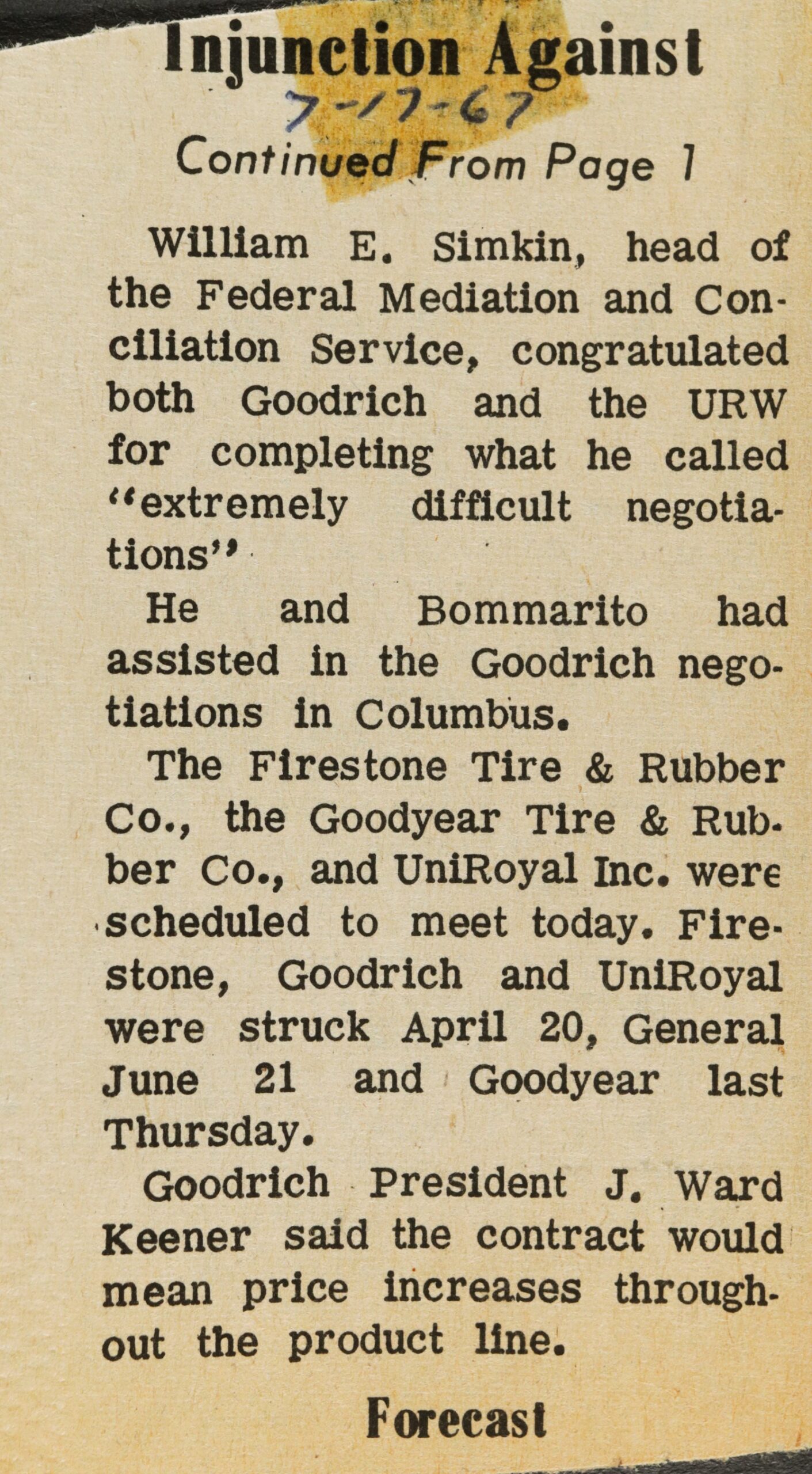
A. New Belgian tire plant will serve the Benelux market.
B. Synthetic rubber will be made in new Painesville, Ohio plant.
C. Australian investment will include new tire factory.
D. Reclaimed rubber plant in Montreal will meet Canadian market needs.
E. Spanish footwear plant is our first investment in Spain.