CHEM-TEXTS – 1980-v14-s289

Page 289

Page 2 CHEM-TEXTS Vol. 14, 1980


Goals For 1980

1979 was a very good year for the Uniroyal Chemical Company and the Naugatuck Plant. The company had record sales and profit and the Plant’s operating profit increased 59% over 1978. In order to continue this improvement, severl major 1980 Objectives for the following products and areas must be accomplished:

NAUGACEL SD-1

Successfully start up Naugacel SD-1, an accelerator that will be new business for the plant. It will be manufactured in the FOC Plant Bldg. 124. Most of the equipment has been installed and startup is expected in the 2nd Quarter of 1980. Naugacel is used in the manufacture of tires and mechanical goods.

OMITE

Our goal is to increase Omite production 20% through productivity improvements over 1979, which was a record year. This is necessary if we want to meet the needs of fruit and cotton growers in the U.S. and to avoid the additional expense of importing Omite from our Latina Plant in Italy. Omite is the highest profit chemical made in the plant.

This year, we also will finalize our plant to increase the Omite capacity to meet future sales.

TPR

Increase the production of TPR by 30%, again, through productivity improvements, so that outside manufacturing can be eliminated. This will reduce TPR manufacturing cost and therefore improve TPR’s profitability.

DEVELOP A STRATEGY FOR THE PLANT

We will review the existing resources of the plant, analyze our strengths and weaknesses, and develop a plan that will increase the profit of our facilities. We have many resources that are not fully utilized and increasing their utilization will have a dramatic improvement on the company’s profitability.

For example, the Boiler Plant, Land and Wastewater treatment facilities are only 50-60% utilized. Some of our manufacturing equipment is operating at less than half of capacity. We certainly have the capacity and ability to manfacture more chemical products at Naugatuck and must develop a plan to take advantage of this opportunity.

ENERGY STRATEGY

This year, we will develop an energy strategy that reduces the cost of energy per pound of product so that we can be more competitive with chemical companies closer to lower cost energy sources.

OPERATING PROFIT

The profit goal for 1980 is to improve the operating profit of the Naugatuck Plant by 20%. The operating profit in 1979 was $18.9 million dollars and we plan to raise it to $22.7 million dollars in 1980. Achieving the objectives of the 1980 PIP Program, “Mainstream”, and meeting our 1980 Operating Budget, are important factors in meeting the 1980 Plant Operating Profit Goal.

HEALTH & SAFETY

2000 air monitoring tests will be taken in the Plant to insure that conditions in which employees are working are safe and corrective action initiated to improve the working environment. Also our safety goal this year is an Incidence Rate of 2.6, which is the number of injuries per 1,000,000 manhours worked. The Chemical Industry’s average is “6”, so we hope to operate significantly safer than the average plant.

RIDESHARING

We plan to finalize our ridesharing program in support of Gov. Grasso’s objective to reduce dependence on foreign oil by decreasing gasoline consumption. This program will also provide a system for our employees that will enable them to travel to work during gas shortages that will most likely occur in the future.

Eric Johnson, Factory Manager


Equality Policy Affirmed

The providing of equal employment opportunity for all employees or applicants for employment regardless of race, religion, color, sex, age, national origin, handicap or disabled and Vietnam Era Veteran status is one of the basic policies of UNIROYAL, Inc. The Naugatuck Chemical plant endorses this policy and expects all decisions regarding personnel to conform to these equal employment rules and regulations.

The Naugatuck Chemical Plant has a specific plan of action designed to aid in providing equal opportunity for all. It is committed to recruit, hire, and promote in all job classifications and to ensure that items such as compensation, benefits, transfers, layoffs, return from layoff, training, educational and tuition assistance, and social and recreational activities are administered without regard to race, color, religion, sex, age, national origin, handicap or disabled and Vietnam Era Veteran status except where sex, and/or age is a bonafied occupational qualification. It is also committed to make employment or promotional decisions based solely upon the individual’s qualifications as they relate to the valid qualification requirements of the position for which the individual is being considered.

continued on page 4


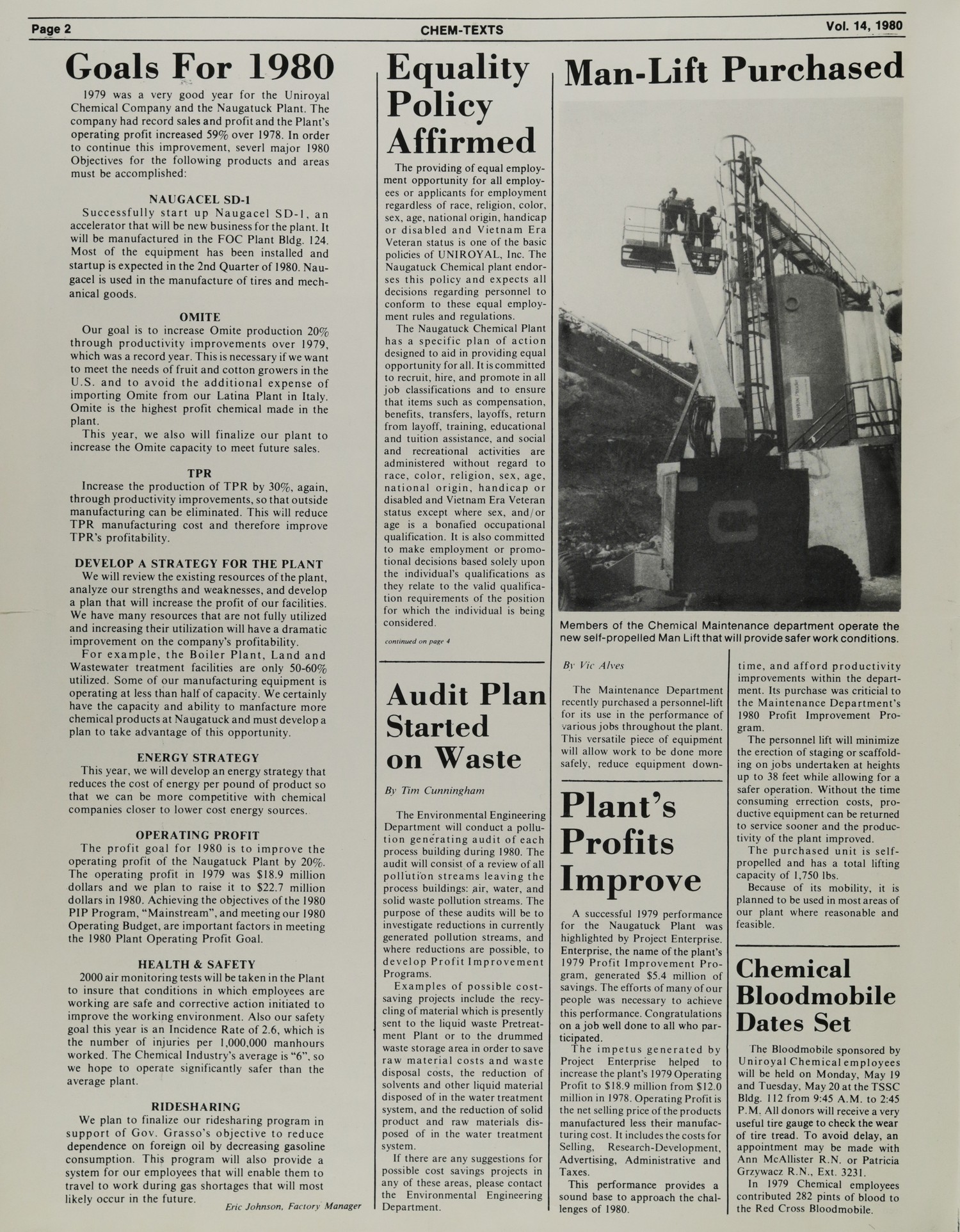
Man-Lift Purchased

[IMAGE: Black and white photograph showing members of the Chemical Maintenance department operating a self-propelled Man Lift]

Members of the Chemical Maintenance department operate the new self-propelled Man Lift that will provide safer work conditions.

By Vic Alves

The Maintenance Department recently purchased a personnel-lift for its use in the performance of various jobs throughout the plant. This versatile piece of equipment will allow work to be done more safely, reduce equipment down-

time, and afford productivity improvements within the department. Its purchase was criticial to the Maintenance Department’s 1980 Profit Improvement Program.

The personnel lift will minimize the erection of staging or scaffolding on jobs undertaken at heights up to 38 feet while allowing for a safer operation. Without the time consuming errection costs, productive equipment can be returned to service sooner and the productivity of the plant improved.

The purchased unit is self-propelled and has a total lifting capacity of 1,750 lbs.

Because of its mobility, it is planned to be used in most areas of our plant where reasonable and feasible.


Audit Plan Started on Waste

By Tim Cunningham

The Environmental Engineering Department will conduct a pollution generating audit of each process building during 1980. The audit will consist of a review of all pollution streams leaving the process buildings: air, water, and solid waste pollution streams. The purpose of these audits will be to investigate reductions in currently generated pollution streams, and where reductions are possible, to develop Profit Improvement Programs.

Examples of possible cost-saving projects include the recycling of material which is presently sent to the liquid waste Pretreatment Plant or to the drummed waste storage area in order to save raw material costs and waste disposal costs, the reduction of solvents and other liquid material disposed of in the water treatment system, and the reduction of solid product and raw materials disposed of in the water treatment system.

If there are any suggestions for possible cost savings projects in any of these areas, please contact the Environmental Engineering Department.


Plant’s Profits Improve

A successful 1979 performance for the Naugatuck Plant was highlighted by Project Enterprise. Enterprise, the name of the plant’s 1979 Profit Improvement Program, generated $5.4 million of savings. The efforts of many of our people was necessary to achieve this performance. Congratulations on a job well done to all who participated.

The impetus generated by Project Enterprise helped to increase the plant’s 1979 Operating Profit to $18.9 million from $12.0 million in 1978. Operating Profit is the net selling price of the products manufactured less their manufacturing cost. It includes the costs for Selling, Research-Development, Advertising, Administrative and Taxes.

This performance provides a sound base to approach the challenges of 1980.


Chemical Bloodmobile Dates Set

The Bloodmobile sponsored by Uniroyal Chemical employees will be held on Monday, May 19 and Tuesday, May 20 at the TSSC Bldg. 112 from 9:45 A.M. to 2:45 P.M. All donors will receive a very useful tire gauge to check the wear of tire tread. To avoid delay, an appointment may be made with Ann McAllister R.N. or Patricia Grzywacz R.N., Ext. 3231.

In 1979 Chemical employees contributed 282 pints of blood to the Red Cross Bloodmobile.
CHEM-TEXTS – 1979 – Page 4

Page 004

CHEM-TEXTS

Page 4 | Vol. 13, 1979


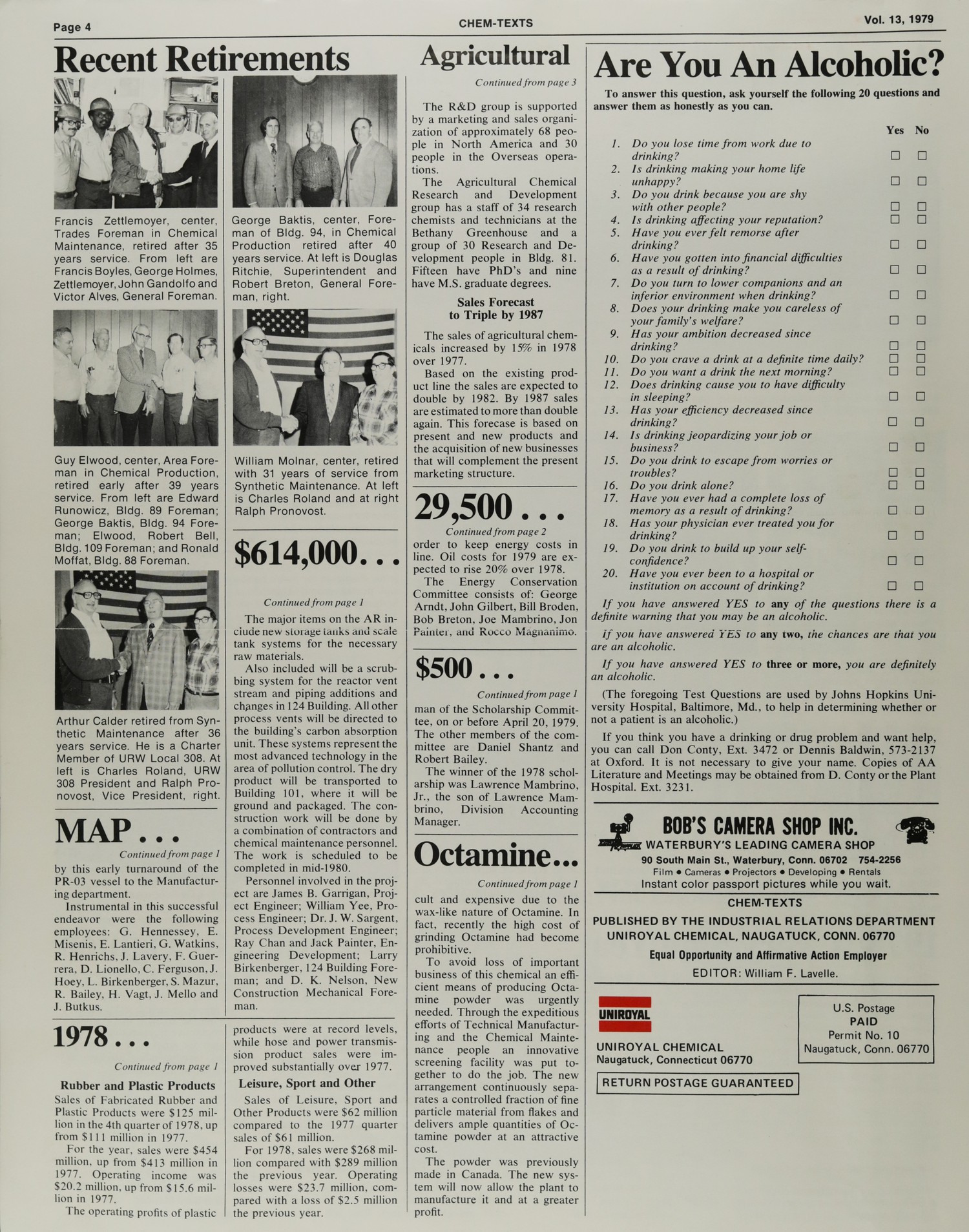
Recent Retirements

[PHOTO: Group photo of retirees]

Francis Zettlemoyer, center, Trades Foreman in Chemical Maintenance, retired after 35 years service. From left are Francis Boyles, George Holmes, Zettlemoyer, John Gandolfo and Victor Alves, General Foreman.

[PHOTO: Group photo of retirees]

Guy Elwood, center, Area Foreman in Chemical Production, retired early after 39 years service. From left are Edward Runowicz, Bldg. 89 Foreman; George Baktis, Bldg. 94 Foreman; Elwood, Robert Bell, Bldg. 109 Foreman; and Ronald Moffat, Bldg. 88 Foreman.

[PHOTO: Group photo]

Arthur Calder retired from Synthetic Maintenance after 36 years service. He is a Charter Member of URW Local 308. At left is Charles Roland, URW 308 President and Ralph Pronovost, Vice President, right.


George Baktis, center, Foreman of Bldg. 94, in Chemical Production retired after 40 years service. At left is Douglas Ritchie, Superintendent and Robert Breton, General Foreman, right.

[PHOTO: Group photo]

William Molnar, center, retired with 31 years of service from Synthetic Maintenance. At left is Charles Roland and at right Ralph Pronovost.


MAP…

Continued from page 1

by this early turnaround of the PR-03 vessel to the Manufacturing department.

Instrumental in this successful endeavor were the following employees: G. Hennessey, E. Misenis, E. Lantieri, G. Watkins, R. Henrichs, J. Lavery, F. Guerrera, D. Lionello, C. Ferguson, J. Hoey, L. Birkenberger, S. Mazur, R. Bailey, H. Vagt, J. Mello and J. Butkus.


1978…

Continued from page 1

Rubber and Plastic Products
Sales of Fabricated Rubber and Plastic Products were $125 million in the 4th quarter of 1978, up from $111 million in 1977.

For the year, sales were $454 million, up from $413 million in 1977. Operating income was $20.2 million, up from $15.6 million in 1977.

The operating profits of plastic products were at record levels, while hose and power transmission product sales were improved substantially over 1977.

Leisure, Sport and Other
Sales of Leisure, Sport and Other Products were $62 million compared to the 1977 quarter sales of $61 million.

For 1978, sales were $268 million compared with $289 million the previous year. Operating losses were $23.7 million, compared with a loss of $2.5 million the previous year.


Agricultural

Continued from page 3

The R&D group is supported by a marketing and sales organization of approximately 68 people in North America and 30 people in the Overseas operations.

The Agricultural Chemical Research and Development group has a staff of 34 research chemists and technicians at the Bethany Greenhouse and a group of 30 Research and Development people in Bldg. 81. Fifteen have PhD’s and nine have M.S. graduate degrees.

Sales Forecast to Triple by 1987

The sales of agricultural chemicals increased by 15% in 1978 over 1977.

Based on the existing product line the sales are expected to double by 1982. By 1987 sales are estimated to more than double again. This forecase is based on present and new products and the acquisition of new businesses that will complement the present marketing structure.


29,500…

Continued from page 2

$614,000…

Continued from page 1

The major items on the AR include new storage tanks and scale tank systems for the necessary raw materials.

Also included will be a scrubbing system for the reactor vent stream and piping additions and changes in 124 Building. All other process vents will be directed to the building’s carbon absorption unit. These systems represent the most advanced technology in the area of pollution control. The dry product will be transported to Building 101, where it will be ground and packaged. The construction work will be done by a combination of contractors and chemical maintenance personnel. The work is scheduled to be completed in mid-1980.

Personnel involved in the project are James B. Garrigan, Project Engineer; William Yee, Process Engineer; Dr. J. W. Sargent, Process Development Engineer; Ray Chan and Jack Painter, Engineering Development; Larry Birkenberger, 124 Building Foreman; and D. K. Nelson, New Construction Mechanical Foreman.

order to keep energy costs in line. Oil costs for 1979 are expected to rise 20% over 1978. The Energy Conservation Committee consists of: George Arndt, John Gilbert, Bill Broden, Bob Breton, Joe Mambrino, Jon Painter, and Rocco Magnanimo.


$500…

Continued from page 1

man of the Scholarship Committee, on or before April 20, 1979. The other members of the committee are Daniel Shantz and Robert Bailey.

The winner of the 1978 scholarship was Lawrence Mambrino, Jr., the son of Lawrence Mambrino, Division Accounting Manager.


Octamine…

Continued from page 1

cult and expensive due to the wax-like nature of Octamine. In fact, recently the high cost of grinding Octamine had become prohibitive.

To avoid loss of important business of this chemical an efficient means of producing Octamine powder was urgently needed. Through the expeditious efforts of Technical Manufacturing and the Chemical Maintenance people an innovative screening facility was put together to do the job. The new arrangement continuously separates a controlled fraction of fine particle material from flakes and delivers ample quantities of Octamine powder at an attractive cost.

The powder was previously made in Canada. The new system will now allow the plant to manufacture it and at a greater profit.


Are You An Alcoholic?

To answer this question, ask yourself the following 20 questions and answer them as honestly as you can.

Yes No
1. Do you lose time from work due to drinking?
2. Is drinking making your home life unhappy?
3. Do you drink because you are shy with other people?
4. Is drinking affecting your reputation?
5. Have you ever felt remorse after drinking?
6. Have you gotten into financial difficulties as a result of drinking?
7. Do you turn to lower companions and an inferior environment when drinking?
8. Does your drinking make you careless of your family’s welfare?
9. Has your ambition decreased since drinking?
10. Do you crave a drink at a definite time daily?
11. Do you want a drink the next morning?
12. Does drinking cause you to have difficulty in sleeping?
13. Has your efficiency decreased since drinking?
14. Is drinking jeopardizing your job or business?
15. Do you drink to escape from worries or troubles?
16. Do you drink alone?
17. Have you ever had a complete loss of memory as a result of drinking?
18. Has your physician ever treated you for drinking?
19. Do you drink to build up your self-confidence?
20. Have you ever been to a hospital or institution on account of drinking?

If you have answered YES to any of the questions there is a definite warning that you may be an alcoholic.

if you have answered YES to any two, the chances are that you are an alcoholic.

If you have answered YES to three or more, you are definitely an alcoholic.

(The foregoing Test Questions are used by Johns Hopkins University Hospital, Baltimore, Md., to help in determining whether or not a patient is an alcoholic.)

If you think you have a drinking or drug problem and want help, you can call Don Conty, Ext. 3472 or Dennis Baldwin, 573-2137 at Oxford. It is not necessary to give your name. Copies of AA Literature and Meetings may be obtained from D. Conty or the Plant Hospital. Ext. 3231.


BOB’S CAMERA SHOP INC.

WATERBURY’S LEADING CAMERA SHOP
90 South Main St., Waterbury, Conn. 06702 754-2256
Film • Cameras • Projectors • Developing • Rentals
Instant color passport pictures while you wait.


CHEM-TEXTS
PUBLISHED BY THE INDUSTRIAL RELATIONS DEPARTMENT
UNIROYAL CHEMICAL, NAUGATUCK, CONN. 06770
Equal Opportunity and Affirmative Action Employer
EDITOR: William F. Lavelle.


[MAILING LABEL AREA]

UNIROYAL | U.S. Postage PAID Permit No. 10 Naugatuck, Conn. 06770

UNIROYAL CHEMICAL
Naugatuck, Connecticut 06770

RETURN POSTAGE GUARANTEED

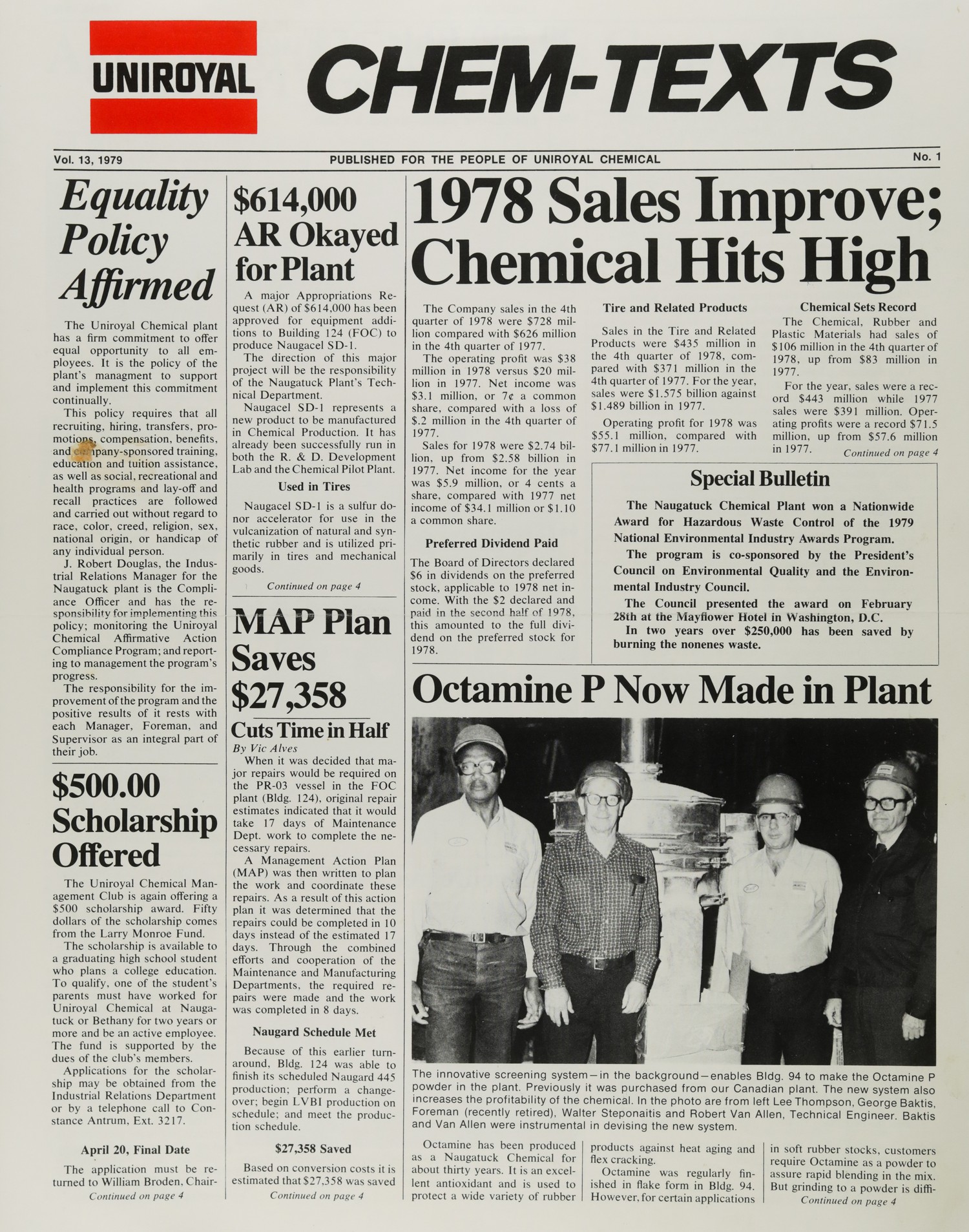
CHEM-TEXTS – 1979 – Page No. 1

Page unknown

UNIROYAL CHEM-TEXTS

Vol. 13, 1979 | PUBLISHED FOR THE PEOPLE OF UNIROYAL CHEMICAL | No. 1


Equality Policy Affirmed

The Uniroyal Chemical plant has a firm commitment to offer equal opportunity to all employees. It is the policy of the plant’s management to support and implement this commitment continually.

This policy requires that all recruiting, hiring, transfers, promotions, compensation, benefits, and company-sponsored training, education and tuition assistance, as well as social, recreational and health programs and lay-off and recall practices are followed and carried out without regard to race, color, creed, religion, sex, national origin, or handicap of any individual person.

J. Robert Douglas, the Industrial Relations Manager for the Naugatuck plant is the Compliance Officer and has the responsibility for implementing this policy; monitoring the Uniroyal Chemical Affirmative Action Compliance Program; and reporting to management the program’s progress.

The responsibility for the improvement of the program and the positive results of it rests with each Manager, Foreman, and Supervisor as an integral part of their job.


$500.00 Scholarship Offered

The Uniroyal Chemical Management Club is again offering a $500 scholarship award. Fifty dollars of the scholarship comes from the Larry Monroe Fund.

The scholarship is available to a graduating high school student who plans a college education. To qualify, one of the student’s parents must have worked for Uniroyal Chemical at Naugatuck or Bethany for two years or more and be an active employee. The fund is supported by the dues of the club’s members.

Applications for the scholarship may be obtained from the Industrial Relations Department or by a telephone call to Constance Antrum, Ext. 3217.

April 20, Final Date

The application must be returned to William Broden, Chair-
Continued on page 4


$614,000 AR Okayed for Plant

A major Appropriations Request (AR) of $614,000 has been approved for equipment additions to Building 124 (FOC) to produce Naugacel SD-1.

The direction of this major project will be the responsibility of the Naugatuck Plant’s Technical Department.

Naugacel SD-1 represents a new product to be manufactured in Chemical Production. It has already been successfully run in both the R. & D. Development Lab and the Chemical Pilot Plant.

Used in Tires

Naugacel SD-1 is a sulfur donor accelerator for use in the vulcanization of natural and synthetic rubber and is utilized primarily in tires and mechanical goods.

Continued on page 4


MAP Plan Saves $27,358

Cuts Time in Half

By Vic Alves

When it was decided that major repairs would be required on the PR-03 vessel in the FOC plant (Bldg. 124), original repair estimates indicated that it would take 17 days of Maintenance Dept. work to complete the necessary repairs.

A Management Action Plan (MAP) was then written to plan the work and coordinate these repairs. As a result of this action plan it was determined that the repairs could be completed in 10 days instead of the estimated 17 days. Through the combined efforts and cooperation of the Maintenance and Manufacturing Departments, the required repairs were made and the work was completed in 8 days.

Naugard Schedule Met

Because of this earlier turnaround, Bldg. 124 was able to finish its scheduled Naugard 445 production; perform a changeover; begin LVBI production on schedule; and meet the production schedule.

$27,358 Saved

Based on conversion costs it is estimated that $27,358 was saved
Continued on page 4


1978 Sales Improve; Chemical Hits High

The Company sales in the 4th quarter of 1978 were $728 million compared with $626 million in the 4th quarter of 1977.

The operating profit was $38 million in 1978 versus $20 million in 1977. Net income was $3.1 million, or 7¢ a common share, compared with a loss of $2.2 million in the 4th quarter of 1977.

Sales for 1978 were $2.74 billion, up from $2.58 billion in 1977. Net income for the year was $5.9 million, or 4 cents a share, compared with 1977 net income of $34.1 million or $1.10 a common share.

Preferred Dividend Paid

The Board of Directors declared $6 in dividends on the preferred stock, applicable to 1978 net income. With the $2 declared and paid in the second half of 1978, this amounted to the full dividend on the preferred stock for 1978.


Tire and Related Products

Sales in the Tire and Related Products were $435 million in the 4th quarter of 1978, compared with $371 million in the 4th quarter of 1977. For the year, sales were $1.575 billion against $1.489 billion in 1977.

Operating profit for 1978 was $55.1 million, compared with $77.1 million in 1977.


Chemical Sets Record

The Chemical, Rubber and Plastic Materials had sales of $106 million in the 4th quarter of 1978, up from $83 million in 1977.

For the year, sales were a record $443 million while 1977 sales were $391 million. Operating profits were a record $71.5 million, up from $57.6 million in 1977.
Continued on page 4


Special Bulletin

The Naugatuck Chemical Plant won a Nationwide Award for Hazardous Waste Control of the 1979 National Environmental Industry Awards Program.

The program is co-sponsored by the President’s Council on Environmental Quality and the Environmental Industry Council.

The Council presented the award on February 28th at the Mayflower Hotel in Washington, D.C.

In two years over $250,000 has been saved by burning the nonenes waste.


Octamine P Now Made in Plant

The innovative screening system—in the background—enables Bldg. 94 to make the Octamine P powder in the plant. Previously it was purchased from our Canadian plant. The new system also increases the profitability of the chemical. In the photo are from left Lee Thompson, George Baktis, Foreman (recently retired), Walter Steponaitis and Robert Van Allen, Technical Engineer. Baktis and Van Allen were instrumental in devising the new system.


Octamine has been produced as a Naugatuck Chemical for about thirty years. It is an excellent antioxidant and is used to protect a wide variety of rubber products against heat aging and flex cracking.

Octamine was regularly finished in flake form in Bldg. 94. However, for certain applications in soft rubber stocks, customers require Octamine as a powder to assure rapid blending in the mix. But grinding to a powder is diffi-
Continued on page 4

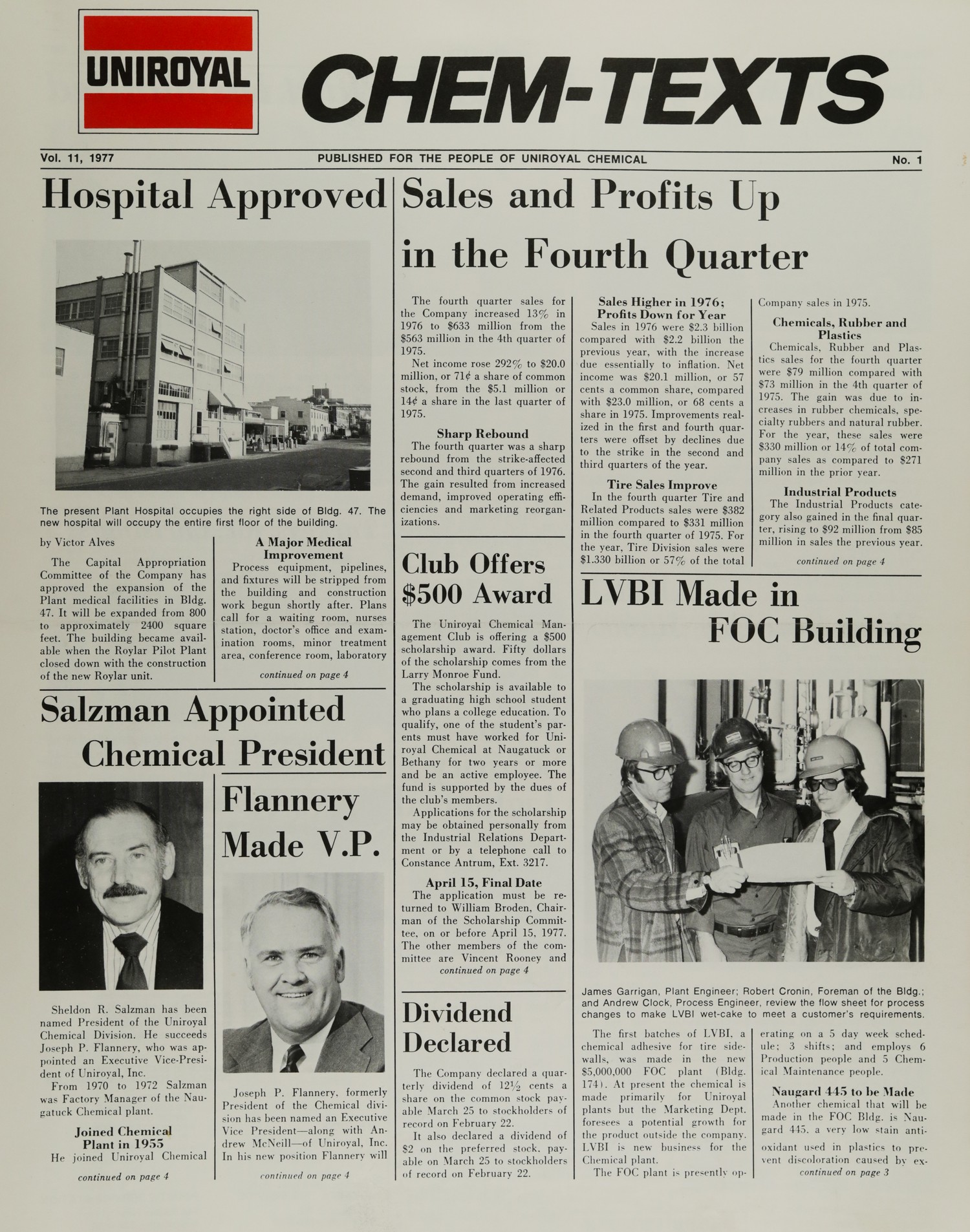
CHEM-TEXTS – 1977-v11-i01-s248

Page 248

UNIROYAL CHEM-TEXTS

Vol. 11, 1977 | PUBLISHED FOR THE PEOPLE OF UNIROYAL CHEMICAL | No. 1


Hospital Approved | Sales and Profits Up in the Fourth Quarter

[IMAGE: Black and white photo of a building]

The present Plant Hospital occupies the right side of Bldg. 47. The new hospital will occupy the entire first floor of the building.

by Victor Alves

The Capital Appropriation Committee of the Company has approved the expansion of the Plant medical facilities in Bldg. 47. It will be expanded from 800 to approximately 2400 square feet. The building became available when the Roylar Pilot Plant closed down with the construction of the new Roylar unit.

A Major Medical Improvement

Process equipment, pipelines, and fixtures will be stripped from the building and construction work begun shortly after. Plans call for a waiting room, nurses station, doctor’s office and examination rooms, minor treatment area, conference room, laboratory

continued on page 4


The fourth quarter sales for the Company increased 13% in 1976 to $633 million from the $563 million in the 4th quarter of 1975.

Net income rose 292% to $20.0 million, or 71¢ a share of common stock, from the $5.1 million or 14¢ a share in the last quarter of 1975.

Sharp Rebound

The fourth quarter was a sharp rebound from the strike-affected second and third quarters of 1976. The gain resulted from increased demand, improved operating efficiencies and marketing reorganizations.


Club Offers $500 Award

The Uniroyal Chemical Management Club is offering a $500 scholarship award. Fifty dollars of the scholarship comes from the Larry Monroe Fund.

The scholarship is available to a graduating high school student who plans a college education. To qualify, one of the student’s parents must have worked for Uniroyal Chemical at Naugatuck or Bethany for two years or more and be an active employee. The fund is supported by the dues of the club’s members.

Applications for the scholarship may be obtained personally from the Industrial Relations Department or by a telephone call to Constance Antrum, Ext. 3217.

April 15, Final Date

The application must be returned to William Broden, Chairman of the Scholarship Committee, on or before April 15, 1977. The other members of the committee are Vincent Rooney and

continued on page 4


Sales Higher in 1976; Profits Down for Year

Sales in 1976 were $2.3 billion compared with $2.2 billion the previous year, with the increase due essentially to inflation. Net income was $20.1 million, or 57 cents a common share, compared with $23.0 million, or 68 cents a share in 1975. Improvements realized in the first and fourth quarters were offset by declines due to the strike in the second and third quarters of the year.

Tire Sales Improve

In the fourth quarter Tire and Related Products sales were $382 million compared to $331 million in the fourth quarter of 1975. For the year, Tire Division sales were $1.330 billion or 57% of the total


Company sales in 1975.

Chemicals, Rubber and Plastics

Chemicals, Rubber and Plastics sales for the fourth quarter were $79 million compared with $73 million in the 4th quarter of 1975. The gain was due to increases in rubber chemicals, specialty rubbers and natural rubber. For the year, these sales were $330 million or 14% of total company sales as compared to $271 million in the prior year.

Industrial Products

The Industrial Products category also gained in the final quarter, rising to $92 million from $85 million in sales the previous year.

continued on page 4


Salzman Appointed Chemical President

Flannery Made V.P.

[IMAGE: Photo of Sheldon R. Salzman]

Sheldon R. Salzman has been named President of the Uniroyal Chemical Division. He succeeds Joseph P. Flannery, who was appointed an Executive Vice-President of Uniroyal, Inc.

From 1970 to 1972 Salzman was Factory Manager of the Naugatuck Chemical plant.

Joined Chemical Plant in 1955

He joined Uniroyal Chemical

continued on page 4

[IMAGE: Photo of Joseph P. Flannery]

Joseph P. Flannery, formerly President of the Chemical division has been named an Executive Vice President—along with Andrew McNeill—of Uniroyal, Inc. In his new position Flannery will

continued on page 4


Dividend Declared

The Company declared a quarterly dividend of 12½ cents a share on the common stock payable March 25 to stockholders of record on February 22.

It also declared a dividend of $2 on the preferred stock, payable on March 25 to stockholders of record on February 22.


LVBI Made in FOC Building

[IMAGE: Photo of three workers reviewing documents]

James Garrigan, Plant Engineer; Robert Cronin, Foreman of the Bldg.; and Andrew Clock, Process Engineer, review the flow sheet for process changes to make LVBI wet-cake to meet a customer’s requirements.

The first batches of LVBI, a chemical adhesive for tire sidewalls, was made in the new $5,000,000 FOC plant (Bldg. 174). At present the chemical is made primarily for Uniroyal plants but the Marketing Dept. foresees a potential growth for the product outside the company. LVBI is new business for the Chemical plant.

The FOC plant is presently op-

erating on a 5 day week schedule; 3 shifts; and employs 6 Production people and 5 Chemical Maintenance people.

Naugard 445 to be Made

Another chemical that will be made in the FOC Bldg. is Naugard 445, a very low stain antioxidant used in plastics to prevent discoloration caused by ex-

continued on page 3

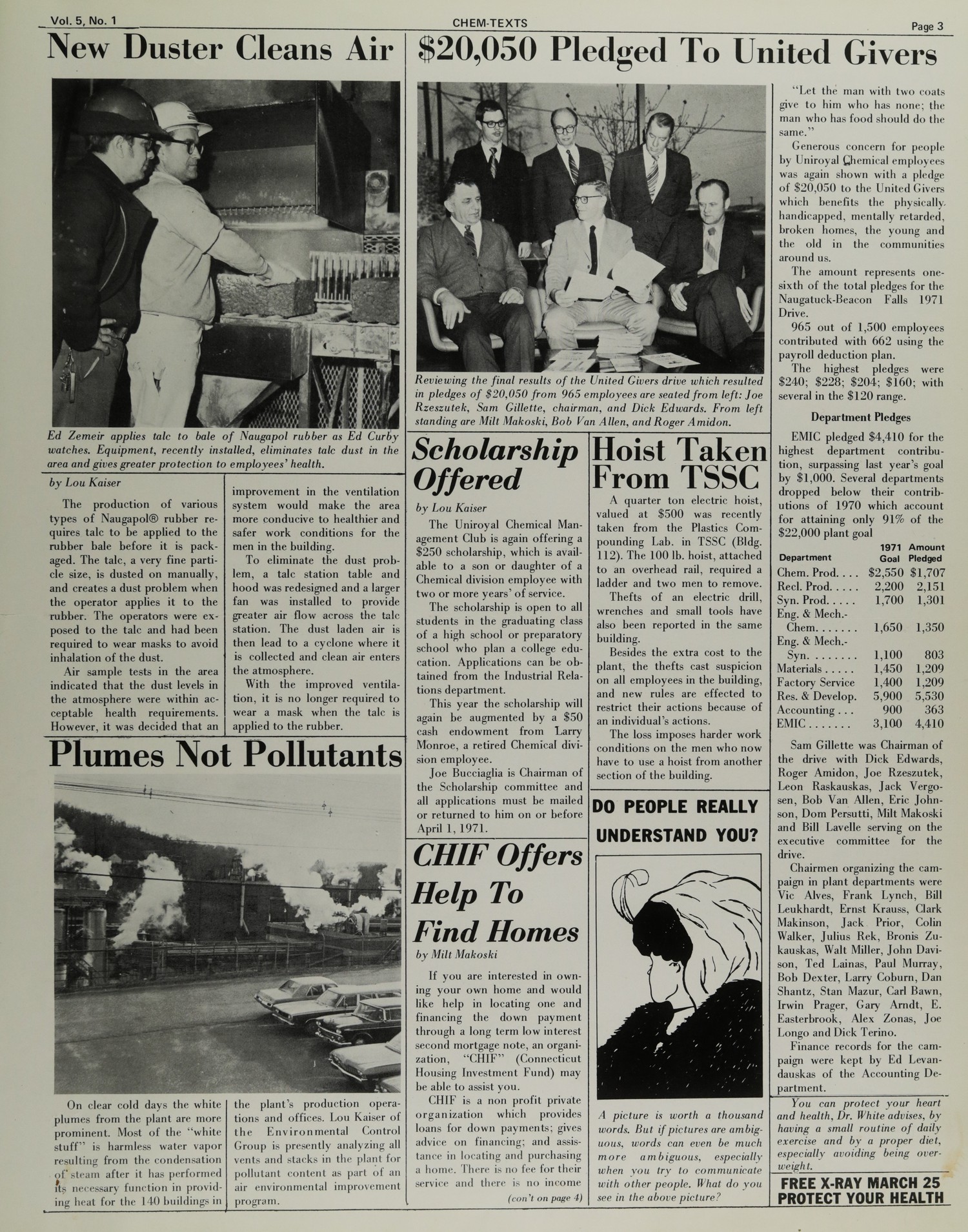
CHEM-TEXTS – Vol. 5, No. 1 – Page 3

Page 003

CHEM-TEXTS

Vol. 5, No. 1 | Page 3


New Duster Cleans Air

Ed Zemeir applies talc to bale of Naugapol rubber as Ed Curby watches. Equipment, recently installed, eliminates talc dust in the area and gives greater protection to employees’ health.

by Lou Kaiser

The production of various types of Naugapol® rubber requires talc to be applied to the rubber bale before it is packaged. The talc, a very fine particle size, is dusted on manually, and creates a dust problem when the operator applies it to the rubber. The operators were exposed to the talc and had been required to wear masks to avoid inhalation of the dust.

Air sample tests in the area indicated that the dust levels in the atmosphere were within acceptable health requirements. However, it was decided that an improvement in the ventilation system would make the area more conducive to healthier and safer work conditions for the men in the building.

To eliminate the dust problem, a talc station table and hood was redesigned and a larger fan was installed to provide greater air flow across the talc station. The dust laden air is then lead to a cyclone where it is collected and clean air enters the atmosphere.

With the improved ventilation, it is no longer required to wear a mask when the talc is applied to the rubber.


Plumes Not Pollutants

On clear cold days the white plumes from the plant are more prominent. Most of the “white stuff” is harmless water vapor resulting from the condensation of steam after it has performed its necessary function in providing heat for the 140 buildings in the plant’s production operations and offices. Lou Kaiser of the Environmental Control Group is presently analyzing all vents and stacks in the plant for pollutant content as part of an air environmental improvement program.


$20,050 Pledged To United Givers

Reviewing the final results of the United Givers drive which resulted in pledges of $20,050 from 965 employees are seated from left: Joe Rzeszutek, Sam Gillette, chairman, and Dick Edwards. From left standing are Milt Makoski, Bob Van Allen, and Roger Amidon.

“Let the man with two coats give to him who has none; the man who has food should do the same.”

Generous concern for people by Uniroyal Chemical employees was again shown with a pledge of $20,050 to the United Givers which benefits the physically handicapped, mentally retarded, broken homes, the young and the old in the communities around us.

The amount represents one-sixth of the total pledges for the Naugatuck-Beacon Falls 1971 Drive.

965 out of 1,500 employees contributed with 662 using the payroll deduction plan.

The highest pledges were $240; $228; $204; $160; with several in the $120 range.

Department Pledges

EMIC pledged $4,410 for the highest department contribution, surpassing last year’s goal by $1,000. Several departments dropped below their contributions of 1970 which account for attaining only 91% of the $22,000 plant goal

Department 1971 Goal Amount Pledged
Chem. Prod…. $2,550 $1,707
Recl. Prod….. 2,200 2,151
Syn. Prod…… 1,700 1,301
Eng. & Mech.- Chem……. 1,650 1,350
Eng. & Mech.- Syn……. 1,100 803
Materials….. 1,450 1,209
Factory Service 1,400 1,209
Res. & Develop. 5,900 5,530
Accounting… 900 363
EMIC…….. 3,100 4,410

Sam Gillette was Chairman of the drive with Dick Edwards, Roger Amidon, Joe Rzeszutek, Leon Raskauskas, Jack Vergosen, Bob Van Allen, Eric Johnson, Dom Persutti, Milt Makoski and Bill Lavelle serving on the executive committee for the drive.

Chairmen organizing the campaign in plant departments were Vic Alves, Frank Lynch, Bill Leukhardt, Ernst Krauss, Clark Makinson, Jack Prior, Colin Walker, Julius Rek, Bronis Zukauskas, Walt Miller, John Davison, Ted Lainas, Paul Murray, Bob Dexter, Larry Coburn, Dan Shantz, Stan Mazur, Carl Bawn, Irwin Prager, Gary Arndt, E. Easterbrook, Alex Zonas, Joe Longo and Dick Terino.

Finance records for the campaign were kept by Ed Levandauskas of the Accounting Department.


Scholarship Offered

by Lou Kaiser

The Uniroyal Chemical Management Club is again offering a $250 scholarship, which is available to a son or daughter of a Chemical division employee with two or more years’ of service.

The scholarship is open to all students in the graduating class of a high school or preparatory school who plan a college education. Applications can be obtained from the Industrial Relations department.

This year the scholarship will again be augmented by a $50 cash endowment from Larry Monroe, a retired Chemical division employee.

Joe Bucciaglia is Chairman of the Scholarship committee and all applications must be mailed or returned to him on or before April 1, 1971.


Hoist Taken From TSSC

A quarter ton electric hoist, valued at $500 was recently taken from the Plastics Compounding Lab. in TSSC (Bldg. 112). The 100 lb. hoist, attached to an overhead rail, required a ladder and two men to remove.

Thefts of an electric drill, wrenches and small tools have also been reported in the same building.

Besides the extra cost to the plant, the thefts cast suspicion on all employees in the building, and new rules are effected to restrict their actions because of an individual’s actions.

The loss imposes harder work conditions on the men who now have to use a hoist from another section of the building.


CHIF Offers Help To Find Homes

by Milt Makoski

If you are interested in owning your own home and would like help in locating one and financing the down payment through a long term low interest second mortgage note, an organization, “CHIF” (Connecticut Housing Investment Fund) may be able to assist you.

CHIF is a non profit private organization which provides loans for down payments; gives advice on financing; and assistance in locating and purchasing a home. There is no fee for their service and there is no income

(con’t on page 4)


DO PEOPLE REALLY UNDERSTAND YOU?

A picture is worth a thousand words. But if pictures are ambiguous, words can even be much more ambiguous, especially when you try to communicate with other people. What do you see in the above picture?


You can protect your heart and health, Dr. White advises, by having a small routine of daily exercise and by a proper diet, especially avoiding being overweight.

FREE X-RAY MARCH 25
PROTECT YOUR HEALTH

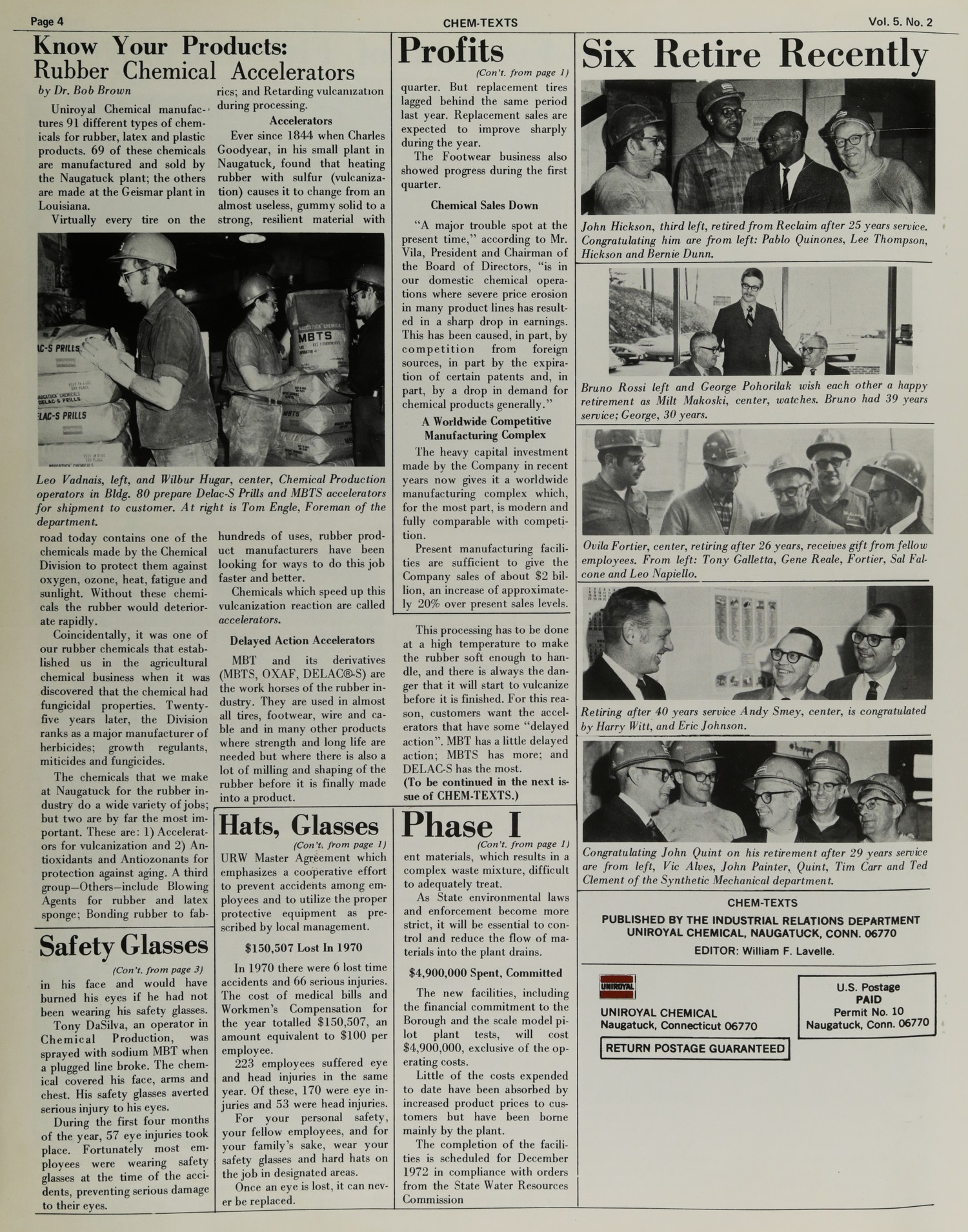
CHEM-TEXTS – Vol. 5, No. 2 – Page 4

Page 004

Page 4 | CHEM-TEXTS | Vol. 5. No. 2


Know Your Products: Rubber Chemical Accelerators

by Dr. Bob Brown

Uniroyal Chemical manufactures 91 different types of chemicals for rubber, latex and plastic products. 69 of these chemicals are manufactured and sold by the Naugatuck plant; the others are made at the Geismar plant in Louisiana.

Virtually every tire on the road today contains one of the chemicals made by the Chemical Division to protect them against oxygen, ozone, heat, fatigue and sunlight. Without these chemicals the rubber would deteriorate rapidly.

Coincidentally, it was one of our rubber chemicals that established us in the agricultural chemical business when it was discovered that the chemical had fungicidal properties. Twenty-five years later, the Division ranks as a major manufacturer of herbicides; growth regulants, miticides and fungicides.

The chemicals that we make at Naugatuck for the rubber industry do a wide variety of jobs; but two are by far the most important. These are: 1) Accelerators for vulcanization and 2) Antioxidants and Antiozonants for protection against aging. A third group—Others—include Blowing Agents for rubber and latex sponge; Bonding rubber to fabric; and Retarding vulcanization during processing.

Accelerators

Ever since 1844 when Charles Goodyear, in his small plant in Naugatuck, found that heating rubber with sulfur (vulcanization) causes it to change from an almost useless, gummy solid to a strong, resilient material with hundreds of uses, rubber product manufacturers have been looking for ways to do this job faster and better.

Chemicals which speed up this vulcanization reaction are called accelerators.

Delayed Action Accelerators

MBT and its derivatives (MBTS, OXAF, DELAC®-S) are the work horses of the rubber industry. They are used in almost all tires, footwear, wire and cable and in many other products where strength and long life are needed but where there is also a lot of milling and shaping of the rubber before it is finally made into a product.


[IMAGE: Black and white photograph showing workers]

AC-5 PRILLS

LAC-5 PRILLS

Leo Vadnais, left, and Wilbur Hugar, center, Chemical Production operators in Bldg. 80 prepare Delac-S Prills and MBTS accelerators for shipment to customer. At right is Tom Engle, Foreman of the department.


Safety Glasses

(Con’t. from page 3)

in his face and would have burned his eyes if he had not been wearing his safety glasses.

Tony DaSilva, an operator in Chemical Production, was sprayed with sodium MBT when a plugged line broke. The chemical covered his face, arms and chest. His safety glasses averted serious injury to his eyes.

During the first four months of the year, 57 eye injuries took place. Fortunately most employees were wearing safety glasses at the time of the accidents, preventing serious damage to their eyes.


Hats, Glasses

(Con’t. from page 1)

URW Master Agreement which emphasizes a cooperative effort to prevent accidents among employees and to utilize the proper protective equipment as prescribed by local management.

$150,507 Lost In 1970

In 1970 there were 6 lost time accidents and 66 serious injuries. The cost of medical bills and Workmen’s Compensation for the year totalled $150,507, an amount equivalent to $100 per employee.

223 employees suffered eye and head injuries in the same year. Of these, 170 were eye injuries and 53 were head injuries.

For your personal safety, your fellow employees, and for your family’s sake, wear your safety glasses and hard hats on the job in designated areas.

Once an eye is lost, it can never be replaced.


Profits

(Con’t. from page 1)

quarter. But replacement tires lagged behind the same period last year. Replacement sales are expected to improve sharply during the year.

The Footwear business also showed progress during the first quarter.

Chemical Sales Down

“A major trouble spot at the present time,” according to Mr. Vila, President and Chairman of the Board of Directors, “is in our domestic chemical operations where severe price erosion in many product lines has resulted in a sharp drop in earnings. This has been caused, in part, by competition from foreign sources, in part by the expiration of certain patents and, in part, by a drop in demand for chemical products generally.”

A Worldwide Competitive Manufacturing Complex

The heavy capital investment made by the Company in recent years now gives it a worldwide manufacturing complex which, for the most part, is modern and fully comparable with competition.

Present manufacturing facilities are sufficient to give the Company sales of about $2 billion, an increase of approximately 20% over present sales levels.

This processing has to be done at a high temperature to make the rubber soft enough to handle, and there is always the danger that it will start to vulcanize before it is finished. For this reason, customers want the accelerators that have some “delayed action”. MBT has a little delayed action; MBTS has more; and DELAC-S has the most.

(To be continued in the next issue of CHEM-TEXTS.)


Phase I

(Con’t. from page 1)

ent materials, which results in a complex waste mixture, difficult to adequately treat.

As State environmental laws and enforcement become more strict, it will be essential to control and reduce the flow of materials into the plant drains.

$4,900,000 Spent, Committed

The new facilities, including the financial commitment to the Borough and the scale model pilot plant tests, will cost $4,900,000, exclusive of the operating costs.

Little of the costs expended to date have been absorbed by increased product prices to customers but have been borne mainly by the plant.

The completion of the facilities is scheduled for December 1972 in compliance with orders from the State Water Resources Commission


Six Retire Recently

[IMAGE: Photograph of three men]

John Hickson, third left, retired from Reclaim after 25 years service. Congratulating him are from left: Pablo Quinones, Lee Thompson, Hickson and Bernie Dunn.


[IMAGE: Photograph of two men]

Bruno Rossi left and George Pohorilak wish each other a happy retirement as Milt Makoski, center, watches. Bruno had 39 years service; George, 30 years.


[IMAGE: Photograph of group of men]

Ovila Fortier, center, retiring after 26 years, receives gift from fellow employees. From left: Tony Galletta, Gene Reale, Fortier, Sal Falcone and Leo Napiello.


[IMAGE: Photograph of three men]

Retiring after 40 years service Andy Smey, center, is congratulated by Harry Witt, and Eric Johnson.


[IMAGE: Photograph of group of men]

Congratulating John Quint on his retirement after 29 years service are from left, Vic Alves, John Painter, Quint, Tim Carr and Ted Clement of the Synthetic Mechanical department.


CHEM-TEXTS

PUBLISHED BY THE INDUSTRIAL RELATIONS DEPARTMENT

UNIROYAL CHEMICAL, NAUGATUCK, CONN. 06770

EDITOR: William F. Lavelle.


[LOGO: UNIROYAL]

UNIROYAL CHEMICAL
Naugatuck, Connecticut 06770

RETURN POSTAGE GUARANTEED

U.S. Postage
PAID
Permit No. 10
Naugatuck, Conn. 06770

CHEM-TEXTS – Vol. 4 No. 8 – Page 4

Page 004

CHEM-TEXTS

Page 4 | Vol. 4 No. 8


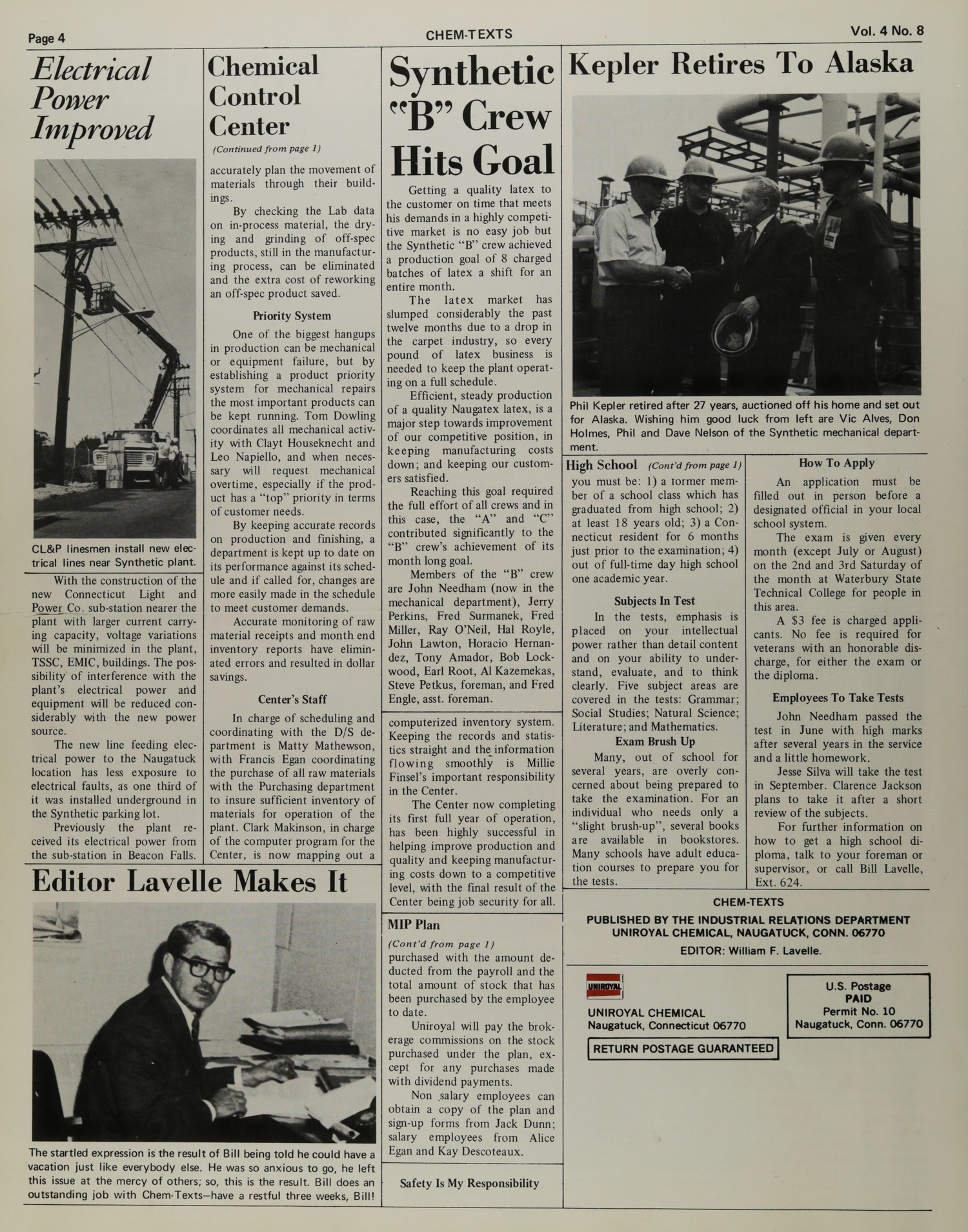
Electrical Power Improved

[IMAGE: CL&P linesmen install new electrical lines near Synthetic plant.]

With the construction of the new Connecticut Light and Power Co. sub-station nearer the plant with larger current carrying capacity, voltage variations will be minimized in the plant, TSSC, EMIC, buildings. The possibility of interference with the plant’s electrical power and equipment will be reduced considerably with the new power source.

The new line feeding electrical power to the Naugatuck location has less exposure to electrical faults, as one third of it was installed underground in the Synthetic parking lot.

Previously the plant received its electrical power from the sub-station in Beacon Falls.


Chemical Control Center

(Continued from page 1)

accurately plan the movement of materials through their buildings.

By checking the Lab data on in-process material, the drying and grinding of off-spec products, still in the manufacturing process, can be eliminated and the extra cost of reworking an off-spec product saved.

Priority System

One of the biggest hangups in production can be mechanical or equipment failure, but by establishing a product priority system for mechanical repairs the most important products can be kept running. Tom Dowling coordinates all mechanical activity with Clayt Houseknecht and Leo Napiello, and when necessary will request mechanical overtime, especially if the product has a “top” priority in terms of customer needs.

By keeping accurate records on production and finishing, a department is kept up to date on its performance against its schedule and if called for, changes are more easily made in the schedule to meet customer demands.

Accurate monitoring of raw material receipts and month end inventory reports have eliminated errors and resulted in dollar savings.

Center’s Staff

In charge of scheduling and coordinating with the D/S department is Matty Mathewson, with Francis Egan coordinating the purchase of all raw materials with the Purchasing department to insure sufficient inventory of materials for operation of the plant. Clark Makinson, in charge of the computer program for the Center, is now mapping out a


Synthetic “B” Crew Hits Goal

Getting a quality latex to the customer on time that meets his demands in a highly competitive market is no easy job but the Synthetic “B” crew achieved a production goal of 8 charged batches of latex a shift for an entire month.

The latex market has slumped considerably the past twelve months due to a drop in the carpet industry, so every pound of latex business is needed to keep the plant operating on a full schedule.

Efficient, steady production of a quality Naugatex latex, is a major step towards improvement of our competitive position, in keeping manufacturing costs down; and keeping our customers satisfied.

Reaching this goal required the full effort of all crews and in this case, the “A” and “C” contributed significantly to the “B” crew’s achievement of its month long goal.

Members of the “B” crew are John Needham (now in the mechanical department), Jerry Perkins, Fred Surmanek, Fred Miller, Ray O’Neil, Hal Royle, John Lawton, Horacio Hernandez, Tony Amador, Bob Lockwood, Earl Root, Al Kazemekas, Steve Petkus, foreman, and Fred Engle, asst. foreman.

computerized inventory system. Keeping the records and statistics straight and the information flowing smoothly is Millie Finsel’s important responsibility in the Center.

The Center now completing its first full year of operation, has been highly successful in helping improve production and quality and keeping manufacturing costs down to a competitive level, with the final result of the Center being job security for all.


Kepler Retires To Alaska

[IMAGE: Phil Kepler retired after 27 years, auctioned off his home and set out for Alaska. Wishing him good luck from left are Vic Alves, Don Holmes, Phil and Dave Nelson of the Synthetic mechanical department.]


High School (Cont’d from page 1)

you must be: 1) a former member of a school class which has graduated from high school; 2) at least 18 years old; 3) a Connecticut resident for 6 months just prior to the examination; 4) out of full-time day high school one academic year.

Subjects In Test

In the tests, emphasis is placed on your intellectual power rather than detail content and on your ability to understand, evaluate, and to think clearly. Five subject areas are covered in the tests: Grammar; Social Studies; Natural Science; Literature; and Mathematics.

Exam Brush Up

Many, out of school for several years, are overly concerned about being prepared to take the examination. For an individual who needs only a “slight brush-up”, several books are available in bookstores. Many schools have adult education courses to prepare you for the tests.

How To Apply

An application must be filled out in person before a designated official in your local school system.

The exam is given every month (except July or August) on the 2nd and 3rd Saturday of the month at Waterbury State Technical College for people in this area.

A $3 fee is charged applicants. No fee is required for veterans with an honorable discharge, for either the exam or the diploma.

Employees To Take Tests

John Needham passed the test in June with high marks after several years in the service and a little homework.

Jesse Silva will take the test in September. Clarence Jackson plans to take it after a short review of the subjects.

For further information on how to get a high school diploma, talk to your foreman or supervisor, or call Bill Lavelle, Ext. 624.


Editor Lavelle Makes It

[IMAGE: Man at desk with telephone]

The startled expression is the result of Bill being told he could have a vacation just like everybody else. He was so anxious to go, he left this issue at the mercy of others; so, this is the result. Bill does an outstanding job with Chem-Texts—have a restful three weeks, Bill!


MIP Plan

(Cont’d from page 1)

purchased with the amount deducted from the payroll and the total amount of stock that has been purchased by the employee to date.

Uniroyal will pay the brokerage commissions on the stock purchased under the plan, except for any purchases made with dividend payments.

Non salary employees can obtain a copy of the plan and sign-up forms from Jack Dunn; salary employees from Alice Egan and Kay Descoteaux.


Safety Is My Responsibility


CHEM-TEXTS

PUBLISHED BY THE INDUSTRIAL RELATIONS DEPARTMENT
UNIROYAL CHEMICAL, NAUGATUCK, CONN. 06770

EDITOR: William F. Lavelle.


[UNIROYAL LOGO]

UNIROYAL CHEMICAL
Naugatuck, Connecticut 06770

RETURN POSTAGE GUARANTEED

U.S. Postage
PAID
Permit No. 10
Naugatuck, Conn. 06770

CHEM-TEXTS – Vol. 3 No. 2 – Page 1

Page 001

Page 2 | CHEM TEXTS | Vol. 1 No. 2


CHEM TEXTS
PUBLISHED BY THE INDUSTRIAL RELATIONS DEPARTMENT
UNIROYAL CHEMICAL, NAUGATUCK, CONNECTICUT


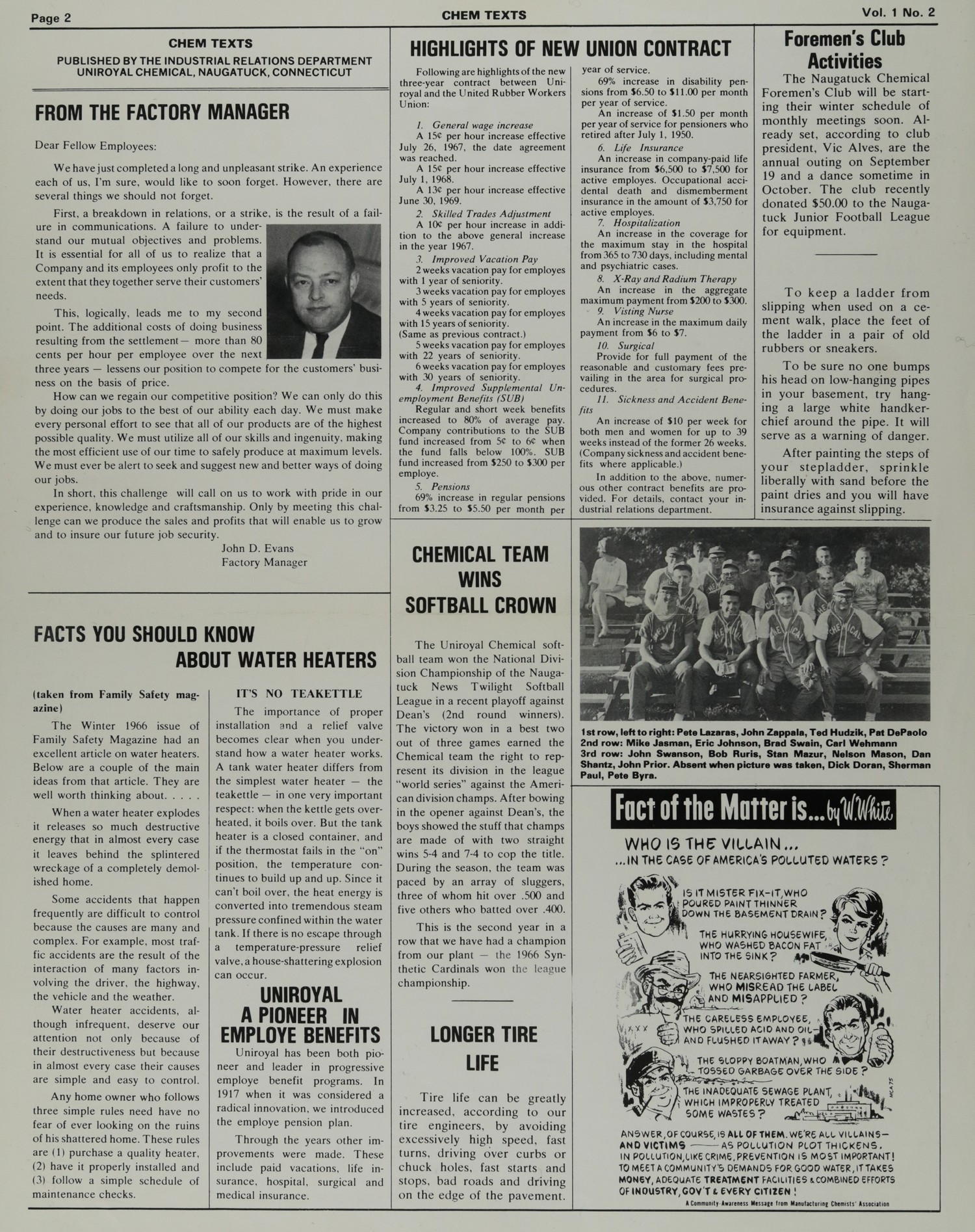
FROM THE FACTORY MANAGER

Dear Fellow Employees:

We have just completed a long and unpleasant strike. An experience each of us, I’m sure, would like to soon forget. However, there are several things we should not forget.

First, a breakdown in relations, or a strike, is the result of a failure in communications. A failure to understand our mutual objectives and problems. It is essential for all of us to realize that a Company and its employees only profit to the extent that they together serve their customers’ needs.

This, logically, leads me to my second point. The additional costs of doing business resulting from the settlement — more than 80 cents per hour per employee over the next three years — lessens our position to compete for the customers’ business on the basis of price.

How can we regain our competitive position? We can only do this by doing our jobs to the best of our ability each day. We must make every personal effort to see that all of our products are of the highest possible quality. We must utilize all of our skills and ingenuity, making the most efficient use of our time to safely produce at maximum levels. We must ever be alert to seek and suggest new and better ways of doing our jobs.

In short, this challenge will call on us to work with pride in our experience, knowledge and craftsmanship. Only by meeting this challenge can we produce the sales and profits that will enable us to grow and to insure our future job security.

John D. Evans
Factory Manager


FACTS YOU SHOULD KNOW ABOUT WATER HEATERS

(taken from Family Safety magazine)

The Winter 1966 issue of Family Safety Magazine had an excellent article on water heaters. Below are a couple of the main ideas from that article. They are well worth thinking about. . . . .

When a water heater explodes it releases so much destructive energy that in almost every case it leaves behind the splintered wreckage of a completely demolished home.

Some accidents that happen frequently are difficult to control because the causes are many and complex. For example, most traffic accidents are the result of the interaction of many factors involving the driver, the highway, the vehicle and the weather.

Water heater accidents, although infrequent, deserve our attention not only because of their destructiveness but because in almost every case their causes are simple and easy to control.

Any home owner who follows three simple rules need have no fear of ever looking on the ruins of his shattered home. These rules are (1) purchase a quality heater, (2) have it properly installed and (3) follow a simple schedule of maintenance checks.

IT’S NO TEAKETTLE

The importance of proper installation and a relief valve becomes clear when you understand how a water heater works. A tank water heater differs from the simplest water heater — the teakettle — in one very important respect: when the kettle gets overheated, it boils over. But the tank heater is a closed container, and if the thermostat fails in the “on” position, the temperature continues to build up and up. Since it can’t boil over, the heat energy is converted into tremendous steam pressure confined within the water tank. If there is no escape through a temperature-pressure relief valve, a house-shattering explosion can occur.


UNIROYAL A PIONEER IN EMPLOYE BENEFITS

Uniroyal has been both pioneer and leader in progressive employe benefit programs. In 1917 when it was considered a radical innovation, we introduced the employe pension plan.

Through the years other improvements were made. These include paid vacations, life insurance, hospital, surgical and medical insurance.


HIGHLIGHTS OF NEW UNION CONTRACT

Following are highlights of the new three-year contract between Uniroyal and the United Rubber Workers Union:

1. General wage increase
A 15¢ per hour increase effective July 26, 1967, the date agreement was reached.
A 15¢ per hour increase effective July 1, 1968.
A 13¢ per hour increase effective June 30, 1969.

2. Skilled Trades Adjustment
A 10¢ per hour increase in addition to the above general increase in the year 1967.

3. Improved Vacation Pay
2 weeks vacation pay for employes with 1 year of seniority.
3 weeks vacation pay for employes with 5 years of seniority.
4 weeks vacation pay for employes with 15 years of seniority.
(Same as previous contract.)
5 weeks vacation pay for employes with 22 years of seniority.
6 weeks vacation pay for employes with 30 years of seniority.

4. Improved Supplemental Unemployment Benefits (SUB)
Regular and short week benefits increased to 80% of average pay. Company contributions to the SUB fund increased from 5¢ to 6¢ when the fund falls below 100%. SUB fund increased from $250 to $300 per employee.

5. Pensions
69% increase in regular pensions from $3.25 to $5.50 per month per

year of service.
69% increase in disability pensions from $6.50 to $11.00 per month per year of service.
An increase of $1.50 per month per year of service for pensioners who retired after July 1, 1950.

6. Life Insurance
An increase in company-paid life insurance from $6,500 to $7,500 for active employes. Occupational accidental death and dismemberment insurance in the amount of $3,750 for active employes.

7. Hospitalization
An increase in the coverage for the maximum stay in the hospital from 365 to 730 days, including mental and psychiatric cases.

8. X-Ray and Radium Therapy
An increase in the aggregate maximum payment from $200 to $300.

9. Visiting Nurse
An increase in the maximum daily payment from $6 to $7.

10. Surgical
Provide for full payment of the reasonable and customary fees prevailing in the area for surgical procedures.

11. Sickness and Accident Benefits
An increase of $10 per week for both men and women for up to 39 weeks instead of the former 26 weeks. (Company sickness and accident benefits where applicable.)

In addition to the above, numerous other contract benefits are provided. For details, contact your industrial relations department.


CHEMICAL TEAM WINS SOFTBALL CROWN

The Uniroyal Chemical softball team won the National Division Championship of the Naugatuck News Twilight Softball League in a recent playoff against Dean’s (2nd round winners). The victory won in a best two out of three games earned the Chemical team the right to represent its division in the league “world series” against the American division champs. After bowing in the opener against Dean’s, the boys showed the stuff that champs are made of with two straight wins 5-4 and 7-4 to cop the title. During the season, the team was paced by an array of sluggers, three of whom hit over .500 and five others who batted over .400.

This is the second year in a row that we have had a champion from our plant — the 1966 Synthetic Cardinals won the league championship.

1st row, left to right: Pete Lazaras, John Zappala, Ted Hudzik, Pat DePaolo
2nd row: Mike Jasman, Eric Johnson, Brad Swain, Carl Wohmann
3rd row: John Swanson, Bob Rurin, Stan Mazur, Nelson Mason, Dan Shantz, John Prior. Absent when picture was taken, Dick Doran, Sherman Paul, Pete Byra.


LONGER TIRE LIFE

Tire life can be greatly increased, according to our tire engineers, by avoiding excessively high speed, fast turns, driving over curbs or chuck holes, fast starts and stops, bad roads and driving on the edge of the pavement.


Foremen’s Club Activities

The Naugatuck Chemical Foremen’s Club will be starting their winter schedule of monthly meetings soon. Already set, according to club president, Vic Alves, are the annual outing on September 19 and a dance sometime in October. The club recently donated $50.00 to the Naugatuck Junior Football League for equipment.


To keep a ladder from slipping when used on a cement walk, place the feet of the ladder in a pair of old rubbers or sneakers.

To be sure no one bumps his head on low-hanging pipes in your basement, try hanging a large white handkerchief around the pipe. It will serve as a warning of danger.

After painting the steps of your stepladder, sprinkle liberally with sand before the paint dries and you will have insurance against slipping.


Fact of the Matter is… by W. White

WHO IS THE VILLAIN…
…IN THE CASE OF AMERICA’S POLLUTED WATERS?

IS IT MISTER FIX-IT, WHO POURED PAINT THINNER DOWN THE BASEMENT DRAIN?

THE HURRYING HOUSEWIFE, WHO WASHED BACON FAT INTO THE SINK?

THE NEARSIGHTED FARMER, WHO MISREAD THE LABEL AND MISAPPLIED?

THE CARELESS EMPLOYEE, WHO SPILLED ACID AND OIL— AND FLUSHED IT AWAY?

THE SLOPPY BOATMAN, WHO TOSSED GARBAGE OVER THE SIDE?

THE INADEQUATE SEWAGE PLANT, WHICH IMPROPERLY TREATED SOME WASTES?

ANSWER, OF COURSE, IS ALL OF THEM. WE’RE ALL VILLAINS— AND VICTIMS ——— AS POLLUTION PLOT THICKENS. IN POLLUTION, LIKE CRIME, PREVENTION IS MOST IMPORTANT! TO MEET A COMMUNITY’S DEMANDS FOR GOOD WATER, IT TAKES MONEY, ADEQUATE TREATMENT FACILITIES & COMBINED EFFORTS OF INDUSTRY, GOV’T & EVERY CITIZEN!

A Community Awareness Message from Manufacturing Chemists Association