CHEM-TEXTS – 1977-v11-s250

Page 250

Vol. 11, 1977 CHEM-TEXTS Page 3


Service Award Pins Presented

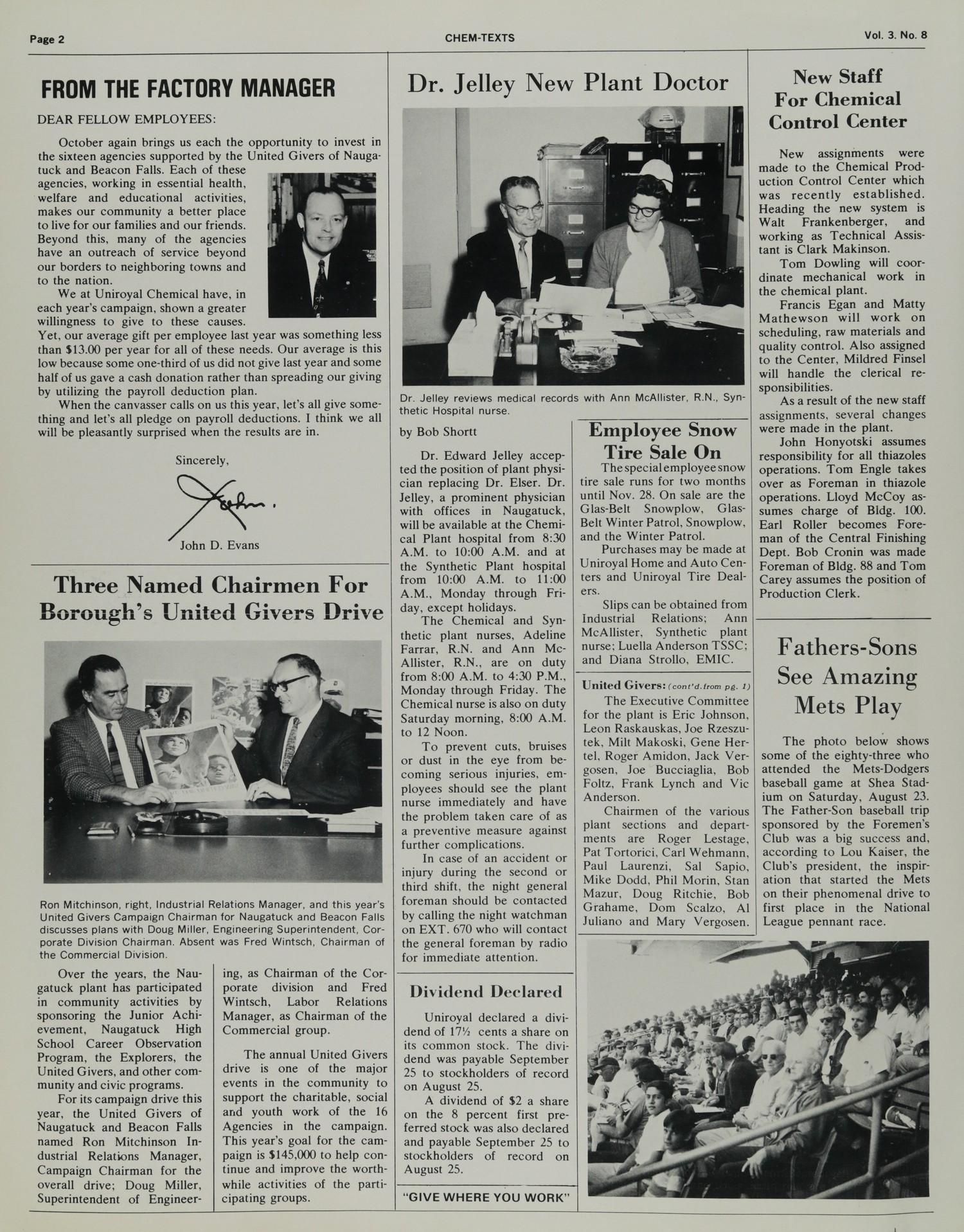
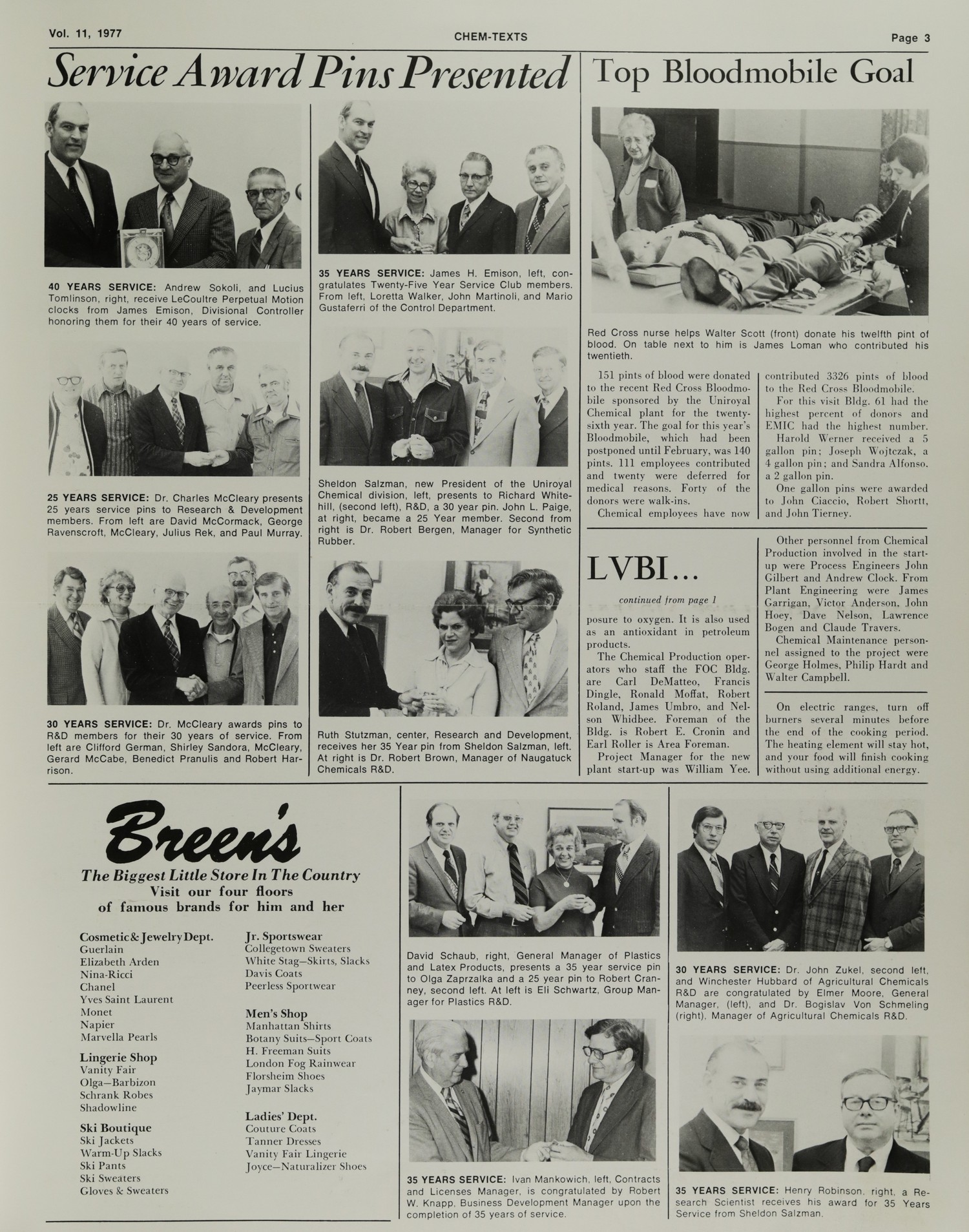
40 YEARS SERVICE: Andrew Sokoli, and Lucius Tomlinson, right, receive LeCoultre Perpetual Motion clocks from James Emison, Divisional Controller honoring them for their 40 years of service.


25 YEARS SERVICE: Dr. Charles McCleary presents 25 years service pins to Research & Development members. From left are David McCormack, George Ravenscroft, McCleary, Julius Rek, and Paul Murray.


30 YEARS SERVICE: Dr. McCleary awards pins to R&D members for their 30 years of service. From left are Clifford German, Shirley Sandora, McCleary, Gerard McCabe, Benedict Pranulis and Robert Harrison.


35 YEARS SERVICE: James H. Emison, left, congratulates Twenty-Five Year Service Club members. From left, Loretta Walker, John Martinoli, and Mario Gustaferri of the Control Department.


Sheldon Salzman, new President of the Uniroyal Chemical division, left, presents to Richard Whitehill, (second left), R&D, a 30 year pin. John L. Paige, at right, became a 25 Year member. Second from right is Dr. Robert Bergen, Manager for Synthetic Rubber.


Ruth Stutzman, center, Research and Development, receives her 35 Year pin from Sheldon Salzman, left. At right is Dr. Robert Brown, Manager of Naugatuck Chemicals R&D.


Top Bloodmobile Goal

Red Cross nurse helps Walter Scott (front) donate his twelfth pint of blood. On table next to him is James Loman who contributed his twentieth.

151 pints of blood were donated to the recent Red Cross Bloodmobile sponsored by the Uniroyal Chemical plant for the twenty-sixth year. The goal for this year’s Bloodmobile, which had been postponed until February, was 140 pints. 111 employees contributed and twenty were deferred for medical reasons. Forty of the donors were walk-ins.

Chemical employees have now contributed 3326 pints of blood to the Red Cross Bloodmobile.

For this visit Bldg. 61 had the highest percent of donors and EMIC had the highest number.

Harold Werner received a 5 gallon pin; Joseph Wojtczak, a 4 gallon pin; and Sandra Alfonso, a 2 gallon pin.

One gallon pins were awarded to John Ciaccio, Robert Shortt, and John Tierney.


LVBI…

continued from page 1

posure to oxygen. It is also used as an antioxidant in petroleum products.

The Chemical Production operators who staff the FOC Bldg. are Carl DeMatteo, Francis Dingle, Ronald Moffat, Robert Roland, James Umbro, and Nelson Whidbee. Foreman of the Bldg. is Robert E. Cronin and Earl Roller is Area Foreman.

Project Manager for the new plant start-up was William Yee.

Other personnel from Chemical Production involved in the start-up were Process Engineers John Gilbert and Andrew Clock. From Plant Engineering were James Garrigan, Victor Anderson, John Hoey, Dave Nelson, Lawrence Bogen and Claude Travers.

Chemical Maintenance personnel assigned to the project were George Holmes, Philip Hardt and Walter Campbell.


On electric ranges, turn off burners several minutes before the end of the cooking period. The heating element will stay hot, and your food will finish cooking without using additional energy.


Breen’s

The Biggest Little Store In The Country

Visit our four floors of famous brands for him and her

Cosmetic & Jewelry Dept.
Guerlain
Elizabeth Arden
Nina-Ricci
Chanel
Yves Saint Laurent
Monet
Napier
Marvella Pearls

Lingerie Shop
Vanity Fair
Olga—Barbizon
Schrank Robes
Shadowline

Ski Boutique
Ski Jackets
Warm-Up Slacks
Ski Pants
Ski Sweaters
Gloves & Sweaters

Jr. Sportswear
Collegetown Sweaters
White Stag—Skirts, Slacks
Davis Coats
Peerless Sportwear

Men’s Shop
Manhattan Shirts
Botany Suits—Sport Coats
H. Freeman Suits
London Fog Rainwear
Florsheim Shoes
Jaymar Slacks

Ladies’ Dept.
Couture Coats
Tanner Dresses
Vanity Fair Lingerie
Joyce—Naturalizer Shoes


David Schaub, right, General Manager of Plastics and Latex Products, presents a 35 year service pin to Olga Zaprzalka and a 25 year pin to Robert Cranney, second left. At left is Eli Schwartz, Group Manager for Plastics R&D.


30 YEARS SERVICE: Dr. John Zukei, second left, and Winchester Hubbard of Agricultural Chemicals R&D are congratulated by Elmer Moore, General Manager, (left), and Dr. Bogislav Von Schmeling (right), Manager of Agricultural Chemicals R&D.


35 YEARS SERVICE: Ivan Mankowich, left, Contracts and Licenses Manager, is congratulated by Robert W. Knapp, Business Development Manager upon the completion of 35 years of service.


35 YEARS SERVICE: Henry Robinson, right, a Research Scientist receives his award for 35 Years Service from Sheldon Salzman.
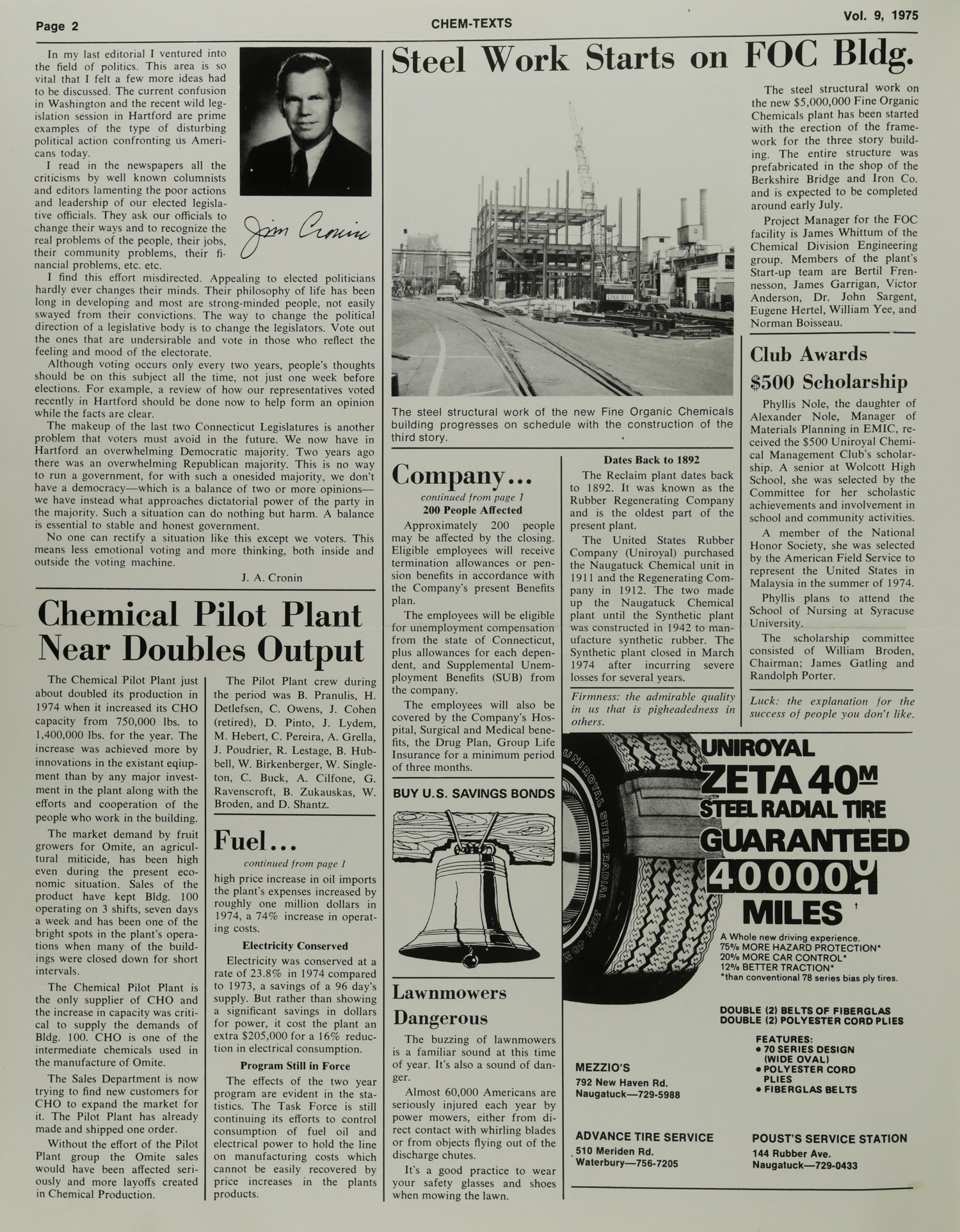
CHEM-TEXTS – 1975 – Page 2

Page 002

CHEM-TEXTS

Page 2 | Vol. 9, 1975


In my last editorial I ventured into the field of politics. This area is so vital that I felt a few more ideas had to be discussed. The current confusion in Washington and the recent wild legislation session in Hartford are prime examples of the type of disturbing political action confronting us Americans today.

I read in the newspapers all the criticisms by well known columnists and editors lamenting the poor actions and leadership of our elected legislative officials. They ask our officials to change their ways and to recognize the real problems of the people, their jobs, their community problems, their financial problems, etc. etc.

I find this effort misdirected. Appealing to elected politicians hardly ever changes their minds. Their philosophy of life has been long in developing and most are strong-minded people, not easily swayed from their convictions. The way to change the political direction of a legislative body is to change the legislators. Vote out the ones that are undersirable and vote in those who reflect the feeling and mood of the electorate.

Although voting occurs only every two years, people’s thoughts should be on this subject all the time, not just one week before elections. For example, a review of how our representatives voted recently in Hartford should be done now to help form an opinion while the facts are clear.

The makeup of the last two Connecticut Legislatures is another problem that voters must avoid in the future. We now have in Hartford an overwhelming Democratic majority. Two years ago there was an overwhelming Republican majority. This is no way to run a government, for with such a onesided majority, we don’t have a democracy—which is a balance of two or more opinions— we have instead what approaches dictatorial power of the party in the majority. Such a situation can do nothing but harm. A balance is essential to stable and honest government.

No one can rectify a situation like this except we voters. This means less emotional voting and more thinking, both inside and outside the voting machine.

J. A. Cronin

Jim Cronin [signature]

[PHOTO: Headshot of a man in suit]


Steel Work Starts on FOC Bldg.

[PHOTO: Construction site showing steel framework of a building]

The steel structural work on the new $5,000,000 Fine Organic Chemicals plant has been started with the erection of the framework for the three story building. The entire structure was prefabricated in the shop of the Berkshire Bridge and Iron Co. and is expected to be completed around early July.

Project Manager for the FOC facility is James Whittum of the Chemical Division Engineering group. Members of the plant’s Start-up team are Bertil Frennesson, James Garrigan, Victor Anderson, Dr. John Sargent, Eugene Hertel, William Yee, and Norman Boisseau.

The steel structural work of the new Fine Organic Chemicals building progresses on schedule with the construction of the third story.


Chemical Pilot Plant Near Doubles Output

The Chemical Pilot Plant just about doubled its production in 1974 when it increased its CHO capacity from 750,000 lbs. to 1,400,000 lbs. for the year. The increase was achieved more by innovations in the existant equipment than by any major investment in the plant along with the efforts and cooperation of the people who work in the building.

The market demand by fruit growers for Omite, an agricultural miticide, has been high even during the present economic situation. Sales of the product have kept Bldg. 100 operating on 3 shifts, seven days a week and has been one of the bright spots in the plant’s operations when many of the buildings were closed down for short intervals.

The Chemical Pilot Plant is the only supplier of CHO and the increase in capacity was critical to supply the demands of Bldg. 100. CHO is one of the intermediate chemicals used in the manufacture of Omite.

The Sales Department is now trying to find new customers for CHO to expand the market for it. The Pilot Plant has already made and shipped one order.

Without the effort of the Pilot Plant group the Omite sales would have been affected seriously and more layoffs created in Chemical Production.

The Pilot Plant crew during the period was B. Pranulis, H. Detlefsen, C. Owens, J. Cohen (retired), D. Pinto, J. Lydem, M. Hebert, C. Pereira, A. Grella, J. Poudrier, R. Lestage, B. Hubbell, W. Birkenberger, W. Singleton, C. Buck, A. Cilfone, G. Ravenscroft, B. Zukauskas, W. Broden, and D. Shantz.


Company…

continued from page 1

200 People Affected

Approximately 200 people may be affected by the closing. Eligible employees will receive termination allowances or pension benefits in accordance with the Company’s present Benefits plan.

The employees will be eligible for unemployment compensation from the state of Connecticut, plus allowances for each dependent, and Supplemental Unemployment Benefits (SUB) from the company.

The employees will also be covered by the Company’s Hospital, Surgical and Medical benefits, the Drug Plan, Group Life Insurance for a minimum period of three months.

BUY U.S. SAVINGS BONDS


Dates Back to 1892

The Reclaim plant dates back to 1892. It was known as the Rubber Regenerating Company and is the oldest part of the present plant.

The United States Rubber Company (Uniroyal) purchased the Naugatuck Chemical unit in 1911 and the Regenerating Company in 1912. The two made up the Naugatuck Chemical plant until the Synthetic plant was constructed in 1942 to manufacture synthetic rubber. The Synthetic plant closed in March 1974 after incurring severe losses for several years.

Firmness: the admirable quality in us that is pigheadedness in others.


Fuel…

continued from page 1

high price increase in oil imports the plant’s expenses increased by roughly one million dollars in 1974, a 74% increase in operating costs.

Electricity Conserved

Electricity was conserved at a rate of 23.8% in 1974 compared to 1973, a savings of a 96 day’s supply. But rather than showing a significant savings in dollars for power, it cost the plant an extra $205,000 for a 16% reduction in electrical consumption.

Program Still in Force

The effects of the two year program are evident in the statistics. The Task Force is still continuing its efforts to control consumption of fuel oil and electrical power to hold the line on manufacturing costs which cannot be easily recovered by price increases in the plants products.


Club Awards $500 Scholarship

Phyllis Nole, the daughter of Alexander Nole, Manager of Materials Planning in EMIC, received the $500 Uniroyal Chemical Management Club’s scholarship. A senior at Wolcott High School, she was selected by the Committee for her scholastic achievements and involvement in school and community activities.

A member of the National Honor Society, she was selected by the American Field Service to represent the United States in Malaysia in the summer of 1974.

Phyllis plans to attend the School of Nursing at Syracuse University.

The scholarship committee consisted of William Broden, Chairman; James Gatling and Randolph Porter.

Luck: the explanation for the success of people you don’t like.


Lawnmowers Dangerous

[IMAGE: Drawing of a Liberty Bell]

The buzzing of lawnmowers is a familiar sound at this time of year. It’s also a sound of danger.

Almost 60,000 Americans are seriously injured each year by power mowers, either from direct contact with whirling blades or from objects flying out of the discharge chutes.

It’s a good practice to wear your safety glasses and shoes when mowing the lawn.


MEZZIO’S
792 New Haven Rd.
Naugatuck—729-5988

ADVANCE TIRE SERVICE
510 Meriden Rd.
Waterbury—756-7205

POUST’S SERVICE STATION
144 Rubber Ave.
Naugatuck—729-0433


[ADVERTISEMENT]

UNIROYAL

ZETA 40M

STEEL RADIAL TIRE

GUARANTEED

40000

MILES

A Whole new driving experience.
75% MORE HAZARD PROTECTION
20% MORE CAR CONTROL

12% BETTER TRACTION
than conventional 78 series bias ply tires.

DOUBLE (2) BELTS OF FIBERGLAS
DOUBLE (2) POLYESTER CORD PLIES

FEATURES:
– 70 SERIES DESIGN (WIDE OVAL)
– POLYESTER CORD PLIES
– FIBERGLAS BELTS

CHEM-TEXTS – 1973-v07-s219

Page 219

Page 2 CHEM-TEXTS Vol. 7, 1973


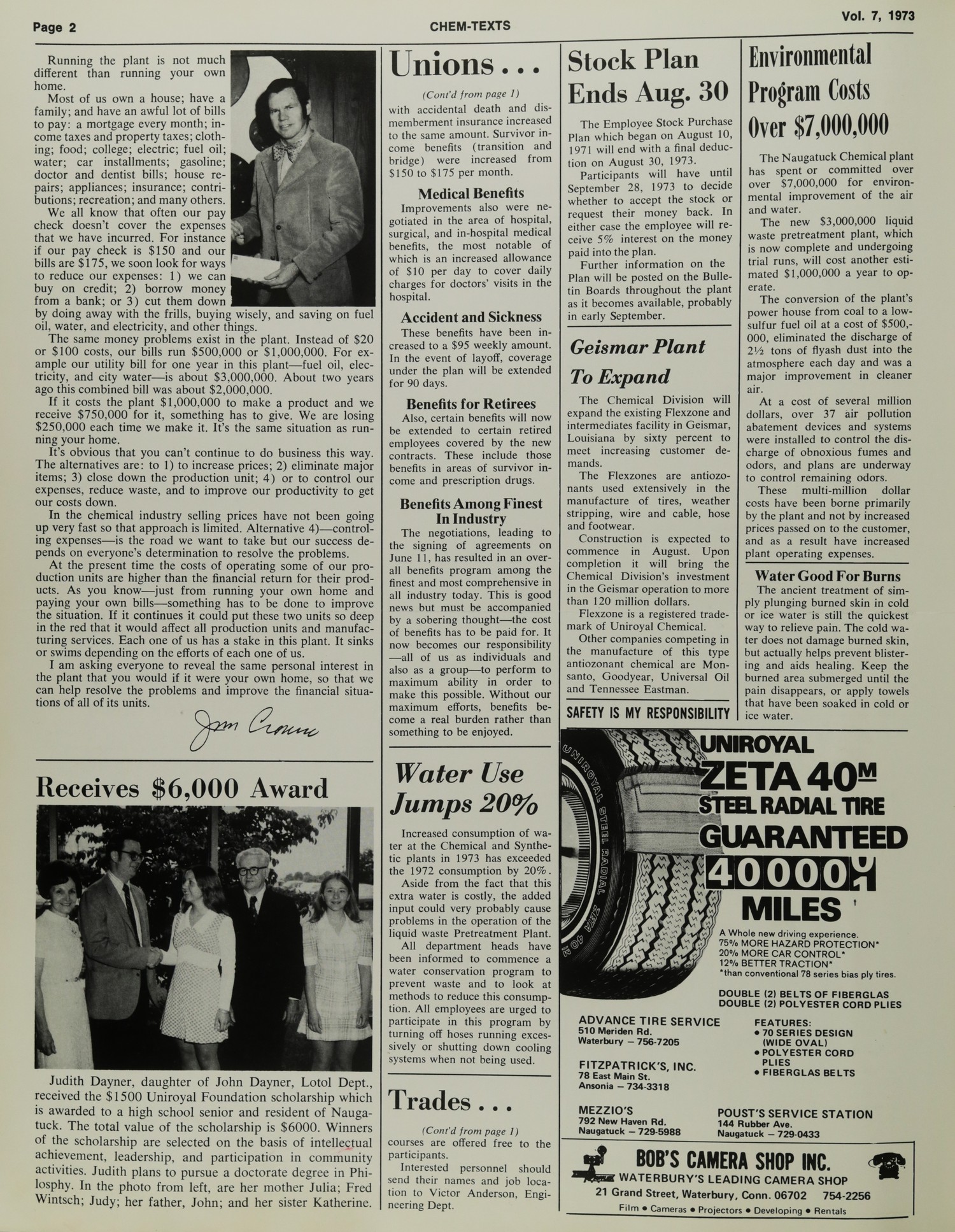
Running the plant is not much different than running your own home.

Most of us own a house; have a family; and have an awful lot of bills to pay: a mortgage every month; income taxes and property taxes; clothing; food; college; electric; fuel oil; water; car installments; gasoline; doctor and dentist bills; house repairs; appliances; insurance; contributions; recreation; and many others.

We all know that often our pay check doesn’t cover the expenses that we have incurred. For instance if our pay check is $150 and our bills are $175, we soon look for ways to reduce our expenses: 1) we can buy on credit; 2) borrow money from a bank; or 3) cut them down by doing away with the frills, buying wisely, and saving on fuel oil, water, and electricity, and other things.

The same money problems exist in the plant. Instead of $20 or $100 costs, our bills run $500,000 or $1,000,000. For example our utility bill for one year in this plant—fuel oil, electricity, and city water—is about $3,000,000. About two years ago this combined bill was about $2,000,000.

If it costs the plant $1,000,000 to make a product and we receive $750,000 for it, something has to give. We are losing $250,000 each time we make it. It’s the same situation as running your home.

It’s obvious that you can’t continue to do business this way. The alternatives are: to 1) to increase prices; 2) eliminate major items; 3) close down the production unit; 4) or to control our expenses, reduce waste, and to improve our productivity to get our costs down.

In the chemical industry selling prices have not been going up very fast so that approach is limited. Alternative 4)—controlling expenses—is the road we want to take but our success depends on everyone’s determination to resolve the problems.

At the present time the costs of operating some of our production units are higher than the financial return for their products. As you know—just from running your own home and paying your own bills—something has to be done to improve the situation. If it continues it could put these two units so deep in the red that it would affect all production units and manufacturing services. Each one of us has a stake in this plant. It sinks or swims depending on the efforts of each one of us.

I am asking everyone to reveal the same personal interest in the plant that you would if it were your own home, so that we can help resolve the problems and improve the financial situations of all of its units.

Jan Crane [signature]


Receives $6,000 Award

[PHOTO: Group photo of four people]

Judith Dayner, daughter of John Dayner, Lotol Dept., received the $1500 Uniroyal Foundation scholarship which is awarded to a high school senior and resident of Naugatuck. The total value of the scholarship is $6000. Winners of the scholarship are selected on the basis of intellectual achievement, leadership, and participation in community activities. Judith plans to pursue a doctorate degree in Philosophy. In the photo from left, are her mother Julia; Fred Wintsch; Judy; her father, John; and her sister Katherine.


Unions…

(Cont’d from page 1)

with accidental death and dismemberment insurance increased to the same amount. Survivor income benefits (transition and bridge) were increased from $150 to $175 per month.

Medical Benefits

Improvements also were negotiated in the area of hospital, surgical, and in-hospital medical benefits, the most notable of which is an increased allowance of $10 per day to cover daily charges for doctors’ visits in the hospital.

Accident and Sickness

These benefits have been increased to a $95 weekly amount. In the event of layoff, coverage under the plan will be extended for 90 days.

Benefits for Retirees

Also, certain benefits will now be extended to certain retired employees covered by the new contracts. These include those benefits in areas of survivor income and prescription drugs.

Benefits Among Finest In Industry

The negotiations, leading to the signing of agreements on June 11, has resulted in an overall benefits program among the finest and most comprehensive in all industry today. This is good news but must be accompanied by a sobering thought—the cost of benefits has to be paid for. It now becomes our responsibility —all of us as individuals and also as a group—to perform to maximum ability in order to make this possible. Without our maximum efforts, benefits become a real burden rather than something to be enjoyed.


Water Use Jumps 20%

Increased consumption of water at the Chemical and Synthetic plants in 1973 has exceeded the 1972 consumption by 20%.

Aside from the fact that this extra water is costly, the added input could very probably cause problems in the operation of the liquid waste Pretreatment Plant.

All department heads have been informed to commence a water conservation program to prevent waste and to look at methods to reduce this consumption. All employees are urged to participate in this program by turning off hoses running excessively or shutting down cooling systems when not being used.

[PHOTO: Person near water/equipment]


Trades…

(Cont’d from page 1)

courses are offered free to the participants.

Interested personnel should send their names and job location to Victor Anderson, Engineering Dept.


Stock Plan Ends Aug. 30

The Employee Stock Purchase Plan which began on August 10, 1971 will end with a final deduction on August 30, 1973.

Participants will have until September 28, 1973 to decide whether to accept the stock or request their money back. In either case the employee will receive 5% interest on the money paid into the plan.

Further information on the Plan will be posted on the Bulletin Boards throughout the plant as it becomes available, probably in early September.


Geismar Plant To Expand

The Chemical Division will expand the existing Flexzone and intermediates facility in Geismar, Louisiana by sixty percent to meet increasing customer demands.

The Flexzones are antiozonants used extensively in the manufacture of tires, weather stripping, wire and cable, hose and footwear.

Construction is expected to commence in August. Upon completion it will bring the Chemical Division’s investment in the Geismar operation to more than 120 million dollars.

Flexzone is a registered trademark of Uniroyal Chemical.

Other companies competing in the manufacture of this type antiozonant chemical are Monsanto, Goodyear, Universal Oil and Tennessee Eastman.


SAFETY IS MY RESPONSIBILITY


Environmental Program Costs Over $7,000,000

The Naugatuck Chemical plant has spent or committed over $7,000,000 for environmental improvement of the air and water.

The new $3,000,000 liquid waste pretreatment plant, which is now complete and undergoing trial runs, will cost another estimated $1,000,000 a year to operate.

The conversion of the plant’s power house from coal to a low-sulfur fuel oil at a cost of $500,000, eliminated the discharge of 2½ tons of flyash dust into the atmosphere each day and was a major improvement in cleaner air.

At a cost of several million dollars, over 37 air pollution abatement devices and systems were installed to control the discharge of obnoxious fumes and odors, and plans are underway to control remaining odors.

These multi-million dollar costs have been borne primarily by the plant and not by increased prices passed on to the customer, and as a result have increased plant operating expenses.

Water Good For Burns

The ancient treatment of simply plunging burned skin in cold or ice water is still the quickest way to relieve pain. The cold water does not damage burned skin, but actually helps prevent blistering and aids healing. Keep the burned area submerged until the pain disappears, or apply towels that have been soaked in cold or ice water.


[ADVERTISEMENT]

UNIROYAL

ZETA 40M

STEEL RADIAL TIRE

GUARANTEED

40000

MILES

A Whole new driving experience.
75% MORE HAZARD PROTECTION
20% MORE CAR CONTROL

12% BETTER TRACTION
than conventional 78 series bias ply tires.

DOUBLE (2) BELTS OF FIBERGLAS
DOUBLE (2) POLYESTER CORD PLIES

ADVANCE TIRE SERVICE
510 Meriden Rd.
Waterbury — 756-7205

FEATURES:
• 70 SERIES DESIGN (WIDE OVAL)
• POLYESTER CORD PLIES
• FIBERGLAS BELTS

FITZPATRICK’S, INC.
78 East Main St.
Ansonia — 734-3318

MEZZIO’S
792 New Haven Rd.
Naugatuck — 729-5988

POUST’S SERVICE STATION
144 Rubber Ave.
Naugatuck — 729-0433


BOB’S CAMERA SHOP INC.
WATERBURY’S LEADING CAMERA SHOP
21 Grand Street, Waterbury, Conn. 06702 754-2256
Film • Cameras • Projectors • Developing • Rentals

CHEM-TEXTS – 1973 – Page 3

Page 003

Vol. 7, 1973 CHEM-TEXTS Page 3


A B.S. 20 Years Later

[IMAGE: Two men standing together, one appears to be congratulating the other, with a framed picture on the wall behind them]

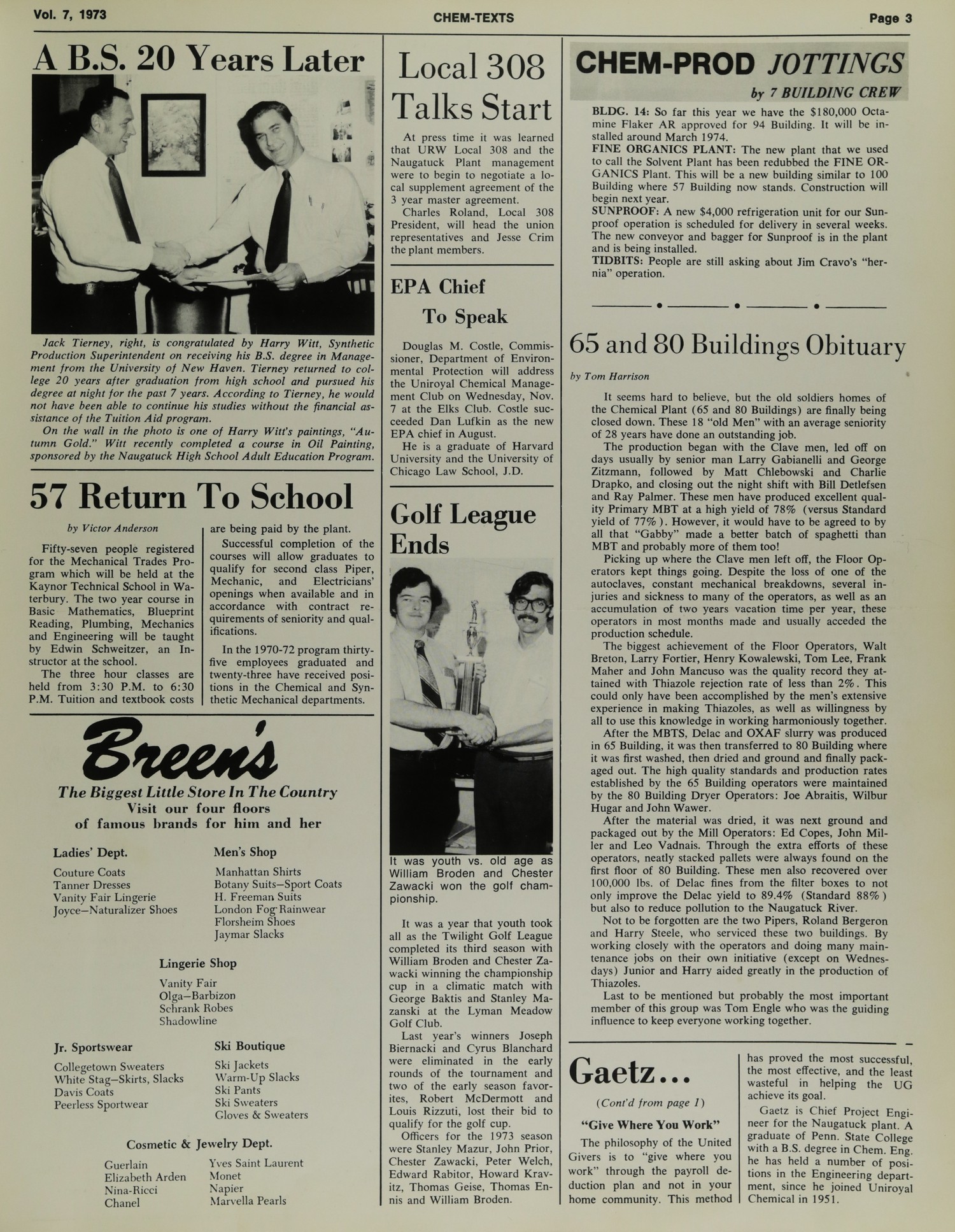
Jack Tierney, right, is congratulated by Harry Witt, Synthetic Production Superintendent on receiving his B.S. degree in Management from the University of New Haven. Tierney returned to college 20 years after graduation from high school and pursued his degree at night for the past 7 years. According to Tierney, he would not have been able to continue his studies without the financial assistance of the Tuition Aid program.

On the wall in the photo is one of Harry Witt’s paintings, “Autumn Gold.” Witt recently completed a course in Oil Painting, sponsored by the Naugatuck High School Adult Education Program.


57 Return To School

by Victor Anderson

Fifty-seven people registered for the Mechanical Trades Program which will be held at the Kaynor Technical School in Waterbury. The two year course in Basic Mathematics, Blueprint Reading, Plumbing, Mechanics and Engineering will be taught by Edwin Schweitzer, an Instructor at the school.

The three hour classes are held from 3:30 P.M. to 6:30 P.M. Tuition and textbook costs are being paid by the plant.

Successful completion of the courses will allow graduates to qualify for second class Piper, Mechanic, and Electricians’ openings when available and in accordance with contract requirements of seniority and qualifications.

In the 1970-72 program thirty-five employees graduated and twenty-three have received positions in the Chemical and Synthetic Mechanical departments.


Local 308 Talks Start

At press time it was learned that URW Local 308 and the Naugatuck Plant management were to begin to negotiate a local supplement agreement of the 3 year master agreement.

Charles Roland, Local 308 President, will head the union representatives and Jesse Crim the plant members.


EPA Chief To Speak

Douglas M. Costle, Commissioner, Department of Environmental Protection will address the Uniroyal Chemical Management Club on Wednesday, Nov. 7 at the Elks Club. Costle succeeded Dan Lufkin as the new EPA chief in August.

He is a graduate of Harvard University and the University of Chicago Law School, J.D.


Golf League Ends

It was youth vs. old age as William Broden and Chester Zawacki won the golf championship.

It was a year that youth took all as the Twilight Golf League completed its third season with William Broden and Chester Zawacki winning the championship cup in a climatic match with George Baktis and Stanley Mazanski at the Lyman Meadow Golf Club.

Last year’s winners Joseph Biernacki and Cyrus Blanchard were eliminated in the early rounds of the tournament and two of the early season favorites, Robert McDermott and Louis Rizzuti, lost their bid to qualify for the golf cup.

Officers for the 1973 season were Stanley Mazur, John Prior, Chester Zawacki, Peter Welch, Edward Rabitor, Howard Kravitz, Thomas Geise, Thomas Ennis and William Broden.


Breen’s

The Biggest Little Store In The Country

Visit our four floors of famous brands for him and her

Ladies’ Dept. Men’s Shop
Couture Coats Manhattan Shirts
Tanner Dresses Botany Suits—Sport Coats
Vanity Fair Lingerie H. Freeman Suits
Joyce—Naturalizer Shoes London Fog Rainwear
Florsheim Shoes
Jaymar Slacks

Lingerie Shop

Vanity Fair
Olga—Barbizon
Schrank Robes
Shadowline

Jr. Sportswear Ski Boutique
Collegetown Sweaters Ski Jackets
White Stag—Skirts, Slacks Warm-Up Slacks
Davis Coats Ski Pants
Peerless Sportwear Ski Sweaters
Gloves & Sweaters

Cosmetic & Jewelry Dept.

Guerlain Yves Saint Laurent
Elizabeth Arden Monet
Nina-Ricci Napier
Chanel Marvella Pearls

CHEM-PROD JOTTINGS

by 7 BUILDING CREW

BLDG. 14: So far this year we have the $180,000 Octamine Flaker AR approved for 94 Building. It will be installed around March 1974.

FINE ORGANICS PLANT: The new plant that we used to call the Solvent Plant has been redubbed the FINE ORGANICS Plant. This will be a new building similar to 100 Building where 57 Building now stands. Construction will begin next year.

SUNPROOF: A new $4,000 refrigeration unit for our Sunproof operation is scheduled for delivery in several weeks. The new conveyor and bagger for Sunproof is in the plant and is being installed.

TIDBITS: People are still asking about Jim Cravo’s “hernia” operation.


65 and 80 Buildings Obituary

by Tom Harrison

It seems hard to believe, but the old soldiers homes of the Chemical Plant (65 and 80 Buildings) are finally being closed down. These 18 “old Men” with an average seniority of 28 years have done an outstanding job.

The production began with the Clave men, led off on days usually by senior man Larry Gabianelli and George Zitzmann, followed by Matt Chlebowski and Charlie Drapko, and closing out the night shift with Bill Detlefsen and Ray Palmer. These men have produced excellent quality Primary MBT at a high yield of 78% (versus Standard yield of 77%). However, it would have to be agreed to by all that “Gabby” made a better batch of spaghetti than MBT and probably more of them too!

Picking up where the Clave men left off, the Floor Operators kept things going. Despite the loss of one of the autoclaves, constant mechanical breakdowns, several injuries and sickness to many of the operators, as well as an accumulation of two years vacation time per year, these operators in most months made and usually acceded the production schedule.

The biggest achievement of the Floor Operators, Walt Breton, Larry Fortier, Henry Kowalewski, Tom Lee, Frank Maher and John Mancuso was the quality record they attained with Thiazole rejection rate of less than 2%. This could only have been accomplished by the men’s extensive experience in making Thiazoles, as well as willingness by all to use this knowledge in working harmoniously together.

After the MBTS, Delac and OXAF slurry was produced in 65 Building, it was then transferred to 80 Building where it was first washed, then dried and ground and finally packaged out. The high quality standards and production rates established by the 65 Building operators were maintained by the 80 Building Dryer Operators: Joe Abraitis, Wilbur Hugar and John Wawer.

After the material was dried, it was next ground and packaged out by the Mill Operators: Ed Copes, John Miller and Leo Vadnais. Through the extra efforts of these operators, neatly stacked pallets were always found on the first floor of 80 Building. These men also recovered over 100,000 lbs. of Delac fines from the filter boxes to not only improve the Delac yield to 89.4% (Standard 88%) but also to reduce pollution to the Naugatuck River.

Not to be forgotten are the two Pipers, Roland Bergeron and Harry Steele, who serviced these two buildings. By working closely with the operators and doing many maintenance jobs on their own initiative (except on Wednesdays) Junior and Harry aided greatly in the production of Thiazoles.

Last to be mentioned but probably the most important member of this group was Tom Engle who was the guiding influence to keep everyone working together.


Gaetz…

(Cont’d from page 1)

“Give Where You Work”

The philosophy of the United Givers is to “give where you work” through the payroll deduction plan and not in your home community. This method has proved the most successful, the most effective, and the least wasteful in helping the UG achieve its goal.

Gaetz is Chief Project Engineer for the Naugatuck plant. A graduate of Penn. State College with a B.S. degree in Chem. Eng. he has held a number of positions in the Engineering department, since he joined Uniroyal Chemical in 1951.

Accident Frequency Reduced 54% 1500 Turkevs Awarded to Employees

Page 2 | CHEM-TEXTS | Vol. 7, 1973


The end of the year is upon us, and traditionally it is an ideal time to review the past year and take a peek at the next.

Obviously, it is impossible to review all of the little steps of progress we have made this year. Therefore, I would like to offer a general review of our plant and business in 1973.

The epitome of working together, I think, is this year’s outstanding safety performance over last year’s. Without the complete involvement of all “Chemical people”, we would not have been as successful.

We still have a long way to go, particularly in the number of days lost due to accidents. But this year’s performance has built the base from which we can launch the effort needed to overcome this next difficult hurdle.

In the business line, Chemical Production came through a torturous year with encouraging vigor. The year started great, only to slow down at mid year when uncertain business conditions caused customers to hedge on their purchases.

Then when sales started to pick up, we were staggered by the continuing energy-related raw material shortages.

Heading into the new year, we face the confusing problem of having the sales, but perhaps not the raw materials. In addition, these materials are skyrocketing in cost. Survival next year can be defined as having the flexibility to make the most of a difficult situation.

We all know the problems facing our Reclaim plant. But if this year’s performance and attitude are any indication of our strength and perseverance, we are going to give that business a real run for the money in 1974. Turning an old giant like that around, enough to make it competitive, is a formidable task. Time is a problem and 1974 is our year to show them what we’re made of.

It is unfortunate that we have become non-competitive in the Synthetic latex business. We must quickly recover from this shutdown and adjust ourselves to solving today’s problems.

Attitude and cooperation did it with our Safety performance. The same approach must be used in improving the competitive and economic position of our plant. A healthy business means secure jobs—for one and all.

Despite the lack of Christmas lights this year, I would like to extend to all of you, and your families, my best wishes for the Christmas holiday. It is a comforting time of the year, but also a time to remind ourselves how fortunate we really are.

Jim Crim


Accident Frequency Reduced 54%

1500 Turkeys Awarded to Employees

[IMAGE: Photo showing three people examining documents]

Jesse Crim, Industrial Relations Manager for the Chemical plant, checks the turkey lists with Molly Cobbol, left, and Constance Antrum, right.

1500 turkeys were awarded to employees for reducing the accident frequency rate 54% during 1973.

During the year accidents to employees at work dropped from 73 in 1972 to 33 for 1973. This is a 54% reduction in accident frequency—the number of Lost Time Accidents and Serious Injuries per one million manhours worked.

Attain 12.0 Goal—1500 Turkeys Awarded

In early January a Safety Incentive Awards Program was initiated with an accident frequency goal of 12.0.

The present accident frequency is 10.43 per 1,000,000 manhours worked. Since this record is below the 12.0 goal all eligible employees received 12-14 lb. turkeys for achieving this major safety improvement during the year.

Top 500,000 Manhours

For the third time this year the plant worked 500,000 manhours without a Lost Time Accident. As a result drawings were held throughout the plant on December 5 for six Zenith black and white portable TV sets.


Energy Force Formed

A Conservation Resources Task Force of Engineering Specialists has now been in existence over two months to coordinate the efforts of all departments to conserve steam, electricity, water, air, and raw materials throughout the 145 units of the plant.

The two critical areas that the Task Force will concentrate on are the conservation of fuel oil and electricity.

Because of the critical shortage of low sulfur fuel the Connecticut State Department of Environmental Protection recently approved the use of a 1.25% sulfur content fuel oil, and coal with 2% sulfur content by the Utilities companies.

Task Force Members

The Task Force members—Douglas Ritchie, William Leukhardt, Charles Reich, Jon Painter, George Allen, Stanley Korpusick, Victor Anderson, George Arndt, and Arthur Aronson—have initiated monitoring plans for energy conservation and organized sub-committees to assist in supplementing the program.

The plant’s 500 HP motors will come under special surveillance by the force along with the high pressure steam systems, and the hot water usage throughout the entire plant.

A significant way everyone can help is to close windows and doors; turn off motors and lights when not in use; use water carefully; and turn down heating units.


How To Use Words

Be concise. Use words sparingly. Avoid smothering your good ideas beneath a mountain of verbiage.


Energy Program Working

17.6% less fuel oil was consumed in November 1973 vs. November 1972. This represents a savings of a four-day supply of fuel oil.

During the same period 7% less electricity was consumed throughout the plant. This is a savings equivalent to a two-day supply of electrical power.

These reductions were achieved for the same level of production in November 1973 as November 1972.

Our Energy Conservation program efforts are paying off and with everyone’s concern and assistance, even this good start can be improved.

With the costs of scarce power resources increasing continually, every employee’s cooperation is needed to continue the fullest possible operation of the plant.


$50,000 Unit… (Cont’d from page 1)

[IMAGE: Photo of helicopter landing in yard with buildings in background, marked “CARSON”]

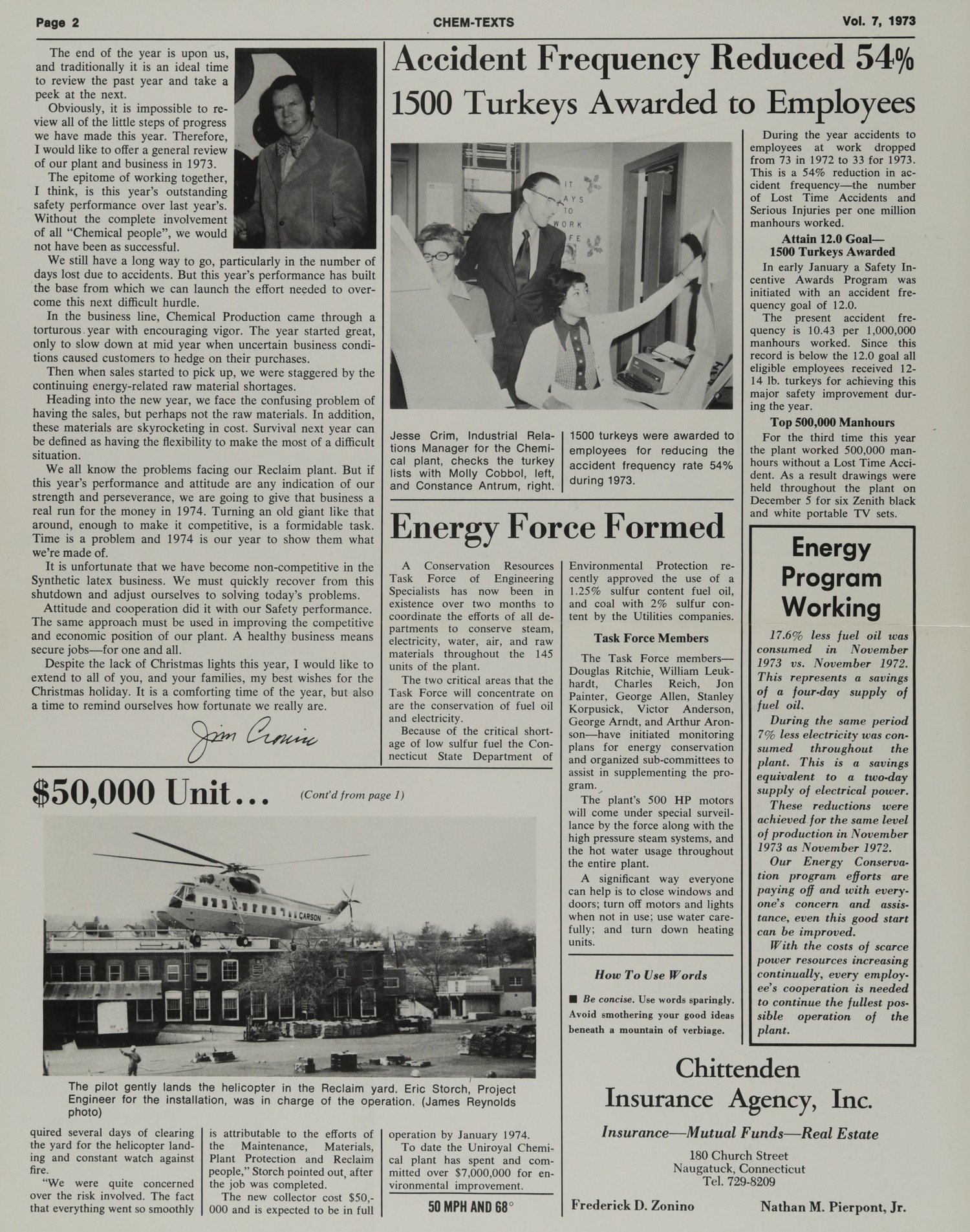
The pilot gently lands the helicopter in the Reclaim yard. Eric Storch, Project Engineer for the installation, was in charge of the operation. (James Reynolds photo)

quired several days of clearing the yard for the helicopter landing and constant watch against fire.

“We were quite concerned over the risk involved. The fact that everything went so smoothly is attributable to the efforts of the Maintenance, Materials, Plant Protection and Reclaim people,” Storch pointed out after the job was completed.

The new collector cost $50,000 and is expected to be in operation by January 1974.

To date the Uniroyal Chemical plant has spent and committed over $7,000,000 for environmental improvement.

50 MPH AND 68°


Chittenden Insurance Agency, Inc.

Insurance—Mutual Funds—Real Estate

180 Church Street
Naugatuck, Connecticut
Tel. 729-8209

Frederick D. Zonino | Nathan M. Pierpont, Jr.

CHEM-TEXTS – Vol. 4, 1970, No. 8 – Page 1

Page 001

UNIROYAL CHEM-TEXTS

Vol. 4, 1970 | PUBLISHED FOR THE PEOPLE OF UNIROYAL CHEMICAL | No. 8


Polygard Facilities To Expand

by Rod Gaetz

Design drawings are near completion for the expansion of Polygard ® facilities in Bldg. 109. The major equipment has been ordered and 75% of the necessary piping materials are on order for the project which will increase the production rates of the chemical. The project is part of the plant’s continuing program to stay competitive in a tight chemical market, keep business at the plant and keep chemical production employment at a full level.

Used In Rubber

Polygard is one of the most effective nondiscoloring and nonstaining stabilizers for synthetic rubber in commercial use today. Without Polygard protection, degradation occurs during the finishing, processing and vulcanization, resulting in a shorter service life of the final rubber product.

As a chemical, Polygard is safe to use, having the approval of the Food and Drug Administration (FDA) for use in products used for packaging or handling food.

New Stainless Steel Lines

The major work done during the summer shutdown of the building was the relocation and repiping of 2 Hold tanks from the second to the third floor. The piping from the bottom of the four vessels which will eventually become strippers was replaced with much larger stainless steel lines. The transfer pump was relocated and the discharge lines relocated and replaced with 3″ and 4″ stainless steel piping.

Fume Control Devices

When completed in early 1972, the expanded facilities will have environmental control devices to control fume pollution as part of the plant’s policy in the installation of new equipment and facilities.

Engineers working on the expansion are Terry Mo and Rod Gaetz; Vic Anderson, instrumentation and electricity; and Lou Kaiser, environmental control.


MIP Plan To Start

Instead of the 1970 stock purchase plan slated to start August 1, Uniroyal will expand the Monthly Investment Plan (MIP) to all employees interested in purchasing Uniroyal stock, at the market price, on a regular payroll deduction basis.

Under the plan, which is operated by Merrill Lynch, Pierce, Fenner and Smith, Inc., employees can sign up for regular payroll deductions. There are minimum and maximum deductions which will be indicated with other information, in plan brochures available shortly.

Merrill Lynch will purchase Uniroyal stock at the market price and keep individual accounts for each employee. Employees will receive regular statements from Merrill Lynch showing how much stock has been

(Cont’d on page 4)


H.S. Diploma Obtainable

It’s still possible for a person who left high school for one reason or another to obtain a high school diploma without going back to school.

To qualify for a diploma,

(Cont’d on page 4)


Chemical Control Center, The First In Chemical Division

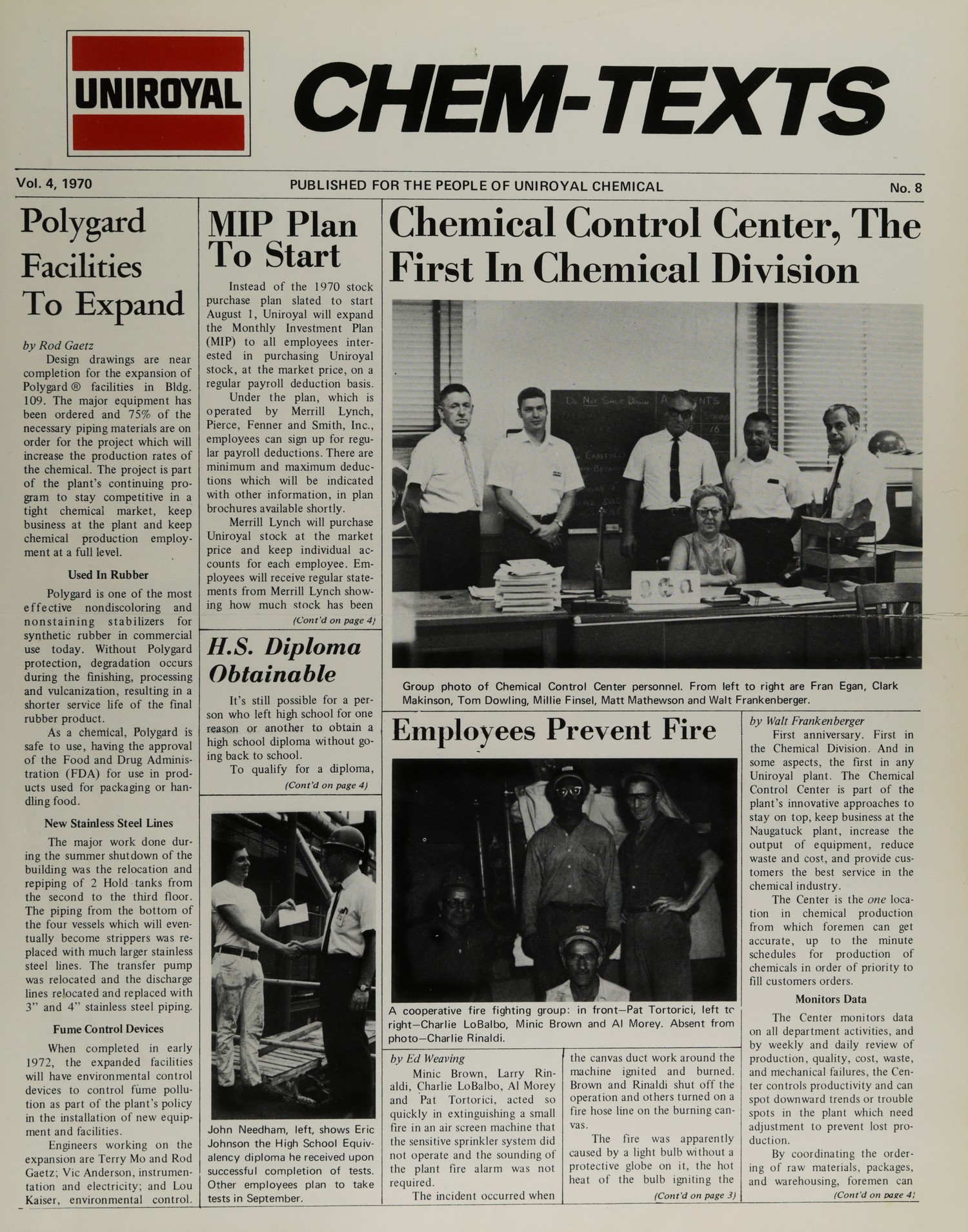
Group photo of Chemical Control Center personnel. From left to right are Fran Egan, Clark Makinson, Tom Dowling, Millie Finsel, Matt Mathewson and Walt Frankenberger.


Employees Prevent Fire

by Walt Frankenberger

First anniversary. First in the Chemical Division. And in some aspects, the first in any Uniroyal plant. The Chemical Control Center is part of the plant’s innovative approaches to stay on top, keep business at the Naugatuck plant, increase the output of equipment, reduce waste and cost, and provide customers the best service in the chemical industry.

The Center is the one location in chemical production from which foremen can get accurate, up to the minute schedules for production of chemicals in order of priority to fill customers orders.

Monitors Data

The Center monitors data on all department activities, and by weekly and daily review of production, quality, cost, waste, and mechanical failures, the Center controls productivity and can spot downward trends or trouble spots in the plant which need adjustment to prevent lost production.

By coordinating the ordering of raw materials, packages, and warehousing, foremen can

(Cont’d on page 4)


A cooperative fire fighting group: in front—Pat Tortorici, left to right—Charlie LoBalbo, Minic Brown and Al Morey. Absent from photo—Charlie Rinaldi.


John Needham, left, shows Eric Johnson the High School Equivalency diploma he received upon successful completion of tests. Other employees plan to take tests in September.


by Ed Weaving

Minic Brown, Larry Rinaldi, Charlie LoBalbo, Al Morey and Pat Tortorici, acted so quickly in extinguishing a small fire in an air screen machine that the sensitive sprinkler system did not operate and the sounding of the plant fire alarm was not required.

The incident occurred when the canvas duct work around the machine ignited and burned. Brown and Rinaldi shut off the operation and others turned on a fire hose line on the burning canvas.

The fire was apparently caused by a light bulb without a protective globe on it, the hot heat of the bulb igniting the

(Cont’d on page 3)

CHEM-TEXTS – Vol. 3, 1969, No. 6 – Page 1

Page 001

UNIROYAL CHEM-TEXTS

Vol. 3, 1969 PUBLISHED FOR THE PEOPLE OF UNIROYAL CHEMICAL No. 8


United Givers Goal $22,000. “Give Where You Work” Vital To Drive’s Success.

[IMAGE: Black and white photograph showing faces of children and adults looking upward]

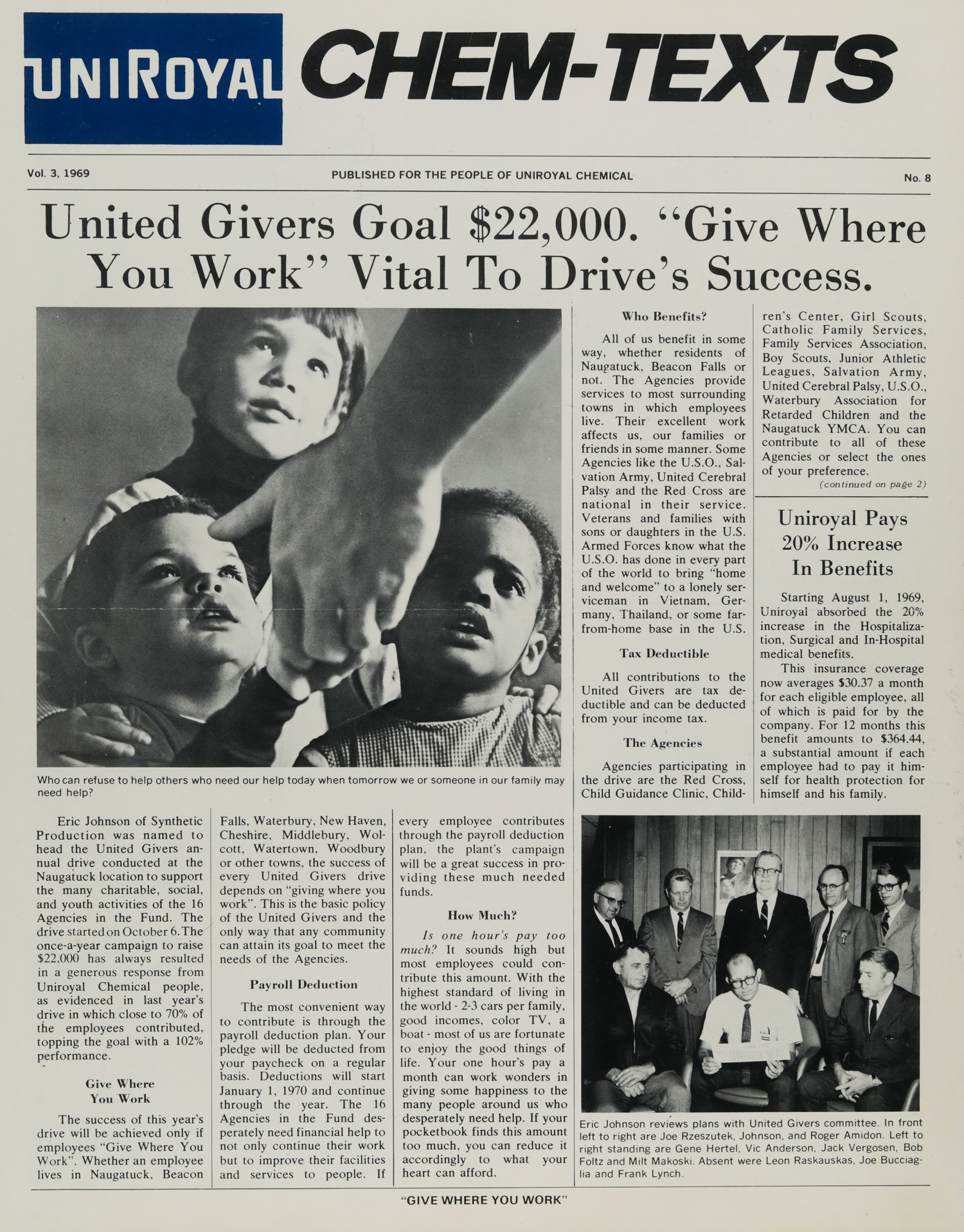
Who can refuse to help others who need our help today when tomorrow we or someone in our family may need help?


Eric Johnson of Synthetic Production was named to head the United Givers annual drive conducted at the Naugatuck location to support the many charitable, social, and youth activities of the 16 Agencies in the Fund. The drive started on October 6. The once-a-year campaign to raise $22,000 has always resulted in a generous response from Uniroyal Chemical people, as evidenced in last year’s drive in which close to 70% of the employees contributed, topping the goal with a 102% performance.

Give Where You Work

The success of this year’s drive will be achieved only if employees “Give Where You Work”. Whether an employee lives in Naugatuck, Beacon Falls, Waterbury, New Haven, Cheshire, Middlebury, Wolcott, Watertown, Woodbury or other towns, the success of every United Givers drive depends on “giving where you work”. This is the basic policy of the United Givers and the only way that any community can attain its goal to meet the needs of the Agencies.

Payroll Deduction

The most convenient way to contribute is through the payroll deduction plan. Your pledge will be deducted from your paycheck on a regular basis. Deductions will start January 1, 1970 and continue through the year. The 16 Agencies in the Fund desperately need financial help to not only continue their work but to improve their facilities and services to people. If every employee contributes through the payroll deduction plan, the plant’s campaign will be a great success in providing these much needed funds.

How Much?

Is one hour’s pay too much? It sounds high but most employees could contribute this amount. With the highest standard of living in the world – 2-3 cars per family, good incomes, color TV, a boat – most of us are fortunate to enjoy the good things of life. Your one hour’s pay a month can work wonders in giving some happiness to the many people around us who desperately need help. If your pocketbook finds this amount too much, you can reduce it accordingly to what your heart can afford.

Who Benefits?

All of us benefit in some way, whether residents of Naugatuck, Beacon Falls or not. The Agencies provide services to most surrounding towns in which employees live. Their excellent work affects us, our families or friends in some manner. Some Agencies like the U.S.O., Salvation Army, United Cerebral Palsy and the Red Cross are national in their service. Veterans and families with sons or daughters in the U.S. Armed Forces know what the U.S.O. has done in every part of the world to bring “home and welcome” to a lonely serviceman in Vietnam, Germany, Thailand, or some far-from-home base in the U.S.

Tax Deductible

All contributions to the United Givers are tax deductible and can be deducted from your income tax.

The Agencies

Agencies participating in the drive are the Red Cross, Child Guidance Clinic, Children’s Center, Girl Scouts, Catholic Family Services, Family Services Association, Boy Scouts, Junior Athletic Leagues, Salvation Army, United Cerebral Palsy, U.S.O., Waterbury Association for Retarded Children and the Naugatuck YMCA. You can contribute to all of these Agencies or select the ones of your preference.

(continued on page 2)


Uniroyal Pays 20% Increase In Benefits

Starting August 1, 1969, Uniroyal absorbed the 20% increase in the Hospitalization, Surgical and In-Hospital medical benefits.

This insurance coverage now averages $30.37 a month for each eligible employee, all of which is paid for by the company. For 12 months this benefit amounts to $364.44, a substantial amount if each employee had to pay it himself for health protection for himself and his family.


[IMAGE: Group photograph of men in business attire reviewing documents]

Eric Johnson reviews plans with United Givers committee. In front left to right are Joe Rzeszutek, Johnson, and Roger Amidon. Left to right standing are Gene Hertel, Vic Anderson, Jack Vergosen, Bob Foltz and Milt Makoski. Absent were Leon Raskauskas, Joe Bucciaglia and Frank Lynch.


“GIVE WHERE YOU WORK”

CHEM-TEXTS – Vol. 3 No. 6 – Page 2

Page 002

Page 2 | CHEM-TEXTS | Vol. 3, No. 8


FROM THE FACTORY MANAGER

DEAR FELLOW EMPLOYEES:

October again brings us each the opportunity to invest in the sixteen agencies supported by the United Givers of Naugatuck and Beacon Falls. Each of these agencies, working in essential health, welfare and educational activities, makes our community a better place to live for our families and our friends. Beyond this, many of the agencies have an outreach of service beyond our borders to neighboring towns and to the nation.

We at Uniroyal Chemical have, in each year’s campaign, shown a greater willingness to give to these causes. Yet, our average gift per employee last year was something less than $13.00 per year for all of these needs. Our average is this low because some one-third of us did not give last year and some half of us gave a cash donation rather than spreading our giving by utilizing the payroll deduction plan.

When the canvasser calls on us this year, let’s all give something and let’s all pledge on payroll deductions. I think we all will be pleasantly surprised when the results are in.

Sincerely,

[Signature]

John D. Evans


Three Named Chairmen For Borough’s United Givers Drive

[IMAGE: Photo of three men in business attire having a discussion]

Ron Mitchinson, right, Industrial Relations Manager, and this year’s United Givers Campaign Chairman for Naugatuck and Beacon Falls discusses plans with Doug Miller, Engineering Superintendent, Corporate Division Chairman. Absent was Fred Wintsch, Chairman of the Commercial Division.

Over the years, the Naugatuck plant has participated in community activities by sponsoring the Junior Achievement, Naugatuck High School Career Observation Program, the Explorers, the United Givers, and other community and civic programs.

For its campaign drive this year, the United Givers of Naugatuck and Beacon Falls named Ron Mitchinson Industrial Relations Manager, Campaign Chairman for the overall drive; Doug Miller, Superintendent of Engineering, as Chairman of the Corporate division and Fred Wintsch, Labor Relations Manager, as Chairman of the Commercial group.

The annual United Givers drive is one of the major events in the community to support the charitable, social and youth work of the 16 Agencies in the campaign. This year’s goal for the campaign is $145,000 to help continue and improve the worthwhile activities of the participating groups.


Dr. Jelley New Plant Doctor

[IMAGE: Photo of Dr. Jelley reviewing medical records with Ann McAllister]

Dr. Jelley reviews medical records with Ann McAllister, R.N., Synthetic Hospital nurse.

by Bob Shortt

Dr. Edward Jelley accepted the position of plant physician replacing Dr. Elser. Dr. Jelley, a prominent physician with offices in Naugatuck, will be available at the Chemical Plant hospital from 8:30 A.M. to 10:00 A.M. and at the Synthetic Plant hospital from 10:00 A.M. to 11:00 A.M., Monday through Friday, except holidays.

The Chemical and Synthetic plant nurses, Adeline Farrar, R.N. and Ann McAllister, R.N., are on duty from 8:00 A.M. to 4:30 P.M., Monday through Friday. The Chemical nurse is also on duty Saturday morning, 8:00 A.M. to 12 Noon.

To prevent cuts, bruises or dust in the eye from becoming serious injuries, employees should see the plant nurse immediately and have the problem taken care of as a preventive measure against further complications.

In case of an accident or injury during the second or third shift, the night general foreman should be contacted by calling the night watchman on EXT. 670 who will contact the general foreman by radio for immediate attention.


Employee Snow Tire Sale On

The special employee snow tire sale runs for two months until Nov. 28. On sale are the Glas-Belt Snowplow, Glas-Belt Winter Patrol, Snowplow, and the Winter Patrol.

Purchases may be made at Uniroyal Home and Auto Centers and Uniroyal Tire Dealers.

Slips can be obtained from Industrial Relations; Ann McAllister, Synthetic plant nurse; Luella Anderson TSSC; and Diana Strollo, EMIC.


United Givers: (cont’d. from pg. 1)

The Executive Committee for the plant is Eric Johnson, Leon Raskauskas, Joe Rzeszutek, Milt Makoski, Gene Hertel, Roger Amidon, Jack Vergosen, Joe Bucciaglia, Bob Foltz, Frank Lynch and Vic Anderson.

Chairmen of the various plant sections and departments are Roger Lestage, Pat Tortorici, Carl Wehmann, Paul Laurenzi, Sal Sapio, Mike Dodd, Phil Morin, Stan Mazur, Doug Ritchie, Bob Grahame, Dom Scalzo, Al Juliano and Mary Vergosen.


Dividend Declared

Uniroyal declared a dividend of 17½ cents a share on its common stock. The dividend was payable September 25 to stockholders of record on August 25.

A dividend of $2 a share on the 8 percent first preferred stock was also declared and payable September 25 to stockholders of record on August 25.

“GIVE WHERE YOU WORK”


New Staff For Chemical Control Center

New assignments were made to the Chemical Production Control Center which was recently established. Heading the new system is Walt Frankenberger, and working as Technical Assistant is Clark Makinson.

Tom Dowling will coordinate mechanical work in the chemical plant.

Francis Egan and Matty Mathewson will work on scheduling, raw materials and quality control. Also assigned to the Center, Mildred Finsel will handle the clerical responsibilities.

As a result of the new staff assignments, several changes were made in the plant.

John Honyotski assumes responsibility for all thiazoles operations. Tom Engle takes over as Foreman in thiazole operations. Lloyd McCoy assumes charge of Bldg. 100. Earl Roller becomes Foreman of the Central Finishing Dept. Bob Cronin was made Foreman of Bldg. 88 and Tom Carey assumes the position of Production Clerk.


Fathers-Sons See Amazing Mets Play

The photo below shows some of the eighty-three who attended the Mets-Dodgers baseball game at Shea Stadium on Saturday, August 23. The Father-Son baseball trip sponsored by the Foremen’s Club was a big success and, according to Lou Kaiser, the Club’s president, the inspiration that started the Mets on their phenomenal drive to first place in the National League pennant race.

[IMAGE: Photo showing crowd at baseball stadium]

CHEM-TEXTS – Vol. 3 No. 11 – Page 4

Page 004

Page 4 | CHEM-TEXT | Vol. 3 No. 11

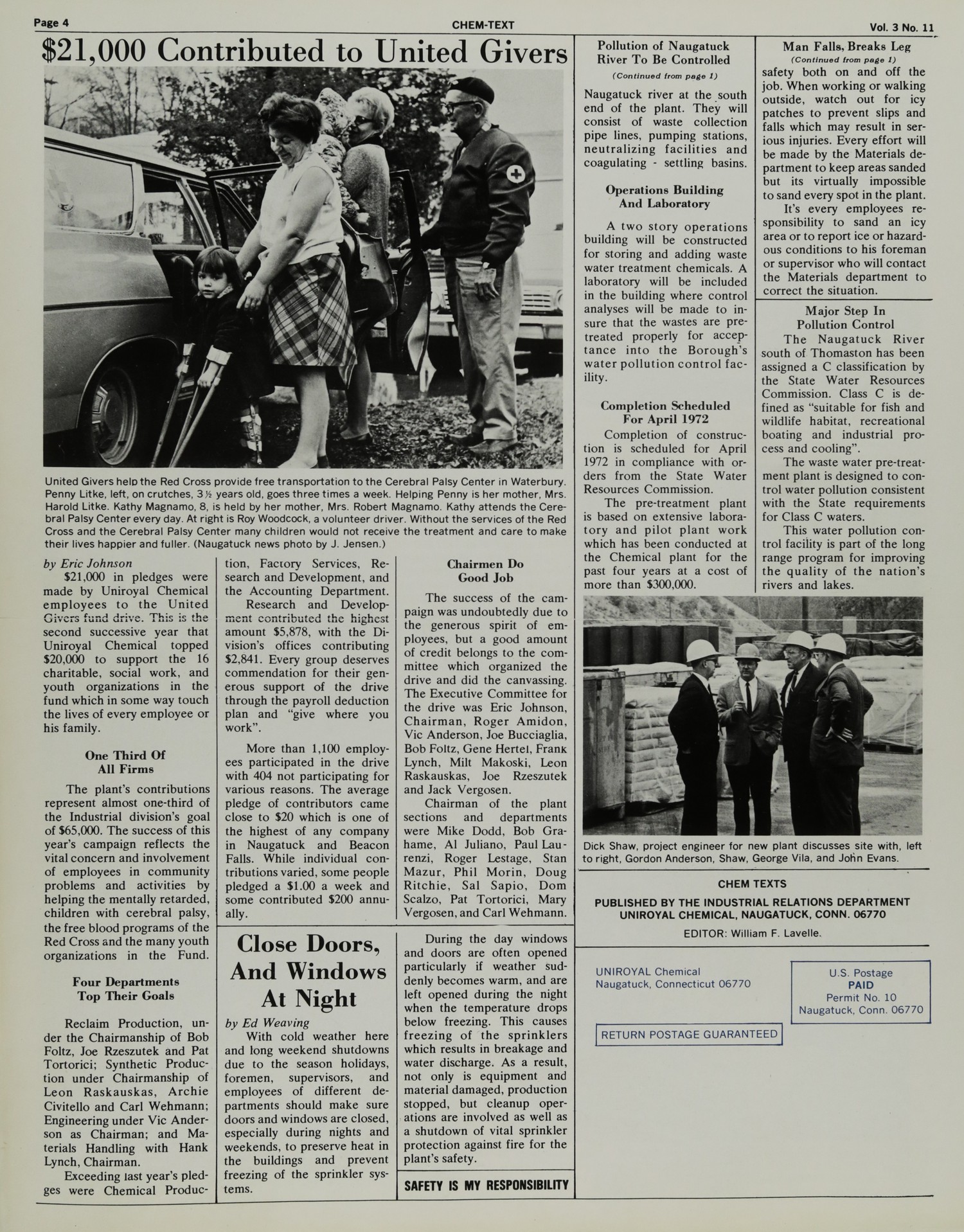
$21,000 Contributed to United Givers

[PHOTO: Image showing people near a vehicle, including children on crutches and adults]

United Givers help the Red Cross provide free transportation to the Cerebral Palsy Center in Waterbury. Penny Litke, left, on crutches, 3 ½ years old, goes three times a week. Helping Penny is her mother, Mrs. Harold Litke. Kathy Magnamo, 8, is held by her mother, Mrs. Robert Magnamo. Kathy attends the Cerebral Palsy Center every day. At right is Roy Woodcock, a volunteer driver. Without the services of the Red Cross and the Cerebral Palsy Center many children would not receive the treatment and care to make their lives happier and fuller. (Naugatuck news photo by J. Jensen.)


by Eric Johnson

$21,000 in pledges were made by Uniroyal Chemical employees to the United Givers fund drive. This is the second successive year that Uniroyal Chemical topped $20,000 to support the 16 charitable, social work, and youth organizations in the fund which in some way touch the lives of every employee or his family.

One Third Of All Firms

The plant’s contributions represent almost one-third of the Industrial division’s goal of $65,000. The success of this year’s campaign reflects the vital concern and involvement of employees in community problems and activities by helping the mentally retarded, children with cerebral palsy, the free blood programs of the Red Cross and the many youth organizations in the Fund.

Four Departments Top Their Goals

Reclaim Production, under the Chairmanship of Bob Foltz, Joe Rzeszutek and Pat Tortorici; Synthetic Production under Chairmanship of Leon Raskauskas, Archie Civitello and Carl Wehmann; Engineering under Vic Anderson as Chairman; and Materials Handling with Hank Lynch, Chairman.

Exceeding last year’s pledges were Chemical Production, Factory Services, Research and Development, and the Accounting Department.

Research and Development contributed the highest amount $5,878, with the Division’s offices contributing $2,841. Every group deserves commendation for their generous support of the drive through the payroll deduction plan and “give where you work”.

More than 1,100 employees participated in the drive with 404 not participating for various reasons. The average pledge of contributors came close to $20 which is one of the highest of any company in Naugatuck and Beacon Falls. While individual contributions varied, some people pledged a $1.00 a week and some contributed $200 annually.


Close Doors, And Windows At Night

by Ed Weaving

With cold weather here and long weekend shutdowns due to the season holidays, foremen, supervisors, and employees of different departments should make sure doors and windows are closed, especially during nights and weekends, to preserve heat in the buildings and prevent freezing of the sprinkler systems.


Chairmen Do Good Job

The success of the campaign was undoubtedly due to the generous spirit of employees, but a good amount of credit belongs to the committee which organized the drive and did the canvassing. The Executive Committee for the drive was Eric Johnson, Chairman, Roger Amidon, Vic Anderson, Joe Bucciaglia, Bob Foltz, Gene Hertel, Frank Lynch, Milt Makoski, Leon Raskauskas, Joe Rzeszutek and Jack Vergosen.

Chairman of the plant sections and departments were Mike Dodd, Bob Grahame, Al Juliano, Paul Laurenzi, Roger Lestage, Stan Mazur, Phil Morin, Doug Ritchie, Sal Sapio, Dom Scalzo, Pat Tortorici, Mary Vergosen, and Carl Wehmann.

During the day windows and doors are often opened particularly if weather suddenly becomes warm, and are left opened during the night when the temperature drops below freezing. This causes freezing of the sprinklers which results in breakage and water discharge. As a result, not only is equipment and material damaged, production stopped, but cleanup operations are involved as well as a shutdown of vital sprinkler protection against fire for the plant’s safety.

SAFETY IS MY RESPONSIBILITY


Pollution of Naugatuck River To Be Controlled

(Continued from page 1)

Naugatuck river at the south end of the plant. They will consist of waste collection pipe lines, pumping stations, neutralizing facilities and coagulating – settling basins.

Operations Building And Laboratory

A two story operations building will be constructed for storing and adding waste water treatment chemicals. A laboratory will be included in the building where control analyses will be made to insure that the wastes are pretreated properly for acceptance into the Borough’s water pollution control facility.

Completion Scheduled For April 1972

Completion of construction is scheduled for April 1972 in compliance with orders from the State Water Resources Commission.

The pre-treatment plant is based on extensive laboratory and pilot plant work which has been conducted at the Chemical plant for the past four years at a cost of more than $300,000.


Man Falls, Breaks Leg

(Continued from page 1)

safety both on and off the job. When working or walking outside, watch out for icy patches to prevent slips and falls which may result in serious injuries. Every effort will be made by the Materials department to keep areas sanded but its virtually impossible to sand every spot in the plant.

It’s every employees responsibility to sand an icy area or to report ice or hazardous conditions to his foreman or supervisor who will contact the Materials department to correct the situation.

Major Step In Pollution Control

The Naugatuck River south of Thomaston has been assigned a C classification by the State Water Resources Commission. Class C is defined as “suitable for fish and wildlife habitat, recreational boating and industrial process and cooling”.

The waste water pre-treatment plant is designed to control water pollution consistent with the State requirements for Class C waters.

This water pollution control facility is part of the long range program for improving the quality of the nation’s rivers and lakes.


[PHOTO: Four men in hard hats examining documents outdoors]

Dick Shaw, project engineer for new plant discusses site with, left to right, Gordon Anderson, Shaw, George Vila, and John Evans.


CHEM TEXTS

PUBLISHED BY THE INDUSTRIAL RELATIONS DEPARTMENT
UNIROYAL CHEMICAL, NAUGATUCK, CONN. 06770

EDITOR: William F. Lavelle.


UNIROYAL Chemical
Naugatuck, Connecticut 06770

U.S. Postage
PAID
Permit No. 10
Naugatuck, Conn. 06770

RETURN POSTAGE GUARANTEED

CHEM-TEXTS – Vol. 2 No. 4 – Page 2

Page 002

CHEM TEXTS

Page 2 | Vol. 2 No. 4


FROM THE FACTORY MANAGER

Dear Fellow Employee:

Within the next several weeks we will each be contacted by one of our friends to make our annual pledge to the United Givers of Naugatuck and Beacon Falls.

Experience has proven that this once-a-year campaign is the most efficient way of providing funds for sixteen volunteer agencies that serve the people of our area. I am, however, concerned that the convenience of this method of giving may tend to lessen our generosity as givers. May I suggest that we each use the following guidelines in making out our pledges?

1) Review carefully the agencies presented on our pledge card and the details of their needs and services as described in the United Givers folder.

2) Consider the services that we, our family, our friends and neighbors receive from these agencies. Note that many of the agencies serve an area broader than the campaign towns. Some are even national.

3) Use the Work Sheet on this page of CHEM-TEXTS to work out our pledge on the payroll deduction plan. This method makes it convenient to give our share on a year-around basis.

4) PLEDGE! Before filling in our card – ask ourselves one question – “Have I given until it feels good?

[Signature]

John D. Evans


HOW MUCH SHOULD YOU GIVE TO THE UNITED GIVERS DRIVE

A few years ago, somebody knocked on your door almost once a week for a contribution to a worthy cause. You probably contributed $30 to $50 to these organizations.

Through the United Givers Fund your continued generous support of most of these organizations can now be done on a once-a-year basis through the Company’s payroll deduction plan.

To determine your contribution for 1969, this work sheet, listing the 16 participating agencies, will help you decide the amount of your gift.

Agency Gift amt. if contacted separately
American Red Cross $_____
Child Guidance Clinic $_____
Children’s Center $_____
Conn. Trails Council,
Girl Scouts of America $_____
Catholic Family Serv. $_____

Family Serv. Assoc. $__
Mattatuck Council,
Boy Scouts of America $
____

Naugatuck Jr.
Athletic Leagues $__
Salvation Army $
_
United Cerebral Palsy $

U.S.O. $

Waterbury Assoc. for
Retarded Children $

Y.M.C.A. – Naugatuck $

Total Amount $
___

By dividing the number of payroll deductions into your total amount, you obtain the amount you should pledge. For salary employees, payroll deductions will be made monthly; and for wage employees, deductions will be weekly.

The Naugatuck plant always contributed generously in the past to these worthwhile agencies. Because of their increased services and expenses they depend more on us for 1969.


New Assignments Made in Plant

Fred Wintsch has been appointed Labor Relations Manager for the Naugatuck plant. He will be responsible for employee relations, reporting to Ron Mitchinson, Industrial Relations Manager.

[PHOTO]

Sam Gillette, formerly General Foreman at the Synthetic rubber plant, moved to the Chemical production as General Foreman reporting to Jim Cronin, Superintendent.

[PHOTO]

Eric Johnson, named General Foreman of the Synthetic rubber plant, will supervise production of synthetic latexes. He reports to Ben Leach, plant Superintendent.


[PHOTO]

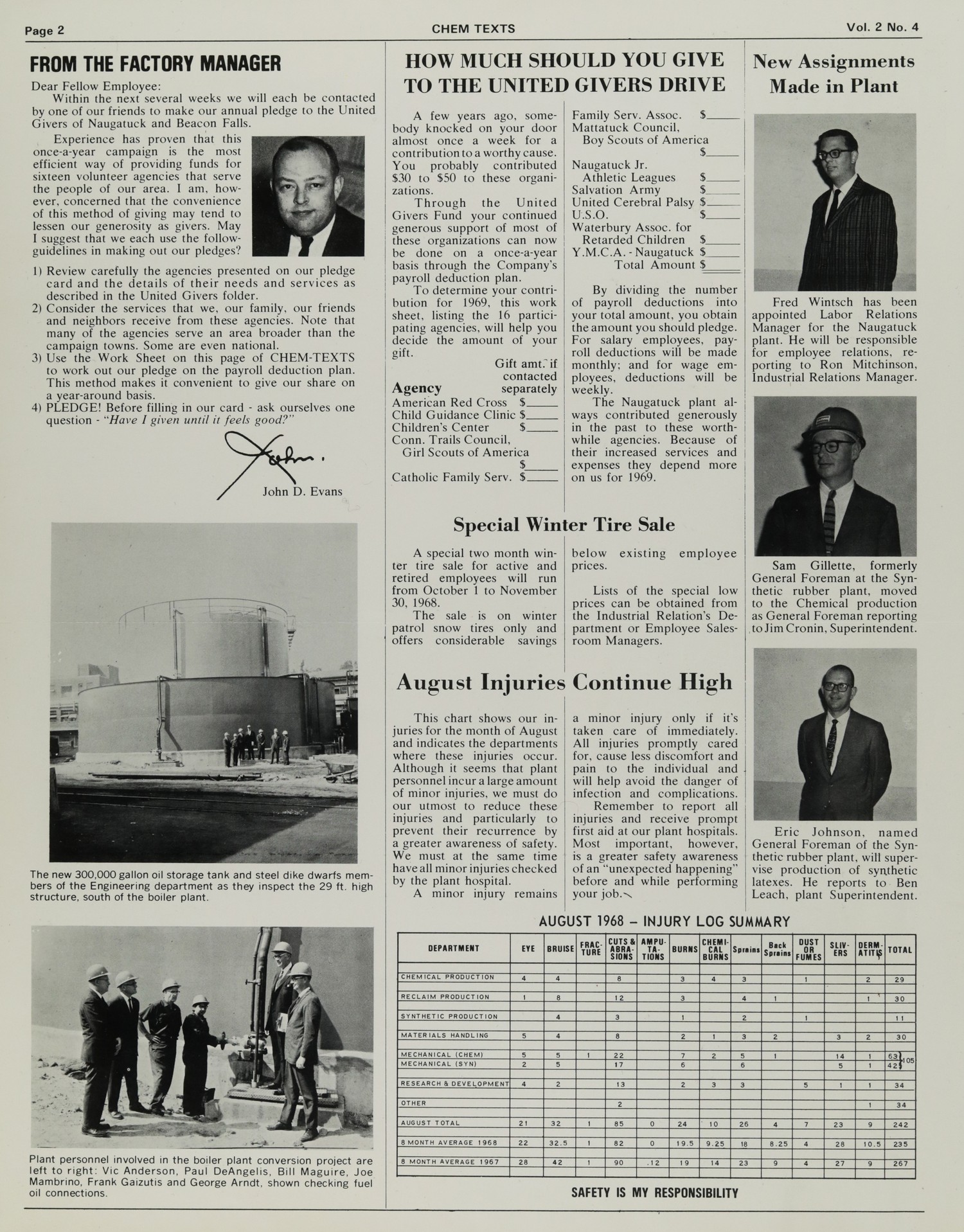
The new 300,000 gallon oil storage tank and steel dike dwarfs members of the Engineering department as they inspect the 29 ft. high structure, south of the boiler plant.


[PHOTO]

Plant personnel involved in the boiler plant conversion project are left to right: Vic Anderson, Paul DeAngelis, Bill Maguire, Joe Mambrino, Frank Gaizutis and George Arndt, shown checking fuel oil connections.


Special Winter Tire Sale

A special two month winter tire sale for active and retired employees will run from October 1 to November 30, 1968.

The sale is on winter patrol snow tires only and offers considerable savings below existing employee prices.

Lists of the special low prices can be obtained from the Industrial Relation’s Department or Employee Salesroom Managers.


August Injuries Continue High

This chart shows our injuries for the month of August and indicates the departments where these injuries occur. Although it seems that plant personnel incur a large amount of minor injuries, we must do our utmost to reduce these injuries and particularly to prevent their recurrence by a greater awareness of safety. We must at the same time have all minor injuries checked by the plant hospital.

A minor injury remains a minor injury only if it’s taken care of immediately. All injuries promptly cared for, cause less discomfort and pain to the individual and will help avoid the danger of infection and complications.

Remember to report all injuries and receive prompt first aid at our plant hospitals. Most important, however, is a greater safety awareness of an “unexpected happening” before and while performing your job.


AUGUST 1968 – INJURY LOG SUMMARY

DEPARTMENT EYE BRUISE FRACTURE CUTS & ABRASIONS AMPUTATIONS BURNS CHEMICAL BURNS Sprains Back Sprains DUST OR FUMES SLIVERS DERMATITIS TOTAL
CHEMICAL PRODUCTION 4 4 8 3 4 3 1 2 29
RECLAIM PRODUCTION 1 8 12 3 4 1 1 30
SYNTHETIC PRODUCTION 4 3 1 2 1 11
MATERIALS HANDLING 5 4 8 2 1 3 2 3 2 30
MECHANICAL (CHEM) 5 5 1 22 7 2 5 1 14 1 63
MECHANICAL (SYN) 2 5 17 6 6 5 1 42
RESEARCH & DEVELOPMENT 4 2 13 2 3 3 5 1 1 34
OTHER 2 1 34
AUGUST TOTAL 21 32 1 85 0 24 10 26 4 7 23 9 242
8 MONTH AVERAGE 1968 22 32.5 1 82 0 19.5 9.25 18 8.25 4 28 10.5 235
8 MONTH AVERAGE 1967 28 42 1 90 12 19 14 23 9 4 27 9 267

SAFETY IS MY RESPONSIBILITY