UniRoyal Strike Negotiations Continuing

UniRoyal Strike Negotiations Continuing

5-1-67

Negotiating talks continued Sunday between the United Rubber Workers and UniRoyal as the strike has entered its second week. However, there is no indication from either side as to the progress.

The negotiating talks now concern the master contract. Once agreement is reached, the talks will be conducted on local levels.

All three of the borough Locals have been taking strike benefit applications from its membership. The striking employes received their last pays this weekend and are now facing payless days until the strike is settled and they complete a week’s work.

Presidents of the borough’s three Locals, George Froehlich, Local 45; Joseph Rzeszutek, Local 218; and Edward Alves, Local 308, are in Cincinnati participating in the talks.

Picketing continues in the borough at all gates of the plants in an orderly fashion. Picket lines of six persons are maintained at the gates with one police officer on hand. No attempt has been made by UniRoyal to cross the lines. Union officials are allowing white collar employes to continue working.

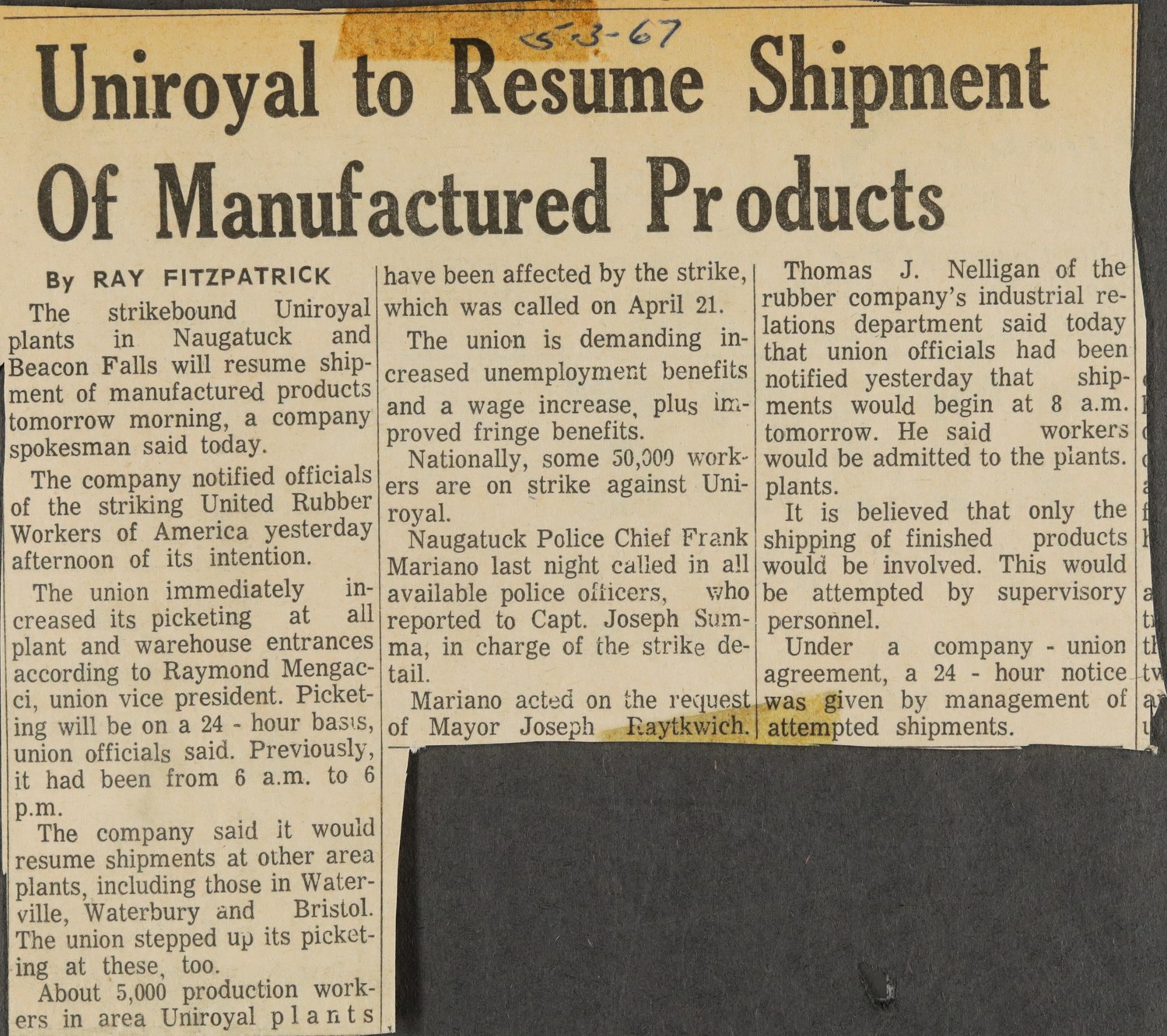
Uniroyal to Resume Shipment Of Manufactured Products

Uniroyal to Resume Shipment Of Manufactured Products

5-3-67 [handwritten]

By RAY FITZPATRICK

The strikebound Uniroyal plants in Naugatuck and Beacon Falls will resume shipment of manufactured products tomorrow morning, a company spokesman said today.

The company notified officials of the striking United Rubber Workers of America yesterday afternoon of its intention.

The union immediately increased its picketing at all plant and warehouse entrances according to Raymond Mengacci, union vice president. Picketing will be on a 24 – hour basis, union officials said. Previously, it had been from 6 a.m. to 6 p.m.

The company said it would resume shipments at other area plants, including those in Waterville, Waterbury and Bristol. The union stepped up its picketing at these, too.

About 5,000 production workers in area Uniroyal plants have been affected by the strike, which was called on April 21.

The union is demanding increased unemployment benefits and a wage increase, plus improved fringe benefits.

Nationally, some 50,000 workers are on strike against Uniroyal.

Naugatuck Police Chief Frank Mariano last night called in all available police officers, who reported to Capt. Joseph Summa, in charge of the strike detail.

Mariano acted on the request of Mayor Joseph Raytkwich.

Thomas J. Nelligan of the rubber company’s industrial relations department said today that union officials had been notified yesterday that shipments would begin at 8 a.m. tomorrow. He said workers would be admitted to the plants.

It is believed that only the shipping of finished products would be involved. This would be attempted by supervisory personnel.

Under a company – union agreement, a 24 – hour notice was given by management of attempted shipments.

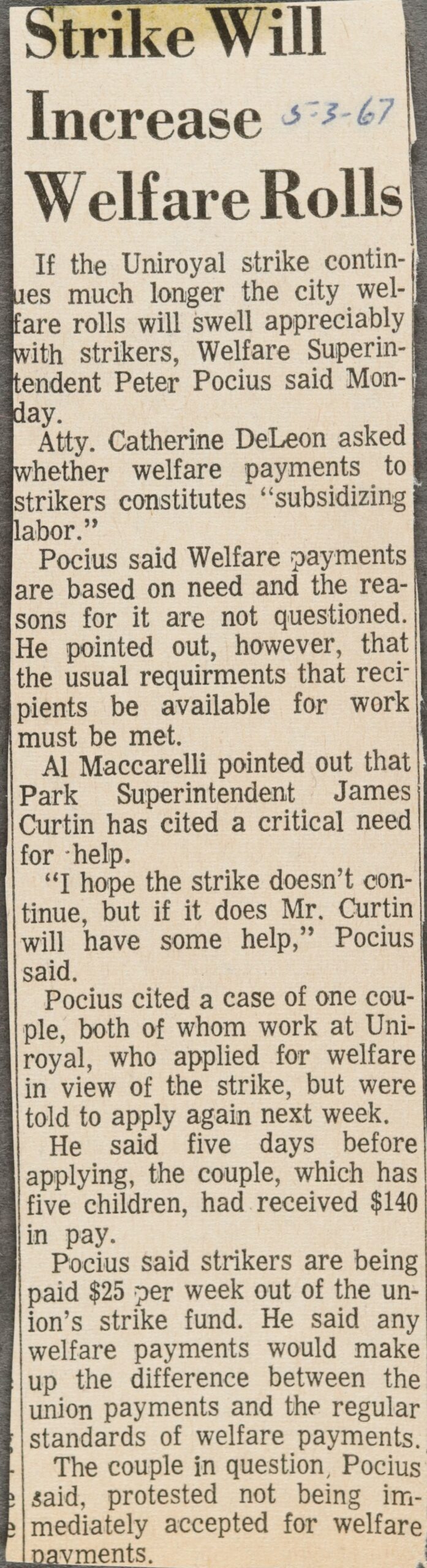
Strike Will Increase Welfare Rolls

Strike Will Increase Welfare Rolls

5-3-67

If the Uniroyal strike continues much longer the city welfare rolls will swell appreciably with strikers, Welfare Superintendent Peter Pocius said Monday.

Atty. Catherine DeLeon asked whether welfare payments to strikers constitutes “subsidizing labor.”

Pocius said Welfare payments are based on need and the reasons for it are not questioned. He pointed out, however, that the usual requirments that recipients be available for work must be met.

Al Maccarelli pointed out that Park Superintendent James Curtin has cited a critical need for help.

“I hope the strike doesn’t continue, but if it does Mr. Curtin will have some help,” Pocius said.

Pocius cited a case of one couple, both of whom work at Uniroyal, who applied for welfare in view of the strike, but were told to apply again next week.

He said five days before applying, the couple, which has five children, had received $140 in pay.

Pocius said strikers are being paid $25 per week out of the union’s strike fund. He said any welfare payments would make up the difference between the union payments and the regular standards of welfare payments.

The couple in question, Pocius said, protested not being immediately accepted for welfare payments.

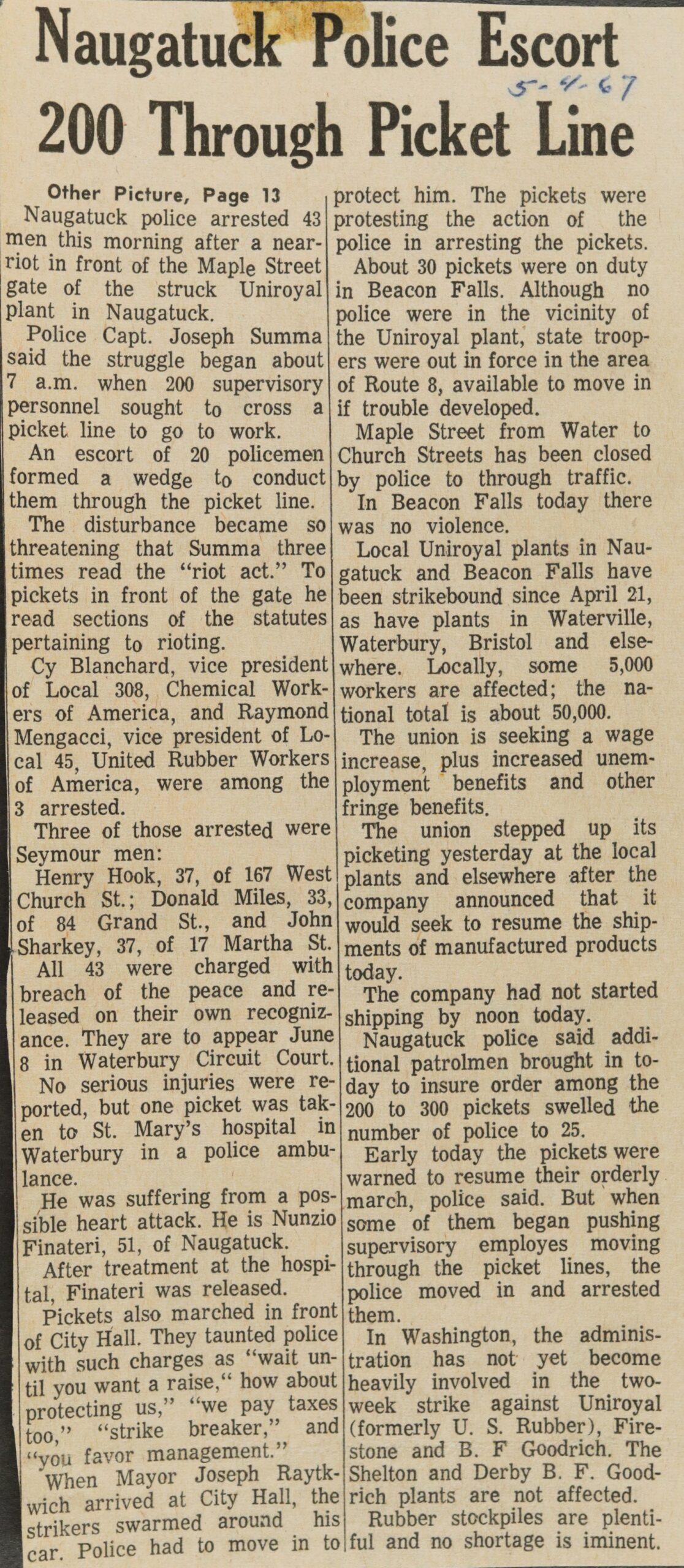
Naugatuck Police Escort 200 Through Picket Line

Naugatuck Police Escort 200 Through Picket Line

5-4-67

Other Picture, Page 13

Naugatuck police arrested 43 men this morning after a near-riot in front of the Maple Street gate of the struck Uniroyal plant in Naugatuck.

Police Capt. Joseph Summa said the struggle began about 7 a.m. when 200 supervisory personnel sought to cross a picket line to go to work.

An escort of 20 policemen formed a wedge to conduct them through the picket line.

The disturbance became so threatening that Summa three times read the “riot act.” To pickets in front of the gate he read sections of the statutes pertaining to rioting.

Cy Blanchard, vice president of Local 308, Chemical Workers of America, and Raymond Mengacci, vice president of Local 45, United Rubber Workers of America, were among the 3 arrested.

Three of those arrested were Seymour men:

Henry Hook, 37, of 167 West Church St.; Donald Miles, 33, of 84 Grand St., and John Sharkey, 37, of 17 Martha St.

All 43 were charged with breach of the peace and released on their own recognizance. They are to appear June 8 in Waterbury Circuit Court.

No serious injuries were reported, but one picket was taken to St. Mary’s hospital in Waterbury in a police ambulance.

He was suffering from a possible heart attack. He is Nunzio Finateri, 51, of Naugatuck.

After treatment at the hospital, Finateri was released.

Pickets also marched in front of City Hall. They taunted police with such charges as “wait until you want a raise,” how about protecting us,” “we pay taxes too,” “strike breaker,” and “you favor management.”

When Mayor Joseph Raytkwich arrived at City Hall, the strikers swarmed around his car. Police had to move in to protect him. The pickets were protesting the action of the police in arresting the pickets.

About 30 pickets were on duty in Beacon Falls. Although no police were in the vicinity of the Uniroyal plant, state troopers were out in force in the area of Route 8, available to move in if trouble developed.

Maple Street from Water to Church Streets has been closed by police to through traffic.

In Beacon Falls today there was no violence.

Local Uniroyal plants in Naugatuck and Beacon Falls have been strikebound since April 21, as have plants in Waterville, Waterbury, Bristol and elsewhere. Locally, some 5,000 workers are affected; the national total is about 50,000.

The union is seeking a wage increase, plus increased unemployment benefits and other fringe benefits.

The union stepped up its picketing yesterday at the local plants and elsewhere after the company announced that it would seek to resume the shipments of manufactured products today.

The company had not started shipping by noon today.

Naugatuck police said additional patrolmen brought in today to insure order among the 200 to 300 pickets swelled the number of police to 25.

Early today the pickets were warned to resume their orderly march, police said. But when some of them began pushing supervisory employes moving through the picket lines, the police moved in and arrested them.

In Washington, the administration has not yet become heavily involved in the two-week strike against Uniroyal (formerly U. S. Rubber), Firestone and B. F Goodrich. The Shelton and Derby B. F. Goodrich plants are not affected.

Rubber stockpiles are plentiful and no shortage is iminent.

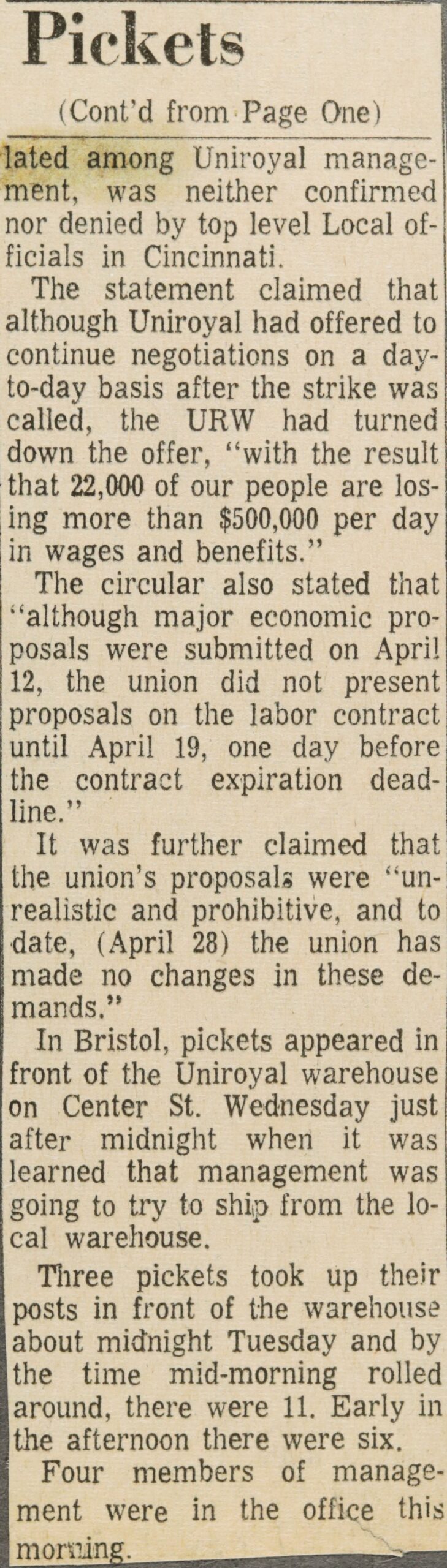
Pickets

Pickets

(Cont’d from Page One)

lated among Uniroyal management, was neither confirmed nor denied by top level Local officials in Cincinnati.

The statement claimed that although Uniroyal had offered to continue negotiations on a day-to-day basis after the strike was called, the URW had turned down the offer, “with the result that 22,000 of our people are losing more than $500,000 per day in wages and benefits.”

The circular also stated that “although major economic proposals were submitted on April 12, the union did not present proposals on the labor contract until April 19, one day before the contract expiration deadline.”

It was further claimed that the union’s proposals were “unrealistic and prohibitive, and to date, (April 28) the union has made no changes in these demands.”

In Bristol, pickets appeared in front of the Uniroyal warehouse on Center St. Wednesday just after midnight when it was learned that management was going to try to ship from the local warehouse.

Three pickets took up their posts in front of the warehouse about midnight Tuesday and by the time mid-morning rolled around, there were 11. Early in the afternoon there were six.

Four members of management were in the office this morning.

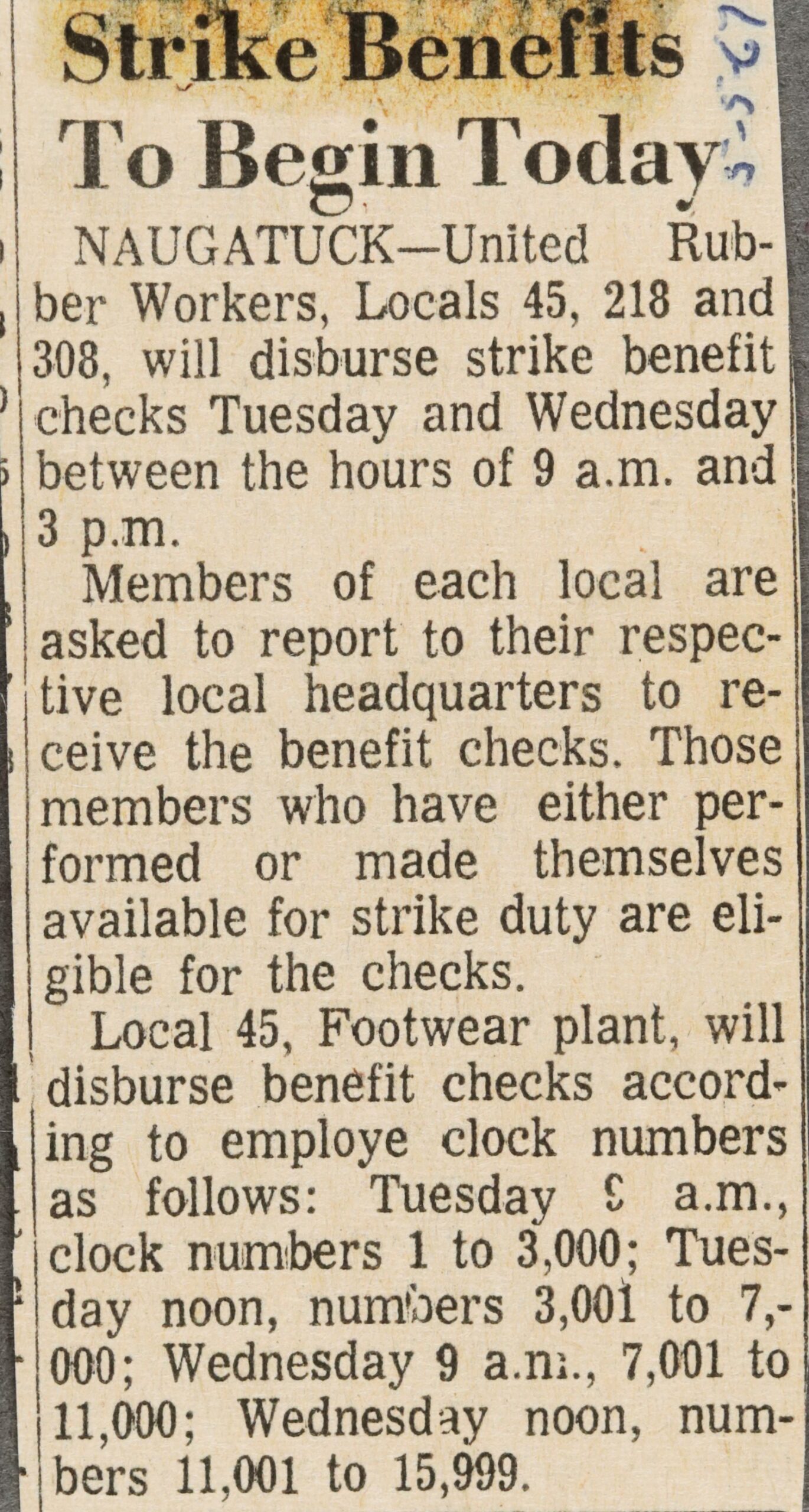
Strike Benefits To Begin Today

Strike Benefits To Begin Today

NAUGATUCK—United Rubber Workers, Locals 45, 218 and 308, will disburse strike benefit checks Tuesday and Wednesday between the hours of 9 a.m. and 3 p.m.

Members of each local are asked to report to their respective local headquarters to receive the benefit checks. Those members who have either performed or made themselves available for strike duty are eligible for the checks.

Local 45, Footwear plant, will disburse benefit checks according to employe clock numbers as follows: Tuesday 9 a.m., clock numbers 1 to 3,000; Tuesday noon, numbers 3,001 to 7,000; Wednesday 9 a.m., 7,001 to 11,000; Wednesday noon, numbers 11,001 to 15,999.


[Handwritten notation in top right corner appears to read: “12-5-5” or similar]

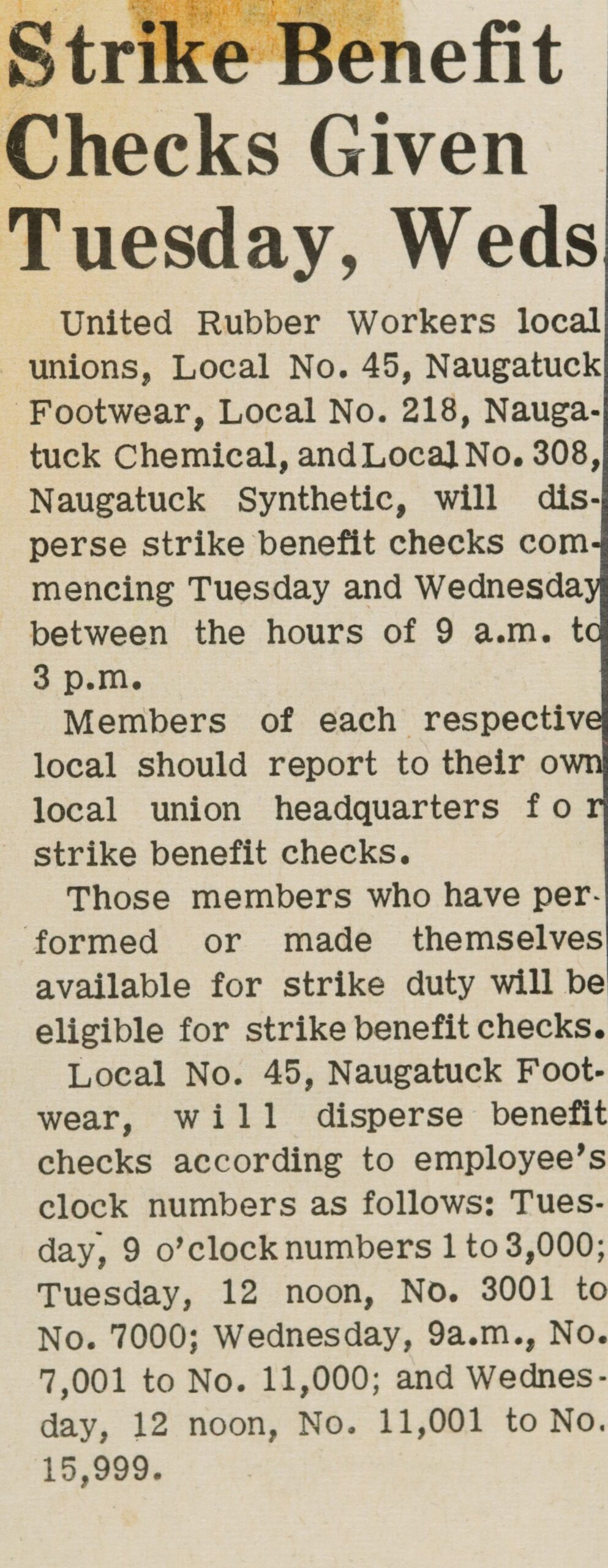
Strike Benefit Checks Given Tuesday, Weds

Strike Benefit Checks Given Tuesday, Weds

United Rubber Workers local unions, Local No. 45, Naugatuck Footwear, Local No. 218, Naugatuck Chemical, and Local No. 308, Naugatuck Synthetic, will disperse strike benefit checks commencing Tuesday and Wednesday between the hours of 9 a.m. to 3 p.m.

Members of each respective local should report to their own local union headquarters for strike benefit checks.

Those members who have performed or made themselves available for strike duty will be eligible for strike benefit checks.

Local No. 45, Naugatuck Footwear, will disperse benefit checks according to employee’s clock numbers as follows: Tuesday, 9 o’clock numbers 1 to 3,000; Tuesday, 12 noon, No. 3001 to No. 7000; Wednesday, 9a.m., No. 7,001 to No. 11,000; and Wednesday, 12 noon, No. 11,001 to No. 15,999.

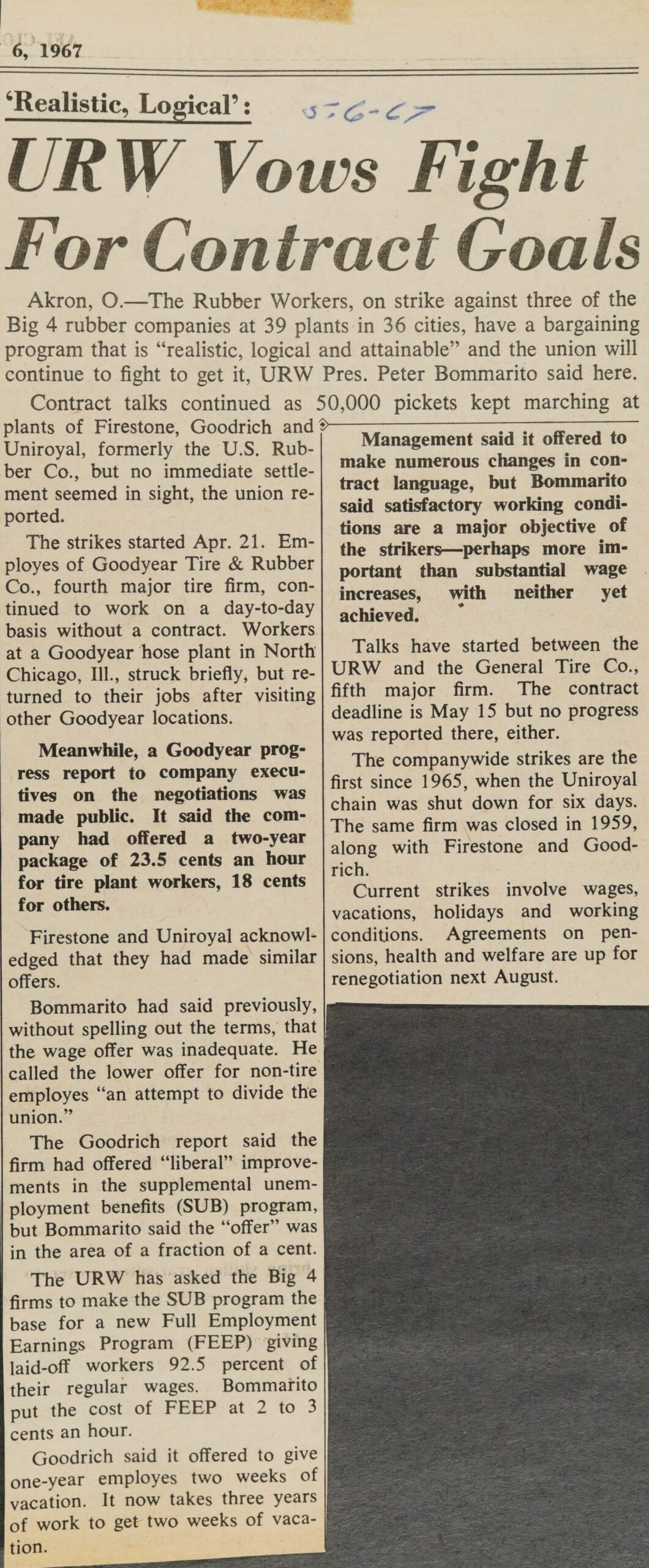
URW Vows Fight For Contract Goals

6, 1967

‘Realistic, Logical’: 5-6-67

URW Vows Fight For Contract Goals

Akron, O.—The Rubber Workers, on strike against three of the Big 4 rubber companies at 39 plants in 36 cities, have a bargaining program that is “realistic, logical and attainable” and the union will continue to fight to get it, URW Pres. Peter Bommarito said here.

Contract talks continued as 50,000 pickets kept marching at plants of Firestone, Goodrich and Uniroyal, formerly the U.S. Rubber Co., but no immediate settlement seemed in sight, the union reported.

The strikes started Apr. 21. Employees of Goodyear Tire & Rubber Co., fourth major tire firm, continued to work on a day-to-day basis without a contract. Workers at a Goodyear hose plant in North Chicago, Ill., struck briefly, but returned to their jobs after visiting other Goodyear locations.

Meanwhile, a Goodyear progress report to company executives on the negotiations was made public. It said the company had offered a two-year package of 23.5 cents an hour for tire plant workers, 18 cents for others.

Firestone and Uniroyal acknowledged that they had made similar offers.

Bommarito had said previously, without spelling out the terms, that the wage offer was inadequate. He called the lower offer for non-tire employes “an attempt to divide the union.”

The Goodrich report said the firm had offered “liberal” improvements in the supplemental unemployment benefits (SUB) program, but Bommarito said the “offer” was in the area of a fraction of a cent.

The URW has asked the Big 4 firms to make the SUB program the base for a new Full Employment Earnings Program (FEEP) giving laid-off workers 92.5 percent of their regular wages. Bommarito put the cost of FEEP at 2 to 3 cents an hour.

Goodrich said it offered to give one-year employes two weeks of vacation. It now takes three years of work to get two weeks of vacation.

Management said it offered to make numerous changes in contract language, but Bommarito said satisfactory working conditions are a major objective of the strikers—perhaps more important than substantial wage increases, with neither yet achieved.

Talks have started between the URW and the General Tire Co., fifth major firm. The contract deadline is May 15 but no progress was reported there, either.

The companywide strikes are the first since 1965, when the Uniroyal chain was shut down for six days. The same firm was closed in 1959, along with Firestone and Goodrich.

Current strikes involve wages, vacations, holidays and working conditions. Agreements on pensions, health and welfare are up for renegotiation next August.

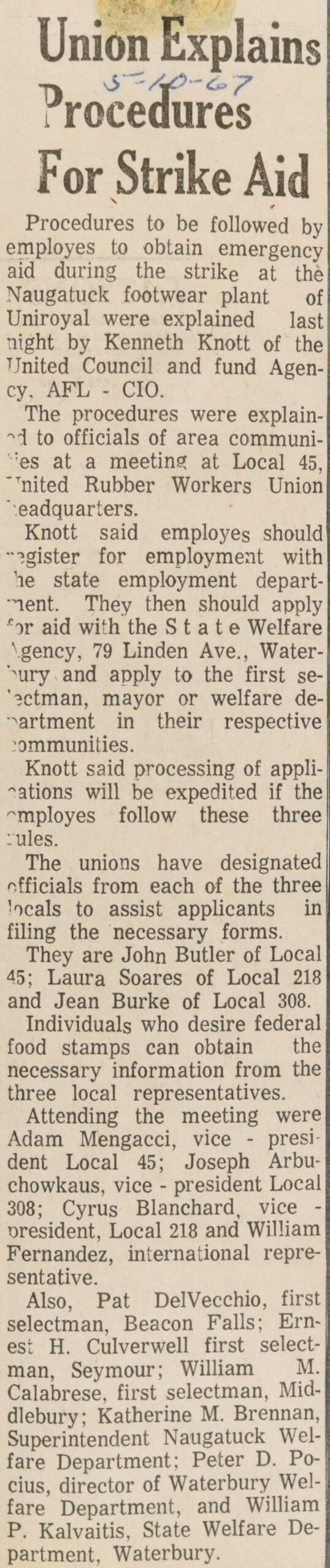
Union Explains Procedures For Strike Aid

Union Explains
Procedures
For Strike Aid

5-10-67

Procedures to be followed by
employes to obtain emergency
aid during the strike at the
Naugatuck footwear plant of
Uniroyal were explained last
night by Kenneth Knott of the
United Council and fund Agen-
cy, AFL – CIO.

The procedures were explain-
ed to officials of area communi-
ties at a meeting at Local 45,
United Rubber Workers Union
headquarters.

Knott said employes should
register for employment with
the state employment depart-
ment. They then should apply
for aid with the S t a t e Welfare
Agency, 79 Linden Ave., Water-
bury and apply to the first se-
lectman, mayor or welfare de-
partment in their respective
communities.

Knott said processing of appli-
cations will be expedited if the
employes follow these three
rules.

The unions have designated
officials from each of the three
locals to assist applicants in
filing the necessary forms.

They are John Butler of Local
45; Laura Soares of Local 218
and Jean Burke of Local 308.

Individuals who desire federal
food stamps can obtain the
necessary information from the
three local representatives.

Attending the meeting were
Adam Mengacci, vice – presi-
dent Local 45; Joseph Arbu-
chowkaus, vice – president Local
308; Cyrus Blanchard, vice –
president, Local 218 and William
Fernandez, international repre-
sentative.

Also, Pat DelVecchio, first
selectman, Beacon Falls; Ern-
est H. Culverwell first select-
man, Seymour; William M.
Calabrese, first selectman, Mid-
dlebury; Katherine M. Brennan,
Superintendent Naugatuck Wel-
fare Department; Peter D. Po-
cius, director of Waterbury Wel-
fare Department, and William
P. Kalvaitis, State Welfare De-
partment, Waterbury.

Picket Duty Explained By Union Head

Picket Duty Explained By Union Head

NAUGATUCK — Some members of United Rubber Workers Local 218 reported evidence of confusion Tuesday over the question of receiving the weekly strike benefit of $25 .According to Vice President of Local 218, Cy Blanchard , receipt of the check depends on whether or not a member appeared for strike duty at least once every five days.

Many of the members, appearing for their benefit checks Tuesday, were told that in order to qualify for them they would have to serve today. They were told that they had until 3 p.m. today to make up lost picket time.

According to Blanchard, with only 530 members available for picket duty, it was necessary to schedule each man at least once every five days. Some men, he said, have appeared only once for a three-hour picket duty, while others have done more than their share.

He noted that although some members were surprised when they heard they had to serve again before qualifying for the checks, he thought it was each man’s duty as a union member to volunteer his services. It seems unfair, he said, that the man who has served only once gets the same benefit as the man who has served many times.

“We have not denied anyone any benefits,” said Blanchard, adding that “we are giving every member full opportunity” to fulfill his picket obligations.

There are some, he said, who are unable to picket because of health or other reasons, but these are also put to work to make everything fair.

Each member is being scheduled once every five days so that there are about 110 pickets every day, he said. He added that he hoped every member would volunteer his services for picket duty to qualify. This picket duty must be continued in order to continue to qualify, said Blanchard.

The ruling that each man picket for three hours once every five days was cleared through Cincinnati, said the Local vice president.

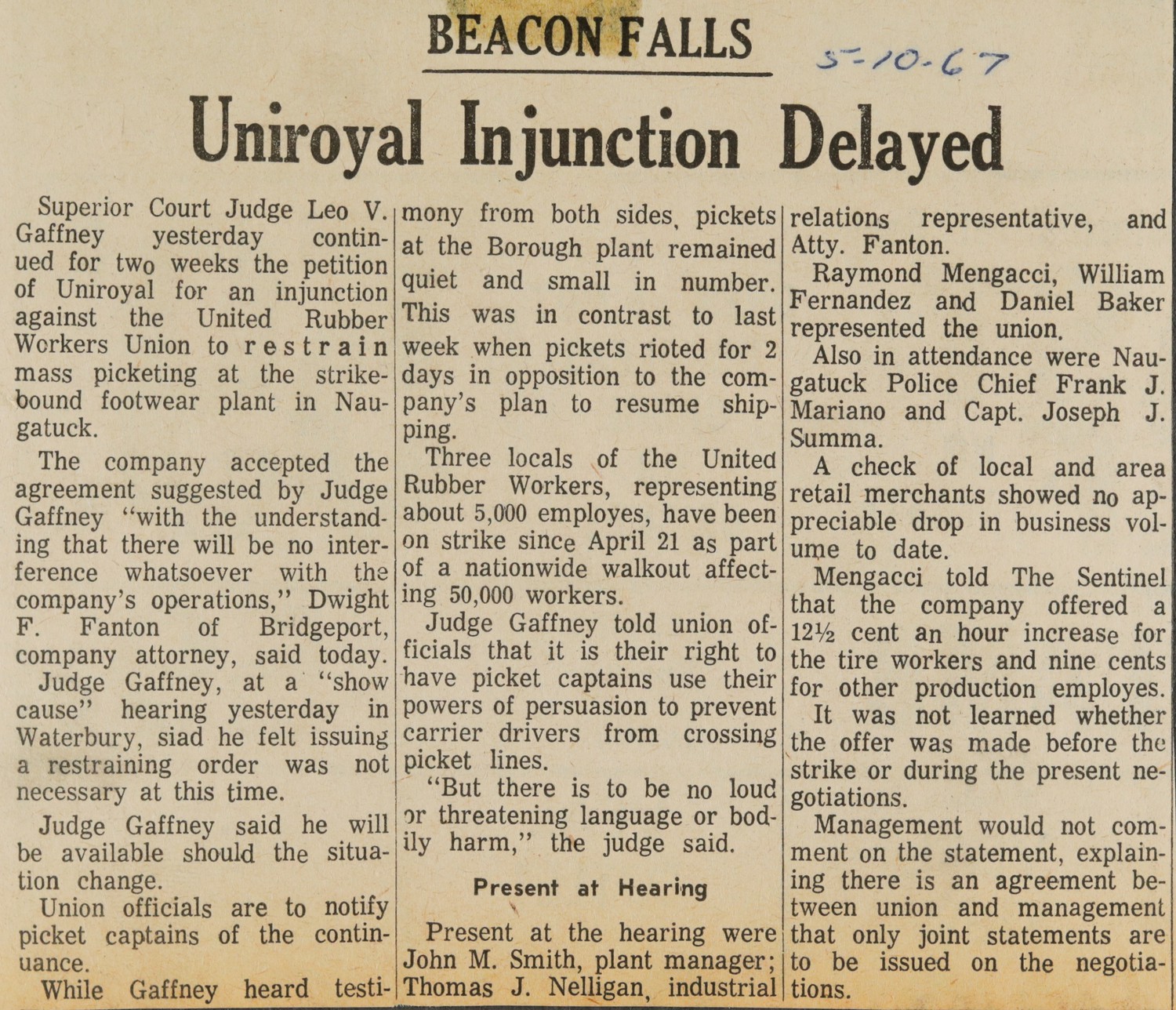
Uniroyal Injunction Delayed

BEACON FALLS

5-10-67

Uniroyal Injunction Delayed

Superior Court Judge Leo V. Gaffney yesterday continued for two weeks the petition of Uniroyal for an injunction against the United Rubber Workers Union to restrain mass picketing at the strike-bound footwear plant in Naugatuck.

The company accepted the agreement suggested by Judge Gaffney “with the understanding that there will be no interference whatsoever with the company’s operations,” Dwight F. Fanton of Bridgeport, company attorney, said today.

Judge Gaffney, at a “show cause” hearing yesterday in Waterbury, siad he felt issuing a restraining order was not necessary at this time.

Judge Gaffney said he will be available should the situation change.

Union officials are to notify picket captains of the continuance.

While Gaffney heard testimony from both sides, pickets at the Borough plant remained quiet and small in number. This was in contrast to last week when pickets rioted for 2 days in opposition to the company’s plan to resume shipping.

Three locals of the United Rubber Workers, representing about 5,000 employes, have been on strike since April 21 as part of a nationwide walkout affecting 50,000 workers.

Judge Gaffney told union officials that it is their right to have picket captains use their powers of persuasion to prevent carrier drivers from crossing picket lines.

“But there is to be no loud or threatening language or bodily harm,” the judge said.

Present at Hearing

Present at the hearing were John M. Smith, plant manager; Thomas J. Nelligan, industrial relations representative, and Atty. Fanton.

Raymond Mengacci, William Fernandez and Daniel Baker represented the union.

Also in attendance were Naugatuck Police Chief Frank J. Mariano and Capt. Joseph J. Summa.

A check of local and area retail merchants showed no appreciable drop in business volume to date.

Mengacci told The Sentinel that the company offered a 12½ cent an hour increase for the tire workers and nine cents for other production employes.

It was not learned whether the offer was made before the strike or during the present negotiations.

Management would not comment on the statement, explaining there is an agreement between union and management that only joint statements are to be issued on the negotiations.

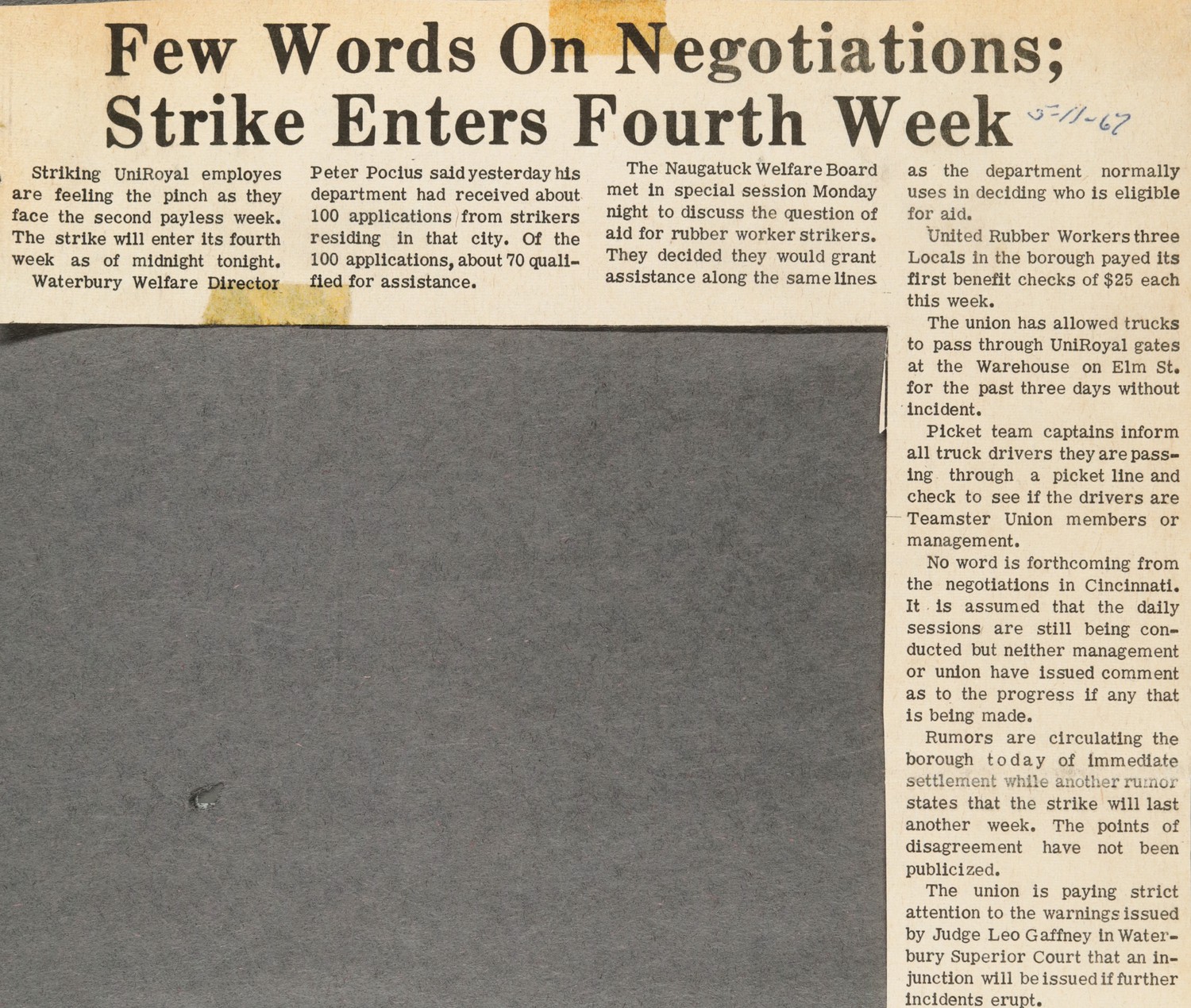
Few Words On Negotiations; Strike Enters Fourth Week

Few Words On Negotiations; Strike Enters Fourth Week

5-11-67

Striking UniRoyal employes are feeling the pinch as they face the second payless week. The strike will enter its fourth week as of midnight tonight.

Waterbury Welfare Director Peter Pocius said yesterday his department had received about 100 applications from strikers residing in that city. Of the 100 applications, about 70 qualified for assistance.

The Naugatuck Welfare Board met in special session Monday night to discuss the question of aid for rubber worker strikers. They decided they would grant assistance along the same lines as the department normally uses in deciding who is eligible for aid.

United Rubber Workers three Locals in the borough payed its first benefit checks of $25 each this week.

The union has allowed trucks to pass through UniRoyal gates at the Warehouse on Elm St. for the past three days without incident.

Picket team captains inform all truck drivers they are passing through a picket line and check to see if the drivers are Teamster Union members or management.

No word is forthcoming from the negotiations in Cincinnati. It is assumed that the daily sessions are still being conducted but neither management or union have issued comment as to the progress if any that is being made.

Rumors are circulating the borough today of immediate settlement while another rumor states that the strike will last another week. The points of disagreement have not been publicized.

The union is paying strict attention to the warnings issued by Judge Leo Gaffney in Waterbury Superior Court that an injunction will be issued if further incidents erupt.

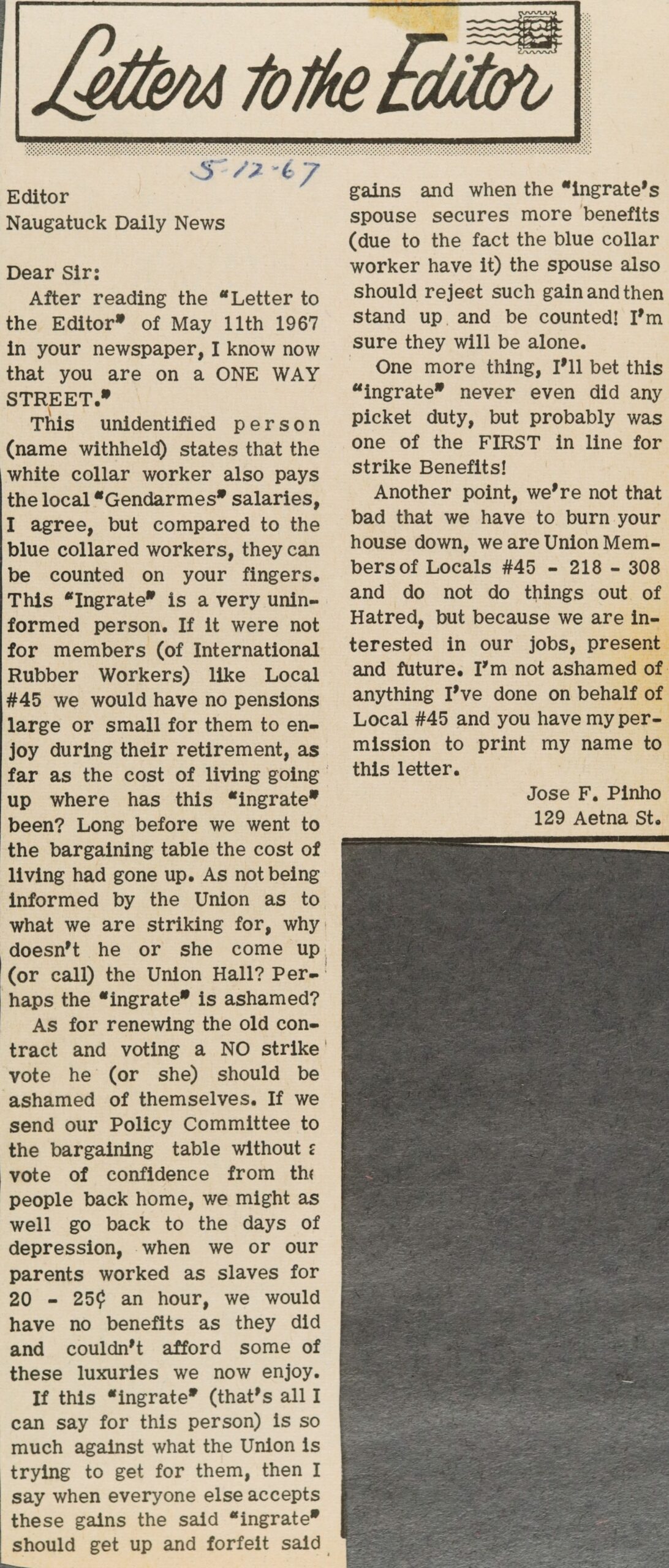
Letters to the Editor

Letters to the Editor

5-12-67

Editor
Naugatuck Daily News

Dear Sir:

After reading the “Letter to the Editor” of May 11th 1967 in your newspaper, I know now that you are on a ONE WAY STREET.”

This unidentified person (name withheld) states that the white collar worker also pays the local “Gendarmes” salaries, I agree, but compared to the blue collared workers, they can be counted on your fingers. This “Ingrate” is a very uninformed person. If it were not for members (of International Rubber Workers) like Local #45 we would have no pensions large or small for them to enjoy during their retirement, as far as the cost of living going up where has this “ingrate” been? Long before we went to the bargaining table the cost of living had gone up. As not being informed by the Union as to what we are striking for, why doesn’t he or she come up (or call) the Union Hall? Perhaps the “ingrate” is ashamed?

As for renewing the old contract and voting a NO strike vote he (or she) should be ashamed of themselves. If we send our Policy Committee to the bargaining table without a vote of confidence from the people back home, we might as well go back to the days of depression, when we or our parents worked as slaves for 20 – 25¢ an hour, we would have no benefits as they did and couldn’t afford some of these luxuries we now enjoy.

If this “ingrate” (that’s all I can say for this person) is so much against what the Union is trying to get for them, then I say when everyone else accepts these gains the said “ingrate” should get up and forfeit said gains and when the “ingrate’s spouse secures more benefits (due to the fact the blue collar worker have it) the spouse also should reject such gain and then stand up and be counted! I’m sure they will be alone.

One more thing, I’ll bet this “ingrate” never even did any picket duty, but probably was one of the FIRST in line for strike Benefits!

Another point, we’re not that bad that we have to burn your house down, we are Union Members of Locals #45 – 218 – 308 and do not do things out of Hatred, but because we are interested in our jobs, present and future. I’m not ashamed of anything I’ve done on behalf of Local #45 and you have my permission to print my name to this letter.

Jose F. Pinho
129 Aetna St.

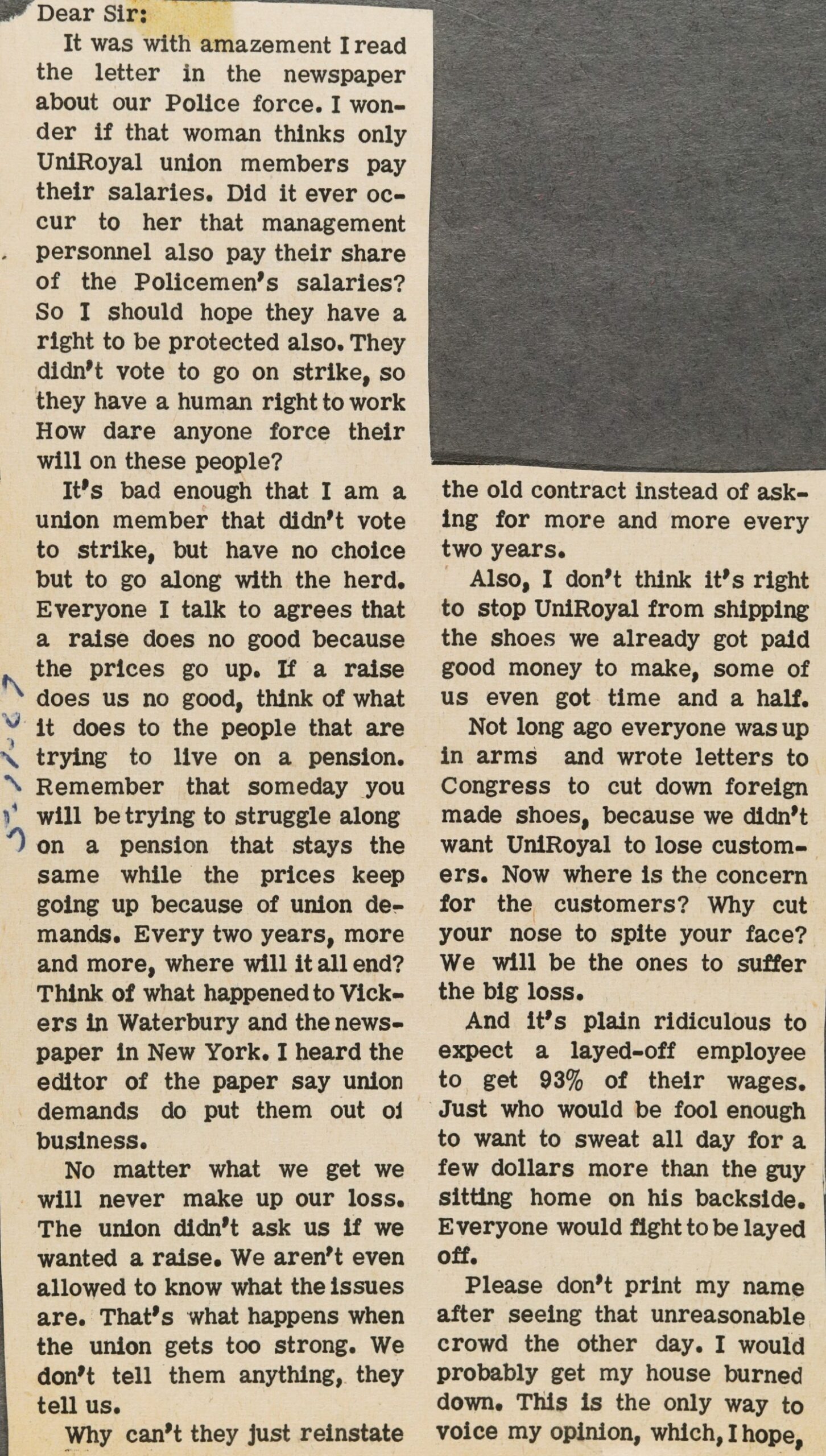
Dear Sir:

Dear Sir:

It was with amazement I read the letter in the newspaper about our Police force. I wonder if that woman thinks only UniRoyal union members pay their salaries. Did it ever occur to her that management personnel also pay their share of the Policemen’s salaries? So I should hope they have a right to be protected also. They didn’t vote to go on strike, so they have a human right to work How dare anyone force their will on these people?

It’s bad enough that I am a union member that didn’t vote to strike, but have no choice but to go along with the herd. Everyone I talk to agrees that a raise does no good because the prices go up. If a raise does us no good, think of what it does to the people that are trying to live on a pension. Remember that someday you will be trying to struggle along on a pension that stays the same while the prices keep going up because of union demands. Every two years, more and more, where will it all end? Think of what happened to Vickers in Waterbury and the newspaper in New York. I heard the editor of the paper say union demands do put them out of business.

No matter what we get we will never make up our loss. The union didn’t ask us if we wanted a raise. We aren’t even allowed to know what the issues are. That’s what happens when the union gets too strong. We don’t tell them anything, they tell us.

Why can’t they just reinstate the old contract instead of asking for more and more every two years.

Also, I don’t think it’s right to stop UniRoyal from shipping the shoes we already got paid good money to make, some of us even got time and a half.

Not long ago everyone was up in arms and wrote letters to Congress to cut down foreign made shoes, because we didn’t want UniRoyal to lose customers. Now where is the concern for the customers? Why cut your nose to spite your face? We will be the ones to suffer the big loss.

And it’s plain ridiculous to expect a layed-off employee to get 93% of their wages. Just who would be fool enough to want to sweat all day for a few dollars more than the guy sitting home on his backside. Everyone would fight to be layed off.

Please don’t print my name after seeing that unreasonable crowd the other day. I would probably get my house burned down. This is the only way to voice my opinion, which, I hope,

[Handwritten marks visible in left margin appearing to be checkmarks or notation marks]

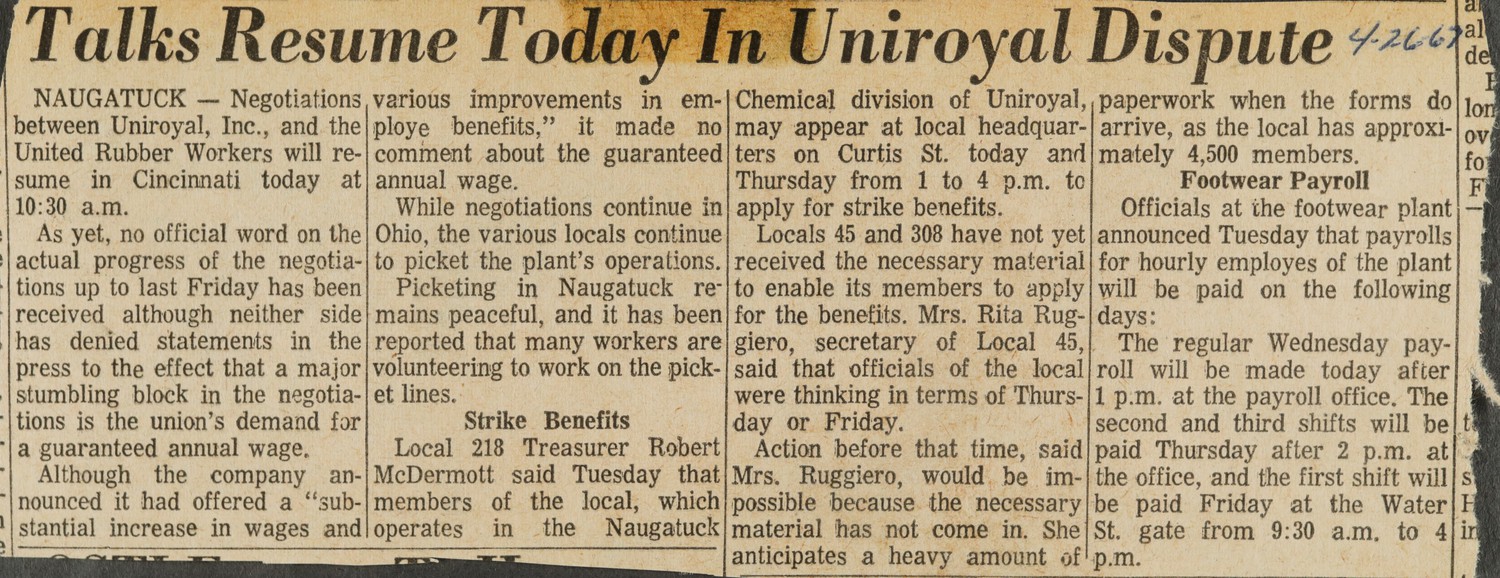
Talks Resume Today In Uniroyal Dispute

Talks Resume Today In Uniroyal Dispute

4-26-67 [handwritten]

NAUGATUCK — Negotiations between Uniroyal, Inc., and the United Rubber Workers will resume in Cincinnati today at 10:30 a.m.

As yet, no official word on the actual progress of the negotiations up to last Friday has been received although neither side has denied statements in the press to the effect that a major stumbling block in the negotiations is the union’s demand for a guaranteed annual wage.

Although the company announced it had offered a “substantial increase in wages and various improvements in employe benefits,” it made no comment about the guaranteed annual wage.

While negotiations continue in Ohio, the various locals continue to picket the plant’s operations. Picketing in Naugatuck remains peaceful, and it has been reported that many workers are volunteering to work on the picket lines.

Strike Benefits

Local 218 Treasurer Robert McDermott said Tuesday that members of the local, which operates in the Naugatuck Chemical division of Uniroyal, may appear at local headquarters on Curtis St. today and Thursday from 1 to 4 p.m. to apply for strike benefits.

Locals 45 and 308 have not yet received the necessary material to enable its members to apply for the benefits. Mrs. Rita Ruggiero, secretary of Local 45, said that officials of the local were thinking in terms of Thursday or Friday.

Action before that time, said Mrs. Ruggiero, would be impossible because the necessary material has not come in. She anticipates a heavy amount of paperwork when the forms do arrive, as the local has approximately 4,500 members.

Footwear Payroll

Officials at the footwear plant announced Tuesday that payrolls for hourly employes of the plant will be paid on the following days:

The regular Wednesday payroll will be made today after 1 p.m. at the payroll office. The second and third shifts will be paid Thursday after 2 p.m. at the office, and the first shift will be paid Friday at the Water St. gate from 9:30 a.m. to 4 p.m.

US Rubber Proxy Statement – Page 8

Page 008

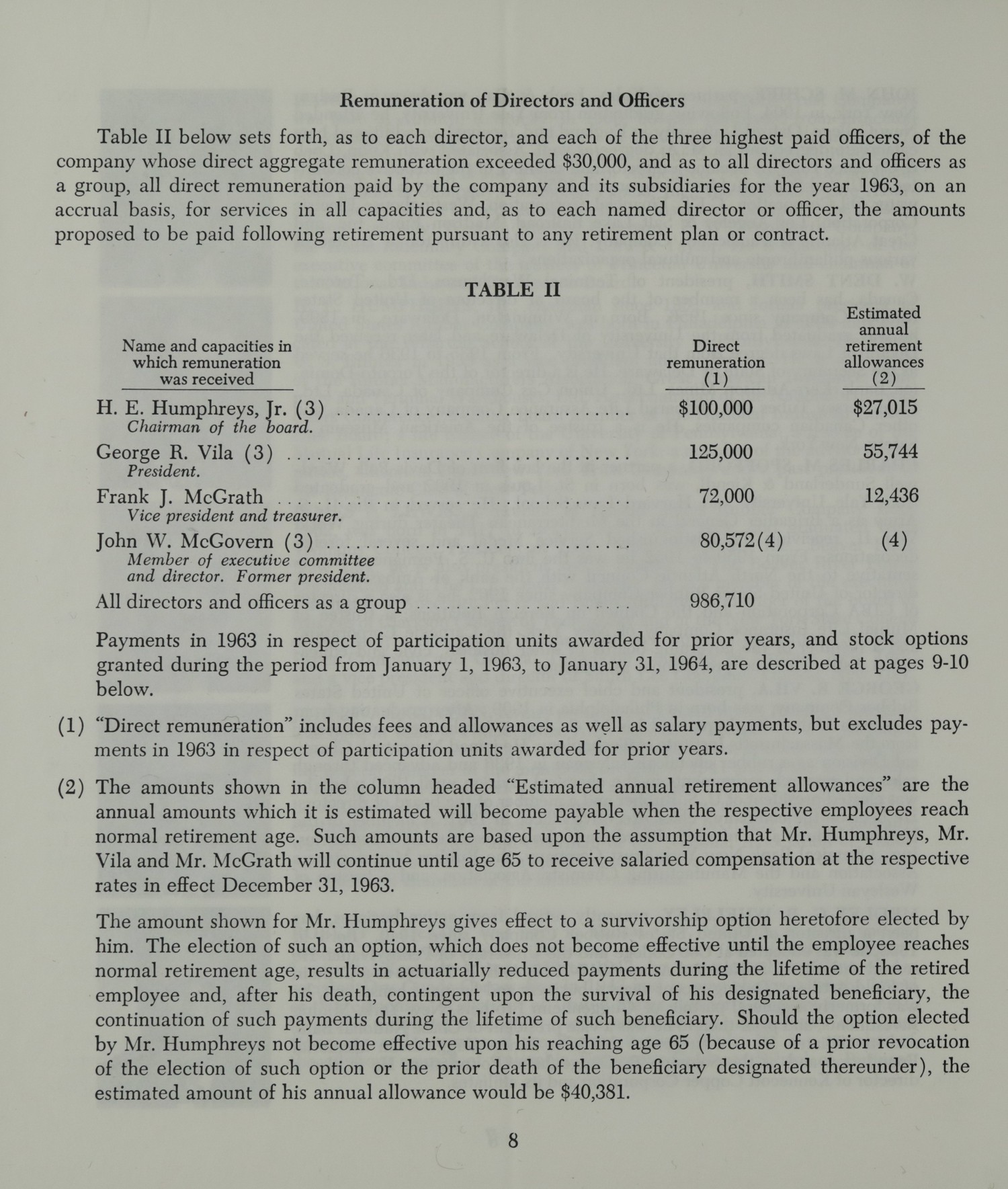
Remuneration of Directors and Officers

Table II below sets forth, as to each director, and each of the three highest paid officers, of the company whose direct aggregate remuneration exceeded $30,000, and as to all directors and officers as a group, all direct remuneration paid by the company and its subsidiaries for the year 1963, on an accrual basis, for services in all capacities and, as to each named director or officer, the amounts proposed to be paid following retirement pursuant to any retirement plan or contract.

TABLE II
Estimated
Name and capacities in Direct annual
which remuneration remuneration retirement
was received (1) allowances (2)
H. E. Humphreys, Jr. (3) $100,000 $27,015
Chairman of the board.
George R. Vila (3) 125,000 55,744
President.
Frank J. McGrath 72,000 12,436
Vice president and treasurer.
John W. McGovern (3) 80,572(4) (4)
Member of executive committee
and director. Former president.
All directors and officers as a group 986,710

Payments in 1963 in respect of participation units awarded for prior years, and stock options granted during the period from January 1, 1963, to January 31, 1964, are described at pages 9-10 below.

(1) “Direct remuneration” includes fees and allowances as well as salary payments, but excludes payments in 1963 in respect of participation units awarded for prior years.

(2) The amounts shown in the column headed “Estimated annual retirement allowances” are the annual amounts which it is estimated will become payable when the respective employees reach normal retirement age. Such amounts are based upon the assumption that Mr. Humphreys, Mr. Vila and Mr. McGrath will continue until age 65 to receive salaries compensation at the respective rates in effect December 31, 1963.

The amount shown for Mr. Humphreys gives effect to a survivorship option heretofore elected by him. The election of such an option, which does not become effective until the employee reaches normal retirement age, results in actuarially reduced payments during the lifetime of the retired employee and, after his death, contingent upon the survival of his designated beneficiary, the continuation of such payments during the lifetime of such beneficiary. Should the option elected by Mr. Humphreys not become effective upon his reaching age 65 (because of a prior revocation of the election of such option or the prior death of the beneficiary designated thereunder), the estimated amount of his annual allowance would be $40,331.

US Rubber Proxy Statement – Page 20

Page 020

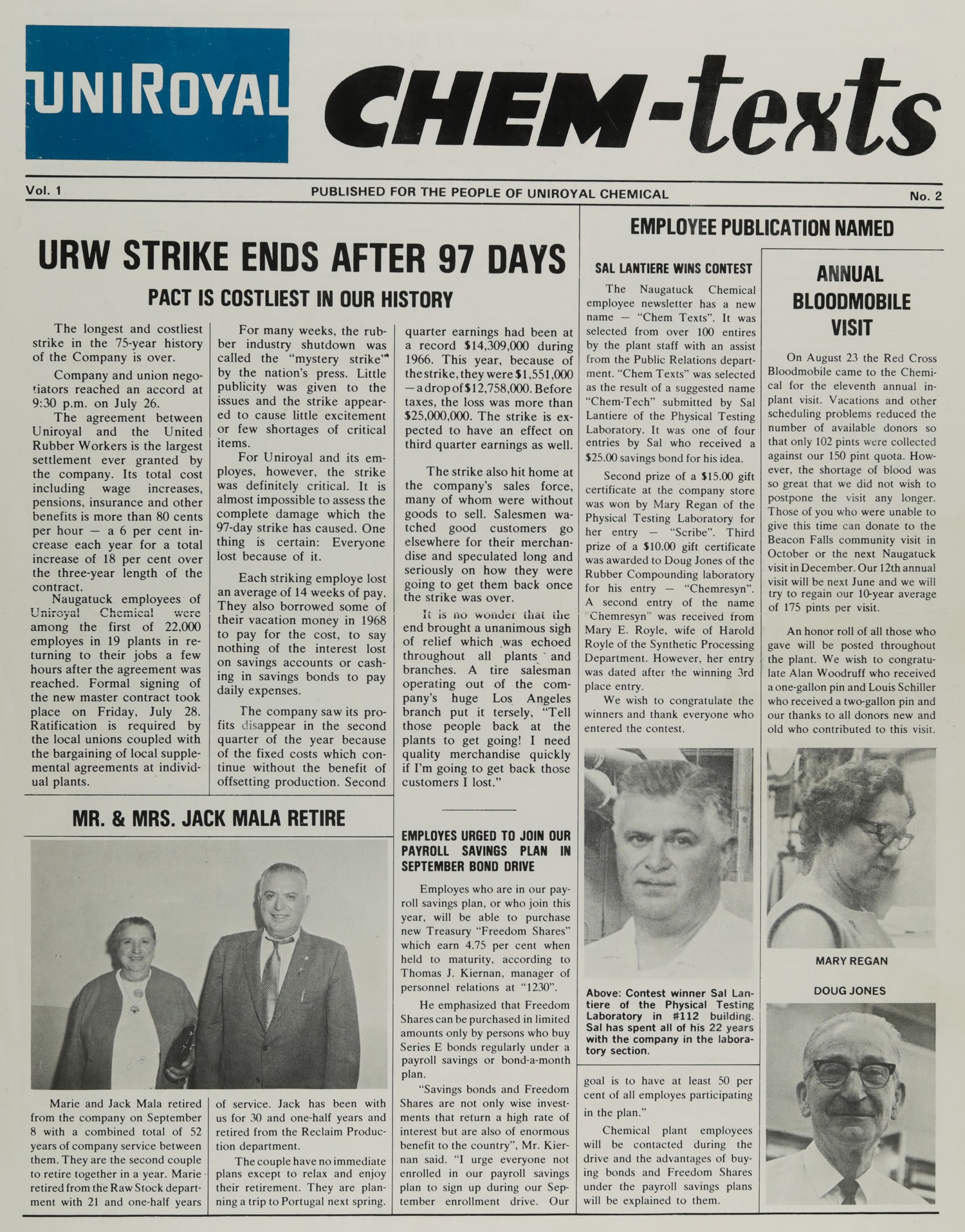
UNIROYAL CHEM-texts
Vol. 1 PUBLISHED FOR THE PEOPLE OF UNIROYAL CHEMICAL No. 2

URW STRIKE ENDS AFTER 97 DAYS
PACT IS COSTLIEST IN OUR HISTORY

The longest and costliest strike in the 75-year history of the Company is over. Company and union negotiators reached an accord at 9:30 p.m. on July 26. The agreement between Uniroyal and the United Rubber Workers is the largest settlement ever reached by the company. Its total cost including wage increases, pensions, insurance and other benefits is more than 50 cents per hour — a 6 per cent increase each year for a total of 18 per cent over the three-year length of the contract.

Eachstriking employee lost an average of 14 weeks of pay. They also borrowed some of their vacation money in 1968 to pay for the cost, to say nothing of the interest lost on savings accounts or cashing in savings bonds to pay daily expenses.

The company saw its profits disappear in the second quarter of the year because of the fixed costs which continue without the benefit of offsetting production. Second quarter earnings had been at a record $14,309,000 during the strike. This year, because of the strike, they were $15,551,000 less or $12,753,000. Before taxes, the loss was more than $25,000,000. The strike also hit home at the company’s sales force, many of whom were without goods to sell. Salesmen were told good customers would never be able to get their merchandise long and specialized long and seriously on how they were going to get their back once the strike was over.

It is no wonder that the end brought a continuous state of relief which was echoed throughout all plant and branch offices. A tire salesman overheard out of the company’s huge Los Angeles branch put it tersely. “Tell those people back at the plants to get going! I need quality merchandise quickly if I’m going to get back those customers I lost.”

EMPLOYEE PUBLICATION NAMED

The Naugatuck Chemical employee newsletter has a new name – “Chem Texts”. It was selected from over 100 entries by the plant staff with an assist from the Public Relations department. “Chem Texts” was selected as the result of a suggestion made by Sal Lantiere of the Physical Testing Laboratory. It was one of four entries by Sal who received a $25.00 savings bond for his idea.

Second prize of a $15.00 gift certificate at the company store was won by Mary Regan of the Physical Testing Laboratory for her entry — “Chemtext”. Third prize of a $10.00 gift certificate was awarded to Doug Jones of the Rubber Compounding laboratory for his entry — “Chemesyn”.

A second group of the name “Chemesyn” was received from Mary Raby, wife of Harold Raby of the Synthetic Processing Department. However, her entry was dated after the winning entry was selected.

We wish to congratulate the winners and thank everyone who entered the contest.

MR. & MRS. JACK MALA RETIRE

Marie and Jack Mala retired from the company on September 8 with a combined total of 52 years of company service between them. They are the second couple to retire together in a year. Marie retired from the Raw Stock department with 21 and one-half years of service. Jack has been with us for 30 and one half years and retired from the Reclaim Production department.

EMPLOYEES URGED TO JOIN OUR PAYROLL SAVINGS PLAN IN SEPTEMBER BOND DRIVE

Employees who are in our payroll savings plan, or who join this year, will be able to purchase new Treasury “Freedom Shares” which earn 4.75 per cent when held to maturity, according to Thomas J. Kiernan, manager of personnel relations at “1230”.
He emphasized that Freedom Shares can be purchased in limited amounts by each plan participant during the “September Bond Drive”.
Savings bonds and Freedom Shares are not only investments that return a high rate of interest but are also of enormous benefit to the country, Mr. Kiernan said. “I urge everyone not enrolled in our payroll savings plan to sign up during our September enrollment drive. Our goal is to have at least 50 per cent of all employees participating in the plan.”
Chemical plant employees will be contacted during the drive and the advantages of buying savings bonds and Freedom Shares under the payroll savings plans will be explained to them.

MARY REGAN
DOUG JONES

Above: Contest winner Sal Lantiere of the Physical Testing Laboratory in #112 building. Sal has spent all of his 22 years with the company in the laboratory section.

ANNUAL BLOODMOBILE VISIT

On August 23 the Red Cross Bloodmobile came to the Chemical plant visit. Vacations and other scheduling problems reduced the number of available donors so we only 122 pints were collected against our 150 pint quota. However, the shortage of donors did not mean we did not wish to postpone the visit any longer. Those of you who were unable to give this time can donate to the Beacon Falls community visit in October or the next June 12 annual visit will give us another chance to regain our ideal 175 pints per visit.

An honor roll of all of those who gave will be posted throughout the plant. We wish to congratulate late Alan Woodruff who received a one-gallon pin and Louis Schuller who received a two-gallon pin and all those new and old who contributed to this visit.

SAL LANTIERE WINS CONTEST

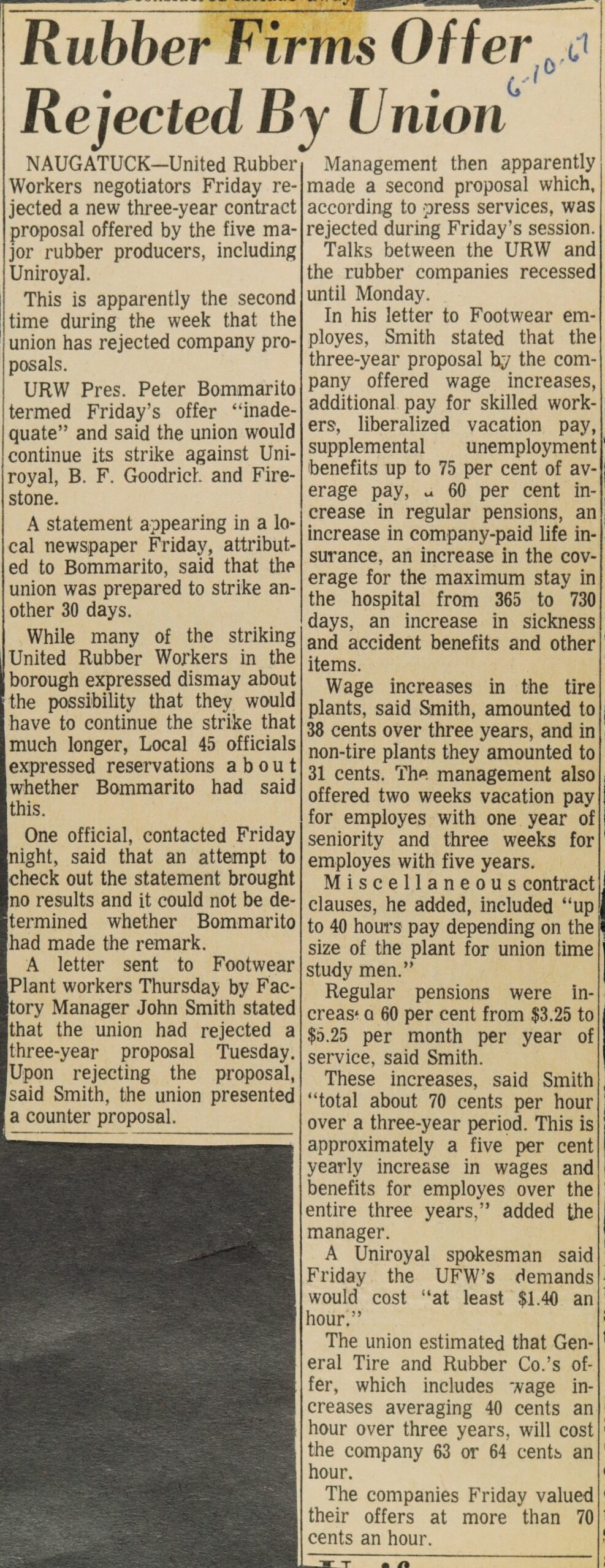
Rubber Firms Offer Rejected By Union

Rubber Firms Offer Rejected By Union

6-10-67 (handwritten)

NAUGATUCK—United Rubber Workers negotiators Friday rejected a new three-year contract proposal offered by the five major rubber producers, including Uniroyal.

This is apparently the second time during the week that the union has rejected company proposals.

URW Pres. Peter Bommarito termed Friday’s offer “inadequate” and said the union would continue its strike against Uniroyal, B. F. Goodrich and Firestone.

A statement appearing in a local newspaper Friday, attributed to Bommarito, said that the union was prepared to strike another 30 days.

While many of the striking United Rubber Workers in the borough expressed dismay about the possibility that they would have to continue the strike that much longer, Local 45 officials expressed reservations about whether Bommarito had said this.

One official, contacted Friday night, said that an attempt to check out the statement brought no results and it could not be determined whether Bommarito had made the remark.

A letter sent to Footwear Plant workers Thursday by Factory Manager John Smith stated that the union had rejected a three-year proposal Tuesday. Upon rejecting the proposal, said Smith, the union presented a counter proposal.

Management then apparently made a second proposal which, according to press services, was rejected during Friday’s session.

Talks between the URW and the rubber companies recessed until Monday.

In his letter to Footwear employes, Smith stated that the three-year proposal by the company offered wage increases, additional pay for skilled workers, liberalized vacation pay, supplemental unemployment benefits up to 75 per cent of average pay, a 60 per cent increase in regular pensions, an increase in company-paid life insurance, an increase in the coverage for the maximum stay in the hospital from 365 to 730 days, an increase in sickness and accident benefits and other items.

Wage increases in the tire plants, said Smith, amounted to 38 cents over three years, and in non-tire plants they amounted to 31 cents. The management also offered two weeks vacation pay for employes with one year of seniority and three weeks for employes with five years.

Miscellaneous contract clauses, he added, included “up to 40 hours pay depending on the size of the plant for union time study men.”

Regular pensions were increase a 60 per cent from $3.25 to $5.25 per month per year of service, said Smith.

These increases, said Smith “total about 70 cents per hour over a three-year period. This is approximately a five per cent yearly increase in wages and benefits for employes over the entire three years,” added the manager.

A Uniroyal spokesman said Friday the UFW’s demands would cost “at least $1.40 an hour.”

The union estimated that General Tire and Rubber Co.’s offer, which includes wage increases averaging 40 cents an hour over three years, will cost the company 63 or 64 cents an hour.

The companies Friday valued their offers at more than 70 cents an hour.

The above increases in wages and benefits togal about 70¢ per hour over a three year period.

The above increases in wages
and benefits togal about 70¢
per hour over a three year
period. This is approximately
a 5% yearly increase in wages
and benefits for employees over
the entire three years. It is the
equivalent of the settlement ne-
gotiated in other industries
which have been referred to
by the Union as necessary to
resolve these negotiations. It
was the most substantial and
costly offer ever made by this
Company to the Union.

This proposal was rejected
by the Union late in the after-
noon of June 6. The Union, in
rejecting the above Company of-
fer, made a counter proposal
which excluded any considera-
tion of pensions and insurances
and held to a number of costly
demands which were made be-
fore the strike started.

Sincerely,
Jack M. Smith
Factory Manager

The release of the letter,
and articles read in the paper
were the only announcements
of the proposals the union mem-
bership received. No meetings
were called to allow the general
membership to express their
pleasure or displeasure of the
company’s offer.

Local 45 has held only one
membership meeting, since the
members authorized the nego-
tiators to call a strike. Presi-
dent George Froehlich, then
complained that the company
was not bargaining and only
throwing “bits of silver” on the
table. He said that the union

was seeking decent treatment
for the employes and also com-
plained of the differential be-
tween tire workers and non-
tire workers.

Tire workers now average
about $3.69 an hour while other
rubber industry production
workers average $2.68 an hour.

The three-year contract is
also said to be a stumbling
block in settlement.

Vice-president of Local 45,
Raymond Mengacci, told the
NEWS this morning, that he was
aware of the letter, but had not
as yet had time to read and
digest its contents. He said
that he will be prepared to
comment on it after he has
had time to study it.

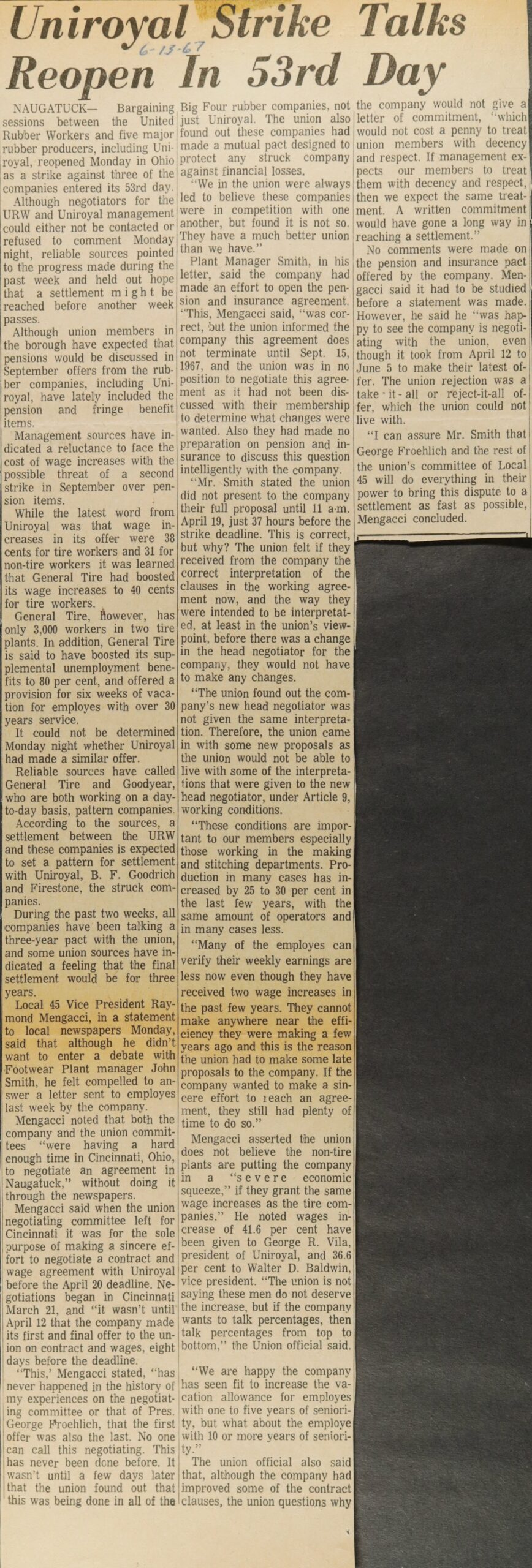
Uniroyal Strike Talks Reopen In 53rd Day

Uniroyal Strike Talks Reopen In 53rd Day

6-13-67

NAUGATUCK— Bargaining sessions between the United Rubber Workers and five major rubber producers, including Uniroyal, reopened Monday in Ohio as a strike against three of the companies entered its 53rd day.

Although negotiators for the URW and Uniroyal management could either not be contacted or refused to comment Monday night, reliable sources pointed to the progress made during the past week and held out hope that a settlement might be reached before another week passes.

Although union members in the borough have expected that pensions would be discussed in September offers from the rubber companies, including Uniroyal, have lately included the pension and fringe benefit items.

Management sources have indicated a reluctance to face the cost of wage increases with the possible threat of a second strike in September over pension items.

While the latest word from Uniroyal was that wage increases in its offer were 38 cents for tire workers and 31 for non-tire workers it was learned that General Tire had boosted its wage increases to 40 cents for tire workers.

General Tire, however, has only 3,000 workers in two tire plants. In addition, General Tire is said to have boosted its supplemental unemployment benefits to 80 per cent, and offered a provision for six weeks of vacation for employes with over 30 years service.

It could not be determined Monday night whether Uniroyal had made a similar offer.

Reliable sources have called General Tire and Goodyear, who are both working on a day-to-day basis, pattern companies.

According to the sources, a settlement between the URW and these companies is expected to set a pattern for settlement with Uniroyal, B. F. Goodrich and Firestone, the struck companies.

During the past two weeks, all companies have been talking a three-year pact with the union, and some union sources have indicated a feeling that the final settlement would be for three years.

Local 45 Vice President Raymond Mengacci, in a statement to local newspapers Monday, said that although he didn’t want to enter a debate with Footwear Plant manager John Smith, he felt compelled to answer a letter sent to employes last week by the company.

Mengacci noted that both the company and the union committees “were having a hard enough time in Cincinnati, Ohio, to negotiate an agreement in Naugatuck,” without doing it through the newspapers.

Mengacci said when the union negotiating committee left for Cincinnati it was for the sole purpose of making a sincere effort to negotiate a contract and wage agreement with Uniroyal before the April 20 deadline. Negotiations began in Cincinnati March 21, and “it wasn’t until April 12 that the company made its first and final offer to the union on contract and wages, eight days before the deadline.

“This,” Mengacci stated, “has never happened in the history of my experiences on the negotiating committee or that of Pres. George Froehlich, that the first offer was also the last. No one can call this negotiating. This has never been done before. It wasn’t until a few days later that the union found out that this was being done in all of the Big Four rubber companies, not just Uniroyal. The union also found out these companies had made a mutual pact designed to protect any struck company against financial losses.

“We in the union were always led to believe these companies were in competition with one another, but found it is not so. They have a much better union than we have.”

Plant Manager Smith, in his letter, said the company had made an effort to open the pension and insurance agreement. “This, Mengacci said, “was correct, but the union informed the company this agreement does not terminate until Sept. 15, 1967, and the union was in no position to negotiate this agreement as it had not been discussed with their membership to determine what changes were wanted. Also they had made no preparation on pension and insurance to discuss this question intelligently with the company.

“Mr. Smith stated the union did not present to the company their full proposal until 11 a.m. April 19, just 37 hours before the strike deadline. This is correct, but why? The union felt if they received from the company the correct interpretation of the clauses in the working agreement now, and the way they were intended to be interpreted, at least in the union’s viewpoint, before there was a change in the head negotiator for the company, they would not have to make any changes.

“The union found out the company’s new head negotiator was not given the same interpretation. Therefore, the union came in with some new proposals as the union would not be able to live with some of the interpretations that were given to the new head negotiator, under Article 9, working conditions.

“These conditions are important to our members especially those working in the making and stitching departments. Production in many cases has increased by 25 to 30 per cent in the last few years, with the same amount of operators and in many cases less.

“Many of the employes can verify their weekly earnings are less now even though they have received two wage increases in the past few years. They cannot make anywhere near the efficiency they were making a few years ago and this is the reason the union had to make some late proposals to the company. If the company wanted to make a sincere effort to reach an agreement, they still had plenty of time to do so.”

Mengacci asserted the union does not believe the non-tire plants are putting the company in a “severe economic squeeze,” if they grant the same wage increases as the tire companies.” He noted wages increase of 41.6 per cent have been given to George R. Vila, president of Uniroyal, and 36.6 per cent to Walter D. Baldwin, vice president. “The union is not saying these men do not deserve the increase, but if the company wants to talk percentages, then talk percentages from top to bottom,” the Union official said.

“We are happy the company has seen fit to increase the vacation allowance for employes with one to five years of seniority, but what about the employe with 10 or more years of seniority.”

The union official also said that, although the company had improved some of the contract clauses, the union questions why the company would not give a letter of commitment, “which would not cost a penny to treat union members with decency and respect. If management expects our members to treat them with decency and respect, then we expect the same treatment. A written commitment would have gone a long way in reaching a settlement.”

No comments were made on the pension and insurance pact offered by the company. Mengacci said it had to be studied before a statement was made. However, he said he “was happy to see the company is negotiating with the union, even though it took from April 12 to June 5 to make their latest offer. The union rejection was a take-it-all or reject-it-all offer, which the union could not live with.

“I can assure Mr. Smith that George Froehlich and the rest of the union’s committee of Local 45 will do everything in their power to bring this dispute to a settlement as fast as possible,” Mengacci concluded.

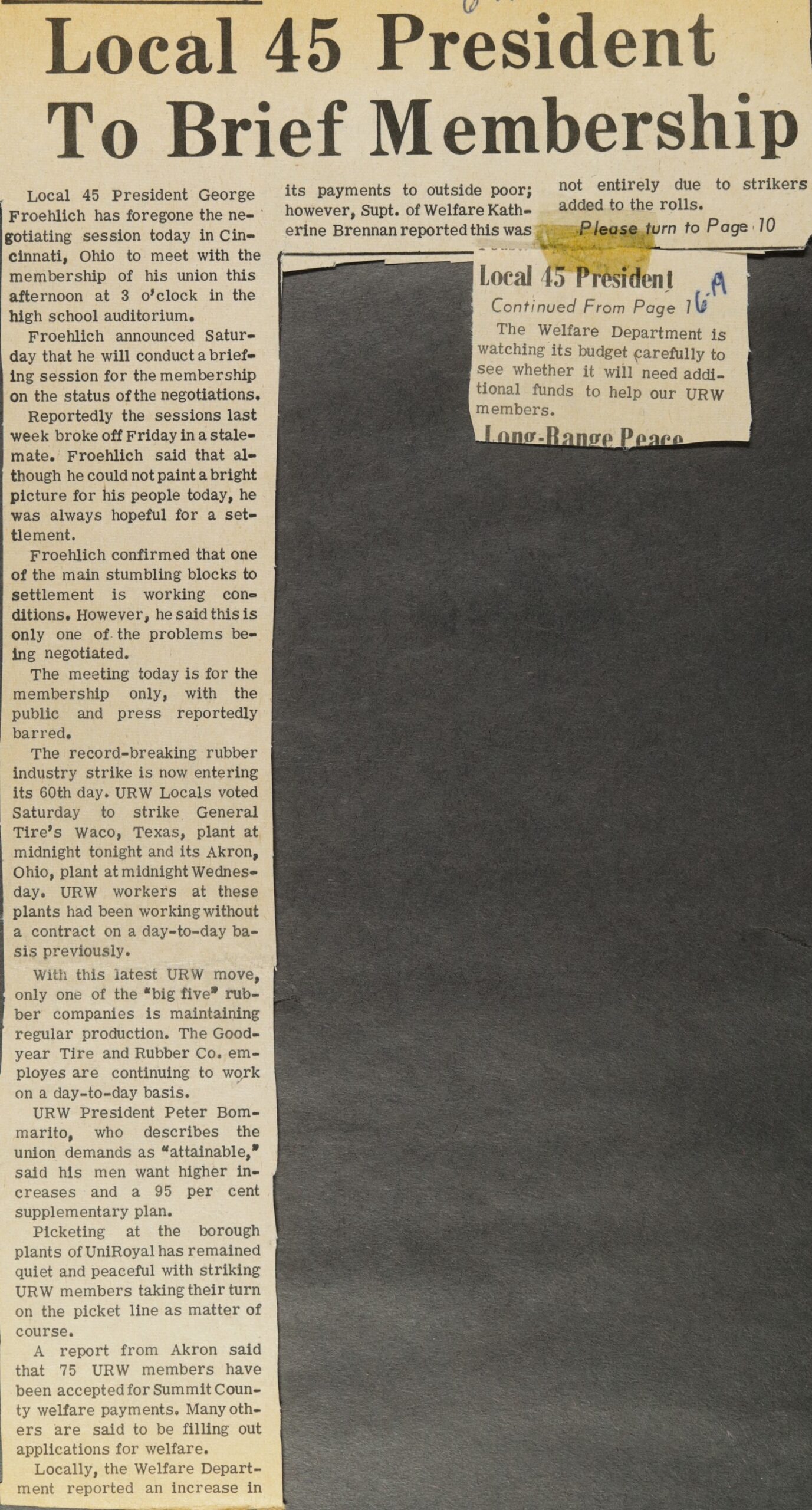
Local 45 President To Brief Membership

Local 45 President To Brief Membership

Local 45 President George Froehlich has foregone the negotiating session today in Cincinnati, Ohio to meet with the membership of his union this afternoon at 3 o’clock in the high school auditorium.

Froehlich announced Saturday that he will conduct a briefing session for the membership on the status of the negotiations.

Reportedly the sessions last week broke off Friday in a stalemate. Froehlich said that although he could not paint a bright picture for his people today, he was always hopeful for a settlement.

Froehlich confirmed that one of the main stumbling blocks to settlement is working conditions. However, he said this is only one of the problems being negotiated.

The meeting today is for the membership only, with the public and press reportedly barred.

The record-breaking rubber industry strike is now entering its 60th day. URW Locals voted Saturday to strike General Tire’s Waco, Texas, plant at midnight tonight and its Akron, Ohio, plant at midnight Wednesday. URW workers at these plants had been working without a contract on a day-to-day basis previously.

With this latest URW move, only one of the “big five” rubber companies is maintaining regular production. The Goodyear Tire and Rubber Co. employes are continuing to work on a day-to-day basis.

URW President Peter Bommarito, who describes the union demands as “attainable,” said his men want higher increases and a 95 per cent supplementary plan.

Picketing at the borough plants of UniRoyal has remained quiet and peaceful with striking URW members taking their turn on the picket line as matter of course.

A report from Akron said that 75 URW members have been accepted for Summit County welfare payments. Many others are said to be filling out applications for welfare.

Locally, the Welfare Department reported an increase in

its payments to outside poor; however, Supt. of Welfare Katherine Brennan reported this was

not entirely due to strikers added to the rolls.

Please turn to Page 10


Local 45 President

Continued From Page 1 6-A

The Welfare Department is watching its budget carefully to see whether it will need additional funds to help our URW members.

Long-Range Peace

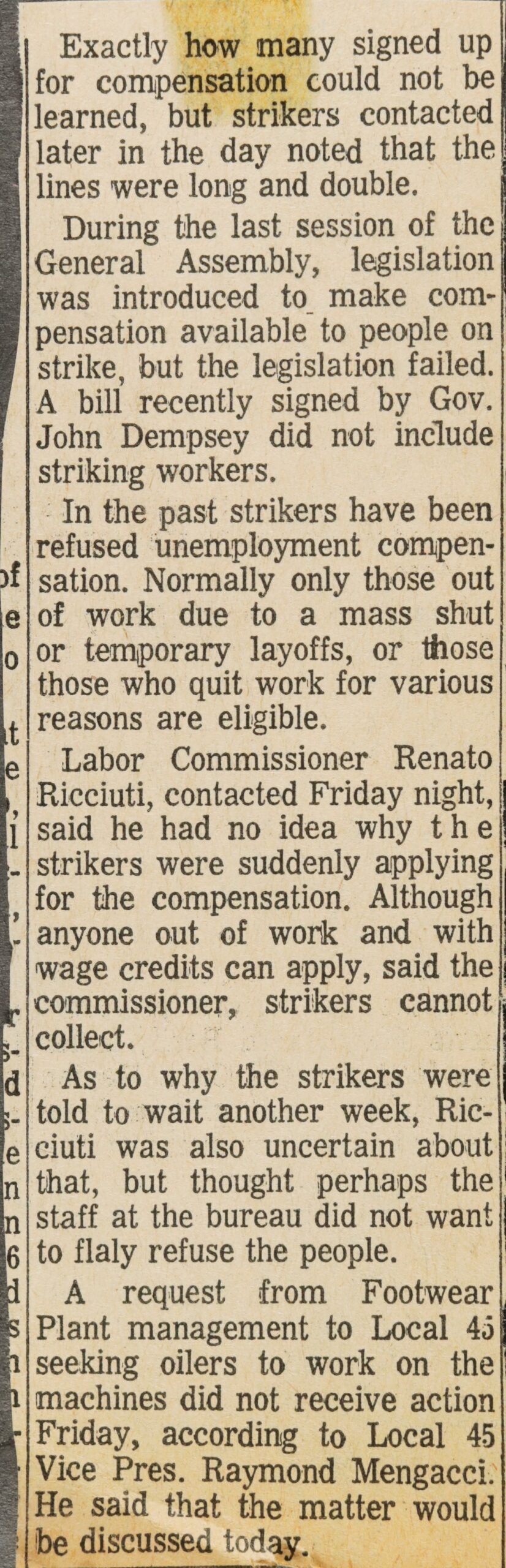
Exactly how many signed up for compensation could not be learned, but strikers contacted later in the day noted that the lines were long and double.

Exactly how many signed up
for compensation could not be
learned, but strikers contacted
later in the day noted that the
lines were long and double.

During the last session of the
General Assembly, legislation
was introduced to make com-
pensation available to people on
strike, but the legislation failed.
A bill recently signed by Gov.
John Dempsey did not include
striking workers.

In the past strikers have been
refused unemployment compen-
sation. Normally only those out
of work due to a mass shut
or temporary layoffs, or those
those who quit work for various
reasons are eligible.

Labor Commissioner Renato
Ricciuti, contacted Friday night,
said he had no idea why the
strikers were suddenly applying
for the compensation. Although
anyone out of work and with
wage credits can apply, said the
commissioner, strikers cannot
collect.

As to why the strikers were
told to wait another week, Ric-
ciuti was also uncertain about
that, but thought perhaps the
staff at the bureau did not want
to flaly refuse the people.

A request from Footwear
Plant management to Local 45
seeking oilers to work on the
machines did not receive action
Friday, according to Local 45
Vice Pres. Raymond Mengacci.
He said that the matter would
be discussed today.

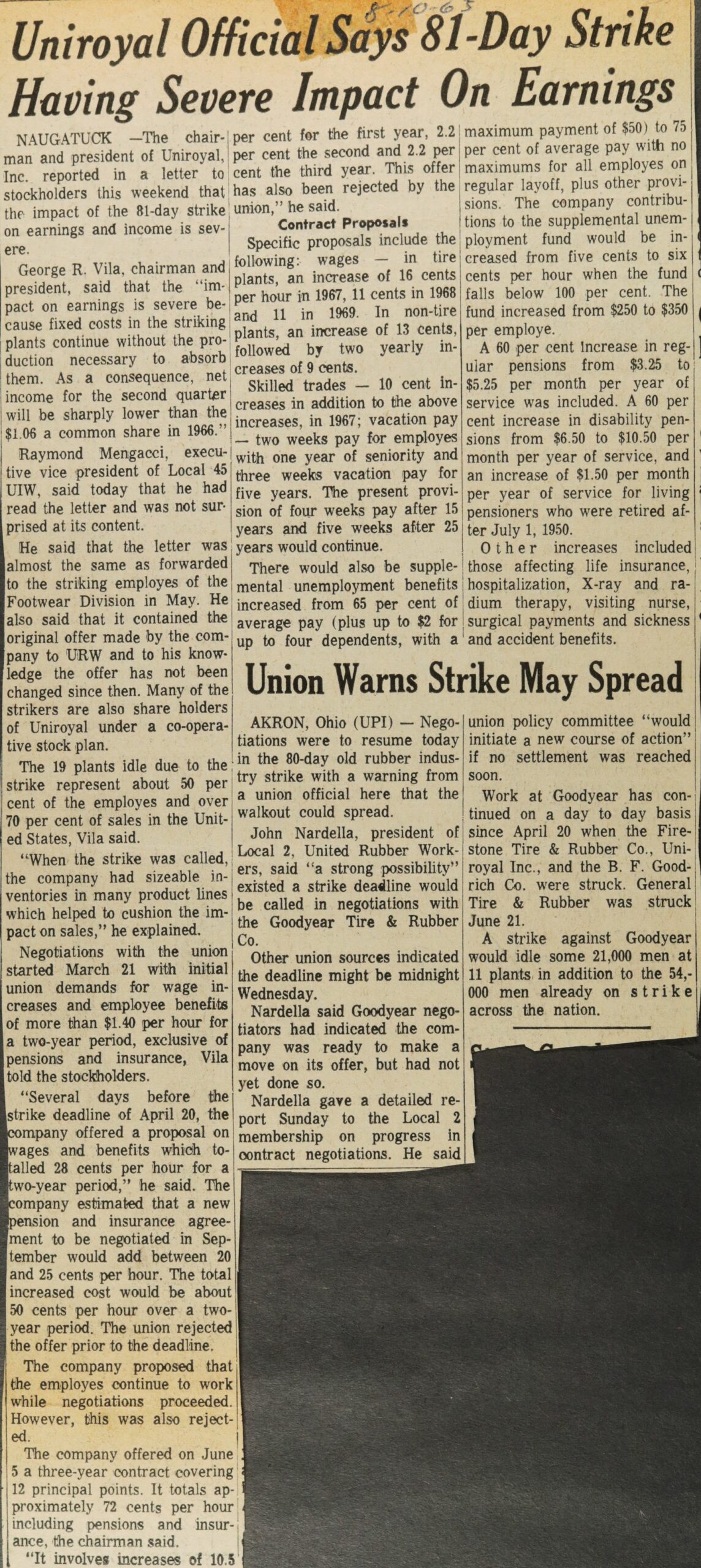
Uniroyal Official Says 81-Day Strike Having Severe Impact On Earnings

Uniroyal Official Says 81-Day Strike Having Severe Impact On Earnings

8-10-63 [handwritten]

NAUGATUCK —The chairman and president of Uniroyal, Inc. reported in a letter to stockholders this weekend that the impact of the 81-day strike on earnings and income is severe.

George R. Vila, chairman and president, said that the “impact on earnings is severe because fixed costs in the striking plants continue without the production necessary to absorb them. As a consequence, net income for the second quarter will be sharply lower than the $1.06 a common share in 1966.”

Raymond Mengacci, executive vice president of Local 45 UIW, said today that he had read the letter and was not surprised at its content.

He said that the letter was almost the same as forwarded to the striking employes of the Footwear Division in May. He also said that it contained the original offer made by the company to URW and to his knowledge the offer has not been changed since then. Many of the strikers are also share holders of Uniroyal under a co-operative stock plan.

The 19 plants idle due to the strike represent about 50 per cent of the employes and over 70 per cent of sales in the United States, Vila said.

“When the strike was called, the company had sizeable inventories in many product lines which helped to cushion the impact on sales,” he explained.

Negotiations with the union started March 21 with initial union demands for wage increases and employee benefits of more than $1.40 per hour for a two-year period, exclusive of pensions and insurance, Vila told the stockholders.

“Several days before the strike deadline of April 20, the company offered a proposal on wages and benefits which totalled 28 cents per hour for a two-year period,” he said. The company estimated that a new pension and insurance agreement to be negotiated in September would add between 20 and 25 cents per hour. The total increased cost would be about 50 cents per hour over a two-year period. The union rejected the offer prior to the deadline.

The company proposed that the employes continue to work while negotiations proceeded. However, this was also rejected.

The company offered on June 5 a three-year contract covering 12 principal points. It totals approximately 72 cents per hour including pensions and insurance, the chairman said.

“It involves increases of 10.5 per cent for the first year, 2.2 per cent the second and 2.2 per cent the third year. This offer has also been rejected by the union,” he said.

Contract Proposals

Specific proposals include the following: wages — in tire plants, an increase of 16 cents per hour in 1967, 11 cents in 1968 and 11 in 1969. In non-tire plants, an increase of 13 cents, followed by two yearly increases of 9 cents.

Skilled trades — 10 cent increases in addition to the above increases, in 1967; vacation pay — two weeks pay for employes with one year of seniority and three weeks vacation pay for five years. The present provision of four weeks pay after 15 years and five weeks after 25 years would continue.

There would also be supplemental unemployment benefits increased from 65 per cent of average pay (plus up to $2 for up to four dependents, with a maximum payment of $50) to 75 per cent of average pay with no maximums for all employes on regular layoff, plus other provisions. The company contributions to the supplemental unemployment fund would be increased from five cents to six cents per hour when the fund falls below 100 per cent. The fund increased from $250 to $350 per employe.

A 60 per cent increase in regular pensions from $3.25 to $5.25 per month per year of service was included. A 60 per cent increase in disability pensions from $6.50 to $10.50 per month per year of service, and an increase of $1.50 per month per year of service for living pensioners who were retired after July 1, 1950.
Other increases included those affecting life insurance, hospitalization, X-ray and radium therapy, visiting nurse, surgical payments and sickness and accident benefits.


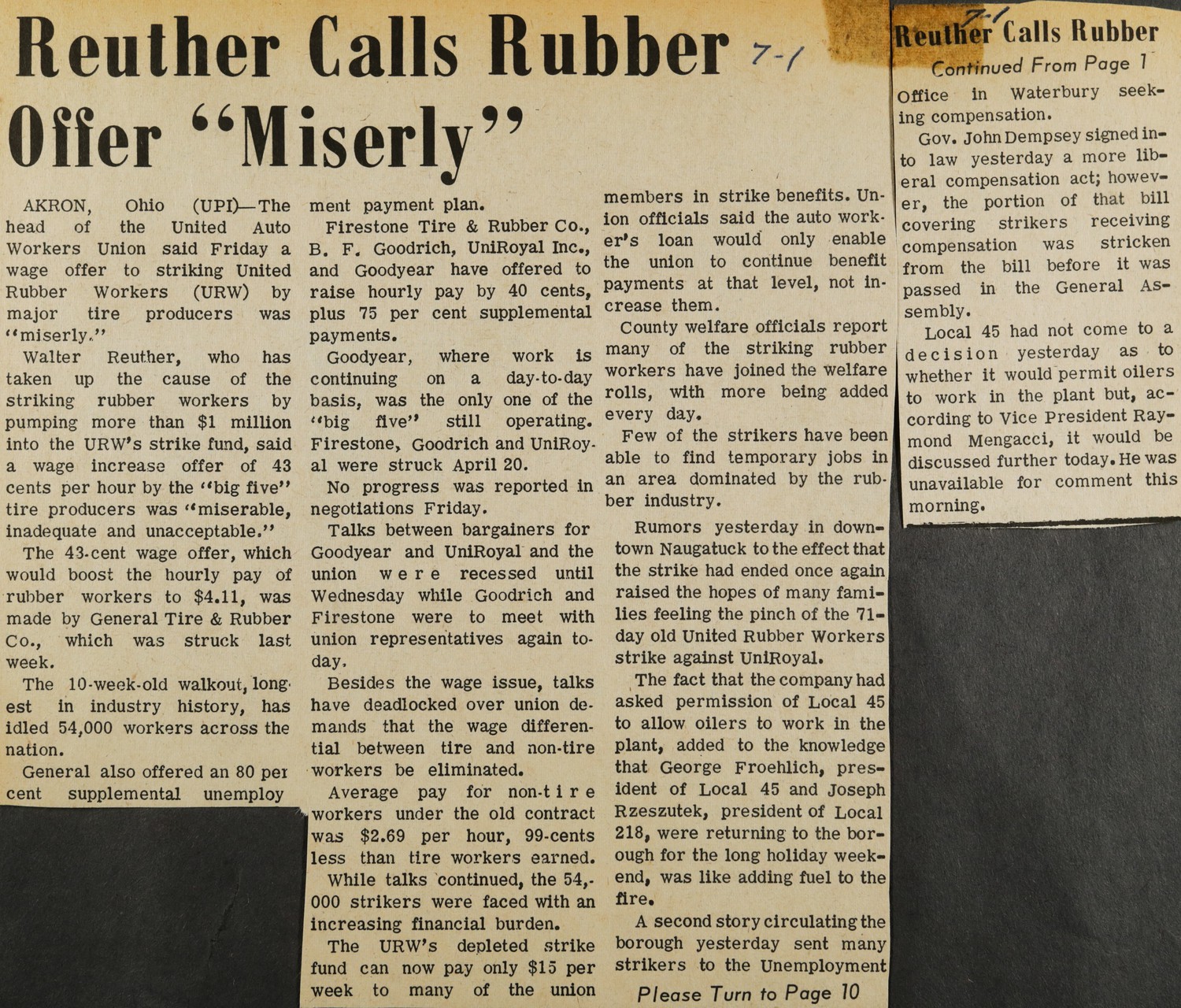
Union Warns Strike May Spread

AKRON, Ohio (UPI) — Negotiations were to resume today in the 80-day old rubber industry strike with a warning from a union official here that the walkout could spread.

John Nardella, president of Local 2, United Rubber Workers, said “a strong possibility” existed a strike deadline would be called in negotiations with the Goodyear Tire & Rubber Co.

Other union sources indicated the deadline might be midnight Wednesday.

Nardella said Goodyear negotiators had indicated the company was ready to make a move on its offer, but had not yet done so.

Nardella gave a detailed report Sunday to the Local 2 membership on progress in contract negotiations. He said union policy committee “would initiate a new course of action” if no settlement was reached soon.

Work at Goodyear has continued on a day to day basis since April 20 when the Firestone Tire & Rubber Co., Uniroyal Inc., and the B. F. Goodrich Co. were struck. General Tire & Rubber was struck June 21.

A strike against Goodyear would idle some 21,000 men at 11 plants in addition to the 54,000 men already on strike across the nation.

Untitled Clipping

7-11-67

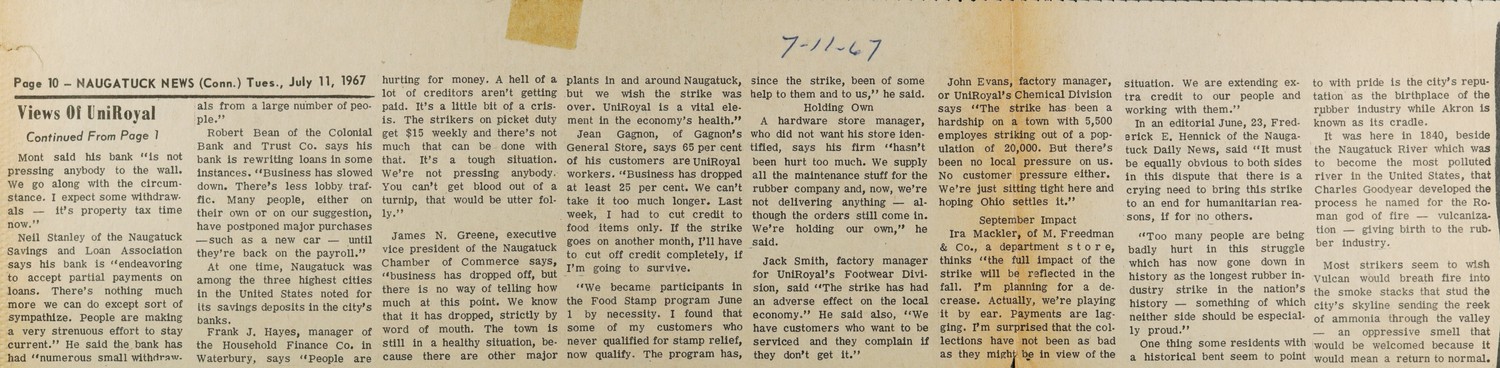
Page 10 – NAUGATUCK NEWS (Conn.) Tues., July 11, 1967


Views Of UniRoyal

Continued From Page 1

Mont said his bank “is not pressing anybody to the wall. We go along with the circumstance. I expect some withdrawals — it’s property tax time now.”

Neil Stanley of the Naugatuck Savings and Loan Association says his bank is “endeavoring to accept partial payments on loans. There’s nothing much more we can do except sort of sympathize. People are making a very strenuous effort to stay current.” He said the bank has had “numerous small withdrawals from a large number of people.”

At one time, Naugatuck was among the three highest cities in the United States noted for its savings deposits in the city’s banks.

Frank J. Hayes, manager of the Household Finance Co. in Waterbury, says “People are hurting for money. A hell of a lot of creditors aren’t getting paid. It’s a little bit of a crisis. The strikers on picket duty get $15 weekly and there’s not much that can be done with that. It’s a tough situation. We’re not pressing anybody. You can’t get blood out of a turnip, that would be utter folly.”

James N. Greene, executive vice president of the Naugatuck Chamber of Commerce says, “business has dropped off, but there is no way of telling how much at this point. We know that it has dropped, strictly by word of mouth. The town is still in a healthy situation, because there are other major plants in and around Naugatuck, but we wish the strike was over. UniRoyal is a vital element in the economy’s health.”

Jean Gagnon, of Gagnon’s General Store, says 65 per cent of his customers are UniRoyal workers. “Business has dropped at least 25 per cent. We can’t take it too much longer. Last week, I had to cut credit to food items only. If the strike goes on another month, I’ll have to cut off credit completely, if I’m going to survive.

“We became participants in the Food Stamp program June 1 by necessity. I found that some of my customers who never qualified for stamp relief, now qualify. The program has, since the strike, been of some help to them and to us,” he said.

Holding Own

A hardware store manager, who did not want his store identified, says his firm “hasn’t been hurt too much. We supply all the maintenance stuff for the rubber company and, now, we’re not delivering anything — although the orders still come in. We’re holding our own,” he said.

Jack Smith, factory manager for UniRoyal’s Footwear Division, said “The strike has had an adverse effect on the local economy.” He said also, “We have customers who want to be serviced and they complain if they don’t get it.”

John Evans, factory manager, or UniRoyal’s Chemical Division says “The strike has been a hardship on a town with 5,500 employes striking out of a population of 20,000. But there’s been no local pressure either. We’re just sitting tight here and hoping Ohio settles it.”

September Impact

Ira Mackler, of M. Freedman & Co., a department store, thinks “the full impact of the strike will be reflected in the fall. I’m planning for a decrease. Actually, we’re playing it by ear. Payments are lagging. I’m surprised that the collections have not been as bad as they might be in view of the situation. We are extending extra credit to our people and working with them.”

In an editorial June 23, Frederick E. Hennick of the Naugatuck Daily News, said “It must be equally obvious to both sides in this dispute that there is a crying need to bring this strike to an end for humanitarian reasons, if for no others.

“Too many people are being badly hurt in this struggle which has now gone down in history as the longest rubber industry strike in the nation’s history — something of which neither side should be especially proud.”

One thing some residents with a historical bent seem to point to with pride is the city’s reputation as the birthplace of the rubber industry while Akron is known as its cradle.

It was here in 1840, beside the Naugatuck River which was to become the most polluted river in the United States, that Charles Goodyear developed the process he named for the Roman god of fire — vulcanization — giving birth to the rubber industry.

Most strikers seem to wish Vulcan would breath fire into the smoke stacks that stud the city’s skyline sending the reek of ammonia through the valley — an oppressive smell that would be welcomed because it would mean a return to normal.

GAINS REPORTED IN RUBBER TALKS

THE NEW YORK TIMES,
7-11-67

GAINS REPORTED
IN RUBBER TALKS

Chief U.S. Mediator Moves
Back Into Negotiations

By DAVID R. JONES
Special to The New York Times

WASHINGTON, July 10—The
Government’s top labor medi-
ator moved back into the rub-
ber industry, labor negotiations
today, amid reports of prog-
ress in settling the industry’s
81-day-old strike.

William E. Simkin, director
of the Federal Mediation and
Conciliation Service, went to
Columbus, Ohio, to keep an
eye on bargaining there be-
tween the B. F. Goodrich Com-
pany and the striking United
Rubber Workers.

A union official said that
“real progress is being made”
in the talks with Goodrich.
Ward Keener, Goodrich presi-
dent, also said progress was
being made.

Meanwhile, the union set a
strike deadline of 12:01 A.M.
Thursday against the Goodyear
Tire and Rubber Company.
Goodyear, which employs 21,-
000, has been operating on a
day-to-day basis while ne-
gotiating on a new contract
to replace one that expired
April 20.

The union struck Goodrich,
the Firestone Tire and Rub-
ber Company and Uniroyal,
Inc., on that date and shut
down the General Tire and
Rubber Company several weeks
later. About 54,000 workers
have been made idle by the
strike.

Signs of Optimism

The precise reason for Mr.
Simkin’s trip to Columbus was
not disclosed, but there were
signs of some optimism that
a break might be near with
Goodrich. Mr. Simkin called
the union and the five com-
panies together a few weeks
ago in Pittsburgh in a bid for
agreement, but that failed.
Informed sources said Good-
rich and the union had re-
solved most of the important
noneconomic contract items and
were returning to the money
issues. The two sides bargained
throughout the weekend while
other negotiations, carried on
individually with each com-
pany, recessed yesterday.

All the companies except
General were last reported to
have offered the union a wage
increase of 40 cents an hour,
plus a supplemental unemploy-
ment benefit of 75 per cent of
straight-time hourly wages for
those laid off. General offered
43 cents an hour and an 80
per cent layoff benefit.

The union’s tire workers now
average $3.68 an hour, while
nontire workers average $2.69.
A key union demand has been
to raise the layoff benefit from
the present 65 per cent of
wages to between 92.5 and 95
per cent.

The negotiations have been
complicated by the presence of
a new union president, Peter
Bonmarito, who was elected
this year on a militant plat-
form and has been under pres-
sure to achieve big gains.

Untitled Clipping

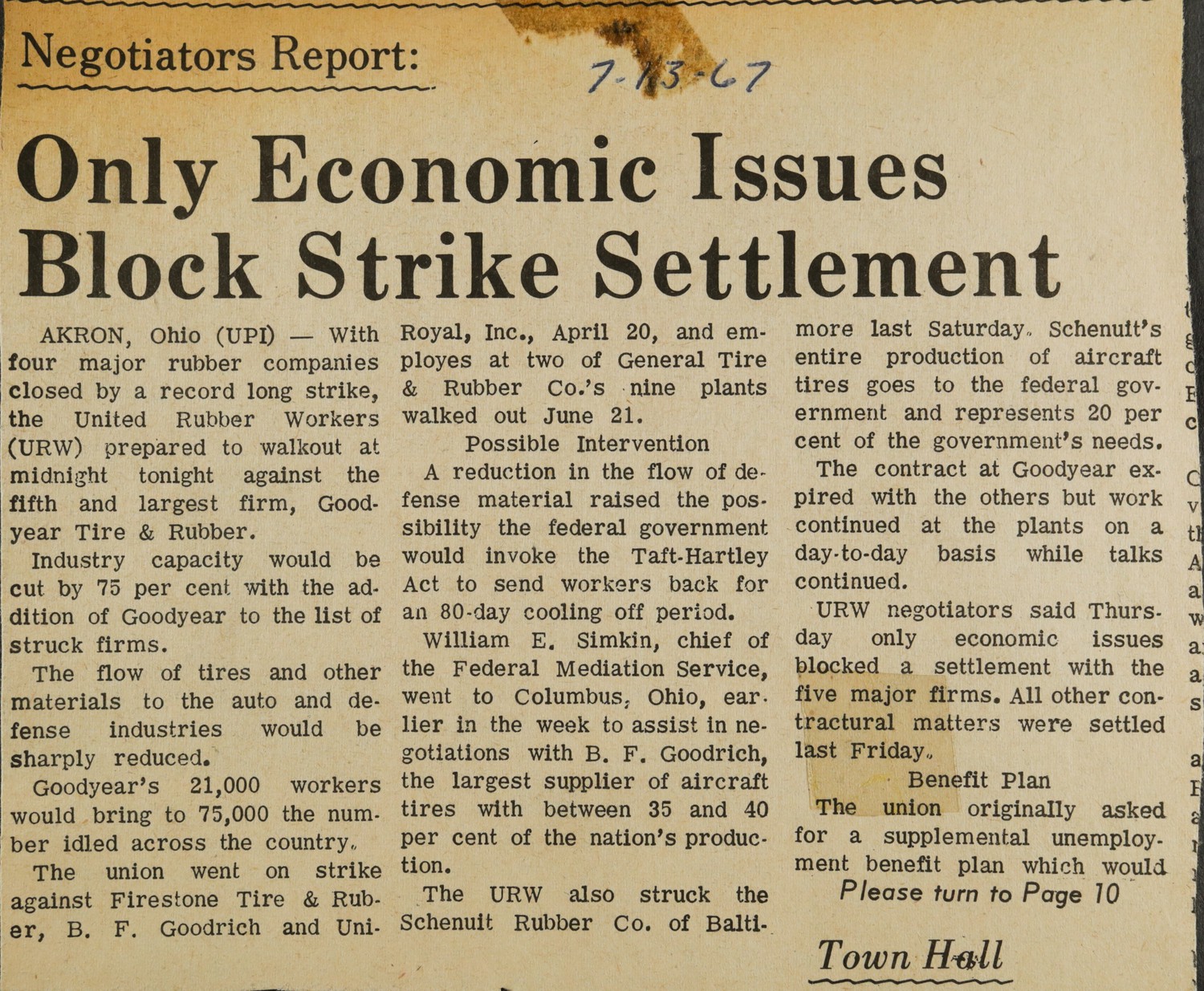
Negotiators Report:

7-13-67 [handwritten]

Only Economic Issues Block Strike Settlement

AKRON, Ohio (UPI) — With four major rubber companies closed by a record long strike, the United Rubber Workers (URW) prepared to walkout at midnight tonight against the fifth and largest firm, Goodyear Tire & Rubber.

Industry capacity would be cut by 75 per cent with the addition of Goodyear to the list of struck firms.

The flow of tires and other materials to the auto and defense industries would be sharply reduced.
Goodyear’s 21,000 workers would bring to 75,000 the number idled across the country.
The union went on strike against Firestone Tire & Rubber, B. F. Goodrich and Uni-

Royal, Inc., April 20, and employes at two of General Tire & Rubber Co.’s nine plants walked out June 21.

Possible Intervention

A reduction in the flow of defense material raised the possibility the federal government would invoke the Taft-Hartley Act to send workers back for an 80-day cooling off period.

William E. Simkin, chief of the Federal Mediation Service, went to Columbus, Ohio, earlier in the week to assist in negotiations with B. F. Goodrich, the largest supplier of aircraft tires with between 35 and 40 per cent of the nation’s production.

The URW also struck the Schenuit Rubber Co. of Balti-

more last Saturday. Schenuit’s entire production of aircraft tires goes to the federal government and represents 20 per cent of the government’s needs.

The contract at Goodyear expired with the others but work continued at the plants on a day-to-day basis while talks continued.

URW negotiators said Thursday only economic issues blocked a settlement with the five major firms. All other contractural matters were settled last Friday.

Benefit Plan

The union originally asked for a supplemental unemployment benefit plan which would

Please turn to Page 10


Town Hall

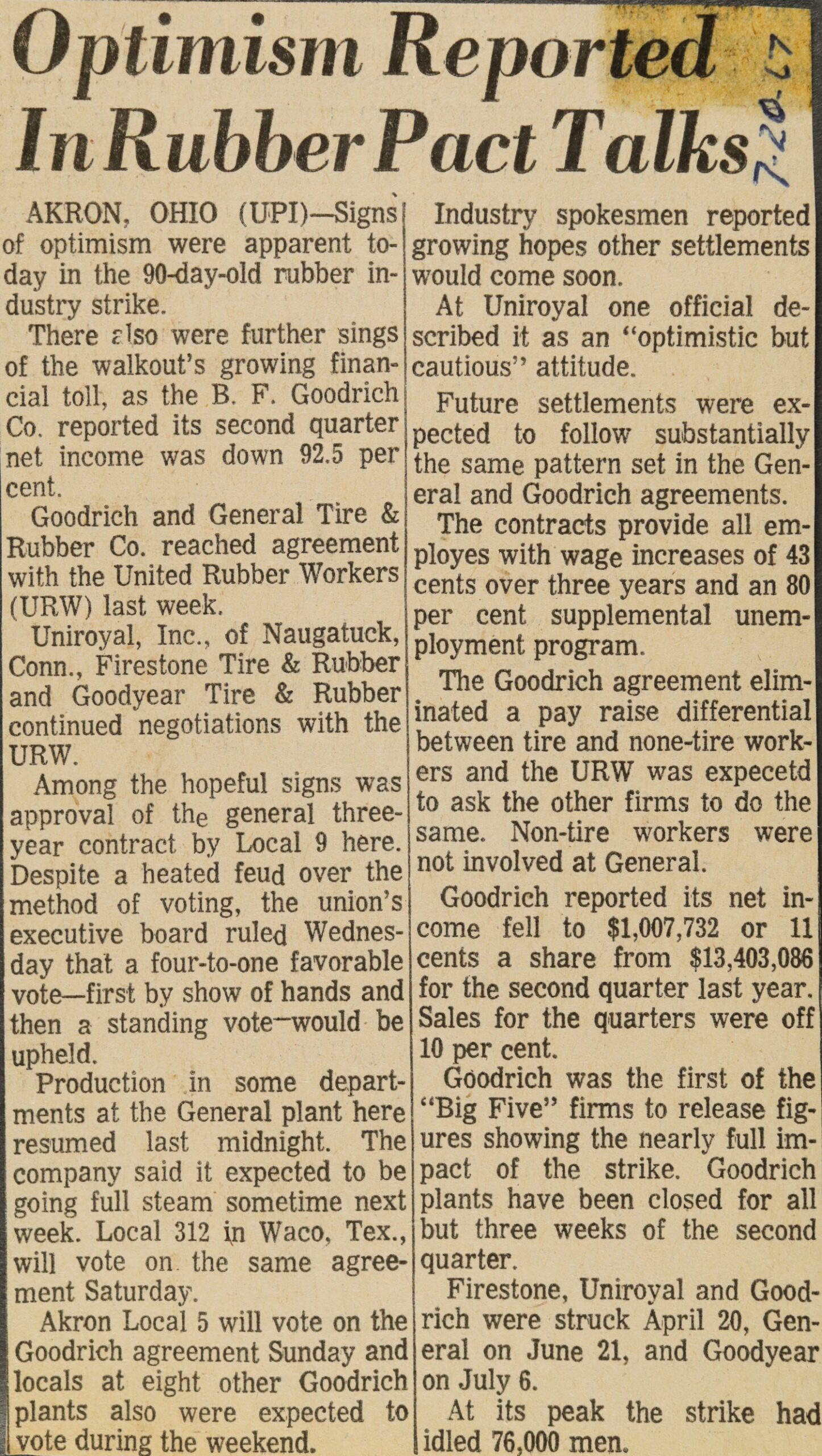
Optimism Reported In Rubber Pact Talks

Optimism Reported In Rubber Pact Talks

7-20-67 [handwritten notation]

AKRON, OHIO (UPI)—Signs of optimism were apparent today in the 90-day-old rubber industry strike.

There also were further sings of the walkout’s growing financial toll, as the B. F. Goodrich Co. reported its second quarter net income was down 92.5 per cent.

Goodrich and General Tire & Rubber Co. reached agreement with the United Rubber Workers (URW) last week.

Uniroyal, Inc., of Naugatuck, Conn., Firestone Tire & Rubber and Goodyear Tire & Rubber continued negotiations with the URW.

Among the hopeful signs was approval of the general three-year contract by Local 9 here. Despite a heated feud over the method of voting, the union’s executive board ruled Wednesday that a four-to-one favorable vote—first by show of hands and then a standing vote—would be upheld.

Production in some departments at the General plant here resumed last midnight. The company said it expected to be going full steam sometime next week. Local 312 in Waco, Tex., will vote on the same agreement Saturday.

Akron Local 5 will vote on the Goodrich agreement Sunday and locals at eight other Goodrich plants also were expected to vote during the weekend.

Industry spokesmen reported growing hopes other settlements would come soon.

At Uniroyal one official described it as an “optimistic but cautious” attitude.

Future settlements were expected to follow substantially the same pattern set in the General and Goodrich agreements.

The contracts provide all employes with wage increases of 43 cents over three years and an 80 per cent supplemental unemployment program.

The Goodrich agreement eliminated a pay raise differential between tire and none-tire workers and the URW was expecetd to ask the other firms to do the same. Non-tire workers were not involved at General.

Goodrich reported its net income fell to $1,007,732 or 11 cents a share from $13,403,086 for the second quarter last year. Sales for the quarters were off 10 per cent.

Goodrich was the first of the “Big Five” firms to release figures showing the nearly full impact of the strike. Goodrich plants have been closed for all but three weeks of the second quarter.

Firestone, Uniroyal and Goodrich were struck April 20, General on June 21, and Goodyear on July 6.

At its peak the strike had idled 76,000 men.

Rubber Strike Holds On Despite End-Soon Rumors

Rubber Strike Holds On Despite End-Soon Rumors

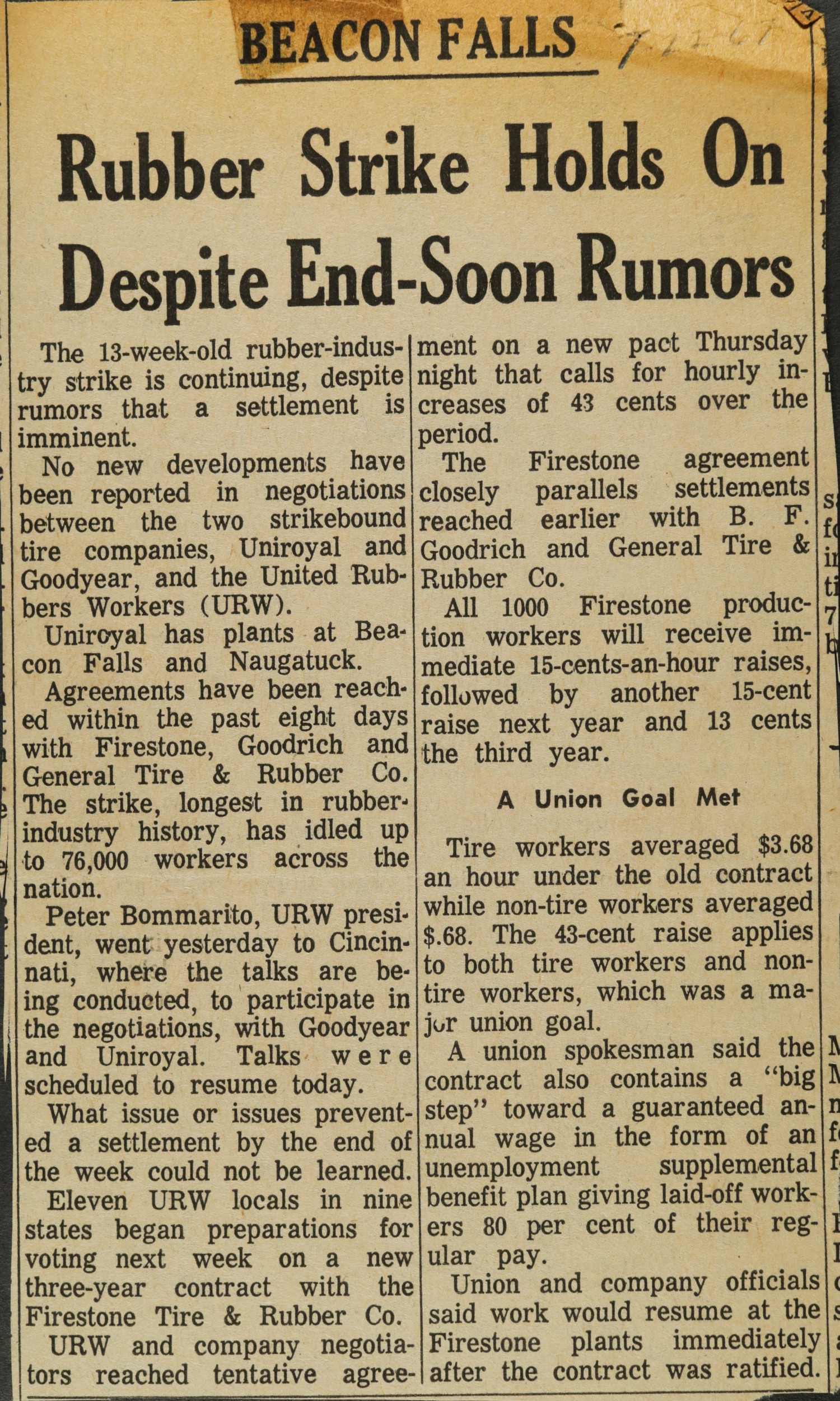
BEACON FALLS

7/12/67 [handwritten date in top right corner]

Rubber Strike Holds On Despite End-Soon Rumors

The 13-week-old rubber-industry strike is continuing, despite rumors that a settlement is imminent.

No new developments have been reported in negotiations between the two strikebound tire companies, Uniroyal and Goodyear, and the United Rubbers Workers (URW).

Uniroyal has plants at Beacon Falls and Naugatuck.

Agreements have been reached within the past eight days with Firestone, Goodrich and General Tire & Rubber Co. The strike, longest in rubber-industry history, has idled up to 76,000 workers across the nation.

Peter Bommarito, URW president, went yesterday to Cincinnati, where the talks are being conducted, to participate in the negotiations, with Goodyear and Uniroyal. Talks were scheduled to resume today.

What issue or issues prevented a settlement by the end of the week could not be learned.

Eleven URW locals in nine states began preparations for voting next week on a new three-year contract with the Firestone Tire & Rubber Co.

URW and company negotiators reached tentative agreement on a new pact Thursday night that calls for hourly increases of 43 cents over the period.

The Firestone agreement closely parallels settlements reached earlier with B. F. Goodrich and General Tire & Rubber Co.

All 1000 Firestone production workers will receive immediate 15-cents-an-hour raises, followed by another 15-cent raise next year and 13 cents the third year.

A Union Goal Met

Tire workers averaged $3.68 an hour under the old contract while non-tire workers averaged $.68. The 43-cent raise applies to both tire workers and non-tire workers, which was a major union goal.

A union spokesman said the contract also contains a “big step” toward a guaranteed annual wage in the form of an unemployment supplemental benefit plan giving laid-off workers 80 per cent of their regular pay.

Union and company officials said work would resume at the Firestone plants immediately after the contract was ratified.

Many Footwear employes are entitled to four weeks and in some instances five weeks of vacation.

Many Footwear employes are
entitled to four weeks and in
some instances five weeks of
vacation. These workers are
permitted to take the extra
weeks at various intervals
through the year so as not to
conflict with the annual vaca-
tion shutdown.

Employes of the Chemical and
Synthetic Divisions now on
strike are allowed to stagger
their vacations. Accordingly,
the plant under normal condi-
tions do not close for any allot-
ted vacation-time as is the case
at Footwear.

Meanwhile, the negotiations

Rubber Workers, AFL-CIO and
Uniroyal have developed into a
cliff-hanging affair.

Reportedly, this past Friday,
the two teams were close to a
settlement on a new master
contract. However a hitch over
some clauses reportedly caused
a new disagreement.

The decision of Firestone to
settle this past Thursday was
the signal for considerable op-
timism here. It was expected
that Uniroyal would follow not
only Firestone, but also Gen-
eral and Goodrich, the other
companies that came to an
earlier agreement with URW.

A reliable report has indicat-
ed that some problems with
Article 9 are holding up the
agreement on the new contract.
The article refers to working
conditions, notably speed-up
of production operations.

URW workers affiliated with
Uniroyal including those of the
three divisions here, Footwear,
Chemical and Synthetic have
the dubious honor of participat-
ing in the longest strike in the
history of the rubber industry.

The strike against Uniroyal
s now in its 94th day. Back on
April 21, union workers of Uni-
oyal, Firestone and Goodrich
egan the marathon walkout.

Since Goodrich and Firestone
have now settled, Uniroyal is
he only one of the three left
utside the fold.

94-Day UniRoyal Strike Continues

94-Day UniRoyal Strike Continues

7-24-67 [handwritten]

No break has yet been reported in the 94-day United Rubber Workers-UniRoyal strike. According to sources an all-day session was held yesterday in Cincinnati with small committees meeting through the night.

URW International President Peter Bommarito moved into talks Friday between the union and the two remaining rubber companies, UniRoyal and Goodyear.

Hope ran high Friday in the borough that a settlement would be reached sometime during the day. However, another weekend has past and the mood has returned to the passive waiting of previous weeks.

Vacation pay checks are scheduled to be distributed tomorrow and Wednesday to employes of the Footwear Plant. Many workers have planned vacations for the next two weeks, settlement or not. Other employes have been waiting for these checks to give their finances a boost.

Chemical and Synthetic plant workers have been scheduling their vacations at various times during the strike. These plants do not have a general shutdown as does the footwear plant.

AKRON, Ohio (UPI)—United Rubber Worker locals in Akron and Miami, Okla., voted Sunday to accept a new contract from the B. F. Goodrich Co., bringing the 94-day strike, longest in rubber industry history, closer to an end.

The process of ratification continued at Firestone Tire & Rubber Co., and General Tire & Rubber Co. during the weekend. Negotiations with Goodyear Tire & Rubber Co. and UniRoyal Inc., did not arrive at a settlement hoped for during the weekend.

Some 4,000 URW members jammed the auditorium of Akron University to shout approval of the new Goodrich contract. Local 5 here has 4,900 members, almost half of the 11,000 employes covered in the contract.

Voice Vote Approval

In Miami, where the Goodrich employes have been back working since Friday, Local 318 approved the contract by a voice vote. Other votes from other locals around the country were expected today at URW international headquarters here. A majority of locals must ratify the contract before it is officially accepted.

General’s two tire factories, here and in Waco, Tex., were expected back in full production this week, following the vote by Local 318 in Waco to ratify the contract Saturday. All 3,000 URW members in the General Tire factories have approved the contract.

Some 17,000 Firestone employes, in 11 locals in 9 states, were to begin voting on their settlement today.

A majority of the more than 75,000 strikers, however, are still idled. About 22,000 of them have been out since April 20th when UniRoyal was struck. The 21,000 at Goodyear did not strike until July 14.

A Goodyear spokesman declined to make any comment about what was holding up negotiations.

They were taking place in Cincinnati.

Conform To Pattern

The settlements, when they are achieved, were expected to conform closely to the pattern already set.

The three settlements will all provide raises of 43 cents per hour to production workers, in steps of 15, 15 and 13 cents. The contracts will include a supplemental unemployment benefit plan giving laid off workers 80 per cent of their regular wages.

Please turn to Page 10

Quick End To Strike

Quick End To Strike

82nd Year, Number 173

Dedicated To Community Public Service


[Handwritten note: 7-25-67]


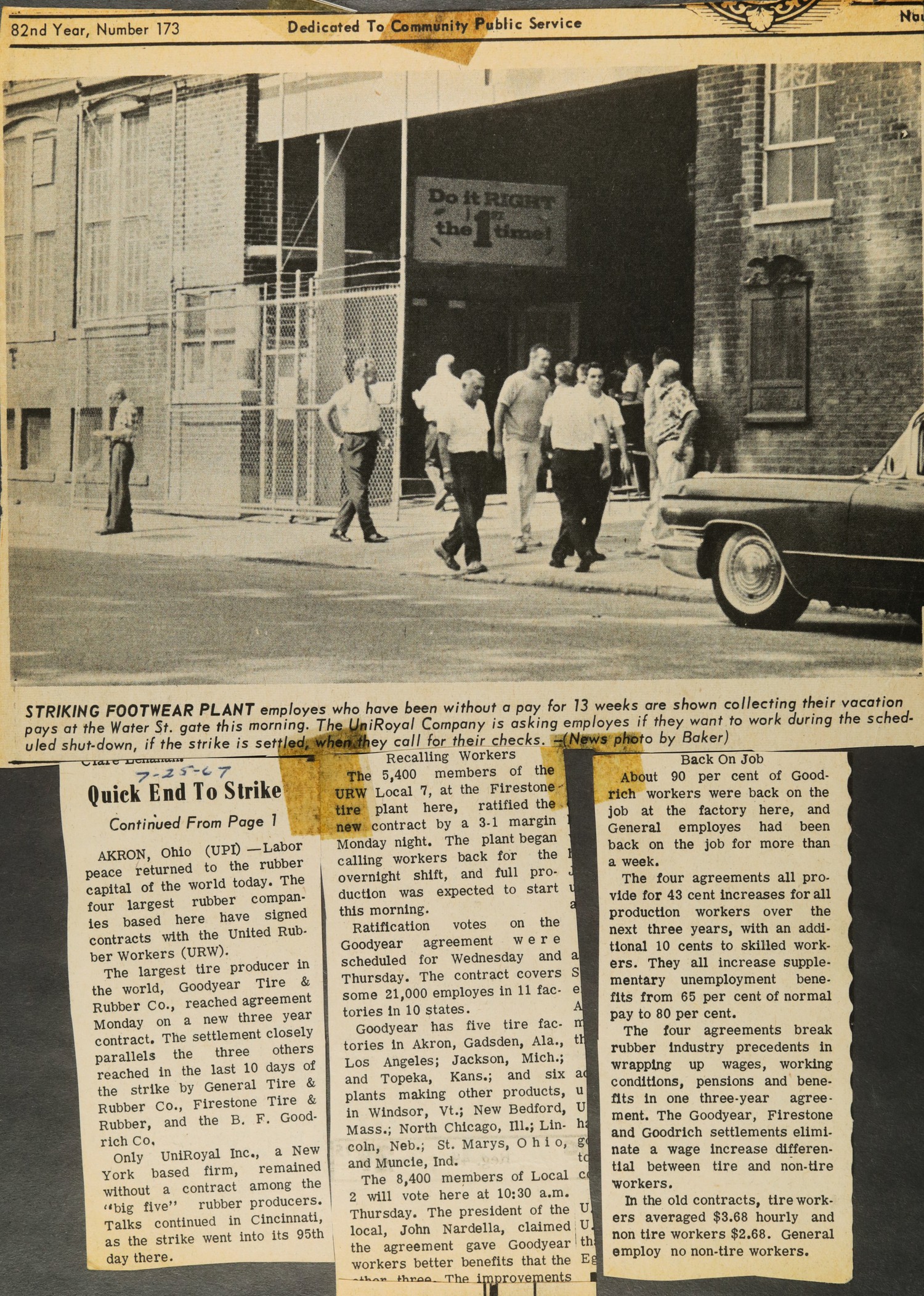
STRIKING FOOTWEAR PLANT employes who have been without a pay for 13 weeks are shown collecting their vacation pays at the Water St. gate this morning. The UniRoyal Company is asking employes if they want to work during the scheduled shut-down, if the strike is settled, when they call for their checks. —(News photo by Baker)


Quick End To Strike

Continued From Page 1

AKRON, Ohio (UPI) —Labor peace returned to the rubber capital of the world today. The four largest rubber companies based here have signed contracts with the United Rubber Workers (URW).

The largest tire producer in the world, Goodyear Tire & Rubber Co., reached agreement Monday on a new three year contract. The settlement closely parallels the three others reached in the last 10 days of the strike by General Tire & Rubber Co., Firestone Tire & Rubber, and the B. F. Goodrich Co.

Only UniRoyal Inc., a New York based firm, remained without a contract among the “big five” rubber producers. Talks continued in Cincinnati, as the strike went into its 95th day there.


Recalling Workers

The 5,400 members of the URW Local 7, at the Firestone tire plant here, ratified the new contract by a 3-1 margin Monday night. The plant began calling workers back for the overnight shift, and full production was expected to start this morning.

Ratification votes on the Goodyear agreement were scheduled for Wednesday and Thursday. The contract covers some 21,000 employes in 11 factories in 10 states.

Goodyear has five tire factories in Akron, Gadsden, Ala., Los Angeles; Jackson, Mich.; and Topeka, Kans.; and six plants making other products, in Windsor, Vt.; New Bedford, Mass.; North Chicago, Ill.; Lincoln, Neb.; St. Marys, Ohio, and Muncie, Ind.

The 8,400 members of Local 2 will vote here at 10:30 a.m. Thursday. The president of the local, John Nardella, claimed the agreement gave Goodyear workers better benefits that the other three. The improvements


Back On Job

About 90 per cent of Goodrich workers were back on the job at the factory here, and General employes had been back on the job for more than a week.

The four agreements all provide for 43 cent increases for all production workers over the next three years, with an additional 10 cents to skilled workers. They all increase supplementary unemployment benefits from 65 per cent of normal pay to 80 per cent.

The four agreements break rubber industry precedents in wrapping up wages, working conditions, pensions and benefits in one three-year agreement. The Goodyear, Firestone and Goodrich settlements eliminate a wage increase differential between tire and non-tire workers.

In the old contracts, tire workers averaged $3.68 hourly and non tire workers $2.68. General employ no non-tire workers.

Strike Hurt Economy Of Valley

Strike Hurt Economy Of Valley

By RICHARD S. EDINGER

Any 100-day labor strike will cause economic hardship to union members, their families and local merchants, especially in communities the size of Seymour and Beacon Falls.

On Saturday, the union members at Uniroyal, Inc. will vote on ratification of contract agreement made last night in Cincinnati.

The strike will be 100 days old and merchants agree the work stoppage has had some effect on business.

Many families in Beacon Falls and Seymour derive their income from the huge rubber facility four miles north of the center of Beacon Falls in Naugatuck.

There is also a Uniroyal warehouse in Beacon Falls, but few are employed there.

Some relief—temporary as it might be—is being received by employes this week in the form of vacation paychecks.

Some of these checks equal as much as five weeks pay. The total vacation pay distributed is $2-million.

Two Locals

Two Locals

Continued From Page 1

more are needed to operate
additional production lines.

Strike benefit checks will be
issued as follows: Local 45,
tomorrow and Wednesday, 9
a.m. to 3 p.m.; Local 218,
Wednesday, 7 a.m. to 5 p.m.;
Local 308, tomorrow 9 a.m.
to 6 p.m.

The longest strike in the his-
tory of the rubber industry has
ended with a new three-year
contract, providing a 43 per
cent per hour wage increase
over the three year period.

Other gains for union em-
ployees are an 80 per cent
guaranteed annual wage and a
company-paid surgical plan.

Additional specifics of the
contract will be announced when
all three locals have noted to
ratify.

Local 45 President George
Froehlich told his union mem-
bership that “A” good contract”
had been obtained and that many
gains by the union would prove
“fruitful in the future.”

UniRoyal officials reported
that their settlements with the
union were similar to settle-
ments reached by the other
major rubber industries.

When ratified, the master
contract will be effective as of
August 1. However, benefits
of the new contract will not be
realized until after mid-Sep-
tember when supplemental con-
tracts are signed by the locals.

Synthetic Local Rejects UniRoyal Master Contract

Synthetic Local Rejects UniRoyal Master Contract

Synthetic Local Rejects UniRoyal Master Contract

Twenty-five per cent of the membership of Local 308, Synthetic Division, turned out last night to reject 32 to 26, the master contract recently agreed upon by the United Rubber Workers and UniRoyal, Inc.

Of the three Naugatuck locals, 308 was the only one to fail to ratify the contract. Local 45 approved it Saturday night, followed by Local 218 on Sunday.

Local President Edward Alves said that the reason for the rejection was that the contract did not offer time-and-a-half for Saturdays and a night shift bonus. He explained that presently, workers get time-and-a-half after 40 hours. He said that the membership was satisfied with all other aspects of the contract.

Union sources said that in order for the new contract to become effective it must be ratified by a majority of the UniRoyal URW membership and the majority of the company’s 19 locals.

The significance of Local 308’s failure to ratify the contract, continued Alves, is contingent only on the votes cast by the other locals. Synthetic Plant workers will continue to report to work.

According to the local president, the master contract will go into effect when the secondary contract is signed if the majority of UniRoyal locals vote for ratification.

Although the vote cast by the local will not hold up talks on the supplemental contract, Alves said that a date has not been set for the talks. A membership meeting, tentatively set for August 15, must be held first.

Negotiators Not

Negotiators Not c-2c

Continued From Page 1

in early April, however, that it wouldn’t prohibit any of the member companies from reaching an independent agreement with the union satisfactory to itself.

The effect of the pact, Bommarito charged, has been interference with employes’ rights to engage in concerted activities guaranteed by law because their “exertion of economic pressure is diminished or destroyed.” The result has been, he held, that Firestone has refused and is refusing to bargain collectively, in violation of the law.

He reiterated earlier charges that the five rubber companies for 20 years have negotiated wage increases and other benefits that parallel or are in tandem with those in the auto industry but that “now they have refused” to follow this policy.

Striking Rubber Workers, Five Companies May Agree on a Single Package Contract

Striking Rubber Workers, Five Companies May Agree on a Single Package Contract

Striking Rubber Workers, Five Companies May Agree on a Single Package Contract

By a WALL STREET JOURNAL Staff Reporter

CLEVELAND—Contract negotiations between the United Rubber Workers Union and five major rubber companies may take a long step toward a settlement this week as sentiment appeared to grow for linking pension and welfare improvements into a single package with wages and other benefits.

This would be a departure from previous industry policy of keeping the usual two-year master wage contracts separate from the longer term pension and welfare agreements.

Strikes by the union have closed 39 plants of Firestone Tire & Rubber Co., Uniroyal Inc. and B. F. Goodrich Co. for 45 days. Contracts at those concerns expired April 20, as did those at Goodyear Tire & Rubber Co., whose plants have continued to operate on a day-to-day basis. Plants of General Tire & Rubber Co. also continued to operate since its contract expiration May 15.

Existing three-year pension and welfare agreements with Goodyear, Firestone, Uniroyal and Goodrich also are due to expire on Sept. 15, however, and the time proximity of the two rounds of negotiations has created a hurdle in reaching a wage contract agreement. Company executives, even before wage contract talks started, cited the prospect of facing two boosts in employment costs, plus two strike threats, in a single year.

More recently, with strike benefit funds about depleted by the lengthy work stoppages of some 51,000 employes of the three struck concerns, union officials were said to be becoming less adamant about keeping pension and welfare agreements separate from wage contracts.

While Peter Bommarito, URW international president, said a month ago the union was willing to consider a joint package proposal from the companies it is understood nothing more than exploratory discussions have taken place thus far in negotiations on this score.

At the weekend, however, a URW spkesman said the union would be “wide open to any proposals” from managements for wrapping up the two contracts in a single package. Company spokesmen also reiterated the contention that such a move common in most other industries, is “the most logical and sensible thing to do.”

Whether the resumption of talks, recessed since Thursday, between the union and Firestone, Goodyear, Goodrich and Uniroyal this morning will result in any moves toward a single, overall contract remains to be seen. But the belief of sources close to the negotiations indicated prospects are better than ever before.

One possibly sticky point is whether a single, overall agreement would be for two years or for three. Earlier pension and welfare agreements have been for as much as five years. But both union and company sources noted this could be an issue for negotiation.

Mr. Bommarito earlier disclosed he has called a meeting for June 25 and 27, in Cleveland, of union pension and welfare contract officials. A union spokesman said the meeting still is scheduled, but he indicated this would not necessarily rule out a possibility of negotiating a combined contract before then.

The union’s strike benefit fund, amounting to about $6.5 million at the start of the three-company strike, presumably is exhausted as a result of the prescribed $25 weekly payments to striking members. The union has called on working members for voluntary contributions

equivalent to one hour’s pay a week, but the extent of the response has not been disclosed.

Walter Reuther, president of the United Auto Workers union, has pledged striking rubber workers financial and other assistance in their dispute. But both UAW and URW officials decline to say whether any financial aid has been asked for or given.

Whatever the prospects for gaining an early single contract settlement, the union indicated at the weekend it intends to press its unfair labor practice charge against the five companies for their mutual strike aid pact reached last April 1.

In a complaint filed with the National Labor Relations Board regional office in Cleveland last week against Firestone, the union charged the pact thwarted free collective bargaining and is prolonging the strike against the three companies.

The union spokesman said identical complaints are in the mail to the NLRB against Uniroyal and Goodrich and will be followed today with complaints against Goodyear and General Tire.


[ADVERTISEMENT]

New in New Haven

PARK PLAZA HOTEL

Free in-hotel garage, pool, fine restaurants
CHAPEL SQUARE, NEW HAVEN, CONNECTICUT
For reservations, call collect: (203) 772-1700


Talks To Be Recessed

Talks To Be Recessed

Talks To Be Recessed

Talks between the five union negotiating teams and the companies will be recessed today so that the package can be studied and to permit union officers to attend the funeral of Garnet L. Patterson, URW general counsel who died Saturday. It is doubtful, however, that the proposal would be accepted without several counterproposals being made.

Contention most likely would develop, it is understood, over the companies’ continued plan for pay-boost differentials between tire workers and other employes, the length of the contract and the guaranteed annual wage provisions. A pay-boost differential has been contained in each of the last three wage contracts, though the margins were narrowed in the 1965 agreement. Mr. Bommarito has labeled the differentials as discriminatory, however.

But the proposal has activated the negotiations, which had become somewhat passive. Moreover, the size of the proposed pay boosts indicate substantially higher employment costs, pointing to increased prices. Executives of the companies had said the negotiations were likely to increase costs so much that price boosts would be necessary.

URW Prepared To Continue Strike Another Month

URW Prepared To Continue Strike Another Month

AKRON, OHIO (UPI) — United Rubber Workers President Peter Bommarito, said today that the United Rubber Workers had rejected an offer by the nation’s five leading rubber producers and that the URW was prepared to continue the strike for another month.

The URW had been offered a 38 cent per hour wage increase, an increase in pension, unemployment and welfare benefits.

Bommarito did not indicate what it would take for a settlement.

Strikers in the borough, out of work for 49-days, had their hopes of a settlement dashed with the announcement of the rejection today. The rejection coupled with the announcement of a cut in union weekly benefits from $25 to $15 was a bitter pill to swallow.

According to a letter received by UniRoyal employes today, the union rejected the proposal late Tuesday afternoon.

The UniRoyal letter received in today’s mail by employes, listing the companies offer in full is as follows:

June 8, 1967

Dear Fellow Employee:

The Company and Union negotiating committees have been meeting in Cincinnati since March 21 in an effort to negotiate a contract and wage agreement. The Union presented demands to the Company which would cost at least $1.40 per hour, as well as seriously impair its ability to operate its plants on a competitive basis. The Union presented a portion of these demands on April 12, but did not present its full proposal until 11 a.m. on April 19-just 37 hours before the strike deadline.

Prior to the strike deadline, the Company offered the Union a proposal on wages and benefits which was worth approximately 26 cents an hour. This was greater than the total settlement in 1965. The Company also offered to continue negotiations on a day-to-day basis in order to reach an agreement. The Union rejected this proposal. Two of the unions in the major rubber companies did agree to continue negotiations on this basis and their employees are still working. Your Union made no change in its position prior to the strike deadline.

Meanwhile, the Union criticized the Company’s proposal by stating that it amounted to only about a 2 1/2% increase, whereas other industries have made settlements amounting to about 5%. The Company pointed out to the Union that the 5% settlements to which they referred covered not only wage and contract matters but also pension and insurance benefits and that they afforded these industries a high degree of stability since they were generally for a three year period.

The Company told the union repeatedly that it could not increase its offer because it was faced with a large cost exposure when the pension and insurance agreement is opened for negotiation later this summer. Because this unknown factor acted as an obstacle to successfully concluding negotiations, an effort was made by the Company to open the pension and insurance negotiations now and attempts to negotiate all matters to a conclusion. This, of course, would provide improvements in pensions and insurance several months earlier in the year. This offer was made with full recognition that neither the Company nor the Union could insist that the other party negotiate on pensions and insurance at this time as a condition to settlement, but it was felt that this was a fair and reasonable method of resolving the problem.

In order that you may properly evaluate the situation, we felt you should know what the Company has offered. Following are the principal points in the proposal made to the Union on June 5, 1967:

  1. Wages – In tire plants, an increase of 16¢ per hour in 1967, 11¢ per hour in 1968 and 11¢ per hour in 1969. In non-tire plants, an increase of 13¢ per hour in 1967, 9¢ per hour in 1968 and 9¢ per hour in 1969. This would provide wage increases of 38¢ and 31¢ an hour respectively in a span of 24 months. The reason for the difference between tire and non-tire increases is that our competitors in the non-tire segment of our business do not pay the same high wages and benefits and do not provide the same increases as UniRoyal does. This has resulted in a severe economic squeeze in our non-tire plants.
  2. Skilled Trades – A 10¢ an hour increase in addition to the above increases, in the year 1967.
  3. Liberalized Vacation Pay – Two weeks vacation pay for employees with one year of seniority and 3 weeks of vacation pay for employees with 5 years of seniority (the present provisions of 4 weeks vacation pay after 15 years seniority and 5 weeks vacation pay after 25 years seniority would continue).

Please Turn to Page 12

US Rubber Annual Report – 72nd Annual Report – Page 14

Page 014

Financial Review

1963 Sales and Profits Affected by Strikes
Although sales of most products in 1963 were equal to or better than 1962, strikes in four of our five tire plants seriously affected our sales of this major product.
A company-wide labor agreement with plants represented by the United Rubber, Cork, Linoleum and Plastic Workers of America was signed in June by the Company and officers of the Union. However, strikes were called in July by local unions at four of our five tire plants, over terms of local supplemental contracts.
One tire plant was reopened in mid-October, another in mid-November and a third was reopened in mid-December, with the fourth plant continuing on strike through the year end.
In addition, there was a 27 day strike at two of our chemical plants, a 10 day strike at a third chemical plant, and day strikes at one of our plastic plants and a 39 day strike at one of our Canadian footwear plants, the largest rubber footwear plant in Canada. The stoppage of production at these plants caused merchandise shortages which affected our ability to fill customers’ orders. As this report was written, all strikes had been settled.
Obviously, the cost of these strikes, both in loss of sales and higher expenses due to abnormal absorption of maintenance and other overhead expenses during the periods the plants were shut down, adversely affected our results from operations.

Sales Lower by 2.6% vs 1962
Notwithstanding the shortages of inventories caused by the strikes, our sales to customers in 1963 aggregated $980,230,000 – the second highest year in our history, being exceeded only by our peak year of 1962 when sales totaled $1,006,793,000.
Higher sales in domestic markets of footwear, foam rubber products, textiles and chemicals, and in practically all areas outside the U. S. A. helped to offset some of the decrease in domestic tire sales.

Other Income
“Other Income, Net” comprises $5,071,000 of dividends from affiliated companies, interest earned on loans to customers, securities and temporary investment of excess working cash, royalties from licensees, and other miscellaneous income items, less $1,967,000 of interest paid on short term bank loans, mostly in connection with foreign operations.
Undistributed earnings of affiliated companies (in which we own 50 per cent or less of the outstanding shares) are not included in our income. Equity in 1963 retained earnings was $362,000, equivalent to an additional six cents on our common shares.

Taxes
During 1963, we provided $24,274,000 for Federal and foreign income taxes. In addition, excise, social security, property and other taxes levied against the Company by Federal, State and local governments amounted to $83,207,000. These direct taxes aggregated $107,481,000, compared with $117,365,000 for the year 1962. In addition, in 1963, the company withheld $42,253,000 from employees’ wages and salaries for personal income and social security taxes.
The total of all taxes paid and collected was $149,734,000.

Foreign Exchange Losses
Foreign exchange losses charged against 1963 income amounted to $1,172,000, chiefly from currency devaluation in the Congo. Comparable losses in 1962 were $2,292,000, principally in Canada, Colombia, Argentina and Brazil.

US Rubber Annual Report – 72nd Annual Report – Page 23

Page 023

United States Rubber Company and Subsidiary Companies

POSITION OTHER STATISTICS

Long Term Debt Capital Stock Employment & Earnings
Amount Interest Net Equity Dividends a Share Number of Holders Average Wages, Total Year
Owed Paid Worth Share* Preferred Common† Preferred Common Number of Employees Benefits Taxes Ended
Employees Dec. 31
$162,039 $5,338 $352,121 $48.78 $8 $2.20 8,196 34,593 60,103 $342,389 $107,481 1963
153,262 5,310 347,434 48.08 8 2.20 8,375 33,794 61,469 358,478 117,365 1962
152,013 5,320 337,489 46.62 8 2.20 8,460 30,535 60,086 337,533 111,106 1961
154,672 5,418 326,140 44.98 8 2.20 8,629 31,690 59,983 336,295 115,181 1960
159,920 5,520 312,634 42.74 8 2.05 8,781 30,873 61,149 330,240 125,218 1959
164,657 5,651 294,010 39.49 8 2.00 8,539 29,694 59,428 305,137 99,935 1958
169,030 5,740 289,109 38.64 8 2.00$ 8,591 27,013 60,136 314,109 96,786† 1957
174,484$ 5,751 271,240 36.17 8 2.00$ 8,743 25,823 63,929 331,470 92,203† 1956
156,325 4,357 254,332 33.17 8 2.00$ 9,070 24,904 63,550 324,382 95,626† 1955
120,896 3,736 236,585 30.01 8 2.00 9,364 24,390 60,726 290,963 80,052† 1954
120,896 3,737 224,373 27.84 8 2.00 9,683 23,586 67,549 303,447 97,260† 1953
102,719 2,761 207,454 24.84 8 2.00 9,755 21,348 65,745 269,791 116,111† 1952
77,724 2,040 194,627 22.64 8 2.00 9,839 16,362 65,083 257,829 126,297† 1951
77,744 2,208 180,035 20.03 8 1.67 9,992 15,480 59,069 216,832 89,913† 1950
92,812 2,384 169,391 18.14 8 1.00 10,592 15,541 56,521 183,866 51,979† 1949
98,000 2,429 163,199 17.03 8 1.33 10,711 15,410 64,208 208,545 61,173 1948
101,000 2,068 155,310 15.62 8 1.33 10,813 14,687 66,765 215,907 65,349 1947
40,000 918 145,697 13.92 8 1.33 10,771 13,707 61,499 190,048 62,367 1946
27,000 584 134,318 11.89 8 .67 10,665 12,657 70,739 188,318 47,026 1945
30,000 1,113 129,420 11.02 8 .67 10,595 12,332 78,347 195,807 57,584 1944

  • Net income a common share calculations are based on average number of shares outstanding; equity
    a common share calculations are based on shares outstanding at year-end; all calculations have been
    adjusted for the three-for-one stock split effective April 23, 1952 and for stock dividends. Dividends
    a share are at amounts declared for the respective years after adjustment for the 1952 stock split.

Reuther Calls Rubber Offer “Miserly”

Reuther Calls Rubber Offer "Miserly"

Reuther Calls Rubber Offer “Miserly”

7-1

AKRON, Ohio (UPI)—The head of the United Auto Workers Union said Friday a wage offer to striking United Rubber Workers (URW) by major tire producers was “miserly.”

Walter Reuther, who has taken up the cause of the striking rubber workers by pumping more than $1 million into the URW’s strike fund, said a wage increase offer of 43 cents per hour by the “big five” tire producers was “miserable, inadequate and unacceptable.”

The 43-cent wage offer, which would boost the hourly pay of rubber workers to $4.11, was made by General Tire & Rubber Co., which was struck last week.

The 10-week-old walkout, longest in industry history, has idled 54,000 workers across the nation.

General also offered an 80 per cent supplemental unemployment payment plan.

Firestone Tire & Rubber Co., B. F. Goodrich, UniRoyal Inc., and Goodyear have offered to raise hourly pay by 40 cents, plus 75 per cent supplemental payments.

Goodyear, where work is continuing on a day-to-day basis, was the only one of the “big five” still operating. Firestone, Goodrich and UniRoyal were struck April 20.

No progress was reported in negotiations Friday.

Talks between bargainers for Goodyear and UniRoyal and the union were recessed until Wednesday while Goodrich and Firestone were to meet with union representatives again today.

Besides the wage issue, talks have deadlocked over union demands that the wage differential between tire and non-tire workers be eliminated.

Average pay for non-tire workers under the old contract was $2.69 per hour, 99-cents less than tire workers earned.

While talks continued, the 54,000 strikers were faced with an increasing financial burden.

The URW’s depleted strike fund can now pay only $15 per week to many of the union members in strike benefits. Union officials said the auto worker’s loan would only enable the union to continue benefit payments at that level, not increase them.

County welfare officials report many of the striking rubber workers have joined the welfare rolls, with more being added every day.

Few of the strikers have been able to find temporary jobs in an area dominated by the rubber industry.

Rumors yesterday in downtown Naugatuck to the effect that the strike had ended once again raised the hopes of many families feeling the pinch of the 71-day old United Rubber Workers strike against UniRoyal.

The fact that the company had asked permission of Local 45 to allow oilers to work in the plant, added to the knowledge that George Froehlich, president of Local 45 and Joseph Rzeszutek, president of Local 218, were returning to the borough for the long holiday weekend, was like adding fuel to the fire.

A second story circulating the borough yesterday sent many strikers to the Unemployment

Please Turn to Page 10


Reuther Calls Rubber
Continued From Page 1

7-1

Office in Waterbury seeking compensation.

Gov. John Dempsey signed into law yesterday a more liberal compensation act; however, the portion of that bill covering strikers receiving compensation was stricken from the bill before it was passed in the General Assembly.

Local 45 had not come to a decision yesterday as to whether it would permit oilers to work in the plant but, according to Vice President Raymond Mengacci, it would be discussed further today. He was unavailable for comment this morning.

GOODRICH

GOODRICH 7-16-67

(Continued from Page 1)
hikes proposed for the workers
probably will mean a substan-
tial price increase in Goodrich
products.

URW President Peter Bom-
marito said the Goodrich pact
“gives the blue collar worker a
status which we set out to
achieve.” He called parts of the
proposed contract “historic.”

The tentative agreement calls
for a 33-month contract running
until April 20, 1970. It would
give all the 12,000 Goodrich
workers at least a 43-cent hour-
ly increase with skilled em-
ployes getting a 53-cent in-
crease.

The current top scale at Good-
rich is $3.88.

Keener said, “This increase is
well in excess of anticipated
productivity gains per worker.
It is certain that B.F. Goodrich
cannot absorb these increased
costs without substantial and
effective price increases over a
broad range of our product
line.”

Bommarito said the Goodrich
agreement was another step
toward ending the longest strike
in the industry’s history, involv-
ing the nation’s top five produc-
ers. General Tire & Rubber Co.
reached a tentative agreement
earlier this week.

Negotiations are continuing
with Goodyear Tire & Rubber
Co., Firestone Tire & Rubber
Co. and Uniroyal, but were re-
cessed for the weekend.

Nearly 75,000 workers have
been involved in the strike
against the “big five.” The un-
ion struck Goodrich, Uniroyal
and Firestone on April 21.

General Tire was struck by its
3,050 employes June 22, and 21,-
000 workers of Goodyear, the
nation’s top rubber producer,
walked out at midnight Thurs-
day.

Spokesmen said there has not
been a shortage of tires and
rubber products during the
strike as the companies had
large stockpiles before it start-
ed.

Rubber Negotiations Off Until Wednesday

Rubber Negotiations Off Until Wednesday

4-24-67 [handwritten date in top right corner]

Picketing has been resumed today at all UniRoyal plants in the borough following a weekend respite.

A token team of pickets is being maintained at all gates and no incidents have been reported.

Executives of the three borough Locals are being briefed at meetings today on the contract negotiating sessions held last week in Cincinnati.

The three local presidents, George Froehlich, Local 45; Joseph Rzeszutek, Local 218; and Edward Alves, Local 308, along with three additional policymaking session to be held in Cincinnati tomorrow evening.

The next negotiation session is called for Wednesday morning. Both management and labor representatives have said privately they see little chance of an early settlement.

Union demands for higher wages and a guaranteed minimum wage have been the most difficult issues to resolve. The Union seeks payments to laid off workers totaling 93 per cent of their regular wage.