CHEM-TEXTS – 1979 – Page No. 1

Page unknown

UNIROYAL CHEM-TEXTS

Vol. 13, 1979 | PUBLISHED FOR THE PEOPLE OF UNIROYAL CHEMICAL | No. 1


Equality Policy Affirmed

The Uniroyal Chemical plant has a firm commitment to offer equal opportunity to all employees. It is the policy of the plant’s management to support and implement this commitment continually.

This policy requires that all recruiting, hiring, transfers, promotions, compensation, benefits, and company-sponsored training, education and tuition assistance, as well as social, recreational and health programs and lay-off and recall practices are followed and carried out without regard to race, color, creed, religion, sex, national origin, or handicap of any individual person.

J. Robert Douglas, the Industrial Relations Manager for the Naugatuck plant is the Compliance Officer and has the responsibility for implementing this policy; monitoring the Uniroyal Chemical Affirmative Action Compliance Program; and reporting to management the program’s progress.

The responsibility for the improvement of the program and the positive results of it rests with each Manager, Foreman, and Supervisor as an integral part of their job.


$500.00 Scholarship Offered

The Uniroyal Chemical Management Club is again offering a $500 scholarship award. Fifty dollars of the scholarship comes from the Larry Monroe Fund.

The scholarship is available to a graduating high school student who plans a college education. To qualify, one of the student’s parents must have worked for Uniroyal Chemical at Naugatuck or Bethany for two years or more and be an active employee. The fund is supported by the dues of the club’s members.

Applications for the scholarship may be obtained from the Industrial Relations Department or by a telephone call to Constance Antrum, Ext. 3217.

April 20, Final Date

The application must be returned to William Broden, Chair-
Continued on page 4


$614,000 AR Okayed for Plant

A major Appropriations Request (AR) of $614,000 has been approved for equipment additions to Building 124 (FOC) to produce Naugacel SD-1.

The direction of this major project will be the responsibility of the Naugatuck Plant’s Technical Department.

Naugacel SD-1 represents a new product to be manufactured in Chemical Production. It has already been successfully run in both the R. & D. Development Lab and the Chemical Pilot Plant.

Used in Tires

Naugacel SD-1 is a sulfur donor accelerator for use in the vulcanization of natural and synthetic rubber and is utilized primarily in tires and mechanical goods.

Continued on page 4


MAP Plan Saves $27,358

Cuts Time in Half

By Vic Alves

When it was decided that major repairs would be required on the PR-03 vessel in the FOC plant (Bldg. 124), original repair estimates indicated that it would take 17 days of Maintenance Dept. work to complete the necessary repairs.

A Management Action Plan (MAP) was then written to plan the work and coordinate these repairs. As a result of this action plan it was determined that the repairs could be completed in 10 days instead of the estimated 17 days. Through the combined efforts and cooperation of the Maintenance and Manufacturing Departments, the required repairs were made and the work was completed in 8 days.

Naugard Schedule Met

Because of this earlier turnaround, Bldg. 124 was able to finish its scheduled Naugard 445 production; perform a changeover; begin LVBI production on schedule; and meet the production schedule.

$27,358 Saved

Based on conversion costs it is estimated that $27,358 was saved
Continued on page 4


1978 Sales Improve; Chemical Hits High

The Company sales in the 4th quarter of 1978 were $728 million compared with $626 million in the 4th quarter of 1977.

The operating profit was $38 million in 1978 versus $20 million in 1977. Net income was $3.1 million, or 7¢ a common share, compared with a loss of $2.2 million in the 4th quarter of 1977.

Sales for 1978 were $2.74 billion, up from $2.58 billion in 1977. Net income for the year was $5.9 million, or 4 cents a share, compared with 1977 net income of $34.1 million or $1.10 a common share.

Preferred Dividend Paid

The Board of Directors declared $6 in dividends on the preferred stock, applicable to 1978 net income. With the $2 declared and paid in the second half of 1978, this amounted to the full dividend on the preferred stock for 1978.


Tire and Related Products

Sales in the Tire and Related Products were $435 million in the 4th quarter of 1978, compared with $371 million in the 4th quarter of 1977. For the year, sales were $1.575 billion against $1.489 billion in 1977.

Operating profit for 1978 was $55.1 million, compared with $77.1 million in 1977.


Chemical Sets Record

The Chemical, Rubber and Plastic Materials had sales of $106 million in the 4th quarter of 1978, up from $83 million in 1977.

For the year, sales were a record $443 million while 1977 sales were $391 million. Operating profits were a record $71.5 million, up from $57.6 million in 1977.
Continued on page 4


Special Bulletin

The Naugatuck Chemical Plant won a Nationwide Award for Hazardous Waste Control of the 1979 National Environmental Industry Awards Program.

The program is co-sponsored by the President’s Council on Environmental Quality and the Environmental Industry Council.

The Council presented the award on February 28th at the Mayflower Hotel in Washington, D.C.

In two years over $250,000 has been saved by burning the nonenes waste.


Octamine P Now Made in Plant

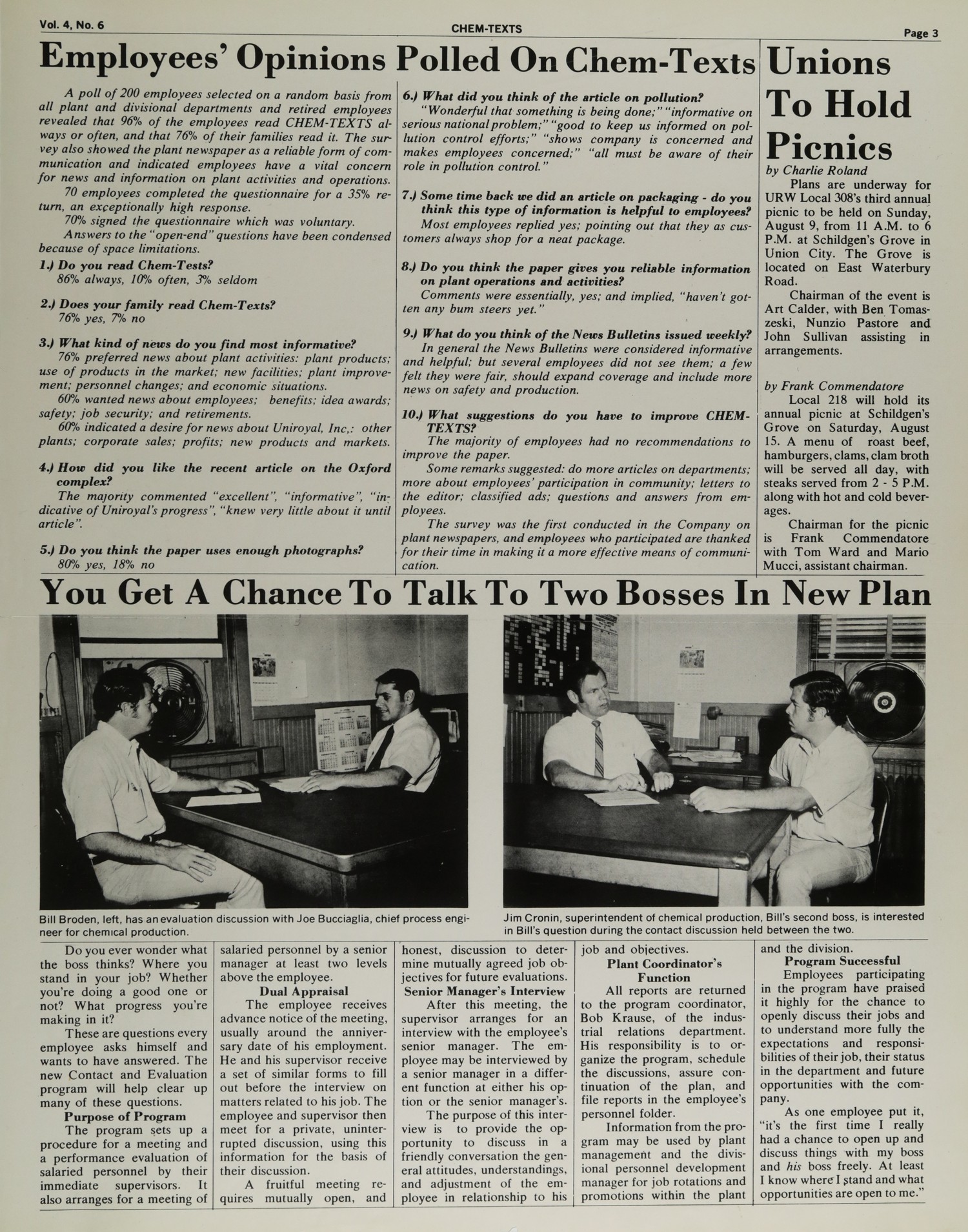
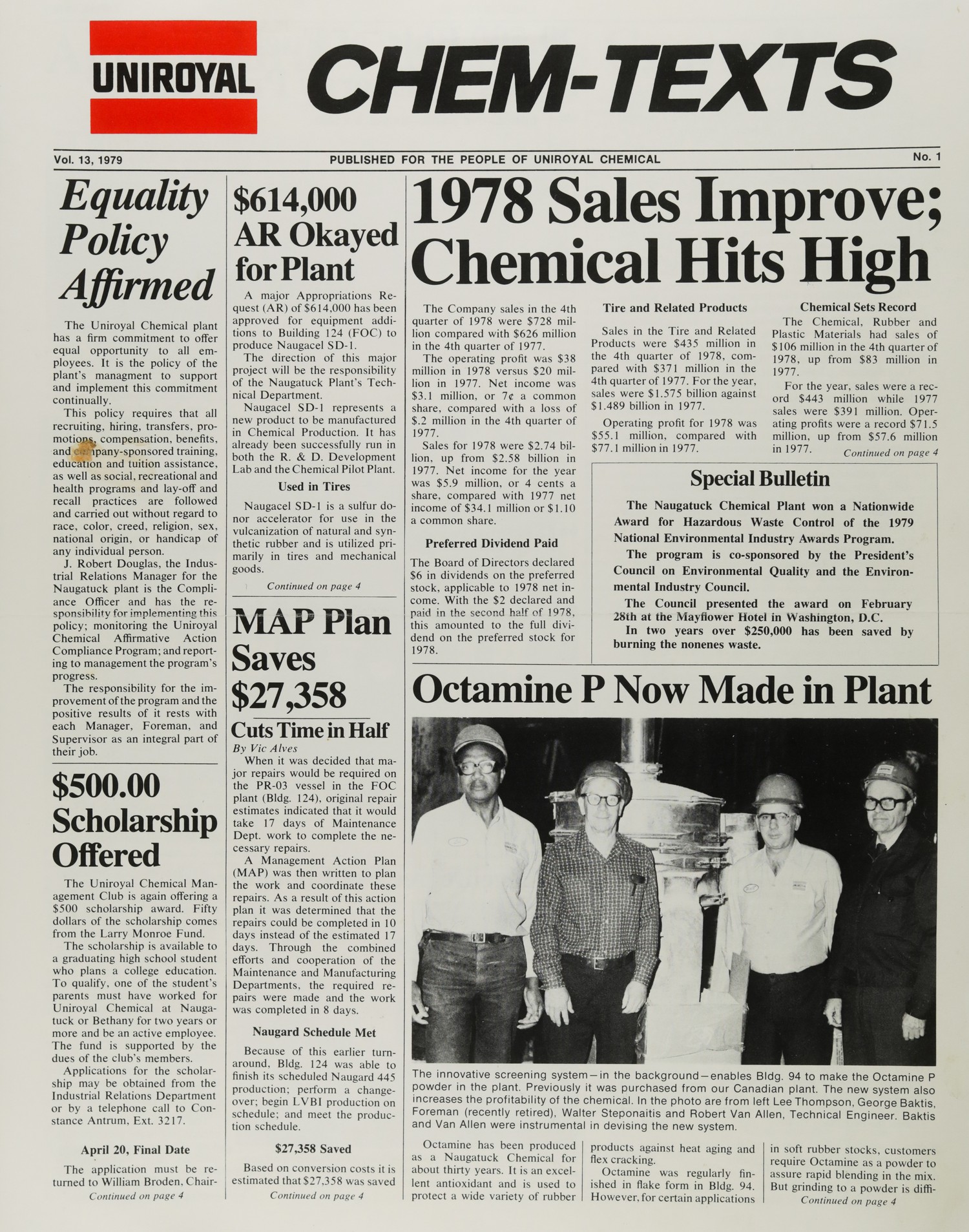
The innovative screening system—in the background—enables Bldg. 94 to make the Octamine P powder in the plant. Previously it was purchased from our Canadian plant. The new system also increases the profitability of the chemical. In the photo are from left Lee Thompson, George Baktis, Foreman (recently retired), Walter Steponaitis and Robert Van Allen, Technical Engineer. Baktis and Van Allen were instrumental in devising the new system.


Octamine has been produced as a Naugatuck Chemical for about thirty years. It is an excellent antioxidant and is used to protect a wide variety of rubber products against heat aging and flex cracking.

Octamine was regularly finished in flake form in Bldg. 94. However, for certain applications in soft rubber stocks, customers require Octamine as a powder to assure rapid blending in the mix. But grinding to a powder is diffi-
Continued on page 4
CHEM-TEXTS – 1979 – Page 4

Page 004

CHEM-TEXTS

Page 4 | Vol. 13, 1979


Recent Retirements

[PHOTO: Group photo of retirees]

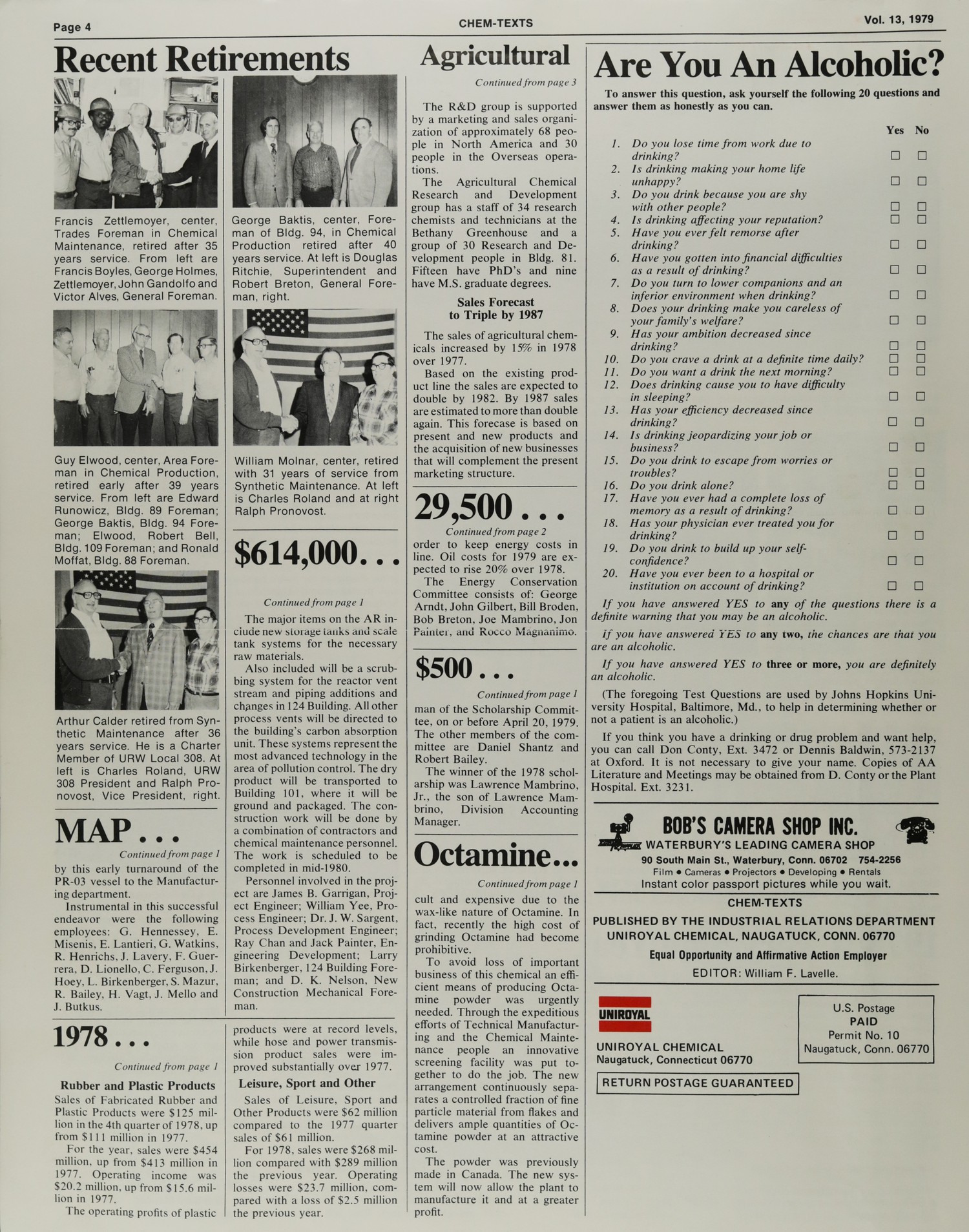
Francis Zettlemoyer, center, Trades Foreman in Chemical Maintenance, retired after 35 years service. From left are Francis Boyles, George Holmes, Zettlemoyer, John Gandolfo and Victor Alves, General Foreman.

[PHOTO: Group photo of retirees]

Guy Elwood, center, Area Foreman in Chemical Production, retired early after 39 years service. From left are Edward Runowicz, Bldg. 89 Foreman; George Baktis, Bldg. 94 Foreman; Elwood, Robert Bell, Bldg. 109 Foreman; and Ronald Moffat, Bldg. 88 Foreman.

[PHOTO: Group photo]

Arthur Calder retired from Synthetic Maintenance after 36 years service. He is a Charter Member of URW Local 308. At left is Charles Roland, URW 308 President and Ralph Pronovost, Vice President, right.


George Baktis, center, Foreman of Bldg. 94, in Chemical Production retired after 40 years service. At left is Douglas Ritchie, Superintendent and Robert Breton, General Foreman, right.

[PHOTO: Group photo]

William Molnar, center, retired with 31 years of service from Synthetic Maintenance. At left is Charles Roland and at right Ralph Pronovost.


MAP…

Continued from page 1

by this early turnaround of the PR-03 vessel to the Manufacturing department.

Instrumental in this successful endeavor were the following employees: G. Hennessey, E. Misenis, E. Lantieri, G. Watkins, R. Henrichs, J. Lavery, F. Guerrera, D. Lionello, C. Ferguson, J. Hoey, L. Birkenberger, S. Mazur, R. Bailey, H. Vagt, J. Mello and J. Butkus.


1978…

Continued from page 1

Rubber and Plastic Products
Sales of Fabricated Rubber and Plastic Products were $125 million in the 4th quarter of 1978, up from $111 million in 1977.

For the year, sales were $454 million, up from $413 million in 1977. Operating income was $20.2 million, up from $15.6 million in 1977.

The operating profits of plastic products were at record levels, while hose and power transmission product sales were improved substantially over 1977.

Leisure, Sport and Other
Sales of Leisure, Sport and Other Products were $62 million compared to the 1977 quarter sales of $61 million.

For 1978, sales were $268 million compared with $289 million the previous year. Operating losses were $23.7 million, compared with a loss of $2.5 million the previous year.


Agricultural

Continued from page 3

The R&D group is supported by a marketing and sales organization of approximately 68 people in North America and 30 people in the Overseas operations.

The Agricultural Chemical Research and Development group has a staff of 34 research chemists and technicians at the Bethany Greenhouse and a group of 30 Research and Development people in Bldg. 81. Fifteen have PhD’s and nine have M.S. graduate degrees.

Sales Forecast to Triple by 1987

The sales of agricultural chemicals increased by 15% in 1978 over 1977.

Based on the existing product line the sales are expected to double by 1982. By 1987 sales are estimated to more than double again. This forecase is based on present and new products and the acquisition of new businesses that will complement the present marketing structure.


29,500…

Continued from page 2

$614,000…

Continued from page 1

The major items on the AR include new storage tanks and scale tank systems for the necessary raw materials.

Also included will be a scrubbing system for the reactor vent stream and piping additions and changes in 124 Building. All other process vents will be directed to the building’s carbon absorption unit. These systems represent the most advanced technology in the area of pollution control. The dry product will be transported to Building 101, where it will be ground and packaged. The construction work will be done by a combination of contractors and chemical maintenance personnel. The work is scheduled to be completed in mid-1980.

Personnel involved in the project are James B. Garrigan, Project Engineer; William Yee, Process Engineer; Dr. J. W. Sargent, Process Development Engineer; Ray Chan and Jack Painter, Engineering Development; Larry Birkenberger, 124 Building Foreman; and D. K. Nelson, New Construction Mechanical Foreman.

order to keep energy costs in line. Oil costs for 1979 are expected to rise 20% over 1978. The Energy Conservation Committee consists of: George Arndt, John Gilbert, Bill Broden, Bob Breton, Joe Mambrino, Jon Painter, and Rocco Magnanimo.


$500…

Continued from page 1

man of the Scholarship Committee, on or before April 20, 1979. The other members of the committee are Daniel Shantz and Robert Bailey.

The winner of the 1978 scholarship was Lawrence Mambrino, Jr., the son of Lawrence Mambrino, Division Accounting Manager.


Octamine…

Continued from page 1

cult and expensive due to the wax-like nature of Octamine. In fact, recently the high cost of grinding Octamine had become prohibitive.

To avoid loss of important business of this chemical an efficient means of producing Octamine powder was urgently needed. Through the expeditious efforts of Technical Manufacturing and the Chemical Maintenance people an innovative screening facility was put together to do the job. The new arrangement continuously separates a controlled fraction of fine particle material from flakes and delivers ample quantities of Octamine powder at an attractive cost.

The powder was previously made in Canada. The new system will now allow the plant to manufacture it and at a greater profit.


Are You An Alcoholic?

To answer this question, ask yourself the following 20 questions and answer them as honestly as you can.

Yes No
1. Do you lose time from work due to drinking?
2. Is drinking making your home life unhappy?
3. Do you drink because you are shy with other people?
4. Is drinking affecting your reputation?
5. Have you ever felt remorse after drinking?
6. Have you gotten into financial difficulties as a result of drinking?
7. Do you turn to lower companions and an inferior environment when drinking?
8. Does your drinking make you careless of your family’s welfare?
9. Has your ambition decreased since drinking?
10. Do you crave a drink at a definite time daily?
11. Do you want a drink the next morning?
12. Does drinking cause you to have difficulty in sleeping?
13. Has your efficiency decreased since drinking?
14. Is drinking jeopardizing your job or business?
15. Do you drink to escape from worries or troubles?
16. Do you drink alone?
17. Have you ever had a complete loss of memory as a result of drinking?
18. Has your physician ever treated you for drinking?
19. Do you drink to build up your self-confidence?
20. Have you ever been to a hospital or institution on account of drinking?

If you have answered YES to any of the questions there is a definite warning that you may be an alcoholic.

if you have answered YES to any two, the chances are that you are an alcoholic.

If you have answered YES to three or more, you are definitely an alcoholic.

(The foregoing Test Questions are used by Johns Hopkins University Hospital, Baltimore, Md., to help in determining whether or not a patient is an alcoholic.)

If you think you have a drinking or drug problem and want help, you can call Don Conty, Ext. 3472 or Dennis Baldwin, 573-2137 at Oxford. It is not necessary to give your name. Copies of AA Literature and Meetings may be obtained from D. Conty or the Plant Hospital. Ext. 3231.


BOB’S CAMERA SHOP INC.

WATERBURY’S LEADING CAMERA SHOP
90 South Main St., Waterbury, Conn. 06702 754-2256
Film • Cameras • Projectors • Developing • Rentals
Instant color passport pictures while you wait.


CHEM-TEXTS
PUBLISHED BY THE INDUSTRIAL RELATIONS DEPARTMENT
UNIROYAL CHEMICAL, NAUGATUCK, CONN. 06770
Equal Opportunity and Affirmative Action Employer
EDITOR: William F. Lavelle.


[MAILING LABEL AREA]

UNIROYAL | U.S. Postage PAID Permit No. 10 Naugatuck, Conn. 06770

UNIROYAL CHEMICAL
Naugatuck, Connecticut 06770

RETURN POSTAGE GUARANTEED

CHEM-TEXTS – 1979-v13-s285

Page 285

CHEM-TEXTS

Page 2 | Vol. 13, 1979


1978 was a Good Year . . .

You and I know our Company is starting to generate an upward momentum as illustrated by the outstanding performance of the Naugatuck Plant and the Chemical Company in 1978. The Chemical Company profits exceeded all expectations last year and our Plant’s gross operating profit increased 58%.

This outstanding achievement is the result of your efforts whether you are in Manufacturing, Research and Development, Accounting, D&S, the Service Departments, or Marketing.

Our plant’s goal is to have a 30% plant operating profit that would result in a 9% return on sales. This year our objective is to increase the return on sales from 3 to 4.5%.

How do we expect to achieve our profitability objective? The answer to this question is reflected in the achievements of last year.

In the Maintenance Department an outstanding job was performed in reducing equipment downtime from 8.9 to 7.5%. Their 1979 goal is 6% and January was an excellent start with downtime averaging 4.5%.

Manufacturing set productivity records in the production of Rubber Chemicals, Agricultural Chemicals, and Thermoplastics. Omite, LVBI, Tonox, and TPR productivities increased between 20 and 30% while PANA and Naugard 445 improved by 66%. Also a reduction in Roylar changeovers was achieved through better coordination and communications. In addition, Comite, Octamine P, Celogen RA, and Polygard I were successfully produced in the Plant. All these achievements resulted in increasing our plant’s profit by 1.6 million dollars.

Our Industrial Relations Department was reorganized and is more effective in serving our needs. Safety Goals were far exceeded with 1.2 incidence rate and Workmen’s Compensation costs were reduced by $165,000. A new performance appraisal system was initiated and a training session held to help managers conduct performance appraisals with their people.

A Controllers Department was established to perform financial reporting, budgeting, forecasting, and economic analysis; to expedite approvals of Appropriation Requests; and to identify areas of profit improvement.

The Technical Department now includes all engineering functions: process, project, environmental, and industrial engineering. 2.3 million dollars of profit improvement was realized through developing a team effort with the plant, R & D, and marketing. This year a similar amount is expected through Project Enterprise, the name of our 1979 Profit Improvement Program. Over $300,000 was saved through the work of the Plant’s Energy Committee. Other contributions by the Technical Department included the productivity records set in Rubber Chemicals and Omite as well as the successful production of Comite, Octamine P, Celogen RA, and Polygard I.

In the Material Flow Department transportation credits exceeded budget by $13,000. An additional $532,000 was saved through improved transportation of our finished goods. Shipping and receiving increased productivity by 7% and improved the services on export shipments. The Purchasing Department and Control Center reduced our inventory levels thereby increasing our return on assets. Purchasing savings and cost avoidance programs exceeded expectations by $400,000 dollars.

A major objective is to improve the utilization of our plant by introducing new products in our existing facilities or attracting new manufacturing facilities because our resources are underutilized. For example, we are using only 50% of our steam generation and waste water treatment capacities while Rubber Chemicals is budgeted to operate only between 60-65% of capacity this year. If Rubber Chemical production operated at 90% of capacity, our plant’s operating profit would increase to approximately 27%. On some recent data it appears that a 10% selling price increase would have the same impact as a 30% cost reduction.

1978 was a year of change and accomplishment. We have the reputation of managing our business. Naugatuck seeks change. We are determined to overcome our geographical raw material disadvantage through PROFESSIONAL EXCELLENCE in every assignment and job that is performed.

In 1979 Naugatuck will be a Better Place To Be and soon the Best Place To Be.

Eric Johnson

Eric Johnson
Factory Manager


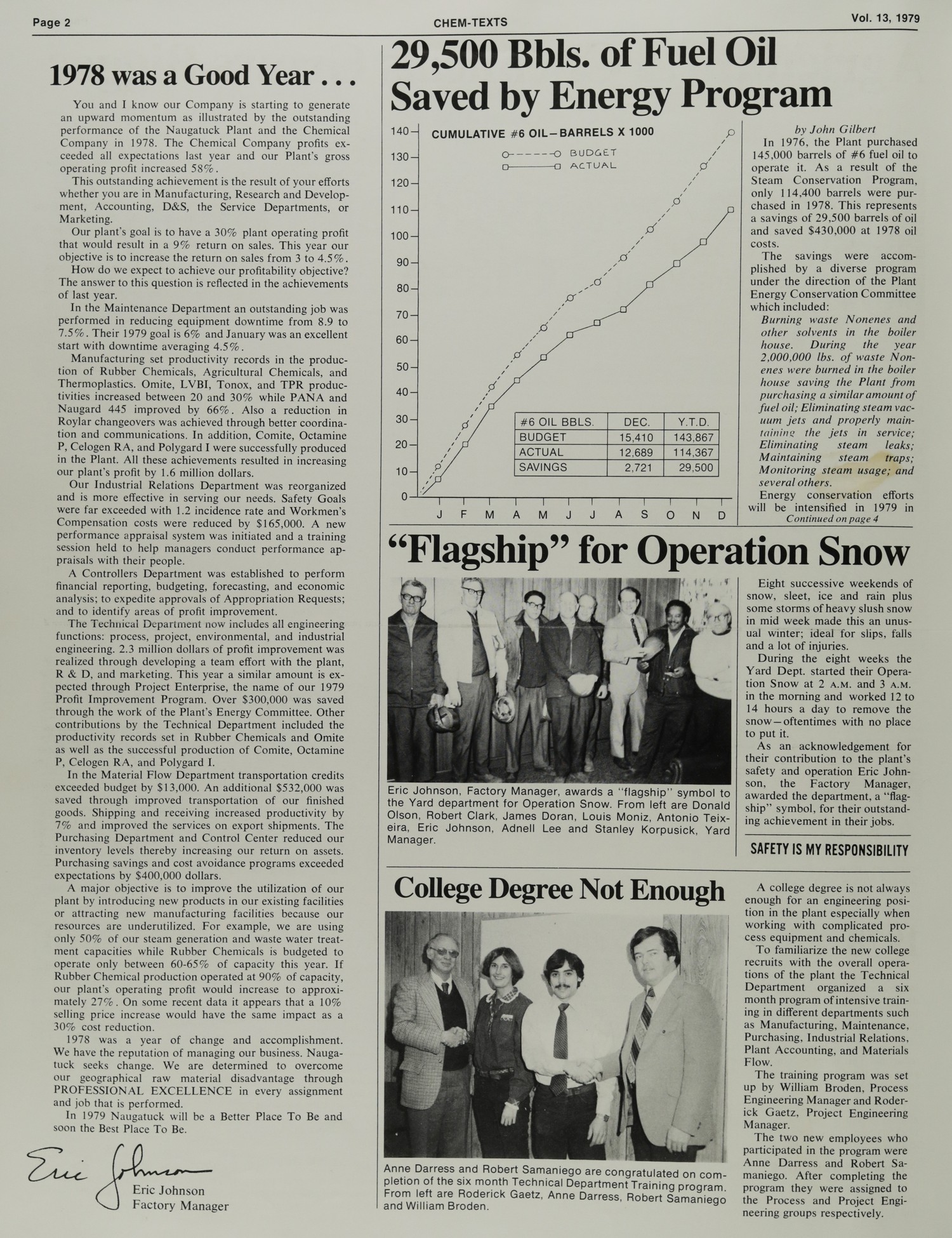
29,500 Bbls. of Fuel Oil Saved by Energy Program

CUMULATIVE #6 OIL—BARRELS X 1000

[CHART showing declining oil usage from January through December, with lines for BUDGET and ACTUAL usage, ranging from approximately 140 to 0]

#6 OIL BBLS. DEC. Y.T.D.
BUDGET 15,410 143,867
ACTUAL 12,689 114,367
SAVINGS 2,721 29,500

by John Gilbert

In 1976, the Plant purchased 145,000 barrels of #6 fuel oil to operate it. As a result of the Steam Conservation Program, only 114,400 barrels were purchased in 1978. This represents a savings of 29,500 barrels of oil and saved $430,000 at 1978 oil costs.

The savings were accomplished by a diverse program under the direction of the Plant Energy Conservation Committee which included:

Burning waste Nonenes and other solvents in the boiler house. During the year 2,000,000 lbs. of waste Nonenes were burned in the boiler house saving the Plant from purchasing a similar amount of fuel oil; Eliminating steam vacuum jets and properly maintaining the jets in service; Eliminating steam leaks; Maintaining steam traps; Monitoring steam usage; and several others.

Energy conservation efforts will be intensified in 1979 in Continued on page 4


“Flagship” for Operation Snow

[PHOTOGRAPH of seven men in business attire standing together]

Eric Johnson, Factory Manager, awards a “flagship” symbol to the Yard department for Operation Snow. From left are Donald Olson, Robert Clark, James Doran, Louis Moniz, Antonio Teixeira, Eric Johnson, Adnell Lee and Stanley Korpusick, Yard Manager.

Eight successive weekends of snow, sleet, ice and rain plus some storms of heavy slush snow in mid week made this an unusual winter; ideal for slips, falls and a lot of injuries.

During the eight weeks the Yard Dept. started their Operation Snow at 2 A.M. and 3 A.M. in the morning and worked 12 to 14 hours a day to remove the snow—oftentimes with no place to put it.

As an acknowledgement for their contribution to the plant’s safety and operation Eric Johnson, the Factory Manager, awarded the department, a “flagship” symbol, for their outstanding achievement in their jobs.


SAFETY IS MY RESPONSIBILITY


College Degree Not Enough

[PHOTOGRAPH of four people, three men and one woman, standing together]

Anne Darress and Robert Samaniego are congratulated on completion of the six month Technical Department Training program. From left are Roderick Gaetz, Anne Darress, Robert Samaniego and William Broden.

A college degree is not always enough for an engineering position in the plant especially when working with complicated process equipment and chemicals.

To familiarize the new college recruits with the overall operations of the plant the Technical Department organized a six month program of intensive training in different departments such as Manufacturing, Maintenance, Purchasing, Industrial Relations, Plant Accounting, and Materials Flow.

The training program was set up by William Broden, Process Engineering Manager and Roderick Gaetz, Project Engineering Manager.

The two new employees who participated in the program were Anne Darress and Robert Samaniego. After completing the program they were assigned to the Process and Project Engineering groups respectively.

CHEM-TEXTS – 1979-v13-s273

Page 273

CHEM-TEXTS

Page 2 | Vol. 13, 1979


Editorial . . .

As many of you already know, this is our 75th year as a Chemical Plant as well as a Chemical Company. Today we can be proud of the fact that virtually every automobile and truck tire on the road contains one of the rubber chemicals manufactured in our plant. Our Agricultural Chemicals are used throughout the U.S. and the world to protect cotton, fruit, and other valuable food crops against disease and devastating insects. This enables farmers and growers to increase the yields of their land.

We are very grateful to both present and past employees who made this occasion possible through their achievements. We now have an even greater responsibility in performing our jobs. Our dedication and efforts must make our jobs more meaningful, secure, and safe not only for ourselves but also for those who will follow us.

Through the skills, spirit, and professional excellence that you demonstrated in 1979, the foundation has been built for even greater achievements in the future.

I wish to thank each and every one of you for making the celebration of our 75th Anniversary such a memorable and successful day. It was evidence of the good spirit that makes our plant an excellent place to be.

Eric Johnson
Factory Manager


Plant’s Chemical Waste Program Saves $94,000

by Ron Lak

During the 1st and 2nd quarter of 1979, the Synthetic Pilot Plant eliminated two major hazardous waste streams, while at the same time recovering the raw materials. In addition, plans are being finalized to reduce Naugard 445 still bottom waste from FOC.

Altogether the program has resulted in savings of $94,000.

Waste Hexane cement, generated at approximately 20,000 gallons annually, now is reprocessed, saving both the Hexane cost ($13,000), and the disposal costs ($4,000).

The waste “HST”, generated while sampling Polywets, was eliminated by the installation of sample recirculation pumps. These pumps allow the operators to remove only as much product from the batch as needed for testing. This particular waste was corrosive, toxic, and flammable, posing special disposal and handling problems. Approximately 3,500 gallons of this waste was produced annually, costing $5,000 to dispose of properly.

Work is almost completed on the blending of Naugard 445 still bottom waste into BLE. If successful, 100,000 lbs. of Naugard 445 still bottom, representing a disposal cost saving of $5,000, will be eliminated annually. In addition, yield increases in BLE will result in a $55,000 raw material and variable conversion credit.

Another area where steps are being taken to reduce our hazardous waste disposal cost is rejected materials. 25,000 lbs. of rejected RF-75 was resampled and sold to customers for $5,000, eliminating a disposal charge of $3,000. An additional 43,500 lbs. of rejected RF-75 is presently being resampled, awaiting customer approval. If approved, $4,000 in disposal costs could be eliminated.


Give Blood
Oct. 29 and Oct. 30


Gov. Grasso Selects Plant to Initiate Ridesharing Program

Gov. Grasso announced at the 75th Anniversary Celebration that the Naugatuck Chemical plant is the first in Connecticut to initiate a demonstration project in cooperation with the Governor’s Ridesharing Task Force.

The Company will survey the employees to determine the commuting patterns of the employees. Based on results of the survey, a total ridesharing program will be designed to incorporate the use of buses, carpools and van pools. Consideration will also be given to use of the rail line that runs through the Naugatuck Valley.

Shortage a Way of Life

Every effort will be made to encourage the use of public transportation and ridesharing to further the overall state program of energy conservation. It is vital that every possible initiative be taken to promote ridesharing because limited supplies of gasoline are going to be a way of life from now on.

[PHOTO CAPTION:]
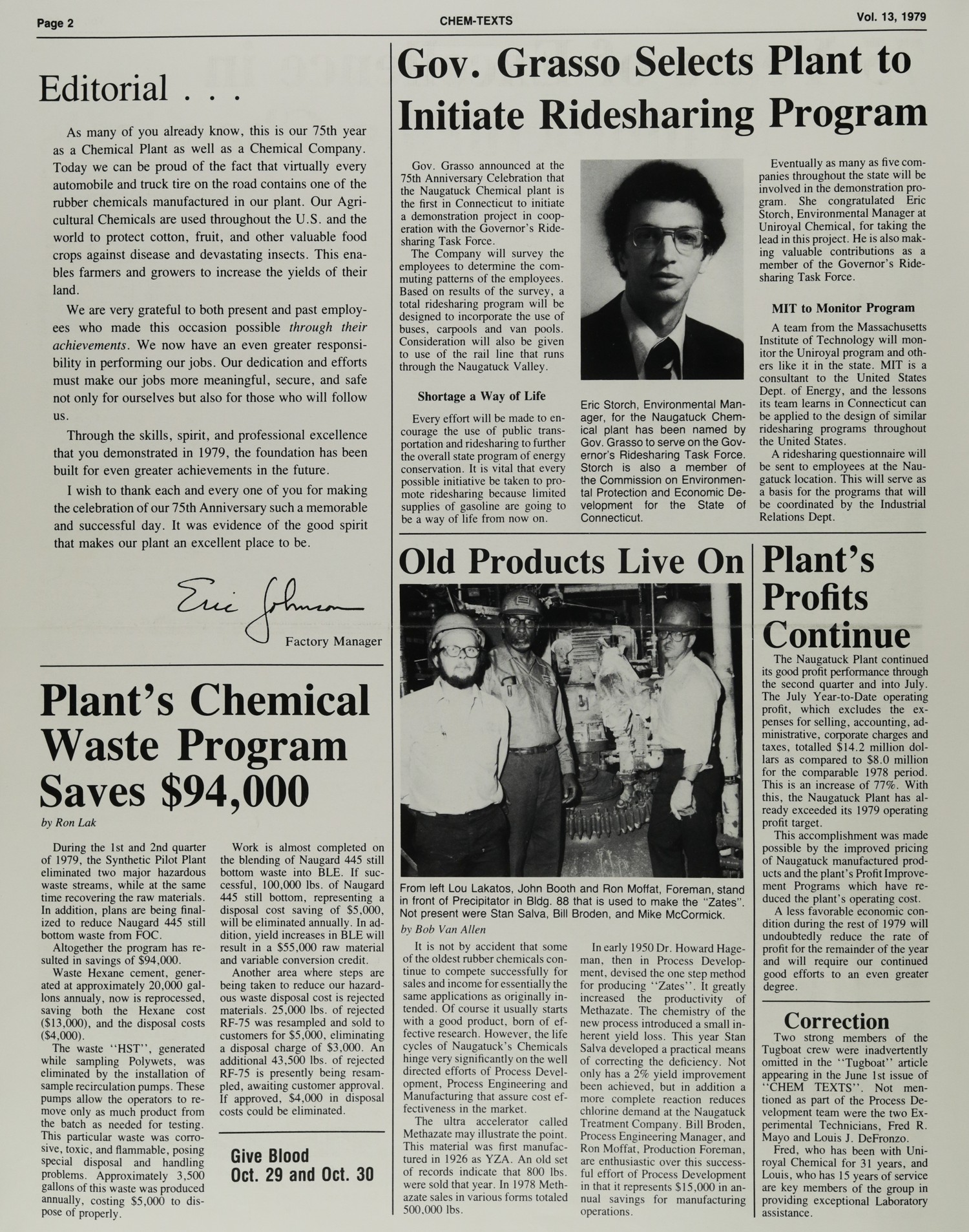
Eric Storch, Environmental Manager, for the Naugatuck Chemical plant has been named by Gov. Grasso to serve on the Governor’s Ridesharing Task Force. Storch is also a member of the Commission on Environmental Protection and Economic Development for the State of Connecticut.

Eventually as many as five companies throughout the state will be involved in the demonstration program. She congratulated Eric Storch, Environmental Manager at Uniroyal Chemical, for taking the lead in this project. He is also making valuable contributions as a member of the Governor’s Ridesharing Task Force.

MIT to Monitor Program

A team from the Massachusetts Institute of Technology will monitor the Uniroyal program and others like it in the state. MIT is a consultant to the United States Dept. of Energy, and the lessons its team learns in Connecticut can be applied to the design of similar ridesharing programs throughout the United States.

A ridesharing questionnaire will be sent to employees at the Naugatuck location. This will serve as a basis for the programs that will be coordinated by the Industrial Relations Dept.


Old Products Live On

[PHOTO CAPTION:]
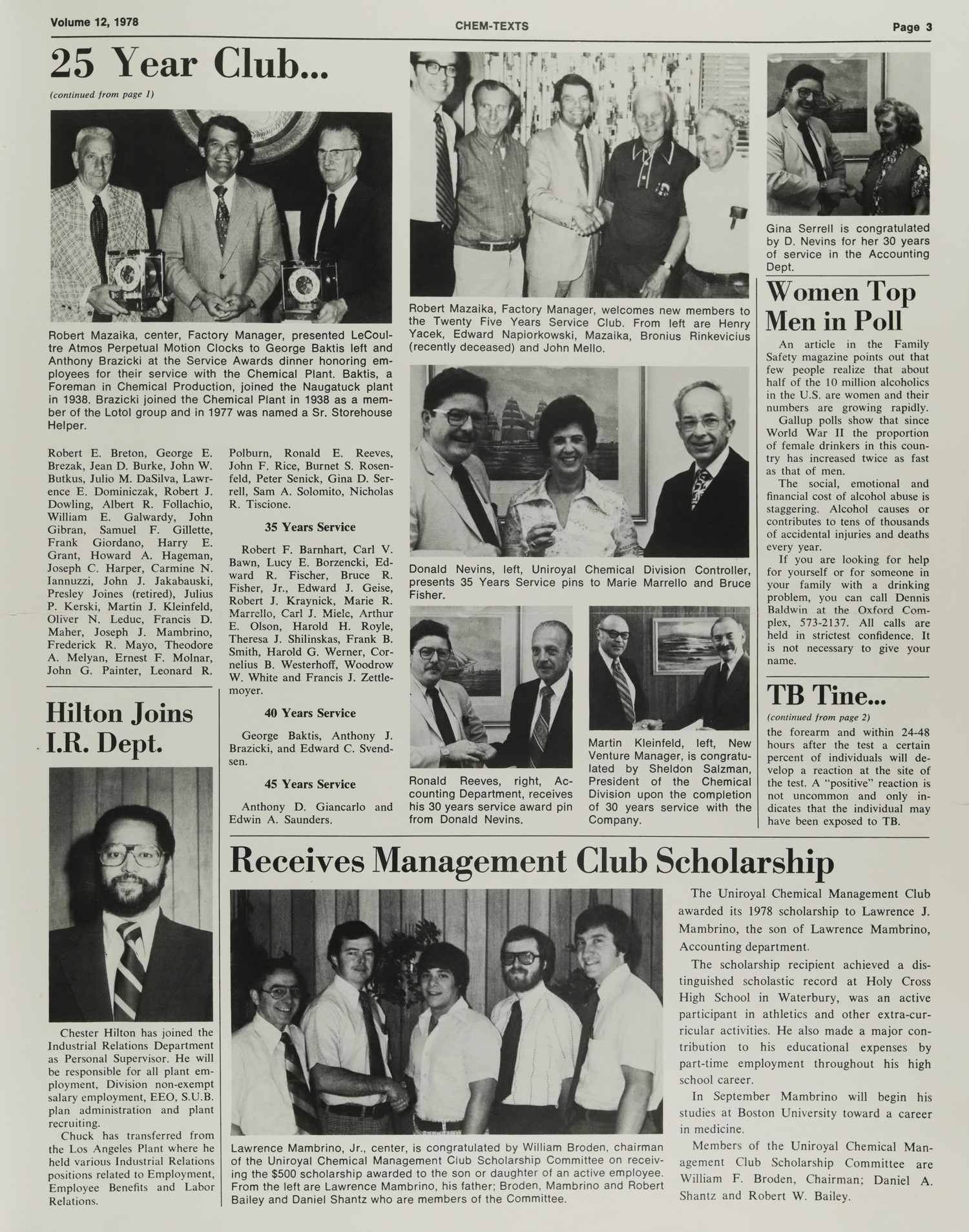
From left Lou Lakatos, John Booth and Ron Moffat, Foreman, stand in front of Precipitator in Bldg. 88 that is used to make the “Zates”. Not present were Stan Salva, Bill Broden, and Mike McCormick.

by Bob Van Allen

It is not by accident that some of the oldest rubber chemicals continue to compete successfully for sales and income for essentially the same applications as originally intended. Of course it usually starts with a good product, born of effective research. However, the life cycles of Naugatuck’s Chemicals hinge very significantly on the well directed efforts of Process Development, Process Engineering and Manufacturing that assure cost effectiveness in the market.

The ultra accelerator called Methazate may illustrate the point. This material was first manufactured in 1926 as YZA. An old set of records indicate that 800 lbs. were sold that year. In 1978 Methazate sales in various forms totaled 500,000 lbs.

In early 1950 Dr. Howard Hageman, then in Process Development, devised the one step method for producing “Zates”. It greatly increased the productivity of Methazate. The chemistry of the new process introduced a small inherent yield loss. This year Stan Salva developed a practical means of correcting the deficiency. Not only has a 2% yield improvement been achieved, but in addition a more complete reaction reduces chlorine demand at the Naugatuck Treatment Company. Bill Broden, Process Engineering Manager, and Ron Moffat, Production Foreman, are enthusiastic over this successful effort of Process Development in that it represents $15,000 in annual savings for manufacturing operations.


Plant’s Profits Continue

The Naugatuck Plant continued its good profit performance through the second quarter and into July. The July Year-to-Date operating profit, which excludes the expenses for selling, accounting, administrative, corporate charges and taxes, totalled $14.2 million dollars as compared to $8.0 million for the comparable 1978 period. This is an increase of 77%. With this, the Naugatuck Plant has already exceeded its 1979 operating profit target.

This accomplishment was made possible by the improved pricing of Naugatuck manufactured products and the plant’s Profit Improvement Programs which have reduced the plant’s operating cost.

A less favorable economic condition during the rest of 1979 will undoubtedly reduce the rate of profit for the remainder of the year and will require our continued good efforts to an even greater degree.


Correction

Two strong members of the Tugboat crew were inadvertently omitted in the “Tugboat” article appearing in the June 1st issue of “CHEM TEXTS”. Not mentioned as part of the Process Development team were the two Experimental Technicians, Fred R. Mayo and Louis J. DeFronzo.

Fred, who has been with Uniroyal Chemical for 31 years, and Louis, who has 15 years of service are key members of the group in providing exceptional Laboratory assistance.

CHEM-TEXTS – 12 – Page 3

Page 003

Volume 12, 1978 | CHEM-TEXTS | Page 3


25 Year Club…

(continued from page 1)

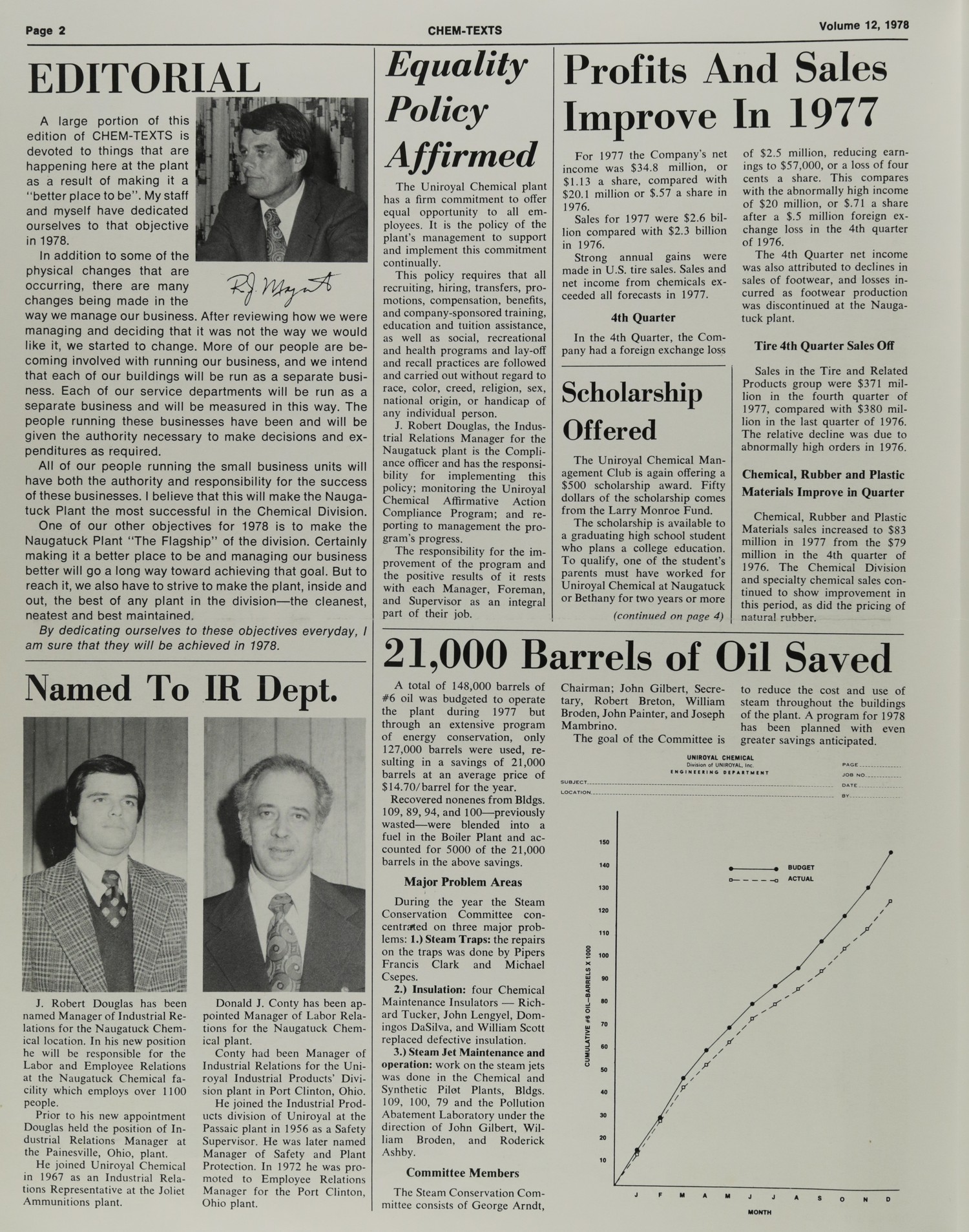
Robert Mazaika, center, Factory Manager, presented LeCoultre Atmos Perpetual Motion Clocks to George Baktis left and Anthony Brazicki at the Service Awards dinner honoring employees for their service with the Chemical Plant. Baktis, a Foreman in Chemical Production, joined the Naugatuck plant in 1938. Brazicki joined the Chemical Plant in 1938 as a member of the Lotol group and in 1977 was named a Sr. Storehouse Helper.

Robert E. Breton, George E. Brezak, Jean D. Burke, John W. Butkus, Julio M. DaSilva, Lawrence E. Dominiczak, Robert J. Dowling, Albert R. Follachio, William E. Galwardy, John Gibran, Samuel F. Gillette, Frank Giordano, Harry E. Grant, Howard A. Hageman, Joseph C. Harper, Carmine N. Iannuzzi, John J. Jakabauski, Presley Joines (retired), Julius P. Kerski, Martin J. Kleinfeld, Oliver N. Leduc, Francis D. Maher, Joseph J. Mambrino, Frederick R. Mayo, Theodore A. Melyan, Ernest F. Molnar, John G. Painter, Leonard R.

Polburn, Ronald E. Reeves, John F. Rice, Burnet S. Rosenfeld, Peter Senick, Gina D. Serrell, Sam A. Solomito, Nicholas R. Tiscione.

35 Years Service

Robert F. Barnhart, Carl V. Bawn, Lucy E. Borzencki, Edward R. Fischer, Bruce R. Fisher, Jr., Edward J. Geise, Robert J. Kraynick, Marie R. Marrollo, Carl J. Miele, Arthur E. Olson, Harold H. Royle, Theresa J. Shilinskas, Frank B. Smith, Harold G. Werner, Cornelius B. Westerhoff, Woodrow W. White and Francis J. Zettlemoyer.

40 Years Service

George Baktis, Anthony J. Brazicki, and Edward C. Svendsen.

45 Years Service

Anthony D. Giancarlo and Edwin A. Saunders.


Robert Mazaika, Factory Manager, welcomes new members to the Twenty Five Years Service Club. From left are Henry Yacek, Edward Napiorkowski, Mazaika, Bronius Rinkevicius (recently deceased) and John Mello.


Donald Nevins, left, Uniroyal Chemical Division Controller, presents 35 Years Service pins to Marie Marrello and Bruce Fisher.


Ronald Reeves, right, Accounting Department, receives his 30 years service award pin from Donald Nevins.

Martin Kleinfeld, left, New Venture Manager, is congratulated by Sheldon Salzman, President of the Chemical Division upon the completion of 30 years service with the Company.


Gina Serrell is congratulated by D. Nevins for her 30 years of service in the Accounting Dept.


Women Top Men in Poll

An article in the Family Safety magazine points out that few people realize that about half of the 10 million alcoholics in the U.S. are women and their numbers are growing rapidly.

Gallup polls show that since World War II the proportion of female drinkers in this country has increased twice as fast as that of men.

The social, emotional and financial cost of alcohol abuse is staggering. Alcohol causes or contributes to tens of thousands of accidental injuries and deaths every year.

If you are looking for help for yourself or for someone in your family with a drinking problem, you can call Dennis Baldwin at the Oxford Complex, 573-2137. All calls are held in strictest confidence. It is not necessary to give your name.


TB Tine…

(continued from page 2)

the forearm and within 24-48 hours after the test a certain percent of individuals will develop a reaction at the site of the test. A “positive” reaction is not uncommon and only indicates that the individual may have been exposed to TB.


Hilton Joins I.R. Dept.

Chester Hilton has joined the Industrial Relations Department as Personal Supervisor. He will be responsible for all plant employment, Division non-exempt salary employment, EEO, S.U.B. plan administration and plant recruiting.

Chuck has transferred from the Los Angeles Plant where he held various Industrial Relations positions related to Employment, Employee Benefits and Labor Relations.


Receives Management Club Scholarship

Lawrence Mambrino, Jr., center, is congratulated by William Broden, chairman of the Uniroyal Chemical Management Club Scholarship Committee on receiving the $500 scholarship awarded to the son or daughter of an active employee. From the left are Lawrence Mambrino, his father; Broden, Mambrino and Robert Bailey and Daniel Shantz who are members of the Committee.

The Uniroyal Chemical Management Club awarded its 1978 scholarship to Lawrence J. Mambrino, the son of Lawrence Mambrino, Accounting department.

The scholarship recipient achieved a distinguished scholastic record at Holy Cross High School in Waterbury, was an active participant in athletics and other extra-curricular activities. He also made a major contribution to his educational expenses by part-time employment throughout his high school career.

In September Mambrino will begin his studies at Boston University toward a career in medicine.

Members of the Uniroyal Chemical Management Club Scholarship Committee are William F. Broden, Chairman; Daniel A. Shantz and Robert W. Bailey.

CHEM-TEXTS – 1978-v12-s261

Page 261

Page 2 CHEM-TEXTS Volume 12, 1978


EDITORIAL

A large portion of this edition of CHEM-TEXTS is devoted to things that are happening here at the plant as a result of making it a “better place to be”. My staff and myself have dedicated ourselves to that objective in 1978.

In addition to some of the physical changes that are occurring, there are many changes being made in the way we manage our business. After reviewing how we were managing and deciding that it was not the way we would like it, we started to change. More of our people are becoming involved with running our business, and we intend that each of our buildings will be run as a separate business. Each of our service departments will be run as a separate business and will be measured in this way. The people running these businesses have been and will be given the authority necessary to make decisions and expenditures as required.

All of our people running the small business units will have both the authority and responsibility for the success of these businesses. I believe that this will make the Naugatuck Plant the most successful in the Chemical Division.

One of our other objectives for 1978 is to make the Naugatuck Plant “The Flagship” of the division. Certainly making it a better place to be and managing our business better will go a long way toward achieving that goal. But to reach it, we also have to strive to make the plant, inside and out, the best of any plant in the division—the cleanest, neatest and best maintained.

By dedicating ourselves to these objectives everyday, I am sure that they will be achieved in 1978.

[Signature: R.J. Meyst]


Named To IR Dept.

[PHOTO: Black and white photograph of J. Robert Douglas]

J. Robert Douglas has been named Manager of Industrial Relations for the Naugatuck Chemical location. In his new position he will be responsible for the Labor and Employee Relations at the Naugatuck Chemical facility which employs over 1100 people.

Prior to his new appointment Douglas held the position of Industrial Relations Manager at the Painesville, Ohio, plant.

He joined Uniroyal Chemical in 1967 as an Industrial Relations Representative at the Joliet Ammunitions plant.

[PHOTO: Black and white photograph of Donald J. Conty]

Donald J. Conty has been appointed Manager of Labor Relations for the Naugatuck Chemical plant.

Conty had been Manager of Industrial Relations for the Uniroyal Industrial Products’ Division plant in Port Clinton, Ohio.

He joined the Industrial Products division of Uniroyal at the Passaic plant in 1956 as a Safety Supervisor. He was later named Manager of Safety and Plant Protection. In 1972 he was promoted to Employee Relations Manager for the Port Clinton, Ohio plant.


Equality Policy Affirmed

The Uniroyal Chemical plant has a firm commitment to offer equal opportunity to all employees. It is the policy of the plant’s management to support and implement this commitment continually.

This policy requires that all recruiting, hiring, transfers, promotions, compensation, benefits, and company-sponsored training, education and tuition assistance, as well as social, recreational and health programs and lay-off and recall practices are followed and carried out without regard to race, color, creed, religion, sex, national origin, or handicap of any individual person.

J. Robert Douglas, the Industrial Relations Manager for the Naugatuck plant is the Compliance officer and has the responsibility for implementing this policy; monitoring the Uniroyal Chemical Affirmative Action Compliance Program; and reporting to management the program’s progress.

The responsibility for the improvement of the program and the positive results of it rests with each Manager, Foreman, and Supervisor as an integral part of their job.


Profits And Sales Improve In 1977

For 1977 the Company’s net income was $34.8 million, or $1.13 a share, compared with $20.1 million or $.57 a share in 1976.

Sales for 1977 were $2.6 billion compared with $2.3 billion in 1976.

Strong annual gains were made in U.S. tire sales. Sales and net income from chemicals exceeded all forecasts in 1977.

4th Quarter

In the 4th Quarter, the Company had a foreign exchange loss of $2.5 million, reducing earnings to $57,000, or a loss of four cents a share. This compares with the abnormally high income of $20 million, or $.71 a share after a $.5 million foreign exchange loss in the 4th quarter of 1976.

The 4th Quarter net income was also attributed to declines in sales of footwear, and losses incurred as footwear production was discontinued at the Naugatuck plant.

Tire 4th Quarter Sales Off

Sales in the Tire and Related Products group were $371 million in the fourth quarter of 1977, compared with $380 million in the last quarter of 1976. The relative decline was due to abnormally high orders in 1976.

Chemical, Rubber and Plastic Materials Improve in Quarter

Chemical, Rubber and Plastic Materials sales increased to $83 million in 1977 from the $79 million in the 4th quarter of 1976. The Chemical Division and specialty chemical sales continued to show improvement in this period, as did the pricing of natural rubber.


Scholarship Offered

The Uniroyal Chemical Management Club is again offering a $500 scholarship award. Fifty dollars of the scholarship comes from the Larry Monroe Fund.

The scholarship is available to a graduating high school student who plans a college education. To qualify, one of the student’s parents must have worked for Uniroyal Chemical at Naugatuck or Bethany for two years or more

(continued on page 4)


21,000 Barrels of Oil Saved

A total of 148,000 barrels of #6 oil was budgeted to operate the plant during 1977 but through an extensive program of energy conservation, only 127,000 barrels were used, resulting in a savings of 21,000 barrels at an average price of $14.70/barrel for the year.

Recovered nonenes from Bldgs. 109, 89, 94, and 100—previously wasted—were blended into a fuel in the Boiler Plant and accounted for 5000 of the 21,000 barrels in the above savings.

Major Problem Areas

During the year the Steam Conservation Committee concentrated on three major problems: 1.) Steam Traps: the repairs on the traps was done by Pipers Francis Clark and Michael Csepes.

2.) Insulation: four Chemical Maintenance Insulators — Richard Tucker, John Lengyel, Domingos DaSilva, and William Scott replaced defective insulation.

3.) Steam Jet Maintenance and operation: work on the steam jets was done in the Chemical and Synthetic Pilot Plants, Bldgs. 109, 100, 79 and the Pollution Abatement Laboratory under the direction of John Gilbert, William Broden, and Roderick Ashby.

Committee Members

The Steam Conservation Committee consists of George Arndt,

Chairman; John Gilbert, Secretary, Robert Breton, William Broden, John Painter, and Joseph Mambrino.

The goal of the Committee is to reduce the cost and use of steam throughout the buildings of the plant. A program for 1978 has been planned with even greater savings anticipated.

[FORM HEADER:]
UNIROYAL CHEMICAL
Division of UNIROYAL Inc.
ENGINEERING DEPARTMENT

SUBJECT___
LOCATION__

PAGE_
JOB NO._
DATE_
BY_

[GRAPH: Line graph showing cumulative #6 oil barrels x 1000 from months J through D, with two lines labeled “BUDGET” (solid) and “ACTUAL” (dashed), ranging from approximately 10 to 150 on the y-axis]

CHEM-TEXTS – 1978-v12-s263

Page 263

Page 4 | CHEM-TEXTS | Volume 12, 1978


Omite, “Growers Friend”

[IMAGE: Photo of three men]

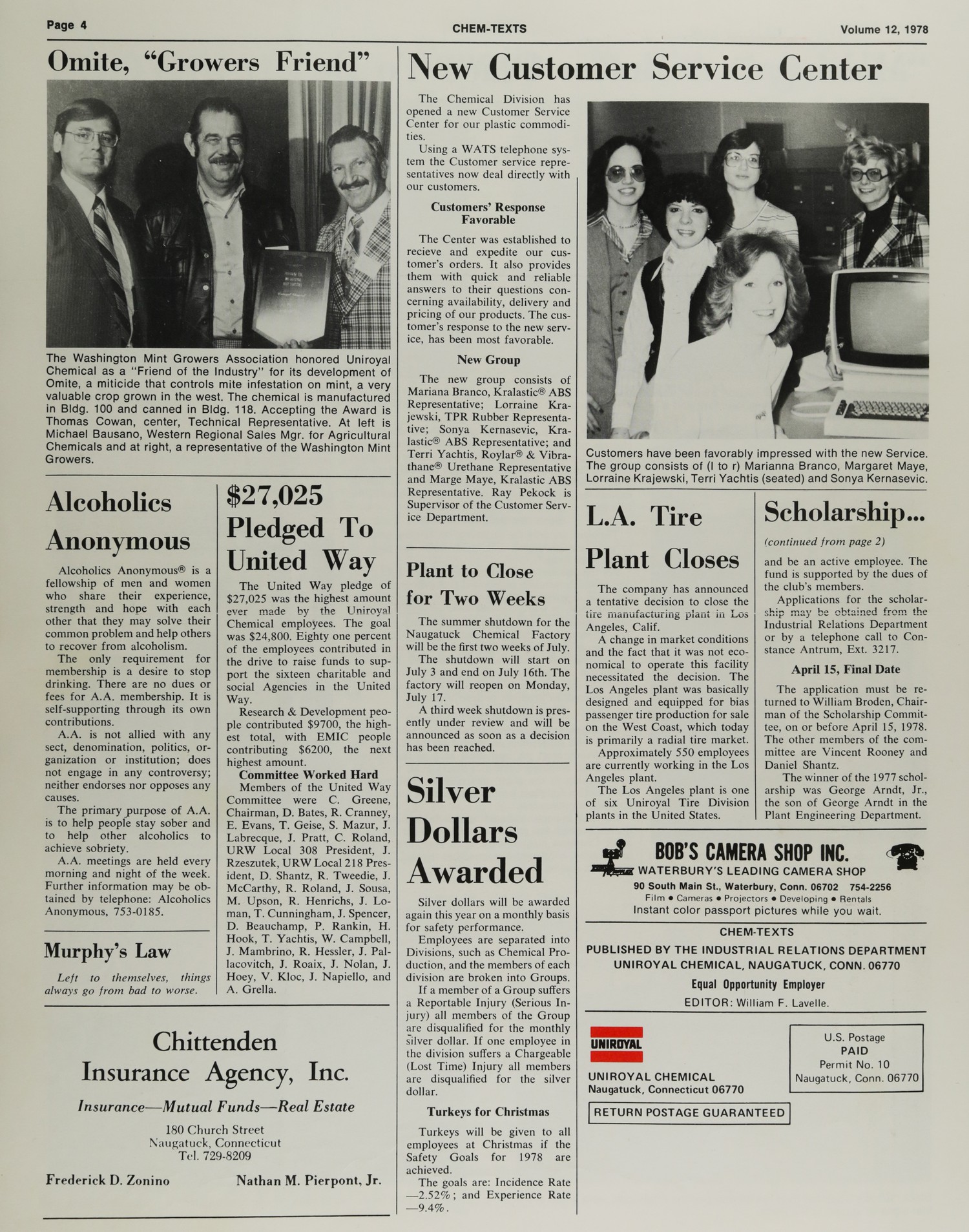
The Washington Mint Growers Association honored Uniroyal Chemical as a “Friend of the Industry” for its development of Omite, a miticide that controls mite infestation on mint, a very valuable crop grown in the west. The chemical is manufactured in Bldg. 100 and canned in Bldg. 118. Accepting the Award is Thomas Cowan, center, Technical Representative. At left is Michael Bausano, Western Regional Sales Mgr. for Agricultural Chemicals and at right, a representative of the Washington Mint Growers.


Alcoholics Anonymous

Alcoholics Anonymous® is a fellowship of men and women who share their experience, strength and hope with each other that they may solve their common problem and help others to recover from alcoholism.

The only requirement for membership is a desire to stop drinking. There are no dues or fees for A.A. membership. It is self-supporting through its own contributions.

A.A. is not allied with any sect, denomination, politics, organization or institution; does not engage in any controversy; neither endorses nor opposes any causes.

The primary purpose of A.A. is to help people stay sober and to help other alcoholics to achieve sobriety.

A.A. meetings are held every morning and night of the week. Further information may be obtained by telephone: Alcoholics Anonymous, 753-0185.


Murphy’s Law

Left to themselves, things always go from bad to worse.


$27,025 Pledged To United Way

The United Way pledge of $27,025 was the highest amount ever made by the Uniroyal Chemical employees. The goal was $24,800. Eighty one percent of the employees contributed in the drive to raise funds to support the sixteen charitable and social Agencies in the United Way.

Research & Development people contributed $9700, the highest total, with EMIC people contributing $6200, the next highest amount.

Committee Worked Hard

Members of the United Way Committee were C. Greene, Chairman, D. Bates, R. Cranney, E. Evans, T. Geise, S. Mazur, J. Labrecque, J. Pratt, C. Roland, URW Local 308 President, J. Rzeszutek, URW Local 218 President, D. Shantz, R. Tweedie, J. McCarthy, R. Roland, J. Sousa, M. Upson, R. Henrichs, J. Loman, T. Cunningham, J. Spencer, D. Beauchamp, P. Rankin, H. Hook, T. Yachtis, W. Campbell, J. Mambrino, R. Hessler, J. Paliacovitch, J. Roaix, J. Nolan, J. Hoey, V. Kloc, J. Napiello, and A. Grella.


New Customer Service Center

The Chemical Division has opened a new Customer Service Center for our plastic commodities.

Using a WATS telephone system the Customer service representatives now deal directly with our customers.

Customers’ Response Favorable

The Center was established to recieve and expedite our customer’s orders. It also provides them with quick and reliable answers to their questions concerning availability, delivery and pricing of our products. The customer’s response to the new service, has been most favorable.

New Group

The new group consists of Mariana Branco, Kralastic® ABS Representative; Lorraine Krajewski, TPR Rubber Representative; Sonya Kernasevic, Kralastic® ABS Representative; and Terri Yachtis, Roylar® & Vibrathane® Urethane Representative and Marge Maye, Kralastic ABS Representative. Ray Pekoek is Supervisor of the Customer Service Department.

[IMAGE: Photo of five women]

Customers have been favorably impressed with the new Service. The group consists of (l to r) Marianna Branco, Margaret Maye, Lorraine Krajewski, Terri Yachtis (seated) and Sonya Kernasevic.


Plant to Close for Two Weeks

The summer shutdown for the Naugatuck Chemical Factory will be the first two weeks of July.

The shutdown will start on July 3 and end on July 16th. The factory will reopen on Monday, July 17.

A third week shutdown is presently under review and will be announced as soon as a decision has been reached.


L.A. Tire Plant Closes

The company has announced a tentative decision to close the tire manufacturing plant in Los Angeles, Calif.

A change in market conditions and the fact that it was not economical to operate this facility necessitated the decision. The Los Angeles plant was basically designed and equipped for bias passenger tire production for sale on the West Coast, which today is primarily a radial tire market.

Approximately 550 employees are currently working in the Los Angeles plant.

The Los Angeles plant is one of six Uniroyal Tire Division plants in the United States.


Silver Dollars Awarded

Silver dollars will be awarded again this year on a monthly basis for safety performance.

Employees are separated into Divisions, such as Chemical Production, and the members of each division are broken into Groups.

If a member of a Group suffers a Reportable Injury (Serious Injury) all members of the Group are disqualified for the monthly silver dollar. If one employee in the division suffers a Chargeable (Lost Time) Injury all members are disqualified for the silver dollar.

Turkeys for Christmas

Turkeys will be given to all employees at Christmas if the Safety Goals for 1978 are achieved.

The goals are: Incidence Rate —2.52%; and Experience Rate —9.4%.


Scholarship…

(continued from page 2)

and be an active employee. The fund is supported by the dues of the club’s members.

Applications for the scholarship may be obtained from the Industrial Relations Department or by a telephone call to Constance Antrum, Ext. 3217.

April 15, Final Date

The application must be returned to William Broden, Chairman of the Scholarship Committee, on or before April 15, 1978. The other members of the committee are Vincent Rooney and Daniel Shantz.

The winner of the 1977 scholarship was George Arndt, Jr., the son of George Arndt in the Plant Engineering Department.


BOB’S CAMERA SHOP INC.

[IMAGE: Camera icon]
WATERBURY’S LEADING CAMERA SHOP
90 South Main St., Waterbury, Conn. 06702 754-2256
Film ● Cameras ● Projectors ● Developing ● Rentals
Instant color passport pictures while you wait.


Chittenden Insurance Agency, Inc.

Insurance—Mutual Funds—Real Estate

180 Church Street
Naugatuck, Connecticut
Tel. 729-8209

Frederick D. Zonino | Nathan M. Pierpont, Jr.


CHEM-TEXTS

PUBLISHED BY THE INDUSTRIAL RELATIONS DEPARTMENT
UNIROYAL CHEMICAL, NAUGATUCK, CONN. 06770

Equal Opportunity Employer

EDITOR: William F. Lavelle.


[UNIROYAL LOGO]

UNIROYAL CHEMICAL
Naugatuck, Connecticut 06770

U.S. Postage
PAID
Permit No. 10
Naugatuck, Conn. 06770

RETURN POSTAGE GUARANTEED

CHEM-TEXTS – 1977-v11-i01-s248

Page 248

UNIROYAL CHEM-TEXTS

Vol. 11, 1977 | PUBLISHED FOR THE PEOPLE OF UNIROYAL CHEMICAL | No. 1


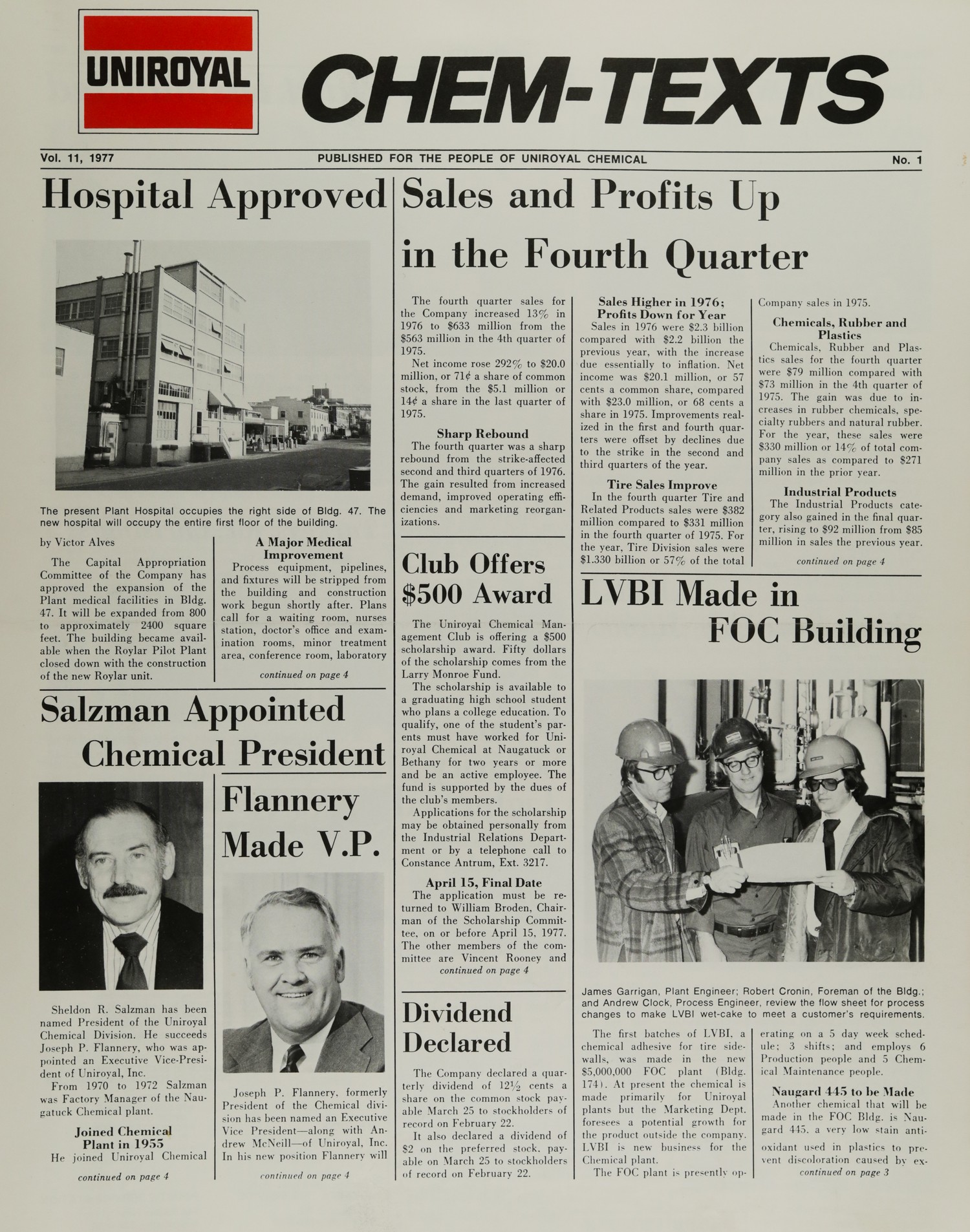
Hospital Approved | Sales and Profits Up in the Fourth Quarter

[IMAGE: Black and white photo of a building]

The present Plant Hospital occupies the right side of Bldg. 47. The new hospital will occupy the entire first floor of the building.

by Victor Alves

The Capital Appropriation Committee of the Company has approved the expansion of the Plant medical facilities in Bldg. 47. It will be expanded from 800 to approximately 2400 square feet. The building became available when the Roylar Pilot Plant closed down with the construction of the new Roylar unit.

A Major Medical Improvement

Process equipment, pipelines, and fixtures will be stripped from the building and construction work begun shortly after. Plans call for a waiting room, nurses station, doctor’s office and examination rooms, minor treatment area, conference room, laboratory

continued on page 4


The fourth quarter sales for the Company increased 13% in 1976 to $633 million from the $563 million in the 4th quarter of 1975.

Net income rose 292% to $20.0 million, or 71¢ a share of common stock, from the $5.1 million or 14¢ a share in the last quarter of 1975.

Sharp Rebound

The fourth quarter was a sharp rebound from the strike-affected second and third quarters of 1976. The gain resulted from increased demand, improved operating efficiencies and marketing reorganizations.


Club Offers $500 Award

The Uniroyal Chemical Management Club is offering a $500 scholarship award. Fifty dollars of the scholarship comes from the Larry Monroe Fund.

The scholarship is available to a graduating high school student who plans a college education. To qualify, one of the student’s parents must have worked for Uniroyal Chemical at Naugatuck or Bethany for two years or more and be an active employee. The fund is supported by the dues of the club’s members.

Applications for the scholarship may be obtained personally from the Industrial Relations Department or by a telephone call to Constance Antrum, Ext. 3217.

April 15, Final Date

The application must be returned to William Broden, Chairman of the Scholarship Committee, on or before April 15, 1977. The other members of the committee are Vincent Rooney and

continued on page 4


Sales Higher in 1976; Profits Down for Year

Sales in 1976 were $2.3 billion compared with $2.2 billion the previous year, with the increase due essentially to inflation. Net income was $20.1 million, or 57 cents a common share, compared with $23.0 million, or 68 cents a share in 1975. Improvements realized in the first and fourth quarters were offset by declines due to the strike in the second and third quarters of the year.

Tire Sales Improve

In the fourth quarter Tire and Related Products sales were $382 million compared to $331 million in the fourth quarter of 1975. For the year, Tire Division sales were $1.330 billion or 57% of the total


Company sales in 1975.

Chemicals, Rubber and Plastics

Chemicals, Rubber and Plastics sales for the fourth quarter were $79 million compared with $73 million in the 4th quarter of 1975. The gain was due to increases in rubber chemicals, specialty rubbers and natural rubber. For the year, these sales were $330 million or 14% of total company sales as compared to $271 million in the prior year.

Industrial Products

The Industrial Products category also gained in the final quarter, rising to $92 million from $85 million in sales the previous year.

continued on page 4


Salzman Appointed Chemical President

Flannery Made V.P.

[IMAGE: Photo of Sheldon R. Salzman]

Sheldon R. Salzman has been named President of the Uniroyal Chemical Division. He succeeds Joseph P. Flannery, who was appointed an Executive Vice-President of Uniroyal, Inc.

From 1970 to 1972 Salzman was Factory Manager of the Naugatuck Chemical plant.

Joined Chemical Plant in 1955

He joined Uniroyal Chemical

continued on page 4

[IMAGE: Photo of Joseph P. Flannery]

Joseph P. Flannery, formerly President of the Chemical division has been named an Executive Vice President—along with Andrew McNeill—of Uniroyal, Inc. In his new position Flannery will

continued on page 4


Dividend Declared

The Company declared a quarterly dividend of 12½ cents a share on the common stock payable March 25 to stockholders of record on February 22.

It also declared a dividend of $2 on the preferred stock, payable on March 25 to stockholders of record on February 22.


LVBI Made in FOC Building

[IMAGE: Photo of three workers reviewing documents]

James Garrigan, Plant Engineer; Robert Cronin, Foreman of the Bldg.; and Andrew Clock, Process Engineer, review the flow sheet for process changes to make LVBI wet-cake to meet a customer’s requirements.

The first batches of LVBI, a chemical adhesive for tire sidewalls, was made in the new $5,000,000 FOC plant (Bldg. 174). At present the chemical is made primarily for Uniroyal plants but the Marketing Dept. foresees a potential growth for the product outside the company. LVBI is new business for the Chemical plant.

The FOC plant is presently op-

erating on a 5 day week schedule; 3 shifts; and employs 6 Production people and 5 Chemical Maintenance people.

Naugard 445 to be Made

Another chemical that will be made in the FOC Bldg. is Naugard 445, a very low stain antioxidant used in plastics to prevent discoloration caused by ex-

continued on page 3

CHEM-TEXTS – 1975 – Page 2

Page 002

CHEM-TEXTS

Page 2 | Vol. 9, 1975


In my last editorial I ventured into the field of politics. This area is so vital that I felt a few more ideas had to be discussed. The current confusion in Washington and the recent wild legislation session in Hartford are prime examples of the type of disturbing political action confronting us Americans today.

I read in the newspapers all the criticisms by well known columnists and editors lamenting the poor actions and leadership of our elected legislative officials. They ask our officials to change their ways and to recognize the real problems of the people, their jobs, their community problems, their financial problems, etc. etc.

I find this effort misdirected. Appealing to elected politicians hardly ever changes their minds. Their philosophy of life has been long in developing and most are strong-minded people, not easily swayed from their convictions. The way to change the political direction of a legislative body is to change the legislators. Vote out the ones that are undersirable and vote in those who reflect the feeling and mood of the electorate.

Although voting occurs only every two years, people’s thoughts should be on this subject all the time, not just one week before elections. For example, a review of how our representatives voted recently in Hartford should be done now to help form an opinion while the facts are clear.

The makeup of the last two Connecticut Legislatures is another problem that voters must avoid in the future. We now have in Hartford an overwhelming Democratic majority. Two years ago there was an overwhelming Republican majority. This is no way to run a government, for with such a onesided majority, we don’t have a democracy—which is a balance of two or more opinions— we have instead what approaches dictatorial power of the party in the majority. Such a situation can do nothing but harm. A balance is essential to stable and honest government.

No one can rectify a situation like this except we voters. This means less emotional voting and more thinking, both inside and outside the voting machine.

J. A. Cronin

Jim Cronin [signature]

[PHOTO: Headshot of a man in suit]


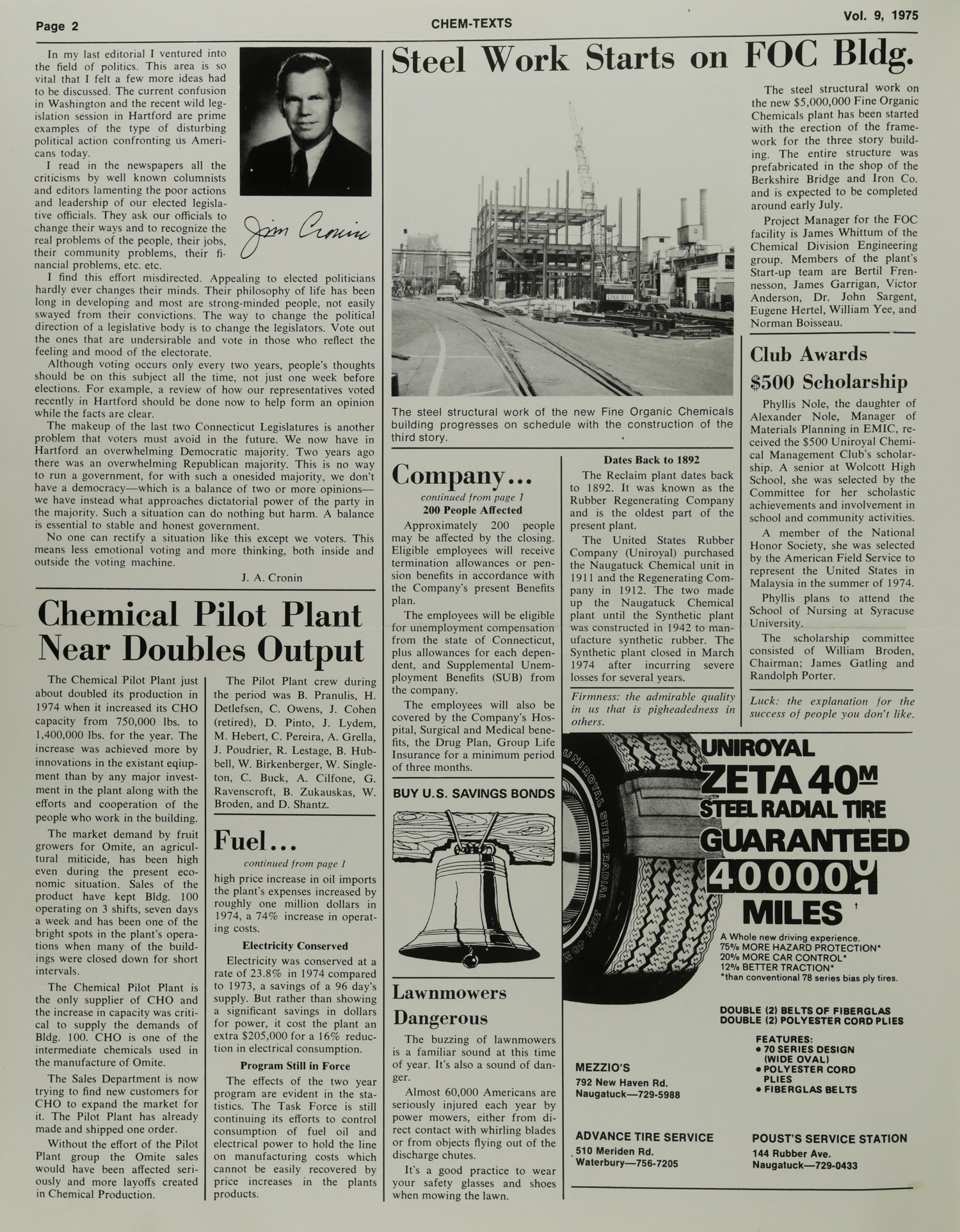
Steel Work Starts on FOC Bldg.

[PHOTO: Construction site showing steel framework of a building]

The steel structural work on the new $5,000,000 Fine Organic Chemicals plant has been started with the erection of the framework for the three story building. The entire structure was prefabricated in the shop of the Berkshire Bridge and Iron Co. and is expected to be completed around early July.

Project Manager for the FOC facility is James Whittum of the Chemical Division Engineering group. Members of the plant’s Start-up team are Bertil Frennesson, James Garrigan, Victor Anderson, Dr. John Sargent, Eugene Hertel, William Yee, and Norman Boisseau.

The steel structural work of the new Fine Organic Chemicals building progresses on schedule with the construction of the third story.


Chemical Pilot Plant Near Doubles Output

The Chemical Pilot Plant just about doubled its production in 1974 when it increased its CHO capacity from 750,000 lbs. to 1,400,000 lbs. for the year. The increase was achieved more by innovations in the existant equipment than by any major investment in the plant along with the efforts and cooperation of the people who work in the building.

The market demand by fruit growers for Omite, an agricultural miticide, has been high even during the present economic situation. Sales of the product have kept Bldg. 100 operating on 3 shifts, seven days a week and has been one of the bright spots in the plant’s operations when many of the buildings were closed down for short intervals.

The Chemical Pilot Plant is the only supplier of CHO and the increase in capacity was critical to supply the demands of Bldg. 100. CHO is one of the intermediate chemicals used in the manufacture of Omite.

The Sales Department is now trying to find new customers for CHO to expand the market for it. The Pilot Plant has already made and shipped one order.

Without the effort of the Pilot Plant group the Omite sales would have been affected seriously and more layoffs created in Chemical Production.

The Pilot Plant crew during the period was B. Pranulis, H. Detlefsen, C. Owens, J. Cohen (retired), D. Pinto, J. Lydem, M. Hebert, C. Pereira, A. Grella, J. Poudrier, R. Lestage, B. Hubbell, W. Birkenberger, W. Singleton, C. Buck, A. Cilfone, G. Ravenscroft, B. Zukauskas, W. Broden, and D. Shantz.


Company…

continued from page 1

200 People Affected

Approximately 200 people may be affected by the closing. Eligible employees will receive termination allowances or pension benefits in accordance with the Company’s present Benefits plan.

The employees will be eligible for unemployment compensation from the state of Connecticut, plus allowances for each dependent, and Supplemental Unemployment Benefits (SUB) from the company.

The employees will also be covered by the Company’s Hospital, Surgical and Medical benefits, the Drug Plan, Group Life Insurance for a minimum period of three months.

BUY U.S. SAVINGS BONDS


Dates Back to 1892

The Reclaim plant dates back to 1892. It was known as the Rubber Regenerating Company and is the oldest part of the present plant.

The United States Rubber Company (Uniroyal) purchased the Naugatuck Chemical unit in 1911 and the Regenerating Company in 1912. The two made up the Naugatuck Chemical plant until the Synthetic plant was constructed in 1942 to manufacture synthetic rubber. The Synthetic plant closed in March 1974 after incurring severe losses for several years.

Firmness: the admirable quality in us that is pigheadedness in others.


Fuel…

continued from page 1

high price increase in oil imports the plant’s expenses increased by roughly one million dollars in 1974, a 74% increase in operating costs.

Electricity Conserved

Electricity was conserved at a rate of 23.8% in 1974 compared to 1973, a savings of a 96 day’s supply. But rather than showing a significant savings in dollars for power, it cost the plant an extra $205,000 for a 16% reduction in electrical consumption.

Program Still in Force

The effects of the two year program are evident in the statistics. The Task Force is still continuing its efforts to control consumption of fuel oil and electrical power to hold the line on manufacturing costs which cannot be easily recovered by price increases in the plants products.


Club Awards $500 Scholarship

Phyllis Nole, the daughter of Alexander Nole, Manager of Materials Planning in EMIC, received the $500 Uniroyal Chemical Management Club’s scholarship. A senior at Wolcott High School, she was selected by the Committee for her scholastic achievements and involvement in school and community activities.

A member of the National Honor Society, she was selected by the American Field Service to represent the United States in Malaysia in the summer of 1974.

Phyllis plans to attend the School of Nursing at Syracuse University.

The scholarship committee consisted of William Broden, Chairman; James Gatling and Randolph Porter.

Luck: the explanation for the success of people you don’t like.


Lawnmowers Dangerous

[IMAGE: Drawing of a Liberty Bell]

The buzzing of lawnmowers is a familiar sound at this time of year. It’s also a sound of danger.

Almost 60,000 Americans are seriously injured each year by power mowers, either from direct contact with whirling blades or from objects flying out of the discharge chutes.

It’s a good practice to wear your safety glasses and shoes when mowing the lawn.


MEZZIO’S
792 New Haven Rd.
Naugatuck—729-5988

ADVANCE TIRE SERVICE
510 Meriden Rd.
Waterbury—756-7205

POUST’S SERVICE STATION
144 Rubber Ave.
Naugatuck—729-0433


[ADVERTISEMENT]

UNIROYAL

ZETA 40M

STEEL RADIAL TIRE

GUARANTEED

40000

MILES

A Whole new driving experience.
75% MORE HAZARD PROTECTION
20% MORE CAR CONTROL

12% BETTER TRACTION
than conventional 78 series bias ply tires.

DOUBLE (2) BELTS OF FIBERGLAS
DOUBLE (2) POLYESTER CORD PLIES

FEATURES:
– 70 SERIES DESIGN (WIDE OVAL)
– POLYESTER CORD PLIES
– FIBERGLAS BELTS

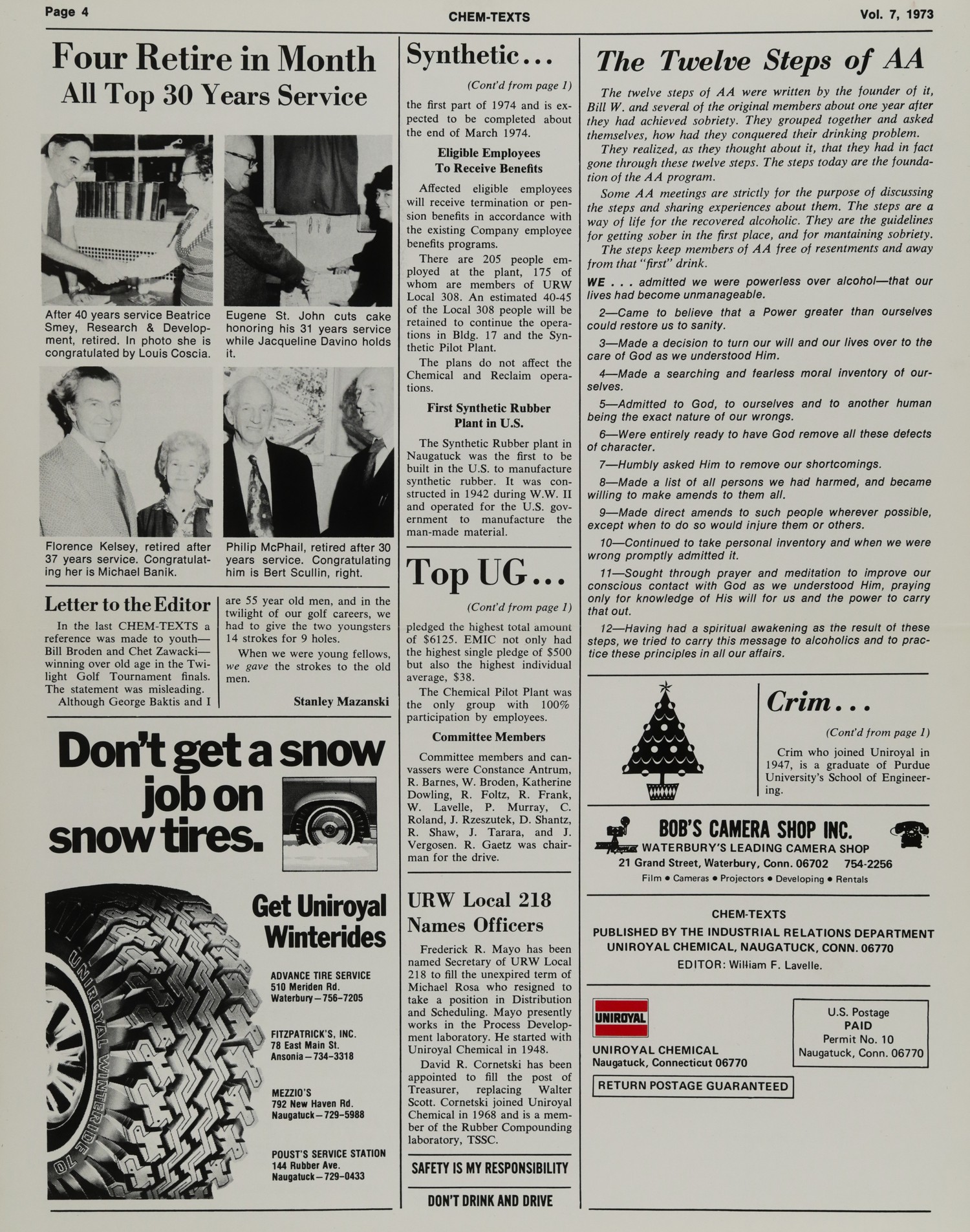
Four Retire in Month All Top 30 Years Service

Page 4 CHEM-TEXTS Vol. 7, 1973


Four Retire in Month All Top 30 Years Service

[IMAGE: Woman in photo]

After 40 years service Beatrice Smey, Research & Development, retired. In photo she is congratulated by Louis Coscia.

[IMAGE: Man cutting cake]

Eugene St. John cuts cake honoring his 31 years service while Jacqueline Davino holds it.

[IMAGE: Woman in photo]

Florence Kelsey, retired after 37 years service. Congratulating her is Michael Banik.

[IMAGE: Two men in photo]

Philip McPhail, retired after 30 years service. Congratulating him is Bert Scullin, right.


Letter to the Editor

In the last CHEM-TEXTS a reference was made to youth— Bill Broden and Chet Zawacki— winning over old age in the Twilight Golf Tournament finals. The statement was misleading.

Although George Baktis and I are 55 year old men, and in the twilight of our golf careers, we had to give the two youngsters 14 strokes for 9 holes.

When we were young fellows, we gave the strokes to the old men.

Stanley Mazanski


Don’t get a snow job on snow tires.

[IMAGE: Snow tire]

Get Uniroyal Winterides

[IMAGE: Woman with tire]

ADVANCE TIRE SERVICE
510 Meriden Rd.
Waterbury – 756–7205

FITZPATRICK’S, INC.
78 East Main St.
Ansonia – 734–3318

MEZZIO’S
792 New Haven Rd.
Naugatuck – 729–5988

POUST’S SERVICE STATION
144 Rubber Ave.
Naugatuck – 729–0433


Synthetic…

(Cont’d from page 1)

the first part of 1974 and is expected to be completed about the end of March 1974.

Eligible Employees To Receive Benefits

Affected eligible employees will receive termination or pension benefits in accordance with the existing Company employee benefits programs.

There are 205 people employed at the plant, 175 of whom are members of URW Local 308. An estimated 40-45 of the Local 308 people will be retained to continue the operations in Bldg. 17 and the Synthetic Pilot Plant.

The plans do not affect the Chemical and Reclaim operations.

First Synthetic Rubber Plant in U.S.

The Synthetic Rubber plant in Naugatuck was the first to be built in the U.S. to manufacture synthetic rubber. It was constructed in 1942 during W.W. II and operated for the U.S. government to manufacture the man-made material.


Top UG…

(Cont’d from page 1)

pledged the highest total amount of $6125. EMIC not only had the highest single pledge of $500 but also the highest individual average, $38.

The Chemical Pilot Plant was the only group with 100% participation by employees.

Committee Members

Committee members and canvassers were Constance Antrum, R. Barnes, W. Broden, Katherine Dowling, R. Foltz, R. Frank, W. Lavelle, P. Murray, C. Roland, J. Rzeszutek, D. Shantz, R. Shaw, J. Tarara, and J. Vergosen. R. Gaetz was chairman for the drive.


URW Local 218 Names Officers

Frederick R. Mayo has been named Secretary of URW Local 218 to fill the unexpired term of Michael Rosa who resigned to take a position in Distribution and Scheduling. Mayo presently works in the Process Development laboratory. He started with Uniroyal Chemical in 1948.

David R. Cornetski has been appointed to fill the post of Treasurer, replacing Walter Scott. Cornetski joined Uniroyal Chemical in 1968 and is a member of the Rubber Compounding laboratory, TSSC.


SAFETY IS MY RESPONSIBILITY

DON’T DRINK AND DRIVE


The Twelve Steps of AA

The twelve steps of AA were written by the founder of it, Bill W. and several of the original members about one year after they had achieved sobriety. They grouped together and asked themselves, how had they conquered their drinking problem.

They realized, as they thought about it, that they had in fact gone through these twelve steps. The steps today are the foundation of the AA program.

Some AA meetings are strictly for the purpose of discussing the steps and sharing experiences about them. The steps are a way of life for the recovered alcoholic. They are the guidelines for getting sober in the first place, and for mantaining sobriety. The steps keep members of AA free of resentments and away from that “first” drink.

WE . . . admitted we were powerless over alcohol—that our lives had become unmanageable.

2—Came to believe that a Power greater than ourselves could restore us to sanity.

3—Made a decision to turn our will and our lives over to the care of God as we understood Him.

4—Made a searching and fearless moral inventory of ourselves.

5—Admitted to God, to ourselves and to another human being the exact nature of our wrongs.

6—Were entirely ready to have God remove all these defects of character.

7—Humbly asked Him to remove our shortcomings.

8—Made a list of all persons we had harmed, and became willing to make amends to them all.

9—Made direct amends to such people wherever possible, except when to do so would injure them or others.

10—Continued to take personal inventory and when we were wrong promptly admitted it.

11—Sought through prayer and meditation to improve our conscious contact with God as we understood Him, praying only for knowledge of His will for us and the power to carry that out.

12—Having had a spiritual awakening as the result of these steps, we tried to carry this message to alcoholics and to practice these principles in all our affairs.


Crim…

(Cont’d from page 1)

Crim who joined Uniroyal in 1947, is a graduate of Purdue University’s School of Engineering.


BOB’S CAMERA SHOP INC.
WATERBURY’S LEADING CAMERA SHOP
21 Grand Street, Waterbury, Conn. 06702 754-2256
Film ● Cameras ● Projectors ● Developing ● Rentals


CHEM-TEXTS
PUBLISHED BY THE INDUSTRIAL RELATIONS DEPARTMENT
UNIROYAL CHEMICAL, NAUGATUCK, CONN. 06770
EDITOR: William F. Lavelle.


[UNIROYAL LOGO]

UNIROYAL CHEMICAL
Naugatuck, Connecticut 06770

U.S. Postage
PAID
Permit No. 10
Naugatuck, Conn. 06770

RETURN POSTAGE GUARANTEED

CHEM-TEXTS – 1973 – Page 3

Page 003

Vol. 7, 1973 CHEM-TEXTS Page 3


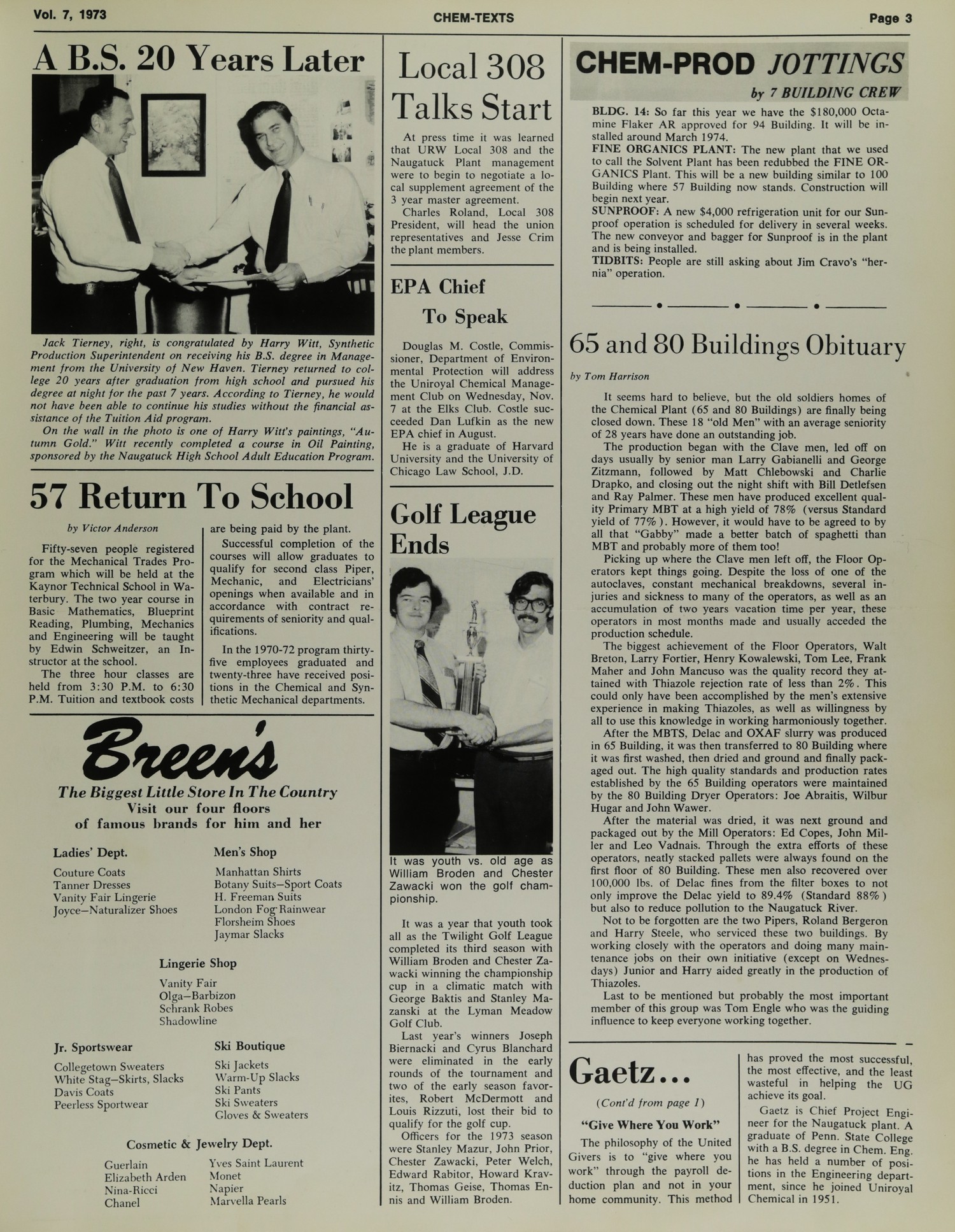
A B.S. 20 Years Later

[IMAGE: Two men standing together, one appears to be congratulating the other, with a framed picture on the wall behind them]

Jack Tierney, right, is congratulated by Harry Witt, Synthetic Production Superintendent on receiving his B.S. degree in Management from the University of New Haven. Tierney returned to college 20 years after graduation from high school and pursued his degree at night for the past 7 years. According to Tierney, he would not have been able to continue his studies without the financial assistance of the Tuition Aid program.

On the wall in the photo is one of Harry Witt’s paintings, “Autumn Gold.” Witt recently completed a course in Oil Painting, sponsored by the Naugatuck High School Adult Education Program.


57 Return To School

by Victor Anderson

Fifty-seven people registered for the Mechanical Trades Program which will be held at the Kaynor Technical School in Waterbury. The two year course in Basic Mathematics, Blueprint Reading, Plumbing, Mechanics and Engineering will be taught by Edwin Schweitzer, an Instructor at the school.

The three hour classes are held from 3:30 P.M. to 6:30 P.M. Tuition and textbook costs are being paid by the plant.

Successful completion of the courses will allow graduates to qualify for second class Piper, Mechanic, and Electricians’ openings when available and in accordance with contract requirements of seniority and qualifications.

In the 1970-72 program thirty-five employees graduated and twenty-three have received positions in the Chemical and Synthetic Mechanical departments.


Local 308 Talks Start

At press time it was learned that URW Local 308 and the Naugatuck Plant management were to begin to negotiate a local supplement agreement of the 3 year master agreement.

Charles Roland, Local 308 President, will head the union representatives and Jesse Crim the plant members.


EPA Chief To Speak

Douglas M. Costle, Commissioner, Department of Environmental Protection will address the Uniroyal Chemical Management Club on Wednesday, Nov. 7 at the Elks Club. Costle succeeded Dan Lufkin as the new EPA chief in August.

He is a graduate of Harvard University and the University of Chicago Law School, J.D.


Golf League Ends

It was youth vs. old age as William Broden and Chester Zawacki won the golf championship.

It was a year that youth took all as the Twilight Golf League completed its third season with William Broden and Chester Zawacki winning the championship cup in a climatic match with George Baktis and Stanley Mazanski at the Lyman Meadow Golf Club.

Last year’s winners Joseph Biernacki and Cyrus Blanchard were eliminated in the early rounds of the tournament and two of the early season favorites, Robert McDermott and Louis Rizzuti, lost their bid to qualify for the golf cup.

Officers for the 1973 season were Stanley Mazur, John Prior, Chester Zawacki, Peter Welch, Edward Rabitor, Howard Kravitz, Thomas Geise, Thomas Ennis and William Broden.


Breen’s

The Biggest Little Store In The Country

Visit our four floors of famous brands for him and her

Ladies’ Dept. Men’s Shop
Couture Coats Manhattan Shirts
Tanner Dresses Botany Suits—Sport Coats
Vanity Fair Lingerie H. Freeman Suits
Joyce—Naturalizer Shoes London Fog Rainwear
Florsheim Shoes
Jaymar Slacks

Lingerie Shop

Vanity Fair
Olga—Barbizon
Schrank Robes
Shadowline

Jr. Sportswear Ski Boutique
Collegetown Sweaters Ski Jackets
White Stag—Skirts, Slacks Warm-Up Slacks
Davis Coats Ski Pants
Peerless Sportwear Ski Sweaters
Gloves & Sweaters

Cosmetic & Jewelry Dept.

Guerlain Yves Saint Laurent
Elizabeth Arden Monet
Nina-Ricci Napier
Chanel Marvella Pearls

CHEM-PROD JOTTINGS

by 7 BUILDING CREW

BLDG. 14: So far this year we have the $180,000 Octamine Flaker AR approved for 94 Building. It will be installed around March 1974.

FINE ORGANICS PLANT: The new plant that we used to call the Solvent Plant has been redubbed the FINE ORGANICS Plant. This will be a new building similar to 100 Building where 57 Building now stands. Construction will begin next year.

SUNPROOF: A new $4,000 refrigeration unit for our Sunproof operation is scheduled for delivery in several weeks. The new conveyor and bagger for Sunproof is in the plant and is being installed.

TIDBITS: People are still asking about Jim Cravo’s “hernia” operation.


65 and 80 Buildings Obituary

by Tom Harrison

It seems hard to believe, but the old soldiers homes of the Chemical Plant (65 and 80 Buildings) are finally being closed down. These 18 “old Men” with an average seniority of 28 years have done an outstanding job.

The production began with the Clave men, led off on days usually by senior man Larry Gabianelli and George Zitzmann, followed by Matt Chlebowski and Charlie Drapko, and closing out the night shift with Bill Detlefsen and Ray Palmer. These men have produced excellent quality Primary MBT at a high yield of 78% (versus Standard yield of 77%). However, it would have to be agreed to by all that “Gabby” made a better batch of spaghetti than MBT and probably more of them too!

Picking up where the Clave men left off, the Floor Operators kept things going. Despite the loss of one of the autoclaves, constant mechanical breakdowns, several injuries and sickness to many of the operators, as well as an accumulation of two years vacation time per year, these operators in most months made and usually acceded the production schedule.

The biggest achievement of the Floor Operators, Walt Breton, Larry Fortier, Henry Kowalewski, Tom Lee, Frank Maher and John Mancuso was the quality record they attained with Thiazole rejection rate of less than 2%. This could only have been accomplished by the men’s extensive experience in making Thiazoles, as well as willingness by all to use this knowledge in working harmoniously together.

After the MBTS, Delac and OXAF slurry was produced in 65 Building, it was then transferred to 80 Building where it was first washed, then dried and ground and finally packaged out. The high quality standards and production rates established by the 65 Building operators were maintained by the 80 Building Dryer Operators: Joe Abraitis, Wilbur Hugar and John Wawer.

After the material was dried, it was next ground and packaged out by the Mill Operators: Ed Copes, John Miller and Leo Vadnais. Through the extra efforts of these operators, neatly stacked pallets were always found on the first floor of 80 Building. These men also recovered over 100,000 lbs. of Delac fines from the filter boxes to not only improve the Delac yield to 89.4% (Standard 88%) but also to reduce pollution to the Naugatuck River.

Not to be forgotten are the two Pipers, Roland Bergeron and Harry Steele, who serviced these two buildings. By working closely with the operators and doing many maintenance jobs on their own initiative (except on Wednesdays) Junior and Harry aided greatly in the production of Thiazoles.

Last to be mentioned but probably the most important member of this group was Tom Engle who was the guiding influence to keep everyone working together.


Gaetz…

(Cont’d from page 1)

“Give Where You Work”

The philosophy of the United Givers is to “give where you work” through the payroll deduction plan and not in your home community. This method has proved the most successful, the most effective, and the least wasteful in helping the UG achieve its goal.

Gaetz is Chief Project Engineer for the Naugatuck plant. A graduate of Penn. State College with a B.S. degree in Chem. Eng. he has held a number of positions in the Engineering department, since he joined Uniroyal Chemical in 1951.

CHEM-TEXTS – Vol. 5 No. 4 – Page 3

Page 003

CHEM-TEXTS

Vol. 5 No. 4 | Page 3


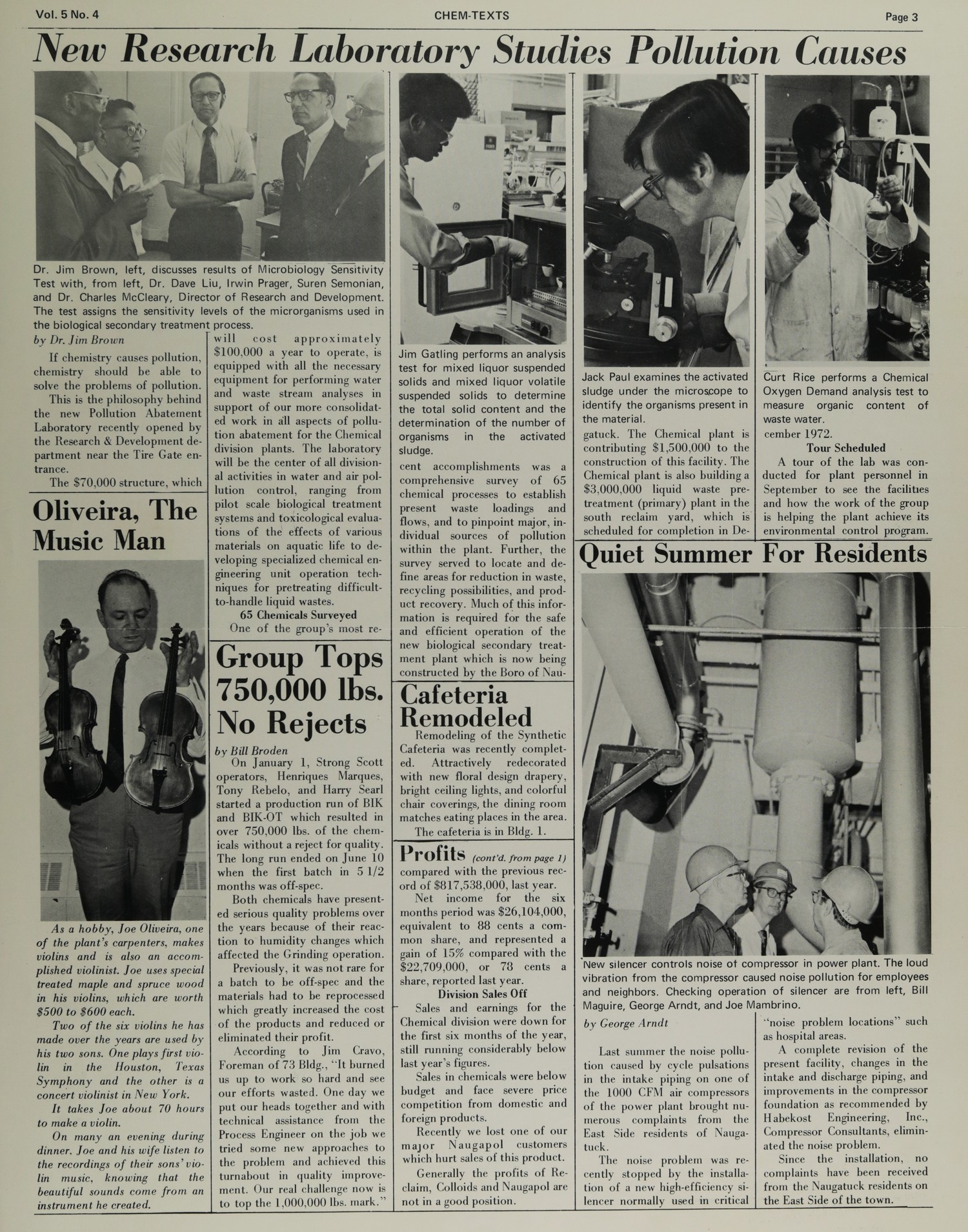
New Research Laboratory Studies Pollution Causes

Dr. Jim Brown, left, discusses results of Microbiology Sensitivity Test with, from left, Dr. Dave Liu, Irwin Prager, Suren Semonian, and Dr. Charles McCleary, Director of Research and Development. The test assigns the sensitivity levels of the microrganisms used in the biological secondary treatment process.

by Dr. Jim Brown

If chemistry causes pollution, chemistry should be able to solve the problems of pollution.

This is the philosophy behind the new Pollution Abatement Laboratory recently opened by the Research & Development department near the Tire Gate entrance.

The $70,000 structure, which


Oliveira, The Music Man

As a hobby, Joe Oliveira, one of the plant’s carpenters, makes violins and is also an accomplished violinist. Joe uses special treated maple and spruce wood in his violins, which are worth $500 to $600 each.

Two of the six violins he has made over the years are used by his two sons. One plays first violin in the Houston, Texas Symphony and the other is a concert violinist in New York.

It takes Joe about 70 hours to make a violin.

On many an evening during dinner, Joe and his wife listen to the recordings of their sons’ violin music, knowing that the beautiful sounds come from an instrument he created.


will cost approximately $100,000 a year to operate, is equipped with all the necessary equipment for performing water and waste stream analyses in support of our more consolidated work in all aspects of pollution abatement for the Chemical division plants. The laboratory will be the center of all divisional activities in water and air pollution control, ranging from pilot scale biological treatment systems and toxicological evaluations of the effects of various materials on aquatic life to developing specialized chemical engineering unit operation techniques for pretreating difficult-to-handle liquid wastes.

65 Chemicals Surveyed

One of the group’s most re-


Group Tops 750,000 lbs. No Rejects

by Bill Broden

On January 1, Strong Scott operators, Henriques Marques, Tony Rebelo, and Harry Searl started a production run of BIK and BIK-OT which resulted in over 750,000 lbs. of the chemicals without a reject for quality. The long run ended on June 10 when the first batch in 5 1/2 months was off-spec.

Both chemicals have presented serious quality problems over the years because of their reaction to humidity changes which affected the Grinding operation.

Previously, it was not rare for a batch to be off-spec and the materials had to be reprocessed which greatly increased the cost of the products and reduced or eliminated their profit.

According to Jim Cravo, Foreman of 73 Bldg., “It burned us up to work so hard and see our efforts wasted. One day we put our heads together and with technical assistance from the Process Engineer on the job we tried some new approaches to the problem and achieved this turnaround in quality improvement. Our real challenge now is to top the 1,000,000 lbs. mark.”


Jim Gatling performs an analysis test for mixed liquor suspended solids and mixed liquor volatile suspended solids to determine the total solid content and the determination of the number of organisms in the activated sludge.

cent accomplishments was a comprehensive survey of 65 chemical processes to establish present waste loadings and flows, and to pinpoint major, individual sources of pollution within the plant. Further, the survey served to locate and define areas for reduction in waste, recycling possibilities, and product recovery. Much of this information is required for the safe and efficient operation of the new biological secondary treatment plant which is now being constructed by the Boro of Nau-


Cafeteria Remodeled

Remodeling of the Synthetic Cafeteria was recently completed. Attractively redecorated with new floral design drapery, bright ceiling lights, and colorful chair coverings, the dining room matches eating places in the area.

The cafeteria is in Bldg. 1.


Profits (cont’d. from page 1)

compared with the previous record of $817,538,000, last year.

Net income for the six months period was $26,104,000, equivalent to 88 cents a common share, and represented a gain of 15% compared with the $22,709,000, or 78 cents a share, reported last year.

Division Sales Off

Sales and earnings for the Chemical division were down for the first six months of the year, still running considerably below last year’s figures.

Sales in chemicals were below budget and face severe price competition from domestic and foreign products.

Recently we lost one of our major Naugapol customers which hurt sales of this product.

Generally the profits of Reclaim, Colloids and Naugapol are not in a good position.


Jack Paul examines the activated sludge under the microscope to identify the organisms present in the material.

gatuck. The Chemical plant is contributing $1,500,000 to the construction of this facility. The Chemical plant is also building a $3,000,000 liquid waste pretreatment (primary) plant in the south reclaim yard, which is scheduled for completion in De-


Curt Rice performs a Chemical Oxygen Demand analysis test to measure organic content of waste water.

cember 1972.

Tour Scheduled

A tour of the lab was conducted for plant personnel in September to see the facilities and how the work of the group is helping the plant achieve its environmental control program.


Quiet Summer For Residents

New silencer controls noise of compressor in power plant. The loud vibration from the compressor caused noise pollution for employees and neighbors. Checking operation of silencer are from left, Bill Maguire, George Arndt, and Joe Mambrino.

by George Arndt

Last summer the noise pollution caused by cycle pulsations in the intake piping on one of the 1000 CFM air compressors of the power plant brought numerous complaints from the East Side residents of Naugatuck.

The noise problem was recently stopped by the installation of a new high-efficiency silencer normally used in critical

“noise problem locations” such as hospital areas.

A complete revision of the present facility, changes in the intake and discharge piping, and improvements in the compressor foundation as recommended by Habekost Engineering, Inc., Compressor Consultants, eliminated the noise problem.

Since the installation, no complaints have been received from the Naugatuck residents on the East Side of the town.

CHEM-TEXTS – Vol. 5, No. 2 – Page 2

Page 002

CHEM-TEXTS

Page 2 | Vol. 5, No. 2


FROM THE FACTORY MANAGER

DEAR FELLOW EMPLOYEE:

The National Safety Council recently presented an Award of Merit to the Naugatuck Chemical plant in recognition of its notable safety achievement in 1970. The Award was based on the significant drop in our lost-time accidents during the year: only 6 compared to 24 for each of the three previous years.

In helping to attain this performance, everyone in the plant deserves to be congratulated. Such an achievement is the result only of individual effort and cooperation. With everyone’s increasing concern for safety, we should continue to improve on our experience.

During April, this safety awareness really paid off. Five employees were involved in near-serious eye accidents that would certainly have resulted in damage to their sight. Fortunately, all were wearing their safety glasses at the time of the accidents.

Although our on-the-job safety performance has improved, let’s not overlook safety when away from the job.

Off-the-job safety becomes especially important as the warm weather and vacation time approaches.

At this time there’s a tendency to take extra risks in working around the house—using lawnmowers, climbing ladders, or lifting heavy objects.

Or on vacation, there’s the urge to do everything fast—driving carelessly, exercising too vigorously in sports.

Whether at work, at home, or on vacation—let’s continue to place a great deal of emphasis on good safety habits. Not only you, but your family and fellow employees will benefit from it.

[Signature]


Nystrom Gets $300 Grant

Harvey Nystrom receives Scholarship Award from Joe Bucciaglia. From left are Bob Kaiser, Walt Nystrom, Harvey Nystrom, Bucciaglia, and Irwin Prager.

Harvey J. Nystrom, son of Walt Nystrom, a Millwright in the Chemical Mechanical Department, received the Uniroyal Chemical Management Club’s $250 scholarship award, along with an additional $50 from the Larry Monroe Fund.

Ranked first among 172 seniors at Southbury High School, Nystrom was selected as recipient of the Scholarship from 15 applicants. According to Joe Bucciaglia, Chairman of the Scholarship Committee, “all of this year’s applicants were deserving of the scholarship. It was most difficult for the committee to select one person.”

Besides his outstanding scholastic record, Nystrom was president of the National Honor Society, a State of Connecticut Scholar, and an active participant in a number of extracurricular activities.

He received a Certificate from Knox College for a special Science Training Program for High Ability high school students and a Certificate of De Merite En Francais for his proficiency in French. For his outstanding performance on the National Educational Development Tests, he received a Certificate of Educational Development which is awarded only to students for outstanding educational capabilities.

Nystrom will major in Physics at Cornell University and plans to do postgraduate work in Astro-Physics.

Other members of the Scholarship Committee who screened the applications for the annual award were Irwin Prager and Bob Kaiser.


Logic-Networks Plan Initiated For Liquid Waste Pretreatment Plant

Al Manzi, left, Project Leader for the Pollution Abatement program shows progress of new liquid waste pretreatment facilities on the Master Logic Networks diagram. Looking on are Gene Hertel, center, who assisted in the diagram and Dick Shaw, Project Engineer.

by Gene Hertel

To construct the new $3,000,000 Liquid Waste Pretreatment Plant on schedule, a systematic, scientific plan for the complex pollution abatement project was initiated to achieve the target completion date in December, 1972. This major project involves a coordinated effort by many groups to identify the sources of pollution; to eliminate and reduce pollution; and to construct and put into actual operation the Waste Pretreatment Plant.

Logic-Networks Used

The Logic-Networks system is being used to plan, coordinate, monitor and control the pollution abatement project. It is an easy-to-understand, graphical way to plan a project. It shows the time sequence and the interaction of the many tasks and the people involved. This time-logic diagram then becomes a way for the project manager to monitor the project. Decisions can be made to expedite the project to meet the project goals on schedule. The time-logic diagram also serves as a work-discipline tool for the hundreds of people involved, since they are aware of their participation and timing and how it affects the project.

A master Logic-Network was prepared by Al Manzi, Pollution Abatement Project Leader, and Dick Shaw, Project Engineer. The master network shows the broad objectives of the project. Sub-networks were then developed for the participating groups. These show the detailed effort that each group must accomplish to reach the project goal. These sub-networks are: Start-up of the Waste Pretreatment Plant by Dick Shaw; Identifying and Sampling streams in the Plants—Joe Bucciaglia for the Chemical Plant, B. T. Dave for the Synthetic Plant, John Prior for the Reclaim Plant, Gary Arndt for the Pilot Plants – Yard Abatement by Bob Van Allen; Information and Discussion by Neil Melore; Purchasing by Hal Lynch and Bruce Perkins; R & D Labs by Lou Coscia; Early Warning System by C. H. Kim; and Liquid Waste Testing by Irwin Prager; and Chemical Tests by Frank Lussier.

Editor’s Note: Gene Hertel, of the R & D Department, has lectured extensively on Logic-Networks programs at the Tire, Footwear, and Chemical Division plants.


Bloodmobile Visit June 10

On Thursday, June 10, Uniroyal Chemical will sponsor its annual blood drive. 150 pints is the plant’s goal for this year.

Because of the facilities of St. Michael’s Parish House, the Bloodmobile will be located there from 9:45 A.M. to 2:30 P.M. Since blood is so urgently needed in the State, all employees are urged to donate.

Appointments may be made now with Adeline Farrar, R.N., Ext. 231; Ann McAllister, R.N., Ext. 397; or Bob Shortt and Sal Aloise, Ext. 438.


$1,564 Lost In GMF Fire

by Phil De Pasquale

$1,564 was lost in a fire which occurred in the GMF® grinding section of Bldg. 101. While grinding the chemical, used as an accelerator for curing butyl rubber, a flash fire broke out. The GMF operator on the second shift pulled the fire alarm and the heat from the fire turned on the overhead sprinkler system.

Quick action by the fire inspectors and chemical production operators prevented more serious damage.

200 lbs. of GMF were destroyed, for a loss of over $500. Mechanical and electrical equipment damage totalled more than $500. Water damage, clean-up, and repairs approximated $500.

The fire was the first in the plant this year which amounted to a sizeable damage. The exact cause of the blaze is still undetermined.


Club Elects New Officers

New officers of the Uniroyal Chemical Management Club and the Executive Committee meet to plan activities for the year. Seated from left are Dan Shantz, Lou Kaiser, president; Bill Broden, vice president; and Doug Ritchie. Standing from left are Bob Smith, treasurer; Earl Roller, Stan Mazur, Dick Keenan, secretary; and Bob Cronin.

CHEM-TEXTS – unknown-i05-s201

Page 201

CHEM-TEXTS

Page 2 | Vol. 5, No. 5


Thanksgiving And Us…

Thanksgiving Day seems to have lost much of its significance. Originally it was set aside as a special day of prayer. Today, it is looked upon more as a four day weekend and three games of football on TV.

The people who first came to New England lived a life of far greater poverty than some of the people living in Appalachia today. Their Thanksgiving was one of survival.

By their unity of purpose, and their concern for each other, they laid the groundwork for the many benefits we enjoy in our present society.

When you think ot our progress, no other group of people has achieved such high standards of living.

We at the Chemical Plant, in particular, have much to be thankful for. With unemployment as high as 12-20% in some towns, we have been able to maintain a steady level of employment. We have some of the finest wages and benefits in industry. All of us have great concern for the safety, health, and welfare of each other and a positive attitude toward the improvement of the environment.

I think you will agree with me that these are important things in our lives.

If each one of us does his full share, we will continue to reap the rewards of our efforts and assure, even increase, the many good things we now enjoy for ourselves and our families.

[Signature: Paul Lyons]


Eleven Receive MS Degrees

Dick Krajewski, center, and John Honyotski, right, admire each other’s diplomas as Pat Petti looks on. Krajewski received an MS in Industrial Management; Honyotski, a BS in Business Administration; and Petti will receive a degree in 1972.

by Ed Nunn

Eleven employees received their M.S. degrees in June under the Uniroyal Tuition Aid program: Jim Garrigan, Bill Broden, Terry Mo, and John Gilbert received degrees from Rensselaer Polytechnic Institute in Hartford; Joe Schoen, Temple University; Pete Byra, John Swanson, and Lou Kaiser, University of Hartford; Paul Hinckley, Southern Connecticut; Bob Farrell, University of Connecticut; and Marvin Cramer, University of Bridgeport.

$31,346 in Payments

Tuition Aid during the academic year, Sept. 1, 1970 to Aug. 31, 1971 totaled $31,469 in reimbursements to 82 employees.

12 employees are attending job related courses; 20 are working toward a college degree; and 50 are pursuing postgraduate studies.

Over the past 6 years 36 employees have received degrees under the program with Uniroyal’s reimbursements amounting to $125,022.

All Employees Eligible

The Tuition Aid Program is available to all full-time employees. The Company reimburses you for the full tuition cost and fees for two courses per semester. The courses must be related to your present job or will be of value, as determined by the Company, in future promotional areas. Reimbursement is made only upon successful completion of the course.


BOB’S CAMERA SHOP
Waterbury’s Largest Camera Shop
Film ● Cameras ● Projectors
Developing ● Repairs ● Rentals
21 Grand St. 754-2256

Still Time For
Photo Greeting Cards


Disaster Plan Tested

Bob Shortt, Safety Manager, shows how to extinguish gasoline fire. Behind Shortt are Phil DePasquale, Security Supervisor, and John Starr. Others in photo are Frank Commendatore and Dick Oriente.

Deluge water fog flooded Hortonspheres to control simulated butadiene leak

The 66 Alarm was a simulated butadiene leak in the Synthetic plant Hortonspheres. The leaking vapor was flooded and controlled with water fog from the top and sides of the spheres. According to Harry Francolini who was in charge of the Control Center, “we found a few bugs in the Plan but on the whole it went quite well.” The bugs are being ironed out to make the Plan more effective.

The test was the culmination of weeklong demonstrations during Fire Prevention Week.

It was a quiet Friday afternoon—just a few more hours to the weekend—when at 1 P.M., Alarm “66” sounded 4 times over the plant’s fire alarm system. A quick call to the Watchman in Bldg. 84 and the Disaster Plan was in operation.

Work stopped and designated emergency personnel reported to the Control Center for instructions and others assumed their plant emergency responsibilities to prepare for a shutdown and evacuation of the plant.


Drive Nears

(Cont’d. from page 1)

Four departments, Materials, Accounting, EMIC, and Research and Development exceeded their goals with several other departments close to reaching their quotas.

Still Time To Pledge

There is still time to pledge. If you have misplaced your card, contact the canvasser in your department or call any one and return it to him.


Chemical Team Loses Playoffs

by John Swanson

The Chemical Royals with a 24-8 won-lost record, made the League’s 4 team playoffs. In the best out of 3 championship playoff games, they lost to Fortin’s Restaurant.

Batting the Royals to their victorious season were Pete Byra 545; John Johnson 511; Vin Rooney 495.

Eric Johnson and Al Zimmerman provided the team’s slugging power with “All Star” pitcher, Mike Jasman, doing a superb job on the mound for the Royals.

Other members of the Chemical Royals were Dick Carroll, Tom Casteel, Leon Hartmann, Bill Lawton, John Prior, Dan Shantz, Rudy Valente, and Al Zonas.


Salesmen Review Sales

Frank Morgan, standing, District 11 Sales Manager, discusses sales strategy with salesmen. From left are Kurt Markshausen, Ken Stewart, Kralastic Commodity Manager, Steve Arbuckle, Barry Roos, Ed Brown, Jack Taylor, Pat DePaolo, and Pete Cookson. Missing were Tom Wilson, Henry Alter and Dick Terino.

District 11 salesmen met to review their sales record for the first nine months of 1971.

In the first 9 months, the District achieved 108% of its budget and hopes to hit 110% in the 4th quarter.

An important factor in helping them sell more was an improved “service image” among customers. They pointed out at the meeting that customer demand for good service is a major problem in their contact with customers. If you can’t deliver the product when the customer needs it, he simply buys it from a competitor.

CHEM-TEXTS – Vol. 4 No. 10 – Page 2

Page 002

Page 2 CHEM-TEXTS Vol. 4 No. 10

FROM THE FACTORY MANAGER | Oxford Office Close to Completion

DEAR FELLOW EMPLOYEE:

Christmas is the season when everyone of us express more than anything during the year, the spirit of giving and concern for our family, friends, and the people we come in contact with each day of our lives. This spirit is particularly reflected by gifts to our families; visits to friends’ homes, and a sharing with others the many joys of the holidays.

In the plant where all of us work so closely together and depend upon each other so completely, this same spirit of giving and concern is vital.

By giving out fullest effort to, and showing the utmost concern for our responsibilities and the people we work with, each of us can individually infuse into the plant a spirit that will really make it a “good place to work.” The plant is not just a mere collection of buildings which house equipment to help us produce products or provide services, it is us, our efforts and our achievements.

Our work takes up more than eight hours of our day, and is a major part of our life. We can make it challenging; we can make it more secure; we can make it safer; we can make it more enjoyable by the same spirit of giving and concern that we display during the Christmas season.

I sincerely hope that you and your family, will enjoy a most happy Christmas and the fullest joy and happiness during the new Year.

Sincerely

Shel Salzman

S. R. Salzman


Construction of the administration building of Uniroyal’s Oxford Complex is on schedule for occupancy in summer. With most of the exterior work completed, and much of the interior ductwork, wiring and piping installed, the first of several buildings to be constructed will house many of the corporate activities presently in New York, EMIC, and Professional Park.


Chlebowski Averts Fire

by Ed Weaving

Matty Chlebowski’s quick action averted a serious fire in the Captax department when he opened a waterfog valve over a mixing tank which contained some undissolved sulfur and carbonbisulphide.

The incident occurred during cleaning operations to remove the sulfur and carbonbisulphide out of the mixing tank. Operators had removed the manhole cover to check the tank’s contents and started to add water through the manhole. The escaping carbonbisulphide ignited, probably from a hot steam pipe, and the flash fire burned a supervisor’s face and ears, which required hospital attention.

Tom Lee, a member of the crew, turned in the fire alarm signal for assistance from the plant protection department. “The fast action and alertness of the entire crew in an emergency prevented more serious damage and injury to the group,” according to Tom Engle, foreman of the building. Members of the crew working on the second shift were Frank Maher, John Mancuso, Charlie Drapko, and Ed Atwood, a piper working on the vessel.

During cleaning operations, tanks with hazardous vapors should always remain closed to

SAFETY IS MY RESPONSIBILITY

prevent their escape. Hot pipes can ignite the vapors and cause a serious fire and injuries to employees working in the building.


Sales Drop;

(Cont’d from page 1)

Strong competition in the chemical, reclaimed rubber, synthetic rubber and latex industries prevent passing on automatic price increases to our customers without the risk of losing their business. The extra costs for operating the plant must be absorbed by increased productivity; prevention of waste; and the reduction of off-spec materials that have to be reprocessed at an extra cost and that substantially affect the plant’s profit on the product.


Broden Named VP

Bill Broden, a Process Engineer in Chemical Production, was named Vice-President of the Uniroyal Chemical Management Club. Broden replaces Jim Phelan who was transferred to the International Division where he will work on agricultural chemical research and development of Chemical Division products in markets outside the U.S.

Black coffee, cold showers, fresh air or other folklore remedies do not sober you up. They just make you a wide-awake drunk.


1,100,000 Man Hours… It Happens

1,100,000 manhours were worked without a lost time accident for the second time this year. The most recent occurred from July to November when 1,100,000 manhours were reached without a lost time accident.

On November 20, the record was broken by a back injury when an operator shoveling residue in a drainage ditch under a fiber separation mill, strained the muscles in his back.

Only four lost-time accidents occurred this year, a major improvement over 1969 when 23 employees were injured and lost time from work.

Serious Injuries

The rate of serious injuries is about the same as last year. To date 56 serious injuries have taken place while 52 occurred in 1969.

Several close calls happened during the year and only safety glasses, safety shoes and safety hats prevented more serious injuries to employees. One employee almost lost his eyesight when a metal splinter hit and broke his safety glasses.

“Won’t Happen To Me”

A “won’t happen to me” attitude still exists among many employees who stubbornly resist

(Cont’d on page 4)


Three Steps Taken To Improve Air

Three steps have been taken by the plant to control pollution of the air. A new tower type scrubber was installed in Bldg. 109 at a cost of $40,000. The scrubber, by washing the phenolic fumes, eliminates the emission of these obnoxious odors into the atmosphere.

A process change in Bldg. 28 where PBNA is manufactured will eliminate the amine odors discharged into the atmosphere by the old process. This change is scheduled for completion by April 1971.

A new Dust Collector has been ordered for one of the mills in Bldg. 50 of Chemical Production. It will collect the fines which presently escape into the atmosphere.


Beretta

(Cont’d from page 1)

General Manager of Canadian chemical operations.

Later he became marketing Vice President for all Uniroyal products sold in Canada, a position he held until appointed Vice President of the Chemical division.

Mr. Beretta will be the guest speaker at the Uniroyal Chemical Management Club meeting on Jan. 20 at Fortin’s Restaurant.


Plant Water Cost Up 13%

The plant’s water costs were increased 13% due to a rate hike by the Connecticut Water Co. The new increase raises the plant’s operating costs about $35,000 annually.

Currently 55,000,000 gallons of water a month are used by the Chemical and Synthetic plants. In one month, 69,000,000 gallons were used; and in July, 60,000,000 gallons were consumed.

Water costs for the plant presently run $143,900 a year, and average $12,000 a month.

Help Conserve Water

Use of water, only when needed, will conserve it and keep the plant’s water bill down. Water waste increases operating costs and cuts into the plant’s profit. In some products it can seriously affect the cost of the product, hurting us competitively.

Considerable water can be saved by shutting off equipment when not in use, especially over weekends. Water hoses are also a major factor in water waste, when used to wash spillage down the drain. Dry spills should be swept rather than washed with the hose.

Every employee can help by turning off faucets; reporting leaks; and by using only as much water as is necessary to do the job.

CHEM-TEXTS – Vol. 4 No. 6 – Page 3

Page 003

Vol. 4, No. 6 CHEM-TEXTS Page 3

Employees’ Opinions Polled On Chem-Texts | Unions To Hold Picnics

A poll of 200 employees selected on a random basis from all plant and divisional departments and retired employees revealed that 96% of the employees read CHEM-TEXTS always or often, and that 76% of their families read it. The survey also showed the plant newspaper as a reliable form of communication and indicated employees have a vital concern for news and information on plant activities and operations.

70 employees completed the questionnaire for a 35% return, an exceptionally high response.

70% signed the questionnaire which was voluntary.

Answers to the “open-end” questions have been condensed because of space limitations.

1.) Do you read Chem-Tests?
86% always, 10% often, 3% seldom

2.) Does your family read Chem-Texts?
76% yes, 7% no

3.) What kind of news do you find most informative?
76% preferred news about plant activities: plant products; use of products in the market; new facilities; plant improvement; personnel changes; and economic situations.

60% wanted news about employees; benefits; idea awards; safety; job security; and retirements.

60% indicated a desire for news about Uniroyal, Inc.; other plants; corporate sales; profits; new products and markets.

4.) How did you like the recent article on the Oxford complex?
The majority commented “excellent”, “informative”, “indicative of Uniroyal’s progress”, “knew very little about it until article”.

5.) Do you think the paper uses enough photographs?
80% yes, 18% no


6.) What did you think of the article on pollution?
“Wonderful that something is being done;” “informative on serious national problem;” “good to keep us informed on pollution control efforts;” “shows company is concerned and makes employees concerned;” “all must be aware of their role in pollution control.”

7.) Some time back we did an article on packaging – do you think this type of information is helpful to employees?
Most employees replied yes; pointing out that they as customers always shop for a neat package.

8.) Do you think the paper gives you reliable information on plant operations and activities?
Comments were essentially, yes; and implied, “haven’t gotten any bum steers yet.”

9.) What do you think of the News Bulletins issued weekly?
In general the News Bulletins were considered informative and helpful; but several employees did not see them; a few felt they were fair, should expand coverage and include more news on safety and production.

10.) What suggestions do you have to improve CHEM-TEXTS?
The majority of employees had no recommendations to improve the paper.

Some remarks suggested: do more articles on departments; more about employees’ participation in community; letters to the editor; classified ads; questions and answers from employees.

The survey was the first conducted in the Company on plant newspapers, and employees who participated are thanked for their time in making it a more effective means of communication.


by Charlie Roland

Plans are underway for URW Local 308’s third annual picnic to be held on Sunday, August 9, from 11 A.M. to 6 P.M. at Schildgen’s Grove in Union City. The Grove is located on East Waterbury Road.

Chairman of the event is Art Calder, with Ben Tomaszeski, Nunzio Pastore and John Sullivan assisting in arrangements.

by Frank Commendatore

Local 218 will hold its annual picnic at Schildgen’s Grove on Saturday, August 15. A menu of roast beef, hamburgers, clams, clam broth will be served all day, with steaks served from 2 – 5 P.M. along with hot and cold beverages.

Chairman for the picnic is Frank Commendatore with Tom Ward and Mario Mucci, assistant chairman.


You Get A Chance To Talk To Two Bosses In New Plan

[PHOTO: Two men in discussion at what appears to be an industrial setting]

Bill Broden, left, has an evaluation discussion with Joe Bucciaglia, chief process engineer for chemical production.

[PHOTO: Three men in discussion in an office setting]

Jim Cronin, superintendent of chemical production, Bill’s second boss, is interested in Bill’s question during the contact discussion held between the two.


Do you ever wonder what the boss thinks? Where you stand in your job? Whether you’re doing a good one or not? What progress you’re making in it?

These are questions every employee asks himself and wants to have answered. The new Contact and Evaluation program will help clear up many of these questions.

Purpose of Program

The program sets up a procedure for a meeting and a performance evaluation of salaried personnel by their immediate supervisors. It also arranges for a meeting of salaried personnel by a senior manager at least two levels above the employee.

Dual Appraisal

The employee receives advance notice of the meeting, usually around the anniversary date of his employment. He and his supervisor receive a set of similar forms to fill out before the interview on matters related to his job. The employee and supervisor then meet for a private, uninterrupted discussion, using this information for the basis of their discussion.

A fruitful meeting requires mutually open, and honest, discussion to determine mutually agreed job objectives for future evaluations.

Senior Manager’s Interview

After this meeting, the supervisor arranges for an interview with the employee’s senior manager. The employee may be interviewed by a senior manager in a different function at either his option or the senior manager’s.

The purpose of this interview is to provide the opportunity to discuss in a friendly conversation the general attitudes, understandings, and adjustment of the employee in relationship to his job and objectives.

Plant Coordinator’s Function

All reports are returned to the program coordinator, Bob Krause, of the industrial relations department. His responsibility is to organize the program, schedule the discussions, assure continuation of the plan, and file reports in the employee’s personnel folder.

Information from the program may be used by plant management and the divisional personnel development manager for job rotations and promotions within the plant and the division.

Program Successful

Employees participating in the program have praised it highly for the chance to openly discuss their jobs and to understand more fully the expectations and responsibilities of their job, their status in the department and future opportunities with the company.

As one employee put it, “it’s the first time I really had a chance to open up and discuss things with my boss and his boss freely. At least I know where I stand and what opportunities are open to me.”

CHEM-TEXTS – Vol. 3 No. 8 – Page 4

Page 004

CHEM-TEXTS

Page 4 | Vol. 3 No. 9


Chemical Royals Win Softball Title

[PHOTO: Group photo of softball team members]

Pete Lazaras holds trophies won by Chemical Softball team. In front left to right are Curt Rice, Pete Byra, A. Sardanopoli, Lazaras, Ted Hudzik, and John Zappala. In rear, left to right are Ron Stark, Al Zonas, Vin Rooney, Carl Wehmann, Dan Shantz, Al Zimmermann, John Johnson, and John Swanson, manager of the team. Absent were Brad Swain, Mike Jasman, Jerry Lambiotte and John Shiley.

by J. Swanson and J. Prior

The Chemical Royals took first place in the Naugatuck News Twilight League National Division, winning the first half championship easily but facing a tough task in the second half when they were forced to play a 3-game playoff which they won.

Fighting for the pennant with one of their key players sidelined with an ankle injury, the Royals lost two tough games and their opportunity to take the pennant.

Leading batters for the team were John Johnson, with .595 and Vin Rooney with .509. Dan Shantz led in RBI’s with 53 and Carl Wehmann had 33. Shantz was also the team’s leading slugger with 9 homers. Jerry Lambiotte with a 15-9 pitching record, backed up by the relief pitching of Pete Lazaras with a 5-2 and John Swanson’s with a 4-0 record, helped lead the team to a victorious season.

The Synthetic Cardinals finished the season with a 20-12 record taking second place. Pete LaCharity led the team in batting with .535, followed by John Stamm’s .525 and Charlie Roland with .514. Eric Johnson was the team’s slugger with 12 home-runs. Howard Slason coached the team which consisted of Jim Shea, Joe Wojtczak, Bill Broden, Bill Stinson, Keith Hughes, Fernando Henriques, Vic Kloc, Howard Nixon and John Prior.


CHEM-TEXT Article Promotes Kralon®ABS

1000 reprints of the Kralon® ABS article in CHEM-TEXTS were sent to customers by Rom Rhome, Market Manager for pipe sales. The article discussed the new market potential for Kralon® ABS as underground conduit to replace the unsightly overhead utility poles and wires which mar city streets and the country’s highways.


Joe Bielak, Howard Hogan Retire

[PHOTO: Group of men with retirement cake]

Joe Bielak, seated, D & G foreman shows cake he received on his retirement after 30 years service. Ready to cut the cake are left to right, Tom Carey, Florian Taranovich, George Allen, Joe McKee, Sam Molnar, and Gus Birch.

[PHOTO: Group of men at retirement celebration]

Charlie Roland, URW Local 308 Vice President, congratulates Howard Hogan of the Instrument Dept. after 43 years’ service. Left to right are John Geary, Charlie Roland, Howard Hogan, Fred Simasek, Norm Brummett, and Tom Palmieri.


It Hops, Skips, Jumps and Runs

The new Attex, designed by Uniroyal and the ATV Manufacturing Company does everything but fly. Used for rescue work, hunting, and fishing in almost inaccessible areas, the impact-resistant and steel-like Royalite body is made from Kralastic® ABS, a Chemical division plastic product.

Attex rides on 6 low pressure flotation tires that replace shock absorbers and eliminate the suspension system. The Uniroyal tires feature an exclusive side tread design for extra traction in deep snow and sand; and the deep reverse tread design provides increased maneuverability on water.

The upholstery for the Attex is made from Marvinol® vinyl.

The retail price for the Attex is $1,495.

[PHOTO: Attex vehicle emerging from water in Central Park]

Attex, the newest all – terrain vehicle, climbs out of pond in Central Park, New York with the greatest of ease. The tough, steel-like body is made from Kralastic ABS and contains two plant chemicals. The Research and Development work on Kralastic and Marvinol is done at our Labs and TSSC Bldg.


Employee Benefits Hit $10,826,594

In the first six months of 1969, Uniroyal paid 58,465 claims, totaling $6,218,000 for hospital-surgical bills of Uniroyal employees.

As of March 31, 1969, the Company paid out $4,608,594 in group life, accidental death and dismemberment insurance which covers most employees and retirees in the United States.

The total of these benefits amounted to the staggering sum of $10,826,594.

“GIVE WHERE YOU WORK”


CHEM TEXTS

PUBLISHED BY THE INDUSTRIAL RELATIONS DEPARTMENT
UNIROYAL CHEMICAL, NAUGATUCK, CONN. 06770

EDITOR: William F. Lavelle.


UNIROYAL Chemical
Naugatuck, Connecticut 06770

U.S. Postage
PAID
Permit No. 10
Naugatuck, Conn. 06770

RETURN POSTAGE GUARANTEED

CHEM-TEXTS – Vol. 3 No. 4 – Page 2

Page 002

CHEM-TEXTS

Page 2 | Vol. 3 No. 4


FROM THE FACTORY MANAGER

DEAR FELLOW EMPLOYEE:

All of us are aware of the importance of producing quality products in an efficient and safe manner. We are also aware of the importance of providing service to our customers, for only through the sale of the results of our effort can we be paid for this effort. I am convinced that each of us tries to do his job in the best way.

But how do we see our jobs? Is our particular job over, when we feel that somebody other than ourselves can be blamed for poor performance?

For example, is it justifiable to blame our injury on someone else if, indeed, it was an unsafe act on our part? Or, is it reasonable to blame lost production on the shortage of raw materials if we didn’t do something about it? Maybe we are all too quick to place the blame on someone else, before we accept all of our own responsibilities.

Together, we operate a very complex operation where each employee bears a great deal of responsibility for his personal efforts, and if we are fully successful a great deal of responsibility for the efforts of others.

Sincerely,

[Signature]

John D. Evans


Flood, Disaster Plan Revised

[IMAGE: Black and white photograph showing flooded area with building]

The Naugatuck River became the “mad river” in August 1955 and flooded the plant. Having a plan for action got the plant back into operation in two days.

The purpose of the revised Plan, which has been distributed to involved employees, is to minimize delay and confusion if an unusual or serious incident occurs, such as the August flood of 1955, and to delegate responsibilities to assigned personnel.

If an emergency occurs, the Control Center for operations will be set up in the Industrial Relations office, Bldg. 84, unless circumstances require another location. The Plan outlines the utilization of all equipment in the plant and the specific duties to be carried out by authorized personnel. It also delegates to Ron Mitchinson, Fred Wintsch, Bob Krause, and Bill Lavelle the responsibility and authority, as the plant’s public information representatives, to provide information to the press. All employees should refer requests on information of the emergency to the plant’s public information representatives to prevent damaging rumors and in-

(Continued on Page 4)


Explorers Offer Students Career Insight

by Bob Smith

The Explorers offer high school boys, 14 to 18 years old, the opportunity to see and learn about careers in science, chemistry, and industry. The group, sponsored by the Chemical plant, was the first Explorer Post in Uniroyal.

The Explorers conduct laboratory experiments in the plant’s laboratory facilities; take tours of industrial plants in the area to see first hand the manufacturing operation of a large company; and make weekend trips to universities, military installations and other places of interest to high school students. By exploring or seeing scientific operations; observing chemistry in action; and studying the engineering complexity of a synthetic rubber plant, a high school student obtains an actual insight into the type of career to pursue in life.

This year the group visited Scovill’s, Mallory Battery, Sikorsky Aircraft, Uniroyal Chemical’s Agricultural Research Center, the E.M.I.C. Computer Center, and the Massachusetts Institute of Technology.

If your son is interested in a career in science, chemistry or industry, and would like to join the Explorers, Bob Smith, Ext. 674, will be glad to give you more details on the group’s activities.

[IMAGE: Group photograph of committee members]

Committee members discuss plans for future activities. Seated, left to right, are Bruce Fisher, Bob Smith, chairman, and Steve Schwartz. Standing are Harry Jancis, left, and Bert Scullin. Not present were Tom O’Hara, Al Manzi, Ed McCaffrey, Bill Broden, Ken Ferreira, Ben Leach and Dick Savage.

[IMAGE: Group working on science project]

Working on a science project are, left to right, seated, Art Nunes, Dick Adamaitis, and Lou Stephenson. Standing, left to right, are Frank Cravo, George Louis Jr., Armando Pardal, Nat Vescera, and Steve Schwartz, advisor.


Safety Shows Small Improvement Over ’68

by Sal Aloise

The plant’s safety record for the first four months of 1969 shows that 7 lost time accidents and 14 serious injuries took place. Although a slight improvement over 1968, the record indicates that a greater safety awareness by every employee is required to make the plant a safer place to work.

By not taking chances; by stopping unsafe acts; accidents can be prevented and the plant made safer for work. In 1968 we worked 1,000,000 manhours without a lost time accident. With every employee’s effort, we can reach 1,000,000 manhours again . . . and even 2,000,000!

LOST TIME ACCIDENTS AND SERIOUS INJURIES

MONTH 1969 Lost Time Serious Injuries Total 1968 Lost Time Serious Injuries Total
January 2 2 4 2 2 4
February 2 5 7 3 5 8
March 2 3 5 2 6 8
April 1 4 5 2 6 8
TOTAL 7 14 21 9 19 28

Dividend Declared

Uniroyal declared a dividend of 17½ cents a share on the common stock. A $2 dividend on the 8% first preferred stock was also announced. Both are payable June 25 to stockholders of record May 26.


Dr. Williams Leaves

Dr. Edward E. Williams will leave us as plant physician at the end of May.

Dr. John P. Elser will assume the duties of plant physician on June 1.

Dr. Williams has been associated with the Chemical plant for the past 35 years. He plans to continue his private practice in Naugatuck.


The average American family wastes about 400 lbs. of edible food in a year. The country wastes over 10 million tons of food each year.


SAFETY IS MY RESPONSIBILITY