Union Seeking Restraining Order Against UniRoyal

Union Seeking Restraining Order Against UniRoyal

To Stop Production

6-22-67

Union Seeking Restraining Order Against UniRoyal

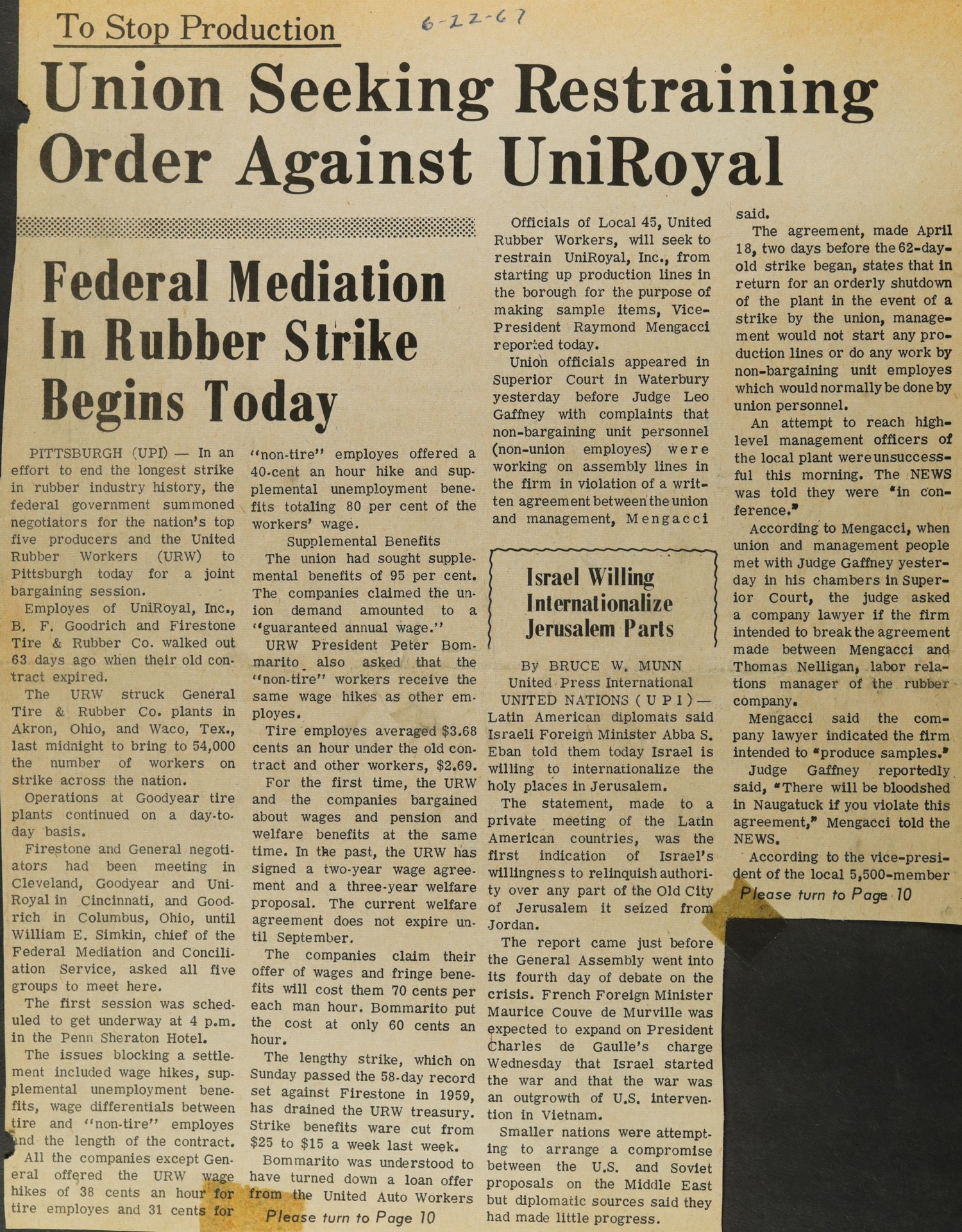
Federal Mediation In Rubber Strike Begins Today

PITTSBURGH (UPI) — In an effort to end the longest strike in rubber industry history, the federal government summoned negotiators for the nation’s top five producers and the United Rubber Workers (URW) to Pittsburgh today for a joint bargaining session.

Employes of UniRoyal, Inc., B. F. Goodrich and Firestone Tire & Rubber Co. walked out 63 days ago when their old contract expired.

The URW struck General Tire & Rubber Co. plants in Akron, Ohio, and Waco, Tex., last midnight to bring to 54,000 the number of workers on strike across the nation.

Operations at Goodyear tire plants continued on a day-to-day basis.

Firestone and General negotiators had been meeting in Cleveland, Goodyear and UniRoyal in Cincinnati, and Goodrich in Columbus, Ohio, until William E. Simkin, chief of the Federal Mediation and Conciliation Service, asked all five groups to meet here.

The first session was scheduled to get underway at 4 p.m. in the Penn Sheraton Hotel.

The issues blocking a settlement included wage hikes, supplemental unemployment benefits, wage differentials between tire and “non-tire” employes and the length of the contract.

All the companies except General offered the URW wage hikes of 38 cents an hour for tire employes and 31 cents for “non-tire” employes offered a 40-cent an hour hike and supplemental unemployment benefits totaling 80 per cent of the workers’ wage.

Supplemental Benefits

The union had sought supplemental benefits of 95 per cent. The companies claimed the union demand amounted to a “guaranteed annual wage.”

URW President Peter Bommarito also asked that the “non-tire” workers receive the same wage hikes as other employes.

Tire employes averaged $3.68 cents an hour under the old contract and other workers, $2.69.

For the first time, the URW and the companies bargained about wages and pension and welfare benefits at the same time. In the past, the URW has signed a two-year wage agreement and a three-year welfare proposal. The current welfare agreement does not expire until September.

The companies claim their offer of wages and fringe benefits will cost them 70 cents per each man hour. Bommarito put the cost at only 60 cents an hour.

The lengthy strike, which on Sunday passed the 58-day record set against Firestone in 1959, has drained the URW treasury. Strike benefits ware cut from $25 to $15 a week last week.

Bommarito was understood to have turned down a loan offer from the United Auto Workers

Please turn to Page 10


Officials of Local 45, United Rubber Workers, will seek to restrain UniRoyal, Inc., from starting up production lines in the borough for the purpose of making sample items, Vice-President Raymond Mengacci reported today.

Union officials appeared in Superior Court in Waterbury yesterday before Judge Leo Gaffney with complaints that non-bargaining unit personnel (non-union employes) were working on assembly lines in the firm in violation of a written agreement between the union and management, Mengacci


Israel Willing Internationalize Jerusalem Parts

By BRUCE W. MUNN
United Press International

UNITED NATIONS (UPI)— Latin American diplomats said Israeli Foreign Minister Abba S. Eban told them today Israel is willing to internationalize the holy places in Jerusalem.

The statement, made to a private meeting of the Latin American countries, was the first indication of Israel’s willingness to relinquish authority over any part of the Old City of Jerusalem it seized from Jordan.

The report came just before the General Assembly went into its fourth day of debate on the crisis. French Foreign Minister Maurice Couve de Murville was expected to expand on President Charles de Gaulle’s charge Wednesday that Israel started the war and that the war was an outgrowth of U.S. intervention in Vietnam.

Smaller nations were attempting to arrange a compromise between the U.S. and Soviet proposals on the Middle East but diplomatic sources said they had made little progress.


said.

The agreement, made April 18, two days before the 62-day-old strike began, states that in return for an orderly shutdown of the plant in the event of a strike by the union, management would not start any production lines or do any work by non-bargaining unit employes which would normally be done by union personnel.

An attempt to reach high-level management officers of the local plant were unsuccessful this morning. The NEWS was told they were “in conference.”

According to Mengacci, when union and management people met with Judge Gaffney yesterday in his chambers in Superior Court, the judge asked a company lawyer if the firm intended to break the agreement made between Mengacci and Thomas Nelligan, labor relations manager of the rubber company.

Mengacci said the company lawyer indicated the firm intended to “produce samples.”

Judge Gaffney reportedly said, “There will be bloodshed in Naugatuck if you violate this agreement,” Mengacci told the NEWS.

According to the vice-president of the local 5,500-member

Please turn to Page 10
Federal Officials Enter Talks In Rubber Strike

Federal Officials Enter Talks In Rubber Strike

18—Waterbury Republican, Friday, June 23, 1967

Federal Officials Enter Talks In Rubber Strike

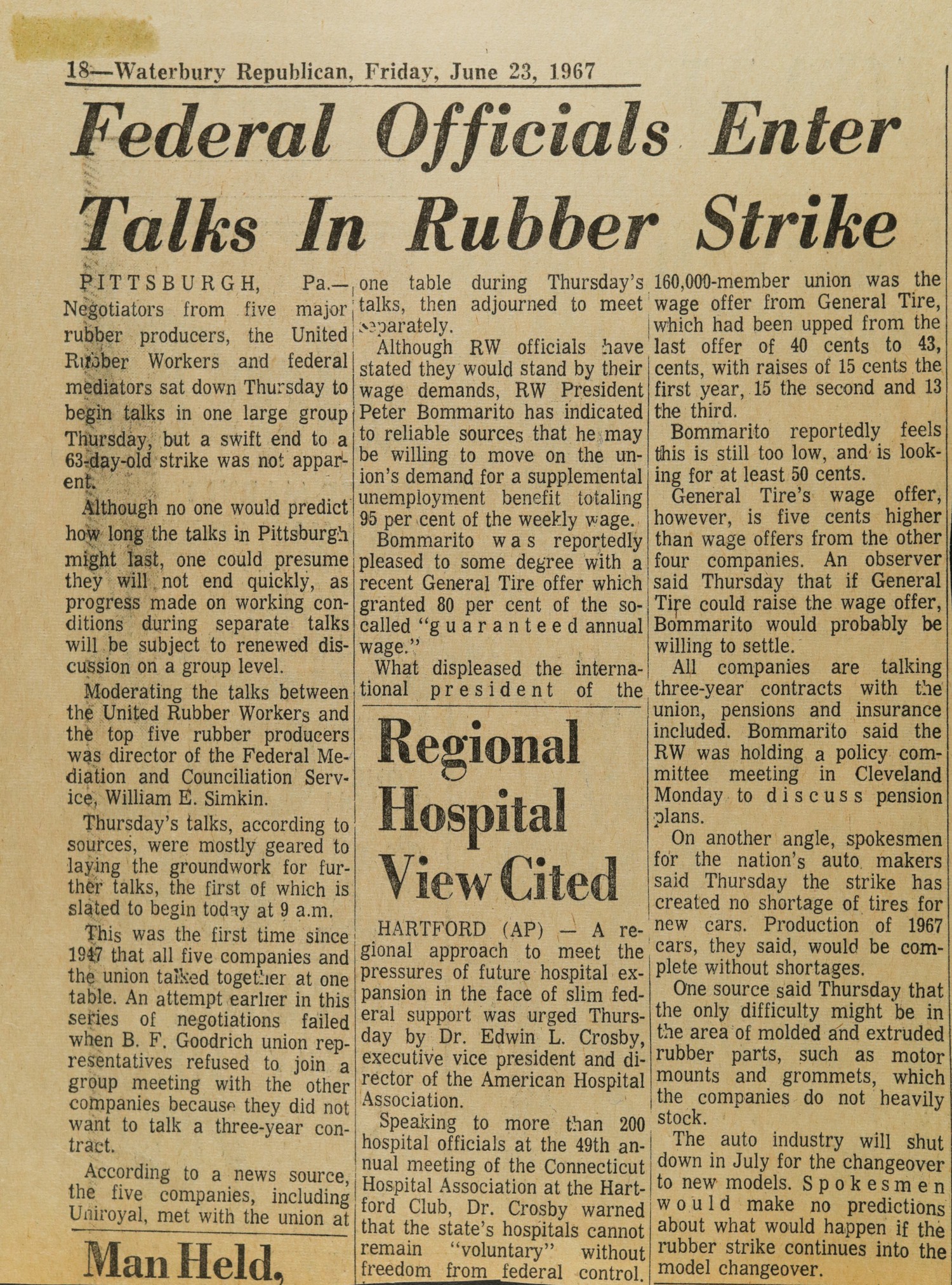
PITTSBURGH, Pa.— Negotiators from five major rubber producers, the United Rubber Workers and federal mediators sat down Thursday to begin talks in one large group Thursday, but a swift end to a 63-day-old strike was not apparent.

Although no one would predict how long the talks in Pittsburgh might last, one could presume they will not end quickly, as progress made on working conditions during separate talks will be subject to renewed discussion on a group level.

Moderating the talks between the United Rubber Workers and the top five rubber producers was director of the Federal Mediation and Counciliation Service, William E. Simkin.

Thursday’s talks, according to sources, were mostly geared to laying the groundwork for further talks, the first of which is slated to begin today at 9 a.m.

This was the first time since 1947 that all five companies and the union talked together at one table. An attempt earlier in this series of negotiations failed when B. F. Goodrich union representatives refused to join a group meeting with the other companies because they did not want to talk a three-year contract.

According to a news source, the five companies, including Uniroyal, met with the union at one table during Thursday’s talks, then adjourned to meet separately.

Although RW officials have stated they would stand by their wage demands, RW President Peter Bommarito has indicated to reliable sources that he may be willing to move on the union’s demand for a supplemental unemployment benefit totaling 95 per cent of the weekly wage.

Bommarito was reportedly pleased to some degree with a recent General Tire offer which granted 80 per cent of the so-called “guaranteed annual wage.”

What displeased the international president of the


Regional Hospital View Cited

HARTFORD (AP) — A regional approach to meet the pressures of future hospital expansion in the face of slim federal support was urged Thursday by Dr. Edwin L. Crosby, executive vice president and director of the American Hospital Association.

Speaking to more than 200 hospital officials at the 49th annual meeting of the Connecticut Hospital Association at the Hartford Club, Dr. Crosby warned that the state’s hospitals cannot remain “voluntary” without freedom from federal control.


160,000-member union was the wage offer from General Tire, which had been upped from the last offer of 40 cents to 43, cents, with raises of 15 cents the first year, 15 the second and 13 the third.

Bommarito reportedly feels this is still too low, and is looking for at least 50 cents.

General Tire’s wage offer, however, is five cents higher than wage offers from the other four companies. An observer said Thursday that if General Tire could raise the wage offer, Bommarito would probably be willing to settle.

All companies are talking three-year contracts with the union, pensions and insurance included. Bommarito said the RW was holding a policy committee meeting in Cleveland Monday to discuss pension plans.

On another angle, spokesmen for the nation’s auto makers said Thursday the strike has created no shortage of tires for new cars. Production of 1967 cars, they said, would be complete without shortages.

One source said Thursday that the only difficulty might be in the area of molded and extruded rubber parts, such as motor mounts and grommets, which the companies do not heavily stock.

The auto industry will shut down in July for the changeover to new models. Spokesmen would make no predictions about what would happen if the rubber strike continues into the model changeover.


Man Held,

“Show Cause” Hearing

“Show Cause” Hearing

6-27 Continued From Page 1

they failed to disperse they were loaded aboard a bus and hauled to the courthouse. Barbuto said they would be charged with contempt of court.

Pickets kept salaried employes inside the plant for about an hour Monday.

Negotiations in the strike against the nation’s largest rubber producers were scheduled to resume today after four days of unsuccessful talks in Pittsburgh.

William E. Simkin, chief of the federal Mediation and Conciliation Service, summoned the URW and rubber company negotiators to Pittsburgh last week for the talks which ended Sunday.

“There had been intensive exploration of the issues, but no agreements were concluded,” Simkin said after the talks.

Some 50,000 rubber workers struck Firestone Tire and Rubber Co., B. F. Goodrich Tire and Rubber Co., and UniRoyal, Inc., on April 20. The General Tire and Rubber Co. plants in Waco, Tex., and here, were struck last Wednesday, idling another 4,000 workers.

URW members are continuing to work at the Goodyear Tire and Rubber Co. on a day to day basis while negotiations continue.

The companies, excluding General, have offered the union hourly pay hikes of 40 cents and a 75 per cent unemployment supplemental benefit plan.

General has offered 43 cents in raises and an 80 per cent benefit package for laid off workers.

The union wants bigger hourly increases and a 95 per cent unemployment package.

Tire workers currently average $3.68 an hour while non-tire workers get $2.69. Elimination of this pay differential is also a high priority goal of the URW.

Federal Intervention Possible In Strike

Federal Intervention Possible In Strike

7-12-67

If Goodyear Workers Strike

Federal Intervention Possible In Strike

The United Rubber Workers Union has notified the Goodyear Tire & Rubber Co., that unless settlement is reached it will strike its plants at 12:01 a.m. Friday.

The 21,000 workers at Goodyear’s 11 plants have continued working on a day-to-day basis since the termination of their contract, April 20.

In the event Goodyear’s plants are closed, there has been some speculation that the government would invoke the Taft-Hartley Act providing for an 80-day “cooling off” period. During this time, presumably all the struck companies would return to work while negotiations continued for contract settlement.

However, one source indicated some doubt the administration would seek an injunction at least immediately, although he conceded a strike at Goodyear would ultimately make a move for an injunction more likely.

In another move to force the issue, the United Rubber Workers called a strike last Saturday against Schenuit Rubber Co. in Baltimore, a smaller concern producing aircraft and industrial tires. This possibility will bring added government pressure for a settlement among the five major concerns because of military aircraft tire requirements.

Schenuit was struck by Local 293 of the union, also in a dispute over a new contract, idling about 400 workers. Schenuit’s aircraft tire production goes entirely to the government and represents about 20 per cent of its aircraft tire requirements, according to industrial sources.

William E. Simkin, director of the U.S. Mediation and Conciliation Service, appeared in Columbus, Ohio Monday to as-

sist in negotiating a contract settlement between B.F. Goodrich and the union. Peter Bommarito, International President

of the union, also went to Columbus from Akron, Monday to join the negotiations.

Please Turn to Page 14


A conciliation service spokesman in Columbus discounted the government’s aircraft tire position as being Simkin’s reason for seeking a Goodrich strike settlement. Rather, he said, he believed Simkin felt “it would be more fruitful to start with Goodrich” in seeking company-by-company settlements among the five major concerns.

Officials of the Schenuit Rubber also were meeting with union bargaining representatives in Baltimore yesterday with mediation service personnel taking part in the talks. The Schenuit contract had expired June 30 but workers continued on their jobs on a day-to-day basis until Saturday.

AKRON, Ohio (UPI) — The United Rubber Workers (URW) plans to shut down the nation’s largest tire producer, Goodyear Tire & Rubber Co., if no contract agreement is reached by Thursday midnight.

A strike against the fifth member of the “big five” tire producers prompted fear of government intervention.

Some 54,000 URW members ready are on strike against our other major rubber companies. Three of them have been closed for the past 82 days the longest strike in industry history.

Kenneth Oldham, a member the union’s Goodyear Policy mmittee, said Tuesday in ncinnati that about 22,000 un members will walk off their ps at 11 Goodyear factories ross the country at midnight ursday, if negotiations, taking ice in a Cincinnati hotel, were successful.


The strike vote was taken by individual URW locals at Goodyear plants.

Negotiations with Goodyear and the B. F. Goodrich Co. intensified.

In both sets of talks, agreement was reported reached on all non money issues.

URW President Peter Bommarito and Chief Federal Mediator William Simkin sat in on the Goodrich negotiations in hopes of reaching a pattern setting agreement that could end the strikes at other companies.

About 51,000 workers have been on strike against Goodrich, Firestone and UniRoyal since April 20, when contracts expired.

Another 3,000 URW members struck two general tire plants June 21.

With Goodyear also struck, about 75 per cent of industry capacity will be idled, and the flow of tires and other materials to the defense industry will be sharply cut.

Major stumbling blocks in all negotiations were wage increases, supplementary unemployment benefits, and pay boost differentials between tire workers and other production workers.

Tire workers average about $3.58 per hour and non-tire workers about $2.69.

The URW Tuesday confirmed reports of another “seven-figure” loan from the United Auto Workers to replenish the URW’s depleted strike funds.

The auto workers previously loaned the striking union $1 million.

Injunction Against

Injunction Against

7-17-67

Continued From Page 1

William E. Simkin, head of the Federal Mediation and Conciliation Service, congratulated both Goodrich and the URW for completing what he called “extremely difficult negotiations”

He and Bommarito had assisted in the Goodrich negotiations in Columbus.

The Firestone Tire & Rubber Co., the Goodyear Tire & Rubber Co., and UniRoyal Inc. were scheduled to meet today. Firestone, Goodrich and UniRoyal were struck April 20, General June 21 and Goodyear last Thursday.

Goodrich President J. Ward Keener said the contract would mean price increases throughout the product line.

Forecast

GAINS REPORTED IN RUBBER TALKS

THE NEW YORK TIMES,
7-11-67

GAINS REPORTED
IN RUBBER TALKS

Chief U.S. Mediator Moves
Back Into Negotiations

By DAVID R. JONES
Special to The New York Times

WASHINGTON, July 10—The
Government’s top labor medi-
ator moved back into the rub-
ber industry, labor negotiations
today, amid reports of prog-
ress in settling the industry’s
81-day-old strike.

William E. Simkin, director
of the Federal Mediation and
Conciliation Service, went to
Columbus, Ohio, to keep an
eye on bargaining there be-
tween the B. F. Goodrich Com-
pany and the striking United
Rubber Workers.

A union official said that
“real progress is being made”
in the talks with Goodrich.
Ward Keener, Goodrich presi-
dent, also said progress was
being made.

Meanwhile, the union set a
strike deadline of 12:01 A.M.
Thursday against the Goodyear
Tire and Rubber Company.
Goodyear, which employs 21,-
000, has been operating on a
day-to-day basis while ne-
gotiating on a new contract
to replace one that expired
April 20.

The union struck Goodrich,
the Firestone Tire and Rub-
ber Company and Uniroyal,
Inc., on that date and shut
down the General Tire and
Rubber Company several weeks
later. About 54,000 workers
have been made idle by the
strike.

Signs of Optimism

The precise reason for Mr.
Simkin’s trip to Columbus was
not disclosed, but there were
signs of some optimism that
a break might be near with
Goodrich. Mr. Simkin called
the union and the five com-
panies together a few weeks
ago in Pittsburgh in a bid for
agreement, but that failed.

Informed sources said Good-
rich and the union had re-
solved most of the important
noneconomic contract items and
were returning to the money
issues. The two sides bargained
throughout the weekend while
other negotiations, carried on
individually with each com-
pany, recessed yesterday.

All the companies except
General were last reported to
have offered the union a wage
increase of 40 cents an hour,
plus a supplemental unemploy-
ment benefit of 75 per cent of
straight-time hourly wages for
those laid off. General offered
43 cents an hour and an 80
per cent layoff benefit.

The union’s tire workers now
average $3.68 an hour, while
nontire workers average $2.69.
A key union demand has been
to raise the layoff benefit from
the present 65 per cent of
wages to between 92.5 and 95
per cent.

The negotiations have been
complicated by the presence of
a new union president, Peter
Bonmarito, who was elected
this year on a militant plat-
form and has been under pres-
sure to achieve big gains.

Untitled Clipping

Negotiators Report:

7-13-67 [handwritten]

Only Economic Issues Block Strike Settlement

AKRON, Ohio (UPI) — With four major rubber companies closed by a record long strike, the United Rubber Workers (URW) prepared to walkout at midnight tonight against the fifth and largest firm, Goodyear Tire & Rubber.

Industry capacity would be cut by 75 per cent with the addition of Goodyear to the list of struck firms.

The flow of tires and other materials to the auto and defense industries would be sharply reduced.

Goodyear’s 21,000 workers would bring to 75,000 the number idled across the country.

The union went on strike against Firestone Tire & Rubber, B. F. Goodrich and Uni-

Royal, Inc., April 20, and employes at two of General Tire & Rubber Co.’s nine plants walked out June 21.

Possible Intervention

A reduction in the flow of defense material raised the possibility the federal government would invoke the Taft-Hartley Act to send workers back for an 80-day cooling off period.

William E. Simkin, chief of the Federal Mediation Service, went to Columbus, Ohio, earlier in the week to assist in negotiations with B. F. Goodrich, the largest supplier of aircraft tires with between 35 and 40 per cent of the nation’s production.

The URW also struck the Schenuit Rubber Co. of Balti-

more last Saturday. Schenuit’s entire production of aircraft tires goes to the federal government and represents 20 per cent of the government’s needs.

The contract at Goodyear expired with the others but work continued at the plants on a day-to-day basis while talks continued.

URW negotiators said Thursday only economic issues blocked a settlement with the five major firms. All other contractural matters were settled last Friday.

Benefit Plan

The union originally asked for a supplemental unemployment benefit plan which would

Please turn to Page 10


Town Hall