CHEM-TEXTS – Vol. 4 No. 7 – Page 4

Page 004

Page 4 — CHEM-TEXTS — Vol. 4. No. 7


Safety Goal Stops At 650,000 Hours

The safety goal of 1,000,000 manhours was stopped at 650,000 manhours. A chemical production operator lost a small portion of his right ring finger when it was caught under the belt on the drive on a crusher machine. Quick action by him prevented a more serious loss to his other fingers and hand.

The accident was the first lost time one in almost 3 months. It was another case of the unexpected happening. As a result of it, the man suffered an unnecessary loss of a finger.

Lost Time Accidents Drop

This was the third lost time accident for six months of 1970, a significant improvement over 1969 when 12 lost time accidents occurred. This improved concern for the safety of ourselves and other people makes the plant a better, safer place to work.

Serious Injuries Up

Although lost time accidents dropped, serious injuries increased from 28 in 1969 to 33 for the six months of 1970. In June there were 4 serious injuries: 2 lacerations; 1 bruised elbow; and a pulled muscle. These injuries could have been lost time accidents but luck helped, and the employees involved escaped greater injury. Serious injuries can be stopped by not taking chances on the job and checking work conditions carefully.

Mower Shoots

(Cont’d. from page 1)

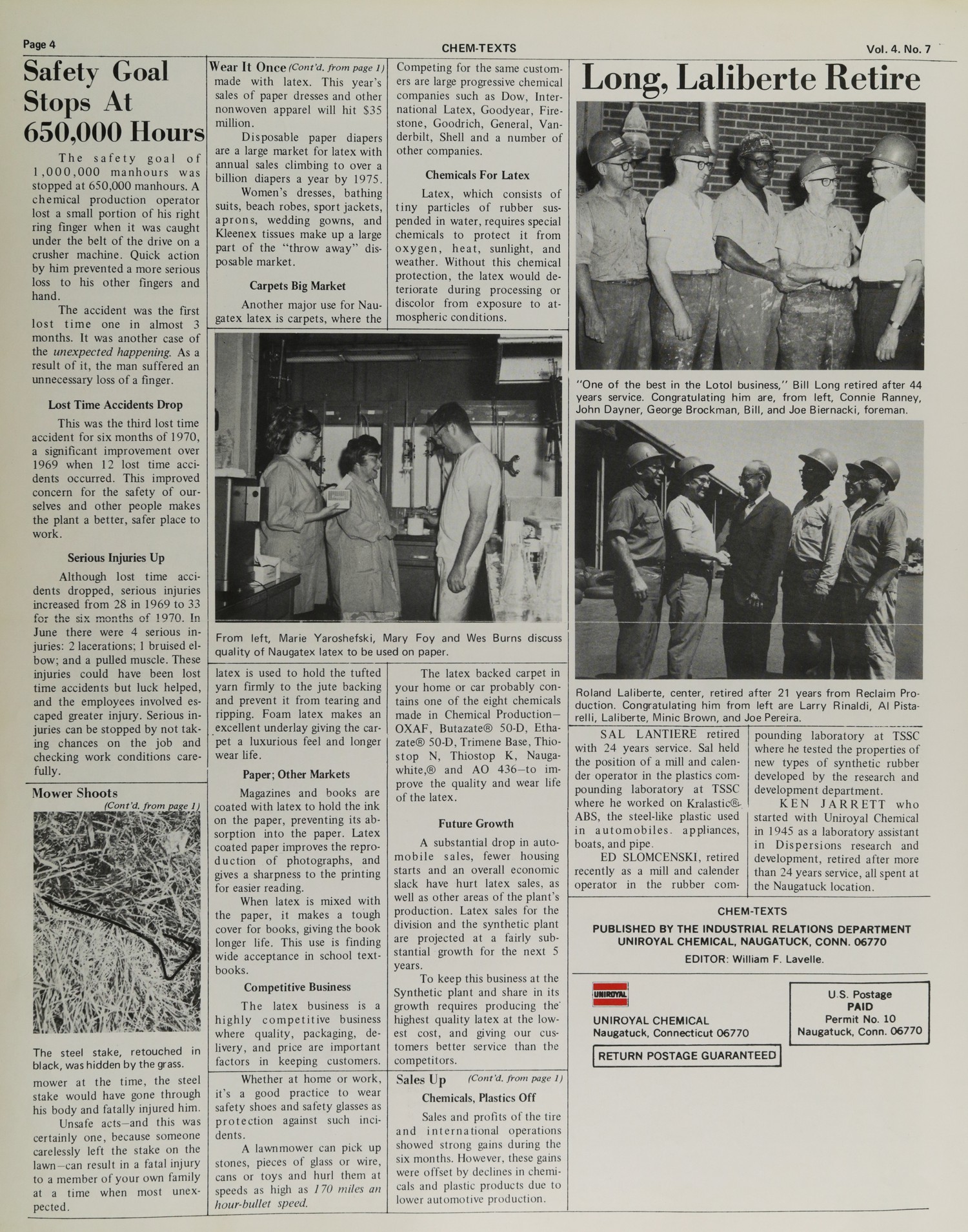
The steel stake, retouched in black, was hidden by the grass.

mower at the time, the steel stake would have gone through his body and fatally injured him.

Unsafe acts—and this was certainly one, because someone carelessly left the stake on the lawn—can result in a fatal injury to a member of your own family at a time when most unexpected.


Wear It Once (Cont’d. from page 1) made with latex. This year’s sales of paper dresses and other nonwoven apparel will hit $35 million.

Disposable paper diapers are a large market for latex with annual sales climbing to over a billion diapers a year by 1975.

Women’s dresses, bathing suits, beach robes, sport jackets, aprons, wedding gowns, and Kleenex tissues make up a large part of the “throw away” disposable market.

Carpets Big Market

Another major use for Naugatex latex is carpets, where the latex is used to hold the tufted yarn firmly to the jute backing and prevent it from tearing and ripping. Foam latex makes an excellent underlay giving the carpet a luxurious feel and longer wear life.

Paper; Other Markets

Magazines and books are coated with latex to hold the ink on the paper, preventing its absorption into the paper. Latex coated paper improves the reproduction of photographs, and gives a sharpness to the printing for easier reading.

When latex is mixed with the paper, it makes a tough cover for books, giving the book longer life. This use is finding wide acceptance in school textbooks.

Competitive Business

The latex business is a highly competitive business where quality, packaging, delivery, and price are important factors in keeping customers.

Whether at home or work, it’s a good practice to wear safety shoes and safety glasses as protection against such incidents.

A lawnmower can pick up stones, pieces of glass or wire, cans or toys and hurl them at speeds as high as 170 miles an hour-bullet speed.


Competing for the same customers are large progressive chemical companies such as Dow, International Latex, Goodyear, Firestone, Goodrich, General, Vanderbilt, Shell and a number of other companies.

Chemicals For Latex

Latex, which consists of tiny particles of rubber suspended in water, requires special chemicals to protect it from oxygen, heat, sunlight, and weather. Without this chemical protection, the latex would deteriorate during processing or discolor from exposure to atmospheric conditions.


[IMAGE CAPTION:]
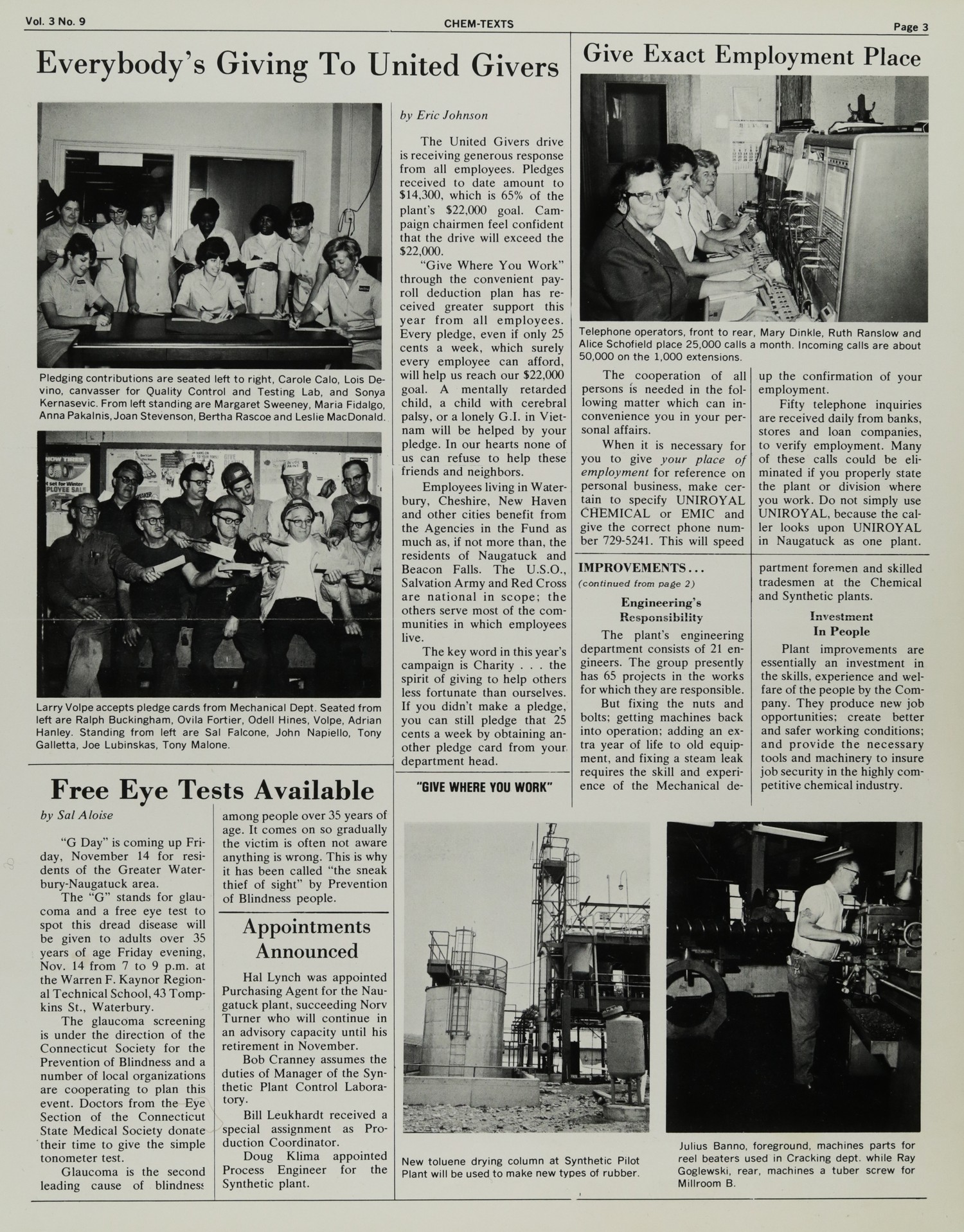
From left, Marie Yaroshefski, Mary Foy and Wes Burns discuss quality of Naugatex latex to be used on paper.


The latex backed carpet in your home or car probably contains one of the eight chemicals made in Chemical Production— OXAF, Butazate® 50-D, Ethazate® 50-D, Trimene Base, Thiostop N, Thiotop K, Naugawhite,® and AO 436—to improve the quality and wear life of the latex.

Future Growth

A substantial drop in automobile sales, fewer housing starts and an overall economic slack have hurt latex sales, as well as other areas of the plant’s production. Latex sales for the division and the synthetic plant are projected at a fairly substantial growth for the next 5 years.

To keep this business at the Synthetic plant and share in its growth requires producing the highest quality latex at the lowest cost, and giving our customers better service than the competitors.

Sales Up (Cont’d. from page 1)

Chemicals, Plastics Off

Sales and profits of the tire and international operations showed strong gains during the six months. However, these gains were offset by declines in chemicals and plastic products due to lower automotive production.


Long, Laliberte Retire

[IMAGE CAPTION:]
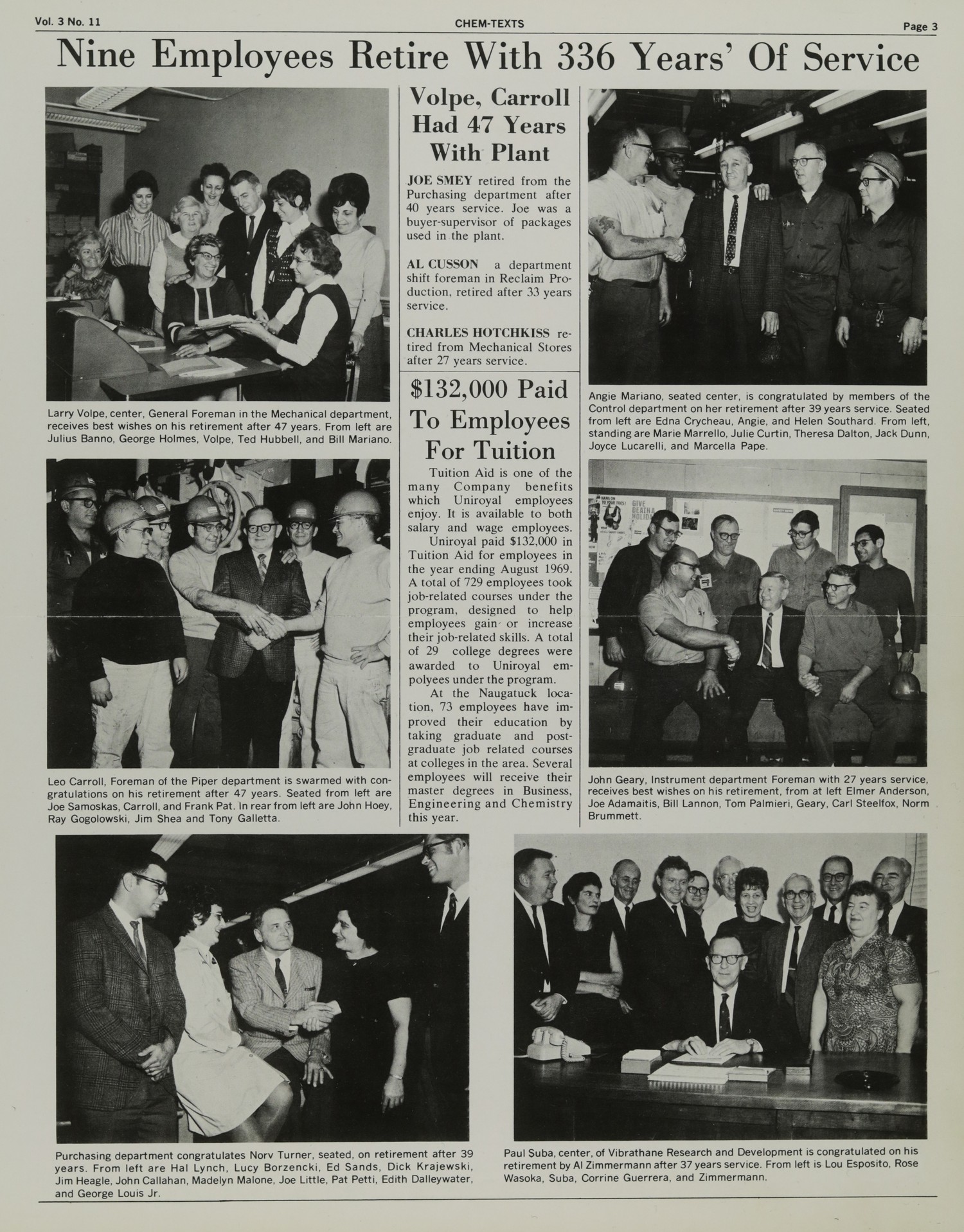
“One of the best in the Lotol business,” Bill Long retired after 44 years service. Congratulating him are, from left, Connie Ranney, John Dayner, George Brockman, Bill, and Joe Biernacki, foreman.


[IMAGE CAPTION:]
Roland Laliberte, center, retired after 21 years from Reclaim Production. Congratulating him from left are Larry Rinaldi, Al Pistarelli, Laliberte, Minic Brown, and Joe Pereira.


SAL LANTIERE retired with 24 years service. Sal held the position of a mill and calender operator in the plastics compounding laboratory at TSSC where he worked on Kralastic® ABS, the steel-like plastic used in automobiles, appliances, boats, and pipe.

ED SLOMCENSKI, retired recently as a mill and calender operator in the rubber compounding laboratory at TSSC where he tested the properties of new types of synthetic rubber developed by the research and development department.

KEN JARRETT who started with Uniroyal Chemical in 1945 as a laboratory assistant in Dispersions research and development, retired after more than 24 years service, all spent at the Naugatuck location.


CHEM-TEXTS

PUBLISHED BY THE INDUSTRIAL RELATIONS DEPARTMENT
UNIROYAL CHEMICAL, NAUGATUCK, CONN. 06770
EDITOR: William F. Lavelle.


UNIROYAL U.S. Postage
UNIROYAL CHEMICAL PAID
Naugatuck, Connecticut 06770 Permit No. 10
Naugatuck, Conn. 06770
RETURN POSTAGE GUARANTEED

CHEM-TEXTS – Vol. 4 No. 8 – Page 4

Page 004

CHEM-TEXTS

Page 4 | Vol. 4 No. 8


Electrical Power Improved

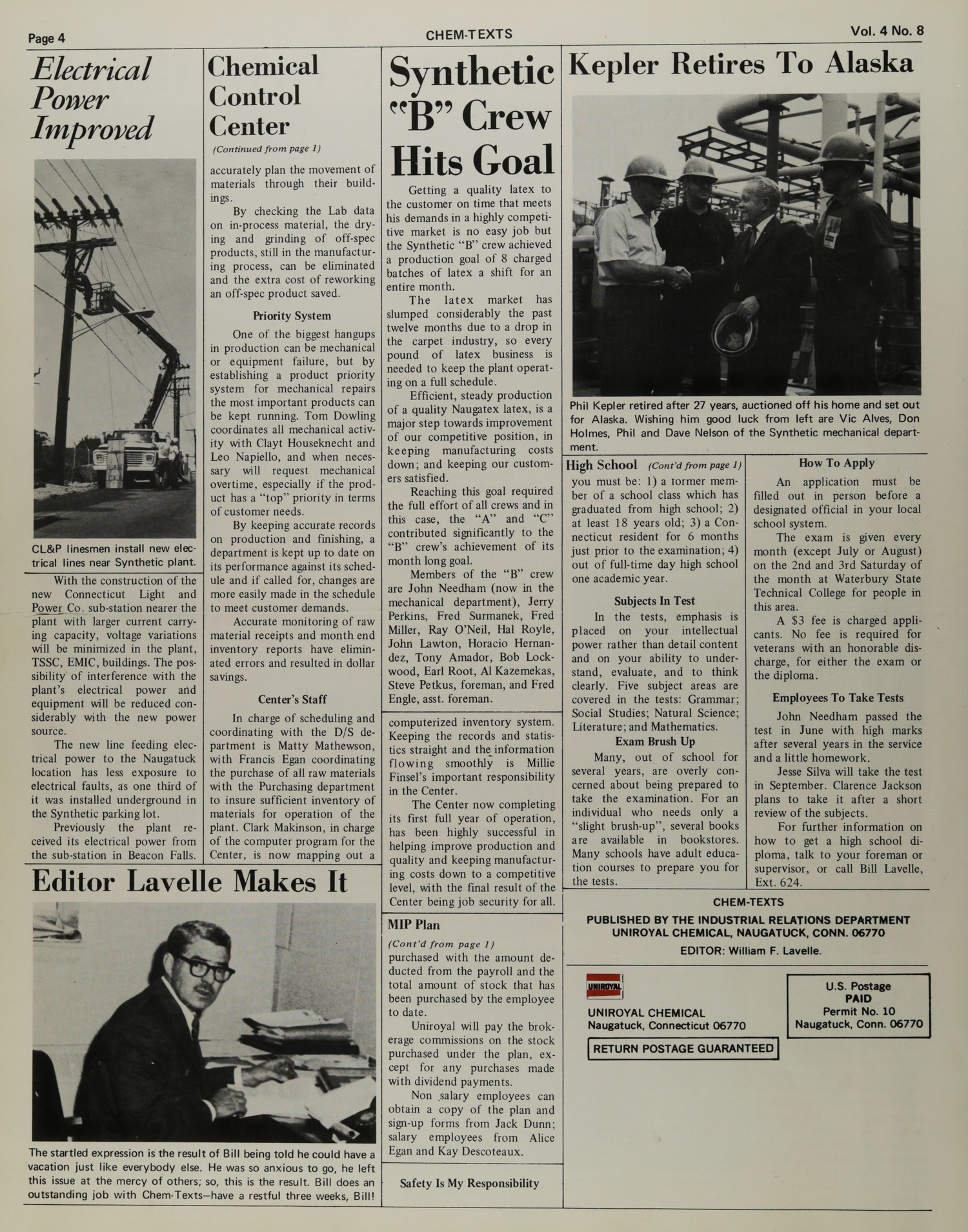
[IMAGE: CL&P linesmen install new electrical lines near Synthetic plant.]

With the construction of the new Connecticut Light and Power Co. sub-station nearer the plant with larger current carrying capacity, voltage variations will be minimized in the plant, TSSC, EMIC, buildings. The possibility of interference with the plant’s electrical power and equipment will be reduced considerably with the new power source.

The new line feeding electrical power to the Naugatuck location has less exposure to electrical faults, as one third of it was installed underground in the Synthetic parking lot.

Previously the plant received its electrical power from the sub-station in Beacon Falls.


Chemical Control Center

(Continued from page 1)

accurately plan the movement of materials through their buildings.

By checking the Lab data on in-process material, the drying and grinding of off-spec products, still in the manufacturing process, can be eliminated and the extra cost of reworking an off-spec product saved.

Priority System

One of the biggest hangups in production can be mechanical or equipment failure, but by establishing a product priority system for mechanical repairs the most important products can be kept running. Tom Dowling coordinates all mechanical activity with Clayt Houseknecht and Leo Napiello, and when necessary will request mechanical overtime, especially if the product has a “top” priority in terms of customer needs.

By keeping accurate records on production and finishing, a department is kept up to date on its performance against its schedule and if called for, changes are more easily made in the schedule to meet customer demands.

Accurate monitoring of raw material receipts and month end inventory reports have eliminated errors and resulted in dollar savings.

Center’s Staff

In charge of scheduling and coordinating with the D/S department is Matty Mathewson, with Francis Egan coordinating the purchase of all raw materials with the Purchasing department to insure sufficient inventory of materials for operation of the plant. Clark Makinson, in charge of the computer program for the Center, is now mapping out a


Synthetic “B” Crew Hits Goal

Getting a quality latex to the customer on time that meets his demands in a highly competitive market is no easy job but the Synthetic “B” crew achieved a production goal of 8 charged batches of latex a shift for an entire month.

The latex market has slumped considerably the past twelve months due to a drop in the carpet industry, so every pound of latex business is needed to keep the plant operating on a full schedule.

Efficient, steady production of a quality Naugatex latex, is a major step towards improvement of our competitive position, in keeping manufacturing costs down; and keeping our customers satisfied.

Reaching this goal required the full effort of all crews and in this case, the “A” and “C” contributed significantly to the “B” crew’s achievement of its month long goal.

Members of the “B” crew are John Needham (now in the mechanical department), Jerry Perkins, Fred Surmanek, Fred Miller, Ray O’Neil, Hal Royle, John Lawton, Horacio Hernandez, Tony Amador, Bob Lockwood, Earl Root, Al Kazemekas, Steve Petkus, foreman, and Fred Engle, asst. foreman.

computerized inventory system. Keeping the records and statistics straight and the information flowing smoothly is Millie Finsel’s important responsibility in the Center.

The Center now completing its first full year of operation, has been highly successful in helping improve production and quality and keeping manufacturing costs down to a competitive level, with the final result of the Center being job security for all.


Kepler Retires To Alaska

[IMAGE: Phil Kepler retired after 27 years, auctioned off his home and set out for Alaska. Wishing him good luck from left are Vic Alves, Don Holmes, Phil and Dave Nelson of the Synthetic mechanical department.]


High School (Cont’d from page 1)

you must be: 1) a former member of a school class which has graduated from high school; 2) at least 18 years old; 3) a Connecticut resident for 6 months just prior to the examination; 4) out of full-time day high school one academic year.

Subjects In Test

In the tests, emphasis is placed on your intellectual power rather than detail content and on your ability to understand, evaluate, and to think clearly. Five subject areas are covered in the tests: Grammar; Social Studies; Natural Science; Literature; and Mathematics.

Exam Brush Up

Many, out of school for several years, are overly concerned about being prepared to take the examination. For an individual who needs only a “slight brush-up”, several books are available in bookstores. Many schools have adult education courses to prepare you for the tests.

How To Apply

An application must be filled out in person before a designated official in your local school system.

The exam is given every month (except July or August) on the 2nd and 3rd Saturday of the month at Waterbury State Technical College for people in this area.

A $3 fee is charged applicants. No fee is required for veterans with an honorable discharge, for either the exam or the diploma.

Employees To Take Tests

John Needham passed the test in June with high marks after several years in the service and a little homework.

Jesse Silva will take the test in September. Clarence Jackson plans to take it after a short review of the subjects.

For further information on how to get a high school diploma, talk to your foreman or supervisor, or call Bill Lavelle, Ext. 624.


Editor Lavelle Makes It

[IMAGE: Man at desk with telephone]

The startled expression is the result of Bill being told he could have a vacation just like everybody else. He was so anxious to go, he left this issue at the mercy of others; so, this is the result. Bill does an outstanding job with Chem-Texts—have a restful three weeks, Bill!


MIP Plan

(Cont’d from page 1)

purchased with the amount deducted from the payroll and the total amount of stock that has been purchased by the employee to date.

Uniroyal will pay the brokerage commissions on the stock purchased under the plan, except for any purchases made with dividend payments.

Non salary employees can obtain a copy of the plan and sign-up forms from Jack Dunn; salary employees from Alice Egan and Kay Descoteaux.


Safety Is My Responsibility


CHEM-TEXTS

PUBLISHED BY THE INDUSTRIAL RELATIONS DEPARTMENT
UNIROYAL CHEMICAL, NAUGATUCK, CONN. 06770

EDITOR: William F. Lavelle.


[UNIROYAL LOGO]

UNIROYAL CHEMICAL
Naugatuck, Connecticut 06770

RETURN POSTAGE GUARANTEED

U.S. Postage
PAID
Permit No. 10
Naugatuck, Conn. 06770

CHEM-TEXTS – Vol. 4 No. 10 – Page 4

Page 004

CHEM-TEXTS

Page 4 | Vol. 4 No. 10


First A Friend . . . Then A Host

1,100,000 . . .

(Cont’d from page 2)

protecting themselves against unexpected accidents. They not only endanger their own physical protection but expose their families and fellow employees to unnecessary suffering and financial loss. Safety equipment and clothing should always be worn where required to prevent an unexpected accident on the job.


Unique Co.

(Cont’d from page 1)

nomics are simplified by practical application in organizing a company, raising capital through stock, design and research of the product, purchase of raw materials, salaries, insurance, and a return on investment to their stockholders.

Any high school student may join a J.A. Company through their high school and discover for themselves the many interesting career opportunities in business.

Advisors to Unique are Jim Chambers, Mike Jasman, Lou Kaiser and Ron Stark, who provide the technical and financial knowledge to the company.


Chemical Business

(Cont’d from page 3)

equipment; so that we can continue to grow and protect job security.

New Products Promising

The Chemical Division has many promising products for the future. Royalene® is used in practically all white tire sidewalls, and it could become an even bigger factor in tires. Solo®, Dyanap®, and Omite® showed good growth in 1970. Telephones and many of your home appliances are made of Kralastic® ABS plastic. 25% of the houses built today in the United States have Kralastic drain, waste and vent piping.

Although some of these products are made at other Chemical division plants, their sales growth is important to the Naugatuck plant which manufactures many of the chemicals used in these products.

Cooperative Effort Needed

Markets for our products will grow as long as we satisfy our customers; meet our competition; and produce quality products at the lowest possible cost.

The Marketing and Sales Department are constantly seeking new customers and developing new markets for our products. With the continued cooperation of Research & Development; the Plant’s production capabilities and the Sales department, we can stay ahead of competition.


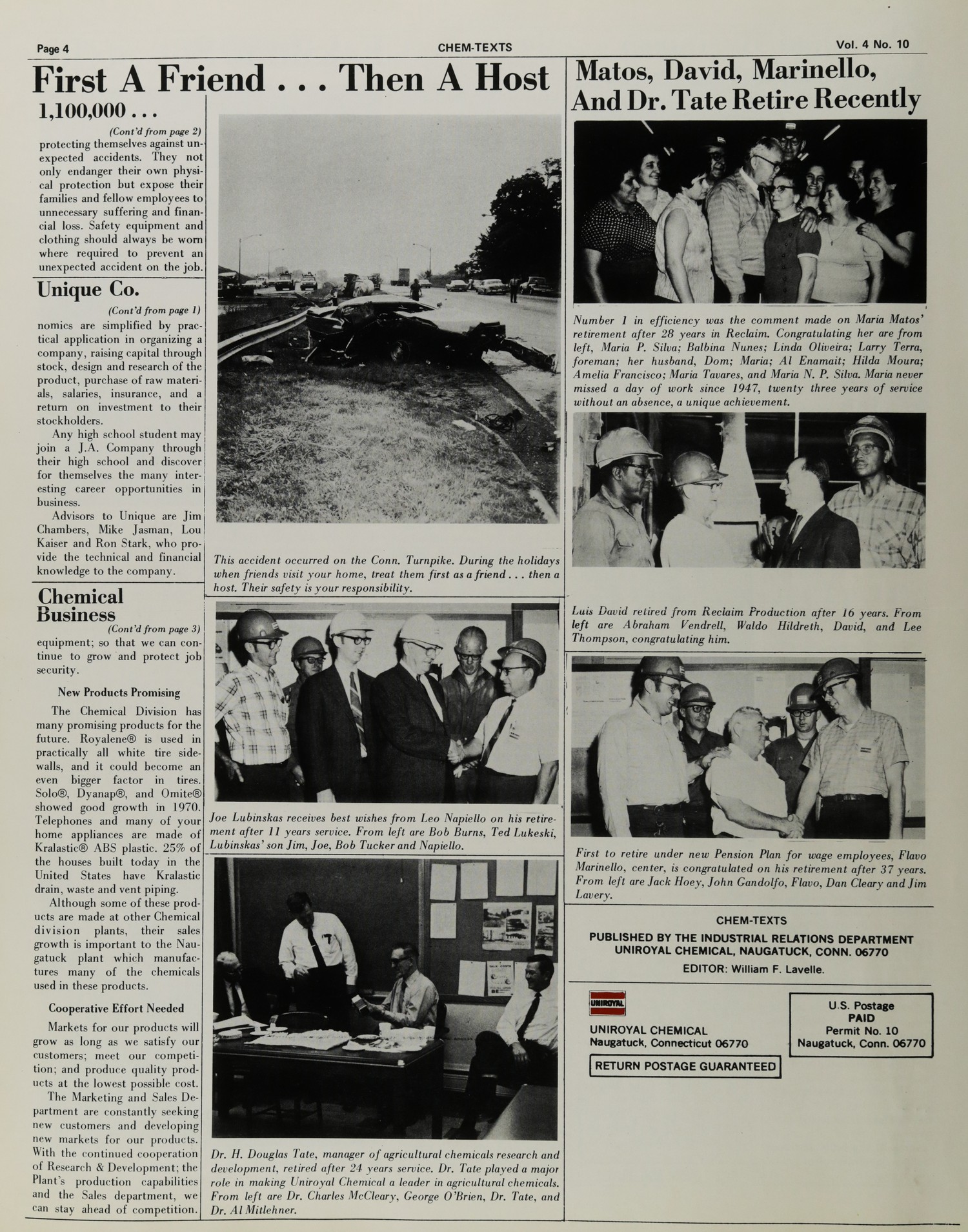
This accident occurred on the Conn. Turnpike. During the holidays when friends visit your home, treat them first as a friend . . . then a host. Their safety is your responsibility.


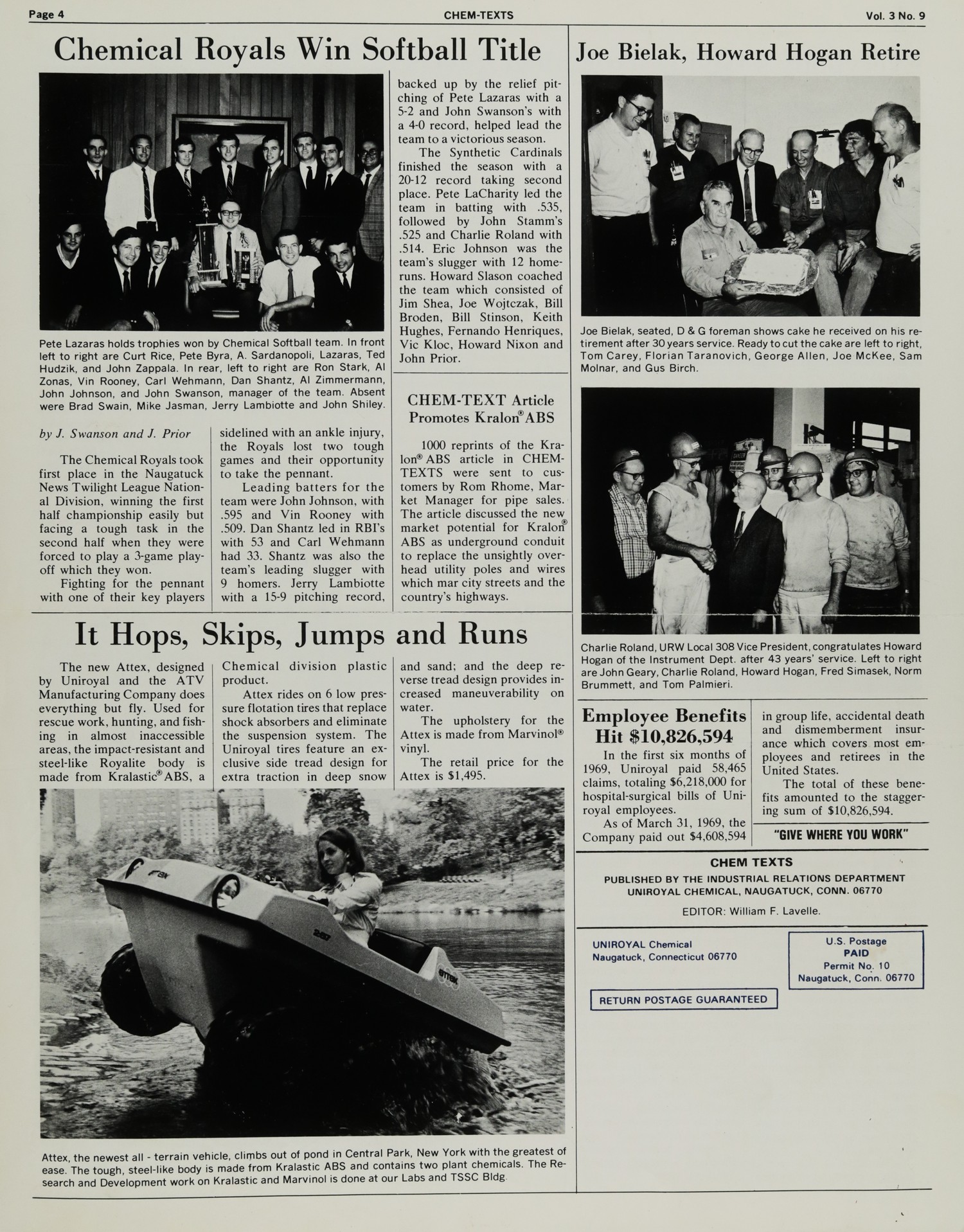
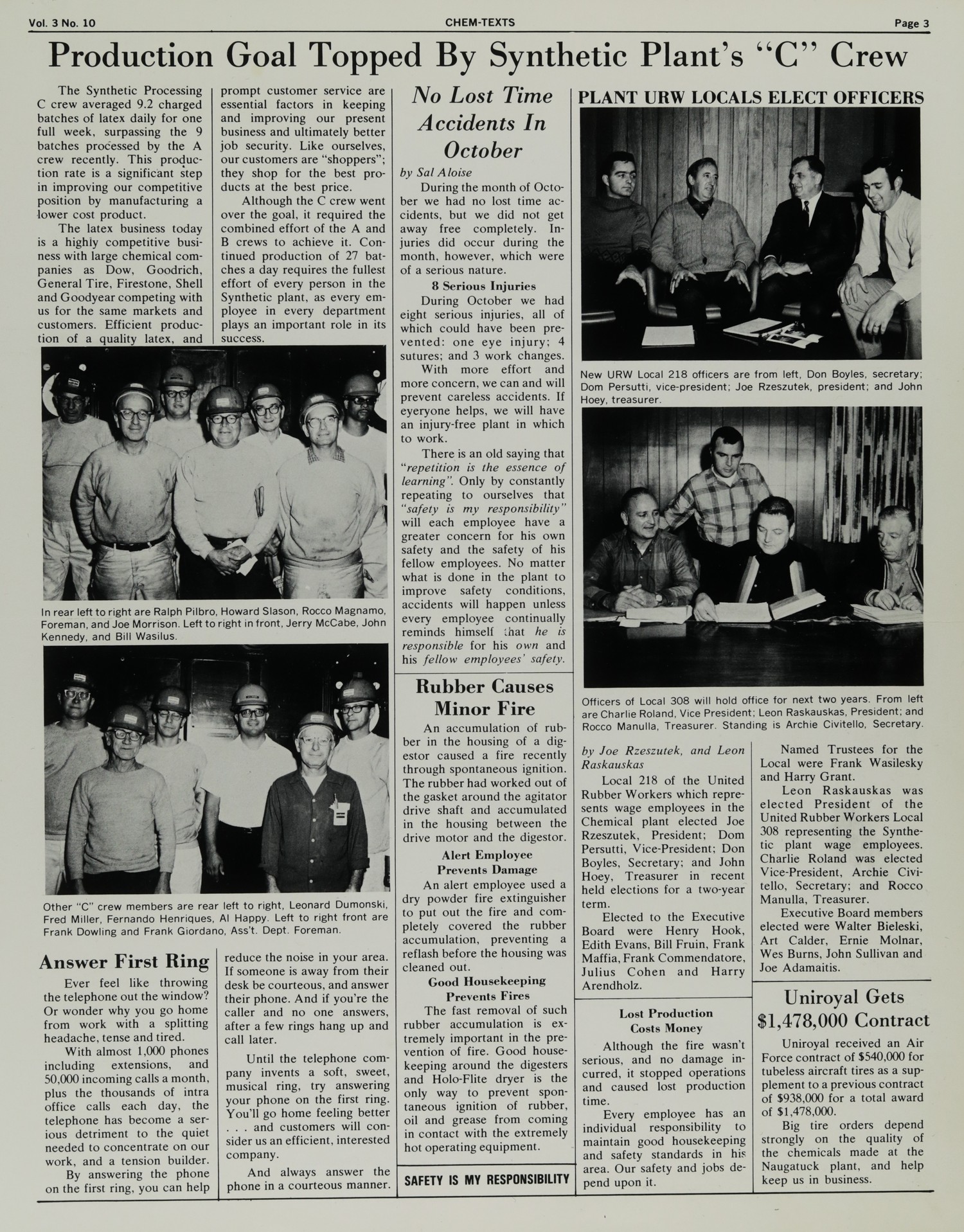
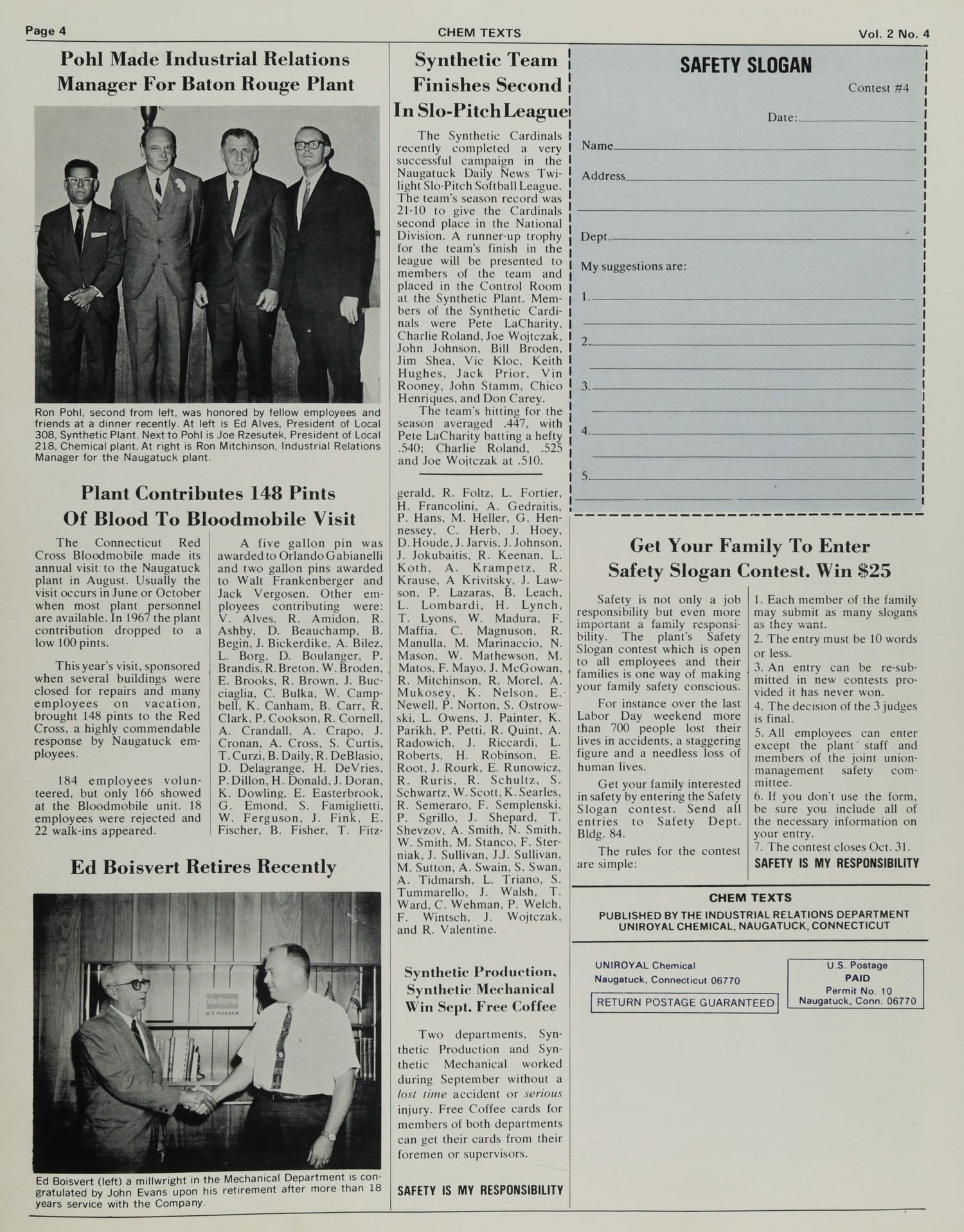
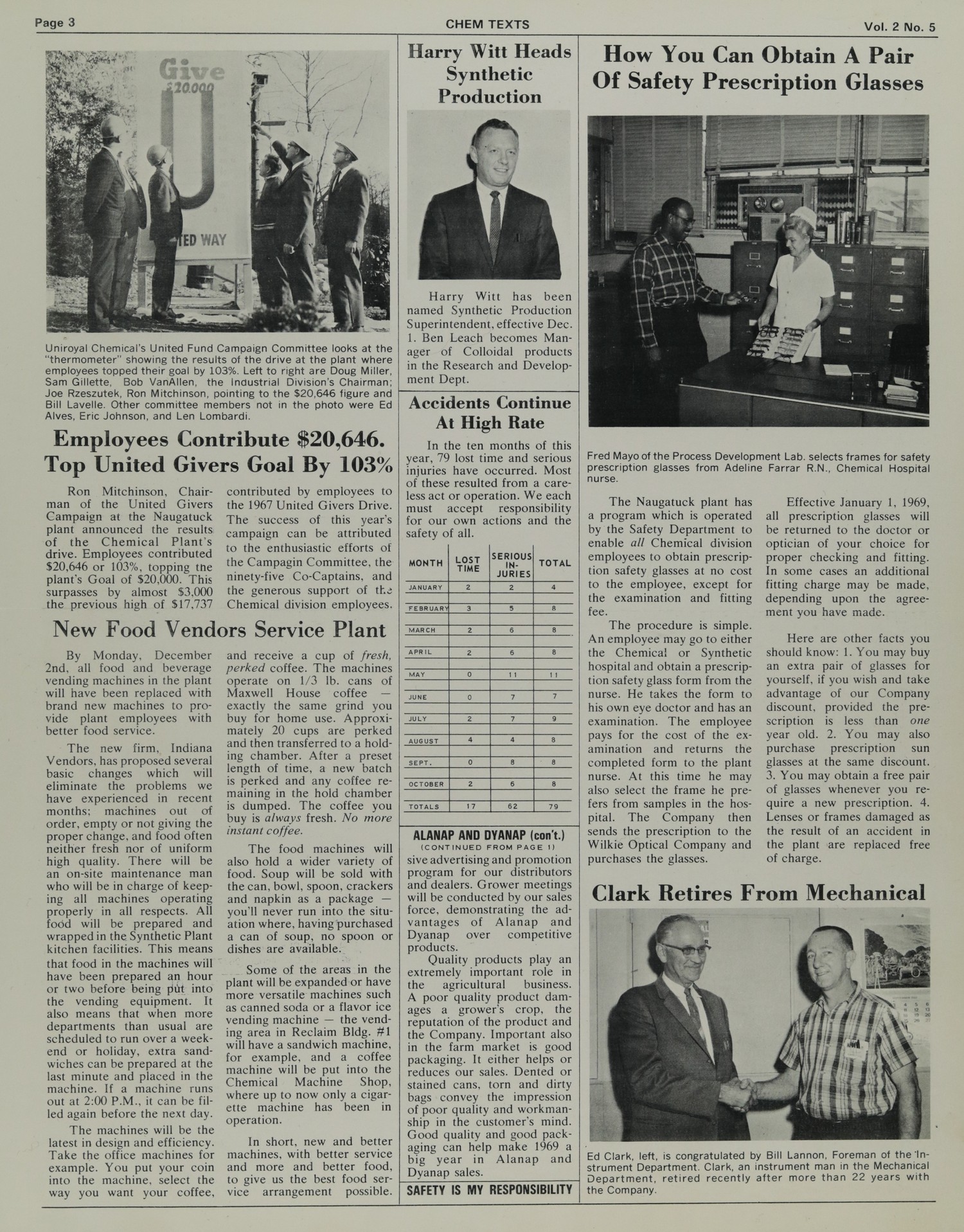
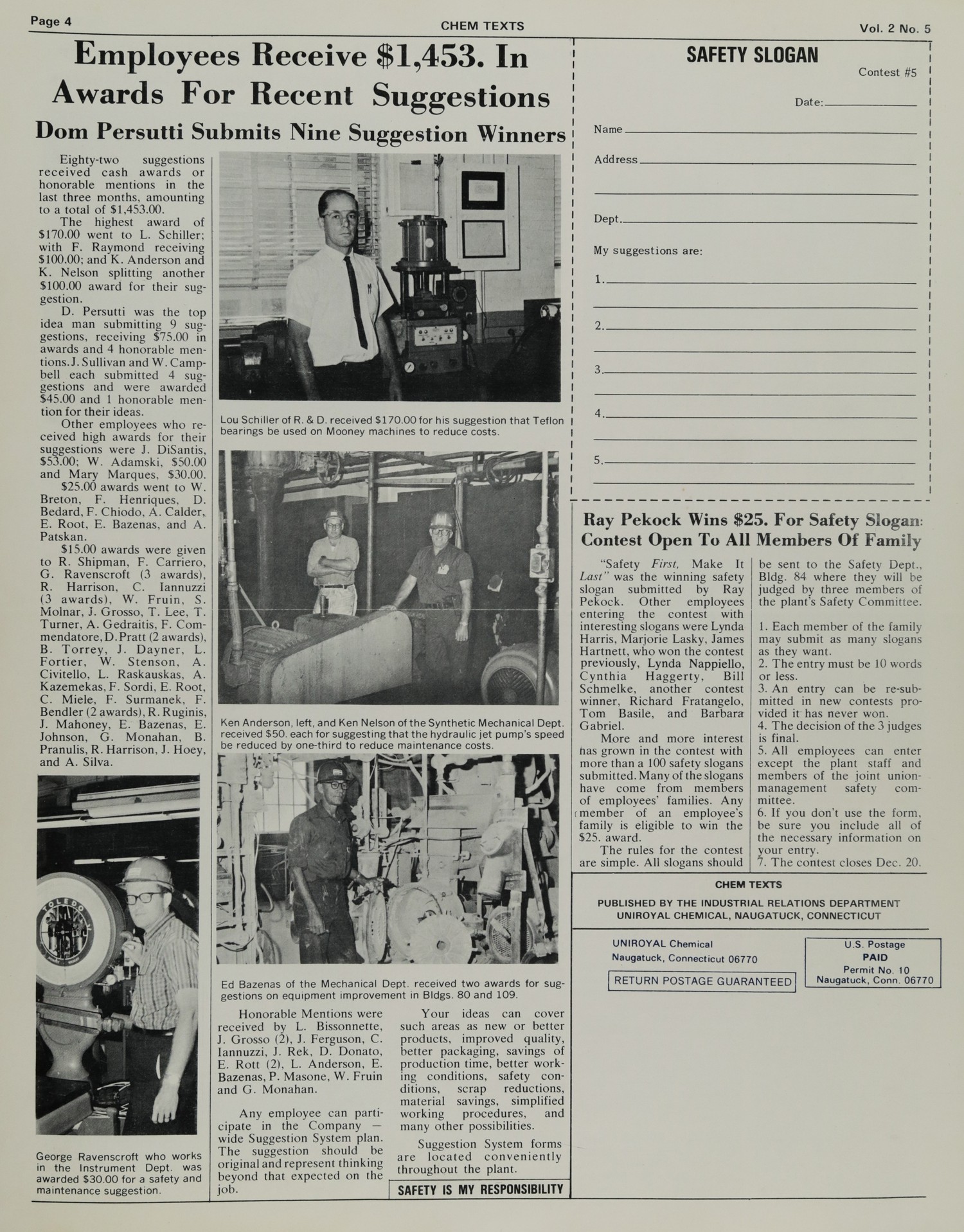
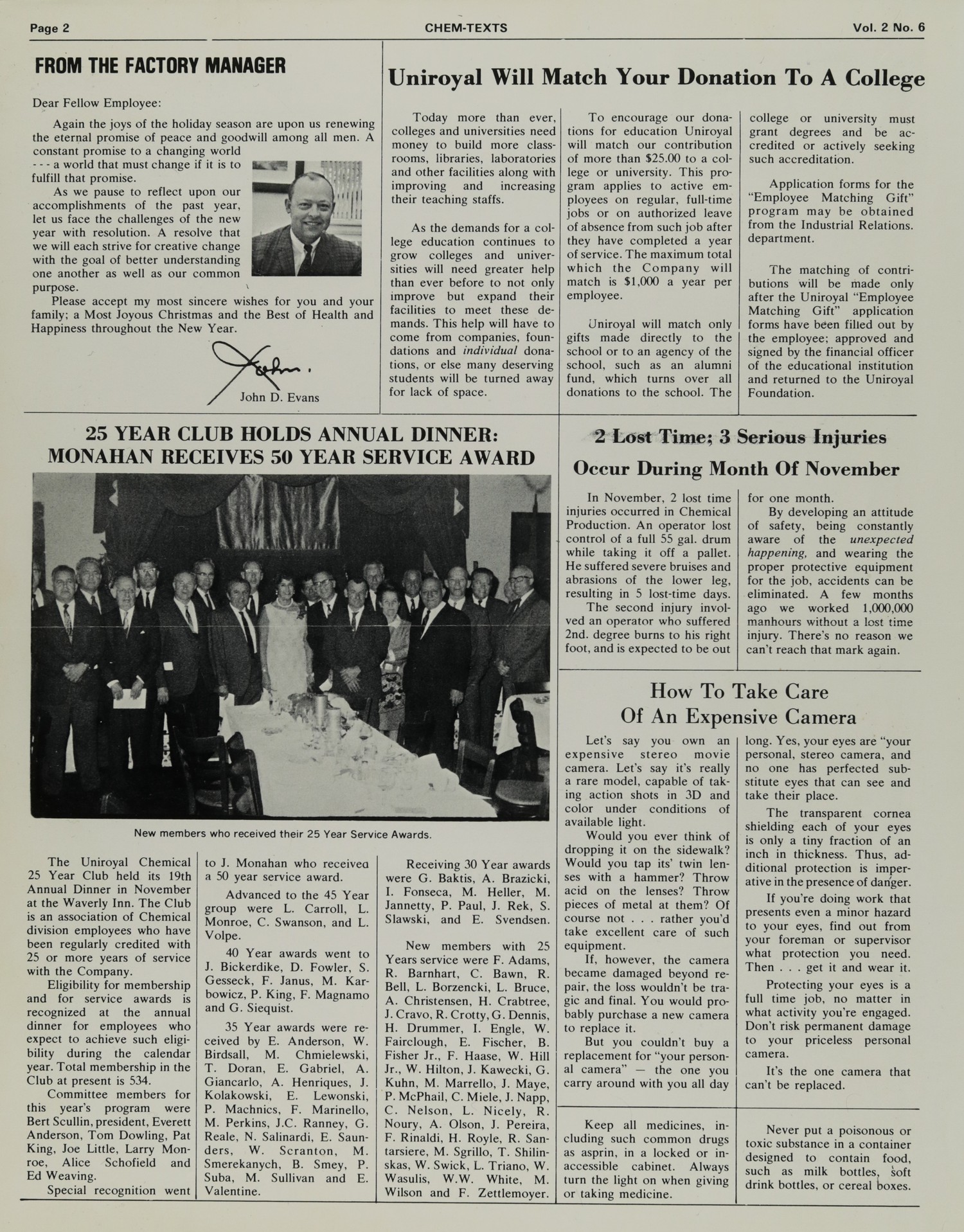
Joe Lubinskas receives best wishes from Leo Napiello on his retirement after 11 years service. From left are Bob Burns, Ted Lukeski, Lubinskas’ son Jim, Joe, Bob Tucker and Napiello.


Dr. H. Douglas Tate, manager of agricultural chemicals research and development, retired after 24 years service. Dr. Tate played a major role in making Uniroyal Chemical a leader in agricultural chemicals. From left are Dr. Charles McCleary, George O’Brien, Dr. Tate, and Dr. Al Mitlehner.


Matos, David, Marinello, And Dr. Tate Retire Recently

Number 1 in efficiency was the comment made on Maria Matos’ retirement after 28 years in Reclaim. Congratulating her are from left, Maria P. Silva; Balbina Nunes; Linda Oliveira; Larry Terra, foreman; her husband, Dom; Maria; Al Enamait; Hilda Moura; Amelia Francisco; Maria Tavares, and Maria N. P. Silva. Maria never missed a day of work since 1947, twenty three years of service without an absence, a unique achievement.


Luis David retired from Reclaim Production after 16 years. From left are Abraham Vendrell, Waldo Hildreth, David, and Lee Thompson, congratulating him.


First to retire under new Pension Plan for wage employees, Flavo Marinello, center, is congratulated on his retirement after 37 years. From left are Jack Hoey, John Gandolfo, Flavo, Dan Cleary and Jim Lavery.


CHEM-TEXTS

PUBLISHED BY THE INDUSTRIAL RELATIONS DEPARTMENT
UNIROYAL CHEMICAL, NAUGATUCK, CONN. 06770

EDITOR: William F. Lavelle.


UNIROYAL

UNIROYAL CHEMICAL
Naugatuck, Connecticut 06770

RETURN POSTAGE GUARANTEED

U.S. Postage
PAID
Permit No. 10
Naugatuck, Conn. 06770

CHEM-TEXTS – Vol. 3 No. 2 – Page 2

Page 002

CHEM TEXTS

Page 4

The $475.00 Cup

SUGGESTION PLAN AWARDS

Gene St. John had an idea some time back about the use of the small gel cups used in the laboratory for testing purposes. Part of Gene’s job was buying laboratory equipment and material; however, not satisfied with the products available on the market, he set about the task of designing an inexpensive cup that would do the job, equally well. Much of the work was done at home. The result was a suggestion award of $475.00 based on savings when Gene’s efforts paid off.

Jacinto DaSilva of the Chemical Production department was awarded $60.00 (the balance of an $85.00 award) for his idea to change the method of washing Octamine which reduced the amount of material going to the sewer. An original award of $25.00 was made last January for this suggestion – the balance of the award is based on actual experience in material savings.

The above 2 awards were the highest out of a total of 49 suggestions considered during a recent meeting of the suggestion committee. Twelve (12) cash and nine (9) Honorable mention awards were made totaling $725.00. Other awards were:

Joseph Moniz – Digesters –
Honorable Mention

Joseph Moniz – Digesters –
$25.00


Harry Rich – Labs – $15.00
Ed Day – Labs –
Honorable Mention
Dom Angiolillo – Labs –
$15.00
Frank Wasilesky – Mech.
Stores – $15.00
N. Salinardi – Mech. –
Honorable Mention
Carmine Ianuzzi – Mech.
Honorable Mention
(3rd – $10.00)
W. Frum – Mech. – $25.00
Charles Drapko – Chem. Prod.
$15.00
George Ravenscroft, Jr. –
Mech. – $35.00
Carmine Ianuzzi – Mech. –
Honorable Mention
G. Hennessey – Chem. Prod.
$15.00
Jacinto DaSilva – Chem. Prod.
Honorable Mention
Bill Leary – Mech. –
Honorable Mention
W. Detlefsen – Chem. Prod. –
Honorable Mention
A. Giancarlo – Mech. –
Honorable Mention
A. Gedraitis – Mech. – $15.00
G. Hennessey – Chem. Prod. –
Honorable Mention

The overall figures this year represent a reduction in suggestion plan activity due to the recent strike.

Through August 1967 a total of 201 suggestions have been considered with 64 awards totaling $1,620.00 being made. During this same period there were also 23 Honorable Mention awards.


NEW SAFETY EYE PROTECTION PROGRAM TO BE STARTED

A study of first-aid cases revealed a substantial number of eye injuries, many of them potentially serious. To combat this problem the use of safety glasses will be expanded throughout the plant to include all production, maintenance and laboratory areas and all personnel who work or visit these areas.

We will expect each person to wear safety glasses at all times during his working shift except in office, rest or locker room areas. For those who require prescription glasses the company has a program of providing safety frames and lenses.

For those who do not ordinarily wear glasses we maintain a stock of “planos” that can be worn by anyone and can be obtained through his foreman. For those who have a fitting problem we will provide professional help.

We believe this program is a step forward in our continuing efforts to provide an ever safer work place. We look toward full cooperation from all of our Uniroyal Chemical people and the Safety Department is ready to help in any way it can.


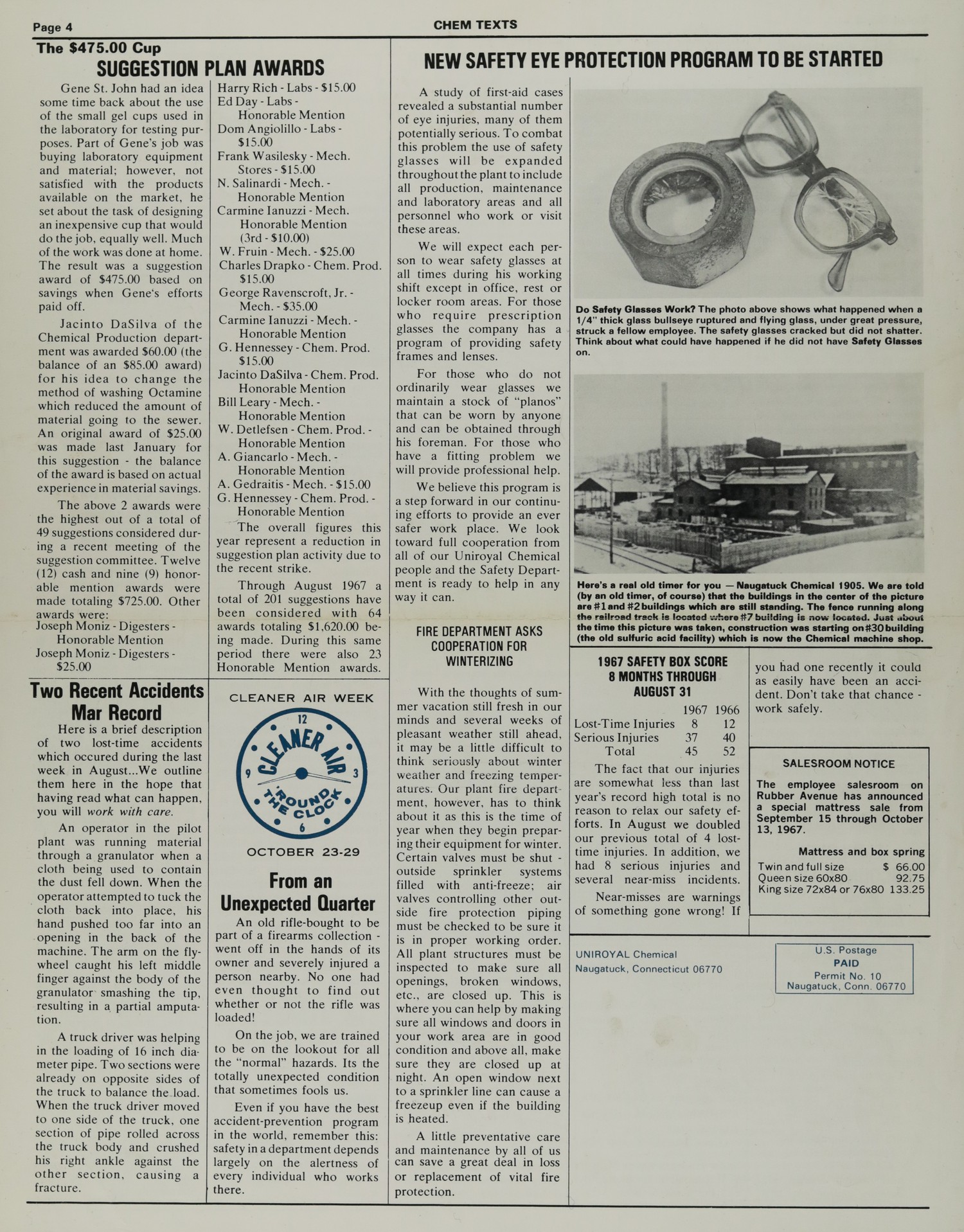
Do Safety Glasses Work? The photo above shows what happened when a 1/4″ thick glass bullseye ruptured and flying glass, under great pressure, struck a fellow employee. The safety glasses cracked but did not shatter. Think about what could have happened if he did not have Safety Glasses on.


Here’s a real old timer for you — Naugatuck Chemical 1905. We are told (by an old timer, of course) that the buildings in the center of the picture are #1 and #2 buildings which are still standing. The fence running along the railroad track is located where #7 building is now located. Just about the time this picture was taken, construction was starting on #30 building (the old sulfuric acid facility) which is now the Chemical machine shop.


Two Recent Accidents Mar Record

Here is a brief description of two lost-time accidents which occured during the last week in August…We outline them here in the hope that having read what can happen, you will work with care.

An operator in the pilot plant was running material through a granulator when a cloth being used to contain the dust fell down. When the operator attempted to tuck the cloth back into place, his hand pushed too far into an opening in the back of the machine. The arm on the flywheel caught his left middle finger against the body of the granulator smashing the tip, resulting in a partial amputation.

A truck driver was helping in the loading of 16 inch diameter pipe. Two sections were already on opposite sides of the truck to balance the load. When the truck driver moved to one side of the truck, one section of pipe rolled across the truck body and crushed his right ankle against the other section, causing a fracture.


CLEANER AIR WEEK

[IMAGE: Logo showing “CLEANER” with numbers 12, 9, 3, 6 around it and text “ROUND THE CLOCK”]

OCTOBER 23-29


From an Unexpected Quarter

An old rifle-bought to be part of a firearms collection – went off in the hands of its owner and severely injured a person nearby. No one had even thought to find out whether or not the rifle was loaded!

On the job, we are trained to be on the lookout for all the “normal” hazards. Its the totally unexpected condition that sometimes fools us.

Even if you have the best accident-prevention program in the world, remember this: safety in a department depends largely on the alertness of every individual who works there.


FIRE DEPARTMENT ASKS COOPERATION FOR WINTERIZING

With the thoughts of summer vacation still fresh in our minds and several weeks of pleasant weather still ahead, it may be a little difficult to think seriously about winter weather and freezing temperatures. Our plant fire department, however, has to think about it as this is the time of year when they begin preparing their equipment for winter. Certain valves must be shut – outside sprinkler systems filled with anti-freeze; air valves controlling other outside fire protection piping must be checked to be sure it is in proper working order. All plant structures must be inspected to make sure all openings, broken windows, etc., are closed up. This is where you can help by making sure all windows and doors in your work area are in good condition and above all, make sure they are closed up at night. An open window next to a sprinkler line can cause a freezeup even if the building is heated.

A little preventative care and maintenance by all of us can save a great deal in loss or replacement of vital fire protection.


1967 SAFETY BOX SCORE 8 MONTHS THROUGH AUGUST 31

1967 1966
Lost-Time Injuries 8 12
Serious Injuries 37 40
Total 45 52

The fact that our injuries are somewhat less than last year’s record high total is no reason to relax our safety efforts. In August we doubled our previous total of 4 lost-time injuries. In addition, we had 8 serious injuries and several near-miss incidents.

Near-misses are warnings of something gone wrong! If you had one recently it could as easily have been an accident. Don’t take that chance – work safely.


SALESROOM NOTICE

The employee salesroom on Rubber Avenue has announced a special mattress sale from September 15 through October 13, 1967.

Mattress and box spring

Twin and full size — $ 66.00
Queen size 60×80 — 92.75
King size 72×84 or 76×80 — 133.25


UNIROYAL Chemical
Naugatuck, Connecticut 06770

U.S. Postage
PAID
Permit No. 10
Naugatuck, Conn. 06770

CHEM-TEXTS – Vol. 3 No. 3 – Page 2

Page 002

Page 2 CHEM-TEXTS Vol. 3 No. 3


FROM THE FACTORY MANAGER

DEAR FELLOW EMPLOYEE:

Are you a professional? In sports the professional is one whose proficiency and skill enables him to earn his living through his participation. The professional is characterized by his pride in his efforts. In a similar sense, we are professionals earning our living by supplying our customers with chemicals, reclaim, and polymers. But do we always demonstrate the proficiency and skill required in our jobs? Do we have the pride of workmanship characteristic of the professional?

Remember a professional always gives his best and always tries to win. He puts team goals and team effort ahead of his own personal desires. He believes the whole team wins together and he takes pride in realizing that the true recognition for his effort is in the team winning.

The same thing is true in our plant – we all win when we satisfy our customers’ needs in the most efficient manner possible. Anything less than this – we aren’t professionals!

[Signature]

John D. Evans


Chemical Control Center Reviews Quality, Productivity, and Costs

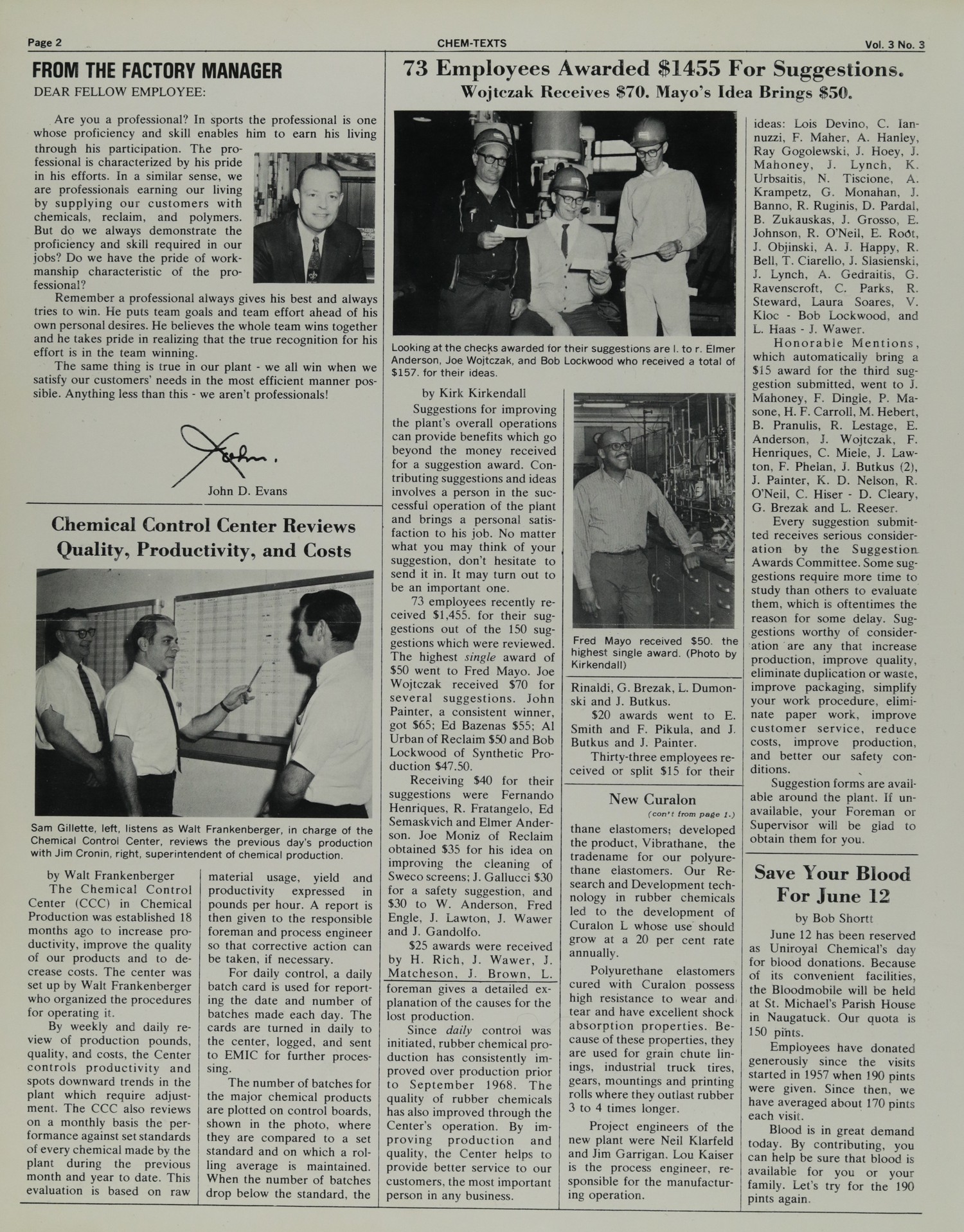
[IMAGE: Sam Gillette, left, listens as Walt Frankenberger, in charge of the Chemical Control Center, reviews the previous day’s production with Jim Cronin, right, superintendent of chemical production.]

by Walt Frankenberger

The Chemical Control Center (CCC) in Chemical Production was established 18 months ago to increase productivity, improve the quality of our products and to decrease costs. The center was set up by Walt Frankenberger who organized the procedures for operating it.

By weekly and daily review of production pounds, quality, and costs, the Center controls productivity and spots downward trends in the plant which require adjustment. The CCC also reviews on a monthly basis the performance against set standards of every chemical made by the plant during the previous month and year to date. This evaluation is based on raw material usage, yield and productivity expressed in pounds per hour. A report is then given to the responsible foreman and process engineer so that corrective action can be taken, if necessary.

For daily control, a daily batch card is used for reporting the date and number of batches made each day. The cards are turned in daily to the center, logged, and sent to EMIC for further processing.

The number of batches for the major chemical products are plotted on control boards, shown in the photo, where they are compared to a set standard and on which a rolling average is maintained. When the number of batches drop below the standard, the person in any business.


73 Employees Awarded $1455 For Suggestions.

Wojtczak Receives $70. Mayo’s Idea Brings $50.

[IMAGE: Looking at the checks awarded for their suggestions are l. to r. Elmer Anderson, Joe Wojtczak, and Bob Lockwood who received a total of $157. for their ideas.]

by Kirk Kirkendall

Suggestions for improving the plant’s overall operations can provide benefits which go beyond the money received for a suggestion award. Contributing suggestions and ideas involves a person in the successful operation of the plant and brings a personal satisfaction to his job. No matter what you may think of your suggestion, don’t hesitate to send it in. It may turn out to be an important one.

73 employees recently received $1,455. for their suggestions out of the 150 suggestions which were reviewed. The highest single award of $50 went to Fred Mayo. Joe Wojtczak received $70 for several suggestions. John Painter, a consistent winner, got $65; Ed Bazenas $55; Al Urban of Reclaim $50 and Bob Lockwood of Synthetic Production $47.50.

Receiving $40 for their suggestions were Fernando Henriques, R. Fratangelo, Ed Semaskvich and Elmer Anderson. Joe Moniz of Reclaim obtained $35 for his idea on improving the cleaning of Sweco screens; J. Gallucci $30 for a safety suggestion, and $30 to W. Anderson, Fred Engle, J. Lawton, J. Wawer and J. Gandolfo.

$25 awards were received by H. Rich, J. Wawer, J. Matcheson, J. Brown, L. foreman gives a detailed explanation of the causes for the lost production.

Since daily control was initiated, rubber chemical production has consistently improved over production prior to September 1968. The quality of rubber chemicals has also improved through the Center’s operation. By improving production and quality, the Center helps to provide better service to our customers, the most important person in any business.

[IMAGE: Fred Mayo received $50. the highest single award. (Photo by Kirkendall)]

Rinaldi, G. Brezak, L. Dumonski and J. Butkus.

$20 awards went to E. Smith and F. Pikula, and J. Butkus and J. Painter.

Thirty-three employees received or split $15 for their


New Curalon

(con’t from page 1.)

thane elastomers; developed the product, Vibrathane, the tradename for our polyurethane elastomers. Our Research and Development technology in rubber chemicals led to the development of Curalon L whose use should grow at a 20 per cent rate annually.

Polyurethane elastomers cured with Curalon possess high resistance to wear and tear and have excellent shock absorption properties. Because of these properties, they are used for grain chute linings, industrial truck tires, gears, mountings and printing rolls where they outlast rubber 3 to 4 times longer.

Project engineers of the new plant were Neil Klarfeld and Jim Garrigan. Lou Kaiser is the process engineer, responsible for the manufacturing operation.


ideas: Lois Devino, C. Iannuzzi, F. Maher, A. Hanley, Ray Gogolewski, J. Hoey, J. Mahoney, J. Lynch, K. Urbsaitis, N. Tiscione, A. Krampetz, G. Monahan, J. Banno, R. Ruginis, D. Pardal, B. Zukauskas, J. Grosso, E. Johnson, R. O’Neil, E. Root, J. Objinski, A. J. Happy, R. Bell, T. Ciarello, J. Slasienski, J. Lynch, A. Gedraitis, G. Ravenscroft, C. Parks, R. Steward, Laura Soares, V. Kloc – Bob Lockwood, and L. Haas – J. Wawer.

Honorable Mentions, which automatically bring a $15 award for the third suggestion submitted, went to J. Mahoney, F. Dingle, P. Masone, H. F. Carroll, M. Hebert, B. Pranulis, R. Lestage, E. Anderson, J. Wojtczak, F. Henriques, C. Miele, J. Lawton, F. Phelan, J. Butkus (2), J. Painter, K. D. Nelson, R. O’Neil, C. Hiser – D. Cleary, G. Brezak and L. Reeser.

Every suggestion submitted receives serious consideration by the Suggestion Awards Committee. Some suggestions require more time to study than others to evaluate them, which is oftentimes the reason for some delay. Suggestions worthy of consideration are any that increase production, improve quality, eliminate duplication or waste, improve packaging, simplify your work procedure, eliminate paper work, improve customer service, reduce costs, improve production, and better our safety conditions.

Suggestion forms are available around the plant. If unavailable, your Foreman or Supervisor will be glad to obtain them for you.


Save Your Blood For June 12

by Bob Shortt

June 12 has been reserved as Uniroyal Chemical’s day for blood donations. Because of its convenient facilities, the Bloodmobile will be held at St. Michael’s Parish House in Naugatuck. Our quota is 150 pints.

Employees have donated generously since the visits started in 1957 when 190 pints were given. Since then, we have averaged about 170 pints each visit.

Blood is in great demand today. By contributing, you can help be sure that blood is available for you or your family. Let’s try for the 190 pints again.

CHEM-TEXTS – Vol. 3 No. 3 – Page 4

Page 004

Page 4 CHEM-TEXTS Vol. 3 No. 3


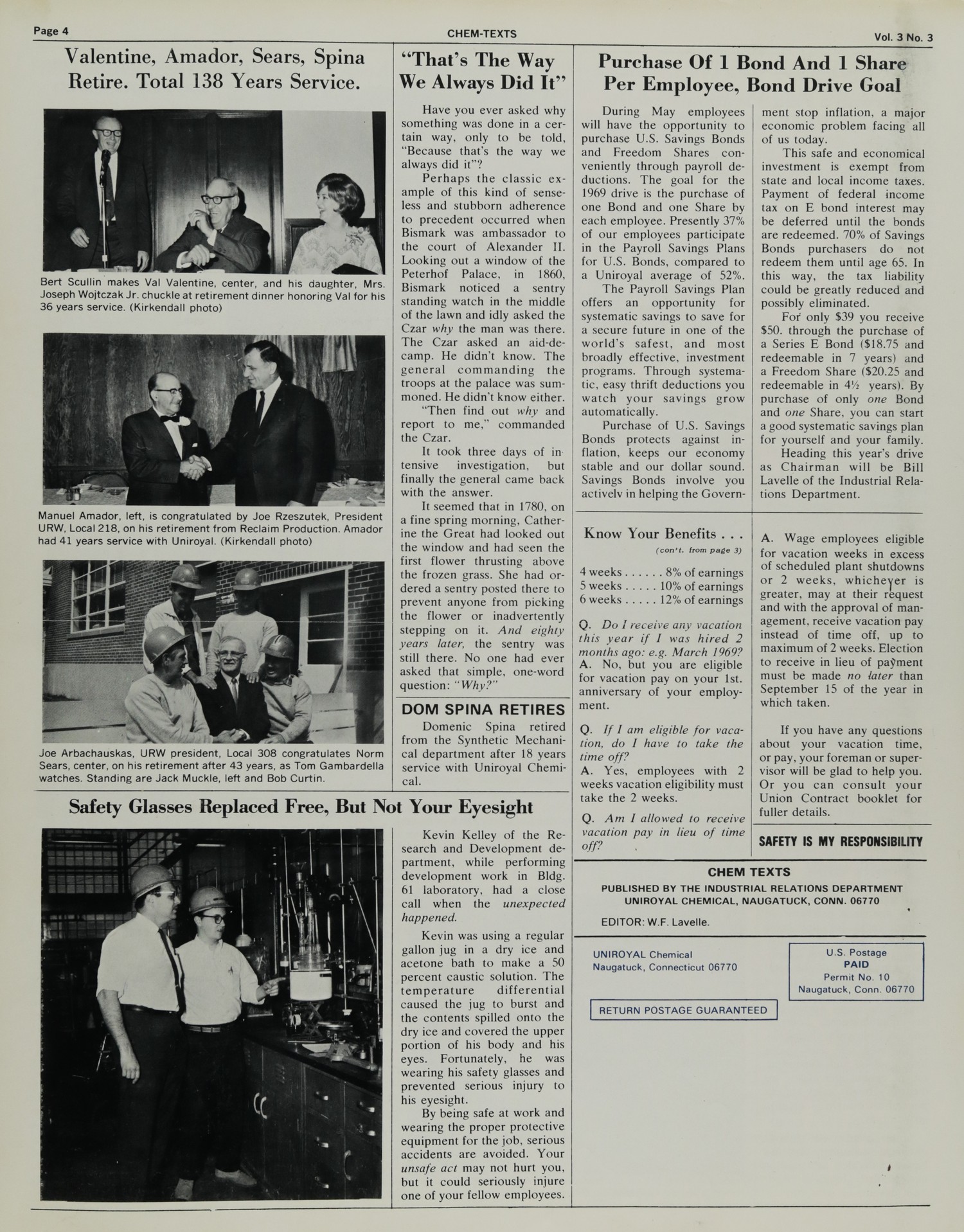
Valentine, Amador, Sears, Spina Retire. Total 138 Years Service.

[PHOTO]

Bert Scullin makes Val Valentine, center, and his daughter, Mrs. Joseph Wojtczak Jr. chuckle at retirement dinner honoring Val for his 36 years service. (Kirkendall photo)

[PHOTO]

Manuel Amador, left, is congratulated by Joe Rzeszutek, President URW, Local 218, on his retirement from Reclaim Production. Amador had 41 years service with Uniroyal. (Kirkendall photo)

[PHOTO]

Joe Arbachauskas, URW president, Local 308 congratulates Norm Sears, center, on his retirement after 43 years, as Tom Gambardella watches. Standing are Jack Muckle, left and Bob Curtin.


“That’s The Way We Always Did It”

Have you ever asked why something was done in a certain way, only to be told, “Because that’s the way we always did it”?

Perhaps the classic example of this kind of senseless and stubborn adherence to precedent occurred when Bismark was ambassador to the court of Alexander II. Looking out a window of the Peterhof Palace, in 1860, Bismark noticed a sentry standing watch in the middle of the lawn and idly asked the Czar why the man was there. The Czar asked an aid-decamp. He didn’t know. The general commanding the troops at the palace was summoned. He didn’t know either.

“Then find out why and report to me,” commanded the Czar.

It took three days of intensive investigation, but finally the general came back with the answer.

It seemed that in 1780, on a fine spring morning, Catherine the Great had looked out the window and had seen the first flower thrusting above the frozen grass. She had ordered a sentry posted there to prevent anyone from picking the flower or inadvertently stepping on it. And eighty years later, the sentry was still there. No one had ever asked that simple, one-word question: “Why?


DOM SPINA RETIRES

Domenic Spina retired from the Synthetic Mechanical department after 18 years service with Uniroyal Chemical.


Safety Glasses Replaced Free, But Not Your Eyesight

[PHOTO]

Kevin Kelley of the Research and Development department, while performing development work in Bldg. 61 laboratory, had a close call when the unexpected happened.

Kevin was using a regular gallon jug in a dry ice and acetone bath to make a 50 percent caustic solution. The temperature differential caused the jug to burst and the contents spilled onto the dry ice and covered the upper portion of his body and his eyes. Fortunately, he was wearing his safety glasses and prevented serious injury to his eyesight.

By being safe at work and wearing the proper protective equipment for the job, serious accidents are avoided. Your unsafe act may not hurt you, but it could seriously injure one of your fellow employees.


Purchase Of 1 Bond And 1 Share Per Employee, Bond Drive Goal

During May employees will have the opportunity to purchase U.S. Savings Bonds and Freedom Shares conveniently through payroll deductions. The goal for the 1969 drive is the purchase of one Bond and one Share by each employee. Presently 37% of our employees participate in the Payroll Savings Plans for U.S. Bonds, compared to a Uniroyal average of 52%.

The Payroll Savings Plan offers an opportunity for systematic savings to save for a secure future in one of the world’s safest, and most broadly effective, investment programs. Through systematic, easy thrift deductions you watch your savings grow automatically.

Purchase of U.S. Savings Bonds protects against inflation, keeps our economy stable and our dollar sound. Savings Bonds involve you actively in helping the Government stop inflation, a major economic problem facing all of us today.

This safe and economical investment is exempt from state and local income taxes. Payment of federal income tax on E bond interest may be deferred until the bonds are redeemed. 70% of Savings Bonds purchasers do not redeem them until age 65. In this way, the tax liability could be greatly reduced and possibly eliminated.

For only $39 you receive $50. through the purchase of a Series E Bond ($18.75 and redeemable in 7 years) and a Freedom Share ($20.25 and redeemable in 4½ years). By purchase of only one Bond and one Share, you can start a good systematic savings plan for yourself and your family.

Heading this year’s drive as Chairman will be Bill Lavelle of the Industrial Relations Department.


Know Your Benefits . . .

(con’t. from page 3)

4 weeks . . . . . . 8% of earnings
5 weeks . . . . . 10% of earnings
6 weeks . . . . . 12% of earnings

Q. Do I receive any vacation this year if I was hired 2 months ago: e.g. March 1969?
A. No, but you are eligible for vacation pay on your 1st. anniversary of your employment.

Q. If I am eligible for vacation, do I have to take the time off?
A. Yes, employees with 2 weeks vacation eligibility must take the 2 weeks.

Q. Am I allowed to receive vacation pay in lieu of time off?

A. Wage employees eligible for vacation weeks in excess of scheduled plant shutdowns or 2 weeks, whichever is greater, may at their request and with the approval of management, receive vacation pay instead of time off, up to maximum of 2 weeks. Election to receive in lieu of payment must be made no later than September 15 of the year in which taken.

If you have any questions about your vacation time, or pay, your foreman or supervisor will be glad to help you. Or you can consult your Union Contract booklet for fuller details.


SAFETY IS MY RESPONSIBILITY


CHEM TEXTS

PUBLISHED BY THE INDUSTRIAL RELATIONS DEPARTMENT
UNIROYAL CHEMICAL, NAUGATUCK, CONN. 06770

EDITOR: W.F. Lavelle.


UNIROYAL Chemical
Naugatuck, Connecticut 06770

U.S. Postage
PAID
Permit No. 10
Naugatuck, Conn. 06770

RETURN POSTAGE GUARANTEED

CHEM-TEXTS – Vol. 3 No. 4 – Page 3

Page 003

CHEM-TEXTS

Vol. 3 No. 4 Page 3


KNOW YOUR BENEFITS:

by W. B. Kirkendall

Some Questions and Answers On Supplemental Unemployment Benefits (SUB)

The SUB plan provides additional income security to wage employees during periods of involuntary unemployment. The benefits are payable to eligible employees from a trust fund established by the Company and is financed by contributions of 6 cents per hour for each hour employees receive pay from the Company. The purpose of the plan is to supplement the local State System Benefits and not to replace or duplicate them.

Q. When am I eligible?

A. You must have at least 10½ months of seniority at the time of a layoff to be eligible and at least a year of seniority at the time you apply for SUB benefits to be eligible to receive a benefit.

TYPES OF BENEFITS

Q. What type of benefits are there?

A. 1. Regular benefit: payable to employees on one or more complete weeks of total layoff from the Company.

  1. Special short week benefit: payable to employees who did some work for the Company during the week or otherwise compensated for a scheduled work day but who are still considered unemployed by the State because of low earnings.
  2. Automatic short week benefit – payable to employees who worked for the Company during the week or otherwise compensated for a scheduled work day and are considered employed by the State but whose hours worked or made available to them were less than the hours in their normal work week.
  3. Separation payments: payable to employees on long term (usually at least one year) layoff in return for the surrender of their benefit and recall rights.

Q. How many benefits am I eligible for?

A. You may receive as many as 52 benefits in a benefit year if you have sufficient credit units. Furthermore, benefits may extend for periods beyond a year depending on your seniority and credit units. You accrue one-half a credit unit for each work- week for which you receive company pay.


PROCEDURES AND CONDITIONS

Q. What are the procedures and conditions for SUB?

A. These are the procedures and conditions which must be met in order to qualify for SUB payments during long or short term layoffs:

  1. Regular benefits: employees must report to the Industrial Relations Dept. and the State Unemployment Compensation office for each week that benefits are claimed. You must have your State check recorded at the Industrial Relations Dept. where the amount will be recorded on your SUB application form and sent to the Control Dept. to process your SUB check.
  2. Automatic short work week: SUB is payable without reporting to the State Unemployment Compensation office only if the employee’s earnings, or possible earnings (available hours) exceed $104.50 and he has had less than 40 hours available to him for the week.
  3. Special short week benefit: an employee earning less than $104.50 and having less than 40 hours work available to him in a given week, must report to the Industrial Relations Dept. and the State Unemployment Compensation office in order to qualify for SUB.

If you have any further questions on SUB benefits, your foreman or supervisor will be glad to help provide answers to them. Feel free to call on him if you need an explanation of the SUB benefits.

NOTE: The next issue of CHEM-TEXTS will continue this article on SUB benefits.


Report Address Changes

If you have changed your name or address recently, it is important that you notify Molly Cobbol. Industrial Relations Dept. Ext. 218. In this way you will be certain that your personnel records are kept up to date.

You will also be sure to receive Uniroyal World, CHEM-TEXTS, the plant newspaper, dividend checks, Benefit statements, and other important messages from Uniroyal, Inc., and the Chemical Plant.


UNIROYAL STORES OFFER DISCOUNTS

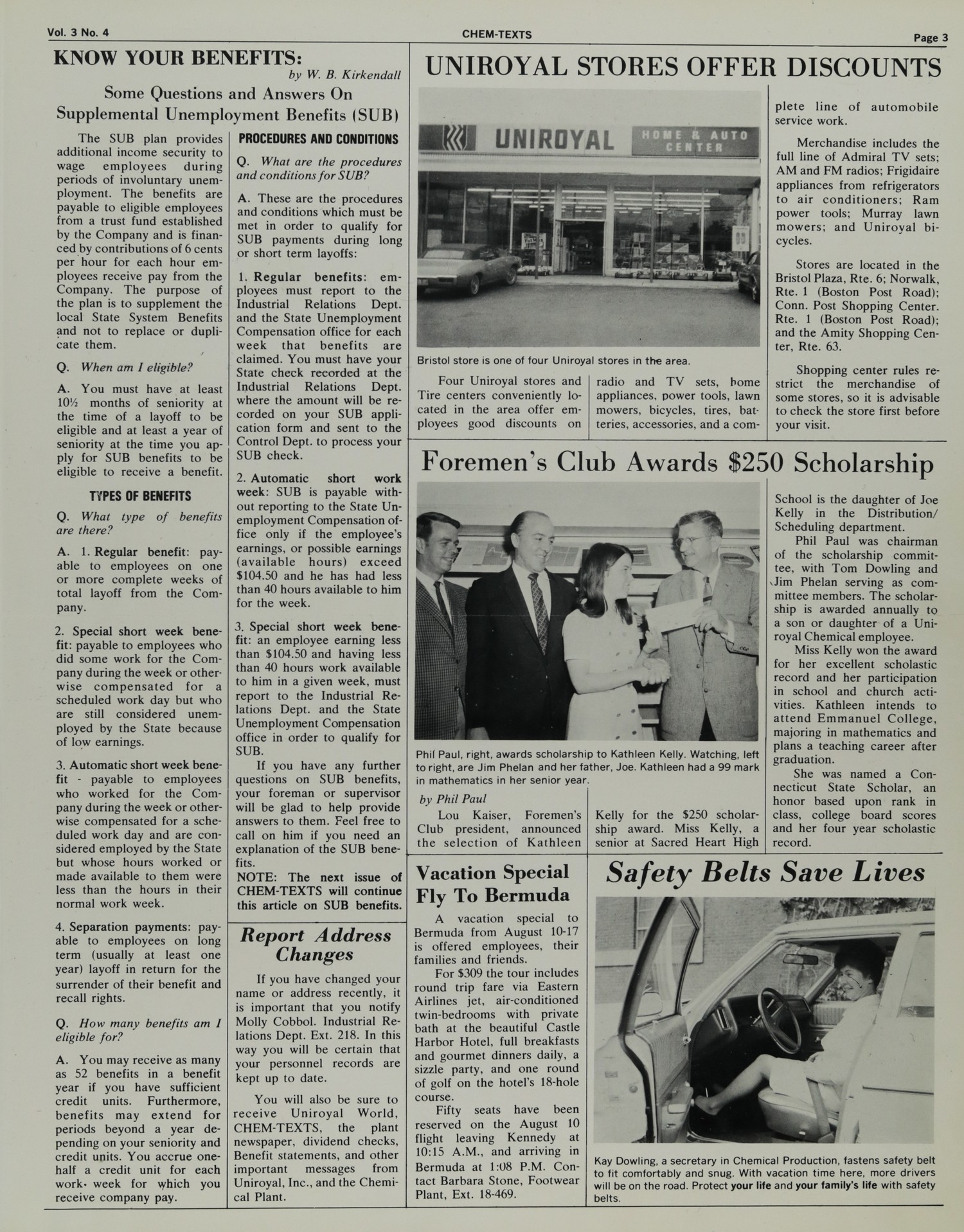
[IMAGE: Storefront showing “UNIROYAL HOME & AUTO CENTER”]

Bristol store is one of four Uniroyal stores in the area.

Four Uniroyal stores and Tire centers conveniently located in the area offer employees good discounts on radio and TV sets, home appliances, power tools, lawn mowers, bicycles, tires, batteries, accessories, and a complete line of automobile service work.

Merchandise includes the full line of Admiral TV sets; AM and FM radios; Frigidaire appliances from refrigerators to air conditioners; Ram power tools; Murray lawn mowers; and Uniroyal bicycles.

Stores are located in the Bristol Plaza, Rte. 6; Norwalk, Rte. 1 (Boston Post Road); Conn. Post Shopping Center. Rte. 1 (Boston Post Road); and the Amity Shopping Center, Rte. 63.

Shopping center rules restrict the merchandise of some stores, so it is advisable to check the store first before your visit.


Foremen’s Club Awards $250 Scholarship

[IMAGE: Photo showing Phil Paul, right, awards scholarship to Kathleen Kelly. Watching, left to right, are Jim Phelan and her father, Joe. Kathleen had a 99 mark in mathematics in her senior year.]

by Phil Paul

Lou Kaiser, Foremen’s Club president, announced the selection of Kathleen Kelly for the $250 scholarship award. Miss Kelly, a senior at Sacred Heart High School is the daughter of Joe Kelly in the Distribution/Scheduling department.

Phil Paul was chairman of the scholarship committee, with Tom Dowling and Jim Phelan serving as committee members. The scholarship is awarded annually to a son or daughter of a Uniroyal Chemical employee.

Miss Kelly won the award for her excellent scholastic record and her participation in school and church activities. Kathleen intends to attend Emmanuel College, majoring in mathematics and plans a teaching career after graduation.

She was named a Connecticut State Scholar, an honor based upon rank in class, college board scores and her four year scholastic record.


Vacation Special Fly To Bermuda

A vacation special to Bermuda from August 10-17 is offered employees, their families and friends.

For $309 the tour includes round trip fare via Eastern Airlines jet, air-conditioned twin-bedrooms with private bath at the beautiful Castle Harbor Hotel, full breakfasts and gourmet dinners daily, a sizzle party, and one round of golf on the hotel’s 18-hole course.

Fifty seats have been reserved on the August 10 flight leaving Kennedy at 10:15 A.M., and arriving in Bermuda at 1:08 P.M. Contact Barbara Stone, Footwear Plant, Ext. 18-469.


Safety Belts Save Lives

[IMAGE: Photo of Kay Dowling fastening a safety belt in a car]

Kay Dowling, a secretary in Chemical Production, fastens safety belt to fit comfortably and snug. With vacation time here, more drivers will be on the road. Protect your life and your family’s life with safety belts.

CHEM-TEXTS – Vol. 3, 1969, No. 5 – Page 1

Page 001

UNIROYAL CHEM-TEXTS

Vol. 3, 1969 | PUBLISHED FOR THE PEOPLE OF UNIROYAL CHEMICAL | No. 5


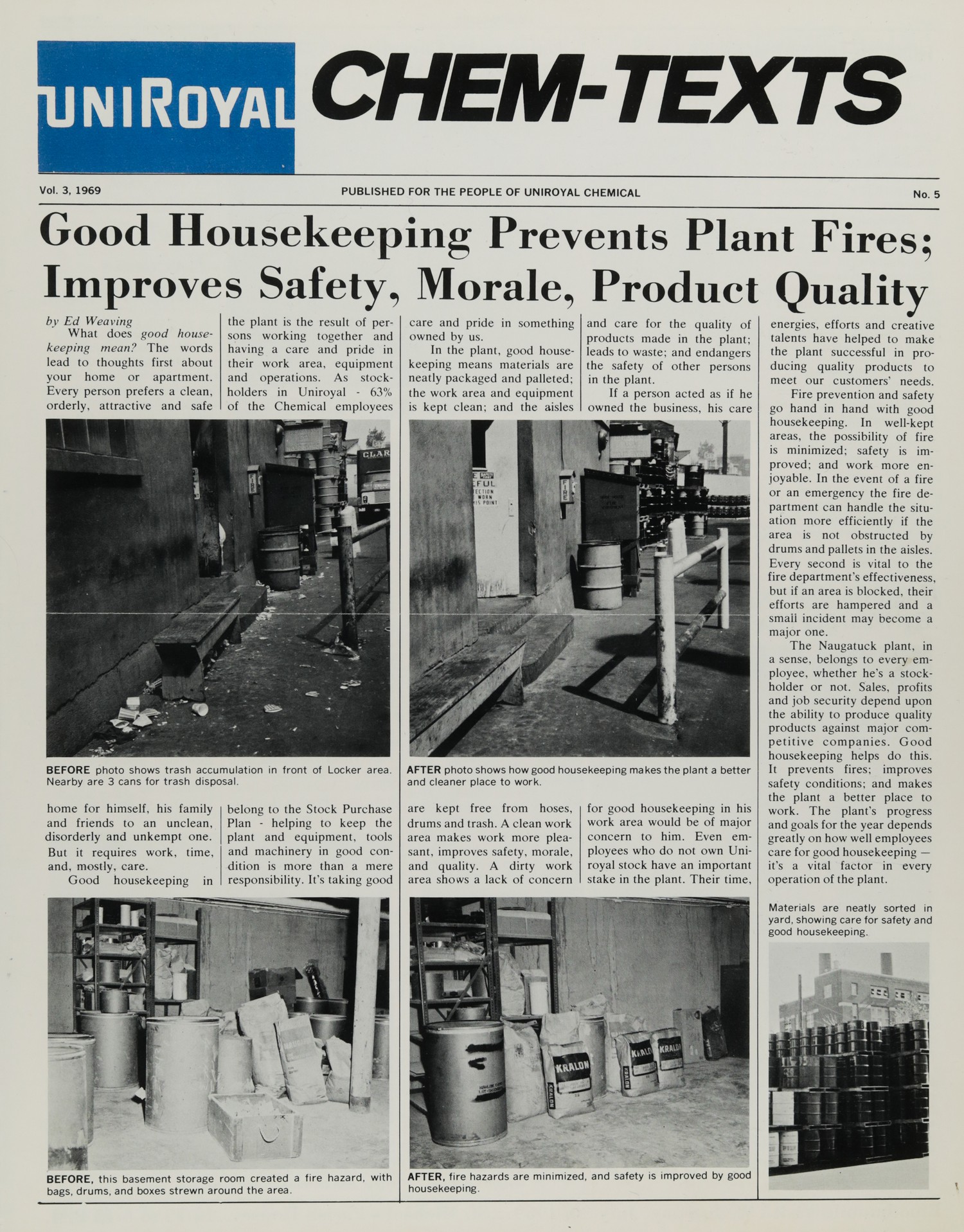
Good Housekeeping Prevents Plant Fires; Improves Safety, Morale, Product Quality

by Ed Weaving

What does good housekeeping mean? The words lead to thoughts first about your home or apartment. Every person prefers a clean, orderly, attractive and safe

the plant is the result of persons working together and having a care and pride in their work area, equipment and operations. As stockholders in Uniroyal – 63% of the Chemical employees

care and pride in something owned by us.

In the plant, good housekeeping means materials are neatly packaged and palleted; the work area and equipment is kept clean; and the aisles

and care for the quality of products made in the plant; leads to waste; and endangers the safety of other persons in the plant.

If a person acted as if he owned the business, his care

energies, efforts and creative talents have helped to make the plant successful in producing quality products to meet our customers’ needs.

Fire prevention and safety go hand in hand with good housekeeping. In well-kept areas, the possibility of fire is minimized; safety is improved; and work more enjoyable. In the event of a fire or an emergency the fire department can handle the situation more efficiently if the area is not obstructed by drums and pallets in the aisles. Every second is vital to the fire department’s effectiveness, but if an area is blocked, their efforts are hampered and a small incident may become a major one.

The Naugatuck plant, in a sense, belongs to every employee, whether he’s a stockholder or not. Sales, profits and job security depend upon the ability to produce quality products against major competitive companies. Good housekeeping helps do this. It prevents fires; improves safety conditions; and makes the plant a better place to work. The plant’s progress and goals for the year depends greatly on how well employees care for good housekeeping — it’s a vital factor in every operation of the plant.


BEFORE photo shows trash accumulation in front of Locker area. Nearby are 3 cans for trash disposal.

AFTER photo shows how good housekeeping makes the plant a better and cleaner place to work.


home for himself, his family and friends to an unclean, disorderly and unkempt one. But it requires work, time, and, mostly, care.

Good housekeeping in

belong to the Stock Purchase Plan – helping to keep the plant and equipment, tools and machinery in good condition is more than a mere responsibility. It’s taking good

are kept free from hoses, drums and trash. A clean work area makes work more pleasant, improves safety, morale, and quality. A dirty work area shows a lack of concern

for good housekeeping in his work area would be of major concern to him. Even employees who do not own Uniroyal stock have an important stake in the plant. Their time,


BEFORE, this basement storage room created a fire hazard, with bags, drums, and boxes strewn around the area.

AFTER, fire hazards are minimized, and safety is improved by good housekeeping.


Materials are neatly sorted in yard, showing care for safety and good housekeeping.

CHEM-TEXTS – Vol. 3 No. 5 – Page 2

Page 002

CHEM-TEXTS

Page 2 | Vol. 3 No. 5


FROM THE FACTORY MANAGER

Dear Fellow Employee:

During our nation’s space program RELIABILITY has become a common everyday word. Individual parts, in-fact entire systems human as well as mechanical, are tested and retested to make certain that there are no failures at critical times. This, then, is the essence of RELIABILITY — no failures at critical times.

While each of us appreciates the importance of RELIABILITY in space, we often lose sight of its equal importance right here in our plant. Each and everyone of us is a key man or woman. Everyone must function, with complete RELIABILITY to get the job done properly.

Let’s check our own RELIABILITY right now. Each of us should ask ourself what is my RELIABILITY on:

  1. Job Performance
  2. Safety Performance
  3. Housekeeping Performance
  4. Attendance Performance

What’s your RELIABILITY? Each of us can improve. Each of us must improve.

Sincerely,

John D. Evans


Hugh Garahan’s Eyesight Saved By Wearing His Safety Glasses

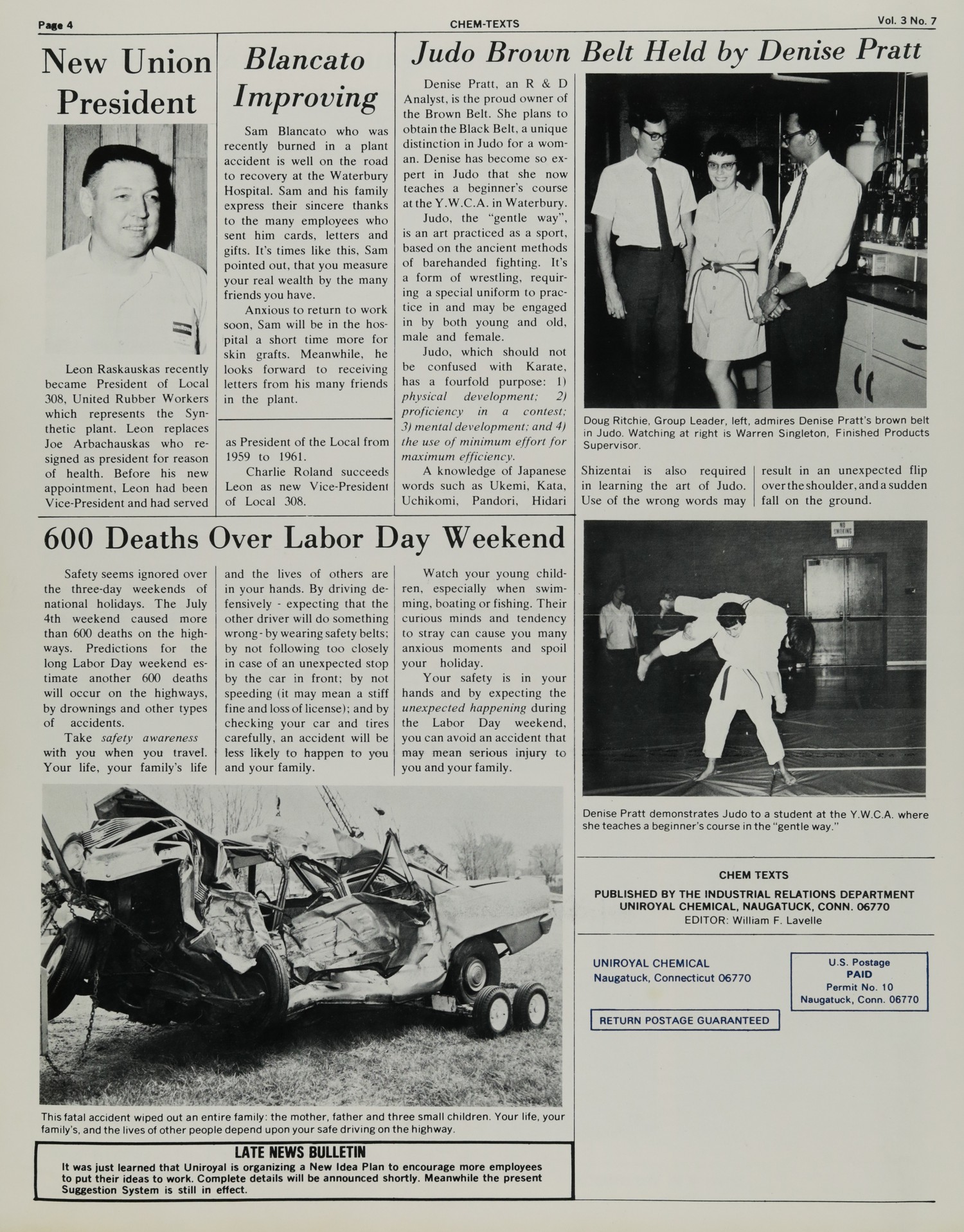
Hugh Garahan, center, points happily to his safety glasses which saved injury to his eyes. At left is Wes Carreiro and right, Ed Runowicz, foreman.

While removing the mixing head from equipment in the Roylar pilot plant, Hugh Garahan’s eyes were splashed by hot MDI which could have damaged his eyesight severely. Residual pressure had built up in the line and when Hugh disconnected the head, the MDI gushed out forcefully and covered his safety glasses completely. Fortunately, Hugh was wearing his safety glasses at the time and prevented serious injury to his eyes by expecting the unexpected happening. The photo at right shows his glasses.

Hot MDI completely covered Garahan’s safety glasses. Wearing them saved his eyesight.


Employees Contribute 128 Pints Of Blood To Bloodmobile Visit

Waiting their turn to contribute blood are left to right, John Paige, Pete Welch, Bernie Daily, Jim Sullivan, and Jim Doran. (Kirkendall photo).

The Connecticut Red Cross Bloodmobile made its annual visit to Uniroyal Chemical and received 128 pints of blood from employees, with nine rejections. Three employees arrived too late to contribute.

A 3-gallon pin was received by Richard Valentine. One-gallon pins went to Leo Brites, Joe Jokubaitis, Pete Lazaras, Walt Madura, Gerald Monahan, Ed Semaskwich and Harold Smith.

Other contributors were Bill Albaitis, Steve Alper, Rod Ashby, Ed Bates, Benoit Begin, John Bickerdike, Joe Biernacki, Dave Boulanger, Pete Braudis, Bob Breton, Jean Burke, Lucille Butnor, Tom Byra, Walter Campbell, Frank Carriero, Maurice Chamberland, James Chambers, Frank Chiodo, Dan Cleary, Dennis Cormier, Bob Cornell, Al Crandall, Bob Cranney, John Cronan, Austin Cross, Ted Curzi, Bernie Daily, Phil Dillon, Karen Di-Dominzio, J. Harry Donald, Jim Doran, Elliott Easterbrook, Bertha Eggleston, Sylvia Famiglietti, Bob Farrell, Joe Finke, Ed Fischer, Tom Fitzgerald, Harry Francolini, Walter Frankenberger, Bert Frennesson, Ferdinand Gagne, Mike Galante, John Gandolfo, Al Gedraitis, Norm Gibbs, John Gilbert, Walt Gnizdowski, Phil Haas, Jim Hartley, Bob Harsch, Mike Heller, Gerald Hennessey, Dick Hessler, Bill Hill, Clarence Hiser, Joe Hocheiser, Henry Hook, Don Houde, Keith Hughes, Bill Hutt, Mike Jasman, Ed Johnson, Gerald Klender, Lou Lakatos, Ben Leach, Tom Lee, Jim Loman, Len Lombardi, Frank Maffia, Milt Makoski, Tony Malone, Rocco Manulla, Mike Marinaccio, Manuel Matos, Ron Mitchinson, June Moore, Roland Morel, Phil Morin, Charles Moruska, John Nappiello, Jonas Narijauskas, Francis Nauiokas, Alex Nole, Tom O’Hara, Lee Owens, John Painter, Dick Palizay, Sherman Paul, Violet Pisani, Julius Rek, Jim Reynolds, L. Rice,

(cont’d. on page 3)


Appointments Announced

Norm Gibbs has been assigned the responsibility for General Accounting, Accounts Payable, and Office Services.

Don Turner was appointed General Accountant.

Walt Beerbaum was made Accounts Payable Supervisor.


Reclaim Exceeds 300,000 Lbs.

by Bob VanAllen

Members of reclaim production deserve recognition for their production of 349,310 pounds of reclaim rubber on June 11. Starting with the 7-3 shift on June 10, the 3-11 shift continued the production schedule started on the first shift, and the 11-7 shift on Thursday topped the 300,000 pounds goal for the first time since the modernization of the reclaim plant.

From raw stock to the finished product in the millrooms every department and person played an important role in attaining this high performance which demonstrates a capability that can make reclaim a competitive operation.

During the period of modernization, the reclaim plant had been severely upset due to the necessity to maintain production while rebuilding the facilities.

To operate the reclaim plant successfully, every person associated with the operation must strive to achieve the kind of performance demonstrated on June 11. This type of performance is the best to assure our jobs.

349,310
6-11-69

Some of the people of the three shifts in the Reclaim Production departments who helped top 300,000 lbs. production of reclaimed rubber are clockwise: Carlos Aresta, Maria Matos, Herminio Ortiz, Minic Brown, JohnHickson,Frank Rodrigues, Americo Henriques, Antonio Pereira, Joe Rzeszutek, Mike Chropcho,hidden in rear, John Zavednak and Tom Armstrong.


Bloodmobile Visit…Wednesday, July 30, 1969…St. Michael’s Parish House…12:15 to 6:15 P.M.

CHEM-TEXTS – Vol. 3 No. 5 – Page 3

Page 003

Vol. 3 No. 5 CHEM-TEXTS Page 3


KNOW YOUR BENEFITS: by W. Kirkendall

Some Questions and Answers on Supplemental Unemployment Benefits (SUB)

This is a continuation of the SUB article which appeared in the last issue of Chem-Texts. The examples show how to estimate your SUB benefits based upon your earnings for a 40 hour week.

The benefits are payable to an eligible wage employee from a trust fund established by Uniroyal and is financed by the Company’s contribution of 6 cents per hour for each hour an employee receives pay from the Company.

Q. What are some examples of SUB payments?

A. REGULAR BENEFIT:
If an employee’s average straight time hourly earnings are $3.75, his weekly straight time earnings would be $150.00. 80% of his weekly straight time earnings are $120.00. Less the State Unemployment Compensation of $75.00 the SUB benefit due the employee is $45.00. The minimum regular benefit payable under all circumstances is $10.00. The minimum shall apply even when the calculation for benefit is zero.

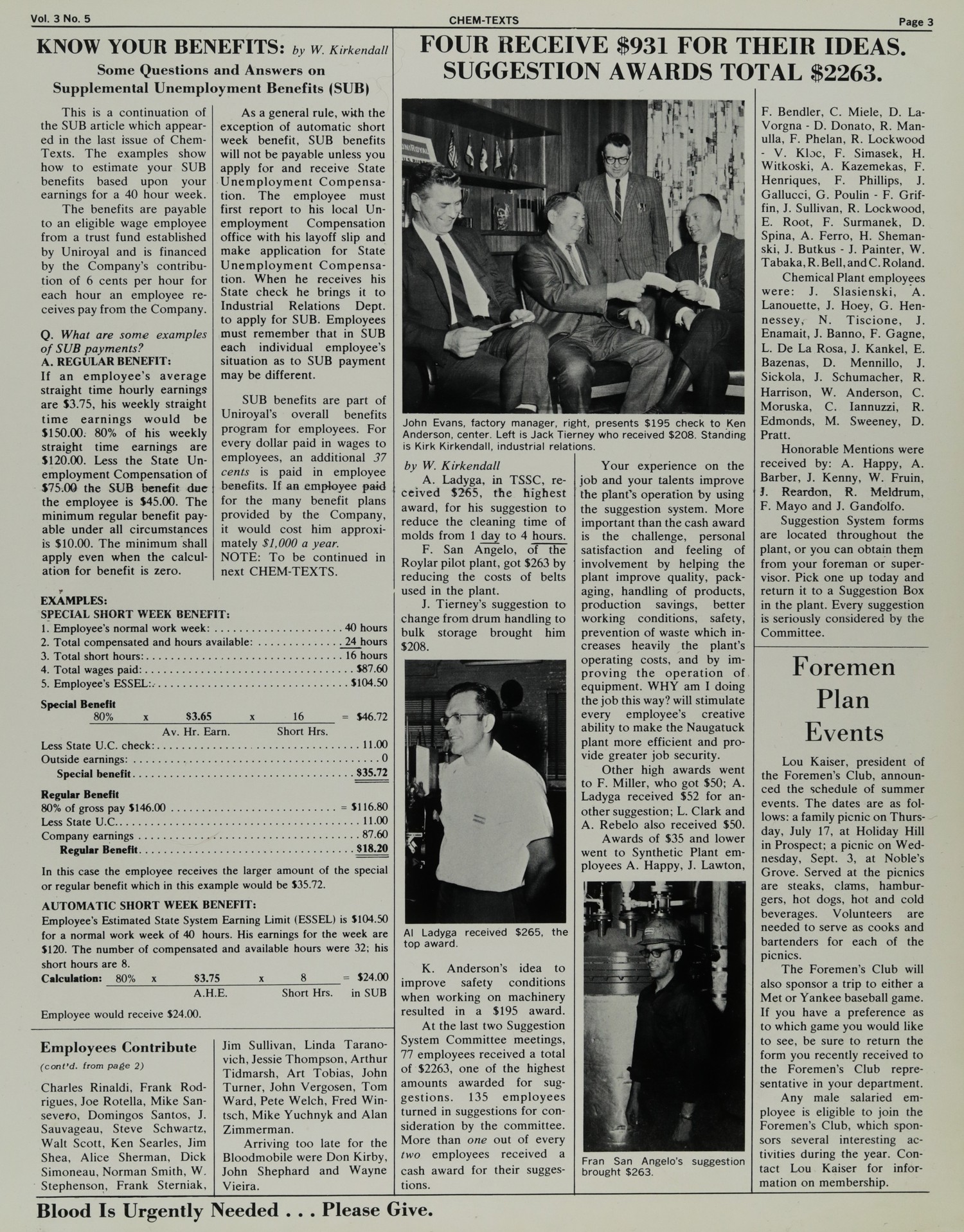
EXAMPLES:
SPECIAL SHORT WEEK BENEFIT:
1. Employee’s normal work week:……………………40 hours
2. Total compensated and hours available:………….24 hours
3. Total short hours:…………………………16 hours
4. Total wages paid:………………………….$87.60
5. Employee’s ESSEL:…………………………$104.50

Special Benefit
80% x $3.65 x 16 = $46.72
Av. Hr. Earn. Short Hrs.
Less State U.C. check:…………………………11.00
Outside earnings:……………………………..0
Special benefit……………………………..$35.72

Regular Benefit
80% of gross pay $146.00……………………..= $116.80
Less State U.C………………………………11.00
Company earnings…………………………….87.60
Regular Benefit…………………………….$18.20

In this case the employee receives the larger amount of the special or regular benefit which in this example would be $35.72.

AUTOMATIC SHORT WEEK BENEFIT:
Employee’s Estimated State System Earning Limit (ESSEL) is $104.50 for a normal work week of 40 hours. His earnings for the week are $120. The number of compensated and available hours were 32; his short hours are 8.

Calculation: 80% x $3.75 x 8 = $24.00
A.H.E. Short Hrs. in SUB

Employee would receive $24.00.


As a general rule, with the exception of automatic short week benefit, SUB benefits will not be payable unless you apply for and receive State Unemployment Compensation. The employee must first report to his local Unemployment Compensation office with his layoff slip and make application for State Unemployment Compensation. When he receives his State check he brings it to Industrial Relations Dept. to apply for SUB. Employees must remember that in SUB each individual employee’s situation as to SUB payment may be different.

SUB benefits are part of Uniroyal’s overall benefits program for employees. For every dollar paid in wages to employees, an additional 37 cents is paid in employee benefits. If an employee paid for the many benefit plans provided by the Company, it would cost him approximately $1,000 a year.
NOTE: To be continued in next CHEM-TEXTS.


FOUR RECEIVE $931 FOR THEIR IDEAS. SUGGESTION AWARDS TOTAL $2263.

[PHOTO: John Evans, factory manager, right, presents $195 check to Ken Anderson, center. Left is Jack Tierney who received $208. Standing is Kirk Kirkendall, industrial relations.]

by W. Kirkendall

A. Ladyga, in TSSC, received $265, the highest award, for his suggestion to reduce the cleaning time of molds from 1 day to 4 hours.

F. San Angelo, of the Roylar pilot plant, got $263 by reducing the costs of belts used in the plant.

J. Tierney’s suggestion to change from drum handling to bulk storage brought him $208.

[PHOTO: Al Ladyga received $265, the top award.]

K. Anderson’s idea to improve safety conditions when working on machinery resulted in a $195 award.

At the last two Suggestion System Committee meetings, 77 employees received a total of $2263, one of the highest amounts awarded for suggestions. 135 employees turned in suggestions for consideration by the committee. More than one out of every two employees received a cash award for their suggestions.

[PHOTO: Fran San Angelo’s suggestion brought $263.]

Your experience on the job and your talents improve the plant’s operation by using the suggestion system. More important than the cash award is the challenge, personal satisfaction and feeling of involvement by helping the plant improve quality, packaging, handling of products, production savings, better working conditions, safety, prevention of waste which increases heavily the plant’s operating costs, and by improving the operation of equipment. WHY am I doing the job this way? will stimulate every employee’s creative ability to make the Naugatuck plant more efficient and provide greater job security.

Other high awards went to F. Miller, who got $50; A. Ladyga received $52 for another suggestion; L. Clark and A. Rebelo also received $50.

Awards of $35 and lower went to Synthetic Plant employees A. Happy, J. Lawton, F. Bendler, C. Miele, D. LaVorgna – D. Donato, R. Manulla, F. Phelan, R. Lockwood – V. Kloc, F. Simasek, H. Witkoski, A. Kazemekas, F. Henriques, F. Phillips, J. Gallucci, G. Poulin – F. Griffin, J. Sullivan, R. Lockwood, E. Root, F. Surmanek, D. Spina, A. Ferro, H. Shemanski, J. Butkus – J. Painter, W. Tabaka, R. Bell, and C. Roland.

Chemical Plant employees were: J. Slasienski, A. Lanouette, J. Hoey, G. Hennessey, N. Tiscione, J. Enamait, J. Banno, F. Gagne, L. De La Rosa, J. Kankel, E. Bazenas, D. Mennillo, J. Sickola, J. Schumacher, R. Harrison, W. Anderson, C. Moruska, C. Iannuzzi, R. Edmonds, M. Sweeney, D. Pratt.

Honorable Mentions were received by: A. Happy, A. Barber, J. Kenny, W. Fruin, J. Reardon, R. Meldrum, F. Mayo and J. Gandolfo.

Suggestion System forms are located throughout the plant, or you can obtain them from your foreman or supervisor. Pick one up today and return it to a Suggestion Box in the plant. Every suggestion is seriously considered by the Committee.


Foremen Plan Events

Lou Kaiser, president of the Foremen’s Club, announced the schedule of summer events. The dates are as follows: a family picnic on Thursday, July 17, at Holiday Hill in Prospect; a picnic on Wednesday, Sept. 3, at Noble’s Grove. Served at the picnics are steaks, clams, hamburgers, hot dogs, hot and cold beverages. Volunteers are needed to serve as cooks and bartenders for each of the picnics.

The Foremen’s Club will also sponsor a trip to either a Met or Yankee baseball game. If you have a preference as to which game you would like to see, be sure to return the form you recently received to the Foremen’s Club representative in your department.

Any male salaried employee is eligible to join the Foremen’s Club, which sponsors several interesting activities during the year. Contact Lou Kaiser for information on membership.


Employees Contribute

(cont’d. from page 2)

Charles Rinaldi, Frank Rodrigues, Joe Rotella, Mike Sansevero, Domingos Santos, J. Sauvageau, Steve Schwartz, Walt Scott, Ken Searles, Jim Shea, Alice Sherman, Dick Simoneau, Norman Smith, W. Stephenson, Frank Sterniak,

Jim Sullivan, Linda Taranovich, Jessie Thompson, Arthur Tidmarsh, Art Tobias, John Turner, John Vergosen, Tom Ward, Pete Welch, Fred Wintsch, Mike Yuchnyk and Alan Zimmerman.

Arriving too late for the Bloodmobile were Don Kirby, John Shephard and Wayne Vieira.


Blood Is Urgently Needed . . . Please Give.

CHEM-TEXTS – Vol. 3 No. 5 – Page 4

Page 004

CHEM-TEXTS

Page 4 | Vol. 3 No. 5


Technical Team Wins Bowling League

by Shirley Sandora

The Uniroyal Chemical Handicap Bowling League ended its season with the Technical team, first half winner, defeating the Atatics, second half winner, in the roll-off to take first place.

Eight teams, registered with the National Duckpin Bowling Congress, made up the league: Engineering, Atatics, Technical, Synthetic, EMIC, Process Development, Distribution/Scheduling and

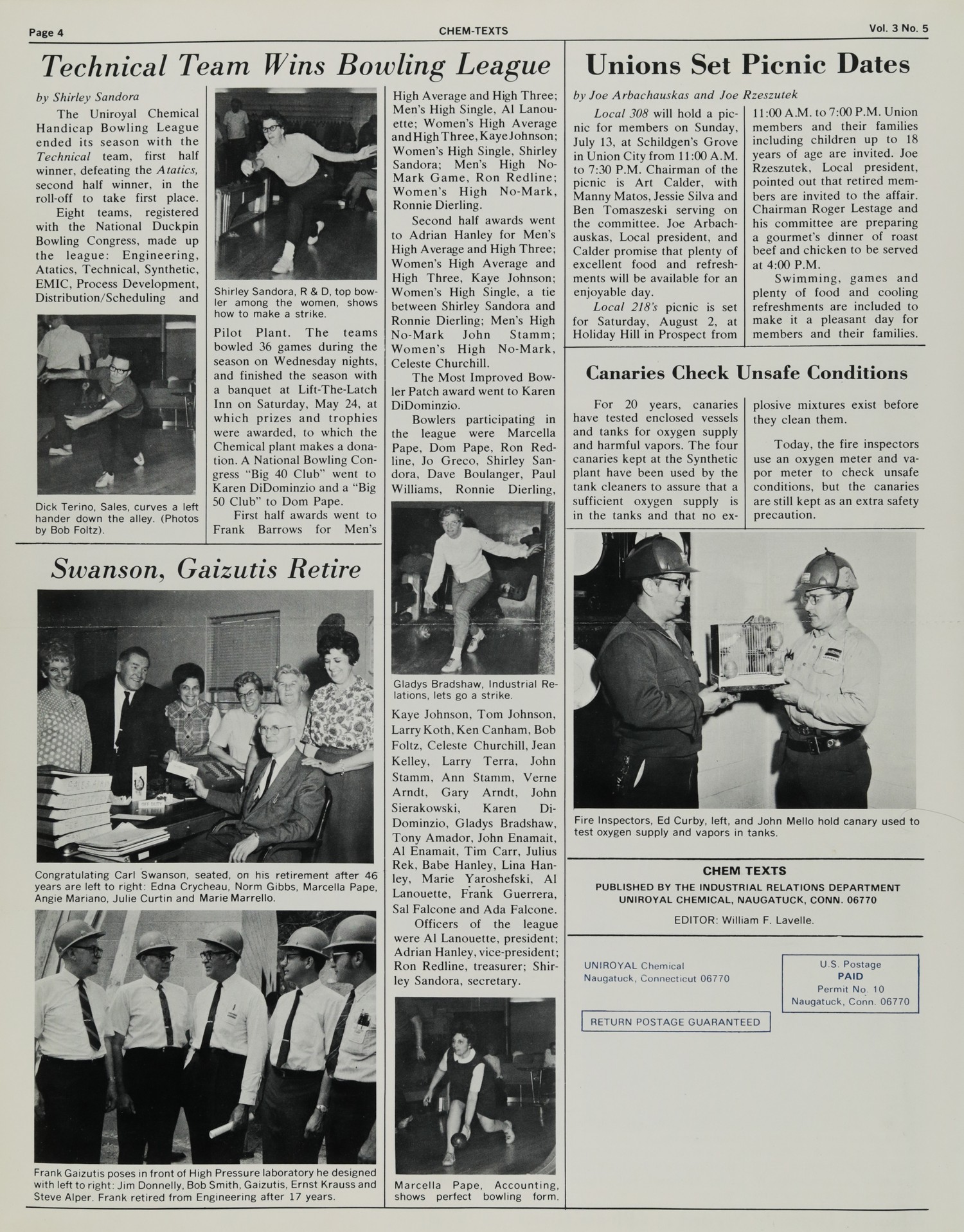
Dick Terino, Sales, curves a left hander down the alley. (Photos by Bob Foltz).


Shirley Sandora, R & D, top bowler among the women, shows how to make a strike.

Pilot Plant. The teams bowled 36 games during the season on Wednesday nights, and finished the season with a banquet at Lift-The-Latch Inn on Saturday, May 24, at which prizes and trophies were awarded, to which the Chemical plant makes a donation. A National Bowling Congress “Big 40 Club” went to Karen DiDominzio and a “Big 50 Club” to Dom Pape.

First half awards went to Frank Barrows for Men’s

High Average and High Three; Men’s High Single, Al Lanouette; Women’s High Average and High Three, Kaye Johnson; Women’s High Single, Shirley Sandora; Men’s High No-Mark Game, Ron Redline; Women’s High No-Mark, Ronnie Dierling.

Second half awards went to Adrian Hanley for Men’s High Average and High Three; Women’s High Average and High Three, Kaye Johnson; Women’s High Single, a tie between Shirley Sandora and Ronnie Dierling; Men’s High No-Mark John Stamm; Women’s High No-Mark, Celeste Churchill.

The Most Improved Bowler Patch award went to Karen DiDominzio.

Bowlers participating in the league were Marcella Pape, Dom Pape, Ron Redline, Jo Greco, Shirley Sandora, Dave Boulanger, Paul Williams, Ronnie Dierling,


Unions Set Picnic Dates

by Joe Arbachauskas and Joe Rzeszutek

Local 308 will hold a picnic for members on Sunday, July 13, at Schildgen’s Grove in Union City from 11:00 A.M. to 7:30 P.M. Chairman of the picnic is Art Calder, with Manny Matos, Jessie Silva and Ben Tomaszeski serving on the committee. Joe Arbachauskas, Local president, and Calder promise that plenty of excellent food and refreshments will be available for an enjoyable day.

Local 218’s picnic is set for Saturday, August 2, at Holiday Hill in Prospect from

11:00 A.M. to 7:00 P.M. Union members and their families including children up to 18 years of age are invited. Joe Rzeszutek, Local president, pointed out that retired members are invited to the affair. Chairman Roger Lestage and his committee are preparing a gourmet’s dinner of roast beef and chicken to be served at 4:00 P.M.

Swimming, games and plenty of food and cooling refreshments are included to make it a pleasant day for members and their families.


Canaries Check Unsafe Conditions

For 20 years, canaries have tested enclosed vessels and tanks for oxygen supply and harmful vapors. The four canaries kept at the Synthetic plant have been used by the tank cleaners to assure that a sufficient oxygen supply is in the tanks and that no explosive mixtures exist before they clean them.

Today, the fire inspectors use an oxygen meter and vapor meter to check unsafe conditions, but the canaries are still kept as an extra safety precaution.


Swanson, Gaizutis Retire

Congratulating Carl Swanson, seated, on his retirement after 46 years are left to right: Edna Crycheau, Norm Gibbs, Marcella Pape, Angie Mariano, Julie Curtin and Marie Marrello.


Frank Gaizutis poses in front of High Pressure laboratory he designed with left to right: Jim Donnelly, Bob Smith, Gaizutis, Ernst Krauss and Steve Alper. Frank retired from Engineering after 17 years.


Gladys Bradshaw, Industrial Relations, lets go a strike.

Kaye Johnson, Tom Johnson, Larry Koth, Ken Canham, Bob Foltz, Celeste Churchill, Jean Kelley, Larry Terra, John Stamm, Ann Stamm, Verne Arndt, Gary Arndt, John Sierakowski, Karen DiDominzio, Gladys Bradshaw, Tony Amador, John Enamait, Al Enamait, Tim Carr, Julius Rek, Babe Hanley, Lina Hanley, Marie Yaroshefski, Al Lanouette, Frank Guerrera, Sal Falcone and Ada Falcone.

Officers of the league were Al Lanouette, president; Adrian Hanley, vice-president; Ron Redline, treasurer; Shirley Sandora, secretary.


Marcella Pape, Accounting, shows perfect bowling form.


Fire Inspectors, Ed Curby, left, and John Mello hold canary used to test oxygen supply and vapors in tanks.


CHEM TEXTS

PUBLISHED BY THE INDUSTRIAL RELATIONS DEPARTMENT
UNIROYAL CHEMICAL, NAUGATUCK, CONN. 06770

EDITOR: William F. Lavelle.


UNIROYAL Chemical
Naugatuck, Connecticut 06770

U.S. Postage
PAID
Permit No. 10
Naugatuck, Conn. 06770

RETURN POSTAGE GUARANTEED

CHEM-TEXTS – Vol. 3, 1969, No. 7 – Page 1

Page 001

UNIROYAL CHEM-TEXTS

Vol. 3, 1969 PUBLISHED FOR THE PEOPLE OF UNIROYAL CHEMICAL No. 7


Every Employee Holds Responsible Position

[AERIAL PHOTOGRAPH OF INDUSTRIAL COMPLEX]

The Naugatuck Chemical complex comprises 142 buildings situated on 90 acres of land stretched out along the Naugatuck river.


[PHOTOGRAPH: Three men in work uniforms reviewing documents]

Assistant Area Shift Foremen Mike Patrick, left and Bill Swick, right check plans for 4 to 12 P.M. shift with Guy Elwood, Area Shift Foreman. In charge of all plant operations on this shift, they are also experts in first-aid.


[PHOTOGRAPH: Men with mail cart, safety sign visible reading “HASTE MAKES ACCIDENTS”]

Don Olson, above, Joe Scullin, Bill Brewer, Clarence Parks rotate weekly on mail delivery. They make 5 tours daily in the plant; handle 140 bags of mail; and stay slim with 75 trips up and down stairs.


Today the Chemical Division at Naugatuck employs 1800 people. 925 work in the plant’s manufacturing operation; and 875 work in Divisional Sales, Research and Development, accounting and other departments.

People Make The Plant

Whatever an employee’s education, background, or position, he holds a position of responsibility in the plant’s diverse operations. People are the plant’s most irreplaceable asset. Without them, the plant’s equipment, machinery and capabilities are useless, and it would take years to replace their years of talent, experience and skill.

Every Job’s Important

To operate the plant efficiently and to provide better job security, an employee’s responsibility in doing his job properly is of extreme importance.

Whether the job is delivering mail; sorting tubes; painting; shipping materials to a customer on time; operating production equipment; packaging products; oiling machinery; purchasing raw materials; paying bills; analyzing quality; researching new products; or selling to customers, the plant would not operate effectively without every employee performing his job in a responsible manner.

Individual’s Importance

Because of the importance of an individual employee’s job, it is easy to imagine the effects on the plant’s operation if he is absent from work for an unjustifiable reason. His absence could slow down or even shut down an entire

(Continued on Page 2)

CHEM-TEXTS – Vol. 3 No. 7 – Page 2

Page 002

Page 2 | CHEM-TEXTS | Vol. 3 No. 7


FROM THE FACTORY MANAGER

DEAR FELLOW EMPLOYEE:

This year we have been pushing the slogan “SAFETY IS MY RESPONSIBILITY.” Frankly, it seems to me that our success to date is in developing the attitude that “everybody is responsible for my safety.” It’s about time that we face up to our own responsibility for safety.

I’ve heard too much of, “you didn’t fix this” or, “why should I do it that way, so and so doesn’t.” Or, the old favorite, “I’ve been doing this for twenty years and nothing has happened to me.” These are, at best, just excuses.

We have to face up to the basic fact that each man is primarily responsible for his own safety. Management’s responsibility extends to providing the proper tools and equipment, protective devices and giving safe operating procedures and instructions.

Beyond this point, supervision can’t make a man safe if he doesn’t act safely. This is particularly true in our plant where each man works with a great deal of responsibility for his own work.

Recently, I read some criticism concerning companies where protective equipment wasn’t furnished to employees.

Let’s take a look at our plant. UNIROYAL provides hard hats, safety glasses, goggles, safety shoes, gloves and other protective equipment, and yet too many employees take the attitude of “let’s see if we can make them force us to wear this stuff.” What kind of a game is this for men to be playing?

Don’t you think it’s about time for you to quit playing Russian Roulette with your SAFETY? I sincerely hope you will think this over and agree for your family’s sake.

Best regards,

John

John D. Evans


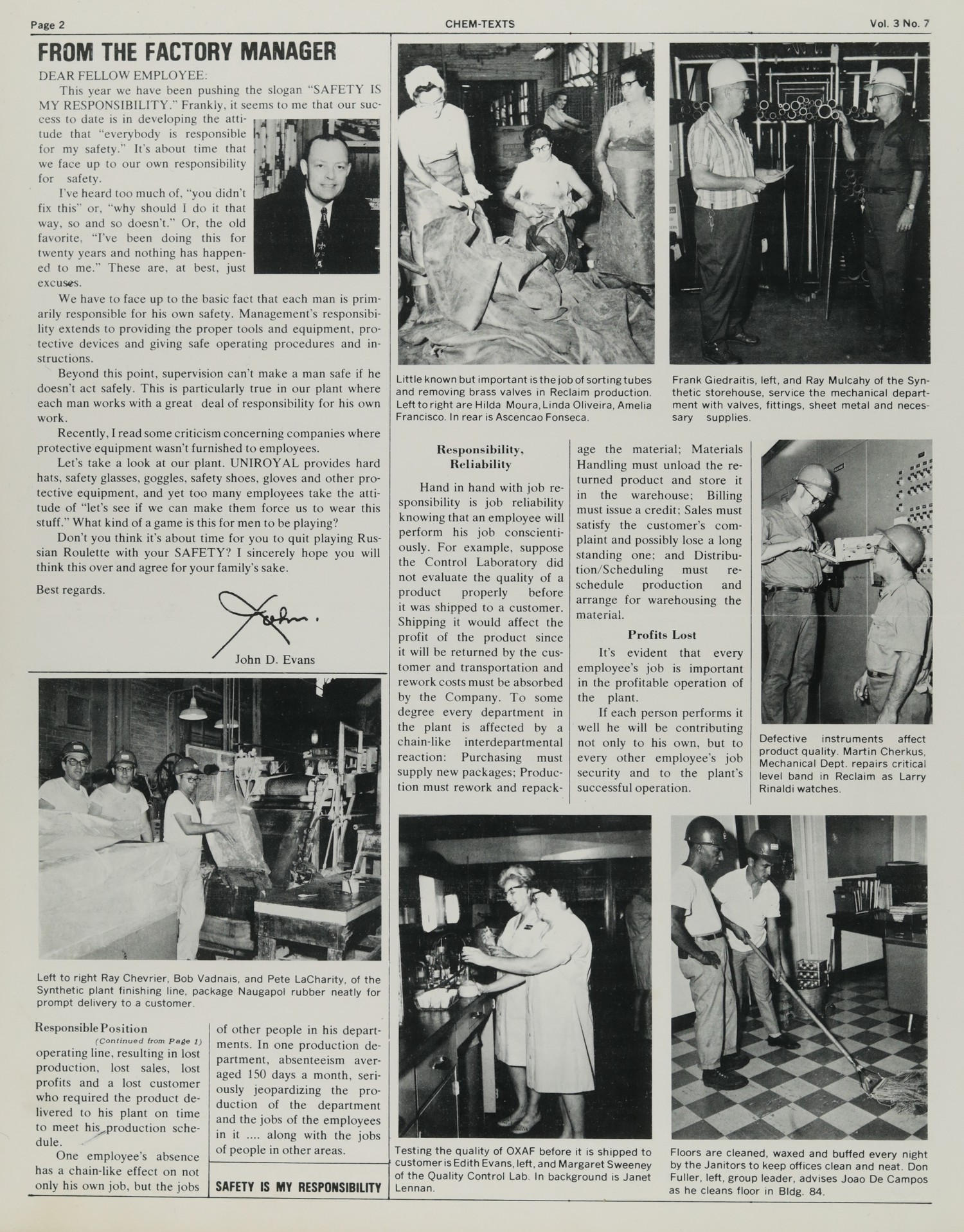
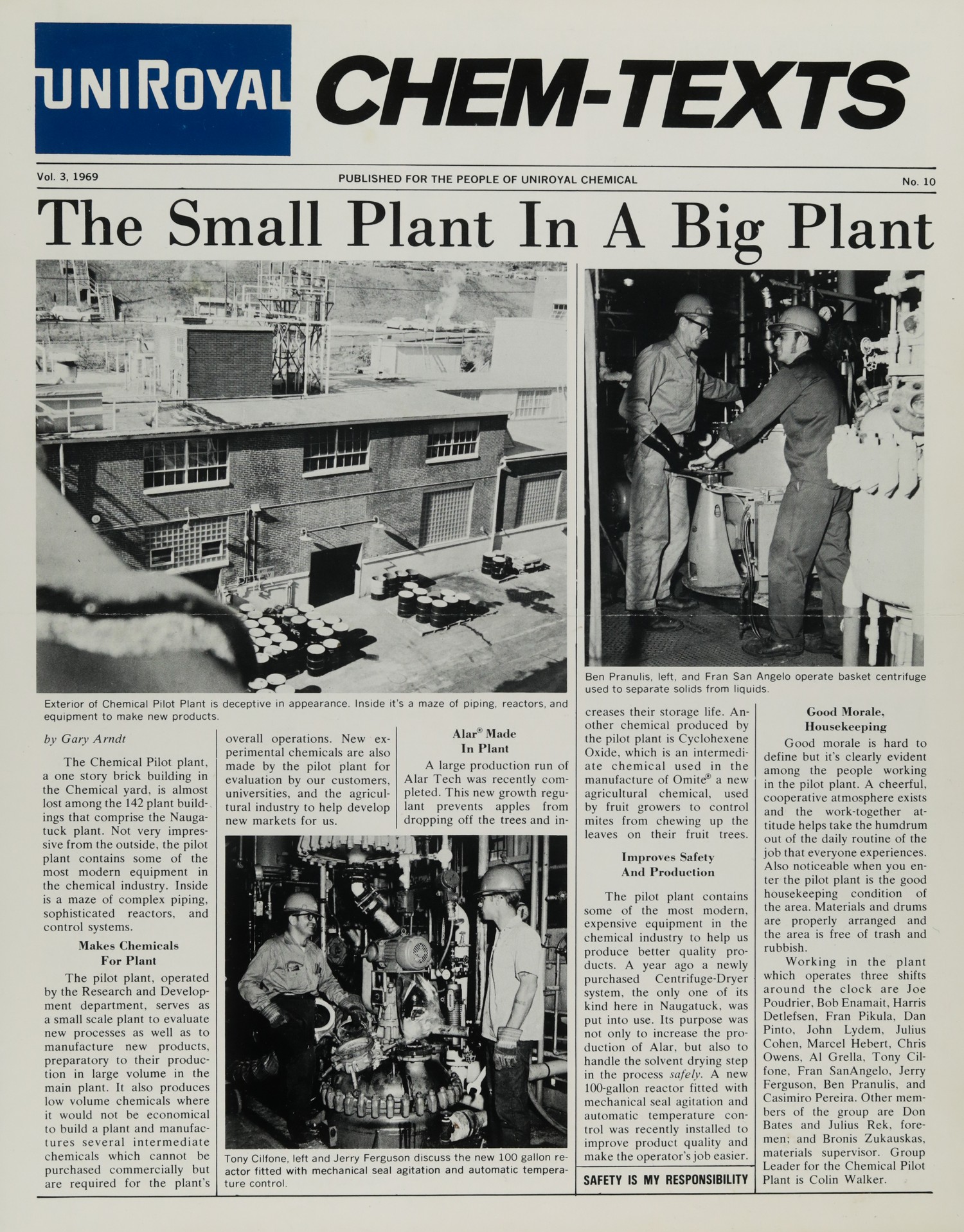
Little known but important is the job of sorting tubes and removing brass valves in Reclaim production. Left to right are Hilda Moura, Linda Oliveira, Amelia Francisco. In rear is Ascencao Fonseca.


Frank Giedraitis, left, and Ray Mulcahy of the Synthetic storehouse, service the mechanical department with valves, fittings, sheet metal and necessary supplies.


Responsibility, Reliability

Hand in hand with job responsibility is job reliability knowing that an employee will perform his job conscientiously. For example, suppose the Control Laboratory did not evaluate the quality of a product properly before it was shipped to a customer. Shipping it would affect the profit of the product since it will be returned by the customer and transportation and rework costs must be absorbed by the Company. To some degree every department in the plant is affected by a chain-like interdepartmental reaction: Purchasing must supply new packages; Production must rework and repackage the material; Materials Handling must unload the returned product and store it in the warehouse; Billing must issue a credit; Sales must satisfy the customer’s complaint and possibly lose a long standing one; and Distribution/Scheduling must reschedule production and arrange for warehousing the material.

Profits Lost

It’s evident that every employee’s job is important in the profitable operation of the plant.

If each person performs it well he will be contributing not only to his own, but to every other employee’s job security and to the plant’s successful operation.


Defective instruments affect product quality. Martin Cherkus, Mechanical Dept. repairs critical level band in Reclaim as Larry Rinaldi watches.


Left to right Ray Chevrier, Bob Vadnais, and Pete LaCharity, of the Synthetic plant finishing line, package Naugapol rubber neatly for prompt delivery to a customer.


Responsible Position

(Continued from Page 1)

operating line, resulting in lost production, lost sales, lost profits and a lost customer who required the product delivered to his plant on time to meet his production schedule.

One employee’s absence has a chain-like effect on not only his own job, but the jobs of other people in his departments. In one production department, absenteeism averaged 150 days a month, seriously jeopardizing the production of the department and the jobs of the employees in it …. along with the jobs of people in other areas.


SAFETY IS MY RESPONSIBILITY


Testing the quality of OXAF before it is shipped to customer is Edith Evans, left, and Margaret Sweeney of the Quality Control Lab. In background is Janet Lennan.


Floors are cleaned, waxed and buffed every night by the Janitors to keep offices clean and neat. Don Fuller, left, group leader, advises Joao De Campos as he cleans floor in Bldg. 84.

CHEM-TEXTS – Vol. 3 No. 7 – Page 3

Page 003

Vol. 3 No. 7 | CHEM-TEXTS | Page 3


KNOW YOUR BENEFITS: by W. Kirkendall

Some Questions And Answers On Bereavement Pay Benefits

The bereavement pay benefit is one of the many different benefits which Uniroyal gives to people employed at a plant where a United Rubber Workers Union exist. At the Naugatuck plant there are two URW locals: Local 218 covers the Chemical and Reclaim plants; and Local 308 covers the Synthetic plant. This benefit applies only to the wage members of the two Locals.

In 1968 Uniroyal contributed $318,303 in Bereavement Pay Benefits to employees working in plants covered by the United Rubber Workers Union contract.

Q. When am I eligible for bereavement pay?
A. An employee who is absent from work after 30 days from date of hire because of the death of a member of his immediate family, or a dependent who lives in the household, shall be paid his straight time average hourly earnings, if an incentive worker or his current hourly rate if on day work for time lost from his regularly scheduled shift.

Q. How many days’ pay do I receive?
A. You shall be paid (3) consecutive working days. It is understood the 3 days of paid bereavement pay shall be related in time to the death for which such payment is made.

Applies To Your Immediate Family

Q. Who is immediate family?
A. Immediate family is defined to mean husband, wife, father, mother, grandfather, grandmother, brother, sister, or the employee’s children. The foregoing intended to cover legal as well as blood relationships.

Q. Are uncles, aunts, nieces, nephews and cousins covered under bereavement pay?
A. No. They are not members of the immediate family.

Q. What happens if death occurs while I am on vacation?
A. Your vacation will be extended and payment will be made, provided the employee notifies a designated member of management.

Legal Relatives

Q. What does legal relationship mean?
A. The term legal relationship is interpreted to mean father-in-law, mother-in-law, brother-in-law and sister-in-law, the spouse’s grandparents and legally adopted children. A brother-in-law or sister-in-law is the employee’s spouse’s brother or sister. Although by custom or practice the spouse of an employee’s spouse’s brother or sister is referred to as a brother-in-law or sister-in-law to the employee, such relationship is not contemplated by reference to brother-in-law or sister-in-law for eligibility for bereavement pay.

Q. Must I attend the funeral to be eligible?
A. No. While it is not necessary that the employee actually attend the funeral, as in the case of a relative who dies in some distant place, the time off must be related in time to the death and cannot be arbitrarily deferred to some later time, such as an addition to a vacation or the like.

How To Apply

Q. What must I do as an employee in case of bereavement?
A. You should contact your supervisor or foreman and make sure you are eligible for bereavement pay. You must then bring in a clipping from the newspaper when you return to work and your supervisor will turn in a bereavement pay form to the Industrial Relations department.

Consult Foreman

Q. Who can inform me on bereavement pay benefits?
A. For further information on bereavement pay benefits, speak to your foreman or supervisor. He will be glad to answer any questions you have on this benefit or other benefits provided by Uniroyal. If he doesn’t have the answer, he will obtain the proper information for you.


Appointments Announced

Ken Stewart has been named Sales Manager for Kralastic ABS plastics, the Chemical division’s leading plastic product.

John Murray assumes the position of Acting Credit Manager for Uniroyal Chemical.


SAFETY IS MY RESPONSIBILITY


Safety Contest Winner Named

[IMAGE: Group photo showing people with “SEND HELP” signs]

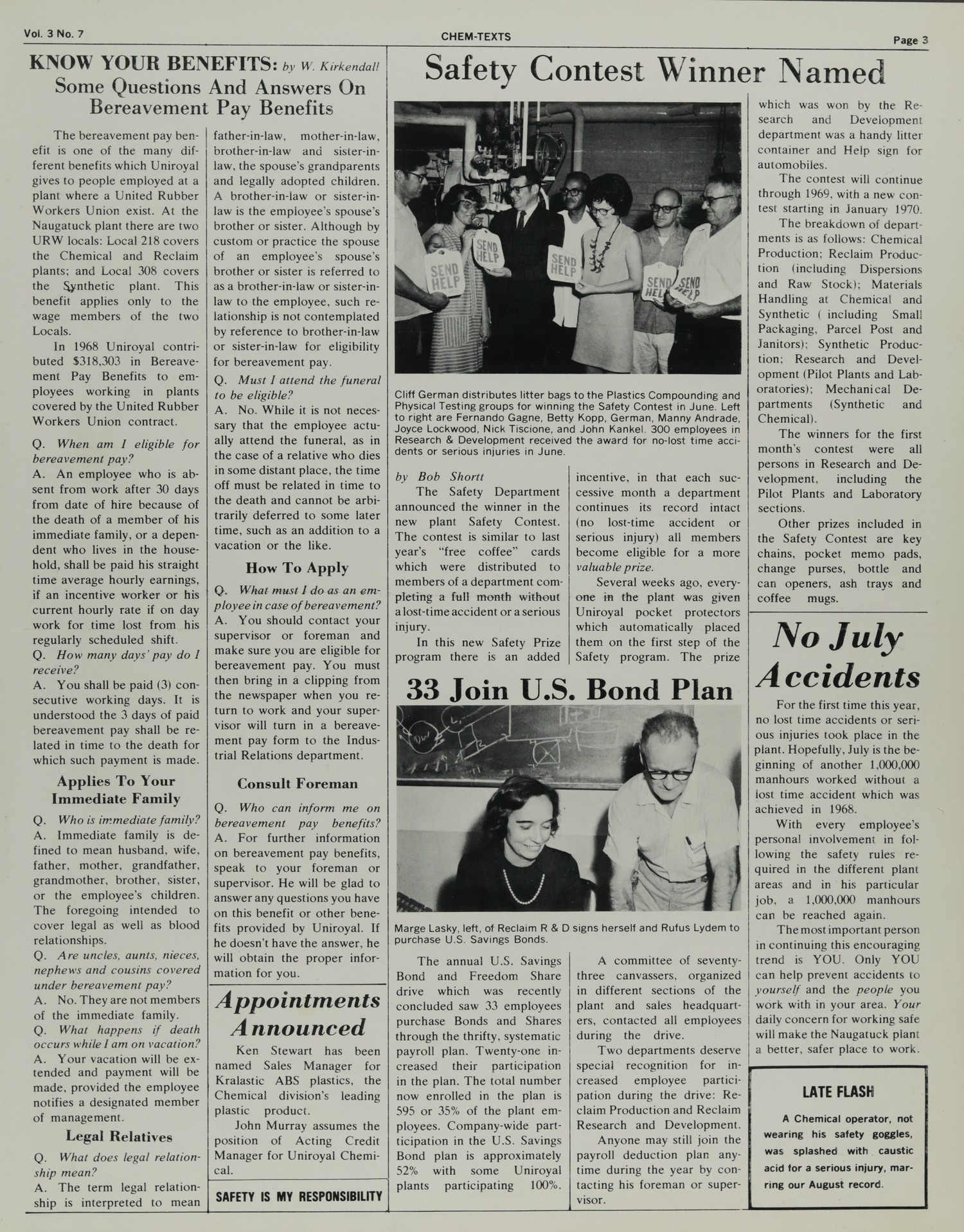
Cliff German distributes litter bags to the Plastics Compounding and Physical Testing groups for winning the Safety Contest in June. Left to right are Fernando Gagne, Betty Kopp, German, Manny Andrade, Joyce Lockwood, Nick Tiscione, and John Kankel. 300 employees in Research & Development received the award for no-lost time accidents or serious injuries in June.

by Bob Shortt

The Safety Department announced the winner in the new plant Safety Contest. The contest is similar to last year’s “free coffee” cards which were distributed to members of a department completing a full month without a lost-time accident or a serious injury.

In this new Safety Prize program there is an added incentive, in that each successive month a department continues its record intact (no lost-time accident or serious injury) all members become eligible for a more valuable prize.

Several weeks ago, everyone in the plant was given Uniroyal pocket protectors which automatically placed them on the first step of the Safety program. The prize which was won by the Research and Development department was a handy litter container and Help sign for automobiles.

The contest will continue through 1969, with a new contest starting in January 1970.

The breakdown of departments is as follows: Chemical Production; Reclaim Production (including Dispersions and Raw Stock); Materials Handling at Chemical and Synthetic (including Small Packaging, Parcel Post and Janitors); Synthetic Production; Research and Development (Pilot Plants and Laboratories); Mechanical Departments (Synthetic and Chemical).

The winners for the first month’s contest were all persons in Research and Development, including the Pilot Plants and Laboratory sections.

Other prizes included in the Safety Contest are key chains, pocket memo pads, change purses, bottle and can openers, ash trays and coffee mugs.


33 Join U.S. Bond Plan

[IMAGE: Two people at desk with bonds]

Marge Lasky, left, of Reclaim R & D signs herself and Rufus Lydem to purchase U.S. Savings Bonds.

The annual U.S. Savings Bond and Freedom Share drive which was recently concluded saw 33 employees purchase Bonds and Shares through the thrifty, systematic payroll plan. Twenty-one increased their participation in the plan. The total number now enrolled in the plan is 595 or 35% of the plant employees. Company-wide participation in the U.S. Savings Bond plan is approximately 52% with some Uniroyal plants participating 100%.

A committee of seventy-three canvassers, organized in different sections of the plant and sales headquarters, contacted all employees during the drive.

Two departments deserve special recognition for increased employee participation during the drive: Reclaim Production and Reclaim Research and Development.

Anyone may still join the payroll deduction plan anytime during the year by contacting his foreman or supervisor.


No July Accidents

For the first time this year, no lost time accidents or serious injuries took place in the plant. Hopefully, July is the beginning of another 1,000,000 manhours worked without a lost time accident which was achieved in 1968.

With every employee’s personal involvement in following the safety rules required in the different plant areas and in his particular job, a 1,000,000 manhours can be reached again.

The most important person in continuing this encouraging trend is YOU. Only YOU can help prevent accidents to yourself and the people you work with in your area. Your daily concern for working safe will make the Naugatuck plant a better, safer place to work.


LATE FLASH

A Chemical operator, not wearing his safety goggles, was splashed with caustic acid for a serious injury, marring our August record.

CHEM-TEXTS – Vol. 3 No. 7 – Page 4

Page 004

Page 4

CHEM-TEXTS

Vol. 3 No. 7

New Union President

Leon Raskauskas recently became President of Local 308, United Rubber Workers which represents the Synthetic plant. Leon replaces Joe Arbachauskas who resigned as president for reason of health. Before his new appointment, Leon had been Vice-President and had served

as President of the Local from 1959 to 1961.

Charlie Roland succeeds Leon as new Vice-President of Local 308.


Blancato Improving

Sam Blancato who was recently burned in a plant accident is well on the road to recovery at the Waterbury Hospital. Sam and his family express their sincere thanks to the many employees who sent him cards, letters and gifts. It’s times like this, Sam pointed out, that you measure your real wealth by the many friends you have.

Anxious to return to work soon, Sam will be in the hospital a short time more for skin grafts. Meanwhile, he looks forward to receiving letters from his many friends in the plant.


Judo Brown Belt Held by Denise Pratt

Denise Pratt, an R & D Analyst, is the proud owner of the Brown Belt. She plans to obtain the Black Belt, a unique distinction in Judo for a woman. Denise has become so expert in Judo that she now teaches a beginner’s course at the Y.W.C.A. in Waterbury.

Judo, the “gentle way”, is an art practiced as a sport, based on the ancient methods of barehanded fighting. It’s a form of wrestling, requiring a special uniform to practice in and may be engaged in by both young and old, male and female.

Judo, which should not be confused with Karate, has a fourfold purpose: 1) physical development; 2) proficiency in a contest; 3) mental development; and 4) the use of minimum effort for maximum efficiency.

A knowledge of Japanese words such as Ukemi, Kata, Uchikomi, Pandori, Hidari

Shizentai is also required in learning the art of Judo. Use of the wrong words may result in an unexpected flip over the shoulder, and a sudden fall on the ground.

Doug Ritchie, Group Leader, left, admires Denise Pratt’s brown belt in Judo. Watching at right is Warren Singleton, Finished Products Supervisor.


600 Deaths Over Labor Day Weekend

Safety seems ignored over the three-day weekends of national holidays. The July 4th weekend caused more than 600 deaths on the highways. Predictions for the long Labor Day weekend estimate another 600 deaths will occur on the highways, by drownings and other types of accidents.

Take safety awareness with you when you travel. Your life, your family’s life and the lives of others are in your hands. By driving defensively – expecting that the other driver will do something wrong – by wearing safety belts; by not following too closely in case of an unexpected stop by the car in front; by not speeding (it may mean a stiff fine and loss of license); and by checking your car and tires carefully, an accident will be less likely to happen to you and your family.

Watch your young children, especially when swimming, boating or fishing. Their curious minds and tendency to stray can cause you many anxious moments and spoil your holiday.

Your safety is in your hands and by expecting the unexpected happening during the Labor Day weekend, you can avoid an accident that may mean serious injury to you and your family.

This fatal accident wiped out an entire family: the mother, father and three small children. Your life, your family’s, and the lives of other people depend upon your safe driving on the highway.

Denise Pratt demonstrates Judo to a student at the Y.W.C.A. where she teaches a beginner’s course in the “gentle way.”


LATE NEWS BULLETIN

It was just learned that Uniroyal is organizing a New Idea Plan to encourage more employees to put their ideas to work. Complete details will be announced shortly. Meanwhile the present Suggestion System is still in effect.


CHEM TEXTS

PUBLISHED BY THE INDUSTRIAL RELATIONS DEPARTMENT
UNIROYAL CHEMICAL, NAUGATUCK, CONN. 06770
EDITOR: William F. Lavelle

UNIROYAL CHEMICAL
Naugatuck, Connecticut 06770

U.S. Postage
PAID
Permit No. 10
Naugatuck, Conn. 06770

RETURN POSTAGE GUARANTEED

CHEM-TEXTS – Vol. 3 No. 8 – Page 3

Page 003

CHEM-TEXTS

Vol. 3 No. 9 Page 3


Everybody’s Giving To United Givers

by Eric Johnson

The United Givers drive is receiving generous response from all employees. Pledges received to date amount to $14,300, which is 65% of the plant’s $22,000 goal. Campaign chairmen feel confident that the drive will exceed the $22,000.

“Give Where You Work” through the convenient payroll deduction plan has received greater support this year from all employees. Every pledge, even if only 25 cents a week, which surely every employee can afford, will help us reach our $22,000 goal. A mentally retarded child, a child with cerebral palsy, or a lonely G.I. in Vietnam will be helped by your pledge. In our hearts none of us can refuse to help these friends and neighbors.

Employees living in Waterbury, Cheshire, New Haven and other cities benefit from the Agencies in the Fund as much as, if not more than, the residents of Naugatuck and Beacon Falls. The U.S.O., Salvation Army and Red Cross are national in scope; the others serve most of the communities in which employees live.

The key word in this year’s campaign is Charity . . . the spirit of giving to help others less fortunate than ourselves. If you didn’t make a pledge, you can still pledge that 25 cents a week by obtaining another pledge card from your department head.

“GIVE WHERE YOU WORK”


Pledging contributions are seated left to right, Carole Calo, Lois Devino, canvasser for Quality Control and Testing Lab, and Sonya Kernasevic. From left standing are Margaret Sweeney, Maria Fidalgo, Anna Pakalnis, Joan Stevenson, Bertha Rascoe and Leslie MacDonald.


Larry Volpe accepts pledge cards from Mechanical Dept. Seated from left are Ralph Buckingham, Ovila Fortier, Odell Hines, Volpe, Adrian Hanley. Standing from left are Sal Falcone, John Napiello, Tony Galletta, Joe Lubinskas, Tony Malone.


Give Exact Employment Place

Telephone operators, front to rear, Mary Dinkle, Ruth Ranslow and Alice Schofield place 25,000 calls a month. Incoming calls are about 50,000 on the 1,000 extensions.

The cooperation of all persons is needed in the following matter which can inconvenience you in your personal affairs.

When it is necessary for you to give your place of employment for reference on personal business, make certain to specify UNIROYAL CHEMICAL or EMIC and give the correct phone number 729-5241. This will speed up the confirmation of your employment.

Fifty telephone inquiries are received daily from banks, stores and loan companies, to verify employment. Many of these calls could be eliminated if you properly state the plant or division where you work. Do not simply use UNIROYAL, because the caller looks upon UNIROYAL in Naugatuck as one plant.


IMPROVEMENTS…

(continued from page 2)

Engineering’s Responsibility

The plant’s engineering department consists of 21 engineers. The group presently has 65 projects in the works for which they are responsible.

But fixing the nuts and bolts; getting machines back into operation; adding an extra year of life to old equipment, and fixing a steam leak requires the skill and experience of the Mechanical department foremen and skilled tradesmen at the Chemical and Synthetic plants.

Investment In People

Plant improvements are essentially an investment in the skills, experience and welfare of the people by the Company. They produce new job opportunities; create better and safer working conditions; and provide the necessary tools and machinery to insure job security in the highly competitive chemical industry.


Free Eye Tests Available

by Sal Aloise

“G Day” is coming up Friday, November 14 for residents of the Greater Waterbury-Naugatuck area.

The “G” stands for glaucoma and a free eye test to spot this dread disease will be given to adults over 35 years of age Friday evening, Nov. 14 from 7 to 9 p.m. at the Warren F. Kaynor Regional Technical School, 43 Tompkins St., Waterbury.

The glaucoma screening is under the direction of the Connecticut Society for the Prevention of Blindness and a number of local organizations are cooperating to plan this event. Doctors from the Eye Section of the Connecticut State Medical Society donate their time to give the simple tonometer test.

Glaucoma is the second leading cause of blindness among people over 35 years of age. It comes on so gradually the victim is often not aware anything is wrong. This is why it has been called “the sneak thief of sight” by Prevention of Blindness people.


Appointments Announced

Hal Lynch was appointed Purchasing Agent for the Naugatuck plant, succeeding Norv Turner who will continue in an advisory capacity until his retirement in November.

Bob Cranney assumes the duties of Manager of the Synthetic Plant Control Laboratory.

Bill Leukhardt received a special assignment as Production Coordinator.

Doug Klima appointed Process Engineer for the Synthetic plant.


New toluene drying column at Synthetic Pilot Plant will be used to make new types of rubber.


Julius Banno, foreground, machines parts for reel beaters used in Cracking dept. while Ray Goglewski, rear, machines a tuber screw for Millroom B.

CHEM-TEXTS – Vol. 3 No. 8 – Page 4

Page 004

CHEM-TEXTS

Page 4 | Vol. 3 No. 9


Chemical Royals Win Softball Title

[PHOTO: Group photo of softball team members]

Pete Lazaras holds trophies won by Chemical Softball team. In front left to right are Curt Rice, Pete Byra, A. Sardanopoli, Lazaras, Ted Hudzik, and John Zappala. In rear, left to right are Ron Stark, Al Zonas, Vin Rooney, Carl Wehmann, Dan Shantz, Al Zimmermann, John Johnson, and John Swanson, manager of the team. Absent were Brad Swain, Mike Jasman, Jerry Lambiotte and John Shiley.

by J. Swanson and J. Prior

The Chemical Royals took first place in the Naugatuck News Twilight League National Division, winning the first half championship easily but facing a tough task in the second half when they were forced to play a 3-game playoff which they won.

Fighting for the pennant with one of their key players sidelined with an ankle injury, the Royals lost two tough games and their opportunity to take the pennant.

Leading batters for the team were John Johnson, with .595 and Vin Rooney with .509. Dan Shantz led in RBI’s with 53 and Carl Wehmann had 33. Shantz was also the team’s leading slugger with 9 homers. Jerry Lambiotte with a 15-9 pitching record, backed up by the relief pitching of Pete Lazaras with a 5-2 and John Swanson’s with a 4-0 record, helped lead the team to a victorious season.

The Synthetic Cardinals finished the season with a 20-12 record taking second place. Pete LaCharity led the team in batting with .535, followed by John Stamm’s .525 and Charlie Roland with .514. Eric Johnson was the team’s slugger with 12 home-runs. Howard Slason coached the team which consisted of Jim Shea, Joe Wojtczak, Bill Broden, Bill Stinson, Keith Hughes, Fernando Henriques, Vic Kloc, Howard Nixon and John Prior.


CHEM-TEXT Article Promotes Kralon®ABS

1000 reprints of the Kralon® ABS article in CHEM-TEXTS were sent to customers by Rom Rhome, Market Manager for pipe sales. The article discussed the new market potential for Kralon® ABS as underground conduit to replace the unsightly overhead utility poles and wires which mar city streets and the country’s highways.


Joe Bielak, Howard Hogan Retire

[PHOTO: Group of men with retirement cake]

Joe Bielak, seated, D & G foreman shows cake he received on his retirement after 30 years service. Ready to cut the cake are left to right, Tom Carey, Florian Taranovich, George Allen, Joe McKee, Sam Molnar, and Gus Birch.

[PHOTO: Group of men at retirement celebration]

Charlie Roland, URW Local 308 Vice President, congratulates Howard Hogan of the Instrument Dept. after 43 years’ service. Left to right are John Geary, Charlie Roland, Howard Hogan, Fred Simasek, Norm Brummett, and Tom Palmieri.


It Hops, Skips, Jumps and Runs

The new Attex, designed by Uniroyal and the ATV Manufacturing Company does everything but fly. Used for rescue work, hunting, and fishing in almost inaccessible areas, the impact-resistant and steel-like Royalite body is made from Kralastic® ABS, a Chemical division plastic product.

Attex rides on 6 low pressure flotation tires that replace shock absorbers and eliminate the suspension system. The Uniroyal tires feature an exclusive side tread design for extra traction in deep snow and sand; and the deep reverse tread design provides increased maneuverability on water.

The upholstery for the Attex is made from Marvinol® vinyl.

The retail price for the Attex is $1,495.

[PHOTO: Attex vehicle emerging from water in Central Park]

Attex, the newest all – terrain vehicle, climbs out of pond in Central Park, New York with the greatest of ease. The tough, steel-like body is made from Kralastic ABS and contains two plant chemicals. The Research and Development work on Kralastic and Marvinol is done at our Labs and TSSC Bldg.


Employee Benefits Hit $10,826,594

In the first six months of 1969, Uniroyal paid 58,465 claims, totaling $6,218,000 for hospital-surgical bills of Uniroyal employees.

As of March 31, 1969, the Company paid out $4,608,594 in group life, accidental death and dismemberment insurance which covers most employees and retirees in the United States.

The total of these benefits amounted to the staggering sum of $10,826,594.

“GIVE WHERE YOU WORK”


CHEM TEXTS

PUBLISHED BY THE INDUSTRIAL RELATIONS DEPARTMENT
UNIROYAL CHEMICAL, NAUGATUCK, CONN. 06770

EDITOR: William F. Lavelle.


UNIROYAL Chemical
Naugatuck, Connecticut 06770

U.S. Postage
PAID
Permit No. 10
Naugatuck, Conn. 06770

RETURN POSTAGE GUARANTEED

CHEM-TEXTS – Vol. 3, 1969, No. 10 – Page 1

Page 001

UNIROYAL CHEM-TEXTS

Vol. 3, 1969 PUBLISHED FOR THE PEOPLE OF UNIROYAL CHEMICAL No. 10


The Small Plant In A Big Plant


Exterior of Chemical Pilot Plant is deceptive in appearance. Inside it’s a maze of piping, reactors, and equipment to make new products.


by Gary Arndt

The Chemical Pilot plant, a one story brick building in the Chemical yard, is almost lost among the 142 plant buildings that comprise the Naugatuck plant. Not very impressive from the outside, the pilot plant contains some of the most modern equipment in the chemical industry. Inside is a maze of complex piping, sophisticated reactors, and control systems.

Makes Chemicals For Plant

The pilot plant, operated by the Research and Development department, serves as a small scale plant to evaluate new processes as well as to manufacture new products, preparatory to their production in large volume in the main plant. It also produces low volume chemicals where it would not be economical to build a plant and manufactures several intermediate chemicals which cannot be purchased commercially but are required for the plant’s overall operations. New experimental chemicals are also made by the pilot plant for evaluation by our customers, universities, and the agricultural industry to help develop new markets for us.


Alar® Made In Plant

A large production run of Alar Tech was recently completed. This new growth regulant prevents apples from dropping off the trees and in-


Tony Cilfone, left and Jerry Ferguson discuss the new 100 gallon reactor fitted with mechanical seal agitation and automatic temperature control.


Ben Pranulis, left, and Fran San Angelo operate basket centrifuge used to separate solids from liquids.


creases their storage life. Another chemical produced by the pilot plant is Cyclohexene Oxide, which is an intermediate chemical used in the manufacture of Omite® a new agricultural chemical, used by fruit growers to control mites from chewing up the leaves on their fruit trees.

Improves Safety And Production

The pilot plant contains some of the most modern, expensive equipment in the chemical industry to help us produce better quality products. A year ago a newly purchased Centrifuge-Dryer system, the only one of its kind here in Naugatuck, was put into use. Its purpose was not only to increase the production of Alar, but also to handle the solvent drying step in the process safely. A new 100-gallon reactor fitted with mechanical seal agitation and automatic temperature control was recently installed to improve product quality and make the operator’s job easier.

SAFETY IS MY RESPONSIBILITY


Good Morale, Housekeeping

Good morale is hard to define but it’s clearly evident among the people working in the pilot plant. A cheerful, cooperative atmosphere exists and the work-together attitude helps take the humdrum out of the daily routine of the job that everyone experiences. Also noticeable when you enter the pilot plant is the good housekeeping condition of the area. Materials and drums are properly arranged and the area is free of trash and rubbish.

Working in the plant which operates three shifts around the clock are Joe Poudrier, Bob Enamait, Harris Detlefsen, Fran Pikula, Dan Pinto, John Lydem, Julius Cohen, Marcel Hebert, Chris Owens, Al Grella, Tony Cilfone, Fran SanAngelo, Jerry Ferguson, Ben Pranulis, and Casimiro Pereira. Other members of the group are Don Bates and Julius Rek, foremen; and Bronis Zukauskas, materials supervisor. Group Leader for the Chemical Pilot Plant is Colin Walker.

CHEM-TEXTS – Vol. 3 No. 10 – Page 3

Page 003

CHEM-TEXTS

Vol. 3 No. 10 | Page 3


Production Goal Topped By Synthetic Plant’s “C” Crew

The Synthetic Processing C crew averaged 9.2 charged batches of latex daily for one full week, surpassing the 9 batches processed by the A crew recently. This production rate is a significant step in improving our competitive position by manufacturing a lower cost product.

The latex business today is a highly competitive business with large chemical companies as Dow, Goodrich, General Tire, Firestone, Shell and Goodyear competing with us for the same markets and customers. Efficient production of a quality latex, and prompt customer service are essential factors in keeping and improving our present business and ultimately better job security. Like ourselves, our customers are “shoppers”; they shop for the best products at the best price.

Although the C crew went over the goal, it required the combined effort of the A and B crews to achieve it. Continued production of 27 batches a day requires the fullest effort of every person in the Synthetic plant, as every employee in every department plays an important role in its success.


[PHOTO CAPTION:]
In rear left to right are Ralph Pilbro, Howard Slason, Rocco Magnamo, Foreman, and Joe Morrison. Left to right in front, Jerry McCabe, John Kennedy, and Bill Wasilus.


[PHOTO CAPTION:]
Other “C” crew members are rear left to right, Leonard Dumonski, Fred Miller, Fernando Henriques, Al Happy. Left to right front are Frank Dowling and Frank Giordano, Ass’t. Dept. Foreman.


Answer First Ring

Ever feel like throwing the telephone out the window? Or wonder why you go home from work with a splitting headache, tense and tired.

With almost 1,000 phones including extensions, and 50,000 incoming calls a month, plus the thousands of intra office calls each day, the telephone has become a serious detriment to the quiet needed to concentrate on our work, and a tension builder.

By answering the phone on the first ring, you can help reduce the noise in your area. If someone is away from their desk be courteous, and answer their phone. And if you’re the caller and no one answers, after a few rings hang up and call later.

Until the telephone company invents a soft, sweet, musical ring, try answering your phone on the first ring. You’ll go home feeling better . . . and customers will consider us an efficient, interested company.

And always answer the phone in a courteous manner.


No Lost Time Accidents In October

by Sal Aloise

During the month of October we had no lost time accidents, but we did not get away free completely. Injuries did occur during the month, however, which were of a serious nature.

8 Serious Injuries

During October we had eight serious injuries, all of which could have been prevented: one eye injury; 4 sutures; and 3 work changes.

With more effort and more concern, we can and will prevent careless accidents. If everyone helps, we will have an injury-free plant in which to work.

There is an old saying that “repetition is the essence of learning”. Only by constantly repeating to ourselves that “safety is my responsibility” will each employee have a greater concern for his own safety and the safety of his fellow employees. No matter what is done in the plant to improve safety conditions, accidents will happen unless every employee continually reminds himself that he is responsible for his own and his fellow employees’ safety.


Rubber Causes Minor Fire

An accumulation of rubber in the housing of a digestor caused a fire recently through spontaneous ignition. The rubber had worked out of the gasket around the agitator drive shaft and accumulated in the housing between the drive motor and the digestor.

Alert Employee Prevents Damage

An alert employee used a dry powder fire extinguisher to put out the fire and completely covered the rubber accumulation, preventing a reflash before the housing was cleaned out.

Good Housekeeping Prevents Fires

The fast removal of such rubber accumulation is extremely important in the prevention of fire. Good housekeeping around the digesters and Holo-Flite dryer is the only way to prevent spontaneous ignition of rubber, oil and grease from coming in contact with the extremely hot operating equipment.


SAFETY IS MY RESPONSIBILITY


PLANT URW LOCALS ELECT OFFICERS

[PHOTO CAPTION:]
New URW Local 218 officers are from left, Don Boyles, secretary; Dom Persutti, vice-president; Joe Rzeszutek, president; and John Hoey, treasurer.


[PHOTO CAPTION:]
Officers of Local 308 will hold office for next two years. From left are Charlie Roland, Vice President; Leon Raskauskas, President; and Rocco Manulla, Treasurer. Standing is Archie Civitello, Secretary.


by Joe Rzeszutek, and Leon Raskauskas

Local 218 of the United Rubber Workers which represents wage employees in the Chemical plant elected Joe Rzeszutek, President; Dom Persutti, Vice-President; Don Boyles, Secretary; and John Hoey, Treasurer in recent held elections for a two-year term.

Elected to the Executive Board were Henry Hook, Edith Evans, Bill Fruin, Frank Maffia, Frank Commendatore, Julius Cohen and Harry Arendholz.

Lost Production Costs Money

Although the fire wasn’t serious, and no damage incurred, it stopped operations and caused lost production time.

Every employee has an individual responsibility to maintain good housekeeping and safety standards in his area. Our safety and jobs depend upon it.

Named Trustees for the Local were Frank Wasilesky and Harry Grant.

Leon Raskauskas was elected President of the United Rubber Workers Local 308 representing the Synthetic plant wage employees. Charlie Roland was elected Vice-President, Archie Civitello, Secretary; and Rocco Manulla, Treasurer.

Executive Board members elected were Walter Bieleski, Art Calder, Ernie Molnar, Wes Burns, John Sullivan and Joe Adamaitis.


Uniroyal Gets $1,478,000 Contract

Uniroyal received an Air Force contract of $540,000 for tubeless aircraft tires as a supplement to a previous contract of $938,000 for a total award of $1,478,000.

Big tire orders depend strongly on the quality of the chemicals made at the Naugatuck plant, and help keep us in business.

CHEM-TEXTS – Vol. 3 No. 11 – Page 3

Page 003

CHEM-TEXTS

Vol. 3 No. 11 | Page 3


Nine Employees Retire With 336 Years’ Of Service


Volpe, Carroll Had 47 Years With Plant

JOE SMEY retired from the Purchasing department after 40 years service. Joe was a buyer-supervisor of packages used in the plant.

AL CUSSON a department shift foreman in Reclaim Production, retired after 33 years service.

CHARLES HOTCHKISS retired from Mechanical Stores after 27 years service.


$132,000 Paid To Employees For Tuition

Tuition Aid is one of the many Company benefits which Uniroyal employees enjoy. It is available to both salary and wage employees.

Uniroyal paid $132,000 in Tuition Aid for employees in the year ending August 1969. A total of 729 employees took job-related courses under the program, designed to help employees gain or increase their job-related skills. A total of 29 college degrees were awarded to Uniroyal employees under the program.

At the Naugatuck location, 73 employees have improved their education by taking graduate and post-graduate job related courses at colleges in the area. Several employees will receive their master degrees in Business, Engineering and Chemistry this year.


[Photo Caption – Top Left]
Larry Volpe, center, General Foreman in the Mechanical department, receives best wishes on his retirement after 47 years. From left are Julius Banno, George Holmes, Volpe, Ted Hubbell, and Bill Mariano.


[Photo Caption – Top Right]
Angie Mariano, seated center, is congratulated by members of the Control department on her retirement after 39 years service. Seated from left are Edna Crycheau, Angie, and Helen Southard. From left, standing are Marie Marrello, Julie Curtin, Theresa Dalton, Jack Dunn, Joyce Lucarelli, and Marcella Pape.


[Photo Caption – Middle Left]
Leo Carroll, Foreman of the Piper department is swarmed with congratulations on his retirement after 47 years. Seated from left are Joe Samoskas, Carroll, and Frank Pat. In rear from left are John Hoey, Ray Gogolowski, Jim Shea and Tony Galletta.


[Photo Caption – Middle Right]
John Geary, Instrument department Foreman with 27 years service, receives best wishes on his retirement, from at left Elmer Anderson, Joe Adamaitis, Bill Lannon, Tom Palmieri, Geary, Carl Steelfox, Norm Brummett.


[Photo Caption – Bottom Left]
Purchasing department congratulates Norv Turner, seated, on retirement after 39 years. From left are Hal Lynch, Lucy Borzencki, Ed Sands, Dick Krajewski, Jim Heagle, John Callahan, Madelyn Malone, Joe Little, Pat Petti, Edith Dalleywater, and George Louis Jr.


[Photo Caption – Bottom Right]
Paul Suba, center, of Vibrathane Research and Development is congratulated on his retirement by Al Zimmermann after 37 years service. From left is Lou Esposito, Rose Wasoka, Suba, Corrine Guerrera, and Zimmermann.

Duration Record Will Be Set In URW Strike

6-16-67

Duration Record Will Be Set In URW Strike

If the United Rubber Workers strike continue past Saturday, a new record will be set for duration of strikes in the rubber industry. In 1959, the Firestone Tire and Rubber Co. was struck by URW for 58 days.

Negotiations continued yesterday with the groups still discussing a counter-proposal submitted by the union last week. Talks are scheduled to continue today.

The membership of the three borough Locals faithfully take their turn at picketing at the plants here in Naugatuck. The pickets are stationed at the Footwear plant gates from 6 a.m. to 6 p.m. leaving their strike placards hanging on the gates at night. Pickets are at the Chemical Co. gates on a round-the-clock basis; sitting in their cars on rainy days and can be seen lounging on blankets on the hot humid days.

Some strikers have found other employment on a full time basis in other industry in the area, according to reports, terminating their employment at UniRoyal.

The union is seeking a higher hourly rate and a 95 per cent supplementary benefit for workers who are laid off. The “Big Five” has dubbed the demand as a “request for a guaranteed annual wage.”

Tire workers currently average $3.69 an hour while other production workers average $2.68. The union is also trying to do away with the pay differential for the two classes of employes.

Negotiations between the rubber companies and the union continue on a daily basis but, thus far, there has been no signs of settlement.

According to sources, true negotiations have begun at last. Both sides are giving on a few minor points.

Sessions began in Cincinnati on March 20, one month before the contract was due to expire. Up until this point, neither side was willing to give. The companies knew what they wanted to give and the union clung to its demands.

Uniroyal Resumes Talks With URW

7-21-67

Uniroyal Resumes Talks With URW

CLEVELAND (AP) — It’s three down and two to go, a United Rubber Worker spokesman said Thursday after the union and Firestone Tire & Rubber Co. agreed to a tentative three-year contract.

The Goodyear Tire & Rubber Co. and Uniroyal resume bargaining with the URW today.

Firestone, the B. F. Goodrich Co. and the General Tire & Rubber Co. all settled within one week for the same basic contract, setting a pattern that could be followed by the last two. firms.

A Firestone spokesman said it was the “largest package negotiated in 30 years.”

If ratified, the company said 17,000 production workers in 11 plants will go back to work as rapidly as facilities can be reopened and schedules established.

The hourly wage hike in the Firestone settlement is 43 cents over three years, with skilled workers getting an extra 10 cents the first year. Top hourly rate is now $3.88. The contract expires April 20, 1970. Various benefits also were increased.

Local 218 Protests Uniroyal Statement

Local 218 Protests Uniroyal Statement

Local 218 Protests Uniroyal Statement

5-28-67 [handwritten date in top right corner]

NAUGATUCK—Officials of Local 218, United Rubber Workers, claimed Saturday that “inaccurate statements were made by the factory manager of Uniroyal Chemical Plant”, in relation to the management’s decision to use supervisory personnel to operate process equipment at the plant while the company is being picketed by the local in its strike for the past five weeks.

Union officials said Saturday: “The union wishes to set the record straight on the qualifications of the supervisory personnel who are operating the process equipment.

“Mr. John Evans, plant manager, stated that the supervisors normally train the regular operators, when in fact new or transferred operators are trained by qualified operators from the bargaining unit.

“Mr. Evans’ consideration for the safety of personnel, as well as the residents of Naugatuck, can be refuted by the fact that in some instances it has taken months to force the company to correct safety hazards in the plant. It also has been necessary to resort to the grievance procedure and use the extreme measure of refusing to operate some process equipment.

“As for the production of material vital to the defense effort in Vietnam, only one item is indirectly related to the Vietnam conflict, which is the protective stripping used by sub-contractors for shipping purposes. All other production being done in the plant is strictly for commercial purposes.

“The inaccurate statements made by the factory manager of Uniroyal Chemical can be attributed to his inexperience due to the fact that he was only recently appointed to the post of factory manager,” the officials claimed.

Mass Picketing At Synthetic Plant Leads To Arrest Of Four Persons

Mass Picketing At Synthetic Plant Leads To Arrest Of Four Persons

Mass Picketing At Synthetic Plant Leads To Arrest Of Four Persons

5-31-67 [handwritten notation]

NAUGATUCK—Mass picketing by members of Local 308 at Uniroyal’s Synthetic Plant, this morning, led to the arrest of four pickets, after an attempt was made to prevent management personnel from entering the plant.

Two of the pickets had to be forcibly ejected by police, following the reading of the riot act from the state statutes by Capt. Joseph Summa, when they refused to step aside for the plant’s personnel. All personnel entered the plant, after a wedge had been formed by about a dozen police breaking the picket line.

The four arrested were brought to police headquarters, for booking in the patrol cars. However, about 30 of the pickets also arrived at the station asking to be arrested in sympathy with those already arrested.

Arrested on charges of breach of peace were John A. Painter, 38, Morris Rd., Prospect; Paul Laurenzi, 41, 30 Serry Rd., Wolcott; Jesse J. Silva, 23, 143 Cherry St. and Anthony Gambardella, 54, 53 Brichwood Rd., Seymour. Court appearances were set for June 8.

Edward Alves, president of the local, said this morning that management had informed the union that production would begin at the plant today, which had resulted in the mass picketing.

Questioned Decision

Alves questioned the decision of the management, criticizing its actions in attempting production with “unskilled personnel.” The union president further asserted that because of the “danger of work involved at the plant, a disaster could occur, not only endangering the lives and property of those in close proximity to the plant, but to also those in the neighborhood.”

Alves said the union has contacted the insurance company on whether they had been informed of the production work by the unskilled personnel and reported the insurance company had not been notified to date. He said periodic inspections are conducted at the plant due to the nature of work involved.

Third Plant Involved

The mass picketing at the Synthetic Plant, makes the third plan of the Uniroyal company to be involved since the three plants were struck 41 days ago.

Both Locals 218 of the Chemical and 308 of Synthetic Plants have maintained around-the-clock picketing since the beginning of the strike.

It could not be determined today if management will seek an injunction against the Synthetic Local.

UniRoyal Struck As Talks In Ohio Come To Stop

UniRoyal Struck As Talks In Ohio Come To Stop

4-21-67 [handwritten notation]


PICKETS formed this morning on Maple St. in front of the Central Office of UniRoyal’s footwear division. Everything was done in an orderly fashion and no incidents have been reported. Negotiations between the rubber firm and the union broke down shortly after midnight today.

—(News photo by Nichols)


By CYNTHIA BARAN
and
RUTH NICHOLS

United Rubber Workers Union members struck UniRoyal, Inc., and three other giant rubber firms across the country today as contract negotiations in Ohio came to a halt.

Approximately 65,000 workers for the rubber firms are out, including some 22,000 UniRoyal employes, about 5,000 of which are in Naugatuck.

A company official said today it had offered to continue the contract on a day-to-day basis but that the union declined.

Negotiations broke down shortly after midnight this morning, and a new session has not been scheduled as yet.

The situation in Naugatuck is very quiet with everyone apparently keeping an eye to the Ohio negotiation scenes.

Local police, which has added 10 extra patrolmen to duty, reported no incidents.

UniRoyal workers maintained an all-evening vigil while waiting for word from the negotiation table in Cincinnati, Ohio. At 12:30 a.m., George Froehlich, president of Local 45, got a phone call through to headquarters with one word: Strike!

Within minutes, picketing was organized and third shift workers were pouring out of the gates. Several workers interviewed said they hoped the strike would end soon.

John Braziel, a member of Local 45, said, “Although we don’t like to go on strike, it is sometimes necessary to settle contract disputes.”

When asked what they will do during the strike, many workers, hoping the strike will not be too long, said they would “do spring cleaning in the house and in the yard,” “relax,” “picket.”

The strike affects four major rubber companies, Firestone, Goodrich, Goodyear and UniRoyal. In Naugatuck, the chemical, footwear and synthetic divisions will lie idle until the strike is settled.

Headquarters at the Portuguese Club were occupied all evening. Phone calls were frequent. By 11:30 the phones were ringing incessantly. At 11:45 Froehlich called informing the other union officials that Firestone had left the negotiation table, but that UniRoyal was still bargaining. He indicated that “it did not look good.”

It appears that the strike was called after the management of the company offered its counter proposal which did not satisfy the workers’ representatives.

Earlier in the evening, local residents speculated on the possibilities of a strike. “I think they’ll go on strike and if they do it’ll be a long one.” A store clerk, “I want one so I won’t be so busy here, but then again, I don’t want one because my mother will be home to keep a stricter eye on me.” Customer at a local gas station, “A strike is bad for any town.”

Froehlich Returns From Ohio Parleys

Froehlich Returns From Ohio Parleys

4/25/67 [handwritten]

NAUGATUCK—Union members of Locals 45 and 218 of United Rubber workers were informed on the progress of negotiations in Cincinnati although union officials declined to say what specifically had been discussed at the meetings Monday.

The presidents of the three locals, George Froehlich from Local 45, Joseph Rzeszutek from Local 218 and Edward Alves from Local 308, returned from Cincinnati over the weekend for a breather and a chance to talk to the union members.

Whether the meetings held were for information only or for policy review was not learned, although Froehlich siad he had “met with the executive board” Monday morning. He will return to Cincinnati today to resume negotiations Wednesday.

Although picketing remains quiet at the borough operations, with no official report of difficulties, officials of the Chemical Division, Local 218, report that members of the local will picket the plant “24 hours a day, seven days a week.”

In addition, it was reported, members will picket in three-hour shifts. Local 218 began a buildup of picketing Friday when some members decided to picket throughout the night and most of Saturday.

Local 45, Footwear Plant, continue to picket in two-hour shifts from 6 a.m. to 6 p.m. The same procedure is being used by Local 308.

The Associated Press reported that pickets from a rebel Chicago local paraded Monday at facilities of the Goodyear Tire and Rubber Co. — the only one of the industry’s “Big Four” not hit by a URW strike.

Work continued on a day-by-day basis at Goodyear under a contract extension after the contract ran out Thursday.

Although talks are reportedly still in progress between Goodyear and the URW, some 500 members of Local 532 walked out at Goodyear’s industrial hose plant in North Chicago. Local leaders said they would try to urge other Goodyear locals to follow suit.

A score of pickets at the plant carried signs saying,”Must we stand alone?” and “Local 532 on strike.”

Besides the approximately 5,000 workers at the borough Uniroyal plants, some 16,000 other Uniroyal employes connected with the URW are on strike, as are 17,585 at Firestone and 10,930 at B. F. Goodrich.

2 Union Vice-Presidents Included In Arrests; All Charged Breach/Peace

2 Union Vice-Presidents Included In Arrests; All Charged Breach/Peace

Sep 67 [handwritten notation in top right]

By Ruth Nichols

Forty-three UniRoyal strikers were arrested this morning including Raymond Mengacci, vice-president of Local 45 and Cy Blanchard, vice-president of Local 218, as police attempted to restore order to the picket lines on Maple St.

In the midst of the scuffle, which began early this morning, one man, Nunzio Finateri, about 51, was taken to St. Mary’s Hospital with a possible heart attack.

Both policemen and pickets received minor injuries as management attempted to cross the lines to enter the UniRoyal buildings.

Maple Street was closed to traffic about 7:30 this morning for an hour, until order was restored. By 8 a.m. all office workers were allowed through the line without incident.

Several groups of women gathered together on Church St. and waited for their male supervisor before attempting to enter the offices.

The first group of strikers arrested were brought forcibly to police headquarters; later however, the mood changed and the arrested strikers came in on their own to be booked. All strikers were charged with breach of peace and bond set at $150.


It was noted however, that although Local 45 is 80 per cent women, only men were booked this morning. Three police officers were at the desk, one in the file room and one in the detective’s room, booking the men as fast as possible to clear out the station.

When the bookings first began, the main room of headquarters was so full that those arrested were lined down the hallway.

Capt. Joseph Summa, in charge of the special force on strike duty, ordered a crowd dispersed outside the station where a retired employe of UniRoyal was attempting to incite pickets and stop the white collar workers from entering the buildings.

No personnel were entering the buildings through the warehouse, but rather coming through the Maple St. gate and then crossing over into the warehouse area.

Both policemen and strikers were bruised in the melee. Some women were on the outer edge of the picket line with others in the center.


women on the outside left the line and the women in the center had to wait their opportunity to leave.

Officer Jerry Sirica was the officer in charge of the policemen on duty at the Maple St. gates under the supervision of Capt. Summa.

Policemen received twisted arms, kicks in the shins, feet stepped on, and in one case, a hand bitten as they struggled with the pickets.

The pickets were ordered to keep moving in an orderly fashion once the scuffling was over until calm was insured.

Rumors are strong that a restraining injunction will be served upon the URW Unions before the day is out, but no confirmation has been received.

A report of police brutality was threatened following an incident last night when attorneys were trying to leave the plant and the picketers were not going to permit them through.

To add to the general confusion this morning, crowds of people were going home from St. Francis Church, adding to the already heavy traffic flow.


than 24 hours that UniRoyal would attempt to move some materials out of the warehouse on Rubber Ave. early this morning.

By noon today, however, no activity was attempted in this direction. Orderly picketing was going on by a large group of strikers on Elm St., next to the warehouse.

Union leaders were dividing their times between the Maple St. gates, the Rubber Ave. warehouse and another warehouse in Beacon Falls. Some picketers were picked up from the Rubber ave. facility and driven to Beacon Falls to add to those already there.

Rumors about the activity in the two towns ran rampant this morning. Word that more than 100 people had been arrested was heard being passed from picket to picket.

ONLY MOMENTS BEFORE he was arrested by Naugatuck police this morning, Cy (Doc) Blanchard, center, held the attention of striking members of Local 45, United Rubber Workers, at the central office entrance of the Uniroyal Footwear plant. Blanchard, vice-president of Local 218, URW, at the firm’s striking Chemical Division, was among union officials and members arrested today.—King Photo.

5-4-67

ONLY MOMENTS BEFORE he was arrested by Naugatuck police this morning, Cy (Doc) Blanchard, center, held the attention of striking members of Local 45, United Rubber Workers, at the central office entrance of the Uniroyal Footwear plant. Blanchard, vice-president of Local 218, URW, at the firm’s striking Chemical Division, was among union officials and members arrested today.—King Photo.

DOZEN POLICEMEN stand in a cluster at a Maple St. gate of Naugatuck’s Uniroyal footwear plant today moments before moving into crowds of striking United Rubber Workers to make arrests for breach of the peace. Those arrested were escorted to nearby Police Headquarters for booking.—King Photo.

Uniroyal Quiet After Flareup

Uniroyal Quiet After Flareup

5-5-67

NAUGATUCK — After a Thursday morning flareup between police and pickets at the Uniroyal Footwear Division plant, in which 50 people were arrested on charges of breach of peace, the scene became quiet for the remainder of the day, even to the point that pickets permitted a postal shipment to leave the main warehouse.

Negotiations between top management and labor representatives continued during the day in Cincinnati without settlement, and at the end of the day, the rumored injunction being sought by management had not been received.

Police Chief Frank J. Mariano said Thursday night that he attributed the calm which prevailed after the clash to the “excellent cooperation” among those arrested, particularly to two high ranking local officials.

Chief Mariano said that he felt that the police force, under the leadership of Capt. Joseph Summa, had done “an excellent job” quieting things down, but that the job might have been more difficult ha d Local 45 Vice President Raymond Mengacci and Local 218 Vice President Cyrus Blanchard not cooperated as they did.

The actions of Mengacci and Blanchard, said Chief Mariano, “averted possible rougher incidents.” When the two vice presidents were arrested, he added, the peaceful attitude which they exhibited set the tone for the remaining pickets, who went quietly to the police headquarters.

At about 5 p.m., according to Local 45 Secretary Rita Ruggiero, a postal shipment was permitted by pickets to leave the main warehouse. Rumors that a shipment would be made by helicopter remained rumors, and no such shipment was made.

The scuffle in the early hours of Thursday morning brought out the entire police force, some of whom had had only a few hours rest before the call to return to duty.

In addition to the regular force, supernumerary policemen were called out to force their way through the 100-man picket line at the Maple St. gate, and provide a passage way for office and supervisory personnel. The office personnel eventually made their way in.

The first group, arrested about 6:45, had to be physically forced to the police station, across the street from the trouble spot. Only after Police Capt. Joseph Summa read the riot act in the state statutes over a bullhorn to the unruly crowd did the commotions begin to settle.

Women in the picket line and in the group trying to get into the plant began to cry as the tension mounted, and the evidence of possible physical violence rose. Police blocked off Maple St. to all traffic during the height of the scuffle.

Although police did not use clubs or other devices to restrain the picketers, several minor injuries were reported. One striker, Nunzio Finateri, 52, Union City Rd., was taken to St. Mary’s Hospital, Waterbury, where he was X-rayed, treated the scuffle, and complained of pains in his chest.

Several policemen and picketers were bruised in the clash, although there were no reports of medical treatment other than Finateri’s

At 7:45 a.m., when workers for the 8 o’clock shift began to arrive, a second outbreak flared up, but was quickly squelched by police.

Those arrested during the second outbreak did not resist being taken to the police station, as the first group had.

As to what would happen Friday, when office workers and supervisory personnel are to return to work again, Mengacci said, “We haven’t got the slightest idea. We have been conferring with our attorneys, and we expect to play it by ear as we go along. We have heard that we will be served with an injunction, but have not received any word to date.”

LOOKING SULLEN as management and office workers file into the Maple St. gate of UniRoyal Raymond Memorial, vice-president of Local 45, URW, checks each person to be certain all are UniRoyal employees. Some who didn’t have UniRoyal badges shown prominently were asked to display them.

LOOKING SULLEN as management and office workers file into the Maple St. gate of Uni-Royal, Raymond Mengacci, vice-president of Local 45, URW, checks each person to be certain all are UniRoyal employes. Some who didn’t have UniRoyal badges showing prominently were asked to display them. —(News photo by Jensen)


[Handwritten note on right margin:]
8-5-67

Court Restrains Uniroyal Pickets

Court Restrains Uniroyal Pickets

5-6-67 [handwritten]

By PATRICK KEATING
Register Staff Reporter

NAUGATUCK — Management of the Footwear Division, Uniroyal, was granted an injunction against Local 45, United Rubber Workers, Friday afternoon at Waterbury Superior Court which will restrict the overall picketing by the union of the plant, effective immediately.

See PHOTO Page 25

The injunction, which had been sought by Uniroyal, will limit the manner of picketing and also restrain the union from stopping management personnel, company trucks, and independent carriers from entering and leaving the Footwear premises.

Management had requested the court action to curb in the future any near-rioting that was prevalent Thursday and Friday as pickets clashed with management personnel and police.

Seventy-one union members were arrested for a breach of peace and several hospitalized during the two-day outbreak.

Local 45 had challenged the entry of office help and supervisors, and also sought to prevent the company from shipping merchandise to its customers.

Friday afternoon, the company was able to have the New Haven Railroad switch five freight cars into its central warehouse. These cars are being loaded by male supervisory help and will be shipped as early as possible.

Pickets were unsuccessful in their efforts to prevent the freight cars from entering the warehouse on its spur line. The switching engine was manned by railroad officials as the regular crew, members of the Brotherhood, recognized the strikers by refusing to cross the picket line.

Two of the pickets were injured slightly by contact with the moving freight train which forced the strikers to jump to

See UNIROYAL Page 2

Five Hurt When Train Won’t Stop

Five Hurt When Train Won’t Stop

5-7-68 [handwritten]

NAUGATUCK—An attempt to push five railroad freight cars into a Uniroyal warehouse on Elm St. Friday afternoon resulted in injuries to at least five men as police officers tried to move picketing United Rubber Workers out of the way of the constantly moving train.

According to reports from some of those involved in the incident, a locomotive and five cars approached the gate leading to the warehouse at about 1 p.m.

Policemen at the scene said they expected the train would stop to allow them time to clear the track and gate of circulating pickets. They added that the train did not stop, but continued toward the warehouse at an estimated 10 mph. They had reportedly received a call claiming that the train would not stop.

Pickets held their position in front of the gate while police, some of whom were unaware that the train was still coming, trid to haul the pickets out of the path of the train.

Both police and pickets suffered injuries as the cars continued into the gate. Men from both sides were occasionally shoved against the moving cars.

Two pickets, Robert Sequenzia, 440 South Main St., and Mario Carniero, 18 Bridge St., were taken to St. Mary’s Hospital where they were treated and released.

One patrolman, Ronald Pruchnicki, received bruises and was treated at the hospital, returning to work for the 11 p.m. to 7 a.m. shift.

Police Lt. Richard Payne received a groin injury, but was not taken to the hospital.

Strike Scene Quiet Following Judge’s Warning To URW Union

Strike Scene Quiet Following Judge’s Warning To URW Union

5-6-67 [handwritten notation in top right]

NAUGATUCK—Picketing at all three Uniroyal plants here was quiet today, following two days of scuffles by police and striking members of the United Rubber Workers union. Small clusters of pickets, mostly women, were on duty early today at the footwear plant where near-violence erupted both Thursday and Friday mornings.

It is not known if today’s peaceful picketing is the result of normal weekend inactivity at the plant or the result of a stern warning issued to strikers Friday by Superior Court Judge Leo V. Gaffney.

The judge warned the union to refrain from violence and any interference with operations of the Uniroyal plant, pending Tuesday’s court hearing on an injunction petition to halt mass picketing during the strike.

The rubberworkers struck the nationwide chain of Uniroyal plants two weeks ago. In the two days of clashes between union members and police, 64 strikers were arrested on breach of peace charges. The clashes occurred as police attempted to aid management personnel enter the Central Office of the footwear plant on Maple St. and were the basis for the firm’s action is seeking a court injunction to end mass picketing.

Only hours after the injunction hearing, a group consisting of Mayor Joseph C. Raytkwich, Chief of Police Frank J. Mariano, Police Commissioners Henry Marlor and William Simmons and representatives of the union gathered in the mayor’s office.

Following the session, which lasted almost two hours, during which loud voices could be heard from behind the closed doors, no statements were issued and no comments were made.

Local 45 representatives said that they would leave the question of a statement to the discretion of Mayor Raytkwich, whose only comment was that the group had held “a round robin discussion.”

At about 1 p.m., only an hour before the hearing in Waterbury, police became involved in an incident with pickets who were trying to stop the passage of five railroad cars into a warehouse on Elm St. Several pickets and police were injured in the incident, and three were taken to St. Mary’s Hospital for treatment.

When the session during which pickets were warned against mass picketing had ended, an injunction hearing was set for 11 a.m. Tuesday.

During the injunction hearing, the union must show cause why an order restraining it from engaging in mass picketing should not be issued.

In the meantime the strikers have been cautioned against any incidents which would interfere with the company’s business, and against any type of violence.

“In the event there is any interference with the operations of this plaintiff’s (Uniroyal’s) business or any violence of any sort or nature between now and such time as the court rules on the conjunction application,” Judge Gaffney said, “then upon a showing of the facts, a temporary restraining order will be issued forthwith.”

In its petition for the injunction, Uniroyal claims union members have “engaged in mass picketing . . . intercepted and blocked persons who approached the plant and plant premises by foot and by vehicle, pushing and shoving such persons, kicking them, stepping on their feet, calling them names in loud and menacing manner…”

The strikers “have congregated in large and unruly masses,” the action says, in attempts to block entrance to or exit from the plant “by threat of force or violence” and have “obstructed the police in the performance of their duties and made the employment of force and large numbers of police officers necessary, resulting in breaches of the peace and creating an atmosphere of fear and tension…”

By reason of such “unlawful acts and threats,” the company claims, it “has been and will continue to be unable to perform functions vital to its operations . . . and will continue to be unable to handle contracts with its customers, among which is the Defense Department of the United States Government for items needed in national defense…”

The company wants the court to issue an order restraining the pickets from engaging in mass picketing, from blocking entrances and exits to and from the plant and “from in any way injuring, damaging or destroying its plant, machines, equipment or stock of materials on hand.”

No property damage was reported throughout the three days of mass picketing, and the object of pickets was to prevent white collar employes from entering the plant.

Despite pleadings and warnings from officials of Local 45, pushing, shoving and subsequent arrests punctuated the early hours of Thursday and Friday. Forty-three pickets were arrested after clashes with police Thursday, and another 21 were arrested Friday.

Union officials charged that the early morning incident Friday was deliberately provoked by the company, which had been taking pictures at the scene to bolster efforts to get the court injunction against mass picketing.

Quietness Reigns In Strike Here

Quietness Reigns In Strike Here

The three Locals of the United Rubber Workers in the borough maintained their teams of picketers at the gates of the struck UniRoyal plants today.

Picketing is being conducted in a quite orderly fashion with no incidents reported. White collar workers of UniRoyal continue to pass in and out of the gates across the lines, maintaining their regular work schedules.

Trucks have been permitted in and out of the Elm St. gate to the Warehouse. Some Teamster Union truck drivers, however, have refused to cross the lines. It has been noted that several of the trucks coming to the warehouse are driven by officials of the trucking concerns doing business with UniRoyal.


Surprise Move

CHATTANOOGA, Tenn., (UPI) – Teamsters boss James


[Handwritten text at top right of image:]
BAR LIBRARY
SUPERIOR COURT STENOGRAPHER
LADIES ROOM


PRINCIPALS in yesterday’s action in Superior Court in Waterbury talked over the situation in the lobby of the County Courthouse after Judge Leo V. Gaffney continued for two weeks the UniRoyal petition for an injunction and restraining order against the United Rubber Workers Union. Left to right are Atty. Dwight Fanton, UniRoyal Counsel; Raymond Mengacci, vice-president of Local 45, URW; and Atty. Daniel Baker, counsel for the union.

-(News photo by Jensen)

CHEM-TEXTS – Vol. 2, No. 1 – Page 1

Page 001

UNIROYAL CHEM-TEXTS

Vol. 2 PUBLISHED FOR THE PEOPLE OF UNIROYAL CHEMICAL No. 3


1,000,000 MANHOURS WORKED WITHOUT LOST TIME INJURY

[IMAGE: Black and white photograph showing workers at Chemical Canteen]

Sal Aloise of the Safety Department hands out fountain pens at Chemical Canteen marking 1,000,000 man-hours record.

For the first time in several years the Naugatuck plant worked 1,000,000 manhours without a lost time injury. By July 11, the manhours had reached 1,170,000 toward our next goal of 2,000,000.

Unfortunately, a lost time injury took place in Bldg. 73 ending the 2,000,000 manhour goal. To achieve a 1,000,000 manhours without a lost-time injury, it takes approximately 3 months. With continued attention and awareness toward safe working practices and the use of proper protective equipment on the job, the Naugatuck plant could break the 3,536,013 manhours without a disabling injury, established in 1961.

Injuries to an employee can be avoided by checking for unsafe conditions when he starts his shift and reporting them to his foreman. Many lost-time injuries would’nt happen if this procedure were followed. From January to March there were 7 lost-time injuries and 12 serious injuries. For 3 consecutive months in April, May and June there were no lost-time injuries; but 25 serious injuries.

Although vacation time is over, a great concern for safety is still necessary. Safety awareness starts at home with you and your family. If you’re planning a trip be sure to check your car carefully, drive slowly, and watch out for the other fellow on the road. With your family in the car you have to be safe.


UNIROYAL INCOME, SALES REACH ALL-TIME HIGHS

Net income and sales reached all-time highs for the first six months and the second quarter of the year, George R. Vila, chairman and president, announced recently.

Net income for the first half of the year rose to a new high of $29,881,000 or $2.20 per share of common stock compared with $11,100,000 or 69 cents per share recorded in the strike-marred first six months of 1967 when more than 70% of Uniroyal’s domestic operations were shut down for nearly 2½ months. More meaningfully, the new 1968 six-month high in earnings is 24% greater than the record $24,061,000, or $1.75 per share, attained by Uniroyal in the first six months of 1966, a period in which normal operations prevailed.

Sales for the first six months were at a record level of $718,785,000, 12.4% above the $639,516,000 recorded in the 1967 period and 7.6% higher than the $668,281,000 achieved in 1966.

In the second quarter of 1968 net income was at a record total of $17,805,000, or $1.33 a share, surpassing by 24.4% the $14,309,000 or $1.06 per share, achieved in the second quarter of 1966. No valid comparison can be made with the second quarter of 1967 when the full effect of the industry-wide strike caused earnings to drop to $1,551,000 or 2 cents per share of common stock.

Sales for the second quarter of 1968 were at a record level of $381,417,000, surpassing the strike-bound 1967 period by 18.2% and 9.3% above the $348,839,000 recorded in 1966.

Mr. Vila noted that the all-time highs for the first half and the second quarter stem from all areas of the company’s business, especially in sales of tires, footwear, plastics and plastic products.


Clark Wins Three Awards

[IMAGE: Black and white photograph showing Edward Clark at mechanical equipment]

Edward Clark of the Mechanical Department submitted three suggestions recently: he received $35 and $15 checks for two of his ideas and an Honorable Mention for the other.

CHEM-TEXTS – Vol. 2 No. 2 – Page 2

Page 002

Page 2 CHEM TEXTS Vol. 2 No. 2

FROM THE FACTORY MANAGER

Dear Fellow Employees:

Those of us involved in the “STOP” safety training program are repeatedly asked the question, “Who is responsible for safety in my area?” Each of us recognizes there is only one correct answer – “I am.” However, there will only be an effective safety program in our plant if every employee is responsible for his own activities.

Mr. Vila has clearly stated the UNIROYAL philosophy on accident prevention. I would like to quote the following portions of this statement:

. . “Managers at all levels, have, as a primary responsibility, the safety and well being of all persons who report to or are assigned to them.”

“Each employee has an important place in the accident prevention effort and he must accept the responsibility for full cooperation in the measures taken for safety.”

I have underlined RESPONSIBILITY – a key factor in the jobs of all of us. Let’s all work together in a responsible manner to prevent personal injuries.

[Signature]

John D. Evans


LOST TIME ACCIDENTS UP IN FEBRUARY, DROP IN MARCH

Lost time accidents jumped from 2 in January to 3 in February. But dropped from 3 to 2 in March. However the record for serious injuries jumped from 2 in January to a total of 6 in March.

For the first 3 months of the year there were a total of 7 lost time injuries; and for the same period a total of 12 serious injuries.

Severe bruises and sprains accounted mostly for the lost time accidents; with two fractures occurring, one of a kneecap and one wrist fracture. Oftentimes there’s only a hairline difference between these accidents and more serious ones. A “stop, look and listen” attitude toward personal safety would eliminate these incidents that not only affect the employee, but his family as well.

The rising increase of serious injuries is of major concern as these could easily have resulted in more serious accidents. Out of the 12 serious injuries 7 involved the eyes. Blindness is a heavy penalty to pay for you, your family and all of us for not wearing proper protective equipment on the job.


678 Minor Injuries Occur In January, February and March

In the first 3 months of the year, 678 minor injuries occurred, requiring visits to the plant hospitals. If this rate continues for the next 9 months, approximately 2712 minor accidents will take place. The plant presently employs about 1680 people; at this rate every employee will make 1 1/2 visits to the plant nurses for treatment.

Most injuries incurred, are from cuts and abrasions; bruises and slivers. Although the injuries are not serious, they could be prevented by wearing the proper protective equipment on the job and by checking tools; lifting and carrying heavy objects properly. Many times there’s a tendency to think “an accident won’t happen to me.” But accidents become accidents because safety is not always in mind while performing the job.

TOTAL MINOR ACCIDENTS BY DEPARTMENTS FOR JANUARY, FEBRUARY AND MARCH

DEPARTMENT EYE BRUISE FRAC-TURE CUTS & ABRA-SIONS AMPU-TA-TIONS BURNS CHEMI-CAL BURNS Sprains Back Sprains DUST OR FUMES SLIV-ERS DERM-ATITIS TOTAL
Chemical Production 17 13 1 16 0 4 8 11 5 4 3 8 90
Reclaim Production 4 10 0 42 0 2 0 8 5 0 5 4 80
Synthetic Production 0 8 0 11 0 6 0 7 1 0 4 0 37
Materials Handling 8 7 0 34 0 0 0 5 4 1 11 0 70
Mechanical (Chemical) 5 30 1 75 0 8 3 10 3 0 38 7 180
Mechanical (Synthetic) 13 12 0 38 0 10 4 6 4 0 14 3 104
Research & Development 8 11 2 33 0 10 9 5 3 5 7 8 101
Other 2 2 0 6 0 0 0 3 1 1 1 0 16
3 Months Total 57 93 4 255 0 40 24 55 26 11 83 30 678

New Equipment

(Continued from Page 1)

to make major replacements in our digesters had we continued under the old system.

For the most part, the job of installation for fibre separation and fine grinding is complete and the system is undergoing trial runs to work out the “bugs”. It is hoped that central mixing and the mill room changes will be complete by the end of 1968.

Fibre separation produces two streams: one predominatingly rubber; the other predominantly fibre. Fibre sepation and fine grinding will be operated by one control panel. The “start-up” and “shut-down” of the equipment is important. The control panel makes it possible for the operator to do this safely and easily.

Unfortunately, delays in the delivery of certain key pieces of equipment have delayed the project for some four months. These delays have made the operations particularly difficult during the dismantling, installation and start-up of new equipment and processes. It has also limited production at a time when our customer’s needs are at an all-time high. Only the greatest added effort of all employees has and can continue to minimize our financial losses during this critical year.


Auto Belt Survey Shows Fewer Drivers Using Them

More automobiles are equipped with seat belts than ever before, but fewer people proportionately are wearing them, according to a nationwide survey reported by the Auto Industries Highway Safety Committee in 1967.

Nearly two-thirds–65 per cent–of the more than one million cars checked were equipped with seat belts. Yet barely more than half the drivers questioned said they always use them on long trips, or 5 per cent less than a year earlier. Only 38 per cent reported they always use belts in local travel.

In 1963, before seat belts were standard equipment in all American cars, only 9 percent of the cars surveyed were so equipped, but nearly three out of every four drivers responding answered “always” to the “use on long trips” question. The percentage of persons stating “never wear” seat belts even on long trips increased to 17 per cent, compared with 10 per cent in 1966.

The Seventh Annual Seat Belt Installation and Use Survey was made during this year’s National Vehicle Safety-Check, a voluntary community program sponsored by the Committee, in which more than 4,700 communities participated. Cars were checked and drivers interviewed in both urban and rural areas from coast to coast, in communities with a population range from under one thousand to over one million.


Vila, Chairman of U.S. Savings Bonds Drive

[PHOTO: George R. Vila, chairman and president of Uniroyal, Inc. recently appointed 1968 rubber industry chairman for the U.S. Savings Bonds Campaign chats with Mrs. Dorie Damuth, Mrs. U.S. Savings Bonds of 1968.]

George R. Vila, chairman and president, Uniroyal, Inc. has been named to the Treasury Department’s U.S. Industrial Payroll Savings Committee by Secretary of the Treasury Henry H. Fowler.

Mr. Vila will serve as chairman for the rubber industry in the 1968 U.S. Savings Bonds Campaign. He will be responsible for planning and leading the campaign.

At Uniroyal plants, the campaign will be run during the month of May. The major promotional efforts were concentrated in the weeks of May 6th and May 15th.

At the Naugatuck plant Fred Wintsch of Industrial Relations was in charge of the campaign to promote the Saving Bond and Freedom Share drive.

CHEM-TEXTS – Vol. 2 No. 2 – Page 4

Page 004

Page 4 | CHEM TEXTS | Vol. 2 No. 2


[IMAGE: Safety glasses with visible damage/marks]

Safety Glasses Save Employee’s Eyesight

While U. Genga of the Materials Handling group was unloading cyclohexylamine drums, the bung sprung off and the “heel” splashed against his eyes. Fortunately he was wearing his safety glasses at the time. The picture shows how the glasses protected his eyes against serious chemical burns, and possibly loss of his sight. His only injury was slight burns of the eye lids.

It’s a good idea to always wear your safety glasses. You can never be sure when something unexpected will happen. You can bet U. Genga was glad he wore his.


Enter Safety Slogan Contest Win $25.

You, your sons, your daughters, your wife, the whole family can win a $25.00 gift certificate for the employee salesroom or any Uniroyal Company store. For a few minutes of time you may easily be the winner in this Slogan Contest.

The rules for the contest are simple:

  1. Each member of the family may submit as many slogans as they want.
  2. The entry must be 10 words or less.
  3. An entry can be re-submitted in new contests provided it has never won.
  4. The decision of the 3 judges is final.
  5. All employees can enter except the plant staff and members of the joint union-management safety committee.
  6. If you don’t use the form, be sure you include all of the nessary information on your entry.
  7. The contest closes June 28.

SAFETY SLOGAN

Contest #2

Date:___

Name___

Address___


Dept.___

My suggestions are:

1.___

2.___

3.___

4.___

5.___


JIM HARTNETT WINS THE SAFETY SLOGAN CONTEST

[IMAGE: Man standing next to Uniroyal U.S. Rubber truck]

Jim Hartnet, of the Materials Division, won 1st. prize, a $25. gift certificate. His winning slogan was: “Safety 1st. is 2nd. to none.” Judges were Union Safety Committeeman, Walter Scott; Hank DeVries and Sal Aloise of the Industrial Relations department.


[IMAGE: Three men at table signing documents]

170 UNION EMPLOYEES SIGN UP FOR IN-PLANT BANKING PROGRAM

Banking is easier with the new “In-Plant” banking and saving program set up by Local 218 of the United Rubber, Cork, Linoleum and Plastic Workers of America and the Naugatuck Office of the Waterbury National Bank.

According to Union President Joe Rzeszutek and Vice-President Cy Blanchard, the new program is available to all members of Local 218. 170 union employees have signed up for the plan.

The “In-Plant” banking and savings program was set up for the convenience of the union employee. Under the plan, a member authorizes weekly paycheck deductions which are deposited directly to any number of the Bank’s services such as checking, savings accounts, Christmas clubs or loan repayments.

The Bank also provides additional services including financial counselling on money management and the availability of individual lines of credit for union members.

Union members interested in the plan can call or stop in at the Waterbury National Bank in Naugatuck or at its branch offices. Before you buy your next car, improve your home, start a checking account, or need vacation expenses, investigate the lower interest rates offered in the plan.


CHEM TEXTS

PUBLISHED BY THE INDUSTRIAL RELATIONS DEPARTMENT
UNIROYAL CHEMICAL, NAUGATUCK, CONNECTICUT

UNIROYAL Chemical
Naugatuck, Connecticut 06770

U.S. Postage
PAID
Permit No. 10
Naugatuck, Conn. 06770

CHEM-TEXTS – Vol. 2 No. 3 – Page 3

Page 003

CHEM-TEXTS

Page 3 | Vol. 2 No. 3


HOUSEKEEPING IMPRESSES G. VILA ON PLANT VISIT

In 1936 George R. Vila joined Uniroyal Chemical, worked in the labs for a short time and became a salesman for rubber chemicals. 32 years later he returned to the Naugatuck plant where he started his career, as chairman, president, and chief executive officer of Uniroyal, Inc. for a full day visit of the plant facilities.

After a quick tour of the EMIC and TSSC buildings, Mr. Vila led F. Hopkins, G. Anderson, J. Evans, J. Cronin, B. Leach, H. Scullin and R. Van Allen on a “jogging” trip through the plant that ended late in the day.

The housekeeping, cleanliness of the plant and the buildings impressed Mr. Vila considerably. Since his last visit to the plant, he “was startled at some of the changes that have taken place — new machinery, new methods, and new products.”

As he stated in Uniroyal World, “I was also impressed by the fact that many things have’nt changed, particularly those concerning the human beings who do the work in our factories . . . Whether executive, manager, salesman, scientist or production worker, we are striving for the same things, sharing the same difficulties, and enjoying the same advantages”.

With housekeeping in tip top shape through the efforts of the Materials Dept. and every employee, the challenge is to keep it this way . . . even improve it. Everyone prefers to work in a clean plant; they not only enjoy the better working conditions, but safety is improved and injuries avoided.


L to R: James A. Cronin, Superintendent of Chemical Production watches as George R. Vila, President, Chairman and Chief Executive Officer of Uniroyal, Inc., shakes hands with Edward C. Watts who has worked for the Chemical division 42 years.


L to R: On his tour Mr. Vila stops in to visit Patrick P. Sgrillo while John D. Evans, center, looks on.


Cerinus J. Barriault of the Materials Handling Department unexpectedly meets George R. Vila as he leaves Bldg. 86 Warehouse. On the left is Herbert P. Scullin, Superintendent of Materials Handling; with back to camera on the right is John D. Evans.


L to R: Cyrus J. Blanchard, Vice-President of Local Union 218 of the United Rubber, Cork, Linoleum and Plastic Workers of America looks on as George R. Vila shakes hands with Joseph Rzeszutek, President of Local Union 218. Seated at right is Walter M. Scott.


Gordon A. Anderson, George R. Vila and Dr. Charles D. McCleary, Director of Research and Development for the Uniroyal Chemical division, converse with Edward Alves, President of Local Union 308 of the United Rubber, Cork, Linoleum and Plastic Workers of America.


L to R: Francis D. Maher, Kermit M. Snyder, Edward A. Szczesiul and Nunzie A. Ruby, Chemical Production operators welcome George R. Vila as Gordon A. Anderson, Director of Manufacturing for the Chemical division, James A. Cronin and John D. Evans watch.


Synthetic Production, Materials Handling Win Dinners

The Dinner award winners for the first quarter of the year were the Synthetic Production and Material Handlings department. Both departments worked 3 consecutive months without a lost time or serious injury. Free dinners at a restaurant of their choice were given to Armanda Vierira of the Materials Dept. and William Wasilus of Synthetic Production.

In the second quarter of the year (April, May, and June) no department qualified for the “Free Dinner” award. Safety slipped in every department with a lost time or serious injury occurring in each department during the three months.

To qualify for the $15 Dinner Award, a department must work 3 months of the quarter without a lost time or serious injury.


Two Departments Win July Contest For Free Coffee.

Only two departments worked without a lost time or serious injury in July to qualify for “Free Coffee.” The departments were Chemical Maintenance and Synthetic Maintenance. The “Free Coffee” cards can be picked up from foremen or supervisors.


Debra Dubinsky Gets Foremen’s Club Scholarship

Lou Kaiser, president of the Uniroyal Chemical Foremen’s Club announced that Debra Dubinsky, a senior at Kennedy High School, was the first recipient of the $250 scholarship award initiated this year. Her mother is presently employed in the Order Processing Department. The scholarship was available to employees’ sons or daughters who were high school seniors and planned on a college education.

The committee of Dr. Phil Paul, Joe Murtha, Tom Dowling, and Hank Lynch selected Miss Dubinsky on the basis of her scholastic record and her participation in school and civic activities. She will attend Central Connecticut State College, majoring in mathematics and plans a career in teaching upon graduation.

CHEM-TEXTS – Vol. 2 No. 3 – Page 4

Page 004

Page 4 | CHEM-TEXTS | Vol. 2 No. 3


DEPARTMENTS TO SCHEDULE SAFETY MEETINGS FOR GROUPS

During the third and fourth quarters of the year each department will hold scheduled meetings on different topics of safety. The meetings are conducted by the foremen with the members of their departments. Discussions center on the problems of safety in the departments, personal protective equipment on the job, housekeeping, eye protection, and ways to improve our safety record and prevent the occurrence of serious and lost time injuries.

At the present this is the schedule, topics and places where the meetings are being held.

RECLAIM PRODUCTION: The 3rd. quarter safety meeting discussed Personal Protective Equipment and were held in each department, except for Millrooms A and C which were held in the Foremen’s Room. A. Enamait met twice on July 15 with the Raw Stock and Tube Sorting group. A. Pistarelli and Cracking met 8/5 and will meet again on 9/9. F. Polonis and Digesting on 8/6, 8/13 and 8/20. W. Booth and Devulcanizing on 8/5, 8/12 and 8/19. D. Rappe met with Millroom A on 8/17, 8/14 and 8/21. H. Piasick and Millroom C will meet 9/3, 9/10 and 9/17. M. Mazur and Dispersions on 9/4.

Procedures and Orderlines will be the topic for 4th. quarter Safety meetings. A. Enamait, Raw Stock and Tube Sorting, will hold 2 meetings on 11/12. A. Pistarelli, Cracking, on 10/7, 11/4, and 12/2. F. Polonis, Digesting, on 11/5, 11/12, and 11/19. W. Booth, Devulcanizing, on 10/7, 10/14, 10/21. D. Rappe, Millroom A. on 10/9, 10/16, 10/23. H. Piasick, Millroom C on 11/16, 11/18, and 11/20. M. Mazur, Dispersions, on 11/27.

PURCHASING: A. Carriero will discuss Housekeeping on Sept. 16 at 9 A.M. with the Mechanical Stores group in the Chemical Mechanical Storeroom. The 4th quarter meeting will center on Personal Protective Equipment and Proper Use of Equipment and is scheduled for Nov. 11, 9 A.M. in the Chemical Mechanical Storeroom.

ENGINEERING: An organized program featuring films and slides on Safety is now being worked out for monthly departmental meetings during the 3rd. and 4th. quarters. A schedule of the foremen, departments, topics, dates, time and place is now being prepared.

SYNTHETIC PRODUCTION: During Sept. each member of the Production Department will attend a scheduled meeting on Eye Protection. Meetings will be held at 3 P.M. in the Synthetic Cafeteria. Specific dates will be determined shortly.

In November, Personal Protective Equipment, (Other than eye and head) will be the Safety topic. Meetings will be scheduled for all members of the Production department in the Synthetic cafeteria at 3 P.M.

MATERIALS HANDLING: Department meetings on Safety are now being arranged for the 3rd. and 4th. quarters for all members of the group. When topics have been selected, members will be notified of the date, time, place and foremen in charge of the meeting.

CHEMICAL PRODUCTION: Safety meetings in Chemical Production have been held for the past 3 months on a regular weekly basis under G. Allen with members of chemical production buildings. Topics have focused on the particular safety problems in each building.


SAFETY SLOGAN

Contest #3

Date:____

Name____

Address____

Dept.____

My suggestions are:

1.____

2.____

3.____

4.____

5.____


Seven Retire From Chemical

[IMAGE: Photo of Anne Mastes with ROYAL RUBBER logo]
Anne Mastes retired recently after 40 years service, mostly as an analyst in control testing. Her future plans include extensive travel and volunteer hospital and civic work.

[IMAGE: Photo of Wellie Begin with ROYAL RUBBER logo]
Wellie Begin, who worked more than 17 years for the Company, retired from the Mechanical Department of the synthetic plant.

[IMAGE: Photo of John Walsh with ROYAL RUBBER logo]
John Walsh, after 22 years of service, retired. He worked in the research and development department of the synthetic rubber pilot plant during most of his career with the Company.

[IMAGE: Photo of Luward Lewonski]
Luward Lewonski who spent most of his career at Naugatuck in the materials department retired after 35 years of service with the Company.

[IMAGE: Photo of Albert Watts]
Albert Watts, of the Chemical Production Department retired after spending 17 years of service with the division. Al hasn’t made any definite plans yet, but looks forward to taking it easy for awhile.

[IMAGE: Photo of George Kuhn]
George Kuhn with more than 25 years of service with the Chemical division retired from the synthetic plant where he worked in the janitor’s department. He plans to move to Greer, South Carolina.

[IMAGE: Photo of Harold Asplund]
Harold Asplund retired from the Plant Protection department after 21 years service with the Company. Future plans include trips to Maine.


Plant Security To Be Improved

In about 6 weeks, a new procedure for entering the plant will become effective. Turnstiles, like those in the New York subways will be installed at the Main, Tire and Synthetic gates. The gates will be locked at all times, but will be opened with a “magnetic key.” This new system will allow only authorized personnel to enter the plant.

Recently all employees signed new employee passes which were collected. The passes will be plastic laminated and redistributed to employees when completed. The passes contain the “magnetic key” required to unlock the turnstiles to enter the plant.

Should an employee forget his pass, he will have to contact the watchman and prove his identification. If he can’t identify himself satisfactorily, he will have to contact his foreman or supervisor to enter the plant.


KOPP AND SCHMELCKE WIN $25 IN SAFETY SLOGAN CONTEST

Betty Kopp and Bill Schmelcke of the Physical Testing Lab. put their heads together and came up with the winning Safety Slogan “Don’t Fight Safety — Join It.” in the latest Safety Slogan Contest. Judges of the Contest were Lou Coscia, Hank De Vries and Al Krampetz.

All employees and members of their families can enter the Contest. The rules are simple; just write a slogan of 10 words or less. You or a member of your family may be the next winner of $25. All entries for Contest 3 must be sent to Hank De Vries, Safety Director, Bldg. 84. by Sept. 30

Other people who submitted slogans were Oscar Anderson, a retired employee; Frank Tussier in Analytical Research; Denise Pratt, who submitted 5 slogans; Caruso Fernandez in Agricultural Chemical Research, another five slogan contestant; Lisa Toman; Marjorie Tasky in the Reclaim Dept.; and John Mello. Synthetic Plant Protection, with five entries.


CHEM TEXTS
PUBLISHED BY THE INDUSTRIAL RELATIONS DEPARTMENT
UNIROYAL CHEMICAL, NAUGATUCK, CONNECTICUT

UNIROYAL Chemical
Naugatuck, Connecticut 06770

U.S. Postage
PAID
Permit No. 10
Naugatuck, Conn. 06770

RETURN POSTAGE GUARANTEED

CHEM-TEXTS – Vol. 2 No. 4 – Page 3

Page 003

CHEM TEXTS

Vol. 2 No. 4Page 3


Company Breaks Ground Recently For New Complex In Oxford Area

[IMAGE: Aerial view of architectural model]

Architect’s model shows the present plans for the Companys new Oxford complex to be completed by 1970.

An informal ground-breaking ceremony was held on Sept. 24 for the Company’s new Oxford Complex, making the often discussed plans a reality. A formal groundbreaking ceremony will take place at a later date.

The new complex will serve as an adjunct to the Company’s worldwide headquarters in New York City.

It will eventually bring together some 1500 employes and consolidate research and development activities now scattered countrywide over a number of locations. Greater cohesiveness, increased operating efficiency and an advantageous living and working environment should result from the move, the company said. Estimated cost of the complex runs into eight figures.

Set in a 1500 acre site, the new complex will consist initially of three buildings, two or which, the administration-office building and expanded computer center, and the personnel training center, are scheduled for completion by the summer of 1970. The third facility, which will be ready later, will combine the corporate research staff and the product development facilities of the company’s consumer, industrial and plastics products divisions.

The Uniroyal personnel training center for developing management, merchandising and other skills will provide not only technical training areas, but facilities for lodging training center participants and overnight guests. A large cafeteria and dining area will be a part of this facility, the company said.

According to present plans, the Uniroyal building in New York City, will continue to be the headquarters for corporate officers including finance, advertising, public relations and legal staffs. Certain sales activities and other corporate functions will also be maintained in New York.

Administrative office people of the consumer, industrial and plastics divisions, the plantations division and part of the international division will be transferred to Oxford.

Other corporate departments to be established wholly or in part at Oxford include purchasing, traffic, distributing branches, engineering, accounting, operating services, internal audit, comptroller, taxes and renegotiation, economic analysis, compensation, management development and training and medical staffs.

[IMAGE: Architect’s drawing of building]

Architect’s drawing of the Administration Building.

[IMAGE: Group photo of people at ceremony]

Attending the ground breaking ceremony were from left to right: J. Evans, T. Kwapien, B. McNomee, R. Davidson, E. Phillips, D. Ross, W. Norton, Project Director; N. Husted and A. Nicolai.


Union-Management Safety Committee Concerned Over Employee’s Attitude

At a recent Union-Management Safety Committee meeting, the Committee unanimously agreed that there is a growing indifference to safety in every area of the plant. Committee members, J. Rzeszutek, C. Blanchard, W. Scott, A. Krampetz, H. DeVries, L. Coscia, S. Aloise, H. Scullin, C. Houseknecht, R. Van Allen, and S. Gillette expressed a deep concern over the employee’s attitude to his own safety and the safety of fellow employees.

This poor attitude toward safety is shown by both wage and salaried employees. Lost time accidents and serious injuries along with minor injuries occurring in the plant have shown little improvement for the past 3 years.

Several reasons may be responsible for this poor safety attitude: 1) a lack of ability to get things done; 2) poor communications or misunderstandings; 3) poor judgement; and 4) lack of knowledge.

The Committee believes that it is often difficult for wage and salary employees to face the fact that we are not as safety conscious as we should be. Questions for every employee to ask himself about safety are: Do I always wear my safety glasses? Do I always wear a hard hat? Do I take chances and operate when shutting down would be better? Do I provide or use the proper safeguards — tools, protective equipment etc.? Do I act now or put it off?


What Does An “Accident” Mean

Four different dictionaries define the word “accident” in different ways but end up with the basic meaning; an unexpected happening. These definitions emphasize the necessity to be continually aware of safety on our job, at home, and on the road.

Webster’s Dictionary: An unforeseen or unplanned event. An unexpected happening causing loss or injury.

Pocket Medical Dictionary: An event occurring to an individual without his expectation.

MacMillan’s Modern Dictionary: That which happens unforeseen; unexpected event.

Random House: An event that happens unexpectedly without a deliberate plan or cause.

This means an accident can happen at any time, any place, to anyone. Therefore, we must always be on our guard to protect ourselves from the unexpected.

No matter how much experience a person has on his job, the possibility of the “unexpected happening” always exists. A good example of this was the near serious injury which could have cost several employees loss of their eyesight. A mechanic was using a drill and the bit broke, (an unforeseen or unexpected happening). The broken piece hit his glasses and bounced away (an unexpected event). His glasses protected him from an eye injury. A search of the area within a radius of 20 feet failed to locate the broken bit; this means that anyone in the area was subject to a head or eye injury.

Excuses are often used by some employees such as “I use them in the red area”, or “I wear them when I’m working” or “I wear them when there is danger”. Would these excuses have protected you if the unexpected happened such as in the above case?

Always wear your personal protective equipment and use it correctly.

SAFETY IS MY RESPONSIBILITY


Your Vote May Change Elections Vote Nov. 5th.

On Election Day, what’ll happen if you don’t vote or if you feel my one vote doesn’t mean much. It will mean a lot because in this critical election year, every single vote will count in the election of Presidential candidates. By not casting your one vote, you’re letting someone else elect candidates for you.

As a country we have a very poor voting record. In the 1964 Presidential election, only 62% of the eligible voters went to the polls. In the “off-year” of 1966, only 45% of the people voted. In some foreign countries 85% to 92% of the people vote. What’s happened to American democracy?

In 1960, John F. Kennedy’s national plurality was less than one vote per precinct. He defeated V.P. Nixon by less than 120,000 votes. In 1962, the Governor of Maine won by 483 votes; the Minnesota Governor by 91 votes.

The only wasted vote is the uncast vote. Don’t let the other fellow decide for you, who should be President, Senator, Representative or Town official. You elect them.

Be sure to register as a voter now. If you’ll be out of town, obtain an absentee ballot. Be sure to vote on Nov. 5th. on your knowledge of candidates, not gossip; vote with your beliefs, not on the basis of “polls.”

CHEM-TEXTS – Vol. 2 No. 4 – Page 4

Page 004

Page 4 | CHEM TEXTS | Vol. 2 No. 4


Pohl Made Industrial Relations Manager For Baton Rouge Plant

[PHOTO: Group of four men in suits]

Ron Pohl, second from left, was honored by fellow employees and friends at a dinner recently. At left is Ed Alves, President of Local 308, Synthetic Plant. Next to Pohl is Joe Rzesutek, President of Local 218, Chemical plant. At right is Ron Mitchinson, Industrial Relations Manager for the Naugatuck plant.


Plant Contributes 148 Pints Of Blood To Bloodmobile Visit

The Connecticut Red Cross Bloodmobile made its annual visit to the Naugatuck plant in August. Usually the visit occurs in June or October when most plant personnel are available. In 1967 the plant contribution dropped to a low 100 pints.

This year’s visit, sponsored when several buildings were closed for repairs and many employees on vacation, brought 148 pints to the Red Cross, a highly commendable response by Naugatuck employees.

184 employees volunteered, but only 166 showed at the Bloodmobile unit. 18 employees were rejected and 22 walk-ins appeared.

A five gallon pin was awarded to Orlando Gabianelli and two gallon pins awarded to Walt Frankenberger and Jack Vergosen. Other employees contributing were: V. Alves, R. Amidon, R. Ashby, D. Beauchamp, B. Begin, J. Bickerdike, A. Bilez, L. Borg, D. Boulanger, P. Brandis, R. Breton, W. Broden, E. Brooks, R. Brown, J. Bucciaglia, C. Bulka, W. Campbell, K. Canham, B. Carr, R. Clark, P. Cookson, R. Cornell, A. Crandall, A. Crapo, J. Cronan, A. Cross, S. Curtis, T. Curzi, B. Daily, R. DeBlasio, D. Delagrange, H. DeVries, P. Dillon, H. Donald, J. Doran, K. Dowling, E. Easterbrook, G. Emond, S. Famiglietti, W. Ferguson, J. Fink, E. Fischer, B. Fisher, T. Fitzgerald, R. Foltz, L. Fortier, H. Francolini, A. Gedraitis, P. Hans, M. Heller, G. Hennessey, C. Herb, J. Hoey, D. Houde, J. Jarvis, J. Johnson, J. Jokubaitis, R. Keenan, L. Koth, A. Krampetz, R. Krause, A. Krivitsky, J. Lawson, P. Lazaras, B. Leach, L. Lombardi, H. Lynch, T. Lyons, W. Madura, F. Maffia, C. Magnuson, R. Manulla, M. Marmaccio, N. Mason, W. Mathewson, M. Matos, F. Mayo, J. McGowan, R. Mitchinson, R. Morel, A. Mukosey, K. Nelson, E. Newell, P. Norton, S. Ostrowski, L. Owens, J. Painter, K. Parikh, P. Petti, R. Quint, A. Radowich, J. Riccardi, L. Roberts, H. Robinson, E. Root, J. Rourk, E. Runowicz, R. Ruris, R. Schultz, S. Schwartz, W. Scott, K. Searles, R. Semeraro, F. Semplenski, P. Sgrillo, J. Shepard, T. Shevzov, A. Smith, N. Smith, W. Smith, M. Stanco, F. Sterniak, J. Sullivan, J.J. Sullivan, M. Sutton, A. Swaan, S. Swan, A. Tidmarsh, L. Triano, S. Tummarello, J. Walsh, T. Ward, C. Wehman, P. Welch, F. Wintsch, J. Wojtczak, and R. Valentine.


Ed Boisvert Retires Recently

[PHOTO: Two men shaking hands]

Ed Boisvert (left) a millwright in the Mechanical Department is congratulated by John Evans upon his retirement after more than 18 years service with the Company.


Synthetic Team Finishes Second In Slo-Pitch League

The Synthetic Cardinals recently completed a very successful campaign in the Naugatuck Daily News Twilight Slo-Pitch Softball League. The team’s season record was 21-10 to give the Cardinals second place in the National Division. A runner-up trophy for the team’s finish in the league will be presented to members of the team and placed in the Control Room at the Synthetic Plant. Members of the Synthetic Cardinals were Pete LaCharity, Charlie Roland, Joe Wojtczak, John Johnson, Bill Broden, Jim Shea, Vic Kloc, Keith Hughes, Jack Prior, Vin Rooney, John Stamm, Chico Henriques, and Don Carey.

The team’s hitting for the season averaged .447, with Pete LaCharity batting a hefty .540; Charlie Roland, .525 and Joe Wojtczak at .510.


Synthetic Production, Synthetic Mechanical Win Sept. Free Coffee

Two departments, Synthetic Production and Synthetic Mechanical worked during September without a lost time accident or serious injury. Free Coffee cards for members of both departments can get their cards from their foremen or supervisors.

SAFETY IS MY RESPONSIBILITY


SAFETY SLOGAN

Contest #4

Date:___

Name___

Address___


Dept.___

My suggestions are:

1.___


2.___


3.___


4.___


5.___


Get Your Family To Enter Safety Slogan Contest. Win $25

Safety is not only a job responsibility but even more important a family responsibility. The plant’s Safety Slogan contest which is open to all employees and their families is one way of making your family safety conscious.

For instance over the last Labor Day weekend more than 700 people lost their lives in accidents, a staggering figure and a needless loss of human lives.

Get your family interested in safety by entering the Safety Slogan contest. Send all entries to Safety Dept. Bldg. 84.

The rules for the contest are simple:

  1. Each member of the family may submit as many slogans as they want.
  2. The entry must be 10 words or less.
  3. An entry can be re-submitted in new contests provided it has never won.
  4. The decision of the 3 judges is final.
  5. All employees can enter except the plant staff and members of the joint union-management safety committee.
  6. If you don’t use the form, be sure you include all of the necessary information on your entry.
  7. The contest closes Oct. 31.

SAFETY IS MY RESPONSIBILITY


CHEM TEXTS

PUBLISHED BY THE INDUSTRIAL RELATIONS DEPARTMENT
UNIROYAL CHEMICAL, NAUGATUCK, CONNECTICUT

| UNIROYAL Chemical | U.S. Postage |
| Naugatuck, Connecticut 06770 | PAID |
| | Permit No. 10 |
| RETURN POSTAGE GUARANTEED | Naugatuck, Conn. 06770 |
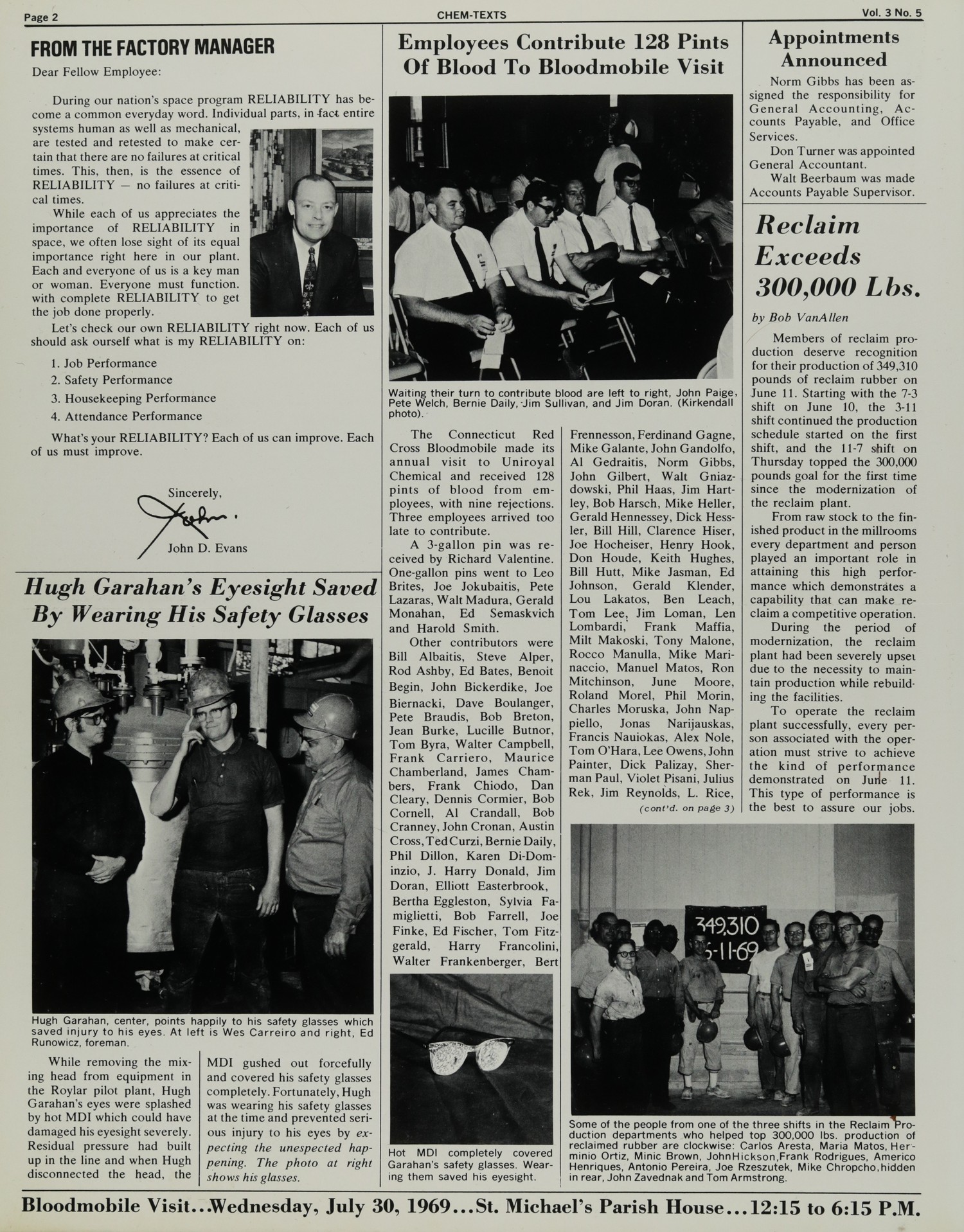
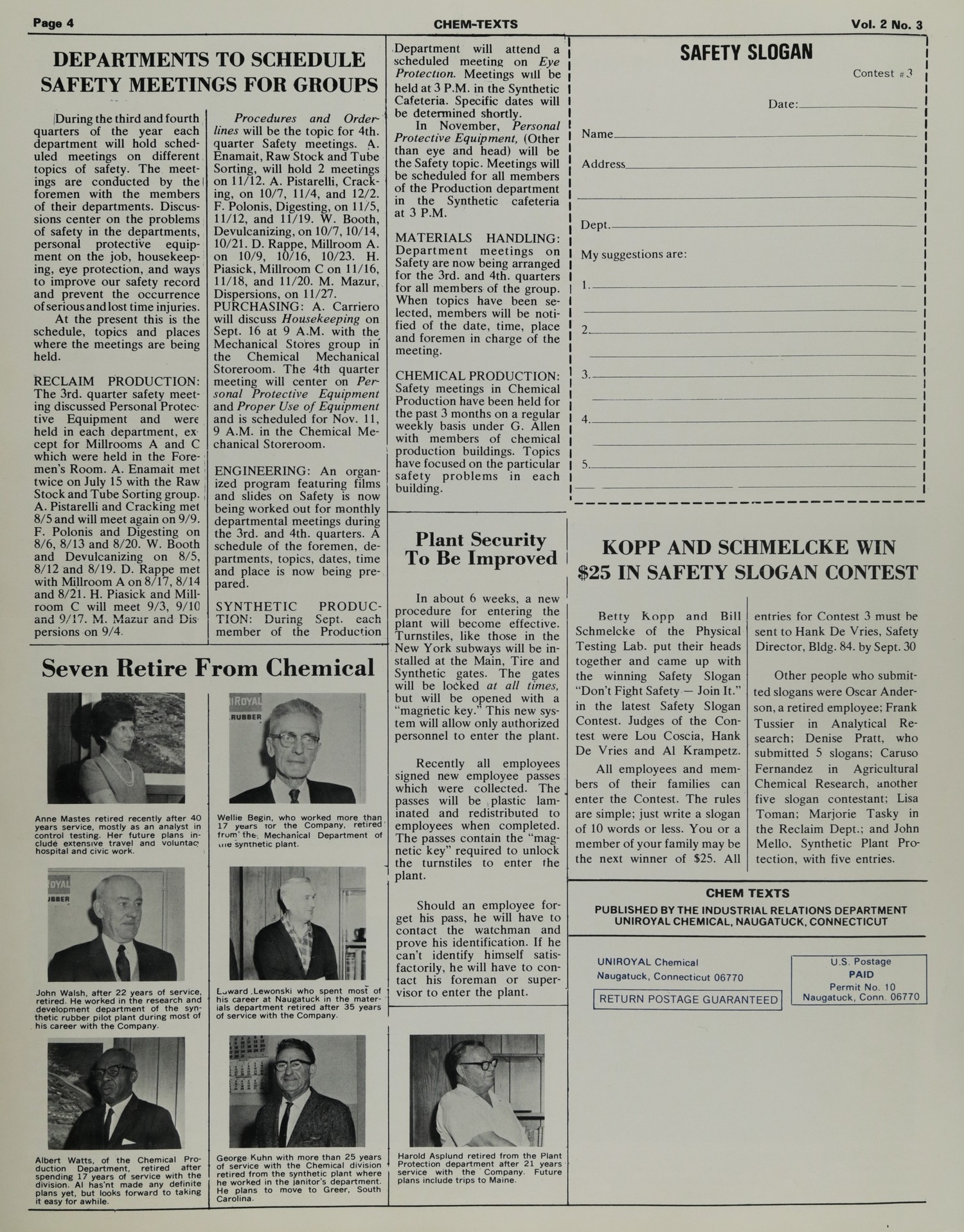
CHEM-TEXTS – Vol. 2 No. 5 – Page 3

Page 003

CHEM TEXTS

Page 3 | Vol. 2 No. 5
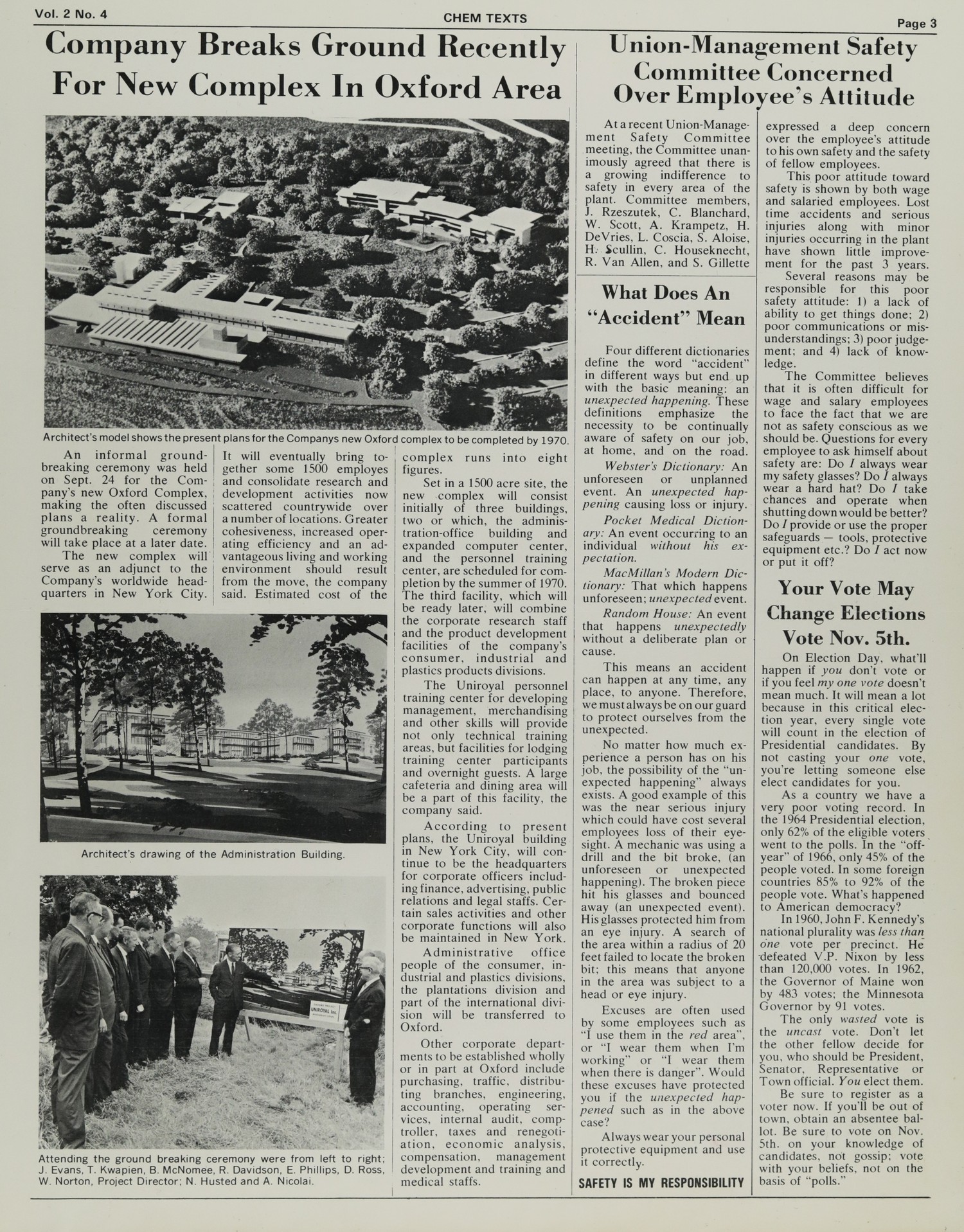

Harry Witt Heads Synthetic Production

Harry Witt has been named Synthetic Production Superintendent, effective Dec. 1. Ben Leach becomes Manager of Colloidal products in the Research and Development Dept.


How You Can Obtain A Pair Of Safety Prescription Glasses

Fred Mayo of the Process Development Lab. selects frames for safety prescription glasses from Adeline Farrar R.N., Chemical Hospital nurse.

The Naugatuck plant has a program which is operated by the Safety Department to enable all Chemical division employees to obtain prescription safety glasses at no cost to the employee, except for the examination and fitting fee.

The procedure is simple. An employee may go to either the Chemical or Synthetic hospital and obtain a prescription safety glass form from the nurse. He takes the form to his own eye doctor and has an examination. The employee pays for the cost of the examination and returns the completed form to the plant nurse. At this time he may also select the frame he prefers from samples in the hospital. The Company then sends the prescription to the Wilkie Optical Company and purchases the glasses.

Effective January 1, 1969, all prescription glasses will be returned to the doctor or optician of your choice for proper checking and fitting. In some cases an additional fitting charge may be made, depending upon the agreement you have made.

Here are other facts you should know: 1. You may buy an extra pair of glasses for yourself, if you wish and take advantage of our Company discount, provided the prescription is less than one year old. 2. You may also purchase prescription sun glasses at the same discount. 3. You may obtain a free pair of glasses whenever you require a new prescription. 4. Lenses or frames damaged as the result of an accident in the plant are replaced free of charge.


[PHOTO CAPTION:]
Uniroyal Chemical’s United Fund Campaign Committee looks at the “thermometer” showing the results of the drive at the plant where employees topped their goal by 103%. Left to right are Doug Miller, Sam Gillette, Bob VanAllen, the Industrial Division’s Chairman; Joe Kresziutek, Ron Mitchinson, pointing to the $20,646 figure and Bill Lavelle. Other committee members not in the photo were Ed Alves, Eric Johnson, and Len Lombardi.


Employees Contribute $20,646. Top United Givers Goal By 103%

Ron Mitchinson, Chairman of the United Givers Campaign at the Naugatuck plant announced the results of the Chemical Plant’s drive. Employees contributed $20,646 or 103%, topping the plant’s Goal of $20,000. This surpasses by almost $3,000 the previous high of $17,737 contributed by employees to the 1967 United Givers Drive. The success of this year’s campaign can be attributed to the enthusiastic efforts of the Campagin Committee, the ninety-five Co-Captains, and the generous support of the Chemical division employees.


Accidents Continue At High Rate

In the ten months of this year, 79 lost time and serious injuries have occurred. Most of these resulted from a careless act or operation. We each must accept responsibility for our own actions and the safety of all.

MONTH LOST TIME SERIOUS IN-JURIES TOTAL
JANUARY 2 2 4
FEBRUARY 3 5 8
MARCH 2 6 8
APRIL 2 6 8
MAY 0 11 11
JUNE 0 7 7
JULY 2 7 9
AUGUST 4 4 8
SEPT. 0 8 8
OCTOBER 2 6 8
TOTALS 17 62 79

New Food Vendors Service Plant

By Monday, December 2nd, all food and beverage vending machines in the plant will have been replaced with brand new machines to provide plant employees with better food service.

The new firm, Indiana Vendors, has proposed several basic changes which will eliminate the problems we have experienced in recent months; machines out of order, empty or not giving the proper change, and food often neither fresh nor of uniform high quality. There will be an on-site maintenance man who will be in charge of keeping all machines operating properly in all respects. All food will be prepared and wrapped in the Synthetic Plant kitchen facilities. This means that food in the machines will have been prepared an hour or two before being put into the vending equipment. It also means that when more departments than usual are scheduled to run over a weekend or holiday, extra sandwiches can be prepared at the last minute and placed in the machine. If a machine runs out at 2:00 P.M., it can be filled again before the next day.

The machines will be the latest in design and efficiency. Take the office machines for example. You put your coin into the machine, select the way you want your coffee, and receive a cup of fresh, perked coffee. The machines operate on 1/3 lb. cans of Maxwell House coffee — exactly the same grind you buy for home use. Approximately 20 cups are perked and then transferred to a holding chamber. After a preset length of time, a new batch is perked and any coffee remaining in the hold chamber is dumped. The coffee you buy is always fresh. No more instant coffee.

The food machines will also hold a wider variety of food. Soup will be sold with the can, bowl, spoon, crackers and napkin as a package — you’ll never run into the situation where, having purchased a can of soup, no spoon or dishes are available.

Some of the areas in the plant will be expanded or have more versatile machines such as canned soda or a flavor ice vending machine — the vending area in Reclaim Bldg. #1 will have a sandwich machine, for example, and a coffee machine will be put into the Chemical Machine Shop, where up to now only a cigarette machine has been in operation.

In short, new and better machines, with better service and more and better food, to give us the best food service arrangement possible.


ALANAP AND DYANAP (con’t.)

(CONTINUED FROM PAGE 1)

sive advertising and promotion program for our distributors and dealers. Grower meetings will be conducted by our sales force, demonstrating the advantages of Alanap and Dyanap over competitive products.

Quality products play an extremely important role in the agricultural business. A poor quality product damages a grower’s crop, the reputation of the product and the Company. Important also in the farm market is good packaging. It either helps or reduces our sales. Dented or stained cans, torn and dirty bags convey the impression of poor quality and workmanship in the customer’s mind. Good quality and good packaging can help make 1969 a big year in Alanap and Dyanap sales.

SAFETY IS MY RESPONSIBILITY


Clark Retires From Mechanical

Ed Clark, left, is congratulated by Bill Lannon, Foreman of the Instrument Department. Clark, an instrument man in the Mechanical Department, retired recently after more than 22 years with the Company.

CHEM-TEXTS – Vol. 2 No. 5 – Page 4

Page 004

Page 4 | CHEM TEXTS | Vol. 2 No. 5


Employees Receive $1,453. In Awards For Recent Suggestions

Dom Persutti Submits Nine Suggestion Winners

Eighty-two suggestions received cash awards or honorable mentions in the last three months, amounting to a total of $1,453.00.

The highest award of $170.00 went to L. Schiller; with F. Raymond receiving $100.00; and K. Anderson and K. Nelson splitting another $100.00 award for their suggestion.

D. Persutti was the top idea man submitting 9 suggestions, receiving $75.00 in awards and 4 honorable mentions. J. Sullivan and W. Campbell each submitted 4 suggestions and were awarded $45.00 and 1 honorable mention for their ideas.

Other employees who received high awards for their suggestions were J. DiSantis, $53.00; W. Adamski, $50.00 and Mary Marques, $30.00.

$25.00 awards went to W. Breton, F. Henriques, D. Bedard, F. Chiodo, A. Calder, E. Root, E. Bazenas, and A. Patskan.

$15.00 awards were given to R. Shipman, F. Carriero, G. Ravenscroft (3 awards), R. Harrison, C. Iannuzzi (3 awards), W. Fruin, S. Molnar, J. Grosso, T. Lee, T. Turner, A. Gedraitis, F. Commendatore, D. Pratt (2 awards), B. Torrey, J. Dayner, L. Fortier, W. Stenson, A. Civitello, L. Raskauskas, A. Kazemekas, F. Sordi, E. Root, C. Miele, F. Surmanck, F. Bendler (2 awards), R. Ruginis, J. Mahoney, E. Bazenas, E. Johnson, G. Monahan, B. Pranulis, R. Harrison, J. Hoey, and A. Silva.


[PHOTO CAPTION]
Lou Schiller of R. & D. received $170.00 for his suggestion that Teflon bearings be used on Mooney machines to reduce costs.


[PHOTO CAPTION]
Ken Anderson, left, and Ken Nelson of the Synthetic Mechanical Dept. received $50. each for suggesting that the hydraulic jet pump’s speed be reduced by one-third to reduce maintenance costs.


[PHOTO CAPTION]
George Ravenscroft who works in the Instrument Dept. was awarded $30.00 for a safety and maintenance suggestion.


[PHOTO CAPTION]
Ed Bazenas of the Mechanical Dept. received two awards for suggestions on equipment improvement in Bldgs. 80 and 109.


Honorable Mentions were received by L. Bissonnette, J. Grosso (2), J. Ferguson, C. Iannuzzi, J. Rek, D. Donato, E. Rott (2), L. Anderson, E. Bazenas, P. Masone, W. Fruin and G. Monahan.

Any employee can participate in the Company — wide Suggestion System plan. The suggestion should be original and represent thinking beyond that expected on the job.

Your ideas can cover such areas as new or better products, improved quality, better packaging, savings of production time, better working conditions, safety conditions, scrap reductions, material savings, simplified working procedures, and many other possibilities.

Suggestion System forms are located conveniently throughout the plant.

SAFETY IS MY RESPONSIBILITY


SAFETY SLOGAN

Contest #5

Date:___

Name ___________

Address _________


Dept.____________

My suggestions are:

1._________


2._________


3._________


4._________


5._________


Ray Pekock Wins $25. For Safety Slogan: Contest Open To All Members Of Family

“Safety First, Make It Last” was the winning safety slogan submitted by Ray Pekock. Other employees entering the contest with interesting slogans were Lynda Harris, Marjorie Lasky, James Hartnett, who won the contest previously, Lynda Nappiello, Cynthia Haggerty, Bill Schmelke, another contest winner, Richard Fratangelo, Tom Basile, and Barbara Gabriel.

More and more interest has grown in the contest with more than a 100 safety slogans submitted. Many of the slogans have come from members of employees’ families. Any member of an employee’s family is eligible to win the $25. award.

The rules for the contest are simple. All slogans should be sent to the Safety Dept., Bldg. 84 where they will be judged by three members of the plant’s Safety Committee.

  1. Each member of the family may submit as many slogans as they want.
  2. The entry must be 10 words or less.
  3. An entry can be re-submitted in new contests provided it has never won.
  4. The decision of the 3 judges is final.
  5. All employees can enter except the plant staff and members of the joint union-management safety committee.
  6. If you don’t use the form, be sure you include all of the necessary information on your entry.
  7. The contest closes Dec. 20.

CHEM TEXTS

PUBLISHED BY THE INDUSTRIAL RELATIONS DEPARTMENT
UNIROYAL CHEMICAL, NAUGATUCK, CONNECTICUT

UNIROYAL Chemical
Naugatuck, Connecticut 06770

RETURN POSTAGE GUARANTEED

U.S. Postage
PAID
Permit No. 10
Naugatuck, Conn. 06770

CHEM-TEXTS – Vol. 2 No. 6 – Page 2

Page 002

CHEM-TEXTS

Page 2 | Vol. 2 No. 6


FROM THE FACTORY MANAGER

Dear Fellow Employee:

Again the joys of the holiday season are upon us renewing the eternal promise of peace and goodwill among all men. A constant promise to a changing world — a world that must change if it is to fulfill that promise.

As we pause to reflect upon our accomplishments of the past year, let us face the challenges of the new year with resolution. A resolve that we will each strive for creative change with the goal of better understanding one another as well as our common purpose.

Please accept my most sincere wishes for you and your family; a Most Joyous Christmas and the Best of Health and Happiness throughout the New Year.

John D. Evans


Uniroyal Will Match Your Donation To A College

Today more than ever, colleges and universities need money to build more classrooms, libraries, laboratories and other facilities along with improving and increasing their teaching staffs.

As the demands for a college education continues to grow colleges and universities will need greater help than ever before to not only improve but expand their facilities to meet these demands. This help will have to come from companies, foundations and individual donations, or else many deserving students will be turned away for lack of space.

To encourage our donations for education Uniroyal will match our contribution of more than $25.00 to a college or university. This program applies to active employees on regular, full-time jobs or on authorized leave of absence from such job after they have completed a year of service. The maximum total which the Company will match is $1,000 a year per employee.

Uniroyal will match only gifts made directly to the school or to an agency of the school, such as an alumni fund, which turns over all donations to the school. The college or university must grant degrees and be accredited or actively seeking such accreditation.

Application forms for the “Employee Matching Gift” program may be obtained from the Industrial Relations. department.

The matching of contributions will be made only after the Uniroyal “Employee Matching Gift” application forms have been filled out by the employee; approved and signed by the financial officer of the educational institution and returned to the Uniroyal Foundation.


25 YEAR CLUB HOLDS ANNUAL DINNER: MONAHAN RECEIVES 50 YEAR SERVICE AWARD

[PHOTO: Group photo of men in suits]

New members who received their 25 Year Service Awards.

The Uniroyal Chemical 25 Year Club held its 19th Annual Dinner in November at the Waverly Inn. The Club is an association of Chemical division employees who have been regularly credited with 25 or more years of service with the Company.

Eligibility for membership and for service awards is recognized at the annual dinner for employees who expect to achieve such eligibility during the calendar year. Total membership in the Club at present is 534.

Committee members for this year’s program were Bert Scullin, president, Everett Anderson, Tom Dowling, Pat King, Joe Little, Larry Monroe, Alice Schofield and Ed Weaving.

Special recognition went to J. Monahan who received a 50 year service award.

Advanced to the 45 Year group were L. Carroll, L. Monroe, C. Swanson, and L. Volpe.

40 Year awards went to J. Bickerdike, D. Fowler, S. Gesseck, F. Janus, M. Karbowicz, P. King, F. Magnamo and G. Siequist.

35 Year awards were received by E. Anderson, W. Birdsall, M. Chmielewski, T. Doran, E. Gabriel, A. Giancarlo, A. Henriques, J. Kolakowski, E. Lewonski, P. Machnics, F. Marinello, M. Perkins, J.C. Ranney, G. Reale, N. Salinardi, E. Saunders, W. Scranton, M. Smerekanych, B. Smey, P. Suba, M. Sullivan and E. Valentine.

Receiving 30 Year awards were G. Baktis, A. Brazicki, I. Fonseca, M. Heller, M. Jannetty, P. Paul, J. Rek, S. Slawski, and E. Svendsen.

New members with 25 Years service were F. Adams, R. Barnhart, C. Bawn, R. Bell, L. Borzencki, L. Bruce, A. Christensen, H. Crabtree, J. Cravo, R. Crotty, G. Dennis, H. Drummer, I. Engle, W. Fairclough, E. Fischer, B. Fisher Jr., F. Haase, W. Hill Jr., W. Hilton, J. Kawecki, G. Kuhn, M. Marrello, J. Maye, P. McPhail, C. Miele, J. Napp, C. Nelson, L. Nicely, R. Noury, A. Olson, J. Pereira, F. Rinaldi, H. Royle, R. Santarsiere, M. Sgrillo, T. Shilinskas, W. Swick, L. Triano, W. Wasulis, W.W. White, M. Wilson and F. Zettlemoyer.


2 Lost Time; 3 Serious Injuries Occur During Month Of November

In November, 2 lost time injuries occurred in Chemical Production. An operator lost control of a full 55 gal. drum while taking it off a pallet. He suffered severe bruises and abrasions of the lower leg, resulting in 5 lost-time days.

The second injury involved an operator who suffered 2nd. degree burns to his right foot, and is expected to be out for one month.

By developing an attitude of safety, being constantly aware of the unexpected happening, and wearing the proper protective equipment for the job, accidents can be eliminated. A few months ago we worked 1,000,000 manhours without a lost time injury. There’s no reason we can’t reach that mark again.


How To Take Care Of An Expensive Camera

Let’s say you own an expensive stereo movie camera. Let’s say it’s really a rare model, capable of taking action shots in 3D and color under conditions of available light.

Would you ever think of dropping it on the sidewalk? Would you tap its’ twin lenses with a hammer? Throw acid on the lenses? Throw pieces of metal at them? Of course not . . . rather you’d take excellent care of such equipment.

If, however, the camera became damaged beyond repair, the loss wouldn’t be tragic and final. You would probably purchase a new camera to replace it.

But you couldn’t buy a replacement for “your personal camera” — the one you carry around with you all day long. Yes, your eyes are “your personal, stereo camera, and no one has perfected substitute eyes that can see and take their place.

The transparent cornea shielding each of your eyes is only a tiny fraction of an inch in thickness. Thus, additional protection is imperative in the presence of danger.

If you’re doing work that presents even a minor hazard to your eyes, find out from your foreman or supervisor what protection you need. Then . . . get it and wear it.

Protecting your eyes is a full time job, no matter in what activity you’re engaged. Don’t risk permanent damage to your priceless personal camera.

It’s the one camera that can’t be replaced.


Keep all medicines, including such common drugs as asprin, in a locked or inaccessible cabinet. Always turn the light on when giving or taking medicine.


Never put a poisonous or toxic substance in a container designed to contain food, such as milk bottles, soft drink bottles, or cereal boxes.

CHEM-TEXTS – Vol. 2 No. 6 – Page 3

Page 003

CHEM-TEXTS

Vol. 2 No. 6 Page 3


Good Packaging (Continued from Page 1)

[IMAGE: Box of “New! ADVANCED all” detergent]

[IMAGE: Packages of “THNX” products stacked]

YOU BE THE CUSTOMER . . . WHICH WOULD YOU BUY?

Packages on left are dirty and in poor condition. As the customer, you would buy the clean packages.

favor when he calls – we are not doing him a favor by serving him.

  1. A Customer is part of our business – not an outsider.
  2. A Customer is not a cold statistic – he is a flesh-and-blood human being with feelings and emotions like our own.
  3. A Customer is not someone to argue or match wits with.
  4. A Customer is a person who brings us his wants – it is our job to fill those wants.
  5. A Customer is deserving of the most courteous and attentive treatment we can give him.
  6. A Customer is the life blood of this and every other business.

Since the customer is the most important person in our business, each of us has the responsibility to provide them with the best in packaging, whether its our chemicals, rubber or latex products. Undented, clean-looking, and neat-stencilled packages will help us keep our customers satisfied and even improve our business.


Jim Kennedy Retires Recently

[IMAGE: Three men in suits, one shaking hands with another]

Ed Weaving, watches as Jim Kennedy, center, is congratulated by John Evans on his retirement. Kennedy, a member of the plant protection dept., had more than 28 year’s Company service. Jim is presently a member of the Naugatuck Police Commissioners.


Plant Sponsors H.S. Junior Achievement Company

Unifirm, received its official operating charter as a new “business firm” from John Evans. Francis Szezesiul, a sophomore at Naugatuck High School, was elected president of the Company.

The purpose of Junior Achievement is to give high school students a real opportunity to learn about business by running a business. Unifirm is an actual business enterprise, for real materials and real work produce a real product which is sold to customers to make a real profit.

Members learn the meaning of Capital – because they raise the money to operate the Company. They learn the meaning of Productivity because they see how poor production practices jeopardize their sales and profit.

Junior Achievement gives students an opportunity to obtain an accurate understanding of the basic economic factors of our business system.

The key word to understanding business is profit, a word which creates considerable misunderstanding about business. Without it, a business cannot survive. Its function is vital to the Company because part of it is paid to stockholders who invested in the Company and part reinvested in the Company to improve, expand and build new facilities.

Unifirm pays regular salaries to its officers and other personnel. It also pays taxes; keeps accounting records; carries insurance; pays dividends to stockholders if profits are made; and performs just about every business practice and procedure of a large corporation. Learning by doing teaches students the facts about business operations.

[IMAGE: Group of men reviewing documents at a table]

Reviewing plans with the president of Unifirm are plant advisors l. to r. Jack McGowan; Francis Szezesiul, president; Steve Schwartz and Kevin Kelley, who replaced Don Delagrange, recently drafted into the Armed Services.


Minor Injuries Can Become Serious: Report Them Immediately To Hospital

Some of us don’t usually think much of a small cut, scratch, blister or a bruise as an injury. If we get something in our eye, we don’t think it’s very important unless it hurts or really damages the eye.

The “little injuries” usually don’t worry us because they don’t take us off the job or put us into a hospital bed. They don’t, if we take the simple step of reporting the injury promptly for competent, first-aid treatment at the plant hospitals to prevent the “little injury” from turning into something serious.

This means all injuries, including cuts, scratches, strains and bruises. None of these may be serious in themselves, but because of neglect, any one of them may start something serious through infection.

Don’t gamble with good health and safety by trying to be your own first-aidman and deciding that because you don’t feel too bad, you don’t need any other treatment. This has actually happened in a number of cases in the plant with rather painful and unpleasant results.

Remember to report all injuries at once, even the “little ones” and get proper first-aid treatment from those qualified to give it. See the plant nurses right away during the day; or at night, contact the night supervisor.


NOVEMBER 1968 — ACCIDENTS IN DEPARTMENTS

DEPARTMENT EYE BRUISE FRAC-TURE CUTS & ABRA-SIONS AMPU-TA-TIONS BURNS CHEMI-CAL BURNS Sprains Back Sprains DUST OR FUMES SLIV-ERS DERM-ATITIS TOTAL
Chemical Production 3 4 0 5 0 2 1 4 1 0 3 2 25
Reclaim Production 1 1 0 7 0 1 1 1 1 0 0 1 14
Synthetic Production 1 0 0 2 0 0 2 1 0 0 1 0 7
Materials Handling 1 2 0 7 0 0 0 0 0 0 3 0 13
Mechanical (Chemical) 6 5 0 20 0 4 3 3 2 0 8 0 51
Mechanical (Synthetic) 1 3 0 8 0 2 0 4 0 0 3 1 22
Research — Development 2 4 0 8 0 2 2 3 0 2 4 2 29
Other 1 0 0 1 0 0 0 0 0 0 1 3
NOV. TOTAL 16 19 0 58 0 11 9 16 4 2 23 6 164
11 Month Average For 1968 22 30.5 .90 78 0 18 10 17 8.5 4 27 10 226
8 Full Month Average For 1967 28 42 1 90 .12 19 14 23 9 4 27 9 267

21 Held In New Uniroyal Row Company Asks Picketing Curbs

5-5-67

Register Photo by Stuart Langer

Fighting breaks out at Maple Street entrance to Uniroyal plant.

21 Held In New Uniroyal Row Company Asks Picketing Curbs

By JAMES FLEMING
Register Staff Reporter

NAUGATUCK — Fighting broke out at the Maple Street plant of Uniroyal for the second day in a row, and 21 employes were arrested. Fifty were arrested Thursday.

It was later learned that Uniroyal will seek a restraining order in Superior Court in Waterbury today in an attempt to limit the union to a maximum of three pickets at each gate.

Brawling began at 6:50 a.m. today when office personnel attempted to cross picket lines. Pickets who had been circling near the entrance massed at the gate when the salaried workers tried to get into the company grounds.

Police struggled with pickets as they attempted to open lanes for the workers, and several fights broke out between the strikers and the police. Seven policemen were needed to subdue one worker, William Battles, 37, of Waterbury, who was charged with breach of peace by assault. He was taken to St. Mary’s Hospital in Waterbury afterward where he was treated and released after complaining of stomach pains.

Lt. George Smith went to St. Mary’s for examination after he told Chief Frank Mariano he had been kicked twice in the groin.

As more office employes arrived, company officials told them to wait on the nearby Naugatuck Green while management and union leaders conferred on allowing them to enter. About 300 employes walked to the Green, about half a block away in small groups.

Tension mounted in front of the plant while small groups of women pickets marched carrying signs hung around their necks and sang improvised songs such as “Go home boys in blue” aimed at the police.

Meanwhile, individual office workers without realizing that the others were waiting on the Green, would try to pass through the gate and would be pushed aside.

One woman screamed at the pickets, “Save your strength; you’ll need it when you go back to work.”

Suddenly, the 300 persons on the Green began returning to the plant spontaneously in a massed group and the strikers began yelling as they saw them approaching. Some 25 policemen —half the total force in Naugatuck—rushed into the street between the two groups along with a Uniroyal official and told the office employes to go back to the Green.

The strikers continued to press forward to meet the office workers until the other group went back to the Green.

About half an hour later, the office workers again moved toward the plant and the strikers came toward them. Raymond

See UNIROYAL Page 2

CHEM-TEXTS – Vol. 1, No. 2 – Page 1

Page 001

UNIROYAL CHEM-TEXTS

Vol. 2 PUBLISHED FOR THE PEOPLE OF UNIROYAL CHEMICAL No. 2.


New Equipment for Reclaim Plant Will Keep Us in Reclaim Rubber Business

Our present reclaimed rubber plant dates back to 1895, after fire destroyed the original plant in 1893. For 75 years, we have played an important role in the rubber industry by supplying high quality stocks.

Several years ago, with combining higher production costs and increased shipping expenses, profitability reached a critical point for us in the reclaimed rubber business. Faced with keen competition, reduced prices and low-cost SBR rubber as an alternate, our business was placed in a difficult position. A decision had to be made either to discontinue the business or make major capital investments to modernize the facilities.

After detailed study of the present operation and various improvements and considering the skills of our people, it was decided that a modernization of the facilities would be practical and increase our ability to successfully compete in the market place. An appropriation request for these plans was drawn up and approved.

The “new” plant, efficiently and effectively operated, will help protect the job security of 100 employees while the alternate of going out of the business would have eliminated 150 employees, many with long seniority. Changes in the millrooms, reduced from 3 to 1, will affect the jobs of about 50 employees.

A project team was formed to work on the problem. The team settled on 5 major changes which would offer the best return on investment at this time: 1. fibre separation; 2. fine grinding; 3. central mix in the mill room; 4. revision in the mill room; 5. Zenith and dryer revisions.

The team in charge of the project working closely with the New York engineering group were R. Gaetz, Engineering Dept., Ted Lainas, Reclaim Development; C. Reich, Production and F. Wintsch, Industrial Engineering. Since his transfer to Industrial Relations, Wintsch has been replaced by B. Daily.

This team was charged with the responsibility of making the project go; by developing the flow sheets and recommending the type of equipment. All the details of engineering is being handled by approximately 12 members of the New York corporate engineering staff.

The job to be done consists of removing the fibre from old tires to prepare them for the fine grinding operation. By doing a better job of removing the fibre in the early steps and also by finer grinding, the digester cycle will be shortened, and chemical costs reduced. Also, fine grinding prior to digesting, allows us to make one pass through the mill rooms instead of 4 passes under the old system. The fine grinding, fibre separation and central mixing will be new departments and will require new skills. Engineering also estimates that we would have

(Continued on Page 2)


U.S. BOND DRIVE AIMS FOR 50% PARTICIPATION

John D. Evans, Factory Manager, named Fred Wintsch chairman of the 1968 U.S. Savings Bonds and Freedom Shares Drive at the Naugatuck plant. The drive was sponsored for two weeks from May 6 to May 17.

Last year’s campaign at the Naugatuck plant added 72 new savers to the payroll deduction plan; 88 employees increased their participation; and 152 purchased the new Freedom Shares. Approximately 40% of the Chemical employees are enrolled in the purchase of U.S. Savings Bonds and Freedom Shares.

The goal for the 1968 drive according to Wintsch was to attain 50% participation by Chemical plant employees. A committee of 71 canvassers had been organized in different sections of the plant. Members of the committee were the following: Warren Singleton, E. G. Broderick, Mary Sullivan, J. Flickinger, Harold Smith, L. Anderson, S.E. Salva, R.W. Stutzman, L. P. Ferrigno, T.J. Shilinskas, Harold Campbell, O. Zaprazalka, R.M. Bioski, M.A. Lasky, D. Johnson, E. J. Greene, F.X. O’Shea, R. Rosenbaum, C.C. Smith, A. Budd, I.A. Prager, P.J. Lazaras, W.R. Smith, V.R. Lardi, A.J. Loman, J.F. Zappala, M.E. Kuryn, G.M. Stone, R. Juliano, D. Pagnoni, C. Terniko, L. Scheithe, M. Dodd, T. Dowling, J. Homyetski, F. Magnamo, L. McCoy, G. Baktis, W. Frankerberg, A. Enamait, A. Pistarelli, E. Polonis, W. Booth, D. Rappe, T. Skehan, H. Piascik, R.R. Foltz, M. Mazur, S. Petkis, R. Magnamo, T. McMahon, L. Opdyke, L. Evan, J. Casey, J. Tierney, S. Korpusik, C. Bulka, W. Lannon, D. Nelson, J. Murtha, K. Pittner, R. Burns, J. Quint, V. Alves, J. Carroll, R. Terino, J. Vergosen, P. Norton, R. Krajewski, A. Nole and A. Juliano.

George Murdock of the Treasury Department addressed the group on the advantages of payroll deductions as an important part of an employee’s savings program. 70% of Savings Bonds purchasers do not redeem them until after age 65. In this way, the tax liability on E. Bond interest could be greatly reduced and even eliminated entirely under some circumstances.


[IMAGE: Black and white photograph showing industrial equipment on a rooftop]

New cyclones have already been installed on roof of reclaim plant.


Foremen’s Club Elects Officers

The Naugatuck Chemical Foremen’s Club elected Lou Kaiser president of the Club at its monthly meeting at the Elks’ Club. Other officers named were Joe Bucciaglia, Vice-President; Jan Baclawski, Secretary and Joe Murtha, reelected as Treasurer. They succeed Vic Alves, Earl Wright and Eric Johnson who served as the Club’s officers the past year.

The Club held its annual banquet on May 16; and will hold a dinner dance in October; outdoor summer picnics and a summer picnic for the family.

A membership drive is being organized to increase the Club’s members. Any salaried, male employee of the Naugatuck plant can join the Club which sponsored a $250 scholarship fund this year.

Still in the idea stage, Kaiser hopes to organize discussion meetings between representatives of various departments to interchange ideas and to become better acquainted with and understand the problems of different departments. By open table discussion, production, engineering, R & D, materials handling, maintenance and other departments can get to know each other’s problems and to coordinate and integrate their activities more effectively.

URW Rejects

6-9-67

URW Rejects

Continued From Page 1

  1. Supplemental Unemployment Benefits – Regular benefits increased from 65% of average pay (plus $2 for up to four dependents, with a maximum payment of $50) to 75% of average pay with no maximums. Short work week benefits increased in all cases to 75% of average pay. Company contributions increased from 5¢ per hour to 6¢ per hour when the sub fund falls below 100%. Sub fund increased from $250 to $350 per employee.
  2. Miscellaneous Contract Clauses – These include up to 40 hours pay, depending upon the size of the plant for union time study men, increased pay for union grievance meetings and arbitration hearings, a greatly improved safety committee clause and a number of other contract proposals and clarifying letters of commitment.
  3. Pensions – A 60% increase in regular pensions from $3.25 to $5.25 per month per year of service. A 60% increase in disability pensions from $6.50 to $10.50 per month per year of service. An increase of $1.50 per month per year of service for living pensioners who were retired after July 1, 1950.
  4. Life Insurance – An increase in Company paid insurance from $6,500 to $7,500 for active employees.
  5. Hospitalization – An increase in the coverage for the maximum stay in the hospital from 365 to 730 days.
  6. X-Ray and Radium Therapy – An increase in the aggregate maximum payment from $200 to $300.
  7. Visiting Nurse – An increase in the maximum daily payment from $6 to $7.
  8. Surgical – Provide for full payment of the reasonable and customary fees prevailing in the area for the surgical procedures.
  9. Sickness and Accident Benefits – An increase in benefits according to the employees average earnings with a minimum of $50 per week and a maximum of $80 per week. (Average coverage to be $70.) Eliminate present 7 day waiting period and provide sick benefits from first day of hospital confinement as a registered bed patient.

Local URW Answers Company’s Letter

Local URW Answers Company’s Letter

6-12-67

Raymond Mengacci Vice-President of Local #45, stated today he didn’t want to get into a debate with factory manager Mr. Jack Smith, or try to negotiate an agreement here in Naugatuck, especially through the newspapers, when both the Company and the Union committees are having a hard enough time in Cincinnati, Ohio, doing this, without interference that might hamper negotiations in any way in Cincinnati. But that he had no recourse other than to answer some of the statements made by Mr. Smith, in the letter that he sent out to the employes of the Naugatuck footwear plant and for publication in the newspapers.

Mr. Mengacci stated that when the Union netotiating committee left for Cincinnati they were going there for the sole purpose to make a sincere effort to negotiate a contract and wage agreement with the Uni-Royal Co. before the April 20th deadline. This was the only agreement that was discussed at the membership meeting of Local #45.

Negotiations began in Cincinnati on March 21, 1967, but it wasn’t until April 12, 1967 that the Company made its first and finale offer to the Union on contract and wages. This was eight (8) days before the deadline.

Mr. Mengacci stated never in all his experience on negotiating committees or that of Pres. Froehlich who has more than he, did they ever hear of anything like this the first offer was also the last. No one can call this negotiating. This has never been done before.

And it wasn’t until a few days later that the Union found out that this was being done in all of the “Big Five” (5) rubber companies, not just Uni-Royal.

The Union also found out that these Companies had made a mutual pact designed to protect any struck company against financial losses. We, in the Union, were always led to believe that these Companies were in competition with one another. This we found is not so, they have a much better Union than we have.

Mr. Smith also goes on to say in his letter, that the Company had made an effort to open the Pension and Insurance agreement with the Union so that they could negotiate all matters to a conclusion. This is correct. The Union informed the Company that this agreement does not terminate until Sept. 15, 1967, and that the Union was in no position to negotiate this agreement because first of all they had not discussed this with their membership to see what changes the members wanted to make. Also they had made no preparation whatsoever among themselves on Pension and Insurance to discuss this question intelligently with the Company.

Mr. Smith goes on to say in his letter, that the Union did not present to the Company their full proposal until 11 a.m. on April 19, just 37 hours before the strike deadline. This is correct but why was this so. The Union felt that if they received from the Company the correct interpretation of the Clauses that are in the Working agreement now, and the way they were intented to be interpreted, at least in the Unions viewpoint, before there was a change in the head negotiator for the Company, they would not have to make any changes.

But the Union found out that the Company’s new Head Negotiator was not giving the same interpretation, so therefore, the Union had to come in with some new proposals. The Union would not be able to live with some of the interpretation the new Company Head Negotiator was giving, and all these interpretations were under Article nine (9) Working Condition, which are very important to our members.

Just ask some of our members especially those that work in the Making and Stitching Departments what conditions that they have to work under. Production in many cases have increased by 25 to 30 per cent in the last few years. This is with the same number of operators and in many cases less. Many of these employees can tell you that their weekly earnings are less now even though they received two wage increases in the past few years. This is all because they cannot make any-

where near the efficiency’s that they were making a few years ago. This is the reason why the Union had to make some late proposals to the Company. But if the Company wanted to make a sincere effort to reach an agreement they still had plenty of time to do so.

Now let’s talk about the difference in wage increases between the tire plants and the non-tire plants. We have asked the Company many times to open up their books in Naugatuck. If they can show the Union that they are losing money or are not making the profits that they are entitled to make, then the Union would take another look at their demands for uniform wage increases. This they have refused to do, so therefore the Union does not believe that the non-tire plants are putting the UniRoyal Company in a severe economic squeeze if they grant the same increases as tires.

As long as we are talking about wages increases, it is very interesting to not that President George R. Vila‘s wages were increased from $168,821 in 1965 to $239,033 in 1966 this a $70,212 increase or 41.6% in one year. Also Vice-

Please Turn to Page 12


Widzionjez Trial

General Tire Offers “Attractive Package”

General Tire Offers "Attractive Package"

Rubber Strike

6-13-67

General Tire Offers “Attractive Package”

AKRON, Ohio (UPI) — Negotiators in the national rubber strike today prepared for another long session over the problems of wages, contract length, the elimination of differentials in wage hikes, employes and job security.

Three of the nation’s five largest rubber companies have been on strike for 54 days, with about 55,000 employes idled around the country.

In Connecticut, some 5,500 workers at three UniRoyal plants in Naugatuck are affected by the walkout. There are no other unionized rubber industry plants in the state.

Wage contracts expired April 20 between the United Rubber Workers (URW) and the Firestone Tire and Rubber Co., Uniroyal Inc., and B. F. Goodrich Co.

Day-to-Day

Goodyear Tire & Rubber Co., whose contract expired the same day, and General, whose contract expired May 15, continued production on a day-to-day basis.

A break seemed most likely to occur in talks with General Tire & Rubber, which has proposed a slightly higher package than the other four companies.

General boosted its pay proposal for tire workers from 38 to 40 cents per hour over three years, and offered increased fringe benefits, particularly in the crucial area of supplementary unemployment benefits.

Spokesmen for the other four companies would not say if their negotiators were following suit.

Wages Behind

URW President Peter Bommarito said the wage offers of the four companies, including General, would leave the rubber workers behind other industries. He said the rubber companies are offering 4.5 per cent increases, as opposed to the 5.8 per cent national pattern.

In letters to their employes, the three struck companies set the percentage of their offer at 5 per cent, its cost at 70 cents per hour, and its size as the largest in industry history.

The companies said the fringe benefits are substantial and an increase in supplementary unemployment benefits from 65 per cent of straight time pay to 75 per cent will cost them six cents per hour alone.

The union has demanded unemployment payments of up to 95 per cent of basic wages. Bommarito calls this request “a full-employment plant.”

“Attractive” Basis

General had raised its offer on supplementary unemployment benefits to 80 per cent. This proposal won Bommarito’s approval as an “attractive” basis for settlement. General also increased vacation and pension benefits.

The tire workers now average $3.69 per hour. Company employes in other divisions make an average of $2.68. The last two settlements have increased the differential. Bommarito insists the next settlement grant equal raises to both types of production workers.

The request does not affect General, which is negotiating for only 3,000 tire workers in Akron and Waco, Tex. But the other four companies maintain they can only offer 31 per cent wage increases to non-tire workers.

Please Turn to Page 12


Local Strike