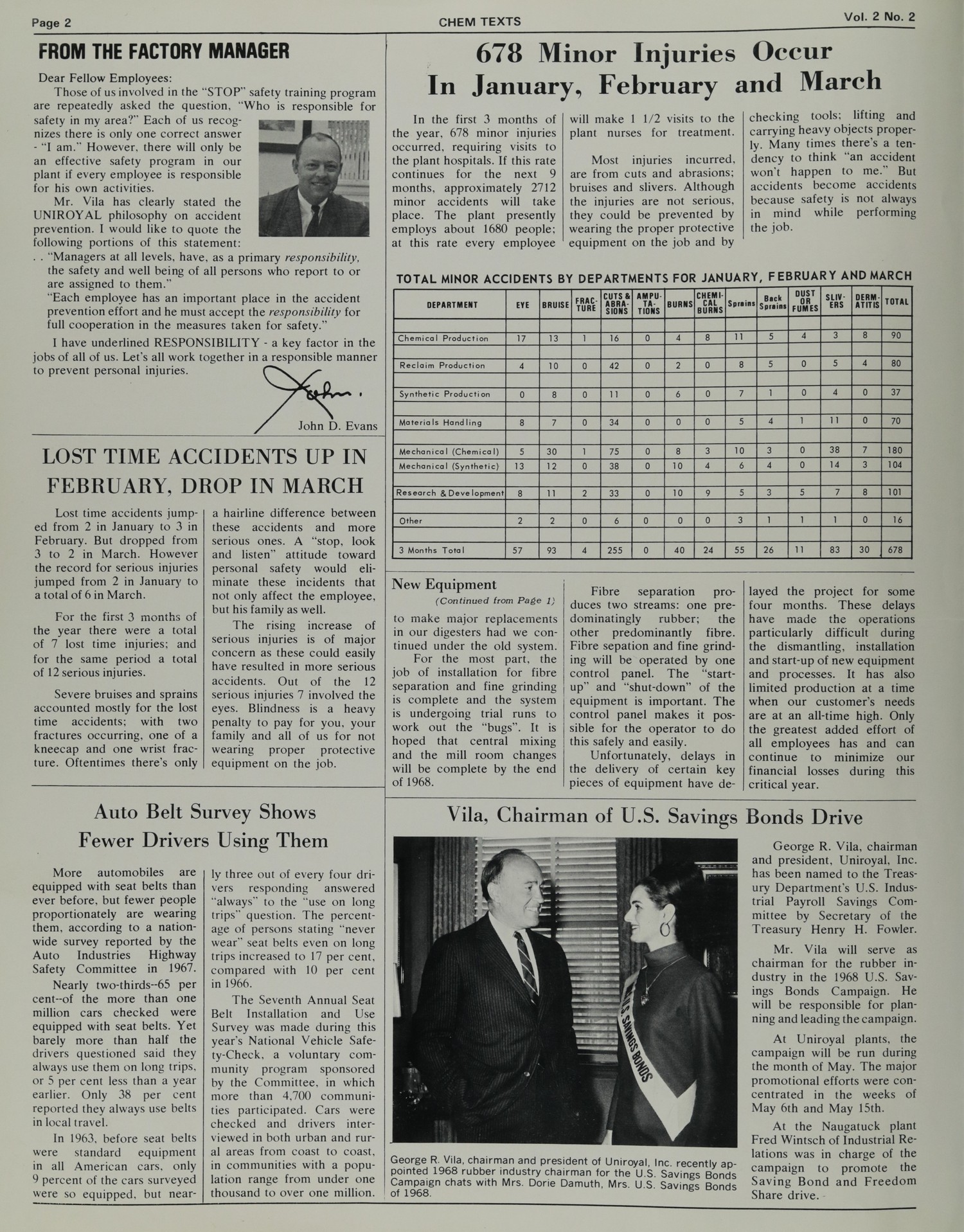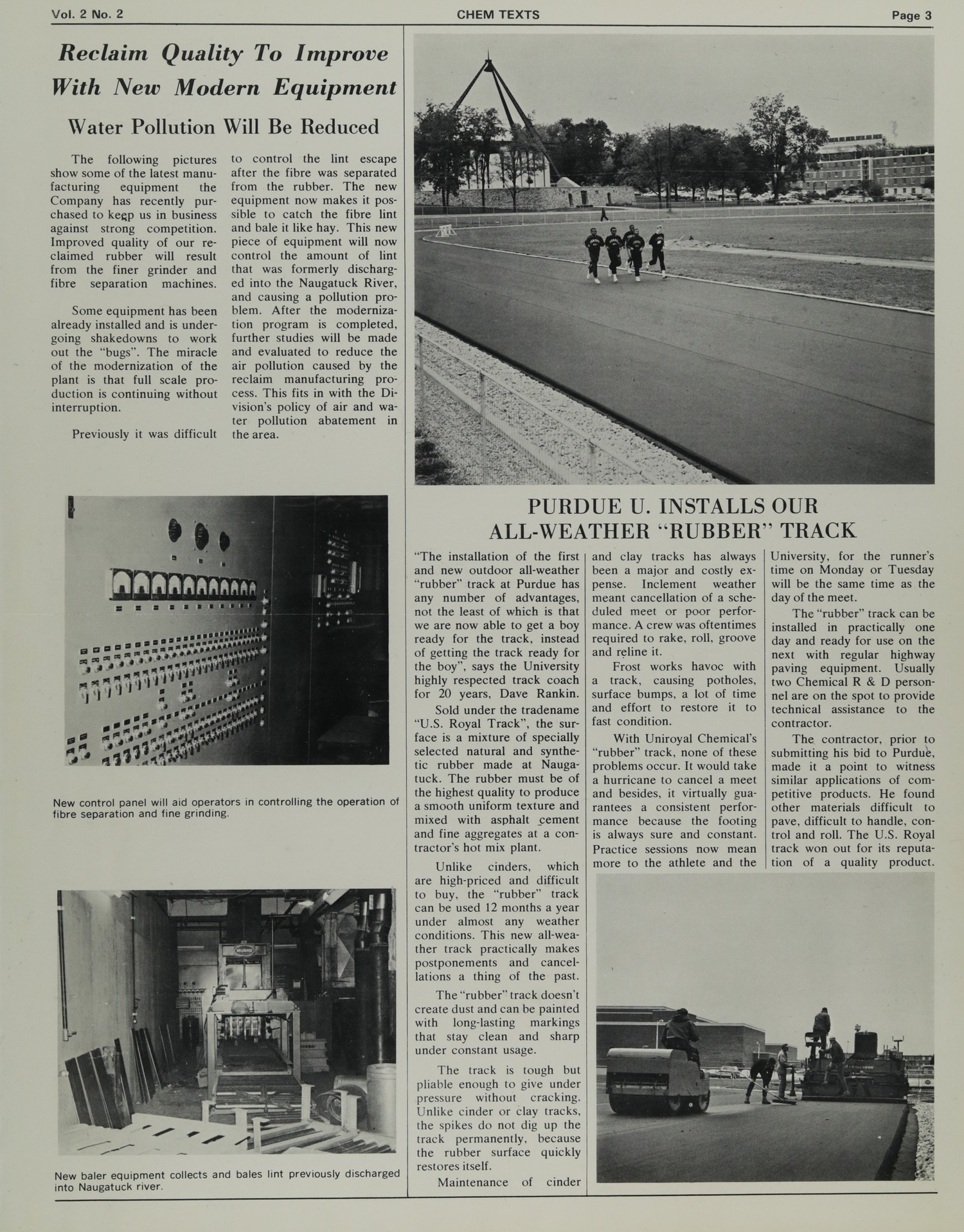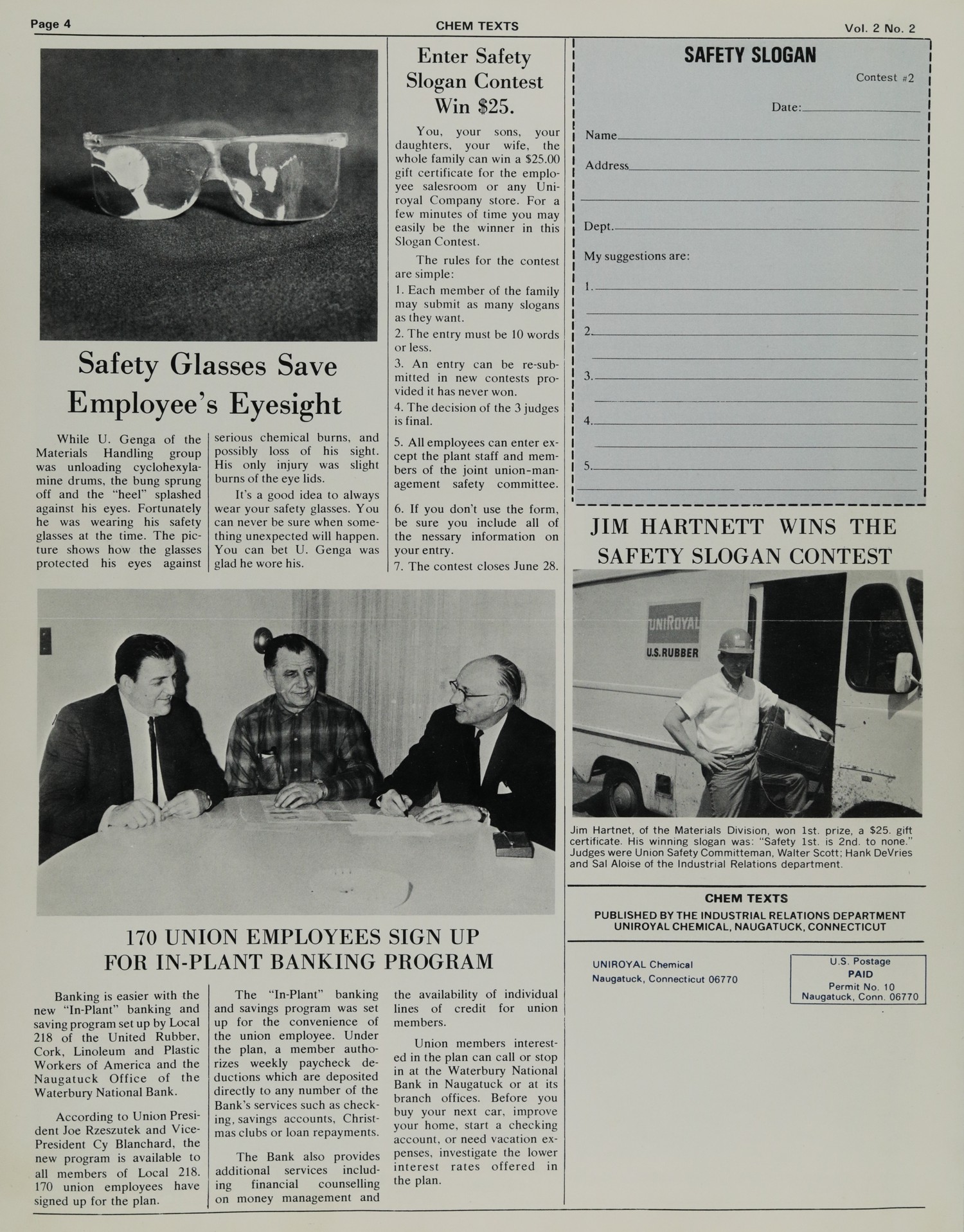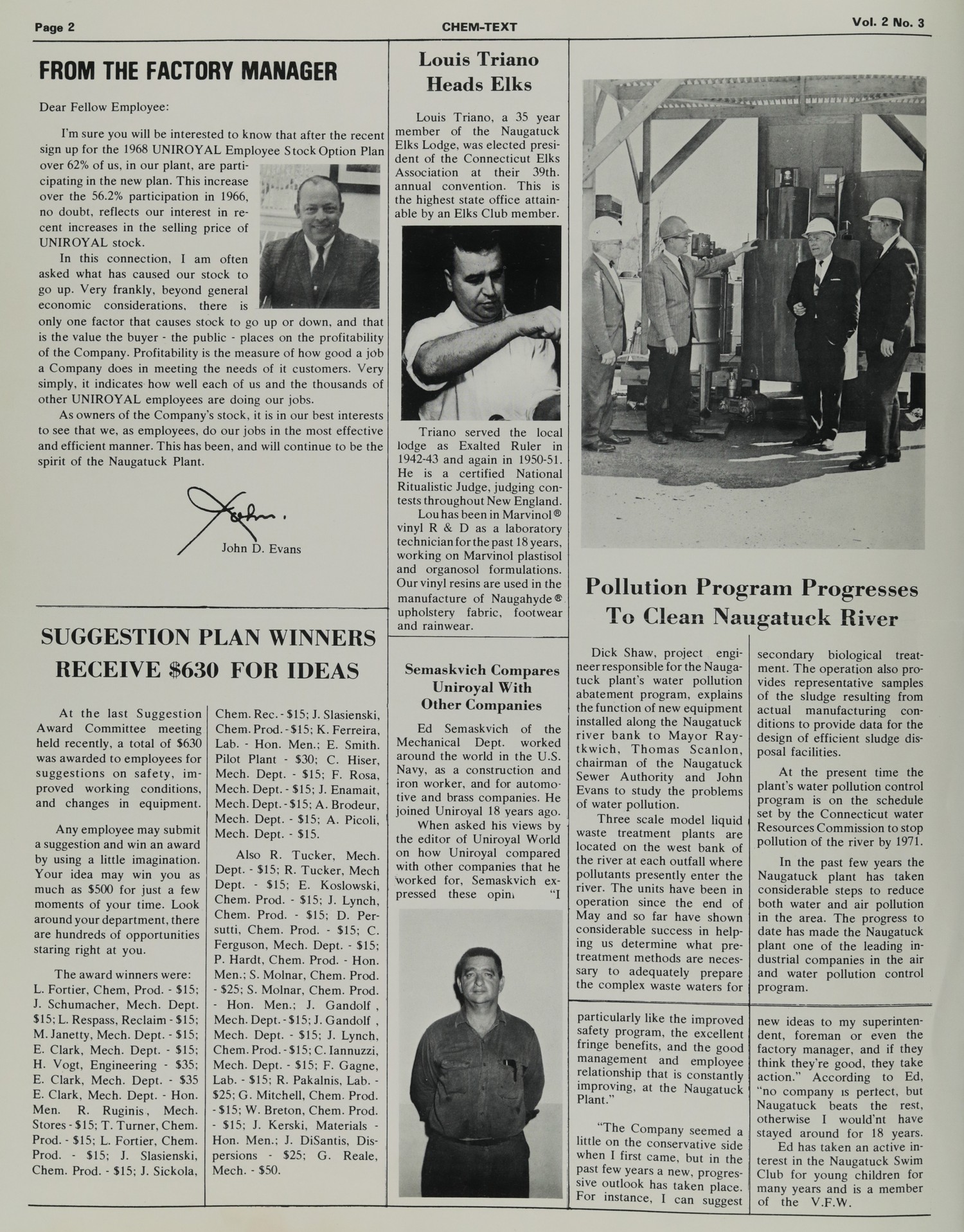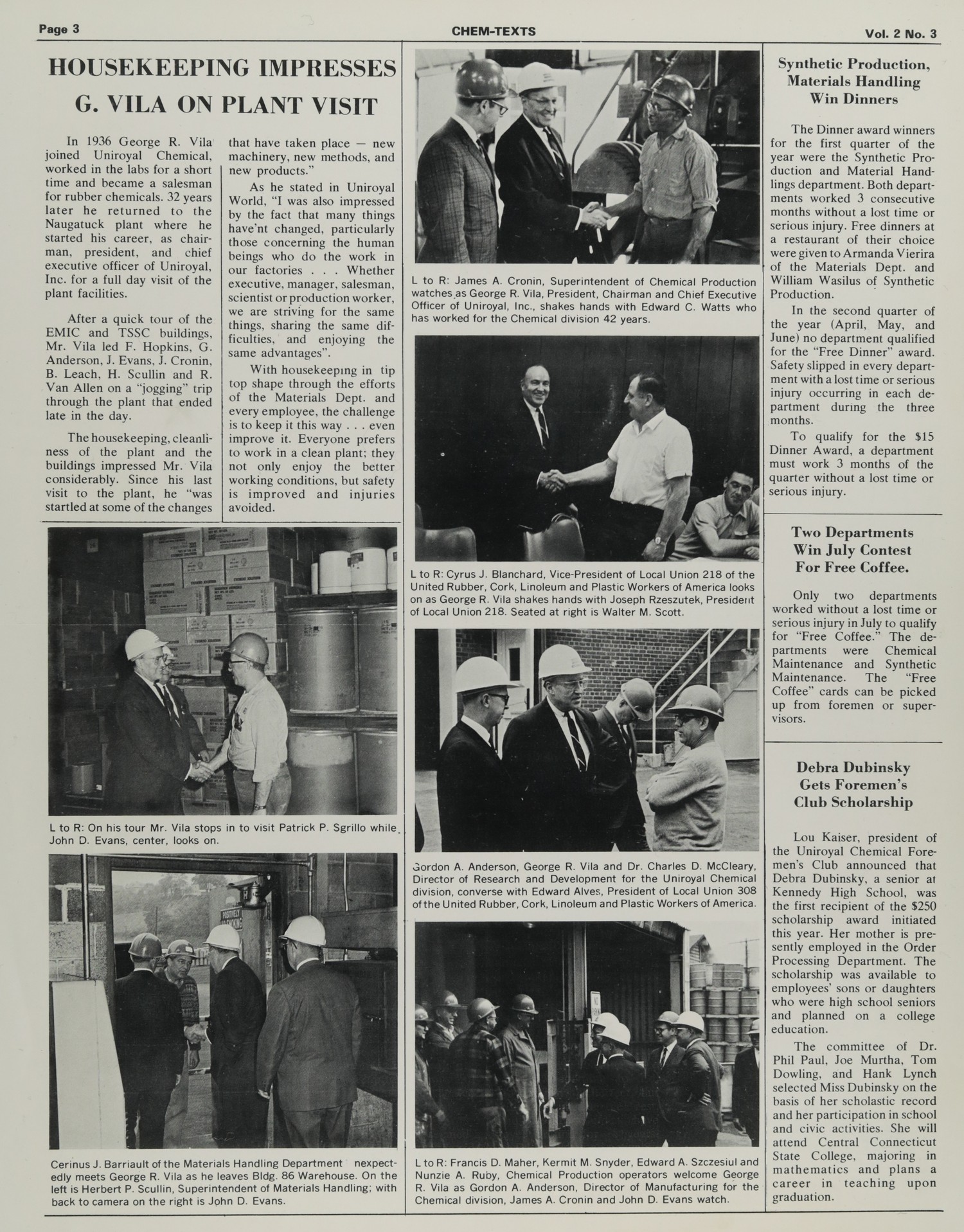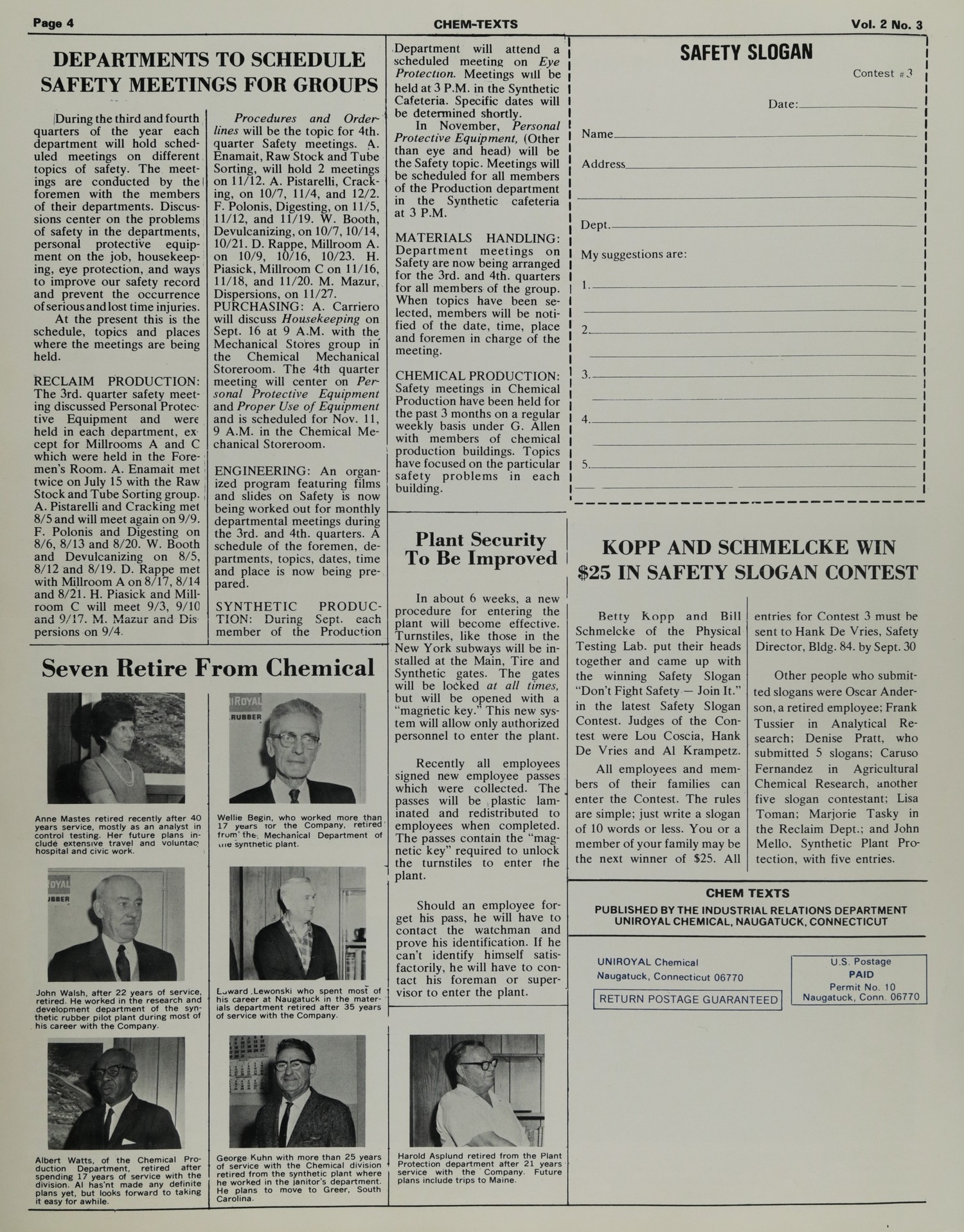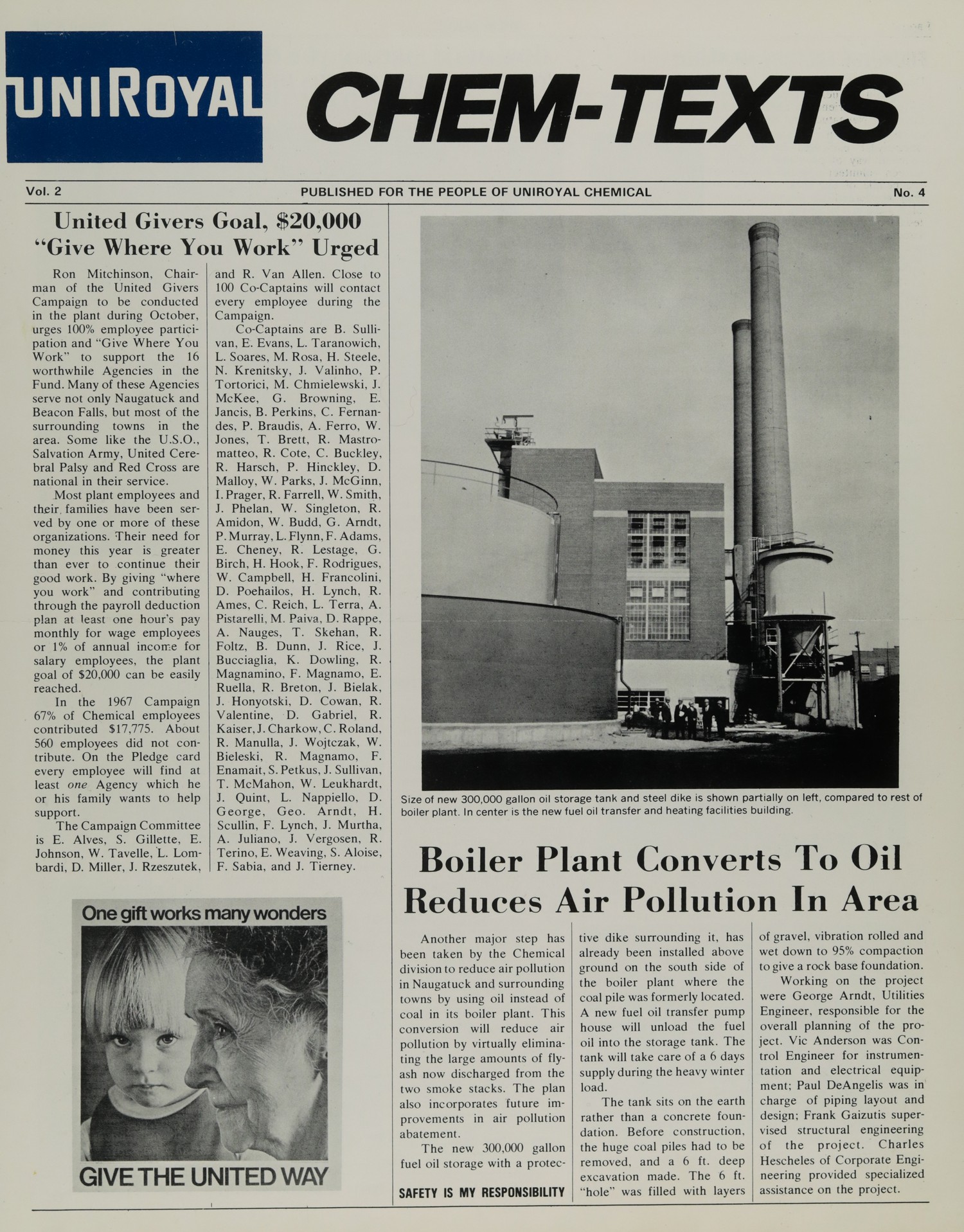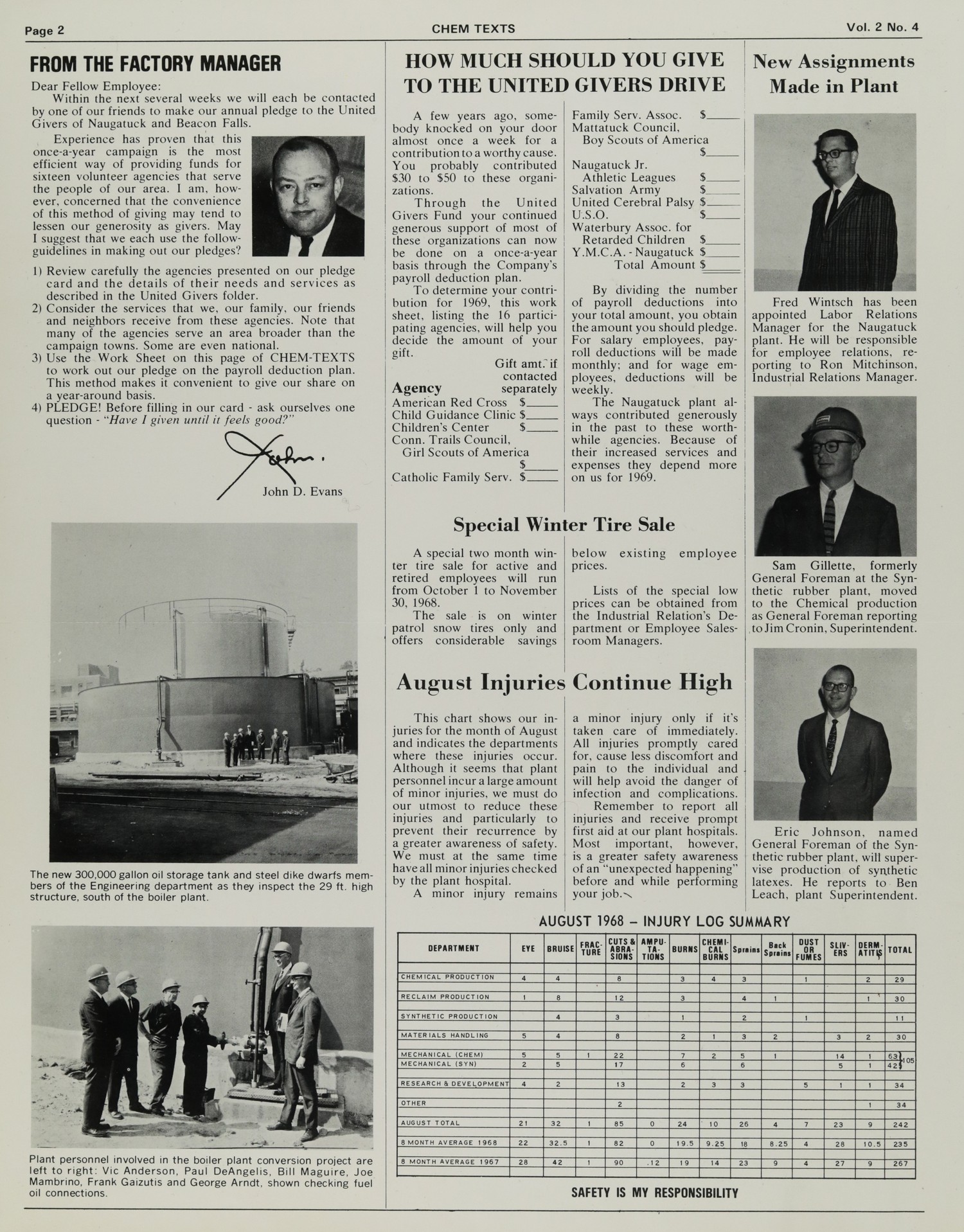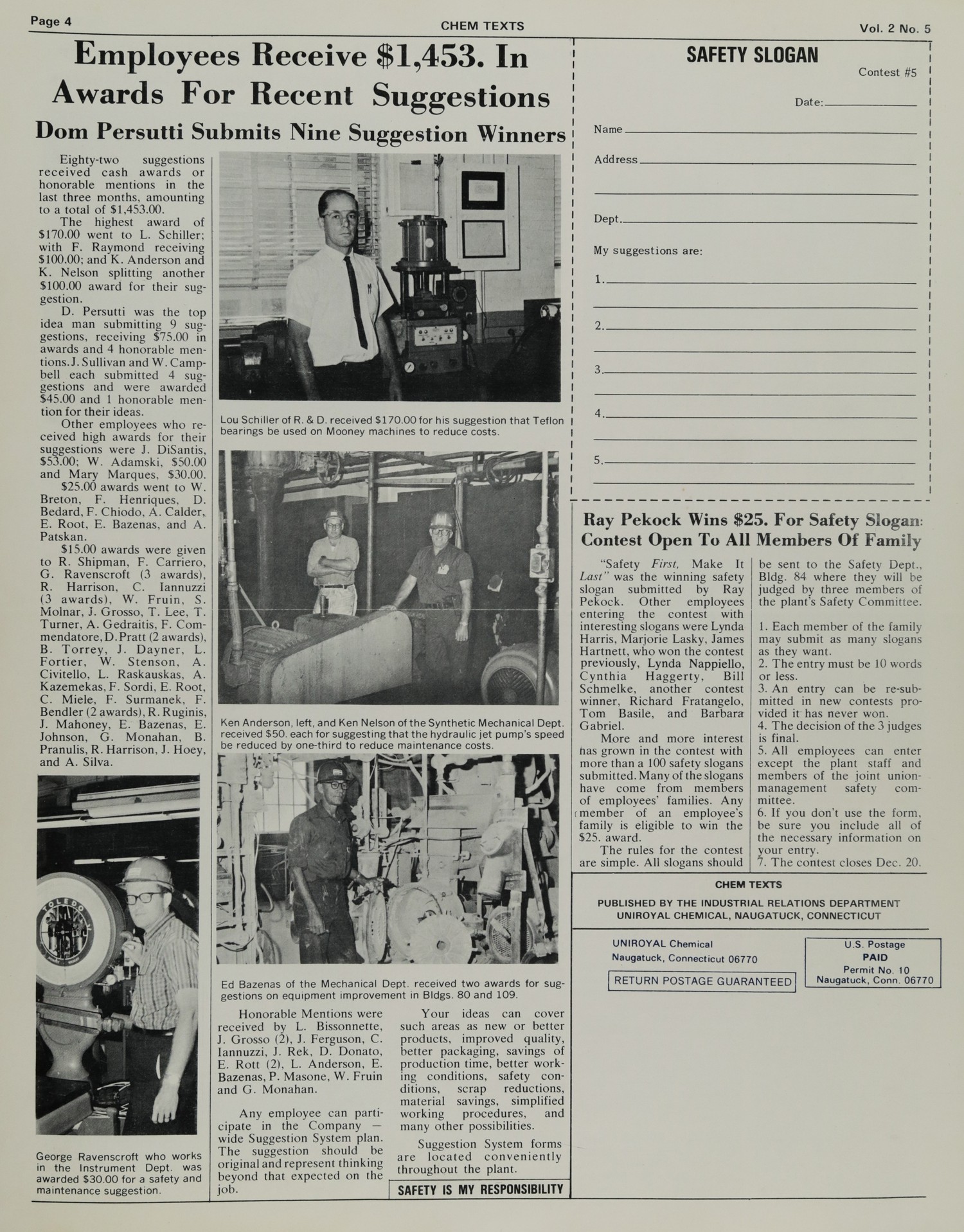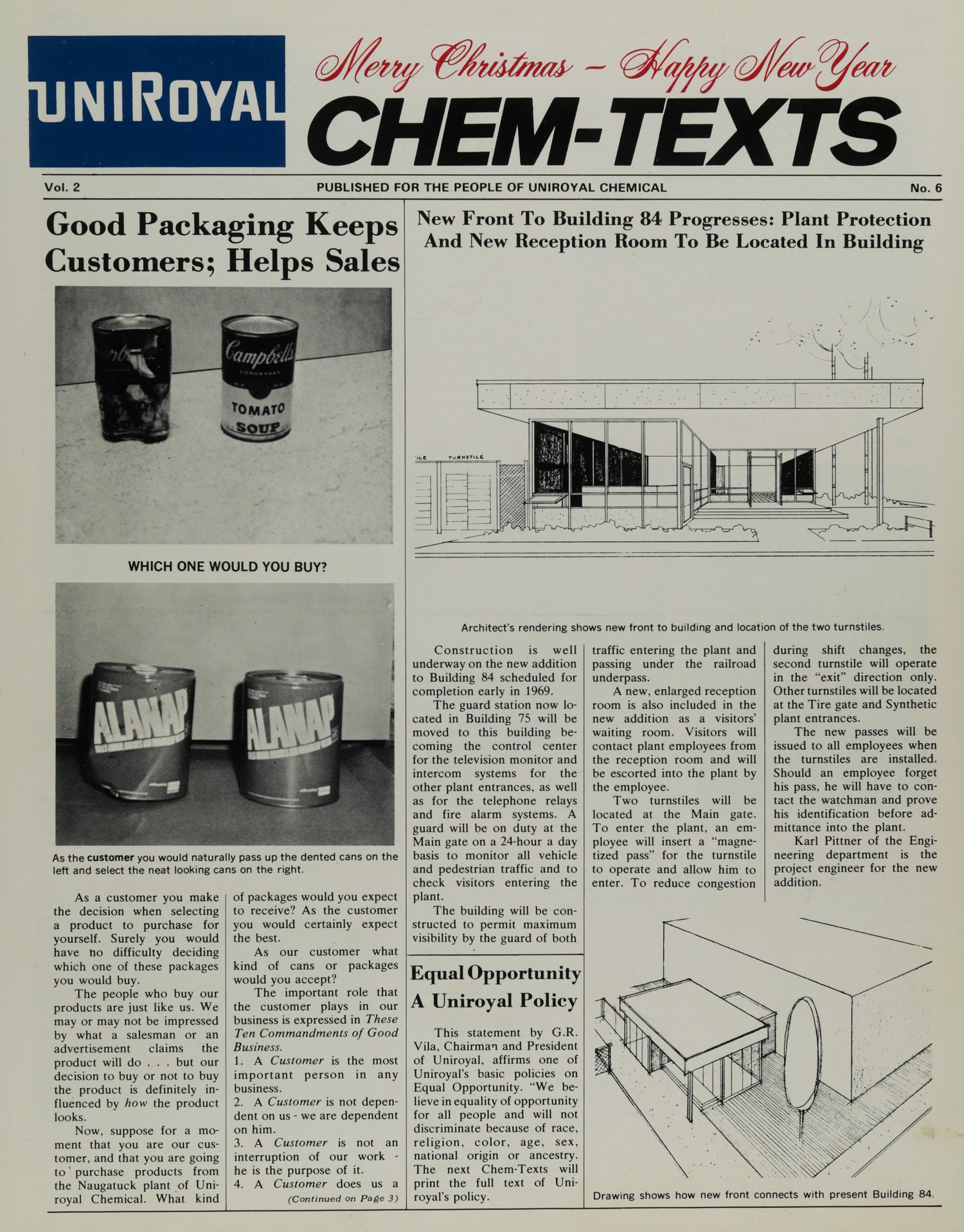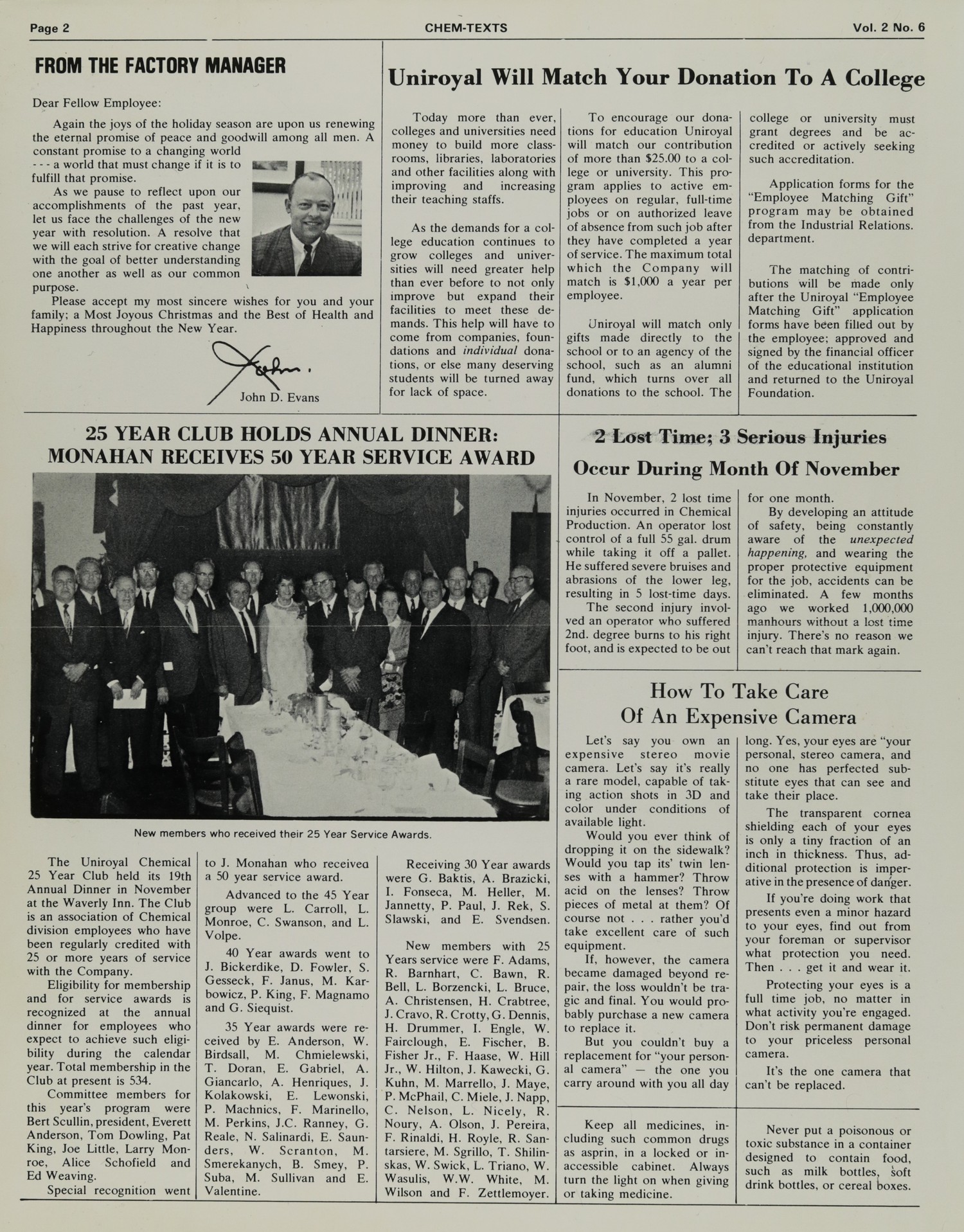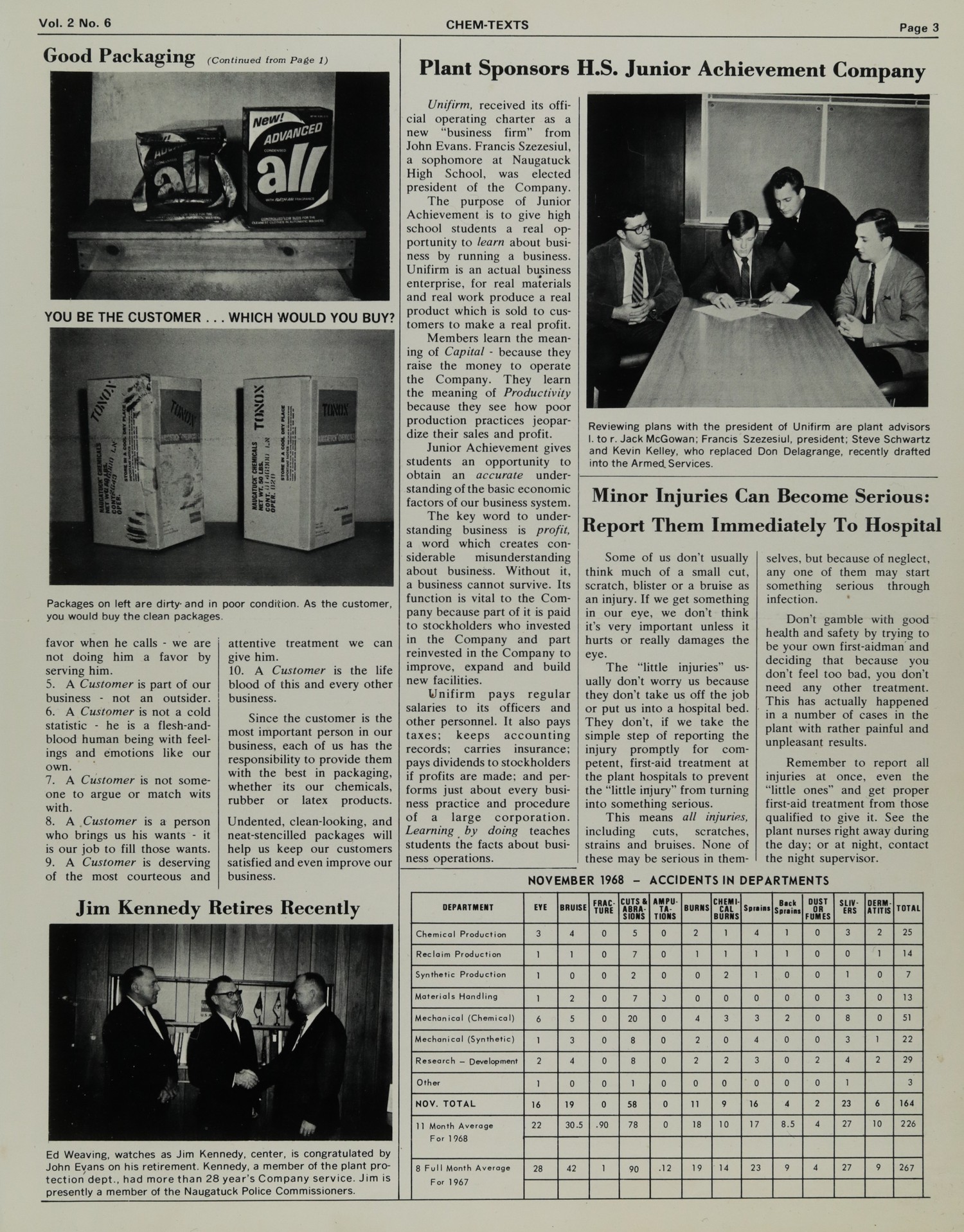
CHEM-TEXTS – Vol. 3 No. 8 – Page 4

Page 004

CHEM-TEXTS

Page 4 | Vol. 3 No. 9


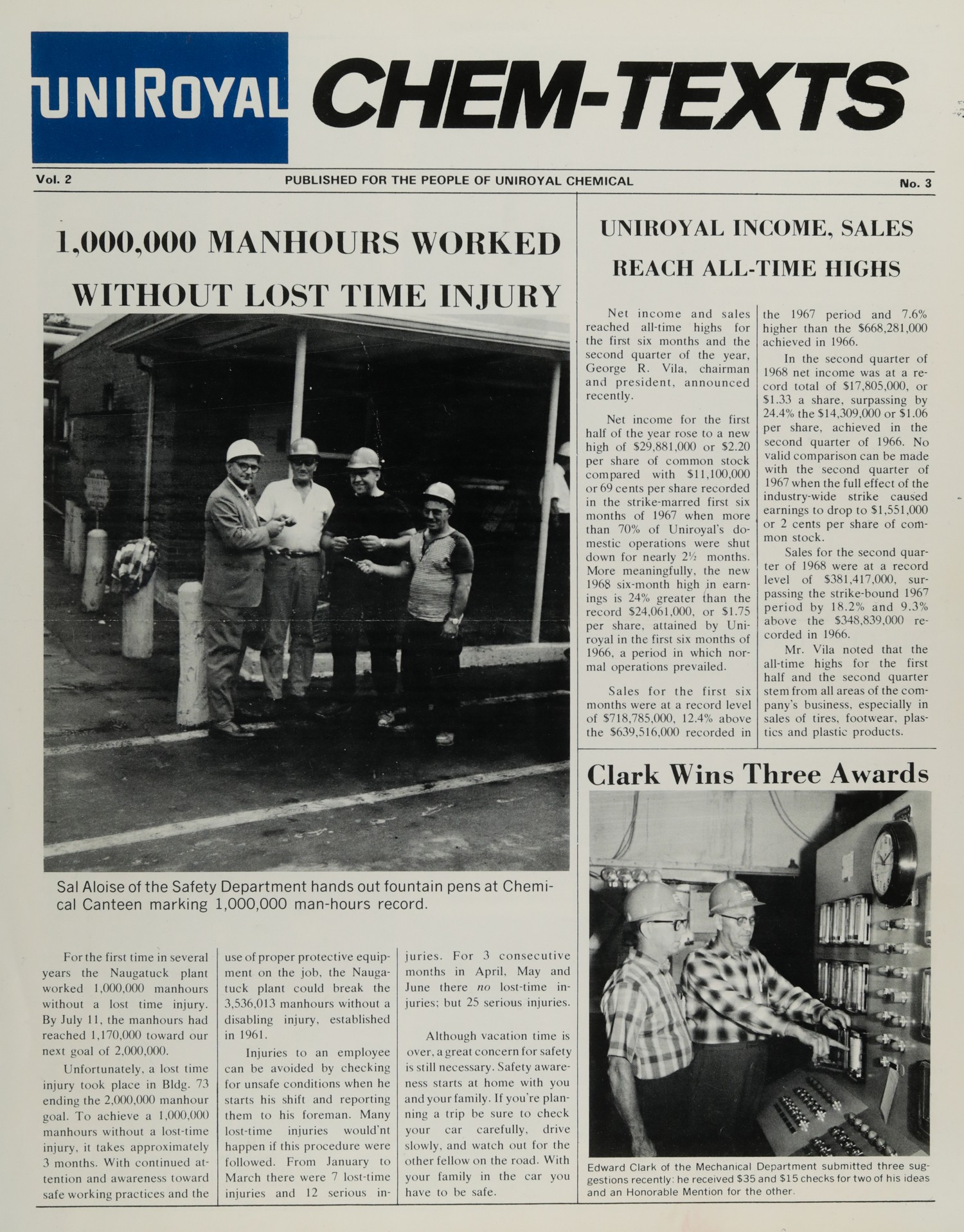
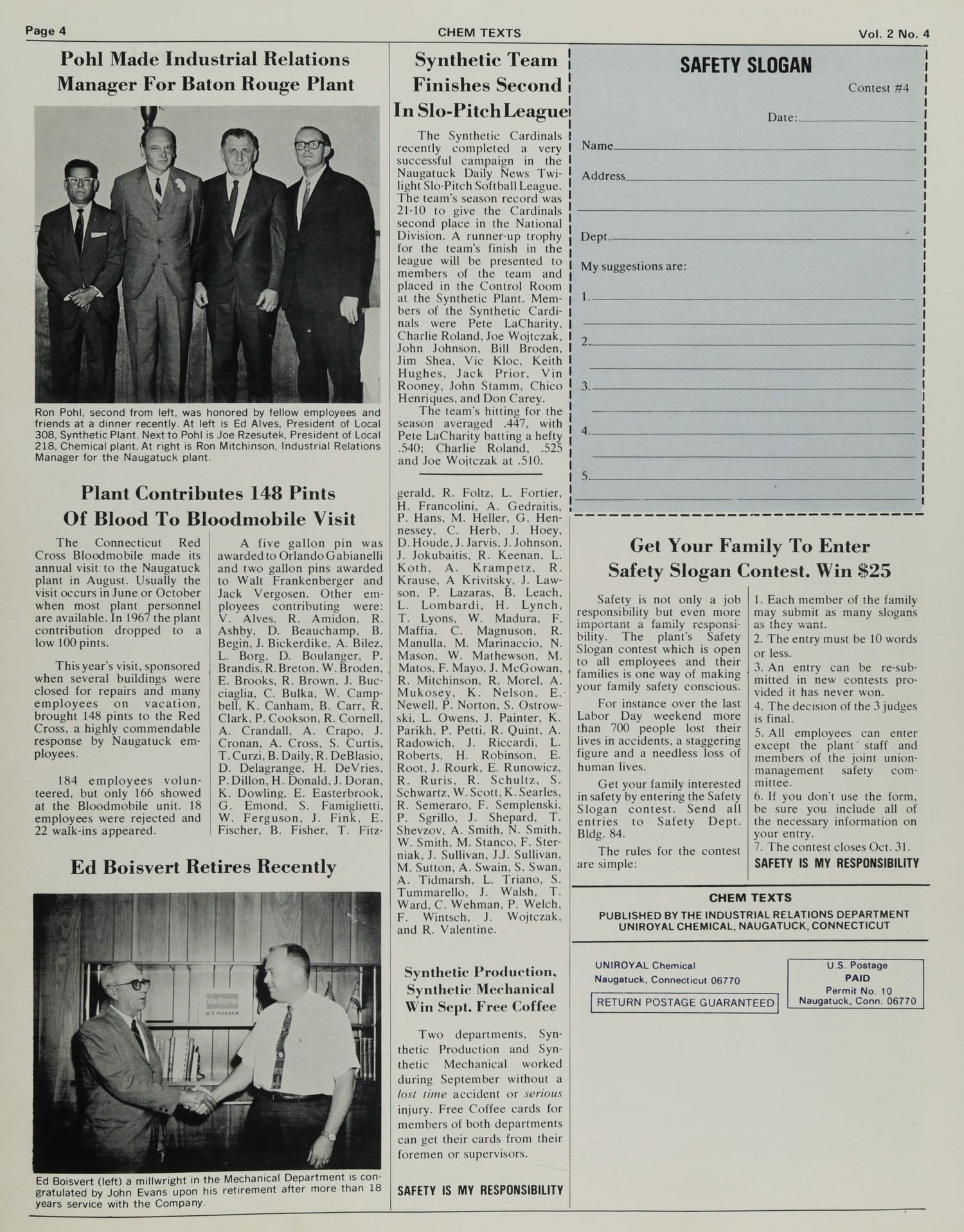
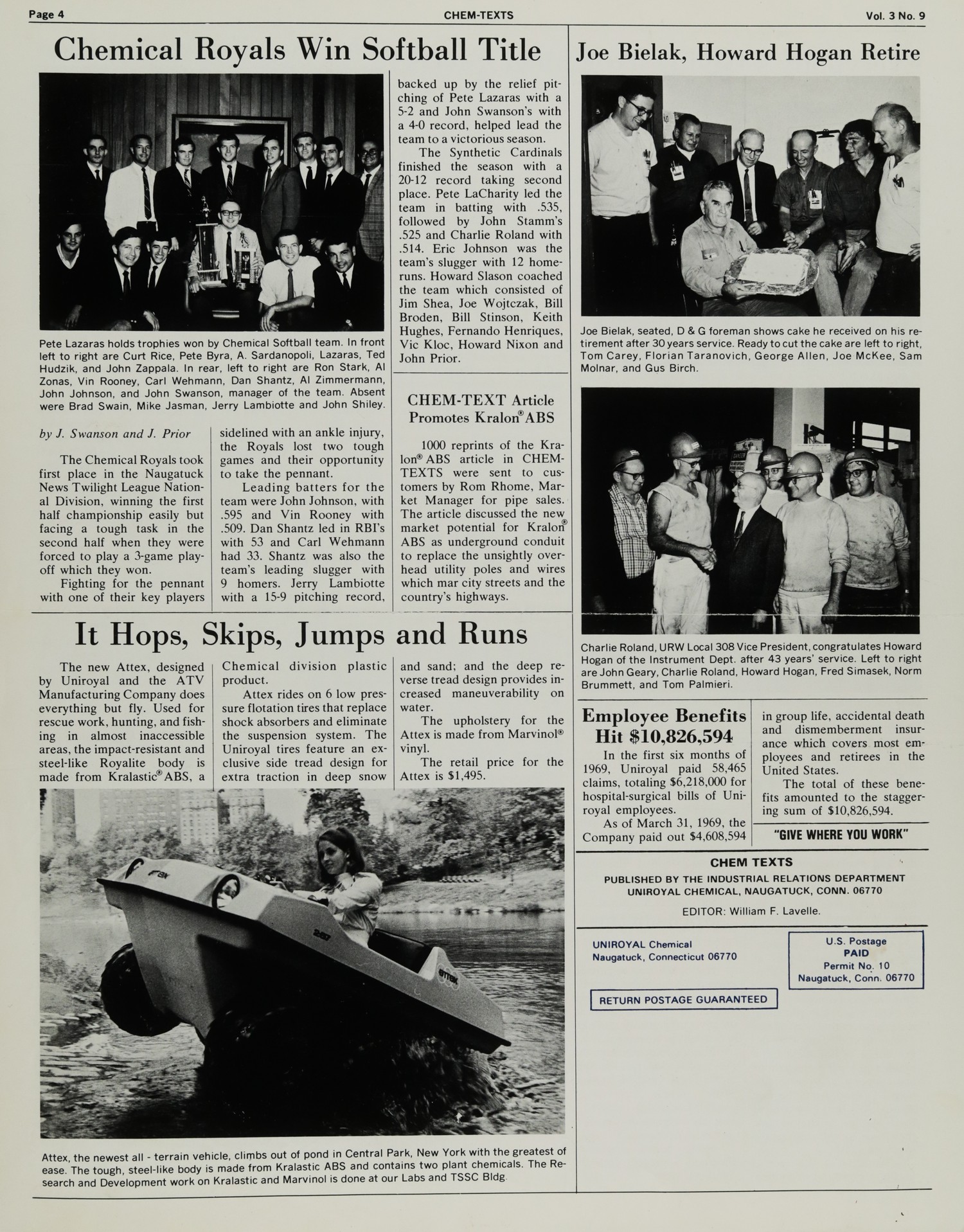
Chemical Royals Win Softball Title

[PHOTO: Group photo of softball team members]

Pete Lazaras holds trophies won by Chemical Softball team. In front left to right are Curt Rice, Pete Byra, A. Sardanopoli, Lazaras, Ted Hudzik, and John Zappala. In rear, left to right are Ron Stark, Al Zonas, Vin Rooney, Carl Wehmann, Dan Shantz, Al Zimmermann, John Johnson, and John Swanson, manager of the team. Absent were Brad Swain, Mike Jasman, Jerry Lambiotte and John Shiley.

by J. Swanson and J. Prior

The Chemical Royals took first place in the Naugatuck News Twilight League National Division, winning the first half championship easily but facing a tough task in the second half when they were forced to play a 3-game playoff which they won.

Fighting for the pennant with one of their key players sidelined with an ankle injury, the Royals lost two tough games and their opportunity to take the pennant.

Leading batters for the team were John Johnson, with .595 and Vin Rooney with .509. Dan Shantz led in RBI’s with 53 and Carl Wehmann had 33. Shantz was also the team’s leading slugger with 9 homers. Jerry Lambiotte with a 15-9 pitching record, backed up by the relief pitching of Pete Lazaras with a 5-2 and John Swanson’s with a 4-0 record, helped lead the team to a victorious season.

The Synthetic Cardinals finished the season with a 20-12 record taking second place. Pete LaCharity led the team in batting with .535, followed by John Stamm’s .525 and Charlie Roland with .514. Eric Johnson was the team’s slugger with 12 home-runs. Howard Slason coached the team which consisted of Jim Shea, Joe Wojtczak, Bill Broden, Bill Stinson, Keith Hughes, Fernando Henriques, Vic Kloc, Howard Nixon and John Prior.


CHEM-TEXT Article Promotes Kralon®ABS

1000 reprints of the Kralon® ABS article in CHEM-TEXTS were sent to customers by Rom Rhome, Market Manager for pipe sales. The article discussed the new market potential for Kralon® ABS as underground conduit to replace the unsightly overhead utility poles and wires which mar city streets and the country’s highways.


Joe Bielak, Howard Hogan Retire

[PHOTO: Group of men with retirement cake]

Joe Bielak, seated, D & G foreman shows cake he received on his retirement after 30 years service. Ready to cut the cake are left to right, Tom Carey, Florian Taranovich, George Allen, Joe McKee, Sam Molnar, and Gus Birch.

[PHOTO: Group of men at retirement celebration]

Charlie Roland, URW Local 308 Vice President, congratulates Howard Hogan of the Instrument Dept. after 43 years’ service. Left to right are John Geary, Charlie Roland, Howard Hogan, Fred Simasek, Norm Brummett, and Tom Palmieri.


It Hops, Skips, Jumps and Runs

The new Attex, designed by Uniroyal and the ATV Manufacturing Company does everything but fly. Used for rescue work, hunting, and fishing in almost inaccessible areas, the impact-resistant and steel-like Royalite body is made from Kralastic® ABS, a Chemical division plastic product.

Attex rides on 6 low pressure flotation tires that replace shock absorbers and eliminate the suspension system. The Uniroyal tires feature an exclusive side tread design for extra traction in deep snow and sand; and the deep reverse tread design provides increased maneuverability on water.

The upholstery for the Attex is made from Marvinol® vinyl.

The retail price for the Attex is $1,495.

[PHOTO: Attex vehicle emerging from water in Central Park]

Attex, the newest all – terrain vehicle, climbs out of pond in Central Park, New York with the greatest of ease. The tough, steel-like body is made from Kralastic ABS and contains two plant chemicals. The Research and Development work on Kralastic and Marvinol is done at our Labs and TSSC Bldg.


Employee Benefits Hit $10,826,594

In the first six months of 1969, Uniroyal paid 58,465 claims, totaling $6,218,000 for hospital-surgical bills of Uniroyal employees.

As of March 31, 1969, the Company paid out $4,608,594 in group life, accidental death and dismemberment insurance which covers most employees and retirees in the United States.

The total of these benefits amounted to the staggering sum of $10,826,594.

“GIVE WHERE YOU WORK”


CHEM TEXTS

PUBLISHED BY THE INDUSTRIAL RELATIONS DEPARTMENT
UNIROYAL CHEMICAL, NAUGATUCK, CONN. 06770

EDITOR: William F. Lavelle.


UNIROYAL Chemical
Naugatuck, Connecticut 06770

U.S. Postage
PAID
Permit No. 10
Naugatuck, Conn. 06770

RETURN POSTAGE GUARANTEED
CHEM-TEXTS – Vol. 3, 1969, No. 10 – Page 1

Page 001

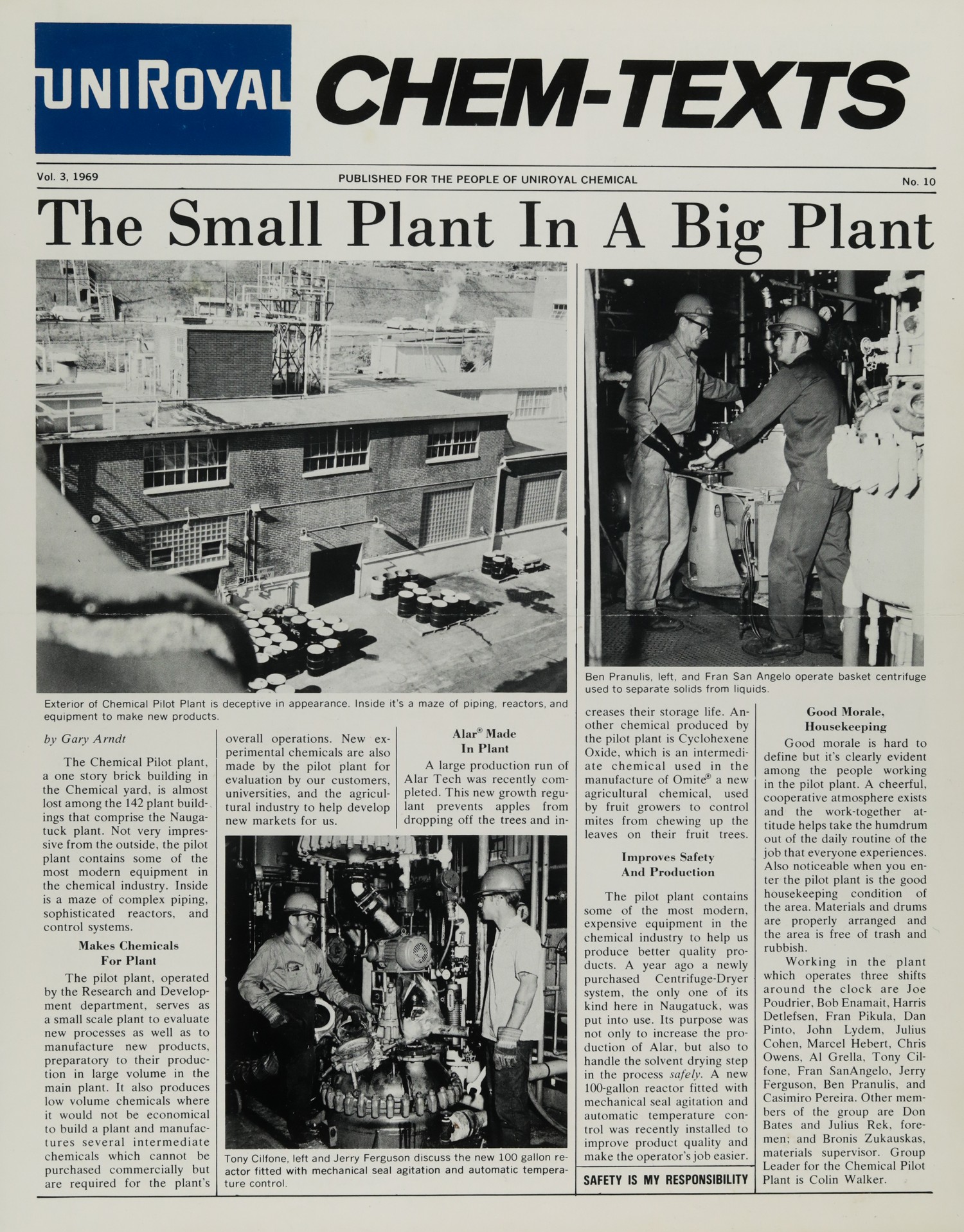
UNIROYAL CHEM-TEXTS

Vol. 3, 1969 PUBLISHED FOR THE PEOPLE OF UNIROYAL CHEMICAL No. 10


The Small Plant In A Big Plant


Exterior of Chemical Pilot Plant is deceptive in appearance. Inside it’s a maze of piping, reactors, and equipment to make new products.


by Gary Arndt

The Chemical Pilot plant, a one story brick building in the Chemical yard, is almost lost among the 142 plant buildings that comprise the Naugatuck plant. Not very impressive from the outside, the pilot plant contains some of the most modern equipment in the chemical industry. Inside is a maze of complex piping, sophisticated reactors, and control systems.

Makes Chemicals For Plant

The pilot plant, operated by the Research and Development department, serves as a small scale plant to evaluate new processes as well as to manufacture new products, preparatory to their production in large volume in the main plant. It also produces low volume chemicals where it would not be economical to build a plant and manufactures several intermediate chemicals which cannot be purchased commercially but are required for the plant’s overall operations. New experimental chemicals are also made by the pilot plant for evaluation by our customers, universities, and the agricultural industry to help develop new markets for us.


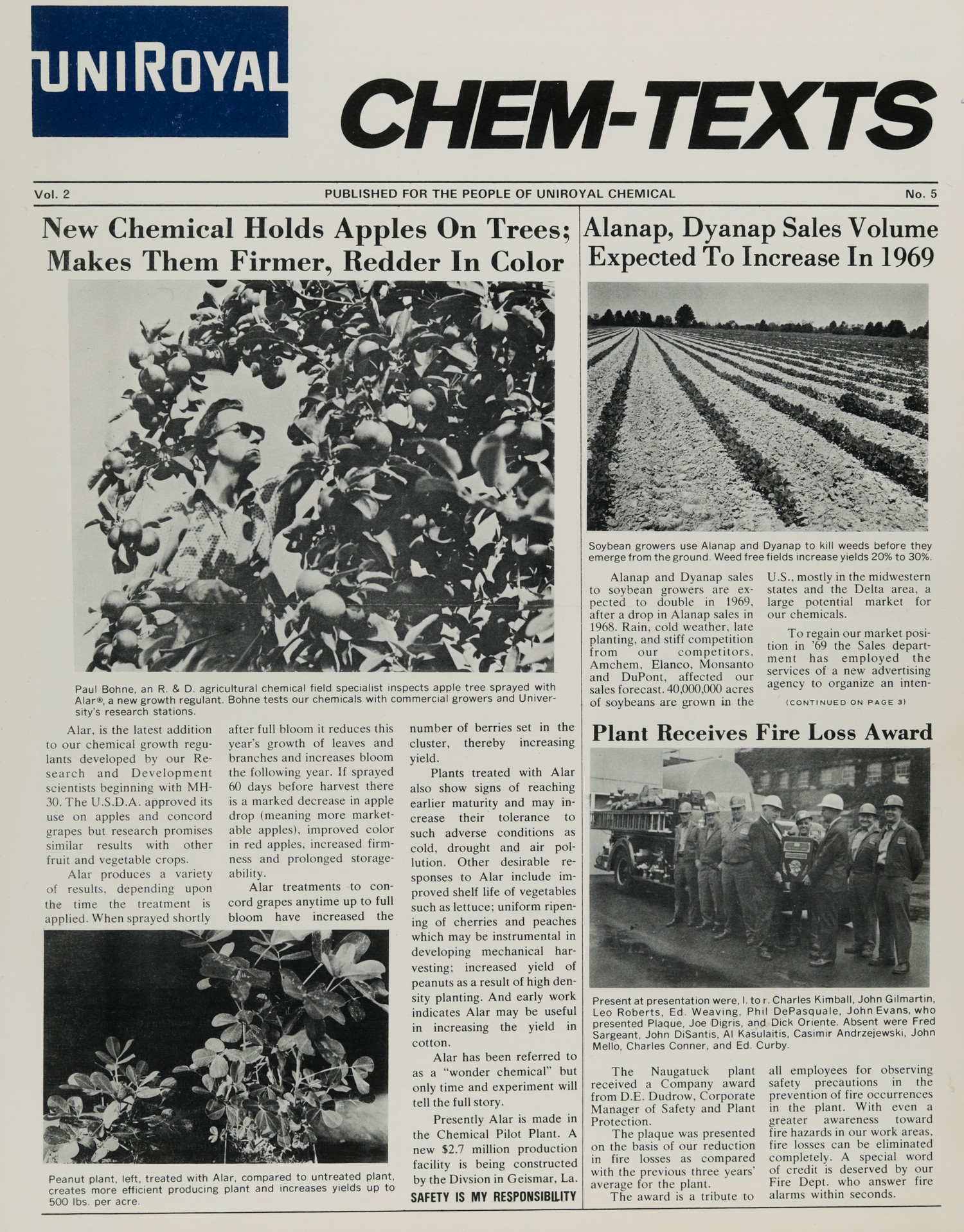
Alar® Made In Plant

A large production run of Alar Tech was recently completed. This new growth regulant prevents apples from dropping off the trees and in-


Tony Cilfone, left and Jerry Ferguson discuss the new 100 gallon reactor fitted with mechanical seal agitation and automatic temperature control.


Ben Pranulis, left, and Fran San Angelo operate basket centrifuge used to separate solids from liquids.


creases their storage life. Another chemical produced by the pilot plant is Cyclohexene Oxide, which is an intermediate chemical used in the manufacture of Omite® a new agricultural chemical, used by fruit growers to control mites from chewing up the leaves on their fruit trees.

Improves Safety And Production

The pilot plant contains some of the most modern, expensive equipment in the chemical industry to help us produce better quality products. A year ago a newly purchased Centrifuge-Dryer system, the only one of its kind here in Naugatuck, was put into use. Its purpose was not only to increase the production of Alar, but also to handle the solvent drying step in the process safely. A new 100-gallon reactor fitted with mechanical seal agitation and automatic temperature control was recently installed to improve product quality and make the operator’s job easier.

SAFETY IS MY RESPONSIBILITY


Good Morale, Housekeeping

Good morale is hard to define but it’s clearly evident among the people working in the pilot plant. A cheerful, cooperative atmosphere exists and the work-together attitude helps take the humdrum out of the daily routine of the job that everyone experiences. Also noticeable when you enter the pilot plant is the good housekeeping condition of the area. Materials and drums are properly arranged and the area is free of trash and rubbish.

Working in the plant which operates three shifts around the clock are Joe Poudrier, Bob Enamait, Harris Detlefsen, Fran Pikula, Dan Pinto, John Lydem, Julius Cohen, Marcel Hebert, Chris Owens, Al Grella, Tony Cilfone, Fran SanAngelo, Jerry Ferguson, Ben Pranulis, and Casimiro Pereira. Other members of the group are Don Bates and Julius Rek, foremen; and Bronis Zukauskas, materials supervisor. Group Leader for the Chemical Pilot Plant is Colin Walker.

CHEM-TEXTS – Vol. 3 No. 10 – Page 2

Page 002

CHEM-TEXTS

Page 2 | Vol. 3 No. 10


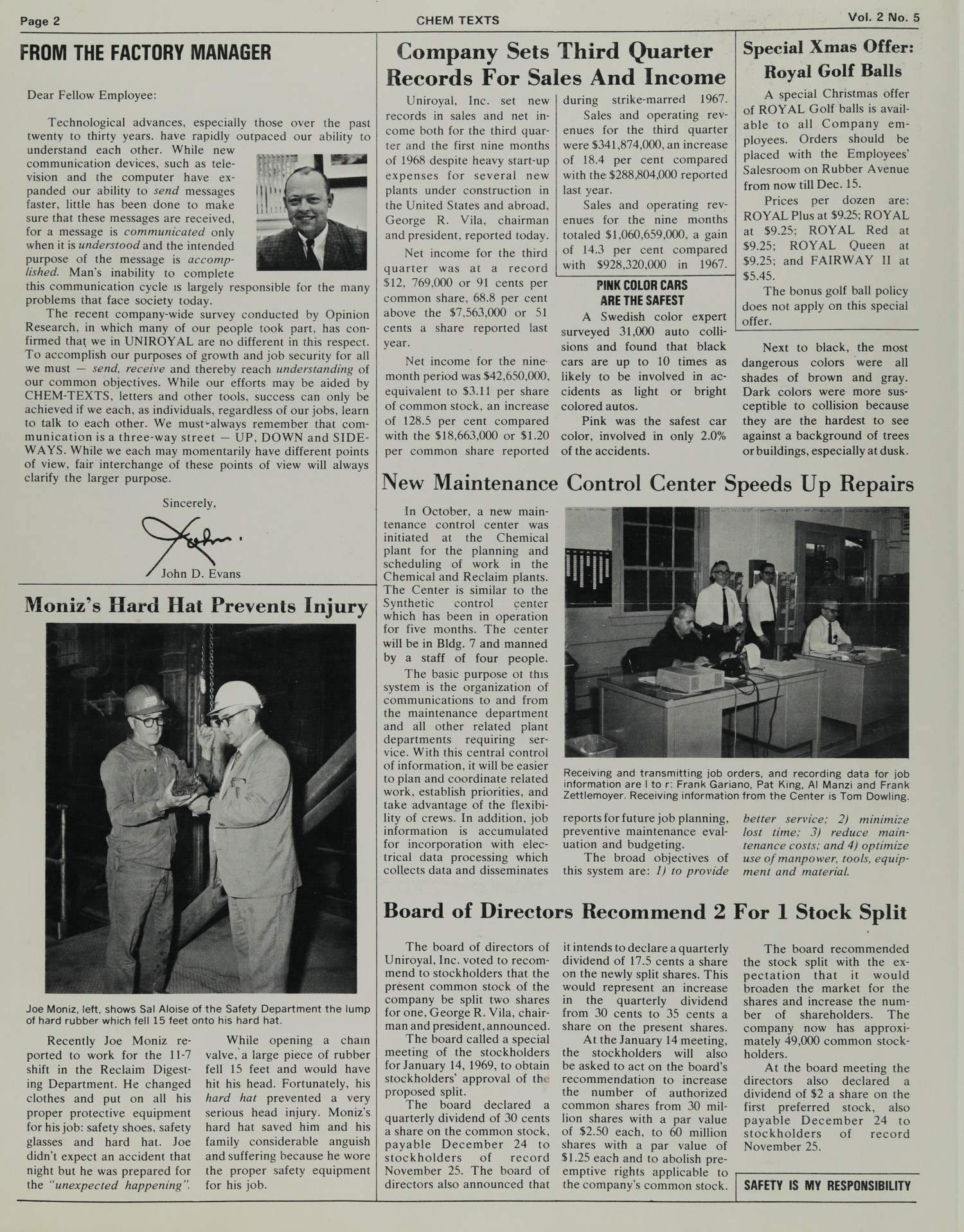
FROM THE FACTORY MANAGER

DEAR FELLOW EMPLOYEES:

Have you ever thought about what you are doing to make tomorrow better than today, either for yourself or for others? It seems to me that much of what we will be or will do tomorrow is largely dependent on what we learn today.

No longer can one enjoy for a lifetime the benefits of a formal education. It has often been said that an engineer’s technical knowledge is half obsolete ten years after he graduates. This is true to varying degrees for all of us. Education and learning has become an ongoing lifetime experience.

It is rather strange to realize that while the need for self-improvement and individual growth has never been more clearly recognized, television and other diverse entertainment tempt us into becoming well entertained vegetables. How well will these vegetables grow in tomorrow’s climate of change?

As we pause at this time of the year to give thanks to God for the blessings of the past and present, let’s each take time to plan for our future. For example let’s consider:

  1. What can I do to extend or broaden my knowledge through formal education or by my own reading?
  2. What can I do to prepare myself for a bigger job?
  3. What can I do to better understand our political and economic system?
  4. What can I do to involve myself in the life of my church and my community?
  5. What can I do to better understand who I am, and where am I going?

Sincerely,

[signature]

John D. Evans


Packages Under Study

by Al Manzi

Although we may produce the highest quality products, these products will not be purchased by customers unless the package is delivered in an excellent condition and with a neat, clean appearance. Our agriculture chemical business relies heavily on neat packages displayed in a dealer’s store to help sell the product.

Container failures result in high costs of damages, repackaging and lost customers. We initiated a program of testing with our container suppliers to evaluate and specify the best linings for these chemicals. An area of Building 47 has been caged off for use as a container evaluation laboratory. Samples of containers furnished by suppliers will undergo long range testing with all of our agricultural chemicals. In addition, we will be doing random testing of containers as supplied to inspect the manufacturer’s quality.

The responsibility of clean, properly palleted and stencilled packages still lies with the production groups, materials department, and shipping. When packages are handled by several departments before shipping to a customer, everyone is responsible for the appearance of the package. No matter how well a package is constructed, if it arrives at a customer’s plant torn or dented, he will return it. As a result our production costs increase, the profit on the product is lost, and most important, perhaps we lose a big customer.

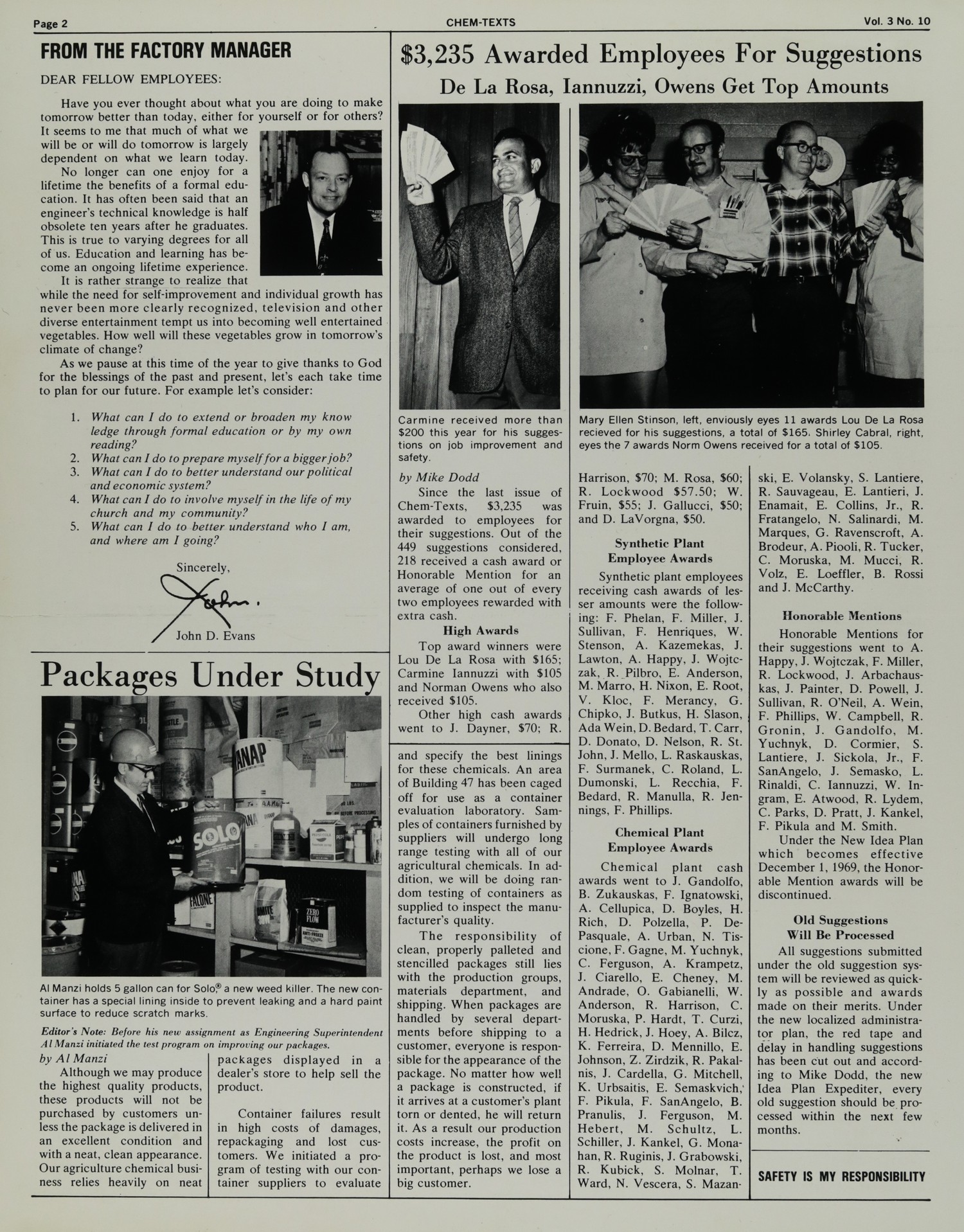
Al Manzi holds 5 gallon can for Solo® a new weed killer. The new container has a special lining inside to prevent leaking and a hard paint surface to reduce scratch marks.

Editor’s Note: Before his new assignment as Engineering Superintendent Al Manzi initiated the test program on improving our packages.


$3,235 Awarded Employees For Suggestions

De La Rosa, Iannuzzi, Owens Get Top Amounts

Carmine received more than $200 this year for his suggestions on job improvement and safety.

by Mike Dodd

Since the last issue of Chem-Texts, $3,235 was awarded to employees for their suggestions. Out of the 449 suggestions considered, 218 received a cash award or Honorable Mention for an average of one out of every two employees rewarded with extra cash.

High Awards

Top award winners were Lou De La Rosa with $165; Carmine Iannuzzi with $105 and Norman Owens who also received $105.

Other high cash awards went to J. Dayner, $70; R. Harrison, $70; M. Rosa, $60; R. Lockwood $57.50; W. Fruin, $55; J. Gallucci, $50; and D. LaVorgna, $50.

Synthetic Plant Employee Awards

Synthetic plant employees receiving cash awards of lesser amounts were the following: F. Phelan, F. Miller, J. Sullivan, F. Henriques, W. Stenson, A. Kazemekas, J. Lawton, A. Happy, J. Wojtczak, R. Pilbro, E. Anderson, M. Marro, H. Nixon, E. Root, V. Kloc, F. Merancy, G. Chipko, J. Butkus, H. Slason, Ada Wein, D. Bedard, T. Carr, D. Donato, D. Nelson, R. St. John, J. Mello, L. Raskauskas, F. Surmanek, C. Roland, L. Dumonski, L. Recchia, F. Bedard, R. Manulla, R. Jennings, F. Phillips.

Chemical Plant Employee Awards

Chemical plant cash awards went to J. Gandolfo, B. Zukauskas, F. Ignatowski, A. Cellupica, D. Boyles, H. Rich, D. Polzella, P. DePasquale, A. Urban, N. Tiscione, F. Gagne, M. Yuchnyk, C. Ferguson, A. Krampetz, J. Ciarello, E. Cheney, M. Andrade, O. Gabianelli, W. Anderson, R. Harrison, C. Moruska, P. Hardt, T. Curzi, H. Hedrick, J. Hoey, A. Bilcz, K. Ferreira, D. Mennillo, E. Johnson, Z. Zirdzik, R. Pakalnis, J. Cardella, G. Mitchell, K. Urbsaitis, E. Semaskvich, F. Pikula, F. SanAngelo, B. Pranulis, J. Ferguson, M. Hebert, M. Schultz, L. Schiller, J. Kankel, G. Monahan, R. Ruginis, J. Grabowski, R. Kubick, S. Molnar, T. Ward, N. Vescera, S. Mazan-

Mary Ellen Stinson, left, enviously eyes 11 awards Lou De La Rosa recieved for his suggestions, a total of $165. Shirley Cabral, right, eyes the 7 awards Norm Owens received for a total of $105.

ski, E. Volansky, S. Lantiere, R. Sauvageau, E. Lantieri, J. Enamait, E. Collins, Jr., R. Fratangelo, N. Salinardi, M. Marques, G. Ravenscroft, A. Brodeur, A. Piooli, R. Tucker, C. Moruska, M. Mucci, R. Volz, E. Loeffler, B. Rossi and J. McCarthy.

Honorable Mentions

Honorable Mentions for their suggestions went to A. Happy, J. Wojtczak, F. Miller, R. Lockwood, J. Arbachauskas, J. Painter, D. Powell, J. Sullivan, R. O’Neil, A. Wein, F. Phillips, W. Campbell, R. Gronin, J. Gandolfo, M. Yuchnyk, D. Cormier, S. Lantiere, J. Sickola, Jr., F. SanAngelo, J. Semasko, L. Rinaldi, C. Iannuzzi, W. Ingram, E. Atwood, R. Lydem, C. Parks, D. Pratt, J. Kankel, F. Pikula and M. Smith.

Under the New Idea Plan which becomes effective December 1, 1969, the Honorable Mention awards will be discontinued.

Old Suggestions Will Be Processed

All suggestions submitted under the old suggestion system will be reviewed as quickly as possible and awards made on their merits. Under the new localized administrator plan, the red tape and delay in handling suggestions has been cut out and according to Mike Dodd, the new Idea Plan Expediter, every old suggestion should be processed within the next few months.


SAFETY IS MY RESPONSIBILITY

CHEM-TEXTS – Vol. 3 No. 10 – Page 3

Page 003

CHEM-TEXTS

Vol. 3 No. 10 | Page 3


Production Goal Topped By Synthetic Plant’s “C” Crew

The Synthetic Processing C crew averaged 9.2 charged batches of latex daily for one full week, surpassing the 9 batches processed by the A crew recently. This production rate is a significant step in improving our competitive position by manufacturing a lower cost product.

The latex business today is a highly competitive business with large chemical companies as Dow, Goodrich, General Tire, Firestone, Shell and Goodyear competing with us for the same markets and customers. Efficient production of a quality latex, and prompt customer service are essential factors in keeping and improving our present business and ultimately better job security. Like ourselves, our customers are “shoppers”; they shop for the best products at the best price.

Although the C crew went over the goal, it required the combined effort of the A and B crews to achieve it. Continued production of 27 batches a day requires the fullest effort of every person in the Synthetic plant, as every employee in every department plays an important role in its success.


[PHOTO CAPTION:]
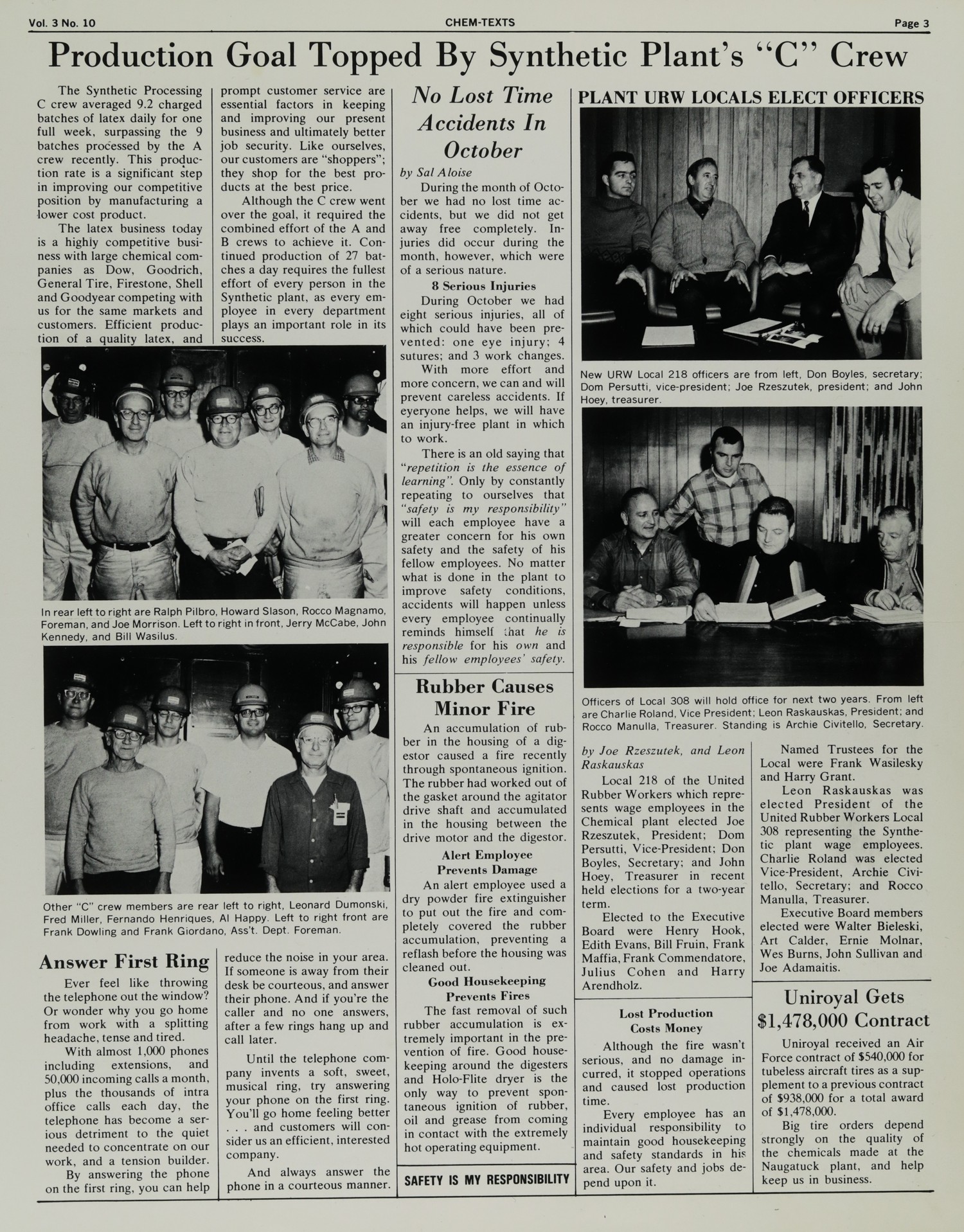
In rear left to right are Ralph Pilbro, Howard Slason, Rocco Magnamo, Foreman, and Joe Morrison. Left to right in front, Jerry McCabe, John Kennedy, and Bill Wasilus.


[PHOTO CAPTION:]
Other “C” crew members are rear left to right, Leonard Dumonski, Fred Miller, Fernando Henriques, Al Happy. Left to right front are Frank Dowling and Frank Giordano, Ass’t. Dept. Foreman.


Answer First Ring

Ever feel like throwing the telephone out the window? Or wonder why you go home from work with a splitting headache, tense and tired.

With almost 1,000 phones including extensions, and 50,000 incoming calls a month, plus the thousands of intra office calls each day, the telephone has become a serious detriment to the quiet needed to concentrate on our work, and a tension builder.

By answering the phone on the first ring, you can help reduce the noise in your area. If someone is away from their desk be courteous, and answer their phone. And if you’re the caller and no one answers, after a few rings hang up and call later.

Until the telephone company invents a soft, sweet, musical ring, try answering your phone on the first ring. You’ll go home feeling better . . . and customers will consider us an efficient, interested company.

And always answer the phone in a courteous manner.


No Lost Time Accidents In October

by Sal Aloise

During the month of October we had no lost time accidents, but we did not get away free completely. Injuries did occur during the month, however, which were of a serious nature.

8 Serious Injuries

During October we had eight serious injuries, all of which could have been prevented: one eye injury; 4 sutures; and 3 work changes.

With more effort and more concern, we can and will prevent careless accidents. If everyone helps, we will have an injury-free plant in which to work.

There is an old saying that “repetition is the essence of learning”. Only by constantly repeating to ourselves that “safety is my responsibility” will each employee have a greater concern for his own safety and the safety of his fellow employees. No matter what is done in the plant to improve safety conditions, accidents will happen unless every employee continually reminds himself that he is responsible for his own and his fellow employees’ safety.


Rubber Causes Minor Fire

An accumulation of rubber in the housing of a digestor caused a fire recently through spontaneous ignition. The rubber had worked out of the gasket around the agitator drive shaft and accumulated in the housing between the drive motor and the digestor.

Alert Employee Prevents Damage

An alert employee used a dry powder fire extinguisher to put out the fire and completely covered the rubber accumulation, preventing a reflash before the housing was cleaned out.

Good Housekeeping Prevents Fires

The fast removal of such rubber accumulation is extremely important in the prevention of fire. Good housekeeping around the digesters and Holo-Flite dryer is the only way to prevent spontaneous ignition of rubber, oil and grease from coming in contact with the extremely hot operating equipment.


SAFETY IS MY RESPONSIBILITY


PLANT URW LOCALS ELECT OFFICERS

[PHOTO CAPTION:]
New URW Local 218 officers are from left, Don Boyles, secretary; Dom Persutti, vice-president; Joe Rzeszutek, president; and John Hoey, treasurer.


[PHOTO CAPTION:]
Officers of Local 308 will hold office for next two years. From left are Charlie Roland, Vice President; Leon Raskauskas, President; and Rocco Manulla, Treasurer. Standing is Archie Civitello, Secretary.


by Joe Rzeszutek, and Leon Raskauskas

Local 218 of the United Rubber Workers which represents wage employees in the Chemical plant elected Joe Rzeszutek, President; Dom Persutti, Vice-President; Don Boyles, Secretary; and John Hoey, Treasurer in recent held elections for a two-year term.

Elected to the Executive Board were Henry Hook, Edith Evans, Bill Fruin, Frank Maffia, Frank Commendatore, Julius Cohen and Harry Arendholz.

Lost Production Costs Money

Although the fire wasn’t serious, and no damage incurred, it stopped operations and caused lost production time.

Every employee has an individual responsibility to maintain good housekeeping and safety standards in his area. Our safety and jobs depend upon it.

Named Trustees for the Local were Frank Wasilesky and Harry Grant.

Leon Raskauskas was elected President of the United Rubber Workers Local 308 representing the Synthetic plant wage employees. Charlie Roland was elected Vice-President, Archie Civitello, Secretary; and Rocco Manulla, Treasurer.

Executive Board members elected were Walter Bieleski, Art Calder, Ernie Molnar, Wes Burns, John Sullivan and Joe Adamaitis.


Uniroyal Gets $1,478,000 Contract

Uniroyal received an Air Force contract of $540,000 for tubeless aircraft tires as a supplement to a previous contract of $938,000 for a total award of $1,478,000.

Big tire orders depend strongly on the quality of the chemicals made at the Naugatuck plant, and help keep us in business.

CHEM-TEXTS – Vol. 3 No. 10 – Page 4

Page 004

Page 4 | CHEM-TEXTS | Vol. 3 No. 10


Sales Set Record; Profits Drop 10.5%

Sales of Uniroyal, Inc. set new records for the thirty-nine weeks ending September 28, 1969, but profits failed to keep pace with sales, and took a 10.5% drop.

Sales for the nine month period totaled $1,165,502,000, an increase of 9.9% compared with $1,060,659,000 reported for 1968. Profits, however, were $38,184,000, equivalent to $1.33 a share of common stock, 10.5% lower than the $42,650,000 or $1.55 a share for 1968.

The third quarter sales for 1969 were $368,869,000 compared to $341,874,000 for 1968 and net income was $8,292,000 equivalent to 27 cents a common share compared with $12,769,000 or 45 cents a share last year. Third quarter earnings in 1969 were based on a greater number of shares outstanding.

Profits were hurt by increasing inflationary factors, including rising costs for wages and raw materials, as well as higher interest rates on borrowed capital.

The Company also encountered abnormally high production costs for new tire constructions and greater start-up expenses for new and expanded production facilities.


Contact Lenses Are Unsafe

by Bob Shortt

Many employees are not fully aware of the dangers in wearing contact lenses in the plant.

Chemicals and dusts which enter the eye and work their way behind the lens cannot be washed out until the lens is removed. Very often permanent damage to the eye can result before this can be done.

There is a rule which is included in the Laboratory Safety Manual stating, Contact Lenses are not to be worn in the plant. For your own safety and to prevent injury to eyesight, it is extremely important to observe this rule.


Dividend Declared

Uniroyal declared a dividend of 17½ cents a share on its common stock. It will be payable December 24 to stockholders of record on November 24.

This payment will bring total dividends paid on the stock in 1969 to 70 cents a share.

Approximately 65% of the Naugatuck plant employees are stockholders or participants in the Stock Purchase Plan.


Clergy Visit Parishioners

During a recent plant tour, local clergy had a chance to see their parishioners at work. Taking a coffee break during the tour they chat with Neil Melore, Industrial Relations Supervisor. From left are John Letts YMCA Director, Rev. Clark Kuntz, Rev. Robert Hankins, Rev. James Dahlgren and Melore. With back to camera is Rev. Robert Baker.


Sabia, Buckingham Retire

Frank Sabia center, is congratulated by Kirk Kirkendall upon retirement after 27 years. Left to right are Ed Plocha, Kirkendall, Sabia, Don Fuller, and Mike Santone.

Ralph Buckingham is congratulated on his retirement by Sal Falcone. From left are Gene Reale, foreman, Tony Malone, Buckingham, Falcone, Tony Galletta and Ovila Fortier.


Luggage Ideal Xmas Gift

Smart looking luggage, ideal for Christmas gifts, is made from Kralastic® ABS, a tough impact resistant plastic, a product of the Chemical Division. Manufactured by several quality baggage companies, the cases can withstand the toughest abuse a traveller can give them.

Royalite® which is the Consumer and Industrial Division’s trademark for ABS sheet is only 40% the weight of aluminum and just one-seventh the weight of steel.

The attache case at top is a perfect gift for the businessman. On the wicker stool is a lightweight ladies overnight case. For travellers, the two suiter makes an excellent gift. The gun case on which the pretty model is standing demonstrates how tough this steel-like plastic is.

The Employees’ Salesroom at the Footwear plant carries most of the luggage which is available in a wide range of colors.


[Photo caption]: Model demonstrates the steel-like strength of Kralastic ABS, a plastic made by Uniroyal Chemical.


Latest News Bulletins Issued

To keep employees informed on the latest news in the Plant, in the Division and in Uniroyal, News Bulletins are now being issued weekly or semi-weekly. Watch for them on the Bulletin Boards at the three plant entrances, in the Plant, and in your department.


SAFETY IS MY RESPONSIBILITY


CHEM TEXTS

PUBLISHED BY THE INDUSTRIAL RELATIONS DEPARTMENT
UNIROYAL CHEMICAL, NAUGATUCK, CONN. 06770

EDITOR: William F. Lavelle.


UNIROYAL Chemical
Naugatuck, Connecticut 06770

U.S. Postage
PAID
Permit No. 10
Naugatuck, Conn. 06770

RETURN POSTAGE GUARANTEED
CHEM-TEXTS – Vol. 3, 1969, No. 11 – Page 1

Page 001

UNIROYAL

Merry Christmas – Happy New Year

CHEM-TEXTS

Vol. 3, 1969 PUBLISHED FOR THE PEOPLE OF UNIROYAL CHEMICAL No. 11


[IMAGE: Two people decorating a Christmas tree]

Getting ready for the Christmas season, Madelyn Malone, left; and Molly Cobbol decorate tree in lobby of Main Entrance.


Frank Hopkins To Address The Foremen’s Club

by Lou Kaiser

Frank Hopkins, Vice President and General Manager of the Chemical division will address the Foremen’s Club January 15, 1970, at the Elks Club in Naugatuck.

Mr. Hopkins will discuss the present and future busi-

[IMAGE: Portrait photo of Frank A. Hopkins]

FRANK A. HOPKINS

ness outlook for the Chemical division, and the effects of the present economic trends on the divisions and the plant’s operations.


Man Falls, Breaks Leg

by Sal Aloise

A fall from a railroad tank car resulted in a broken leg and a bruised shoulder when an employee slipped and fell backwards. The accident occurred while he was placing a recirculating hose in the dome of the tank car. As a result of the injury he will be incapacitated 8 weeks.

The second lost time accident happened when an employee caught the heel of his foot in an elevator door while he was taking a product from the 1st to the 3rd floor of the building.

Besides the two lost time accidents in November, five serious injuries were reported for the month. This rate of accidents shows little improvement over last year.

With every effort being made by the plant to improve safety, no progress will be made in the prevention of injuries unless every employee continually thinks safety and avoids taking chances.

Now that winter is here, ice and snow conditions require a greater concern for

(Continued on page 4)


Pollution Of Naugatuck River To Be Controlled

by Dick Shaw

The construction of a new liquid waste pretreatment facility at the Naugatuck plant at a cost of almost $3,000,000 has been approved by the Uniroyal Board of Directors. The new facility will control the plants pollution of the Naugatuck river.

The facilities will provide the necessary pretreatment of the plant’s waste waters and will prepare the complex mixture of chemical and water wastes for acceptance into the Borough of Naugatuck’s water pollution control facility.

Lower Cost To Taxpayer

The cooperative venture which provides for treatment of Uniroyal’s wastes in the Borough’s plant will result in lower costs to the taxpayers of Naugatuck and to the Company and will comply with the State’s Pollution Abatement laws.

Lower costs to the taxpayer will be realized since Uniroyal will pay a substantial portion of the operating costs due to the large volume of Company waste flow into the municipal plant.


[DIAGRAM: Schematic showing waste water treatment process flow, including:
– SYNTHETIC PLANT WASTE
– CHEMICAL PLANT WASTE
– NEUTRALIZATION AND PUMPING STATIONS
– WASTE EQUALIZATION TANKS
– OPERATIONS BUILDING
– WASTE WATER COAGULATION AND SETTLING TANKS
– PRETREATED WASTE MIXING TANK
– PRETREATED WASTE TO MUNICIPAL FACILITIES]

R.Smith-69

Schematic drawing shows the new waste water pretreatment facility scheduled for 1972 completion.

Location At South End

The pretreatment facilities will be constructed along the

(Continued on page 4)


[IMAGE: Industrial equipment/construction site]

At right is outflow of waste water into river. New waste water pretreatment unit will control pollution. At left is one of units used to pump waste water to model scale waste treatment unit.


Plant Loses Reclaim Sales

Tentative plans to halt production of bicycle tires and tubes, and reduce production of passenger car, heavy service, and farm tire tubes at the Indianapolis plant would affect our Naugatuck business.

Competition from foreign bicycle tires; the decline in passenger tire tubes, and competitive pressure from low cost tubes were cited as the reasons.

The proposed cutback would affect our butyl Reclaim business which is used for inner tubes.

It will also affect our sales of Aminox®, MBT, MBTS, 710 Stiffener, and Tuex chemical business. These chemicals are used in the manufacture of tires and tubes.

CHEM-TEXTS – Vol. 3 No. 11 – Page 2

Page 002

CHEM-TEXTS

Page 2 | Vol. 3 No. 11


FROM THE FACTORY MANAGER

DEAR FELLOW EMPLOYEE:

The season leading up to Christmas is often filled with frantic searching to solve the questions of “what should I give to the wife?” or “what should I give to the kids?” Perhaps in the rush to find the gift, we too often lose sight of the real meaning of the season; perhaps we even lose sight of one gift we could all give to each other, family, friends, as well as those with whom we work. The gift that I’m thinking of is the gift of understanding. The gift of being able to “put ourselves in the other guy’s shoes” to see his problems as he see’s them.

It seems to me that if each of us gave this gift on a year-around basis we would each make a real contribution to solving the economic and social problems facing our nation. I’m sure that we would start to see the “communication gap,” the “generation gap” and, yes, even the “management-labor gap” start to close.

Please accept my most sincere wishes for you and yours for a Most Joyous Christmas and the best of New Year’s in 1970.

Sincerely,

John D. Evans

John D. Evans


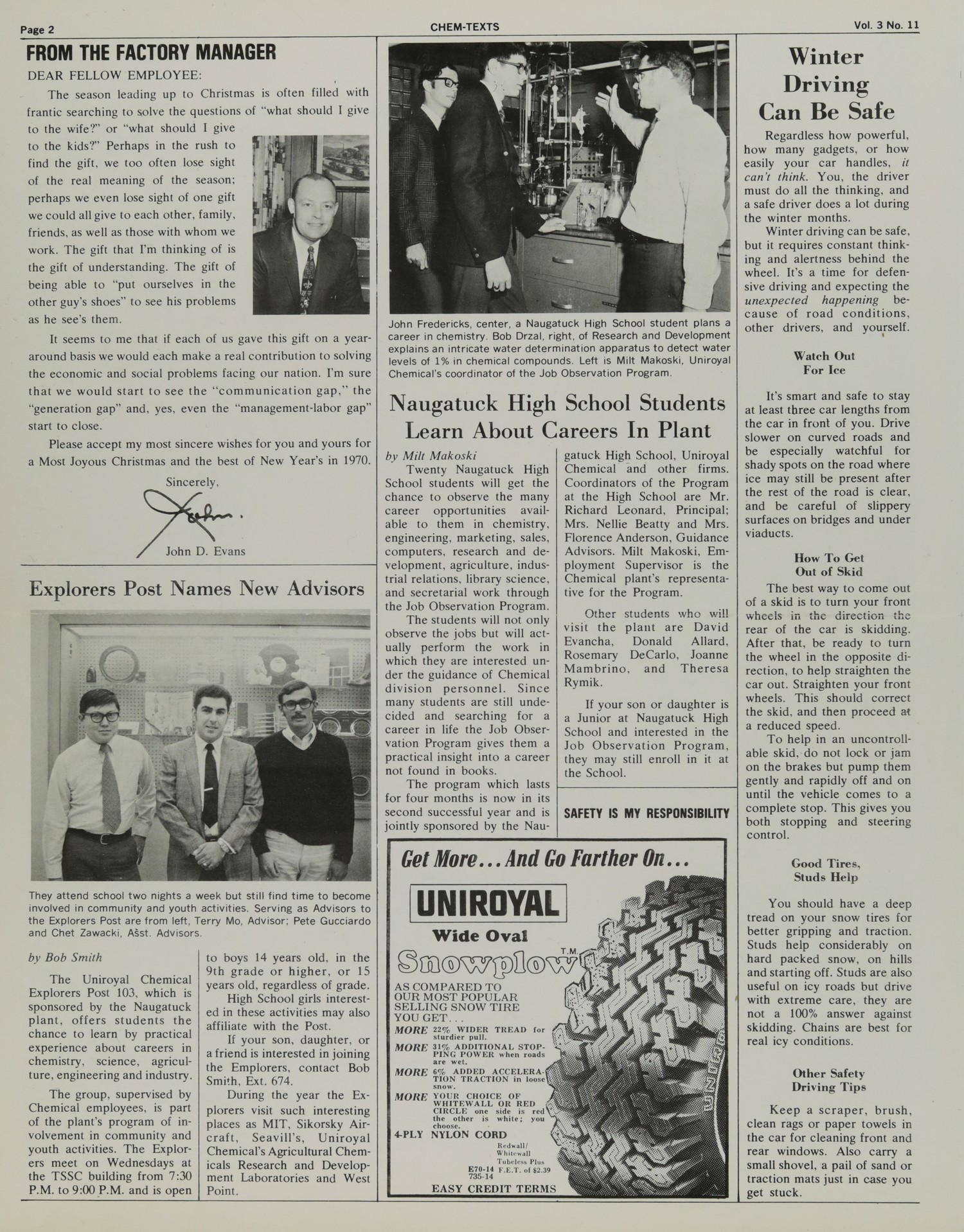
Explorers Post Names New Advisors

[IMAGE: Photo of three men]

They attend school two nights a week but still find time to become involved in community and youth activities. Serving as Advisors to the Explorers Post are from left, Terry Mo, Advisor; Pete Gucciardo and Chet Zawacki, Asst. Advisors.

by Bob Smith

The Uniroyal Chemical Explorers Post 103, which is sponsored by the Naugatuck plant, offers students the chance to learn by practical experience about careers in chemistry, science, agriculture, engineering and industry.

The group, supervised by Chemical employees, is part of the plant’s program of involvement in community and youth activities. The Explorers meet on Wednesdays at the TSSC building from 7:30 P.M. to 9:00 P.M. and is open to boys 14 years old, in the 9th grade or higher, or 15 years old, regardless of grade.

High School girls interested in these activities may also affiliate with the Post.

If your son, daughter, or a friend is interested in joining the Emplorers, contact Bob Smith, Ext. 674.

During the year the Explorers visit such interesting places as MIT, Sikorsky Aircraft, Seavill’s, Uniroyal Chemical’s Agricultural Chemicals Research and Development Laboratories and West Point.


[IMAGE: Photo showing people at what appears to be an industrial/laboratory setting]

John Fredericks, center, a Naugatuck High School student plans a career in chemistry. Bob Drzal, right, of Research and Development explains an intricate water determination apparatus to detect water levels of 1% in chemical compounds. Left is Milt Makoski, Uniroyal Chemical’s coordinator of the Job Observation Program.

Naugatuck High School Students Learn About Careers In Plant

by Milt Makoski

Twenty Naugatuck High School students will get the chance to observe the many career opportunities available to them in chemistry, engineering, marketing, sales, computers, research and development, agriculture, industrial relations, library science, and secretarial work through the Job Observation Program.

The students will not only observe the jobs but will actually perform the work in which they are interested under the guidance of Chemical division personnel. Since many students are still undecided and searching for a career in life the Job Observation Program gives them a practical insight into a career not found in books.

The program which lasts for four months is now in its second successful year and is jointly sponsored by the Naugatuck High School, Uniroyal Chemical and other firms. Coordinators of the Program at the High School are Mr. Richard Leonard, Principal; Mrs. Nellie Beatty and Mrs. Florence Anderson, Guidance Advisors. Milt Makoski, Employment Supervisor is the Chemical plant’s representative for the Program.

Other students who will visit the plant are David Evancha, Donald Allard, Rosemary DeCarlo, Joanne Mambrino, and Theresa Rymik.

If your son or daughter is a Junior at Naugatuck High School and interested in the Job Observation Program, they may still enroll in it at the School.


SAFETY IS MY RESPONSIBILITY


Get More… And Go Farther On…

UNIROYAL

Wide Oval

Snowplow™

AS COMPARED TO OUR MOST POPULAR SELLING SNOW TIRE YOU GET

MORE 22% WIDER TREAD for sturdier pull.

MORE 31% ADDITIONAL STOPPING POWER when roads are wet.

MORE 6% ADDED ACCELERATION TRACTION in loose snow.

MORE YOUR CHOICE OF WHITEWALL OR RED CIRCLE one side is red the other is white; you choose.

4-PLY NYLON CORD
Redwall/
Whitewall
Tubeless Plus
E78-14 F.E.T. of $2.39
735-14

EASY CREDIT TERMS


Winter Driving Can Be Safe

Regardless how powerful, how many gadgets, or how easily your car handles, it can’t think. You, the driver must do all the thinking, and a safe driver does a lot during the winter months.

Winter driving can be safe, but it requires constant thinking and alertness behind the wheel. It’s a time for defensive driving and expecting the unexpected happening because of road conditions, other drivers, and yourself.

Watch Out For Ice

It’s smart and safe to stay at least three car lengths from the car in front of you. Drive slower on curved roads and be especially watchful for shady spots on the road where ice may still be present after the rest of the road is clear, and be careful of slippery surfaces on bridges and under viaducts.

How To Get Out of Skid

The best way to come out of a skid is to turn your front wheels in the direction the rear of the car is skidding. After that, be ready to turn the wheel in the opposite direction, to help straighten the car out. Straighten your front wheels. This should correct the skid, and then proceed at a reduced speed.

To help in an uncontrollable skid, do not lock or jam on the brakes but pump them gently and rapidly off and on until the vehicle comes to a complete stop. This gives you both stopping and steering control.

Good Tires, Studs Help

You should have a deep tread on your snow tires for better gripping and traction. Studs help considerably on hard packed snow, on hills and starting off. Studs are also useful on icy roads but drive with extreme care, they are not a 100% answer against skidding. Chains are best for real icy conditions.

Other Safety Driving Tips

Keep a scraper, brush, clean rags or paper towels in the car for cleaning front and rear windows. Also carry a small shovel, a pail of sand or traction mats just in case you get stuck.

CHEM-TEXTS – Vol. 3 No. 11 – Page 3

Page 003

CHEM-TEXTS

Vol. 3 No. 11 | Page 3


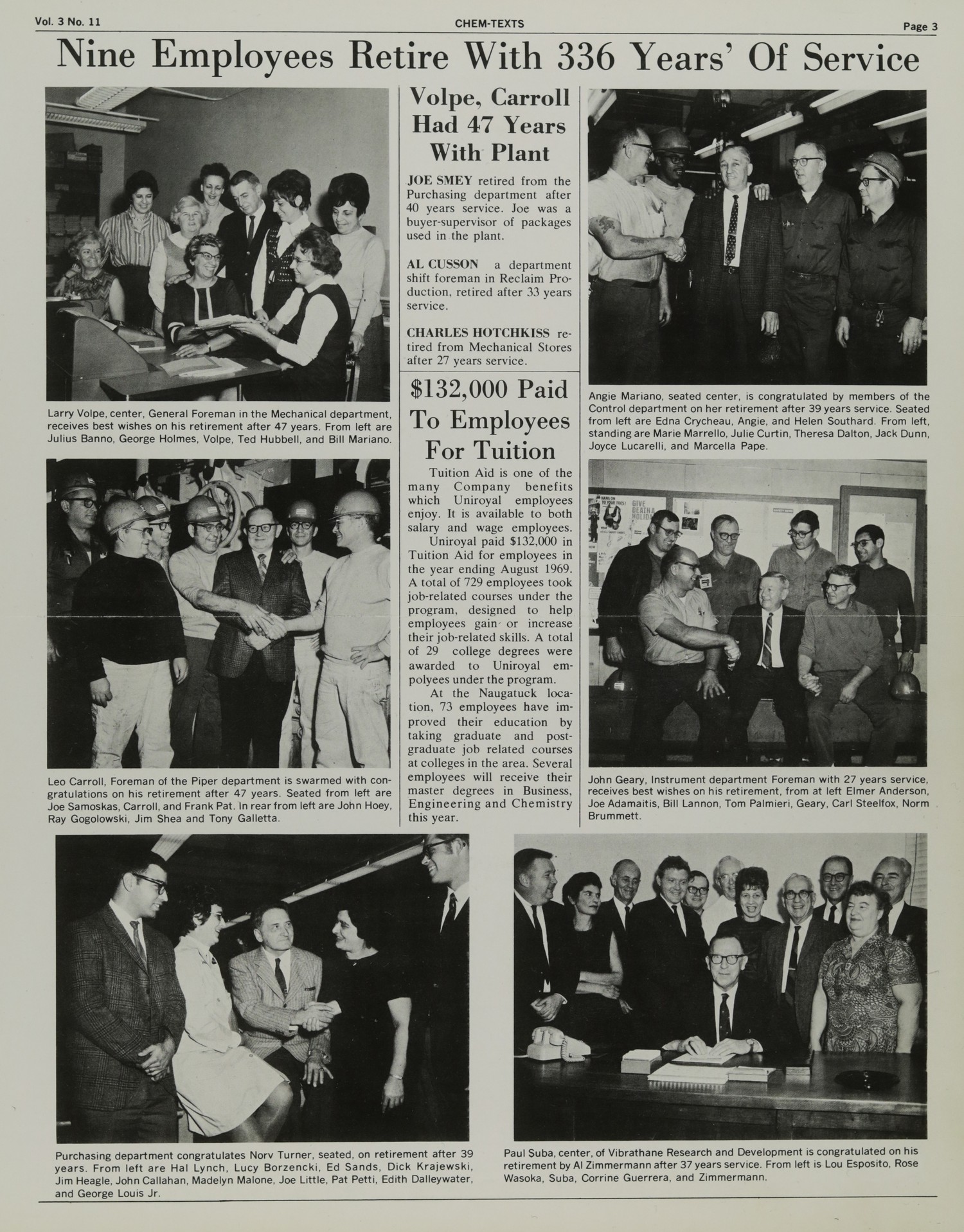
Nine Employees Retire With 336 Years’ Of Service


Volpe, Carroll Had 47 Years With Plant

JOE SMEY retired from the Purchasing department after 40 years service. Joe was a buyer-supervisor of packages used in the plant.

AL CUSSON a department shift foreman in Reclaim Production, retired after 33 years service.

CHARLES HOTCHKISS retired from Mechanical Stores after 27 years service.


$132,000 Paid To Employees For Tuition

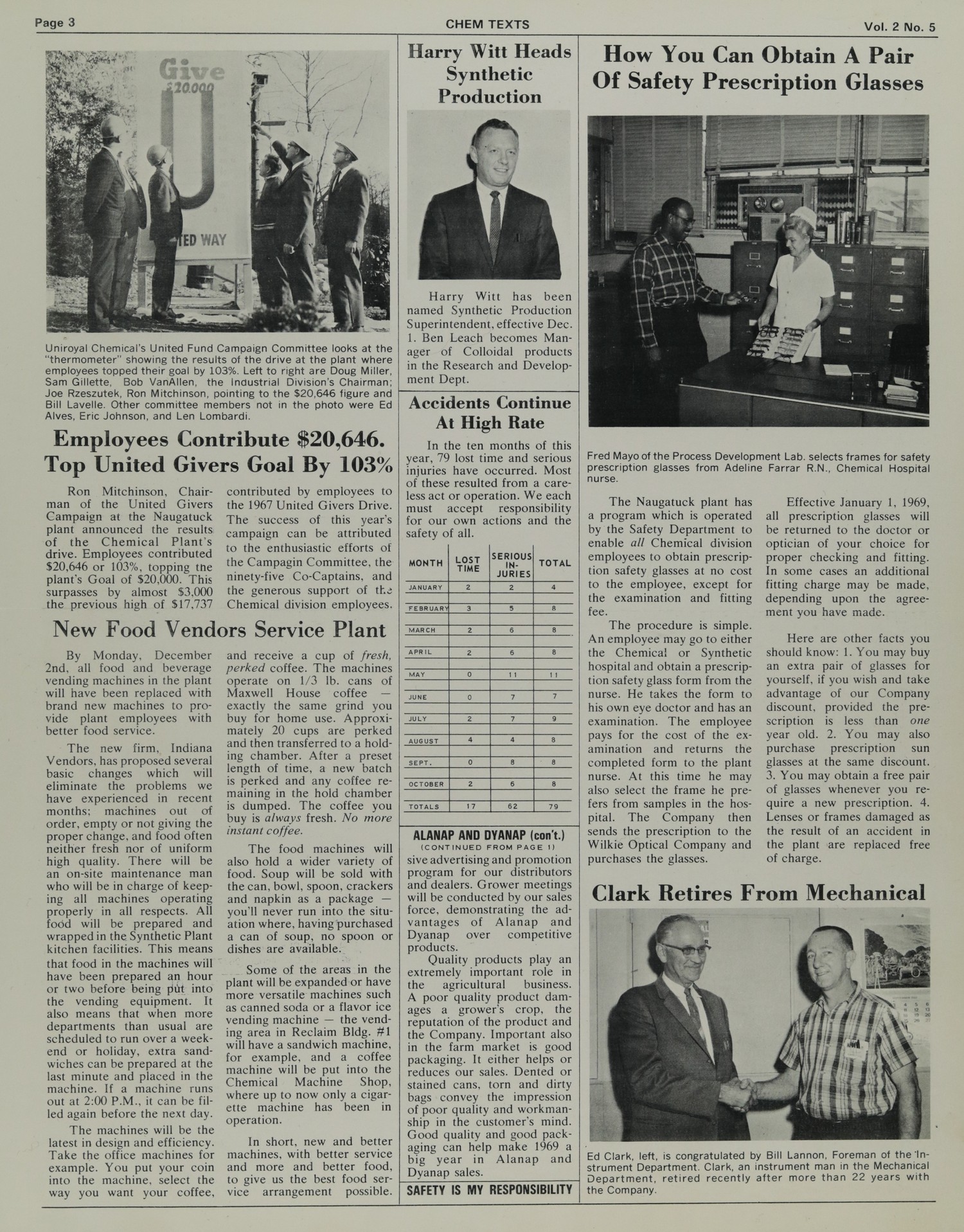
Tuition Aid is one of the many Company benefits which Uniroyal employees enjoy. It is available to both salary and wage employees.

Uniroyal paid $132,000 in Tuition Aid for employees in the year ending August 1969. A total of 729 employees took job-related courses under the program, designed to help employees gain or increase their job-related skills. A total of 29 college degrees were awarded to Uniroyal employees under the program.

At the Naugatuck location, 73 employees have improved their education by taking graduate and post-graduate job related courses at colleges in the area. Several employees will receive their master degrees in Business, Engineering and Chemistry this year.


[Photo Caption – Top Left]
Larry Volpe, center, General Foreman in the Mechanical department, receives best wishes on his retirement after 47 years. From left are Julius Banno, George Holmes, Volpe, Ted Hubbell, and Bill Mariano.


[Photo Caption – Top Right]
Angie Mariano, seated center, is congratulated by members of the Control department on her retirement after 39 years service. Seated from left are Edna Crycheau, Angie, and Helen Southard. From left, standing are Marie Marrello, Julie Curtin, Theresa Dalton, Jack Dunn, Joyce Lucarelli, and Marcella Pape.


[Photo Caption – Middle Left]
Leo Carroll, Foreman of the Piper department is swarmed with congratulations on his retirement after 47 years. Seated from left are Joe Samoskas, Carroll, and Frank Pat. In rear from left are John Hoey, Ray Gogolowski, Jim Shea and Tony Galletta.


[Photo Caption – Middle Right]
John Geary, Instrument department Foreman with 27 years service, receives best wishes on his retirement, from at left Elmer Anderson, Joe Adamaitis, Bill Lannon, Tom Palmieri, Geary, Carl Steelfox, Norm Brummett.


[Photo Caption – Bottom Left]
Purchasing department congratulates Norv Turner, seated, on retirement after 39 years. From left are Hal Lynch, Lucy Borzencki, Ed Sands, Dick Krajewski, Jim Heagle, John Callahan, Madelyn Malone, Joe Little, Pat Petti, Edith Dalleywater, and George Louis Jr.


[Photo Caption – Bottom Right]
Paul Suba, center, of Vibrathane Research and Development is congratulated on his retirement by Al Zimmermann after 37 years service. From left is Lou Esposito, Rose Wasoka, Suba, Corrine Guerrera, and Zimmermann.

CHEM-TEXTS – Vol. 3 No. 11 – Page 4

Page 004

Page 4 | CHEM-TEXT | Vol. 3 No. 11

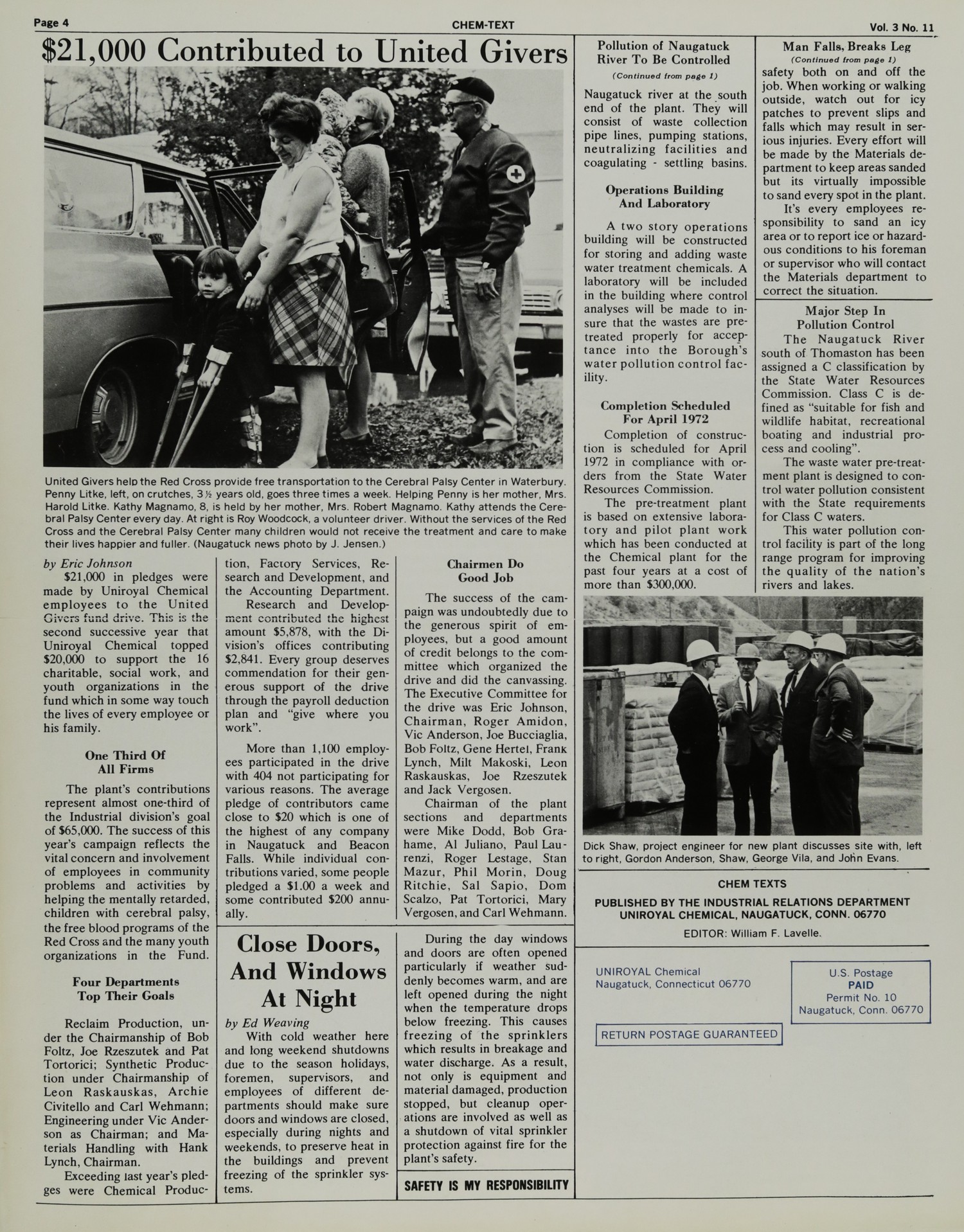
$21,000 Contributed to United Givers

[PHOTO: Image showing people near a vehicle, including children on crutches and adults]

United Givers help the Red Cross provide free transportation to the Cerebral Palsy Center in Waterbury. Penny Litke, left, on crutches, 3 ½ years old, goes three times a week. Helping Penny is her mother, Mrs. Harold Litke. Kathy Magnamo, 8, is held by her mother, Mrs. Robert Magnamo. Kathy attends the Cerebral Palsy Center every day. At right is Roy Woodcock, a volunteer driver. Without the services of the Red Cross and the Cerebral Palsy Center many children would not receive the treatment and care to make their lives happier and fuller. (Naugatuck news photo by J. Jensen.)


by Eric Johnson

$21,000 in pledges were made by Uniroyal Chemical employees to the United Givers fund drive. This is the second successive year that Uniroyal Chemical topped $20,000 to support the 16 charitable, social work, and youth organizations in the fund which in some way touch the lives of every employee or his family.

One Third Of All Firms

The plant’s contributions represent almost one-third of the Industrial division’s goal of $65,000. The success of this year’s campaign reflects the vital concern and involvement of employees in community problems and activities by helping the mentally retarded, children with cerebral palsy, the free blood programs of the Red Cross and the many youth organizations in the Fund.

Four Departments Top Their Goals

Reclaim Production, under the Chairmanship of Bob Foltz, Joe Rzeszutek and Pat Tortorici; Synthetic Production under Chairmanship of Leon Raskauskas, Archie Civitello and Carl Wehmann; Engineering under Vic Anderson as Chairman; and Materials Handling with Hank Lynch, Chairman.

Exceeding last year’s pledges were Chemical Production, Factory Services, Research and Development, and the Accounting Department.

Research and Development contributed the highest amount $5,878, with the Division’s offices contributing $2,841. Every group deserves commendation for their generous support of the drive through the payroll deduction plan and “give where you work”.

More than 1,100 employees participated in the drive with 404 not participating for various reasons. The average pledge of contributors came close to $20 which is one of the highest of any company in Naugatuck and Beacon Falls. While individual contributions varied, some people pledged a $1.00 a week and some contributed $200 annually.


Close Doors, And Windows At Night

by Ed Weaving

With cold weather here and long weekend shutdowns due to the season holidays, foremen, supervisors, and employees of different departments should make sure doors and windows are closed, especially during nights and weekends, to preserve heat in the buildings and prevent freezing of the sprinkler systems.


Chairmen Do Good Job

The success of the campaign was undoubtedly due to the generous spirit of employees, but a good amount of credit belongs to the committee which organized the drive and did the canvassing. The Executive Committee for the drive was Eric Johnson, Chairman, Roger Amidon, Vic Anderson, Joe Bucciaglia, Bob Foltz, Gene Hertel, Frank Lynch, Milt Makoski, Leon Raskauskas, Joe Rzeszutek and Jack Vergosen.

Chairman of the plant sections and departments were Mike Dodd, Bob Grahame, Al Juliano, Paul Laurenzi, Roger Lestage, Stan Mazur, Phil Morin, Doug Ritchie, Sal Sapio, Dom Scalzo, Pat Tortorici, Mary Vergosen, and Carl Wehmann.

During the day windows and doors are often opened particularly if weather suddenly becomes warm, and are left opened during the night when the temperature drops below freezing. This causes freezing of the sprinklers which results in breakage and water discharge. As a result, not only is equipment and material damaged, production stopped, but cleanup operations are involved as well as a shutdown of vital sprinkler protection against fire for the plant’s safety.

SAFETY IS MY RESPONSIBILITY


Pollution of Naugatuck River To Be Controlled

(Continued from page 1)

Naugatuck river at the south end of the plant. They will consist of waste collection pipe lines, pumping stations, neutralizing facilities and coagulating – settling basins.

Operations Building And Laboratory

A two story operations building will be constructed for storing and adding waste water treatment chemicals. A laboratory will be included in the building where control analyses will be made to insure that the wastes are pretreated properly for acceptance into the Borough’s water pollution control facility.

Completion Scheduled For April 1972

Completion of construction is scheduled for April 1972 in compliance with orders from the State Water Resources Commission.

The pre-treatment plant is based on extensive laboratory and pilot plant work which has been conducted at the Chemical plant for the past four years at a cost of more than $300,000.


Man Falls, Breaks Leg

(Continued from page 1)

safety both on and off the job. When working or walking outside, watch out for icy patches to prevent slips and falls which may result in serious injuries. Every effort will be made by the Materials department to keep areas sanded but its virtually impossible to sand every spot in the plant.

It’s every employees responsibility to sand an icy area or to report ice or hazardous conditions to his foreman or supervisor who will contact the Materials department to correct the situation.

Major Step In Pollution Control

The Naugatuck River south of Thomaston has been assigned a C classification by the State Water Resources Commission. Class C is defined as “suitable for fish and wildlife habitat, recreational boating and industrial process and cooling”.

The waste water pre-treatment plant is designed to control water pollution consistent with the State requirements for Class C waters.

This water pollution control facility is part of the long range program for improving the quality of the nation’s rivers and lakes.


[PHOTO: Four men in hard hats examining documents outdoors]

Dick Shaw, project engineer for new plant discusses site with, left to right, Gordon Anderson, Shaw, George Vila, and John Evans.


CHEM TEXTS

PUBLISHED BY THE INDUSTRIAL RELATIONS DEPARTMENT
UNIROYAL CHEMICAL, NAUGATUCK, CONN. 06770

EDITOR: William F. Lavelle.


UNIROYAL Chemical
Naugatuck, Connecticut 06770

U.S. Postage
PAID
Permit No. 10
Naugatuck, Conn. 06770

RETURN POSTAGE GUARANTEED
CHEM-TEXTS – Vol. 3 – Page 1

Page 001

UNIROYAL CHEM-TEXTS

Vol. 3 PUBLISHED FOR THE PEOPLE OF UNIROYAL CHEMICAL No. 4


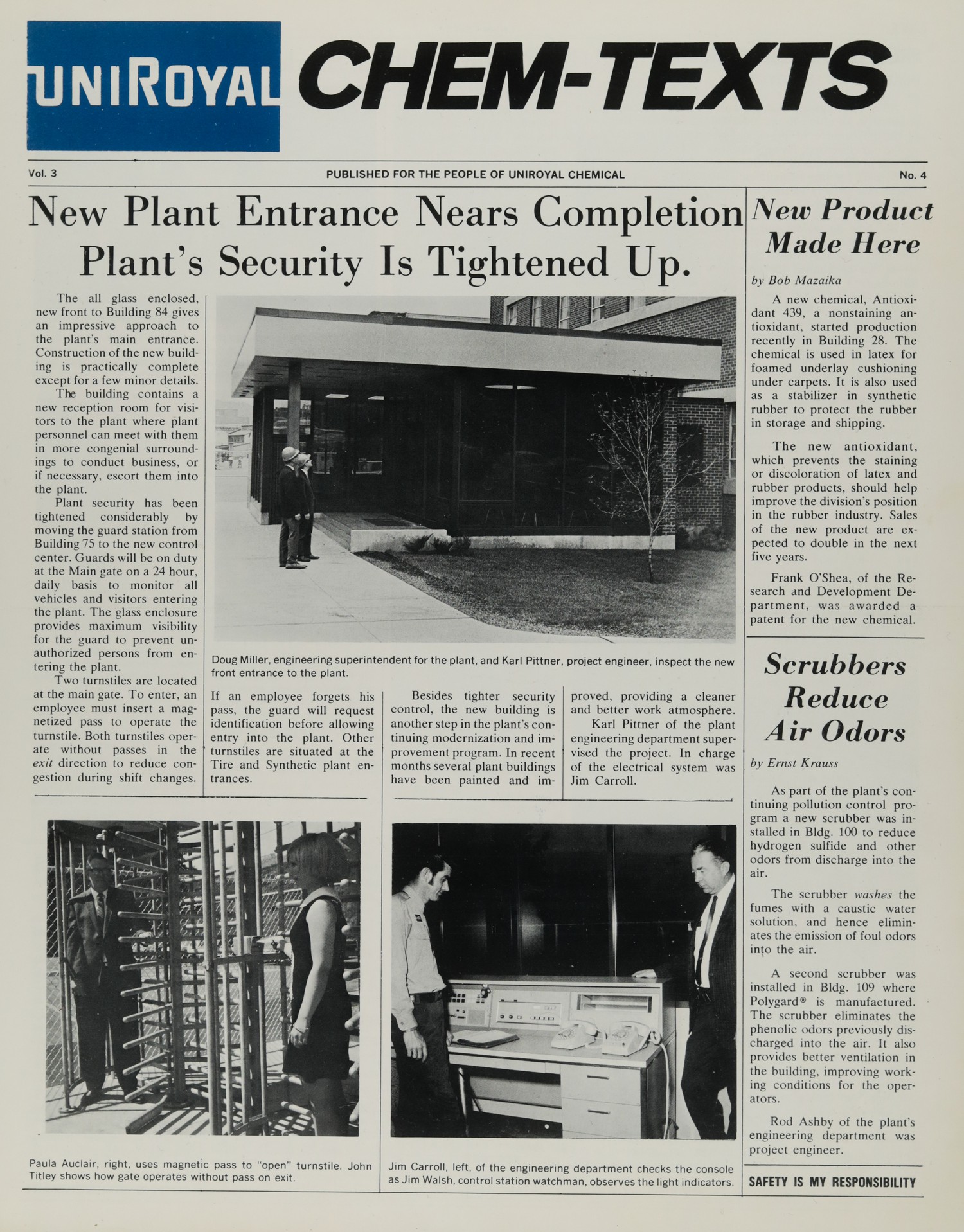
New Plant Entrance Nears Completion Plant’s Security Is Tightened Up.

The all glass enclosed, new front to Building 84 gives an impressive approach to the plant’s main entrance. Construction of the new building is practically complete except for a few minor details.

The building contains a new reception room for visitors to the plant where plant personnel can meet with them in more congenial surroundings to conduct business, or if necessary, escort them into the plant.

Plant security has been tightened considerably by moving the guard station from Building 75 to the new control center. Guards will be on duty at the Main gate on a 24 hour, daily basis to monitor all vehicles and visitors entering the plant. The glass enclosure provides maximum visibility for the guard to prevent unauthorized persons from entering the plant.

Two turnstiles are located at the main gate. To enter, an employee must insert a magnetized pass to operate the turnstile. Both turnstiles operate without passes in the exit direction to reduce congestion during shift changes.

If an employee forgets his pass, the guard will request identification before allowing entry into the plant. Other turnstiles are situated at the Tire and Synthetic plant entrances.

Besides tighter security control, the new building is another step in the plant’s continuing modernization and improvement program. In recent months several plant buildings have been painted and improved, providing a cleaner and better work atmosphere.

Karl Pittner of the plant engineering department supervised the project. In charge of the electrical system was Jim Carroll.


Doug Miller, engineering superintendent for the plant, and Karl Pittner, project engineer, inspect the new front entrance to the plant.


Paula Auclair, right, uses magnetic pass to “open” turnstile. John Titley shows how gate operates without pass on exit.


Jim Carroll, left, of the engineering department checks the console as Jim Walsh, control station watchman, observes the light indicators.


New Product Made Here

by Bob Mazaika

A new chemical, Antioxidant 439, a nonstaining antioxidant, started production recently in Building 28. The chemical is used in latex for foamed underlay cushioning under carpets. It is also used as a stabilizer in synthetic rubber to protect the rubber in storage and shipping.

The new antioxidant, which prevents the staining or discoloration of latex and rubber products, should help improve the division’s position in the rubber industry. Sales of the new product are expected to double in the next five years.

Frank O’Shea, of the Research and Development Department, was awarded a patent for the new chemical.


Scrubbers Reduce Air Odors

by Ernst Krauss

As part of the plant’s continuing pollution control program a new scrubber was installed in Bldg. 100 to reduce hydrogen sulfide and other odors from discharge into the air.

The scrubber washes the fumes with a caustic water solution, and hence eliminates the emission of foul odors into the air.

A second scrubber was installed in Bldg. 109 where Polygard® is manufactured. The scrubber eliminates the phenolic odors previously discharged into the air. It also provides better ventilation in the building, improving working conditions for the operators.

Rod Ashby of the plant’s engineering department was project engineer.


SAFETY IS MY RESPONSIBILITY

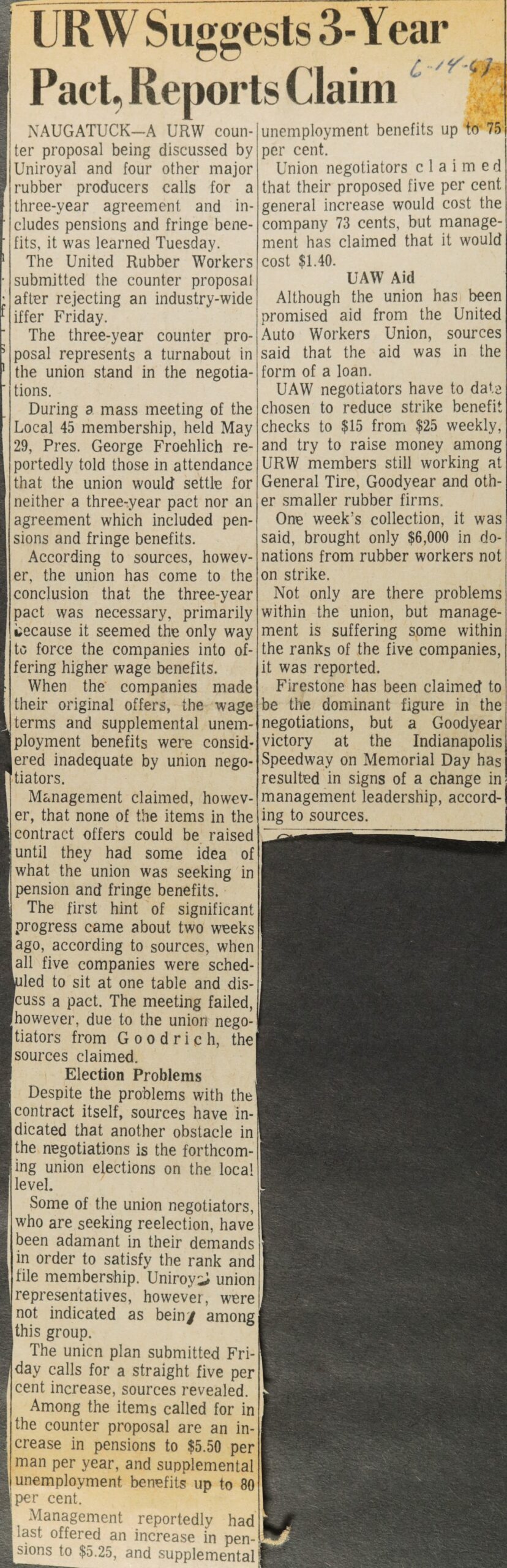
URW Suggests 3-Year Pact, Reports Claim

URW Suggests 3-Year Pact, Reports Claim

6-14-67 [handwritten date]

NAUGATUCK—A URW counter proposal being discussed by Uniroyal and four other major rubber producers calls for a three-year agreement and includes pensions and fringe benefits, it was learned Tuesday.

The United Rubber Workers submitted the counter proposal after rejecting an industry-wide offer Friday.

The three-year counter proposal represents a turnabout in the union stand in the negotiations.

During a mass meeting of the Local 45 membership, held May 29, Pres. George Froehlich reportedly told those in attendance that the union would settle for neither a three-year pact nor an agreement which included pensions and fringe benefits.

According to sources, however, the union has come to the conclusion that the three-year pact was necessary, primarily because it seemed the only way to force the companies into offering higher wage benefits.

When the companies made their original offers, the wage terms and supplemental unemployment benefits were considered inadequate by union negotiators.

Management claimed, however, that none of the items in the contract offers could be raised until they had some idea of what the union was seeking in pension and fringe benefits.

The first hint of significant progress came about two weeks ago, according to sources, when all five companies were scheduled to sit at one table and discuss a pact. The meeting failed, however, due to the union negotiators from Goodrich, the sources claimed.

Election Problems

Despite the problems with the contract itself, sources have indicated that another obstacle in the negotiations is the forthcoming union elections on the local level.

Some of the union negotiators, who are seeking reelection, have been adamant in their demands in order to satisfy the rank and file membership. Uniroyal union representatives, however, were not indicated as being among this group.

The union plan submitted Friday calls for a straight five per cent increase, sources revealed.

Among the items called for in the counter proposal are an increase in pensions to $5.50 per man per year, and supplemental unemployment benefits up to 80 per cent.

Management reportedly had last offered an increase in pensions to $5.25, and supplemental unemployment benefits up to 75 per cent.

Union negotiators claimed that their proposed five per cent general increase would cost the company 73 cents, but management has claimed that it would cost $1.40.

UAW Aid

Although the union has been promised aid from the United Auto Workers Union, sources said that the aid was in the form of a loan.

UAW negotiators have to date chosen to reduce strike benefit checks to $15 from $25 weekly, and try to raise money among URW members still working at General Tire, Goodyear and other smaller rubber firms.

One week’s collection, it was said, brought only $6,000 in donations from rubber workers not on strike.

Not only are there problems within the union, but management is suffering some within the ranks of the five companies, it was reported.

Firestone has been claimed to be the dominant figure in the negotiations, but a Goodyear victory at the Indianapolis Speedway on Memorial Day has resulted in signs of a change in management leadership, according to sources.

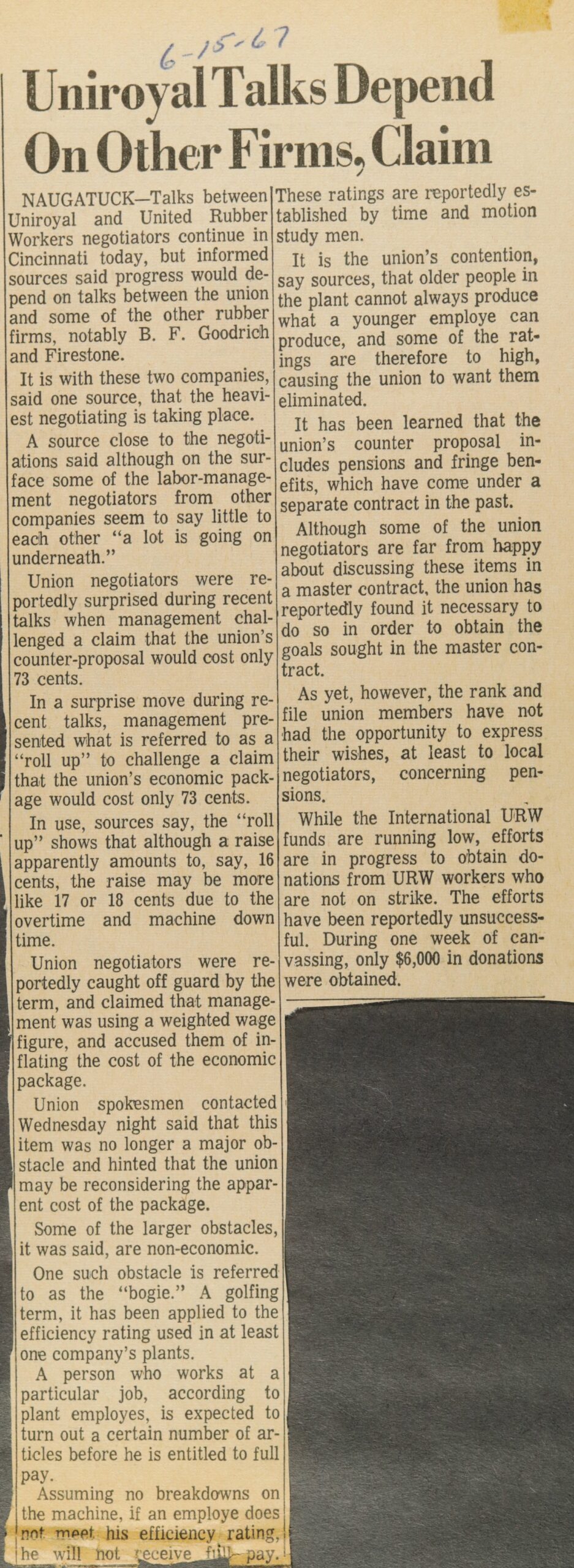
Uniroyal Talks Depend On Other Firms, Claim

6-15-67

Uniroyal Talks Depend On Other Firms, Claim

NAUGATUCK—Talks between Uniroyal and United Rubber Workers negotiators continue in Cincinnati today, but informed sources said progress would depend on talks between the union and some of the other rubber firms, notably B. F. Goodrich and Firestone.

It is with these two companies, said one source, that the heaviest negotiating is taking place.

A source close to the negotiations said although on the surface some of the labor-management negotiators from other companies seem to say little to each other “a lot is going on underneath.”

Union negotiators were reportedly surprised during recent talks when management challenged a claim that the union’s counter-proposal would cost only 73 cents.

In a surprise move during recent talks, management presented what is referred to as a “roll up” to challenge a claim that the union’s economic package would cost only 73 cents.

In use, sources say, the “roll up” shows that although a raise apparently amounts to, say, 16 cents, the raise may be more like 17 or 18 cents due to the overtime and machine down time.

Union negotiators were reportedly caught off guard by the term, and claimed that management was using a weighted wage figure, and accused them of inflating the cost of the economic package.

Union spokesmen contacted Wednesday night said that this item was no longer a major obstacle and hinted that the union may be reconsidering the apparent cost of the package.

Some of the larger obstacles, it was said, are non-economic.

One such obstacle is referred to as the “bogie.” A golfing term, it has been applied to the efficiency rating used in at least one company’s plants.

A person who works at a particular job, according to plant employes, is expected to turn out a certain number of articles before he is entitled to full pay.

Assuming no breakdowns on the machine, if an employe does not meet his efficiency rating, he will not receive full pay.

These ratings are reportedly established by time and motion study men.

It is the union’s contention, say sources, that older people in the plant cannot always produce what a younger employe can produce, and some of the ratings are therefore to high, causing the union to want them eliminated.

It has been learned that the union’s counter proposal includes pensions and fringe benefits, which have come under a separate contract in the past.

Although some of the union negotiators are far from happy about discussing these items in a master contract, the union has reportedly found it necessary to do so in order to obtain the goals sought in the master contract.

As yet, however, the rank and file union members have not had the opportunity to express their wishes, at least to local negotiators, concerning pensions.

While the International URW funds are running low, efforts are in progress to obtain donations from URW workers who are not on strike. The efforts have been reportedly unsuccessful. During one week of canvassing, only $6,000 in donations were obtained.

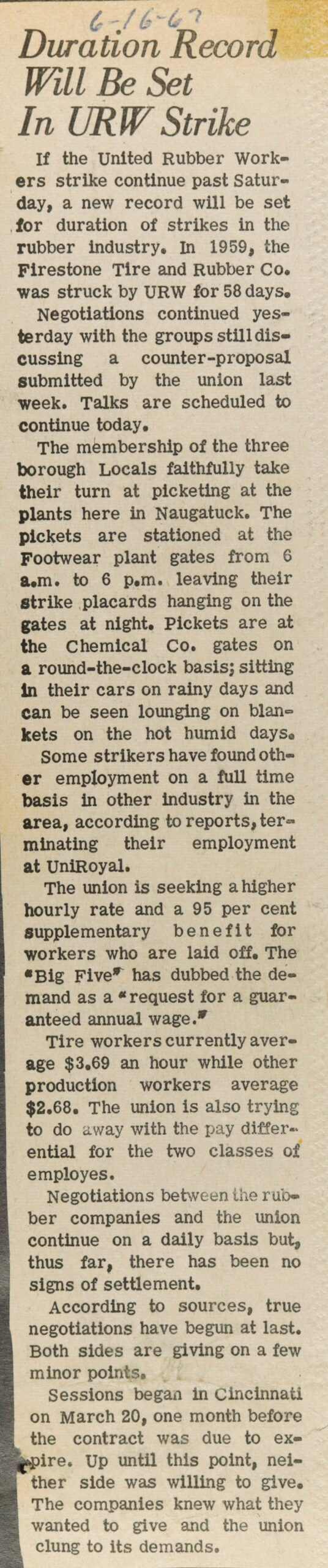
Duration Record Will Be Set In URW Strike

6-16-67

Duration Record Will Be Set In URW Strike

If the United Rubber Workers strike continue past Saturday, a new record will be set for duration of strikes in the rubber industry. In 1959, the Firestone Tire and Rubber Co. was struck by URW for 58 days.

Negotiations continued yesterday with the groups still discussing a counter-proposal submitted by the union last week. Talks are scheduled to continue today.

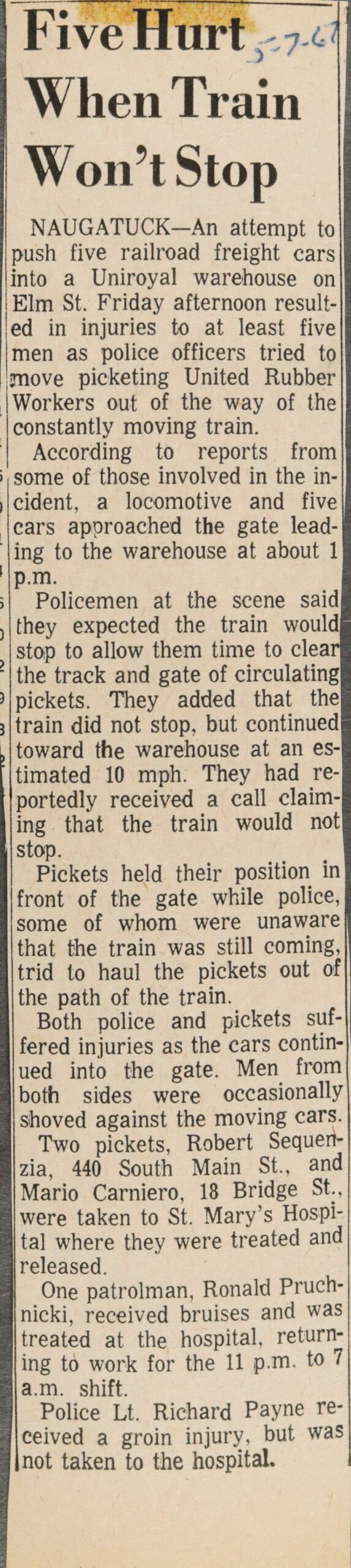
The membership of the three borough Locals faithfully take their turn at picketing at the plants here in Naugatuck. The pickets are stationed at the Footwear plant gates from 6 a.m. to 6 p.m. leaving their strike placards hanging on the gates at night. Pickets are at the Chemical Co. gates on a round-the-clock basis; sitting in their cars on rainy days and can be seen lounging on blankets on the hot humid days.

Some strikers have found other employment on a full time basis in other industry in the area, according to reports, terminating their employment at UniRoyal.

The union is seeking a higher hourly rate and a 95 per cent supplementary benefit for workers who are laid off. The “Big Five” has dubbed the demand as a “request for a guaranteed annual wage.”

Tire workers currently average $3.69 an hour while other production workers average $2.68. The union is also trying to do away with the pay differential for the two classes of employes.

Negotiations between the rubber companies and the union continue on a daily basis but, thus far, there has been no signs of settlement.

According to sources, true negotiations have begun at last. Both sides are giving on a few minor points.

Sessions began in Cincinnati on March 20, one month before the contract was due to expire. Up until this point, neither side was willing to give. The companies knew what they wanted to give and the union clung to its demands.

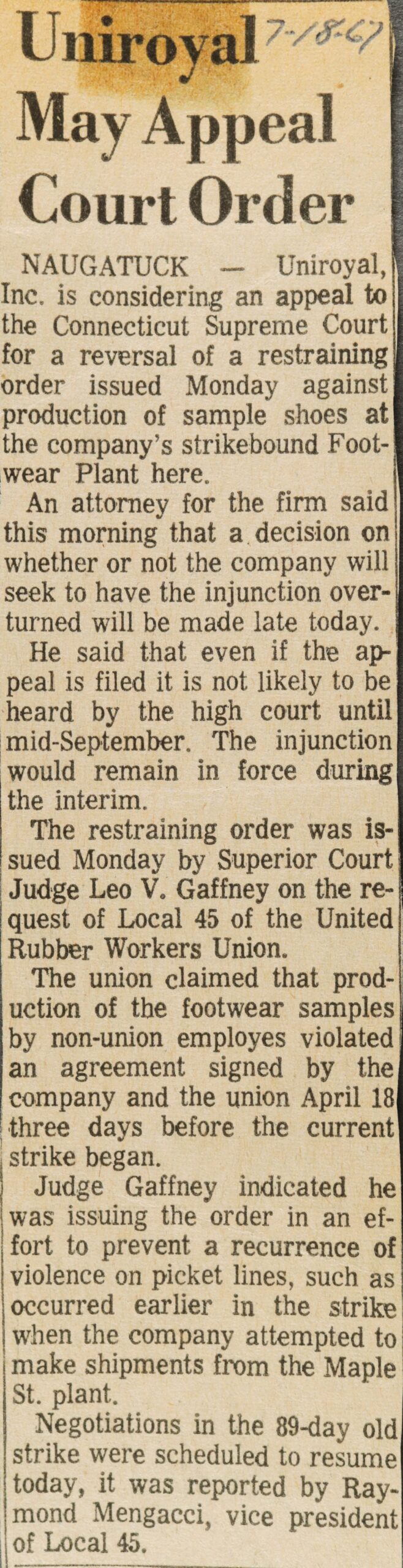
Uniroyal May Appeal Court Order

Uniroyal 7-18-67

May Appeal

Court Order

NAUGATUCK — Uniroyal,
Inc. is considering an appeal to
the Connecticut Supreme Court
for a reversal of a restraining
order issued Monday against
production of sample shoes at
the company’s strikebound Foot-
wear Plant here.

An attorney for the firm said
this morning that a decision on
whether or not the company will
seek to have the injunction over-
turned will be made late today.

He said that even if the ap-
peal is filed it is not likely to be
heard by the high court until
mid-September. The injunction
would remain in force during
the interim.

The restraining order was is-
sued Monday by Superior Court
Judge Leo V. Gaffney on the re-
quest of Local 45 of the United
Rubber Workers Union.

The union claimed that prod-
uction of the footwear samples
by non-union employes violated
an agreement signed by the
company and the union April 18
three days before the current
strike began.

Judge Gaffney indicated he
was issuing the order in an ef-
fort to prevent a recurrence of
violence on picket lines, such as
occurred earlier in the strike
when the company attempted to
make shipments from the Maple
St. plant.

Negotiations in the 89-day old
strike were scheduled to resume
today, it was reported by Ray-
mond Mengacci, vice president
of Local 45.

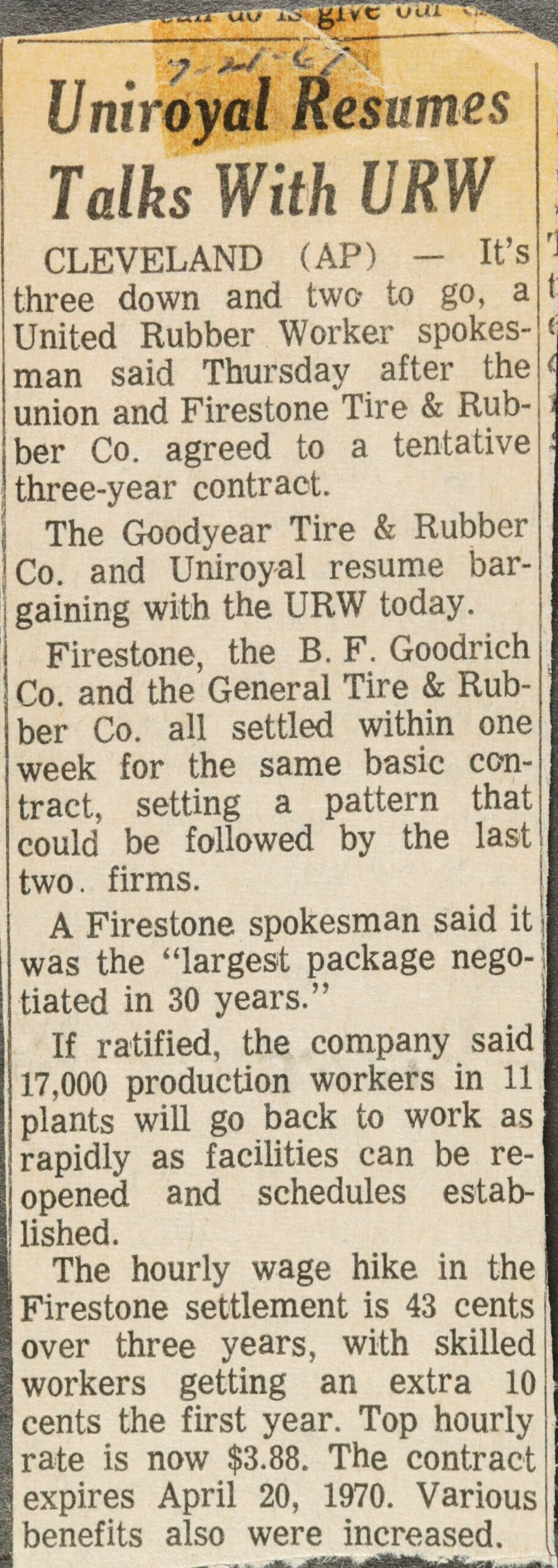
Uniroyal Resumes Talks With URW

7-21-67

Uniroyal Resumes Talks With URW

CLEVELAND (AP) — It’s three down and two to go, a United Rubber Worker spokesman said Thursday after the union and Firestone Tire & Rubber Co. agreed to a tentative three-year contract.

The Goodyear Tire & Rubber Co. and Uniroyal resume bargaining with the URW today.

Firestone, the B. F. Goodrich Co. and the General Tire & Rubber Co. all settled within one week for the same basic contract, setting a pattern that could be followed by the last two. firms.

A Firestone spokesman said it was the “largest package negotiated in 30 years.”

If ratified, the company said 17,000 production workers in 11 plants will go back to work as rapidly as facilities can be reopened and schedules established.

The hourly wage hike in the Firestone settlement is 43 cents over three years, with skilled workers getting an extra 10 cents the first year. Top hourly rate is now $3.88. The contract expires April 20, 1970. Various benefits also were increased.

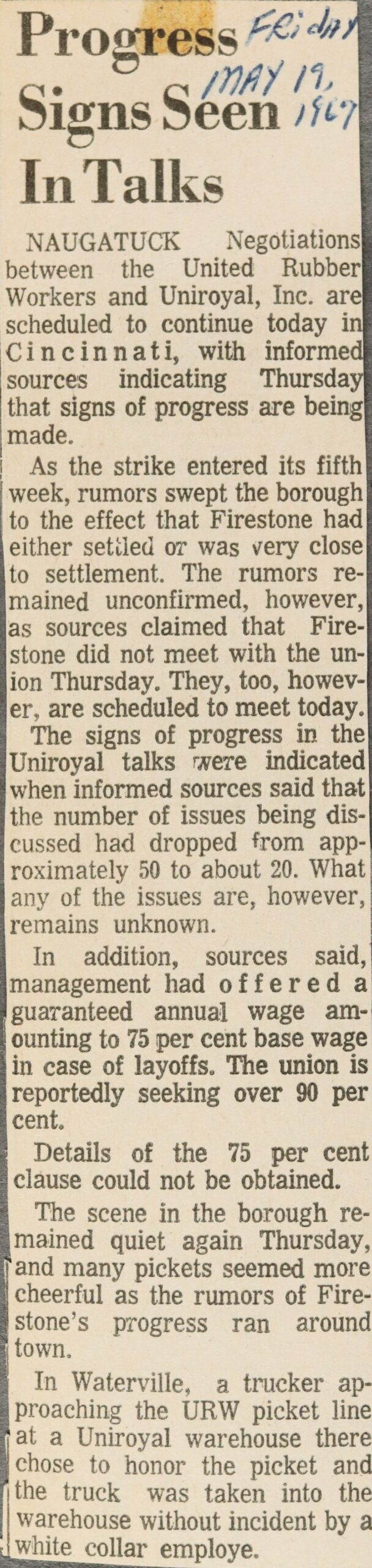
Progress Signs Seen In Talks

Progress Signs Seen In Talks

Friday MAY 19, 1967 [handwritten]

NAUGATUCK Negotiations between the United Rubber Workers and Uniroyal, Inc. are scheduled to continue today in Cincinnati, with informed sources indicating Thursday that signs of progress are being made.

As the strike entered its fifth week, rumors swept the borough to the effect that Firestone had either settled or was very close to settlement. The rumors remained unconfirmed, however, as sources claimed that Firestone did not meet with the union Thursday. They, too, however, are scheduled to meet today.

The signs of progress in the Uniroyal talks were indicated when informed sources said that the number of issues being discussed had dropped from approximately 50 to about 20. What any of the issues are, however, remains unknown.

In addition, sources said, management had offered a guaranteed annual wage amounting to 75 per cent base wage in case of layoffs. The union is reportedly seeking over 90 per cent.

Details of the 75 per cent clause could not be obtained.

The scene in the borough remained quiet again Thursday, and many pickets seemed more cheerful as the rumors of Firestone’s progress ran around town.

In Waterville, a trucker approaching the URW picket line at a Uniroyal warehouse there chose to honor the picket and the truck was taken into the warehouse without incident by a white collar employe.

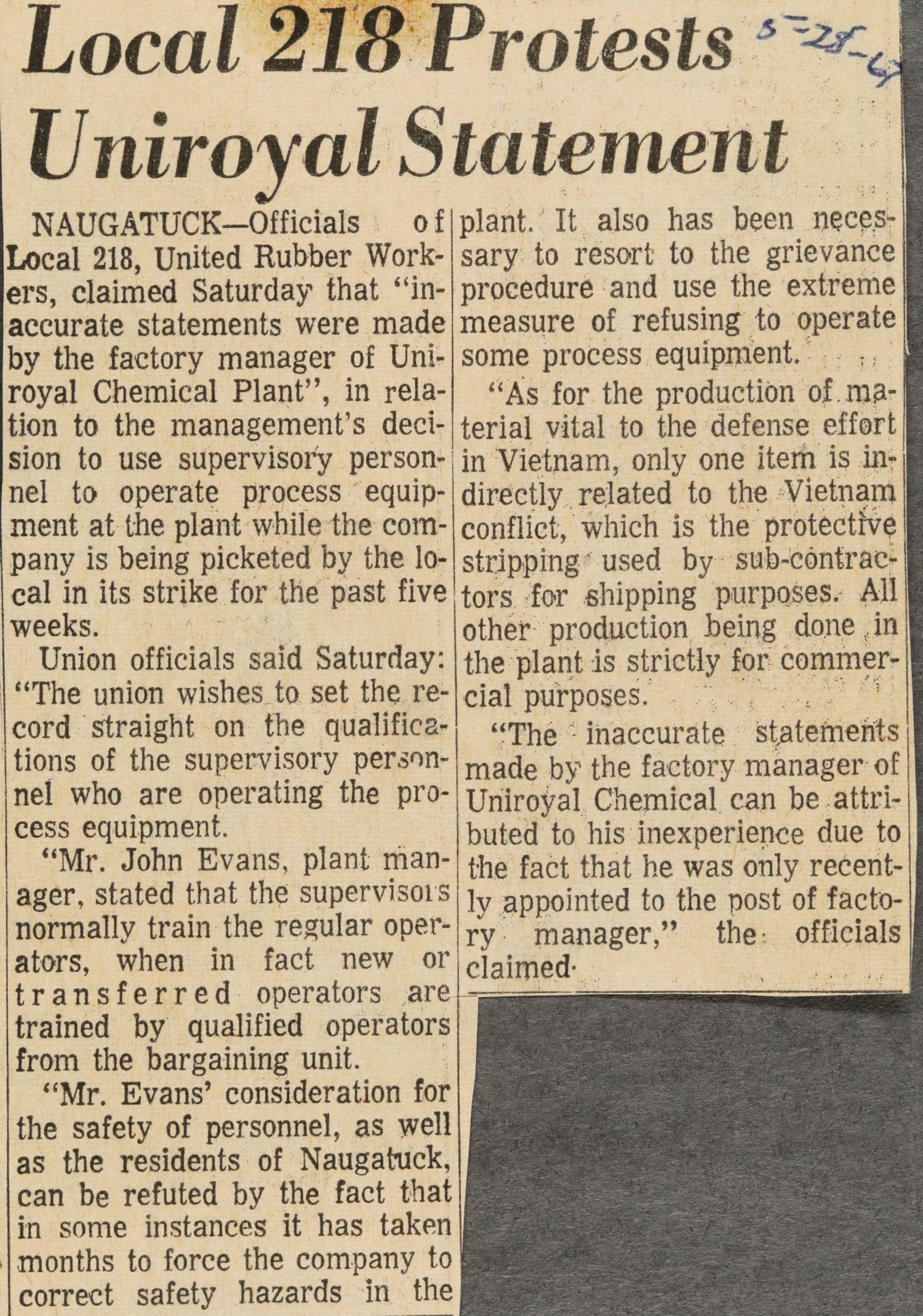
Local 218 Protests Uniroyal Statement

Local 218 Protests Uniroyal Statement

Local 218 Protests Uniroyal Statement

5-28-67 [handwritten date in top right corner]

NAUGATUCK—Officials of Local 218, United Rubber Workers, claimed Saturday that “inaccurate statements were made by the factory manager of Uniroyal Chemical Plant”, in relation to the management’s decision to use supervisory personnel to operate process equipment at the plant while the company is being picketed by the local in its strike for the past five weeks.

Union officials said Saturday: “The union wishes to set the record straight on the qualifications of the supervisory personnel who are operating the process equipment.

“Mr. John Evans, plant manager, stated that the supervisors normally train the regular operators, when in fact new or transferred operators are trained by qualified operators from the bargaining unit.

“Mr. Evans’ consideration for the safety of personnel, as well as the residents of Naugatuck, can be refuted by the fact that in some instances it has taken months to force the company to correct safety hazards in the plant. It also has been necessary to resort to the grievance procedure and use the extreme measure of refusing to operate some process equipment.

“As for the production of material vital to the defense effort in Vietnam, only one item is indirectly related to the Vietnam conflict, which is the protective stripping used by sub-contractors for shipping purposes. All other production being done in the plant is strictly for commercial purposes.

“The inaccurate statements made by the factory manager of Uniroyal Chemical can be attributed to his inexperience due to the fact that he was only recently appointed to the post of factory manager,” the officials claimed.

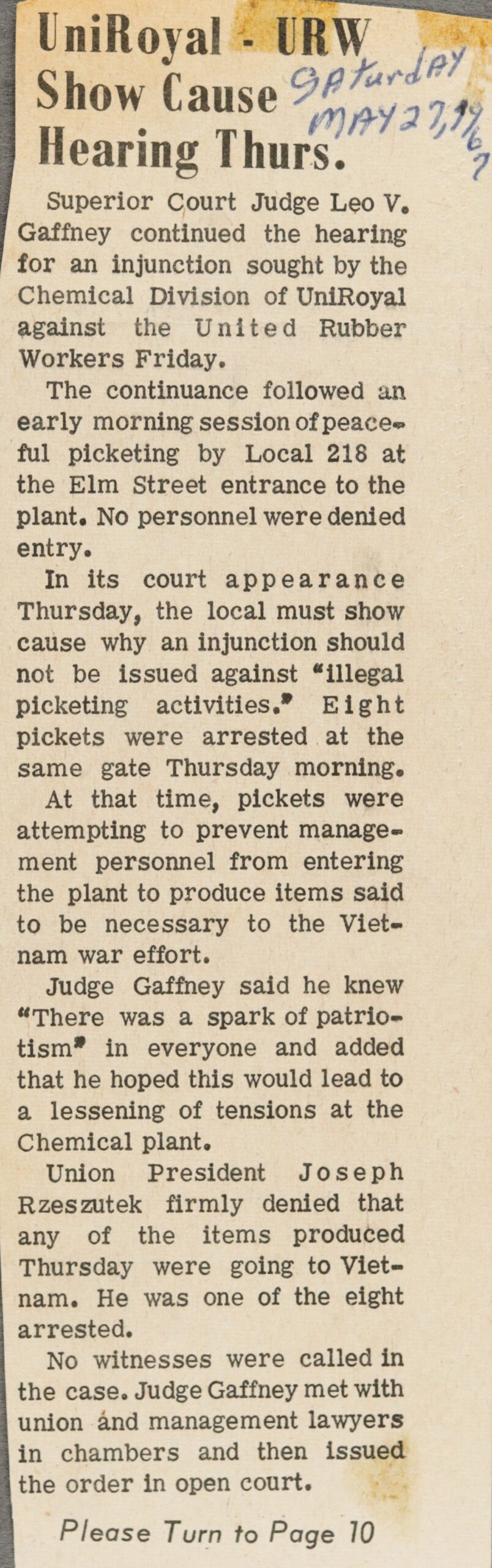
UniRoyal – URW Show Cause Hearing Thurs.

UniRoyal – URW
Show Cause Saturday
Hearing Thurs. MAY 27, 1967

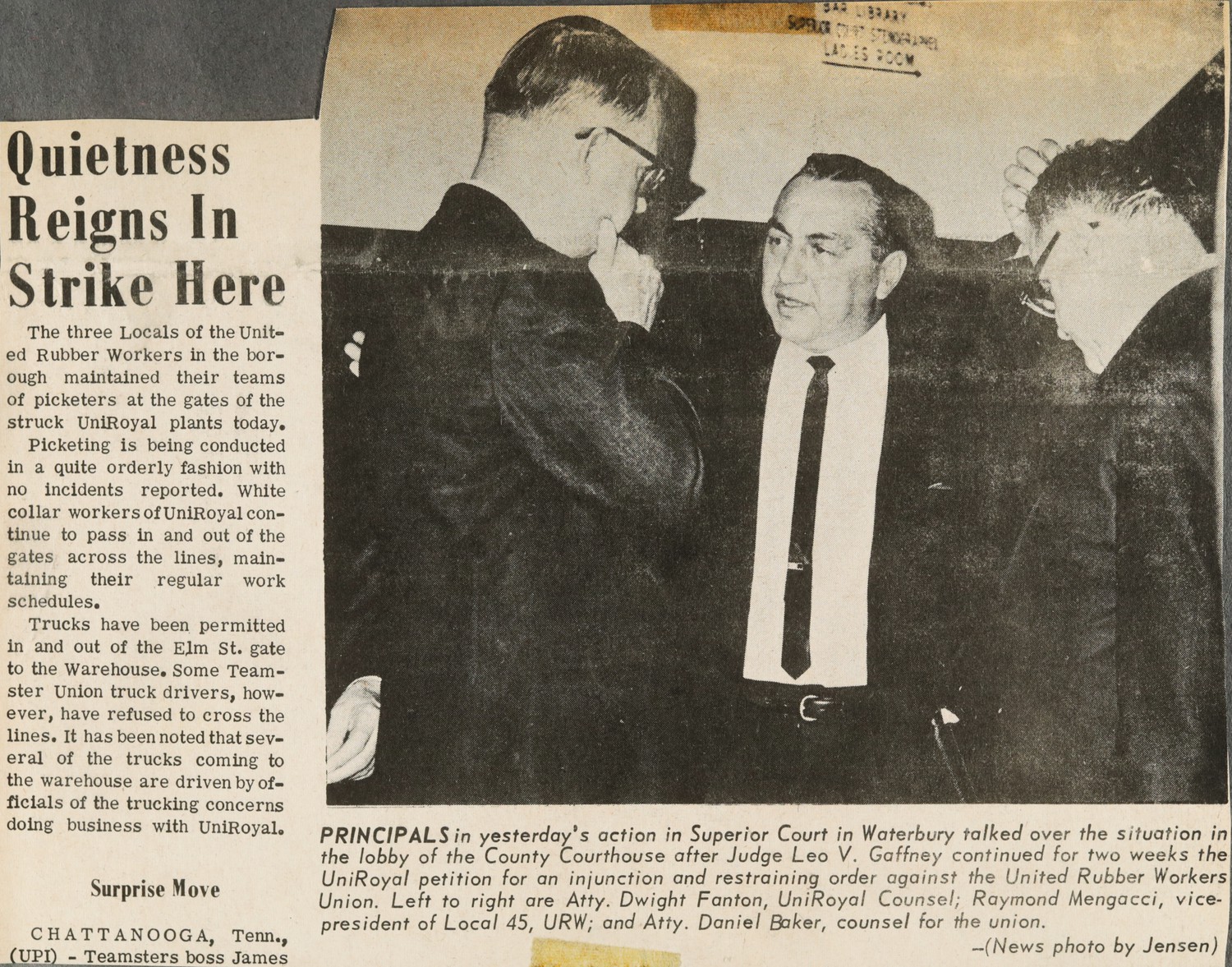
Superior Court Judge Leo V.
Gaffney continued the hearing
for an injunction sought by the
Chemical Division of UniRoyal
against the United Rubber
Workers Friday.

The continuance followed an
early morning session of peace-
ful picketing by Local 218 at
the Elm Street entrance to the
plant. No personnel were denied
entry.

In its court appearance
Thursday, the local must show
cause why an injunction should
not be issued against “illegal
picketing activities.” Eight
pickets were arrested at the
same gate Thursday morning.

At that time, pickets were
attempting to prevent manage-
ment personnel from entering
the plant to produce items said
to be necessary to the Viet-
nam war effort.

Judge Gaffney said he knew
“There was a spark of patrio-
tism” in everyone and added
that he hoped this would lead to
a lessening of tensions at the
Chemical plant.

Union President Joseph
Rzeszutek firmly denied that
any of the items produced
Thursday were going to Viet-
nam. He was one of the eight
arrested.

No witnesses were called in
the case. Judge Gaffney met with
union and management lawyers
in chambers and then issued
the order in open court.

Please Turn to Page 10

Mass Picketing At Synthetic Plant Leads To Arrest Of Four Persons

Mass Picketing At Synthetic Plant Leads To Arrest Of Four Persons

Mass Picketing At Synthetic Plant Leads To Arrest Of Four Persons

5-31-67 [handwritten notation]

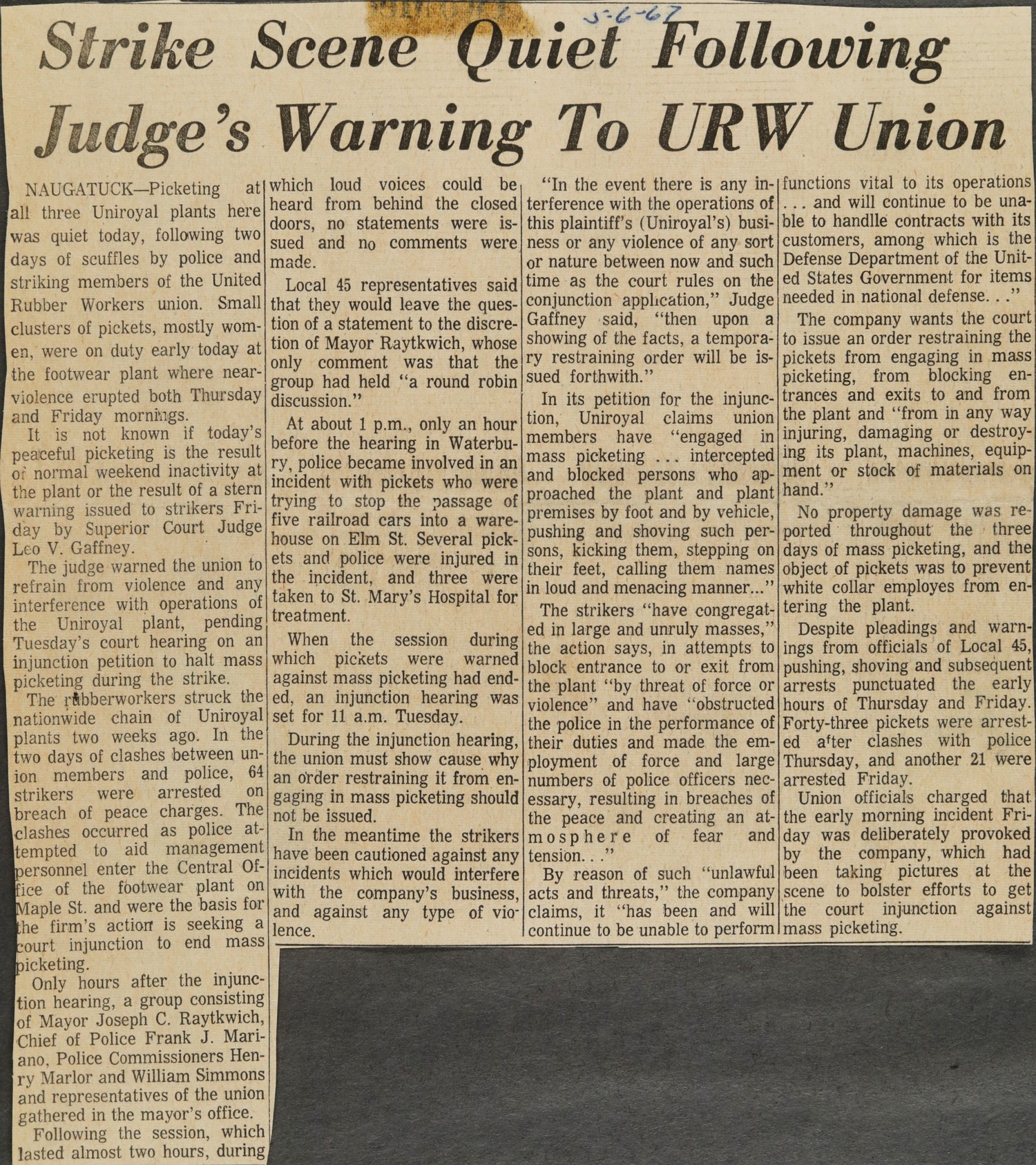
NAUGATUCK—Mass picketing by members of Local 308 at Uniroyal’s Synthetic Plant, this morning, led to the arrest of four pickets, after an attempt was made to prevent management personnel from entering the plant.

Two of the pickets had to be forcibly ejected by police, following the reading of the riot act from the state statutes by Capt. Joseph Summa, when they refused to step aside for the plant’s personnel. All personnel entered the plant, after a wedge had been formed by about a dozen police breaking the picket line.

The four arrested were brought to police headquarters, for booking in the patrol cars. However, about 30 of the pickets also arrived at the station asking to be arrested in sympathy with those already arrested.

Arrested on charges of breach of peace were John A. Painter, 38, Morris Rd., Prospect; Paul Laurenzi, 41, 30 Serry Rd., Wolcott; Jesse J. Silva, 23, 143 Cherry St. and Anthony Gambardella, 54, 53 Brichwood Rd., Seymour. Court appearances were set for June 8.

Edward Alves, president of the local, said this morning that management had informed the union that production would begin at the plant today, which had resulted in the mass picketing.

Questioned Decision

Alves questioned the decision of the management, criticizing its actions in attempting production with “unskilled personnel.” The union president further asserted that because of the “danger of work involved at the plant, a disaster could occur, not only endangering the lives and property of those in close proximity to the plant, but to also those in the neighborhood.”

Alves said the union has contacted the insurance company on whether they had been informed of the production work by the unskilled personnel and reported the insurance company had not been notified to date. He said periodic inspections are conducted at the plant due to the nature of work involved.

Third Plant Involved

The mass picketing at the Synthetic Plant, makes the third plan of the Uniroyal company to be involved since the three plants were struck 41 days ago.

Both Locals 218 of the Chemical and 308 of Synthetic Plants have maintained around-the-clock picketing since the beginning of the strike.

It could not be determined today if management will seek an injunction against the Synthetic Local.

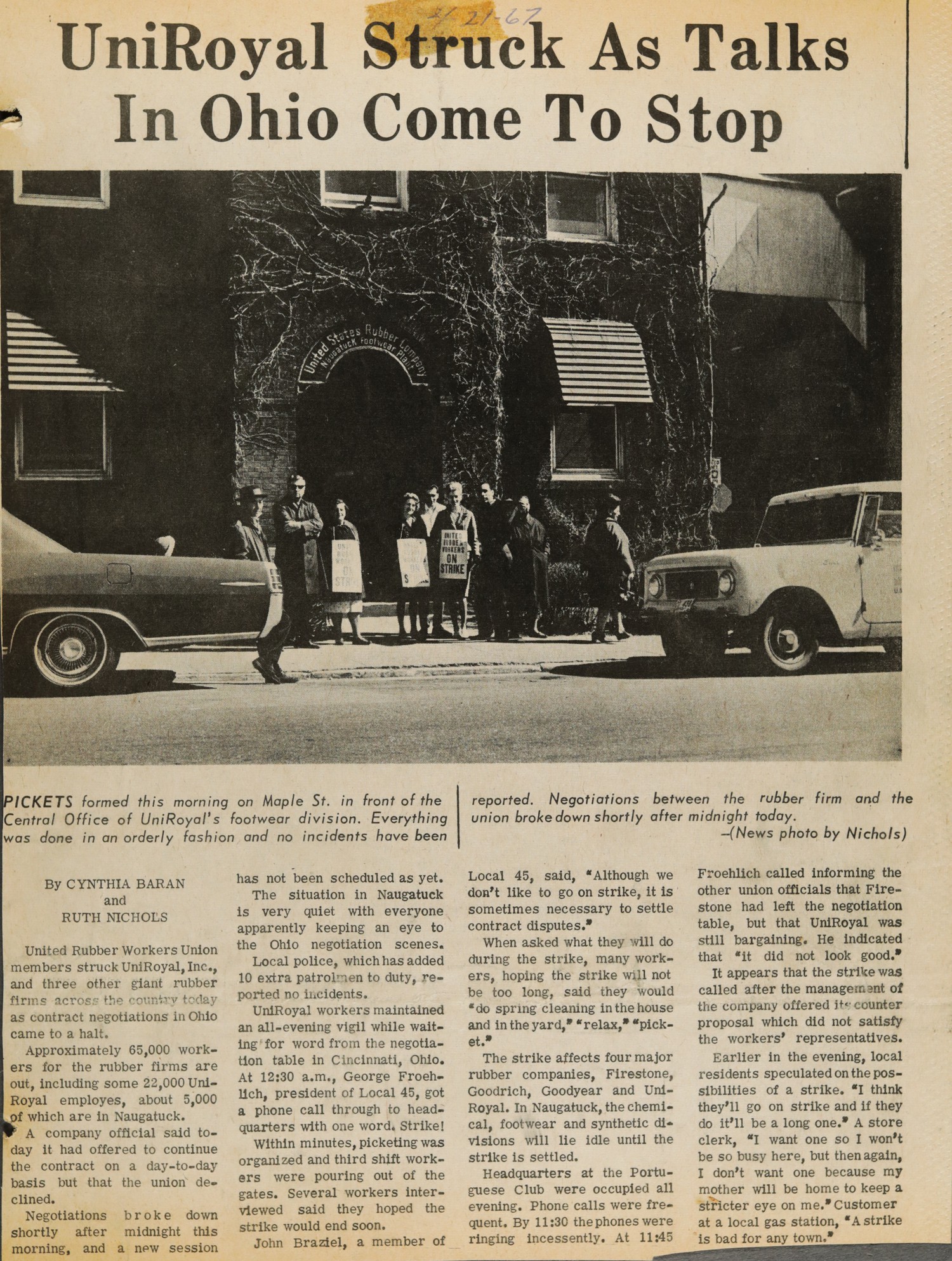
UniRoyal Struck As Talks In Ohio Come To Stop

UniRoyal Struck As Talks In Ohio Come To Stop

4-21-67 [handwritten notation]


PICKETS formed this morning on Maple St. in front of the Central Office of UniRoyal’s footwear division. Everything was done in an orderly fashion and no incidents have been reported. Negotiations between the rubber firm and the union broke down shortly after midnight today.

—(News photo by Nichols)


By CYNTHIA BARAN
and
RUTH NICHOLS

United Rubber Workers Union members struck UniRoyal, Inc., and three other giant rubber firms across the country today as contract negotiations in Ohio came to a halt.

Approximately 65,000 workers for the rubber firms are out, including some 22,000 UniRoyal employes, about 5,000 of which are in Naugatuck.

A company official said today it had offered to continue the contract on a day-to-day basis but that the union declined.

Negotiations broke down shortly after midnight this morning, and a new session has not been scheduled as yet.

The situation in Naugatuck is very quiet with everyone apparently keeping an eye to the Ohio negotiation scenes.

Local police, which has added 10 extra patrolmen to duty, reported no incidents.

UniRoyal workers maintained an all-evening vigil while waiting for word from the negotiation table in Cincinnati, Ohio. At 12:30 a.m., George Froehlich, president of Local 45, got a phone call through to headquarters with one word: Strike!

Within minutes, picketing was organized and third shift workers were pouring out of the gates. Several workers interviewed said they hoped the strike would end soon.

John Braziel, a member of Local 45, said, “Although we don’t like to go on strike, it is sometimes necessary to settle contract disputes.”

When asked what they will do during the strike, many workers, hoping the strike will not be too long, said they would “do spring cleaning in the house and in the yard,” “relax,” “picket.”

The strike affects four major rubber companies, Firestone, Goodrich, Goodyear and UniRoyal. In Naugatuck, the chemical, footwear and synthetic divisions will lie idle until the strike is settled.

Headquarters at the Portuguese Club were occupied all evening. Phone calls were frequent. By 11:30 the phones were ringing incessantly. At 11:45 Froehlich called informing the other union officials that Firestone had left the negotiation table, but that UniRoyal was still bargaining. He indicated that “it did not look good.”

It appears that the strike was called after the management of the company offered its counter proposal which did not satisfy the workers’ representatives.

Earlier in the evening, local residents speculated on the possibilities of a strike. “I think they’ll go on strike and if they do it’ll be a long one.” A store clerk, “I want one so I won’t be so busy here, but then again, I don’t want one because my mother will be home to keep a stricter eye on me.” Customer at a local gas station, “A strike is bad for any town.”

Froehlich Returns From Ohio Parleys

Froehlich Returns From Ohio Parleys

4/25/67 [handwritten]

NAUGATUCK—Union members of Locals 45 and 218 of United Rubber workers were informed on the progress of negotiations in Cincinnati although union officials declined to say what specifically had been discussed at the meetings Monday.

The presidents of the three locals, George Froehlich from Local 45, Joseph Rzeszutek from Local 218 and Edward Alves from Local 308, returned from Cincinnati over the weekend for a breather and a chance to talk to the union members.

Whether the meetings held were for information only or for policy review was not learned, although Froehlich siad he had “met with the executive board” Monday morning. He will return to Cincinnati today to resume negotiations Wednesday.

Although picketing remains quiet at the borough operations, with no official report of difficulties, officials of the Chemical Division, Local 218, report that members of the local will picket the plant “24 hours a day, seven days a week.”

In addition, it was reported, members will picket in three-hour shifts. Local 218 began a buildup of picketing Friday when some members decided to picket throughout the night and most of Saturday.

Local 45, Footwear Plant, continue to picket in two-hour shifts from 6 a.m. to 6 p.m. The same procedure is being used by Local 308.

The Associated Press reported that pickets from a rebel Chicago local paraded Monday at facilities of the Goodyear Tire and Rubber Co. — the only one of the industry’s “Big Four” not hit by a URW strike.

Work continued on a day-by-day basis at Goodyear under a contract extension after the contract ran out Thursday.

Although talks are reportedly still in progress between Goodyear and the URW, some 500 members of Local 532 walked out at Goodyear’s industrial hose plant in North Chicago. Local leaders said they would try to urge other Goodyear locals to follow suit.

A score of pickets at the plant carried signs saying,”Must we stand alone?” and “Local 532 on strike.”

Besides the approximately 5,000 workers at the borough Uniroyal plants, some 16,000 other Uniroyal employes connected with the URW are on strike, as are 17,585 at Firestone and 10,930 at B. F. Goodrich.

2 Union Vice-Presidents Included In Arrests; All Charged Breach/Peace

2 Union Vice-Presidents Included In Arrests; All Charged Breach/Peace

Sep 67 [handwritten notation in top right]

By Ruth Nichols

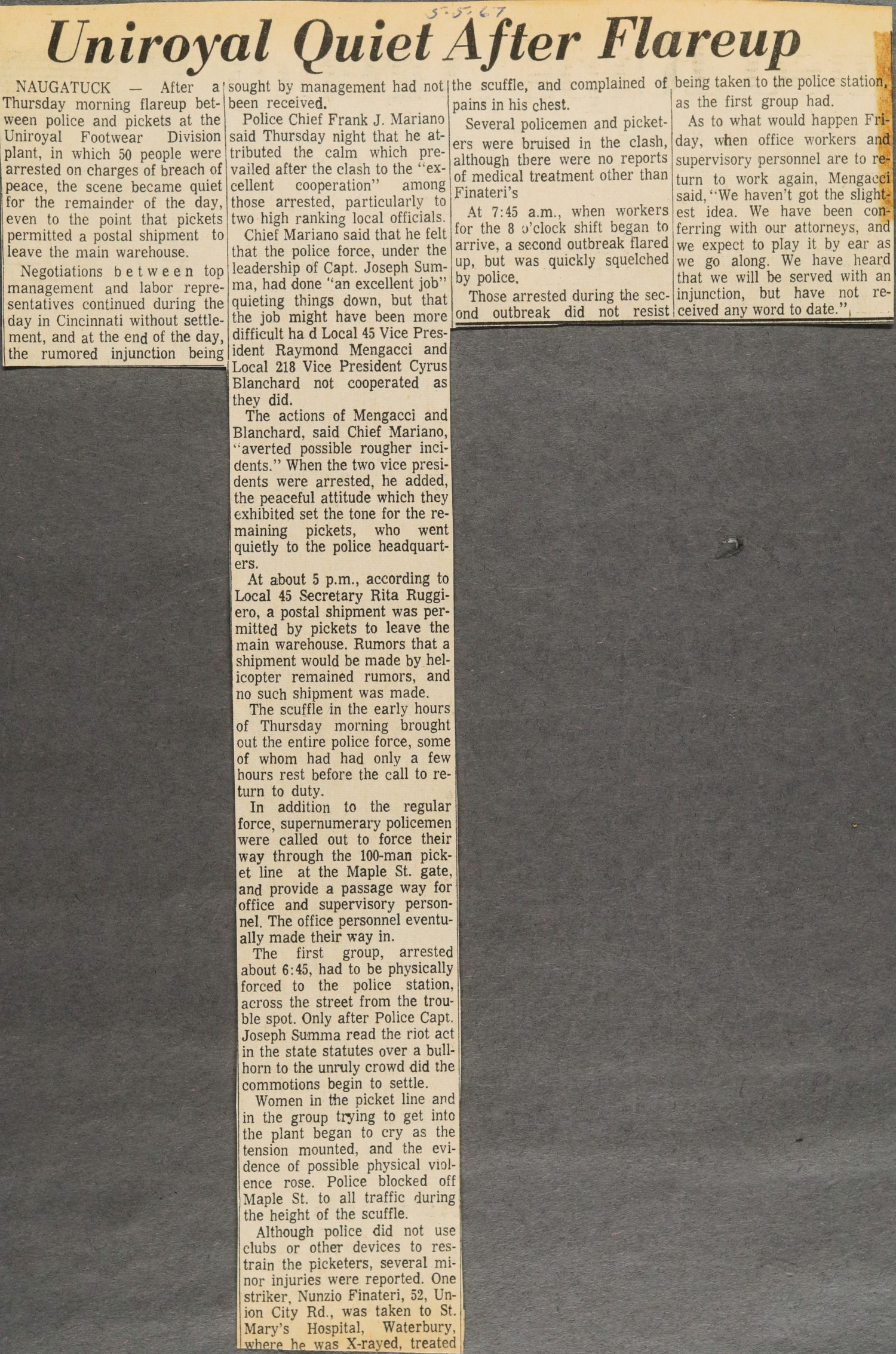
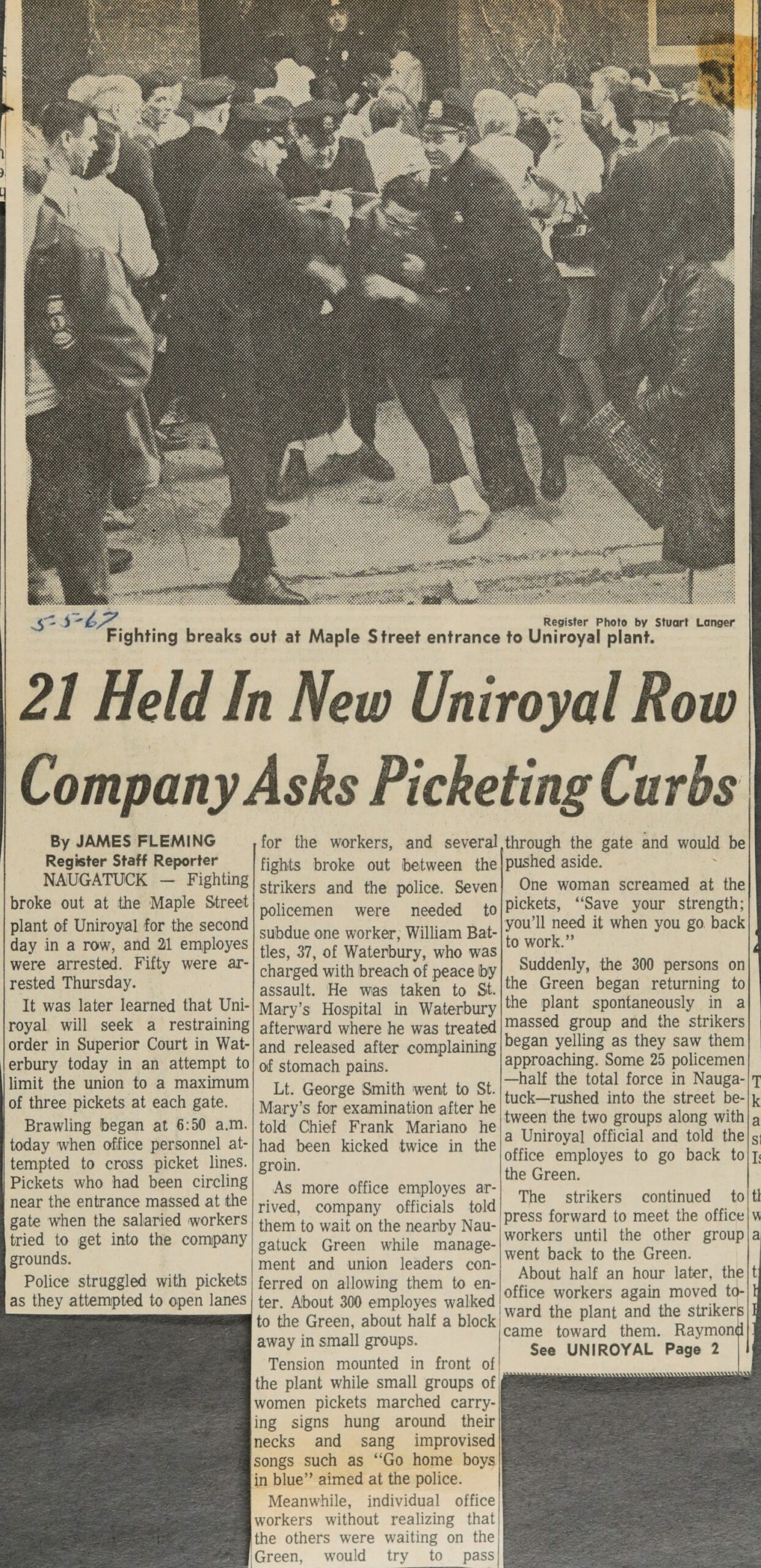
Forty-three UniRoyal strikers were arrested this morning including Raymond Mengacci, vice-president of Local 45 and Cy Blanchard, vice-president of Local 218, as police attempted to restore order to the picket lines on Maple St.

In the midst of the scuffle, which began early this morning, one man, Nunzio Finateri, about 51, was taken to St. Mary’s Hospital with a possible heart attack.

Both policemen and pickets received minor injuries as management attempted to cross the lines to enter the UniRoyal buildings.

Maple Street was closed to traffic about 7:30 this morning for an hour, until order was restored. By 8 a.m. all office workers were allowed through the line without incident.

Several groups of women gathered together on Church St. and waited for their male supervisor before attempting to enter the offices.

The first group of strikers arrested were brought forcibly to police headquarters; later however, the mood changed and the arrested strikers came in on their own to be booked. All strikers were charged with breach of peace and bond set at $150.


It was noted however, that although Local 45 is 80 per cent women, only men were booked this morning. Three police officers were at the desk, one in the file room and one in the detective’s room, booking the men as fast as possible to clear out the station.

When the bookings first began, the main room of headquarters was so full that those arrested were lined down the hallway.

Capt. Joseph Summa, in charge of the special force on strike duty, ordered a crowd dispersed outside the station where a retired employe of UniRoyal was attempting to incite pickets and stop the white collar workers from entering the buildings.

No personnel were entering the buildings through the warehouse, but rather coming through the Maple St. gate and then crossing over into the warehouse area.

Both policemen and strikers were bruised in the melee. Some women were on the outer edge of the picket line with others in the center.


women on the outside left the line and the women in the center had to wait their opportunity to leave.

Officer Jerry Sirica was the officer in charge of the policemen on duty at the Maple St. gates under the supervision of Capt. Summa.

Policemen received twisted arms, kicks in the shins, feet stepped on, and in one case, a hand bitten as they struggled with the pickets.

The pickets were ordered to keep moving in an orderly fashion once the scuffling was over until calm was insured.

Rumors are strong that a restraining injunction will be served upon the URW Unions before the day is out, but no confirmation has been received.

A report of police brutality was threatened following an incident last night when attorneys were trying to leave the plant and the picketers were not going to permit them through.

To add to the general confusion this morning, crowds of people were going home from St. Francis Church, adding to the already heavy traffic flow.


than 24 hours that UniRoyal would attempt to move some materials out of the warehouse on Rubber Ave. early this morning.

By noon today, however, no activity was attempted in this direction. Orderly picketing was going on by a large group of strikers on Elm St., next to the warehouse.

Union leaders were dividing their times between the Maple St. gates, the Rubber Ave. warehouse and another warehouse in Beacon Falls. Some picketers were picked up from the Rubber ave. facility and driven to Beacon Falls to add to those already there.

Rumors about the activity in the two towns ran rampant this morning. Word that more than 100 people had been arrested was heard being passed from picket to picket.

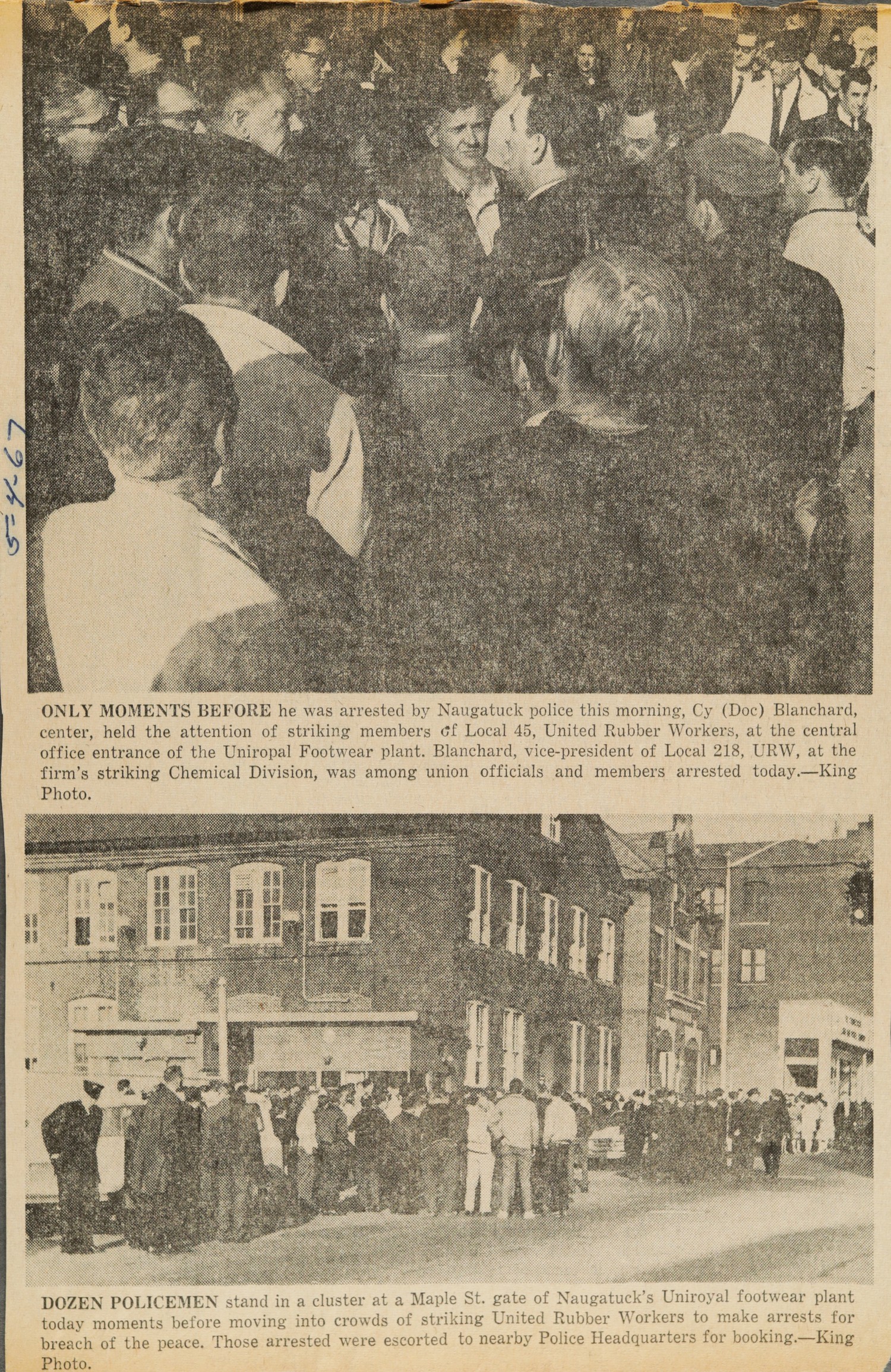
ONLY MOMENTS BEFORE he was arrested by Naugatuck police this morning, Cy (Doc) Blanchard, center, held the attention of striking members of Local 45, United Rubber Workers, at the central office entrance of the Uniroyal Footwear plant. Blanchard, vice-president of Local 218, URW, at the firm’s striking Chemical Division, was among union officials and members arrested today.—King Photo.

5-4-67

ONLY MOMENTS BEFORE he was arrested by Naugatuck police this morning, Cy (Doc) Blanchard, center, held the attention of striking members of Local 45, United Rubber Workers, at the central office entrance of the Uniroyal Footwear plant. Blanchard, vice-president of Local 218, URW, at the firm’s striking Chemical Division, was among union officials and members arrested today.—King Photo.

DOZEN POLICEMEN stand in a cluster at a Maple St. gate of Naugatuck’s Uniroyal footwear plant today moments before moving into crowds of striking United Rubber Workers to make arrests for breach of the peace. Those arrested were escorted to nearby Police Headquarters for booking.—King Photo.

Uniroyal Quiet After Flareup

Uniroyal Quiet After Flareup

5-5-67

NAUGATUCK — After a Thursday morning flareup between police and pickets at the Uniroyal Footwear Division plant, in which 50 people were arrested on charges of breach of peace, the scene became quiet for the remainder of the day, even to the point that pickets permitted a postal shipment to leave the main warehouse.

Negotiations between top management and labor representatives continued during the day in Cincinnati without settlement, and at the end of the day, the rumored injunction being sought by management had not been received.

Police Chief Frank J. Mariano said Thursday night that he attributed the calm which prevailed after the clash to the “excellent cooperation” among those arrested, particularly to two high ranking local officials.

Chief Mariano said that he felt that the police force, under the leadership of Capt. Joseph Summa, had done “an excellent job” quieting things down, but that the job might have been more difficult ha d Local 45 Vice President Raymond Mengacci and Local 218 Vice President Cyrus Blanchard not cooperated as they did.

The actions of Mengacci and Blanchard, said Chief Mariano, “averted possible rougher incidents.” When the two vice presidents were arrested, he added, the peaceful attitude which they exhibited set the tone for the remaining pickets, who went quietly to the police headquarters.

At about 5 p.m., according to Local 45 Secretary Rita Ruggiero, a postal shipment was permitted by pickets to leave the main warehouse. Rumors that a shipment would be made by helicopter remained rumors, and no such shipment was made.

The scuffle in the early hours of Thursday morning brought out the entire police force, some of whom had had only a few hours rest before the call to return to duty.

In addition to the regular force, supernumerary policemen were called out to force their way through the 100-man picket line at the Maple St. gate, and provide a passage way for office and supervisory personnel. The office personnel eventually made their way in.

The first group, arrested about 6:45, had to be physically forced to the police station, across the street from the trouble spot. Only after Police Capt. Joseph Summa read the riot act in the state statutes over a bullhorn to the unruly crowd did the commotions begin to settle.

Women in the picket line and in the group trying to get into the plant began to cry as the tension mounted, and the evidence of possible physical violence rose. Police blocked off Maple St. to all traffic during the height of the scuffle.

Although police did not use clubs or other devices to restrain the picketers, several minor injuries were reported. One striker, Nunzio Finateri, 52, Union City Rd., was taken to St. Mary’s Hospital, Waterbury, where he was X-rayed, treated the scuffle, and complained of pains in his chest.

Several policemen and picketers were bruised in the clash, although there were no reports of medical treatment other than Finateri’s

At 7:45 a.m., when workers for the 8 o’clock shift began to arrive, a second outbreak flared up, but was quickly squelched by police.

Those arrested during the second outbreak did not resist being taken to the police station, as the first group had.

As to what would happen Friday, when office workers and supervisory personnel are to return to work again, Mengacci said, “We haven’t got the slightest idea. We have been conferring with our attorneys, and we expect to play it by ear as we go along. We have heard that we will be served with an injunction, but have not received any word to date.”

LOOKING SULLEN as management and office workers file into the Maple St. gate of UniRoyal Raymond Memorial, vice-president of Local 45, URW, checks each person to be certain all are UniRoyal employees. Some who didn’t have UniRoyal badges shown prominently were asked to display them.

LOOKING SULLEN as management and office workers file into the Maple St. gate of Uni-Royal, Raymond Mengacci, vice-president of Local 45, URW, checks each person to be certain all are UniRoyal employes. Some who didn’t have UniRoyal badges showing prominently were asked to display them. —(News photo by Jensen)


[Handwritten note on right margin:]
8-5-67

Court Restrains Uniroyal Pickets

Court Restrains Uniroyal Pickets

5-6-67 [handwritten]

By PATRICK KEATING
Register Staff Reporter

NAUGATUCK — Management of the Footwear Division, Uniroyal, was granted an injunction against Local 45, United Rubber Workers, Friday afternoon at Waterbury Superior Court which will restrict the overall picketing by the union of the plant, effective immediately.

See PHOTO Page 25

The injunction, which had been sought by Uniroyal, will limit the manner of picketing and also restrain the union from stopping management personnel, company trucks, and independent carriers from entering and leaving the Footwear premises.

Management had requested the court action to curb in the future any near-rioting that was prevalent Thursday and Friday as pickets clashed with management personnel and police.

Seventy-one union members were arrested for a breach of peace and several hospitalized during the two-day outbreak.

Local 45 had challenged the entry of office help and supervisors, and also sought to prevent the company from shipping merchandise to its customers.

Friday afternoon, the company was able to have the New Haven Railroad switch five freight cars into its central warehouse. These cars are being loaded by male supervisory help and will be shipped as early as possible.

Pickets were unsuccessful in their efforts to prevent the freight cars from entering the warehouse on its spur line. The switching engine was manned by railroad officials as the regular crew, members of the Brotherhood, recognized the strikers by refusing to cross the picket line.

Two of the pickets were injured slightly by contact with the moving freight train which forced the strikers to jump to

See UNIROYAL Page 2

Five Hurt When Train Won’t Stop

Five Hurt When Train Won’t Stop

5-7-68 [handwritten]

NAUGATUCK—An attempt to push five railroad freight cars into a Uniroyal warehouse on Elm St. Friday afternoon resulted in injuries to at least five men as police officers tried to move picketing United Rubber Workers out of the way of the constantly moving train.

According to reports from some of those involved in the incident, a locomotive and five cars approached the gate leading to the warehouse at about 1 p.m.

Policemen at the scene said they expected the train would stop to allow them time to clear the track and gate of circulating pickets. They added that the train did not stop, but continued toward the warehouse at an estimated 10 mph. They had reportedly received a call claiming that the train would not stop.

Pickets held their position in front of the gate while police, some of whom were unaware that the train was still coming, trid to haul the pickets out of the path of the train.

Both police and pickets suffered injuries as the cars continued into the gate. Men from both sides were occasionally shoved against the moving cars.

Two pickets, Robert Sequenzia, 440 South Main St., and Mario Carniero, 18 Bridge St., were taken to St. Mary’s Hospital where they were treated and released.

One patrolman, Ronald Pruchnicki, received bruises and was treated at the hospital, returning to work for the 11 p.m. to 7 a.m. shift.

Police Lt. Richard Payne received a groin injury, but was not taken to the hospital.

Strike Scene Quiet Following Judge’s Warning To URW Union

Strike Scene Quiet Following Judge’s Warning To URW Union

5-6-67 [handwritten notation in top right]

NAUGATUCK—Picketing at all three Uniroyal plants here was quiet today, following two days of scuffles by police and striking members of the United Rubber Workers union. Small clusters of pickets, mostly women, were on duty early today at the footwear plant where near-violence erupted both Thursday and Friday mornings.

It is not known if today’s peaceful picketing is the result of normal weekend inactivity at the plant or the result of a stern warning issued to strikers Friday by Superior Court Judge Leo V. Gaffney.

The judge warned the union to refrain from violence and any interference with operations of the Uniroyal plant, pending Tuesday’s court hearing on an injunction petition to halt mass picketing during the strike.

The rubberworkers struck the nationwide chain of Uniroyal plants two weeks ago. In the two days of clashes between union members and police, 64 strikers were arrested on breach of peace charges. The clashes occurred as police attempted to aid management personnel enter the Central Office of the footwear plant on Maple St. and were the basis for the firm’s action is seeking a court injunction to end mass picketing.

Only hours after the injunction hearing, a group consisting of Mayor Joseph C. Raytkwich, Chief of Police Frank J. Mariano, Police Commissioners Henry Marlor and William Simmons and representatives of the union gathered in the mayor’s office.

Following the session, which lasted almost two hours, during which loud voices could be heard from behind the closed doors, no statements were issued and no comments were made.

Local 45 representatives said that they would leave the question of a statement to the discretion of Mayor Raytkwich, whose only comment was that the group had held “a round robin discussion.”

At about 1 p.m., only an hour before the hearing in Waterbury, police became involved in an incident with pickets who were trying to stop the passage of five railroad cars into a warehouse on Elm St. Several pickets and police were injured in the incident, and three were taken to St. Mary’s Hospital for treatment.

When the session during which pickets were warned against mass picketing had ended, an injunction hearing was set for 11 a.m. Tuesday.

During the injunction hearing, the union must show cause why an order restraining it from engaging in mass picketing should not be issued.

In the meantime the strikers have been cautioned against any incidents which would interfere with the company’s business, and against any type of violence.

“In the event there is any interference with the operations of this plaintiff’s (Uniroyal’s) business or any violence of any sort or nature between now and such time as the court rules on the conjunction application,” Judge Gaffney said, “then upon a showing of the facts, a temporary restraining order will be issued forthwith.”

In its petition for the injunction, Uniroyal claims union members have “engaged in mass picketing . . . intercepted and blocked persons who approached the plant and plant premises by foot and by vehicle, pushing and shoving such persons, kicking them, stepping on their feet, calling them names in loud and menacing manner…”

The strikers “have congregated in large and unruly masses,” the action says, in attempts to block entrance to or exit from the plant “by threat of force or violence” and have “obstructed the police in the performance of their duties and made the employment of force and large numbers of police officers necessary, resulting in breaches of the peace and creating an atmosphere of fear and tension…”

By reason of such “unlawful acts and threats,” the company claims, it “has been and will continue to be unable to perform functions vital to its operations . . . and will continue to be unable to handle contracts with its customers, among which is the Defense Department of the United States Government for items needed in national defense…”

The company wants the court to issue an order restraining the pickets from engaging in mass picketing, from blocking entrances and exits to and from the plant and “from in any way injuring, damaging or destroying its plant, machines, equipment or stock of materials on hand.”

No property damage was reported throughout the three days of mass picketing, and the object of pickets was to prevent white collar employes from entering the plant.

Despite pleadings and warnings from officials of Local 45, pushing, shoving and subsequent arrests punctuated the early hours of Thursday and Friday. Forty-three pickets were arrested after clashes with police Thursday, and another 21 were arrested Friday.

Union officials charged that the early morning incident Friday was deliberately provoked by the company, which had been taking pictures at the scene to bolster efforts to get the court injunction against mass picketing.

Quietness Reigns In Strike Here

Quietness Reigns In Strike Here

The three Locals of the United Rubber Workers in the borough maintained their teams of picketers at the gates of the struck UniRoyal plants today.

Picketing is being conducted in a quite orderly fashion with no incidents reported. White collar workers of UniRoyal continue to pass in and out of the gates across the lines, maintaining their regular work schedules.

Trucks have been permitted in and out of the Elm St. gate to the Warehouse. Some Teamster Union truck drivers, however, have refused to cross the lines. It has been noted that several of the trucks coming to the warehouse are driven by officials of the trucking concerns doing business with UniRoyal.


Surprise Move

CHATTANOOGA, Tenn., (UPI) – Teamsters boss James


[Handwritten text at top right of image:]
BAR LIBRARY
SUPERIOR COURT STENOGRAPHER
LADIES ROOM


PRINCIPALS in yesterday’s action in Superior Court in Waterbury talked over the situation in the lobby of the County Courthouse after Judge Leo V. Gaffney continued for two weeks the UniRoyal petition for an injunction and restraining order against the United Rubber Workers Union. Left to right are Atty. Dwight Fanton, UniRoyal Counsel; Raymond Mengacci, vice-president of Local 45, URW; and Atty. Daniel Baker, counsel for the union.

-(News photo by Jensen)

CHEM-TEXTS – Vol. 2, No. 1 – Page 1

Page 001

UNIROYAL CHEM-TEXTS

Vol. 2 PUBLISHED FOR THE PEOPLE OF UNIROYAL CHEMICAL No. 3


1,000,000 MANHOURS WORKED WITHOUT LOST TIME INJURY

[IMAGE: Black and white photograph showing workers at Chemical Canteen]

Sal Aloise of the Safety Department hands out fountain pens at Chemical Canteen marking 1,000,000 man-hours record.

For the first time in several years the Naugatuck plant worked 1,000,000 manhours without a lost time injury. By July 11, the manhours had reached 1,170,000 toward our next goal of 2,000,000.

Unfortunately, a lost time injury took place in Bldg. 73 ending the 2,000,000 manhour goal. To achieve a 1,000,000 manhours without a lost-time injury, it takes approximately 3 months. With continued attention and awareness toward safe working practices and the use of proper protective equipment on the job, the Naugatuck plant could break the 3,536,013 manhours without a disabling injury, established in 1961.

Injuries to an employee can be avoided by checking for unsafe conditions when he starts his shift and reporting them to his foreman. Many lost-time injuries would’nt happen if this procedure were followed. From January to March there were 7 lost-time injuries and 12 serious injuries. For 3 consecutive months in April, May and June there were no lost-time injuries; but 25 serious injuries.

Although vacation time is over, a great concern for safety is still necessary. Safety awareness starts at home with you and your family. If you’re planning a trip be sure to check your car carefully, drive slowly, and watch out for the other fellow on the road. With your family in the car you have to be safe.


UNIROYAL INCOME, SALES REACH ALL-TIME HIGHS

Net income and sales reached all-time highs for the first six months and the second quarter of the year, George R. Vila, chairman and president, announced recently.

Net income for the first half of the year rose to a new high of $29,881,000 or $2.20 per share of common stock compared with $11,100,000 or 69 cents per share recorded in the strike-marred first six months of 1967 when more than 70% of Uniroyal’s domestic operations were shut down for nearly 2½ months. More meaningfully, the new 1968 six-month high in earnings is 24% greater than the record $24,061,000, or $1.75 per share, attained by Uniroyal in the first six months of 1966, a period in which normal operations prevailed.

Sales for the first six months were at a record level of $718,785,000, 12.4% above the $639,516,000 recorded in the 1967 period and 7.6% higher than the $668,281,000 achieved in 1966.

In the second quarter of 1968 net income was at a record total of $17,805,000, or $1.33 a share, surpassing by 24.4% the $14,309,000 or $1.06 per share, achieved in the second quarter of 1966. No valid comparison can be made with the second quarter of 1967 when the full effect of the industry-wide strike caused earnings to drop to $1,551,000 or 2 cents per share of common stock.

Sales for the second quarter of 1968 were at a record level of $381,417,000, surpassing the strike-bound 1967 period by 18.2% and 9.3% above the $348,839,000 recorded in 1966.

Mr. Vila noted that the all-time highs for the first half and the second quarter stem from all areas of the company’s business, especially in sales of tires, footwear, plastics and plastic products.


Clark Wins Three Awards

[IMAGE: Black and white photograph showing Edward Clark at mechanical equipment]

Edward Clark of the Mechanical Department submitted three suggestions recently: he received $35 and $15 checks for two of his ideas and an Honorable Mention for the other.

CHEM-TEXTS – Vol. 2 No. 2 – Page 2

Page 002

Page 2 CHEM TEXTS Vol. 2 No. 2

FROM THE FACTORY MANAGER

Dear Fellow Employees:

Those of us involved in the “STOP” safety training program are repeatedly asked the question, “Who is responsible for safety in my area?” Each of us recognizes there is only one correct answer – “I am.” However, there will only be an effective safety program in our plant if every employee is responsible for his own activities.

Mr. Vila has clearly stated the UNIROYAL philosophy on accident prevention. I would like to quote the following portions of this statement:

. . “Managers at all levels, have, as a primary responsibility, the safety and well being of all persons who report to or are assigned to them.”

“Each employee has an important place in the accident prevention effort and he must accept the responsibility for full cooperation in the measures taken for safety.”

I have underlined RESPONSIBILITY – a key factor in the jobs of all of us. Let’s all work together in a responsible manner to prevent personal injuries.

[Signature]

John D. Evans


LOST TIME ACCIDENTS UP IN FEBRUARY, DROP IN MARCH

Lost time accidents jumped from 2 in January to 3 in February. But dropped from 3 to 2 in March. However the record for serious injuries jumped from 2 in January to a total of 6 in March.

For the first 3 months of the year there were a total of 7 lost time injuries; and for the same period a total of 12 serious injuries.

Severe bruises and sprains accounted mostly for the lost time accidents; with two fractures occurring, one of a kneecap and one wrist fracture. Oftentimes there’s only a hairline difference between these accidents and more serious ones. A “stop, look and listen” attitude toward personal safety would eliminate these incidents that not only affect the employee, but his family as well.

The rising increase of serious injuries is of major concern as these could easily have resulted in more serious accidents. Out of the 12 serious injuries 7 involved the eyes. Blindness is a heavy penalty to pay for you, your family and all of us for not wearing proper protective equipment on the job.


678 Minor Injuries Occur In January, February and March

In the first 3 months of the year, 678 minor injuries occurred, requiring visits to the plant hospitals. If this rate continues for the next 9 months, approximately 2712 minor accidents will take place. The plant presently employs about 1680 people; at this rate every employee will make 1 1/2 visits to the plant nurses for treatment.

Most injuries incurred, are from cuts and abrasions; bruises and slivers. Although the injuries are not serious, they could be prevented by wearing the proper protective equipment on the job and by checking tools; lifting and carrying heavy objects properly. Many times there’s a tendency to think “an accident won’t happen to me.” But accidents become accidents because safety is not always in mind while performing the job.

TOTAL MINOR ACCIDENTS BY DEPARTMENTS FOR JANUARY, FEBRUARY AND MARCH

DEPARTMENT EYE BRUISE FRAC-TURE CUTS & ABRA-SIONS AMPU-TA-TIONS BURNS CHEMI-CAL BURNS Sprains Back Sprains DUST OR FUMES SLIV-ERS DERM-ATITIS TOTAL
Chemical Production 17 13 1 16 0 4 8 11 5 4 3 8 90
Reclaim Production 4 10 0 42 0 2 0 8 5 0 5 4 80
Synthetic Production 0 8 0 11 0 6 0 7 1 0 4 0 37
Materials Handling 8 7 0 34 0 0 0 5 4 1 11 0 70
Mechanical (Chemical) 5 30 1 75 0 8 3 10 3 0 38 7 180
Mechanical (Synthetic) 13 12 0 38 0 10 4 6 4 0 14 3 104
Research & Development 8 11 2 33 0 10 9 5 3 5 7 8 101
Other 2 2 0 6 0 0 0 3 1 1 1 0 16
3 Months Total 57 93 4 255 0 40 24 55 26 11 83 30 678

New Equipment

(Continued from Page 1)

to make major replacements in our digesters had we continued under the old system.

For the most part, the job of installation for fibre separation and fine grinding is complete and the system is undergoing trial runs to work out the “bugs”. It is hoped that central mixing and the mill room changes will be complete by the end of 1968.

Fibre separation produces two streams: one predominatingly rubber; the other predominantly fibre. Fibre sepation and fine grinding will be operated by one control panel. The “start-up” and “shut-down” of the equipment is important. The control panel makes it possible for the operator to do this safely and easily.

Unfortunately, delays in the delivery of certain key pieces of equipment have delayed the project for some four months. These delays have made the operations particularly difficult during the dismantling, installation and start-up of new equipment and processes. It has also limited production at a time when our customer’s needs are at an all-time high. Only the greatest added effort of all employees has and can continue to minimize our financial losses during this critical year.


Auto Belt Survey Shows Fewer Drivers Using Them

More automobiles are equipped with seat belts than ever before, but fewer people proportionately are wearing them, according to a nationwide survey reported by the Auto Industries Highway Safety Committee in 1967.

Nearly two-thirds–65 per cent–of the more than one million cars checked were equipped with seat belts. Yet barely more than half the drivers questioned said they always use them on long trips, or 5 per cent less than a year earlier. Only 38 per cent reported they always use belts in local travel.

In 1963, before seat belts were standard equipment in all American cars, only 9 percent of the cars surveyed were so equipped, but nearly three out of every four drivers responding answered “always” to the “use on long trips” question. The percentage of persons stating “never wear” seat belts even on long trips increased to 17 per cent, compared with 10 per cent in 1966.

The Seventh Annual Seat Belt Installation and Use Survey was made during this year’s National Vehicle Safety-Check, a voluntary community program sponsored by the Committee, in which more than 4,700 communities participated. Cars were checked and drivers interviewed in both urban and rural areas from coast to coast, in communities with a population range from under one thousand to over one million.


Vila, Chairman of U.S. Savings Bonds Drive

[PHOTO: George R. Vila, chairman and president of Uniroyal, Inc. recently appointed 1968 rubber industry chairman for the U.S. Savings Bonds Campaign chats with Mrs. Dorie Damuth, Mrs. U.S. Savings Bonds of 1968.]

George R. Vila, chairman and president, Uniroyal, Inc. has been named to the Treasury Department’s U.S. Industrial Payroll Savings Committee by Secretary of the Treasury Henry H. Fowler.

Mr. Vila will serve as chairman for the rubber industry in the 1968 U.S. Savings Bonds Campaign. He will be responsible for planning and leading the campaign.

At Uniroyal plants, the campaign will be run during the month of May. The major promotional efforts were concentrated in the weeks of May 6th and May 15th.

At the Naugatuck plant Fred Wintsch of Industrial Relations was in charge of the campaign to promote the Saving Bond and Freedom Share drive.

CHEM-TEXTS – Vol. 2 No. 2 – Page 3

Page 003

CHEM TEXTS

Vol. 2 No. 2 Page 3


Reclaim Quality To Improve With New Modern Equipment

Water Pollution Will Be Reduced

The following pictures show some of the latest manufacturing equipment the Company has recently purchased to keep us in business against strong competition. Improved quality of our reclaimed rubber will result from the finer grinder and fibre separation machines.

Some equipment has been already installed and is undergoing shakedowns to work out the “bugs”. The miracle of the modernization of the plant is that full scale production is continuing without interruption.

Previously it was difficult to control the lint escape after the fibre was separated from the rubber. The new equipment now makes it possible to catch the fibre lint and bale it like hay. This new piece of equipment will now control the amount of lint that was formerly discharged into the Naugatuck River, and causing a pollution problem. After the modernization program is completed, further studies will be made and evaluated to reduce the air pollution caused by the reclaim manufacturing process. This fits in with the Division’s policy of air and water pollution abatement in the area.


[IMAGE: Industrial building exterior with equipment]


[IMAGE: Control panel with lights and switches]

New control panel will aid operators in controlling the operation of fibre separation and fine grinding.


[IMAGE: Industrial baler equipment]

New baler equipment collects and bales lint previously discharged into Naugatuck river.


PURDUE U. INSTALLS OUR ALL-WEATHER “RUBBER” TRACK

“The installation of the first and new outdoor all-weather “rubber” track at Purdue has any number of advantages, not the least of which is that we are now able to get a boy ready for the track, instead of getting the track ready for the boy”, says the University highly respected track coach for 20 years, Dave Rankin.

Sold under the tradename “U.S. Royal Track”, the surface is a mixture of specially selected natural and synthetic rubber made at Naugatuck. The rubber must be of the highest quality to produce a smooth uniform texture and mixed with asphalt cement and fine aggregates at a contractor’s hot mix plant.

Unlike cinders, which are high-priced and difficult to buy, the “rubber” track can be used 12 months a year under almost any weather conditions. This new all-weather track practically makes postponements and cancellations a thing of the past.

The “rubber” track doesn’t create dust and can be painted with long-lasting markings that stay clean and sharp under constant usage.

The track is tough but pliable enough to give under pressure without cracking. Unlike cinder or clay tracks, the spikes do not dig up the track permanently, because the rubber surface quickly restores itself.

Maintenance of cinder and clay tracks has always been a major and costly expense. Inclement weather meant cancellation of a scheduled meet or poor performance. A crew was oftentimes required to rake, roll, groove and reline it.

Frost works havoc with a track, causing potholes, surface bumps, a lot of time and effort to restore it to fast condition.

With Uniroyal Chemical’s “rubber” track, none of these problems occur. It would take a hurricane to cancel a meet and besides, it virtually guarantees a consistent performance because the footing is always sure and constant. Practice sessions now mean more to the athlete and the University, for the runner’s time on Monday or Tuesday will be the same time as the day of the meet.

The “rubber” track can be installed in practically one day and ready for use on the next with regular highway paving equipment. Usually two Chemical R & D personnel are on the spot to provide technical assistance to the contractor.

The contractor, prior to submitting his bid to Purdue, made it a point to witness similar applications of competitive products. He found other materials difficult to pave, difficult to handle, control and roll. The U.S. Royal track won out for its reputation of a quality product.


[IMAGE: Construction equipment on track]

[IMAGE: Workers installing track surface]

CHEM-TEXTS – Vol. 2 No. 2 – Page 4

Page 004

Page 4 | CHEM TEXTS | Vol. 2 No. 2


[IMAGE: Safety glasses with visible damage/marks]

Safety Glasses Save Employee’s Eyesight

While U. Genga of the Materials Handling group was unloading cyclohexylamine drums, the bung sprung off and the “heel” splashed against his eyes. Fortunately he was wearing his safety glasses at the time. The picture shows how the glasses protected his eyes against serious chemical burns, and possibly loss of his sight. His only injury was slight burns of the eye lids.

It’s a good idea to always wear your safety glasses. You can never be sure when something unexpected will happen. You can bet U. Genga was glad he wore his.


Enter Safety Slogan Contest Win $25.

You, your sons, your daughters, your wife, the whole family can win a $25.00 gift certificate for the employee salesroom or any Uniroyal Company store. For a few minutes of time you may easily be the winner in this Slogan Contest.

The rules for the contest are simple:

  1. Each member of the family may submit as many slogans as they want.
  2. The entry must be 10 words or less.
  3. An entry can be re-submitted in new contests provided it has never won.
  4. The decision of the 3 judges is final.
  5. All employees can enter except the plant staff and members of the joint union-management safety committee.
  6. If you don’t use the form, be sure you include all of the nessary information on your entry.
  7. The contest closes June 28.

SAFETY SLOGAN

Contest #2

Date:___

Name___

Address___


Dept.___

My suggestions are:

1.___

2.___

3.___

4.___

5.___


JIM HARTNETT WINS THE SAFETY SLOGAN CONTEST

[IMAGE: Man standing next to Uniroyal U.S. Rubber truck]

Jim Hartnet, of the Materials Division, won 1st. prize, a $25. gift certificate. His winning slogan was: “Safety 1st. is 2nd. to none.” Judges were Union Safety Committeeman, Walter Scott; Hank DeVries and Sal Aloise of the Industrial Relations department.


[IMAGE: Three men at table signing documents]

170 UNION EMPLOYEES SIGN UP FOR IN-PLANT BANKING PROGRAM

Banking is easier with the new “In-Plant” banking and saving program set up by Local 218 of the United Rubber, Cork, Linoleum and Plastic Workers of America and the Naugatuck Office of the Waterbury National Bank.

According to Union President Joe Rzeszutek and Vice-President Cy Blanchard, the new program is available to all members of Local 218. 170 union employees have signed up for the plan.

The “In-Plant” banking and savings program was set up for the convenience of the union employee. Under the plan, a member authorizes weekly paycheck deductions which are deposited directly to any number of the Bank’s services such as checking, savings accounts, Christmas clubs or loan repayments.

The Bank also provides additional services including financial counselling on money management and the availability of individual lines of credit for union members.

Union members interested in the plan can call or stop in at the Waterbury National Bank in Naugatuck or at its branch offices. Before you buy your next car, improve your home, start a checking account, or need vacation expenses, investigate the lower interest rates offered in the plan.


CHEM TEXTS

PUBLISHED BY THE INDUSTRIAL RELATIONS DEPARTMENT
UNIROYAL CHEMICAL, NAUGATUCK, CONNECTICUT

UNIROYAL Chemical
Naugatuck, Connecticut 06770

U.S. Postage
PAID
Permit No. 10
Naugatuck, Conn. 06770

CHEM-TEXTS – Vol. 2 No. 3 – Page 2

Page 002

Page 2 | CHEM-TEXT | Vol. 2 No. 3


FROM THE FACTORY MANAGER

Dear Fellow Employee:

I’m sure you will be interested to know that after the recent sign up for the 1968 UNIROYAL Employee Stock Option Plan over 62% of us, in our plant, are participating in the new plan. This increase over the 56.2% participation in 1966, no doubt, reflects our interest in recent increases in the selling price of UNIROYAL stock.

In this connection, I am often asked what has caused our stock to go up. Very frankly, beyond general economic considerations, there is only one factor that causes stock to go up or down, and that is the value the buyer – the public – places on the profitability of the Company. Profitability is the measure of how good a job a Company does in meeting the needs of it customers. Very simply, it indicates how well each of us and the thousands of other UNIROYAL employees are doing our jobs.

As owners of the Company’s stock, it is in our best interests to see that we, as employees, do our jobs in the most effective and efficient manner. This has been, and will continue to be the spirit of the Naugatuck Plant.

[Signature]

John D. Evans


Louis Triano Heads Elks

Louis Triano, a 35 year member of the Naugatuck Elks Lodge, was elected president of the Connecticut Elks Association at their 39th. annual convention. This is the highest state office attainable by an Elks Club member.

Triano served the local lodge as Exalted Ruler in 1942-43 and again in 1950-51. He is a certified National Ritualistic Judge, judging contests throughout New England.

Lou has been in Marvinol® vinyl R & D as a laboratory technician for the past 18 years, working on Marvinol plastisol and organosol formulations. Our vinyl resins are used in the manufacture of Naugahyde® upholstery fabric, footwear and rainwear.


Semaskvich Compares Uniroyal With Other Companies

Ed Semaskvich of the Mechanical Dept. worked around the world in the U.S. Navy, as a construction and iron worker, and for automotive and brass companies. He joined Uniroyal 18 years ago.

When asked his views by the editor of Uniroyal World on how Uniroyal compared with other companies that he worked for, Semaskvich expressed these opini “I

particularly like the improved safety program, the excellent fringe benefits, and the good management and employee relationship that is constantly improving, at the Naugatuck Plant.”

“The Company seemed a little on the conservative side when I first came, but in the past few years a new, progressive outlook has taken place. For instance, I can suggest

new ideas to my superintendent, foreman or even the factory manager, and if they think they’re good, they take action.” According to Ed, “no company is pertect, but Naugatuck beats the rest, otherwise I would’nt have stayed around for 18 years.

Ed has taken an active interest in the Naugatuck Swim Club for young children for many years and is a member of the V.F.W.


SUGGESTION PLAN WINNERS RECEIVE $630 FOR IDEAS

At the last Suggestion Award Committee meeting held recently, a total of $630 was awarded to employees for suggestions on safety, improved working conditions, and changes in equipment.

Any employee may submit a suggestion and win an award by using a little imagination. Your idea may win you as much as $500 for just a few moments of your time. Look around your department, there are hundreds of opportunities staring right at you.

The award winners were:
L. Fortier, Chem, Prod. – $15; J. Schumacher, Mech. Dept. $15; L. Respass, Reclaim – $15; M. Janetty, Mech. Dept. – $15; E. Clark, Mech. Dept. – $15; H. Vogt, Engineering – $35; E. Clark, Mech. Dept. – $35 E. Clark, Mech. Dept. – Hon. Men. R. Ruginis, Mech. Stores – $15; T. Turner, Chem. Prod. – $15; L. Fortier, Chem. Prod. – $15; J. Slasienski, Chem. Prod. – $15; J. Sickola,

Chem. Rec. – $15; J. Slasienski, Chem. Prod. – $15; K. Ferreira, Lab. – Hon. Men.; E. Smith, Pilot Plant – $30; C. Hiser, Mech. Dept. – $15; F. Rosa, Mech. Dept. – $15; J. Enamait, Mech. Dept. – $15; A. Brodeur, Mech. Dept. – $15; A. Picoli, Mech. Dept. – $15.

Also R. Tucker, Mech. Dept. – $15; R. Tucker, Mech Dept. – $15; E. Koslowski, Chem. Prod. – $15; J. Lynch, Chem. Prod. – $15; D. Persutti, Chem. Prod. – $15; C. Ferguson, Mech. Dept. – $15; P. Hardt, Chem. Prod. – Hon. Men.; S. Molnar, Chem. Prod. – $25; S. Molnar, Chem. Prod. – Hon. Men.; J. Gandolf, Mech. Dept. – $15; J. Gandolf, Mech. Dept. – $15; J. Lynch, Chem. Prod. – $15; C. Iannuzzi, Mech. Dept. – $15; F. Gagne, Lab. – $15; R. Pakalnis, Lab. – $25; G. Mitchell, Chem. Prod. – $15; W. Breton, Chem. Prod. – $15; J. Kerski, Materials – Hon. Men.; J. DiSantis, Dispersions – $25; G. Reale, Mech. – $50.


Pollution Program Progresses To Clean Naugatuck River

Dick Shaw, project engineer responsible for the Naugatuck plant’s water pollution abatement program, explains the function of new equipment installed along the Naugatuck river bank to Mayor Raytkwich, Thomas Scanlon, chairman of the Naugatuck Sewer Authority and John Evans to study the problems of water pollution.

Three scale model liquid waste treatment plants are located on the west bank of the river at each outfall where pollutants presently enter the river. The units have been in operation since the end of May and so far have shown considerable success in helping us determine what pretreatment methods are necessary to adequately prepare the complex waste waters for

secondary biological treatment. The operation also provides representative samples of the sludge resulting from actual manufacturing conditions to provide data for the design of efficient sludge disposal facilities.

At the present time the plant’s water pollution control program is on the schedule set by the Connecticut Water Resources Commission to stop pollution of the river by 1971.

In the past few years the Naugatuck plant has taken considerable steps to reduce both water and air pollution in the area. The progress to date has made the Naugatuck plant one of the leading industrial companies in the air and water pollution control program.

CHEM-TEXTS – Vol. 2 No. 3 – Page 3

Page 003

CHEM-TEXTS

Page 3 | Vol. 2 No. 3


HOUSEKEEPING IMPRESSES G. VILA ON PLANT VISIT

In 1936 George R. Vila joined Uniroyal Chemical, worked in the labs for a short time and became a salesman for rubber chemicals. 32 years later he returned to the Naugatuck plant where he started his career, as chairman, president, and chief executive officer of Uniroyal, Inc. for a full day visit of the plant facilities.

After a quick tour of the EMIC and TSSC buildings, Mr. Vila led F. Hopkins, G. Anderson, J. Evans, J. Cronin, B. Leach, H. Scullin and R. Van Allen on a “jogging” trip through the plant that ended late in the day.

The housekeeping, cleanliness of the plant and the buildings impressed Mr. Vila considerably. Since his last visit to the plant, he “was startled at some of the changes that have taken place — new machinery, new methods, and new products.”

As he stated in Uniroyal World, “I was also impressed by the fact that many things have’nt changed, particularly those concerning the human beings who do the work in our factories . . . Whether executive, manager, salesman, scientist or production worker, we are striving for the same things, sharing the same difficulties, and enjoying the same advantages”.

With housekeeping in tip top shape through the efforts of the Materials Dept. and every employee, the challenge is to keep it this way . . . even improve it. Everyone prefers to work in a clean plant; they not only enjoy the better working conditions, but safety is improved and injuries avoided.


L to R: James A. Cronin, Superintendent of Chemical Production watches as George R. Vila, President, Chairman and Chief Executive Officer of Uniroyal, Inc., shakes hands with Edward C. Watts who has worked for the Chemical division 42 years.


L to R: On his tour Mr. Vila stops in to visit Patrick P. Sgrillo while John D. Evans, center, looks on.


Cerinus J. Barriault of the Materials Handling Department unexpectedly meets George R. Vila as he leaves Bldg. 86 Warehouse. On the left is Herbert P. Scullin, Superintendent of Materials Handling; with back to camera on the right is John D. Evans.


L to R: Cyrus J. Blanchard, Vice-President of Local Union 218 of the United Rubber, Cork, Linoleum and Plastic Workers of America looks on as George R. Vila shakes hands with Joseph Rzeszutek, President of Local Union 218. Seated at right is Walter M. Scott.


Gordon A. Anderson, George R. Vila and Dr. Charles D. McCleary, Director of Research and Development for the Uniroyal Chemical division, converse with Edward Alves, President of Local Union 308 of the United Rubber, Cork, Linoleum and Plastic Workers of America.


L to R: Francis D. Maher, Kermit M. Snyder, Edward A. Szczesiul and Nunzie A. Ruby, Chemical Production operators welcome George R. Vila as Gordon A. Anderson, Director of Manufacturing for the Chemical division, James A. Cronin and John D. Evans watch.


Synthetic Production, Materials Handling Win Dinners

The Dinner award winners for the first quarter of the year were the Synthetic Production and Material Handlings department. Both departments worked 3 consecutive months without a lost time or serious injury. Free dinners at a restaurant of their choice were given to Armanda Vierira of the Materials Dept. and William Wasilus of Synthetic Production.

In the second quarter of the year (April, May, and June) no department qualified for the “Free Dinner” award. Safety slipped in every department with a lost time or serious injury occurring in each department during the three months.

To qualify for the $15 Dinner Award, a department must work 3 months of the quarter without a lost time or serious injury.


Two Departments Win July Contest For Free Coffee.

Only two departments worked without a lost time or serious injury in July to qualify for “Free Coffee.” The departments were Chemical Maintenance and Synthetic Maintenance. The “Free Coffee” cards can be picked up from foremen or supervisors.


Debra Dubinsky Gets Foremen’s Club Scholarship

Lou Kaiser, president of the Uniroyal Chemical Foremen’s Club announced that Debra Dubinsky, a senior at Kennedy High School, was the first recipient of the $250 scholarship award initiated this year. Her mother is presently employed in the Order Processing Department. The scholarship was available to employees’ sons or daughters who were high school seniors and planned on a college education.

The committee of Dr. Phil Paul, Joe Murtha, Tom Dowling, and Hank Lynch selected Miss Dubinsky on the basis of her scholastic record and her participation in school and civic activities. She will attend Central Connecticut State College, majoring in mathematics and plans a career in teaching upon graduation.

CHEM-TEXTS – Vol. 2 No. 3 – Page 4

Page 004

Page 4 | CHEM-TEXTS | Vol. 2 No. 3


DEPARTMENTS TO SCHEDULE SAFETY MEETINGS FOR GROUPS

During the third and fourth quarters of the year each department will hold scheduled meetings on different topics of safety. The meetings are conducted by the foremen with the members of their departments. Discussions center on the problems of safety in the departments, personal protective equipment on the job, housekeeping, eye protection, and ways to improve our safety record and prevent the occurrence of serious and lost time injuries.

At the present this is the schedule, topics and places where the meetings are being held.

RECLAIM PRODUCTION: The 3rd. quarter safety meeting discussed Personal Protective Equipment and were held in each department, except for Millrooms A and C which were held in the Foremen’s Room. A. Enamait met twice on July 15 with the Raw Stock and Tube Sorting group. A. Pistarelli and Cracking met 8/5 and will meet again on 9/9. F. Polonis and Digesting on 8/6, 8/13 and 8/20. W. Booth and Devulcanizing on 8/5, 8/12 and 8/19. D. Rappe met with Millroom A on 8/17, 8/14 and 8/21. H. Piasick and Millroom C will meet 9/3, 9/10 and 9/17. M. Mazur and Dispersions on 9/4.

Procedures and Orderlines will be the topic for 4th. quarter Safety meetings. A. Enamait, Raw Stock and Tube Sorting, will hold 2 meetings on 11/12. A. Pistarelli, Cracking, on 10/7, 11/4, and 12/2. F. Polonis, Digesting, on 11/5, 11/12, and 11/19. W. Booth, Devulcanizing, on 10/7, 10/14, 10/21. D. Rappe, Millroom A. on 10/9, 10/16, 10/23. H. Piasick, Millroom C on 11/16, 11/18, and 11/20. M. Mazur, Dispersions, on 11/27.

PURCHASING: A. Carriero will discuss Housekeeping on Sept. 16 at 9 A.M. with the Mechanical Stores group in the Chemical Mechanical Storeroom. The 4th quarter meeting will center on Personal Protective Equipment and Proper Use of Equipment and is scheduled for Nov. 11, 9 A.M. in the Chemical Mechanical Storeroom.

ENGINEERING: An organized program featuring films and slides on Safety is now being worked out for monthly departmental meetings during the 3rd. and 4th. quarters. A schedule of the foremen, departments, topics, dates, time and place is now being prepared.

SYNTHETIC PRODUCTION: During Sept. each member of the Production Department will attend a scheduled meeting on Eye Protection. Meetings will be held at 3 P.M. in the Synthetic Cafeteria. Specific dates will be determined shortly.

In November, Personal Protective Equipment, (Other than eye and head) will be the Safety topic. Meetings will be scheduled for all members of the Production department in the Synthetic cafeteria at 3 P.M.

MATERIALS HANDLING: Department meetings on Safety are now being arranged for the 3rd. and 4th. quarters for all members of the group. When topics have been selected, members will be notified of the date, time, place and foremen in charge of the meeting.

CHEMICAL PRODUCTION: Safety meetings in Chemical Production have been held for the past 3 months on a regular weekly basis under G. Allen with members of chemical production buildings. Topics have focused on the particular safety problems in each building.


SAFETY SLOGAN

Contest #3

Date:____

Name____

Address____

Dept.____

My suggestions are:

1.____

2.____

3.____

4.____

5.____


Seven Retire From Chemical

[IMAGE: Photo of Anne Mastes with ROYAL RUBBER logo]
Anne Mastes retired recently after 40 years service, mostly as an analyst in control testing. Her future plans include extensive travel and volunteer hospital and civic work.

[IMAGE: Photo of Wellie Begin with ROYAL RUBBER logo]
Wellie Begin, who worked more than 17 years for the Company, retired from the Mechanical Department of the synthetic plant.

[IMAGE: Photo of John Walsh with ROYAL RUBBER logo]
John Walsh, after 22 years of service, retired. He worked in the research and development department of the synthetic rubber pilot plant during most of his career with the Company.

[IMAGE: Photo of Luward Lewonski]
Luward Lewonski who spent most of his career at Naugatuck in the materials department retired after 35 years of service with the Company.

[IMAGE: Photo of Albert Watts]
Albert Watts, of the Chemical Production Department retired after spending 17 years of service with the division. Al hasn’t made any definite plans yet, but looks forward to taking it easy for awhile.

[IMAGE: Photo of George Kuhn]
George Kuhn with more than 25 years of service with the Chemical division retired from the synthetic plant where he worked in the janitor’s department. He plans to move to Greer, South Carolina.

[IMAGE: Photo of Harold Asplund]
Harold Asplund retired from the Plant Protection department after 21 years service with the Company. Future plans include trips to Maine.


Plant Security To Be Improved

In about 6 weeks, a new procedure for entering the plant will become effective. Turnstiles, like those in the New York subways will be installed at the Main, Tire and Synthetic gates. The gates will be locked at all times, but will be opened with a “magnetic key.” This new system will allow only authorized personnel to enter the plant.

Recently all employees signed new employee passes which were collected. The passes will be plastic laminated and redistributed to employees when completed. The passes contain the “magnetic key” required to unlock the turnstiles to enter the plant.

Should an employee forget his pass, he will have to contact the watchman and prove his identification. If he can’t identify himself satisfactorily, he will have to contact his foreman or supervisor to enter the plant.


KOPP AND SCHMELCKE WIN $25 IN SAFETY SLOGAN CONTEST

Betty Kopp and Bill Schmelcke of the Physical Testing Lab. put their heads together and came up with the winning Safety Slogan “Don’t Fight Safety — Join It.” in the latest Safety Slogan Contest. Judges of the Contest were Lou Coscia, Hank De Vries and Al Krampetz.

All employees and members of their families can enter the Contest. The rules are simple; just write a slogan of 10 words or less. You or a member of your family may be the next winner of $25. All entries for Contest 3 must be sent to Hank De Vries, Safety Director, Bldg. 84. by Sept. 30

Other people who submitted slogans were Oscar Anderson, a retired employee; Frank Tussier in Analytical Research; Denise Pratt, who submitted 5 slogans; Caruso Fernandez in Agricultural Chemical Research, another five slogan contestant; Lisa Toman; Marjorie Tasky in the Reclaim Dept.; and John Mello. Synthetic Plant Protection, with five entries.


CHEM TEXTS
PUBLISHED BY THE INDUSTRIAL RELATIONS DEPARTMENT
UNIROYAL CHEMICAL, NAUGATUCK, CONNECTICUT

UNIROYAL Chemical
Naugatuck, Connecticut 06770

U.S. Postage
PAID
Permit No. 10
Naugatuck, Conn. 06770

RETURN POSTAGE GUARANTEED
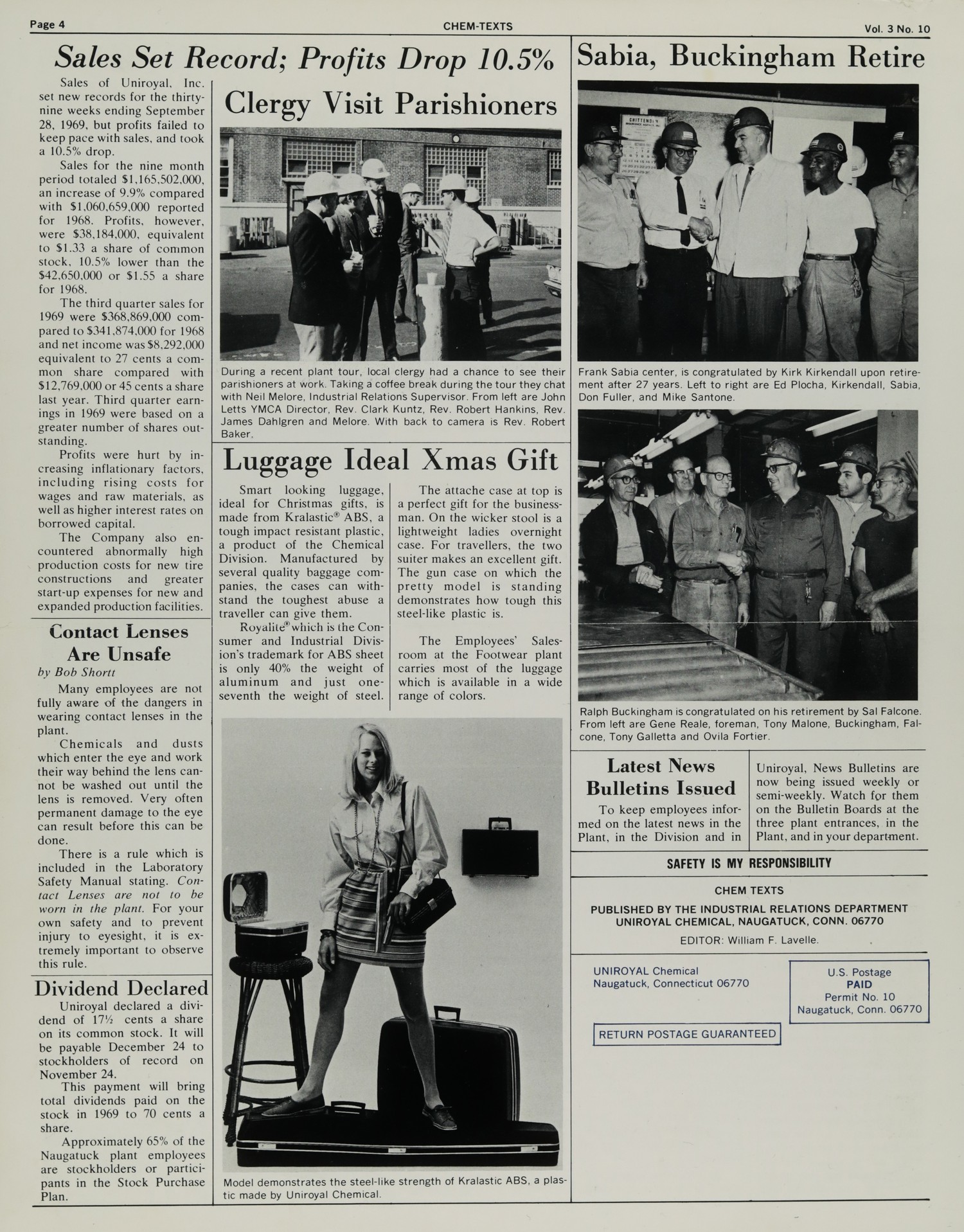
CHEM-TEXTS – Vol. 2, No. 4 – Page 1

Page 001

UNIROYAL CHEM-TEXTS

Vol. 2 PUBLISHED FOR THE PEOPLE OF UNIROYAL CHEMICAL No. 4


United Givers Goal, $20,000 “Give Where You Work” Urged

Ron Mitchinson, Chairman of the United Givers Campaign to be conducted in the plant during October, urges 100% employee participation and “Give Where You Work” to support the 16 worthwhile Agencies in the Fund. Many of these Agencies serve not only Naugatuck and Beacon Falls, but most of the surrounding towns in the area. Some like the U.S.O., Salvation Army, United Cerebral Palsy and Red Cross are national in their service.

Most plant employees and their families have been served by one or more of these organizations. Their need for money this year is greater than ever to continue their good work. By giving “where you work” and contributing through the payroll deduction plan at least one hour’s pay monthly for wage employees or 1% of annual income for salary employees, the plant goal of $20,000 can be easily reached.

In the 1967 Campaign 67% of Chemical employees contributed $17,775. About 560 employees did not contribute. On the Pledge card every employee will find at least one Agency which he or his family wants to help support.

The Campaign Committee is E. Alves, S. Gillette, E. Johnson, W. Tavelle, L. Lombardi, D. Miller, J. Rzeszutek, and R. Van Allen. Close to 100 Co-Captains will contact every employee during the Campaign.

Co-Captains are B. Sullivan, E. Evans, L. Taranowich, L. Soares, M. Rosa, H. Steele, N. Krenitsky, J. Valinho, P. Tortorici, M. Chmielewski, J. McKee, G. Browning, E. Jancis, B. Perkins, C. Fernandes, P. Braudis, A. Ferro, W. Jones, T. Brett, R. Mastromatteo, R. Cote, C. Buckley, R. Harsch, P. Hinckley, D. Malloy, W. Parks, J. McGinn, I. Prager, R. Farrell, W. Smith, J. Phelan, W. Singleton, R. Amidon, W. Budd, G. Arndt, P. Murray, L. Flynn, F. Adams, E. Cheney, R. Lestage, G. Birch, H. Hook, F. Rodrigues, W. Campbell, H. Francolini, D. Poehailos, H. Lynch, R. Ames, C. Reich, L. Terra, A. Pistarelli, M. Paiva, D. Rappe, A. Nauges, T. Skehan, R. Foltz, B. Dunn, J. Rice, J. Bucciaglia, K. Dowling, R. Magnamino, F. Magnamo, E. Ruella, R. Breton, J. Bielak, J. Honyotski, D. Cowan, R. Valentine, D. Gabriel, R. Kaiser, J. Charkow, C. Roland, R. Manulla, J. Wojtczak, W. Bieleski, R. Magnamo, F. Enamait, S. Perkus, J. Sullivan, T. McMahon, W. Leukhardt, J. Quint, L. Nappiello, D. George, Geo. Arndt, H. Scullin, F. Lynch, J. Murtha, A. Juliano, J. Vergosen, R. Terino, E. Weaving, S. Aloise, F. Sabia, and J. Tierney.


One gift works many wonders

[IMAGE: Young child’s face]

GIVE THE UNITED WAY


[IMAGE: Industrial facility with storage tank and buildings]

Size of new 300,000 gallon oil storage tank and steel dike is shown partially on left, compared to rest of boiler plant. In center is the new fuel oil transfer and heating facilities building.


Boiler Plant Converts To Oil Reduces Air Pollution In Area

Another major step has been taken by the Chemical division to reduce air pollution in Naugatuck and surrounding towns by using oil instead of coal in its boiler plant. This conversion will reduce air pollution by virtually eliminating the large amounts of fly-ash now discharged from the two smoke stacks. The plan also incorporates future improvements in air pollution abatement.

The new 300,000 gallon fuel oil storage with a protective dike surrounding it, has already been installed above ground on the south side of the boiler plant where the coal pile was formerly located. A new fuel oil transfer pump house will unload the fuel oil into the storage tank. The tank will take care of a 6 days supply during the heavy winter load.

The tank sits on the earth rather than a concrete foundation. Before construction, the huge coal piles had to be removed, and a 6 ft. deep excavation made. The 6 ft. “hole” was filled with layers of gravel, vibration rolled and wet down to 95% compaction to give a rock base foundation.

Working on the project were George Arndt, Utilities Engineer, responsible for the overall planning of the project. Vic Anderson was Control Engineer for instrumentation and electrical equipment; Paul DeAngelis was in charge of piping layout and design; Frank Gaizutis supervised structural engineering of the project. Charles Hescheles of Corporate Engineering provided specialized assistance on the project.


SAFETY IS MY RESPONSIBILITY

CHEM-TEXTS – Vol. 2 No. 4 – Page 2

Page 002

CHEM TEXTS

Page 2 | Vol. 2 No. 4


FROM THE FACTORY MANAGER

Dear Fellow Employee:

Within the next several weeks we will each be contacted by one of our friends to make our annual pledge to the United Givers of Naugatuck and Beacon Falls.

Experience has proven that this once-a-year campaign is the most efficient way of providing funds for sixteen volunteer agencies that serve the people of our area. I am, however, concerned that the convenience of this method of giving may tend to lessen our generosity as givers. May I suggest that we each use the following guidelines in making out our pledges?

1) Review carefully the agencies presented on our pledge card and the details of their needs and services as described in the United Givers folder.

2) Consider the services that we, our family, our friends and neighbors receive from these agencies. Note that many of the agencies serve an area broader than the campaign towns. Some are even national.

3) Use the Work Sheet on this page of CHEM-TEXTS to work out our pledge on the payroll deduction plan. This method makes it convenient to give our share on a year-around basis.

4) PLEDGE! Before filling in our card – ask ourselves one question – “Have I given until it feels good?

[Signature]

John D. Evans


HOW MUCH SHOULD YOU GIVE TO THE UNITED GIVERS DRIVE

A few years ago, somebody knocked on your door almost once a week for a contribution to a worthy cause. You probably contributed $30 to $50 to these organizations.

Through the United Givers Fund your continued generous support of most of these organizations can now be done on a once-a-year basis through the Company’s payroll deduction plan.

To determine your contribution for 1969, this work sheet, listing the 16 participating agencies, will help you decide the amount of your gift.

Agency Gift amt. if contacted separately
American Red Cross $_____
Child Guidance Clinic $_____
Children’s Center $_____
Conn. Trails Council,
Girl Scouts of America $_____
Catholic Family Serv. $_____

Family Serv. Assoc. $__
Mattatuck Council,
Boy Scouts of America $
____

Naugatuck Jr.
Athletic Leagues $__
Salvation Army $
_
United Cerebral Palsy $

U.S.O. $

Waterbury Assoc. for
Retarded Children $

Y.M.C.A. – Naugatuck $

Total Amount $
___

By dividing the number of payroll deductions into your total amount, you obtain the amount you should pledge. For salary employees, payroll deductions will be made monthly; and for wage employees, deductions will be weekly.

The Naugatuck plant always contributed generously in the past to these worthwhile agencies. Because of their increased services and expenses they depend more on us for 1969.


New Assignments Made in Plant

Fred Wintsch has been appointed Labor Relations Manager for the Naugatuck plant. He will be responsible for employee relations, reporting to Ron Mitchinson, Industrial Relations Manager.

[PHOTO]

Sam Gillette, formerly General Foreman at the Synthetic rubber plant, moved to the Chemical production as General Foreman reporting to Jim Cronin, Superintendent.

[PHOTO]

Eric Johnson, named General Foreman of the Synthetic rubber plant, will supervise production of synthetic latexes. He reports to Ben Leach, plant Superintendent.


[PHOTO]

The new 300,000 gallon oil storage tank and steel dike dwarfs members of the Engineering department as they inspect the 29 ft. high structure, south of the boiler plant.


[PHOTO]

Plant personnel involved in the boiler plant conversion project are left to right: Vic Anderson, Paul DeAngelis, Bill Maguire, Joe Mambrino, Frank Gaizutis and George Arndt, shown checking fuel oil connections.


Special Winter Tire Sale

A special two month winter tire sale for active and retired employees will run from October 1 to November 30, 1968.

The sale is on winter patrol snow tires only and offers considerable savings below existing employee prices.

Lists of the special low prices can be obtained from the Industrial Relation’s Department or Employee Salesroom Managers.


August Injuries Continue High

This chart shows our injuries for the month of August and indicates the departments where these injuries occur. Although it seems that plant personnel incur a large amount of minor injuries, we must do our utmost to reduce these injuries and particularly to prevent their recurrence by a greater awareness of safety. We must at the same time have all minor injuries checked by the plant hospital.

A minor injury remains a minor injury only if it’s taken care of immediately. All injuries promptly cared for, cause less discomfort and pain to the individual and will help avoid the danger of infection and complications.

Remember to report all injuries and receive prompt first aid at our plant hospitals. Most important, however, is a greater safety awareness of an “unexpected happening” before and while performing your job.


AUGUST 1968 – INJURY LOG SUMMARY

DEPARTMENT EYE BRUISE FRACTURE CUTS & ABRASIONS AMPUTATIONS BURNS CHEMICAL BURNS Sprains Back Sprains DUST OR FUMES SLIVERS DERMATITIS TOTAL
CHEMICAL PRODUCTION 4 4 8 3 4 3 1 2 29
RECLAIM PRODUCTION 1 8 12 3 4 1 1 30
SYNTHETIC PRODUCTION 4 3 1 2 1 11
MATERIALS HANDLING 5 4 8 2 1 3 2 3 2 30
MECHANICAL (CHEM) 5 5 1 22 7 2 5 1 14 1 63
MECHANICAL (SYN) 2 5 17 6 6 5 1 42
RESEARCH & DEVELOPMENT 4 2 13 2 3 3 5 1 1 34
OTHER 2 1 34
AUGUST TOTAL 21 32 1 85 0 24 10 26 4 7 23 9 242
8 MONTH AVERAGE 1968 22 32.5 1 82 0 19.5 9.25 18 8.25 4 28 10.5 235
8 MONTH AVERAGE 1967 28 42 1 90 12 19 14 23 9 4 27 9 267

SAFETY IS MY RESPONSIBILITY

CHEM-TEXTS – Vol. 2 No. 4 – Page 3

Page 003

CHEM TEXTS

Vol. 2 No. 4Page 3


Company Breaks Ground Recently For New Complex In Oxford Area

[IMAGE: Aerial view of architectural model]

Architect’s model shows the present plans for the Companys new Oxford complex to be completed by 1970.

An informal ground-breaking ceremony was held on Sept. 24 for the Company’s new Oxford Complex, making the often discussed plans a reality. A formal groundbreaking ceremony will take place at a later date.

The new complex will serve as an adjunct to the Company’s worldwide headquarters in New York City.

It will eventually bring together some 1500 employes and consolidate research and development activities now scattered countrywide over a number of locations. Greater cohesiveness, increased operating efficiency and an advantageous living and working environment should result from the move, the company said. Estimated cost of the complex runs into eight figures.

Set in a 1500 acre site, the new complex will consist initially of three buildings, two or which, the administration-office building and expanded computer center, and the personnel training center, are scheduled for completion by the summer of 1970. The third facility, which will be ready later, will combine the corporate research staff and the product development facilities of the company’s consumer, industrial and plastics products divisions.

The Uniroyal personnel training center for developing management, merchandising and other skills will provide not only technical training areas, but facilities for lodging training center participants and overnight guests. A large cafeteria and dining area will be a part of this facility, the company said.

According to present plans, the Uniroyal building in New York City, will continue to be the headquarters for corporate officers including finance, advertising, public relations and legal staffs. Certain sales activities and other corporate functions will also be maintained in New York.

Administrative office people of the consumer, industrial and plastics divisions, the plantations division and part of the international division will be transferred to Oxford.

Other corporate departments to be established wholly or in part at Oxford include purchasing, traffic, distributing branches, engineering, accounting, operating services, internal audit, comptroller, taxes and renegotiation, economic analysis, compensation, management development and training and medical staffs.

[IMAGE: Architect’s drawing of building]

Architect’s drawing of the Administration Building.

[IMAGE: Group photo of people at ceremony]

Attending the ground breaking ceremony were from left to right: J. Evans, T. Kwapien, B. McNomee, R. Davidson, E. Phillips, D. Ross, W. Norton, Project Director; N. Husted and A. Nicolai.


Union-Management Safety Committee Concerned Over Employee’s Attitude

At a recent Union-Management Safety Committee meeting, the Committee unanimously agreed that there is a growing indifference to safety in every area of the plant. Committee members, J. Rzeszutek, C. Blanchard, W. Scott, A. Krampetz, H. DeVries, L. Coscia, S. Aloise, H. Scullin, C. Houseknecht, R. Van Allen, and S. Gillette expressed a deep concern over the employee’s attitude to his own safety and the safety of fellow employees.

This poor attitude toward safety is shown by both wage and salaried employees. Lost time accidents and serious injuries along with minor injuries occurring in the plant have shown little improvement for the past 3 years.

Several reasons may be responsible for this poor safety attitude: 1) a lack of ability to get things done; 2) poor communications or misunderstandings; 3) poor judgement; and 4) lack of knowledge.

The Committee believes that it is often difficult for wage and salary employees to face the fact that we are not as safety conscious as we should be. Questions for every employee to ask himself about safety are: Do I always wear my safety glasses? Do I always wear a hard hat? Do I take chances and operate when shutting down would be better? Do I provide or use the proper safeguards — tools, protective equipment etc.? Do I act now or put it off?


What Does An “Accident” Mean

Four different dictionaries define the word “accident” in different ways but end up with the basic meaning; an unexpected happening. These definitions emphasize the necessity to be continually aware of safety on our job, at home, and on the road.

Webster’s Dictionary: An unforeseen or unplanned event. An unexpected happening causing loss or injury.

Pocket Medical Dictionary: An event occurring to an individual without his expectation.

MacMillan’s Modern Dictionary: That which happens unforeseen; unexpected event.

Random House: An event that happens unexpectedly without a deliberate plan or cause.

This means an accident can happen at any time, any place, to anyone. Therefore, we must always be on our guard to protect ourselves from the unexpected.

No matter how much experience a person has on his job, the possibility of the “unexpected happening” always exists. A good example of this was the near serious injury which could have cost several employees loss of their eyesight. A mechanic was using a drill and the bit broke, (an unforeseen or unexpected happening). The broken piece hit his glasses and bounced away (an unexpected event). His glasses protected him from an eye injury. A search of the area within a radius of 20 feet failed to locate the broken bit; this means that anyone in the area was subject to a head or eye injury.

Excuses are often used by some employees such as “I use them in the red area”, or “I wear them when I’m working” or “I wear them when there is danger”. Would these excuses have protected you if the unexpected happened such as in the above case?

Always wear your personal protective equipment and use it correctly.

SAFETY IS MY RESPONSIBILITY


Your Vote May Change Elections Vote Nov. 5th.

On Election Day, what’ll happen if you don’t vote or if you feel my one vote doesn’t mean much. It will mean a lot because in this critical election year, every single vote will count in the election of Presidential candidates. By not casting your one vote, you’re letting someone else elect candidates for you.

As a country we have a very poor voting record. In the 1964 Presidential election, only 62% of the eligible voters went to the polls. In the “off-year” of 1966, only 45% of the people voted. In some foreign countries 85% to 92% of the people vote. What’s happened to American democracy?

In 1960, John F. Kennedy’s national plurality was less than one vote per precinct. He defeated V.P. Nixon by less than 120,000 votes. In 1962, the Governor of Maine won by 483 votes; the Minnesota Governor by 91 votes.

The only wasted vote is the uncast vote. Don’t let the other fellow decide for you, who should be President, Senator, Representative or Town official. You elect them.

Be sure to register as a voter now. If you’ll be out of town, obtain an absentee ballot. Be sure to vote on Nov. 5th. on your knowledge of candidates, not gossip; vote with your beliefs, not on the basis of “polls.”

CHEM-TEXTS – Vol. 2 No. 4 – Page 4

Page 004

Page 4 | CHEM TEXTS | Vol. 2 No. 4


Pohl Made Industrial Relations Manager For Baton Rouge Plant

[PHOTO: Group of four men in suits]

Ron Pohl, second from left, was honored by fellow employees and friends at a dinner recently. At left is Ed Alves, President of Local 308, Synthetic Plant. Next to Pohl is Joe Rzesutek, President of Local 218, Chemical plant. At right is Ron Mitchinson, Industrial Relations Manager for the Naugatuck plant.


Plant Contributes 148 Pints Of Blood To Bloodmobile Visit

The Connecticut Red Cross Bloodmobile made its annual visit to the Naugatuck plant in August. Usually the visit occurs in June or October when most plant personnel are available. In 1967 the plant contribution dropped to a low 100 pints.

This year’s visit, sponsored when several buildings were closed for repairs and many employees on vacation, brought 148 pints to the Red Cross, a highly commendable response by Naugatuck employees.

184 employees volunteered, but only 166 showed at the Bloodmobile unit. 18 employees were rejected and 22 walk-ins appeared.

A five gallon pin was awarded to Orlando Gabianelli and two gallon pins awarded to Walt Frankenberger and Jack Vergosen. Other employees contributing were: V. Alves, R. Amidon, R. Ashby, D. Beauchamp, B. Begin, J. Bickerdike, A. Bilez, L. Borg, D. Boulanger, P. Brandis, R. Breton, W. Broden, E. Brooks, R. Brown, J. Bucciaglia, C. Bulka, W. Campbell, K. Canham, B. Carr, R. Clark, P. Cookson, R. Cornell, A. Crandall, A. Crapo, J. Cronan, A. Cross, S. Curtis, T. Curzi, B. Daily, R. DeBlasio, D. Delagrange, H. DeVries, P. Dillon, H. Donald, J. Doran, K. Dowling, E. Easterbrook, G. Emond, S. Famiglietti, W. Ferguson, J. Fink, E. Fischer, B. Fisher, T. Fitzgerald, R. Foltz, L. Fortier, H. Francolini, A. Gedraitis, P. Hans, M. Heller, G. Hennessey, C. Herb, J. Hoey, D. Houde, J. Jarvis, J. Johnson, J. Jokubaitis, R. Keenan, L. Koth, A. Krampetz, R. Krause, A. Krivitsky, J. Lawson, P. Lazaras, B. Leach, L. Lombardi, H. Lynch, T. Lyons, W. Madura, F. Maffia, C. Magnuson, R. Manulla, M. Marmaccio, N. Mason, W. Mathewson, M. Matos, F. Mayo, J. McGowan, R. Mitchinson, R. Morel, A. Mukosey, K. Nelson, E. Newell, P. Norton, S. Ostrowski, L. Owens, J. Painter, K. Parikh, P. Petti, R. Quint, A. Radowich, J. Riccardi, L. Roberts, H. Robinson, E. Root, J. Rourk, E. Runowicz, R. Ruris, R. Schultz, S. Schwartz, W. Scott, K. Searles, R. Semeraro, F. Semplenski, P. Sgrillo, J. Shepard, T. Shevzov, A. Smith, N. Smith, W. Smith, M. Stanco, F. Sterniak, J. Sullivan, J.J. Sullivan, M. Sutton, A. Swaan, S. Swan, A. Tidmarsh, L. Triano, S. Tummarello, J. Walsh, T. Ward, C. Wehman, P. Welch, F. Wintsch, J. Wojtczak, and R. Valentine.


Ed Boisvert Retires Recently

[PHOTO: Two men shaking hands]

Ed Boisvert (left) a millwright in the Mechanical Department is congratulated by John Evans upon his retirement after more than 18 years service with the Company.


Synthetic Team Finishes Second In Slo-Pitch League

The Synthetic Cardinals recently completed a very successful campaign in the Naugatuck Daily News Twilight Slo-Pitch Softball League. The team’s season record was 21-10 to give the Cardinals second place in the National Division. A runner-up trophy for the team’s finish in the league will be presented to members of the team and placed in the Control Room at the Synthetic Plant. Members of the Synthetic Cardinals were Pete LaCharity, Charlie Roland, Joe Wojtczak, John Johnson, Bill Broden, Jim Shea, Vic Kloc, Keith Hughes, Jack Prior, Vin Rooney, John Stamm, Chico Henriques, and Don Carey.

The team’s hitting for the season averaged .447, with Pete LaCharity batting a hefty .540; Charlie Roland, .525 and Joe Wojtczak at .510.


Synthetic Production, Synthetic Mechanical Win Sept. Free Coffee

Two departments, Synthetic Production and Synthetic Mechanical worked during September without a lost time accident or serious injury. Free Coffee cards for members of both departments can get their cards from their foremen or supervisors.

SAFETY IS MY RESPONSIBILITY


SAFETY SLOGAN

Contest #4

Date:___

Name___

Address___


Dept.___

My suggestions are:

1.___


2.___


3.___


4.___


5.___


Get Your Family To Enter Safety Slogan Contest. Win $25

Safety is not only a job responsibility but even more important a family responsibility. The plant’s Safety Slogan contest which is open to all employees and their families is one way of making your family safety conscious.

For instance over the last Labor Day weekend more than 700 people lost their lives in accidents, a staggering figure and a needless loss of human lives.

Get your family interested in safety by entering the Safety Slogan contest. Send all entries to Safety Dept. Bldg. 84.

The rules for the contest are simple:

  1. Each member of the family may submit as many slogans as they want.
  2. The entry must be 10 words or less.
  3. An entry can be re-submitted in new contests provided it has never won.
  4. The decision of the 3 judges is final.
  5. All employees can enter except the plant staff and members of the joint union-management safety committee.
  6. If you don’t use the form, be sure you include all of the necessary information on your entry.
  7. The contest closes Oct. 31.

SAFETY IS MY RESPONSIBILITY


CHEM TEXTS

PUBLISHED BY THE INDUSTRIAL RELATIONS DEPARTMENT
UNIROYAL CHEMICAL, NAUGATUCK, CONNECTICUT

| UNIROYAL Chemical | U.S. Postage |
| Naugatuck, Connecticut 06770 | PAID |
| | Permit No. 10 |
| RETURN POSTAGE GUARANTEED | Naugatuck, Conn. 06770 |

CHEM-TEXTS – Vol. 2, No. 5 – Page 1

Page 001

UNIROYAL

CHEM-TEXTS

Vol. 2 PUBLISHED FOR THE PEOPLE OF UNIROYAL CHEMICAL No. 5


New Chemical Holds Apples On Trees; Makes Them Firmer, Redder In Color

[IMAGE: Paul Bohne, an R. & D. agricultural chemical field specialist inspects apple tree sprayed with Alar®, a new growth regulant. Bohne tests our chemicals with commercial growers and University’s research stations.]

Alar, is the latest addition to our chemical growth regulants developed by our Research and Development scientists beginning with MH-30. The U.S.D.A. approved its use on apples and concord grapes but research promises similar results with other fruit and vegetable crops.

Alar produces a variety of results, depending upon the time the treatment is applied. When sprayed shortly after full bloom it reduces this year’s growth of leaves and branches and increases bloom the following year. If sprayed 60 days before harvest there is a marked decrease in apple drop (meaning more marketable apples), improved color in red apples, increased firmness and prolonged storageability.

Alar treatments to concord grapes anytime up to full bloom have increased the number of berries set in the cluster, thereby increasing yield.

Plants treated with Alar also show signs of reaching earlier maturity and may increase their tolerance to such adverse conditions as cold, drought and air pollution. Other desirable responses to Alar include improved shelf life of vegetables such as lettuce; uniform ripening of cherries and peaches which may be instrumental in developing mechanical harvesting; increased yield of peanuts as a result of high density planting. And early work indicates Alar may be useful in increasing the yield in cotton.

Alar has been referred to as a “wonder chemical” but only time and experiment will tell the full story.

Presently Alar is made in the Chemical Pilot Plant. A new $2.7 million production facility is being constructed by the Divsion in Geismar, La.

SAFETY IS MY RESPONSIBILITY

[IMAGE: Peanut plant, left, treated with Alar, compared to untreated plant, creates more efficient producing plant and increases yields up to 500 lbs. per acre.]


Alanap, Dyanap Sales Volume Expected To Increase In 1969

[IMAGE: Soybean growers use Alanap and Dyanap to kill weeds before they emerge from the ground. Weed free fields increase yields 20% to 30%.]

Alanap and Dyanap sales to soybean growers are expected to double in 1969, after a drop in Alanap sales in 1968. Rain, cold weather, late planting, and stiff competition from our competitors, Amchem, Elanco, Monsanto and DuPont, affected our sales forecast. 40,000,000 acres of soybeans are grown in the U.S., mostly in the midwestern states and the Delta area, a large potential market for our chemicals.

To regain our market position in ’69 the Sales department has employed the services of a new advertising agency to organize an inten-

(CONTINUED ON PAGE 3)


Plant Receives Fire Loss Award

[IMAGE: Present at presentation were, l. to r. Charles Kimball, John Gilmartin, Leo Roberts, Ed. Weaving, Phil DePasquale, John Evans, who presented Plaque, Joe Digris, and Dick Oriente. Absent were Fred Sargeant, John DiSantis, Al Kaslutas, Casimir Andrzejewski, John Mello, Charles Conner, and Ed. Curby.]

The Naugatuck plant received a Company award from D.E. Dudrow, Corporate Manager of Safety and Plant Protection.

The plaque was presented on the basis of our reduction in fire losses as compared with the previous three years’ average for the plant.

The award is a tribute to all employees for observing safety precautions in the prevention of fire occurrences in the plant. With even a greater awareness toward fire hazards in our work areas, fire losses can be eliminated completely. A special word of credit is deserved by our Fire Dept. who answer fire alarms within seconds.

CHEM-TEXTS – Vol. 2 No. 5 – Page 2

Page 002

Page 2 CHEM TEXTS Vol. 2 No. 5


FROM THE FACTORY MANAGER

Dear Fellow Employee:

Technological advances, especially those over the past twenty to thirty years, have rapidly outpaced our ability to understand each other. While new communication devices, such as television and the computer have expanded our ability to send messages faster, little has been done to make sure that these messages are received, for a message is communicated only when it is understood and the intended purpose of the message is accomplished. Man’s inability to complete this communication cycle is largely responsible for the many problems that face society today.

The recent company-wide survey conducted by Opinion Research, in which many of our people took part, has confirmed that we in UNIROYAL are no different in this respect. To accomplish our purposes of growth and job security for all we must — send, receive and thereby reach understanding of our common objectives. While our efforts may be aided by CHEM-TEXTS, letters and other tools, success can only be achieved if we each, as individuals, regardless of our jobs, learn to talk to each other. We must-always remember that communication is a three-way street — UP, DOWN and SIDE-WAYS. While we each may momentarily have different points of view, fair interchange of these points of view will always clarify the larger purpose.

Sincerely,

John D. Evans


Moniz’s Hard Hat Prevents Injury

[IMAGE: Photo of Joe Moniz showing hard hat to Sal Aloise]

Joe Moniz, left, shows Sal Aloise of the Safety Department the lump of hard rubber which fell 15 feet onto his hard hat.

Recently Joe Moniz reported to work for the 11-7 shift in the Reclaim Digesting Department. He changed clothes and put on all his proper protective equipment for his job: safety shoes, safety glasses and hard hat. Joe didn’t expect an accident that night but he was prepared for the “unexpected happening”.

While opening a chain valve, a large piece of rubber fell 15 feet and would have hit his head. Fortunately, his hard hat prevented a very serious head injury. Moniz’s hard hat saved him and his family considerable anguish and suffering because he wore the proper safety equipment for his job.


Company Sets Third Quarter Records For Sales And Income

Uniroyal, Inc. set new records in sales and net income both for the third quarter and the first nine months of 1968 despite heavy start-up expenses for several new plants under construction in the United States and abroad, George R. Vila, chairman and president, reported today.

Net income for the third quarter was at a record $12, 769,000 or 91 cents per common share, 68.8 per cent above the $7,563,000 or 51 cents a share reported last year.

Net income for the nine-month period was $42,650,000, equivalent to $3.11 per share of common stock, an increase of 128.5 per cent compared with the $18,663,000 or $1.20 per common share reported during strike-marred 1967.

Sales and operating revenues for the third quarter were $341,874,000, an increase of 18.4 per cent compared with the $288,804,000 reported last year.

Sales and operating revenues for the nine months totaled $1,060,659,000, a gain of 14.3 per cent compared with $928,320,000 in 1967.


PINK COLOR CARS ARE THE SAFEST

A Swedish color expert surveyed 31,000 auto collisions and found that black cars are up to 10 times as likely to be involved in accidents as light or bright colored autos.

Pink was the safest car color, involved in only 2.0% of the accidents.


Special Xmas Offer: Royal Golf Balls

A special Christmas offer of ROYAL Golf balls is available to all Company employees. Orders should be placed with the Employees’ Salesroom on Rubber Avenue from now till Dec. 15.

Prices per dozen are: ROYAL Plus at $9.25; ROYAL at $9.25; ROYAL Red at $9.25; ROYAL Queen at $9.25; and FAIRWAY II at $5.45.

The bonus golf ball policy does not apply on this special offer.

Next to black, the most dangerous colors were all shades of brown and gray. Dark colors were more susceptible to collision because they are the hardest to see against a background of trees or buildings, especially at dusk.


New Maintenance Control Center Speeds Up Repairs

In October, a new maintenance control center was initiated at the Chemical plant for the planning and scheduling of work in the Chemical and Reclaim plants. The Center is similar to the Synthetic control center which has been in operation for five months. The center will be in Bldg. 7 and manned by a staff of four people.

The basic purpose of this system is the organization of communications to and from the maintenance department and all other related plant departments requiring service. With this central control of information, it will be easier to plan and coordinate related work, establish priorities, and take advantage of the flexibility of crews. In addition, job information is accumulated for incorporation with electrical data processing which collects data and disseminates

[IMAGE: Photo of four men at control center]

Receiving and transmitting job orders, and recording data for job information are l to r: Frank Gariano, Pat King, Al Manzi and Frank Zettlemoyer. Receiving information from the Center is Tom Dowling.

reports for future job planning, preventive maintenance evaluation and budgeting.

The broad objectives of this system are: 1) to provide

better service; 2) minimize lost time; 3) reduce maintenance costs; and 4) optimize use of manpower, tools, equipment and material.


Board of Directors Recommend 2 For 1 Stock Split

The board of directors of Uniroyal, Inc. voted to recommend to stockholders that the present common stock of the company be split two shares for one, George R. Vila, chairman and president, announced.

The board called a special meeting of the stockholders for January 14, 1969, to obtain stockholders’ approval of the proposed split.

The board declared a quarterly dividend of 30 cents a share on the common stock, payable December 24 to stockholders of record November 25. The board of directors also announced that

it intends to declare a quarterly dividend of 17.5 cents a share on the newly split shares. This would represent an increase in the quarterly dividend from 30 cents to 35 cents a share on the present shares.

At the January 14 meeting, the stockholders will also be asked to act on the board’s recommendation to increase the number of authorized common shares from 30 million shares with a par value of $2.50 each, to 60 million shares with a par value of $1.25 each and to abolish preemptive rights applicable to the company’s common stock.

The board recommended the stock split with the expectation that it would broaden the market for the shares and increase the number of shareholders. The company now has approximately 49,000 common stockholders.

At the board meeting the directors also declared a dividend of $2 a share on the first preferred stock, also payable December 24 to stockholders of record November 25.


SAFETY IS MY RESPONSIBILITY

CHEM-TEXTS – Vol. 2 No. 5 – Page 3

Page 003

CHEM TEXTS

Page 3 | Vol. 2 No. 5


Harry Witt Heads Synthetic Production

Harry Witt has been named Synthetic Production Superintendent, effective Dec. 1. Ben Leach becomes Manager of Colloidal products in the Research and Development Dept.


How You Can Obtain A Pair Of Safety Prescription Glasses

Fred Mayo of the Process Development Lab. selects frames for safety prescription glasses from Adeline Farrar R.N., Chemical Hospital nurse.

The Naugatuck plant has a program which is operated by the Safety Department to enable all Chemical division employees to obtain prescription safety glasses at no cost to the employee, except for the examination and fitting fee.

The procedure is simple. An employee may go to either the Chemical or Synthetic hospital and obtain a prescription safety glass form from the nurse. He takes the form to his own eye doctor and has an examination. The employee pays for the cost of the examination and returns the completed form to the plant nurse. At this time he may also select the frame he prefers from samples in the hospital. The Company then sends the prescription to the Wilkie Optical Company and purchases the glasses.

Effective January 1, 1969, all prescription glasses will be returned to the doctor or optician of your choice for proper checking and fitting. In some cases an additional fitting charge may be made, depending upon the agreement you have made.

Here are other facts you should know: 1. You may buy an extra pair of glasses for yourself, if you wish and take advantage of our Company discount, provided the prescription is less than one year old. 2. You may also purchase prescription sun glasses at the same discount. 3. You may obtain a free pair of glasses whenever you require a new prescription. 4. Lenses or frames damaged as the result of an accident in the plant are replaced free of charge.


[PHOTO CAPTION:]
Uniroyal Chemical’s United Fund Campaign Committee looks at the “thermometer” showing the results of the drive at the plant where employees topped their goal by 103%. Left to right are Doug Miller, Sam Gillette, Bob VanAllen, the Industrial Division’s Chairman; Joe Kresziutek, Ron Mitchinson, pointing to the $20,646 figure and Bill Lavelle. Other committee members not in the photo were Ed Alves, Eric Johnson, and Len Lombardi.


Employees Contribute $20,646. Top United Givers Goal By 103%

Ron Mitchinson, Chairman of the United Givers Campaign at the Naugatuck plant announced the results of the Chemical Plant’s drive. Employees contributed $20,646 or 103%, topping the plant’s Goal of $20,000. This surpasses by almost $3,000 the previous high of $17,737 contributed by employees to the 1967 United Givers Drive. The success of this year’s campaign can be attributed to the enthusiastic efforts of the Campagin Committee, the ninety-five Co-Captains, and the generous support of the Chemical division employees.


Accidents Continue At High Rate

In the ten months of this year, 79 lost time and serious injuries have occurred. Most of these resulted from a careless act or operation. We each must accept responsibility for our own actions and the safety of all.

MONTH LOST TIME SERIOUS IN-JURIES TOTAL
JANUARY 2 2 4
FEBRUARY 3 5 8
MARCH 2 6 8
APRIL 2 6 8
MAY 0 11 11
JUNE 0 7 7
JULY 2 7 9
AUGUST 4 4 8
SEPT. 0 8 8
OCTOBER 2 6 8
TOTALS 17 62 79

New Food Vendors Service Plant

By Monday, December 2nd, all food and beverage vending machines in the plant will have been replaced with brand new machines to provide plant employees with better food service.

The new firm, Indiana Vendors, has proposed several basic changes which will eliminate the problems we have experienced in recent months; machines out of order, empty or not giving the proper change, and food often neither fresh nor of uniform high quality. There will be an on-site maintenance man who will be in charge of keeping all machines operating properly in all respects. All food will be prepared and wrapped in the Synthetic Plant kitchen facilities. This means that food in the machines will have been prepared an hour or two before being put into the vending equipment. It also means that when more departments than usual are scheduled to run over a weekend or holiday, extra sandwiches can be prepared at the last minute and placed in the machine. If a machine runs out at 2:00 P.M., it can be filled again before the next day.

The machines will be the latest in design and efficiency. Take the office machines for example. You put your coin into the machine, select the way you want your coffee, and receive a cup of fresh, perked coffee. The machines operate on 1/3 lb. cans of Maxwell House coffee — exactly the same grind you buy for home use. Approximately 20 cups are perked and then transferred to a holding chamber. After a preset length of time, a new batch is perked and any coffee remaining in the hold chamber is dumped. The coffee you buy is always fresh. No more instant coffee.

The food machines will also hold a wider variety of food. Soup will be sold with the can, bowl, spoon, crackers and napkin as a package — you’ll never run into the situation where, having purchased a can of soup, no spoon or dishes are available.

Some of the areas in the plant will be expanded or have more versatile machines such as canned soda or a flavor ice vending machine — the vending area in Reclaim Bldg. #1 will have a sandwich machine, for example, and a coffee machine will be put into the Chemical Machine Shop, where up to now only a cigarette machine has been in operation.

In short, new and better machines, with better service and more and better food, to give us the best food service arrangement possible.


ALANAP AND DYANAP (con’t.)

(CONTINUED FROM PAGE 1)

sive advertising and promotion program for our distributors and dealers. Grower meetings will be conducted by our sales force, demonstrating the advantages of Alanap and Dyanap over competitive products.

Quality products play an extremely important role in the agricultural business. A poor quality product damages a grower’s crop, the reputation of the product and the Company. Important also in the farm market is good packaging. It either helps or reduces our sales. Dented or stained cans, torn and dirty bags convey the impression of poor quality and workmanship in the customer’s mind. Good quality and good packaging can help make 1969 a big year in Alanap and Dyanap sales.

SAFETY IS MY RESPONSIBILITY


Clark Retires From Mechanical

Ed Clark, left, is congratulated by Bill Lannon, Foreman of the Instrument Department. Clark, an instrument man in the Mechanical Department, retired recently after more than 22 years with the Company.

CHEM-TEXTS – Vol. 2 No. 5 – Page 4

Page 004

Page 4 | CHEM TEXTS | Vol. 2 No. 5


Employees Receive $1,453. In Awards For Recent Suggestions

Dom Persutti Submits Nine Suggestion Winners

Eighty-two suggestions received cash awards or honorable mentions in the last three months, amounting to a total of $1,453.00.

The highest award of $170.00 went to L. Schiller; with F. Raymond receiving $100.00; and K. Anderson and K. Nelson splitting another $100.00 award for their suggestion.

D. Persutti was the top idea man submitting 9 suggestions, receiving $75.00 in awards and 4 honorable mentions. J. Sullivan and W. Campbell each submitted 4 suggestions and were awarded $45.00 and 1 honorable mention for their ideas.

Other employees who received high awards for their suggestions were J. DiSantis, $53.00; W. Adamski, $50.00 and Mary Marques, $30.00.

$25.00 awards went to W. Breton, F. Henriques, D. Bedard, F. Chiodo, A. Calder, E. Root, E. Bazenas, and A. Patskan.

$15.00 awards were given to R. Shipman, F. Carriero, G. Ravenscroft (3 awards), R. Harrison, C. Iannuzzi (3 awards), W. Fruin, S. Molnar, J. Grosso, T. Lee, T. Turner, A. Gedraitis, F. Commendatore, D. Pratt (2 awards), B. Torrey, J. Dayner, L. Fortier, W. Stenson, A. Civitello, L. Raskauskas, A. Kazemekas, F. Sordi, E. Root, C. Miele, F. Surmanck, F. Bendler (2 awards), R. Ruginis, J. Mahoney, E. Bazenas, E. Johnson, G. Monahan, B. Pranulis, R. Harrison, J. Hoey, and A. Silva.


[PHOTO CAPTION]
Lou Schiller of R. & D. received $170.00 for his suggestion that Teflon bearings be used on Mooney machines to reduce costs.


[PHOTO CAPTION]
Ken Anderson, left, and Ken Nelson of the Synthetic Mechanical Dept. received $50. each for suggesting that the hydraulic jet pump’s speed be reduced by one-third to reduce maintenance costs.


[PHOTO CAPTION]
George Ravenscroft who works in the Instrument Dept. was awarded $30.00 for a safety and maintenance suggestion.


[PHOTO CAPTION]
Ed Bazenas of the Mechanical Dept. received two awards for suggestions on equipment improvement in Bldgs. 80 and 109.


Honorable Mentions were received by L. Bissonnette, J. Grosso (2), J. Ferguson, C. Iannuzzi, J. Rek, D. Donato, E. Rott (2), L. Anderson, E. Bazenas, P. Masone, W. Fruin and G. Monahan.

Any employee can participate in the Company — wide Suggestion System plan. The suggestion should be original and represent thinking beyond that expected on the job.

Your ideas can cover such areas as new or better products, improved quality, better packaging, savings of production time, better working conditions, safety conditions, scrap reductions, material savings, simplified working procedures, and many other possibilities.

Suggestion System forms are located conveniently throughout the plant.

SAFETY IS MY RESPONSIBILITY


SAFETY SLOGAN

Contest #5

Date:___

Name ___________

Address _________


Dept.____________

My suggestions are:

1._________


2._________


3._________


4._________


5._________


Ray Pekock Wins $25. For Safety Slogan: Contest Open To All Members Of Family

“Safety First, Make It Last” was the winning safety slogan submitted by Ray Pekock. Other employees entering the contest with interesting slogans were Lynda Harris, Marjorie Lasky, James Hartnett, who won the contest previously, Lynda Nappiello, Cynthia Haggerty, Bill Schmelke, another contest winner, Richard Fratangelo, Tom Basile, and Barbara Gabriel.

More and more interest has grown in the contest with more than a 100 safety slogans submitted. Many of the slogans have come from members of employees’ families. Any member of an employee’s family is eligible to win the $25. award.

The rules for the contest are simple. All slogans should be sent to the Safety Dept., Bldg. 84 where they will be judged by three members of the plant’s Safety Committee.

  1. Each member of the family may submit as many slogans as they want.
  2. The entry must be 10 words or less.
  3. An entry can be re-submitted in new contests provided it has never won.
  4. The decision of the 3 judges is final.
  5. All employees can enter except the plant staff and members of the joint union-management safety committee.
  6. If you don’t use the form, be sure you include all of the necessary information on your entry.
  7. The contest closes Dec. 20.

CHEM TEXTS

PUBLISHED BY THE INDUSTRIAL RELATIONS DEPARTMENT
UNIROYAL CHEMICAL, NAUGATUCK, CONNECTICUT

UNIROYAL Chemical
Naugatuck, Connecticut 06770

RETURN POSTAGE GUARANTEED

U.S. Postage
PAID
Permit No. 10
Naugatuck, Conn. 06770

CHEM-TEXTS – Vol. 2, No. 6 – Page 1

Page 001

UNIROYAL

Merry Christmas – Happy New Year

CHEM-TEXTS

Vol. 2 PUBLISHED FOR THE PEOPLE OF UNIROYAL CHEMICAL No. 6


Good Packaging Keeps Customers; Helps Sales

[IMAGE: Two Campbell’s Tomato Soup cans – one dented, one in perfect condition]

WHICH ONE WOULD YOU BUY?

[IMAGE: Two damaged/dented cans]

As the customer you would naturally pass up the dented cans on the left and select the neat looking cans on the right.

As a customer you make the decision when selecting a product to purchase for yourself. Surely you would have no difficulty deciding which one of these packages you would buy.

The people who buy our products are just like us. We may or may not be impressed by what a salesman or an advertisement claims the product will do . . . but our decision to buy or not to buy the product is definitely influenced by how the product looks.

Now, suppose for a moment that you are our customer, and that you are going to purchase products from the Naugatuck plant of Uniroyal Chemical. What kind

of packages would you expect to receive? As the customer you would certainly expect the best.

As our customer what kind of cans or packages would you accept?

The important role that the customer plays in our business is expressed in These Ten Commandments of Good Business.

  1. A Customer is the most important person in any business.
  2. A Customer is not dependent on us – we are dependent on him.
  3. A Customer is not an interruption of our work – he is the purpose of it.
  4. A Customer does us a

(Continued on Page 3)


New Front To Building 84 Progresses: Plant Protection And New Reception Room To Be Located In Building

[IMAGE: Architect’s rendering showing new front to building and location of the two turnstiles]

Architect’s rendering shows new front to building and location of the two turnstiles.

Construction is well underway on the new addition to Building 84 scheduled for completion early in 1969.

The guard station now located in Building 75 will be moved to this building becoming the control center for the television monitor and intercom systems for the other plant entrances, as well as for the telephone relays and fire alarm systems. A guard will be on duty at the Main gate on a 24-hour a day basis to monitor all vehicle and pedestrian traffic and to check visitors entering the plant.

The building will be constructed to permit maximum visibility by the guard of both

traffic entering the plant and passing under the railroad underpass.

A new, enlarged reception room is also included in the new addition as a visitors’ waiting room. Visitors will contact plant employees from the reception room and will be escorted into the plant by the employee.

Two turnstiles will be located at the Main gate. To enter the plant, an employee will insert a “magnetized pass” for the turnstile to operate and allow him to enter. To reduce congestion

during shift changes, the second turnstile will operate in the “exit” direction only. Other turnstiles will be located at the Tire gate and Synthetic plant entrances.

The new passes will be issued to all employees when the turnstiles are installed. Should an employee forget his pass, he will have to contact the watchman and prove his identification before admittance into the plant.

Karl Pittner of the Engineering department is the project engineer for the new addition.


Equal Opportunity A Uniroyal Policy

This statement by G.R. Vila, Chairman and President of Uniroyal, affirms one of Uniroyal’s basic policies on Equal Opportunity. “We believe in equality of opportunity for all people and will not discriminate because of race, religion, color, age, sex, national origin or ancestry. The next Chem-Texts will print the full text of Uniroyal’s policy.

[IMAGE: Drawing shows how new front connects with present Building 84]

Drawing shows how new front connects with present Building 84.

CHEM-TEXTS – Vol. 2 No. 6 – Page 2

Page 002

CHEM-TEXTS

Page 2 | Vol. 2 No. 6


FROM THE FACTORY MANAGER

Dear Fellow Employee:

Again the joys of the holiday season are upon us renewing the eternal promise of peace and goodwill among all men. A constant promise to a changing world — a world that must change if it is to fulfill that promise.

As we pause to reflect upon our accomplishments of the past year, let us face the challenges of the new year with resolution. A resolve that we will each strive for creative change with the goal of better understanding one another as well as our common purpose.

Please accept my most sincere wishes for you and your family; a Most Joyous Christmas and the Best of Health and Happiness throughout the New Year.

John D. Evans


Uniroyal Will Match Your Donation To A College

Today more than ever, colleges and universities need money to build more classrooms, libraries, laboratories and other facilities along with improving and increasing their teaching staffs.

As the demands for a college education continues to grow colleges and universities will need greater help than ever before to not only improve but expand their facilities to meet these demands. This help will have to come from companies, foundations and individual donations, or else many deserving students will be turned away for lack of space.

To encourage our donations for education Uniroyal will match our contribution of more than $25.00 to a college or university. This program applies to active employees on regular, full-time jobs or on authorized leave of absence from such job after they have completed a year of service. The maximum total which the Company will match is $1,000 a year per employee.

Uniroyal will match only gifts made directly to the school or to an agency of the school, such as an alumni fund, which turns over all donations to the school. The college or university must grant degrees and be accredited or actively seeking such accreditation.

Application forms for the “Employee Matching Gift” program may be obtained from the Industrial Relations. department.

The matching of contributions will be made only after the Uniroyal “Employee Matching Gift” application forms have been filled out by the employee; approved and signed by the financial officer of the educational institution and returned to the Uniroyal Foundation.


25 YEAR CLUB HOLDS ANNUAL DINNER: MONAHAN RECEIVES 50 YEAR SERVICE AWARD

[PHOTO: Group photo of men in suits]

New members who received their 25 Year Service Awards.

The Uniroyal Chemical 25 Year Club held its 19th Annual Dinner in November at the Waverly Inn. The Club is an association of Chemical division employees who have been regularly credited with 25 or more years of service with the Company.

Eligibility for membership and for service awards is recognized at the annual dinner for employees who expect to achieve such eligibility during the calendar year. Total membership in the Club at present is 534.

Committee members for this year’s program were Bert Scullin, president, Everett Anderson, Tom Dowling, Pat King, Joe Little, Larry Monroe, Alice Schofield and Ed Weaving.

Special recognition went to J. Monahan who received a 50 year service award.

Advanced to the 45 Year group were L. Carroll, L. Monroe, C. Swanson, and L. Volpe.

40 Year awards went to J. Bickerdike, D. Fowler, S. Gesseck, F. Janus, M. Karbowicz, P. King, F. Magnamo and G. Siequist.

35 Year awards were received by E. Anderson, W. Birdsall, M. Chmielewski, T. Doran, E. Gabriel, A. Giancarlo, A. Henriques, J. Kolakowski, E. Lewonski, P. Machnics, F. Marinello, M. Perkins, J.C. Ranney, G. Reale, N. Salinardi, E. Saunders, W. Scranton, M. Smerekanych, B. Smey, P. Suba, M. Sullivan and E. Valentine.

Receiving 30 Year awards were G. Baktis, A. Brazicki, I. Fonseca, M. Heller, M. Jannetty, P. Paul, J. Rek, S. Slawski, and E. Svendsen.

New members with 25 Years service were F. Adams, R. Barnhart, C. Bawn, R. Bell, L. Borzencki, L. Bruce, A. Christensen, H. Crabtree, J. Cravo, R. Crotty, G. Dennis, H. Drummer, I. Engle, W. Fairclough, E. Fischer, B. Fisher Jr., F. Haase, W. Hill Jr., W. Hilton, J. Kawecki, G. Kuhn, M. Marrello, J. Maye, P. McPhail, C. Miele, J. Napp, C. Nelson, L. Nicely, R. Noury, A. Olson, J. Pereira, F. Rinaldi, H. Royle, R. Santarsiere, M. Sgrillo, T. Shilinskas, W. Swick, L. Triano, W. Wasulis, W.W. White, M. Wilson and F. Zettlemoyer.


2 Lost Time; 3 Serious Injuries Occur During Month Of November

In November, 2 lost time injuries occurred in Chemical Production. An operator lost control of a full 55 gal. drum while taking it off a pallet. He suffered severe bruises and abrasions of the lower leg, resulting in 5 lost-time days.

The second injury involved an operator who suffered 2nd. degree burns to his right foot, and is expected to be out for one month.

By developing an attitude of safety, being constantly aware of the unexpected happening, and wearing the proper protective equipment for the job, accidents can be eliminated. A few months ago we worked 1,000,000 manhours without a lost time injury. There’s no reason we can’t reach that mark again.


How To Take Care Of An Expensive Camera

Let’s say you own an expensive stereo movie camera. Let’s say it’s really a rare model, capable of taking action shots in 3D and color under conditions of available light.

Would you ever think of dropping it on the sidewalk? Would you tap its’ twin lenses with a hammer? Throw acid on the lenses? Throw pieces of metal at them? Of course not . . . rather you’d take excellent care of such equipment.

If, however, the camera became damaged beyond repair, the loss wouldn’t be tragic and final. You would probably purchase a new camera to replace it.

But you couldn’t buy a replacement for “your personal camera” — the one you carry around with you all day long. Yes, your eyes are “your personal, stereo camera, and no one has perfected substitute eyes that can see and take their place.

The transparent cornea shielding each of your eyes is only a tiny fraction of an inch in thickness. Thus, additional protection is imperative in the presence of danger.

If you’re doing work that presents even a minor hazard to your eyes, find out from your foreman or supervisor what protection you need. Then . . . get it and wear it.

Protecting your eyes is a full time job, no matter in what activity you’re engaged. Don’t risk permanent damage to your priceless personal camera.

It’s the one camera that can’t be replaced.


Keep all medicines, including such common drugs as asprin, in a locked or inaccessible cabinet. Always turn the light on when giving or taking medicine.


Never put a poisonous or toxic substance in a container designed to contain food, such as milk bottles, soft drink bottles, or cereal boxes.

CHEM-TEXTS – Vol. 2 No. 6 – Page 3

Page 003

CHEM-TEXTS

Vol. 2 No. 6 Page 3


Good Packaging (Continued from Page 1)

[IMAGE: Box of “New! ADVANCED all” detergent]

[IMAGE: Packages of “THNX” products stacked]

YOU BE THE CUSTOMER . . . WHICH WOULD YOU BUY?

Packages on left are dirty and in poor condition. As the customer, you would buy the clean packages.

favor when he calls – we are not doing him a favor by serving him.

  1. A Customer is part of our business – not an outsider.
  2. A Customer is not a cold statistic – he is a flesh-and-blood human being with feelings and emotions like our own.
  3. A Customer is not someone to argue or match wits with.
  4. A Customer is a person who brings us his wants – it is our job to fill those wants.
  5. A Customer is deserving of the most courteous and attentive treatment we can give him.
  6. A Customer is the life blood of this and every other business.

Since the customer is the most important person in our business, each of us has the responsibility to provide them with the best in packaging, whether its our chemicals, rubber or latex products. Undented, clean-looking, and neat-stencilled packages will help us keep our customers satisfied and even improve our business.


Jim Kennedy Retires Recently

[IMAGE: Three men in suits, one shaking hands with another]

Ed Weaving, watches as Jim Kennedy, center, is congratulated by John Evans on his retirement. Kennedy, a member of the plant protection dept., had more than 28 year’s Company service. Jim is presently a member of the Naugatuck Police Commissioners.


Plant Sponsors H.S. Junior Achievement Company

Unifirm, received its official operating charter as a new “business firm” from John Evans. Francis Szezesiul, a sophomore at Naugatuck High School, was elected president of the Company.

The purpose of Junior Achievement is to give high school students a real opportunity to learn about business by running a business. Unifirm is an actual business enterprise, for real materials and real work produce a real product which is sold to customers to make a real profit.

Members learn the meaning of Capital – because they raise the money to operate the Company. They learn the meaning of Productivity because they see how poor production practices jeopardize their sales and profit.

Junior Achievement gives students an opportunity to obtain an accurate understanding of the basic economic factors of our business system.

The key word to understanding business is profit, a word which creates considerable misunderstanding about business. Without it, a business cannot survive. Its function is vital to the Company because part of it is paid to stockholders who invested in the Company and part reinvested in the Company to improve, expand and build new facilities.

Unifirm pays regular salaries to its officers and other personnel. It also pays taxes; keeps accounting records; carries insurance; pays dividends to stockholders if profits are made; and performs just about every business practice and procedure of a large corporation. Learning by doing teaches students the facts about business operations.

[IMAGE: Group of men reviewing documents at a table]

Reviewing plans with the president of Unifirm are plant advisors l. to r. Jack McGowan; Francis Szezesiul, president; Steve Schwartz and Kevin Kelley, who replaced Don Delagrange, recently drafted into the Armed Services.


Minor Injuries Can Become Serious: Report Them Immediately To Hospital

Some of us don’t usually think much of a small cut, scratch, blister or a bruise as an injury. If we get something in our eye, we don’t think it’s very important unless it hurts or really damages the eye.

The “little injuries” usually don’t worry us because they don’t take us off the job or put us into a hospital bed. They don’t, if we take the simple step of reporting the injury promptly for competent, first-aid treatment at the plant hospitals to prevent the “little injury” from turning into something serious.

This means all injuries, including cuts, scratches, strains and bruises. None of these may be serious in themselves, but because of neglect, any one of them may start something serious through infection.

Don’t gamble with good health and safety by trying to be your own first-aidman and deciding that because you don’t feel too bad, you don’t need any other treatment. This has actually happened in a number of cases in the plant with rather painful and unpleasant results.

Remember to report all injuries at once, even the “little ones” and get proper first-aid treatment from those qualified to give it. See the plant nurses right away during the day; or at night, contact the night supervisor.


NOVEMBER 1968 — ACCIDENTS IN DEPARTMENTS

DEPARTMENT EYE BRUISE FRAC-TURE CUTS & ABRA-SIONS AMPU-TA-TIONS BURNS CHEMI-CAL BURNS Sprains Back Sprains DUST OR FUMES SLIV-ERS DERM-ATITIS TOTAL
Chemical Production 3 4 0 5 0 2 1 4 1 0 3 2 25
Reclaim Production 1 1 0 7 0 1 1 1 1 0 0 1 14
Synthetic Production 1 0 0 2 0 0 2 1 0 0 1 0 7
Materials Handling 1 2 0 7 0 0 0 0 0 0 3 0 13
Mechanical (Chemical) 6 5 0 20 0 4 3 3 2 0 8 0 51
Mechanical (Synthetic) 1 3 0 8 0 2 0 4 0 0 3 1 22
Research — Development 2 4 0 8 0 2 2 3 0 2 4 2 29
Other 1 0 0 1 0 0 0 0 0 0 1 3
NOV. TOTAL 16 19 0 58 0 11 9 16 4 2 23 6 164
11 Month Average For 1968 22 30.5 .90 78 0 18 10 17 8.5 4 27 10 226
8 Full Month Average For 1967 28 42 1 90 .12 19 14 23 9 4 27 9 267

CHEM-TEXTS – Vol. 2 No. 6 – Page 4

Page 004

Page 4 | CHEM-TEXTS | Vol. 2 No. 6


G.E. Uses Kralastic® In Appliances For Quality

General Electric, one of the world’s leading manufacturers of appliances, selected our Kralastic ABS plastic for its new portable vacuum cleaner over competitive plastics for its special properties and quality. The new portable vacuum cleaner is lightweight, compact and easy to carry. The R & D department is presently working on an anti-static Kralastic for G.E. and other manufacturers. Plastics have a tendency to “attract” dust particles, but this new anti-static type will eliminate this problem and give us a competitive advantage.

Kralastic, one of the Chemical Division’s major plastic products, is used for Samsonite luggage, ATT telephones — the telephone on your desk or at home is probably Kralastic — and by GM for automotive grilles. Keen competition in pricing, packaging, delivery and quality with such companies as Monsanto, Marbon Division of Borg-Warner, Goodrich and others, requires continued efforts to improve our product and particularly new types of Kralastic to meet customer demands and the influx of new plastics into the market.

As one of the leading manufacturers of ABS plastics in the U.S. only continued product improvement through Research and Development will maintain our position.

In 1969 ABS plastic automotive parts will account for 60,000,000 pounds or six and a half pounds per car. Use in 1970 is expected to climb to 80,000,000 pounds; and in 1975 it is forecast that the automotive industry will consume 300,000,000 pounds or 25 pounds per car. Combined with the growth in appliances and other markets, Kralastic ABS has a bright future for the Chemical Division’s sales.

Its growth helps the sales of two chemicals made at Naugatuck, Polygard and Naugawhite. Polygard improves the heat stability and Naugawhite prevents heat discoloration in ABS plastics.

[IMAGE CAPTION: General Electric’s new portable vacuum cleaner made from Kralastic ABS plastic is light, powerful and easy to use.]


SAFETY SLOGAN

Contest #6

Date:______

Name______

Address______


Dept.______

My suggestions are:

1.______

2.______

3.______

4.______

5.______


Apply 3 Months Before 65 For Social Security

Visit your local social security office three months before you reach 65 with the following papers:

  1. Your social security card or a record of the number. 2. A birth certificate or baptismal certificate made shortly after your birth. 3. Your W-2 form for the previous year. 4. Birth certificates of your children under 18, or of unmarried full-time students under 22 (or of a child 18 or older if totally disabled before 18). 5. Your wife’s birth certificate and social security card. 6. Your marriage certificate.

Synthetic Production Mechanical Dept. And R & D Win Free Coffee

Three departments worked without a lost time or serious injury in November to qualify for “Free Coffee”. The Mechanical Dept. includes both the chemical and synthetic groups.

Members of the Three departments can obtain their “Free Coffee” cards from the Foreman or Supervisor.

Let’s all work through December with a greater concern for our personal safety and fellow employees.


Frank Zettlemoyer Wins Safety Slogan Contest

[IMAGE CAPTION: Hank DeVries, safety supervisor, right, presents Frank Zettlemoyer, center, with $25.00 award for submitting the winning Safety Slogan. Watching at left is Charlie Dierling.]

Accidents happen fast . . .

It’s the pain that lasts, submitted by Frank Zettlemoyer was selected by the Safety Committee as the winning slogan in the 4th Safety Slogan Contest. More than 60 slogans were entered in the contest. To date 60 employees have written slogans on improving the safety attitude among employees.

All employees and their families may enter the contest by writing a slogan of 10 words or less. Send in as many as you want. You or a member of your family may win the $25. award.

Entries should be sent to Hank DeVries, Safety Supervisor, Bldg. 84 by Jan. 15.

SAFETY IS MY RESPONSIBILITY


CHEM TEXTS

PUBLISHED BY THE INDUSTRIAL RELATIONS DEPARTMENT
UNIROYAL CHEMICAL, NAUGATUCK, CONNECTICUT

UNIROYAL Chemical
Naugatuck, Connecticut 06770

U.S. Postage
PAID
Permit No. 10
Naugatuck, Conn. 06770

RETURN POSTAGE GUARANTEED
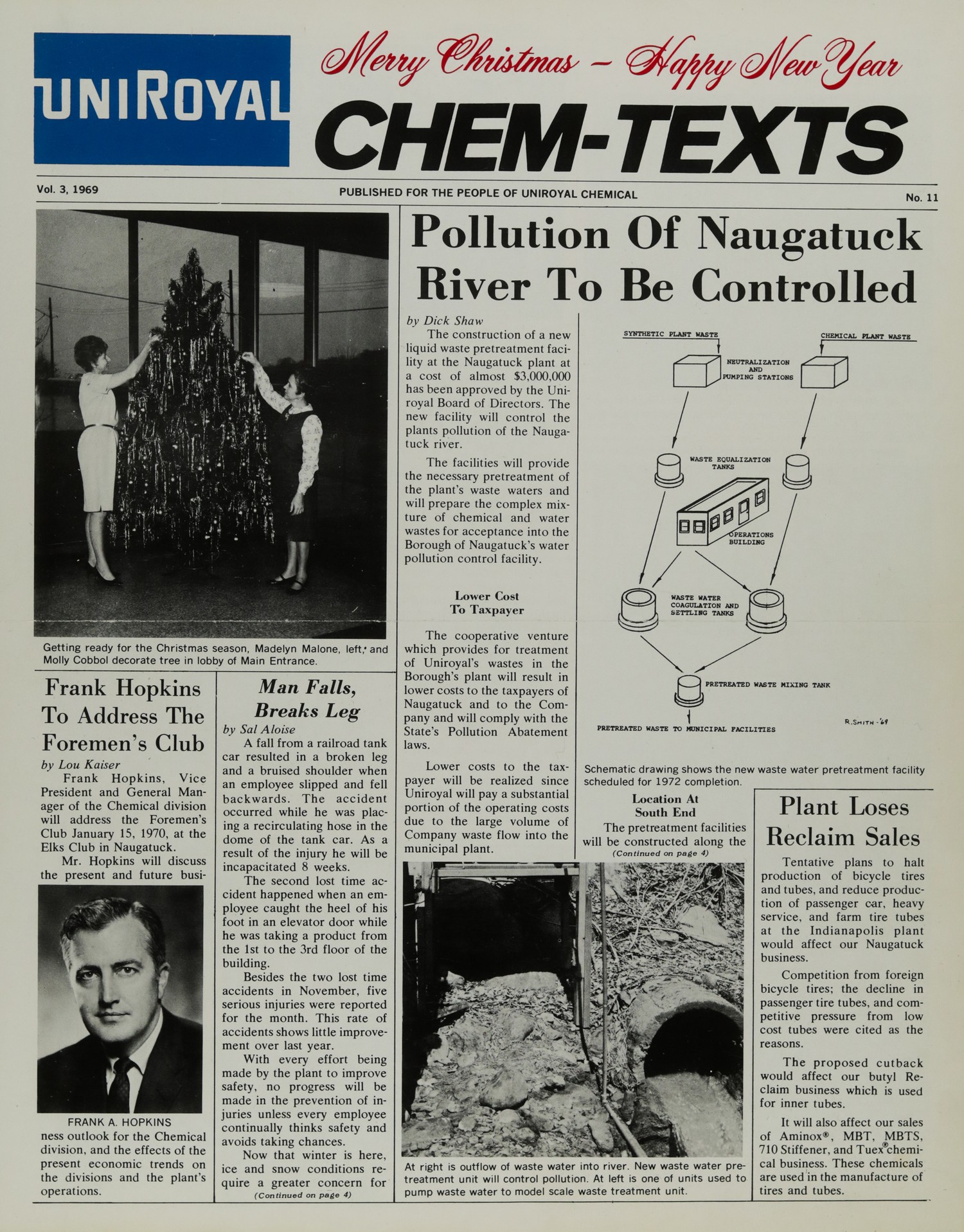
21 Held In New Uniroyal Row Company Asks Picketing Curbs

5-5-67

Register Photo by Stuart Langer

Fighting breaks out at Maple Street entrance to Uniroyal plant.

21 Held In New Uniroyal Row Company Asks Picketing Curbs

By JAMES FLEMING
Register Staff Reporter

NAUGATUCK — Fighting broke out at the Maple Street plant of Uniroyal for the second day in a row, and 21 employes were arrested. Fifty were arrested Thursday.

It was later learned that Uniroyal will seek a restraining order in Superior Court in Waterbury today in an attempt to limit the union to a maximum of three pickets at each gate.

Brawling began at 6:50 a.m. today when office personnel attempted to cross picket lines. Pickets who had been circling near the entrance massed at the gate when the salaried workers tried to get into the company grounds.

Police struggled with pickets as they attempted to open lanes for the workers, and several fights broke out between the strikers and the police. Seven policemen were needed to subdue one worker, William Battles, 37, of Waterbury, who was charged with breach of peace by assault. He was taken to St. Mary’s Hospital in Waterbury afterward where he was treated and released after complaining of stomach pains.

Lt. George Smith went to St. Mary’s for examination after he told Chief Frank Mariano he had been kicked twice in the groin.

As more office employes arrived, company officials told them to wait on the nearby Naugatuck Green while management and union leaders conferred on allowing them to enter. About 300 employes walked to the Green, about half a block away in small groups.

Tension mounted in front of the plant while small groups of women pickets marched carrying signs hung around their necks and sang improvised songs such as “Go home boys in blue” aimed at the police.

Meanwhile, individual office workers without realizing that the others were waiting on the Green, would try to pass through the gate and would be pushed aside.

One woman screamed at the pickets, “Save your strength; you’ll need it when you go back to work.”

Suddenly, the 300 persons on the Green began returning to the plant spontaneously in a massed group and the strikers began yelling as they saw them approaching. Some 25 policemen —half the total force in Naugatuck—rushed into the street between the two groups along with a Uniroyal official and told the office employes to go back to the Green.

The strikers continued to press forward to meet the office workers until the other group went back to the Green.

About half an hour later, the office workers again moved toward the plant and the strikers came toward them. Raymond

See UNIROYAL Page 2

CHEM-TEXTS – Vol. 1, No. 1 – Page 1

Page 001

Merry Christmas – Happy New Year

UNIROYAL CHEM-texts

Vol. 1 PUBLISHED FOR THE PEOPLE OF UNIROYAL CHEMICAL No. 3
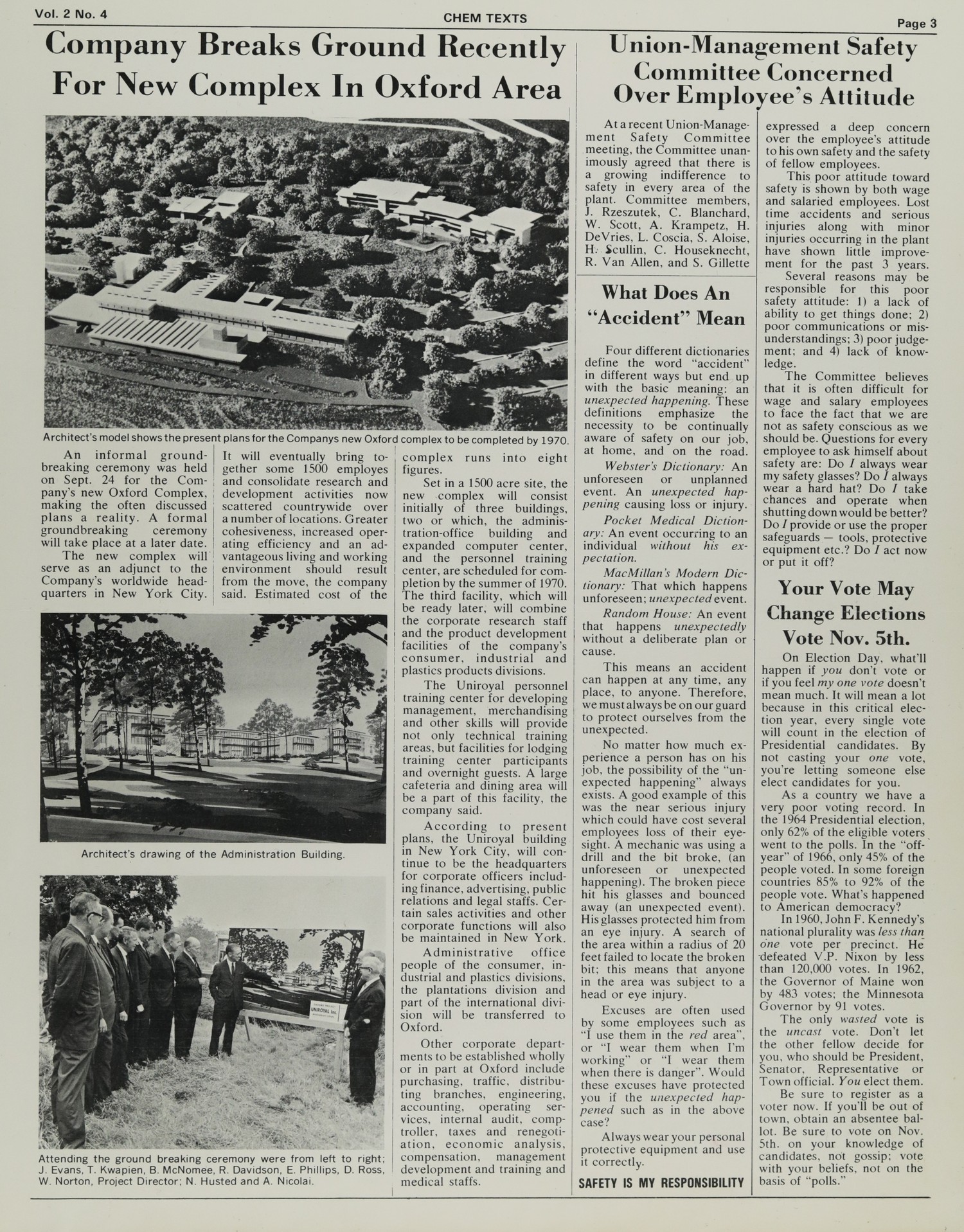

QUALITY . . The Most Important Ingredient

(One of the difficulties of modern industry is the loss of quality or pride of workmanship which identified “handmade” products of the past. Mr. D.E. Fowler, manager of Distribution and Scheduling has put down some thoughts on the subject of quality which are well worth considering. Ed.)

Our business depends on our customers wanting to buy our products in preference to buying similar materials from our competitors. Our continued growth, and even our maintaining present business depends on our supplying better products, with more dependable quality and shipping the materials when and how the customer wants them. In short, we must do a superior job with respect to quality and service.

A customer will prefer to buy from the supplier in which he has confidence. Confidence that our product will always perform in his application because its quality is good and does not change, and that we will get the material to him as we have agreed to do and he can depend on continuing his operations. Confidence in us is first built by our Sales organization, but must be maintained by all of us

throughout the organization, and all of us must avoid the many pitfalls that tend to destroy it.

Quality itself is a result of the processing and workmanship and graded by testing and we are always striving for a uniform product, but beyond this the impression that we make on the customer can be injured by poor appearing packages, torn or dirty outer packages, crushed cartons, dented drums, indistinct labeling, accidental inclusion of foreign objects, etc. These throw doubt on the quality of the workmanship on the product itself.

Of equal importance is service, which is getting the product to the customer when he wants it. The fear that a supplier might shut their operation down through failure to deliver is an important consideration. Any failure to supply intensifies this fear and

reduces our chance of continuing as the supplier. It is not necessary to shut him down this time by being a day or so later than we had promised, he worries about the next time and has to decide whether we are or are not as reliable a supplier as he can find. Shipment delays are caused by a number of types of happenings including quality rejections of products that we depended on to ship, sampling delays, testing delays, process difficulties, equipment breakdowns as well as failures of carriers to pickup a shipment as scheduled, carrier breakdown or otherwise detained in transit. Failures to ship the amount requested, or to follow customers requests as to markings, notification of shipment, prompt test reports, or using specified carriers, etc. are annoyances to the customer that lessen our chances of continuing as his supplier.

The best possible job by everyone in our organization to build customer confidence will contribute considerably to our continued business growth.


NEW WAY TO TEST TIRES

[IMAGE: Motorized vehicle with cattle in field]

Besides tending 250 head of cattle, this motorized cowhand is testing our tires at the Laredo, Texas, tire proving ground. In a new program, ranchers who rent part of our land at Laredo are equipped with company tires which are inspected regularly for damage from the rocky terrain and needle-like cactus plants. The test program is part of our continuing effort to find new ways of preventing tire punctures.


LOCAL 308 RATIFIES NEW AGREEMENT

The tentative agreement reached between the Company and Local #308 Union Negotiating Committee on 10-26-67 was ratified unanimously at membership meetings held on 11-8-67. The

provisions of the new supplemental agreement, as well as the improved benefits of the 1967 Company-wide Agreement, including vacations and anniversary pay, have been made effective as of 10-26-67.


Strikes Affect Sales, Earnings During Third Quarter and Nine Month Periods

Strikes at 19 tire, C & I and chemical plants caused sales and profits to decline for the third quarter and first nine months, George R. Vila, chairman and president, announced.

Third quarter sales declined 8.6% to $287,367,000, compared with $314,398,000 last year. Net income was $7,563,000, or 51 cents a share of common stock. This compared with $11,631,000, or 84 cents, in 1966.

Earnings in August and September exceeded the same months in 1966 and, if it had not been for the strike, earnings for the quarter would have been improved over the same period last year.

Sales during the first nine months totaled $924,329,000, 5.8 per cent lower than last year’s $981,448,000. Net income for the nine months

came to $18,663,000, compared with $35,692,000 last year. Earnings were $1.20 a share, compared with $2.59 for the same period of 1966.

Third quarter results also were affected by the vacation shutdowns provided in labor agreements, Mr. Vila said. Time was required to start up the plants after the strikes

and vacations. Product inventories were depleted or out of balance, thus curtailing filling of customer orders. Following agreement on the master labor contract, the company started negotiation of local plant supplements. The Opelika, Ala. tire plant was struck for 37 days ending only in mid-October.


A PENNY FOR YOUR THOUGHT

In 1904, a Danish post office worker conceived the idea of a small stamp for Christmas letters and parcels in order to raise funds to set up a children’s tuberculosis hospital. The stamps sold for a penny each. Three years later a small dwelling used as a tuberculosis hospital in Delaware was about to be closed because of lack of funds. A woman who was interested in the hospital heard about the Danish post office worker and enlisted the aid of a leading Philadelphia newspaper to help put over a similar drive. The paper backed this drive and before Christmas rolled around, $3,000, ten

times the amount needed, had been raised. That was the beginning – today, 63 years later, Christmas seals are still the principal means of support in the fight against tuberculosis and respiratory diseases. We can all help to spread the word by buying Christmas Seals in 1967. Use them in good health.

[IMAGES: Christmas 1967 seals and Greetings 1967 stamps shown]


RETIREMENTS

U.S. RUBBER

[IMAGE: Photo of Mr. Domingos Matos]

Mr. Domingos Matos, Pleasant Avenue, Naugatuck, retired recently with 29 years of Company service from the Reclaim Production department.

[IMAGE: Photo of Silverio Barroqueiro]

Silverio Barroqueiro, recent retiree from Reclaim Production will travel to Portugal after 26 years service.


[IMAGE: Large industrial storage tank being lifted]

ABOVE: One of two, 50,000# storage tanks for cracked stock is being readied for installation in bldg. #17 of the Reclaim plant. When in place, the tank reached from the first floor to a point above the roof. The unit is part of the Reclaim modernization program and will be a feed tank for the fibre separation department. A complete story of the modernization of our Reclaim Production facilities will appear in a later issue of “Chem-Texts”.