
CHEM-TEXTS
Page 2 | Vol. 9, 1975
In my last editorial I ventured into the field of politics. This area is so vital that I felt a few more ideas had to be discussed. The current confusion in Washington and the recent wild legislation session in Hartford are prime examples of the type of disturbing political action confronting us Americans today.
I read in the newspapers all the criticisms by well known columnists and editors lamenting the poor actions and leadership of our elected legislative officials. They ask our officials to change their ways and to recognize the real problems of the people, their jobs, their community problems, their financial problems, etc. etc.
I find this effort misdirected. Appealing to elected politicians hardly ever changes their minds. Their philosophy of life has been long in developing and most are strong-minded people, not easily swayed from their convictions. The way to change the political direction of a legislative body is to change the legislators. Vote out the ones that are undersirable and vote in those who reflect the feeling and mood of the electorate.
Although voting occurs only every two years, people’s thoughts should be on this subject all the time, not just one week before elections. For example, a review of how our representatives voted recently in Hartford should be done now to help form an opinion while the facts are clear.
The makeup of the last two Connecticut Legislatures is another problem that voters must avoid in the future. We now have in Hartford an overwhelming Democratic majority. Two years ago there was an overwhelming Republican majority. This is no way to run a government, for with such a onesided majority, we don’t have a democracy—which is a balance of two or more opinions— we have instead what approaches dictatorial power of the party in the majority. Such a situation can do nothing but harm. A balance is essential to stable and honest government.
No one can rectify a situation like this except we voters. This means less emotional voting and more thinking, both inside and outside the voting machine.
J. A. Cronin
Jim Cronin [signature]
[PHOTO: Headshot of a man in suit]
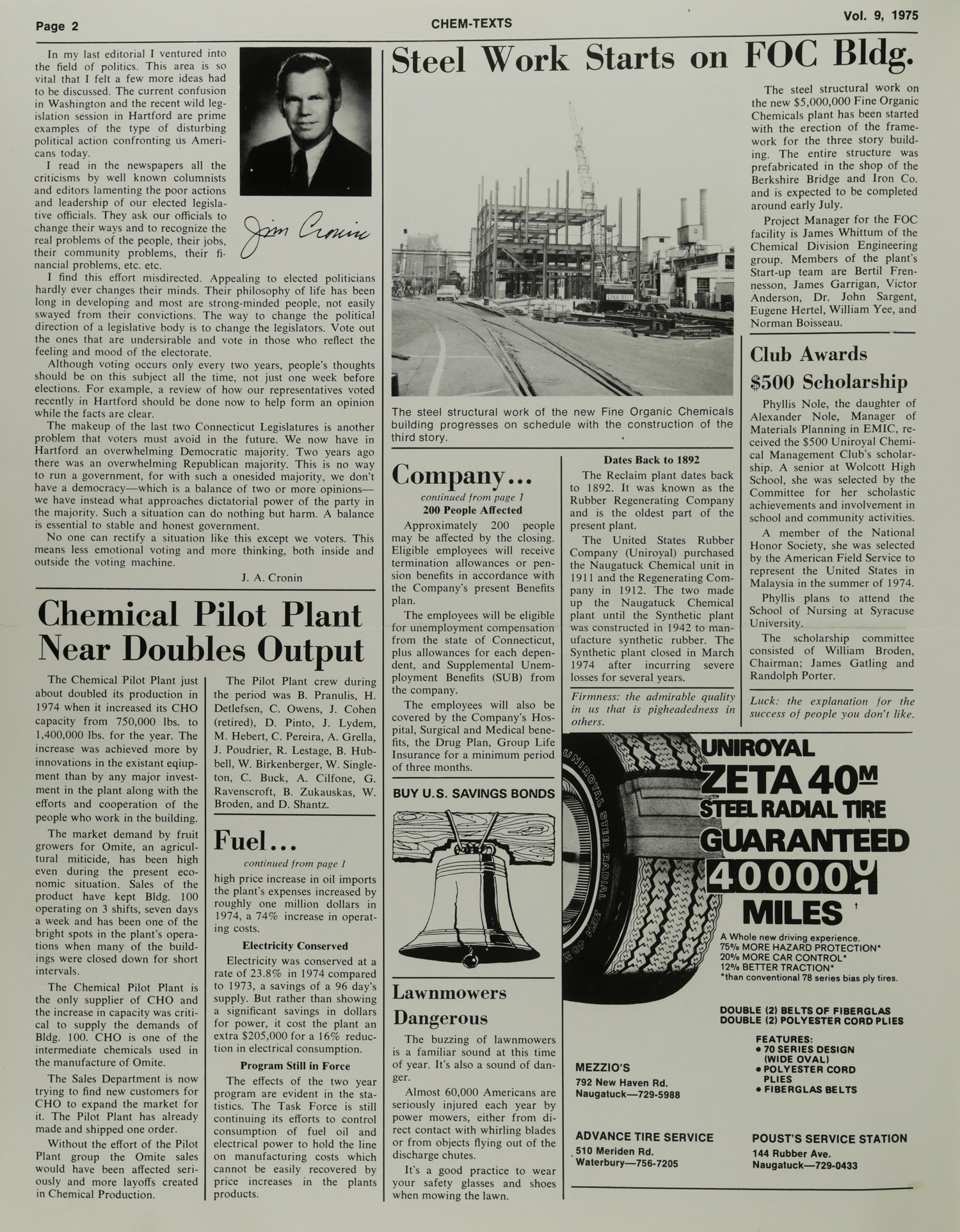
Steel Work Starts on FOC Bldg.
[PHOTO: Construction site showing steel framework of a building]
The steel structural work on the new $5,000,000 Fine Organic Chemicals plant has been started with the erection of the framework for the three story building. The entire structure was prefabricated in the shop of the Berkshire Bridge and Iron Co. and is expected to be completed around early July.
Project Manager for the FOC facility is James Whittum of the Chemical Division Engineering group. Members of the plant’s Start-up team are Bertil Frennesson, James Garrigan, Victor Anderson, Dr. John Sargent, Eugene Hertel, William Yee, and Norman Boisseau.
The steel structural work of the new Fine Organic Chemicals building progresses on schedule with the construction of the third story.
Chemical Pilot Plant Near Doubles Output
The Chemical Pilot Plant just about doubled its production in 1974 when it increased its CHO capacity from 750,000 lbs. to 1,400,000 lbs. for the year. The increase was achieved more by innovations in the existant equipment than by any major investment in the plant along with the efforts and cooperation of the people who work in the building.
The market demand by fruit growers for Omite, an agricultural miticide, has been high even during the present economic situation. Sales of the product have kept Bldg. 100 operating on 3 shifts, seven days a week and has been one of the bright spots in the plant’s operations when many of the buildings were closed down for short intervals.
The Chemical Pilot Plant is the only supplier of CHO and the increase in capacity was critical to supply the demands of Bldg. 100. CHO is one of the intermediate chemicals used in the manufacture of Omite.
The Sales Department is now trying to find new customers for CHO to expand the market for it. The Pilot Plant has already made and shipped one order.
Without the effort of the Pilot Plant group the Omite sales would have been affected seriously and more layoffs created in Chemical Production.
The Pilot Plant crew during the period was B. Pranulis, H. Detlefsen, C. Owens, J. Cohen (retired), D. Pinto, J. Lydem, M. Hebert, C. Pereira, A. Grella, J. Poudrier, R. Lestage, B. Hubbell, W. Birkenberger, W. Singleton, C. Buck, A. Cilfone, G. Ravenscroft, B. Zukauskas, W. Broden, and D. Shantz.
Company…
continued from page 1
200 People Affected
Approximately 200 people may be affected by the closing. Eligible employees will receive termination allowances or pension benefits in accordance with the Company’s present Benefits plan.
The employees will be eligible for unemployment compensation from the state of Connecticut, plus allowances for each dependent, and Supplemental Unemployment Benefits (SUB) from the company.
The employees will also be covered by the Company’s Hospital, Surgical and Medical benefits, the Drug Plan, Group Life Insurance for a minimum period of three months.
BUY U.S. SAVINGS BONDS
Dates Back to 1892
The Reclaim plant dates back to 1892. It was known as the Rubber Regenerating Company and is the oldest part of the present plant.
The United States Rubber Company (Uniroyal) purchased the Naugatuck Chemical unit in 1911 and the Regenerating Company in 1912. The two made up the Naugatuck Chemical plant until the Synthetic plant was constructed in 1942 to manufacture synthetic rubber. The Synthetic plant closed in March 1974 after incurring severe losses for several years.
Firmness: the admirable quality in us that is pigheadedness in others.
Fuel…
continued from page 1
high price increase in oil imports the plant’s expenses increased by roughly one million dollars in 1974, a 74% increase in operating costs.
Electricity Conserved
Electricity was conserved at a rate of 23.8% in 1974 compared to 1973, a savings of a 96 day’s supply. But rather than showing a significant savings in dollars for power, it cost the plant an extra $205,000 for a 16% reduction in electrical consumption.
Program Still in Force
The effects of the two year program are evident in the statistics. The Task Force is still continuing its efforts to control consumption of fuel oil and electrical power to hold the line on manufacturing costs which cannot be easily recovered by price increases in the plants products.
Club Awards $500 Scholarship
Phyllis Nole, the daughter of Alexander Nole, Manager of Materials Planning in EMIC, received the $500 Uniroyal Chemical Management Club’s scholarship. A senior at Wolcott High School, she was selected by the Committee for her scholastic achievements and involvement in school and community activities.
A member of the National Honor Society, she was selected by the American Field Service to represent the United States in Malaysia in the summer of 1974.
Phyllis plans to attend the School of Nursing at Syracuse University.
The scholarship committee consisted of William Broden, Chairman; James Gatling and Randolph Porter.
Luck: the explanation for the success of people you don’t like.
Lawnmowers Dangerous
[IMAGE: Drawing of a Liberty Bell]
The buzzing of lawnmowers is a familiar sound at this time of year. It’s also a sound of danger.
Almost 60,000 Americans are seriously injured each year by power mowers, either from direct contact with whirling blades or from objects flying out of the discharge chutes.
It’s a good practice to wear your safety glasses and shoes when mowing the lawn.
MEZZIO’S
792 New Haven Rd.
Naugatuck—729-5988
ADVANCE TIRE SERVICE
510 Meriden Rd.
Waterbury—756-7205
POUST’S SERVICE STATION
144 Rubber Ave.
Naugatuck—729-0433
[ADVERTISEMENT]
UNIROYAL
ZETA 40M
STEEL RADIAL TIRE
GUARANTEED
40000
MILES
A Whole new driving experience.
75% MORE HAZARD PROTECTION
20% MORE CAR CONTROL
12% BETTER TRACTION
than conventional 78 series bias ply tires.
DOUBLE (2) BELTS OF FIBERGLAS
DOUBLE (2) POLYESTER CORD PLIES
FEATURES:
– 70 SERIES DESIGN (WIDE OVAL)
– POLYESTER CORD PLIES
– FIBERGLAS BELTS